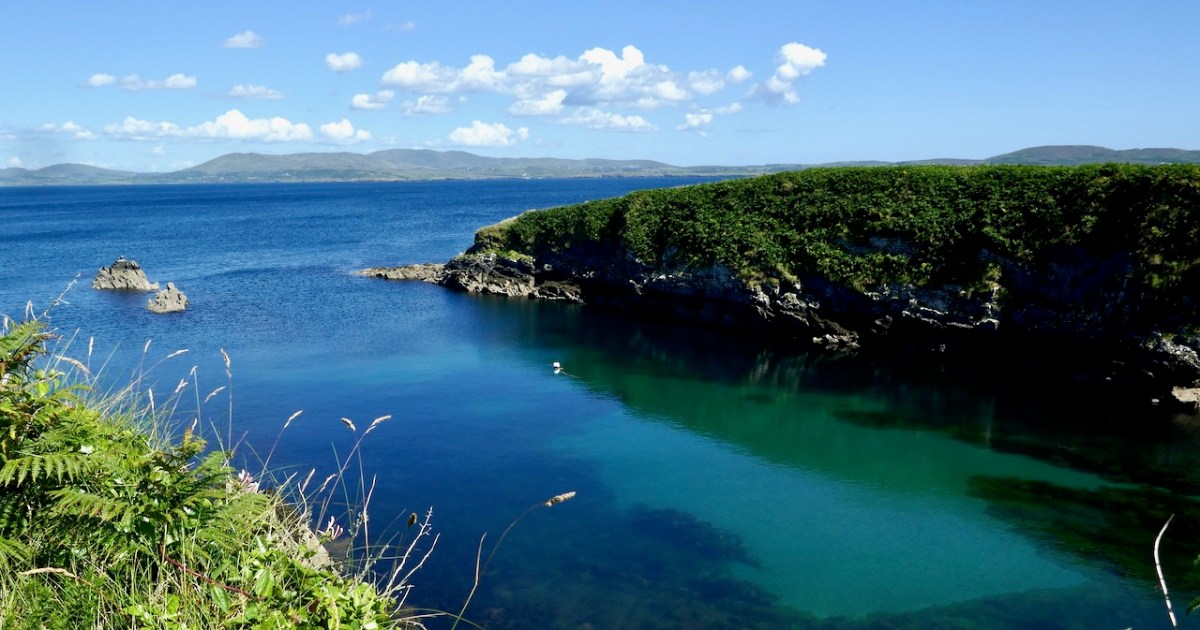
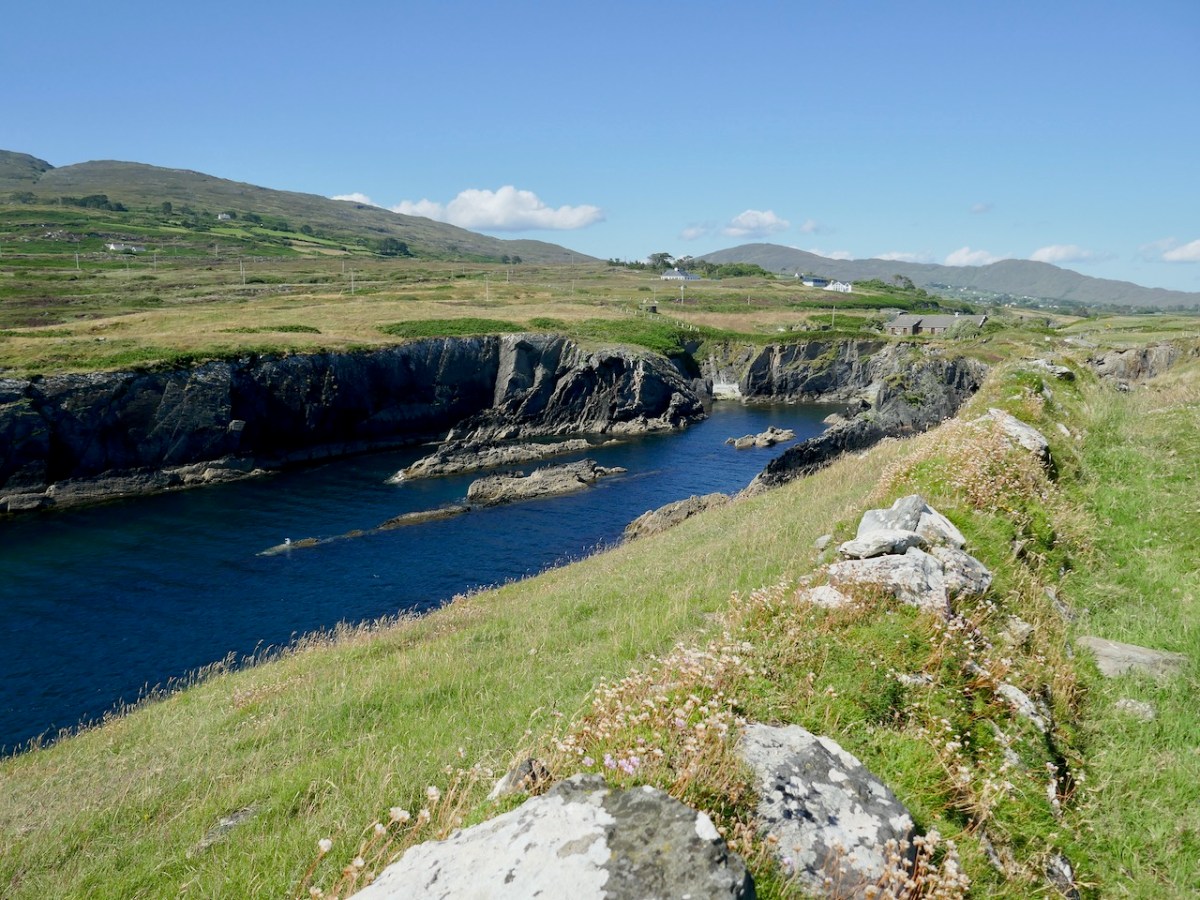
The Cliffs of Dooneen – surely that’s in Clare? Well, no, the song was actually written by Jack McAuliffe about the cliffs near Lixnaw, Co Kerry, from which Clare can, apparently, be seen. It was initially popularised by Paddy Breen, a traditional flute player, but got famous when it was performed by Christy Moore of Planxty. Paddy Reilly has a nice version too. But the Dooneen we are talking about today is the one on the Sheep’s Head, a few kilometres beyond Kilcrohane and on the way-marked trails of the Sheeps Head Way. It’s a spectacular spot, well worth visiting for no reason at all other than to contemplate the glories of the scenery in this part of the world.
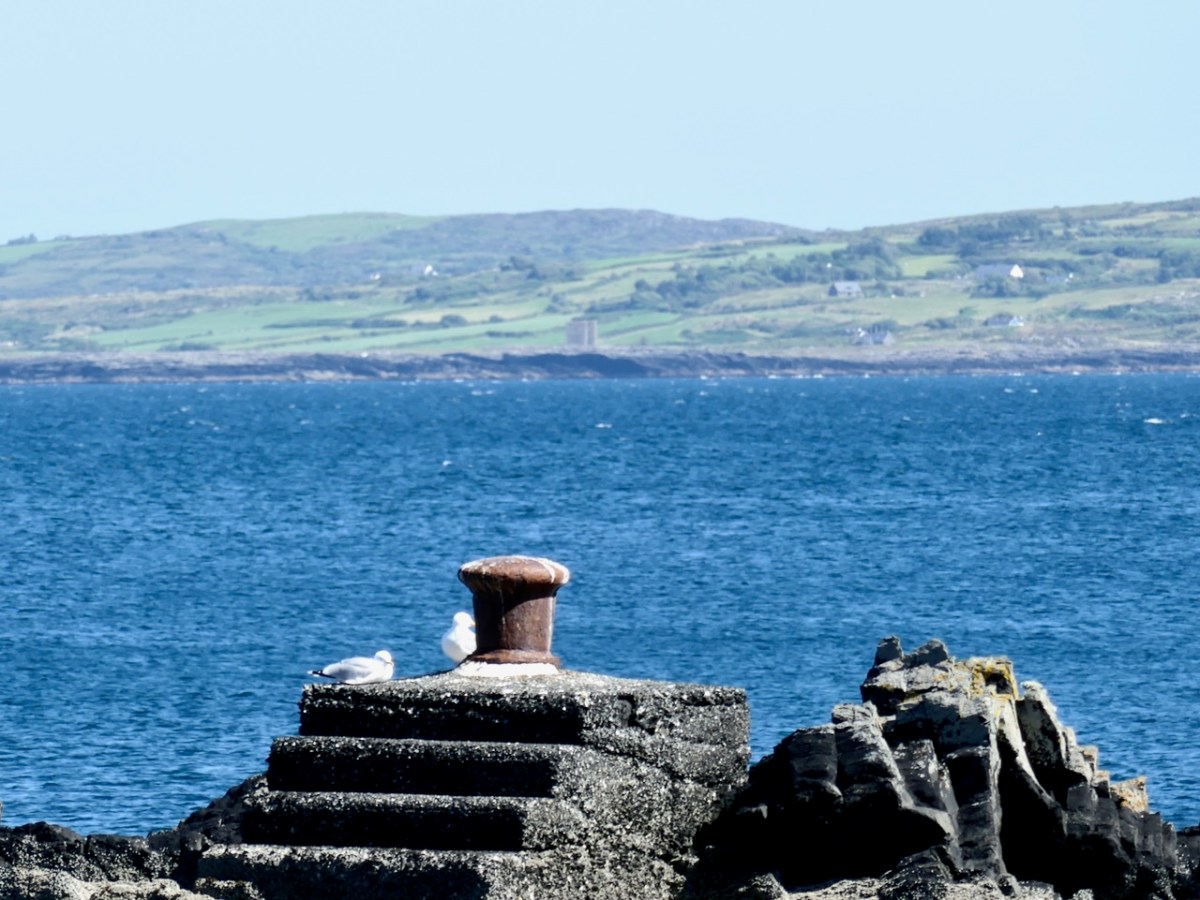
Dunmanus Castle can be glimpsed across Dunmanus Bay (above), and the whole of the Mizen Peninsula lies across from you, from Mount Gabriel to the end of the Peninsular where Dunlough Head hosts the magnificent Three Castles.
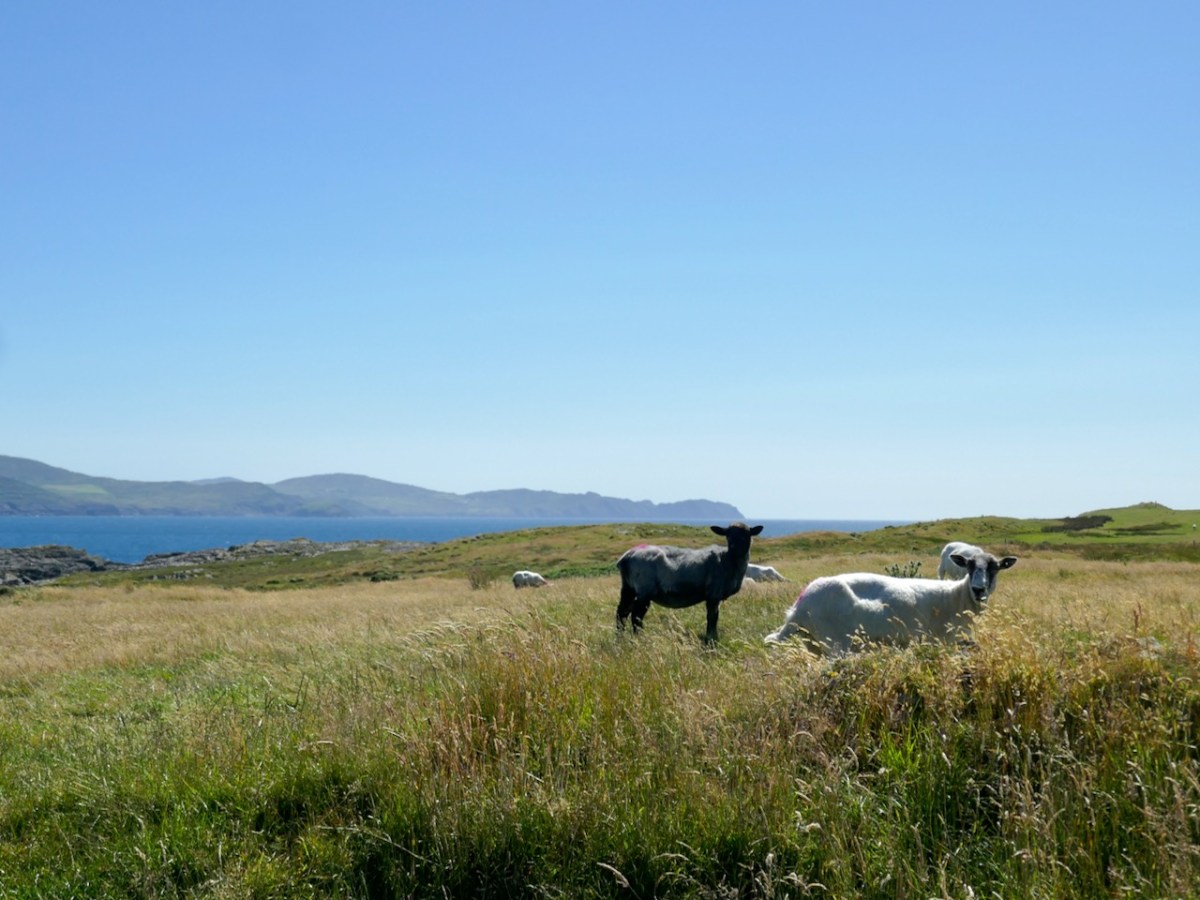
Dooneen (Dúnín – ‘Little Fort’) has been a locus of activity for a long time, probably because it provides a sheltered spot for boats. Sheltered – but not necessarily safe!
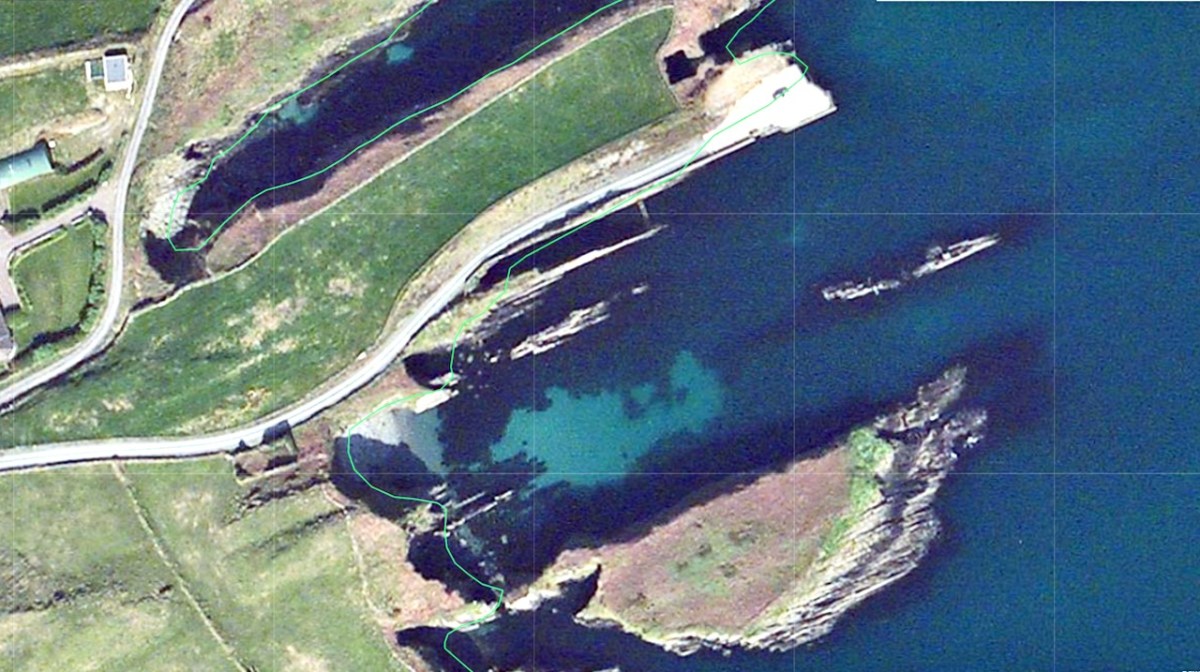
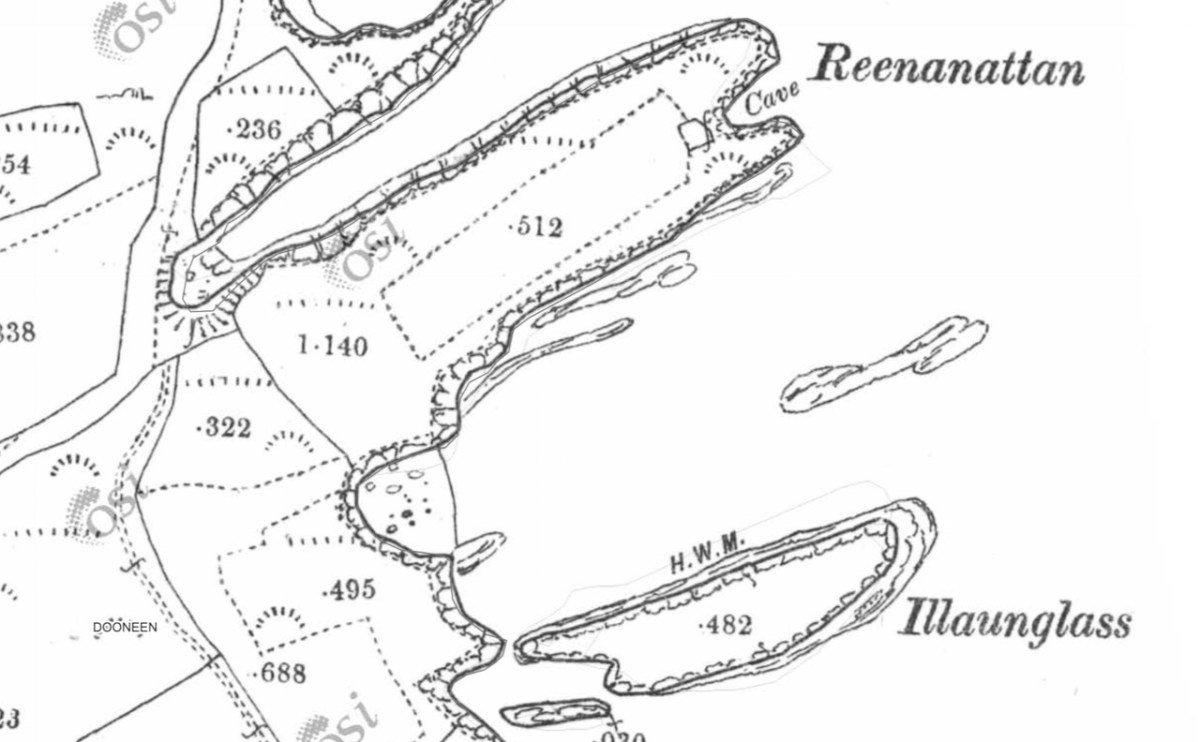
The pier here is substantial. This was the centre for a busy fishing industry early in the 20th century. We’ve often talked about the 15th century as a time when vast shoals of pilchards and herring congregated in the waters of West Cork. It happened again in the first half of the 1900s, and this is when this pier probably dates to. We know that, because it is not shown on the 6” or 25” Ordnance Survey Maps which date from the 19th and early 20th centuries.
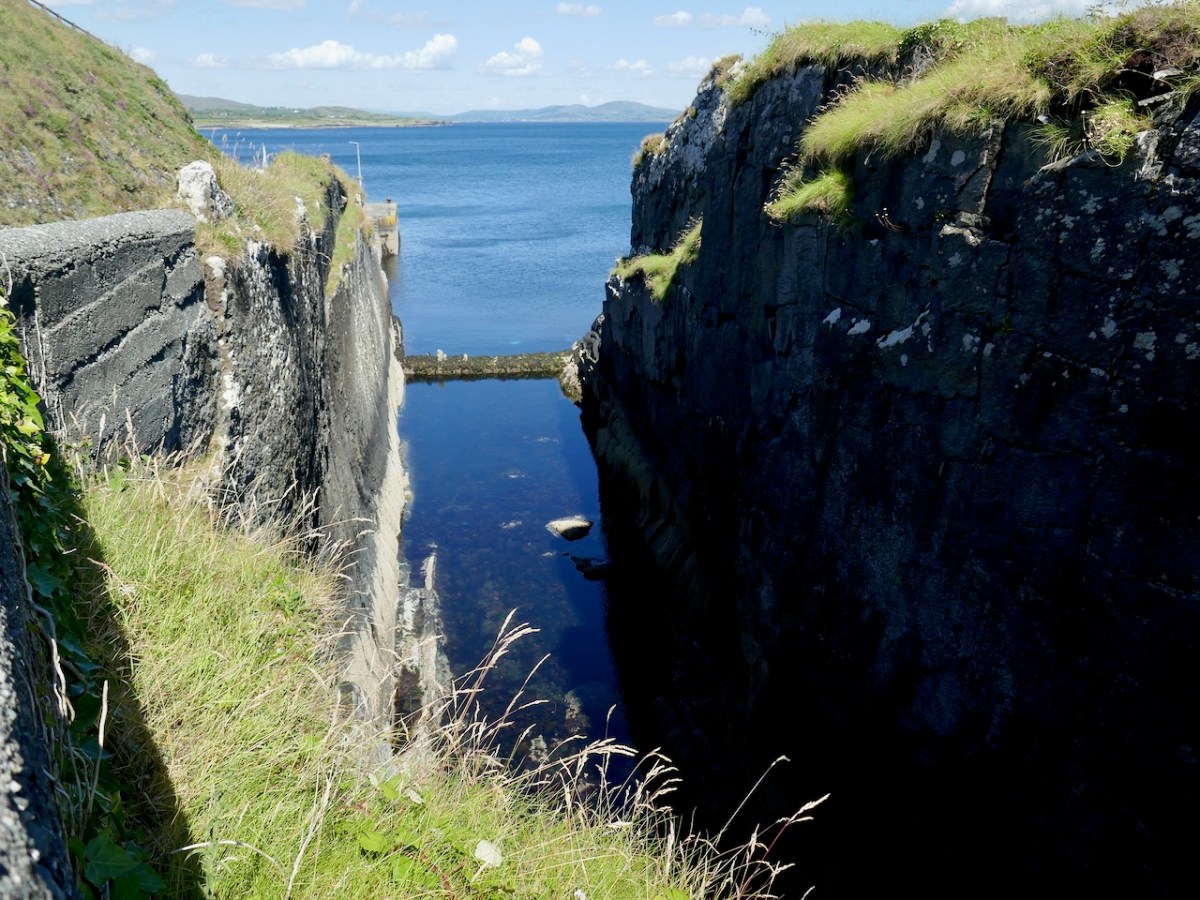
There are a couple of buildings that may relate to the processing of the fish (see Robert’s post Pilchards and Palaces for an explanation). And this odd feature below – what looks like a holding pond created by a concrete dam.
An excellent page on eOceanic provides directions for mooring and some history of the area. This page also has some great photos of the pier from the sea, such as this one, below, taken by Burke Corbett, and used here with thanks to the admins of eOceanic
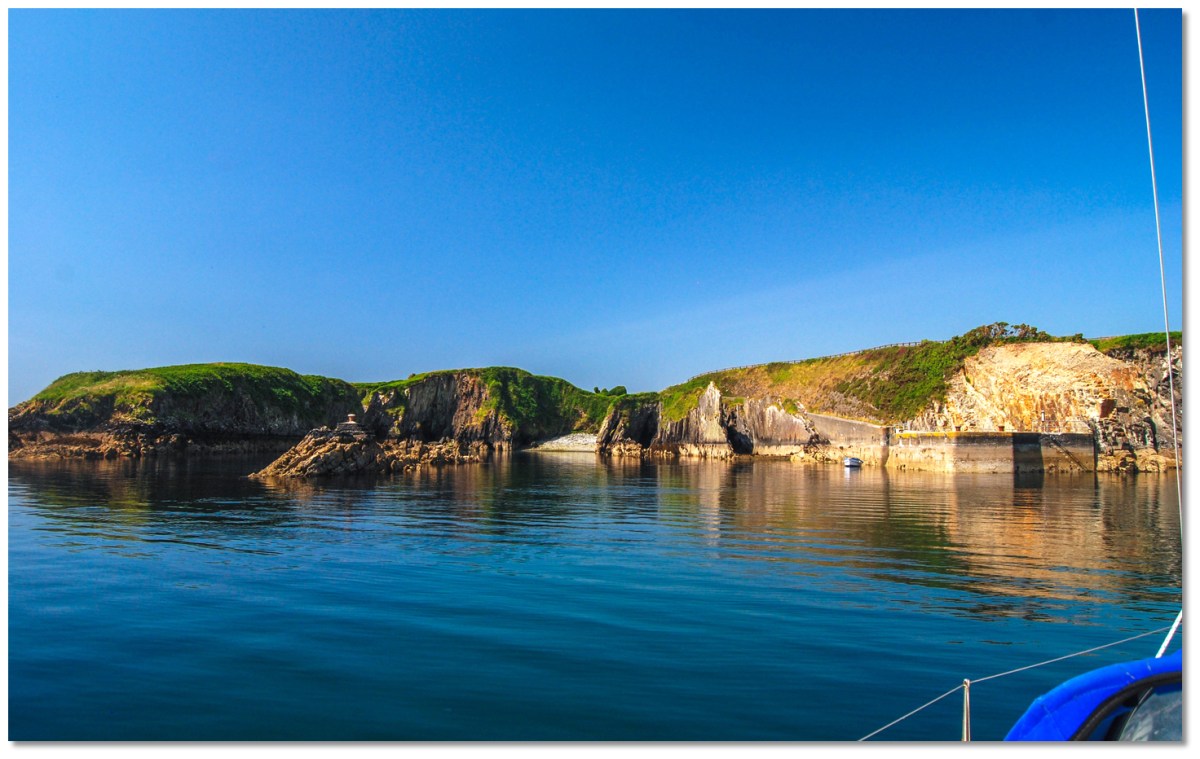
The author states that the pier was initially built to service the busy copper mines in the area. However, I would expect the roads he refers to, to be visible on the OS maps, and they are not, so perhaps the pier here was quite rudimentary or natural before the current concrete pier was constructed.
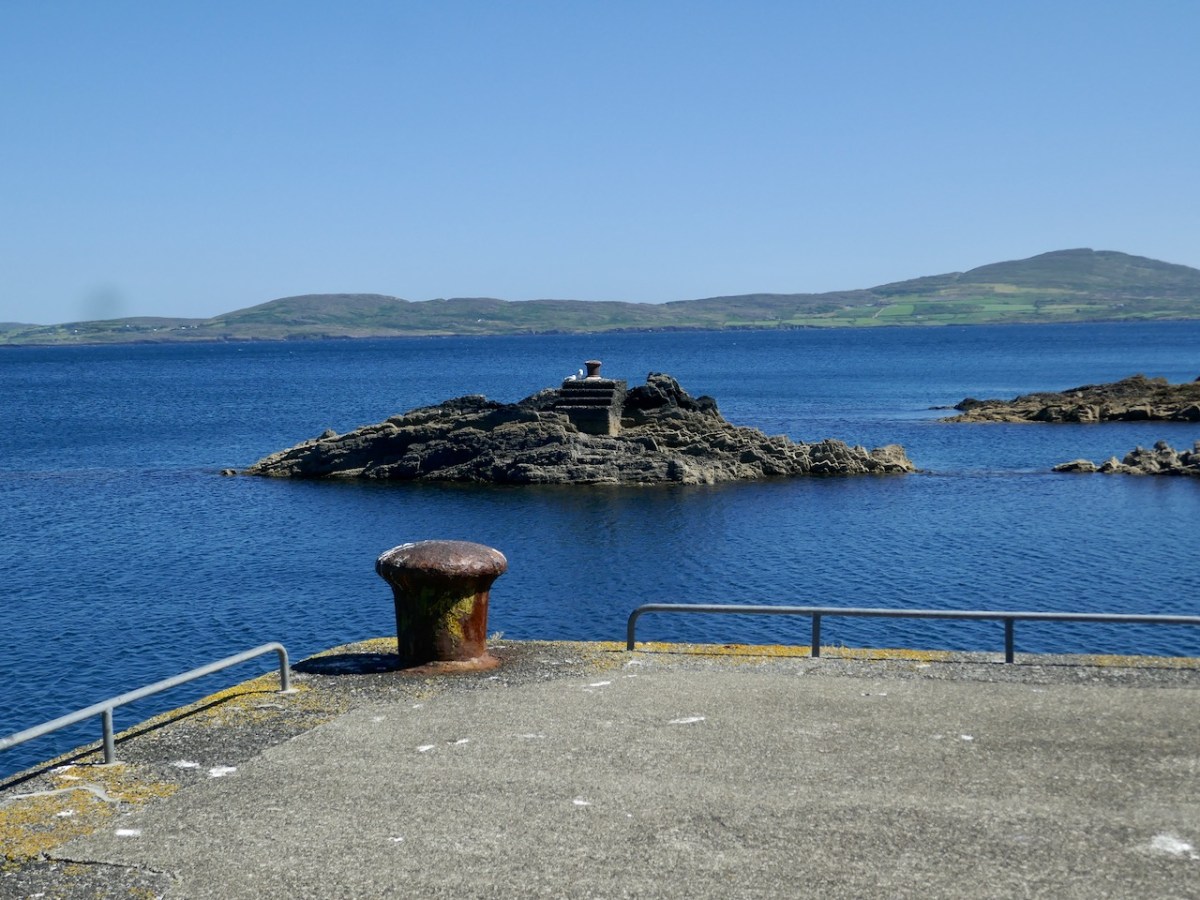
The author of the eOceanic page refers to the feature above on the rock as a ‘steamer turning bollard.’ I had never heard that term before so I turned to my friend Sean O’Mahony, mariner and historian, for an explanation. Here’s what he told me, along with an illustration. Thank you, Sean!
To assist the ship from movement on the jetty, two lines (mooring ropes or hawsers) are extended from the bow and stern to the bollard. This will help to keep the ship reasonably secure from moving backwards and forwards (ranging) along the pier and also prevent her from being pushed hard alongside. This method would only succeed under reasonable weather conditions. I have a feeling that a lot of wooden fenders would also have been employed. My crude drawing demonstrates this with red lines extending to the bollard.
Second, and probably its primary purpose, was to aid in getting the ship off the berth when she is ready for departure. This procedure is known as warping and works like this. The lines to shore from the bow are left go and then using the ship’s windlass the line to the turning bollard is heaved in causing the bow to move outward in the direction of the open sea, at the same time the line from the stern to the bollard is released as are the stern spring lines just holding one line fast to the shore until the turning manoeuvre is complete, When she has turned sufficiently all remaining lines are released and recovered, engine speed is increased and you steam away to somewhere nice…. like the South sea islands…..
As we might expect with a place with Dún in the title, there is a promontory fort here, and another one next door. (Here’s a good example of a West Cork Promontory Fort.) When studying promontory forts my first port of call is always our old friend Thomas Westropp and indeed Westropp has written about the fort at Gouladoo, on the north side of the peninsula.
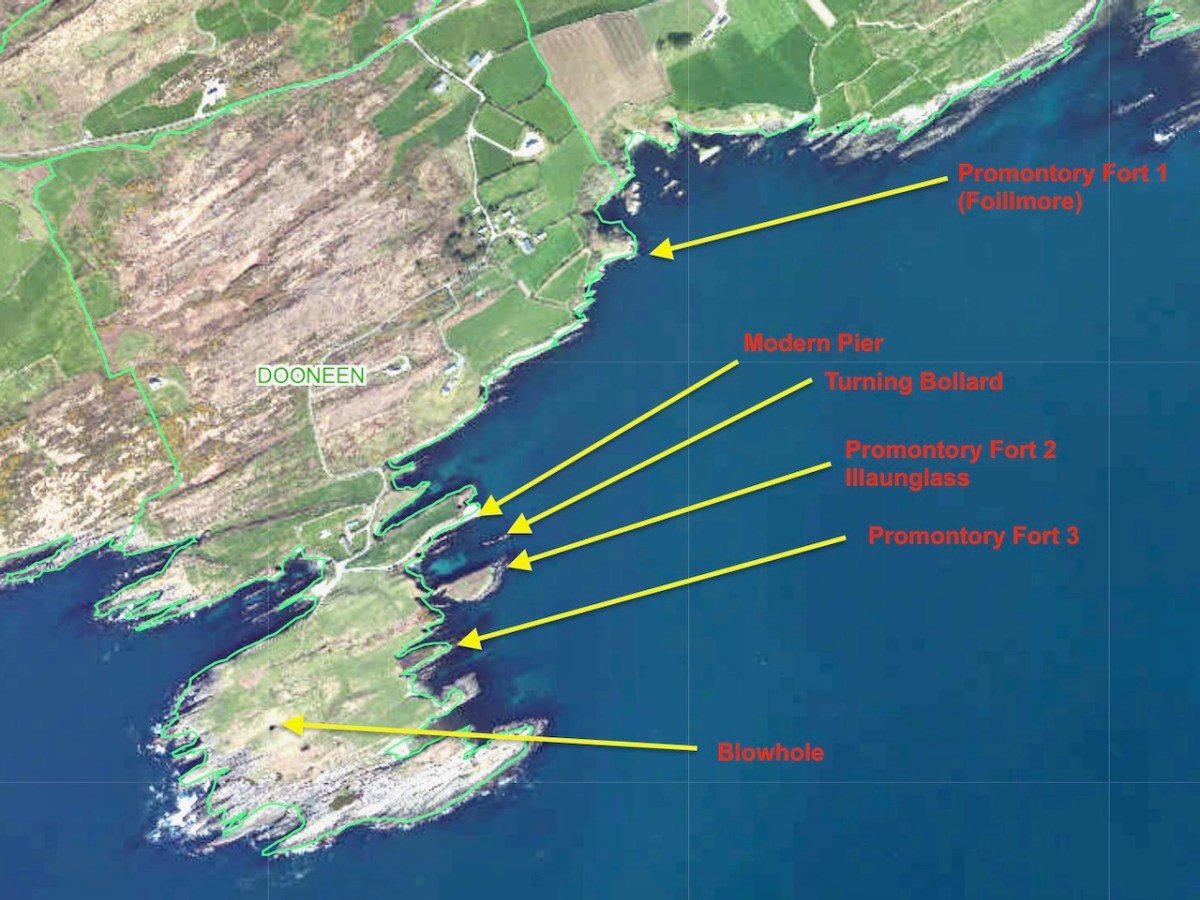
Normally intrepid in his pursuit of the forts. Westropp’s courage failed him when faced, a hundred years ago, with the prospect of travelling on the old, fearfully steep and rough road to this, at that time, remote part of Muinter Bheara. Finding the way ‘insuperable’, he confined his efforts to looking at it with strong field glasses, clear air and light from the Mizen Peninsula across Dunmanus Bay. The fort he describes, as a result of this remote surveillance, and with the help of local informants, appears to be the one further east along the cliffs from Dooneen Pier. It is located on Foilmore (Big Cliff), along from Foilnanoon (Cliff of the Fort). It’s National Monument No CO138-012. It’s Promontory Fort 1 on the map above.
Here’s what Westropp has to say about this fort*:
The high mound and fosse are curved, and bushes grow on the former; inside is a level garth with long grassy slopes down to the cliffs. The rampart, I was told, was “about as high as a man” very steep, “cut by a gap, with a high narrow roadway, only wide enough for a cart to go inside across the ditch” which was “about as deep” as the mound was high – i.e., 5 ft. to 6 ft., making the rampart 10 ft. to 12 ft. high in all. Near it is a small, low peninsula, with little headlands and creeks, Reenanattin (furze point), Coosabriste (broken creek), Carrignagappul, Cooshaneagh (called from horses), and Murkogh. The fort is near Foillmore cliff, and is locally called “the Island of Dooneen” a not unusual term for such forts in Counties Mayo, Clare, Kerry, Cork, and especially Waterford.
Determined to best Westropp and actually visit the fort, I set out, in the company of Amanda and Peter and my sister, to tramp across the fields to it. Alas, we got no further than the farmhouse on whose land the fort is situated, where we were warned that a) it’s crumbling and very dangerous and b) it’s impossible to see anything because of the growth of gorse, trees and scrub.
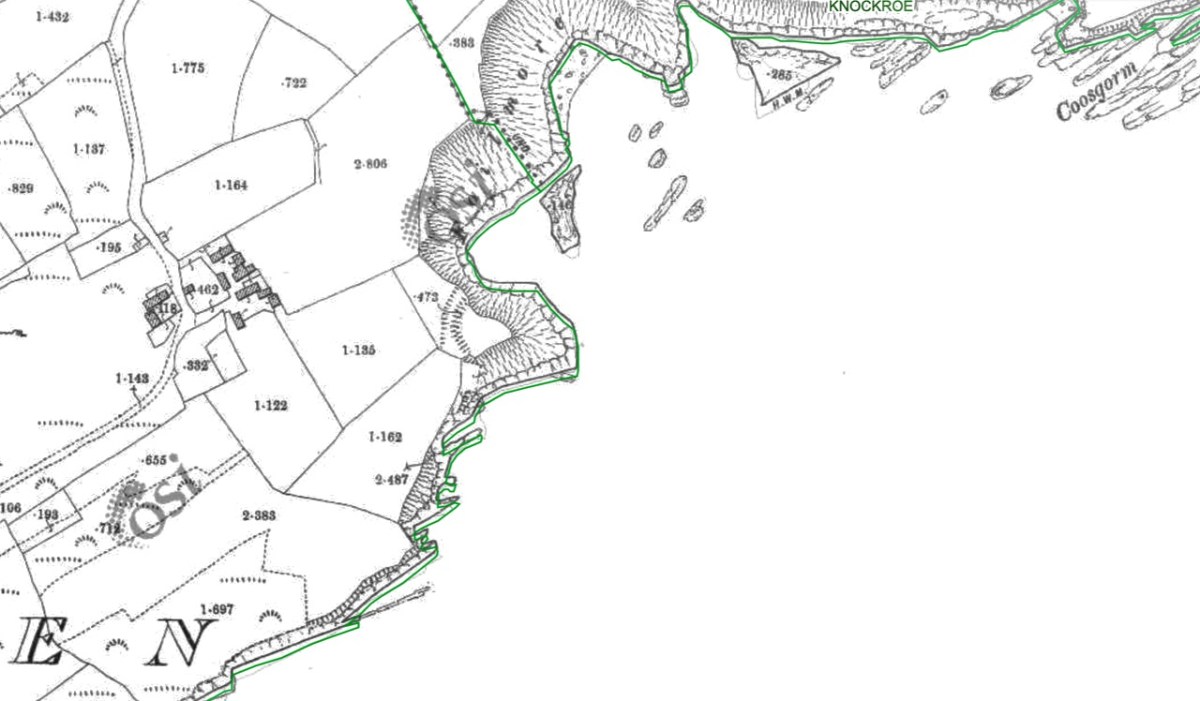
We abandoned the attempt – I will never doubt Westropp’s good sense again! I contented myself with what is showing on the 19th century OS map, above.
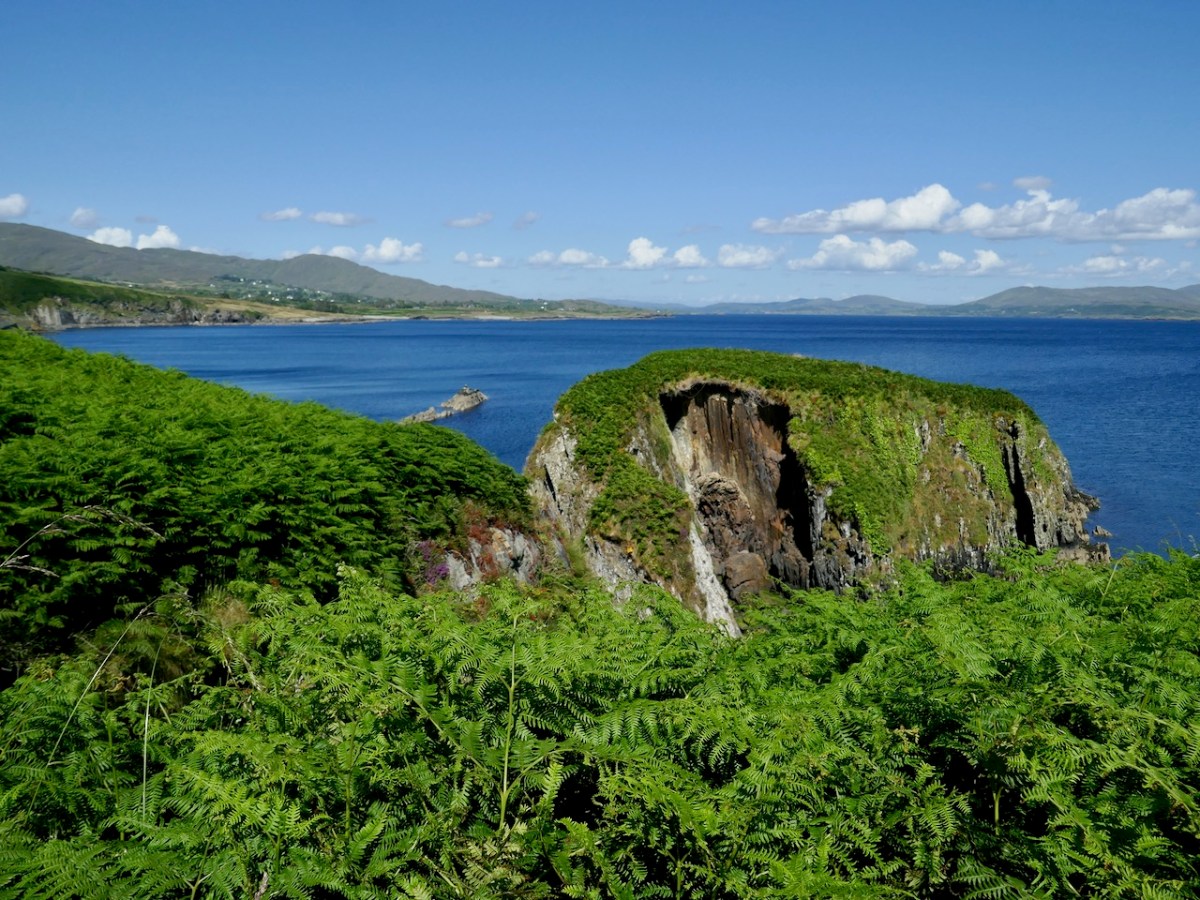
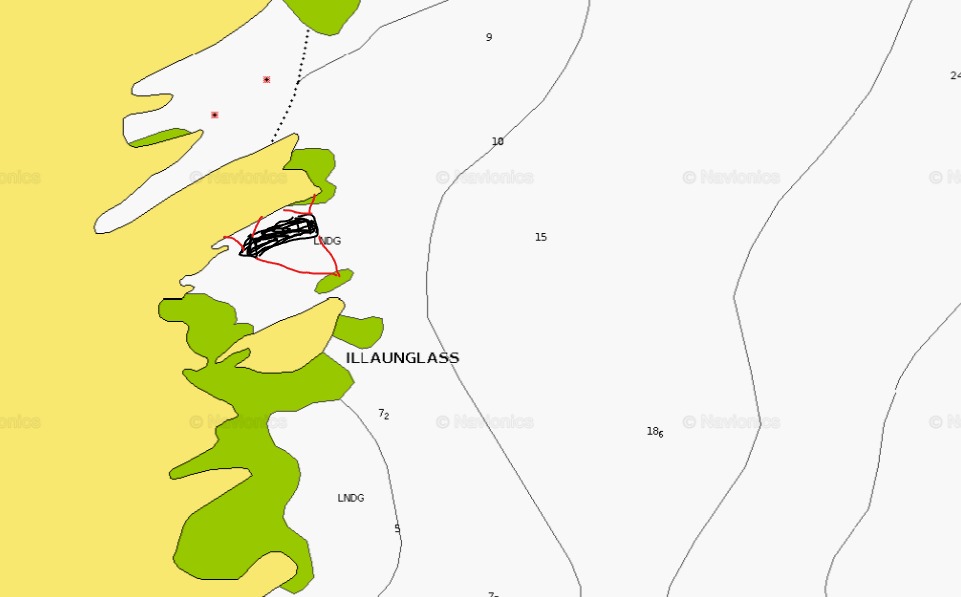
Two more promontory forts are shown on the National Monuments map, presumably identified in the course of the archaeological surveys of the 1980s. It is no longer possible to see the ramparts, banks or ditches of the promontory fort immediately south of Dooneen Pier (above and below) as they have fallen into the sea (like those at Dún an Óir on Cape Clear). This one is called Illaunglass, or Green Island, on the map. According to the National Monument record (CO138-034002) it has a hut site on it. Frustratingly, the details of this record are hidden from view at the moment.
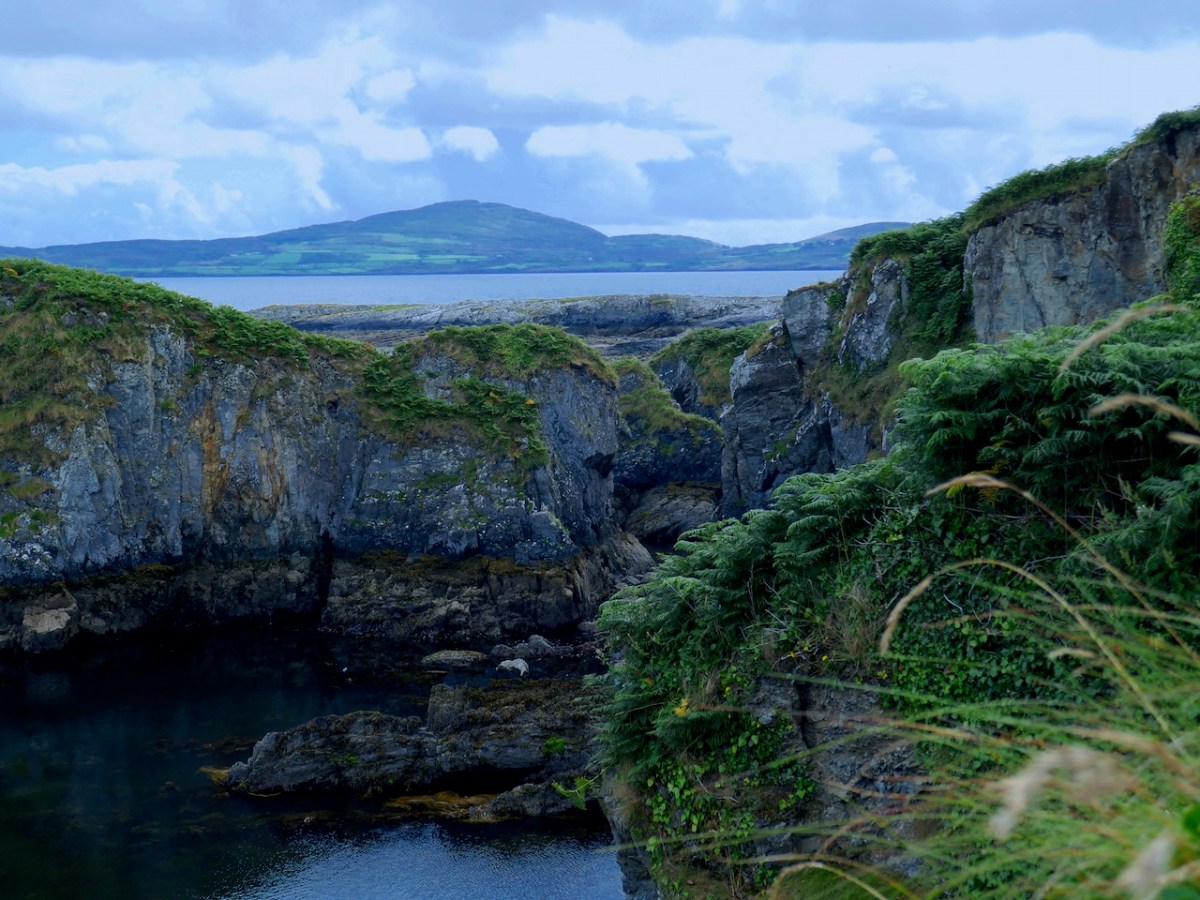
The next one to the south (CO138-035, no. 3 on the map), details also hidden, has a very slight discernible bank, partly covered by a wall, possibly modern (below). However, there is no indication of a ditch or bank in the OS maps, so it is unclear on what basis it has been assigned as a promontory fort.
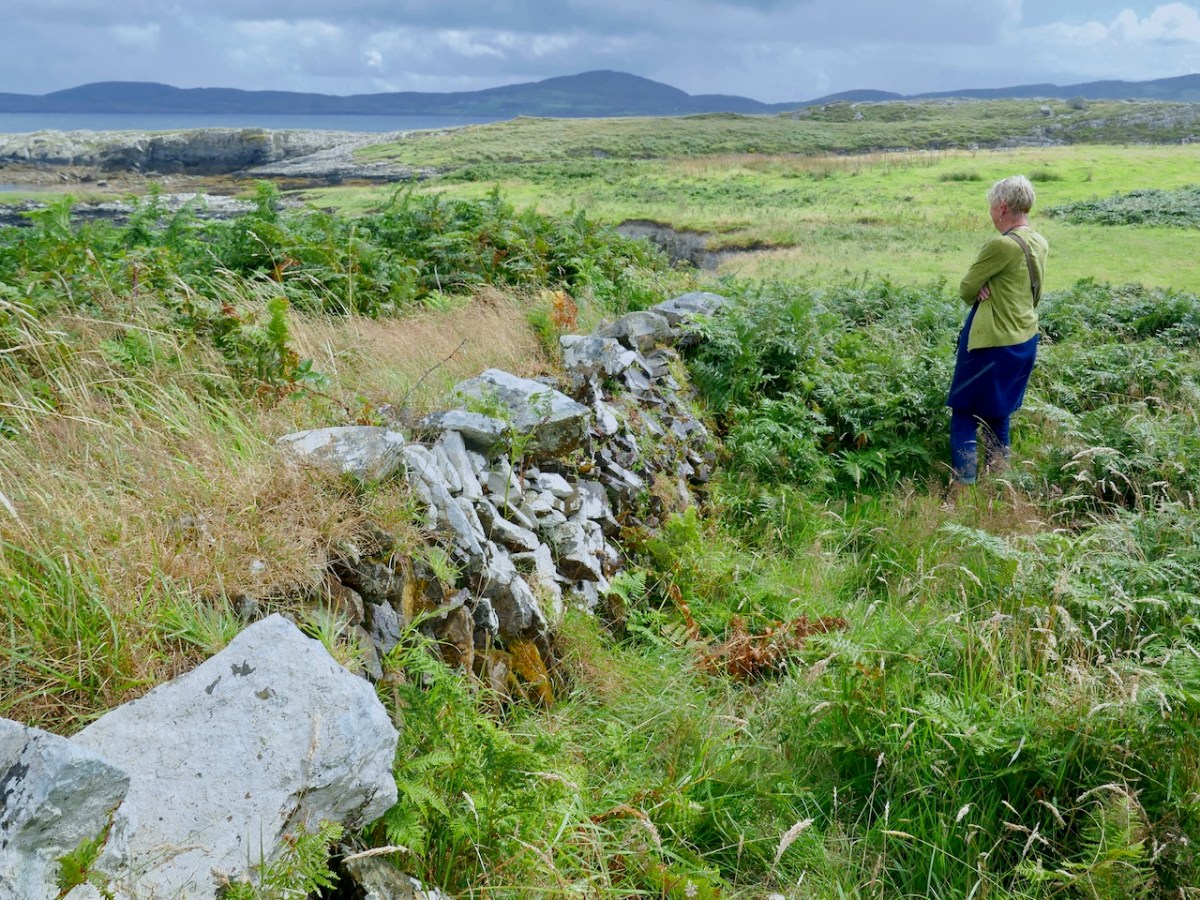
It is obvious that this area has been important to the inhabitants of Muinter Bheara for a long time, since promontory forts can date as early as the Iron Age (which ended around 500 CE/AD) but are commonly early Medieval, dating up to around 1000 CE/AD.
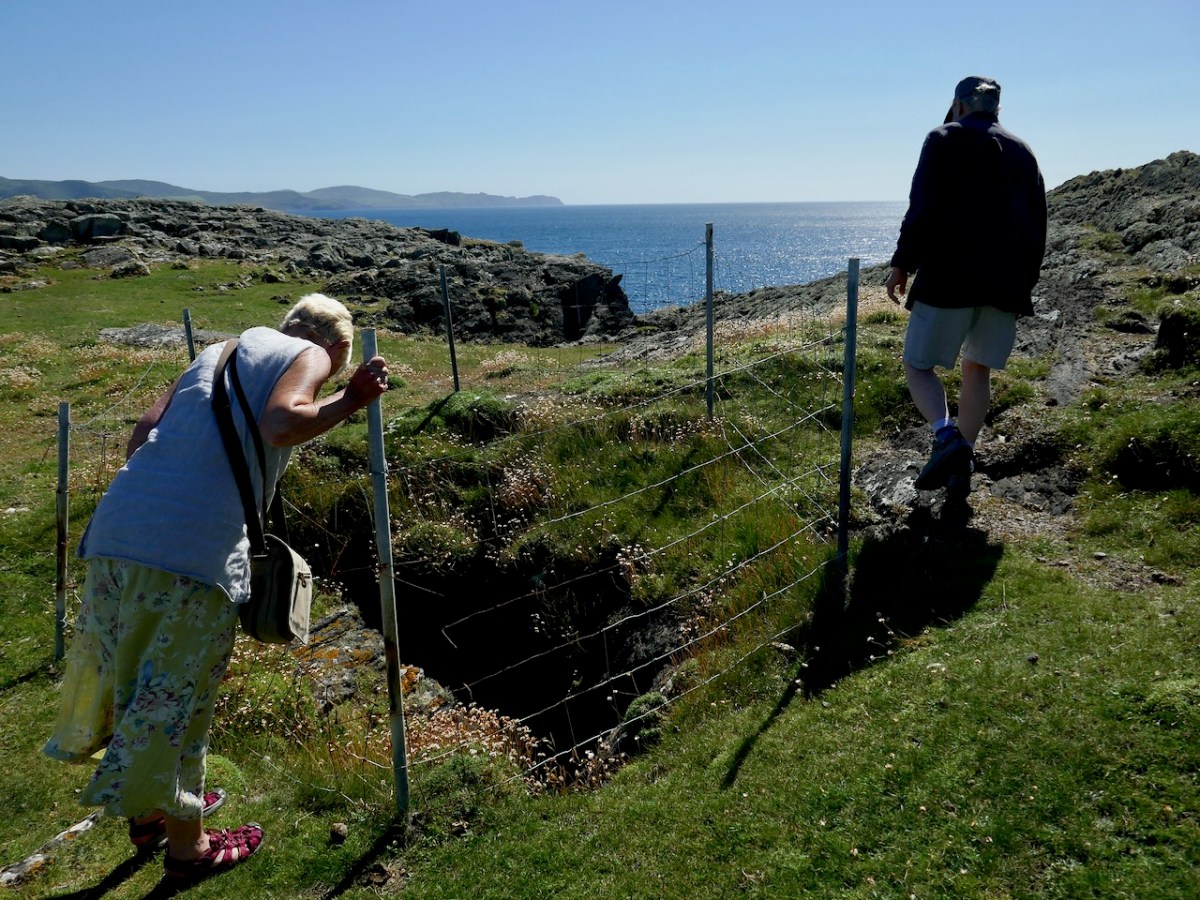
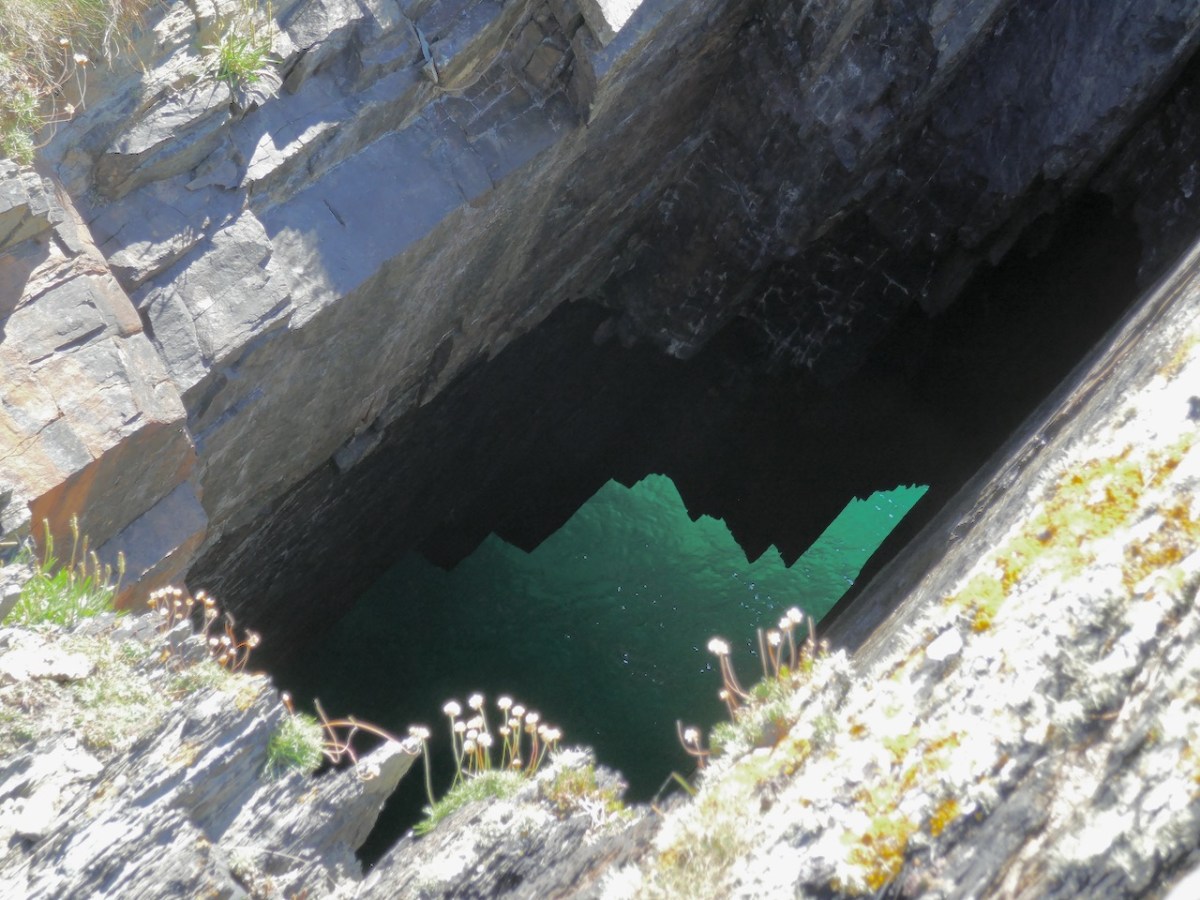
One more curious feature awaited us on our walk around the ‘Island of Dooneen’ – a blowhole, thankfully guarded by a wire fence. I’d love to go back some time when it’s blowing!
The last thing you see as you head back to the road is the house that was once home to Donald and Mary Grant – the American couple with the White Goats and Black Bees, and the checkered past!
Take a trip out to this part of the Sheeps Head – It’s amazing how one tiny section of coastline can hold such history and magnificent landscape.
*The Promontory Forts of Beare and Bantry: Part III: Thomas Johnson Westropp. The Journal of the Royal Society of Antiquaries of Ireland , Dec. 31, 1921, Sixth Series, Vol. 11, No. 2 (Dec. 31, 1921), pp. 101-115. Stable URL: https://www.jstor.org/stable/25513219
Discover more from Roaringwater Journal
Subscribe to get the latest posts sent to your email.
 Roaringwater Journal
Amazing & fascinating. All of it. As well as the comments. I am jolted out of the little spot I call my ‘perspective.’
LikeLike
Another great post, thank you. We live very near Dooneen and are glad to know more about the forts which aren’t really discernible as you walk around the land. There’s a number of blow holes and, frankly, I wouldn’t want to be anywhere near them when they blow! In fact, I wouldn’t want to be out on Dooneen at all during rough weather and the weather that would produce a ‘blow’. We have just returned from the most heavenly walk off piste all around this promontory and it’s definitely to be respected even on a calm and sunny day like today. The flora, fauna and geology of Dooneen are fabulous. A wild place. Vivien xx
LikeLike
Thanks – and add to that, the history of the place – all in one small corner of one small peninsula!
LikeLike
I so loved living on Dooneen. Such a special place. sigh
LikeLike
Yes, Finola, I looked at that Gorse too, but that would only be around for a few weeks of each year and Buide would be traveling through more often than that, and that is why I picked Buide. 🙂
LikeLike
Another fascinating post from Roaringwater Journal, thank you Finola.
Dooneen is a wonderful place to explore from the sea, as is Trá Ruaim, just a little bit further down the headland.
I had wondered why such substantial moorings were installed in such a remote place, but mining would explain it.
I always fine Muintir Bháire a much nicer place name than Sheep’s Head, but the latter seems very stuck now. Logainm.ie gives lots of history behind the older name, but not much about when “Sheep’s Head” became common use. Some OS maps still say “Muntervary or Sheep’s Head”.
LikeLike
I understand there are lots of caves in the cliffs that are not visible from above. Sounds quite magical.
I absolutely agree re the name!
LikeLike
Always amazes me how much history is packed into our coastline. Great to read you again
LikeLike
Thanks, Pete – I am catching up with yours as well these days.
LikeLike
Yes, welcome back. I can recommend reading Finola’s post with Planxty playing The Cliffs OF Dooneen in the background.
I look forward to be in a nice place to be on a fine summer’s day.
LikeLike
The classic version!
LikeLike
Finola, tears in my eyes. That’s where I lived for 2 of the 3 years I lived on the sheep’s head. The house we lived in is in the last photo. It was built by Mary and Donal Grant and was owned by Angela Coffee when we rented it. Prior to the two years of living in the house, we spent a 6-week holiday in the house in the summer of 2006 and lived in it from 2007 to 2009. I have an intimate relationship with this area and the pier. ie: Mary and Donal Grant/ Black bees white goats
LikeLike
I was thinking of you, EJ, with that last photo!
LikeLiked by 1 person
Hi Finola, xx
I’d like to add a photo of the house on this stream, but haven’t had much success. Is there a way to do that?
LikeLike
I’ve investigated how I can enable this, EJ, and I must admit it seemed very technical and I gave up. I think if I can figure it out, it enables it for all comments and there are warnings that this can overload the pace allowance. Sorry!
LikeLiked by 1 person
Enjoyed both articlea and will read them again tomorrow. I will give you an alternate translation for Cnoc Bui. Rather than “Yellow” we will give it more importance translating it as Choc Buide after the druid Buide (often pronounced “boy” or Bui or Buo, who became one of the first to adopt Christianity along with St. Ibar in Wexford. Buide had a few stops in Wexford. It was a druid’s way to stand upon a hill and have the cattle run past him and he would bless them. That translation would be be used in Christianity in the same way – the blessing of the cattle.
I have located several of Buide’s routes probably each traveled annually.
Janet Crawford
reojan@gmail.com
LikeLiked by 1 person
Hmmm…interesting! I’m also looking at that gorse-covered hill behind the Centre… 🙂
LikeLike
Many changes in that area – I would love to know more about the structures around the pier. We had a good day there – must take you back at high tide on a windy day to experience the spray coming up that blowhole!
LikeLiked by 2 people
Would love that!
LikeLiked by 1 person
We may not have found the fort but we had a great day trying and now I know what the odd bollard is officially called and what it was for!
LikeLike
I reckon we need a drone to see that fort. Or a pair of powerful binoculars and a fine day. 🙂
LikeLiked by 1 person
The blow-hole in action would be quite a sight !
LikeLiked by 1 person
Lovely to see you back with Roaring Water Journal – bitter sweet though xx
LikeLiked by 1 person
Thanks, Shauna. Hope to be more regular from now on.
LikeLiked by 1 person