Possibly Over-Stimulated

Gloria Steinem is an international icon. This week, we welcomed her to Bantry Literary Festival. Four hundred women, and a few men, rose spontaneously to our feet and clapped and cheered her entrance. First time I’ve seen a standing ovation before someone actually stepped on stage.

Gloria and

What followed was breathtaking – Gloria spoke, a little and beautifully, but mostly she listened as audience members asked questions and shared their own experiences as women in this country. People had come from far and wide to hear her and just to be there: people I admire and respect – Tara Flynn (see also You’re Grand) and Louise O’Neill. Lelia Doolan, for goodness sake, a Irish feminist icon in her own right. The conversations weren’t easy (misogyny, abortion, pornography, violence) and there certainly were dissenting and opposing viewpoints presented. But the atmosphere was respectful (if electric) and Gloria calmly dealt with each question in ways that were thoughtful and non-divisive. Two hours later, I think we all felt we had been present at a little bit of history.

Gloria

We attended other Literary Festival events and Robert is writing about one of them – the delightful evening with Seán Ó Sé. That evening formed a wonderful contrast to the talk by Alice Carey, a self-professed New York/Irishwoman, vivacious and stylish, but also moving in her descriptions of a childhood caught between two worlds.

Alice Carey

Alice Carey

And just as that Festival is ending, the Skibbereen Arts Festival is bursting upon the scene with a slew of gallery openings and a 60’s street party! Sometimes it’s hard to know where the dividing line is between business and the arts in Skibbereen. All the business people seem to support the arts and all the arts events seem to work well with the businesses. Shopfronts become display cases. Empty buildings are re-purposed as galleries and theatres. Employees and owners dress up and decorate. Everyone has fun.

Skibbereen shop windows. Hands up who remembers women wearing curlers all day in the 60s!

This Friday was a good example as Skibbereen went all out for a 1960s-themed street party of food and music, to celebrate the opening of the Skibbereen Arts Festival. I wrote about this festival a couple of years ago. As arts festivals go in Ireland, this one is only in its infancy, but it hit its stride right from the starting gate, with an eclectic mixture of art, theatre, music, spoken word, film, and events for children.

Robert used to have a van like that

This year we have tickets for all kinds of disparate events and may have to take a holiday when it’s all over! On Friday we attended three art show openings and then joined the throngs on Bridge Street to get into the 60s swing.

Angela Flowers Exhibition


The old Bottling Plant makes an excellent gallery space, in this case for the Angela Flowers Collection

The first opening was extraordinary. Angela Flowers is one of Britain’s foremost gallery owners (she has two in London and one in New York), dealing with contemporary art. She has a house in West Cork and the pieces on display are from her own private collection. (Read more about Angela here and about her galleries here.) This is challenging stuff – no pretty paintings here, but compelling and engrossing. The exhibition was opened by Lord David Puttnam, the film producer and now digital champion and educator, who never misses an opportunity to support Skibbereen, where he lives full time.

Uillinn came next: the whole space was devoted to the work of John Kelly, a painter and sculpture with a studio in West Cork and an international reputation.

Yet a third art exhibition opened in an unused space down by the river – a huge L-shaped room perfect for such a purpose. This one was called Mór (‘Large’) and brought together the work of several artists who work in large scale. Huge canvasses and large sculptural pieces created an imposing and magisterial atmosphere.

Karen Hendy’s triptych (top) and Don Cronin’s piece titled ‘Windfall’

Then it was off to the opening of The Souvenir Shop by Rita Duffy. Robert and I have signed up for two ‘invigilation’ sessions at this quirky and unusual art installation, so I will write about it more at a future date, or post photos on our Facebook page.

Souvenir Shop

The Souvenir Shop

Before we staggered home, we joined the throngs of Skibbereen folk on Bridge Street for the 1960s party. The hippies were out in force!

Finally, tonight, we attended a premier showing of the Film Rebel Rossa. Last year we met the two great-grandsons of Jeremiah O’Donovan Rossa in Skibbereen, here to attend various functions commemorating Rossa and to document them for a film they were making. Since I did extensive research on Rossa in preparation for a series of three posts (March Back in Time, O’Donovan Rossa – the First Terrorist? and Rossa: The Skibbereen Years), I was particularly interested in how the film turned out. They did a great job! Rebel Rossa turned out to be about Rossa, but also about family and about how governments celebrate such things versus how republican groups or local committees do it. Fascinating stuff and they are hopeful about getting a distribution deal.

Rebel Rossa

More, much more in the days to come. How am I going to cope? I came here to retire!

The Fertile Crescent – A Review

Just about a year ago I reviewed a most stimulating exhibition which was running in Skibbereen: West Cork Creates. It featured collaborations between local craftspeople, visual artists, photographers and designers – combining their skills and expertise to produce exciting, original work. In my review I asked if there was a difference between an artist and a craftsperson, and this sparked off a lengthy online debate. My favourite sentence from this exchange was penned by Colin Murray, an artist printmaker who had taken part in the Skibbereen exhibition:

…I think all creative workers share the essence of making a lingering dream and the effort of sharing one’s dreams with others is an urgent business of us humans…

All the work in the Skibbereen exhibition was outstanding, but I was drawn more than anything else to the collaboration of artist and writer Brian Lalor and ceramicist Jim Turner. They have continued to collaborate, and the current exhibition at the Blue House Gallery, Schull is an extraordinary display of their combined talents.

One of Brian and Jim’s larger works currently showing in the Blue House Gallery in Schull – a gold capped obelisk

The exhibition has the title The Fertile Crescent, a phrase that might seem strange, at first, encountered on the small main street of a village in the far west of rural Ireland. It conjures up, of course, the images we had in our school text books of the beginnings of human society, including the development of writing, the invention of the wheel, the use of glass – and irrigation which enabled settled agriculture to develop. This led gradually to the exploration of metalworking – some of the earliest figurative bronze work is from the area:

fertile crescent bronze

Not in the Schull exhibition – but original bronze figurines from Tell Judaidah, Turkey. These are the oldest examples of true bronze (combination of copper and tin) known. They are dated to around 3000 BC (photo – University of Chicago)

At school we learnt about this land and its features and I remember the romance of the names that were conjured up: Mesopotamia, Assyria, Egypt, Tigris, Euphrates… geographically far away but important enough to be titled The Cradle of Civilisation. That’s where our ancestors came from, we were told: that’s where our religions began.

great mosque

Minaret of the Great Mosque of Samarra, an etching by Brian Lalor

That geography today is at the forefront of our news. We now think of Iraq, Syria, Lebanon, Jordan, Israel and Palestine as well as the older names. We now think of idealogical war zones, we think of suffering, of displaced people; we think of bombs, human carnage, ruined ancient sites – and refugees. The mission statement for the exhibition begins:

…In this exhibition Jim Turner and Brian Lalor have devoted their attention to the current tragedy unfolding in the Middle East where the ruins of the civilisations of the past are being destroyed, and the present-day populations forced to flee their homes in fear of their lives, to become refugees in adjoining countries and in Europe. Our world heritage is under threat of total destruction as the cycles of violence recorded by history continue to occur…

It’s this modern view of what is going on in The Fertile Crescent that occupies this exhibition, and for that alone this work is as important on the main street of Schull as it would be in any major world capital.

Children pot

The ceramics – pots and bowls: the decorations on these utilitarian objects portray urgent messages for our society today. Jim Turner is the potter and Brian Lalor provides the illustrations

In the exhibition there are references everywhere to the cultural history of the Fertile Crescent. Jim Turner has made a series of cylinder seals, which involve inscribing a clay roller which is used to impress calligraphy on to a clay tablet; the same techniques have been used to decorate ceramic plaques.

cylinder seal

(Top) one of many ‘cylinder seals’ by Jim Turner on display in the gallery; (above) two of the ceramic plaques with impressed patterns

Obelisks and ziggurats are architectural features which we associate with the history of the Middle East. The two artists have produced a huge array of artefacts using these distinctive forms. Some stand in serried rows like an army (top picture), while other are decorated by Brian with motifs ancient and contemporary. The juxtaposition perhaps sometimes perplexes the viewer but the overall effect within the galleries is arresting and we are left in no doubt that these artists are giving us – Europeans – clear and deep messages, not only about our endangered world heritage, but our own responsibilities towards the chaos that is engulfing The Fertile Crescent in our own time.

Try to catch this exhibition: it deserves a wide audience. Perhaps West Cork is a long way for some of you to come? I hope there will be chances for this work to be seen elsewhere. I know the artists are collaborating on a further venture later on this summer: doubtless that may well reach the pages of this Journal. Congratulations to The Blue House Gallery for providing us with this most thought-provoking and dynamic work.

panorama

poster

Harry Clarke’s Supporting Cast

Honan St Ita

For any student of Harry Clarke stained glass there are delights to be discovered far beyond the main depiction. A host of subordinate or secondary figures reveal themselves to close examination, sometimes only after repeated viewings.

Brendan the Navigator

Brendan of Kerry – AKA Brendan the Navigator. Note the borders with their exotic birds

The tall windows I describe in this post  typically have three parts – the main section containing a large image of the saint, and an upper and lower section (sometimes called a predella) each of which may contain a separate image/story. In addition, the border around the outside of a Clarke window is always highly decorated in endless imaginative patterns.

Honan Mary Mother of Sorrow
The Mary Mother of Sorrows window was executed slightly later than the other windows and shows some stylistic changes. But it illustrates well the three parts to the window and the use of all available space for supporting and secondary characters to tell the story

Clarke was obsessed with detail: there are few white spaces or plain glass in his work. Every inch is filled with richly figured and never-repeated decoration or with additional figures that fill out the story and the symbolism of the central character. These figures tend to fall into a group we can call saintly and a group we can call macabre. Whichever they are, they reflect his vivid imagination and his gift for portraiture.

Honan Chapel

The Honan Chapel is the Catholic church at University College, Cork. It is a masterpiece of Celtic-Revival Hiberno-Romanesque design and a wonderful place to visit

Designing windows for the Honan Chapel at University College, Cork, was Harry Clarke’s first major commission and launched his career. The windows, finished and installed between 1916 and 1917 contain all the hallmarks of the intricate style he made uniquely his own. I will use four of his Honan windows to look at the cast of supporting characters he employed in his quest to incorporate as much as possible of the saint’s story.

Gobnait

St Gobnait is, famously, depicted in profile, allowing her red hair to take centre stage. She is the patron saint of beekeepers and her bees surround her. Above the main image she is shown spreading her arm (note the honeycomb design of her robe) and extending her staff to prevent a plague descending on her people. She is attended by two maidens and to the right you can see the faces of three men who have not been spared the plague. (There’s another little detail you might spot in this picture!)

Gobnait Plague Victims

To quote Nicola Gordon Bowe, in her magisterial The Life and Work of Harry Clarke:

Harry here shows the delight he took in depicting deformity, disease and the macabre. This fascination with the poles of the beautiful and of the ugly and grotesque is a propensity he shared with many medieval artists.

Gobnait Robbers

On either side of St Gobnait another fearful scene unfolds. According to legend, robbers attempted to break into St Gobnait’s abbey but she set her bees upon them and here they are fleeing in terror.

Gobnait and handmaiden

At the very bottom of the panel she is depicted directing the bees and attended by a novice, while on the left a fourth robber runs in panic.

Honan Brendan border detail

St Brendan the Navigator, with his red beard, gazes serenely out, holding an oar. By his shoulder, his tiny curragh sails westward into the setting sun. In this window pay special attention to the border. Because he was a voyager, discovering the Americas, Clarke decorate it with exotic birds. He intersperses these with tiny roundels of other Irish saints.

Honan Brendan and Judas

Judas suffering on his rock – a medieval vision of misery. Note also the roundels: on the left is St Brigid and on the right is “the poor monk with the iron in his head.” Amazing that Clarke managed to get all that information on to the border of the roundel

In one episode on his seven year journey, Brendan encountered Judas, suffering eternal torture because of his betrayal of Jesus. The bottom panel depicts the scene of the wasted and agonised Judas, while the monks look on in horror. Only Brendan is able to look stoically forward.

Honan St Ita Detail

Detail from the St Ita window

St Ita (the first photograph in this post) was the daughter of a chieftain but renounced all worldly things to live a life of poverty and to teach. Once again, Clarke uses tiny roundels to depict other saints associated with Ita: Brendan, Colman, Finbar and Carthage.

St Ita predella

Below her feet is another tableau, depicting a prayerful scene in which she is attended by two holy women and St Colman and St Brendan. The portraiture of the the two saints is exquisite.

Honan Albert of Cashel

St Albert of Cashel – a little known saint who journeyed to Ratisbon in Germany on a conversion mission

A last window from the Honan Chapel – this time St Albert of Cashel, depicted as a seated bishop. In the top portion he is depicted converting the people of Ratisbon in Germany. Once again the individuals are beautifully drawn and sumptuously dressed. I particularly love the red hair – always a feature of a Harry Clarke window.

Citizens of Ratisbon listening to St Albert preaching

I highly recommend a visit to the Honan Chapel if you’re in Cork. See Robert’s post, Cork Menagerie, for an in-depth look at the mosaics. And take your time – the windows (there are several more than the ones I’ve used in this post) reward patient and detailed study. For more on Harry Clarke’s stained glass, see my post The Gift of Harry Clarke, which will walk you through an analysis of his style and his influences.

Honan St Albert converting Germans

Hail the Mail

Rossbrin wall box

The first act of the Irish Free State after independence was to paint all the post boxes throughout the country green. It was a brilliant stroke – royal red replaced by emerald green in one of the most visible and ubiquitous symbols of national administration.

Penfold Skibb

The Penfold post box in Skibbereen, one of only a handful left in Ireland

Ironically, the post boxes themselves did not change, so the royal insignias were simply over-painted by the new colour. The result was a charming mixture of tradition and adaptation that serves as an ongoing reminder of the history of Ireland and its institutions.

A commemorative sheet of stamps which are going on sale to mark 200 years since the birth of Anthony Trollope (Royal Mail/PA)

Special stamps issued by the Royal Mail in 2015 to celebrate the bicentenary of the birth of Anthony Trollope

The first post boxes were introduced to Ireland in the 1850s by the novelist Anthony Trollope, then a Surveyor for the Post Office. Trollope was happy in Ireland and wrote several novels and stories set here, although they are not the works for which he is most remembered.

Trollope Book Cover

We don’t usually think of Anthony Trollope as an Irish novelist but he lived here for almost 20 years, spent working for the Post Office and writing

One of the earliest models for a free-standing post box came to be known as the Penfold, after its designer, J W Penfold. They were manufactured and deployed from 1866 to 1879 and very few have survived in Ireland to this day – only six are known and of these only three are still in operation. Skibbereen has one of those, and very fine it is: one hundred and fifty years old and still in daily use!

Penfold Acanthus Leaf

The hexagonal Penfold designed was apparently inspired by the Temple of the Winds in Athens (although the Temple is octagonal), with the addition of an acanthus leaf on the cap and a smart bud-shaped finial and beading.

BenQ Digital Camera

Photograph of the Temple of the Winds from Wikipedia

Our Skibbereen Penfold is in excellent condition: note the royal insignia and the entwined VR for Victoria Regina.

Penfold Skibb closer

The Penfolds were replaced by round pillar boxes because there were too many complaints that the hexagonal design caused letters to stick. These cylindrical boxes can be seen everywhere in Ireland still, although mostly in towns and cities. The one below is on Grand Parade in Cork.

Cork Post box

Ferguson post box book

In his book The Irish Post Box, which I gratefully acknowledge as the source of much of the information in this blog post, Stephen Ferguson describes the three main types of post boxes that have been developed for use in Ireland: pillar, wall and lamp. In rural areas, such as West Cork, wall and lamp boxes are the most common forms I have encountered.

Skibb wall box

Here’s a representative wall box in Skibbereen. Interestingly, it’s part of a mini-complex of historical markers including the plaque to the Clerke sisters (see my posts From Skibbereen to the Moon Part 1 and Part 2 for more about these remarkable women and their family) and signs for the Skibbereen heritage walking trail, all mounted together on the wall of what was the main bank in Skibbereen during the Famine period.

Skibb post box

The box was manufactured by W T Allen and Co of London and bears the ornately scrolled insignia  and crown of Edward the VII, which places it between 1901 to 1910.

Bantry Wall Box

Here’s another nice one in Bantry, a Victorian one, although this time the VR lettering is simpler than on the Penfold. This one has been painted so often that the embossed POST OFFICE on the protective hood has almost disappeared under the layers.

Bantry Wall Box closer

Lamp boxes were designed for remote areas where a suitable wall might not be readily available. Ferguson explains: 

Lamp post boxes, based on a design used by the United States Postal Service, were first introduced in 1896 in London as a response to calls for more post boxes throughout the city. Affixed to a street lamp, the boxes were used at locations where the expense of a pillar or wall box could not be justified. In Ireland, however, they were often deployed in rural areas where, attached to a telegraph or specially erected pole by metal clips, they were very useful in extending postal collections to remote and sparsely populated regions. Tucked under hedges or used sometimes as a smaller version of a wall box, these post boxes were relatively cheap to make and easy to install and they symbolise…the extraordinary influence and reach of the Post Office as an institution at the height of its powers.

Post box near Barleycove

Driving or walking around rural Ireland, look out for ‘lamp’ boxes. Here’s one from the road near Barley Cove.

Pole Box near Barley Cove

Post_Box_P_T_SE_Washington_Street__Cork.A closer inspection reveals this one bears the P & T logo that was in use between 1939 and 1984, before it was replaced by the brand ‘An Post’. Sometimes the old royal initials were ground off the boxes, or sometimes the doors were replaced with new ones bearing the P&T lettering, but it seems that considerations of cost (always paramount with the careful Post Office) allowed many to simply remain in place as they were. In the early years of the new state, some were embossed with the Saorstát Éireann logo (even sharing the door with a VR insignia) but that practice was relatively short lived and I have found no examples to it yet in West Cork. The website Irish Postal History has this example from Washington Street in Cork.

Most scenic postbox

On Cape  Clear – the most scenic post box in Ireland?

If no lamp post or suitable pole existed, a simple stake was erected to which a box could be attached. Cape Clear Island didn’t get electricity until the 1970s, so this post box (above and below) must predate the advent of poles. The logo, however, is that of An Post, which was established as the new brand in 1984. Perhaps the poles were only erected island-wide after the submarine cable was laid in the 1990s.

Cape Clear post box closer

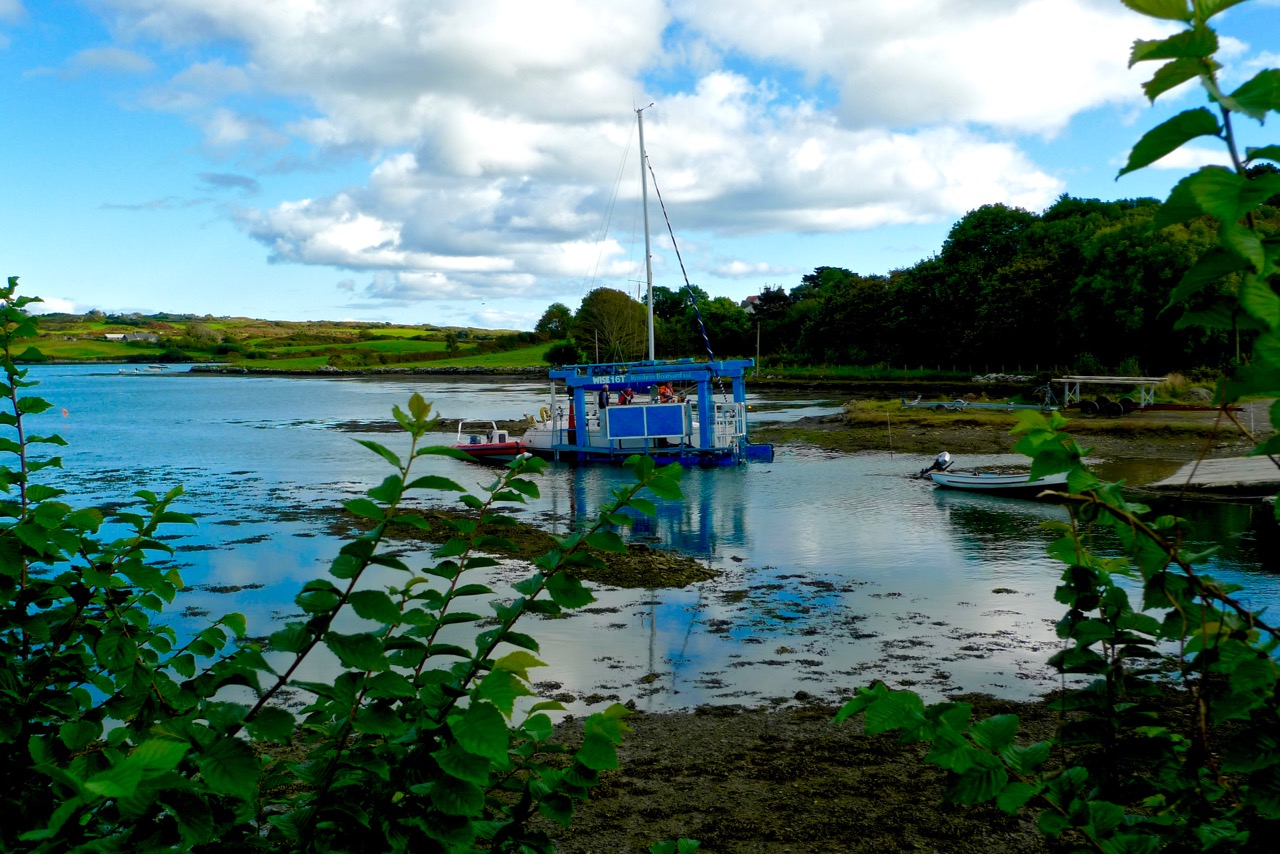
Not all mail boxes have been retained for active use – so what happens to them? Many simply remain in situ, as a picturesque reminder of times when we actually wrote to each other instead of texting or emailing. The one below at Rossbrin, near Ballydehob, was once attached to the wall outside the old schoolhouse. The first photograph at the start of today’s post shows its location.

Rossbring Wall box 3

And this one, at Ahakista, has been repurposed as a wayside shrine.

repurposed

But even if it’s still in use, sometimes a mail boxes can’t be used for its real purpose, but has more important work to do! I don’t know where this last photograph was taken or whose work this is – it was widely circulated on the internet – but I would be happy to credit the photographer if I knew who it was. Delighted to have this also as an example of a post box from the reign of George V, 1910 to 1936.

Post box birds nest

Good Signs

Ah go on...

A collection of words (mainly) seen on signs around and about west Cork (and occasionally further afield) in recent times. They need no explanation. Enjoy them!

I have my own favourites; I’m always directing my own children to digest this one…

children and fathers

…And, lest we err, there’s always something to remind us:

no drink

Discovering Carrowmore

stone and sky

At the heart of the Coolrea peninsula in County Sligo lies one of the greatest megalithic complexes of ancient Ireland, An Cheathrú Mhór or Carrowmore as we call it today: the Irish name means ‘The Great Quarter’. Spread over a plateau of some 150 acres and centred on the high point of Listoghil are thirty recognisable tomb sites but it is suggested that there were once at least a hundred monuments here.

Carrowmore 1

The Carrowmore monuments that we know today cover over 150 acres: it’s likely that there is much more to this site which has been lost, or which remains to be recovered

The changing landscape has taken its toll: from the 18th century onwards land clearance and quarrying have damaged and obliterated many of the remains and even as recently as 1983 Sligo County Council sought to place a municipal landfill dump adjacent to the known sites. Fortunately a few alert local residents objected and took the case to the High Court in Dublin. Initially their objections were overruled but in 1989 an appeal to the Supreme Court was successful and the very important landscape context of Carrowmore has been saved, hopefully for all time. In that same year the state commenced purchase of a part of the site and has developed a sensitively planned visitor facility now run by the Office of Public Works. Since then more of the surrounding site has been purchased and is in public ownership.

stone and skyscape

Carrowmore landscape: this view to the great central cairn on Listoghil shows the nature of the terrain and the context of the monuments which it is so important to preserve

It’s the integrity of the complex that is so special here. The monuments found at Carrowmore are called boulder circles, though several have central dolmens or rudimentary passages. Generally around 12 to 15 metres in diameter, the circles contain 30 to 40 boulders, usually of gneiss, the material of choice for the tombs. Sometimes an inner boulder circle is also present.They are considered to be an early type of chambered cairn, or passage grave, though in fact, they may be the ancestor of a few monument types. This is the view of local man Martin Byrne, historian, artist, musician and our tour guide for the day. He pointed out to us how the passage of each of the boulder groupings is oriented, not towards a solar or calendrical event but to Listoghil, where an enormous cairn encloses a box-like stone chamber with a large capstone.

Monument, mountain and sky

One of the boulder circles at Carrowmore with its central chambered tomb. This view is looking away from Listoghil and towards another significant landscape feature, Knocknarea, which is topped by the cairn known as Queen Maeve’s Tomb, 6 km to the west. There are 6 more mountain-top cairns on the peaks of the Ox Mountains to the south. The central focus of the Carrowmore complex is the cairn on Listoghil, although this is not as dramatically visible as many of the surrounding cairns

The chamber on Listoghil has been given a modern context, with the original cairn covering having been cut away to allow access. This chamber displays the only examples of rock art to be found so far within the Carrowmore complex. This is hard to see in normal lighting conditions, but successive observations have enabled these images to be made:

Listoghil carvings Guillaume Robin 1994

The formerly covered central chamber of the Listoghil cairn: top left is a photograph taken during excavations by Göran Burenhult in 1996-98 – this shows three boulders in front of the tomb which are said to have been an earlier Neolithic monument displaced by the tomb construction. Top right is the OPW interpretation board for the chamber and above are drawings of the rock art on the edge of the roof slab compiled by Guillaume Robin

It’s startling to discover that the Carrowmore complex could be over 6,000 years old: carbon dating from some of the finds has suggested this. If so, then it’s the earliest of the passage grave cemeteries in use in Ireland. Many cremated remains have been found over this site (spread over a long period of time), although unburnt human bones were also recovered in the Listoghil chamber. It could be speculated that the focal point of Listoghil must have been the resting place of a very important person – or dynasty; we will never know for sure. 

‘Accidental’ rock art and rock scribing noticed on monuments at Carrowmore: these boulders have natural markings on them but it is possible that the monument builders were attracted by these marks, which may themselves have inspired carvings

The Carrowmore complex has been visible enough historically to attract the attention of antiquarians – which is useful for later archaeologists, as some parts which are now lost have been historically recorded, albeit using methodology which would nowadays be considered inadequate. Gabriel Beranger, who was born in Rotterdam in 1725, settled in Dublin in 1760 and was a notable illustrator of antiquities in Ireland during a long lifetime; he visited and recorded Carrowmore. A local landlord, Roger Walker, carried out some excavations of the tombs in the 19th century but made no significant records; it is suggested that he was a treasure hunter. George Petrie surveyed the site and numbered the tombs in 1837 but it was another 50 years before archaeologist William Gregory Wood-Martin made the first methodically recorded excavations. William Wakeman produced some exquisite watercolour sketches in 1879. More recently Swedish archaeologist Göran Burenhult undertook detailed studies between 1977-1982 and 1994-1998 and this work included the excavation and subsequent reconstruction of the Listoghil cairn.

Upper Left: the work of Gabriel Beranger who visited the area in the 1700s – this shows Queen Maeve’s Tomb on Knocknarea. Upper right: William Wakeman’s watercolour of Tomb 4 in 1879 (Sligo County Library). Above: Listoghil chamber tomb today

Our guide Martin has studied the complexes at both Carrowmore and Carrowkeel (a future destination for us) for many years and is imbued with the archaeology and the landscape. He gently pointed us to the fact that relationships can perhaps be seen between the profiles of some of the boulders – particularly the capstones of the tombs – and the more distant landscape. I find this fascinating: I have always felt, as an architect, that there should be a conscious designed relationship between any building that is erected by human endeavour and the setting of that building within nature. Could these parallels that we might be seeing at Carrowmore be conscious?

Dolmen and Mountain

Rocks reflecting nature? Were the capstones chosen to specifically echo the landscape context? A debatable – and very subjective – notion…

My day was made when I discovered that Martin was a musician – as is Margaret, and I joined them in their colourful house for a little session!

martin + margaret