

The yew walk at Clonfert – ‘a great cathedral of natural growth’ – which Tom and Angela Rolt found so impressive on their visit to Clonfert, Co Galway, in 1946, during their travels around the waterways of Ireland. Their photograph is above; 70 years later we followed in their footsteps and took the picture at the top of the page
We were following the Rolt’s journey described in the book Green & Silver – this post is the sixth instalment of the Travel by Water series. We would certainly have included Clonfert in our own itinerary, as we could not have missed the incredible 12th century doorway of Clonfert Cathedral, a high point of Hiberno Romanesque architecture – that deserves a future post of its own. The Rolts walked to Clonfert from their mooring on the Grand Canal at Shannon Harbour, a round journey of over a dozen miles; we drove to Clonfert and managed to get thoroughly lost in the maze of tiny roads in that part of rural County Galway.


The twelfth century doorway to Clonfert Cathedral – a medieval architectural masterpiece – and the grave of St Brendan which it faces
…Close behind the cathedral and sheltering with it among the fine trees which make Clonfert an oasis in the bogland, stands the Bishops Palace, now a lay residence. Having been courteously granted permission to explore the grounds, we found Clonfert’s celebrated yew walk which is reputed to date back to early medieval times. The yews have attained unusual stature, and their interlacing branches curve outward and then upward towards the light to form a series of those ogee curved arches beloved of the Gothic revivalists of the Strawberry Hill period. As the main walk runs from east to west with two short transepts radiating from a central crossing, the effect is truly remarkable and represents nothing so much as a great cathedral of natural growth. Moreover, the light within was appropriately dim and religious, the dark foliage excluding most of the light from the overcast sky. We found the silent twilight of this great nave of ancient trees strangely impressive, more so, in fact than the man-made cathedral close by. In spite of the difficulty involved we decide to make this the subject of our pictorial record of Clonfert rather than the often-photographed west doorway… (LTC Rolt, Green & Silver, George Allen and Unwin 1949).

Tom Rolt, the navigator of canals, devotes several passages in his book to Saint Brendan ‘the navigator’ and his many voyages all over the world until …having completed ninety three years… Brendan set out fearfully and alone upon his last voyage while his body was brought home to Clonfert for burial… (Green & Silver): …There is much evidence to support the belief that Brendan reached America nearly a thousand years before Columbus, that Newfoundland was his first landfall, and that he sailed from thence down the coast to the Bahamas and the everglades of Florida… Rolt goes on to admire the conjectured boat which Brendan and his small party of monks would have used: …The hull of this vessel of AD 551 bears a remarkable resemblance to that of an ice-breaker boat which I saw re-timbered at the yard of an English canal company in AD 1943. She was massively built of oak, iron fastened to the ribs, with a high prow and a whaleboat stern equipped with a steering paddle (the rudder had not then been invented). She was decked fore and aft, while the mast stepped in the well amidships bore a single lug sail. Her timbers were possibly skin-covered as the wooden curraghs of Inishbofin are today covered with canvas. She had considerable freeboard, and she shipped no oars but depended on sail alone. In this small but stoutly built craft, of which the Galway Pookawn of to-day is probably the direct lineal descendant, Brendan set forth to sail into the sunset…


Fascinating and curious juxtapositions in the offerings left at St Brendan’s Tree in Clonfert
The Rolts did not mention St Brendan’s Tree, which we encountered on our way to the yew walk. We don’t know how ancient or how recent this manifestation might be. It’s a horse chestnut and it is festooned with all the offerings one would find at a holy well – and more! In addition to statues, rosaries, cards, coins and ribbons there were toys, musical intruments, shoes – and underwear. We were guided to the yew walk by a forester working nearby: we expressed curiosity at the tree, wanting to know its history and efficacy but his response was pragmatic: “I’m Church of Ireland myself and wouldn’t be knowing anything about this sort of goings-on”.
Brendan made several voyages. Rolt continues the story: …It was upon Brendan’s return from his second voyage that he founded his monastery and college at Clonfert – Cluain Fearta Breannain or the meadow of Brendan’s Virtus. This was destined to become a great European University of three thousand students rivalled only by the similar institutions of Clonard and Bangor. Clear thinking was the liberal aim of education at this period… Fifteen years elapsed before Brendan once more set sail to Scotland, and Wales, visiting the great Welsh scholars Gildas the Wise and Cadoc of Llancarvan, and from thence to Brittany and the Cornwall of King Arthur… Where Brendan voyaged after this is uncertain, but rumour and legend associate the name of this indefatigable traveller with the Canary Islands, Teneriffe, Egypt, Palestine and the Isles of Greece. Yet the patron saint of seafarers returned to Ireland to die in the convent of his sister Brigh at Annaghduin…


We found the Bishop’s Palace, which Rolt mentioned as being a ‘lay residence’ – presumably in good order – in 1946. 70 years later it is ruinous. We were intrigued and I determined to seek out its recent history. In doing so I chanced upon a whole section of Irish and British relationships which startled me, and seemed somehow to make entirely poignant the time span of 70 years which I have been observing in this series.

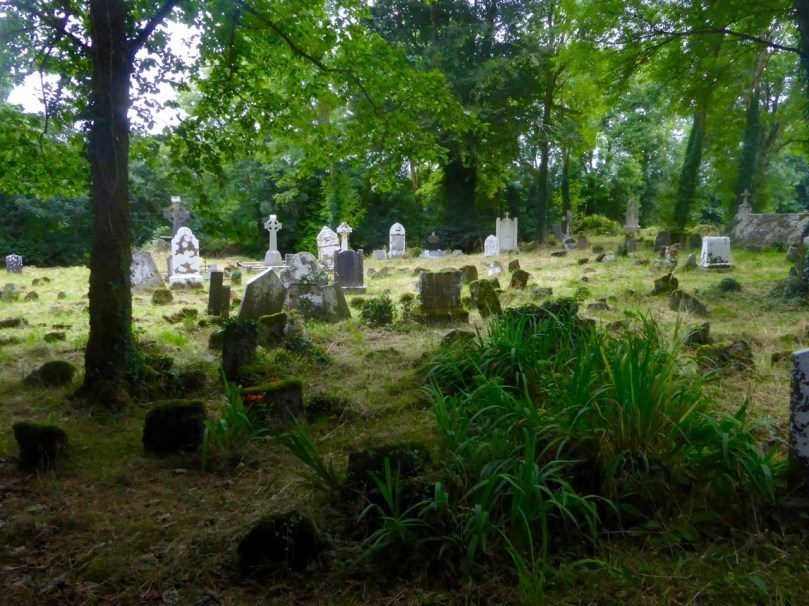
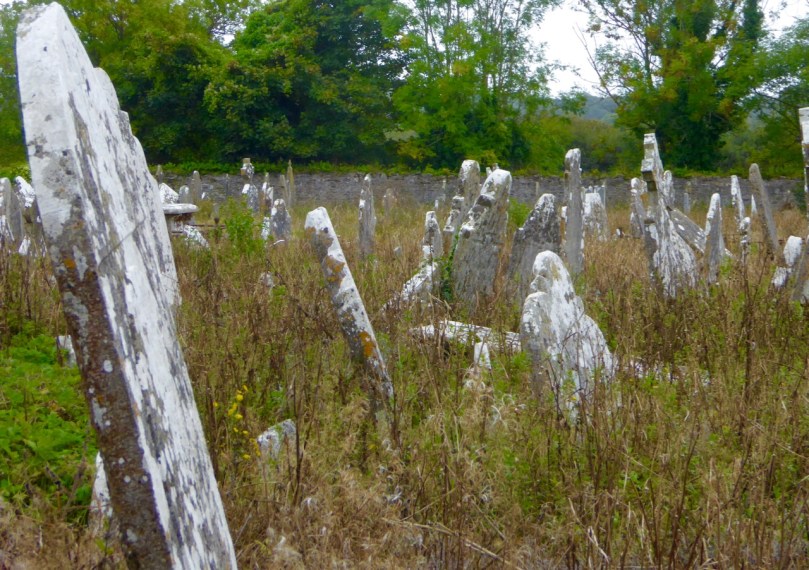
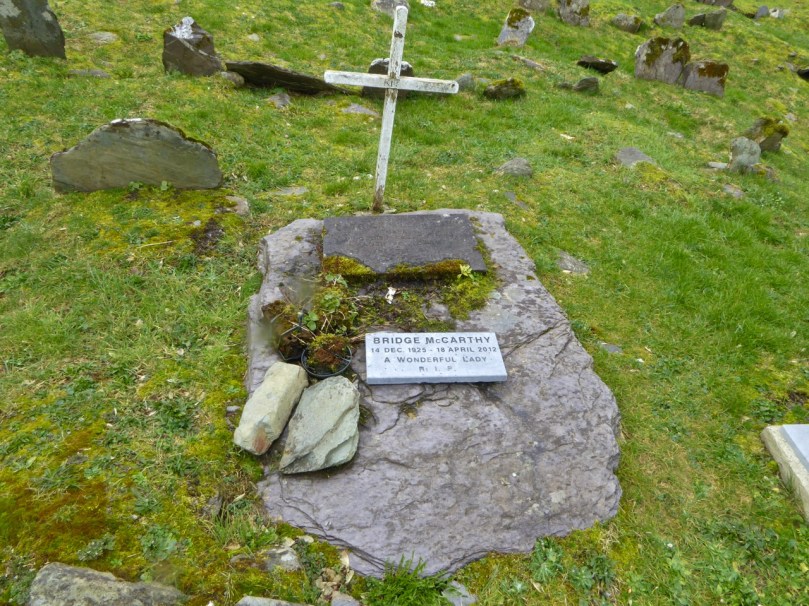
A poignant moment – discarded robin and broken statue in Clonfert graveyard
I quote from an article in The Dublin Review, issue No 26, Spring 2007. This is an excellently written and comprehensive account of matters well beyond the remit of this little post, but I commend anyone who is interested in history – and the state of the world today – to read it. This extract continues the story of the Palace at Clonfert:
…In 1951, John Arthur Burdett Trench – obsessive huntsman since the age of eight, polo player and, in his mid sixties, possessor of a memory of having ridden home the winner of the Grand National at Fairyhouse at a time when English officers could still relax in the grandstand – sold Clonfert Palace near Eyrecourt in Co. Galway to an English family not long arrived in Ireland. The house had belonged to the Trenches for generations and had once been the residence of Church of Ireland bishops. It stood on the flood plain of the Shannon, a short walk from Clonfert Cathedral, hidden away behind its famous avenue of yew trees, an inconspicuous island of Ascendancy civility on the frontier of the vast bog. Like many other ancient mansions, its comforts and refinements had not survived the privations of the twentieth century and it was badly in need of restoration. Every day for months the new lady of the house would drive across the bogland roads from her temporary accommodation in Tipperary to supervise the installation of bathrooms, electricity and central heating, an Aga in the kitchen. Word spread that Clonfert Palace was being returned to its former glory and that there was work to be had from the new owners. They turned the ballroom into a drawing room and brought a carpenter from Banagher to build bookshelves that covered an entire wall. They filled the once-dilapidated rooms with fine furniture, replaced the broken sash cords on the windows, draped curtains made to measure in Dublin and hung paintings of their ancestors on the wall. They recruited a gardener, a housekeeper and a cook. Occasionally the lady’s husband would arrive in a large, exotic Buick driven by a French chauffeur.
Soon, it became known that the family bringing Clonfert Palace back to life was Sir Oswald and Lady Diana Mosley and their two sons. On the fifteenth of February 1952, the Westmeath Independent carried a short item entitled ‘Distinguished Residents’, disclosing that the previous Friday the Mosley family had ‘moved into occupation’ of the palace. ‘Sir Oswald and Lady Mosley, who have a large staff, are charmed with Ireland, its people, the tempo of its life and its scenery,’ the paper related, dutifully informing readers in a final sentence that ‘Sir Oswald was the former leader of a political movement in England’…


Frightening reminders of a world in chaos – less than a lifetime ago. Left – a poster from 1939 (Oswald Mosley led the British Union of Fascists) and – right – Mussolini and Mosley meet in Italy in 1936 (image from http://www.panorama.it/)
After the war, the Mosleys were virtually outcasts from Britain. Neutral Ireland seemed to offer them a retreat and a measure of civility. The Dublin Review continues:
…Sir Oswald would take his breakfast in bed. The Irish Times and Financial Times would be delivered from Eyrecourt. Lady Mosley would give her orders for the day to Mrs Swan, the cook. When Sir Oswald surfaced he might go for a long walk along the Shannon, passing the barges hauling cargoes of porter, coal or flour. On return he would set to work in his study. Nicholas Mosley has written about his father’s attachment to ‘the hierarchical … classless patterns of life … in the semi-feudal grandeur’ of the estate where he grew up in Staffordshire; in Clonfert Mosley seems to have replicated this idyll. Just as his grandfather had produced wholemeal bread, Sir Oswald supervised the growing of vegetables and ploughed the paddock to plant lucerne, a clover-like plant used for fodder…

This newspaper photograph of the Bishop’s Palace at Clonfert could have been taken around the time of the Rolt’s visit (1946) or after restoration by the Mosleys
The ‘idyll’ did not last too long. The Dublin Review again:
…One foggy night a few weeks before Christmas 1954, while Diana was visiting London, the Mosleys’ neighbours the Blake-Kellys were woken just before two o’clock by the whinnying of a pony in their stables. From their window they could see flames and smoke billowing from the Palace next door. Mrs Blake-Kelly sent her son to bang on the Mosleys’ front door and within minutes Sir Oswald, Alexander and their servants were standing on the lawn watching the flames consume their house. A French maid, Mademoiselle Cerrecoundo, rushed back into the house to fetch some clothes and was trapped at an upstairs window. Sir Oswald, Alexander and the chauffeur, Monsieur Thevenon, held a blanket under the window and she leaped to safety, hurting her back and her hand. Monsieur Thevenon drove to the Garda station in Eyrecourt and from there fire brigades were summoned from Ballinasloe and Birr. It took an hour and a half for the engines to arrive and by then more than half the house was lost to the blaze. The firemen cut through the roof with their axes to create a barrier to the advancing flames…
The story does not quite end there: as if some sort of retribution of biblical proportions were needed, even the land was punished. The Dublin Review concludes:
…By morning, when the firemen had finished their work and stood gazing at the hole rent through the roof of the house, cold westerly winds were gathering strength. It was the beginning of the worst storm in the midlands for a hundred years. Rain, sleet and snow poured down on the smouldering ruins of Clonfert and the winds reached hurricane force, knocking trees across the roads and felling the electricity wires that had been strung only in the last few years. Within a few days thousands of acres of land by the Shannon were flooded. The army came to evacuate farmhouses which were under three or four feet of water and drive cattle to high ground. Stone outhouses were washed away, corn stooks submerged and the swollen bodies of cows and pigs that could not be saved were left bobbing in the water…

I was born in 1946, just when Tom and Angela Rolt were planning their exploration of Ireland’s waterways, but also directly after the turbulence of an awful global war which caused the deaths of over seventy million people. One of the elements which led to that war was the rise of fascism in Europe. In my lifetime to date I have seen fascism largely invalidated and the creation of a European Union whose members have worked towards common and positive aims. For seventy years there has been ‘peace in Europe’. Now – in 2016 – I have reason to worry about our children’s future; some things which should have been buried forever in the pages of history seem to be stirring. I desperately hope my foreboding is misplaced.



















 Roaringwater Journal