Into the Heartland

Elphin Windmill

Because we live on it, sometimes we get carried away by the notion that The Wild Atlantic Way represents the best that Ireland has to offer. A recent trip to the midlands – the Heartland of Ireland – convinced us (if we needed it) that there is no part of Ireland that isn’t beautiful and full of fascinating things to do and see. (Like the Elphin Windmill, Co Roscommon, above.)
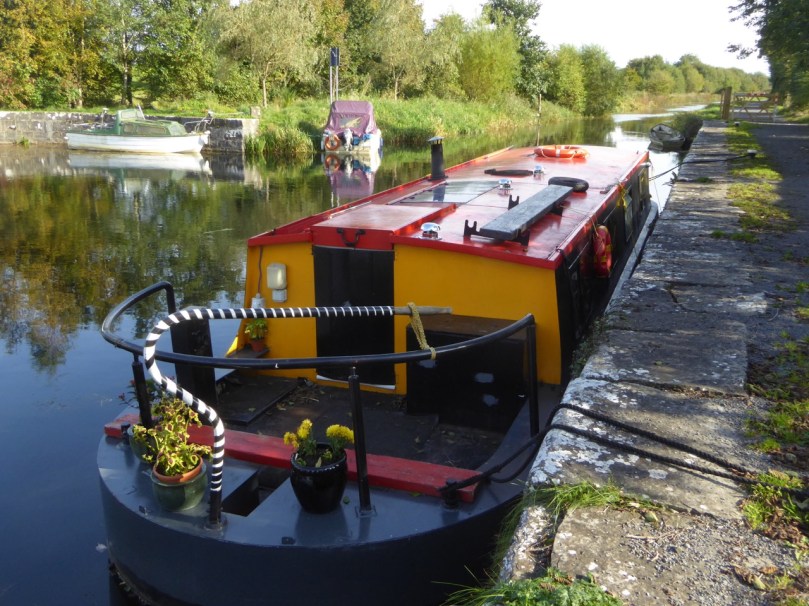
Parked at Coolnahay

We spent a lot of time along rivers and canals! 

Robert explains the background and purpose of our trip in his post, Travel by Water. I knew very little about canals before I met Robert and it’s been eye-opening to learn about the history and the sheer extent of Ireland’s inland waterways. We spent a lot of time exploring the canals – walking and driving – and enjoyed it all tremendously.
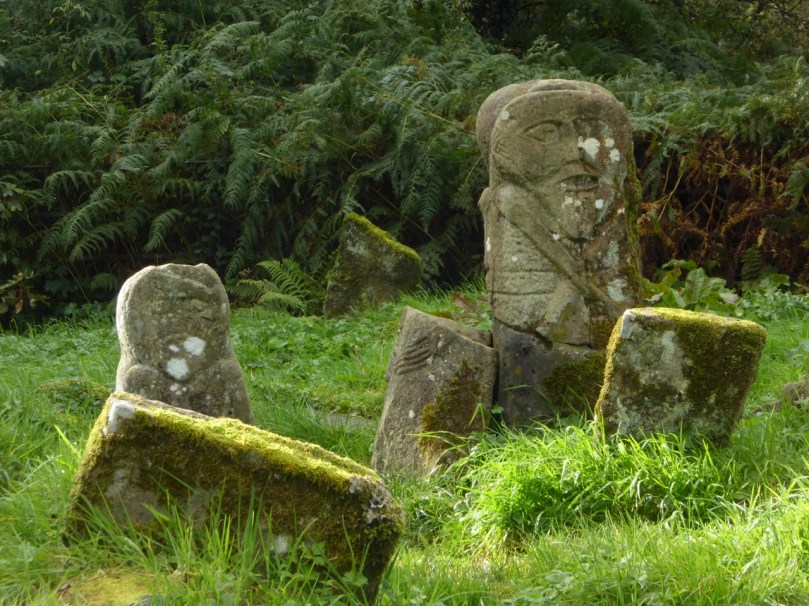
Boa Island figures

Boa Island on Lough Erne, Co Fermanagh, is home to these mysterious carved figures. Lower left: heads on a medieval church in Kilmallock, Co Limerick. Lower right: a contemporary sculpture celebrates the mythical Finn McCool, in Keshcarrigan, Co Leitrim

But wherever we went there were always other places luring me away – tower houses and fortified houses, churches and graveyards, friendly villages and colourful houses, stained glass windows and prehistoric sites. We drove along roads where we counted ring forts in every field. We explored ancient graveyards and we found a Holy Tree. We visited two sites we posted about last week, the Corlea Iron Age Trackway, and the Hill of Uisneach.

Holy Chestnut

The Holy Tree. A local man we met called it a ‘holy show’ and it certainly had some very questionable items mixed in with the statues and offerings

It’s autumn now, and, while we do experience a change of colour here in West Cork, it’s really in the midlands that the colours of the deciduous trees can overwhelm the senses. They were just starting to turn. I’m strongly tempted to head back in another couple of weeks for the full experience.

Birr Castle Gardens 2

These photographs were all taken at Birr Castle Gardens. Birr Castle (Co Offaly) was one of the most interesting and beautiful places we visited, home of the famous telescope and beautifully maintained

We visited thirteen of Ireland’s 32 counties on this trip – and never came close to the sea or the Wild Atlantic Way. Instead, everywhere we went we saw notices for the latest iteration of the Tourist Board’s marketing scheme. This one is called Ireland’s Ancient East, and appears to take in every county that isn’t on the Atlantic seaboard. A good resource, if you’re considering a trip like this, is Neil Jackman’s guidebook, Ireland’s Ancient East – we kept it by us and found it invaluable.

Grange Stone Circle, Lough Gur

Grange Stone Circle, the largest in Ireland, is one of a complex of monuments at Lough Gur, Co Limerick

Our headquarters for the biggest chunk of our time away was the incomparable Mearescourt House near Mullingar, Co Westmeath. George and his team made us welcome and comfortable, there were glorious grounds to wander around and animals to meet, and delicious breakfasts that left us feeling full for the rest of the day.
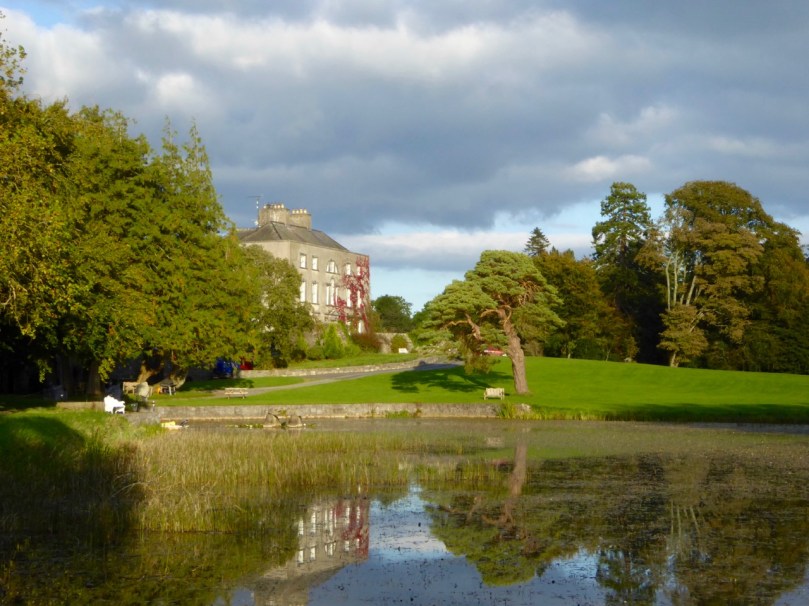
Mearescourt House

Mearescourt House – highly recommended!

When tourists are interviewed about their holidays in Ireland they praise the scenery, the food, the music – but most of all, they say, it’s the people who make it so enjoyable. We agree! Everywhere we went we ended up in conversation, as you do here, with local people delighted to help out with information, share old stories, invite us to the sessions, tell us where to go for a nice dinner, or point out places off the beaten track (and then rescue us later when we got lost).
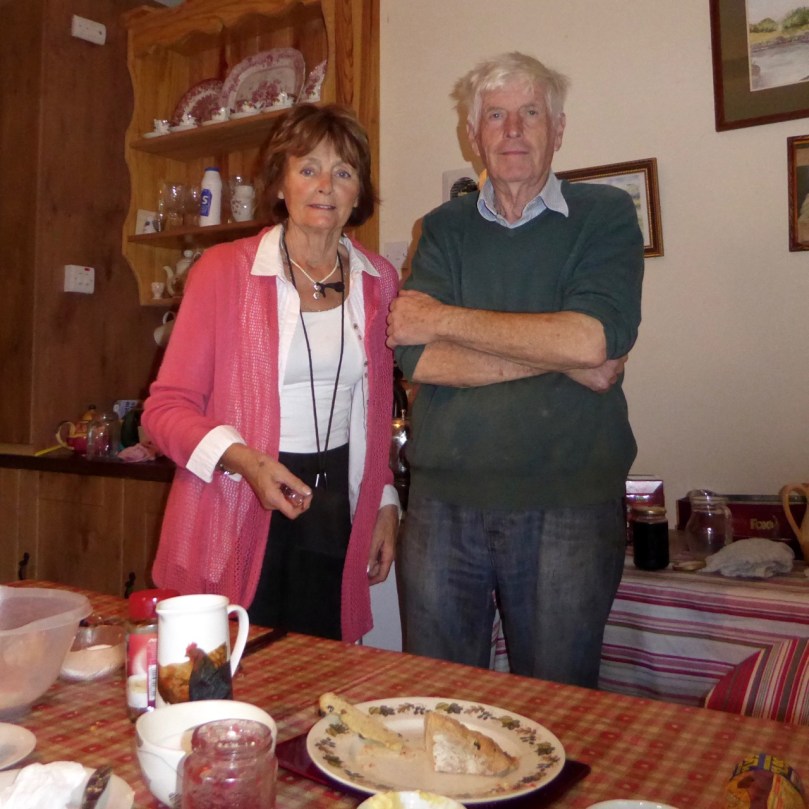
Claire and Paddy Crinnegan, Coolnahay

Paddy and Claire Crinnegan maintain the canal lock at Coolnahay on the Royal Canal. in Co Westmeath They made us tea, fed us Claire’s delicious currenty bread, told us about the trad concert that evening, loaned us a book, and related stories of growing up at the lock, where Claire’s father was the lock keeper.

Future posts will go into more depth on some of what we saw and experienced on this trip. This one is just an introduction, to share some of our impressions and drop some hints about what might be upcoming.
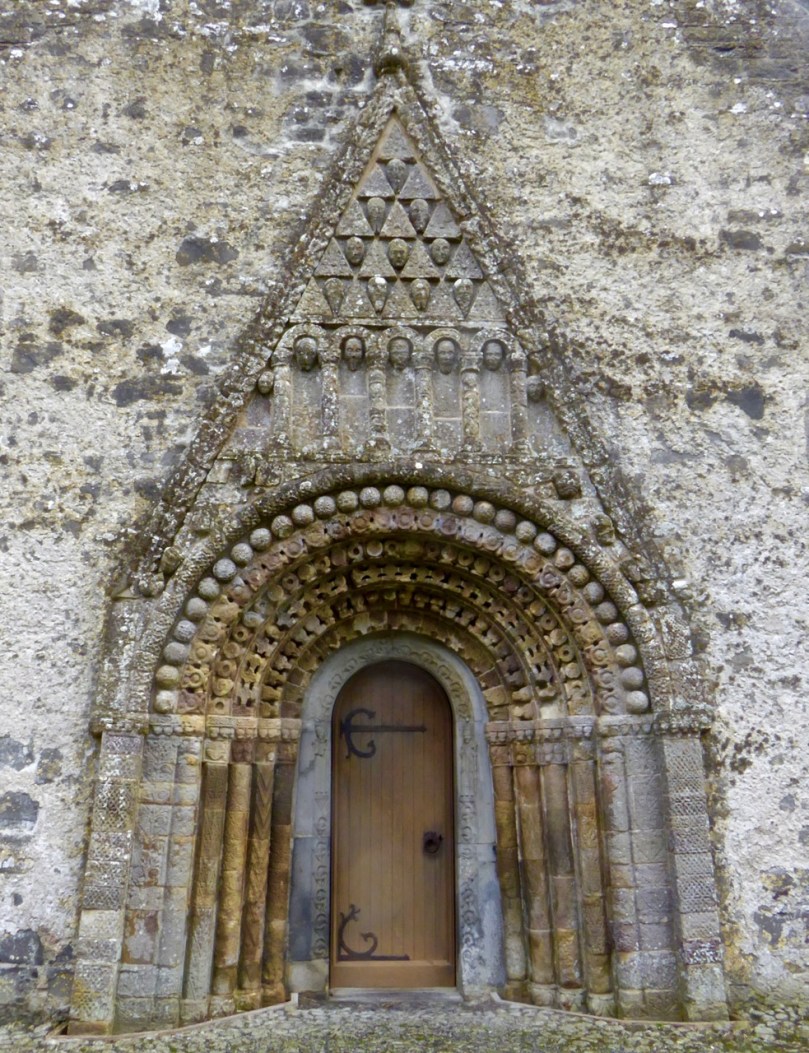
Clonfert Doorway

Clonfert Cathedrall (Co Galway) has the most beautiful Romanesque doorway I have ever seen
Along the canals and rivers, flora and fauna
Top left: in case you might get too happy with yourself; top right: the imposing gates to Portumna Castle, Co Galway, a 17th century house now owned and managed by the Office of Public Works; Bottom left: I peeped inside the priest’s section of a confession box and observed how he maintains an efficient count of time spent on each confession; bottom right; we disturb the rooks at Ballycowan Castle, Co Offaly

HC Studio, Athlone

Athlone Cathedral (Co Westmeath) has a gorgeous set of enormous windows from the Harry Clarke Studios – this is a detail from just one of them.

Can you detect a future post or two?

‘Auf der Walz’ – The Journeymen

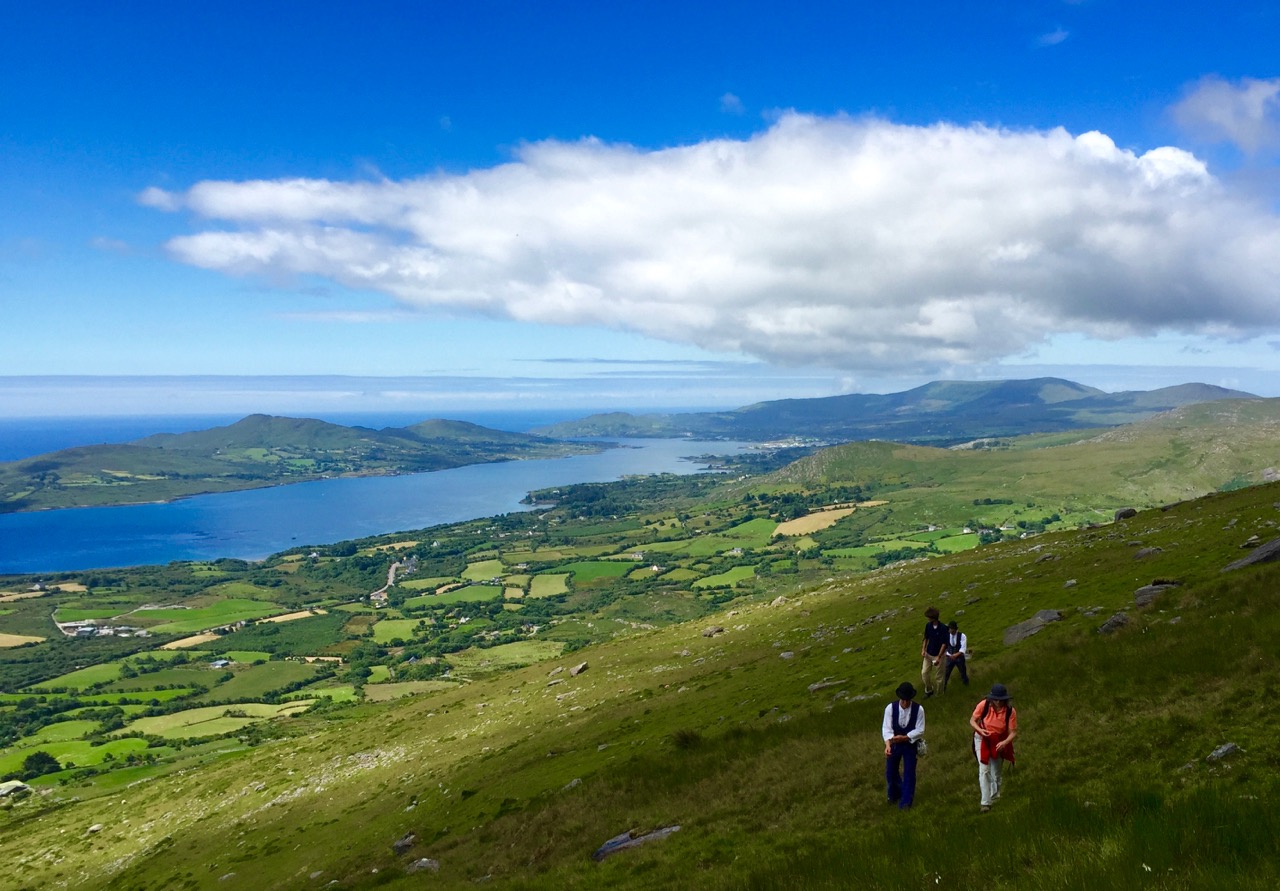
on the summit

I am always happy to find longstanding customs and traditions still going strong, especially when they are as relevant today as they have been over countless generations. This summer we chanced upon two strangers from Germany who passed through Ballydehob. They were journeymen blacksmiths: lads who had completed their apprenticeships at home and were now ‘Auf der Walz’ (on the road) – gaining experience in the wider world.

inese-journeymen

Here are the two Journeymen who travelled the west of Ireland’captured’ by photographer Inese MJ – she came across them in her local supermarket! I am very grateful to Inese for allowing me to use her excellent photograph which comes from her own blog, here.

The tradition of the Journeyman Brotherhood is centuries old, originating in the Craftsmen Guilds of Europe during the Middle Ages and it is still practiced. In the past every young craftsperson who aspired to be a Master was, following his apprenticeship, required to leave home and not return for three years and a day. They had to stay at least 50 km away, but the journeys of the more adventurous candidates involved crossing oceans and continents. Simon and Benjamin – seen in the top picture after an exploratory climb to the summit of Hungry Hill on the Beara Peninsula – are from Munich and Frankfurt. They are wearing the uniform of their trade, known as the Kluft: this is how they are required to dress during their travels. The number of buttons on their waistcoats show the number of hours in a day they expect to work – in this case eight. When they leave home they have only a token sum of money each, and they must return with the same sum, no more. The purpose of the journey is not to seek their fortune, but to improve their knowledge and skills and give them a rich life experience, preparing them for becoming masters of their craft. It is a prerequisite that Journeymen cannot set out unless they are unmarried, childless and debt-free.

Left – a typical Charlottenburger used to carry the Journeyman’s possessions. Right – group of three in Germany looking for their preferred mode of transport

Other traditions which have to be observed by the true Journeymen include carrying only the most basic possessions with them: clothes to work in and the tools of their trade. These are wrapped in a small blanket, 80 cm square, known as a Charlottenburger. They also often carry a crooked walking stick, called a Stenz, which they have made themselves. Mobile phones are not allowed! Notably, Journeymen usually have gold bracelets and earrings: these may be pawned or sold, but only in cases of dire emergency… I learned that the earring tradition refers back to a time when each apprentice had a nail hammered through his earlobe to mark that he had reached the stage of his apprenticeship which allowed him to go out into the world and remain a stranger until he had completed his journey. Some sources suggest that the term Journeyman comes from the French Journée, meaning ‘journey’ – but this is not correct. Journée means ‘day’ in modern French, but its medieval root is the latin diurnata, which in fact means ‘a day’s work’ or ‘a day’s travel’.

Journeymen surrounded by the tools of their trade in the forge at Lowertown

Simon and Benjamin were fortunate that in Ballydehob they bumped into our neighbour Dietrich: although he and Hildegard have lived here for much of their working lives they were brought up in Germany and were aware of the Journeyman tradition. They immediately found a project for the two young blacksmiths: constructing a new gate for their entrance. John Joe Bowen of the local forge at Lowertown was very helpful in allowing a space in his workshops for the boys to set to work.

blank canvas

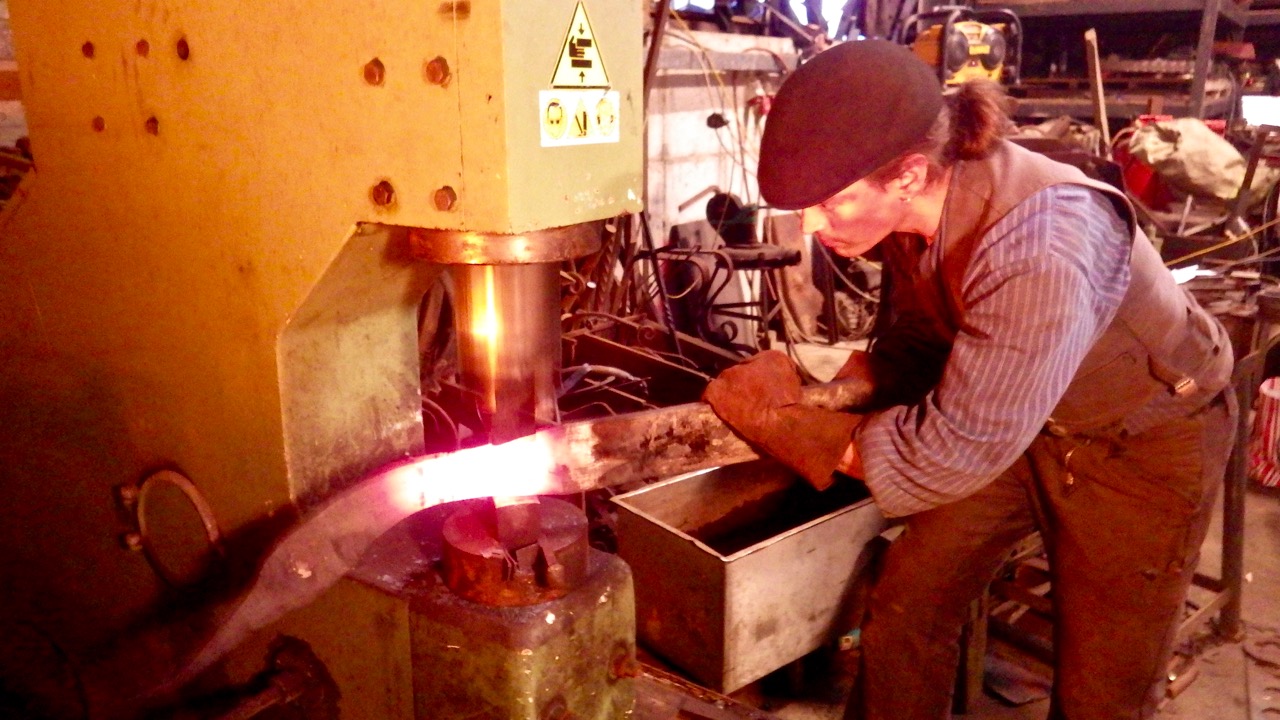
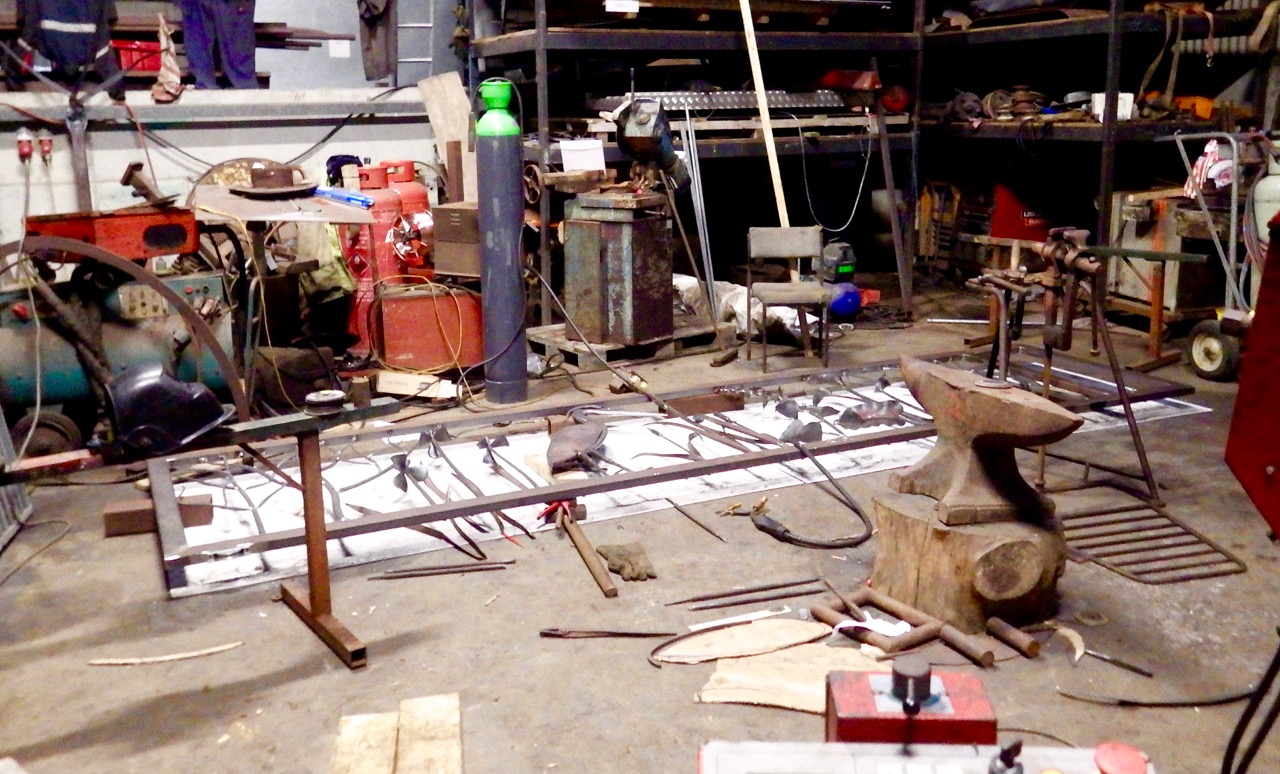
The process. Top – blank canvas: laying the full-size design out on the workshop floor. Above – learning from real life: how to fabricate a metal foxglove

We followed reports of the gate-making process with great interest, but were not allowed to see the completed design until the ‘official unveiling’. Dietrich and Hildegard recorded the various stages and have most kindly allowed me to use their photographs of the construction process (and the hike up Hungry Hill) reproduced here.

hammering

making the heron

From design to reality. Top left – Hildegard supervising the assembly and – top right – her design concept drawings. Above – a metal heron takes shape

The gate is a masterpiece. Made in West Cork, it reflects the environment of the place. It’s elegant, and unique. Although it appears complex, it is very understated: I think Dietrich and Hildegard have perfectly summed up the zeitgeist of our own time here in our small townland. Its inspiration is in nature, yet it is a technologically up-to-date piece of fine engineering.

piecing it together

on the floor

sanding the gate

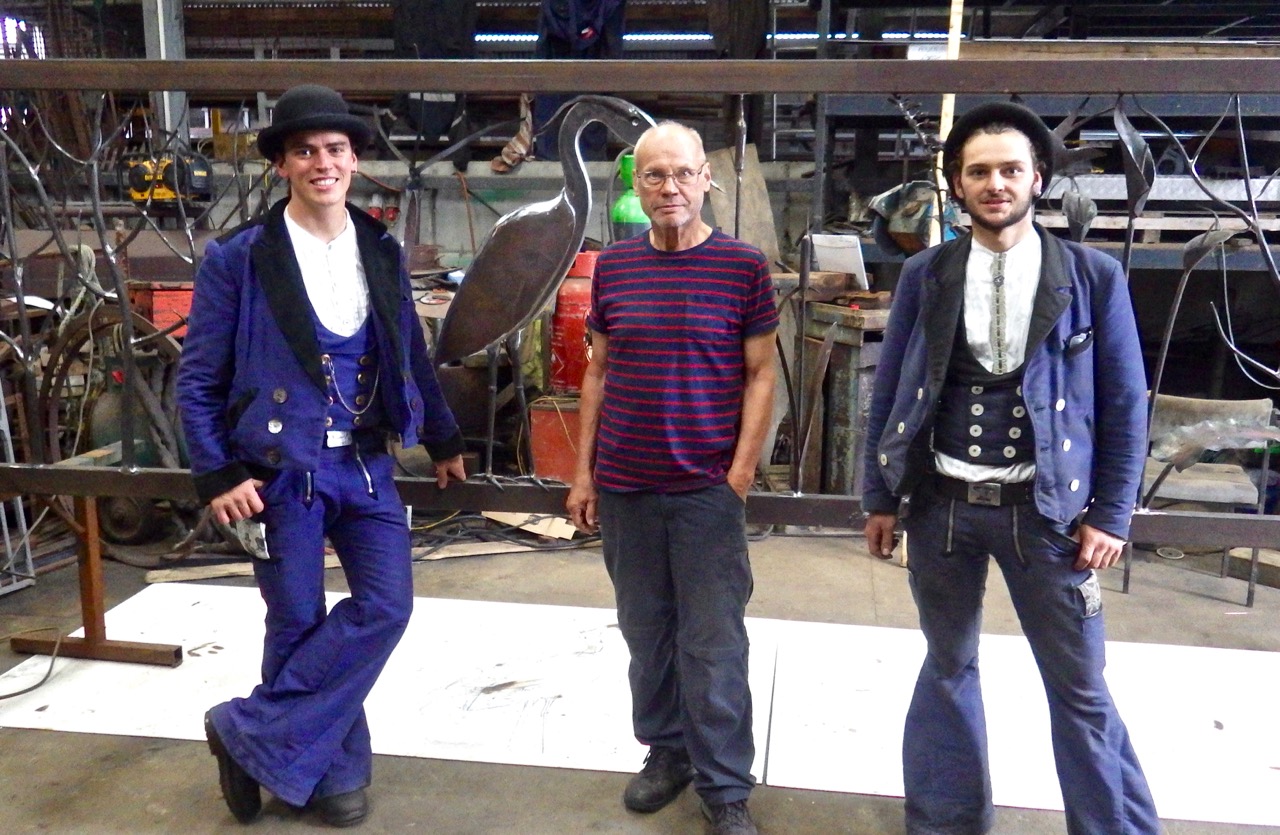
dietrich, journeymen and gate

The construction process, and Dietrich and ‘The Boys’

We were privileged to be at the ‘launch party’. I have never been to a formal gate opening before! Dietrich cut the ribbon and then revealed the finished product to our eager eyes. This work must surely have been the highlight of the travels of these Journeyman from afar: they learned so much about observation and the translation of ideas into practical form.

the gate

Benjamin and Simon were not at the ‘launch’; they were already far away, continuing with their travels and their education. But they must carry with them good memories of the West of Ireland. Good luck to them both!

on hungry hill

Experiencing beautiful West Cork – the Beara Peninsula, summer 2016

Presenting Rock Art

A joint post by Finola and Robert

keith's dnc

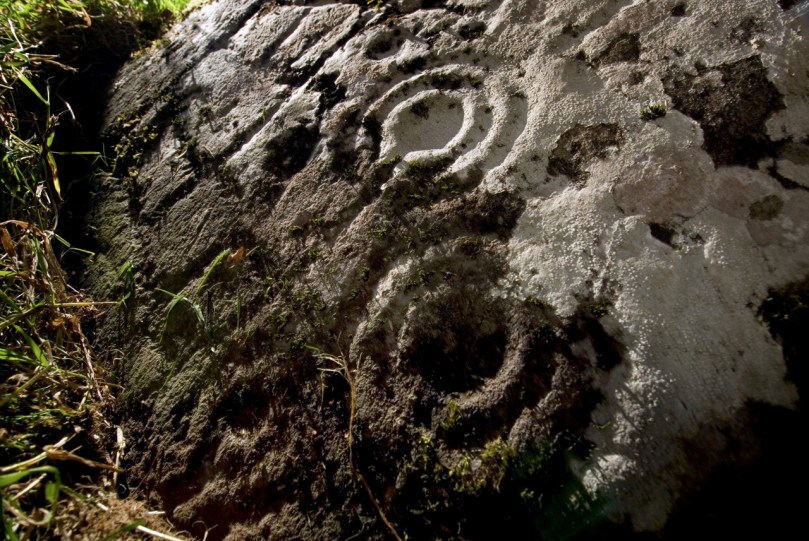
On  Friday, the Blue House Gallery in Schull launched The Rock Art Show. It included everything that was in the exhibition at the Cork Public Museum, but with more of Ken William’s extraordinary photographs, and with the addition of some exquisite drypoint engravings from Brian Lalor.

The opening night was lovely. It was great to celebrate with friends and the community and to see their reactions to the show.*

Once the show was completely installed we were struck immediately by the way art and archaeology intersected on the walls. It’s designed partly as a museum exhibit, in which you walk around the panels, reading the information and digesting the accompanying illustrations. However, in this iteration, it is much more than that, and has truly turned into a show not just about the rock art per se, but about the power of these ancient and mysterious carvings to inspire an artistic response in others.

Some examples of what we mean…

dnc kp

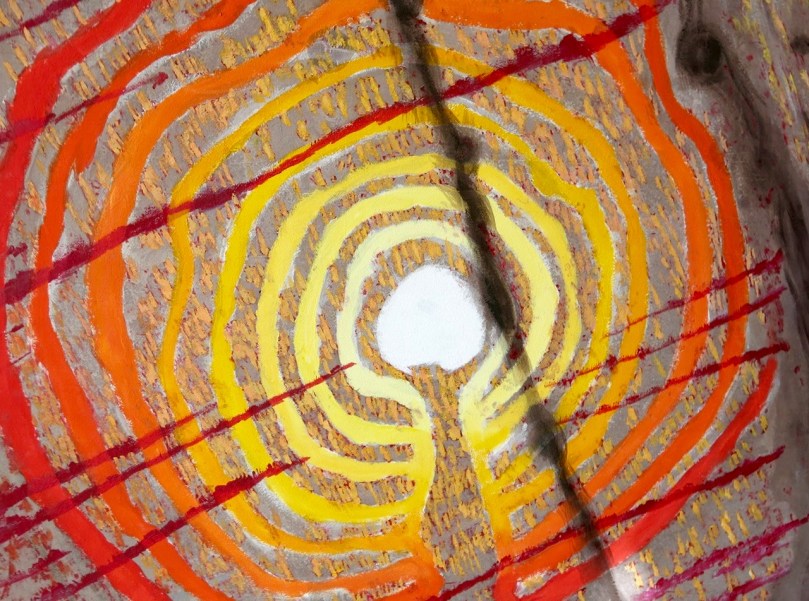
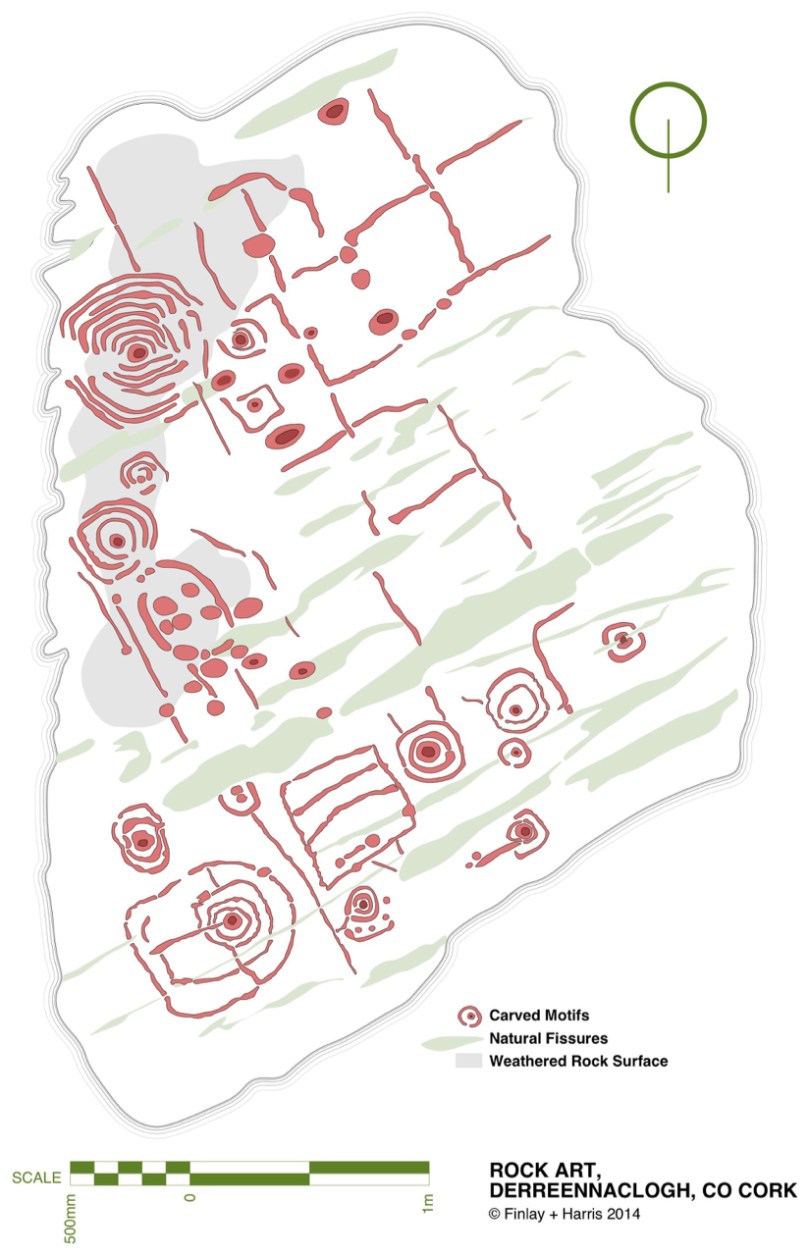
derreennaclogh rhKeith Payne’s wildly colourful painting contrasts with Robert’s sober CAD drawing

gort

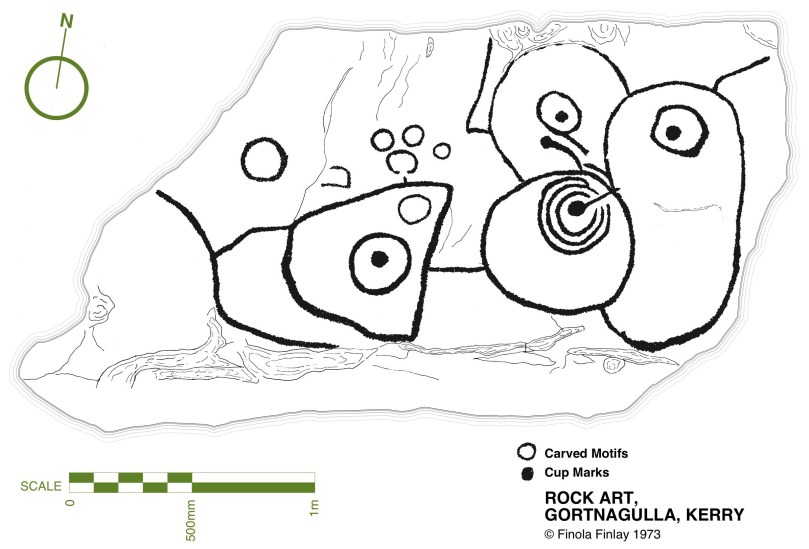
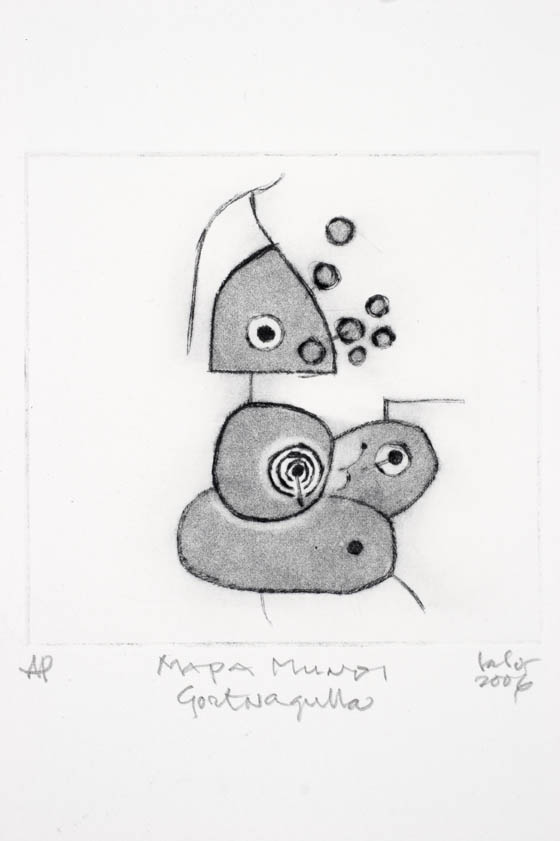
gortnagulla-lalorThe first drawing of the Gortnagulla stone was done 40 years ago by Finola, using a tracing technique no longer approved. Brian Lalor’s engraving is of the same piece
ballynahowbeg kw
ballynahowbeg ff
Can you recognise the same stone in Ken William’s photograph and Finola’s drawing?
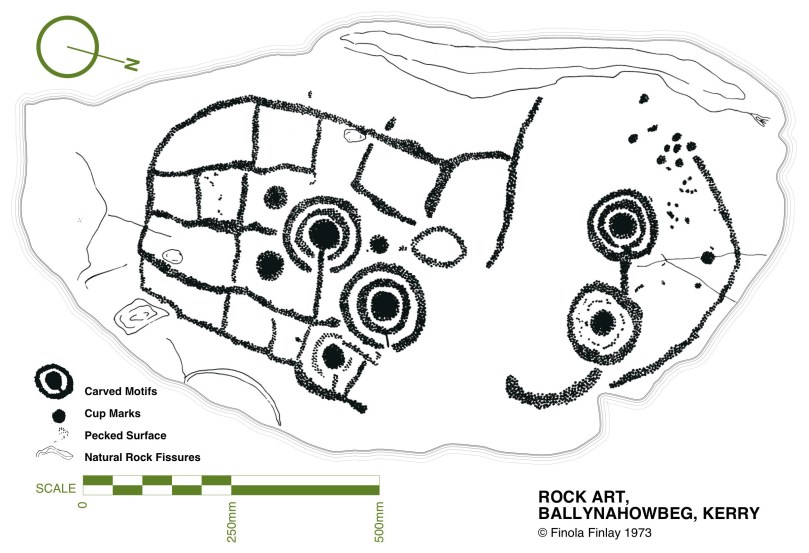
But in the end, images on a wall will only go so far in helping us to appreciate rock art. Ultimately, you have to get out into the countryside and see the rocks in their landscape.

magheranaul kw

One of Ken’s superb photographs showing how this particular stone sits in its landscape  

Only then will you realise how hard they can be to see if the lighting is not good, to how difficult it can be to distinguish between natural and human markings on a rock surface, or how they all seem to be located in beautiful places with panoramic views. Or – to have an experience like this one, in which we made a breathtaking and unexpected discovery about one of our favourite rock art panels, and quite by accident recorded it all on video.

Derreennaclogh equinox circles

So  if you’re in West Cork before the end of September, drop by the gallery. We’d love to see you.

*With grateful acknowledgement of additional photographs of the opening night by Peter Clarke, Amanda Clarke and Miranda Payne.

Champions for Ireland

wolfhounds

Irish Champions – ancient warriors, wolfhounds and rain at the Tailteann Games 1924

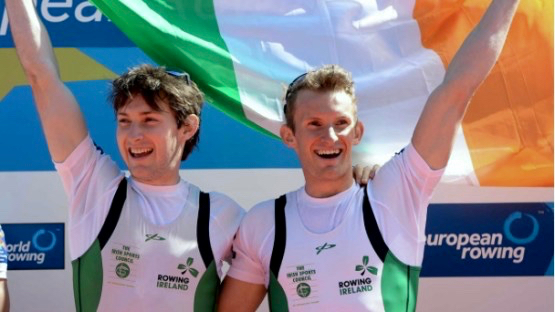
We heard hearty cheers coming across the water on Friday, when Ireland won the Olympic silver medal in the Lightweight Men’s Double Sculls Final. The cheers we heard were not coming from Rio, however (although there were plenty there), but from Lisheen, the tiny West Cork parish that’s just around the corner from us. That’s where Gary and Paul O’Donovan hail from. We think they have declared a public holiday there in honour of the two rowing brothers who, prior to this title, won gold at the European Championships in Brandenburg in Germany this year – the first Ireland rowing crew to become European Champions. This success set me looking at the records of Irish Olympic achievements over the years.

NGI 941

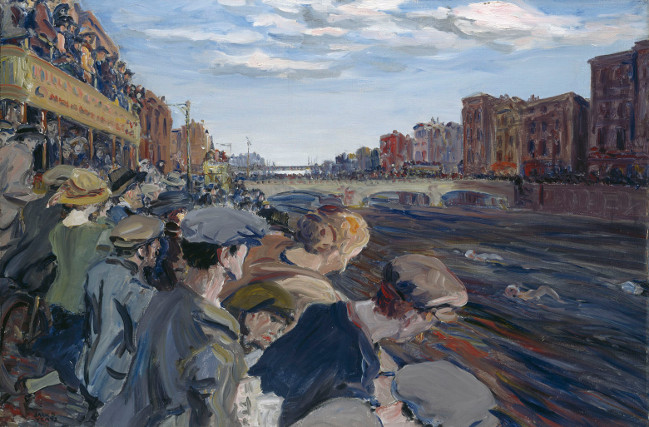
The Liffey Swim by Jack Butler Yeats, painted in 1923. Courtesy National Gallery of Ireland

Independent Ireland was represented at the Olympic Games from 1924 onwards. No Irish athletes won medals in 1924 but Jack Butler Yeats won a silver medal for the above painting and Oliver St John Gogarty won a bronze medal for literature in that year. Did you know that between 1912 and 1948 competitions in the arts were part of the Olympic Games? For a small nation Ireland has made its mark in the games: in Melbourne in 1956 Irish athletes and boxers won 5 medals between them – a gold, a silver and three bronze, and in London in 2012 boxers, athletes and a showjumper won 6 medals – a gold, a silver and four bronze. 1996 was a memorable year when, in Atlanta, Michelle Smith won 3 golds and a bronze for swimming.

An original cover from the 1924 programme for the Tailteann Games, an artist’s perception of the ancient games and (right) two medals struck for the Games

While researching this information I came across Tailteann Games. The word is pronounced ‘tell-tin’. The eleventh century Lebor Gabála Érenn (the Book of the Invasions of Ireland) states that the games were founded by Lugh Lámhfhada, Lugh of the Long Arm – the first High King of Ireland – as a mourning ceremony for the death of his foster-mother Tailtiu. Lugh buried Tailtiu underneath a mound in an area that took her name and was later called Teltown in County Meath, not far from the Hill of Tara. It’s perhaps significant that the games took place around the festival of Lughnasa – at the beginning of August. Accounts vary as to the historical periods in which the games were held: some say as early as 1800 BC, while a more generally accepted dating seems to be from the 6th to the 9th centuries AD: the festival died out after the Norman invasion but was later revived as the Tailten Fair, consisting of contests of strength and skill, horse races, religious celebrations, and a traditional time for couples to contract ‘trial’ marriages. These were allowed under Brehon Laws: couples could meet and live together for a year and a day – at the end of this time either party could end the marriage on the ‘Hills of Separation’.

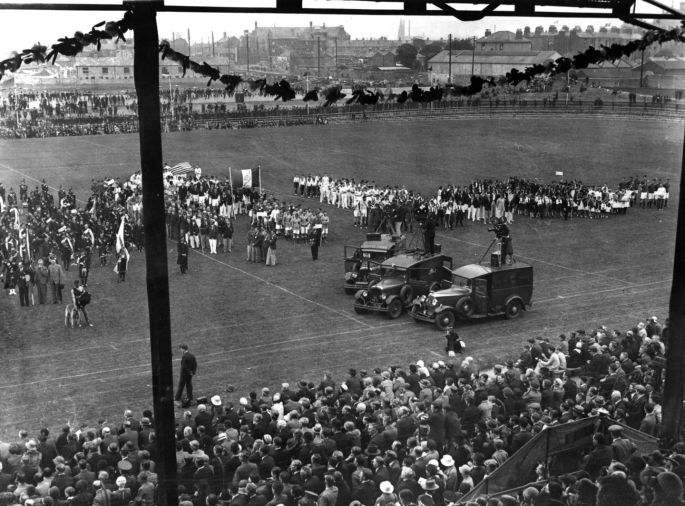
Presumably these photographs are from the ‘Opening Ceremony’ of the 1924 Tailteann Games held in Croke Park

While the 1924 Olympics were being held in Paris (where Finola’s grandfather was a member of the Irish team) a revival of the Tailteann Games was held in Croke Park, Dublin. This ‘meeting of the Irish race’ or ‘Irish Olympiad’ had been announced by Éamon de Valera in Dáil Éireann in 1921 to celebrate the founding of the Irish Free State, but the event was delayed because of the Anglo-Irish War and the Irish Civil War. Organised by the Gaelic Athletic Association (GAA), it was open to all people of Irish birth or ancestry. Participants came from England, Scotland, Wales, Canada, the USA, South Africa and Australia as well as Ireland. 

image

Note the media presence at the 1924 Tailteann Games: newsreel cameras mounted on to motor vans  

Tailteann Games were held again in 1928 and 1932. The name survives today as Rás Tailteann, which is an 8 day international cycling race around parts of Ireland. This race has run every year since it was founded in 1953 and has developed into a much sought after event by professional and amateur teams from many parts of the world: it is able to award qualifying points that are required for participation in Olympic Games and World Cycling Championships.

Fireworks_at_the_First_Tailteann_Games_August_15,_1924

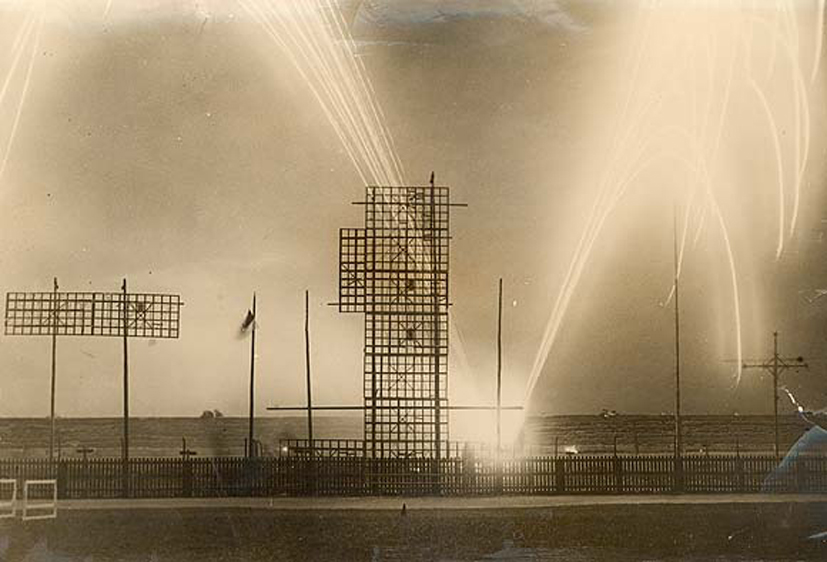
No modern games ceremony would be complete without a fireworks display: (top) this unusual photograph shows the fireworks at the 1924 Tailteann Games. (Lower left) a 1958 poster for the Rás Tailteann. (Lower right)  We watched this year’s Rás Tailteann on the road to Ballydehob. (Below) Paul and Gary O’Donovan – West Cork lads in Rio on Friday added a 2016 Olympic Silver to their many achievements (photo afloat.ie)

brothers

The Souvenir Shop

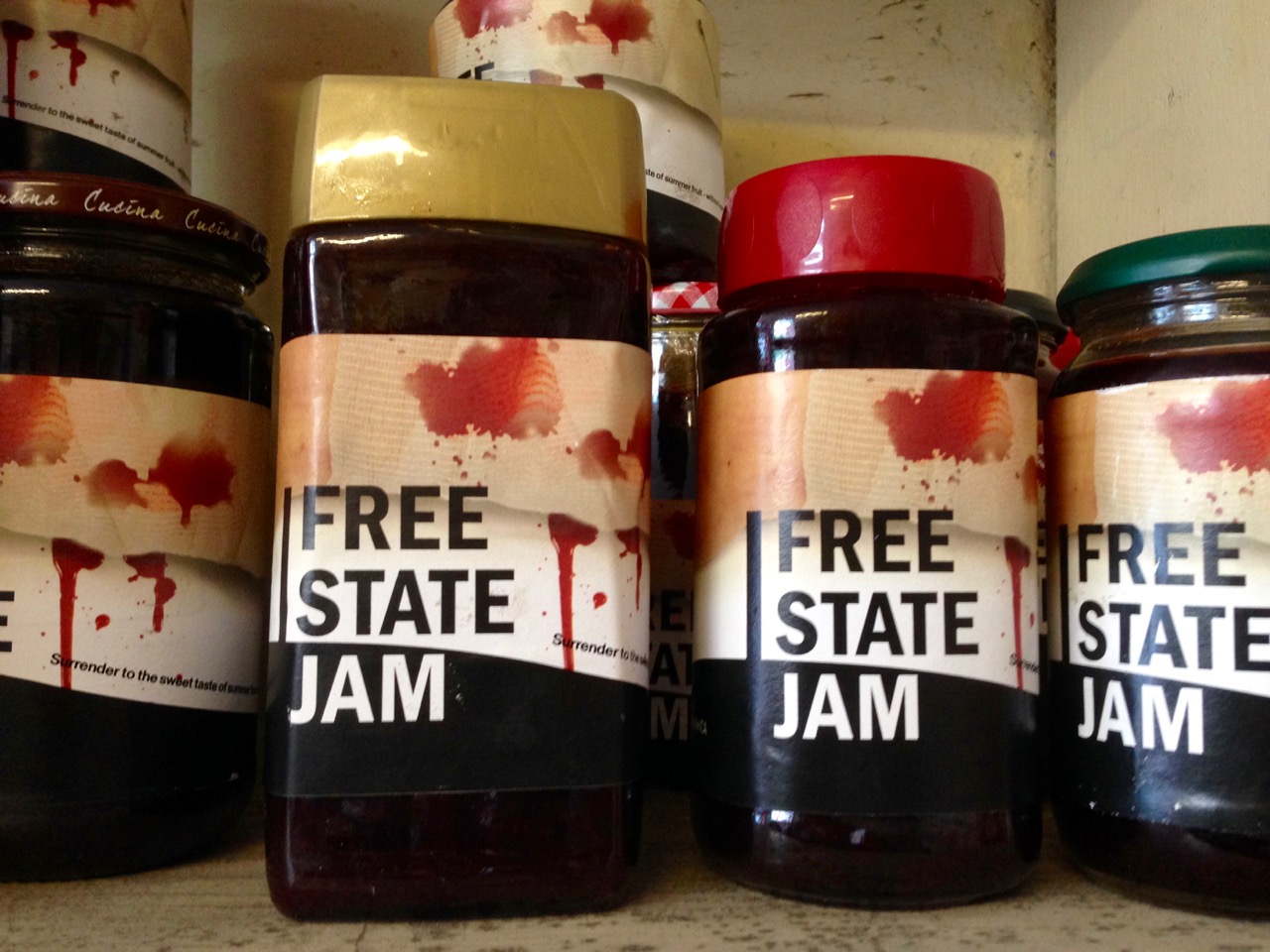
Free State Jam

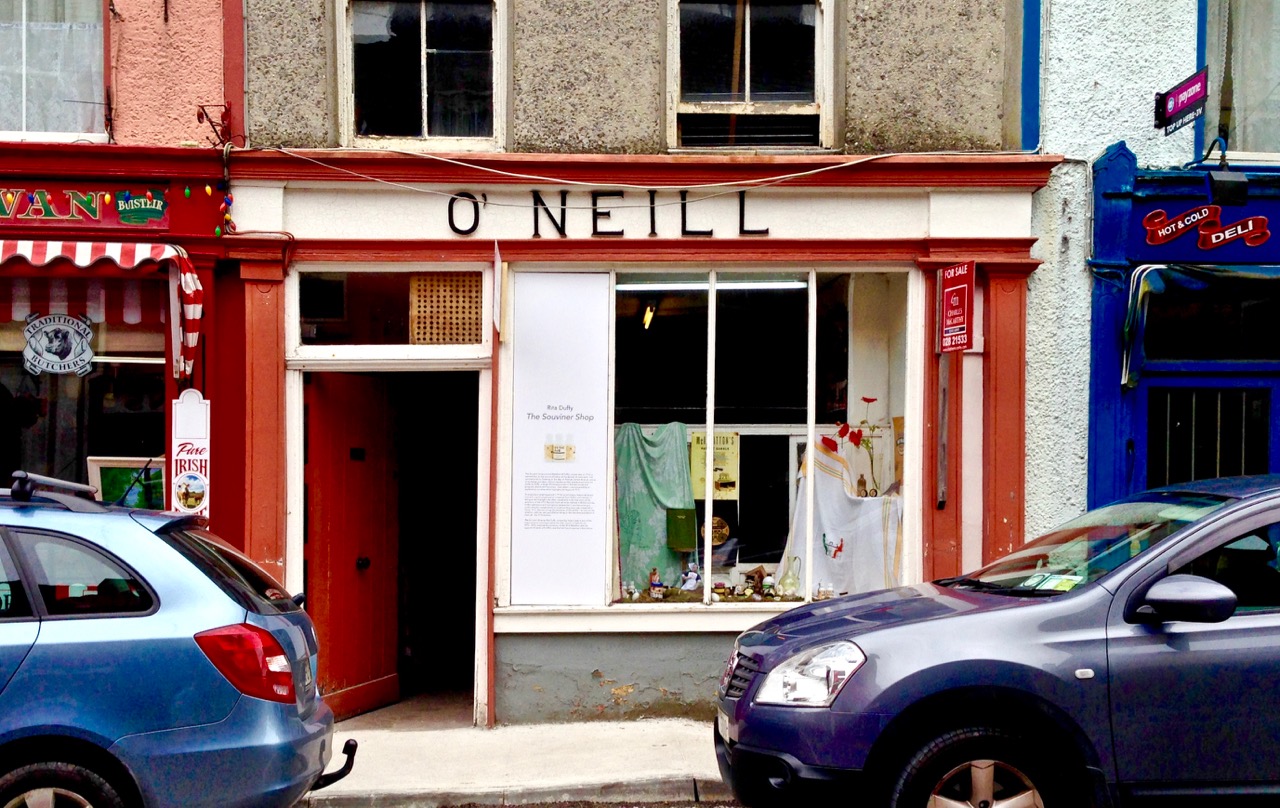
This is a first – a ‘live’ blog post! I’m writing it inside an art installation running as part of the excellent Skibbereen Arts Festival. The installation is The Souvenir Shop, and it’s a huge hit with visitors. The project is conceived by Belfast artist Rita Duffy and curated by Helen Carey, and is a very unusual perspective on the 1916 Rising commemorations.

o'neill'sshop

The Souvenir Shop was first shown in Dublin earlier this year – here is a review from the Irish Times – and it’s now in the perfect setting here in West Cork: O’Neill’s old sweetshop on Townshend Street in Skibbereen. The premises has been empty for years and stepping inside it today is stepping into the past: a shop unchanged over generations.

customers

Rita in Shop

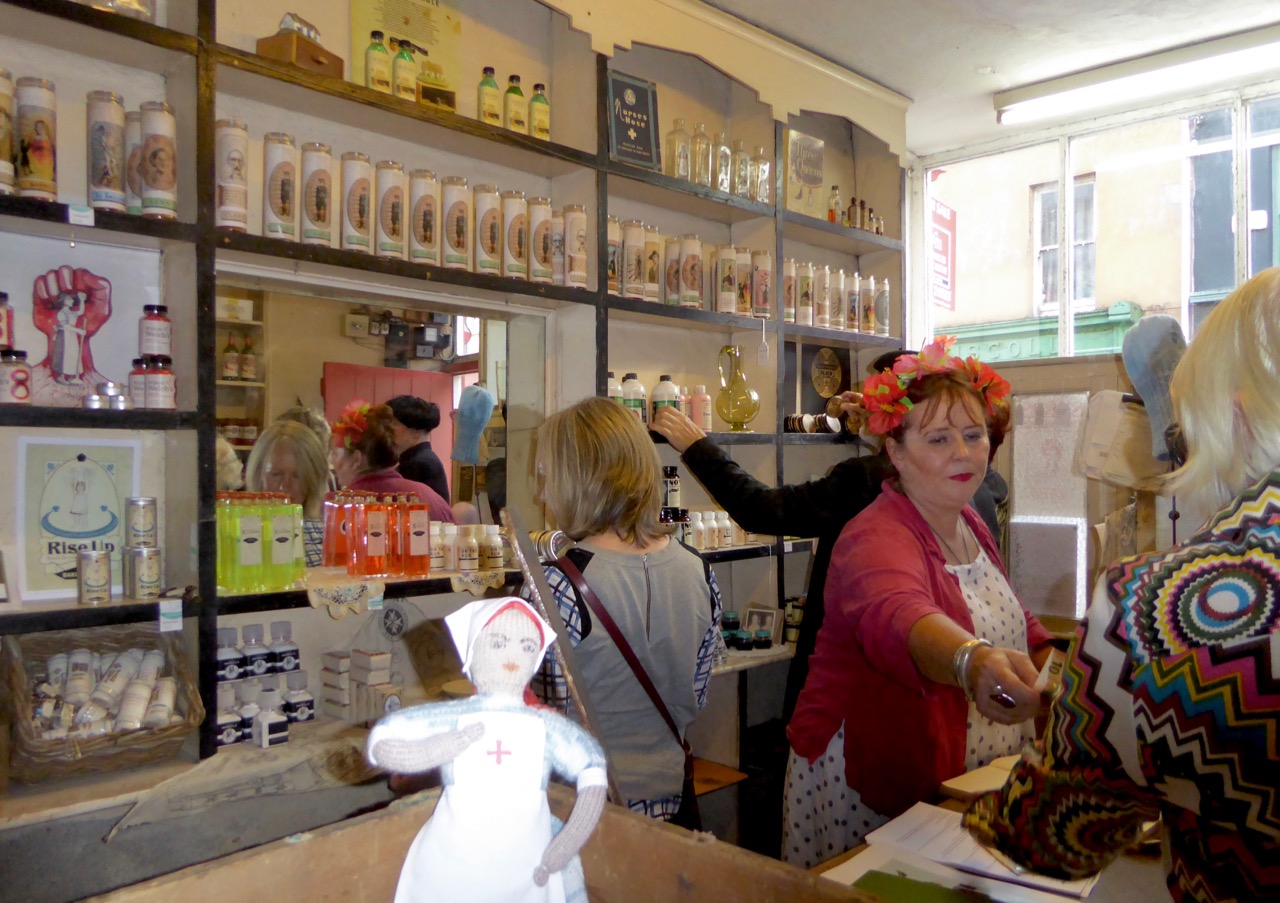
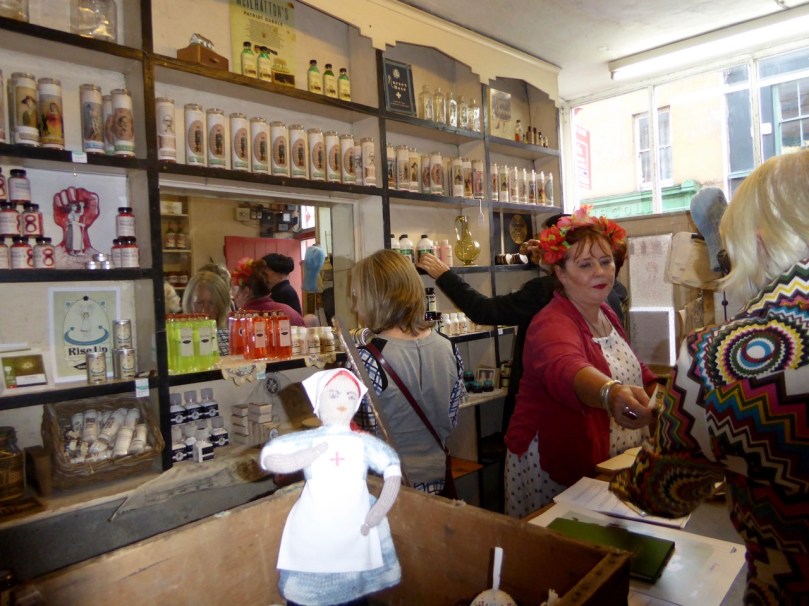
The atmospheric and nostalgic interior of O’Neill’s shop brought back to life by Rita Duffy (above): it displays and sells ‘souvenirs’ of the 1916 Rising and the events around it. It’s a piece of art which includes and embraces its customers and the ‘invigilators’ who, today, are Roaringwater Journal creators Finola and Robert

Finola and I are on our second stint behind the counter: we are the shopkeepers! We try to keep order as customers crowd in to look at the wares in display, all of which are designed by Rita. We met her in the shop on the first day of the exhibition and she explained that, during the Rising on Easter Monday 1916, many shops in Dublin were looted: the first was Noblett’s Sweet Shop on Sackville Street, and another was Tom Clarke’s tobacconist shop on Great Britain Street (now Parnell Street). She has re-made or re-imagined these shops for the installation, and filled the empty shelves of O’Neill’s with an incredible array of objects – most of which are for sale.

Dublin’s 1916 Easter Rising was accompanied by widespread looting of shops: Noblett’s Confectionery (top left – Dublin City Photographic Collection) and Clarke’s Tobacconist (bottom – National Library of Ireland) were among the first casualties. Tom Clarke himself (above right) was the first to sign the Proclamation of Independence, and was a driving force behind the rebellion

Rita Duffy’s subversive commentary on the Rising and the events that led from that time towards the present uneasy ‘peace process’  includes re-interpretations of everyday items that we would expect to see on the shelves of our local shops – soap, boot polish, tinned foods, tea, sweets, packets of seeds… It all looks very normal when you walk in – with a period flavour. We are finding that many of the customers today have fond memories of O’Neill’s sweet shop recalled from their childhoods and are delighted to come in and see it back in business: we can’t resist nostalgia. The initial impression is exactly that – a rosy-hued look back on our remembered past. Then we all start looking more closely at what is on the shelves and we are jolted out of our reveries…

Just a few of the items on sale today in The Souvenir Shop. Look carefully – ‘No Surrender stain remover’ shows James Connolly’s blood stained shirt worn during the Easter Rising; ‘His Majesties Ltd comforting diasporic foot soak for the wanderer who seeks a better footing’; ‘On The Run embrocation for the sore and twisted limbs of the dissident thinker (apply before sleep in a safe house)’; ‘Put my grandfather back together’ bandages; ‘Towards a New Republic Clear the Air vapour candle’…

It makes you laugh, initially – and then you have to think what you are laughing about. Balaclavas, in powder blue and pink with orange trim, for example. Black and Tan boot polish…? There’s a whole lot more to The Souvenir Shop. Rita Duffy has engaged the services of the Irish Countrywomen’s Association in Cavan (her studio is in Ballyconnell) to make Free State Jam and to knit – the balaclavas for example – but also some wonderfully bizarre religious iconography: did you ever see a knitted Pietá before?

Unexpected knitting courtesy of the Cavan Irish Countrywomen’s Association

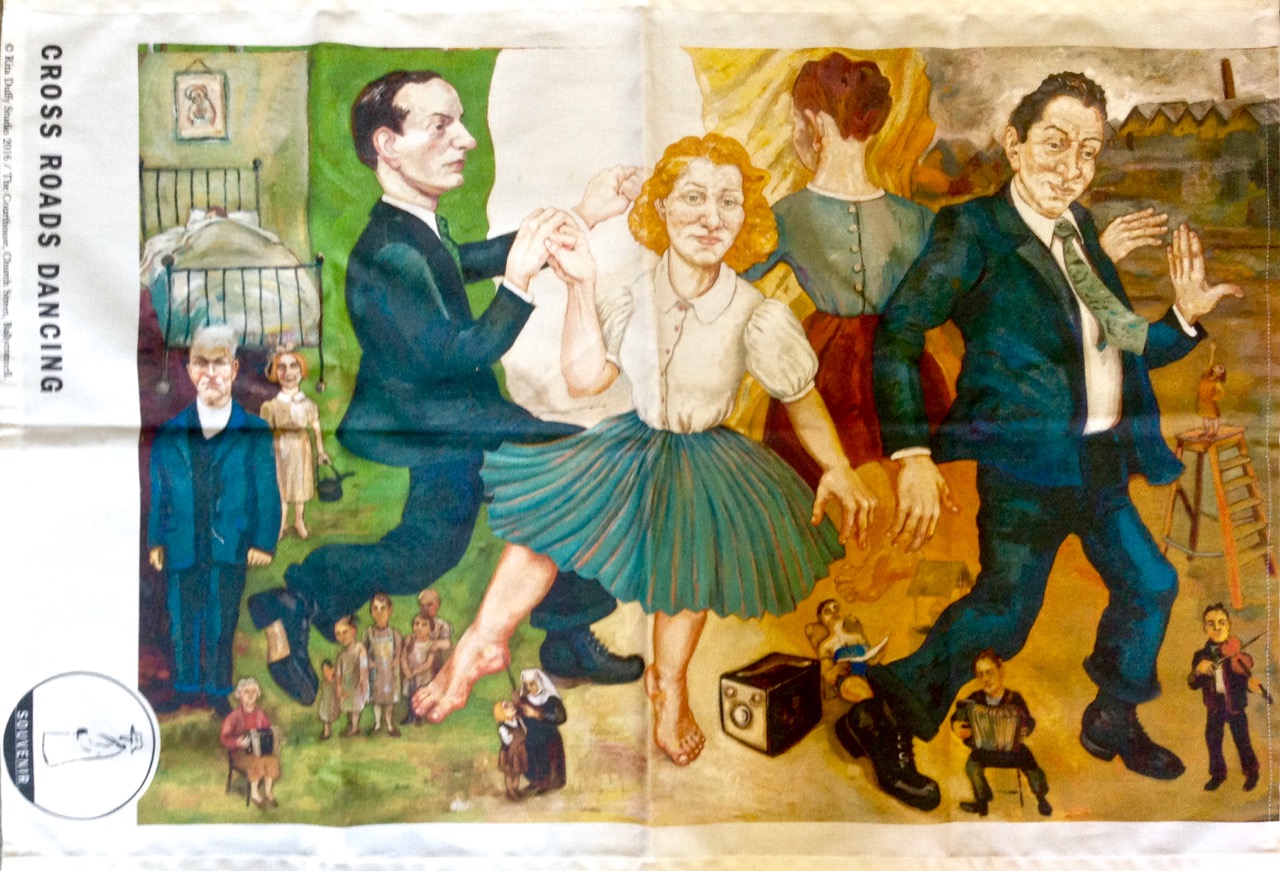
Rita has also produced tea towels, t-shirts, and some embroidered place-mats carrying rather uncomfortable messages to entertain your dinner guests with. There are also ceramics: teapots, dishes and glassware. It’s such an eclectic range of goods on offer in this shop. That’s why the crowds come in and spend what seems like hours browsing the shelves that once held jars of sweets and packets of tea. There are sweets and tea here today – children are delighted to be given some free samples – but they probably don’t understand the hidden messages on the colourful packaging.

Most stark, perhaps, are the seeds: Seeds of the Revolution: two packets for 5 Euros. The messages here are fairly easy to read, although harder to digest. They really are seeds in those packets, but you’ll have to plant them to find out what comes up, perhaps something else that has a subversive implication: I’ll tell you what mine are next spring!

Seed rack

There’s so much in The Souvenir Shop that I haven’t included in this little review – and I’m far too busy trying to fend off the demands of the customers while I’m writing this. If only they would get into an orderly queue – it’s like some sort of insurrection in here… But we’ll cope – and encourage you to come and see this piece of artwork while it’s still on (it finishes on Monday 1st August at 5pm). Step inside and you become part of the exhibit – just like we are right now. You’ll enjoy it, perhaps more than you should. It will certainly leave you thinking.

Cross Roads Dancing

The Souvenir Shop (…nothing is as it seems…) is one of the major projects commissioned by the Arts Council of Ireland’s Art 1916-2016, marking the centenary of the 1916 Rebellion – with the support of Cavan Arts Office and the Irish Countrywomen’s Association. It runs through the Skibbereen Arts Festival between July 22nd and August 1st in O’Neill’s old sweetshop on Townshend Street

Peas + Beans

Possibly Over-Stimulated

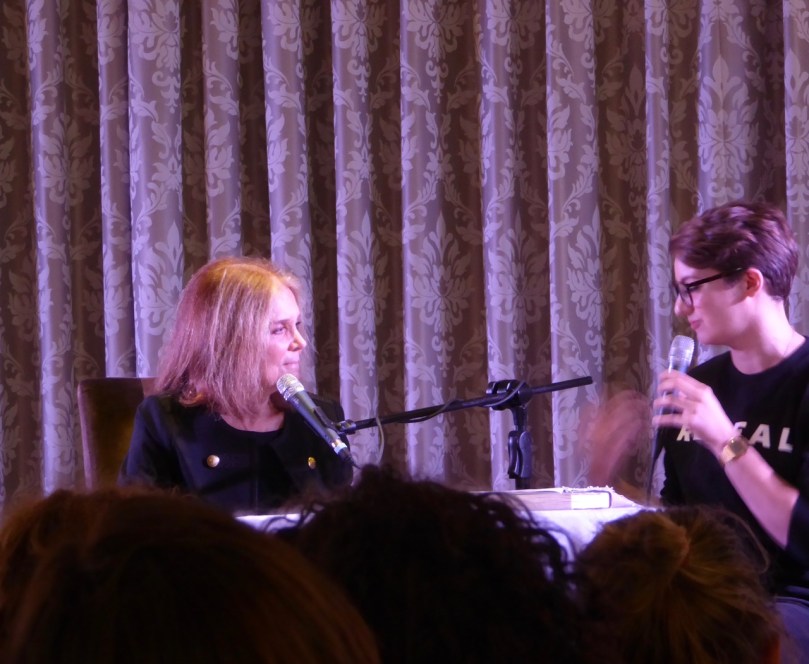
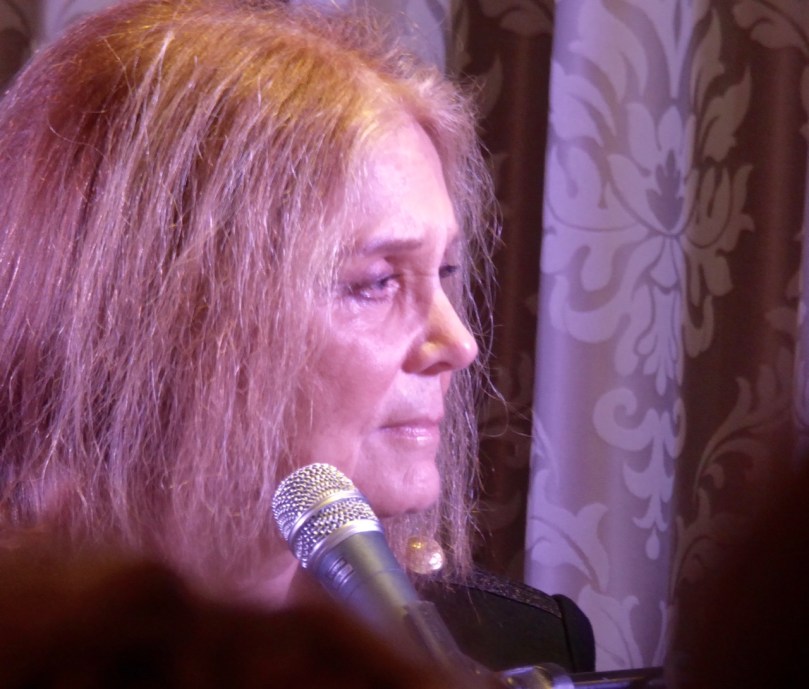
Gloria Steinem is an international icon. This week, we welcomed her to Bantry Literary Festival. Four hundred women, and a few men, rose spontaneously to our feet and clapped and cheered her entrance. First time I’ve seen a standing ovation before someone actually stepped on stage.

Gloria and

What followed was breathtaking – Gloria spoke, a little and beautifully, but mostly she listened as audience members asked questions and shared their own experiences as women in this country. People had come from far and wide to hear her and just to be there: people I admire and respect – Tara Flynn (see also You’re Grand) and Louise O’Neill. Lelia Doolan, for goodness sake, a Irish feminist icon in her own right. The conversations weren’t easy (misogyny, abortion, pornography, violence) and there certainly were dissenting and opposing viewpoints presented. But the atmosphere was respectful (if electric) and Gloria calmly dealt with each question in ways that were thoughtful and non-divisive. Two hours later, I think we all felt we had been present at a little bit of history.

Gloria

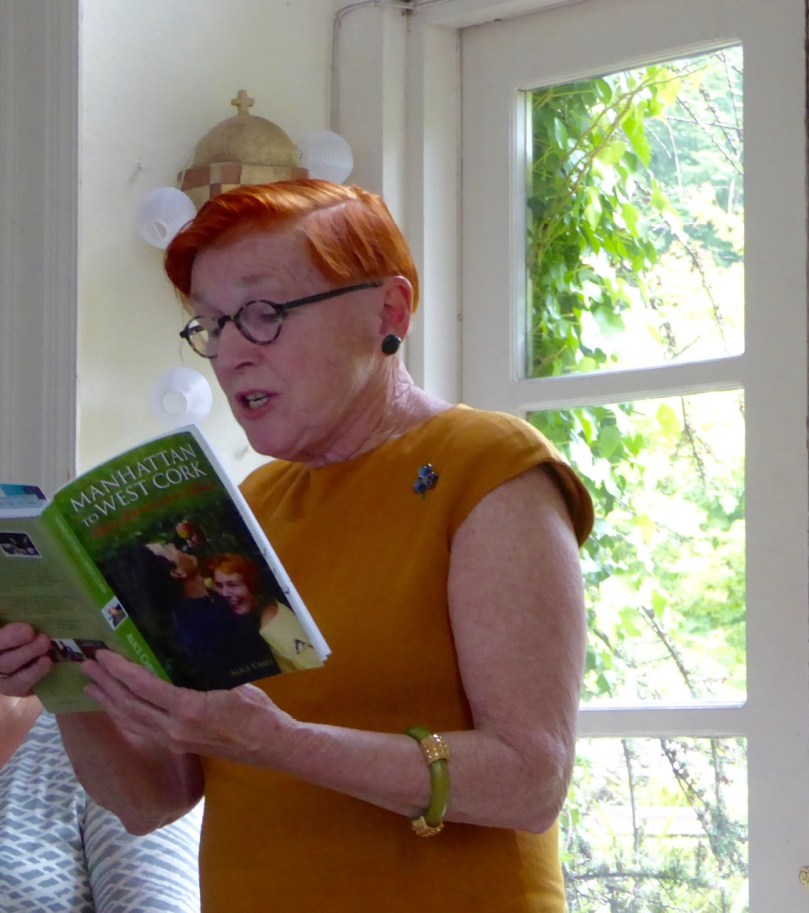
We attended other Literary Festival events and Robert is writing about one of them – the delightful evening with Seán Ó Sé. That evening formed a wonderful contrast to the talk by Alice Carey, a self-professed New York/Irishwoman, vivacious and stylish, but also moving in her descriptions of a childhood caught between two worlds.

Alice Carey

Alice Carey

And just as that Festival is ending, the Skibbereen Arts Festival is bursting upon the scene with a slew of gallery openings and a 60’s street party! Sometimes it’s hard to know where the dividing line is between business and the arts in Skibbereen. All the business people seem to support the arts and all the arts events seem to work well with the businesses. Shopfronts become display cases. Empty buildings are re-purposed as galleries and theatres. Employees and owners dress up and decorate. Everyone has fun.

Skibbereen shop windows. Hands up who remembers women wearing curlers all day in the 60s!

This Friday was a good example as Skibbereen went all out for a 1960s-themed street party of food and music, to celebrate the opening of the Skibbereen Arts Festival. I wrote about this festival a couple of years ago. As arts festivals go in Ireland, this one is only in its infancy, but it hit its stride right from the starting gate, with an eclectic mixture of art, theatre, music, spoken word, film, and events for children.

Robert used to have a van like that

This year we have tickets for all kinds of disparate events and may have to take a holiday when it’s all over! On Friday we attended three art show openings and then joined the throngs on Bridge Street to get into the 60s swing.

Angela Flowers Exhibition


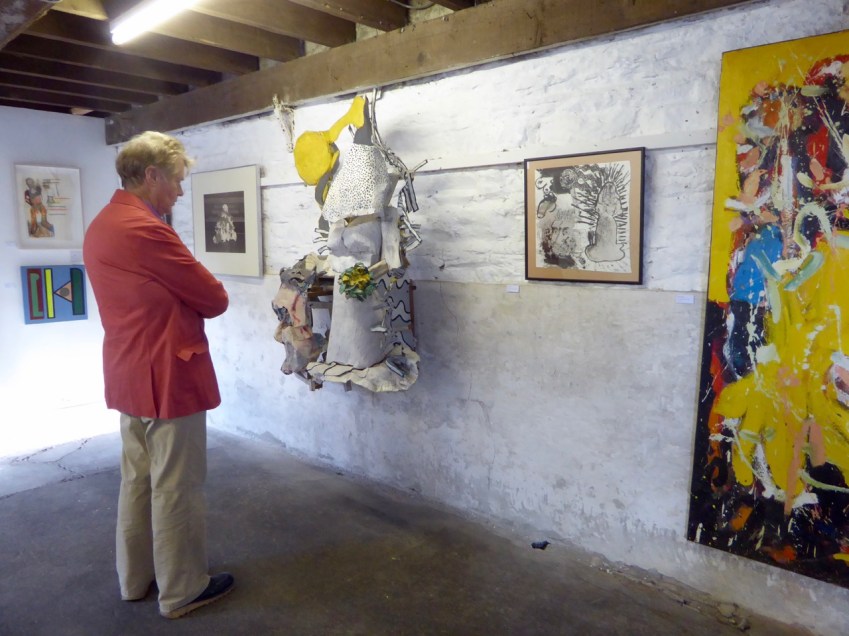
The old Bottling Plant makes an excellent gallery space, in this case for the Angela Flowers Collection

The first opening was extraordinary. Angela Flowers is one of Britain’s foremost gallery owners (she has two in London and one in New York), dealing with contemporary art. She has a house in West Cork and the pieces on display are from her own private collection. (Read more about Angela here and about her galleries here.) This is challenging stuff – no pretty paintings here, but compelling and engrossing. The exhibition was opened by Lord David Puttnam, the film producer and now digital champion and educator, who never misses an opportunity to support Skibbereen, where he lives full time.

Uillinn came next: the whole space was devoted to the work of John Kelly, a painter and sculpture with a studio in West Cork and an international reputation.

Yet a third art exhibition opened in an unused space down by the river – a huge L-shaped room perfect for such a purpose. This one was called Mór (‘Large’) and brought together the work of several artists who work in large scale. Huge canvasses and large sculptural pieces created an imposing and magisterial atmosphere.

Karen Hendy’s triptych (top) and Don Cronin’s piece titled ‘Windfall’

Then it was off to the opening of The Souvenir Shop by Rita Duffy. Robert and I have signed up for two ‘invigilation’ sessions at this quirky and unusual art installation, so I will write about it more at a future date, or post photos on our Facebook page.

Souvenir Shop

The Souvenir Shop

Before we staggered home, we joined the throngs of Skibbereen folk on Bridge Street for the 1960s party. The hippies were out in force!

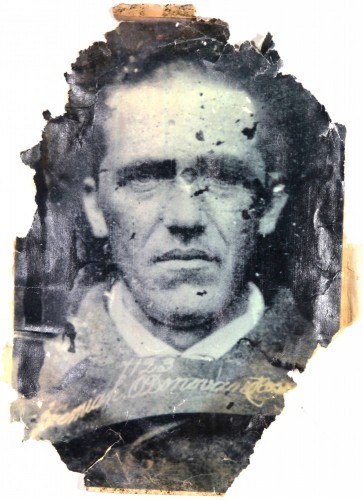
Finally, tonight, we attended a premier showing of the Film Rebel Rossa. Last year we met the two great-grandsons of Jeremiah O’Donovan Rossa in Skibbereen, here to attend various functions commemorating Rossa and to document them for a film they were making. Since I did extensive research on Rossa in preparation for a series of three posts (March Back in Time, O’Donovan Rossa – the First Terrorist? and Rossa: The Skibbereen Years), I was particularly interested in how the film turned out. They did a great job! Rebel Rossa turned out to be about Rossa, but also about family and about how governments celebrate such things versus how republican groups or local committees do it. Fascinating stuff and they are hopeful about getting a distribution deal.

Rebel Rossa

More, much more in the days to come. How am I going to cope? I came here to retire!