I have written once before about Sonia Caldwell of Kilcoe Studios. That was eight years ago. In a post titled Kilcoe Studios – Dedication and Passion, I showed you her production of beautiful botanical art calendars and notecards, and gave you a glimpse of her passion for sculpture.
Since then, Sonia has emerged in West Cork as a true champion for heritage and nature, on top of continuing to develop her business and her personal sculpting practice. After a residency at Uillinn, she held a solo show there last month, mainly featuring her sculpture.
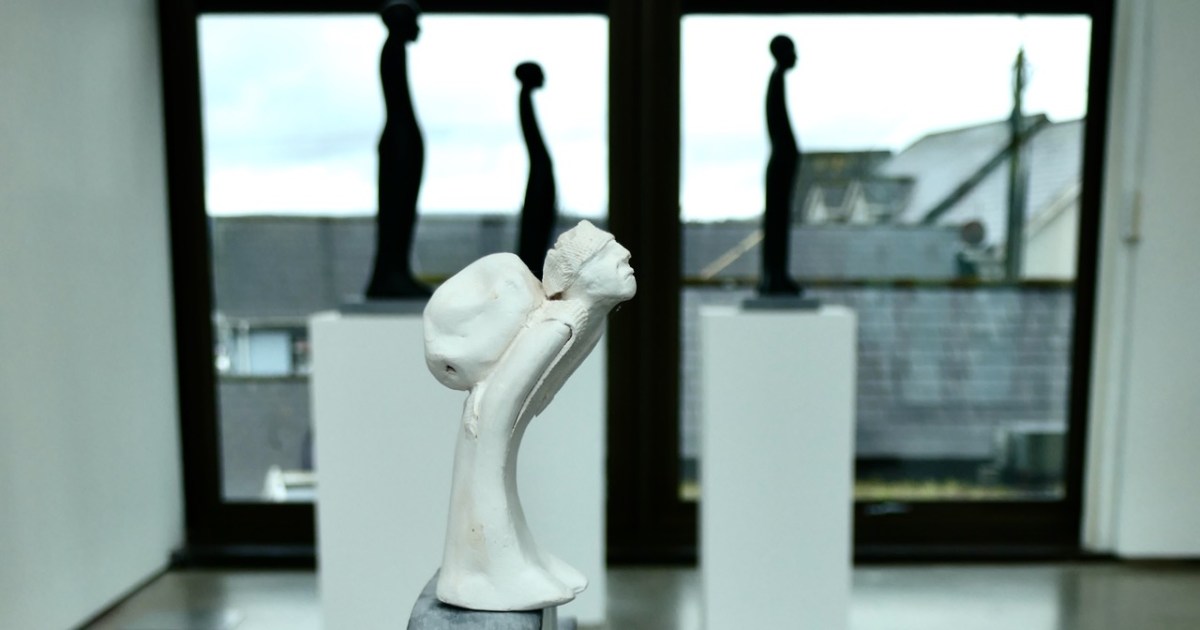
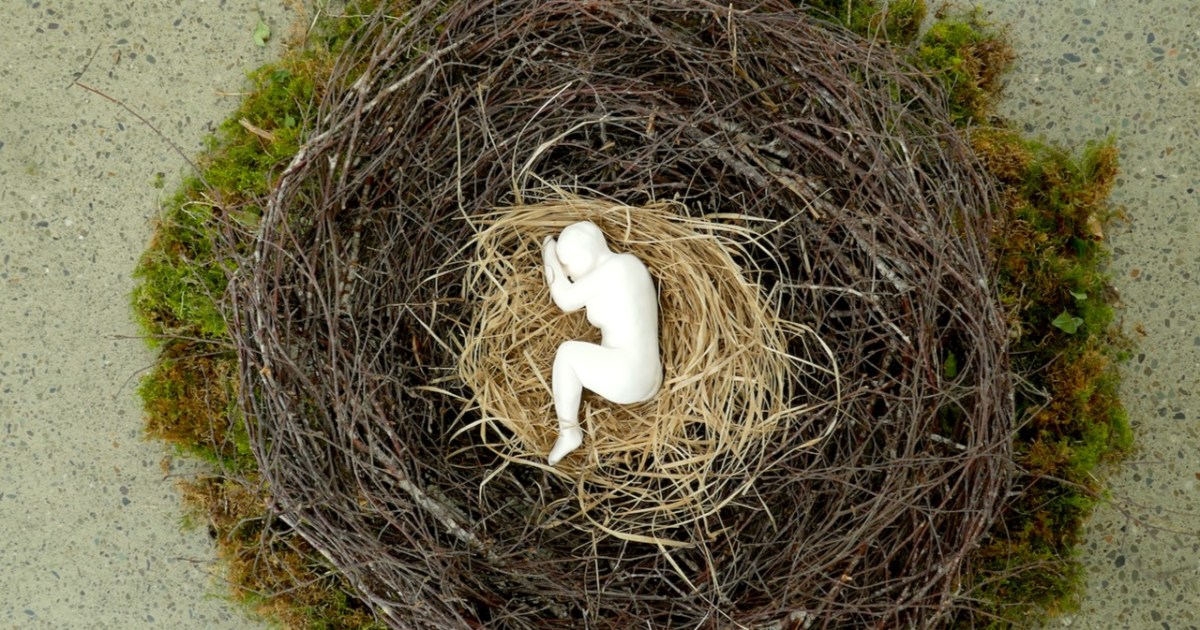
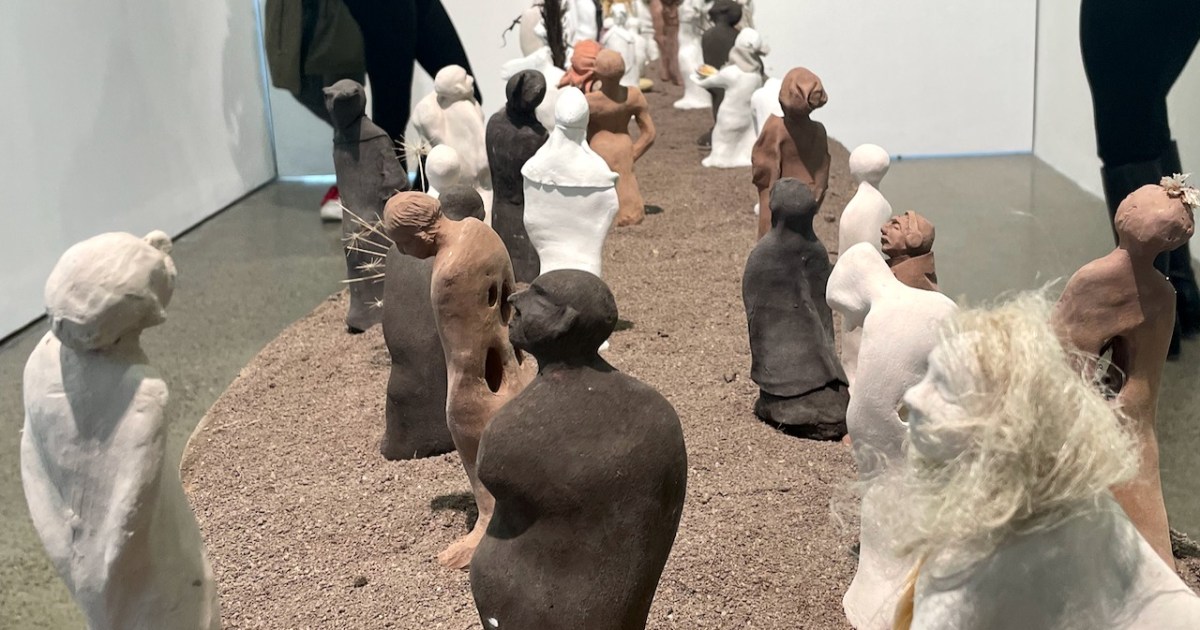
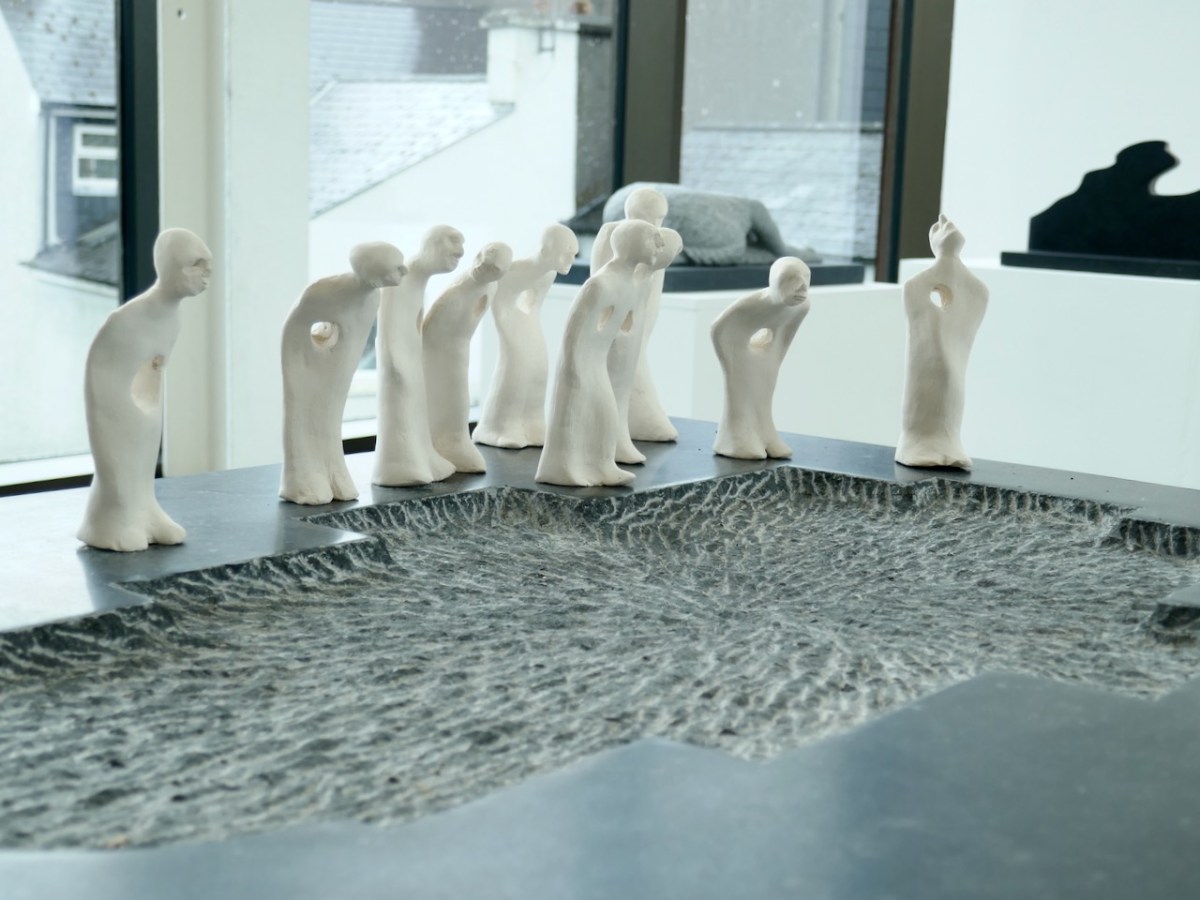
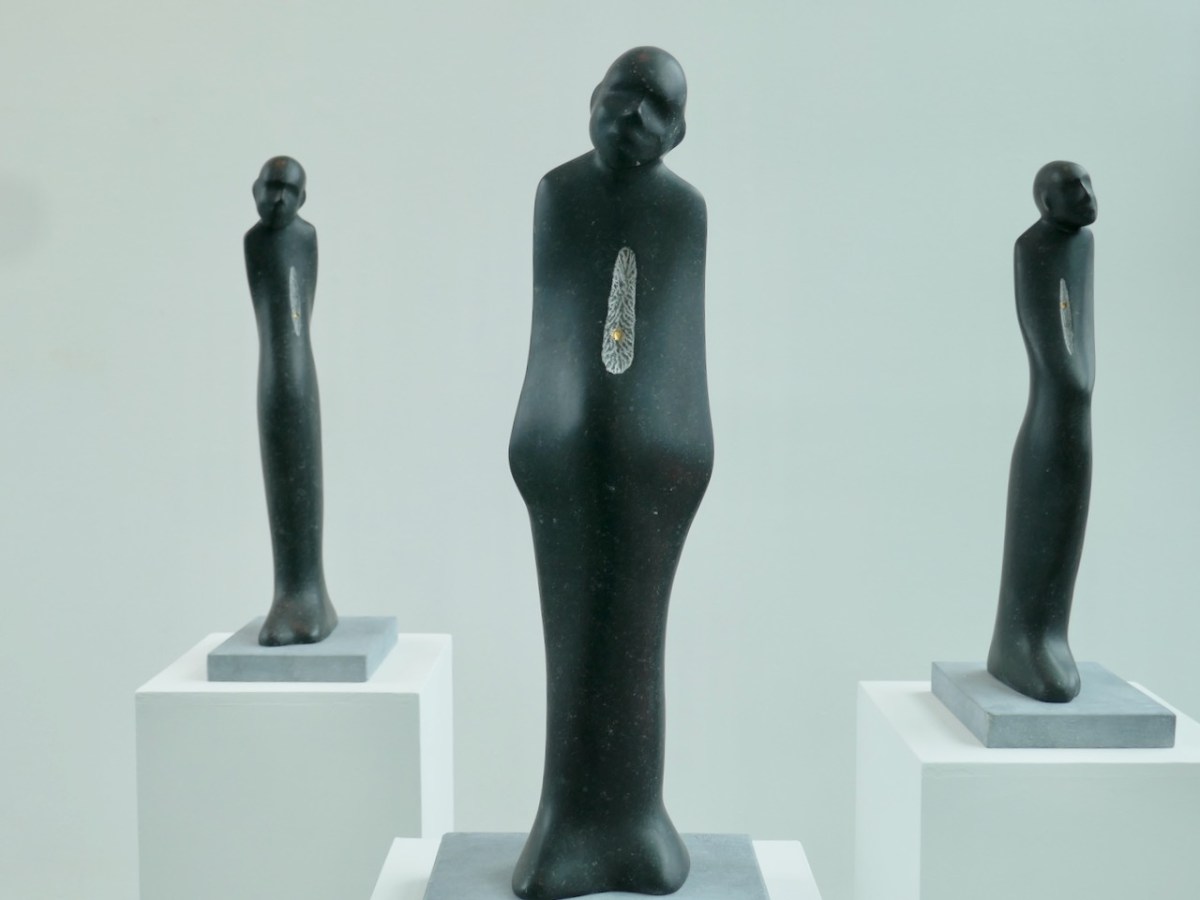
Sonia works in limestone, clay and natural materials such as mosses and twigs. Her work has an ethereal quality, explained by her personal spirituality. Her figures, small and large, are seeking to find their path, or answers to their questions.
They ponder an empty church, march along a pilgrim route carrying their burdens, or gaze into the distance mulling over some otherworldly mystery.
The launch of the exhibition was haunting. Sonia and singers, directed by Susan Nares, entered singing: chanting, rather, in a slightly Gregorian way, in English and Irish.
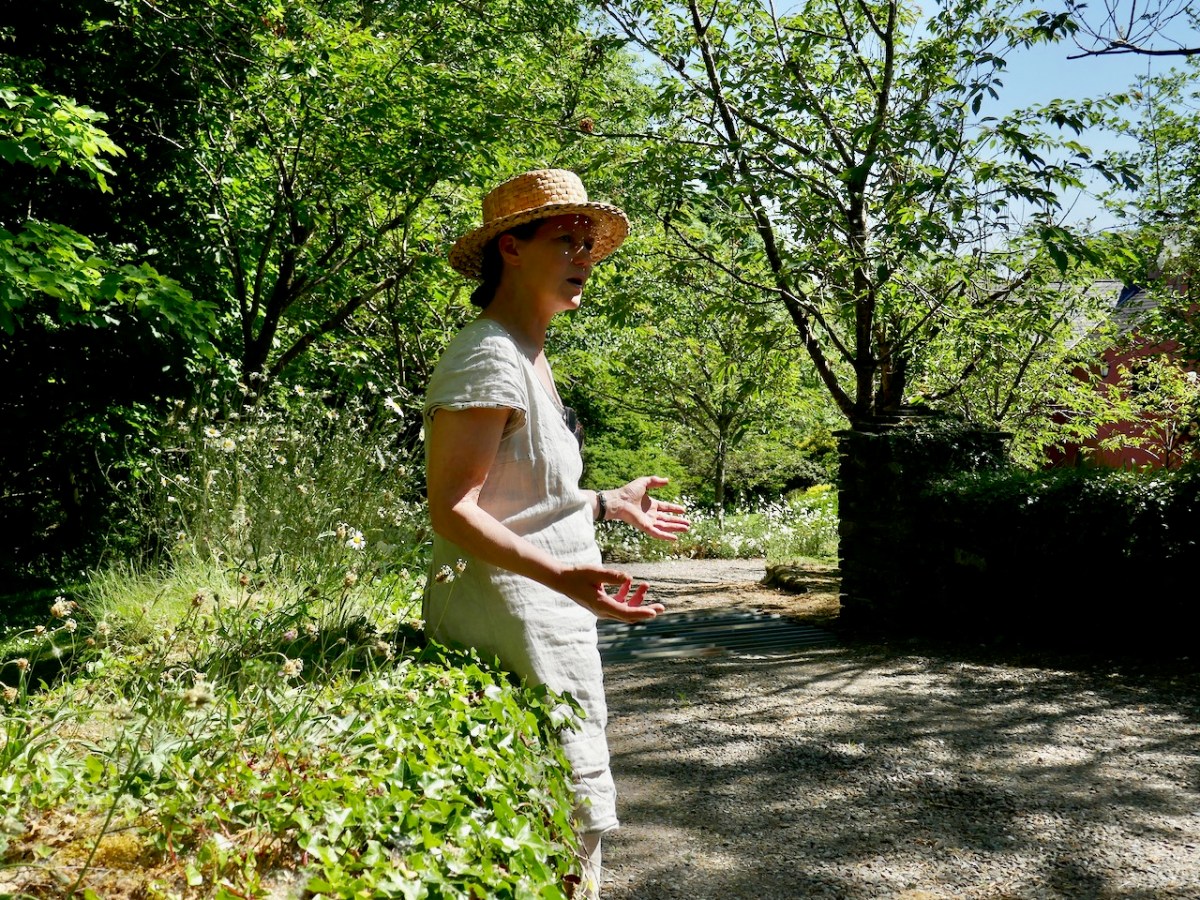
That’s the fine art side of Sonia. But her other passion is for the natural world and for all those heritage crafts that will die, if people like her don’t learn, nurture and revive them. She has opened a shop in Ballydehob, where she sells her own artwork, and items by others made from all natural materials.
The shop is where she also hosts her workshops – often facilitated by herself and occasionally by others. All the workshops are designed to get us engaging with heritage crafts and materials sourced from the fields, hedges and water around us. And they are great fun!
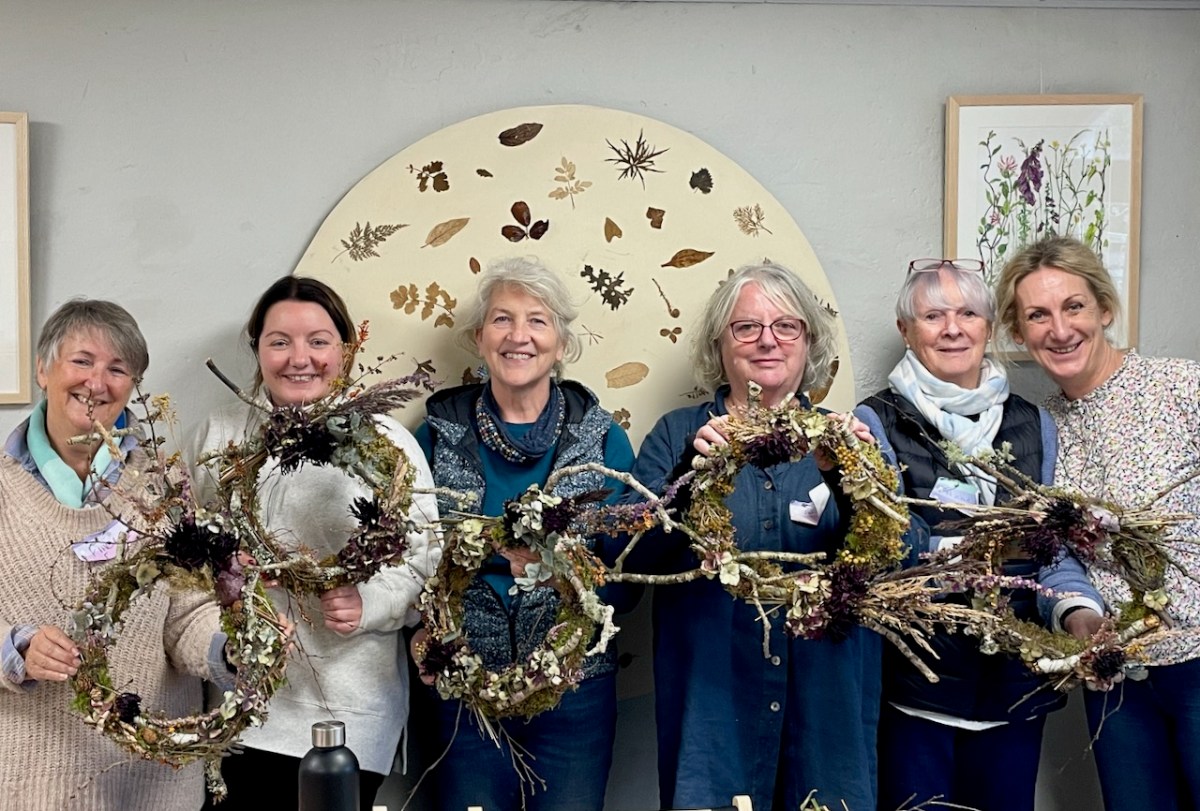
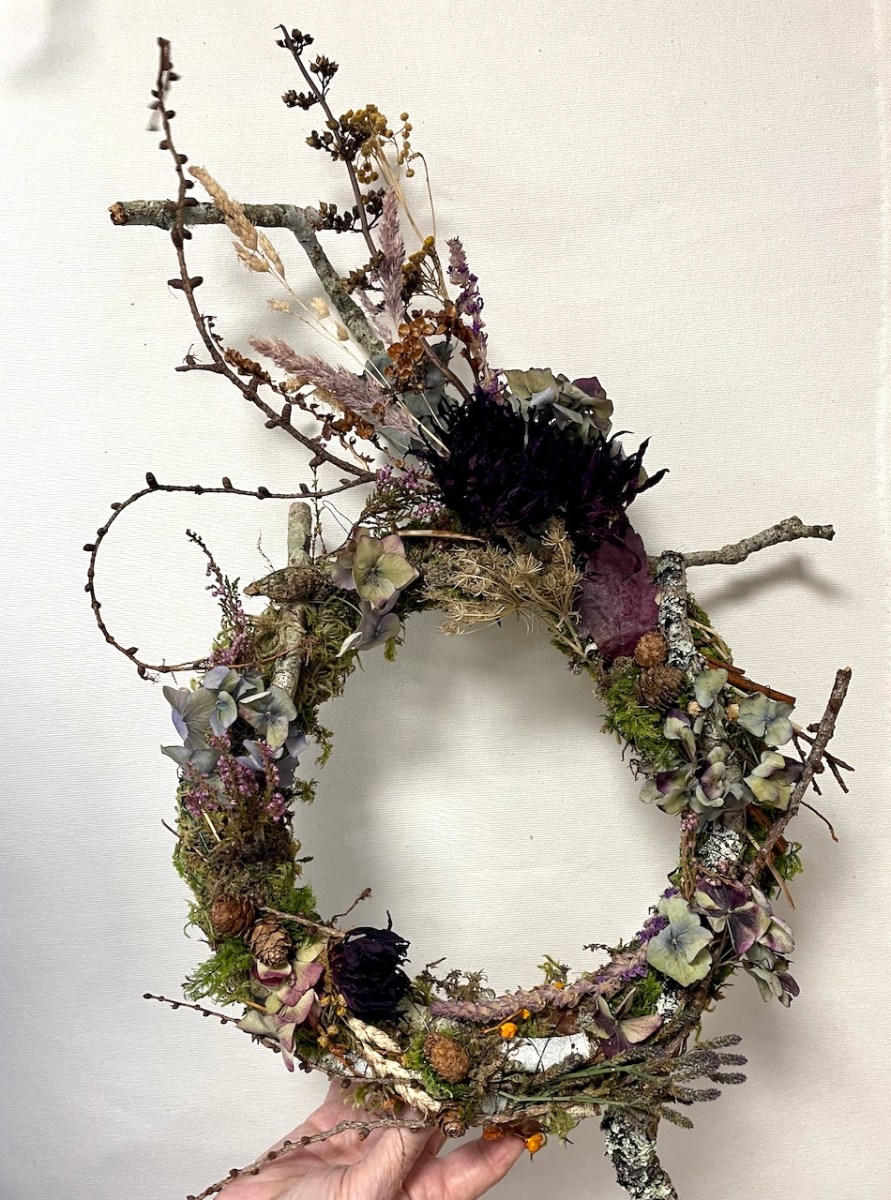
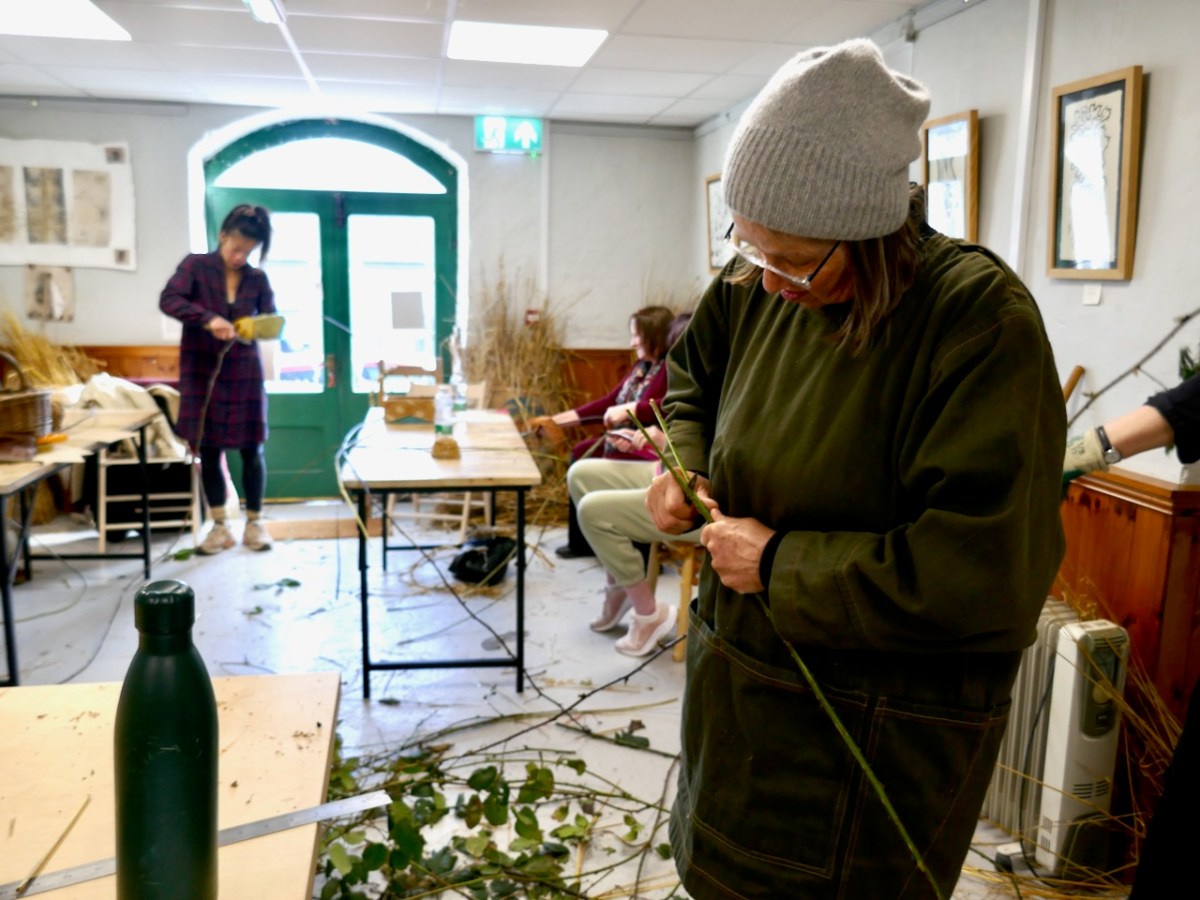
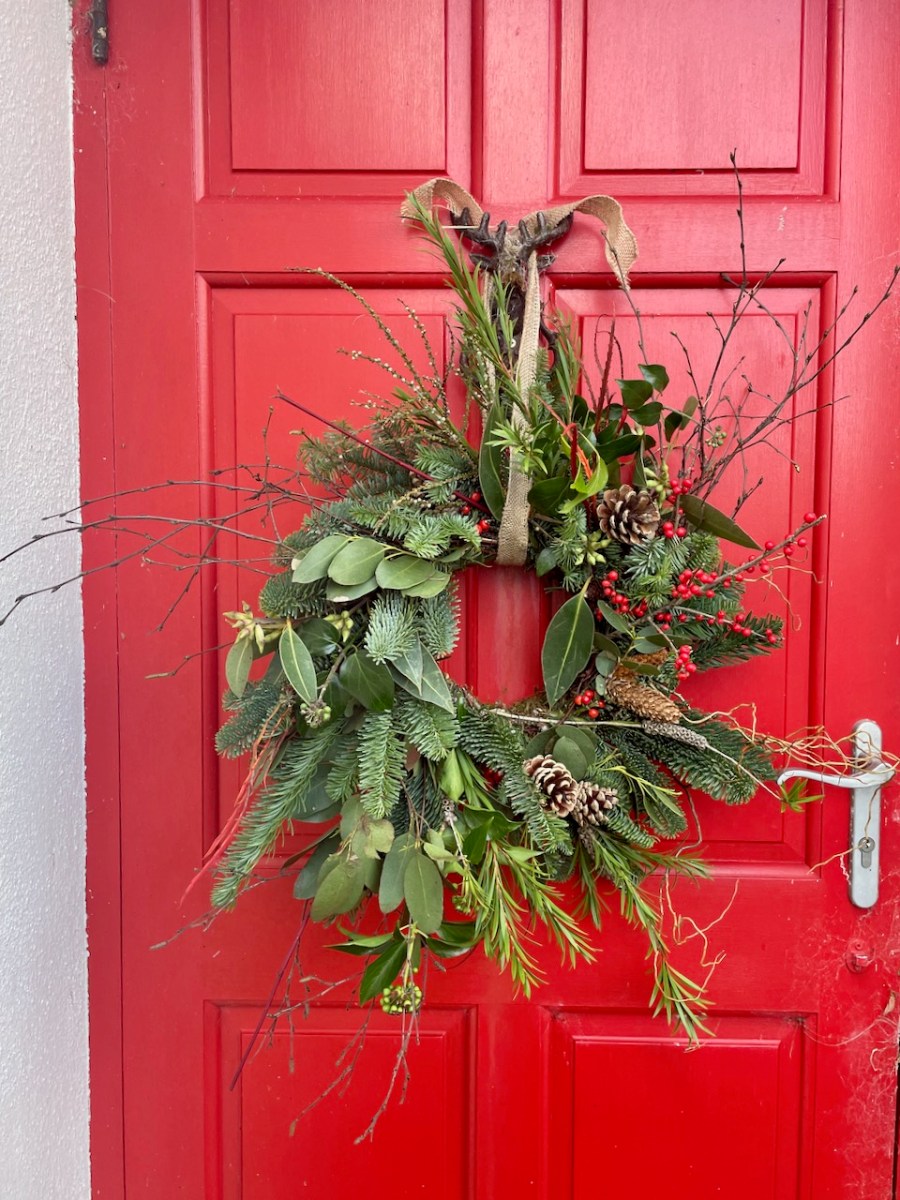
Just in the past year in that shop I have learned to make a basket from brambles (yes, don’t worry, de-thorned) – that’s my friend Julia splitting a long bramble above. I have made an autumn sculpture (“don’t call it a wreath!”) and a Christmas wreath, both facilitated by the wonderful Liz O’Leary and from foraged materials.
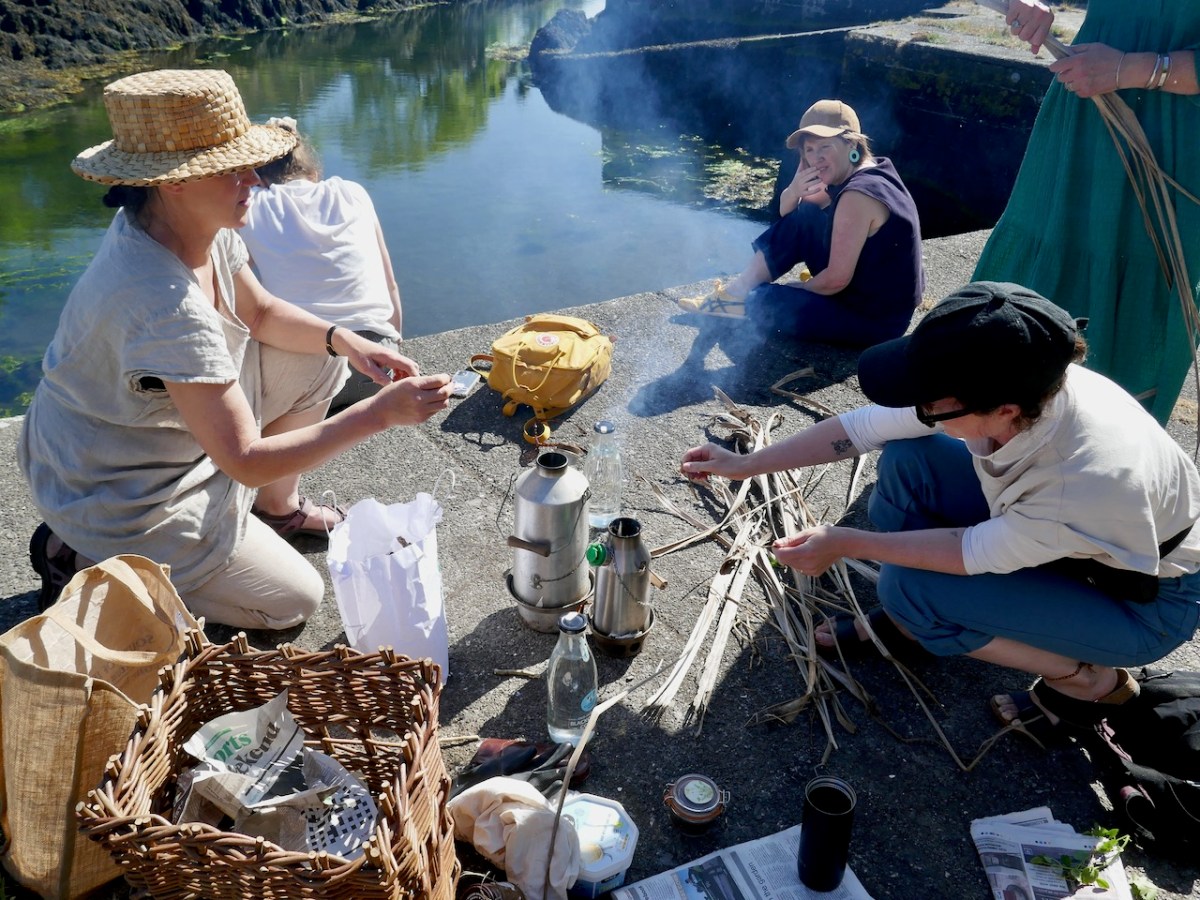
And I have gone on two foraging walks. The latest walk was last weekend, and it featured my first ever cup of nettle tea (delish!) and a picnic on the banks of a river with crackers and cake made from various gleanings and flavourings – toasted Wood Avens seeds anyone?
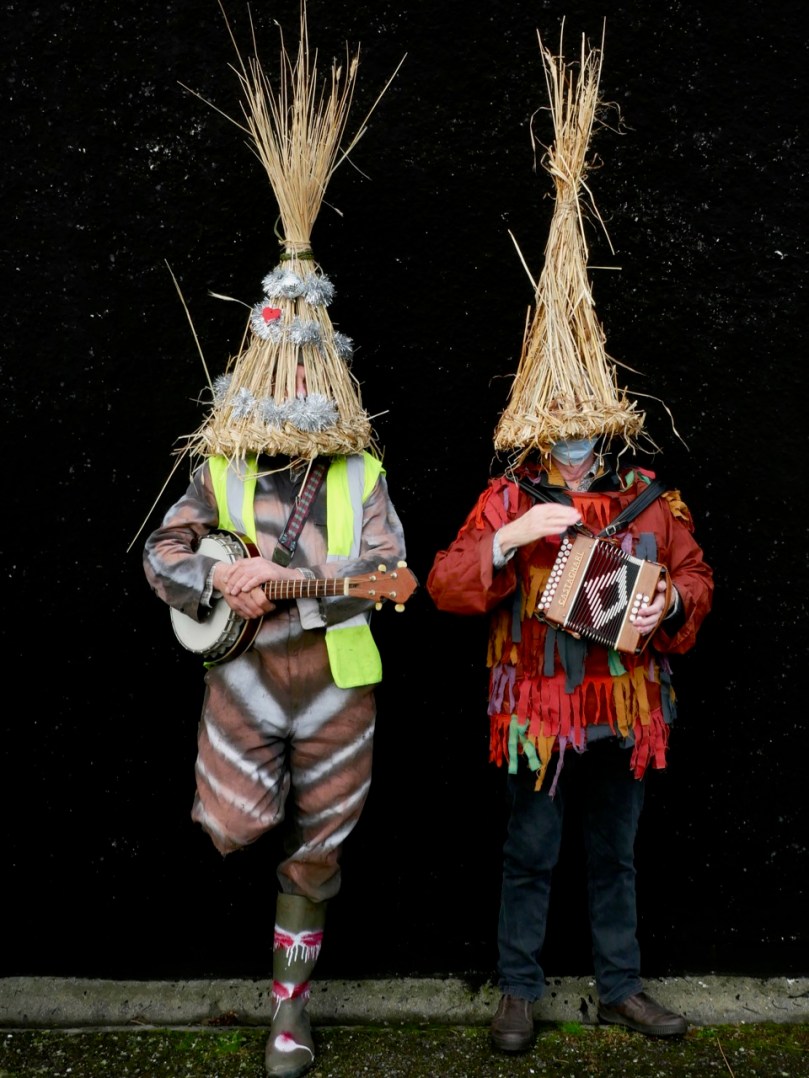
Sonia has also single-handedly revived Wren Day (also known as St Stephen’s Day in Ireland and Boxing Day abroad) in Ballydehob and taught us how to make the traditional rush hats worn by the Wren Boys. See Robert’s post The Wran for more on this unique Irish tradition – he was an enthusiastic participant.
All towns and villages deserve a person like Sonia – the person who won’t let the traditions die and who encourages the rest of us to look around us and really see what the land has to offer. We are lucky she chose West Cork as the place to nurture her own unique and mighty talent and to draw the occasional spark of creativity from the rest of us.
It was a big day in Ballvourney yesterday: the public unveiling of two replicas of the 800 year old wooden figure that has been central to observances of St Gobnait on her day for as long as anyone can remember – we must be talking centuries! If you are not familiar with St Gobnait – or her celebrations – read my post here.
It’s actually St Gobnait’s Day today: the eleventh of February. As I write this, the congregation in the saint’s church will be venerating the 13th century wooden figure by ‘measuring’ her with ribbons. But also, for the first time, they will be able to view the two copies of that figure which have been made over the last few months. That exercise has been undertaken so that the figure itself could be fully studied because it is of great historical interest. There are other medieval carved wooden figures of saints surviving elsewhere in Ireland, but this is the only one that is still in regular active use.
. . . A medieval wooden image of Gobnait, kept traditionally in a drawer in the church during the year, is venerated in the parish church on this day. The devotion is known as the tomhas Gobnatan . People bring a ribbon with them and ‘measure’ the statue from top to bottom and around its circumference. This ribbon is then brought home and is used when people get sick or for some special blessing. The statue is thought to belong to the 13th c. A second pattern in honour of Gobnait was traditionally celebrated in Baile Bhúirne at Whit . . .
The above citation is taken from The Diocese of Kerry website, which sets out a comprehensive review of the saint and the activities which honour her. Here’s the measuring taking place a few years ago:
National Heritage Week 2023 explains the purpose of the project to replicate the carving:
. . . As patron saint of the parish, the statue provides a tangible link to the saint but importantly represents the long-standing living devotion to Gobnait. The wooden figure carved out of oak clearly depicts a female monastic. It was guarded over the centuries by the O’Herlihy clan, who were the ruling Gaelic lords of the Ballyvourney area during the medieval and late-medieval periods. It remained in the safe-keeping of members of the O’Herlihy family until they handed it over to the local parish priest in the late-19th century and it has been protected and kept secure by the Ballyvourney Church Committee ever since. The 3D project will comprise the digital scanning of the statue which in turn will enable a 3D generated wooden print out. A second replica will be hand carved as an integrative representation of how the statue would have looked originally before the centuries aged and tarnished it. The replicas will then be placed permanently on display in the Parish Church with information signage . . .
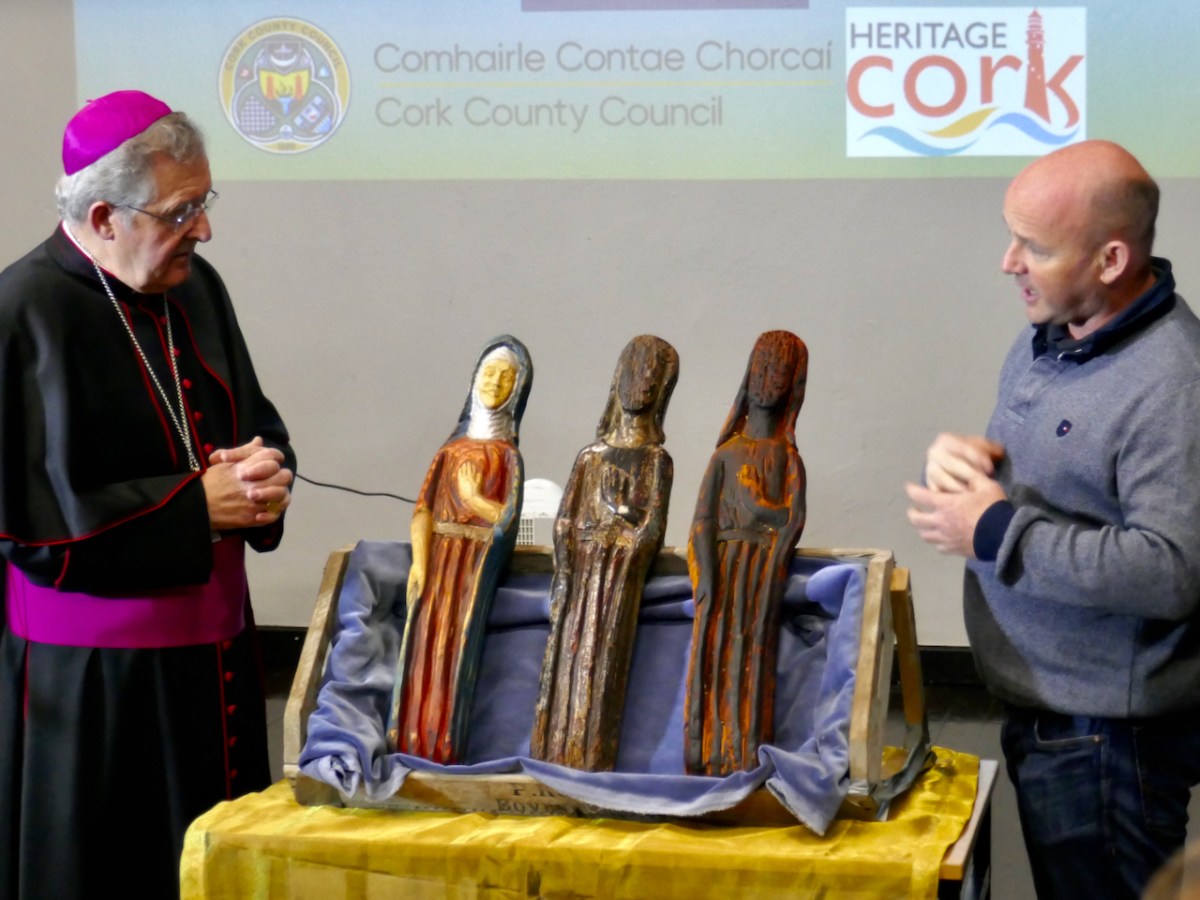
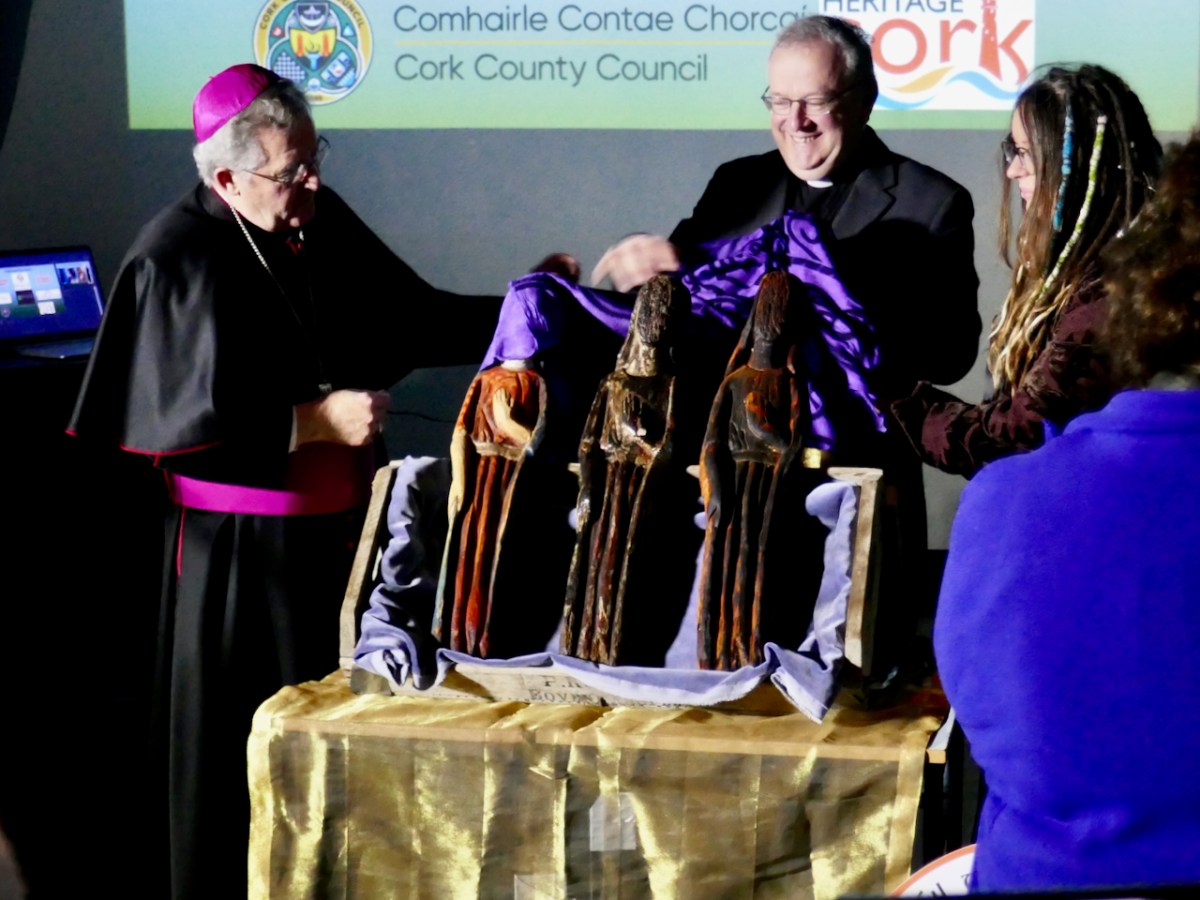
Above is a view of the original carving (in the centre) with the replica of that on the right. On the left is the ‘integrative representation’ – that is the carver’s interpretation of what the figure might have looked like when she first saw the light of day in the 1300s. On the left is Bishop William Crean – Bishop of Cloyne since 2013: he presided over the unveiling of the two replicas yesterday. On the right is John Hayes, of Special Branch Carvers in Fenor, Co Waterford. He was responsible for the carving project and has made an excellent job!
John gave us a presentation yesterday, after the unveiling ceremony, and we learned how he closely examined the original statue, taking detailed measurements and a full photographic survey. This enabled a Sketchfab 3D rendering to be produced: this became the basis for his work. During the examination he was able to find traces of paint, which enabled him to render the interpretative version with – very likely – a high degree of fidelity to the original.
I got the chance to talk to John and ask him about the timbers used for the original and the replicas. The original is of oak, and we don’t have a way of knowing where this came from. The replicas are of ash: this is a good material for stability and longevity. John had access to a good source of seasoned wood.
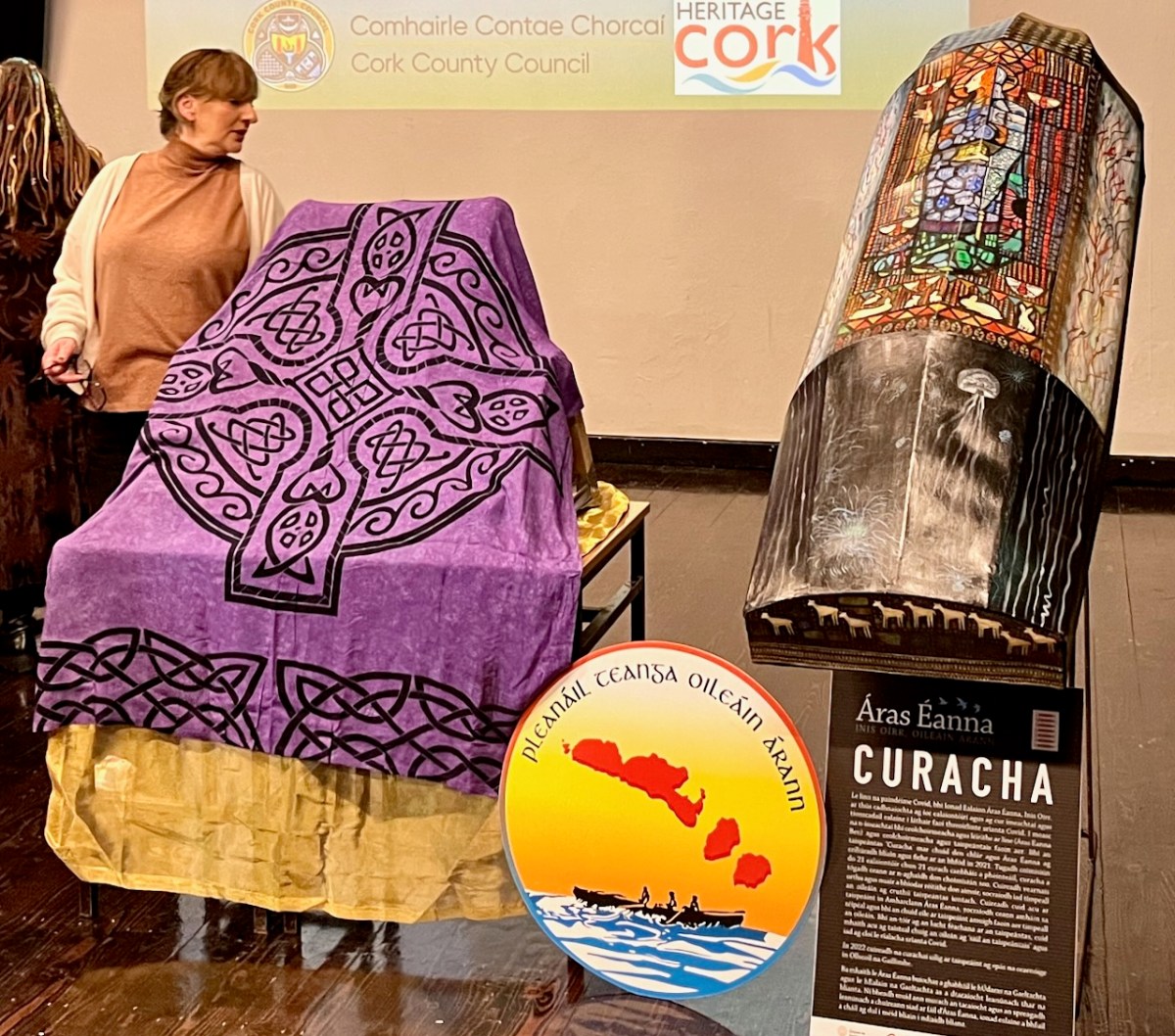
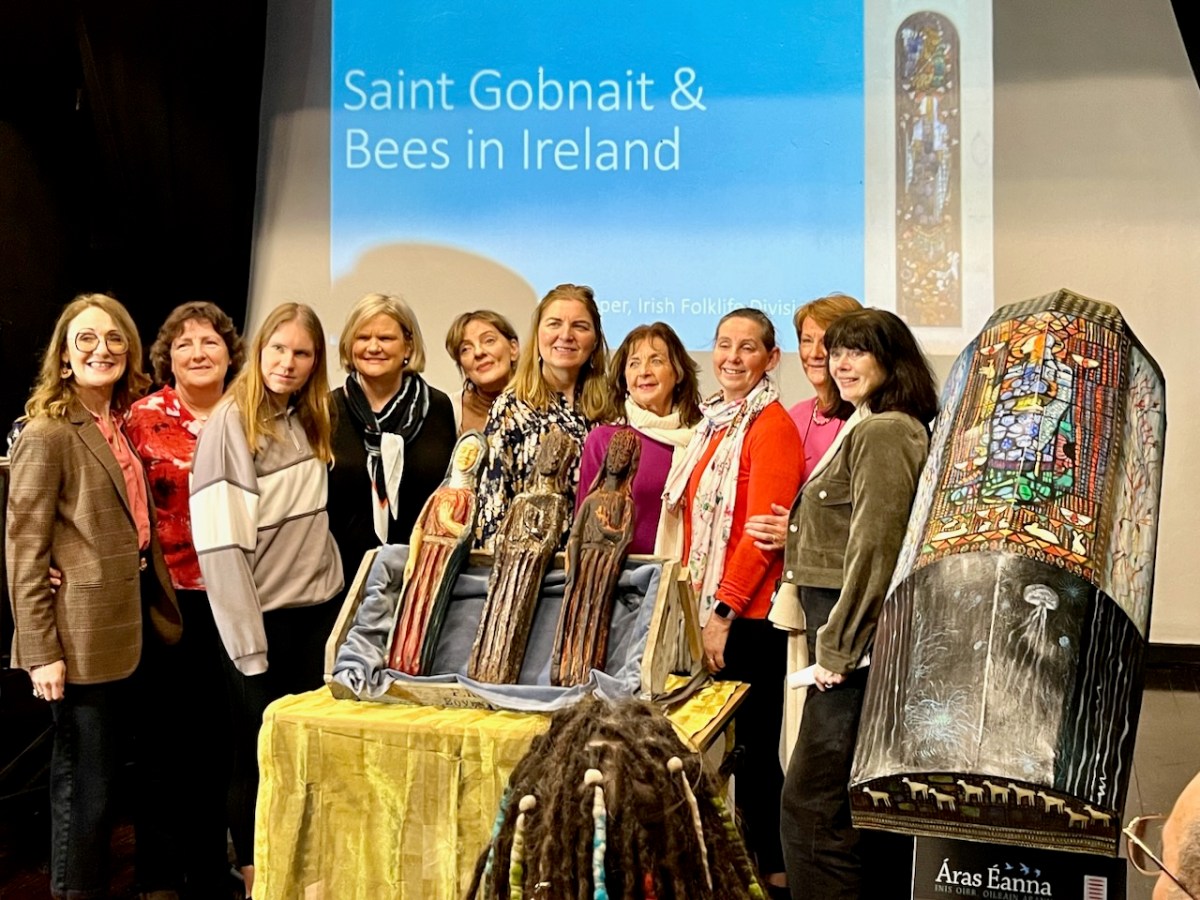
The day was a study day for St Gobnait, and encompassed a whole lot more than the unveiling of the replicas (they are waiting under the cloth- above – to be revealed)! Note the currach in the pic also: that’s another project – to establish a Camino tracing the route which Gobnait took as she travelled around Ireland from the Co Galway Aran Island of Inisheer, having been told by an angel that her life would be fulfilled when she saw nine white deer. She spent time in Dun Chaoin and Kilgobinet in Kerry, Ballyagran in Limerick, Kilgobinet in Waterford, and Abbeyswell and Clondrohid in Cork, before finally finding the deer in Ballyvourney. You can see those deer on the stern of the currach, above. There are at least eight holy wells in Ireland dedicated to the saint. Amanda has written extensively about Gobnait’s travels and – of course – about her wells.
There was also an excellent series of talks about Gobnait. Events took place in Ionad Cultúrtha an Dochtúir Ó Loinsigh, which is a great facility in the community. Here we are – together with our good friends Peter and Amanda (you have met them frequently on the pages of this Journal), - waiting for proceedings to begin:
This is the moment of unveiling: the Bishop is accompanied by the Parish Priest – Very Reverend John McCarthy SP – and archaeologist Dr Connie Kelleher, National Monuments Service: she has played a significant role in this Ballyvourney project.
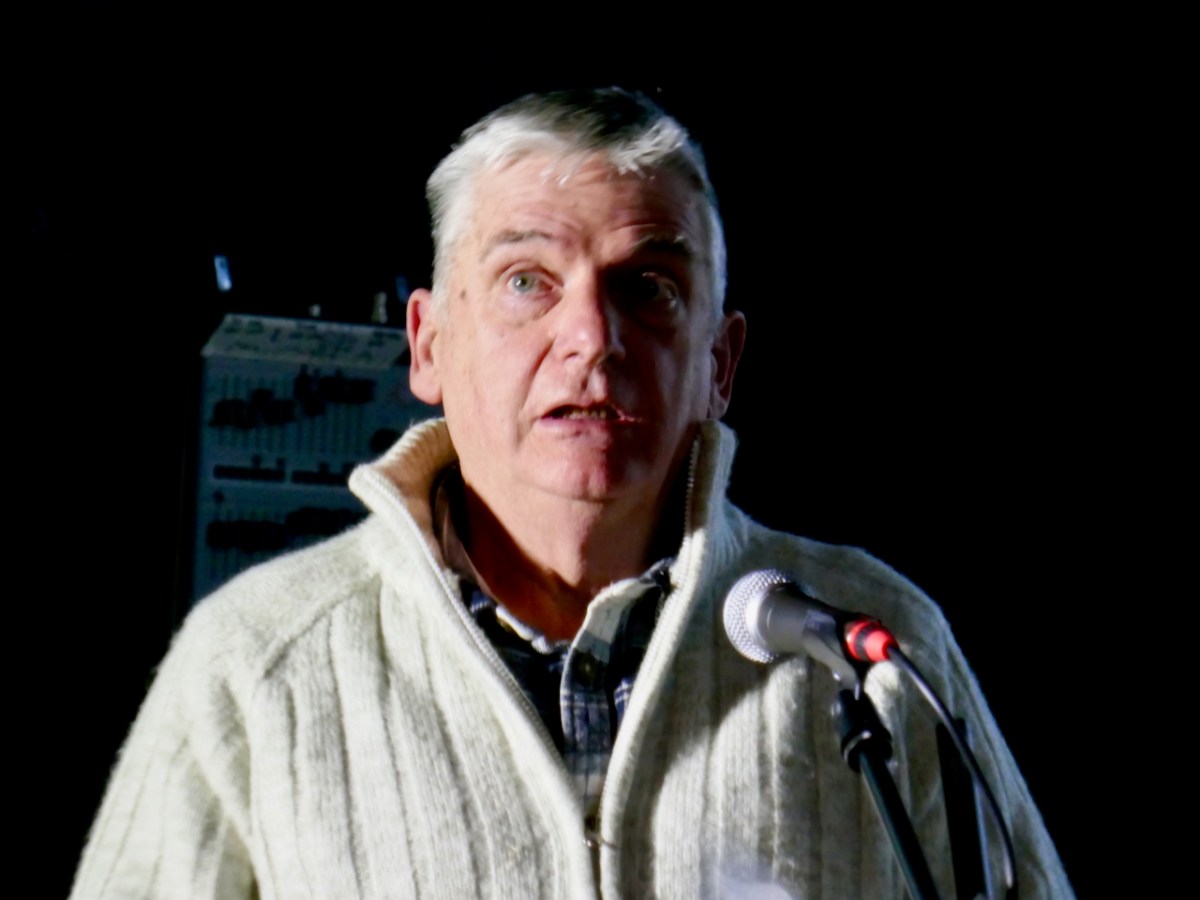
The decoration on the hull of the Camino Currach is based on the depiction of Saint Gobnait in the Harry Clarke window from the Honan Chapel, UCC. The bee image on the right reminds us that Gobnait is the patron saint of bees and beekepers. We enjoyed a comprehensive talk on bees by Peadar Ó Riada – who has first hand experience of the subject:
There were many more dimensions to the day. One of my favourites was when the audience was requested to produce anyone named Gobnait to be photographed with the carved figures. That included the variations of the name: Library Ireland (1923) (Rev Patrick Woulfe) gives these as Gobinet, Gobnet, Gubby, Abigail, Abbey, Abbie, Abina, Deborah, Debbie, and Webbie. Ten candidates stood up to be counted:
Thank you to Finola for providing many of these photos
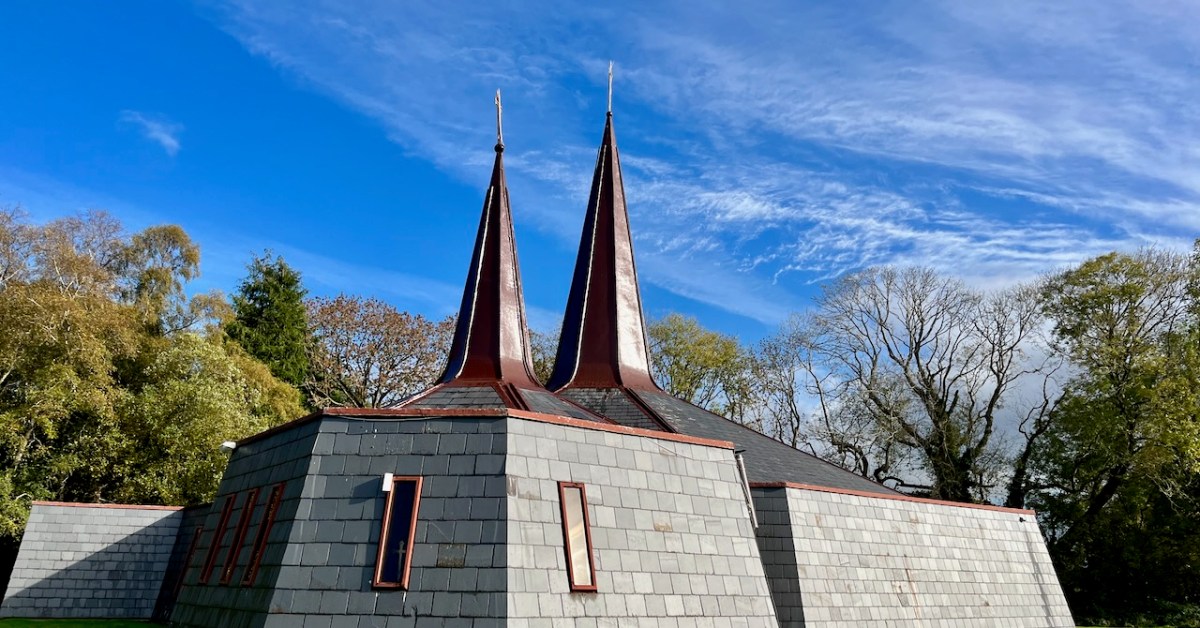
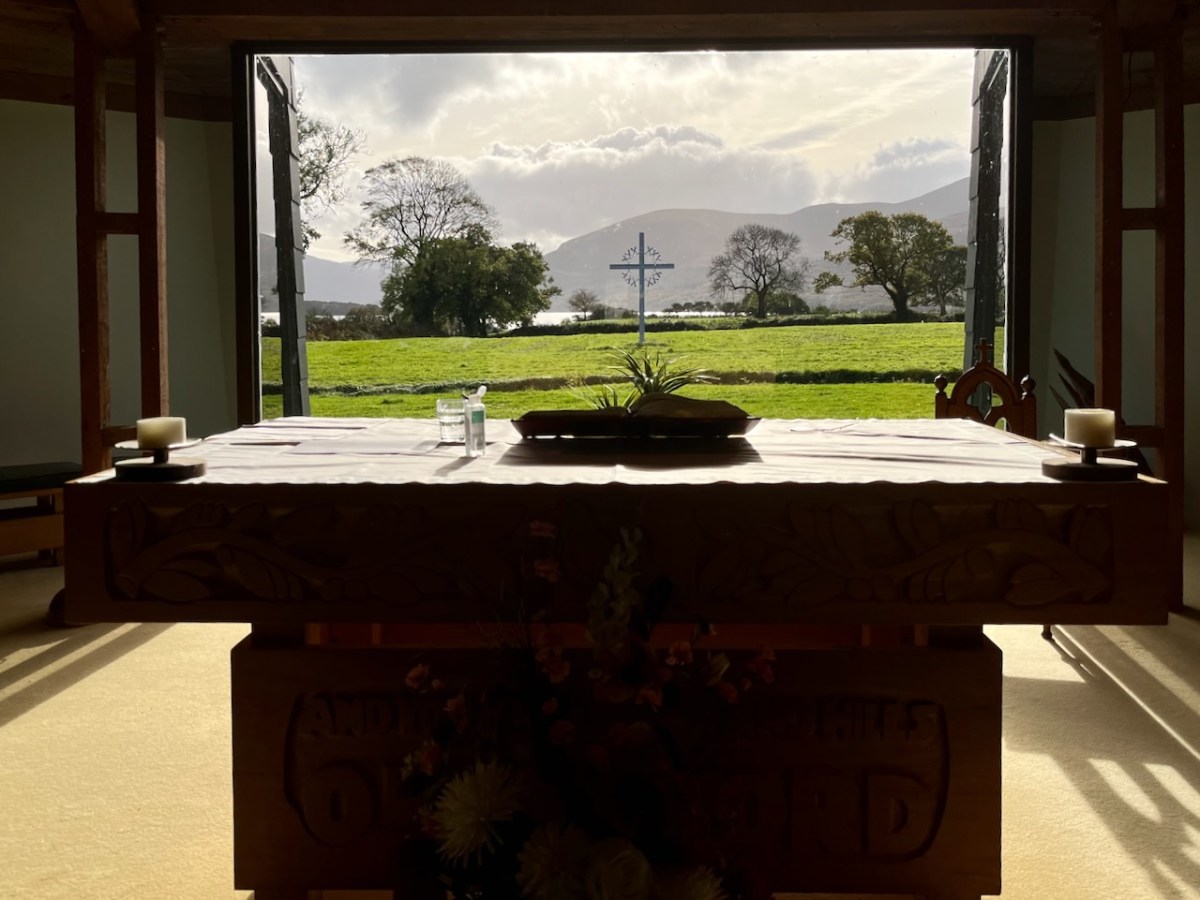
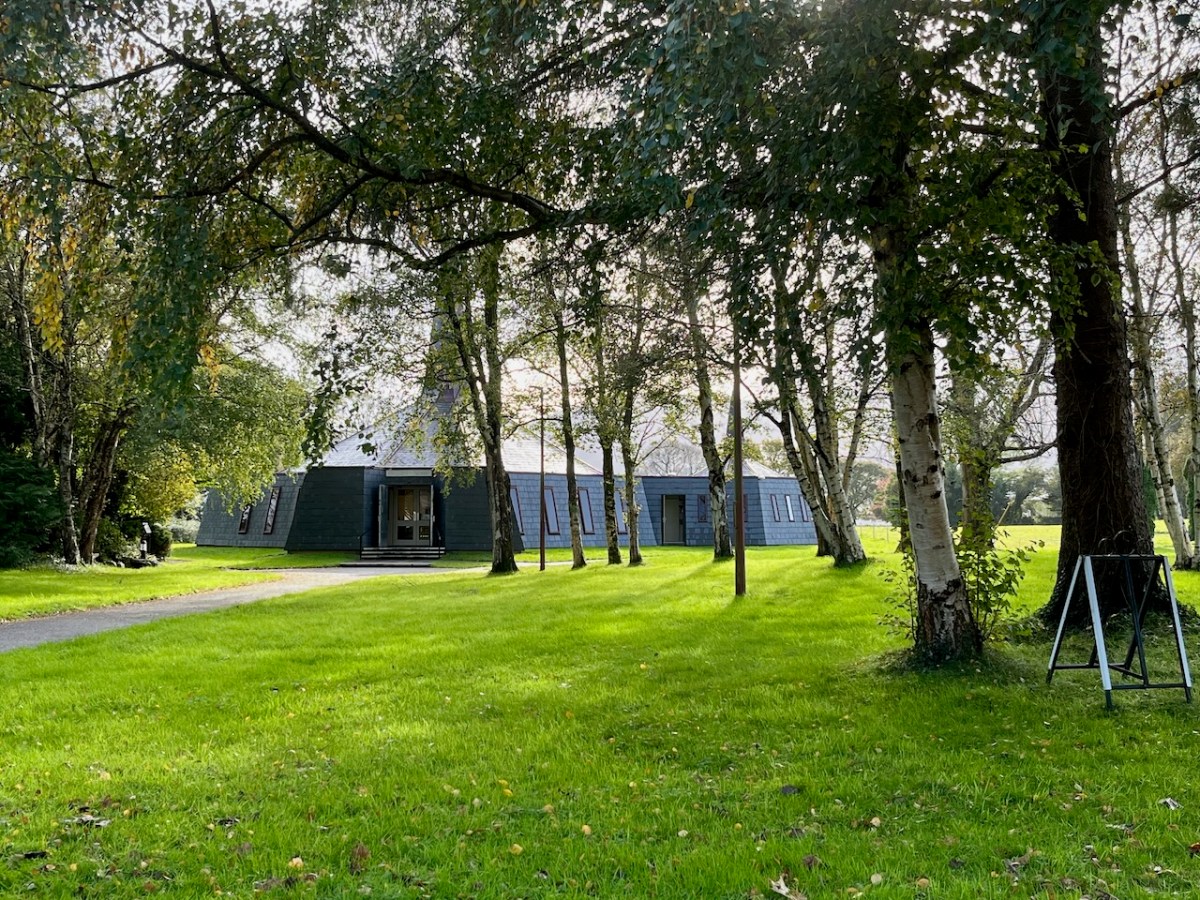
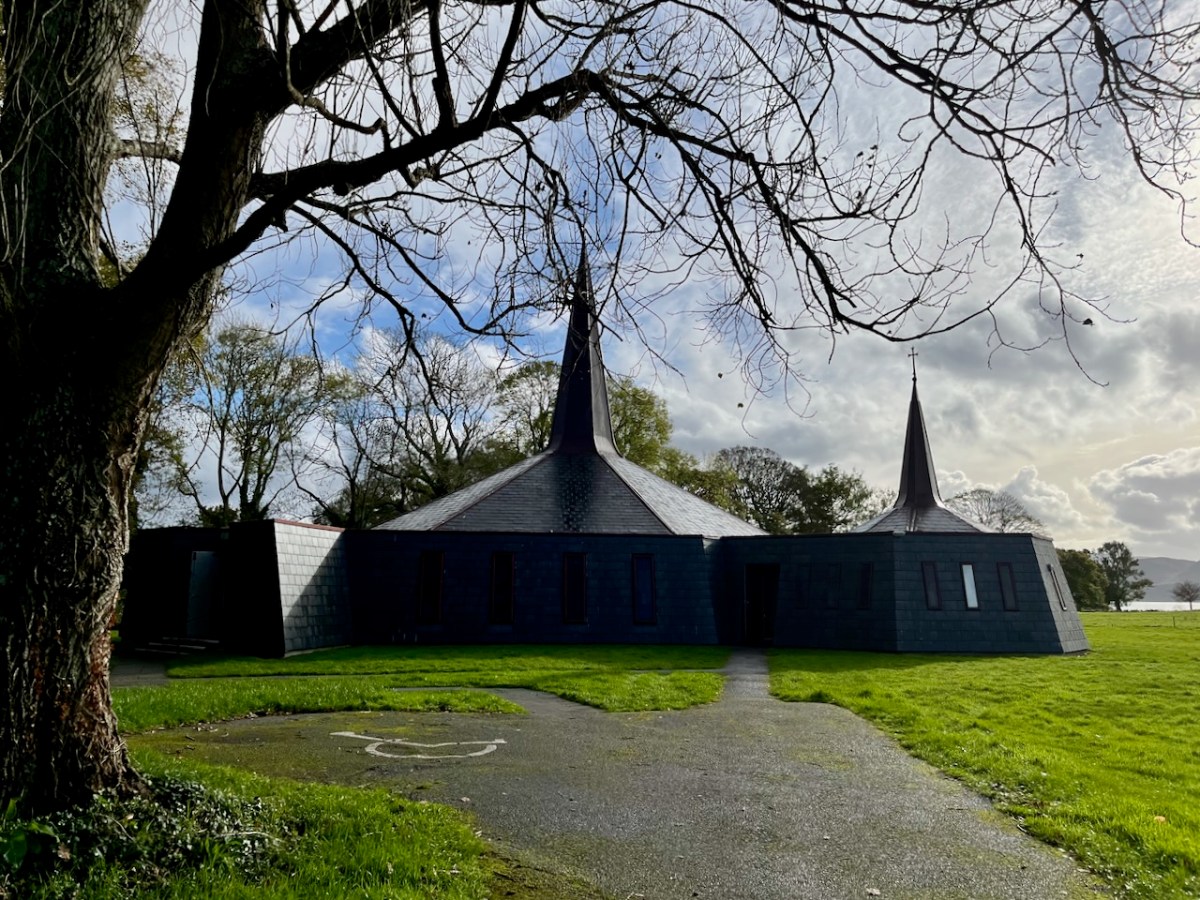
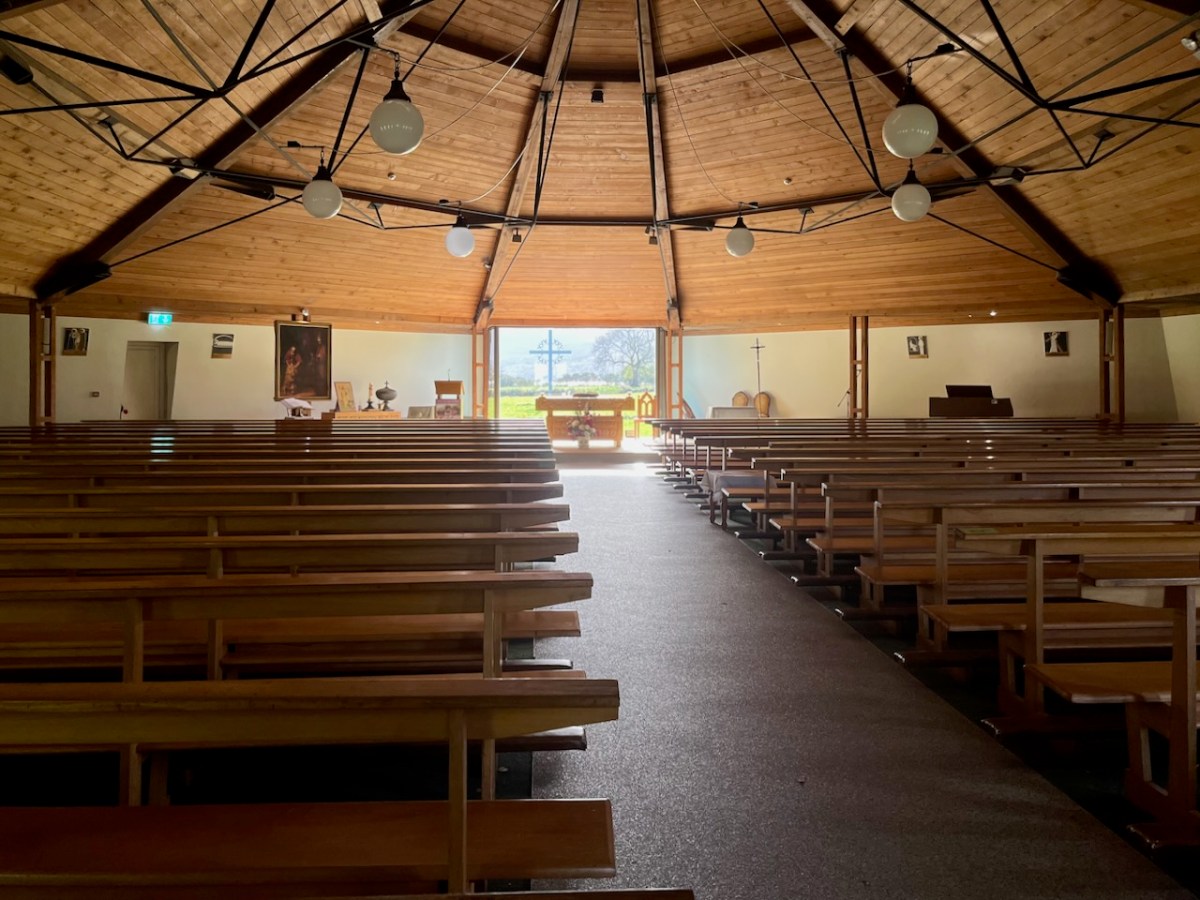
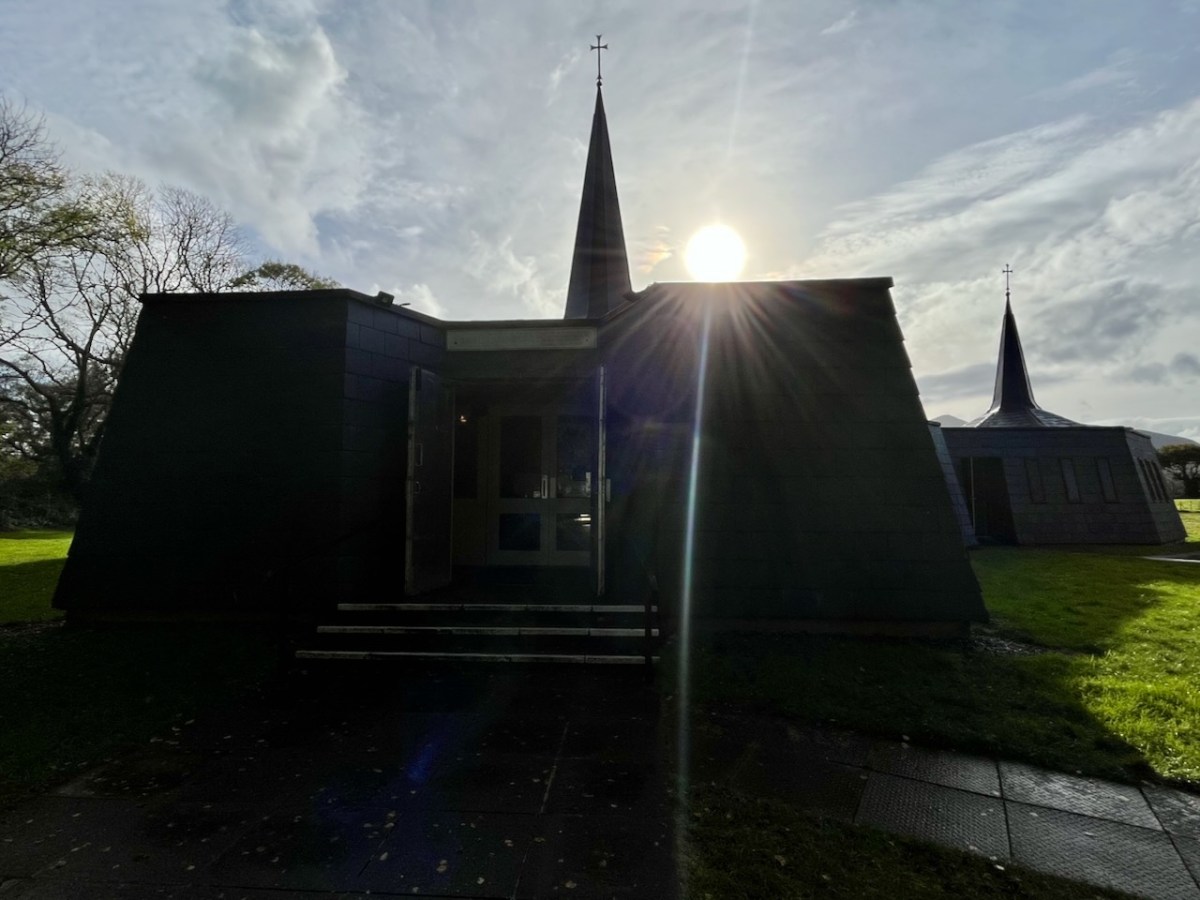
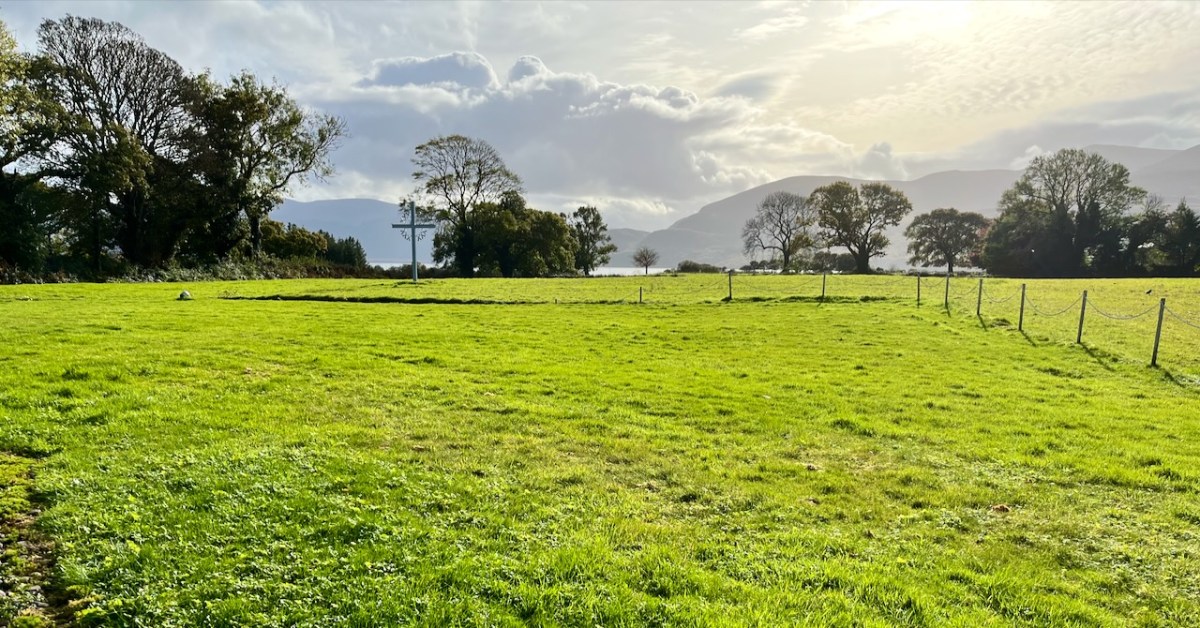
On our travels in Kerry recently, we happened across a striking church building. It’s situated west of Killarney and overlooks Lough Leane: in fact the view of that stretch of water is a principal feature from the interior of the church. An enormous picture window is situated beyond the altar.
I have titled this piece: A Modern Irish Church. Everything is relative, of course: this Fossa Church was completed in 1977, getting on for half a century ago, but one could only fairly describe the style as ‘modern’. It is one of twenty seven ecclesiastical buildings designed by the architectural practices of Liam McCormick (1916-1996). While based in Derry the architects carried out commissions throughout Ireland: the practice of Mullarkey Pedersen Architects, Derry and Dublin, continues their work to this day. My own life experience as an architect – (I carried out a number of church projects) – tempts me to embark on a tour of McCormick’s buildings, many of which are visually dramatic..
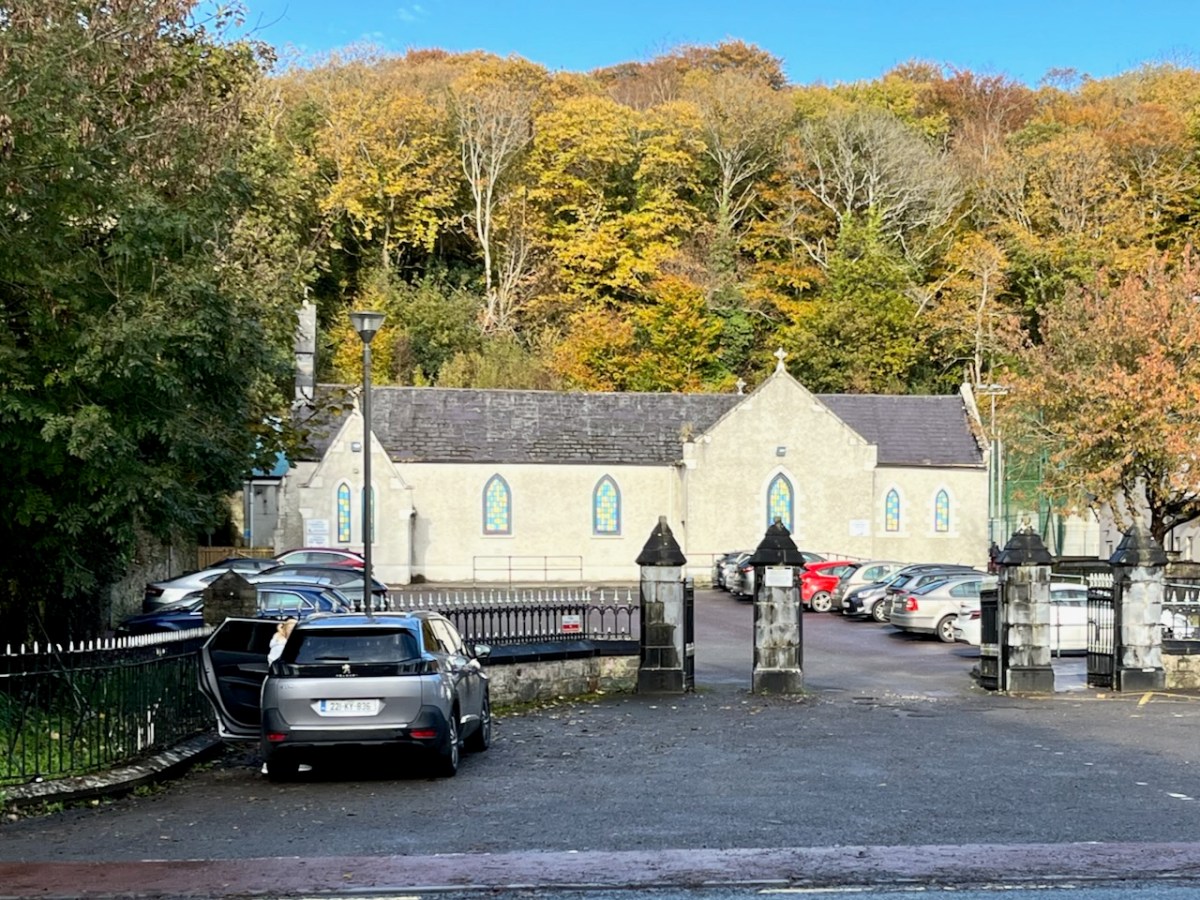
The lakeside church was designed to supersede an earlier building – St Lelia’s – which dated from the 1840s. That building remains and is in communal use (above): it is set back from the present site.
Unusually, there is no contemporary stained glass in this building. Instead, the focal point is the central view. I wonder whether this might be a distraction while the priest is in action? It may be that he would always be in silhouette in daylight: there is no means of subduing the window. The church does contain some distinctive artwork, however.
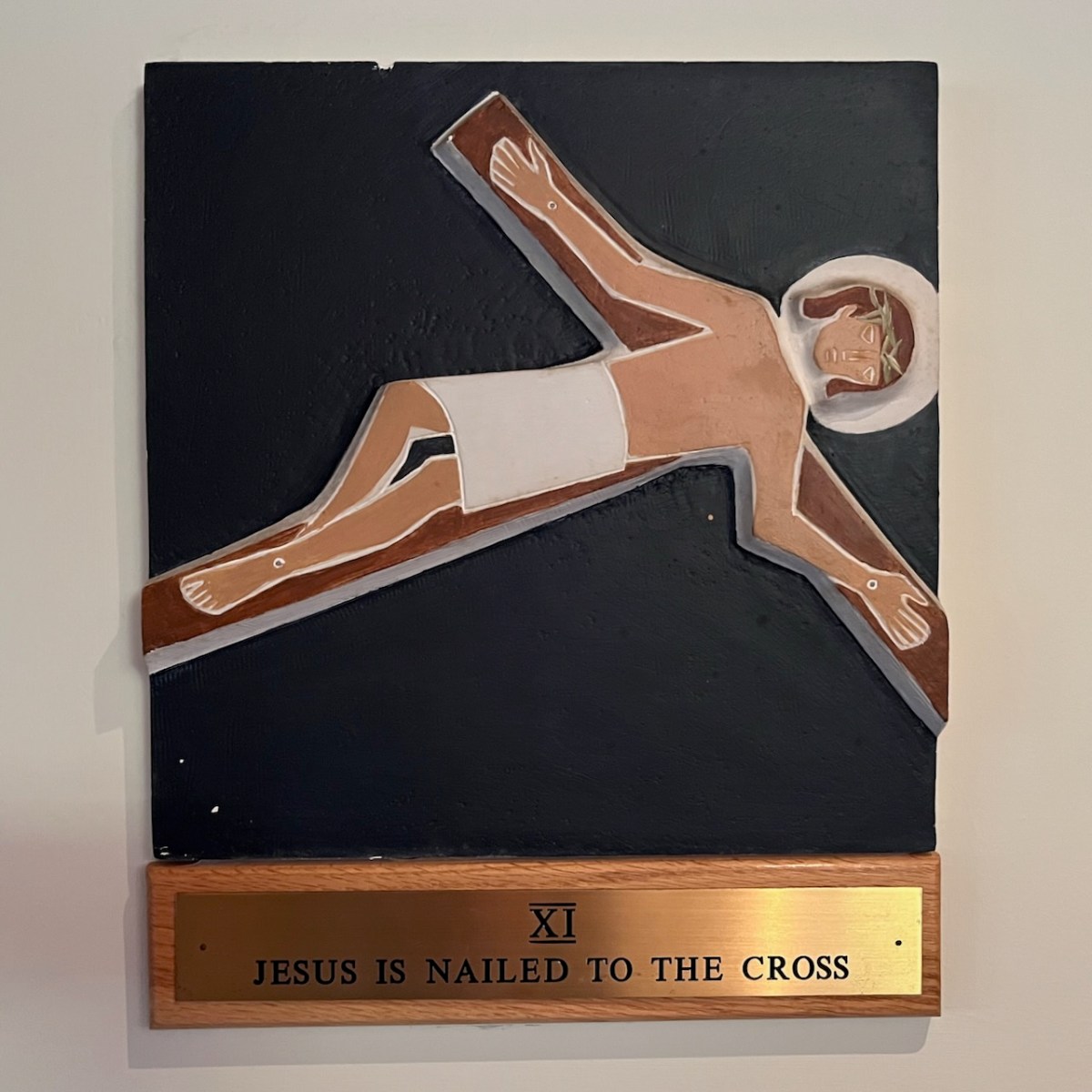
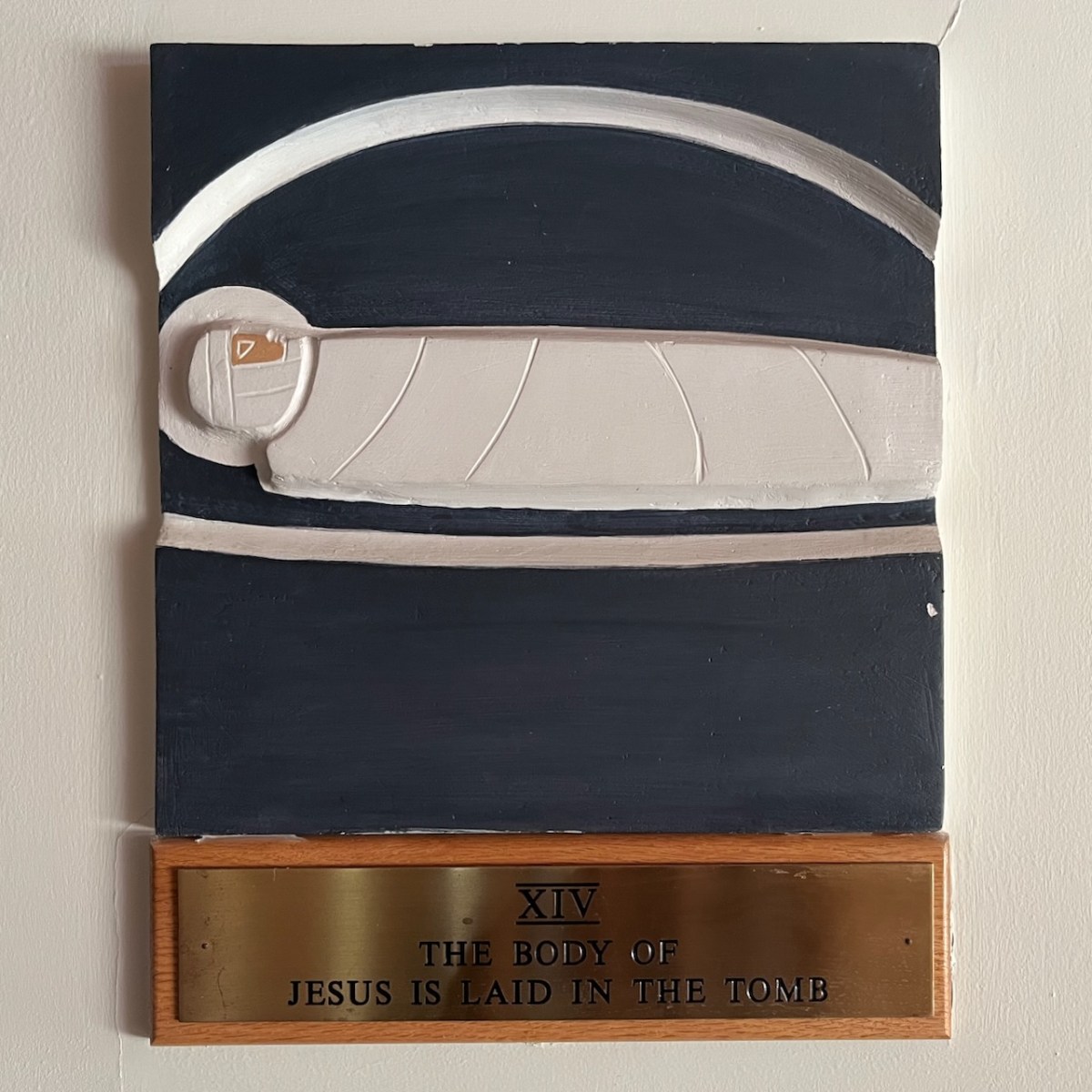
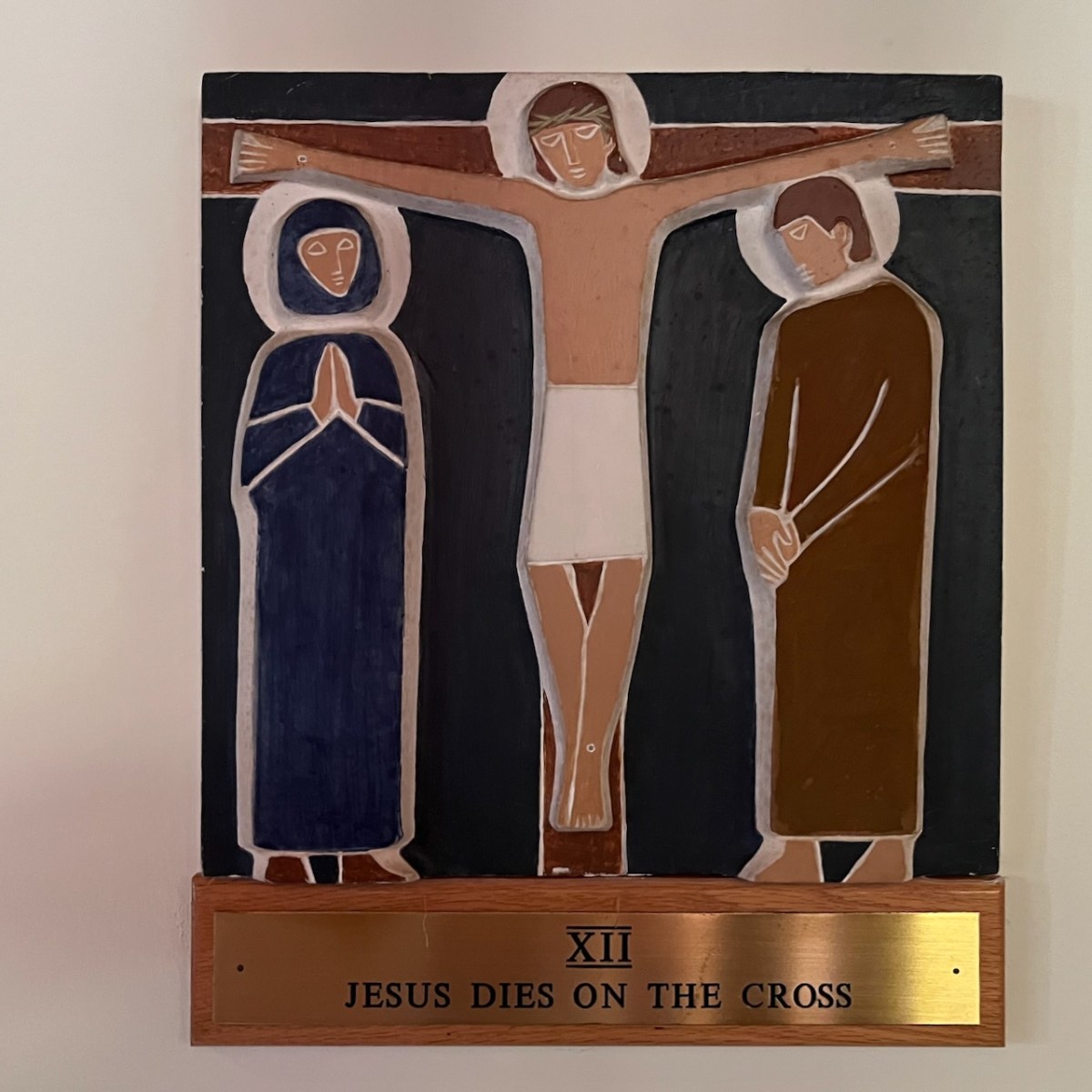
The Stations of the Cross are notable. They are the work of Nell Murphy Pollen (1927-2011). A ceramicist, woodcarver and sculptor, she was a native of New Ross and studied at the Crawford.
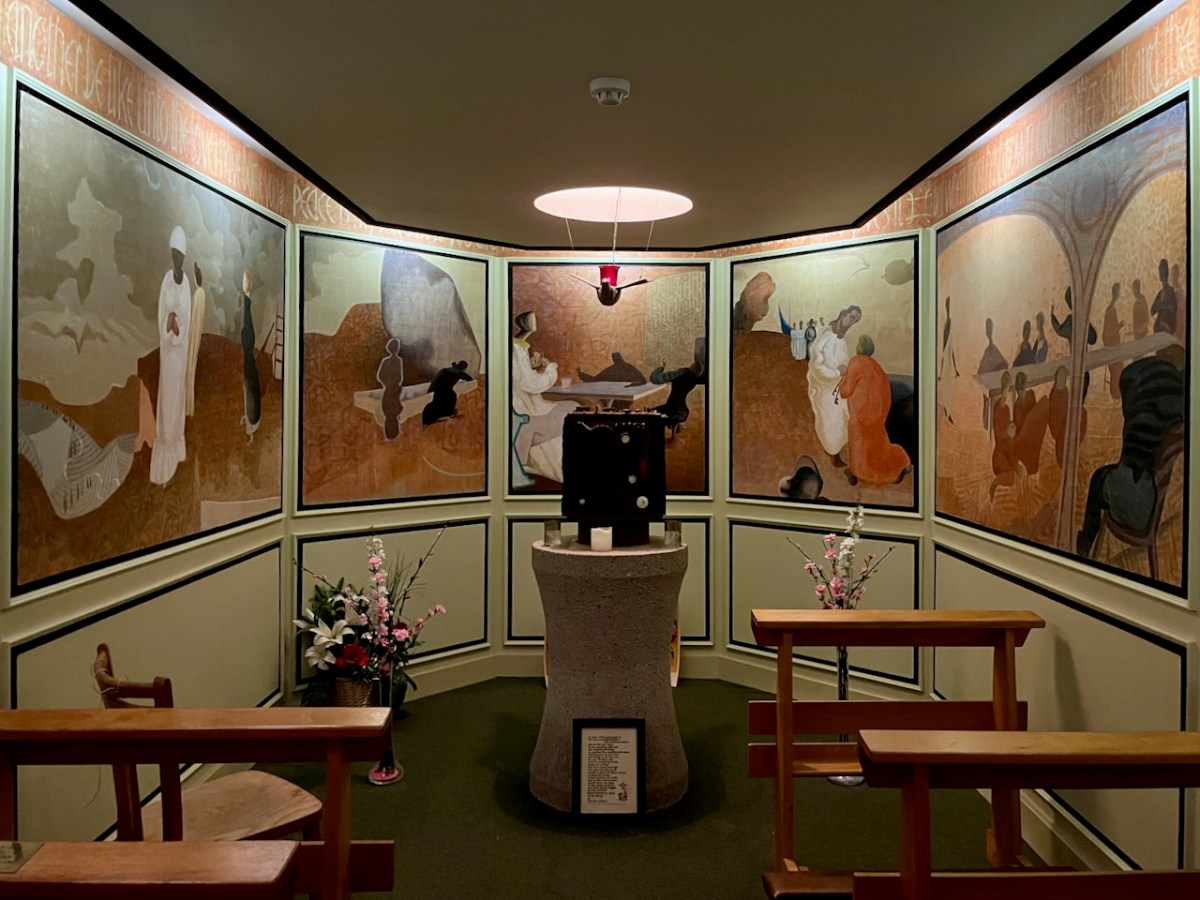
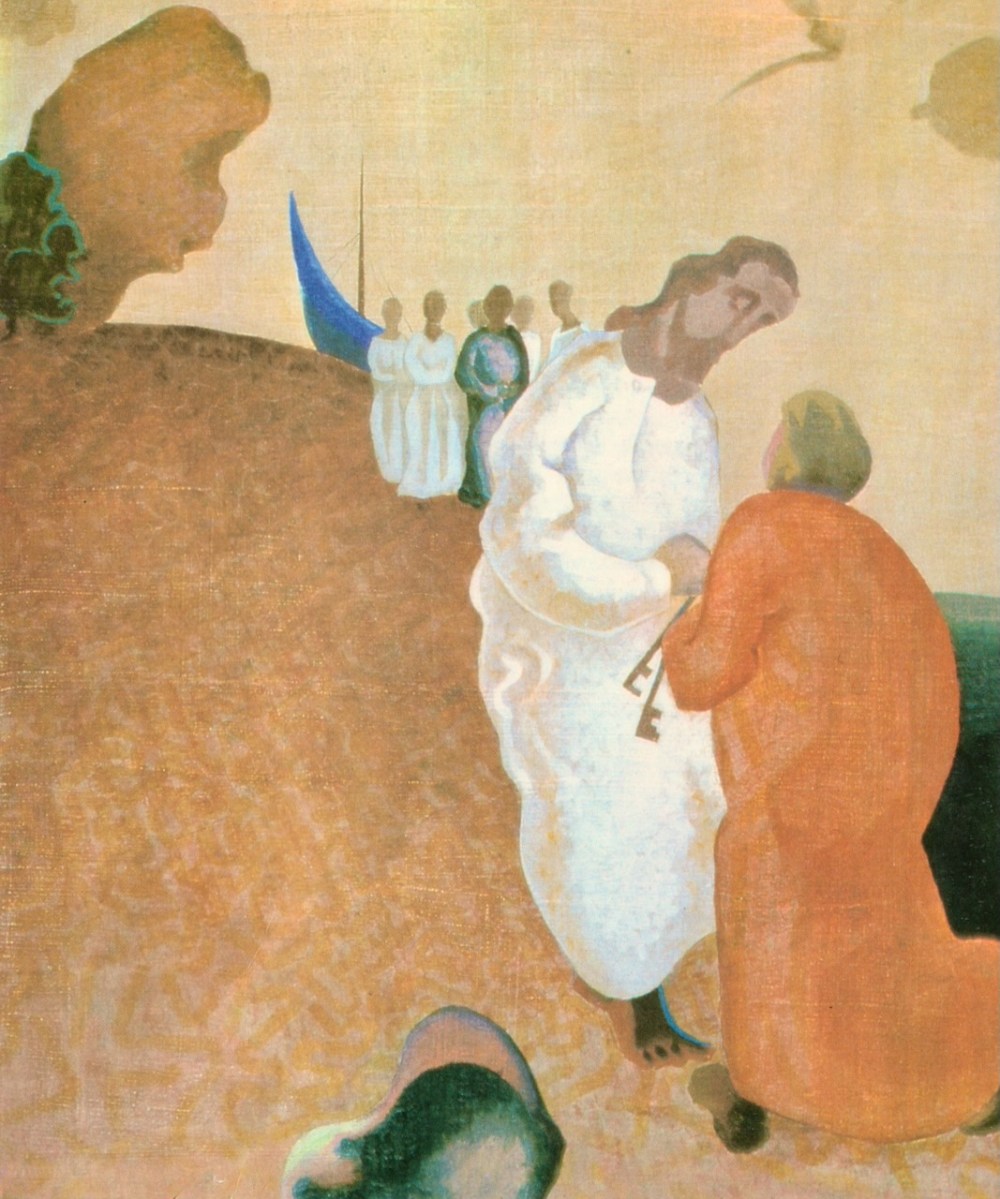
Perhaps one of the most striking aspects of the church at Fossa is the little Blessed Sacrament Chapel: “. . . a chapel of reconciliation dedicated to the Prince of Peace . . .” This (above) is decorated with murals by Patrick Pye (1929-2018). They are produced in a traditional medium which dates from the time of the early Renaissance, tempera on a gesso ground.
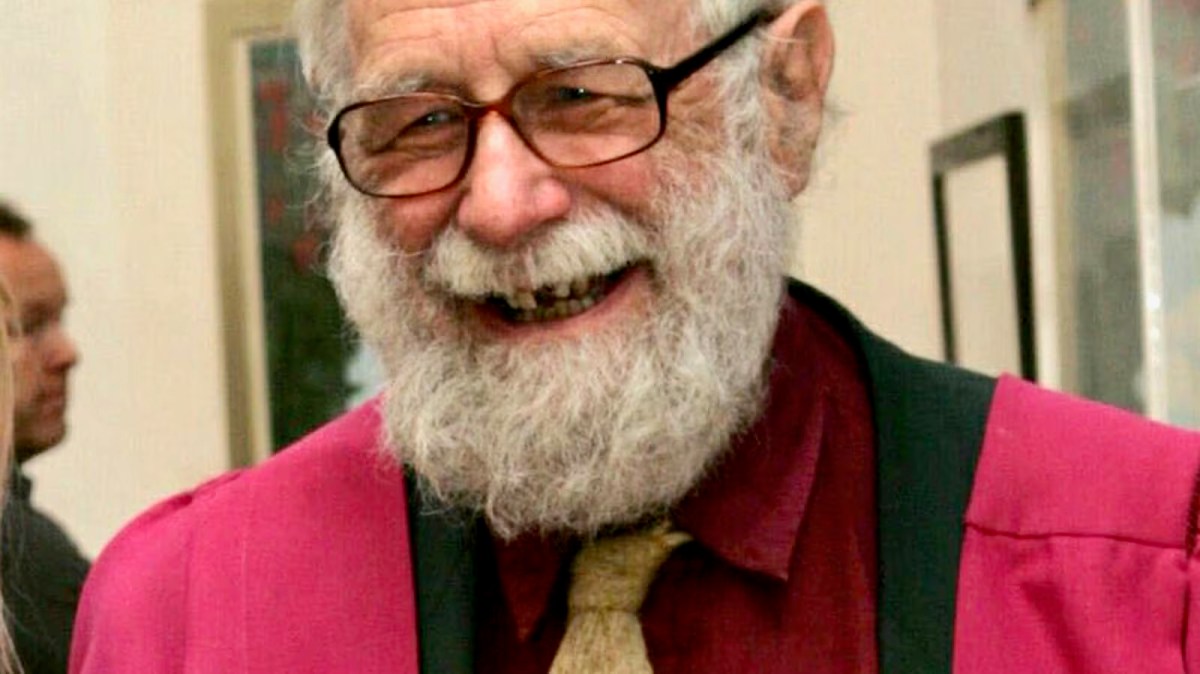
Pye’s tempera/gesso painting Peter receiving The Keys from The Christ – The Blessed Sacrament Chapel, Fossa. Patrick Pye is an artist whose work we have followed, and he will have a post to himself before too long. He was born in Winchester, in Hampshire – a city in which I lived for a while in my younger days, but it is more famous for having been the home and burial place of Saint Swithun, a ninth century Anglo-Saxon Bishop who died in 862 AD – he whose feast day (15 July) traditionally marks either 40 days of fair weather or (more usually) constant rain.
Patrick Pye at the RHA annual exhibition in 2007. Photograph with many thanks to Cyril Byrne.
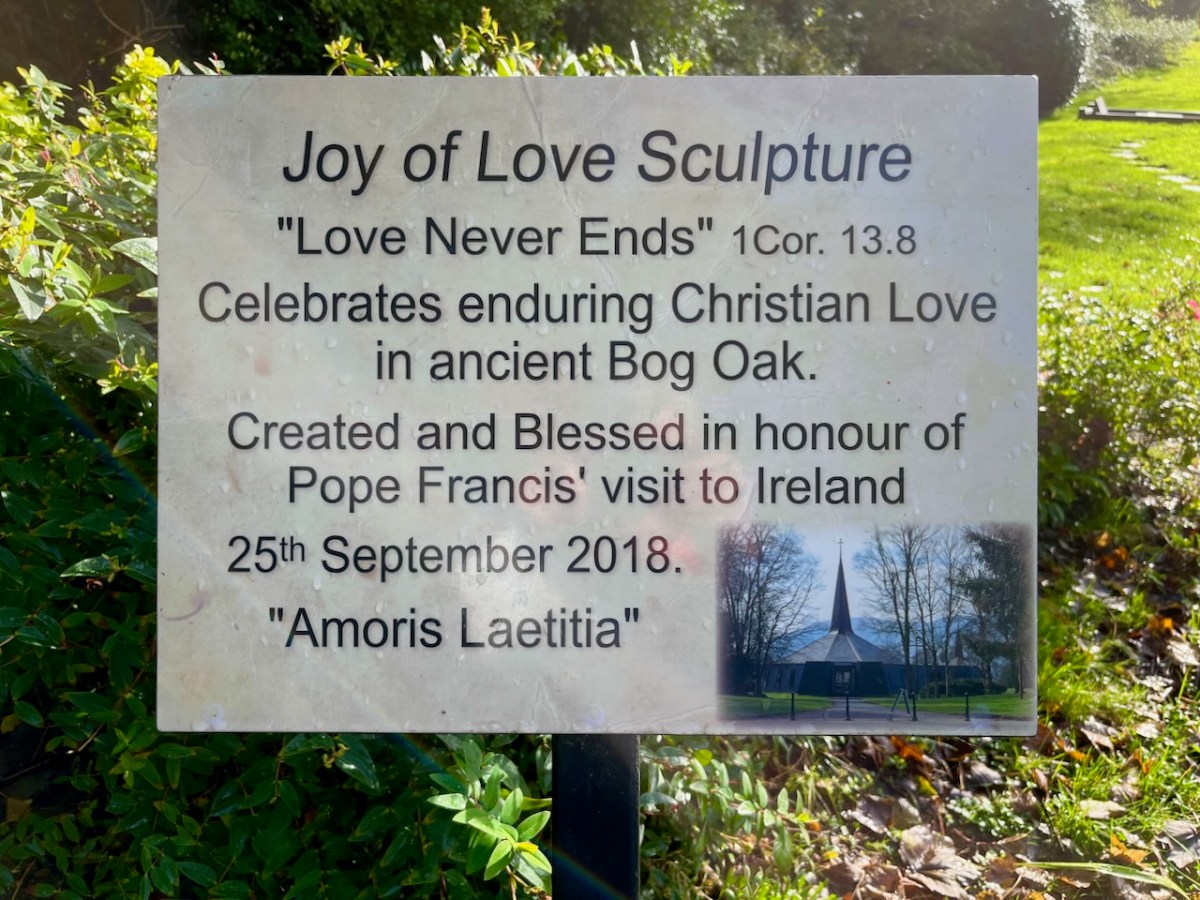
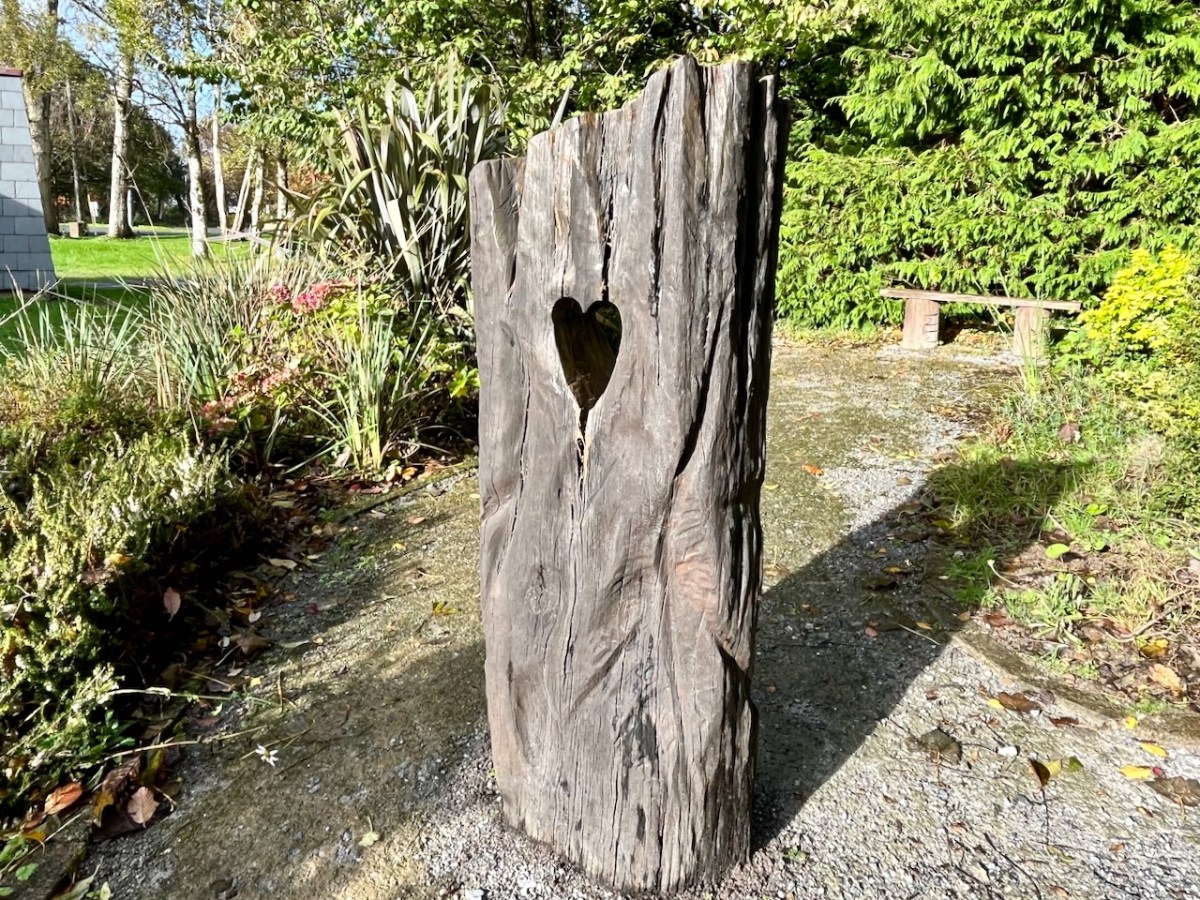
Above: you will find outside the church a bog-oak sculpture, specially commissioned to commemorate the visit of Pope Francis to Ireland. The carved heart at its centre is designed to offer all married couples and sweethearts the traditional Celtic opportunity to touch hands through the opening to commit to each other.
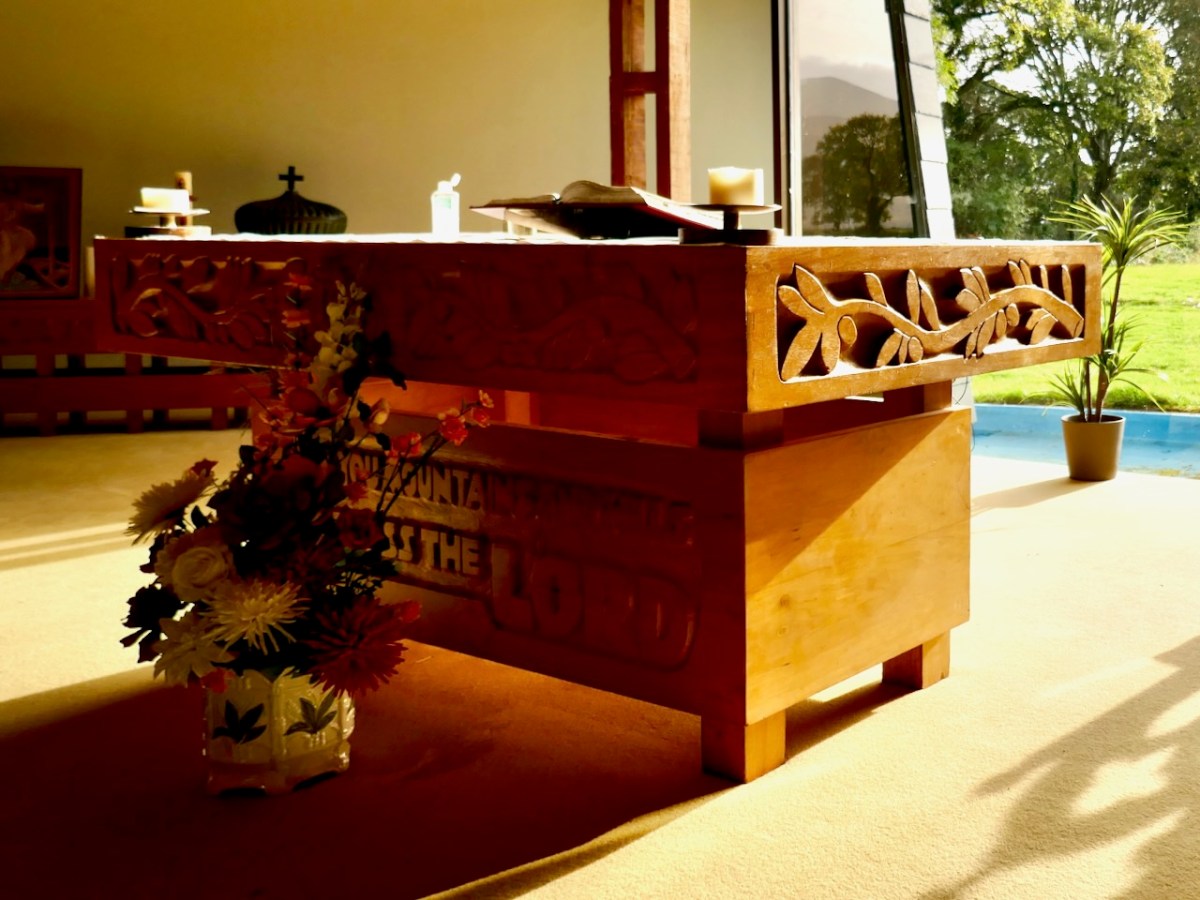
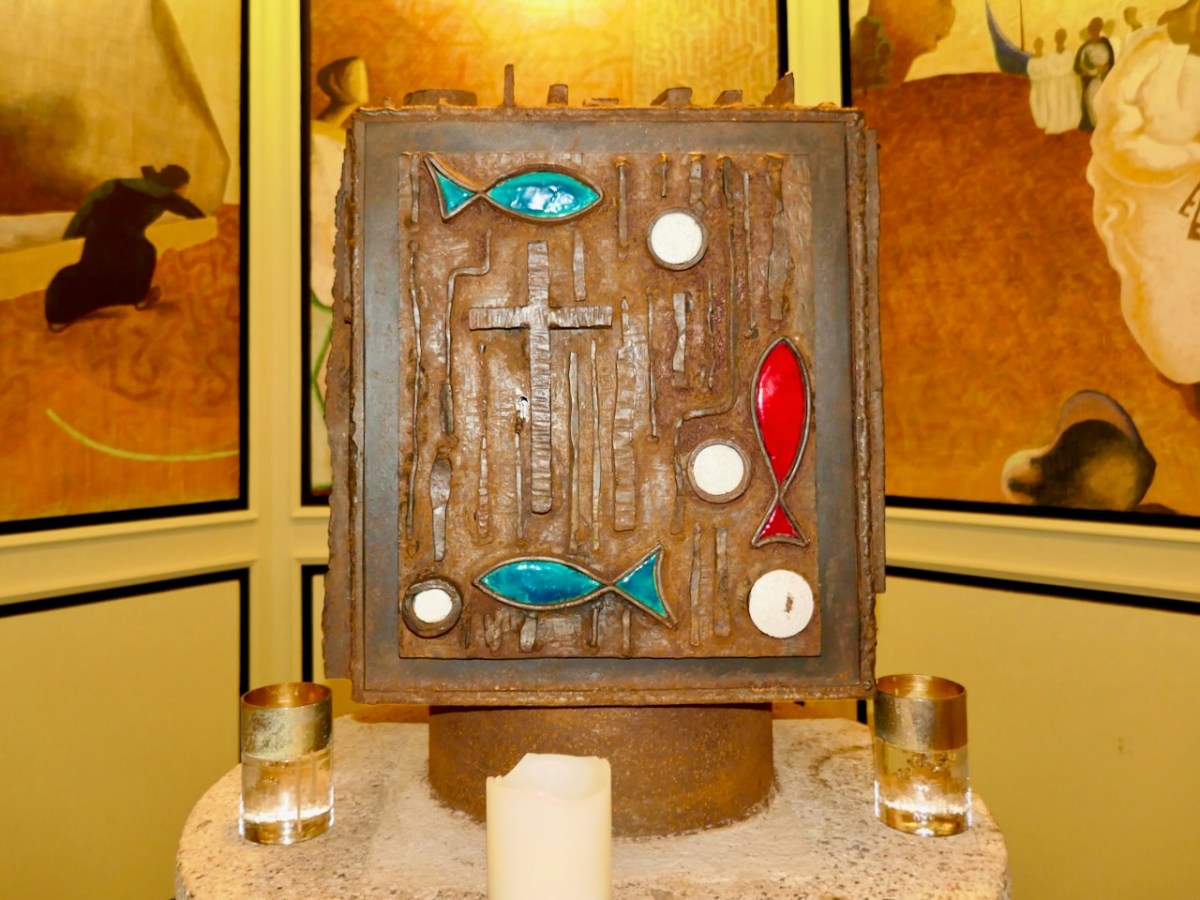
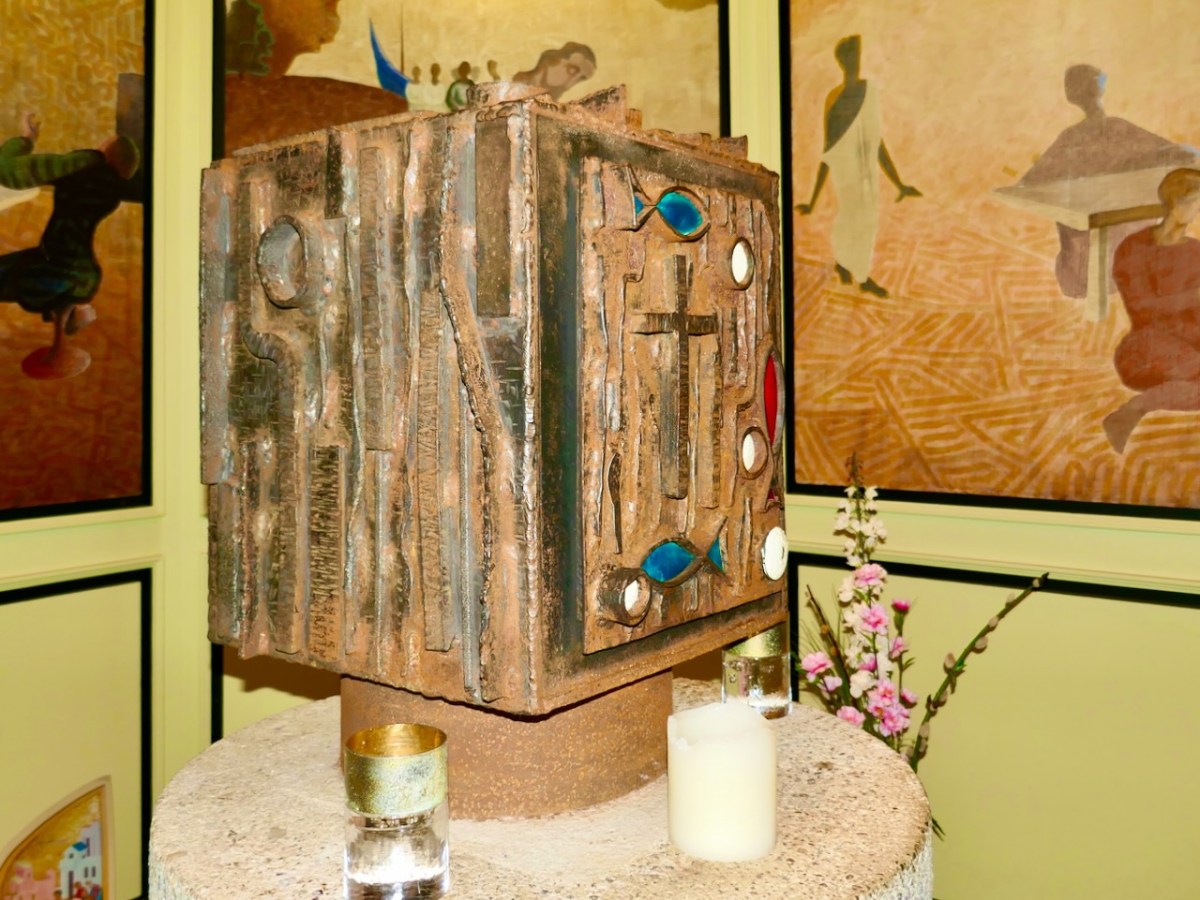
This little Kerry church is very well endowed with high quality artworks, both inside and outside. The carved altar (and a bench, not shown) is by Imogen Stuart (b1927), while (lower and below) is the tabernacle which we believe is by John Behan (b1938) who is also responsible for the cross outside the window. The tabernacle rests on a carved granite plinth by Michael Biggs. All these artists were longtime collaborators of McCormick’s. A brochure has been produced on the church which would give further information on the furnishings, but we have not yet located a copy.
This special church enjoys such a stunning setting with lough and mountains beyond, and is endowed with very fine artworks: it is well worth turning aside for.
The first story concerns Jasmine Allen – she is the charming and erudite Curator of the Stained Glass Museum in Ely, in the UK. At a recent Stained Glass Symposium in Trinity, she showed us how stained glass studios were advertising their artistry and products at exhibitions in the late nineteenth and early twentieth centuries in Britain and Ireland, starting with the Great Exhibition in 1851, but happening at regular intervals after that. The Irish International Exhibition was held in Dublin in 1907. It was inspired by the success of the Cork International Exhibition of 1902 (see Robert’s post about that here) and even copied their thrilling water slide! For a marvellous collection of images from that exhibition, see this Flikr Album from the Church of Ireland. The story of their discovery is also fascinating.
Irish international exhibition from Herbert Park, by National Library of Ireland on The Commons
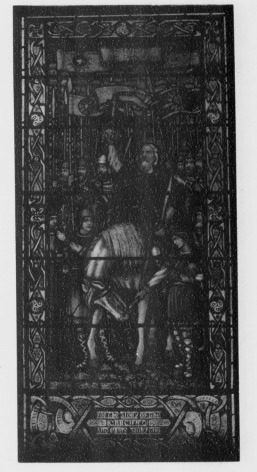
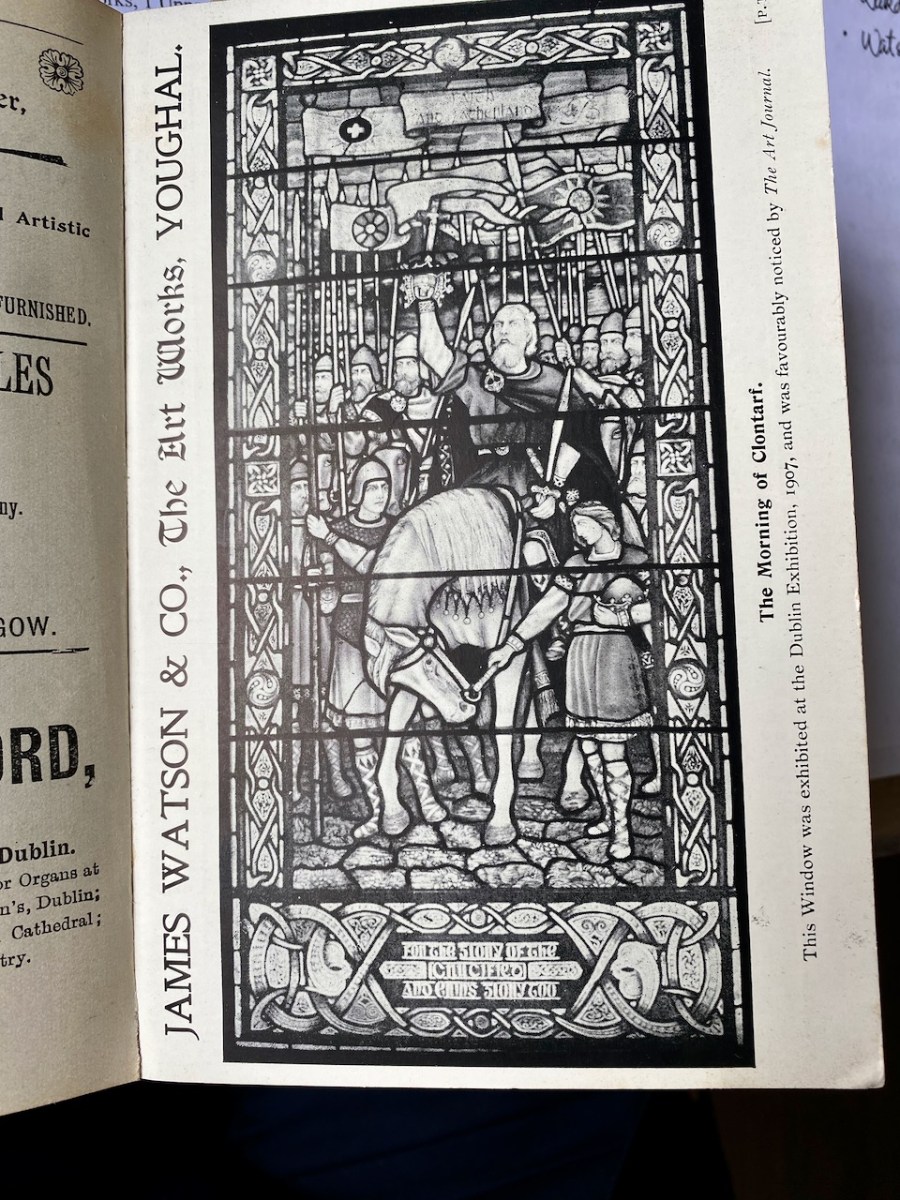
One of the exhibitors was James Watson and Co of Youghal. Jasmine subsequently sent me this image, saying: Catalogues of these exhibitions are all too brief and I would love to know what happened to it. Is it in a church or secular building in Clontarf? I only have a very bad image from the Art Journal (early b+w photography was worse than engraving for capturing stained glass!)
Story 2: Michael
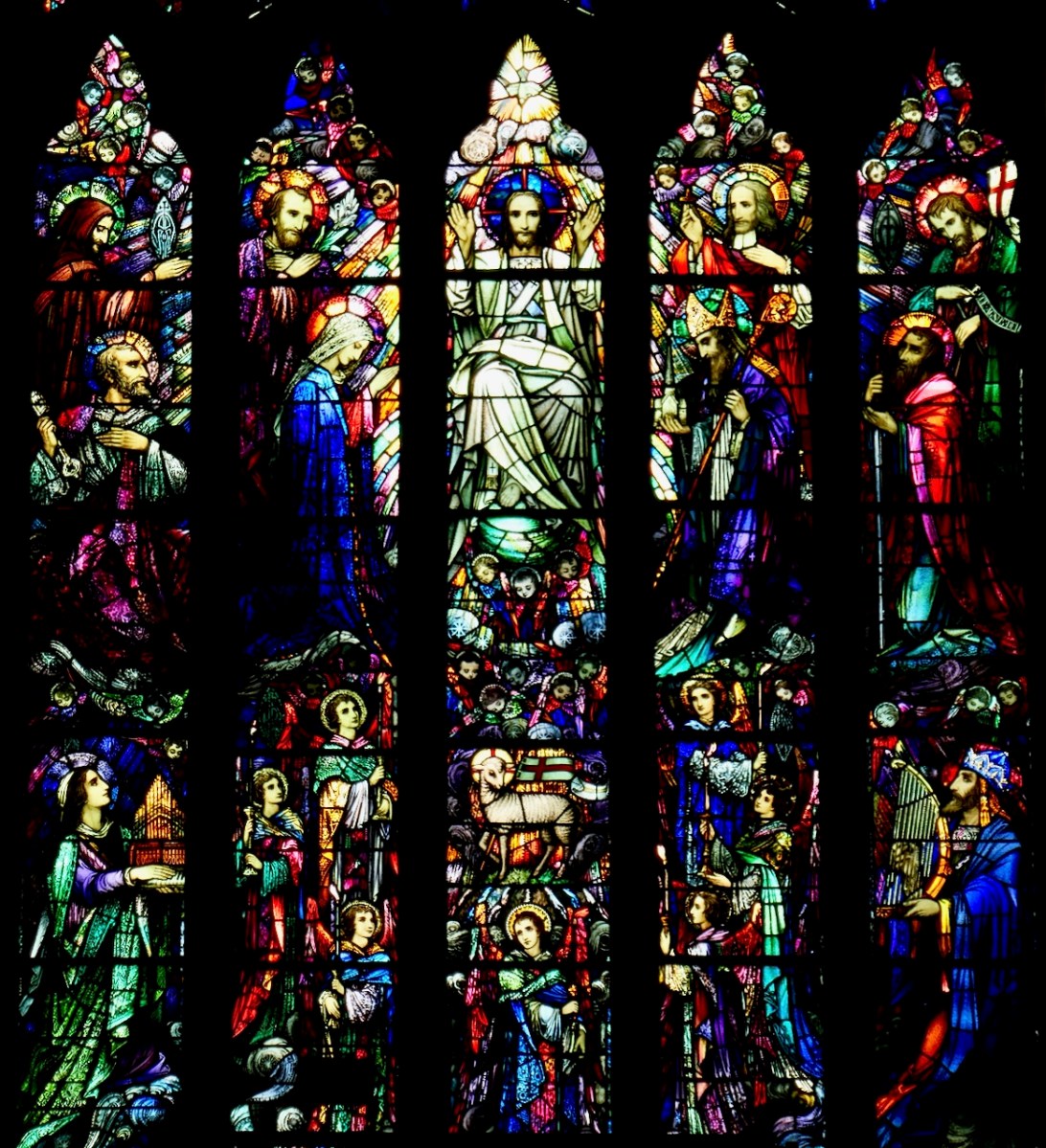
I sent the photo to the group of colleagues, mostly contributors to the Gazetteer of Irish Stained Glass with whom I correspond on a regular basis and who are always helpful, asking if any of them knew the fate of the window. I got several “no idea” responses and then I heard from Michael Earley. Anyone interested in Irish stained glass will be familiar with the name of Earley, and Michael Earley, a great-grandson of the founders, has just completed doctoral studies on the Studios. I’ve featured Earley windows here and there in my blog posts, but here’s an example of their work – you will find it everywhere throughout Ireland, often distinguished by glass of unique and brilliant colour, enormous packed scenes of multiple angels and saints surrounding a central images, and beautifully rendered figures. Here’s one from St Aidan’s Cathedral in Enniscorthy.
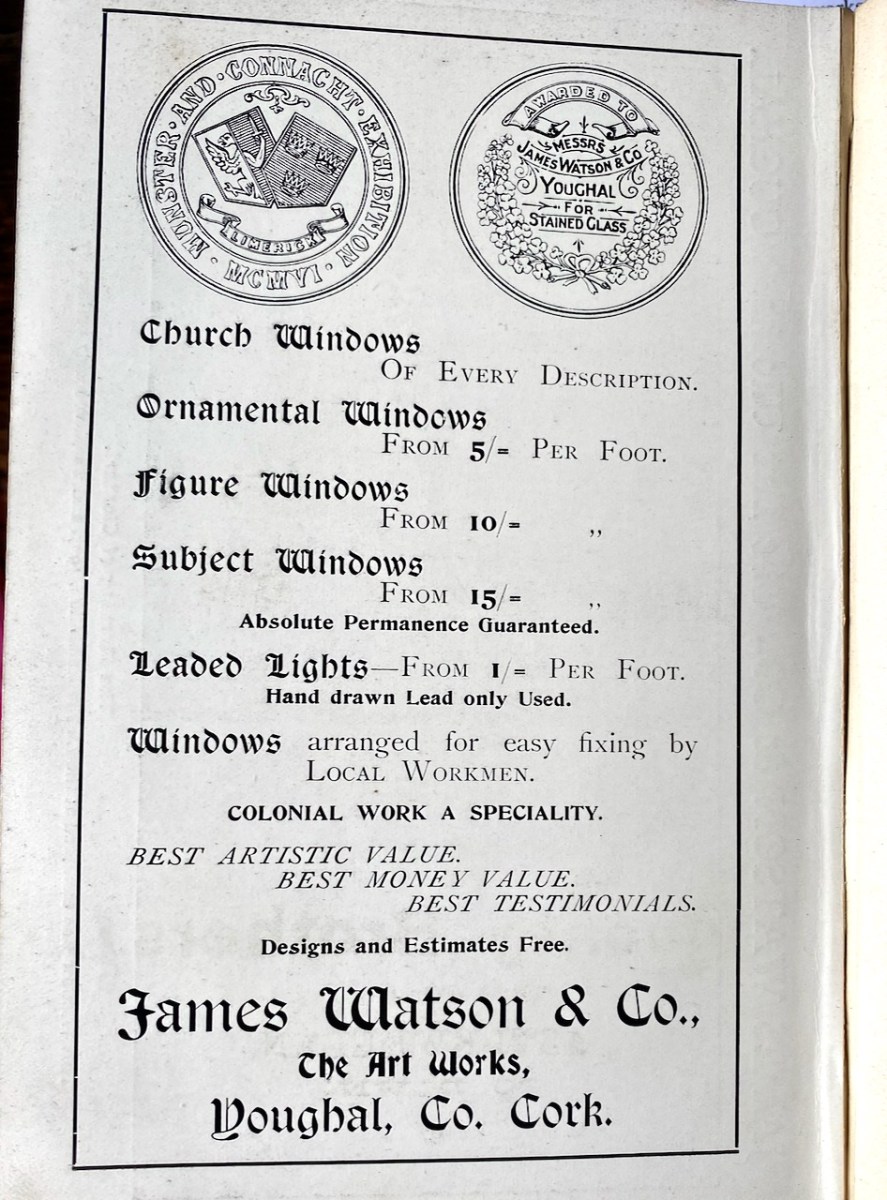
Michael didn’t know what had happened to the window, but he did send me two pages from the Irish Catholic Directory of 1908. The first page was an advertisement for James Watson and Co, The Art Work, Youghal, Co. Cork. Here it is:
Much to savour in this ad – the prices, the variety of windows, “colonial work”. . . The second page, though, hit the jackpot. It was from the same Directory, and was a full scale black-and-white photograph of the window. Titled The Morning of Clontarf, a subtitle reads “This window was exhibited at the Dublin Exhibition, 1907, and was favourably noticed by The Art Journal”.
Now I had an excellent image with which to pursue my inquiries – and I knew exactly who to consult!
Story 3: Vera
The art historian who knows more than anyone else about Watson of Youghal is Vera Ryan. In fact, it was Vera who curated the Crawford Gallery 2015 exhibition of the Watson Archive, when the Crawford acquired the Archive. She also wrote the piece on Watsons: Divine Light: A Century of Stained Glass, in the Summer 2015 edition of the Irish Arts Review. A couple of years ago, when I was trying to find information on a Watson window which was the centrepiece of an article I was writing for the Clonakilty Historical and Archaeological Journal (now published and available here), Vera mentored me as I tried to dig my way through the archive. We have been exchanging information ever since.
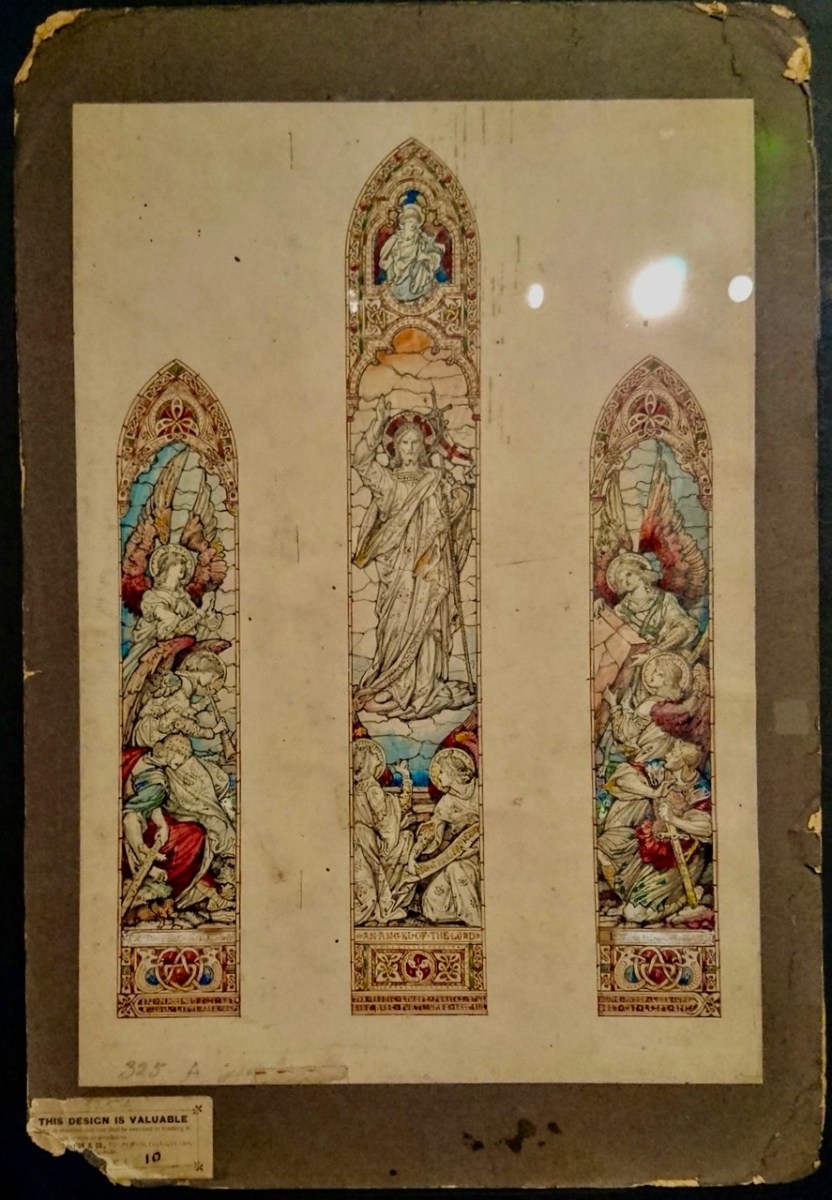
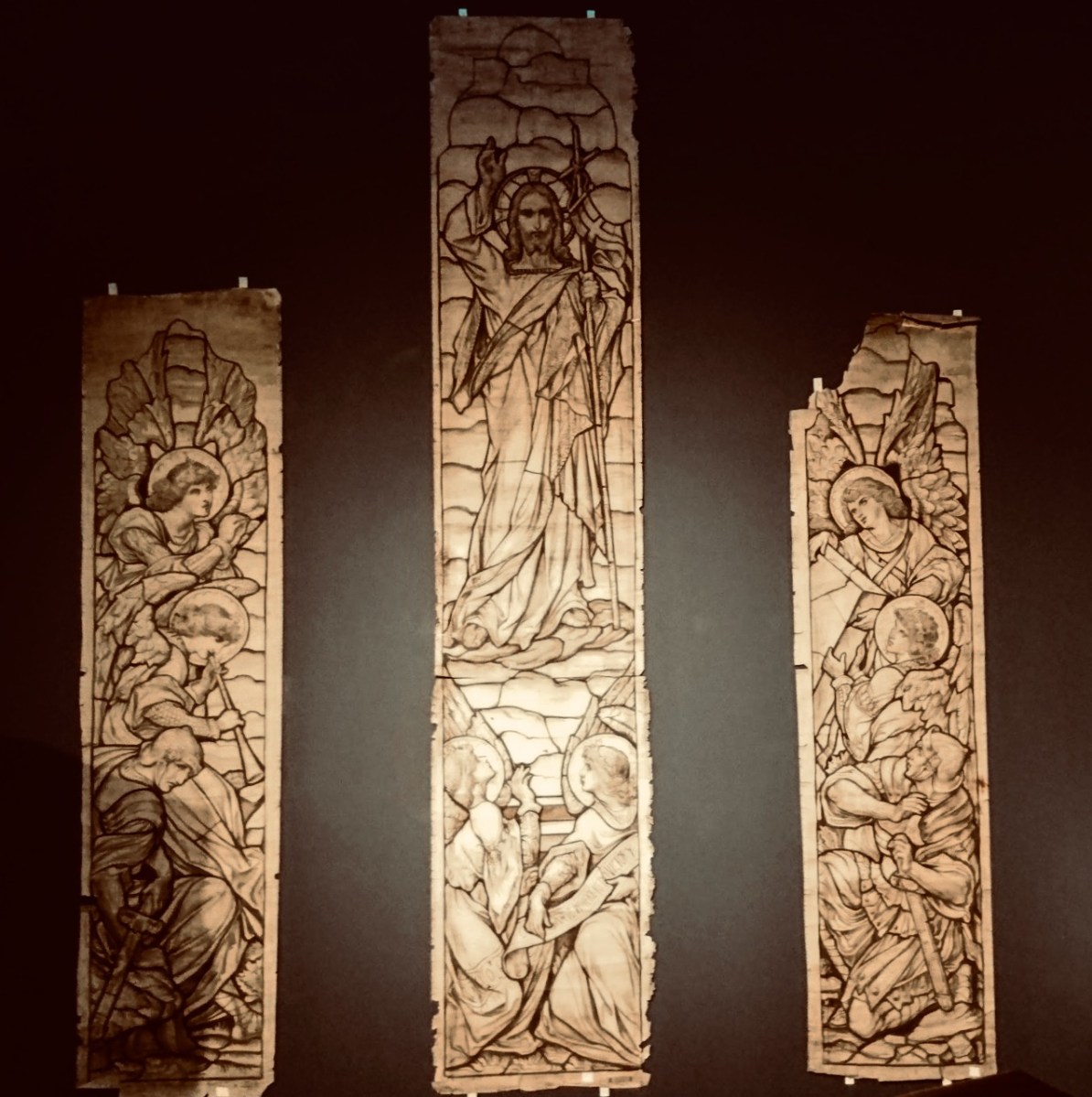
Above is a window in St Michael’s Church, Tipperary, erected in 1914. The design (below) and cartoon (below below) for this window were still in the Watson Archive and were displayed in the Crawford Exhibition. This represents a special opportunity to see the evolution of a stained glass window from concept to completion.
This opportunity is relatively rare in stained glass studies – there aren’t many collections like this, so it is wonderful that the Crawford rescued the archive, which has now been passed on for expert conservation, to the National Gallery of Ireland.
When I contacted Vera, she remembered the Brian Boru window well, and told me that the cartoon was part of what came to the archive, although in a very fragile state. The window, itself, she thought, was still extant, and possibly in Knappogue Castle. The important person to talk to, she said, was Antony Watson, great-grandson of James Watson and the executor of the Watson Estate. Before I did that, I tried some detective work of my own.
Story 4: Jody
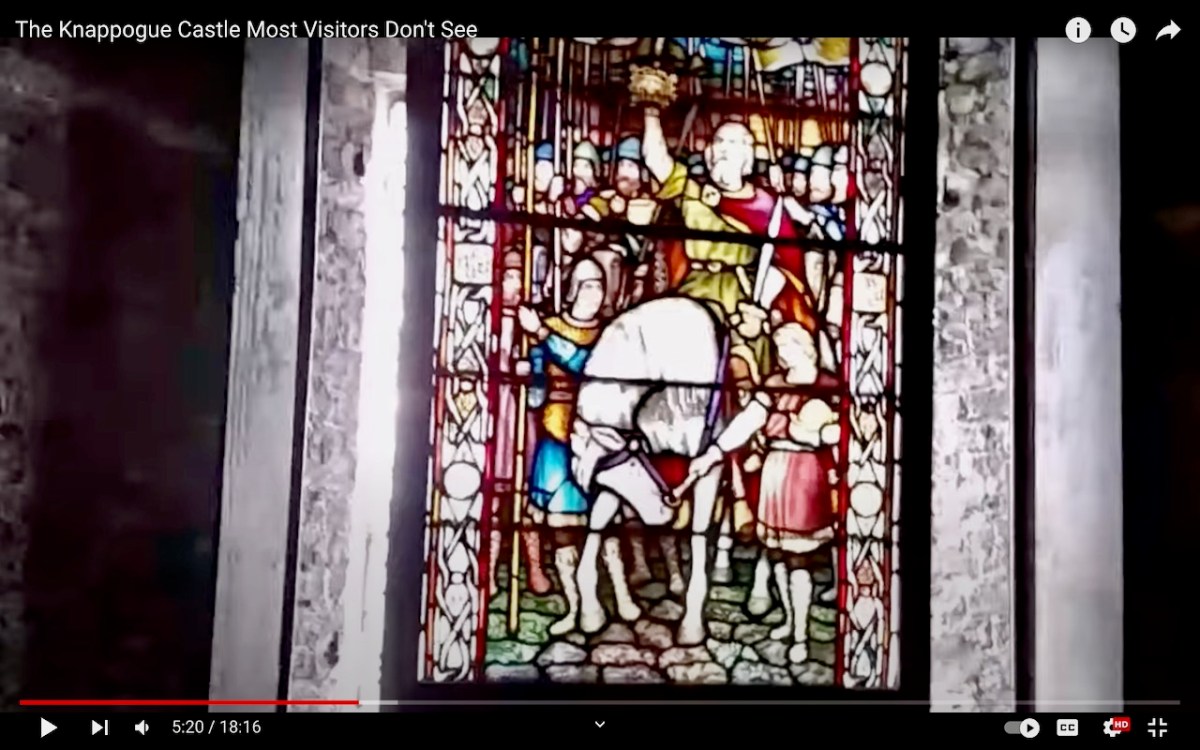
I don’t know Jody Halstead, but in 2016 she stayed at Knappogue Castle and posted a video to YouTube, titled The Knappogue Castle Most Visitors Don’t See. At about the 5 minute mark she arrives at a landing and as her camera roams around, it captures a stained glass window – and there it was! Here’s a screenshot from the video.
Because of Jody, now I had proof that the window was still in existence. The next challenge was how to get a good photograph of it. Once again, thanks to the glorious (and relatively small) world of Irish stained glass scholars and enthusiasts, I knew who to turn to.
Story 5: John
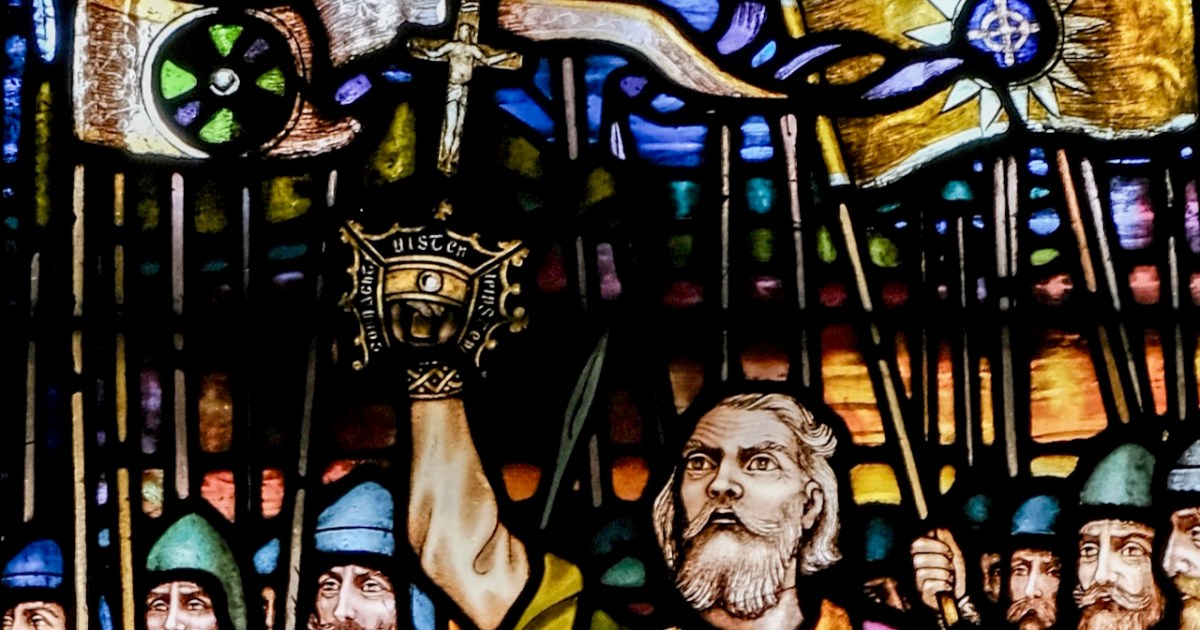
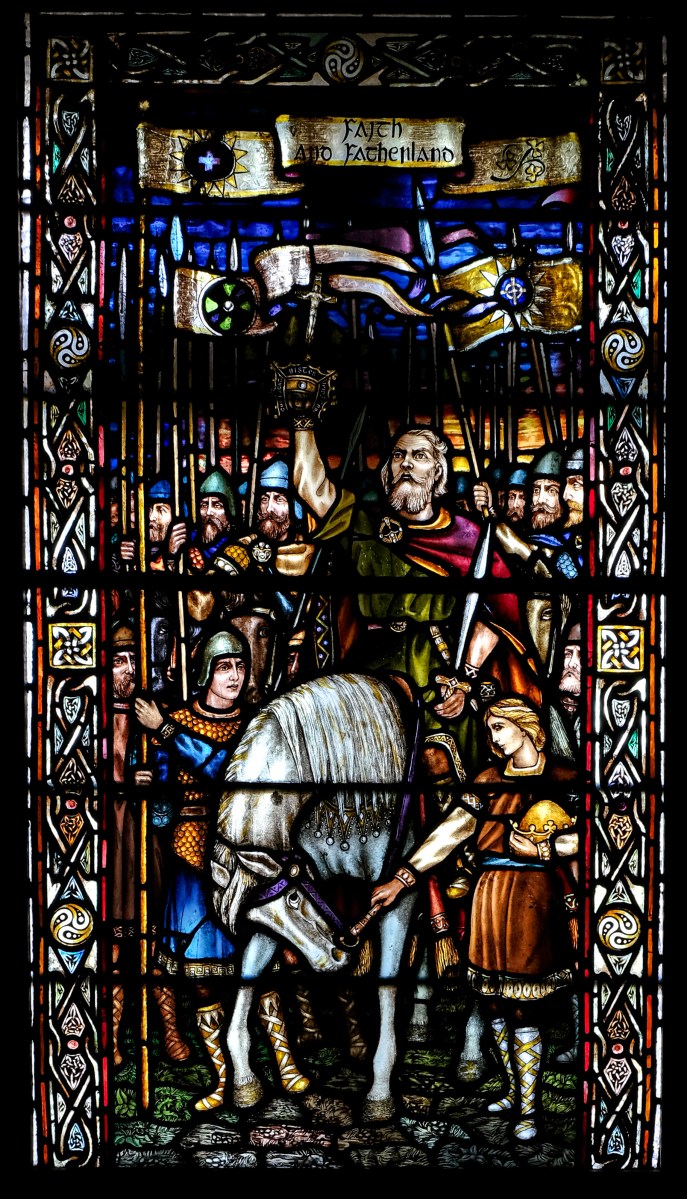
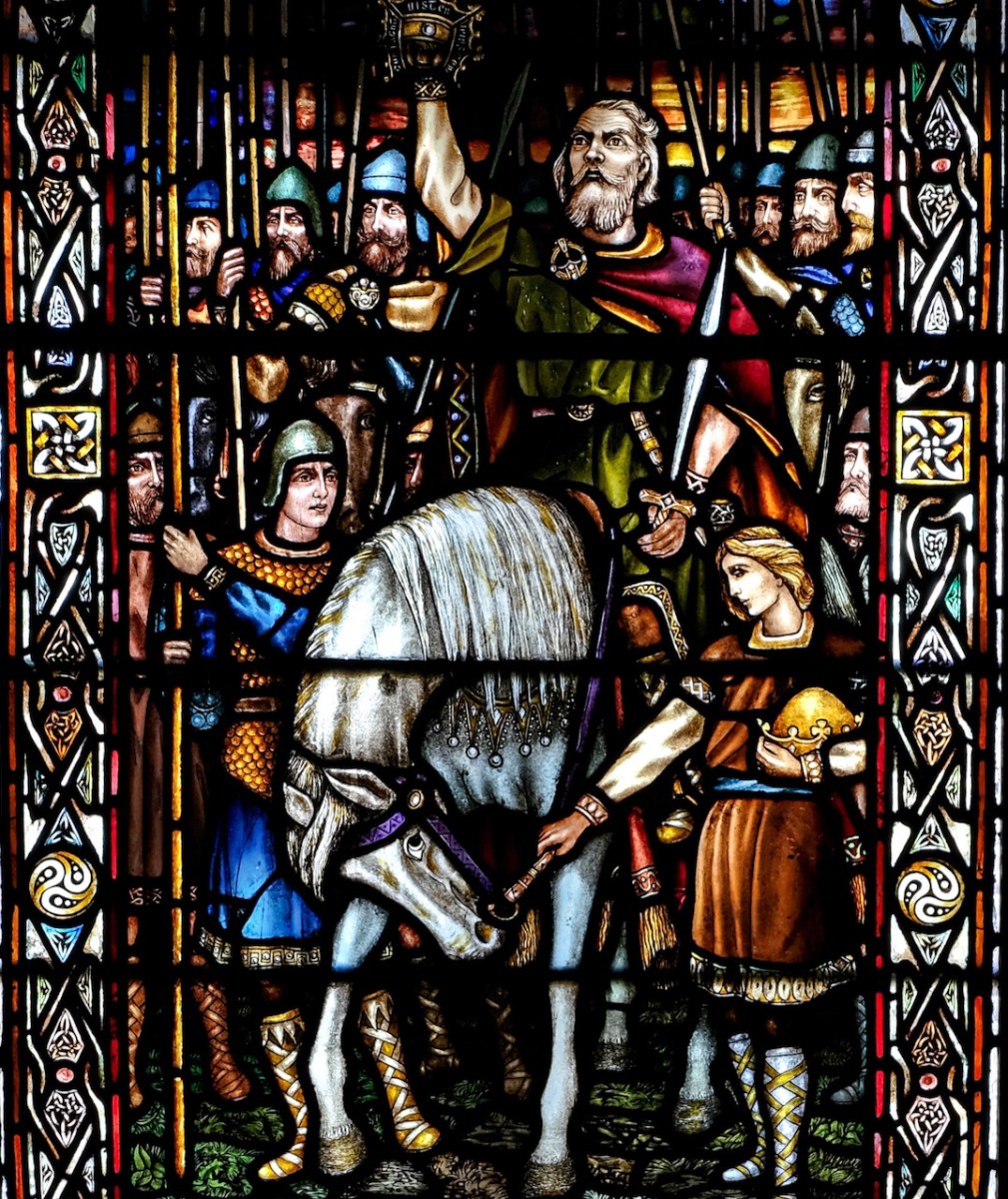
John Glynn is an outstanding photographer with an interest in stained glass. His was the excellent image from Kilrush I used in my post on Brigid: A Bishop In All But Name, and he lives in West Clare, about an hour by car from Quinn, where Knappogue Castle is located. I thought he might already have taken a photograph of the window – he hadn’t but promised to do so as soon as he could. To my great delight, he did it right away. Here is what he sent me.
This and all detailed images of the Brian Boru window in Knappogue, are the work of John Glynn, and used with his permission
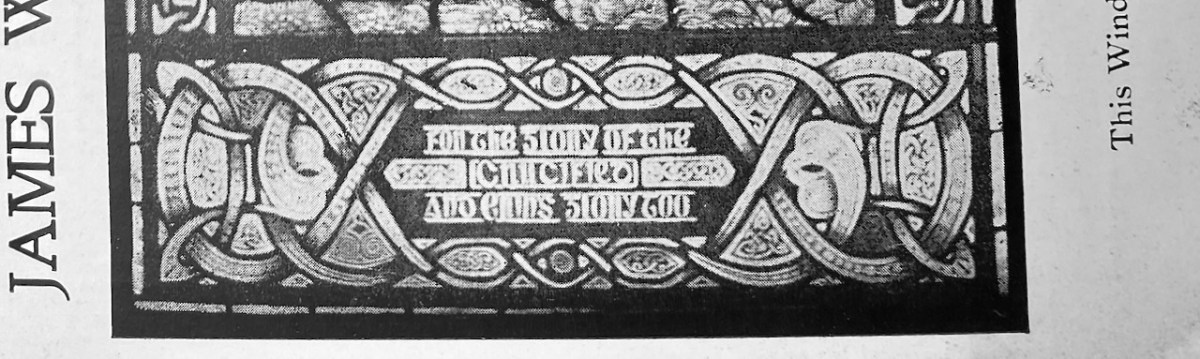
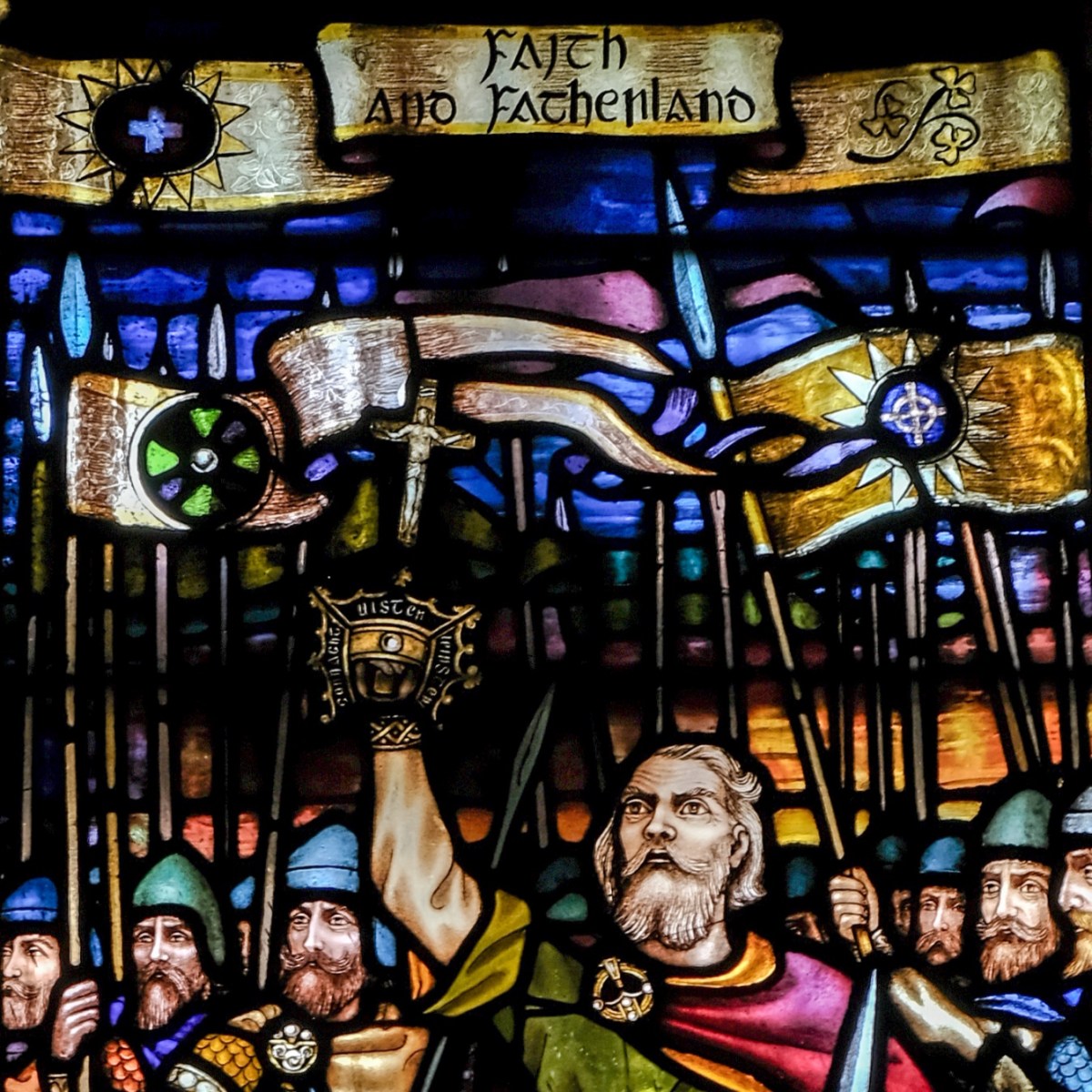
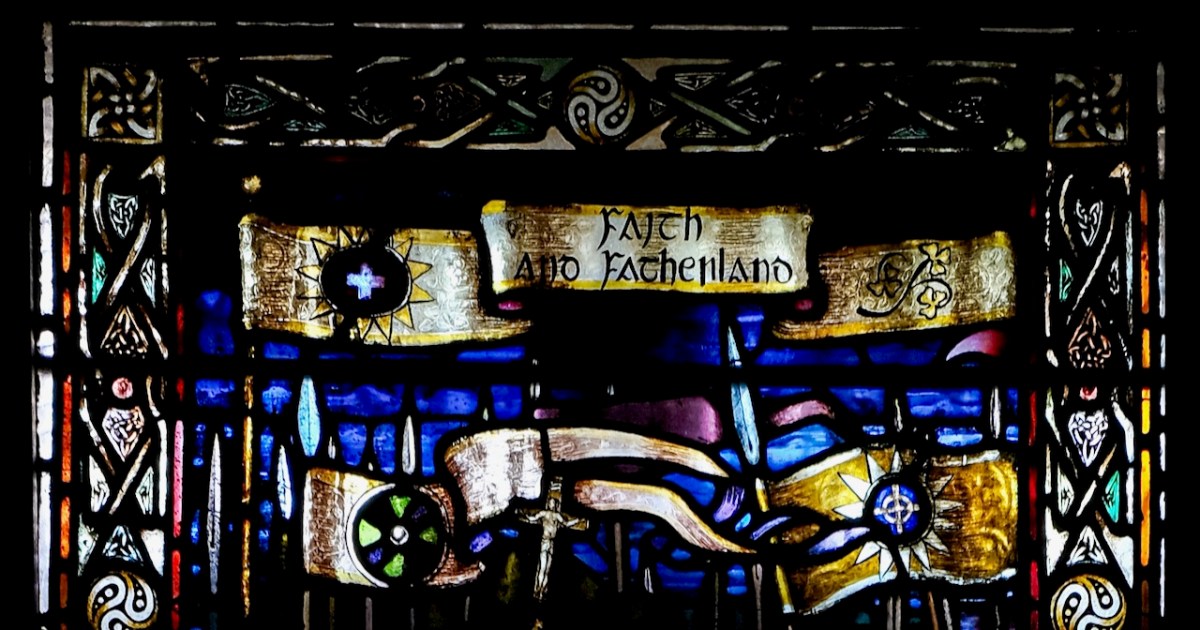
Isn’t it an amazing photograph! What’s also clear in this photograph is that the window is incomplete. To make it fit the opening, the predella, or bottom section, has been removed. Here’s what’s missing.
The text, in old Irish script, reads FOR THE GLORY OF THE CRUCIFIED AND ERIN’S GLORY TOO. The Celtic Revival interlacing that surrounds it is beautiful, and accomplished – it’s the thing that Watson’s were to become most famous for. So that’s a loss. Perhaps it was felt that the script was not suitable for a secular building: however it is more likely that it had to go in order to make the window fit. The rest of the window, comparing it to the original black and white images, seems to be intact. I was curious as to how the window came to be there, and this brings me to my second-to-last story.
Story 6: Antony
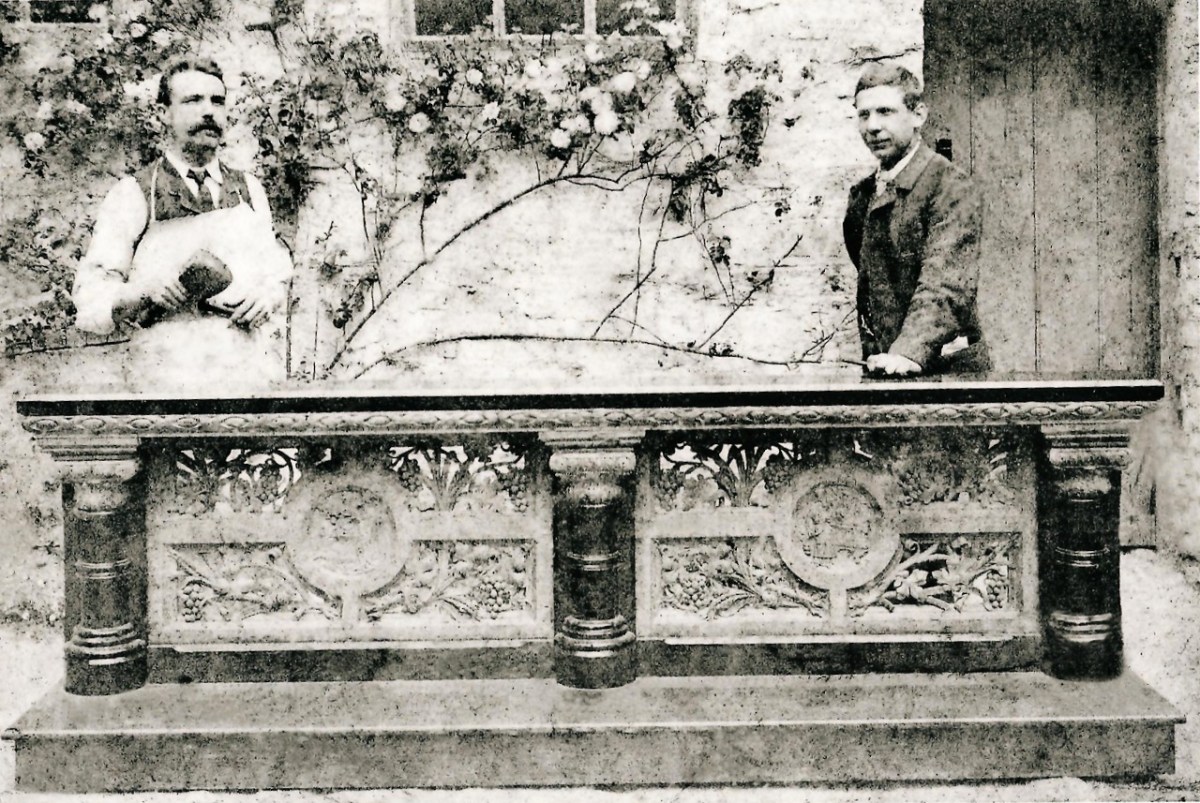
Vera kindly put me in touch with Antony Watson, and yesterday we had a long talk on the phone. Antony’s father was John Watson, Manager and Chief Designer for Watson of Youghal. John’s father was Clement, universally known as Capt Watson (he was an officer in the RFC/RAF), and Clement’s father was James Watson, seen here with a marble altar carver.
James had come from Yorkshire to run the Irish office of Cox, Sons, Buckley & Co, Church Outfitters, and eventually bought the Irish branch of the company. Here’s one of their early windows, in Ballingeary, from the 1880s, when they were still being signed as Cox, Sons, Buckley, Youghal and London.
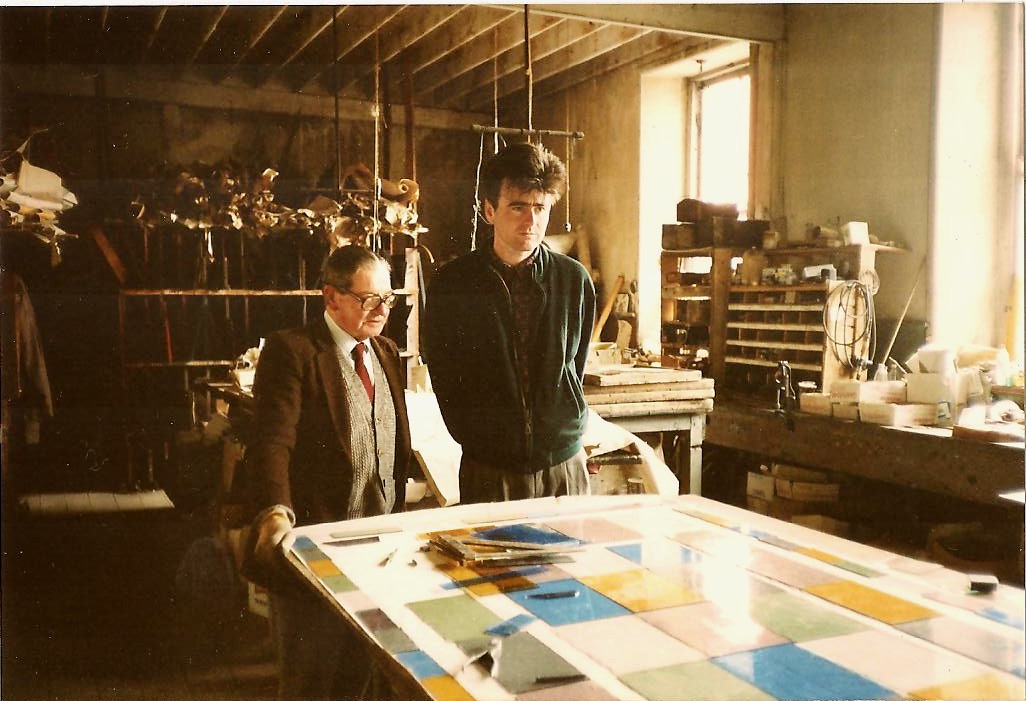
Antony told me the most enthralling stories, and I want to devote more posts to cover some of that treasure trove in the future, but I don’t want to get too distracted from Brian Boru now. Antony loved his life in and around the studios and workshops when he was young and has a very clear memory of the Brian Boru window. It stood, he said, in a rack in what was called the Great Hall (a grand name for a storage area for tall items). Here’s Jack, Antony’s father, with a client, in the early 1990s.
Watsons got the job of installing leaded windows into Knappogue Castle when it was bought by wealthy Americans – Mark and Lavonne Andrews. He remembers the day they arrived to see the Brian Boru window – there was a frantic tidy-up beforehand and the whole of Youghal turned out to witness two stretch limos arriving in state and disgorging the ‘Texas millionaires’ and their retinue.
Story 7: Mark and Lavone
This is Mark Edwin Andrews, highly educated (Princeton) and cultured, and at one time Assistant Secretary of the Navy under Truman. He went on to become an industrialist and oil producer. His wife, Lavone Dickensheets Andrews (so sad I can’t find a photograph of Lavone) was a prominent architect. Together they purchased Knappogue Castle in 1966 and set about restoring it from a ruinous state. Knappogue is located in Quinn, Co Clare, the heart of Brian Boru country. It’s now owned and managed by Shannon Heritage.
It was Mark and Lavone who rescued the Brian Boru window and had it fitted into Knappogue Castle, some time in the 1970s. And there it still is, a testament to the enduring attraction (and durability) of stained glass windows and their power to enchant and intrigue us.
It’s a highly unusual window in so many ways, not least that it is a secular rather than a religious subject. It showed off, when it was exhibited, one of our historic heroes, Brian Boru (for more about Boru, see Robert’s post, Battling it Out), as well as the Celtic Revival decoration which Watsons mastered: both the subject matter and the treatment established them firmly in the Nationalist Camp. This of course, was a canny move designed to appeal to Irish Catholic church-builders. Antony tells me that nobody espoused Irish Nationalism more enthusiastically (or astutely) than James Watson, in the broad Yorkshire accent he kept to the end.
As an image of Faith and Fatherland, this window knew exactly who it was appealing to. It appeals to us still.
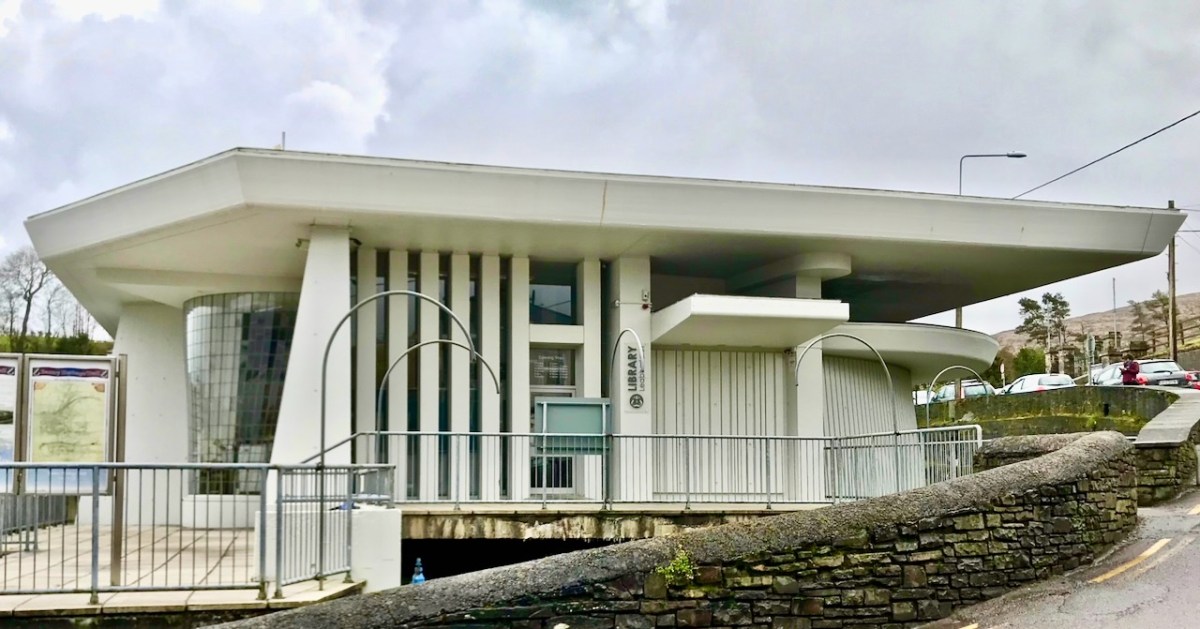
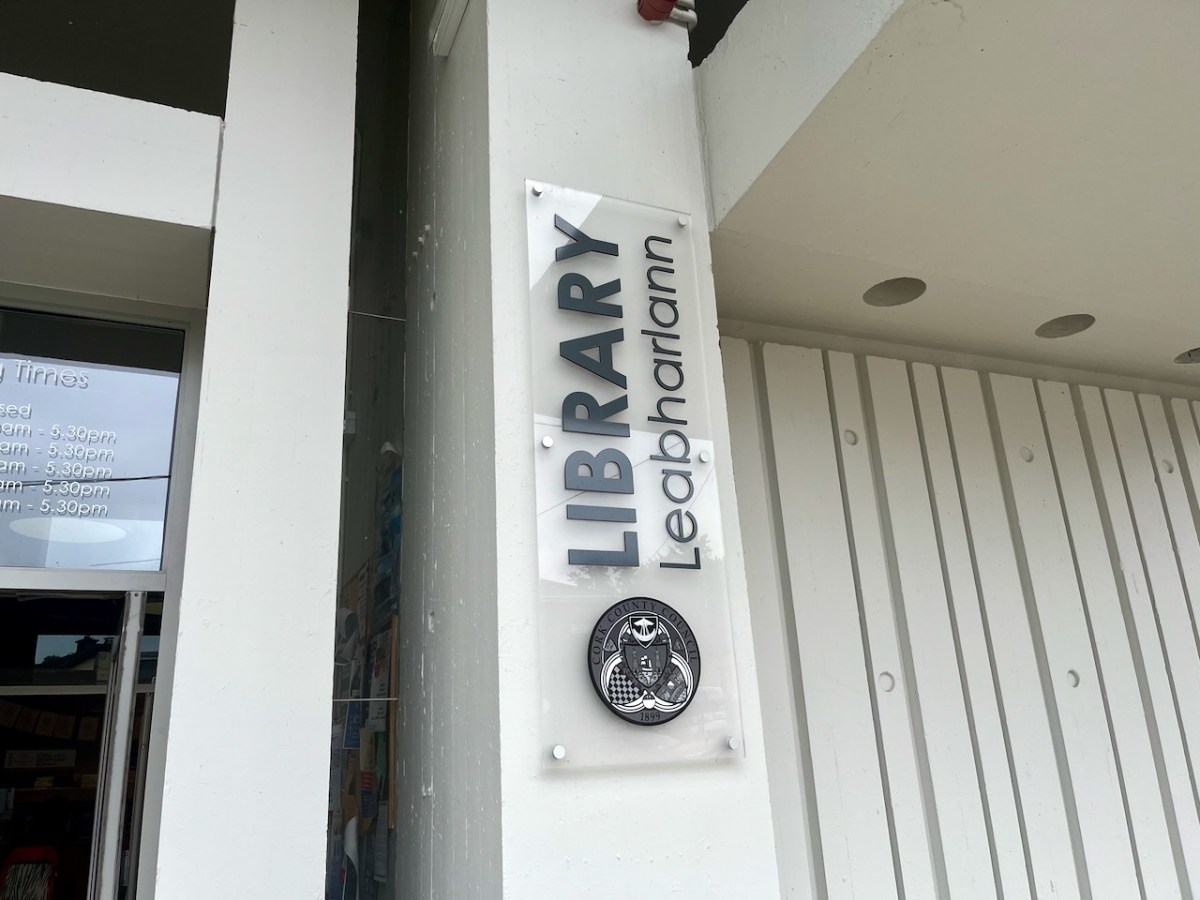
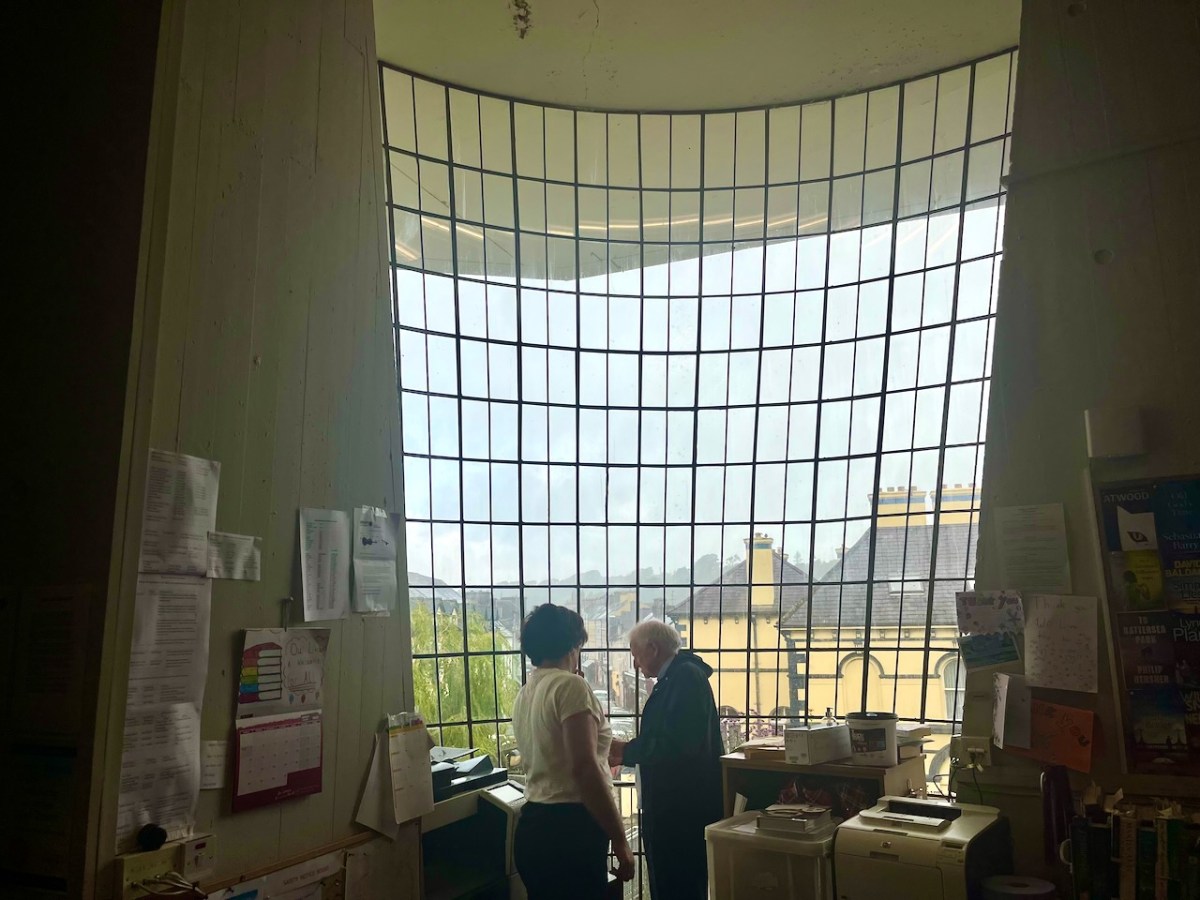
In last week’s post I described a unique type of boat that was connected with Bantry, here in West Cork. Today we are also focussed on Bantry, but this time on architecture: the Public Library, which is one of the most unusual and innovative buildings from twentieth century Ireland.
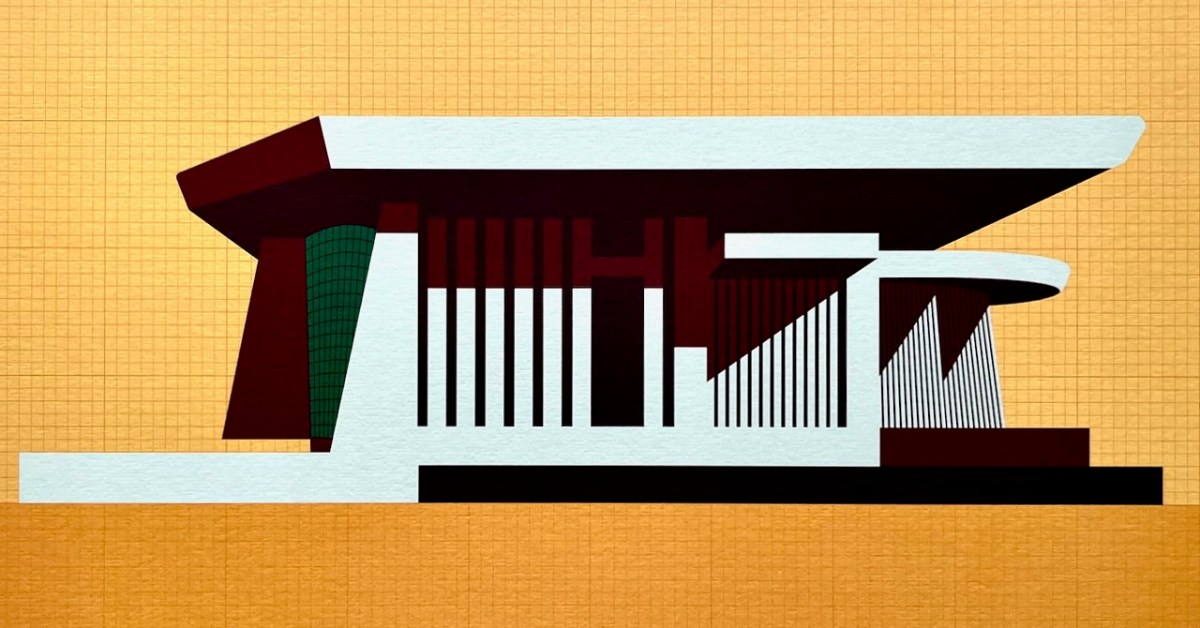
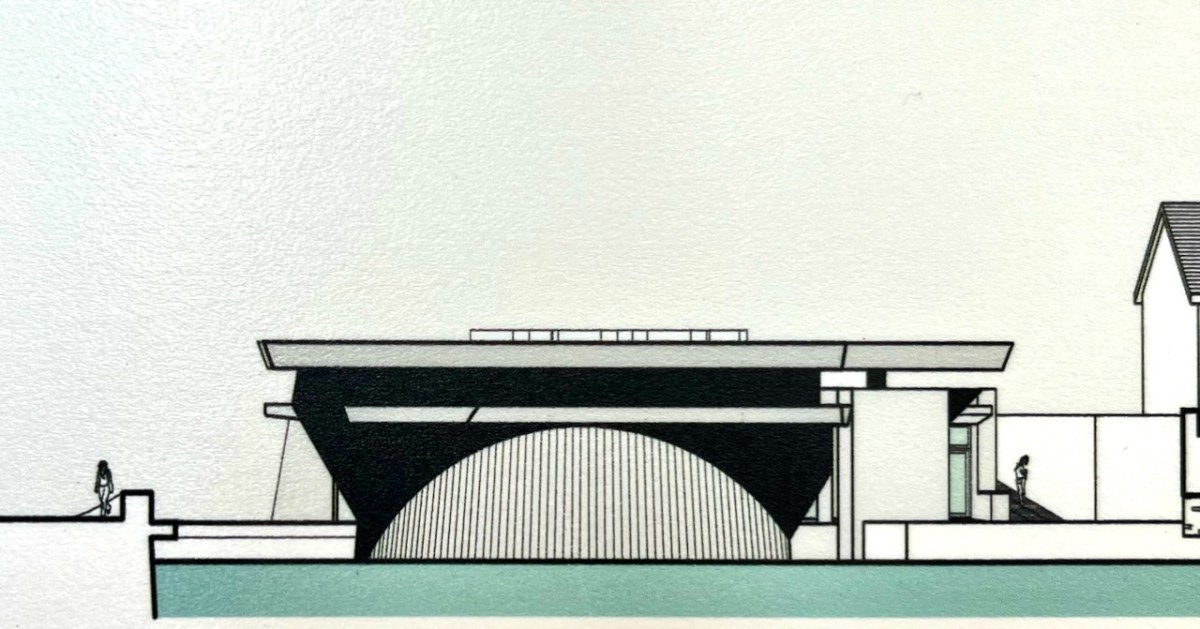
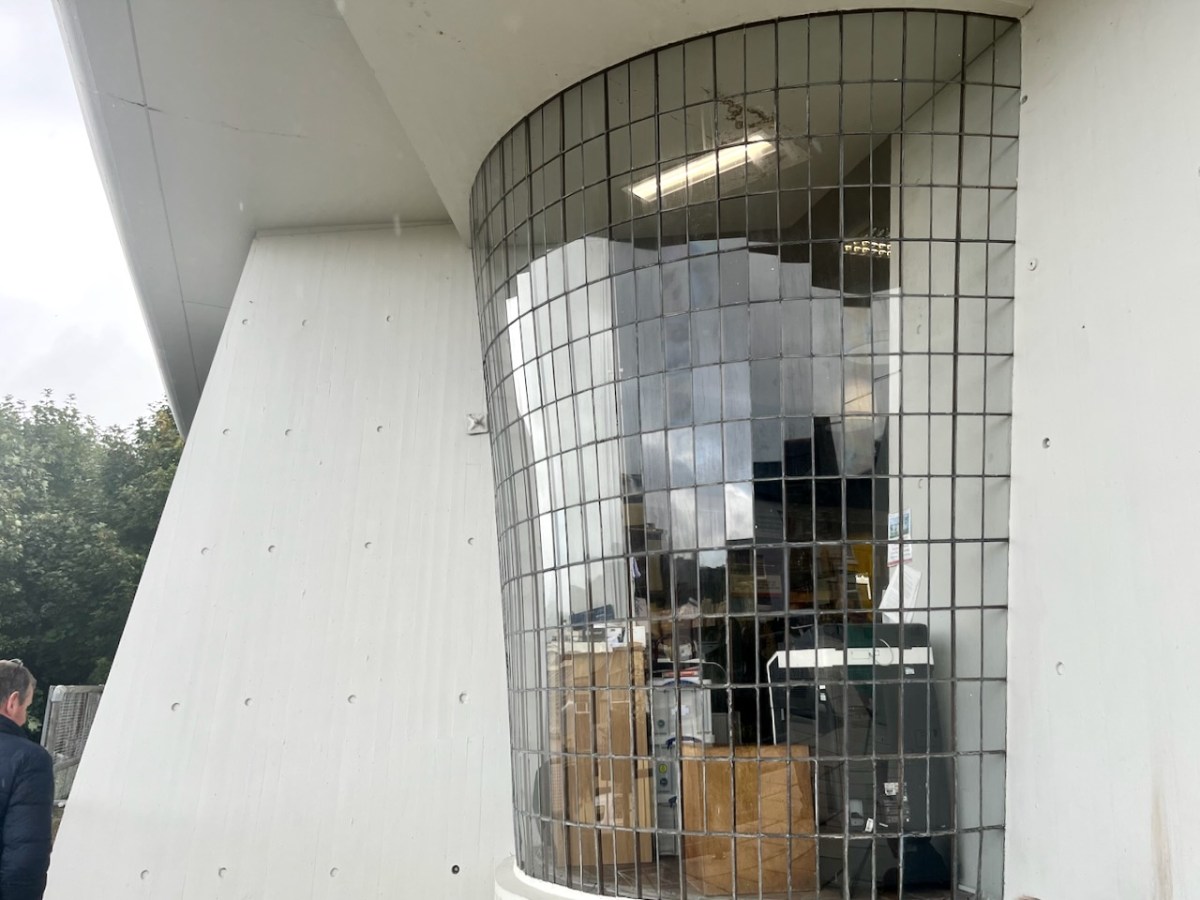
Here is the building as we see it today. The header is a limited edition print, a collaboration between Dermot Harrington of Cook Architects and Robin Foley of Hurrah Hurrah celebrating the upcoming 50th Anniversary of the completion of Bantry Library in 1974. For me, the print captures perfectly the iconic graphic of this most unorthodox design.
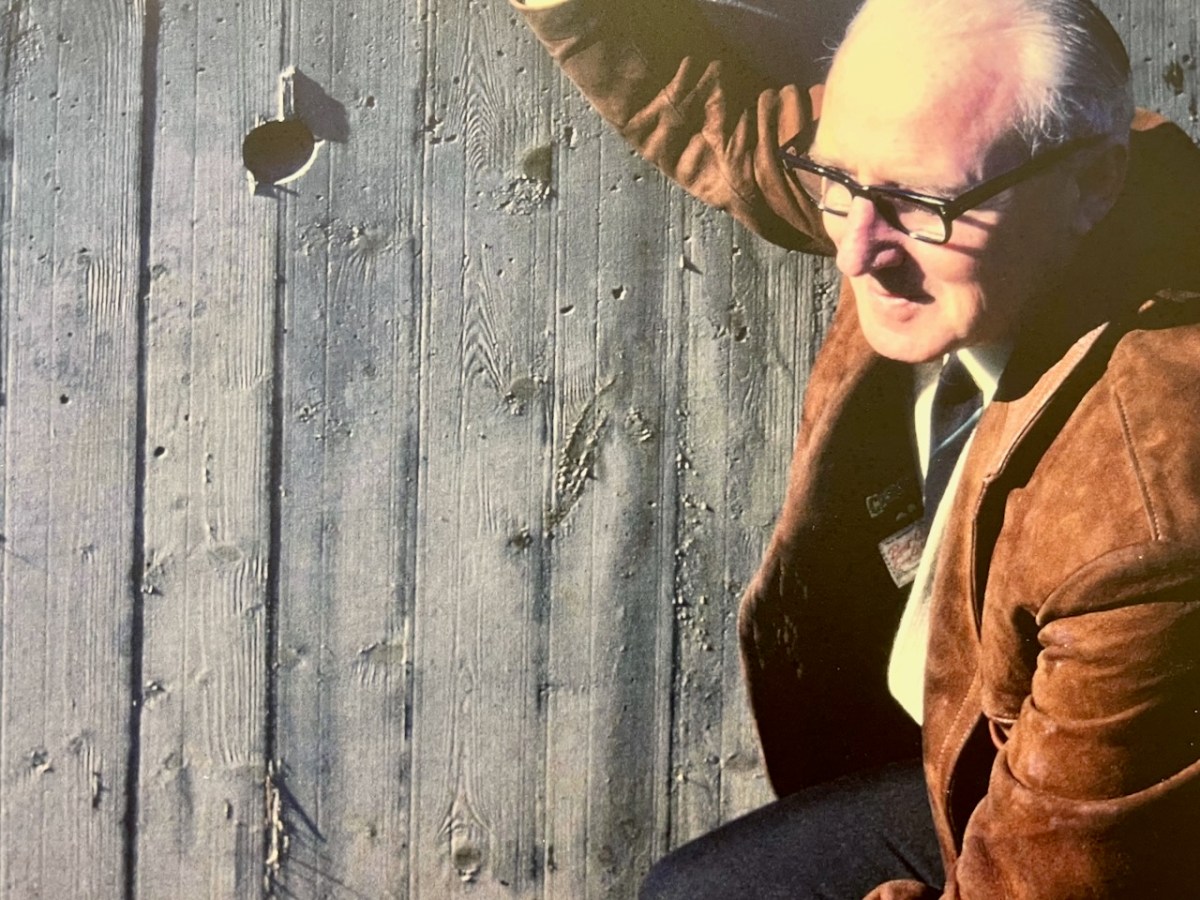
The Library was conceived by Patrick McSweeney (above) – Cork County Architect between 1953 and 1975. He deserves a post of his own one day, as he was responsible for some outstanding buildings in the county. Two of his assistants in the Architect’s Department at the time were Brian Lalor and John Verling. Both had a hand in the genesis of the Library. Interestingly for us, McSweeney, Lalor and Verling were all living around Ballydehob in those days – it was a swinging village!
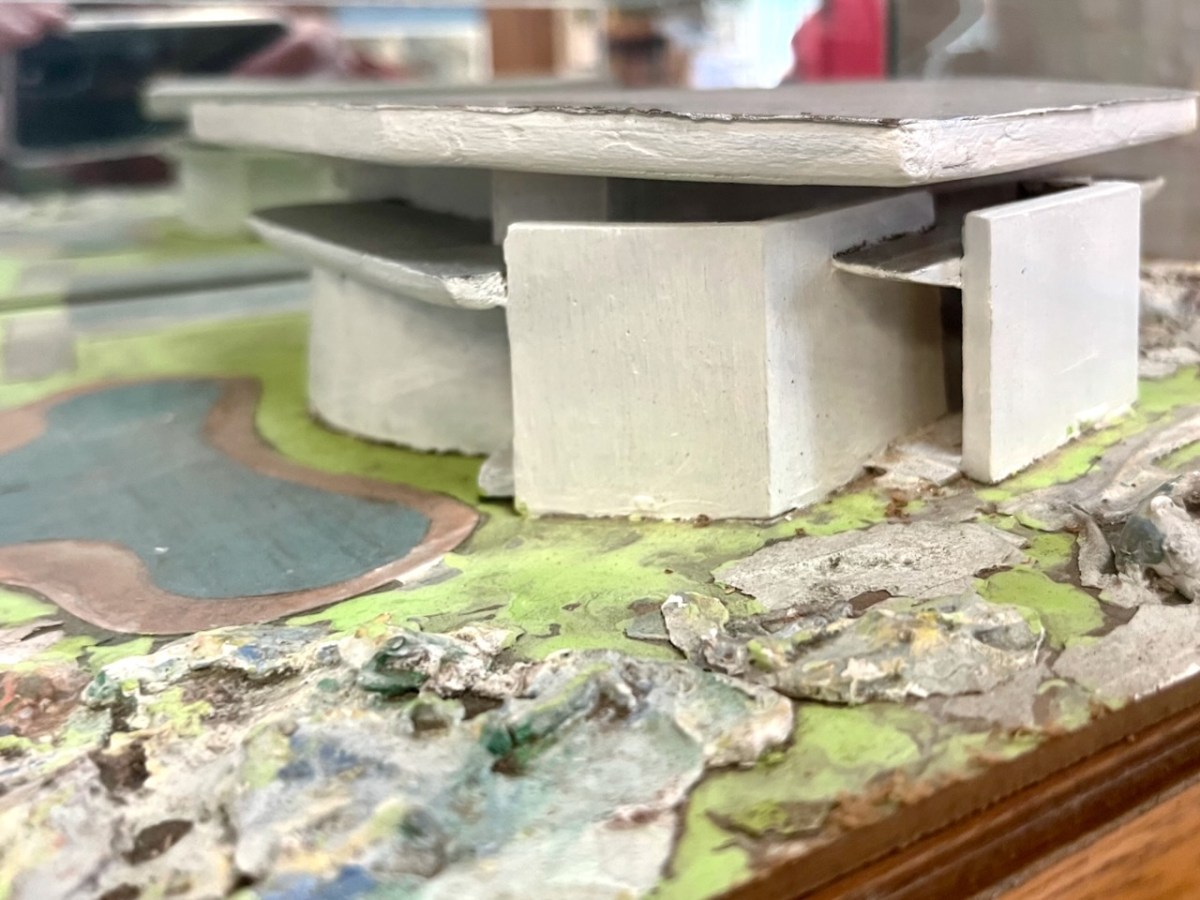
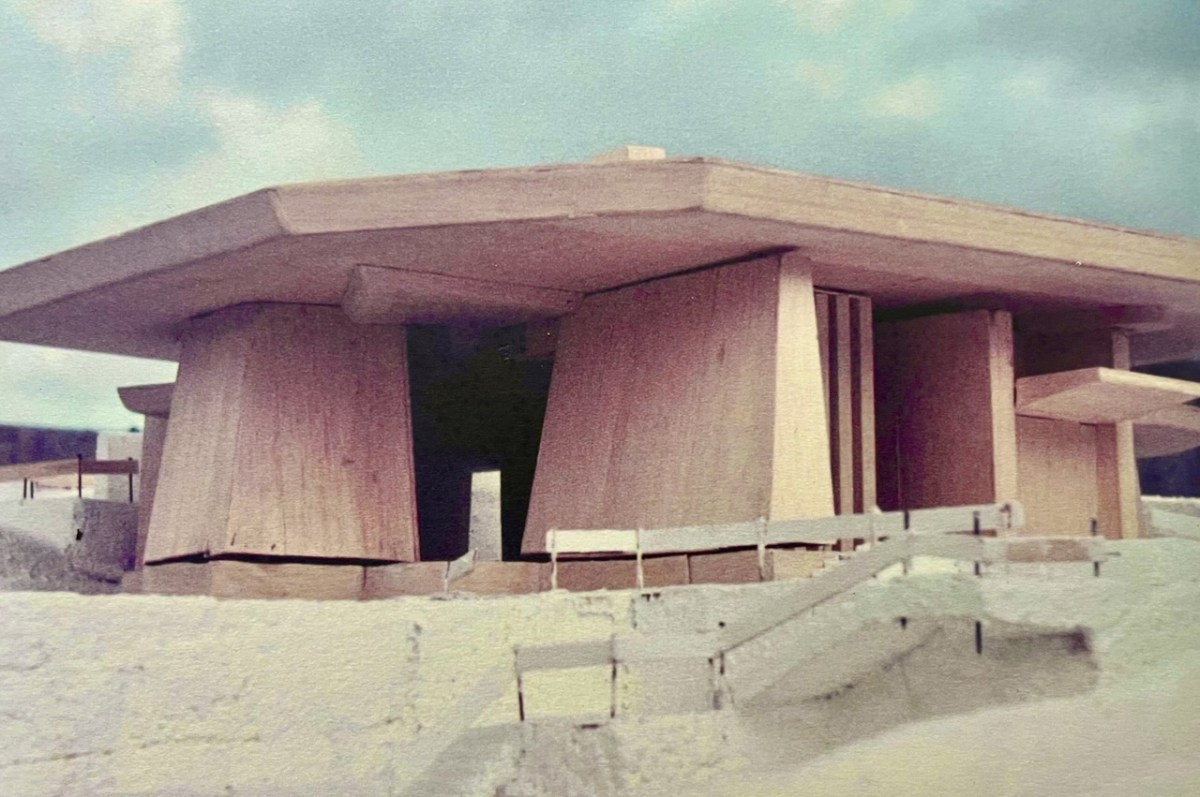
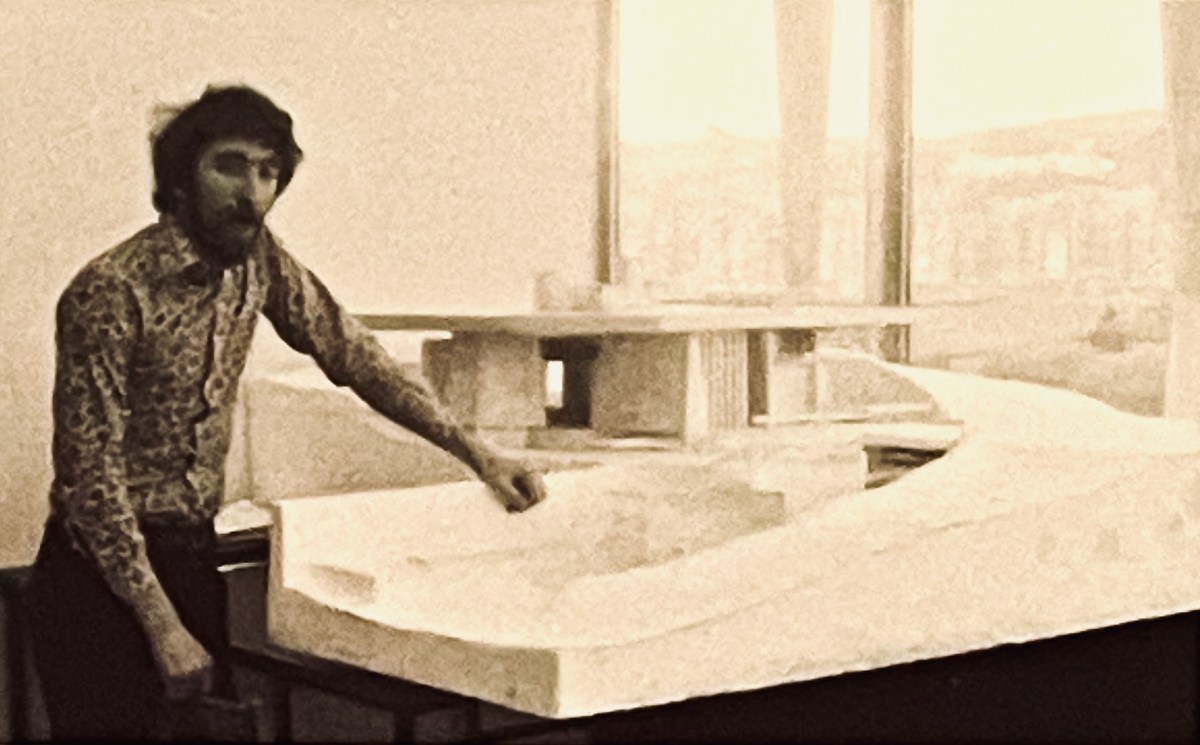
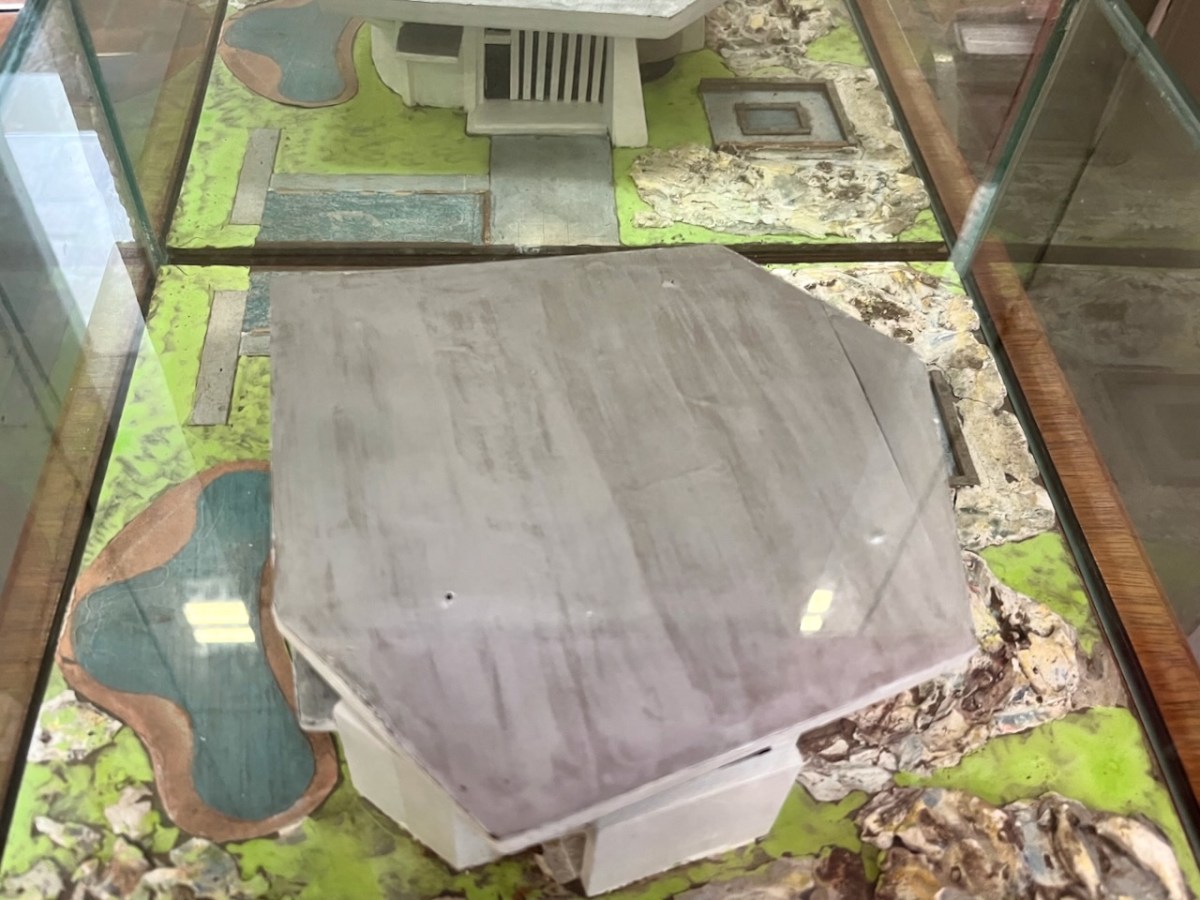
In the era before computers were universal in architects’ offices, everything was drawn by hand – or modelled. Brian recalls that Pat (McSweeney) called him into the office one day, handed him cardboard, tape and scissors, and instructed him to make a model of a building shaped like a Bronze Age dolmen. And he wanted it made in a hurry! It could well have been the one shown above – which still exists. Remarkably, although this model was made in the early 1960s, the building that resulted in the 1970s was very similar in form. Later, John Verling produced a balsa-wood model upon which the design production drawings were based:
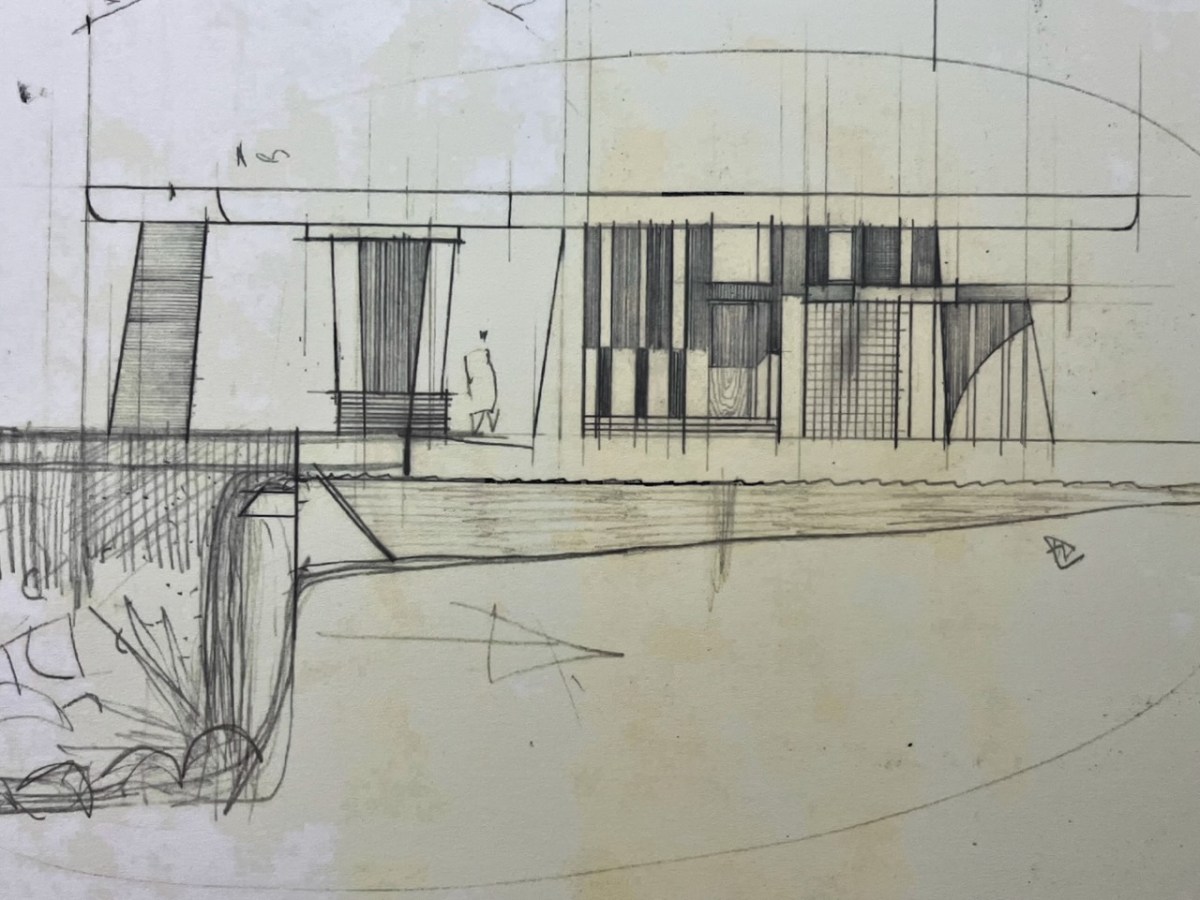
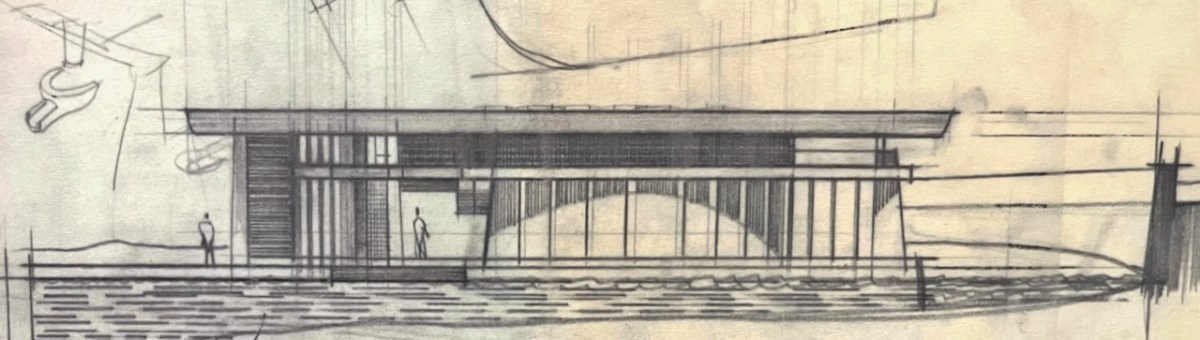
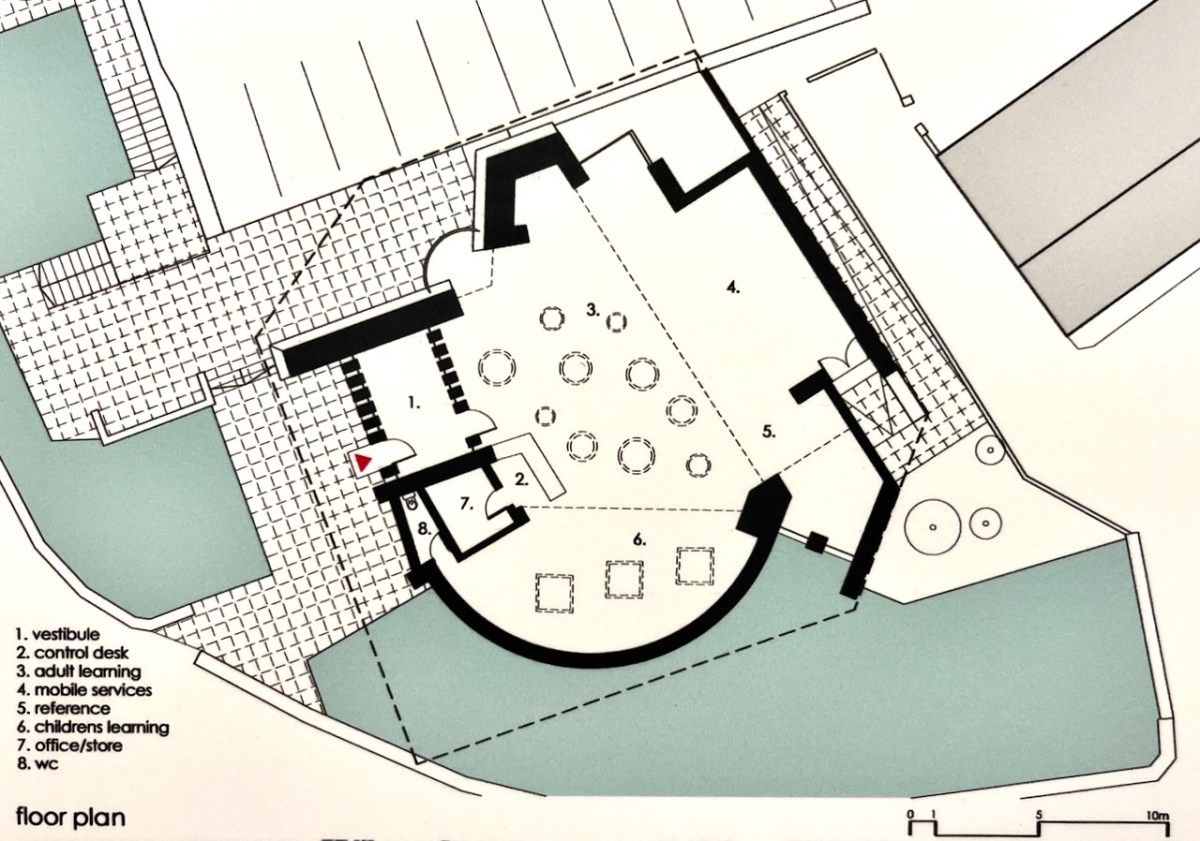
That’s John Verling, above, with his model. He and his wife, Noelle, are the subjects of the current exhibition in the Ballydehob Arts Museum (click the link). Following are some of the design sketches carried out by Harry Wallace who was leading the team in County Hall, and detailed drawings of the building that eventually ensued.
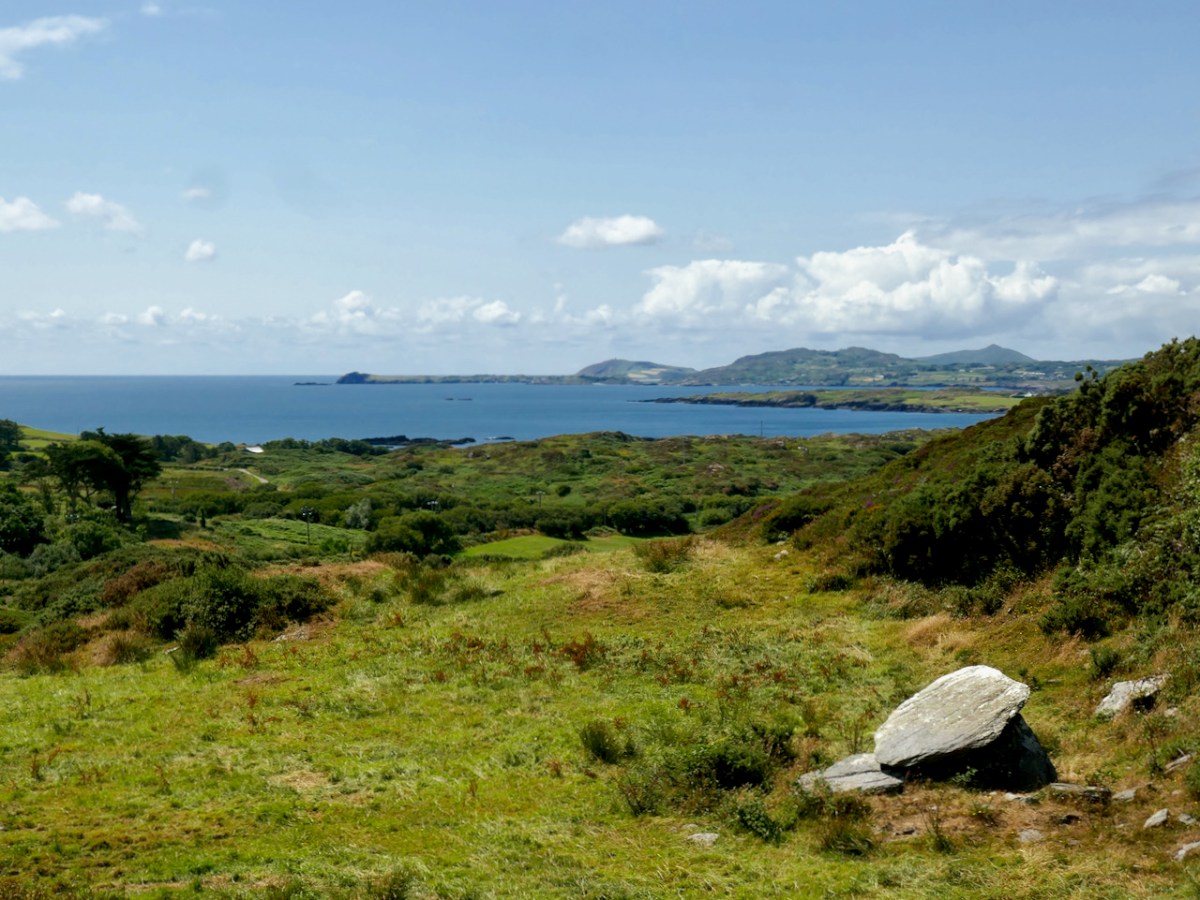
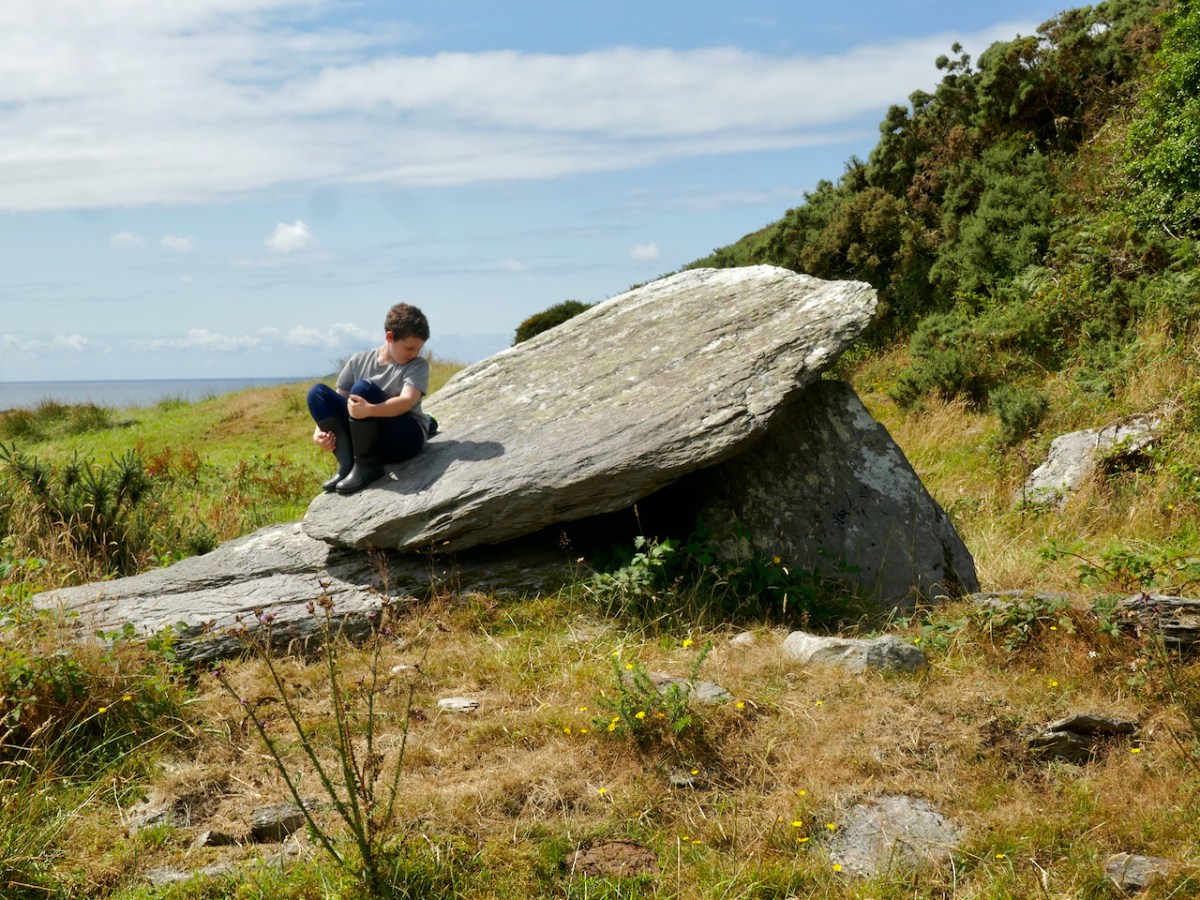
Let’s look a bit further at the early concept work, especially that first model. It’s said that McSweeney was inspired by a ‘Dolmen’. In fact we would today call that type of early megalithic structure a ‘Wedge Tomb’ or a ‘Portal Tomb’. At its simplest, this is a large flat stone slab (or slabs) supported on vertical stone slabs: it was probably a burial chamber, perhaps with its opening facing the sunset at a particular solar event. The closest such tomb structure to Ballydehob is the one featured in Finola’s post today. I wonder if Pat McSweeney was aware of this local one? He would have certainly been aware of the striking example at Altar, further west on the Mizen Pensinsula.
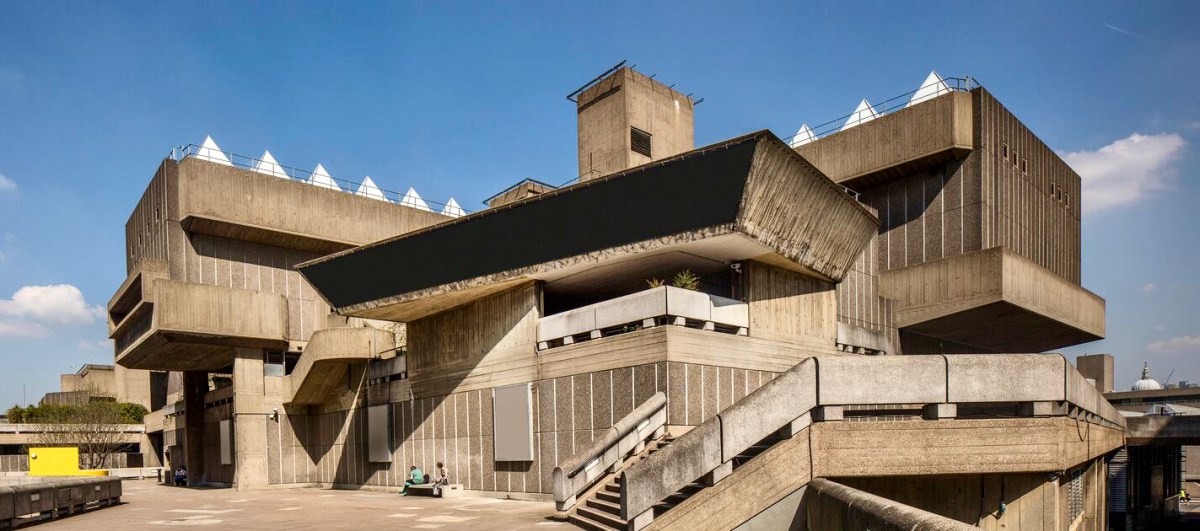
Returning to the twentieth century, and the Bantry Library project, construction posed many problems, using techniques which might have been considered at the leading edge of architecture in its time and place. Across the sea similar experiments were taking place. I was at the centre of them! I completed my architectural education in the late 1960s and went to work for the Greater London Council. I saw going up around me on the South Bank of the Thames a development which included the Hayward Gallery (below): its design (described as ‘brutalist’), earned it the nomination of the ugliest building in Britain when it opened!
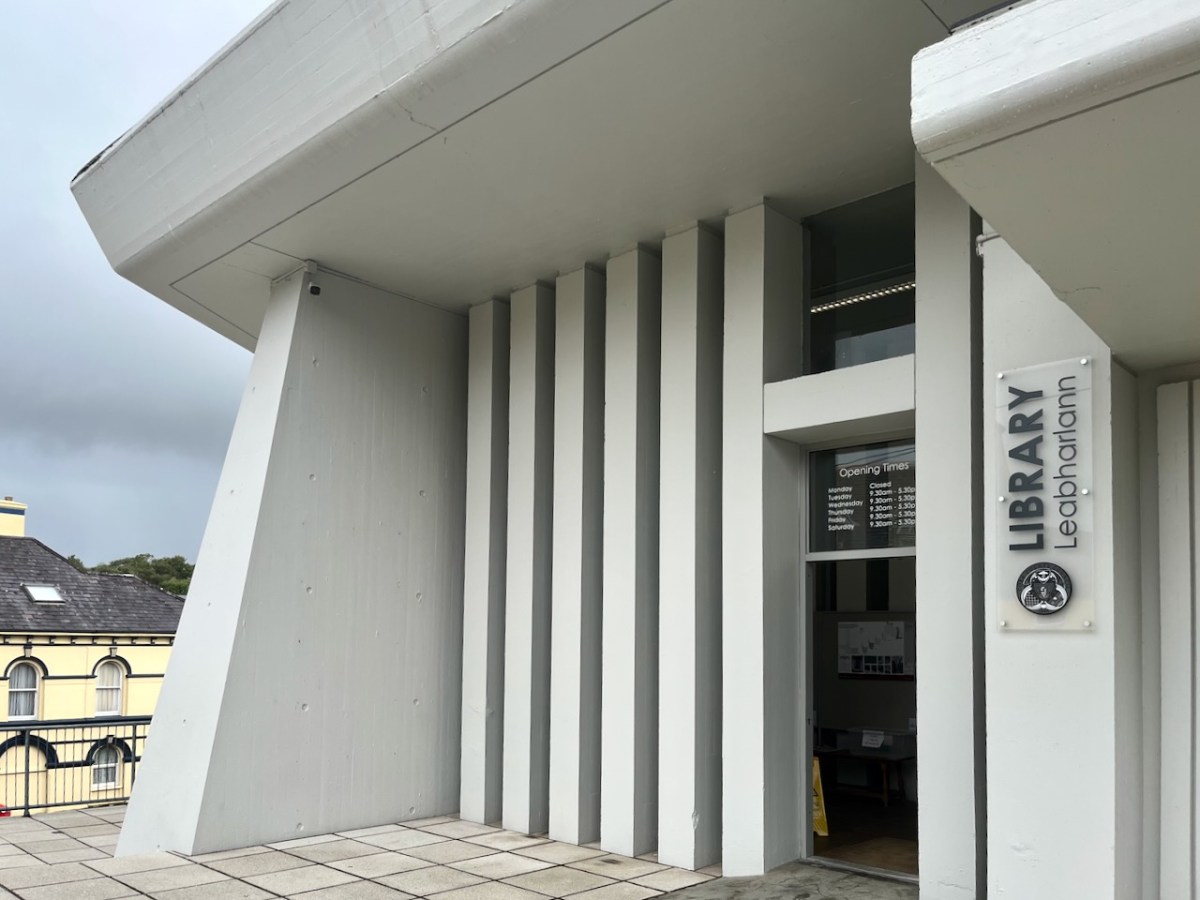
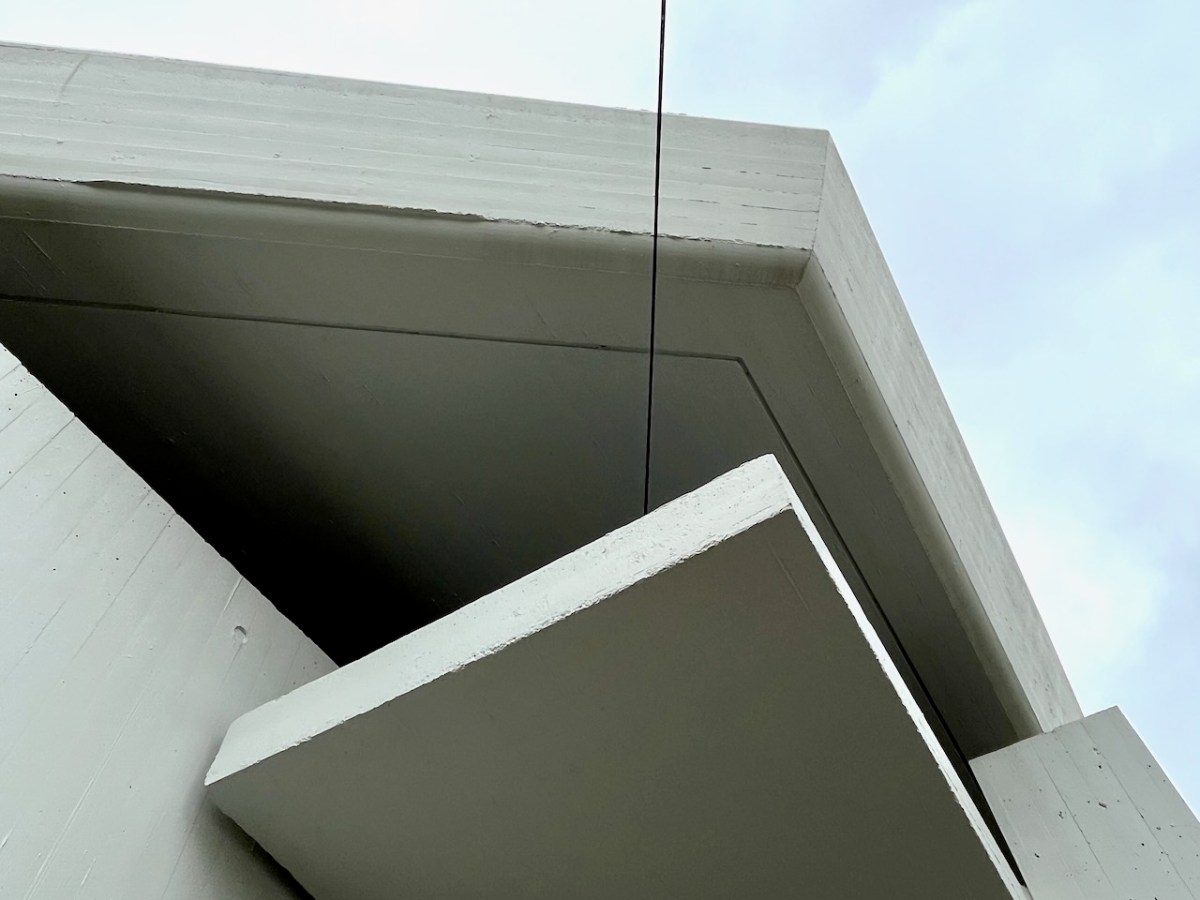
Larger in scale, this complex exhibits some of the features we see in Bantry: shutter-marked mass concrete, frameless glazing, bold overhanging roof planes… The Library roof cantilevers six metres in one part of the building.
The status of this building as an unique example of modernist architecture in Ireland has recently been recognised with a Heritage Council grant of over €250,000 to carry out refurbishments to some of the major elements.
. . . As Bantry Library approaches its 50th anniversary, we are committed to safeguarding this important building. As a protected structure within an Architectural Conservation Area, Cork County Council recognizes its responsibility to preserve and protect Bantry Library for future generations. The conservation works will take place during 2023, and we look forward to seeing the library restored to its former glory . . .
Tim Lucey, Chief Executive, Cork County Council
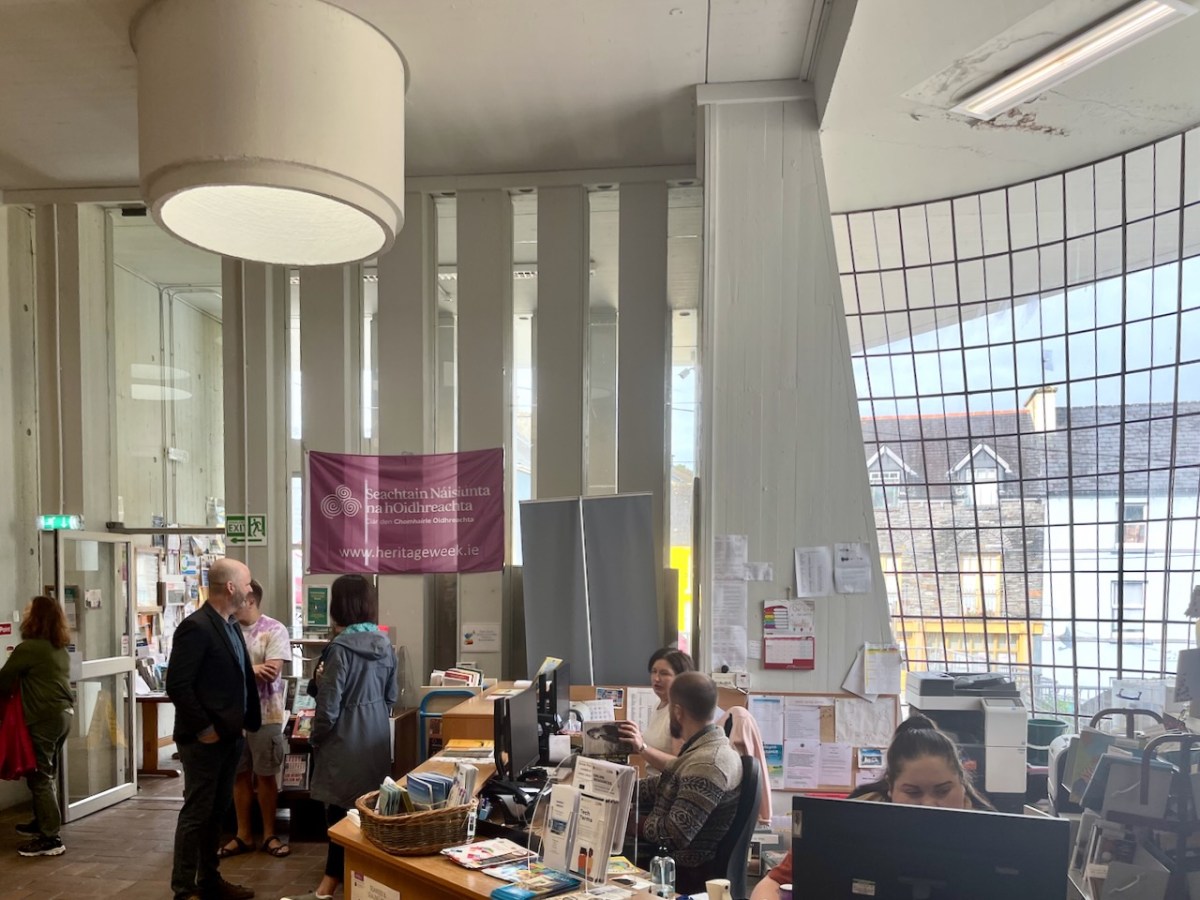
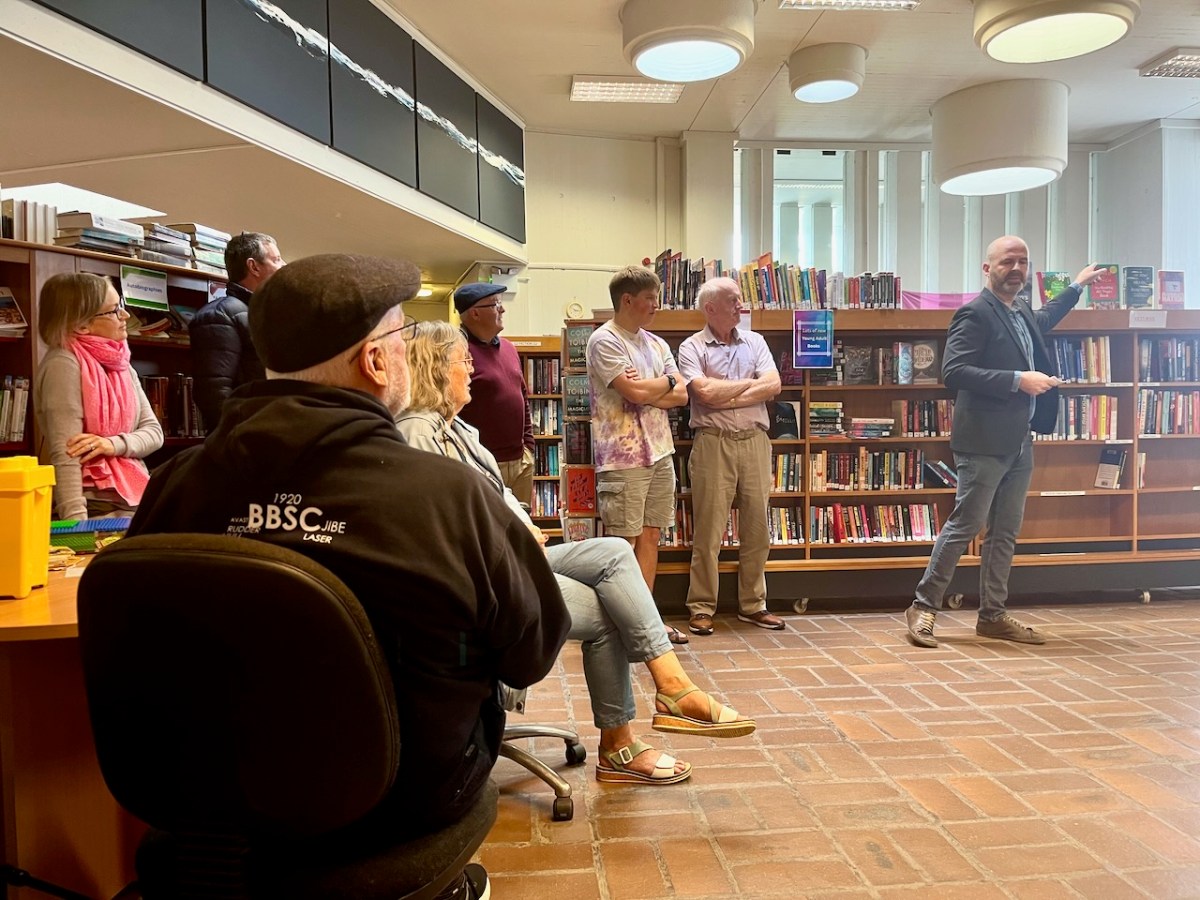
A Heritage Week talk was given by Dermot Harrington of Cook Architects at the Library (below). It was a most informative review of the building and its history.
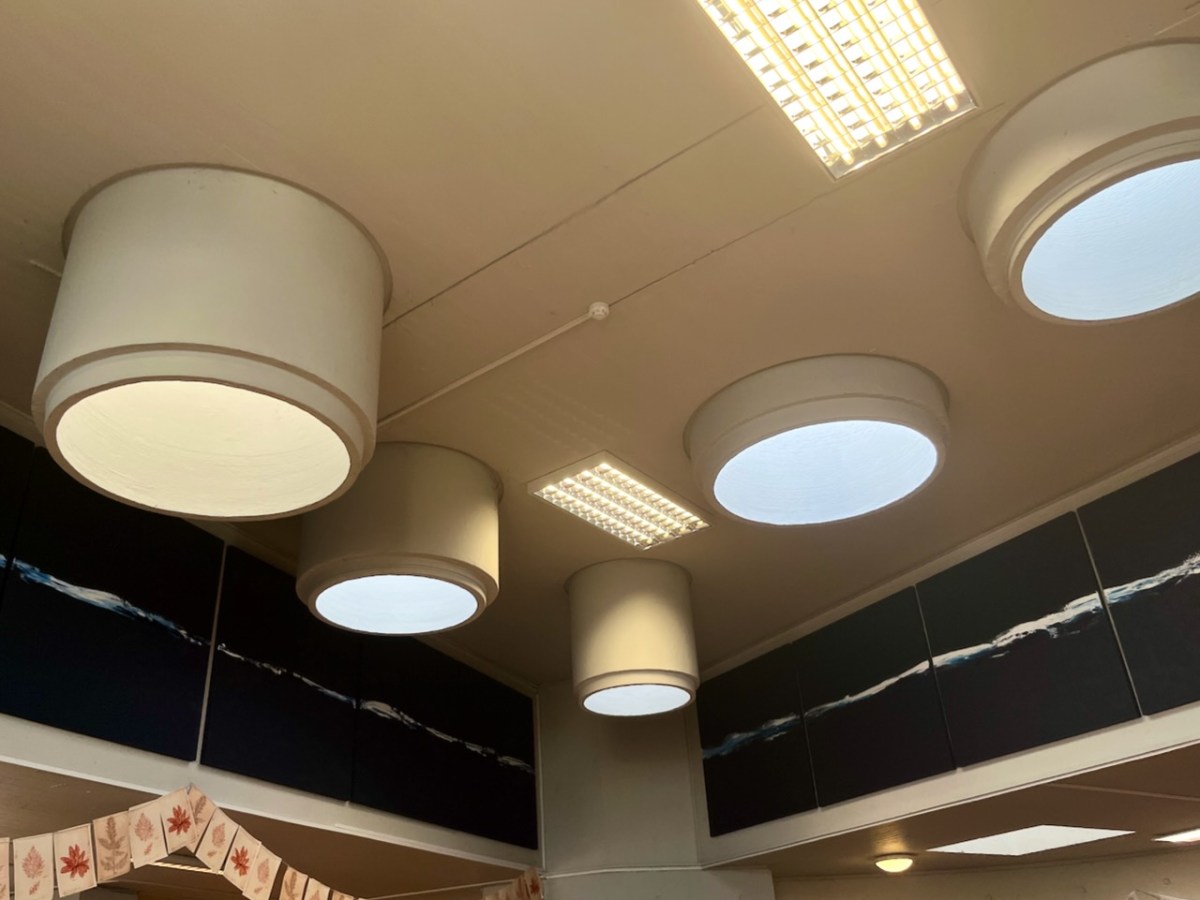
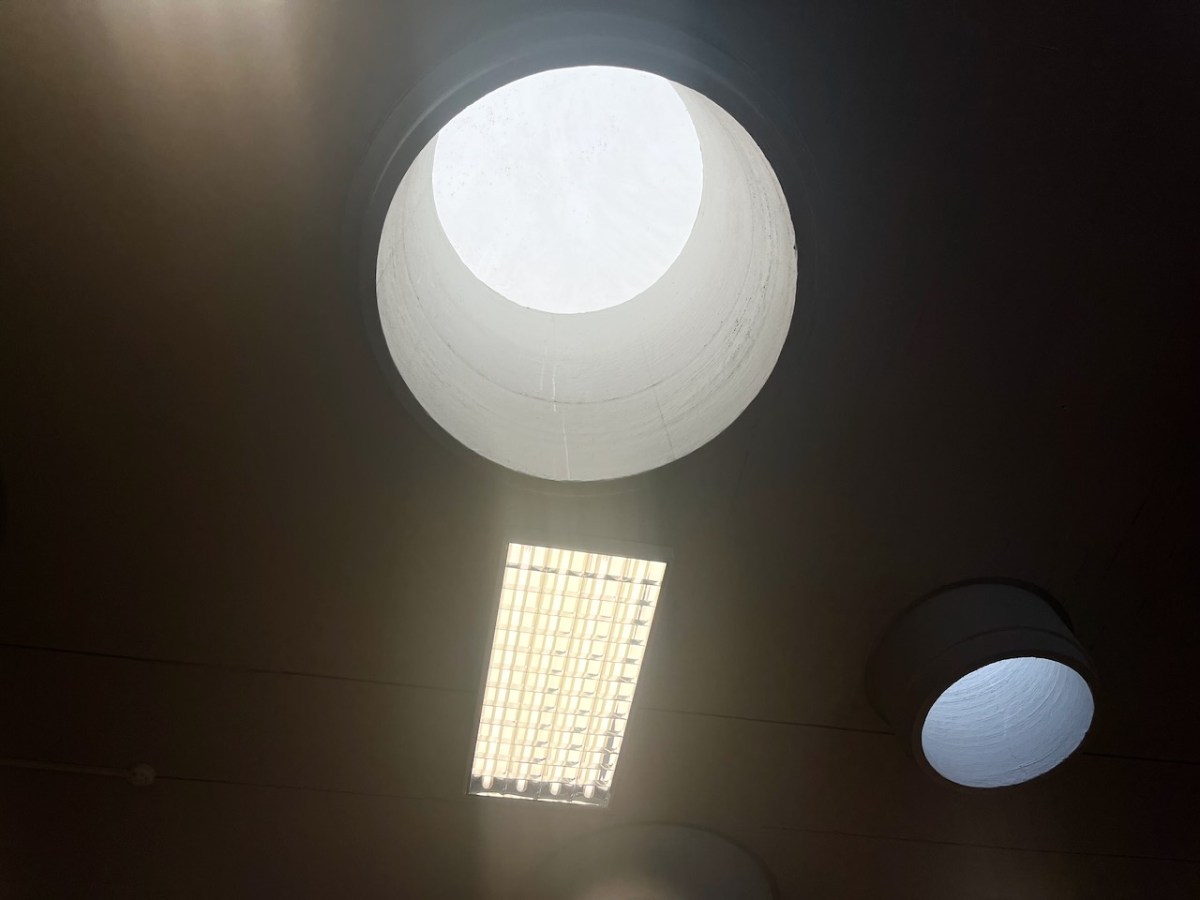
Most of the original features of the building have survived in reasonable order. I was impressed with the ‘pipe lights’ which draw daylight down into the centre of the main room:
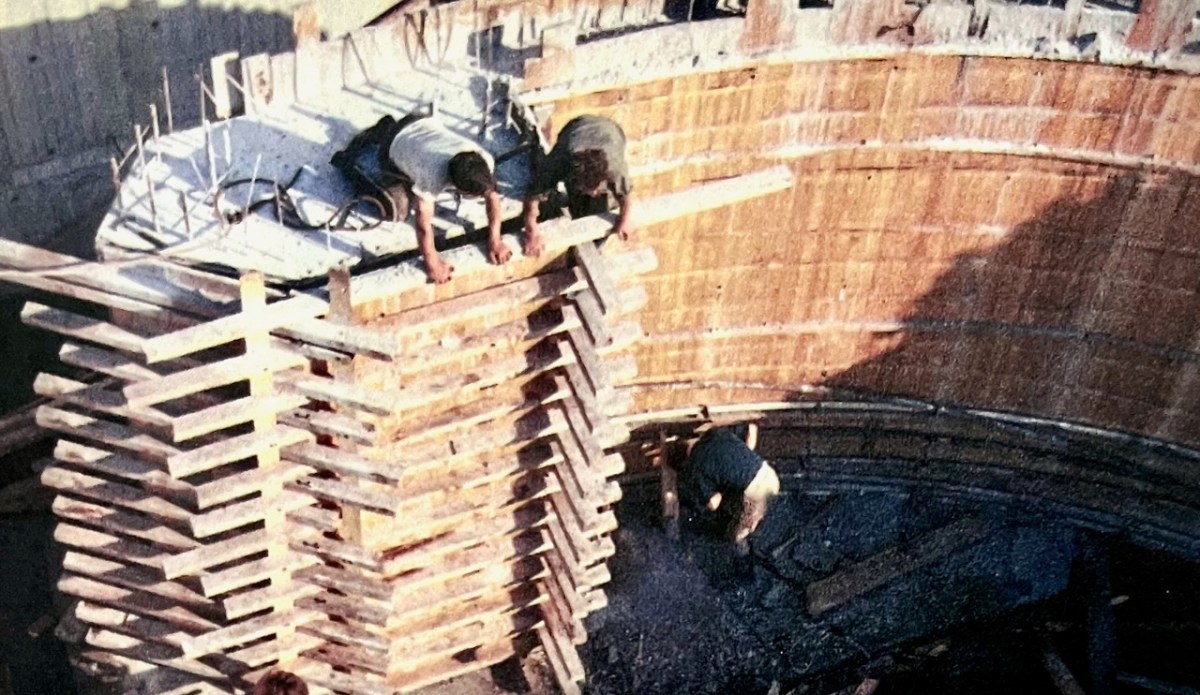
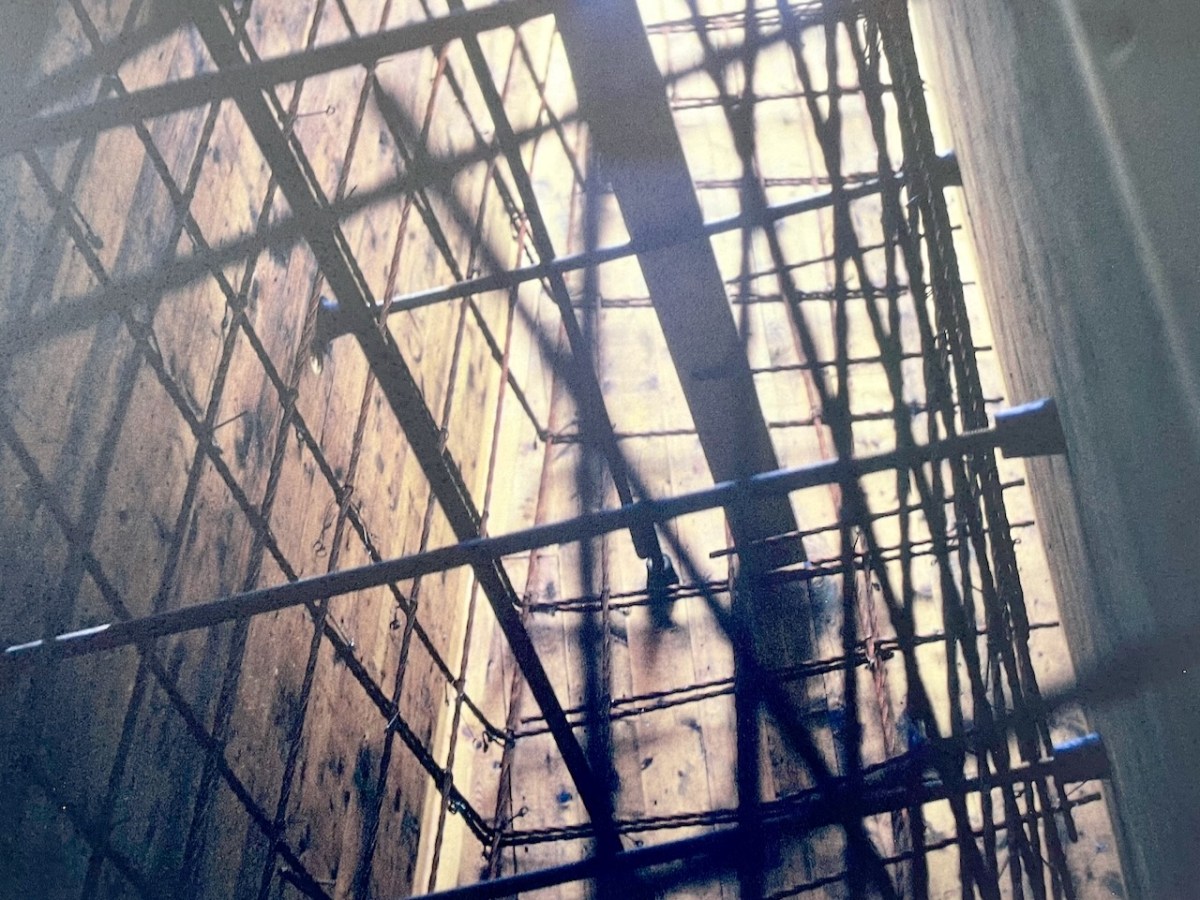
We also learned about the complexity of the building construction, and saw photographs of the steel reinforcement and board shuttering from fifty years ago:
Dermot Harrington pointed out that the building was effectively put together by only five men, under foreman Gerry O’Sullivan, who was just 27 years old. Neither he or any of the other crew had ever tackled anything like this before!
The Library is central to the life of the town, and still serves its original purpose. It’s eye-catching (perhaps sensational is a good word?) and very much alive and relevant. We look forward to the completion of the current works, and suitable festivities to mark the fiftieth birthday of this creative West Cork project.
Thank you to the Library for the information they provided and the display boards that are currently on show. Many of my illustrations are taken from these resources
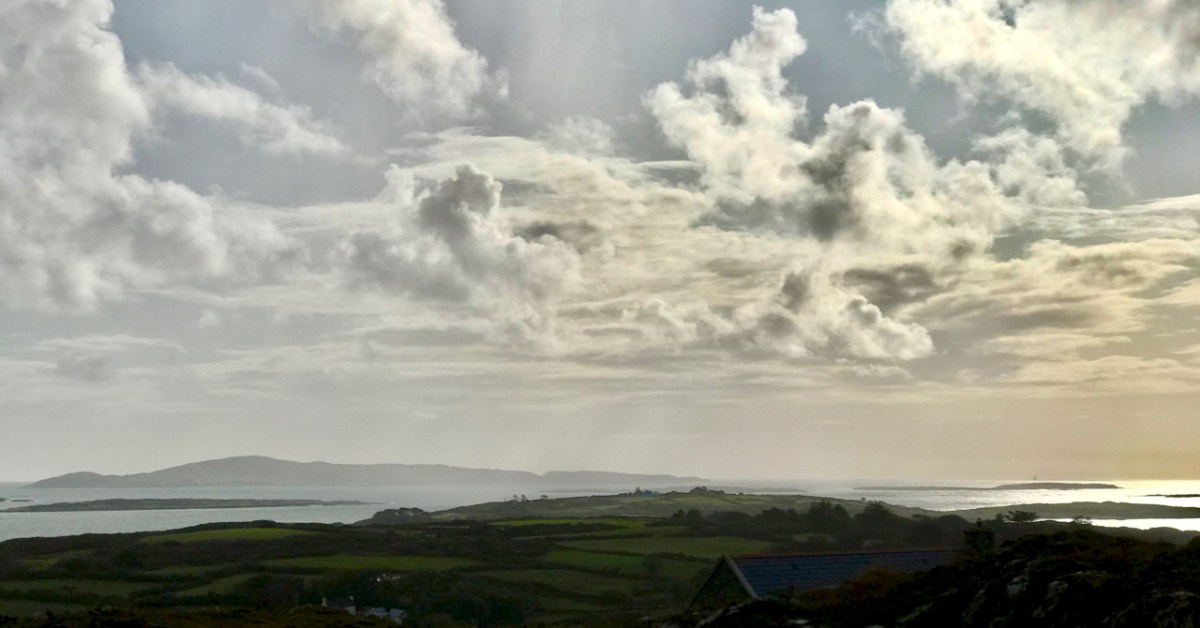
It’s March – an important month, in Ireland, for saints. This week we will celebrate St Patrick, of course. But there’s another – dare I say equally important – Irish saint whose day we have just passed by. That’s Saint Ciarán, and we are particularly keen to give him an airing, as he was born on Cape Clear, which we look out onto every day! That’s the view (above) from our home across Horse Island and Roaringwater Bay towards ‘The Cape’, which sits on the horizon under a wonderfully atmospheric sky. I also feel drawn towards Ciarán because his ‘day’ – March 5 – happens to be my birthday. And – as you will see – there’s another personal connection: I lived in Cornwall for many years, and that’s where some of my forebears hale from. Would you believe that this same saint is also the Patron Saint of Cornwall? Read on . . . But be aware that I have published this post before, several years ago – when RWJ publication day actually fell right on my birthday. I’m giving myself a day off the hard writing this week, as I have been recuperating from a little ‘op’ in Cork. Here goes:
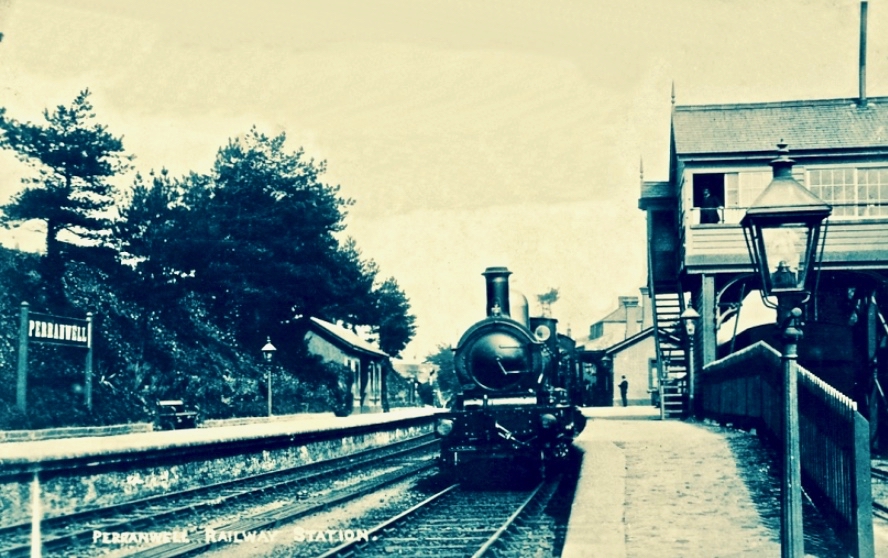
I was born in the first half of the last century. Early memories of the 1950s include the regular journeys my brother and I made as small boys on the mighty Atlantic Coast Express via Okehampton to visit, first, our sets of cousins on Dartmoor, and then beyond – via the even mightier Great Western Railway – to our cousins in the depths of Cornwall. The latter visits were particularly idyllic: the cousins (generations older than us) had a small farm and a herd of cows which they milked twice a day – by hand. Following this they cooled the milk in a big steel drum by stirring it with a propellor (we were allowed to do this) before pouring the precious liquid into bottles which were then sealed with silver caps using a rubber device which impressed on them the name ‘Cove Farm’. Then, together, we set out on bicycles to deliver the bottles to the doorsteps of every dwelling in the small village of Perran-ar-worthal.
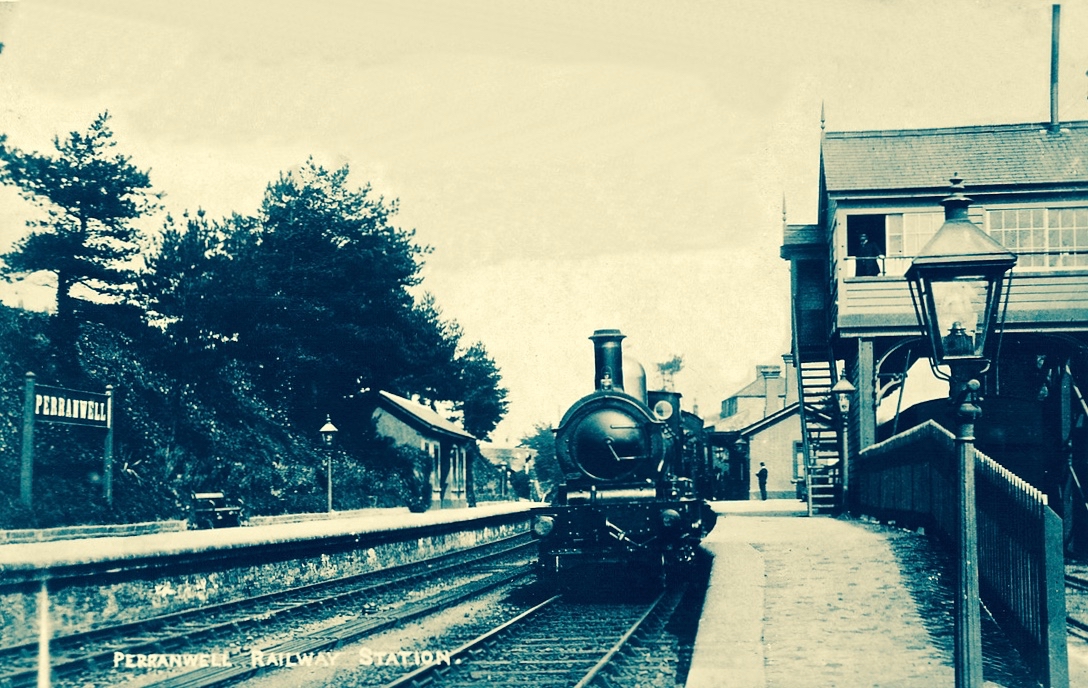
Perranwell Station 1950s – disembark here for Perran-ar-Worthal and Cove Farm!
Perran-ar-Worthal (in Cornish Peran ar Wodhel) means ‘St Piran’s village by the creek’. Who is St Piran? He is the Patron Saint of Cornwall and we’ve met him before, briefly, in my account of St Ciarán, who was born on Cape Clear, and was known as ‘The First Saint of Ireland’. Even before St Patrick arrived to start his missionary work in 432 AD, St Ciarán (according to some records born in 352 AD) had been at work converting the ‘heathen Irish’. Unfortunately, his efforts were not always appreciated and Ciarán was despatched from the top of a cliff with a millstone tied around his neck! The story is elaborated by Robert Hunt FRS in his Popular Romances of the West of England first published in 1908. I have the third, 1923 edition on my bookshelves. That’s Cape Clear below: possibly the very cliff (although not at all a tall one).
…On a boisterous day, a crowd of the lawless Irish assembled on the brow of a beetling cliff, with Ciarán in chains. By great labour they had rolled a huge millstone to the top of the hill, and Ciarán was chained to it. At a signal from one of the kings, the stone and the saint were rolled, to the edge of and suddenly over, the cliff into the Atlantic. The winds were blowing tempestuously, the heavens were dark with clouds, and the waves white with crested foam. No sooner was Ciarán and the millstone launched into space, than the sun shone out brightly, casting the full lustre of its beams on the holy man, who sat tranquilly on the descending stone. The winds died away, and the waves became smooth as a mirror. The moment the millstone touched the water, hundreds were converted to Christianity who saw this miracle. St Ciarán floated on safely to Cornwall; he landed on the 5th of March on the sands which bear his name. He lived amongst the Cornish men until he attained the age of 206 years…
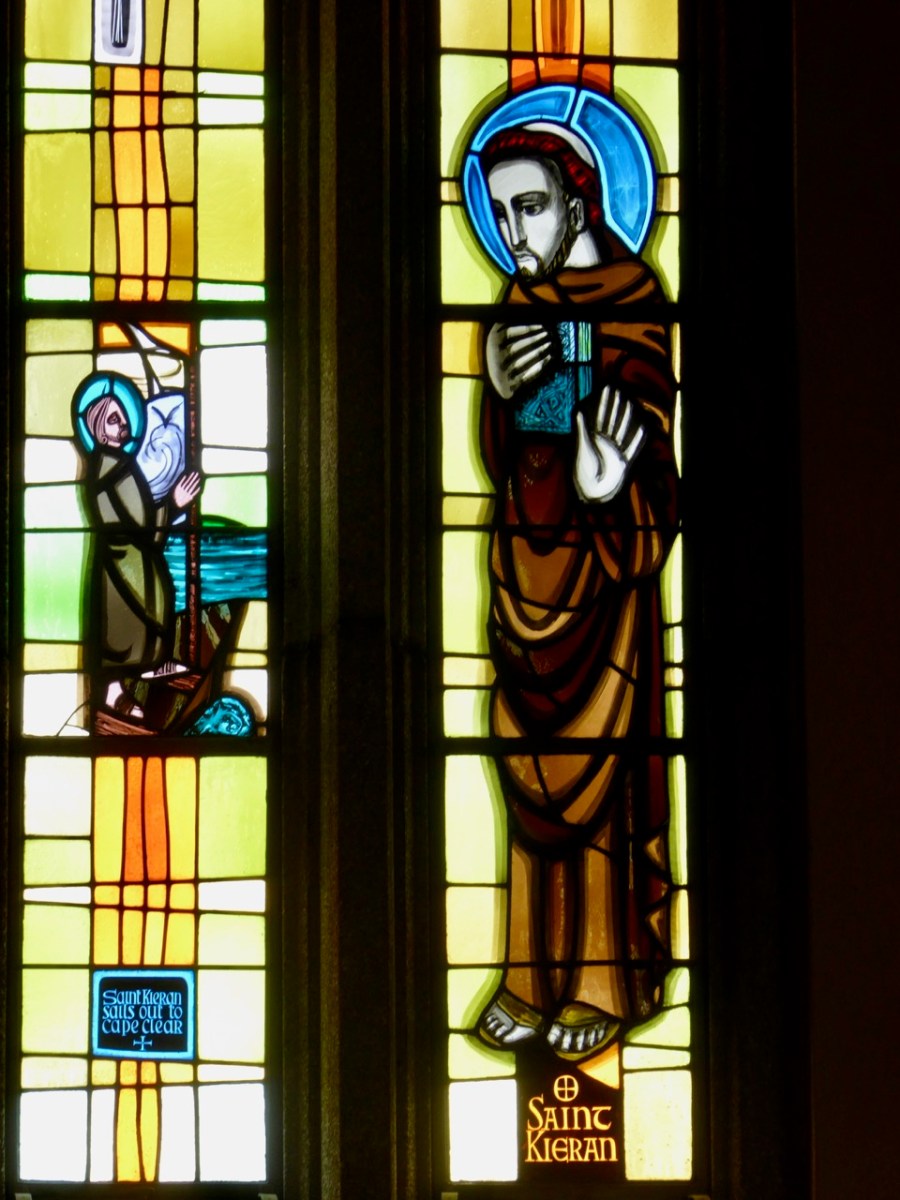
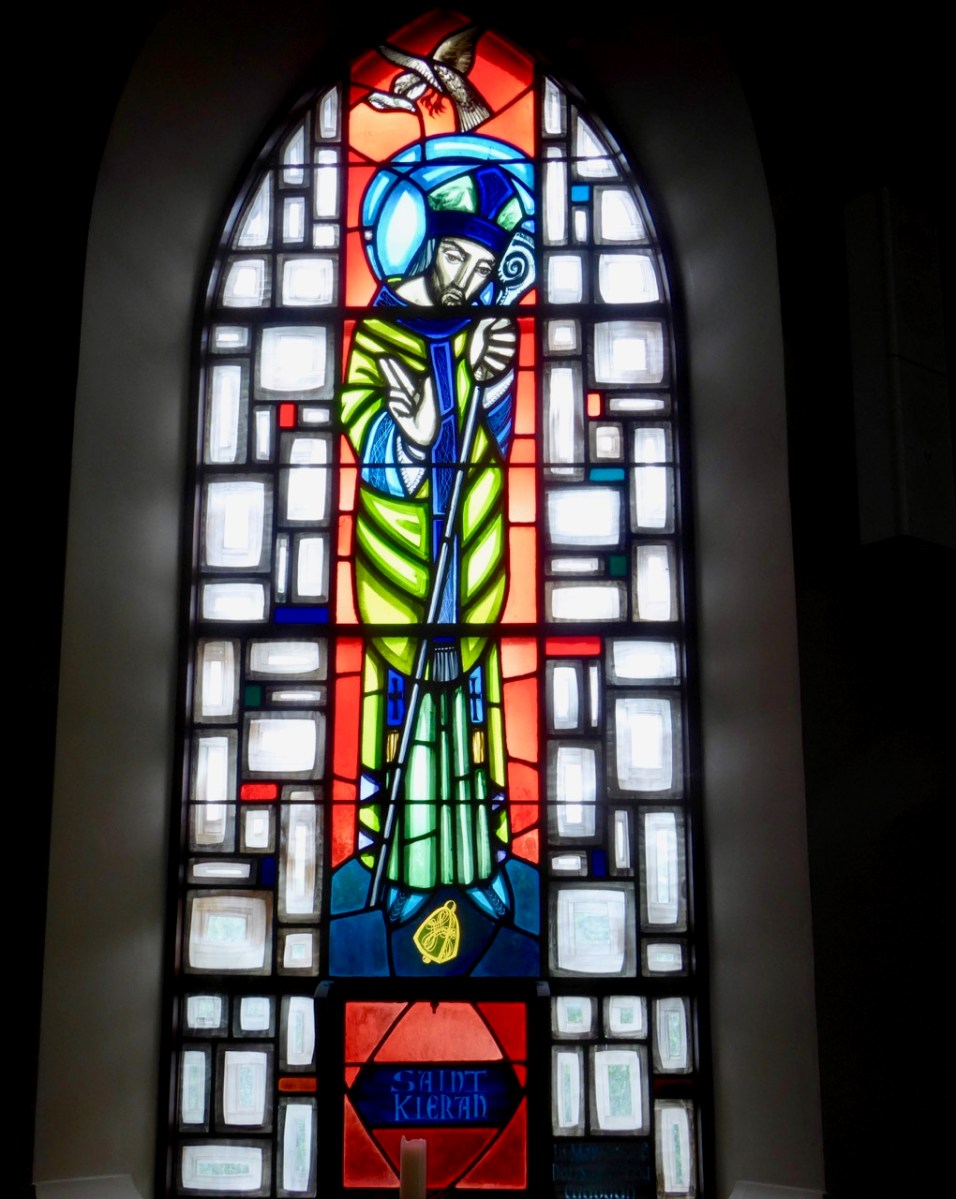
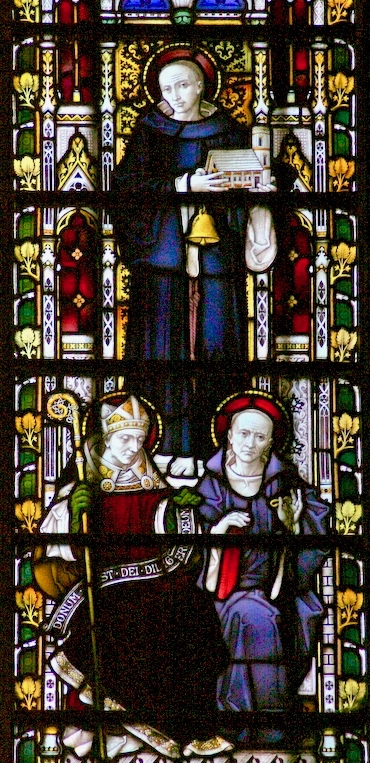
Left – St Ciarán celebrated in modern stained glass, in the church at Caheragh, West Cork; centre – Ciarán at Rath church, near Baltimore, and right – St Piran is the top figure (with church and bell) in this window panel from Truro Cathedral, Cornwall
So, what is the connection between Saints Ciarán and Piran? Apparently, they are the same person! Charles Lethbridge Kingsford reporting in the Dictionary of National Biography 1885 – 1900 (a 63 volume work!) states:
…PIRAN or PIRANUS, Saint, is commonly identified with Saint Ciaran of Saigir. The names Piran and Ciaran or Kieran are identical—p in Britain being the equivalent of the Irish k. The history of the two saints is in the main features the same, though the Irish lives of St Ciaran do not record his migration to Cornwall…
Many writers make the same assertion about the orthophony of the name but – to be fair – others, including some saintly hagiographers, do not agree, suggesting we are talking about two different saints. As someone who has a birthday on 5th March (today) – the Saint’s Day for both Ciarán and Piran – I have no doubts about the matter. Here’s another source that concurs with the view that they are one and the same saint – The Irish Ecclesiastical Record, Volume X (1874):
…The labours of St Kieran were not confined to Ireland. He passed several years on the western coast of Britain, and, as we learn from Blight’s “Churches in West Cornwall,” his memory is still cherished there. Four ancient Cornish parochial churches bear his name : these are Perran-zabuloe, or St Piran-in-the-sand; Perran-arworthal; Perran-uthnoe, situated near the coast opposite St Michael’s Mount, and St Kevern, or Pieran, which in Domesday-book is called Lanachebran. St Kieran’s holy well is also pointed out on the northern coast of Perran-zabuloe. The parish church of St Keverne stands in the district called Meneage, which terminates at the Lizard Point, the southernmost land of England. The name Meneage is supposed to mean, in the old Cornish dialect, “the deaf stone”, and the reason given for it is that, though there are several mineral veins or lodes in the district, on trial they have been found to be of no value, and hence are called deaf or useless. Tradition tells that St Kieran inflicted on the inhabitants, as a punishment for their irreligion, that the mineral veins of the district would be un-productive, and the old proverb is still handed down, “No metal will run within the sound of St Kieran’s bell”…
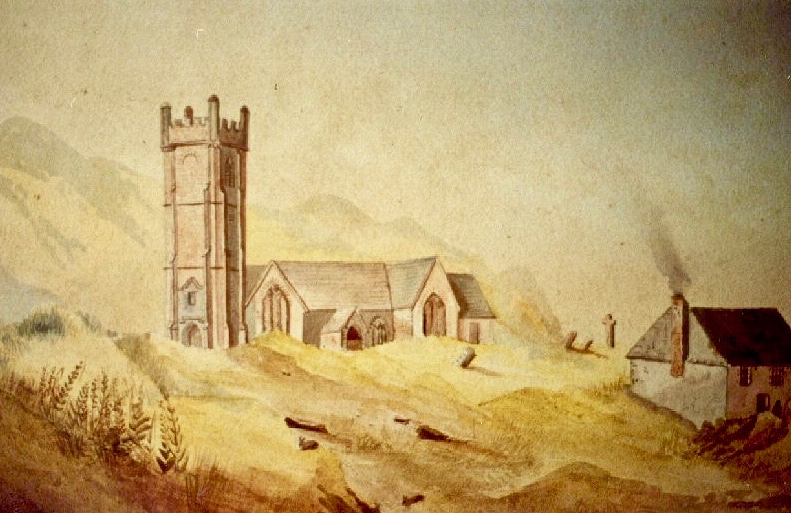
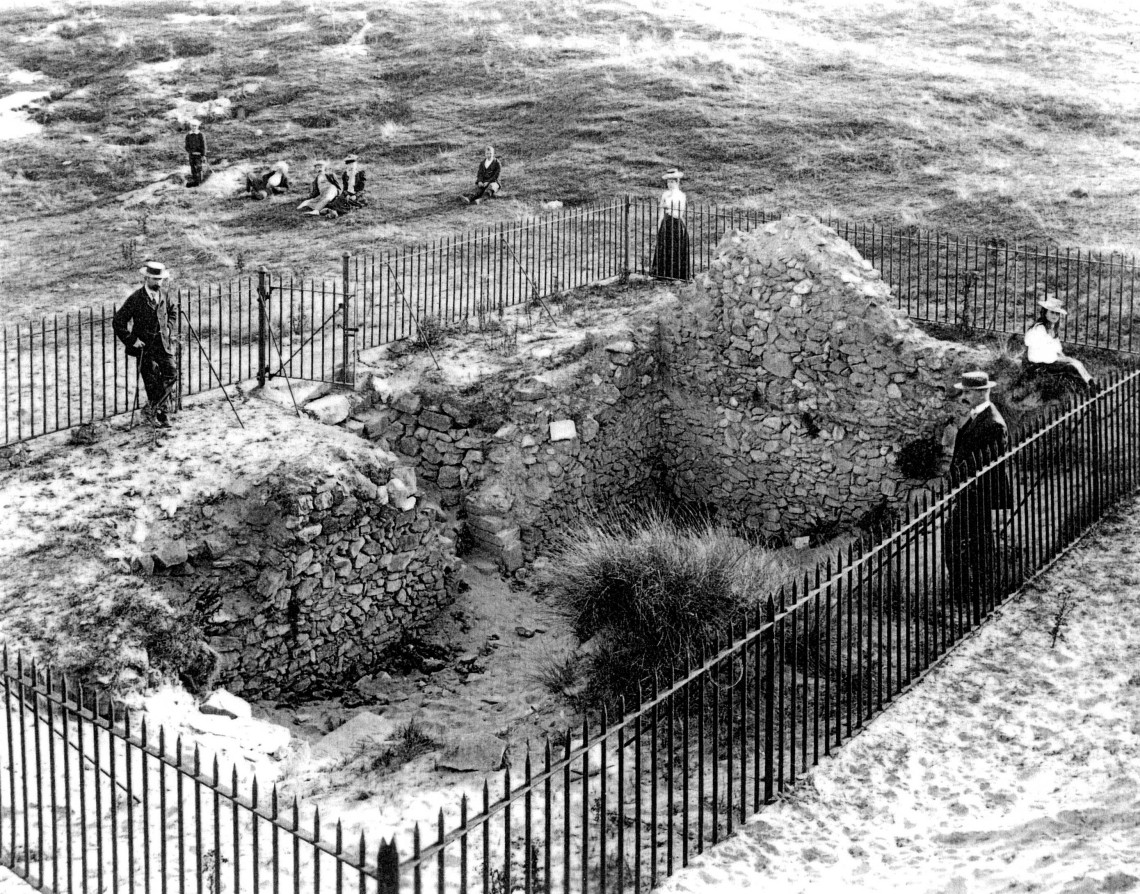
An early photo of St Piran’s Church which was built in the 12th century on the dunes at Penhale Sands, Perranzabuloe Parish, to replace the Saint’s original oratory which was buried by the shifting sands. The sands encroached on this church, too (the sands can be seen in the picture), and it was dismantled around 1800 and stone from the site was then used to build another new church two miles inland which was dedicated to St Piran in July 1805
To complement that little story of the saint in Cornwall, we have to visit Ossory, an Irish diocese which encompasses parts of Kilkenny, Laois and Offaly. There they also celebrate St Ciarán of Saigir on March the fifth: he is said to have returned from Rome after years of study, firstly visiting his native Cape Clear, then commencing his travels through Ireland until his bell rang of its own accord – this happened at a small hamlet in County Offaly, now known as Seir Kieran. There he set up a foundation, the remains of which are still visible – as is a holy well, a holy bush (bedecked with clouties) the base of a round tower, the base of an ancient high cross (now holding water which has curative powers) and a holy rock which was once said to have displayed the hand print and knee prints of the saint, now completely obscured.
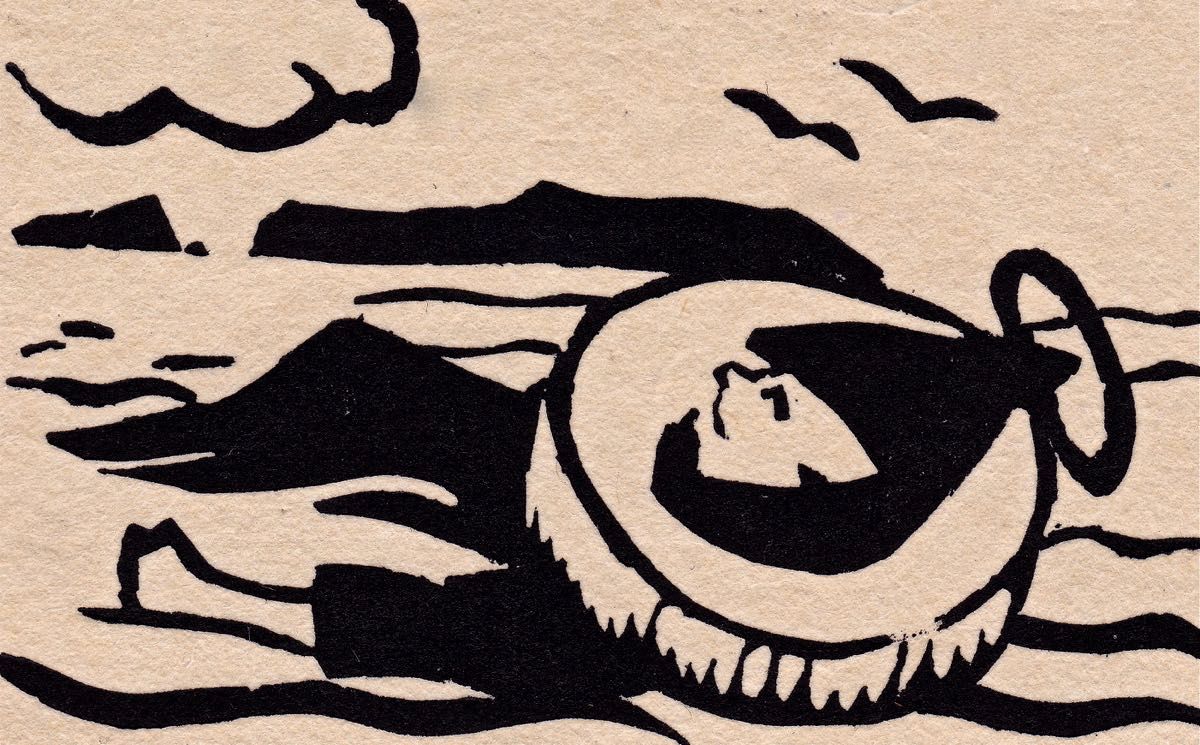
St Piran’s journey to Cornwall: “The millstone kept our man afloat” from The Discovery of Tin – a collection illustrated by Barry Cottrell
One of my favourite stories about St Piran tells of how he discovered tin smelting. He used as his hearth a piece of local stone; when he lit a fire on the hearth the veins of tin ore in the stone melted and a stream of silver ran out across the black rock, in the form of a cross. From that day to this the flag of Cornwall is a white cross on a black background, and Piran is also the patron saint of tin and tinners.
Just about now in Cornwall (March 5 2017) a great celebration is going on in honour of the saint. There will be a procession to the original oratory buried in the sands, led by the Grand Bard of the Cornish Gorsedd. Cornish flags – and the Cornish tartan – will be very much in evidence. The Cornish people have a great nationalistic spirit and have called for the 5th March to be an official public holiday. In a recent debate on Cornwall some interesting views were expressed on the place of Cornwall in a post-Brexit world, and the attributes of St Piran were symbolic of this – his inventiveness, his love of nature, and his belief in the inclusivity of all peoples in an international community.
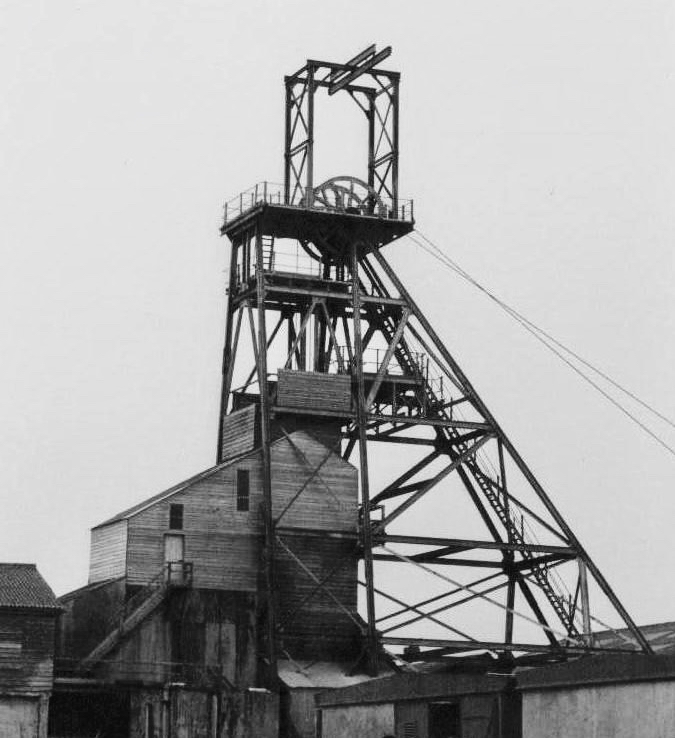
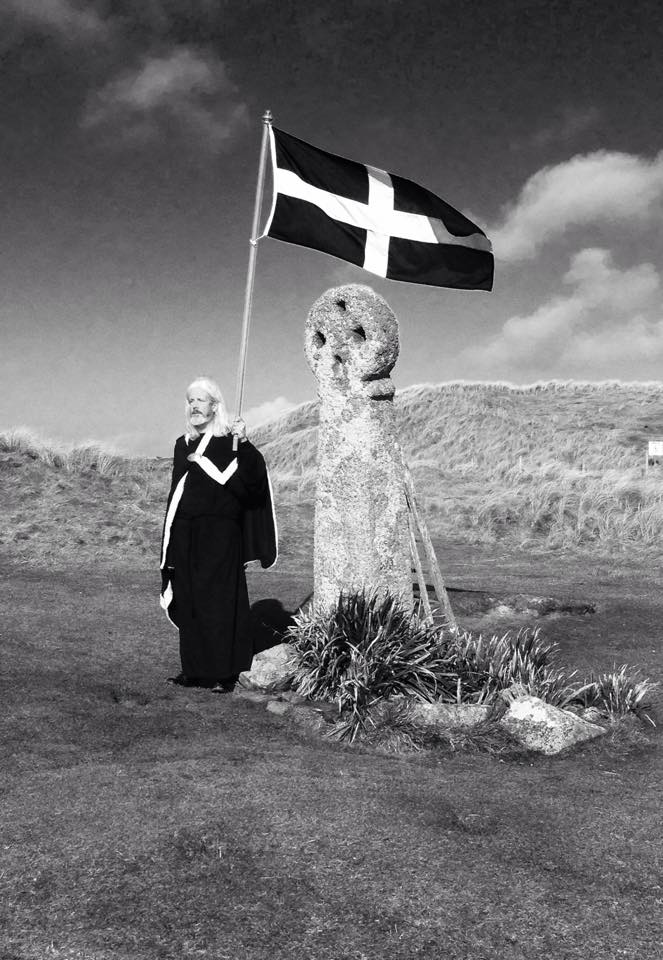
Left – Geevor Mine, in West Penwith, one of Cornwall’s last working tin mines, now a museum of mining; right – an incarnation of the saint: Cornish author Colin Retallick stands in front of St Piran’s ancient cross on the saint’s day
St Piran lived to a great age. They say in Cornwall that he was ‘fond of the drink’ and met his end by falling into a well when walking home from a party. I hope it was a holy well! Today, seventeen centuries after St Ciarán / Piran was thrown from the cliffs of Cape Clear I am looking out to that island: …the winds are blowing tempestuously, the heavens are dark with clouds, and the waves are white with crested foam… There have been so many links between Cornwall and West Cork, ever since the Bronze Age, when Cornish tin traders brought their metal to mix with copper mined above us here on Mount Gabriel. Watch out for more posts about these links between the two communities: links which would have warmed the heart of our shared saint!
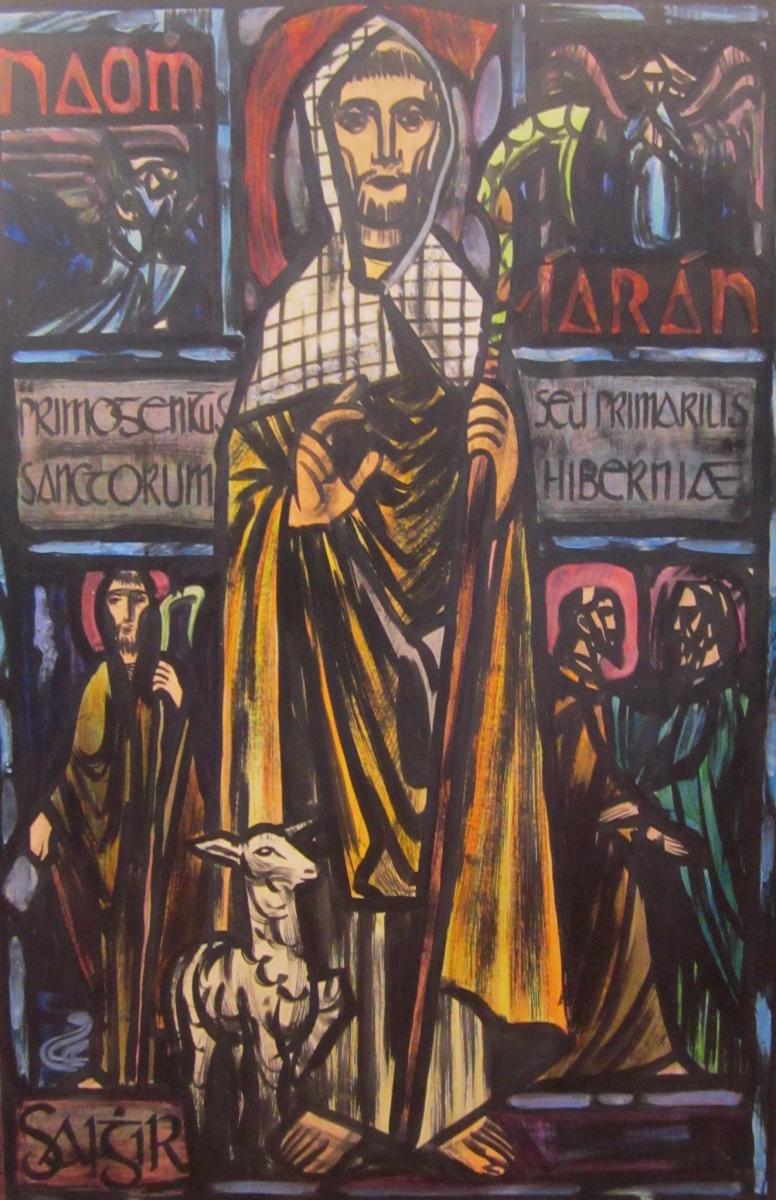
Below – St Ciarán by Richard King, painted for the Capuchin Annual in the 1950s
Welcome to the UCD Library Cultural Heritage Collections blog. Discover and explore the historical treasures housed within our Archives, Special Collections, National Folklore Collection and Digital Library










 Roaringwater Journal