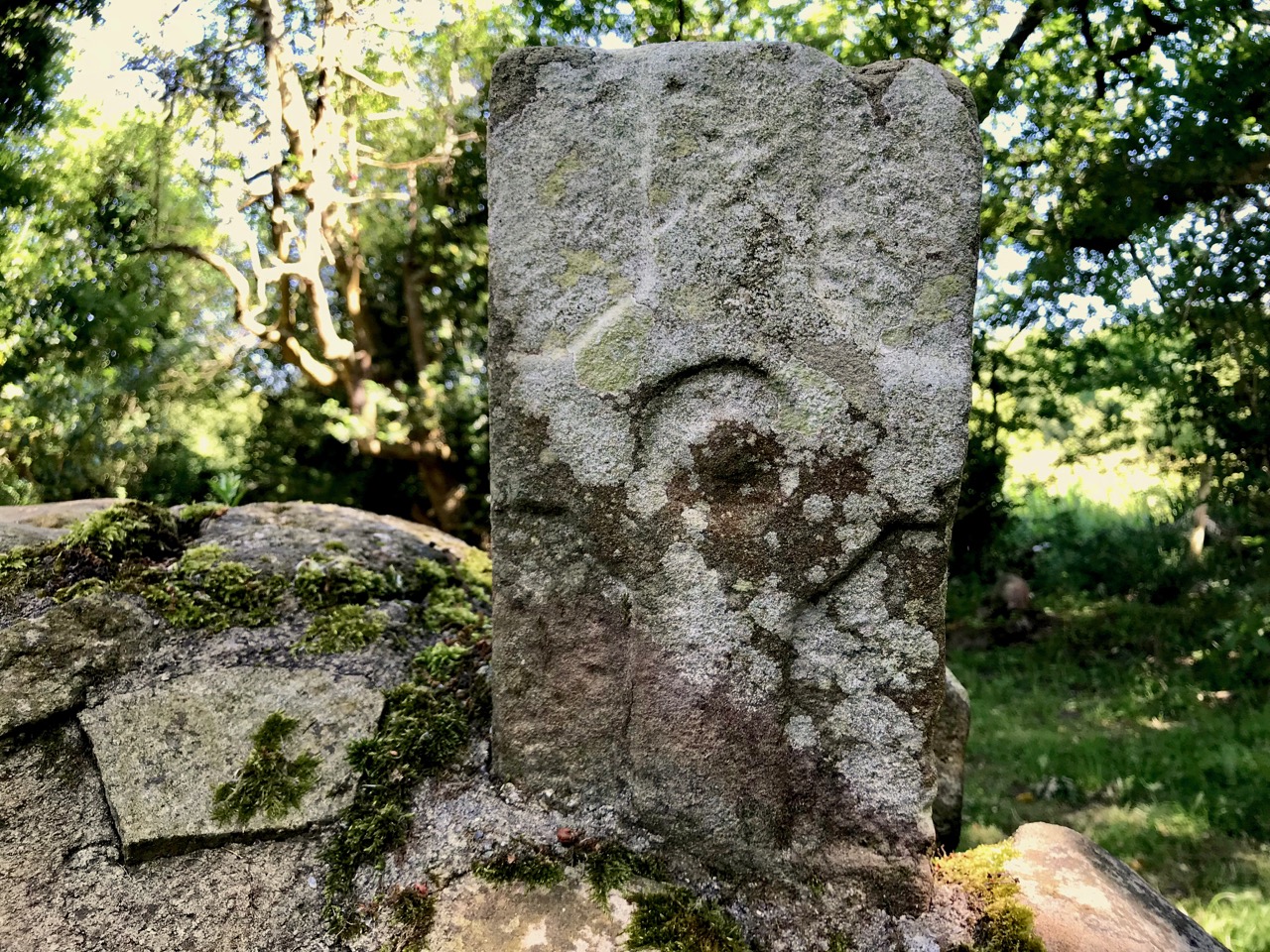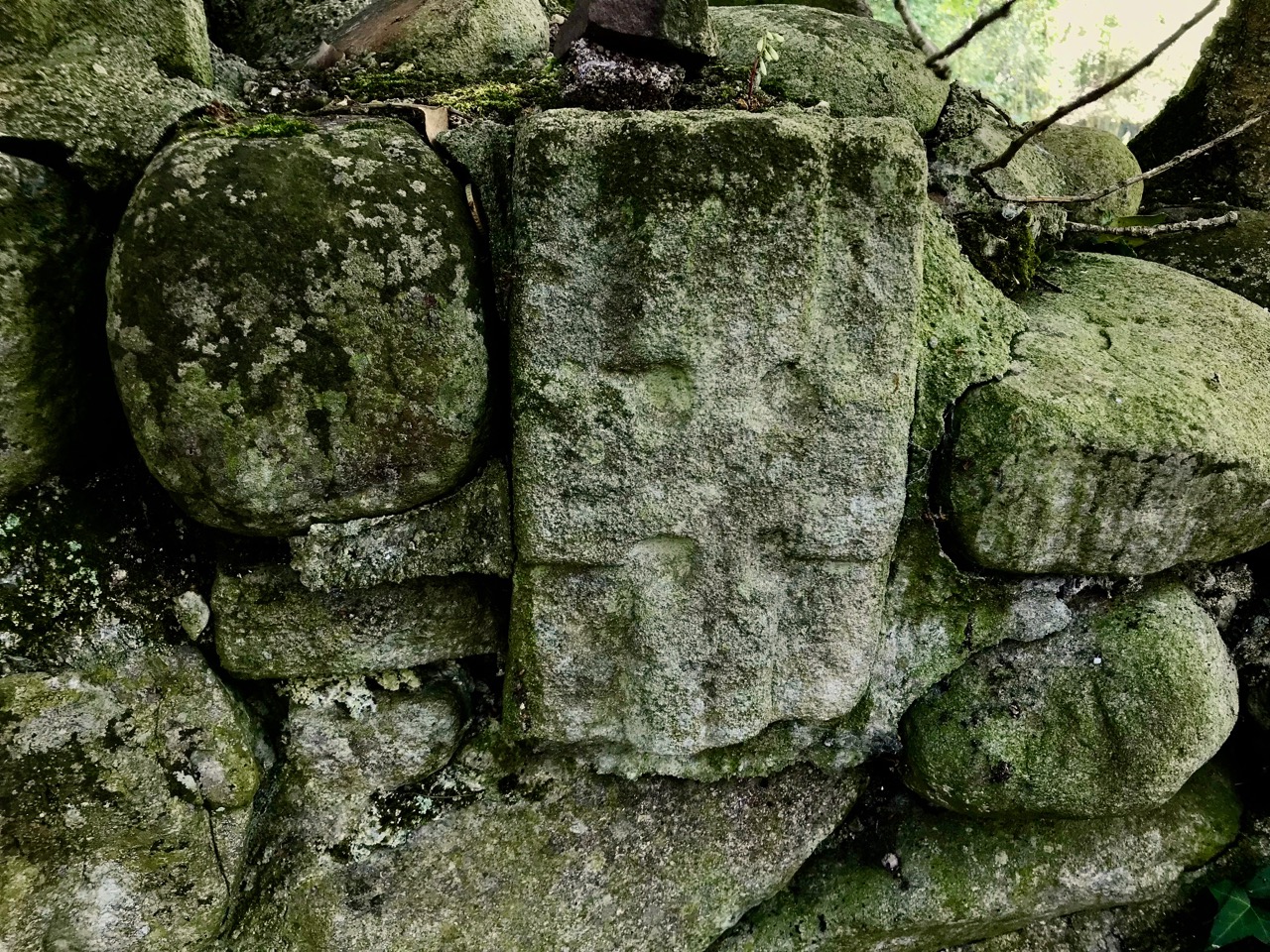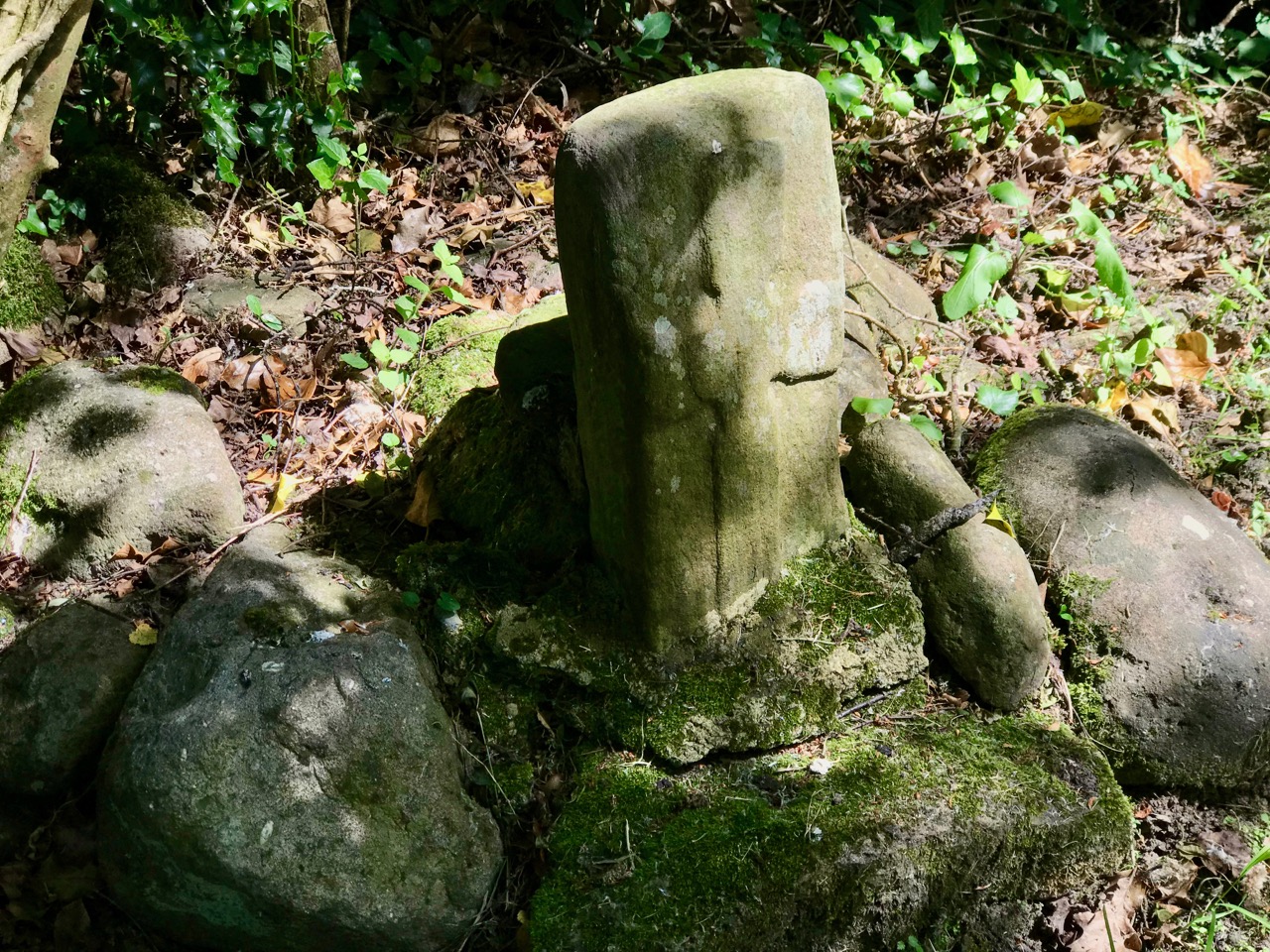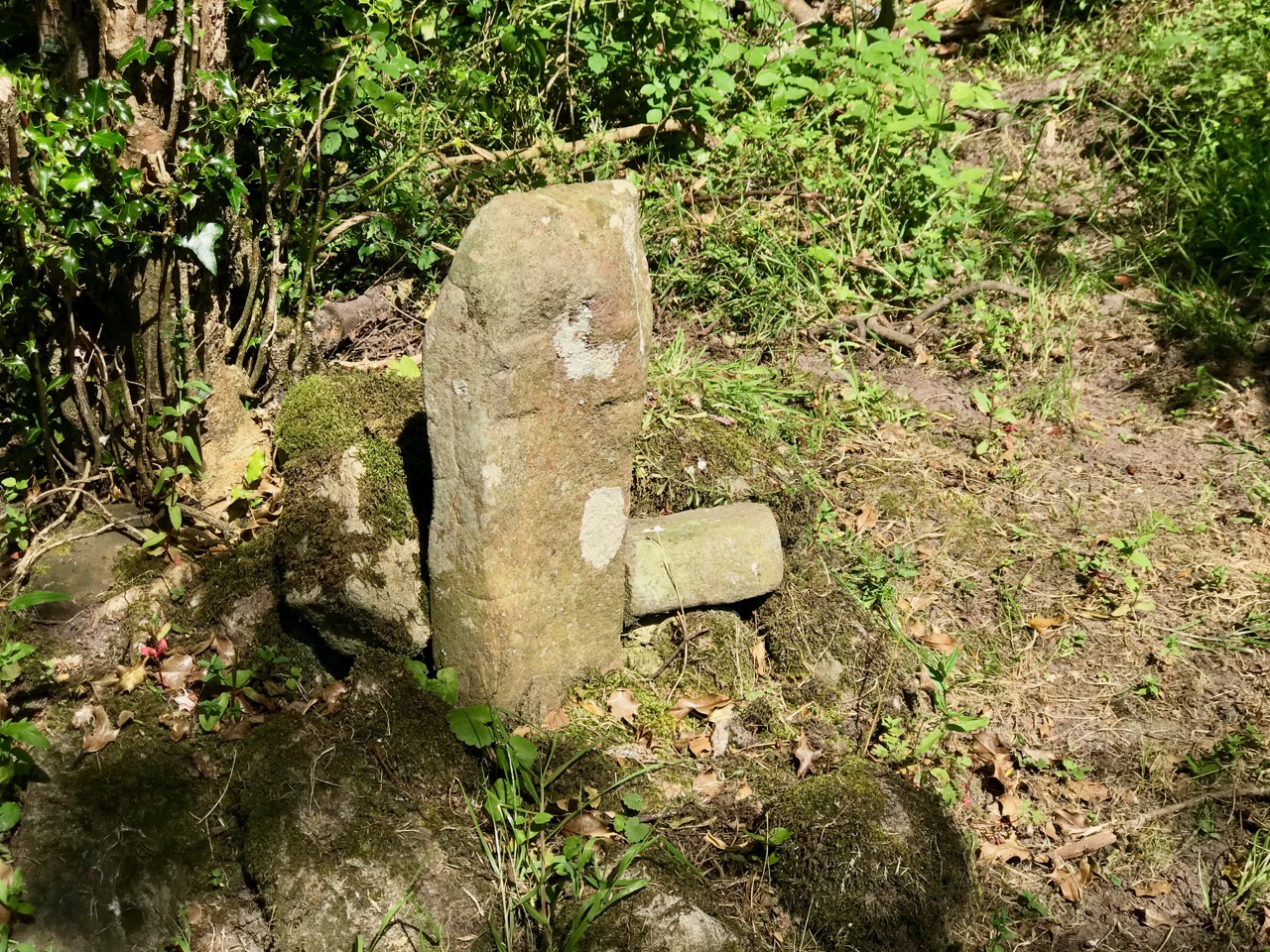
Off the M8 – Searching out Péacáin

Once again we followed in the footsteps of our friends Amanda and Peter – she of Holy Wells of Cork and he of Hikelines. They had visited the Glen of Aherlow in County Tipperary and pointed us to St Berrahert’s extraordinary site at Ardane which I described in this post. Not far away is another site, which Amanda reported on fully in her own post, here. It is equally remarkable, and related to St Berrahert’s Kyle in that they were both restored by the Office of Public Works in the 1940s. They are also both very easily accessible in a few minutes from the M8 motorway at Cahir.

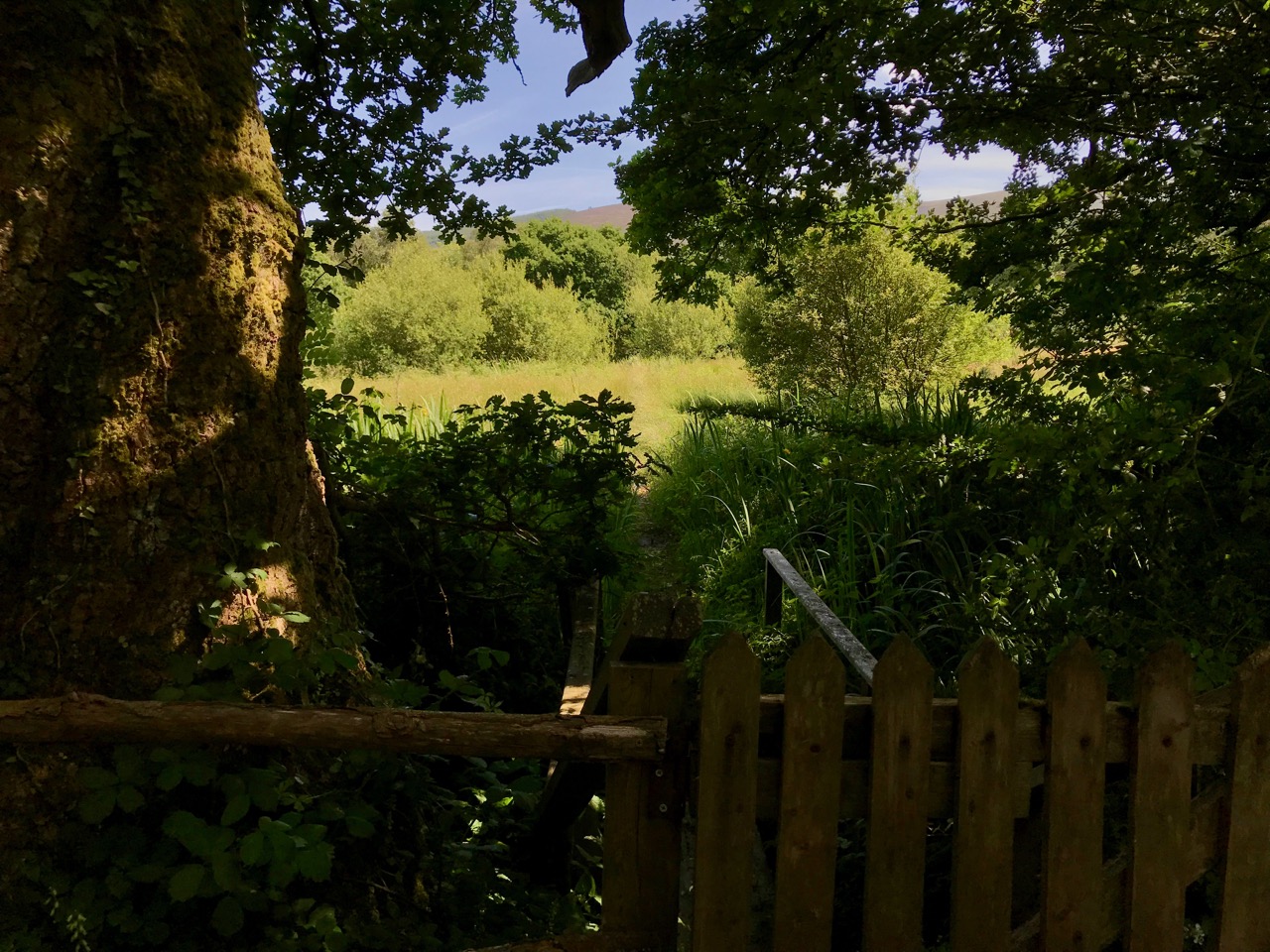
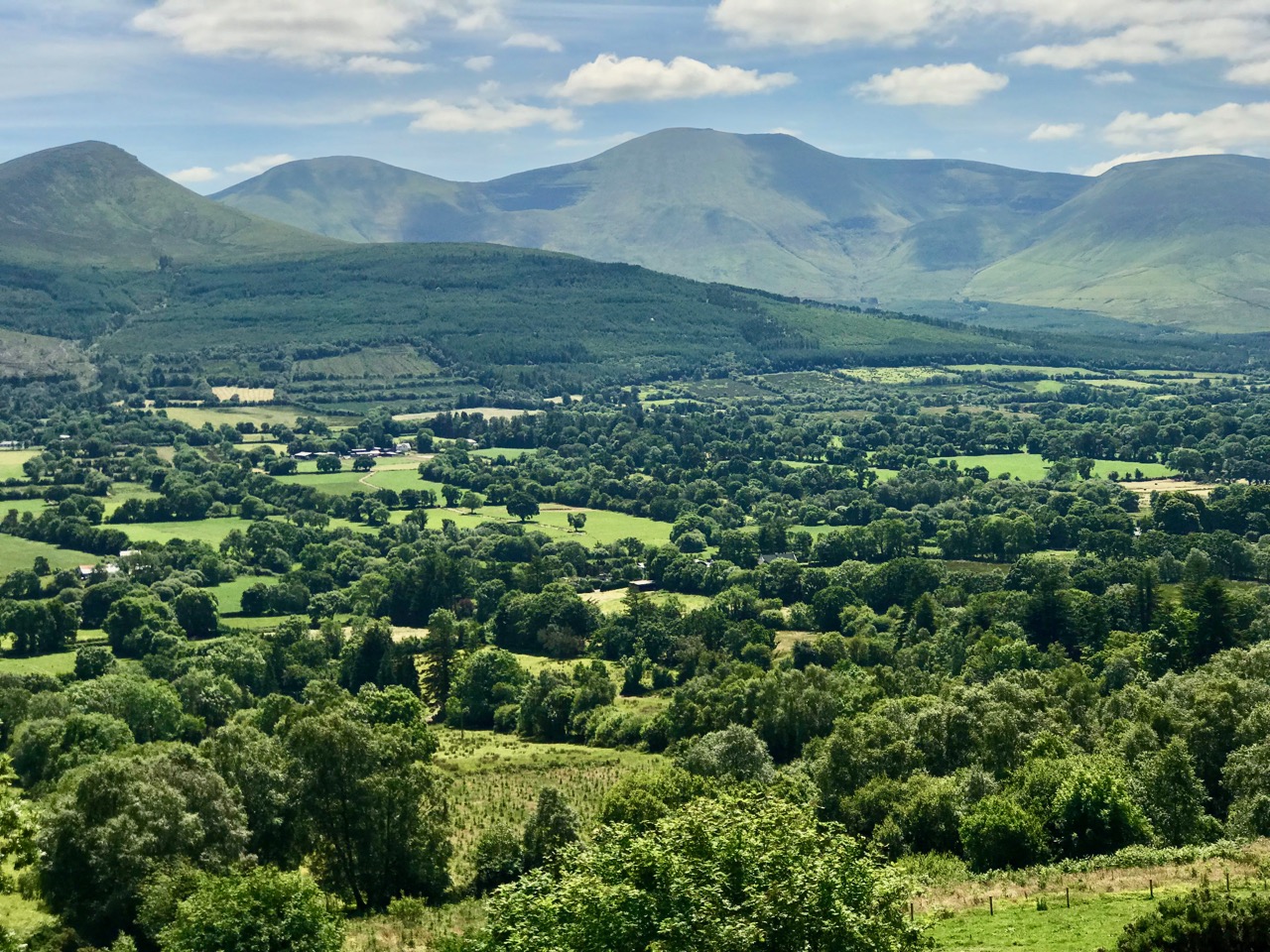
We were delighted to be travelling again through the beautiful Glen in the shadow of the Galtee Mountains (above) as we searched out a boreen that led us down to the railway, as directed by Amanda. We parked and crossed at the gate, watching out carefully as this is the Waterford to Limerick Junction line used by two trains a day (except on Sundays!)
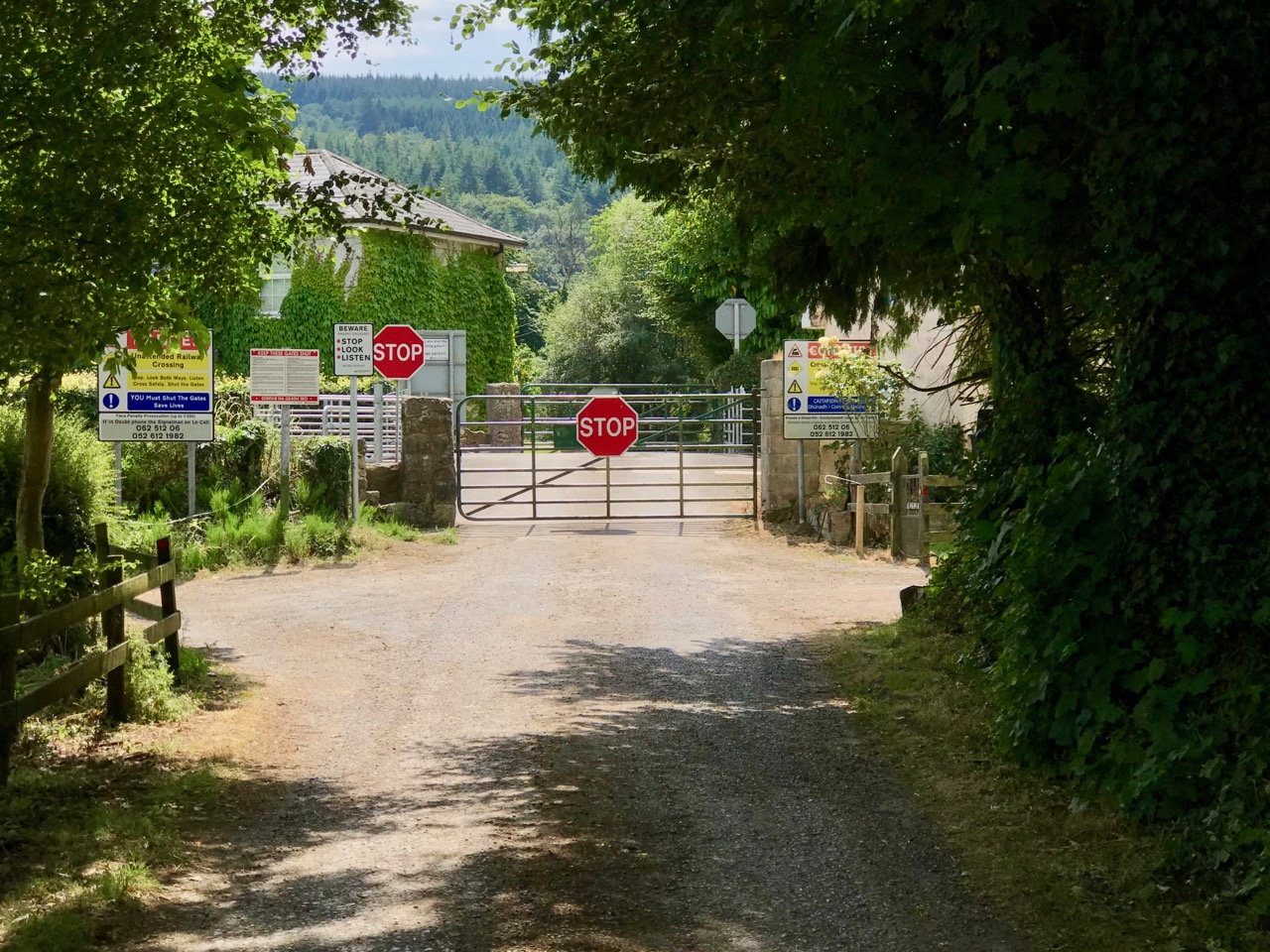
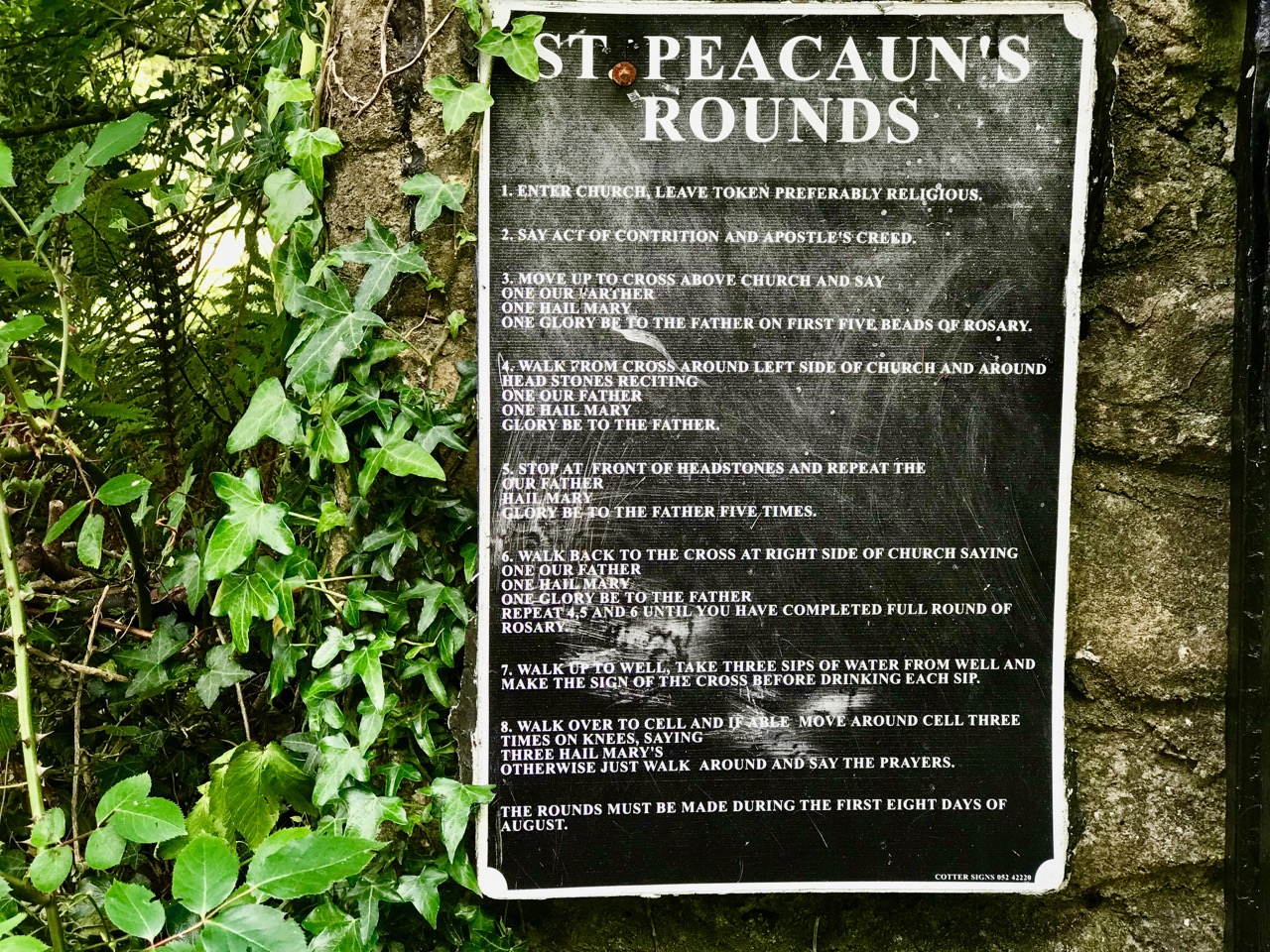
Once across, we were in an idyll. It’s a private lane, running alongside a gentle stream, but the Bourke family allow visitors to walk (as they have done for centuries) to the old church, the cell and the holy well of Saint Péacáin. Ancient stone walls line the way, and trees overhang, shading the dappled sunlight in this most exceptional of Irish seasons. We met Bill Bourke, who regaled us with tales of his life spent mostly far away from this, his birthplace – but who returned to rebuild the family home and to enjoy perpetual summer in what is, for him, the most beautiful setting in the world. He also told us of the crowds who used to come to celebrate St Péacáin at Lughnasa – 1st August – paying the rounds and saying the masses.

In her monumental work (it runs to over 700 pages) The Festival of Lughnasa – Oxford University Press 1962 – Máire MacNeill points out the harvest feast day was such an important ancient celebration that it survives as the focus of veneration of many local saints who would otherwise have been known for their own patron day, and she particularly mentions Tobar Phéacáin in this regard: a place well away from any large settlement where the great agricultural festival was so critical to the cycle of rural life.

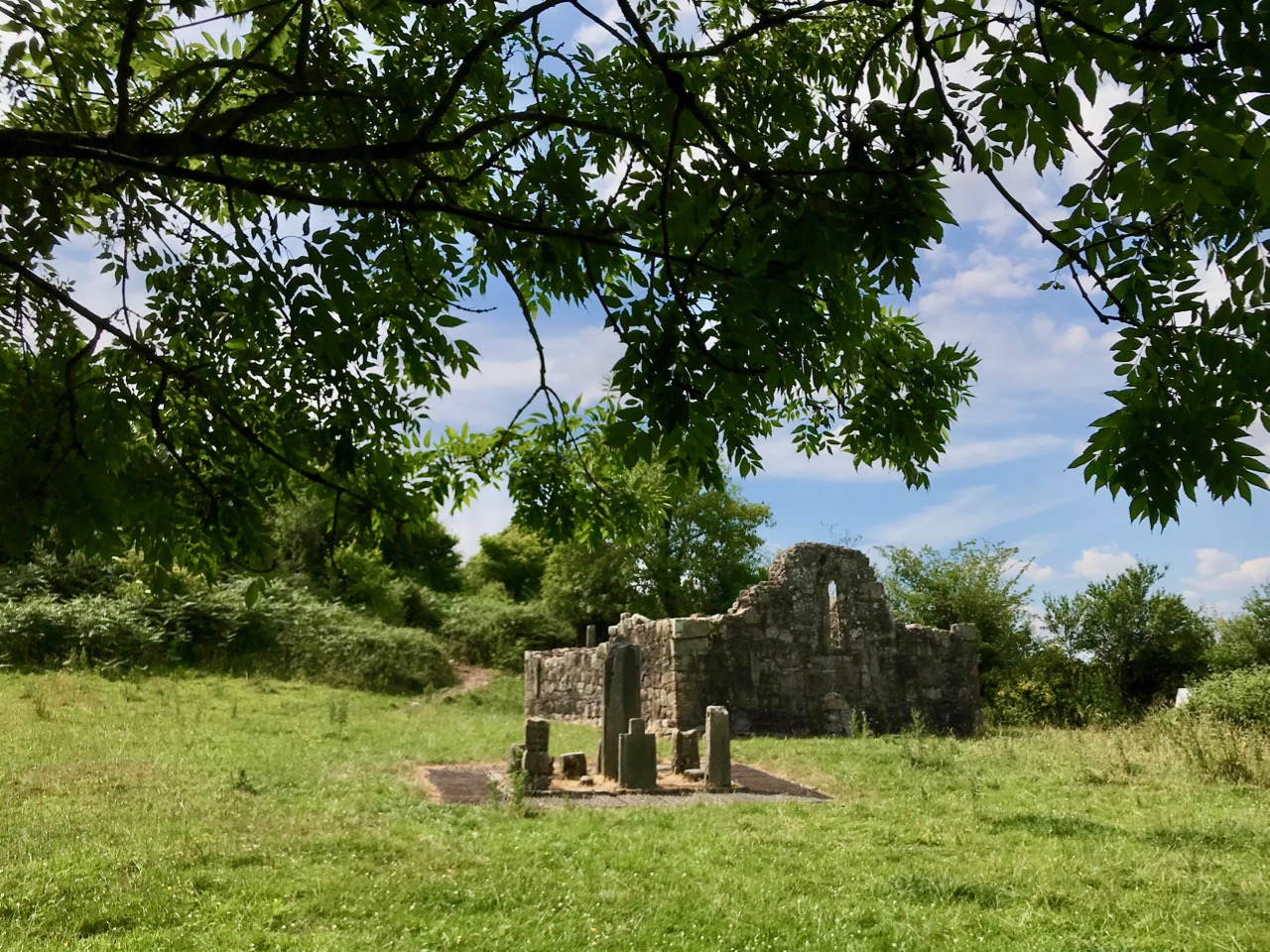
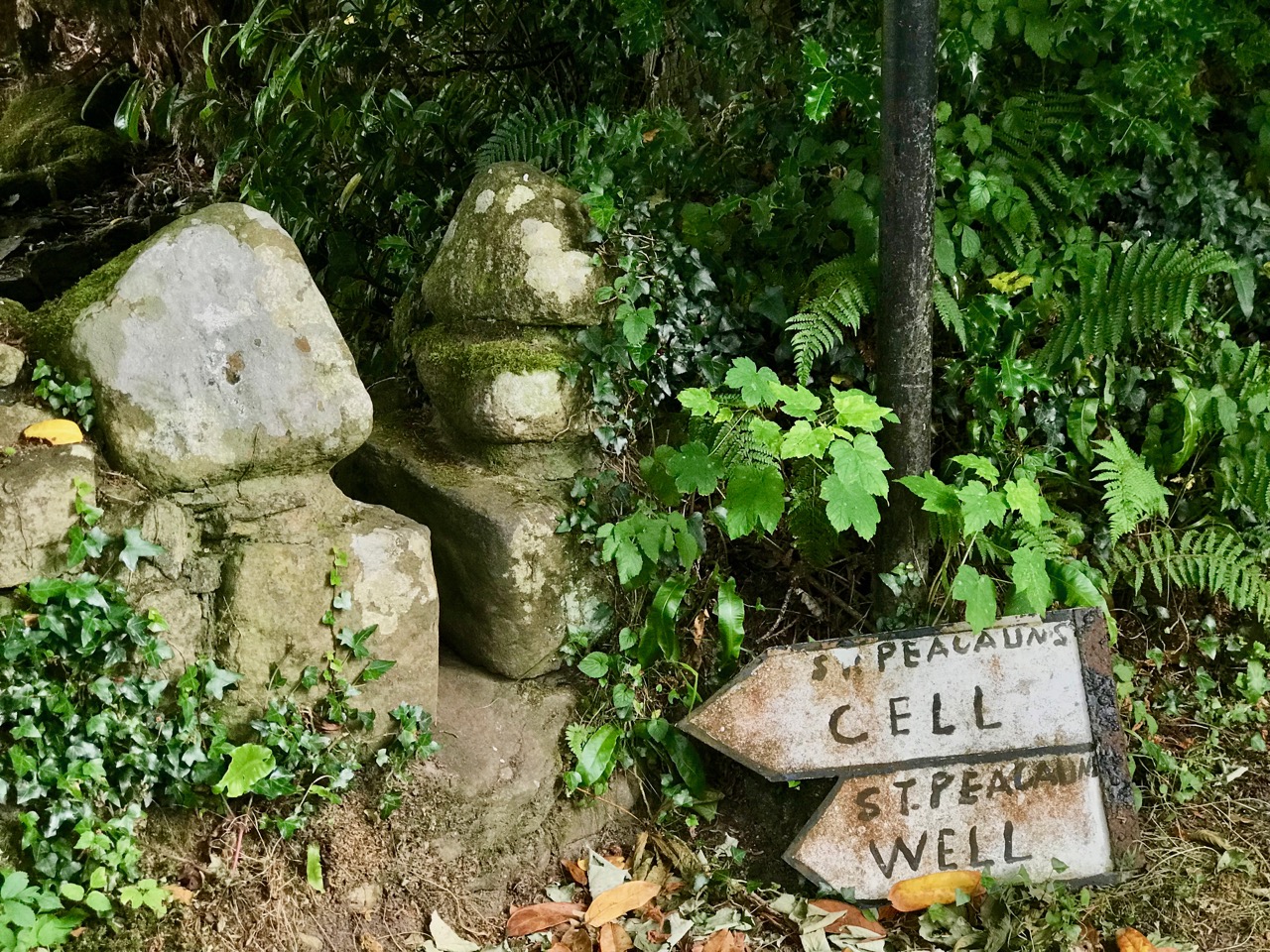
The rural setting of St Péacáin’s Cell can be seen above, just in front of the trees; the church and the well are nearby. MacNeill provides a description of Tobar Phéacáin and includes some variant names:

. . . Tobar Phéacáin (Peakaun’s Well), Glen of Aherlow, Barony of Clanwilliam, Parish of Killardry, Townland of Toureen . . . On the northern slope of the Galtee Mountain at the entrance to the Glen of Aherlow and about three or four miles north-west of Caher there is a well and ruin of a small church. About a mile beyond Kilmoyler Cross Roads a path leads up to it . . . In 1840 O’Keefe, of the Ordnance Survey team, reported that the old church was called by the people Teampuillin Phéacáin, or just Péacán . . .

. . . The well, which he described as lying a few perches south-east of the church was called Peacan’s Well or Tobar Phéacáin. It was surrounded by a circular ring of stonework. He stated: ‘The pattern-day still observed at this place falls on the 1st of August, which day is, or at least until a few years since, has been kept as a strict holiday.’ Devotions were also, he said, performed there on Good Friday . . .

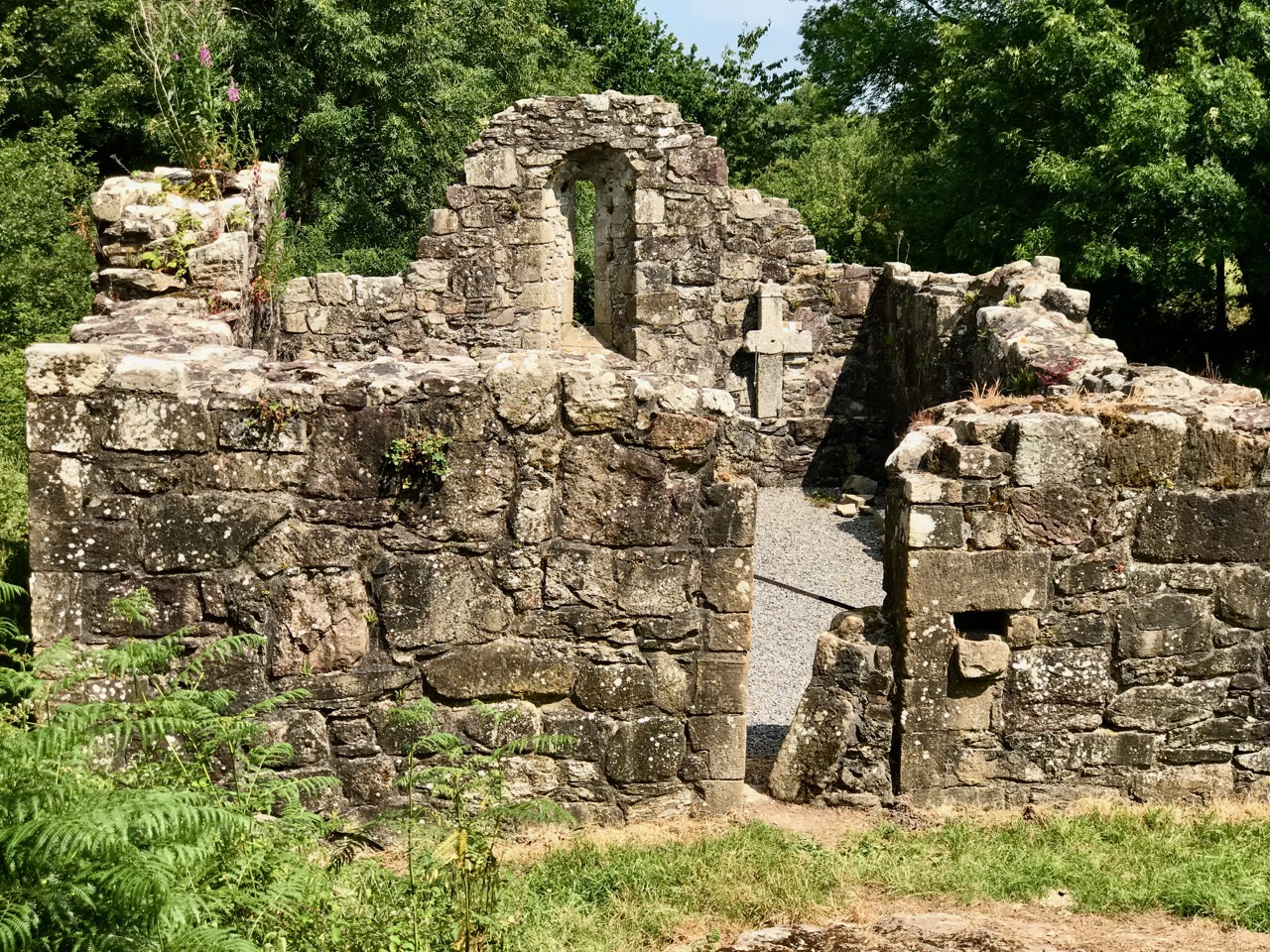
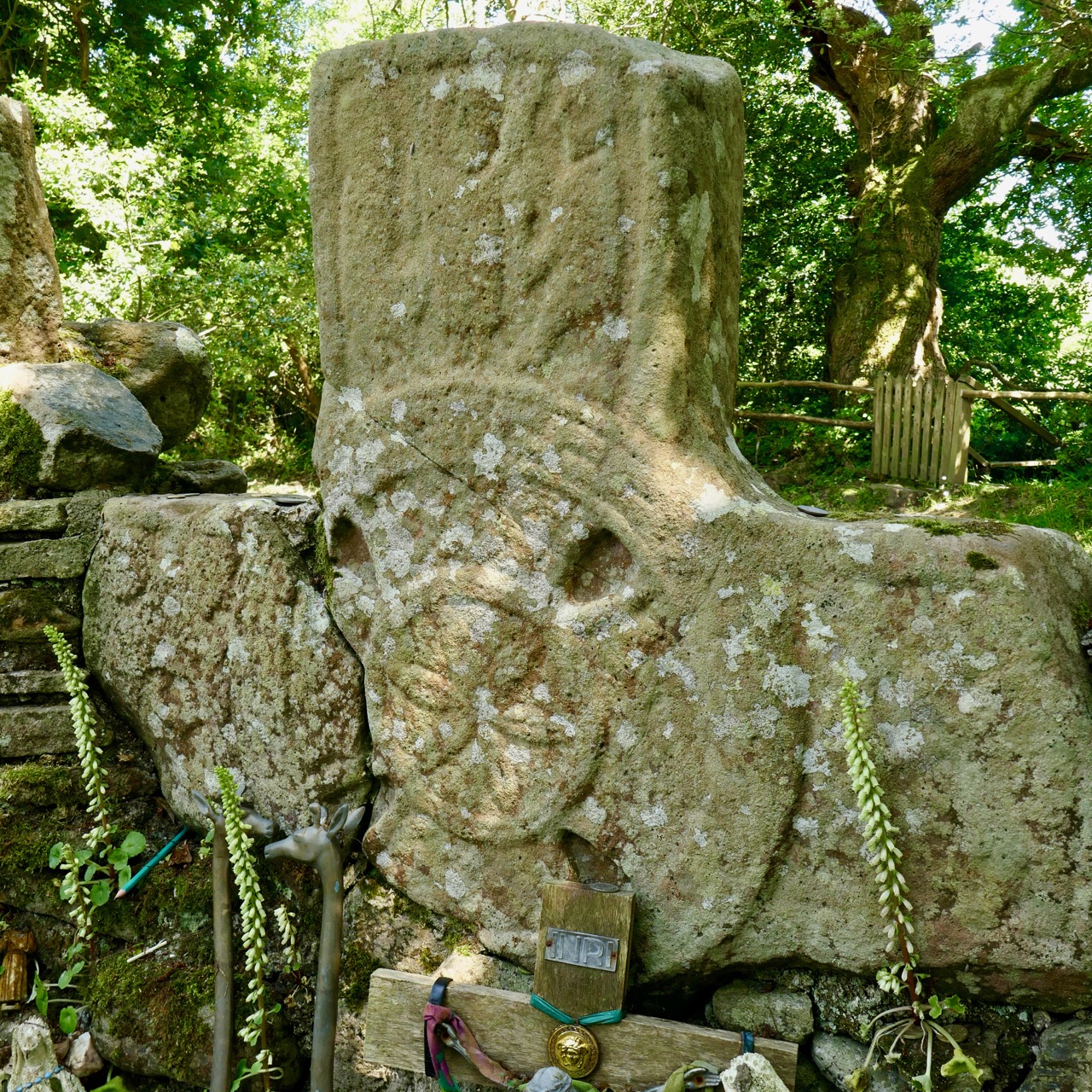
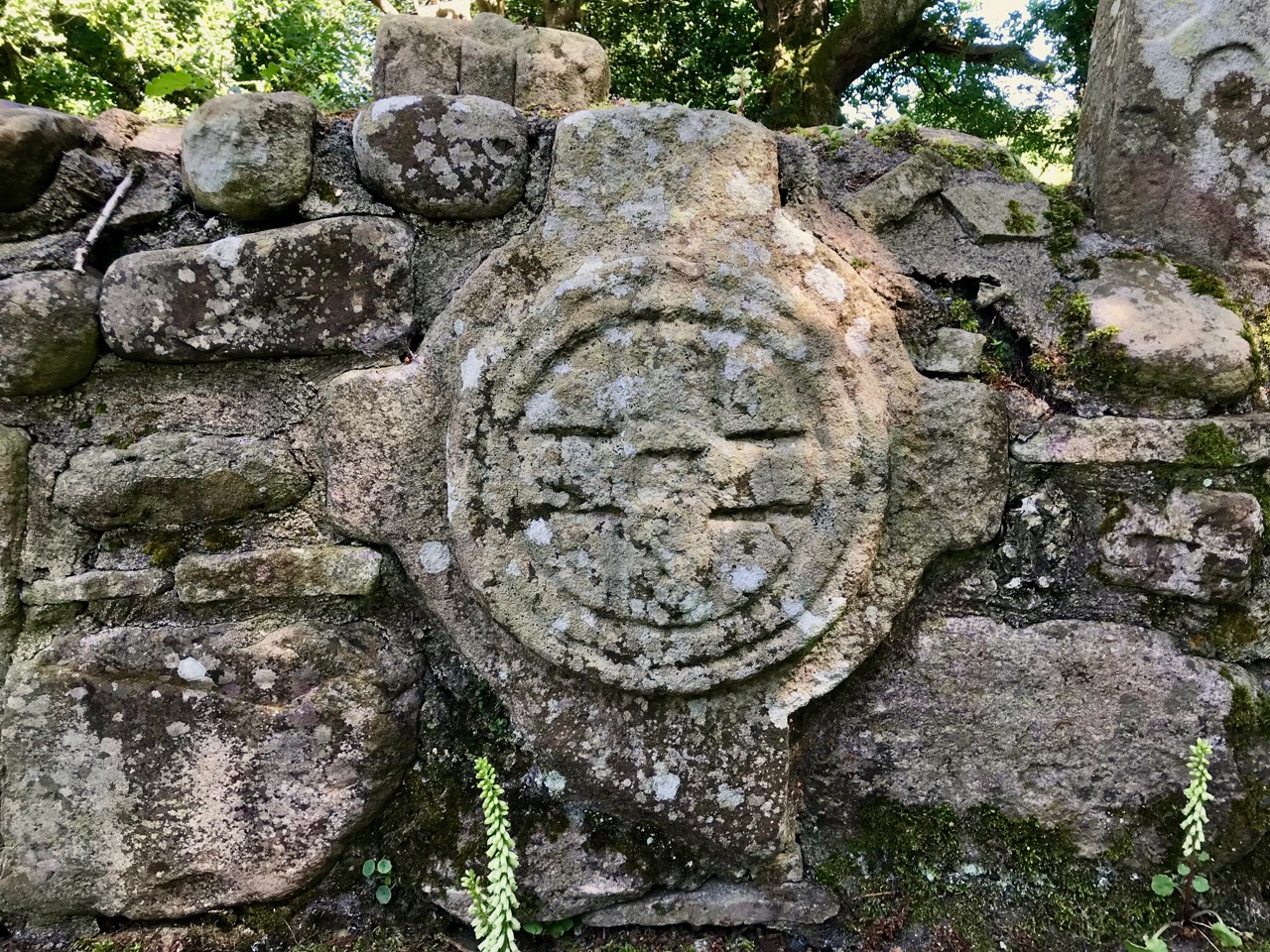
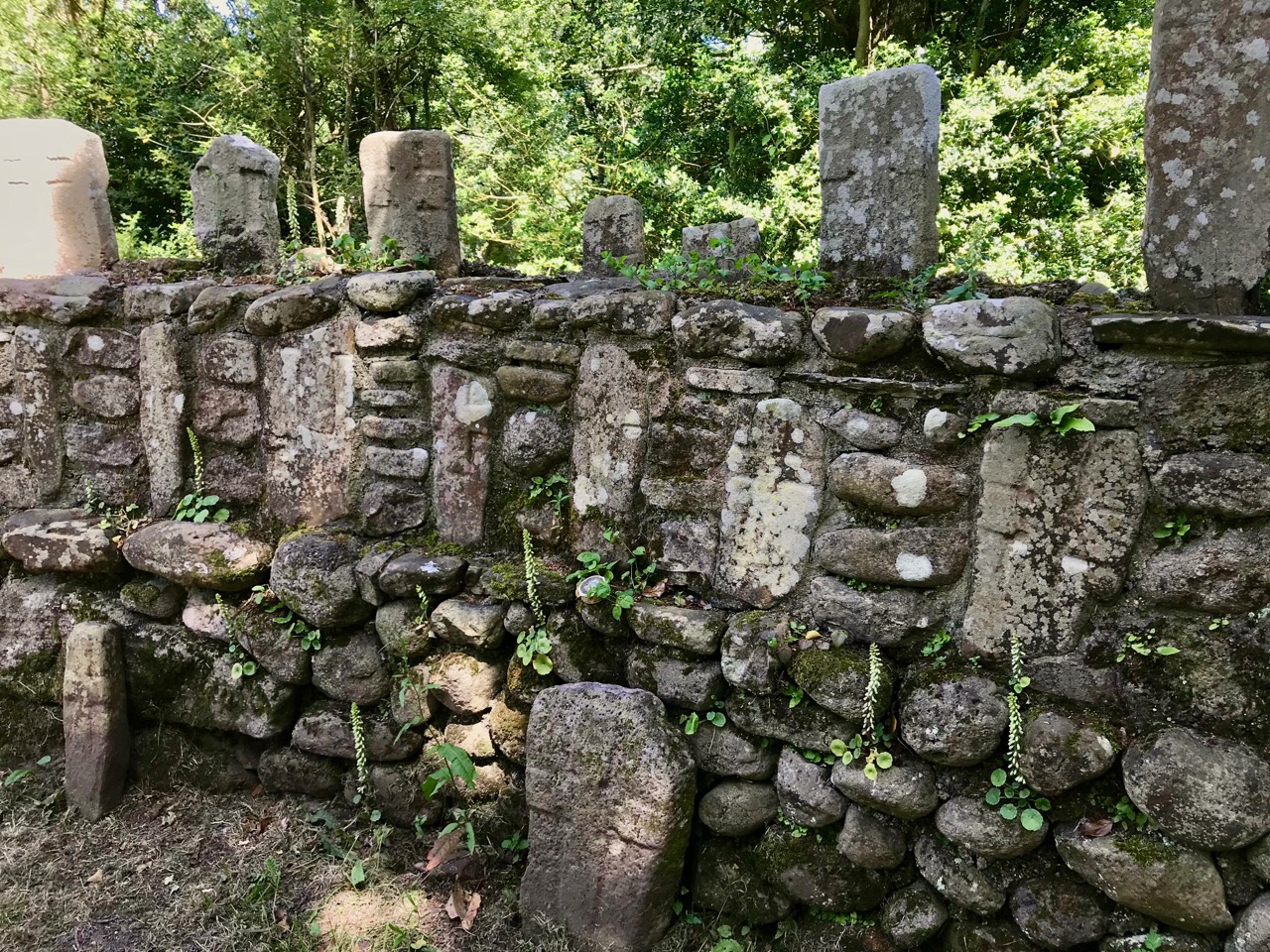
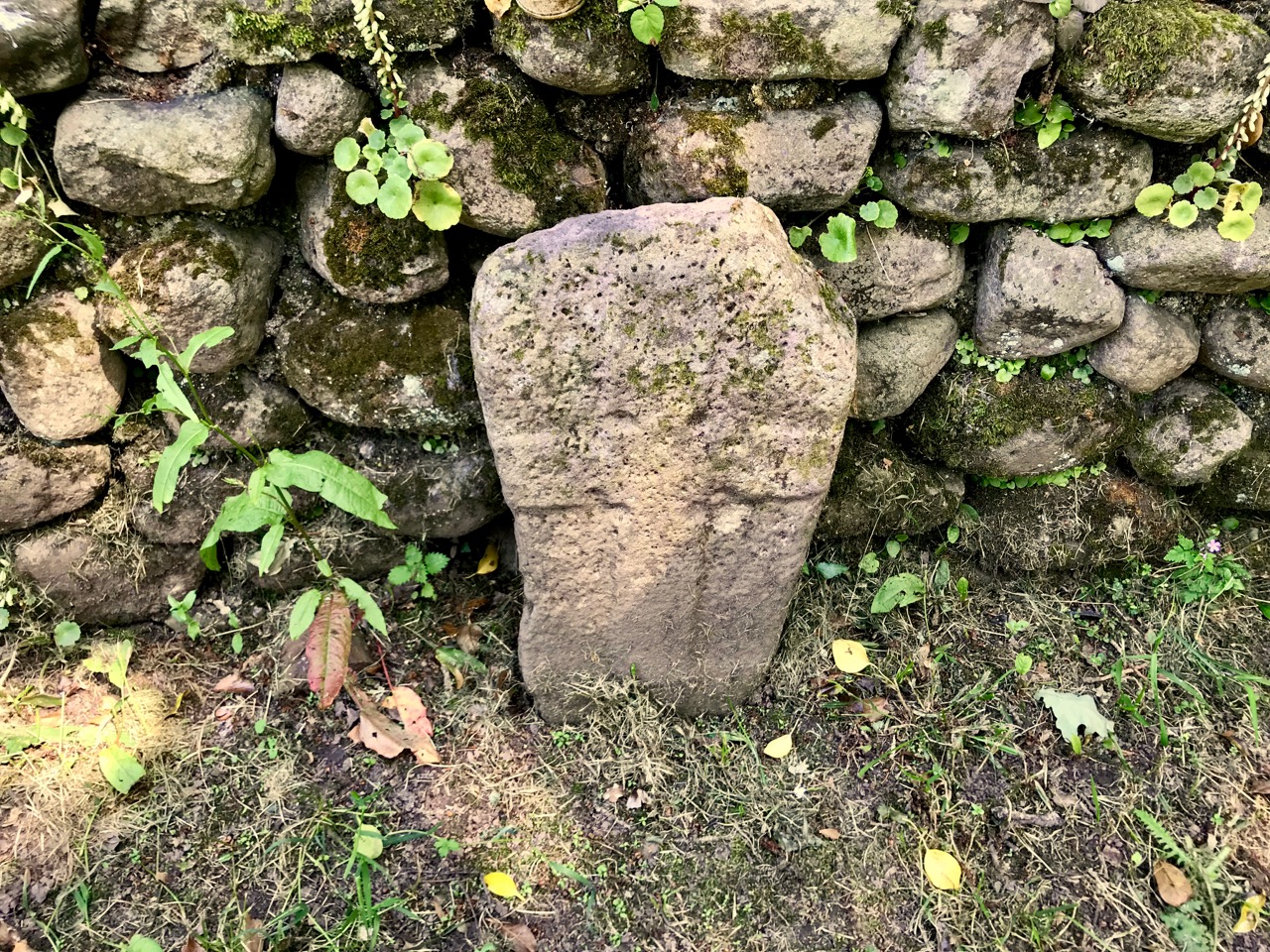
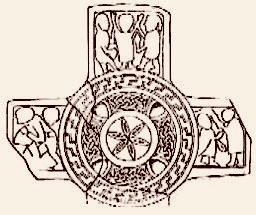
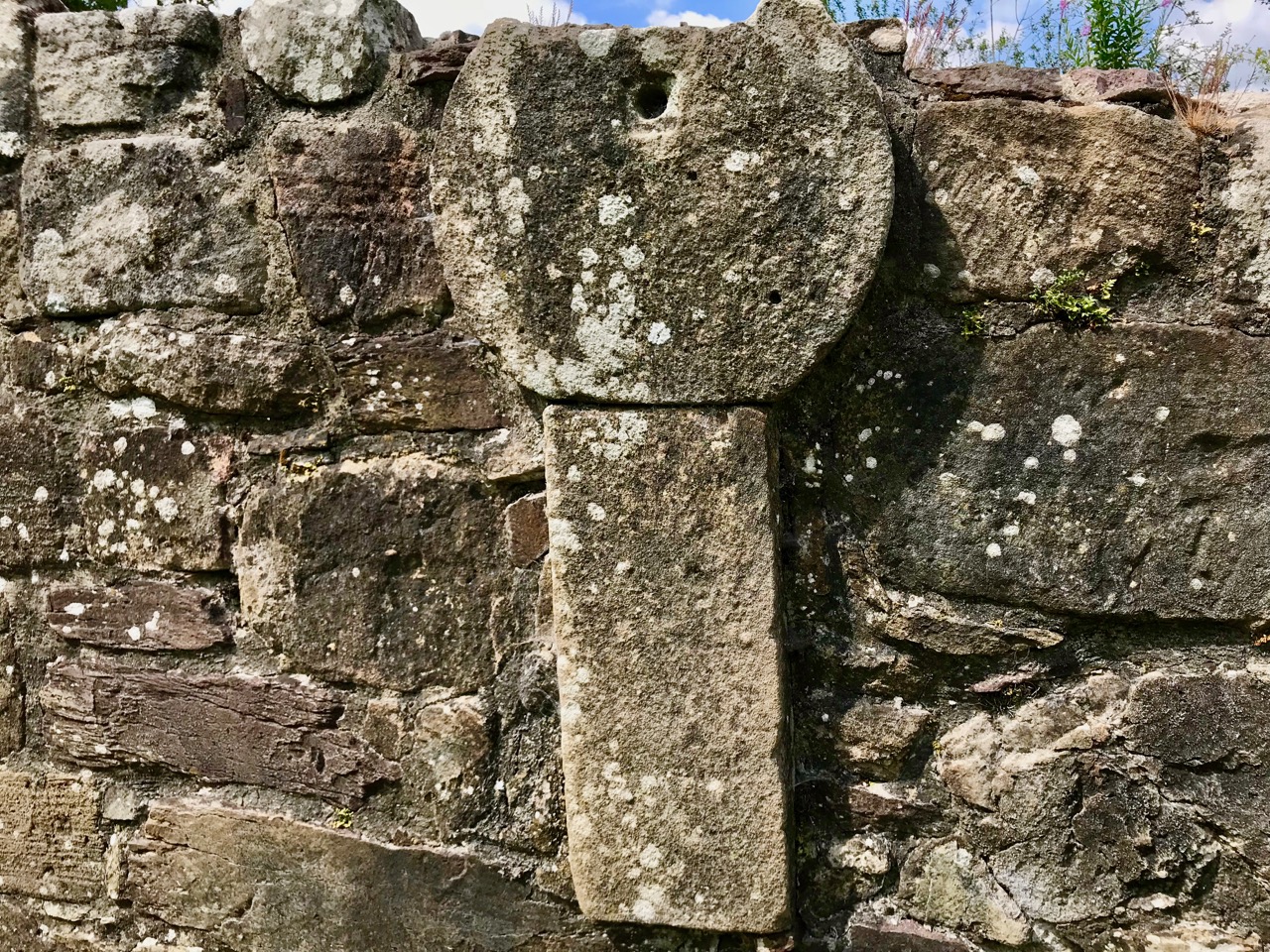
A hundred years after O’Keefe wrote this, the church ruins were tidied up by the Office of Public Works. As at St Berrihert’s Kyle, it seems there were numerous carved slabs on the site and remnants of high crosses, implying a significant ecclesiastical presence here. All these have been fixed in and around the church ruin for safekeeping, and in an intelligent grouping. It’s wonderful to be able to see such treasures in the place they were (presumably) made for, and to experience them in such a remote and peaceful ambience.
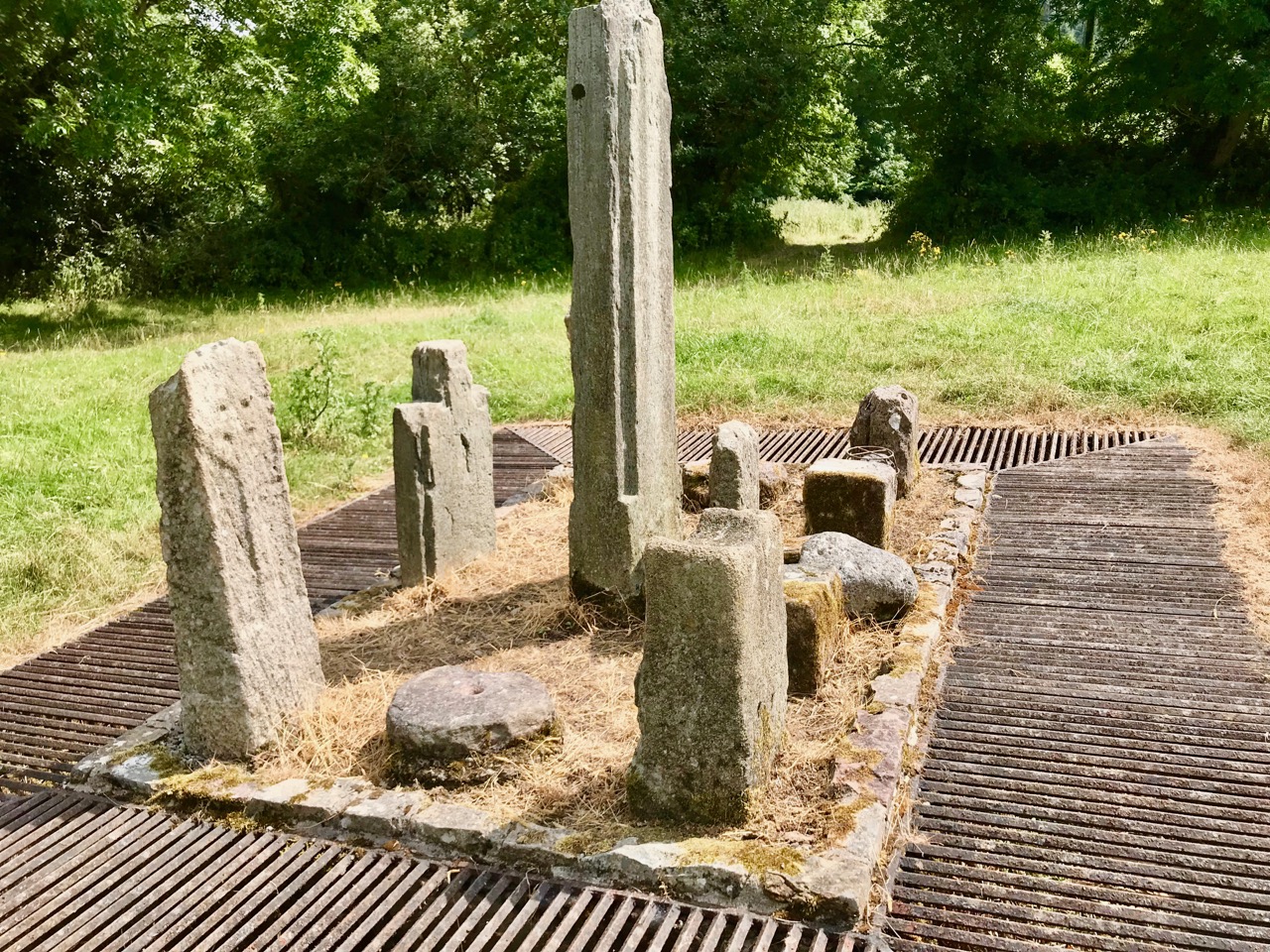
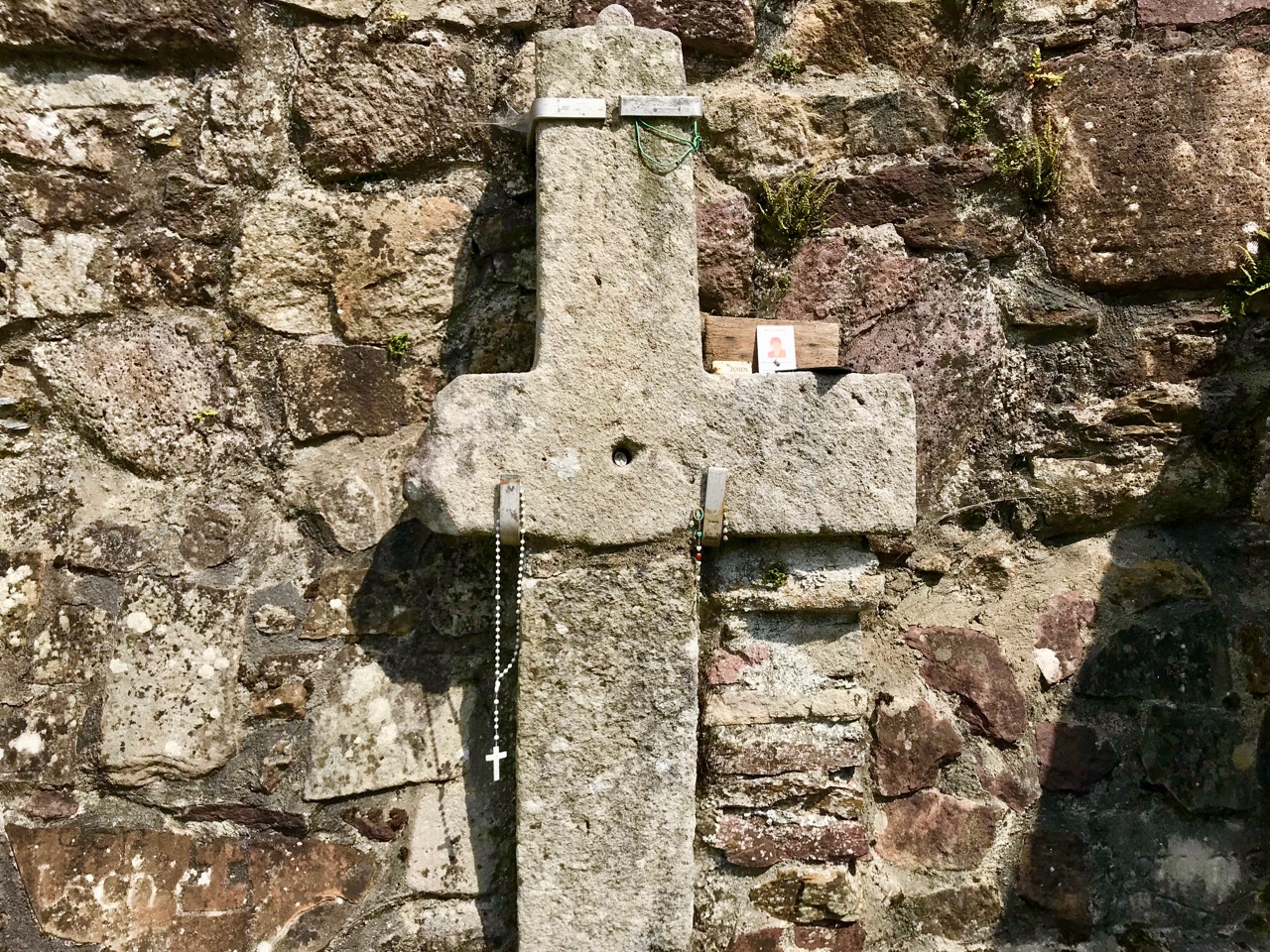
McNeill continues:

. . . Nearby is the shaft of a cross which tradition avers was broken in malice by a mason who was then stricken with an inward pain and died suddenly as a punishment for his sacrilege . . . O’Keefe was told a story of a small stone, 6 or 7 inches long and 4 or 5 in depth, having ten little hollows in it and resting in a hollow of the ‘altar’ of the old church. Christ, or according to others St Péacán, asked a woman, who had been churning, for some butter; she denied having any and when the visitor departed she found the butter had turned into stone which retained the impression of her fingers . . . Nuttall-Smith speaks also of a cave where the saint used to practice austerities . . .
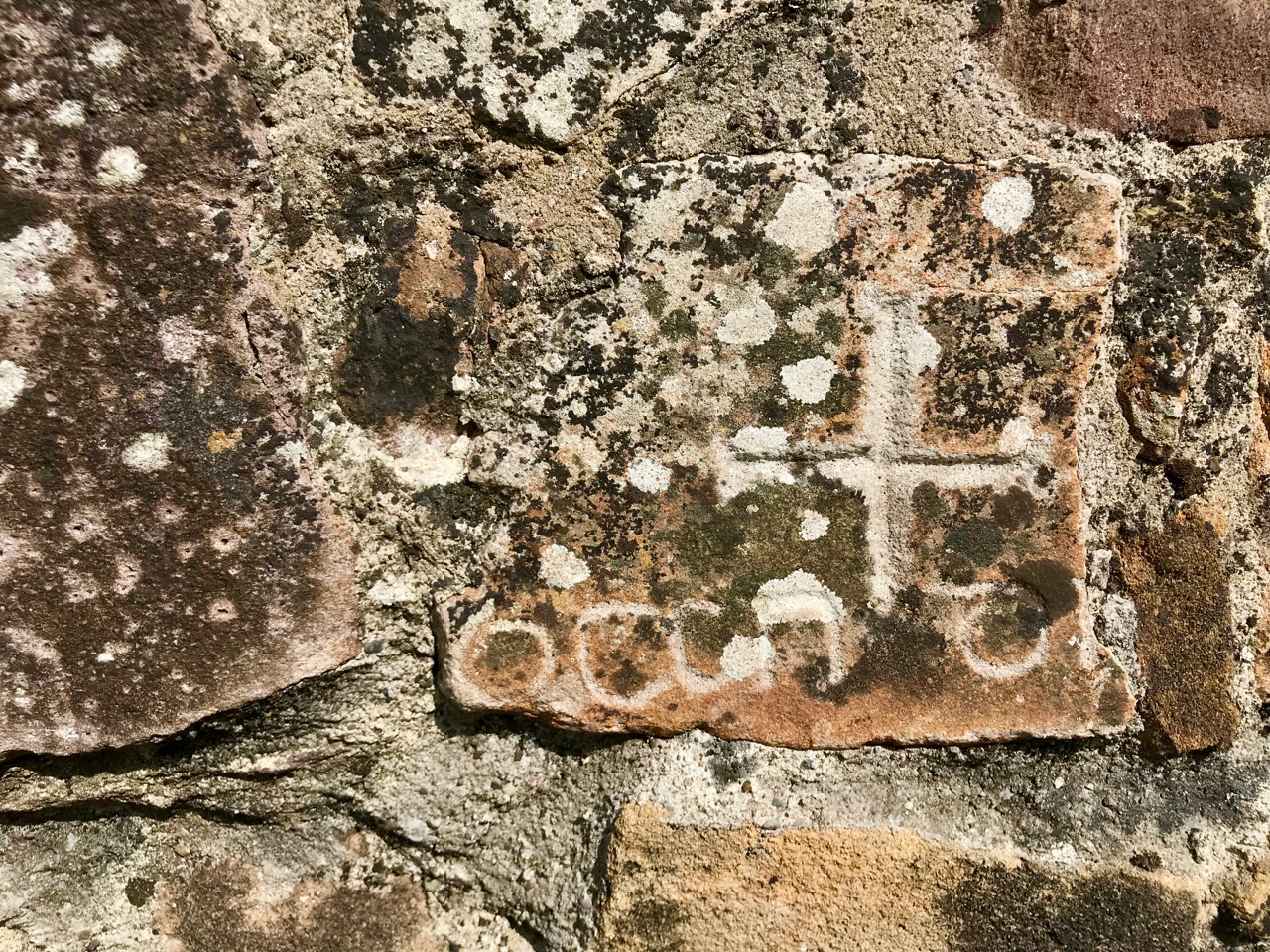
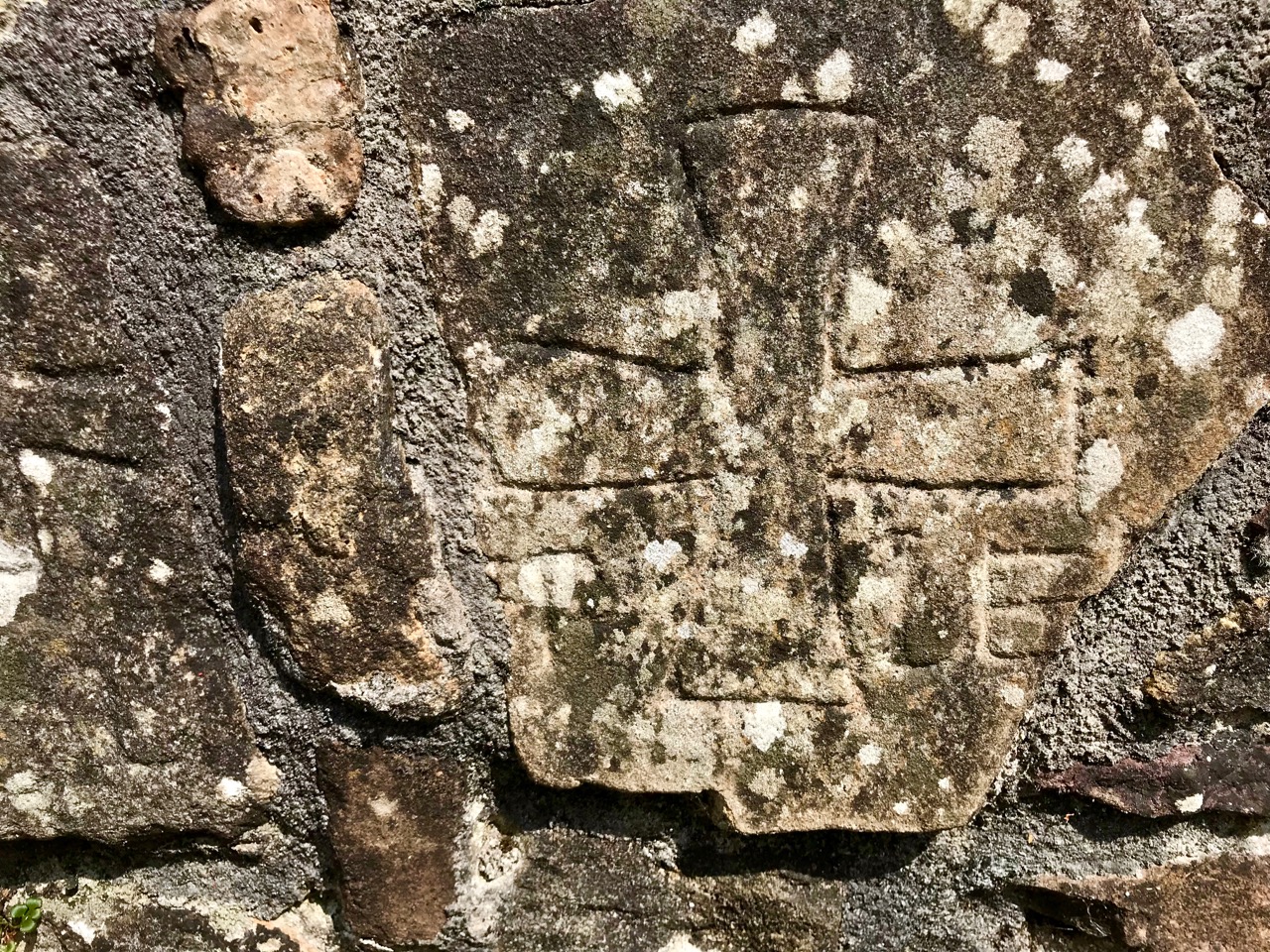
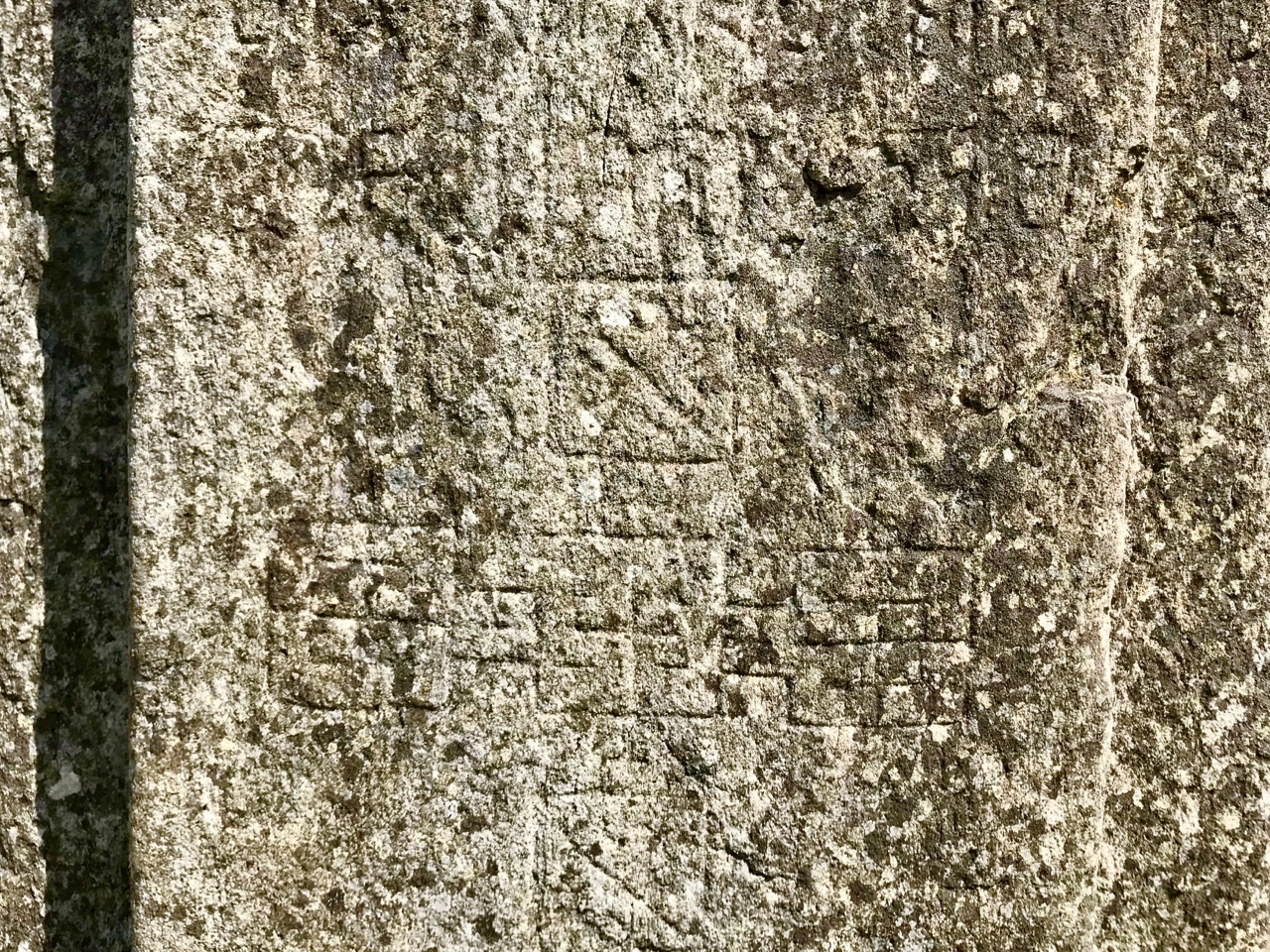
The carved fragments are quite remarkable and are in all likelihood well over a thousand years old. I have yet to see anywhere in Ireland – outside of museums – which has such an extensive collection of fascinating medieval antiquities as these sites in the Glen of Aherlow. Here you can also see cross slabs and a sundial said to date from the eighth century.

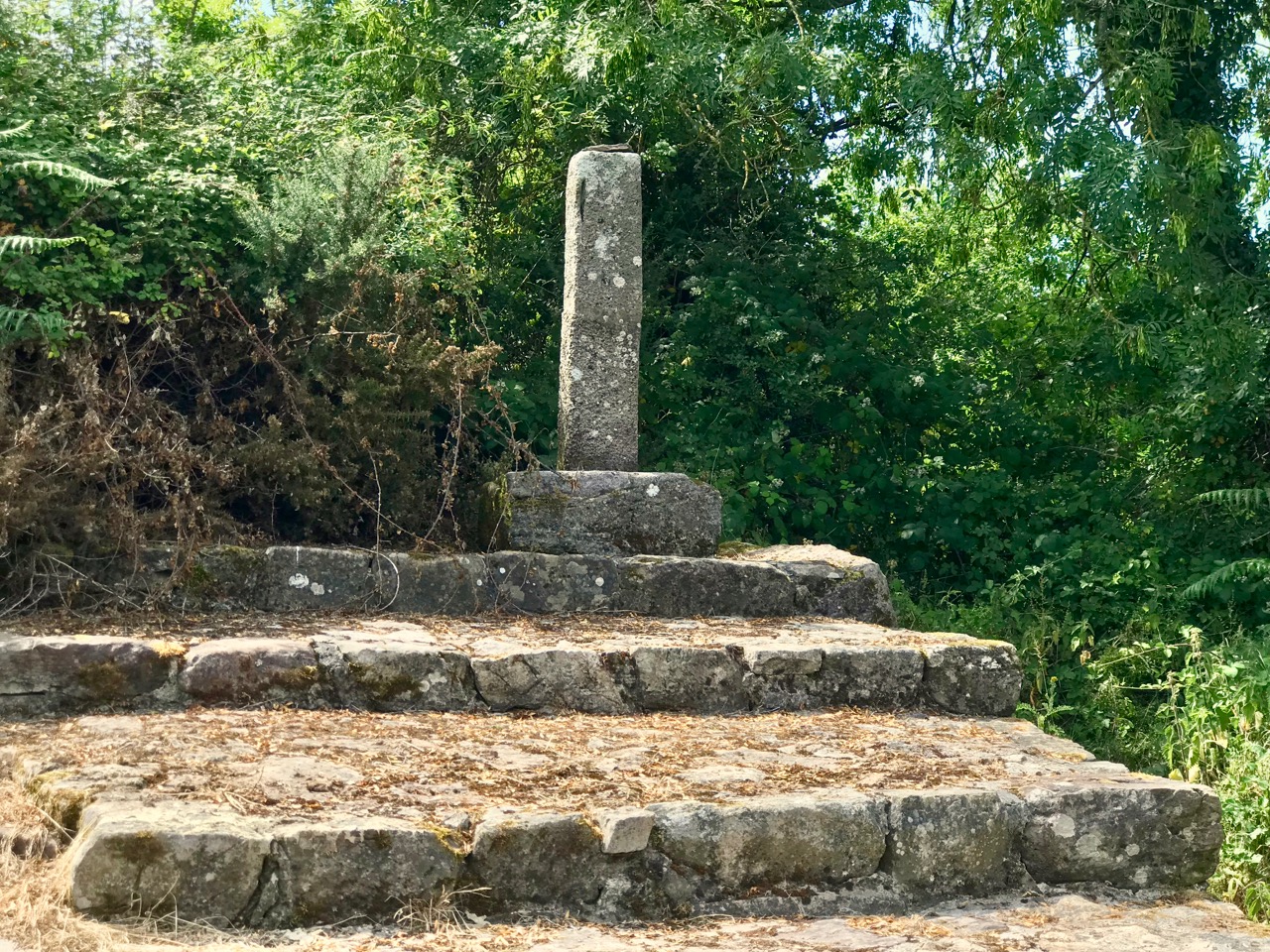
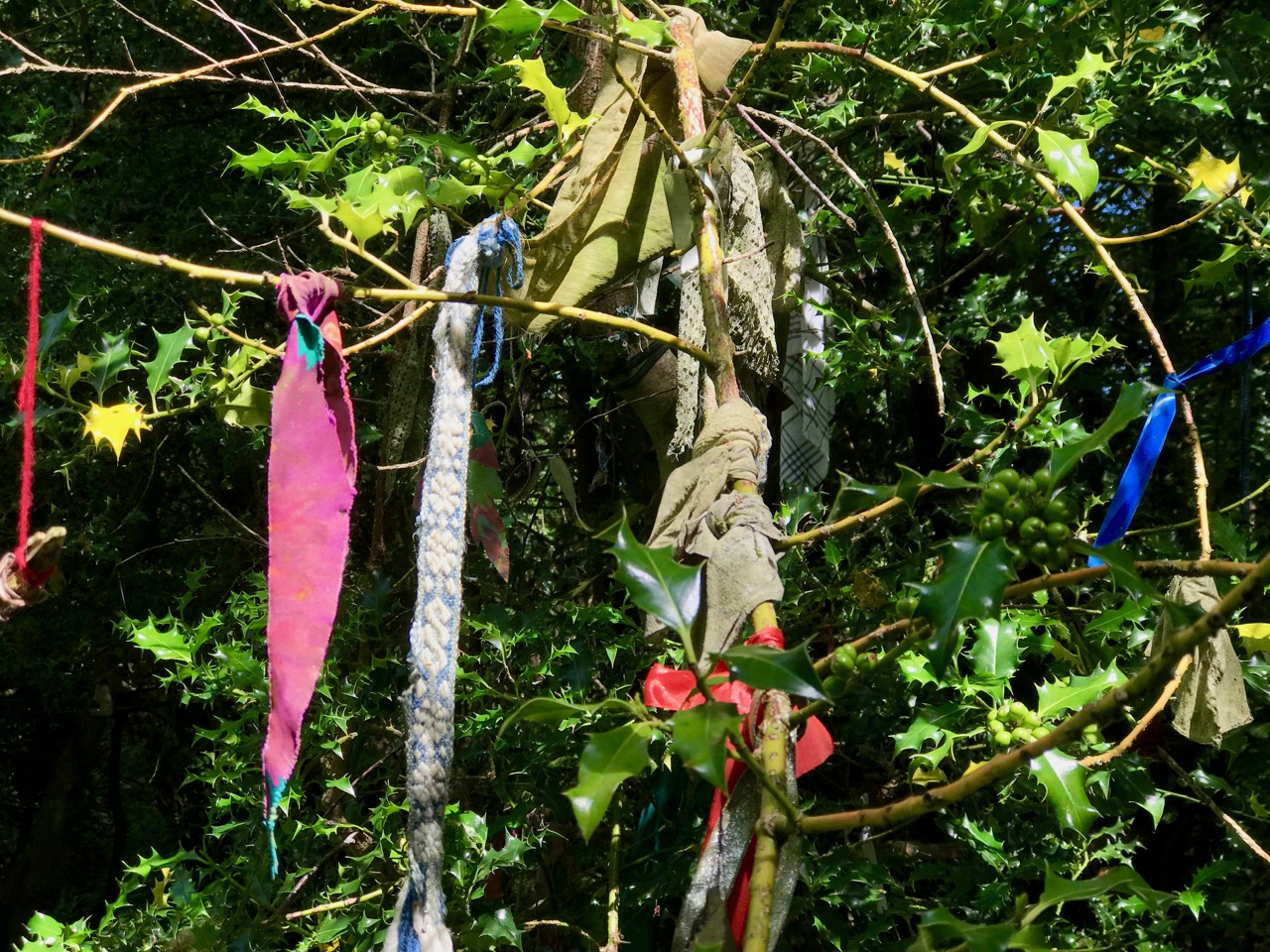
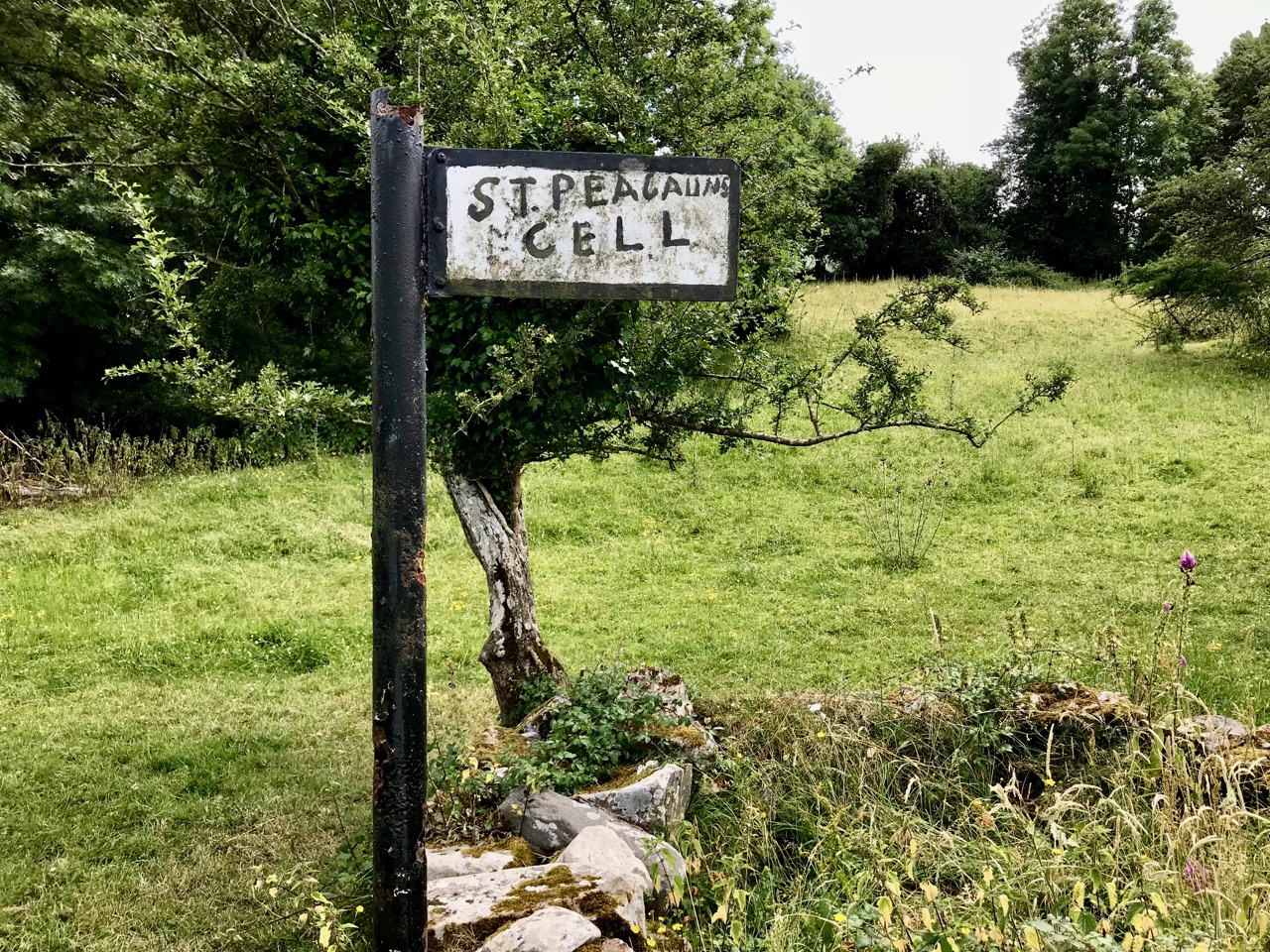
Nuttall-Smith’s ‘cave’ – quoted by MacNeill above – is likely to be St Péacáin’s Cell, set in a field on the far side of the river. This was probably a clochán, or beehive-hut, of the type once used by anchorites. It is protected by a whitethorn tree, but was quite heavily overgrown on the day of our visit. We could make out the ballaun stones inside, said to be the knee prints of the Saint who made his constant devotions there. Amanda – in her post on the holy well – reports that Péacáin would also stand daily with arms outstretched against a stone cross, chanting the psalter.
McNeill discusses the significance of weather at the August celebrations:

. . . Paradoxically for a day of outing so fondly remembered, no tradition of the Lughnasa festival is stronger than that which says that it is nearly always rainy. No doubt this has been only too often experienced. Saint Patrick’s words to the Dési: ‘Bid frossaig far ndála co bráth’ (Your meetings shall always be showery) must be as well proved a prophecy as was ever made. Still there must be more significance in the weather beliefs than dampened observation. Certainly it was expected that rain should fall on that day, and sayings vary as to whether that was a good or bad sign . . . There are a few interesting beliefs about thunder, which was also expected on that day: the loud noise heard at Tristia when the woman made rounds there to have her jealous husband’s affection restored; the prophecy that no-one would be injured by lightning at Doonfeeny, a promise also made by St Péacán . . .
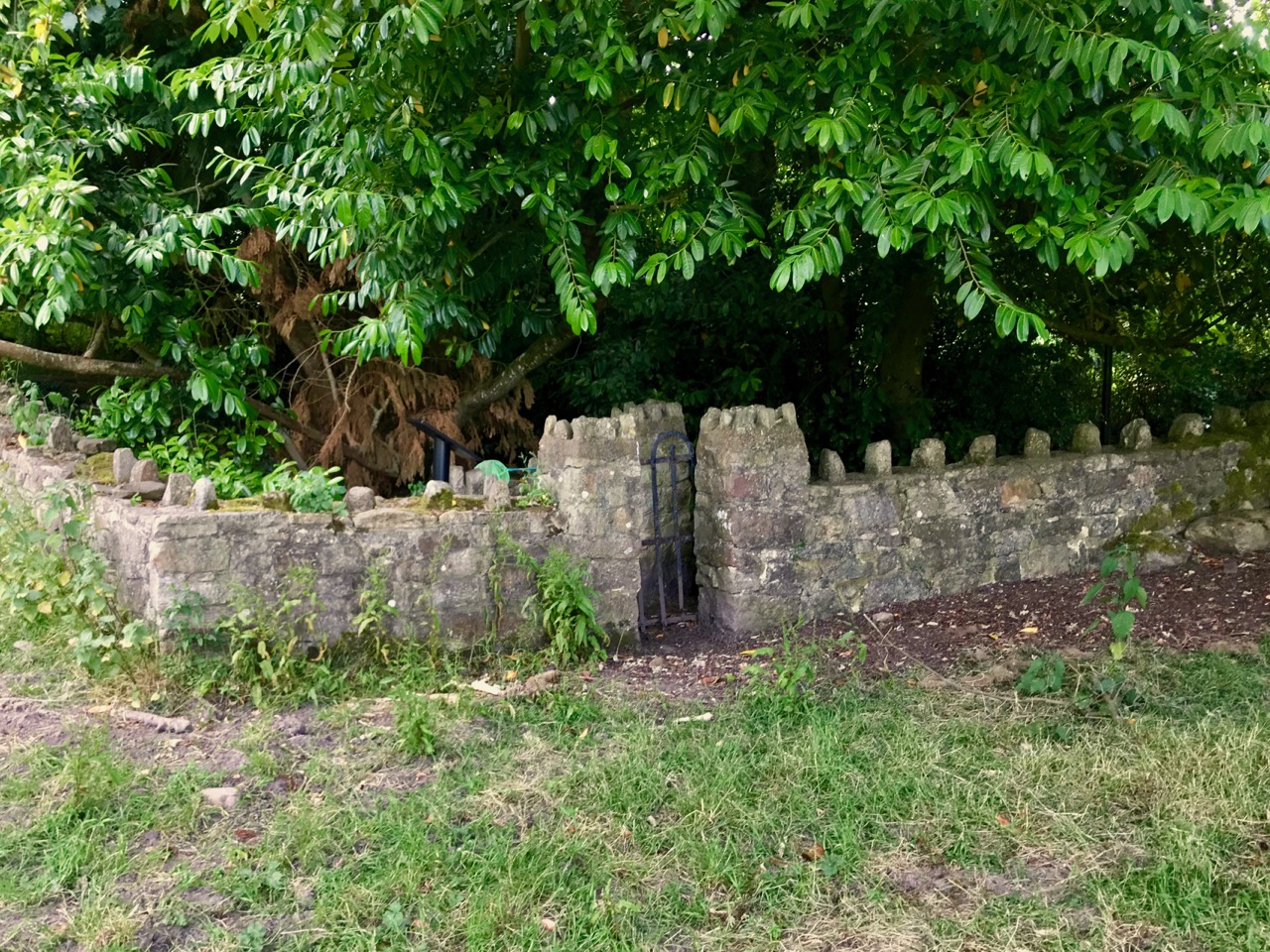
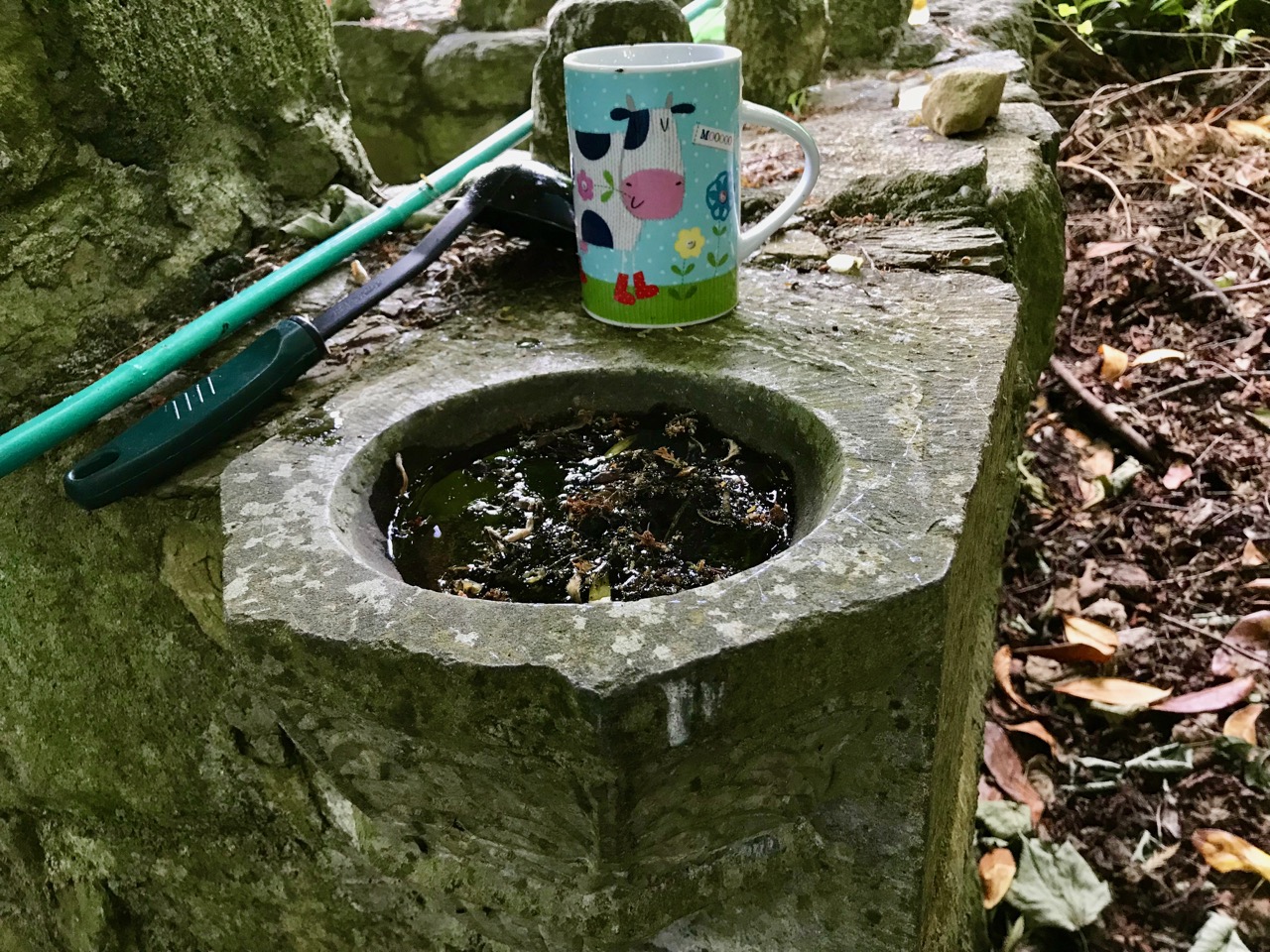
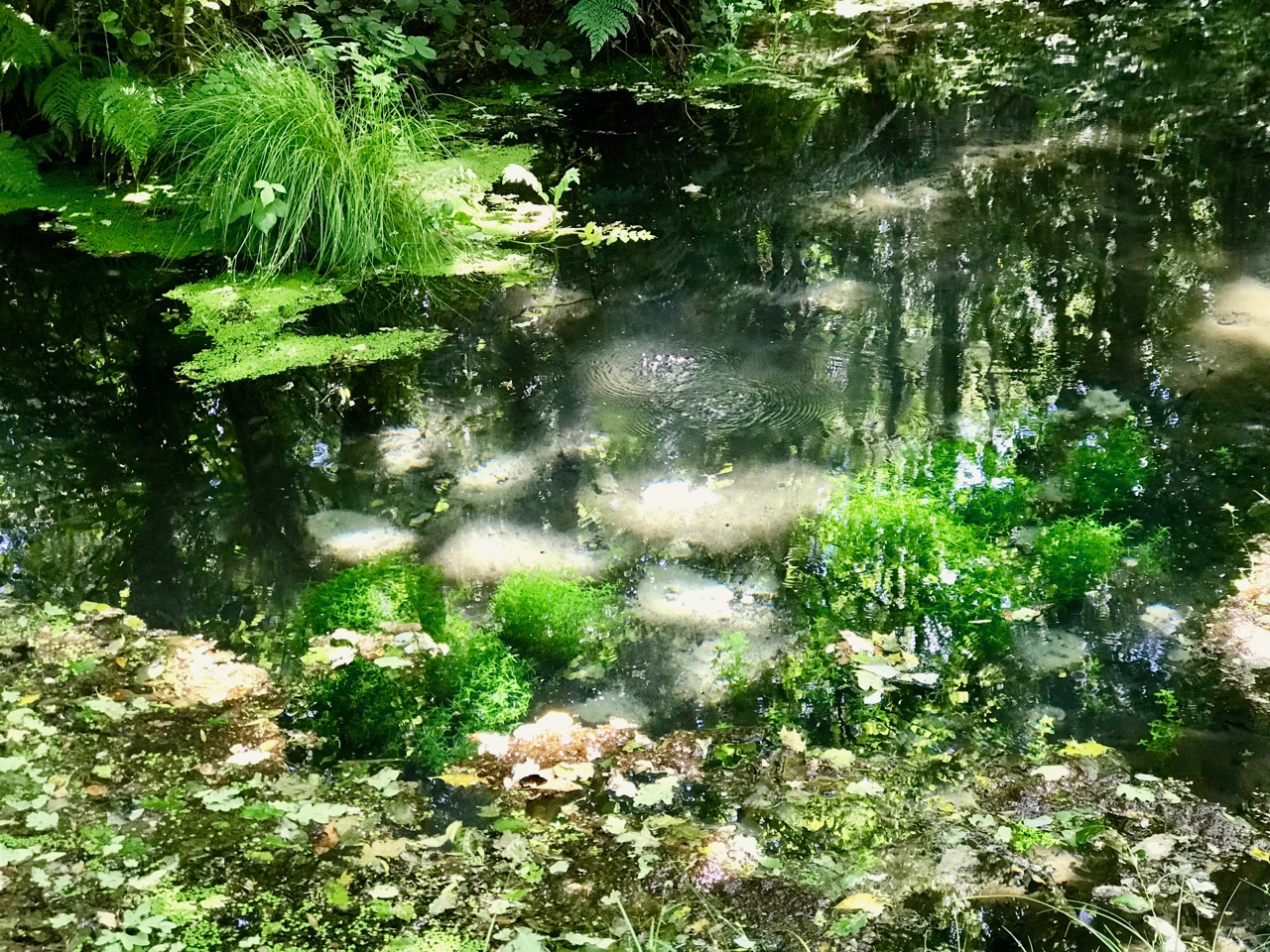
The holy well is tucked away in a stone-walled enclosure hidden under the trees on the edge of the field which contains the Saint’s cell. It’s also a tranquil place, obviously still much visited: the water is crystal clear, refreshing and will ensure protection from burns and drowning.  This is a magical setting to complete the day’s travels in the beautiful Glen of Aherlow.

Welcome to the Stranger: Asenath Nicholson in West Cork

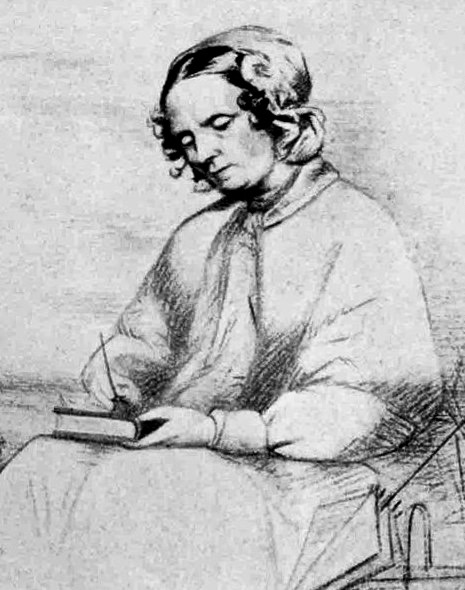
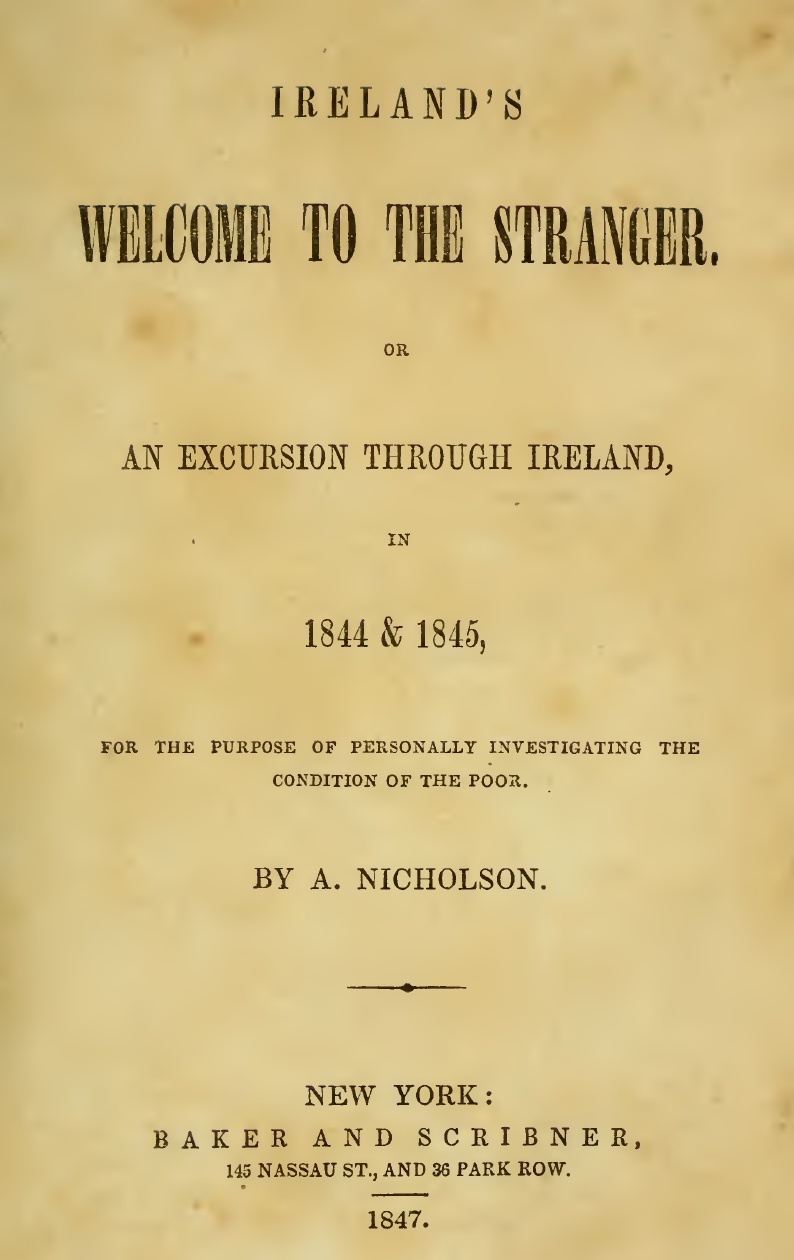
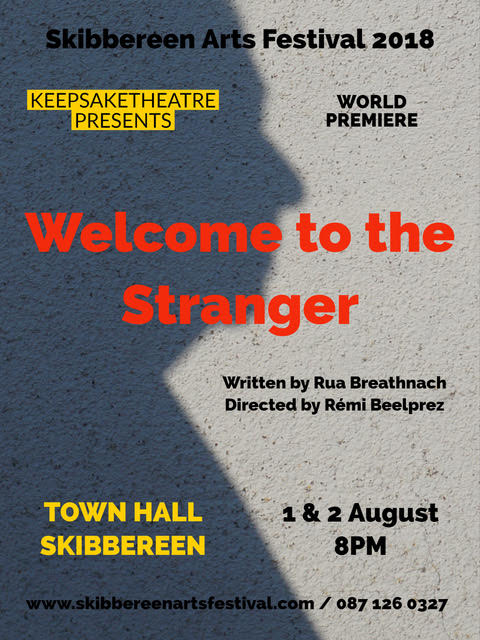
Who was Asenath Nicholson? When I saw that a new play was to be performed during the Skibbereen Arts Festival this year, I became curious about the subject. The play, Welcome to the Stranger, is based on Asenath’s books, Ireland’s Welcome to the Stranger, and Annals of the Famine in Ireland written about her sojourn in Ireland before and during the Great Hunger. As an eye witness account of the conditions she saw, it is invaluable. So why is she not a household name?

As I discovered, there is actually quite a lot about Asenath available online, much of it centred on the research of Maureen O’Rourke Murphy of Hoffstra University, who has written the definitive book on Nicholson, Compassionate Stranger, as well as editing Asenath’s own writings for re-release. Prof Murphy has provided a piece about the book to Irish Central, and the book itself has been comprehensively reviewed in the Irish Times by Christine Kinealy, Director of Quinnipiac’s Great Hunger Museum. Both of these articles summarise Asenath’s life and the significance of her account of her time in ireland, so pop over there now for a quick read, and then come back here. There is also a lecture by Prof Murphy online (entertaining and erudite), as well as a very well-done radio documentary (although I can’t find out who produced it). These take a bit longer so save them for later.


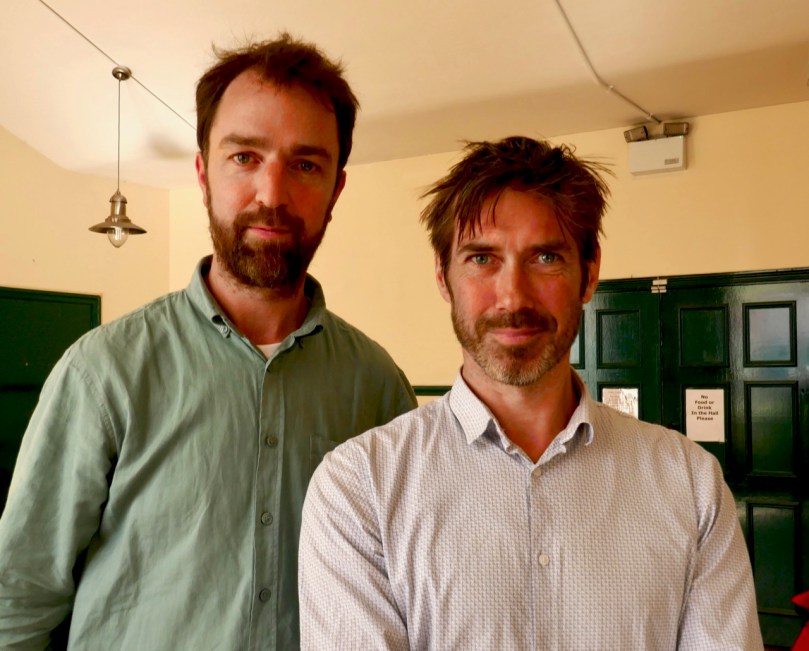
Rua Breathnach, the writer of the new play, is taking an interesting approach to depicting Asenath’s lengthy time in Ireland (four years in all) and the production is being staged and directed by his long-time collaborator, Rémi Beelprez. It will debut in Skibbereen on Aug 1, followed by a discussion session. Robert and I have our tickets already (you can get yours here) and are looking forward to seeing what Rua and Rémi have done with such rich source material.

Rua and Rémi

Seeking more information, I discovered that Ireland’s Welcome to the Stranger is available online in its original form, and also in a clickable version, and of course I was immediately drawn to the chapters about her time in West Cork and in Bantry in particular. This was in February 1845, before the potato crop had failed for the first time, but here Asenath describes perfectly the conditions that prevailed among the poor which led ultimately to the catastrophic events of the next few years – the extreme poverty and lack of resources, the lack of employment of any sort, and the dependence on a single food source.

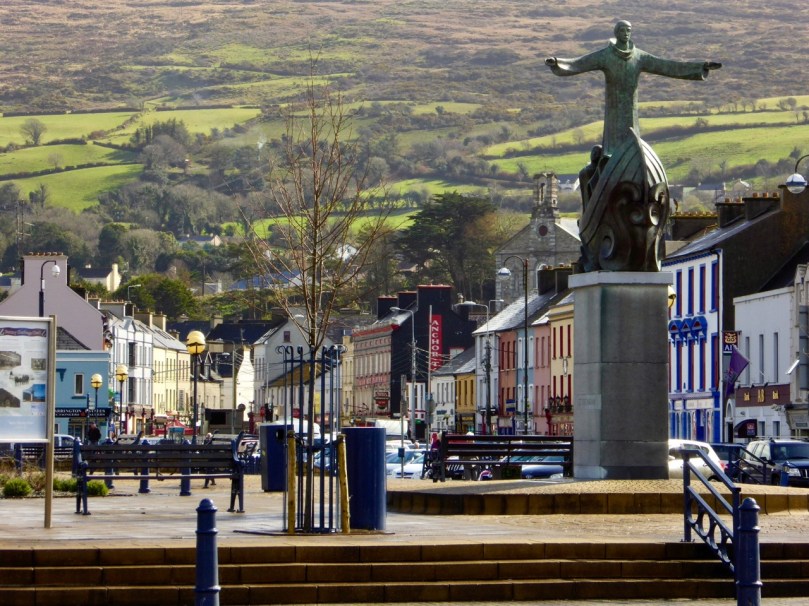
Bantry as it is now, a thriving and attractive market town

Her chapter section heading is “Arrival at the miserable town of Bantry.” Here is why she went there:

When about leaving Cork for Killarney I intended taking the shortest and cheapest route ; but Father Mathew said, “If you wish to seek out the poor, go to Bantry; there you will see misery in all and in every form.” I took his advice, went to Bantry, and there found a wild, dirty sea-port, with cabins built upon the rocks and hills, having the most antiquated and forlorn appearance of any town I had seen; the people going about not with sackcloth upon their heads, for this they could not purchase, but in rags and tatters such as no country but Ireland could hang out.

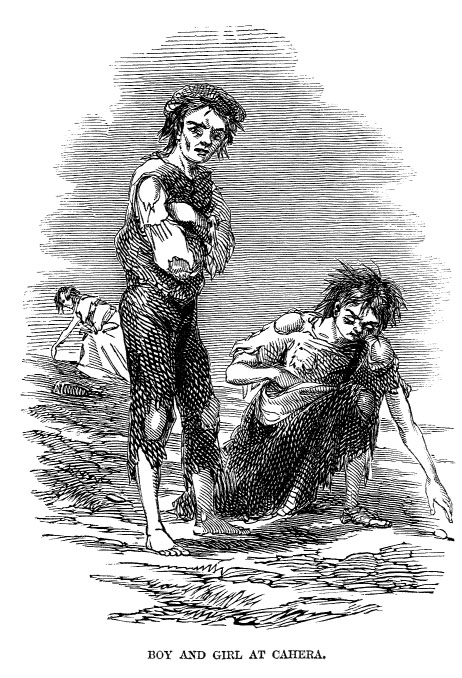
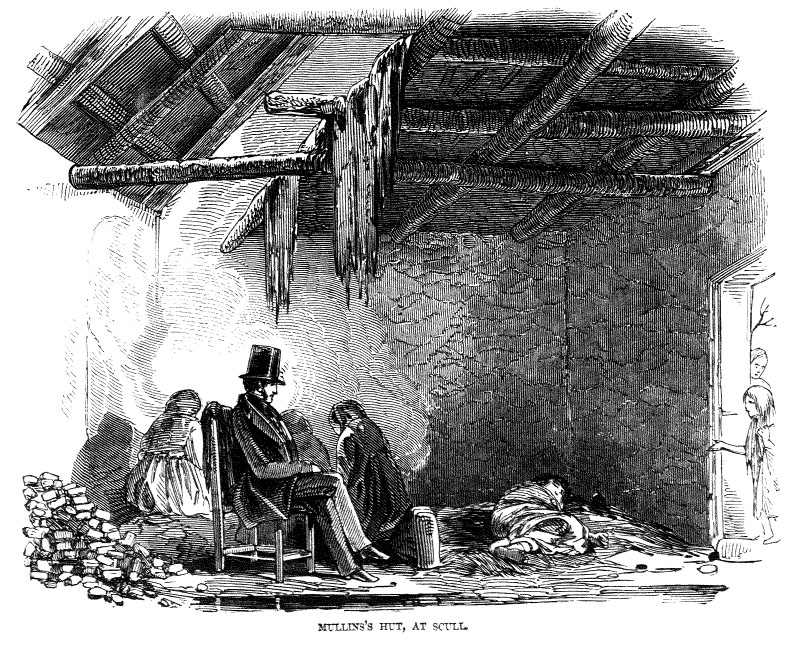
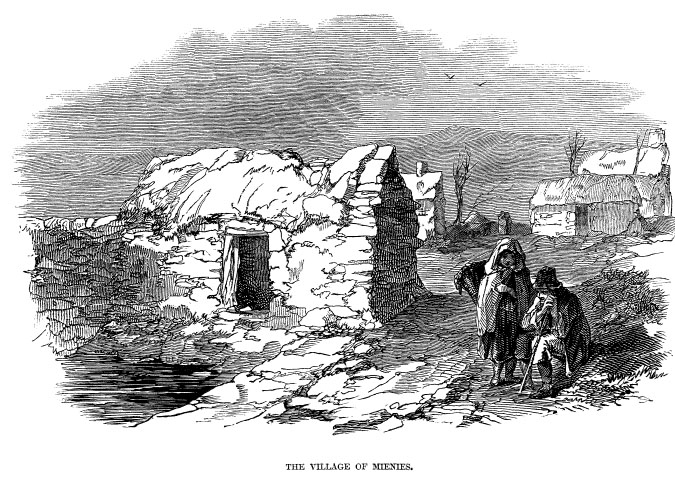
This and the other wood engravings* are by James Mahony for the Illustrated London News of 1847, and are from Niamh O’Sullivan’s book, The Tombs of a Departed Race; Illustrations of Ireland’s Great Hunger, available at The Skibbereen Heritage Centre. 

Asenath was in Ireland specifically to observe and record the conditions of the poor, but she was unprepared for what she saw in Bantry. She even feels moved to warn her readers, If you have tears, prepare to shed them now.

The morning opened my eyes to look out upon sights which, as I write, flit before me like haggard spectres. I dressed, went forth, and made my way upon the rocks, found upon the sides of them some deplorable cabins, where smoke was issuing from the doors, and looking into one, the sight was appalling – Like an African kraal, the door was so low as to admit only a child of ten or twelve, and at the entrance a woman put out her head, with a dirty cloth about it; a stout pig was taking its breakfast within, and a lesser one stood waiting at a distance. The woman crouched over the busy swine with her feet in the mud, and asked what I wanted?. . .Looking in, I saw a pile of dirty broken straw, which served for a bed for both family and pigs, not a chair, table, or pane of glass, and no spot to sit except upon the straw in one corner, without sitting in mud and manure.

There was a new workhouse in the town, which Asenath describes as lofty and well-finished but it was closed and shuttered, though all things had been ready for a year ; the farmers stood out, and would not pay the taxes. Asenath goes on to say The poorhouse was certainly the most respectable looking of any building in Bantry; and it is much to be regretted, that the money laid out to build and pay a keeper for sitting alone in the mansion, had not been expended in giving work to the starving poor, who might then have had no occasion for any house but a comfortable cottage.

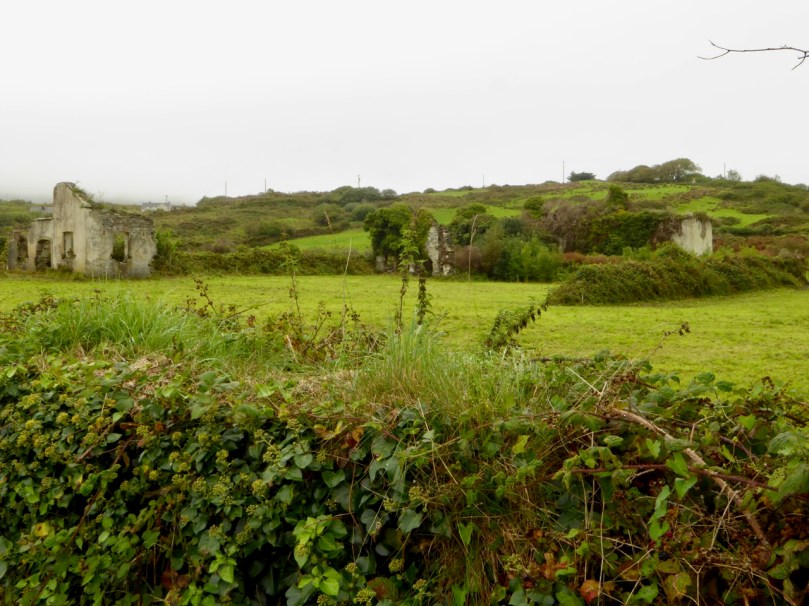
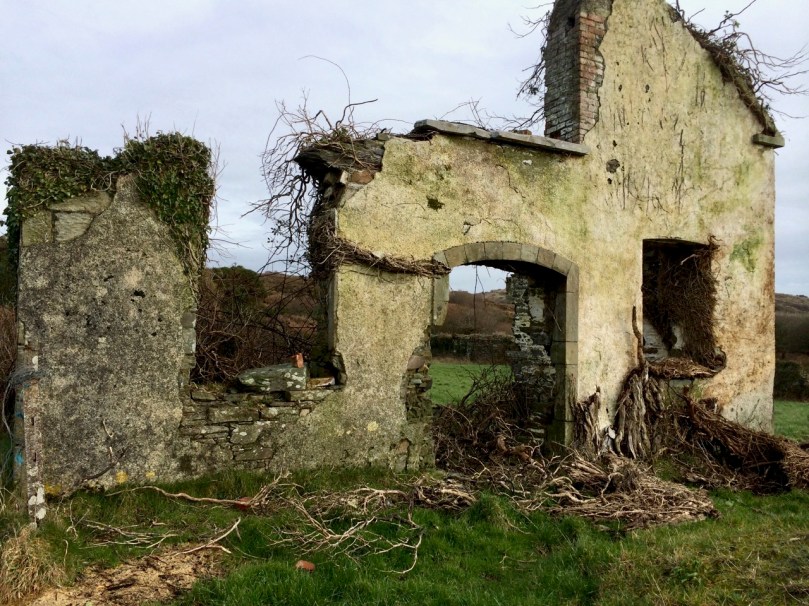
The ruins of the Schull Workhouse

As an aside, in the end the workhouse did open, but the conditions in it were appalling. You’ll find a link to Dr Stephen’s report (be warned, it’s heart-rending) in our post about the Schull Workhouse, which also contains lots of information about workhouses in general.

Asenath refers to ‘wading’ through the streets of Bantry. She describes a set of dwellings called Wigwam Row: a row of cabins, built literally upon a rock, upon the sloping side of a hill, where not a vestige of grass can grow, the rock being a continued flat piece like slate. The favored ones who dwell there pay no rent, having been allowed in the season of the cholera to go up and build these miserable huts, as the air upon the hill was more healthy. And there, like moss, to the rocks have they clung, getting their job when and where they can, to give them their potatoes once in a day, which is the most any of them aspire to in the shortest winter days.

As she walks, Asenath sings hymns and dispenses tracts and testaments, some of which she keeps in an enormous bearskin muff. She attracts attention everywhere she goes and the children of Bantry follow her around. Begging is endemic and she is frequently cheated. However, she comes to admire the Irish and particularly their sense of hospitality and their generosity to her and to each other. In a typical description she writes about a Bantry woman with whom she interacts: I looked at this woman, and at the appurtenances that surrounded her. “The whole chart of Ireland,” from lips that could neither read English nor Irish! She had a noble forehead, an intelligent eye, and a good share of common sense; she had breathed the air of this wild mountainous coast all her sad pilgrimage, and scarcely, she said, had a “decent garment covered her, or a wholesome male of mate crossed her lips, save at Christmas, since the day she left her parents that raired her.”

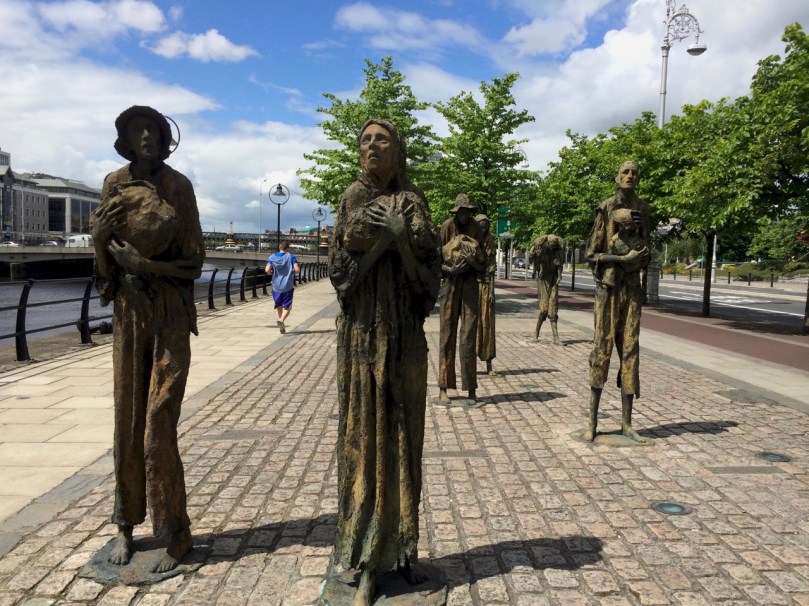
Famine Memorial, Dublin

We will leave Asenath on the road to Glengarriff, struggling to make headway as the magnificent scenery claims her attention, to the relief of her helper, John, who, burdened with her ‘purse’ and her muff, is able to take frequent rests while she catches up. She has given us a unique, first-hand, eye-witness account of Bantry in 1844 – one that contrasts tragically with the beautiful market town we have come to know well. She went on to travel the length and breadth of the country and to open her own soup kitchen in Dublin at the height of the Famine, this time dispensing bread, rather than tracts – let’s follow up with her in August at the play!

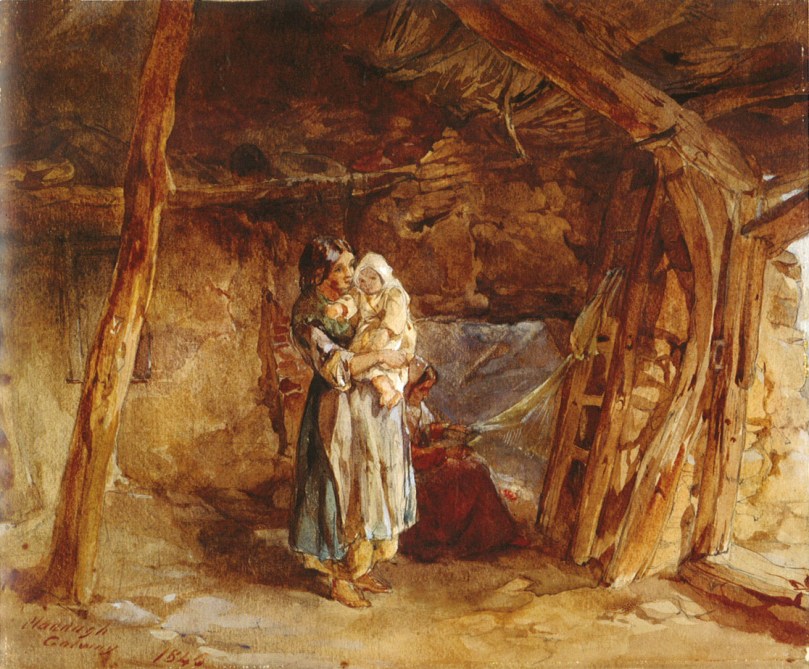
The interior of an Irish cabin in 1844 by Francis William Topham,  painting now in the Ulster Museum

This summer we also look forward very much (harrowing as it will be) to a major exhibition at Uillinn (the West Cork Arts Centre): Coming Home is an exhibition of the largest Famine-related art collection in the world. It’s on loan from Quinnipiac University in the US, and opens on July 20th. There will also be a very special Performance/Event at the Schull Workhouse by acclaimed Irish artist Alanna O’Kelly titled Anáil na Beatha, Breath of Life. Future posts!

*More about wood engravings, from Brian LalorThe process is an exceptionally important pre-photography development in visual communication terms and, in its day (early 19C), quite as radical as email. The reporter, O’Mahony, drew on the spot in pencil, the drawings were sent by postal coach and packet boat to London where a team of engravers worked through the night to meet the publishing deadline, on the small (generally 4” square) blocks of fruitwood that fitted with the type into a letterpress printer. For speed, they often had a number of engravers working on a single image by using separate blocks which were then bolted together. On the ILS 1844 image of Ballydehob (not shown) you can see the joins.

A Visit to Knock

Our travels have taken us to quite a few Christian pilgrimage sites in Ireland: they are all fascinating, and range from St Patrick’s holy mountain  – Croagh Patrick (where snakes were cast out of this country forever) – through the rather daunting Station Island on Lough Derg (where a medieval pilgrim entered, and returned from, Purgatory) to the more ‘unofficial’ shrine at Ballinspittle, here in West Cork, where a statue of the Virgin was seen to move (by hundreds of onlookers) in 1985. Recently we found ourselves in Mayo, so a trip to Ireland’s most impressive shrine – at Knock – was essential.

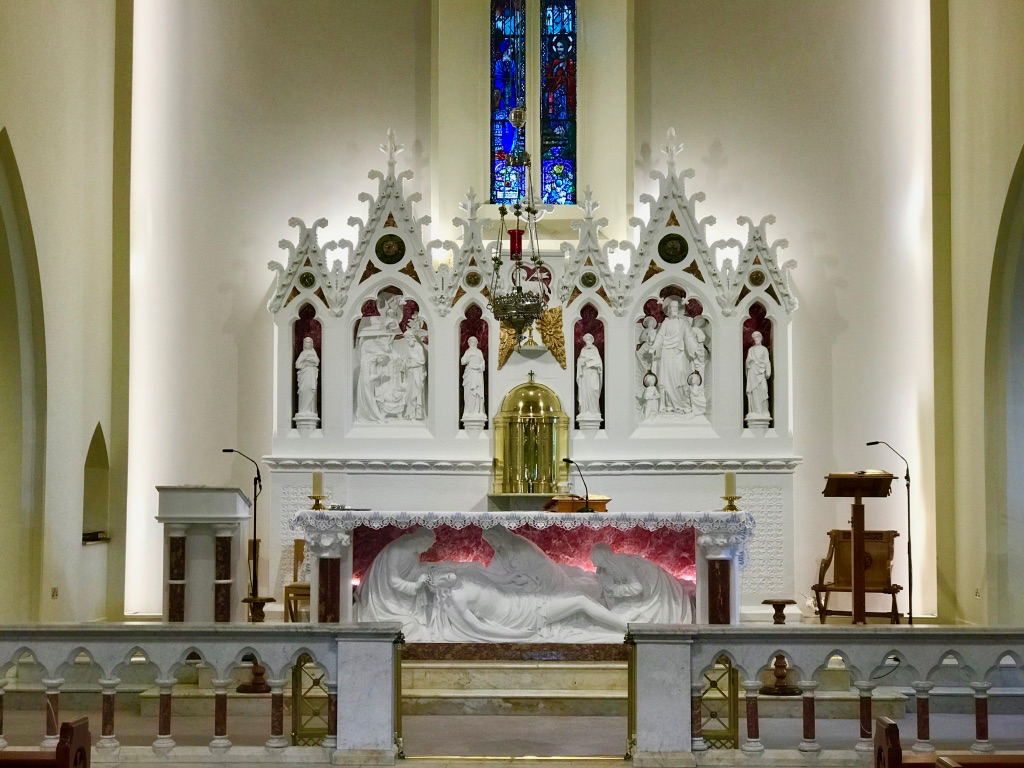
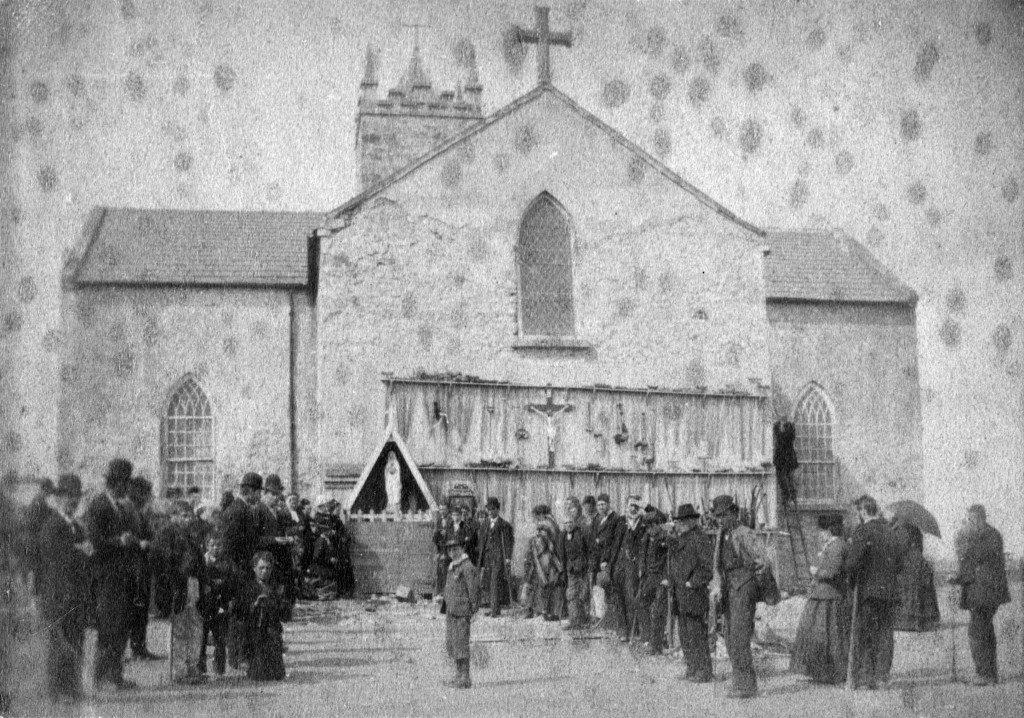
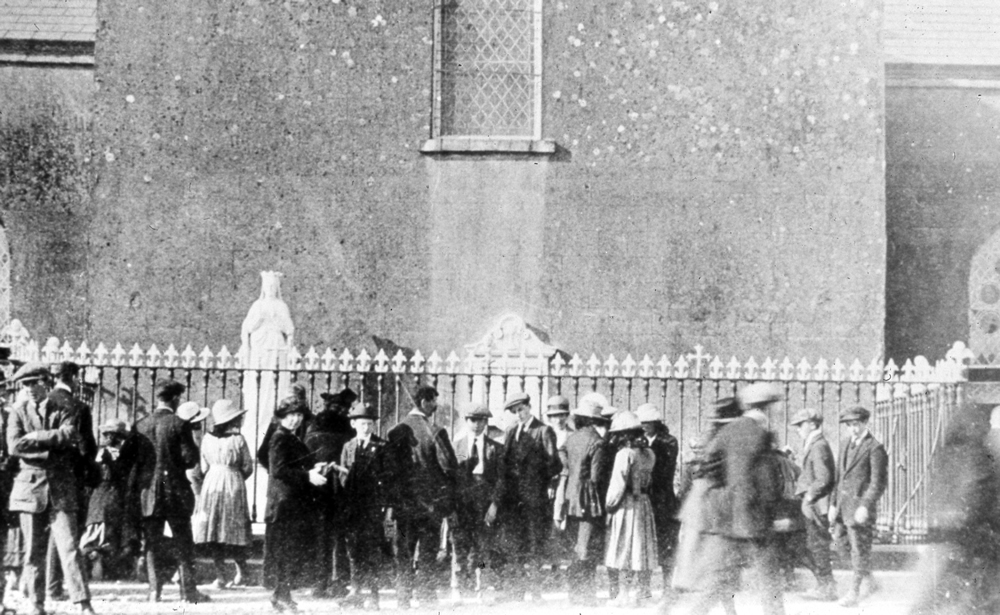
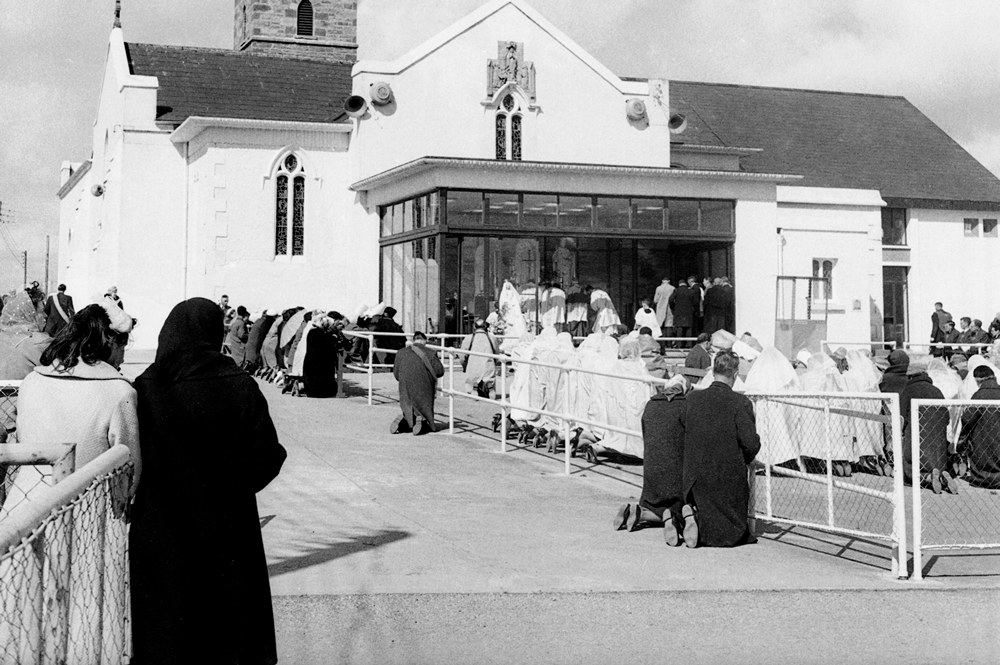
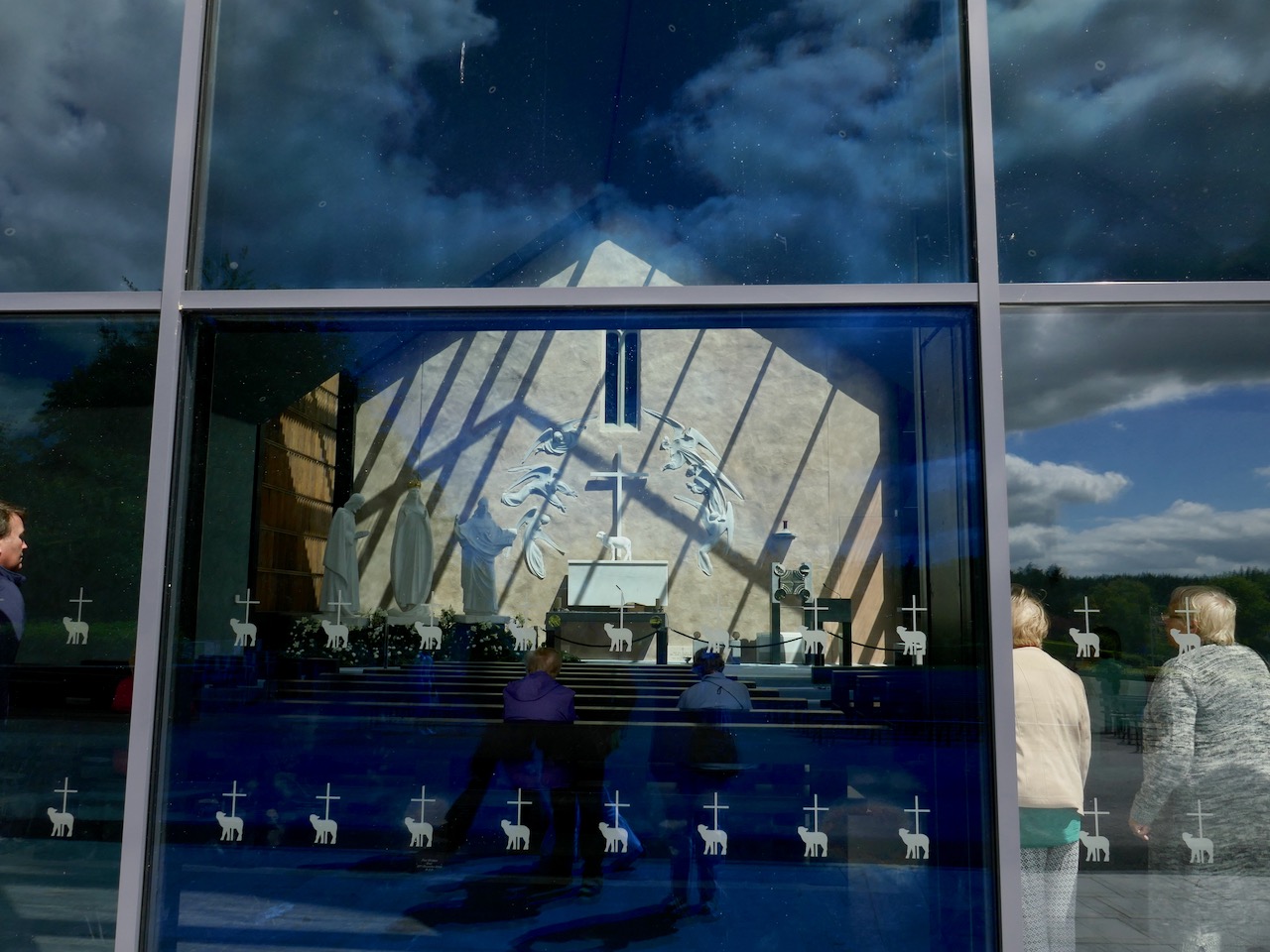
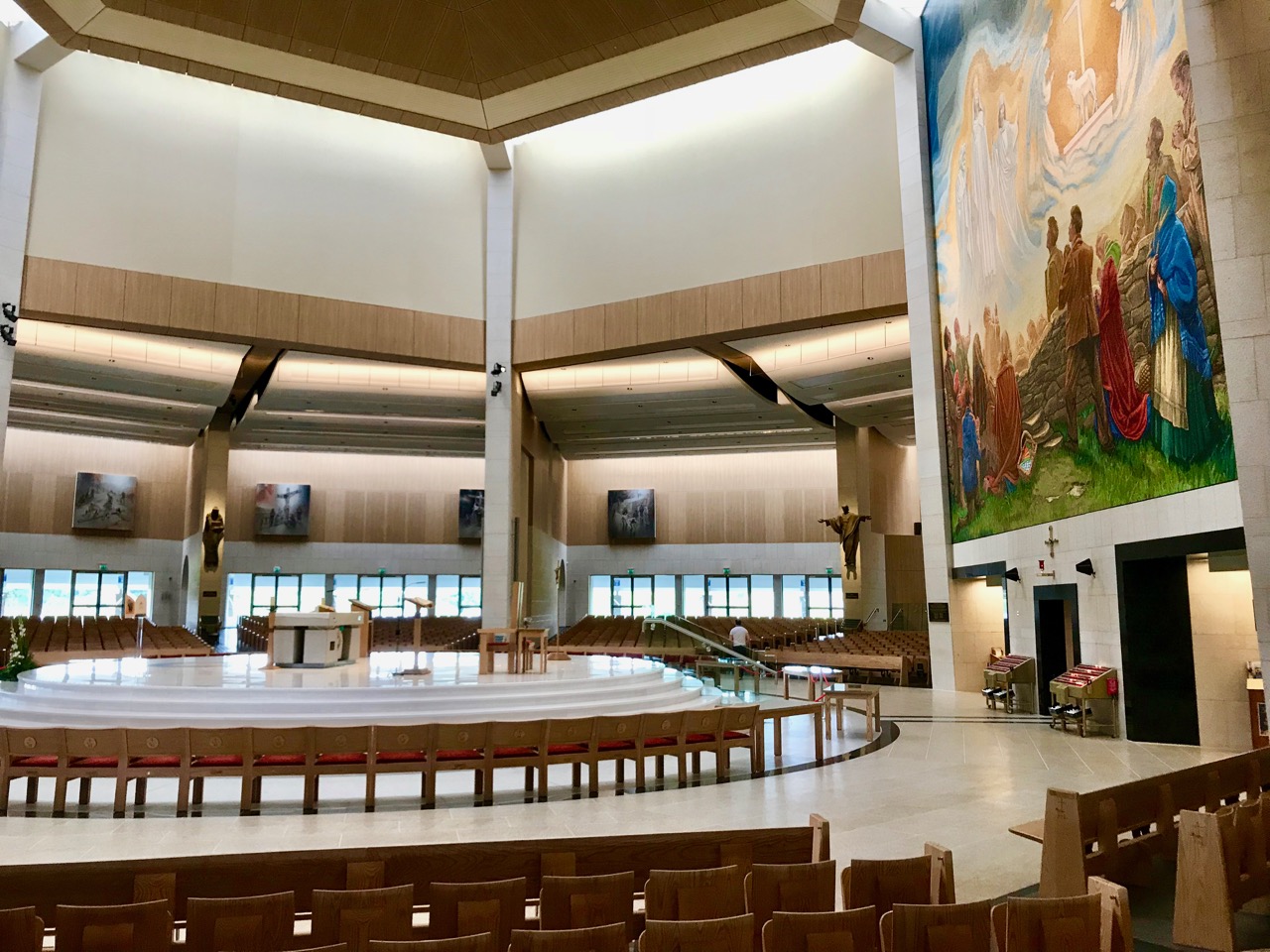
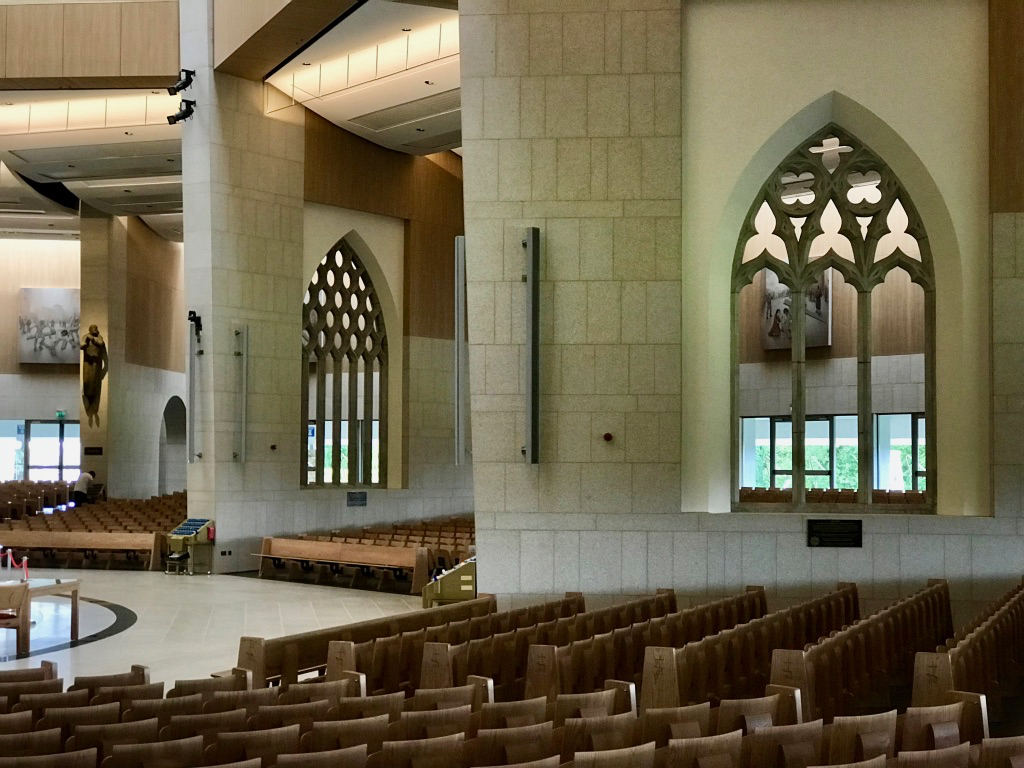
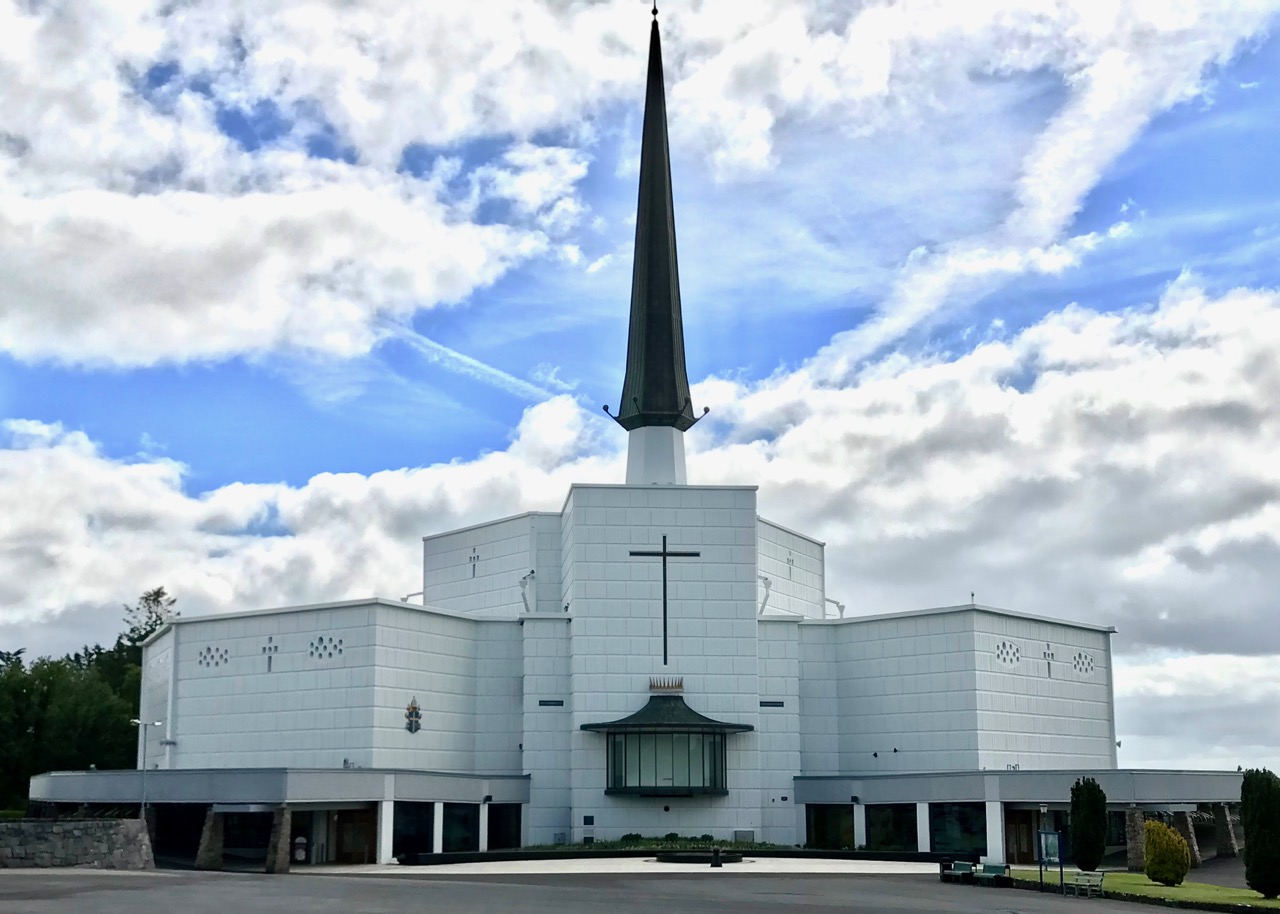
These illustrations show the evolution of the shrine. At the header is the updated interior of the Parish Church of Knock-Aghamore today, showing the beautiful high altar which was made by P J Scannell of Cork and which was presented as a gift during a pilgrimage in 1880. Behind this east wall is the gable where, on 1st August 1879, fifteen local people witnessed an apparition of Mary, Joseph, St John the Evangelist, and a lamb on an altar which seemed to float, stationary and silent, in front of the wall. It was 8pm and the rain was pouring down, yet the gable wall and the ground in front of it remained dry. The vision – which was also seen by others – seemed to last for about two hours. The upper picture above, which probably dates from around 1880, shows the gable and in front of it a rack of crutches and other paraphernalia apparently left by those cured at the shrine. The very first recorded cure, which happened soon after the vision, was of Delia Gordon, a young girl from nearby Claremorris, who was instantly cured of an acute ear infection and deafness after her mother scraped a little of the plaster off the gable wall and placed it into her ear. You can see in the upper picture where considerable amounts of the plaster appear to have been removed (presumably, following that first cure); by the 1930s (second picture) an iron fence had been erected to protect the wall. In 1963 (third picture), a dedicated chapel had been built in front of the gable, and today (fourth picture) a modern Apparition Chapel is in place to contain the large number of pilgrims who attend mass there on a daily basis. You can also see the elegant sculptures which have been installed on the wall to represent the figures of the apparition.

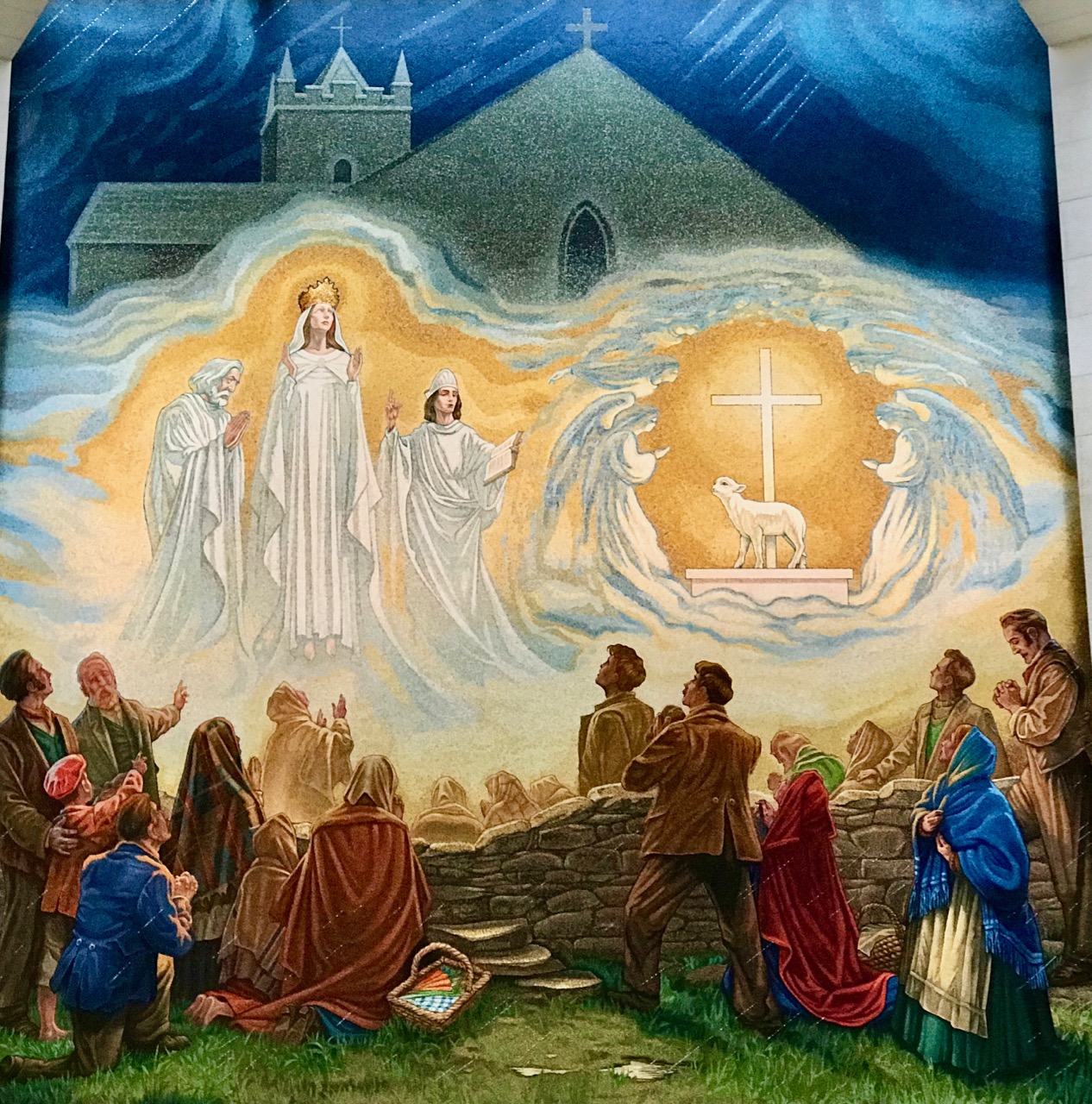
The vision is superbly depicted in this enormous mosaic which has recently been installed in the Basilica at Knock. P J Lynch, the artist who designed the mosaic, said he . . . tried hard to capture the sense of the wonder that the witnesses must have felt on that wet August evening back in 1879 . . . The mosaic measures 14 metres square and is one of the largest single flat pieces of religious mosaic of its kind in Europe: it is made predominantly from Venetian glass smalti and there are approximately 1.5 million individual pieces of mosaic in the complete work.

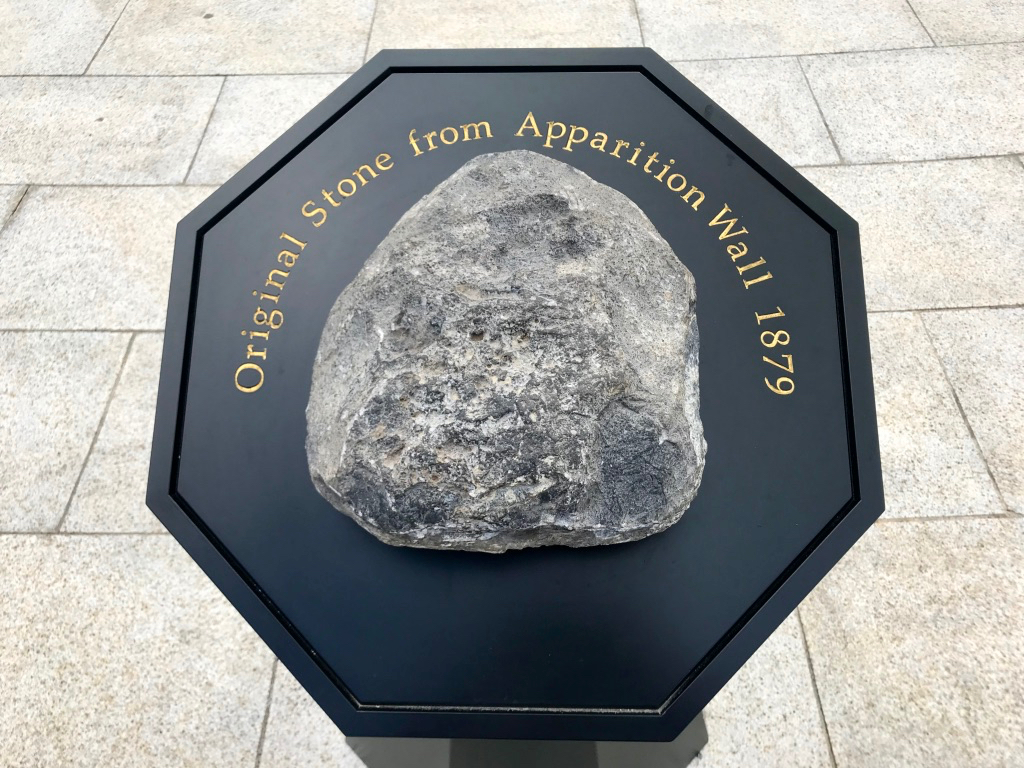
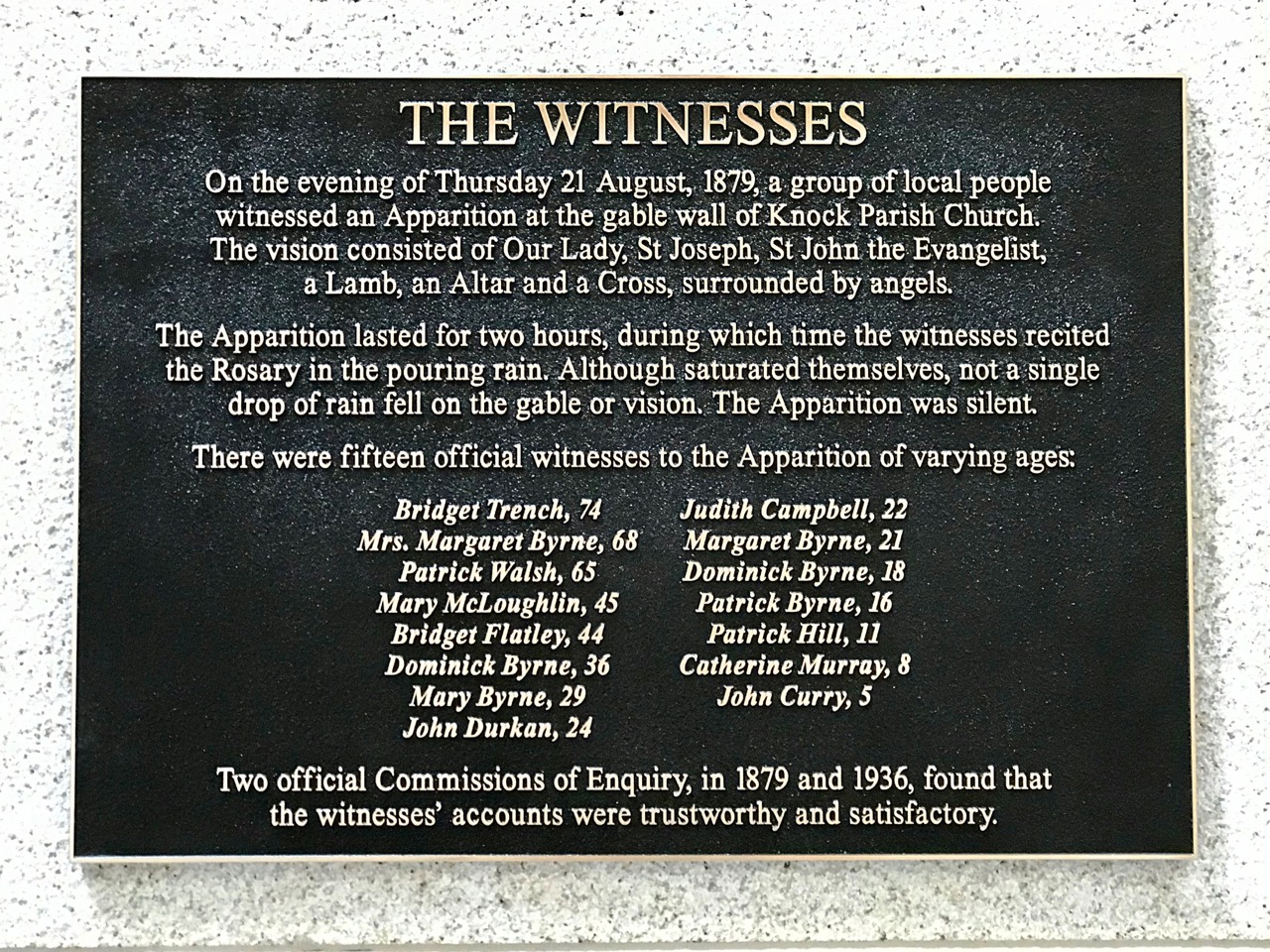
This is original stonework from the gable wall to the Parish Church: the lower picture is a panel built in to the modern Apparition Chapel wall. The statements made by the 15 witnesses who saw the vision at the wall in 1879 are fully documented here – an official Commission of Enquiry was held by the Catholic Church in that same year and concluded . . . the words of the witnesses were trustworthy and satisfactory . . . a further investigation in 1936 interviewed the then surviving witnesses, who corroborated what they had seen. Mary Byrne, who was 29 at the time of the apparition and 86 during the second enquiry said . . . I am clear about everything I have said and I make this statement knowing I am going before my God . . . She died shortly afterwards. John Curry, the youngest witness, was 5 in 1879. The child said . . . he saw images, beautiful images, the Blessed Virgin and St Joseph. He could state no more than that he saw the fine images and the light, and heard the people talk of them, and stood upon the wall to see them . . . He confirmed his memories when interviewed in new York for the 1936 enquiry.

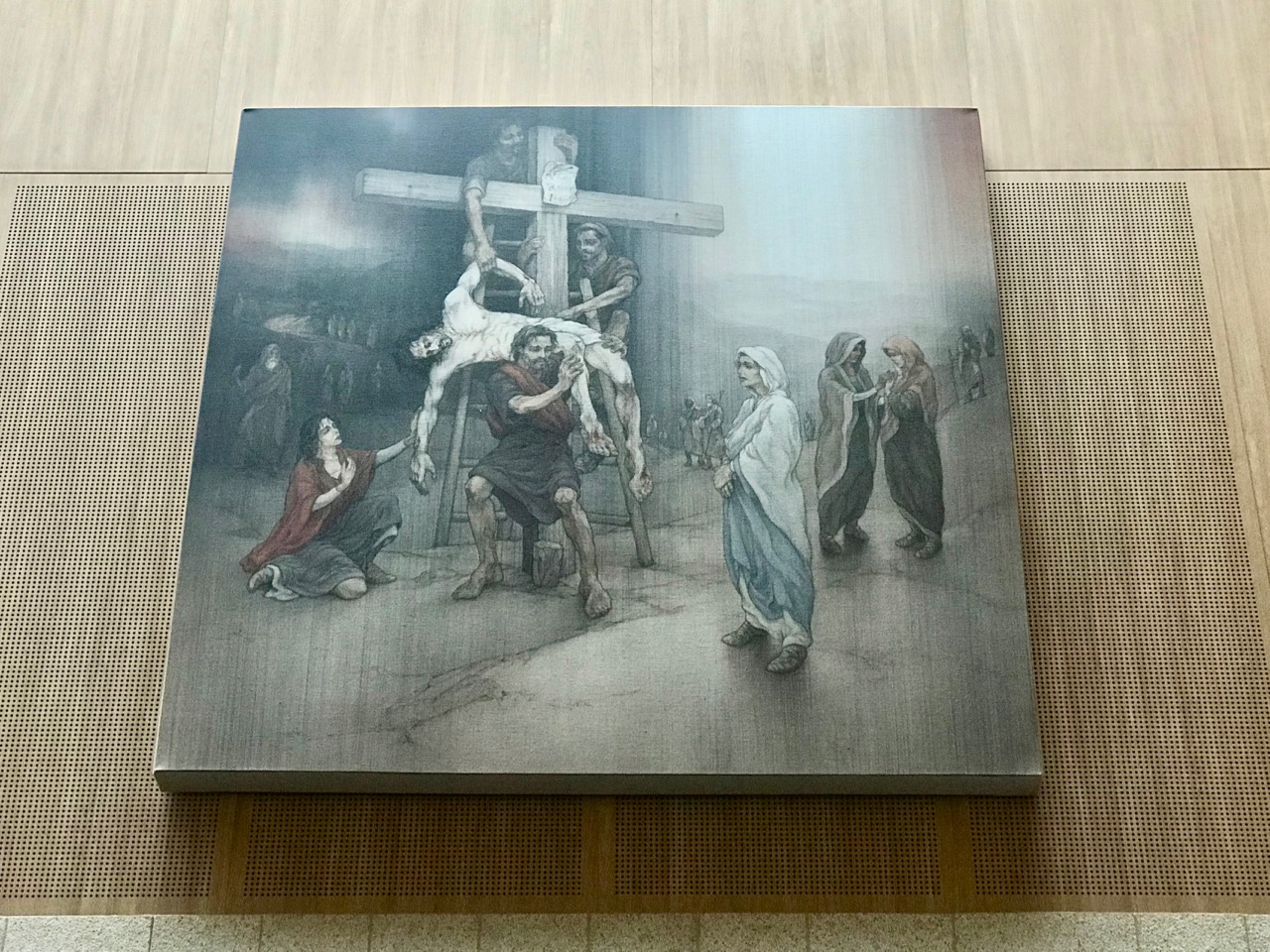
Over a million people a year come to Knock, in search of faith, enlightenment, cures perhaps: or just out of curiosity. It is a place with a great sense of purpose – and long may it continue. As a (now retired) church architect I was distinctly struck by the enormous Basilica which was constructed initially in the 1970s and which has been refurbished very recently. It is spectacular in its size and scale and is fittingly  furnished with powerful works of art. In particular I was impressed by the large, harrowing, painted Stations of the Cross, the work of Mayo artist, Ger Sweeney.

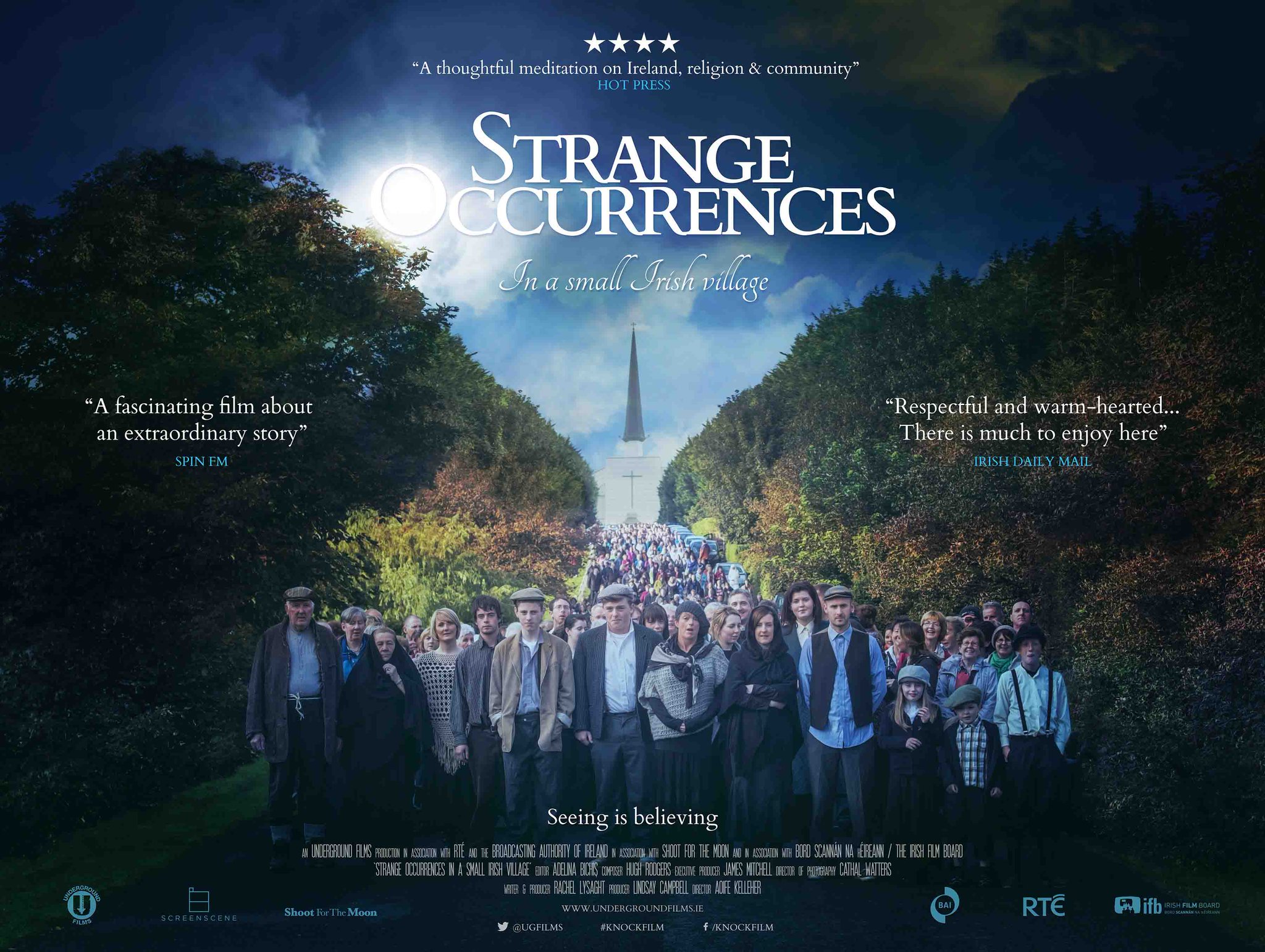
If you have a spare couple of hours it’s worth finding and watching this entertaining and fair-minded documentary about Knock, made by RTÉ in 2016:

I make no judgments as to the veracity or otherwise of what was witnessed on that day in 1879. There have been many theories put forward, ranging from magic lanterns to unrest provoked by the Land Acts! But why should we doubt the faith of anyone, whatever their religion? The Christian story is all about miracles, so surely miracles are just as possible in the 19th century as they were in the 1st… The village of Knock carries on its normal life around all the trappings of the shrine: shops selling statues and Holy Water bottles abound, and add to the colour. On the site you can look out the well-curated museum, and treat yourself to good refreshments. It’s all worth visiting, even if your interest is purely anthropological. The Pope himself will be there this August and all the 45,000 (free) tickets have been booked. If the sun keeps on shining – and perhaps it will – it’ll be a grand day for all!

Off the M8 – A Secret in The Glen of Aherlow

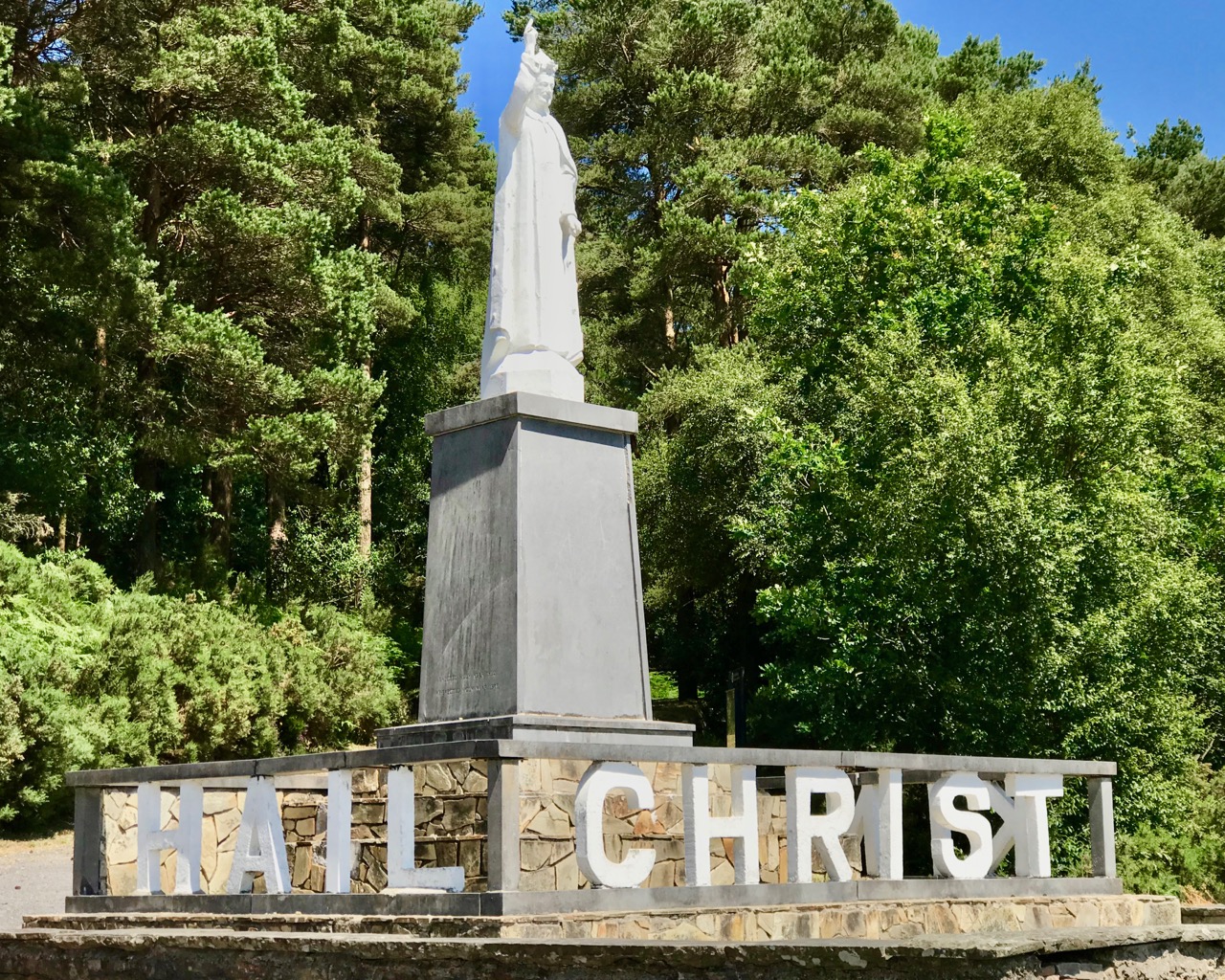
The Glen of Aherlow, County Tipperary: I had never heard of it. However, as you can see from the view, above, the place deserves to be explored: it’s about 20 minutes from junctions 10 and 11 near Cahir. That’s not too much of a diversion. From the spot where this photo was taken – on our travels this week – you can look out across to the Galtee Mountains, a prospect enjoyed for eternity by this imposing statue of Christ the King, whose hand is raised . . . in blessing the Glen, its people and all those who pass by . . . The statue was originally placed here by volunteers in the Holy year of 1950, and recreated in 1975. It has become the symbol of the Glen.

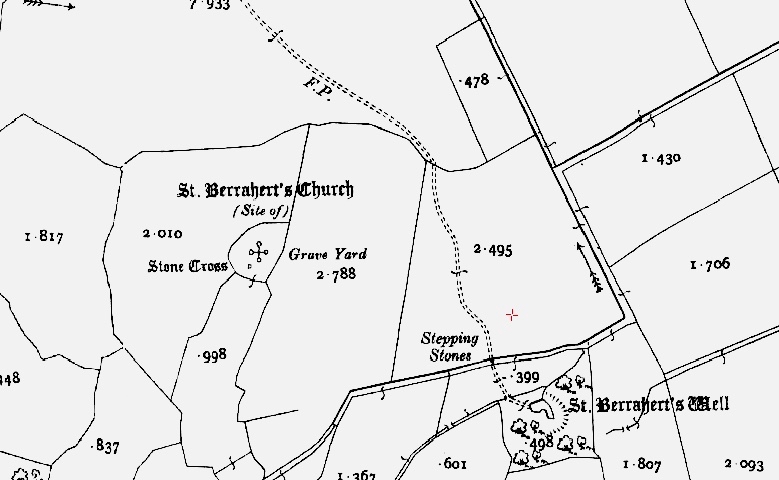
We were passing on our way to search out a secret which the Glen holds: somewhere in the townland of Ardane, we knew that there is a very ancient site where treasures have been hidden away for centuries. The first edition of the Ordnance Survey map has it marked:

I was intrigued, because a ‘Stone Cross’ indicated in this way often implies a High Cross, and a monastic settlement, so I was anxious to investigate. You will remember previous posts I have written on the many magnificent examples of these medieval treasures which Ireland holds. We had been alerted to this site by our friends Amanda and Peter, who have recently visited, and Amanda has given a comprehensive account of St Berrahert’s Well (also shown on the map) in Holy Wells of Cork. Like Amanda, I am unsure if there is a ‘correct’ spelling of St Berrahert: he is also known as Berrihert, Berehert, Bernihardt, Bericheart, and Bernard! Not a lot is known about him, other than that he came to the Glen after the Synod of Whitby in AD 664 and died on 6 December 839 – one of the saints who, like St Ciarán . . . the first Saint of Ireland . . . had a remarkably long life and who has left his name behind in the heart of Tipperary.

The place is generally known as St Berrahert’s Kyle (from the Irish word cill, ‘church’). It’s hard to find. We enlisted the help of Jimmy Martin, a local resident, who regaled us most entertainingly – and at great length – about hooded monks, crows and strange characters he had personally encountered at the site, and cures which he had witnessed at the well. Following his instructions we crossed fields, passed somnolent cows, and saw before us the remarkable ‘Kyle’.

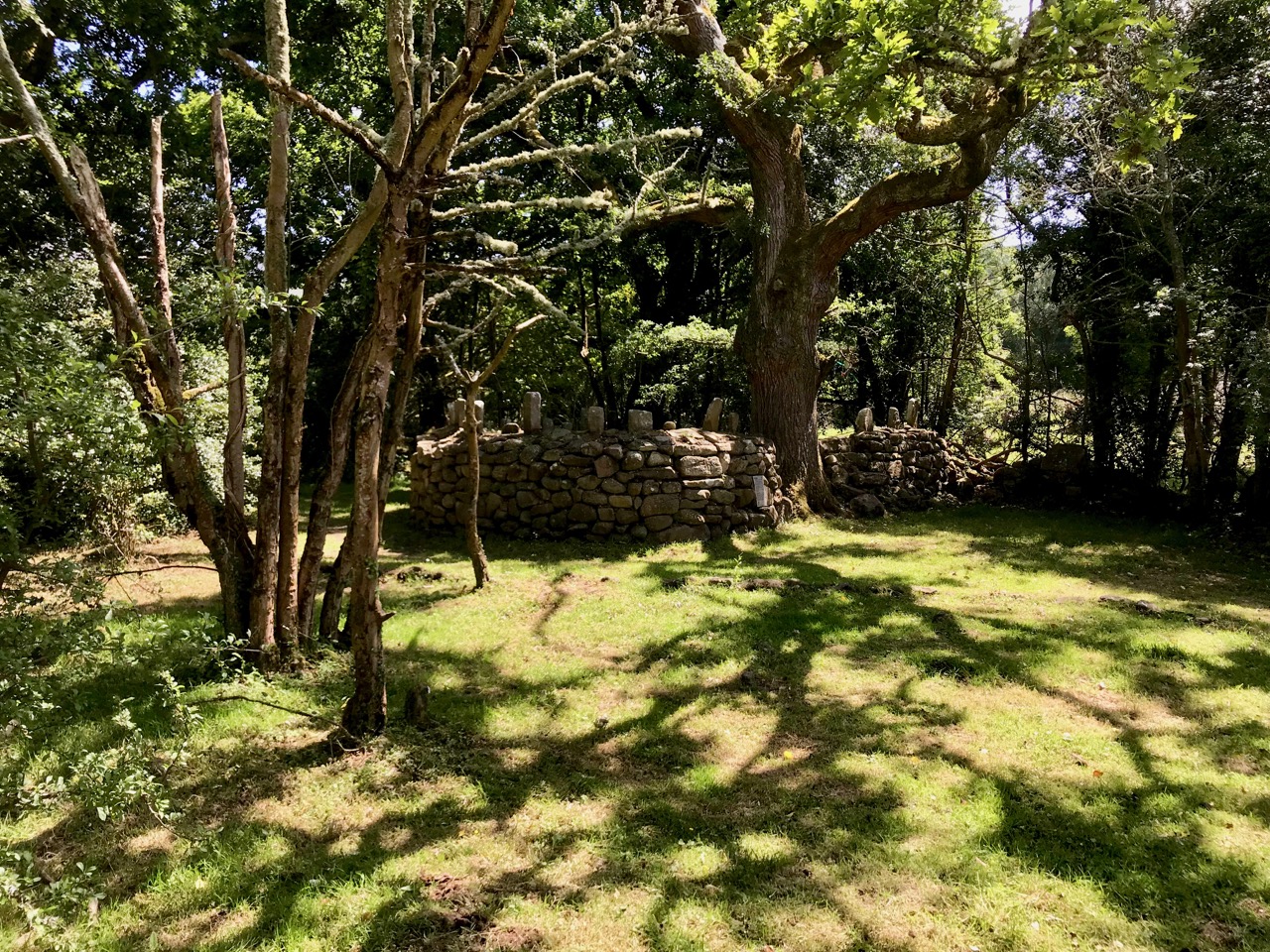
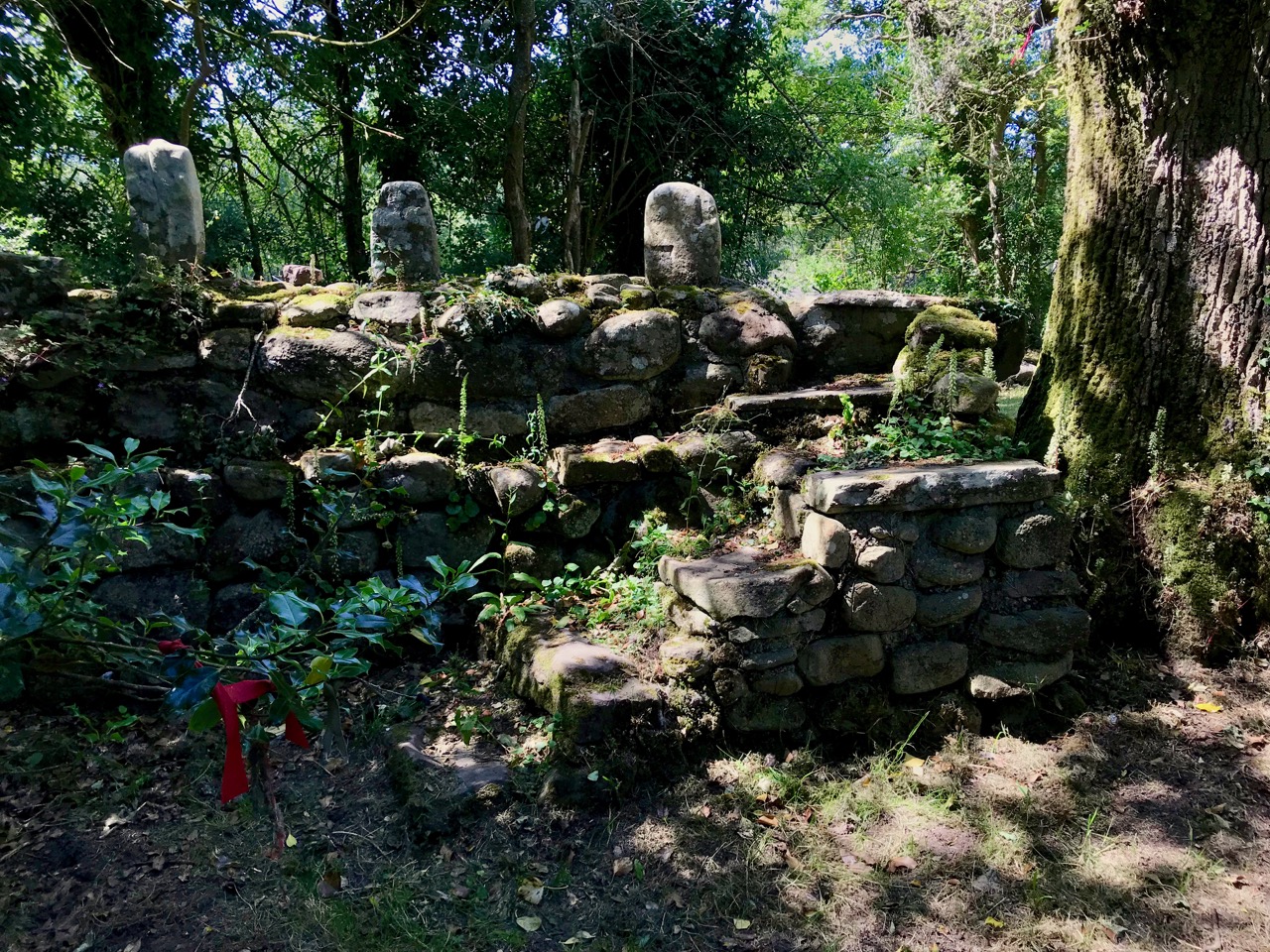
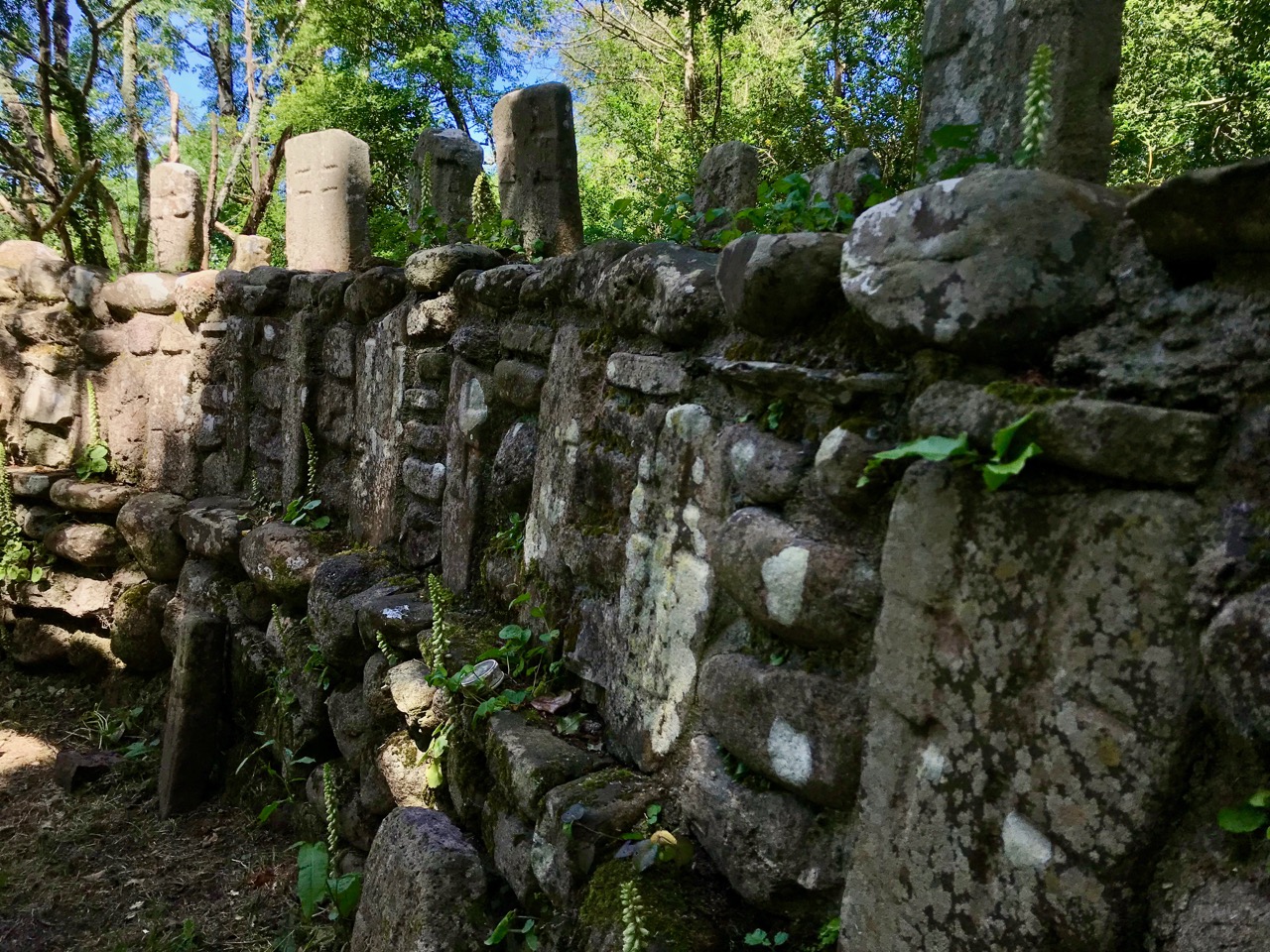
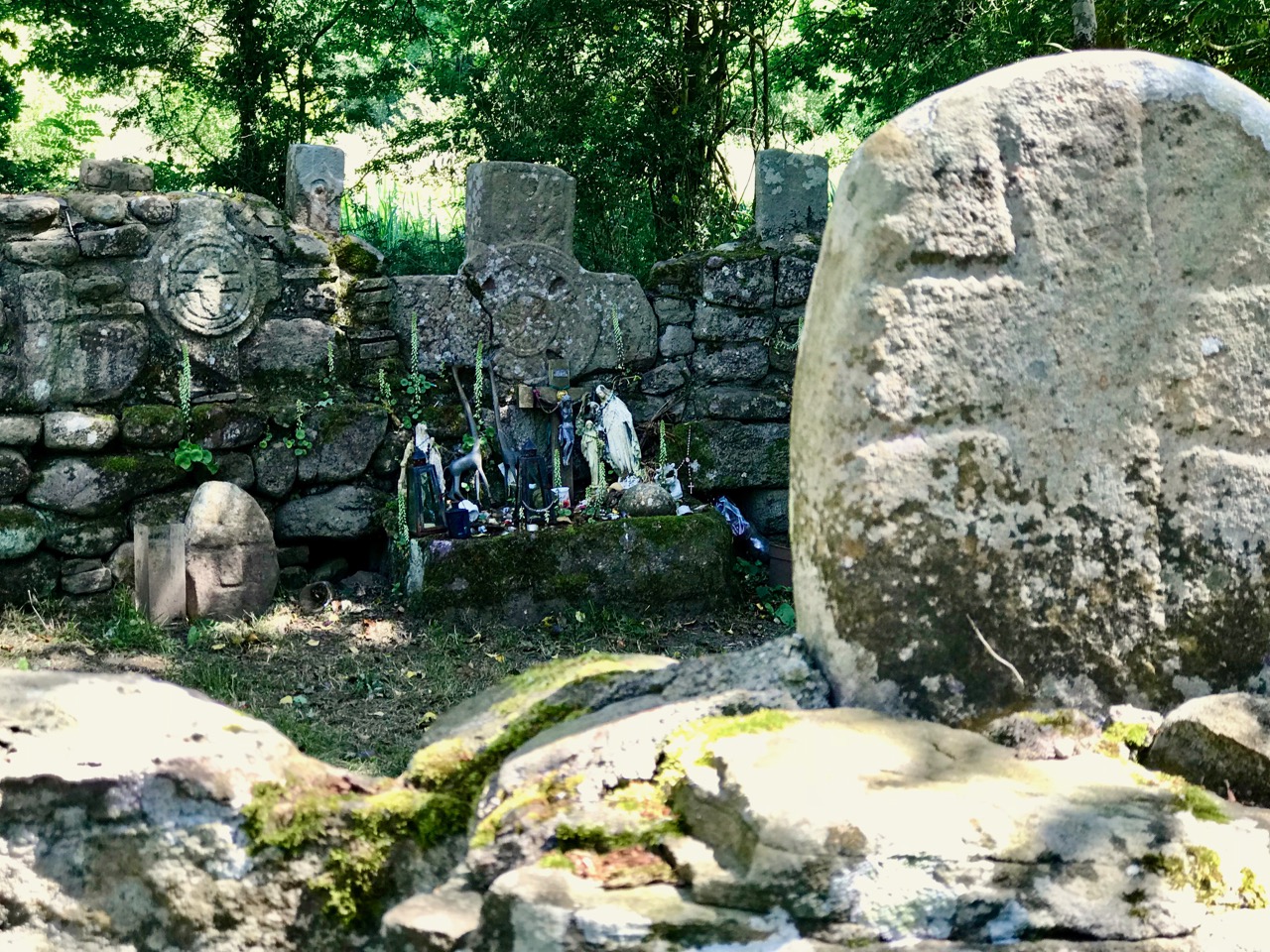
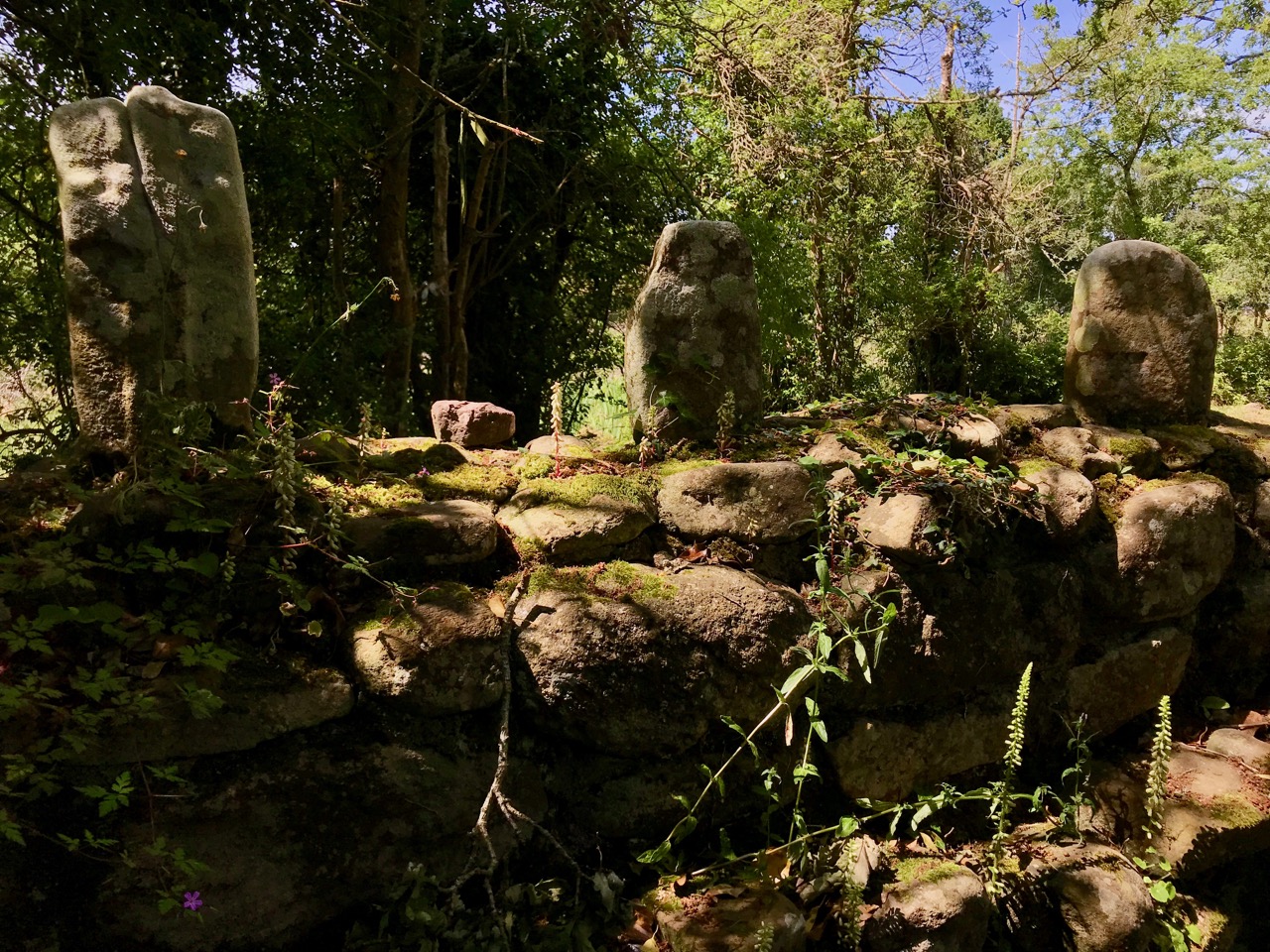
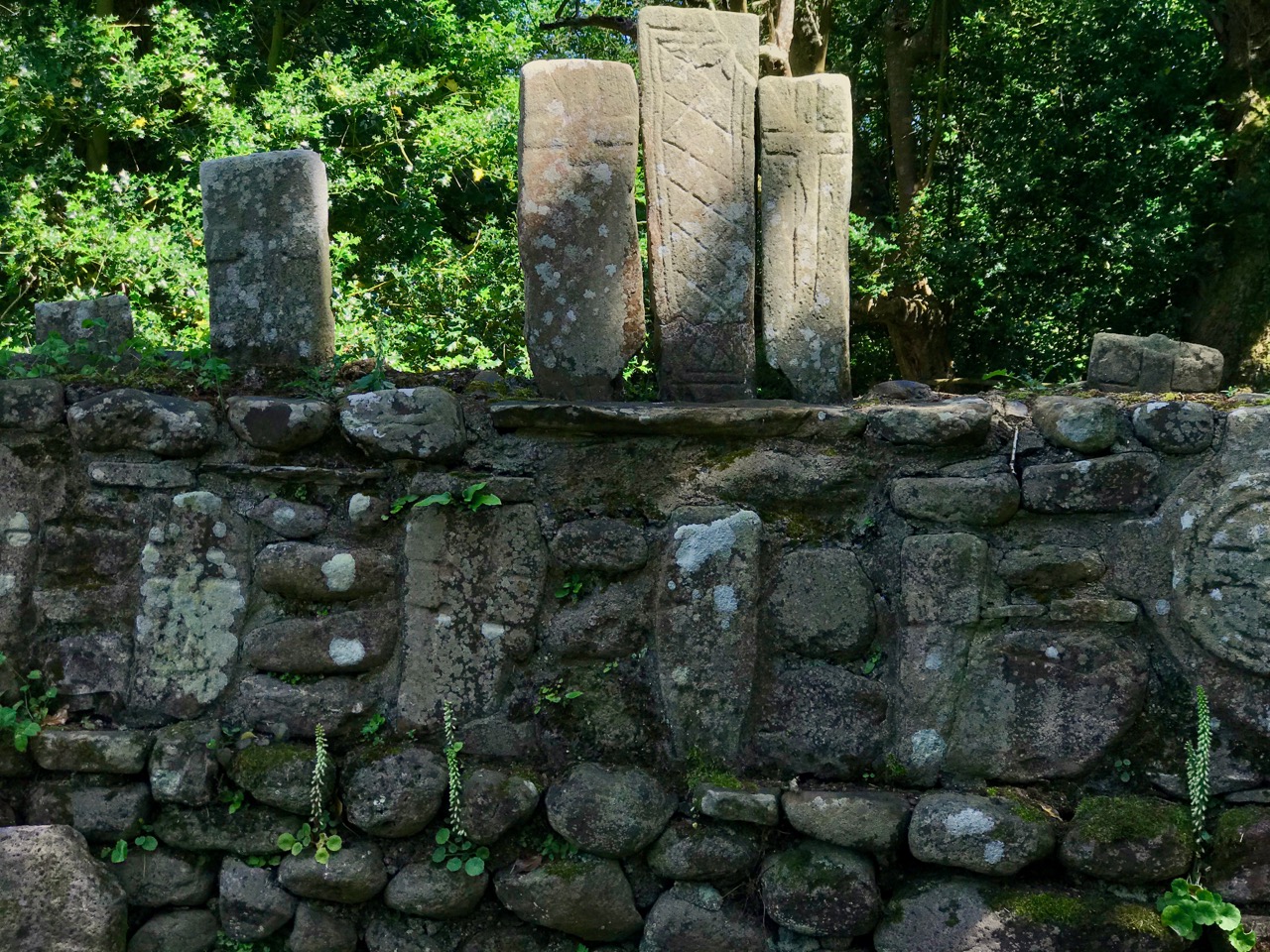
Stone walls and large trees completely encircle an oval shaped enclosure, and the only way in is by steps going over the wall. You are unlikely to be fully prepared for what you find inside. I had hoped for a High Cross – or the fragments of one: we did find a High Cross (perhaps two), but we also found around 70 other stone crosses! Somehow, the Kyle has become a repository for them, but hardly anything is known of their history. After our visit I looked into the stories and found that the enclosure itself – which feels timeless – is probably only as old as I am…

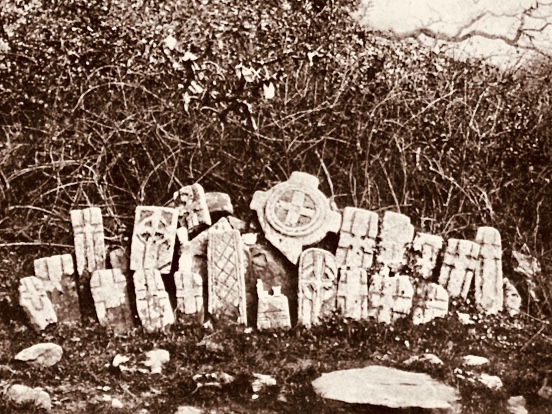
This photograph was taken in 1907. It shows that, for whatever reason, by that time a collection of stone crosses was assembled here. Suggestions have been made that an ancient church on this site was robbed of good building stone, but ‘sacred’ marked stones were left behind out of respect (or from fear of divine retribution). But records do show that the stone enclosure was built in 1946 by the Office of Public Works. What we see today, therefore, is (like me) 72 years old, although of course the stones themselves must have been carved long ago.

The whole collection of stone cross slabs, cross wheels and decorated pillar stones has been put together into an aesthetically pleasing composition which is exciting and – relatively – in safe keeping. To my mind it’s a far better way of displaying these enigmatic pieces than being tucked away in a museum. On a day when the harsh sunlight and perfect blue sky cast deep shadows and outlined the carvings so clearly the place was absolutely magical: the outside world seemed so very far away. The two largest crosses are set close to each other, built into the wall itself. The first is – to my mind – undoubtedly a High Cross in the medieval tradition; it is likely to have originated here, in St Berrahert’s holy place. As to the others, their stories will probably remain untold. But I wish them all well, and hope that future generations appreciate that what has been put together here has a life of its own and should remain an open secret, to be revealed to anyone who makes the effort to search it out.

A pilgrim path – set out with ‘stations’ – encircles the enclosure (photos below). Would this be part of the 1946 construction? From here, the way to the well is marked across more fields, and requires negotiating a boardwalk. It’s a trip that has to be made, though, as the well itself – continuously bubbling up from the sandy bed – is just as magical as the Kyle.

James and Eleanor

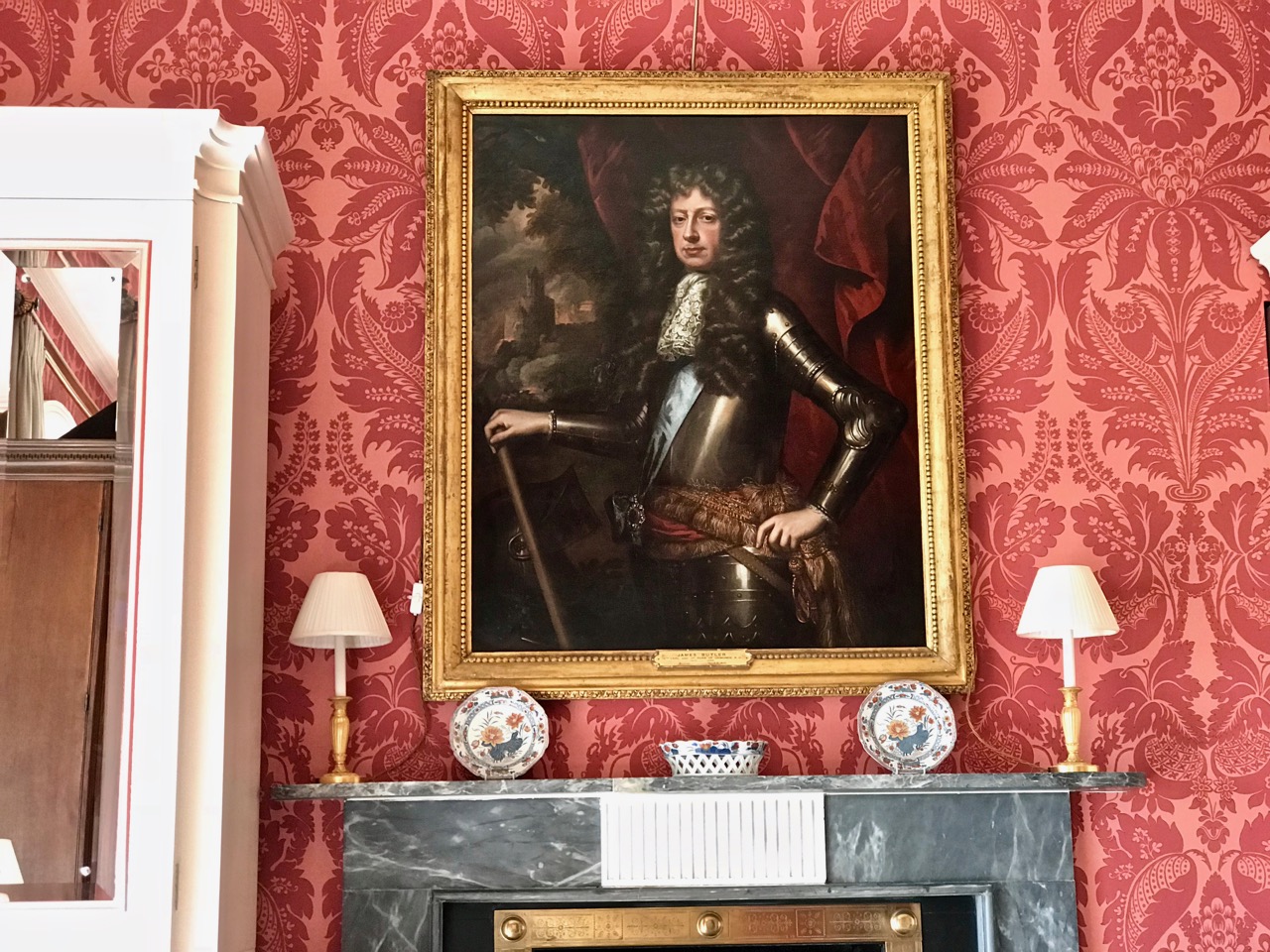
During our recent visit to Ballyfin House, County Laois, we stayed in the ‘Butler Room’. This is named after James Butler, 12th Earl and 1st Duke of Ormond (1610 – 88) who stared out at us rather severely from his portrait hanging over the chimneypiece. This Butler was Lord Lieutenant of Ireland three times, and was famous for having led the Irish royalists during the civil war. But James was only one piece in the huge jigsaw of the Butler dynasty which first came to Ireland during the 12th century Norman invasion.

James Butler, 1st Duke of Ormond, painted by William Wissing. The painting hangs in the Butler Room at Ballyfin

The name Butler was descriptive: in 1185,  Prince John – Lord of Ireland – landed at Waterford and around this time granted the hereditary office of Butler (or ‘Botteler’) of Ireland to Theobald Walter, whereby he and his successors were ‘ . . . to attend the Kings of England at their coronation, and on that day present them with their first cup of wine . . . ‘ Later, King Henry II of England granted him the ‘prisage of wines’, to enable him, and his heirs, ‘ . . . the better to support the dignity of that office . . . ‘ By this grant, he had the right to take two tuns (barrels) of wine out of every ship which discharged cargo in any trading port of Ireland, and was loaded with more than 20 tons of wine, or one barrel from a cargo of between 9 and 20 tons. Incidentally, the tradition of stocking and serving fine wines is being continued at Ballyfin, where we were shown around a magnificent purpose-built wine cellar!

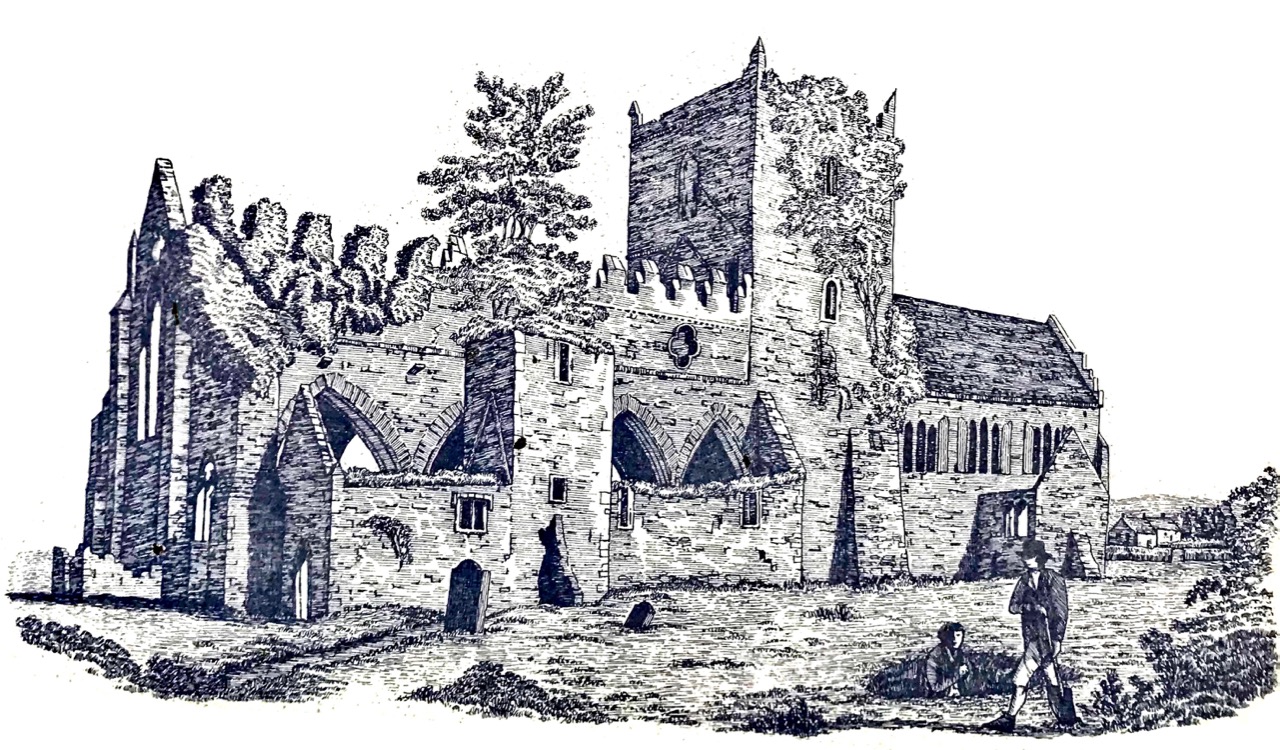
The church at Gowran, Co Kilkenny, which has many links with the Butler family. Header picture – a drawing of the church

The medieval Butlers held lands in the Kingdom of Ireland encompassing large swathes of the modern counties of Tipperary, Kilkenny and Carlow. This week we encountered some of the early members of this family at Gowran in County Kilkenny, where Edmund Butler had founded a college of four priests in 1312 to pray for himself and his descendants in perpetuity.
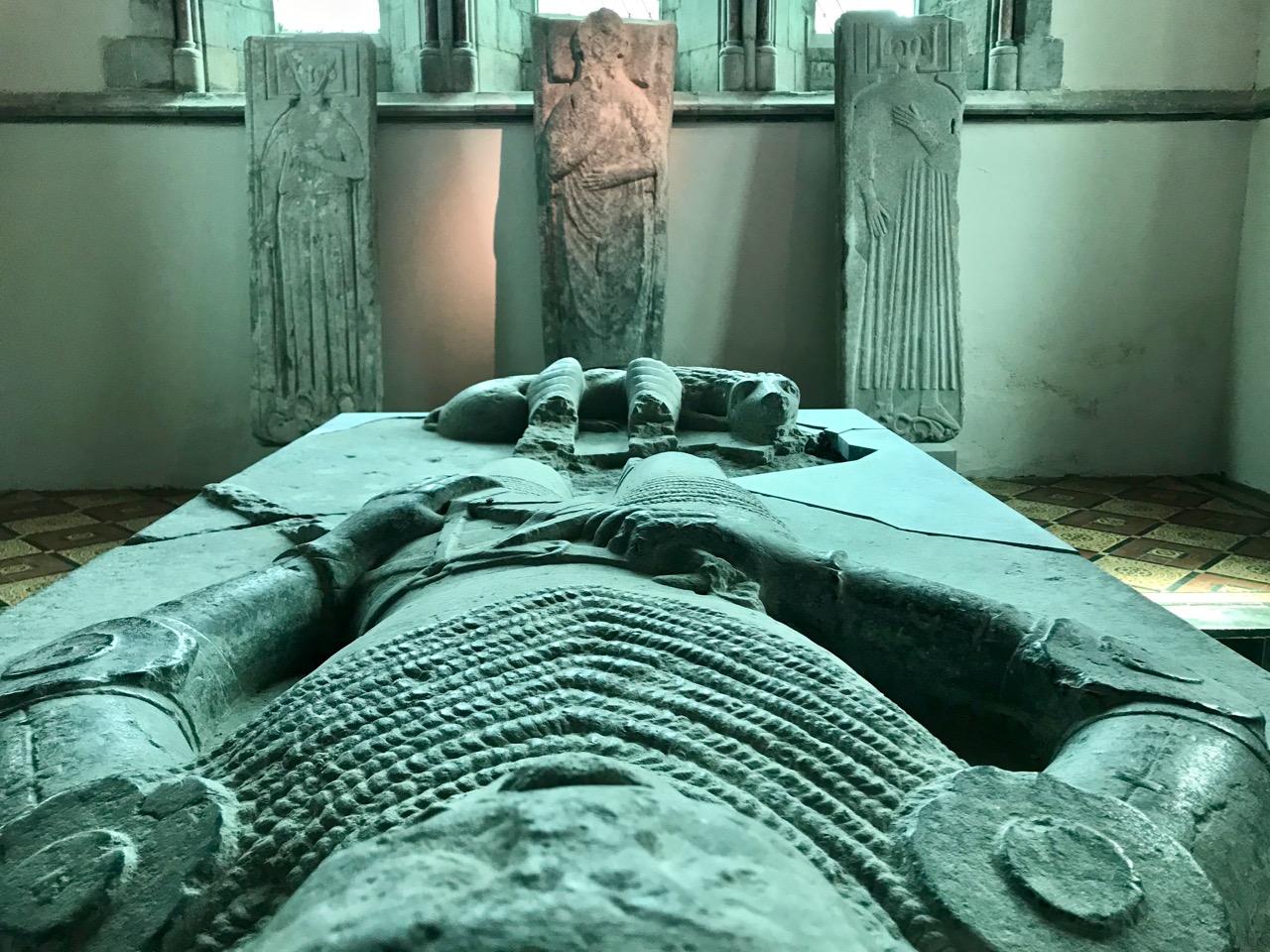
The former Church of Ireland building in Gowran has been taken over by the Office of Public Works and now displays a spectacular collection of historic artefacts, many of which are related to the Butler family. We found it hard to tear ourselves away from the various carved stones which go all the way back to the fourth century (an Ogham stone with an added early Christian cross, below left), and include the effigy tombs of James le Butler (1304 – 1338), Chief Butler of Ireland and 1st Earl of Ormond, and Eleanor de Bohun (1310 – 1363), Countess of Ormond and grand-daughter of Edward I of England. These (drawing by Duchas, below right) are magnificent, beautifully carved with clear facial features and details of clothing and footwear. They are both standing on serpents – according to Matthew (Ch 10, v 16) the serpent is a symbol of wisdom:

. . . Behold, I send you forth as sheep in the midst of wolves: be ye therefore wise as serpents, and harmless as doves . . .

It is recorded that James le Butler died at Gowran, so it is reasonable to assume that these large slabs marked the graves of James and Eleanor, although we don’t know where the tombs were originally located. The following photograph (courtesy Trinity College, Dublin) was taken in the mid 20th century by Edwin C Rae who was Professor of the History of Art at the University of Illinois. His Harvard PhD dissertation was on The Architecture of Medieval Ireland.

We are fortunate that all the monuments, plaques and tombs have been recorded in detail by local historians and are now in the guardianship of the State. There are also two wonderful windows in this church, one of which Finola is describing today. These little snippets were inspired by our unplanned visit, and we will be returning to Gowran in future posts.  We really appreciated the tour and all the information which we were given by Lisa and Gerard of the OPW who were on duty on the day we called in. The roofed part of the church – which contains the effigy tombs, the ogham stone and many fine cross slabs – is open from mid May to the end of August from Wednesdays to Sundays. Telephone before visiting to be sure: +353 56 772 6894.

Ballyfin – Part 2: Decline and Revival

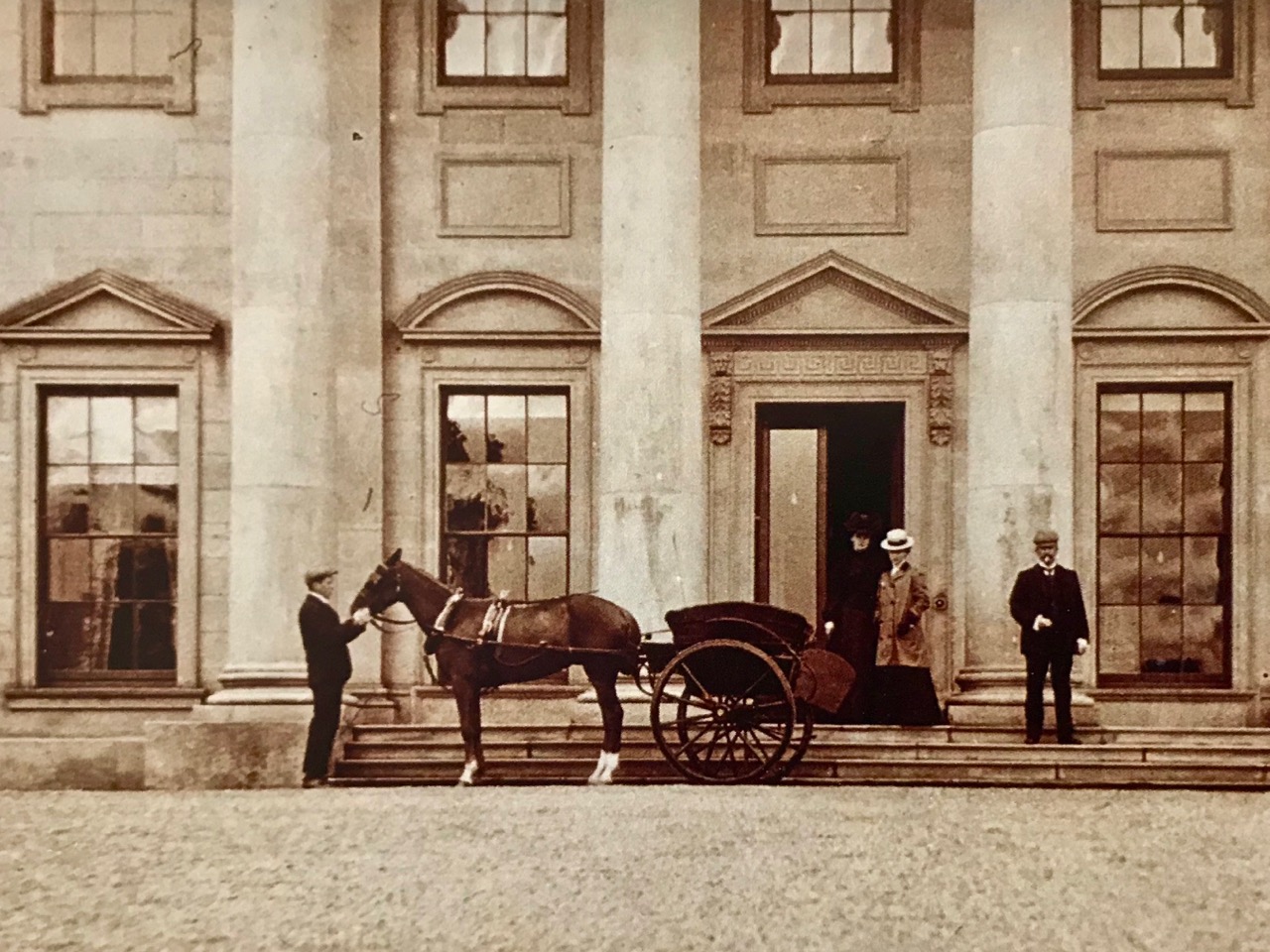
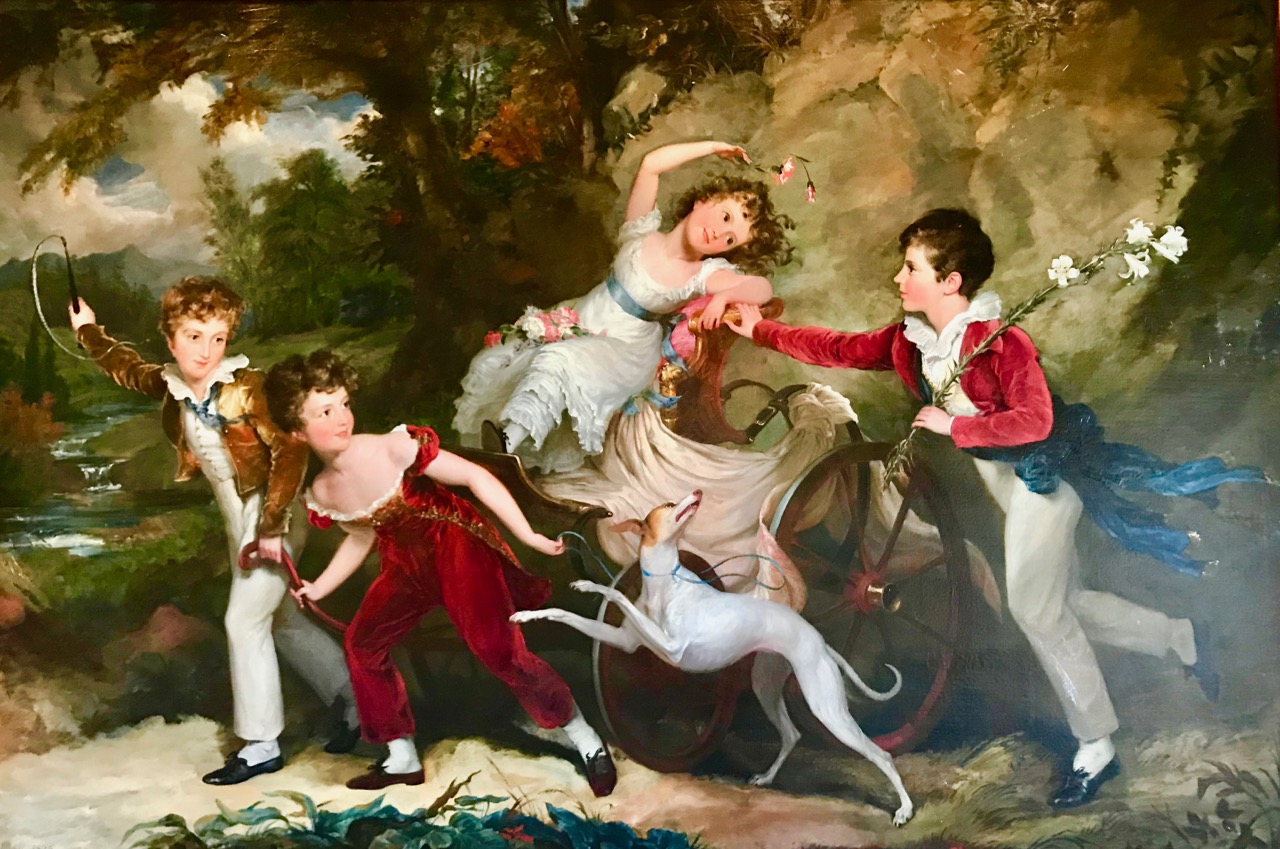
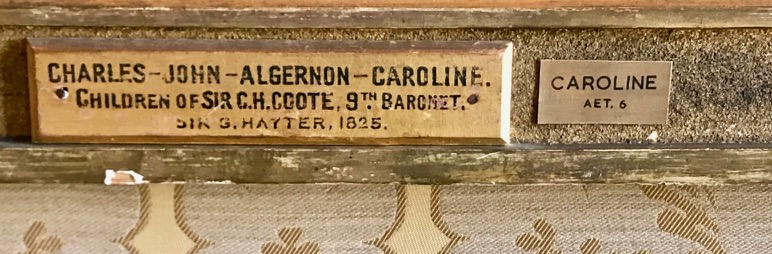
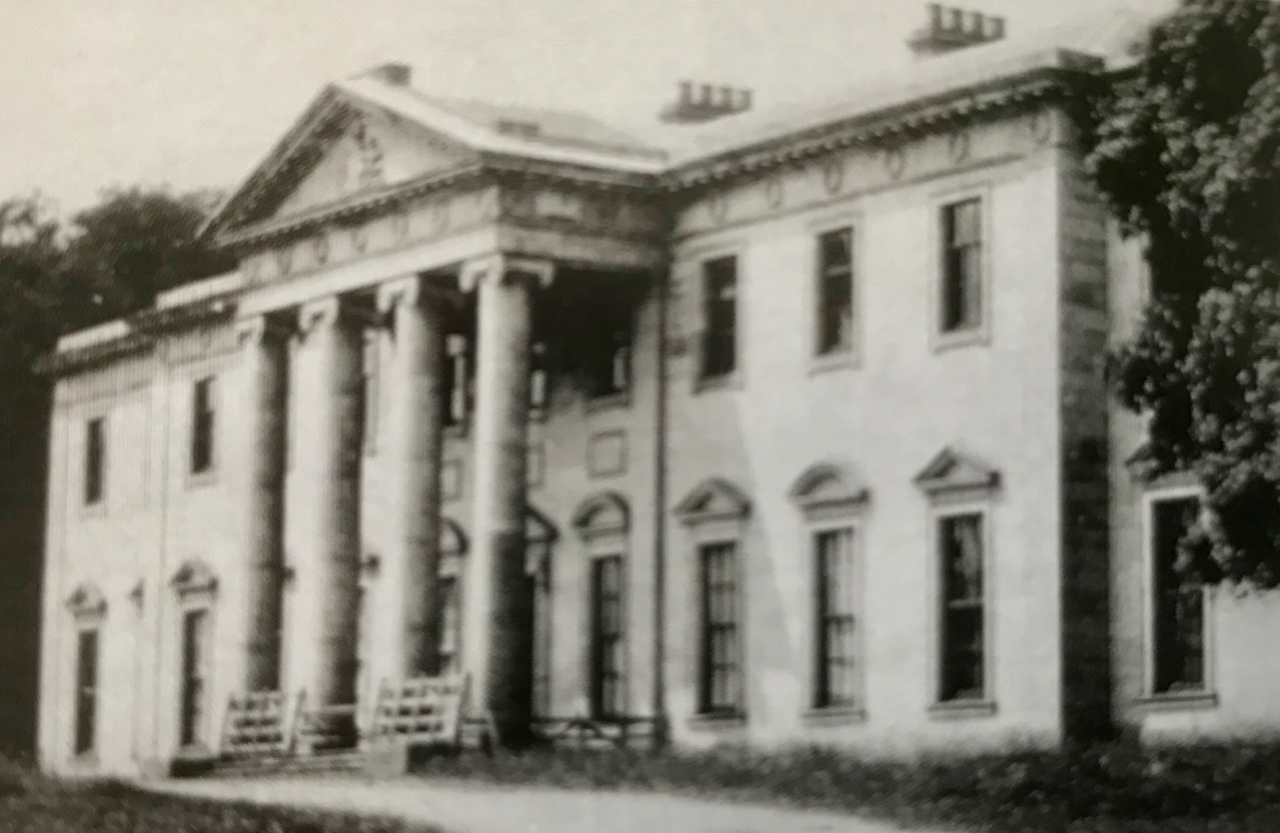
Last week Roaringwater Journal visited Ballyfin Demesne: I sketched out the early history of the house and Finola looked at the magnificent grounds. Today I’m bringing the story up to date. We got as far as the gracious Victorian and Edwardian days, when the Coote family were in residence, as they had been since 1813. The photo above dates from 1903 and shows a jaunting car waiting at the entrance to the house (Magan Collection): perhaps those days were not quite as settled as the halcyon period when the children of Sir Charles Coote were painted so fancifully in the early nineteenth century (artist: George Hayter – with the addition of a whippet painted by Edwin Lanseer!). The painting (below) is now a centrepiece in the Gold Room at Ballyfin.

At the dawn of the twentieth century, there were clouds on the horizon for the Anglo Irish families and their big houses, although life at Ballyfin seemed to maintain a continuum up until the commencement of the Great War. Generations of Cootes are remembered as having been good landlords and employers: on Sir Charles’ death in 1864 the most important members of staff were ‘handsomely rewarded’ in his will, while in the early 20th century the 12th Baronet, Sir Algernon Coote, paid the highest wages in the county – and ‘provided a comfortable house’ – to all outside labourers. In 1920, Sir Algernon died and was succeeded by his eldest son, Ralph,  the 13th Baronet. In the atmosphere of the Irish War of Independence, Ralph could no longer see a future in remaining at Ballyfin: ‘ . . . nothing would ever be the same again . . . ‘

A sad picture of Ballyfin – the house now abandoned and awaiting its fate in 1926

Sensibly – and most fortunately for today’s owners, Sir Ralph determined that the demesne should not be broken up and dispersed. He insisted that it should be marketed as one lot:

‘ . . . I have no intention whatever of dividing the demesne, the price is £10,000 . . . The figure is final and you need not bother to waste any time with anyone trying to reduce it. I would let the place fall down first . . . ‘

It was precisely one hundred years after the 9th Baronet had rebuilt Ballyfin to re-establish a permanent residence there.

So it was that, in 1930, Ballyfin set out on a new path in its development – as a school owned and run by the Patrician Brothers – a Roman Catholic teaching brotherhood. The only significant alterations to the house were the creation of a College Chapel in the old Dining Room (above), a dormitory across the north front of the first floor, and improved services. The immediate grounds were retained to provide productive gardens and the yards were filled with livestock.

Reports of life at the school from those who have memories of it are generally very positive, particularly because of the idyllic surroundings and features of the estate.  While the Patricians did their best to ensure that Ballyfin catered for the needs of a large secondary school and also strove to keep the entire demesne intact, in the end economic pressures and decades of slow decline took their toll. The Brothers closed the College in September, 2001, after 74 years of stewardship: once vacated, Ballyfin House was considered  by the Irish Georgian Society to be foremost amongst Ireland’s endangered buildings. It needed a saviour to rescue it. Fortunately, three appeared.

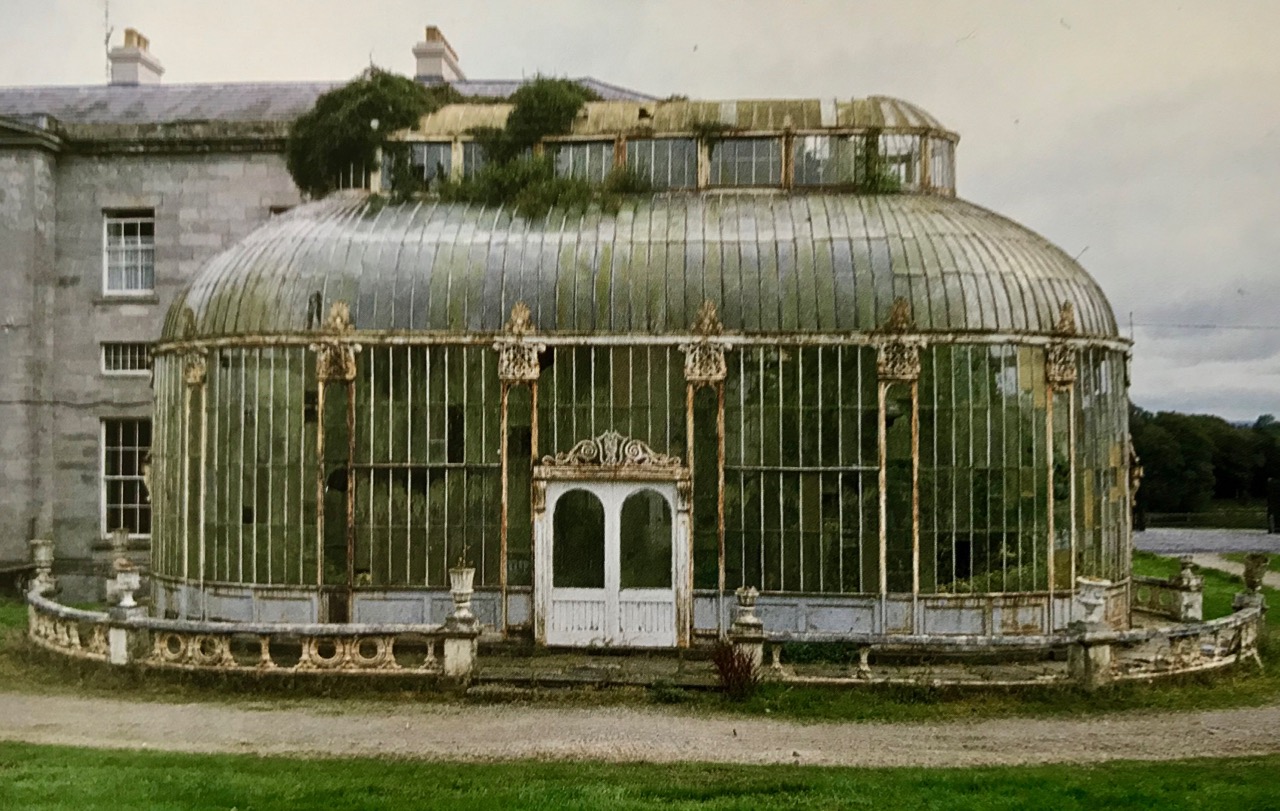
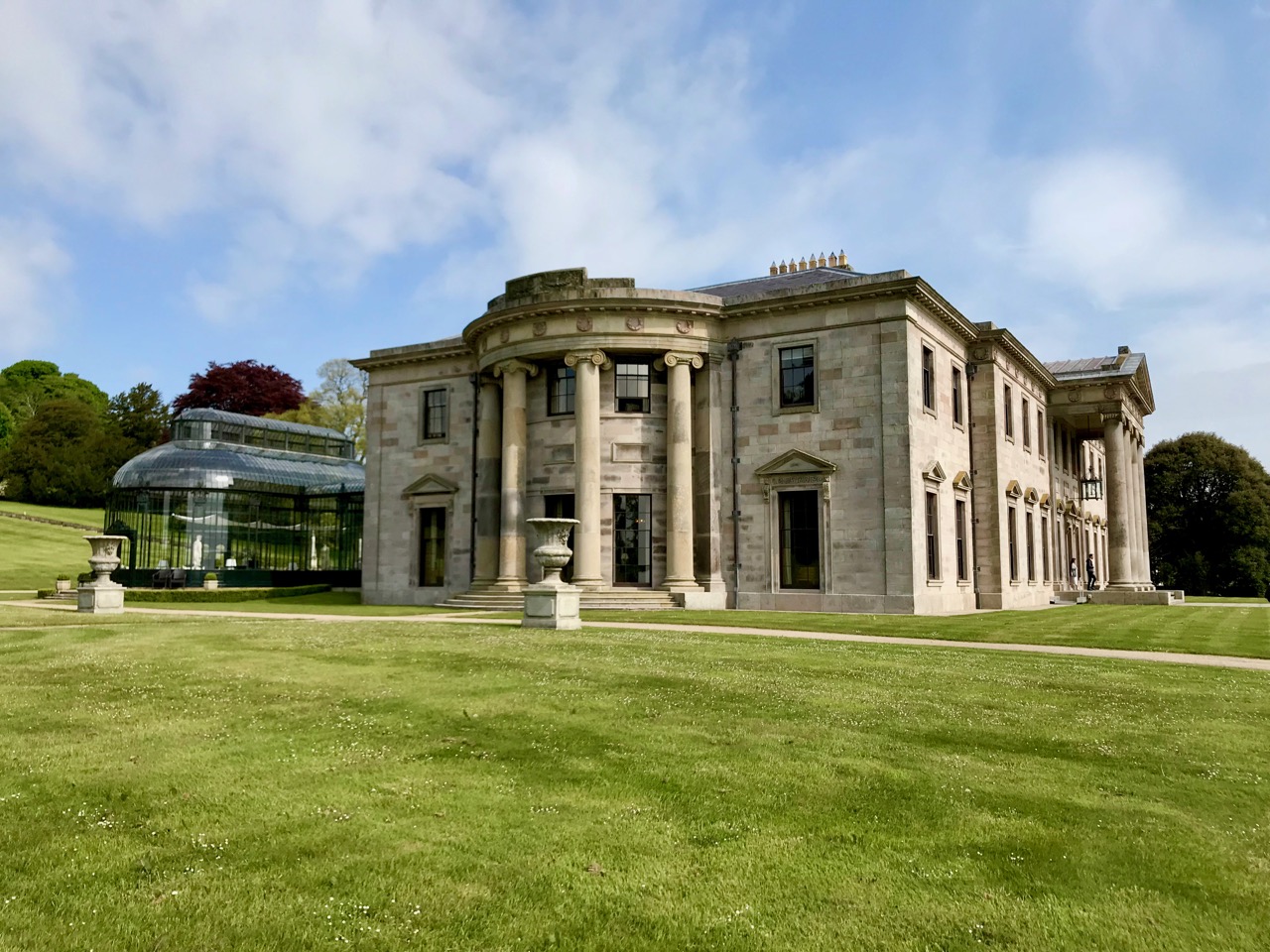
Above – an example of the declining fabric of Ballyfin during the twentieth century: Richard Turner’s iconic iron conservatory seems beyond repair, yet the reincarnation of the estate that commenced in 2004 has magnificently returned this architectural gem to prime condition, along with the rest of the house and Demesne. The conservatory was completely dismantled and – piece by piece – the ironwork was restored, then reassembled. Then a complete reglazing took place (practically every pane is a different size): in the days of the school the boys had found the glass an irresistible target!

In 2002, a Chicago based couple, Fred and Kay Krehbiel, became the new owners of Ballyfin and invited Jim Reynolds – one of Ireland’s leading landscape designers (who incidentally shared an archaeology education with Finola!) – to join them as shareholder and managing director on a project that was ‘ . . . a fundamental desire to recreate, primarily through restoration, the great hospitable tradition. the luxury and the atmosphere of the Irish country house . . . ‘ Ballyfin encompassed everything they had been searching for: ‘ . . . a great endangered house in a beautiful landscape that needed rescuing . . . ‘

The source of much of the history of the demesne recorded here is the impressive volume by Kevin V Mulligan, to which I referred last week. This extract is a good summary of the ethos and achievement of those who drove the project:

‘ . . . The primary aim of the new owners and Jim Reynolds has been to re-establish the integrity of the house and everything within the demesne walls – its historic buildings, gardens and parklands, and by opening the house to guests, to fulfil the hospitable intentions of the Irish country house. Since 2004 an extensive programme of restoration works has brought the house closest to its state following completion almost two centuries ago. It has taken eight years to achieve this, longer in fact than it had taken to complete the house in the first instance . . . ‘

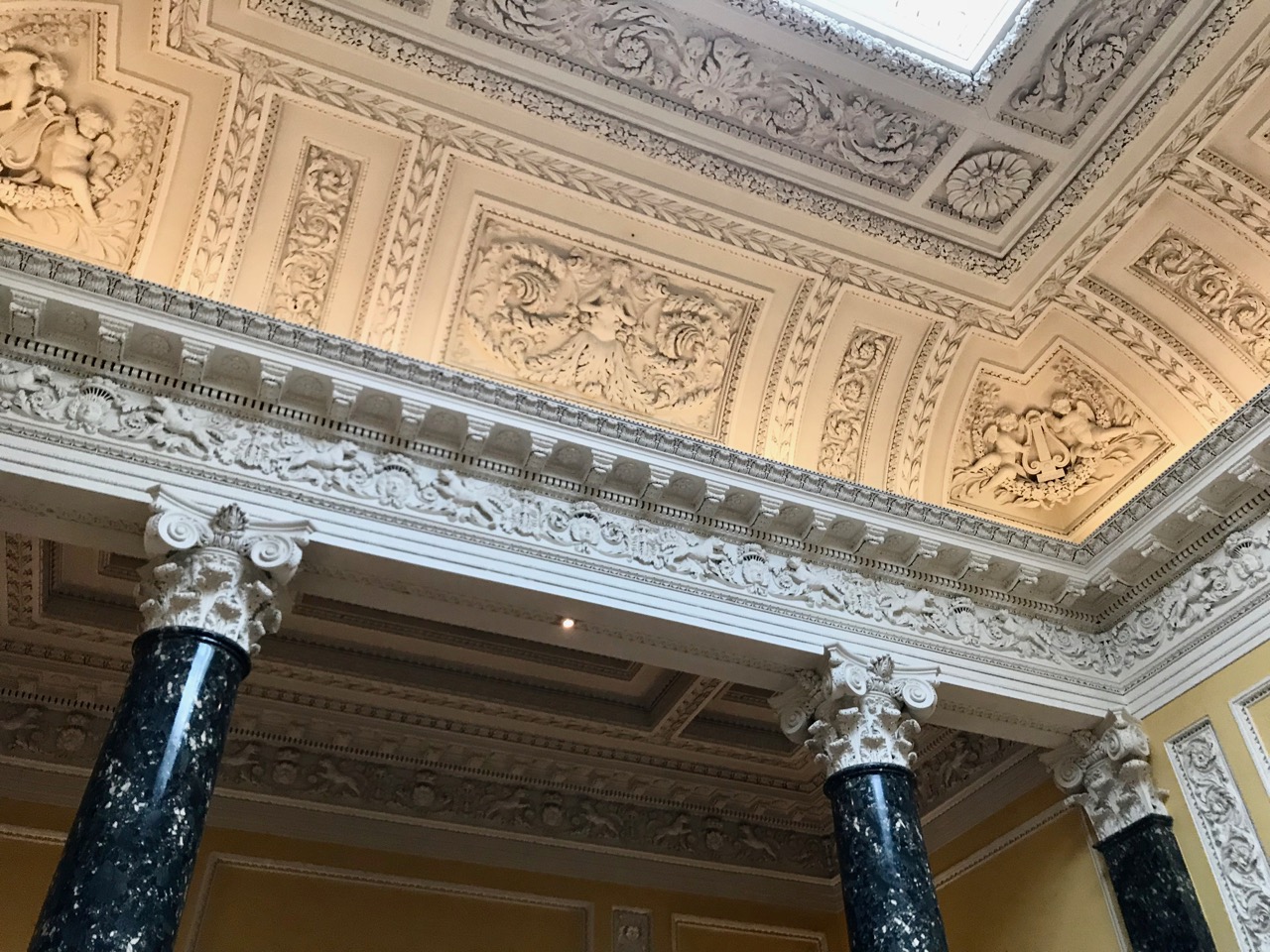
This photo compendium indicates the high quality of the restoration and the attention paid to every detail, including the recovery and hanging of many of the original portraits showing the owners of the estate during its history.

Ballyfin today reflects one piece of the complicated jigsaw puzzle that is the history of Ireland. It paints a picture of way of life now in the past.  In today’s incarnation as a first class, small hotel it offers a distilled and polished experience of the best of contemporary Irish hospitality.