A Little Adventure

Arderrawiddy a Portal Tomb

Aderrawinny – a Portal Tomb

The landscape of West Cork is so densely populated with archaeology and historical sites that it will be a lifetime’s work to visit every one. Whenever the sun shines – and often when it doesn’t – we are out exploring. A great resource for us is the Archaeological Survey Database, set up by the National Monuments Service of Ireland. This lists and describes every site in the Republic which has been recorded to date – and it is expanding all the time. I have to say that the way it works in practice is slightly clumsy: you have to know which County and which Townland you are searching in, but once you have got your head around it it is fairly straightforward to locate a record. One of the really good things about it is that you can see the position of each record laid over the modern Ordnance Survey mapping of Ireland, or historic 6″ and 25″ maps – and even over satellite views of the terrain: all this makes locating the sites relatively easy, although it doesn’t help overcome bogs, barbed wire fences and seemingly impenetrable undergrowth.
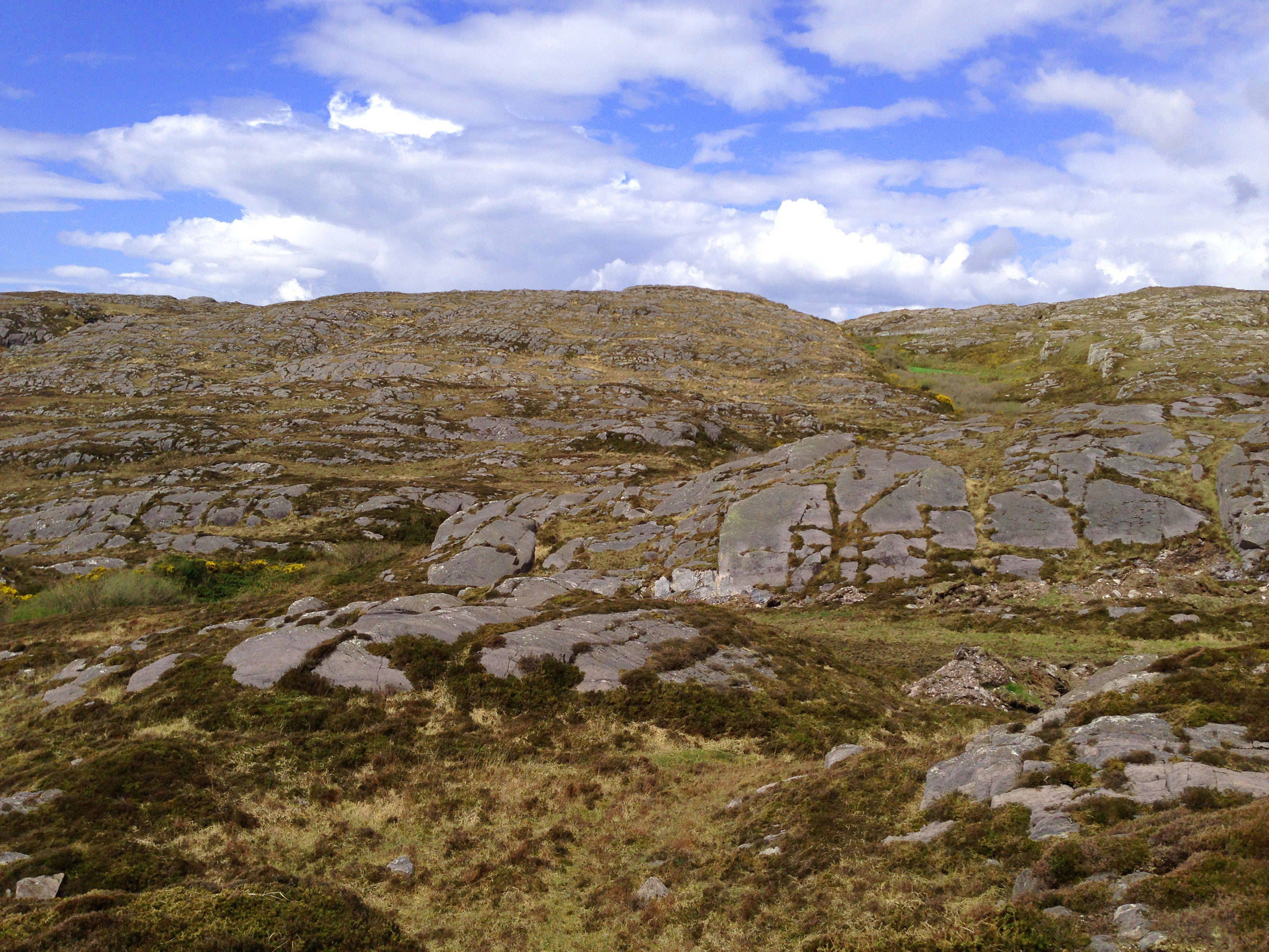
Prehistoric Landscape West of Schull

Prehistoric Landscape West of Schull

We have been researching Megalithic tombs, and there are many of these on the Mizen Peninsula. On Sunday last we compiled a list from the Survey Database, donned our boots, filled up our flasks and went out to tackle the wild unknown…

View from Arderrawiddy

View from Aderrawinny

Our first stop was in the townland of Aderrawinny – a Portal Tomb. The site is shown north of the Schull to Goleen road, up in a rocky hillside. In spite of having looked carefully at the maps it wasn’t easy to locate precisely, but I find you begin to get an instinct about these things and we headed off expectantly across boggy land and through painful patches of gorse and bramble, pausing frequently to examine every outcrop for undiscovered Rock Art. Eventually our travails were rewarded when we crested a low ridge and found ourselves looking down on a lonely construction created perhaps 5,000 years ago. It’s a humbling experience to think of the history which has befallen our ancestors during those millennia: through it all this little monument to humanity has survived with little change, eternally pointing its entrance to the movements of the sun and having always in its sight the distant blue waters of Toormore Bay. The landscape, also, has changed so little, apart from the minor interventions of agriculture. This is what makes the west of Ireland such a special place – for me, at least.

5,000 year old Monument

5,000 year old Monument

We travelled on, passing by the well known and well signposted Altar Tomb, a Wedge Tomb which is constructed so that the setting sun around Samhain (November) is aligned with a holy peak at the far end of the Mizen.
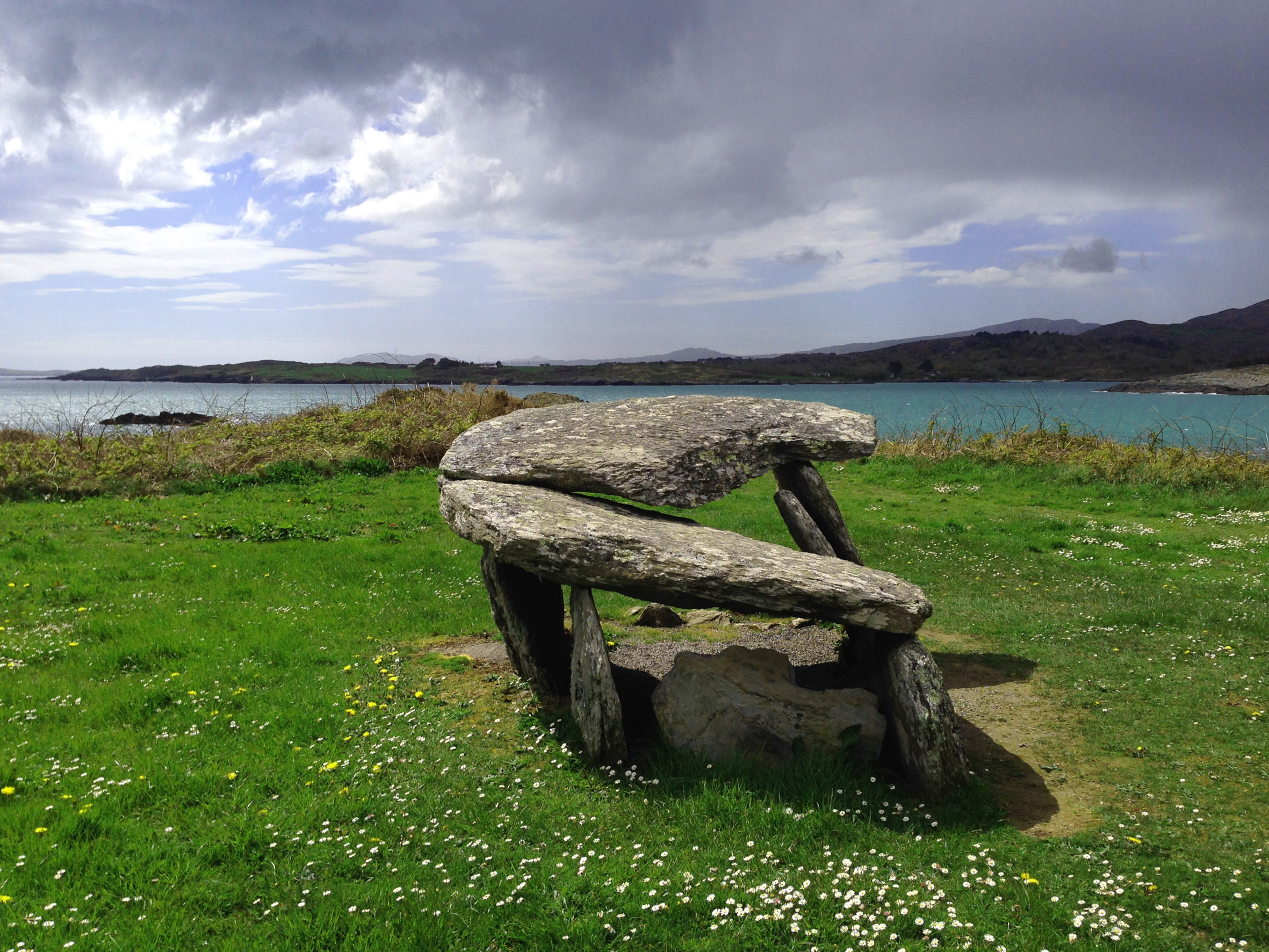
Altar Wedge Tomb: Sacred Orientation

Altar Wedge Tomb: Sacred Orientation

We found another Wedge Tomb near Goleen: this has been ‘domesticated’ because somebody’s garden is built around it: it has to share its presence with chicken runs and a wheelbarrow.

Back Yard Wedge Tomb

Back Yard Wedge Tomb

Lastly, we searched out another type of tomb: a Boulder Burial. This lies almost drowned in a salt marsh near Dunmanus. Since the time of its construction water levels are reckoned to have risen by up to two metres. It reposes like some great amphibian reptile on a watery bed, as dramatic in its own way as any of the other Megaliths.

Drowning Monument: Boulder Burial at Dunmanus

Drowning Monument: Boulder Burial at Dunmanus

These hillsides, mountains and monuments will outlive humankind. Interesting to ponder whether something we have created in our own lifetime could still be around and – for all we know – still performing its original function in 5,000 years’ time…
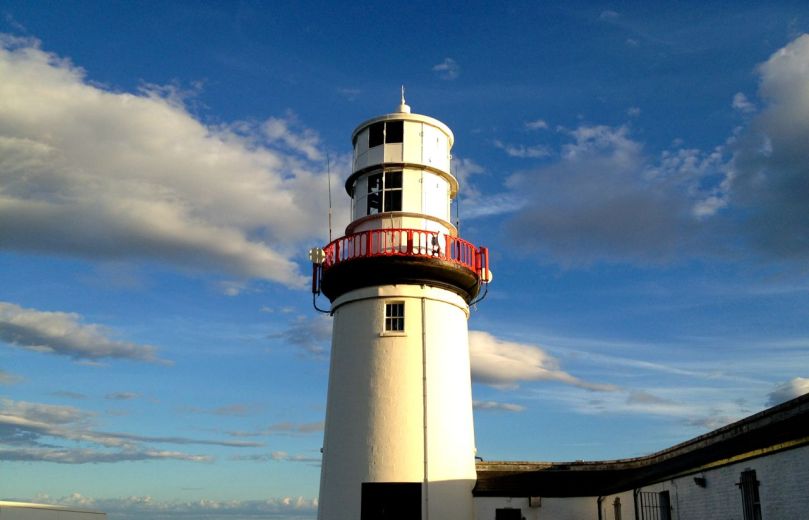
 

Galley Head Lighthouse

Galley Head Lighthouse

Galley Head Lighthouse

On a sparkling day last September we set out with the Skibbereen Historical Society to tour the Galley Head Lighthouse. We were fortunate to have as our Guide the man who wrote the book (literally) on this and other Cork lighthouses. Gerard Butler wore his full dress uniform for the tour: not only did he look dashing, but he wowed us all with his encyclopaedic knowledge of irish lighthouses, and amused us with many stories about the characters who looked after them.

bookLighthouse keeping ran in families, and Gerard recounts in his book, The Lightkeeper, the roles his father, mother siblings and grandparents played in keeping lighthouses going along the Irish coast. He spent many years at Mizen Head, at Skellig Michael and on the famous Fastnet Rock, scene of a horrendous sailing disaster in 1979. In the 90’s the automation of lighthouses spelled the end of the traditional role of light keeper, but Gerard continues as the ‘attendant keeper’ at Galley Head.

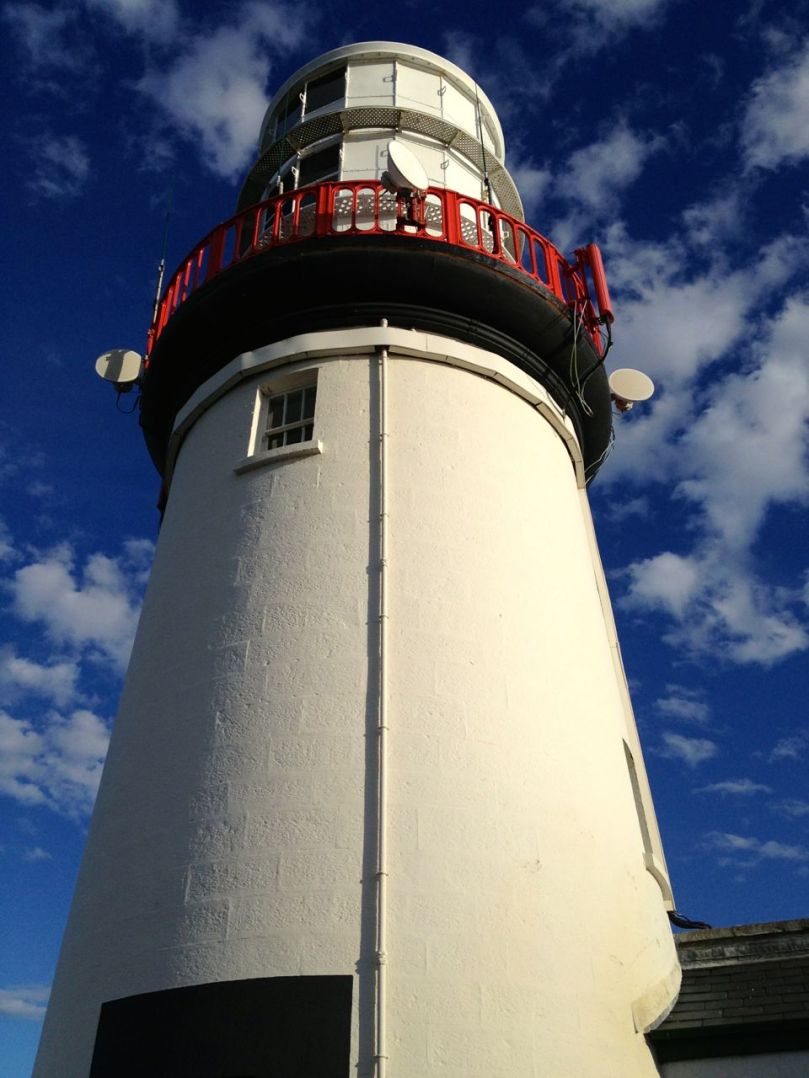
The Galley Head lighthouse is not open to the public, so this was a rare privilege. It is a classic – an enormous white tower visible from miles around, gleaming on the headland. Each lighthouse has its distinct ‘character’ – the rate at which the flashes are visible – and Galley Head’s was seven flashes in sixteen seconds, followed by forty-four seconds of darkness. This was later converted to five flashes every twenty-five seconds. When the lights were directed solely out to sea in the late 60s the local people missed the familiar flashes so much that they petitioned to have them restored and this was done. (We understand this very well – we see the flash of the Fastnet Rock from our house and would miss it greatly if it were to stop.) 

The deep sound of the foghorn, a feature of so many lighthouses, no longer booms through the fog from Galley Head – foghorns have been rendered obsolete by modern technology. Gerard recounted that the foghorn was actually powered by explosive charges, and that during the War of Independence and the Civil War lighthouses were regularly raided by Republican forces who carried off the explosives. During that period the foghorns were silent also, although not by choice.

The light itself has undergone a radical evolution in technology. Originally powered by gas, with a gasworks built to supply the fuel, it was later converted to paraffin, and finally to electricity. At one point in the early days the light was the brightest in the world, and with each improvement to the fuel and the optics, it became more efficient. 

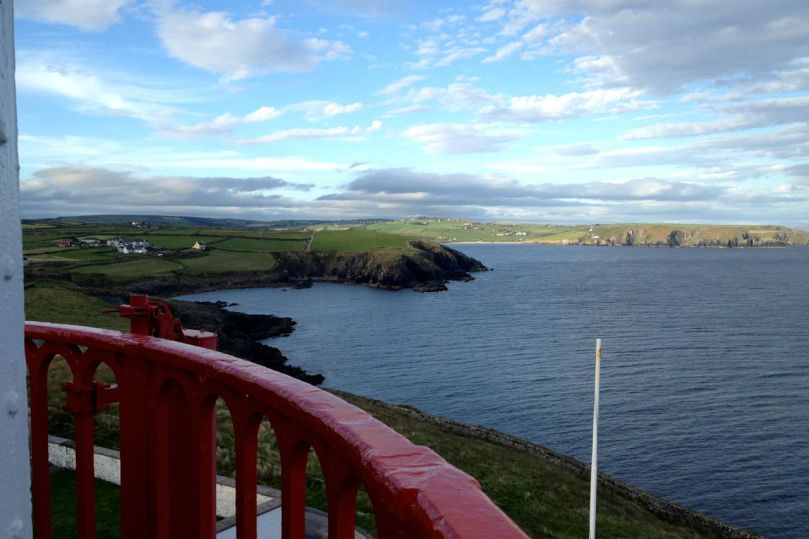
From the top deck

From the top deck

Scrambling up the curved staircase; listening to the stories of the hardship, bravery, adventure and occasional boredom of the keepers’ lives; surveying the countryside from the vantage point of the top deck; scanning the sea in hopes of a whale sighting; imagining ourselves in one of the hurricane-force storms that regularly swept over Galley Head; learning the history and culture of the Irish Lights Service: it was a unique insight into a way of life that has vanished forever, and a marvellous afternoon!

Looking up

Mizen in Bloom


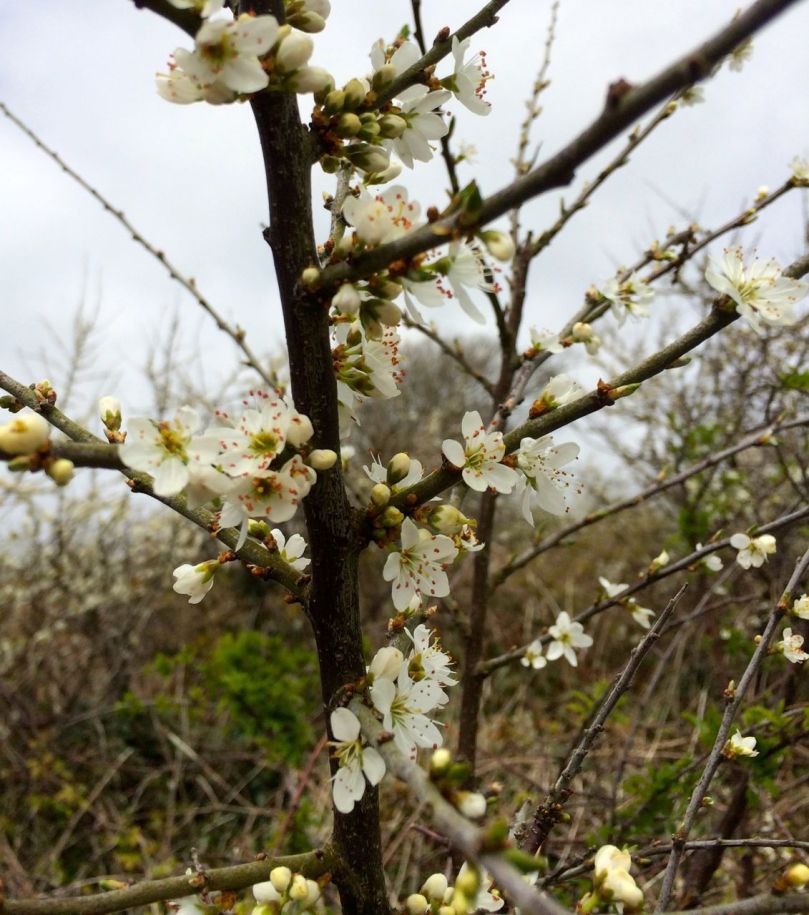
hawthorn or whitethorn

Hawthorn or whitethorn

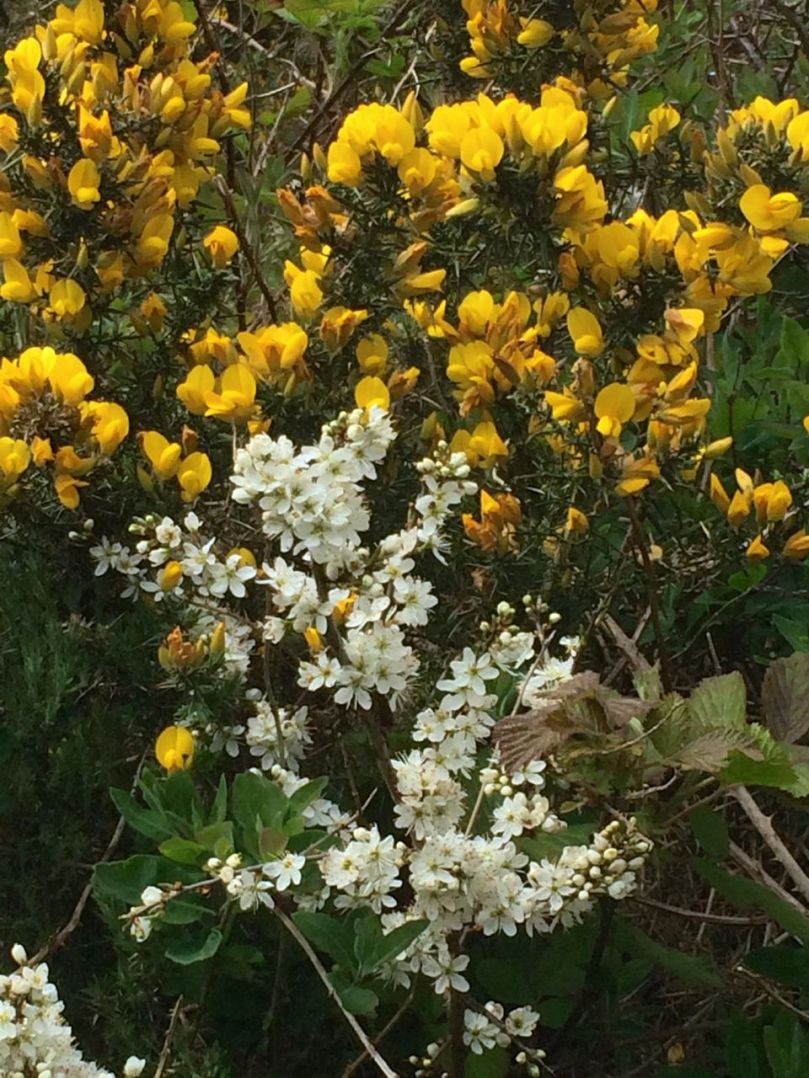
They say that spring is a little late this year – the result of the winter storms, which caused so much destruction and set back growth. Many shrubs and trees around us looked stripped and burned from a combination of ferocious winds and salt spray. Even the gorse is slow: although some of it is in full bloom, the hillsides are not yet ablaze with that incredible yellow.

Gorse and hawthorn

Gorse and hawthorn

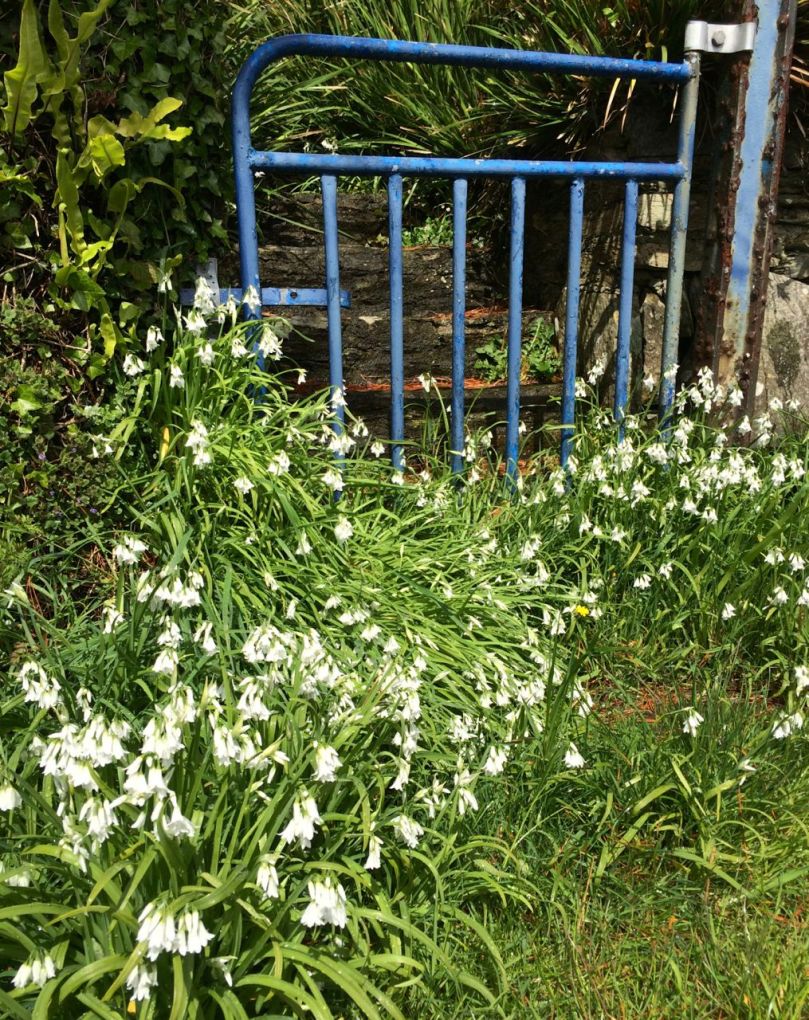
But now around the Mizen the spring flowers have burst into bloom. The boreens are heady with wild garlic. It’s become a thing to cook with it. One of my favourite young Irish chefs, Donal Skehan, has a recipe for wild garlic pesto and another for wild garlic soda bread. Haven’t tried it myself yet, but it’s definitely on the list.

Wild garlic

Wild garlic

I have serious bluebell wood envy. There is one near here, and I dream of eventually having my carpet of blue under the trees. Here’s a little bluebell slideshow: most of the photos were taken close to our house, but a couple are from Wicklow (Bray Head and Mount Usher Gardens), and the last one shows my brand new bluebells coming up from the bulbs I planted last autumn.

This slideshow requires JavaScript.

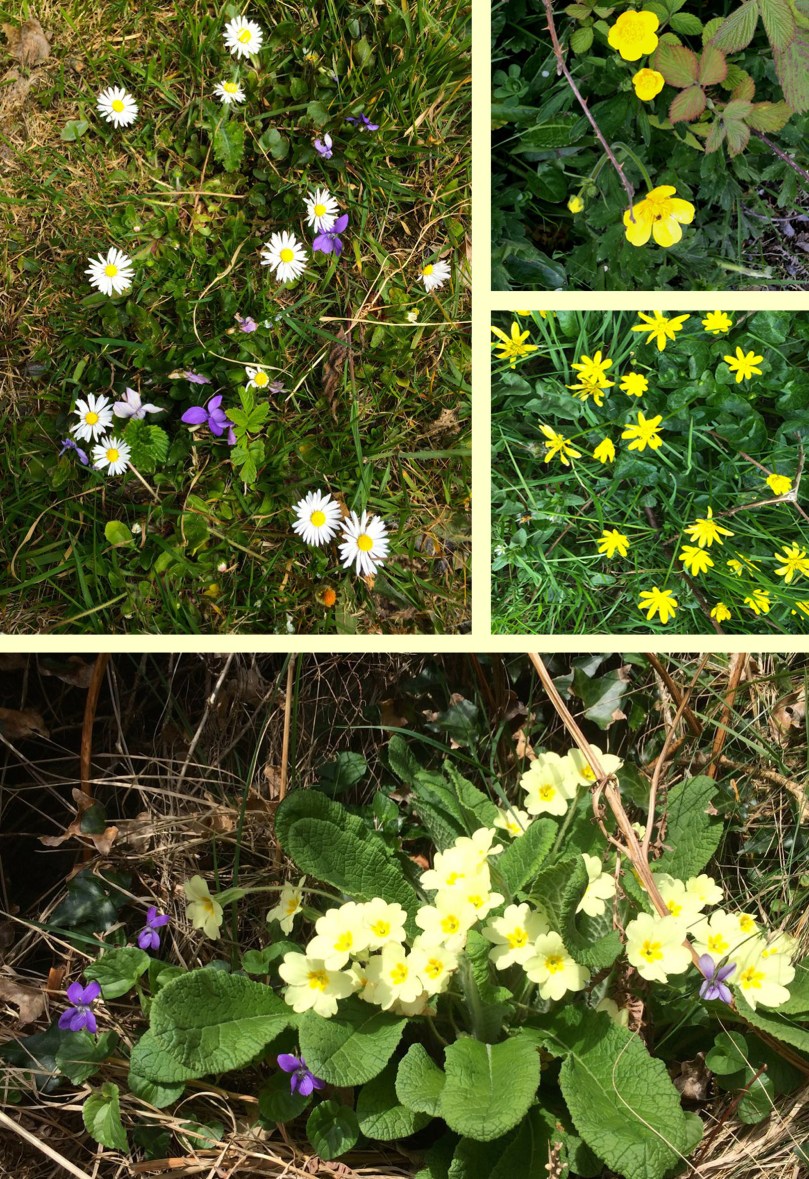
The hedgerows are striking right now. Above are the white branches of the hawthorn (also known as whitethorn), gorgeous in their bountiful white blossoms, and below are the roadside flowers – celandines, buttercups, daisies, violas and primroses.

wayside flowers

Wayside flowers

Along the shore hardier species are showing themselves now. Sea pinks, or thrift, are waving in the breeze. Today we found one that Robert has always called pennypies, but which is more properly called navelwort. It’s a fascinating looking plant – and good, apparently, for curing corns!

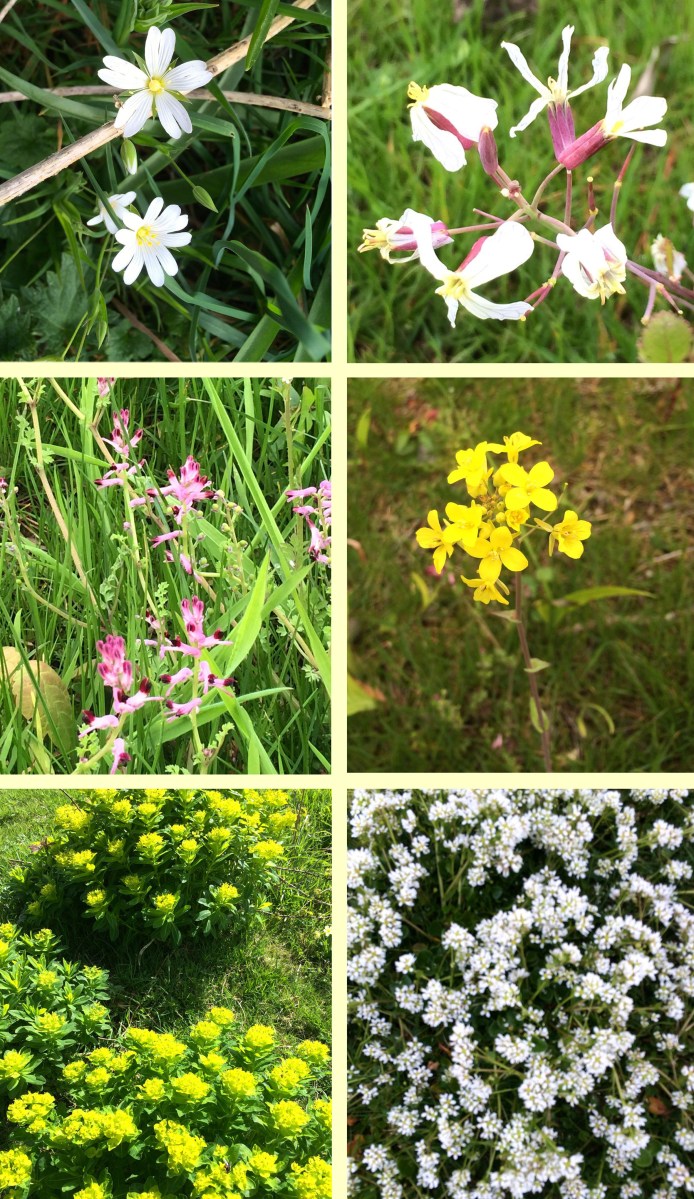
There are lots I can’t name, so can you help me out, Dear Reader, and tell me what these flowers are?

Can you name these flowers?

Can you name these flowers?

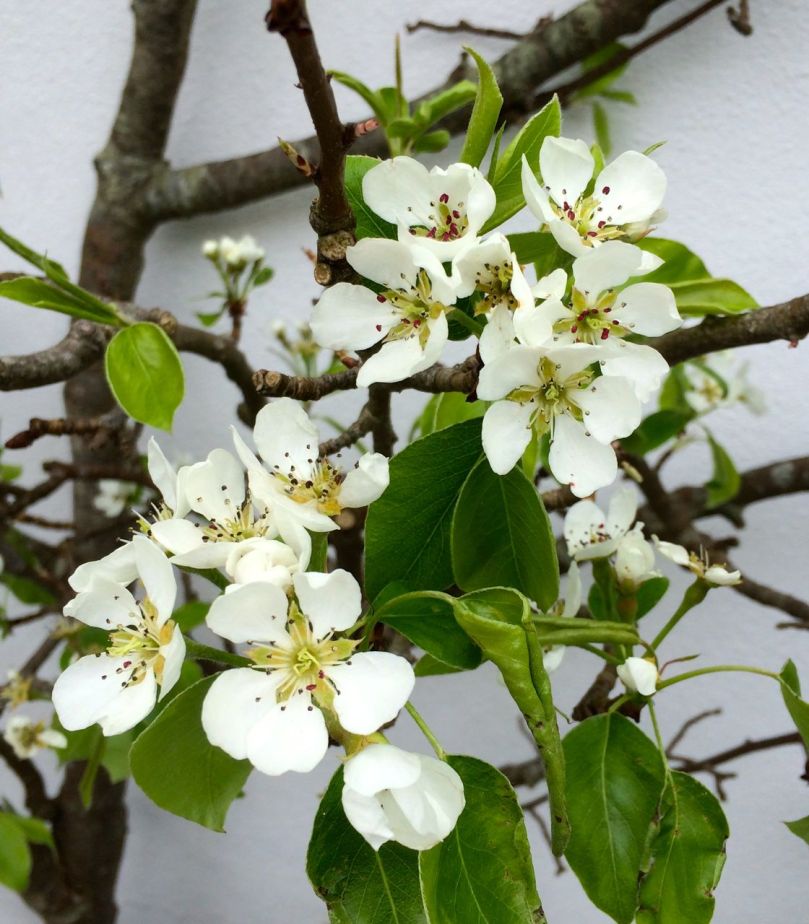
I can’t resist one final photo – no, it’s not a wild flower, but it holds the promise of delicious things to come. These are the blossoms on our pear trees.

Pear blossoms

Pear blossoms


Battling It Out

image-2

…Fierce is the wind tonight, it ploughs up the white hair of the sea – I have no fear that the Viking hosts will come over the water to me…

Translated by F N Robinson from an old Gaelic poem ‘The Viking Terror’

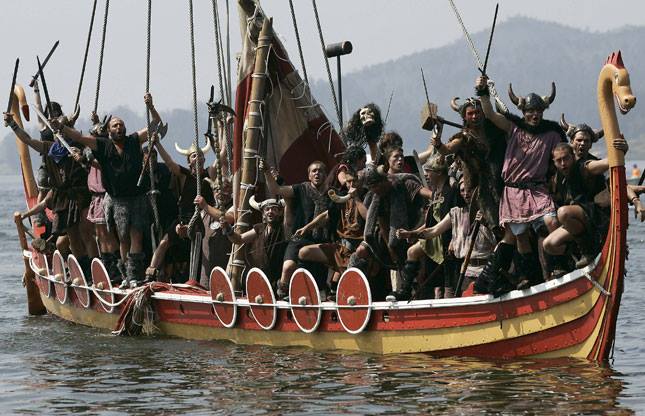
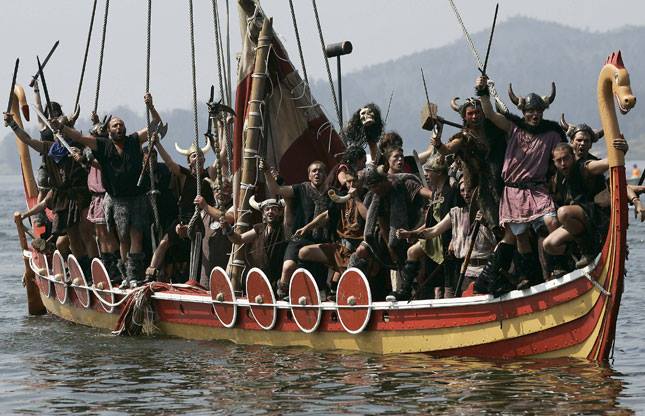
The Vikings are coming!

The Vikings are coming!

There was a great battle fought in Ireland on Good Friday.

Really? Good Friday just gone?

Yes – huge forces, hundreds of people, Viking longboats, swords, spears, axes…

I don’t think that’s very likely in this day and age.

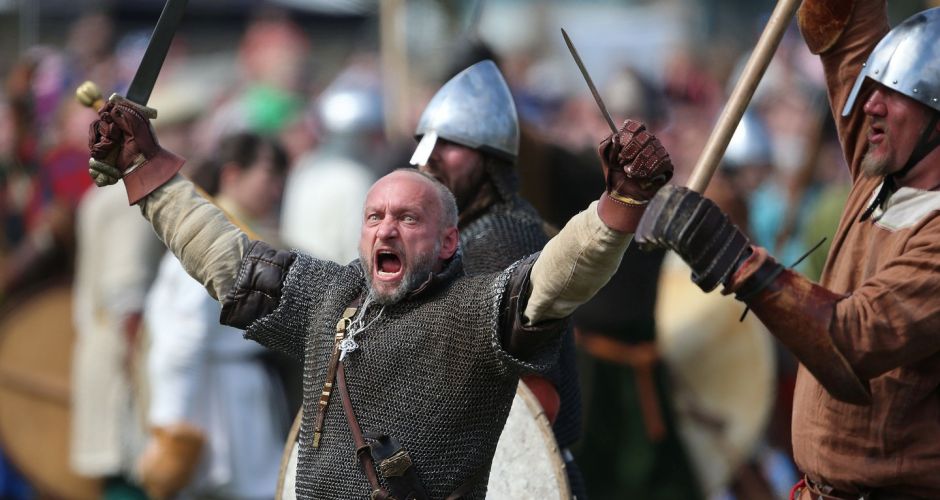
It is in Ireland: the Battle of Clontarf was re-enacted this Easter – 2014 – exactly 1,000 years after it took place.

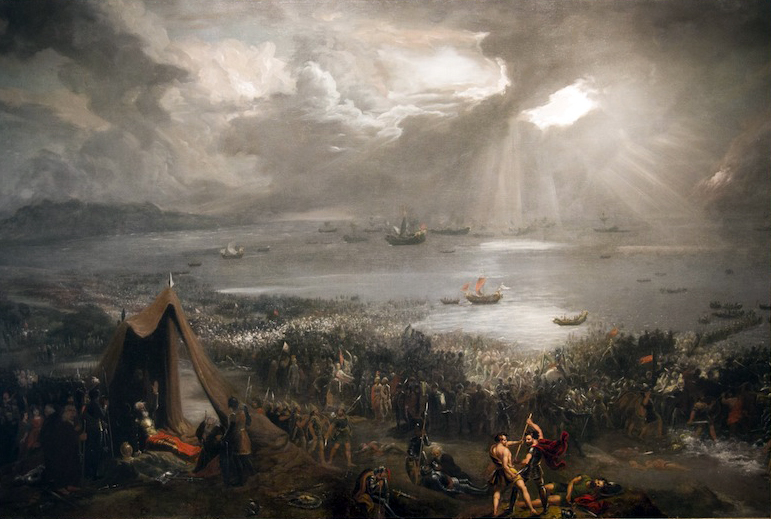
Battle of Clontarf, Good Friday 1014

Battle of Clontarf, Good Friday 1014 (Hugh Frazer 1826)

So what’s the connection with West Cork?

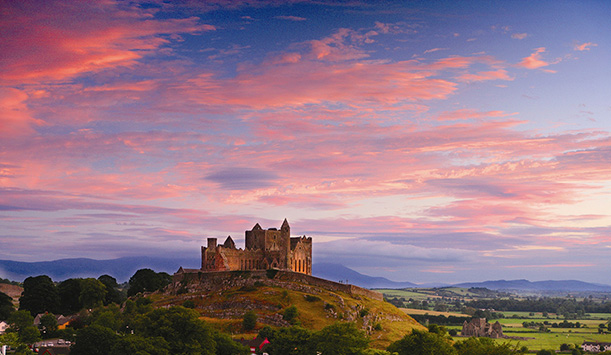
Well, the victor of the battle was Brian Boru, and he was at one time the King of Munster – crowned on the magnificent Rock of Cashel. That is, before he became the High King of all Ireland – seated at Tara, County Meath, and before he decided to take up arms against the Vikings.

The Rock of Cashel

The Rock of Cashel

So, this was a battle between the Irish and the Vikings?

Actually, no. This was the Irish and the Vikings fighting – er – the Irish and the Vikings.

Sounds a bit complicated.

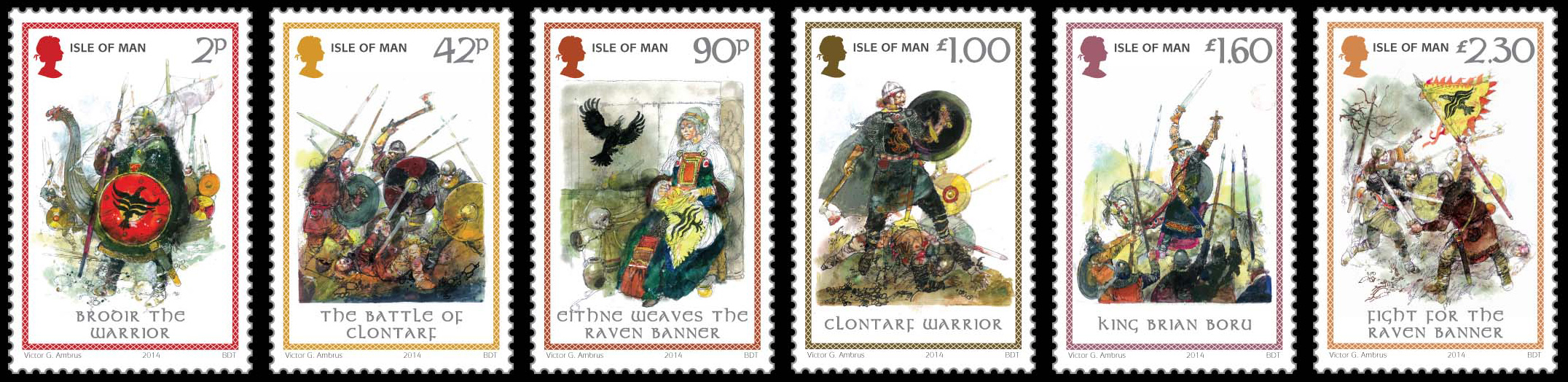
Irish history has always been complicated. The first Viking raids on Ireland took place in the eighth century. Initially they were aimed at the rich ecclesiastical centres but eventually the raiding parties became colonising parties, and by the tenth century there were many settlements of Norse people in Ireland who mingled, married and traded with the locals. As always there were factions within factions and the Irish clans – who frequently picked fights with each other – formed allegiances with some of the colonisers while falling out with others.

stamps


So, who won the Battle of Clontarf?

Well, in 2014 everybody did: there were no casualties. But in 1014 Brian Boru’s forces (which included some Viking allies) lost 4,000 of his 7,000 followers while on the other side the opposing mainly Viking forces (but including a contingent of Leinster men who had fallen out with Brian Boru) lost 6,000, leaving them only 500 standing on the field. You could say that it was a rout – and legend has it that Brian Boru drove the Vikings out of Ireland.

So we’ll put that down as a win for Brian then?

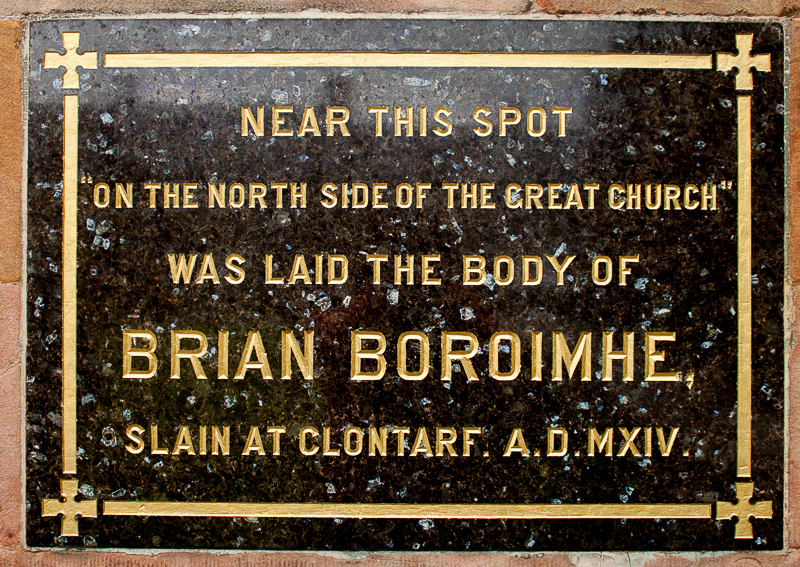
In a way, but sadly he didn’t live to see it. At 74 he was too old to fight and he spent the day praying in his tent. Brodir of Mann, one of the fleeing Vikings, found him there and murdered him.

That’s a bit much…

Yes, not exactly the end you’d like to see for such a hero. But I suppose it made him a martyr for the Irish cause and has certainly assured him a top place in history and legend.

plaque

You haven’t mentioned any legends.

To be honest the whole Brian Boru story was once considered to be a complete legend. No archaeological remains have ever been found of the battle; its site is disputed; and no-one knows exactly where Brian Boru has been buried – although there are various stories about all this which are still told in good faith after 1,000 years.

Didn’t he play the harp?

Well ‘the Harp that once through Tara’s Hall the soul of music shed’ was supposedly played by King Brian. It’s kept in Trinity College Dublin – where you can also see the Book of Kells. Unfortunately it’s been dated to the 15th century and therefore could never have belonged to Brian.

The harp has been used as a national symbol by the Free State but is perhaps most familiar in its incarnation on Guiness bottle labels. It has a chequered history itself: it was restored (very badly) and played for a time on special occasions but is now considered too fragile to allow the wire strings to be fully tensioned. In March 1969 it was stolen!

boru harp

Oh no! Did it come back?

Yes: after some very cloak-and-dagger antics involving large sums of ransom money being left in a dustbin in a Dublin back street it was eventually found wrapped in a sack in a sandpit.

Did they catch the dastardly thief?

They did, and he was given a two year suspended sentence as his defence counsel argued that he should be allowed to flee the country or he would be lynched…

A sensible approach to matters of law!

Indeed. And we can be happy that the whole Brian Boru / Battle of Clontarf story has given rise to huge media coverage, hopefully boosting tourism in Ireland.

That’s grand.

coin


Dancing Sun

Dancing Sun, Roaringwater Bay

Dancing Sun, Rossbrin Cove

“Where does that road lead?” said I, pointing to a road on the left of the one we were pursuing. “The road is it?” said the man with the cloak, “why, then, what road should it be, but the road to Sunday’s Well, a fine well it is, and a blessed place, for sure they say, though myself never seen it, that if one was to go there at peep of day on an Easter Sunday, they’d see the sun dancing a jig on the rim of the sky for joy; and I suppose that’s the reason they calls it Sunday’s Well” [Thomas Crofton Croker, Legends of the Lakes: or Sayings and Doings at Killarney, 1829]

When I lived in Devon I was told that the sun danced on Easter morning, but also that the ancient stone at the crossroads above the house where I lived could be seen to move at dawn on that day. I never caught the dawn when I lived there but here’s evidence that the sun does, indeed, dance at Roaringwater Bay. According to Kevin Danaher children in Ireland were shown the sun on Easter morning reflected in water – perhaps in the sea or a well – and this ensured that it would be seen to dance.

Gathering Bia Tragha at Rossbrin: the house on the skyline is Nead an Iolair

Gathering Bia Tragha at Rossbrin: the house on the skyline is Nead an Iolair

There are so many Easter customs: Finola is writing about the bia tragha – the custom of gathering shellfish and seaweed on Good Friday, the culmination of the austerity of Lent. Down in the Cove we joined several families collecting mussels. When I asked them why people in Ireland carry out this Good Friday tradition I always got the same answer – ‘…because we have always done it…’

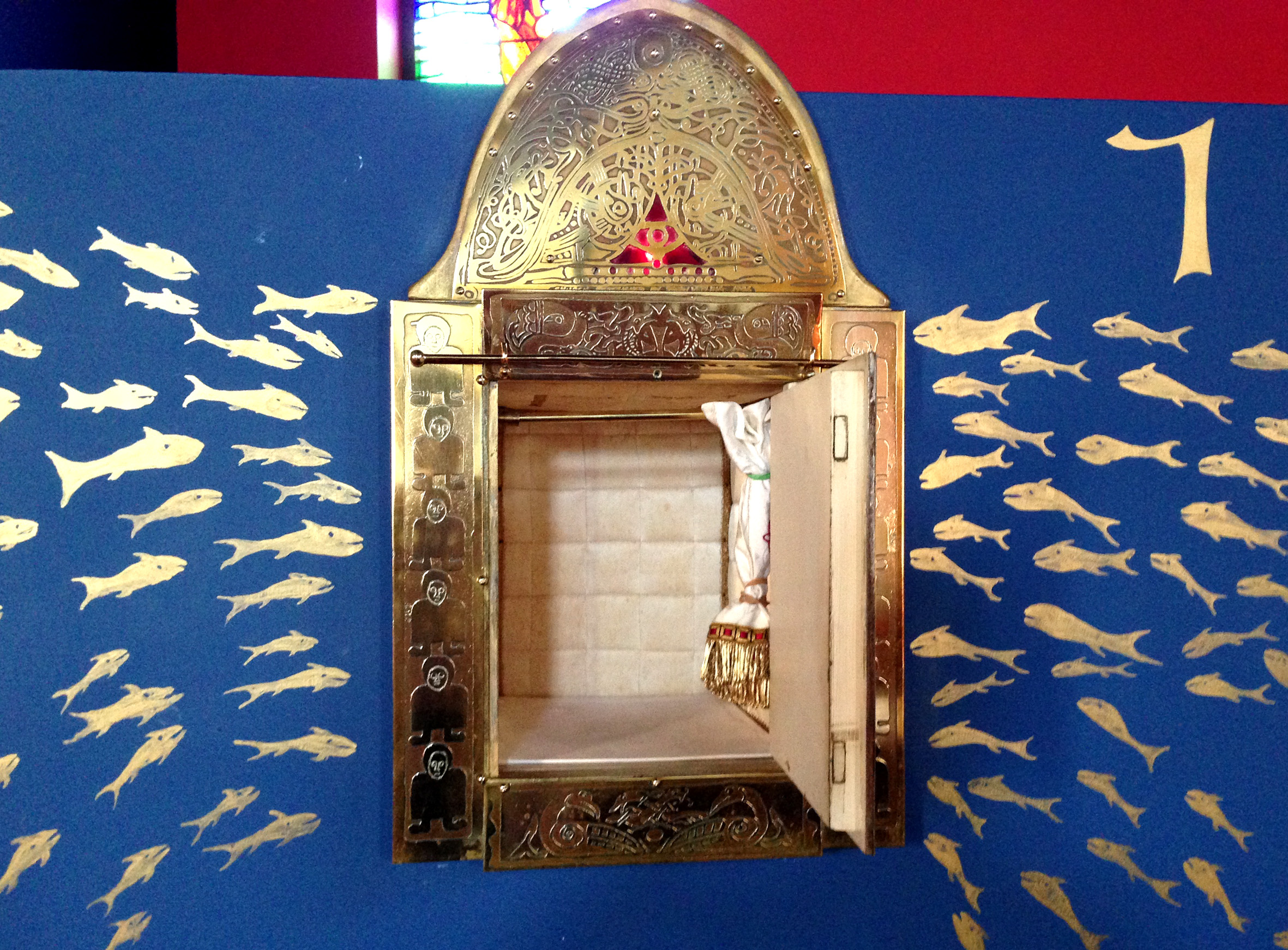
Good Friday - and the Tabernacle in Ballydehob Church is empty

Good Friday – and the Tabernacle in Ballydehob Church is empty

There is a lot of respect for the observance of Good Friday here. No alcohol is consumed: the pubs close at midnight sharp on Thursday evening (it’s not unusual on a normal day for them to stay open until two or three in the morning – especially if there is a session going on) and don’t reopen until Saturday. Ireland is probably the only Catholic country in the world where this tradition is still kept up. Not so long ago no work was done on the land, and ‘…no blood should be shed, thus no animal or bird could be slaughtered, no wood should be worked or burned and no nail should be driven on the day on which the Saviour was crucified…’ (Danaher)

Burning the Mountain on Good Friday

Burning the Mountain on Good Friday

Bearing this in mind we were surprised to encounter a ‘controlled burning’ of the gorse on the Sheep’s Head when travelling back from visiting friends on Good Friday evening. It was spectacular: the whole mountainside seemed to be engulfed.

On the Mizen – according to McCarthy + Hawkes ‘…Early on Easter Sunday morning all the lads from the townlands would go around in a big group, blowing a trumpet made from a cow horn. The women of the houses visited would give them boiled hen’s eggs to eat, sometimes coloured yellow from boiling with furze petals or onion skins. After Easter Mass everyone went home for a quiet day of rest and a good feed after Lent. The night would bring a ball with much drink and dance…’

simnel

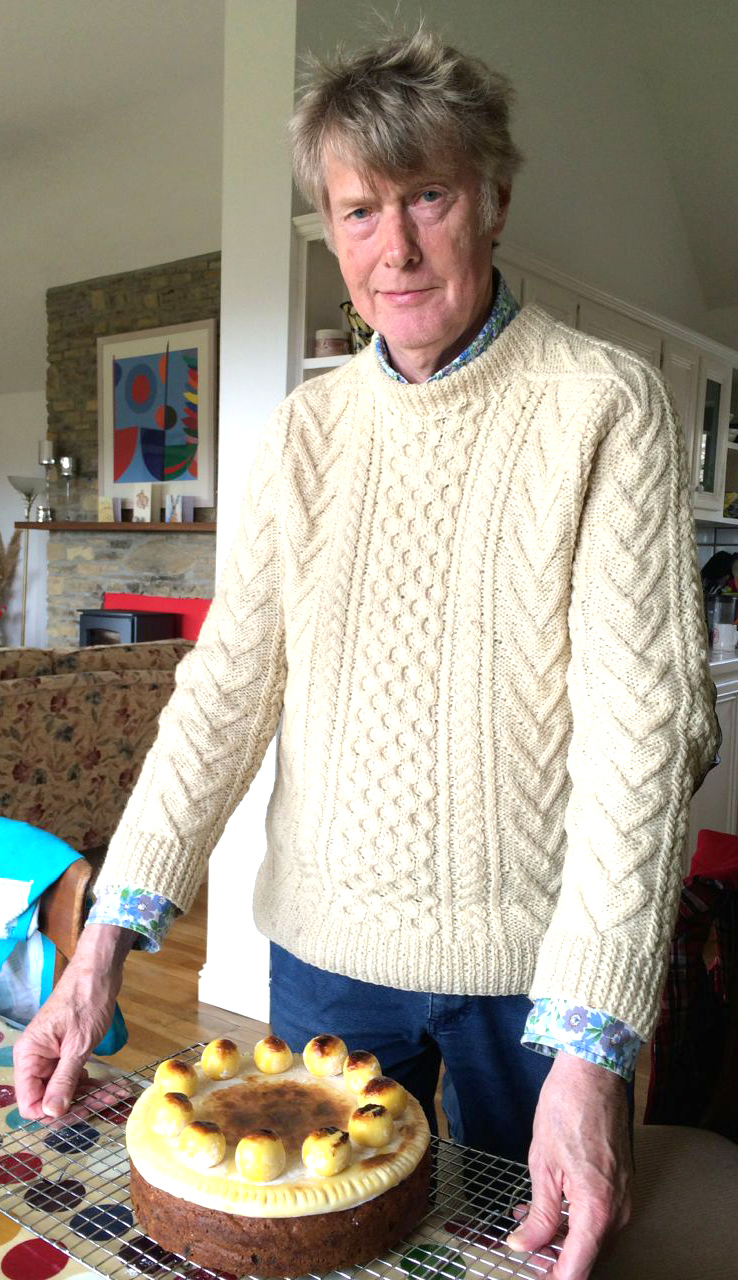
We are observing some of our own traditions today: we’ll be eating the Simnel Cake which I have made – more of an English tradition than an Irish one: the eleven marzipan balls represent the twelve Apostles (minus Judas) – and then we’re off to the Ballydehob Road Trotting races. Oh – and there are some eggs involved.

A scene in Provence? No - a sunny corner in Ballydehob on Easter Saturday

A scene in Provence? No – a sunny corner in Ballydehob on Easter Saturday


Good Friday – Foraging and Feasting

Fresh from the Shore!

Fresh from the Shore!

This post dates from 2014. Since we first published it, Tommy Camier is no longer with us and sadly the Gortnagrough Museum has had to close.

One of the Easter traditions Robert writes about this week is the practice of gathering shellfish on Good Friday. Traditionally, Good Friday was a day of complete austerity – the very apex of the Lent period when people gave up treats and went on a simple diet for the 40 days before Easter Sunday. In Ireland, Good Friday is the only day of the year apart from Christmas Day when the pubs are closed. No meat was eaten, and because fishermen would not put their boats out to sea on Good Friday, it was customary to gather whatever was available on the shore – seaweed and shellfish – for dinner.

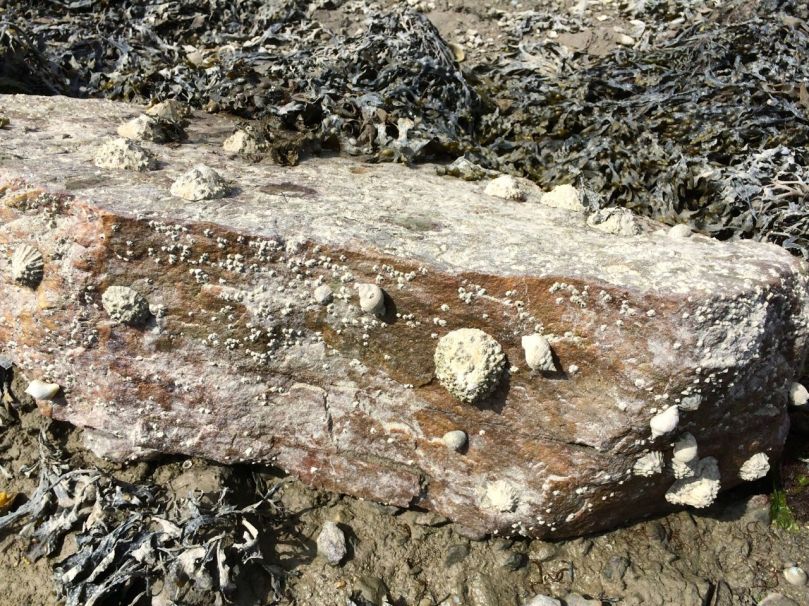
Limpets are edible too, but  difficult to dislodge

Limpets are edible too, but difficult to dislodge

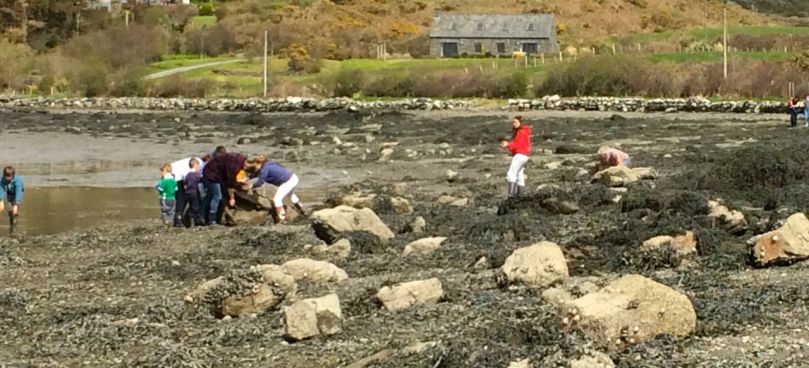
To our amazement, we have discovered that this tradition persists, here in West Cork. It has evolved, as such traditions do, into a family day on the shore, with everyone gathering shellfish, followed by a mussel feast back home.

On the shore

On the shore

We tagged along with friends, walking down to Rossbrin Cove, with wellies and buckets. We met Leita and Tommy Camier of the Gortnagrough Folk Museum, who were leaving with a full bucket of mussels. They told us they had gathered mussels on Good Friday as long as they could remember. There aren’t as many mussels now as in the old days, they said, and they’re smaller.

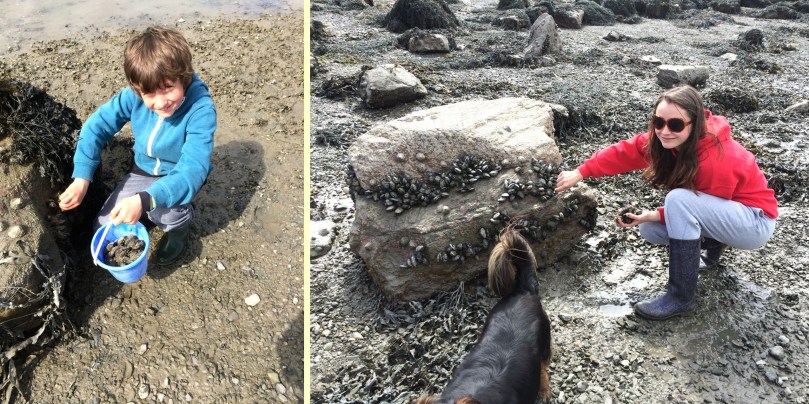
Gabriel and Matilda - hard working mussel pickers!

Gabriel and Matilda – hard working mussel pickers!

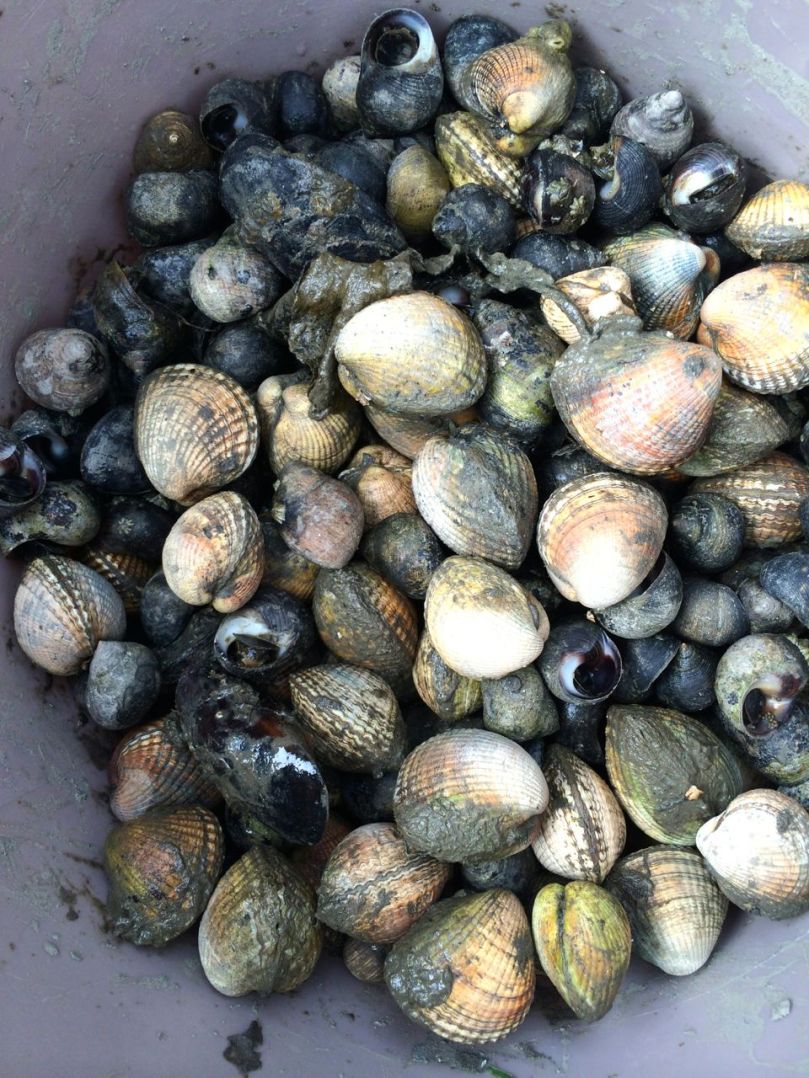
Mussels were the shellfish of choice for most of the folks who had come to the Cove. Picking was fairly easy, off the rocks, taking pains to avoid ones with barnacles. Our neighbour Hildegard and her family also gathered cockles and winkles.

Cockles and mussels, and winkles too

Cockles and mussels, and winkles too

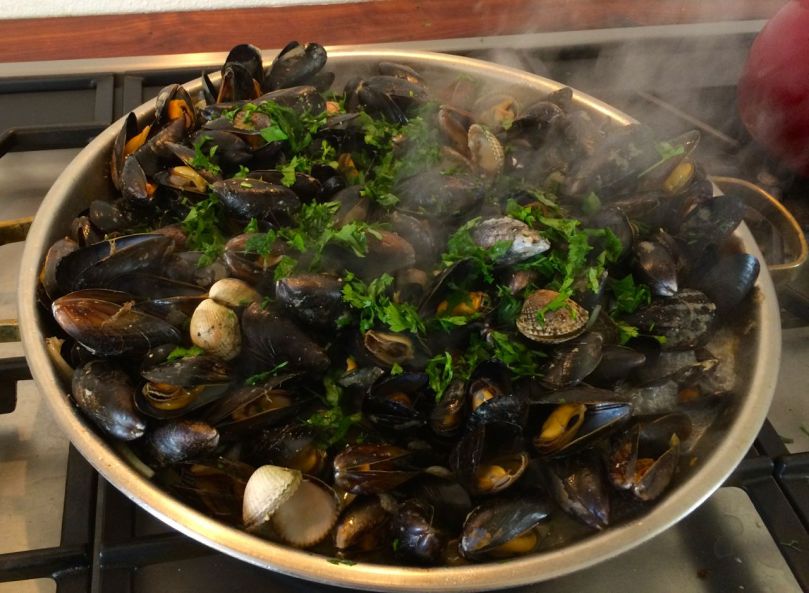
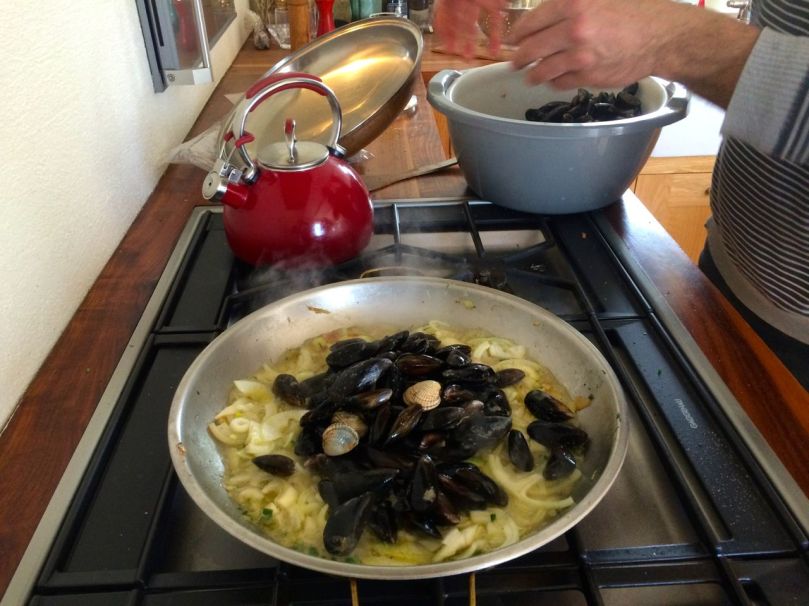
Afterwards, we ended up at Dietrich and Hildegard’s house for a feast. Robert and I are not mussel eaters – or so we had told each other. Robert stuck to bread and cheese, but I thought I should be polite and at least try some when presented with a plate of fresh steaming cockles and mussels and some warm French bread. Surprise! As cooked by Rui with onions and garlic and herbs, they are delicious! Two plates later, I am a firm convert.

Rui cooks up a feast

Rui cooks up a feast

I like this austerity business!

Good Friday abstinence

Good Friday abstinence

But enough of this deprivation! I wonder if Robert has remembered to get me a chocolate Easter Egg…