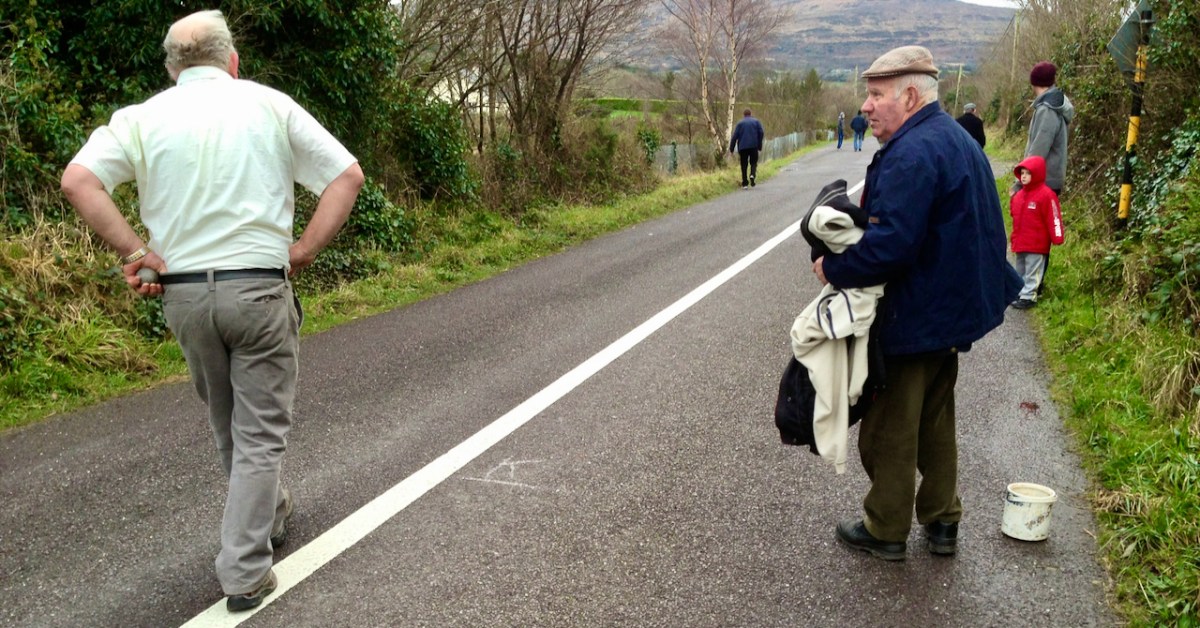
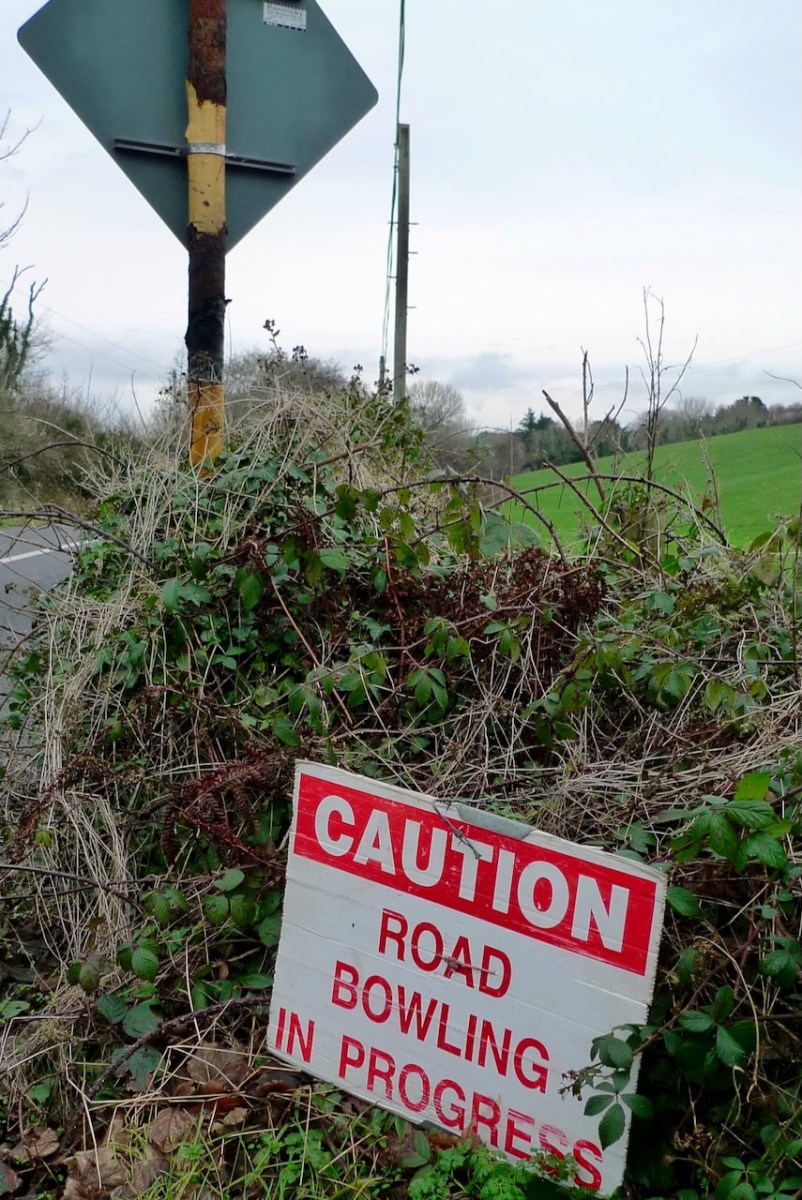
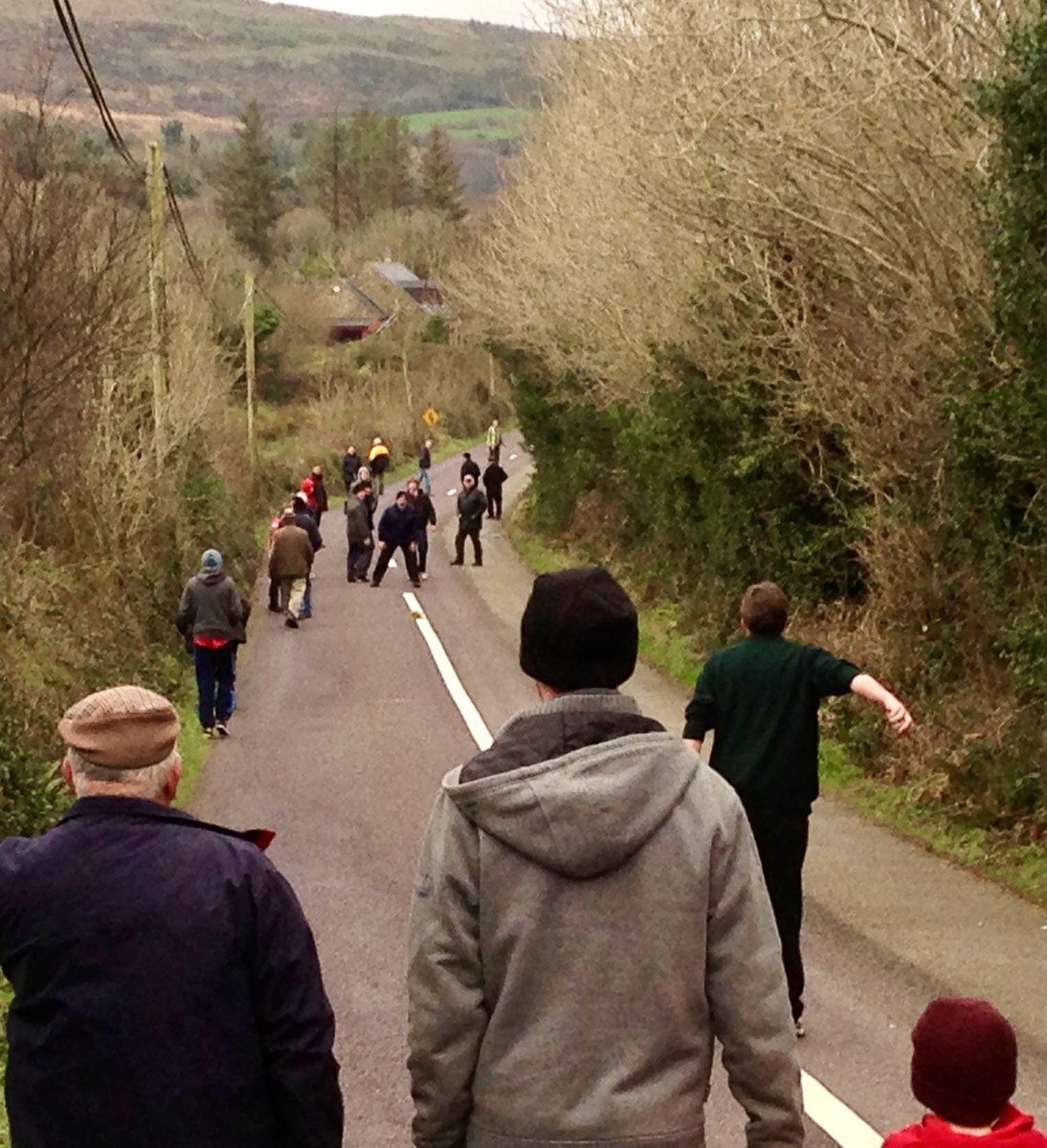
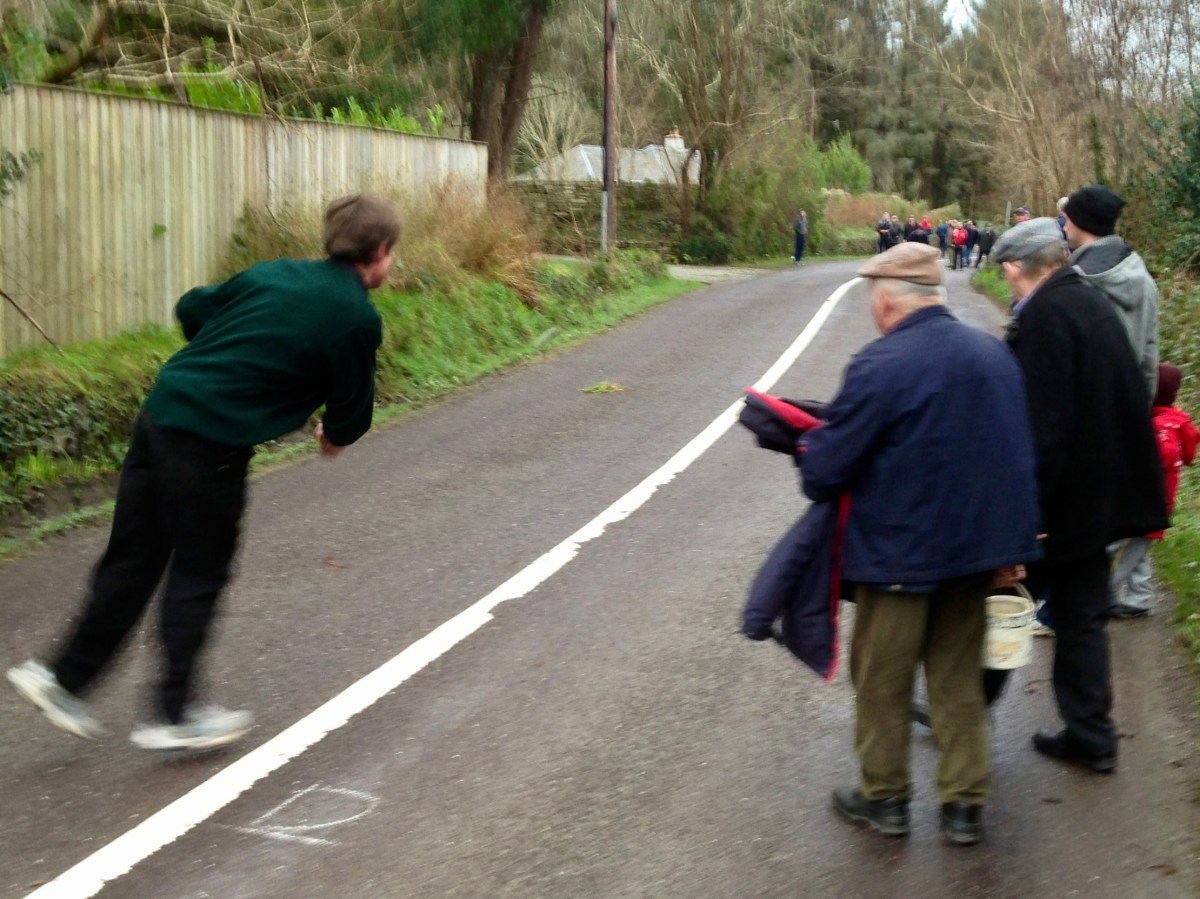
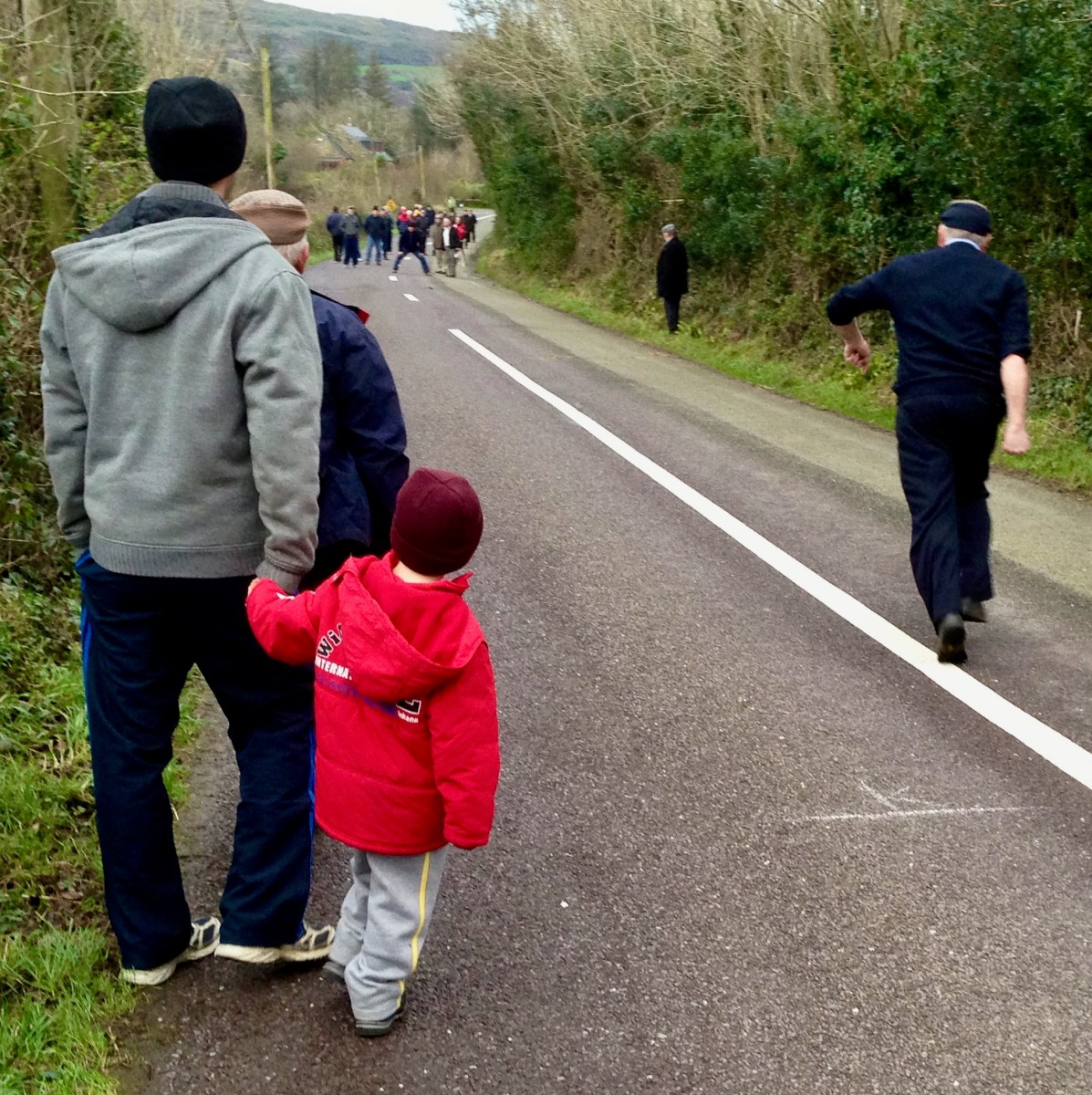
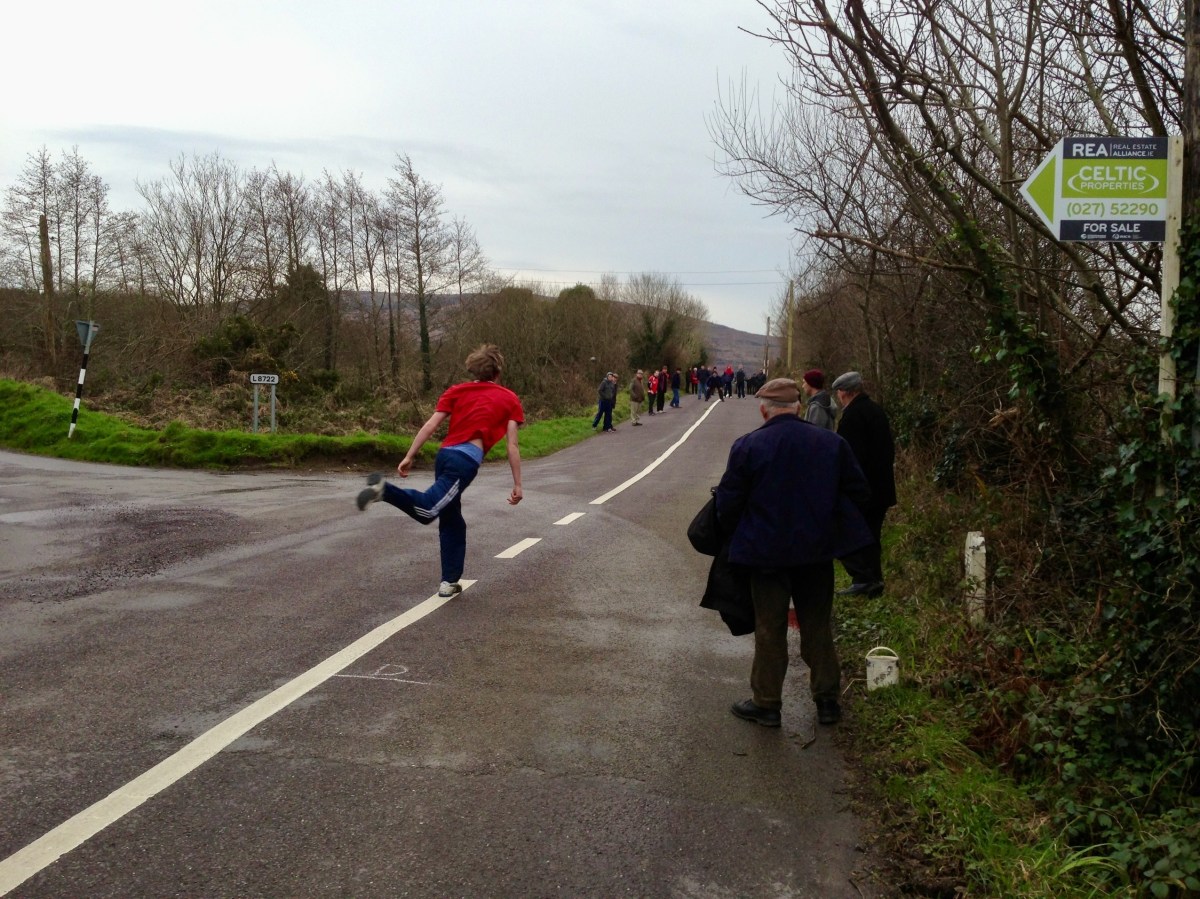
There’s a man about to ‘loft’ a bowling ball. Pronounce it Bowling, to rhyme with ‘growling’: in the Irish language it’s Ból an bhóthair – I’ve also seen the term Long Bullets used. This is a match we watched close to home – here in West Cork – all of ten years ago. It’s amazing we haven’t visited the subject again until now. In fact, it’s quite a secretive sport: if you put yourself ‘in the know’ you will be aware when it’s happening. Otherwise it’s something which you may pass by chance on any of the myriad by-roads of our county – and others.
The sport is played mainly in the Counties of Cork and Armagh, although it may be encountered elsewhere in Ireland – in England, The Netherlands, Germany and – nowadays – in many of the United States. But you won’t find it on any Olympic Games timetable, and I’m not sure that it is ever televised: that would be a strange programme, as it’s challenging to follow and involves walks of many kilometres through tangled lanes and byways. Also, I don’t know whether any traffic laws are bent or broken in its pursuit.
Certainly, it has produced its champions.
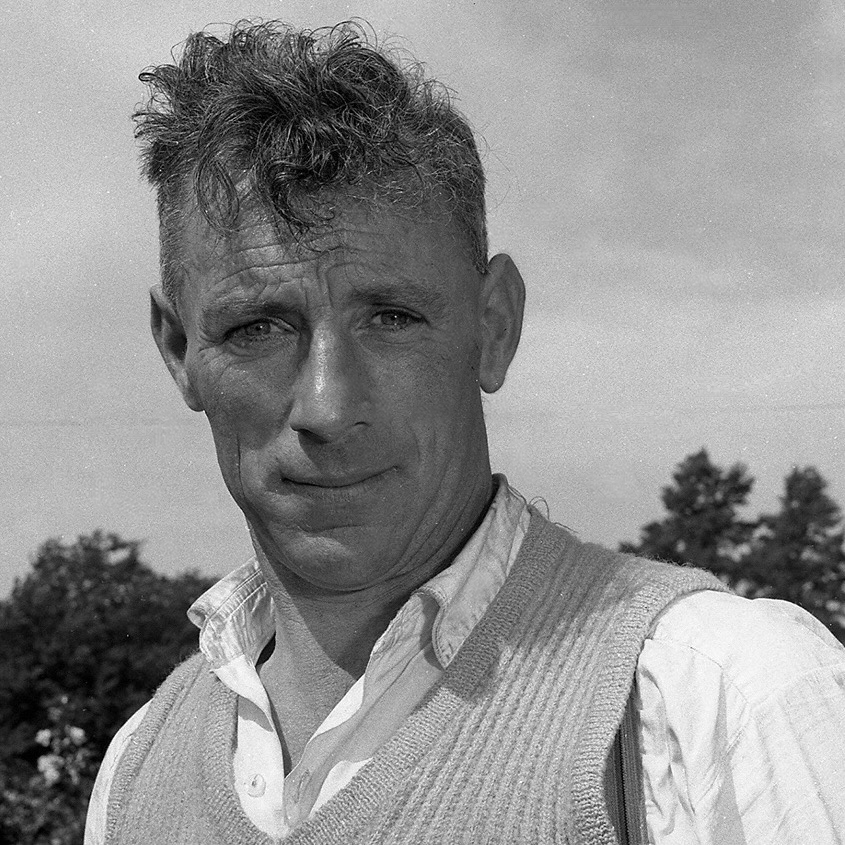
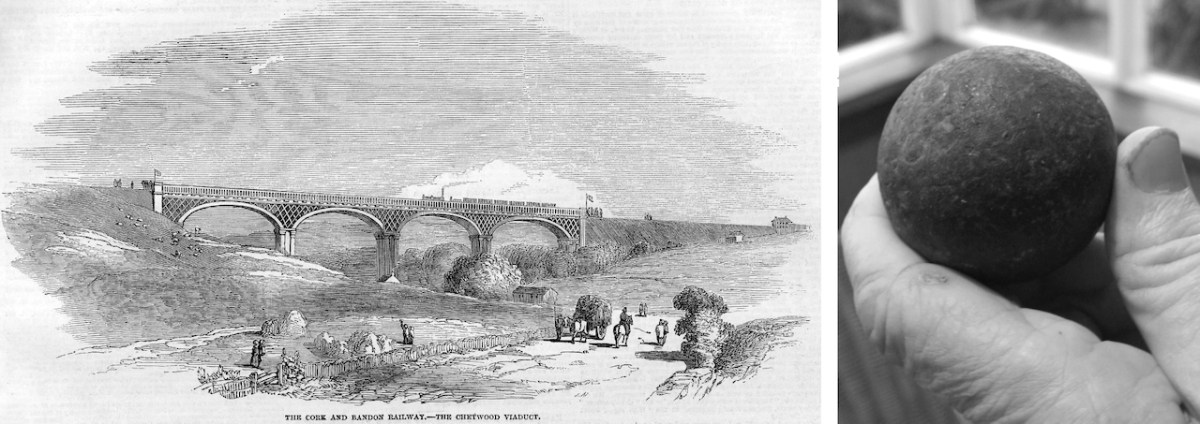
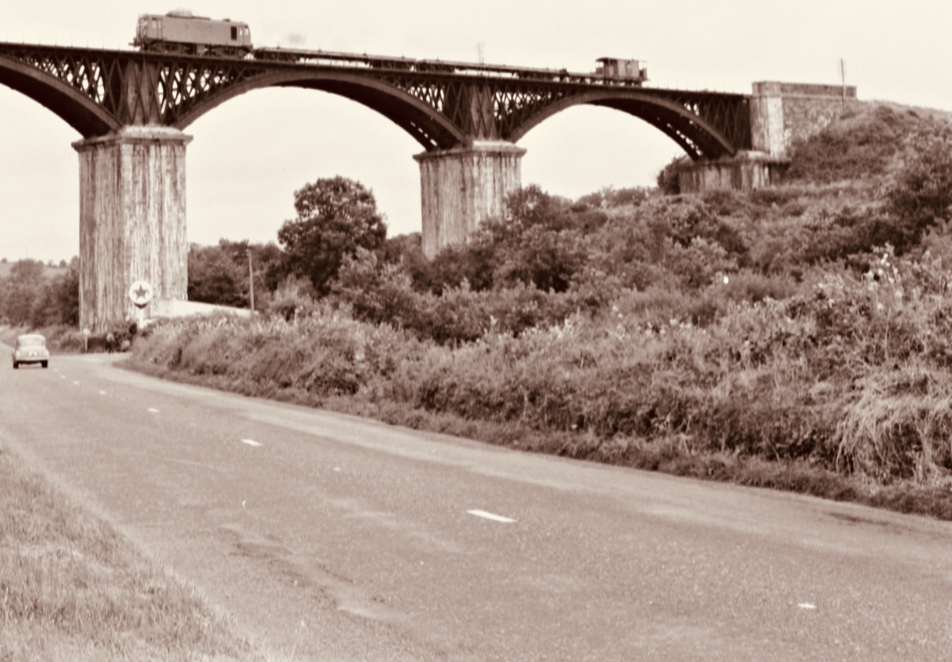
Here’s one: Mick Barry. The photo is likely to date from around 1955. Mick was All-Ireland Champion on eight occasions between 1965 and 1975. He lived a long life – 1919 to 2014. But he is best-known for having established a record – on St Patrick’s Day 1955 – for lofting a bowl onto the 100 ft high parapet of the Chetwynd Railway Viaduct just outside Cork.
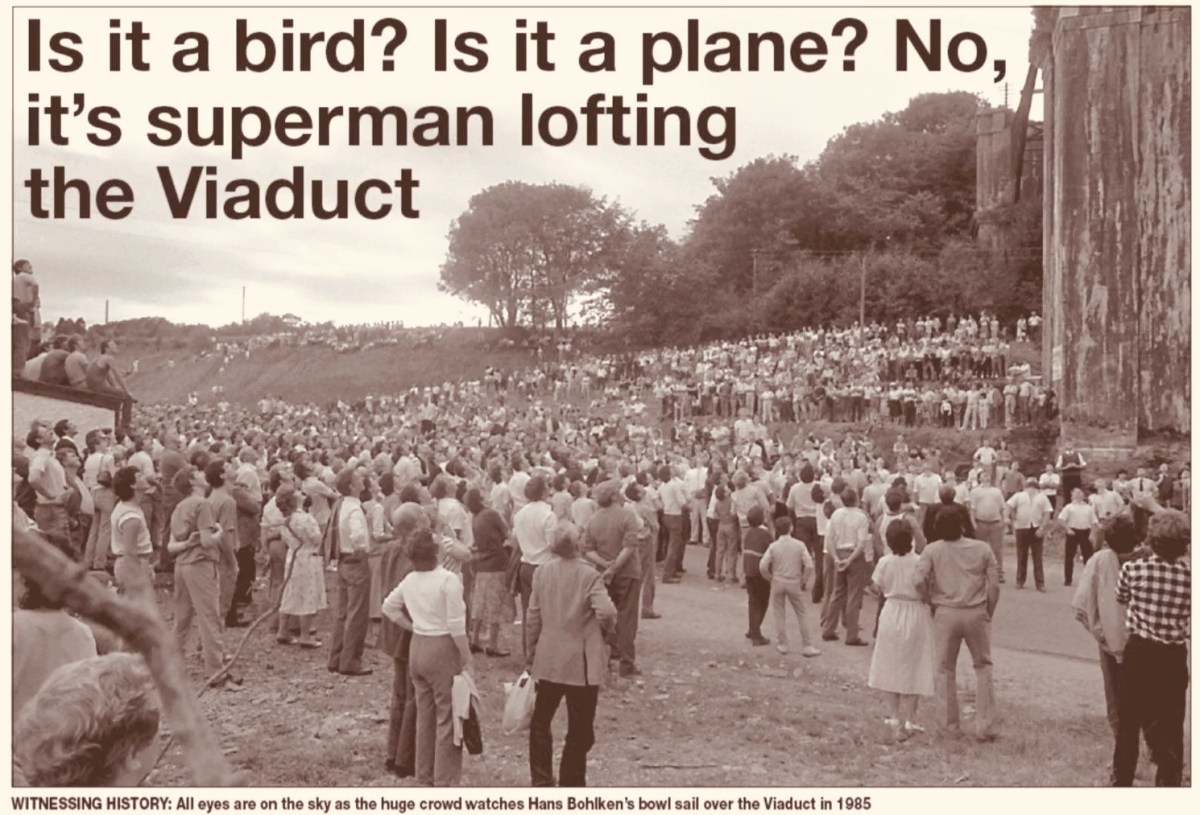
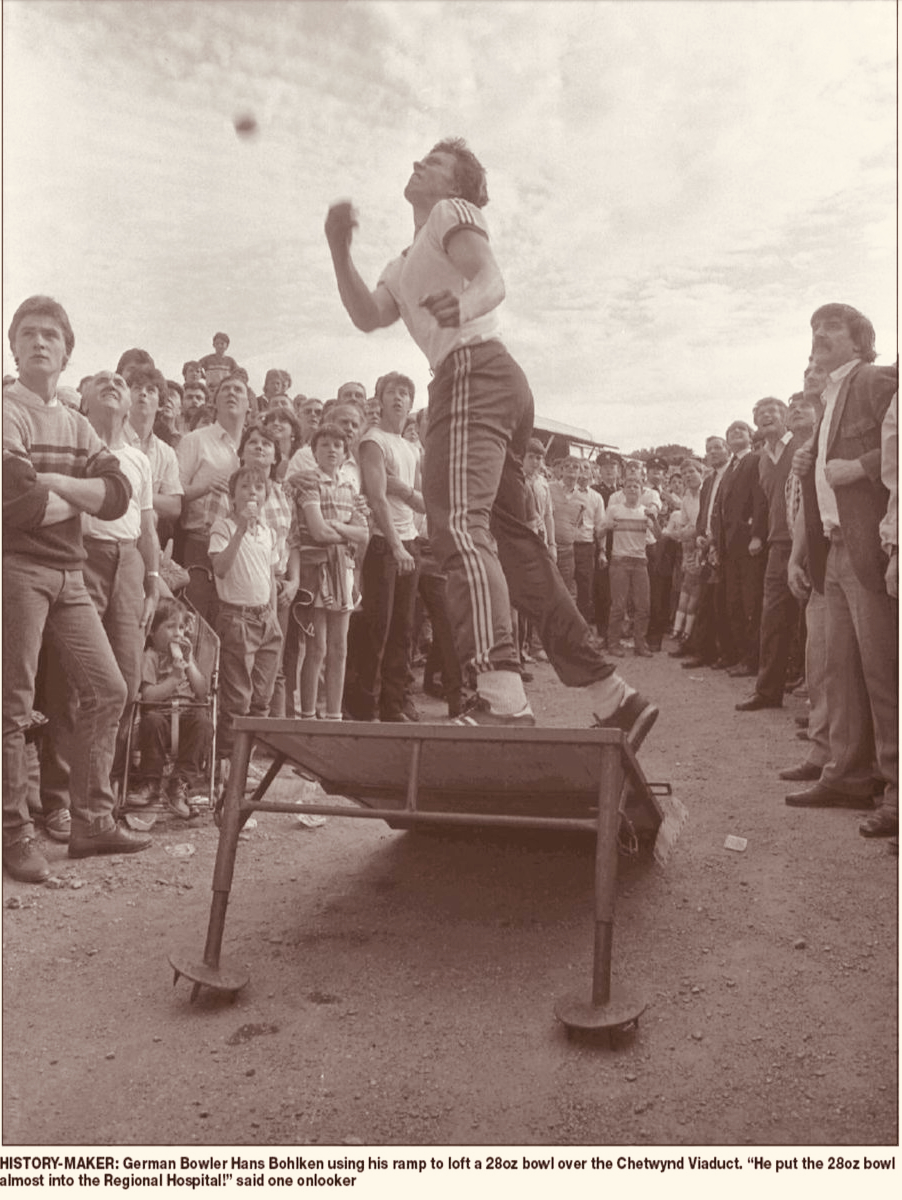
Above – the Chetwynd Viaduct in the 1960s, – after the line was closed, carrying a maintenance train, and – above that – a somewhat fanciful print of the same structure dating from a century before, together with the lead ball used by Barry. The same venue was the scene of another bowling spectacle thirty years later. In 1985 10,000 people showed up to watch a young German named Hans Bohlken loft a 28oz Road Bowl over the viaduct, using a portable ramp to improve his throw (images courtesy Cork Echo):
. . . In Irish road bowling the small iron and steel cannonball called a bowl is hurled down a 1 to 2-mile country lane. Throws can roll 250 or even 300 yards. Similar to golf, the player with the fewest throws to the finish line wins. Excitement builds as two evenly skilled players match each other shot for shot for more than a mile. Often, these memorable matches, called scores, are decided by only a few feet or inches’ distance past the finish line, both players with the same number of throws. The twists and turns of a narrow country lane, as well as the tilt of the road surface (the pitch and camber), provide a rich playing field for strategy and can spark spirited debate among the thrower, his coach and full-throated spectators . . .
WVROADBOWLING.COM
Finola drew my attention to a poem written by folk-poet Liam McGrath, who grew up in Skeaghanore, not far from us here in Nead an Iolair – and therefore as local a ‘folk’ as you could ever find. His work has been collected, but never widely published. Here is his commentary on the ancient pastime of Road Bowling:
Please dear Lord, forgive us all, for that boyish little sin, When we dashed out from the Rosary, before that last Amen. Could we only turn back the clock, to re-live those days of Yore, In the Summer twilight of a Sunday ‘eve, to throw just one more score.
*
So clearly now each face I see, as we pass Jer Coughlan’s gate, As the ladies from Ballydehob walked by, looking charming and sedate. The finishing line was at Stouke cross, then a score the other way. To stroll the streets of Ballydehob, our young hearts bright and gay.
*
When’re the twilight lingered on, we had many a thrilling score ’Til the last throw was decided, near Will Regan’s of Clashmore, Sometimes we changed the venue, our choice, the old Church road. But the skill and thrill remained unchanged, it was the bowler’s code.
*
A penny, tossed high in the air, a bowler called the toss. The first bowl flew from the bowler’s hand, in a score to Raheen Cross. From Bantry Cross to Skehanore, was also a favourite distance. Such happy lads in the good old days, when nothing seemed a nuisance.
*
St Peter and St Patrick, went out for a little walk. “What’s that iron ball, asked Peter, and who is that happy mob?” “They are throwing a score, said Patrick, and they’re all from Ballydehob.”
*
I must conclude this little poem, ‘cause I know it’s getting late, Only time for a score up Bantry Road, to Charlie Daly’s gate. Just lofted that turn, near Berry’s house, and my wrist is feeling sore, So I’ll down this pen, may we meet again, to throw just one more score . . .
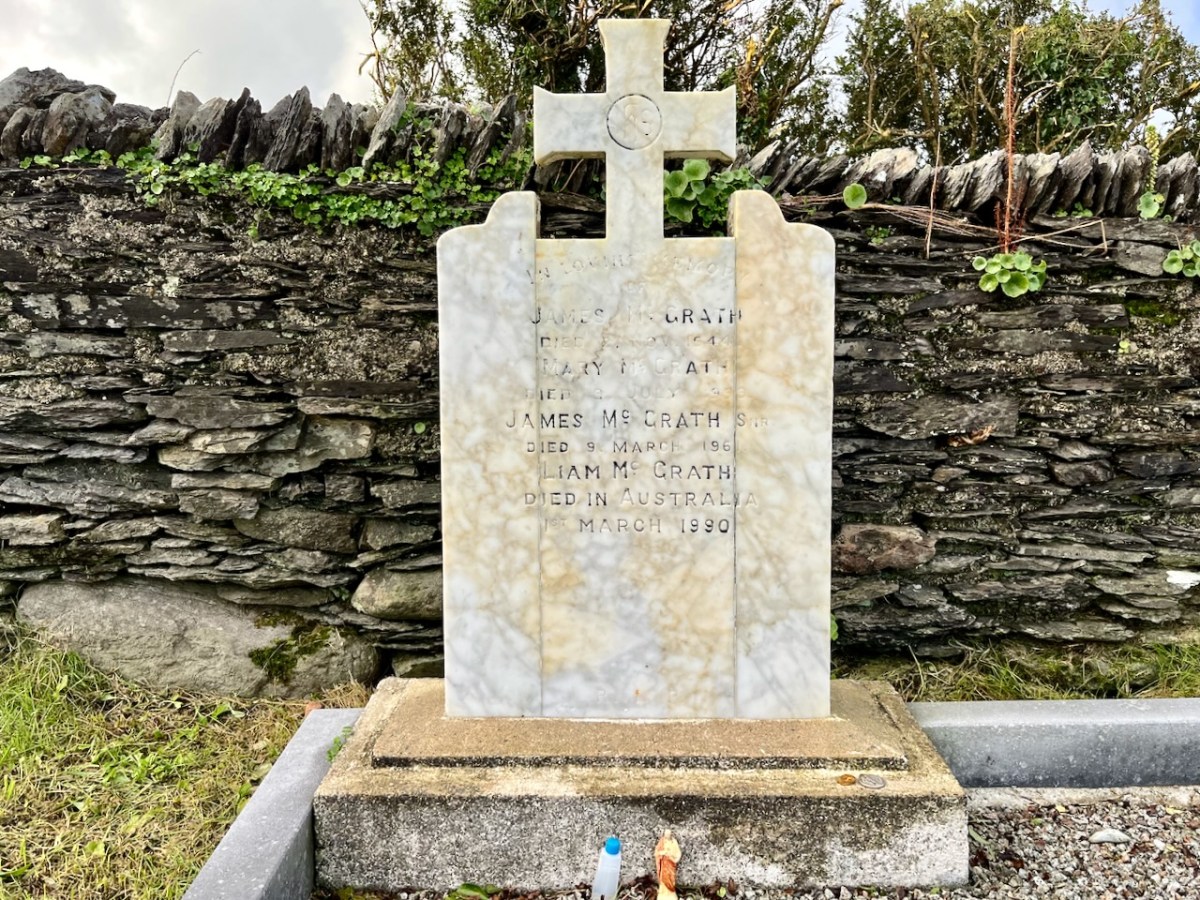
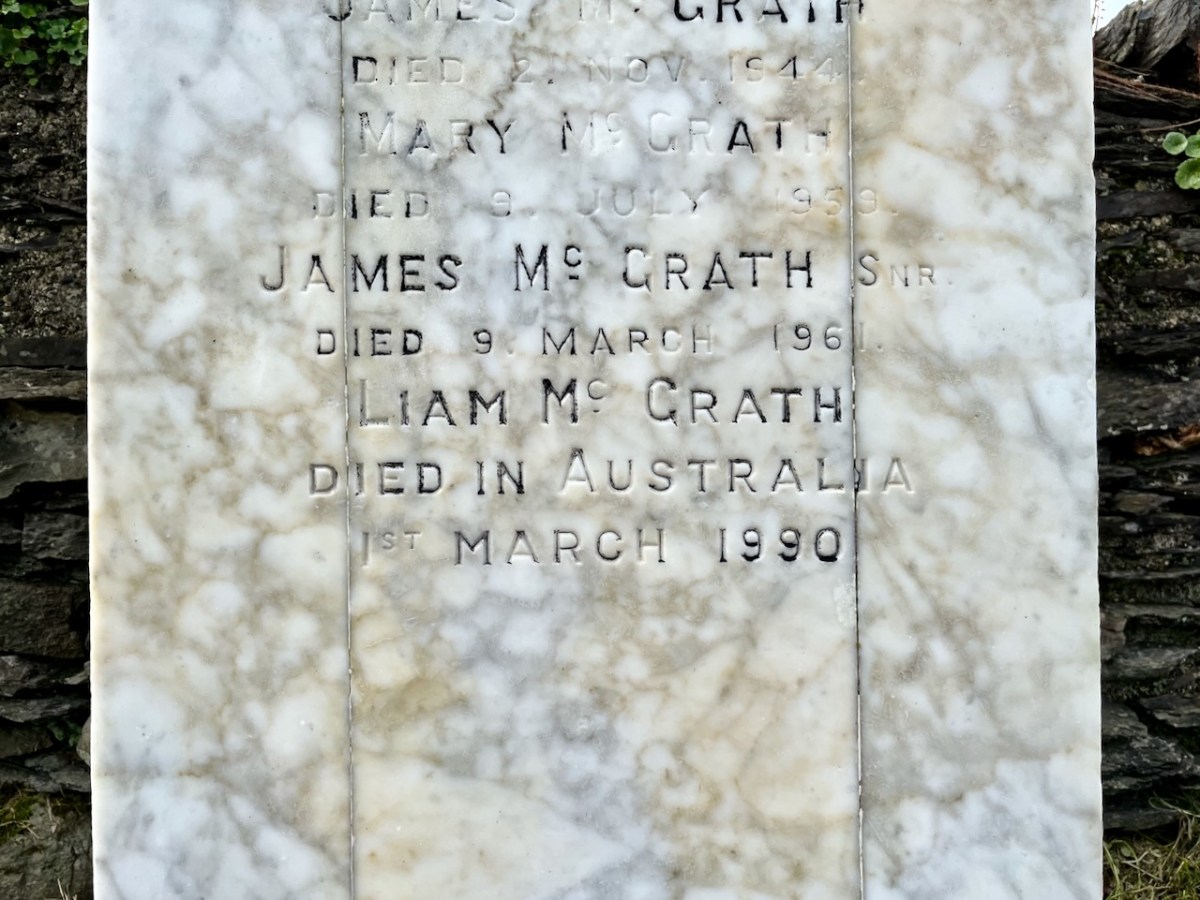
LIAM MCGRATH – Died in Australia – 1990
(Above) The McGrath grave in Stouke graveyard, in the next townland above our home. Liam died in Australia and his ashes are interred here.
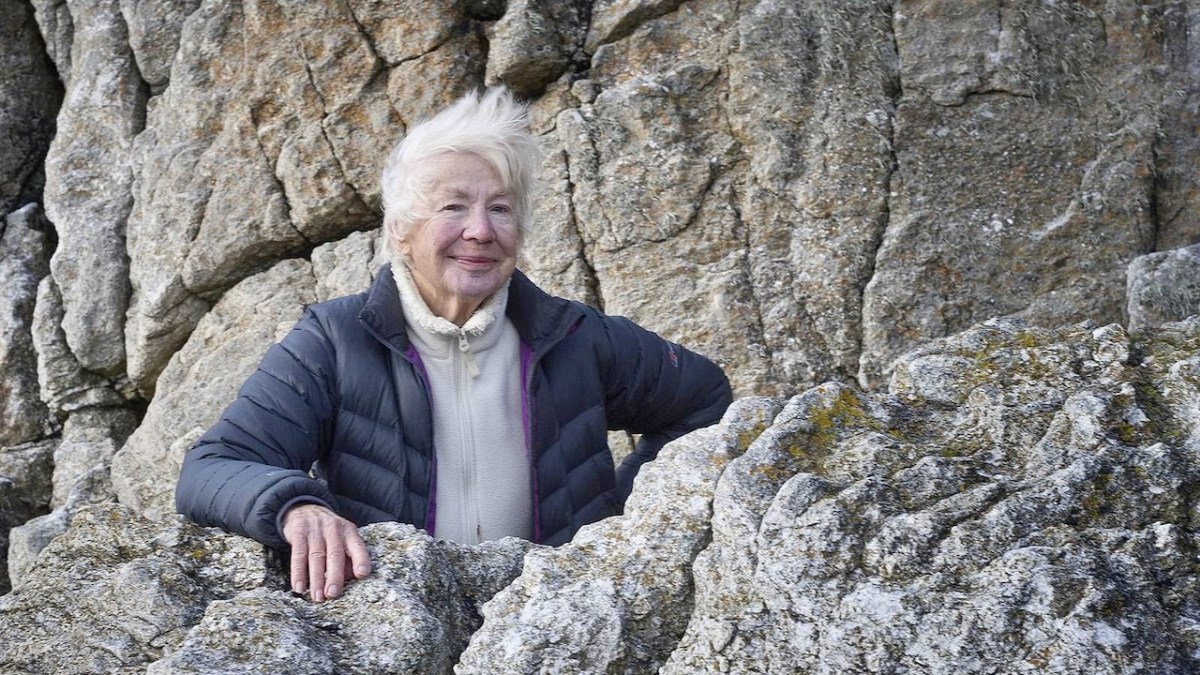
One of the ways in which Ireland of the Welcomes consistently sought to present an image of Ireland was through the lens of literature. As I said in a previous post on IOTWIt showed us what others might find interesting about Ireland and therefore what we ourselves could be proud of. Ireland was so different then – but Ireland of the Welcomes was chronicling the emergence of who we are now. And all the best people wrote for the magazine, no doubt due to the canny and charismatic editor, Cork woman (and noted climber) Elizabeth Healy (below, from her obit).
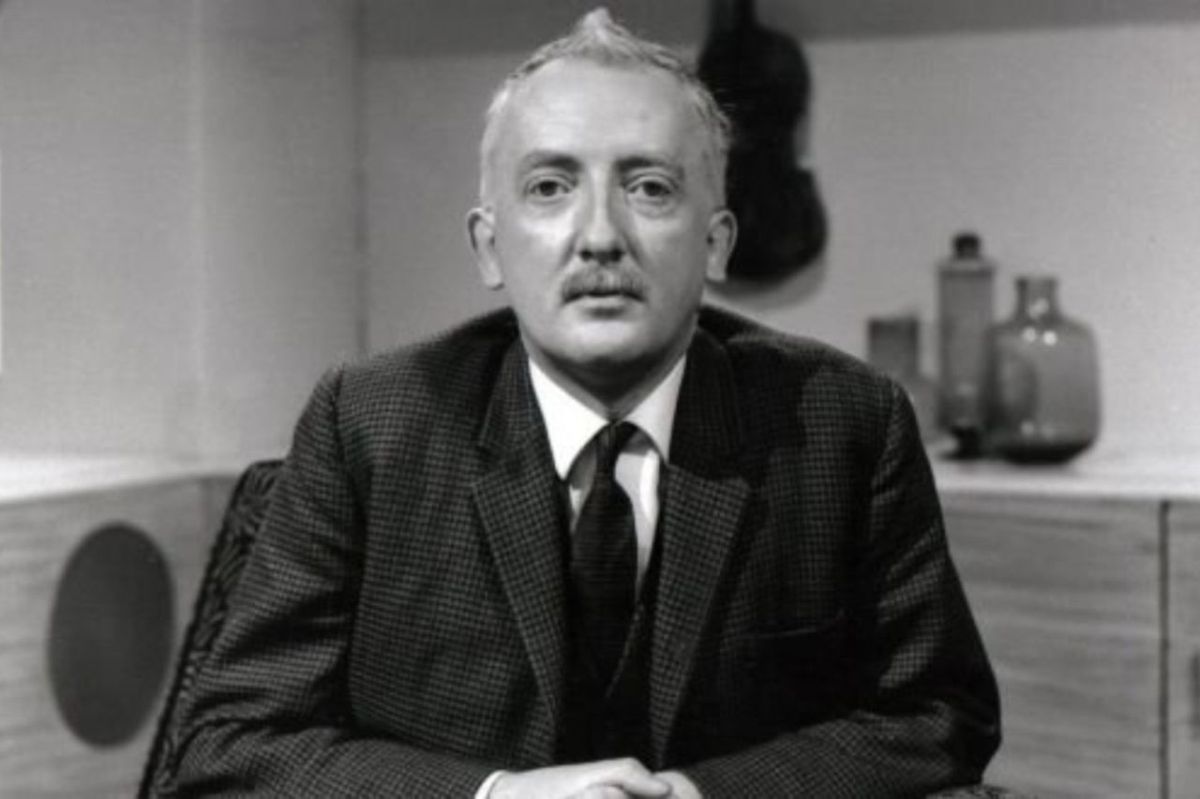
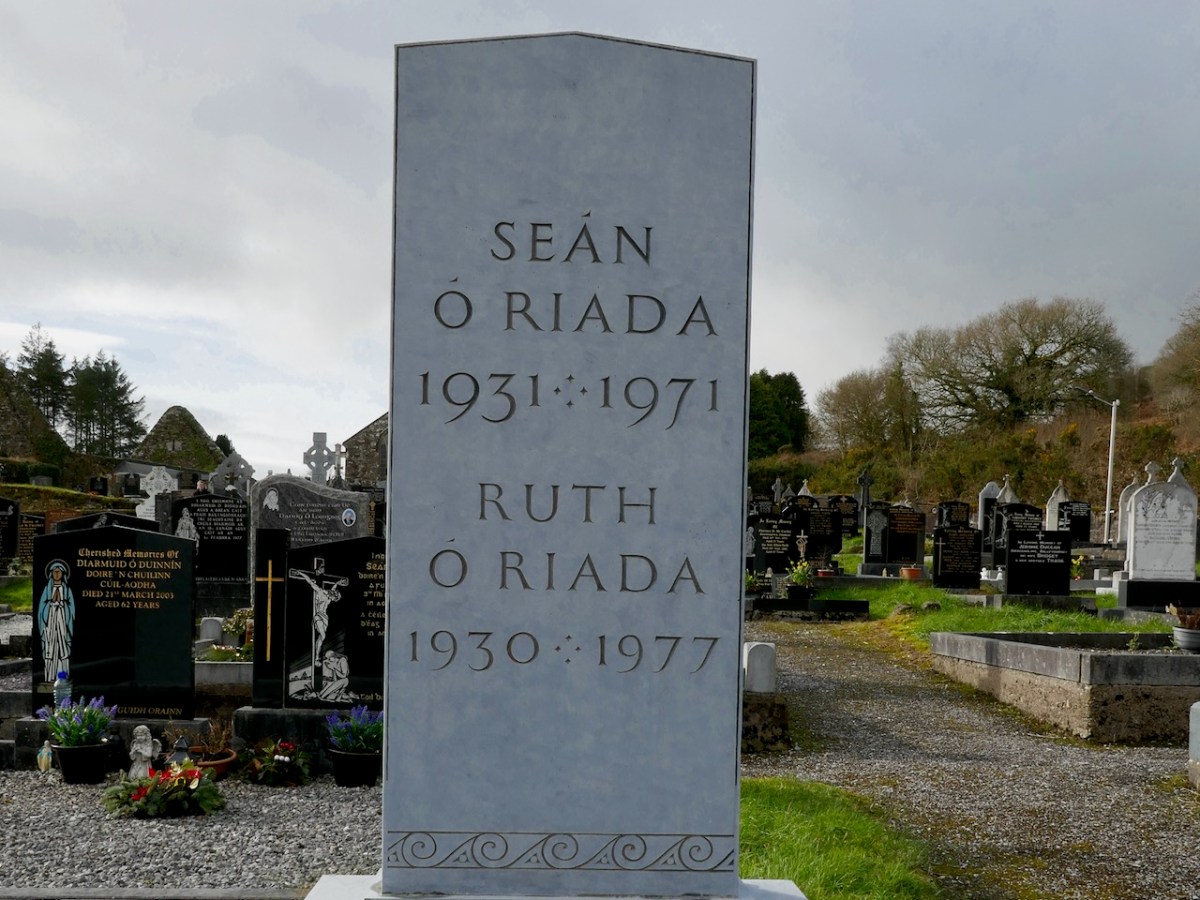
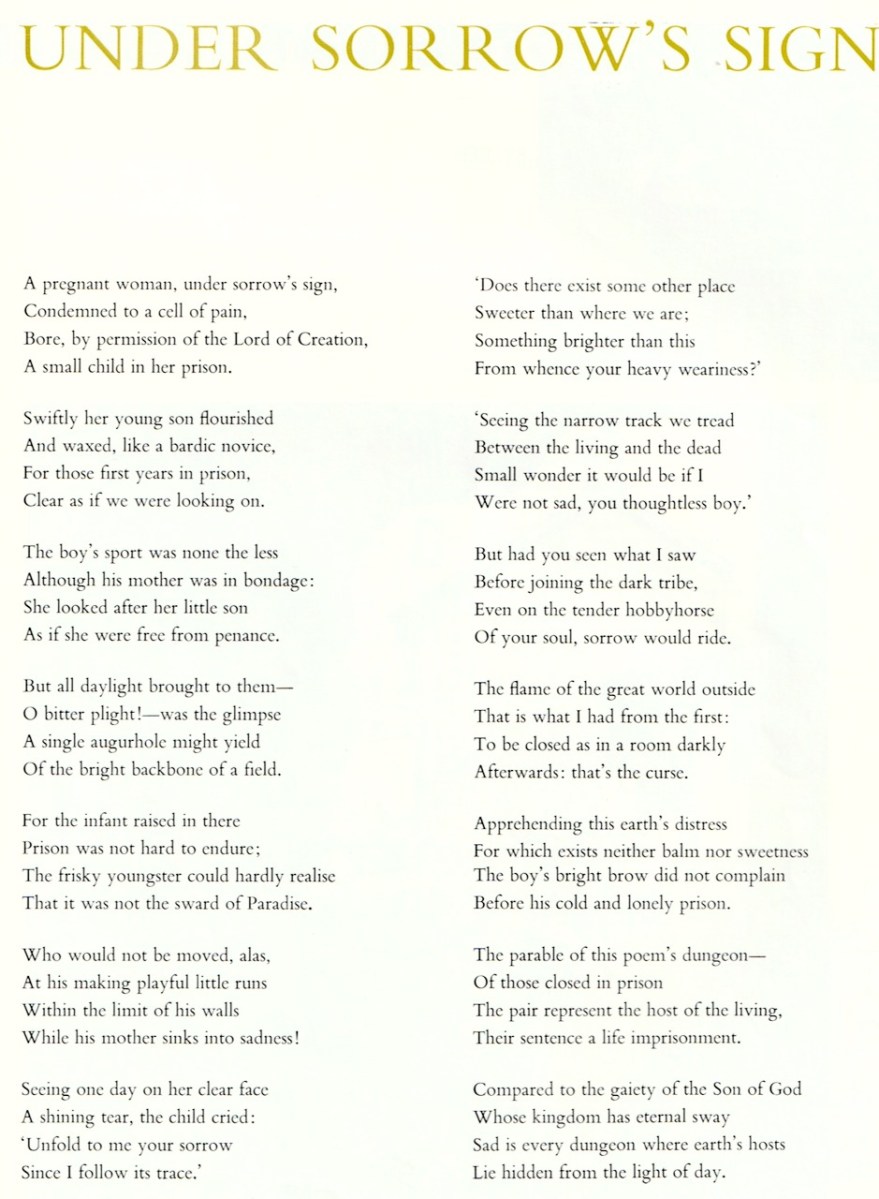
In this next series of post, rather than going chronologically through the editions of 1972, I am going chronologically through the eras of Irish literature that were the subject of articles, beginning with the Bards! John Montague, the distinguished poet, (that’s him at the top) wrote a piece in July/August called Under Sorrow’s Sign, which I give in full below. There’s a wonderful interview with him in the Irish Film Institute Archives. He said he spent many hours discussing the poem with his great friend Sean Ó Riada. I met Montague during his tenure at UCC in the 70s and I remember the adulation with which we all viewed Ó Riada, as he strolled through campus, so this piece was a personal memory-trigger for me. Robert has written about Sean Ó Riada here.
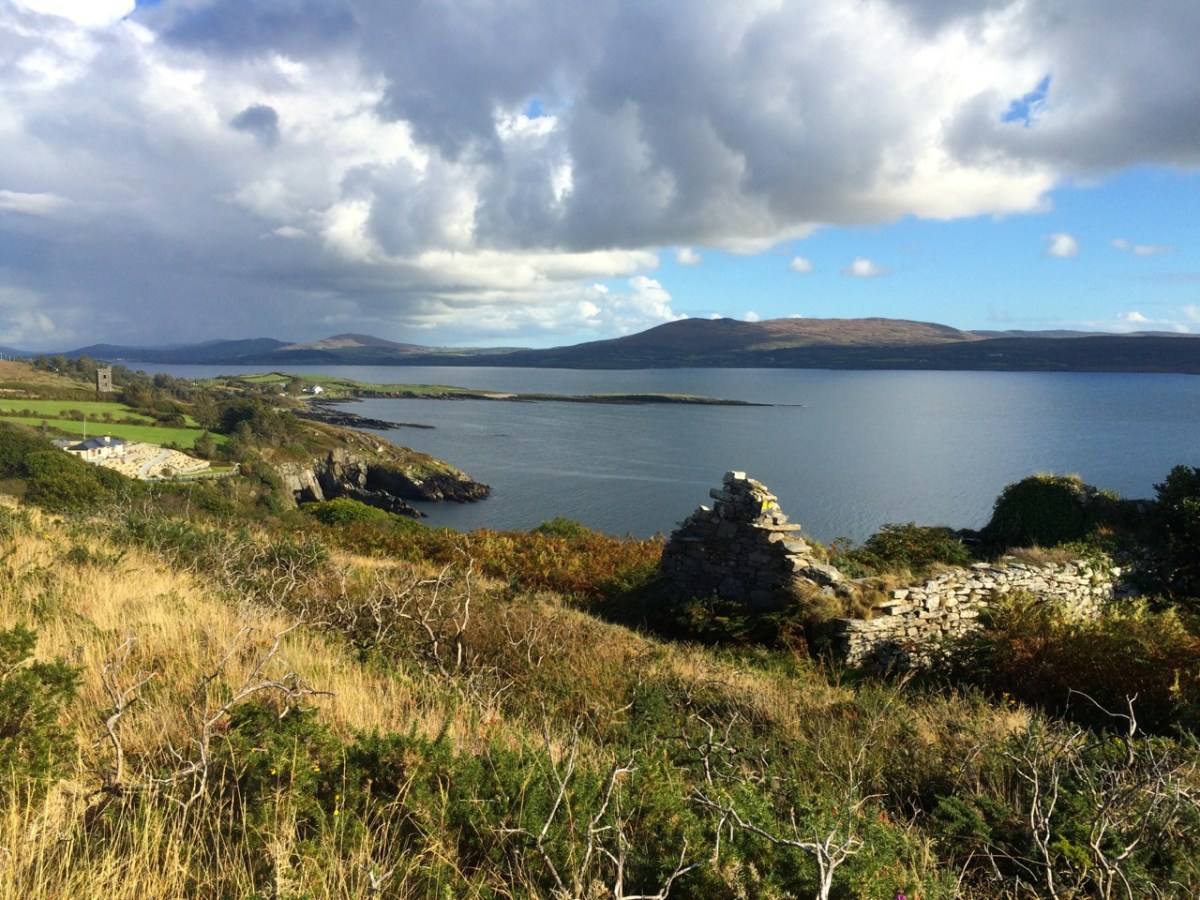
Here is what is believed to be the remains of one of those O’Daly bardic schools, this one on the Sheep’s Head. Perhaps Gofraidh spent part of his apprenticeship here, among his O’Daly kin.
The poem itself was intended to be declaimed by a professional reciter (a reacaire), accompanied by a harpist, as illustrated in this famous woodcut of MacSweeney’s Feast from John Derricke’s 1581 Image of Ireland. It shows the harpist and the reciter in the act of entertaining the head table. Note they are marked with a D.
Under the woodcut is a legend. For D the text reads:
Both Barde and Harper, is preparde, which by their cunning art,
Doe strike and cheare up all the gestes with comfort at the harte
The poem is, according to Montague, a metaphor for earthly existence. He concludes his piece by saying: O Dalaigh was from Cork, where O Riada now lies buried: Across six centuries, its bleak but Christian vision speaks as an epitaph. Here now is Montague’s translation.
Thoroughly depressed now? I’ll try to be more cheerful in the rest of this series.
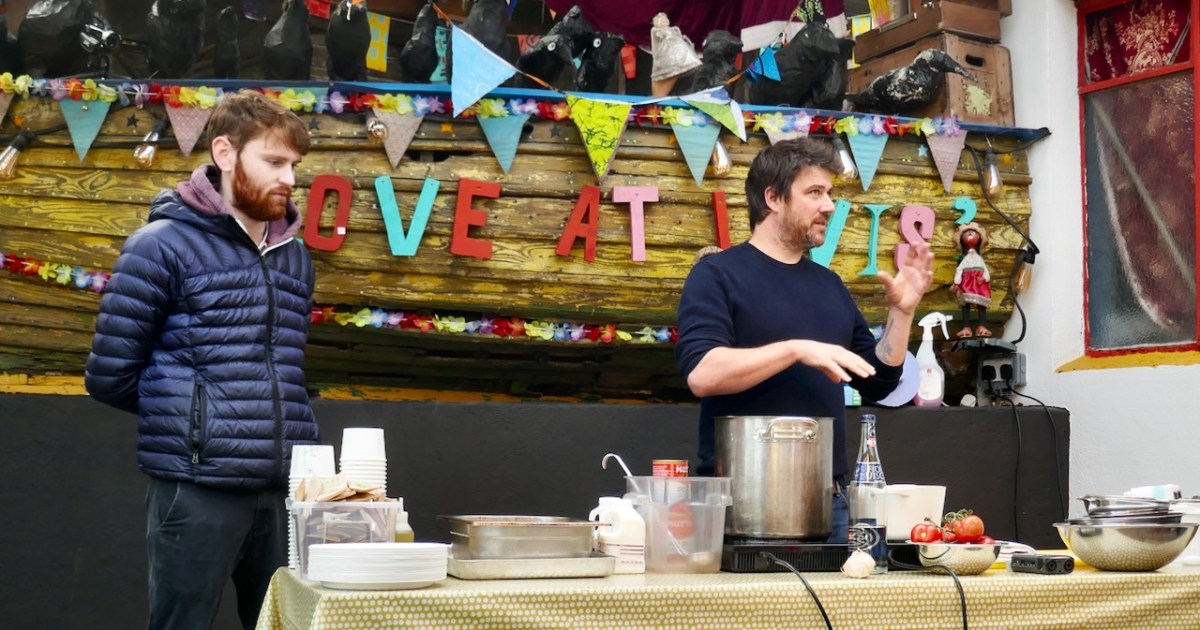
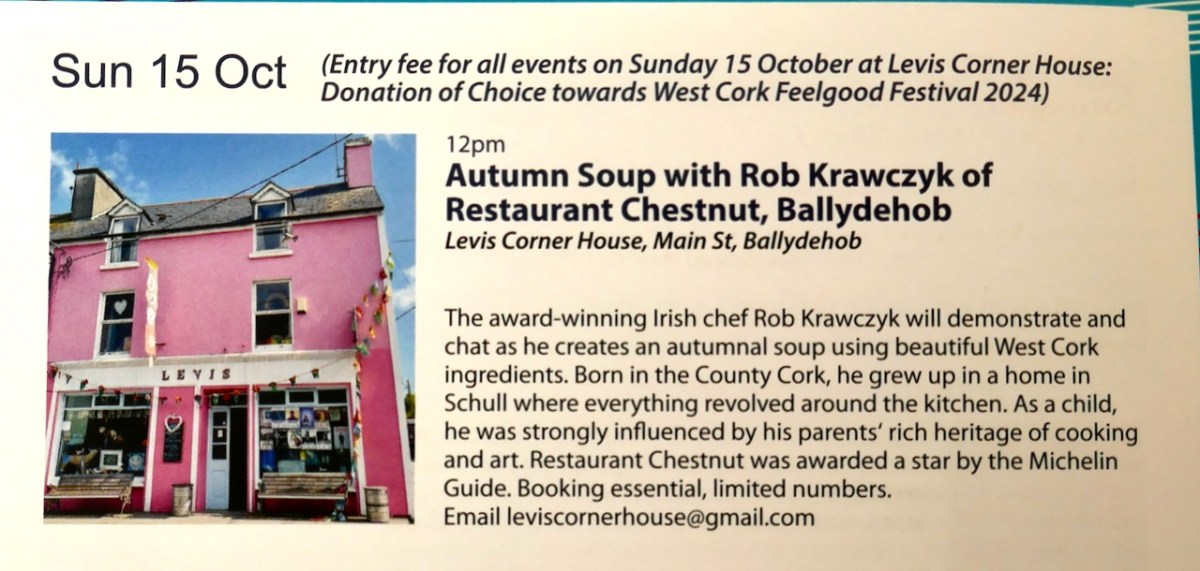
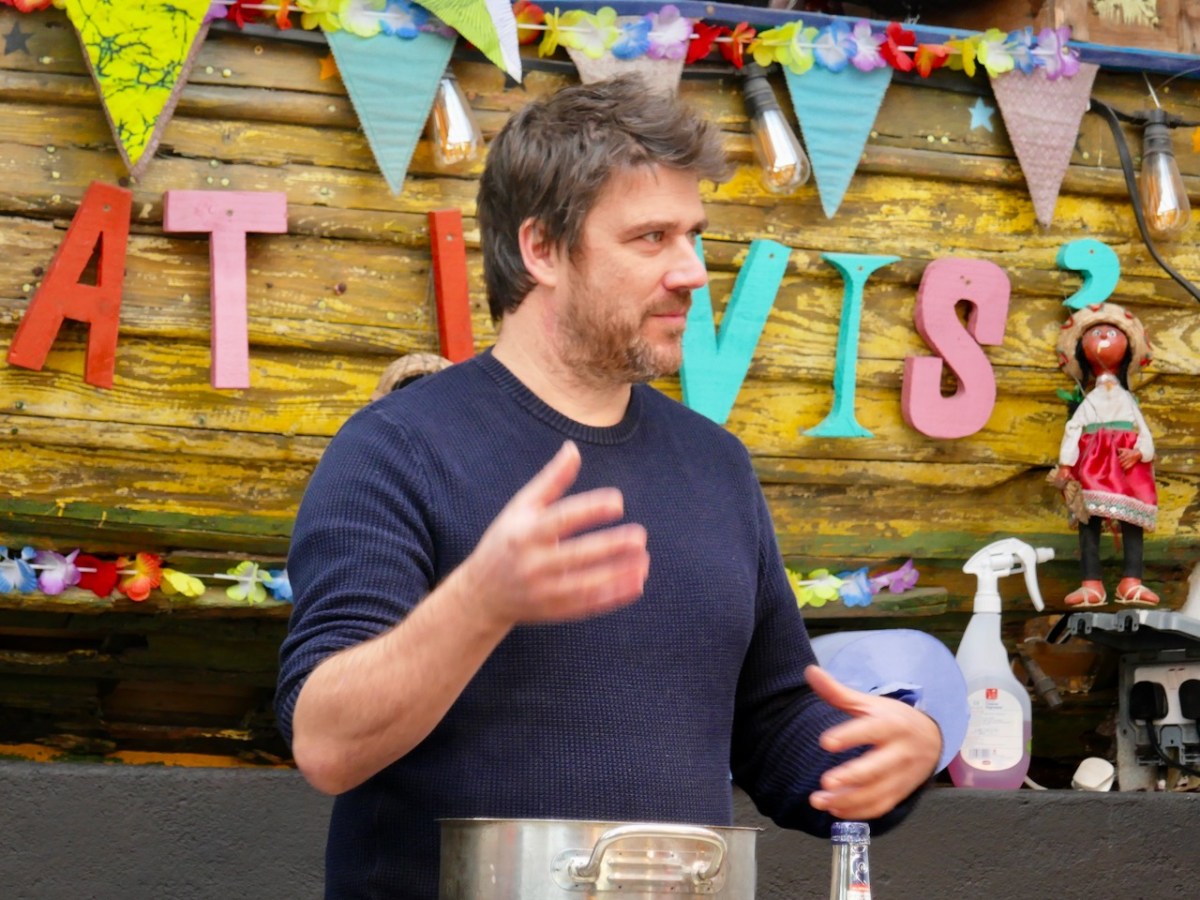
That’s Rob Krawczyk – our own Ballydehob Michelin starred Chef and owner of Restaurant Chestnut here in Ballydehob. He’s showing us how to make soup? I’m in!
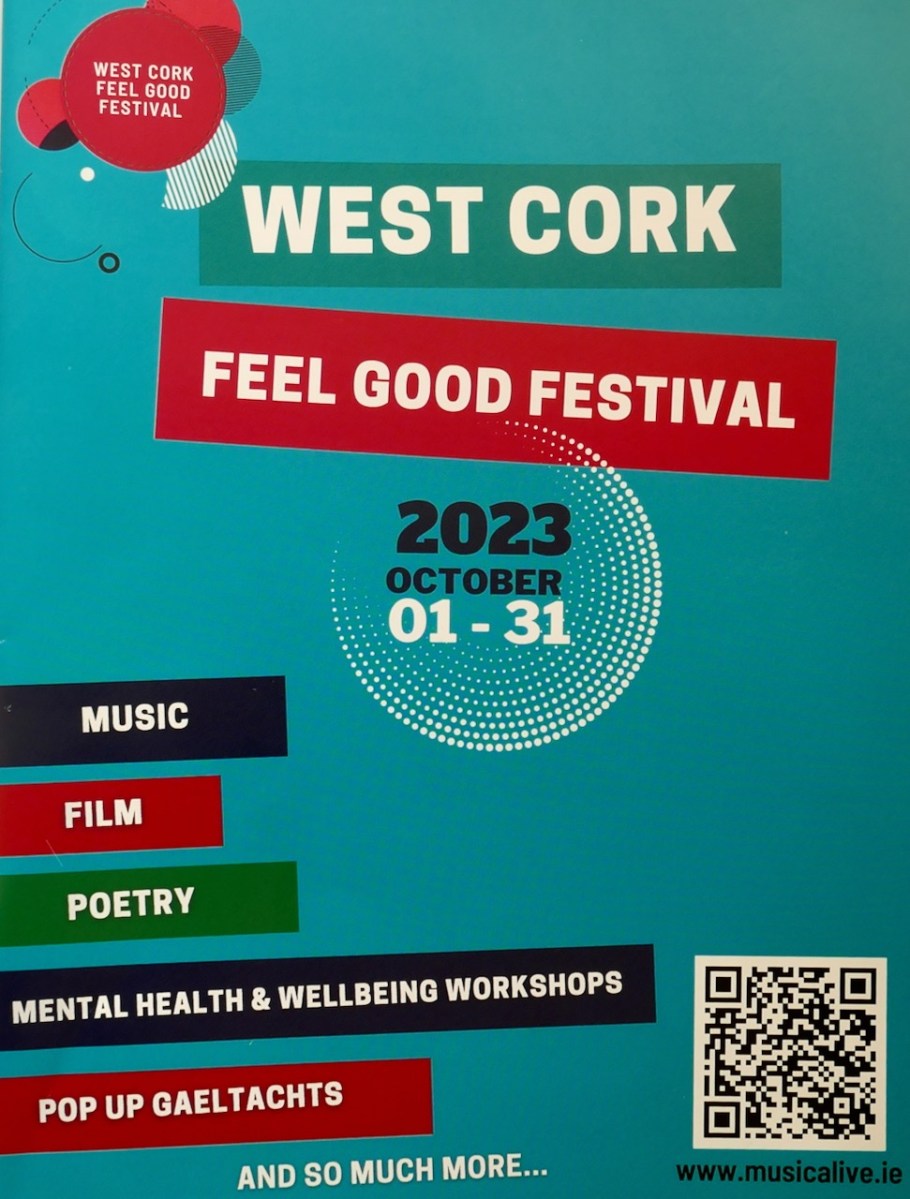
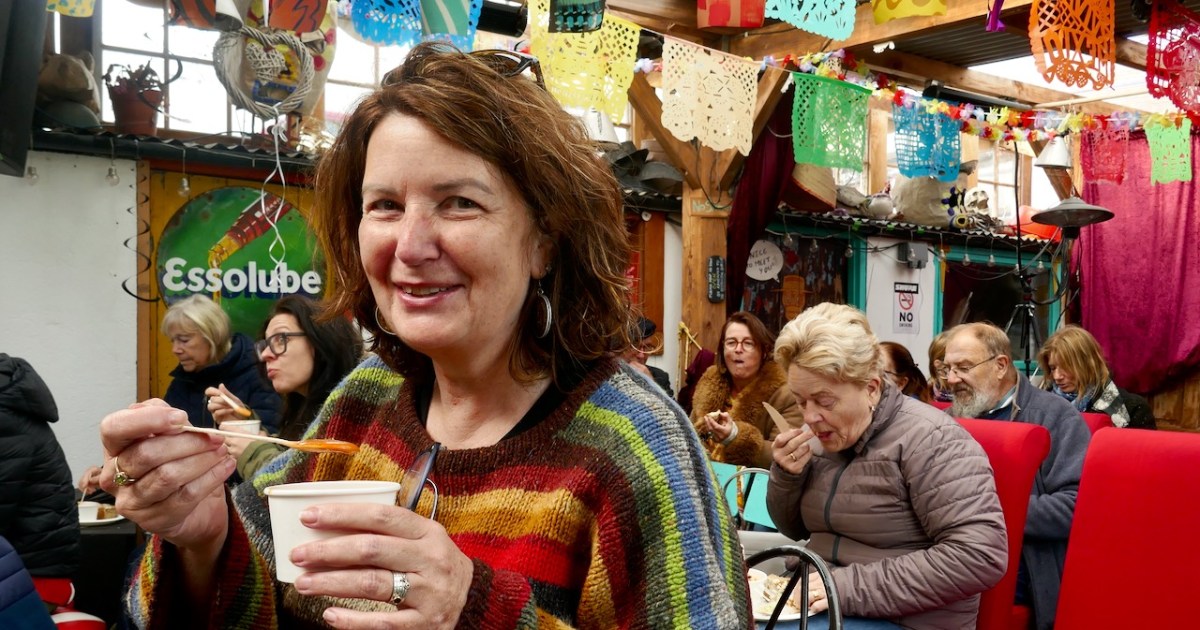
The occasion was a fundraiser for the marvellous West Cork Feel Good Festival – a festival that’s dedicated to experiential workshops that offer moments of exploration, discovery and connection. There are events taking place all over West Cork, and the underlying theme is that of good mental health and wellbeing for all of us. This one was in the fabulous Levis’s where so much of the heart of Ballydehob is nurtured. (See my post about their famous shop counter, here.)
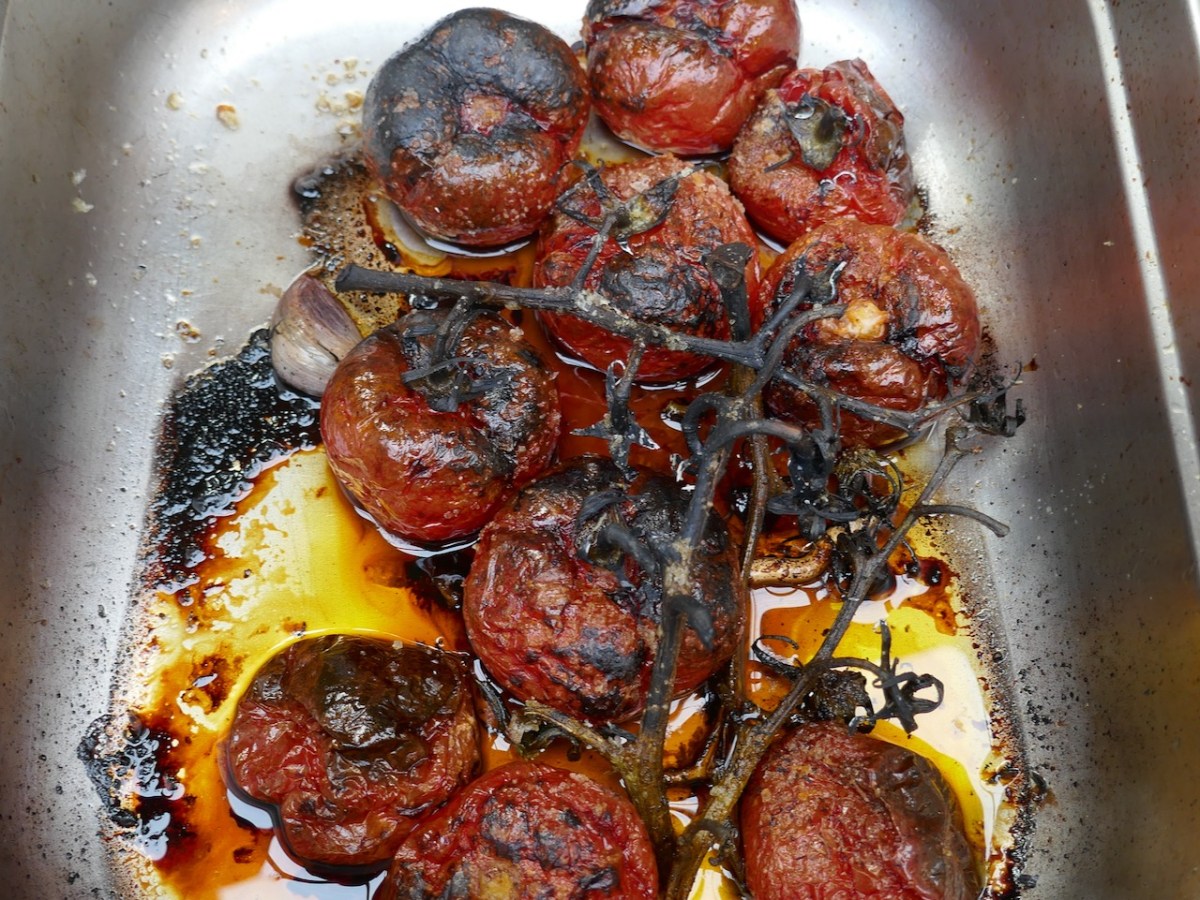
Rob is genial and casual – no hint of Master-Cheffy uppityness and not a tweezer in sight. West Cork is a foodie paradise and there’s a mantra that local cooks like to use – fresh food, simply prepared. And this was a masterclass in exactly that. There were 4 ingredients – tomatoes, oil, garlic and salt. That’s it.
What did I learn that I didn’t know before? First, and most surprising to me – roast the tomatoes, vine and all! Roasting brings out the flavour, and apparently the vine itself also contains buckets of flavour too. Chuck in a couple of cloves of garlic – no need to peel or cut them up. He buys his tomatoes from Lisheen Greens – one of our local producers of vegetables.
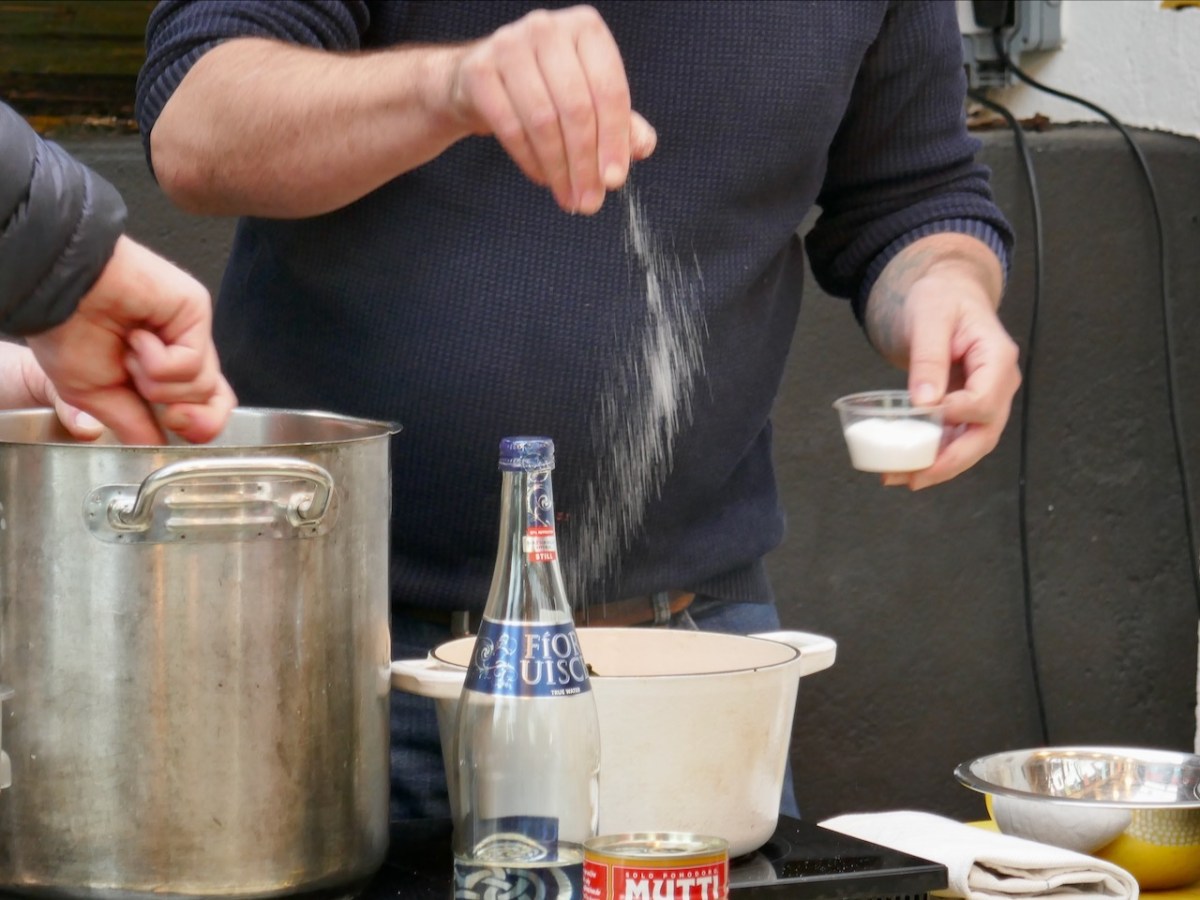
How about seasoning? Rob used two kinds of salt, coarse and fine, and a generous amount of each. He also told us it was important to season at the end as well. I asked him about pepper – every video I watch on the internet has copious amount of salt and pepper added, and the Master Chef guys are always bleating on about seasoning. I personally use pepper very sparingly and in very few recipes, so I was curious. Rob made my day when he told me he doesn’t often use pepper, and when he does he adds it at the end.
I said that one of the ingredients was tomatoes, and that’s correct. But there were two kinds – one kind was the fresh tomatoes on the vine that Rob roasted, the other was – canned! It’s important, he said, to look for good quality canned tomatoes that have been peeled – unpeeled can leave unpleasant bits in the soup. This one is available in Fields of Skibbereen.
Once the tomatoes have roasted, the canned tomatoes are added, everything is mixed and cooked in a big pot, and then processed in a blender or food processor to chop up the vine stalks and the garlic. Finally, it’s all strained through a sieve, tasted, and a last seasoning added.
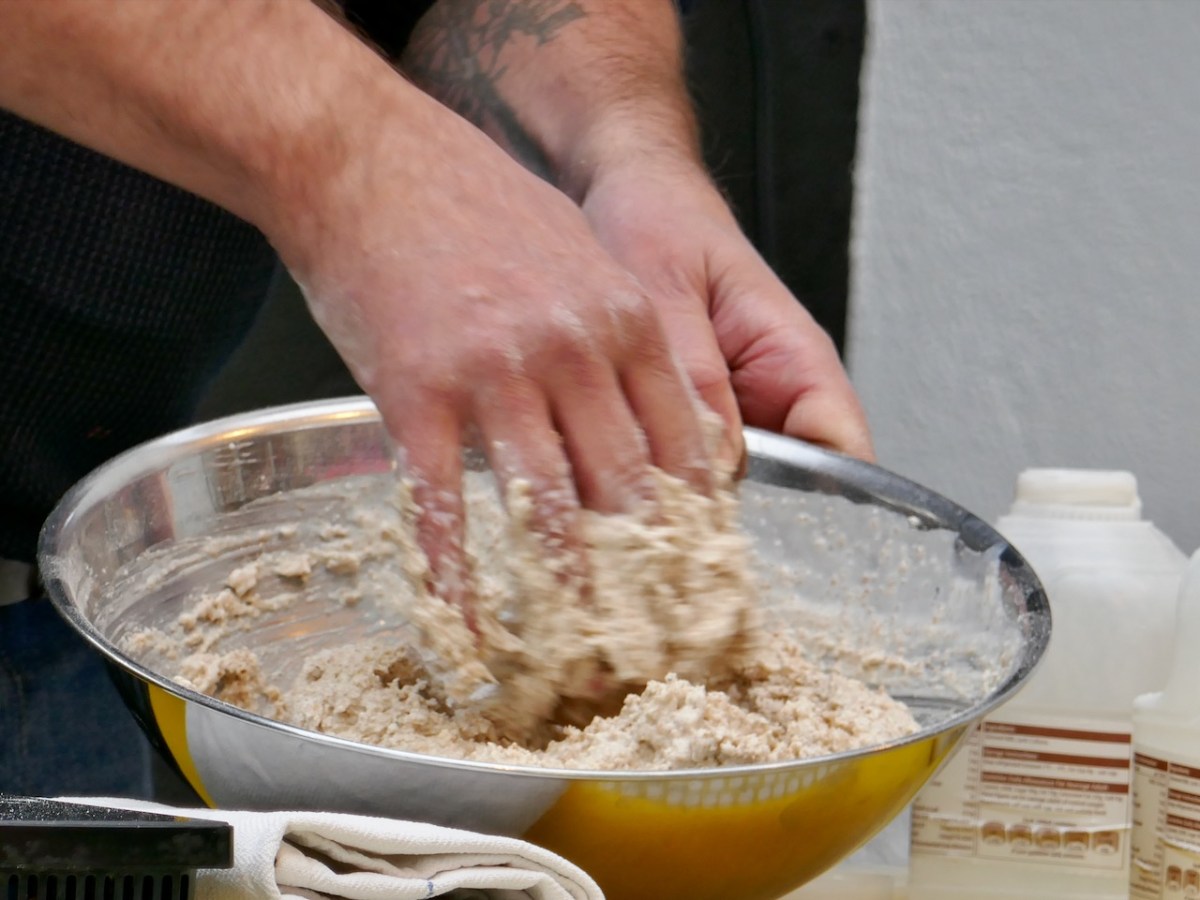
To serve it, Rob showed us how to make a brown soda bread. His tip – handle it as little as possible, only as much as you need to, to get all the dry and wet ingredients to come together.
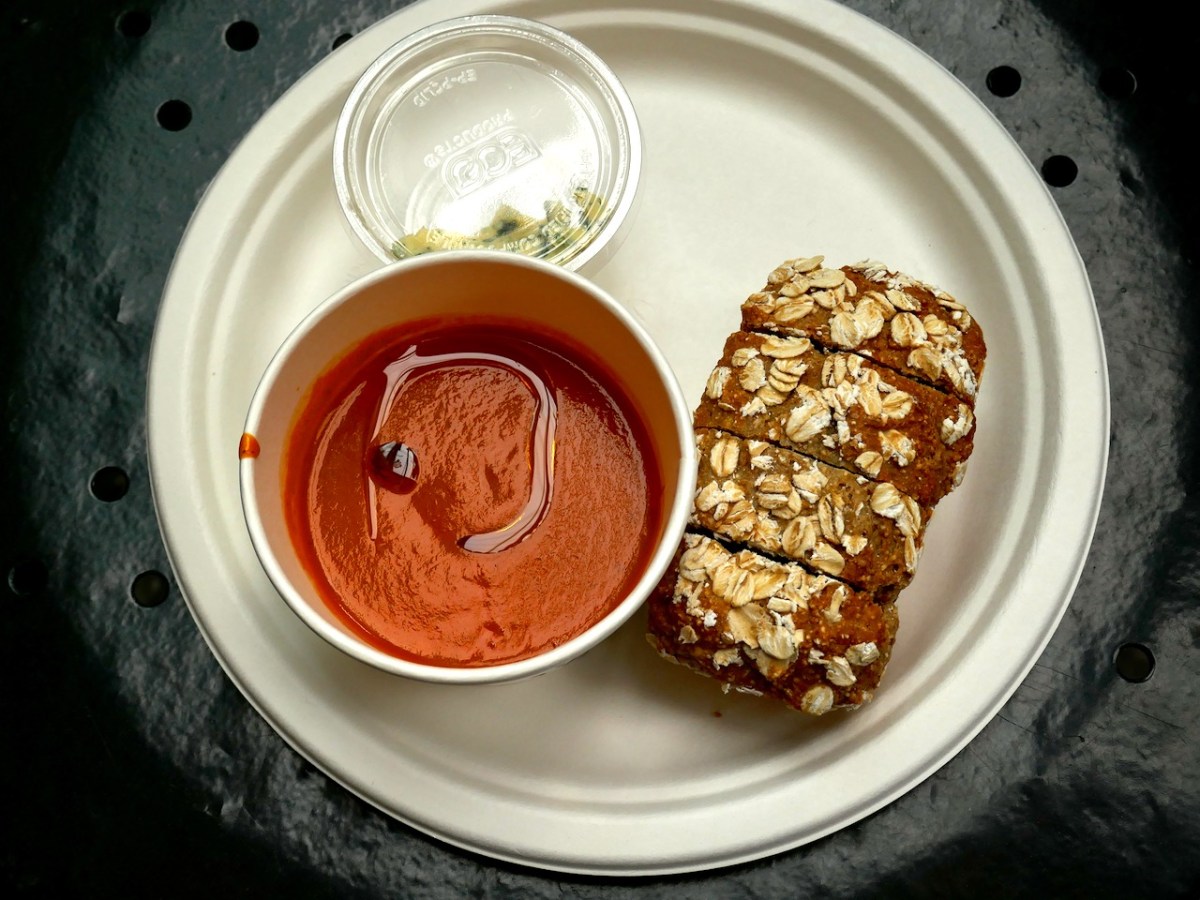
Of course, in the best tradition of here’s one I made earlier there was a big pot of soup on the hob, and lots of little loaves of brown bread with herbed butter.
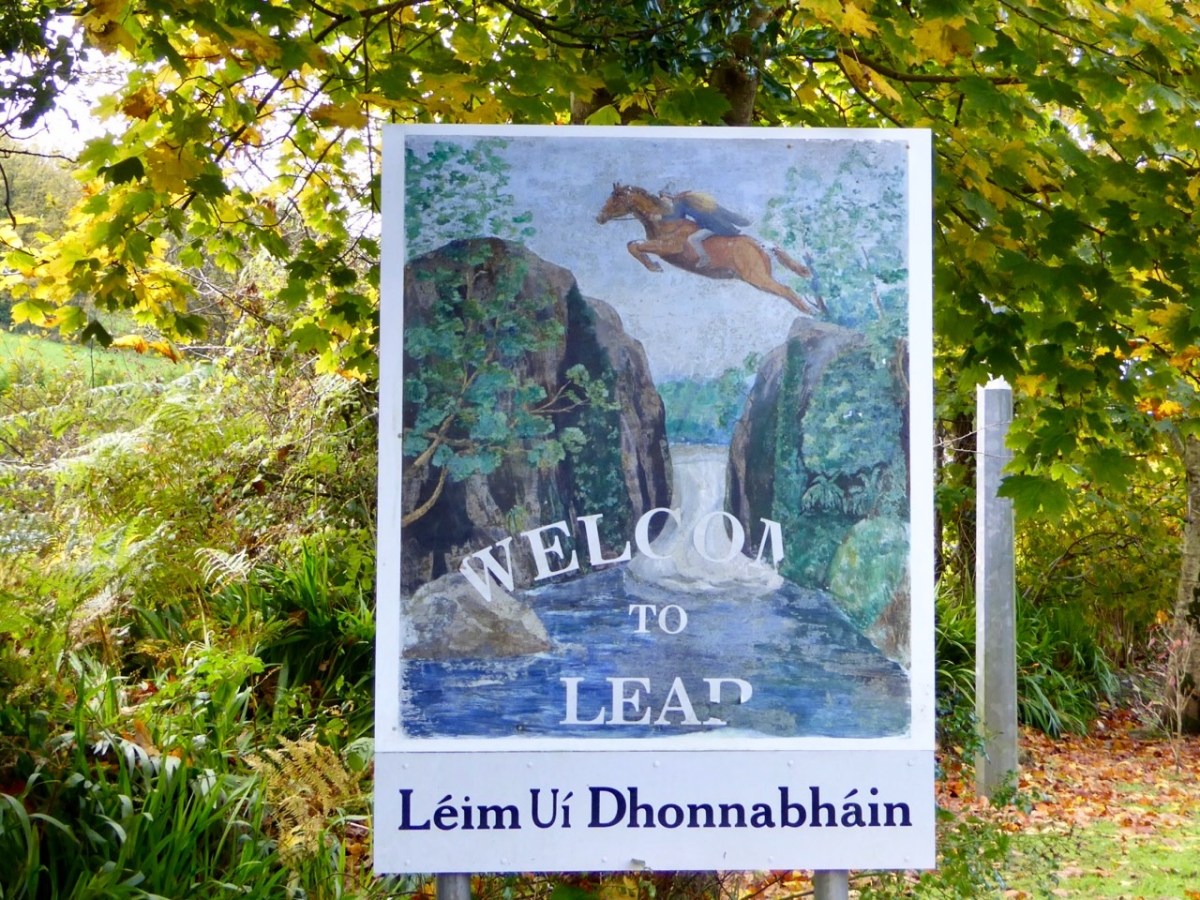
There’s a village in West Cork called Leap – say “Lepp”. Where does that name come from? As is often the case in Ireland, it all starts with a story . . .
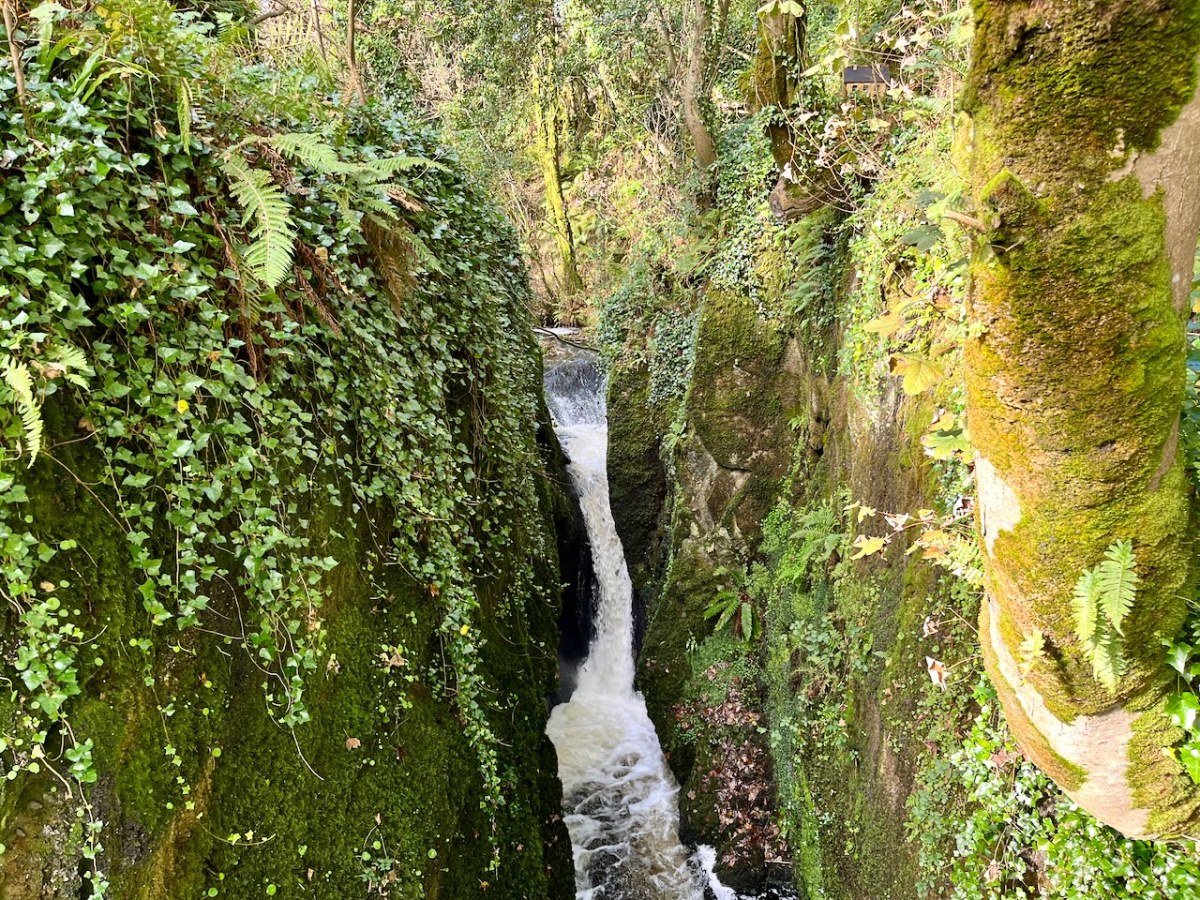
Tradition had it that St Patrick never went west of Leap (in Irish that’s Léim Uí Dhonnabháin, which translates literally as The Leap of O’Donovan), and that’s the sign at the entrance to the village, above. It was St Ciarán of Cape Clear who did all the converting in our part of the world: read about him here. So when The O’Donovan, pursued by British soldiers ‘leaped’ over the deep gorge which you can still see to this day, he was escaping into a much wilder country. The gorge (this is as it looks today – below) divides the West from East Carbery. So difficult was it to pass “beyond the leap” in those old days, that it was said: “beyond the leap, beyond the law”.
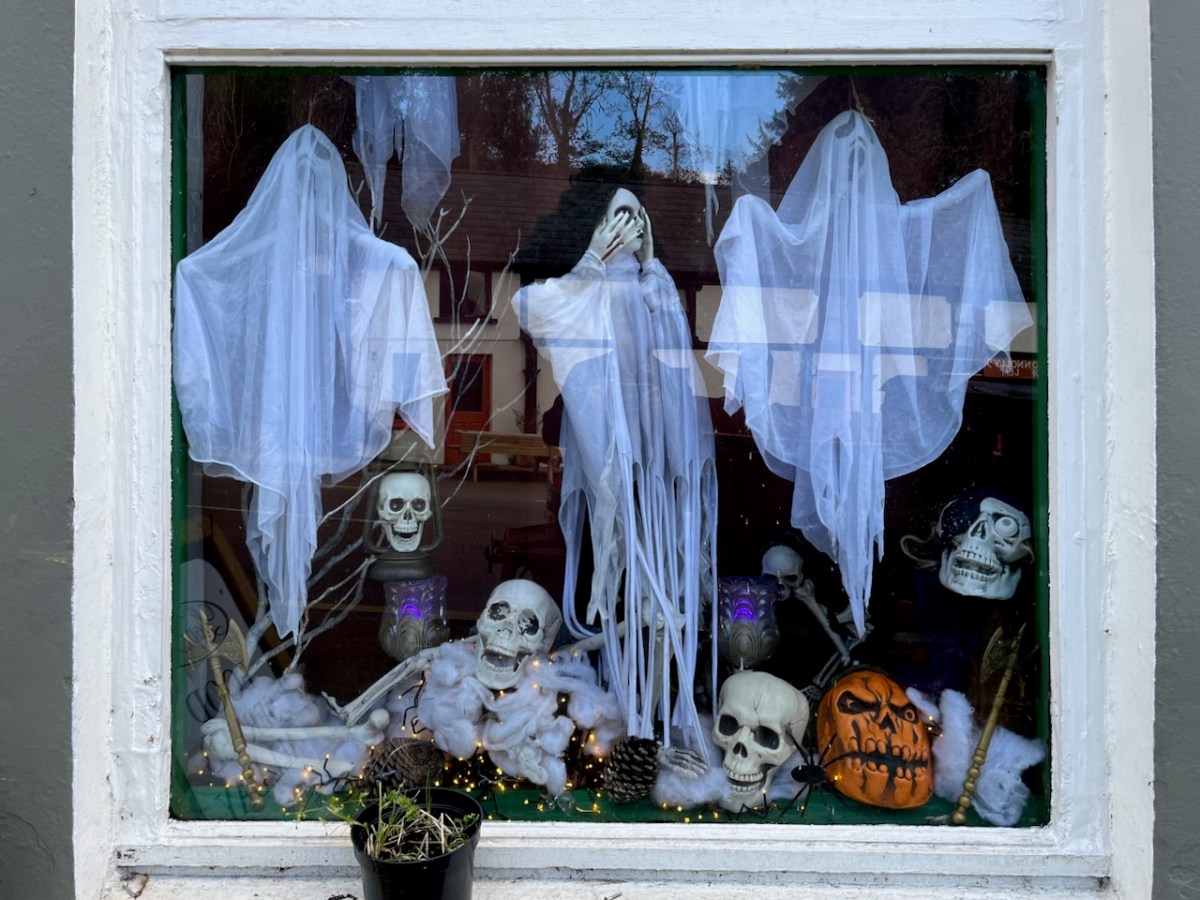
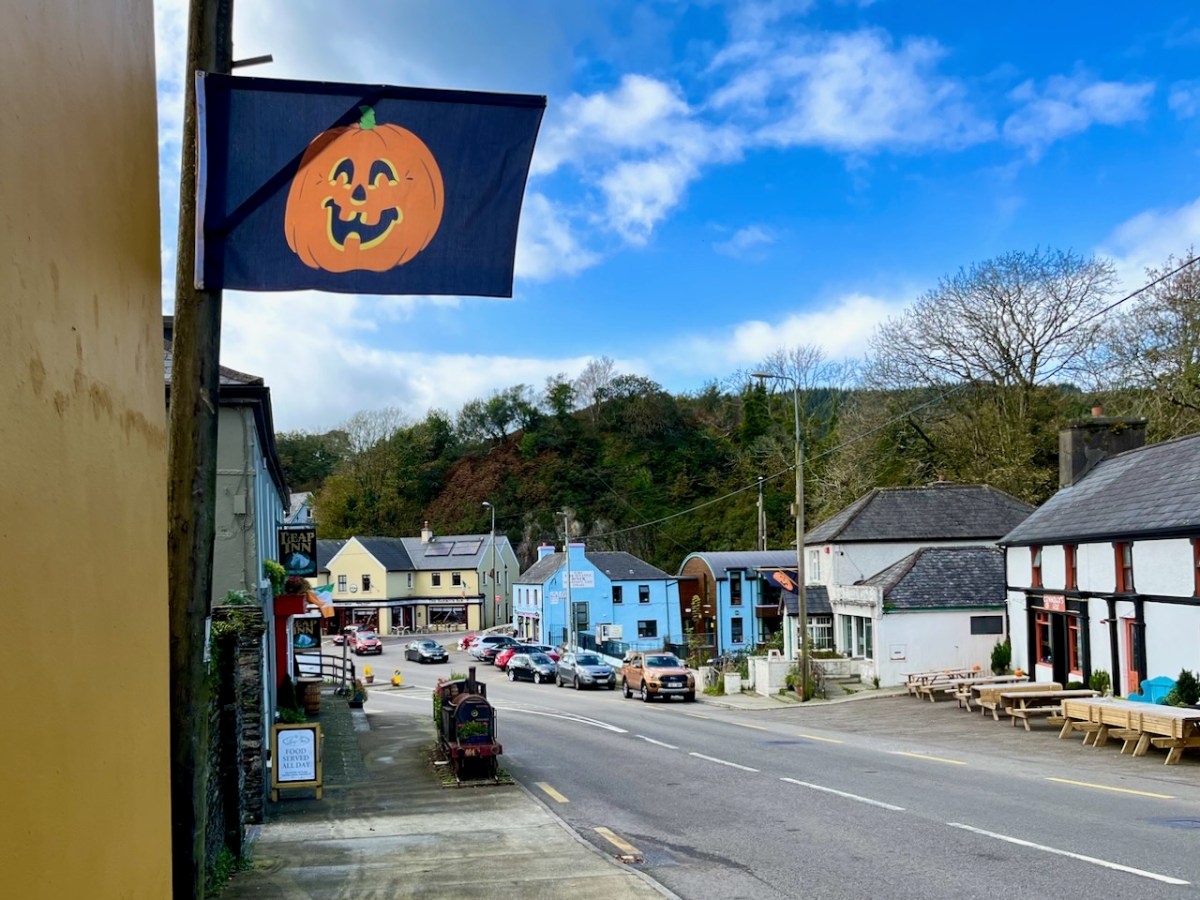
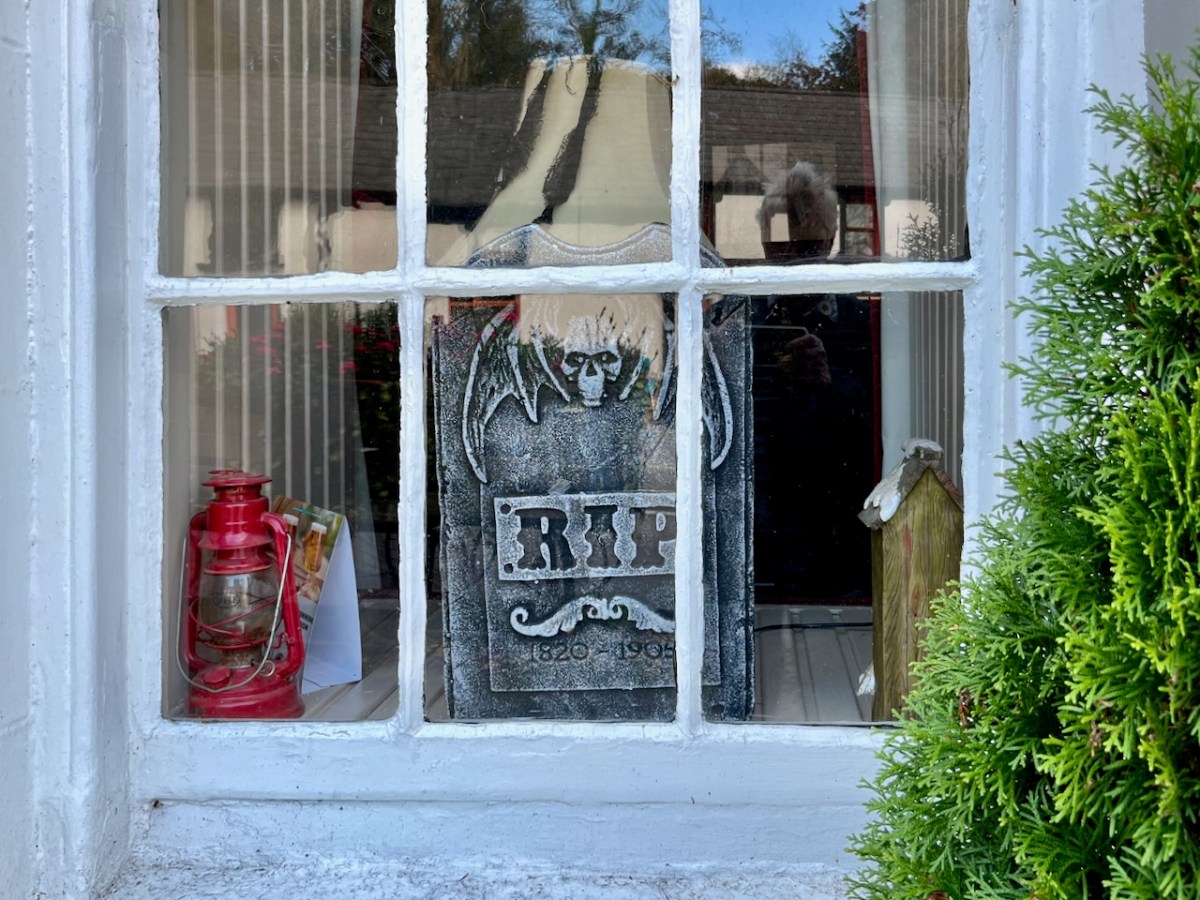
Apart from O’Donovans Leap, the village is celebrated today for its associations with Hallowe’en, Ghosts, and Scarecrows. And we are approaching the time of year when these phenomena come to the fore. At the present time, a few shopfronts are being decorated, but there are plenty of Scarecrows waiting in the wings for their moment to arrive!
You can see that Leap – in West Cork – will be worth a visit once the festivities are in full swing: that will be between Monday 23 October and Sunday 5 November this year. Back in 2015 we visited the Leap Scarecrow Festival and wrote this post about it (click here). Interestingly, it became the most popular post we had published up to that time – it’s had around 3,250 views since it first appeared. Have a look at it now – but also remember to go to the village of Leap at the end of this month!
The first story concerns Jasmine Allen – she is the charming and erudite Curator of the Stained Glass Museum in Ely, in the UK. At a recent Stained Glass Symposium in Trinity, she showed us how stained glass studios were advertising their artistry and products at exhibitions in the late nineteenth and early twentieth centuries in Britain and Ireland, starting with the Great Exhibition in 1851, but happening at regular intervals after that. The Irish International Exhibition was held in Dublin in 1907. It was inspired by the success of the Cork International Exhibition of 1902 (see Robert’s post about that here) and even copied their thrilling water slide! For a marvellous collection of images from that exhibition, see this Flikr Album from the Church of Ireland. The story of their discovery is also fascinating.
Irish international exhibition from Herbert Park, by National Library of Ireland on The Commons
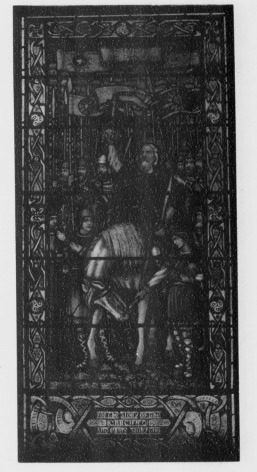
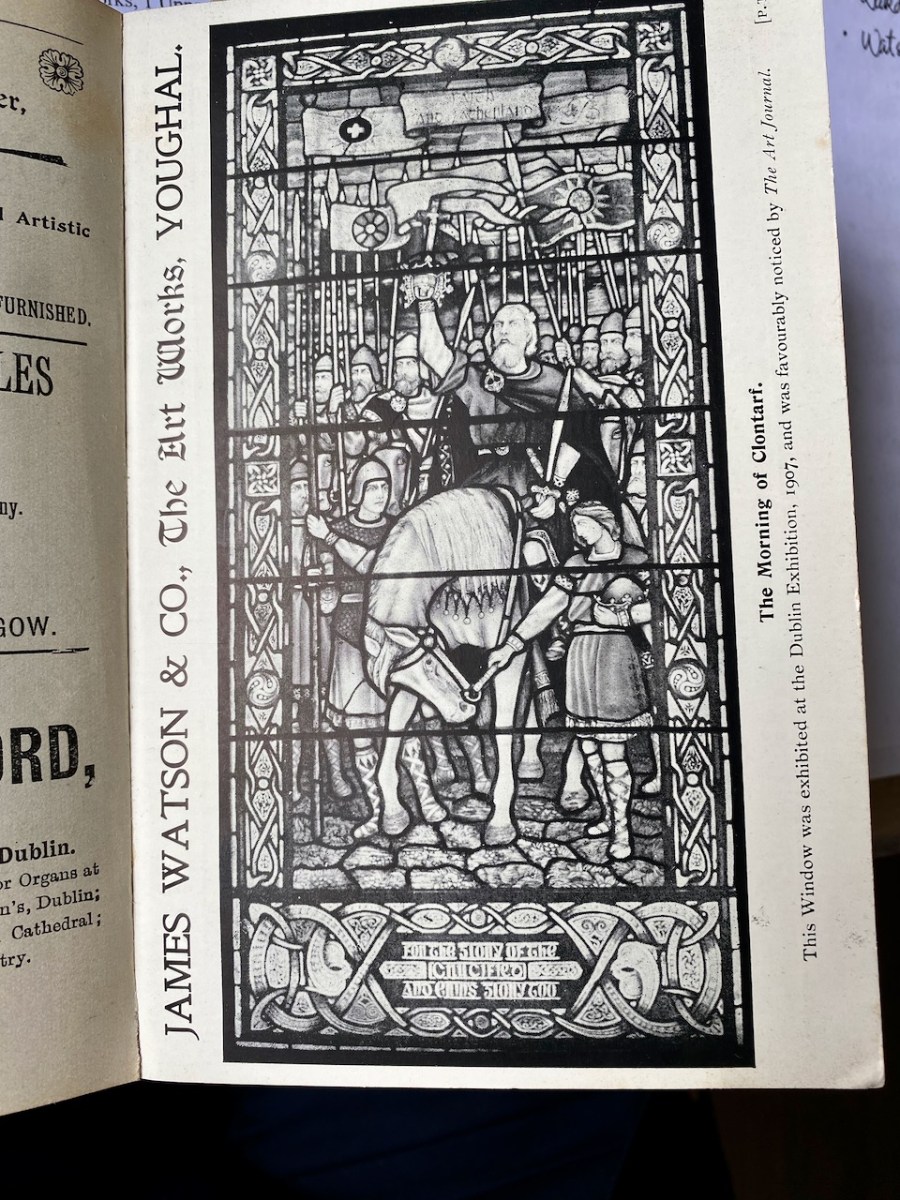
One of the exhibitors was James Watson and Co of Youghal. Jasmine subsequently sent me this image, saying: Catalogues of these exhibitions are all too brief and I would love to know what happened to it. Is it in a church or secular building in Clontarf? I only have a very bad image from the Art Journal (early b+w photography was worse than engraving for capturing stained glass!)
Story 2: Michael
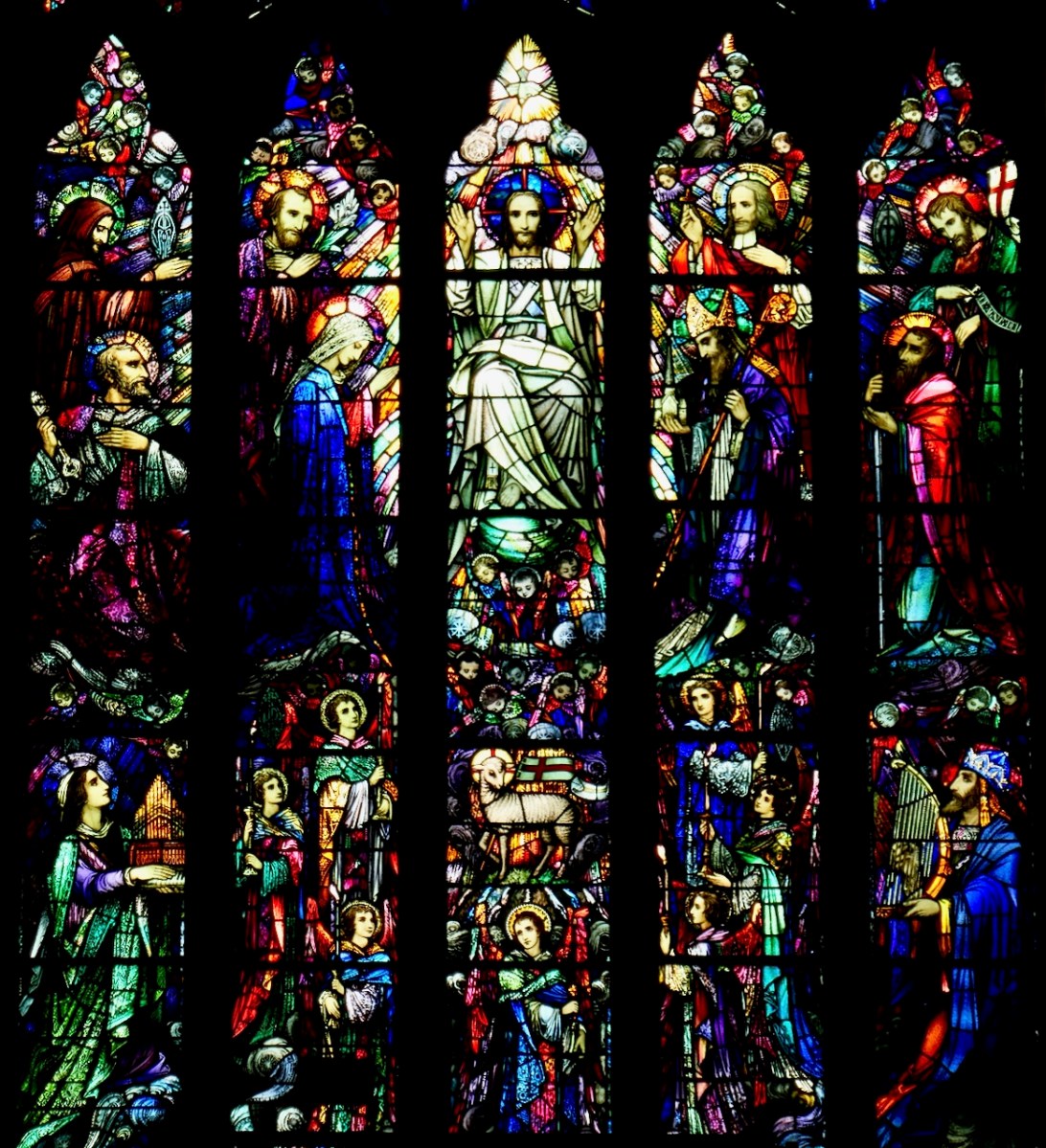
I sent the photo to the group of colleagues, mostly contributors to the Gazetteer of Irish Stained Glass with whom I correspond on a regular basis and who are always helpful, asking if any of them knew the fate of the window. I got several “no idea” responses and then I heard from Michael Earley. Anyone interested in Irish stained glass will be familiar with the name of Earley, and Michael Earley, a great-grandson of the founders, has just completed doctoral studies on the Studios. I’ve featured Earley windows here and there in my blog posts, but here’s an example of their work – you will find it everywhere throughout Ireland, often distinguished by glass of unique and brilliant colour, enormous packed scenes of multiple angels and saints surrounding a central images, and beautifully rendered figures. Here’s one from St Aidan’s Cathedral in Enniscorthy.
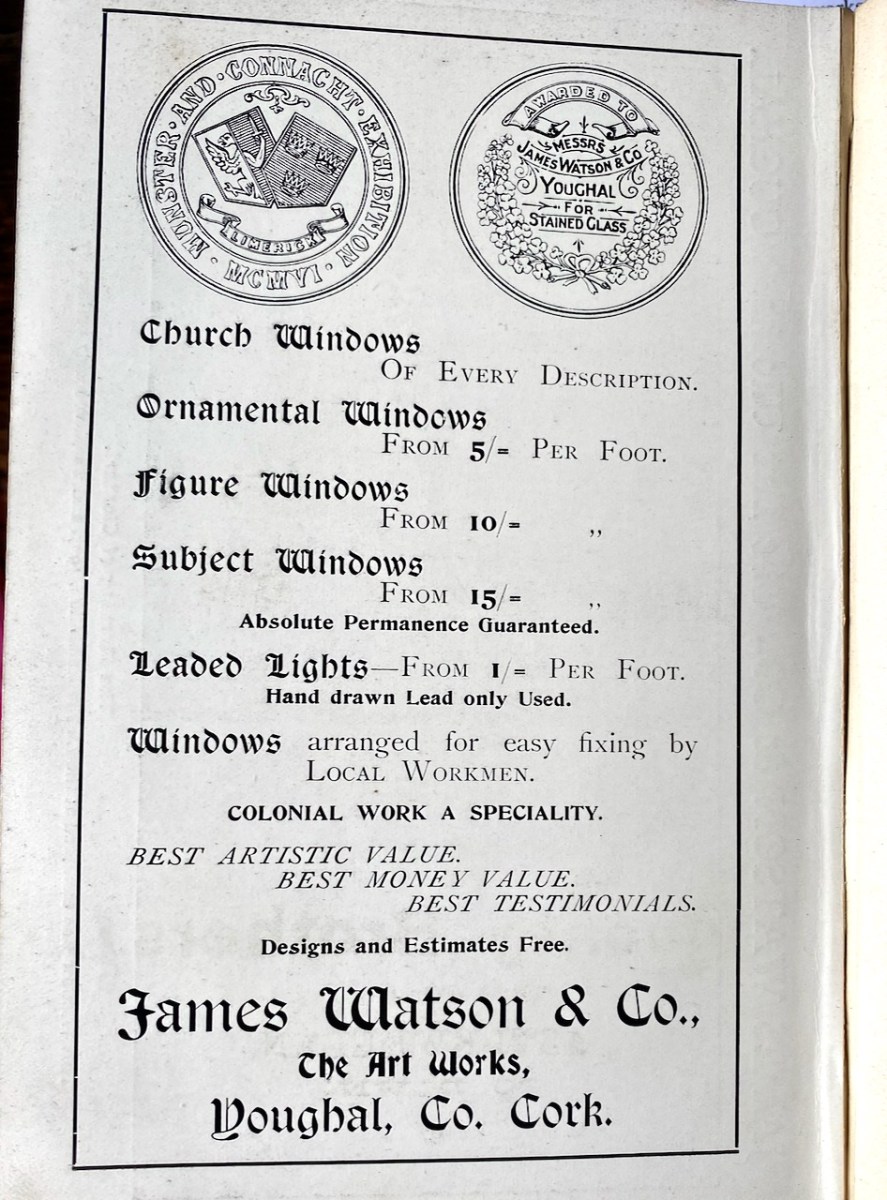
Michael didn’t know what had happened to the window, but he did send me two pages from the Irish Catholic Directory of 1908. The first page was an advertisement for James Watson and Co, The Art Work, Youghal, Co. Cork. Here it is:
Much to savour in this ad – the prices, the variety of windows, “colonial work”. . . The second page, though, hit the jackpot. It was from the same Directory, and was a full scale black-and-white photograph of the window. Titled The Morning of Clontarf, a subtitle reads “This window was exhibited at the Dublin Exhibition, 1907, and was favourably noticed by The Art Journal”.
Now I had an excellent image with which to pursue my inquiries – and I knew exactly who to consult!
Story 3: Vera
The art historian who knows more than anyone else about Watson of Youghal is Vera Ryan. In fact, it was Vera who curated the Crawford Gallery 2015 exhibition of the Watson Archive, when the Crawford acquired the Archive. She also wrote the piece on Watsons: Divine Light: A Century of Stained Glass, in the Summer 2015 edition of the Irish Arts Review. A couple of years ago, when I was trying to find information on a Watson window which was the centrepiece of an article I was writing for the Clonakilty Historical and Archaeological Journal (now published and available here), Vera mentored me as I tried to dig my way through the archive. We have been exchanging information ever since.
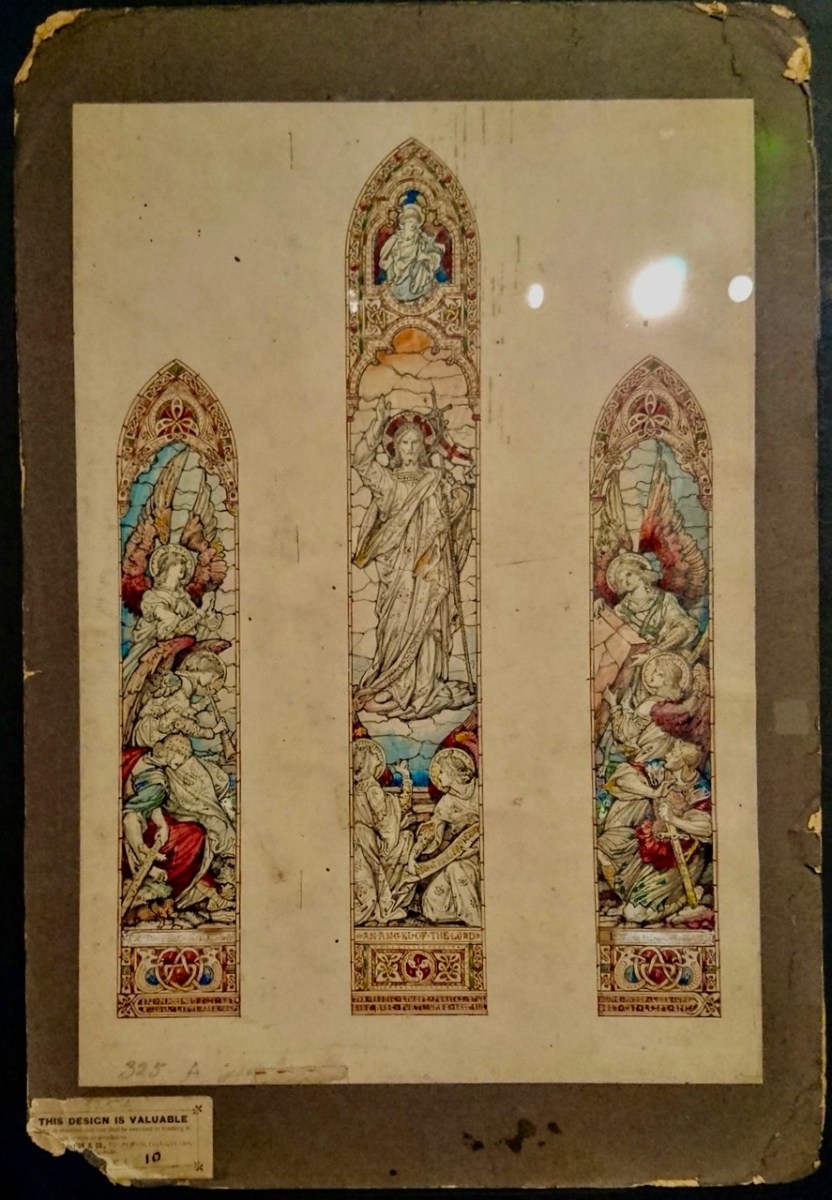
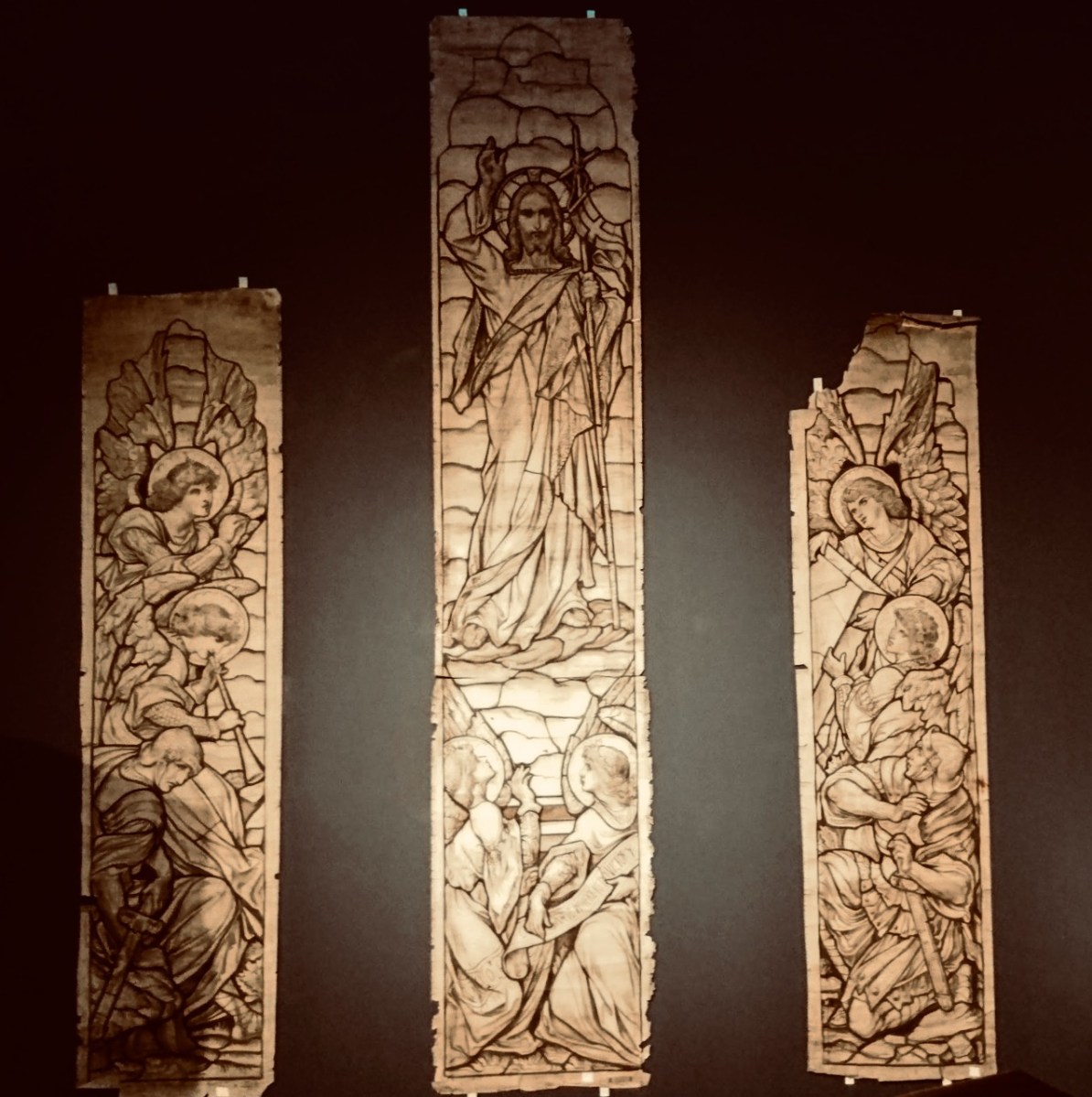
Above is a window in St Michael’s Church, Tipperary, erected in 1914. The design (below) and cartoon (below below) for this window were still in the Watson Archive and were displayed in the Crawford Exhibition. This represents a special opportunity to see the evolution of a stained glass window from concept to completion.
This opportunity is relatively rare in stained glass studies – there aren’t many collections like this, so it is wonderful that the Crawford rescued the archive, which has now been passed on for expert conservation, to the National Gallery of Ireland.
When I contacted Vera, she remembered the Brian Boru window well, and told me that the cartoon was part of what came to the archive, although in a very fragile state. The window, itself, she thought, was still extant, and possibly in Knappogue Castle. The important person to talk to, she said, was Antony Watson, great-grandson of James Watson and the executor of the Watson Estate. Before I did that, I tried some detective work of my own.
Story 4: Jody
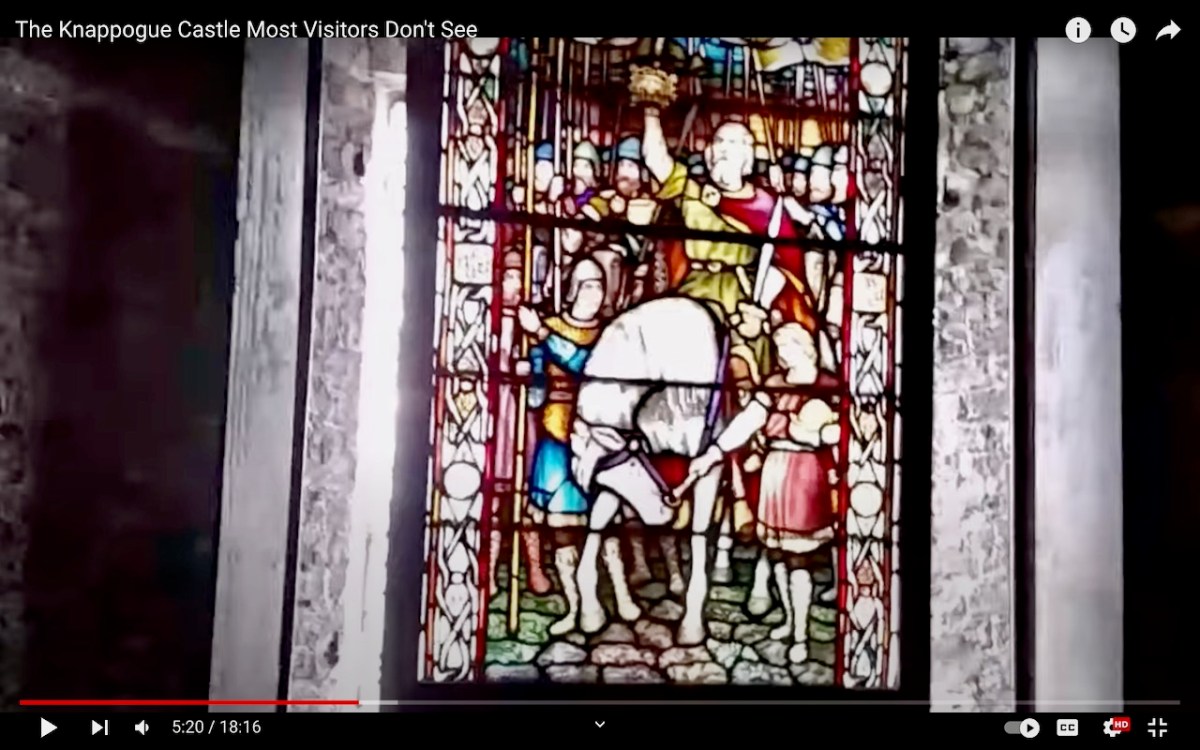
I don’t know Jody Halstead, but in 2016 she stayed at Knappogue Castle and posted a video to YouTube, titled The Knappogue Castle Most Visitors Don’t See. At about the 5 minute mark she arrives at a landing and as her camera roams around, it captures a stained glass window – and there it was! Here’s a screenshot from the video.
Because of Jody, now I had proof that the window was still in existence. The next challenge was how to get a good photograph of it. Once again, thanks to the glorious (and relatively small) world of Irish stained glass scholars and enthusiasts, I knew who to turn to.
Story 5: John
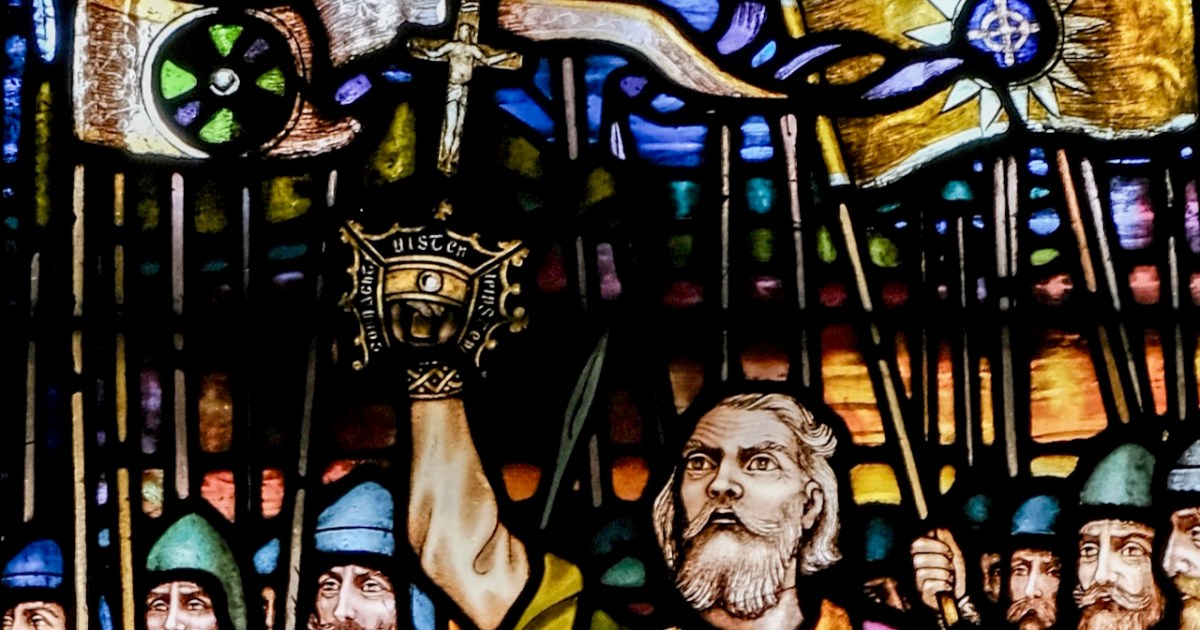
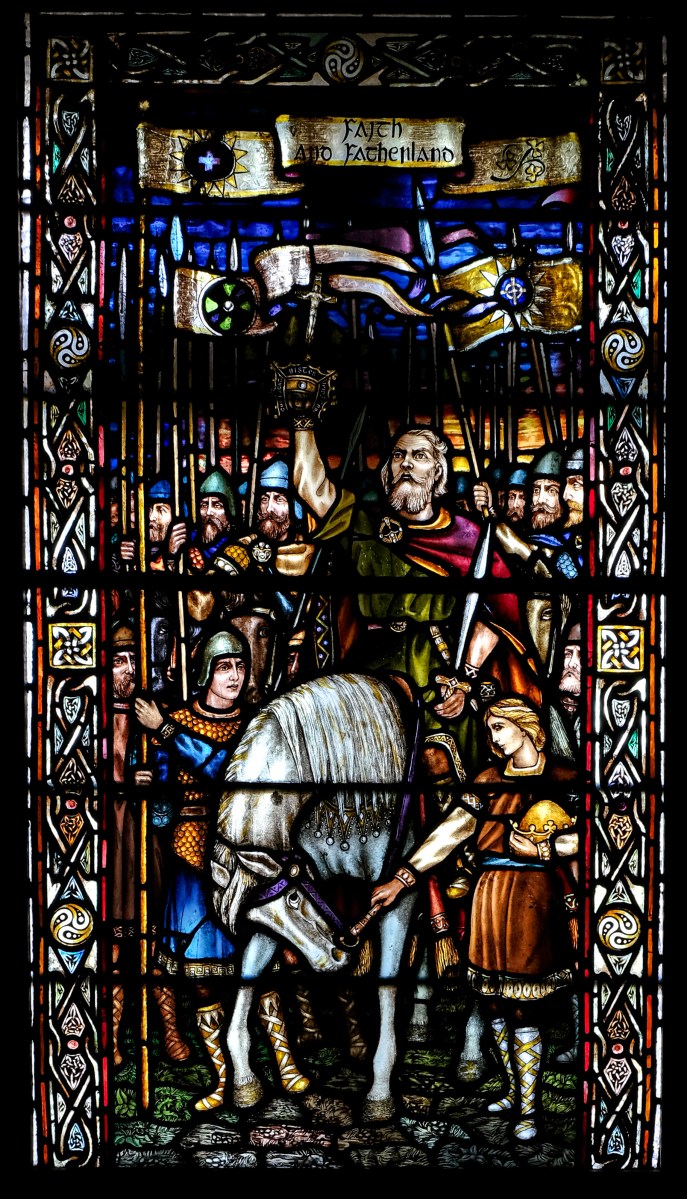
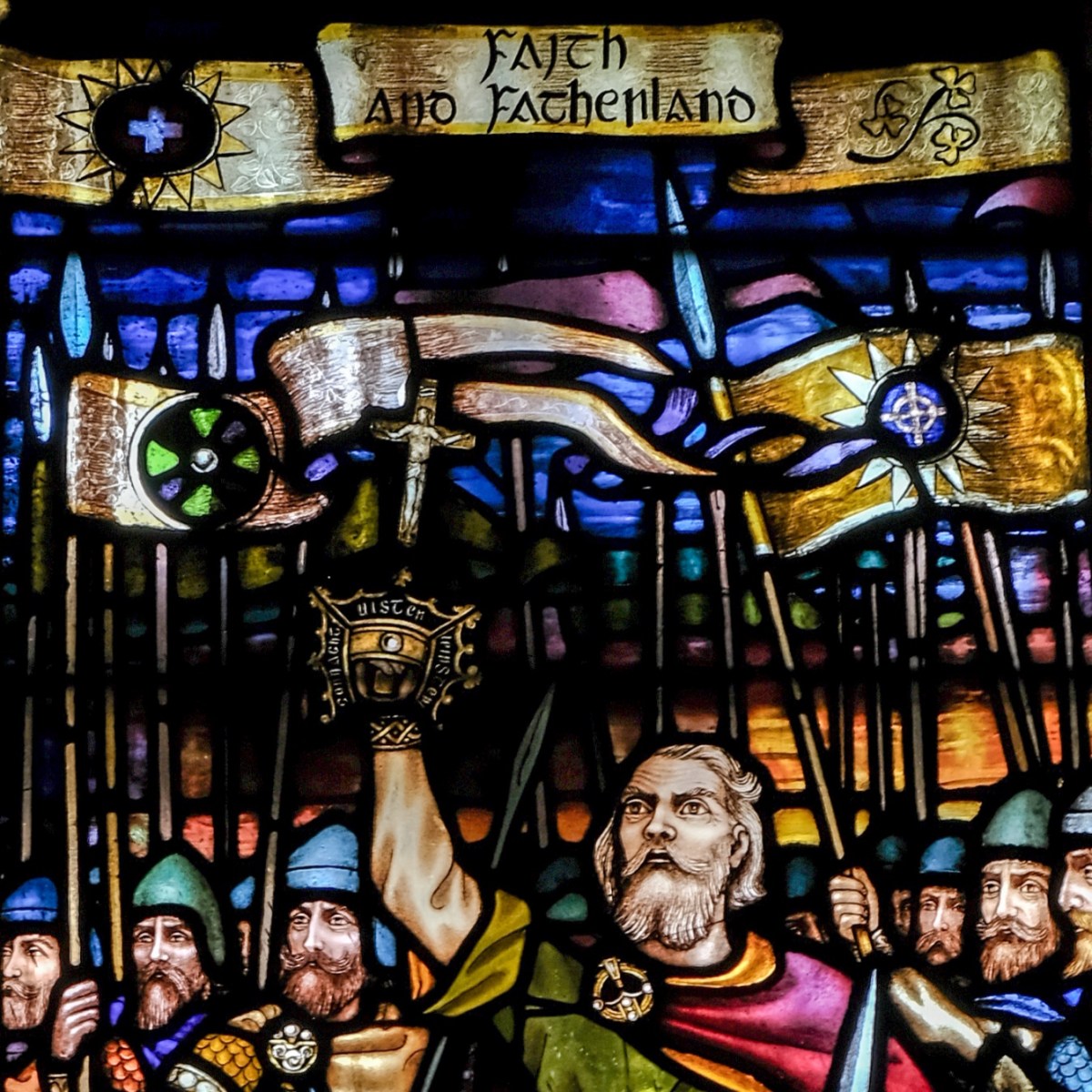
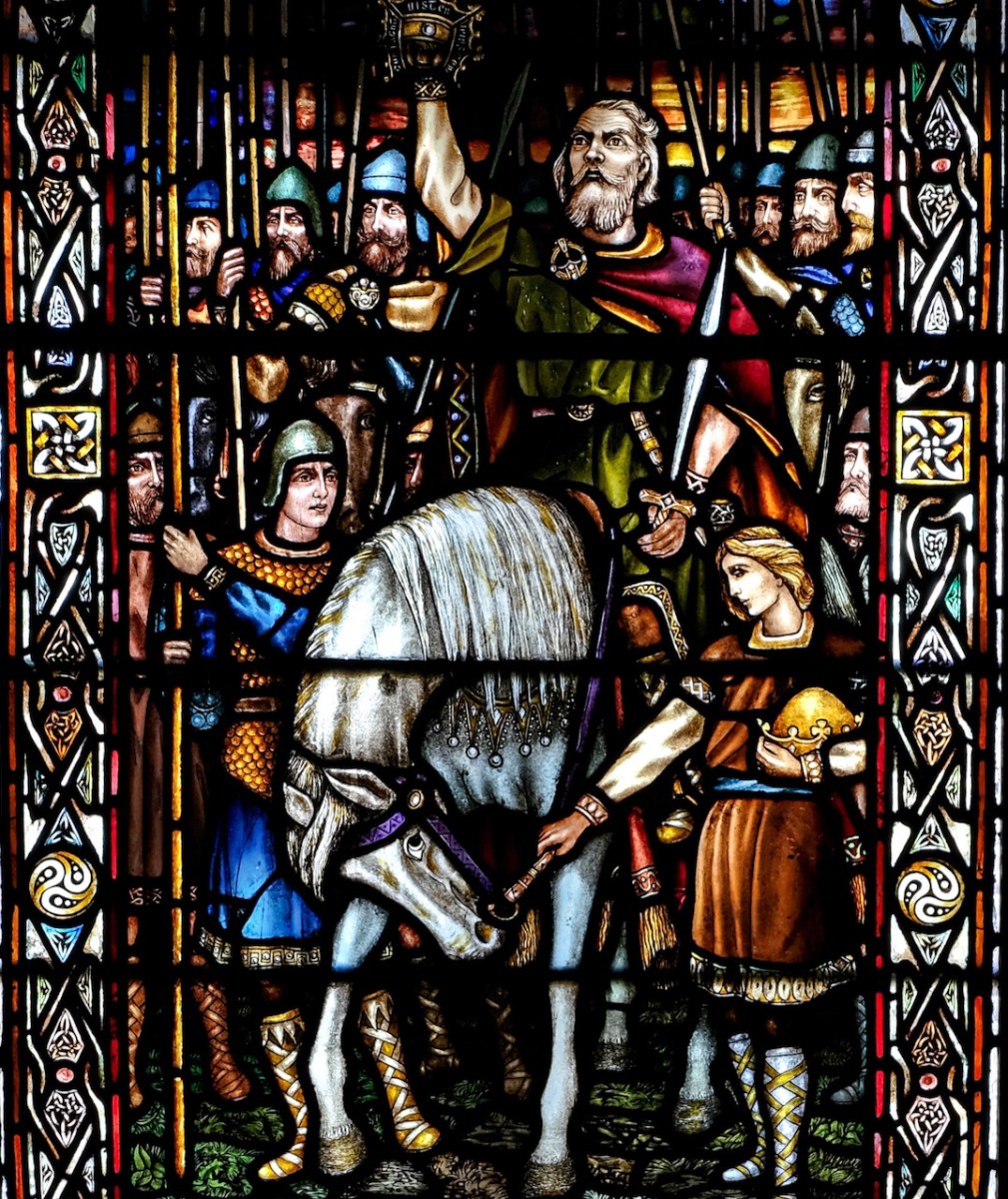
John Glynn is an outstanding photographer with an interest in stained glass. His was the excellent image from Kilrush I used in my post on Brigid: A Bishop In All But Name, and he lives in West Clare, about an hour by car from Quinn, where Knappogue Castle is located. I thought he might already have taken a photograph of the window – he hadn’t but promised to do so as soon as he could. To my great delight, he did it right away. Here is what he sent me.
This and all detailed images of the Brian Boru window in Knappogue, are the work of John Glynn, and used with his permission
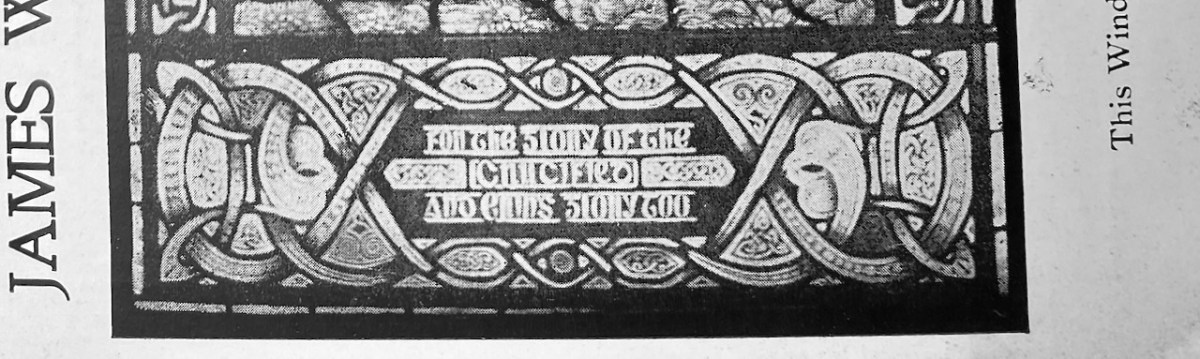
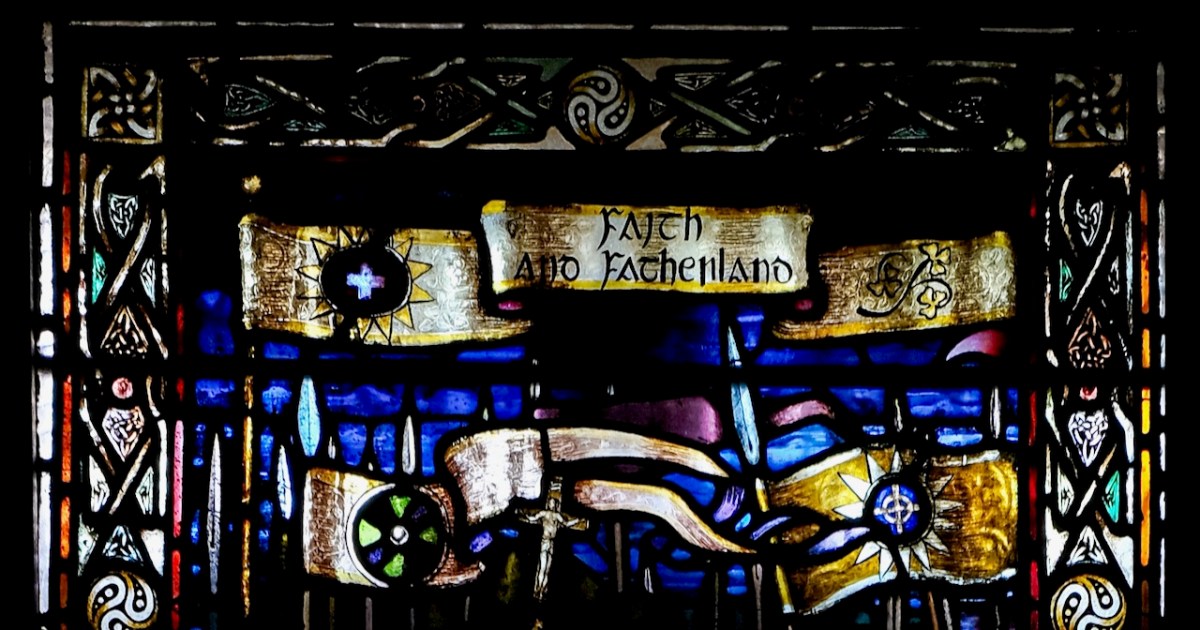
Isn’t it an amazing photograph! What’s also clear in this photograph is that the window is incomplete. To make it fit the opening, the predella, or bottom section, has been removed. Here’s what’s missing.
The text, in old Irish script, reads FOR THE GLORY OF THE CRUCIFIED AND ERIN’S GLORY TOO. The Celtic Revival interlacing that surrounds it is beautiful, and accomplished – it’s the thing that Watson’s were to become most famous for. So that’s a loss. Perhaps it was felt that the script was not suitable for a secular building: however it is more likely that it had to go in order to make the window fit. The rest of the window, comparing it to the original black and white images, seems to be intact. I was curious as to how the window came to be there, and this brings me to my second-to-last story.
Story 6: Antony
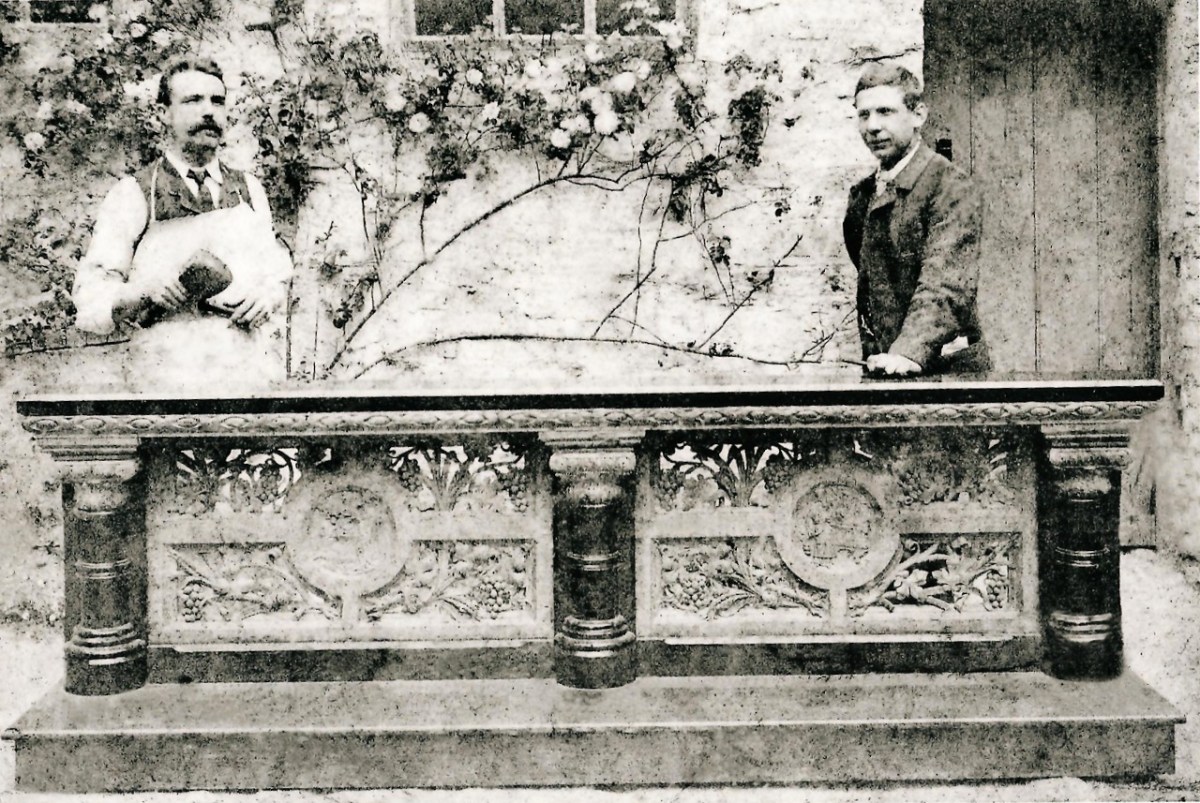
Vera kindly put me in touch with Antony Watson, and yesterday we had a long talk on the phone. Antony’s father was John Watson, Manager and Chief Designer for Watson of Youghal. John’s father was Clement, universally known as Capt Watson (he was an officer in the RFC/RAF), and Clement’s father was James Watson, seen here with a marble altar carver.
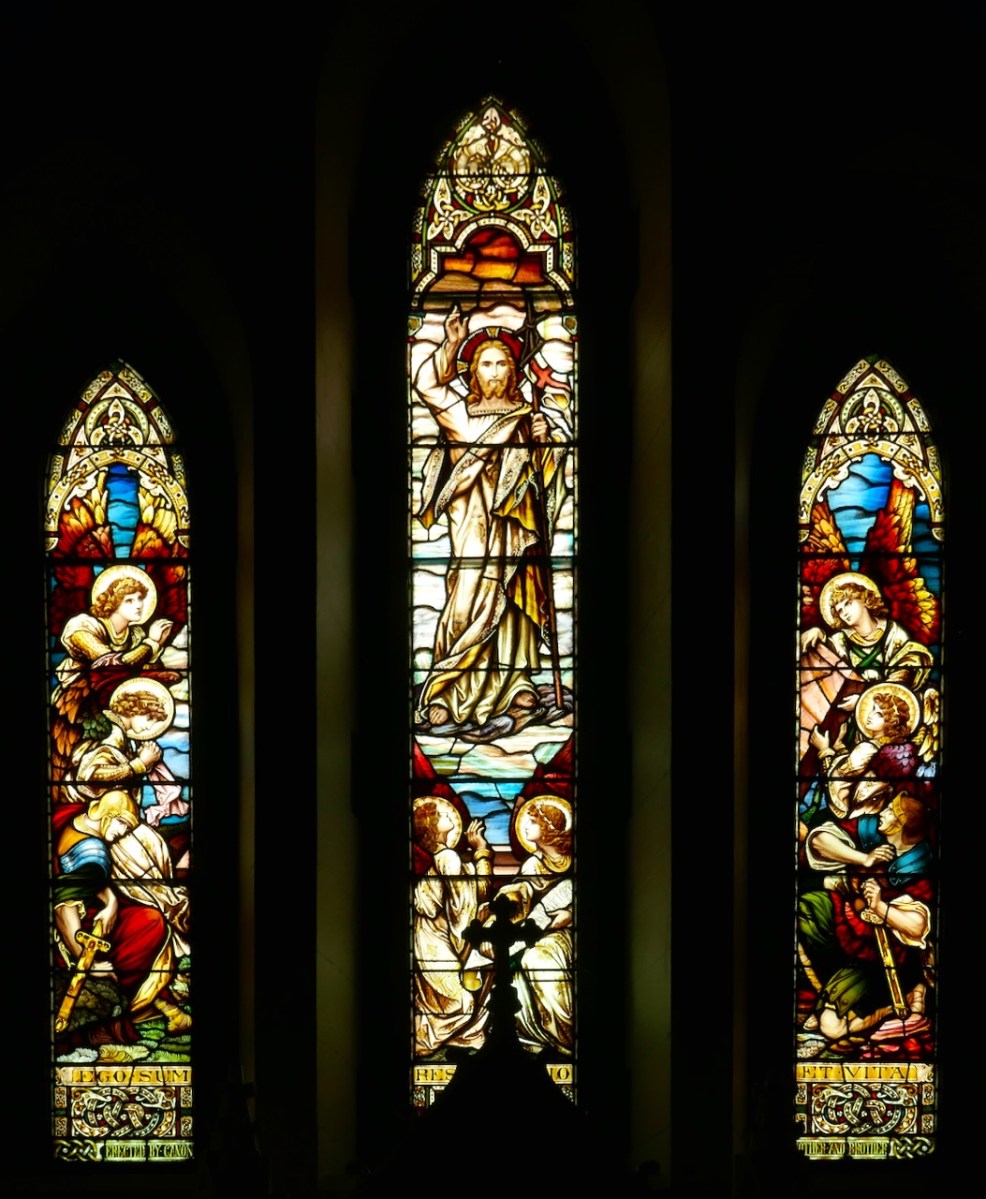
James had come from Yorkshire to run the Irish office of Cox, Sons, Buckley & Co, Church Outfitters, and eventually bought the Irish branch of the company. Here’s one of their early windows, in Ballingeary, from the 1880s, when they were still being signed as Cox, Sons, Buckley, Youghal and London.
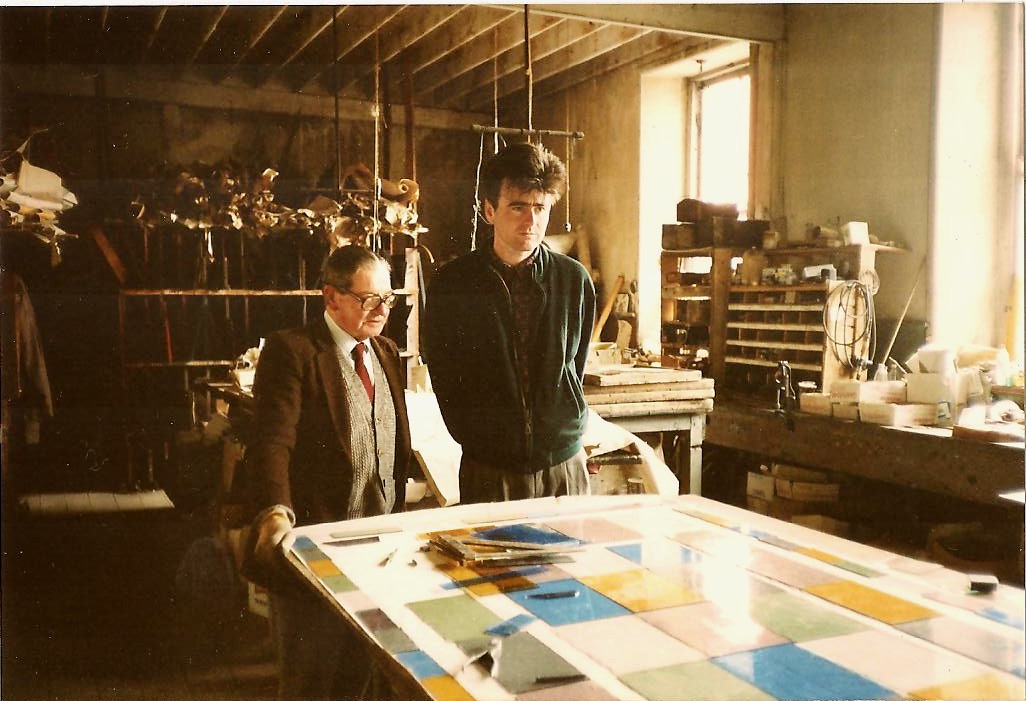
Antony told me the most enthralling stories, and I want to devote more posts to cover some of that treasure trove in the future, but I don’t want to get too distracted from Brian Boru now. Antony loved his life in and around the studios and workshops when he was young and has a very clear memory of the Brian Boru window. It stood, he said, in a rack in what was called the Great Hall (a grand name for a storage area for tall items). Here’s Jack, Antony’s father, with a client, in the early 1990s.
Watsons got the job of installing leaded windows into Knappogue Castle when it was bought by wealthy Americans – Mark and Lavonne Andrews. He remembers the day they arrived to see the Brian Boru window – there was a frantic tidy-up beforehand and the whole of Youghal turned out to witness two stretch limos arriving in state and disgorging the ‘Texas millionaires’ and their retinue.
Story 7: Mark and Lavone
This is Mark Edwin Andrews, highly educated (Princeton) and cultured, and at one time Assistant Secretary of the Navy under Truman. He went on to become an industrialist and oil producer. His wife, Lavone Dickensheets Andrews (so sad I can’t find a photograph of Lavone) was a prominent architect. Together they purchased Knappogue Castle in 1966 and set about restoring it from a ruinous state. Knappogue is located in Quinn, Co Clare, the heart of Brian Boru country. It’s now owned and managed by Shannon Heritage.
It was Mark and Lavone who rescued the Brian Boru window and had it fitted into Knappogue Castle, some time in the 1970s. And there it still is, a testament to the enduring attraction (and durability) of stained glass windows and their power to enchant and intrigue us.
It’s a highly unusual window in so many ways, not least that it is a secular rather than a religious subject. It showed off, when it was exhibited, one of our historic heroes, Brian Boru (for more about Boru, see Robert’s post, Battling it Out), as well as the Celtic Revival decoration which Watsons mastered: both the subject matter and the treatment established them firmly in the Nationalist Camp. This of course, was a canny move designed to appeal to Irish Catholic church-builders. Antony tells me that nobody espoused Irish Nationalism more enthusiastically (or astutely) than James Watson, in the broad Yorkshire accent he kept to the end.
As an image of Faith and Fatherland, this window knew exactly who it was appealing to. It appeals to us still.
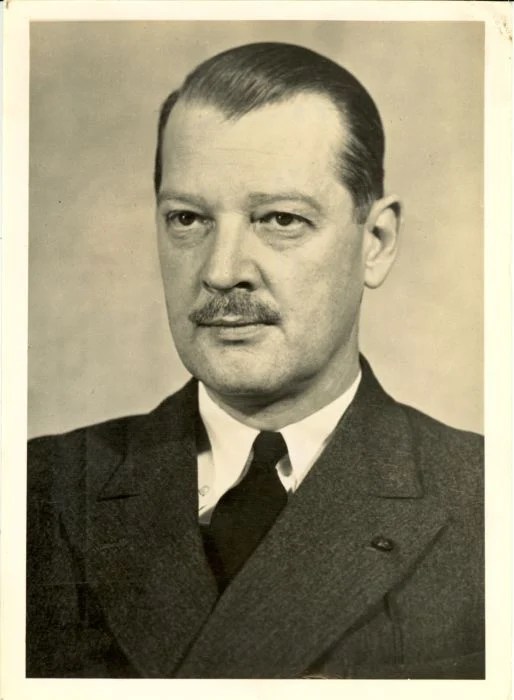
The story of a Swiss Government foray into West Cork at the time of the Cold War has seeped into folk memory. When we settled in Ballydehob in the early twenty-first century we heard many accounts and – as is often the case – sensation takes preference over sober fact. Nevertheless, the tale is worth telling, and I have set out what I perceive to be accurate. It all centres around the man above – Colonel Albert Bachmann – and two locations: Murphy’s Cove, Tregumna, and Liss Ard House, just outside Skibbereen.
Contrasting atmospheric conditions: Murphy’s Cove, Tregumna, on this misty October day (upper pic) and Liss Ard House on a beautiful June day in 2021 (lower pic). Our story properly begins in 1962 . . .
The cover of Esquire magazine, January 1962 features an article headed ‘9 Places in the World to hide’: one of these places is “Cork – Ireland”. In fact, the article suggested that Cork was considered the safest place in all Europe in which to hide from the predicted nuclear holocaust. I was a teenager in the UK at the time, and remember the worries of everyday life through that year – in particular the Cuban Missile Crisis. 1963 was little better – dominated by Kennedy’s assassination. We didn’t have a television in those days – friends did; but our ears were glued to our wireless sets, not knowing what to believe, or expect. Now – sixty years later – I’m older and wiser. I survived.
. . . COLONEL ALBERT Bachmann, who has died in Cork at the age of 81, was the James Bond of Switzerland. He came to west Cork in 1963, fell in love with the area and bought property there. At the time he was rising through the ranks of Swiss military intelligence, though Switzerland is typically seen as the world’s most neutral state with few if any belligerent enemies. Bachmann took himself on a secret mission to Biafra, then trying to secede from Nigeria, where he implied mysteriously that he was involved in secret arms deals with the Shah of Iran. He passed himself off as an upper-crust Englishman called Henry Peel who smoked a pipe, though with his Germanic accent it is difficult to imagine this disguise was successful . . . He was promoted to Colonel in the intelligence and defence section of Switzerland’s Untergruppe Nachrichtendienst der Armee (UNA). This gave him authority over three units of secret Swiss military intelligence, including a special service set up to respond to any threat of Soviet invasion, which he felt very sure could happen . . . .He hunted with the West Carberry, where he was something of an embarrassment, having his own ideas about which fields he could gallop across without the permission of the owners . . .
Obituary in the Irish Times 14 May 2011
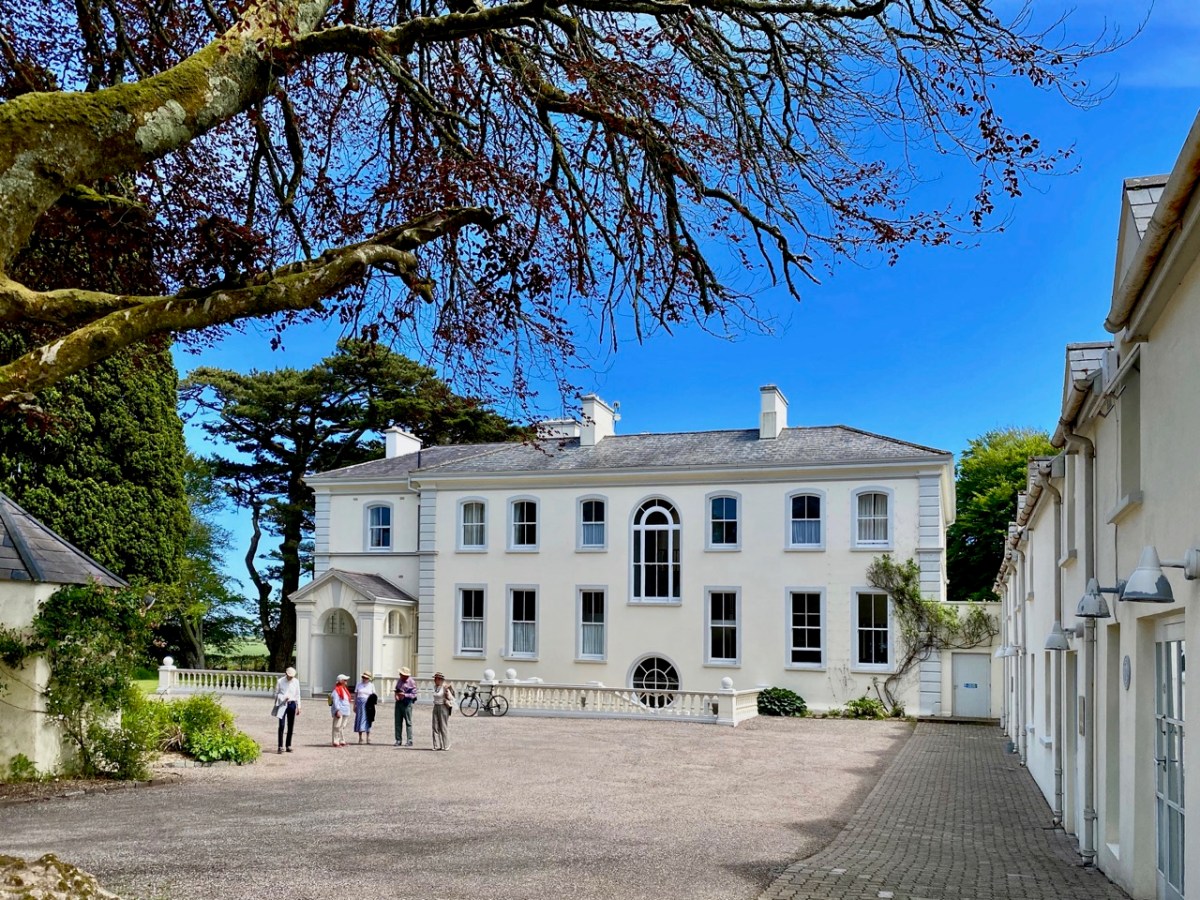
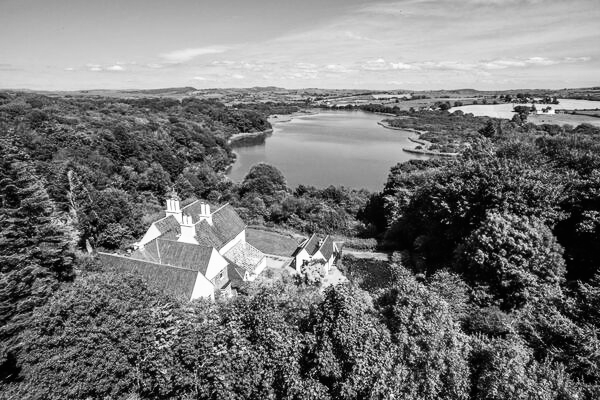
It has been said that, with Swiss military money, he bought 200 acres of land in West Cork, including Liss Ard House (above, from Skyscape). From 1976 onwards, Colonel Bachmann converted Liss Ard into an exile for the Swiss Federal Council (the governing body of the country, which has seven elected members). Known locally as “The Funk Hole of Europe”, it was equipped with all modern high-tech computer facilities long before such equipment was widespread in Ireland. The cellars were dug out and strengthened to store the massive Swiss gold reserves that the government would bring with them.
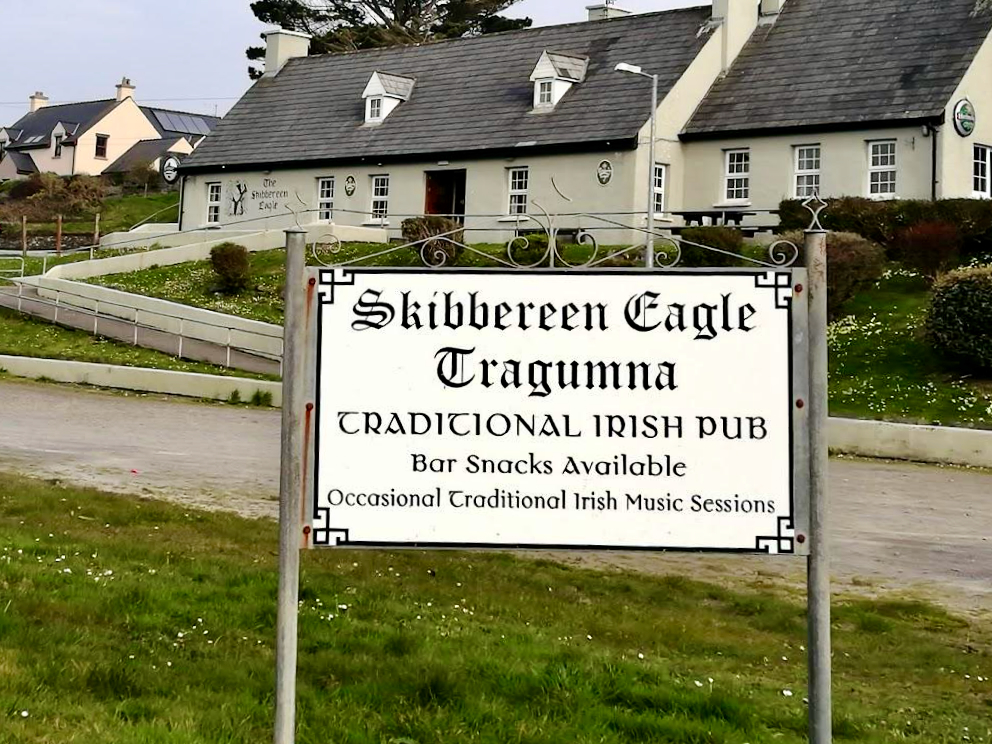
Above are some of the cottages in Murphy’s Cove that Bachmann bought, possibly also with Swiss money. Ostensibly they were to house fleeing diplomats in the event of the predicted collapse of civilisation. The Colonel’s interests, however were not always related to the Cold War. He set up a pub in Tragumna, the Skibbereen Eagle: named after an infamous local newspaper. Rumour has it that the kitchens were oversized because they would have to feed the exiled envoys. It’s still a popular establishment.
In fact, the more you try to delve into the life of Bachmann, the more enigmas you encounter. Some reports say that he raised the money himself to purchase Liss Ard: the historian Titus J Meier showed in a book that Bachmann acquired the property on the west coast of Ireland with the help of private and institutional sponsors. The Swiss Government only paid annual rent twice, each time amounting to 50,000 francs.
. . . Bachmann was obliged to retire in 1980. An official investigation criticised P-26 [a Cold War stay-behind army in Switzerland charged with countering a possible invasion of the country] as an illegal paramilitary programme, operating as a clandestine, parallel structure within the Swiss security network, and lacking governmental authorisation or control. When Bachmann’s secret army was finally dismantled, its war chest – gold worth six million Swiss francs – was donated to the Red Cross. But he always insisted that it served a vital function. “How vital,” Bachmann told the reporters who sought him out, “I cannot tell you.” . . .
Bachmann’s Obituary in The UK Daily telegraph
Another view of Liss Ard Estate (courtesy Irish Examiner)
Esquire Magazine January 1962
Col Albert Bachmann: born November 26, 1929; died April 12, 2011
Welcome to the UCD Library Cultural Heritage Collections blog. Discover and explore the historical treasures housed within our Archives, Special Collections, National Folklore Collection and Digital Library











 Roaringwater Journal