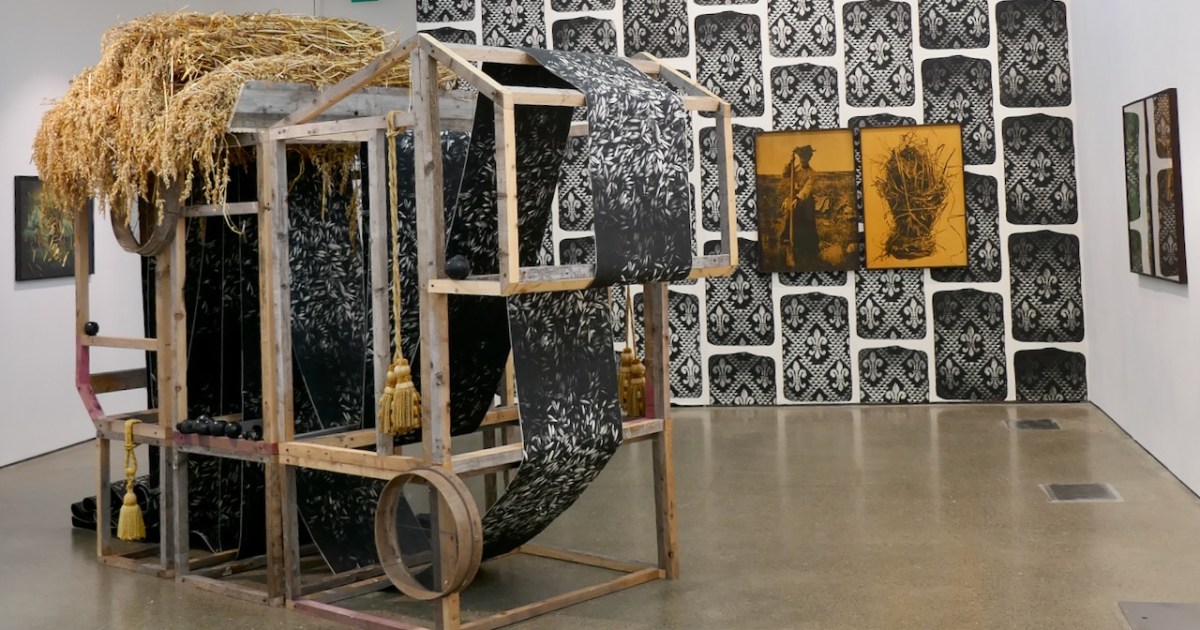
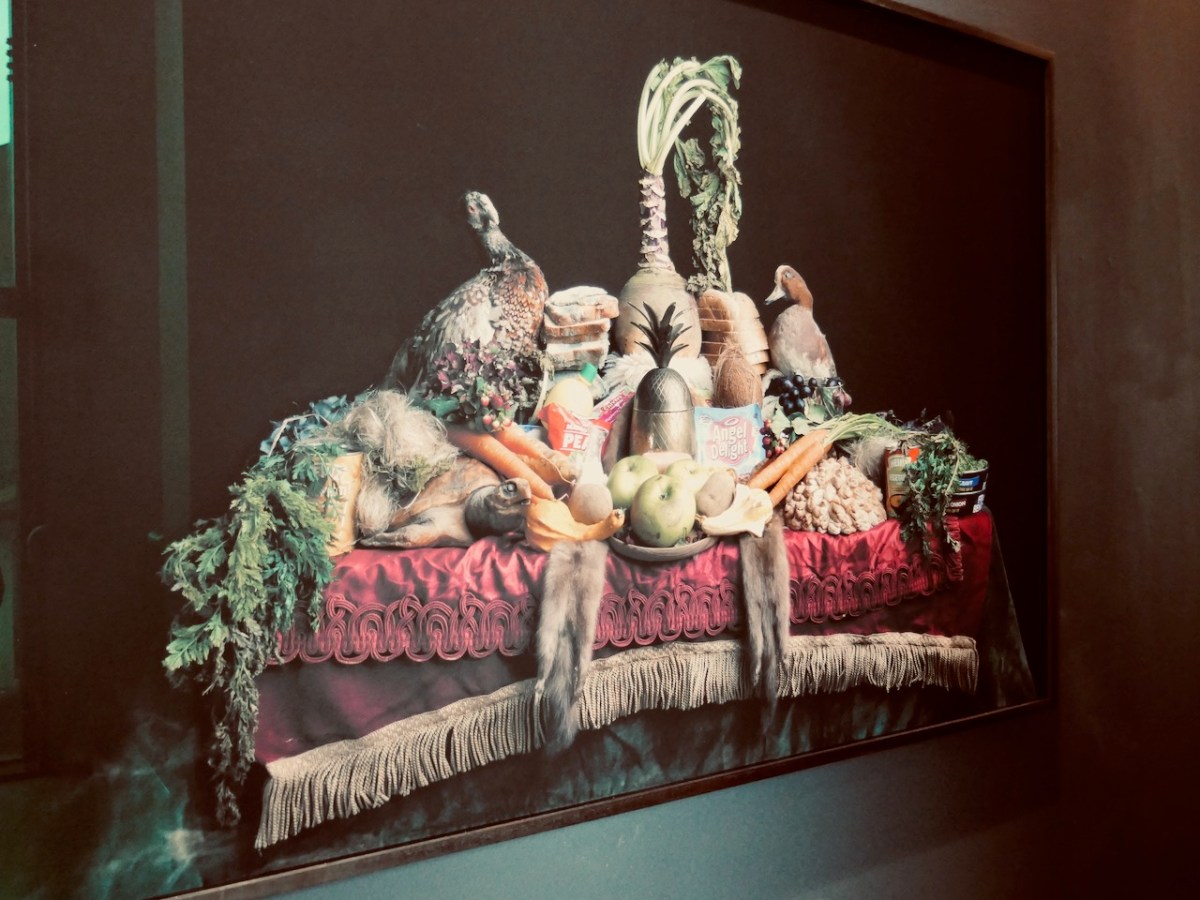
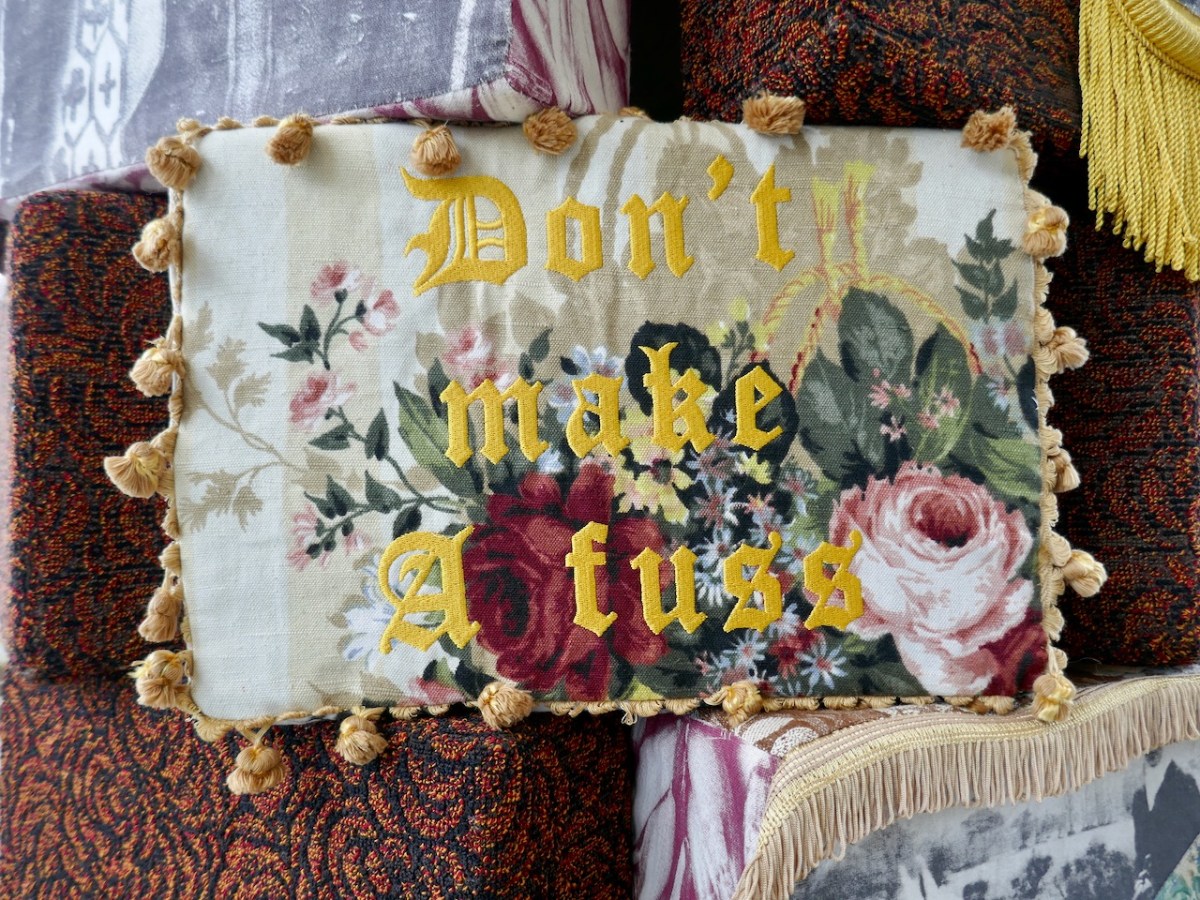
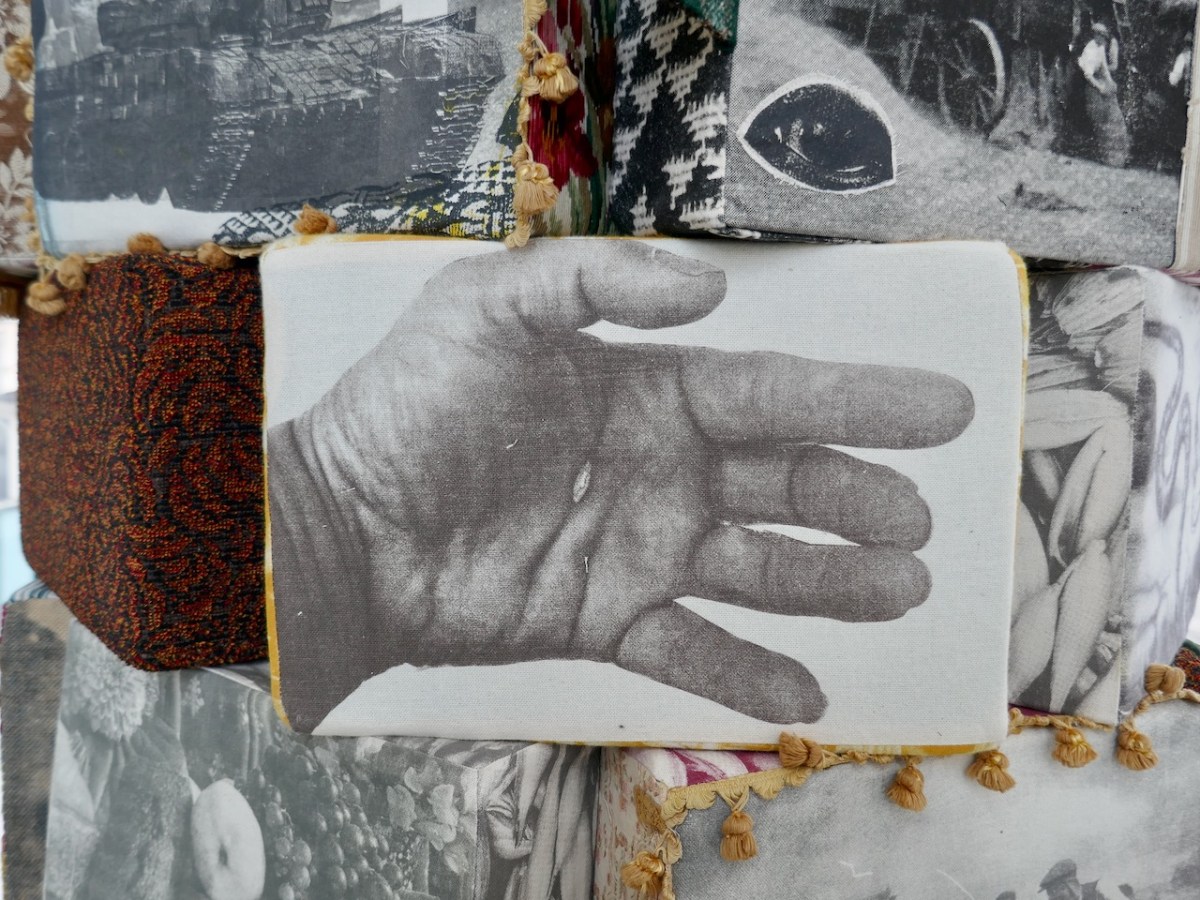
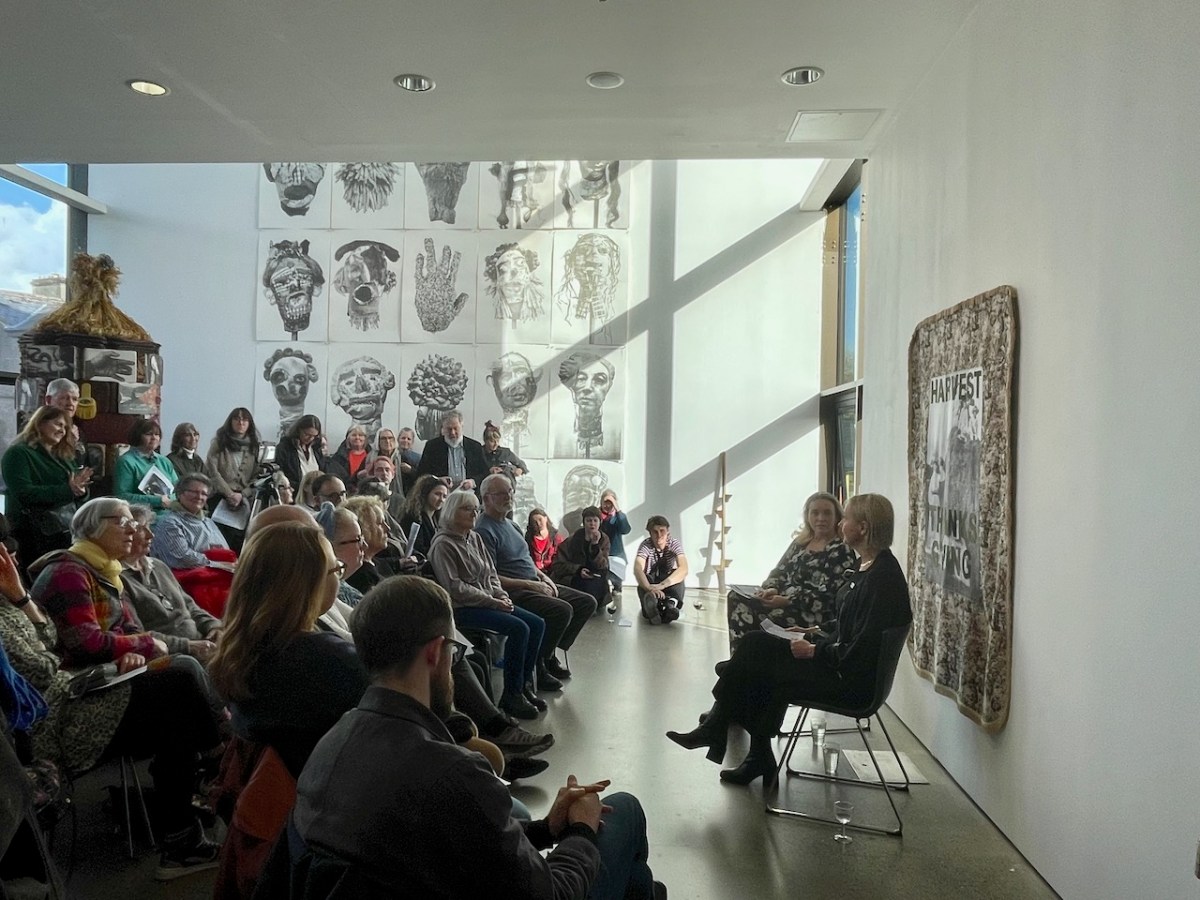
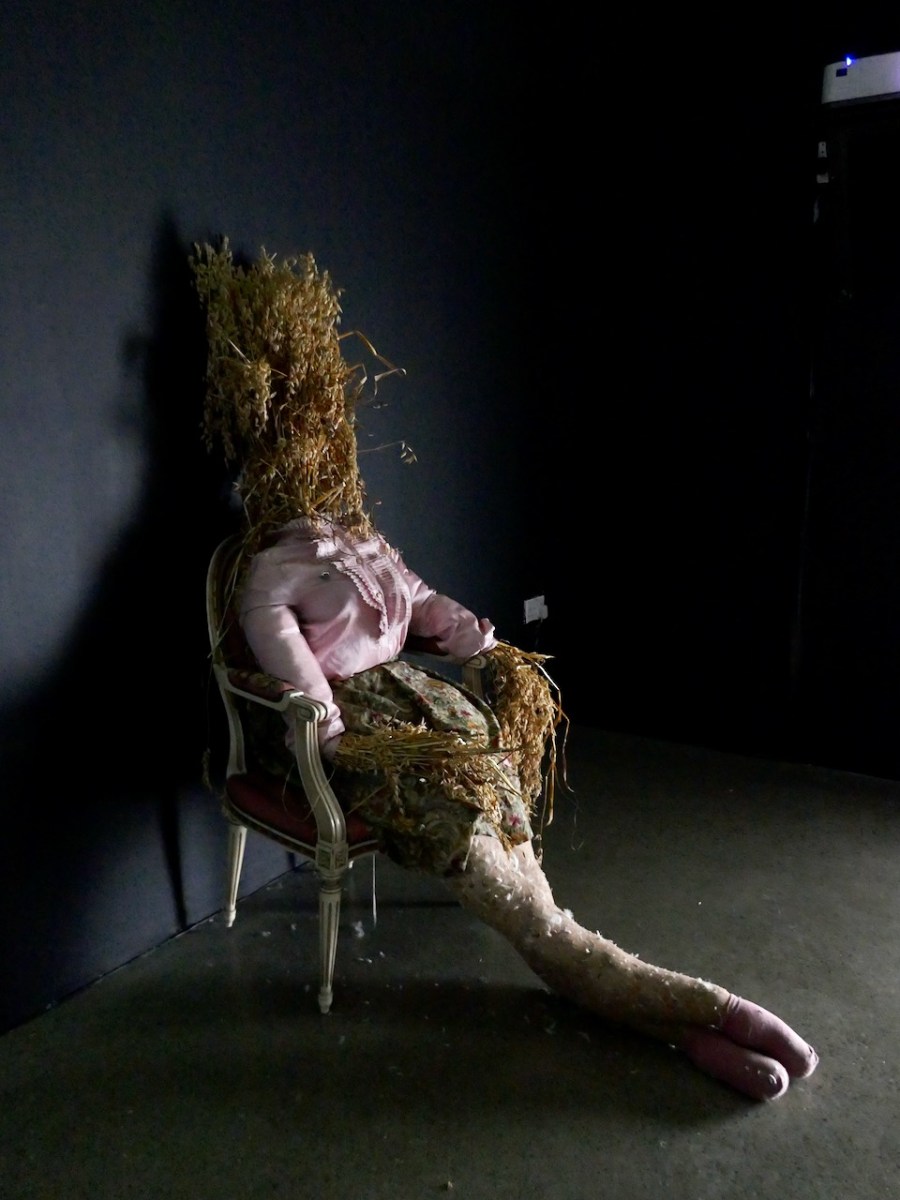
It’s not often an art exhibition has me running to my word processor to get a post out, but this one did it for me! On the surface, this is a quirky, amusing, thought-provoking, installation about the annual Harvest Festival, as practised in the autumn in Church of Ireland communities all over Ireland. Except it’s so much more than that. It’s titled Flail, and it’s on right now at Uillinn.
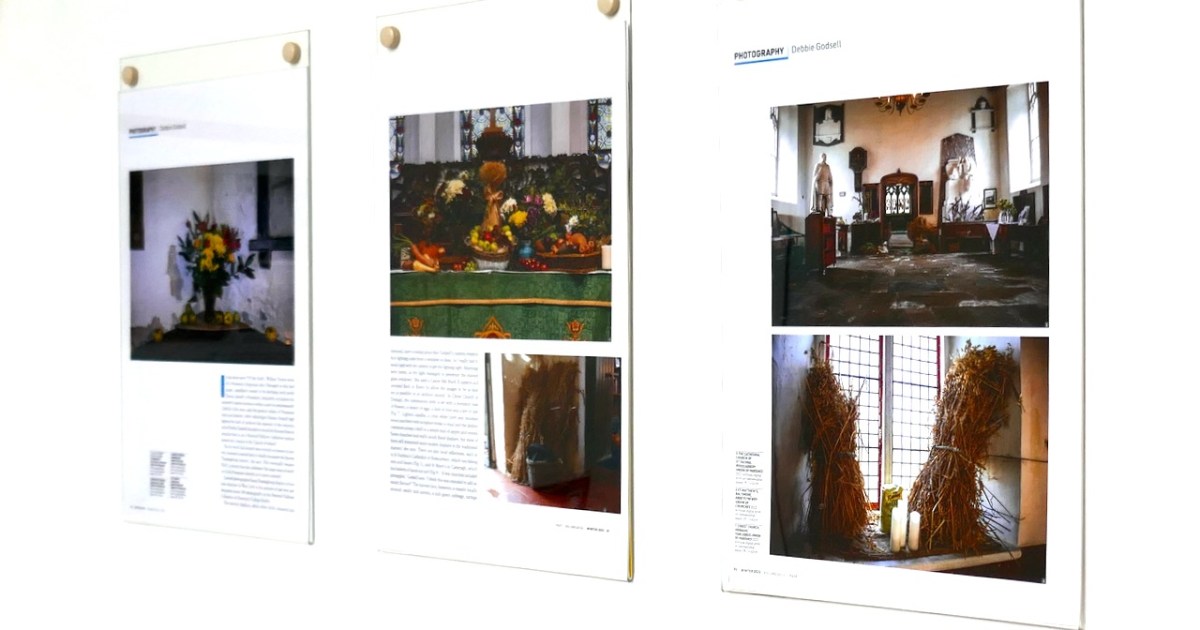
Debbie Godsell has taken the idea of the harvest festival and the communities that celebrate it, and turned it into a personal exploration of her own experience with it, as a child growing up in the C of I, and as a photographer recording the custom of decorating churches. In Ireland, this is a custom unique to the Protestant church – the minority religion. As such, there’s a strangeness to it when viewed by someone who grew up Catholic. Not strange in the sense of peculiar, but in the sense of unknown, slightly other-worldly, why-have-I-never-known-about-this?
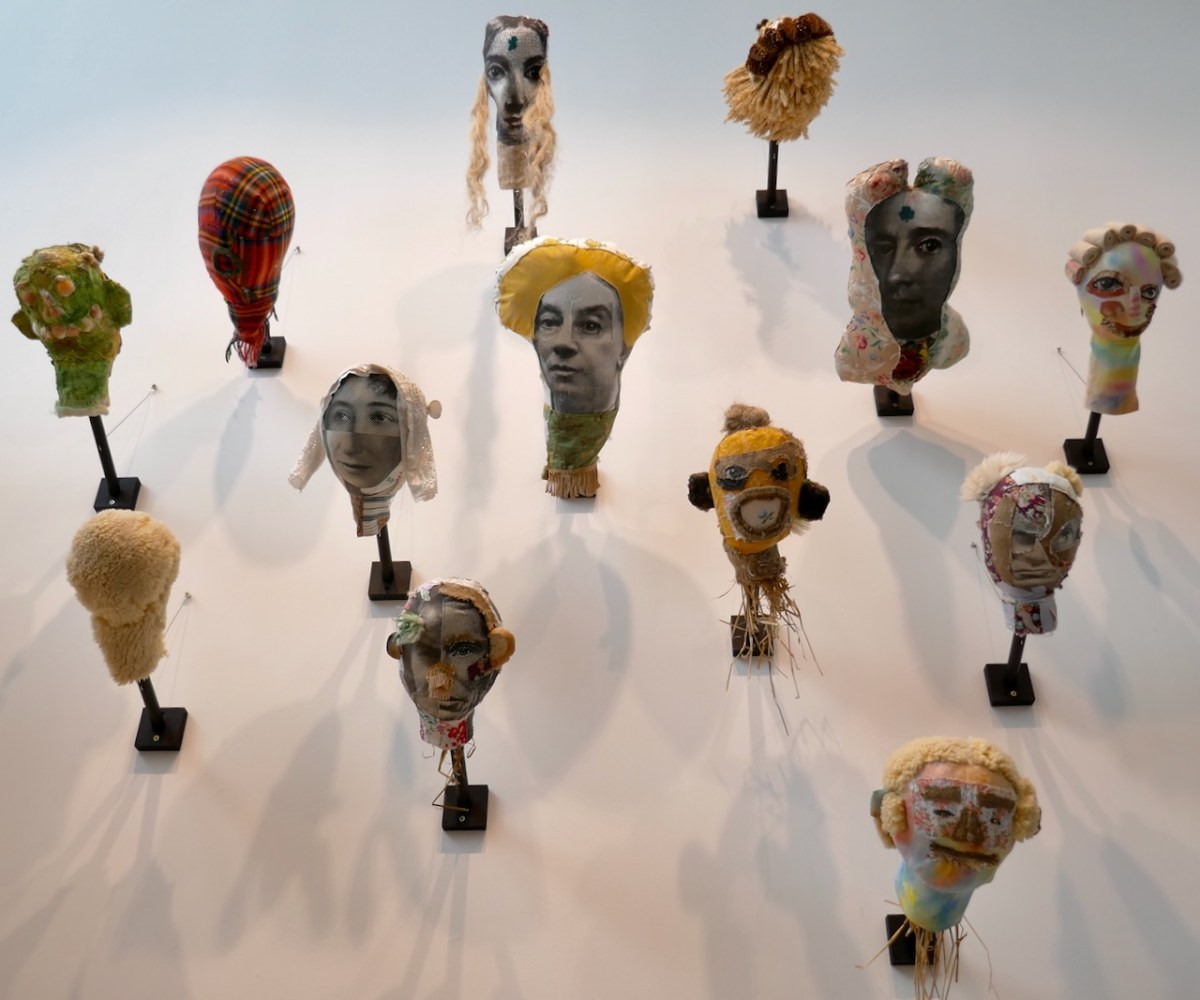
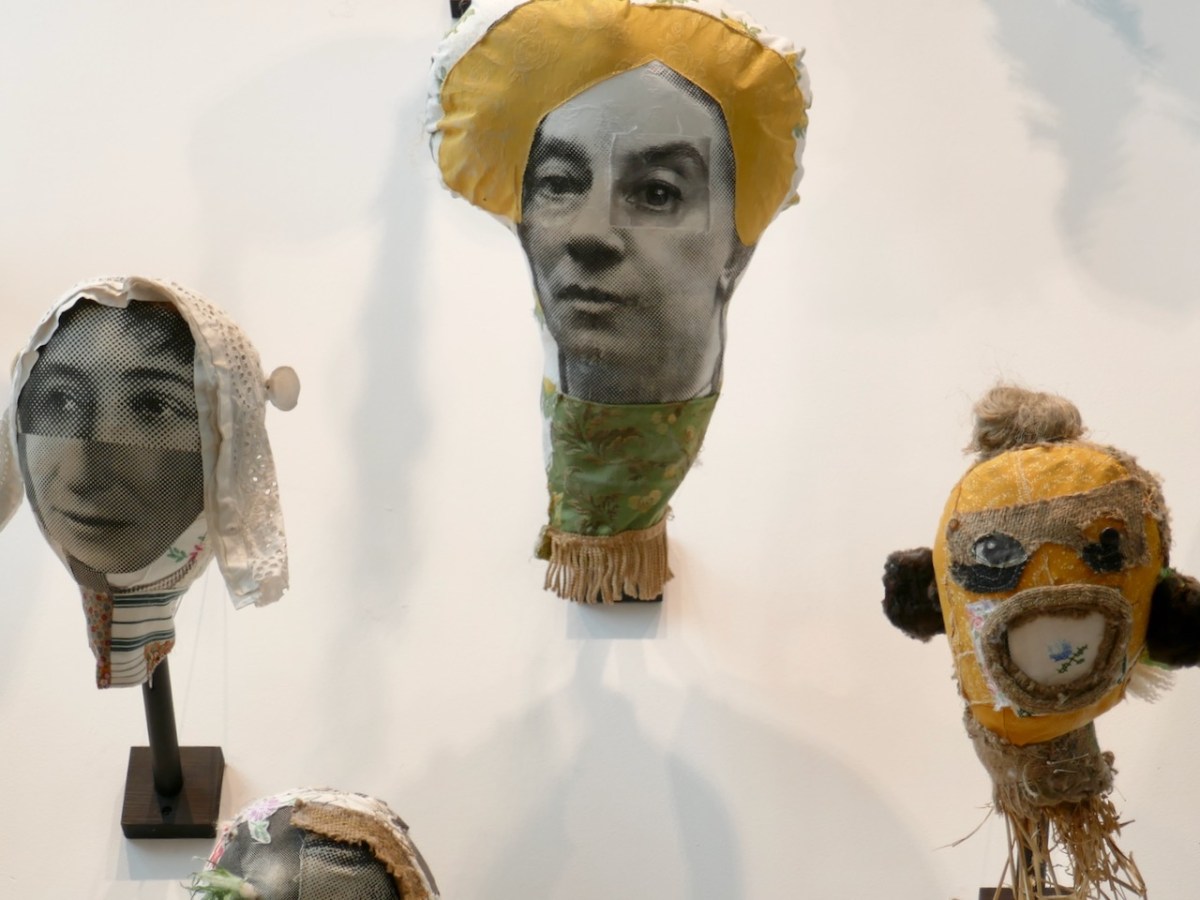
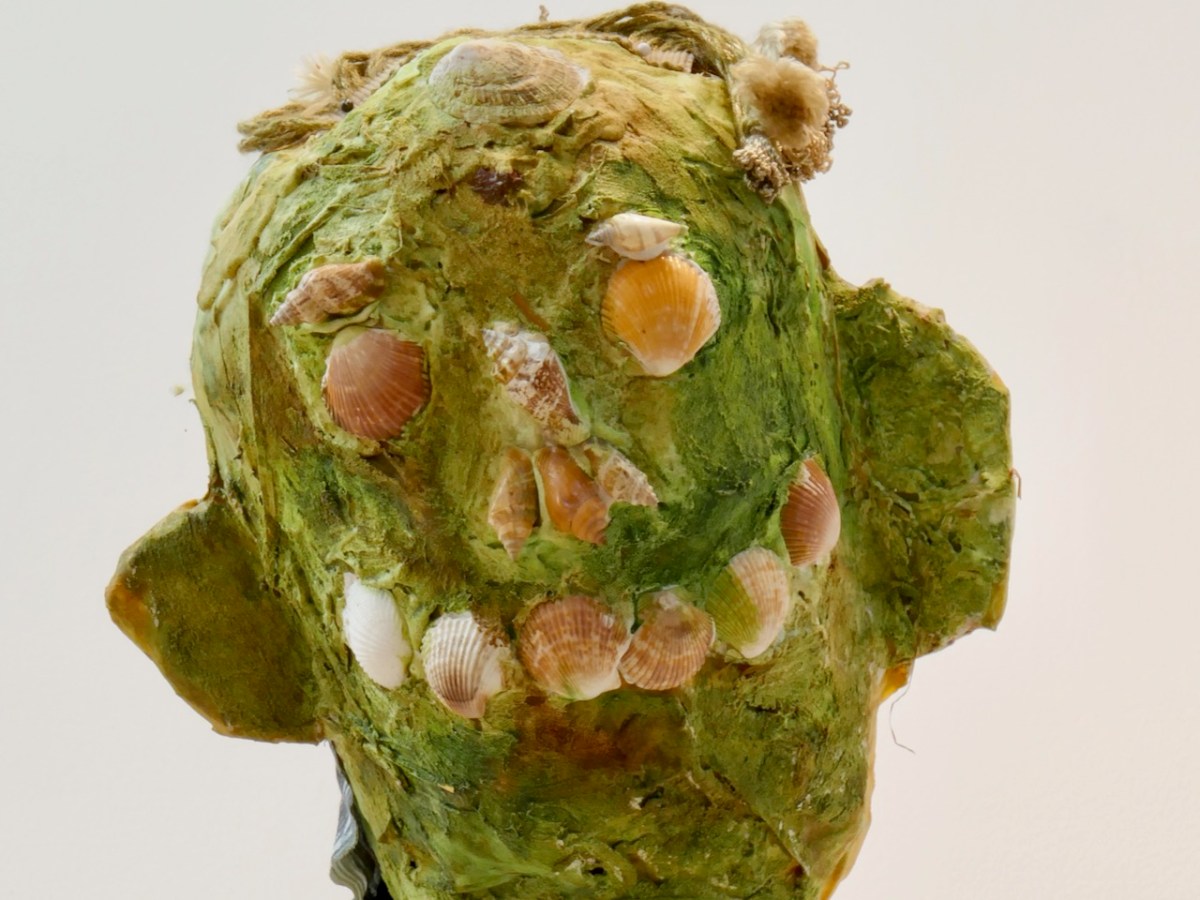
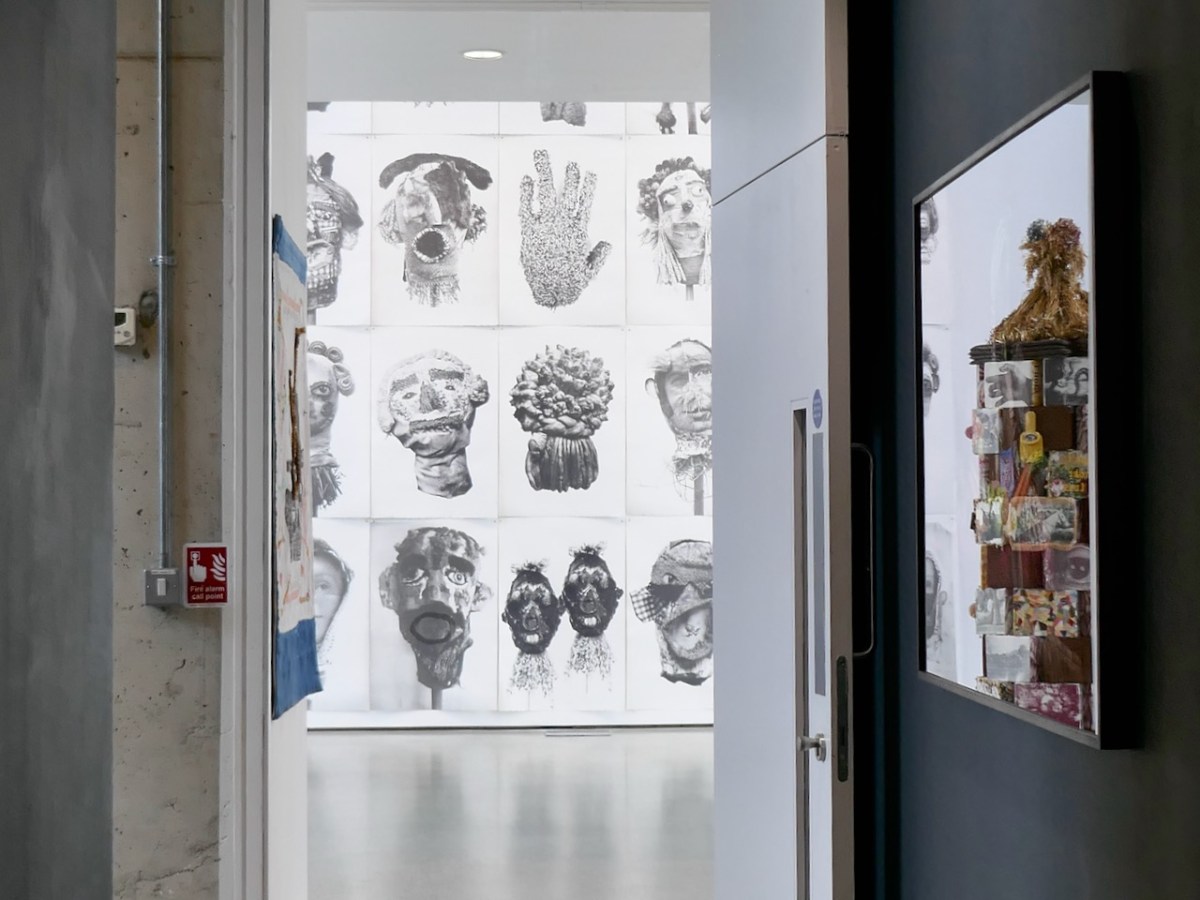
But yes, it is quirky and amusing. Just take a look at these heads – they are the first thing you notice when you come in, titled ‘Ancestors’. Made from all kinds of found materials, some represent real people (hello, Great-Aunt Molly!) although most are simply heads – a bit like you might find on a scarecrow out in the fields around harvest time.
But after the first encounter you realise that this also of course, is the thought-provoking part of this exhibition Now you notice that they are on sticks, mirroring perhaps the heads on pikes that seemed to spell the end on many rebellions against English rule down through the centuries. In her notes, Godsell states:
Here,the heads take on an unsettling childlike quality, drawing from elements of folk drama and ritual. Rudimentary in form, they are a fusion of figures from Irish history and the artist’s own imagined lineage. Blurring the line between historical facts and personal mythology, the work interrogates themes of memory, identity and inherited trauma, challenging how history is constructed and remembered.
What does it mean, in Ireland, to be part of a minority religion? What has it meant in the past, and now? What if that religion was perceived to track closely with class, and land ownership, and unionist sympathies?
We pride ourselves, in Ireland, now, on being a pluralistic and non-sectarian society. But if that is true at all, it is only recently so. The Ireland I grew up in – in the 50s and 60s – was deeply sectarian. Protestants and Catholics rarely mixed and we were forbidden, on pain of sin, to enter each other’s churches. We were educated separately, played some different sports (Anyone for lacrosse? How about men’s hockey?), sounded different, went to separate Brownie troupes, studied different curricula at school . . .
This exhibition explores the harvest-related parts of that separateness, but the opening, in which Debbie Godsell was interviewed by art critic Cristín Leach, also featured a discussion on folklore and a hymn by Cristín!
Cristín has said that Flail is ‘complicated territory’ for her and the hymn, Harvesting History, sprang almost spontaneously from engaging with the first Flail exhibition. It has been beautifully set to music by Susan Nares, and the West Cork Choral Singers presented it at the opening. Here’s a snippet.
I was particularly fascinated by the folklore discussion. As Roaringwater Journal readers know, we have used the Duchas/Schools Folklore Collection extensively over the years. One particularly important piece of research for me was to look at what it had to say about the Reverend Fisher – Saint and/or Souper of Toormore. What I found was a little shocking and it opened my eyes to an aspect of this wonderful resource that I had never previously considered – the decidedly sectarian nature of the collections. While some Protestant National Schools did participate in the School’s Collection of 1937/38, Protestants are very under-represented as informants. See this excellent article from History Ireland for more on this*.
Cristín and Debbie talked about the prevailing view of Protestants as seen in the overwhelmingly Catholic responses in the Collection – and it wasn’t a pretty picture. As I discovered with Fisher, and as Amanda has discovered with Holy Wells Folklore, the Protestants are basically blamed for anything misfortunate or discreditable – some examples here, and here and here.
Go see this exhibition if you can. It’s fascinating, but more than that, it’s important. We are still trying to come to grips with our history, in Ireland. Art like this helps immeasurably.
* A ‘Protestant folk’? Author(s): Deirdre Nuttall and Críostóir MacCarthaigh Source: History Ireland , Vol. 25, No. 5 (September–October 2017), pp. 48-51 Published by: Wordwell Ltd. Stable URL: https://www.jstor.org/stable/10.2307/90014607
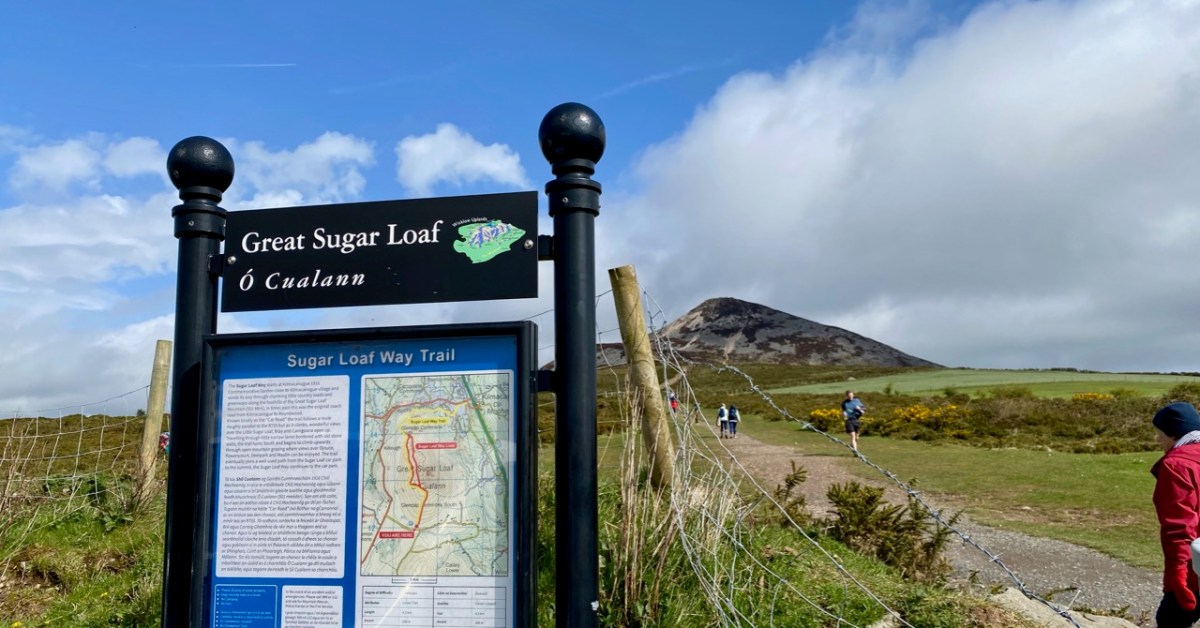
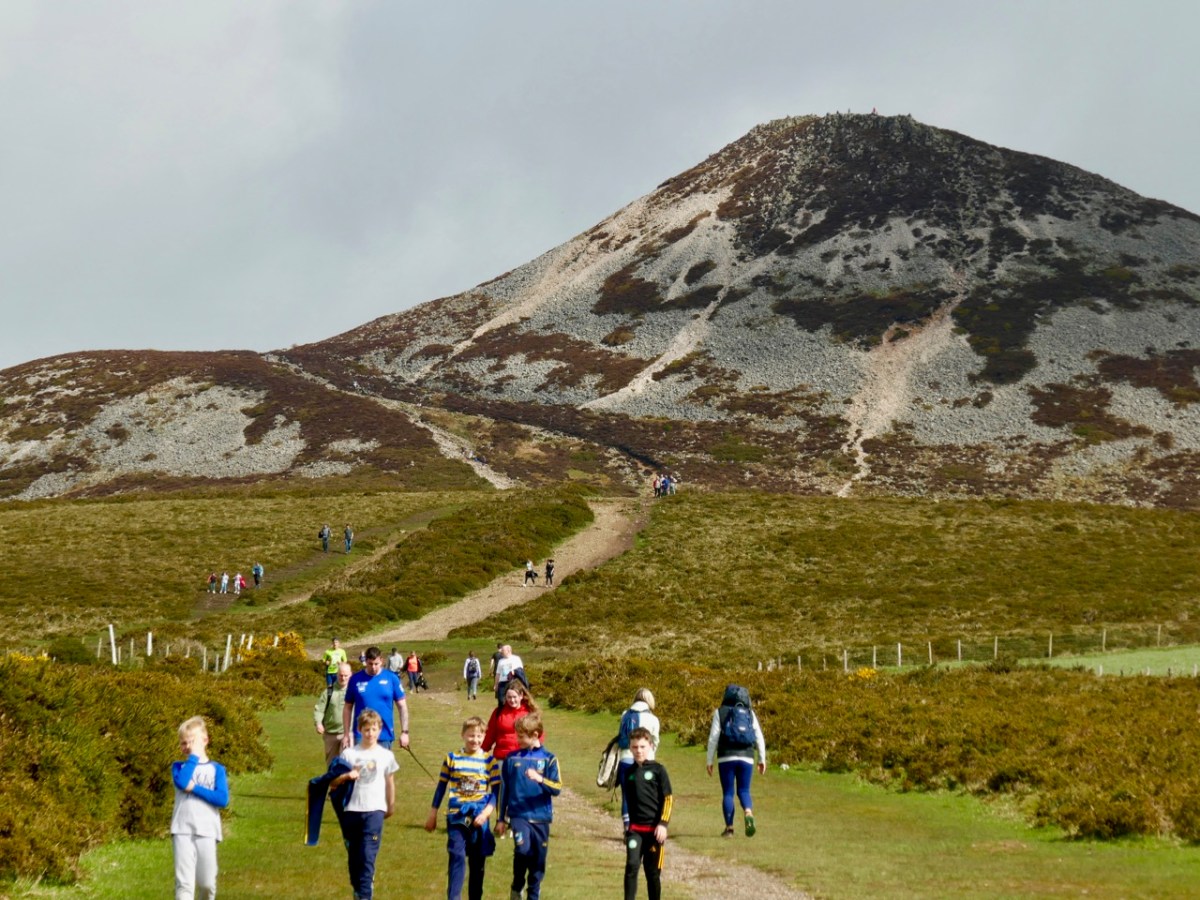
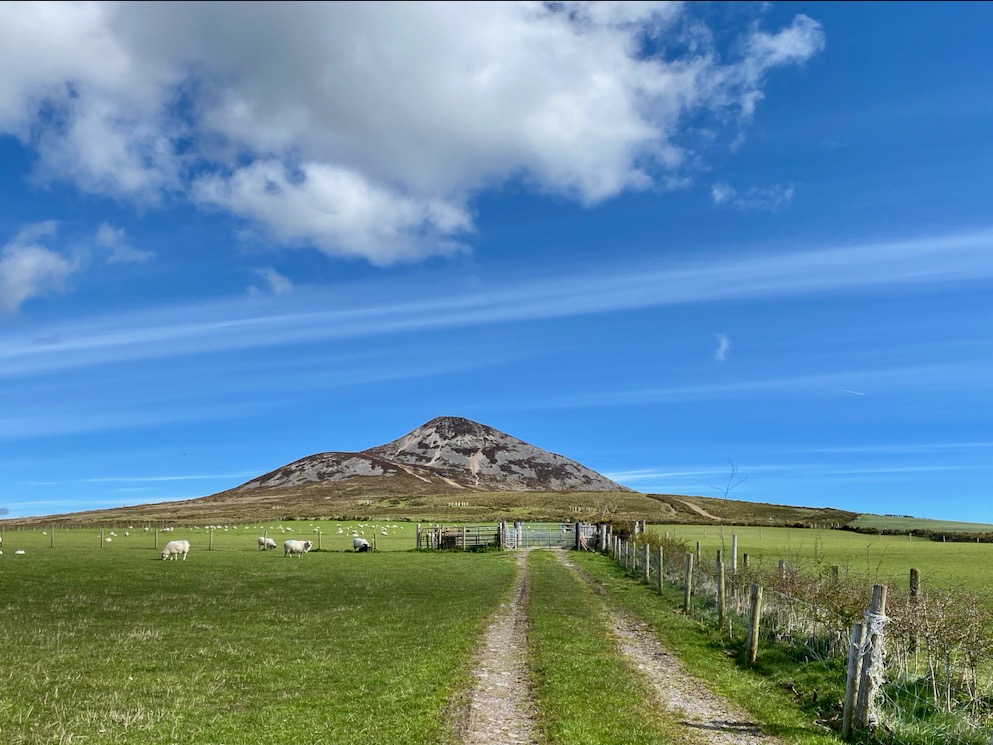
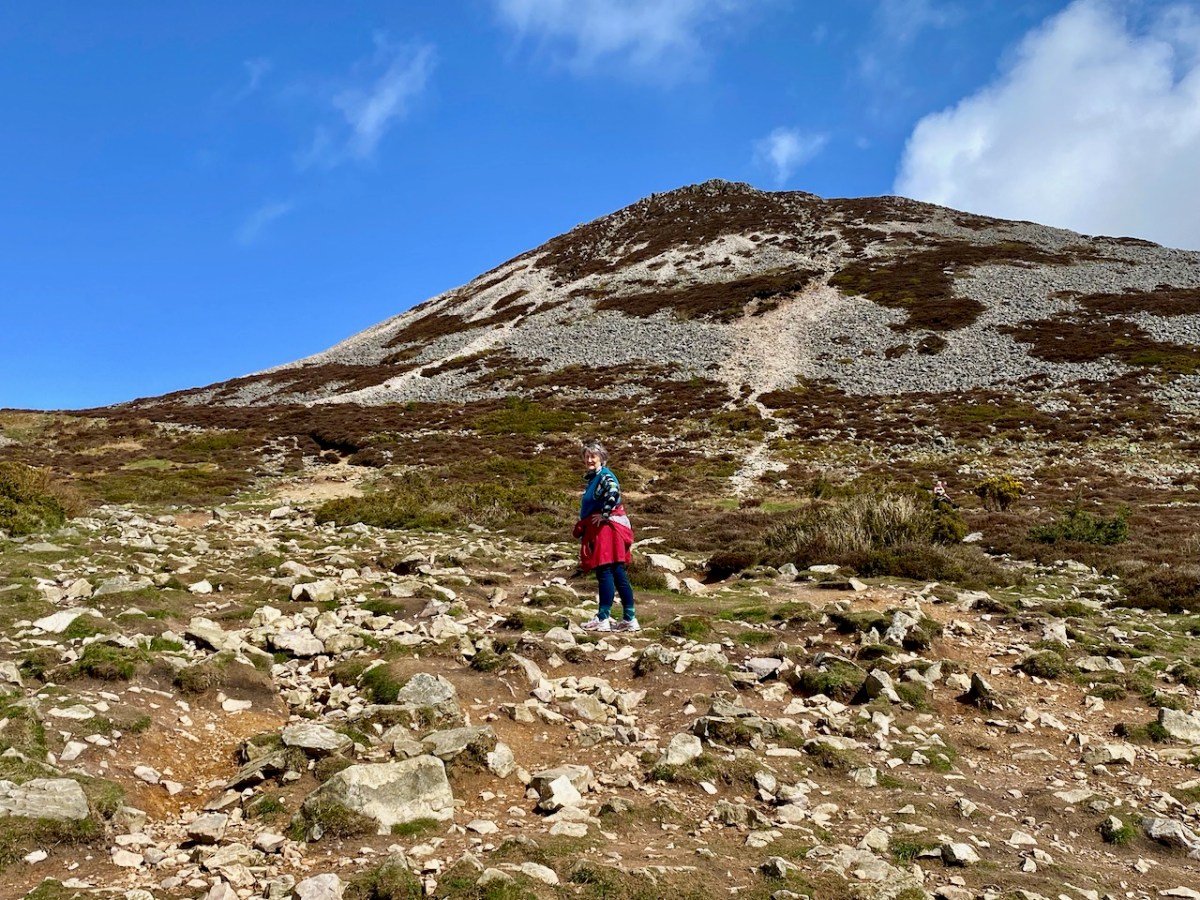
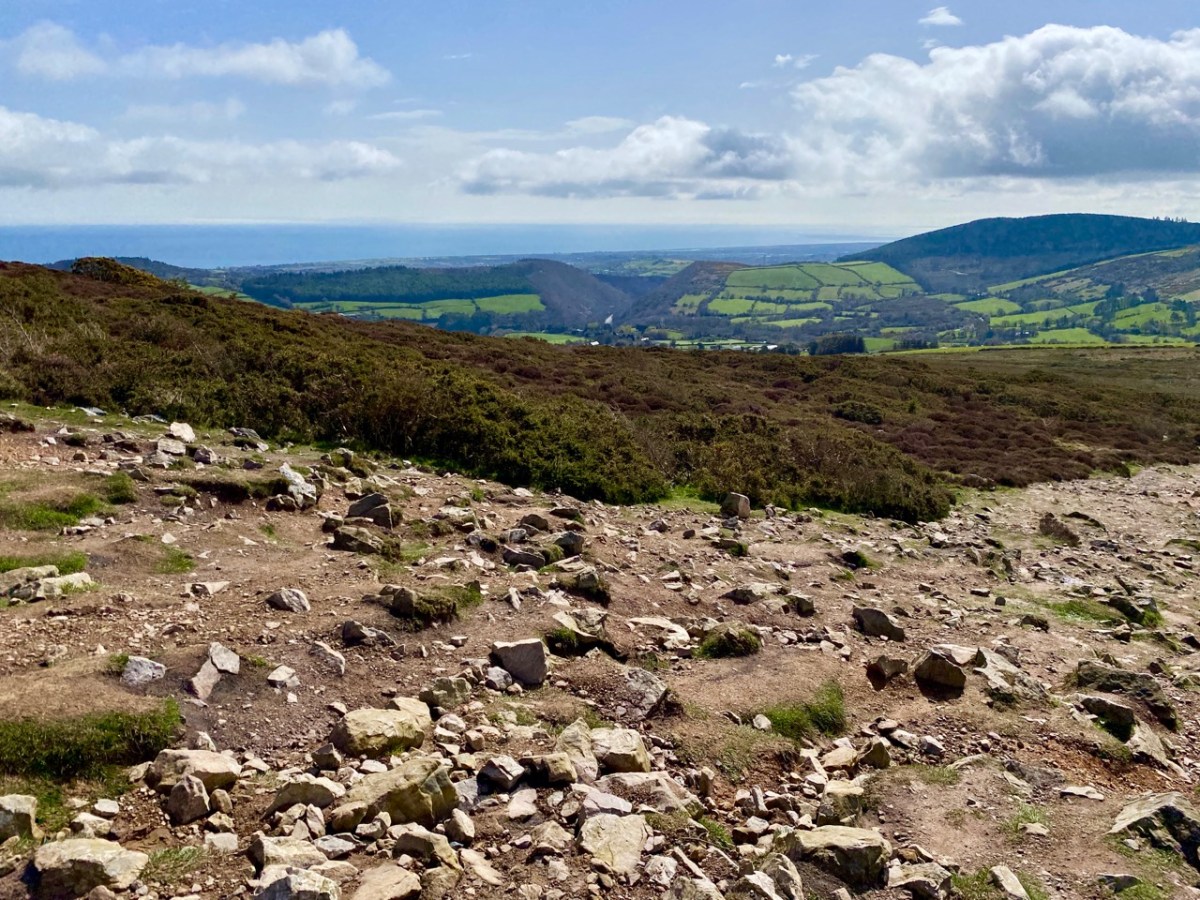
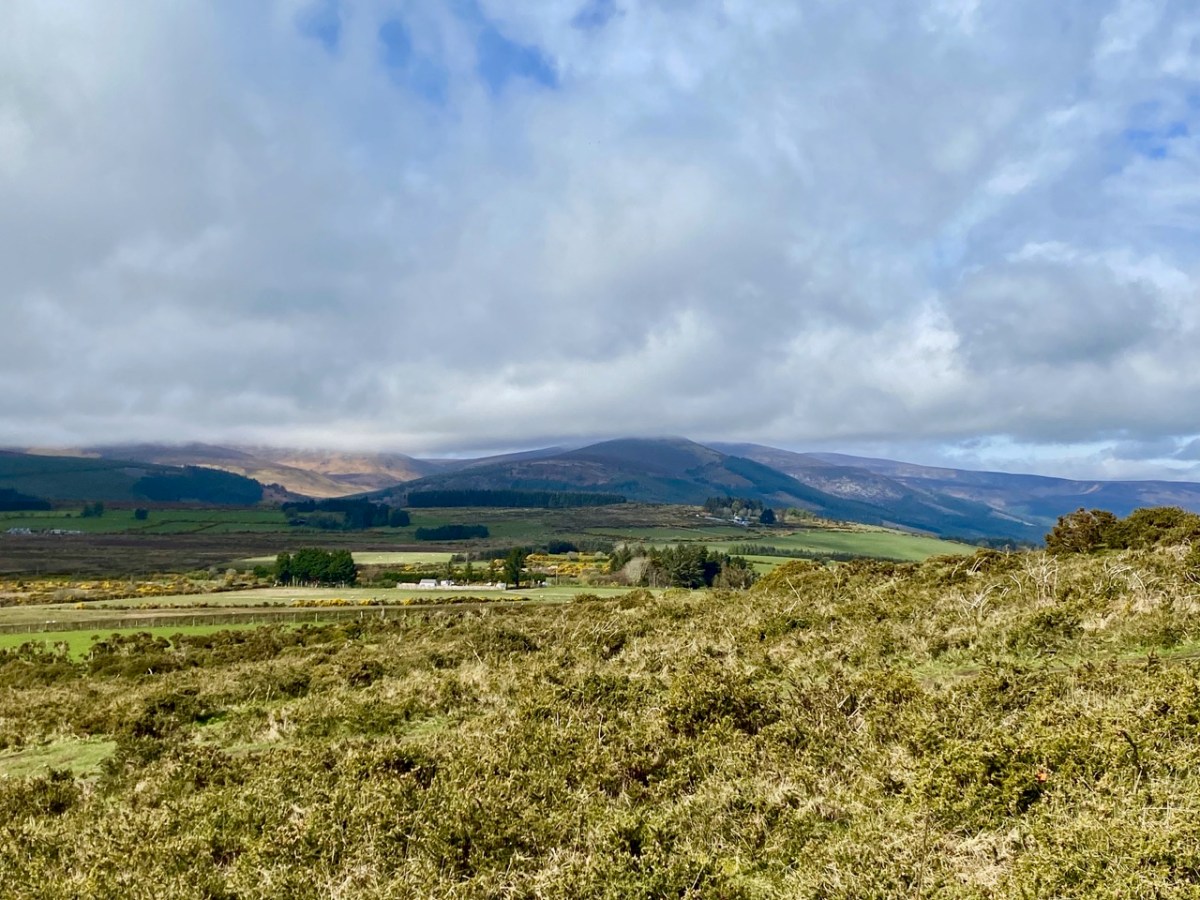
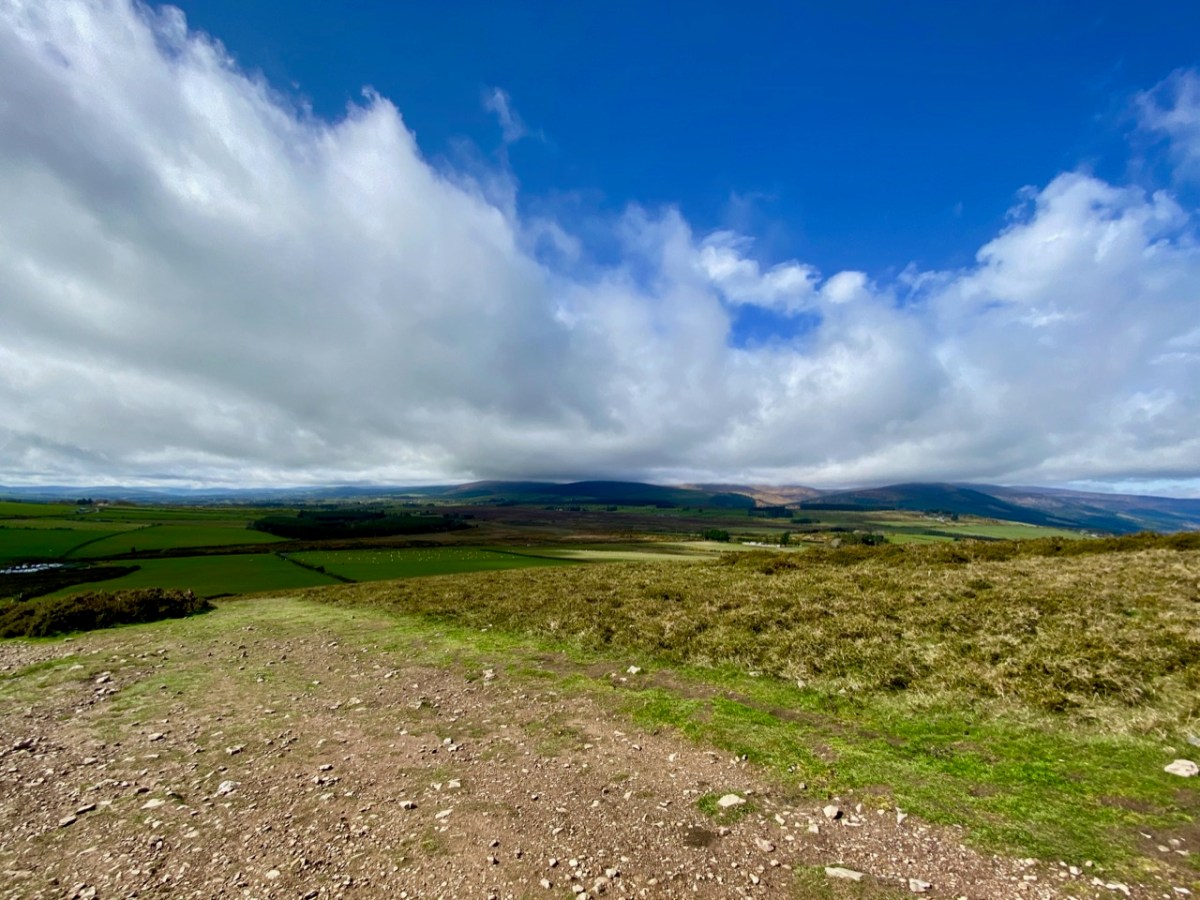
We were unexpectedly in County Wicklow, and had a day or two of sunshine. To take advantage of this, we found our way up to the Great Sugar Loaf, with every good intention of climbing to its peak – 501 metres above sea level. I’ll come clean and mention that the starting point for the walk is already halfway up this elevation – and also we didn’t make it all the way on this occasion, as we were heavily overdressed! Only yesterday we still seemed to be in the grip of a very harsh winter, so had assumed that gloves, scarves and thick jackets would be the order of the day. In fact, quite a few other climbers were clad in tee shirts and shorts…
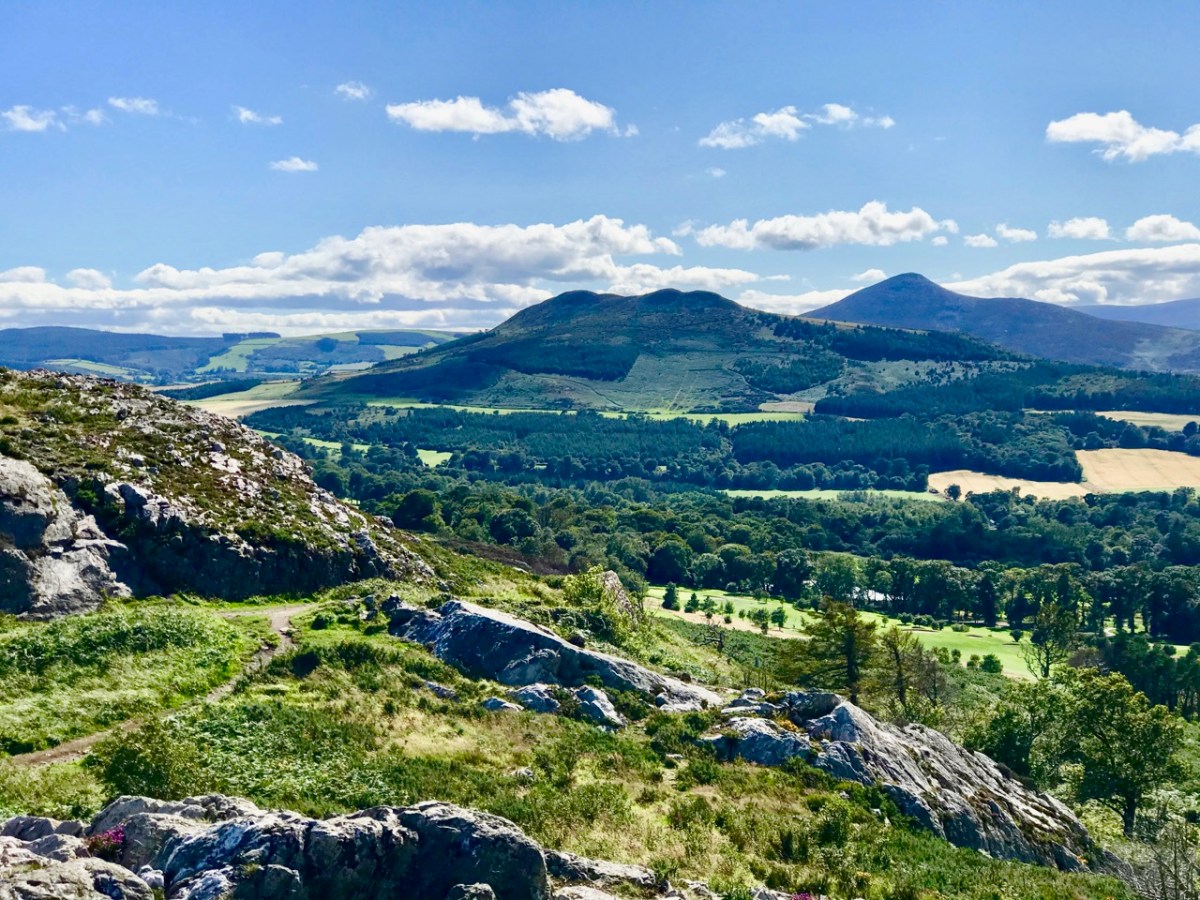
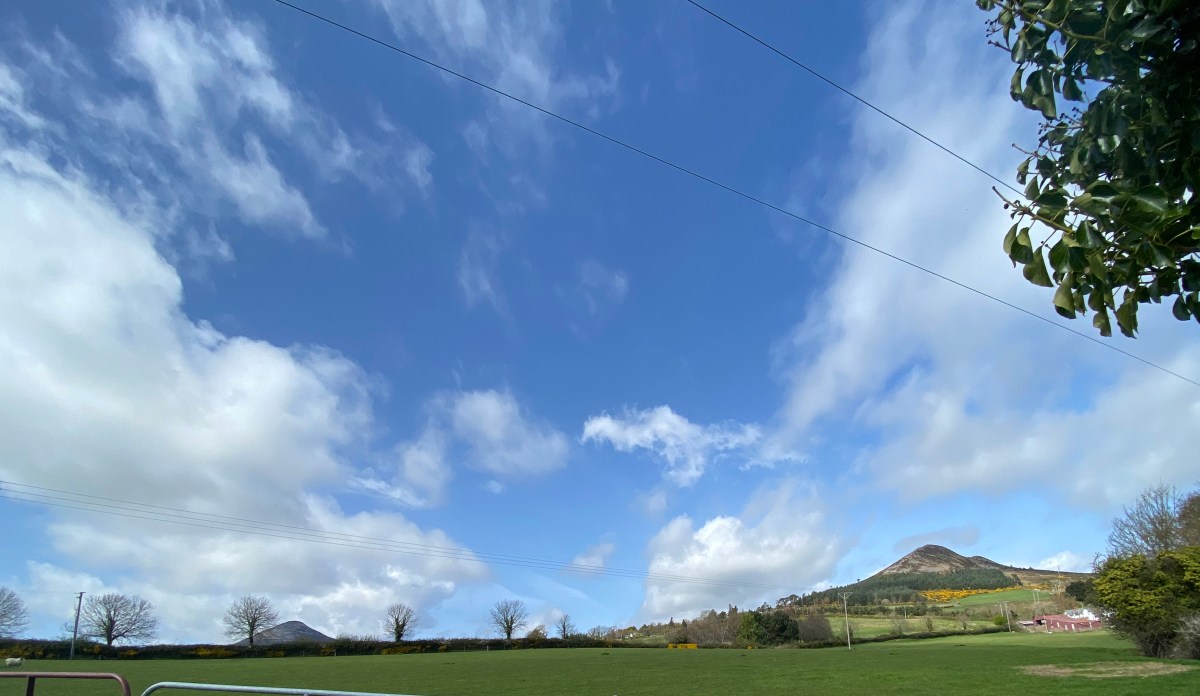
The upper view was taken on the path going up to the top – this morning. The lower view – taken a couple of years ago from Bray Head – gives a good impression of the Great Sugar Loaf (the furthest peak on the right) as the high point in a range, rather than a lone conical summit. There is also a Little Sugar Loaf which – in this view – is the high point in the central range in the photo. From other places, the ‘Little’ loaf also appears like a conical ‘peak’. Have a look at the pic below, where I have tried to show both ‘cones’ in the same view.
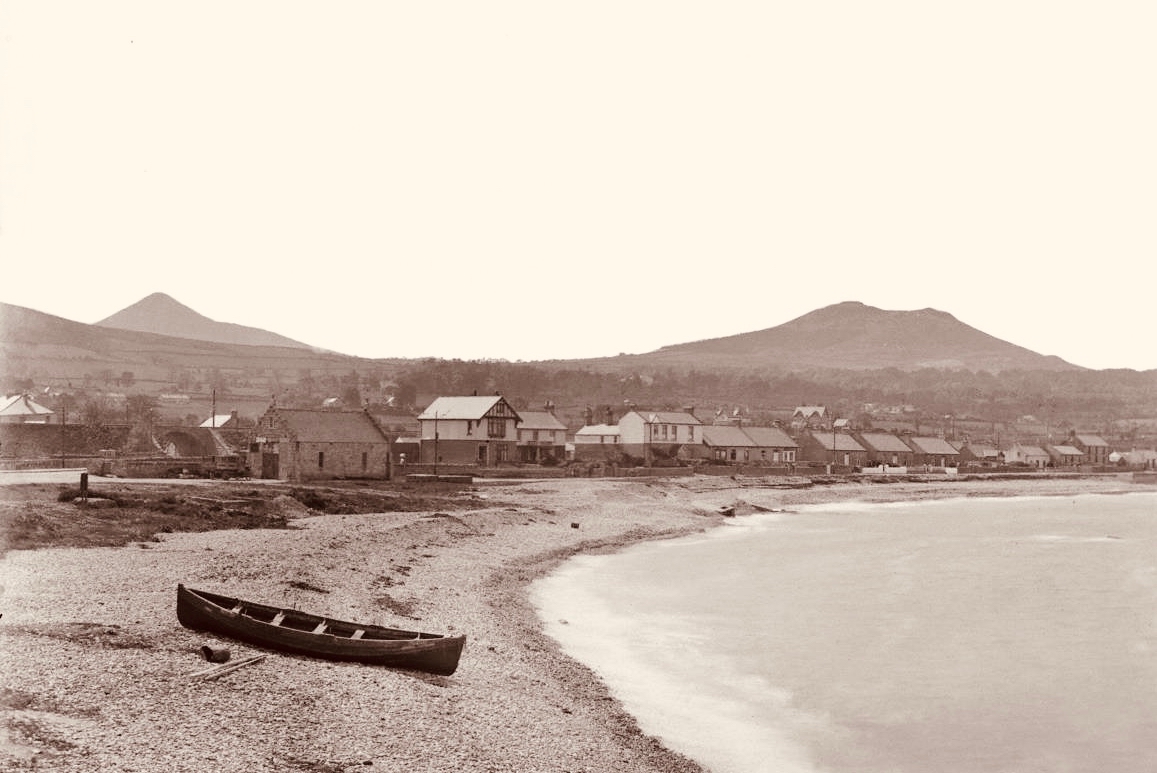
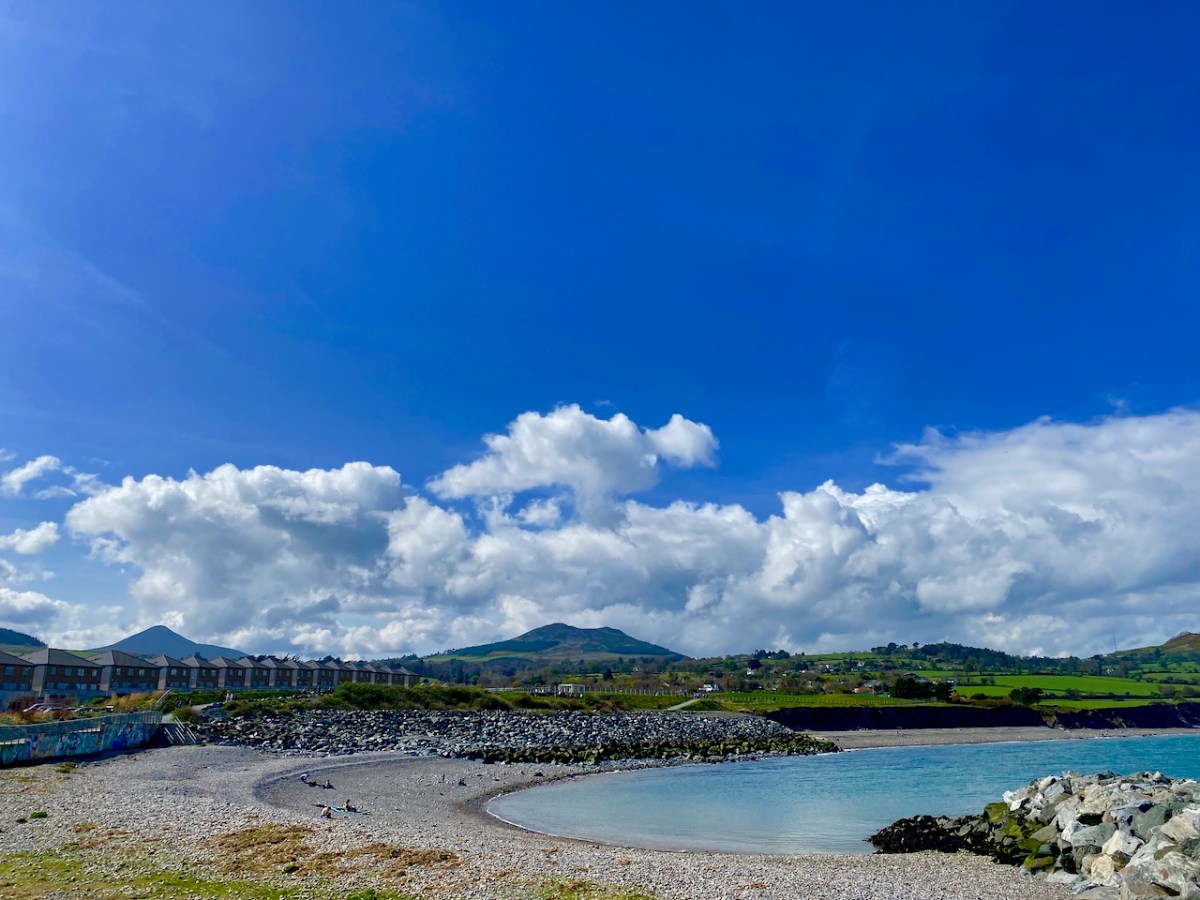
This photo, which dates from the early 1900s, is taken from the old beach in Greystones: the Little Sugar Loaf is over to the left, while the ‘Great’ one is at the left end of the further ridge (photo by William Alfred Green (1870–1958) – courtesy of Ulster Folk Museum). Below – the same view of the two ‘sugar loaves’ taken from the Marina, Greystones, today.
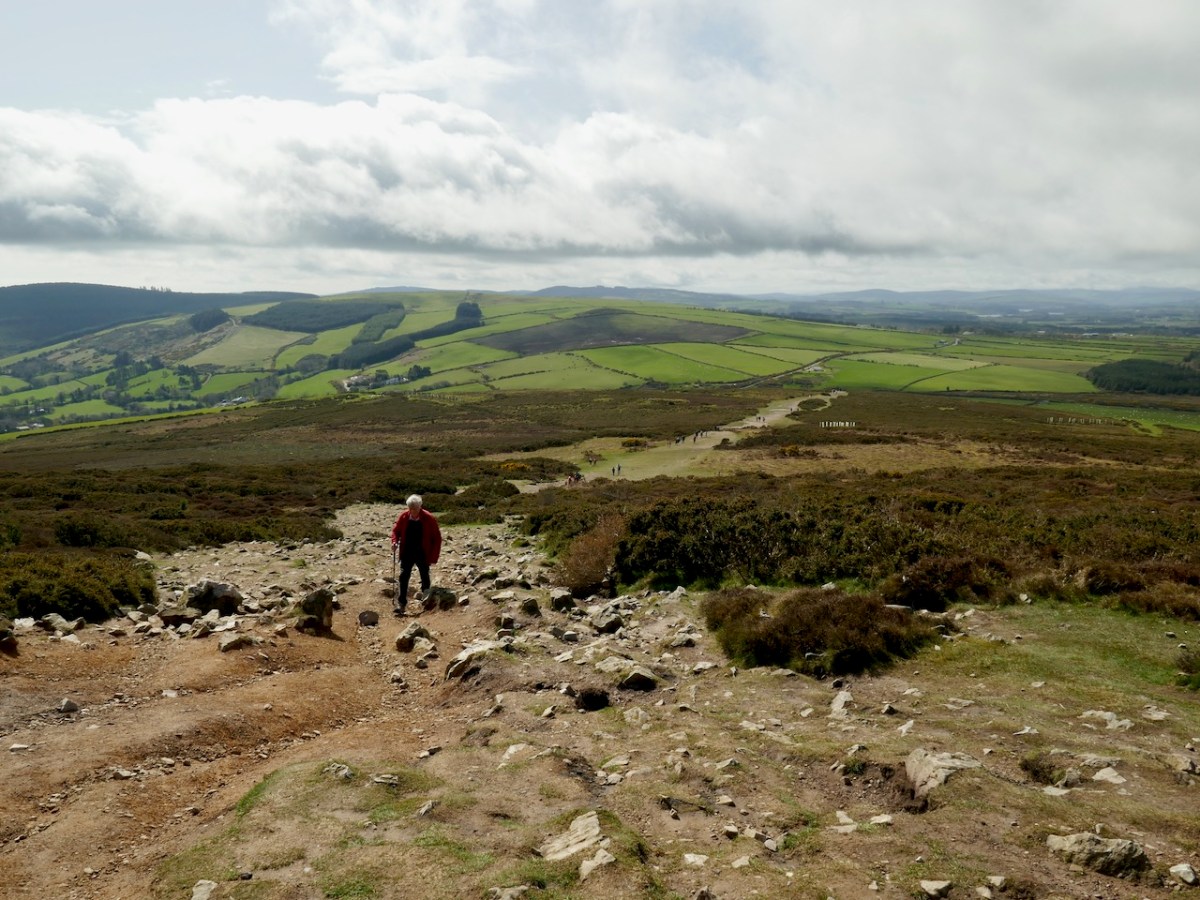
Here’s another view of the ‘Great’ loaf, with further pics of today’s adventures below, including the prospects from on the hill:
The area deserves considerable further exploration. The extracts below are from the Schools Folklore Collection, recorded in the 1930s: valuable commentary and memories collected from local inhabitants.
. . . If we were to visit Kilmacanogue over a hundred years ago it would present to us a very different appearance from what it does now. Our journey would be by the end of the Sugar Loaf Hotel of today, up the school lane, turning west for about a quarter of a mile and crossing the present day Rocky Valley road and following in a south-western direction along the foot of Sugar Loaf mountain. On our left was a church (in Brerton’s Garden) but not even the ruins of this remain. It is said the monks fled from this church in the Penal days, burying behind them their gold chalice, which still lies hidden in the field still know as the Church field. The road leading from Kilmacanogue to Kilmurry (now known as the Old Road) was the Coach Road between Dublin and Wexford. At the Kilmurry end there is a plot of ground about one acre known as Kilmurry Green which is believed to have been an old burial ground. The lane leading off from this road to the present main road near Kilmurry Dispensary locally known as Connolly’s Lane is supposed to have been lined with houses. The field on the North side of this lane (now in the possession of Miss Powell) is called the Street Field which indicates that a village must have been there at one time. The south part of Kilmurry Green contains the sites of two buildings – the stones, are still to be seen there, which marked the foundation of the gable. Traces of graves remain, though the place has not been used as a burying ground within any person’s memory . . .
Schools folklore Collection Kilmacanogue, Bray Teacher: Caitlín Ní Chuinneáin
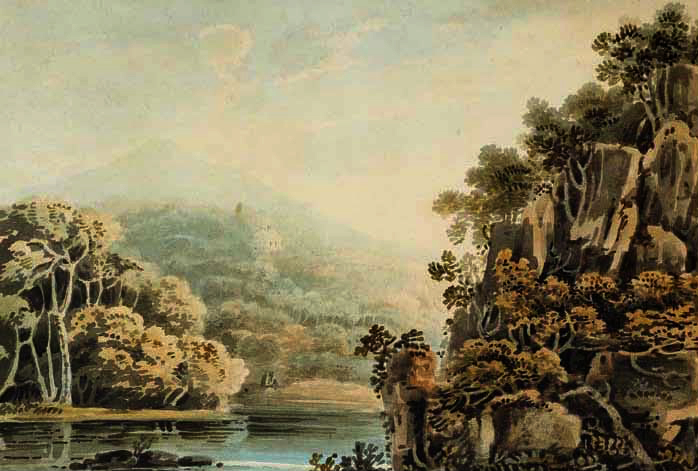
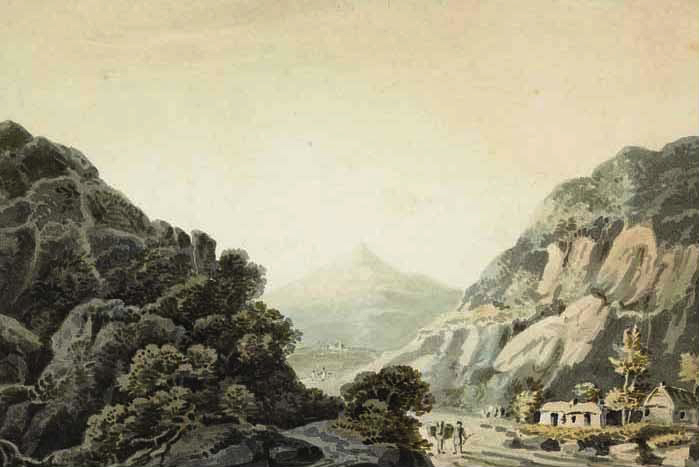
The Great Sugarloaf was a popular subject for artists. Examples are these watercolours: from Views of Bray and the Sugarloaf, County Wicklow, circa 1820 John Henry Campbell (1757-1828) – Whytes.ie. Back to the Schools Folklore Collection: we were particularly interested in the mentions of Red Lane, where there was evidently once a church, burial ground and holy well: it is said that none of these are visible today, but we will pencil in some further visits to have a closer explore.
. . . At the Southern extremity of Kilmurry bordering on Calary are two ruins which are popularly called Leghteampall or the Monasteries. These ruins stand in two adjacent fields, separated by a narrow lane (Red Lane). They lie east and west of each other in the Kelly’s and Whelan’s land, that in the west forming a square of thirty two yards each way. On the south side stands an angle of ancient wall built of stones and mortar 4′ 2″ high 2′ 2″ thick. There is a clump of stones and thorns at the north side 30′ long by 12′ broad and 2’2′ in height. There is an ancient holly tree in full vigour at the south-east angle a cross is cut in the tree and funerals stopped here and recited the prayers for the dead. About thirty yards east of there are the traces of an ancient church. A few stones of irregular shape remain in the foundation of the south wall; the stones appear to have been carried away from the north side within a comparatively late period. A heap of stones and rubbish occupies the place of the western gable, along which lies a large shapeless lump of a stone, having at the top a rudely formed cavity 7″ deep and 9″ in diameter at top, narrowing gradually to the bottom. This was a holy water stoup, one of the rudest ecclesiastical antiquities. An ancient decayed ash tree stands on the north of the church and graves may be traced in several places around it, though it has not been used as a burying ground for a long time. About a furlong south west of this place is a holy well called Bride’s Well (in Chapman’s Lane) at which Patrons were held, but none was held there within the last forty years . . .
Schools folklore Collection Kilmacanogue, Bray Teacher: Caitlín Ní Chuinneáin
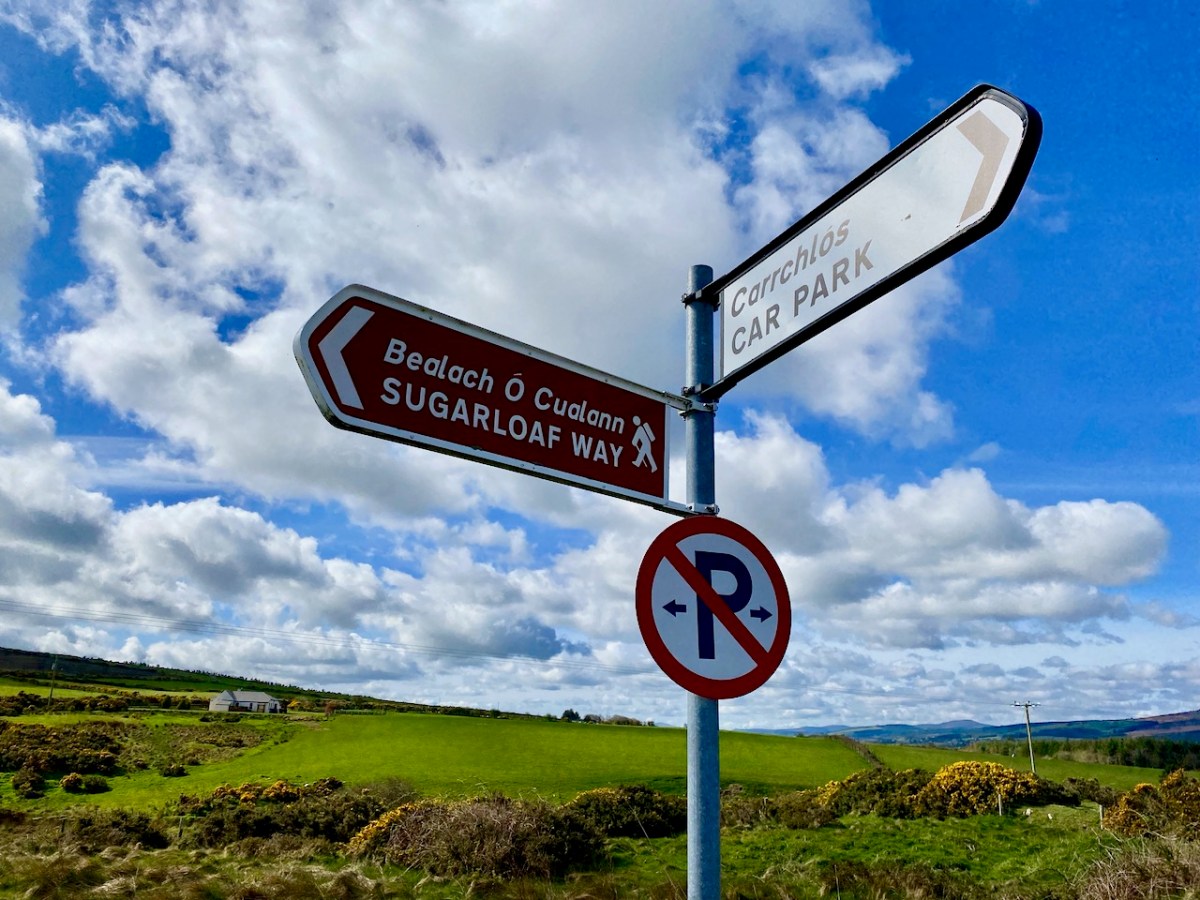
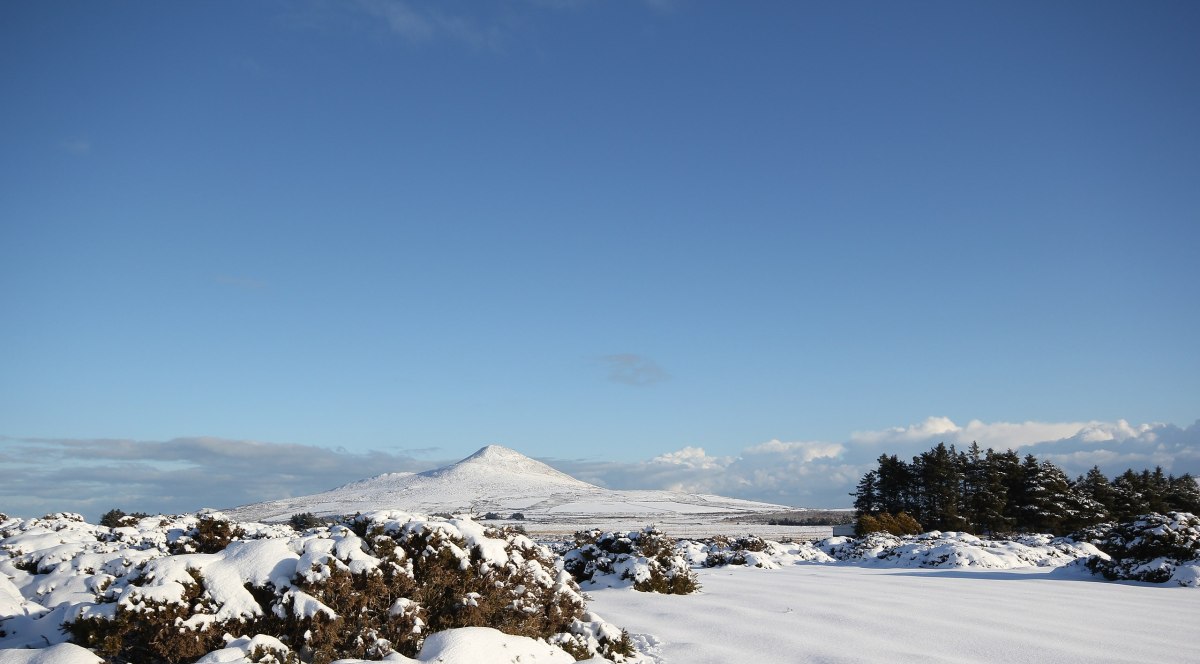
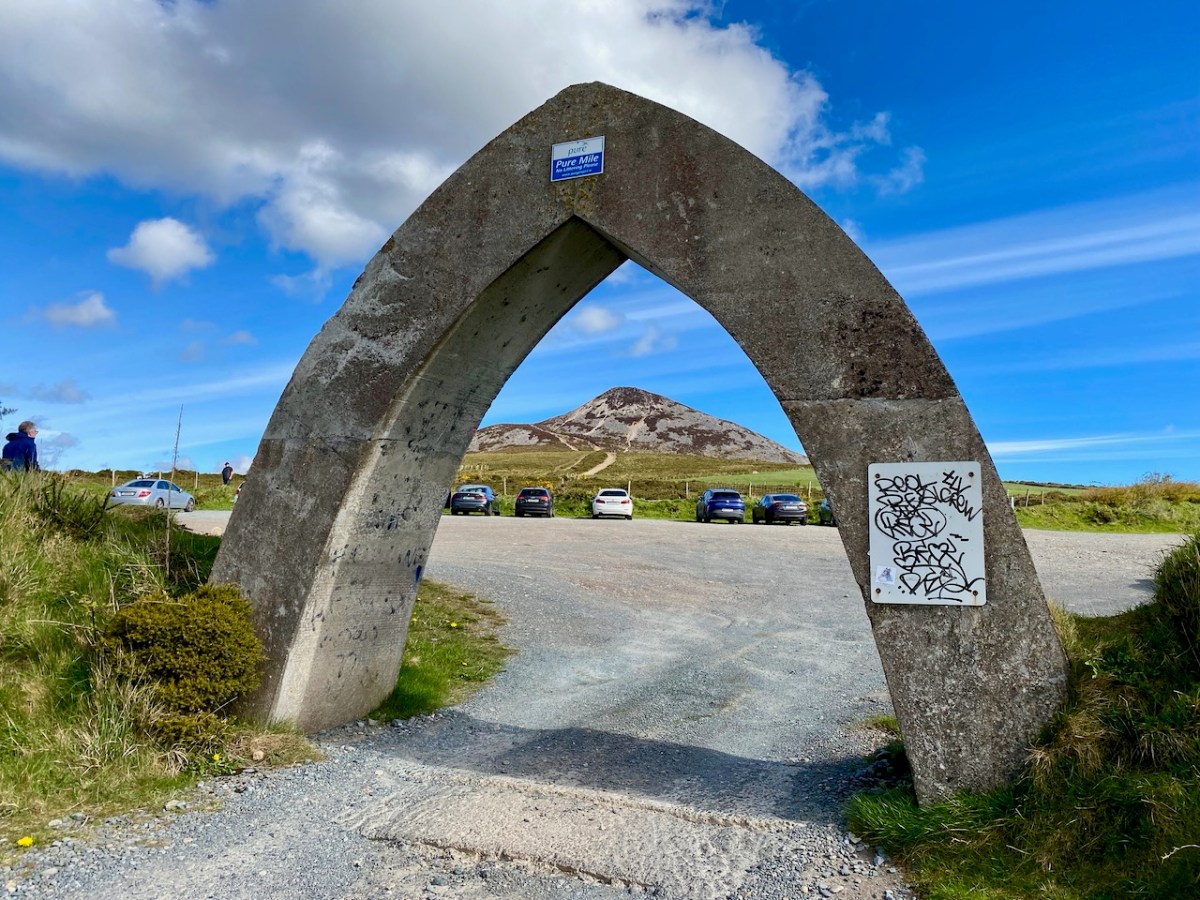
This winter scene is courtesy of Wiki Commons: we would like to visit at that time of the year, although the mountain may well not be hospitable then. Below – that’s the somewhat unusual gateway to the car-park at the Great Sugarloaf: take care when entering!
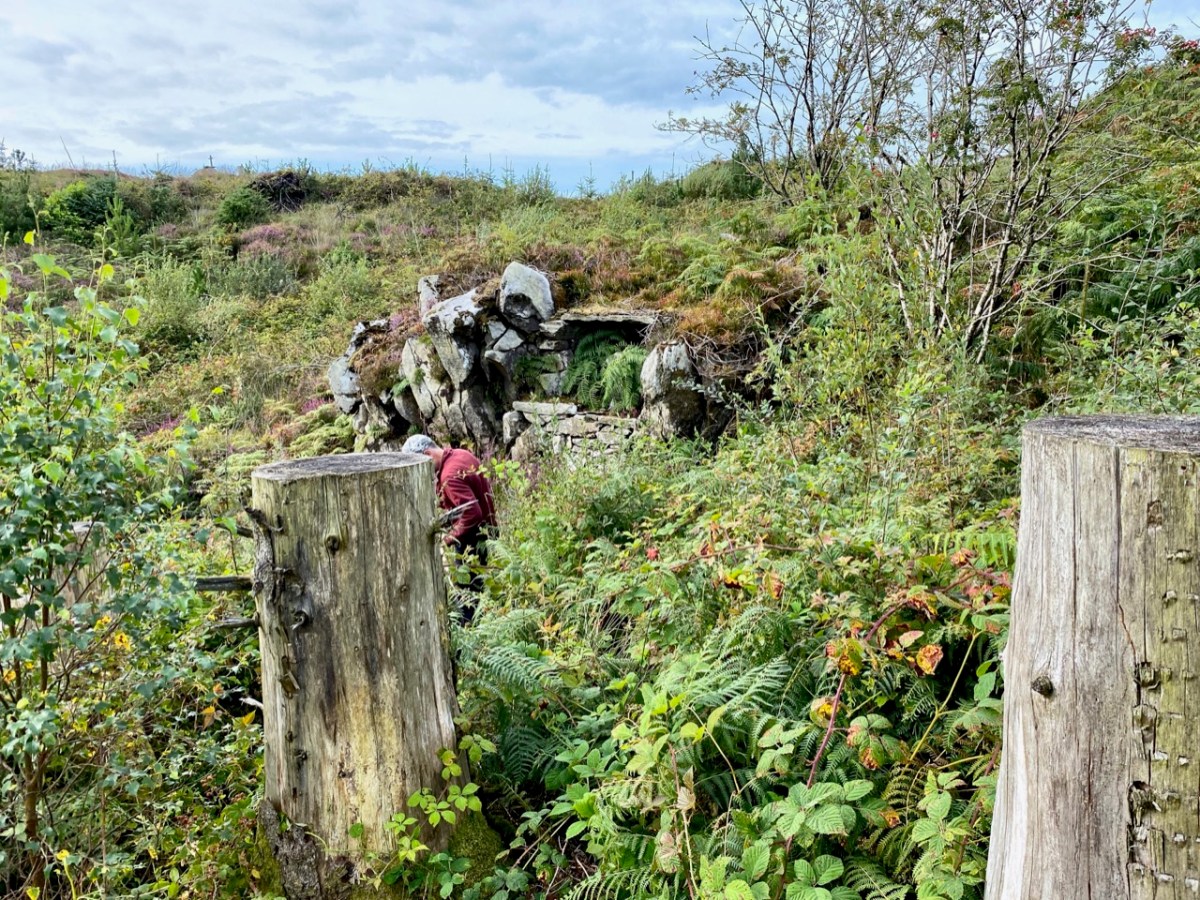
Would we like to see a Mass Rock? The question came from Oliver, and the answer was an enthusiastic YES! (The phrase Is the Pope Catholic may have been employed.) This particular mass rock has been re-discovered in recent times, but its origins are a bit of a mystery. It’s not listed on the National Monuments Record of Sites, and some elements are clearly dated to the early 1950s. There is no defined trail and it would be very easy to get lost, so we were very grateful indeed to our guides, Oliver Farrell and Tracey Daly (above), who live close by and use the trails frequently with their sons. Rio the Wonder Dog accompanied us.
Garrane (it’s Garrane on the OS maps, but often spelled Gurrane, especially locally, and it means ‘grove’) is a townland in the area between Ballydehob and Caheragh. The area is managed by Coillte, and starts among tall trees. As you ascend, though, you emerge into rocky scrub territory that was cleared in more recent times, leaving interesting stumps here and there, like stubby totems.
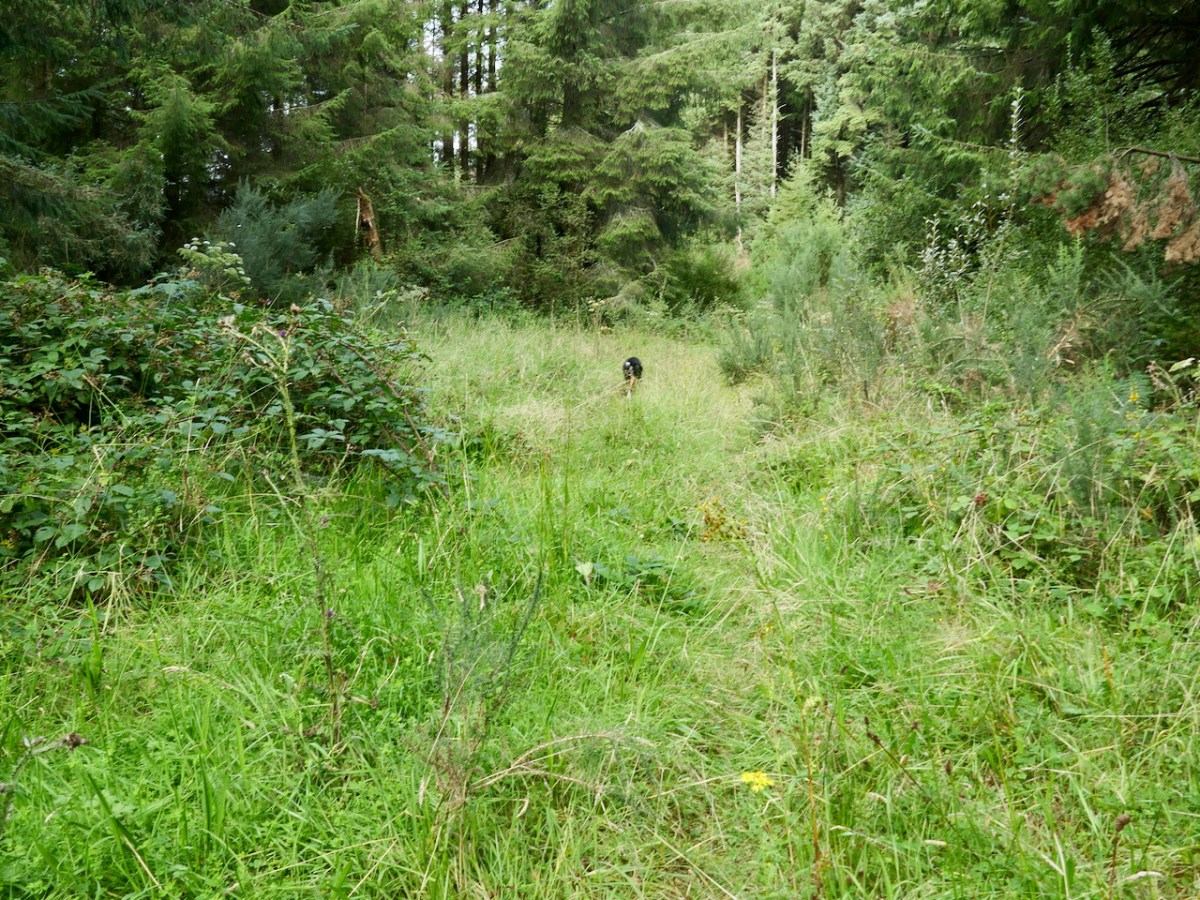
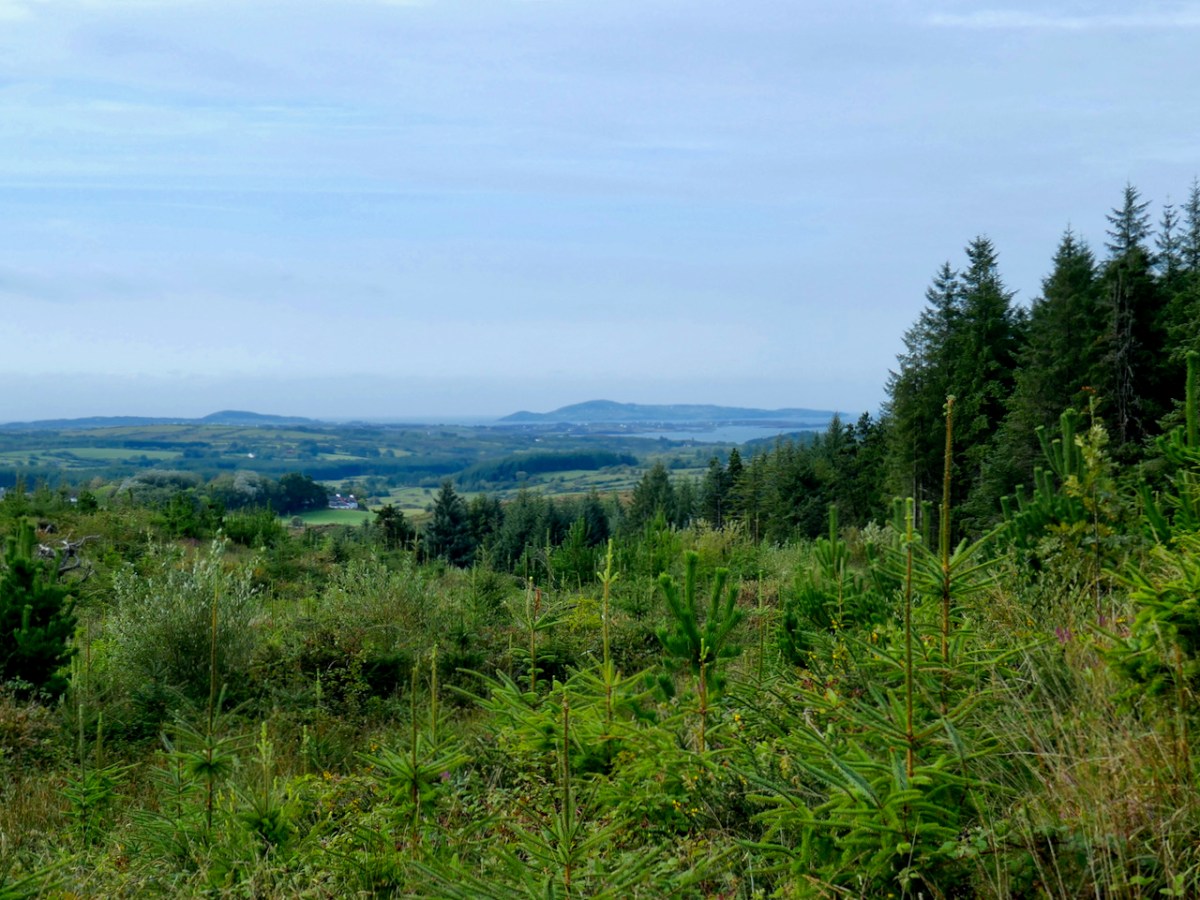
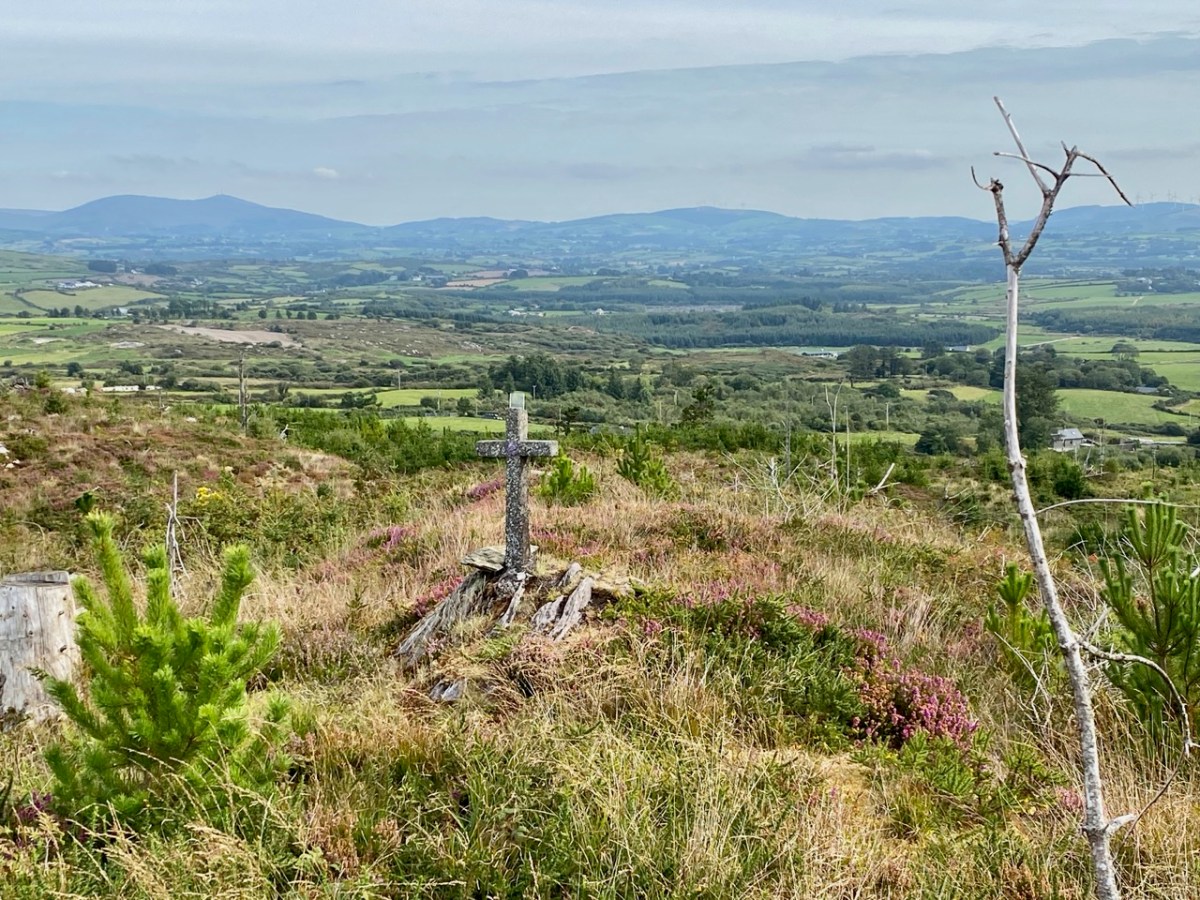
It’s a lovely hike up (although I’m not sure I could find it by myself again) and soon we were enjoying panoramic vistas across the countryside and over to Roaringwater Bay and Cape Clear beyond. Rio led the way, occasionally disappearing into the bushes but always coming back to his humans to make sure we were keeping up.
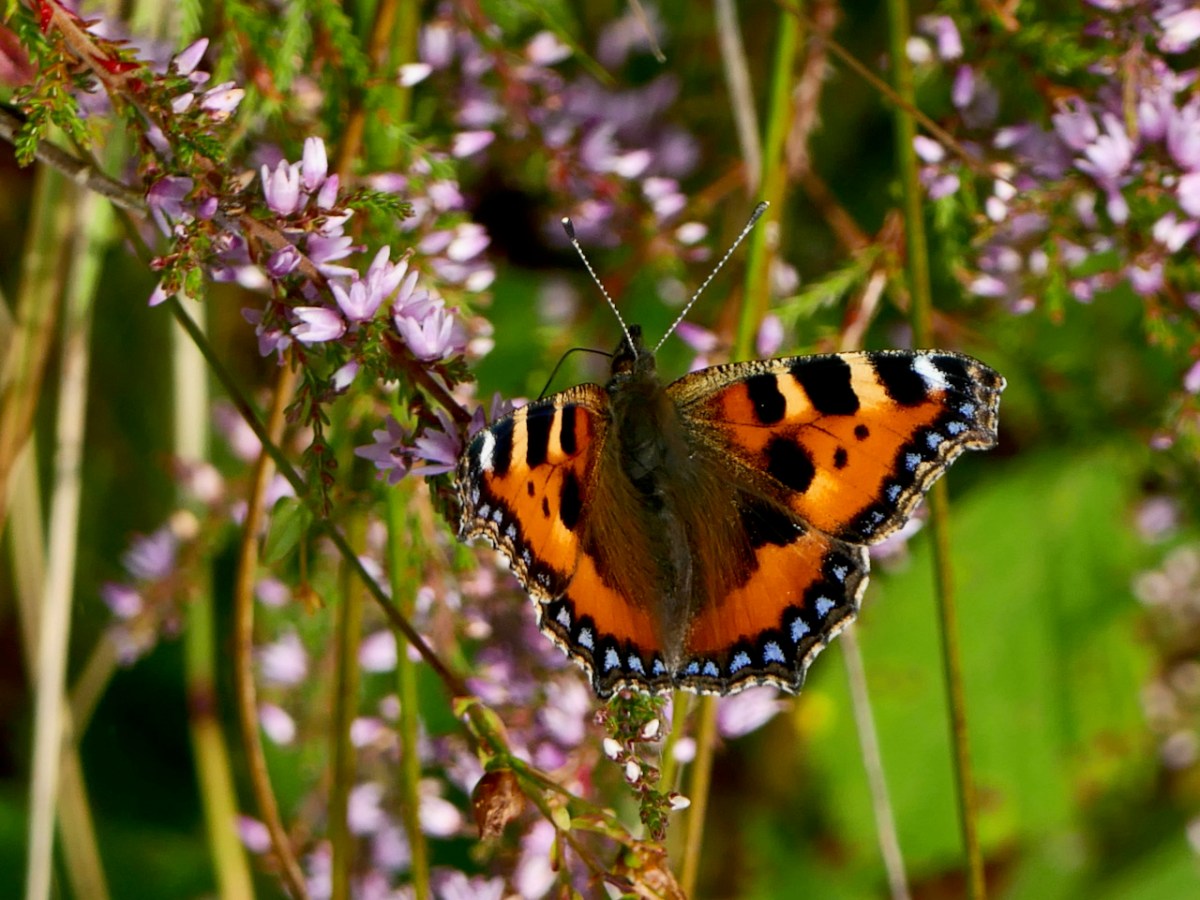
At this time the hills are covered in Western Gorse and heathers and butterflies were flitting through the shrubs as we ascended, attracted by the blooming Ling.
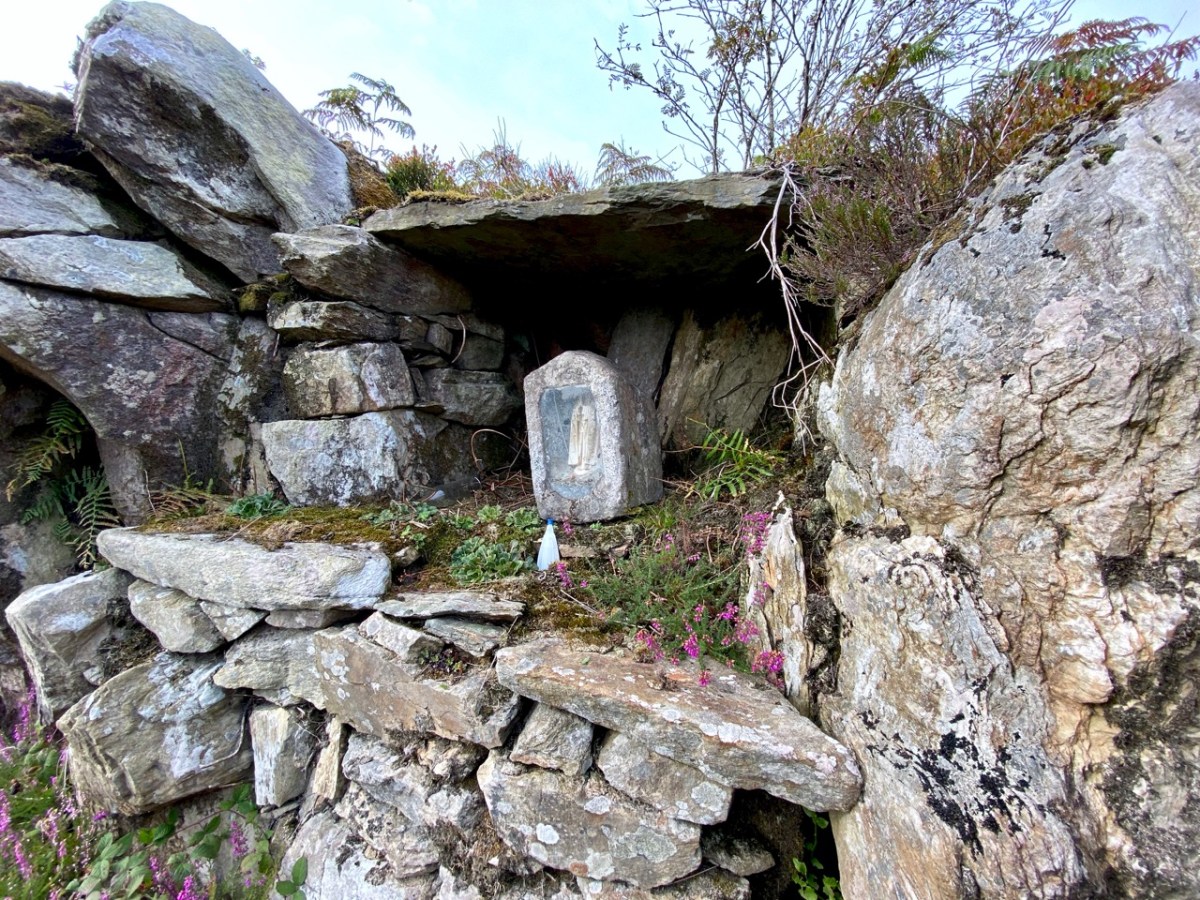
When Oliver said we’d arrived, I didn’t see anything except what looked like a pile of stones.. The bracken was everywhere, including within the mass rock itself. Oliver set to work and soon it was revealed – a flat, altar-like surface, with a niche in which a small shrine had been placed.
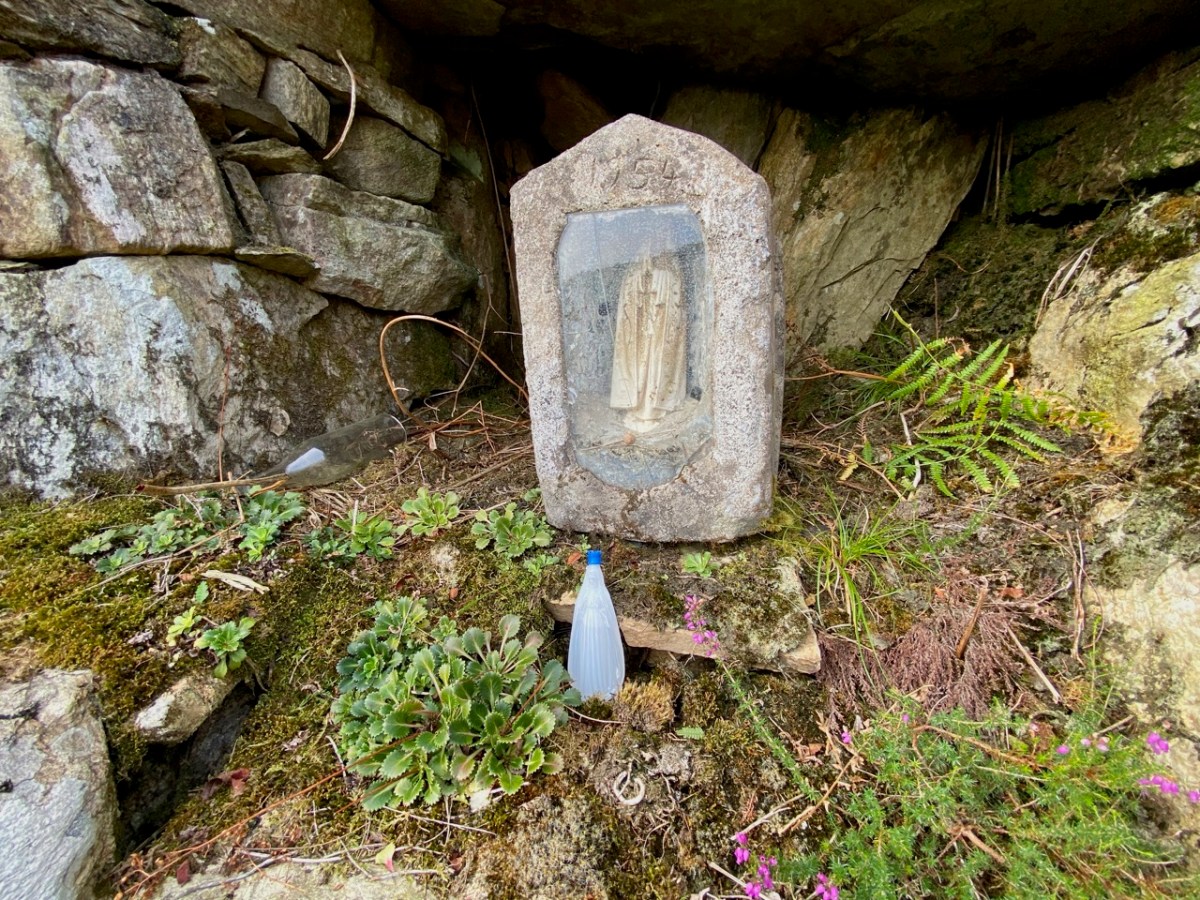
The shrine – a concrete box containing a statue of the Blessed Virgin Mary, was dated 1954. This marks it as having been inserted into the niche during the Marian Year. Most of the grottoes we see in every village and town across Ireland date to 1954 – for more on this see my post Mary Mary. It’s possible, perhaps, that the mass rock itself was refurbished during this time, to make it suitable to contain the shrine.
What exactly is a mass rock, I hear my non-Irish readers ask. Take a look at my post Were you at the Rock, or go to the wonderful Find a Mass Rock, an excellent site maintained by Dr Hilary Bishop of Liverpool University.
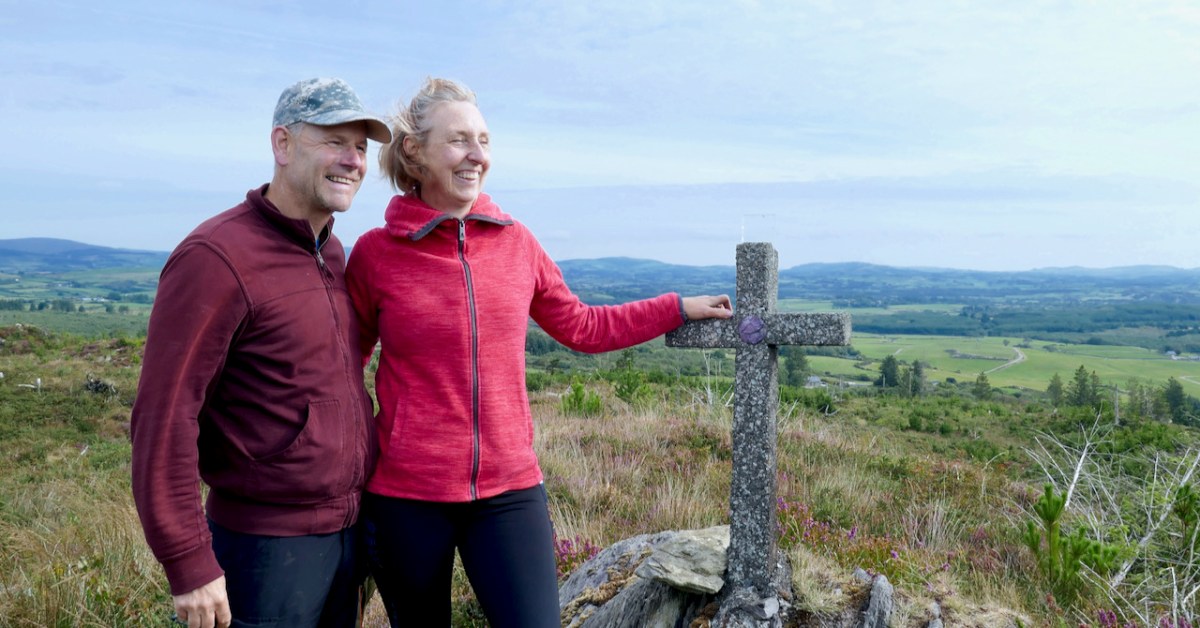
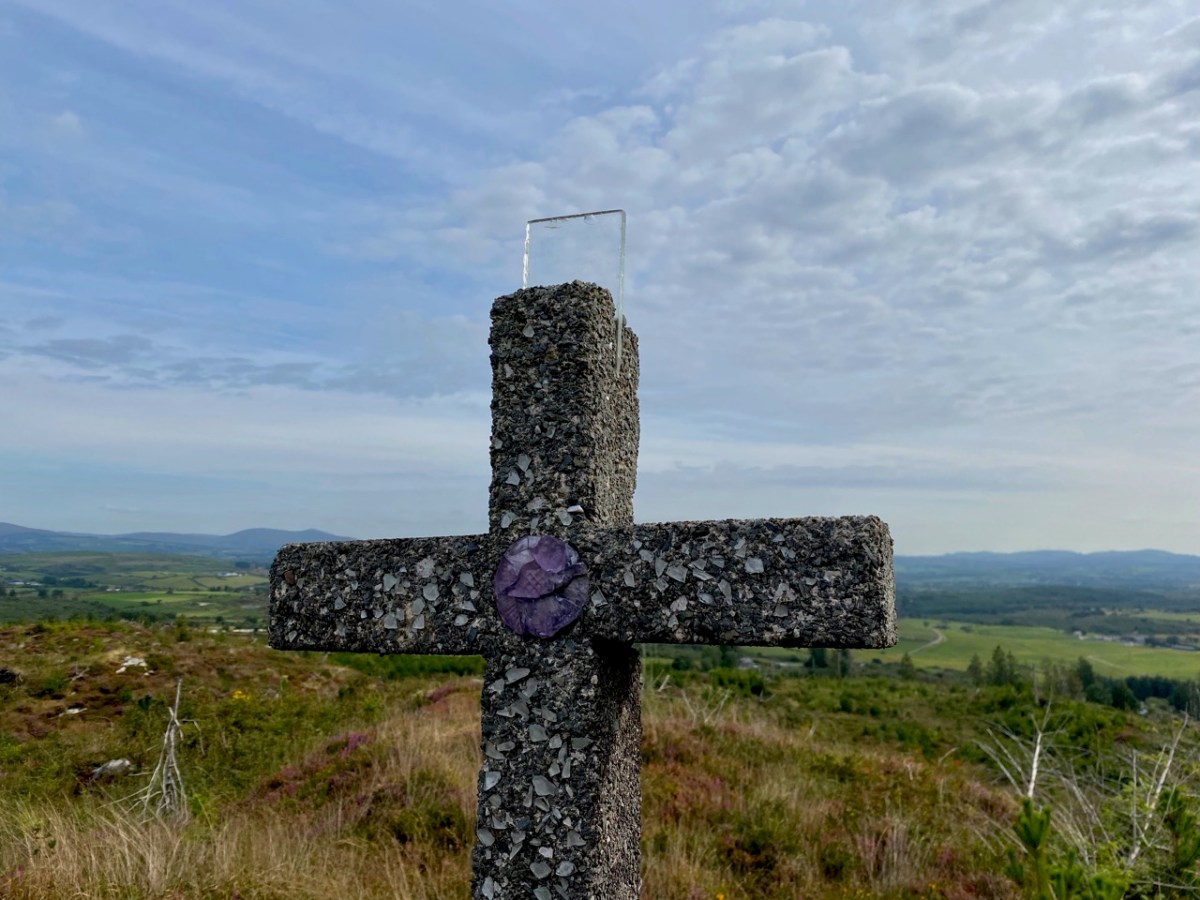
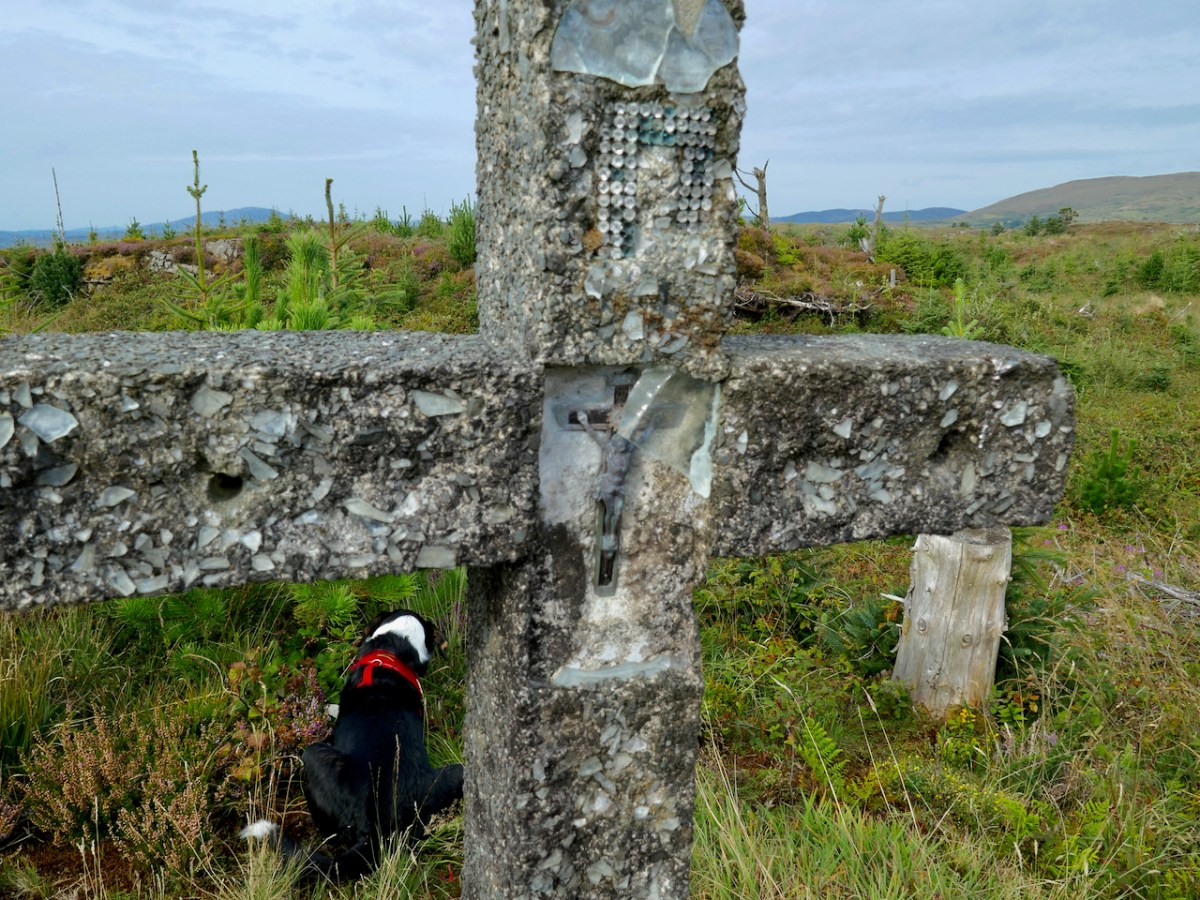
So we had found the mass rock, but there was more. Tracey and Oliver led us higher still to a spot overlooking the mass rock to a concrete cross. Although much battered, it retained much of the original decoration – glass, clear and coloured, and a small crucifix. Exploring this area, their sons had discovered the mass rock a few years earlier – it had likely been hidden for 50 years by forestry.
We wondered if this was erected at the same time as the shrine had been inserted in the mass rock, in 1954, or whether perhaps it had been erected in 1950, the Holy Year. And all around Ireland in 1950 villages and towns erected hilltop crosses – see my post Sanctifying the Landscape for more about the Holy Year and the Vatican directive that sent Irish communities up their local mountains to set up huge (and in this case not so huge) concrete crosses.
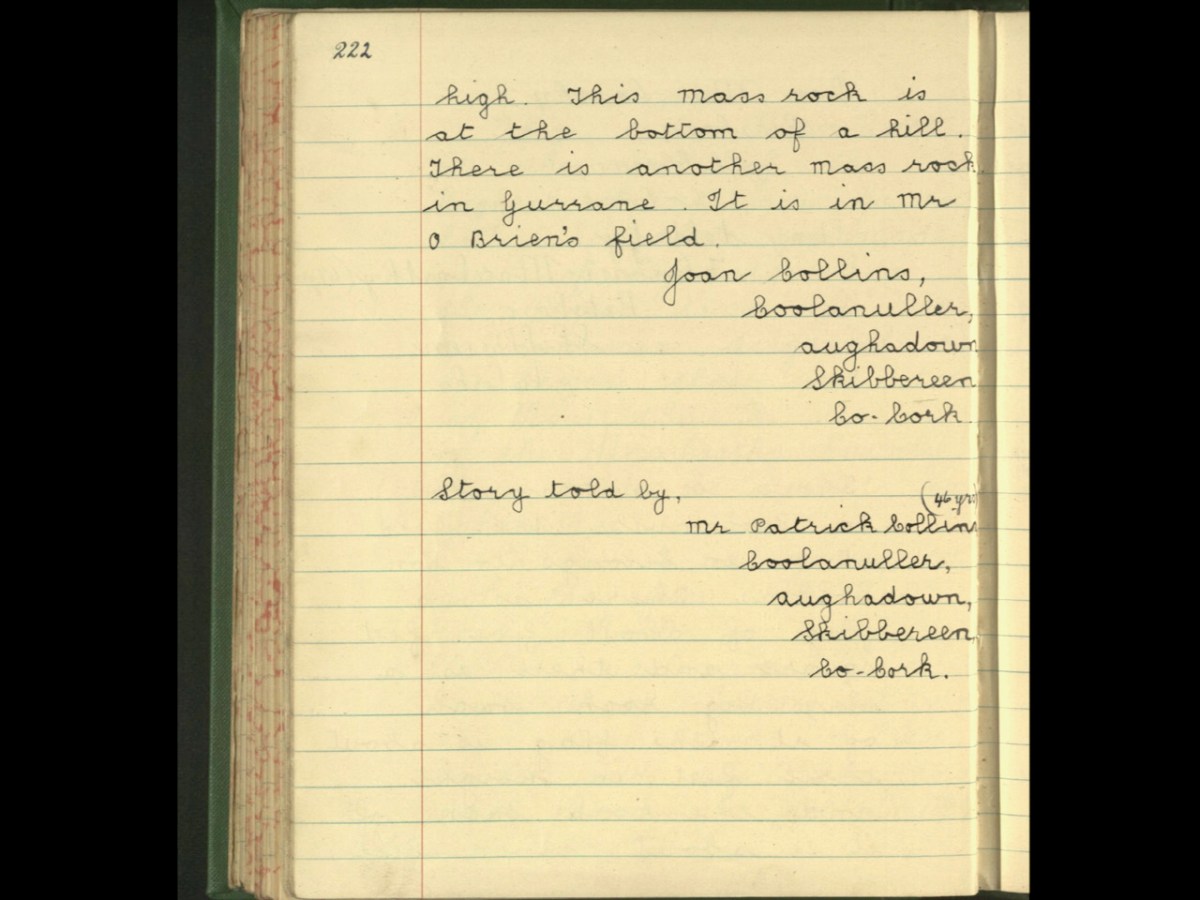
So – this spot was obviously the focus of devotional activity on the early 50s, most likely chosen because of the already existing mass rock. The memory of the mass rock was still held in the community, making it the perfect location for the Holy Year and Marian Year memorials. As we often do, we turned to the Schools Folklore Collection to see if we could find references to a mass rock in the record for the old primary school, now long closed, at Garrane. Here’s what we found:
That’s all, and frustratingly opaque, referring to the mass rock being in a ‘field.’ I would be interested in hearing from local people who might know more about the history of this particular mass rock, so that we can get it listed as a National Monument. If you know anything, please comment below, or get in touch via our contact page.
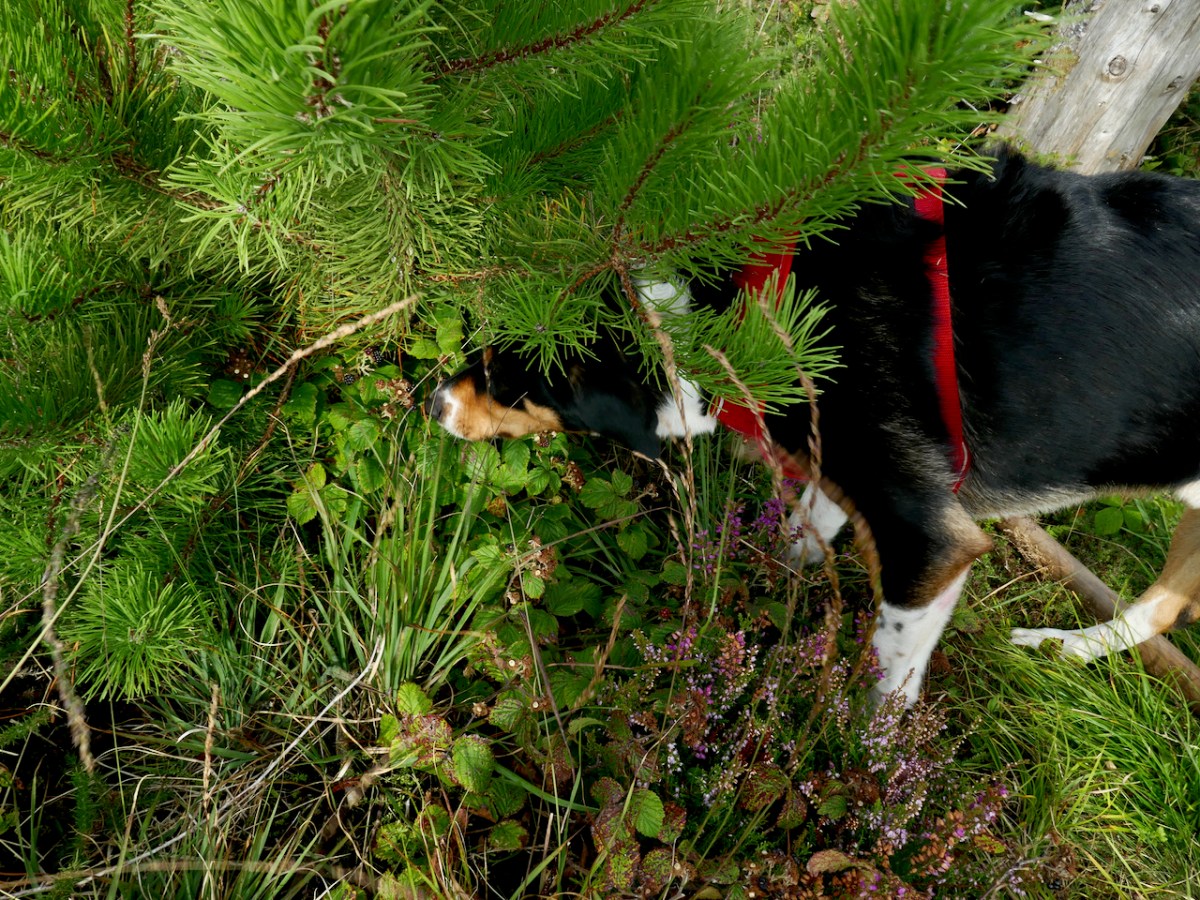
Rio led us back down the mountain, pausing occasionally to do something I had never see a dog do before – eat blackberries right off the brambles. He beat us to some of the best ones too as we headed down to the tall trees.
The Gurrane and Ballybane Trails Development Group is working on a plan for trails in the area, including this one – good news!
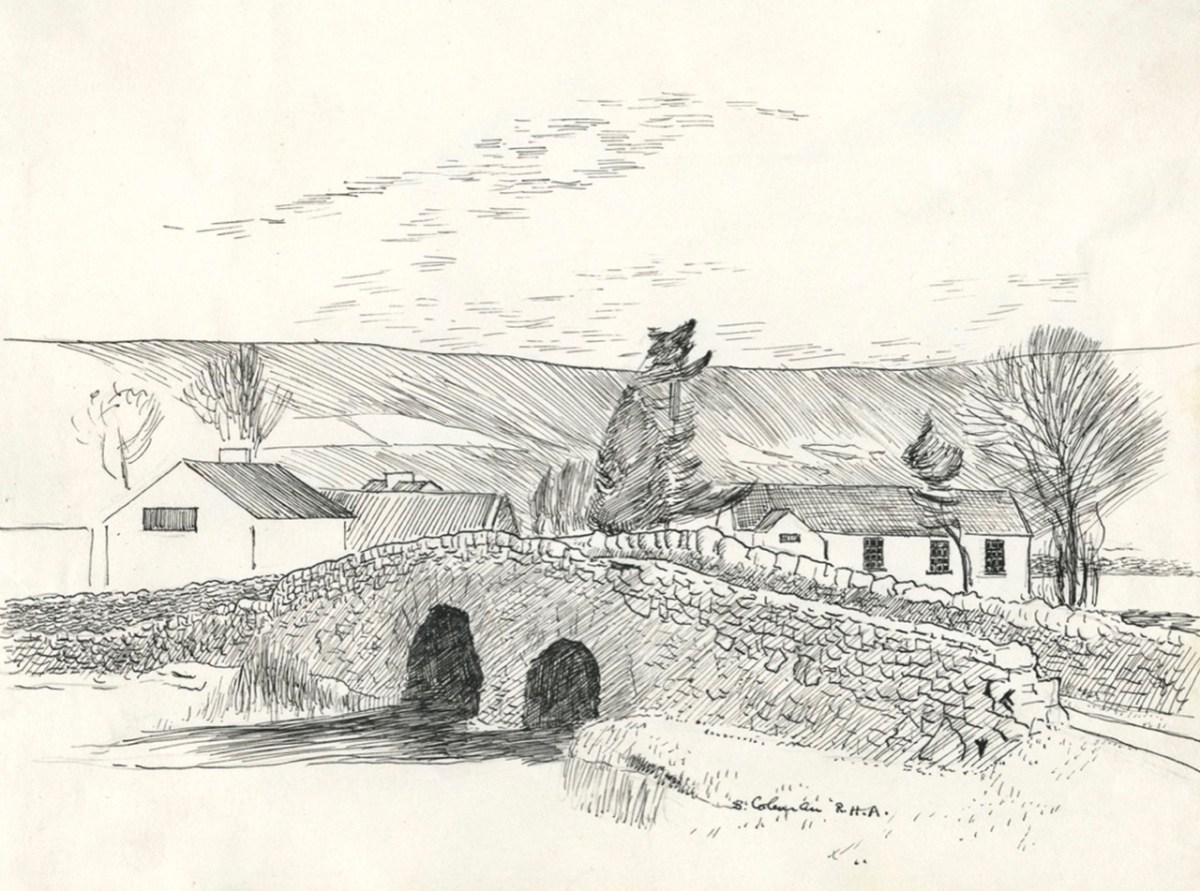
Back in May I put up a post celebrating our discovery of documentary artist Simon Coleman. There is plenty of material from Coleman that I didn’t use. Today, I’m showcasing more of his work: it’s invaluable to Irish folklore and folklife researchers. We have to be forever grateful to The Dúchas Collections, and their field-workers who spent so much time scouring the rural landscapes of Ireland and its inhabitants, and recording their findings in detail, preserving the rich memories of those times for our benefit.
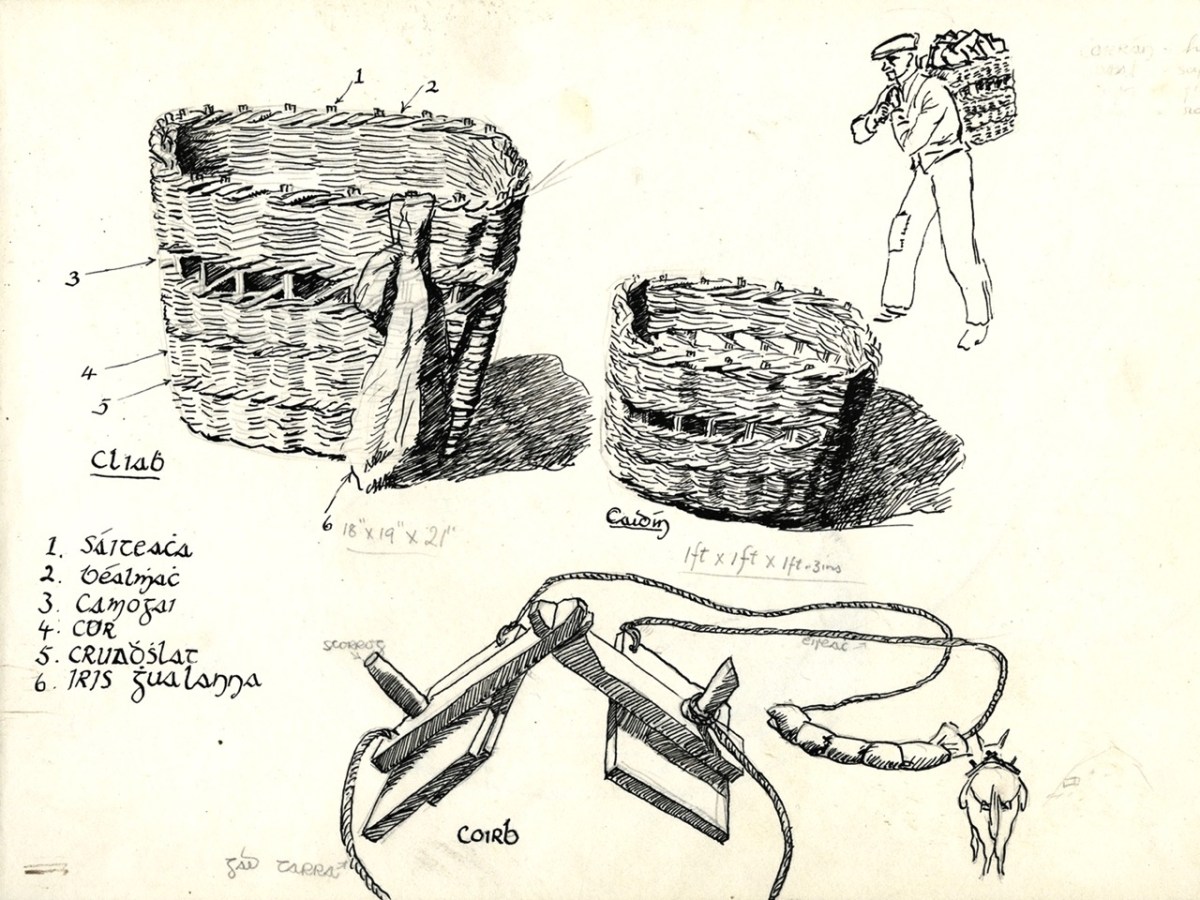
The header shows one of Coleman’s attractive watercolours which record the landscapes he traversed during his folklife researches. His sketch-pads, however, are filled with drawn details showing the basics of rural life, such as this one (above) recording baskets which were carried on the back or which were made as panniers for donkeys, mules and horses. Such methodical records are invaluable to our understanding of the paraphernalia of ordinary life, now virtually vanished. More technology for lifting and carrying loads is shown below.
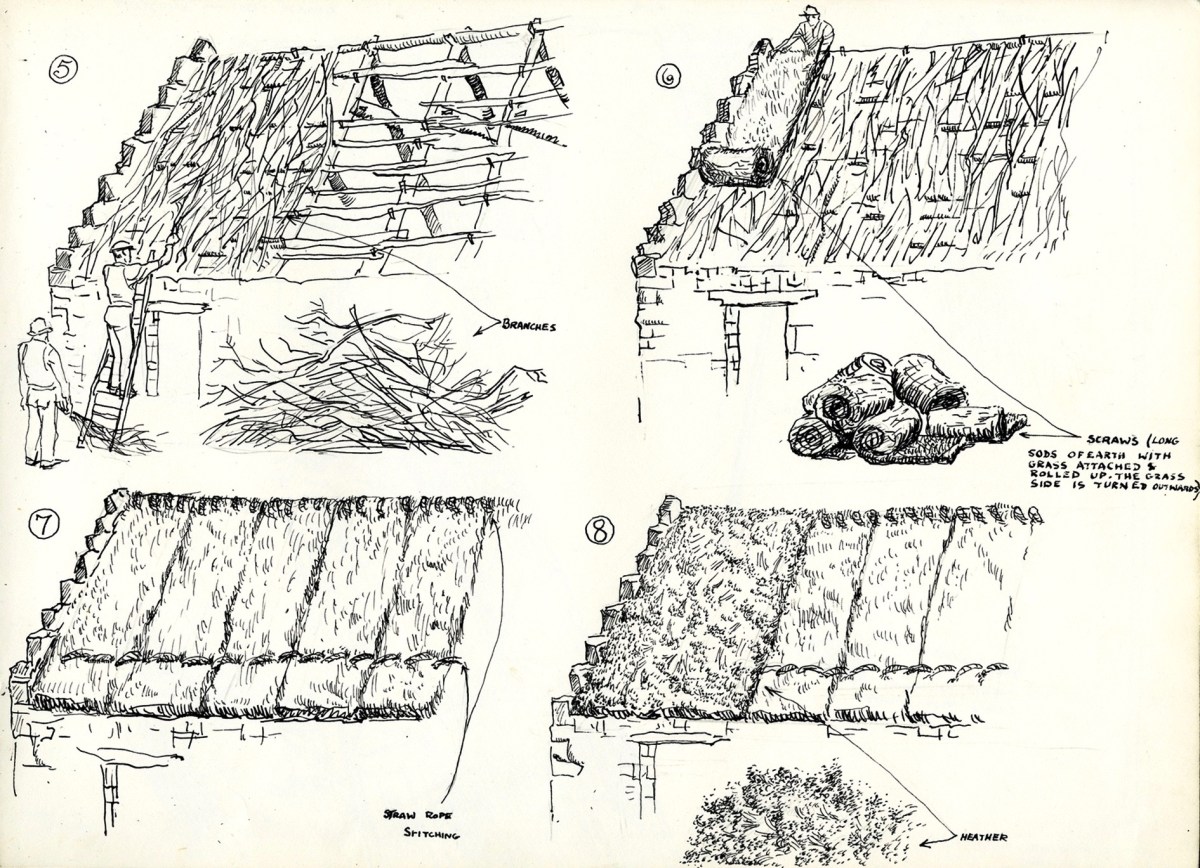
The drawing above shows in typically fine detail the process of ‘turfing’ a roof using clods of earth with grass attached. the grass is on the outer surface. Also shown is the use of ‘ling’ – or heather – as a roof covering.
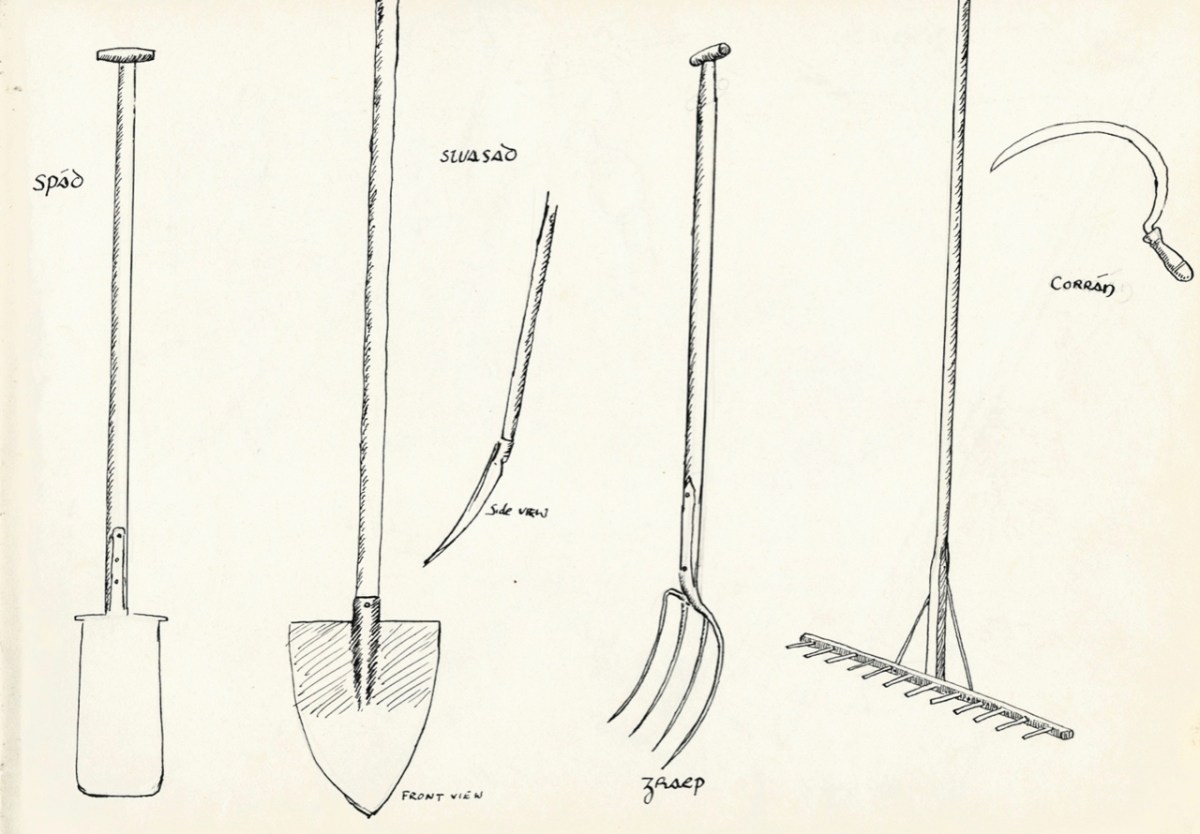
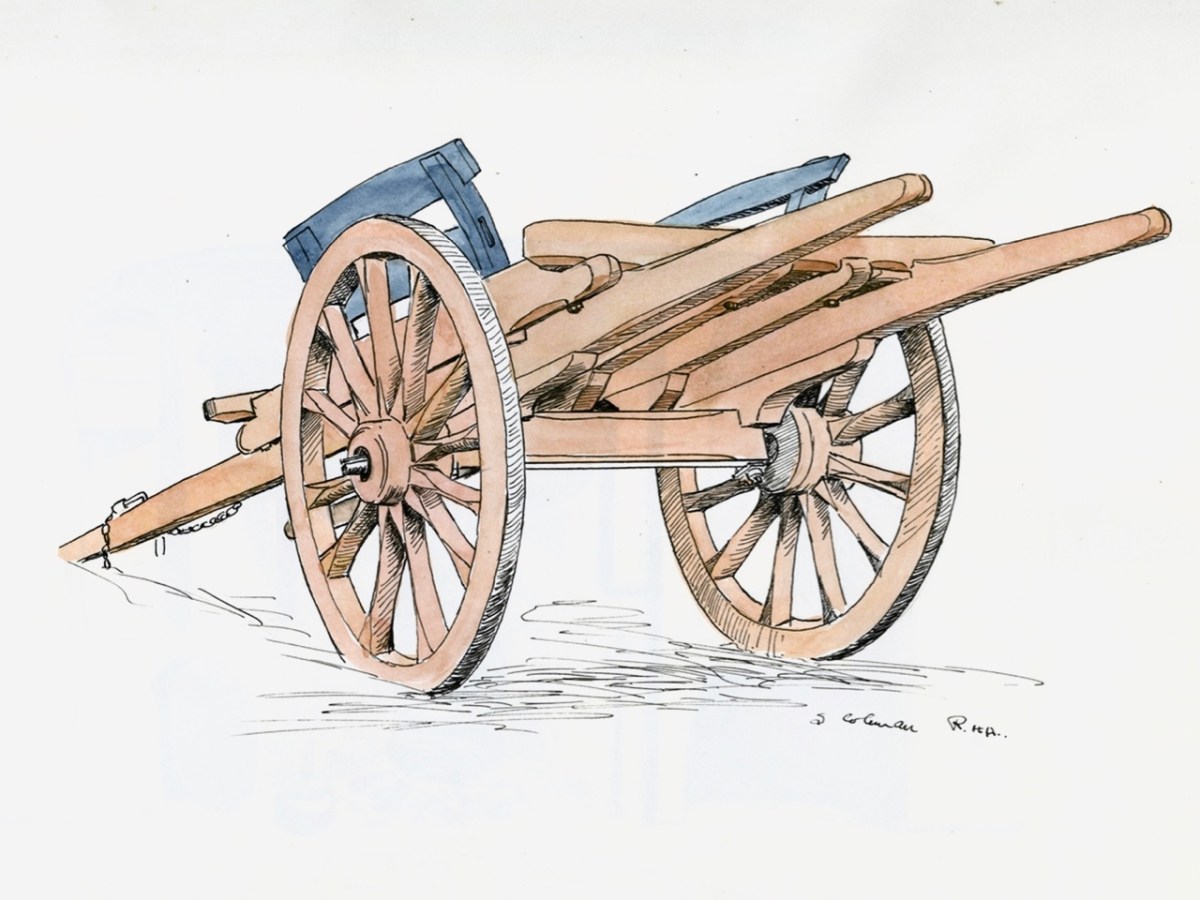
Straightforward hand implements used on farms (upper) are complemented by very fine watercolour sketches, such as the one above, recording the wagon – an essential element of life in the country.
Coleman was also an accomplished painter, as is evidenced by this portrait in oils of Anna Nic A’Luain, one of the most gifted storytellers encountered by the renowned Donegal folklore collector, Seán Ó Heochaidh. Anna was from Croaghubbrid, in the Blue Stack Mountains, Co Donegal, and lived from 1884 to 1953. The painting dates to 1949.
Cois Fharraige, above, another work in oils by Coleman.
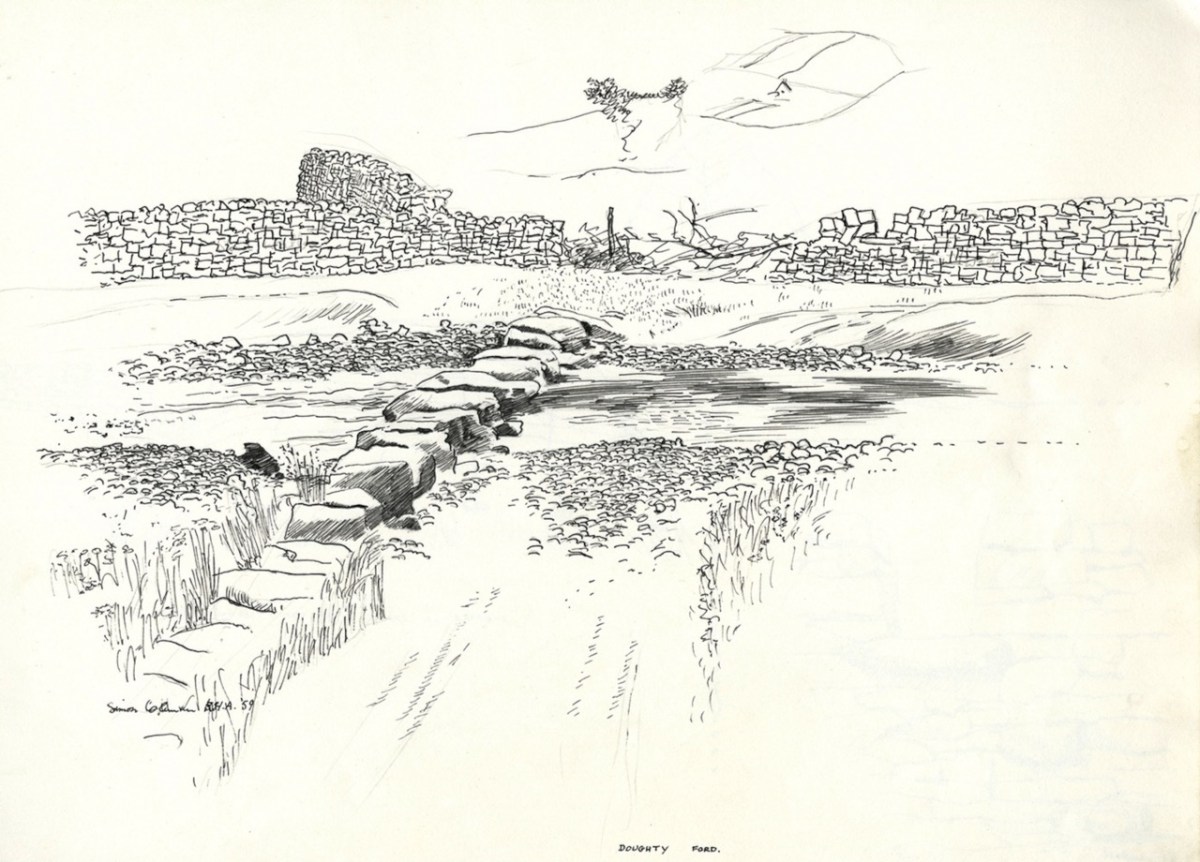
Doolin, Co Clare – Old stone bridge, Lough Agraffard, 1959 – Doughty Ford: all from Coleman’s sketch books. A valuable record stored in the Folklore Commission Archives. Slightly unusual, perhaps, is this house (below) which Coleman sketched in Galway city.
Here’s a little burst from our traditional session in Rosie’s, Ballydehob, last Friday, with a great crowd of players and singers filling the pub with Irish music, as they do every week through the year. Sometimes the session takes place at a different venue in the village, but you will soon find it, between seven and nine on a Friday evening. The music is to remind us that the The 9th Fastnet Maritime and Folk Festival will be held from the 17th – 19th June this year, after an enforced ‘Covid’ break. Hopefully it will be ‘just like old times’. There is a great programme to look forward to – don’t miss it! To get you into the spirit here’s Festival regular Matt Cranitch leading a rendering of the beautiful air Sliabh na mBan.
There’s a tale attached to all good songs, and Sliabh na mBan is no exception. This is from the Dúchas Schools Folklore Collection 1936 . . .
. . . Finn mac Cumail, having come of age, took upon himself the task of choosing a wife. A public man like him had to cater to the popular expectations and he was in sore straits fearing to give hurt to any of the noble families wishing to link their daughter with Finn in the bonds of Holy Matrimony. Having tasted of the Salmon of Knowledge, he was all wise, so he hit upon a good plan. A race would decide who to wed him. He sat on the top of Slievenamon, (Sliabh na mBan – Mountain of the Women). All the ladies were to race from the Anner and the first up was to become his wife. Then the gathering began – old, young, fair, dark, ugly, beautiful, sprightly and lame all came to try and become Finn’s wife. “They’re off!” – what a view as all the maidens of Munster set off on the race. The beautiful girls began well, but soon got tired and as some old hag would limp past them she’d sneer “Fair and go easy goes far in a day”. On they went, the latter tripping the former – three remained to do the east climb – two beautiful girls and a worn, old hag: up, still up – who’ll win what? Wait! the fair girl has fallen, now just a dark-haired caílin and the old woman. Oh look, she’s down – the girl hurts her ankle and tries to creep along, but faints. Now the old hag has an open field. Finn must marry her – But no, up the slope comes a lovely girl and reaches Finn first and like all nice stories, they were married and lived happily ever afterwards. (Nobody knew that Finn had instructed his lady love to run over to Boherbee where the mountain is low and go along the gradual slope, instead of trying to climb the steep precipitous mountain face) . . .
Schools Folklore Collection – Miss H Noonan Aged 70 – Cloneen, Co Tipperary
A reminder of pre-Covid days (above, in Levis’ Bar) – folk legend Martin McCarthy (now aged 81) was a regular at the Ballydehob Festival. There’s some good ‘new blood’ there this year, and the launch of an album of the best Sliabh Luachra music from Pat Flemingwith Maria Cotter, Tim Browne, Gary O’Brien and Timmy O’Connor. A special event will take place in Bank House in the main street at 7.15 on Thursday 16th June: festival organiser Dick Miles will give a talk on the ‘folk revival’ – (A musical journey from England to Ireland). There will be plenty of opportunities for all musicians to participate over the weekend, starting with the regular Friday folk session in Rosie’s at 5pm (note the earlier-than-usual time) on the 17th.
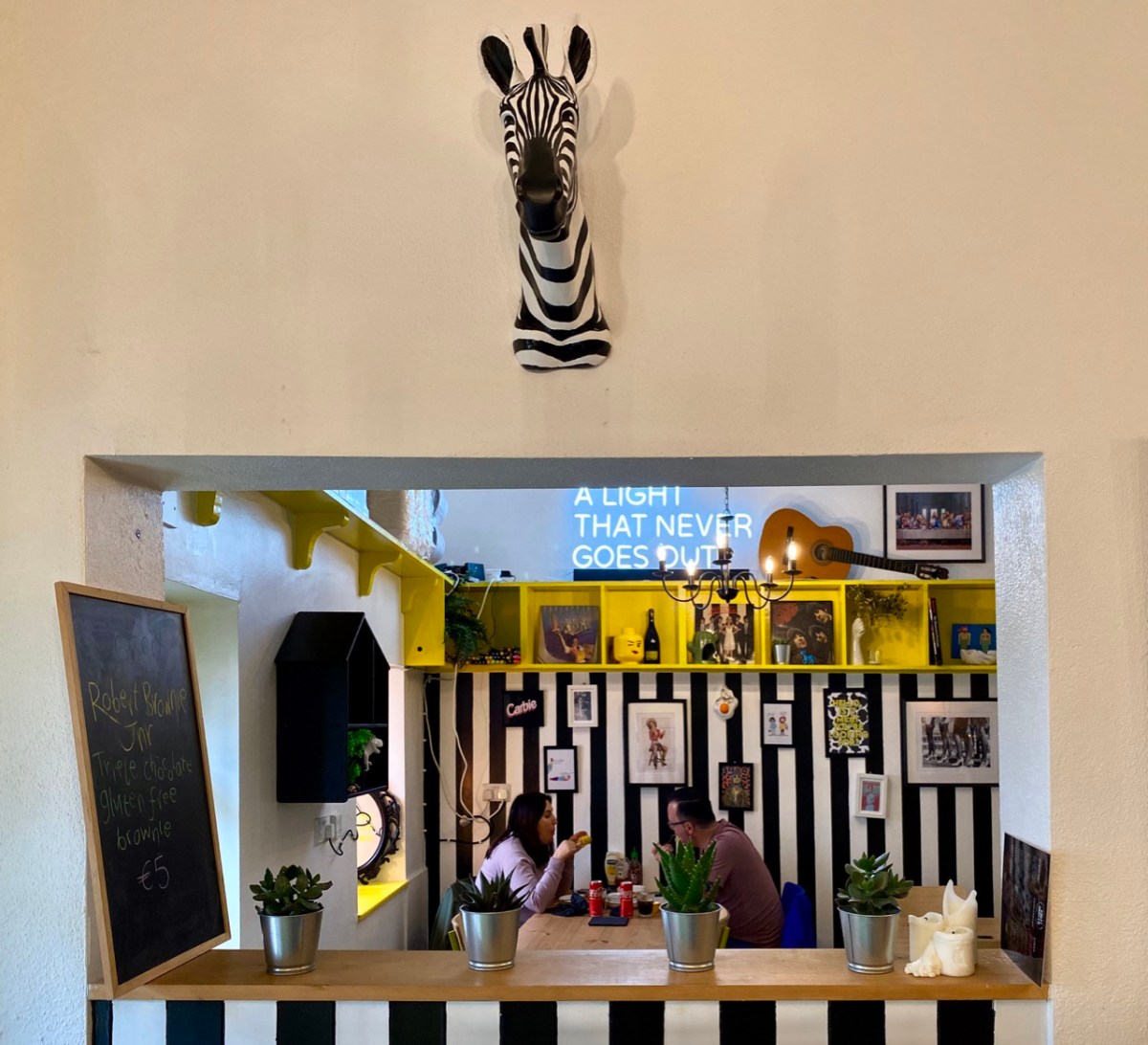
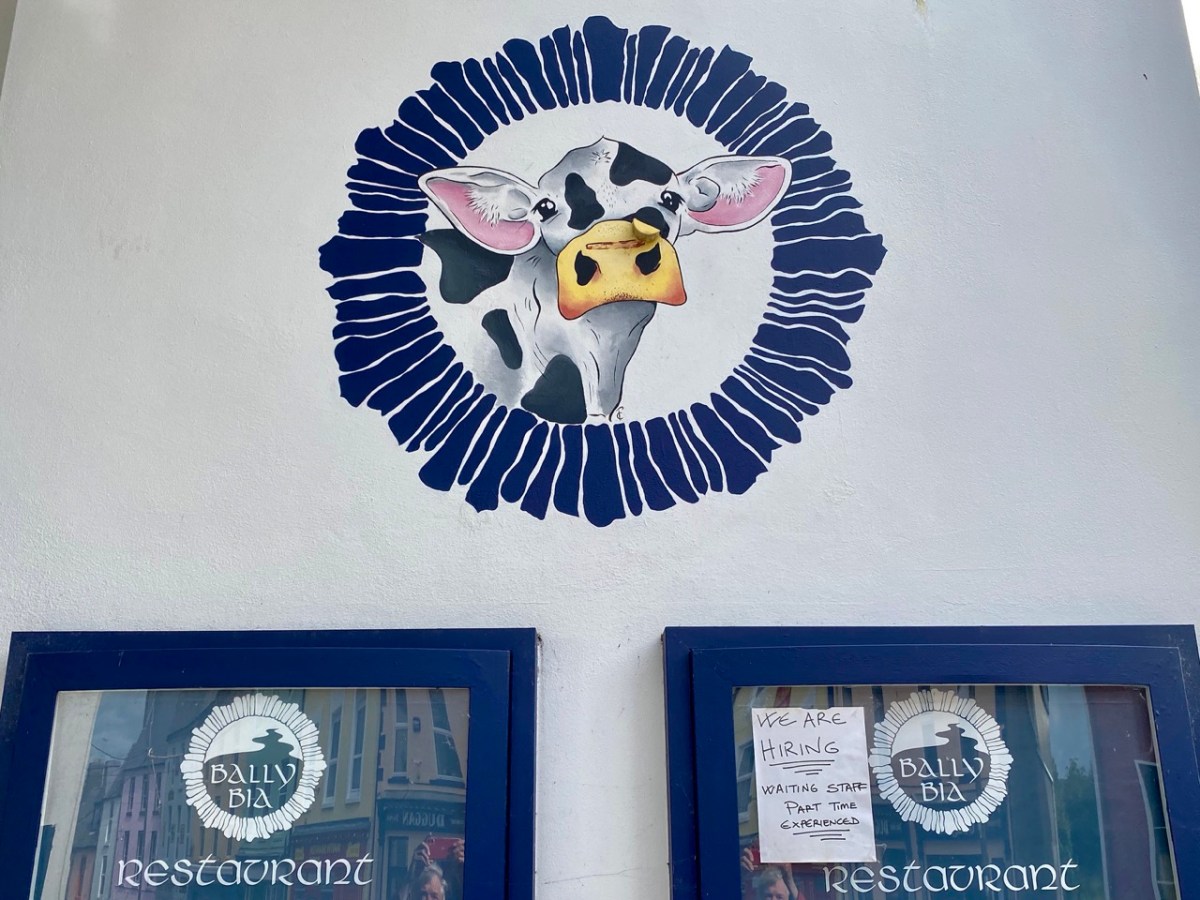
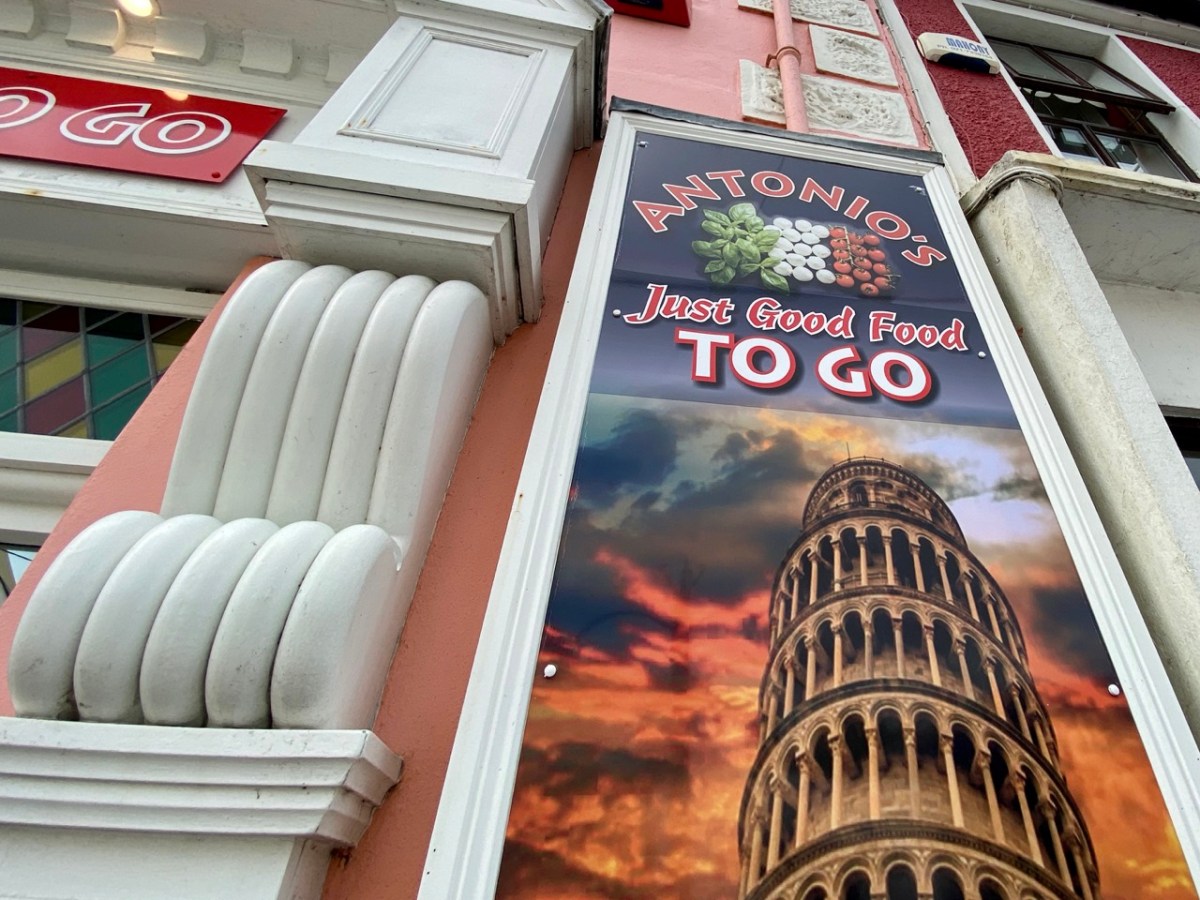
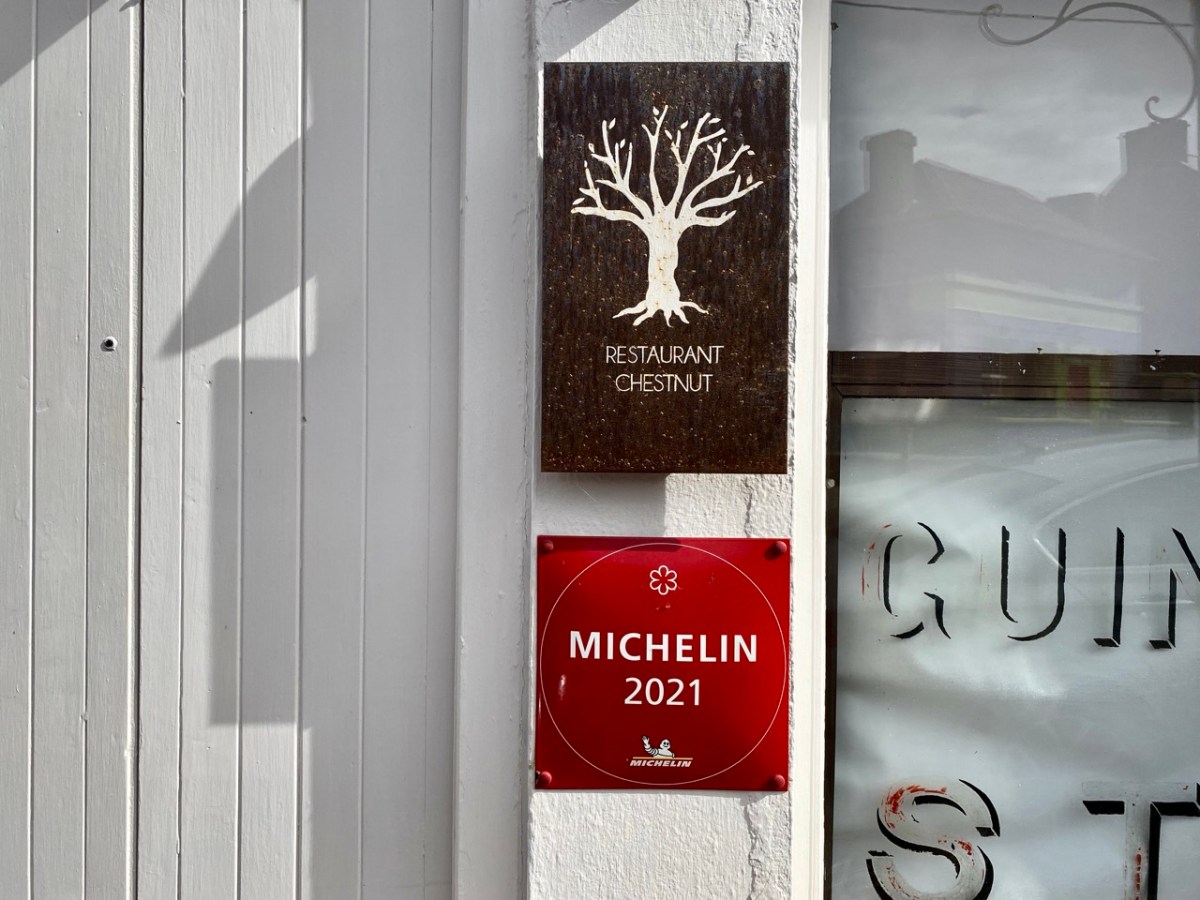
There are plenty of good food opportunities in Ballydehob: all will be available over the Festival weekend: the wonderful Yay Burger (top), Budds (above) and Bally Bia (below). Don’t forget Antonio’s and – if you want Michelin Star (why wouldn’t you?) there’s the Chestnut.
But the festival is – first and foremost – all about the music. We hope to see you there over this coming weekend. We’ll finish with more Sliabh Luachra tunes from Jackie Daly and Matt Cranitch, who will be there to serenade us. Enjoy!
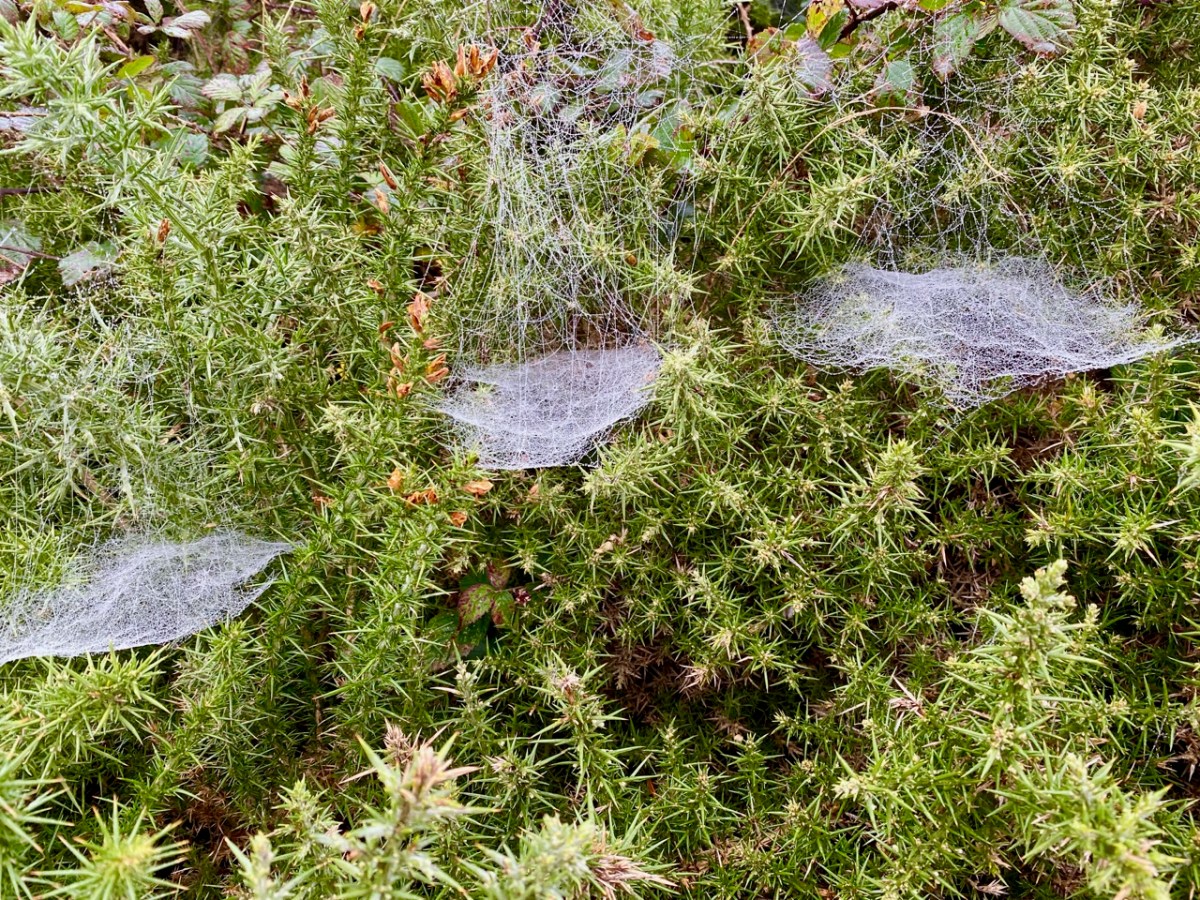
We are past November Dark – traditionally a ‘low’ time of the year when the effects of the approaching cold months begin to displace autumnal skies and spectacular sunsets: the term traditionally refers to the appearance of the new moon of the month (which happened this year on the 4th), but is probably inspired by the preceding nights when no moon is visible. For us at the moment, on the shores of Roaringwater Bay, the dark time is emphasised by a constant pervading mist which clings and covers everything in films of moisture, especially the myriad cobwebs on the gorse bushes which surround us. Gone – for now – are our fine views out across to the islands, and there is a feeling of being marooned and suspended in a lifeless grey tract which encompasses sea and sky.
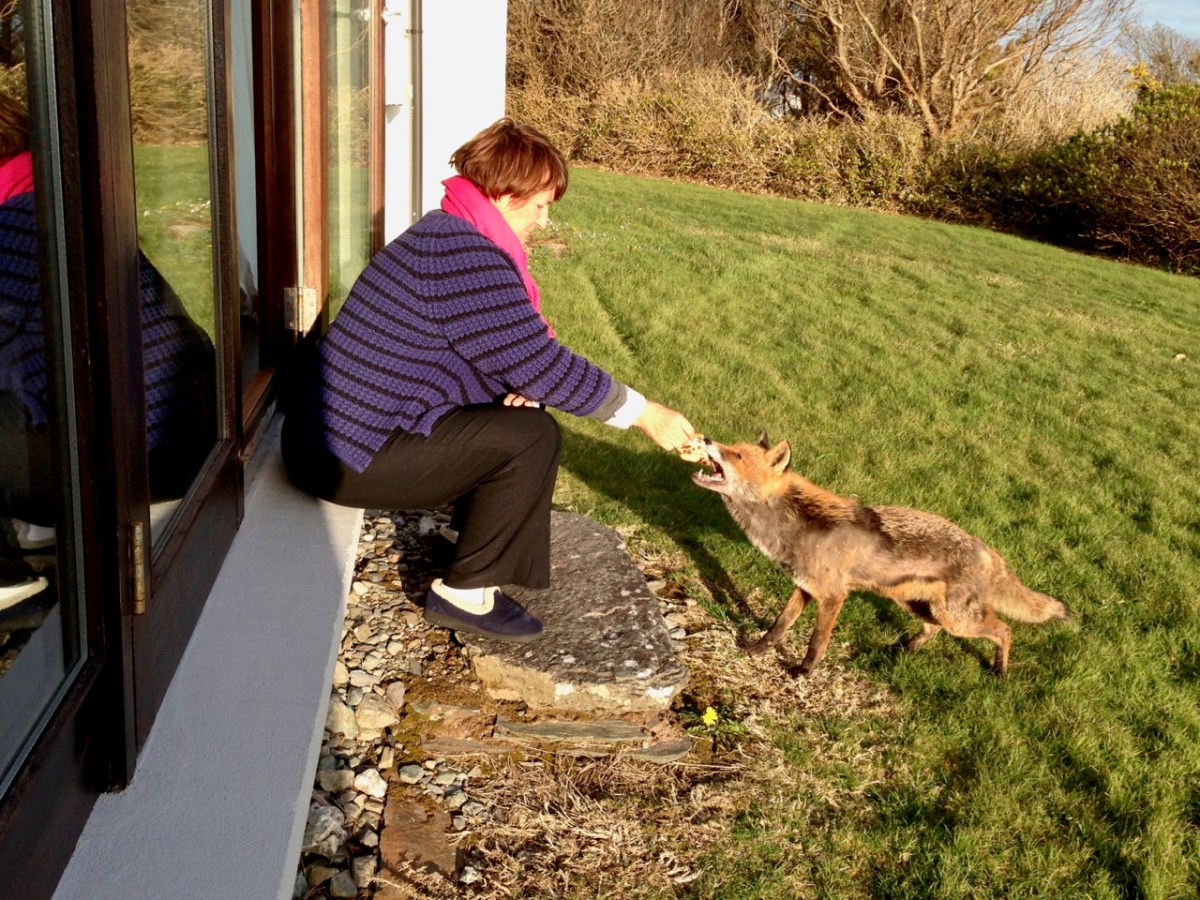
November Dark has brought with it tragedy to our garden. In explanation, I should first paint the idyllic picture of what we like to call our ‘peaceable kingdom’. For many years we have considered this domain a haven. Do you remember our fox – Ferdia – who was a constant companion to us in the first few years here at Nead an Iolair? He visited on a daily basis – often waking us by barking outside our bedroom window at dawn, and presided over a mixed community of birds and animals who share our territory – without any conflict.
Ferdia was happy enough to co-exist with the bird and pheasant families, the rats and mice, and the occasional cat that dropped in. I have a memory of fox and cat sitting side by side on our terrace, clearly having a conversation with each other: I would like to have eavesdropped, but whatever mutual language they share was not available to me! Ferdia vanished from our garden a few years back – gone to his happy hunting grounds no doubt; but the pheasants have remained with us through much of the decade we have been here.
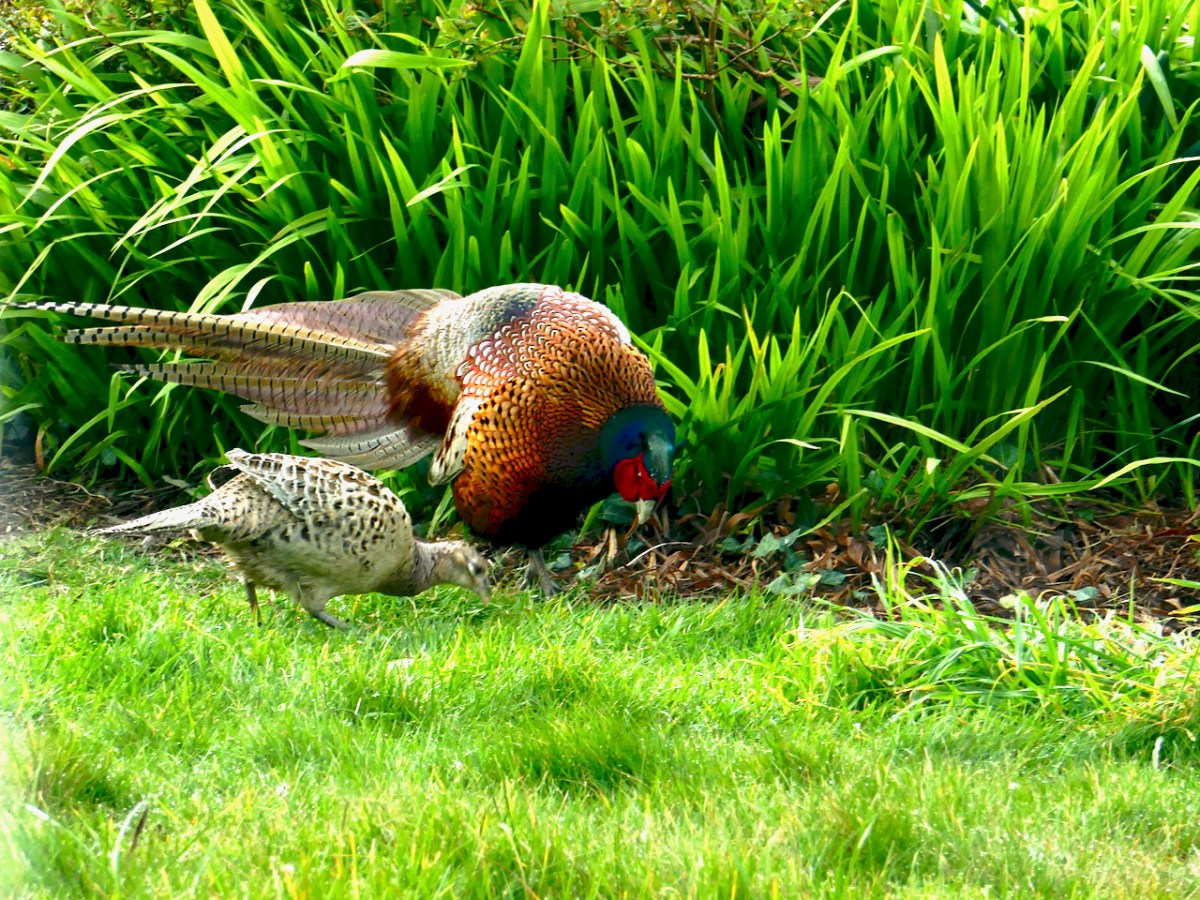
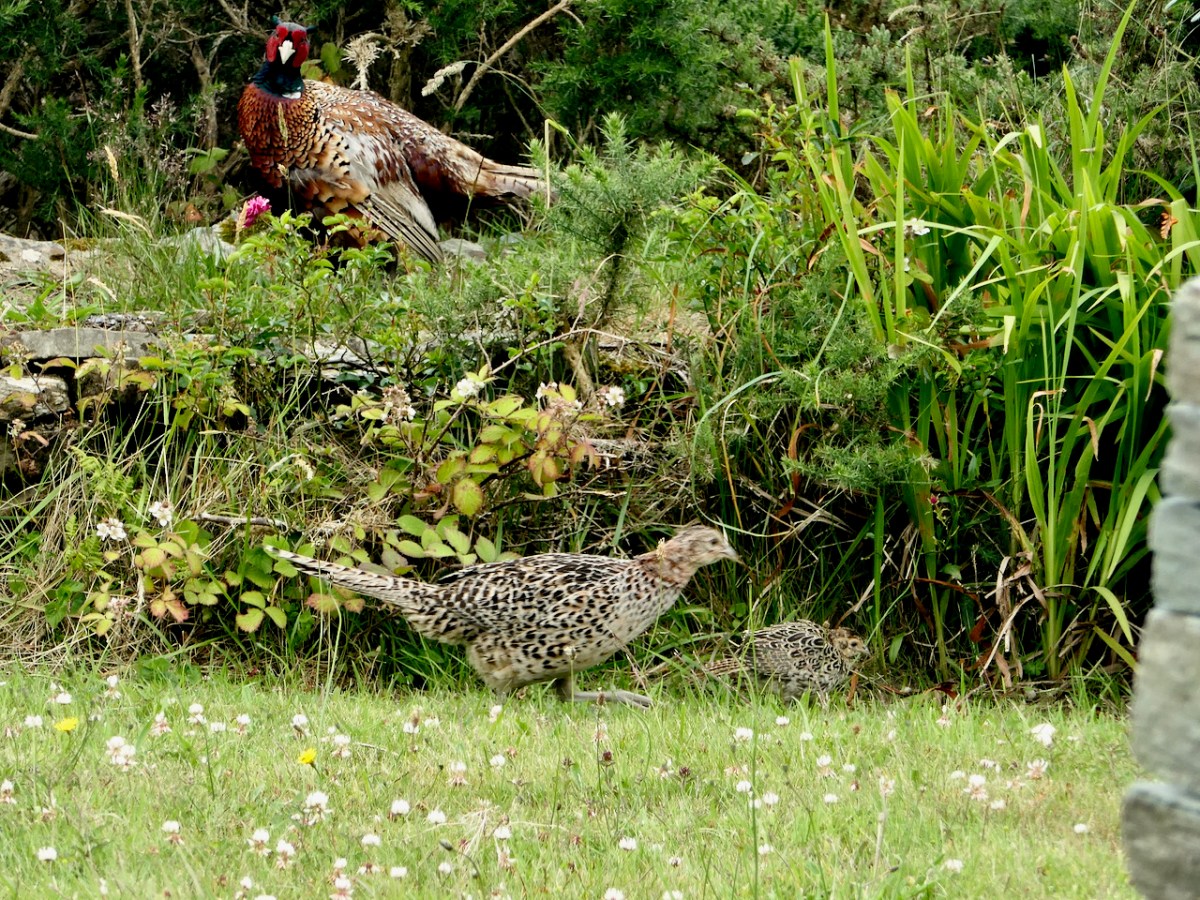
In the upper picture Finnbarr and his young wife, Fidelma, patrol our garden some five years ago. The lower picture was taken just before the start of the Pandemic, in March 2019. The couple have been a daily feature of life outside Nead an Iolair. They always appreciated feeding time, when they got a share of the seeds I put out on our patch for the many bird visitors, small and large. The picture below taken during the summer of last year shows a family group: pheasant chicks have been seen but rarely.
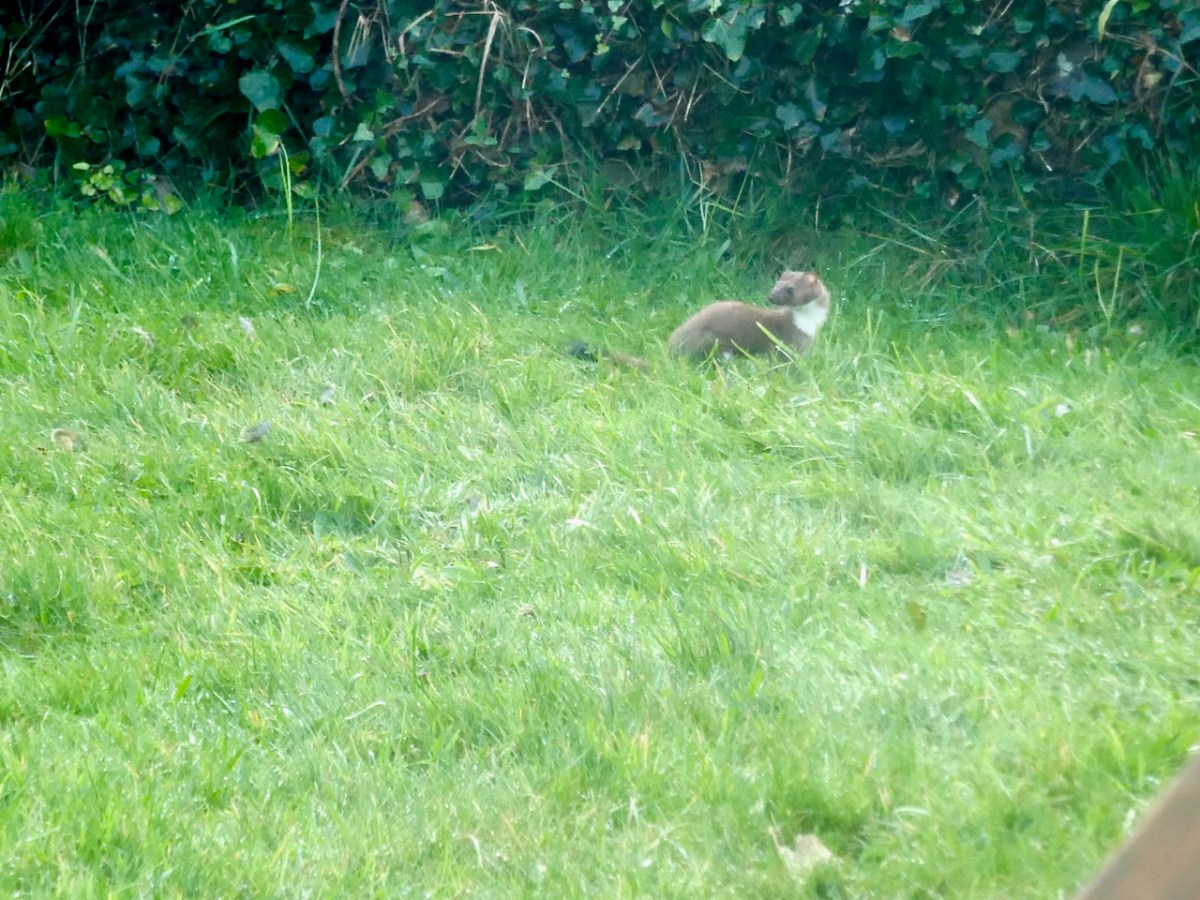
The idyll abruptly ended yesterday, when a bomb hit the garden – in the form of a small but fierce force of nature: only inches long but terrifying. I glanced out of the window where, minutes before, the two pheasants had been foraging as usual along the stone boundary wall. I was shocked to see Fidelma lying on her back, wings flapping, being dragged along the ground: there was a commotion among the small birds and Finnbarr had vanished. At first I could not see the attacker, but as I rushed outside I caught a glimpse of brown fur with a hint of white and black. My first thought – a rat! – could not have been borne out: we have lived side by side with rat families for years: they only ever appear to share the bird food, and are never aggressive.
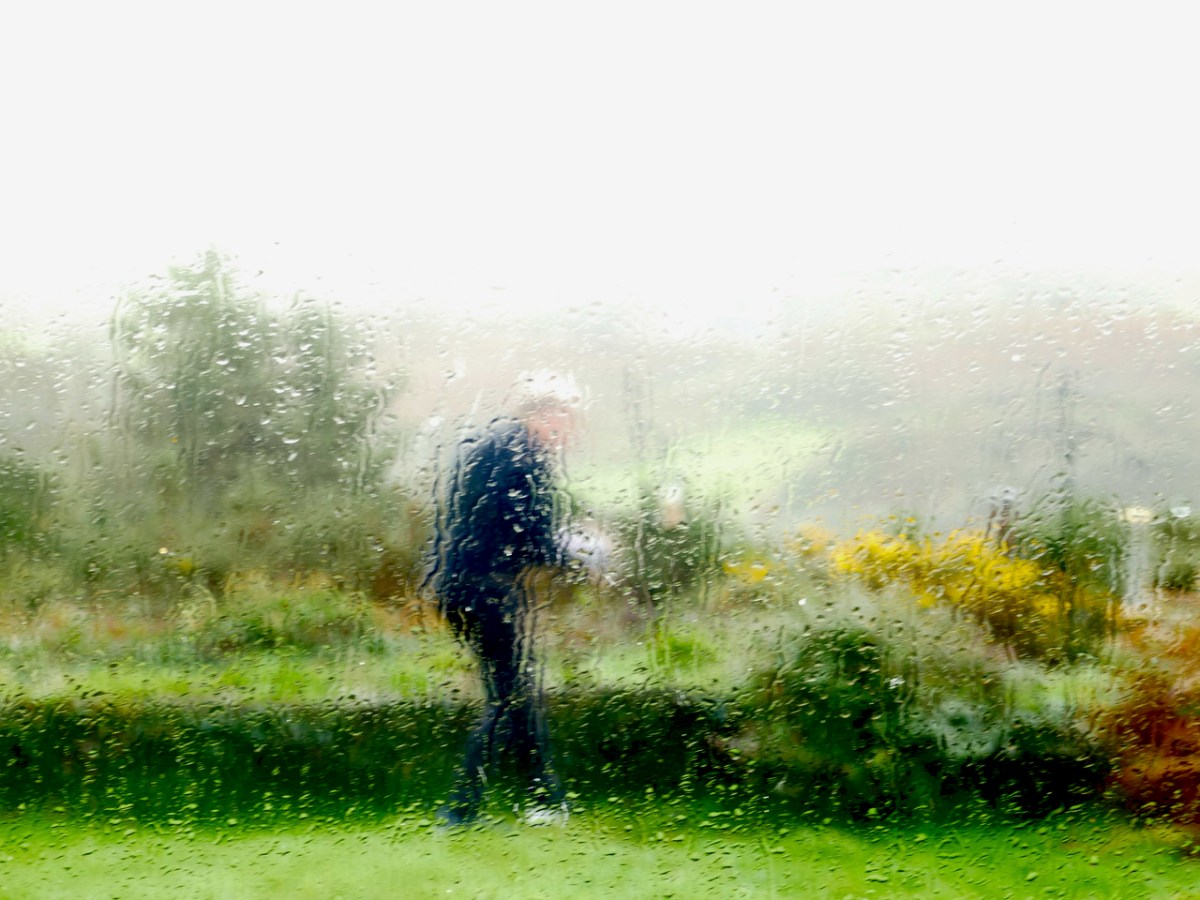
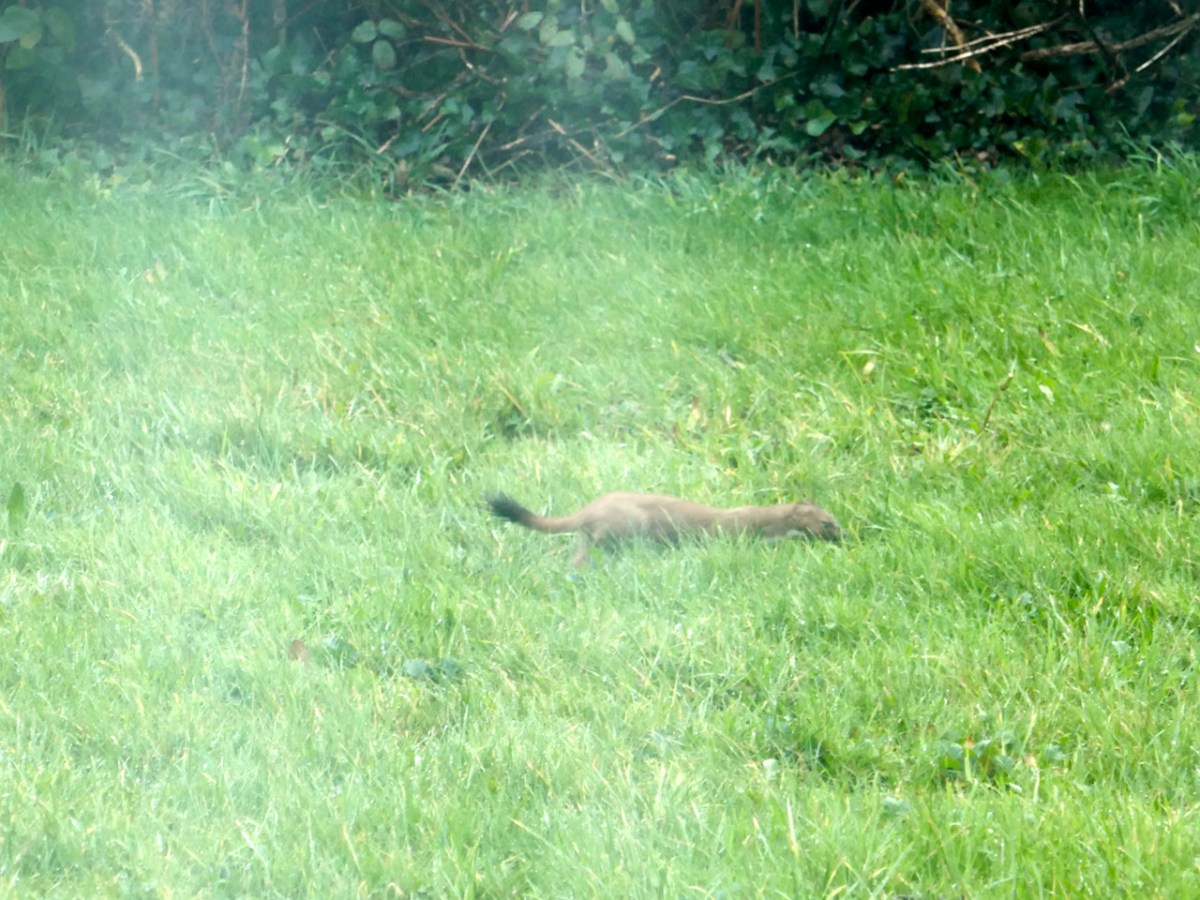
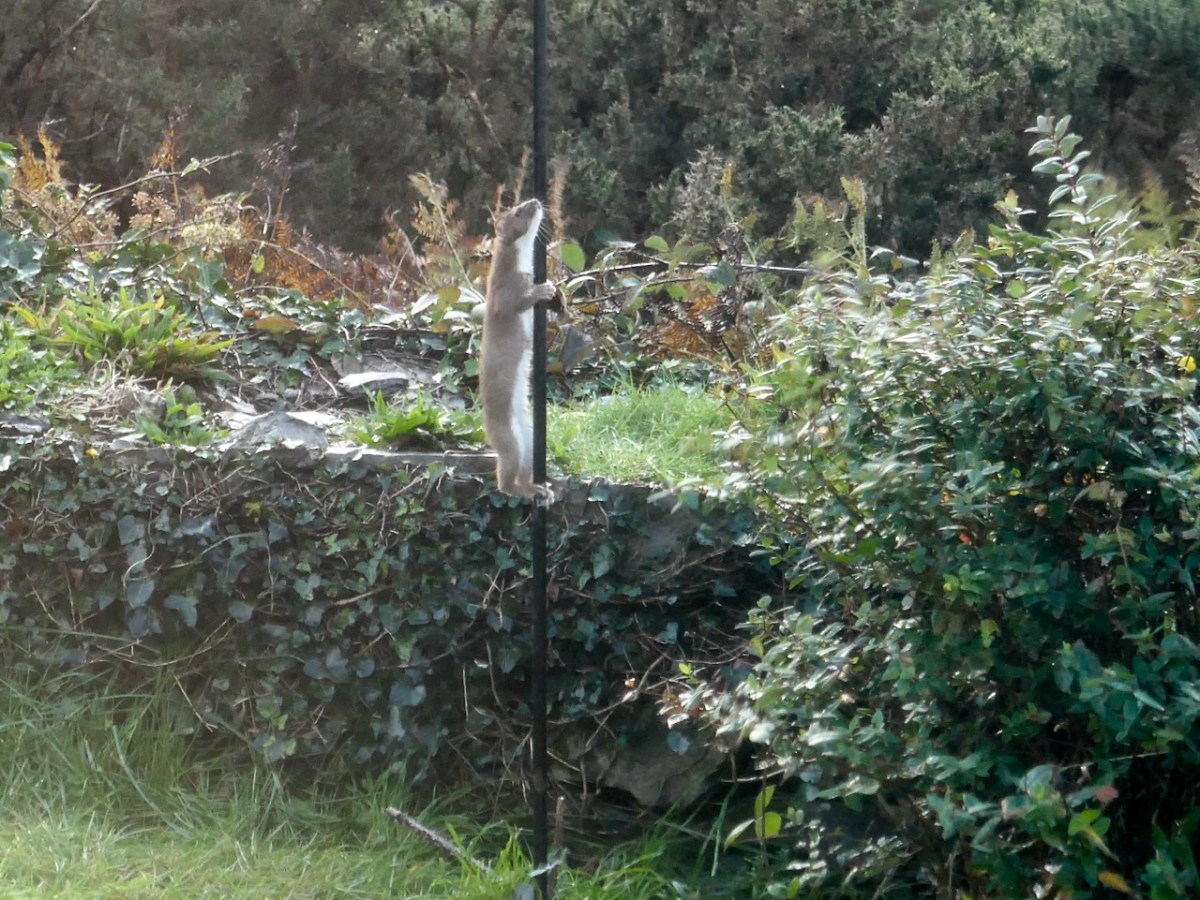
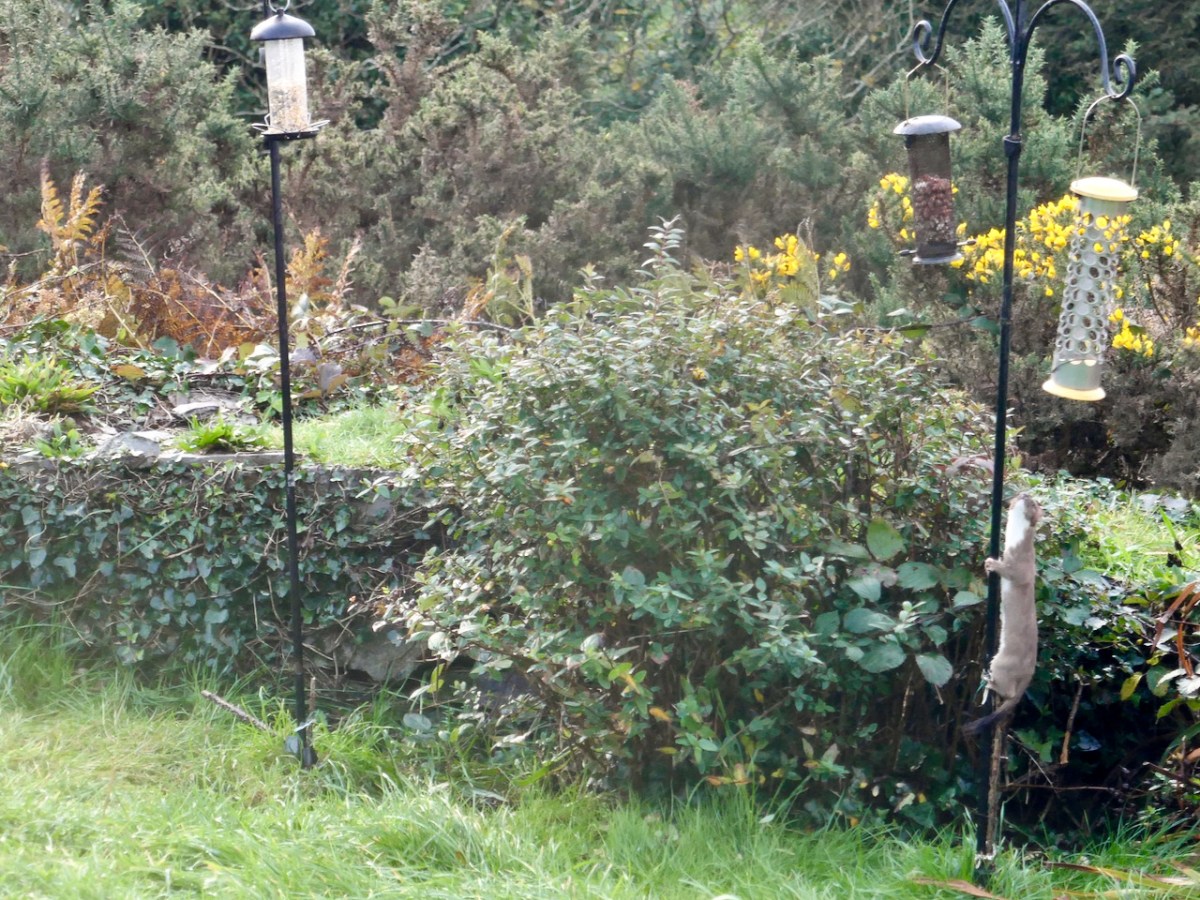
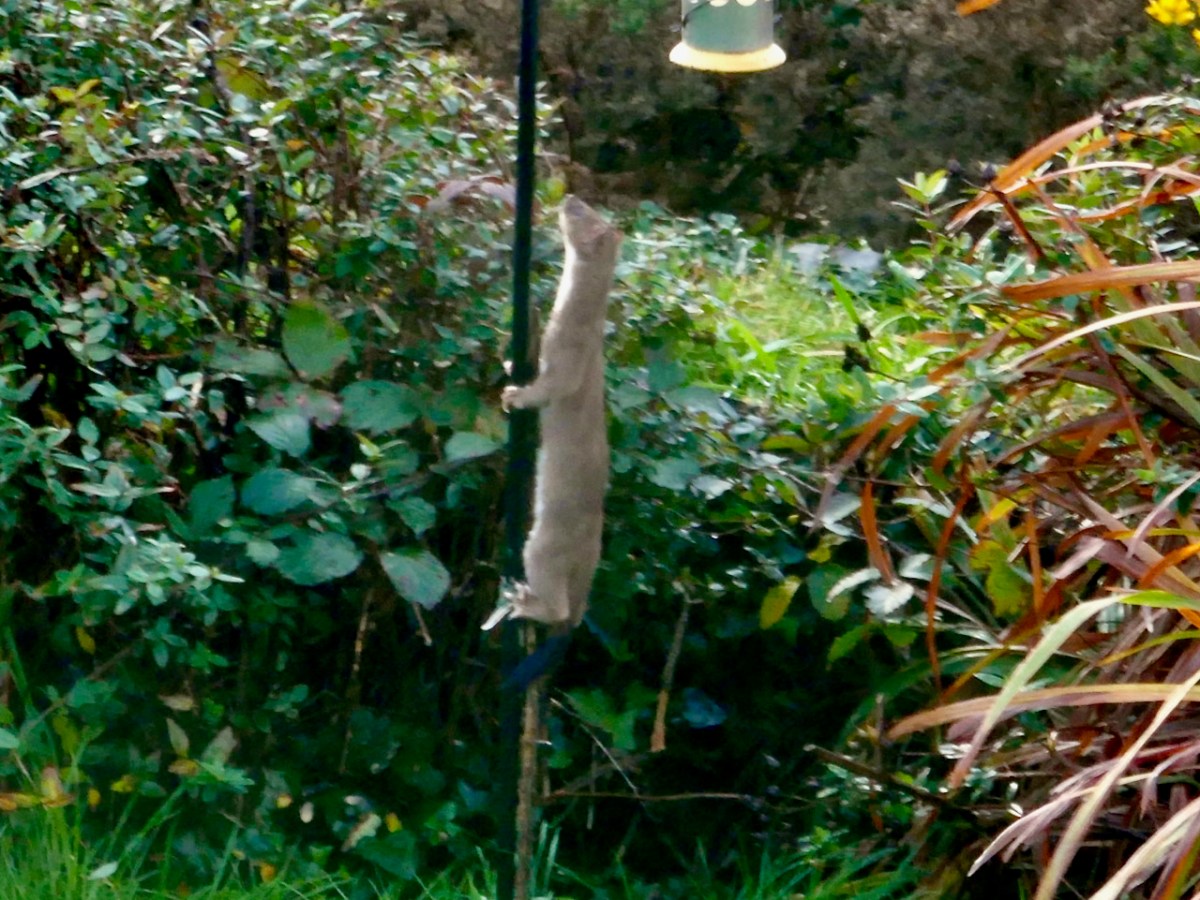
You can see the conditions that prevailed on this worst of days from Finola’s picture (top), taken from indoors through the windows. And – below that – the brazen culprit, who danced around the garden at breakneck speed, very ready to threaten me if I made a wrong move! It was our first sighting here on our land of an Irish Stoat. Having now read the books, I know in hindsight what a shocking phenomenon had hit us. Although fearing the worst, I quickly removed Fidelma to an indoor refuge and then watched the rampaging of this fur powerball traversing our territory at lightning speed; leaping from walls, trees and bushes and aiming for any likely food source.
Finola has done her best to clarify the images in the photos she rapidly took through streaming wet glass (above) on this appalling day. The weather did not in any way impede the progress of the animal which circumscribed our whole acre, it seemed, in record time.
. . . The Stoat is often called the Weasel in Ireland, but although the weasel (Mustela nivalis) is very similar in appearance to the stoat, it is not native to Ireland and has never been introduced here. In Ireland the stoat or ‘weasel’ was regarded as a very intelligent animal, but also vengeful. For example, since they were believed to understand human speech, if a stoat was encountered the correct thing to do was to greet them politely. In County Clare the custom was to raise one’s hat in greeting, or even to bow. The person who insulted them, on the other hand, or pelted them with stones, could expect to lose all their chickens before too long. Deliberately killing a stoat was most unwise, since it caused all the deceased animal’s relations to descend on the house of the culprit and attack with great savagery . . .
Ireland’s Animals – Myth legends and Folklore, Niall Mc Coitir, The Collins Press, Cork 2010
The Duchas Schools Folklore Collection – gathered in the 1930s – has numerous entries referring to the stoat. Above is an example from Co Carlow. When I was sifting through these, I was struck by the fact that similar stories about stoats are repeated over and over again, but from different parts of Ireland. I could write a volume based on these accounts, but will choose only a few:
. . . One time there was a girl who was very fond of going to the seaside. One day she went to the seaside and lay down and fell asleep. Ten weasels went down her throat. So she awoke when the last one was going down. She went to the doctor and the doctor said she would need to undergo an operation and then she would die. One day she was going to the shop and her granny knew all about cures. So she went into the granny. Her granny told her to get two pounds of salt and eat all the salt and go to the seaside and drink no water and keep her mouth open and the weasels would have to come out for a drink. So this she did. The weasels came out for a drink. The girl counted them. There were ten in it and the girl came home cured . . .
William O’Donnell, Cabra Glebe, Co Donegal
. . . One day long ago two men went to cut the meadow with scythes. They cut away for a while until they came to a weasel’s nest where there were four young weasels out of the nest and left them near by on the ground. After a while the mother of the weasels came home and found her young on the ground and was very angry, She hesitated for a moment and then understood what the men had done. Now the men had had a can of milk with them for a drink which they left near the weasel’s nest, the old weasel saw the can and went to see what in it. When she saw what was in it she spat into it because a weasel’s spit is poison. When the men saw this they were terrified and put back the young weasels into the nest, and the old weasel was pleased and went back and upset the can and spilt the milk from fear the men would drink of it and be poisoned . . .
James Gormley Senior, Aged 82, Commeen, Co Roscommon
Note that the term ‘Weasels’ is used far more often in these accounts than ‘Stoats’. There can only be the one animal, however, as there have never been true ‘weasels’ in Ireland. The story above, from Co Roscommon, is the most common of all ‘weasel’ tales in Ireland, and variants of it have been recorded from all parts.
. . . Many years ago an old woman lived by herself. There was a nest of weasels under the hearth in the house in which she lived and every day the old woman fed them until they became quite tame. When the young weasels were reared they went off but the old one remained in the hearth. One day the woman was sitting by the fire when the old weasel came out and sat with her. The weasel was continually looking up the chimney and at last the woman said “What the dickens are you looking at?” and at the same time looking up herself. She saw a little bag hanging in the chimney and took it down. To her surprise and joy she found it was full of gold. This was the weasel’s reward for her kindness to her and her family . . .
Mrs L Millett, Fiddaun Lower, Inistioge, Co Kilkenny
. . . The Swarm or Drove of Weasels: the following story or rather fact come from a reliable source to wit a teacher in Ballyshannon. In the end of August or about that time some distance outside Ballyshannon a great whistling was heard as if a number of little birds and a mighty drove of Weasels was seen heading for the mountains. An old man said that he heard that weasels used make for the mountains during the Grouse Season. The Priests housekeeper saw or heard of the same thing in Antrim . . .
J Clarke, Navan, Co Meath
. . . Some time about forty years ago there were children playing on the side of a hill and they saw a few weasels. They started to run and cry. They looked round and saw thousands coming after them. Only they got away the weasels would have devoured them . . .
Written by Kathleen McKenna Bragan, Co Monoghan 25th November 1938
I couldn’t resist that little foray into weasel stories from the Folklore Collection. There are many many more pages full of them! Interestingly, stoats are a fully protected species in Ireland. If stoats are proving a problem, by killing chicks or other domestic animals, you must solve the problem by using good fencing; it is illegal to kill a stoat.
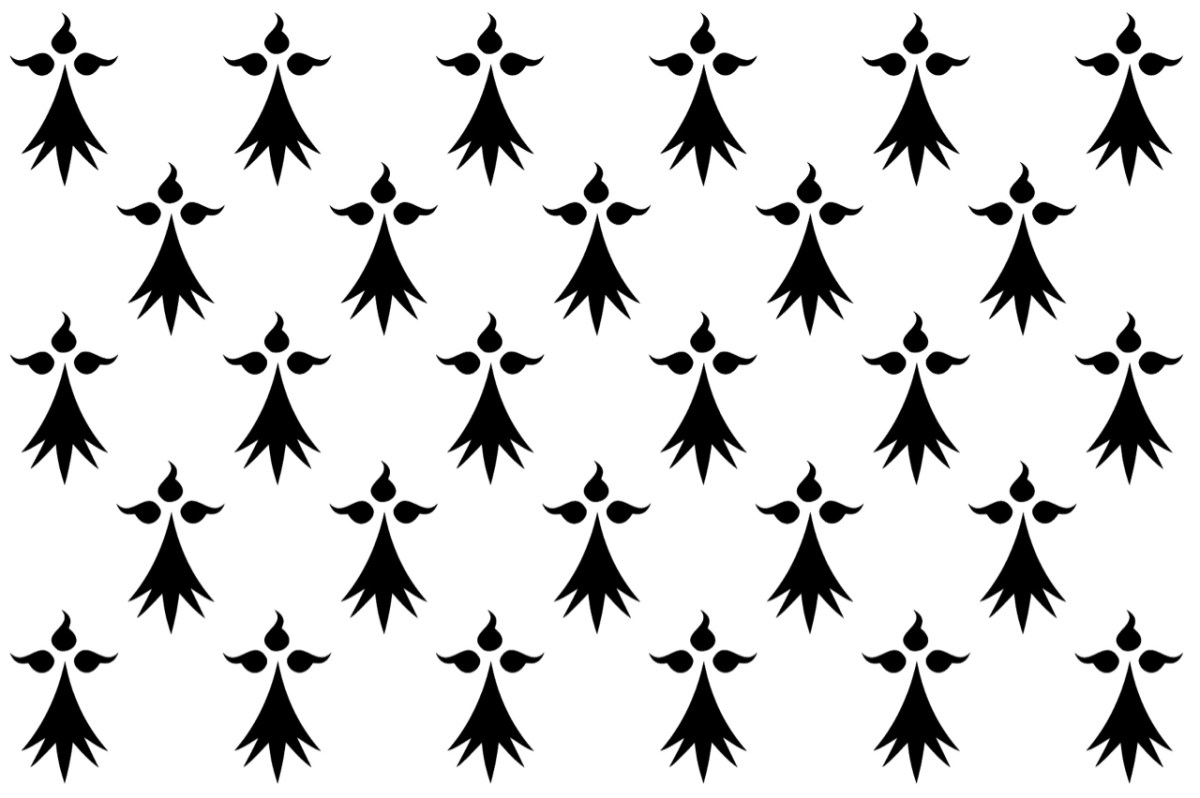
A possible reason for the attention which stoats attract in folklore is the fact that they can change colour, which adds a sense of the supernatural to them. In countries which have harsh winters the coat of the stoat becomes white in those months, offering a level of protection in the open landscape. The fur from the white – or ‘winter’ – stoat we call ermine, and the white fur is considered so precious that only royalty or nobility traditionally wear it. In the drawing above, the white stoat is wearing a cloak on which are printed the symbols of the flag of Brittany (below), which was an independent kingdom in medieval times. The white background represents the ermine fur, and the black markings are said to be based on the black tip of the tail which the animal retains, even in the winter.
Here (above) is another example of the Breton ermine representation: a finely worked silver antique brooch. In Ireland, the species of stoat which has evolved – Mustela erminea hibernica – does not usually turn white in winter, although examples have been noted. The animal is said to have been resident in Ireland from the post-glacial period and, in the present day, the population numbers are unknown: it is not a threatened species.
In spite of our attempts to care for Fidelma, she did not survive. Sadly, I decided to let Nature have her way and laid the body close to a fox-track above the house. Later, I noticed an assembly of corvids gathered in the area. When I returned there in the evening all traces had gone – just a few scattered feathers told the tale.
This morning, Finnbarr was absent from the garden. I did catch a glimpse of him wandering the distant pastures – forlorn and bereft. At least, those are the feelings my human soul projects onto him. He will find another mate, of course, and we hope they will continue to share our little bit of paradise. We will keep a lookout for unwelcome visitors, but we will always have to pay our respects to the ‘weasels’. If our stoat does return we will have to honour him with an Irish name: I am inclining towards Fiáinín – which means Little Wild One.
Lady with an Ermine, painted 1489–1491 by Leonardo da Vinci. The subject is said to be Cecilia Gallerani, the mistress of Leonardo’s Milanese employer, Ludovico Sforza. The Ermine is symbolic, rather than realistic – in fact it is pictured much larger than in real life. It has been suggested that the ermine in classical literature relates to pregnancy, sometimes as an animal that protected pregnant women. Around the time of the painting’s creation, Cecilia was known to be pregnant with Ludovico’s illegitimate son.
Welcome to the UCD Library Cultural Heritage Collections blog. Discover and explore the historical treasures housed within our Archives, Special Collections, National Folklore Collection and Digital Library



















 Roaringwater Journal