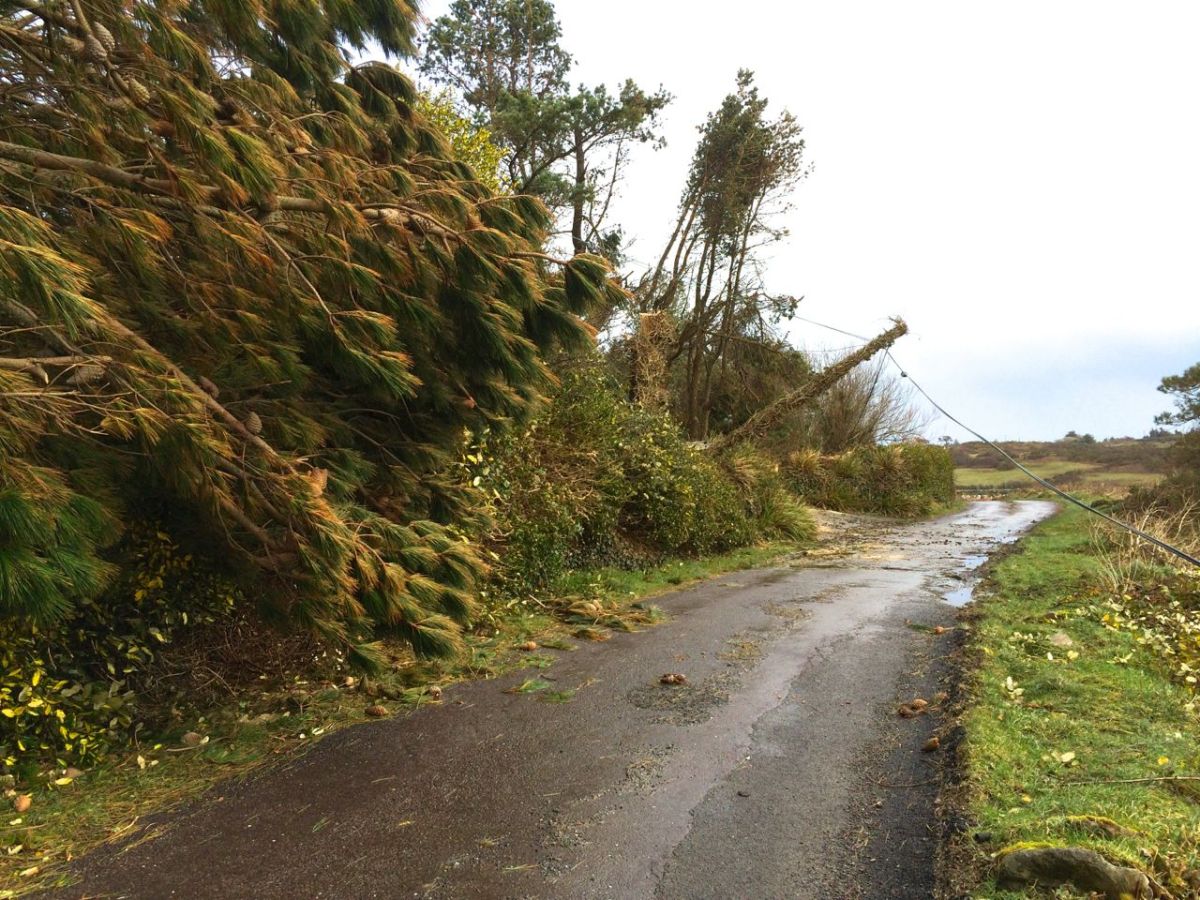
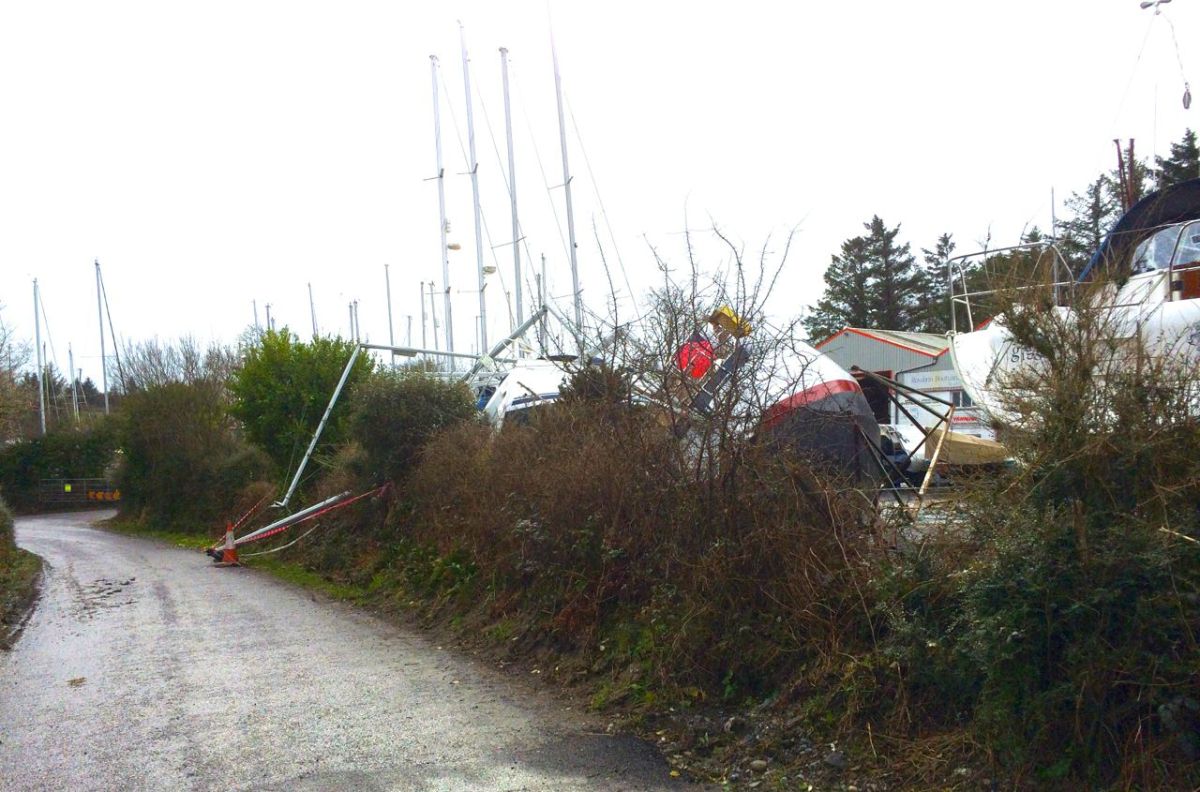
Exactly ten years ago I wrote a Roaringwater Journal post titled Outlook: Changeable! It was about the weather and – interestingly – things haven’t changed much in that respect over a decade. So I thought it was worth a re-run, with some adaptations. The new title, for a start – Outlook: Unsettled! – is apt, perhaps, for the whole world we are living in today and not just the weather. The year 2014 produced the fiercest storm – Darwin – that many in West Cork (and beyond) had experienced in their lifetimes. Certainly we had property damage, felled trees and powerlines, and were without electricity, phone and internet for very many days.
Examples of the damage caused by Darwin in 2014: neighbouring cables felled (upper) and boats toppled from their keel blocks in Rossbrin Boatyard
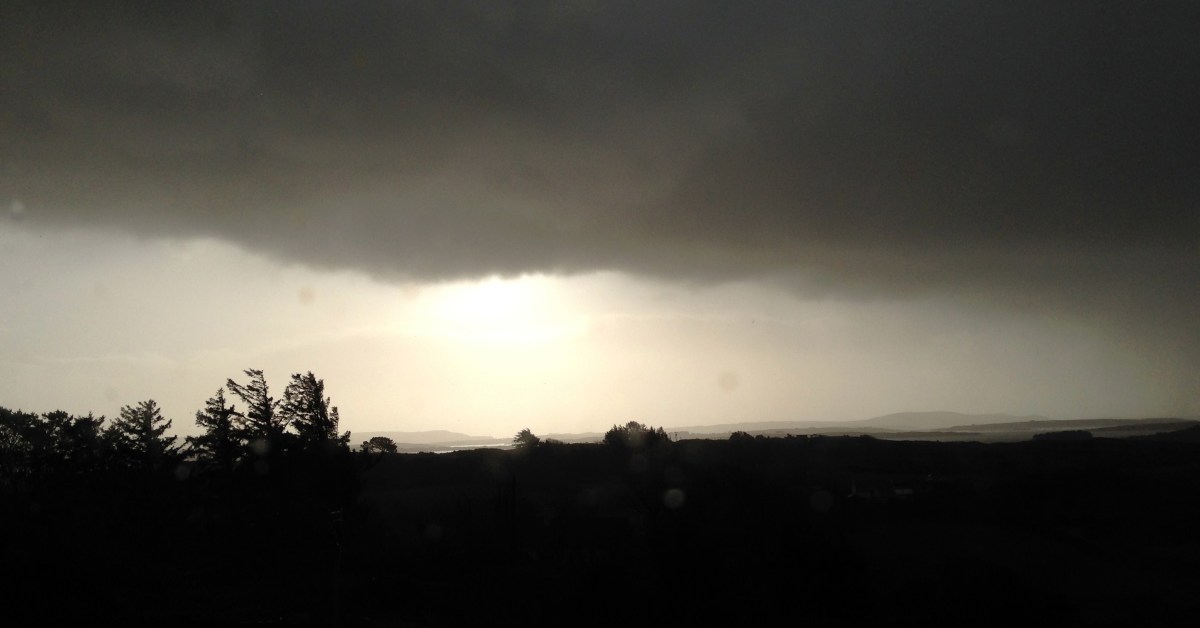
From January 2014: …One of my favourite expressions about the weather was learned from an elderly gentleman who had lived all his life in Hampshire, England. …Tis black over Will’s Mother’s… This would have described very well the scenes around us in Nead an Iolair when we awoke this morning. As an Englishman I would be expected to talk about the weather all the time; Irish people are not far behind in this, probably because there is such a variety of weather – even in a single day – that it demands to be described. …Is iomaí athrú a chuireann lá Márta dhe… means: …There is a lot of weather in a March day… This might just as well refer to a January day, or a day in any month in our experience. To illustrate this we decided to try a time lapse video, using an iPhone and a tripod. We had to shoot it through the window, hence the reflections – just as well because during the process we had torrential hail to add to the variety. So this is a thirty minute session of Irish weather coming in to Roaringwater Bay compressed to thirty seconds, each frame being shot a second apart:
By asking around the locality I have compiled some Irish expressions for weather. These are ones that I particularly like:
A snipe won’t stand in the morning… (meaning expect icy weather)
It’s a hure of a day… (meaning it’s a hure of a day – Finola has her own version here)
Bad aul’ day isn’t it?
And – very occasionally – The Sun does be splittin’ the stones…
Coming back to 2024 It’s worth delving into the archives of the The Schools’ Folklore Collection: the following entries were written down in the 1930s and provide an insight into weather-lore from the time:
“…When the sheep go under the wall there is a sign of rain. When the curlew begins to whistle there is a sign of rain. When the cricket begins to sing there is a sign of rain. There is a sign of rain when the hills look near. When the dust is flying off the road there is a sign of rain. When the river is roaring there is a sign of rain. When the fire is blue there is a sign of rain. When the clouds are running in the sky there is a sign of rain. When the smoke from the chimney is going up straight there is a sign of rain. When the sky is red in the morning it is a sign of a wet day. When there are a lot of clouds in the sky it is a sign of rain. When there is a rainbow in the morning it is a sign of a rain. The South wind brings most rain in this district. A red sky is a sign of a storm. Black clouds are a sign of rain. When the swallows are flying it is a sign of rain. When the dog is eating grass it is a sign of rain. When rain is expected the cat lies near the fire. The crows lie on the walls when rain is expected. The nearer the ring is to the moon the farther the rain is from us. The farther the ring is from the moon the nearer the rain is to us. When the lake is rough it is a sign of rain. When the water-fall roars it is a sign of rain. When the soot is falling it is a sign of rain. When the cricket comes into the house it is a sign of rain.
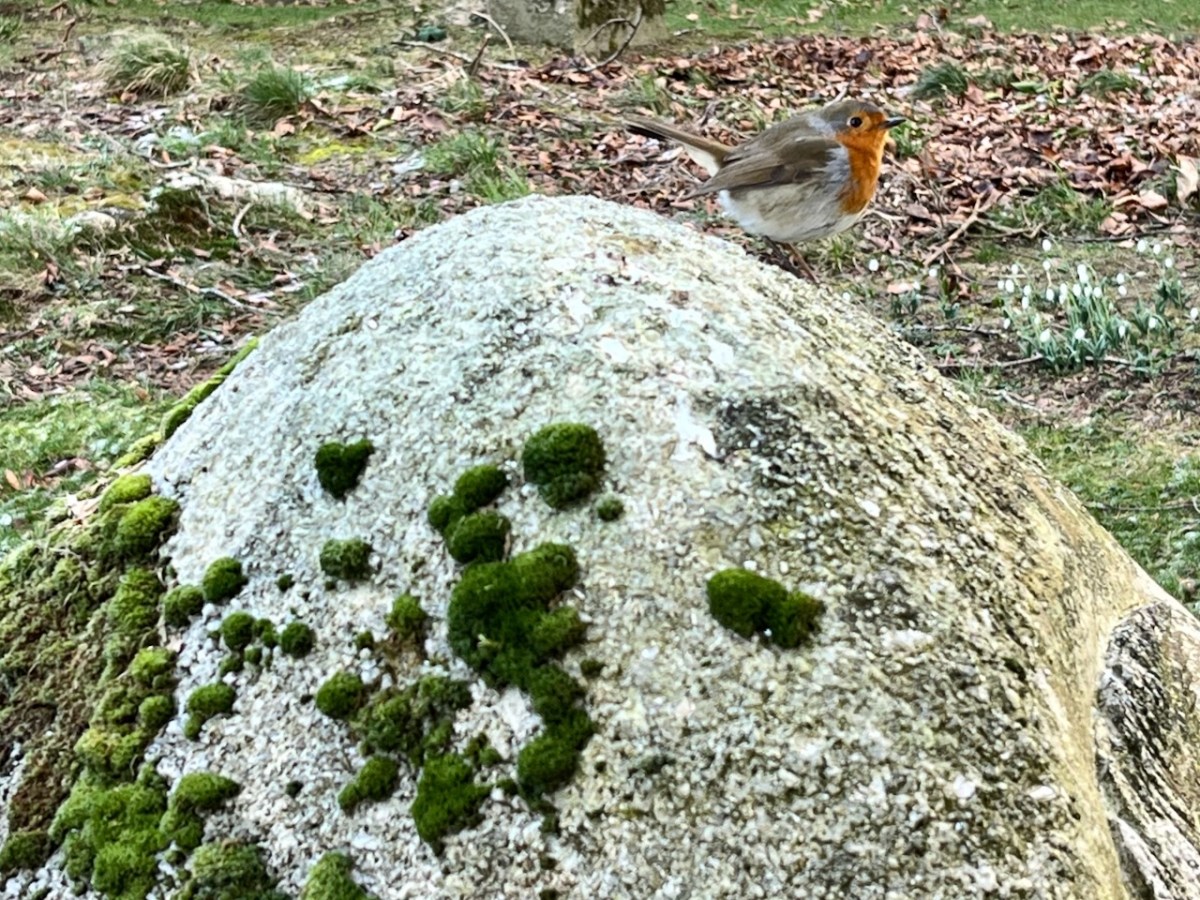
If a robin comes in very near the door of the house its the sign of bad weather. If crows fly in flocks together and are always cawing its the sign of rain. The South and South West winds are the most that bring rain. If the ducks quack loudly and the cricket sings sharply its the sign of rain. A ring around the moon at night is the sign of rain…”
All these sayings have been collected by informants Willie Noone, John Monoghan and Michael Halloran, Co Mayo. It’s instructive that they are only about rain.
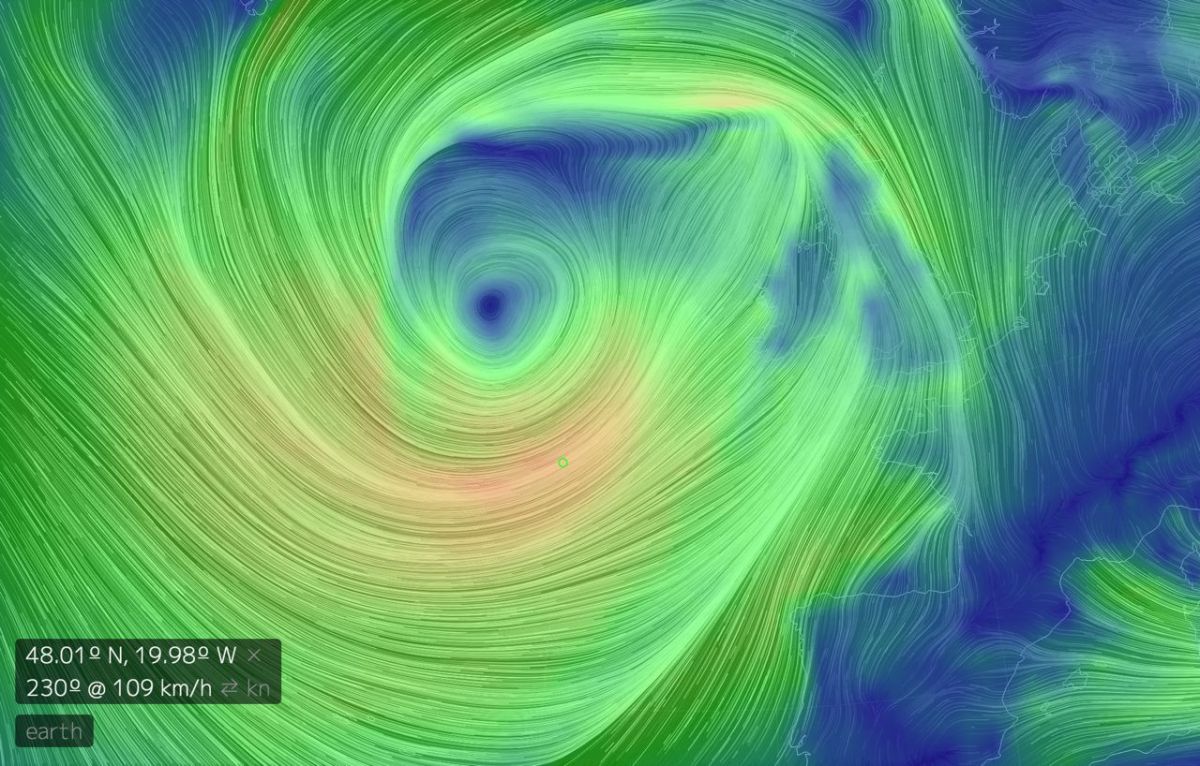
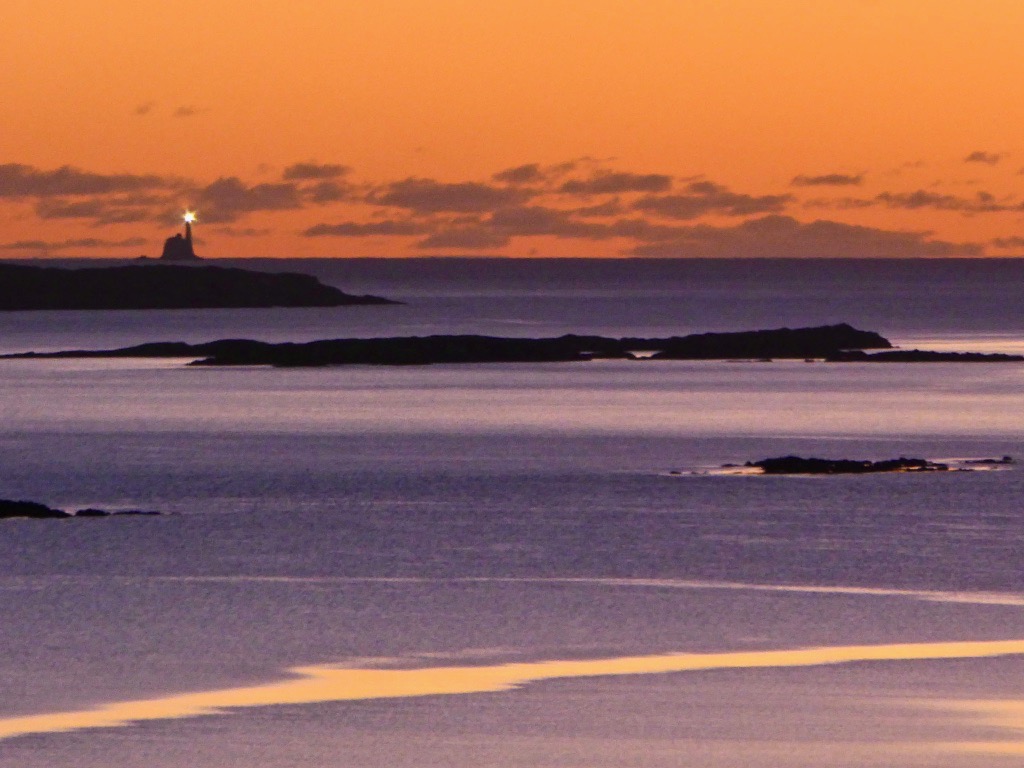
This is a record of the Earth Wind Map from early January, 2014. It’s centred over Ireland. Only 109 km/h is recorded. That’s classified as “Violent Storm” and just a few km/h short of a hurricane. Storm Darwin hit wind speeds of 177 km/h. That was a record for the time, but it’s worth noting that the greatest wind speed ever measured (so far) in Ireland was 191 km/h at Fastnet Lighthouse, County Cork on 16 October 2017. That’s just across the water from us here at Nead an Iolair! Here it is seen from our house (by Finola) on a happily calm day…
Adam and Eve in the Garden is an Aubusson tapestry, from the Atelier Tabard Frères et Soeurs (artist website) designed by Louis le Brocquy and dating from 1951-52. Le Brocquy was born in Dublin in 1916 and led a long life which included travelling extensively across continents, always completely engaged in art. He died in Dublin in 2012. On his death, President Michael D Higgins said: ”Today I lament the loss of a great artist and wonderful human being whose works are amongst this country’s most valuable cultural assets and are cherished by us all. Louis leaves to humanity a truly great legacy.” In 2002 the National Gallery of Ireland acquired le Brocquy’s painting ‘A Family’ – the first work by a living artist admitted to its permanent collection.
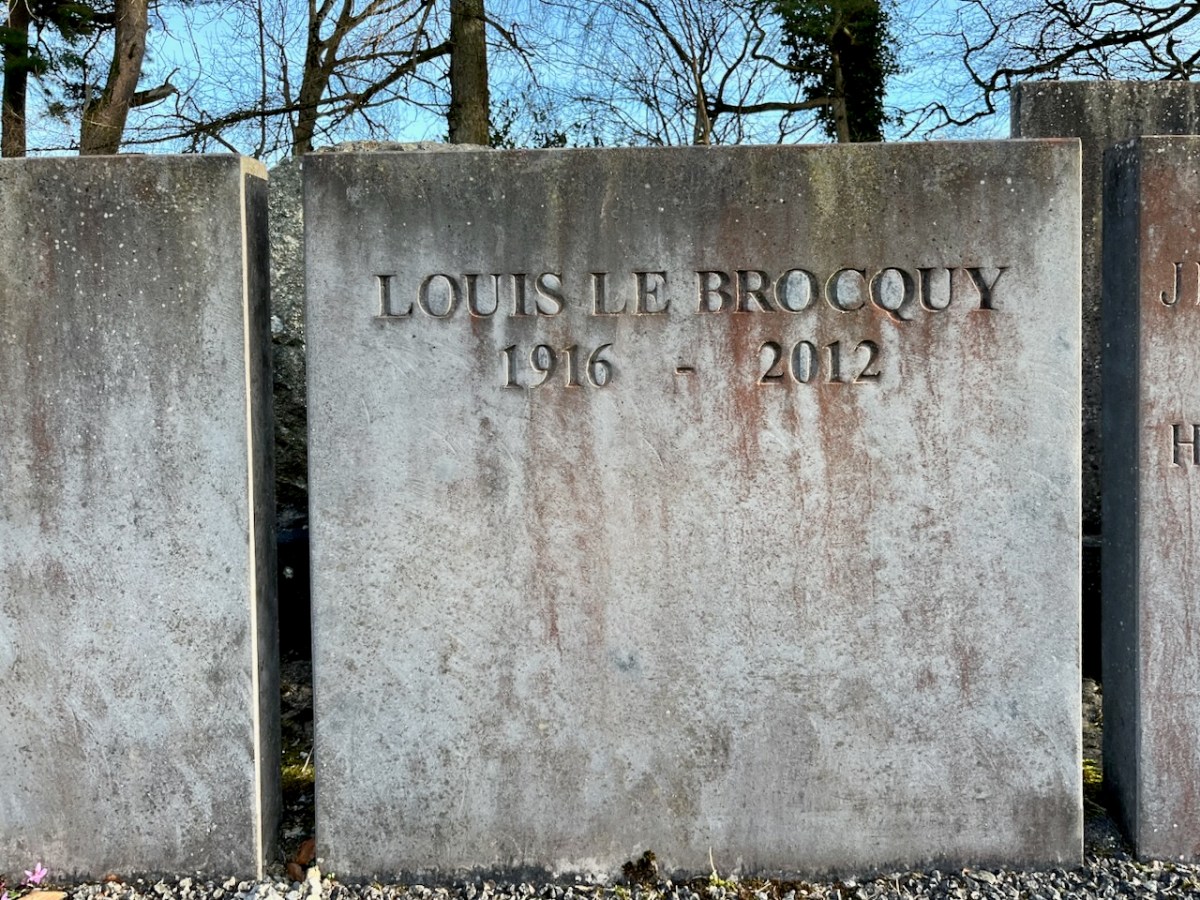
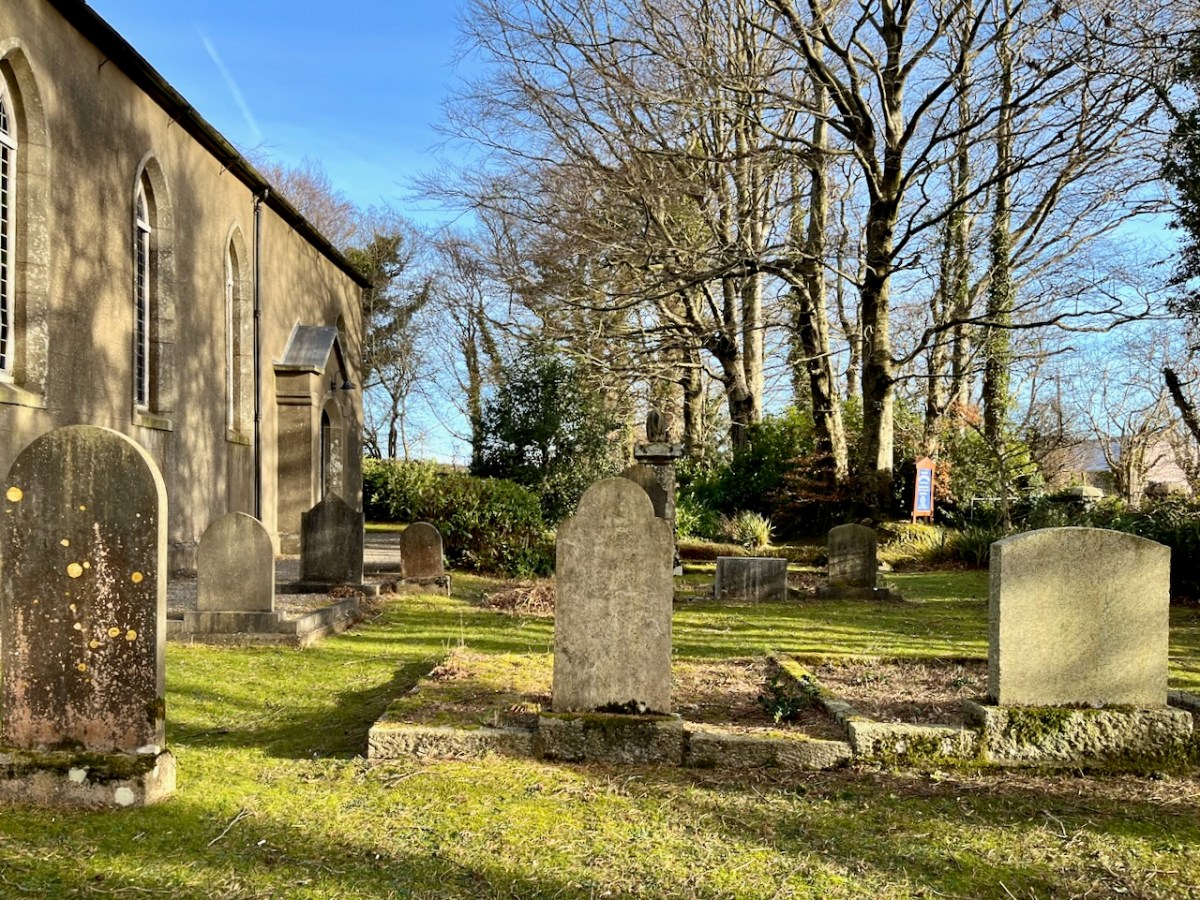
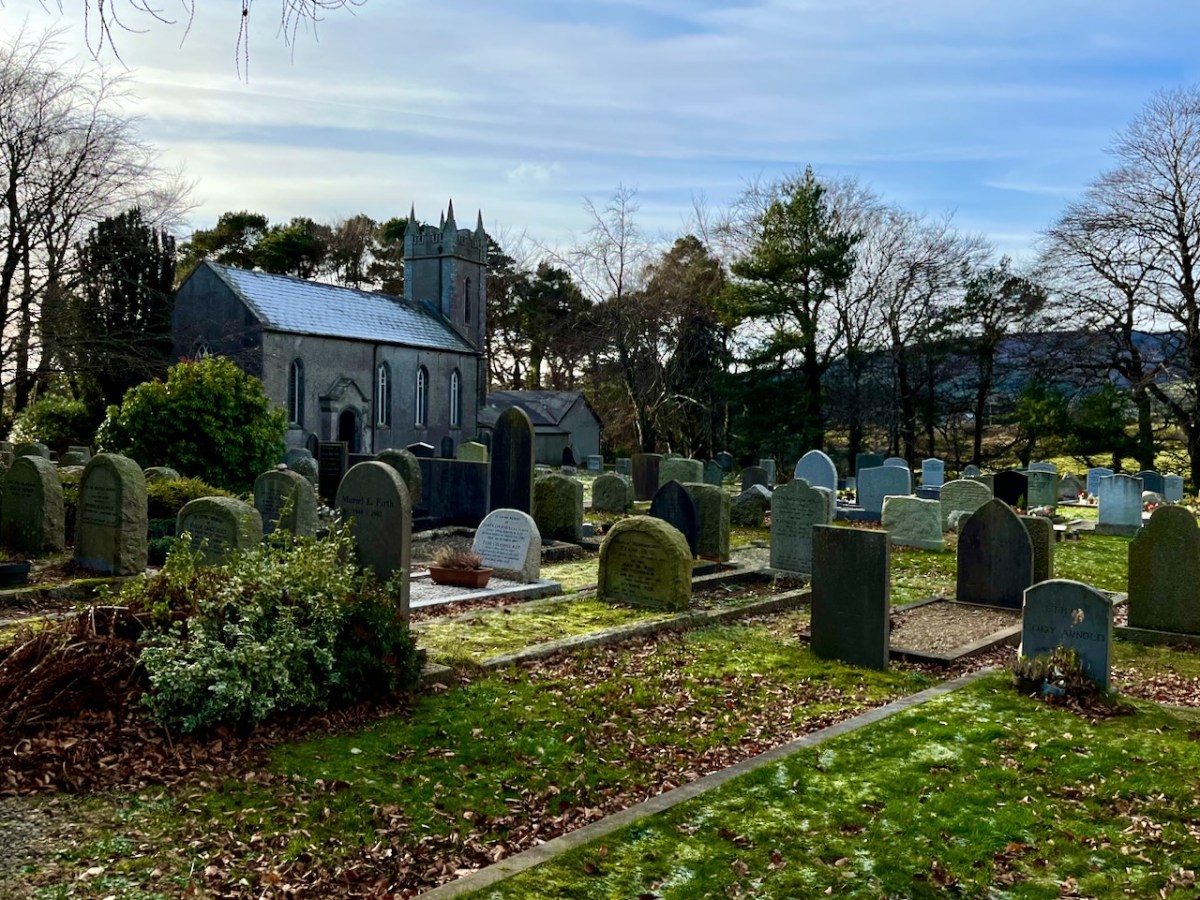
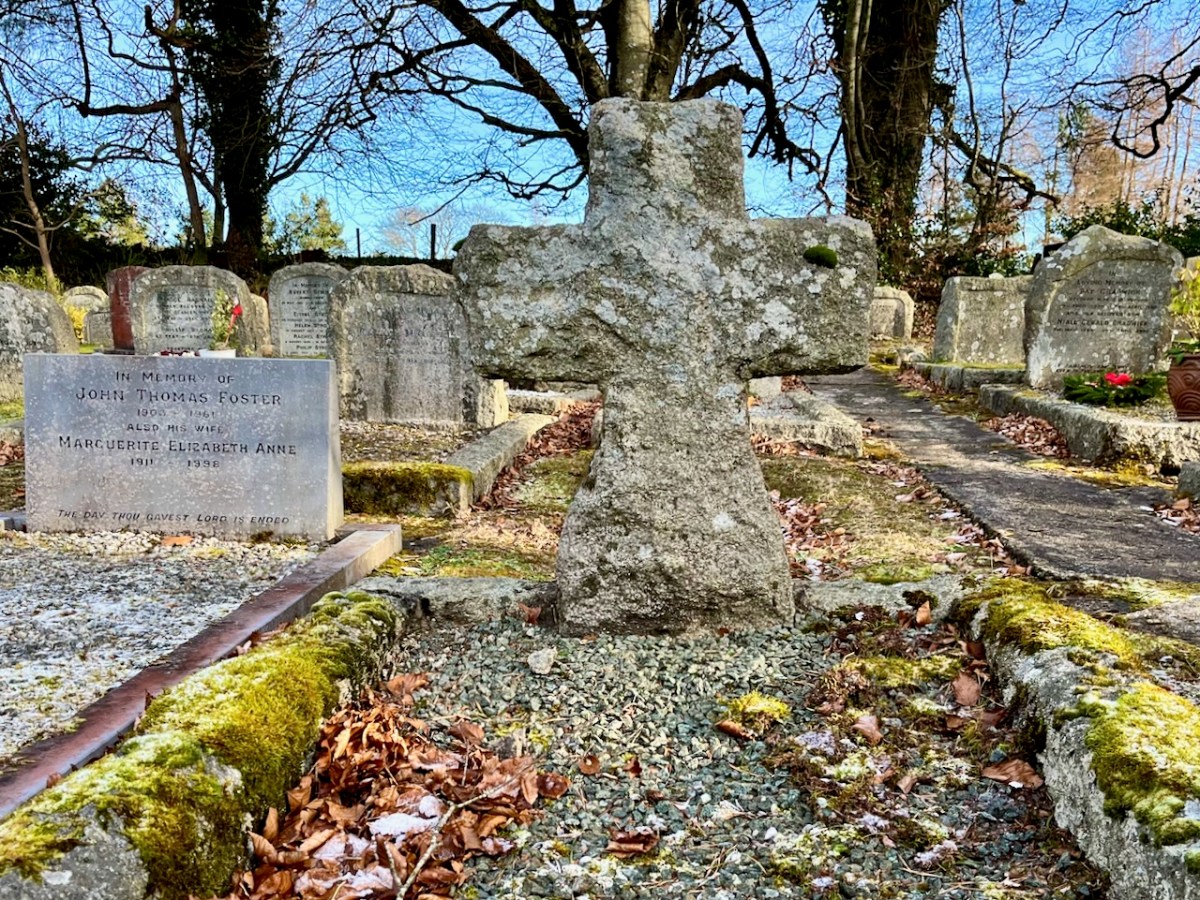
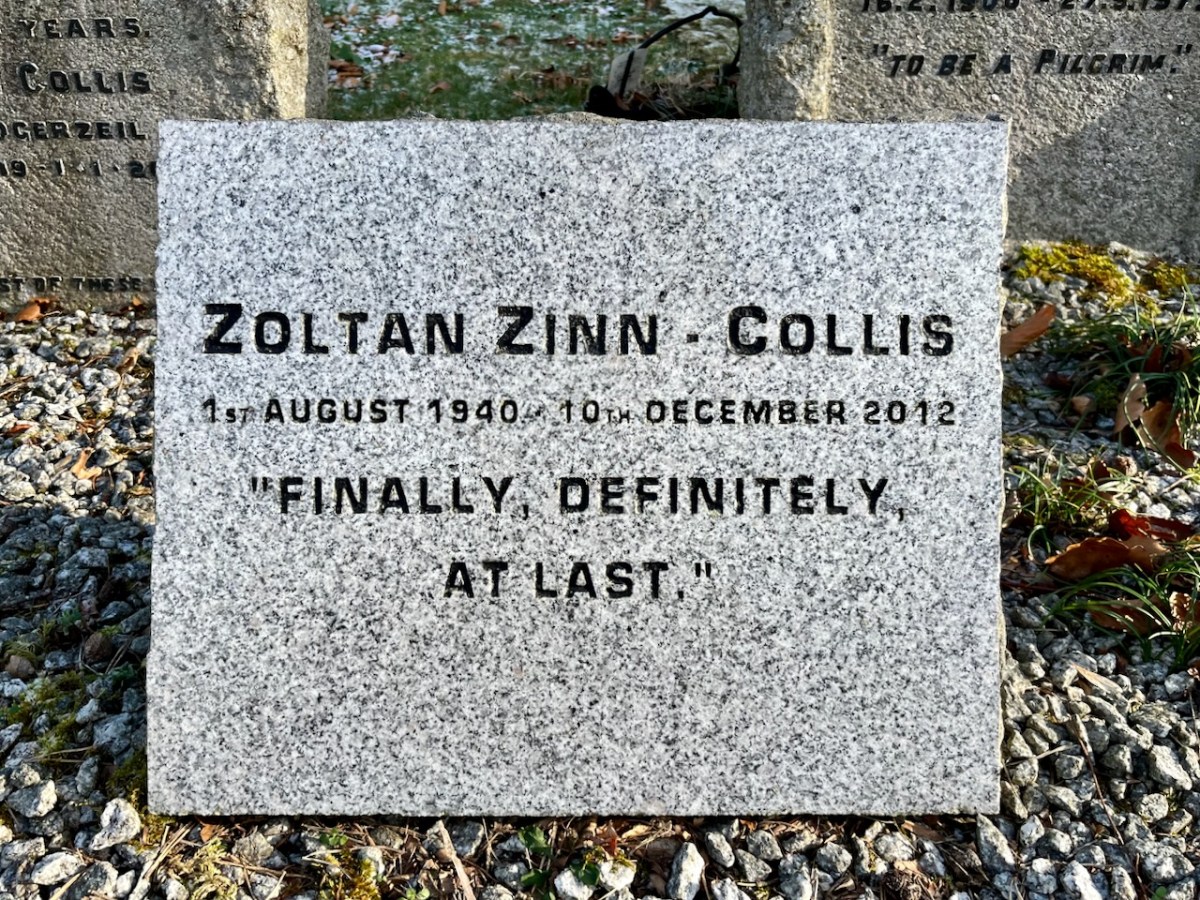
While out exploring the byways of rural County Wicklow, we chanced upon le Brocquy’s burial place. It’s in the little Church of Ireland graveyard at Calary. We had never heard of it before but – as we reconnoitred – the realisation dawned upon us that this is a very special site. Le Brocquy is probably the most eminent artist interred in these grounds, but he is only one of very many who have presumably chosen to spend eternity in this remote but extremely beautiful corner of rural Ireland. The views towards the not-too-far-away mountains are dramatic.
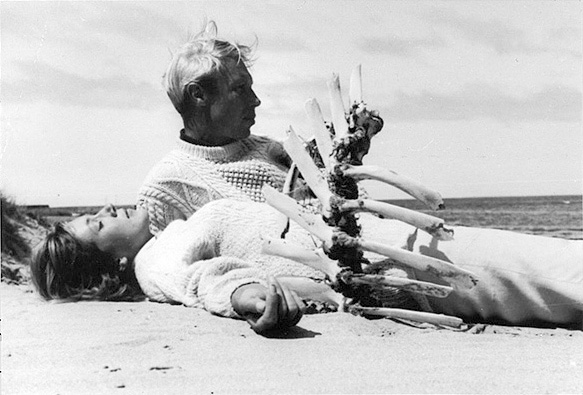
Le Brocquy’s wife, Anne Madden was born in London in 1932 to an Irish father and an Anglo-Chilean mother, and is still living. Madden spent her first years in Chile, where her Father owned a farm. Madden’s family moved to Corrofin, Ireland when she was ten years old. During the 1950s she met le Brocquy who was then working in London. They married in Chartres Cathedral in 1958 and set up house and studio in Carros in the south of France, where they remained until 2000. The empty plot at Calary beside Louis is presumably saved for her: she will add significantly to the artistic distinction of this community. The plot to the south of him is taken by Anne’s mother – Esther Madden Simpson – and brother – Jeremy Madden Simpson.
Anne Madden and Louis le Brocquy, 1974 (public domain). From that year onwards the family spent long summers on the Beara Peninsula.
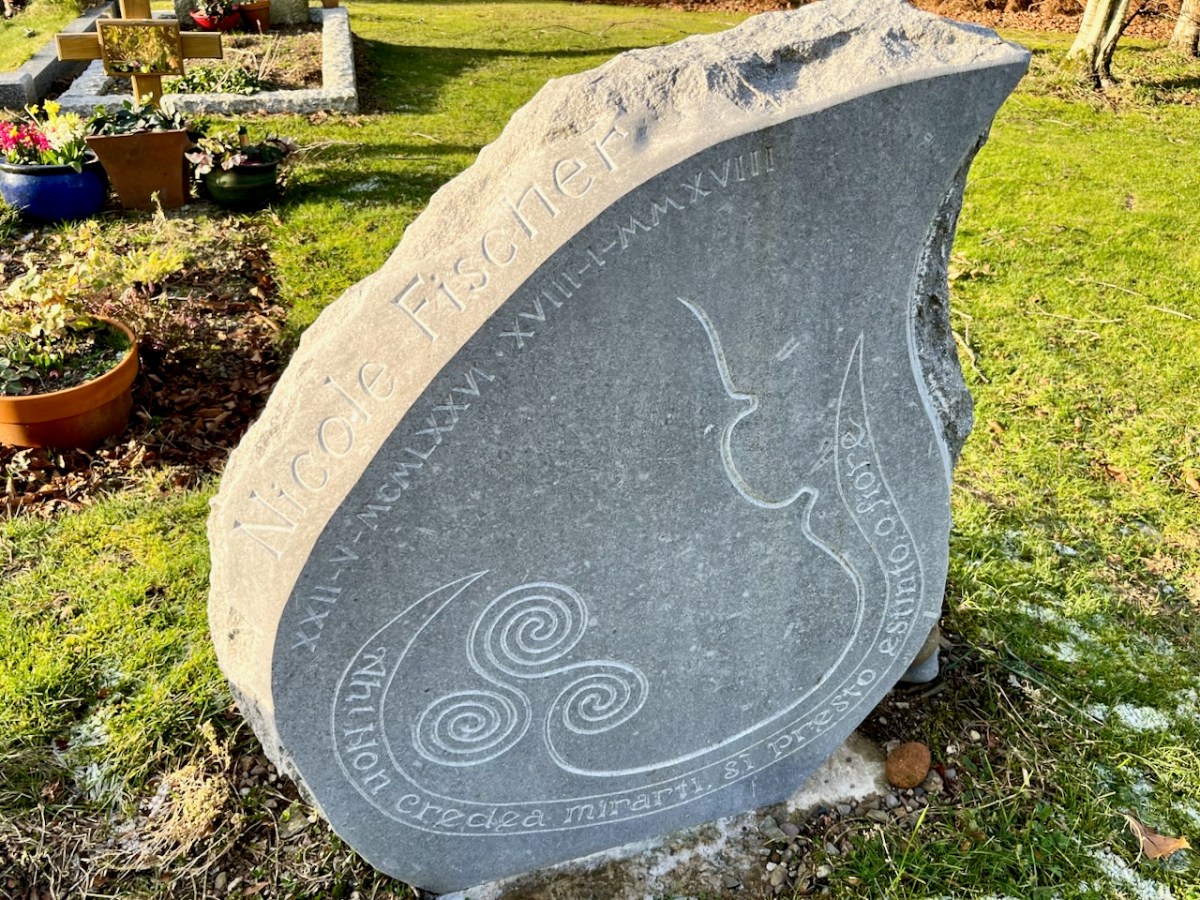
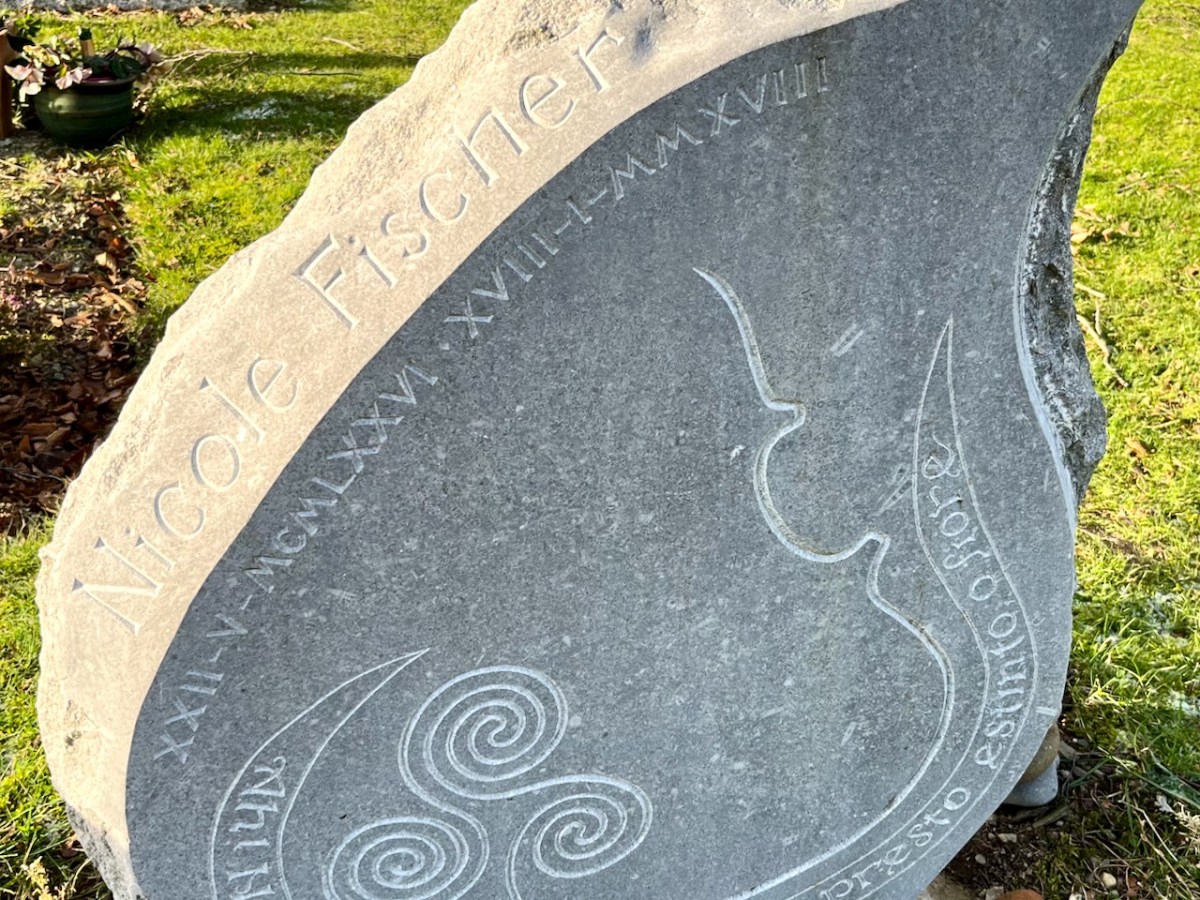
A relatively recent gravestone added to Calary is this one, dating from 2018. It remembers Nicole Fischer, a viola player with the RTE Concert Orchestra and the Amici String Trio. Sadly, her death occurred when she was in the prime of her life.
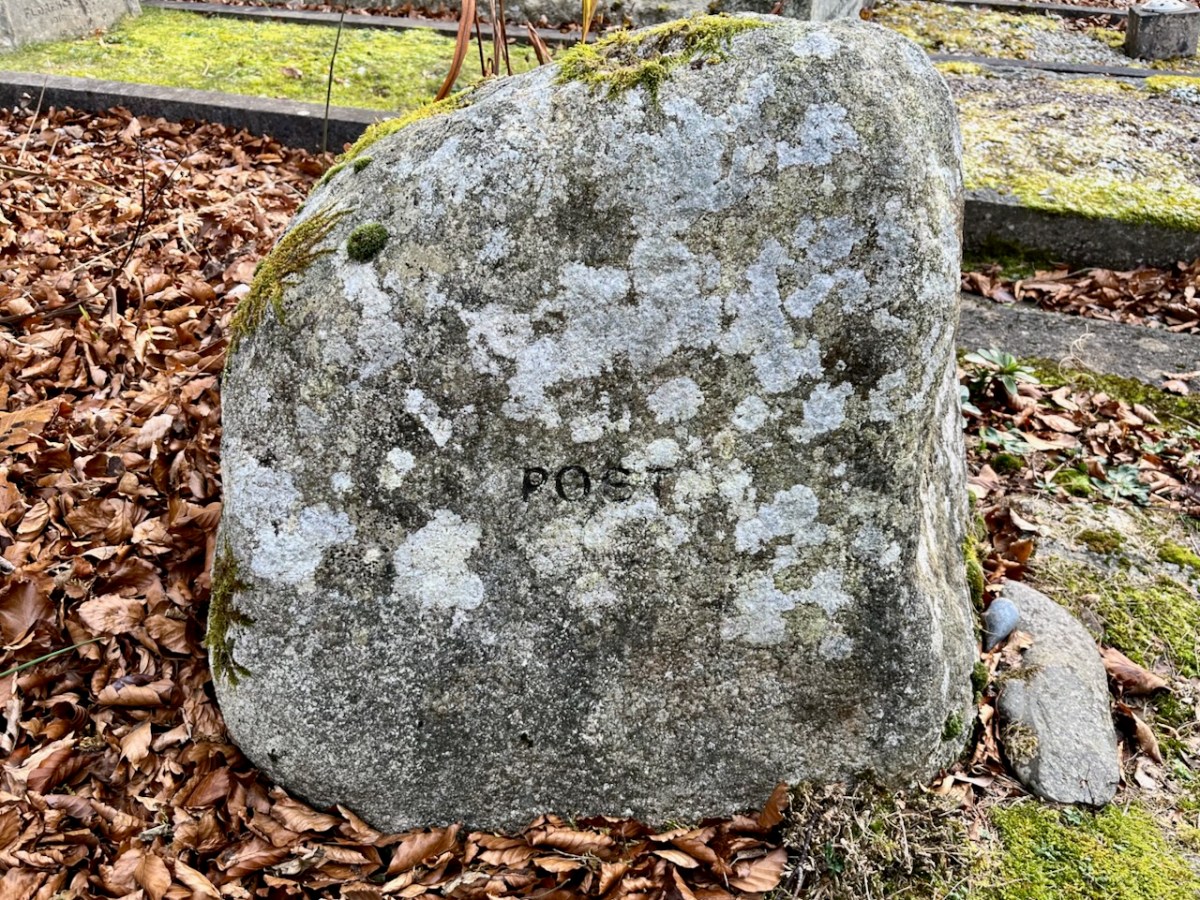
This impressive and beautiful gravestone is the work of Wicklow sculptor Séighean Ó Draoi. There are a number of unusual markers within this site: every one tells a story, of course.
Maurice Carey led a distinguished life in the Church of Ireland. He served as Dean of Cork from 1971 to 1993, when he retired, and in retirement returned to his native Dublin where he was in charge of St John’s Church, Sandymount. While in Cork, Dean Carey presided over a period of great change in St Fin Barre’s Cathedral and he was instrumental in setting up the St Fin Barre’s Study Centre. He also achieved much in the musical and liturgical life of the cathedral. “. . . His freshness of mind contributed greatly to this success and he was kind and helpful to younger clergy at the start of their ministry . . .” (obituary).
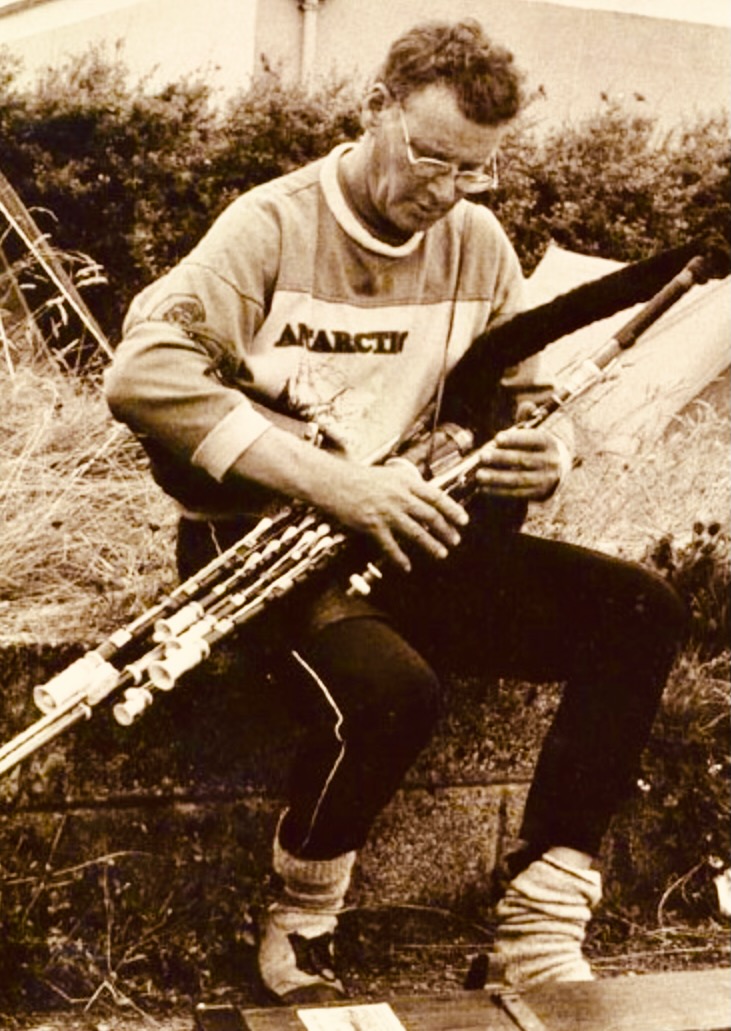
This stone belongs to Ronnie: Ronald James Wathen, who was born in 1934 and died before his time, in 1993. He was famed as a poet but also climbed mountains – and played the Uilleann pipes (https://www.discogs.com/artist/365089-Ronnie-Wathen):
The poet’s printed obituary sums up a notably eccentric life:
. . . I feel there may be a ‘most individual and bewildering ghost’ glaring with mock ferocity over my shoulder, a restless shade who would never forgive me if I tried to bury him with platitudes. Ronnie Wathen was quite spectacularly different: unpredictable, provocative, abrasive yet stimulating in argument, generous with himself, always able to see and articulate the quirky side of life. In Ireland Ronnie’s first poems appeared and many slim volumes were to follow. He had a most splendid, if unruly, facility with words. Usually he employed them seriously but he also loved frolicking with them, standing them on their heads just for fun. He wrote about anything and everything that caught his fancy, as a poet should . . . the last I saw of Ronnie was when he strode off up the road to do a kindness to an old friend. I must end with a grumble. Ronnie was an insomniac, never known to leave a party until very late. His parting prank was to quit the party of life far too early, at the age of 58, just to tease I like to think. It was a cruel jest . . . he held his final party at the little church of Calary, below Sugarloaf Mountain, in the verdant lap of his beloved Wicklow Hills. On that sunny autumn afternoon many, many friends crowded the church, farewells were spoken in prose and verse, laments welled up from three of the finest pipers in Ireland and a lone fiddler knelt by the open grave and hauntingly played the restless Ronnie to his rest . . .
Mike Banks
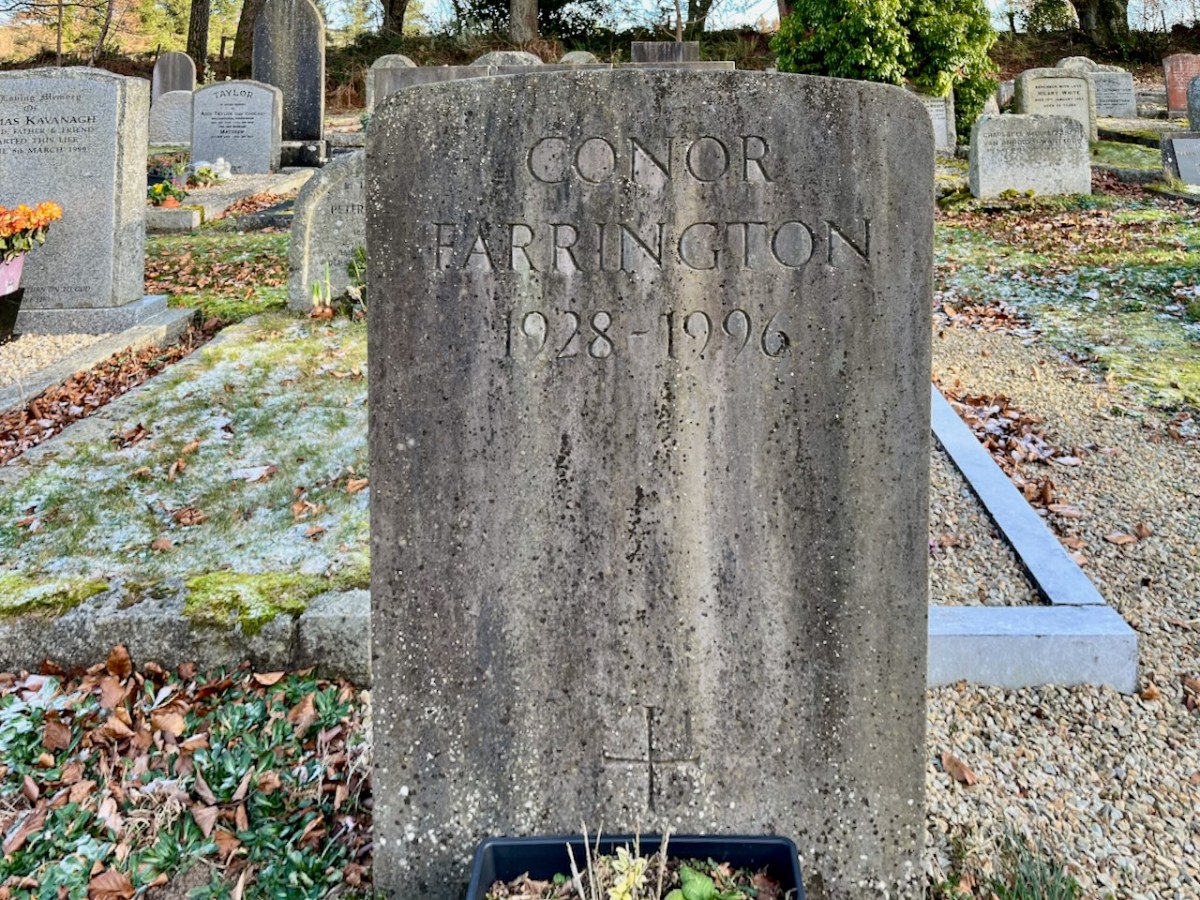
Conor Anthony Farrington was born in Dublin in June, 1928. His distinguished career included writing a number of plays for radio and theatre. Notable, certainly, were: Death of Don Juan (1951), The Tribunal (1959), The Good Shepherd (1961) and The Ghostly Garden (1964). ‘The Language of Drama’ in The Dubliner (July-August 1962) concludes the following: “…there are three reasons for a ‘radical alteration in the language of drama’ – viz, ‘the audience’s reason’, the ‘actor’s reason’, and ‘the dramatist’s reason’ – since ‘it is actually by means of particular words and phrases that he discovers his character’…” In later years appeared a collection of short stories (Cork: Fish Publishing 1996).
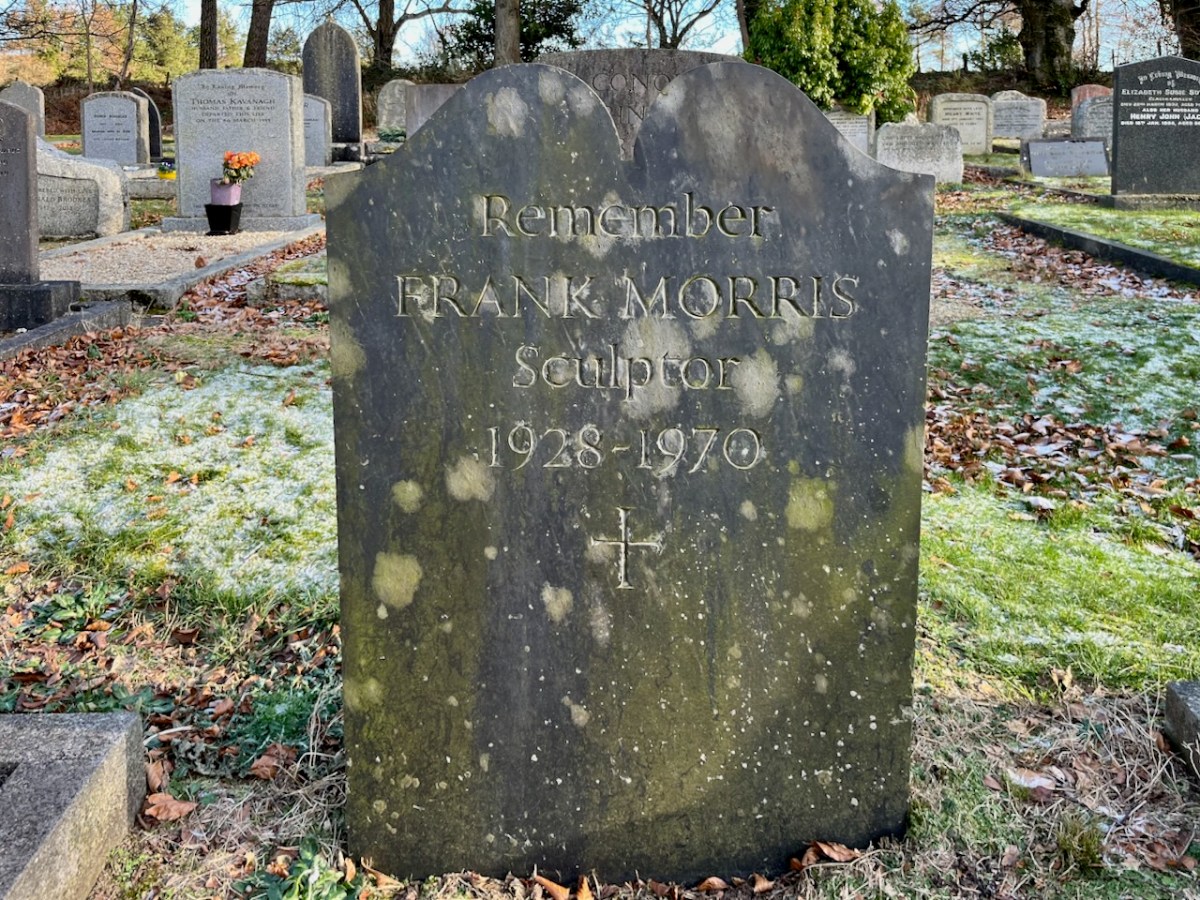
Another effectively simple slab remembers the sculptor Frank Morris, born in Arklow, Co Wicklow. He spent some years working with the Irish Forestry Department: while there he became a skilled wood-carver. The Dictionary of Irish Biography states that “. . . Carving for him was akin to peeling an onion to reveal the form within . . .” He also developed skills in sign-writing and letter-cutting. Have a look at his magnificent beaten copper door in the Holy Redeemer Church in Dundalk:
It’s interesting to find a Jewish grave in a rural Irish parish: Evelyn and Bruno Achilles (above and below).
In the 1930s The Schools Folklore Collection produced some memorable notes about the parish of Calary:
. . . Glasnamullen is our town land and there are nine families in it. Calary is the name of our parish. There are about twenty-six people in this townland. Sutton is the most common name in this district as their are four in Glasnamullen. All the houses in our town land is slated, but there are three or four thatched houses outside the townland. This place is called Glasnamullen as long as anyone can remember. Mr Arthur Sutton is seventy six, he lives in Glasnamullen, but Mr Fortune is one hundred and Mr Stokes is eighty six. They dont know any Irish, but they are great for telling stories in English. When my father was small he used to get Mr Stokes to tell him stories. Mr Fleming told me a story about Mr Byrne, The Paddock, Kilpedder. Once upon a time a man was cutting down a hawthorn tree in an old fort and as soon as he did a wind rose and took it away and over his head were thousands of birds. No one ever knew where the hawthorn went to, but everyone said that the fairies must have done it. They never plough the land owing to that. St Kevin is said to have blessed a little well beside a river in Ballinstowe. Every one goes and drinks it when they have colds. It is also said it has the power to cure sore eyes. There are pieces of cloth on the bushes around it left by people whose eyes were cured . . .
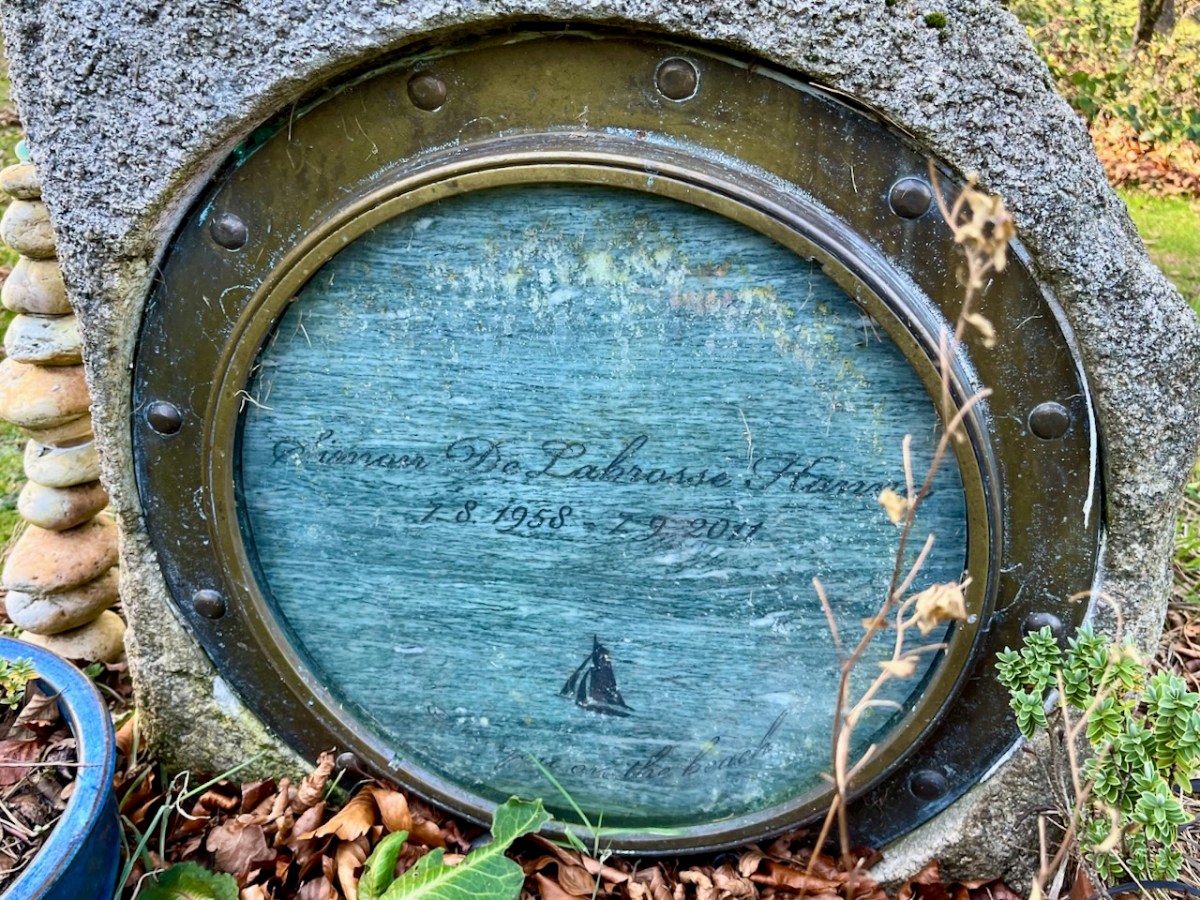
I have concluded that this fairly recent grave (2011) is in memory of a mariner. You can see that the inscription is within a porthole – and there is an illustration of a sailing boat. After much searching, I came across a funeral notice – here is a brief summary:
. . . HANNA Simon (late of Bray, Co Wicklow, formerly of New Zealand) – September 7, 2011, suddenly, son of Meg and the late Pat Hanna and brother of Tim, Mike, Pete, Kristin and Jane; sadly missed by his partner Sonja (McEnroe), her daughter Tali and her partner Danny, his sons Rowan, Aiden, Kieran and their mother Ann, his mother, brothers and sisters, extended family and many friends. Reposing in the factory workshop, Mill Lane, Bray from 4pm to 9pm tomorrow (Sunday). Removal on Monday to Calary Parish Church arriving for a Funeral Service at 2.00 o’clock followed by interment in the adjoining churchyard . . .
Funeral Notice
This is not an exhaustive account of the graves in Calary: it’s a selection only. Hopefully it’s sufficient to send you in this direction if you find yourself over in the east. It’s a beautifully atmospheric place. Let’s finish where we started – with a Louis le Brocquy tapestry. This is: Garlanded Goat 1949-50, Aubusson tapestry, Atelier Tabard Frères et Soeurs (artist website).
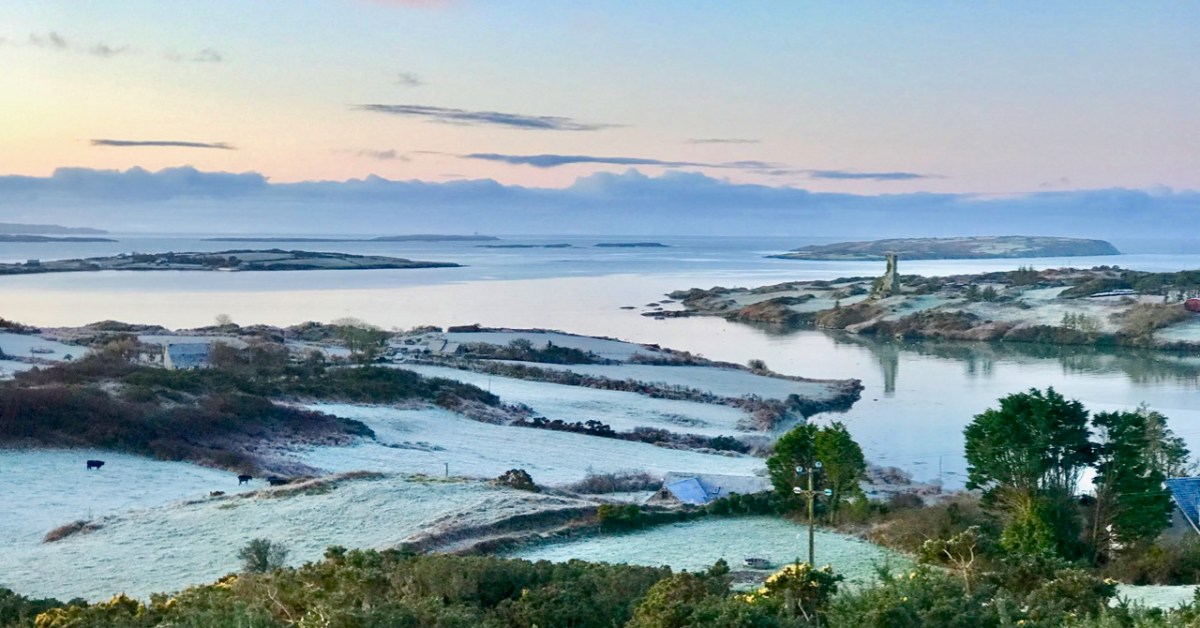
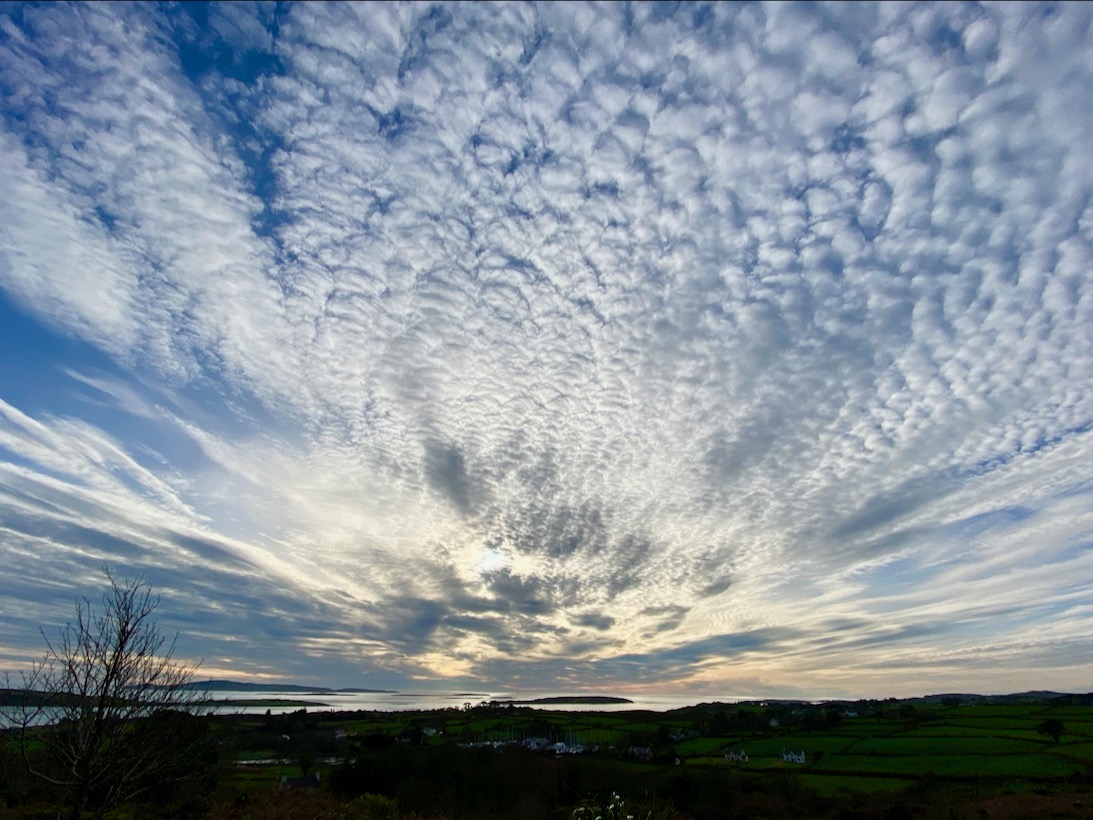
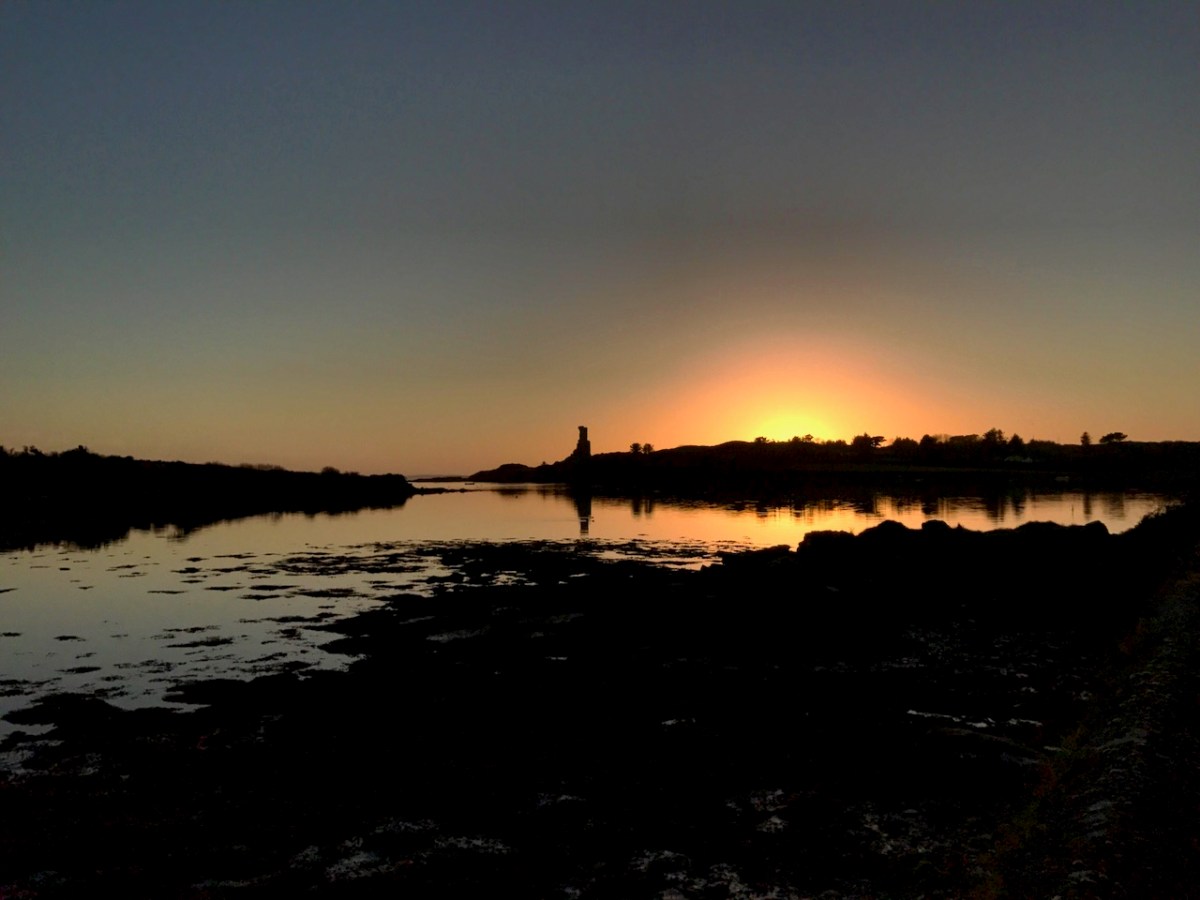
It’s midwinter here on the shores of Roaringwater Bay. It brings hard frosts (above – Rossbrin), clear days and spectacular skies – we caught the one below in 2020:
Winter is the time of the Cailleach.
. . . The Cailleach is the goddess of the winter months and is said to control the weather and the winds as well as the length and harshness of winter. Depicted as a veiled hag or an old crone, with one eye and deathly pale skin, she is said to have a bow-legged leaping gait, striding across mountains with a power to shape and transform the landscapes as rocks fall from her gathered apron . . . The Cailleach, or the Hag, has been feared and revered across Celtic cultures in Ireland, Scotland and the Isle of Man, for hundreds of years. She is called Beira in Scotland, and has strong associations with the Beara Peninsula in Ireland, which straddles County Cork and County Kerry . . .
The Hag of Beara petrified in Hag Rock (above): she forever looks out across the Beara. Below – this is the Hag’s permanent view over her landscape.
Lest there be any doubt about the Hag’s longevity, this is instructive:
. . . There is a tale of a wandering friar and his scribe who came to the old woman’s house. He inquired as to her great age, which he had heard stories of. She replied that she didn’t know, but that every year she killed an ox and made soup from the bones—and perhaps they could gauge her age by the number of ox bones thrown up in the attic. The young scribe climbed the ladder and threw the bones down one by one for the friar to count. The friar duly made a mark on his paper for each bone, and a great pile of bones grew until he had run out of paper. He called up to the young scribe, who replied that he had not even cleared one corner of the pile of bones, such was the great age of the Cailleach . . .
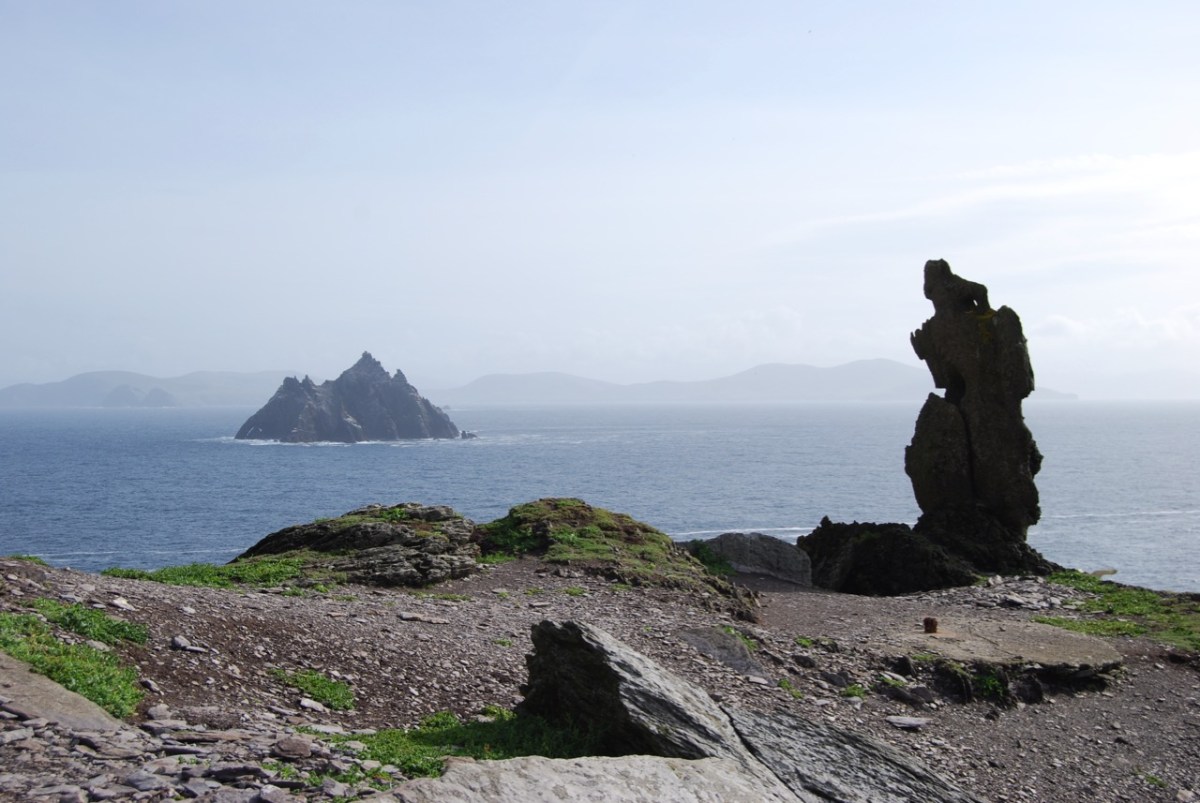
Above – The Wailing Woman (courtesy of Ronan Mac Giollapharaic) – dramatically depicts another Hag rock, overlooking the Skelligs on the Iveragh Peninsula, Co Kerry. It is a given that Cailleach is one of Ireland’s most ancient inhabitants. Even older, in fact, than Cessair, Noah’s grand-daughter, who we know arrived on our own West Cork shores some five thousand years ago. With her in her Bronze Age crew were her father – Bith – and Fionntán, together with ‘a large company of women’ whose combined purpose was to repopulate the world after the Great Flood.
. . . Legend has it that Fintan the Wise of the hundred lives accompanied Noah’s granddaughter, Cessair, to Ireland before the great Biblical flood. He thought himself the first to set foot on the island but found Cailleach living there, and could see she was far more ancient than himself. He is said to have asked of her, “Are you the one, the grandmother who ate the apples in the beginning?” but received no answer . . .
The Cailleach rules over the the dead of Winter (above – Rossbrin Cove in that time). If you research the Schools Folklore Collection you will find over 830 entries referring to her: many are recorded in Irish.
. . . An Cailleach Béarach according to tradition was supposed to be a witch who is believed to have erected most of the round towers and castles in this country. Tradition tells us that she built each of those buildings with three pocketfulls of stones. As well as being a famous builder, she is believed to have been a great mower. At the time of her death, it is said, she was 121 years and one day . . .
. . . The Cailleach Béarach started one day mowing with a score of men. The men led off & she took up the rear. After an hour’s work, she caught up to the man who was last and mowed off his legs from above the ankles. She continued the work until she caught up to the man who was second last & she cut off his legs also. This procedure continued until all the men but one had their legs cut off. At this stage, they went to their dinner . . .
The most frequently occurring references to the Cailleach are her feats in sculpting the landscape. Many features in the west of Ireland are attributed to her work.
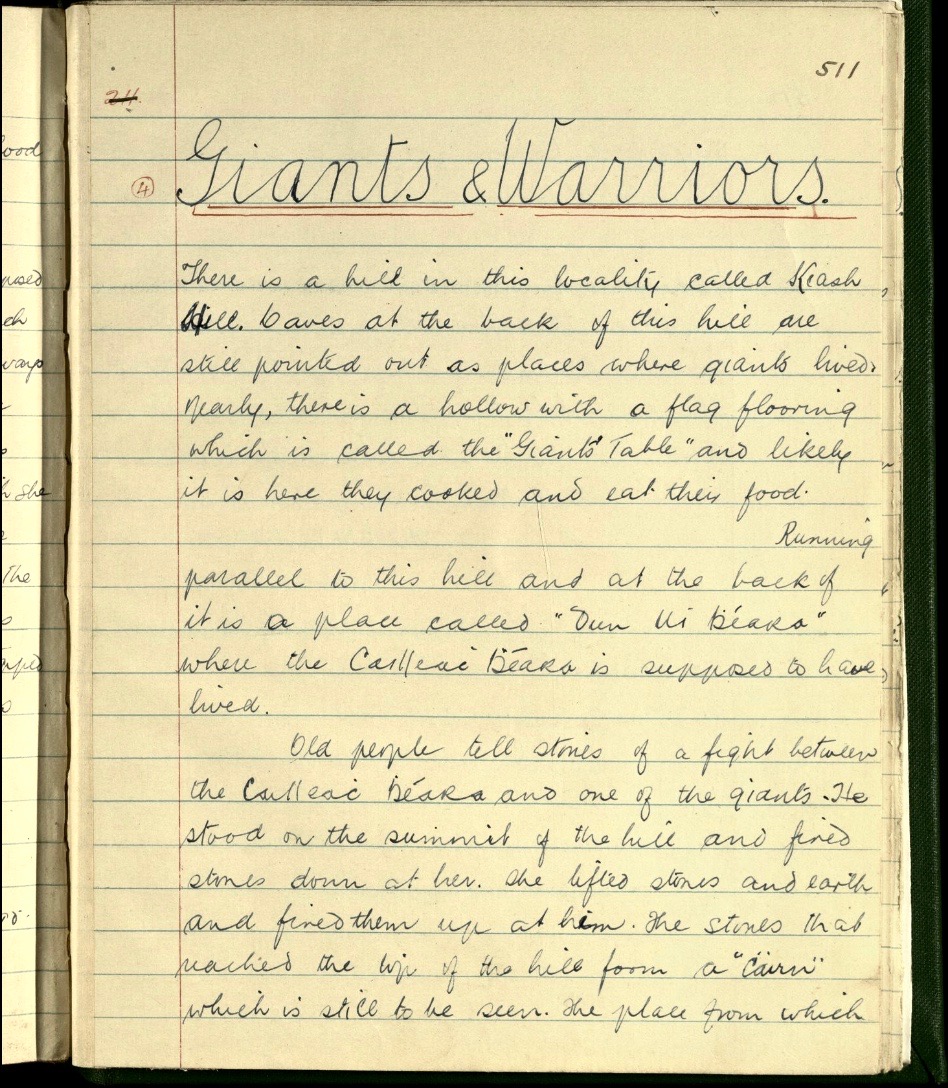
. . . There is a hill in this locality called Keash Hill. Caves at the back of this hill are still pointed out as places where giants lived. Nearby there is a hollow with a flag flooring which is called the “Giants’ Table” and likely it is here they cooked and eat their food. Running parallel to this hill and at the back of it is a place called “Dun Ui Bhéara” where the Cailleach Bhéara is supposed to have lived. Old people tell stories of a fight between the Cailleach Béara and one of the giants. He stood on the summit of the hill and fired stones down at her. She lifted stones and earth and fired them up at him. The stones that reached the top of the hill form a “cairn” which is still to be seen. The place from which they were taken formed a small lake which remains to the present day. Some time ago if children were bold their mothers threatened to tell Cailleach Bhéara and immediately they got quiet. She was able to walk across Lough Arrow and the waters at their deepest part just reached her arm pit . . .
SCHOOLS FOLKLORE COLLECTION – INFORMANT MR James Benson, Kesh, Co Sligo
. . . When the Summer came the Cailleach Bhéara drove the bull out to the grassy parts of Béara. One day when the bull was being driven out, he heard a cow lowing in Kerry, so he started off towards her. The Cailleach went ahead of him, but he jumped into the tide and started to swim for Kerry. The Cailleach struck him with her wand and as she was doing it, the bull called the cow, and her calf with him, and they form the Bull, Cow, and Calf rocks now . . .
Finally, we must not overlook a poem written by Pádraig Pearse, one of the leaders of the Easter Rising in 1916. Pearse was executed on May 3 in that year – aged 36 – for his part in this ‘rebellion’. In this photograph, Pearse can be seen reading the oration at the funeral of the Fenian Jeremiah O’Donovan Rossa on 1 August 1915. I am completing this post with the words of Mise Éire, written by Pearse in 1912.
Mise Éire: Sine mé ná an Chailleach Bhéarra
Mór mo ghlóir: Mé a rug Cú Chulainn cróga.
Mór mo náir: Mo chlann féin a dhíol a máthair.
Mór mo phian: Bithnaimhde do mo shíorchiapadh.
Mór mo bhrón: D’éag an dream inar chuireas dóchas.
Mise Éire: Uaigní mé ná an Chailleach Bhéarra.
I am Ireland: I am older than the Hag of Beara.
Great my glory: I who bore brave Cú Chulainn.
Great my shame: My own children that sold their mother.
Great my pain: My irreconcilable enemies who harass me continually.
Great my sorrow: That crowd, in whom I placed my trust, decayed.
I am Ireland: I am lonelier than the Hag of Beara.
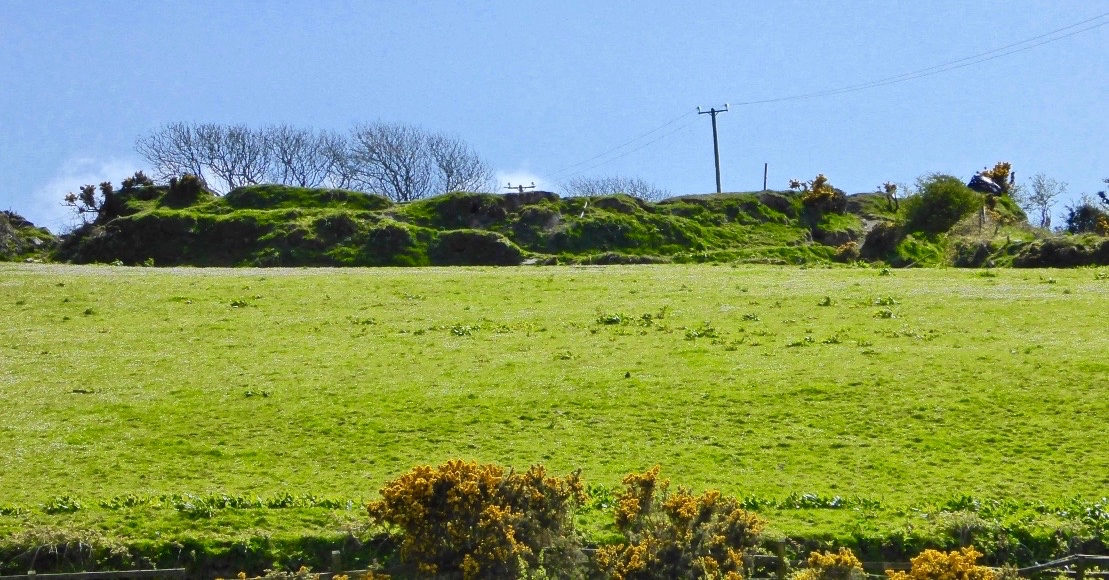
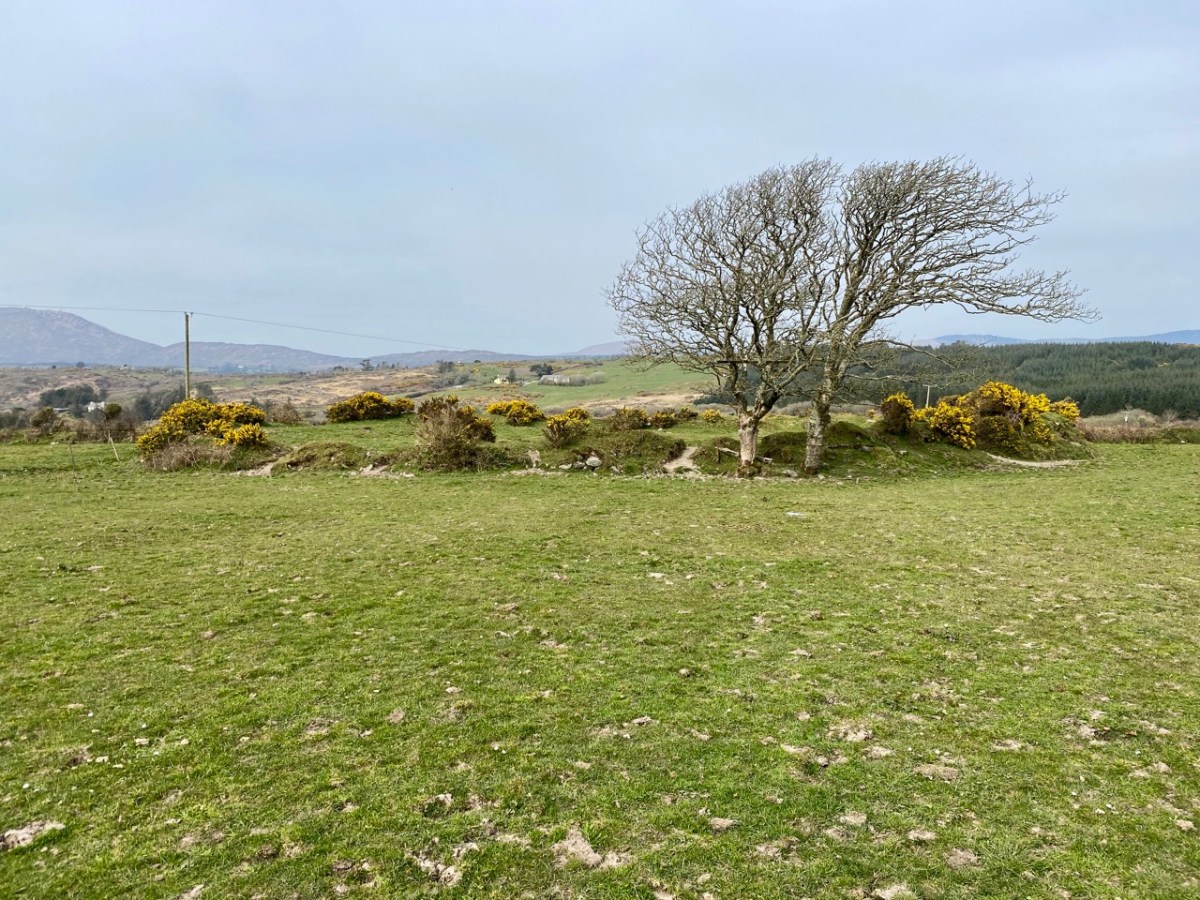
There’s a fine ringfort just over the hill from us – in the townland of Ballycummisk. A definition of a ‘ringfort’ in archaeological terms is given here:
. . . Many people lived in enclosed farmsteads known as ringforts in the Early Christian/Early Medieval period. Second to fulachta fiadh, they are the most common field monument surviving in Ireland with up to 60,000 examples, most dating to between 550-900AD. Ringforts are circular areas, measuring c24-60m in diameter, usually enclosed with one or more earthen banks, often topped with a timber palisade. In the west of Ireland the ringfort was often enclosed by a stone wall, with stone huts in the interior. Traces of iron and bronze working have been recovered suggesting some ringforts had very specific uses while others were multifunctional . . .
A simpler definition comes from the monumental 1200-page Volume 1 of the ‘New History of Ireland’ series published in 2005 and edited by Dáibhí Ó Cróinín: “archaeologists are agreed that the vast bulk of them are the farm enclosures of the well-to-do of early medieval Ireland”.
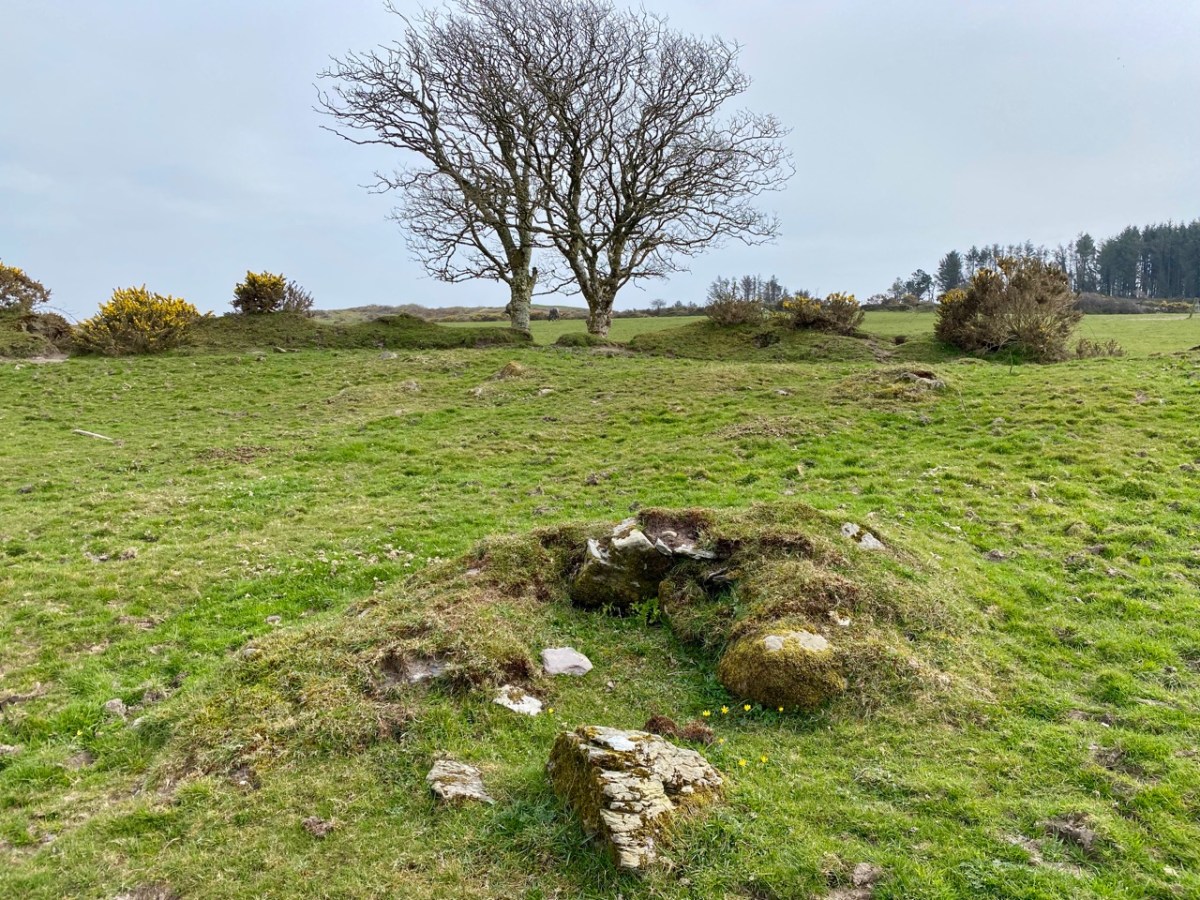
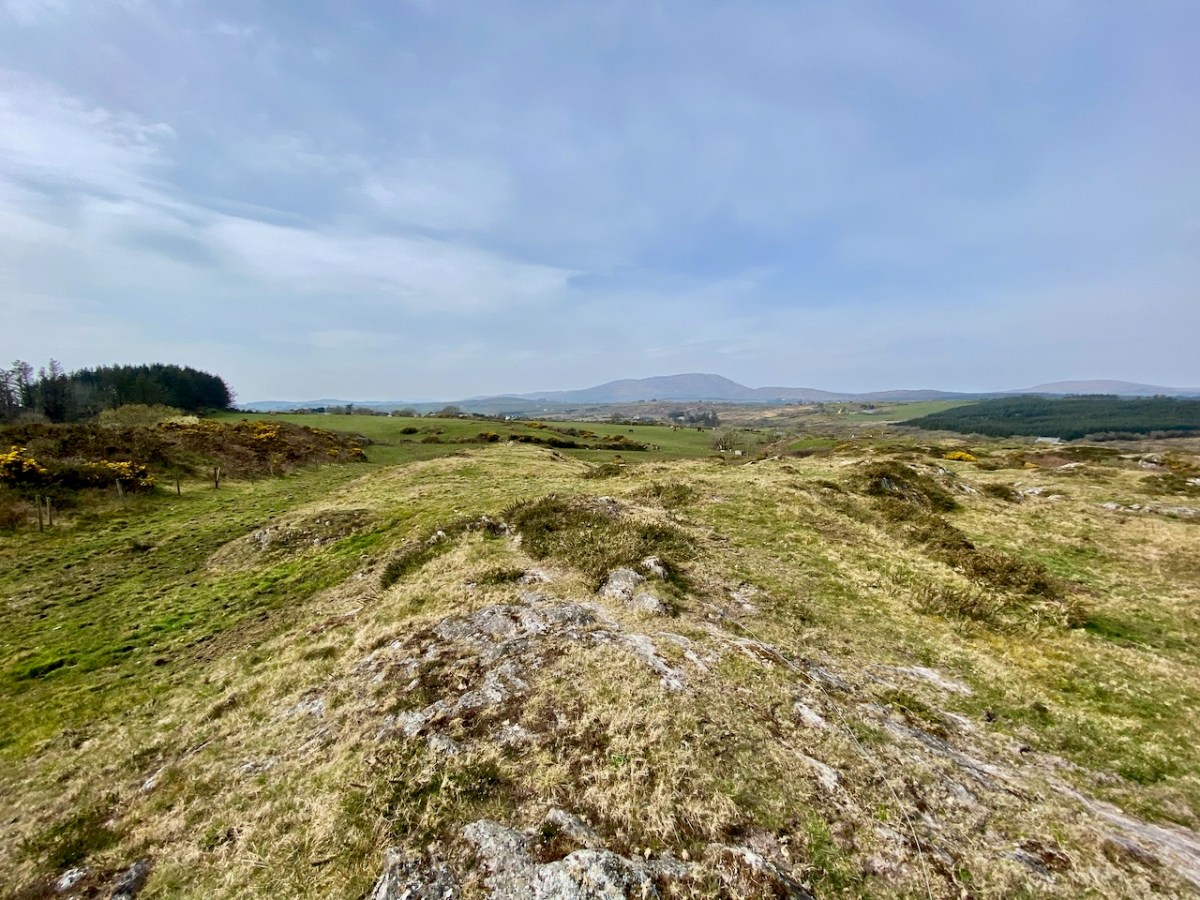
The upper picture is taken from within the ringfort enclosure; the north bank of the fort can be seen beyond a small stone outcrop which is said to be the site of a souterrain. Time for another definition:
. . . Souterrain: an underground structure consisting of one or more chambers connected by narrow passages or creepways, usually constructed of drystone-walling with a lintelled roof over the passages and a corbelled roof over the chambers. Most souterrains appear to have been built in the early medieval period by ringfort inhabitants (c. 500 – 1000 AD) as a defensive feature and/or for storage . . .
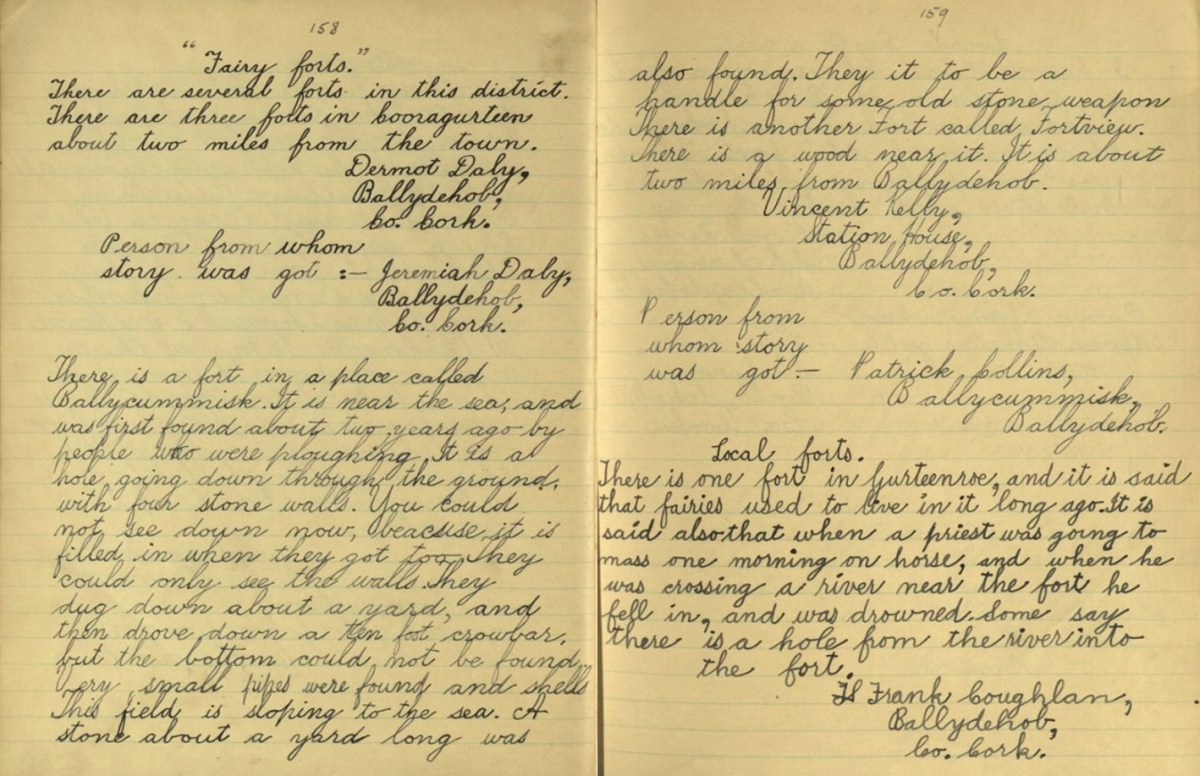
The Schools Folklore Collection is an important source of local beliefs and traditions – if not exactly historical information. The stories were collected in the 1930s but were remembered through family traditions which could go back through several generations. The example pages above – dating from 1936 – describe the Ballycummisk fort. Here is a transcription of the paragraph:
. . . There is a fort in a place called Ballycummisk. It is near the sea, and was first found about two years ago by people who were ploughing. It is a hole going down through the ground, with four stone walls. You could not see down now, because it was filled in when they got to it. They could only see the walls. They dug down about a yard, and then drove down a ten foot crowbar, but the bottom could not be found. Very small pipes were found and shells This field is sloping to the sea. A stone about a yard long was also found. They thought it to be a handle for some old stone weapon . . .
Schools Folklore Collection Frank coughlan Ballydehob
Frank Coughlan’s description almost certainly refers to the discovery of a souterrain. It doesn’t quite ring true as he says that “the field is sloping down to the sea”. In fact, the fields containing the ringfort are sloping southwards away from the sea, which is not visible at all from the site.
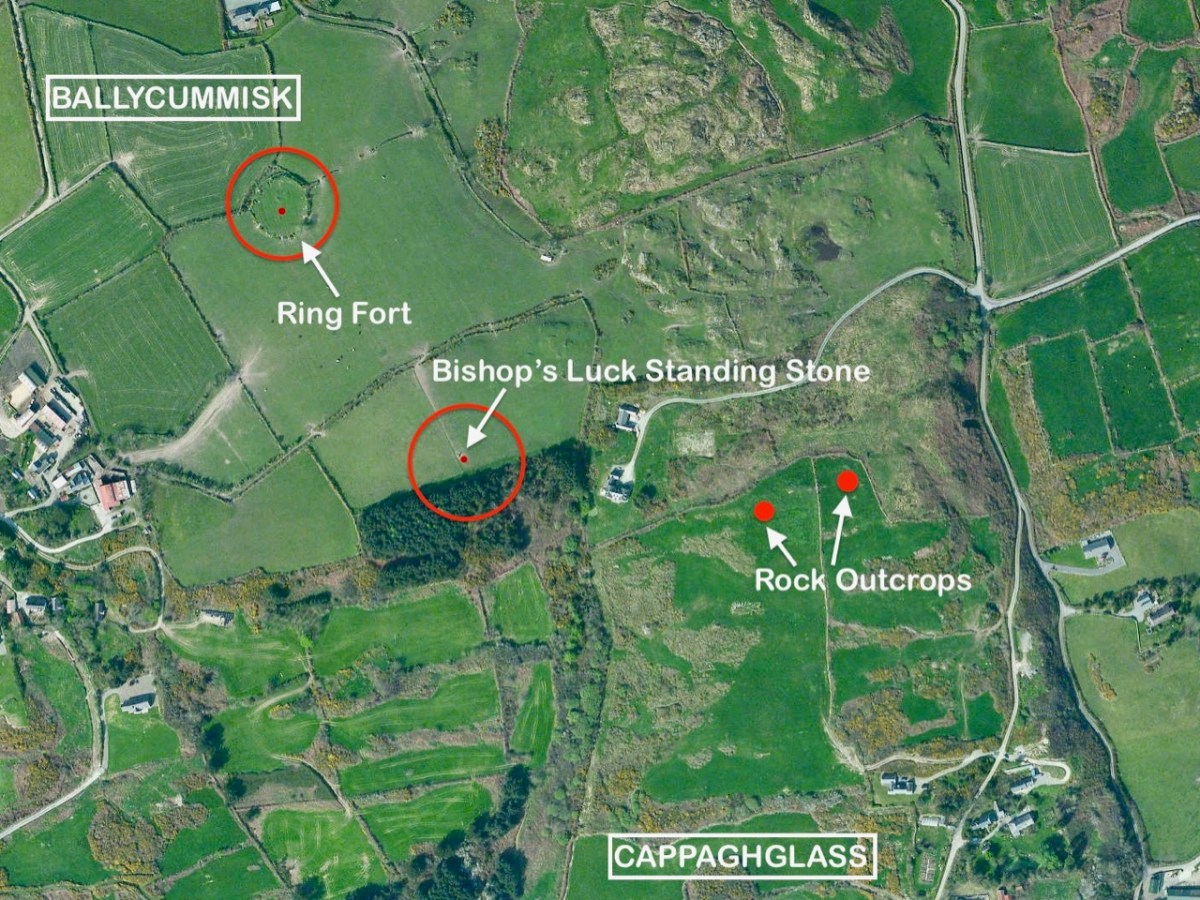
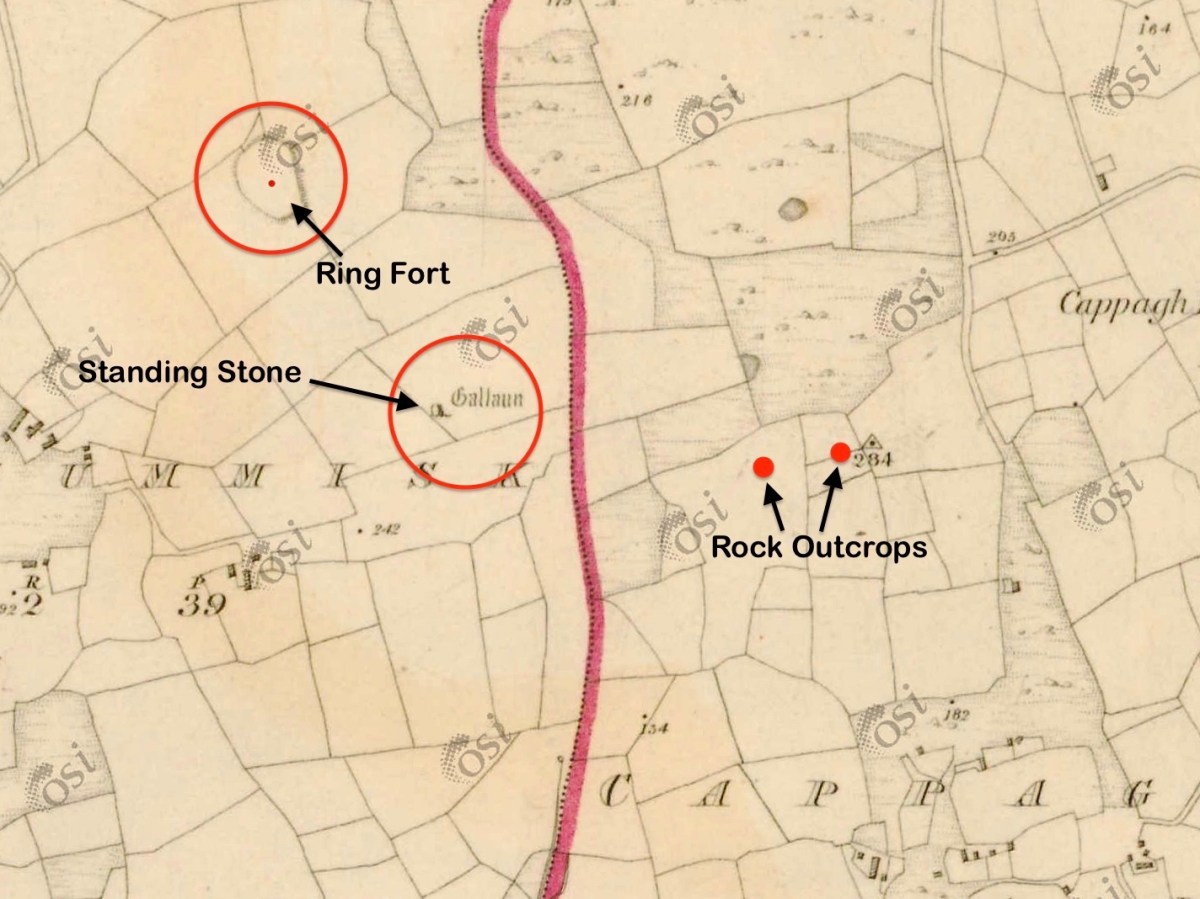
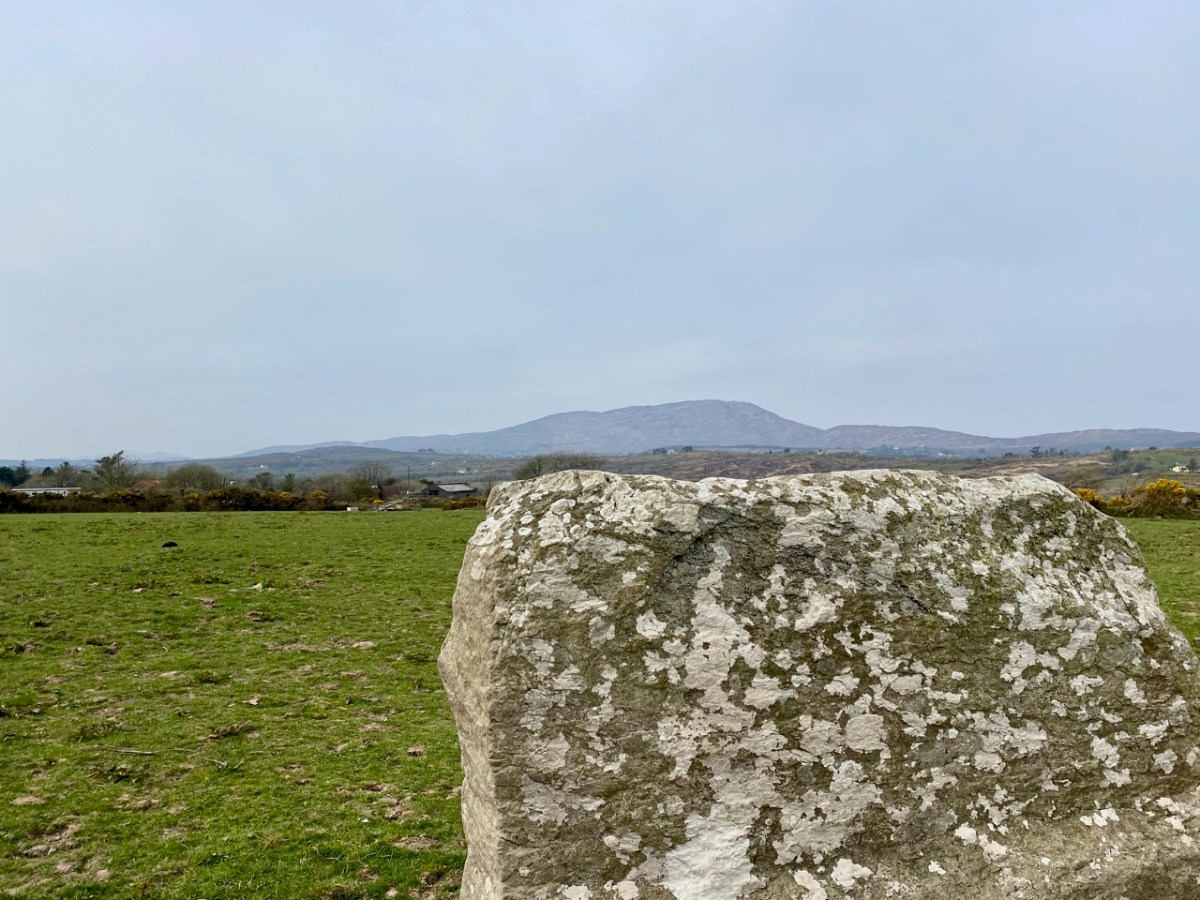
This aerial view shows parts of the townlands of Ballycummisk and Cappaghglass. The ringfort is marked. Another nearby feature – also shown – is a large standing stone, known as ‘Bishop’s Luck’.
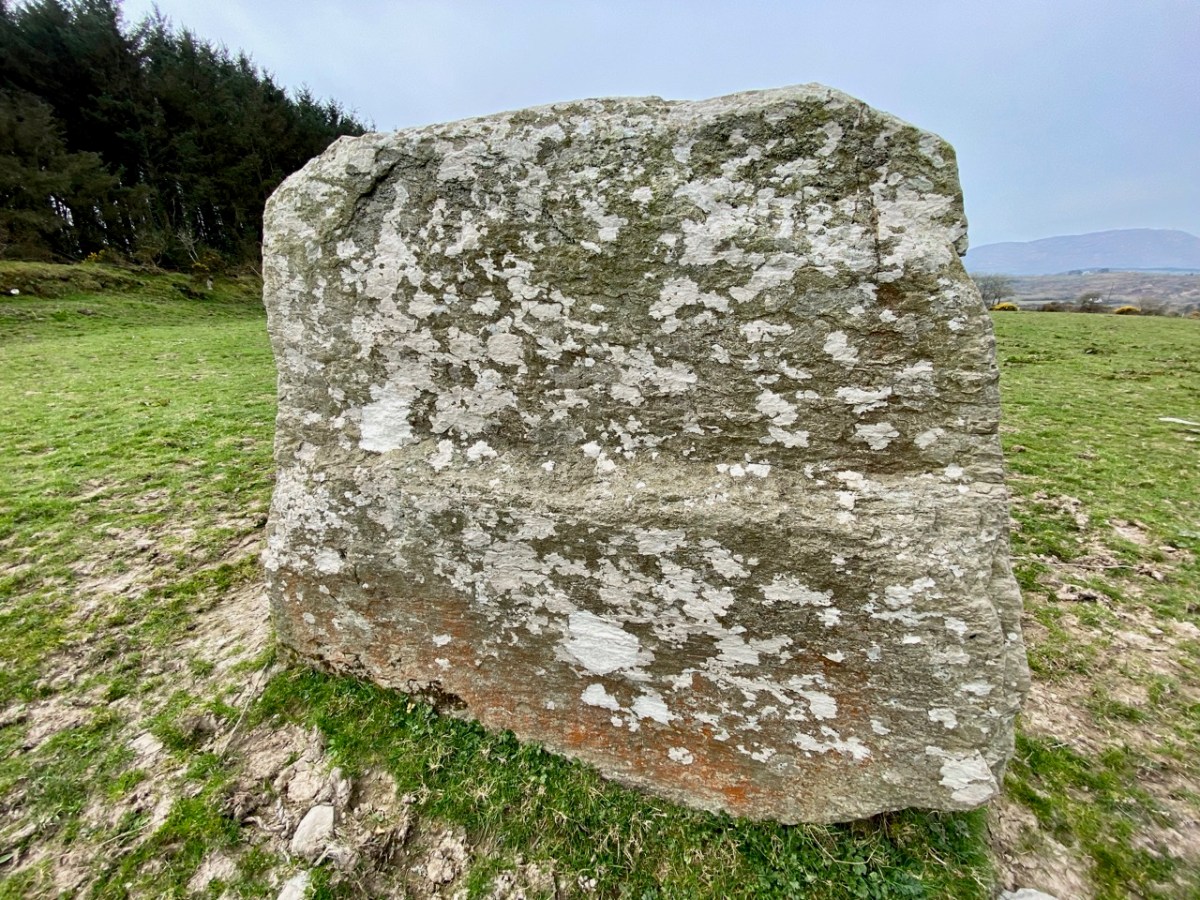
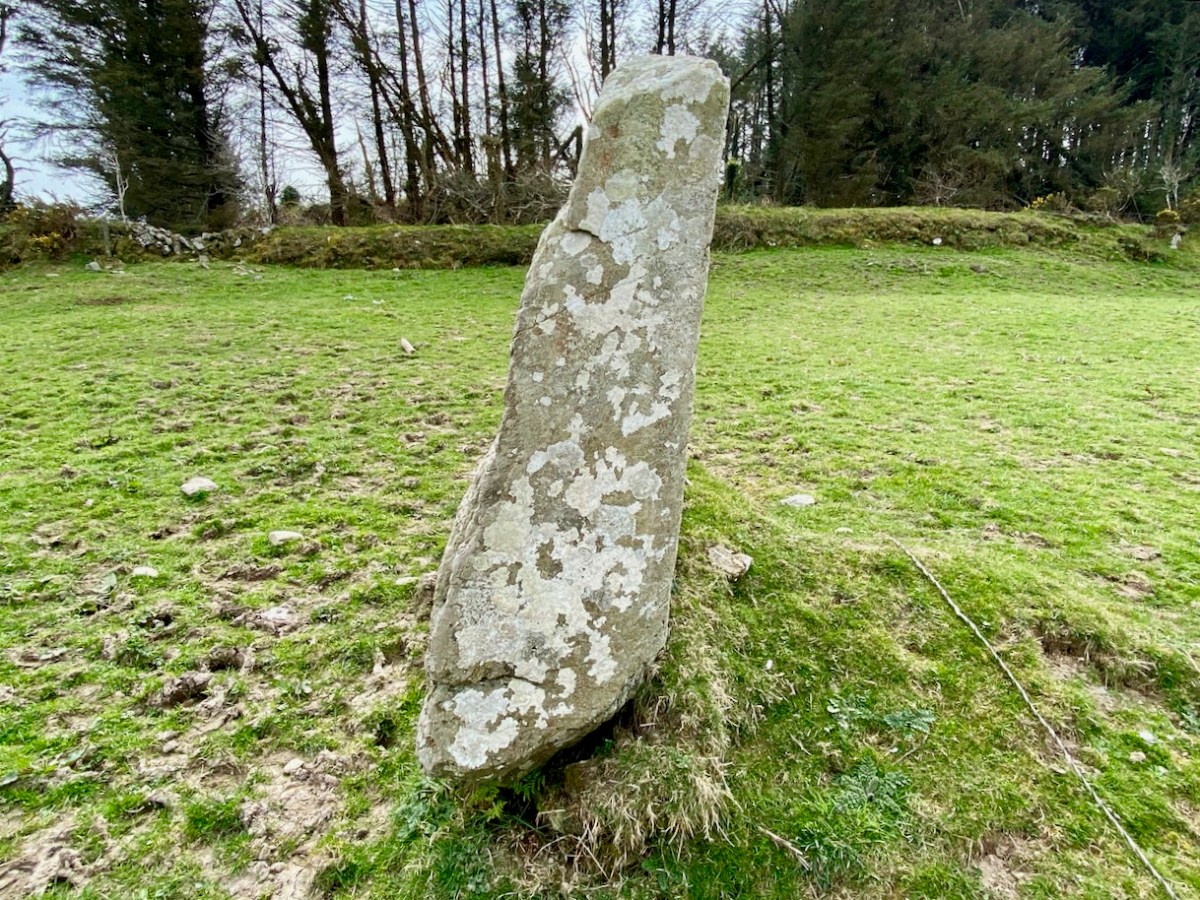
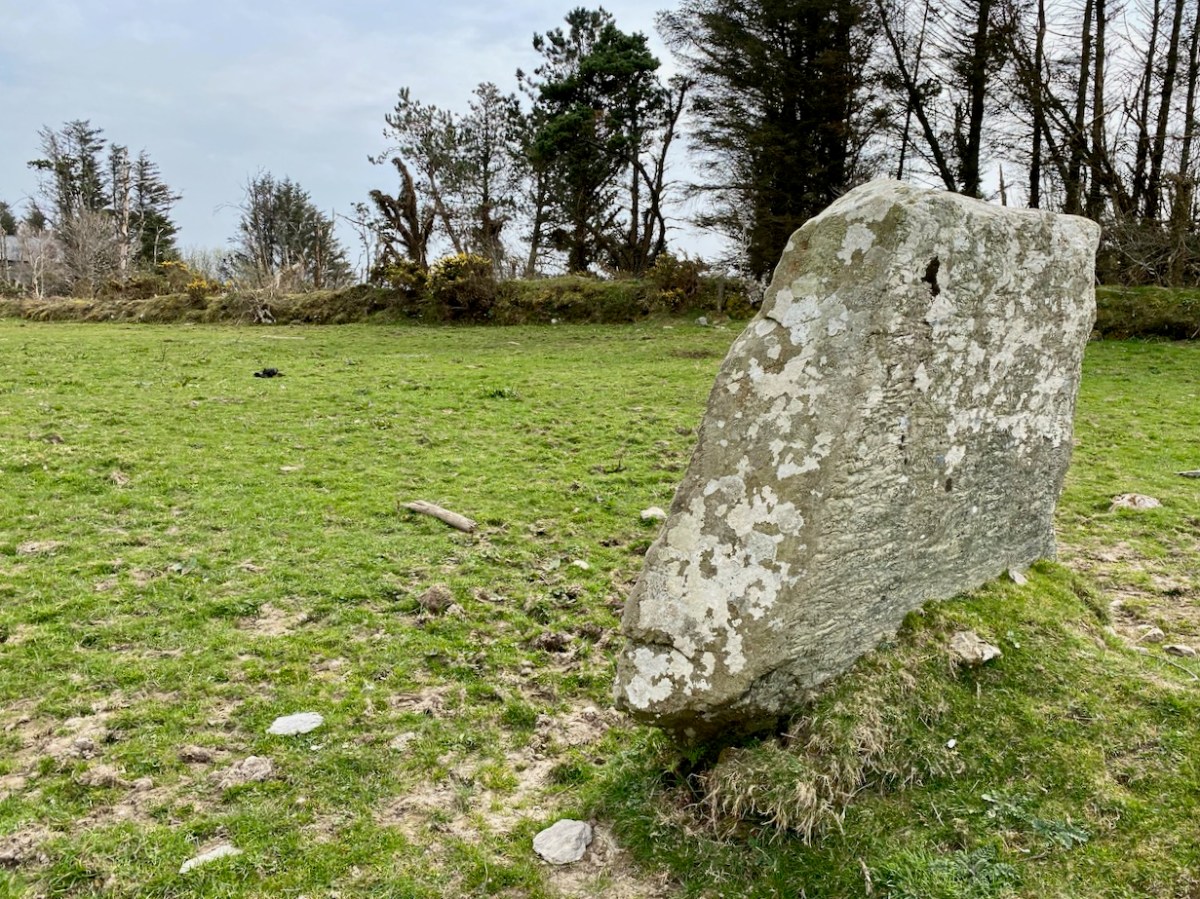
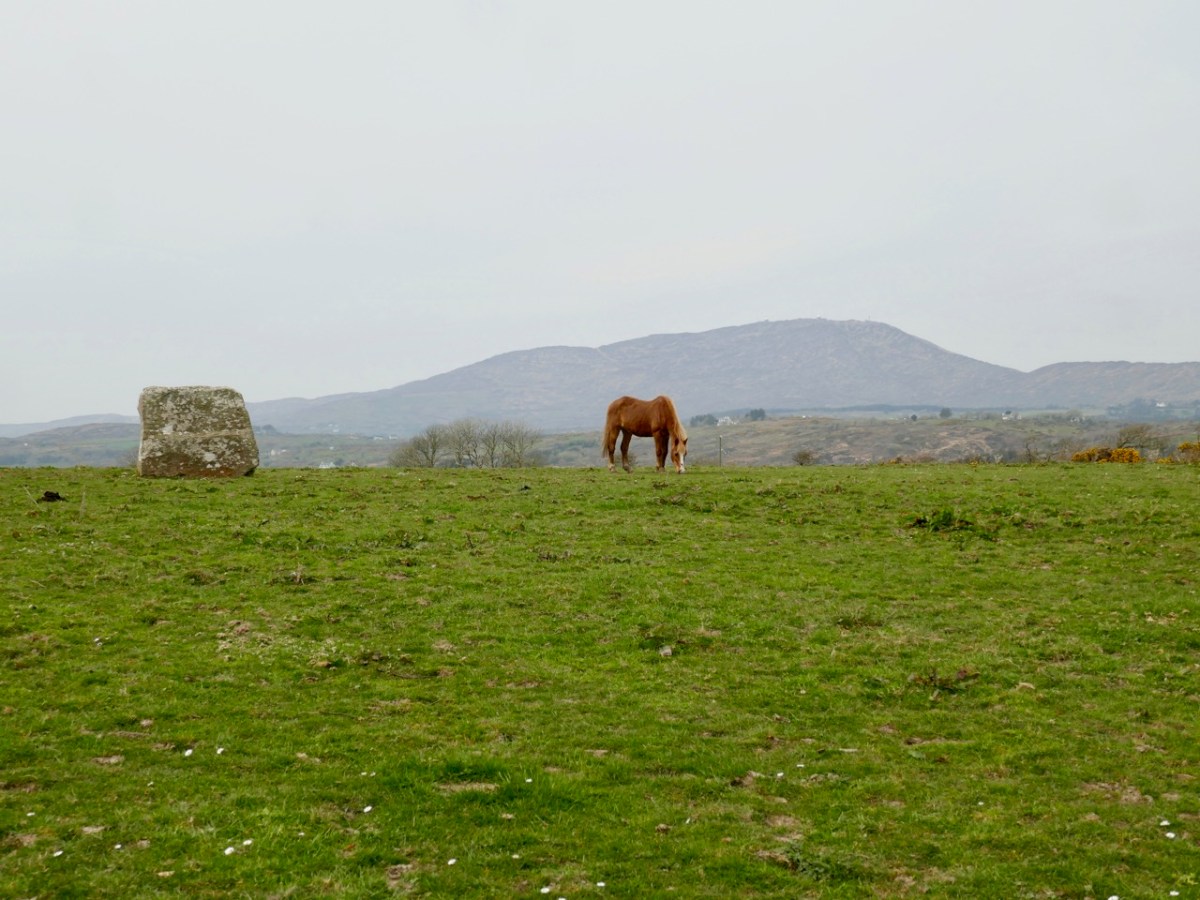
The stone is 1.6m high, 2.05m in length, and 0.45m in width: tall and wide in one direction, and relatively narrow in the other. It is also worth noting that the ‘long’ orientation is exactly North-South. This stone has been in this position for at least 180 years as it appears in the earliest edition of the 6″ Ordnance Survey (1830s), marked as ‘Gallaun’ – and even given a little illustration!
The standing stone is not far from the ringfort: perhaps there is a connection, although standing stones are generally reckoned to date from earlier times than the forts. Here is an extract from a recent article in Archaeology Ireland: Vol 34 No 1 (Spring 2020) pp 26-29, Wordwell Ltd:
. . . The classic standing stone surviving from the Bronze Age in Ireland is a rough-hewn or unshaped pillar, known as a gallaun (from the Irish gallán), generally oblong or oval in cross-section and up to 3m or more in height. Stones presumed to belong within this class vary considerably in height, from as little as 1m to as much as 6-7m in exceptional cases, the majority probably falling in the 1.5-2m range. Seán Ó Nualláin noted many years ago that in his experience the axis is generally aligned north-east/south-west. This is by no means a universal rule. Gallauns are by far the most numerous of all pre-Christian standing stones in Ireland. Approximately 600 are known in Cork and Kerryb alone. Beyond this region, examples are to be found extensively throughout the Irish countryside and many of them have attracted folk explanations . . .
Lone Standing Stones by Muiris O’Sullivan and Liam DowneY Archaeology Ireland 2020
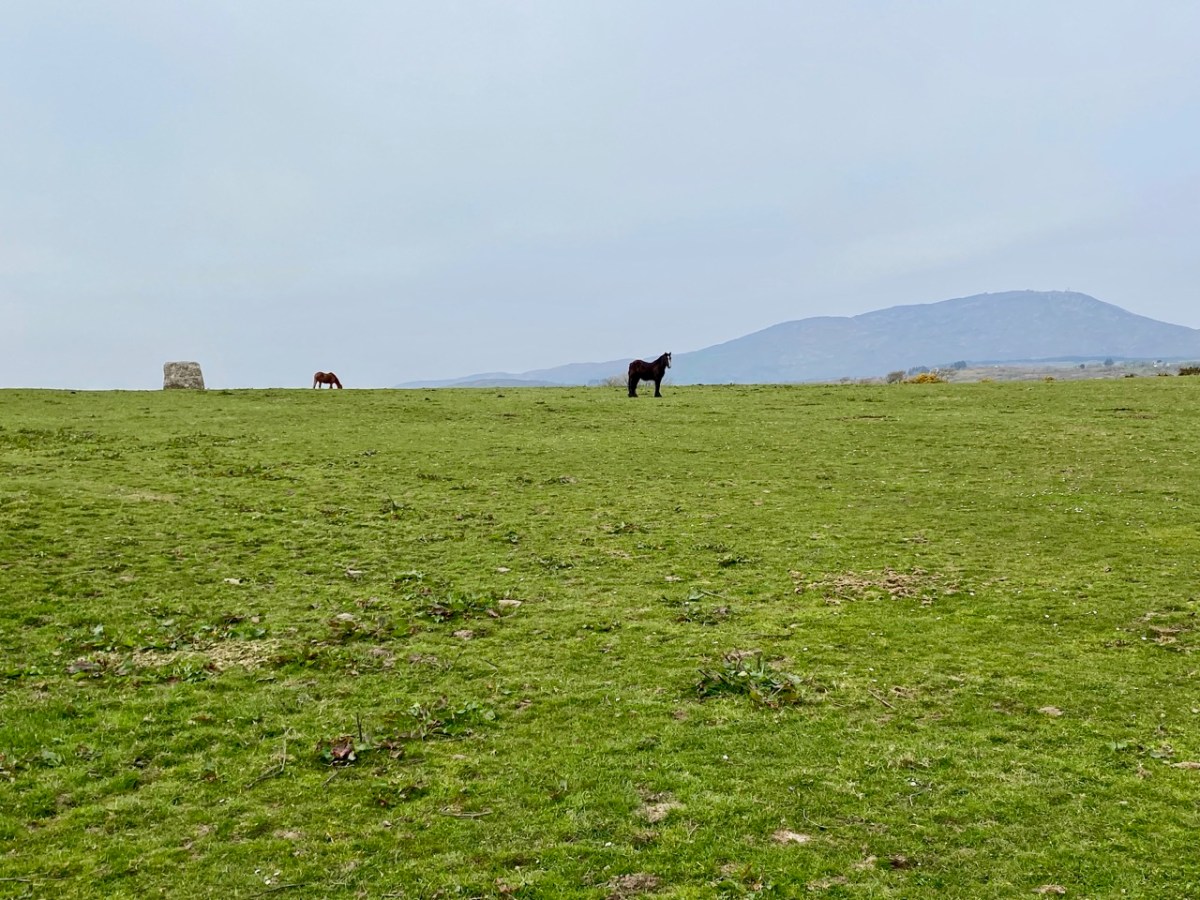
In these two pictures you can see the striking profile of the Bishop’s Luck standing stone against the skyline which features Mount Gabriel – the highest piece of land in the immediate area. Gabriel was an important place in prehistoric times as the centre of a significant copper mining industry – yet no artefacts have ever been found on the summit. In the lower picture you can see how the western edge of the standing stone ‘echoes’ the distant profile of Gabriel on the horizon. This is a phenomenon that has been noted a few times with regard to stones standing in the landscape. Here is Gabriel seen from the ringfort:
Finola has written comprehensively about standing stones in this Journal: here and here. O’Sullivan and Downey mention (above) that examples have attracted folk explanations. This doesn’t seem to be the case here: no mention is made of the stone in the Schools Folklore Collection. But surely there must be significance in the name: Bishop’s Luck?
But – hang on! There is ‘Bishop’ folklore associated with a site not very far away – in the neighbouring townland of Stouke. Finola recorded this in her 2016 post here. It’s a simple tale: The story goes that during the time of the penal laws a Bishop was confirming children nearby when the redcoats got wind of his activities and came to arrest him. He was beheaded. A bullaun stone in the graveyard at Stouke is supposed to be his head. If our possibly Bronze Age stone in Ballycummisk had anything to do with this, it should surely be known as Bishop’s Bad Luck?
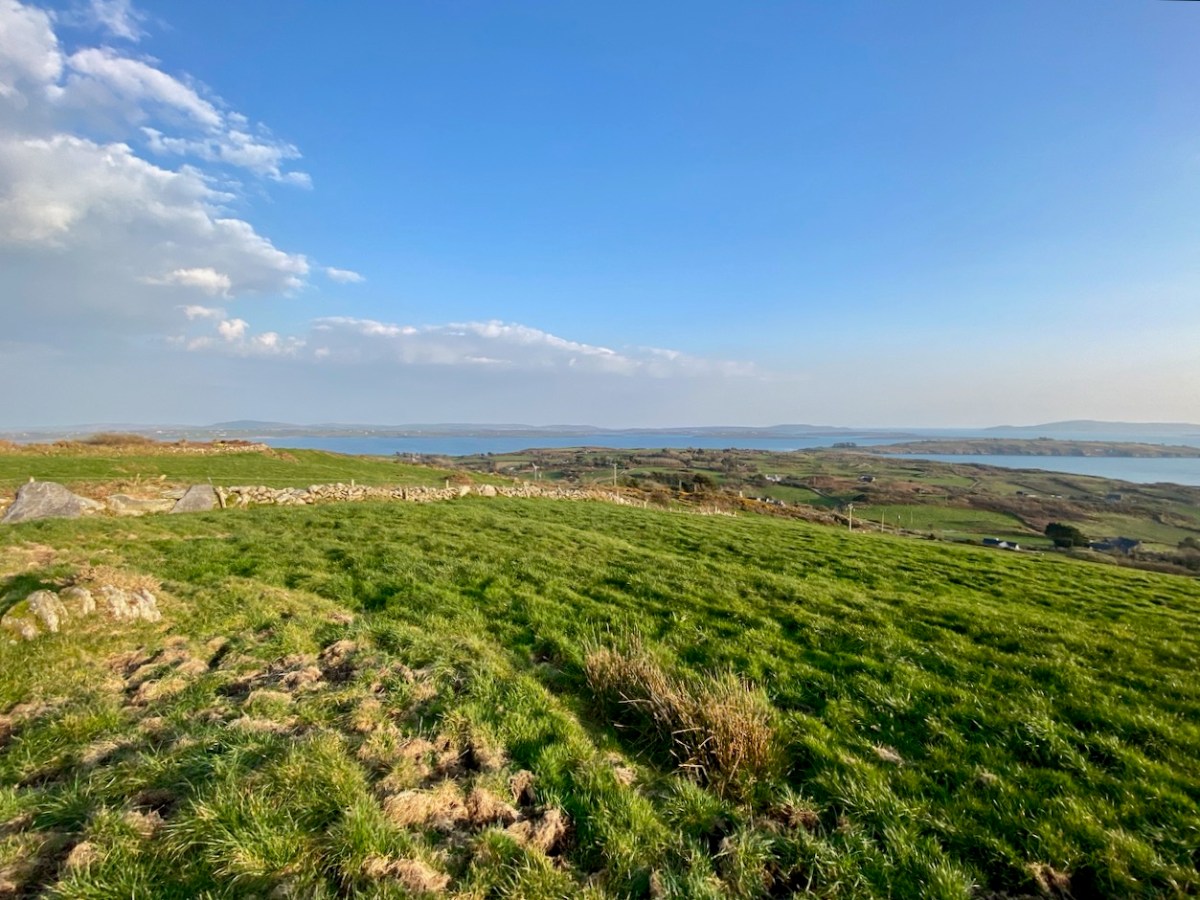
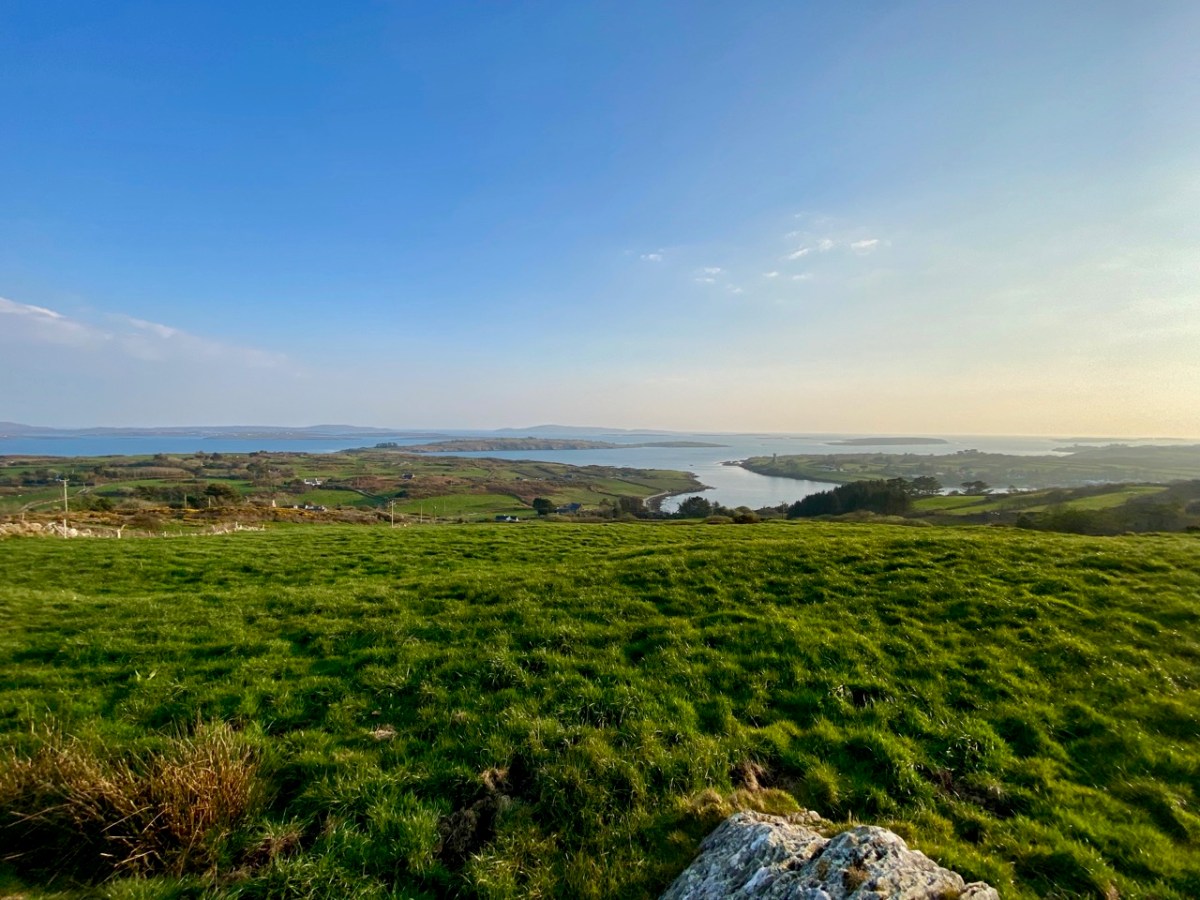
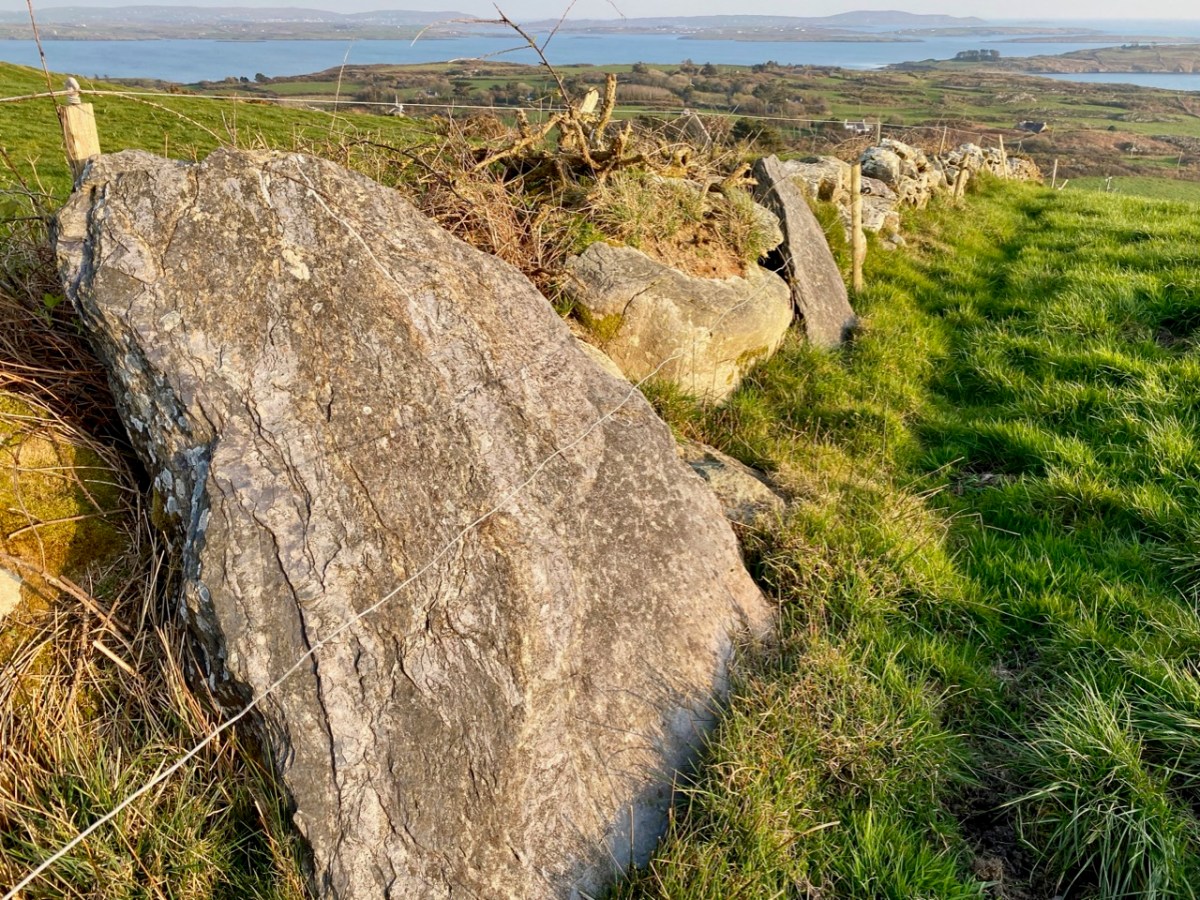
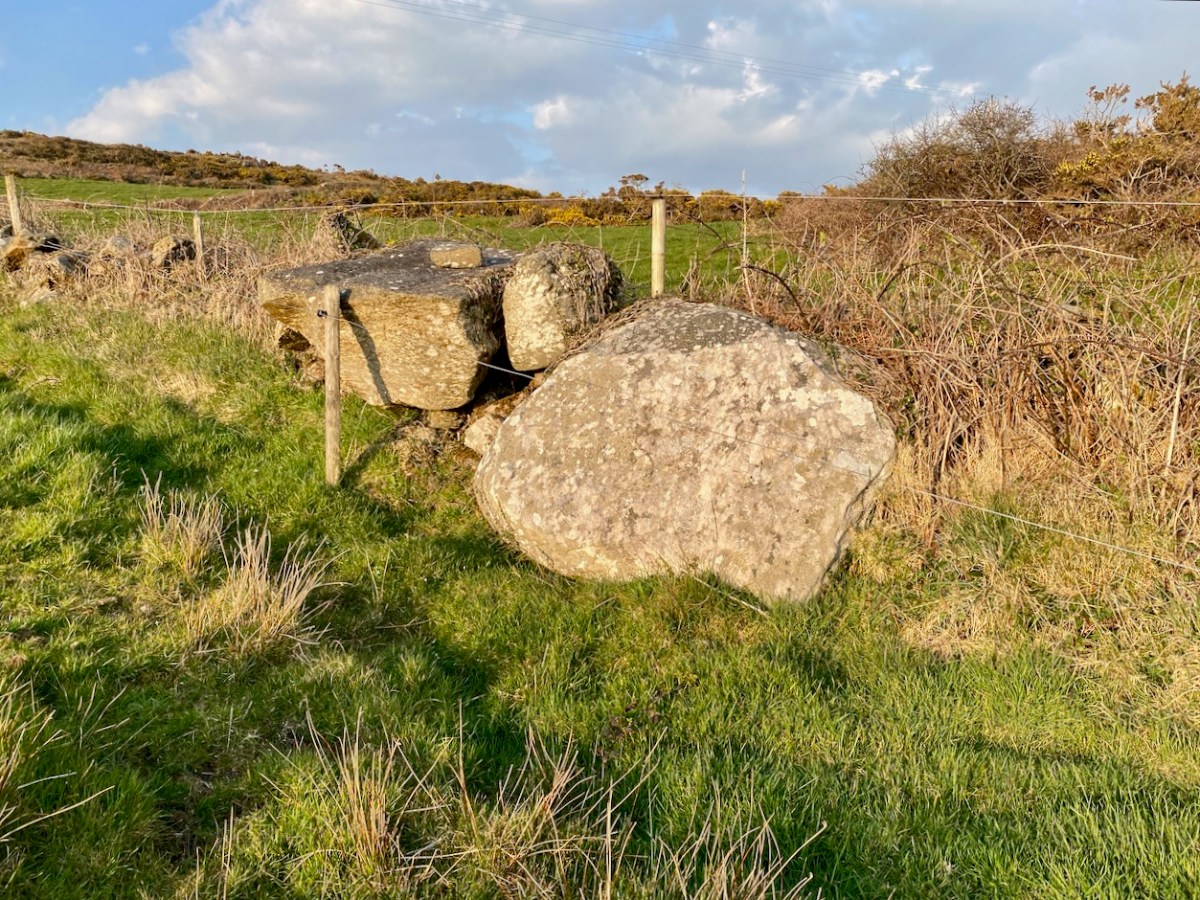
One further place that’s worth a mention here is the top of the hill to the south of the ringfort and standing stone. It doesn’t have a name, but it does have a magnificent view across to Rossbrin Harbour, with Cape Clear on the horizon in the far distance. There is a passage grave on the high point of Cape Clear. There seems to be some evidence for the inter-visibility of ancient sites, which makes me wonder whether there was ever any early structure on this hilltop. There are rocky outcrops there in the present day, and field clearance is evidenced by the presence of large slabs in the nearby field boundaries.
These are just thoughts, but I don’t mind thinking them! West Cork (and most of rural Ireland) must have much to reveal in terms of its ancient history. One point to remember: if you ever go searching yourself for archaeology or old sites, don’t forget that you will probably be entering private land. It is courteous to always seek permission: most owners are agreeable and – perhaps – may have stories to tell themselves.
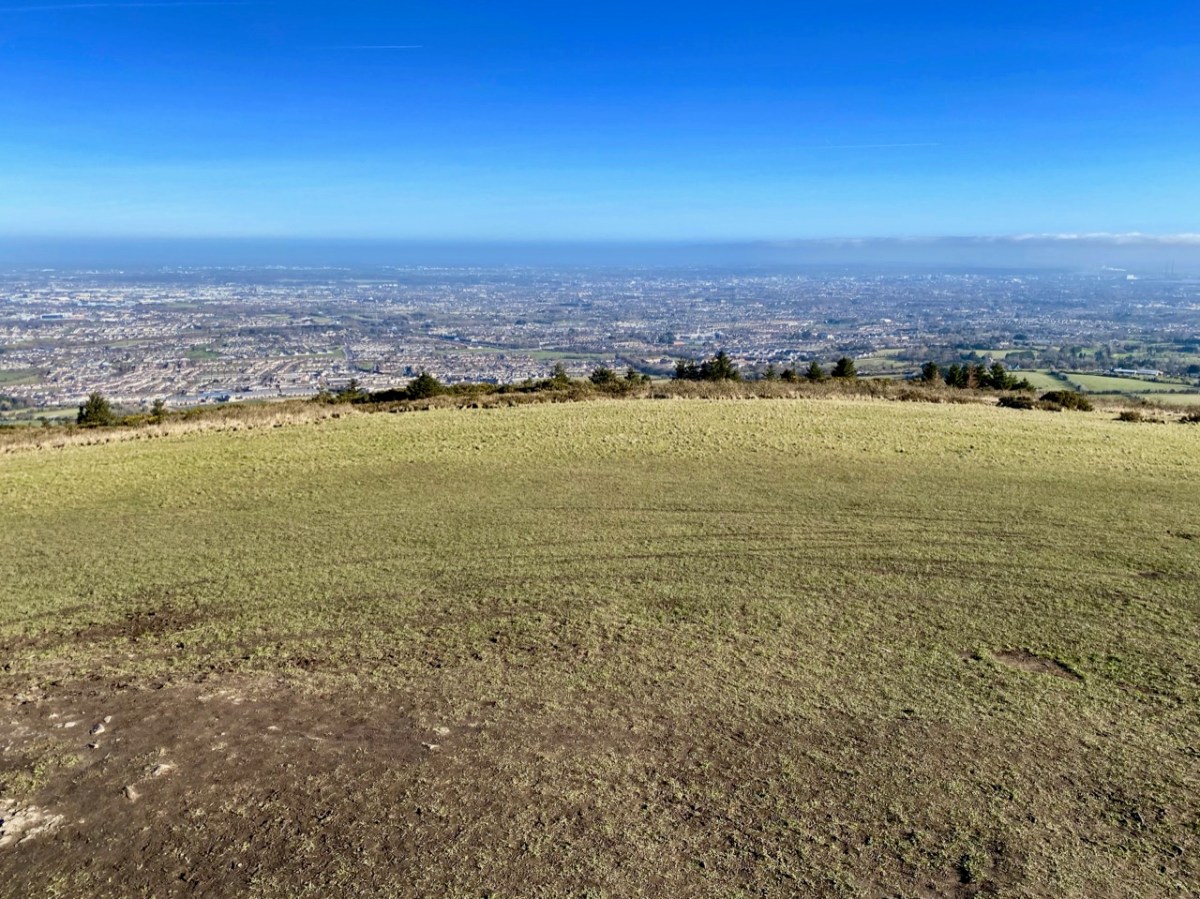
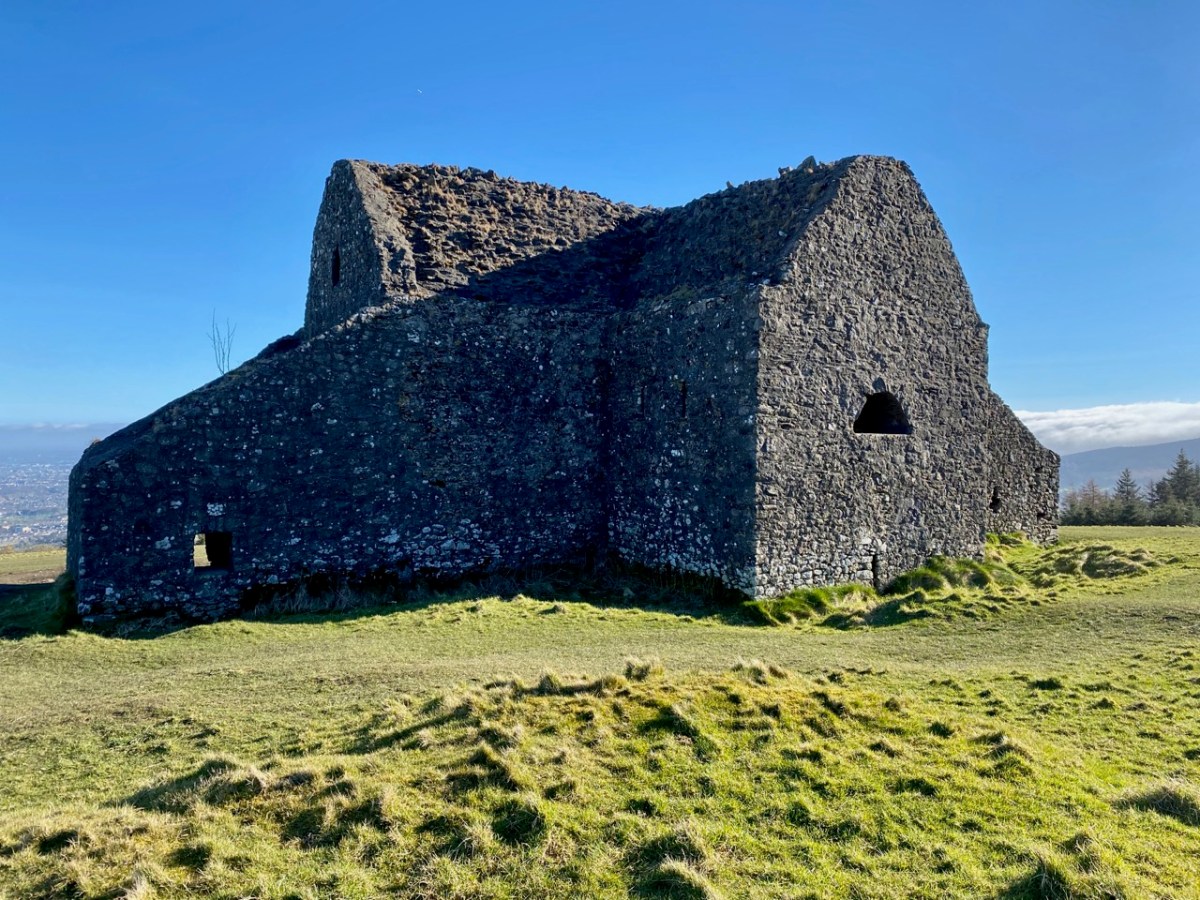
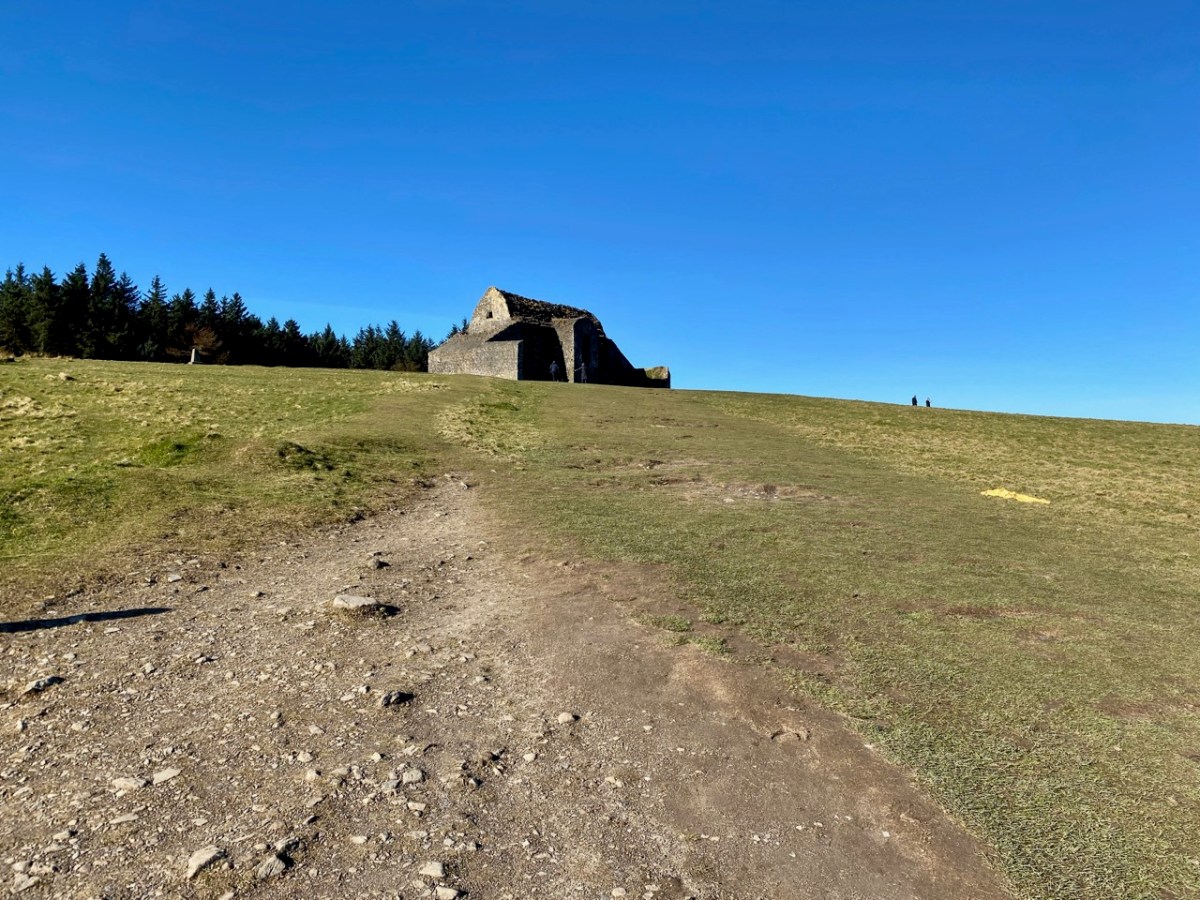
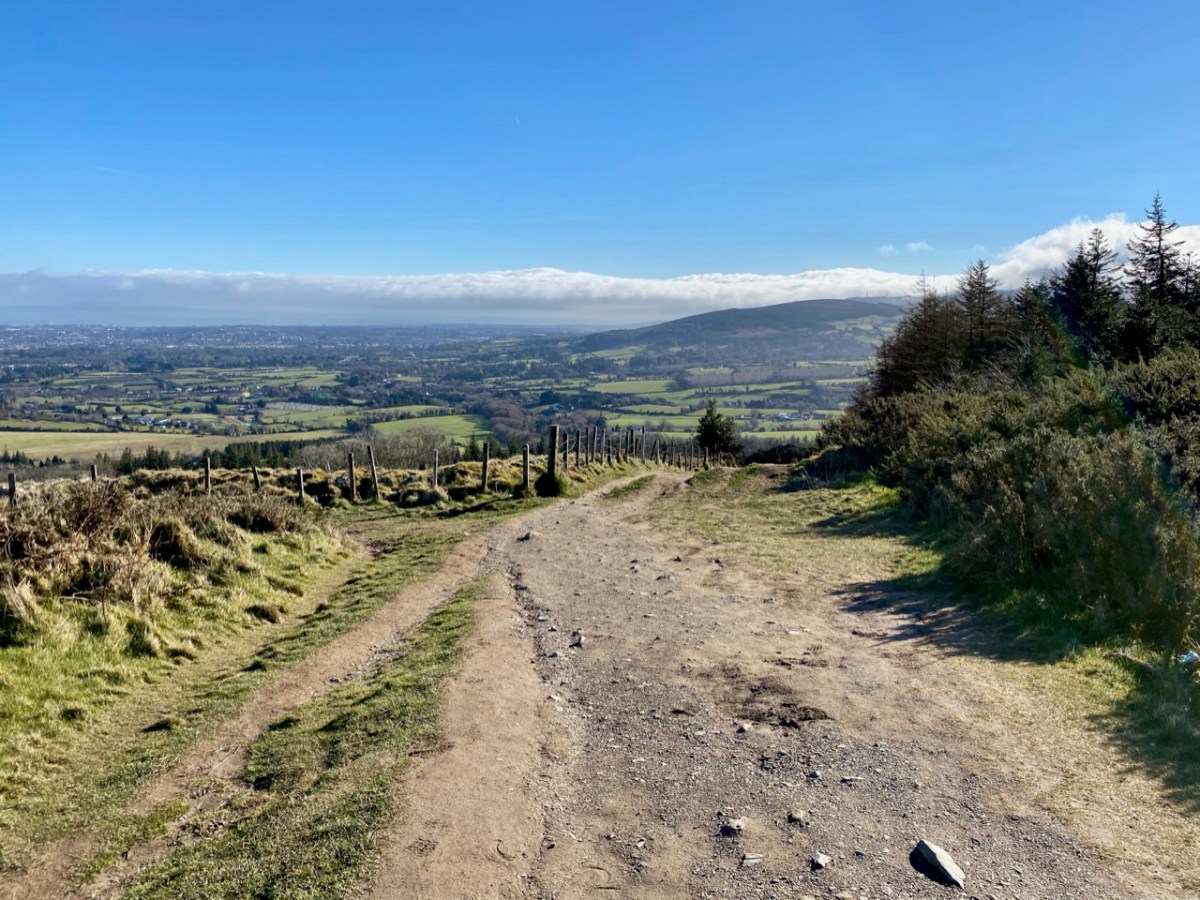
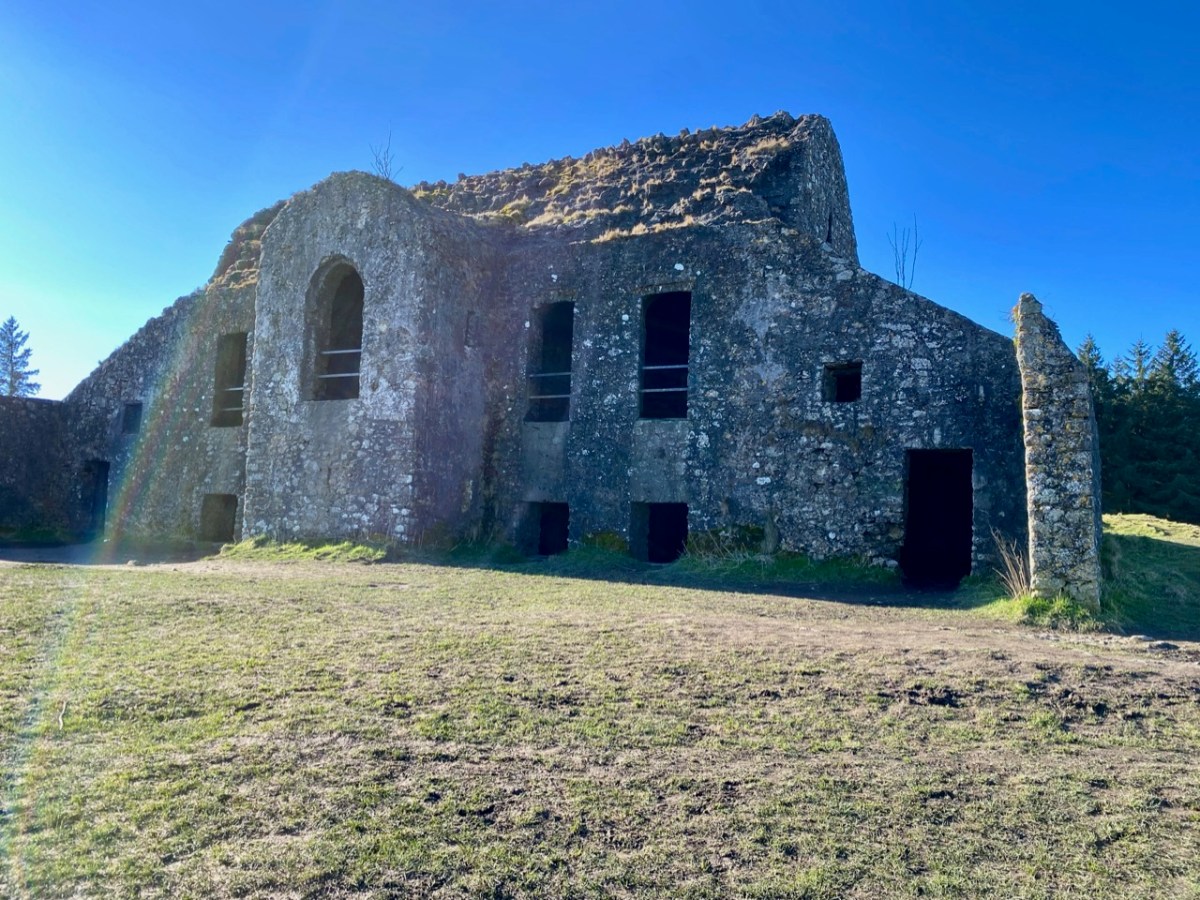
It’s taken me a while to visit this notorious site which is situated on a summit of the Dublin Mountains. The view across the city from the 390 metre peak is stunning:
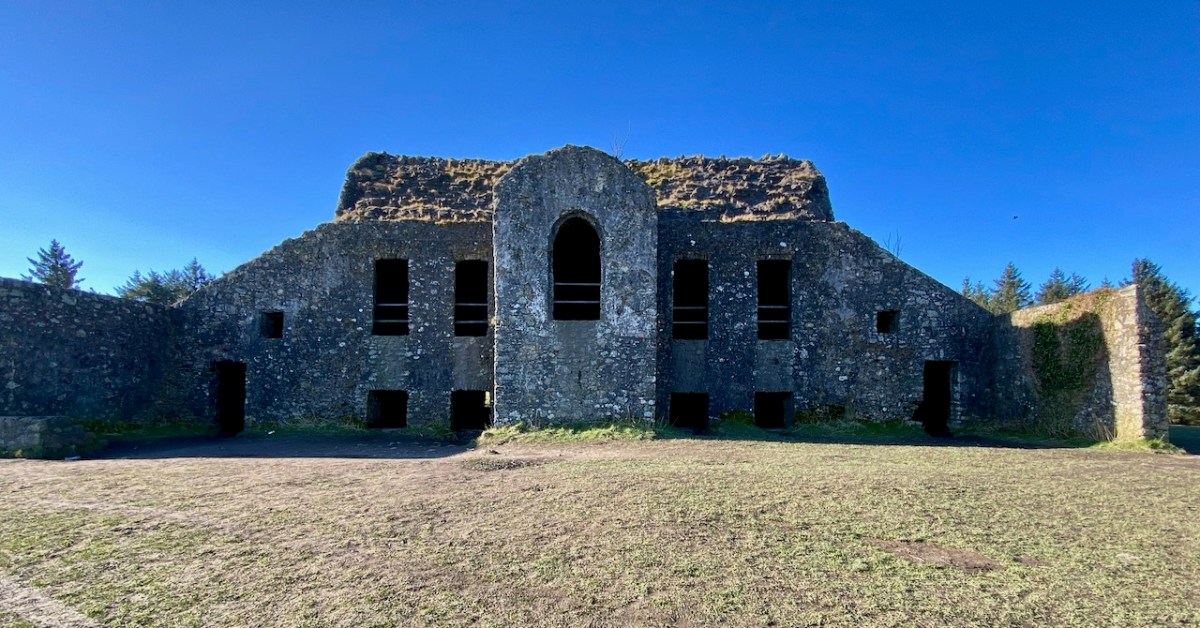
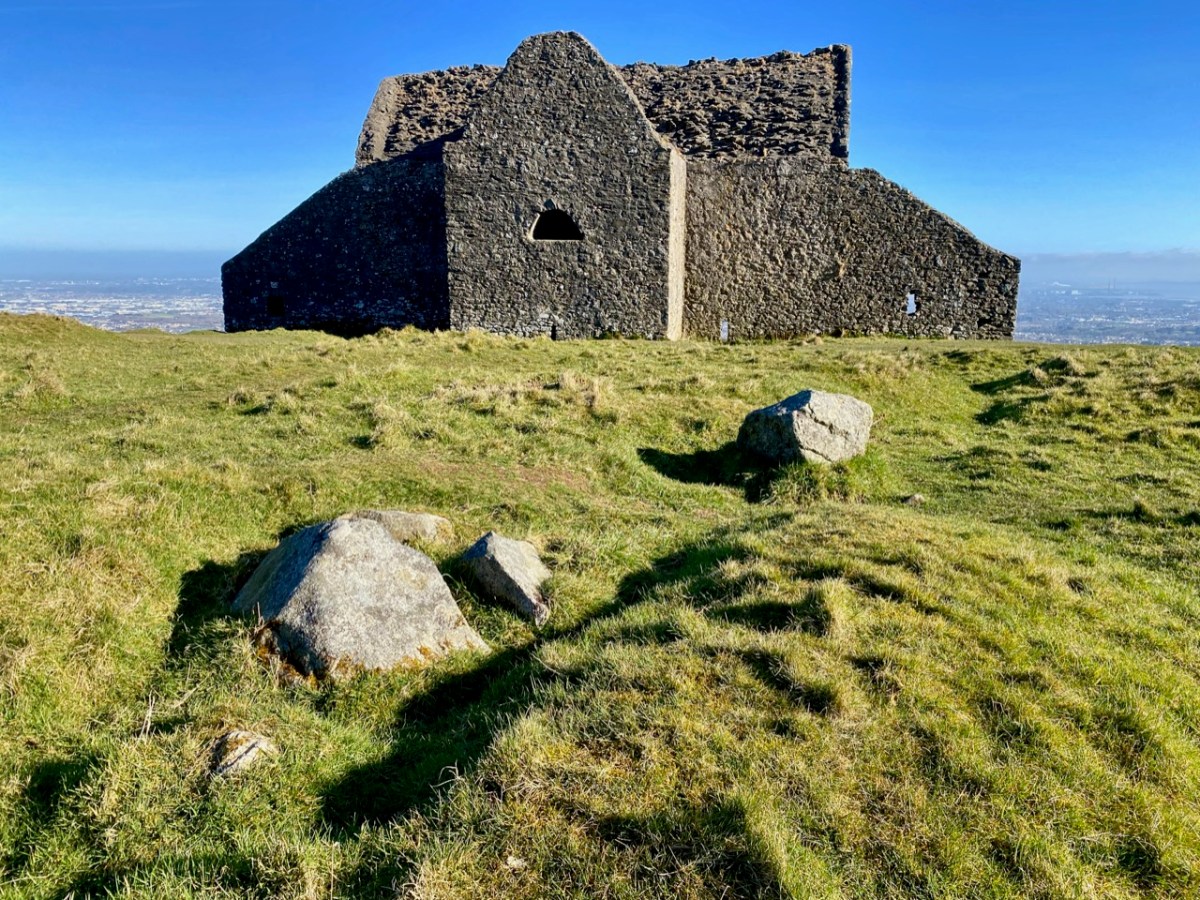
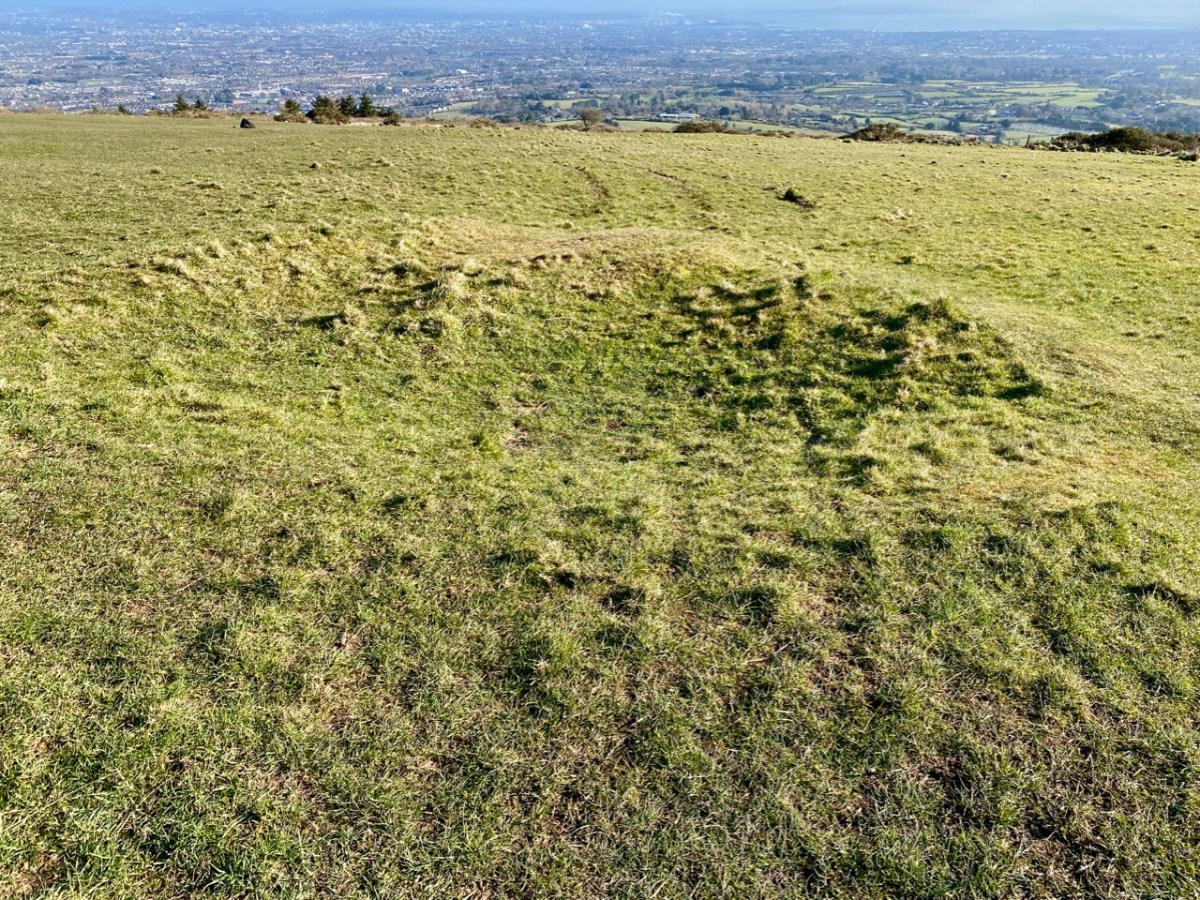
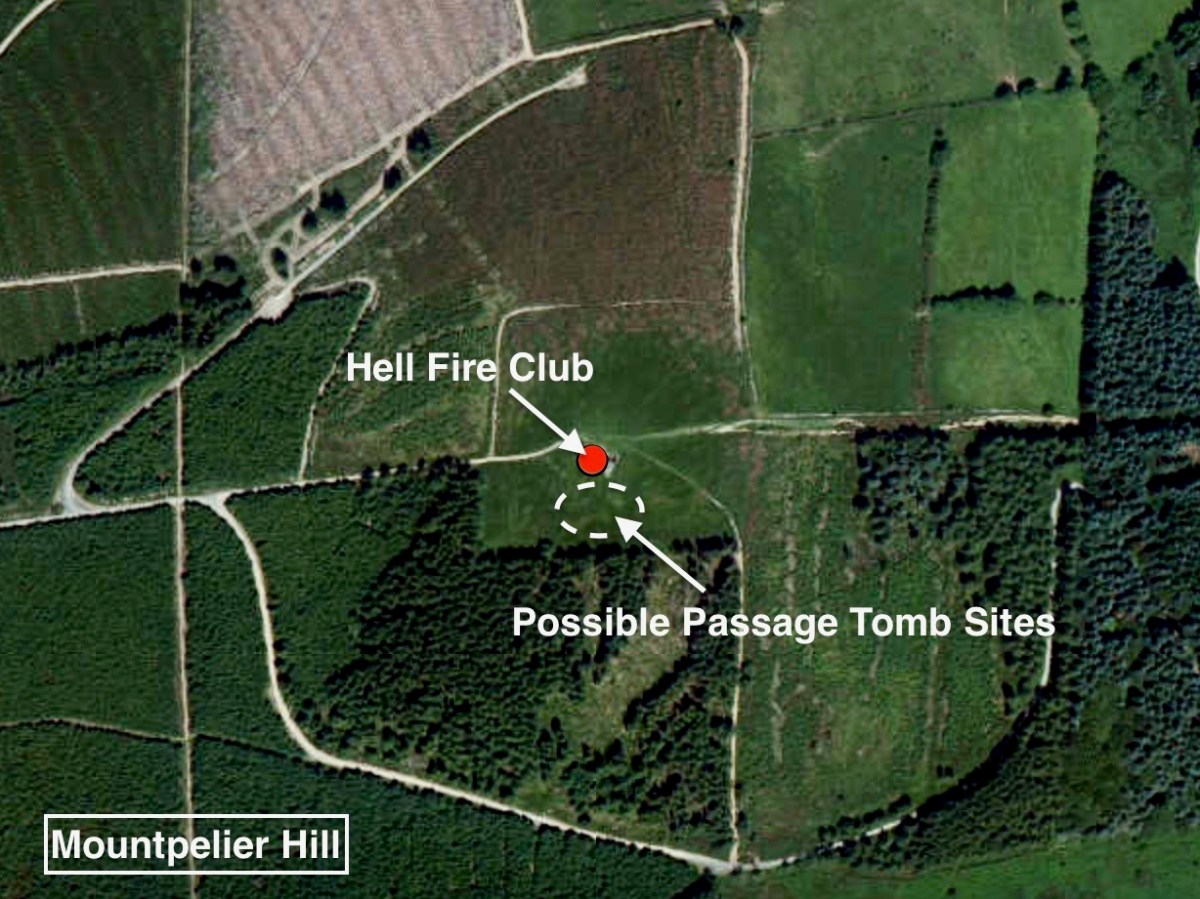
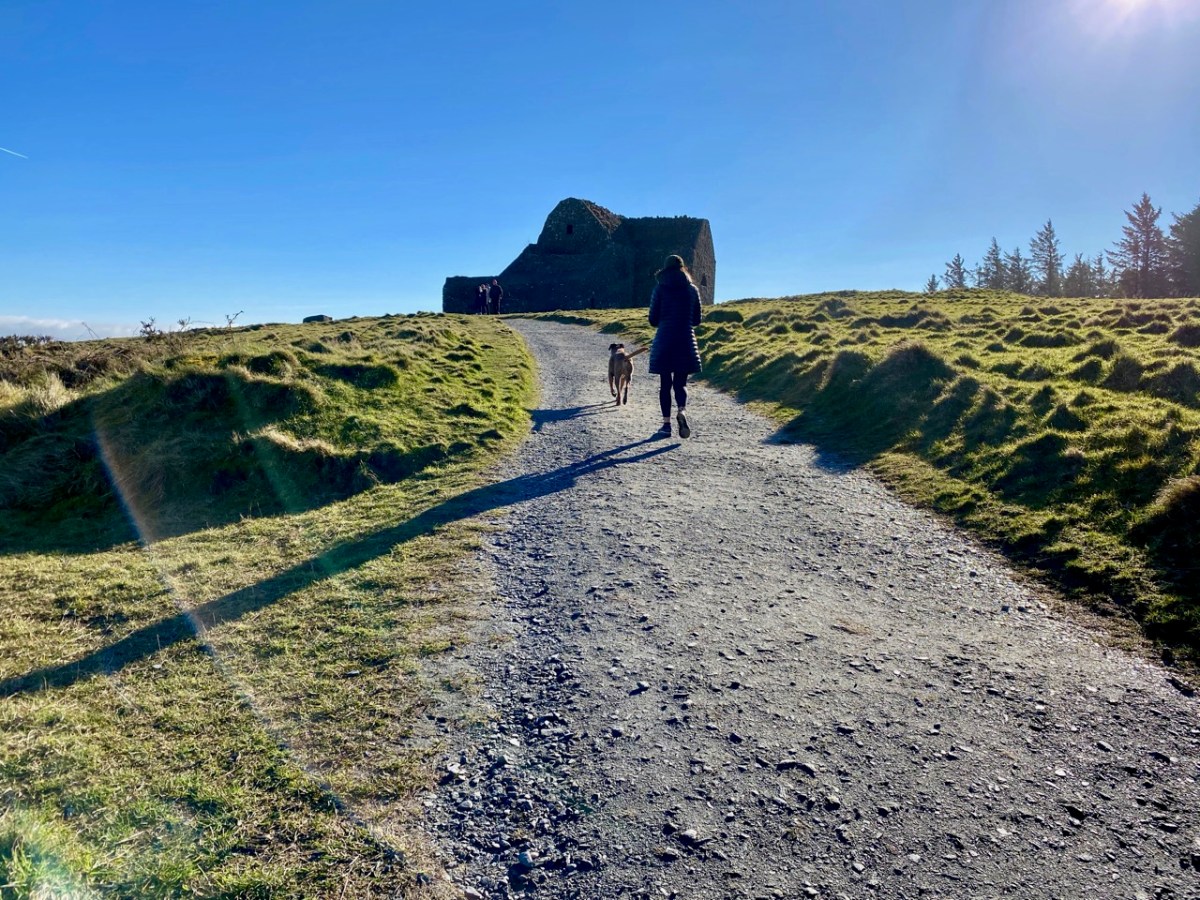
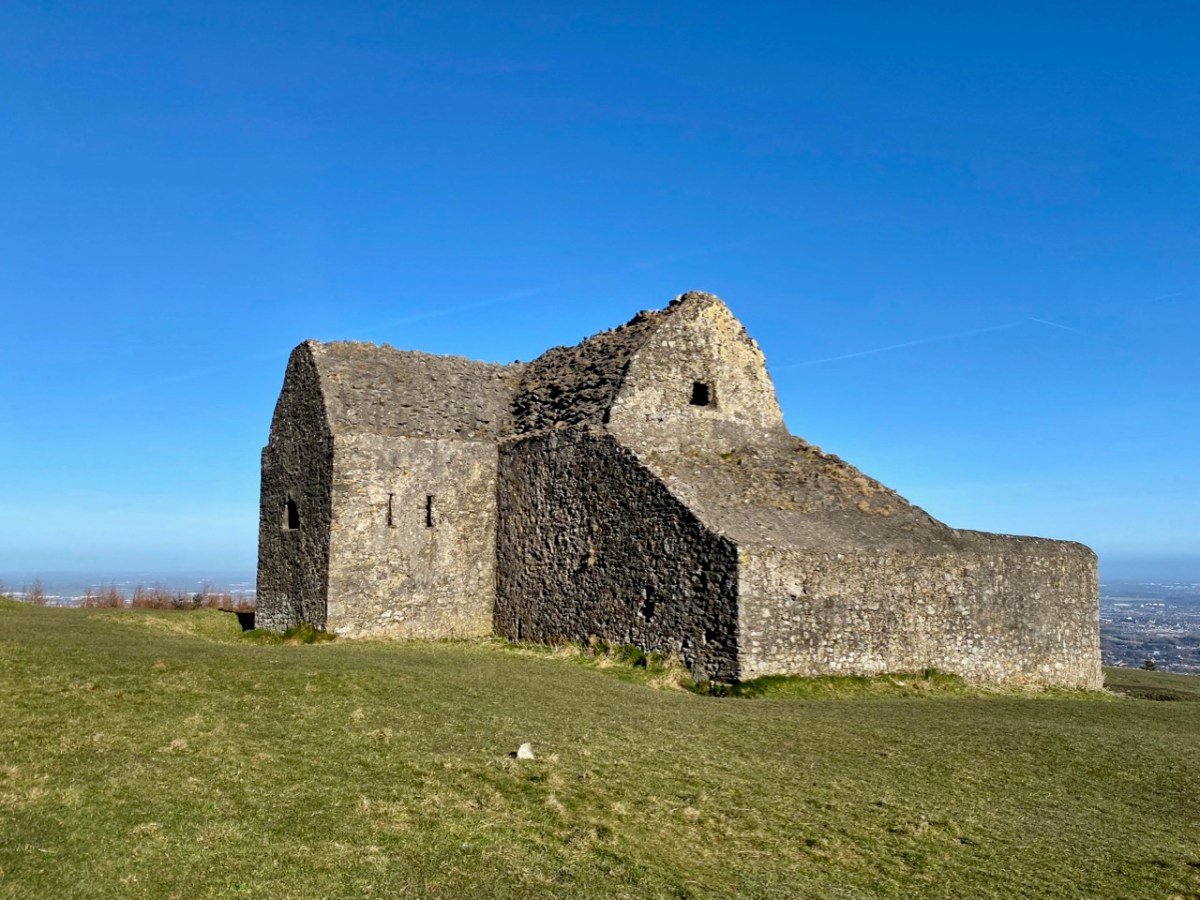
It’s the stories and the folklore that attracted me to this place, long known as the Hell Fire Club. In the eighteenth century ‘Speaker’ Connolly built it as a hunting lodge. According to tradition he used the stones from a prehistoric monument that was previously on the hill. It’s now known from recent excavations that at this location was one – or two – passage tombs dating from the Neolithic Period (4500 – 2000 BC). This – or these – were surrounded by a circle of large boulders known as a cairn. Today, some fragmentary traces of the earliest use of the site can be detected. The best information on the neolithic site is found in the Abarta Heritage report, here. An earlier description, dating from 1779 in fact, was written by Austin Cooper, who visited in that year:
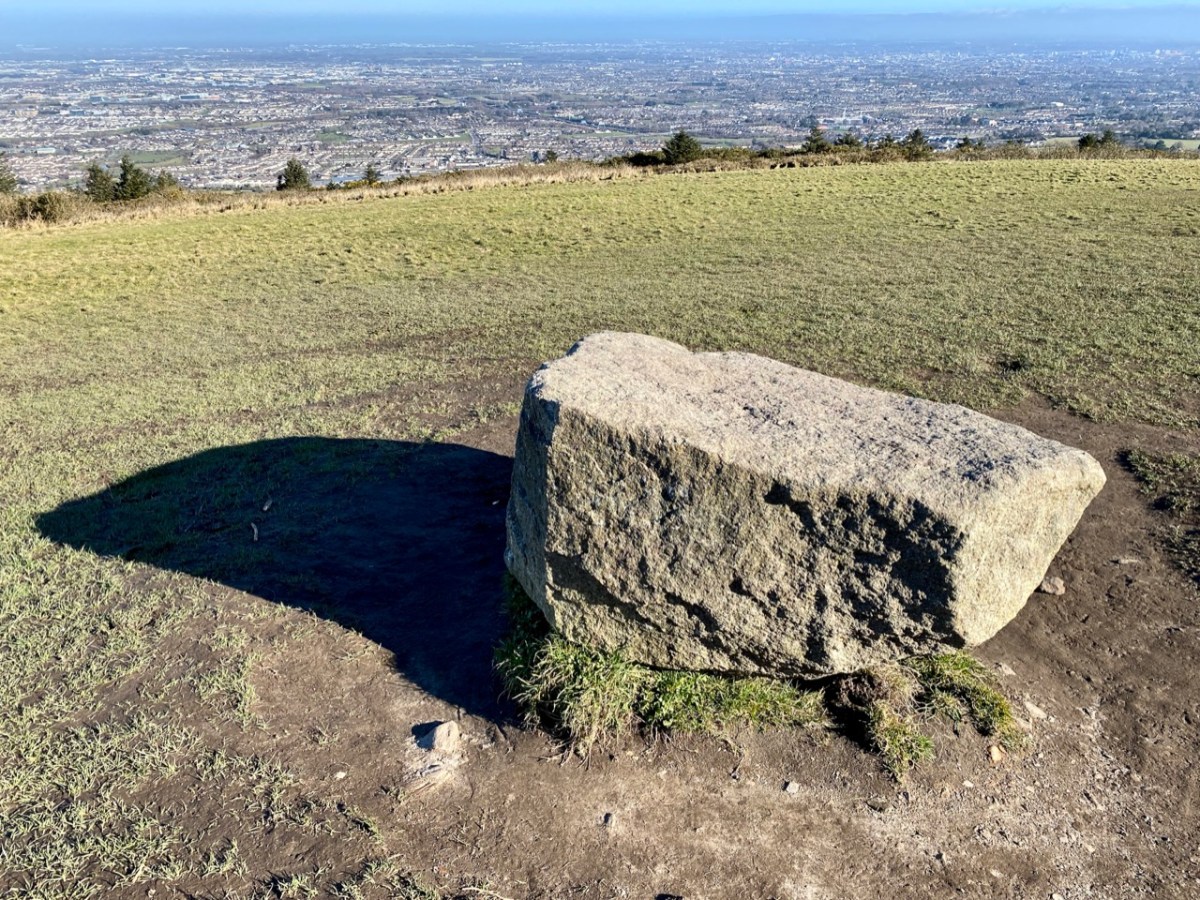
. . . Behind the house are still the remains of the cairn, the limits of which were composed of large stones set edgeways which made a sort of wall or boundary about 18 inches high and withinside these were the small stones heaped up. It is 34 yards diameter or 102 yards in circumference. In the very centre is a large stone 9 feet long and 6 feet broad and about 3 feet thick not raised upon large stones but lying low with the stones cleared away from about it. There are several other large stones lying upon the heap . . .
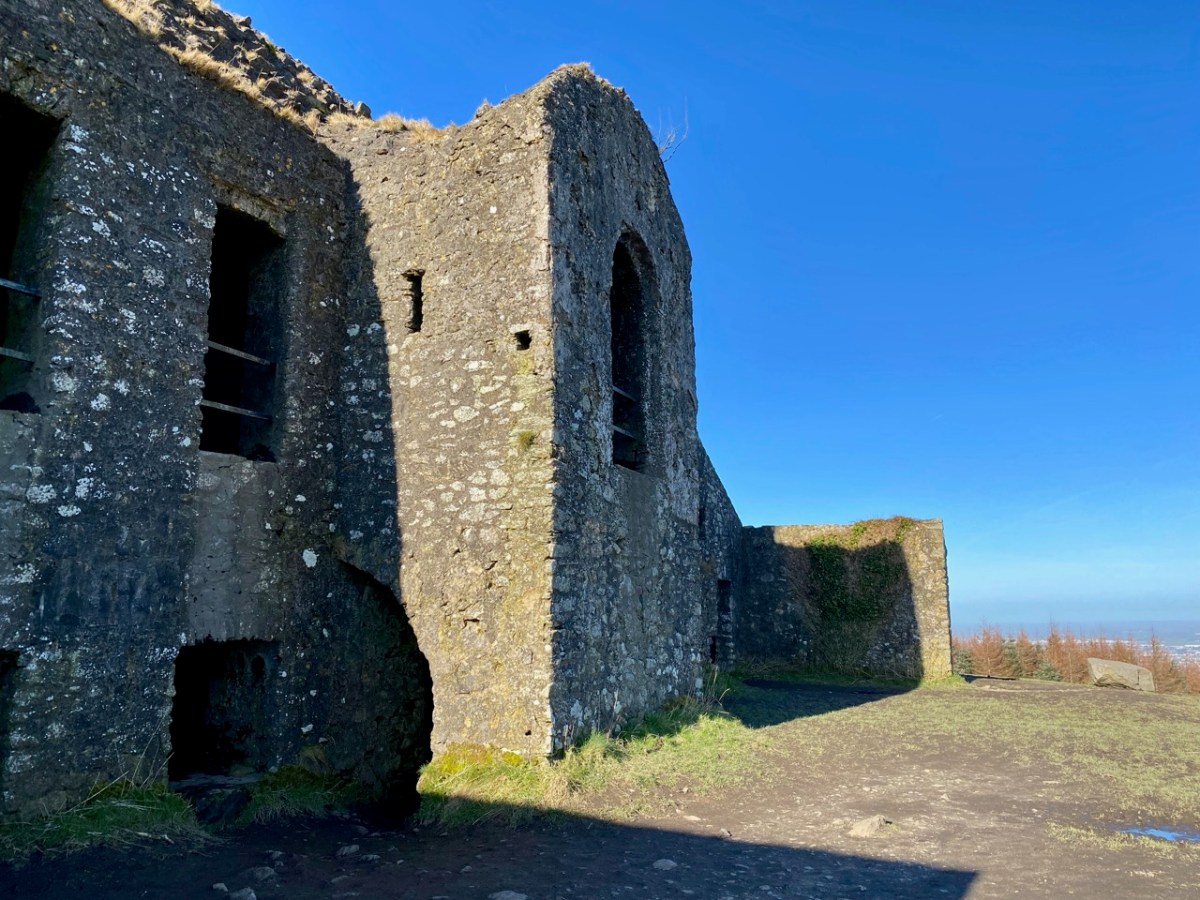
William Connolly (Speaker of the Irish House of Commons) was one of the wealthiest men in Ireland; he had a house in the city and a country estate at Castletown, near Celbridge. It is said that he deliberately used stones from the ancient tomb in the construction of the hunting lodge at Mountpelier. Shortly after it was built the roof, which was originally slated, was blown off in a great storm. Locals attributed this misfortune to the work of the devil, in revenge for the destruction of the cairn. Following this event the lodge gained a reputation as a place where evil prevailed. However, Connolly replaced the slated roof with a stone vault which still exists today, although the building is effectively a ruin.
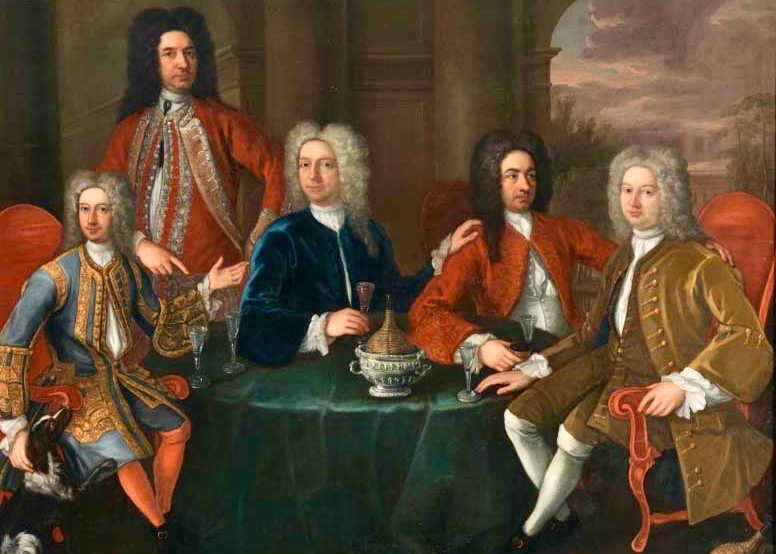
The Irish Hell Fire Club members were some of the elite of society, and included peers of the realm, high ranking army officers as well as wealthy gentlemen and artists. Here is a portrait of some of them by James Worsdale (himself a Club member); it is in the collection of the National Gallery of Ireland, Dublin.
From left to right: Henry Barry 4th Baron of Santry, Colonel Henry Clements, Colonel Henry Ponsonby, Colonel Richard St George, and Simon Luttrell, 1st Earl Carhampton. Biographies of all of them are summarised here – also from the Abarta reports. Their lives in general were debauched and relatively short. Missing from the portrait are father and son Richard Chappell Whaley and Thomas ‘Buck’ Whaley, who was to become ‘the most famous Buck of all’. Richard’s nickname was ‘Burn-Chapel’ Whaley because of his hatred of religion and in particular, the Roman Catholic church. He would amuse himself on Sundays by riding around Dublin setting fire to the thatched roofs of Catholic chapels. The Whaleys were related through their ancestry to Oliver Cromwell. Their family residence was Whaley Abbey, Co Wicklow: you can find more on this in Finola’s post today.
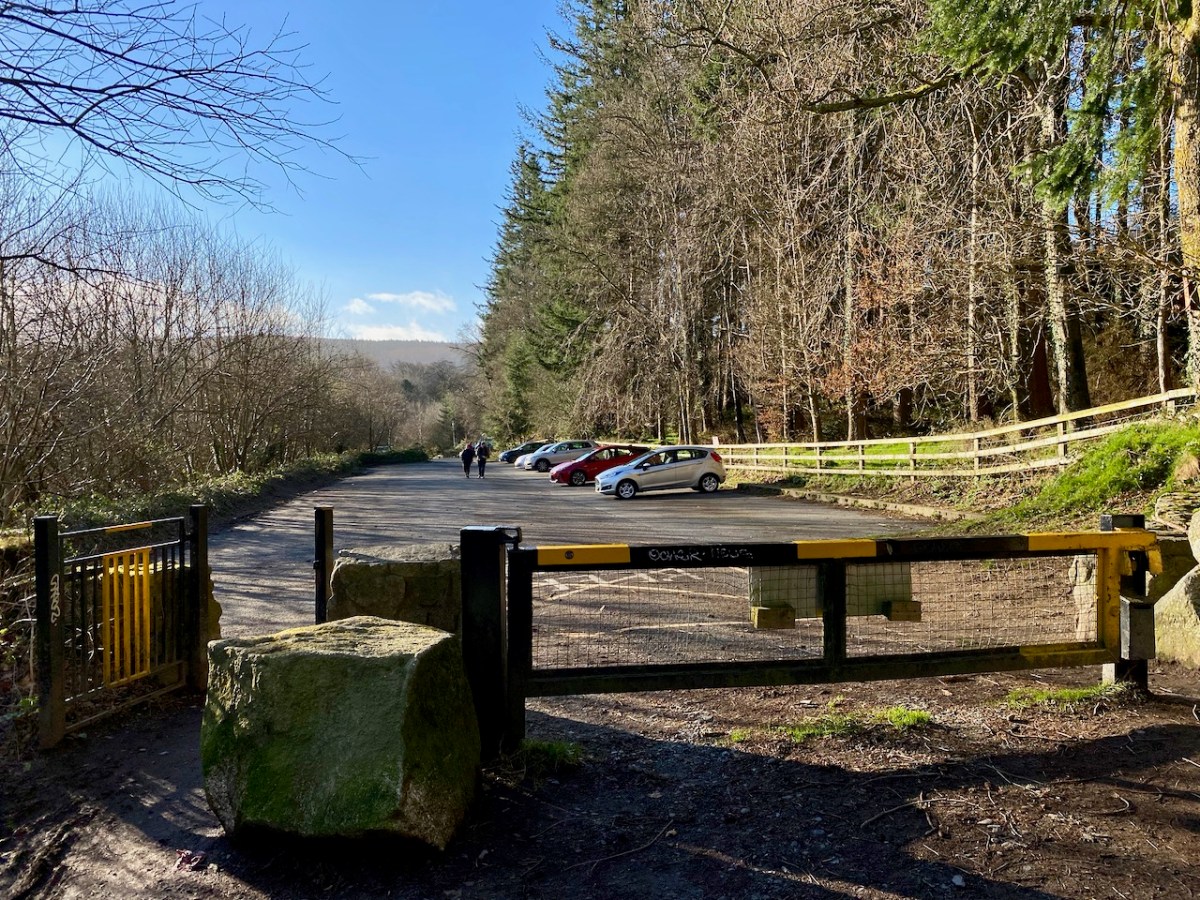
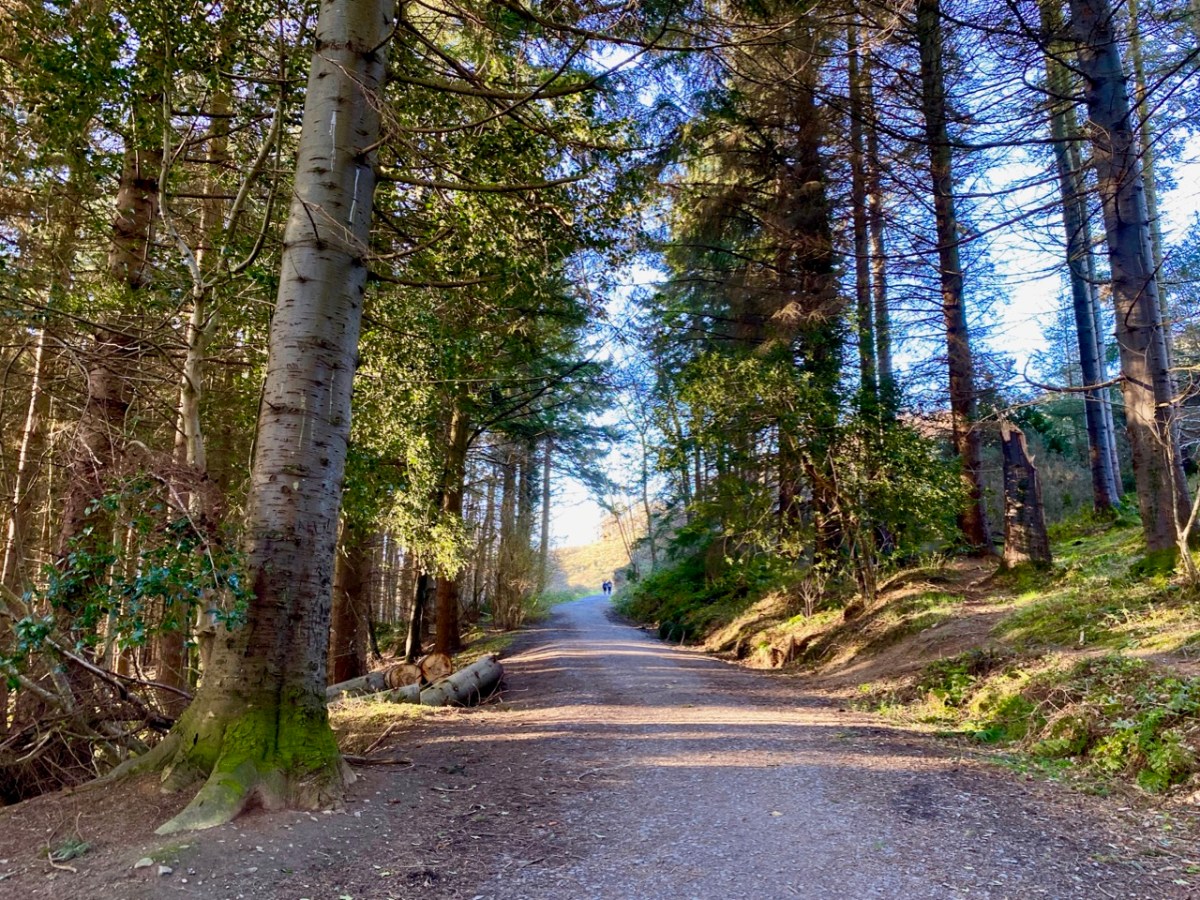
Mountpelier is a significant mountain top overlooking Dublin, and is now fully accessible to all. A warning, though – in good weather the Coillte car-park very soon fills up (at all times of the year) and there is nowhere else nearby to leave your vehicle – get there early!
It could be said that the ruin of the lodge is ‘maintained’ in that it is stabilised and unlikely to fall down. If you are exploring, look out for the lintel over the large fireplace, which is supposed to be a standing stone removed from the passage grave site.
The Hell Fire Club is, of course, haunted! Not that we saw anything untoward when we visited on a glorious spring day. But the stories abound. They are probably best told through the accounts in the Schools Folklore Collection:
. . . About six miles from Dublin the Hell Fire Club is on a hill. It is a medium size old castle.When the owner of it died nobody else claimed it. All the men of the district came to play cards in it every night. One night when all the men were playing their nightly game one of the men cheated. The men rushed upon him over-powered him. The bound him hand and foot and put him in a barrel of whiskey. Then they set fire to it burning him alive. That was a cruel thing to do but then men did not care. From that day on that old castle was called the Hell Fire Club . . .
Stewart Somerville, Dundrum School
. . . There is an old ruin called Hell Fire Club on the very top of one of the Dublin Hills. This house was built by a man named Connelly, during the time of the Famine. It was built to give employment to the men. Many men used to got to Hell Fire Club to gamble. It is said that one night they were playing cards and there was much money on the table. One man dropped a card on the floor, and when he stooped down to pick it up he noticed a man with cows feet, and he wore a red cloak. The men were very frightened and they made a great uproar. The man turned into a ball of fire. All the men were burned in the fire. There was one man who had a bunch of medals attached to his coat and he was the only man who escaped from the burning house . . .
Mr Finlay, Rockbrook, Co Dublin
. . . The Hell Fire Club, or the Brass Castle is situated near Rathfarnham in the Co Dublin. My Great-grandfather used to pass by the Brass Castle on his way home from work, (he was a mason) he had a habit of hitting the wall with his trowel to hear the ring of the brass. One night a priest had to go on a sick call. When he was coming home through the mountains he lost his way. Seeing a light he went in that direction. He knocked at the door of the house, which happened to be the Brass Castle – The door was opened by a man who was dressed in black with a black mask on his face. The priest was brought in to a room. Sitting at a large table were twelve men dressed the same as the first one. The men were playing cards. On the table was seated a large black cat. The men defied the priest to put the cat away. The priest ordered the cat down, but it never moved. Again he ordered it down, but the cat did not move. The men laughed at the priest and jeered him. The third time the priest said “Begone Satan”. The cat jumped from the table and disappeared up the chimney with a loud roar. The priest told the men that the cat was the devil. The men were never heard of again. The priest got home safe, and from that time onward the Brass Castle was called the Hell Fire Club. This story is true. It was told to me by mother, because the Brass Castle belonged to her ancestors . . .
Seán Ó Nuamáin, Kilbride, Co Wicklow
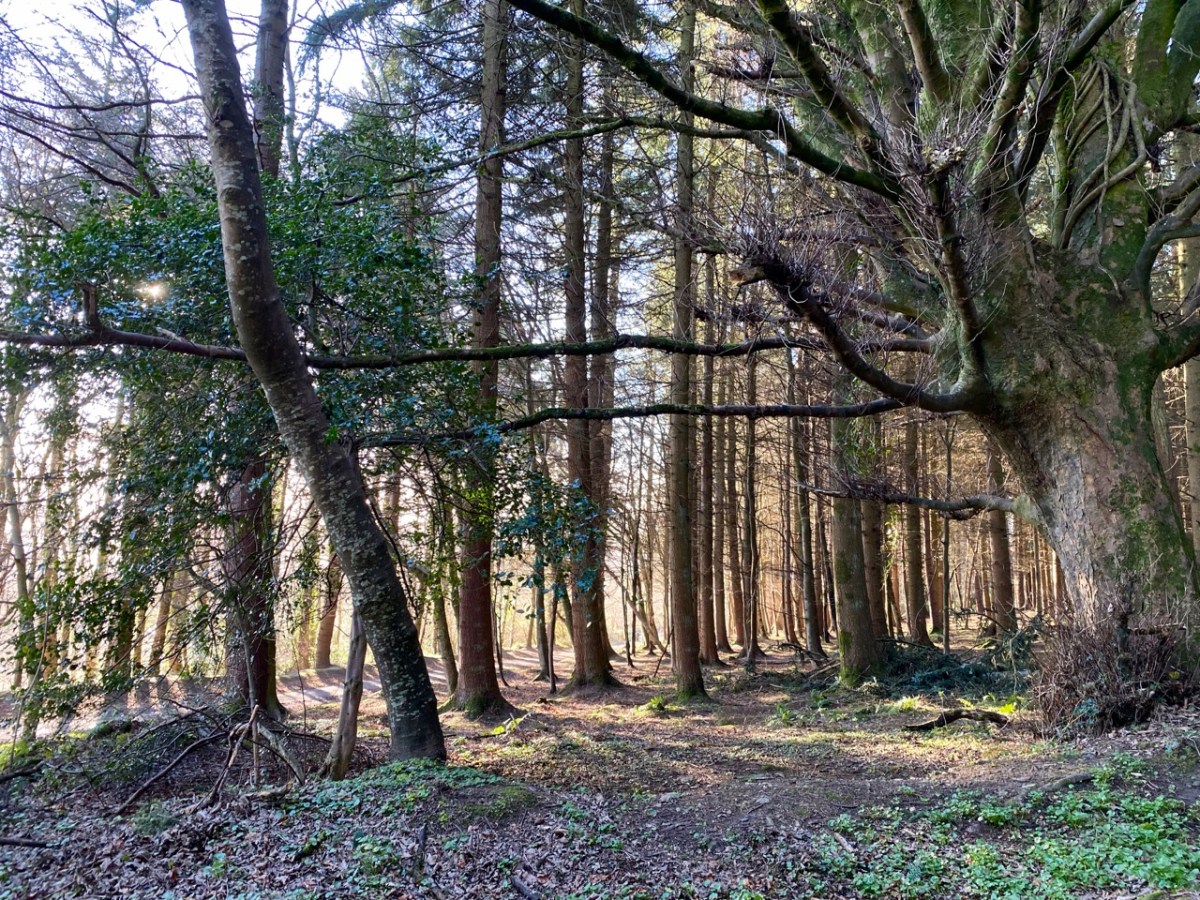
The Mountpelier Woods consist of around 5.5 kilometres of forest roads and tracks. The woods offer nature trails and a permanent orienteering course. Lord Massy’s Estate and Mountpelier Hill are also traversed by the Dublin Mountains Way hiking trail that runs between Shankill and Tallaght. It’s an attractive walk at all times of the year, with easy access from Dublin city centre.
A comprehensive application to An Bord Pleanála was submitted in July 2017, seeking permission to establish a Dublin Mountains Visitor Centre with associated works relating to tourism, leisure and recreational activities which would embrace the Hell Fire Club site and the mountain trails. Permission was granted, subject to conditions, on 25 June 2020. Another chapter in the story of this notorious locality unfolds . . .
As a tailpiece, I found this image of a ‘Hell Fire Club Goblet’ dating from c1745. It’s currently in the Philadelphia Museum of Art, but it must originate from Ireland: James Worsdale, whose name appears on this glass, was appointed Master of the Revels in the Dublin Hell Fire Club in 1741. It was also he who painted the portrait of Club members illustrated in this post: look at their goblets in the painting!
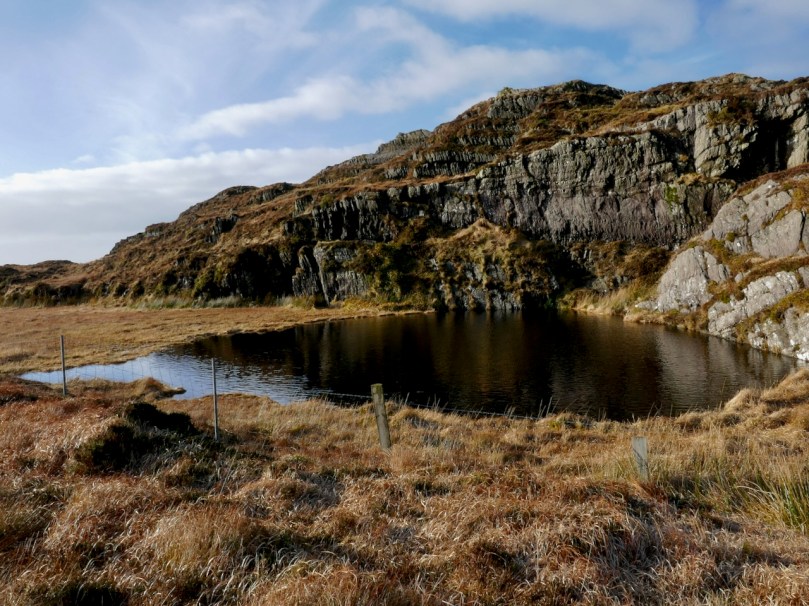
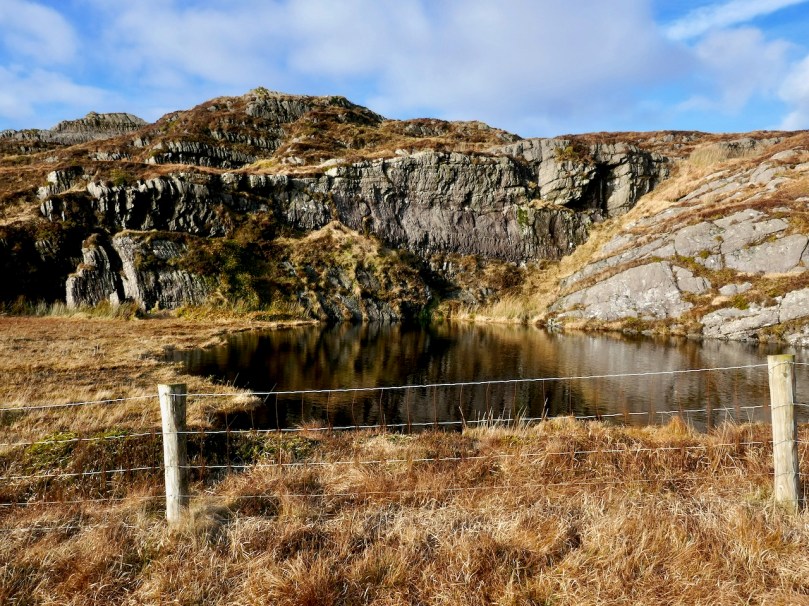
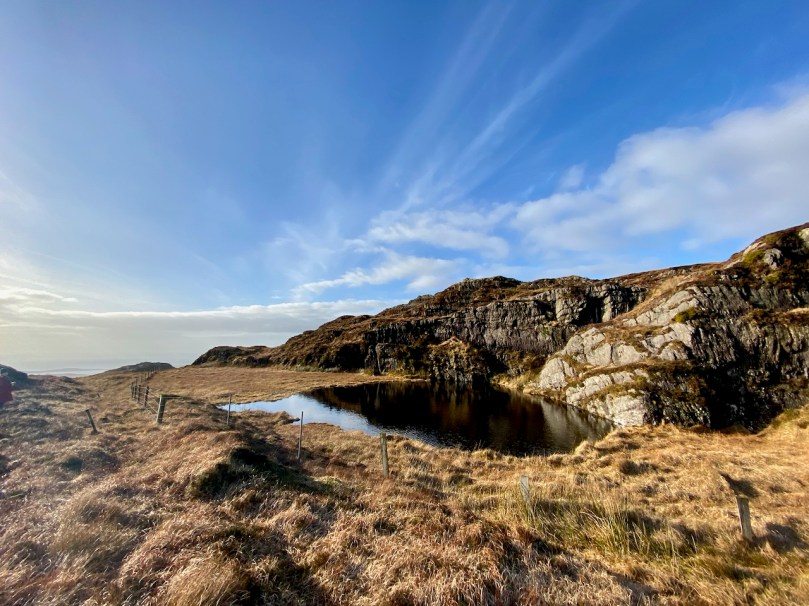
It’s the most visible and significant feature on the West Cork landscape, so of course there are lots of legends about Mount Gabriel. A surprising number of stories revolve around a tiny pool near the top of the mountain, labelled on the historic OS maps as Poulanenine. The most likely etymology for this is Poul an Oigheann – the Pool of the Cauldron (oigheann also means oven, but cauldron seems a more likely translation).
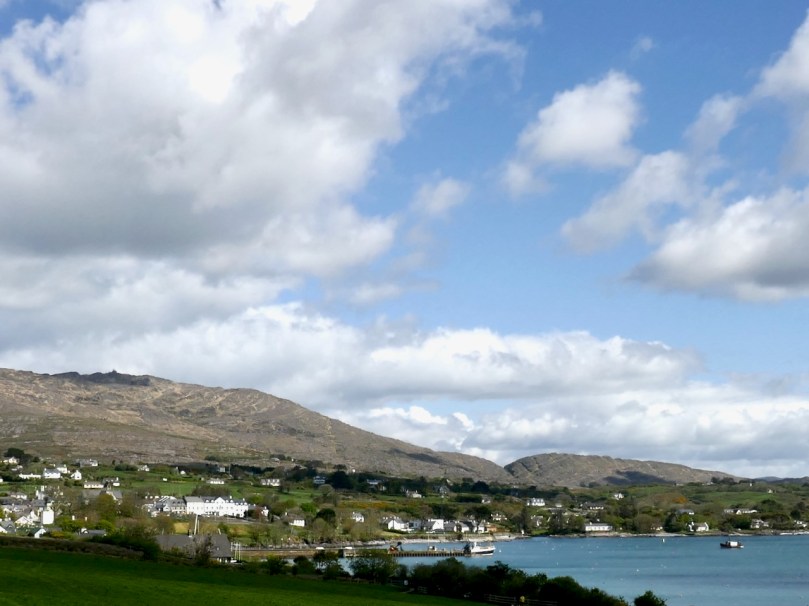
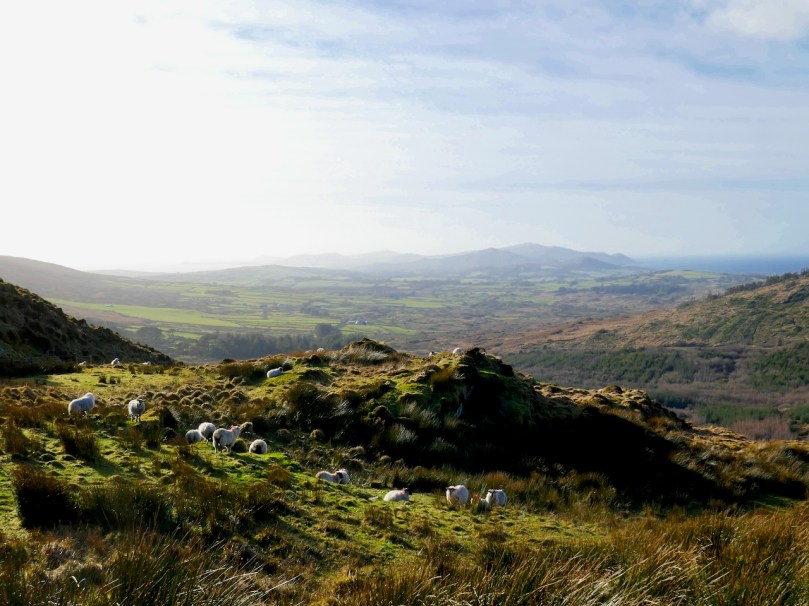
Reading these stories in Dúchas* and finding the pool on the maps, I knew that we had to see it for ourselves. Fortunately, Mount Gabriel (looming over Schull, above) is within our 5k limit and luckily necessitates no human interaction (as a people person, that’s a phrase I never thought I would write) so we set off yesterday to find it. Yes, your intrepid bloggers stop at nothing to bring you the best of West Cork arts and culture!
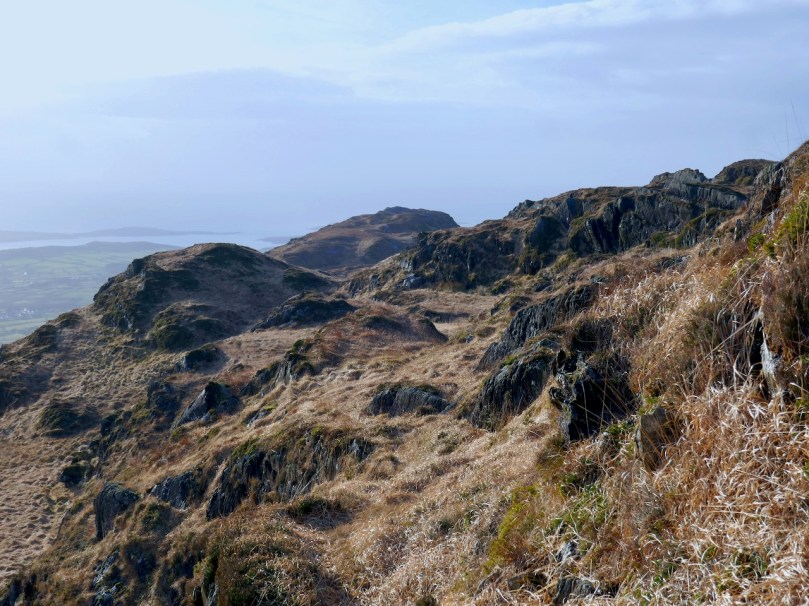
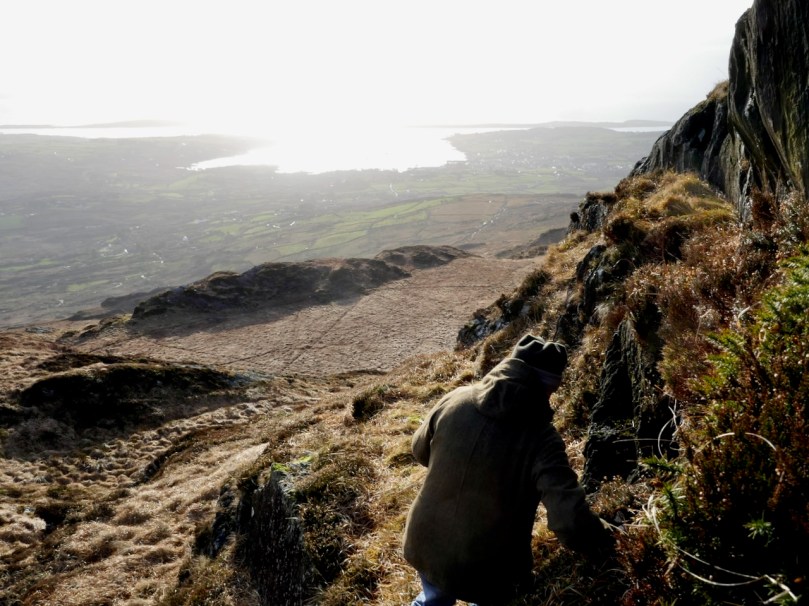
Having made a couple of wrong decisions as to the best way to get there, at one point we found ourselves edging backwards over a slippery cliff, clinging to bits of heather and wondering just how foolish we would look when the Search and Rescue Team had to be called out to save a couple of septuagenarians who claimed to be looking for a fairy tale location.
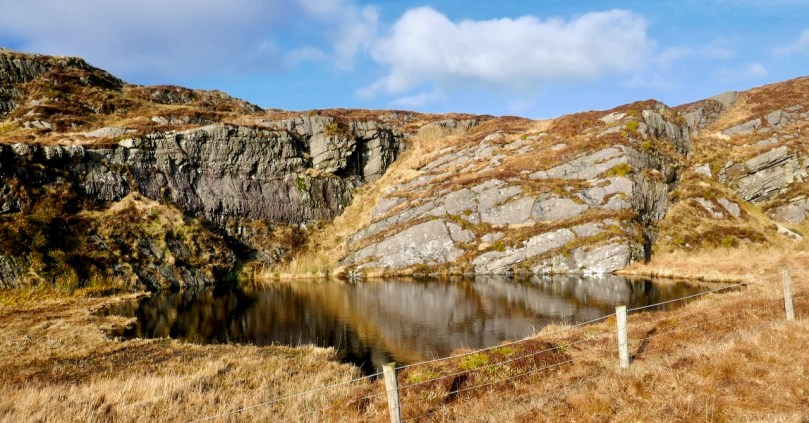
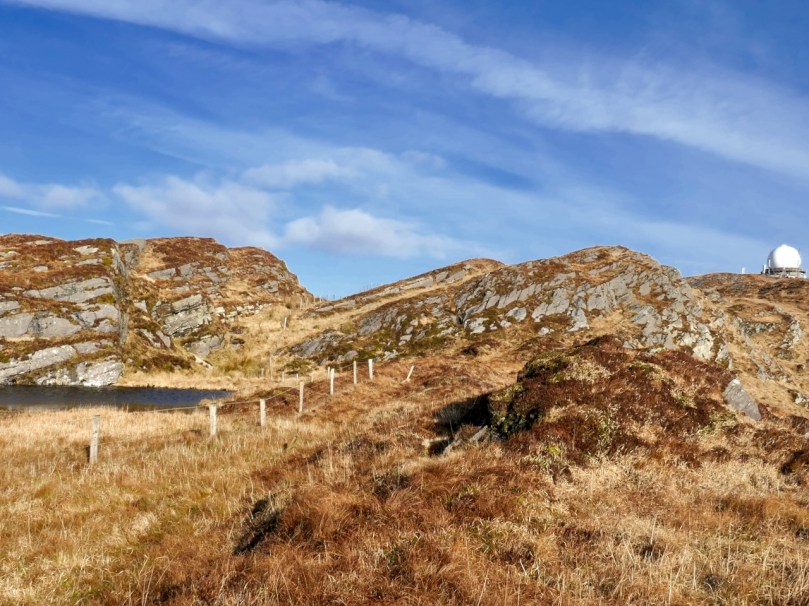
But we made it – and there it was, a tiny remnant of the Ice Age, the Cauldron Pool! It’s referred to as a lake in the stories and there are several versions of how it was made. Here’s an admirably succinct one:
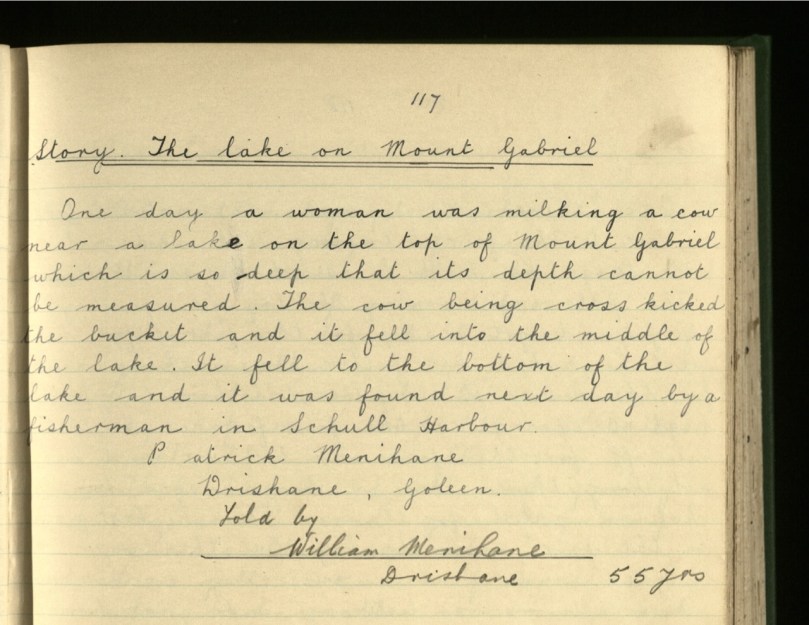
There is a little lake on the top of Mount Gabriel called Poll an Oighin. There is a saying that Fionn Mac Cumhail took a handful of rock and threw it out into the Atlantic Ocean where it is now as the Fastnet Rock or Carraig Aonair – leaving the hole of Poll an Oighin. Another saying is that if a stick was thrown into Poll an Oighin it would come out in Schull harbour.
The fact that there is an underground route from the lake to Schull Harbour is born out by this story too:
But not all versions assign the origin of the lake to Finn McCool.
Long ago the devil was flying over Mount Gabriel and he was flying so low that he hit his wing against a rock. He got so cross that he took a bite out of the rock. When he had gone eight or nine miles from Mount Gabriel, he left the rock fall into the sea. The rock was so large that a part of it remained over the water and it is on that rock the lighthouse is built on now and it is known as the Fastnet Rock. There is a large lake where he took the bite and the water in that lake is of a black colour.
The black water
However, the most charming, and longest story belongs to an entry from Macroom, far away from Mount Gabriel. The school girl, Julia Creedon, got it from Dan O’Sullivan, also of Macroom, although undoubtedly Dan knew the story from his youth so must have been from the area around Schull. I am reproducing it in full, and readers will recognise many elements familiar to such legends everywhere. One of the most striking aspects of this story is its use of familiar names and places to fix the story in this exact locality.
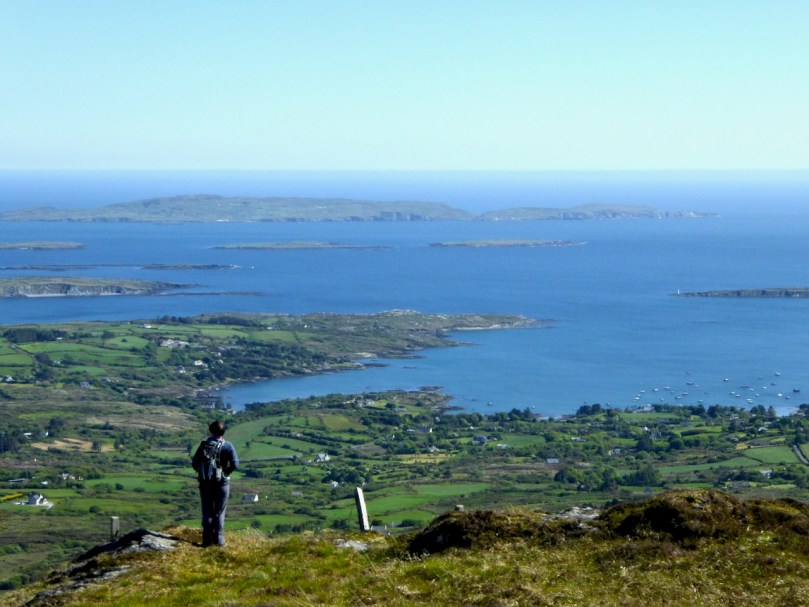
Near the village of Schull, is Mount Gabriel whose peak rises 1,000 feet above sea level. The unspoiled charm of the magnificent view from its summit is unsurpassable.
The Meenvane road leads you out of the village and on to the gap road; which runs between two high cliffs on the east side of the mountain known as “The Gap of Mount Gabriel”, From here you have a view of nature’s splendour: a number of Carberys Hundred Isles scattered over the great expanse of the Atlantic which amply repays you for the stiff climb. It has been compared to a post card album, you study, as it were, one lovely post card, on turning a leaf you get an entirely different, yet, equally beautiful view to gaze upon, but here you simply turn your head.
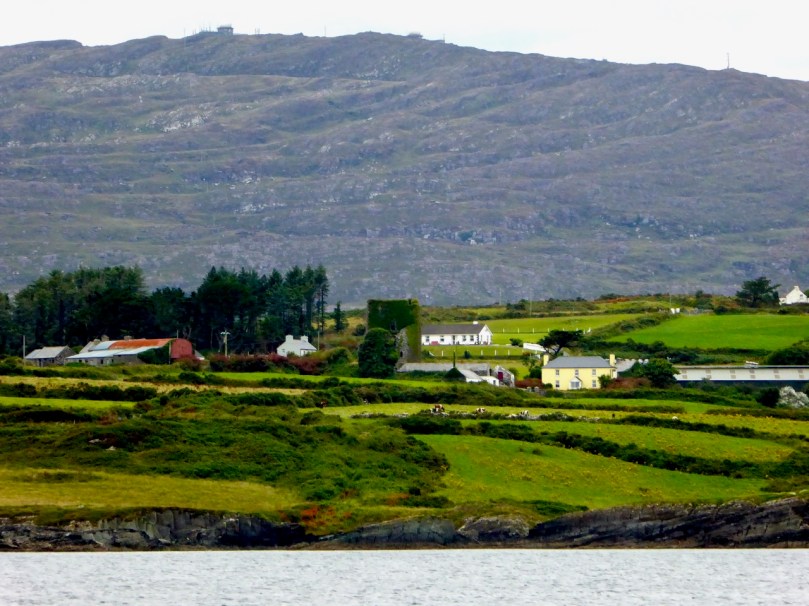
Facing south you see on the Coosheen hill the ruins of the old white castle once the seat of the O’Mahoneys. Turning north the Hungry Hill can be seen in the distance. The beautiful country of the valley reflecting every mood of nature runs down to Dunbeacon Castle, once the home of Chieftain O’Sullivan, whose ruins now stands at the edge of Dunmanus Bay, beneath the shadow of Mount Gabriel. Sir H. De La Béche** says in his History of Cork “It was as striking of its kind as any he had seen in Switzerland.”
Chieftain’s Daughter
Following the road and keeping to the left, you find a patch on the north side of the mountain which leads you to the bottomless lake, situated almost on the top of the mountain. There are many beautiful traditions of this picturesque locality, still amongst the older peasants of the district, one of which is: –
“The Legend of the Bottomless Lake” is as follows: Chieftain O’ Sullivan, of Dunbeacon Castle, had one child, a daughter, Rosaleen. So beautiful and fair was she that the poets described her as “The Rose of the Valley”. She had a lover, one, Owen O’Mahoney, of the White Castle. When O’Sullivan heard of his daughter’s friendship with O’Mahoney he was very angry as Owen could never hope for more than a younger son’s share. Notwithstanding this, the young lovers were ideally happy.
What’s left of Dunbeacon Castle
One evening as Rosaleen returned home after a walk with her lover, she was brought into the presence of her father’s guest, Chieftain O’Driscoll of the Three Head Castle. He was known to Rosaleen, who thoroughly disliked him, as an elderly bachelor, who drank a lot of rich wines, boasted a lot of his castles, of the men he had killed, and the women who loved him. When Rosaleen heard he had come that day, to ask her in marriage, and that her father gave his consent, she was horrified. Outwardly calm, she explained to her father and O’Driscoll that she loved Owen O’Mahoney, and would marry no other. Her love for Owen was far dearer to her than her life. Her father listened not to her pleading; he settled the day for her wedding to O’Driscoll giving “The Rose of the Valley” just one week to get used to the idea and to forget Owen O’Mahoney.
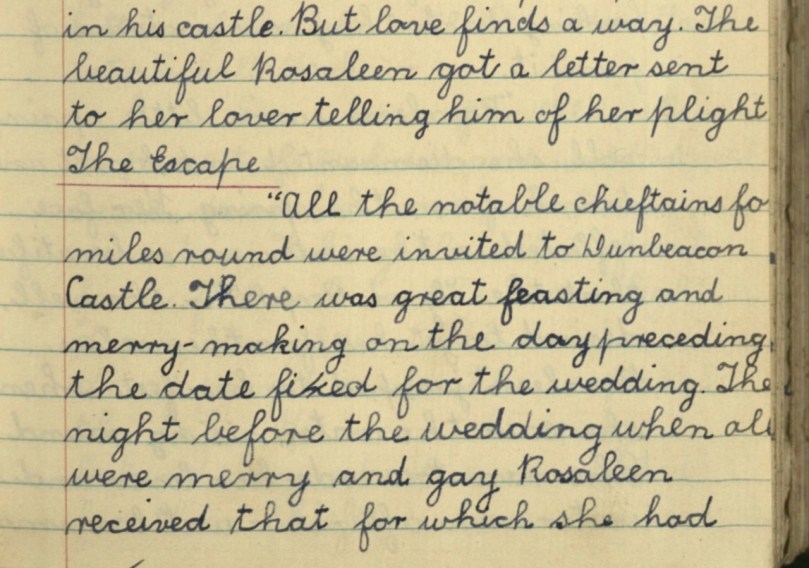
During that week her father saw to it that she was kept a prisoner in his castle. But love finds a way. The beautiful Rosaleen got a letter sent to her lover telling him of her plight.
Three Castle Head
The Escape
All the notable chieftains for miles round were invited to Dunbeacon Castle. There was great feasting and merry-making on the day preceding the date fixed for the wedding.
The night before the wedding when all were merry and gay Rosaleen received that for which she had being praying, a letter from Owen. Following his instructions she made her escape from the castle, and was met by her lover. Helping her on to his horse, he sprang up behind her, and faced for his father’s castle in Coosheen.
Fearing Rosaleen’s escape would be discovered, they left the road and took the path over the mountains. It was a bright moonlight night. Looking back they saw no trace of pursuit.
Rosaleen saw a little spring well, she dismounted and knelt and drank from the spring. Her face reflected in the water, was so beautiful that the “Good People” in the well, desired to get her for themselves. Rosaleen jumped to her feet when she saw the water, rising round her. She ran towards her lover the water ran after her until a small lake was formed.
Owen seeing her plight, lifted her on to his horse and springing behind her, once more he made his way down the other side of the mountain. The “Good People” seeing they were beaten in their attempt to capture the beautiful “Rose of the Valley” got very angry, and reversed the flow of the spring. Down, down, down went the bottom of the lake until its waters flowed into Schull Harbour.
Some hours after O’Driscoll went in pursuit of his bride and muddled with drink, drove his horse over the mountain. Taking the sheet of water for a flat rock in the moonlight, he drove straight into it and disappeared under the surface of the lake. His men following behind reigned up and waited for their chieftain to re-appear Seeing no trace of him, they rode back with all haste to acquaint O’Sullivan with news of the disaster that had overtaken O’Driscoll. Chieftain O’Sullivan, believing that his daughter had met with the same fate as O’Driscoll, was filled with remorse. He tore his hair in grief for his beautiful lost daughter.
White Castle (Ardintenant Castle) from the sea, Mount Gabriel behind
Reconciliation
Great was his joy when he heard that she was safe and well married to Owen O’Mahoney and dwelling at the White Castle.
He rode immediately to Coosheen and asked Owen’s forgiveness. He promised him Dunbeacon Castle and all his estate if only he would bring her back “The Rose of the Valley”.
I can’t help wondering about Julia Creedon. Although she may have faithfully reproduced the essence of the story she heard from Dan O’Sullivan, her own abilities are very evident in this story, as is her immersion in reading other stories in this genre. Did she become a seanachaí (a story teller), or a teacher or a writer? She has two other stories in the Schools Collection as well, including a long one about the River Lee, just as precociously written in the same lovely cursive, with headings underlined in red ink. If she were still alive, she would be in her late 90s now.
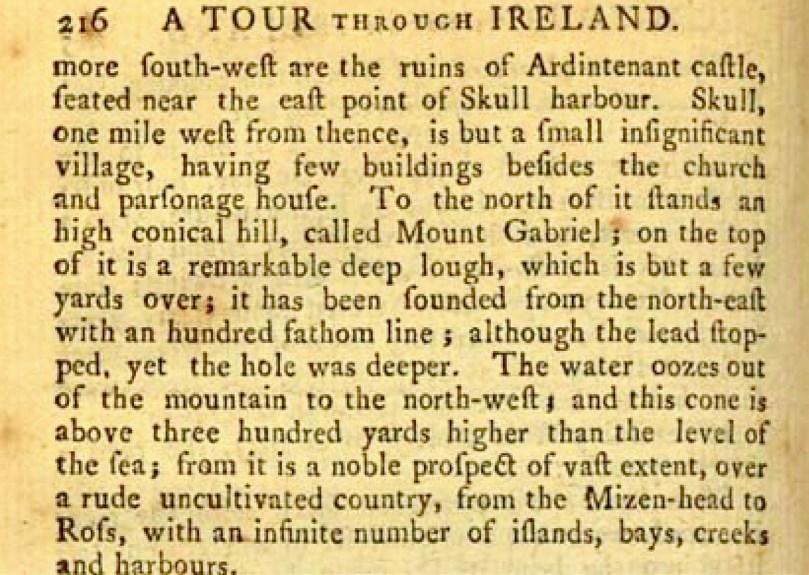
The story of this bottomless pool has an even older history than the 1930s. In 1780 Philip Luckombe published his A Tour Through Irelandand tells of the same lake when describing a journey from Bantry. Luckombe was one of our earliest plagiarists – he took his accounts almost verbatim from even earlier books and there is no evidence that he was ever even in Ireland. From our point of view this means that the story predates 1780 so it has an impressive pedigree indeed.
Next time, more about some of the other legends that have accrued to Mount Gabriel.
It’s further than it looks
* Dúchas is the National Folklore Archive and within this is The Schools Collection: “For the duration of the project, [1937-39] more than 50,000 schoolchildren from 5,000 schools in the 26 counties of the Irish Free State were enlisted to collect folklore in their home districts. This included oral history, topographical information, folktales and legends, riddles and proverbs, games and pastimes, trades and crafts. The children recorded this material from their parents, grandparents, and neighbours.” The Collection is online and is searchable at https://www.duchas.ie/en/cbes. I have done a little minor editing to the entries above for consistency in punctuation and spelling.
**This is a reference to Sir Henry De la Beche, founder of the Geological Survey of Great Britain and Ireland.
Welcome to the UCD Library Cultural Heritage Collections blog. Discover and explore the historical treasures housed within our Archives, Special Collections, National Folklore Collection and Digital Library

















 Roaringwater Journal