Harry Clarke’s Supporting Cast

Honan St Ita

For any student of Harry Clarke stained glass there are delights to be discovered far beyond the main depiction. A host of subordinate or secondary figures reveal themselves to close examination, sometimes only after repeated viewings.
Brendan the Navigator

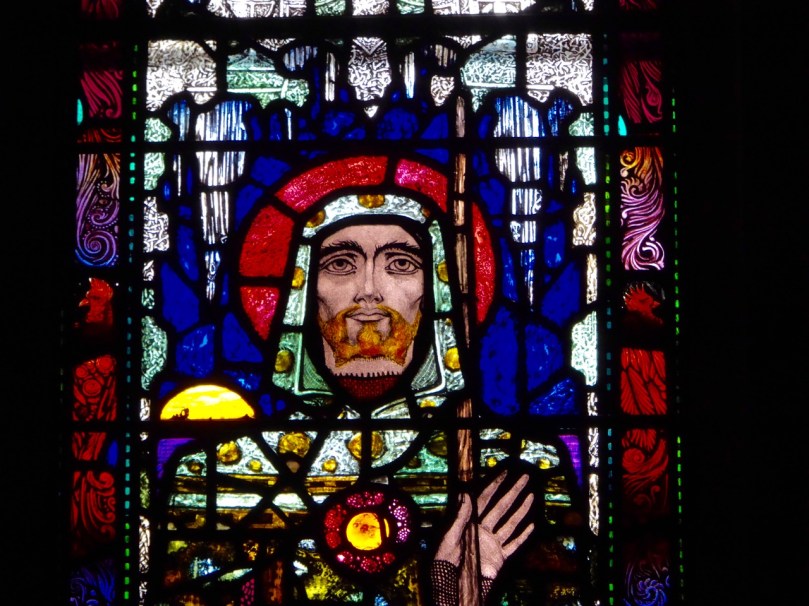
Brendan of Kerry – AKA Brendan the Navigator. Note the borders with their exotic birds

The tall windows I describe in this post  typically have three parts – the main section containing a large image of the saint, and an upper and lower section (sometimes called a predella) each of which may contain a separate image/story. In addition, the border around the outside of a Clarke window is always highly decorated in endless imaginative patterns.

Honan Mary Mother of Sorrow
The Mary Mother of Sorrows window was executed slightly later than the other windows and shows some stylistic changes. But it illustrates well the three parts to the window and the use of all available space for supporting and secondary characters to tell the story

Clarke was obsessed with detail: there are few white spaces or plain glass in his work. Every inch is filled with richly figured and never-repeated decoration or with additional figures that fill out the story and the symbolism of the central character. These figures tend to fall into a group we can call saintly and a group we can call macabre. Whichever they are, they reflect his vivid imagination and his gift for portraiture.

Honan Chapel

The Honan Chapel is the Catholic church at University College, Cork. It is a masterpiece of Celtic-Revival Hiberno-Romanesque design and a wonderful place to visit

Designing windows for the Honan Chapel at University College, Cork, was Harry Clarke’s first major commission and launched his career. The windows, finished and installed between 1916 and 1917 contain all the hallmarks of the intricate style he made uniquely his own. I will use four of his Honan windows to look at the cast of supporting characters he employed in his quest to incorporate as much as possible of the saint’s story.
Gobnait

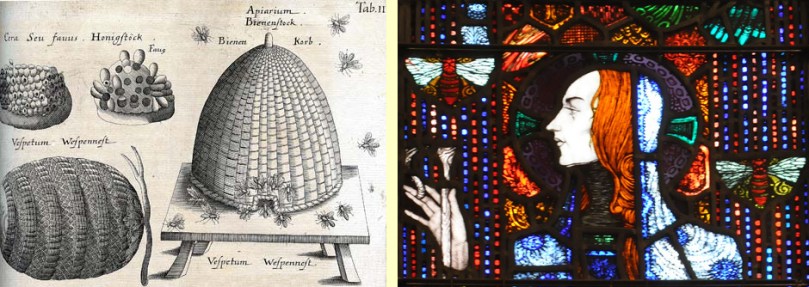
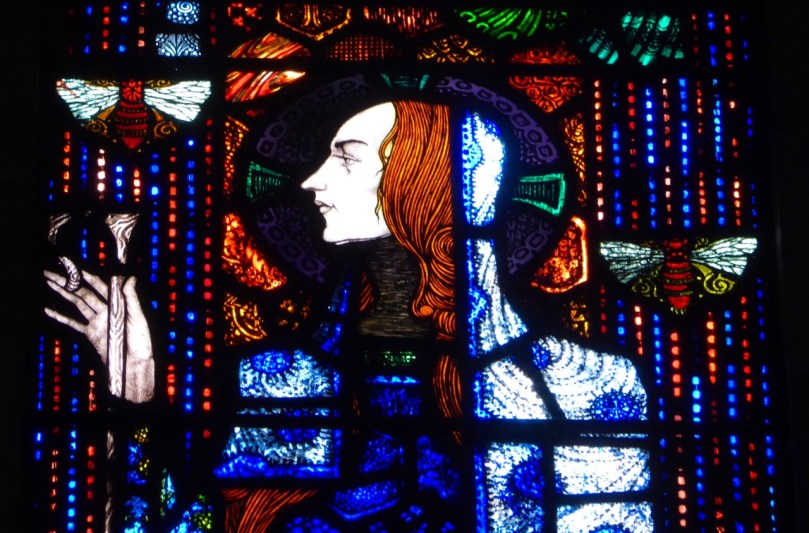
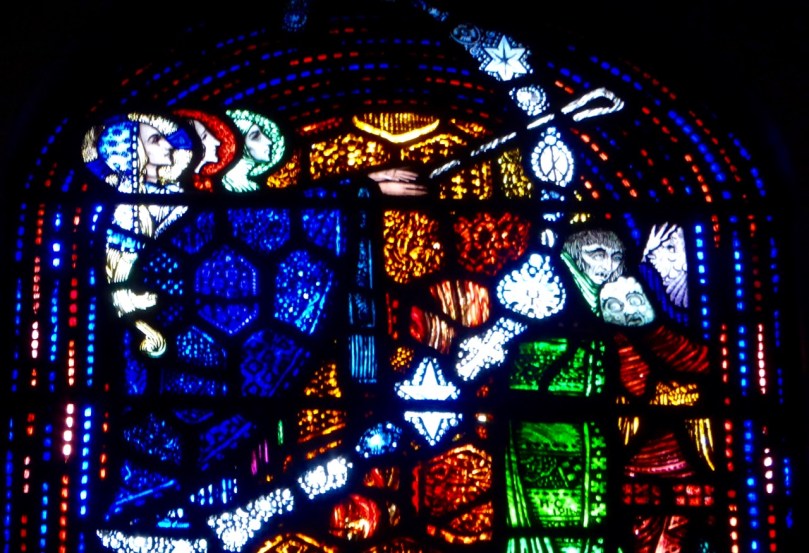
St Gobnait is, famously, depicted in profile, allowing her red hair to take centre stage. She is the patron saint of beekeepers and her bees surround her. Above the main image she is shown spreading her arm (note the honeycomb design of her robe) and extending her staff to prevent a plague descending on her people. She is attended by two maidens and to the right you can see the faces of three men who have not been spared the plague. (There’s another little detail you might spot in this picture!)
Gobnait Plague Victims

To quote Nicola Gordon Bowe, in her magisterial The Life and Work of Harry Clarke:

Harry here shows the delight he took in depicting deformity, disease and the macabre. This fascination with the poles of the beautiful and of the ugly and grotesque is a propensity he shared with many medieval artists.
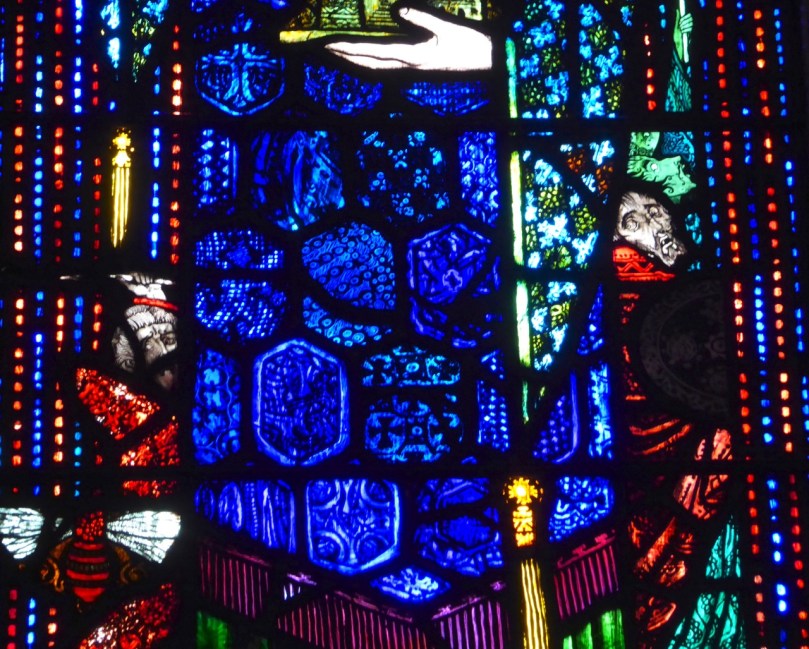
Gobnait Robbers

On either side of St Gobnait another fearful scene unfolds. According to legend, robbers attempted to break into St Gobnait’s abbey but she set her bees upon them and here they are fleeing in terror.
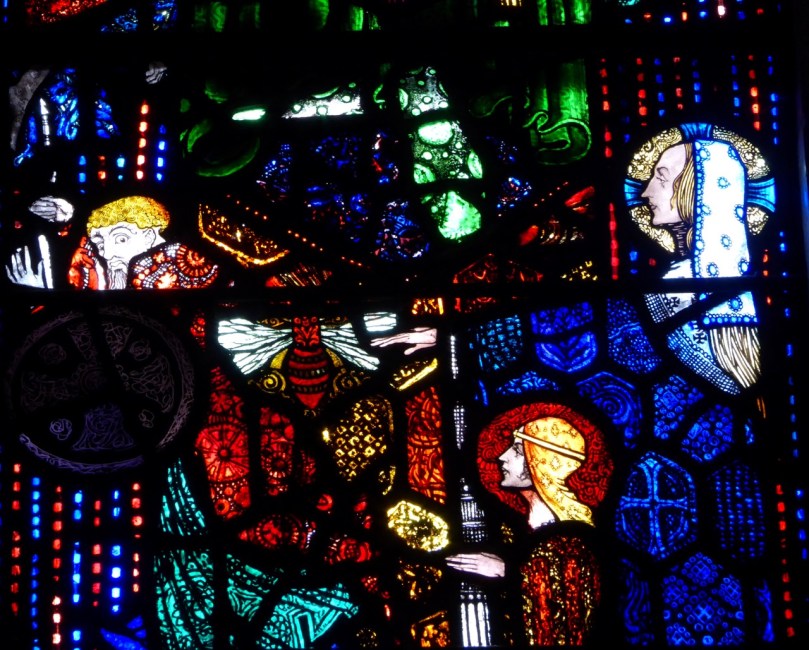
Gobnait and handmaiden

At the very bottom of the panel she is depicted directing the bees and attended by a novice, while on the left a fourth robber runs in panic.
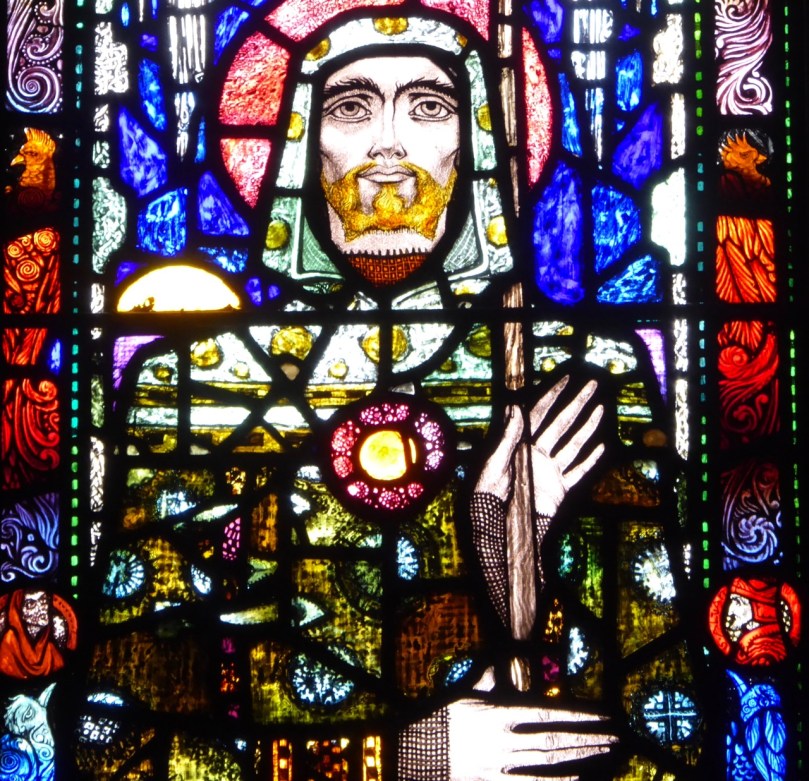
Honan Brendan border detail

St Brendan the Navigator, with his red beard, gazes serenely out, holding an oar. By his shoulder, his tiny curragh sails westward into the setting sun. In this window pay special attention to the border. Because he was a voyager, discovering the Americas, Clarke decorate it with exotic birds. He intersperses these with tiny roundels of other Irish saints.
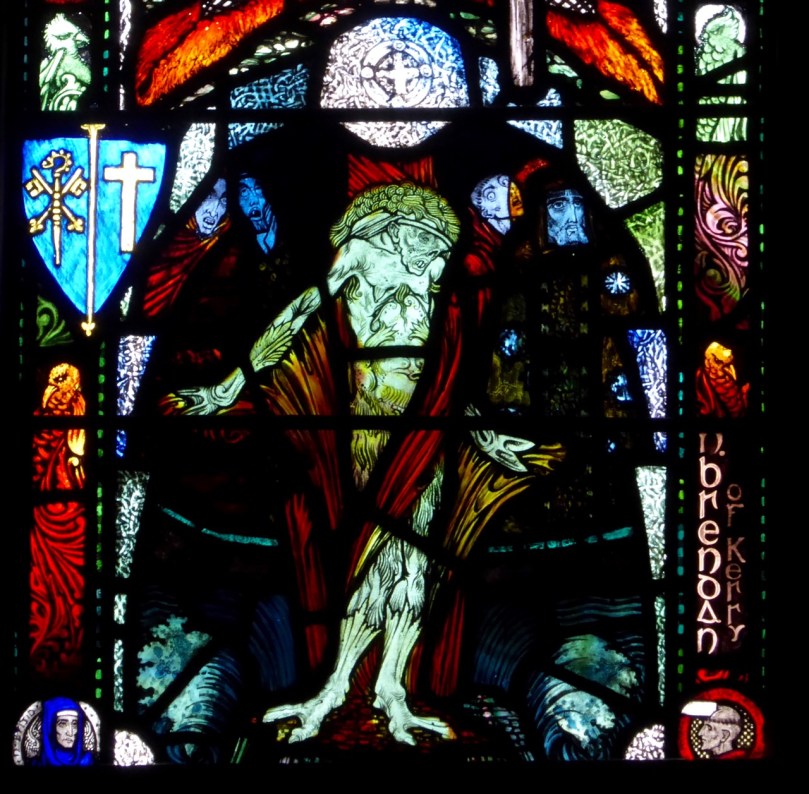
Honan Brendan and Judas

Judas suffering on his rock – a medieval vision of misery. Note also the roundels: on the left is St Brigid and on the right is “the poor monk with the iron in his head.” Amazing that Clarke managed to get all that information on to the border of the roundel

In one episode on his seven year journey, Brendan encountered Judas, suffering eternal torture because of his betrayal of Jesus. The bottom panel depicts the scene of the wasted and agonised Judas, while the monks look on in horror. Only Brendan is able to look stoically forward.

Honan St Ita Detail

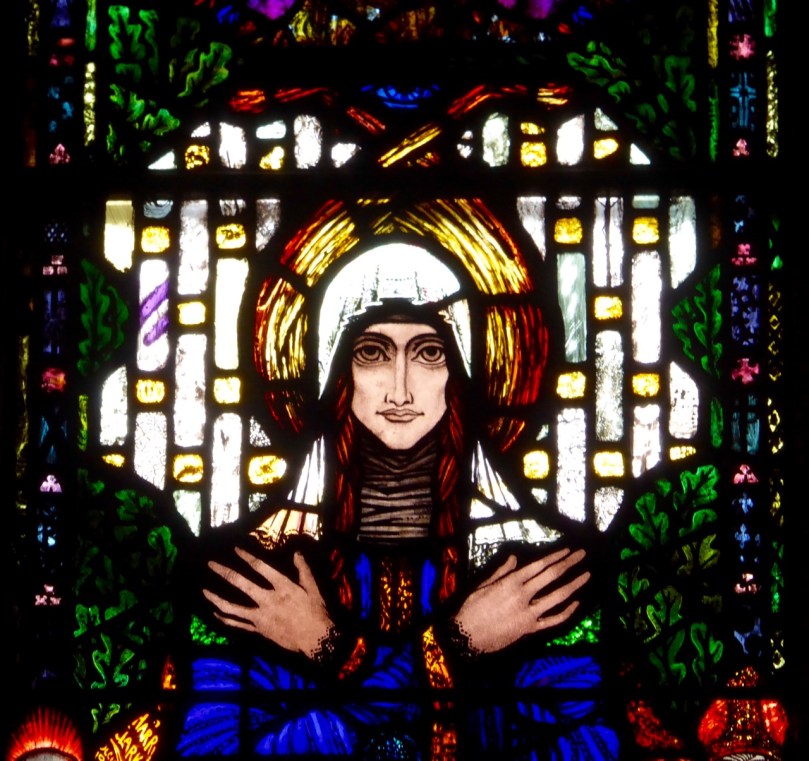
Detail from the St Ita window

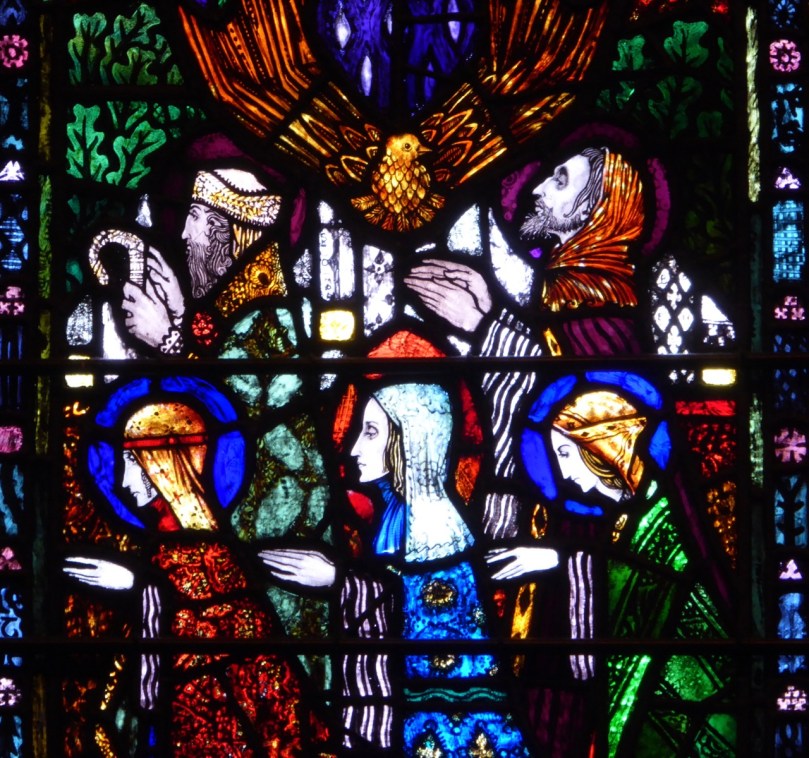
St Ita (the first photograph in this post) was the daughter of a chieftain but renounced all worldly things to live a life of poverty and to teach. Once again, Clarke uses tiny roundels to depict other saints associated with Ita: Brendan, Colman, Finbar and Carthage.
St Ita predella

Below her feet is another tableau, depicting a prayerful scene in which she is attended by two holy women and St Colman and St Brendan. The portraiture of the the two saints is exquisite.
Honan Albert of Cashel

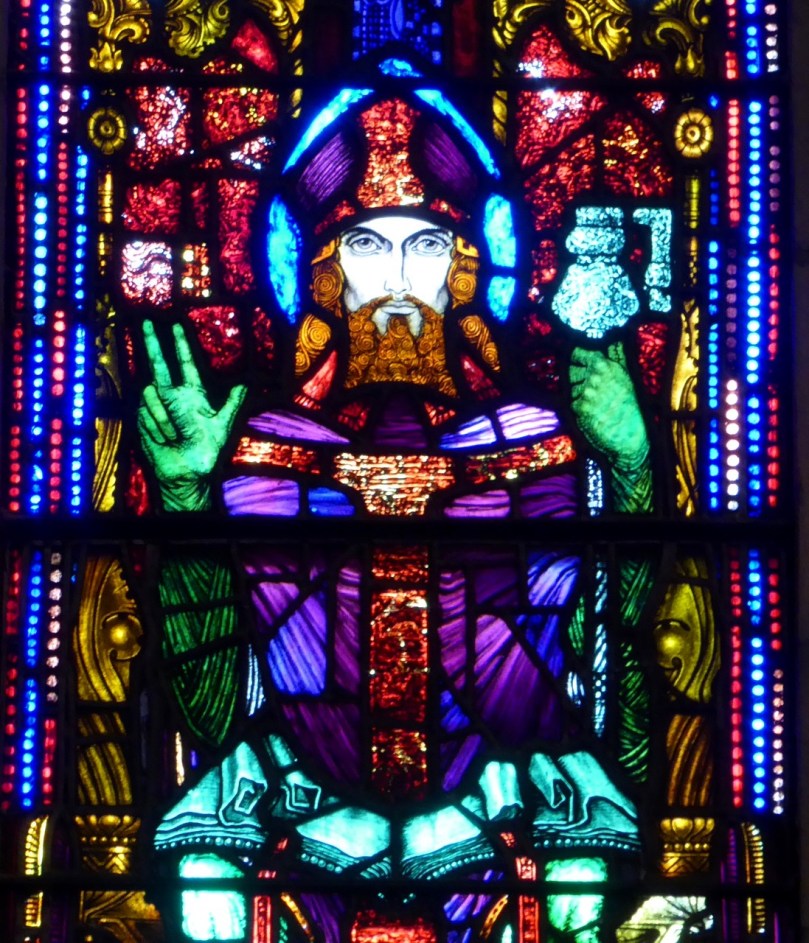
St Albert of Cashel – a little known saint who journeyed to Ratisbon in Germany on a conversion mission

A last window from the Honan Chapel – this time St Albert of Cashel, depicted as a seated bishop. In the top portion he is depicted converting the people of Ratisbon in Germany. Once again the individuals are beautifully drawn and sumptuously dressed. I particularly love the red hair – always a feature of a Harry Clarke window.

Citizens of Ratisbon listening to St Albert preaching

I highly recommend a visit to the Honan Chapel if you’re in Cork. See Robert’s post, Cork Menagerie, for an in-depth look at the mosaics. And take your time – the windows (there are several more than the ones I’ve used in this post) reward patient and detailed study. For more on Harry Clarke’s stained glass, see my post The Gift of Harry Clarke, which will walk you through an analysis of his style and his influences.

Honan St Albert converting Germans

The Holy Wells of Cork

Kealkill Holy Well

There’s a new blog on the scene – and it’s just the sort of thing to appeal to Roaringwater Journal readers. Holy Wells of Cork is the brainchild of Amanda Clarke. We’ve written about Amanda before – she often comes along on our adventures and she and Peter are the team behind the book Walking the Sheep’s Head Way and the website Sheep’s Head Places.

Amanda on a holy well trip

Amanda’s always been fascinated by holy wells. We’ve gone to see quite a few over the last couple of years – often a case of hunting down an obscure reference or a dot on a map. She decided that the perfect day to launch her blog was, of course, St Brigid’s Day, February 1st, and that, in order to do it properly, she should visit a St Brigid’s well on that exact day. I tagged along as the recorder.

The holy well is up there?

It’s up there? And I have to go up on my knees?

St Brigid’s well, Tobar Breedy, is on private land on the side of Lough Hyne, south of Skibbereen, and Amanda had sought and been granted kind permission by the landowner to visit the site. You can read her account here – it’s all in her signature chatty style that manages to make you feel as if you’re on the adventure as well. 

Amanda at Tobar Breedy

As a bonus, there’s a tiny ruined medieval church, also dedicated to Brigid (Templebreedy).

Temple Breedy

However, all is not well in the land of holy wells. A recent post is about four holy wells that were once the focus of veneration in Cork City. Read how they have weathered the passage of time, and be glad that she is recording them before some of them disappear from public consciousness altogether.

The first time I went to this secluded holy well in Castle Haven I was afraid to venture over the crumbling bridge. But when we returned, the bridge had been replaced. Local people are often proud of their holy wells and keep them up

Amanda will be posting regularly so go on over and sign up so you will get the updates as soon as they are on the blog. There’s lots of background information as well.

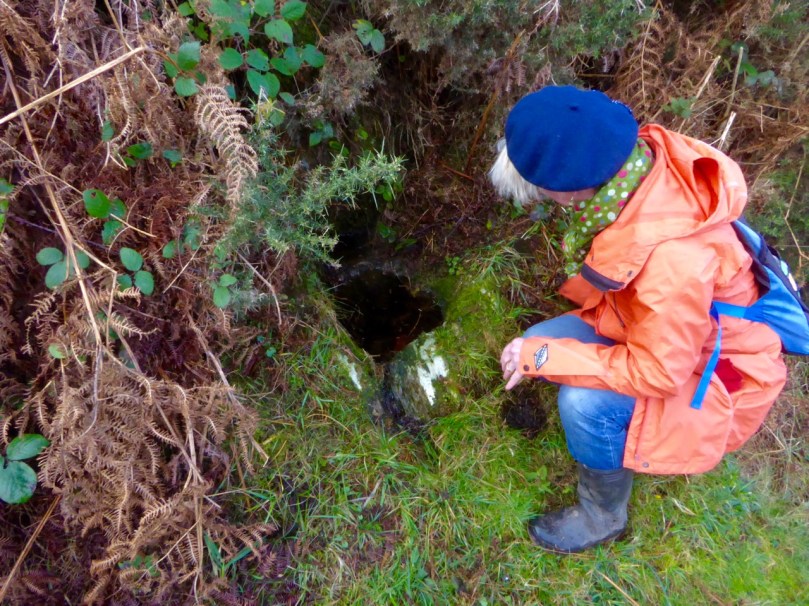
Finding Tobar Abán

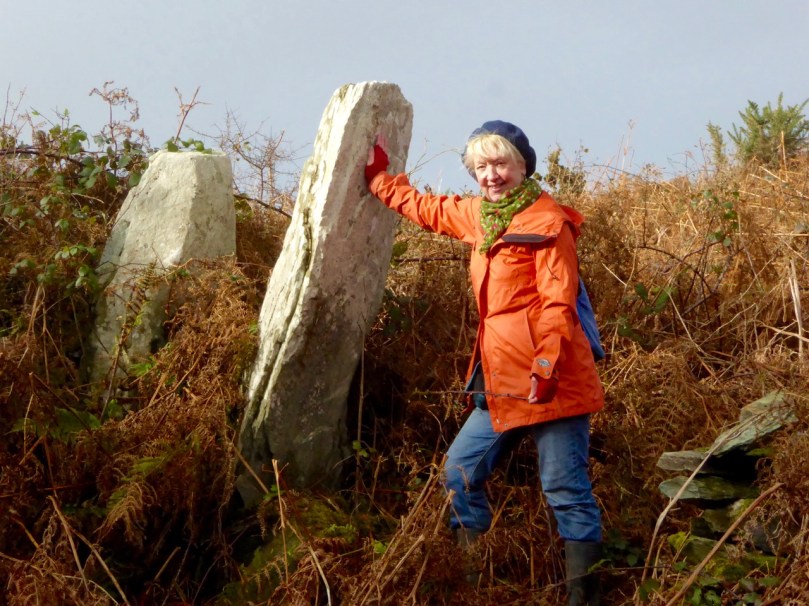
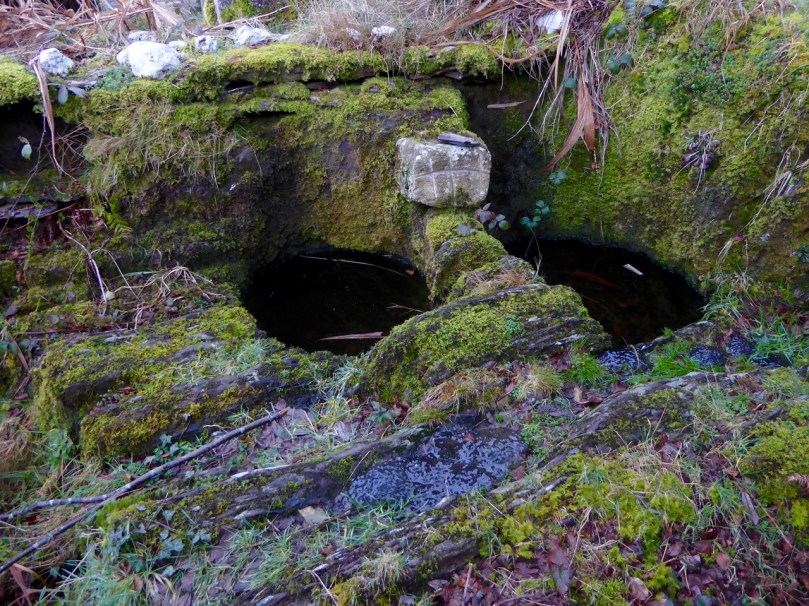
Believe it or not there’s a tiny well under all that decaying foliage

We’ve featured holy wells ourselves from time to time. One of our favourites was this time last year, just outside Ballyvourney, where we found the well of St Abán , who may have been St Gobnait’s brother.

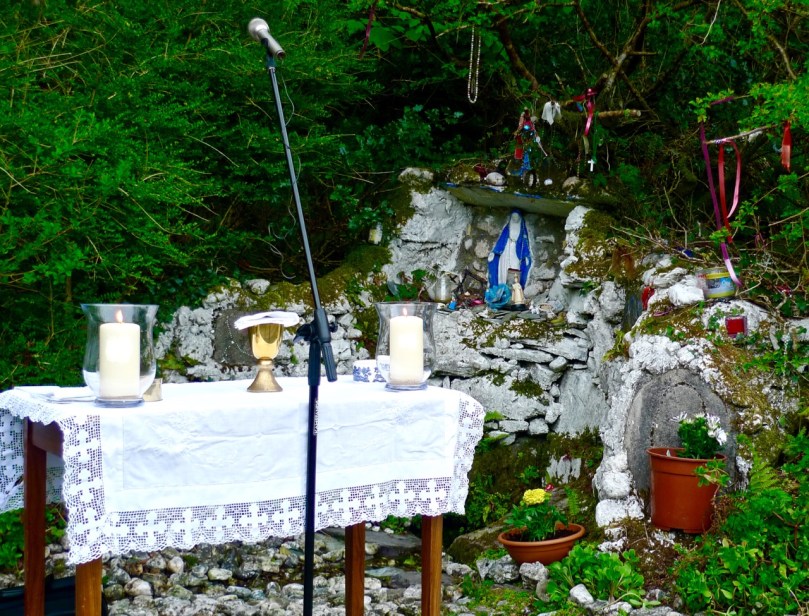
altar at the well

Robert wrote about the other holy wells near Lough Hyne, one a Lady’s Well and one dedicated to curing eyesight. Last year, he attended the mass which is still said here every May.

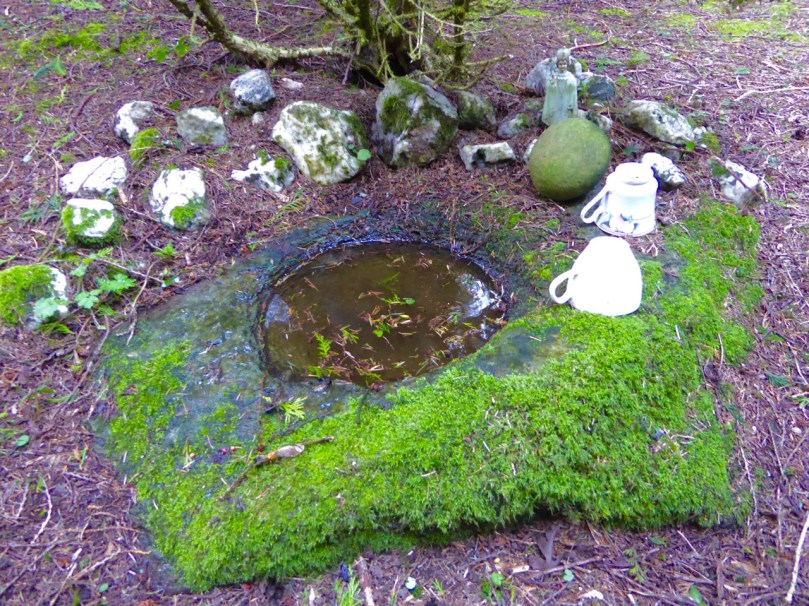
Tiny holy well in the woods

This little well is in the middle of a small wood, with evidence it is still in use. Note the white quartz stones around it – white quartz is often found at prehistoric sites too

No doubt Amanda will record all of this properly in time. I’m looking forward to her future posts and to going along on the field trips!

Offerings at a holy well

I love the offerings that you see at Holy wells. Sometimes you get extras too. In the case below, St Lachtan’s Well, it’s frogspawn. Holy frogspawn, of course.

St Lachtan's holy well

Gather Your Seaweed

collecting sand

Today is Oiche Fhéile Bhríde – St Brigid’s Eve. The Saint’s festival – tomorrow – marks the beginning of Spring: we will feel the lengthening of the days, and we have to be alert for so many portents.

Firstly – Hedgehogs. Watch out for your Hedgehogs: to see one is a good weather sign, for on Brigid’s Eve the Hedgehog comes out of the hole in which he has spent the winter, eyes up the weather and, if he likes the look of it, starts his foraging. If he goes straight back in again, then you’ll know that the storms will continue! This is according to Kevin Danaher, a frequent contributor on our seasonal folklore. The wind direction on the eve of the festival ‘…betokens the prevailing wind during the coming year; the festival day should show signs of improving weather, although an exceptionally fine day is regarded as an omen of poor weather to come…’

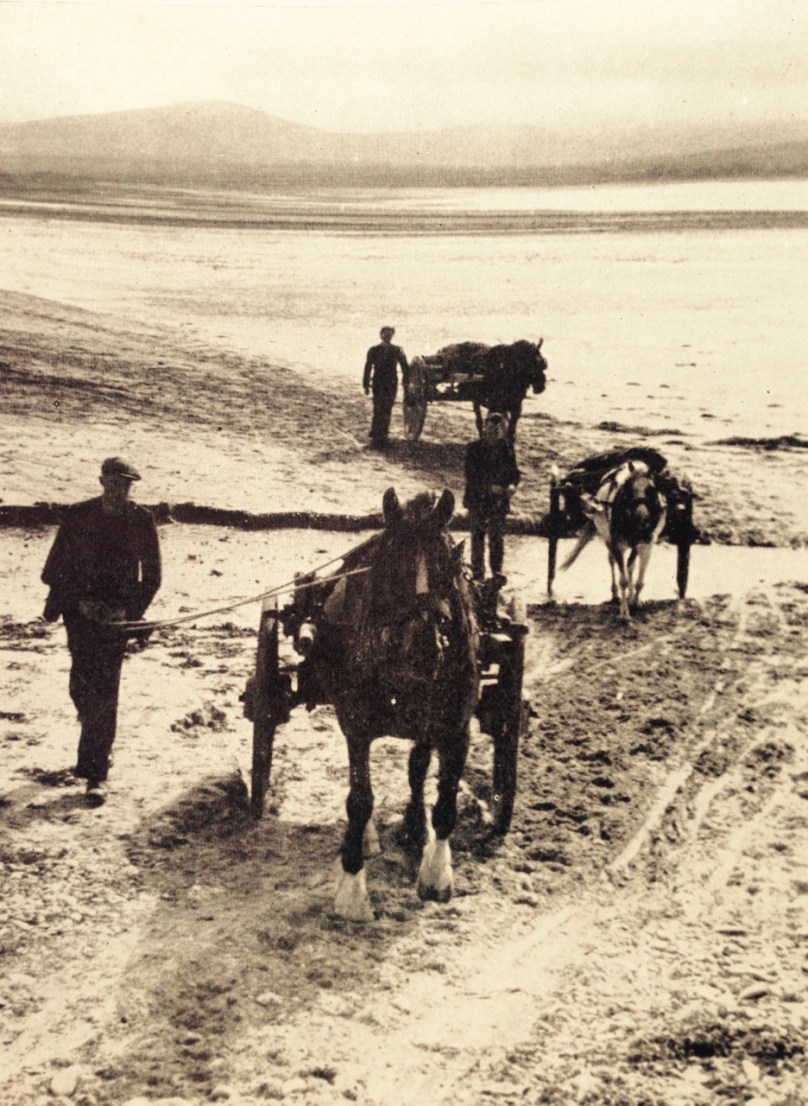
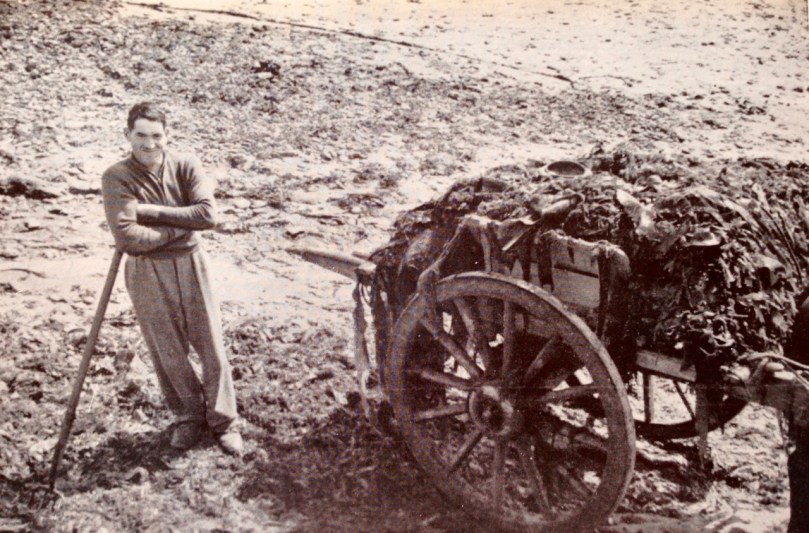
For those of us who live by the sea we have to be alert for Rabharta na Féile Bríde, the spring tide nearest to St Brigid’s day, as it is said to be the most significant one of the year – that’s when the difference between high and low tide is the greatest. Danaher, The Year in Ireland, Mercier Press 1972, notes: ‘…The people were quick to take the opportunity of cutting and gathering seaweed to fertilize the crops and of collecting shellfish and other shore produce. In a few places a live shellfish, such as a limpet or a periwinkle, was placed at each of the four corners of the house, to bring fishing luck and ensure plentiful shore gathering…’ But don’t forget that it’s not until Good Friday that you harvest the Mussels.

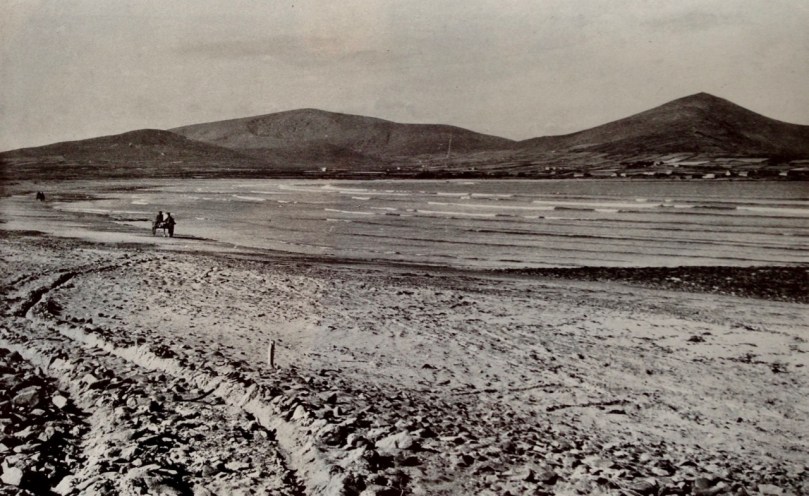
along the strand

All the photographs in this post are from the collection of Tomás Ó Muircheartaigh, who documented life in rural Ireland between the 1930s and the 1950s – an invaluable pictorial record of the times

This is the day to make – and eat – your bairin-breac: ‘…On St Brigid’s Eve every farmer’s wife in Ireland makes a cake, the neighbours are invited, the madder of ale and the pipe go round, and the evening concludes with mirth and festivity…’ (Danaher). I’m holding out hopes that Finola will oblige and get out her delicious barm-brack recipe. Of course, the mirth and festivity will follow as she soaks the fruit in whisky! The Saint travels around the countryside on the eve of her festival, bestowing her blessing on the people and their livestock. We must be sure to leave out for her a piece of our cake: ‘…Often a sheaf of corn was put beside the cake, as refreshment for the Saint’s favourite white cow which accompanied her on her rounds. Others laid a bundle of straw or fresh rushes on the threshold, on which the Saint might kneel to bless the house…’ (Danaher).

collecting seaweed

Tonight we will hang a piece of red ribbon outside our door: ‘…One traditional story says that St Brigid wove the first cloth in Ireland and worked into it white healing threads which were said to have kept their healing power for centuries. In many places in Ireland it was customary to put a piece of silk ribbon, red being the preferred colour, outside the house on the Eve of St Brigid’s Day, much in the same way as articles of clothing or cloth left out on the saint’s eve would be endowed with St Brigid’s blessing when they became known as the Brat Bhríde (Brigid’s cloak). It was believed that St Brigid, when travelling around the country on the Eve of her Day, would see and touch the ribbon, so endowing it with her blessing and conferring on it some of her healing power. After this it was referred to as the ribín Bhríde…’ from Brigid: Goddess, Druidess and Saint Brian Wright, The History Press 2009. This reminds me very much of another saint – Gobnait – who also has a February festival. It’s going to be a busy month! To start it off it’s essential that we make our bogha Brídhe – St Brigid’s Cross.
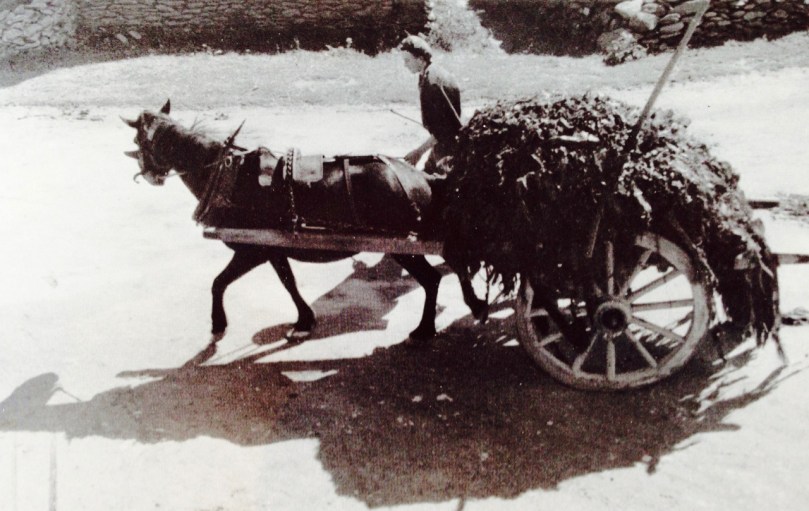
carrying the seaweed

Cork Menagerie

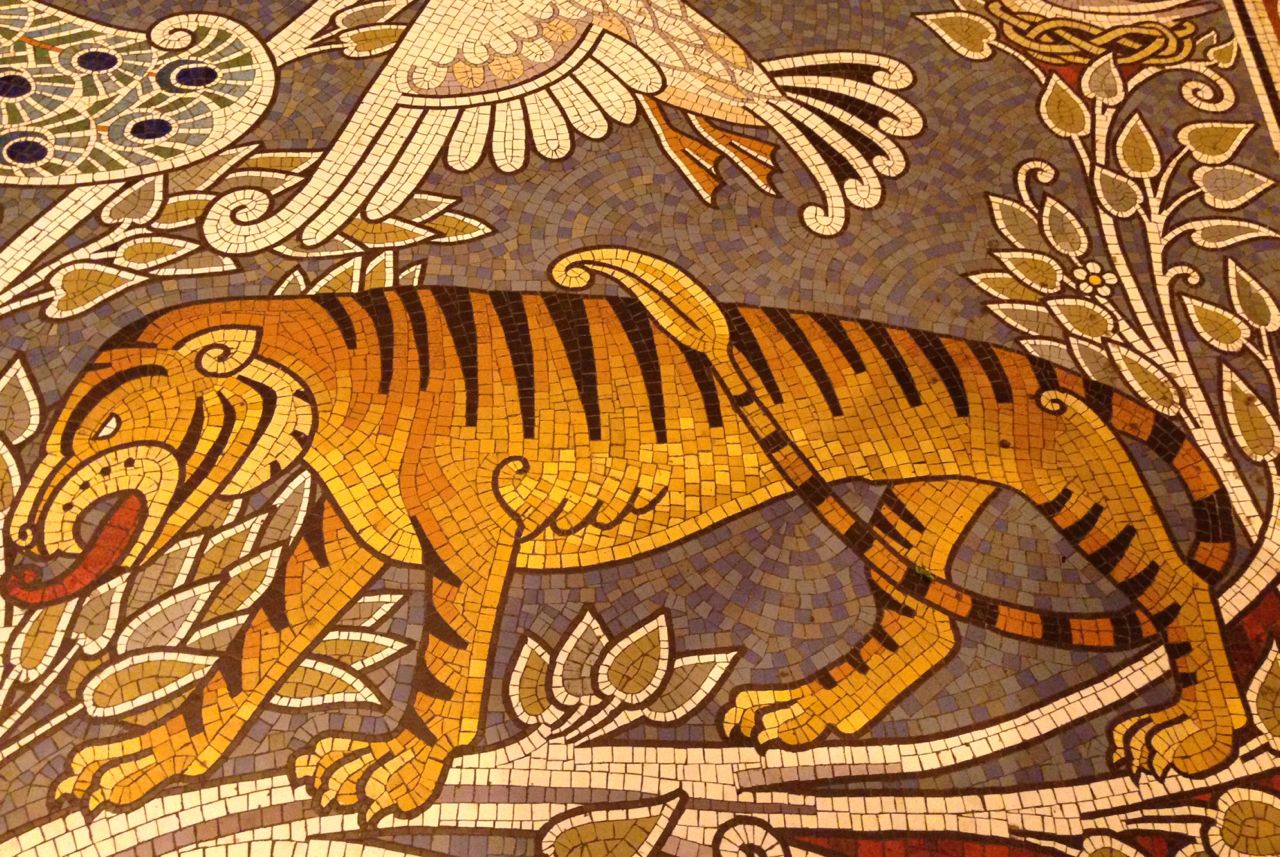
tiger

Cork does have a wildlife park – over in Fota, to the east of the city. But I think Cork’s real menagerie is on the University campus – The Honan Chapel, built almost a hundred years ago, and opening its doors to Catholic students in November 1916.
Ireland’s universities have a fascinating history: Pope Clement V authorised the first one in 1311, and this was based in St Patrick’s Cathedral, Dublin. This institution ‘came to an abrupt end’ with the Protestant Reformation of the 1530s, and Trinity College Dublin was founded as the ‘University of the Protestant Ascendancy’. At this time, England had the Universities of Oxford and Cambridge, while Scotland had Universities at St Andrews, Glasgow and Aberdeen.

In 1908, the Irish Universities Act was passed, by which the National University, consisting of the Constituent Colleges of Dublin, Cork and Galway was founded. Part of this act decreed that of the finance provided for the new University, none should be applied ‘… for the provision or maintenance of any church, chapel or other place of religious observance …’ It was left to a Cork merchant family – the Honans (who made their wealth through butter) to provide a hostel and chapel for Catholic students. 

‘…The chapel, itself, is in perfect accord not only with its immediate surroundings, but also with the wide heritage of art handed down to us by the early native church building. It is one of the best reproductions of the ancient style of building and it exemplifies, in a striking manner, all that is best in the Hiberno Romanesque architecture of the tenth, eleventh and twelfth centuries…’ The Honan Chapel, M J O’Reilly, Cork Univeristy Press, 1966

legilium

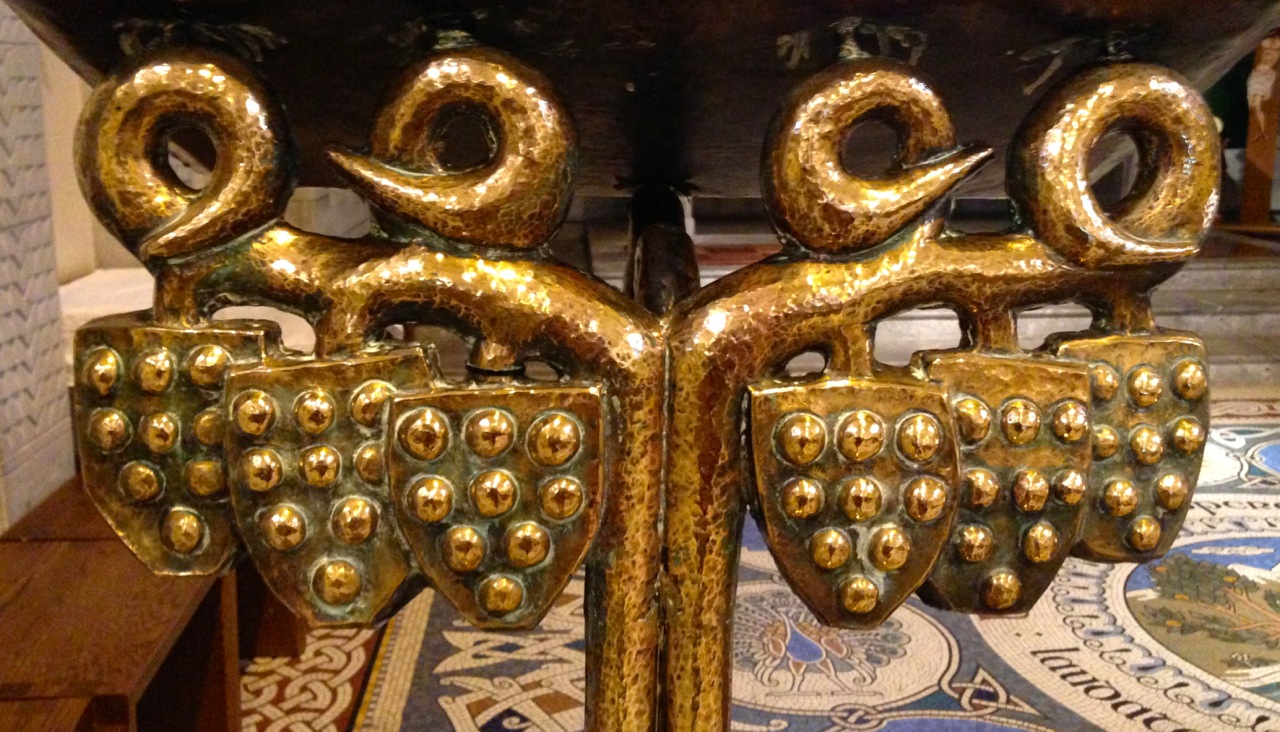
Lectern decoration

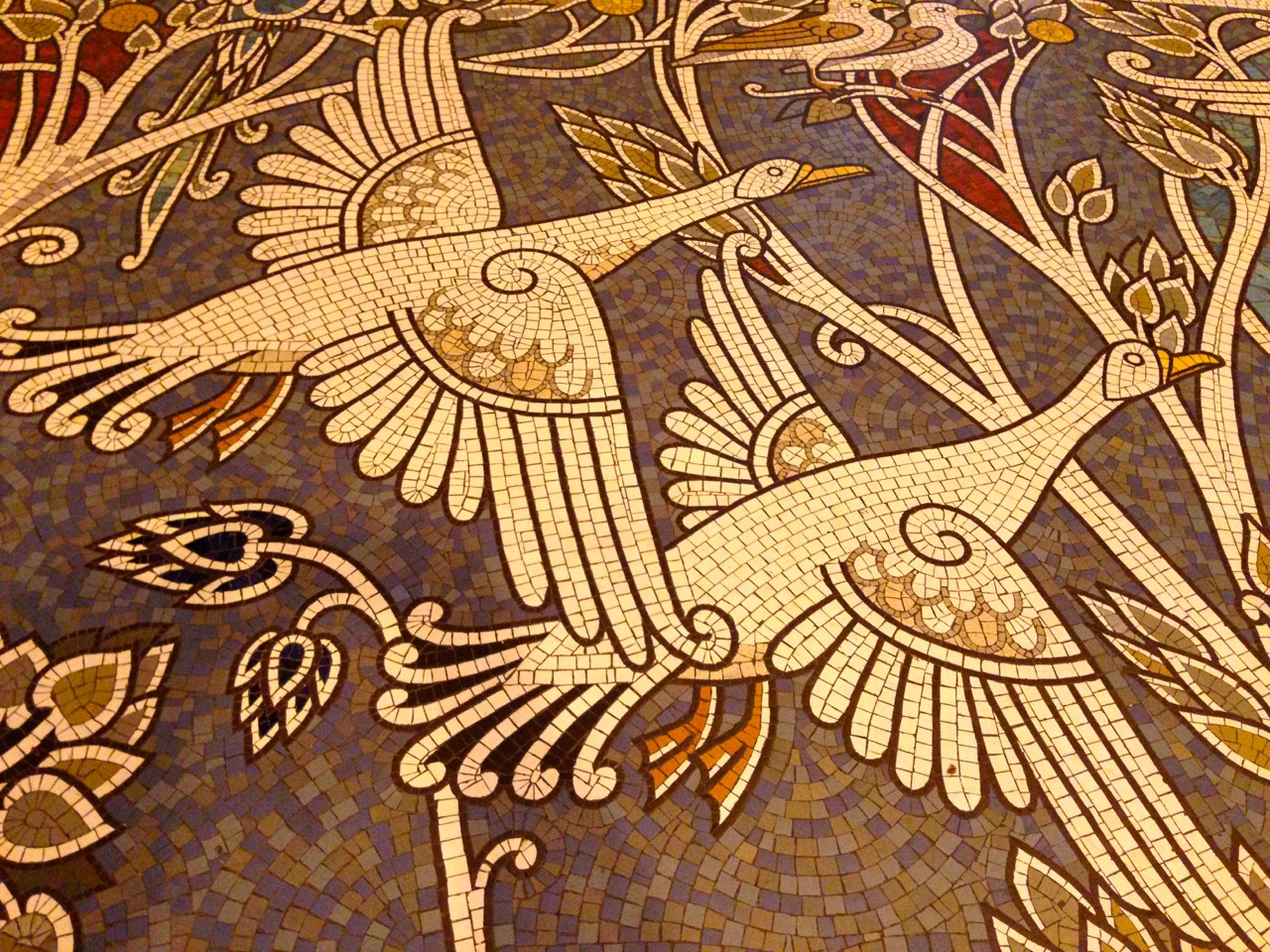
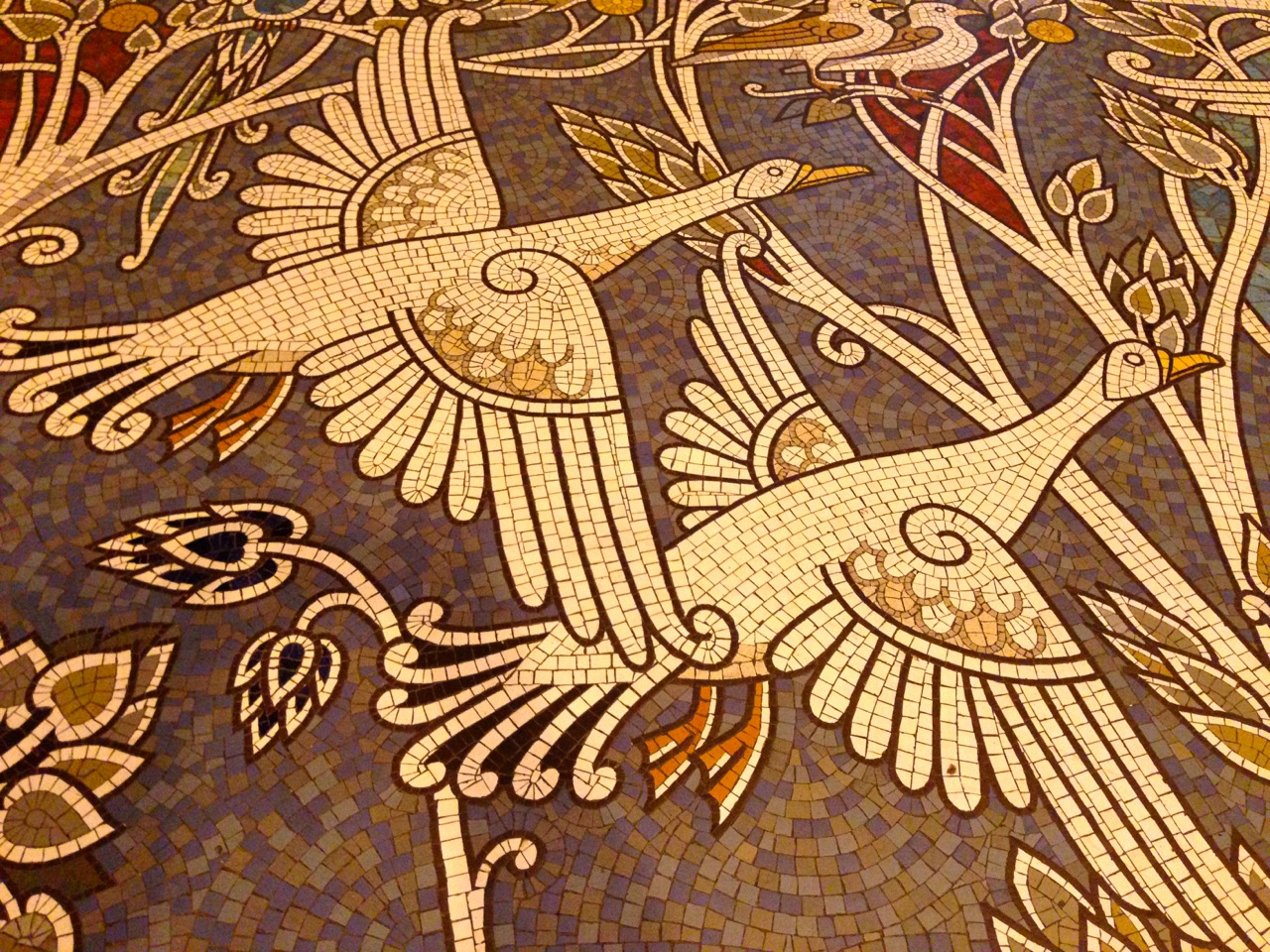
The interior of the building abounds in exquisite artworks. It’s a feast for the eyes wherever you look: stained glass windows by Harry Clarke stand out (including St Gobnait) – but, for me, the real treat is the mosaic work on the floors, designed by Ludwig Oppenheimer of Manchester. A River of Life runs the length of the nave from the entrance door to the sanctuary where, amidst a riot of pattern and colour, the menagerie unfolds: there are birds and beasts, fish and fowl all contained in decorated borders with Celtic knots and patterns. The only analogy I can think of is a medieval illuminated manuscript such as the Book of Kells, where the pages and margins are extravagantly ornamented with figures of humans, animals and mythical beasts in vibrant colours imbued with Christian symbolism.

The Chapel is dedicated to St Finbarr, Patron Saint of Cork. The foundation stone, laid on the 18th May 1915, records ‘… built by the Charity of Isabella Honan for the scholars and students of Munster…’ The architect was James F McMullen.

swans


Cures and Curses

Wishing Stone at Maulinward

Wishing Stone at Maulinward

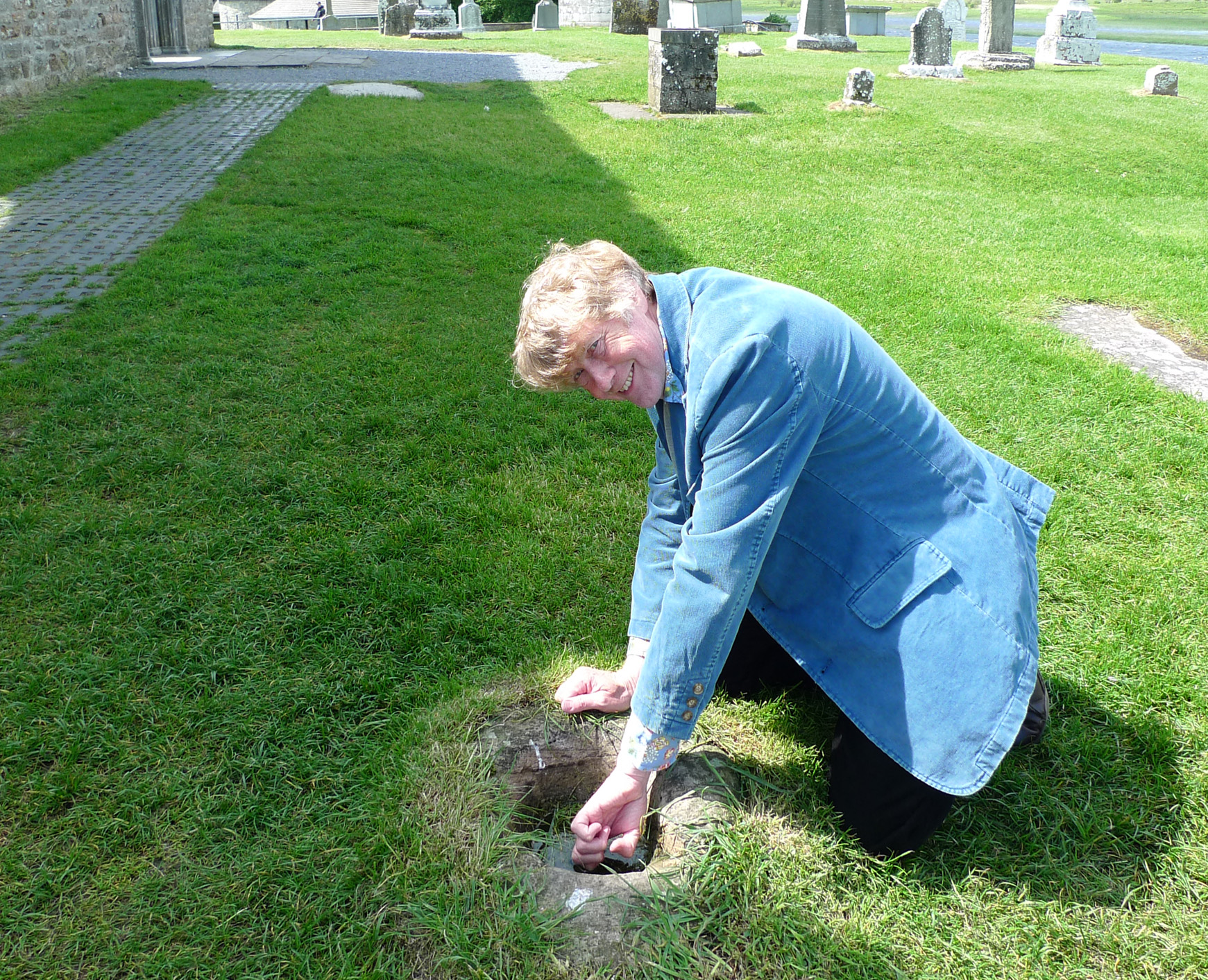
I am a firm believer in wart wells: there is one at Clonmacnoise, the holy centre of Ireland, and some years ago when I was visiting the place I dipped my finger – warts and all – in it. Within… well, perhaps it was two or three weeks… the warts had gone. The Cynics among you will be saying that they might have gone anyway, but I have had other warty experiences to reinforce my beliefs. When my daughter Phoebe was 11 years old and we were living back in Devon she had a really bad outbreak of warts on her hand. The doctor couldn’t recommend anything but our neighbour was very sure of what to do: take her to see Auntie Grace who lived up the lane. We duly knocked on Auntie Grace’s door and showed her Phoebe’s hand. “That’s alright, Dear” she said, and shut the door. That was all. But within a week (more or less) the warts had vanished completely, never to return.

Curing my warts at Clonmacnoise

Curing my warts at Clonmacnoise

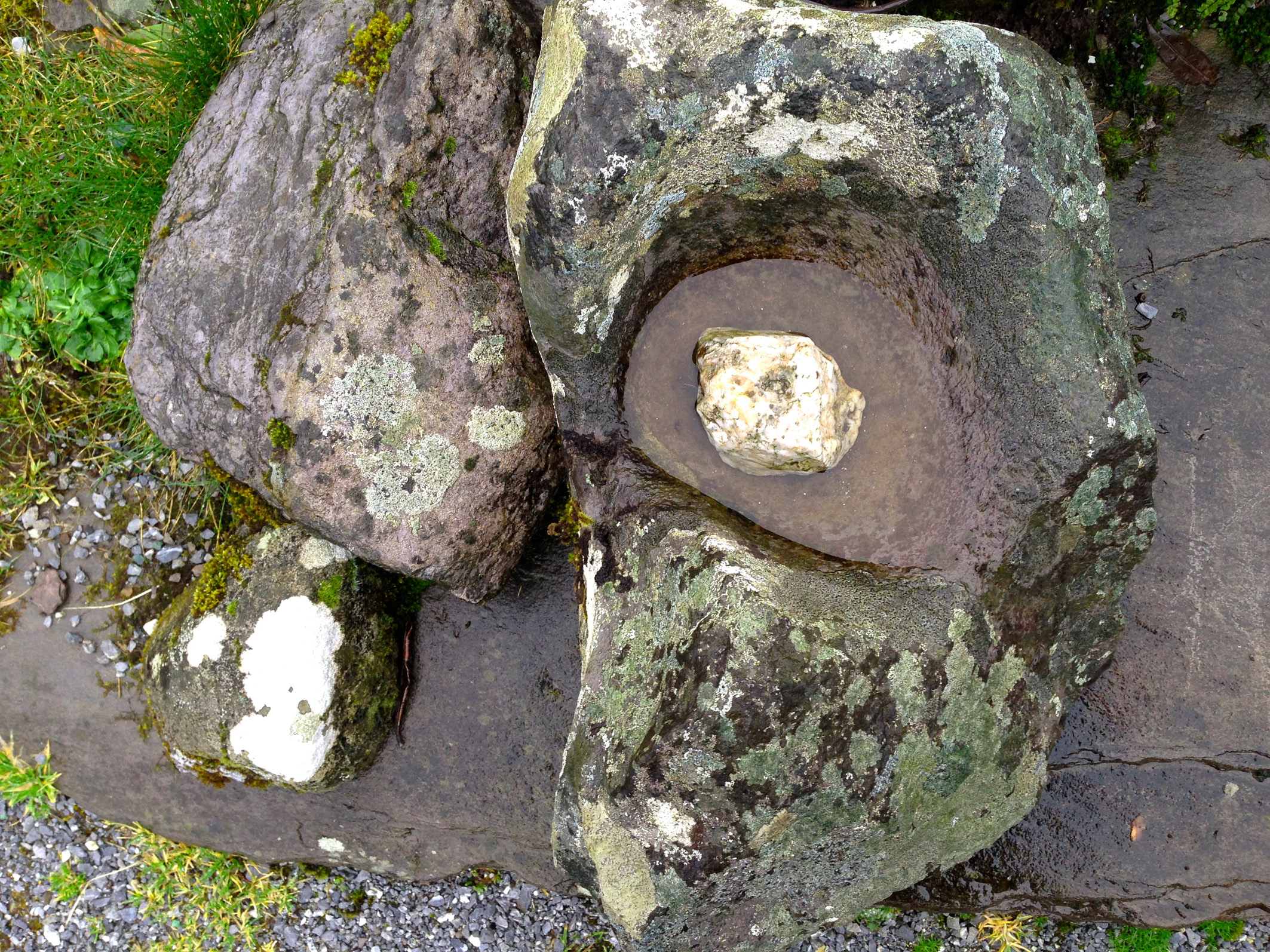
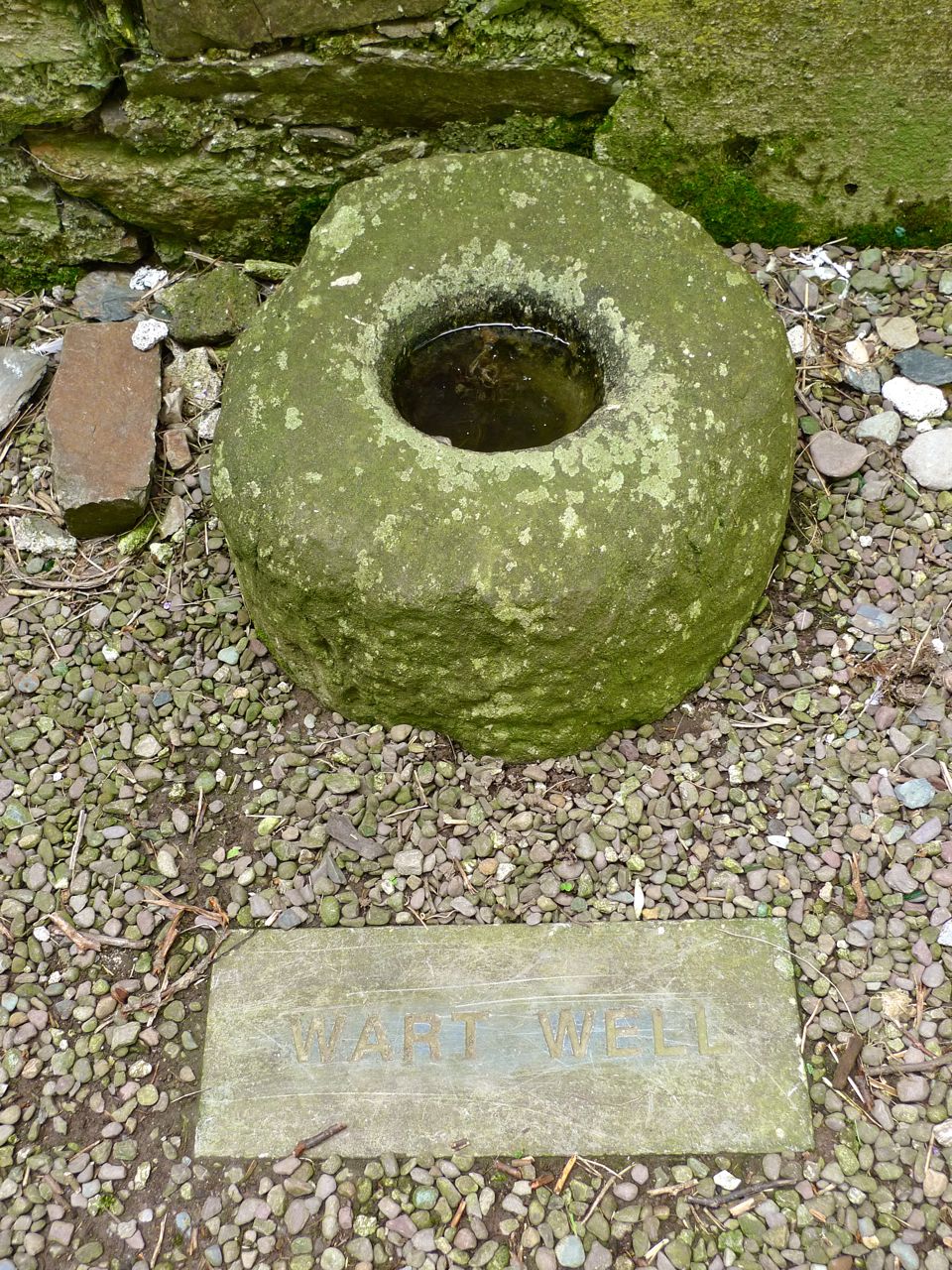
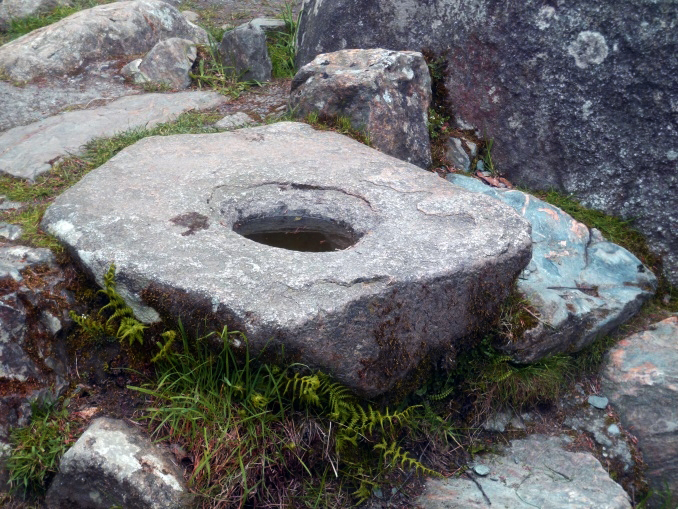
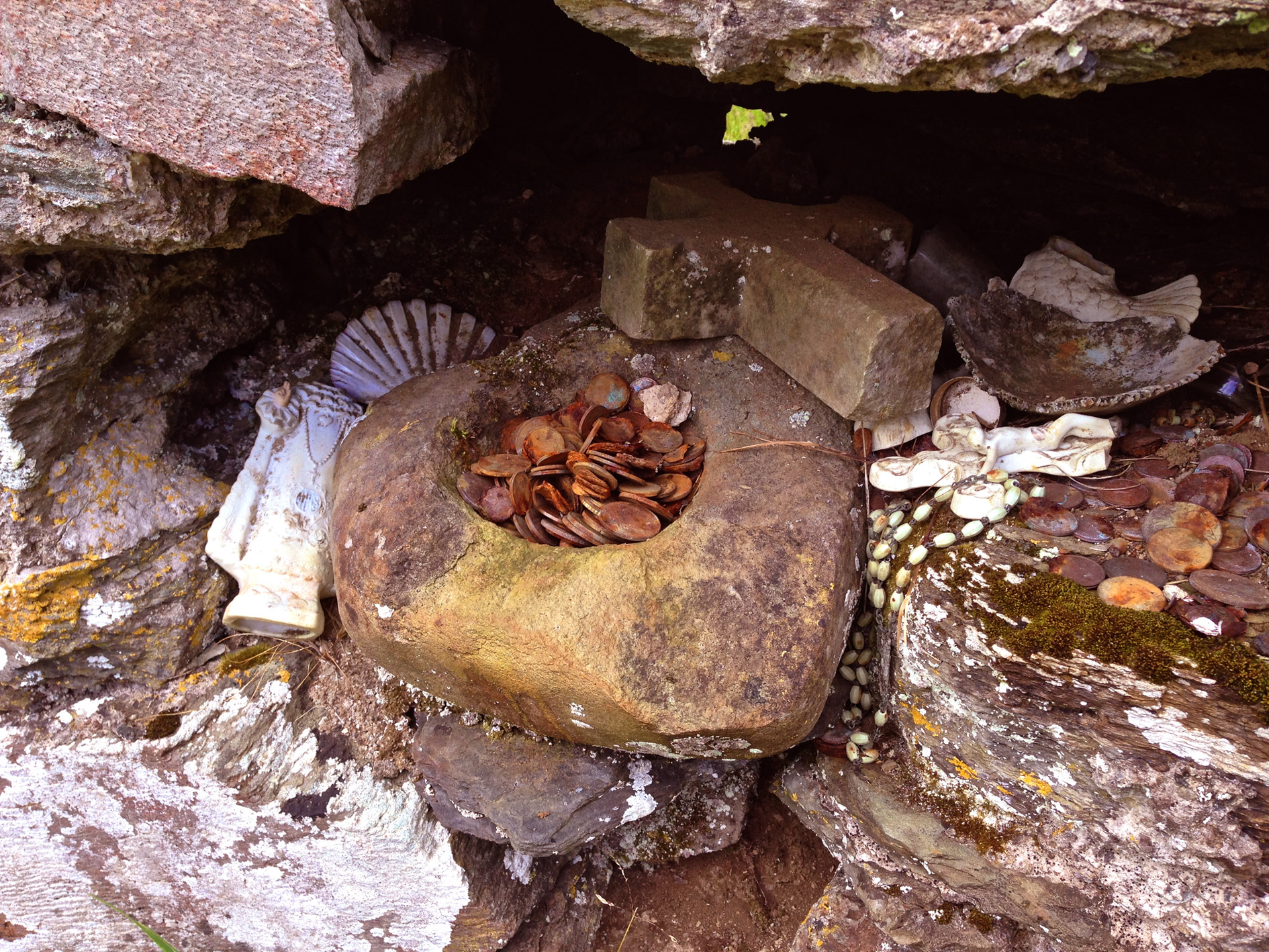
Bullaun Stones abound in Ireland. They are usually found at sites with ecclesiastical connections – as the two examples above (and this one), but this association does not reduce or affect their traditional uses: to cure or to curse. The Irish word Bullán means ‘bowl’ – a water container. At pilgrimage sites, such as St Gobnait‘s Well, Ballyvourney, the bullaun stones often hold smooth rounded pebbles – perhaps incised with a cross – which are turned around each time a pattern or procession is completed.

In the sixth century, the Council of Tours ordered its ministers “…to expel from the Church all those whom they may see performing before certain stones things which have no relation with the ceremonies of the Church…”  Such an order doesn’t seem to have prevented folk traditions of curing continuing into the twenty-first century.

Wart Well at Timoleague Friary

Wart Well at Timoleague Friary

Traditionally, in Ireland similar stones are used for less benign purposes than curing warts or other maladies. Thankfully not in West Cork but in faraway Cavan a group of bullaun basins and stones at the ruined Killinagh Church are associated with curses, as explained here by Harold Johnston in a 1998 interview: “…if you wanted to put a curse on someone, you turned the stones anti-clockwise in the morning.” However, the curse had to be ‘just’ otherwise it came back to curse you in the evening!

An 1875 drawing of the Killinagh Cursing Stones

An 1875 drawing of the Killinagh Cursing Stones

Nearer to home, in County Cork, are the ‘cursing stones’ known locally as  the Clocha Mealachta – not in this case associated with bullaun basins but kept hidden under a slab of rock, which seems a bit sinister to me.

Hidden Cursing Stones at Labbamolaga, Co Cork

Hidden Cursing Stones at Labbamolaga, Co Cork

I prefer the legends which show bullaun stones as a force for good: in more than one location they are said to be associated with a local saint. St Kevin of Glendalough (in County Wicklow) drank every morning from the Deer Stone, a bullaun which miraculously was always filled with milk.

Deer Stone at Glendalough

St Kevin

St Kevin


Gobnait

Right: Harry Clarke's St Gobnait

Right: Harry Clarke’s St Gobnait

  • With all the excitements of the hurricanes this week bringing down trees and taking out power and telephones, we almost forgot to celebrate Saint Gobnait’s Day.
  • Saint who?
  • Saint Gobnait – 11th February.
  • But what sort of a name is Gobnait?
  • It sounds like Gubbnet. Not an unusual girl’s name in Ireland: Finola went to school with one. She seemed happy enough with it.
  • But imagine calling a little baby Gobnait… What does it mean, anyway?
  • Er, not sure really: there’s a suggestion that it’s similar to Deborah. That means Honey Bee. Also there’s an Irish word Gabhan which means Blacksmith, and our Saint is supposed to be the patron of ironworkers.
  • So what’s the story of Saint Gobnait?
  • Um, there isn’t one. There’s no history or hagiography about her… But she is mentioned in the ‘Lives’ of St Abban and St Finbarr.
  • But no doubt you are going to tell me that there’s lots of folklore about her?
  • Exactly! This is Ireland after all. She’s celebrated in Ballyvourney, in the Gaeltacht area of Cork. She’s Cork’s local saint. However, she came from somewhere else – possibly Clare, maybe the Aran Islands. She was visited by an angel who told her to travel until she came upon nine white Deer, and that would be the place for her to settle.
  • Did she find the nine white Deer?
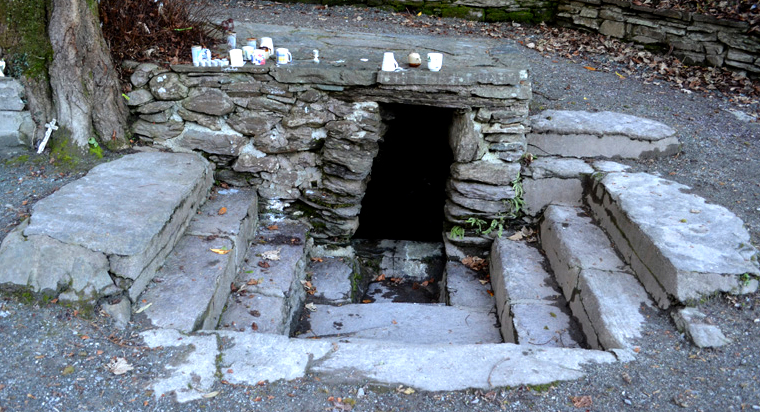
  • She did. But not until she had met three white Deer – in Clondrohid, and then six white Deer – in Ballymakeera, both in County Cork. But she carried on until she reached Ballyvourney; that’s where she met the nine white Deer and so founded her religious community there. It’s a site of pilgrimage today: there’s a church and a Gobnait’s Well which is dried up now, and which is said to be haunted by a white Stag. There is evidence that the well is still venerated today – rags and ribbons are tied to the trees and offerings are left there. Interestingly, excavations around the site in Ballyvourney revealed evidence of ancient ironworkings.
St Gobnait's Well

St Gobnait’s Well

  • So it looks as if Saint Gobnait was superimposed on some pre-Christian traditions?
  • Yes, very much like Saint Brigid.
  • Anything else which sets her apart?
  • Bees! She is always depicted with her Bees: she is supposed to have had great powers of healing and could even cure the plague with a medicine made from honey. Interestingly there are folk traditions that the soul leaves the body in the form of a Bee or a Butterfly. Bees could therefore be incarnations of our ancestors; perhaps that is why it’s important to ‘tell’ the Bees our family history – births, marriages and deaths. There were also once laws called Bech Bretha – Bee Judgments.
  • So what am I supposed to do on Saint Gobnait’s Day?
  • Think about Bees, ancestors, iron and healing… And do the ‘Rounds’ on Pattern Day. This involves going around the well or church either three times or three times three times, always clockwise. At Ballyvourney the pilgrims also touch the Sheela-na-gig as part of the turas (journey).
  • Sheela-na-gig?
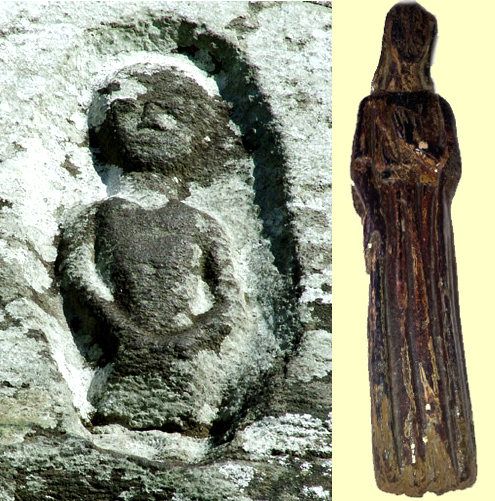
  • That’s a statue of a female figure with prominent genitalia. There’s one carved on the wall of the church at Ballyvourney, which is supposed to be a representation of the Saint.
Sheela-na-gig and medieval statue

Sheela-na-gig and medieval statue

  • That certainly sounds pagan!
  • Possibly something to do with fertility. There are a lot of examples in Ireland and Britain, almost always associated with churches. Perhaps just a medieval joke – or something which has a meaning now lost to us.
  • So, is that everything that there is to know about Saint Gobnait?
  • No – at Ballyvourney the Parish priest looks after a 13th century carved wooden figure of the Saint, and this is brought out on her day and also on Whit Sunday. Some people supposedly still use a Tomhas Ghobnatan: a length of ribbon or thread which is measured against the carved figure and then used as a healing charm. There are other sites in Ireland dedicated to her: a shrine and well in Dunquin, and Tobar Ghobnait, another well in a ruined oratory at Kilgore on the Dingle Peninsula, County Kerry. Here is found a simple ancient stone bowl which is always full.
  • How active is the pilgrimage at Ballyvourney?
  • Very active: the church is always crowded on the day, and there are long queues waiting to measure their ribbons against the wooden statue after doing the ‘rounds’.
  • Well, thank you: I will take a trip up to Ballyvourney…
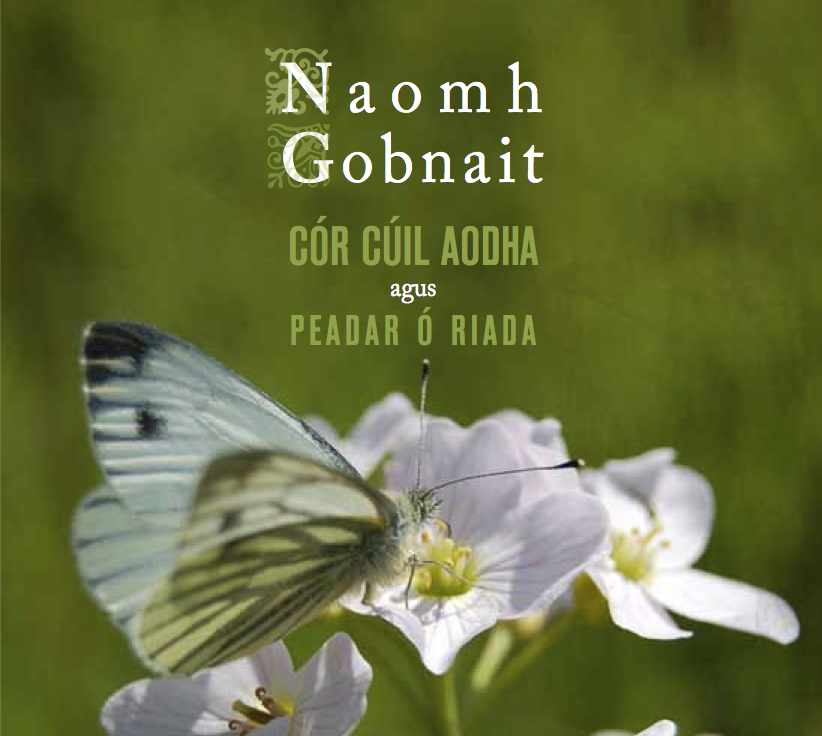
  • It’s worth going on a Sunday to hear the Mass sung in Irish. Sean O’Riada formed a choir  there which is still going strong today, now led by his son Peadar.

cludach-naomh-gobnait