Whisperers

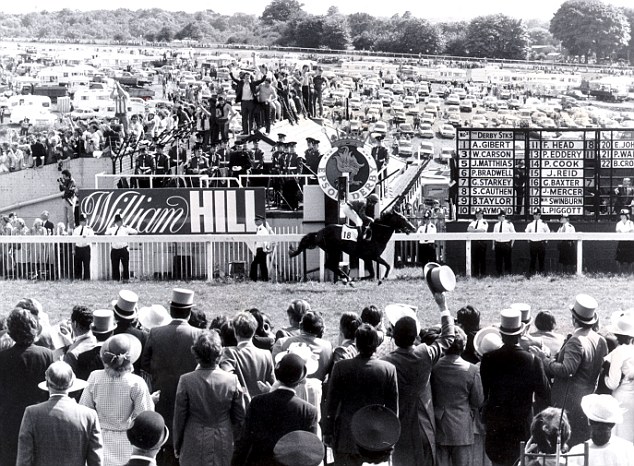
Shergar wins the 1981 Derby by ten lengths!

Shergar wins the 1981 Derby by ten lengths!

The skill of the Irish in breeding, training and riding horses is unbounded. These arts are swathed in folklore and storytelling as much as in reality. Take Shergar – record-breaking racehorse whose 1981 win was the longest margin in the Epsom Derby’s history: after an illustrious career the horse was kidnapped from Ballymany Stud, near The Curragh in County Kildare by masked gunmen – and never seen again. The incident has been the inspiration for conspiracy theories, books, documentaries, and a film.

You’ve all heard of the Horse Whisperer, a novel by Nicholas Evans which, in 1998, became a blockbuster film starring Robert Redford? Well, the term ‘Whisperer’ was around long before that, used to describe people who communicate with and train working horses. As far back as 1648 it was recorded that a Sussex horseman, John Young, had the art of controlling horses ‘…by means of the whisper…’ – but the most famous of the historical ‘Whisperers’ is a man from County Cork, James Sullivan. He was born in Mallow towards the end of the eighteenth century, ‘…an ignorant, awkward rustic of the lowest class…’ according to Mile’s Modern Practical Farrier, 1843. Sullivan ‘…gained the singular epithet of Whisperer by an extraordinary art of controlling in a secret manner and taming into the most submissive and tractable disposition, any horse or mare that was notoriously vicious and obstinate… He seemed to possess an instinctive power of inspiring awe, the result perhaps of a natural intrepidity, in which I believe the greater part of the art consisted… A faculty like this would have, in other hands, made a fortune; but Sullivan preferred to remain in Ireland…’

A woodcut by C F Tunnicliffe

A woodcut by C F Tunnicliffe

It’s worth quoting a little further from the story of this man from Cork, here from one of my much-thumbed books which I have carried with me for countless years – The Horse in the Furrow, by folklorist George Ewart Evans:

‘…Sullivan’s best known exploit was his taming of King Pippin, a notoriously vicious horse, at the Curragh in 1804. A man who had offered to put on his bridle had been seized by the horse and shaken like a terrier shaking a rat. He was saved only by the amount of clothes he had on his back. It appears that this was the custom of the Irish countryman to show off his wardrobe on occasions such as this, and if he had three coats he put them all on. After this incident they sent for Sullivan to subdue the horse. He shut himself up with him all night, and in the morning the horse was following him about the course like a well trained dog: he won a race at the same meeting…’

Another of my favourite writers whose many books pad out the folklore section of our library here at Nead an Iolair is Kevin Danaher. I can’t resist quoting from The Horseman’s Word in Irish Country People, Mercier Press, 1966:

‘…At the horse fair the buyer would look out for the characteristics of a good horse as laid down in the old saying: “…Three traits of a bull, a bold walk, a strong neck and a hard forehead; three traits of a fox, a light step, a look to the front and a glance to each side of the road; three traits of a woman, a broad bosom, a slender waist and a short back; three traits of a hare, a lively ear, a bright eye and a quick run against a hill…”

A first hand account of Whispering from Danaher’s childhood:

‘…It was at a fair in Rathkeale that I saw for the first and only time the strange power of the “horseman’s word”. A young colt, either through fear or perverseness, was prancing and kicking wildly when a boy of about seventeen walked in and fondled the horse’s nose, talking quietly. Immediately the colt became calm and the boy took the headstall and led him up and down as meek as a lamb. We were told that this boy, the son of an itinerant horse dealer, had the power to calm any horse. Some people said it was a hereditary secret in his family, others that he had learned it from an old Palatine farmer in the district who also had this strange gift. It was said, too, that as well as being able to quieten horses and break untrained animals in a matter of minutes, this boy could get a horse to stand still and not move for any force or persuasion until he or somebody else who had the power released it. There is no doubt at all that certain persons have this gift, not only in Ireland but all over the world, but no satisfactory explanation is forthcoming. In Ireland it is known as ‘cogar i gcluais an chapaill’ or simply ‘the whisper’ and its potency is held to lie in the words which are spoken in the horse’s ear…’
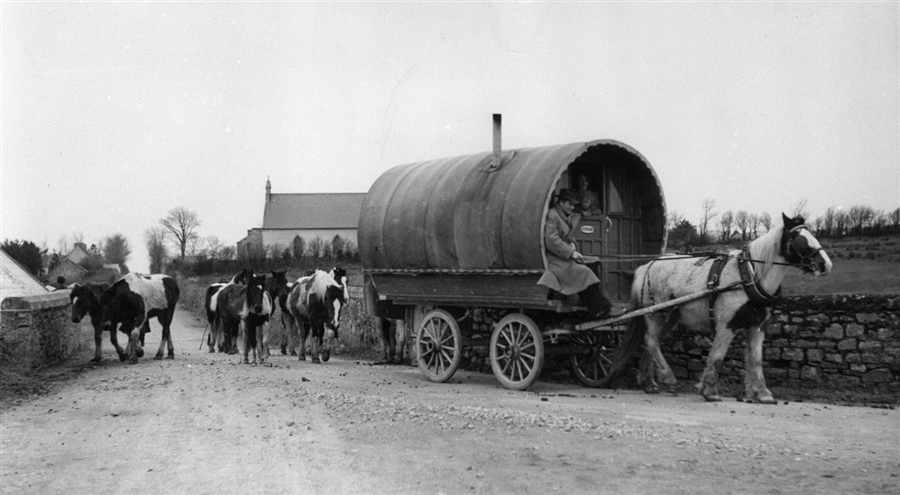
Irish Travellers, County Clare 1951

Danaher mentions an ‘itinerant horse dealer’. Today we might call them Gypsies or Travellers. In Ireland they are well-known for their skills in horsemanship, and for breeding a very particular type of draft horse, suitable for pulling the vardo and also for riding and sulkie racing. The horses are often piebald or skewbald. You may be sure that the Travelling fraternity are natural Whisperers!

The 'Gypsy Horse' is a light draft cob

The ‘Gypsy Horse’ is a light draft cob

Both Evans and Danaher mention the Toadmen in their discussions. These characters would use divination to gain their power over horses. One such ritual was called the ‘Water of the Moon’, and was commonly practised in the East Anglian and Cambridgeshire regions of England. It required that the horseman kill a frog or toad and hang the body on a thorn tree until only the skeleton remained.  At full moon the man then had to take the skeleton to a running stream and throw it into the water.  One small forked bone would detach itself from rest and float upstream, and it was this bone from which the horseman would then derive power over horses.
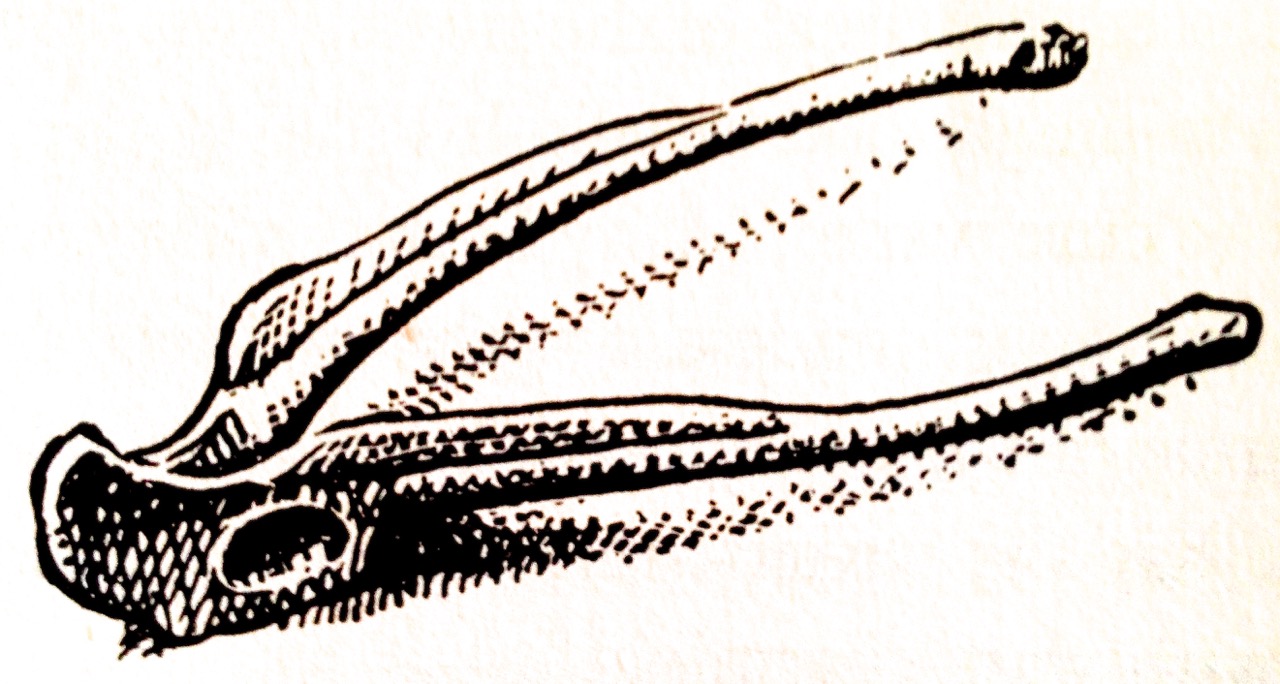
The magical bone of the Toad...

The magical bone of the Toad… (Tunnicliffe)

Have a look at this clip from Canada – it’s not Ireland, but it’s about a modern day Horse Whisperer, and makes good watching…

Speed the Plough

Speed the Plough

In England today – the first Sunday after Epiphany – they ‘bless the plough’. I can’t find any mention of a similar tradition in Ireland, but please let me know if you are aware of one. It’s because the day marks the end of the agricultural holiday which follows Christmas: tomorrow is Plough Monday – the first day of the farmers’ working year – which has its own traditions. Ploughs were traditionally taken around with collecting boxes by mummers and molly dancers in parts of Eastern England, and in some places were used as a threat: if householders refused to donate to the participants their front paths would be ploughed up! Of course the ploughs used in these customs were all drawn by horses at one time – something that hasn’t died out yet: our friends Tim and Sandra keep their own working horses here in West Cork, and I’m quite sure they have mastered the art of Whispering for themselves.

philatelynews-irish-horse

Bird Diary

birds group wb

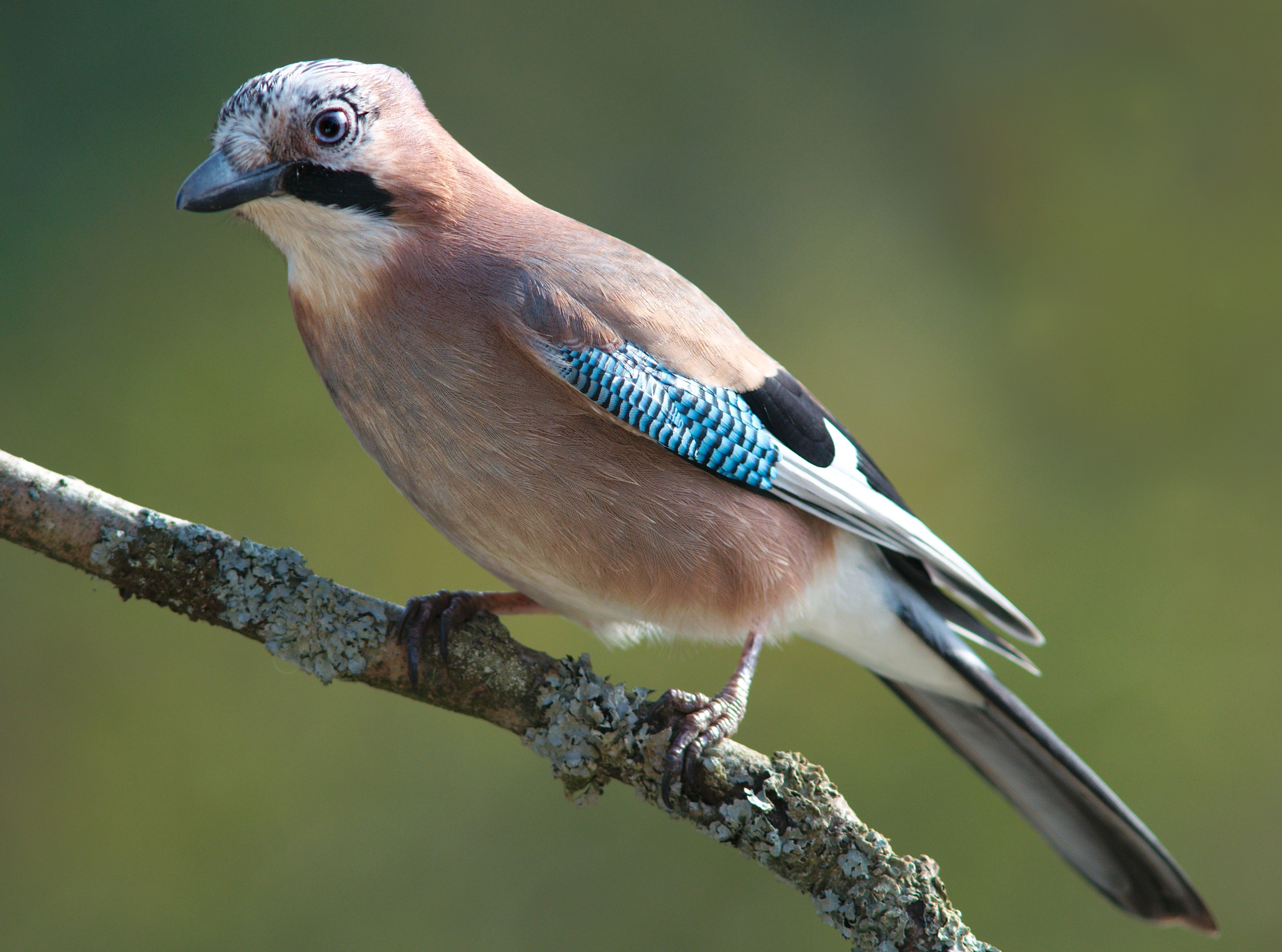
Since we started this blog, back in 2012, I have regularly written posts on the many bird varieties which we have around us on the coast of Roaringwater Bay. There are lots to add! Watch out for more entries in the future which will include some of our new arrivals. In the garden of Nead an Iolair the other day we were surprised by a male Sparrowhawk perched on the wall: the small birds all kept well away! Recently we’ve been visited by Jays, too – someone else the smaller birds shun, as it is partial to stealing eggs and young.

jay

Today I’m going to recap on our feathered companions up here. Remember – if you see something printed in blue on these posts you can click on it and it will link you to a new page on the subject mentioned.

Loons (sketches by Richard Allen)

Loons (sketches by Richard Allen)

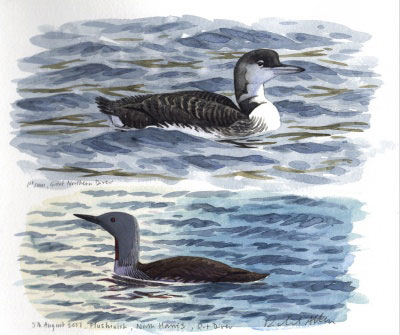
Almost a year ago I talked about the Great Northern Diver – or The Loon, as it is called in Canada. It’s only one of the many wading and shore birds which visit the unspoilt coastline in these parts. Watch out for future posts on Oystercatchers (which have already received a brief mention), Curlews, Gulls and Ducks, to name but a few.

Charm of Goldfinches - photo by Maurice Baker

Charm of Goldfinches – photo by Maurice Baker

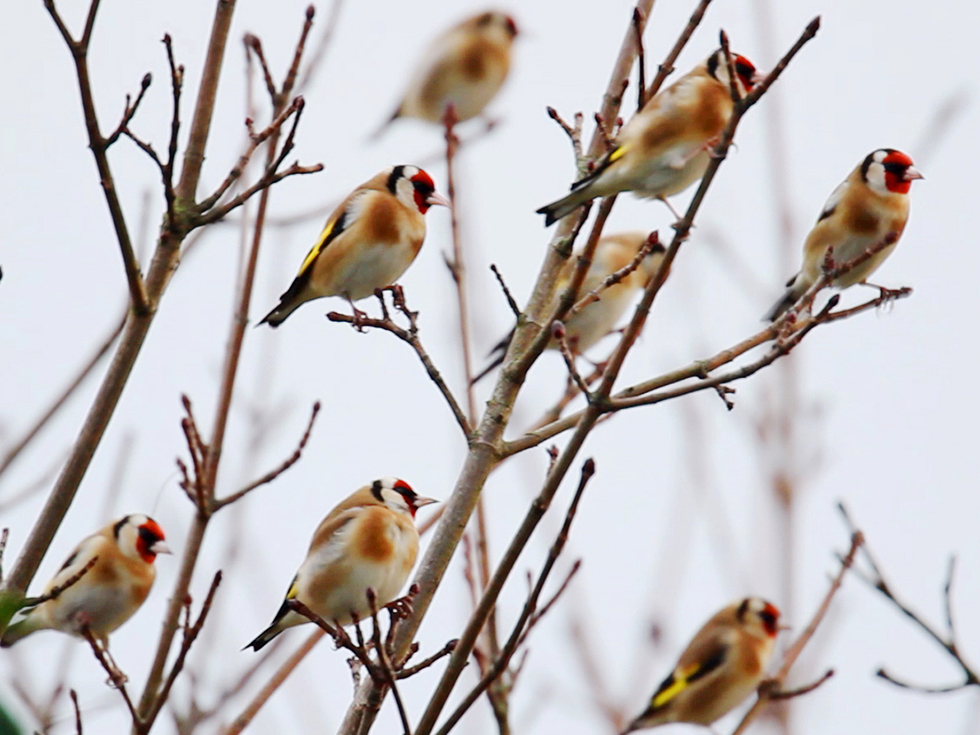
In November of last year I discussed the Charm of Goldfinches which visited the bird feeders in our garden. We saw nothing of them through the summer – in fact they were absent until this November, when a whole flock suddenly descended upon us in one day: now they are regular attenders again.

Fly-past at Ard Glas!

Fly-past at Ard Glas!

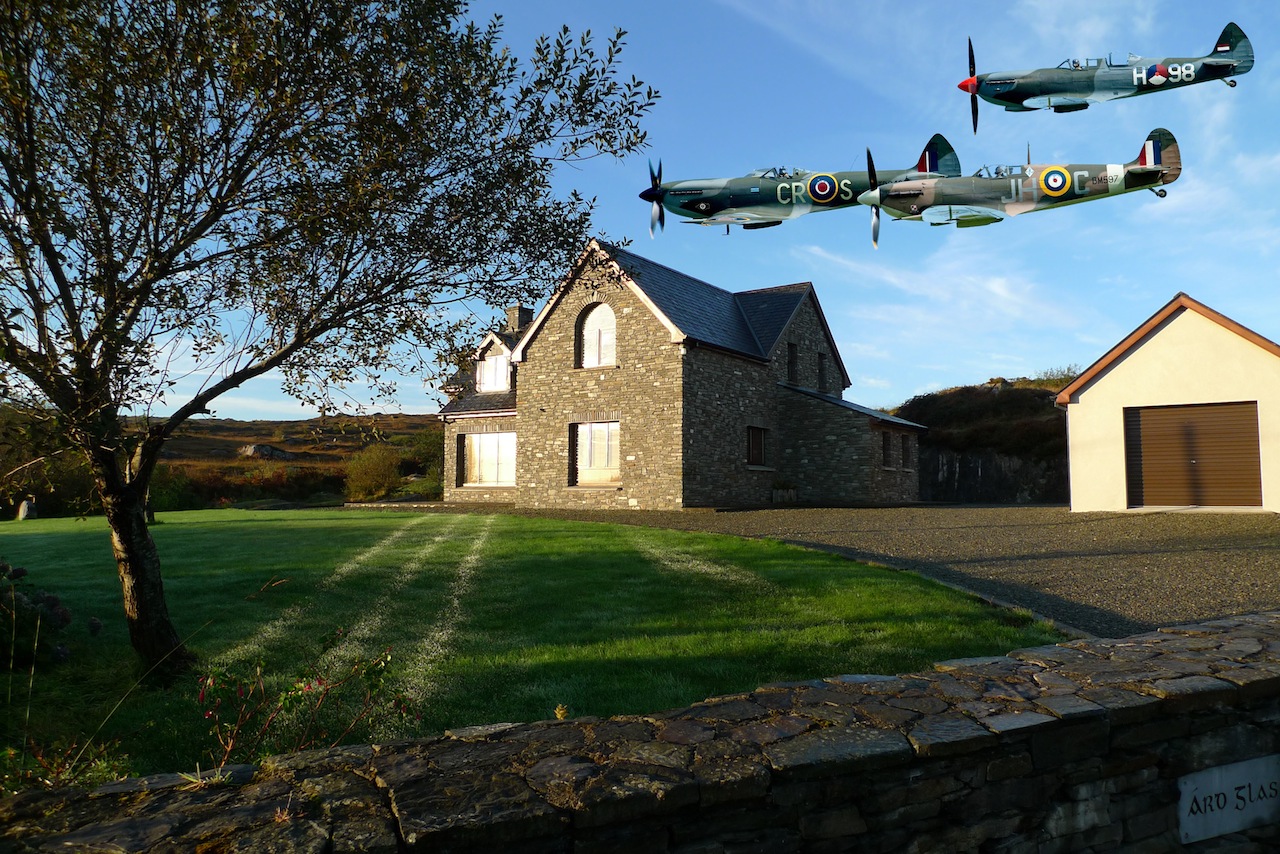
The very first bird post that I put on the blog was Aviation – and this was when we were renting Ard Glas. That was a general review of the birds that came to our luxurious new bird table which Danny made for us – now sadly demolished by Ferdia the Fox who is as fond of peanuts as the birds are…

heron

Since then I have introduced you to Old Nog the Heron – who flies over us quite frequently, made a passing reference to the Swans who live below us in the Cove (but see more below), and set out a whole lot of fact and folklore about the wonderful Barnacle Goose.

Legend of the Barnacle Goose

Legend of the Barnacle Goose

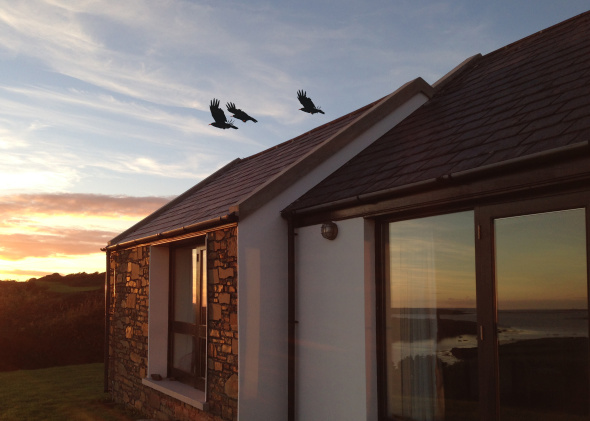
My favourite birds of all here are the Choughs. This is because they had died out in my home county of Cornwall (where they appeared on the coat-of-arms) when I lived there, although a programme to reintroduce them was started a few years ago and I was delighted to see a pair foraging on the coastline there just before I left. Imagine how pleased I was to discover that Choughs are resident all around Nead an Iolair! They perch on our roof, forage on our rocks and generally make themselves known to us through their distinctive cry of Cheeeeough

Choughs over Nead an Iolair

Choughs over Nead an Iolair

The seasonal bird of the moment is the little Wren. On St Stephen’s Day (26 December) this – the King of all the birds – has to take cover, because he is being hunted!

Troglodytes troglodytes

Troglodytes troglodytes

Wren Boys in Cork (Maclise 1843) and drawing by Jack Yeats

Wren Boys in Cork (Maclise 1843) and drawing by Jack Yeats

Amongst many other creatures, Swans are depicted in the Honan Chapel – that gloriously effusive celebration of stained glass and mosaic art.

Honan Chapel Swans

Honan Chapel Swans

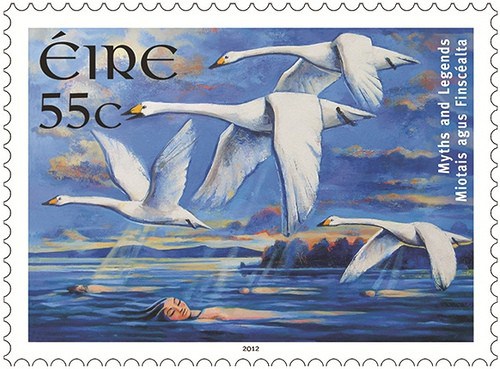
They are also well represented in Irish folklore – most prominently in the saga of The Children of Lir. Here the enchanted children are destined to live out one of their fates – 300 years in the cold, inhospitable Sea of Moyle:

stamp-children-of-lir

Your Favourite Posts of 2014

Cape Clear Harbour

Cape Clear Harbour

What were your favourite Roaringwater Journal blog posts of 2014?

Our blogging software provides a running count of visitors to Roaringwater Journal and it’s always fascinating to see which ones receive the most views. Some of them are our own favourites as well, and some can attribute their high numbers to being re-blogged by others, or to being shared on social media. So tell us, Dear Reader – did the software capture it – or do you have a different favourite from our top posts of 2014?

From the Whiddy Island high point

From the Whiddy Island high point

The top two posts of 2014 were the ones we wrote about our trips to Cape Clear and to Whiddy Islands. We loved our time on the islands and intend to go back often – our enthusiasm probably shone through. But it may also be that islands hold a mystique for us that is hard to define – out there in the dawn mist, mysterious and peaceful, whole worlds unto themselves. The islanders of West Cork are worried at the moment by cuts to their development officer funding, and need all the support we can give them. So if you live here, or are planning a trip, include one or more of these beautiful islands in your plans.

Timoleague Friary

Timoleague Friary

Next in popularity was our post on the Timoleague Friary. It’s an iconic piece of West Cork history and architecture – the only sizeable medieval religious ruins we have, perched on a picturesque estuary of the Arigideen River.

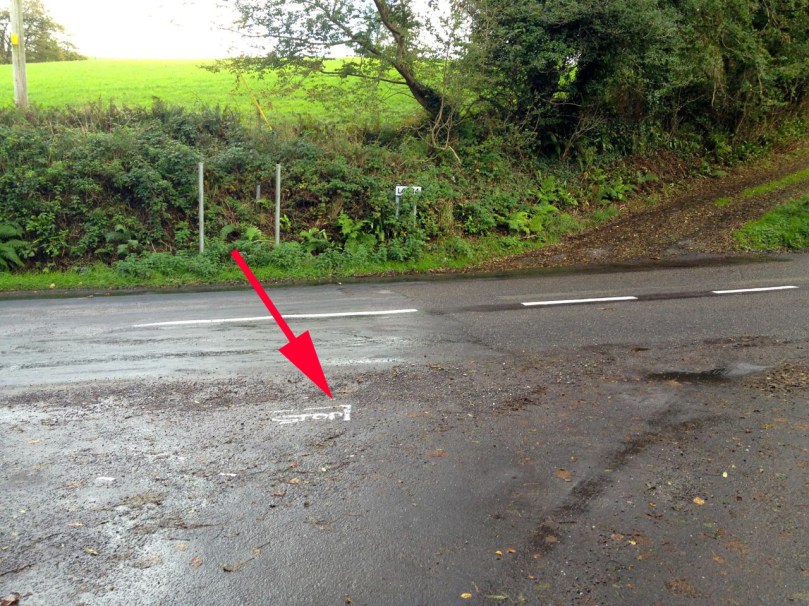
I've learned to look carefully for road signs

I’ve learned to look carefully for road signs

Finola’s frustration at the inflexible regulations that treated her like a novice driver, despite forty years of driving experience, must have struck a chord with you. Maybe you dropped by Driving Home the Point to sympathise with her plight, or maybe it was to chuckle over the numerous example of the routine flouting of the Irish rules of the road, or the bemusing driving conditions of many rural roads.

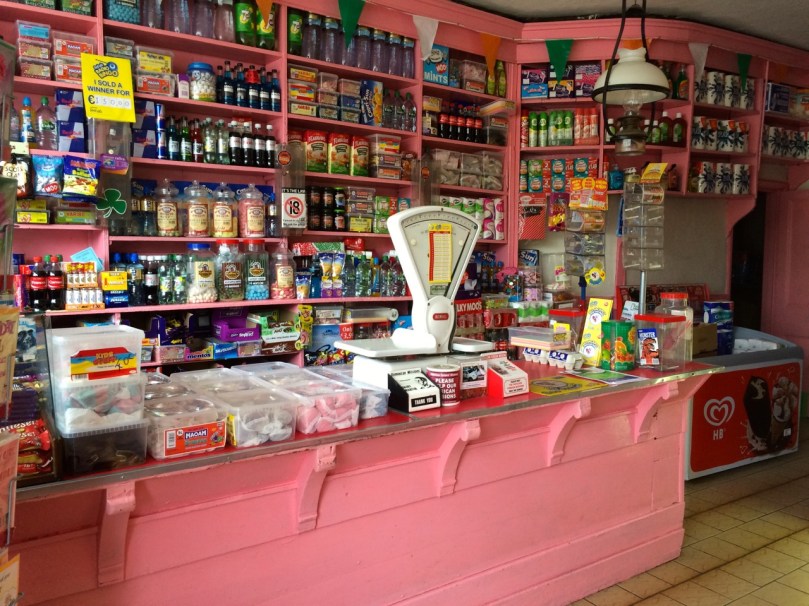
Evans of Bantry

Evans of Bantry

We have enormous nostalgia for the things we remember from our childhood, don’t we? In that vein, it’s not surprising that Shopping for Memories was such a popular post. These lovely old shops evoke a time when a whole variety of shops lined the main streets and our mothers went from the butchers to the greengrocers to the chemists to the haberdashers and, if we were lucky, to the sweet shop on a daily basis.

Carraig Abhainn Gardens

Carraig Abhainn Gardens

But sadly, the numbers of these old-fashioned shops are dwindling. This year we said goodbye to Wiseman’s in Durrus, no longer able to compete against the hardware shops of Bantry. Fortunately, their wonderful Carraig Abhainn Gardens are still open behind the shop – and our description of this hidden gem was one of your favourite posts of the year.

A group of posts on festivals came next. We wrote about the question our friends asked us when we decided to move here, What on earth will you find to DO? We answered in a series of posts describing some of the local events and festivals we have taken in this year – the Ballydehob Jazz Festival and Arts and Culture Festival (which included our own Rock Art Exhibition), traditional music Festivals in Baltimore, Bantry and Ballydehob, and a host of musical and theatrical events. One day all of you retirees out there are going to discover that moving to West Cork is the best decision you can make!

The next group of posts centred on the Mizen – the Mizen Magic posts where we concentrated on aspects of the Mizen Peninsula that delight us – the Beaches, Brow Head, the Butter Road, Mount Gabriel, the Gortnagrough Folk Museum, and the history and archaeology of this beautiful part of Ireland.

How are ye?

How are ye?

In fairness, like, it looks like ye would have enjoyed our take on how to speak like ye’re from West Cork. Those little posteens made you happy out.

Ye must be a fierce active crowd altogether because you really got a kick out of Finola’s description of her day of sailing and (perhaps her personal favourite in the activities department) her moonlight kayaking on Lough Hyne.

Happy New Year from Robert and Finola!

Happy New Year from Robert and Finola!

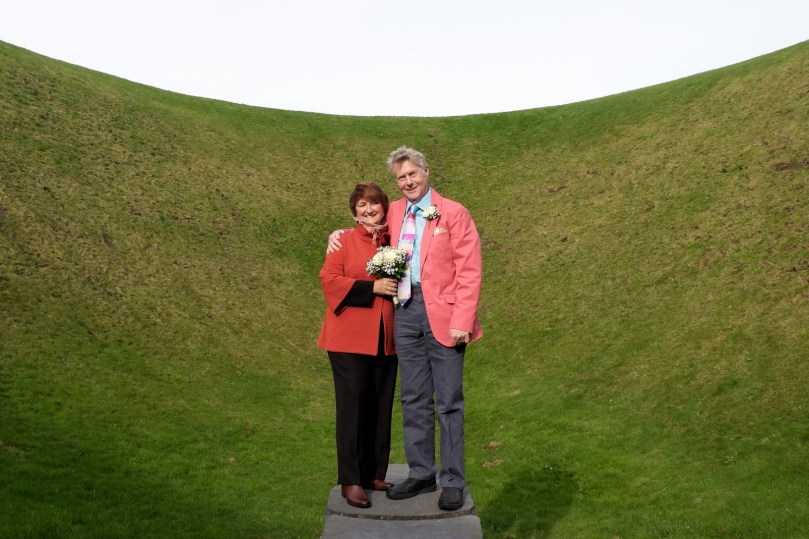
And our own personal favourite of 2014? Robert’s post on the Sky Garden, of course! If you haven’t read it yet, you’ll have to do so to find out why this was the highlight of our year in West Cork.