Chough Country

WHERE not a sound is heard
But the white waves, O bird,
And slippery rocks fling back the vanquish’d sea,
Thou soarest in thy pride,
Not heeding storm or tide;
In Freedom’s temple nothing is more free.

‘Tis pleasant by this stone,
Sea-wash’d and weed-o’ergrown,
With Solitude and Silence at my side,
To list the solemn roar
Of ocean on the shore,
And up the beetling cliff to see thee glide.

Though harsh thy earnest cry.
On crag, or shooting high
Above the tumult of this dusty sphere,
Thou tellest of the steep
Where Peace and Quiet sleep,
And noisy man but rarely visits here.

For this I love thee, bird.
And feel my pulses stirr’d
To see thee grandly on the high air ride,
Or float along the land,
Or drop upon the sand,
Or perch within the gully’s frowning side.

Thou bringest the sweet thought
Of some straw-cover’d cot,
On the lone moor beside the bubbling well,
Where cluster wife and child,
And bees hum o’er the wild:
In this seclusion it were joy to dwell.

Will such a quiet bower
Be ever more my dower
In this rough region of perpetual strife?
I like a bird from home
Forward and backward roam;
But there is rest beneath the Tree of Life.

In this dark world of din,
Of selfishness and sin,
Help me, dear Saviour, on Thy love to rest;
That, having cross’d life’s sea,
My shatter’d bark may be
Moor’d safely in the haven of the blest.

The Muse at this sweet hour
Hies with me to my bower
Among the heather of my native hill;
The rude rock-hedges here
And mossy turf, how dear!
What gushing song! how fresh the moors and still!

No spot of earth like thee,
So full of heaven to me,
O hill of rock, piled to the passing cloud!
Good spirits in their flight
Upon thy crags alight,
And leave a glory where they brightly bow’d.

I well remember now,
In boy-days on thy brow,
When first my lyre among thy larks I found,
Stealing from mother’s side
Out on the common wide,
Strange Druid footfalls seem’d to echo round.

Dark Cornish chough, for thee
My shred of minstrelsy
I carol at this meditative hour,
Linking thee with my reed,
Grey moor and grassy mead,
Dear carn and cottage, heathy bank and bower.

I was pleased to find this poem. It was written by a Cornishman – John Harris – who was born in 1820 in Bolenowe. Perhaps he was an ancestor? His father was a miner at Dolcoath Tin Mine where young John also started at the age of 10. He began writing poetry as a child, usually in the open air where he was inspired by nature. After 20 years working in the mine, one of his poems was eventually published in a magazine. It attracted notice, and he was encouraged to produce a collection, which was published in 1853. The Cornish Chough is taken from that collection.
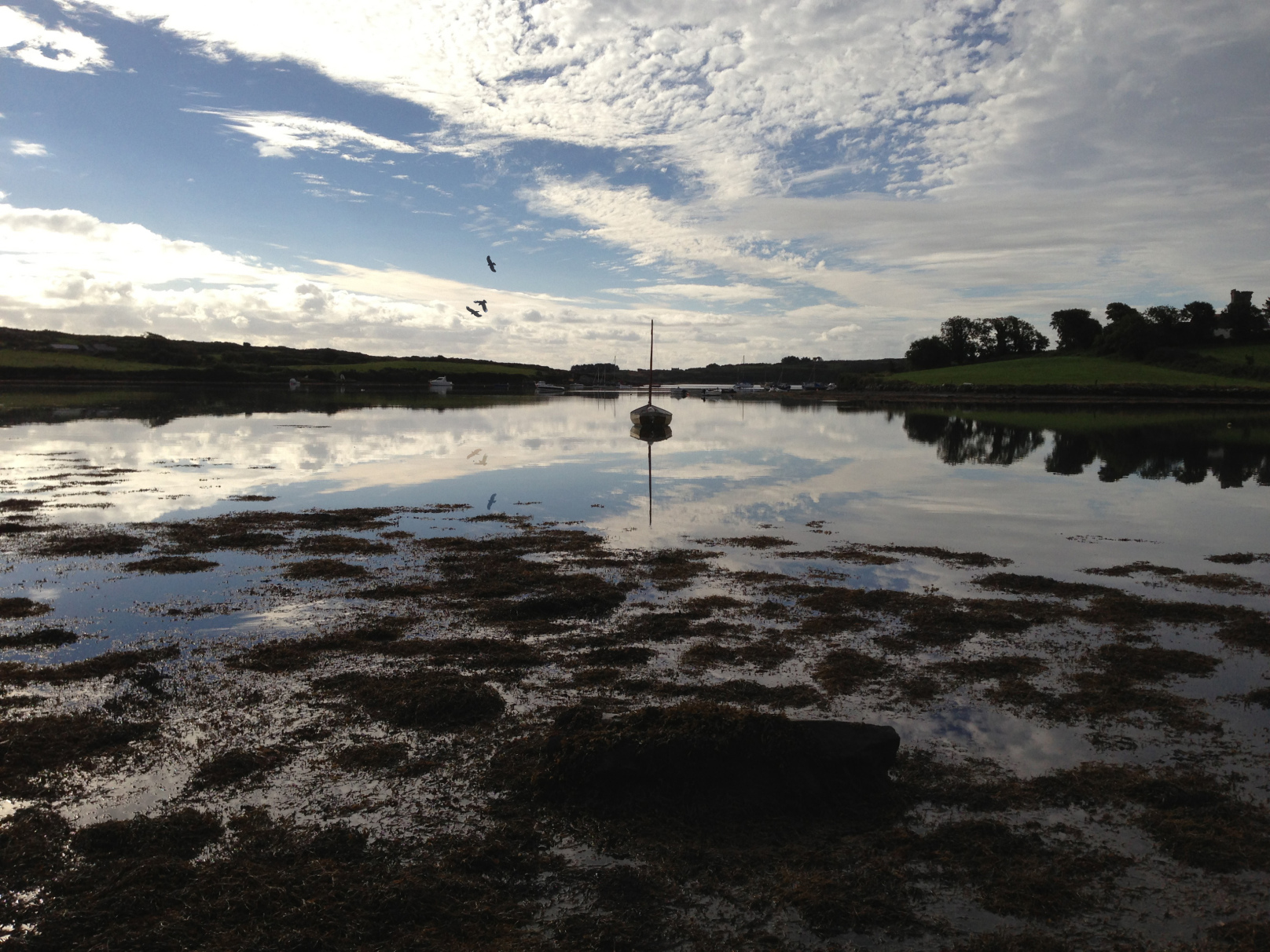
Above – choughs over Rossbrin Cove. The wonderful header picture was kindly given to us to use in a previous piece on the birds by our friend and neighbour Oliver Nares. Oliver and Susie are fortunate to have choughs nesting on their property and keep a good eye out for the welfare of the chough families which are raised there. We don’t have choughs nesting at Nead an Iolair (which means Nest of the Eagle) but we often see and hear them over us: they are the most acrobatic and joyful of birds.

The reason I have returned to choughs today is that they were the subject of an early post which I published on Roaringwater Journal on 6 October 2013 – exactly five years ago! Choughs – Cornwall’s emblematic birds – left that county fifty years ago but returned very recently as migrants from Ireland. We consider ourselves very privileged to be living in abundant chough country.

Standing Stone Pairs: A Visit to Foherlagh

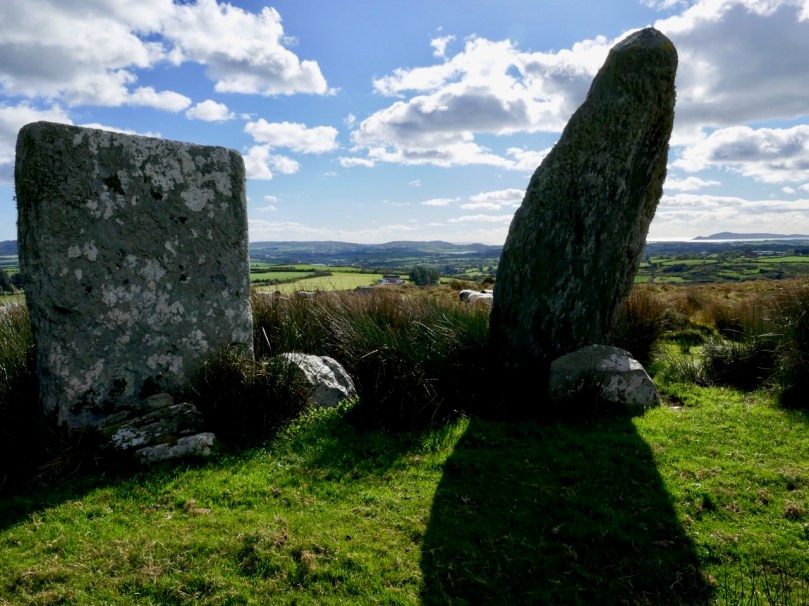
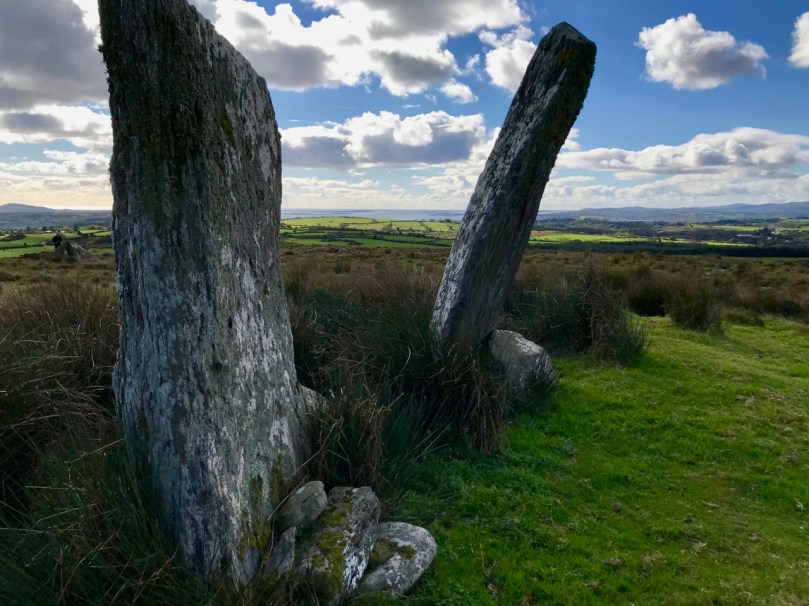
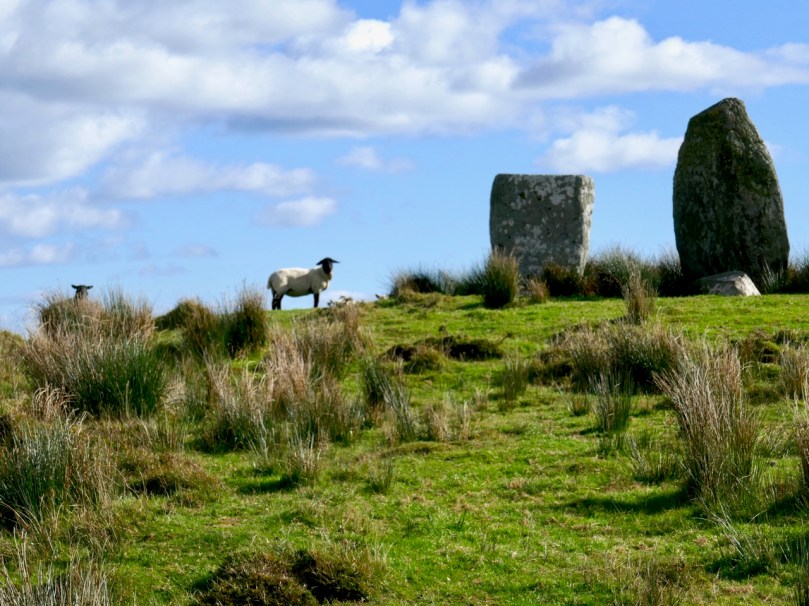
An unexpected delight – a trip on a Sunny October afternoon to visit a very fine standing stone pair in Foherlagh, just north of Kilcoe Church and School on the N71, between Skibbereen and Ballydehob.

The trip was suggested by Amanda who was, of course, looking for a holy well, said to be associated with a mass rock. All of these – the standing stone pair, the holy well and the mass rock – were grouped in one place so we had to undertake this expedition! Thus we found ourselves knocking on the door of the genial farmer, Dennis Minihane, who donned wellies right away and took us up the hill behind his house.

The view from the top of the hill

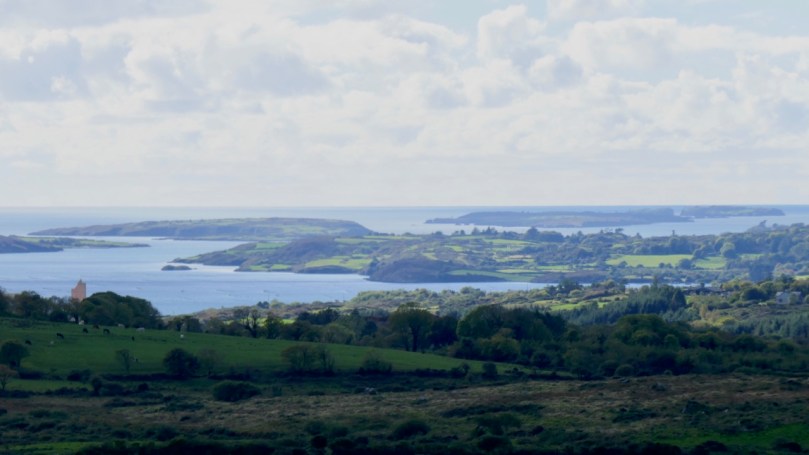
We had no idea what would greet us, but as we ascended it dawned on us that the views were pretty spectacular. The standing stone pair came into view, and it was obvious they were enormous. When we reached the top we were greeting by a complete 360 degree panorama – south to the islands of Roaringwater Bay, west to Mount Gabriel, east to Baltimore and north to the hinterland. Kilcoe Castle glowed gently in the foreground, while far away we recognised the distinctive pyramid shape of the Mizen peak at the end of the Peninsula.

Looking toward the end of the Mizen Peninsula

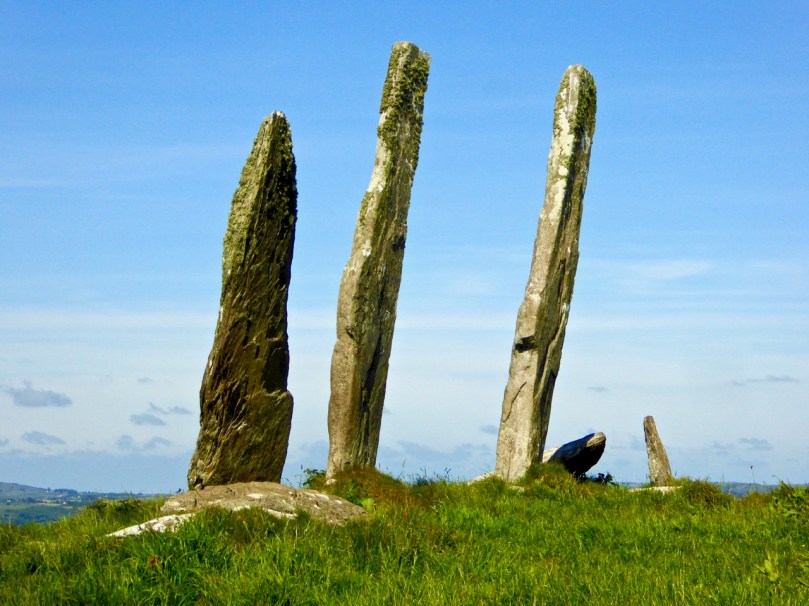
Standing stone rows and pairs are a phenomenon of south west Ireland, and this part of West Cork has many examples. While there are about seventy rows of three to five stones (such as the Fingers at Garranes near Castletownsend, or the Maughnasilly row), there are over a hundred stone pairs, of which Foherlagh is a particularly fine example. Invariably their long axis (that is, standing at one end  and looking along the row or pair) is oriented northeast/southwest. Typically the stones are graded in height, with the taller stone (or tallest, in the case of a stone row) at the southwest end.

Garranes stone row, known as The Fingers, near Castletownshend

Sometimes stone pairs are associated with other monuments. We’ve visited, for example, the Kealkill complex, where a stone pair is associated with a five-stone circle and a radial cairn. There’s also the Coolcoulaghta pair, from which the Dunbeacon stone circle is clearly visible.

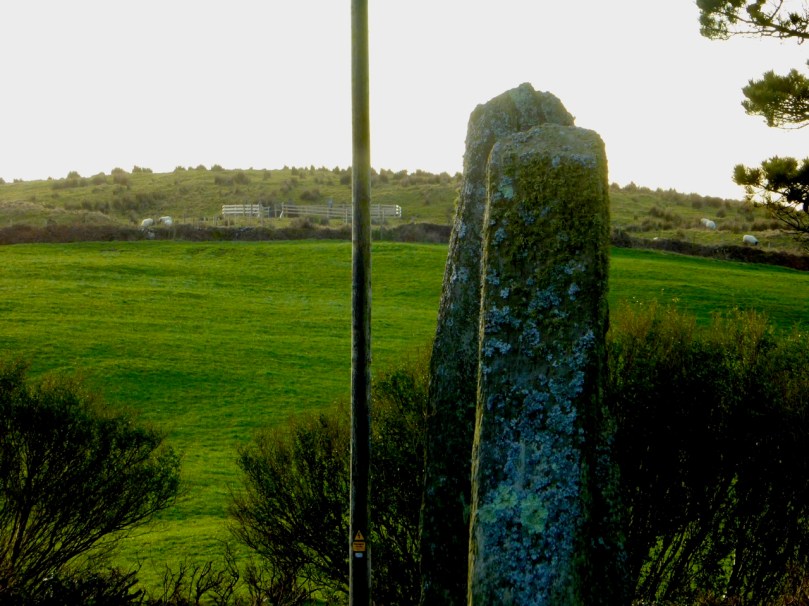
Upper: The Kealkill complex of monuments; Lower: the Coolcoulaghta standing stone pair (and the most unsympathetically situated electricity pole in Ireland) from which the Dunbeacon stone circle (now sadly coralled by a wooden fence) can be seen

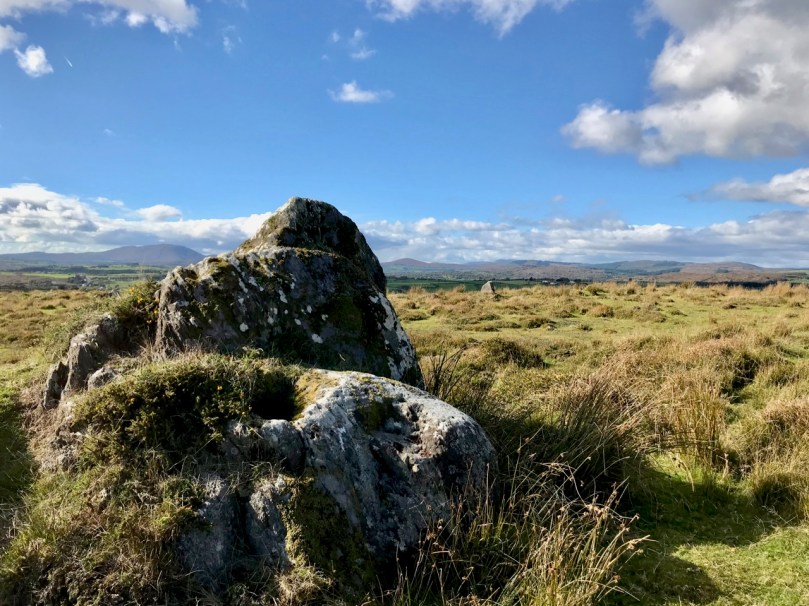
In Foherlagh, however, there are no other prehistoric monuments apart from a single standing stone a few fields away. What there is, is a pointed outcrop which local tradition has identified as a mass rock – see our post Were You at the Rock? for more on this type of monument. The mass rock had a scoop-out in it that may have functioned as a wart well. Amanda was pleased to find this and no doubt will do her usual thorough write-up on Holy Wells of Cork.

The standing stone pair is clearly oriented northeast/southwest. Depending on where you stand, the axis may point to the Mizen Peak (as does the Altar Wedge Tomb further down the Peninsula) or to Mount Gabriel (as do most of the examples of rock art we have examined in this region). Wherever the line points, it is clear that the expansive views are to the south west.

In his examination of stone rows and pairs*, Seán Ó’Nualláin says “The stone rows and pairs then, like the stone circles, are built so that their long axes indicate a general alignment on the sector of the heavens in which the sun roses and sets, and both series tend to group in a position indicating a winter rather than a summer position for the sun.” He might have added that this is also true for the sector in which the moon rises and sets – Maughnasilly row, for example is associated with lunar, rather than solar, orientations.

Maughnasilly stone row on a dramatic day

Ó’Nualláin, based on excavated examples and clear associations, gives a likely Late Neolithic to Early Bronze Age date for stone pairs and rows. That would mean they were erected 3,000 to 5,000 years ago.

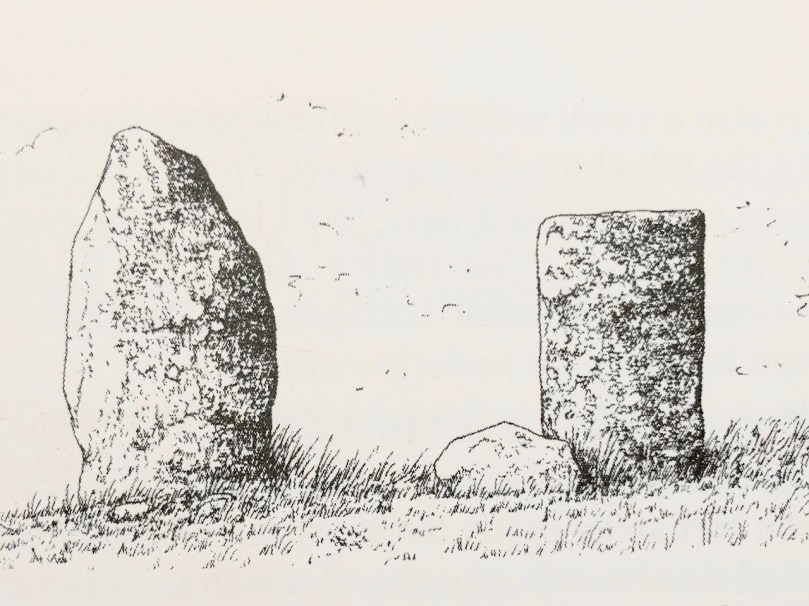
Jack Robert’s‘ drawing of the Foherlagh pair, from Exploring West Cork

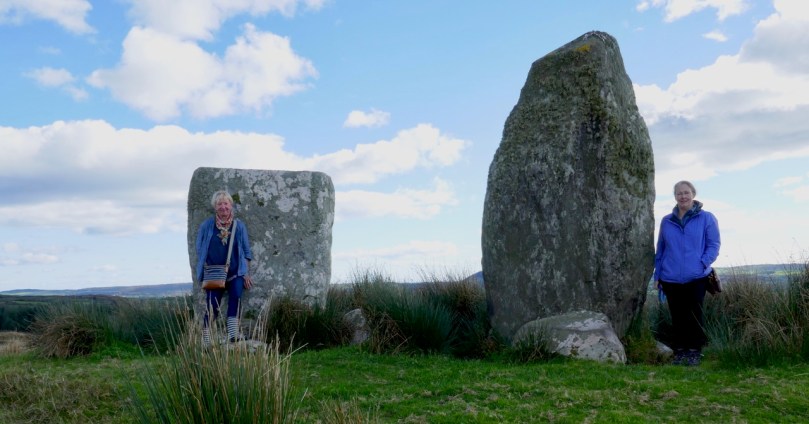
But what was their function? Perhaps they were yet another element of the calendrical systems that seem to have been a vital part of this early agricultural society. They may also have been used as territory or routeway markers, or as memorial stones for individuals. Some archaeologists have suggested an anthropomorphic element, in that some pairs may represent male and female figures. The pair at Foherlagh were certainly chosen to be very different in shape, although I am left wondering which –  the tall more rounded one or the shorter very square one – might be the more female or masculine figure.

Thank you to Amanda and Peter for suggesting the expedition, Carol for providing the oohs and aahs of a first-time visitor to Ireland, and Dennis for so generously sharing his land and his stories with us.

Amanda and Carol provide scale

Seán Ó’Nualláin, Stone Rows of the South of Ireland, in Proceedings of the Royal Irish AcademyVol. 88C (1988), pp. 179-256. Available on jstor.org