Making a Willow Basket

I first met Rosemary Kavanagh at our Irish immersion course last summer in Ballyferriter. We enjoyed a long chat on one of our outings and she told me she was a basket weaver. Her knowledge of the natural world around us was impressive and I responded to her ready laugh and her gentle, slightly ethereal presence.

We had lots of colours to choose from and soon found out that some were bendier than others

More recently I was invited by my oldest friend in the world to take part with her and two of her daughters in a basket workshop, and I realised that Rosemary was the teacher. I signed up, and last Sunday spent the day in Clonakilty making (well, almost making) my first willow basket. It wasn’t my first try at using willow – years ago in Northern Canada I had made a bockety chair under the guidance of my talented friend Sandy. It lasted for years in my garden, slowly disintegrating in the harsh winters and eventually returning gracefully to the soil from whence it came. But those were tough cut-from-the-woods willows, suitable for furniture.

Rosemary is a gifted natural teacher. I know what I am talking about – I spent several years training teachers in pedagogical techniques and I recognise good teaching when I see it. And good instruction is essential for something like this, as you guide novices through an intricate process, building their skill and their confidence bit by bit.

How to sit, how to hold the willow as you worked it, safely using a sharp knife (above), knowing when to discard something that wasn’t working – we were led through it all. As the right brain (creativity) took over from the left brain (process, logic) we descended into near-silence, each of us deeply concentrating on the shape that was emerging under our hands.

Although there were chairs for everyone it wasn’t long before many of us gravitated to the floor to work

Choosing what willow to work with was part of the process and I was humbled by Rosemary’s knowledge of her materials. She grows her own willow, coppicing and cutting it herself. I never knew there were so many kinds – four native species and several non-native that adapt well to Irish habitats. She knows intimately the characteristics of each kind – colour, strength, straightness – and therefore its suitability for different tasks.

Once harvested, Rosemary allows the willow to dry completely and then re-hydrates it to retain a fraction of its original moisture. This is what gives it its pliability for weaving. But it’s still strong: to see Rosemary flicking a weaver through the frame – in-out, in-out effortlessly – is a wondrous thing and an insight into what years of practice and trained hands can accomplish. Alas, for us neophytes it’s an altogether sweatier business of poking and pushing and hoping to God that the weaver doesn’t develop a kink and have to be discarded AFTER ALL THAT EFFORT.

Anne – my friend from the cradle. Doing something like this with old friends makes it extra-special

But some of got there and even finished our hen baskets, to the cheers of all. Others nearly finished and took away some willows to do it at home. 

Jill finished hers the next day – looks great! You can see the ‘bum’ shape that gives this basket its alternate name of a Bum Basket

Me? I almost finished, and decided to leave it as is, as a reminder of what I had learned and a memento of an amazingly enjoyable day. I have, however, positioned it on a high shelf so that anyone looking at it would think it was indeed finished. Cheating? Never!  Er, tromp l’oeil?

Rosemary teaches courses across Ireland and in North America too. If you’d like to make your own basket, get in touch with her at her gmail.com address that starts belongingtothewillows. You can also follow her Instagram page, full of lovely basket images.

Well done Kiara!

Casino Marino

It’s a perfect little building: a gem of Irish architecture. It lies in an oasis of parkland on the outskirts of Dublin city – all that’s left of an expansive eighteenth century country house demesne, now all but engulfed by housing estates. But – perhaps in homage to the eccentric conceiver of this environmental idyll – the housing estates which have stood below it since the 1920s are quite out of the ordinary. Have a look at the layout on this contemporary plan of Merino townland, carved out of the larger Donnycarney which was granted to the Corporation of Dublin following the dissolution of The Priory of All Hallows in the reign of King Henry VIII. 

This plan is showing the location of Casino Marino, with the green areas around it being the remnants of a 238 acre demesne. The housing below the surviving Casino was Ireland’s first example, in the newly formed Irish state, of an affordable housing project and was the first local authority housing estate in the country. It was heavily influenced by Ebenezer Howard’s Garden City movement, originating in the UK with the two revolutionary developments at Letchworth Garden City and Welwyn Garden City. This Dublin estate of about 1300 houses was built on the site of a planned formal garden for Marino House and the original design was followed when the streets were laid out. This gives the Marino estate its symmetrical layout. When it was first built, purchasers of houses were restricted to large families, while alcohol and dogs without leads were banned from the parks, as were children after dark.

Ebenezer Howard, To-morrow: A Peaceful Path to Real Reform – diagram of the ideal city, dated 1898

Back to the eighteenth century, and the heroes of our piece today: James Caulfeild, 1st Earl of Charlemont (1728 – 1799), and his friend, the architect Sir William Chambers (1723-1796). James (left, below – a portrait by Pompeo Batoni) was a cultivated man who disregarded the conventions of court and openly pursued Irish nationalism, having taken a leading part in the formation of the Irish Volunteers. He was the first President of the Royal Irish Academy and was a member of the Royal Dublin Society. In 1783 he was made a founding Knight of the Order of St Patrick. Like most of the wealthy young gentry of his time he went to Italy on The Grand Tour: he fell in love with that country and classical Roman culture and stayed away for nine years. When he returned he determined to bring the spirit of Italy to Dublin. Acquiring tracts of land by the coast that afforded unrivalled views over the entire bay and city, he poured his energies into creating an ideal landscape: he named his demesne ‘Marino’.

William Chambers (on the right, above – this portrait by Joshua Reynolds is in the Royal Academy) was also a great traveller: he was born in Gothenburg to a Scottish father and visited and studied architecture in China, Paris and Italy – where he met Charlemont. He established a practice in London, where he was appointed architectural tutor to the Prince of Wales, later George III. As the leading classicist of his day, it was unsurprising that Charlemont should turn to him to realise his dream of an Italian arcadia in Dublin. It was a commission that took many years to come to fruition, partly because of the Earl’s seemingly limitless ambitions and his attention to fine detail.

Charlemont’s Marino estate enjoyed fine unrestricted views across Dublin Bay. The culmination of the Earl’s work on his estate (and now the only surviving element) is the Casino, and this is sited on the highest point on the land: the painting above shows the view from the roof of the Casino, which was fully accessible from the building interior. So – what is a casino? It’s simply the Italian for small house, and in this case has been built as a garden room or, perhaps, a gazebo. Ornamental, but eminently functional. From the outside it appears small, but exquisitely detailed on all its elevations. In fact, the simple building houses 16 rooms over three storeys – plus the roof terrace.

Exercises in architectural scale. Upper – an almost contemporary view of the Casino painted by William Ashford (1746-1824), National gallery of Ireland: here the building seen in its landscape context looks like a miniature folly. Centre – a close-up of the roof detailing includes life-size statuary. Lower – Ava and Hugo, willing participants in our expedition to the Casino, help to give an impression of its true size.

The Casino is guarded by four large lions. Originally they were intended to be fountains – as you can see from the original architect’s drawing, above. In this drawing you can also get a good sense of how the designer plays tricks with scale: the doorway is perhaps three times the height of a normal door, and only a small section at the bottom is, in fact, an opening.

Symbolism and hidden messages abound: the architect, Sir William Chambers, left his signature – in the form of a ram – in many parts of the house. Every moulding, coving, frame detail has a meaning in terms of architecture and freemasonry – and also pays homage to the Greek and Roman classical orders – at the behest of the client. The parquet flooring is magnificent – and is at present kept covered by a vinyl replica to protect the original exotic woods.

The detailing of every element has been fully considered. I was impressed with the curved timber doors, which follow the line of circular wall partitions inside. And, particularly unusual, is the use of vertically curved glazing which causes reflections when seen from the outside, meaning that no shutters or blinds are needed at the windows.

Look carefully at these windows: they are crafted with vertically curved glass which make them reflective externally!

Examples of the plasterwork within the Casino include agricultural harvest symbols, every classical moulding motif and Apollo the sun-god. It would take several visits to absorb and catalogue the complete variety of images: every room has a different visual character.

There are hidden elements – and enigmas – to the building. These include ‘secret’ tunnels in the basement: one was used by Michael Collins to test-fire submachine guns during the War of Independence. The picture above shows a reconstruction. The basement of the Casino, including the tunnels, is currently undergoing further restoration and refurbishment and was not accessible during our visit. It is said that there are many other tunnels, including one that linked the Casino to the big demesne house (now demolished) – and some that, according to legend, run to the coast – miles away!
Charlemont was a liberal and believed that everyone should have access to his parklands: there were no gates. He was so protective of his project, however, that he married in middle age, having been a confirmed bachelor. He had overheard his then presumed heir (his brother) talking about how he was going to exploit and commercialise the demesne once he got his hands on it: this prompted Charlemont to ensure he produced an heir that he could have some direct influence over! Evidently, the marriage was a happy one. The image above shows the Casino in a sad state of disrepair around 1900: the estate was broken up by the third Earl in 1876.

The Casino was adopted as a National Monument in the 1930s, and a full restoration was begun in the 1970s. A further phase of this restoration is currently under way, and the property is only open on limited occasions when suitable areas are accessible: we were fortunate to get there on one of those times. If you plan to visit, contact the Office of Public Works to make sure that you will get in. Charles Topham Bowden made the journey in 1791, and recorded it in his journal A Tour Through Ireland: here is an extract:
. . . This is one of the most beautiful and elegant seats in the world, happily situated, and in a demesne improved in the highest taste, comprehending 238 acres, laid out in plantations, lawns, and a delightful park . . . The temple is situated in the park – a monument of his Lordship’s refined taste. The Gothic room is a very curious and beautiful structure. The hermitage is nature itself. Art and nature unite in rendering this a most desirable residence. What obligation are not the citizens of Dublin under to his Lordship for having the gates of this terrestrial paradise opened to them whenever they chuse [sic] to walk through it . . .
The Boa Island Figures – Mysterious Carvings From Our Pagan Past

We’ve been thinking lots lately about Northern Ireland and how much we enjoyed our time there. One of our truly memorable experiences was a trip to Boa Island in Fermanagh to see the mysterious carved figures in the Caldragh graveyard.

Despite the fact that this is one of Northern Ireland’s most important archaeological sites, we had the place to ourselves when we were there, in October 2016. In fact, it looked like any peaceful rural graveyard, with higgledy piggledy gravestones behind a hand-forged iron gate, lush grass, and an air of benign neglect.

But there’s one big difference – in this remote place are two of the most enigmatic carved figures on the Island of Ireland. The first one has two faces – it’s been called a Janus figure, or simply bilateral, carved in a style that is reminiscent of Early Medieval carvings, but also different. Different enough so that one can see these as pre-Christian figures, and that is how they are most often interpreted.

Boa Island itself may be named for the Goddess Badhbh (pronounced Bov), a potent character in Irish mythology. The figures do not bring saints or clerics to mind – there are no croziers, no fingers raised in blessing, no tonsures or crosses. We’ll look at the bilateral figure first. It has two faces, back to back, with a groove in between. The groove collects water and in recent years people have started to leave coins in the puddle formed by the groove, perhaps echoing its original purpose. The heads are joined at the side by herringbone or plaited lines that may represent hair.

One side has been interpreted as male and some point to a stylised penis that rests between the legs. Although I have seen photographs of this side when it had been recently cleaned, where a carved element is denoted as the penis, it is not in any way obvious now that the statue is once again covered in lichen and badly weathered, with moss growing in this area. The face is long and triangular, the mouth open and the eyes wide and staring. Two arms cross across the body, over a belt which runs around both figures.

On the other side the mouth is open and a tongue protrudes. Apart from that, the figures are almost identical. The statue is broken just below the belt on this side, so it is impossible to say that there are any female, or indeed male attributes present.

The carving has been mounted on a plain base but leaning against it is what might be the original base, or part of it. If it is, then the arms extended down into hands, resting on either side of the base.

There is a second figure, brought here from nearby Lusty More Island. This one is much more worn, or perhaps not even totally finished, but it’s possible to see that it bears a strong resemblance to the others in its triangular face. The arms are not crossed but appear to be holding something. Visitors leave coins in front of this one.

What does it all mean? In short, we don’t know, but current consensus appears to fall in the area of calling these figures representations of pagan deities. The smaller figure, rather than holding something, may be female and pointing to her genitals. This would place it in the tradition of the sheela-na-gigs, although presumably much earlier than the majority of sheelas, which are thought to be medieval.

Whatever they are, they have inspired poets and artists – even filmmakers. One of our favourite films, the marvellous Song of the Sea, has taken much of its artistic design from prehistoric Irish art, including the Boa Island figures. Watch this teaser for the movie and see if you can spot the Boa Island figure at 46 seconds.

And the poetry? Seamus Heaney, of course, himself from Northern Ireland, drew inspiration from the landscape around him and often wrote about archaeological themes. His poem, January God, captures the mysterious sense of the two-faced God and makes a shift to summon the idea of Cernunnus, the antler-headed pagan god of wild things depicted on the Gundestrup Cauldon.

Then I found a two-faced stone

On burial ground,

God-eyed, sex-mouthed, its brain

A watery wound.

In the wet gap of the year,

Daubed with fresh lake mud,

I faltered near his power –

January god

Who broke the water, the hymen

With his great antlers

There reigned upon each ghost tine

His familiars,

The mothering earth, the stones

Taken by each wave,

The fleshly aftergrass, the bones

Subsoil in each grave.


Watsons of Youghal – Revivalist Masters Part 2

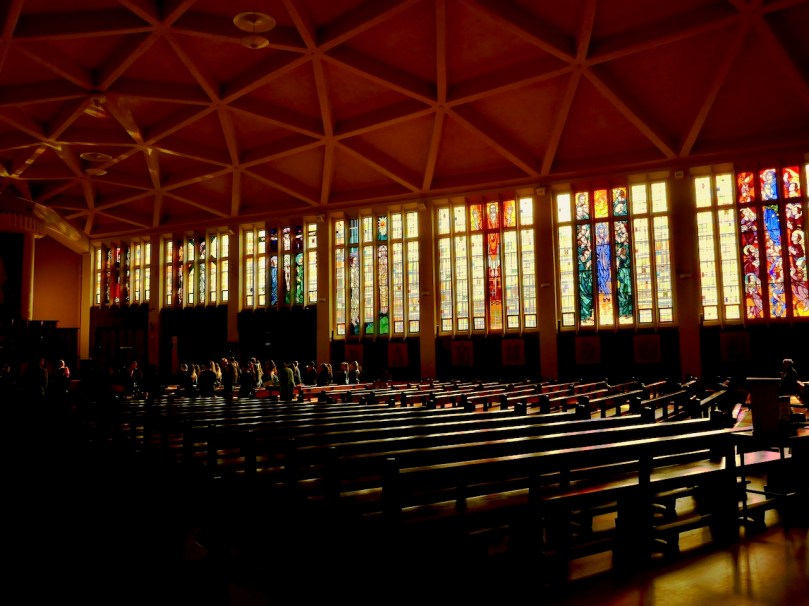
In Part 1 I laid out the background to the Watsons of Youghal Revivalist-style windows, a design innovation for which they should be particularly celebrated. In this post I will provide further examples and tell you where you can see some.

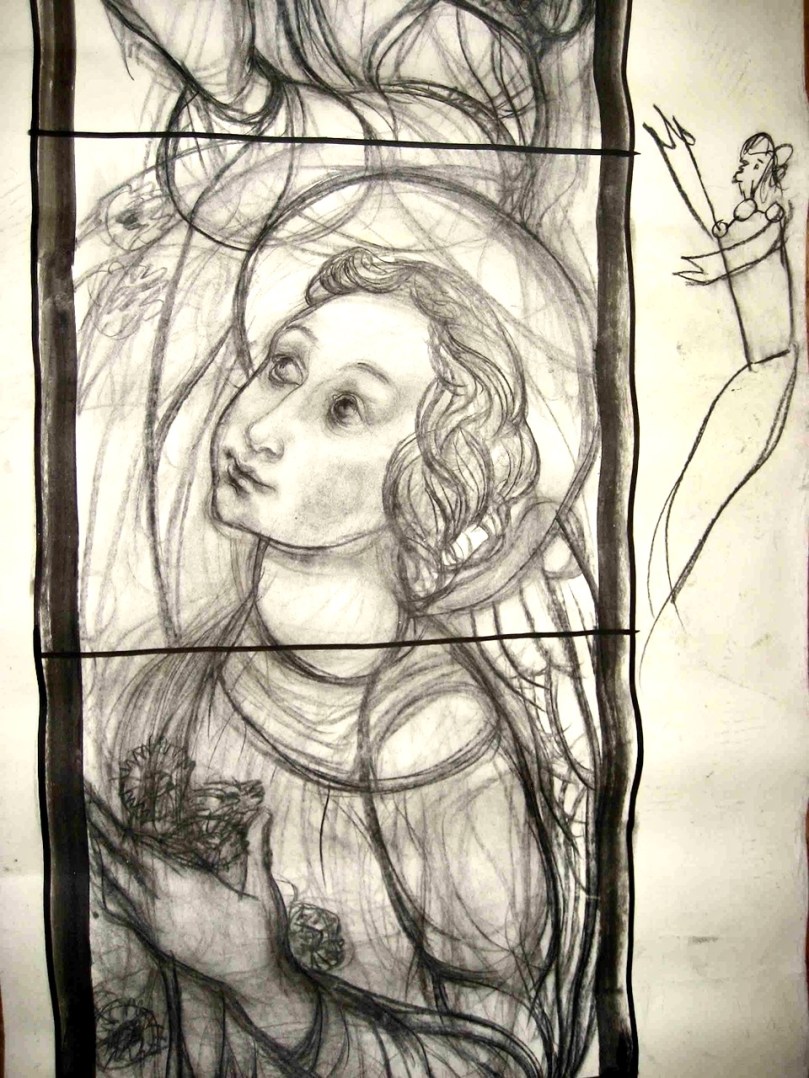
The Watson Archive is housed at the Crawford Gallery in Cork. In it are original cartoons showing the careful working out of interlace patterns and of lettering styles. Since these cartoons are on long pieces of paper which remained rolled or folded in storage for many years, they are in fragile condition and therefore what one consults in the Crawford Archive is the file of photographs of these papers. While not ideal, this at least allows serious students of stained glass to see some of the original work upon which the windows were assembled. There are also smaller drawings and paintings – these were done as original designs from which the cartoons could be drawn and from which the colours could be worked out.

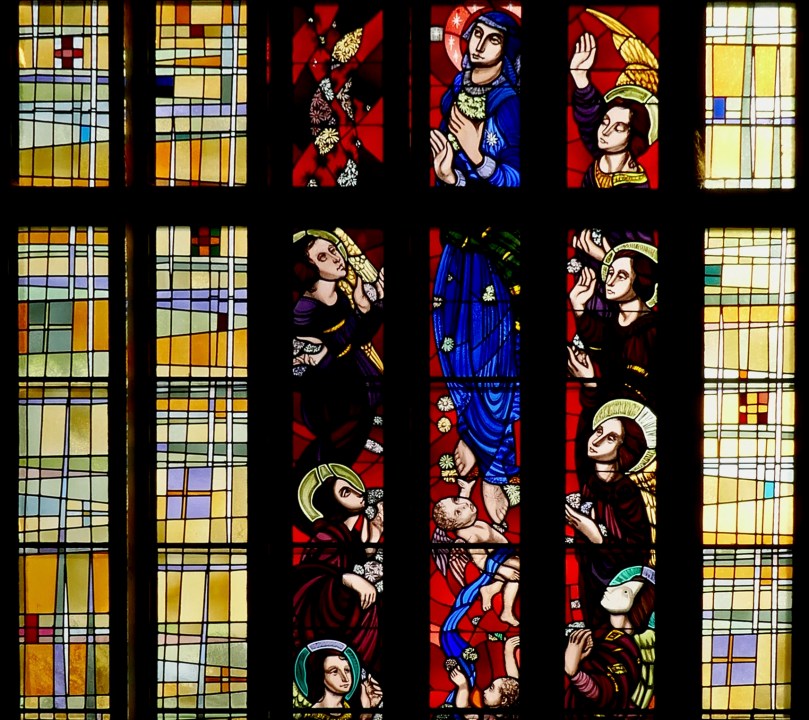
It’s a real thrill to come across a window that is based on one of those designs: see above and below for a perfect match! Incorporation of interlacing can also help to identify an un-signed window as being a Watson: it was what set them apart, when the figures themselves – the saints or angels – might be well-nigh indistinguishable from those of other stained glass manufacturers.

Interlacing is the preferred word for the complex looping and braiding of ribbons, which twist in and out and around each other and often end in the head of a fantastical animal. Artists studied the Book of Kells and other illuminated manuscripts, copied the elaborate decorations and eventually figured out their own designs. Just walk through any older cemetery in Ireland to see the craftsmanship with which many crosses were carved with interlace motifs.  So it was with Watsons: they became expert at fitting and filling spaces in a window with Revivalist designs.

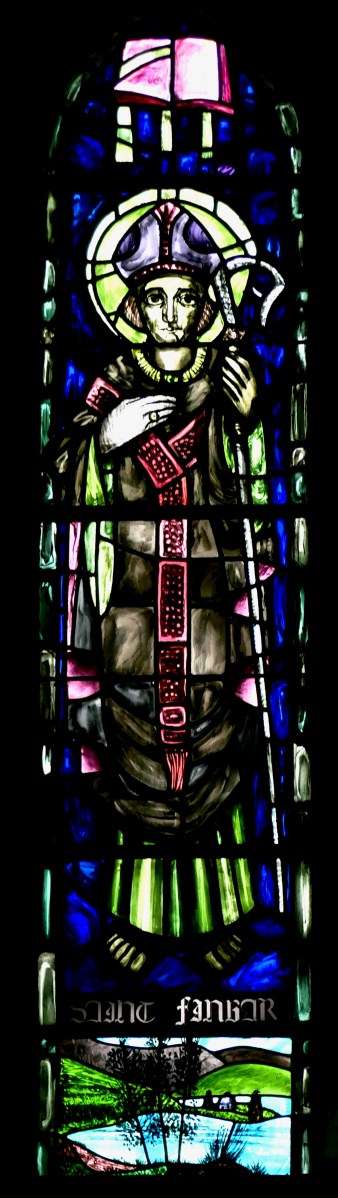
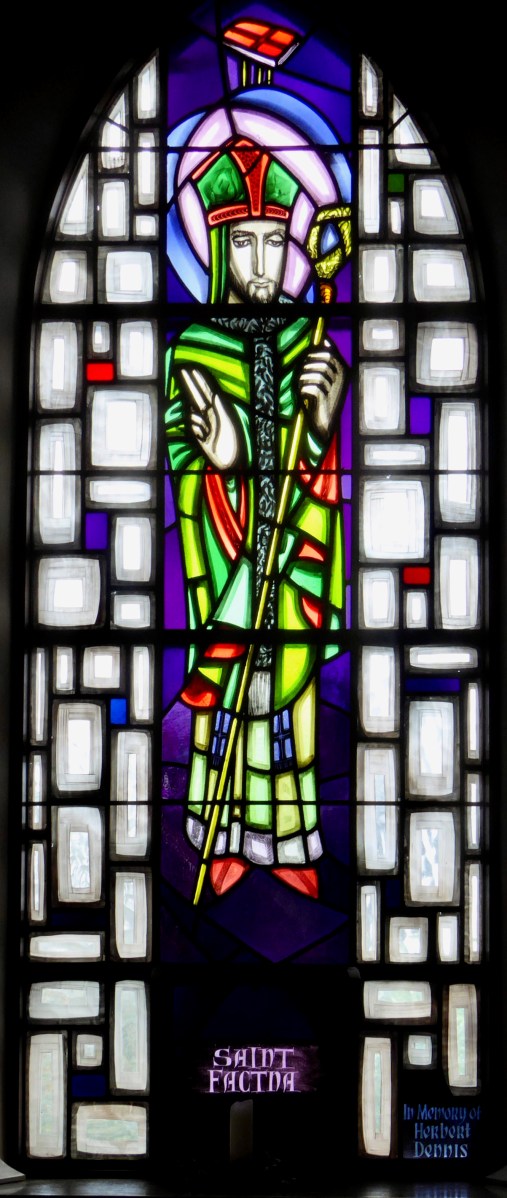
One of the best places to see Watson Revivalist windows, because it’s a small space and you can get close to the windows, is the Oratory at Gougane Barra. The vision for the building was that of Fr Patrick Hurley who developed the ‘ancient’ monastic settlement on the island, a scholarly man well versed in the Revivalist art and literature of the period who specified that the oratory itself would be built in the Neo-Romanesque style based on 12th century Irish churches such as Cormac’s Chapel (see this post for more on this). In the Oratory all the windows except a Marian image depict Irish saints, some of whom are local to Cork (Finbarr [above], Fachtna [below], Gobnait and Eltin).

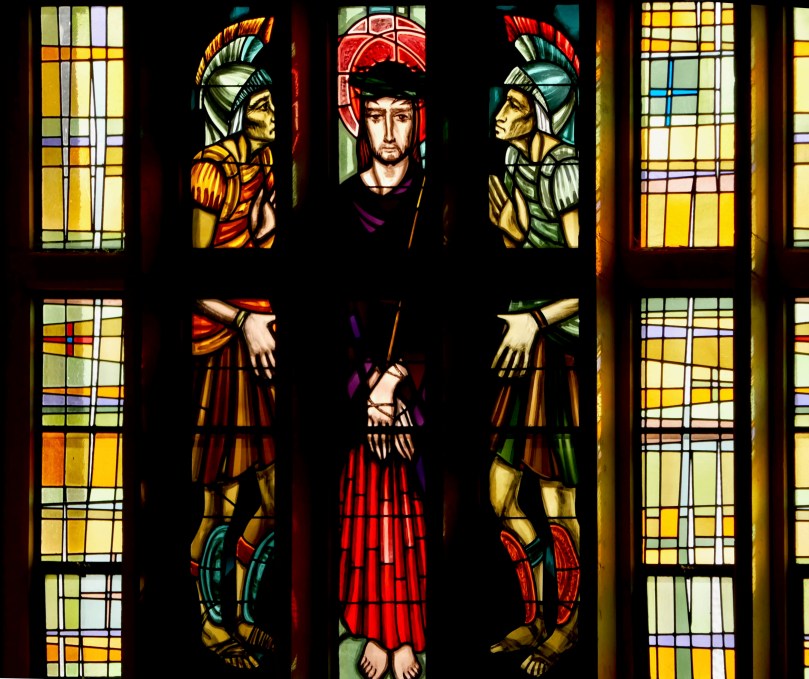
Another West Cork church with Watson Revivalist windows is in Ardfield, south of Clonakilty. I used some of these in my Symbols and Stories post so take a look at those now. Note that, in contrast with the Gougane Barra Oratory, the iconography in Ardfield is essentially International-Catholic (St James, Jesus, Mary), very much in line with the Devotional Revolution which I described in my post Saints and Soupers: the Story of Teampall na mBocht (Part 7, the New Catholicism). Instead of repeating the Ardfield images here I will send you instead to the little country church in Castletown-Kinneagh, near Enniskeane, and one of my favourite windows – the Infant of Prague. In the extensive renovation of this church the parishioners, ably led by Fr Tom Hayes, worked hard to save this window from a porch which had to be demolished and re-located it in a light box inside the church. While not perfect for back-lighting, this has the great advantage of allowing the viewer to get really close to the window to observe the painting techniques and the details. 

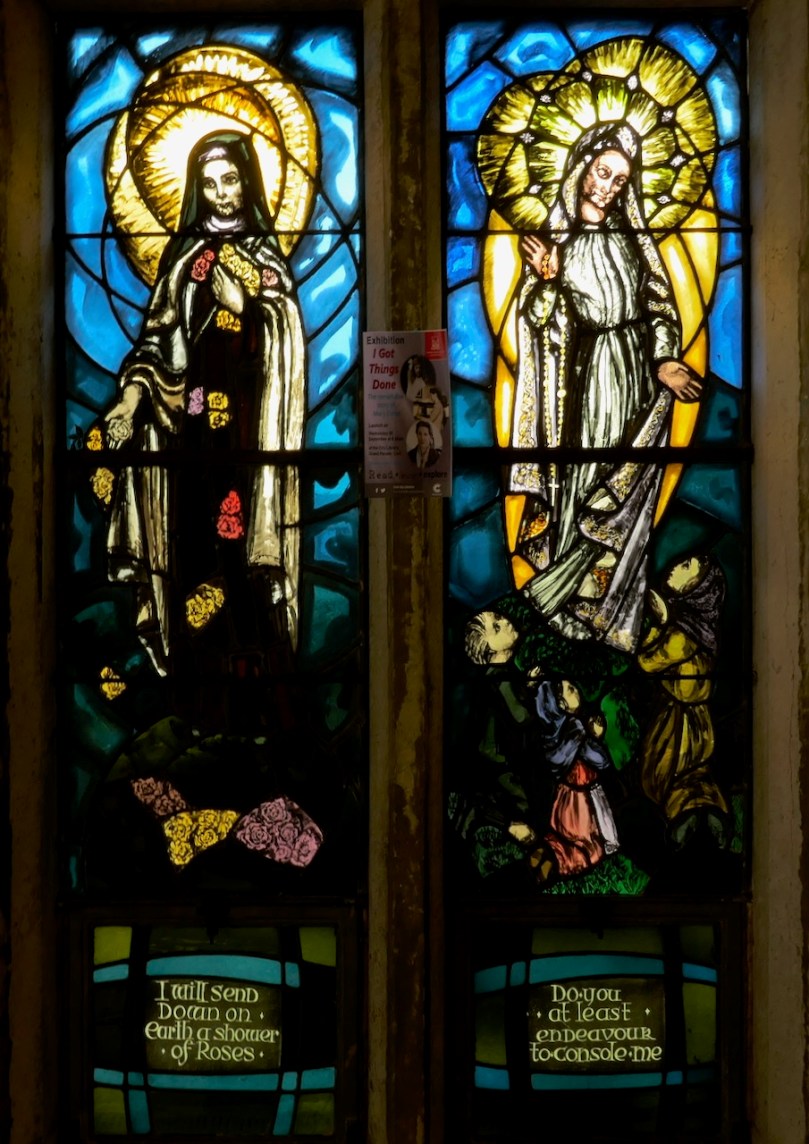
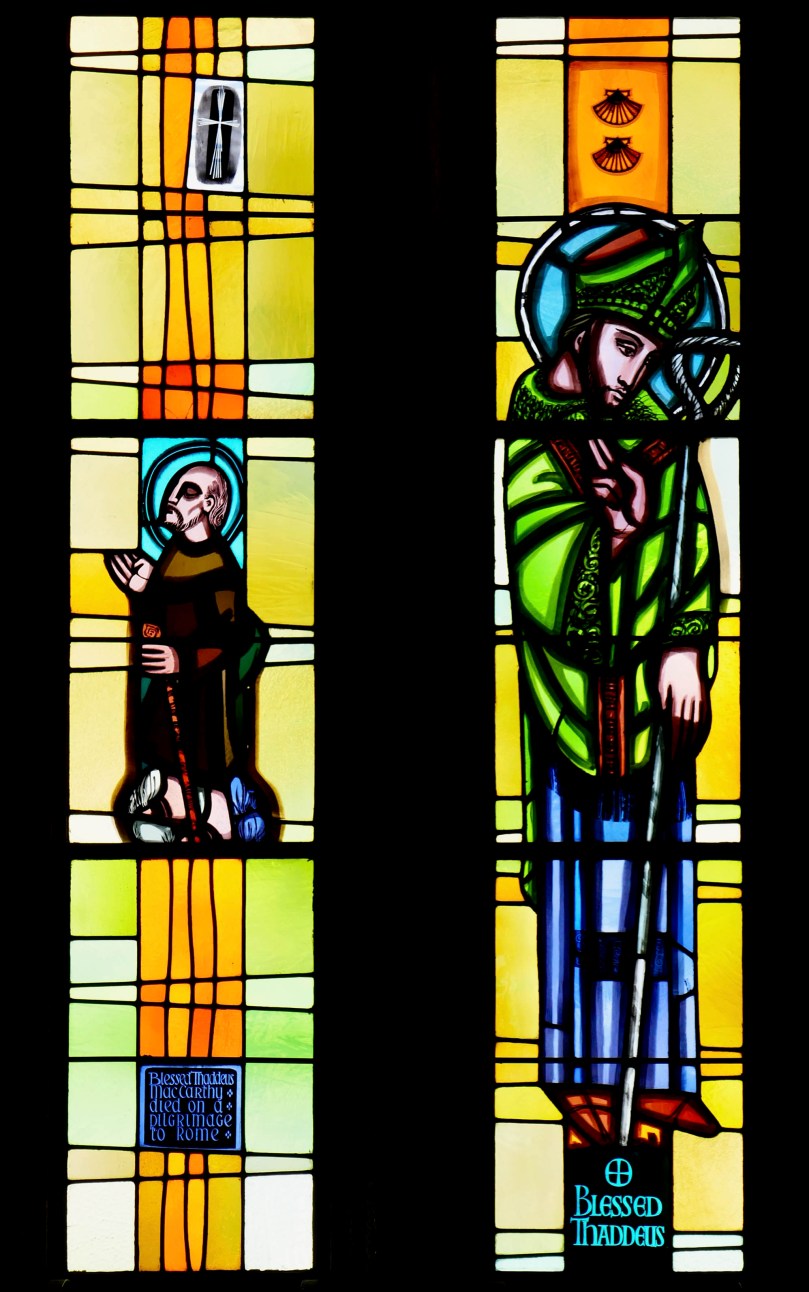
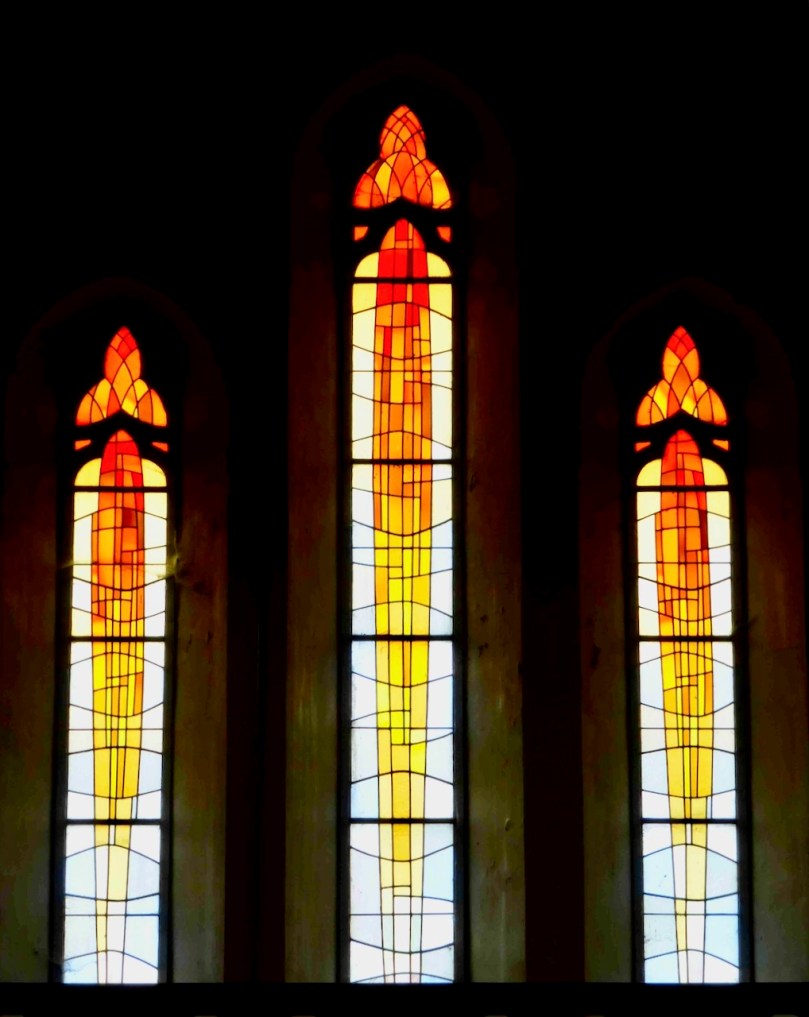
Next we will stop by St Ita’s church in Gortroe, near Youghal. Here you will find one of Watson’s Revivalist windows dedicated to that same Blessed Thaddeus McCarthy (below) about whom Fr Hurley wrote in the Journal of the Cork Historical and Archaeological Society and whose travails I described in my Post Thaddeus McCarthy, The Bishop Who Never Was. In the sanctuary is a three light window, the Sacred Heart flanked by Thaddeus and St Ita, while a Lourdes window occupies the south wall (a detail from that window is my lead image in this post).

Protestant churches were also attracted to Revivalist touches and one of the most interesting windows I’ve seen is in St John’s Church of Ireland in Knight’s Town on Valentia Island in Kerry. The two light window depicts the angels of Prayer and Praise, with book and harp. The angels are beautiful if over-familiar depictions, but it is the surround that shows how Watsons worked hard to customise windows according to the wishes of the clients.*

The windows commemorate James and Anne Graves. James Graves was the first Superintendent of the Anglo-American telegraph station on Valentia and he held the post for forty years. Accordingly, the framing surround of each window shows not only nicely worked-out interlace but the telegraph cable, punctuated by cross sections of that cable in red and green. Marine rope, telegraph poles and ceramic insulators also make an appearance, and the international telegraph alphabet is represented by black dots on a white background. The window was executed in 1912 and cost thirty five pounds.

So far I have illustrated this post from windows in small churches, but the very large Catholic Church of St Carthage in Lismore, Co Waterford, has several very fine Revivalist windows. Some are credited to Cox and Buckley and were completed in the 1890s; others were done after the company had changed its name to J Watson and Co. The church itself, in a flamboyant Lombardo-Romanesque style, is well worth a visit and the windows certainly enliven the interior. The iconography is a mixture of International-Catholic and Celtic-Revival/local iconography, with, for example, the Archangel Michael and St Carthage (see Part 1) side by side.

I included a detail from the Vision of St Ita window in Part 1, but it’s worth having a look at more of that window. The end of the nineteenth century saw the publication of many texts related to Irish saints – translations from Irish by such scholars as Whitley Stokes (see my post on The White Hound of Brigown) and Canon John O’Hanlon – and these became the religious equivalent of the stories of Finn McCool, Cuchulainn and the great Irish mythology cycles as written by Standish O’Grady and others at the time. St Ita was the foremost female saint of Ireland after St Brigid, and she is traditionally thought to have come from Waterford. She was given to visions and raptures and this is what is depicted here. And just look at those wonderful birds in the canopy above her head.

This demonstrates the popularity of these hagiographies with Irish Catholics and their clergy at the time – the artists responsible for these windows had to make sure they were well read on the lives of Irish saints. Both the Columcille window (above) and the Patrick window (below) exuberantly display their artist’s knowledge of the lives and deeds of these saints as well as their immersion in all the tropes of Celtic Revival imagery (wolfhound, anyone?).

The Rose Window has a panoply of Irish Saints (including Saint Otteran, Patron Saint of Atheists!) each one occupying one of the rays of the rose with cherubs encased in interlace. As they say in property ads – must be seen to be appreciated.

My final window astounded me when I first saw it – in fact I think it was my introduction to Watson’s use of interlace and it really is a virtuoso performance. I’ve used the bottom panel from it further back in the post to demonstrate how a cartoon ends up as a window, but the whole window deserves pride of place. It’s in the Catholic church in Inchigeelagh, Co Cork, and so we have circled back again to St Finbarr of Gougane Barra – an excellent place to stop.

I’ve included illustrations in this post from Cork, Kerry and Waterford but I would be interested to hear from anyone who has found Watson Revivalist windows anywhere.

Part 1 of this post is here

Time for Signs

It’s a few months since I took a selection from my ever increasing files of Irish Signs. If you want to see some of the older posts in this series, click here. Otherwise, I’m going to stand back and let the images speak for themselves: there are curiosities and humour: unexpected juxtapositions – and some that might leave you with question marks . . . I hope you will enjoy them all.

Mizen Mountains 2 – Lisheennacreagh

In this series I’m visiting and recording all the ‘mountains’ on the Mizen Peninsula in West Cork. I’m defining a mountain as any summit over 200m above sea level. If I hear you crying out ‘shame!’ – as a mere 200m peak can’t possibly be a mountain – then I can say our country is defined by its undulations, and here in the far west of Ireland all our outcrops, however modest, are dramatic and offer striking views over the landscape, such as the one above which looks north-west across Dunmanus Bay towards the Sheep’s Head, seen from this week’s climb.

Upper – approaching the ridges from the Schull direction, the three peaks of Corrin (left), Lisheennacreagh (centre) and Derrylahard (right) are set out before us. Lower – a closer view: Lisheennacreagh is on the left: its summit is hidden behind the forestry plantation

Last week we explored at the western end of the peninsula, where Knockatassonig – at a height of 204m – only just crept into our ‘mountain’ category. This week – much further to the east – we are more secure, as my chosen destination comes in at 274.6m. It’s actually higher than it looks as neighbouring Mount Corrin (no doubt about that one!) peaks at 288m, and appears much more of a climb from below. Today’s summit is not named on any map, so I’m probably courting controversy by calling it Lisheennacreagh, after the townland in which, by my calculations, the highest point is located. Have a look at the aerial view below:

The pink shading shows the outline of part of the large townland of Coolcoulaghta, the southern boundary of which takes a sinuous course to include the summit of Mount Corrin. Over in the east, however, our high point is exactly on the boundary between the townlands of Coolcoulaghta and Lisheennacreagh – a boundary which is physically defined at that point by a substantial fence, whose course – part of the Sheep’s Head Way Mt Corrin Loop route – we followed all the way up to this summit from the designated car parking area on the Rathuane to Durrus road. After much on-site pondering, I decided to give the summit to Lisheennacreagh, as Coolcoulaghta townland already claims Corrin!

Upper – Finola is heading out for the high ground: the summit is in the far distance, beside the forestry plantation. Lower – looking back from the ascent, high Mizen summits are set out: Corrin is in front of us and Mount Gabriel is in the distance to the left

According to the place name records surveyed in 1841, Lisheennacreagh (Irish Lisín ne Cré) means Little fort of the preys or plunders – I was hoping I might find some traces of ancient earthworks on this summit, but there is nothing visible: buried deep in the inaccessible forest is a scheduled monument, described as a hachured univallate enclosure with a diameter of 22m. In fact it’s not possible to complete this loop walk at all, as the way to the next high point – Derrylahard, 301.7m – passes through heavy forestry, but access has been blocked by storm damage earlier in the year.

Above – autumnal shades of rough grazing continues all the way over the summit: you can go only as far as the next section of forest. Our companions on the walk were just a few ponies

It may seem a fairly featureless walk, but it was well worth the efforts for the superb views in all directions. We were lucky with the day: the mild weather this year has continued right through September and well into October. The mixture of blue skies and scudding clouds emphasises the contours, shadows and natural features, wherever you look.

Rewarding views from the Lisheennacreagh climb: upper – looking across Roaringwater Bay to Baltimore; lower – Cape Clear in the far distance, with another view of Gabriel, the most dominant feature of our Mizen landscape

I found some entries from the Duchas Schools Folklore Collection, for Durrus School. I could not find anything specific to Lisheennacreagh, but I liked this introduction to ‘My Native Townland’ from Brenda MacCarthy dated May 9th 1938:

I live in the townland of Coolcolaughter away out in the country, far from any stuffy unpleasant town or city, and almost two miles from the village of Durrus. My home is at the foot of the mountain in a quiet peaceful valley where my father tills, and sows, and reaps, from dawn to dark year in year out, happy and prosperous, and thankful to God for health and existence . . .

One aspect of Lisheennacreagh is that it is one of the more accessible peaks. There’s a place to park your car (with a fine view looking out to Durrus!), good signage and waymarks. Once the path is repaired beyond this summit, you can go on to Derrylahard (which will be the subject of a future post) and complete the loop by going round Glanlough to Durrus, then back over Corrin – a marathon 17km in all. Choose a good day and you couldn’t hope for a more inspiring hike.

Good accounts of this route and the whole Sheep’s Head system of trails can be found in Amanda and Peter’s book Walking the Sheep’s Head Way – Wildways Press, 2015. Also, have a look at this Living the Sheep’s Head Way post.