Murphy Devitt in Cork, Part 1

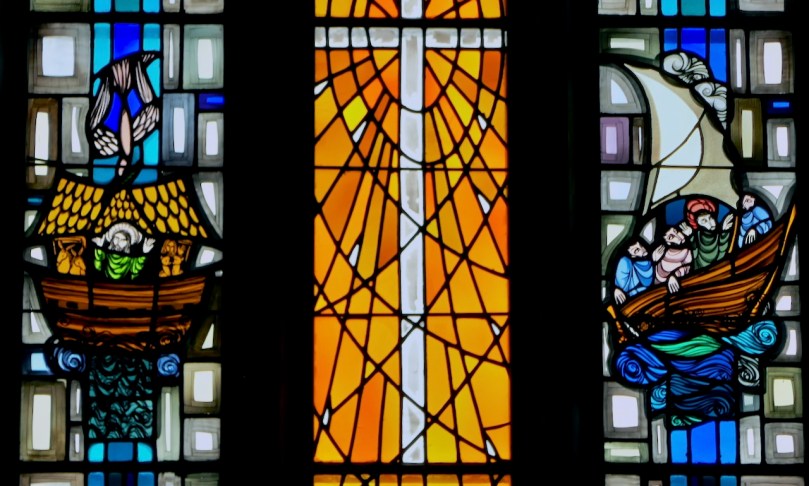
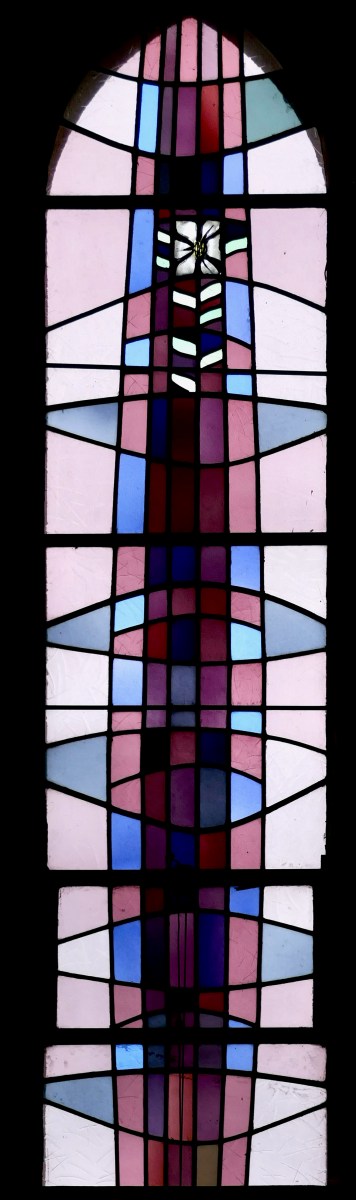
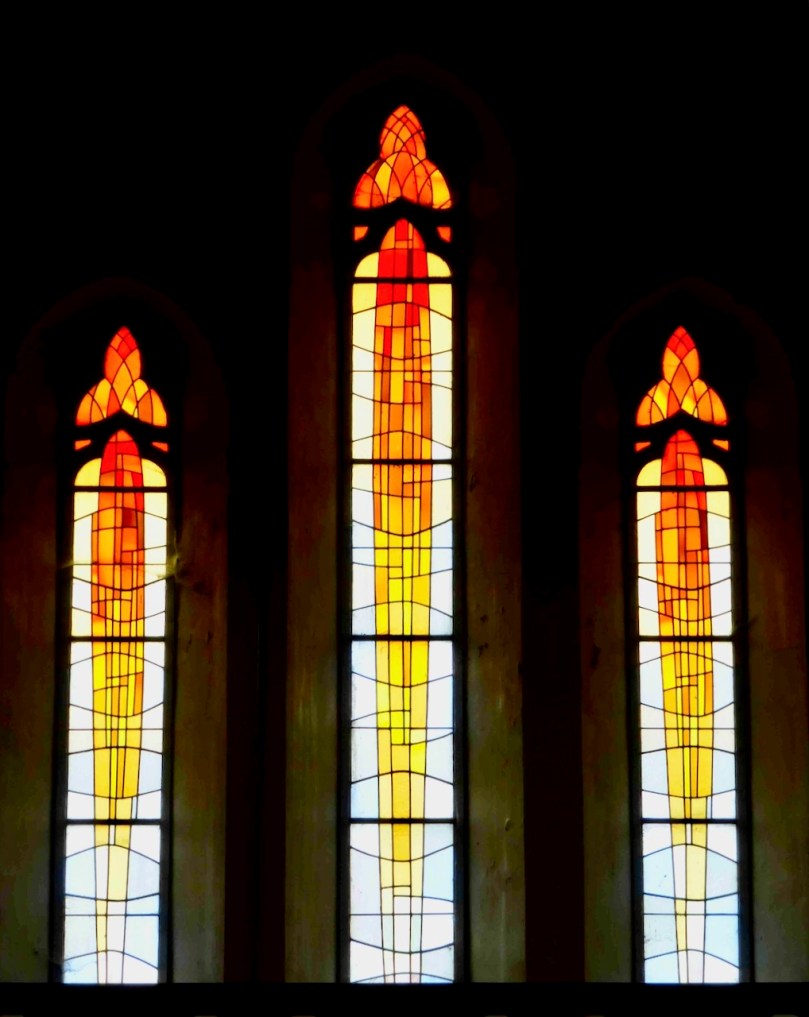
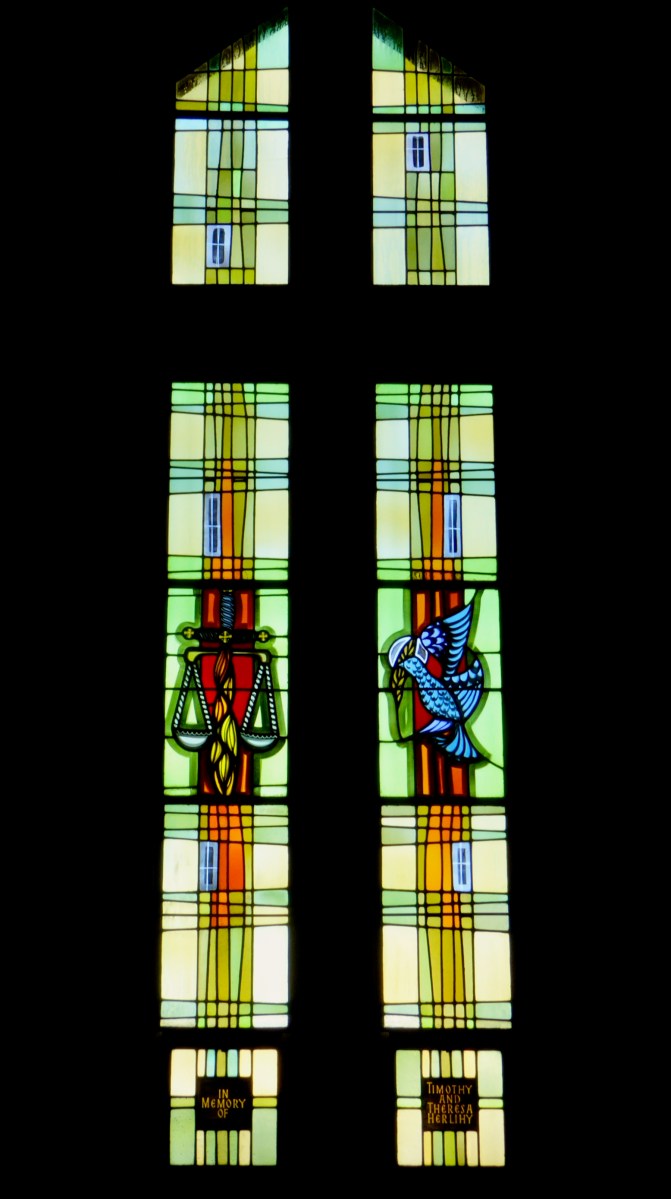
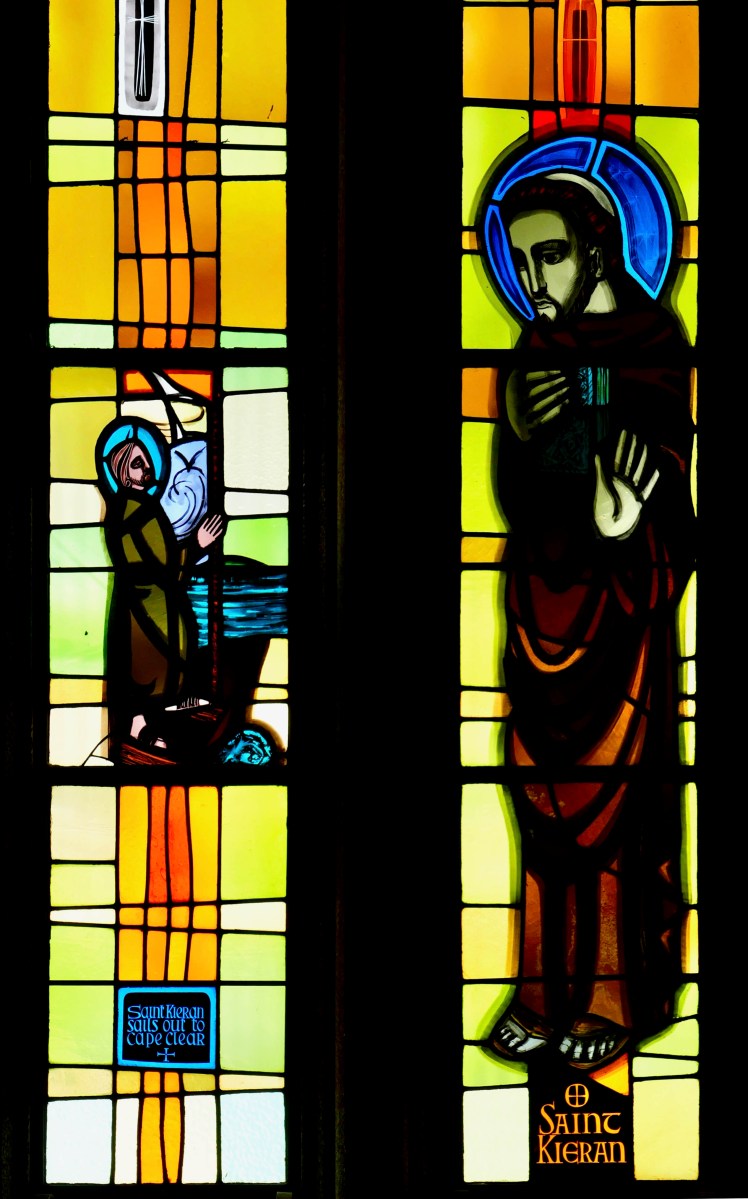
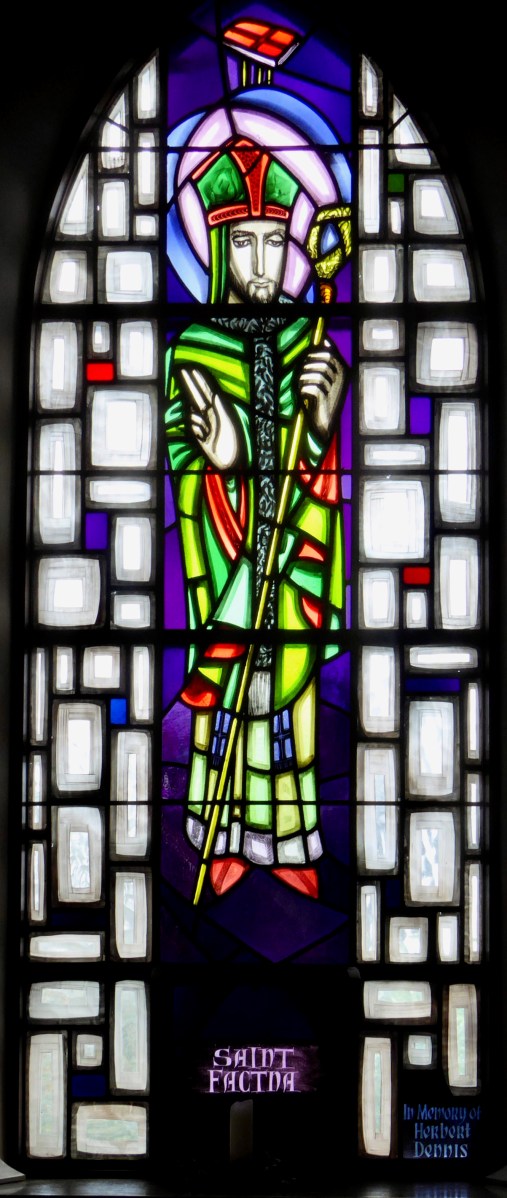
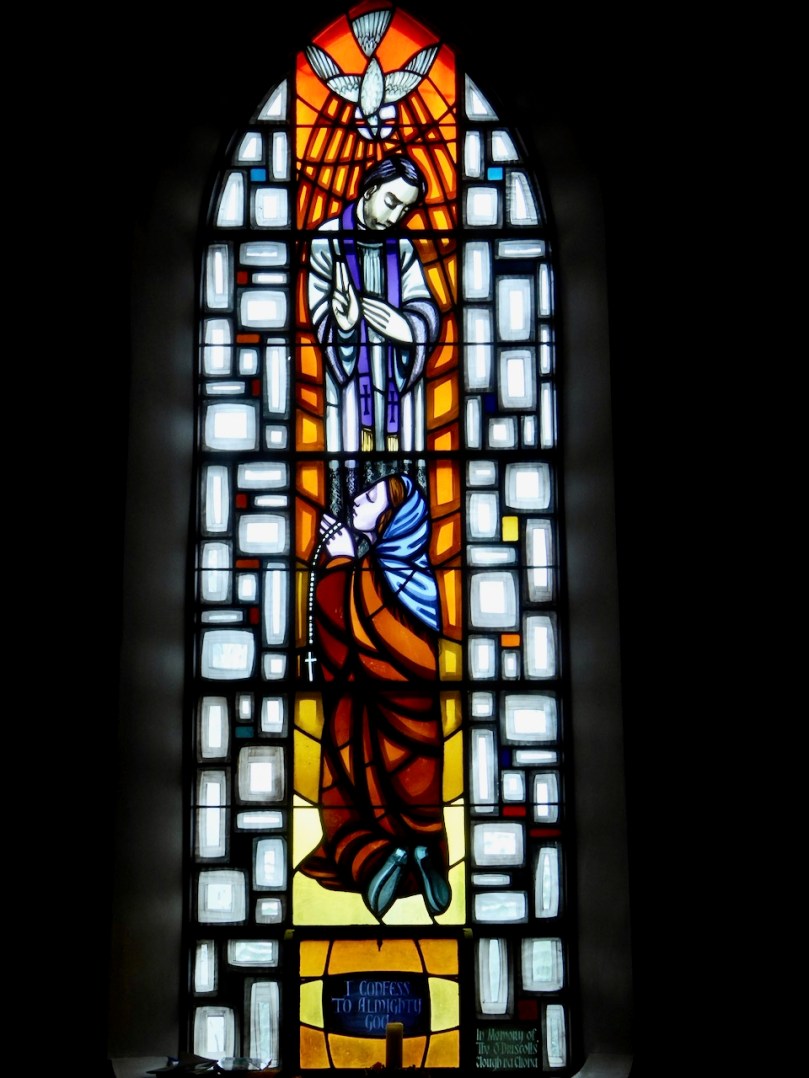
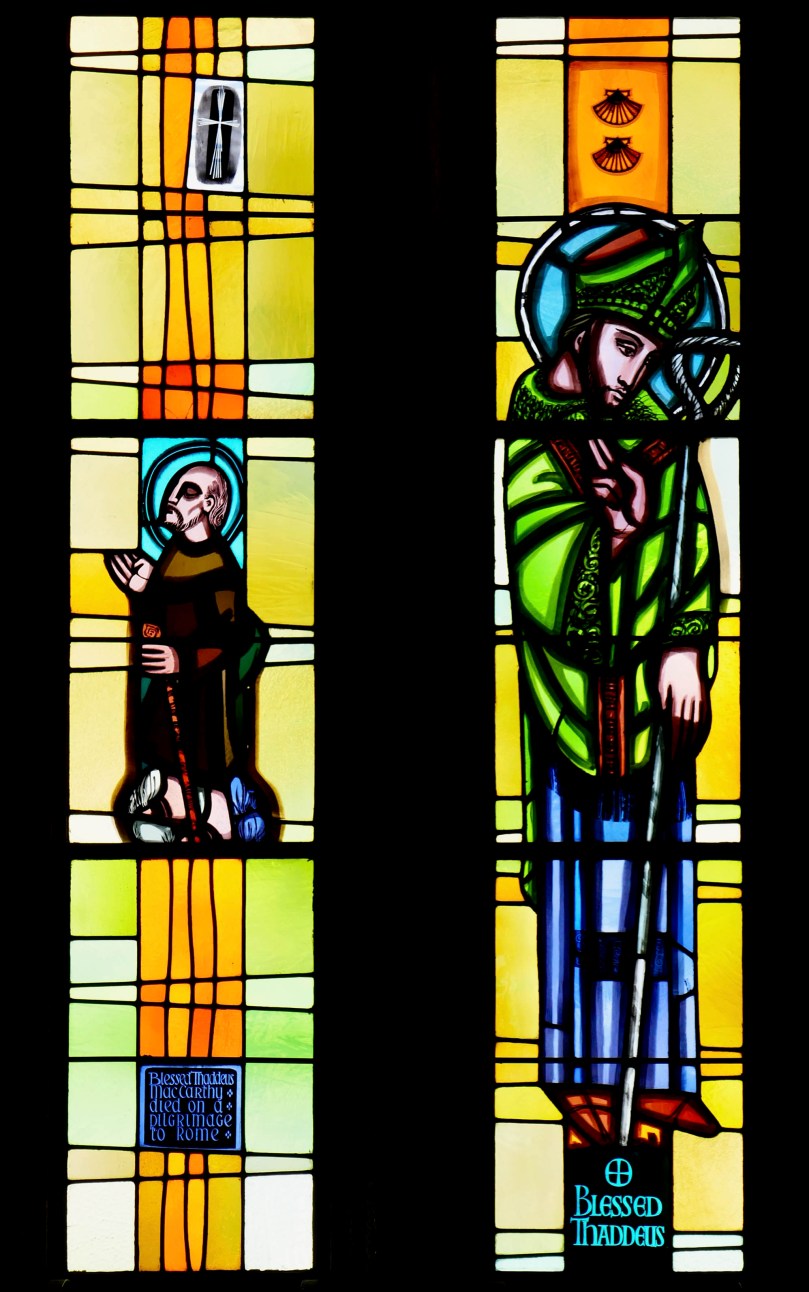
A couple of years ago I visited the Catholic church in Caheragh, just north of Skibbereen, specifically to look for an image of Thaddeus McCarthy about whom I was researching at the time (see my post Thaddeus McCarthy, the Bishop Who Never Was). As I stepped into the church it was immediately obvious that the stained glass was not the usual traditional images based on renaissance paintings that I had been seeing in most of the churches I had been in. No, what greeted me (above is the Thaddeus window) was something entirely new and different – modernist, colourful, idiosyncratic, painterly, beautifully designed and expertly executed windows, each one identified as the work of Murphy Devitt of Dublin and installed in 1963. I fell in love.

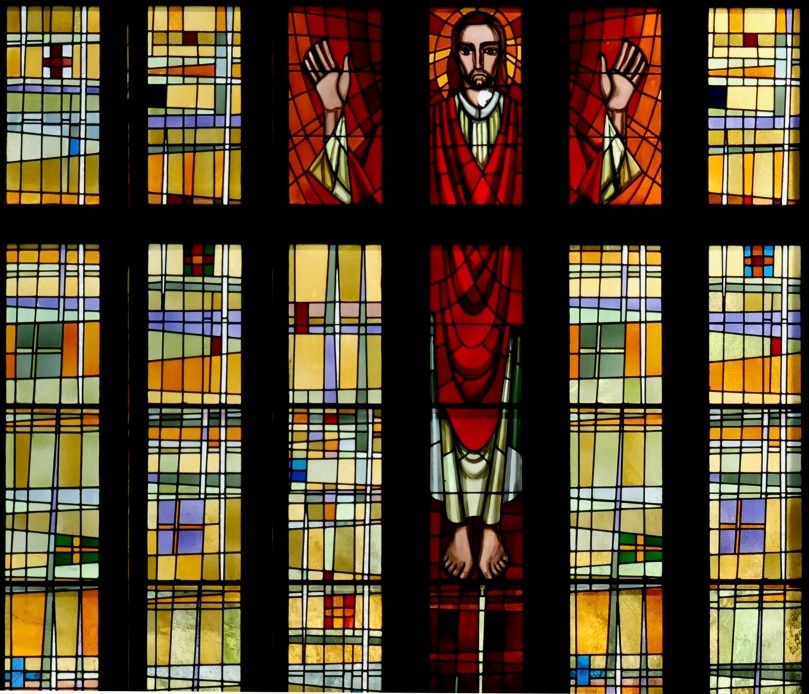
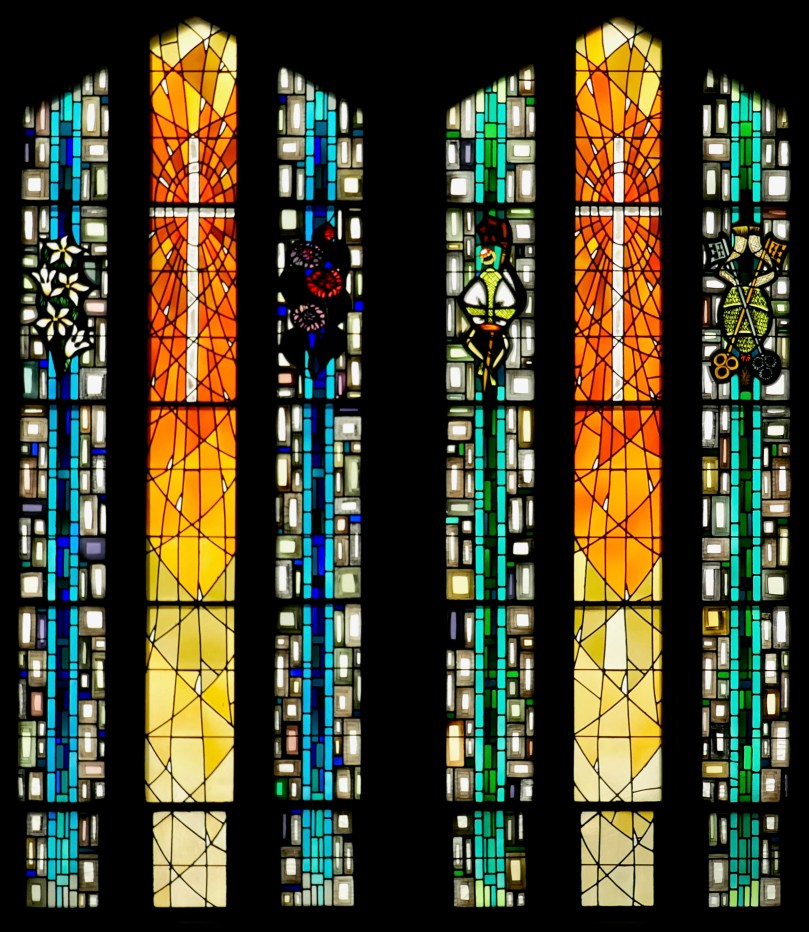
The stained glass windows in the rest of this post (except for one) are all from the Church of Our Lady Crowned, in Mayfield, Cork. This one represents the Risen Christ

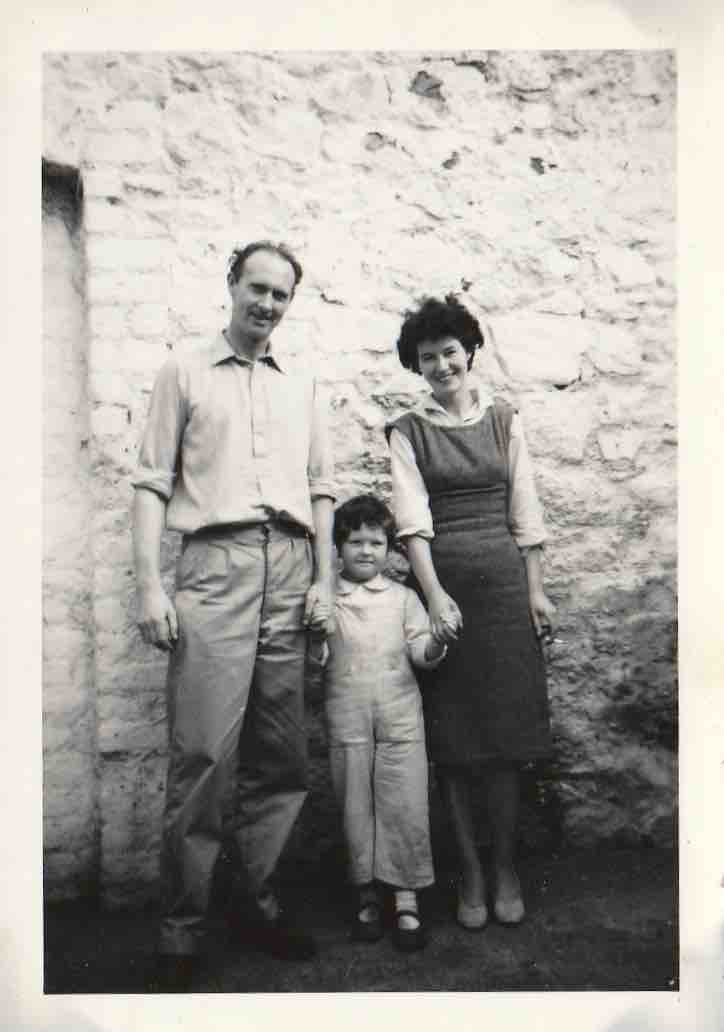
There are Murphy Devitt windows in ten Cork churches, and why not? Johnny Murphy, after all, was a Cork boy, brought up in the city and starting his art education at the Crawford School of Art in the 1940s when the life-drawing classes still revolved around the Canova casts. He was a standout student, winning a scholarship to the National College of Art in Dublin. There he met a fellow student, the beautiful Róisín Dowd, whose parents had fled the Belfast blitz to settle in Dublin. Together and separately, they travelled to Paris and Rome, doing what art students do – visiting galleries and studios, studying centuries of European painting, absorbing and responding to those influences (think Botticelli for Róisín, Klimt for Johnny), finding their artistic voices and refining their own styles.

The Presentation in the Temple (detail)

Returning home, they had to wait for several years to marry. Their daughter Réiltín suspects that Grandfather Dowd insisted on Johnny having gainful employment and that may have been why he joined the Harry Clarke Studios in 1952 and began to seriously study the craft of glass painting. Harry Clarke died in 1931 but his studios carried on making stained glass until the 1970s. There was plenty of work for anyone in the ecclesiastical provisioning business as new churches were going up all over the country to serve the burgeoning, and pious, population.

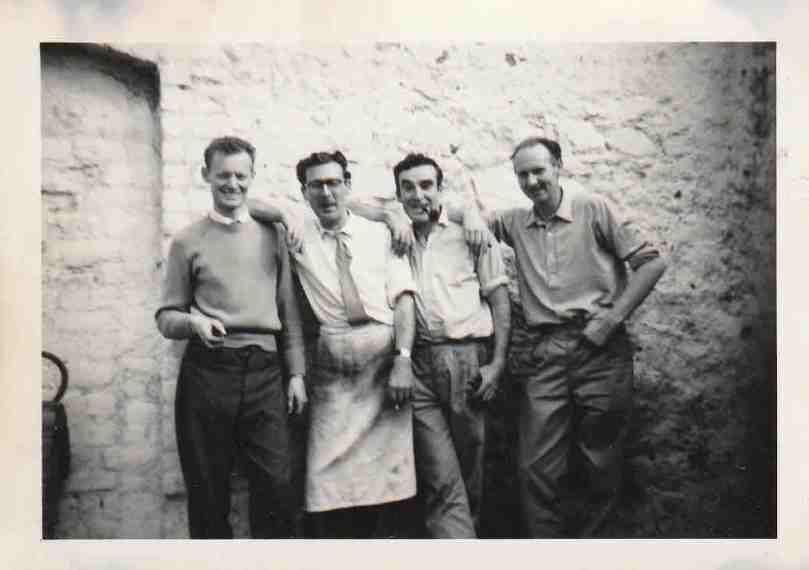
Dessie Devitt, Paddy McLoughlin, Mickey Watson and Johnny Murphy in their busy studio in the 60s

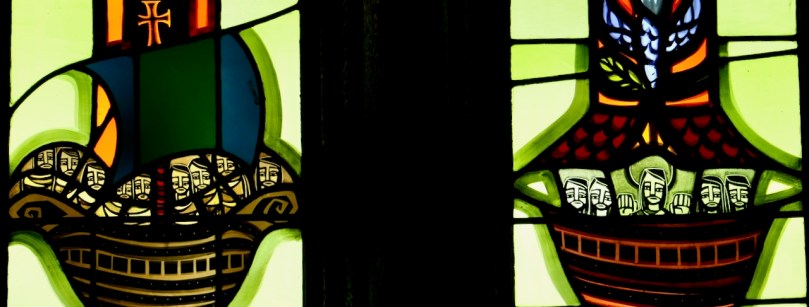
One of the glaziers Johnny worked with at the Harry Clarke Studios was John Devitt, universally known as Des or Dessie. Becoming fast and lifelong friends, they decided to strike out on their own, taking some of the men from the HC Studios with them. It was the late 50s and they couldn’t have picked a better time. Working from a mews in Monkstown and later a custom-built studio in Blackrock, they started to tender successfully for new commissions. This also allowed Johnny and Róisín, who now joined them as well when she could escape motherly duties, to develop their own unique approach to designing and painting stained glass, very different from what had become a somewhat hidebound atmosphere at the Harry Clarke Studios. For an example of what I mean by that, and to illustrate the contrast with MD, take a look at my post Time Warp, featuring a set of Harry Clarke Studio windows from the late 1950s. Below is a detail from one of them – far, indeed from the genius of Harry Clarke himself.

Detail from a Harry Clarke Studio window in Drimoleague. Although this window is interesting for lots of other reasons, the quality of the glasswork and the artistry of the painting had declined over the decades since Harry’s death. 

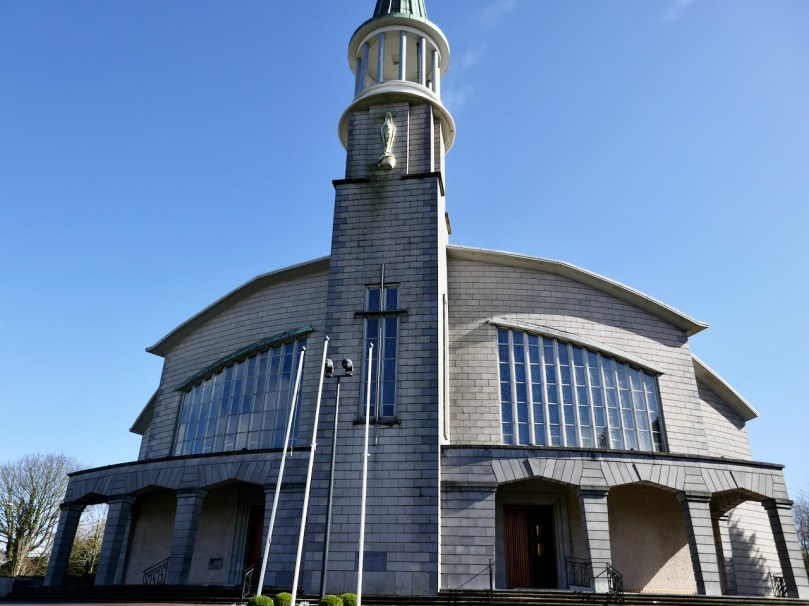
What Johnny always called their ‘first big break’ came with the Church of Our Lady Crowned, in Mayfield, Cork, completed in 1962. According to The National Inventory of Architectural Heritage:

Our Lady Crowned Roman Catholic Church was built to the design of J.R. Boyd Barrett’s firm and when completed in 1962 comprised the final of five new churches constructed to the north side of Cork city and named after the five Glorious Mysteries of the Rosary. The design and construction of the roof is of technical importance while the extensive stained glass windows, from the workshops of Murphy & Devitt in Dublin, are of particular artistic merit.
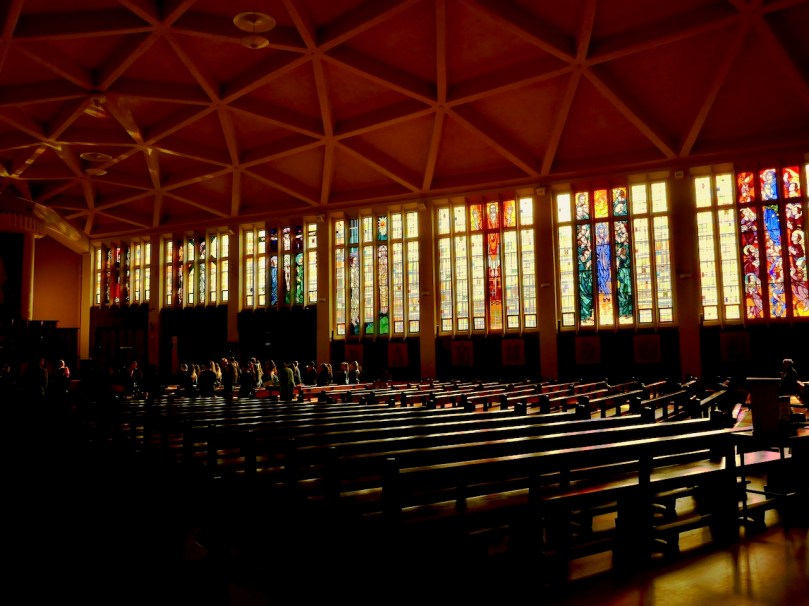
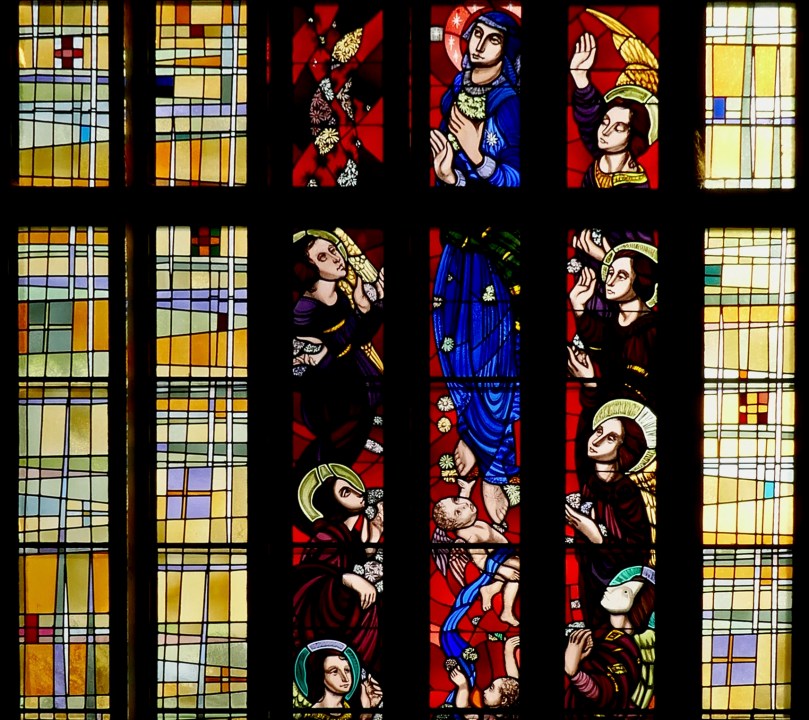
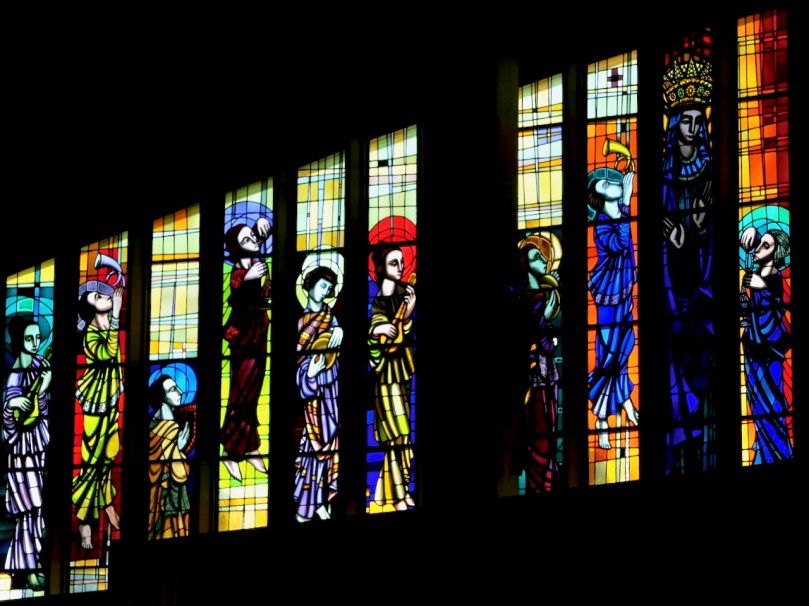
Too often, stained glass windows are one-off commemorative objects, mounted in an available opening. But when you see a whole scheme of windows in one church, designed to fit and complement the architecture throughout the building, the effect can be breathtaking. And so it is with Our Lady Crowned. The church is wedged-shaped, with enormous glass panels occupying at least half the space. Scenes from the Life of Christ range around the walls, from the Annunciation to the Crucifixion and Epiphany, with the huge area over the main door taken up with a choir of angels heralding the crowning of Mary on one side and Christ on the other.   
The day we visited the church was full of children preparing for their Confirmation

When I told Réiltín Murphy*, Johnny and Róisín’s daughter, that Our Lady Crowned was my favourite of the Cork MD churches, she responded that it was her parents’ favourite too. It’s not hard to see why – it’s a triumph of imagination, artistic vision, craftsmanship and above all collaboration. As I get more familiar with MD windows the distinction between a Johnny Murphy window and a Róisín Dowd Murphy window is sometimes quite clear: Johnny’s style is more angular, with loose dark brushstrokes, strongly marked facial features, heads tilted at an angle, while Róisín’s figures are more curvy and flowing, with greater attention to fabric and to musical instruments. Réiltín characterises the difference thus: Róisín’s figures, I always think, are too busy to pose for their photo while Johnny’s are usually quietly aware of just who they are and what they symbolise.

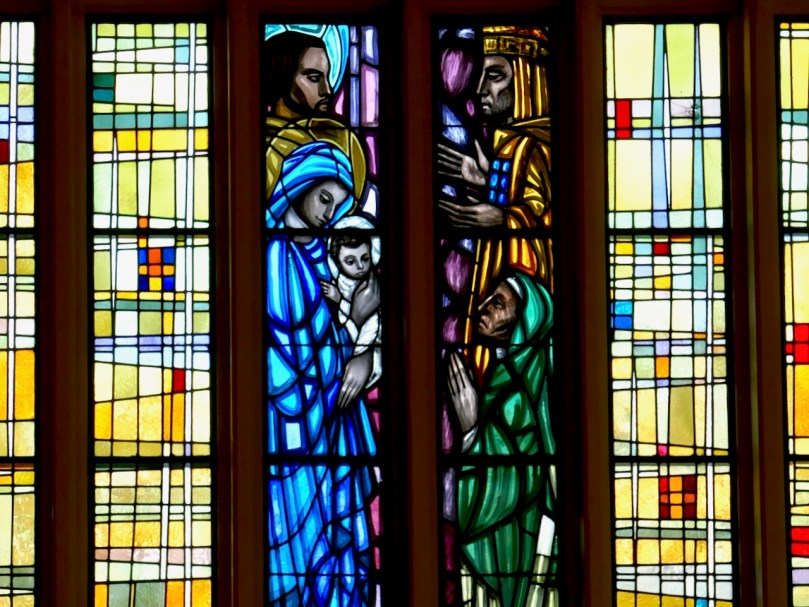
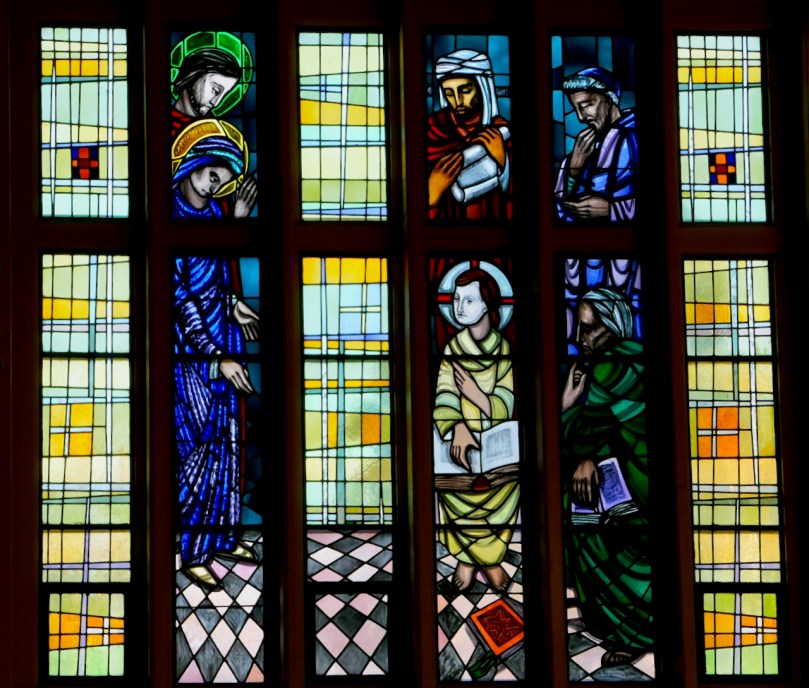
Nativity, Presentation and Jesus in the Temple windows

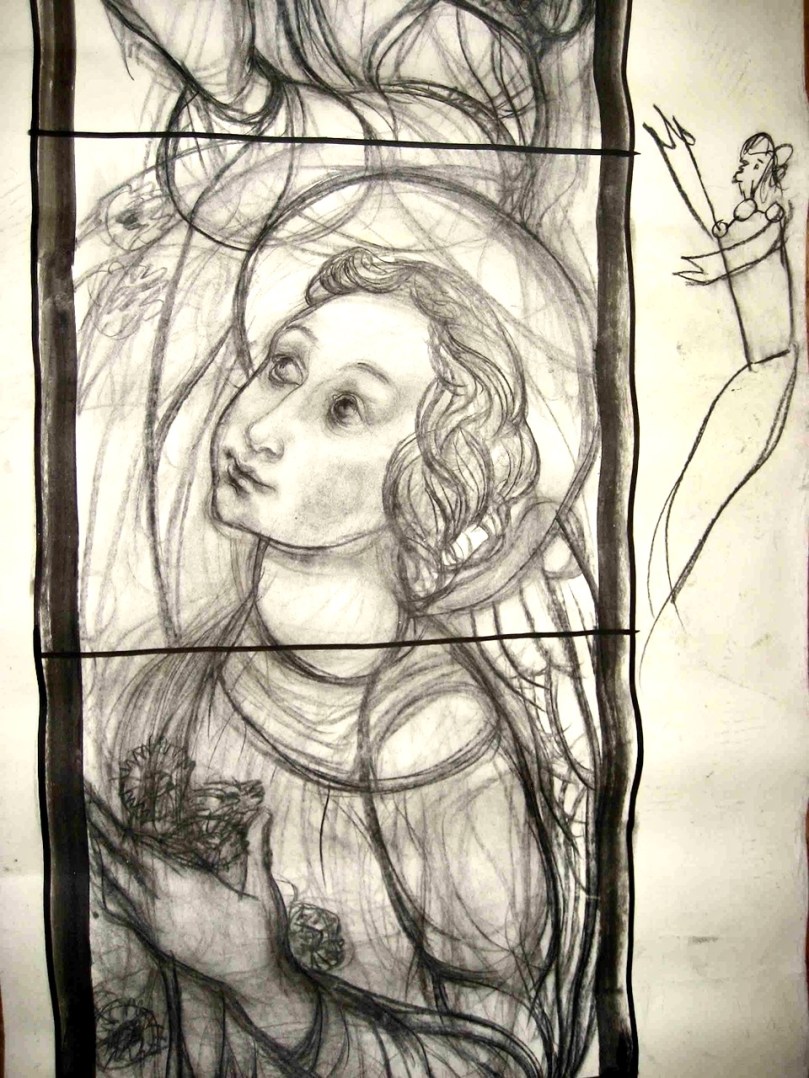
In Mayfield, all those elements are present: at first glance it’s impossible to tell where Johnny leaves off and Róisín begins. But we do have evidence, in the form of an original cartoon, that links Róisín directly to the Assumption window and once you see that, you see her hand in other places too – the heavenly choir, for example, has many of her hallmarks.

Róisín’s cartoon for the second angel from the bottom on the right, and the finished window

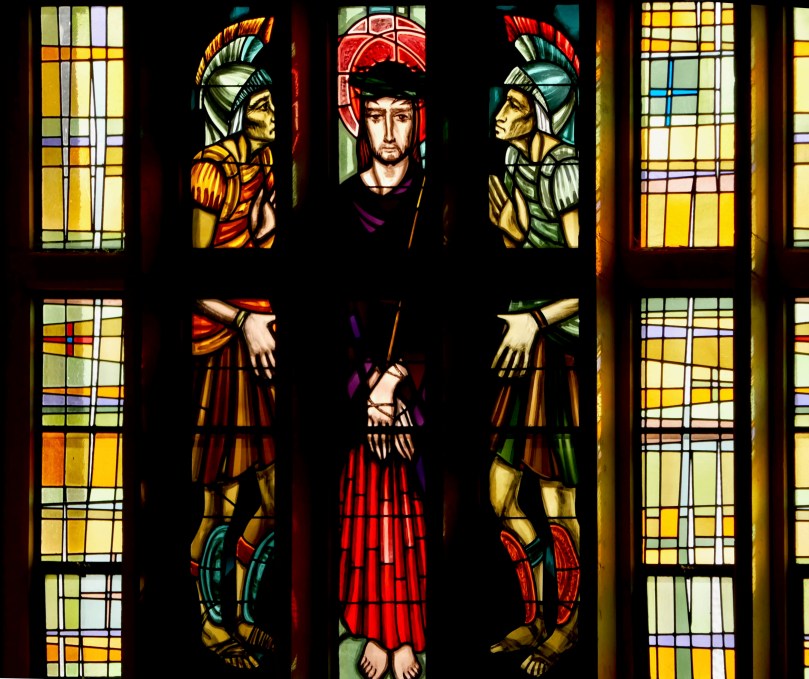
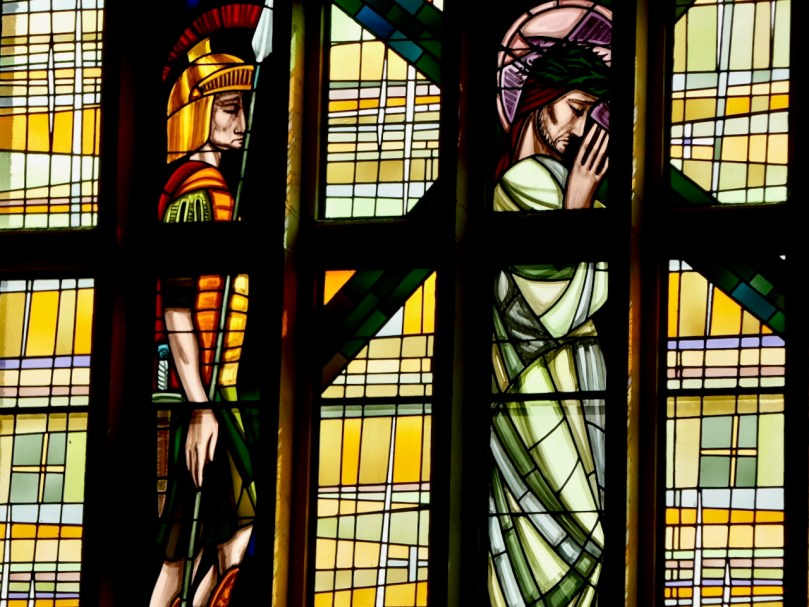
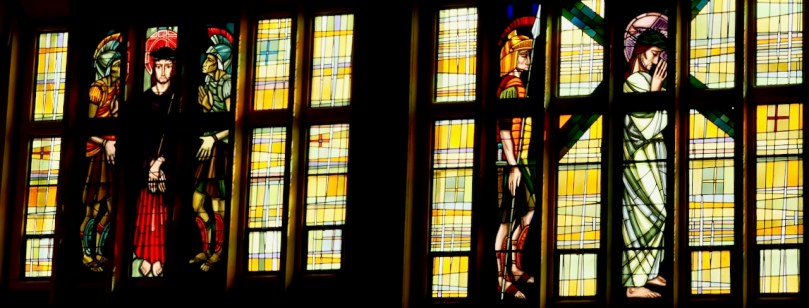
I am tempted to see Johnny in the passion images – the sombre figure of the suffering Jesus (below) exudes a quiet power alongside the mocking soldiers.

But many of the windows defy easy analysis. Look at the Nativity window (below), for example, and see if you can figure out whose hand is where. Complicating all this in Murphy Devitt windows is that when times got busy they took in extra artists to help with the workload.

In this window note how the ‘break-outs’ (the areas of coloured glass) are used to separate two long panels, which are then unified at the top. The composition, which manages to include all the major figures in two tall narrow panels, is impressive, as is the integration of those panels with the break-outs.

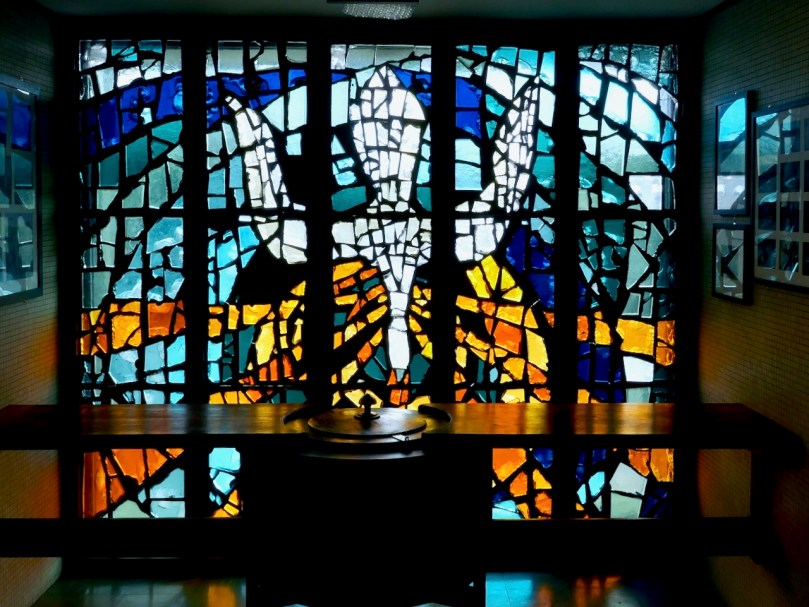
As with most of their commissions, Johnny was the one who sketched out the overall design and decided on the ratio of figurative panels to ‘break ups’, those areas of coloured glass that allow the eye to rest between scenes, to register the passage of time between events. Non-figurative schemes became important elements in the Murphy Devitt style – more about  them later, but for the moment note the highly original way in which the expanse of coloured glass are treated. Nobody else was doing anything like this at the time – it was a unique and beautiful Murphy Devitt innovation.

In this window, the Finding of Jesus in the Temple, the separating device is the break-out panel and the unifying device is the floor

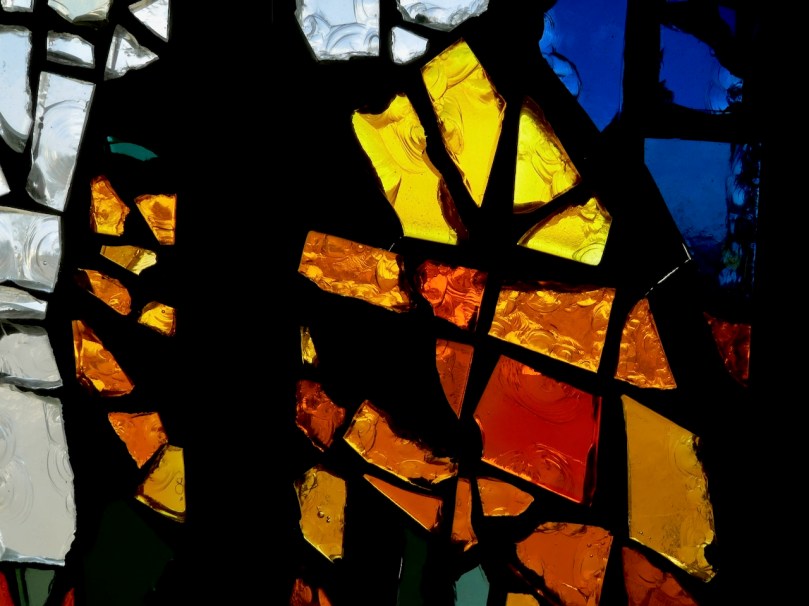
Not for Murphy Devitt the regular quarry glass with its dependable lozenge shapes, or static grids of straight lines. Johnny loved the wobbly, the wavy and and the irregular. Réiltín says, He was interested in music: the fugue, he said, whereby the same melody/image is played in different keys – his abstracts are often flipped, turned, twisted to be similar but not identical. He loved glass as a painting medium. He loved its kinetic effect in its flaws, its trees moving outside, its changing light/colours from passing clouds, its seeming to be alive.

A window where the break-outs serve as background, with the two main figures occupying panels and the cross stretching across the space

It’s a lot easier to cut regular shapes and fit them together, of course, but you don’t need an expert for that. This is where Dessie Devitt came into his own as a master glazier. Choosing the glass to match the colour scheme, assembling it all harmoniously, cutting and leading the thousands of pieces that went into a scheme like this – none of it would have been possible without Dessie Devitt and the men who worked alongside him.

The heavenly choir, above  one side of the main door, with Our Lady Crowned on the right. Below is a detail from the other side

By all accounts it was a charmed workplace, a happy environment where everyone worked hard but where laughter and The Chat abounded. Des in particular was gifted with the ability to recognise the absurd and could hardly leave the studio without coming back with an entertaining story.

About the same time as Mayfield, Murphy Devitt won the commission to design a set of windows based on the Canticle of St Francis for another Cork church, this one attached to a Cappuchin Friary. We’ll take a look at that one and some others next week. For the moment, the Mayfield church will serve as an introduction to Johnny, Róisín and Des, their modern aesthetic and their collaborative approach.

*Many thank to Réiltín Murphy for much of the background information, for answering all my questions and for additional photographs, including the people pictures and Róisín’s cartoon.

Getting Into the Art!

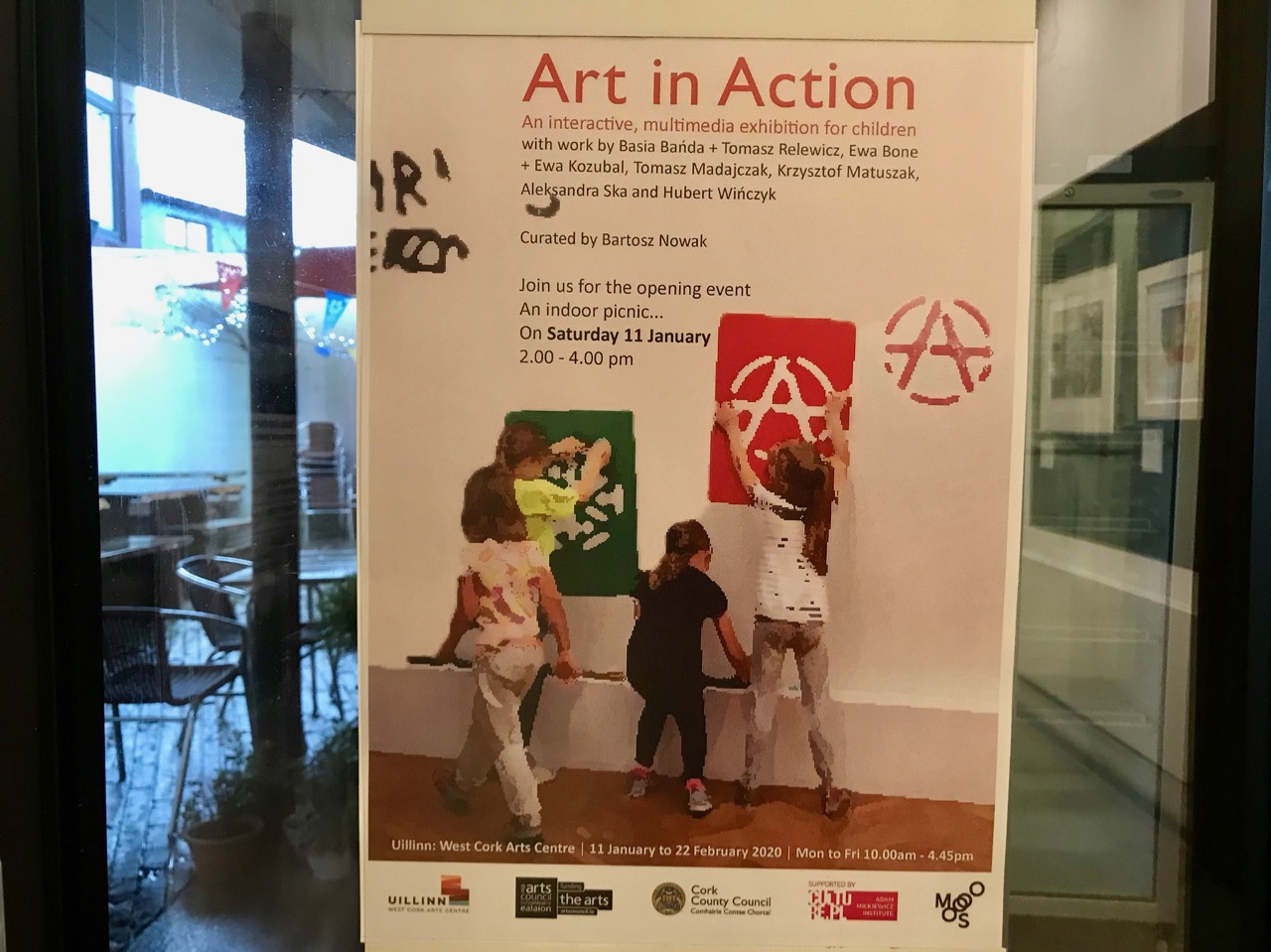
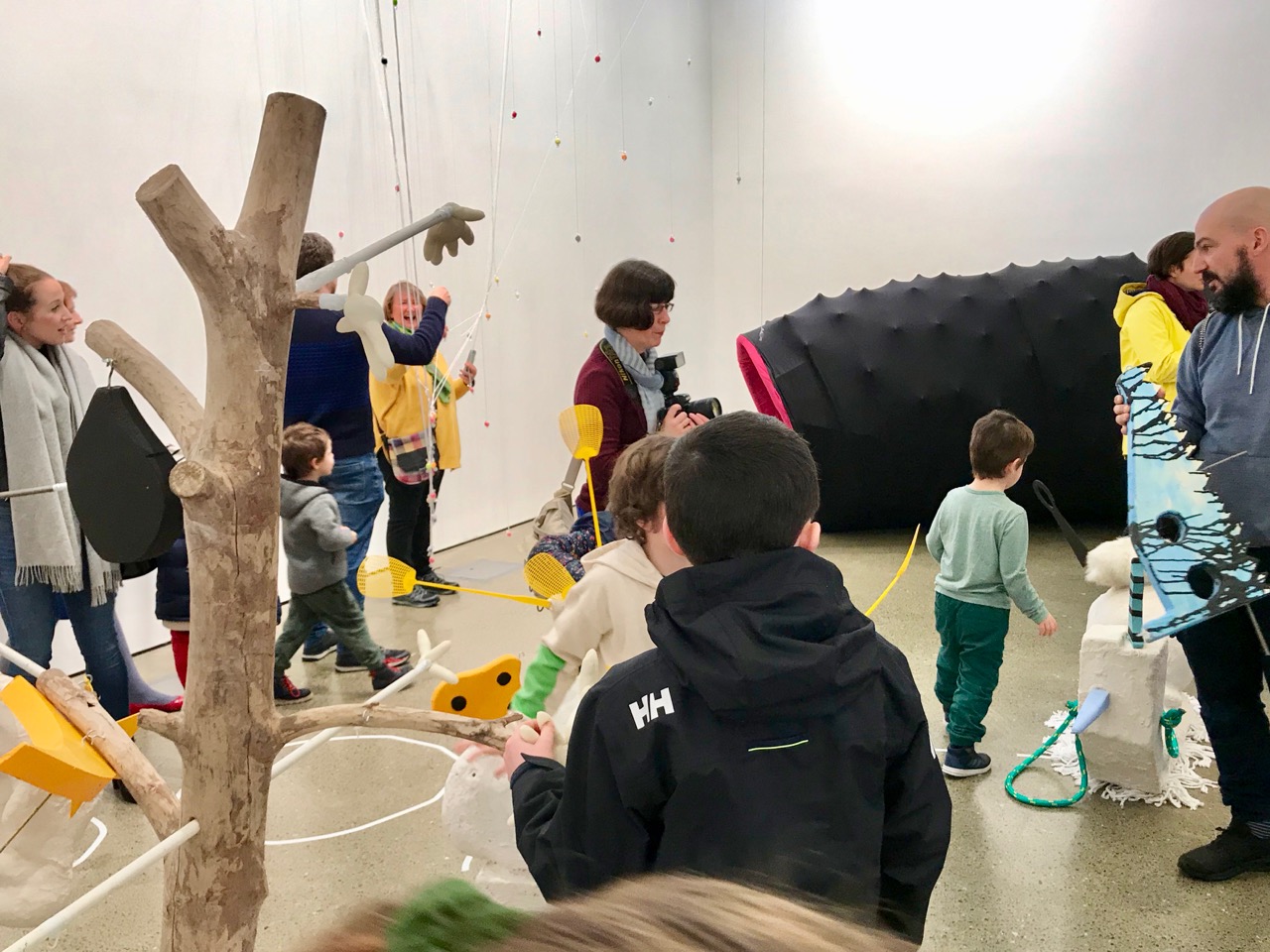
Uillinn – the West Cork Arts Centre gallery in Skibbereen – has just opened its first exhibition of 2020. It’s a riot! I have seldom seen such enthusiasm in an art show from the lively crowd who had gathered for the launch event, billed as an indoor picnic.

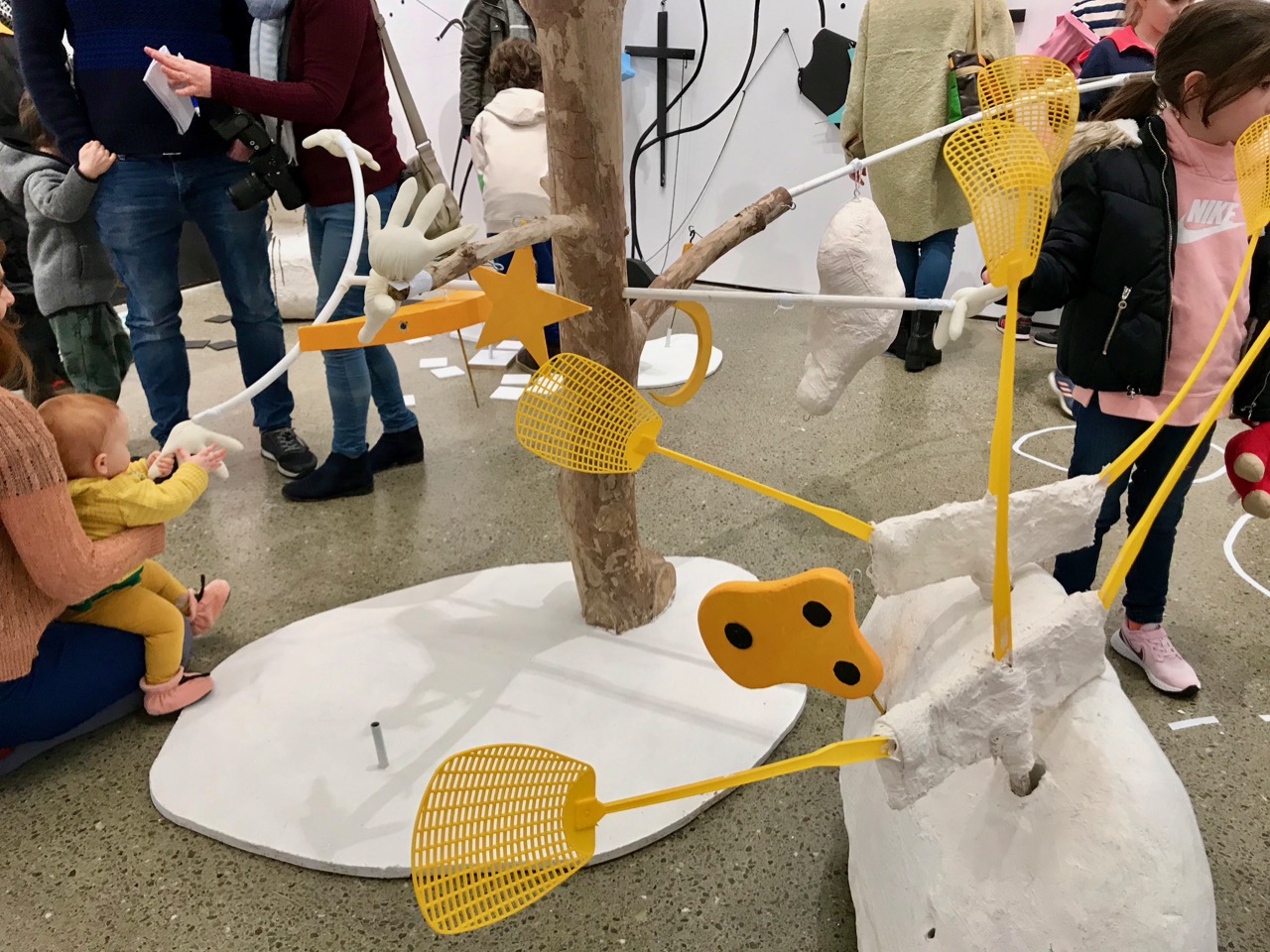
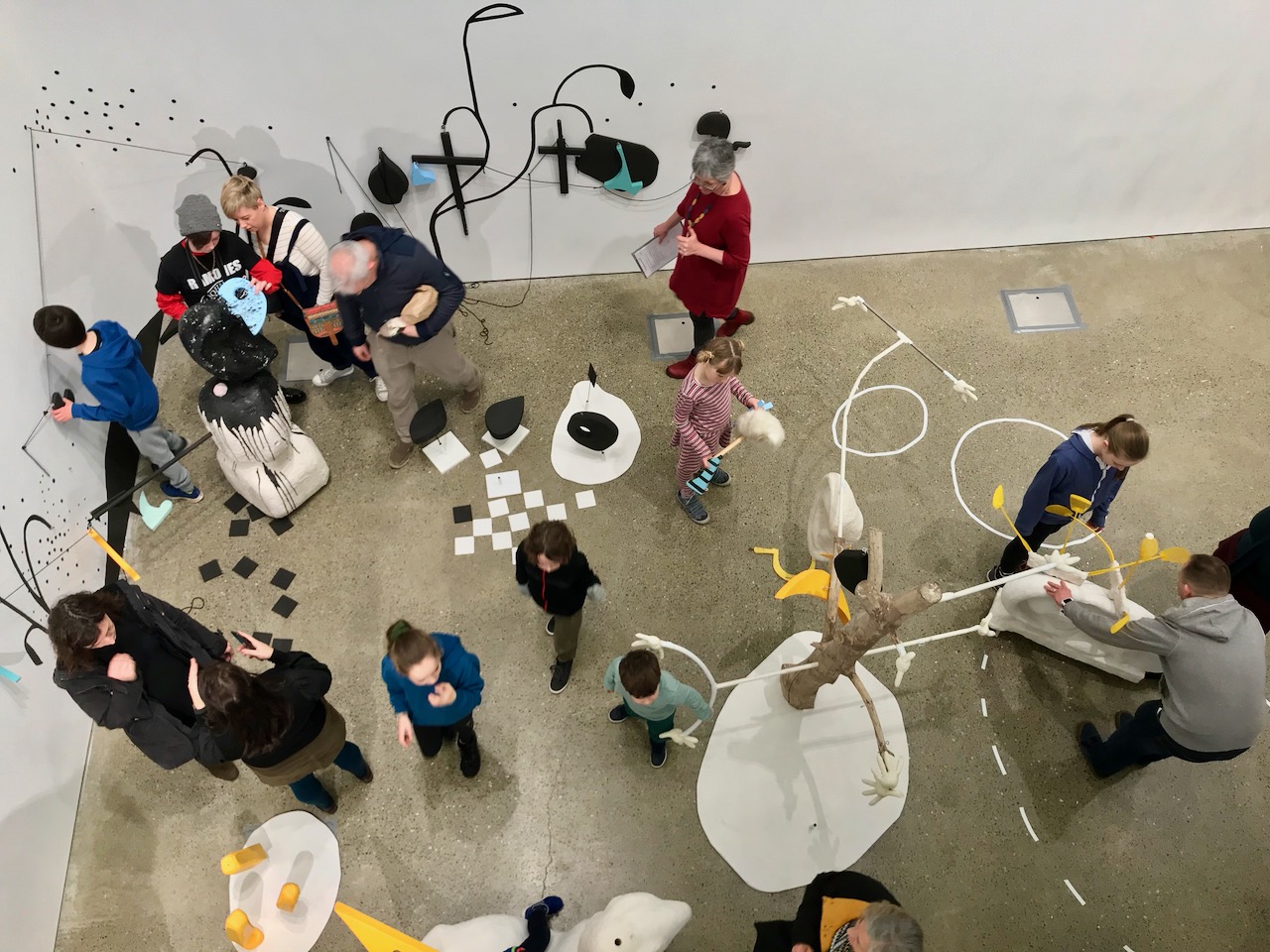
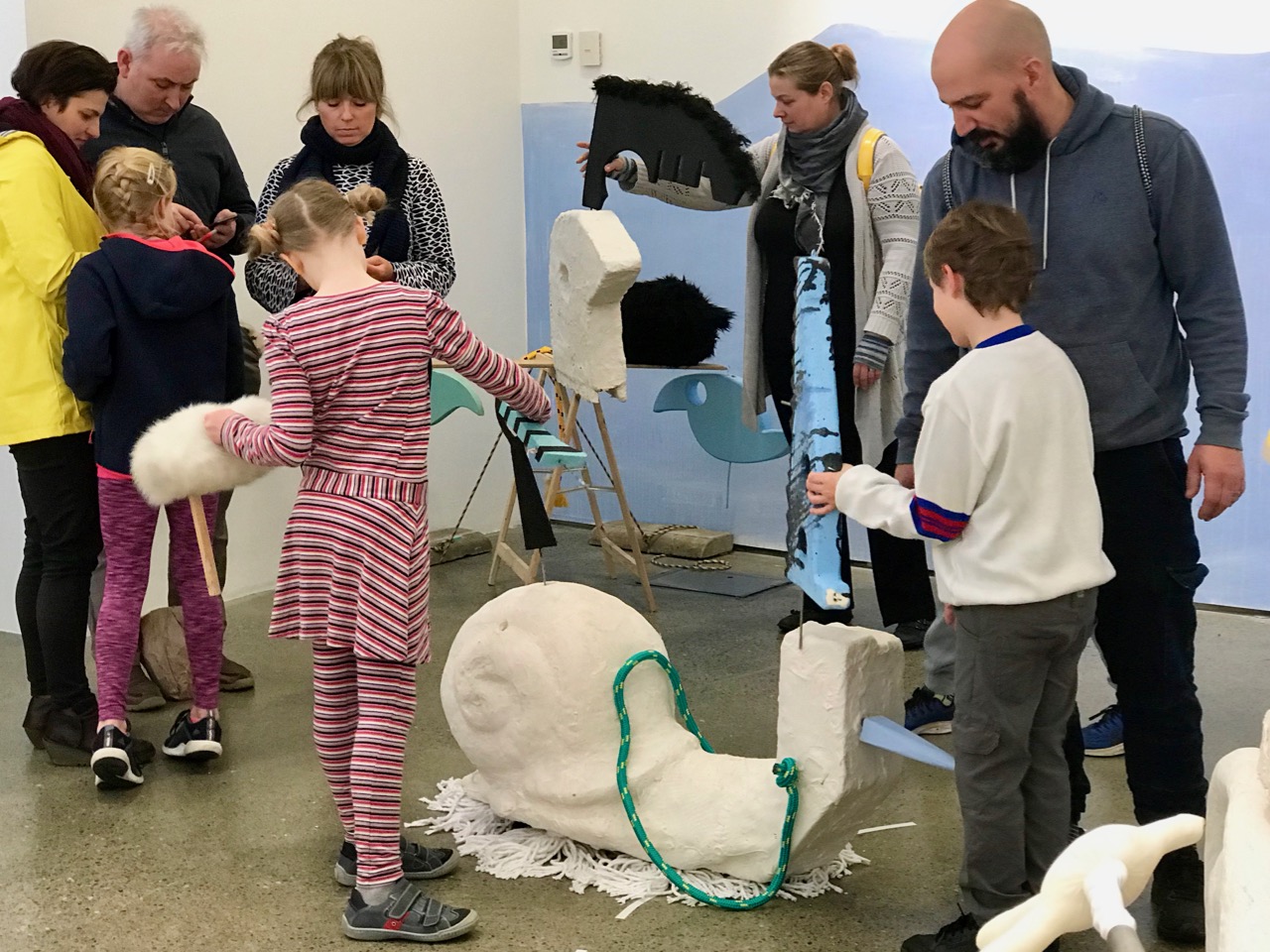
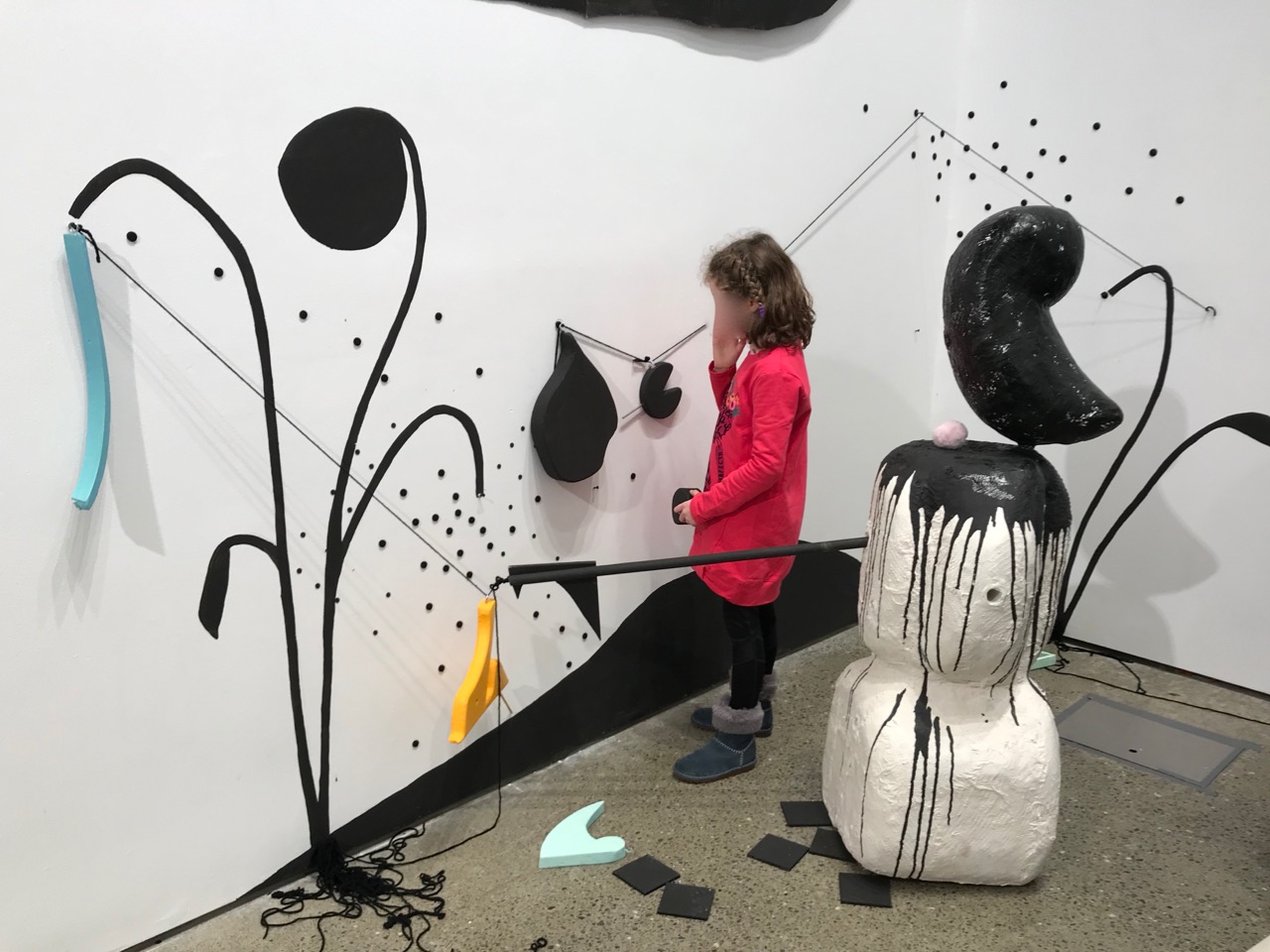
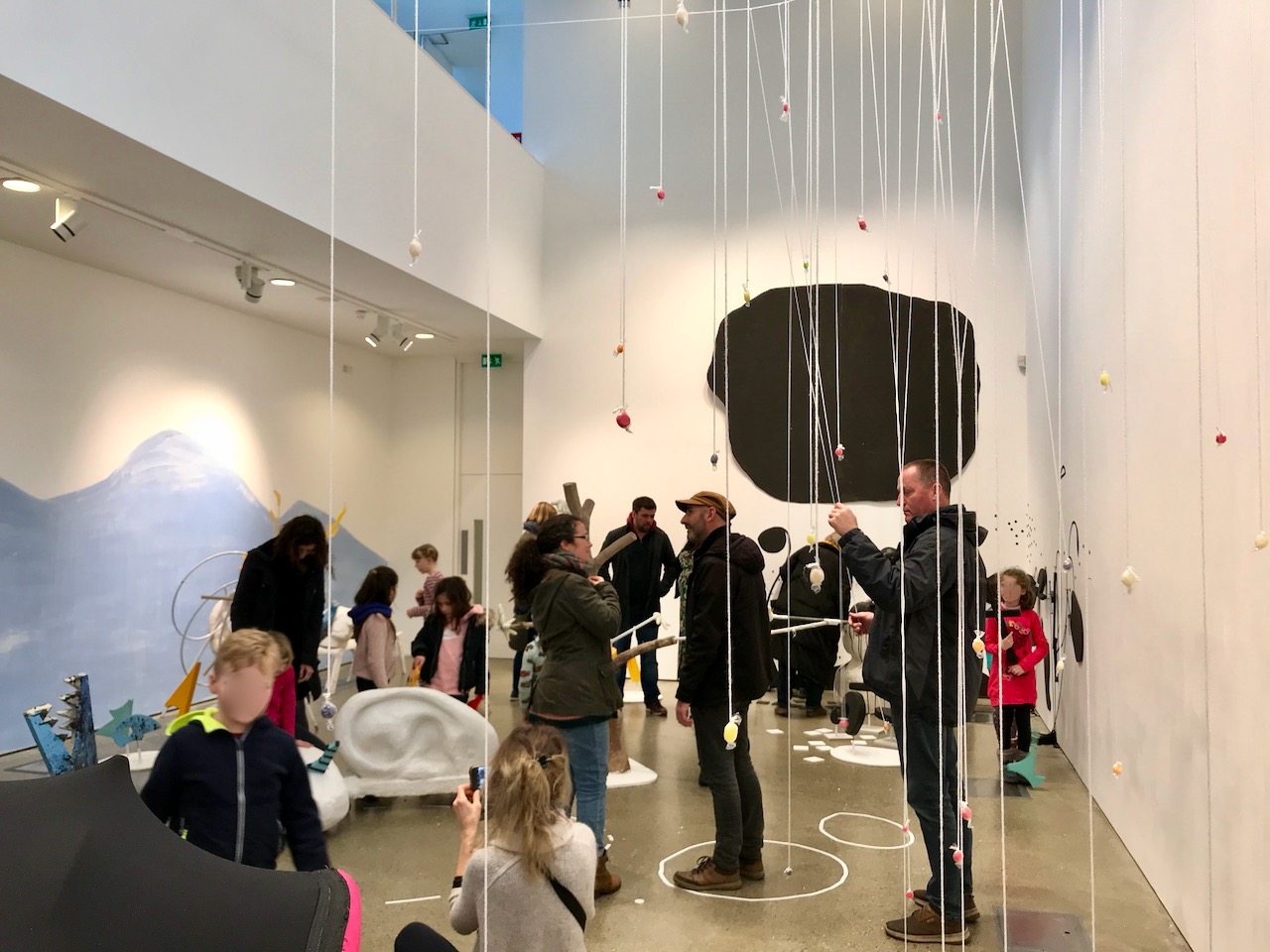
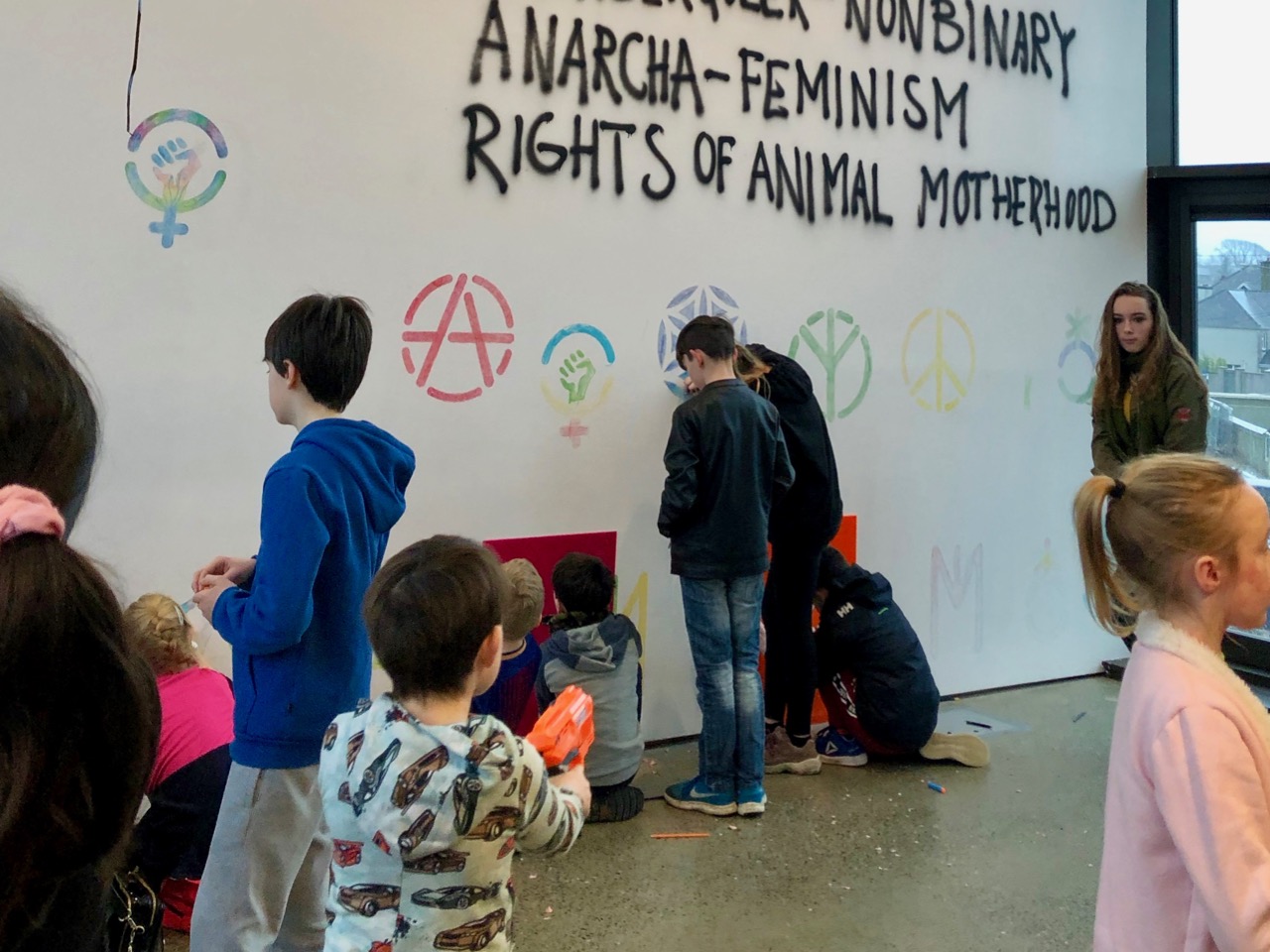
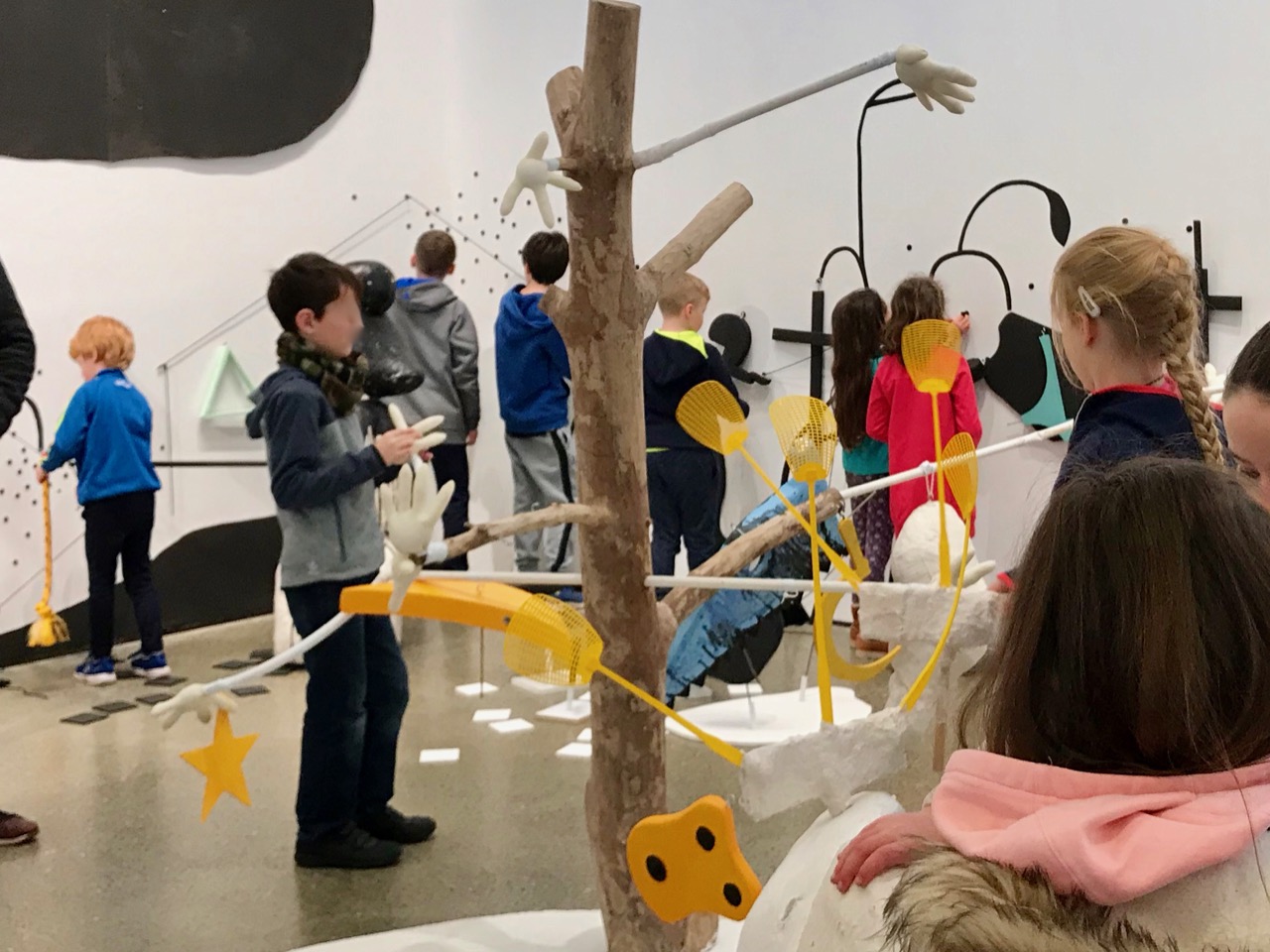
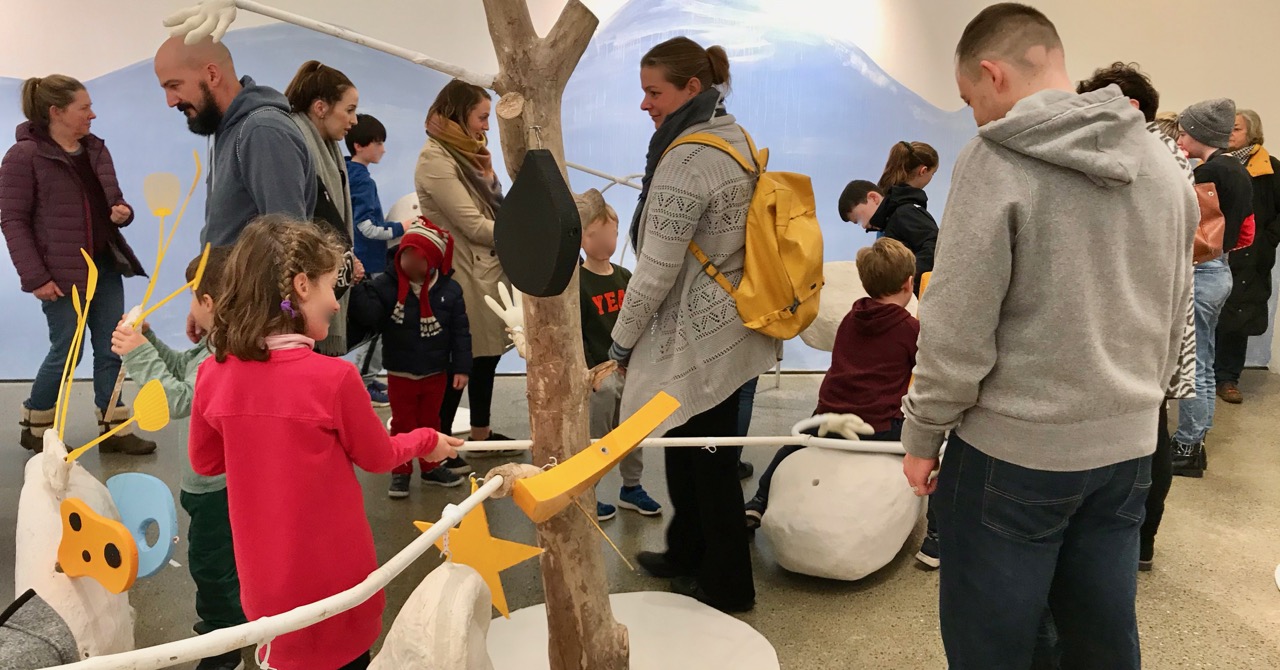
We went along, and were delighted. It’s advertised as an exhibition for children: take no notice of that! Just go and join in the fray – we all have a child in us. And it is a fray, in that it’s totally participatory. You can’t avoid taking apart everything you see, and putting it all back together however you want to. How amazing, to be encouraged – no, commanded – to get involved and act out the child. I wish I could show you the expressions of delight on the faces of all the ‘real’ children who were there, but today’s privacy laws mean that we can’t publish those. Instead, through some skilful juxtaposing and a little bit of PhotoShop, we hope that we can get across the sheer exuberance of all the activity.

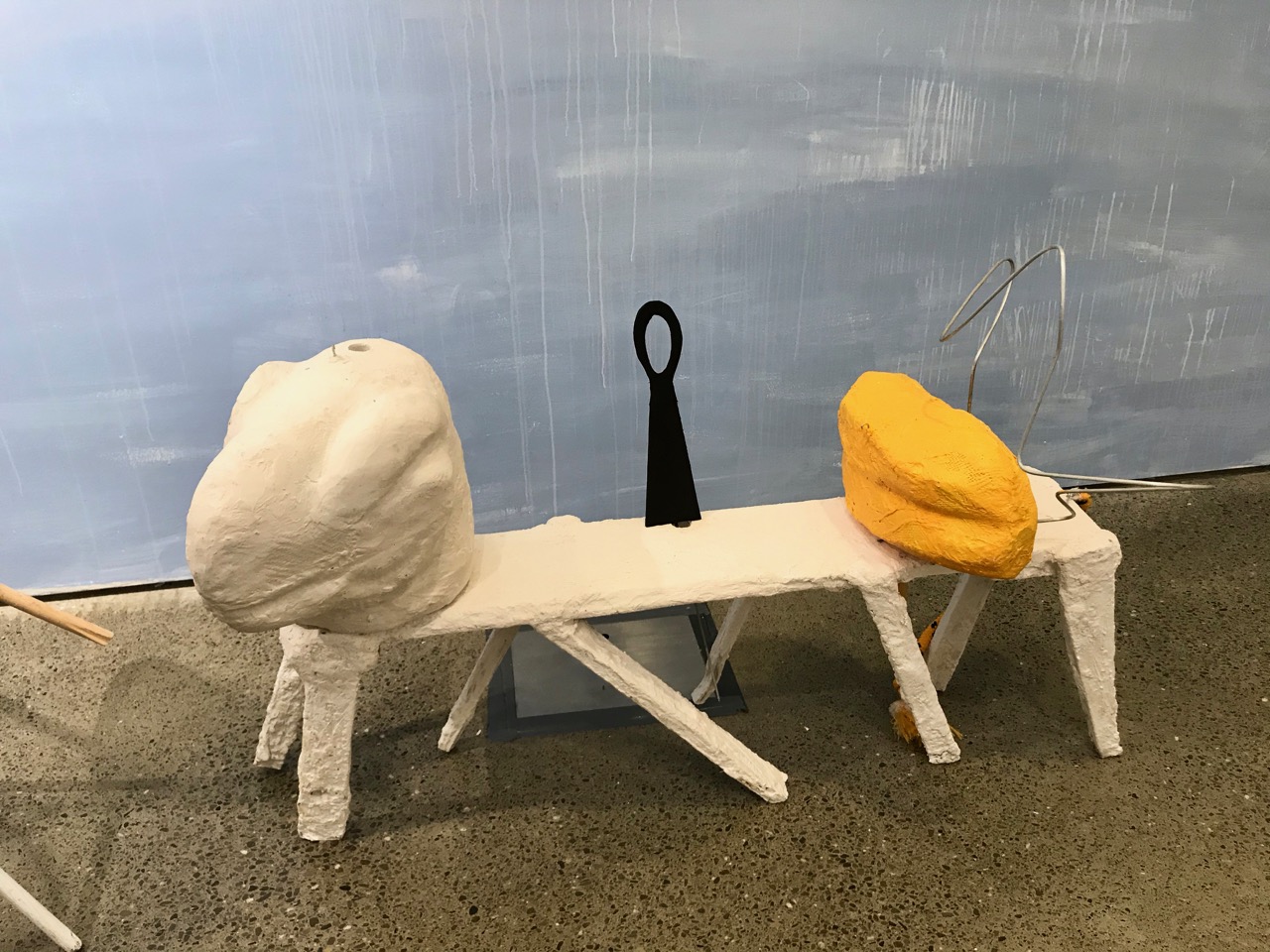
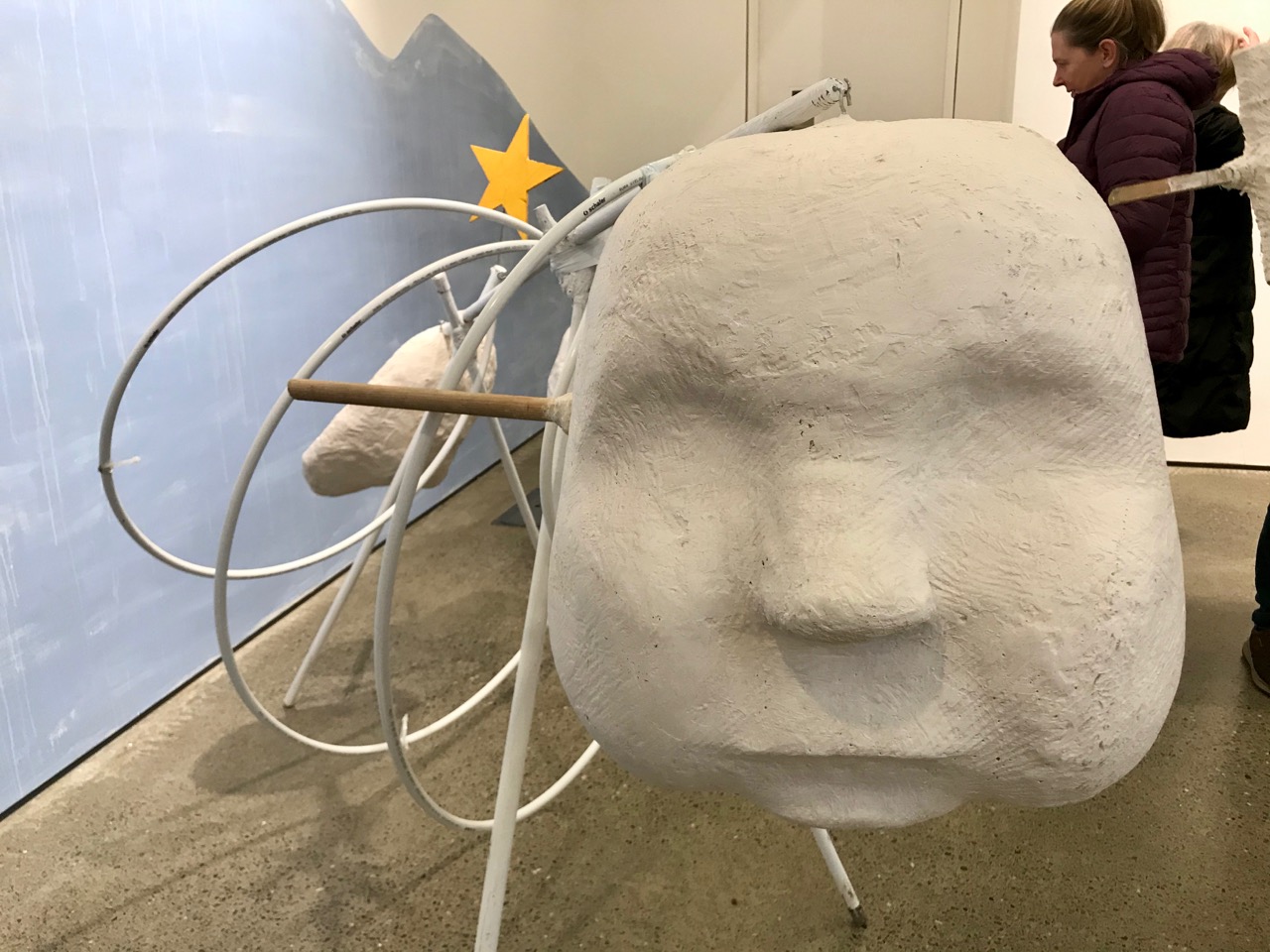
The ground floor gallery was full of shapes – many recognisable, some abstract – all brightly coloured, attractive and tactile. Each one could easily be a piece of ‘modern art’. The fun comes when you realise they can all be taken apart and put back together in unlimited combinations. There are no restrictions: everything has hooks, slots, sockets. This is your chance – everybody’s chance – to build sculptures, make murals, hang things on walls (or on each other!). There’s not a single Do Not Touch sign anywhere . . . Imagine the excitement!

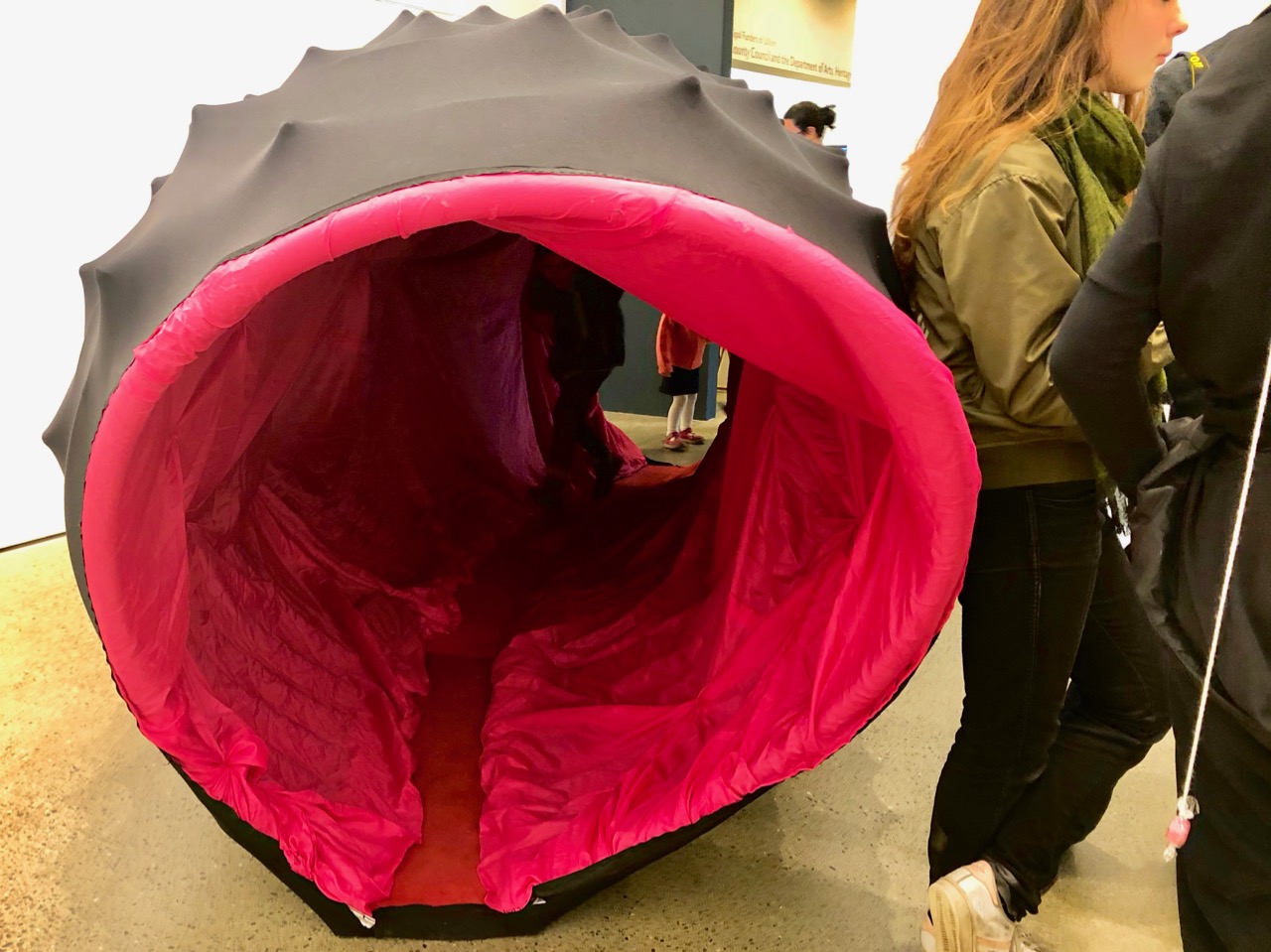
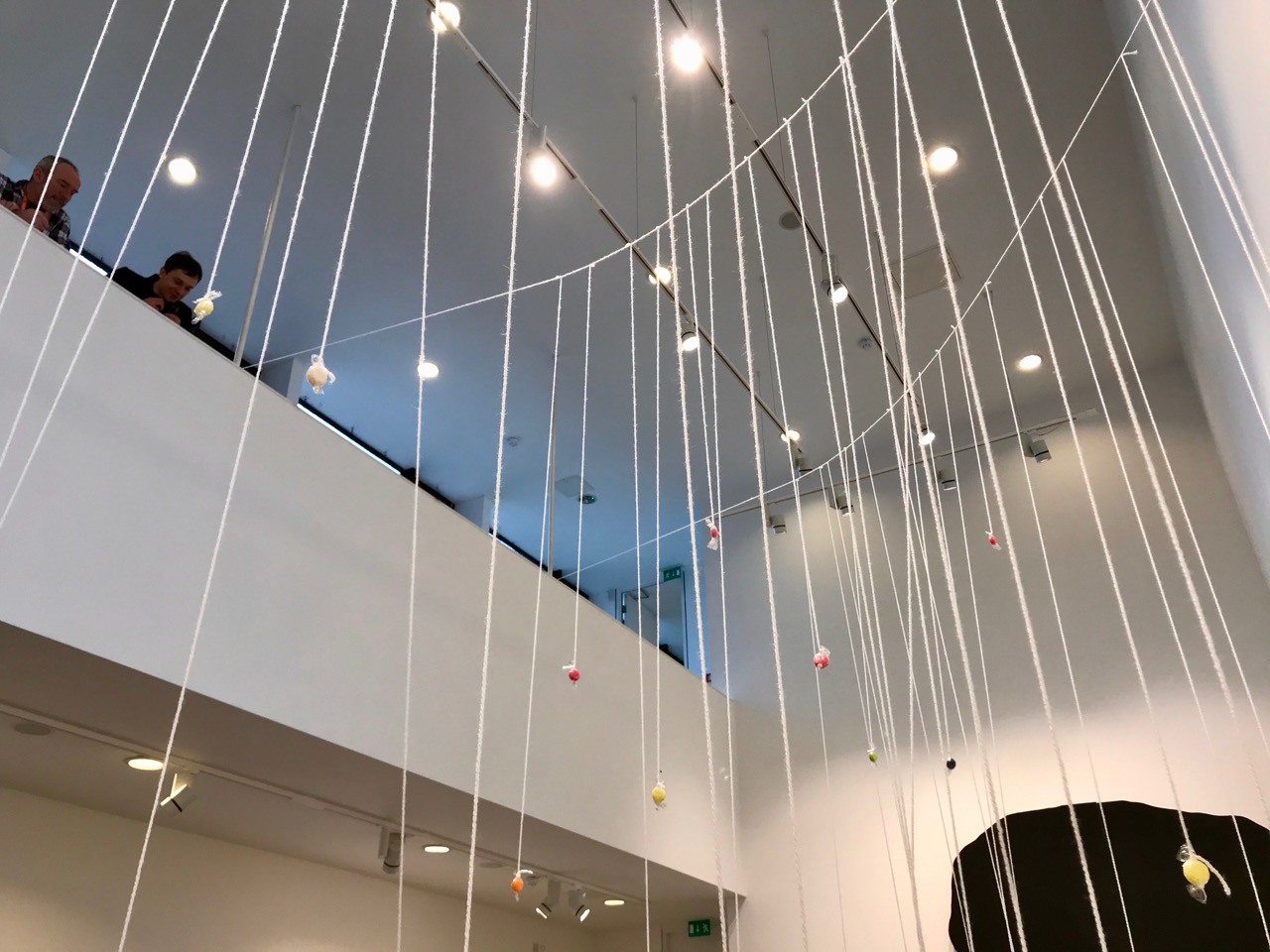
If you wanted to, you could enter the exhibition through a tunnel – it looked invitingly organic, if not somewhat anatomical. You were disgorged into a forest of sweets hanging on strings. Towards the end of the afternoon there were lots of empty strings and very few sweets. But, surely, that’s what it’s all about: consuming the art; embracing it, encountering it, making of it what you will.

It was interesting for us to note tidy-minded adults busily untangling the hanging strings, while their offspring revelled in getting them as muddled as possible. Meanwhile, we overheard a fraught parent exclaiming “I can’t believe you just ate the art!”

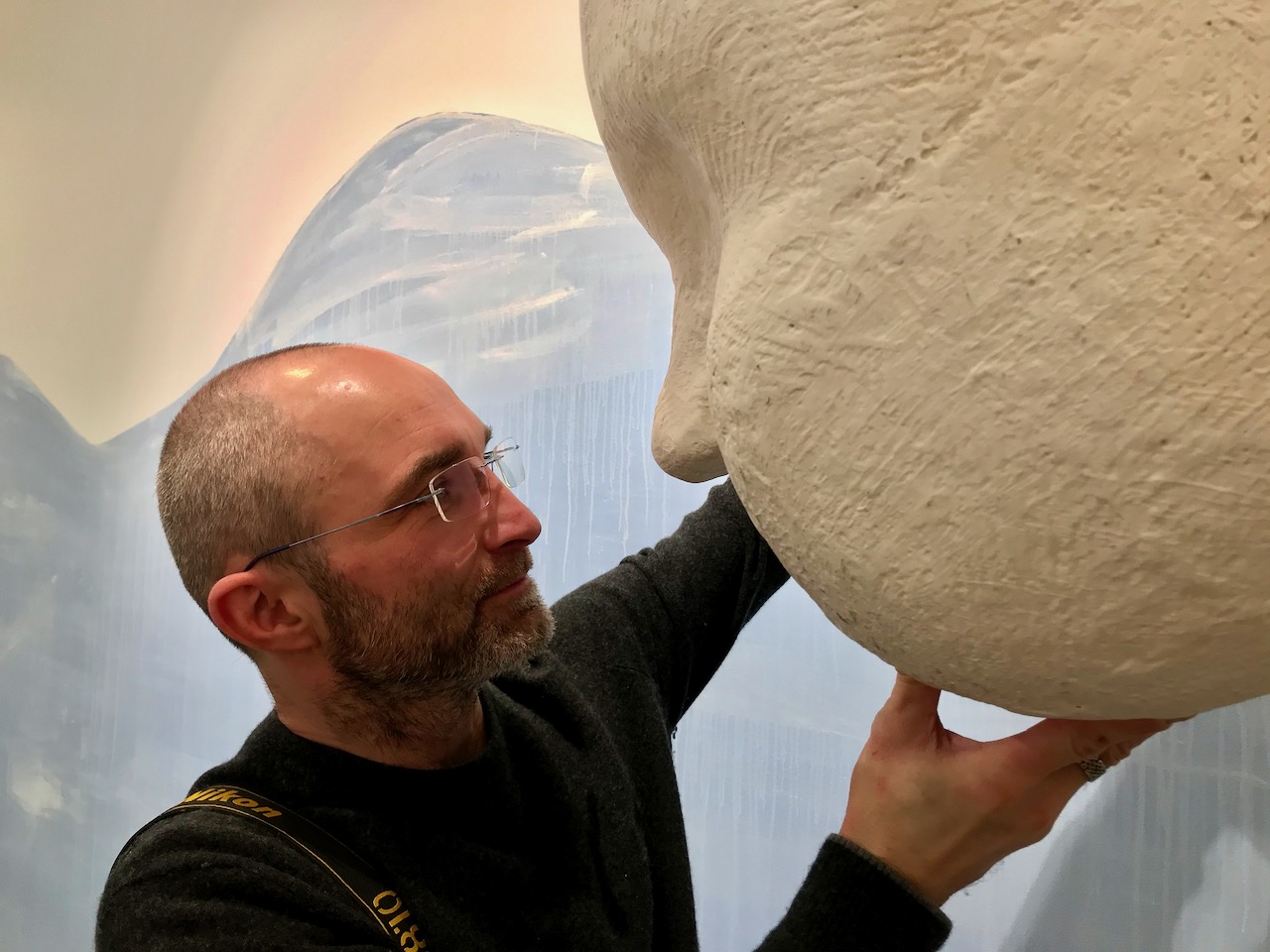
Art in Action is the brainchild of a group of Polish artists, and was first curated at the Municipal Art Center, Pomorska, Gorzów in 2019, with the intention of travelling on to Skibbereen. One of those artists, Tomasz Madajczak, has been based in Ireland since 2003, and has contributed to previous exhibitions at Uillinn. He provided the liaison between the two arts centres which resulted in this collaboration. He seemed completely at home among the exhibits:

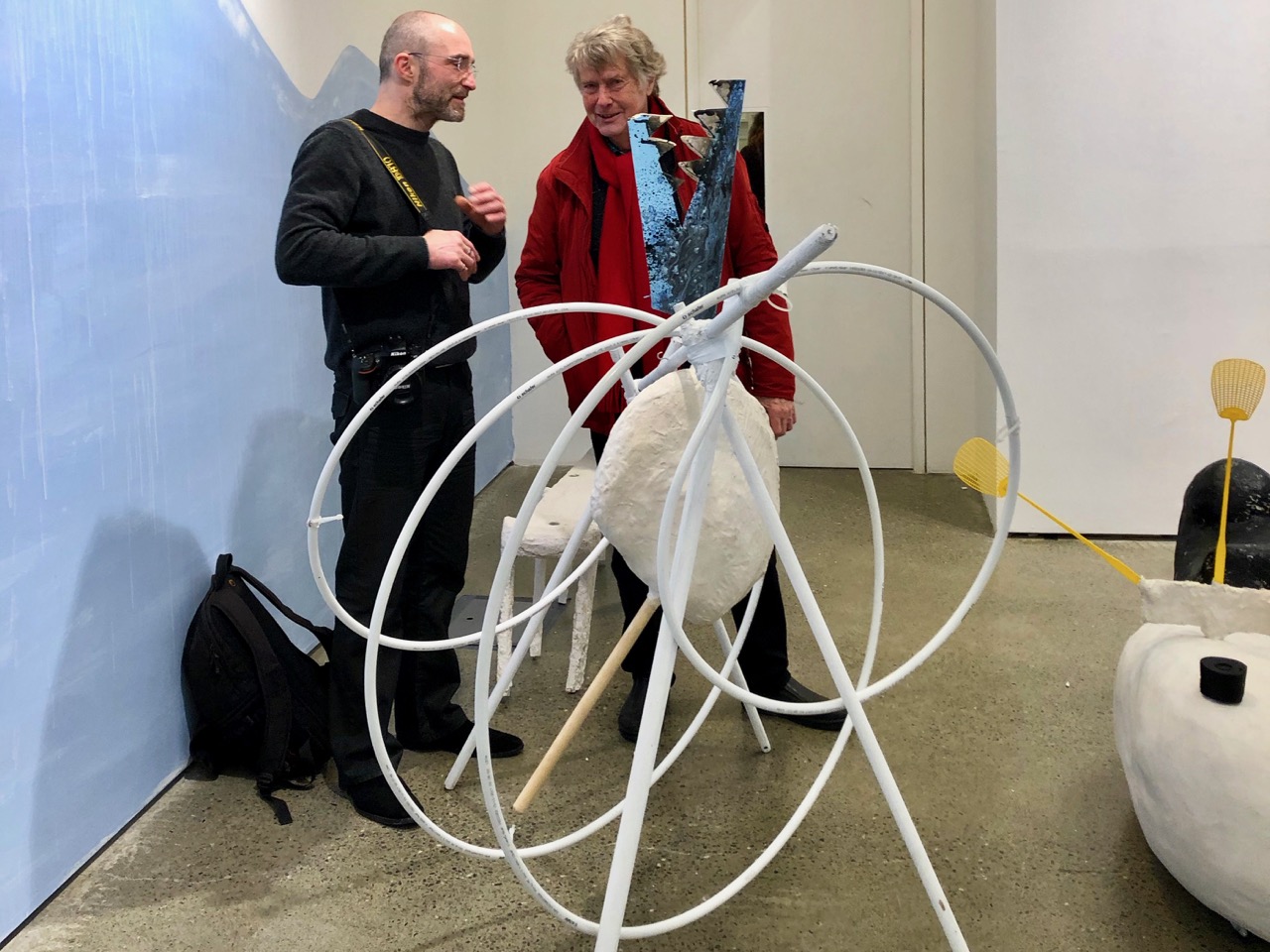
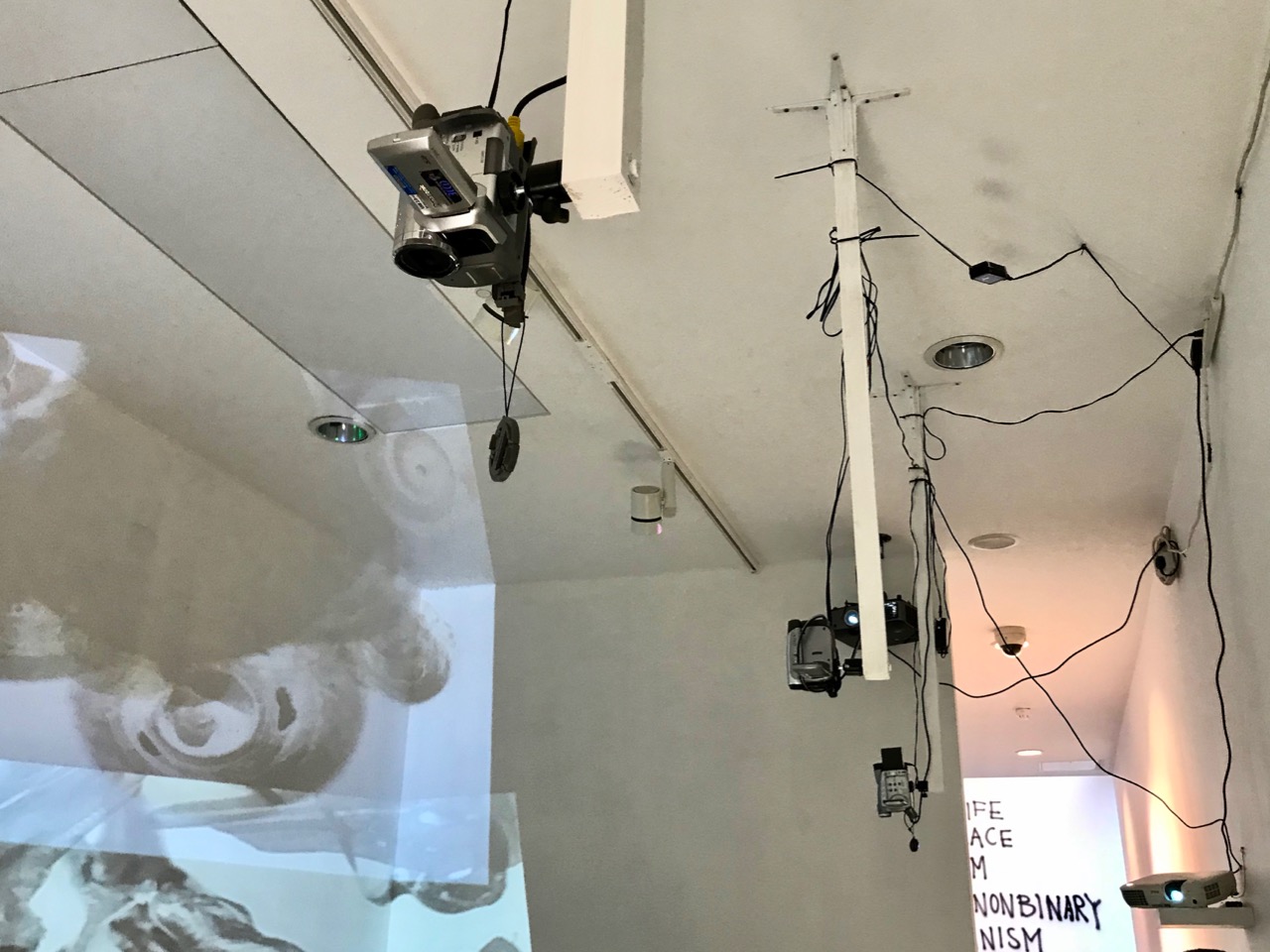
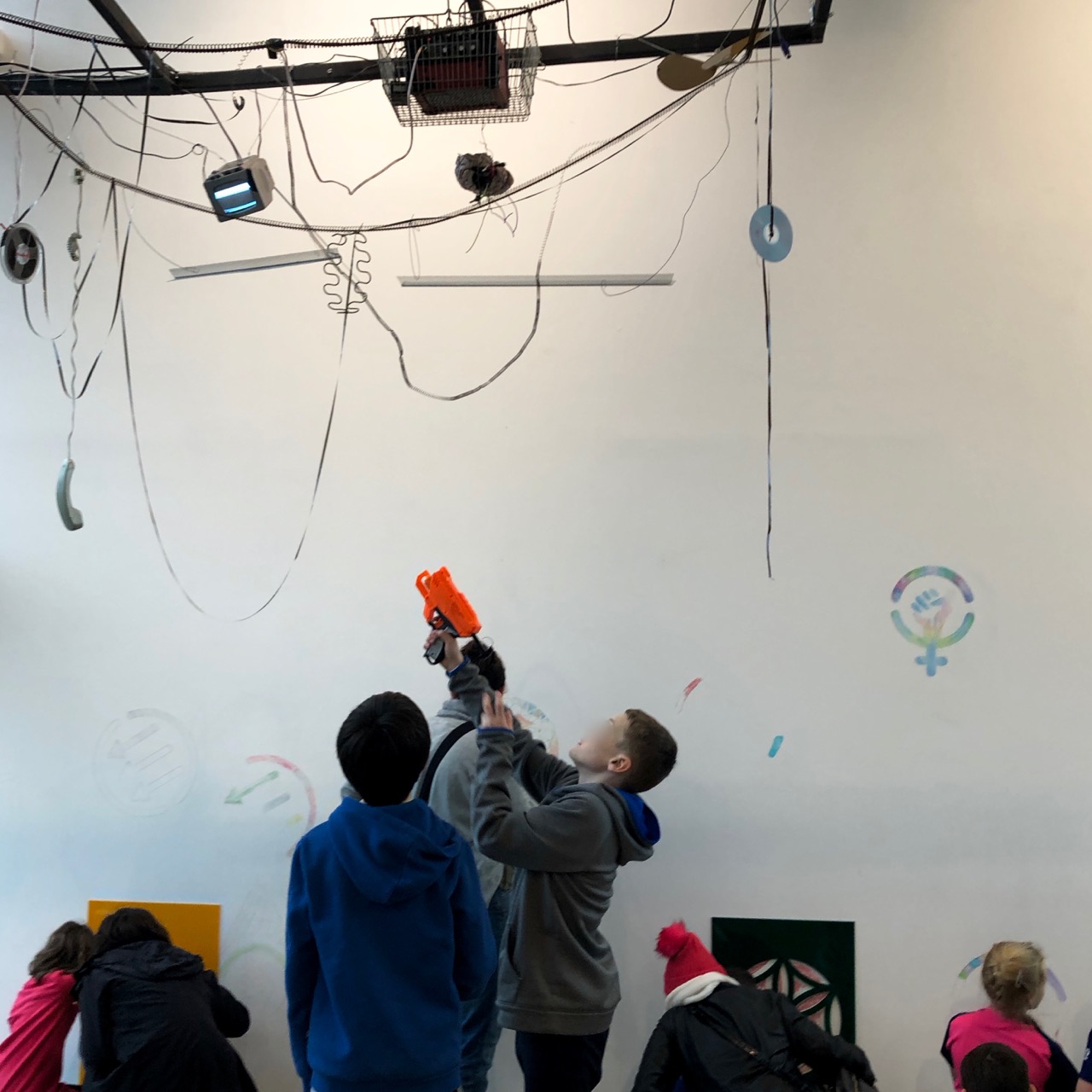
I need to persuade you all to visit this exhibition, so I won’t give away too much in this little preview. I will just mention the upstairs galleries, where some ingenious devices are available to ensure full interaction between art and spectators, including a modern take on the epidiascope (remember those? – you will if you are anywhere near my age!), pop guns for shooting down technological detritus, and over-aweing human voice amplification. Here are some further images to whet your appetites . . .

Don’t be shy about coming into this show and being part of the action! That’s exactly what it’s there for. All the better if you can bring along a group of children – or aim to be there when there are children in the gallery: the Arts Centre has a continuing programme of involving schools and other community groups. It’s the children, particularly, who will show you what being uninhibited means.

Art in Action is on at Uillinn, Skibbereen until 22 February 2020. It is curated by Bartosz Nowak, with work by Basia Bańda + Tomasz Relewicz, Ewa Bone + Ewa Kozubal, Tomasz Madajczak, Krzysztof Matuszak, Aleksandra Ska and Hubert Wińczyk. Open Monday to Saturday, 10.00am to 4.45pm daily. Special thanks must go to Uillinn’s Director, Ann Davoran, and her technical team for bringing this show to fruition, with special mention to Ballydehob’s Stephen Canty – who solves every problem! Uillinn receives financial support from the Arts Council and Cork County Council.

Copper Craft

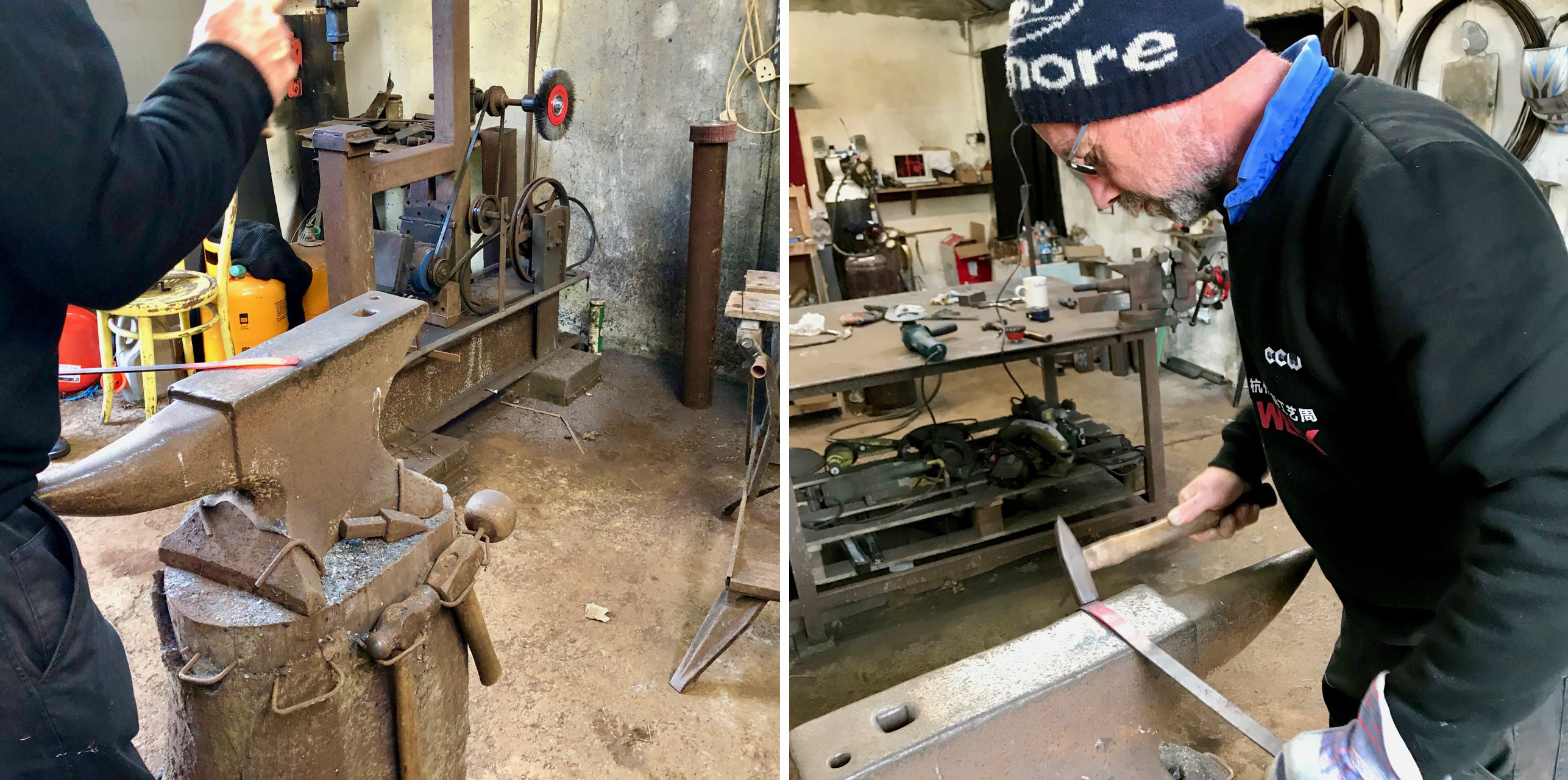
I admire workshops. And I admire the creativity that goes on in them. Here’s one that’s not too far away from us in West Cork: it’s just outside Skibbereen, on the road to Lough Hyne. It belongs to Paddy McCormack, who is a metalworker producing functional and decorative items. His preferred material is copper, and that comes with a historical connection that puts him right back with some of the earliest craftspeople who dwelled in this western part of the land thousands of years ago!

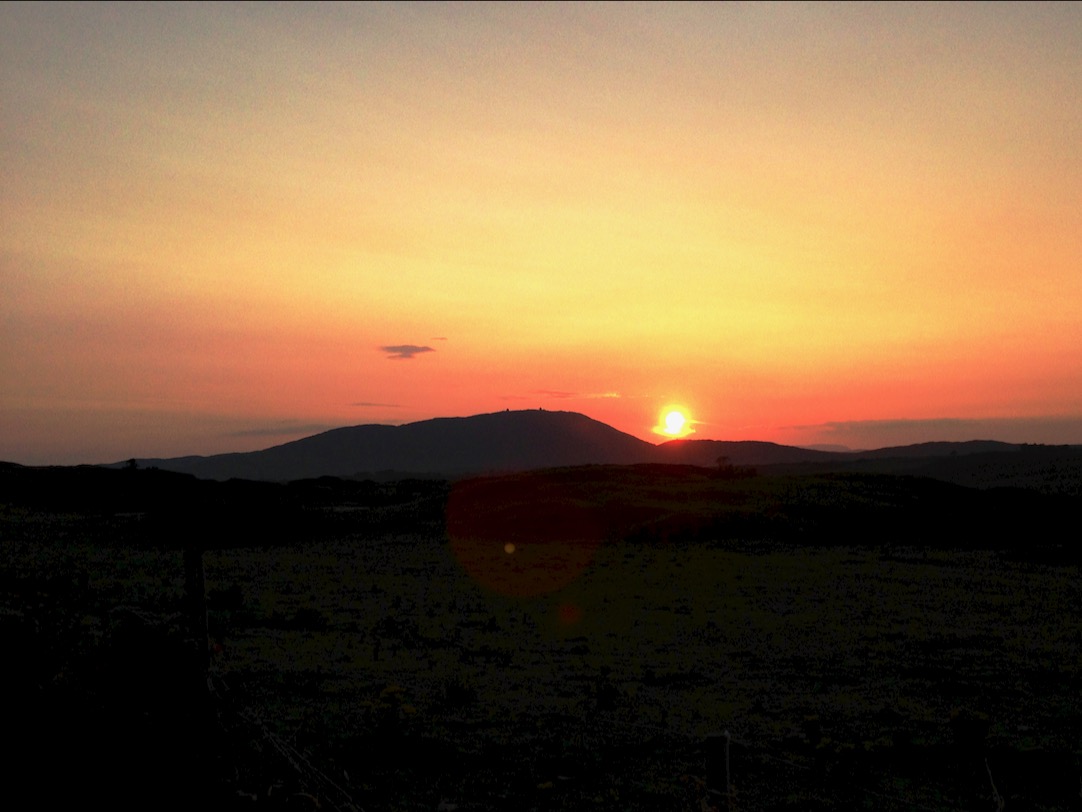
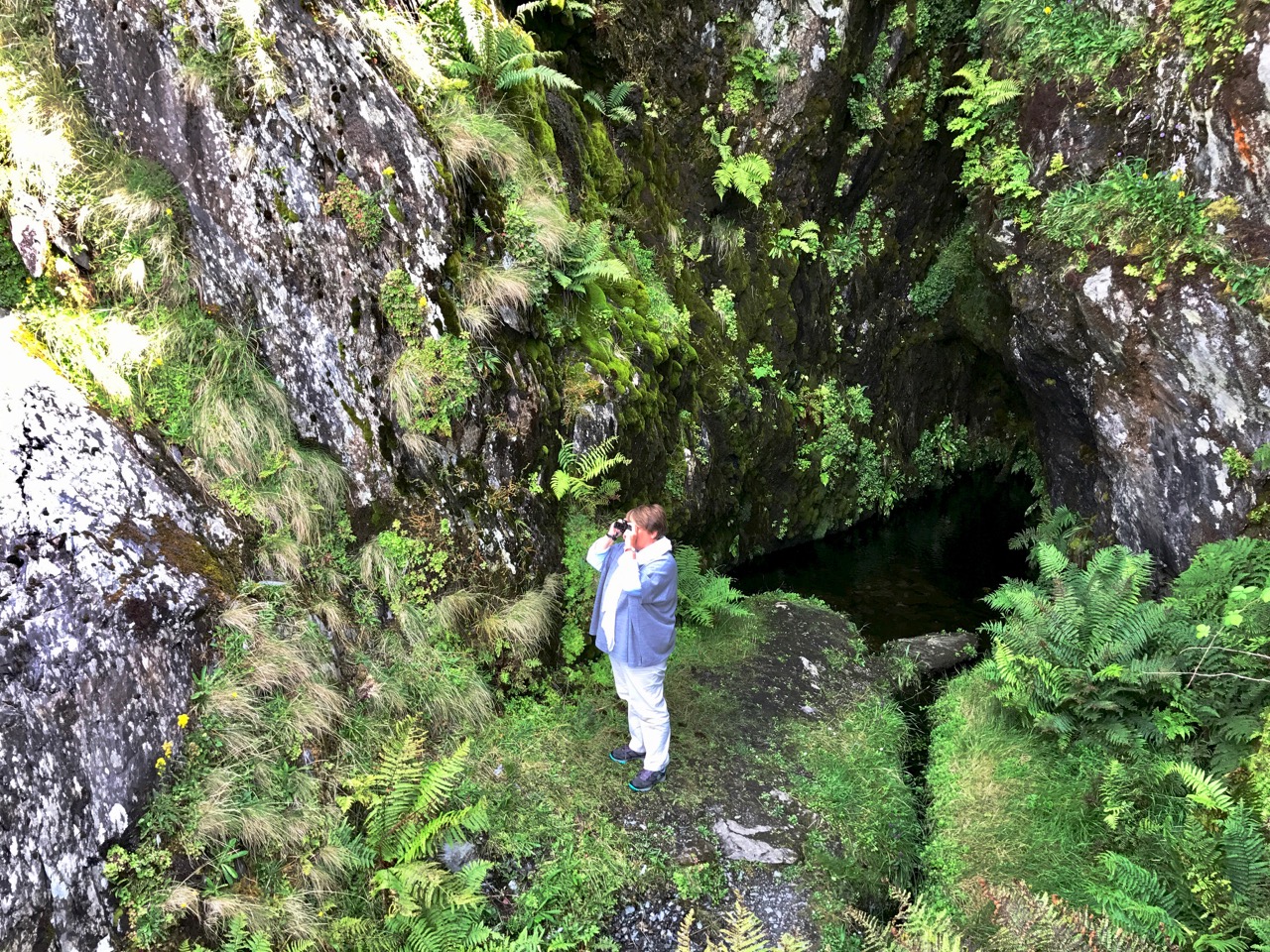
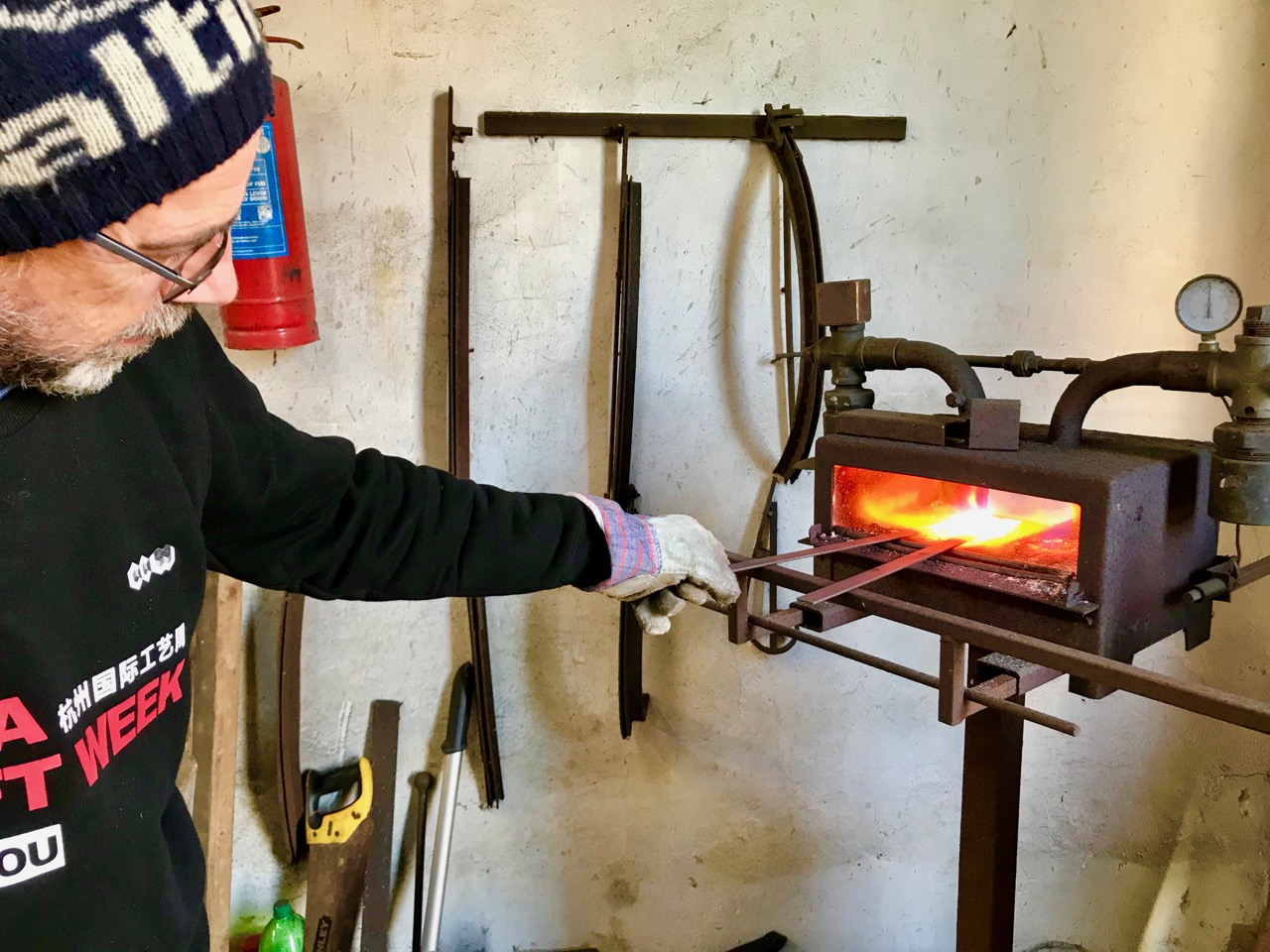
Mount Gabriel, the Mizen’s highest outcrop of land, silhouetted against a copper-coloured winter sky (upper picture) is the site of ancient copper mines dating from the Bronze Age. In the lower pic, Finola is standing at the entrance to an old mine adit driven into the side of this mountain. If you want to see the techniques used by the early metalworkers, have a look at this post which I wrote back in 2015. You’ll find that the methods dating from three and a half millennia ago are recognisable today. Here’s Paddy continuing the tradition:

We first came across Paddy at the 7 Hands Exhibition held in London, Dublin, Cork and Ballydehob. In this post written by Finola at the time you’ll see him with one of his unique pieces, a chess set, but it was at another exhibition this year that we became aware of his beautiful, hand-beaten copper bowls. Once seen , never forgotten: we asked Paddy if it would be possible to produce a large bowl for us, more the size of the now much sought-after copper ‘chargers’ produced by the Newlyn artists colony in West Cornwall during the late 19th and early 20th century. I lived in Newlyn before coming here to the west of Ireland and much admired the copper work from that time.

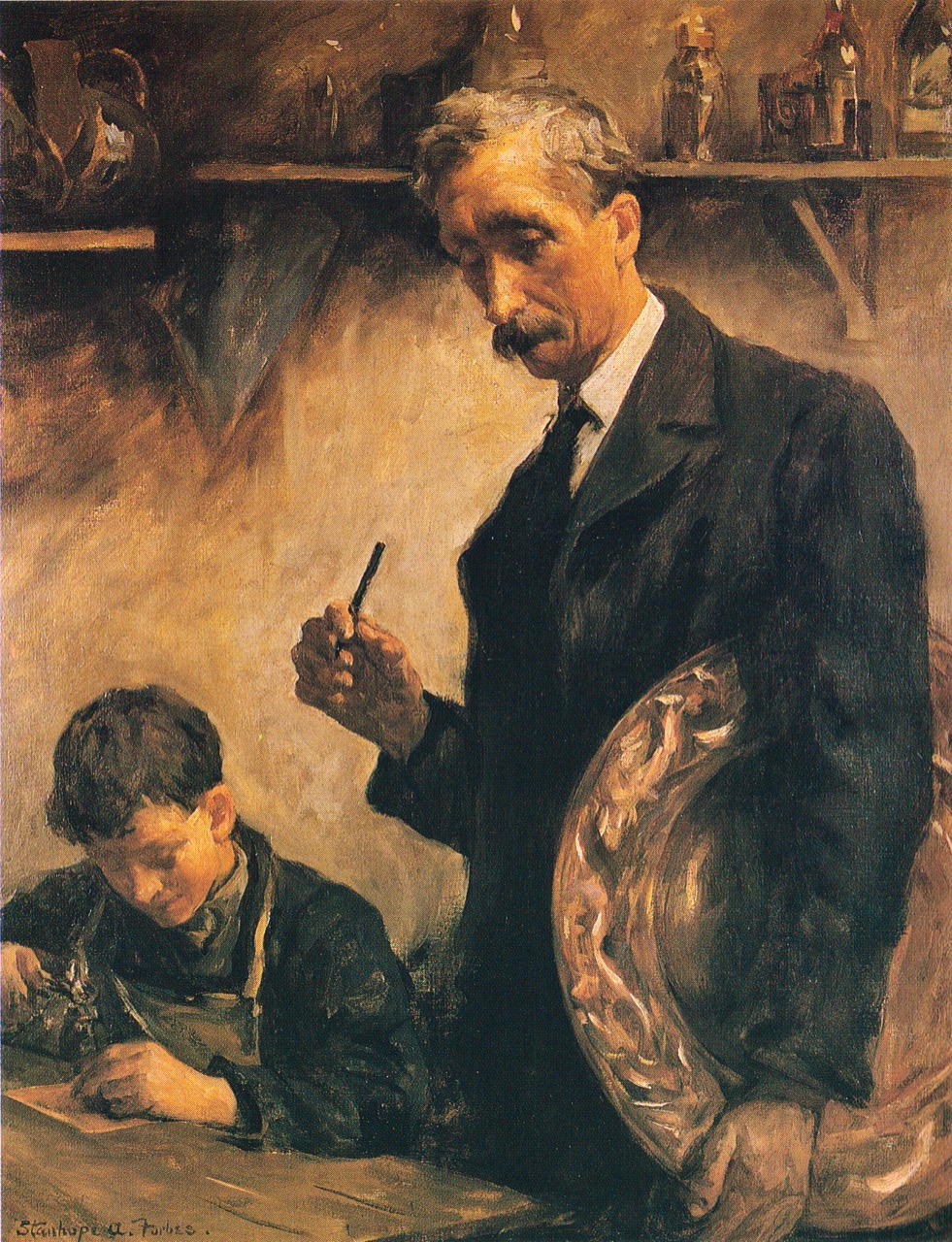
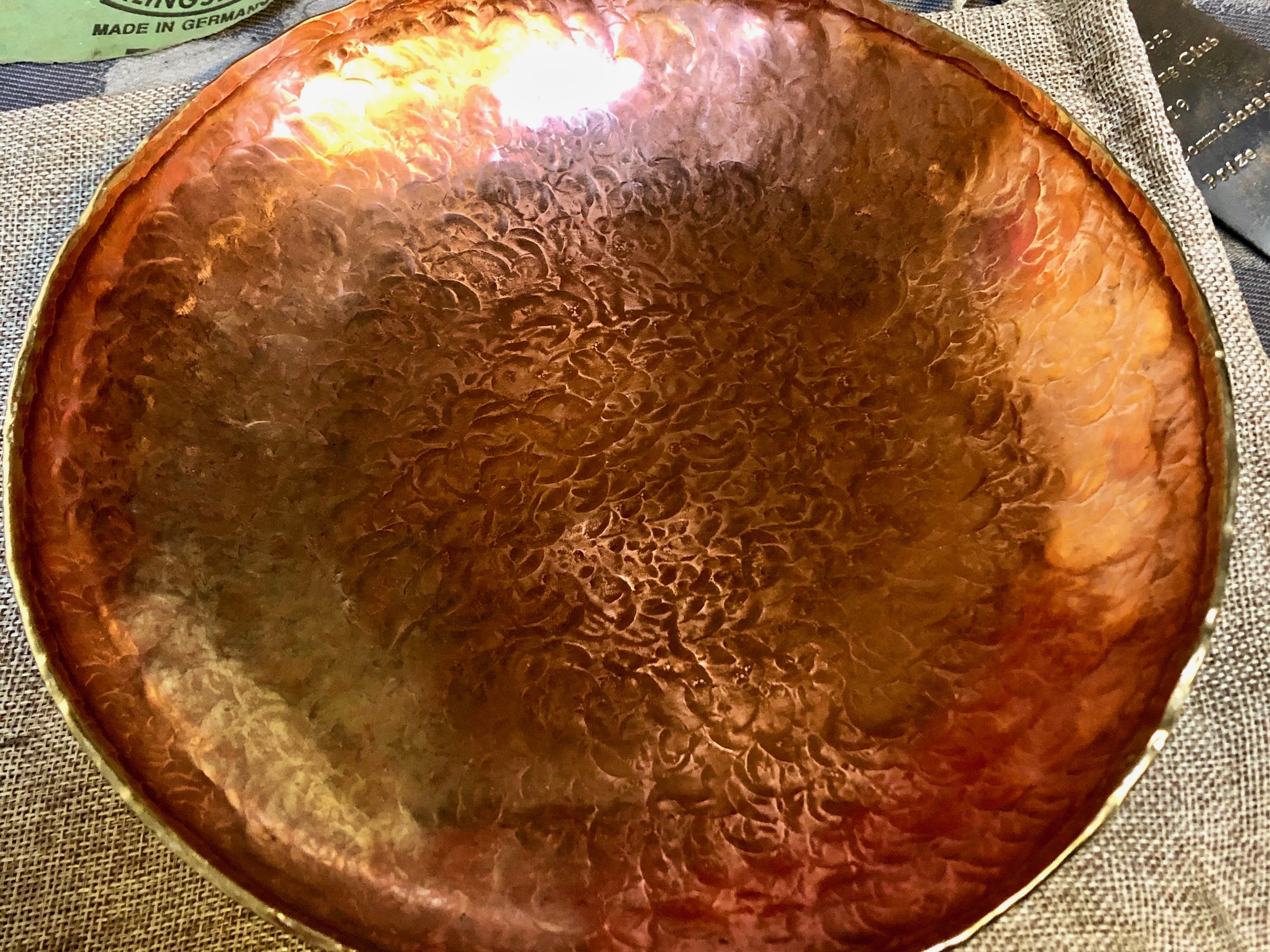
The Young Apprentice a painting by the Irish-born founder of the Newlyn School, Stanhope Alexander Forbes (above). The painting dates from 1908. There is still a copper works in Newlyn today. First established in the fishing village in 1890, copperware production gave us some of the most outstanding work created in the Arts and Crafts tradition of its day. One of the things that impresses us about Paddy’s work is his own way of working the metal surface, creating organic textures and colours which are exquisite.

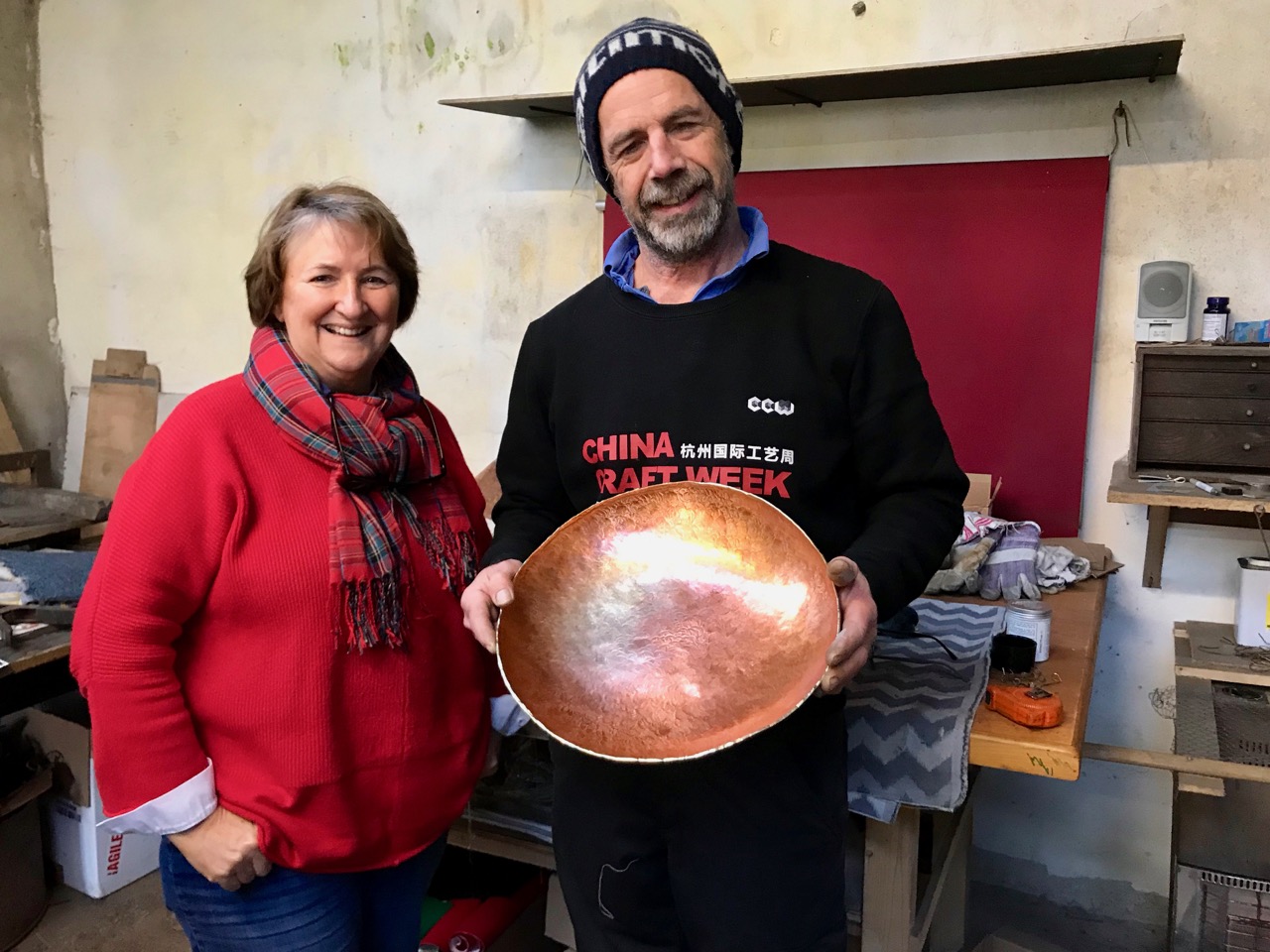
Paddy presenting us with the large bowl which we commissioned. It is elegant and unique, and we are delighted! The richly textured surface shows the marks of the copper being worked and provides an organic finish which will evolve and change colour over time. Paddy has developed his own design for his bowls, with a double skin and welted rim.

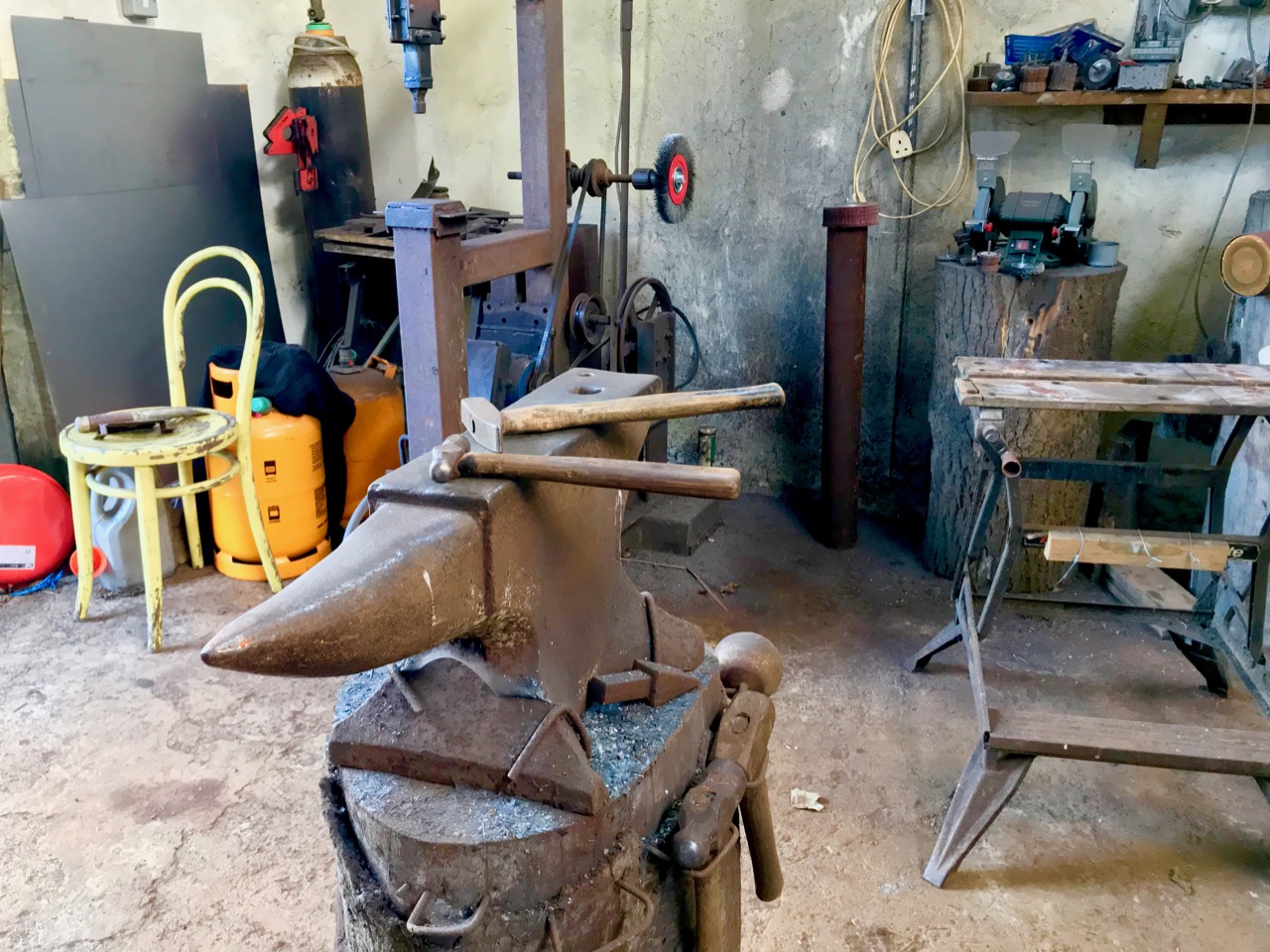
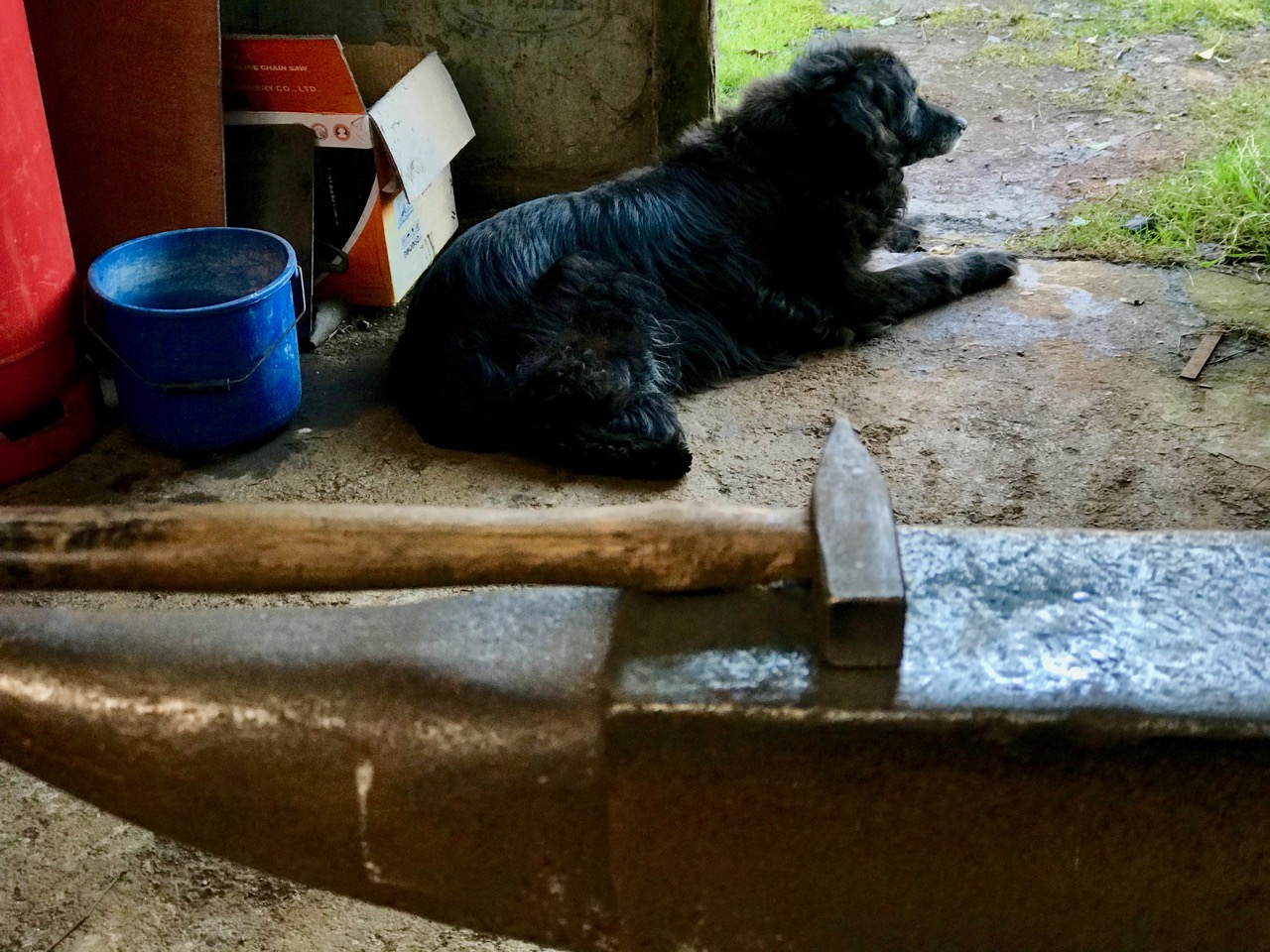
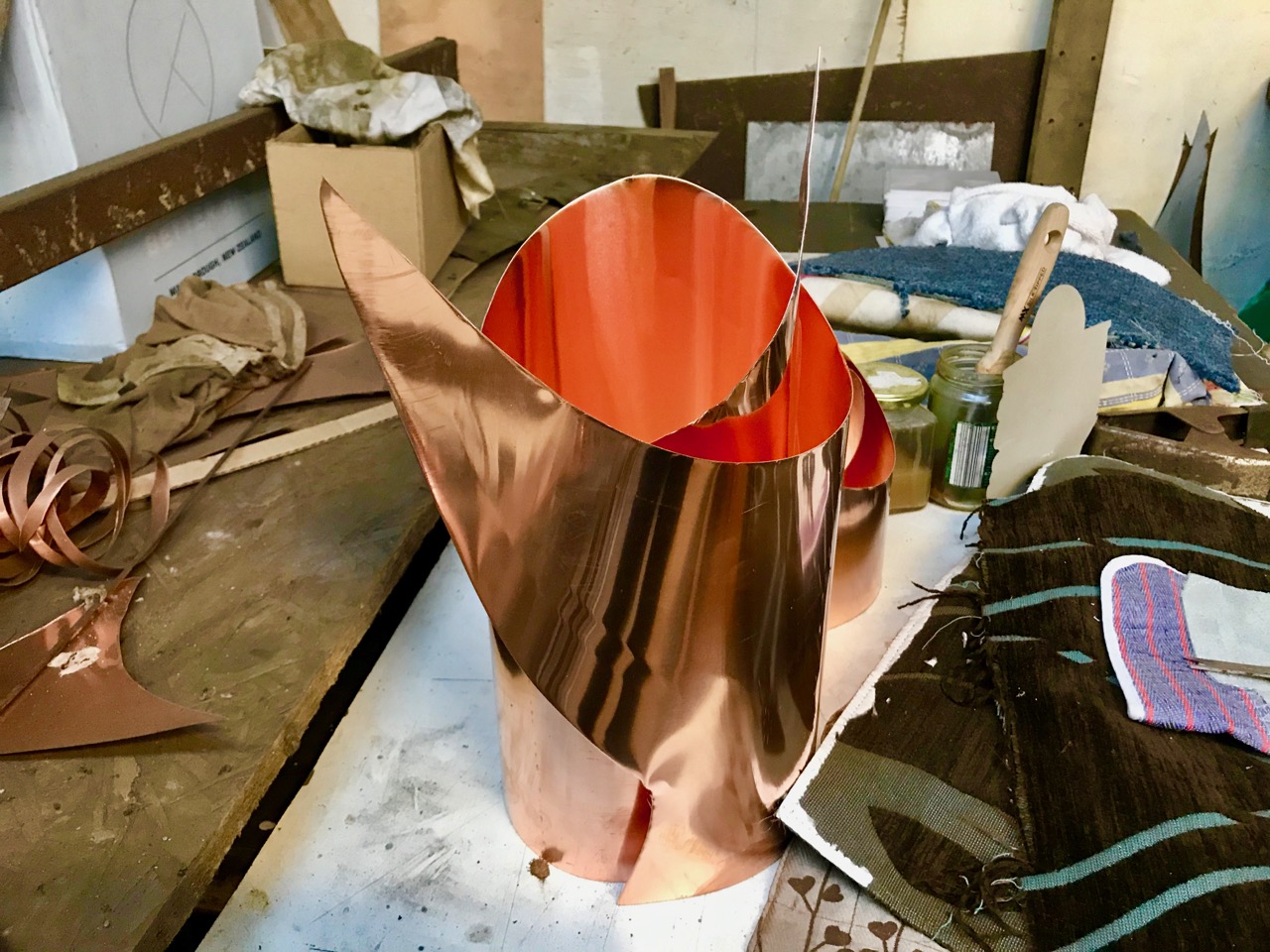
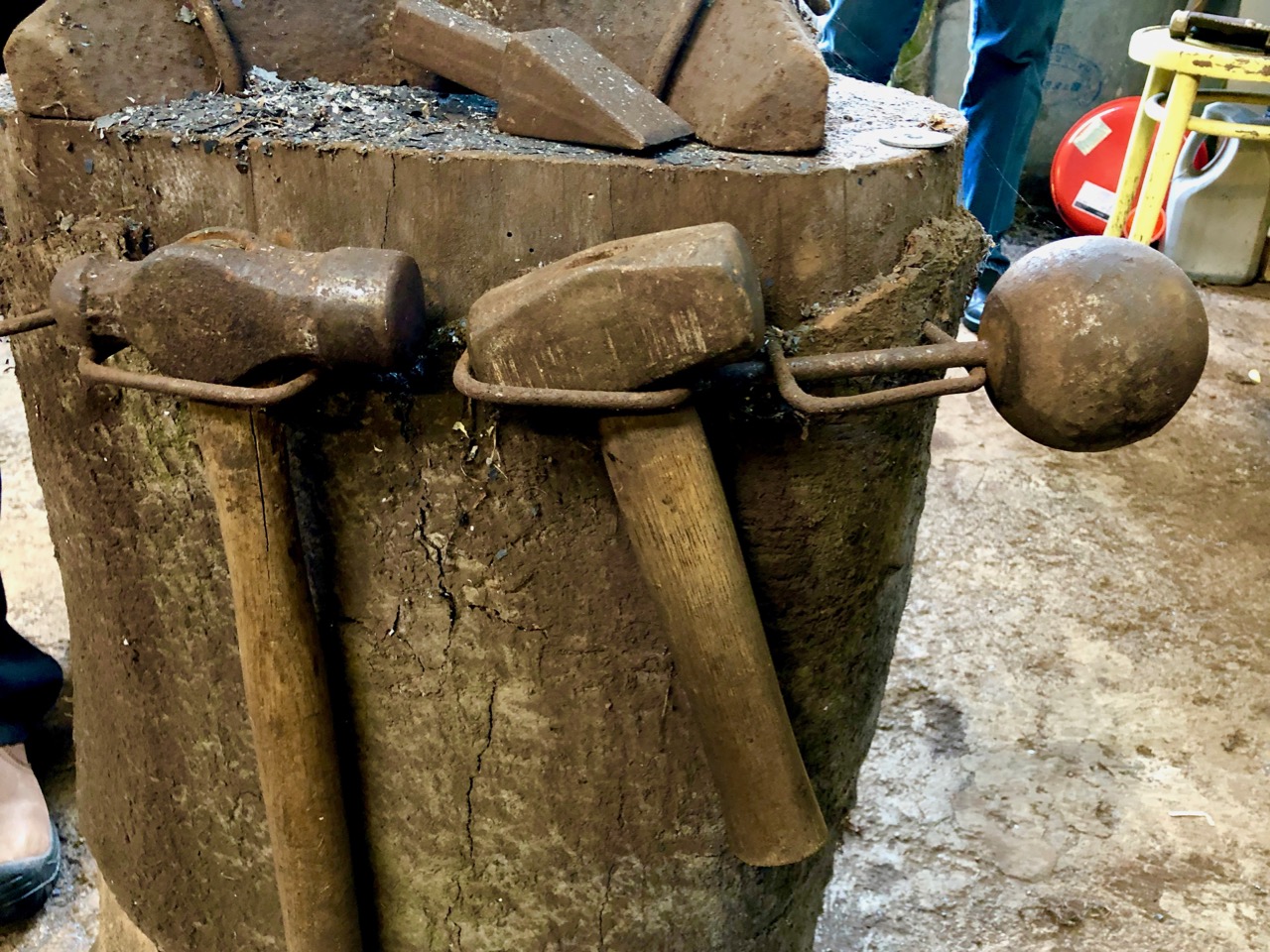
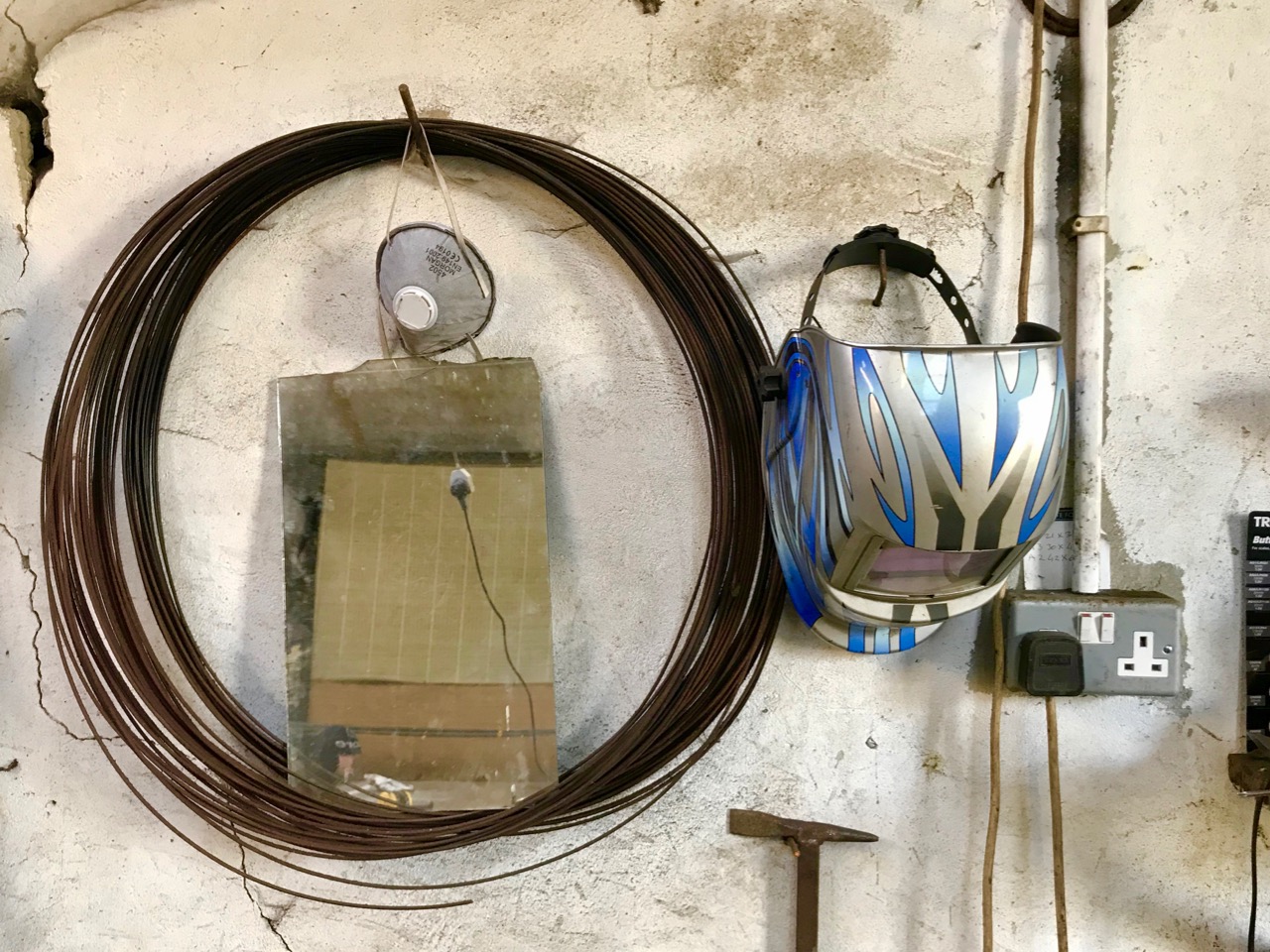
Raw materials and the tools of his trade form Paddy’s working environment. He is comfortable within these surroundings. We felt privileged to meet him in this environment, and could sense his ability to transform his visions into reality through complete mastery of his chosen medium. Examples of his work in the open air show the distinctive patina that develops on copper when exposed to the elements.

Paddy markets his bowls and decorative copper work through craft outlets and fairs. He recently travelled to China with a group of locally based fellow artists and craftspersons. It’s a small world when a master artist / craftsman from rural West Cork is in demand on the other side of the planet!

Ireland’s Santa Claus!

You may remember my excitement when – a few years ago now – I found out that the real St Valentine is interred in the Carmelite Church in Dublin. But here’s a palpable marvel: at Jerpoint, Co Kilkenny,  the bones of St Nicholas are reputed to be buried.  Yes – the Santa Claus St Nicholas! Tradition has it that a band of Irish Norman knights from Kilkenny went to the Holy Land to take part in the Crusades. As they headed home to Ireland, they ‘seized’ St Nicholas’ remains, bringing them back to Jerpoint, where the bones were buried – some say – under the floor of the Abbey (others say they repose nearby at the old church of St Nicholas).

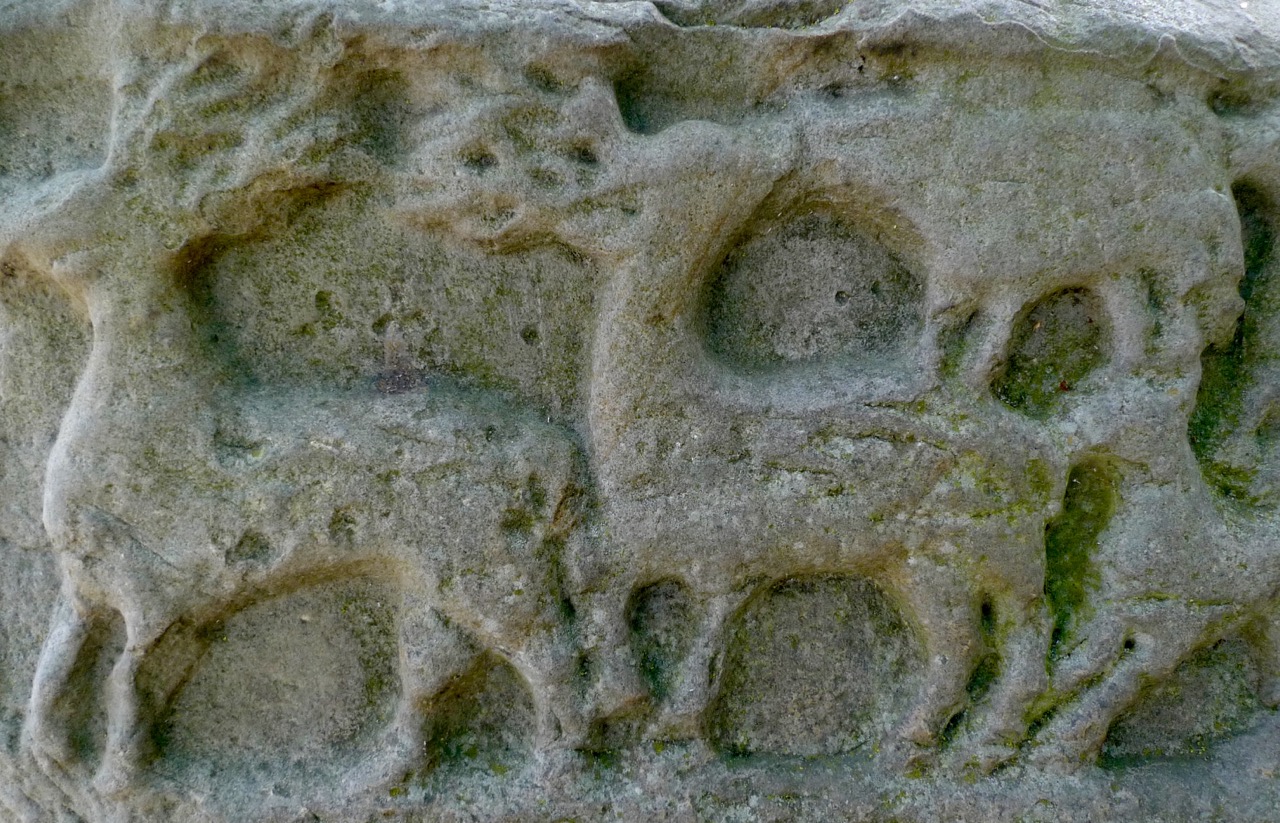
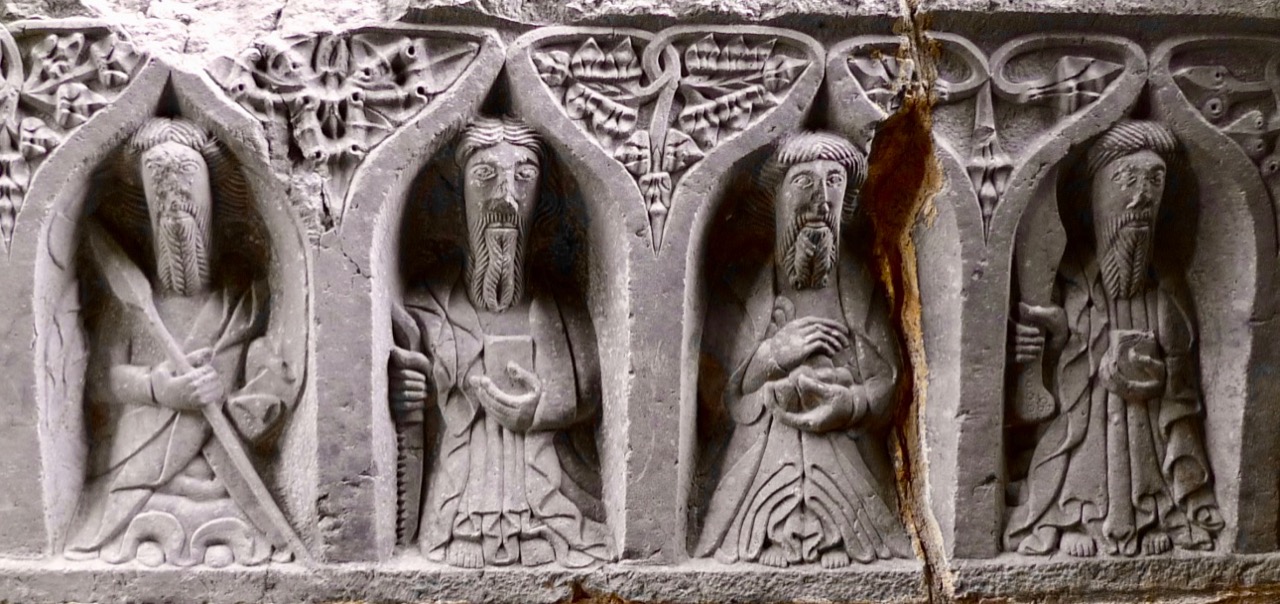
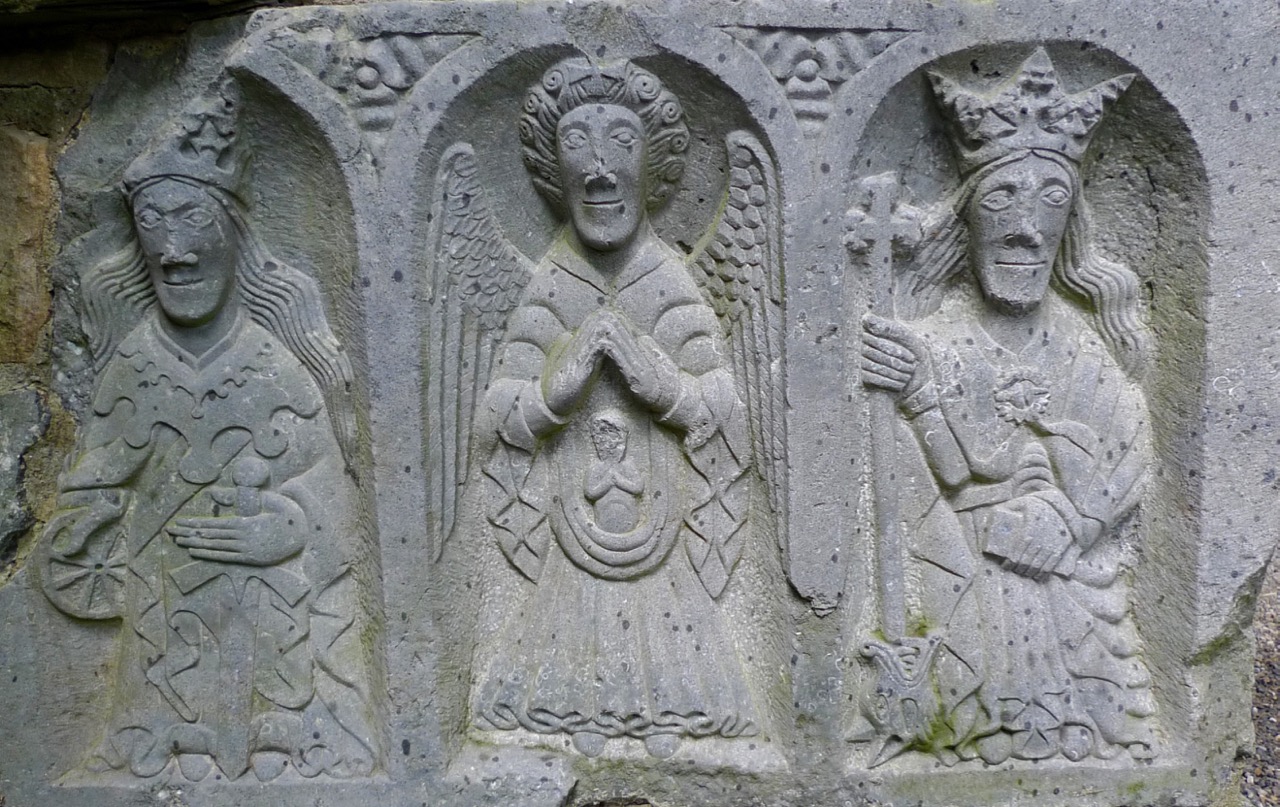
We first visited Jerpoint back in 2015, on a trip that took us to County Meath where we explored the monastic city of Kells (the famed book was written and illustrated there) and also where we found the medieval image of Santa’s reindeer in the header of this post! It is carved on to the base of the town’s Market Cross. We also visited Kells Augustinian Priory – a different Kells but in County Kilkenny  – and Jerpoint Abbey itself, a Cistercian monastery rife with carved figures, some up to 900 years old. Look at the ‘Weepers’, above, carved by members of the O’Tunney family – sculptors from Callan who worked in the 15th and 16th centuries. These four represent saints and show how they were martyred: St Thomas with a lance (left), St Simon with a saw, St Bartholomew holding a skin (he was flayed to death) and St Paul with a sword.

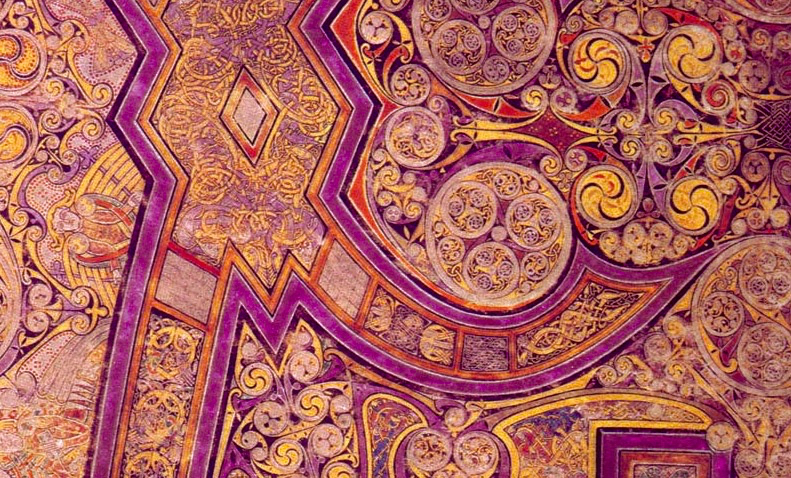
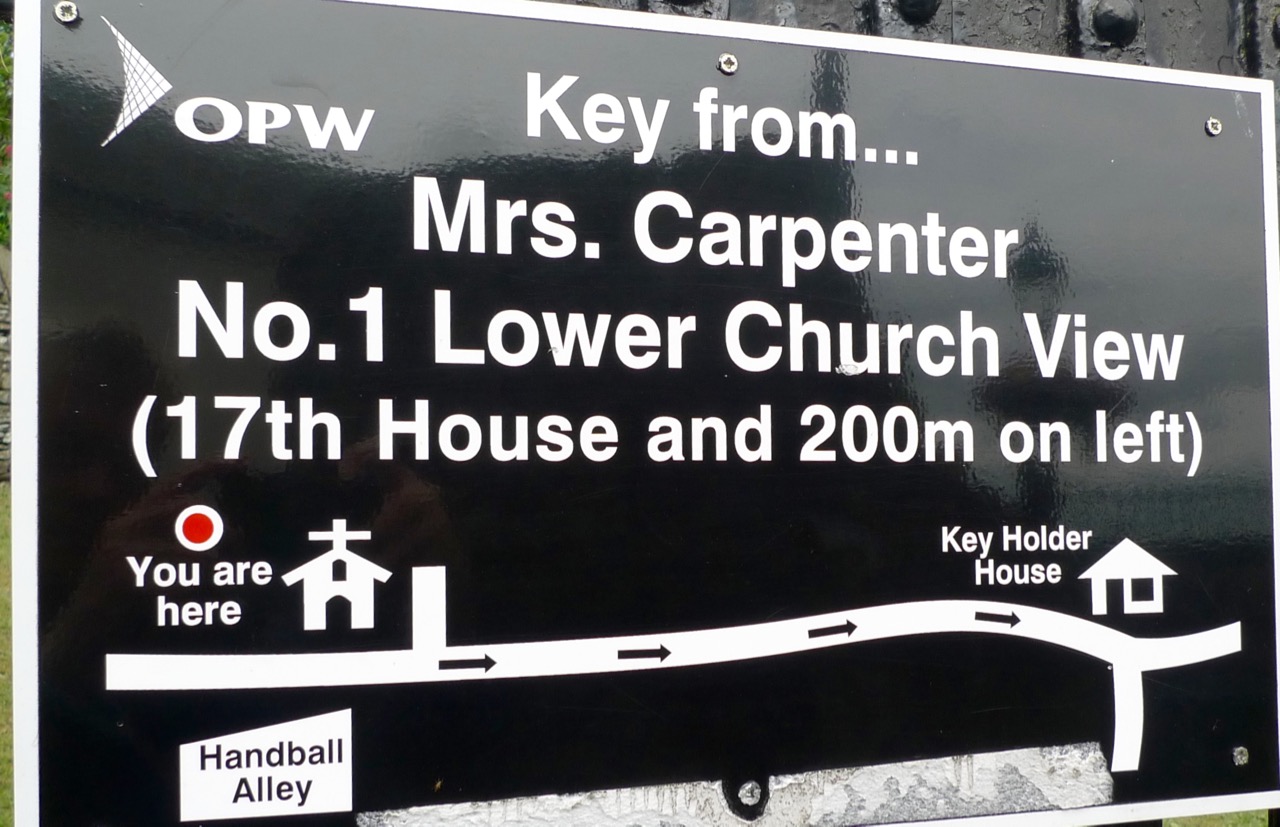
The Book of Kells is worth more than a passing mention, especially as some commentators have likened the medieval carvings at Jerpoint and other contemporary monastic foundations in Ireland to ‘illuminated manuscripts cast in stone’, because of the richness of the characters, the decoration and the detail. The Book (that’s just one example of the incredibly detailed capitals on a single page, above) probably dates from the 8th or 9th centuries and may either have been written in its entirety in Kells, or started by St Columba’s community in Iona and completed in the Scriptorium in Kells. That building still exists! In fact it (or something very like it) is illustrated in the book. It’s known as St Colmcille’s House – we went to have a look at it, and were fortunate to have a tour by its guardian.

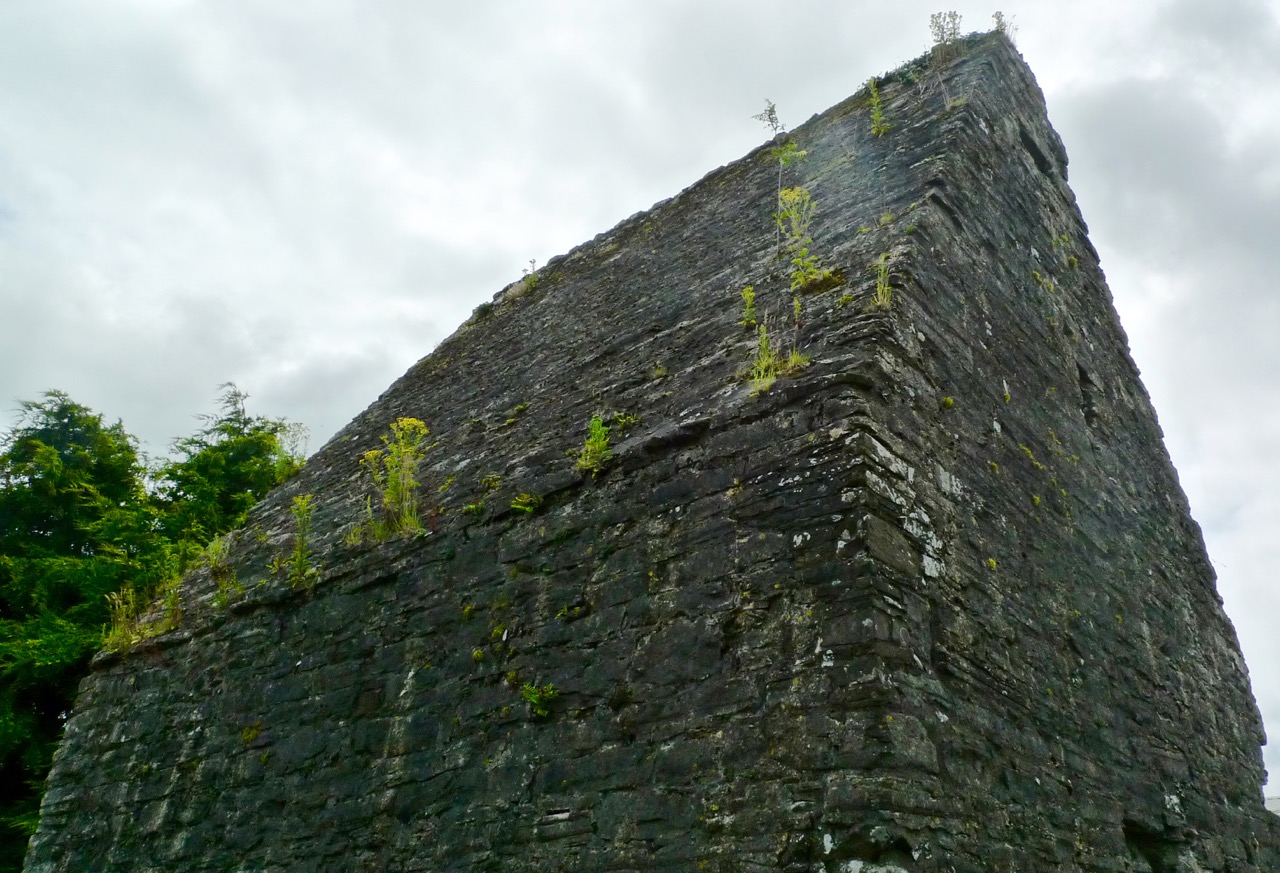
Here is the ancient stone roofed oratory of St Colmcille’s House (above), supposedly the place where the Book of Kells was written – or, perhaps, completed. The upper floor of the building has a small window oriented to focus sunlight on the writing table. St Colmcille’s bed was also kept here – a large and heavy stone slab – until it was stolen in the 1950s! A few hundred years earlier (in 1007)  the Book itself was stolen from Kells and eventually found in a nearby bog. It stayed in Kells until 1654, when it was sent to Dublin for safekeeping: it is now on permanent display in Trinity College.

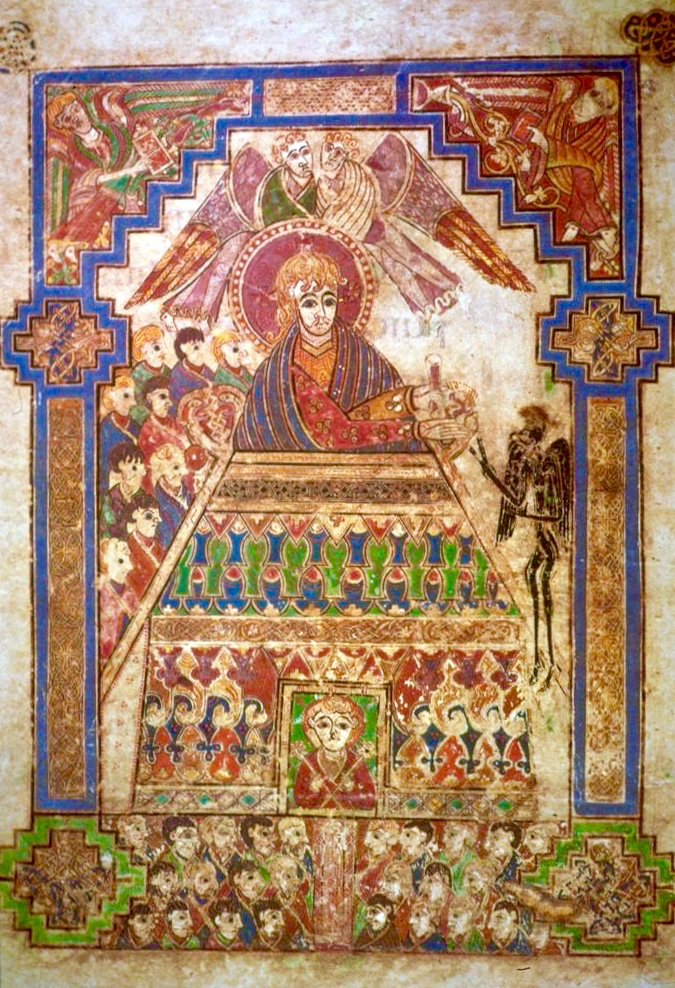
(Above) another page from the Book of Kells, which may be an illustration of the Scriptorium at Kells, and – perhaps – a self-portrait of the writer: see him sitting in the doorway to the house working away with his quill pens. Back to the medieval feast at Jerpoint: the trio below, from Jerpoint, are St Catherine – with her wheel, Michael the Archangel and St Margaret of Antioch – who is conquering a Dragon.

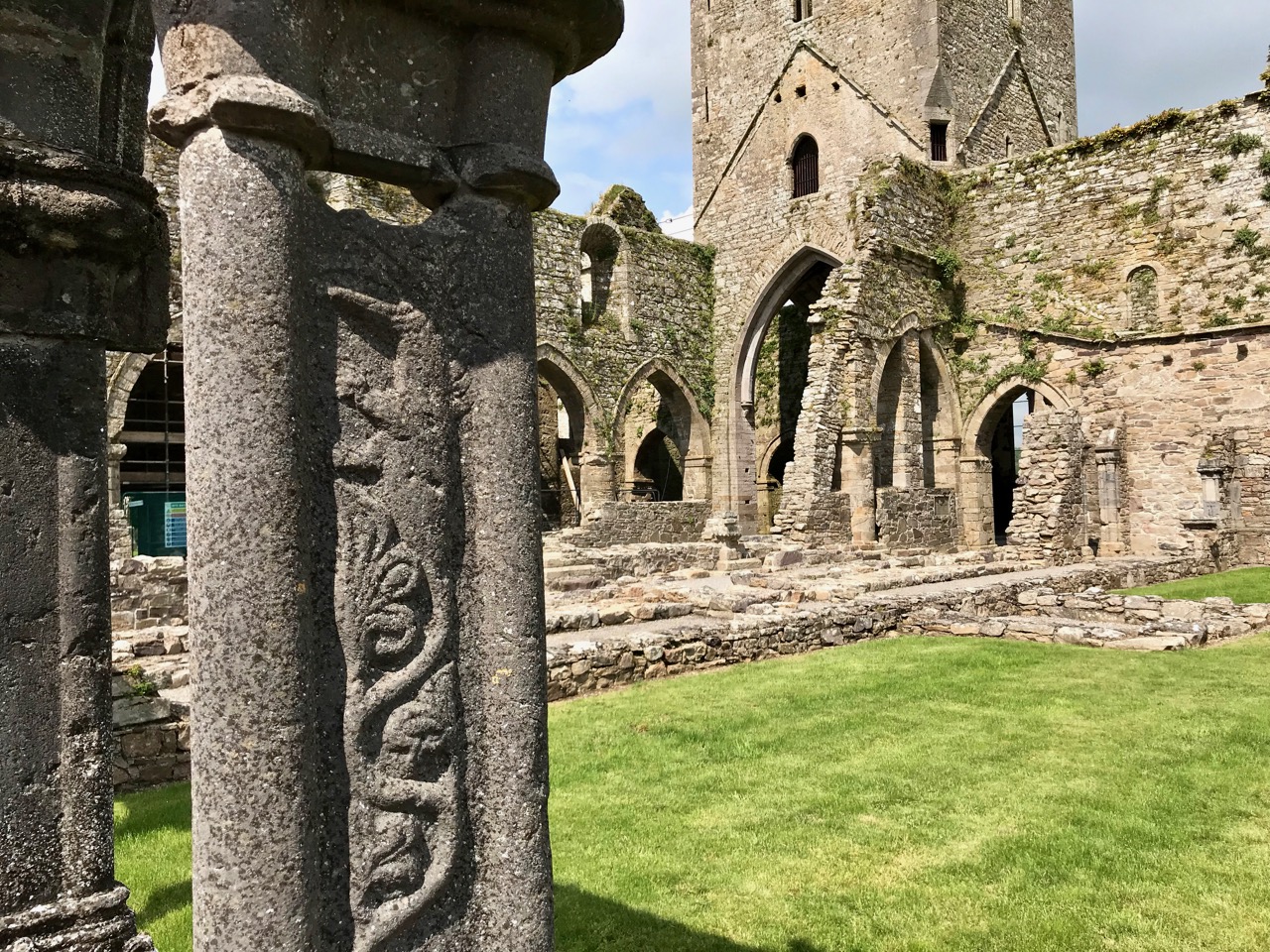
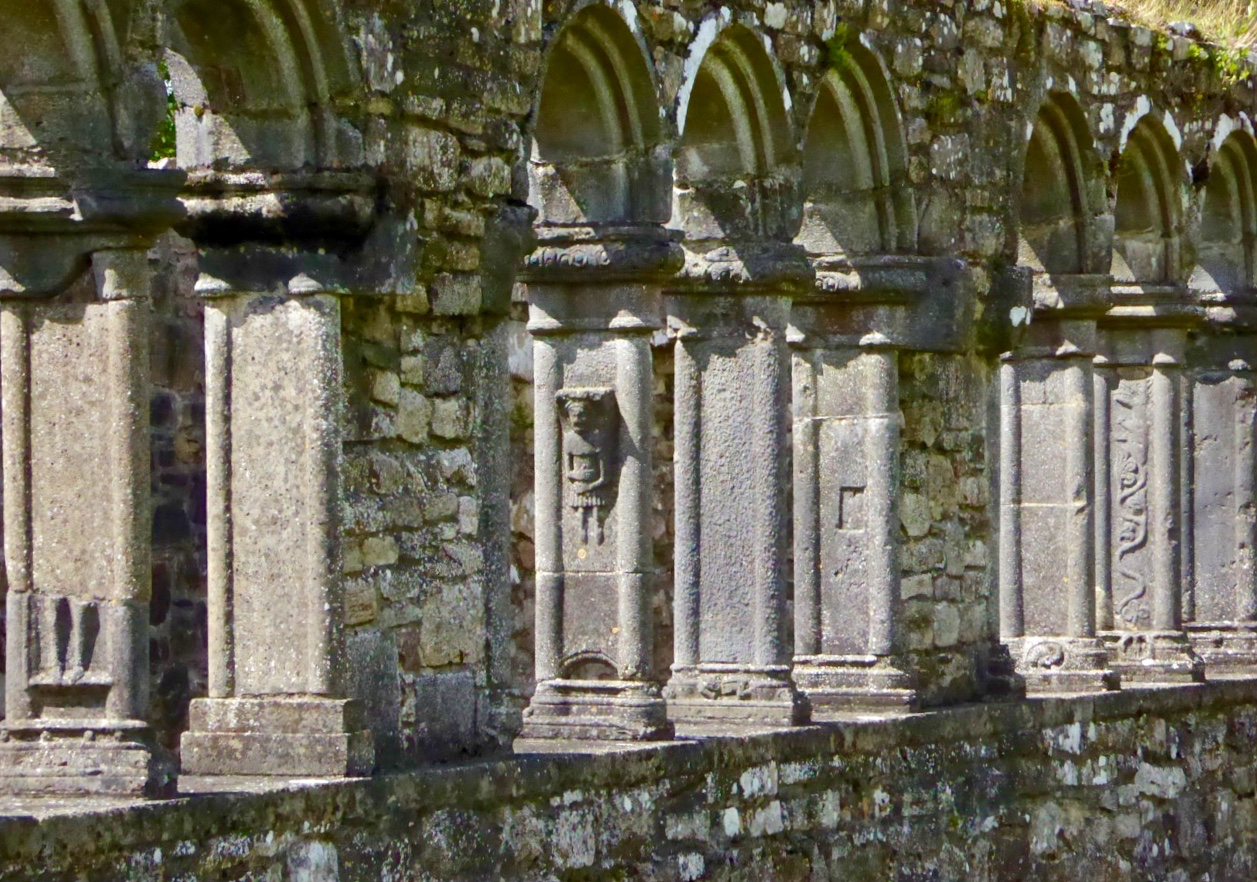
At Jerpoint it’s not just the tombs and the Weepers which fascinate: there is a 15th century cloister which, in its heyday, displayed a riot of carvings both saintly and secular. Some of these are in situ; some are partially destroyed and others have been recovered during archaeological excavations, and placed on display in a little museum. Among them we identified knights, ladies, animals fantastic and real, and ‘ordinary folk’ – including a man with stomach ache!

‘The Bones of Santa Claus’ (Author Bill Watkins)

Where lie the bones of Santa Claus, to what holy spot each pilgrim draws
Which crypt conceals his pious remains, safe from the wild wind, snows and rains?

It’s not in Rome his body lies, or under Egypt’s azure skies
Constantinople or Madrid, his reliquary and bones are hid.

That saint protector of the child, whose relics pure lie undefiled
His casket safe within its shrine, where the shamrocks grow and rose entwine.

Devout wayfarer, cease your search, for in Kilkenny’s ancient church
Saint Nicholas’ sepulchre is found, enshrined in Ireland’s holy ground.

So traveller rest and pray a while, to the patron saint of orphaned child
Whose bones were brought to Ireland’s shore, safe from the Vandal, Hun and Moor.

Here lie the bones of Santa Claus, secure beneath these marble floors
So gentle pilgrim, hear the call, and may Saint Nicholas bless you all!

I hope this topical little foray into some of our archives demonstrates once more how easy it is to find history (and legend) wherever you go in this special land. In fact, it’s very difficult to travel far here without tripping over the past. It’s often fairly low-key. Most sites are protected as scheduled monuments; some are in the good care of the Office of Public Works and have guides and visitor centres. Many are remote, open to the wind, rain and sunshine and free for us all to visit: very often you will have the history all to yourself.

Casino Marino

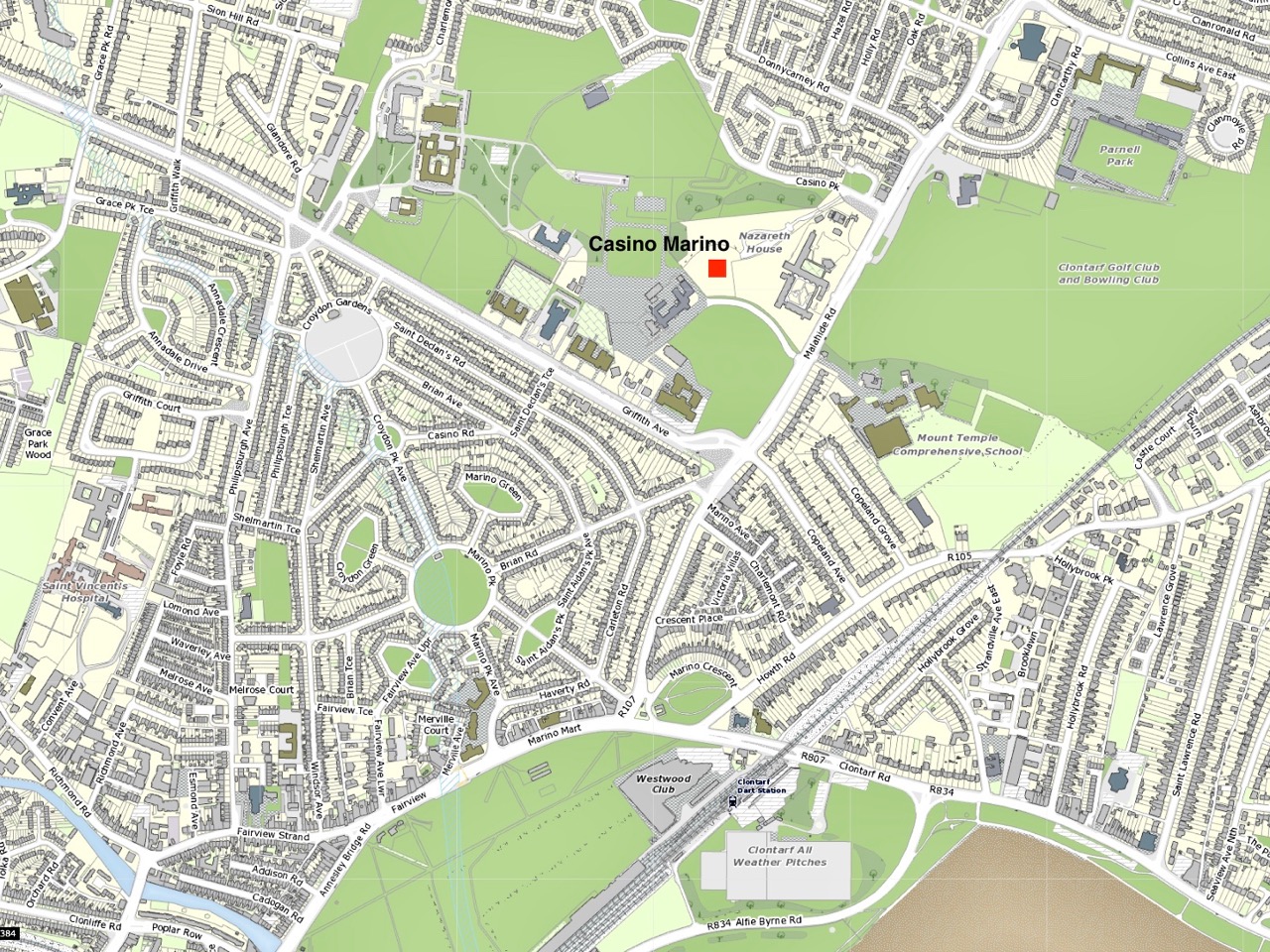
It’s a perfect little building: a gem of Irish architecture. It lies in an oasis of parkland on the outskirts of Dublin city – all that’s left of an expansive eighteenth century country house demesne, now all but engulfed by housing estates. But – perhaps in homage to the eccentric conceiver of this environmental idyll – the housing estates which have stood below it since the 1920s are quite out of the ordinary. Have a look at the layout on this contemporary plan of Merino townland, carved out of the larger Donnycarney which was granted to the Corporation of Dublin following the dissolution of The Priory of All Hallows in the reign of King Henry VIII. 

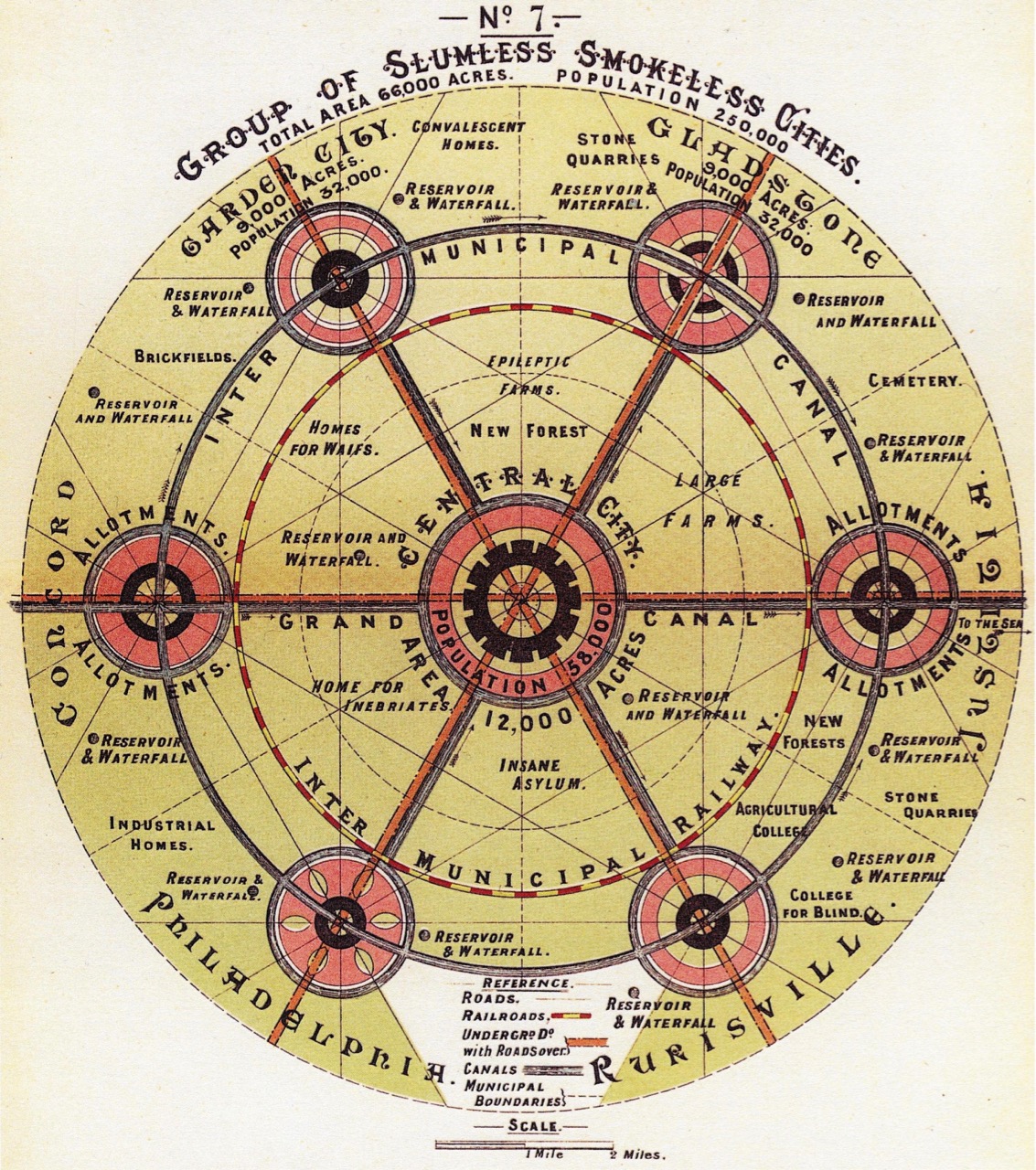
This plan is showing the location of Casino Marino, with the green areas around it being the remnants of a 238 acre demesne. The housing below the surviving Casino was Ireland’s first example, in the newly formed Irish state, of an affordable housing project and was the first local authority housing estate in the country. It was heavily influenced by Ebenezer Howard’s Garden City movement, originating in the UK with the two revolutionary developments at Letchworth Garden City and Welwyn Garden City. This Dublin estate of about 1300 houses was built on the site of a planned formal garden for Marino House and the original design was followed when the streets were laid out. This gives the Marino estate its symmetrical layout. When it was first built, purchasers of houses were restricted to large families, while alcohol and dogs without leads were banned from the parks, as were children after dark.

Ebenezer Howard, To-morrow: A Peaceful Path to Real Reform – diagram of the ideal city, dated 1898

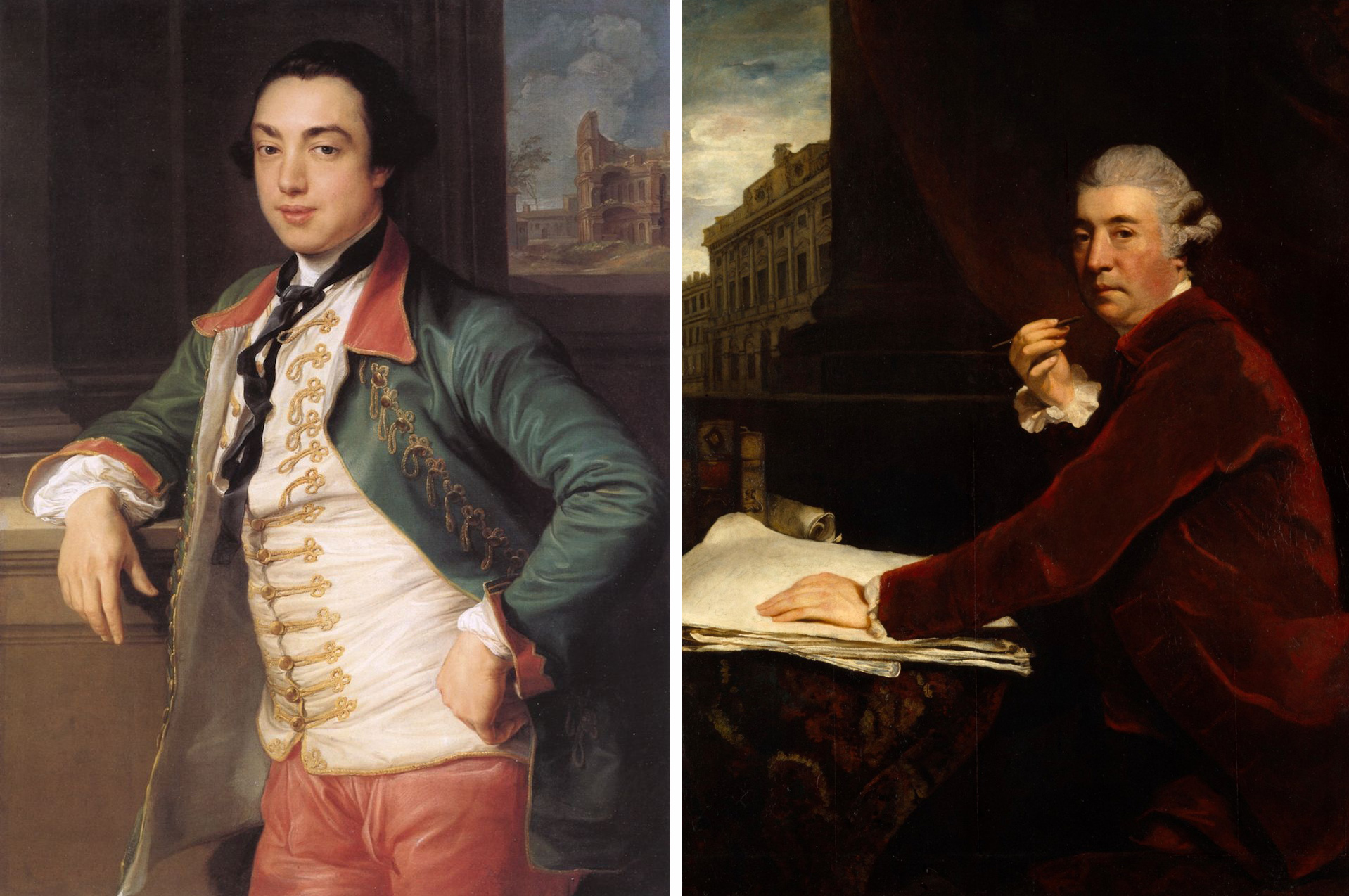
Back to the eighteenth century, and the heroes of our piece today: James Caulfeild, 1st Earl of Charlemont (1728 – 1799), and his friend, the architect Sir William Chambers (1723-1796). James (left, below – a portrait by Pompeo Batoni) was a cultivated man who disregarded the conventions of court and openly pursued Irish nationalism, having taken a leading part in the formation of the Irish Volunteers. He was the first President of the Royal Irish Academy and was a member of the Royal Dublin Society. In 1783 he was made a founding Knight of the Order of St Patrick. Like most of the wealthy young gentry of his time he went to Italy on The Grand Tour: he fell in love with that country and classical Roman culture and stayed away for nine years. When he returned he determined to bring the spirit of Italy to Dublin. Acquiring tracts of land by the coast that afforded unrivalled views over the entire bay and city, he poured his energies into creating an ideal landscape: he named his demesne ‘Marino’.

William Chambers (on the right, above – this portrait by Joshua Reynolds is in the Royal Academy) was also a great traveller: he was born in Gothenburg to a Scottish father and visited and studied architecture in China, Paris and Italy – where he met Charlemont. He established a practice in London, where he was appointed architectural tutor to the Prince of Wales, later George III. As the leading classicist of his day, it was unsurprising that Charlemont should turn to him to realise his dream of an Italian arcadia in Dublin. It was a commission that took many years to come to fruition, partly because of the Earl’s seemingly limitless ambitions and his attention to fine detail.

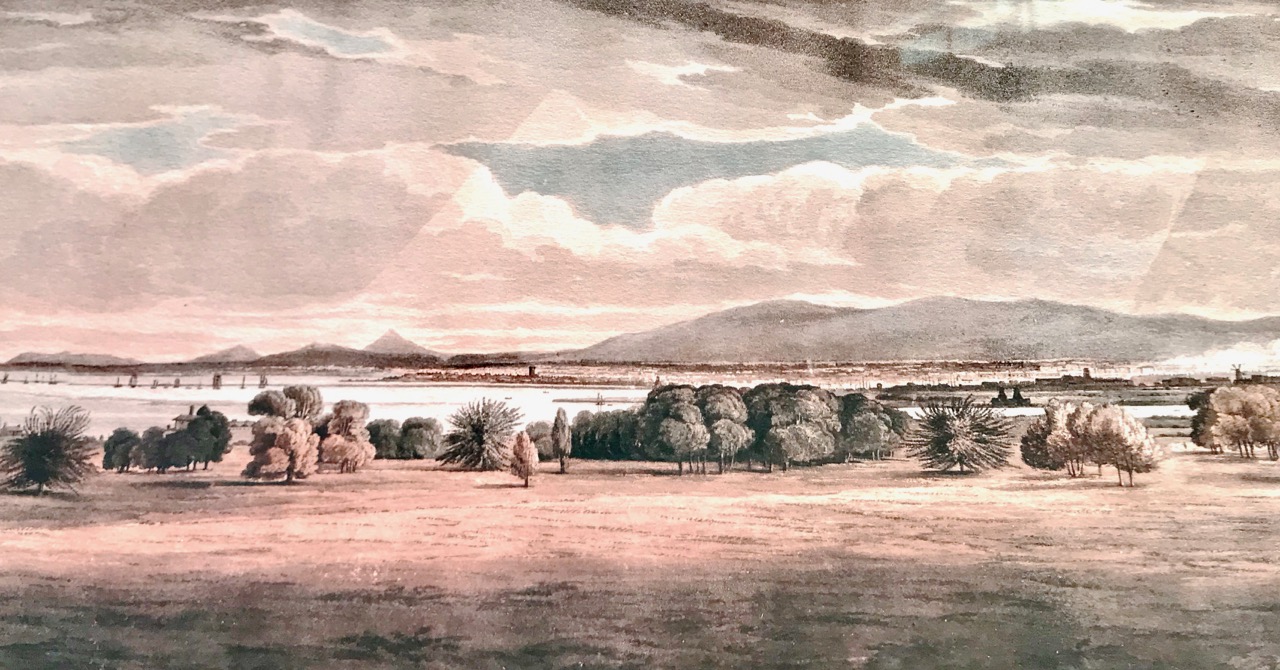
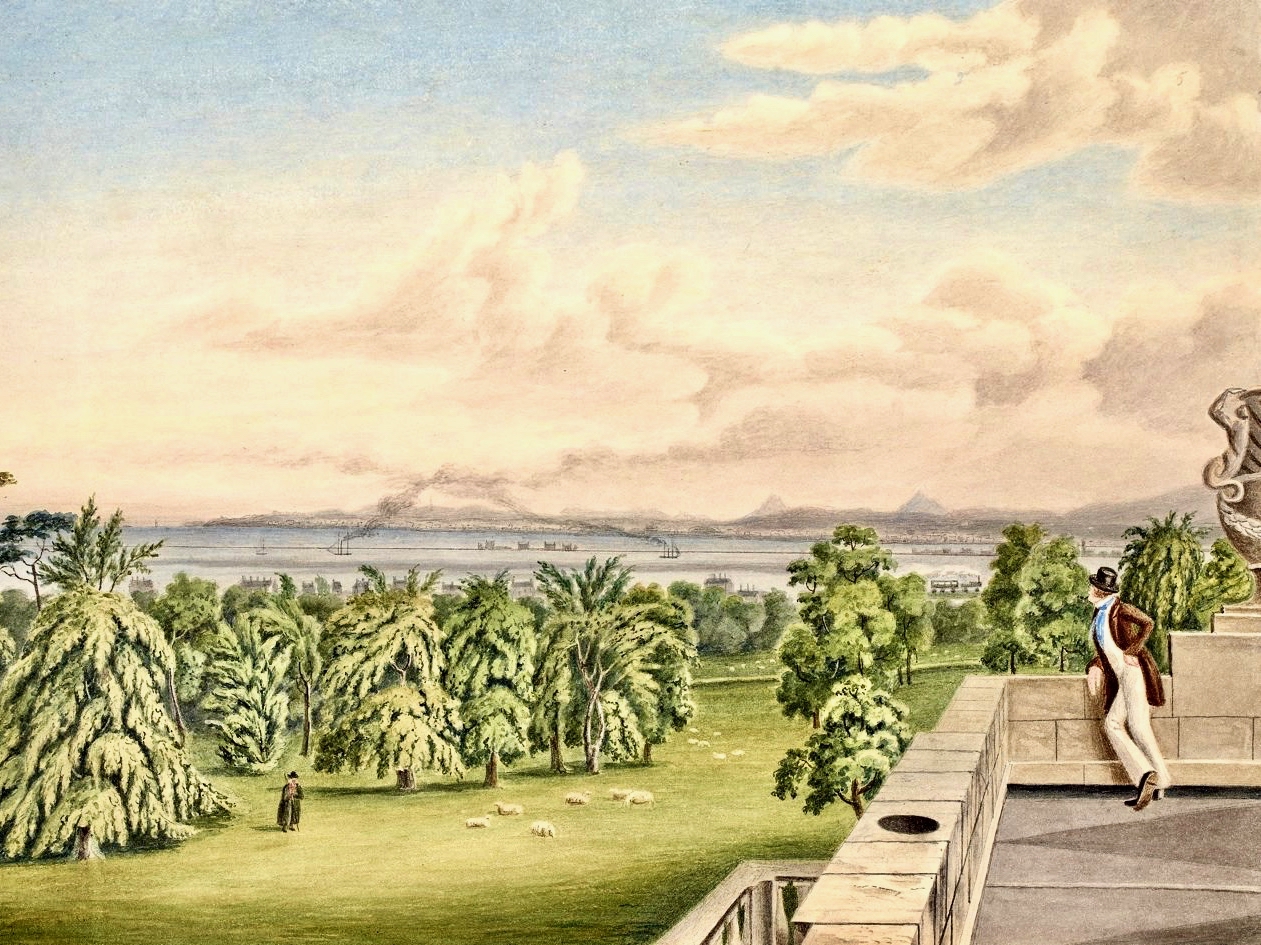
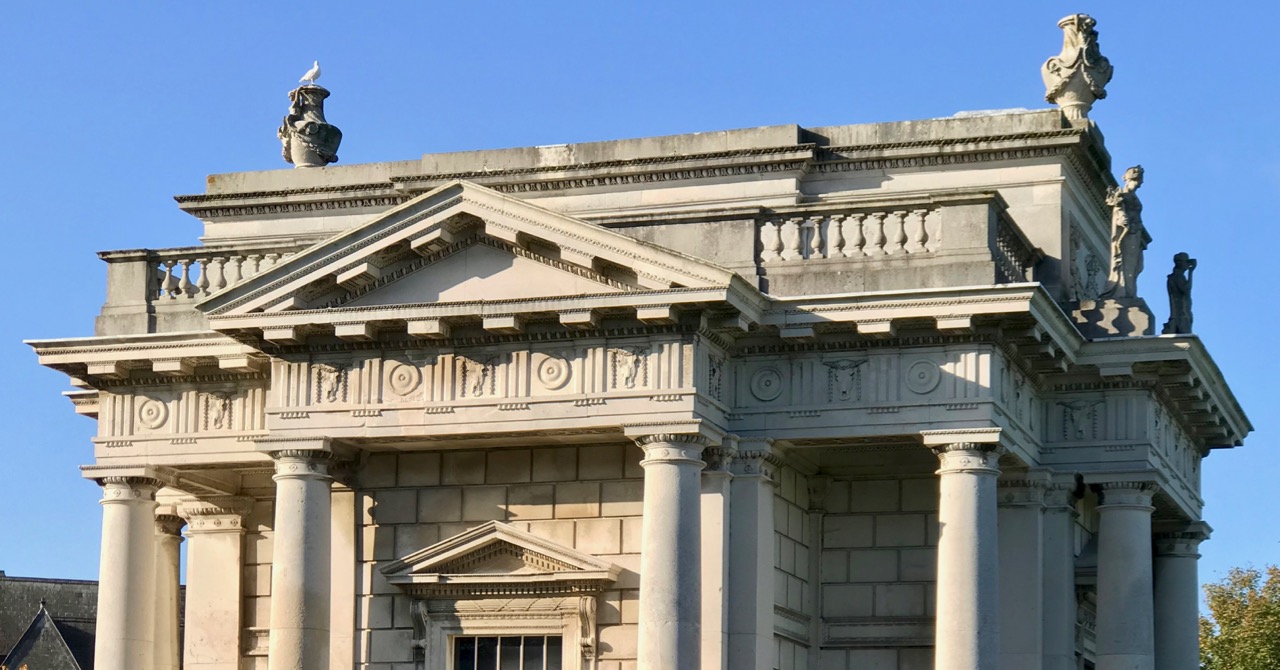
Charlemont’s Marino estate enjoyed fine unrestricted views across Dublin Bay. The culmination of the Earl’s work on his estate (and now the only surviving element) is the Casino, and this is sited on the highest point on the land: the painting above shows the view from the roof of the Casino, which was fully accessible from the building interior. So – what is a casino? It’s simply the Italian for small house, and in this case has been built as a garden room or, perhaps, a gazebo. Ornamental, but eminently functional. From the outside it appears small, but exquisitely detailed on all its elevations. In fact, the simple building houses 16 rooms over three storeys – plus the roof terrace.

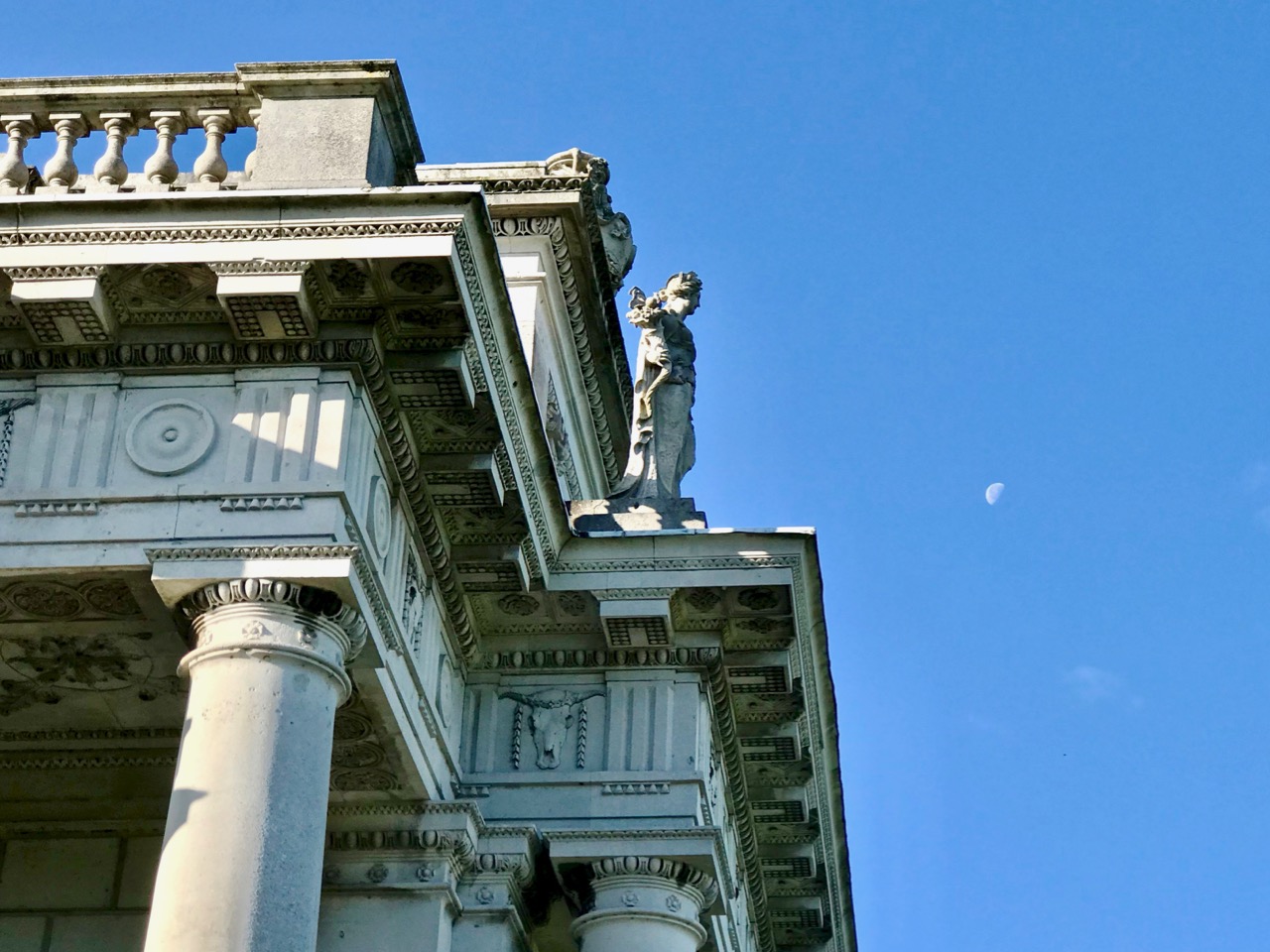
Exercises in architectural scale. Upper – an almost contemporary view of the Casino painted by William Ashford (1746-1824), National gallery of Ireland: here the building seen in its landscape context looks like a miniature folly. Centre – a close-up of the roof detailing includes life-size statuary. Lower – Ava and Hugo, willing participants in our expedition to the Casino, help to give an impression of its true size.

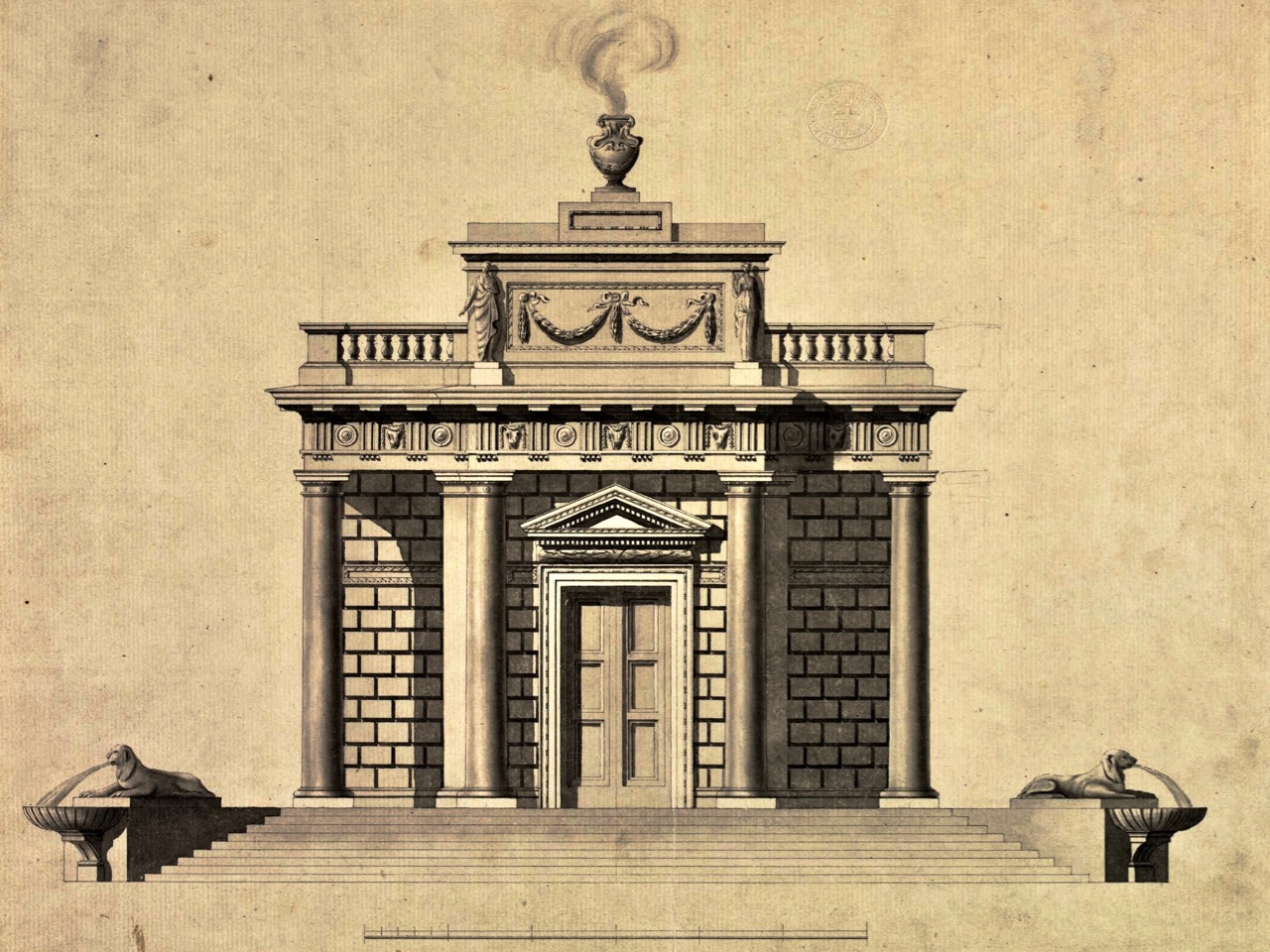
The Casino is guarded by four large lions. Originally they were intended to be fountains – as you can see from the original architect’s drawing, above. In this drawing you can also get a good sense of how the designer plays tricks with scale: the doorway is perhaps three times the height of a normal door, and only a small section at the bottom is, in fact, an opening.

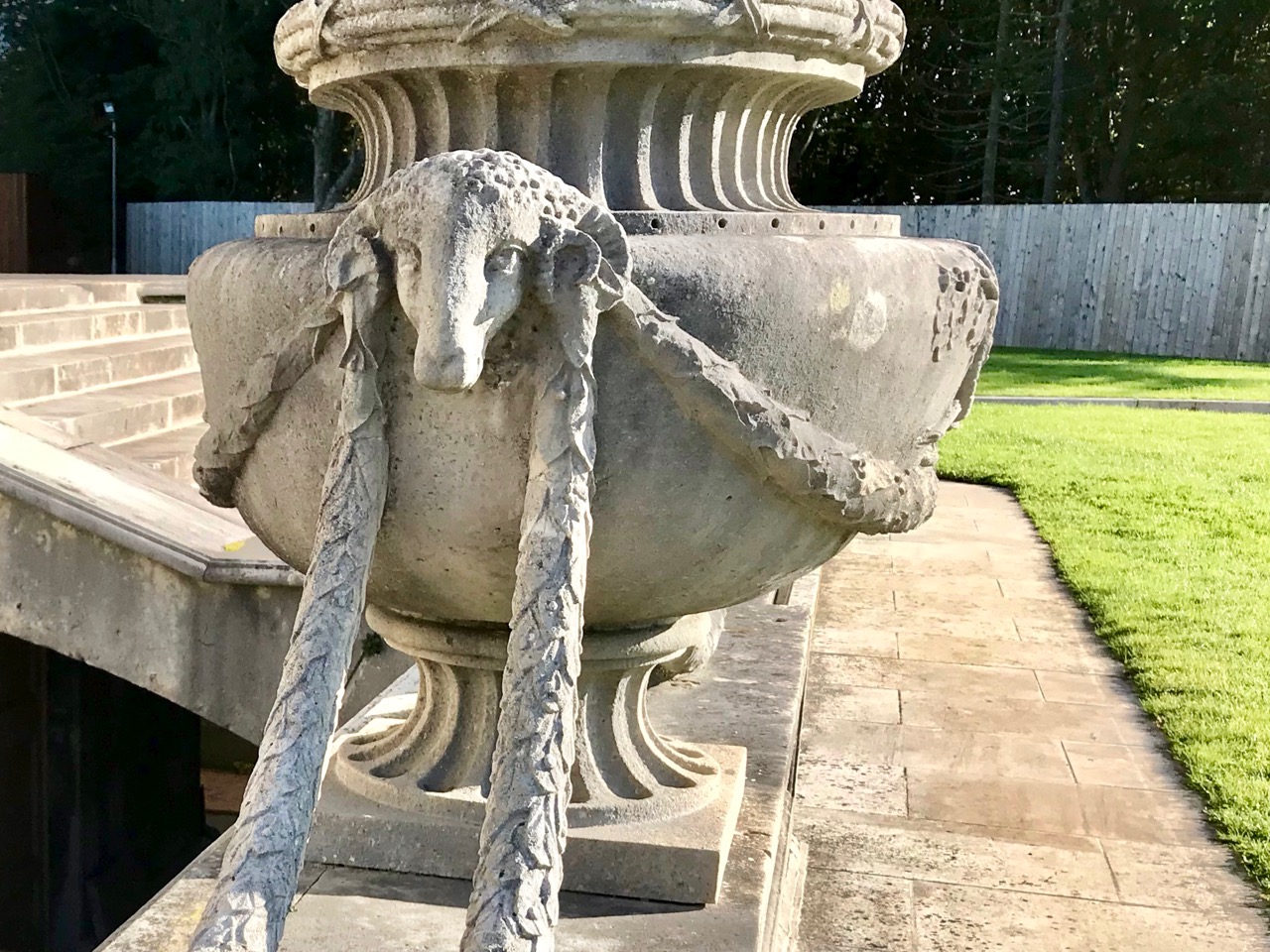
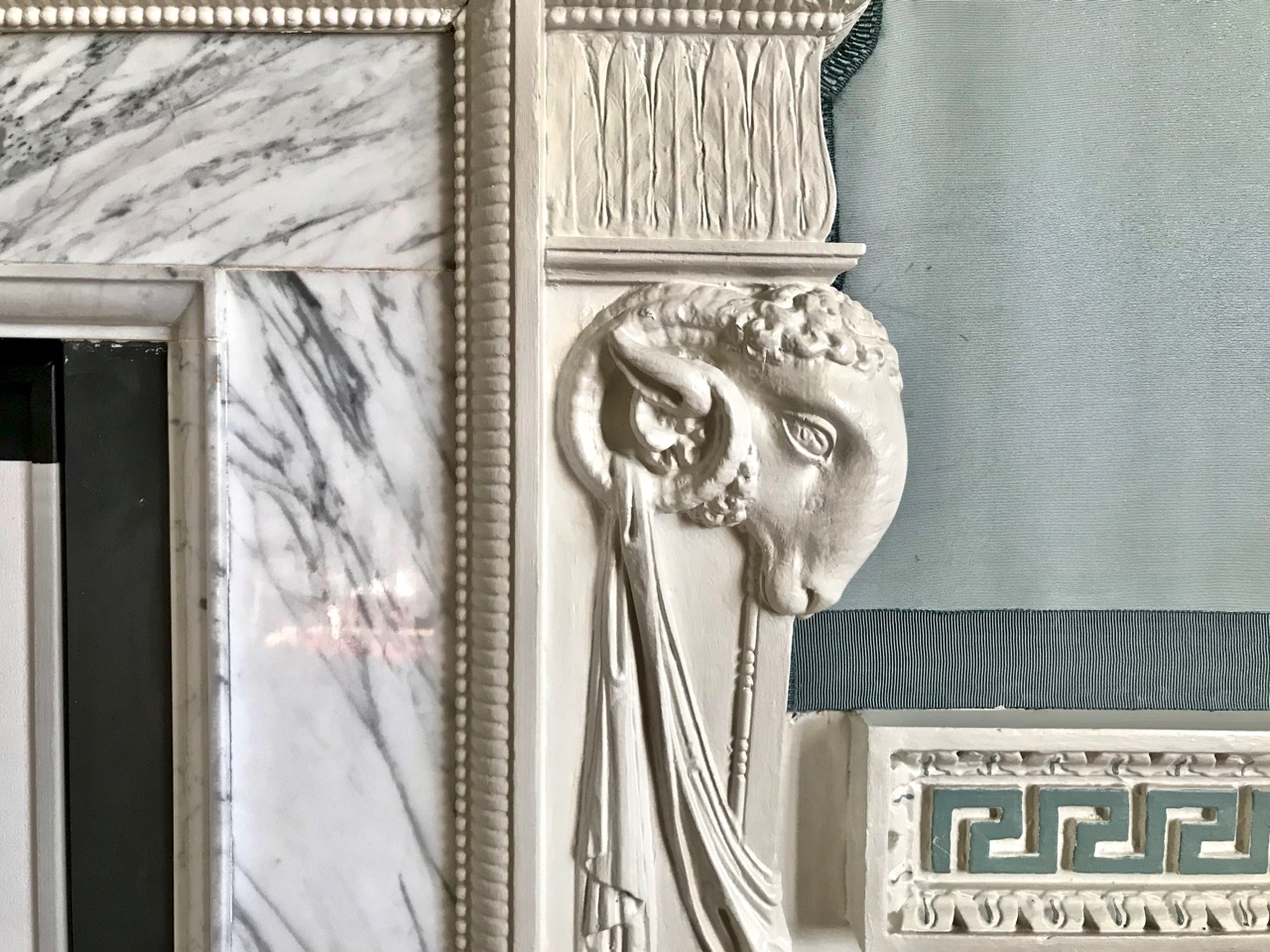
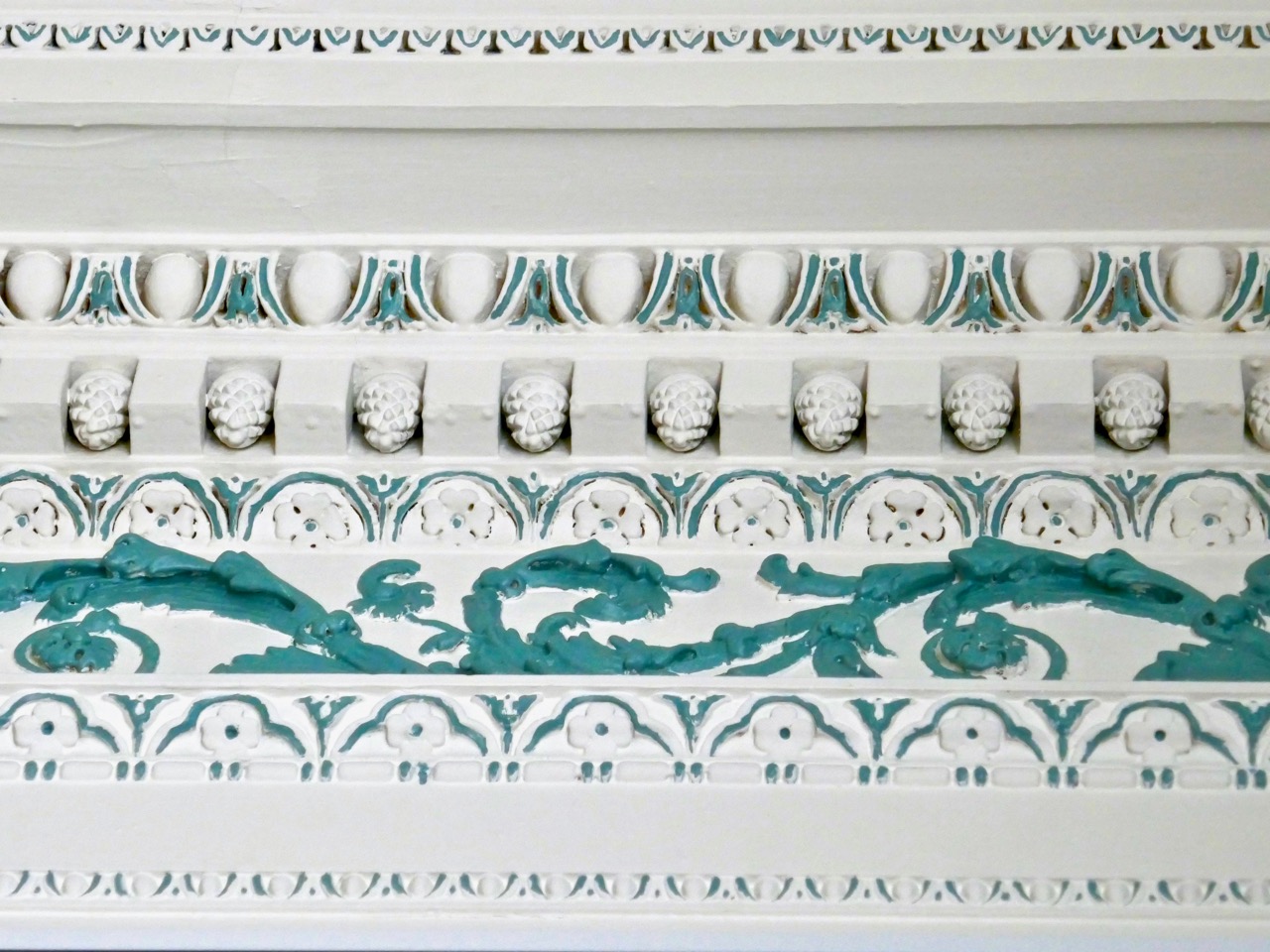
Symbolism and hidden messages abound: the architect, Sir William Chambers, left his signature – in the form of a ram – in many parts of the house. Every moulding, coving, frame detail has a meaning in terms of architecture and freemasonry – and also pays homage to the Greek and Roman classical orders – at the behest of the client. The parquet flooring is magnificent – and is at present kept covered by a vinyl replica to protect the original exotic woods.

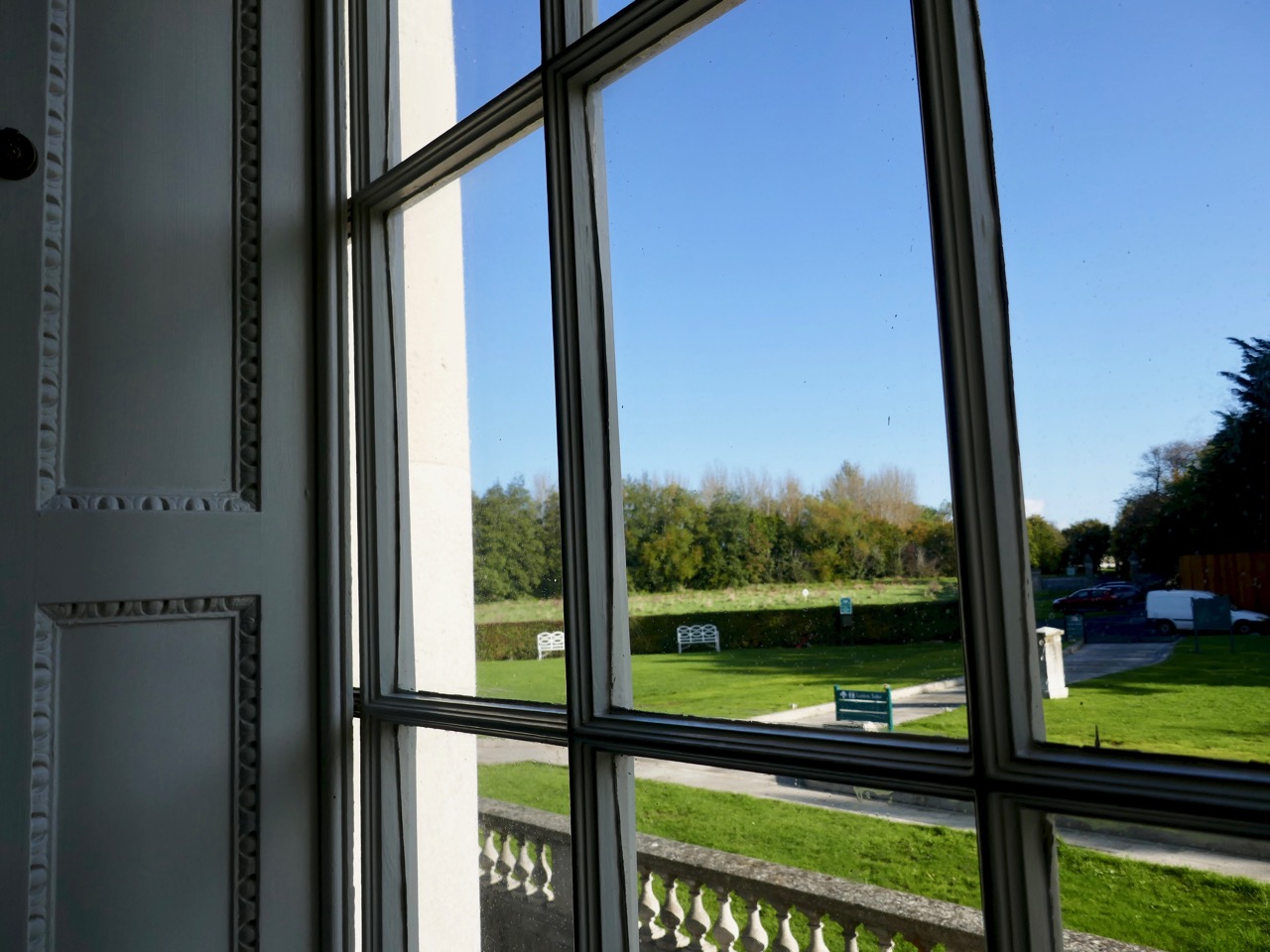
The detailing of every element has been fully considered. I was impressed with the curved timber doors, which follow the line of circular wall partitions inside. And, particularly unusual, is the use of vertically curved glazing which causes reflections when seen from the outside, meaning that no shutters or blinds are needed at the windows.

Look carefully at these windows: they are crafted with vertically curved glass which make them reflective externally!

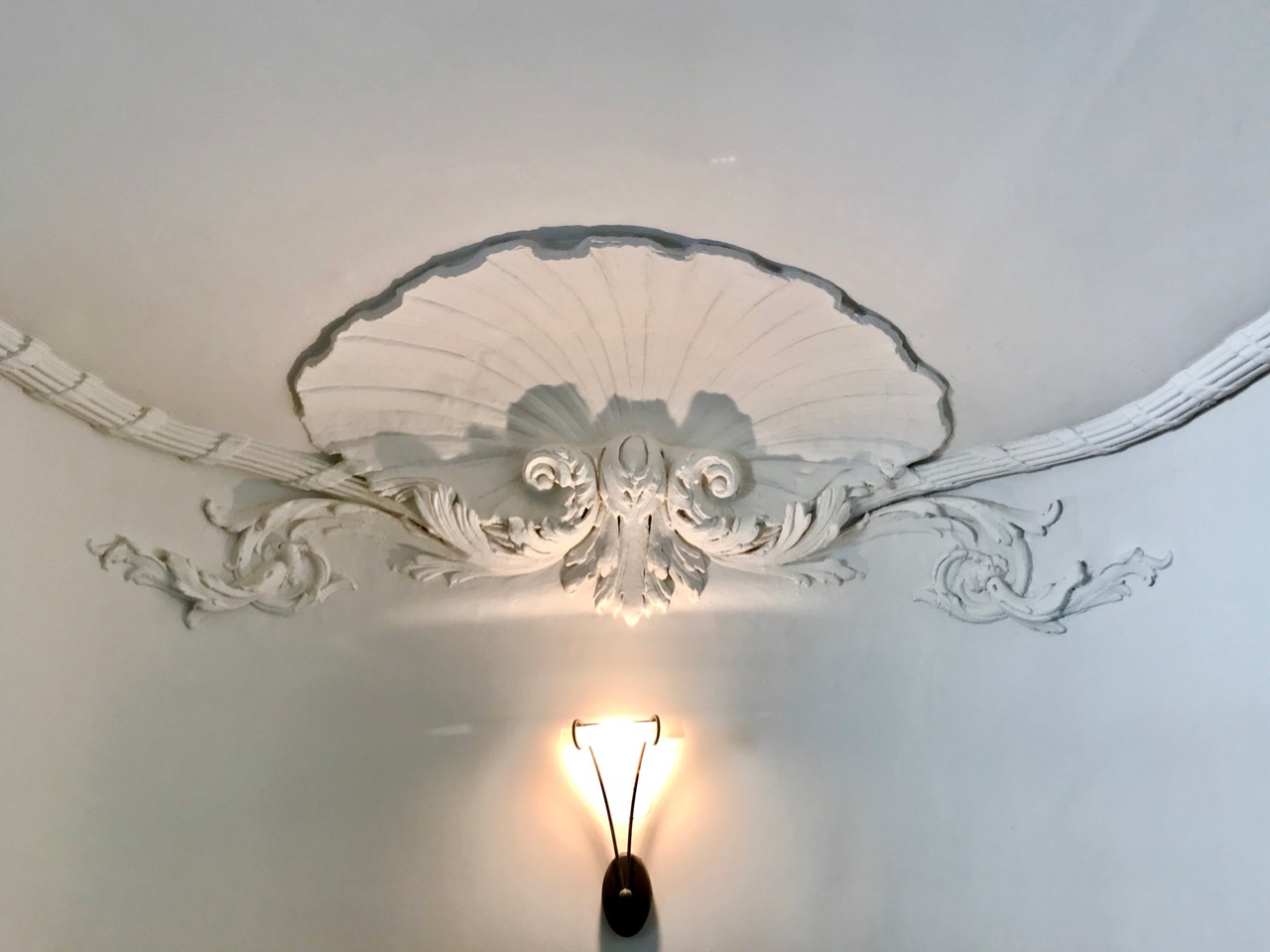
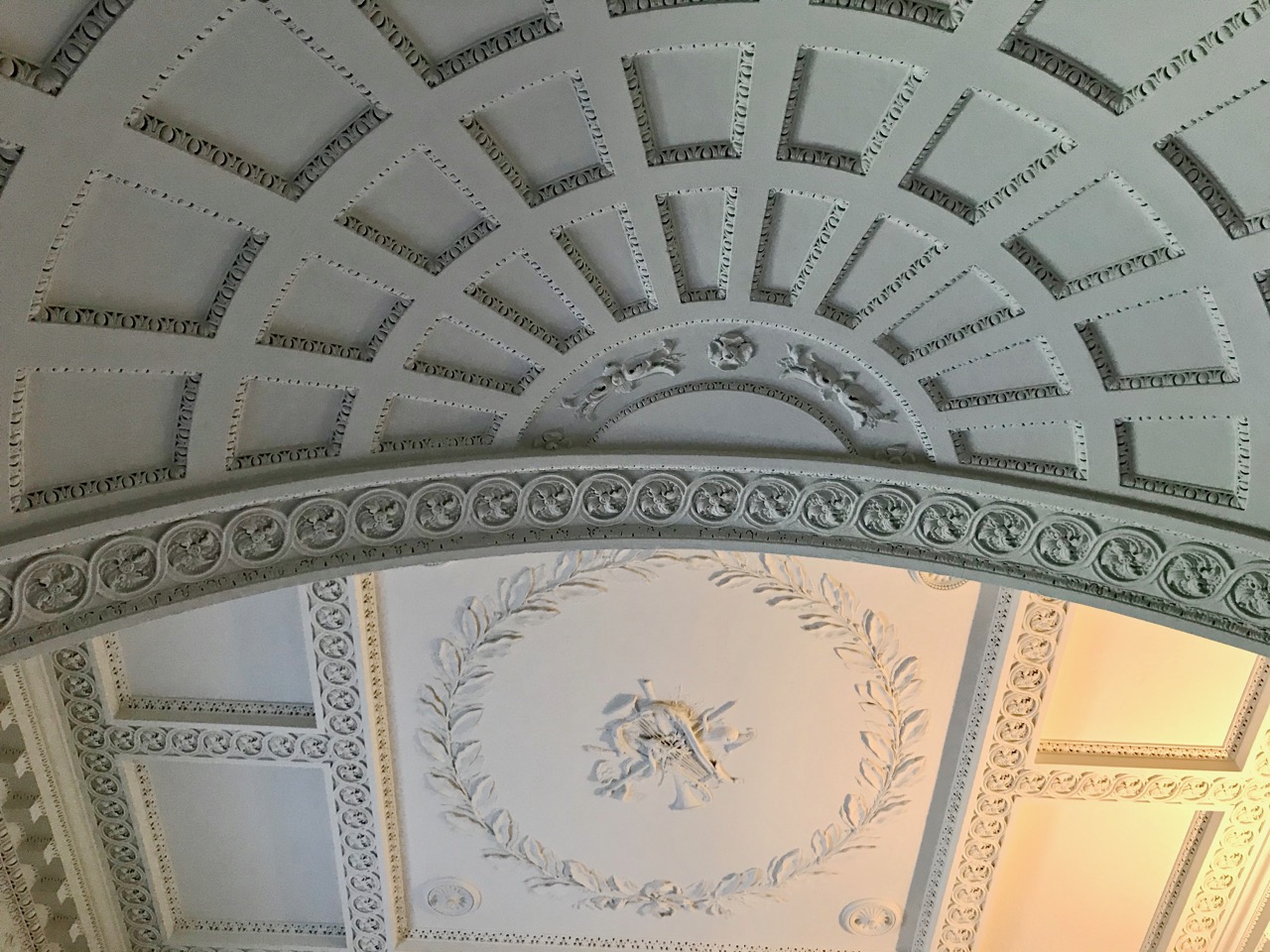
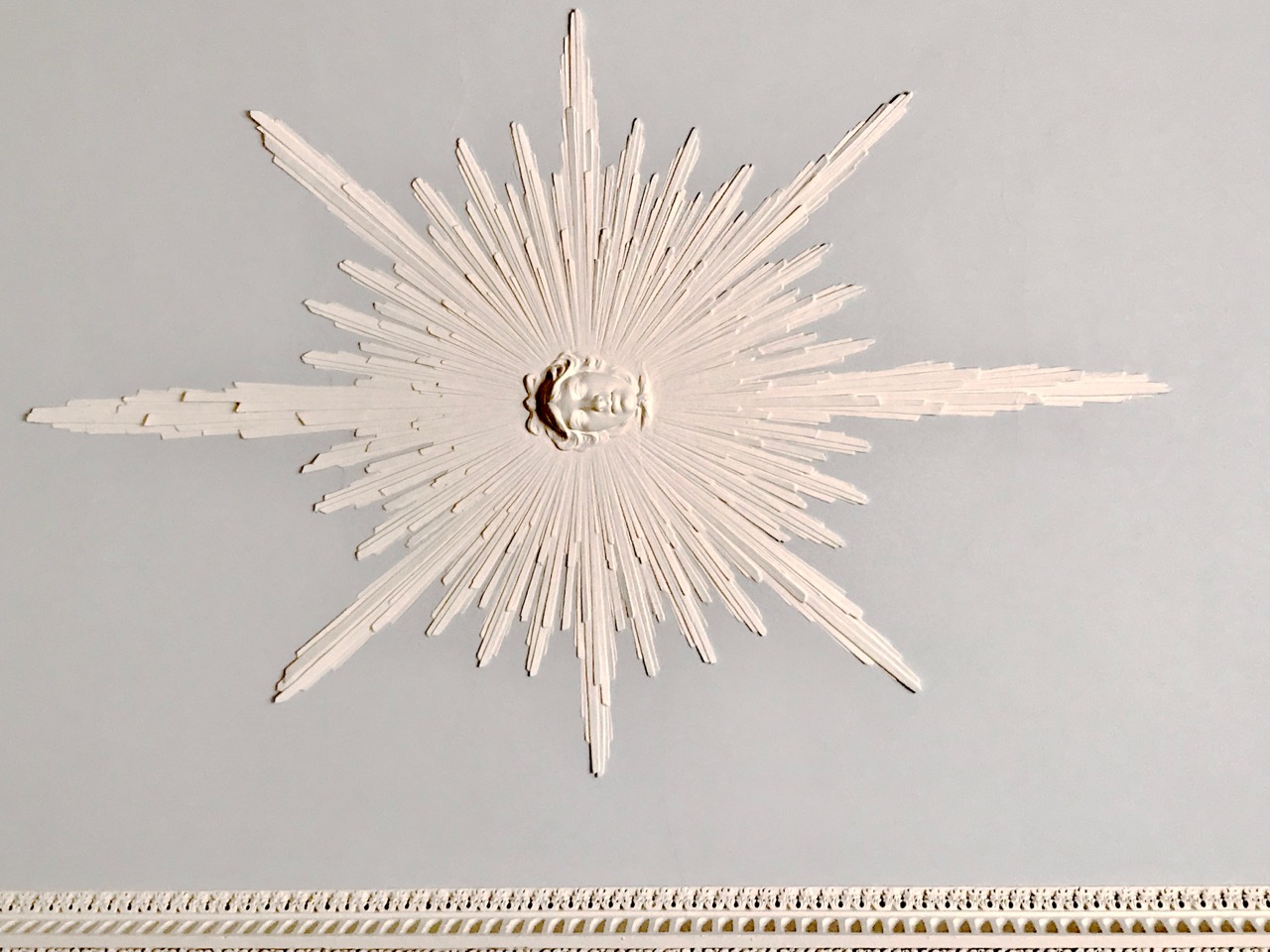
Examples of the plasterwork within the Casino include agricultural harvest symbols, every classical moulding motif and Apollo the sun-god. It would take several visits to absorb and catalogue the complete variety of images: every room has a different visual character.

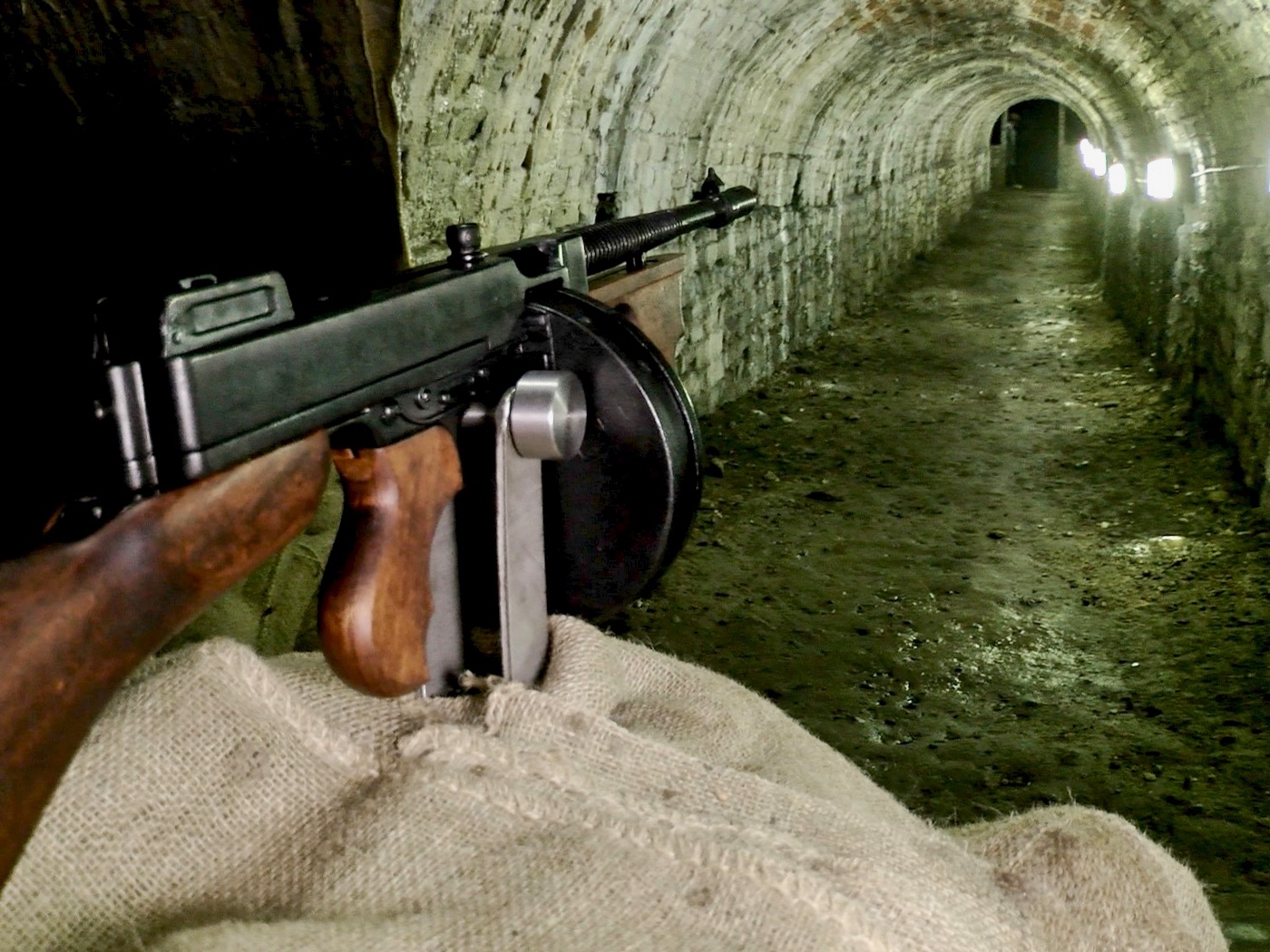
There are hidden elements – and enigmas – to the building. These include ‘secret’ tunnels in the basement: one was used by Michael Collins to test-fire submachine guns during the War of Independence. The picture above shows a reconstruction. The basement of the Casino, including the tunnels, is currently undergoing further restoration and refurbishment and was not accessible during our visit. It is said that there are many other tunnels, including one that linked the Casino to the big demesne house (now demolished) – and some that, according to legend, run to the coast – miles away!

Charlemont was a liberal and believed that everyone should have access to his parklands: there were no gates. He was so protective of his project, however, that he married in middle age, having been a confirmed bachelor. He had overheard his then presumed heir (his brother) talking about how he was going to exploit and commercialise the demesne once he got his hands on it: this prompted Charlemont to ensure he produced an heir that he could have some direct influence over! Evidently, the marriage was a happy one. The image above shows the Casino in a sad state of disrepair around 1900: the estate was broken up by the third Earl in 1876.

The Casino was adopted as a National Monument in the 1930s, and a full restoration was begun in the 1970s. A further phase of this restoration is currently under way, and the property is only open on limited occasions when suitable areas are accessible: we were fortunate to get there on one of those times. If you plan to visit, contact the Office of Public Works to make sure that you will get in. Charles Topham Bowden made the journey in 1791, and recorded it in his journal A Tour Through Ireland: here is an extract:

. . . This is one of the most beautiful and elegant seats in the world, happily situated, and in a demesne improved in the highest taste, comprehending 238 acres, laid out in plantations, lawns, and a delightful park . . . The temple is situated in the park – a monument of his Lordship’s refined taste. The Gothic room is a very curious and beautiful structure. The hermitage is nature itself. Art and nature unite in rendering this a most desirable residence. What obligation are not the citizens of Dublin under to his Lordship for having the gates of this terrestrial paradise opened to them whenever they chuse [sic] to walk through it . . .

Watsons of Youghal – Revivalist Masters Part 2

In Part 1 I laid out the background to the Watsons of Youghal Revivalist-style windows, a design innovation for which they should be particularly celebrated. In this post I will provide further examples and tell you where you can see some.

The Watson Archive is housed at the Crawford Gallery in Cork. In it are original cartoons showing the careful working out of interlace patterns and of lettering styles. Since these cartoons are on long pieces of paper which remained rolled or folded in storage for many years, they are in fragile condition and therefore what one consults in the Crawford Archive is the file of photographs of these papers. While not ideal, this at least allows serious students of stained glass to see some of the original work upon which the windows were assembled. There are also smaller drawings and paintings – these were done as original designs from which the cartoons could be drawn and from which the colours could be worked out.

It’s a real thrill to come across a window that is based on one of those designs: see above and below for a perfect match! Incorporation of interlacing can also help to identify an un-signed window as being a Watson: it was what set them apart, when the figures themselves – the saints or angels – might be well-nigh indistinguishable from those of other stained glass manufacturers.

Interlacing is the preferred word for the complex looping and braiding of ribbons, which twist in and out and around each other and often end in the head of a fantastical animal. Artists studied the Book of Kells and other illuminated manuscripts, copied the elaborate decorations and eventually figured out their own designs. Just walk through any older cemetery in Ireland to see the craftsmanship with which many crosses were carved with interlace motifs.  So it was with Watsons: they became expert at fitting and filling spaces in a window with Revivalist designs.

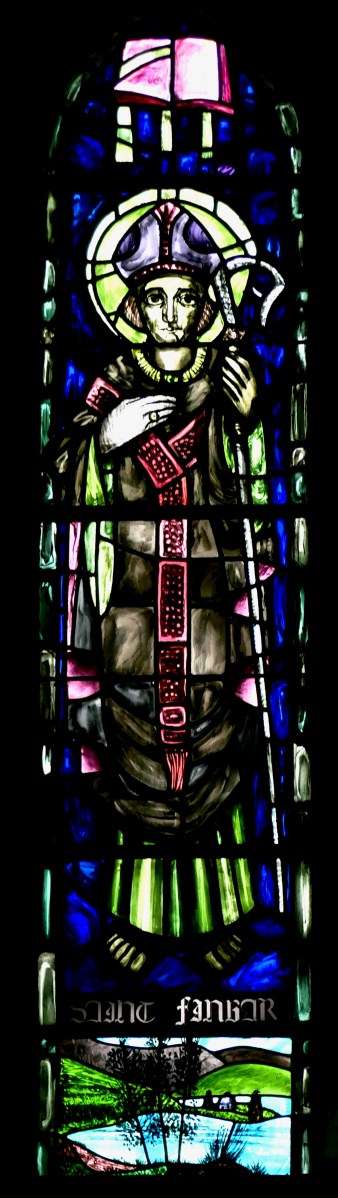
One of the best places to see Watson Revivalist windows, because it’s a small space and you can get close to the windows, is the Oratory at Gougane Barra. The vision for the building was that of Fr Patrick Hurley who developed the ‘ancient’ monastic settlement on the island, a scholarly man well versed in the Revivalist art and literature of the period who specified that the oratory itself would be built in the Neo-Romanesque style based on 12th century Irish churches such as Cormac’s Chapel (see this post for more on this). In the Oratory all the windows except a Marian image depict Irish saints, some of whom are local to Cork (Finbarr [above], Fachtna [below], Gobnait and Eltin).

Another West Cork church with Watson Revivalist windows is in Ardfield, south of Clonakilty. I used some of these in my Symbols and Stories post so take a look at those now. Note that, in contrast with the Gougane Barra Oratory, the iconography in Ardfield is essentially International-Catholic (St James, Jesus, Mary), very much in line with the Devotional Revolution which I described in my post Saints and Soupers: the Story of Teampall na mBocht (Part 7, the New Catholicism). Instead of repeating the Ardfield images here I will send you instead to the little country church in Castletown-Kinneagh, near Enniskeane, and one of my favourite windows – the Infant of Prague. In the extensive renovation of this church the parishioners, ably led by Fr Tom Hayes, worked hard to save this window from a porch which had to be demolished and re-located it in a light box inside the church. While not perfect for back-lighting, this has the great advantage of allowing the viewer to get really close to the window to observe the painting techniques and the details. 

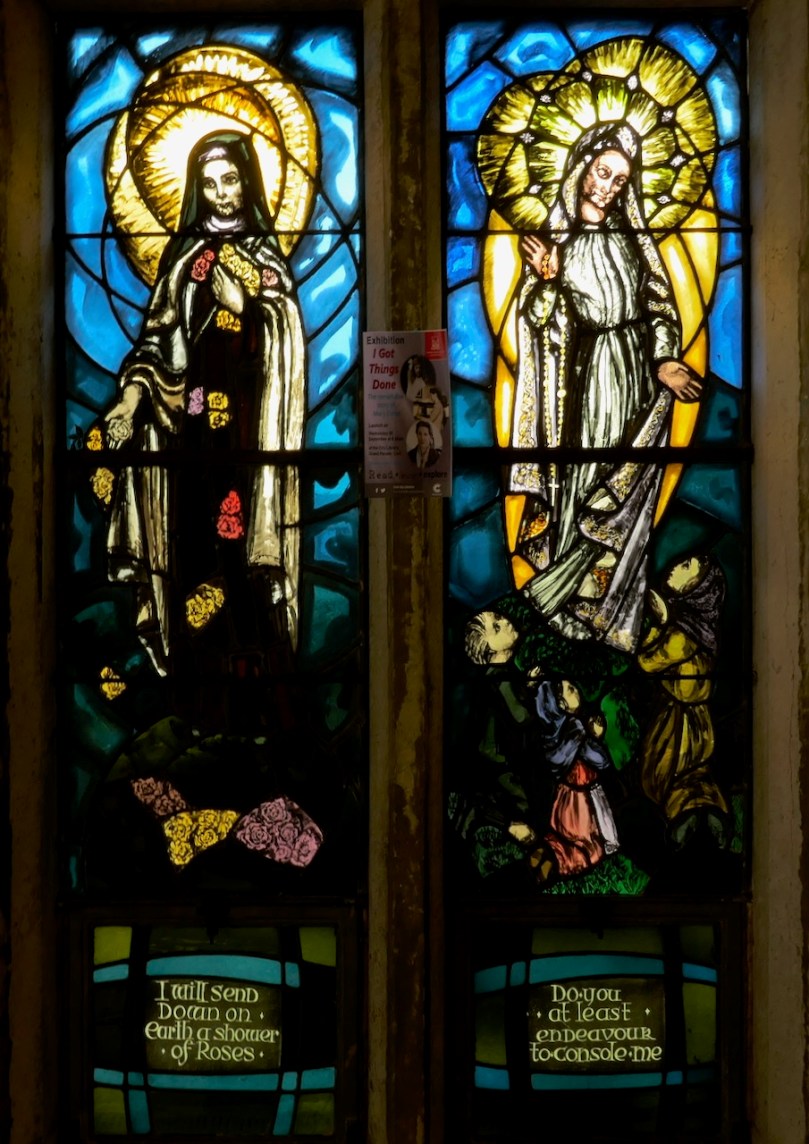
Next we will stop by St Ita’s church in Gortroe, near Youghal. Here you will find one of Watson’s Revivalist windows dedicated to that same Blessed Thaddeus McCarthy (below) about whom Fr Hurley wrote in the Journal of the Cork Historical and Archaeological Society and whose travails I described in my Post Thaddeus McCarthy, The Bishop Who Never Was. In the sanctuary is a three light window, the Sacred Heart flanked by Thaddeus and St Ita, while a Lourdes window occupies the south wall (a detail from that window is my lead image in this post).

Protestant churches were also attracted to Revivalist touches and one of the most interesting windows I’ve seen is in St John’s Church of Ireland in Knight’s Town on Valentia Island in Kerry. The two light window depicts the angels of Prayer and Praise, with book and harp. The angels are beautiful if over-familiar depictions, but it is the surround that shows how Watsons worked hard to customise windows according to the wishes of the clients.*

The windows commemorate James and Anne Graves. James Graves was the first Superintendent of the Anglo-American telegraph station on Valentia and he held the post for forty years. Accordingly, the framing surround of each window shows not only nicely worked-out interlace but the telegraph cable, punctuated by cross sections of that cable in red and green. Marine rope, telegraph poles and ceramic insulators also make an appearance, and the international telegraph alphabet is represented by black dots on a white background. The window was executed in 1912 and cost thirty five pounds.

So far I have illustrated this post from windows in small churches, but the very large Catholic Church of St Carthage in Lismore, Co Waterford, has several very fine Revivalist windows. Some are credited to Cox and Buckley and were completed in the 1890s; others were done after the company had changed its name to J Watson and Co. The church itself, in a flamboyant Lombardo-Romanesque style, is well worth a visit and the windows certainly enliven the interior. The iconography is a mixture of International-Catholic and Celtic-Revival/local iconography, with, for example, the Archangel Michael and St Carthage (see Part 1) side by side.

I included a detail from the Vision of St Ita window in Part 1, but it’s worth having a look at more of that window. The end of the nineteenth century saw the publication of many texts related to Irish saints – translations from Irish by such scholars as Whitley Stokes (see my post on The White Hound of Brigown) and Canon John O’Hanlon – and these became the religious equivalent of the stories of Finn McCool, Cuchulainn and the great Irish mythology cycles as written by Standish O’Grady and others at the time. St Ita was the foremost female saint of Ireland after St Brigid, and she is traditionally thought to have come from Waterford. She was given to visions and raptures and this is what is depicted here. And just look at those wonderful birds in the canopy above her head.

This demonstrates the popularity of these hagiographies with Irish Catholics and their clergy at the time – the artists responsible for these windows had to make sure they were well read on the lives of Irish saints. Both the Columcille window (above) and the Patrick window (below) exuberantly display their artist’s knowledge of the lives and deeds of these saints as well as their immersion in all the tropes of Celtic Revival imagery (wolfhound, anyone?).

The Rose Window has a panoply of Irish Saints (including Saint Otteran, Patron Saint of Atheists!) each one occupying one of the rays of the rose with cherubs encased in interlace. As they say in property ads – must be seen to be appreciated.

My final window astounded me when I first saw it – in fact I think it was my introduction to Watson’s use of interlace and it really is a virtuoso performance. I’ve used the bottom panel from it further back in the post to demonstrate how a cartoon ends up as a window, but the whole window deserves pride of place. It’s in the Catholic church in Inchigeelagh, Co Cork, and so we have circled back again to St Finbarr of Gougane Barra – an excellent place to stop.

I’ve included illustrations in this post from Cork, Kerry and Waterford but I would be interested to hear from anyone who has found Watson Revivalist windows anywhere.

Part 1 of this post is here