Scissors Cut Paper Wrap Stone – a Review

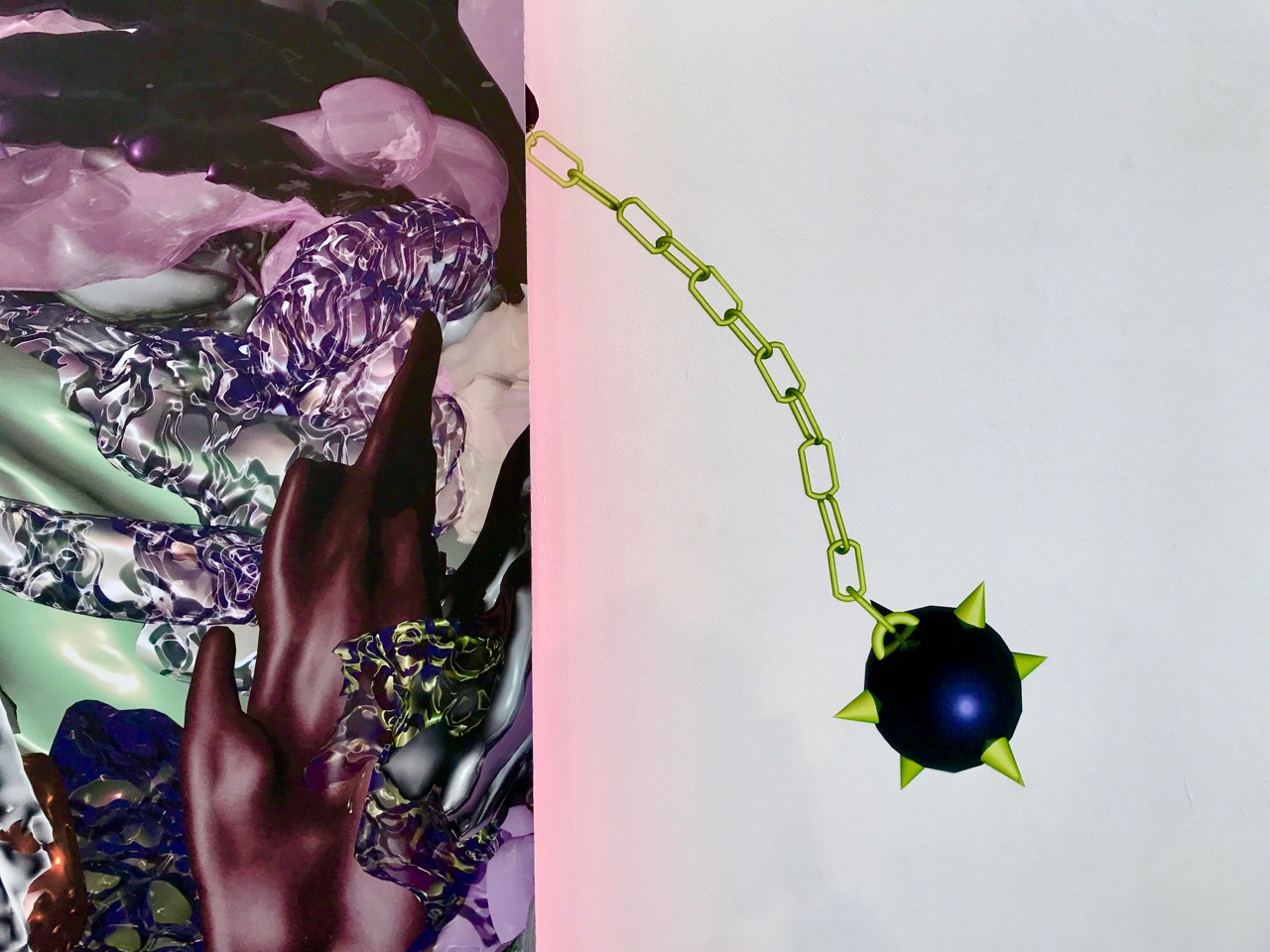
ball graphic

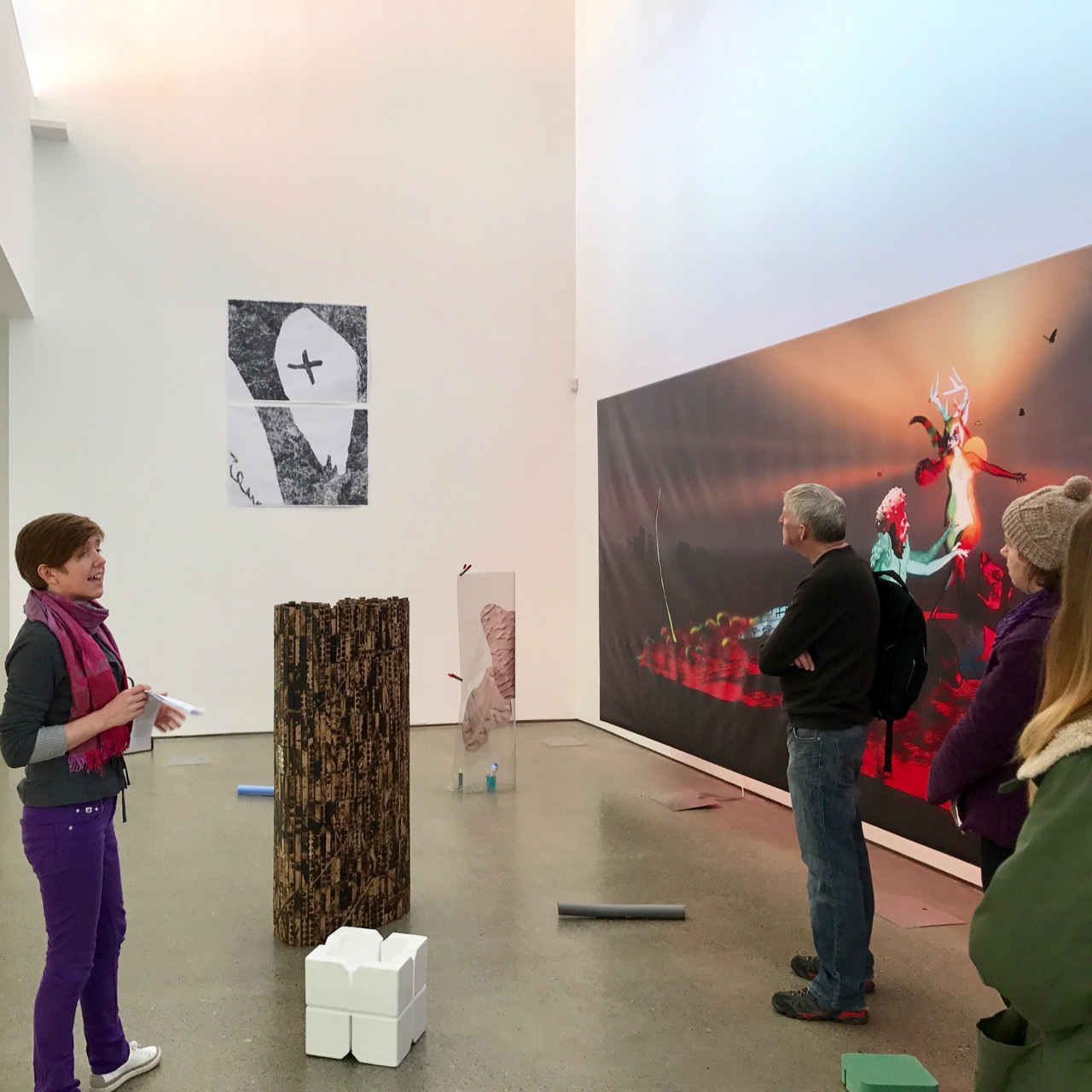
The current exhibition at Uillinn, the West Cork Arts Centre gallery in Skibbereen, is a ‘must’ for anyone interested in contemporary artistic expression – but be aware it’s challenging. Having seen the exhibition being assembled before the opening I decided that I would visit it twice – firstly without giving myself any prior knowledge of the subject matter – and then once more, following a gallery tour led by Alison Cronin of Uillinn and a gallery talk by Jennifer Mehigan, one of the participating artists.
large reflection

I’m very concerned, nowadays, by how ‘art’ is presented, especially ‘art’ which seems divorced from traditional expectations (painted pictures, sculptures etc). I’m fine with all fresh forms of art – and frequently excited by them – but I sometimes wonder whether our artists think about their communication with us… Do they feel that the work should in every way be self-explanatory (we will come away fully informed just by looking at, taking in and understanding the work) – or should their sometimes complex ideas and presentations be explained by accompanying texts, gallery tours, catalogues etc? So I tend to approach every new exhibition with an open mind, hoping for clarity but – firstly – looking for impact from the work. I suppose, at my age, I still think of ‘art’ as being something which should initially stir me, excite me or overwhelm me just through the visual sense: I’m perfectly happy to stand back and look through complex layers of understanding (if necessary) to find the reason for the existence of the artwork, provided it has initially given me that excitement – or whatever emotion – because it will then have drawn me in and made me curious. Some contemporary exhibitions do leave me flat and unstimulated (not many!) and then I have no desire to probe them any further: for me they have failed, but that’s only me, I know. Ultimately, ‘art’ is probably the most subjective of cultural expressions. And that’s all good!
spectators 3

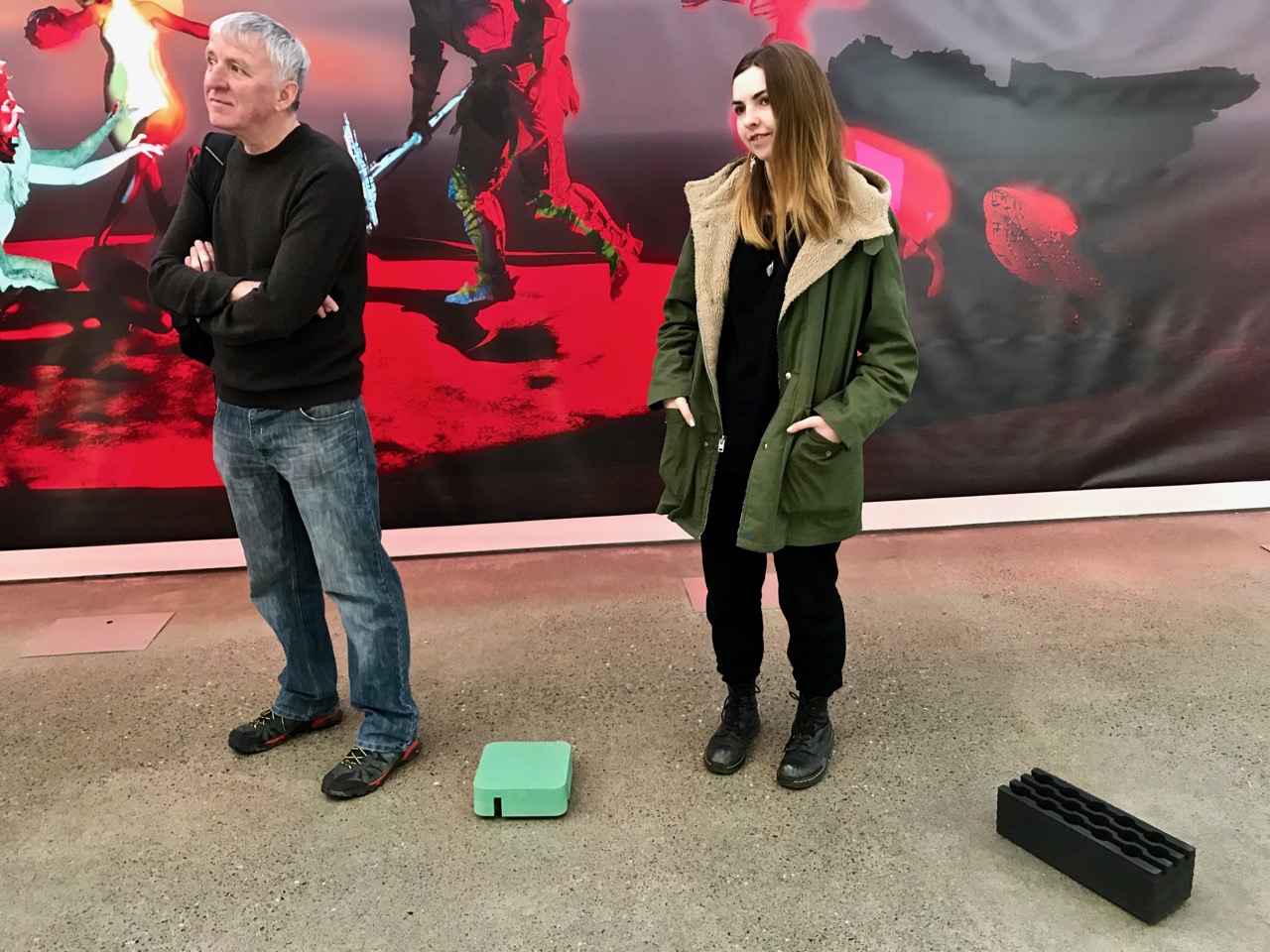
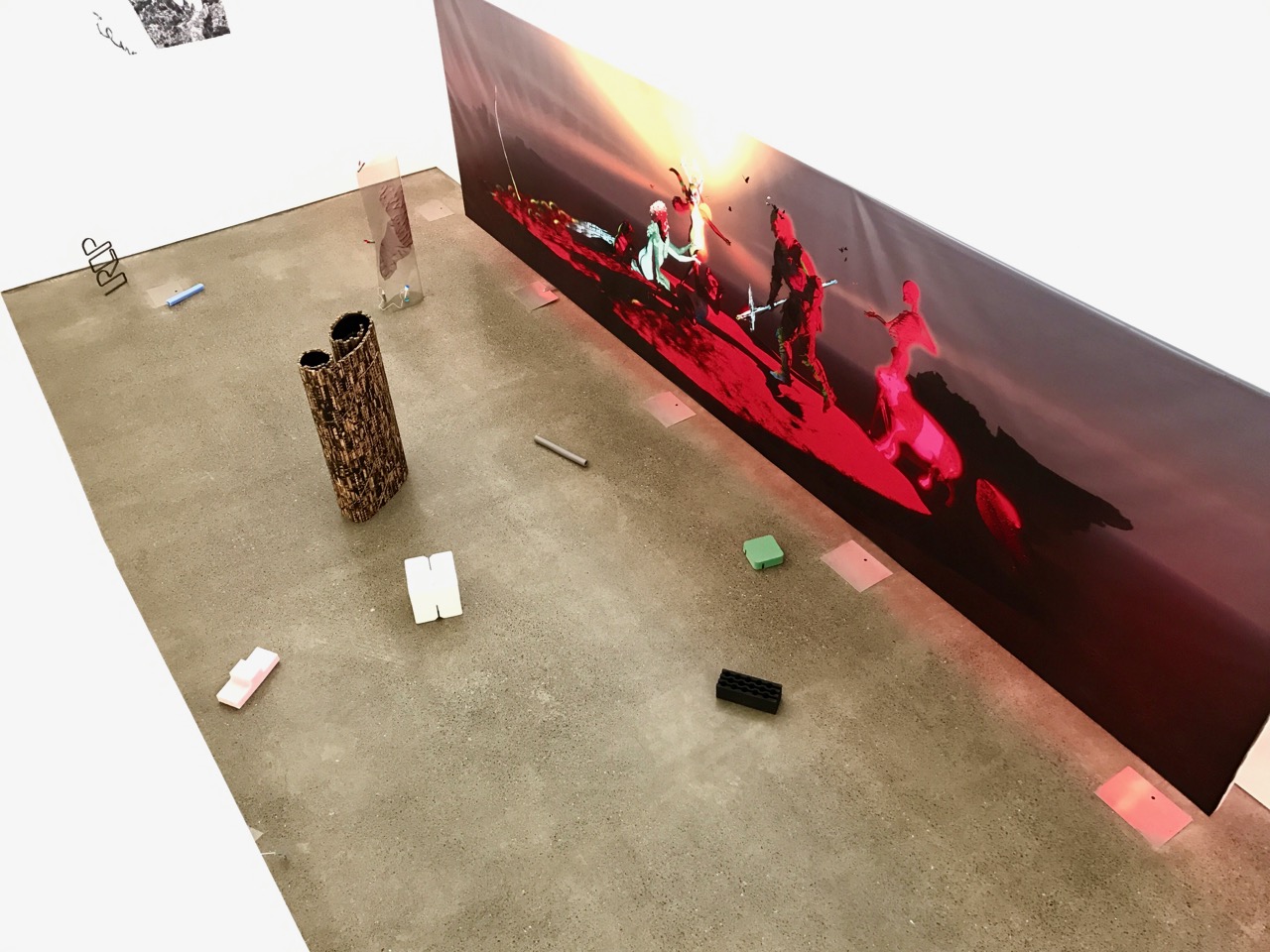
John Russell’s huge backlit print – and two of Eva Fàbregas’s beasts that move around the gallery floor, apparently with a life of their own! 

So – how did I react to my initial, completely unguided, tour of Scissors Cut Paper Wrap Stone? I’m pleased to say that I was stimulated – and positively so. I’m always attracted visually by large scale, colour, and things out of the ordinary: that gives you some clues! There are certainly unexpected experiences here. You walk into the first gallery and are hit with a huge print vibrating off the wall, its boundaries emphasised by coloured light behind it. It’s a riot of red – half-human and half- beast figures in a sort of Star Wars tableaux. But then, once you have taken that in you realise that the floor is alive – crawling with more strange beasts that look as though they have had another life as something mundane and practical and are now reincarnated to follow you around the gallery – perhaps to threaten you. What are they? Gallery assistant Kevin enlightened me when he came in to dismantle and repair the mechanics of one of these errant aliens: they are all made from packaging materials fitted with electric motors, and their trajectories across the gallery floor are completely random, referencing, perhaps, their previous lives travelling unsung and unrewarded all around the world. It’s funny how we give life to inanimate (but in this case animate) objects that appeal to us: perhaps it’s a jump back to childhood days when we made things from cereal packets and egg boxes but were then convinced that we had breathed existence into the monsters, dragons, spaceships, princesses (maybe) that we produced. Talking to the gallery staff I was fascinated to hear that some visitors were absolutely convinced that these pieces of mobile packing were imbued with very sophisticated artificial intelligence and really did follow them around and confront them! Remember, this was still before I had any knowledge of the intentions or stimuli behind the exhibits.
balcony capture

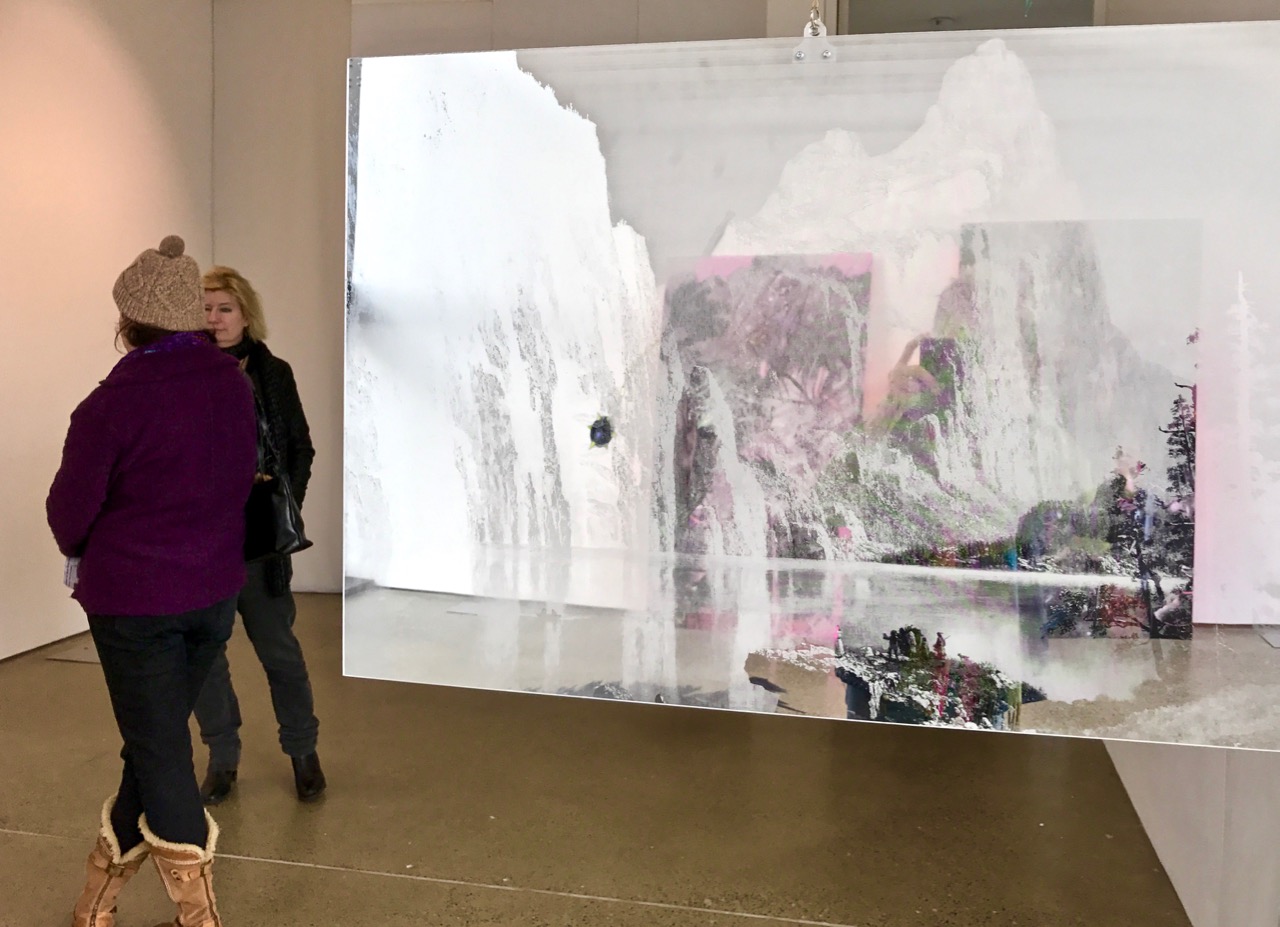
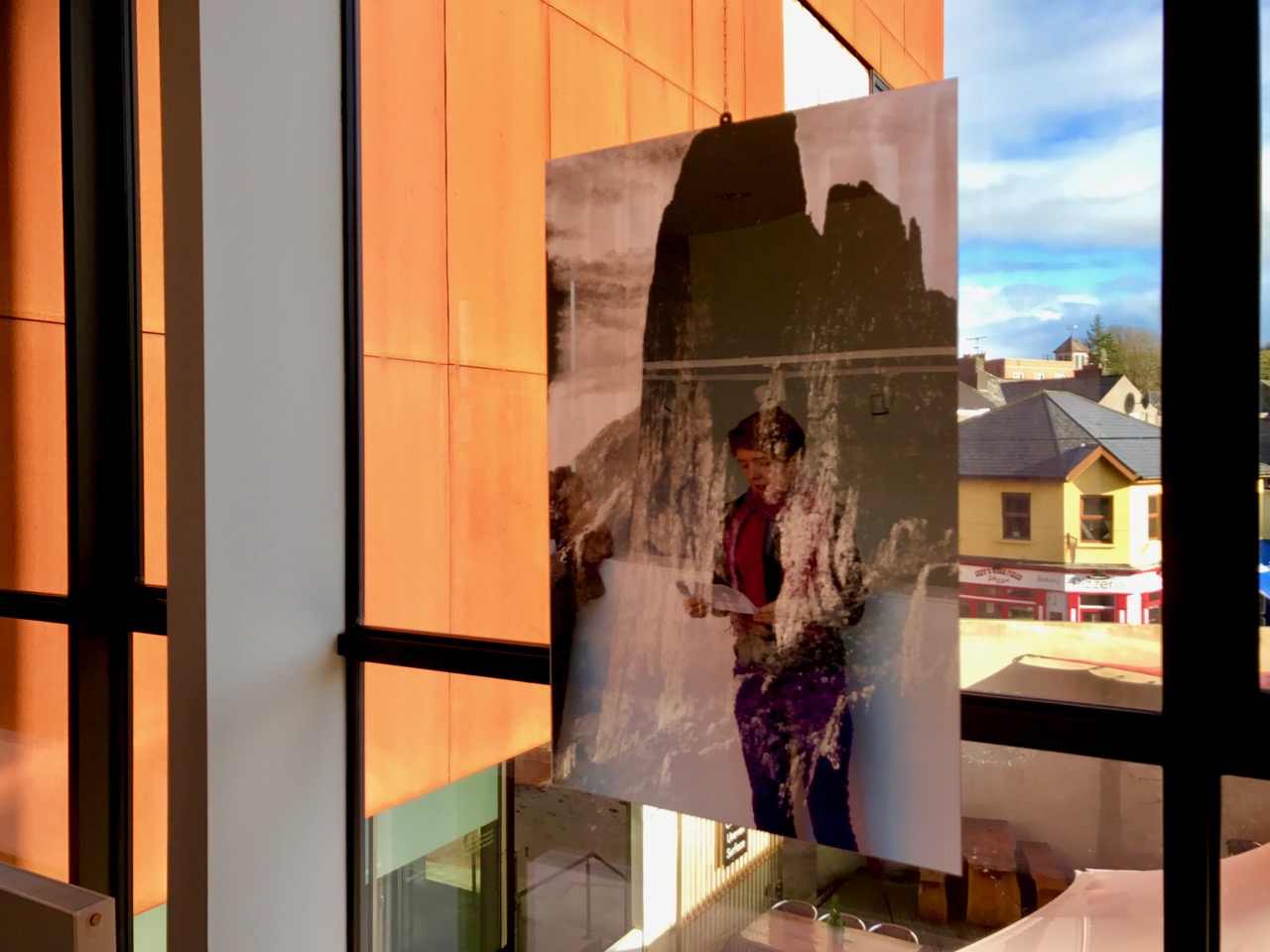
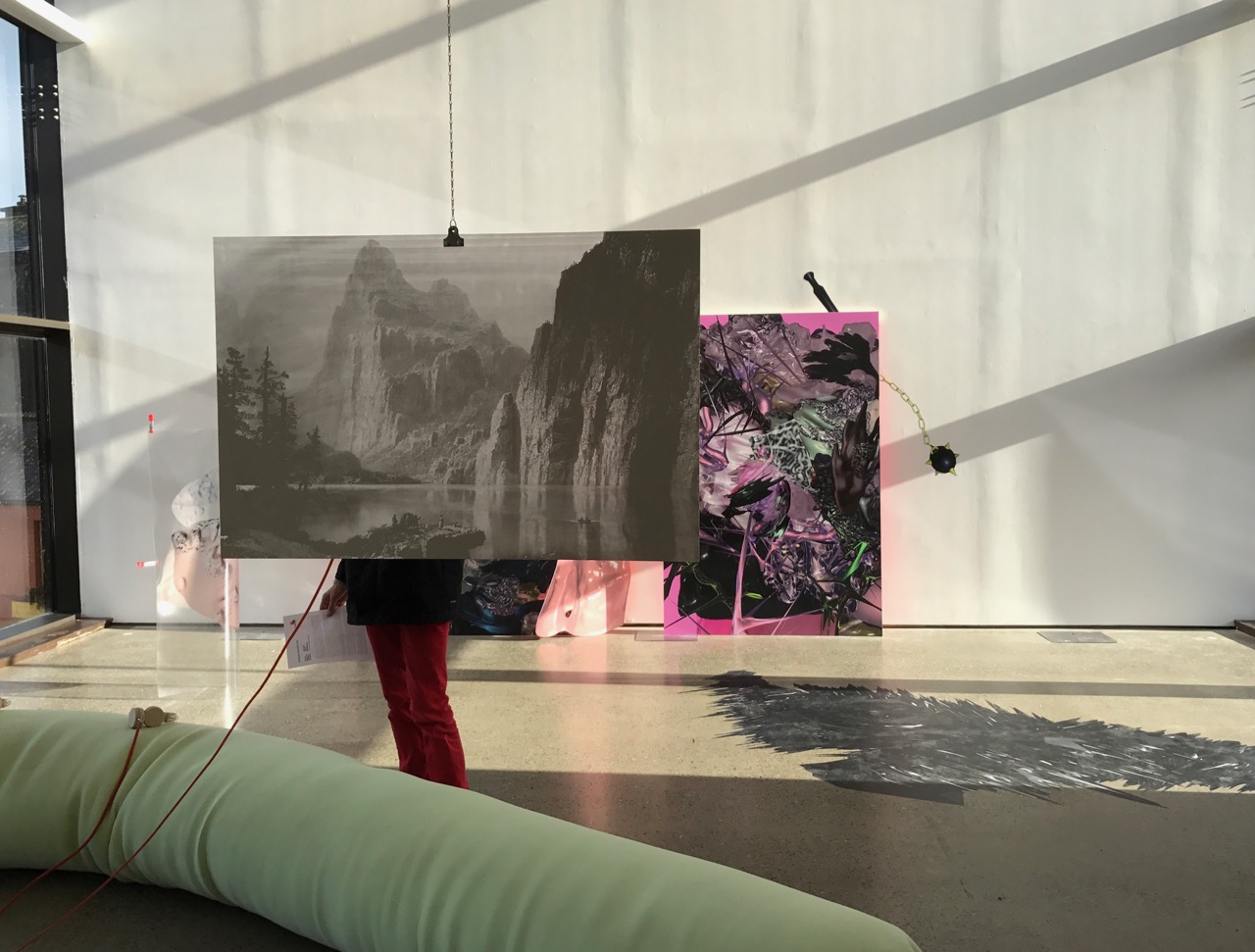
Moving upstairs to the second gallery I found the walkway obstructed by rotating panels of some material (was it glass?) that seemed to be engraved with semi transparent images: they looked like iconic landscape scenes. As I watched, I realised that at certain points in their spinning I was able to see through them, but at the same time also see reflections on their surfaces – of me, of the gallery, of the view through the windows… I liked these very much, and the dymanic nature of their movement and the unpredictable refractions and reflections. I was keen to know how their conception fitted into what I had seen previously downstairs, but I couldn’t guess.

The spinning panels – ‘Orphan Transposition’ – are by Alan Butler and feature acrylic panels laser-etched with images of Yosemite National Park: they also have an intentionally accidental life of their own through the changing surface reflections

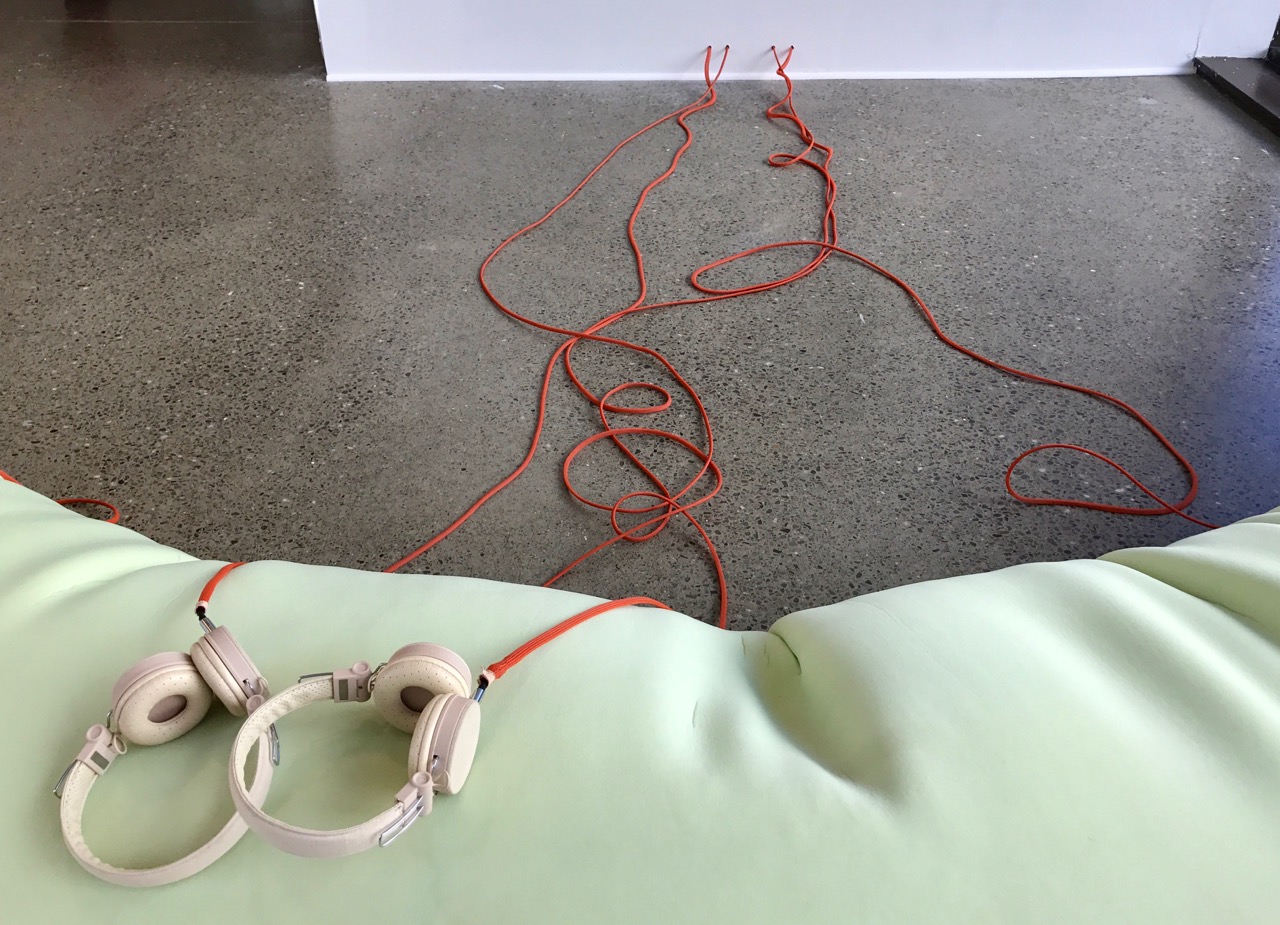
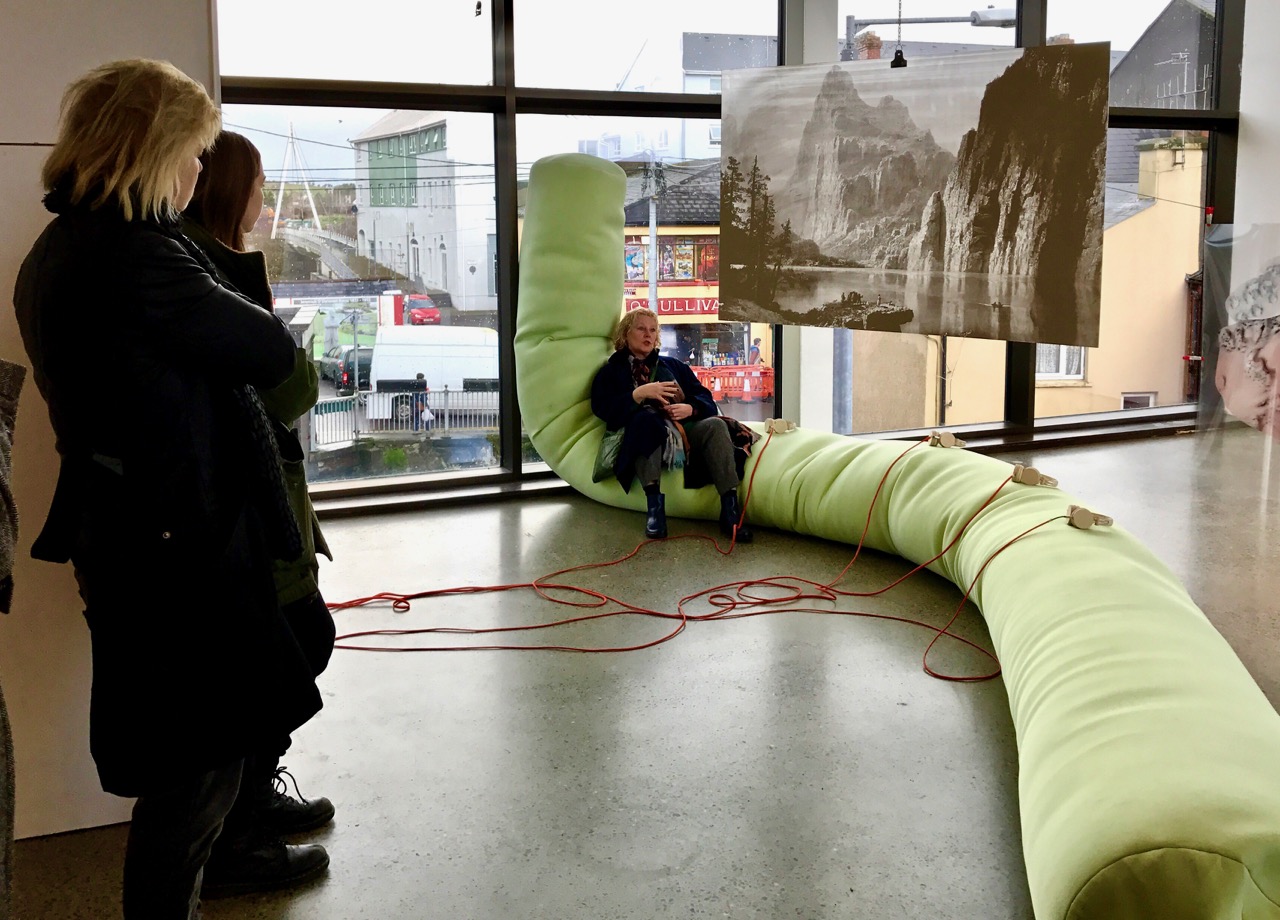
The second gallery held more surprises – and delights. Approaching through a narrow corridor I could see layers: more big, colourful panels on the far wall, more hanging, spinning sheets of opaque transparency, and a very contrasting soft, organic shape seeming to slither across the floor. As I came closer I realised that this shape was not slithering – or moving at all, disappointingly: it was a way of seating people in front of a screen, and was linked in to an array of very funky ‘designer’ headphones (white) by a jumble of thick, red chords.
upper gallery close

phones and cables 2

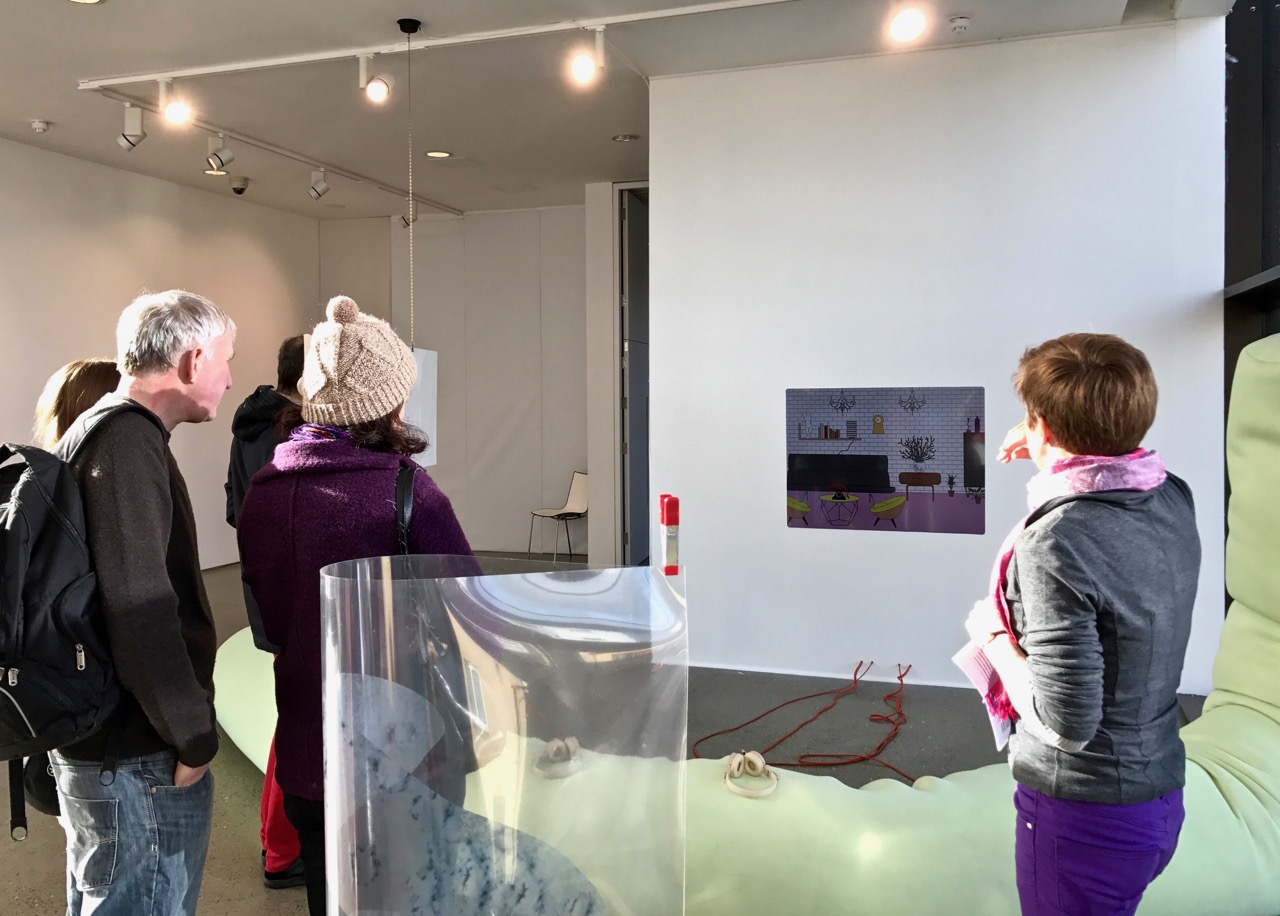
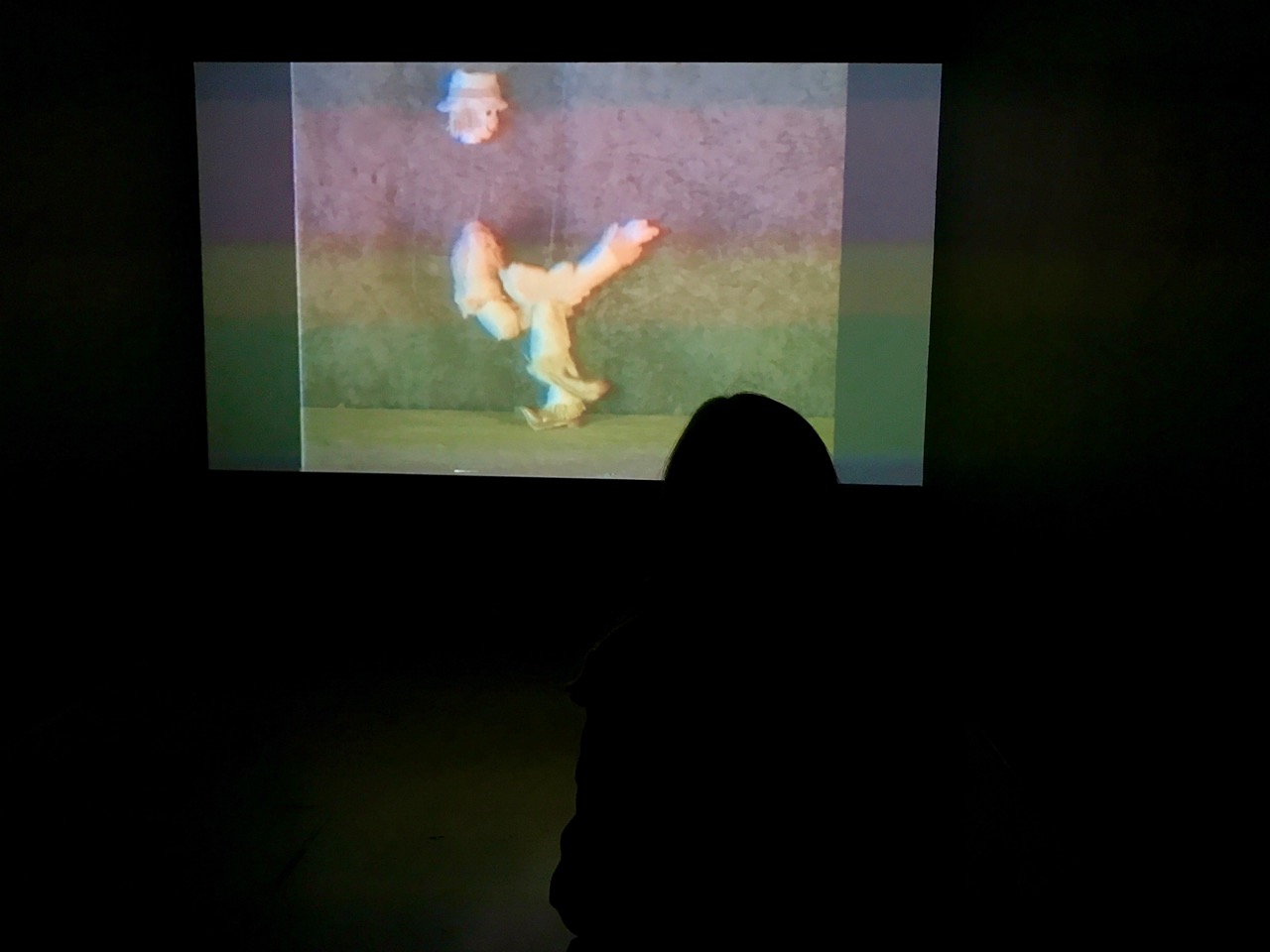
I sat and watched the ‘show’ – and listened to clunky music and a strange commentary – and then realised I was completely out of my depth! I had no clue what was going on. My attempt to experience the exhibition without any preparation or foreknowledge had failed. This applied to all the other work in the upper gallery also: superb large graphics on the walls and floors, printed acrylic sheets suspended on smart steel stands, and, in a darkened cubicle, a film of puppets which reminded me completely of ‘Bill and Ben the Flowerpot Men’! Now, how many of you remember them, dear readers? I don’t suppose any of the contributing artists are of my generation – so, is that pure coincidence? Anyway, I could not feel a sense of connection between the exhibits: but I liked the experiencing of them, nevertheless.
okea projection

puppet show

Upper – Eva Fàbregas’s The Role of Unintended Consequences (Sofa Compact) – which can be enjoyed on the comfort of a squishy serpentine furniture sculpture – and, lower – puppets feature in Andrew Norman Wilson’s Reality Models

It all began to come together and make sense when I took the gallery tour and artist talk (having first read an accompanying written commentary). Wonderful!  The title of the exhibition – Scissors Cut Paper Wrap Stone – which I only knew as a childhood game (and one which I played with my own children) is also the title of a science fiction novella written by Ian McDonald (from Belfast) in 1994. It’s evidently something of an iconic work for those who follow the genre (I don’t particularly, although I have read a little sci-fi). I now know that the participating artists were asked to familiarise themselves with the book and respond to it in a way which they feel comments on our present times: there was no collaboration as such between the artists on the overall exhibition (as I understand), but the curators have put the work together in a way that does begin to set out a narrative.
digital panels

In the optional (€12) catalogue that accompanies the show, Alissa Kleist & Matt Packer (the curators) write an introduction. I was struck by this paragraph:

…From an artistic perspective, Scissors Cut Paper Wrap Stone [ie the book] can be read as a wishful fantasy of artistic power. It describes visual art without recourse to the systems of academic analysis and understanding that have defined the art-history books for the past century and more; instead it promises an encounter with art that frees the ‘rapture’ that Jean-Francois Lyotard describes as being harboured within art itself: an art that hits us straight to the core of our physical being…
cow pic 3

Wow! isn’t that what I was trying to say about my approach to new exhibitions – looking for impact from the work, being stirred, excited or overwhelmed before having any understanding of it? It’s a wonderful way of putting it: …the ‘rapture’ harboured within art itself… Suddenly, I realise that I’ve approached this exhibition exactly as the curators would want me to: first I have the visceral experience, then comes the understanding! Or is it that I have now walked into the exhibition and become a part of it?

Back to the book (via the catalogue):

…In the book, McDonald tells the story of a young student, Ethan Ring, who develops the ability to create digital images that bypass rational thought and control the mind of the viewer…

I’m worrying now – am I being controlled by the digital images in the exhibition?

…Ethan develops a technology of ‘fracters’ – mind-controlling images that have the power to heal, cause pain, induce tears or ecstasy. The utopian promise of this image technology is short-lived as Ethan finds himself blackmailed into employment by the ‘Public Relations’ department of the ‘European Common Security Secretariat’, who demand that he uses the fracters for the purposes of interrogation and assassination, as and when they require…

This is frightening stuff. The book was written in 1994 but in our own time we are suddenly being confronted by concepts of ‘fake reality’ – and aren’t we shocked by governments who seem to be veering off into nonsensical directions, apparently against the wishes of the public majority? Suddenly, I’m seeing an uncanny relevance which these artists – inspired by the concept of the book – have made to our own predicaments. From the catalogue again:

…In a way that is typical of the cyberpunk genre of science fiction, Scissors Cut Paper Wrap Stone is written with the strategy of combining prosaic everyday miseries with the ‘cognitive estrangement’ of a world that has been accelerated beyond our control…
cow stuff

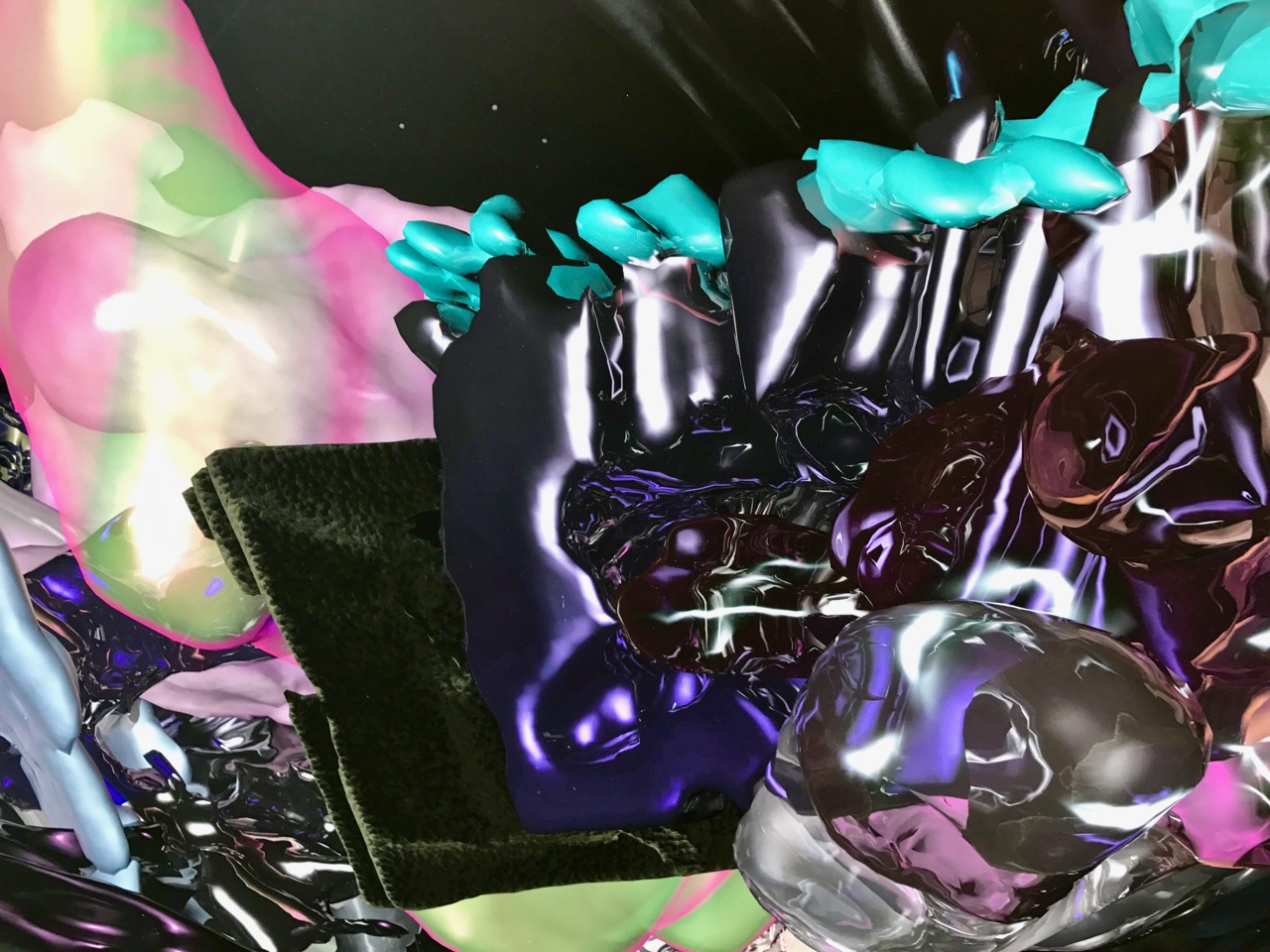
A detail from one of Jennifer Mehigan’s stunning prints made from collages of three-dimensional digitally generated models: this one illustrates the Bovine Spongiform Encephalopathy virus – better known as Mad Cow Disease

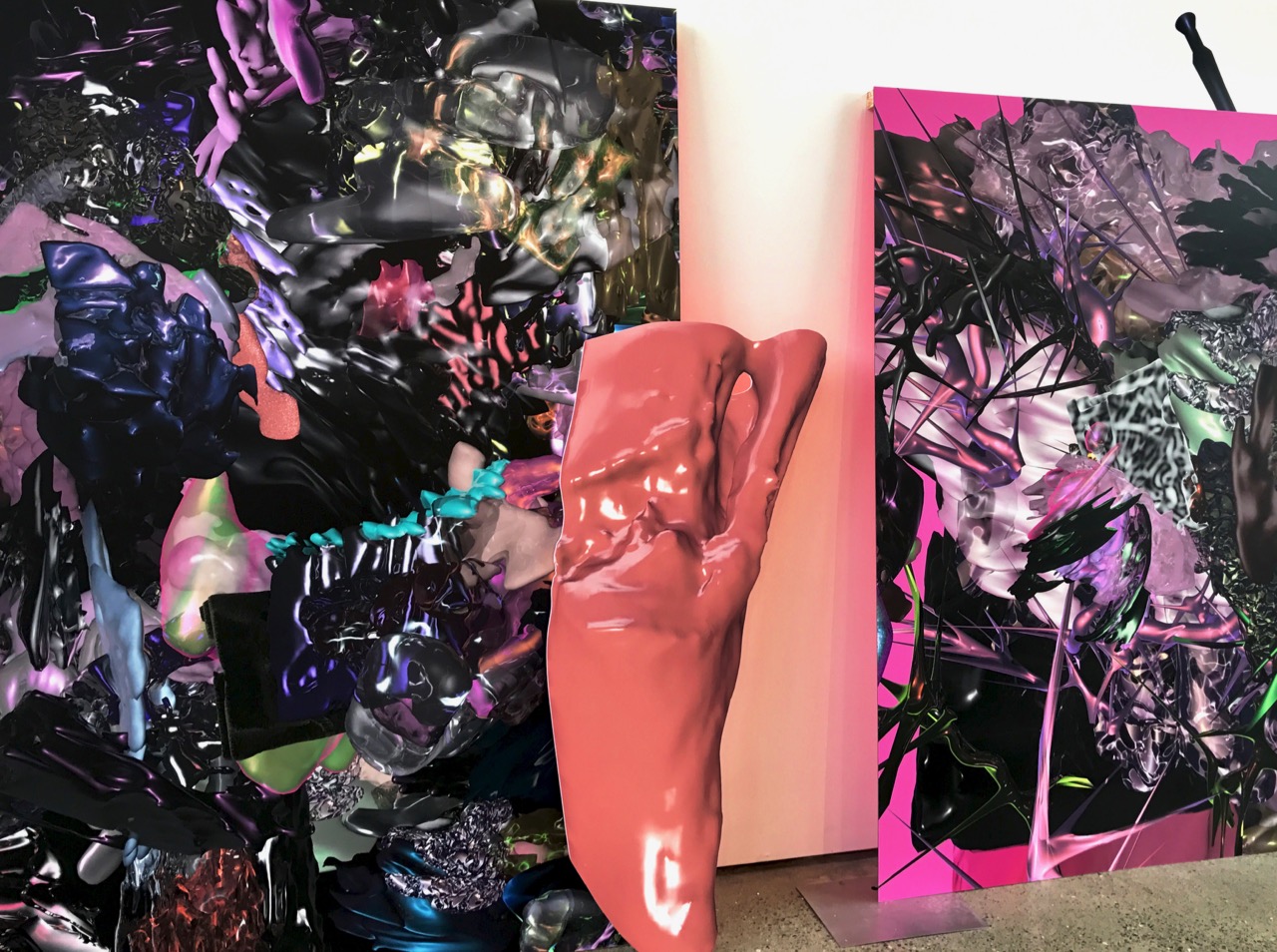
Lastly, I should mention the gallery talk by Jennifer Mehigan. She has only been involved in the Uillinn, Skibbereen, iteration of this show. Knowing that now, I think the overall exhibition will have been considerably poorer without her contribution. I think my strongest instant reactions (rapture?) have been to her large digitally produced panels. Now that she has explained their conception I am even more impressed. She asked us to consider the cow…

The cow is an unnatural beast. Human intervention keeps it permanently fertile so that it produces food for us. It gives us its milk: it dies for us. But also – again through human intervention – it eats itself. This generates the Bovine Spongiform Encephalopathy virus – better known as Mad Cow Disease. This kills humans. Be afraid…

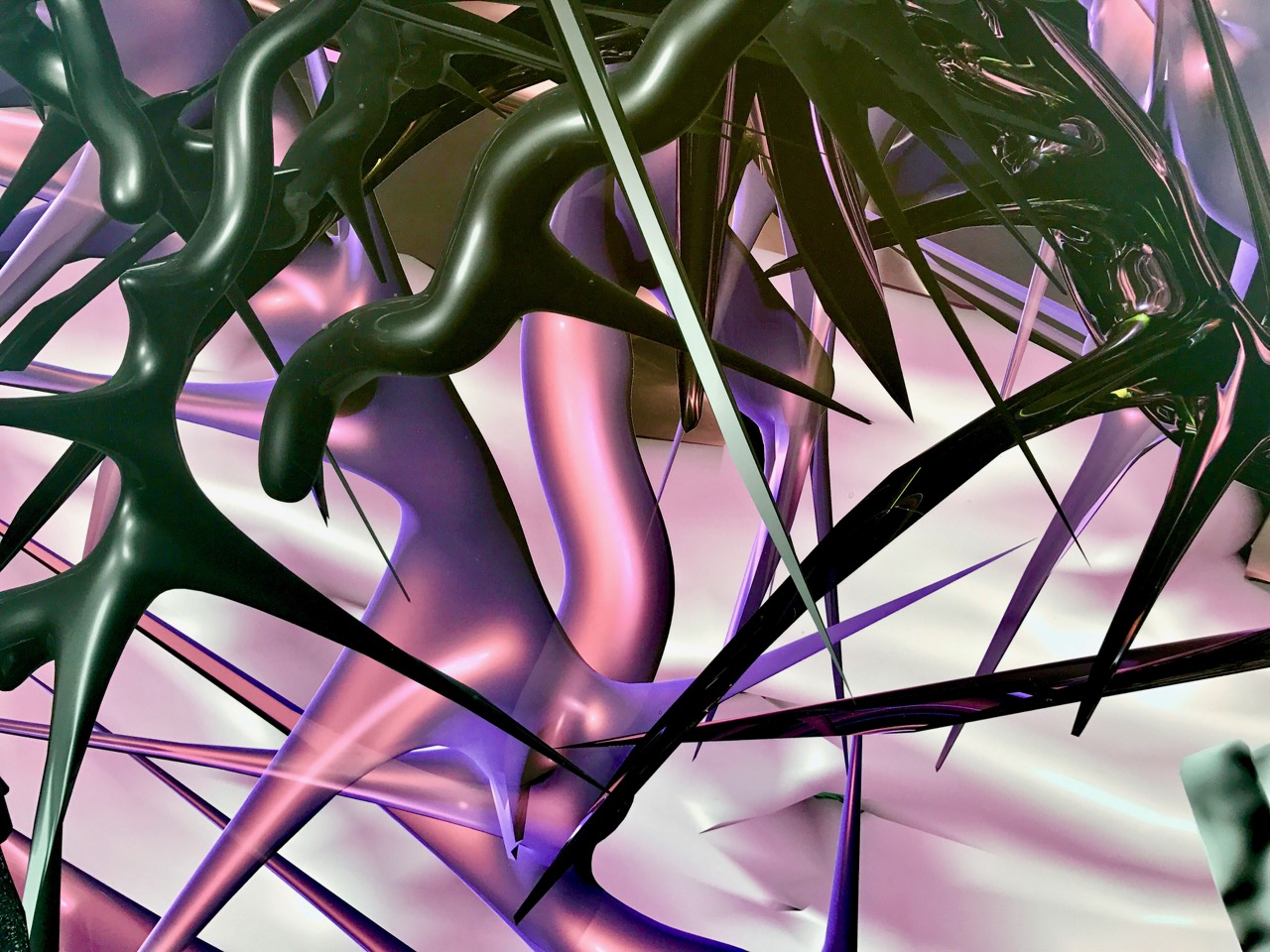
Jennifer’s gorgeous panels are made using a highly complex technology – 3 dimensional modelling software. With this software she has constructed a cow’s stomach, bacteria found inside the human gut, the mad cow disease virus, and Drombeg Stone Circle (that’s the link to human intelligence). She’s put all these things together into bizarre, visually stunning collages and presented them to us as compelling two-dimensional images leaning up against the end wall in Uillinn where they sparkle and shine in the sunlight: we are seeing the fracters and, behind them, the government departments who are manipulating world perceptions of reality.
from above

Powerful images from a strong exhibition. Step beyond the images and we see power – or a commentary on power. Statements are being made here – perhaps subversively – about the world in which we live today. That’s great – that’s art.
resting

The exhibiting artists are: Alan Butler, Pakui Hardware, Jennifer Mehigan, Andrew Norman Wilson, Clawson & Ward, Eva Fàbregas, John Russell

Scissors Cut Paper Wrap Stone is on at Uillinn, Skibbereen until 25 February 2017. The gallery is open Mondays to Saturdays from 10.00am to 4.45pm: there are guided gallery tours on selected Saturday mornings – check with Uillinn: enlightening and well worth attending! Here’s Alison Cronin in action:
in the gallery

The White Hound of Brigown

Saint Fanahan is venerated in Mitchelstown, Co Cork. A holy well, a college, a couple of medieval churches and lots of Mitchelstown boys, all bear his name. What’s incontrovertible, then, is that he is the patron saint of Mitchelstown. Or is it? He’s also know as St Fionnchú of Bangor (pronounced Finn Coo, meaning white or fair hound). Same guy. He succeeded the Abbot of Bangor, Comgall, but departed subsequently to end up near Mitchelstown.

Fanahan well from bridge

St Fanahan’s Well

But wait – he is also the patron saint of Blow-Ins! At least, that’s what a local man told us when we visited Fanahan’s holy well. Apparently, Fanahan came from the North of Ireland but eventually settled at Brigown near Mitchelstown in Cork. He wasn’t a local, so why not? We blow-ins deserve a patron saint, don’t we? He’s also probably the most muscular saint I’ve ever come across! He was a warrior-monk, famed for both his holiness and his strength in battle. No gentle, man of peace here!

Book of Lismore

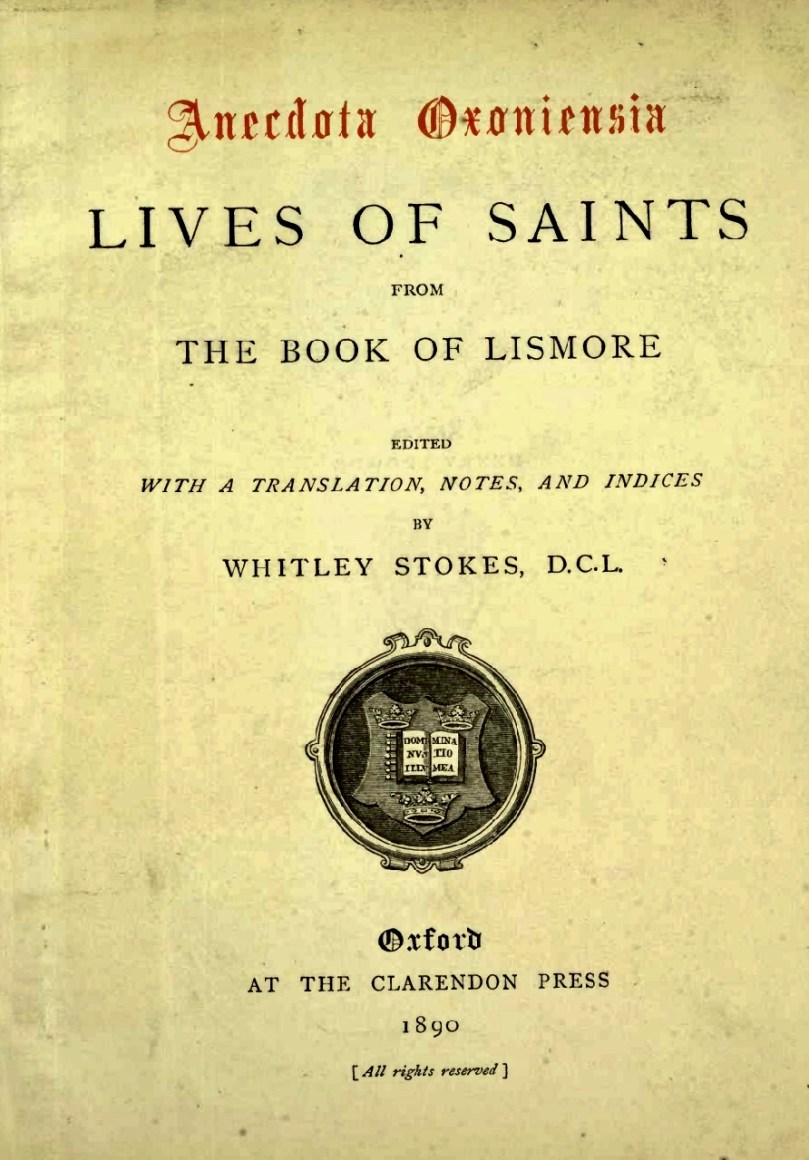
How do we know about these early Irish saints? In Fanahan/Fionnchú’s case, we can rely on a Whitley Stokes bookcomplete Life, recorded in The Book of Lismore, a 15th century collection of hagiographies and histories. Take a look at this video to learn more about The Book of Lismore. We are fortunate that there are translations – the one I am using today was done by Whitley Stokes in 1890 and is available online. Stokes, a distinguished scholar whose work is still vital, uses a kind of high Victorian language that manages to be a noble translation of the original Old Irish. 

You might perhaps want to make a cup of tea at this point – this is going to take a little while – Fanahan/Fionnchú’s is quite a story. Ready now?

Even in the womb, Fionnchú had extraordinary powers, once saving his mother’s life by causing a cloak of darkness to surround her. A great future was prophesied for him that

He will attack the valourous, He will overwhelm the guilty,

He will seek crowned kings, He will be the tree of Tara’s correction,

Who will benefit Liffey, And profit Leinster.

In his youth he was fostered by Comgall, the Abbot of Bangor. Fionnchú performed several miracles while he lived with Comgall: So these are Findchua’s three miracles after he came to Bangor, to wit, making flagstones of the horses of the king of Ulaid; and raising the earth around the king to his knees; and burning his tutor’s cowl by the fury of his anger

Fanahan White Hound

The white hound, Cusson Sculpture in Mitchelstown

Fionnchú then spends seven years as Abbot of Bangor. After spending the seven years Fionnchú is expelled from Bangor and from the whole of Ulaid [Ulster] because of the scarcity of land. Then Findchua comes from Ulaid, from the north, till he came, through the urging of an angel, to the men of Munster and to their king, even to Cathal, son of Aed, to Cashel; and the king gives him a welcome and ordains to him his choice of land in Munster. Said Findchua: Tis not permitted to me to have land save in the place in which my bell will answer me without the help of any man. Said Cathal : Search Munster till thy bell answers thee, and the place in which thou shalt set up, thou shalt have without contention with thee.

Fanahan cross back

After many vicissitudes Fionnchú and his band finally settle down in the place where his bell answers him. His enclosure is arranged, and his houses are covered, and his households are allotted to the nine other townlands which the king of Munster had in residence.

The King of Déise’s son comes to see him and Findchua gave him, as a soul-friend’s jewel, his own place in heaven. So then there came to him seven master-smiths who dwelt near him, and they made for him seven iron sickles whereon he might abide to the end of seven years, so that he might get a place in heaven; for he had given his original place to the king of the Deisi. He blesses the smiths of that place, and left them continually the gift of handiwork, provided that they should perform or begin it in that place, and palm of masters to them. The smiths ask him to give their name to the place in reward of their work, that is, Bri Gobann (Smiths Hill). Fionnchú spends seven years hanging on his sickles, unable to touch the ground.

Fanahan head

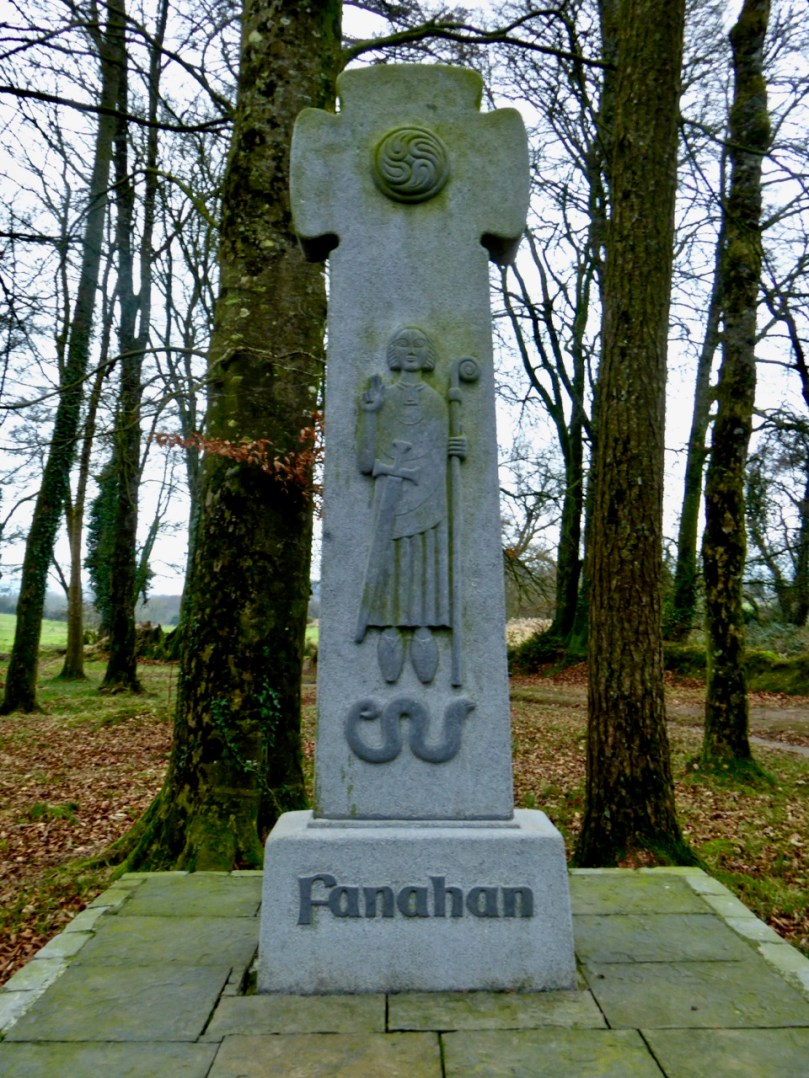
Fanahan, from the Ken Thompson Sculpture at the holy well

He did get one break when he marched off to battle to save the armies of Niall of the Nine Hostages, who were being attacked by marauders. In Fionnchú’s rage sparks of blazing fire burst forth out of his teeth destroying all before him. Returning to Brigown, Fionnchú resumes hanging from his sickles. He also spends the first night with any new corpse brought to be buried at Brigown, emerging in the morning, and allows his body to be eaten by beetles. All these mortifications of the flesh cause his fame for holiness to spread far and wide.

Fanahan Garda Station

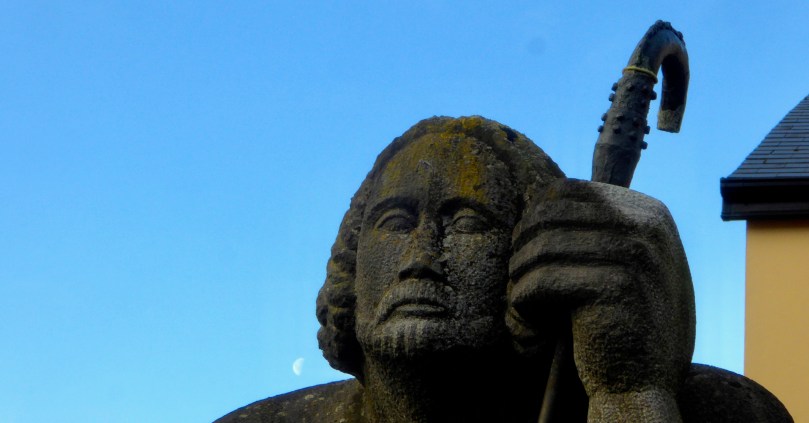
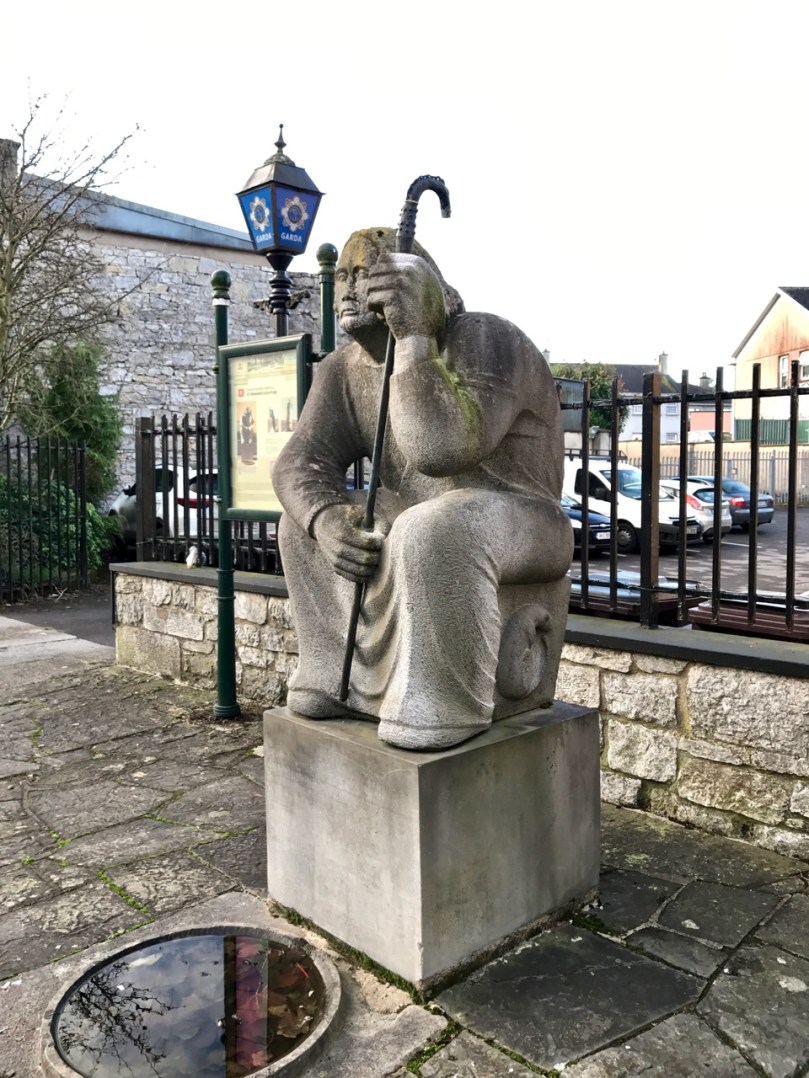
The Fanahan sculpture in Mitchelstown is by renowned artist Cliodhna Cussons

He performs various other miracles, including breast feeding a baby, Finntan, the son of Nuada, King of Leinster. Eventually, he goes off to battle for that king too. After that, the King of Ulster invades Munster (his wife wants the Munster kingship for her sons, and was not to be gainsaid, apparently) and the King of Munster, Cathal, sent for Fionnchú (no rest for the wicked!) because he promised me that, whenever stress of war should be on me, he would come with me to battle to help me, having with him the Cennchathach, even his own crozier.

Head at Fanahan well

This head has been inserted into a wall at the holy well. He looks like a victim of the Head Battler

The Cennchathach (head battler) was duly deployed in a great battle. The Ulster men roared and bellowed like stags in heat, and charge from the top of the hill. The cleric seeks the slope beyond them and leaves the hill to them. The Ulaid bent down eagerly to deliver the battle. When Findchua perceived that, he took them in that position and allowed them not to rise up beyond their knees, and breaks the battle upon them against the height. Therefore Findchua left the Munstermen, from that time forward till Doomsday, to defeat foreigners and every host besides when charging down a height; and verily this is fulfilled. [Note to self – must let the Munster Rugby team know this vital information.]

Brigown Church

The old abbey at Brigown is associated with Fanahan. A round tower once stood here but eventually burned down

Having performed several miracles, and been merciful to the remaining Ulster men, Fionnchú returned once more to Brigown. However, his peace was short lived as, you guessed it, ‘foreigners’ started to make life very difficult in Connaught, so of course, they sent for Fionnchú. Then through the mighty powers of the cleric a terrible heat seizes the foreigners there, in the midst of their camp, from the iron posts that stood all around the camp, so that on the morrow there was found of them nought save their bones and their remains amidst their camp, and showers of their weapons near them. Wherefore Cuil Cnamrois (Recess of Bone-wood) is the name of the place from that to this.

Well fund

Although the tributes were supposed to last forever, nowadays a polite sign asks for donation for the upkeep of the well

After each of these battles, Fionnchú receives tributes and rewards (milch cows crop up a lot, as do boars and cattle), so that the wealth of his settlement grew. Several other battles are recounted. During one, …the howling and rending of a hound possessed him in his valour on that day. Although no heroes save himself alone were fighting the battle, the foes would have been routed before him, for he cut off the foreigners equally with his weapons and his teeth. Wherefore the name Findchu clave to him, that is, like a cú (hound) on that day was he.

Finally, weary of warfare, he undertakes a pilgrimage to Rome where he spent a year doing penance. We are told nothing further about his life, except that it is recorded elsewhere that he died about 660AD.

eel

The eel, Cusson’s sculpture

A note at the end of this account of his life says The friar O Buagachain wrote this Life out of the Book of Monasterboice. A further note elsewhere says it was actually written in the Friary at Timoleague.

Fanahan's Causeway

A unique 700m dead straight, raised causeway leads to the holy well. This unusual feature may be medieval in date.

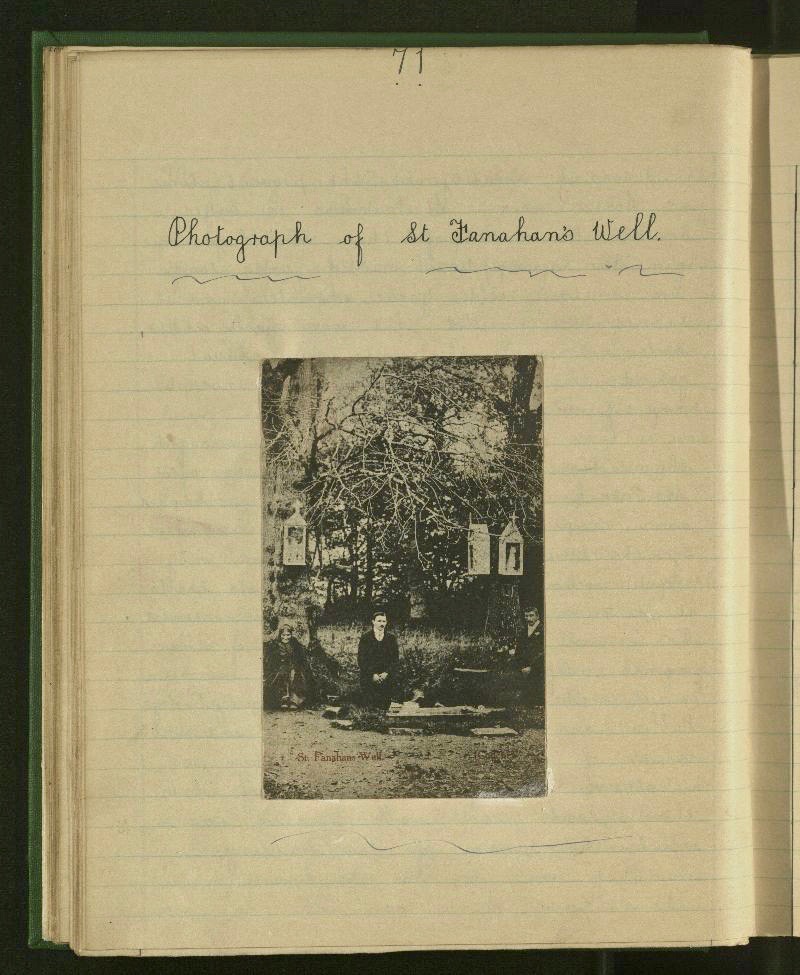
Many legends grew up about Fionnchú in time, while the name itself transformed into Fanahan, still a popular boy’s name in this area. His feast day is November 25, and it is marked by a Novena (nine days of prayer) before and after that day, when pilgrims visit the well and do the rounds. Because this is a dark time of year, and people come after work, a benefactor has installed lights along the causeway which get turned on for this period. Besides the story of the eel, the well is associated with cures – at one point there were crutches hanging beside the well. The Dúchas Schools Project has recorded some details of the well from the 1930s – even a photograph.

Dúchas photo Fanahan well

Some writers have pointed out the similarities of Fionnchú’s deeds to those of Cúchulainn, the great hero of the early Irish sagas. Like Fionnchú, Cúchulainn is named for a hound, and like him he performs legendary feats of strength in battle. Some have even pointed out the crucifixion analogy of his time hanging from the sickles, not to mention the implications of his nights in the otherworld with the corpses and his return from the dead.

Fanahan cross

Ken Thompson is the same sculpture who carved the marvellous Air India memorial on the Sheep’s Head

I think the sculptors capture him differently. Ken Thompson emphasises the holy man of the well, with the eel (sighting an eel is a common feature of holy wells – great good luck attends it) at his feet and his crozier held as any bishop would hold it. But he also suspends him on a cross and gives him a sword. He places (the surprisingly soviet-looking) sickle on the back of the sculpture, along with the bell that rang when he finally came to Brigown. Coming over the little bridge into the glade of the holy well, it’s a beautiful but interestingly ambiguous image that presents itself.

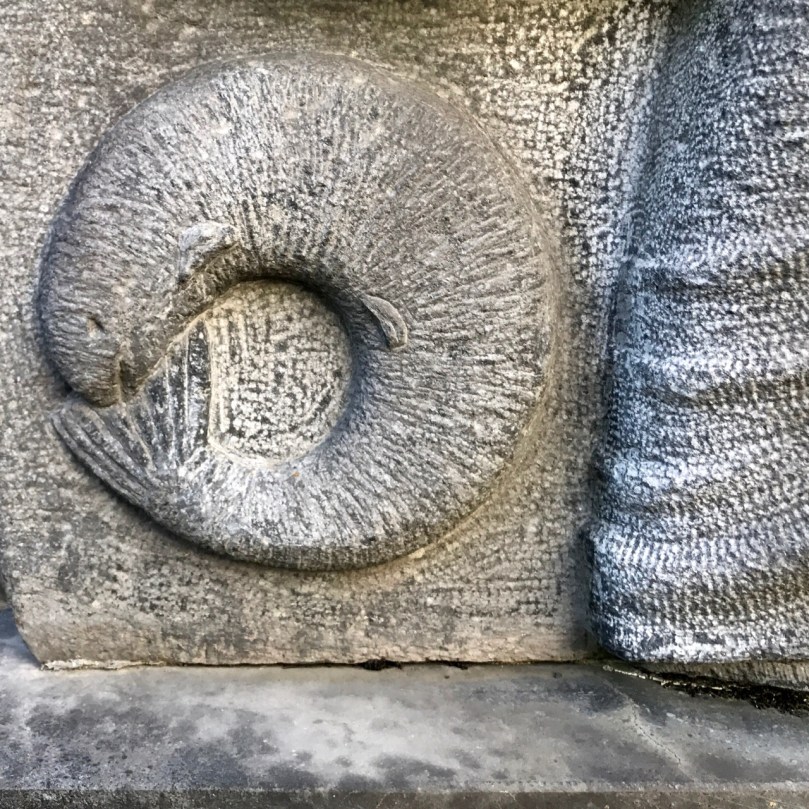
Cusson’s piece is all warrior and places him at the end of his life, perhaps contemplating in sorrow all the mayhem he has been part of. His crozier is between both hands, looking more like the Head Battler than a symbolic crook. It’s modelled on the medieval croziers in the National Museum, such as the one from Lismore. The White Hound (Fionn Cú) is one one side, the eel on the other. The figure is massive and solid, the gaze is faraway, the features grim. Every inch a warrior-monk.

Saint Oliver

plunkett window close

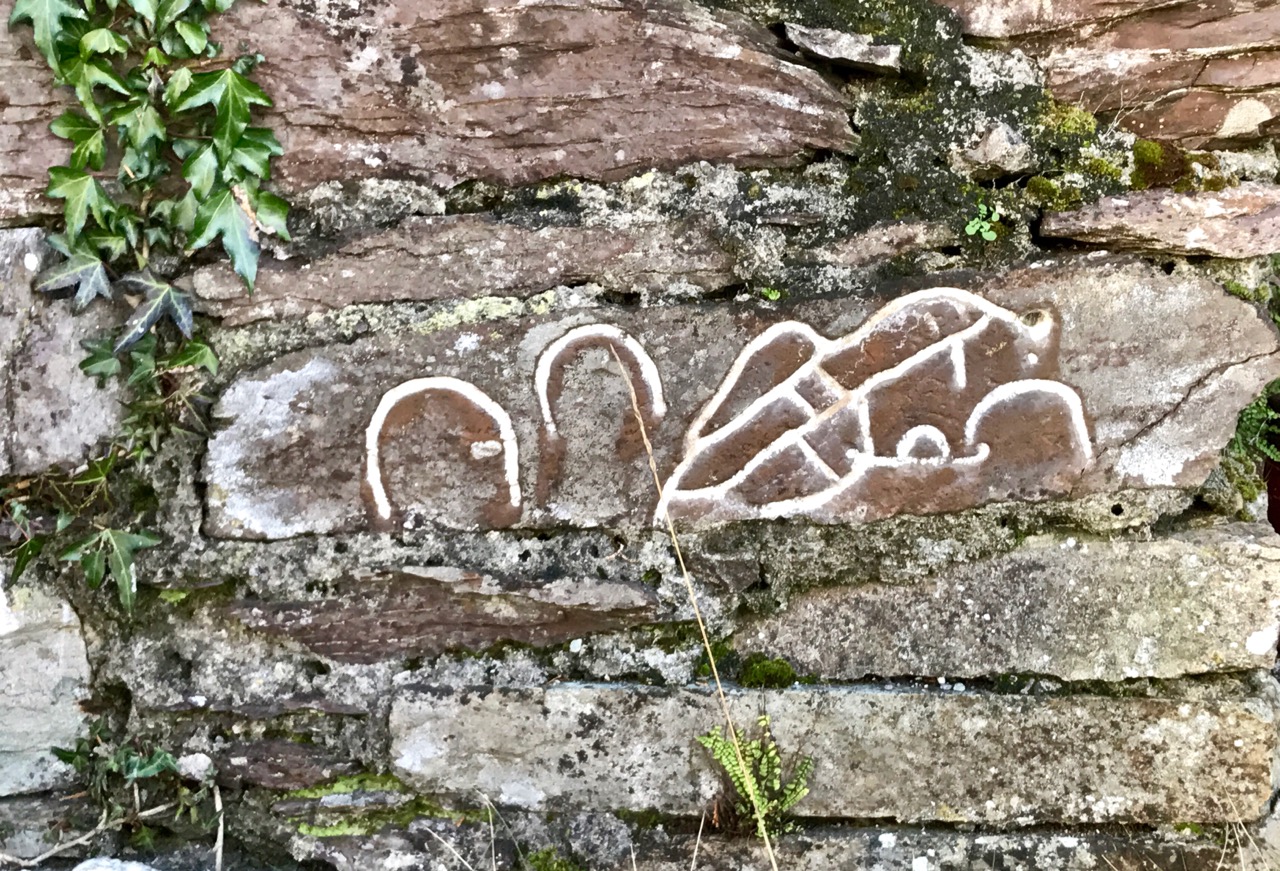
We revisited Inchigeelagh, in West Cork, as we remembered that the church of Saint Finbarr and All Angels had some fine examples of stained glass: Finola is preparing a talk on that subject and our travels are revealing an unexpected abundance of this art in our little bit of Ireland’s furthest reaches. Our last visit to Inchigeela was to inspect the unusual ‘rock art’ that has been built into the wall of the grotto just by the church door.

rock art inchigeela

We are none the wiser about the meaning of the ‘rock art’: suggestions include a dove of peace flying over mountains – but I have yet to be convinced. However, it was a good day for looking at the windows: the sun was streaming through the south facing glass panels and creating a kaleidoscope of colour on the surrounding walls.

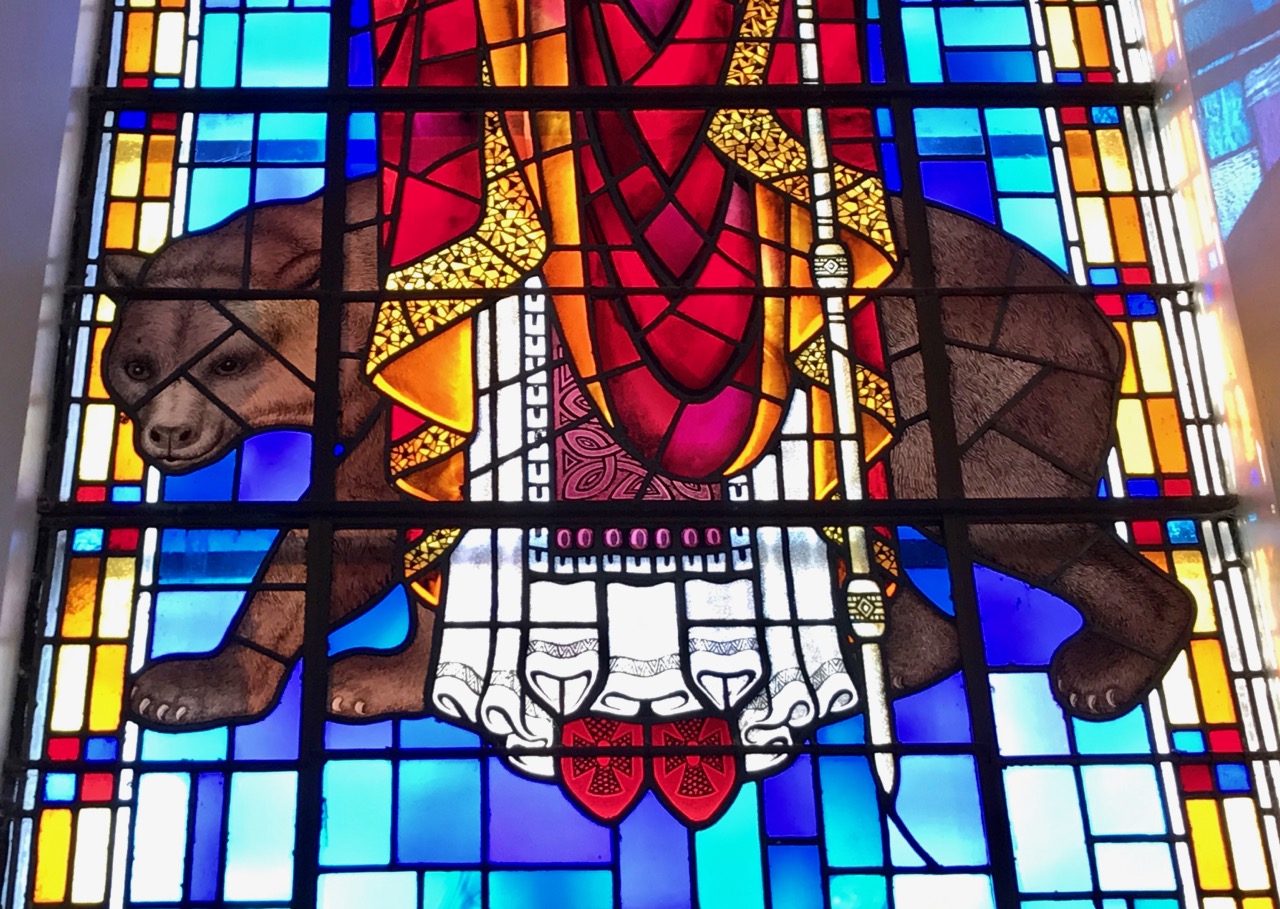
There was plenty to occupy my attention in this church: I had to admire the bear of St Columbanus. This Irish saint spent most of his life on missionary work on the continent and stories about him include taming the bear and yoking it to a plough, and establishing friendships with wolves. I’m not quite sure why, but St Columbanus is the Patron Saint of motorcyclists.

the bear

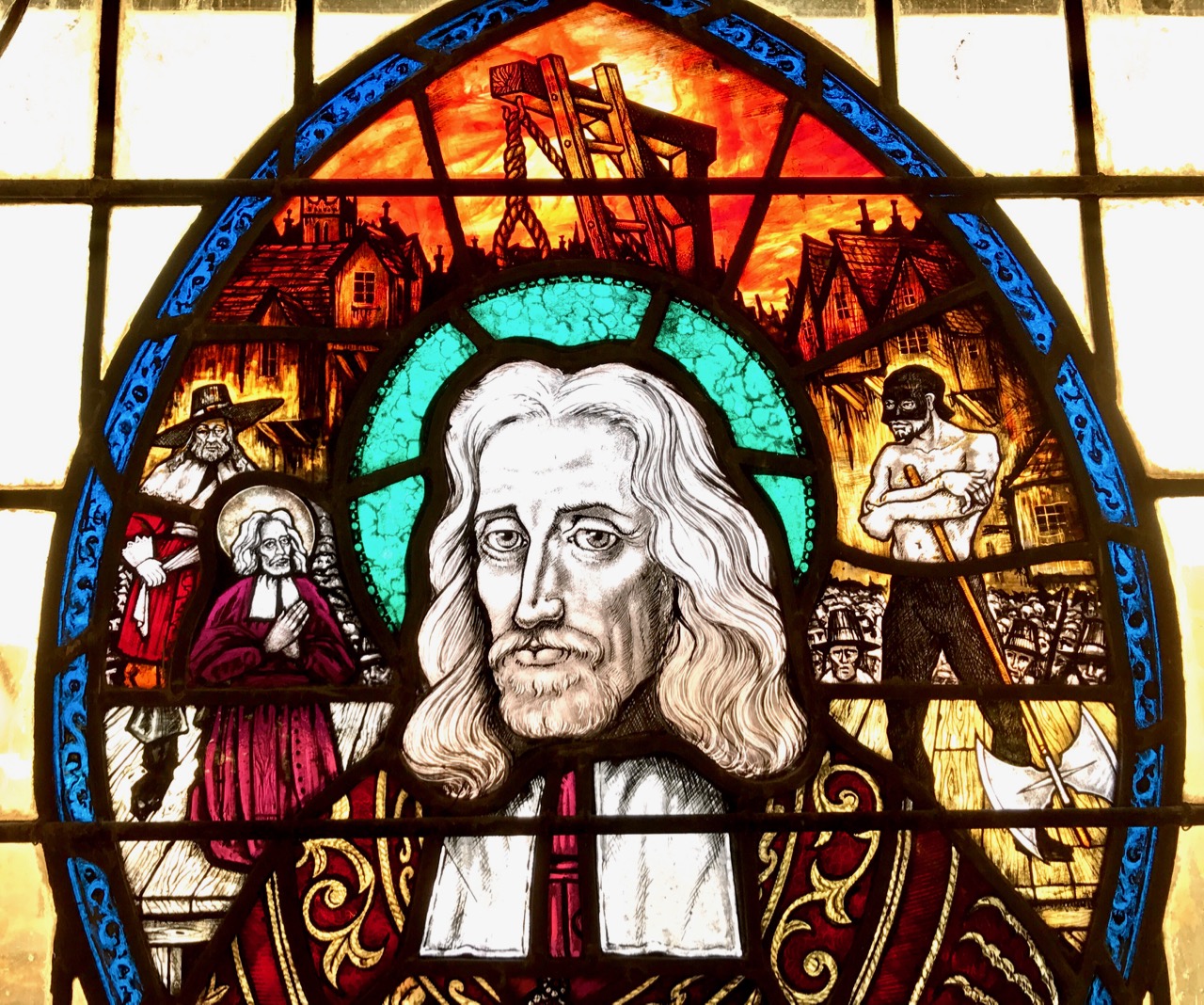
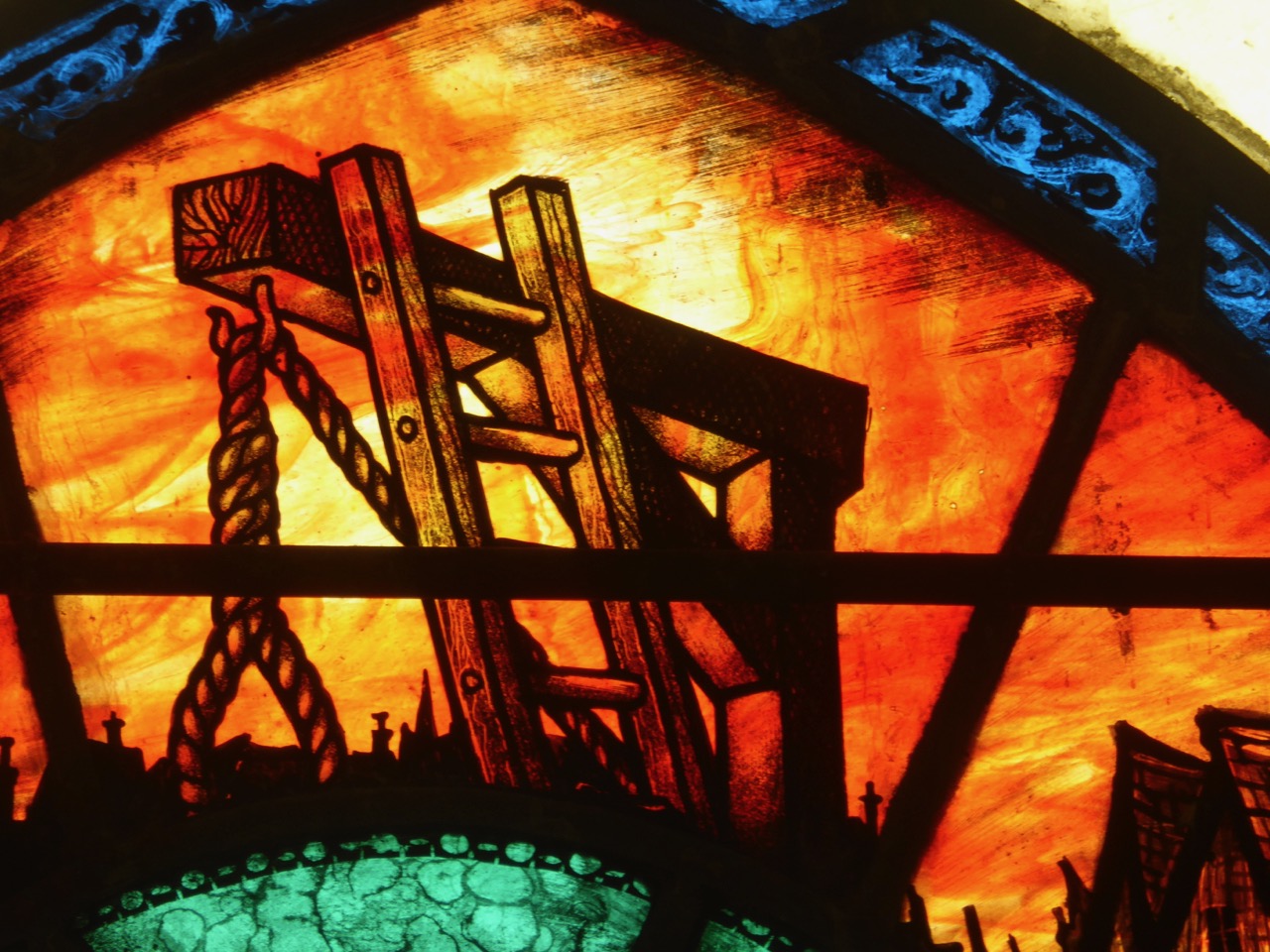
There was one window I had failed to notice amongst the panoply of saints on my previous visit to Inchigeelagh – tucked away at the back of the church: it’s the one at the top of this page – Saint Oliver Plunkett. In some ways it’s the most extraordinary of the windows as it depicts the gruesome death suffered by this Roman Catholic Archbishop of Armagh and Primate of All Ireland at the hands of turncoats and perjurers – and it’s a far cry from rural West Cork. Plunkett was born in 1625 in Loughcrew, County Meath and died at Tyburn, London: hanged, drawn and quartered, in 1681.

Gallows

He was a victim of the Popish Plot, concocted by Titus Oates, an English clergyman who contrived a story that Plunkett was to lead an uprising involving 20,000 French soldiers. Whichever account you read, it seems that no-one believed the story: a trial was held in Dublin but there was no conviction. Plunkett was then sent to Newgate and put on trial again: again the trial collapsed. A third trial, at which Plunkett had no counsel, found him guilty after the jury had retired for fifteen minutes. That it was a monumental miscarriage of justice became evident very quickly: Plunkett’s accusers were arrested – the day after his execution.
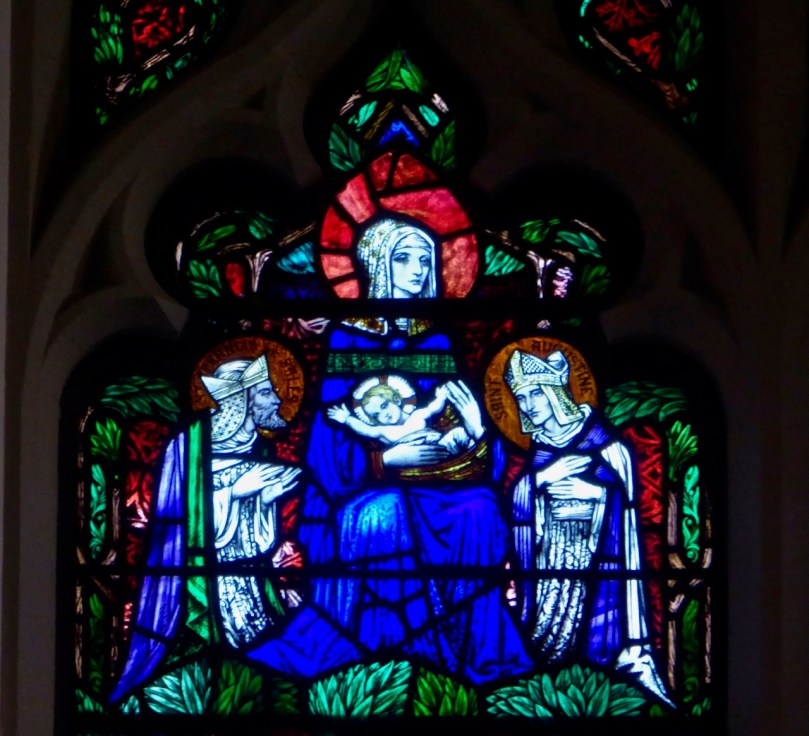
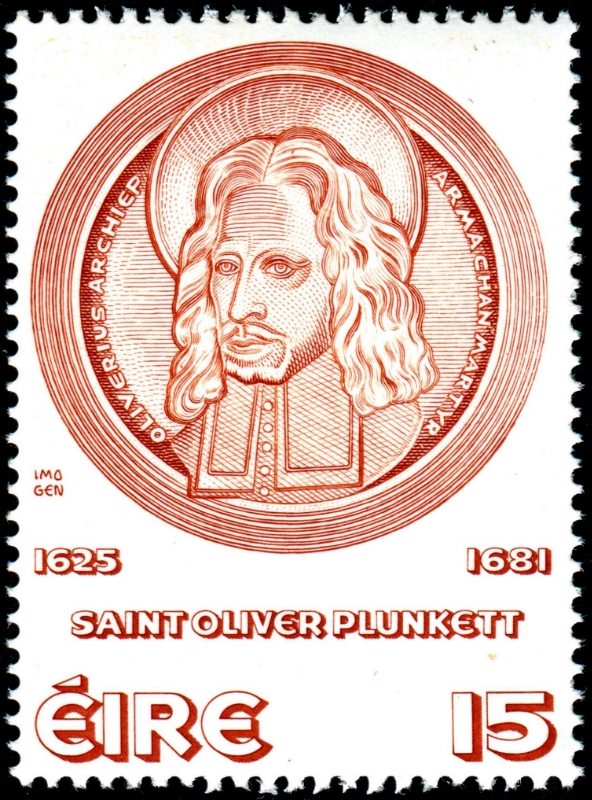
Perhaps the reason why Oliver Plunkett appears in Inchigeelagh is topicality: he was canonised in 1975, thus becoming the first new Irish saint for almost seven hundred years. Above is his shrine in St Peter’s Church, Drogheda, County Louth (his head is on display) and his Canonisation picture. St Oliver is the Patron Saint of Peace and Reconciliation, which in the mid-seventies was timely for Ireland. As ever, it’s timely for the world today. The Oliver Plunkett window was made by Abbey Stained Glass Studios, Dublin in 1992 and the artist was Kevin Kelly.

plunkett-15-stamp

The Christmas Story, One Window at a Time

Bandon Catholic Church

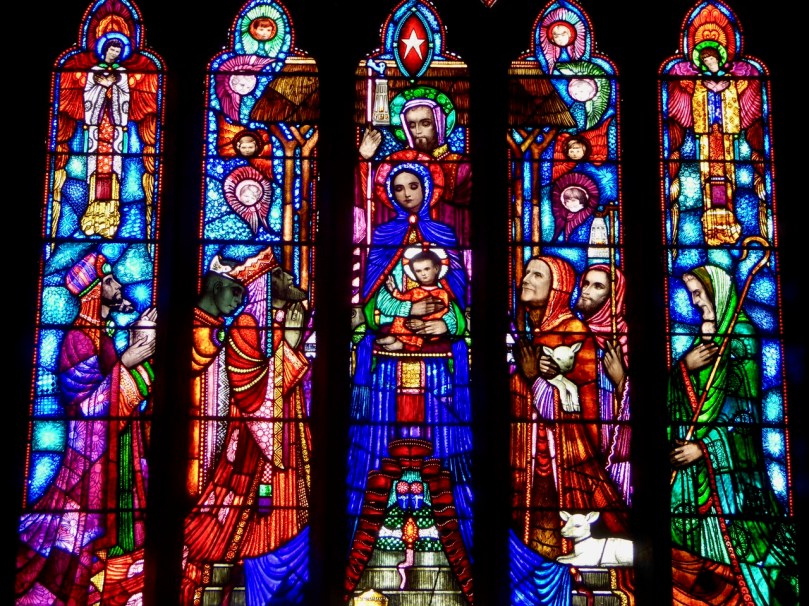
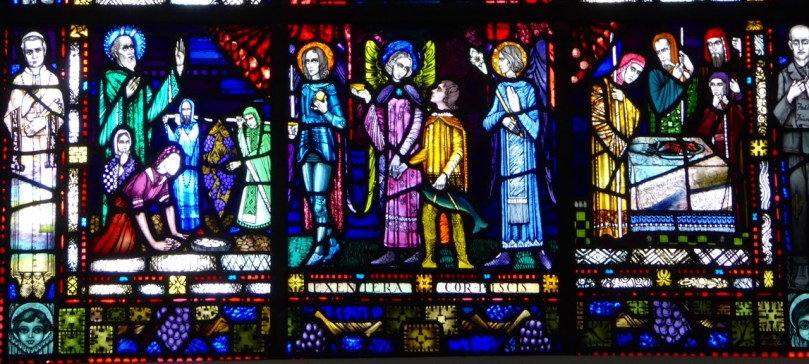
The Christmas story, as told in stained glass in Irish churches, is the biblical story. There are no Christmas trees or Santa Clauses, no references to anything other than the story of the birth of the Christ child. Not surprising, since stained glass is to be found mainly in churches after all. The one above is from the Catholic Church in Bandon. Pop in next time you’re passing – it will surprise you with its size and striking colour.

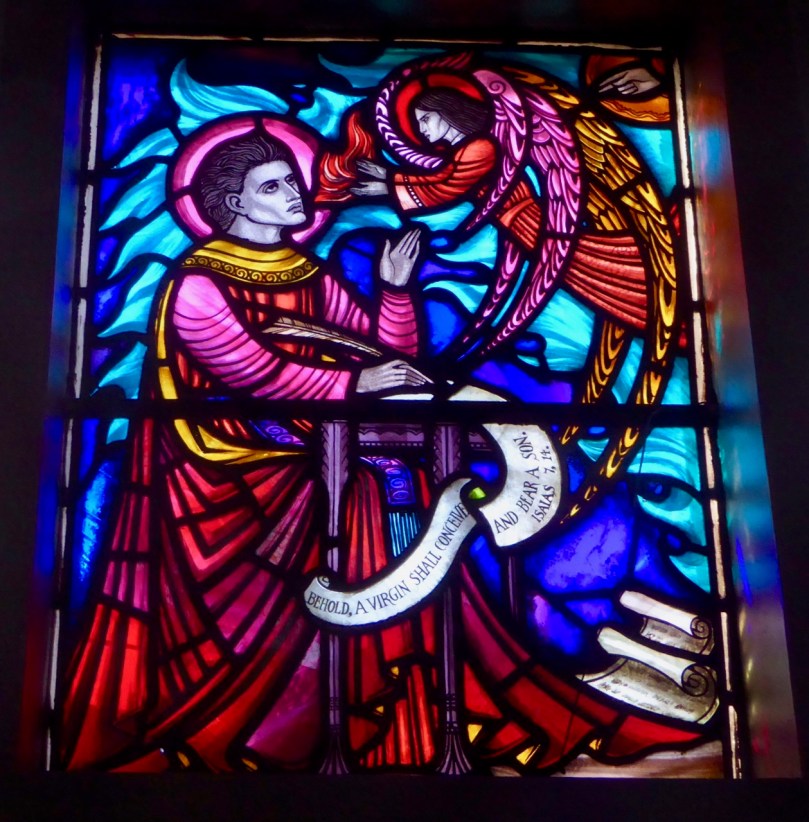
Church of the Annunciation, Cork. AnnunciationFive windows in a Cork church tell the story, beginning with the Annunciation

Two years ago I wrote a post about depictions of the Nativity by Harry Clarke. This year I’m branching out, to show you some of the stained glass Nativity images I have found in churches all over Ireland. Some are by artists I can identify, some are by the Harry Clarke Studios (after Harry’s death in 1931), and some are by anonymous artists. Some are traditional and some are avant garde. 

The next two windows show Mary visiting her cousin Elizabeth (mother of John the Baptist), followed by the betrothal of Mary and Joseph

In Cork, in the Church of the Annunciation – a church designed by the stone carver Seamus Murphy – a series of windows illustrate the complete Nativity story, from the Annunciation to the Visit by the Magi. These windows are by the Harry Clarke Studios and were installed in the 40s.

The birth in the manger with shepherds visiting, and the arrival of the Magi round out the story

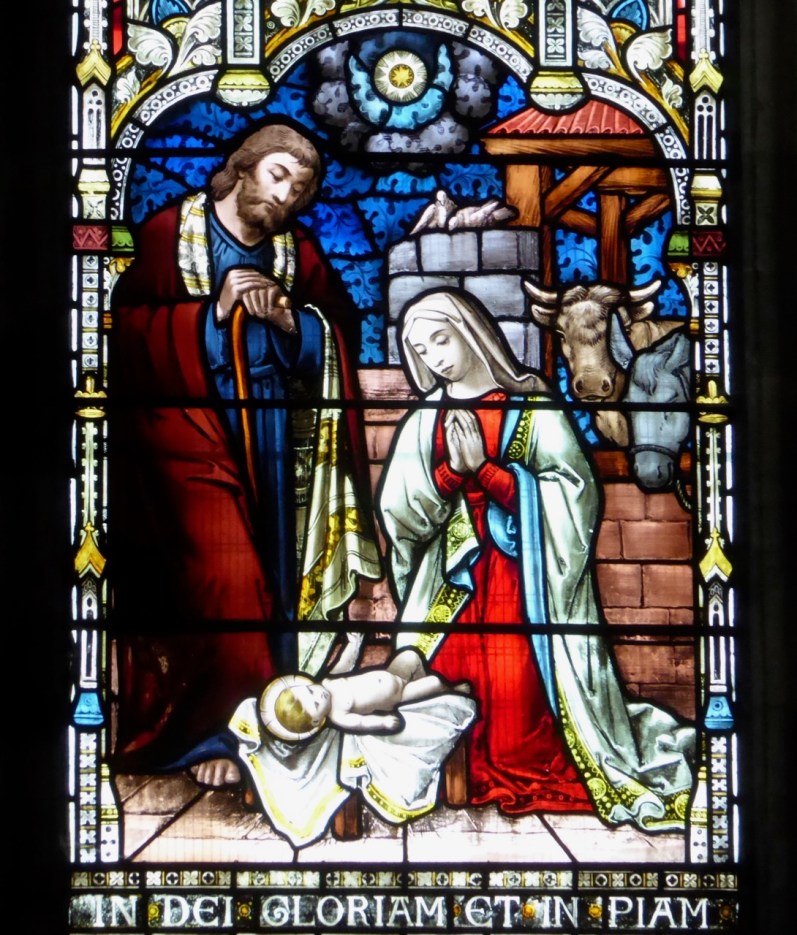
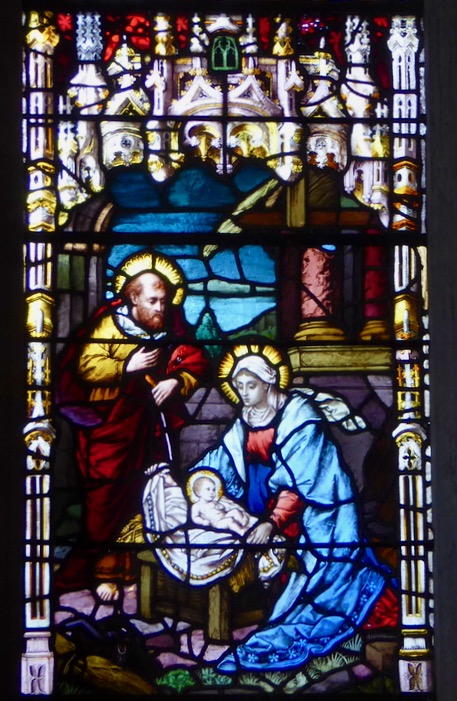
When we visited Kilkenny we saw two examples in St Canice’s Cathedral. The first, a traditional crib scene, looks like it belongs on a Christmas card.

St Canices

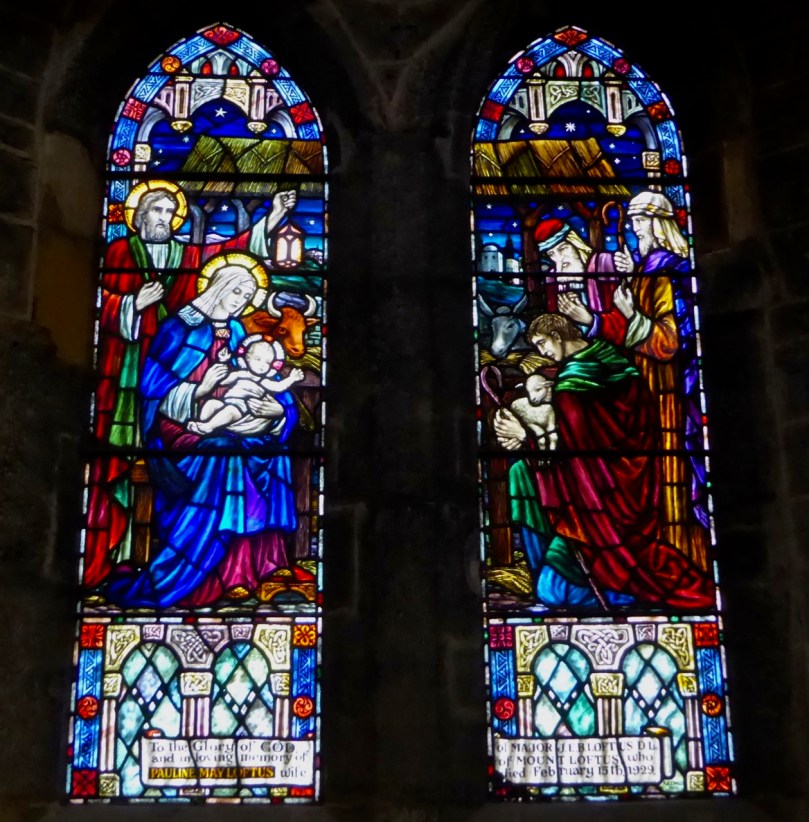
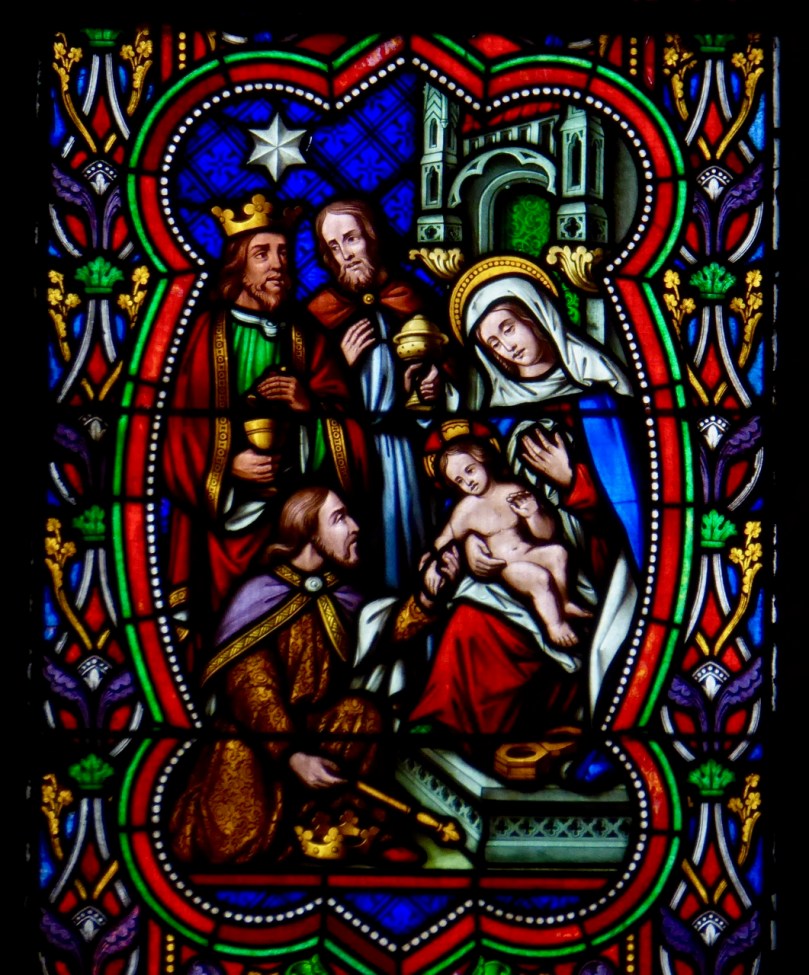
On  another wall in the same church is a two-light window by A E Child, depicting the visit of the Magi. A E Child was a highly influential teacher, and member of Sarah Purser’s Tower of Glass (An Túr Gloine) – a contemporary of Harry Clarke and a highly skilled stained glass artist, but with a more orthodox style than Clarke’s.

Canice's AE Childe

Still in Kilkenny, the Black Abbey has reputedly the largest stained glass window in Ireland. It’s divided into numerous smaller scenes and this one depicts the Nativity. It bears a striking resemblance to the Christmas card window from St Canice’s – perhaps it was from the same studio.

Black Abbey Kilkenny

In  Tullamore, the enormous Church of the Assumption has wonderful stained glass by different artists. Several large windows are by the Dublin firm of Earley. This one of the madonna and child shows a small shepherd on her right and three crowns on her left – a clear indication, I think, that this is intended as a Nativity image. The swirling colours and modern lines create a dramatic effect.

Church of the Assumption, Tullamore

The St Joseph window in the Richard King collection in Athlone contains a detail in one of the side panels that depicts the Flight into Egypt, and another of the marriage of Joseph and Mary.

Back to Cork and to the Holy Trinity Church on Father Matthew Quay, just behind the South Mall. Three windows on the west wall are by the Harry Clarke Studios. Research in the Studio archives (held in Trinity College) has revealed the the middle window was designed by Harry Clarke, but executed in fact by his father. It has many of the hallmarks of Harry but lacks the rich detail for which he became justly famous.

Holy Trinity Church, Cork, Designed by HC and executed by his father

Behind the altar, on the north wall of the same church is an enormous window dedicated to Daniel O’Connell and containing scenes from the life of Christ. It is conventional, but finely painted and the colours are rich.

Holy Trinity Cork, East Window

I will leave you with two of our favourites. Close to home I love the the Sarah Purser/Tower of Glass round window in the Holy Rosary Church in Kilcoe. Here’s a detail.

Tower of Glass Magi closeup. Kilcoe

And finally, from the village church of Eyeries on the Beara Peninsula, Robert wrote about  a stunning set of windows by George Walsh. His nativity scene is touching and beautiful.

george walsh nativity

Wild Beasts of Ireland

tiger at feet st canice

There are wild beasts all around us!  Animal, fish, serpent or fowl, real or mythical, carved, painted – imagined. This is my second ‘Menagerie’ – previously we explored the Honan Chapel in Cork, and I was struck by all the wildlife representations there, as set out in this post from over two years ago.

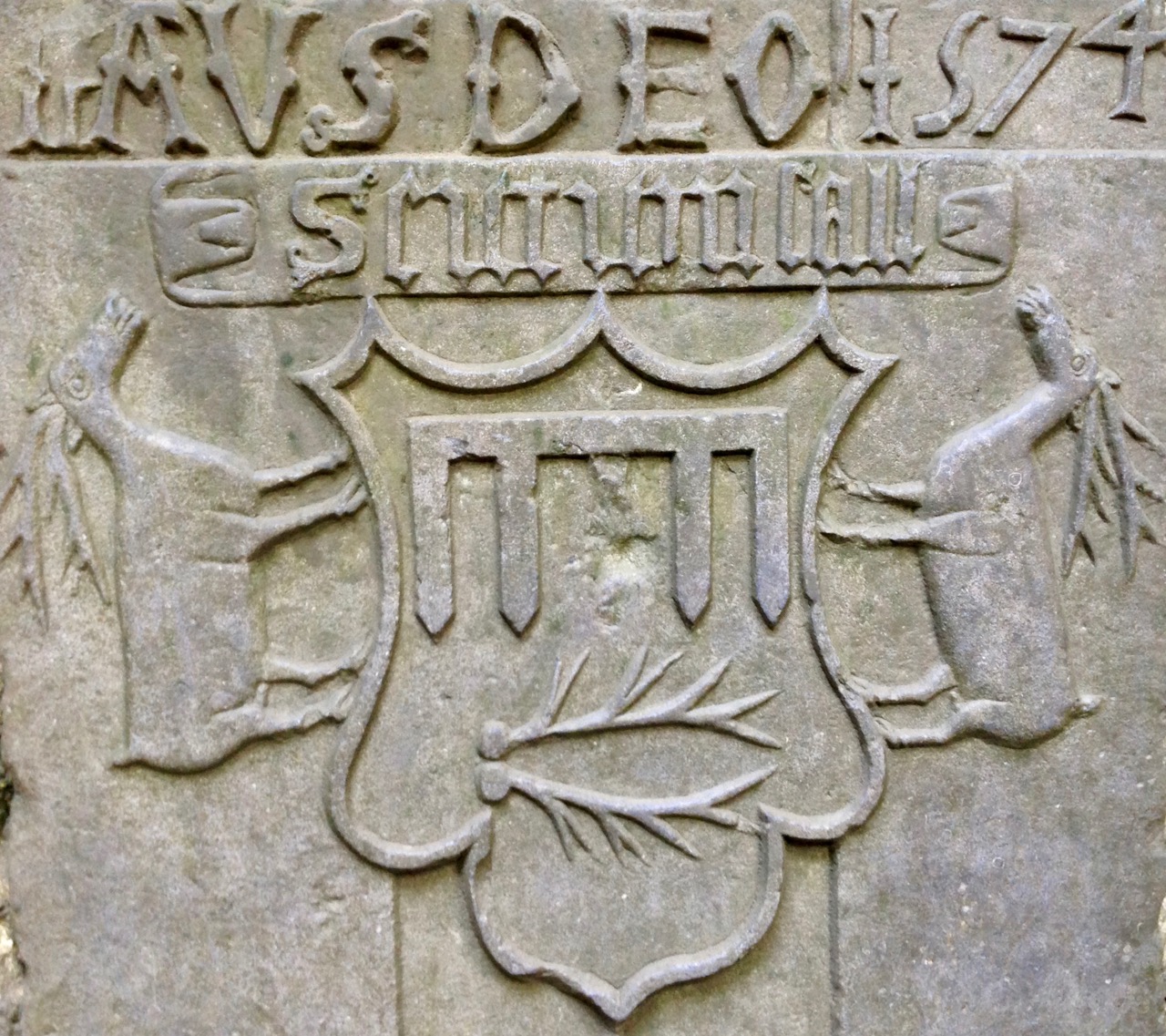
2 deer cashel

Deer and antlers on a memorial plaque in the Cathedral at Cashel – one of the earlier representations here, dating from 1574. Top picture – believed to be a tiger, this fine beast lies at the feet of a medieval knight in St Canice’s Cathedral, Kilkenny

Our travels take us around many of Ireland’s historic sites, and I’m always on the lookout for Creatures – they are abundant everywhere. Countless stories of the saints involved animals: they are common symbols on tombs and heraldic plaques, but we can’t resist also using them today – for inns, shop signs or just decoration on the streetscape. Have a look around you – you might be surprised how many you can see…

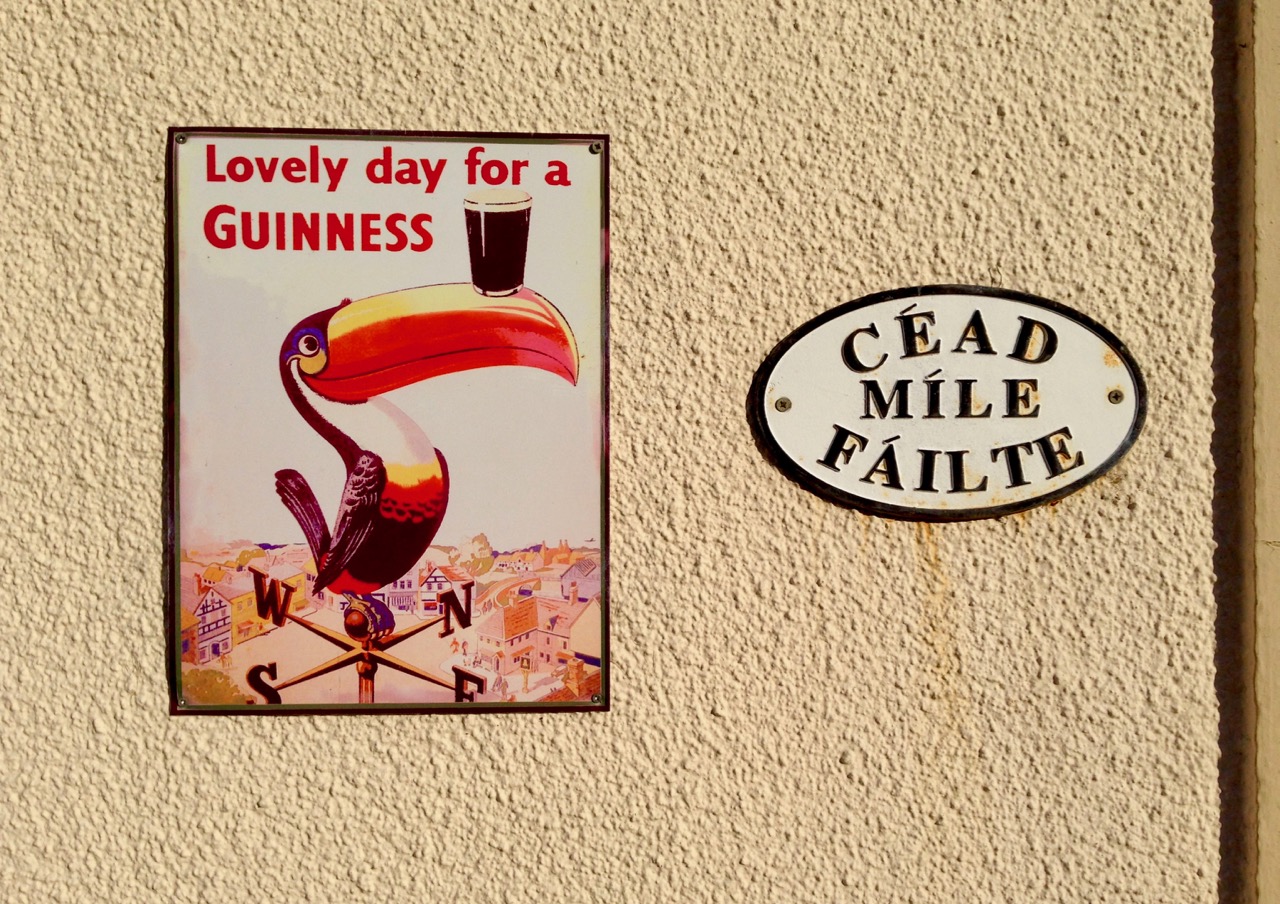
toucan guiness

Inhabited streetscapes: top – two Kilkenny Cats undoubtedly belonging to Dame Alice Kytler and, above – there are plenty of these toucans still around in Ireland! They originate from a ‘zoo’ advertising campaign for Guiness begun in 1935 (abeted by Dorothy Sayers who wrote captions and verses); the toucan campaign flourished until 1982

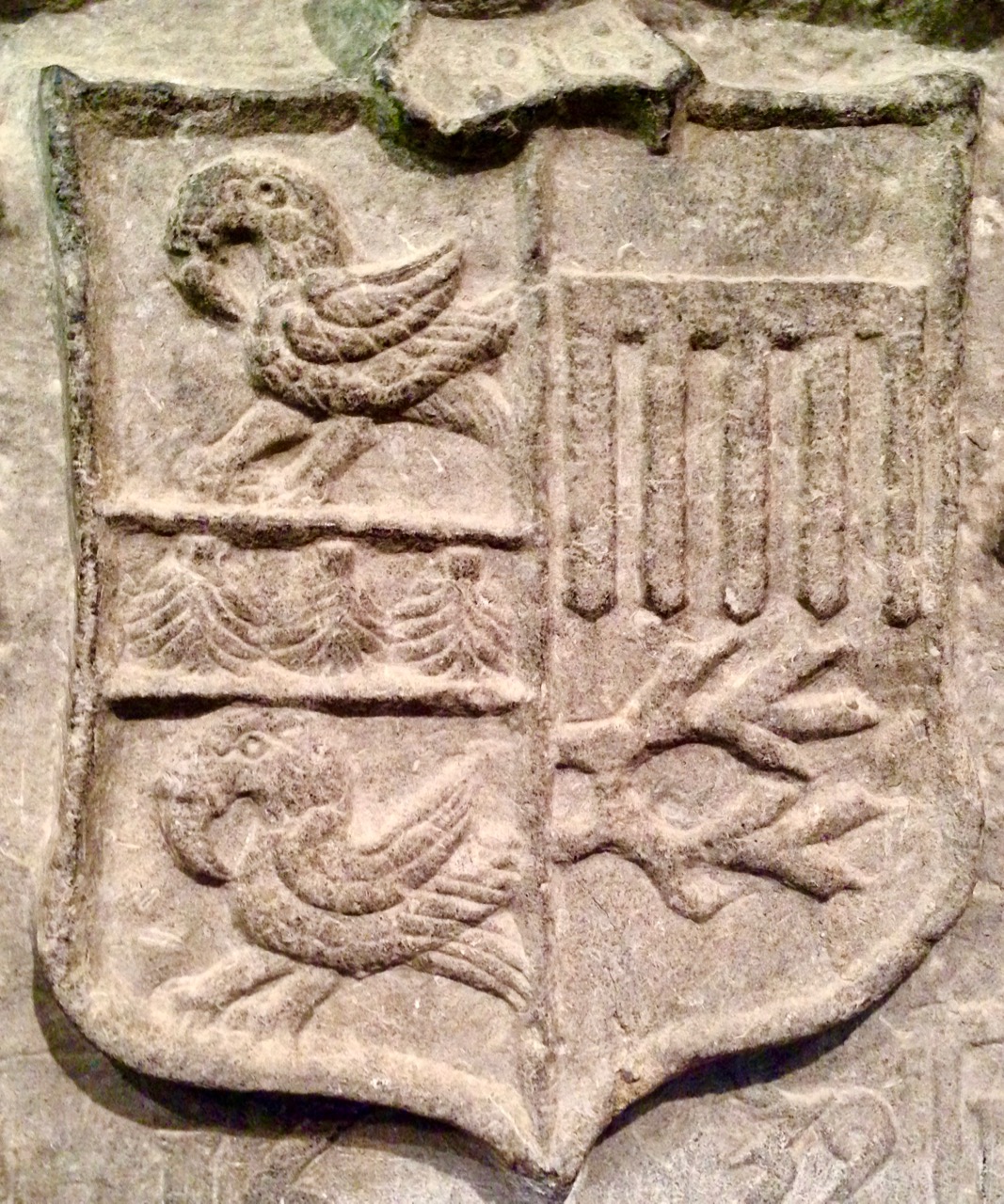
Nobody has ever claimed the toucan as an Irish bird, but pelicans were certainly not uncommon in medieval carvings here. That’s because the pelican in early Christianity symbolises atonement as it was believed to wound itself in order to feed its young with its own blood.

2 birds shield cashel

fish lid st canice

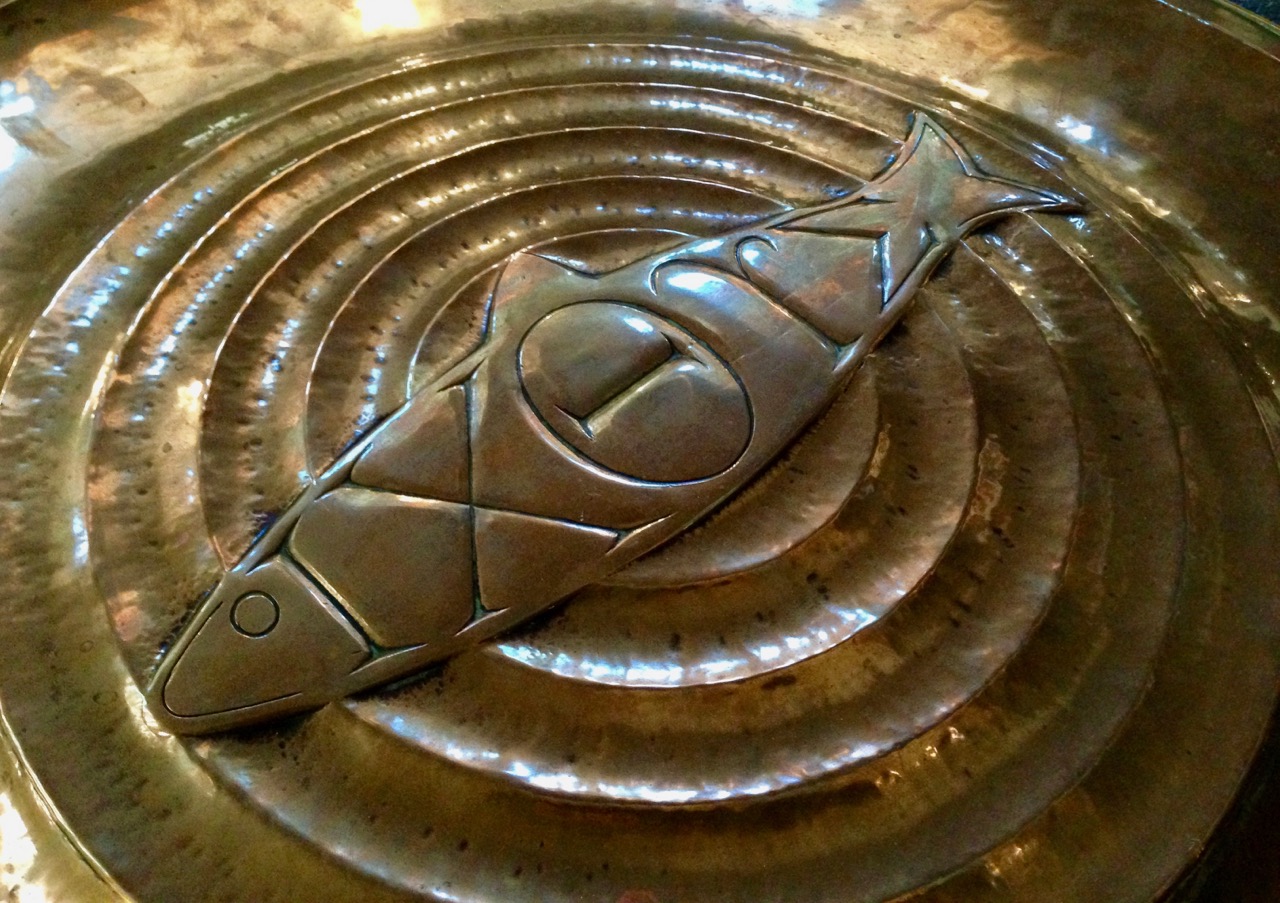
Christian symbolism: top – medieval pelicans at Cashel, and below – a fish incorporated in a modern lid to the ancient font in St Canice’s Cathedral, Kilkenny. The Greek ΙΧΘΥΣ is an acrostic for ησοῦς Χριστός, Θεοῦ Υἱός, Σωτήρ, literally translating as Jesus Christ, Son of God, Saviour

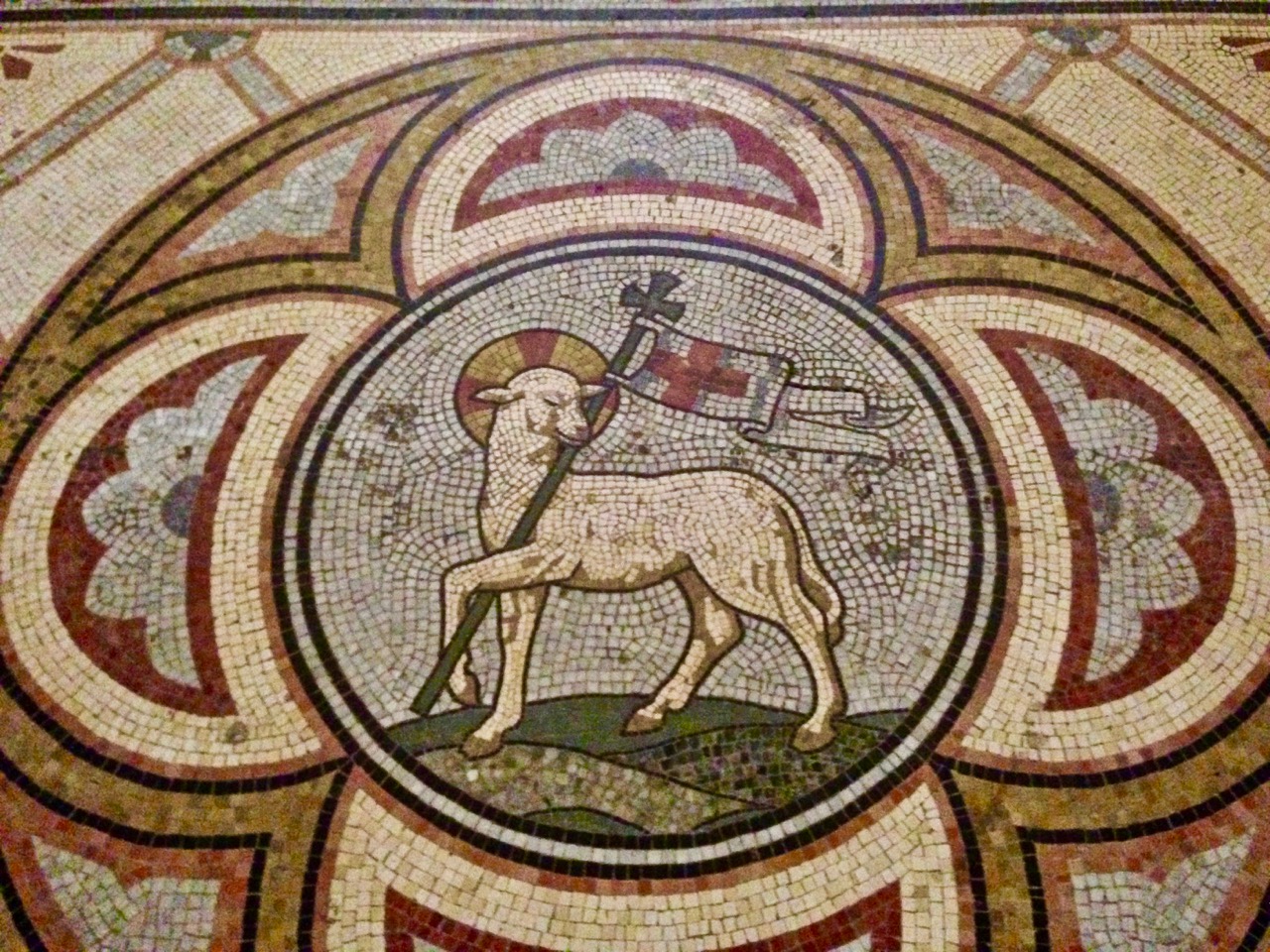
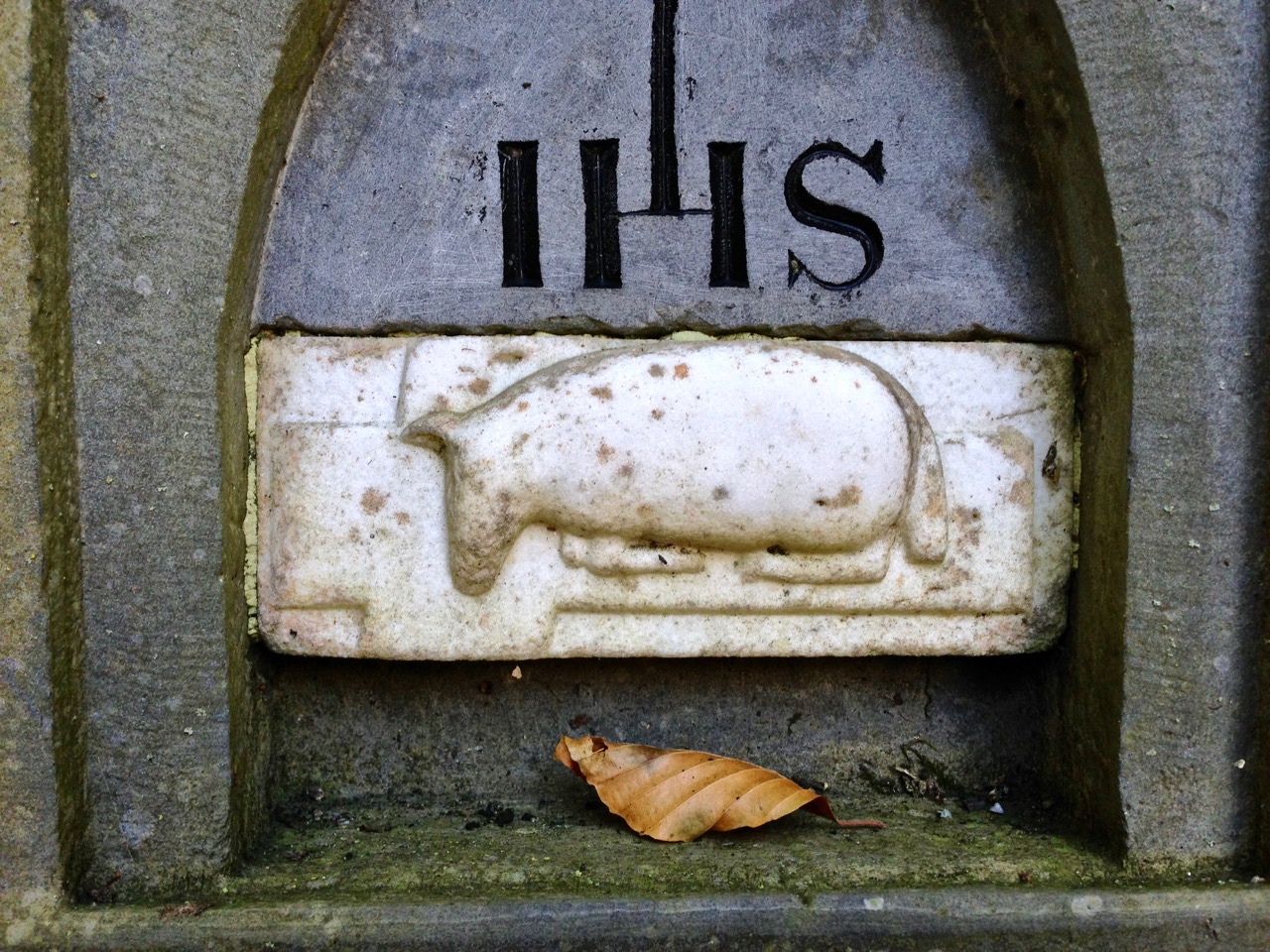
Also in Christian symbolism the lamb represents Jesus – the Lamb of God – who was sacrificed in order to atone for human sin.

lamb with pennant kilkenny

ihs lamb detail
Top picture – not a wild beast, perhaps, but a pascal lamb mosaic in St Mary’s Cathedral, Kilkenny. Lower picture – this strange creature is also a lamb, from a graveyard memorial in Killeen, Co Meath

Lions are popular animals in Britain and Ireland, possibly because they appeared on royal crests and were therefore associated with status and dignity. I was surprised to find bears and eagles well represented.

All the lions (graphic tiles and wistful memorials) are from the Collegiate Church in Youghal. The stained glass is from St Peter’s Church, Bandon, Co Cork and shows off bears (from crests of the Earls of Bandon – their motto was Bear & Forbear), eagles, another lion and – for good measure – a fine serpent

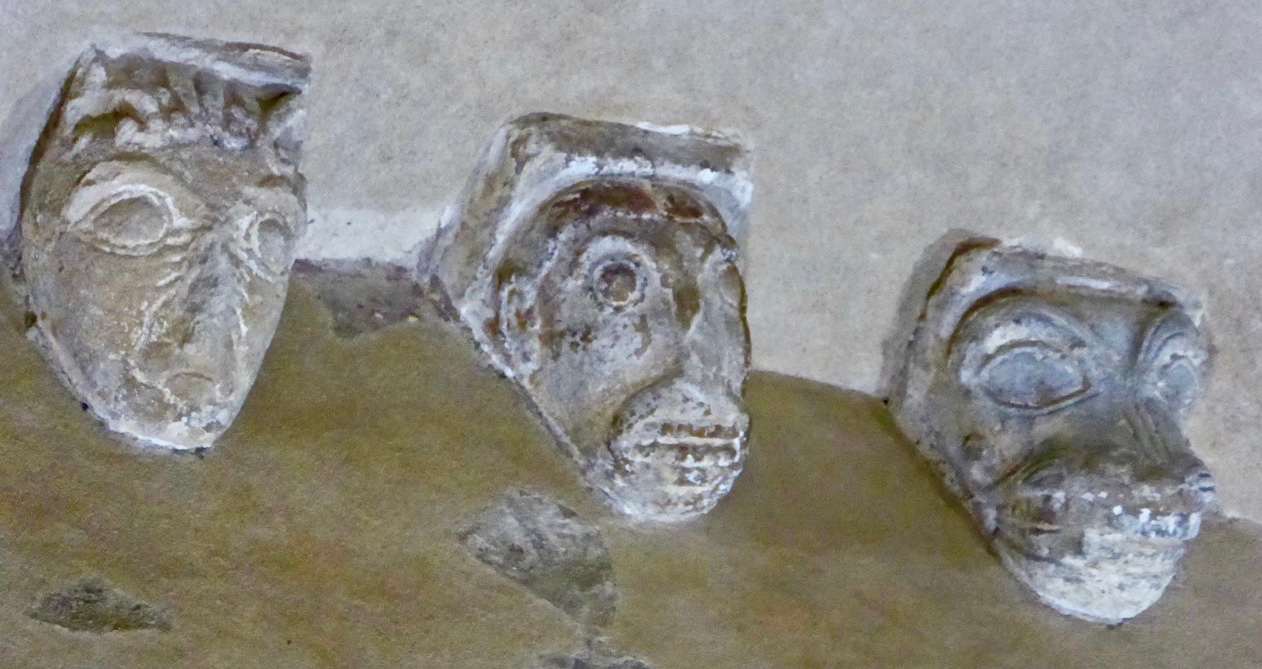
Some of the most splendid and oldest carved stonework in Ireland is to be found at Cormac’s Chapel, Cashel and at Clonfert Cathedral, both dating from the twelfth century. The Hiberno Romanesque doors and arches display arrays of human heads but also numerous creatures.

Heads cormacs chapel

Upper pictures – a small selection from the riotous carvings at Clonfert Cathedral, Co Galway and – lower picture – ambiguous creatures from Cashel, Co Tipperary: all are around 900 years old

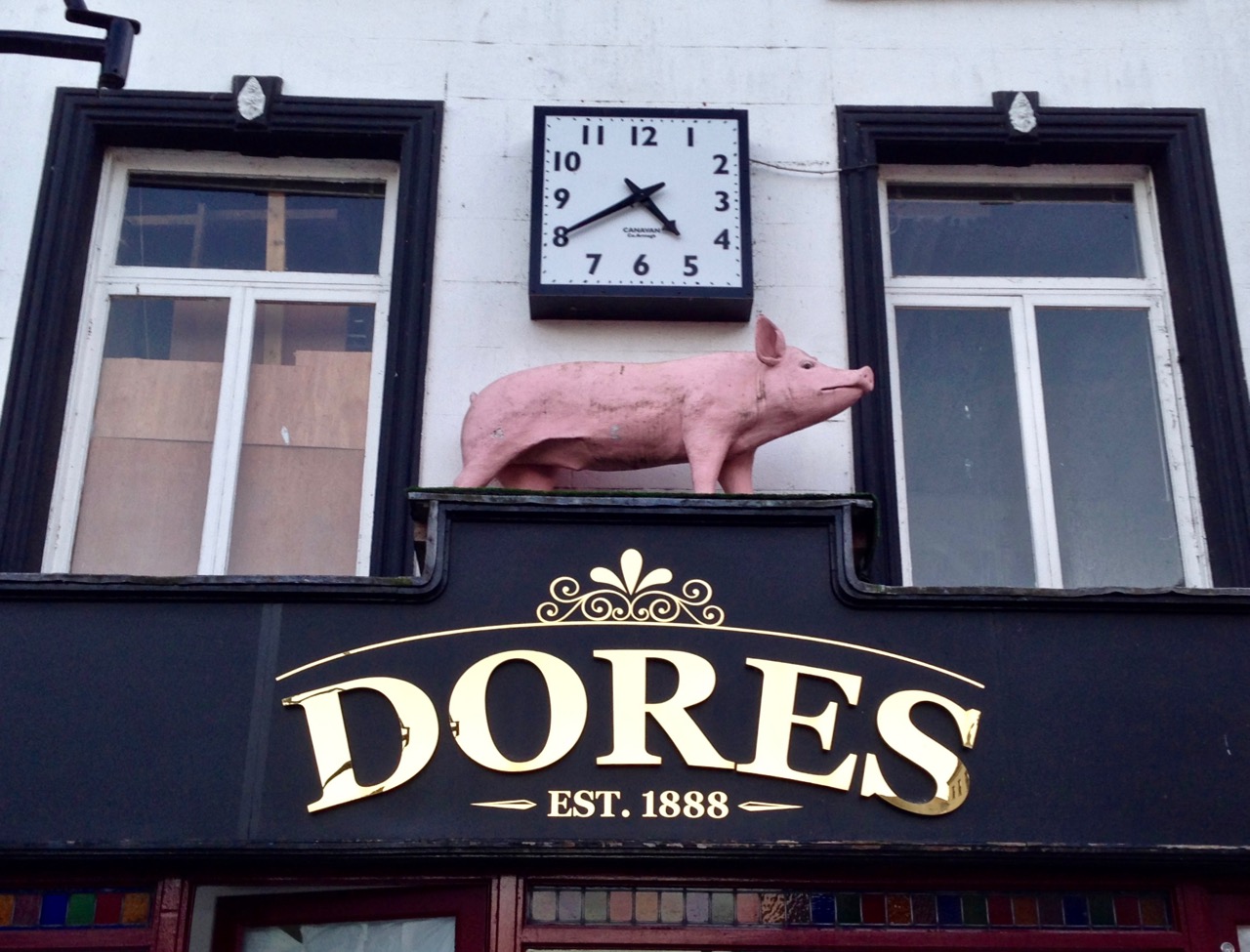
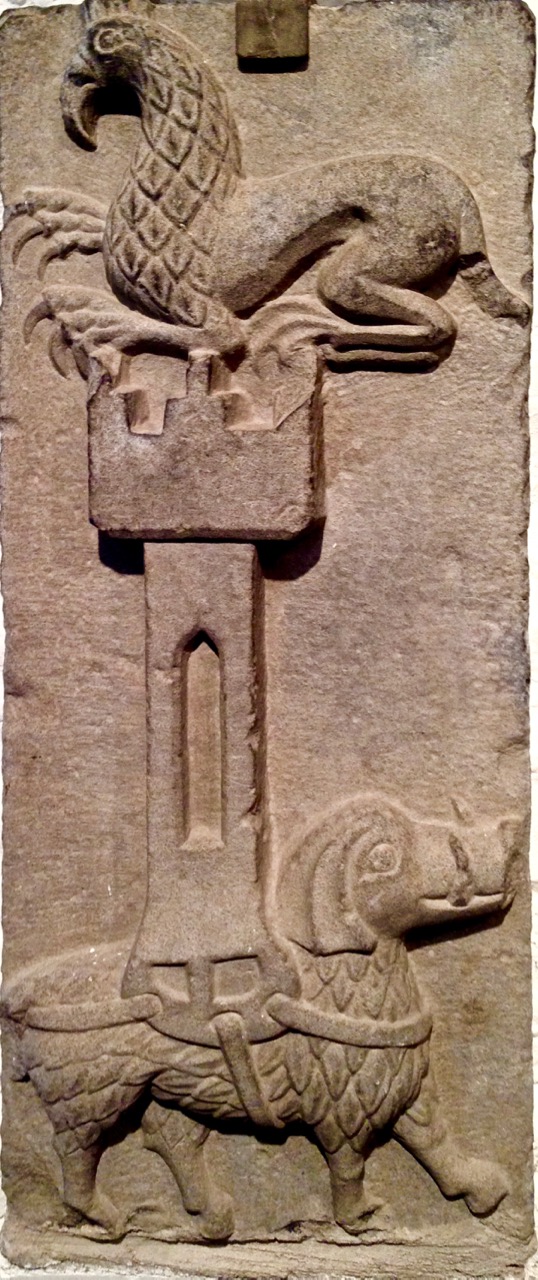
I’ll round off for now with some more cat-like creatures and a Kilkenny pig. Oh – and a carving we found in the Cashel museum, titled ‘Elephant and Castle’. Both the carving and the name are enigmatic, as the creature with a castle on its back (wherein resides another creature – a gryphon?) looks to me like a boar with feathers!

pig dores kilkenny

Elephant + Castle


Discovering Richard King

Patrick Vox Hib

Here is a typical Harry Clarke piece of stained glass – note the large expressive eyes and long tapering fingers, the gorgeous raiment of the angel and that headdress, the additional tiny angelic figure hiding in the blue glass, the border filled with non-repeating decorative elements. All classic Clarke elements, right? But this is not the work of Harry Clarke. He died in 1931 and this window was designed, executed and installed in 1937, by the studio that he founded and which carried on after his death under the name Harry Clarke Studios.

Patrick Preaching

The first image in this post is from the Patrick window and shows Vox Hibernicæum – the people of Ireland calling Patrick back to convert them. The image above is from the same window – Patrick preaching to the chieftains **

This window, it turns out, along with several others in the same church, was the work of Harry Clarke’s apprentice, the man who stepped into the breach caused by his death and took over as the main stained glass artist of the Studio. That man was Richard King.

Joseph all

The Joseph window: each frame tells a story from the life of Joseph or references other biblical Josephs.

I had never heard of Richard King until I stepped into Sts Peter and Paul’s Catholic Church in Athlone during our Midlands trip. That’s not all that surprising, because after Harry Clarke died windows from his workshop were generally signed simply by the Studio and individual artists were not identified. Mostly, it seems, this was to capitalise on the Harry Clarke brand, which by the time of his death was justly celebrated, and thereby to keep orders coming in.

Joseph scenes

Close up of the lowest frames in the Joseph windows. Clockwise from top right: the marriage of Mary and Joseph; the death of Joseph; Genesis 41:55 When all Egypt began to feel the famine, the people cried to Pharaoh for food. Then Pharaoh told all the Egyptians, “Go to Joseph and do what he tells you.”; Four rivers and two deer: the four rivers of Paradise; This is a reference to another biblical Joseph mentioned in Psalm 104, ‘constituit eum dominum domus suae et principem omnis possessionis suae’ – He made him master of his house, and ruler of all his possession **

Richard King had been trained by Harry: he had executed windows designed by Harry under Harry’s close supervision. A promising artist when he joined, he probably did more than set glass etched and drawn by Harry, but may have been responsible for background elements, borders, details. Harry was away in Davos, gravely ill, for the last year of his life and Richard may well have translated his cartoons (window designs on paper) into glass. But I am speculating here, and I hope to learn and write more about Richard King in the future. He went on to have a long and distinguished career as an illustrator.

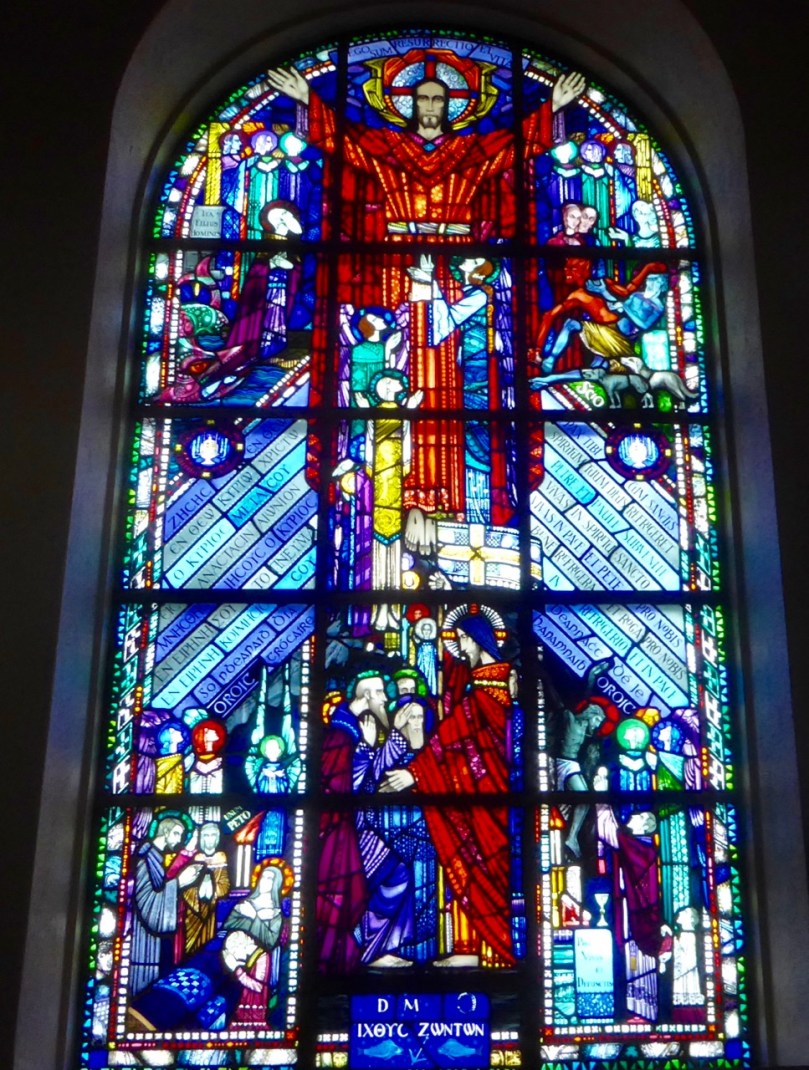
Purgatory all

The Purgatory window: prayer fragments in Greek, Latin and Irish; the righteous ascend to heaven; Christ descends to purgatory with a banner to lead those who have done their penance up to heaven; in the lower left St Monica is on her deathbed while St Augustin looks on; lower right, the mass is celebrated; upper right, Jonah (whose purgatory was to be in a whale) and upper right Job, who was robbed of everything he held dear by the devil, thus testing his faith **

The King windows I photographed are enormous. (There are other Harry Clarke Studio windows by Richard King in the church as well as windows by other companies, but I will concentrate on these ones for the purpose of this post.) They represent St Joseph, St Patrick, Jesus, Mary and Purgatory. All follow the same convention of placing the main figure centrally, surrounded by smaller panels which tell stories or illustrate events from the life of the central character.

Purgatory Jesus and the Saints

Close up: Christ descends to purgatory

HC Studio, Athlone

Close up: the Job panel

The sheer size of the windows has allowed ample scope for this approach, but size alone cannot account for the myriad details that King inserts into every possible space in the window. Words abound, in several languages and scripts. References to the ancient and the modern, the mythological, the hagiographical, and the historical jostle for space with abstract designs, tiny figures both realistic and imaginative, symbols, animals, buildings – everywhere the eye lingers new elements are discovered. In its essence, this is very Harry Clarke; in the sheer exuberance of its execution, this is Richard King having fun, cramming in as much as his own fertile imagination can offer up.

Mary Rosary Angelus and Scapular

This is the Mary window and these sections concentrate on images of Marian veneration. Clockwise from top left: workers pause to pray the Angelus; a family says the rosary together; St Simon Stock receives the scapular from Mary (more on this here);  Mary; St Dominic receives the rosary **

The Harry Clarke Studios closed down in the 70s. For many years after Harry’s death in 1931 it carried on his tradition of highly stylised and beautiful works of art in stained glass, although over time works became more conventional and quality suffered as orders were harder to get, costs rose and corners were cut. Look, for example at the Studio windows in my post Time Warp, about the Drimoleague church, done in the 50s. But that’s in the future – what we can see, under Richard King’s assured hand, are windows that proudly carry on the Clarke preoccupations with designing windows that dazzle and inspire.

Juses details bottom

Details from the Jesus window from left to right: Pope Pius x; Manna from heaven; Tobia walking with the Angel Raphael, with Michael and Gabriel; eating the paschal lamb; Matt Talbot, a Dublin man who died in 1925 and who was considered on the path to sainthood because of his extreme practice of asceticism **

Perhaps, though, there is another element that creeps in now that Harry is gone – the religious fervour of the early years of the state is now in full swing. Government and Church Hierarchy work hand in glove to develop and promote a vision of Ireland that is devout, Catholic, monocultural, conforming and repressive. A high point in this relationship occurs in 1932 with the Eucharistic Congress in Dublin – an event explicitly referenced in the Patrick window. Richard King will never, as Harry did, fall afoul of puritanical state censorship – he will go on, in fact, to become the chief illustrator for a Catholic magazine.

Patrick top

The top of the Patrick window explicitly references the Eucharistic Congress of 1932 and the crossed flags of Ireland and the Vatican. Try to enlarge this image and see how many different elements you can identify. Good luck!

But in 1937 he is at the height of his powers as a stained glass artist. I hope to find and illustrate more of his work in that medium in future posts.

Patrick details and cathedrals

From the bottom of the Patrick window: Patrick lights the paschal fire on the Hill of Slane; he is flanked by images of two St Patrick Cathedrals, New York and Melbourne; Beneath, the swans represent the ancient myth of the Children of Lir (although there were four swans in the myth, not three) – the spell they are under is broken when they hear St Patrick’s bell

** The photographs in this post are my own, but for the explanations that I use in the captions, I am indebted to Niall McAuley, who has mounted a Flikr Album of all the stained glass in this church and has researched and annotated each image. I don’t know you, Niall, but I salute your wonderful images and your exhaustive notes on each of the windows. Please go to Niall’s album for more on all the King windows (especially if you are stumped by the Patrick window) and also windows by other stained glass suppliers and artists in this amazing collection.