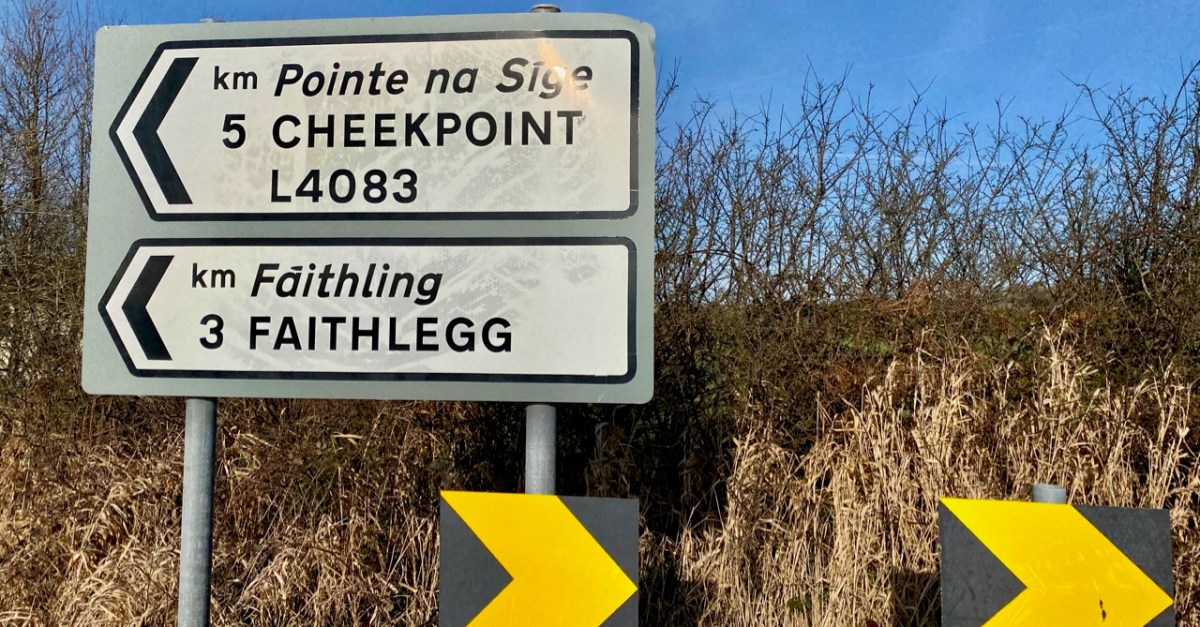
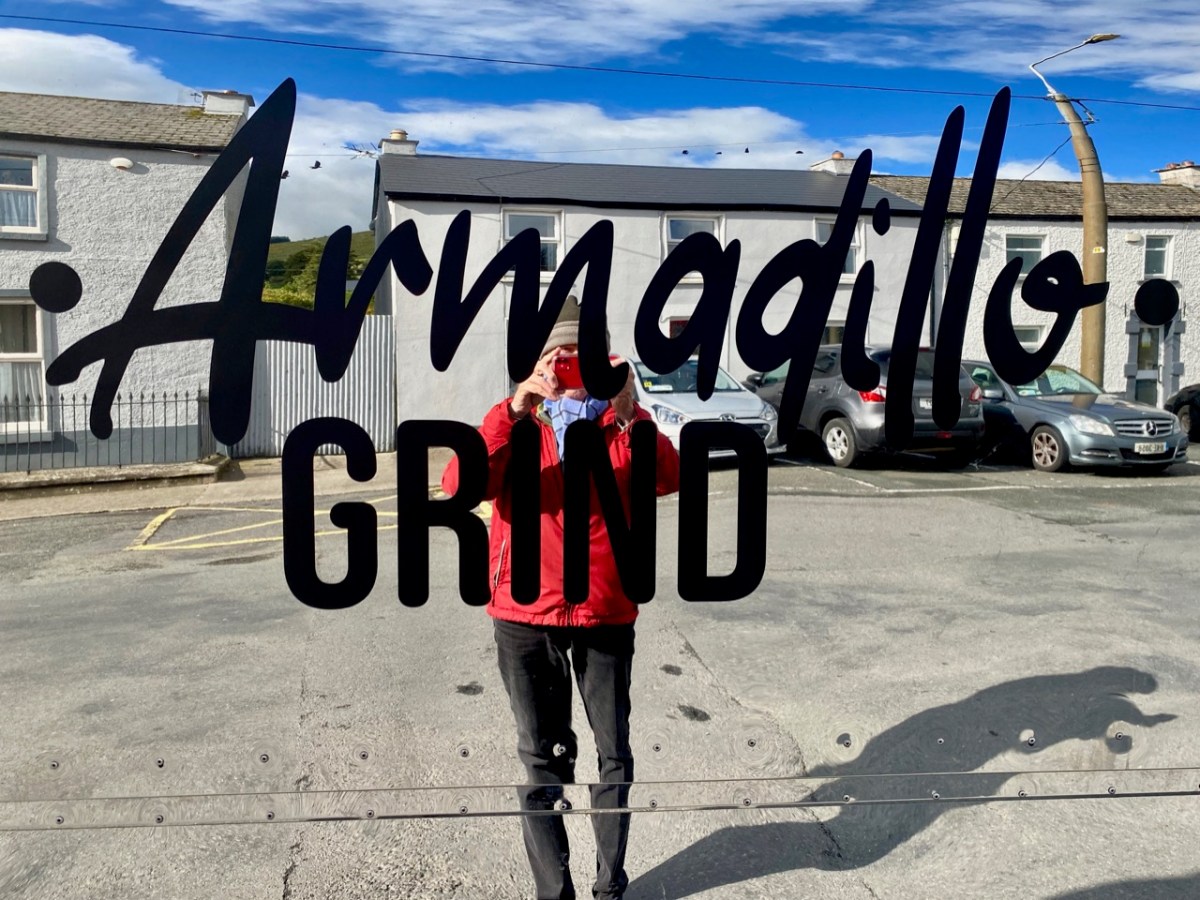
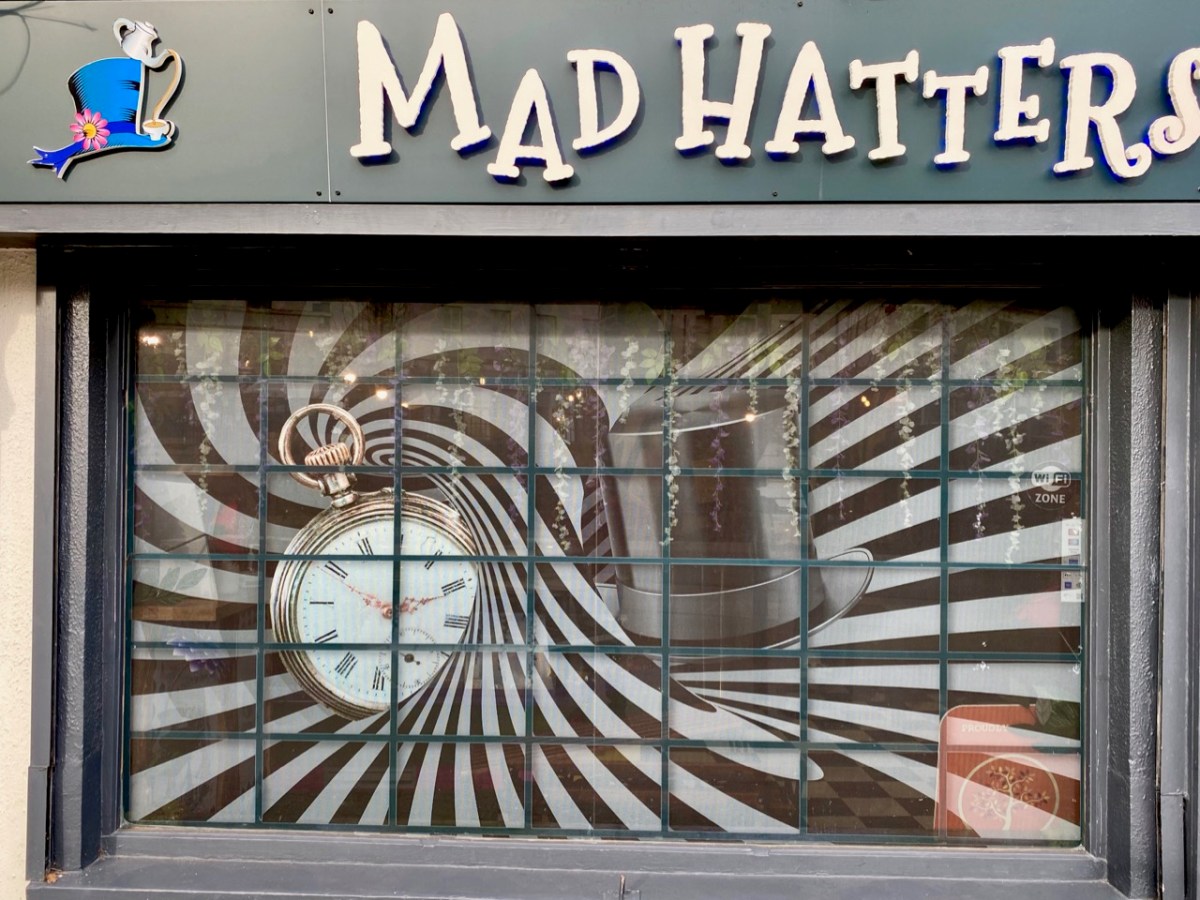
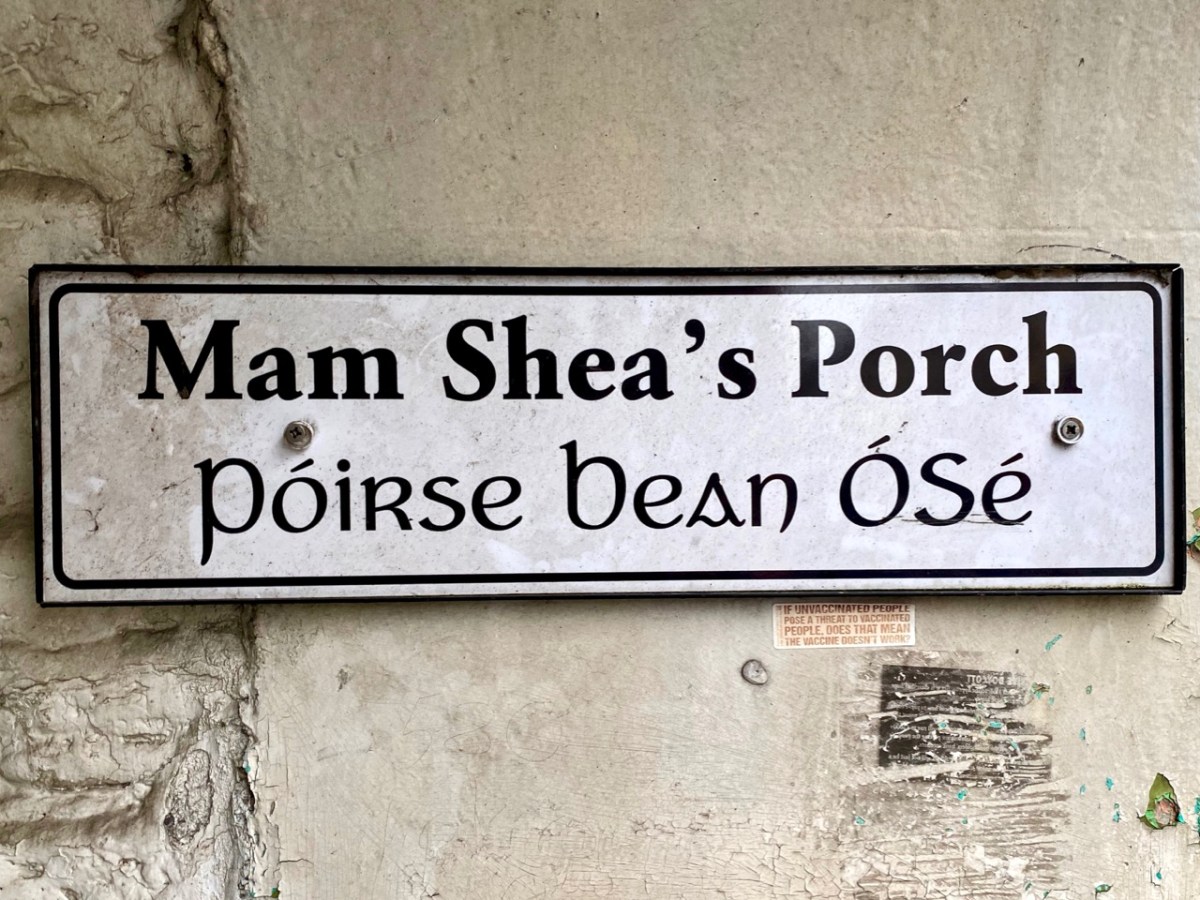
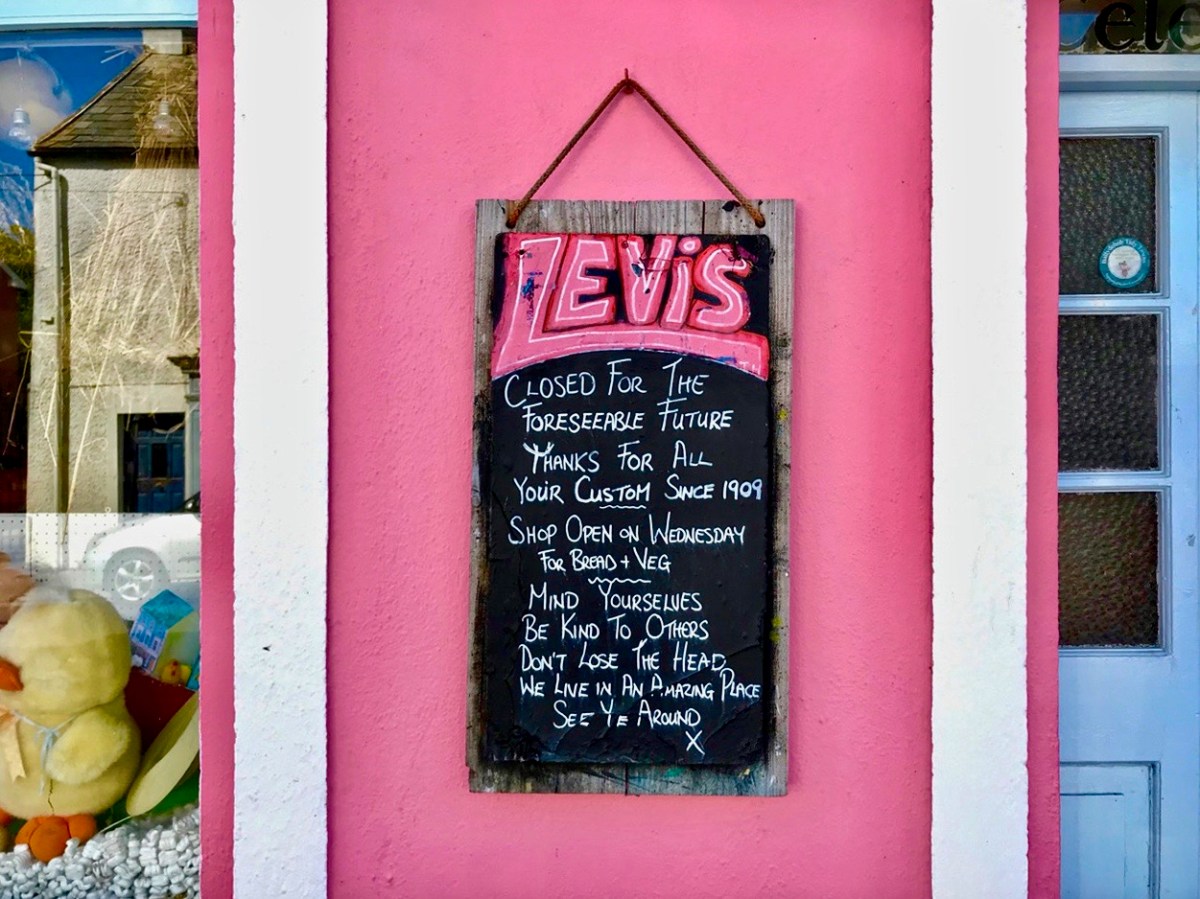
We live in a world full of words. I can’t resist them – particularly when their context shines a humorous – or puzzling – light on them. Not just signs with words on them: sometimes it’s images – shopfronts – posters – that make you stop and have a second look. But then, I probably have a very particular sense of humour. I have every respect and good wish for the residents of Cheekpoint and Faithlegg, for example, but juxtaposed on the Waterford road sign they are eye-catching. Pointe na Síge is the ‘place of the Shee’ (or fairies), while Fáithling was the first parish name to be established following the 12th century Norman conquest: as far as I can make out, it derives from the term for ‘a wooded area’.
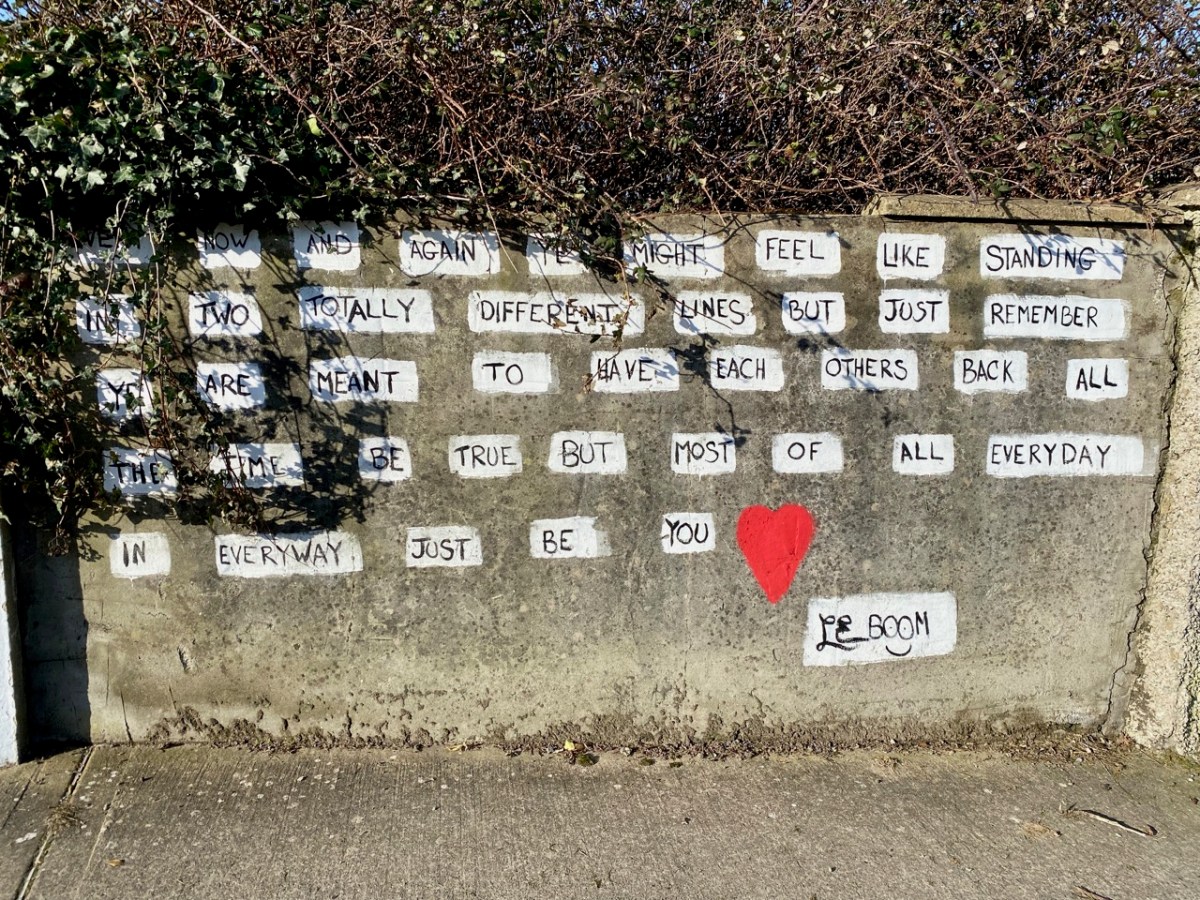
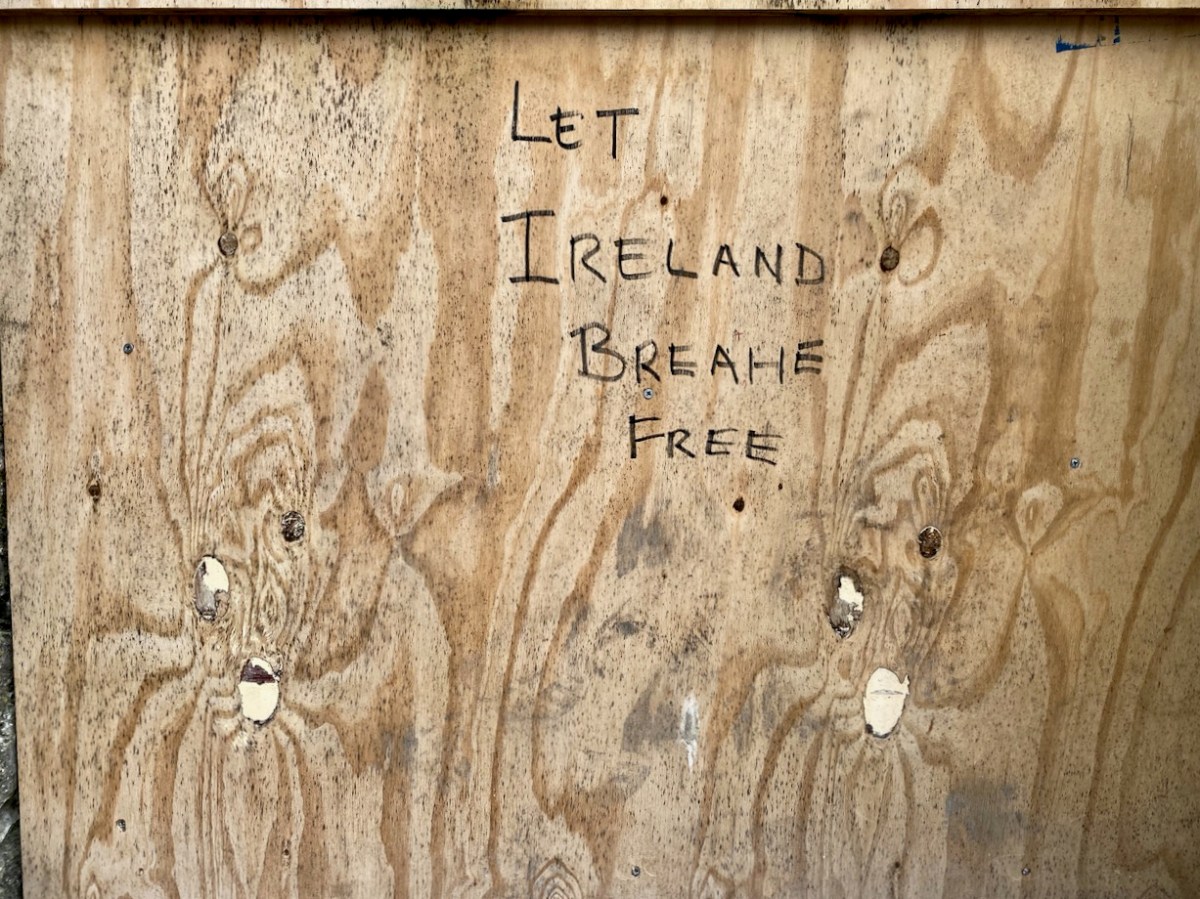
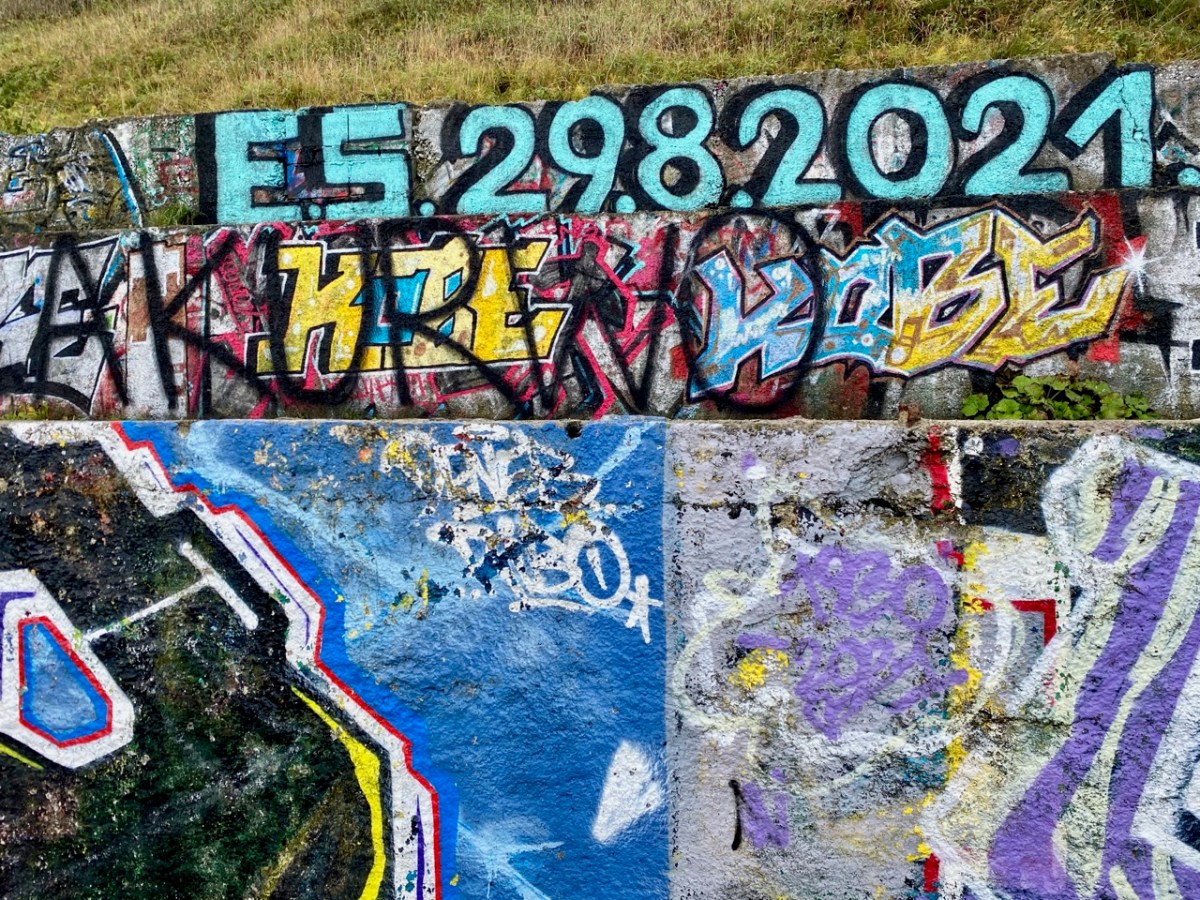
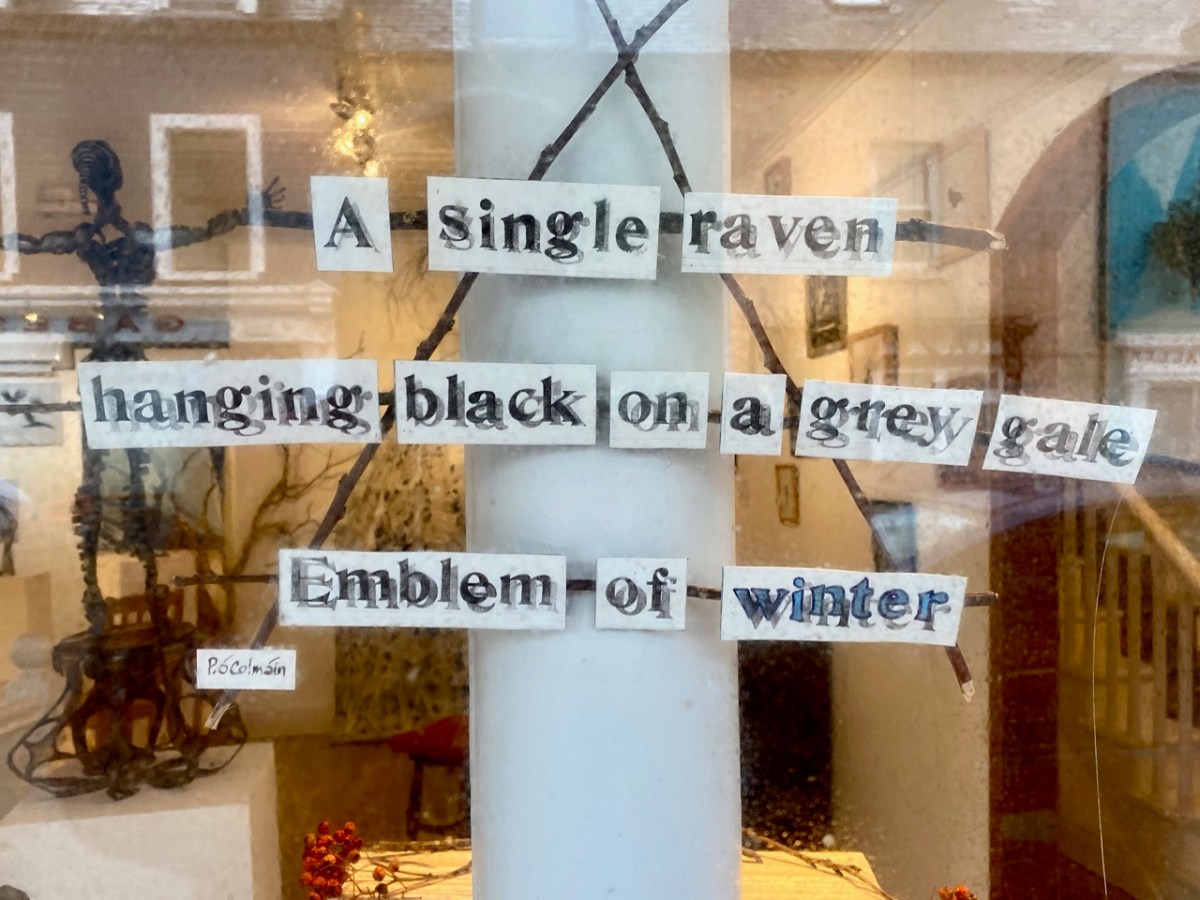
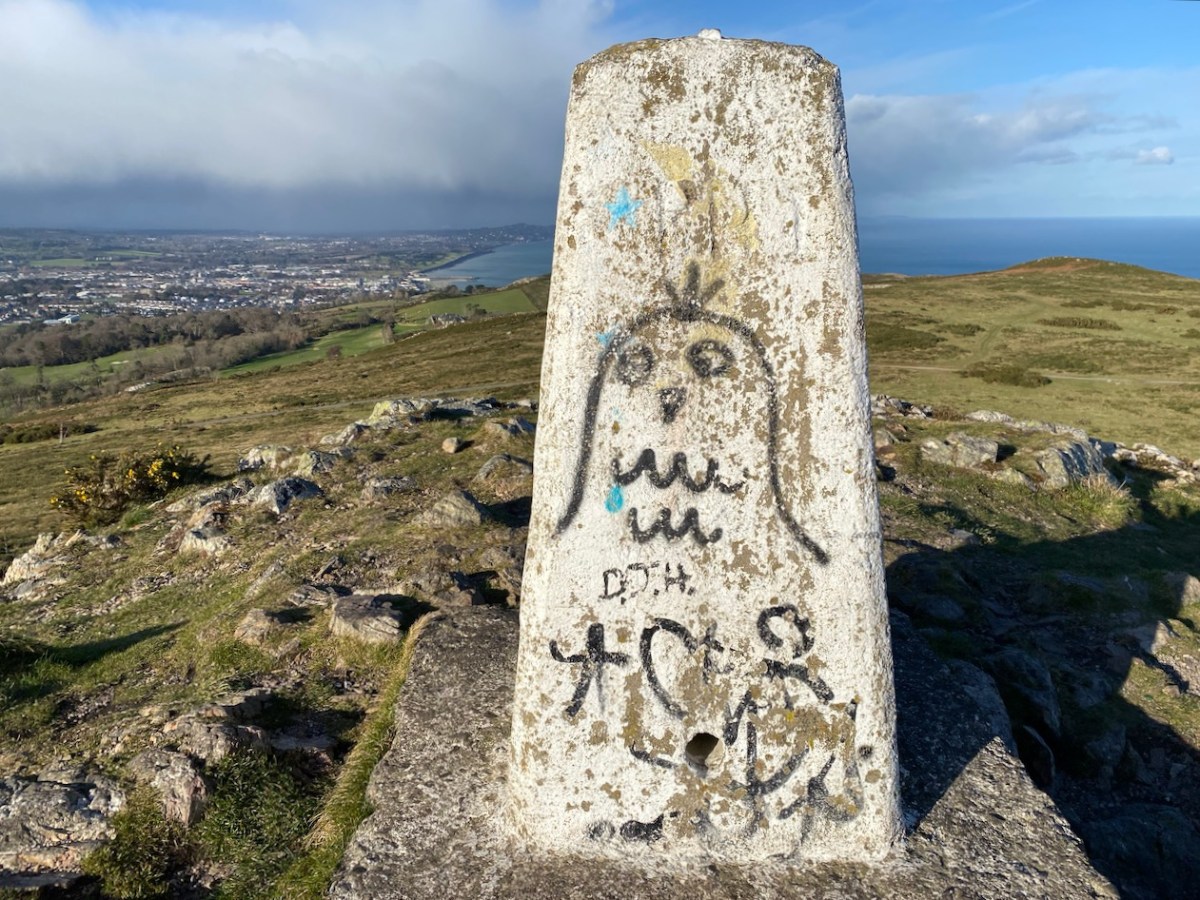
A ‘word wall’ signed by its author is from Wicklow (above). But we have encountered many examples of less formal poetry: I won’t call it graffitti . . .
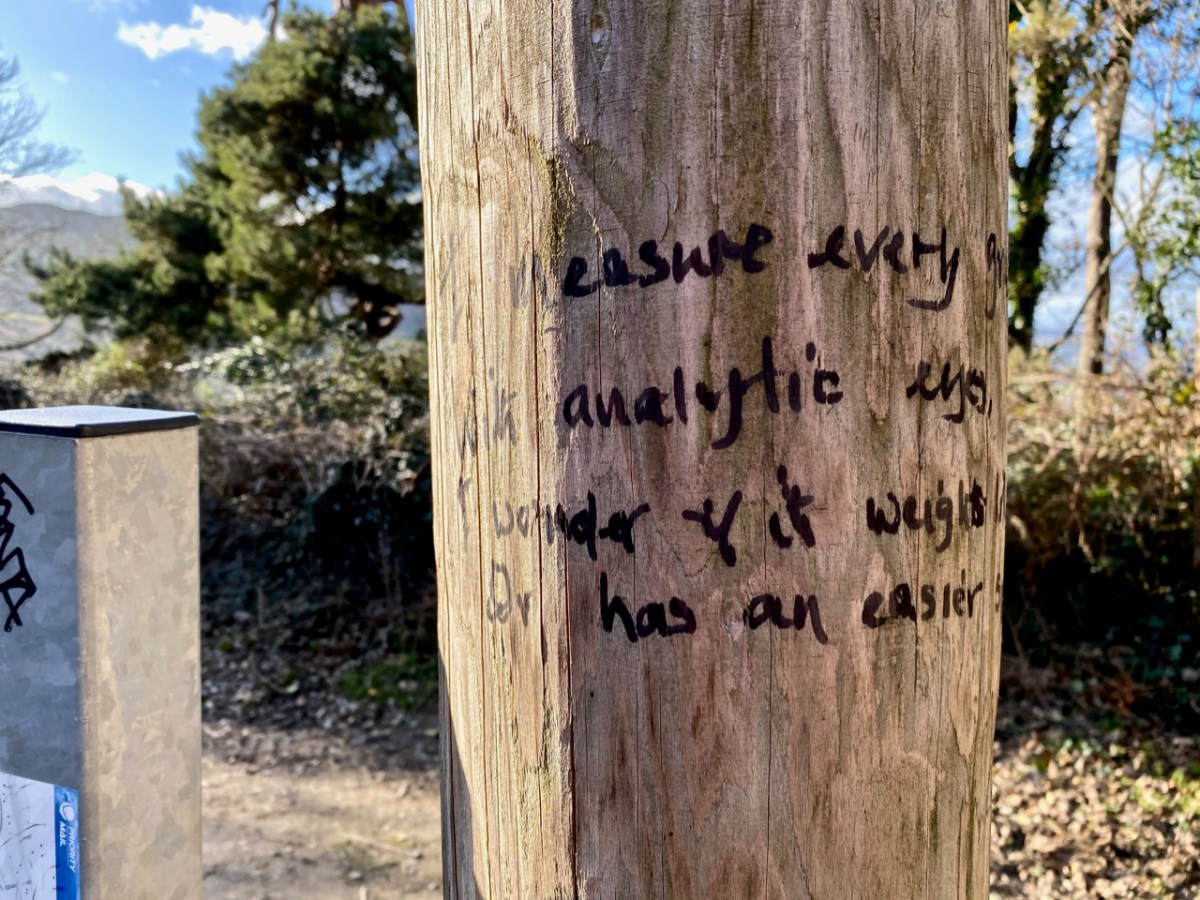
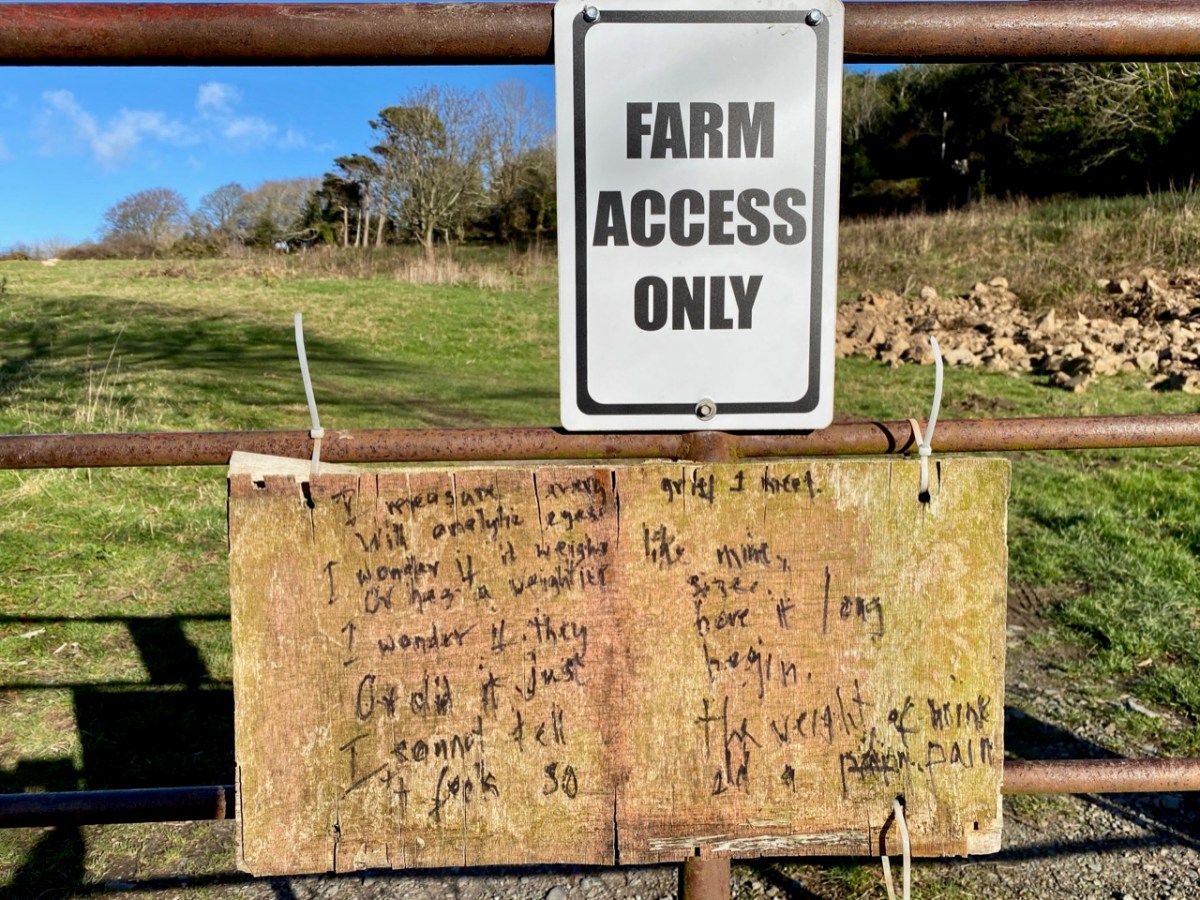
It doesn’t really matter, I suppose, how legible the message is: as long as it has made you stop to take a closer look it’s been effective. Or reflective . . .
Sometimes they are simple, like the one above. I wonder if this next one is a mathematical formula?
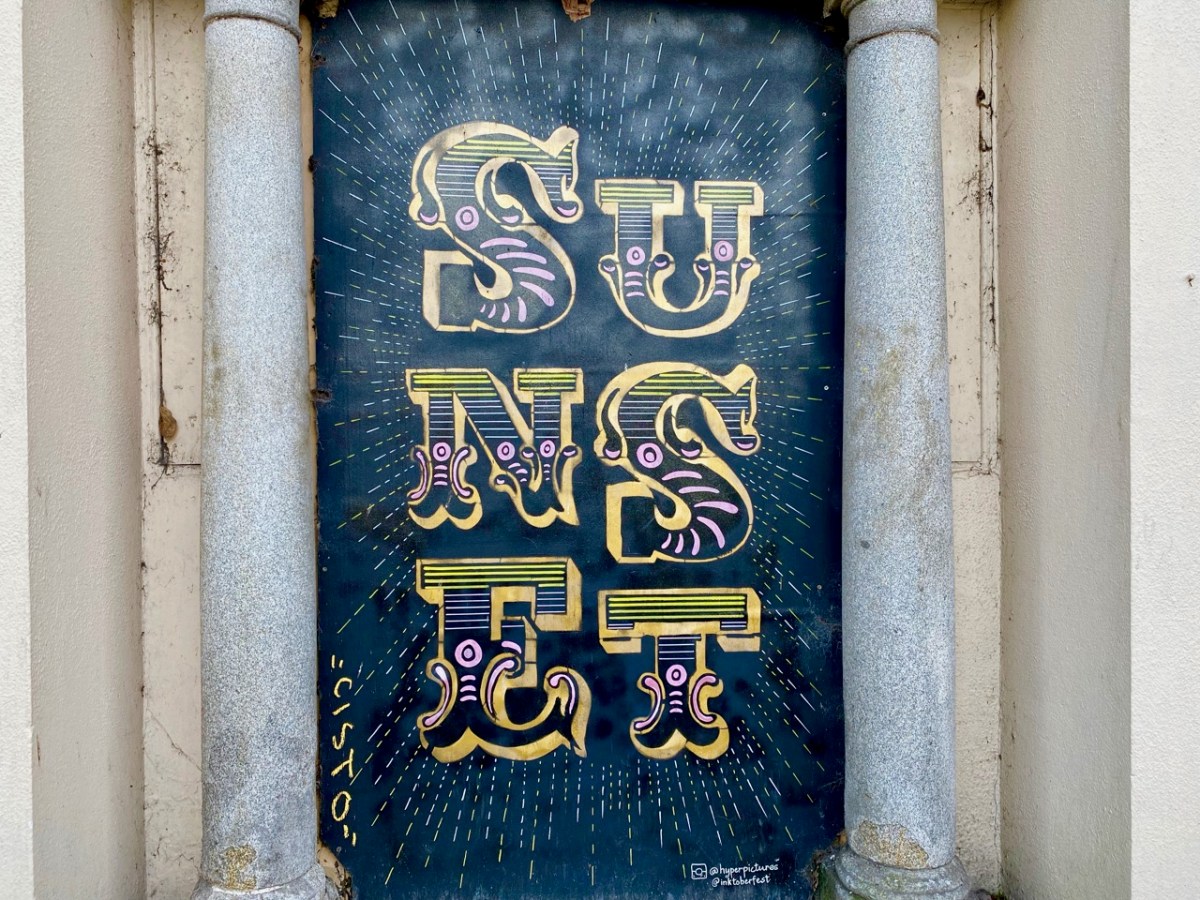
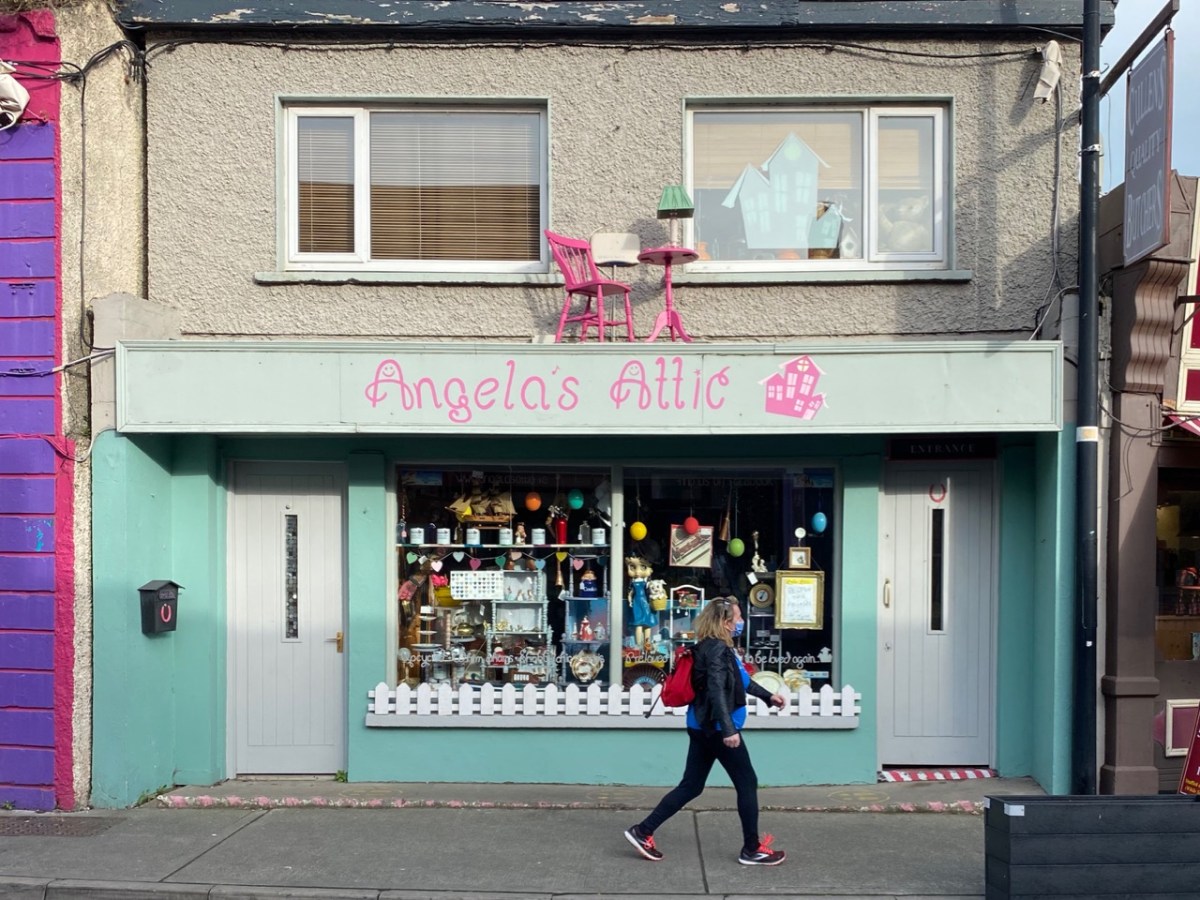
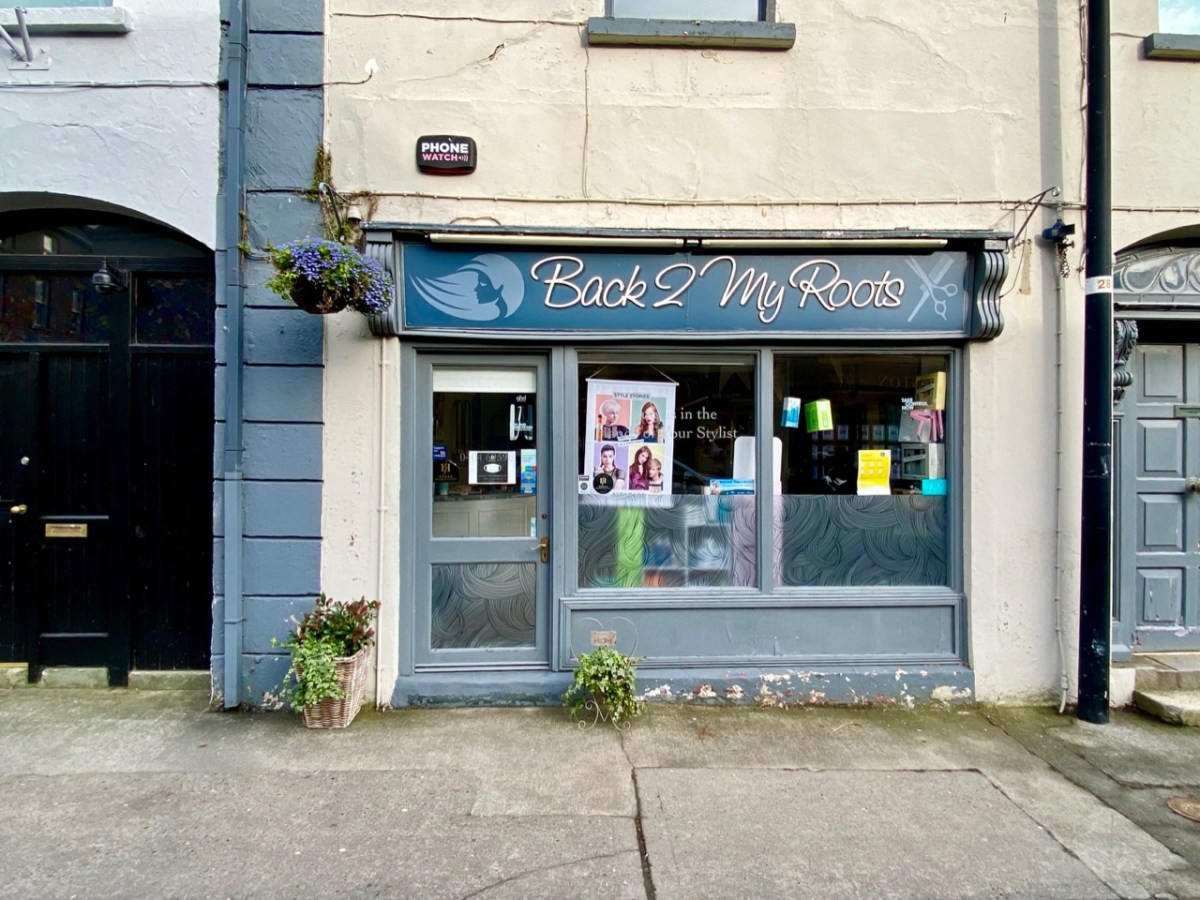
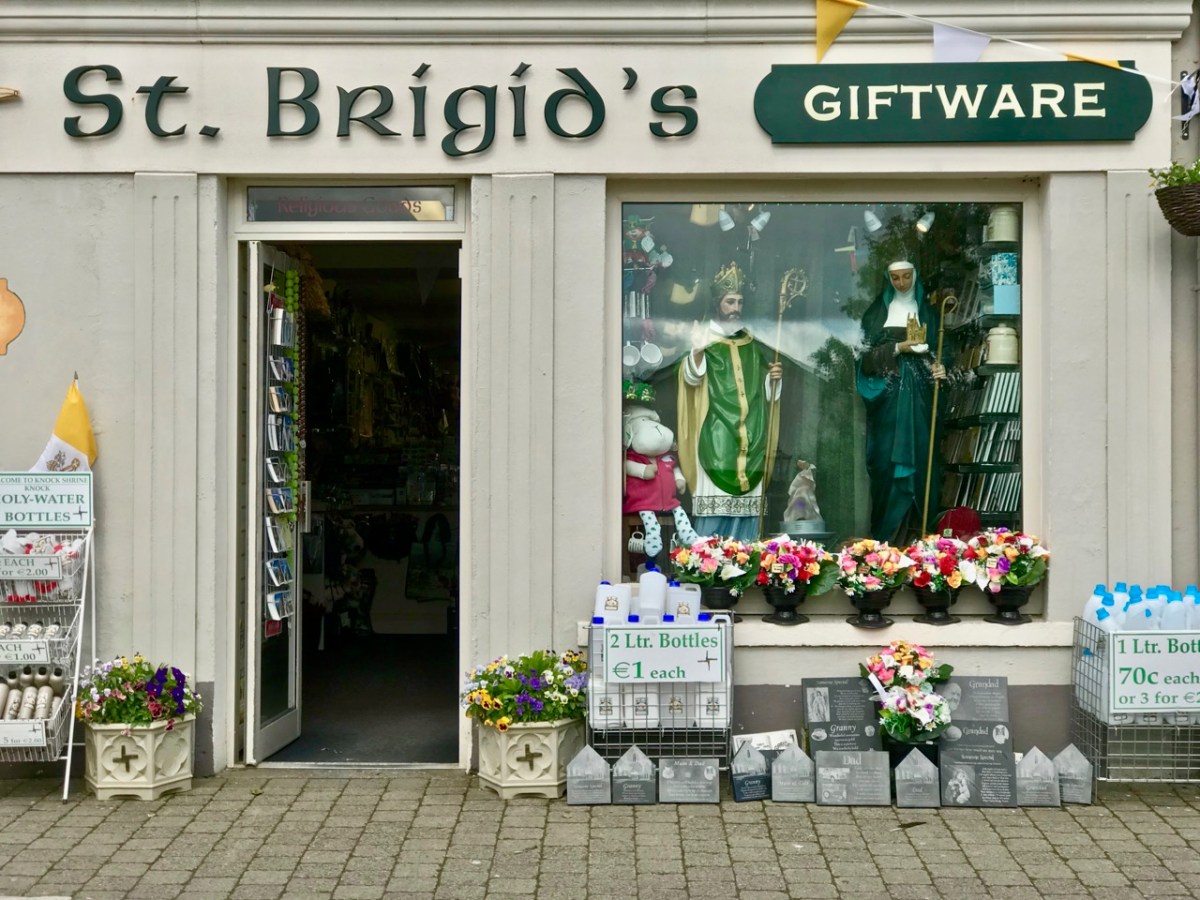
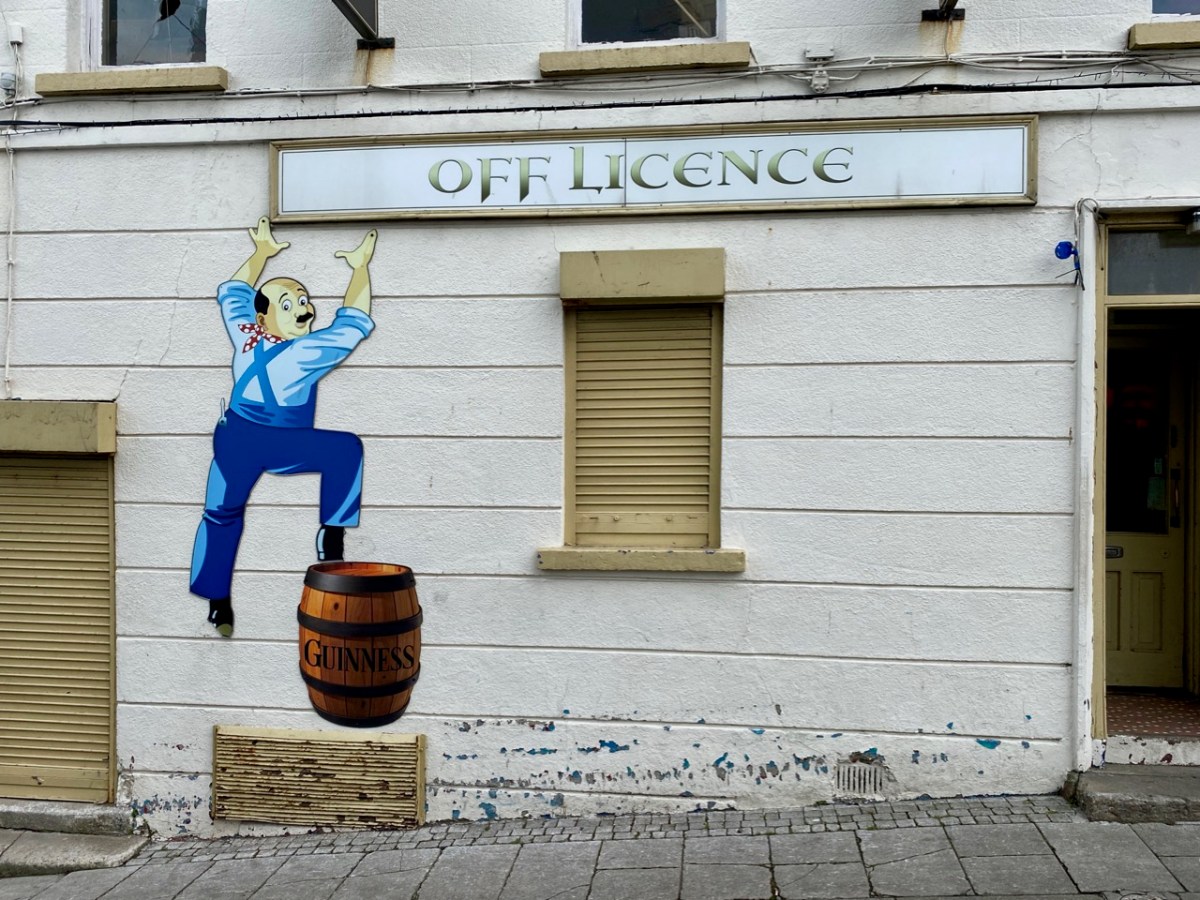
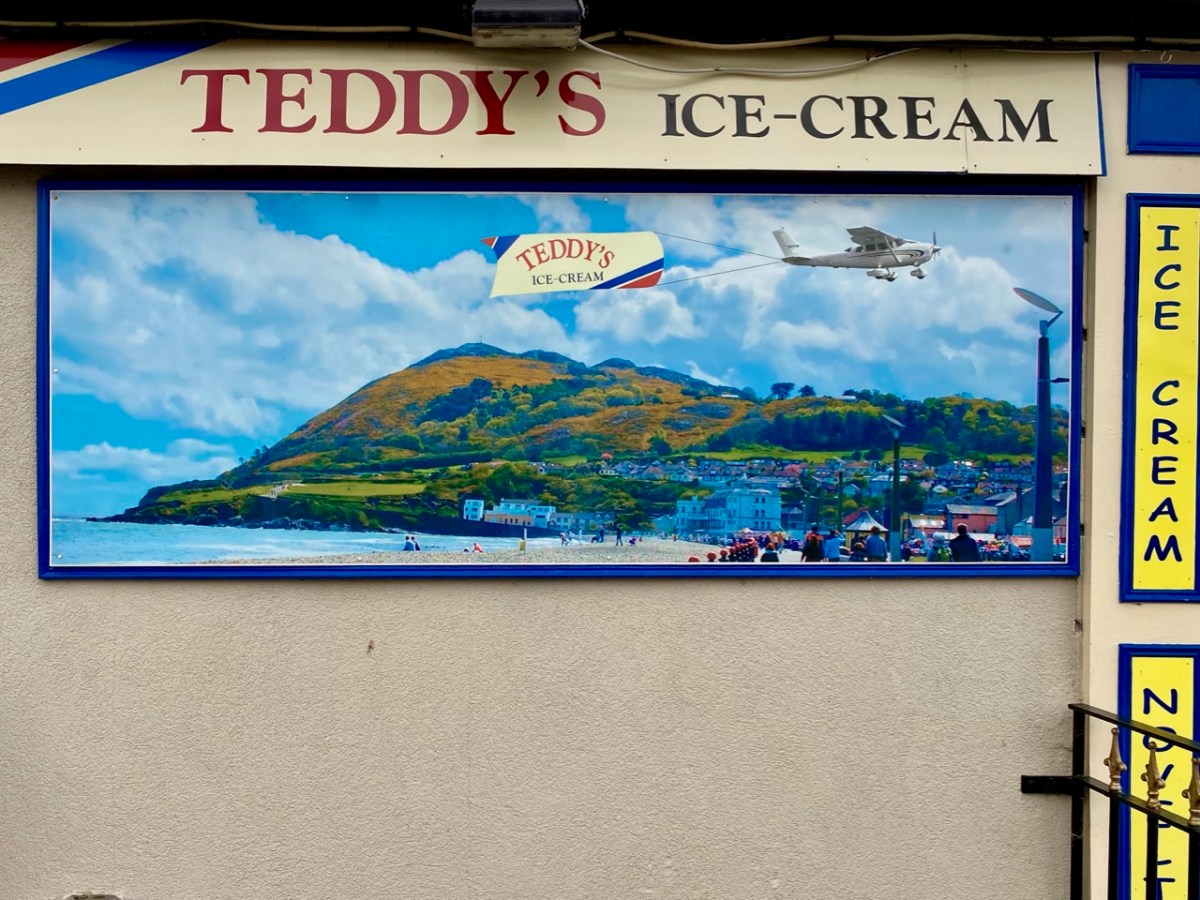
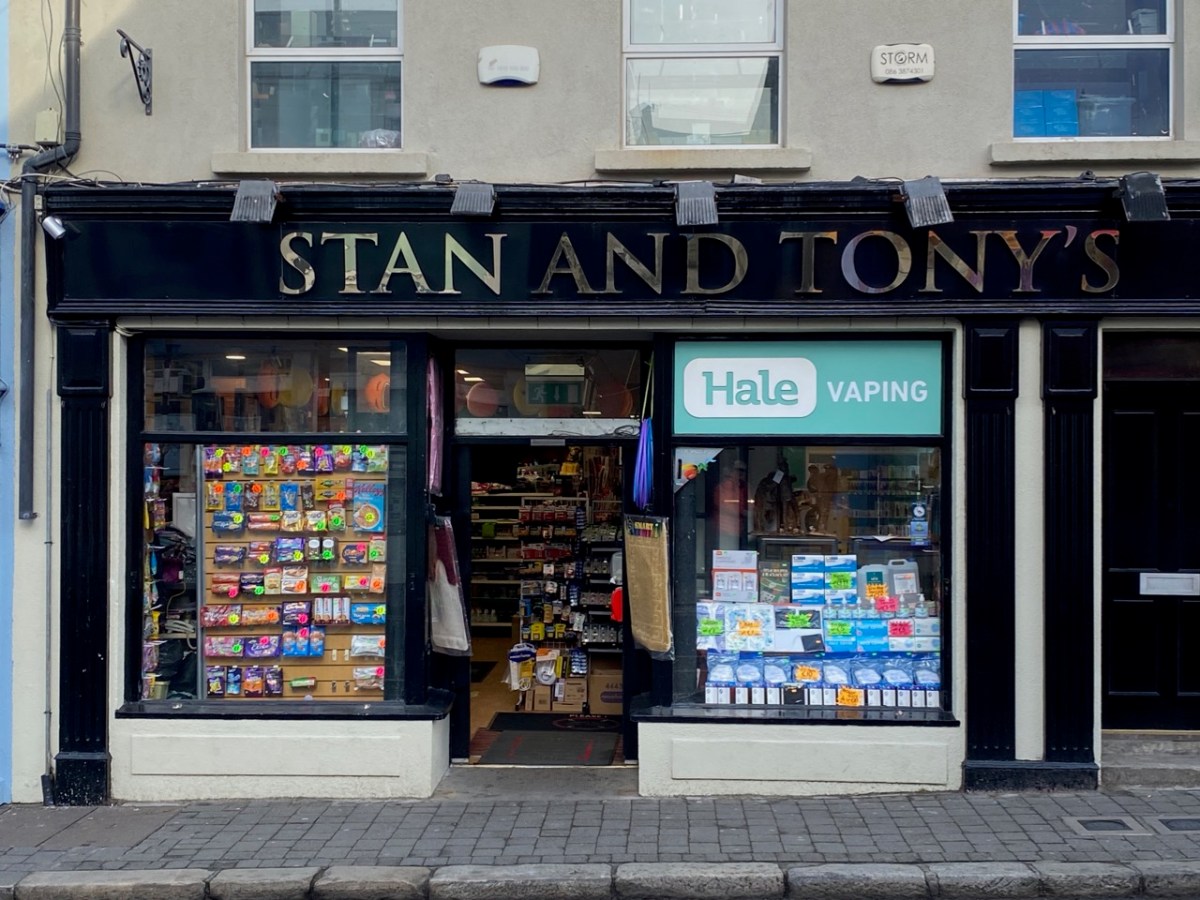
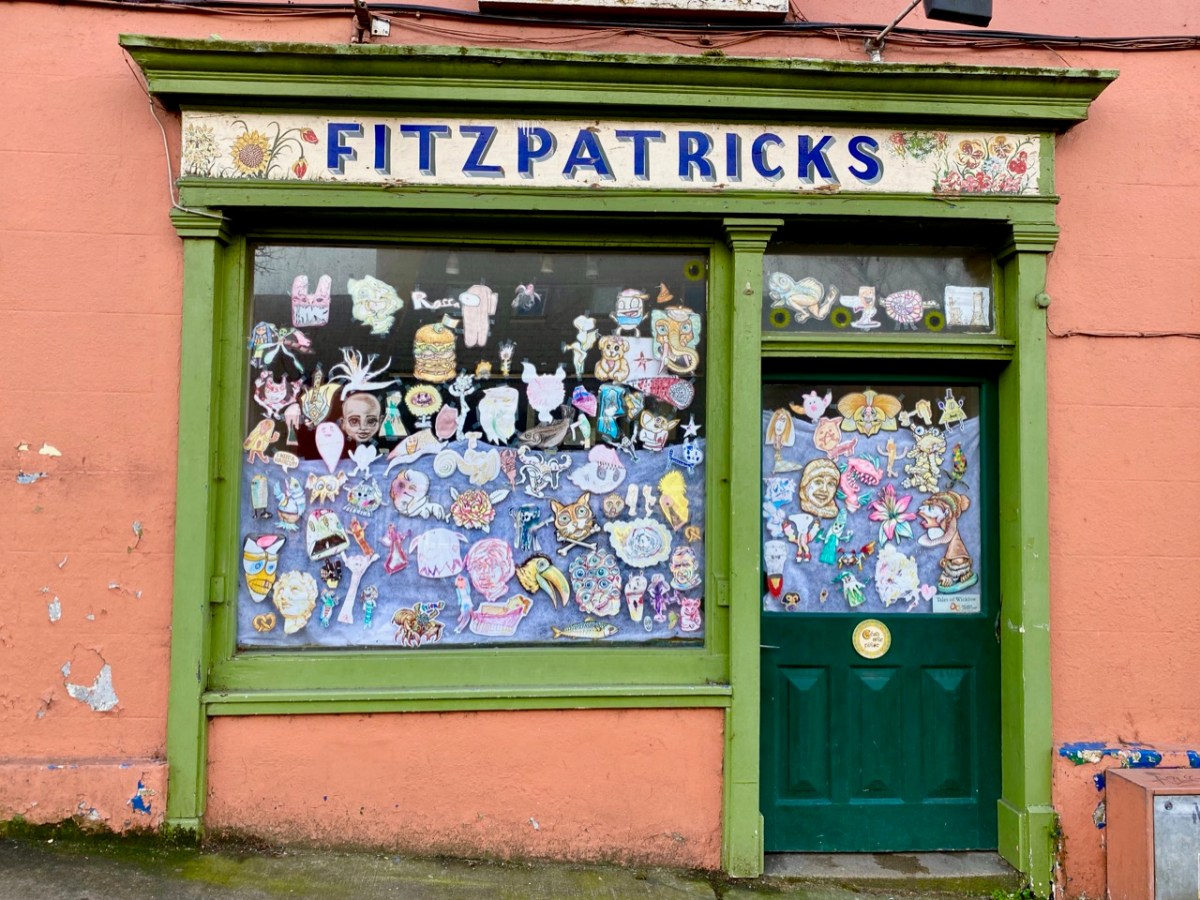
Shopfronts have to be eye-catching and arresting, of course, to draw you in. There are witty examples everywhere.
One has to admire the entrepreneurs – of all persuasions.
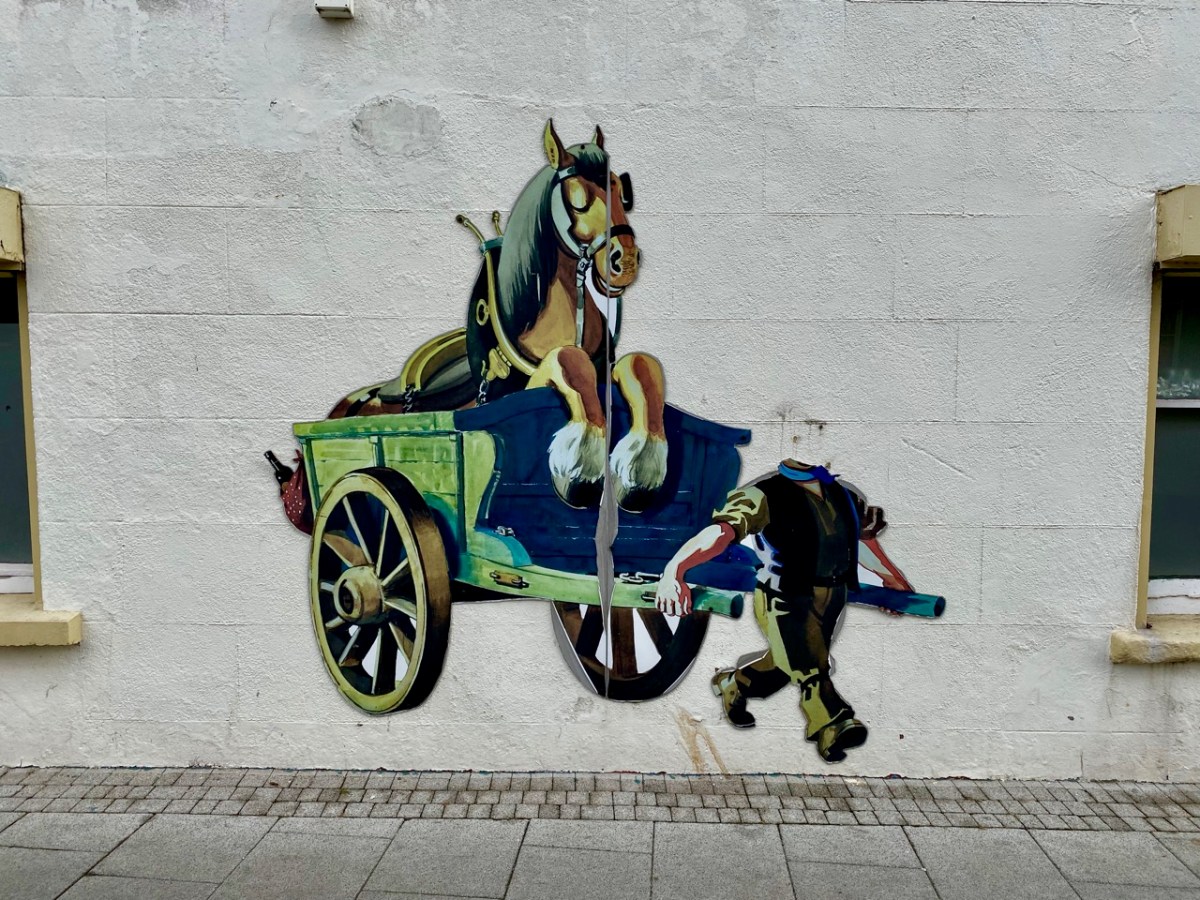
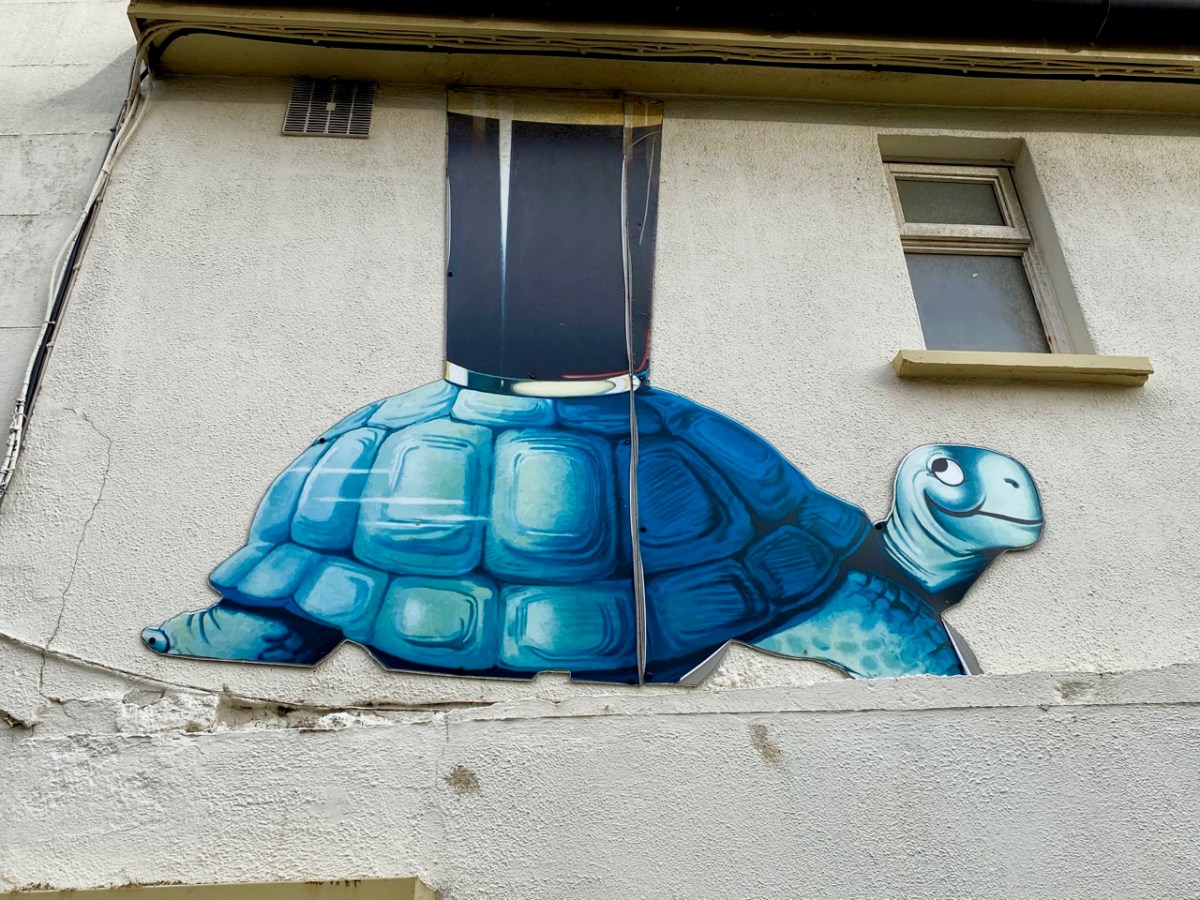
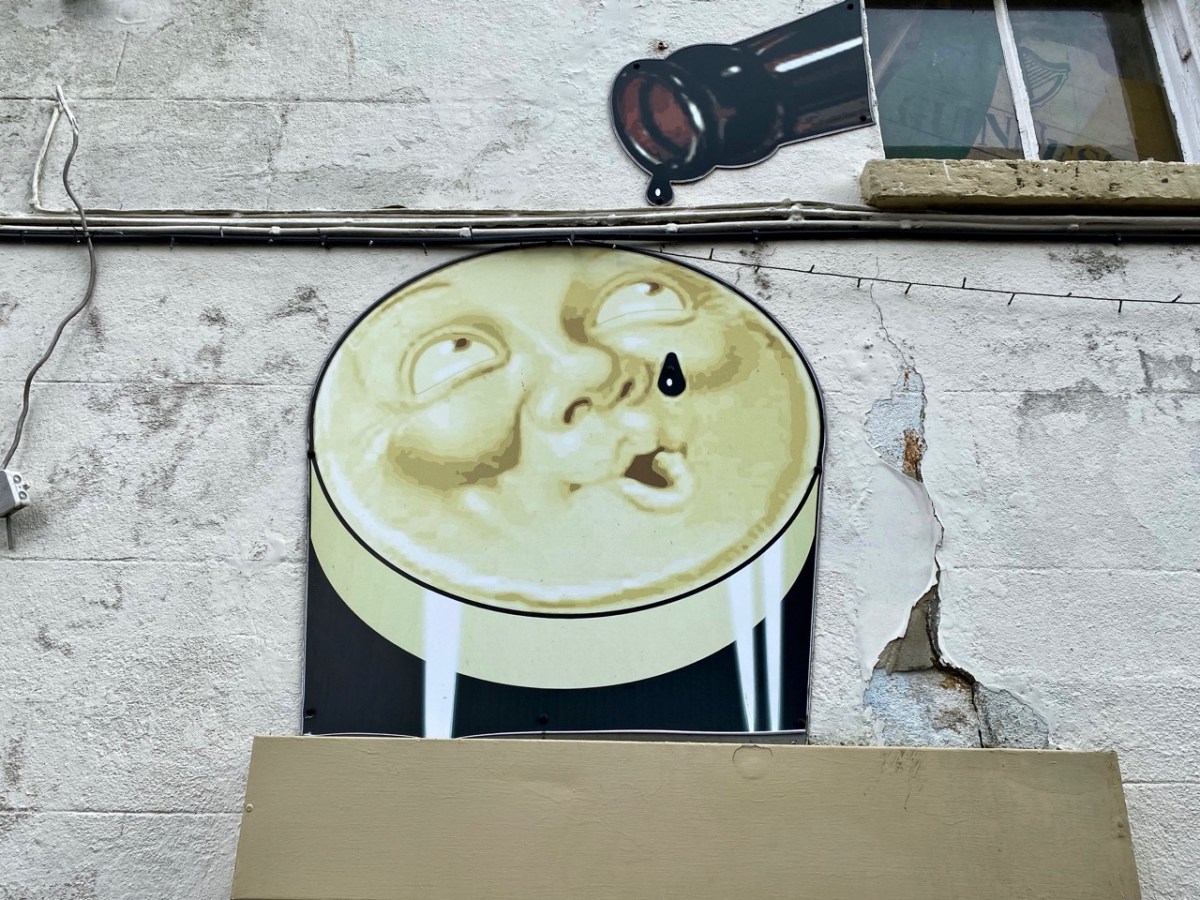
in my distant youth – when I was learning to read – my go-to’s were the large, colourful, Guinness posters at the bottom of our road. I am pleased to see that many of those images haven’t gone away – even after seventy years!
While all that is, intentionally of course, a stirrer of nostalgia in us – there are many more of our own time worthy of study.
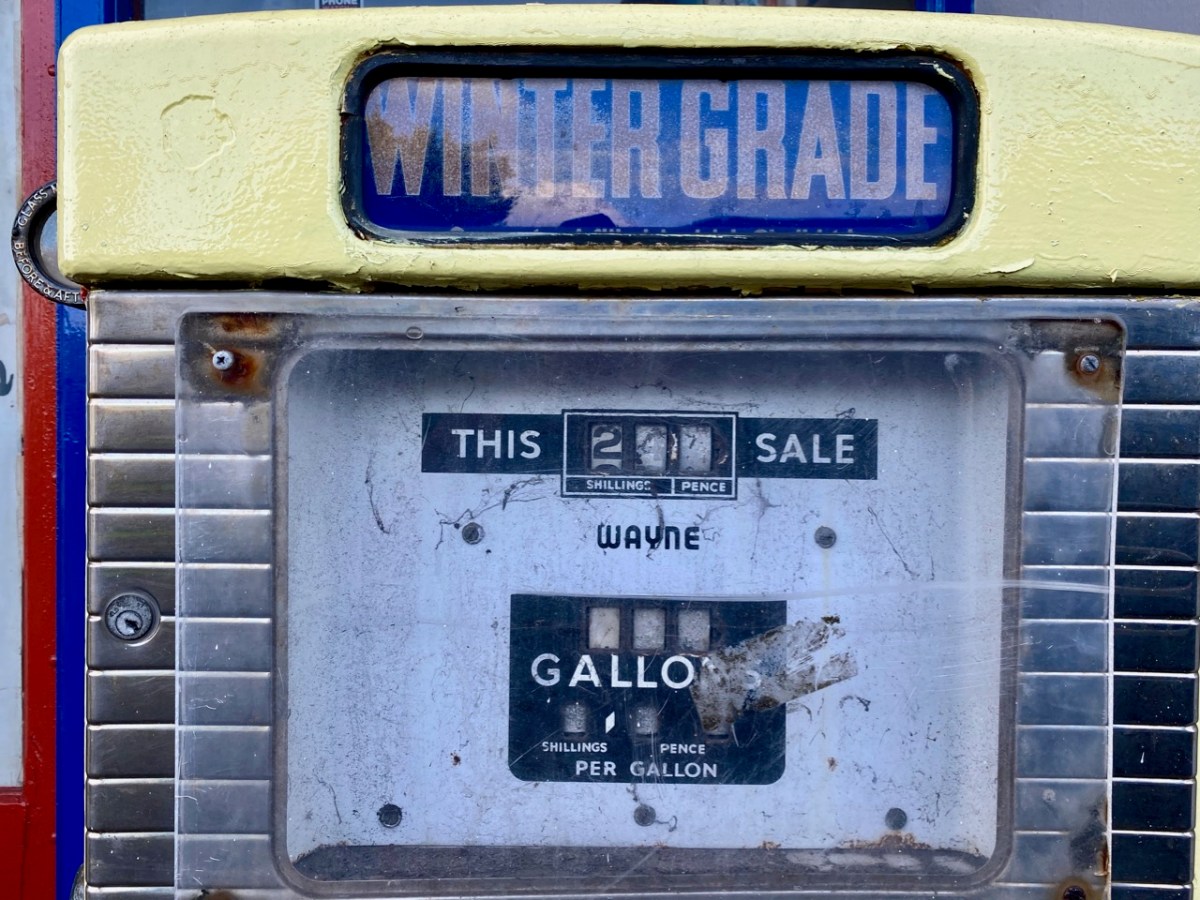
Finally (for now) we just found this old petrol pump hidden around a corner. Who remembers those days when an attendant had to come out and fill you up . . . and it was all done in gallons, shillings and pence?
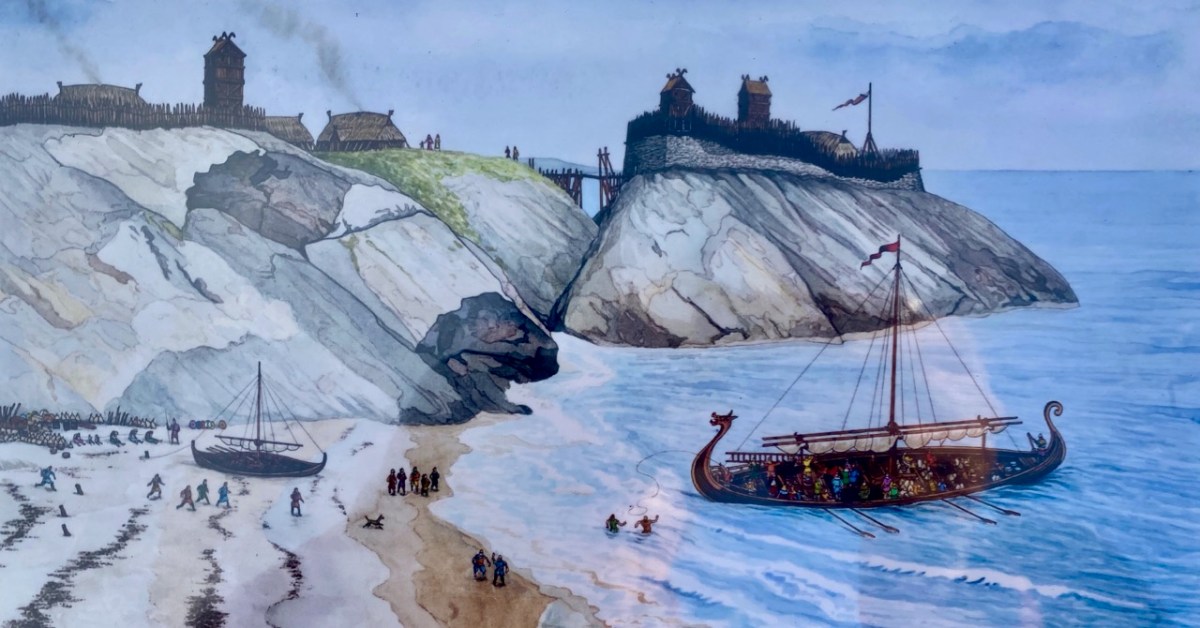
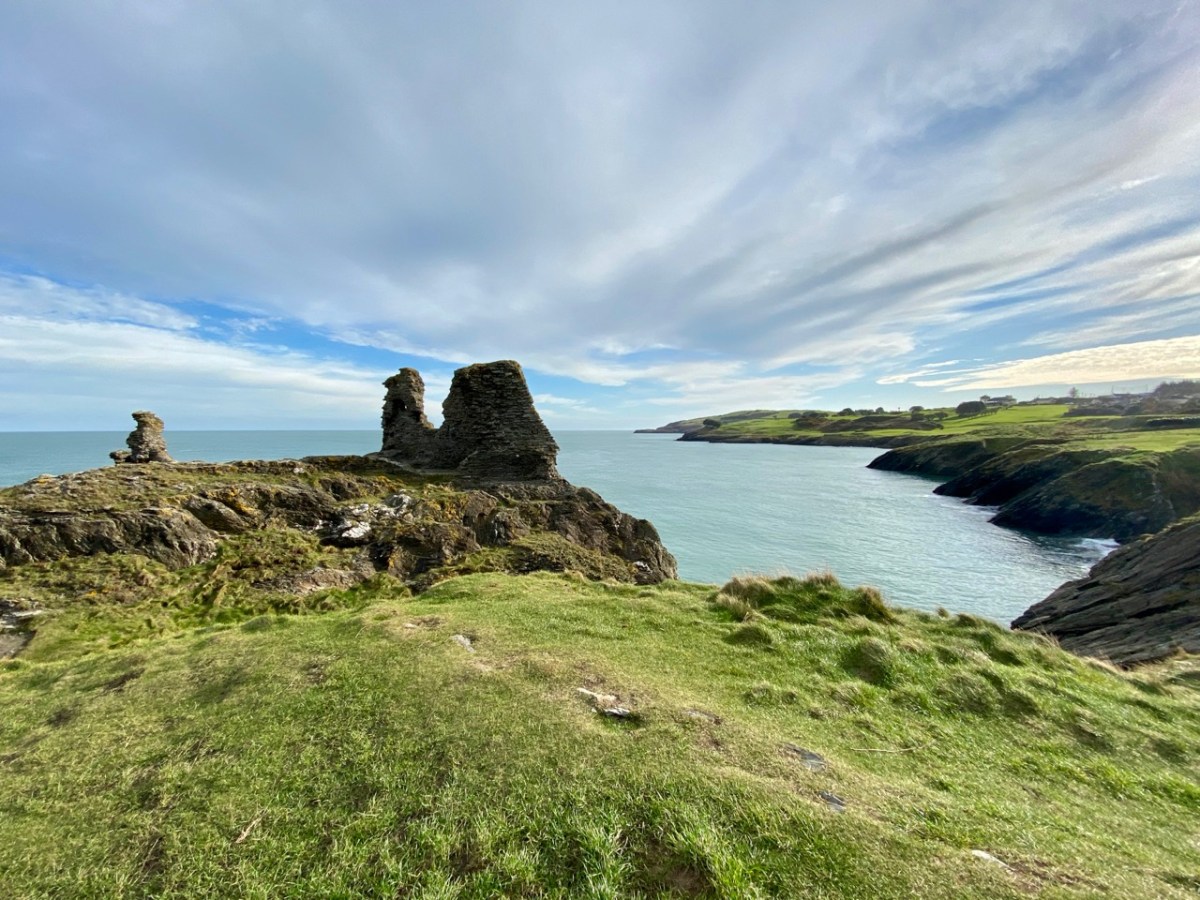
If you can’t be in West Cork – what’s the next best place? Why – County Wicklow of course! It’s also full of wonderful scenery and imbued with Irish history. That’s Wicklow Town, above, in Viking times: there had already been a Bronze Age settlement on this site. In the twelfth century the Normans arrived, led by Strongbow, who we have encountered before, and Black Castle was built (below). They were wild times, and the castle was attacked and destroyed completely in 1301 by local chieftains, notably O’Byrnes and O’Tooles. There were several subsequent revivals, and the gaunt remains we see today probably date from the 17th century.
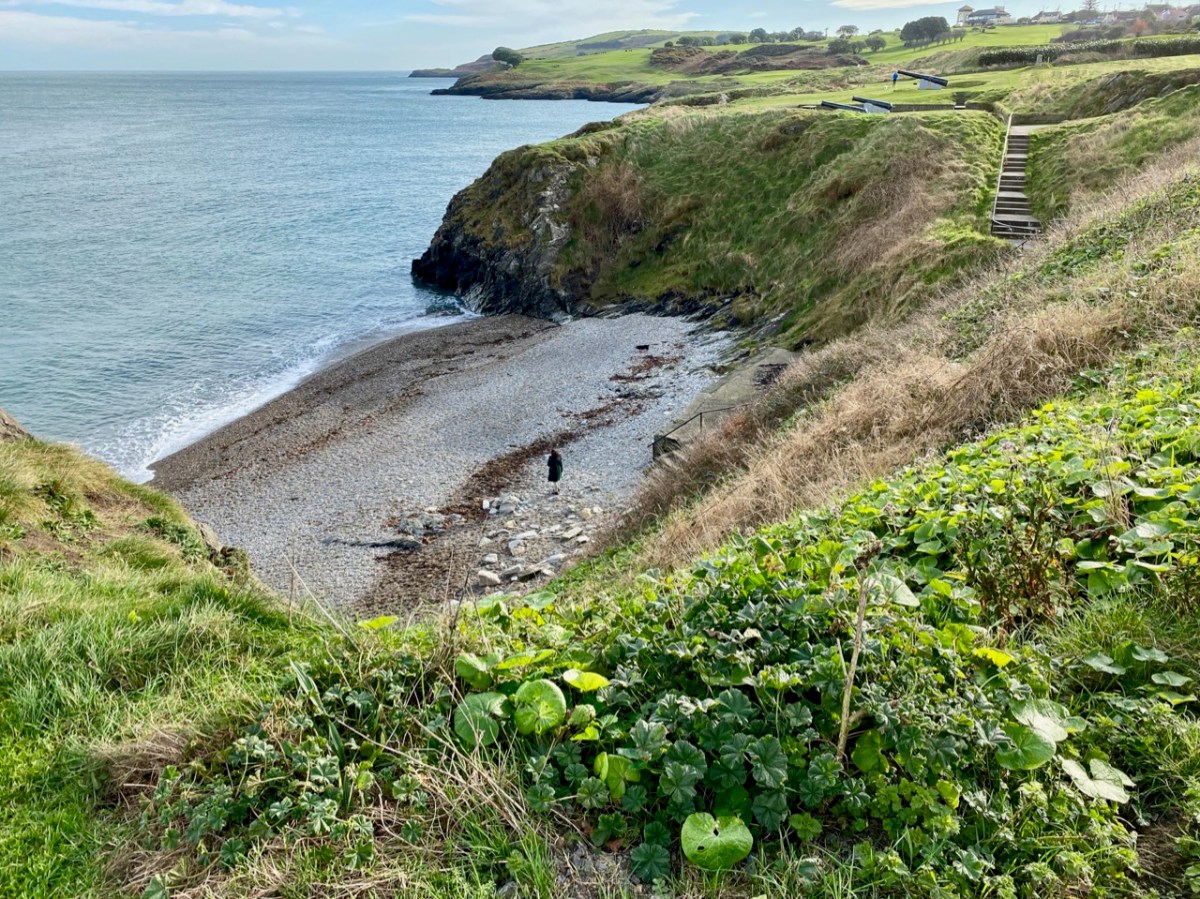
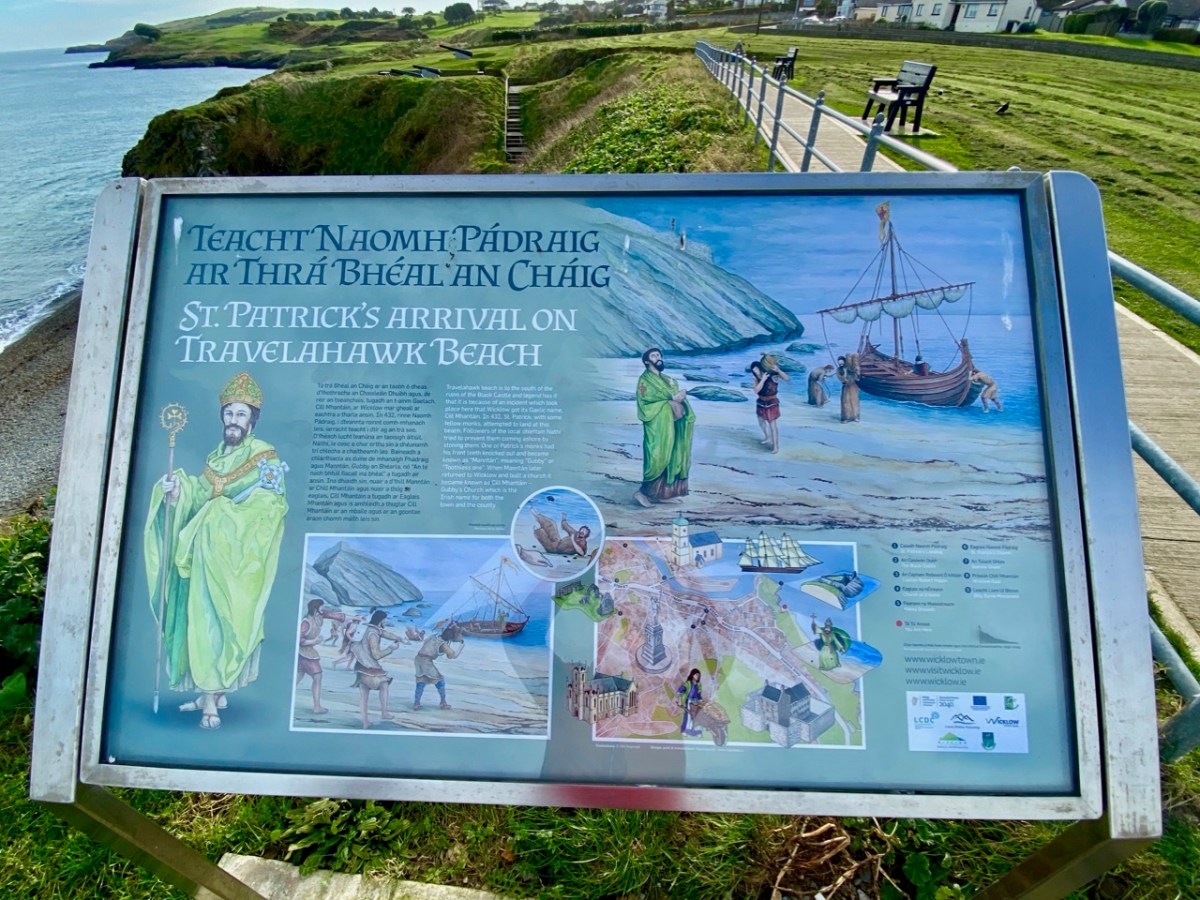
While at this site, have a look down at the inlet on the coast to the south: that’s Travelahawk Beach, the scene of a bit of Wicklow history that’s sure to stick in the mind. It was there that St Patrick first landed in Ireland!
I have to admit that the beach is only one of several sites on the east coast that lays claim to this historic occasion, but I like the associated story of Travelahawk which tells how the local people, suspicious of this stranger, threw rocks at St Patrick and his crew. One of them hit the saint’s companion, and he lost his front teeth. He was known ever after as ‘Gubby’ or ‘Gap-toothed’ which is translated in Irish Mhantáin. Hence the old name for Wicklow is ‘Chill Mhantáin’ – the Church of Gubby. Today’s name for the town, Wicklow, is of Viking origin, and means ‘Bay of the Meadows’.
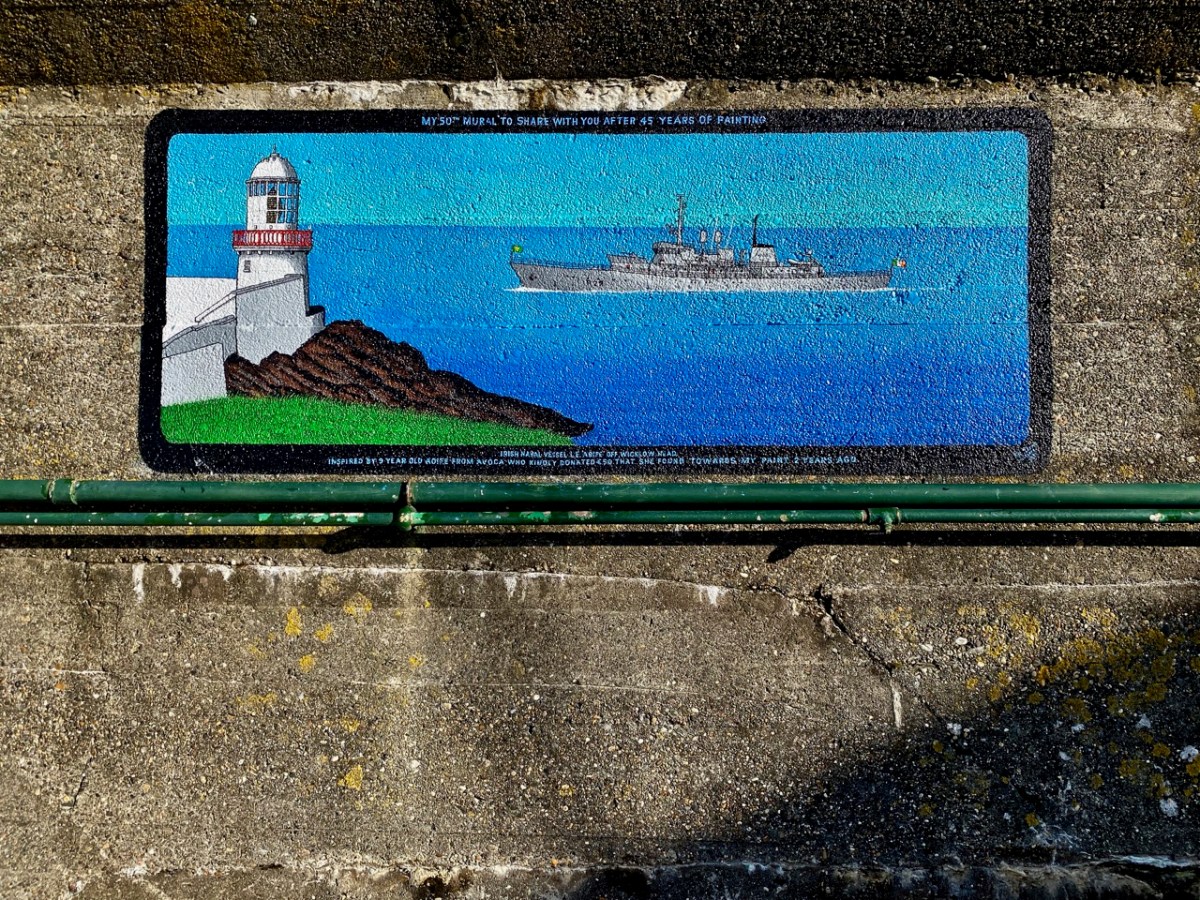
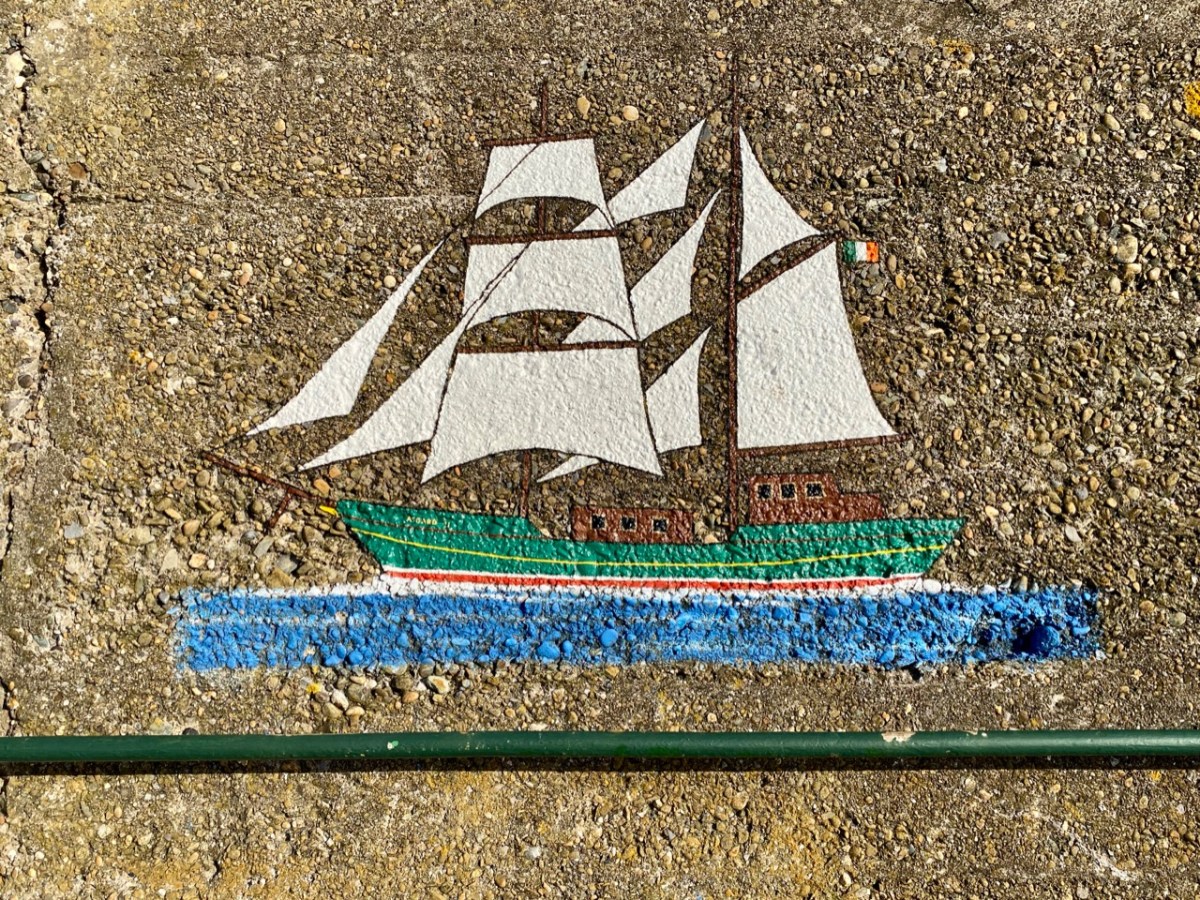
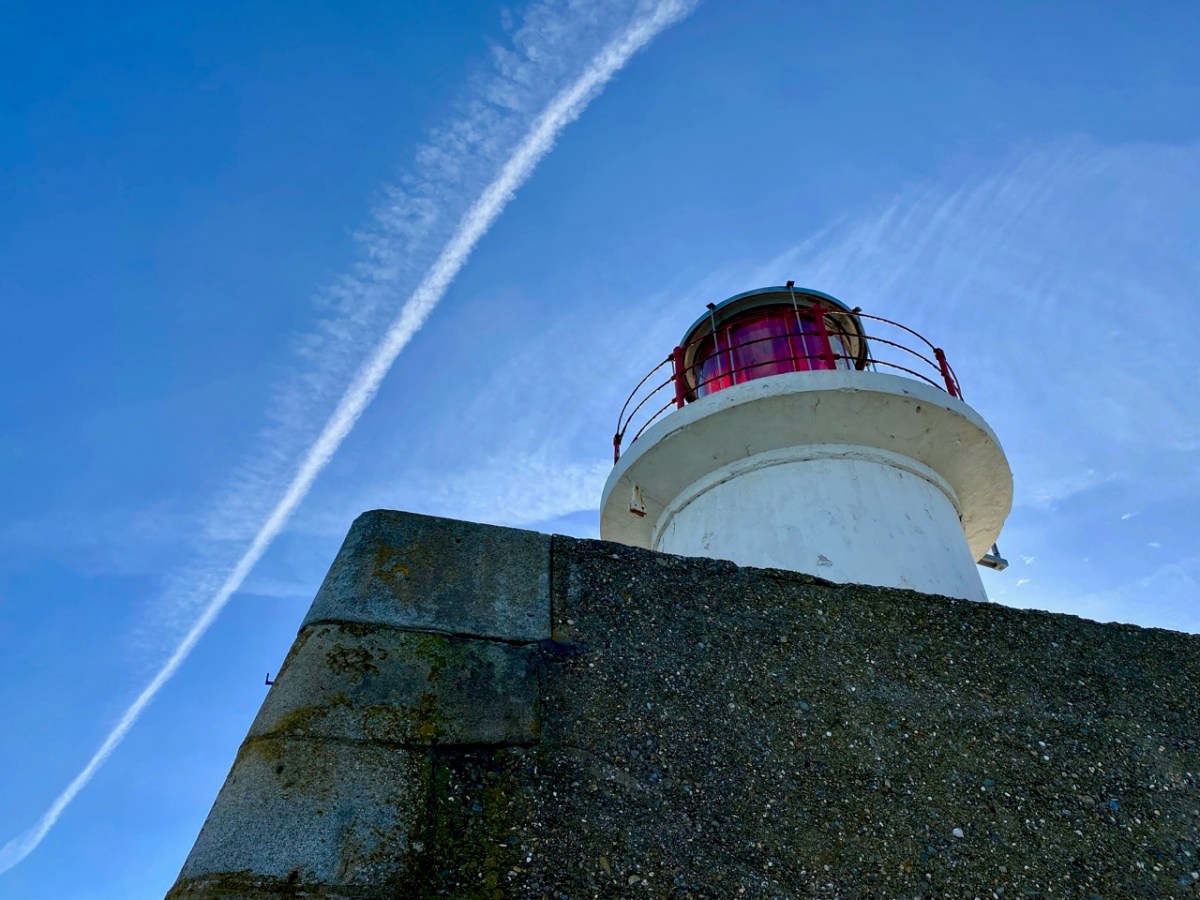
We popped over to Wicklow on a mild February day for a change of scene – and to absent ourselves from Nead an Iolair while some upgrading works were taking place. I was impressed: I had never explored the town before. Finola, however, was brought up in County Wicklow, and her impressions of the county town today were embellished with memories of times past. There’s much about the place that’s picturesque: I was taken with the number of painted murals about the place. The pier has, appropriately, a whole series of ships on the breakwater wall. There is an example, above . . .
. . . And here’s another. In fact, this one is the 50th mural to be painted by Pat Davis, who is the local postman. Each one depicts a vessel which has visited the harbour. It’s a wonderful and colourful record of one aspect of the maritime town’s history.
Here’s Pat at work. The image is courtesy of Ceaneacht O Hoctun, and appeared in the Wicklow People newspaper in 2020. Pat started painting the ships in the 1970s.
This one will be familiar to West Cork folk. It’s the Saoirse, a 42ft ketch built in Baltimore in 1922 for her designer, Conor O’Brien.
. . . This unique sailing ship was also a maritime inspiration for the new Ireland, uncertain of itself in an uncertain world. For this was Conor O’Brien’s characterful 42ft ketch Saoirse, which he designed himself, and with which – between 1923 and 1925 – he pioneered the round the world route south of the Great Capes, an ocean voyaging “first” which was forever written into world sailing history. . .
The Asgard, above, was famous for gun-running at Howth by Irish Volunteers in 1914. Below is an Irish Navy vessel, LÉ Gráinne – a mine sweeper. Gráinne was a legendary princess who was promised to Fionn Mac Cumhail but ran away with his young follower Diarmuid. The ship was decommissioned in 1987.
We found that the town of Wicklow has so many maritime associations – everywhere you look there are reminders. But also it’s a thriving commercial centre and we were impressed by what is on offer there: great eateries, and a most wonderful bookshop. I think there might be another post in the making . . .
Niall, by the way, thinks the the term Black Castle is more historically accurate. He points out that there is, in fact, in the townland of Leamcon, about 2km to the northeast, another ‘turret’ marked on the old OS maps, which is the remains of a castle built by the notorious Sir William Hull. Black Castle is in the townland of Castlepoint, and its name neatly distinguishes it from White Castle, AKA Ardintenant. Both were built by the O’Mahonys.
James Healy’s drawing of Black Castle from his wonderful book The Castles of County Cork, Mercier Press, 1988
As I said in my post on ArdintenantConor Cabaicc succeeded his father in 1427 and remained Taoiseach for 46 years, embarking on an ambitious program of construction to provide castles for his sons and brothers. This included Black Castle, which he built for his second son, Finín Caol (pronounced Fineen Kale), or Finín the Slender. This means that Black Castle was built in the period before Conor Cabaicc (Conor the Talkative) died, in 1473. This accords well with its architectural details, which place it among the fifteenth century ‘raised entry’ castles, similar to Ardintenant, Dunmanus and Dunlough.
The best source material for all the castles of Ivaha is the thesis The Tower Houses of West Cork by Mark Samuel. Here’s what Samuel says about the location of Black Castle, which he refers to throughout as Leamcon. Leamcon, by the way, means Hound’s Leap, which Samuel suggests may refer to a legend about the gully across which you must pass to get to the castle.
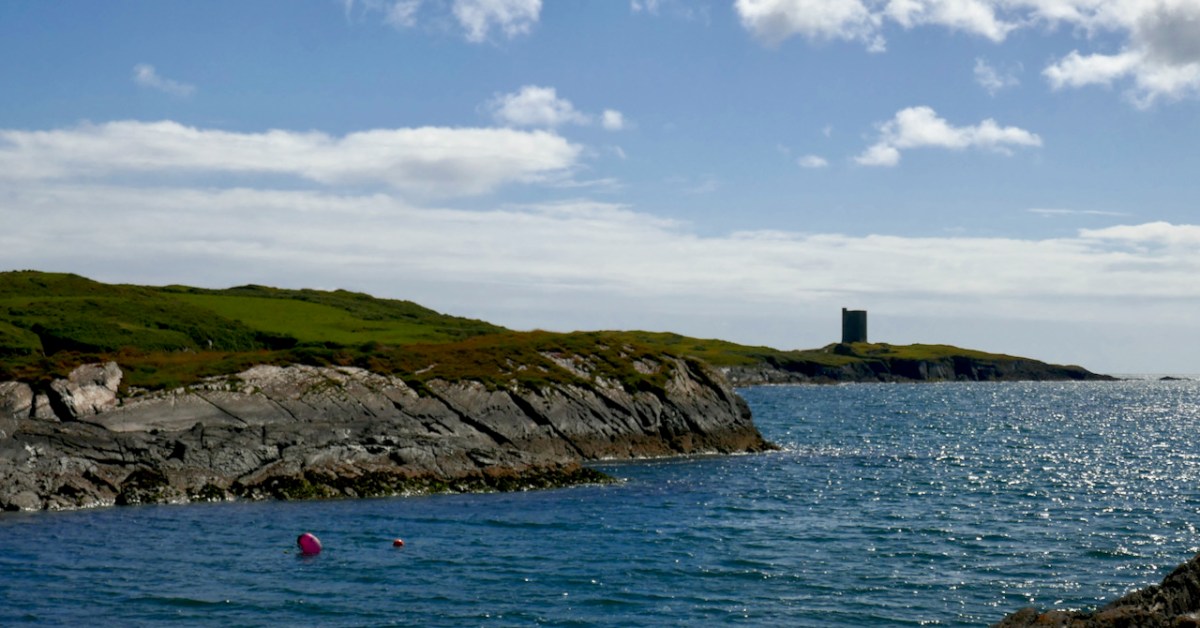
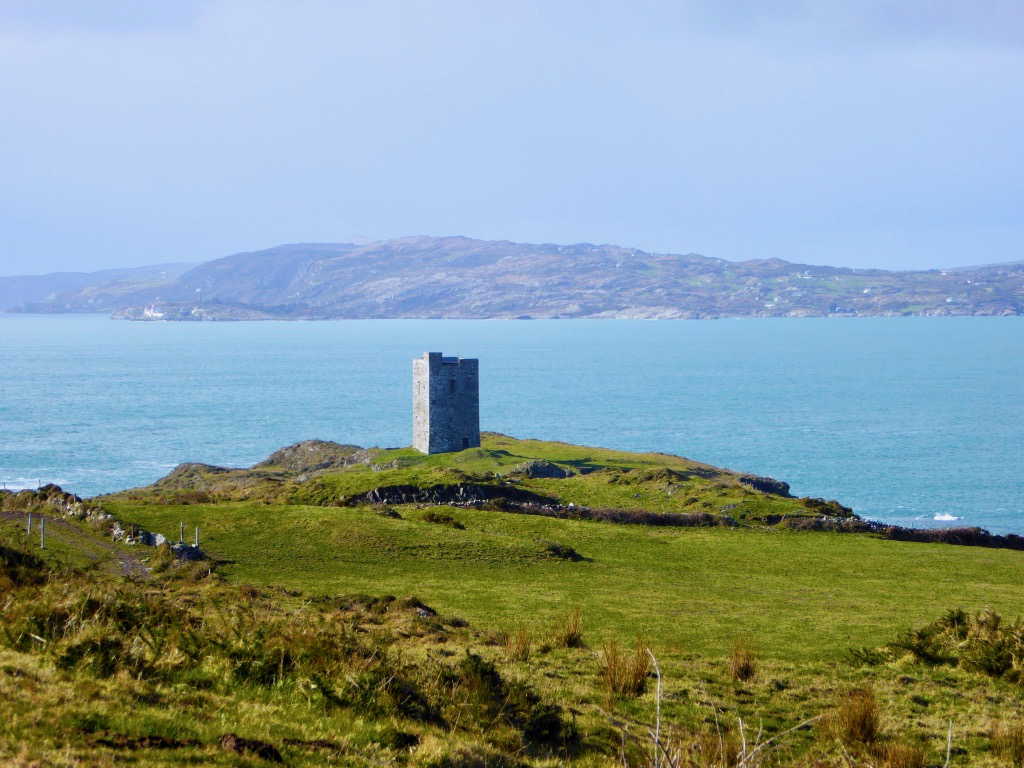
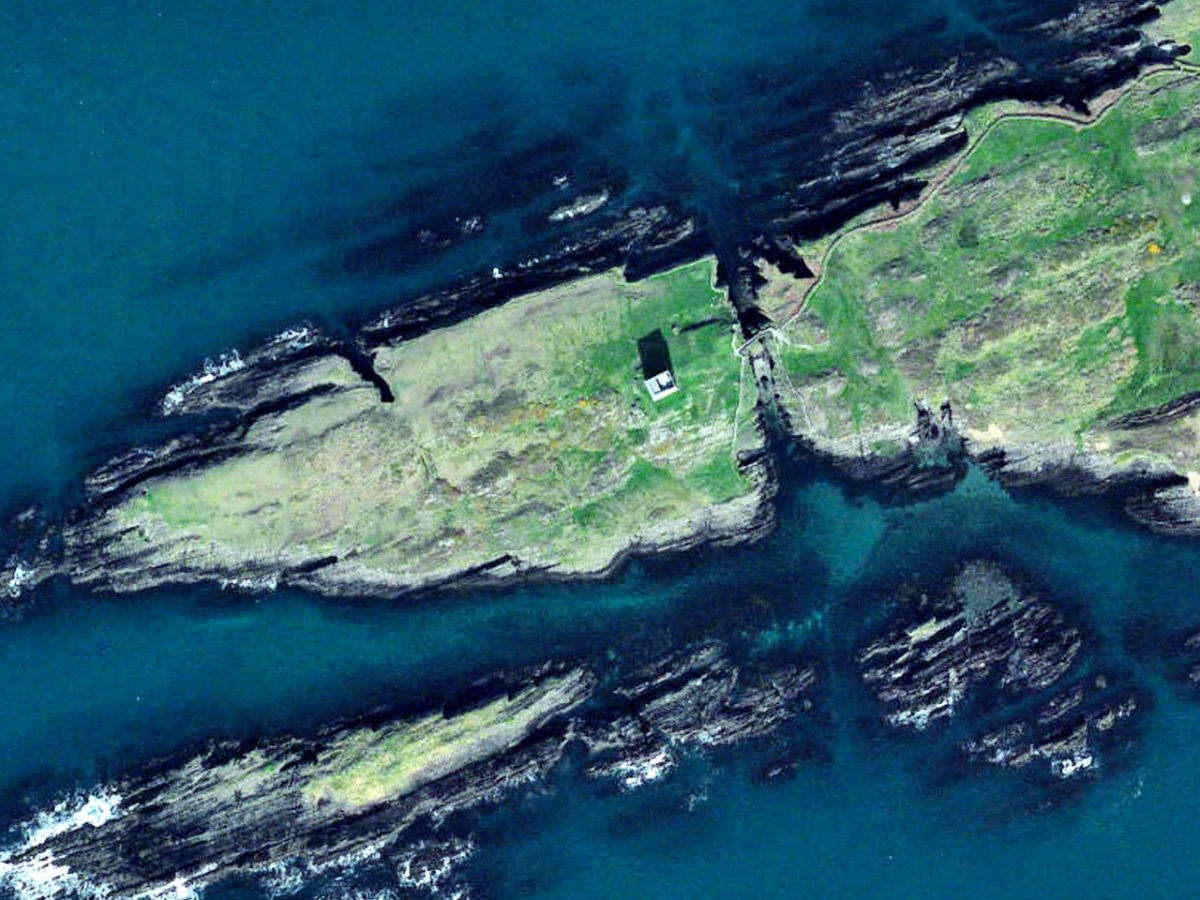
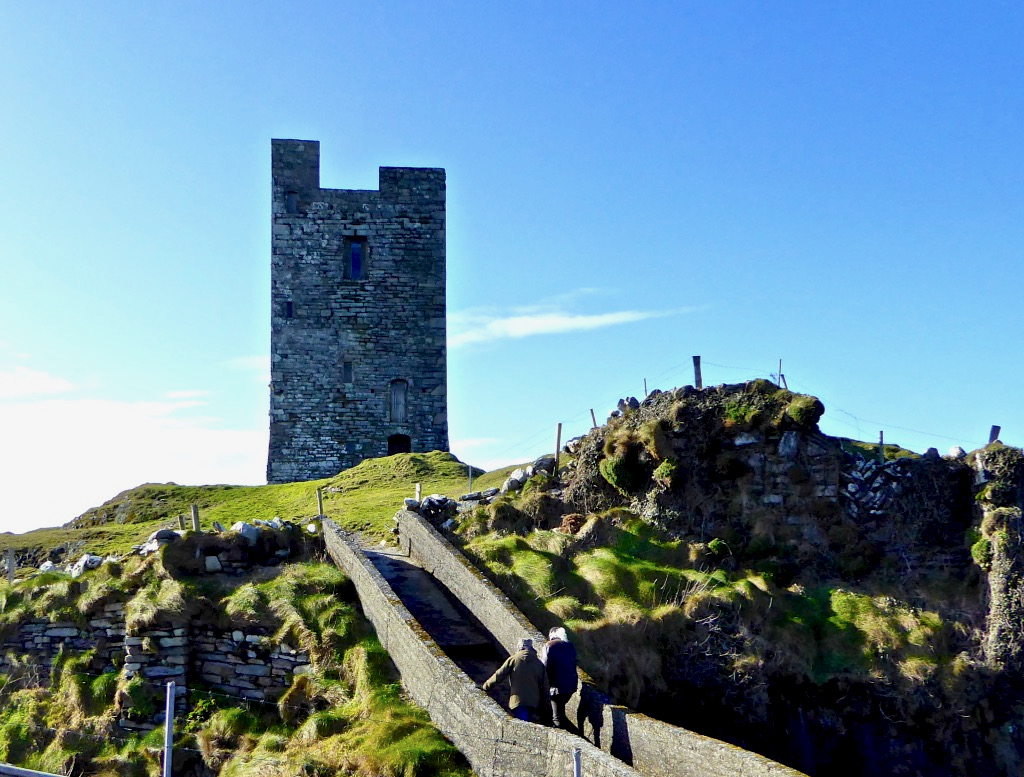
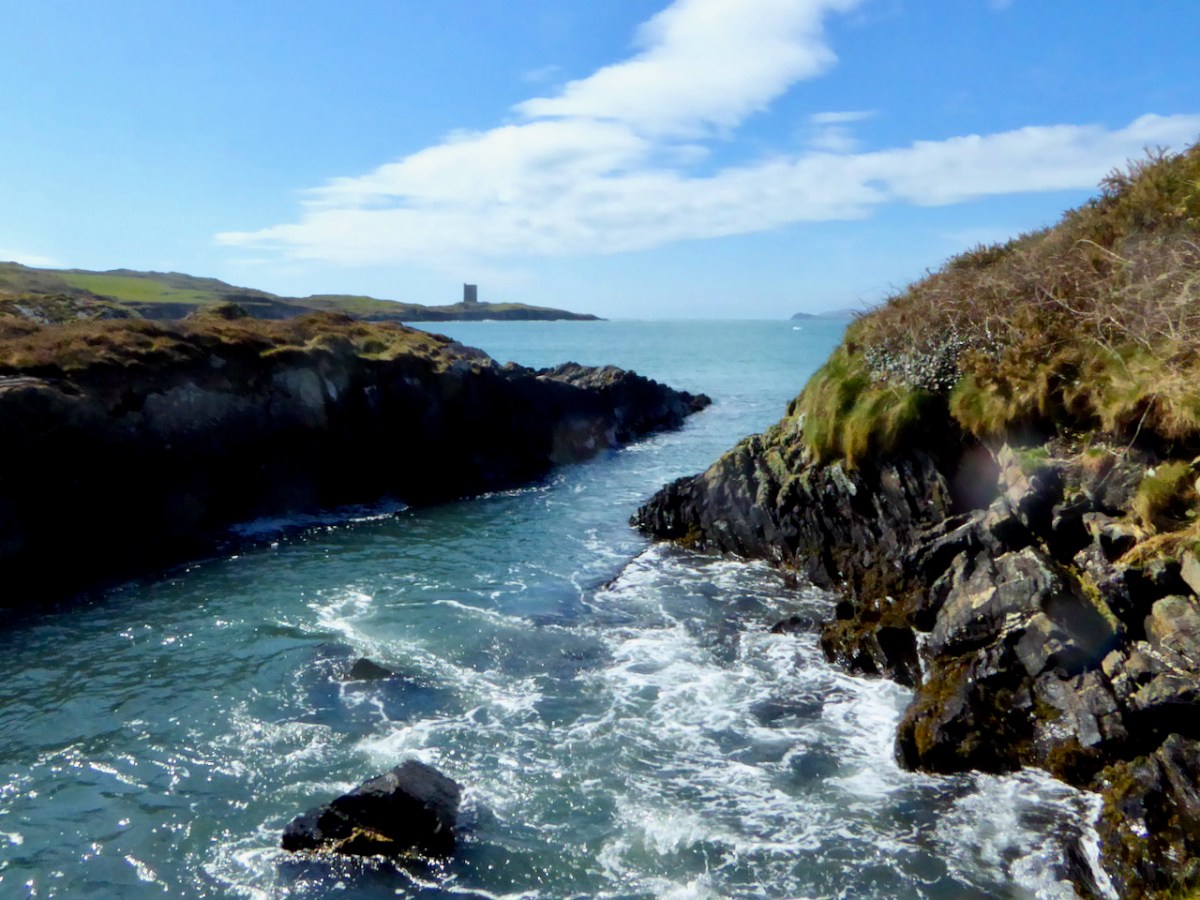
The western part of the Ivagha peninsula, the territory of O’Mahony Fionn, is now sparsely populated. Away from the formidable Mizen Head, the ice-sculpted land meets the sea with low, rocky cliffs. In this part of the Survey region, the strike of the rock is almost south-west/northeast, the layers being tipped close to the vertical, the shore tends to be sculpted into long peninsulas and islands running along the strike. Exposed to the Atlantic, it is a wild treeless shore. The fields once densely fanned prior to the famine, are now mostly given over to pasture. The tower house stands far from any road at the west end of a long narrow peninsula. Erosion has nearly severed the tip of the peninsula; only a precarious natural bridge, now reinforced with concrete, joins it to the mainland. The island is large, the ruins cover only a small fraction of its area. The tower house stands towards the island’s east end at its highest point. The promontory is for the most part gentle in relief, being covered by grass-grown ‘drift’ deposits.
THE TOWER HOUSES OF WEST CORK MARK WYCLIFFE SAMUEL, 1998
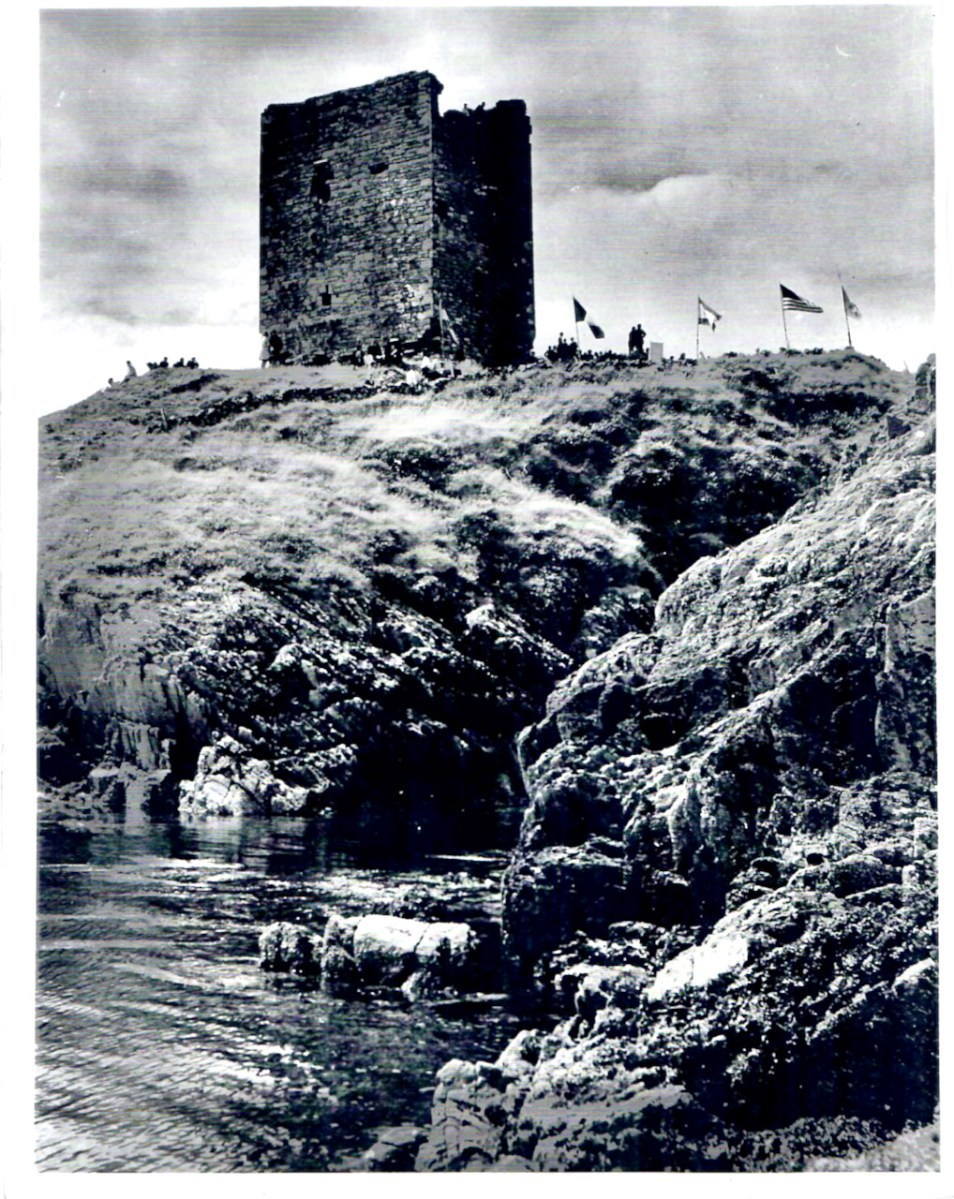
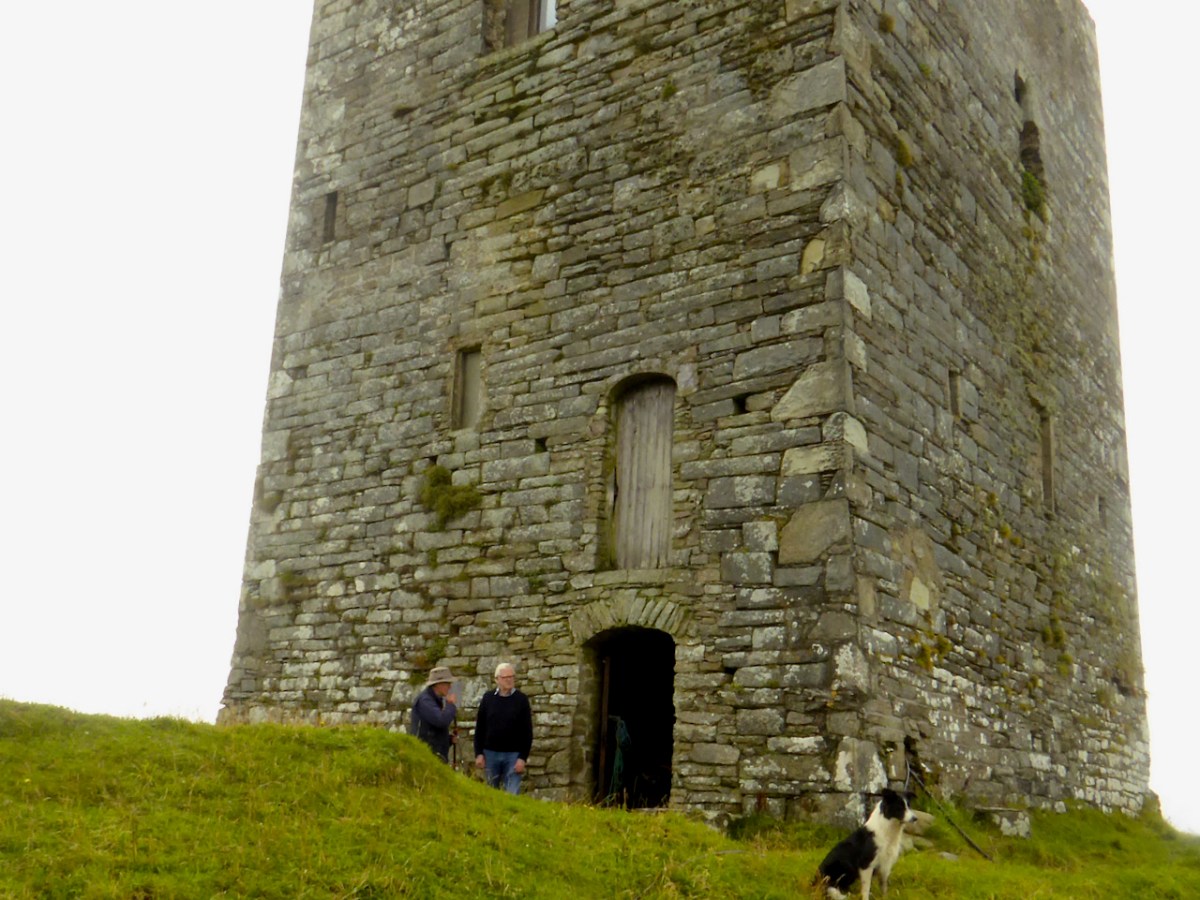
When Niall bought the property the bridge consisted of a few planks. It must have been a hairy business getting across to it until he built the concrete walkway you see today. Niall and his family spent their summers at the castle – can you imagine, as a child, what it must have been like to have your own castle to play and live in? Magical! Although I do think about what it must have been like for Dorothy, who spent the weeks there with the children while Niall worked in Dublin. How did she manage to feed them and keep them safe? A heroine, indeed.
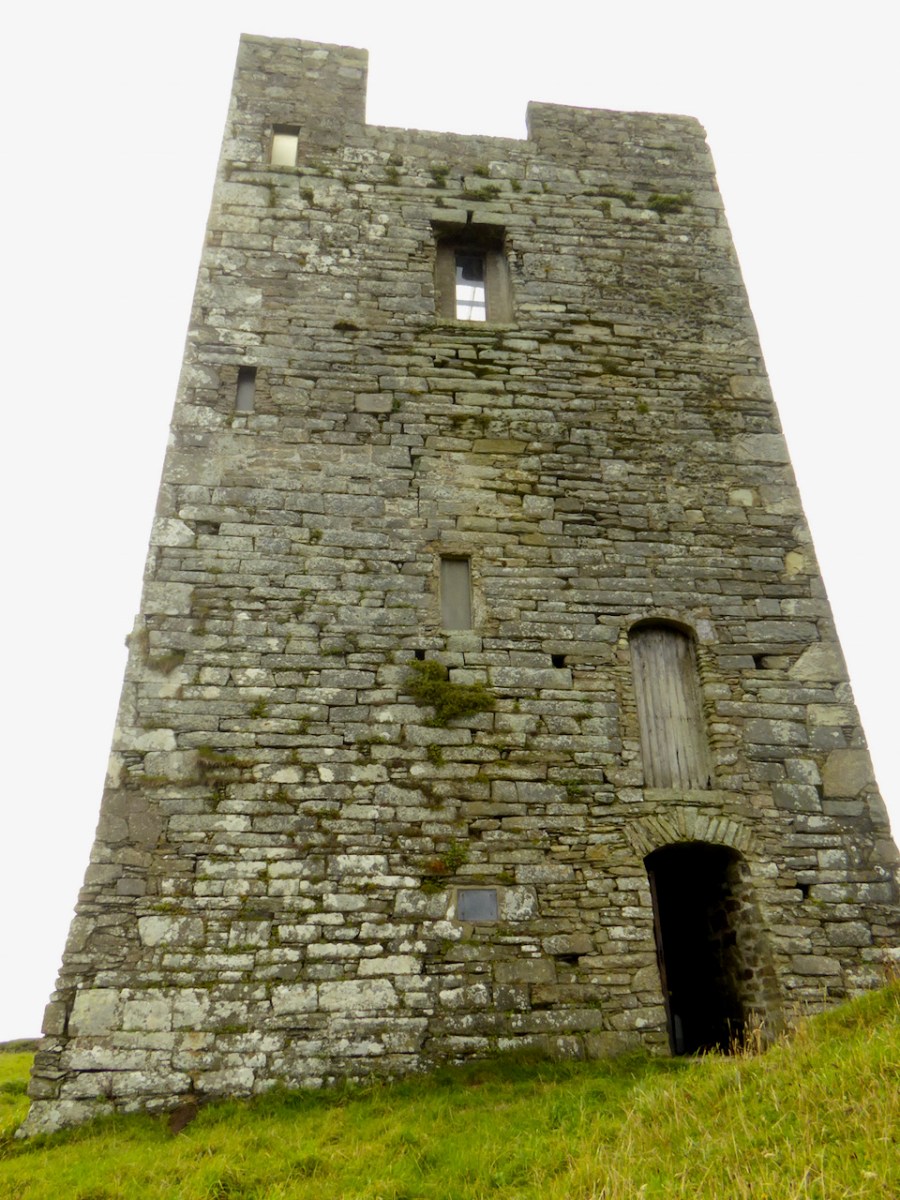
Like the others I have described in detail, Leamcon is a raised entry castle. To recap – the ground floor entry gave access to the ground floor, and possibly by means of a ladder to the second floor and mezzanine. The raised entry gave access to the second floor, and then, by means of a strait mural staircase, the the floors above the vault. Take a look at the cut-away diagram in Illustrating the Tower House: A Guest Blog to see what I am talking about here. Thus, the upper floors could only be accessed by one staircase, a defence feature, and being above the vault provided security from fire in the lower floors. Given that there were no fireplaces, and that braziers were lit in the middle of the floor, with smoke escaping however it could, this was probably a good idea.
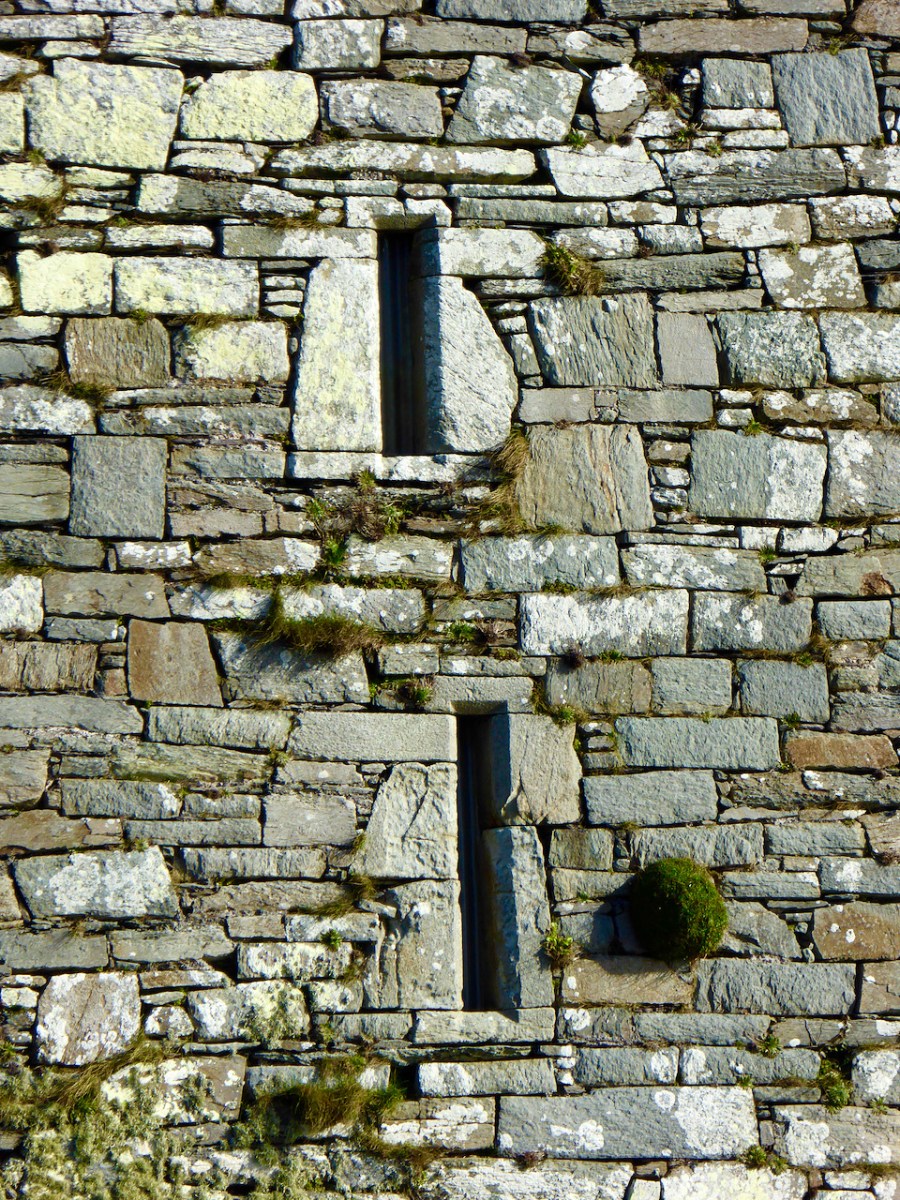
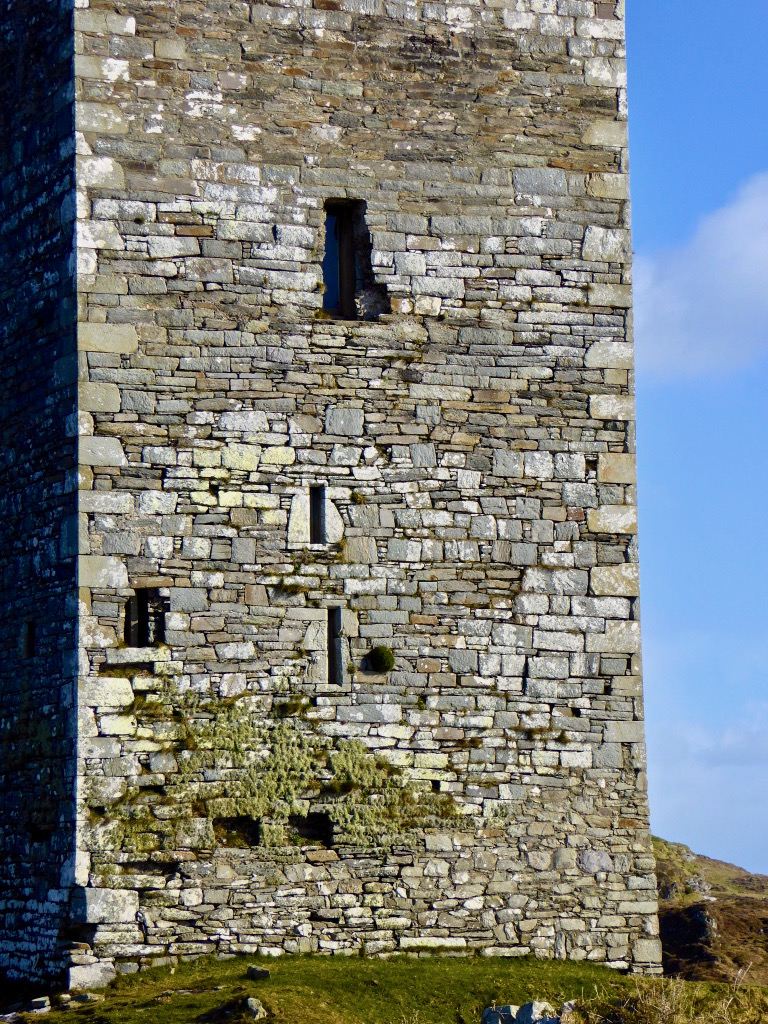
Another defensive feature was the small opes, or windows, through which no attacker could climb and little light could penetrate
As regards defence, the castle was attacked by Carew’s forces after the Siege of Dunboy in 1602. According to Samuel:
Sir George Carew reported, on 13th July 1602, that his lieutenant, Captain Roger Harvy, had taken several castles strongly seated on rocks and necks of land. All were so ‘neere unto the sea where ships may safely ride, and fit places for an enemy to hold as, namely Leamcon, Donnegall’ and others. The decision was taken to burn these tower houses. Conor, the head of the sept, received quarter with his men and migrated to Spain immediately afterwards. He was subsequently pardoned but seems never to have returned.
THE TOWER HOUSES OF WEST CORK MARK WYCLIFFE SAMUEL, 1998
Black Castle wasn’t burned and it subsequently was reclaimed for a time by the O’Mahonys, although the clan forfeited all or most of their lands after the rebellions of the 1640s, and the castle was abandoned from at least the 1690s. Such was the state of it when the O’Mahony Reunion took place here in 65 or 66.
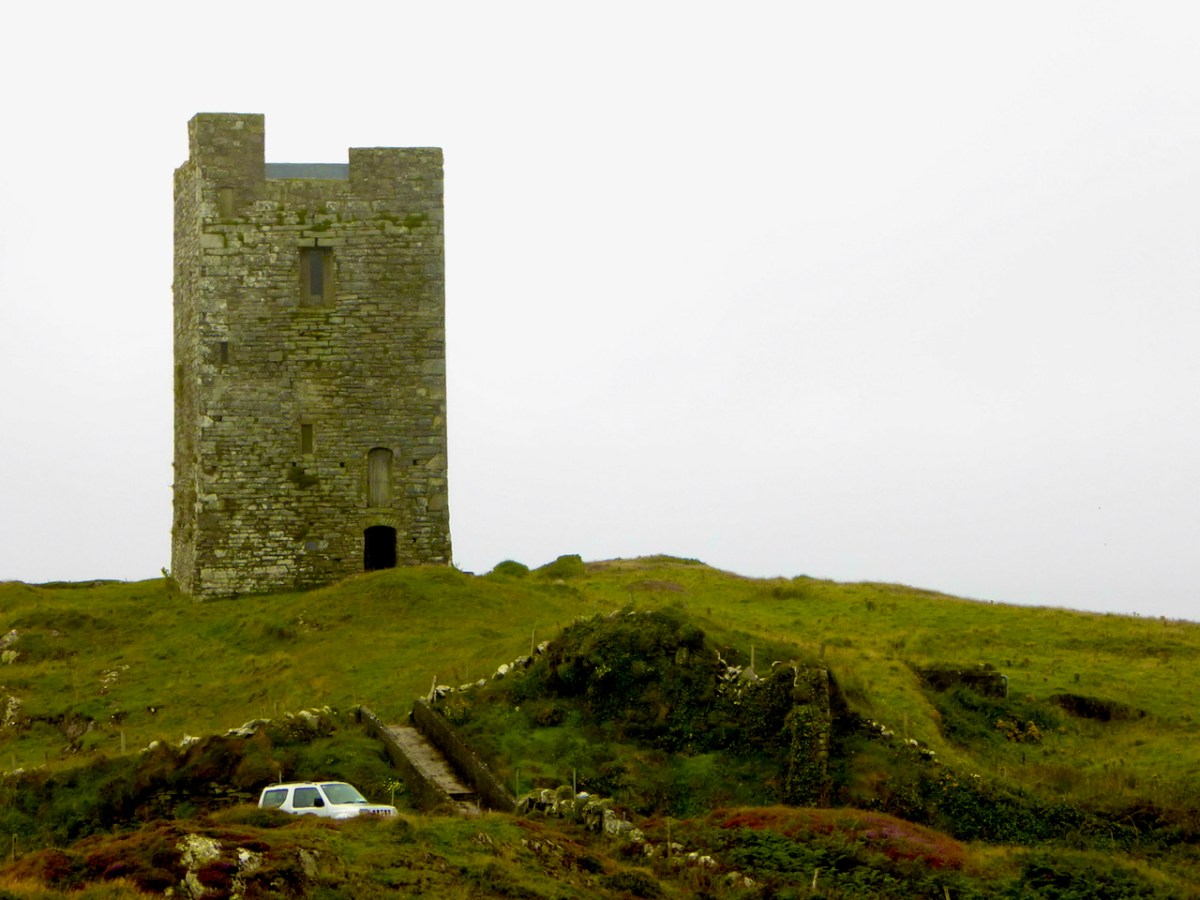
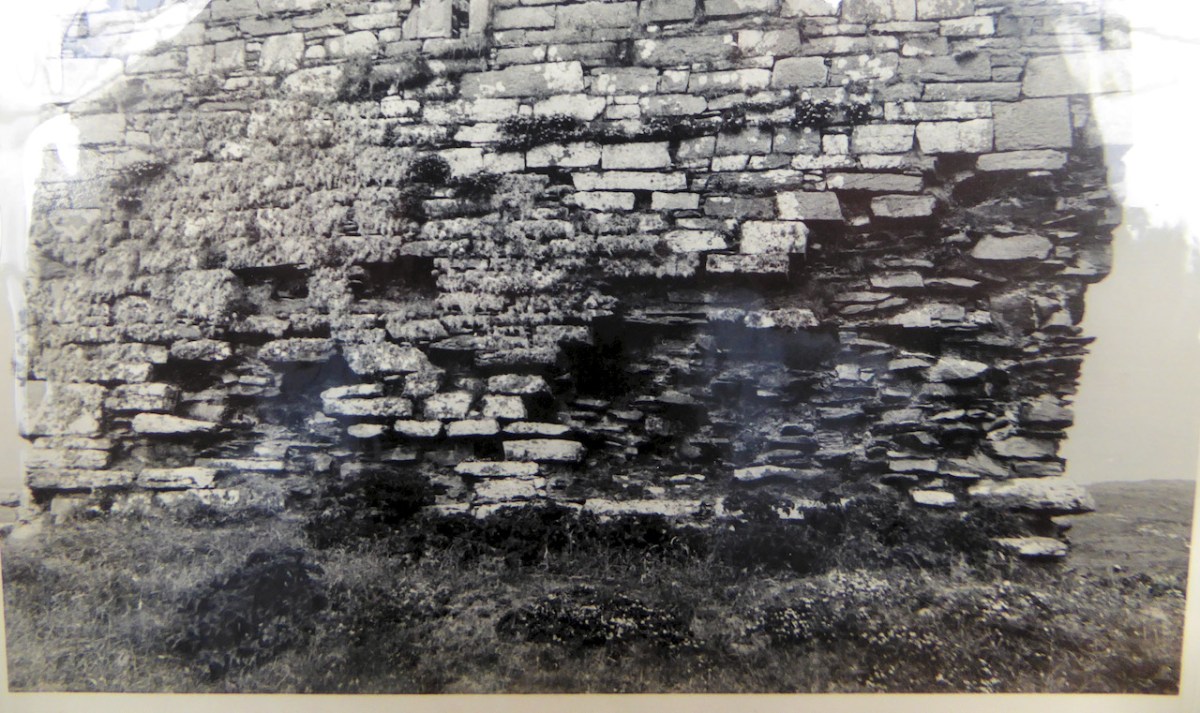
All those years of neglect had resulted in a castle in a perilous state of dereliction and Niall and his builders set about stabilising it before they could make it habitable. The base batter – the broad foundation that give the walls a strong base – had first to be repaired. This called for great skill and the results are impressive. Niall has left a band of membrane to indicate where the old and new stone work meets.
The castle was built to align with the strike of the rock, a feature of most of the Ivaha tower houses. The strike is the compass direction in which the rock bed is running and for West Cork that is mainly in a northeast to south west direction. The builders chose a prominent and solid rocky platform, still easily discernible, and probably prepared it by digging away any soil and loose rock and may have laid down a layer of mortar to help bind the lowest slabs to the rock surface.
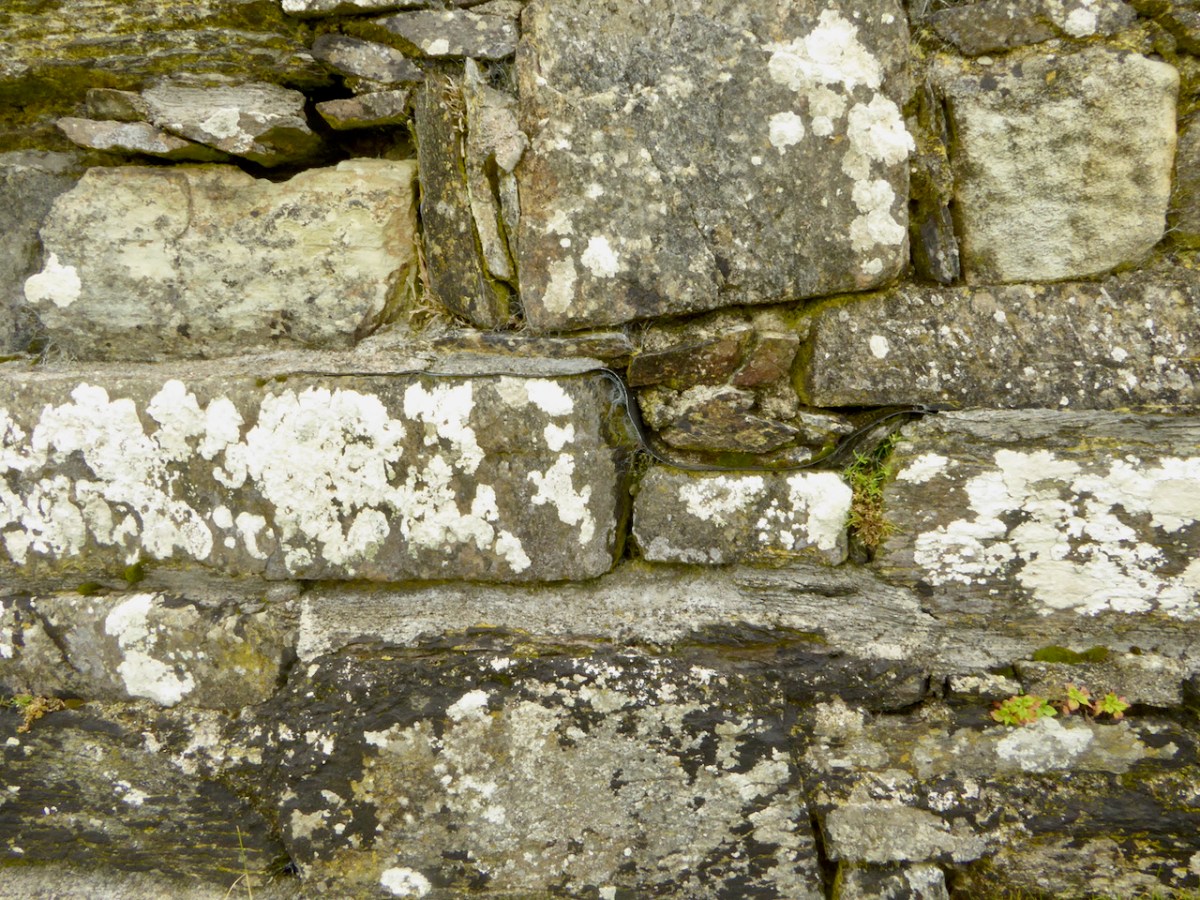
At Black Castle, the quality of the masonry varies, leading me to think that not all stone masons were as skilled, or perhaps as careful, as others. See the variation in the image below. The quoins (corner stones) were made of fine-grained sandstone that can be freely dressed in any direction (called Freestone), while the stones used to dress the outer layer were carefully chosen (or deliberately shaped) to be smooth and even, lending a pleasingly sheer surface to the castle exterior, sometimes called an “ashlar finish.”
The raised entry, in the case of Black Castle, is directly about the ground-level entry, similar to Ardintenant, but unlike Dunmanus where the entries are staggered. The entrance to the upper door would have been by means of a wooden staircase, possible from the small rocky knoll across from the entrance.
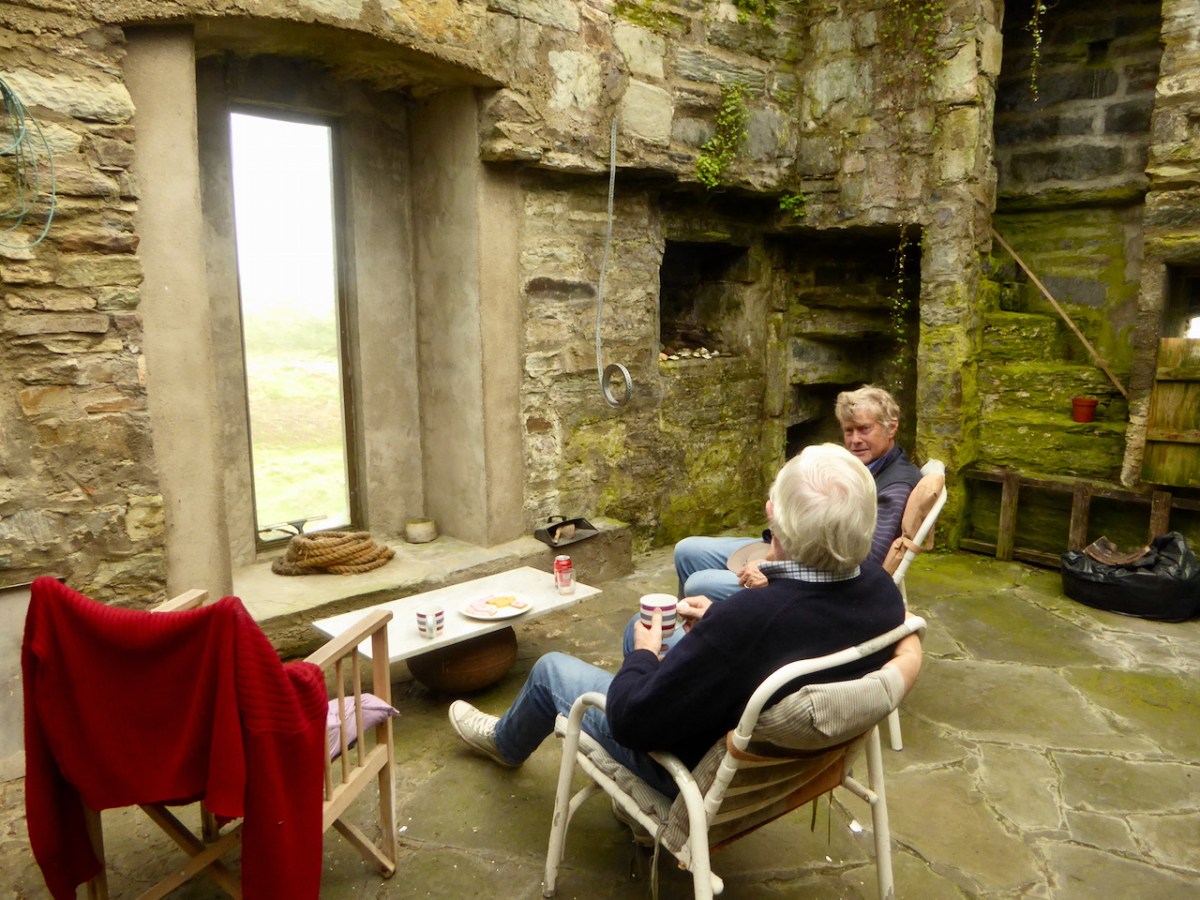
In his conversion of the castle to provide habitable space, Niall concentrated on the upper floors. There is a living room, kitchen dining area and bedrooms, along with a toilet and shower which are situated in the original garderobe space.
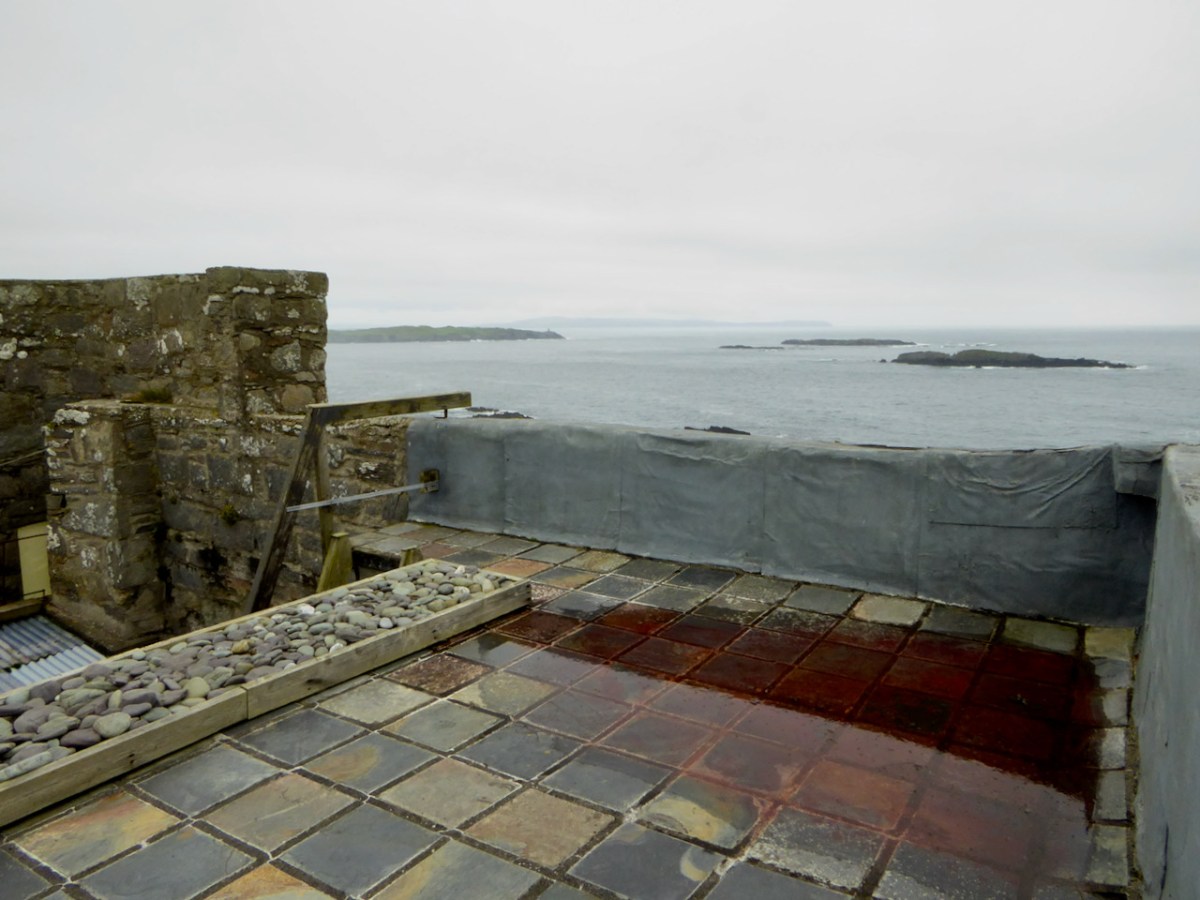
By roofing and waterproofing the building, Niall has kept further deterioration at bay. It is a joyous thing to sit and look over the countryside with a cup of tea on hand, or to climb up to the wall walk and gaze over the wild and rugged peninsula, imagining Carew’s forces advancing across the sea.
Niall Hyde has managed, on a limited budget, to salvage Black Castle and indeed turn it into a space that his family enjoyed. We should all be grateful to him, and to others who have taken on such tasks with vision and courage. Without the Niall Hydes of this world, we would all be the poorer.
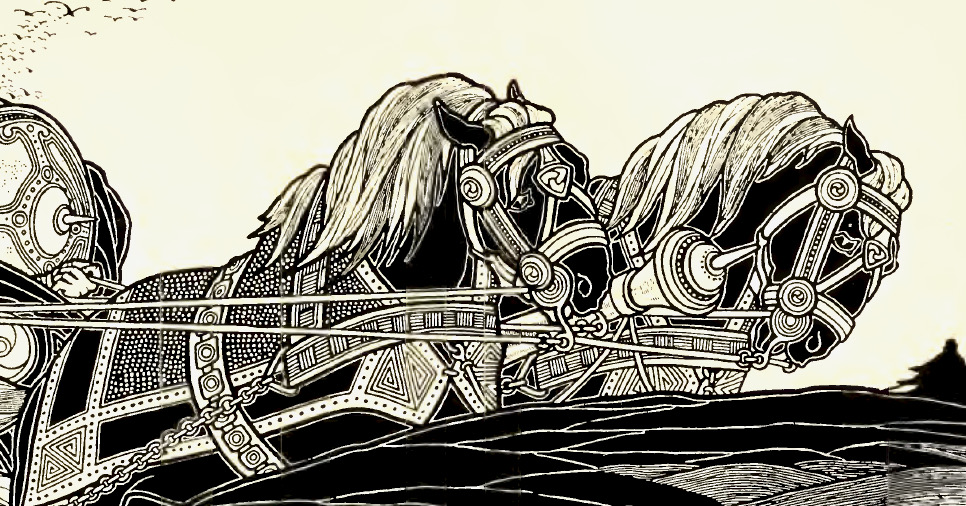
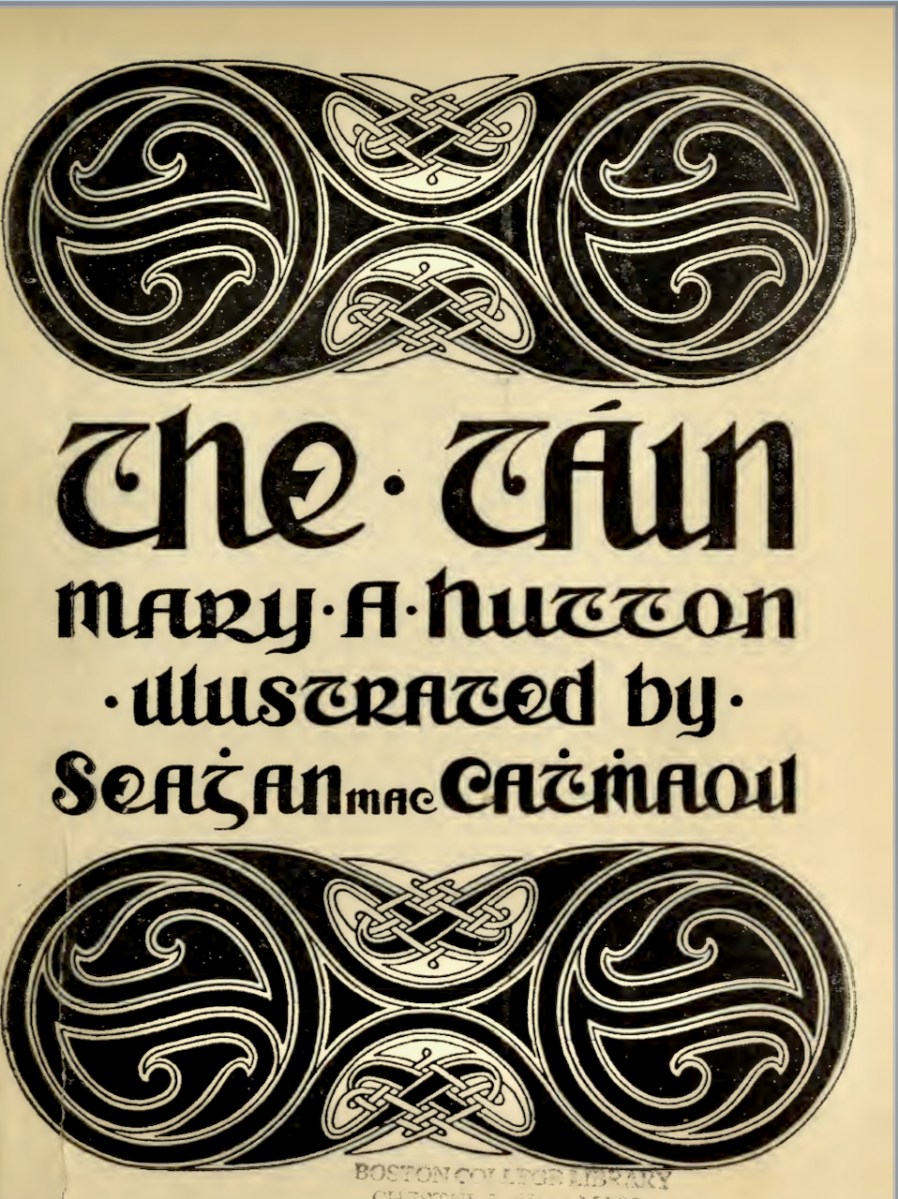
The Táin Bó Cúailnge (pronounced approximately tawn bow coolna), known in English as The Cattle Raid of Cooley, is one of the great Irish Sagas. There are many translations and illustrated versions, perhaps the most famous being that of Thomas Kinsella, illustrated by Louis LeBrocquy, published by the Dolmen Press in 1969. Almost forgotten now is the version by Mary Ann Hutton, illustrated by John Campbell – but it deserves to be remembered as one of the masterpieces of the Irish literary and artistic revival.
First of all, what is The Táin? It’s an epic tale, first written in the 7th century but preserved in various versions from the 11th to the 14th centuries with many modifications, additions and changes along the way. It tells the story of Queen Maeve, jealous of her husband’s white-horned bull, who determines to acquire the even more prestigious Brown Bull of Cooley from Ulster, ignoring the foretelling of a dreadful outcome should she proceed. The Ulstermen are rendered unable to fight by a curse, leaving the great warrior, Cuchulain, to fight alone – which, by the way, is no bother to him, especially once his warp-spasm, or battle-rage, comes on him. However, in the end he fights and kills his old friend and foster-brother, Ferdia. There’s a lot more to it, of course, and much of the tale is told by Fergus, who relates the whole story of Cuchulain as a youth and his many heroic deeds.
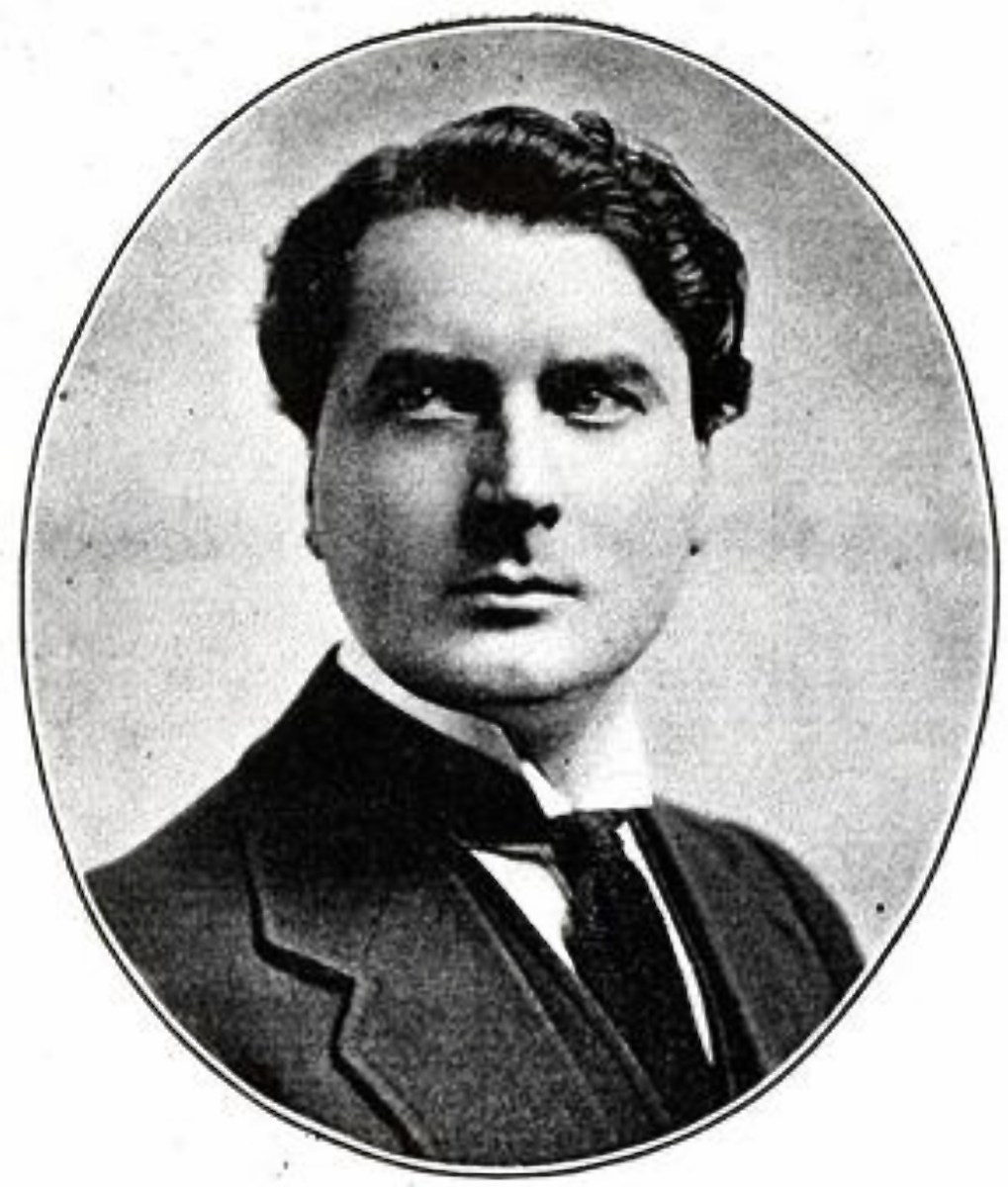
And what about the author and illustrator, neither of them now a household name, although justly acclaimed in their day? Mary Ann Hutton was born in England but had strong Irish connections and moved to Belfast when she married. She was highly educated, with an academic knowledge of Old and Middle Irish and became a fluent Irish speaker. She was an ardent supporter of Patrick Pearse and the Gaelic League and became a central figure in the Gaelic revival. Her version of The Táin was the result of ten years of intense scholarship. It is not a translation, but rather a rendition in blank verse of the story informed by her research into its various versions and iterations. She uses her own spellings as well – Maev and Cucullin, for example. I couldn’t find a photograph of Mary Ann, but here is the illustrator, below.
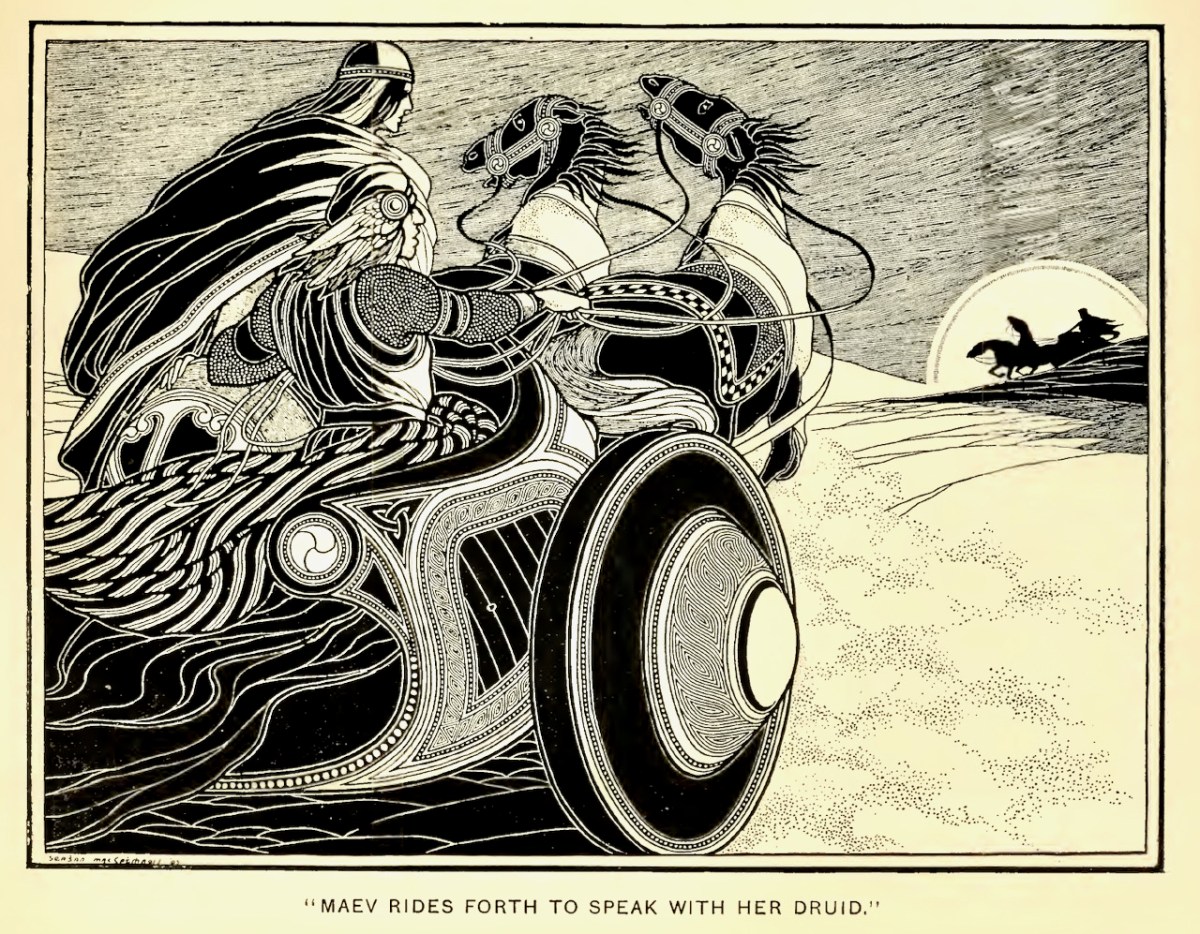
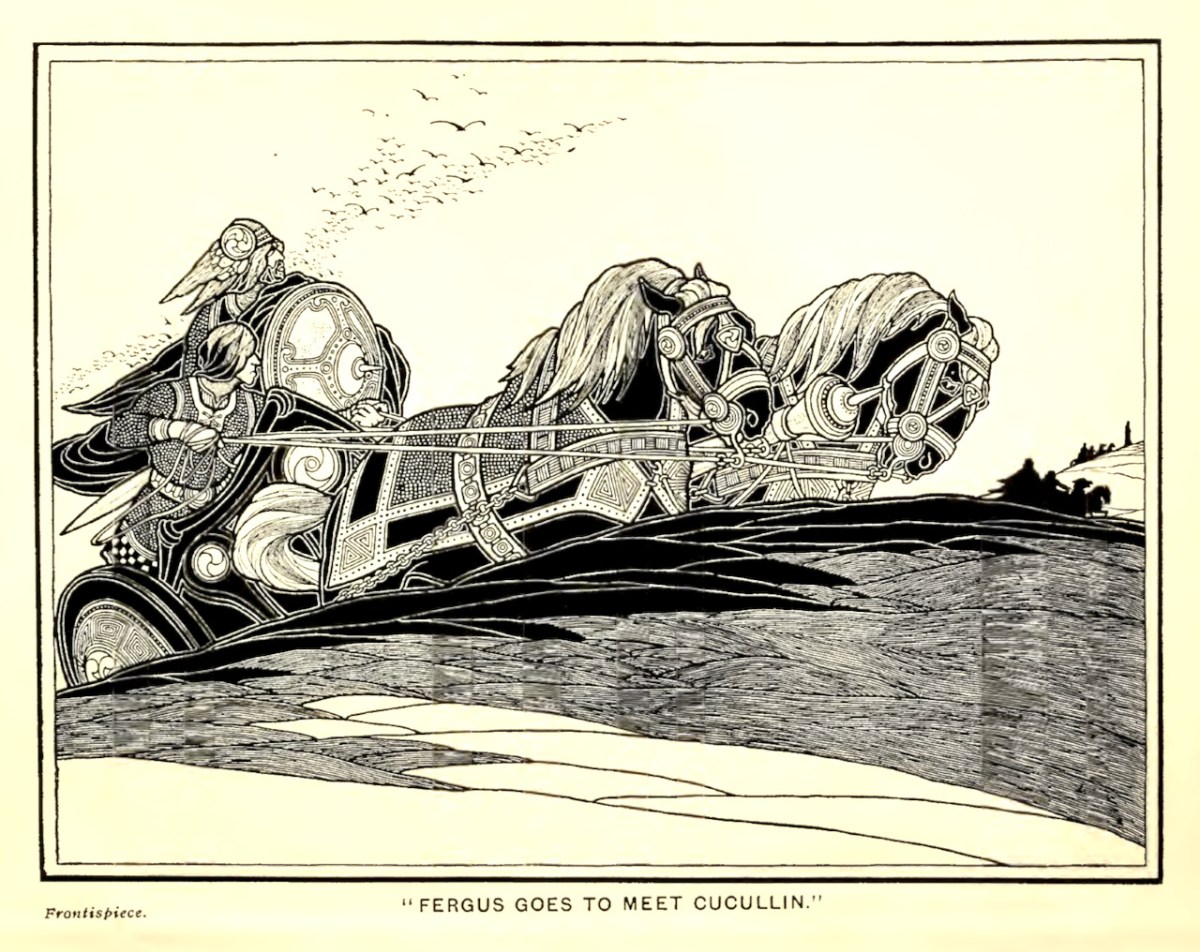
The illustrator was John Patrick Campbell, although in the spirit of the Gaelic Revival, he styled himself as Seaghan McCathmhaoil. There’s a wonderful biographical and appreciative sketch in the Irish Arts Review of 1998 by Paul Larmour* and that’s where I learned that he was also based in Belfast, that he produced illustrations for the first edition of Hutton’s Táin in 1907, but they were not used until the second edition, in 1924, and then only a selection of his illustrations were included. That’s a pity, because according to Larmour, Campbell’s illustrations for the Táin were ‘among his most impressive.’ They certainly capture the romantic spirit of the Celtic Revival period, and show his mastery of line drawing and strong black and white palette. Larmour says, This Irish epic poem conjuring up the ring of battle and the revelry of kings gave full scope to Campbell’s by now increasingly powerful expression and individuality, the drawings showing great strength of composition, dramatic power, and richness of decoration.
I couldn’t agree more, so here are a few selections from the text (it’s available online at good old archive.org) along with Campbell/MacCathmhaoil’s illustrations. The illustration above, captioned Maev’s Second Meeting with Fergus, is from Larmour’s article and is one of those that was, inexplicably, not eventually used in the book.
And Fergus
Came from the grave where five times five score years
He had been hidden. And a beautiful
And rich appearance was upon that warrior.
Brown hair was on him ; and a hooded layna
With red inweaving of red gold. A bratt
Of bright grass-green was round him ; and he wore
A golden-hilted sword, and round-toed shoes
Wrought all of bronze. And when that warrior, Fergus,
Perceived the holy men of Erin nigh him,
It was his wish to stand, and standing, tell
The Táin he had to tell.
This was the time wherein Maev called and spake
Unto her charioteer, and bade him catch
Her steeds and yoke her chariot, so that straightway
She might repair to speak with her own Druid
And ask for prophecy and knowledge. “ Wait
One while, O Queen,” the charioteer made answer,
“ That I may three times wheel the chariot round
Sunwise, to win a sign of luck and fortune.”
He wheeled the chariot sunwise, and then Maev
Rode to her Druid. When she reached the Druid,
She asked for prophecy and knowledge.
I see a man youthful and very fair,
Who will perform great deeds, and win his fill
Of hurts and wounds in his smooth fine-fair skin.
Upon his brow, which is a meeting-place
For victories, the hero’s light flames high.
Amidst each eye the seven dragon-gems
Of a pure hero-champion flame and burn.
Plain to perceive, his intellect is keen.
A red hooked layna folds him. His fresh face
Is beautiful and noble. He observes
Towards women courtesy and modesty.
Though a mere stripling, blooming, dainty-cheeked,
He in the battle shows a dragon’s form.
His fairness and his valour now resemble
Cucullin of Mweerhevna ; and though, truly,
Who this Cucullin of green Moy Mweerhevna
May be I know not, yet this thing I know
These hosts by him will all be very red.
Four little swords for feats of special skill
He carries in each hand : he will attain
To plying these upon the hosts : the hosts
Will flee from him on every road and way.
When, in addition to his spear and sword,
He brings his dread Gae Bulg, he plants his feet
On every slope and hill. Two spears project
O’er his bright chariot-wheels : he rides to battle.
Fury distorts him, battle-fury changes
That form which hitherto I have perceived.
He is Cucullin son of Sooaltim,
Hound of the Forge : he wends unto a battle.
Your hosts, now whole, he will hack down and fell.
He will compel your slain thickly to lie.
Strong men will leave their heads with him. This I,
Fedelm the Prophetess, will not conceal.
Red blood shall drip from the white skins of heroes
Lasting and long the memory shall be
Bodies shall there be torn, women shall wail,
Through deeds of that renowned Hound of the Forge,
Whom now, O Queen, I see.
The Prophetess
Ended her prophecy : and Maev rode back
From seeking-out of prophecy and knowledge.
Said Laeg, “ here comes a chariot-rider towards us.”
“ Describe him, then, good Laeg,” Cucullin said;
And Laeg described him thus:
“ Larger,” said he,
Than is some heathy knoll, rising alone
From out a grassy level, seems to me
His noble chariot. Larger than the tree,
Reverenced and old, that stands upon the green
Of some king’s doon, appears to me the hair
That curls and waves in golden bright abundance
About that warrior’s head. A crimson fooan,
Fringed and embroidered, folds him round : a spike
Of graven gold secures it. In his hand
He holds a wide, red-flaming spear. A shield,
Carven, and compassed by a ridge of gold,
He has ; and a long sword-sheath, which for size
Is like the rudder of some kingly vessel,
Reposes on the huge and seated thighs
Of that great, haughty warrior, planted there
’Midst of his chariot.”
Then Cucullin cried :
“ Oh, welcome, ever welcome is the coming
Of that beloved guest ! I know that guest.
It is my guardian and my fosterer,
My gentle, noble Fergus, who comes there.”
Cucullin saw his weapon, red with blood,
Lying beside Faerdeeah ; and he said:
“ O my Faerdeeah, sorrowful the fate !
I, with my merciless weapon still unwashed :
Thou, pale in death upon a couch of gore.
Sad—what has come of our meeting here
I, wounded, sinking, covered with rough gore:
Thou, altogether dead ! Oh, dear to me
The friend to whom I have served a draught of blood!”
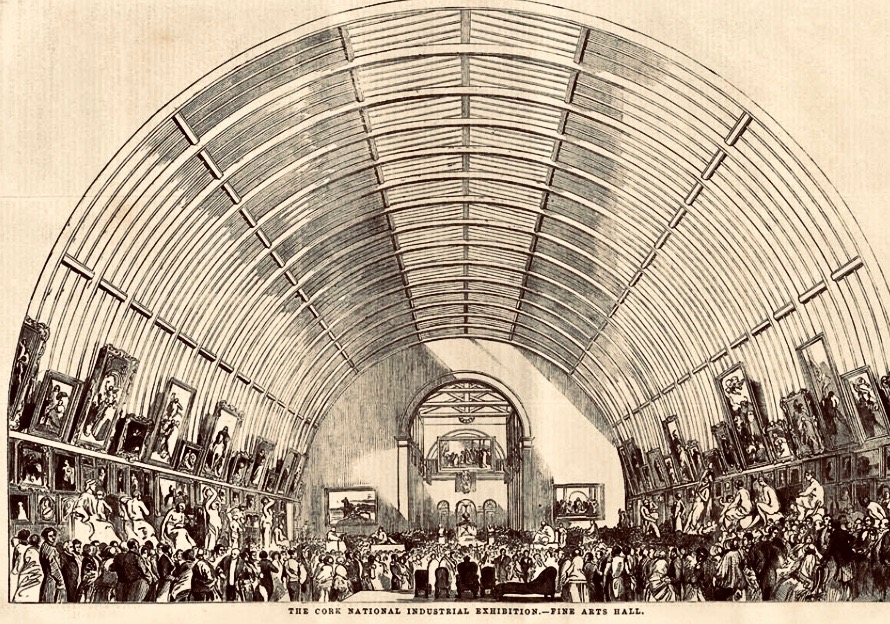
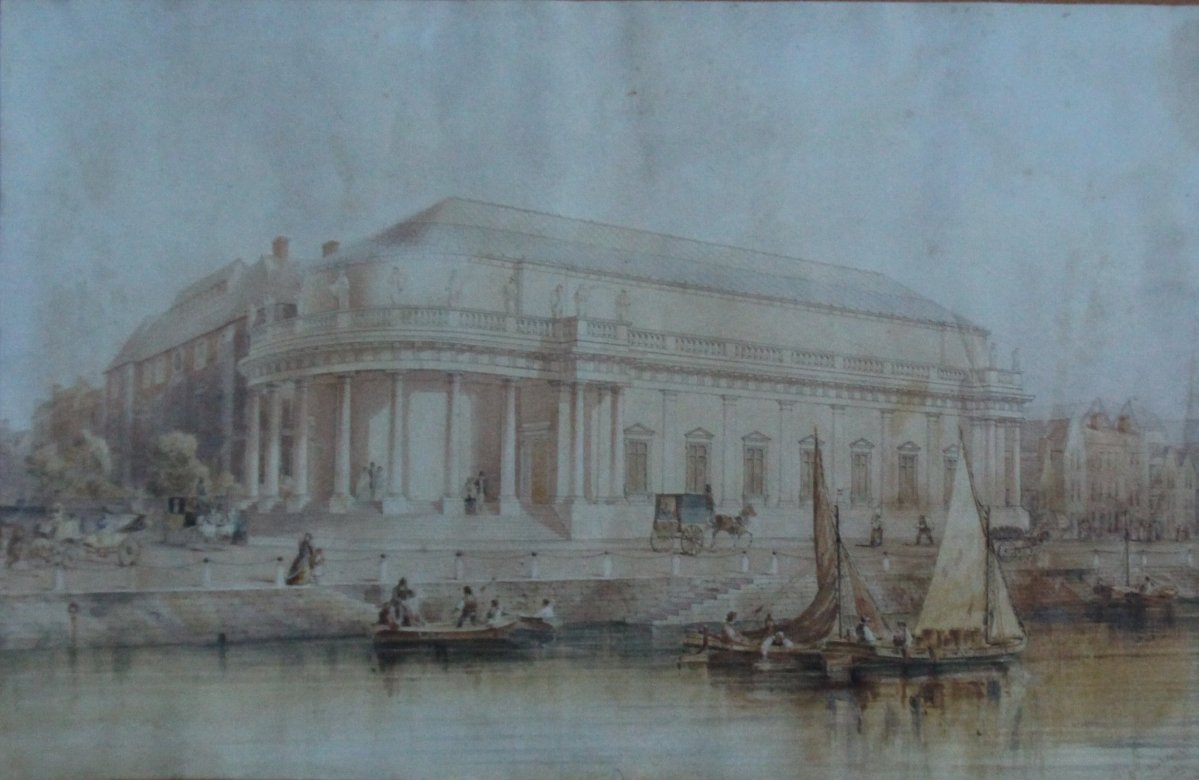
This engraving from the Illustrated London News shows the ‘Fine Arts Hall’ which was part of the Cork National Industrial Exhibition held in 1852:
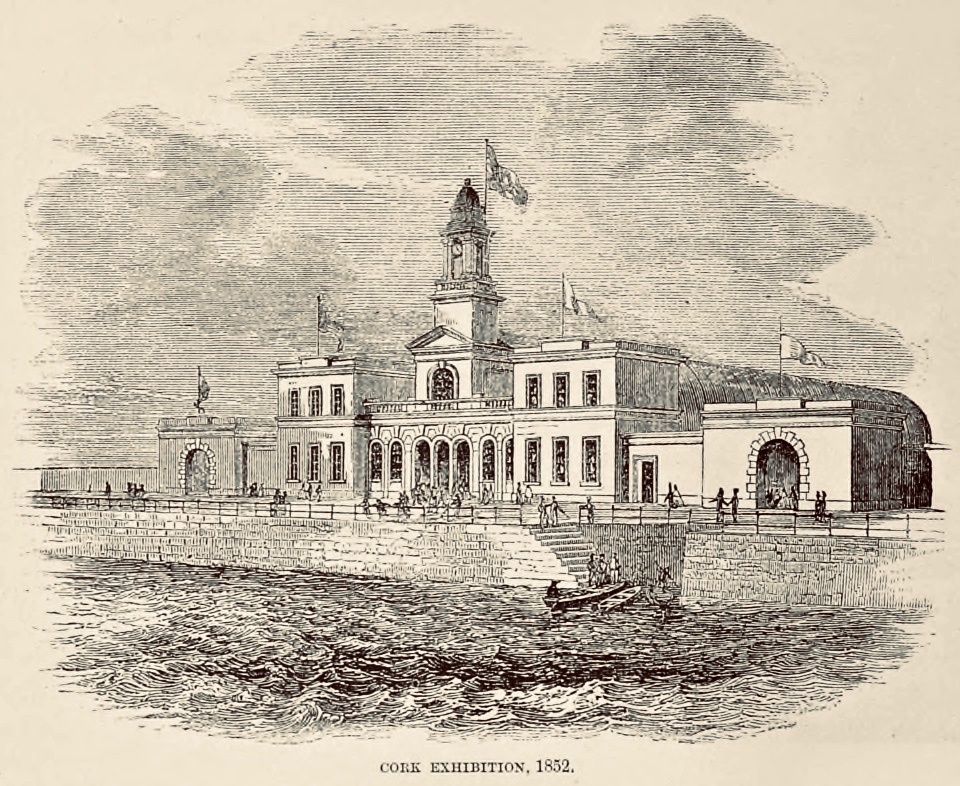
. . . The site of the Cork Exhibition was the Corn Market, where ships carrying visitors and goods could dock and unload at the entrance gates. The old Corn Exchange building, lent for the occasion, formed one end of the structure, while a new mart served as a principal show room. This ran across the southern part of the old building, parallel to the quay, for 300 feet in length and 30 feet in breadth, giving the impression of a contemporary railway station, even to the strip of glass along the roof to admit daylight. By the opening day ad hoc extensions had been added which converted the original elongated T – shape into a cross, with covered galleries and passageways running from the central structure to an adjacent building used as a hall for banquets, balls and public lectures . . .
A C Davies – Irish Economic and Social History, Vol 2, 1975
. . . The exhibition remained open for three months, until 10 September. The opening ceremony had been performed by the Lord Lieutenant after a procession watched by the townspeople, ‘in all the pomp and circumstance of majesty, with waving banners, prancing horses, peals of artillery, and multitudinous shouts’. At first attendance was sparse. It rained steadily for the whole of the first week, but then the weather improved and the number of visitors increased. It amounted to about 140,000. Ten thousand free admissions were granted to children from over seventy schools in the area . . .
A C Davies – Irish Economic and Social History, Vol 2, 1975
When the 1852 exhibition closed, the people of Cork decided their city should have a venue suitable for the holding of public lectures, meetings and concerts. Within a few years the building above was constructed. Known as the The Athenaeum, it was designed by Sir john Benson, who had been responsible for the Great Hall of the Cork Exhibition. It is said that many of the materials which had been used in Benson’s exhibition hall were salvaged and re-used in The Athenaeum. The new building was renamed The Munster Hall in 1875 and then became the Cork Opera House in 1877. It survived until 1955, when it was destroyed by fire. The present Opera House, on the same site, was opened by President Eamon de Valera in 1965. It was extensively remodelled, with the glazed facade added, in 2000.
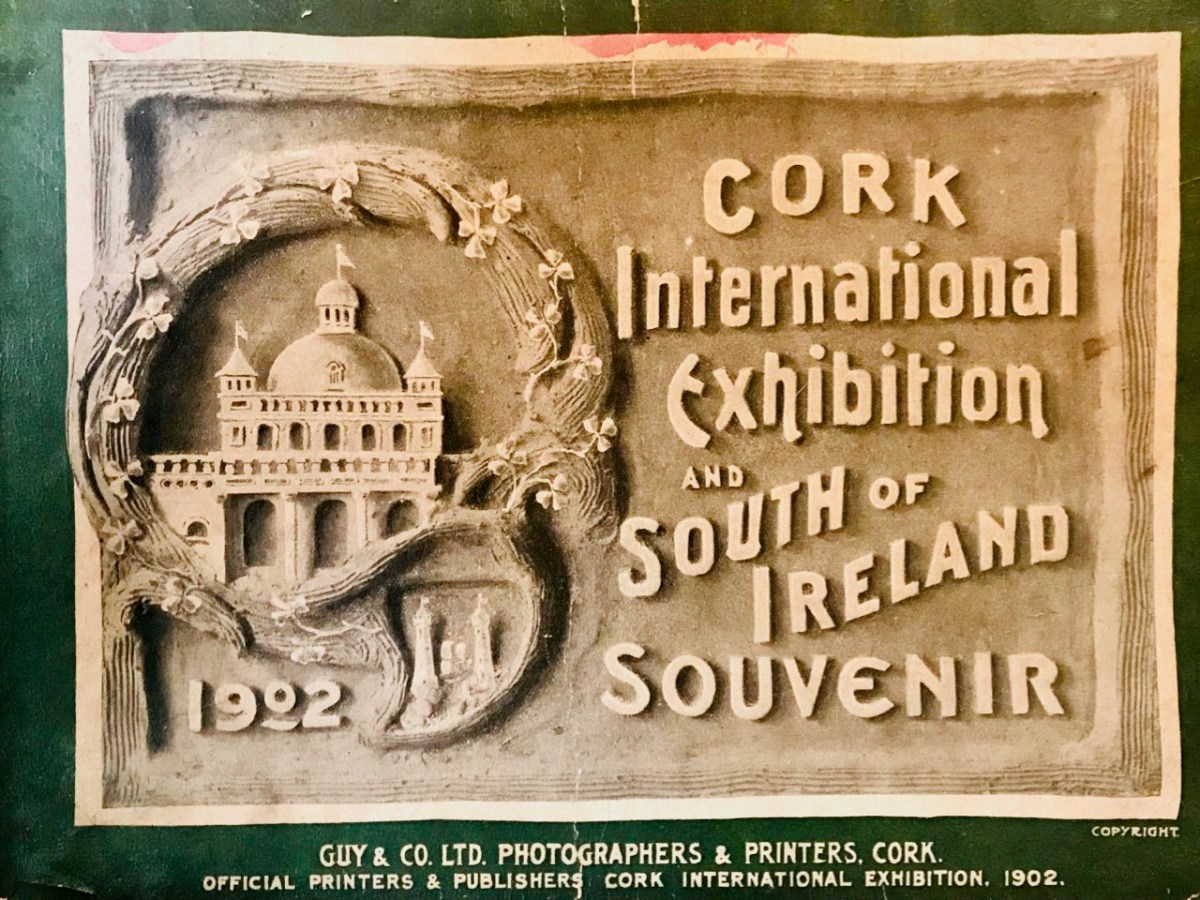
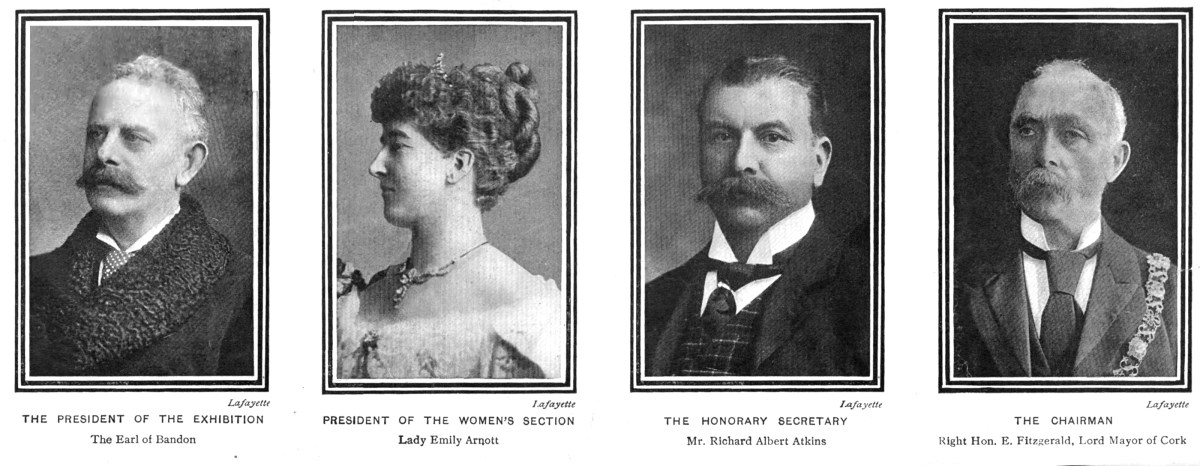
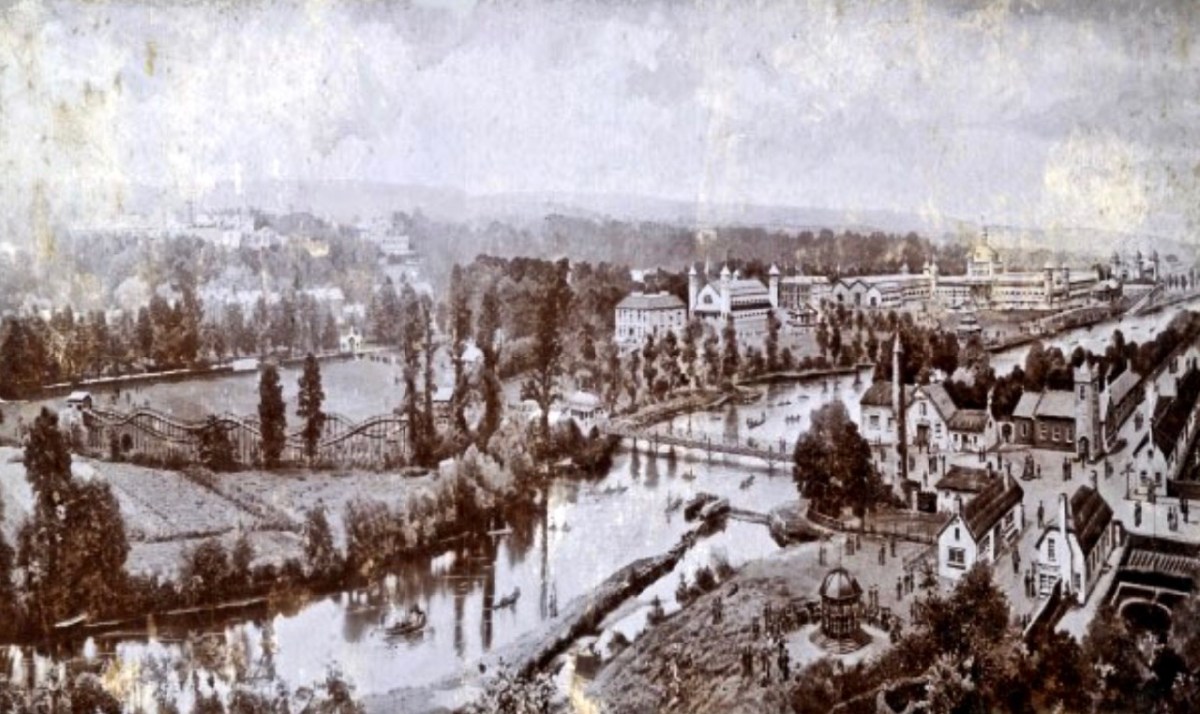
Half a century later Cork city embarked on another major ‘world fair’ class event. In 1902 the Lord Mayor of Cork, Edward Fitzgerald, presided over creating Cork International Exhibition, which ran from May to October. Reclaimed marshland beside the river at Mardyke was used for the site, which occupied an area of about 44 acres. Here are the ‘leading lights’ of the exhibition organisers, with Fitzgerald on the right:
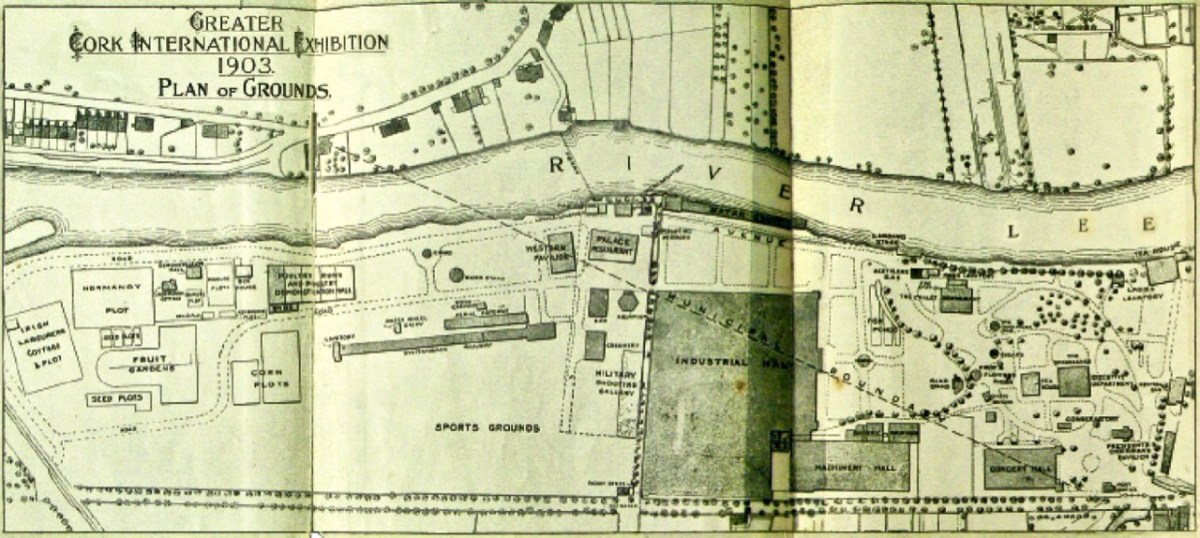
This exhibition was considered such a success that it was repeated the following year – 1903 – and the site plan above bears this date. The artist’s aerial view of the site, below, gives a good impression of the extent of the grounds. Note the ‘switchback railway’ to the left: this was a precursor to roller-coaster fairground rides and was immensely popular…
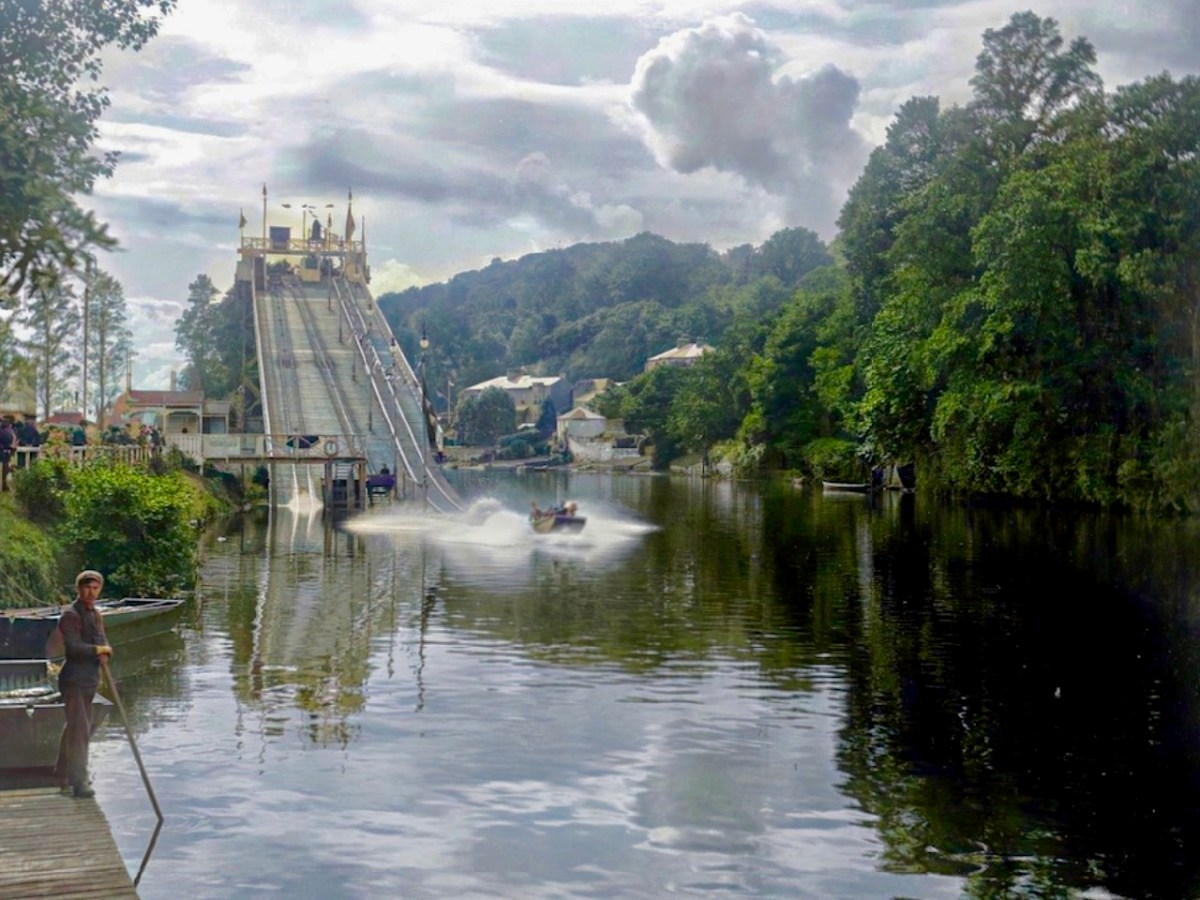
…As was the ‘Water Chute’ from which it was unlikely that you would emerge dry!
Such attractions were very popular with the general public, but the exhibition had a more serious commercial side:
Several large exhibition halls and pavilions housed a range of industrial and agricultural exhibits from many countries including Canada, Turkey and China. There were displays of industrial and agricultural machinery as well as horticulture, fisheries, art, craft and ceramics . . . The Irish Department of Agricultural and Technical Instruction had a strong presence at The Exhibition with exhibits on dairying, cheese-making, cottage gardening, forestry, bee-keeping, poultry, fruit and vegetable drying and preserving . . .
National Museum of Ireland Collections & Research
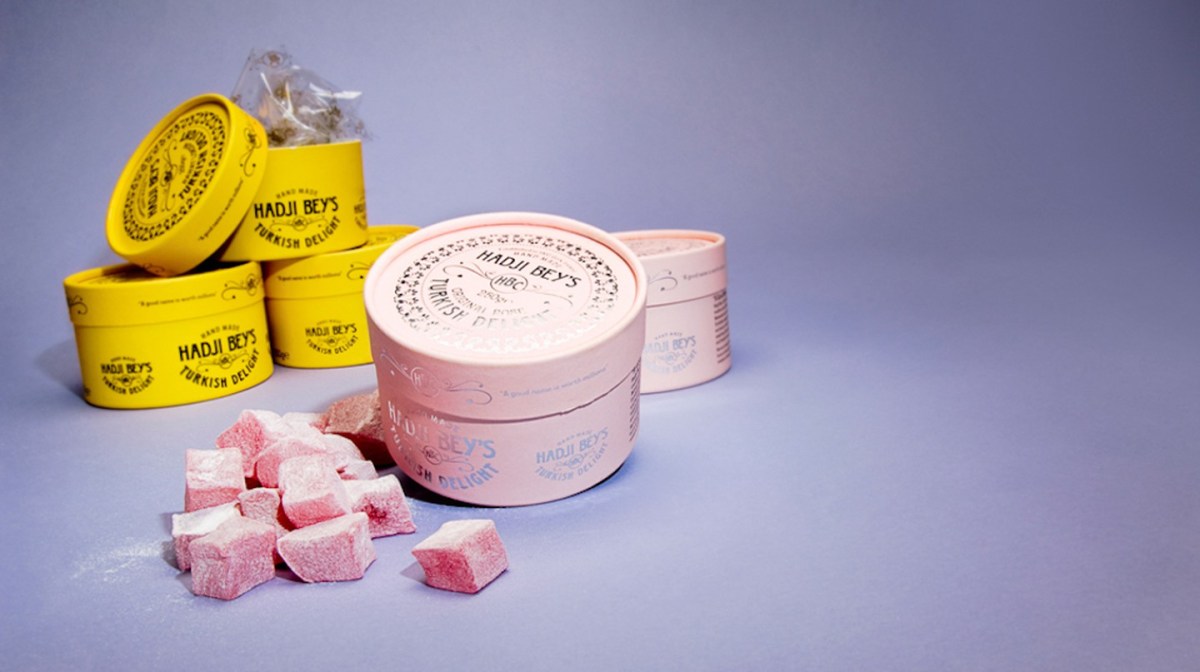
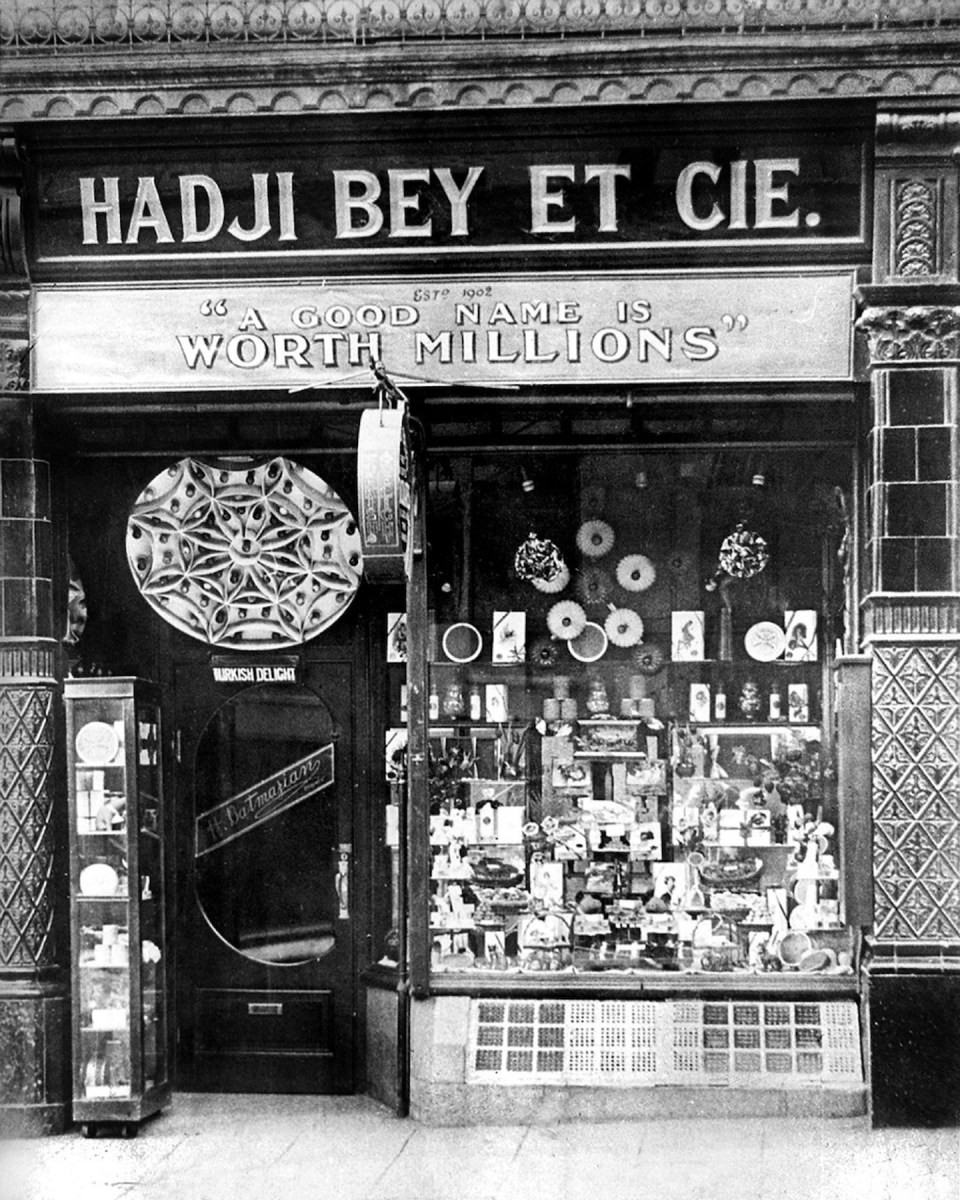
Hadji Bey is a name that will be familiar to any Cork person with a sweet tooth! The true story goes that Armenian immigrants Harutun Batmazian and his wife Esther chose Cork as their new home during the early years of the 20th century, after escaping the persecution and violence against Armenian Christians taking place in the Ottoman Empire at the time. In 1902, the Batmazians participated in the Cork International Exhibition and introduced their Turkish Delight – a skill Harutun learned while studying in Istanbul – to the market. Although they spoke no English at the time, the city was to became their home and the popularity of their sweets – still made in Ireland today – is legendary. After their success at the Exhibition they opened a shop on MacCurtain Street: this survived for many decades.
Turkish Delight is just one success story from Cork’s International Exhibitions. The 1902 event attracted nearly two million visitors. Surely, it’s time for another one?
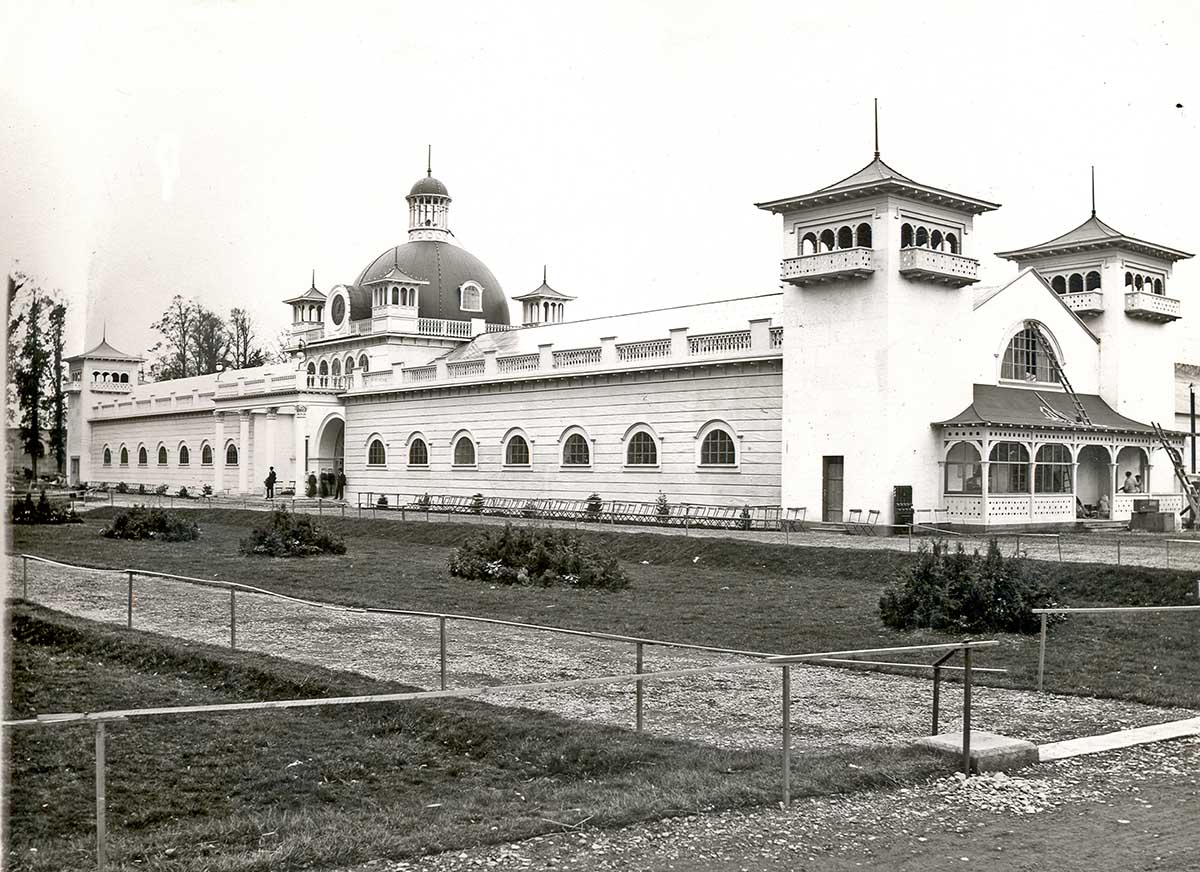
After all the clamour and excitement had died down the Exhibition buildings (below) were dismantled and auctioned off. In 1906 the park and Shrubberies House were taken over by Cork Corporation with the proviso that the Corporation would levy a rate of half penny in the pound for annual upkeep and maintenance. A further proviso stipulated that the Shrubberies House would be used by the Corporation as a municipal museum. Today we can all enjoy enjoy Fitzgerald’s Park and the Cork Public Museum, where Finola and I put on an exhibition about Rock Art back in 2015.
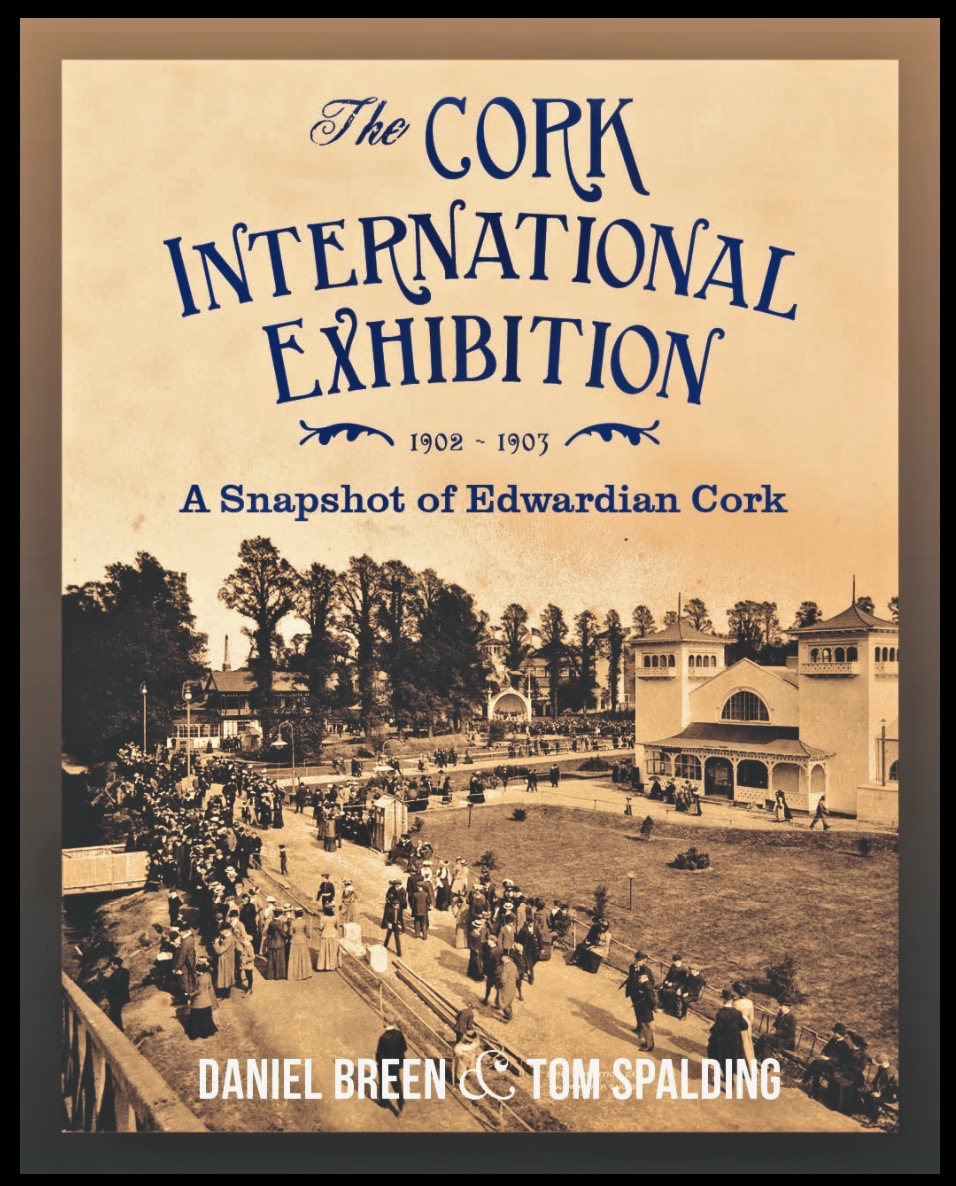
If you want to know more, I thoroughly recommend this book, written by Daniel Breen (now Curator of the Cork Public Museum) and Tom Spalding, published by the Irish Academic Press.
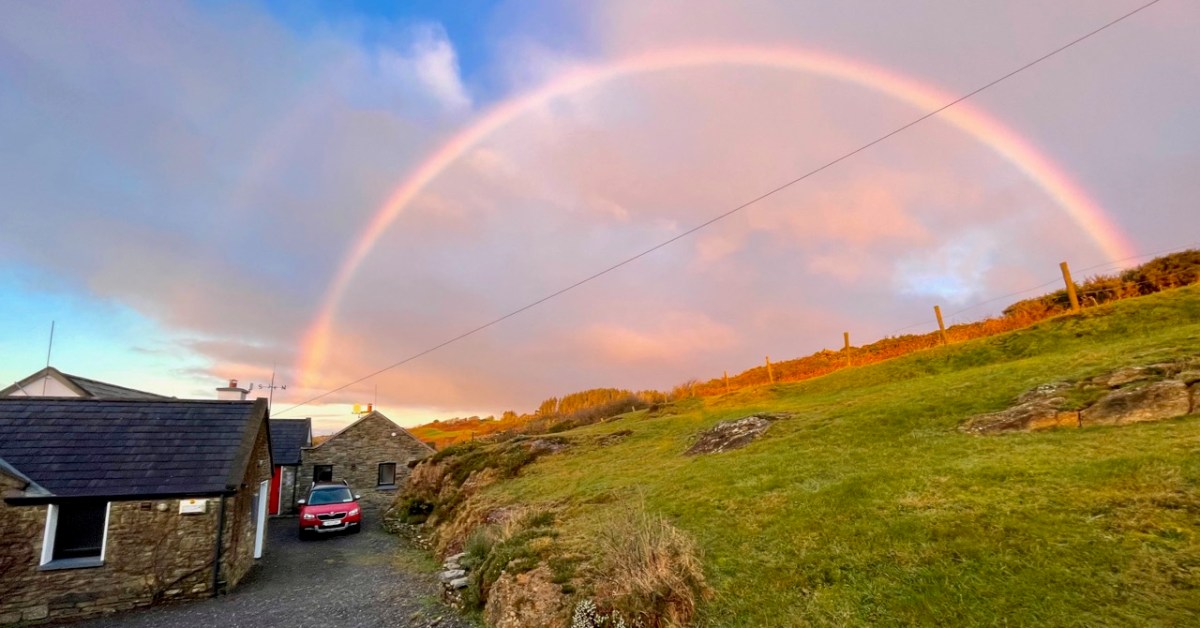
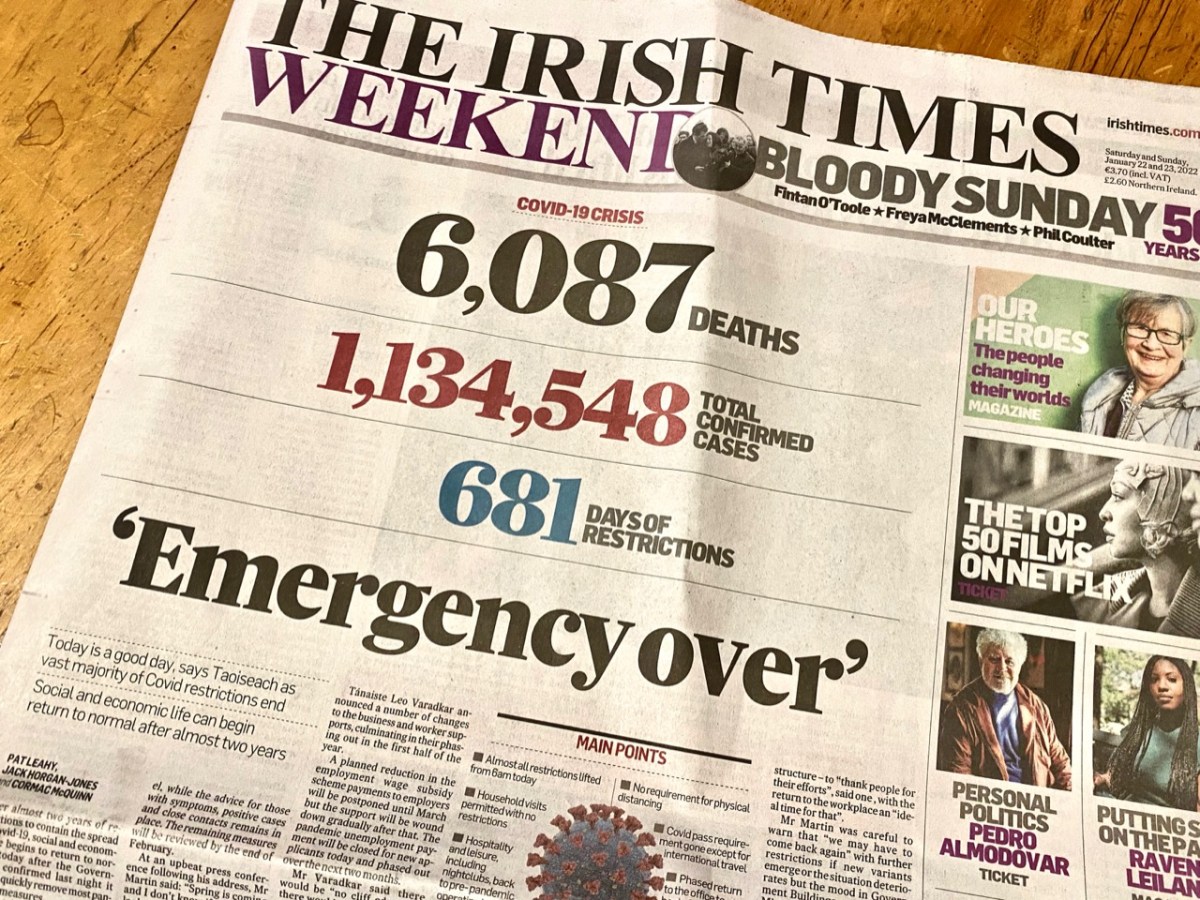
Yes – it has been 681 says since Covid-19 hit us and our world changed. From today, 22 January 2022, most restrictions in the state are gone, apart from the continuing need to wear masks in certain public places. Hopefully that West Cork sky over our house this morning, above, is a good omen for us. Today’s paper shows the stark tally:
The population of the Republic of Ireland as I write this is 5,023,337 (no doubt that is changing by the minute). That tells the story: 22.6% of the people here have had the virus. And of course it hasn’t gone away yet… But at least “social and economic life can begin to return to normal” says the Taoiseach. In order to mark the significance of the moment, my post looks back to our experiences over the last 681 days: in particular, how our lives changed at the beginning of the outbreak.
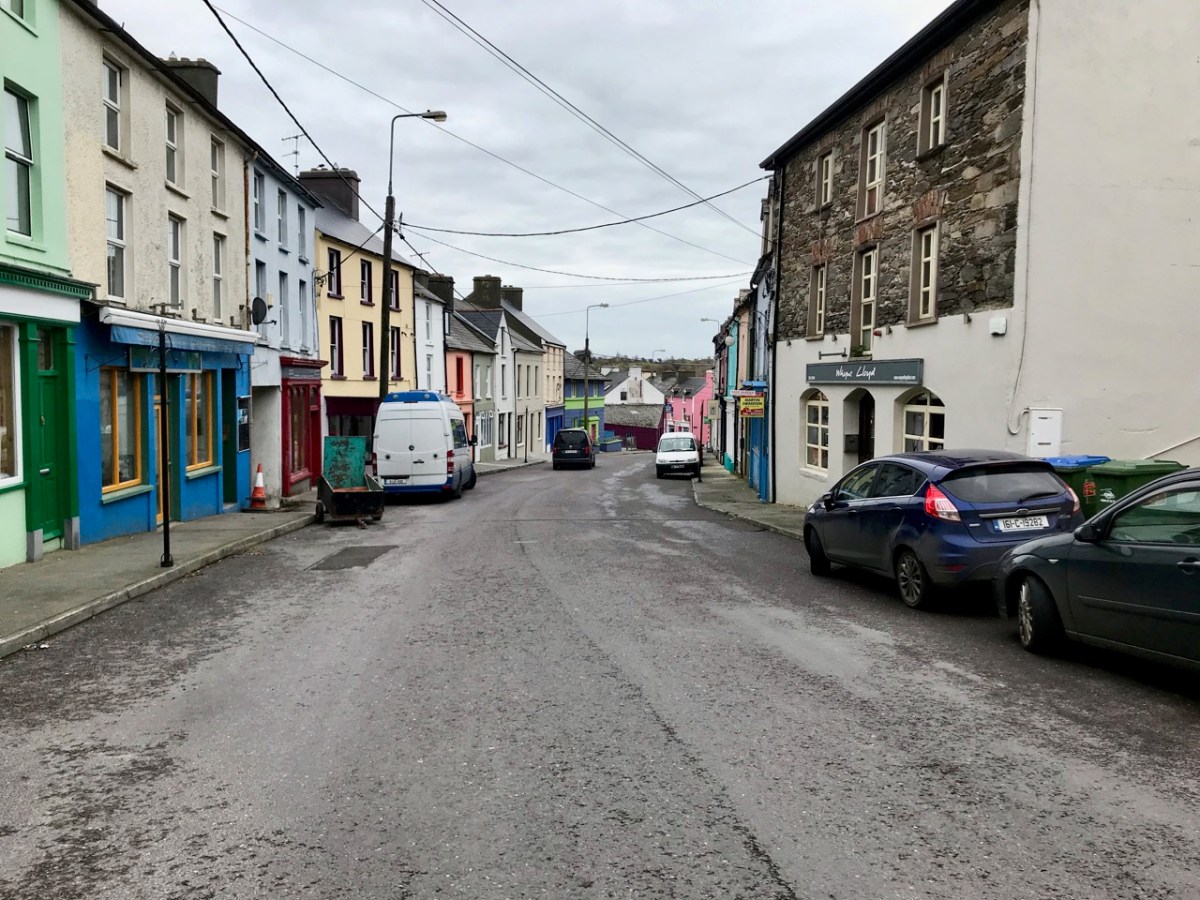
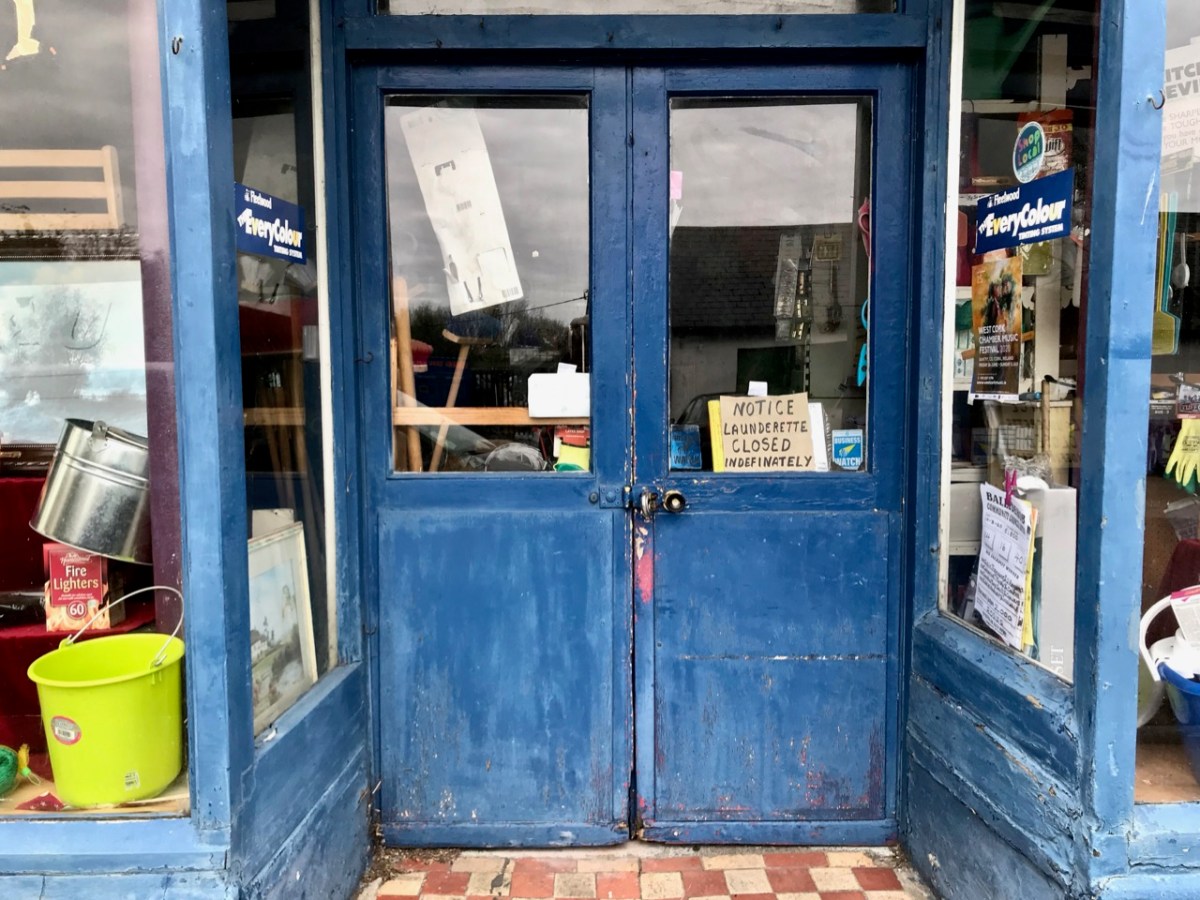
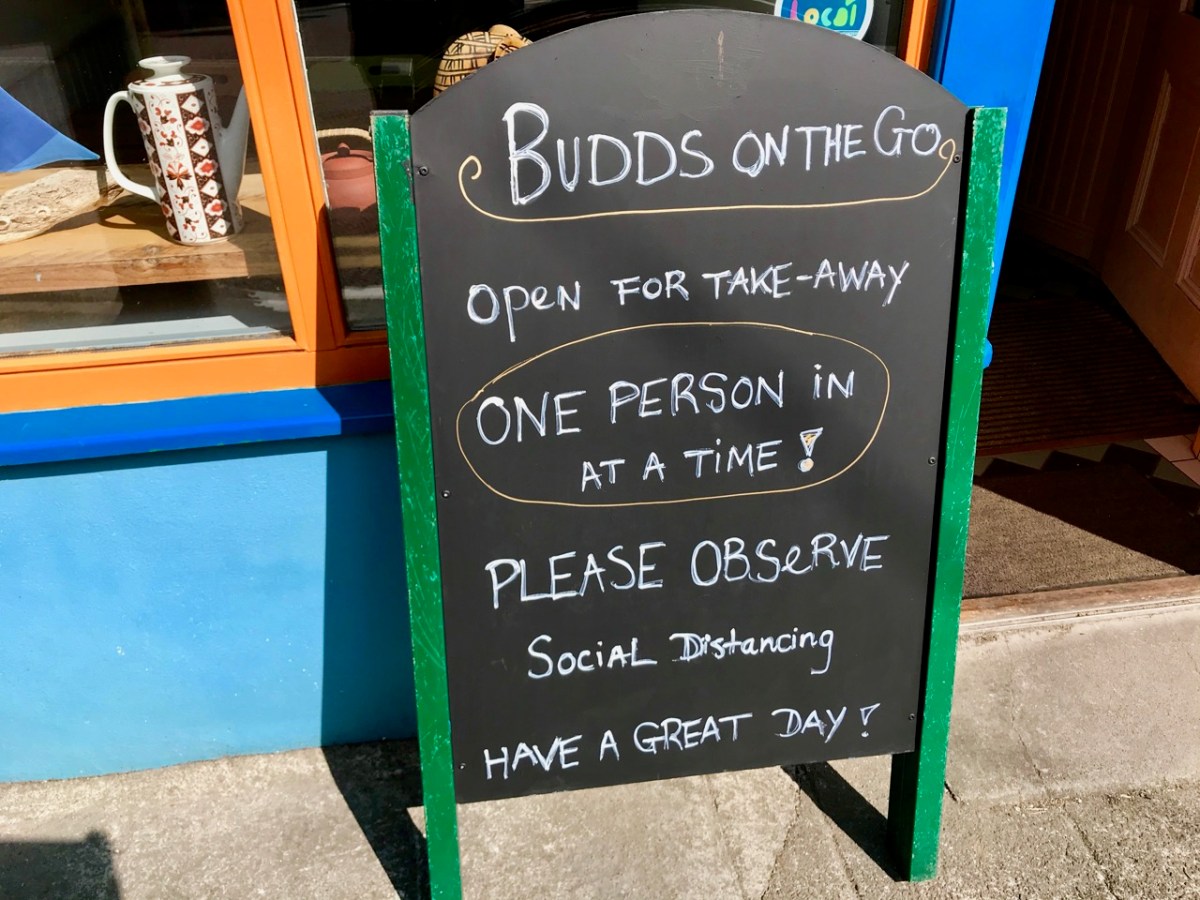
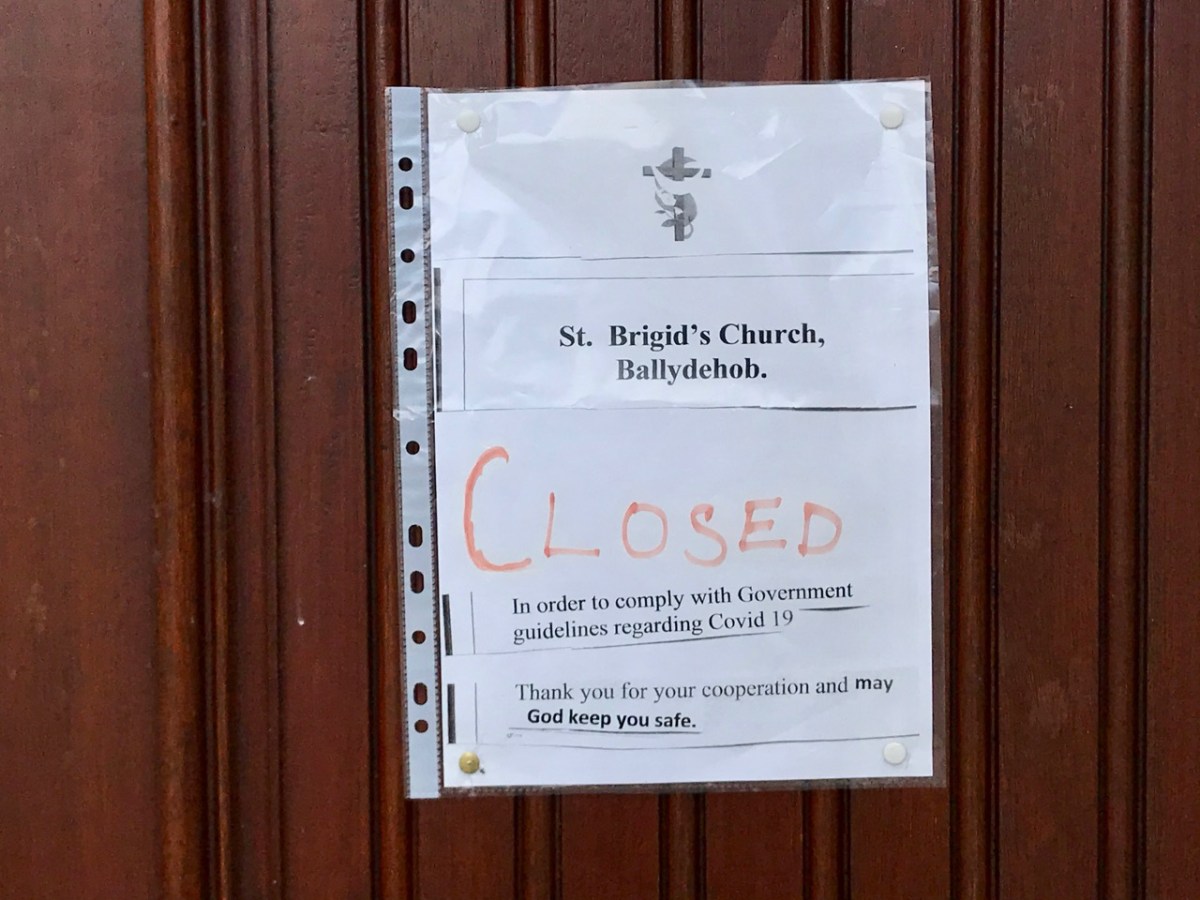
These two images of Ballydehob, taken at the beginning of April, 2020, sum up the shock of empty streets, closed businesses and everyone being advised to isolate. It all seemed very bleak: our movements were initially restricted to 2km from home, then that increased to a radius of 5km. If you lived in rural areas – as we do – you were permitted to travel beyond those distances if you needed to in order to shop or use essential services. We breached those rules on occasion – sometimes to get exercise in the deserted countryside all around us.
As the days went by, an amazing spring emerged, with day after day of beautiful weather. Human activity was curtailed, but the natural world continued along its course as though nothing was awry!
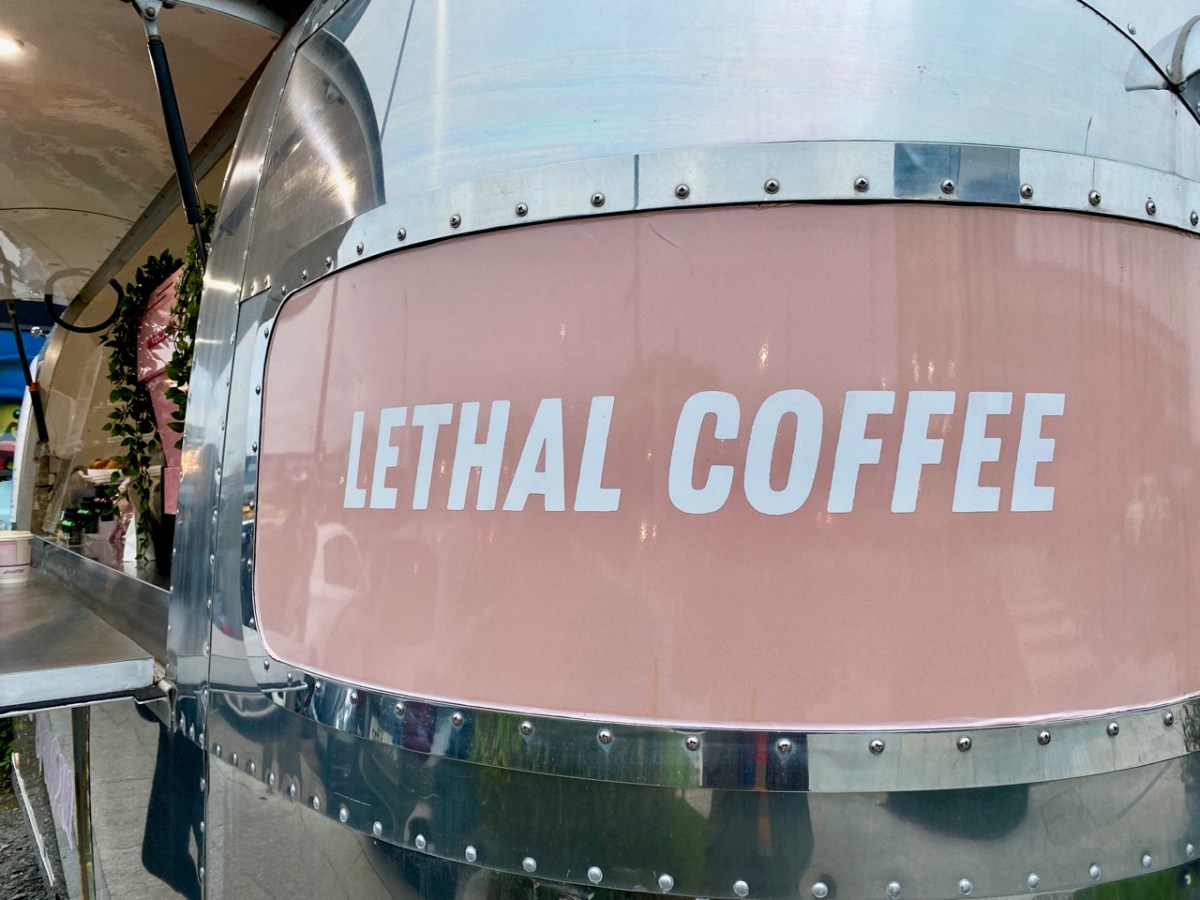
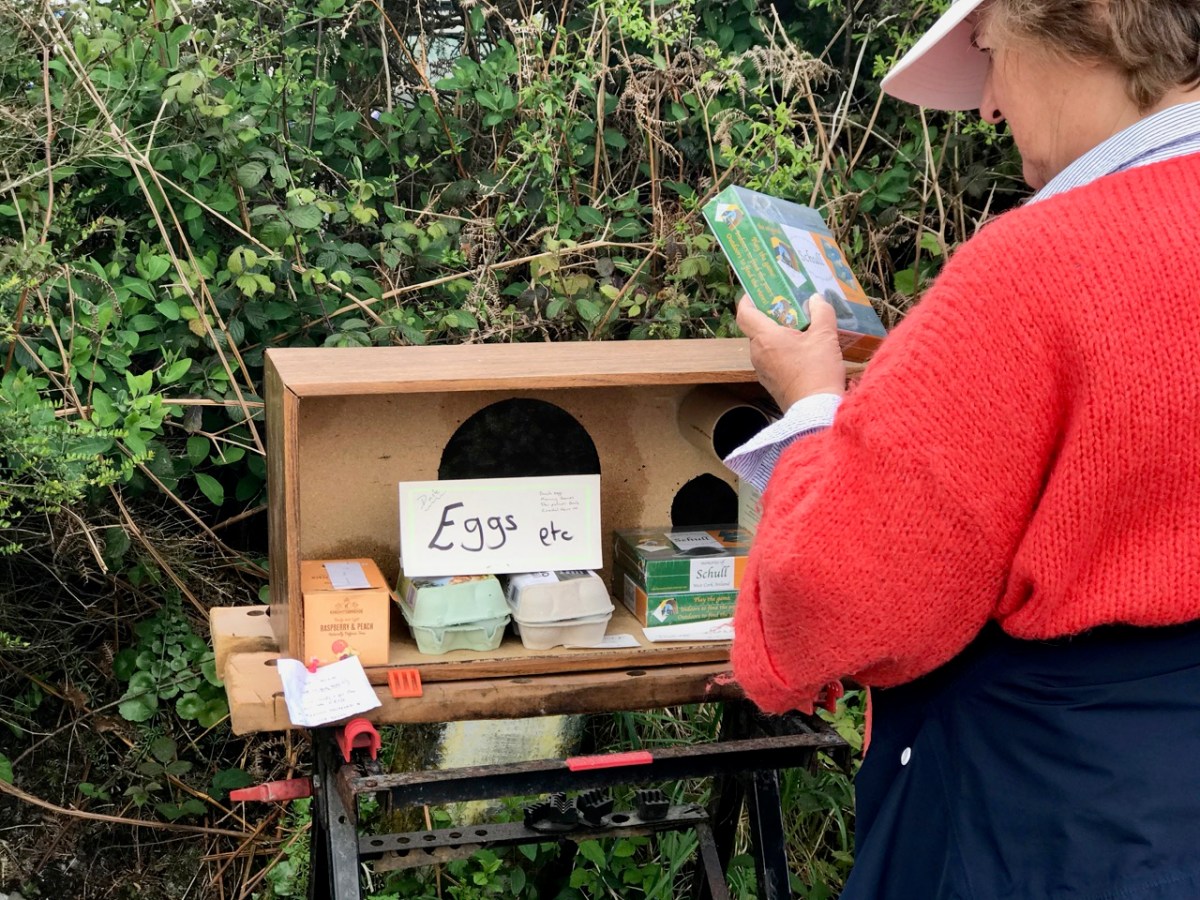
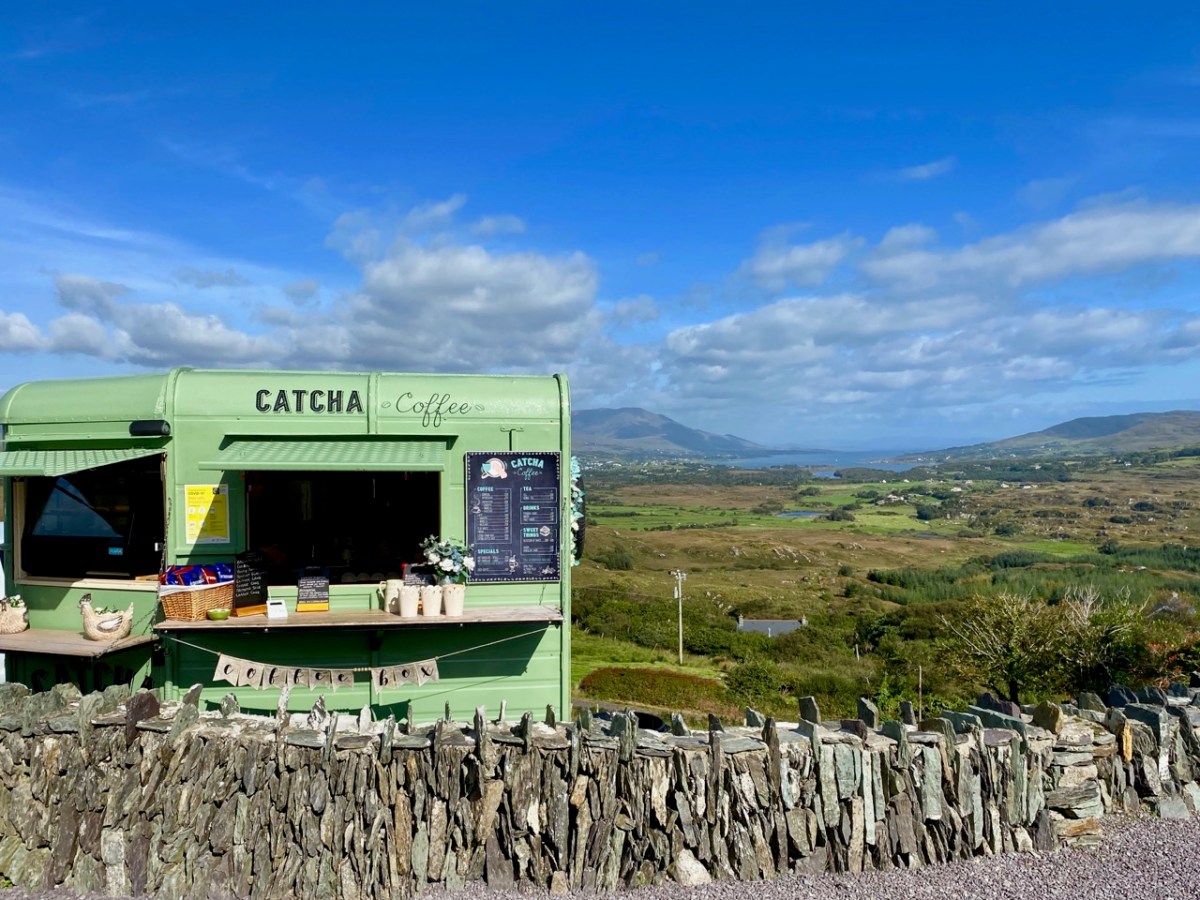
We humans are pretty adaptable. It was amazing to see the ingenuity of folks creating outlets for their energies without having to mix. Food-on-the-go blossomed as a craft industry: here are some examples.
We were very impressed with many of the examples we encountered – and which have survived over the months. Hopefully they will carry on, as casual coffee stalls in the middle of nowhere are welcome to us in our travelling. Pre-pandemic they were probably frowned upon by ‘the authorities’ – and they are certainly regulated – but ‘authority’ would have had to be very hard-hearted to close down these little lifelines. In our experience, every one we encountered was well-run, and spotless. It was an incidental opportunity to have a distanced ‘chat’: always a source of good local information on how others were coping.
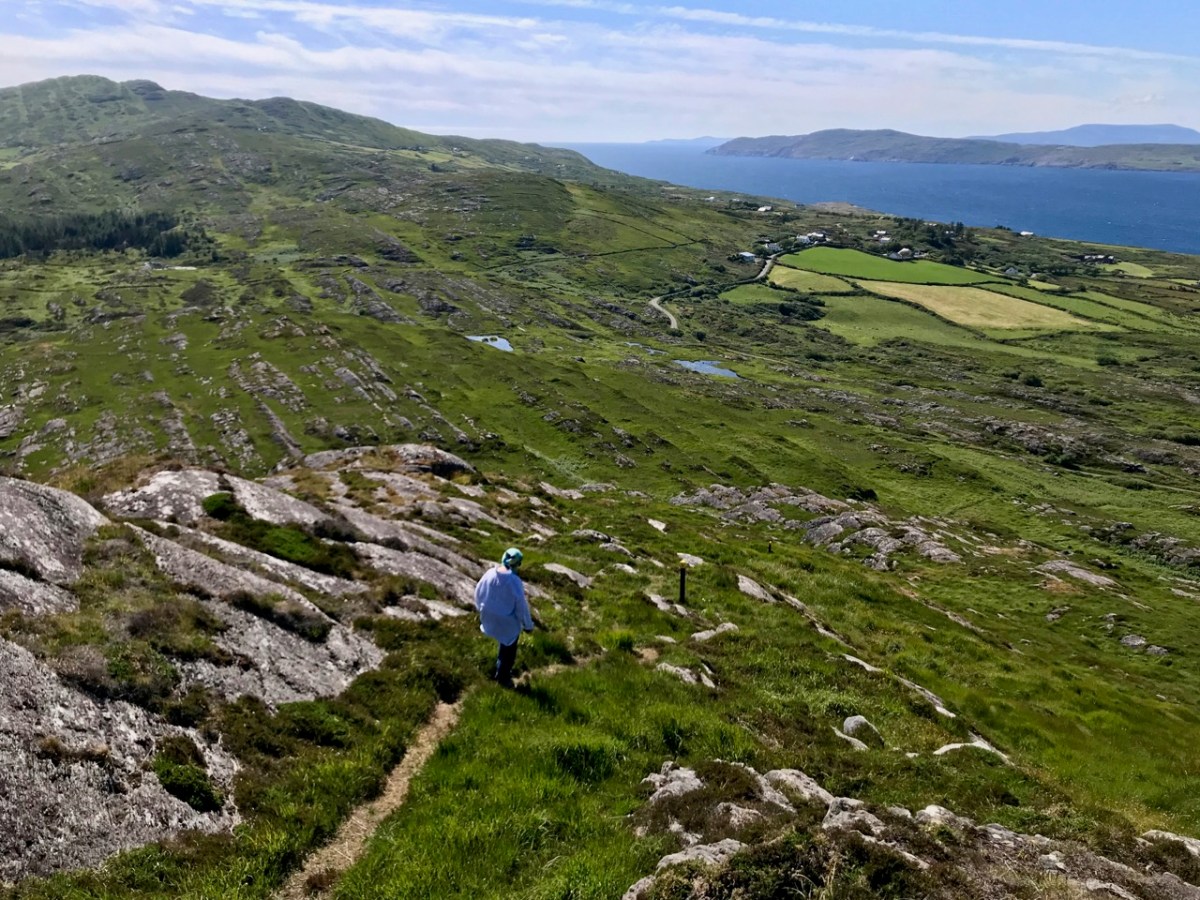
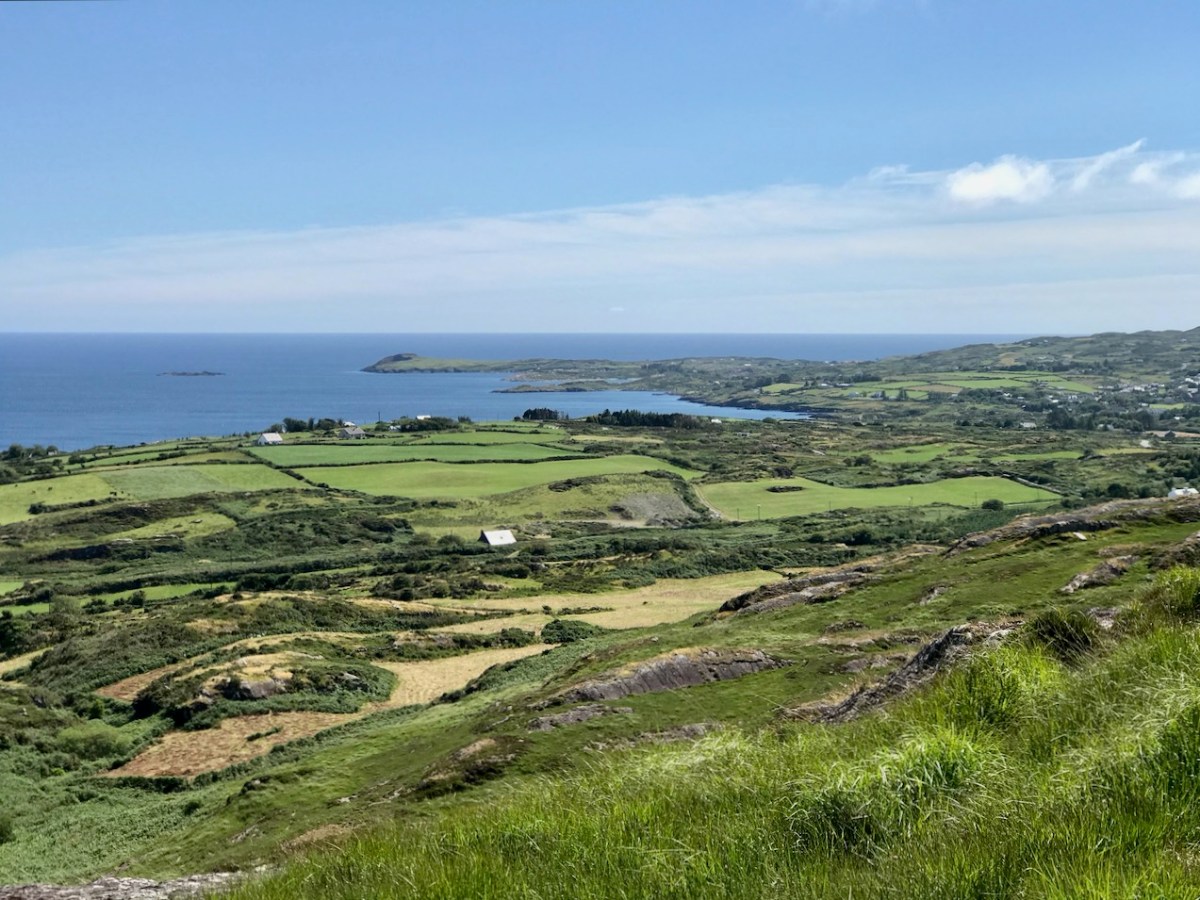
We took the opportunity to climb – and descend – Knockaphuka during the pandemic. It’s a mountain a short distance from Nead an Iolair, but a little outside the limit. No-one was watching! I suppose being restricted to our immediate environment for so long – day after day – made us re-assess it, and our lives. Certainly we have got to know the fine detail of the beautiful place we call home.
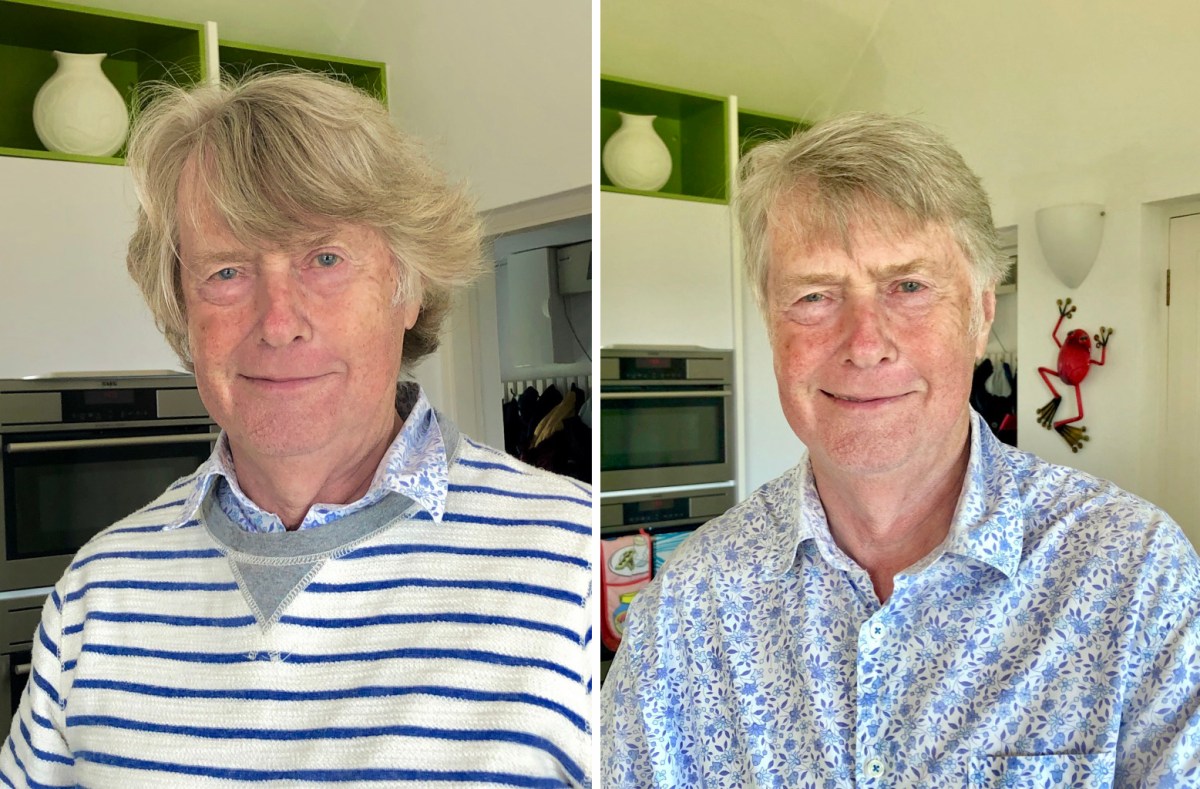
Here’s a social issue: we couldn’t get a haircut for months! Finola kept me in trim, but it was a relief when salons were once again allowed to operate, albeit with some restrictions.
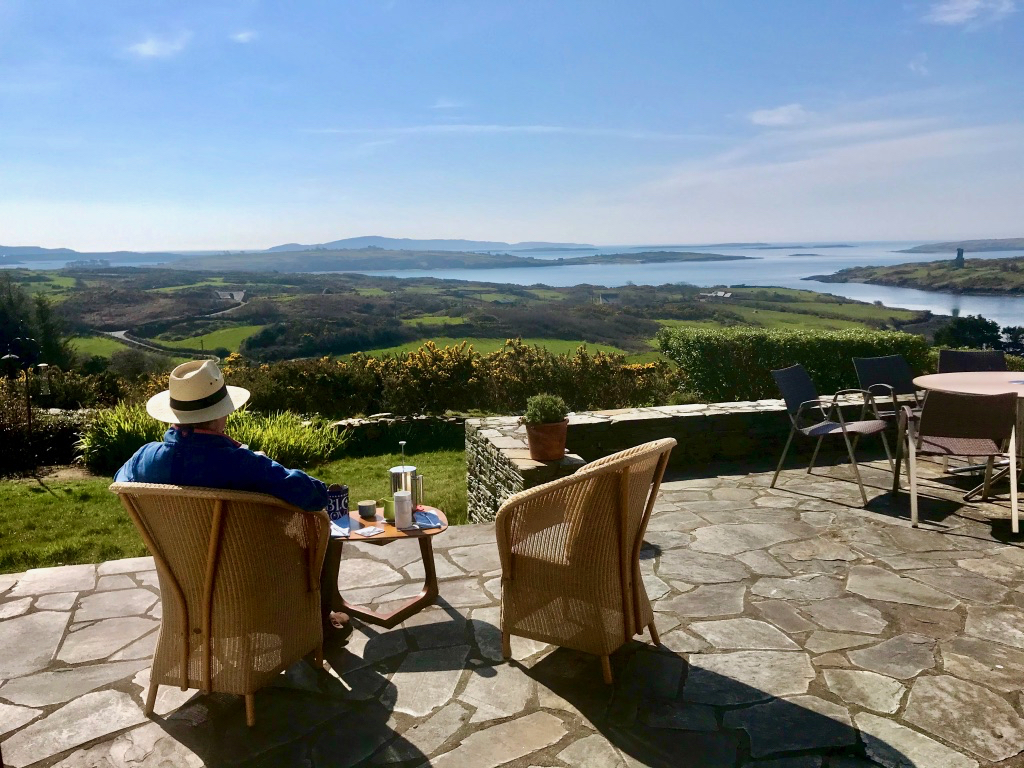
This is us having coffee on our own terrace, looking out over Roaringwater Bay in the wonderful spring of that first pandemic year. In fact, each of the two last years has been benign – with a few exceptional winter storms. We would have felt less relaxed if we had had persistent rain (which sometimes happens).
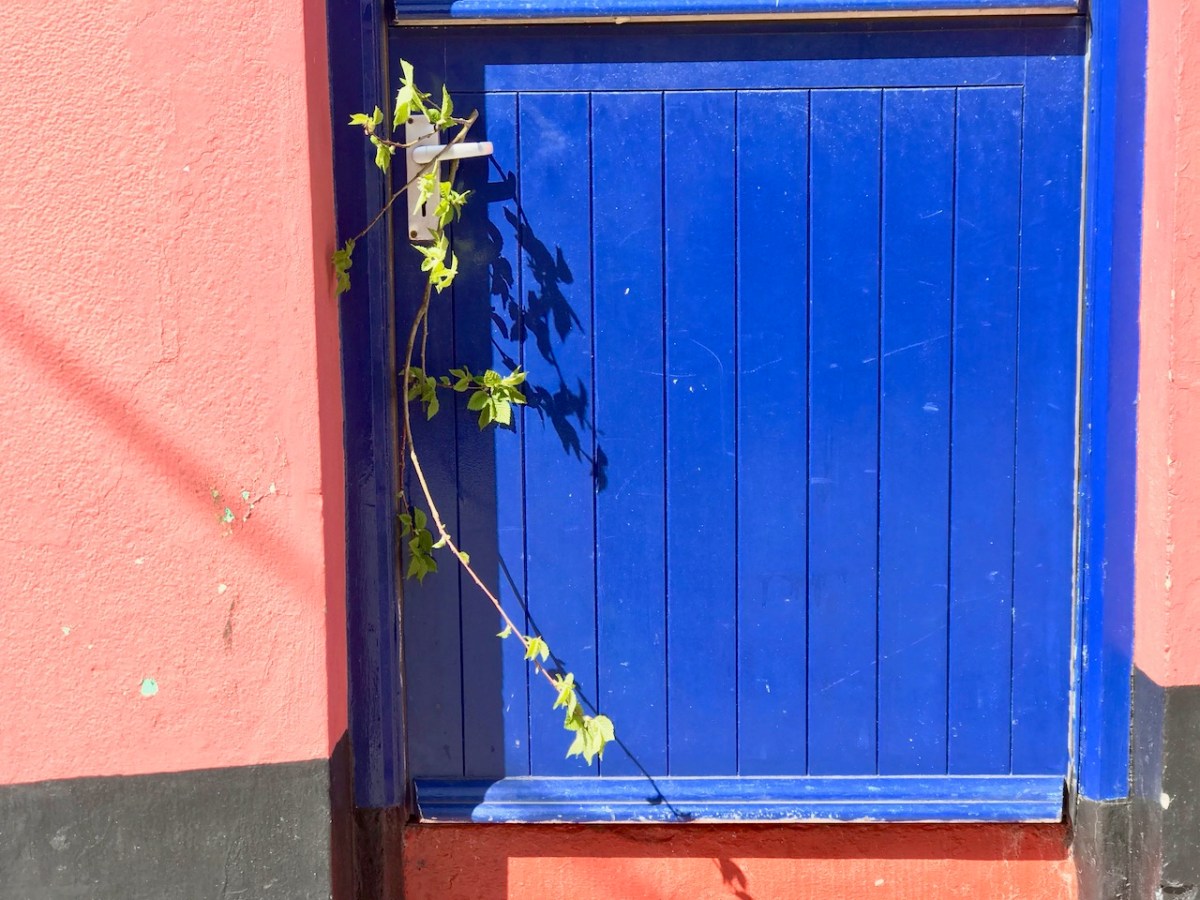
A sprig of green appears on a doorstep on May Day, 2020: a sign that we all still want to continue the old (perhaps ancient) traditions… There were ups and downs: things eased as the year went by and then the new variations came in. Numbers went down and we breathed out. Then they soared – especially with the Omicron variant, and everything went haywire again. Let’s hope that the present easing is here to stay. But the future can never be told…
Welcome to the UCD Library Cultural Heritage Collections blog. Discover and explore the historical treasures housed within our Archives, Special Collections, National Folklore Collection and Digital Library














 Roaringwater Journal