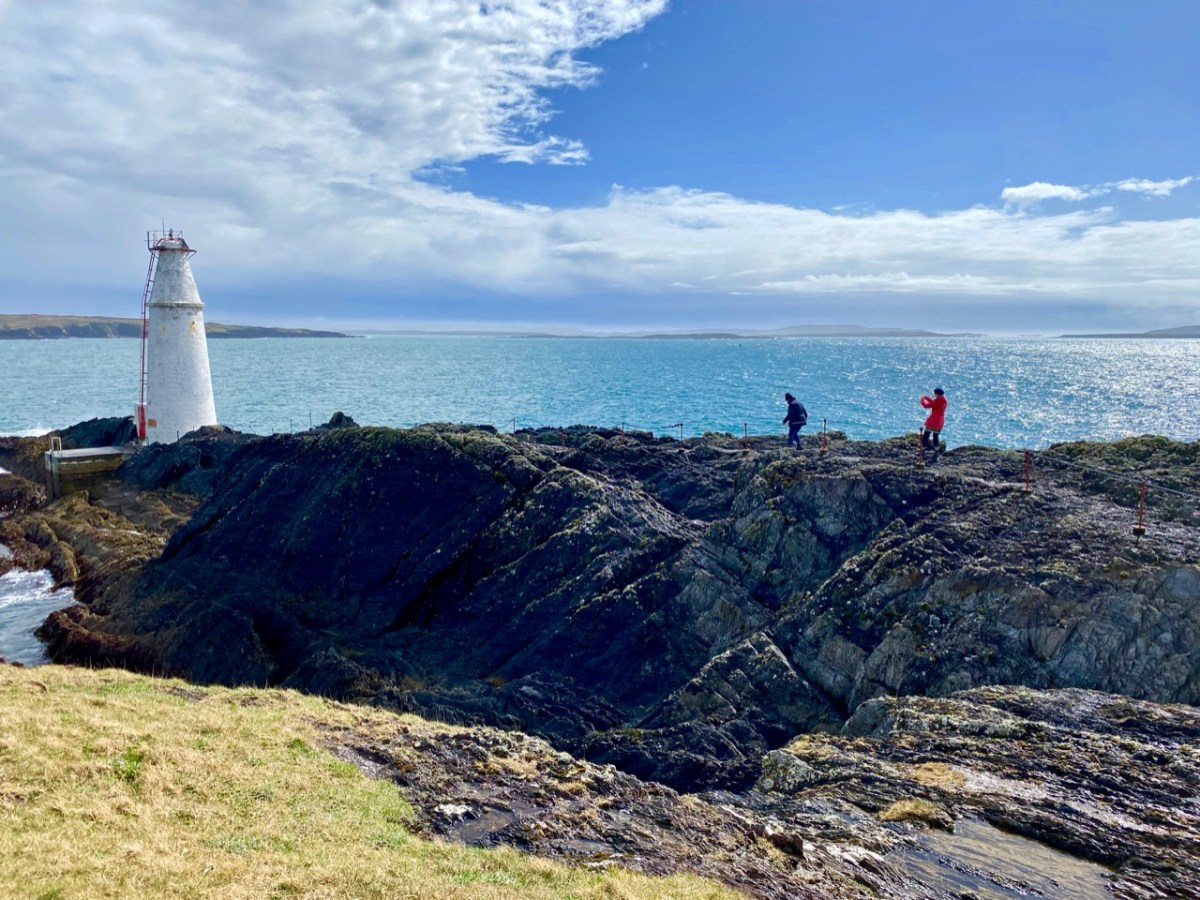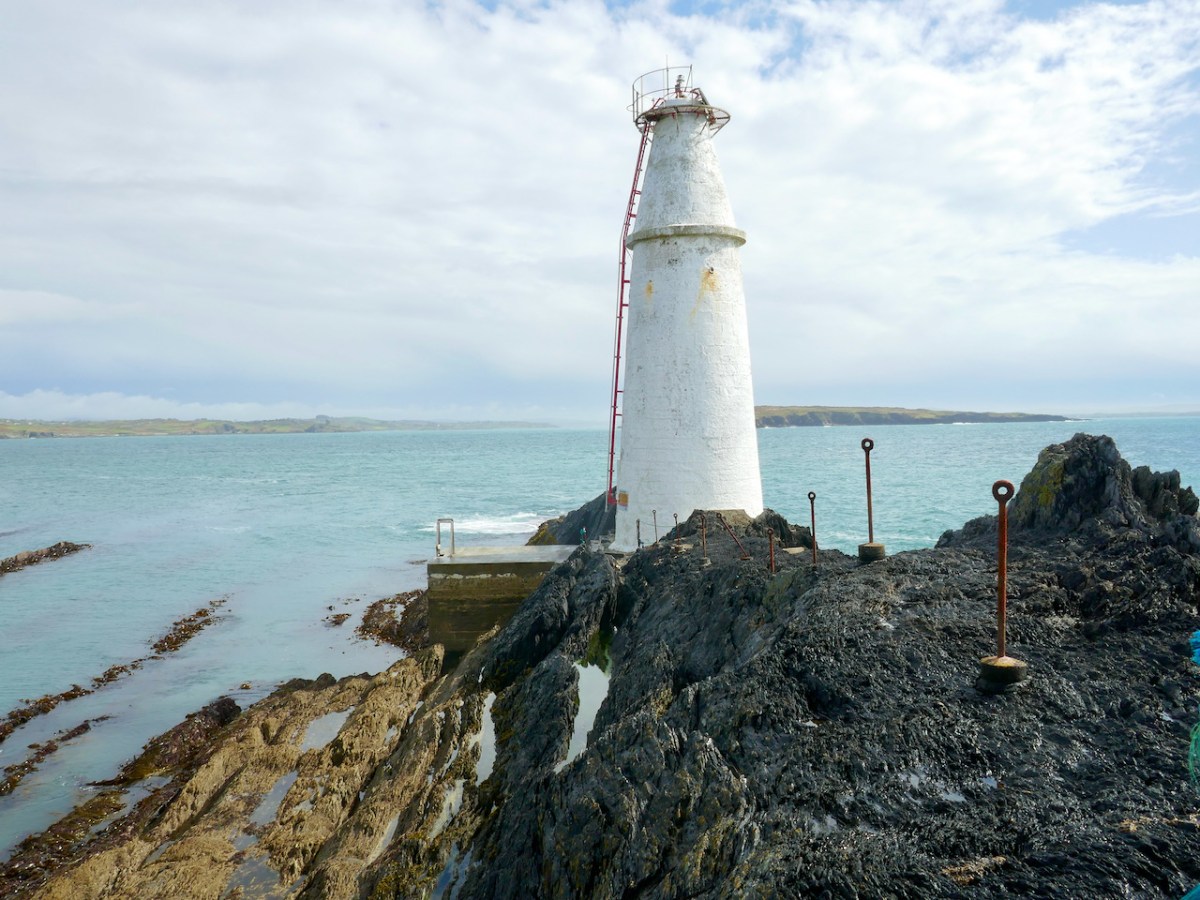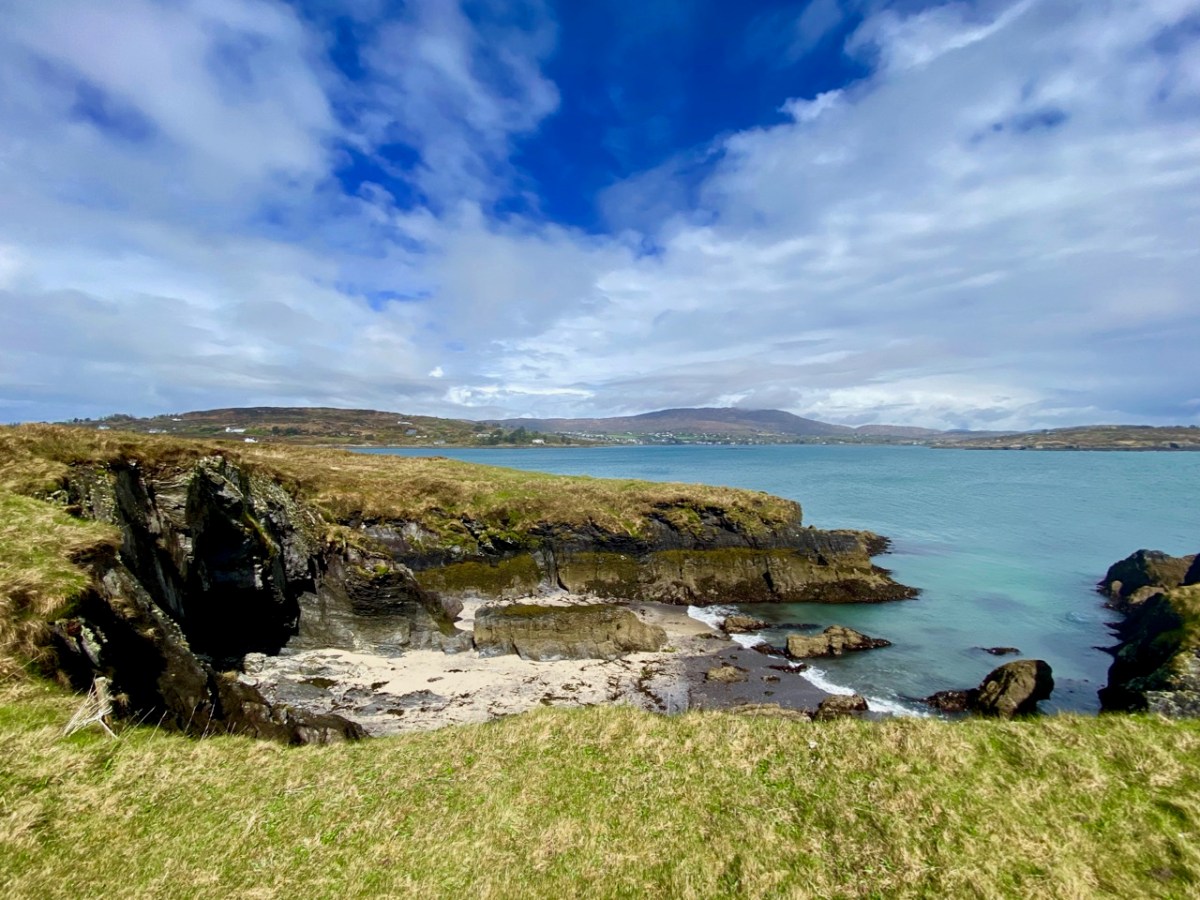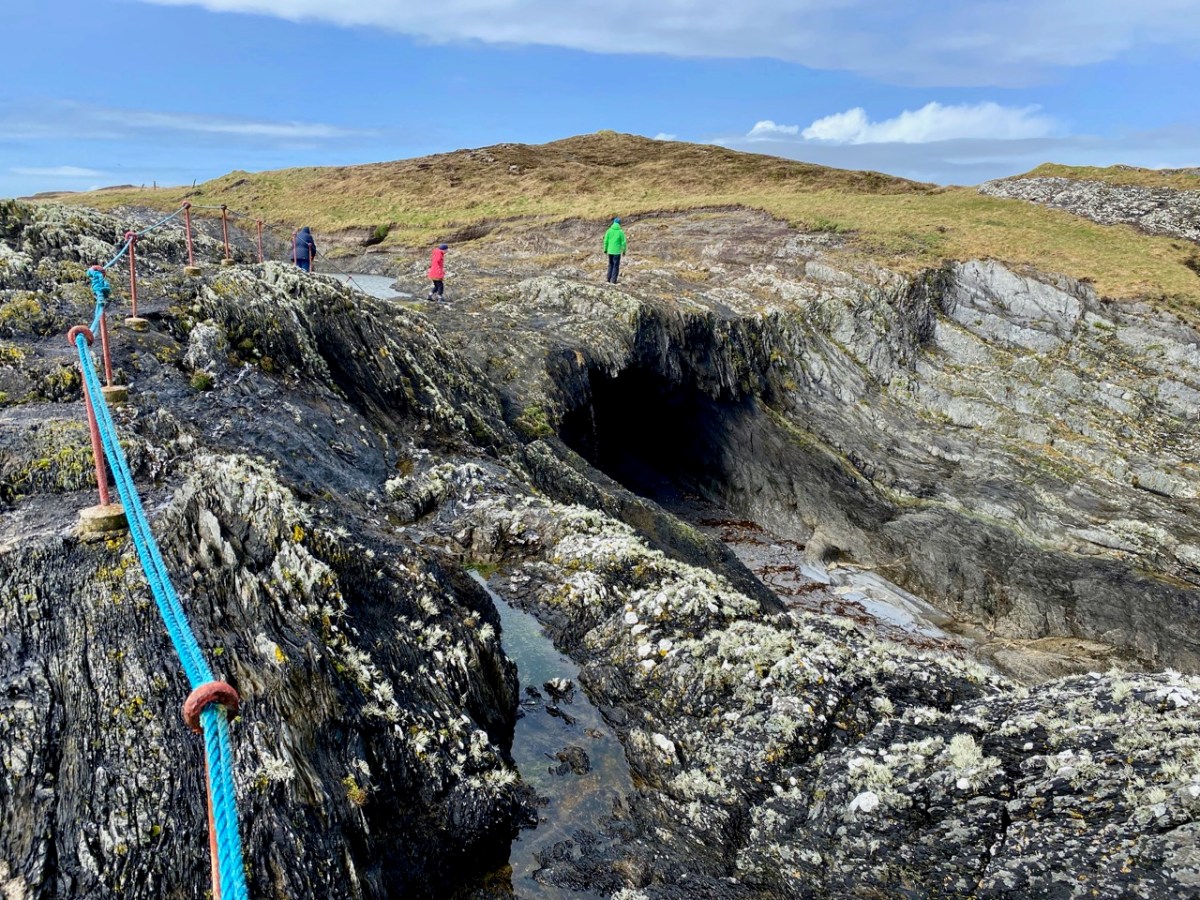
The Castles of Ivaha: ‘Fragmentary Remains’

What can you say about a castle where only fragments remain of the original structure? Turns out – a surprising amount!

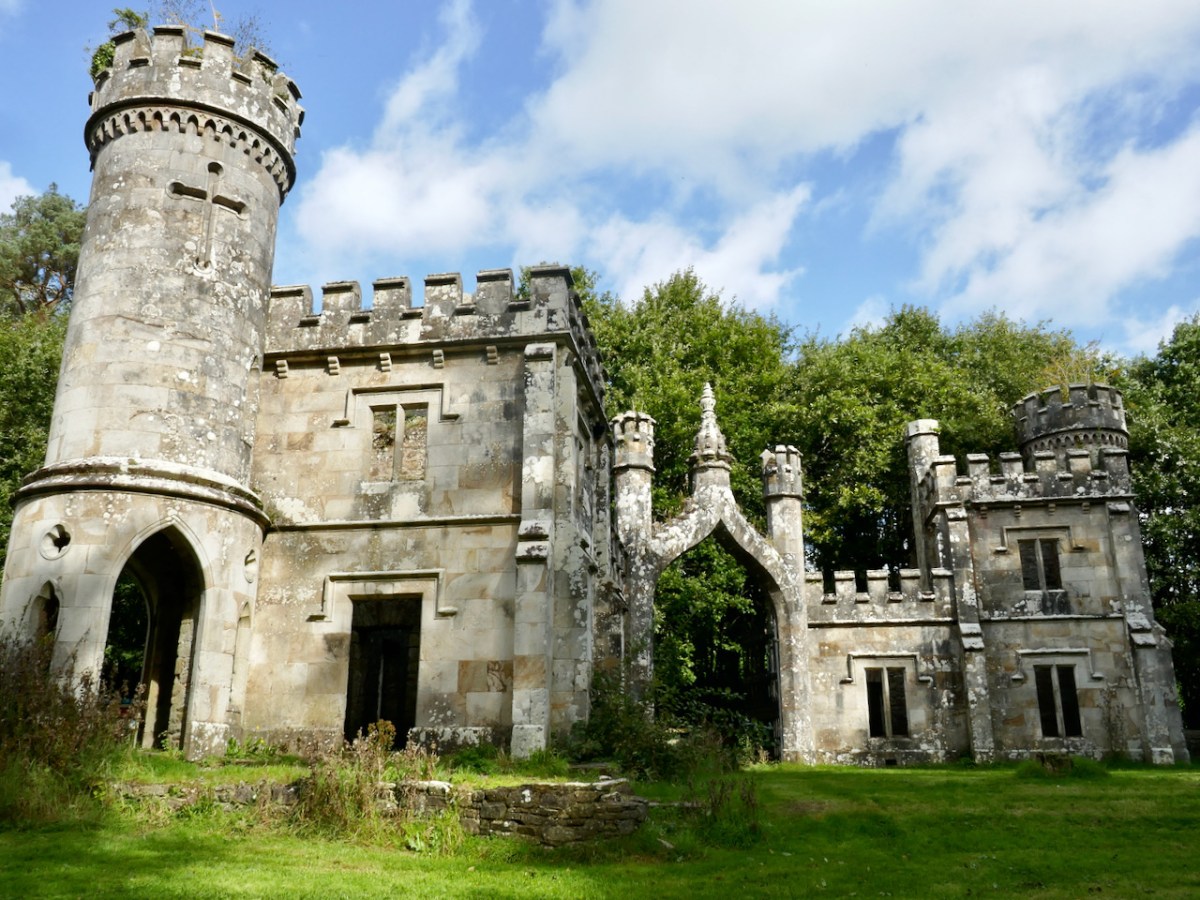
Fragmentary remains is the phrase used in the National Monuments record to describe the two castles which are the subject of this post – Dunbeacon and Castle Island. In each case only enough is still standing to confirm that it was indeed a medieval tower house. Fortunately, in the case of Dunbeacon, there is also historical evidence. 

Let’s look at Castle Island first, and begin with the name. Samuel, in his thesis on The Tower Houses of West Cork, tells us that it was known locally as Castleduff, or Caisleán Dubh, the Black Castle. However, this was the name more commonly applied to Black Castle/Leamcon, so he says there might be some confusion there. There is no other name in the historical records – no mention, indeed, at all. Perhaps it was too insignificant to merit a mention – a fortified outpost rather than the high-status residence of one of the ruling O’Mahonys. 

We have noted with other of the O’Mahony castles that they were built on the site of a ring fort (Ardintenant) or a promontory fort (Dunlough). The National Monuments records notes a promontory fort at this site, although it is not obvious on the ground any more. There are, in fact several promontory forts noted on Castle Island, perhaps indicating that this was the preferred type of fortified dwelling here, since there are no ringforts.

Like all the O’Mahony castles, it was strategically sited – it was beside the waters that separates the island from the mainland, and within sight of two other castles – Rossbrin and Ardintenant. The three form a triangle that overlooked and guarded the sheltered waters of Castle Island Channel. But also, from the top of the castle, there would have been a clear view south across the low land in the centre of the island, out to Roaringwater Bay.

We know that these waters would have been crowded with Spanish, French, Portuguese and British fishing boats, coming in to salt their catches in the fish palaces along the coast and to replenish their supplies. For all of these services and for permission to fish around Roaringwater Bay they paid hefty fees to the O’Mahonys, who got fabulously wealthy as a result. 

The castle was much smaller than all the others. Samuel says, 

Working on the assumption that Castleduff was an RE tower house [i.e Raised entry], its smallness is striking. The surviving ‘end wall’ makes possible a reasonably accurate estimate of the plan’s original length. It is assumed that like its neighbours, its plan had a length-to-breadth ratio of 3:4 to 4:5; the ratios suggest a length of 7.96-7.46m (measures above the base-batter). The surviving north wall probably represents the full length of the ground-floor chamber.

Mark Wycliffe Samuel
the tower houses of west cork

The only surviving opening is a loop in one wall, and a row of corbels that would have supported the first floor is still visible. There is no trace of anything that might suggest a vault, so it is possible that this small tower was unvaulted – Samuel thinks that the walls are noticeably thinner than the other castles, implying that this was a much simpler and shorter tower.

Samuels concludes his study of this tower by saying:

The jetty is modern, but the beach that it is laid upon was the best natural landing point on the island, well sheltered from the Atlantic swell. The landing clearly determined the siting of the tower house and was an important resource to the family that built the tower house. It is tempting to see a direct continuity between the recent settlement and a settlement around the tower house. Only excavation could determine if this was the case.

Mark Wycliffe Samuel
the tower houses of west cork

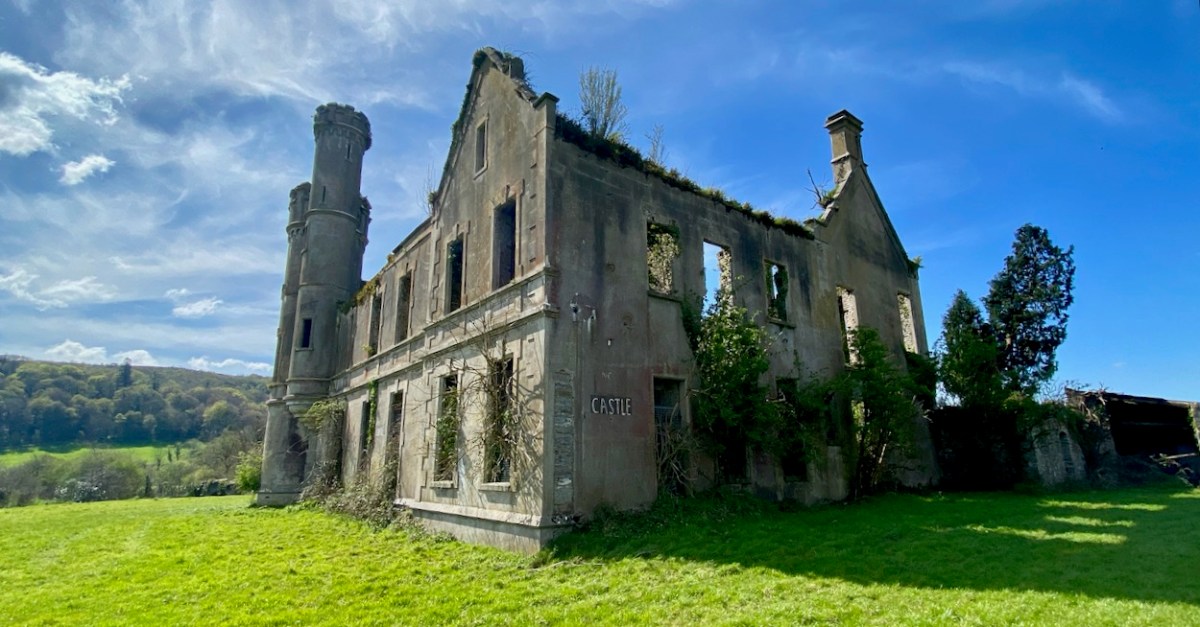
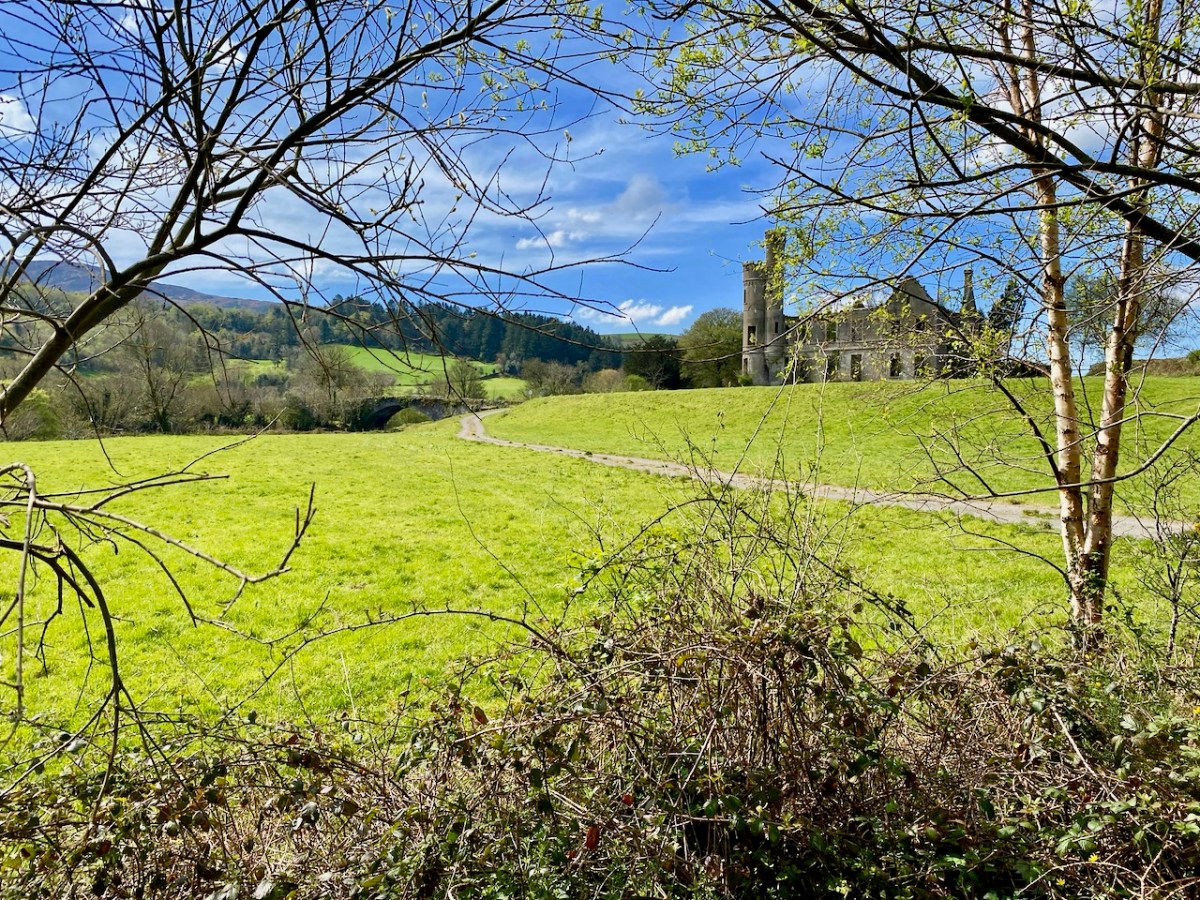
Dunbeacon (images below) is even more vestigial than Castle Island, but fortunately we do have some historical evidence for it. The name could mean Fort of Beacan – where Beacan is the name of a chieftain. However, it could also mean The Fort of the Mushrooms – since the Irish word for mushroom is beacán. I like to think of the chieftain and his lady chowing down on a plate of eggs and mushrooms for breakfast.

As with Castle Island, there are signs that the castle was built within a former promontory fort, also underscored with the name Dún, which means fortress. A fosse, or ditch, cut through the rock, is all that remains of the fortifications of that promontory fort.

The majority of the O’Mahony tower houses in Ivagha were built by or for the sons of Conchobar Cabach. Dunbeacon castle was allegedly built by his brother Dohmnall. This seems to be a traditional rather than documented attribution. If it is assumed that Dohmnall was born c. 1400, he may have built the tower house at any date during his adult life (c.1420 to c.1470).

Mark Wycliffe Samuel
the tower houses of west cork

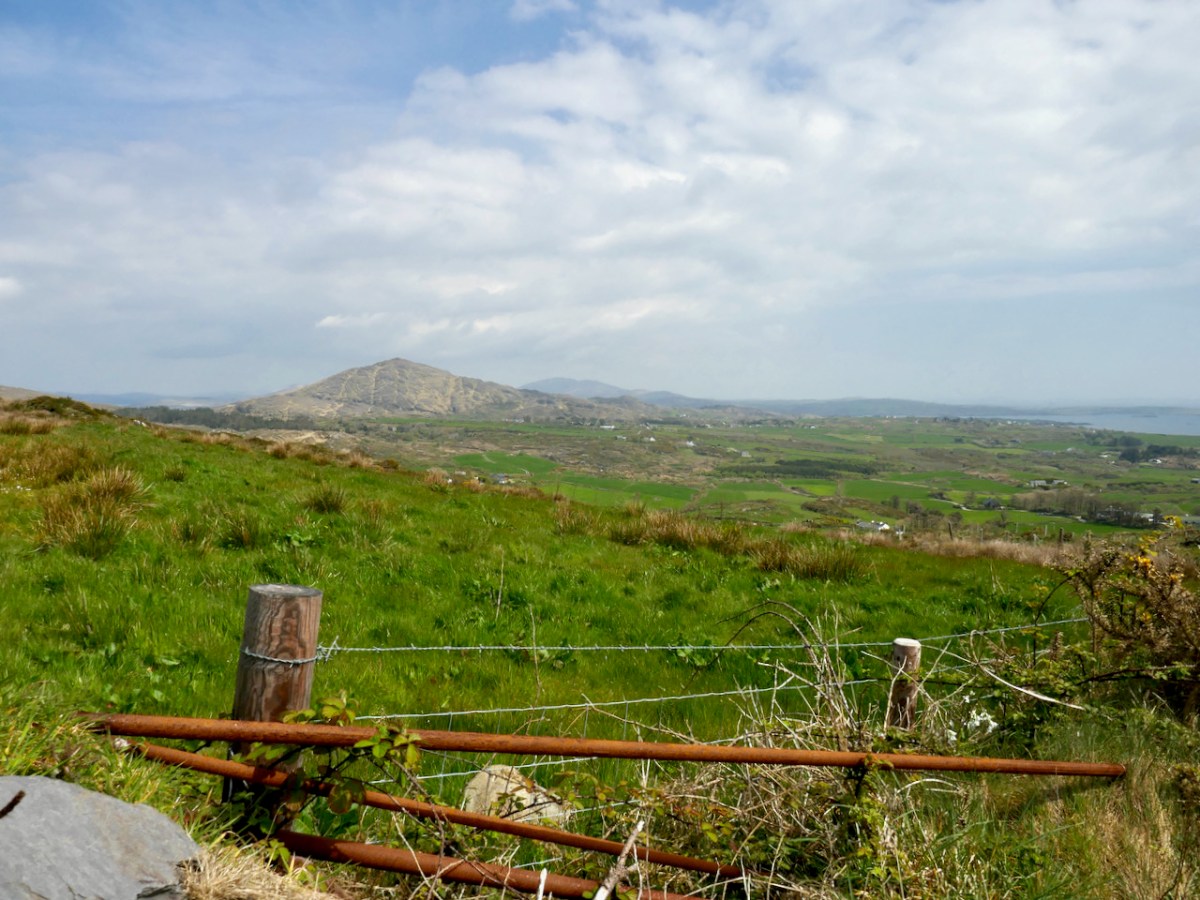
The siting is magnificent. From it, there is a clear view of the whole of Dunmanus Bay, right to the end of the Ivaha (Mizen) and Sheep’s Head Peninsulas. This, of course, also meant that it bore the responsibility, along with Dunmanus, of defending O’Mahony territory from attack or incursion on the north side of Ivaha. The pro-English Owen O’Sullivan of Beara, for example, is known to have conducted cattle raids on the lands surrounding Dunbeacon.

Samuel tells us that the chief of Dunbeacon, Domhnall O’Mahony, forfeited his lands as a result of his participation in the Desmond Rebellion, and it became a ruin – beautifully captured in Brian Lalor’s sketch, above.

The tower house and four ploughlands were confiscated, and passed into the possession of an English settler who probably built a timber house to the east. The O’Mahonys did not attempt to reconquer the lost part of their pobol; instead they contented themselves with attacking and burning the tower house, an event recorded in a letter written by an English judge in 1588. The tower house probably remained a ruin.

Mark Wycliffe Samuel
the tower houses of west cork

The O’Mahonys regained possession of their Dunbeacon lands but lost them again when they were granted to an English settler. See my post Planning a Plantation: Jobson’s 1589 Map of Munster Part 1 and Part 2 for how the land was mapped preparatory to the Plantation of Munster. As you can see above, Dunbeacon (or Donbeken) was clearly marked out for colonisation. William Hull came to own it at one point, and even the conniving ‘lawyer’ Walter Coppinger laid claim to it – as he did with much of the O’Mahony and O’Driscoll territory.

Although so little remains, Samuel’s careful analysis indicates that Dunbeacon was probably a typical raised entry tower house, with a vault supporting the third floor which held the principle private chamber. See my posts on Ardintenant  and Black Castle for what it may have looked like.

It’s hard to look at ‘fragmentary remains’ and think of them as vibrant centres of life. Yet, these two castles were once part of the mighty O’Mahony federation – a large network of connected families that ruled Ivaha and the surrounding seas. Sic Transit Gloria Mundi

Irish Artists and Stations of the Cross

Every Catholic Church in Ireland has a set of Stations of the Cross on the wall – fourteen focus points for devotion and reflection on the Way of the Cross. The Stations, as they are universally known in Ireland, come from a long tradition within the Catholic Church, often associated with St Francis, but also with the Via Dolorosa in Jerusalem, and the custom that Pilgrims had of retracing Jesus’ footsteps on the way to Calvary.

Most Stations appear to have been ordered from a catalogue and all look similar, painted in an Italianate Renaissance style and framed in wood. The image above, of one of the stations in a rural church in Cork, is typical.

However, architects, priests, and parish committees sometimes took the bolder step of commissioning Stations from a contemporary artist. The lead image and the one above are both from sets of Stations by Richard King. The lead image is the Deposition (Christ taken down from the Cross) and is in a small church in Foilmore in Kerry, while that immediately above is from Swinford, Co Mayo, as is the one below – a painting that focuses ferociously on the suffering of the crucified Jesus.

This was an important source of income for artists from the beginning of the new Irish State. While we don’t often think of the Catholic Church as a patron of the arts, in practical terms it functioned as such for many painters and sculptors. In fact it is hardly an exaggeration to say that the church was the largest commissioner of contemporary art in Ireland during most of the twentieth century. 

Galway Cathedral is a showcase for twentieth-century artists and all fourteen Stations were carved in portland stone by Gabriel Hayes. It took her eighteen years to complete them and she called them ‘the main work of my life.’

Certain architects – Liam McCormack, for example, or Richard Hurley – considered each aspect of their design and included specification for contemporary art. Some indeed, like Eamon Hedderman, worked closely with artists to plan a church holistically, incorporating the art into the integral fabric of the building. A magnificent example of this can be seen in the Church of the Irish Martyrs in Ballycane (Naas) where large-scale graphic stations designed by Michael Burke are surrounded by contemporary glass by George Walsh.

Many of the Irish artists familiar to us from the 20th century catalogues have contributed Stations to churches around the country – sometimes to the large cathedrals but often too to obscure country parishes where the priest (it was usually the priest) wanted something more than a standard imported set. Sean Keating‘s Stations for St John’s Church in Tralee (both images below) are arresting in their drama and strong character studies.

Stations come in many media and I have tried to show a variety in this post by well-known Irish artists. Bath stone was the medium of choice for Ken Thompson – the image below is of one of his stations for St Mel’s Cathedral in Longford. Below that is a Station from Ballywaltrim Church in Bray by the Breton/Irish Sculptor Yann Renard Goulet, although I am not sure what the material is.

Patrick Pye is more commonly associated with his stained glass windows for Irish churches, but his painted Stations for the Church of the Resurrection in Killarney (below) bring a quietly beautiful reflective focus to a contemporary interior.

Sean O’Sullivan was known primarily as a portrait painter, but he also designed Stations, such as the ones below for the church in Newquay in Clare. Using only pencil and colour washes, he has produced powerfully emotive scenes (below).

Stations, however, are often unsigned and so our old friend Anon is responsible for many. A future post will include some of his or hers. The enamel Station below, for example, may be by Nell Murphy, but I can’t confirm this, so Anon it is, for the moment.

I am also planning a post on Stations done in stained glass – they are some really beautiful example, starting of course with Harry Clarke’s Lough Derg windows. But this post will start us off with some of the examples I have seen in churches around the country – let’s call it an Introduction to Irish Contemporary Stations. I’d love to hear from readers who have their own favourite set. And if anyone knows the artist responsible for the Stations in the Franciscan Church in Wexford (example below), do let me know!

What’s in a Word?

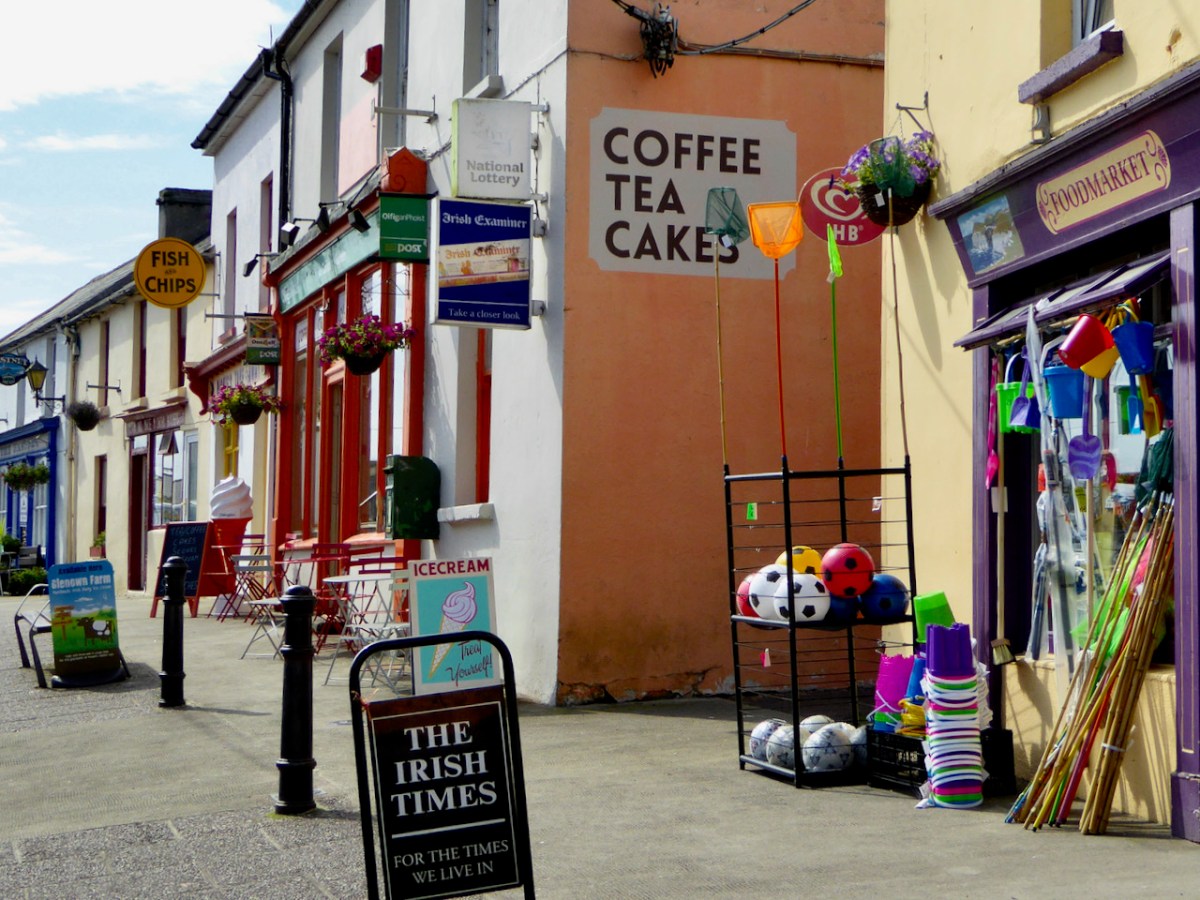
We live in a world full of words. I can’t resist them – particularly when their context shines a humorous – or puzzling – light on them. Not just signs with words on them: sometimes it’s images – shopfronts – posters – that make you stop and have a second look. But then, I probably have a very particular sense of humour. I have every respect and good wish for the residents of Cheekpoint and Faithlegg, for example, but juxtaposed on the Waterford road sign they are eye-catching. Pointe na Síge is the ‘place of the Shee’ (or fairies), while Fáithling was the first parish name to be established following the 12th century Norman conquest: as far as I can make out, it derives from the term for ‘a wooded area’.

A ‘word wall’ signed by its author is from Wicklow (above). But we have encountered many examples of less formal poetry: I won’t call it graffitti . . .

It doesn’t really matter, I suppose, how legible the message is: as long as it has made you stop to take a closer look it’s been effective. Or reflective . . .

Sometimes they are simple, like the one above. I wonder if this next one is a mathematical formula?

Shopfronts have to be eye-catching and arresting, of course, to draw you in. There are witty examples everywhere.

One has to admire the entrepreneurs – of all persuasions.

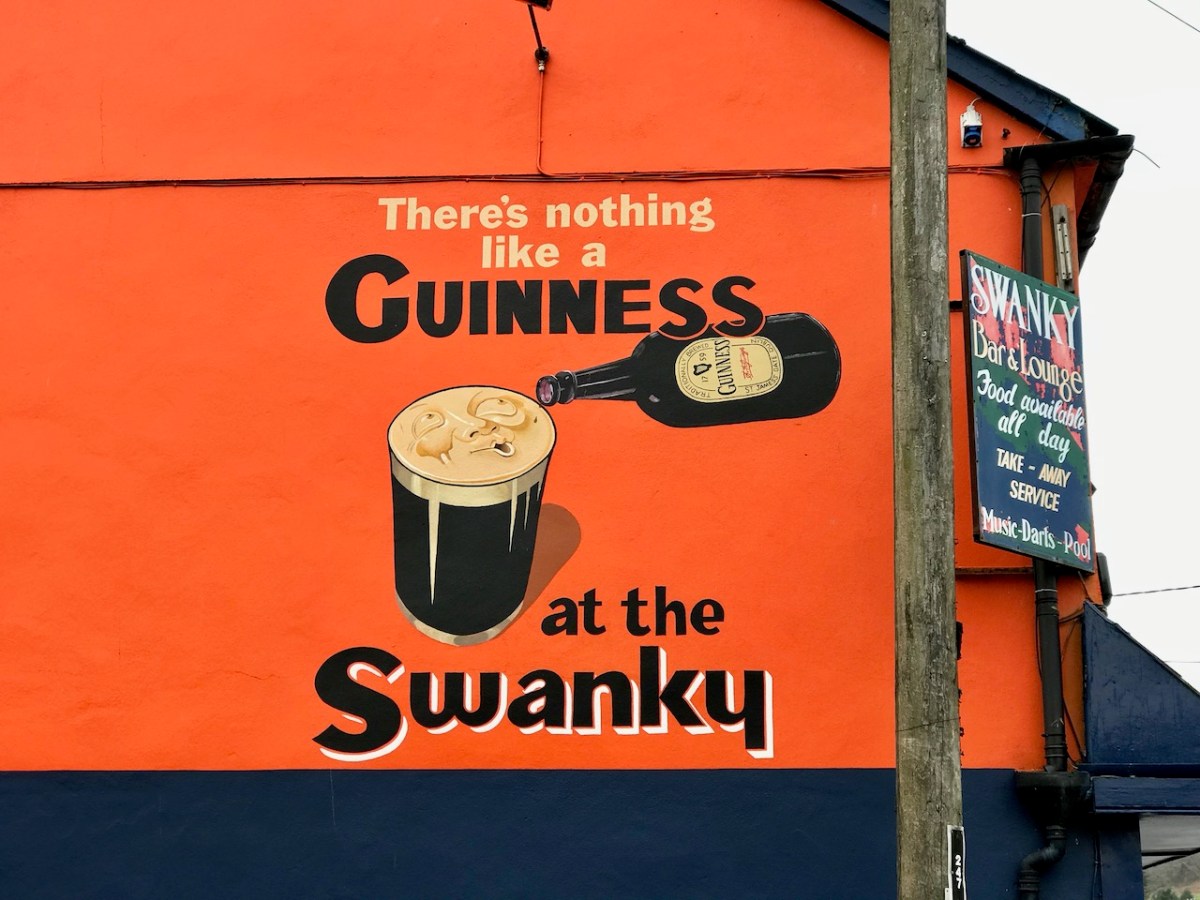
in my distant youth – when I was learning to read – my go-to’s were the large, colourful, Guinness posters at the bottom of our road. I am pleased to see that many of those images haven’t gone away – even after seventy years!

While all that is, intentionally of course, a stirrer of nostalgia in us – there are many more of our own time worthy of study.

Finally (for now) we just found this old petrol pump hidden around a corner. Who remembers those days when an attendant had to come out and fill you up . . . and it was all done in gallons, shillings and pence?

Postscript . . .

Wicklow by the Sea

If you can’t be in West Cork – what’s the next best place? Why – County Wicklow of course! It’s also full of wonderful scenery and imbued with Irish history. That’s Wicklow Town, above, in Viking times: there had already been a Bronze Age settlement on this site. In the twelfth century the Normans arrived, led by Strongbow, who we have encountered before, and Black Castle was built (below). They were wild times, and the castle was attacked and destroyed completely in 1301 by local chieftains, notably O’Byrnes and O’Tooles. There were several subsequent revivals, and the gaunt remains we see today probably date from the 17th century.
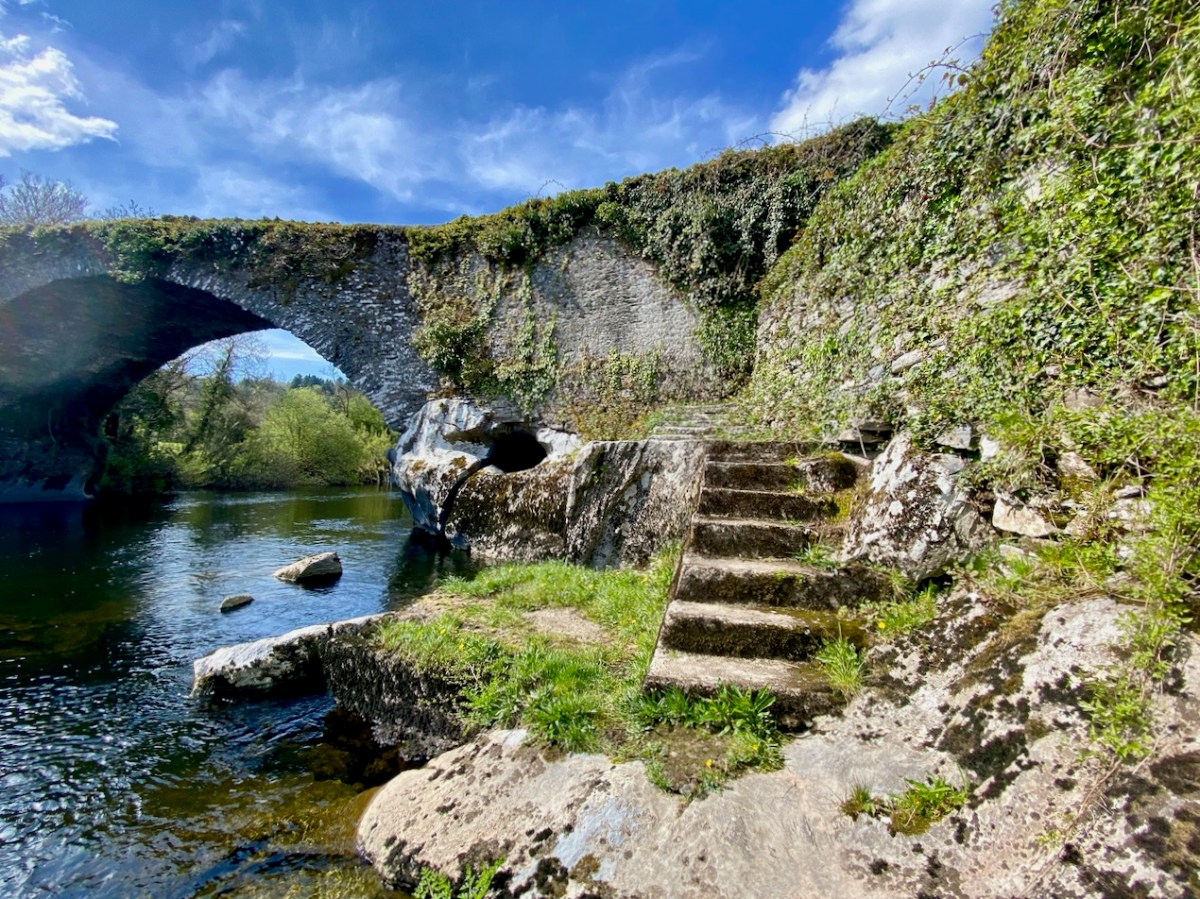
While at this site, have a look down at the inlet on the coast to the south: that’s Travelahawk Beach, the scene of a bit of Wicklow history that’s sure to stick in the mind. It was there that St Patrick first landed in Ireland!

I have to admit that the beach is only one of several sites on the east coast that lays claim to this historic occasion, but I like the associated story of Travelahawk which tells how the local people, suspicious of this stranger, threw rocks at St Patrick and his crew. One of them hit the saint’s companion, and he lost his front teeth. He was known ever after as ‘Gubby’ or ‘Gap-toothed’ which is translated in Irish Mhantáin. Hence the old name for Wicklow is ‘Chill Mhantáin’ – the Church of Gubby. Today’s name for the town, Wicklow, is of Viking origin, and means ‘Bay of the Meadows’.

We popped over to Wicklow on a mild February day for a change of scene – and to absent ourselves from Nead an Iolair while some upgrading works were taking place. I was impressed: I had never explored the town before. Finola, however, was brought up in County Wicklow, and her impressions of the county town today were embellished with memories of times past. There’s much about the place that’s picturesque: I was taken with the number of painted murals about the place. The pier has, appropriately, a whole series of ships on the breakwater wall. There is an example, above . . .

. . . And here’s another. In fact, this one is the 50th mural to be painted by Pat Davis, who is the local postman. Each one depicts a vessel which has visited the harbour. It’s a wonderful and colourful record of one aspect of the maritime town’s history.

Here’s Pat at work. The image is courtesy of Ceaneacht O Hoctun, and appeared in the Wicklow People newspaper in 2020. Pat started painting the ships in the 1970s.

This one will be familiar to West Cork folk. It’s the Saoirse, a 42ft ketch built in Baltimore in 1922 for her designer, Conor O’Brien.

. . . This unique sailing ship was also a maritime inspiration for the new Ireland, uncertain of itself in an uncertain world. For this was Conor O’Brien’s characterful 42ft ketch Saoirse, which he designed himself, and with which – between 1923 and 1925 – he pioneered the round the world route south of the Great Capes, an ocean voyaging “first” which was forever written into world sailing history. . .

Afloat.ie

When O’Brien returned from his record-breaking voyage in 1925 he made his first landfall in Ireland in Wicklow Harbour. O’Brien designed a larger version of Saoirse to be the inter-islands communications vessel for the Falkland Islands: this – the Ilen – was also built in Baltimore. Back in 2015 we visited Oldcourt boatyard on the Ilen River to see the restoration of the larger ketch, which was then underway. That work was completed in 2018, and the same team embarked on a complete rebuilding of Saoirse, which had been wrecked in Jamaica in 1979. Our own West Cork photographer, Kevin O’Farrell has beautifully documented these projects at Oldcourt in his book, published in 2020.

The Asgard, above, was famous for gun-running at Howth by Irish Volunteers in 1914. Below is an Irish Navy vessel, LÉ Gráinne – a mine sweeper. Gráinne was a legendary princess who was promised to Fionn Mac Cumhail but ran away with his young follower Diarmuid. The ship was decommissioned in 1987.

We found that the town of Wicklow has so many maritime associations – everywhere you look there are reminders. But also it’s a thriving commercial centre and we were impressed by what is on offer there: great eateries, and a most wonderful bookshop. I think there might be another post in the making . . .

Black Castle, or Leamcon

This is the fourth castle in my series The Castles of Ivaha, and the final one which is intact enough to be able to describe in detail (although I may have more to say about those which are more vestigial). Not just intact, though – Black Castle has been superbly stabilised and saved for future generations by its owner, Niall Hyde. 

Niall, by the way, thinks the the term Black Castle is more historically accurate. He points out that there is, in fact, in the townland of Leamcon, about 2km to the northeast, another ‘turret’ marked on the old OS maps, which is the remains of a castle built by the notorious Sir William Hull. Black Castle is in the townland of Castlepoint, and its name neatly distinguishes it from White Castle, AKA Ardintenant. Both were built by the O’Mahonys.
James Healy’s drawing of Black Castle from his wonderful book The Castles of County Cork, Mercier Press, 1988

As I said in my post on Ardintenant Conor Cabaicc succeeded his father in 1427 and remained Taoiseach for 46 years, embarking on an ambitious program of construction to provide castles for his sons and brothers. This included Black Castle, which he built for his second son, Finín Caol (pronounced Fineen Kale), or Finín the Slender. This means that Black Castle was built in the period before Conor Cabaicc (Conor the Talkative) died, in 1473. This accords well with its architectural details, which place it among the fifteenth century ‘raised entry’ castles, similar to Ardintenant, Dunmanus and Dunlough

The best source material for all the castles of Ivaha is the thesis The Tower Houses of West Cork by Mark Samuel. Here’s what Samuel says about the location of Black Castle, which he refers to throughout as Leamcon. Leamcon, by the way, means Hound’s Leap, which Samuel suggests may refer to a legend about the gully across which you must pass to get to the castle.
The western part of the Ivagha peninsula, the territory of O’Mahony Fionn, is now sparsely populated. Away from the formidable Mizen Head, the ice-sculpted land meets the sea with low, rocky cliffs. In this part of the Survey region, the strike of the rock is almost south-west/northeast, the layers being tipped close to the vertical, the shore tends to be sculpted into long peninsulas and islands running along the strike. Exposed to the Atlantic, it is a wild treeless shore. The fields once densely fanned prior to the famine, are now mostly given over to pasture. The tower house stands far from any road at the west end of a long narrow peninsula. Erosion has nearly severed the tip of the peninsula; only a precarious natural bridge, now reinforced with concrete, joins it to the mainland. The island is large, the ruins cover only a small fraction of its area. The tower house stands towards the island’s east end at its highest point. The promontory is for the most part gentle in relief, being covered by grass-grown ‘drift’ deposits.
THE TOWER HOUSES OF WEST CORK
MARK WYCLIFFE SAMUEL, 1998

When Niall bought the property the bridge consisted of a few planks. It must have been a hairy business getting across to it until he built the concrete walkway you see today. Niall and his family spent their summers at the castle – can you imagine, as a child, what it must have been like to have your own castle to play and live in? Magical! Although I do think about what it must have been like for Dorothy, who spent the weeks there with the children while Niall worked in Dublin. How did she manage to feed them and keep them safe? A heroine, indeed.

Like the others I have described in detail, Leamcon is a raised entry castle. To recap – the ground floor entry gave access to the ground floor, and possibly by means of a ladder to the second floor and mezzanine. The raised entry gave access to the second floor, and then, by means of a strait mural staircase, the the floors above the vault. Take a look at the cut-away diagram in Illustrating the Tower House: A Guest Blog to see what I am talking about here. Thus, the upper floors could only be accessed by one staircase, a defence feature, and being above the vault provided security from fire in the lower floors. Given that there were no fireplaces, and that braziers were lit in the middle of the floor, with smoke escaping however it could, this was probably a good idea.

Another defensive feature was the small opes, or windows, through which no attacker could climb and little light could penetrate

As regards defence, the castle was attacked by Carew’s forces after the Siege of Dunboy in 1602. According to Samuel:

Sir George Carew reported, on 13th July 1602, that his lieutenant, Captain Roger Harvy, had taken several castles strongly seated on rocks and necks of land. All were so ‘neere unto the sea where ships may safely ride, and fit places for an enemy to hold as, namely Leamcon, Donnegall’ and others. The decision was taken to burn these tower houses. Conor, the head of the sept, received quarter with his men and migrated to Spain immediately afterwards. He was subsequently pardoned but seems never to have returned.

THE TOWER HOUSES OF WEST CORK
MARK WYCLIFFE SAMUEL, 1998

Black Castle wasn’t burned and it subsequently was reclaimed for a time by the O’Mahonys, although the clan forfeited all or most of their lands after the rebellions of the 1640s, and the castle was abandoned from at least the 1690s. Such was the state of it when the O’Mahony Reunion took place here in 65 or 66.

All those years of neglect had resulted in a castle in a perilous state of dereliction and Niall and his builders set about stabilising it before they could make it habitable. The base batter – the broad foundation that give the walls a strong base – had first to be repaired. This called for great skill and the results are impressive. Niall has left a band of membrane to indicate where the old and new stone work meets.

The castle was built to align with the strike of the rock, a feature of most of the Ivaha tower houses. The strike is the compass direction in which the rock bed is running and for West Cork that is mainly in a northeast to south west direction. The builders chose a prominent and solid rocky platform, still easily discernible, and probably prepared it by digging away any soil and loose rock and may have laid down a layer of mortar to help bind the lowest slabs to the rock surface. 

At Black Castle, the quality of the masonry varies, leading me to think that not all stone masons were as skilled, or perhaps as careful, as others. See the variation in the image below. The quoins (corner stones) were made of fine-grained sandstone that can be freely dressed in any direction (called Freestone), while the stones used to dress the outer layer were carefully chosen (or deliberately shaped) to be smooth and even, lending a pleasingly sheer surface to the castle exterior, sometimes called  an “ashlar finish.”

The raised entry, in the case of Black Castle, is directly about the ground-level entry, similar to Ardintenant, but unlike Dunmanus where the entries are staggered. The entrance to the upper door would have been by means of a wooden staircase, possible from the small rocky knoll across from the entrance.

In his conversion of the castle to provide habitable space, Niall concentrated on the upper floors. There is a living room, kitchen dining area and bedrooms, along with a toilet and shower which are situated in the original garderobe space. 

By roofing and waterproofing the building, Niall has kept further deterioration at bay. It is a joyous thing to sit and look over the countryside with a cup of tea on hand, or to climb up to the wall walk and gaze over the wild and rugged peninsula, imagining Carew’s forces advancing across the sea.

Niall Hyde has managed, on a limited budget, to salvage Black Castle and indeed turn it into a space that his family enjoyed. We should all be grateful to him, and to others who have taken on such tasks with vision and courage. Without the Niall Hydes of this world, we would all be the poorer.

The Táin, by Hutton and Campbell

The Táin Bó Cúailnge (pronounced approximately tawn bow coolna), known in English as The Cattle Raid of Cooley, is one of the great Irish Sagas. There are many translations and illustrated versions, perhaps the most famous being that of Thomas Kinsella, illustrated by Louis LeBrocquy, published by the Dolmen Press in 1969. Almost forgotten now is the version by Mary Ann Hutton, illustrated by John Campbell – but it deserves to be remembered as one of the masterpieces of the Irish literary and artistic revival.

First of all, what is The Táin? It’s an epic tale, first written in the 7th century but preserved in various versions from the 11th to the 14th centuries with many modifications, additions and changes along the way. It tells the story of Queen Maeve, jealous of her husband’s white-horned bull, who determines to acquire the even more prestigious Brown Bull of Cooley from Ulster, ignoring the foretelling of a dreadful outcome should she proceed. The Ulstermen are rendered unable to fight by a curse, leaving the great warrior, Cuchulain, to fight alone – which, by the way, is no bother to him, especially once his warp-spasm, or battle-rage, comes on him. However, in the end he fights and kills his old friend and foster-brother, Ferdia. There’s a lot more to it, of course, and much of the tale is told by Fergus, who relates the whole story of Cuchulain as a youth and his many heroic deeds.

And what about the author and illustrator, neither of them now a household name, although justly acclaimed in their day? Mary Ann Hutton was born in England but had strong Irish connections and moved to Belfast when she married. She was highly educated, with an academic knowledge of Old and Middle Irish and became a fluent Irish speaker. She was an ardent supporter of Patrick Pearse and the Gaelic League and became a central figure in the Gaelic revival. Her version of The Táin was the result of ten years of intense scholarship. It is not a translation, but rather a rendition in blank verse of the story informed by her research into its various versions and iterations. She uses her own spellings as well – Maev and Cucullin, for example. I couldn’t find a photograph of Mary Ann, but here is the illustrator, below.

The illustrator was John Patrick Campbell, although in the spirit of the Gaelic Revival, he styled himself as Seaghan McCathmhaoil. There’s a wonderful biographical and appreciative sketch in the Irish Arts Review of 1998 by Paul Larmour* and that’s where I learned that he was also based in Belfast, that he produced illustrations for the first edition of Hutton’s Táin in 1907, but they were not used until the second edition, in 1924, and then only a selection of his illustrations were included. That’s a pity, because according to Larmour, Campbell’s illustrations for the Táin were ‘among his most impressive.’ They certainly capture the romantic spirit of the Celtic Revival period, and show his mastery of line drawing and strong black and white palette. Larmour says, This Irish epic poem conjuring up the ring of battle and the revelry of kings gave full scope to Campbell’s by now increasingly powerful expression and individuality, the drawings showing great strength of composition, dramatic power, and richness of decoration. 

I couldn’t agree more, so here are a few selections from the text (it’s available online at good old archive.org) along with Campbell/MacCathmhaoil’s illustrations. The illustration above, captioned Maev’s Second Meeting with Fergus, is from Larmour’s article and is one of those that was, inexplicably, not eventually used in the book.

And Fergus

Came from the grave where five times five score years

He had been hidden. And a beautiful

And rich appearance was upon that warrior.

Brown hair was on him ; and a hooded layna

With red inweaving of red gold. A bratt

Of bright grass-green was round him ; and he wore

A golden-hilted sword, and round-toed shoes

Wrought all of bronze. And when that warrior, Fergus,

Perceived the holy men of Erin nigh him,

It was his wish to stand, and standing, tell

The Táin he had to tell.

This was the time wherein Maev called and spake

Unto her charioteer, and bade him catch

Her steeds and yoke her chariot, so that straightway

She might repair to speak with her own Druid

And ask for prophecy and knowledge. “ Wait

One while, O Queen,” the charioteer made answer,

“ That I may three times wheel the chariot round

Sunwise, to win a sign of luck and fortune.”

He wheeled the chariot sunwise, and then Maev

Rode to her Druid. When she reached the Druid,

She asked for prophecy and knowledge.

I see a man youthful and very fair,

Who will perform great deeds, and win his fill

Of hurts and wounds in his smooth fine-fair skin.

Upon his brow, which is a meeting-place

For victories, the hero’s light flames high.

Amidst each eye the seven dragon-gems

Of a pure hero-champion flame and burn.

Plain to perceive, his intellect is keen.

A red hooked layna folds him. His fresh face

Is beautiful and noble. He observes

Towards women courtesy and modesty.

Though a mere stripling, blooming, dainty-cheeked,

He in the battle shows a dragon’s form.

His fairness and his valour now resemble

Cucullin of Mweerhevna ; and though, truly,

Who this Cucullin of green Moy Mweerhevna

May be I know not, yet this thing I know

These hosts by him will all be very red.

Four little swords for feats of special skill

He carries in each hand : he will attain

To plying these upon the hosts : the hosts

Will flee from him on every road and way.

When, in addition to his spear and sword,

He brings his dread Gae Bulg, he plants his feet

On every slope and hill. Two spears project

O’er his bright chariot-wheels : he rides to battle.

Fury distorts him, battle-fury changes

That form which hitherto I have perceived.

He is Cucullin son of Sooaltim,

Hound of the Forge : he wends unto a battle.

Your hosts, now whole, he will hack down and fell.

He will compel your slain thickly to lie.

Strong men will leave their heads with him. This I,

Fedelm the Prophetess, will not conceal.

Red blood shall drip from the white skins of heroes

Lasting and long the memory shall be

Bodies shall there be torn, women shall wail,

Through deeds of that renowned Hound of the Forge,

Whom now, O Queen, I see.

The Prophetess

Ended her prophecy : and Maev rode back

From seeking-out of prophecy and knowledge.

Said Laeg, “ here comes a chariot-rider towards us.”

“ Describe him, then, good Laeg,” Cucullin said;

And Laeg described him thus:

“ Larger,” said he,

Than is some heathy knoll, rising alone

From out a grassy level, seems to me

His noble chariot. Larger than the tree,

Reverenced and old, that stands upon the green

Of some king’s doon, appears to me the hair

That curls and waves in golden bright abundance

About that warrior’s head. A crimson fooan,

Fringed and embroidered, folds him round : a spike

Of graven gold secures it. In his hand

He holds a wide, red-flaming spear. A shield,

Carven, and compassed by a ridge of gold,

He has ; and a long sword-sheath, which for size

Is like the rudder of some kingly vessel,

Reposes on the huge and seated thighs

Of that great, haughty warrior, planted there

’Midst of his chariot.”

Then Cucullin cried :

“ Oh, welcome, ever welcome is the coming

Of that beloved guest ! I know that guest.

It is my guardian and my fosterer,

My gentle, noble Fergus, who comes there.”

Cucullin saw his weapon, red with blood,

Lying beside Faerdeeah ; and he said:

“ O my Faerdeeah, sorrowful the fate !

I, with my merciless weapon still unwashed :

Thou, pale in death upon a couch of gore.

Sad—what has come of our meeting here

I, wounded, sinking, covered with rough gore:

Thou, altogether dead ! Oh, dear to me

The friend to whom I have served a draught of blood!”

*John Campbell (1883-1962) An Artist Of The Irish Revival by Paul Larmour, 1998 Volume: 14, Pages: 62 – 73