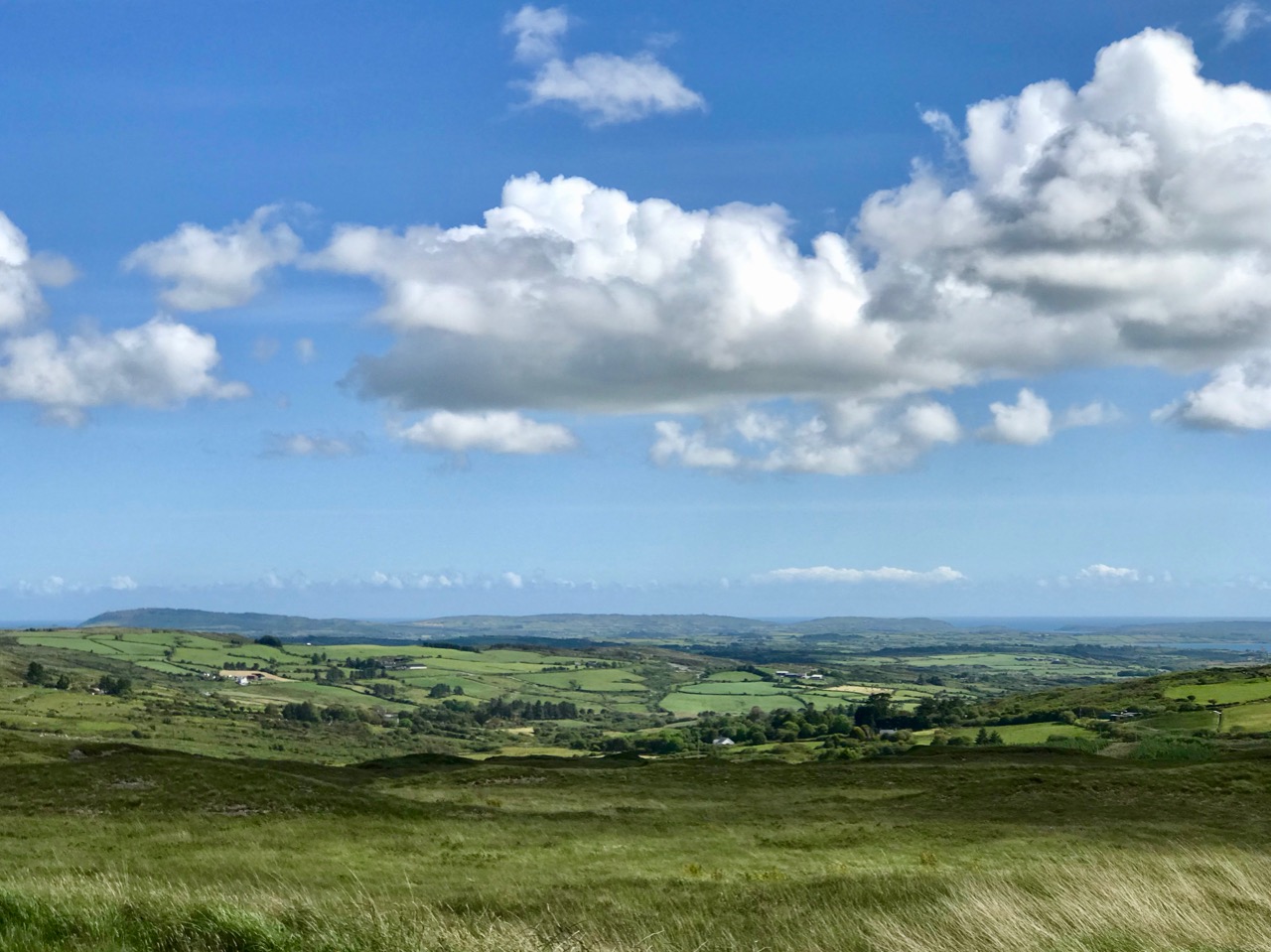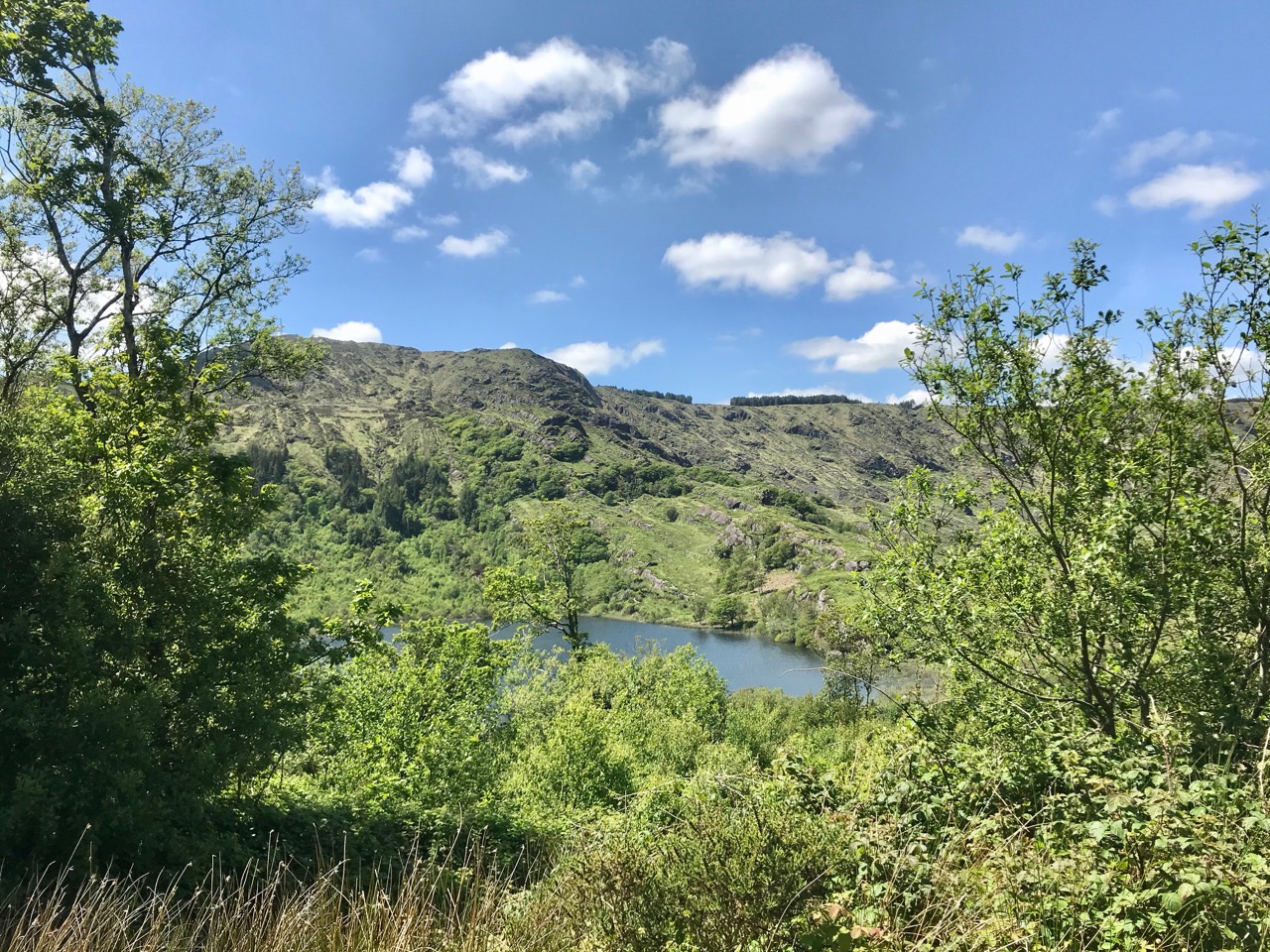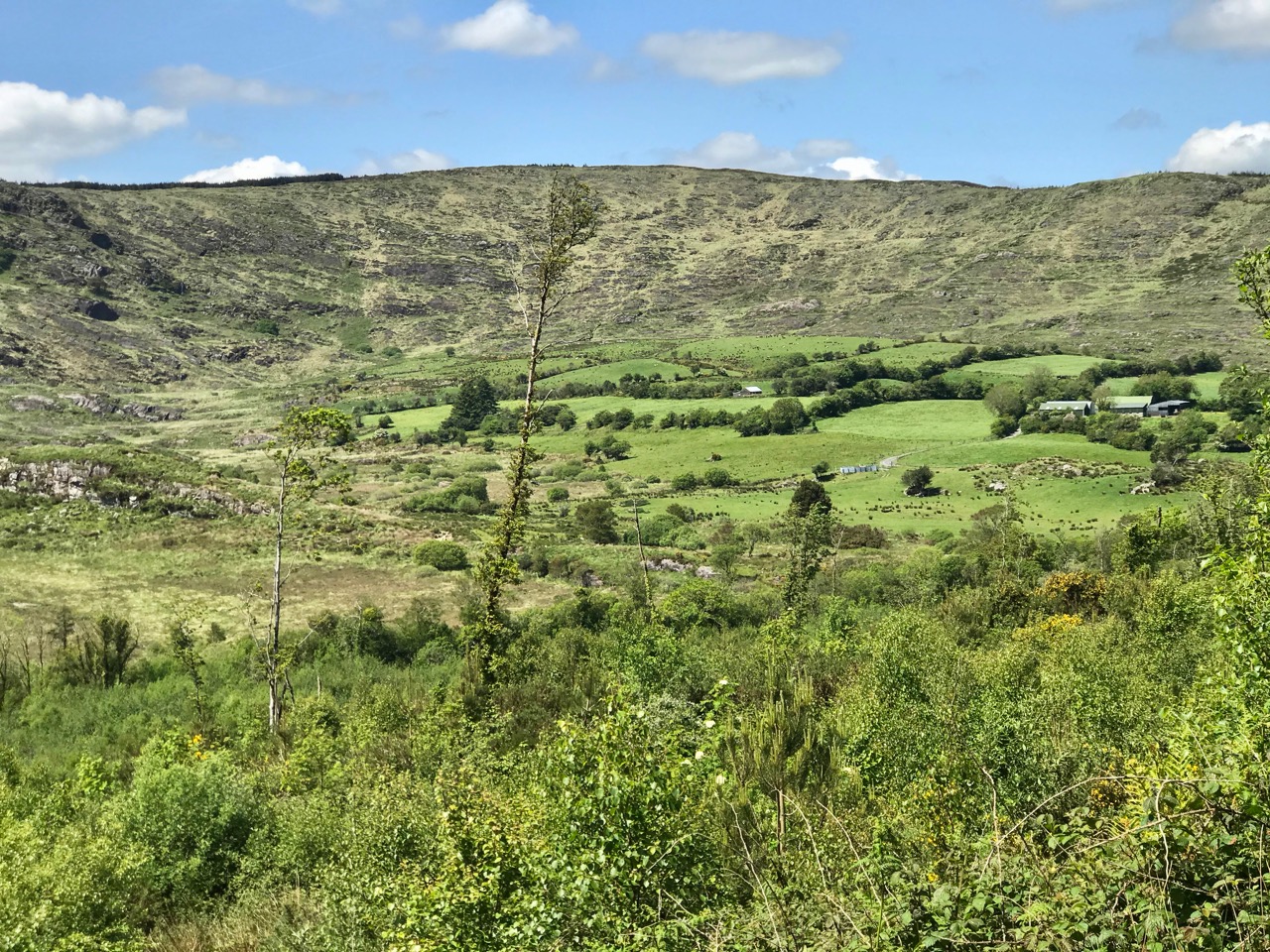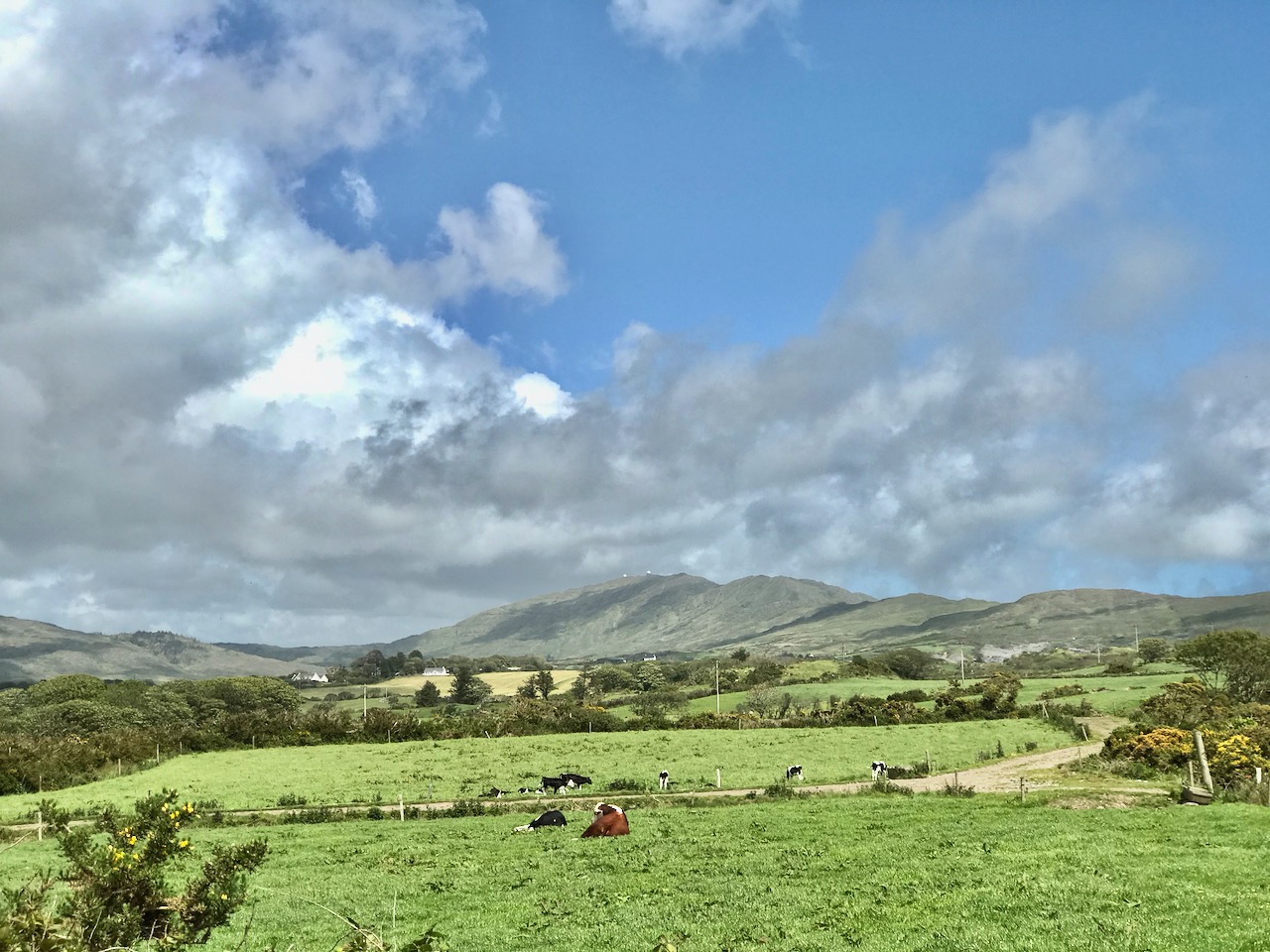
No Wrens Were Harmed in the Making of this Post… An Update!

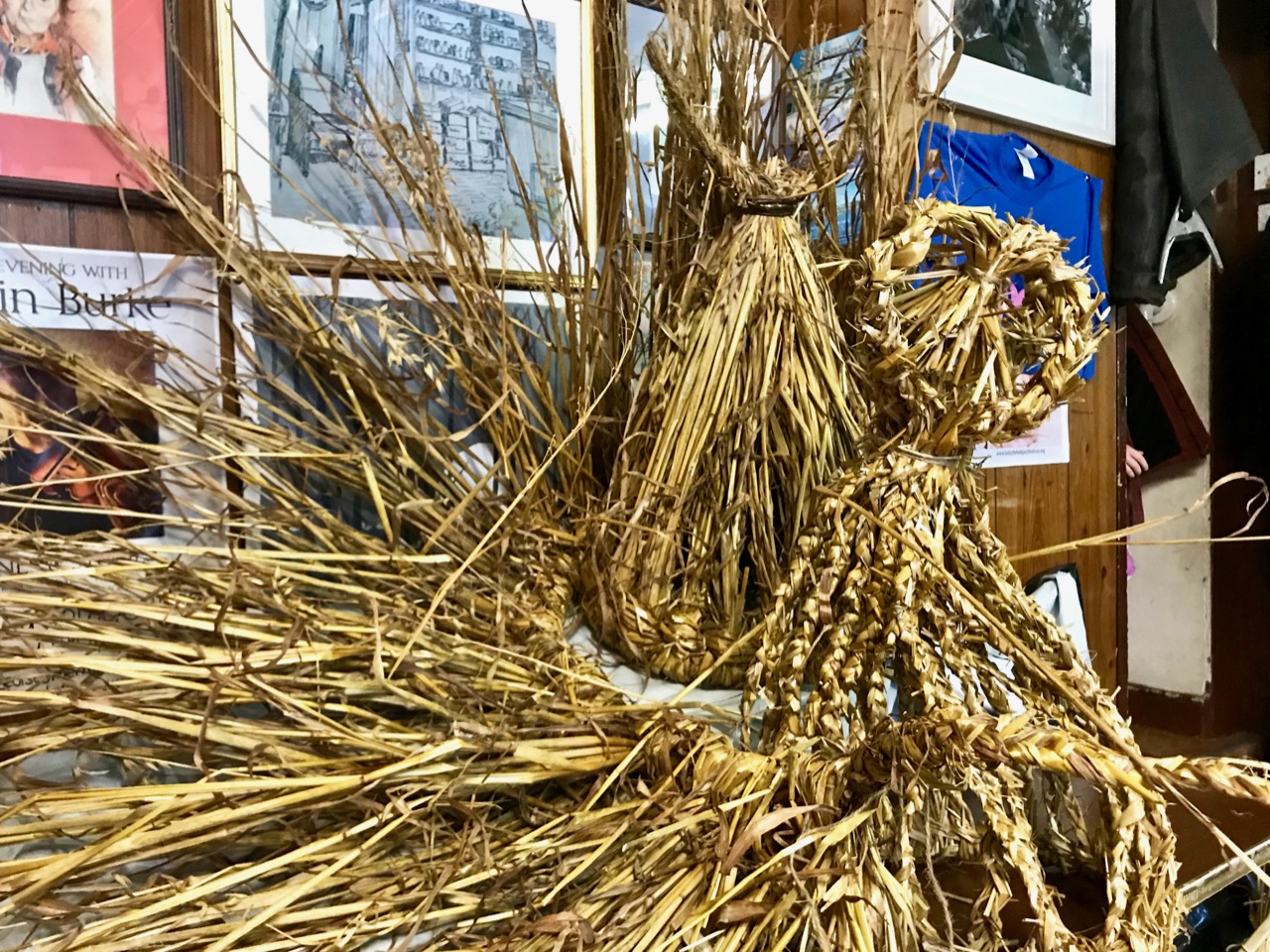
Do you remember pre-Covid days? Those times seem to bring out the nostalgia in me… It’s only two years ago that I wrote a post about our preparations – in Ballydehob – for the Wran Day celebrations that would take place on St Stephen’s Day – 26 December – following. Those festivities did happen, and we were then all in happy ignorance of how our lives were to be changed mightily by the pandemic that struck the world just a few weeks later. We’d like to think that, after all this time has passed, a level of normality will be returning. That’s not quite the case – but we are planning a ‘Wran’ this year, and today we gathered in Levis’s Corner House to make ready for it. Here’s a photo – kindly loaned by Pól Ó Colmáin – of the results of the workshop we held to prepare for the ‘Wran’ in 2019.
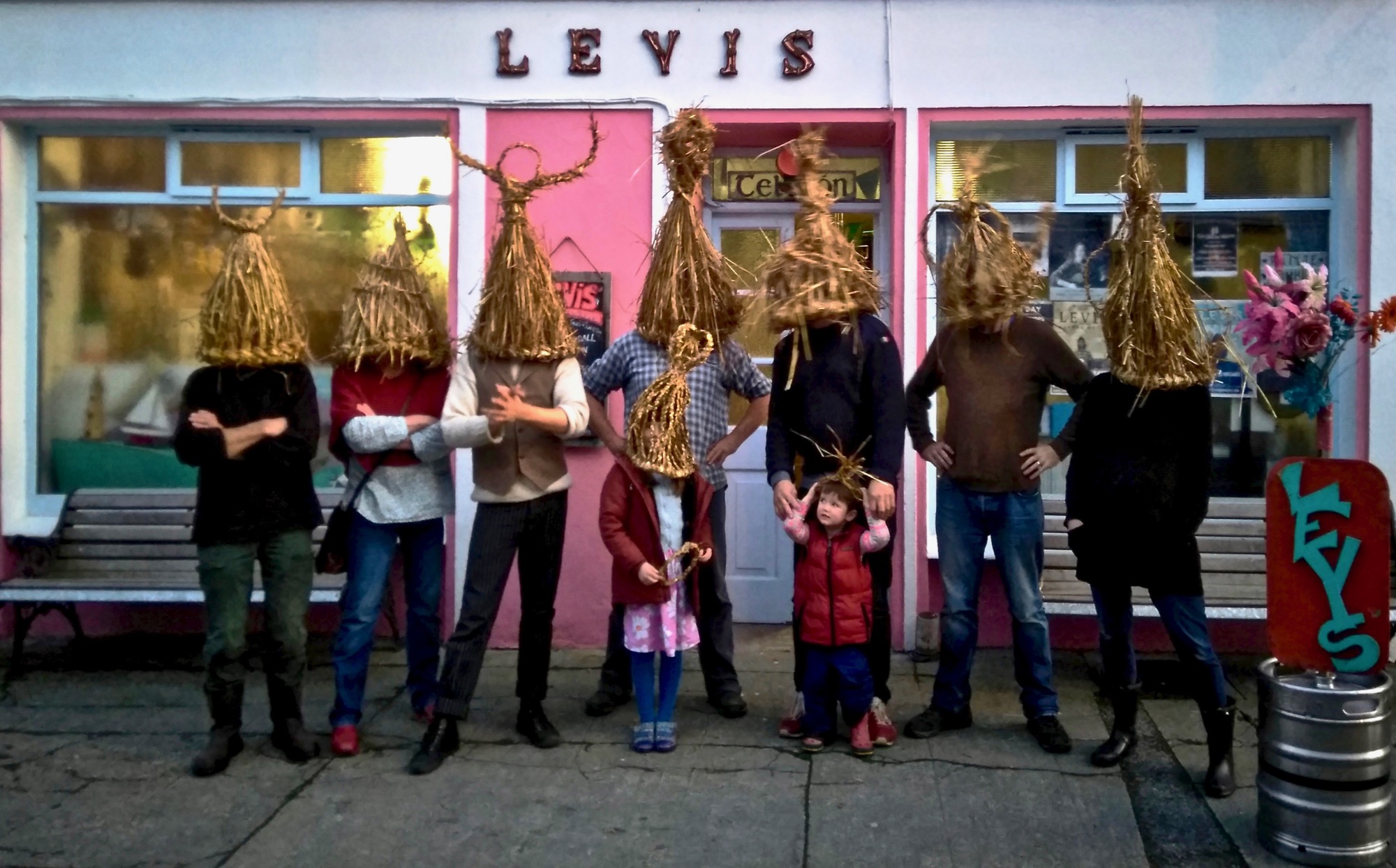
So firstly, here’s an abridged version of the post I put up after that workshop two years ago. I’ll follow it with an update of the equivalent [but socially distanced!] event which we held today . . .

* * * * * Back to 2019 * * * * *

Wran Hunting has featured before in Roaringwater Journal: that’s the way that St Stephen’s Day – 26 December – has been celebrated for generations in ‘Celtic’ parts of western Europe, specifically Ireland and The Isle of Man, but also in Cornwall – where it’s now only a memory – Brittany, Wales and Scotland. ‘The Wran’ is a very strong surviving tradition here, especially on the west side of the country. The Dingle Gaeltacht is the place to go if you want to see all the action (you may have to click on the bottom right of the window to turn on the sound):

In our own Ballyedhob community ‘The Wran’ is not forgotten. In fact you can even find a poem written about it in the Duchas folklore records. This was recorded in the 1930s by John Levis, aged 32, who took it down from Jeremiah Driscoll, aged 64 years. Jeremiah had been a Wren Boy in Ballydehob. Here’s the poem:

Come all you ladies and gentlemen,

For tis here we are with our famous wran

With a heart full of cheering for every man

To rise up a booze before the year is gone.

*

Mr O’Leary we came to see,

With our wran so weak and feeble,

The wran is poor and we can’t feed him,

So we hope your honour will relieve him

*

We’ve hunted our wran three miles and more

We’ve hunted this wran all around Glandore

Through hedges and ditches and fields so green,

And such fine sport was never seen.

*

As we copied our wran again

Which caused our wran-boys for to sing,
She stood erect and wagged her tail,
And swore she’d send our boys to jail.

*

As we went up through Leaca Bhuidhe

We met our wran upon a tree,

Up with a cubit and gave him a fall,

And we’ve brought him here to visit you all.

*

This the wran you may plainly see,

She is well mounted on a holly tree,

With a bunch of ribbons by his side

And the Ballydehob boys to be his guide.

*

The wran, the wran, the king of all birds,

St Stephen’s day he was caught in the furze,

Although he is little, his family is great,

So rise up landlady and fill us a treat.

*

And if you fill it of the best,

We hope in Heaven your soul will rest,

But if you fill it of the small,

It won’t agree with our boys at all.

*

To Mr O’Leary and his wife

We wish them both a happy life,

With their pockets full of money, and their cellars full of beer,
We now wish a merry Christmas and a happy New Year.

*

And now, our song is ended, we have no more to say,

We hope you’re not offended for coming here today,

For coming here this morning we think it is not wrong,

So give us our answer and let us all be gone.

Traditional, DUCHAS
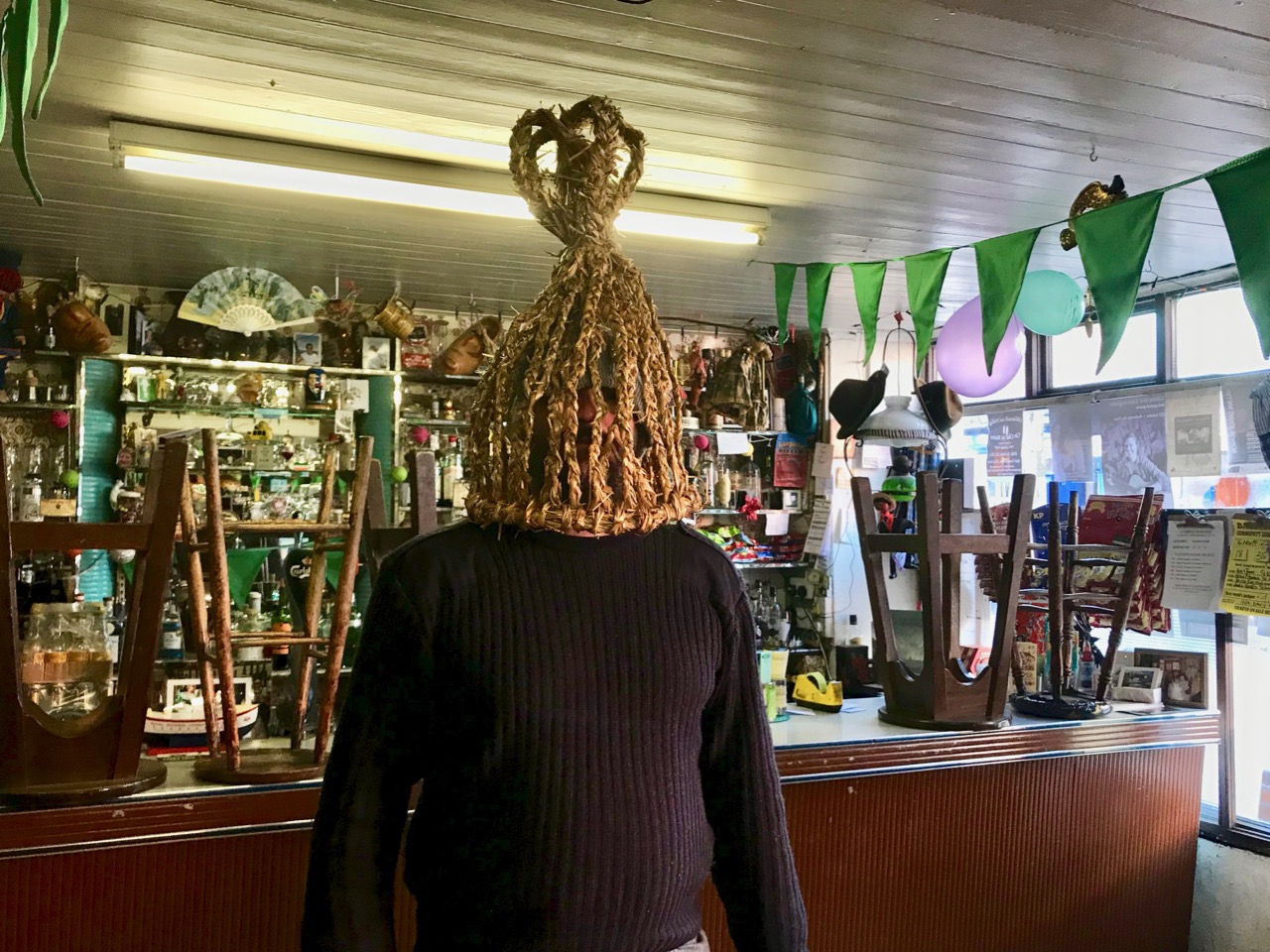
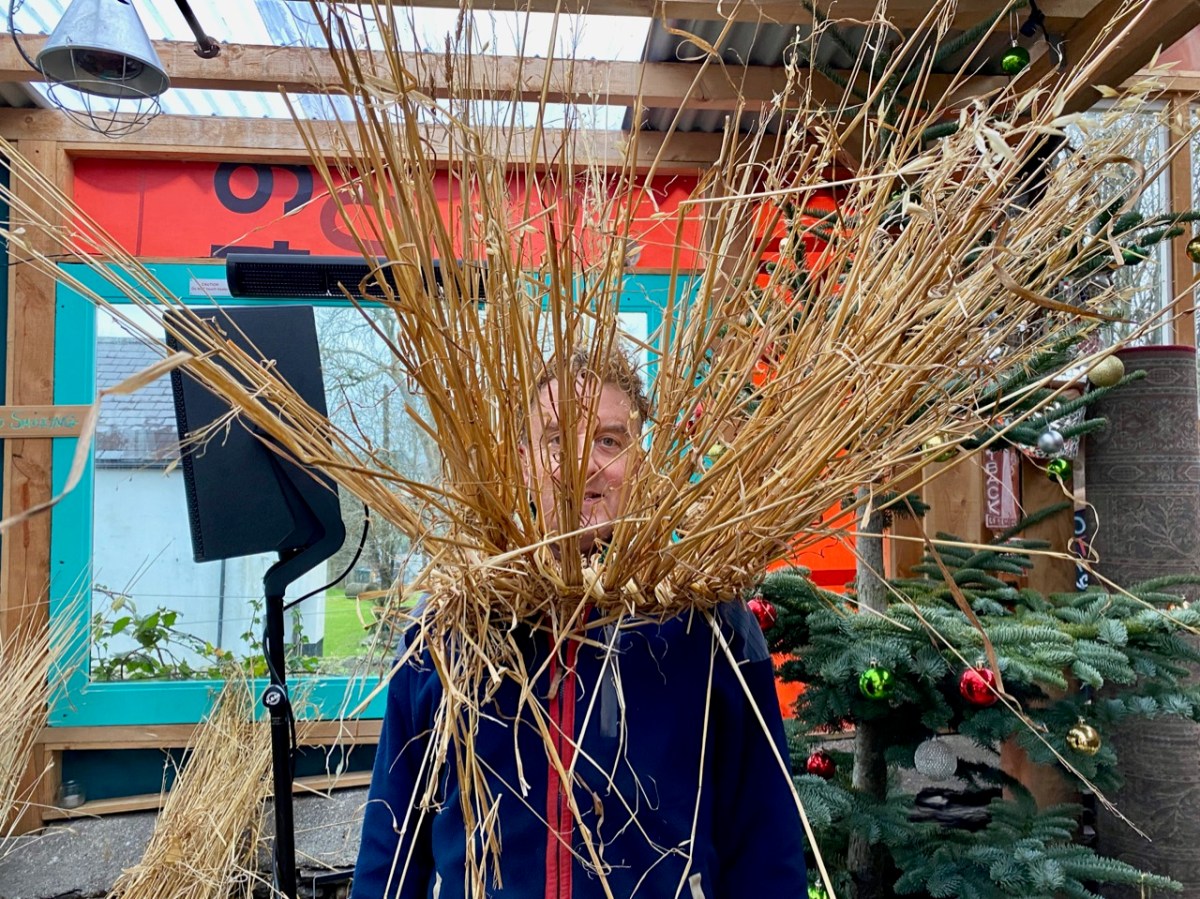
By good fortune there’s ‘Mr O’Leary’ above! He’s the landlord of Levis’ Corner House Bar in Ballydehob: he allowed the Wran workshop to take over his pub yesterday. Basically that involved covering the whole place in straw out of which, magically, appeared lots of wonderfully crafted Wran masks. Joe is wearing a fine example.
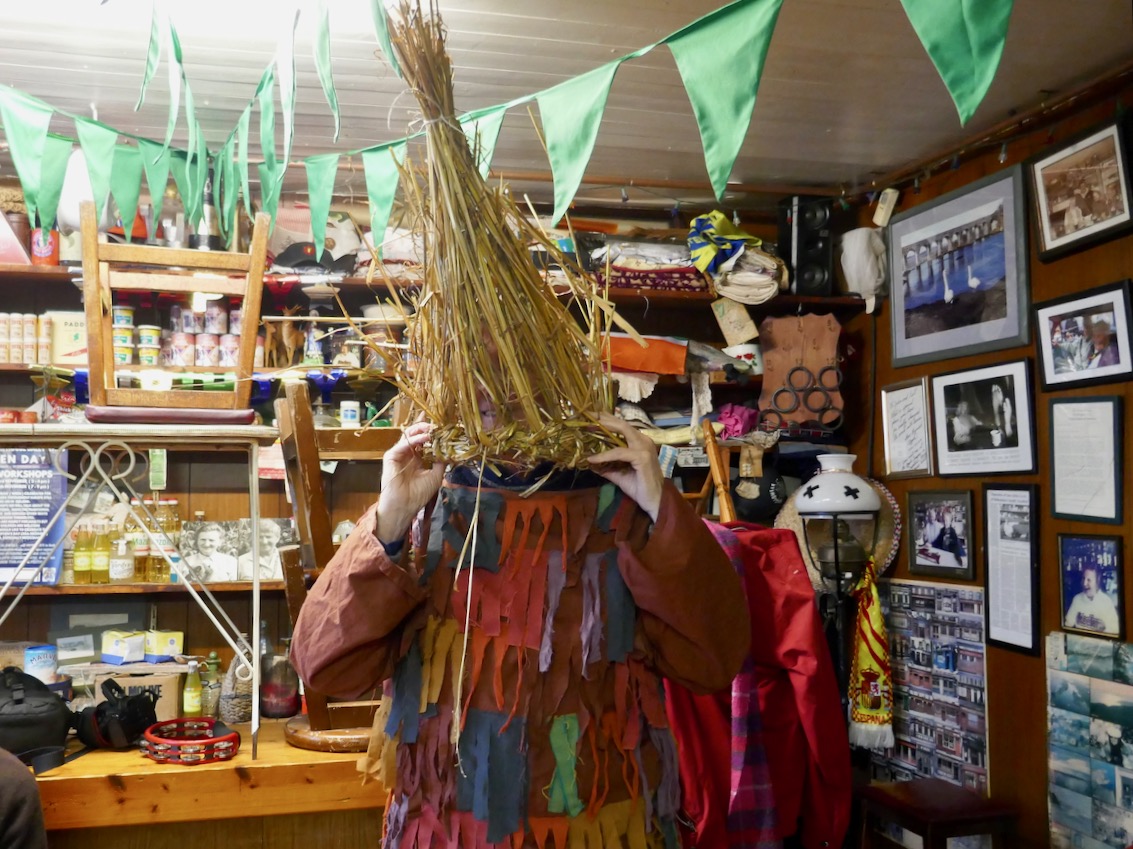
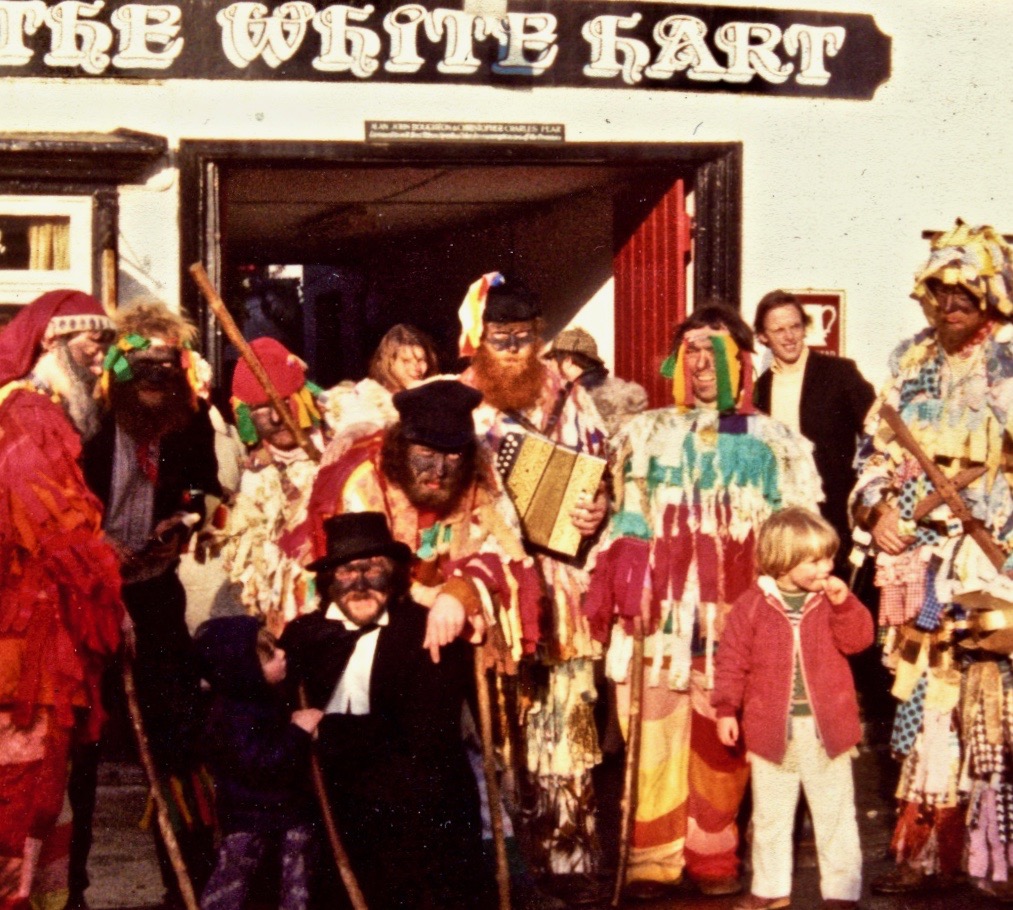
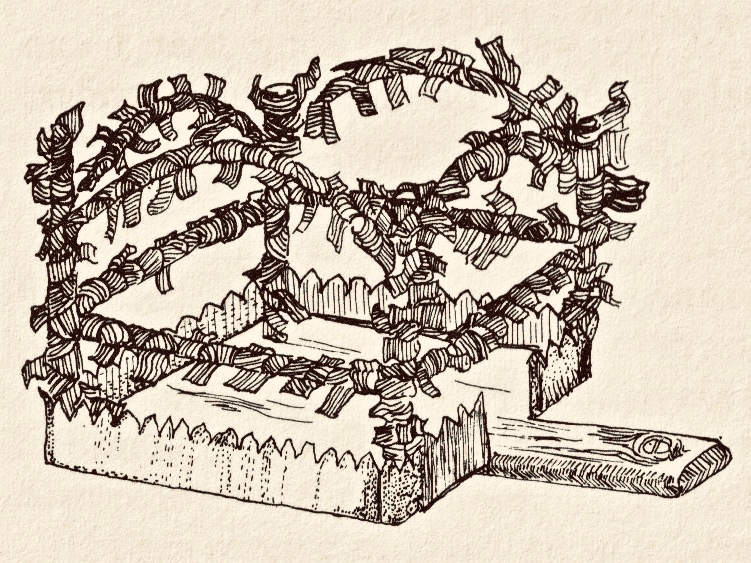
Finola and I were at the workshop, and there I am with work in progress on the straw mask which we made (upper picture). You’ll notice that I’m wearing ‘tatters’: I’ve had these for years, and I used to don them for our own mumming tradition in Devon which also happened on 26 December (that’s me with the squeezebox mumming in the 1970s! – lower picture). Over there we called St Stephen’s ‘Boxing Day’ because that was when ‘Christmas boxes’ were given to the postman, the milkman and anyone else who provided their services through the year. Interestingly, Kevin Danaher mentions the ‘Wran box’ which was taken around the houses by the wrenners (or Wran Boys) and used to collect money ‘for the Wran’. This illustration of a Wren box from County Galway is from Danaher’s book The Year in Ireland:
The workshop in Levis’ was very well attended, and there is clearly great enthusiasm for reviving this custom. Sonia collected the straw at the annual Thrashing in Ballydehob – which is a traditional harvest celebration. It’s not easy to find the right straw for making the masks nowadays: anything that has been through a combine harvester has been flattened and will not survive the plaiting.
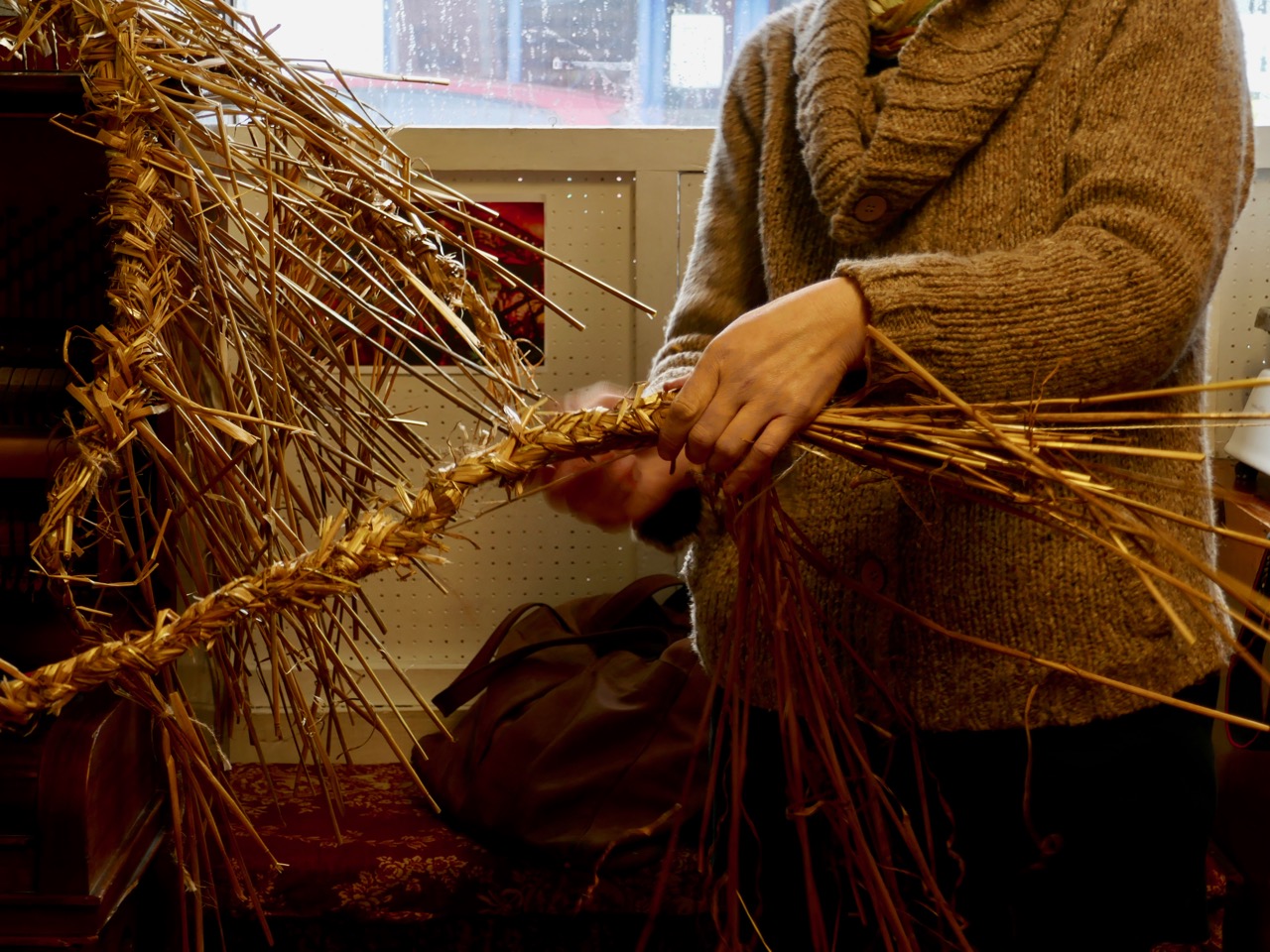
It’s a complex process, but the group coped well in acquiring the new skills under Sonia’s tutelage. The making – every year – has always been part of the tradition where it’s still practised today. Sometimes the straw masks (which are only one part of the ‘disguise’) are destroyed after Stephen’s. In some of the Dingle traditions they are ritually burned on the following St Patrick’s Day.

* * * * * * Fast Forward to 2021 * * * * *
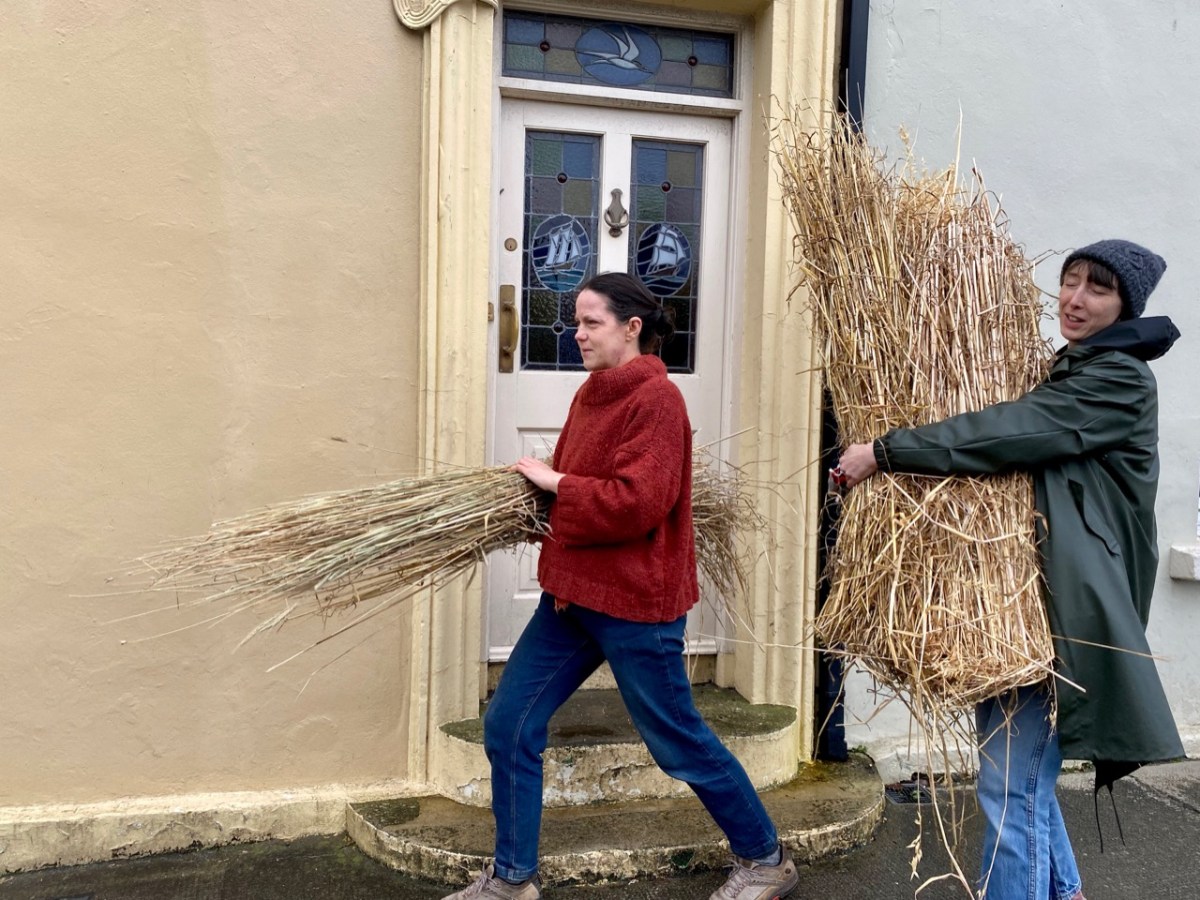
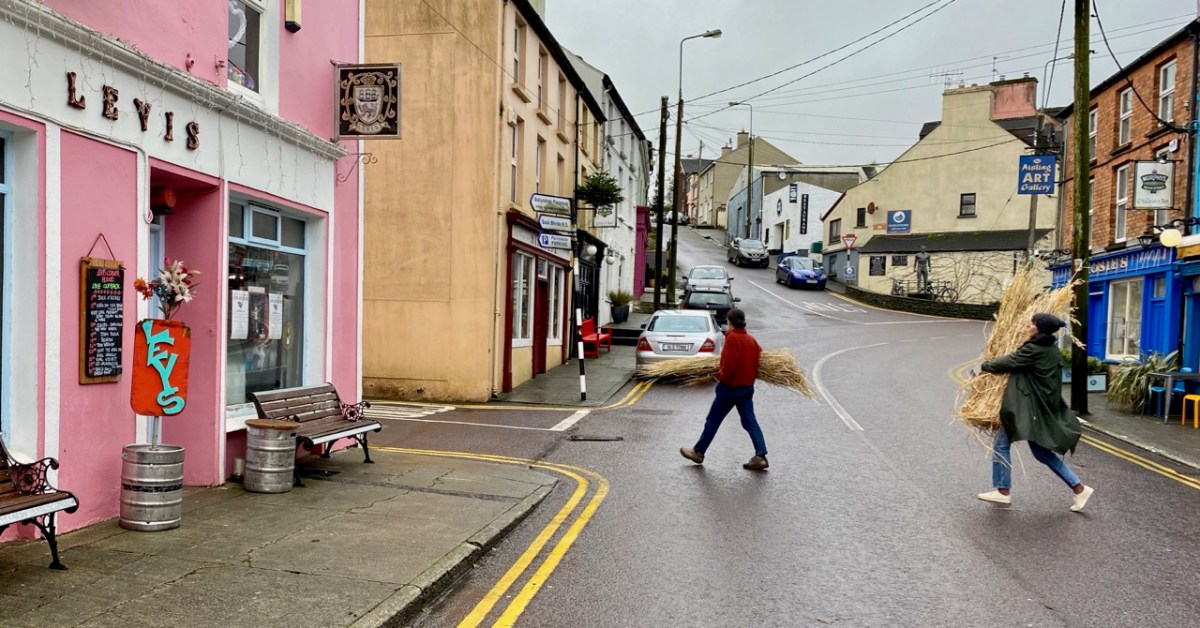
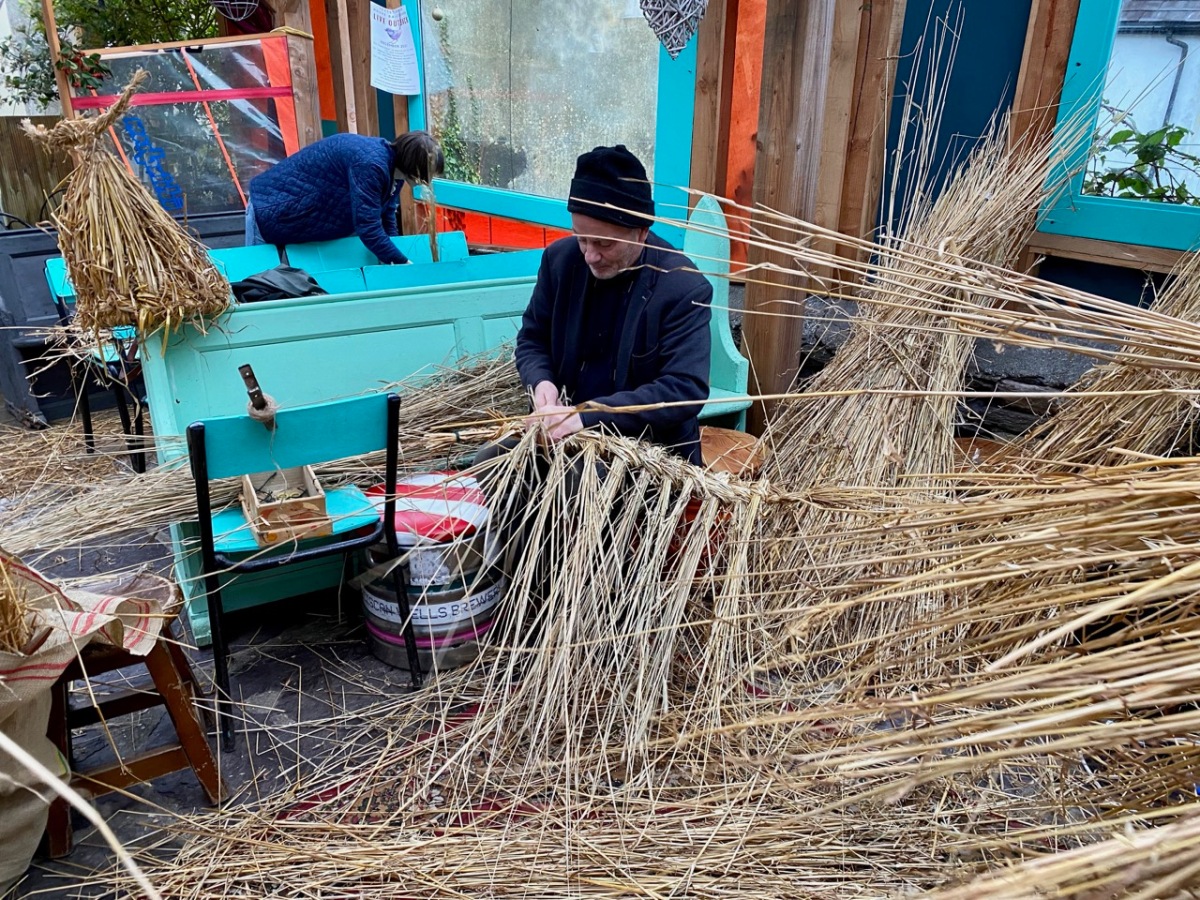
Two years later, on a damp Sunday in Ballydehob, you might have seen the strange sight of bundles of straw being transported across the road to Levis’, where the 2021 Wran Workshop is about to take place in the ‘outback’ area of the bar. That’s Sonia (on the left above) who is masterminding the whole proceedings, and also oversaw the growing of the straw.
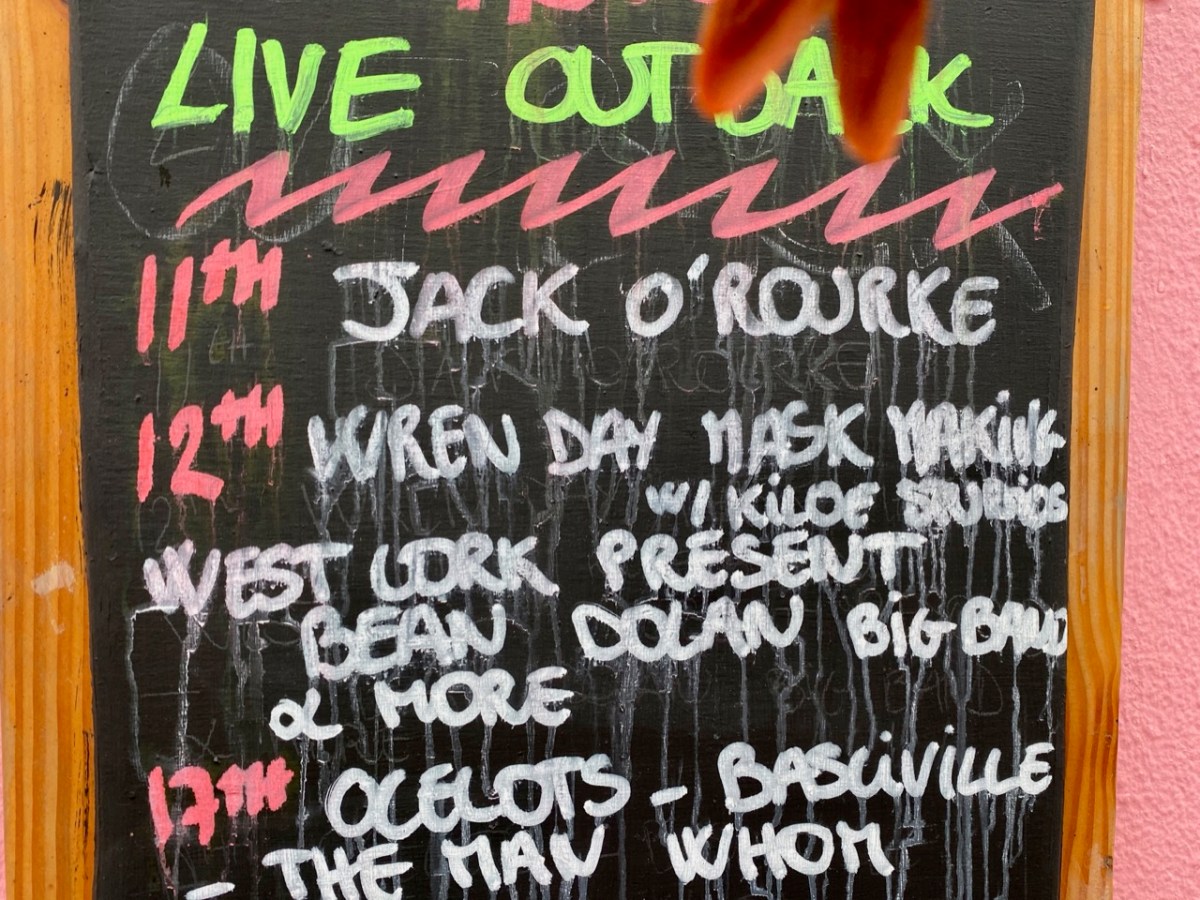
We all really appreciate Joe and Caroline – who run Levis’s – who are so supportive of community events and who, like everyone else, have had to struggle to keep business going through the ups and downs of Covid restrictions. The ‘Outback’ – formerly their yard – has been remarkably transformed into a comfortable outdoor venue, and live concerts and events are continuing through the winter season, helping to make our days seem as normal as possible.

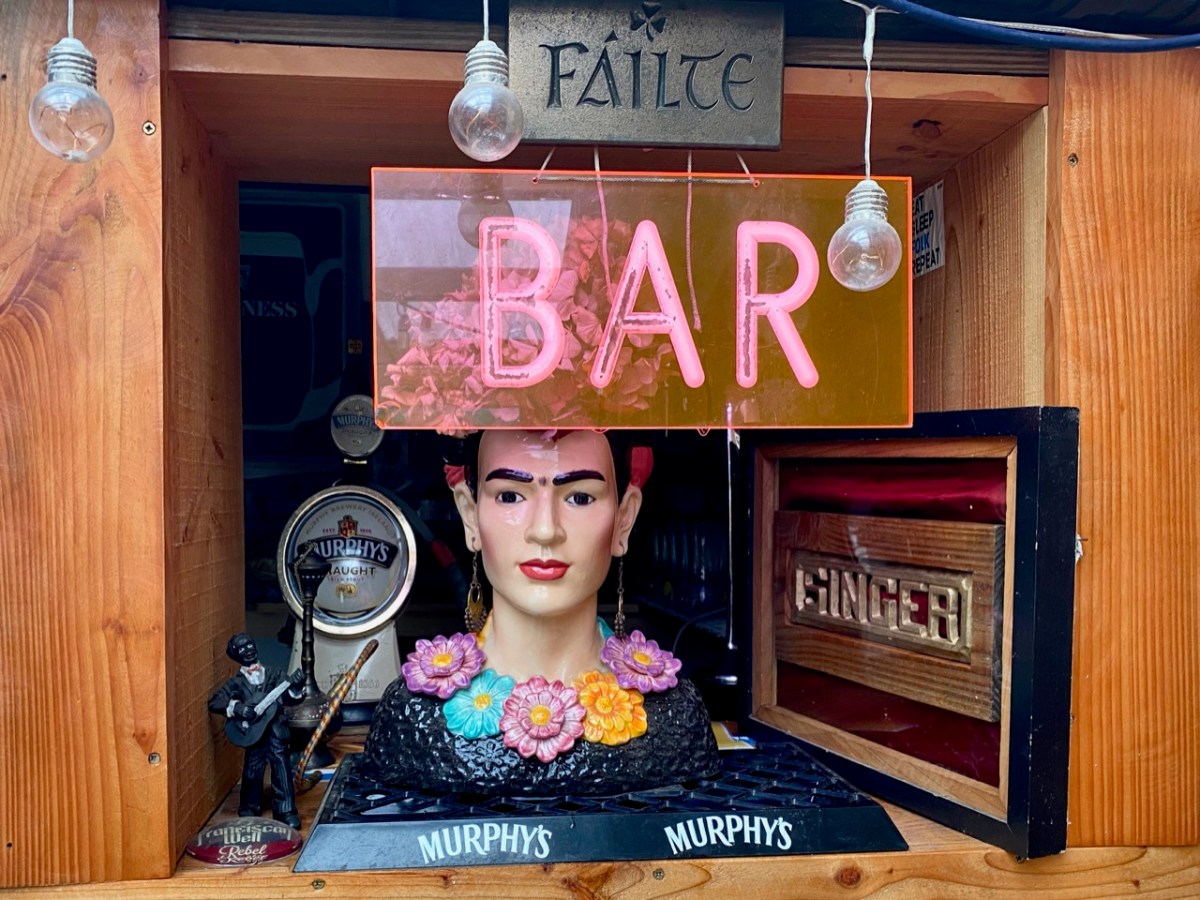
We were a small but dedicated group, determined to get the tradition going again in Ballydehob. We are not sure, yet, when it will happen. Traditionally it should be Stephen’s Day, but it all depends on how available the participants will be. We will keep all our readers fully informed! meanwhile, if you need encouragement, look at the work that has gone into the straw masks this year . . .
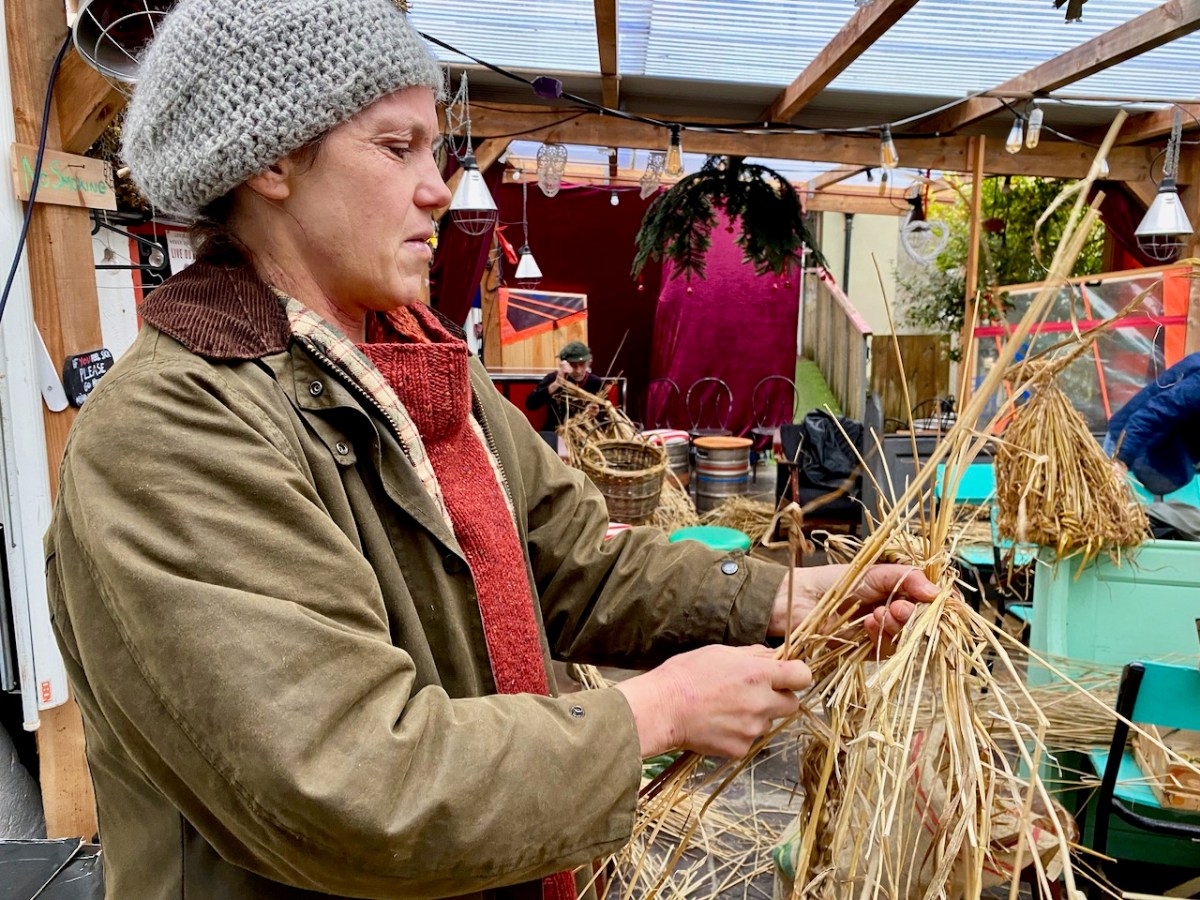
Here’s Sonia Caldwell again, above. We have featured her Kilcoe Studios in a previous post. She is undoubtedly the energy behind this project. Look out for us all shortly after Christmas – there is good entertainment to be had. But, also, essential traditions to be kept alive to ensure that our world keeps turning!

That’s Pól Ó Colmáin, above, testing out his mask for size before finishing off the conical headpiece. Marie and he run the Working Artist Studios in the main Street of Ballydehob – a wonderful addition to our village’s thriving assets. Pol also bravely works away at teaching the Irish language to a number of students, including me! Here are both of them this afternoon with their completed Wran Day pieces – and also my own mask back at home . . .

Revisiting BAM

BAM is the Ballydehob Arts Museum, and regular readers will know that this is a project which has involved us over the past few years. The Museum was curated to collect, conserve and celebrate the work of artists who came to West Cork and – particularly – Ballydehob during the second half of the twentieth century, some of them settling in the hills around the village and living a Bohemian lifestyle based around the principles of John Seymour’s seminal work Self Sufficiency published in 1973. At that time I was involved in running an eccentric small bookshop in rural Devon, and that book was our all-time best-seller!

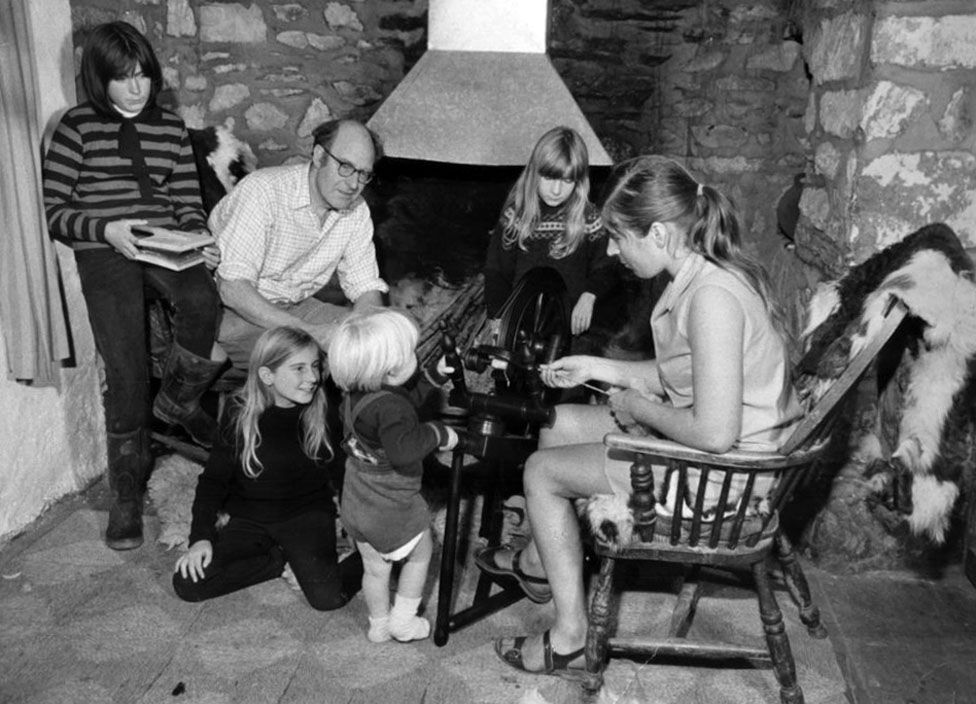
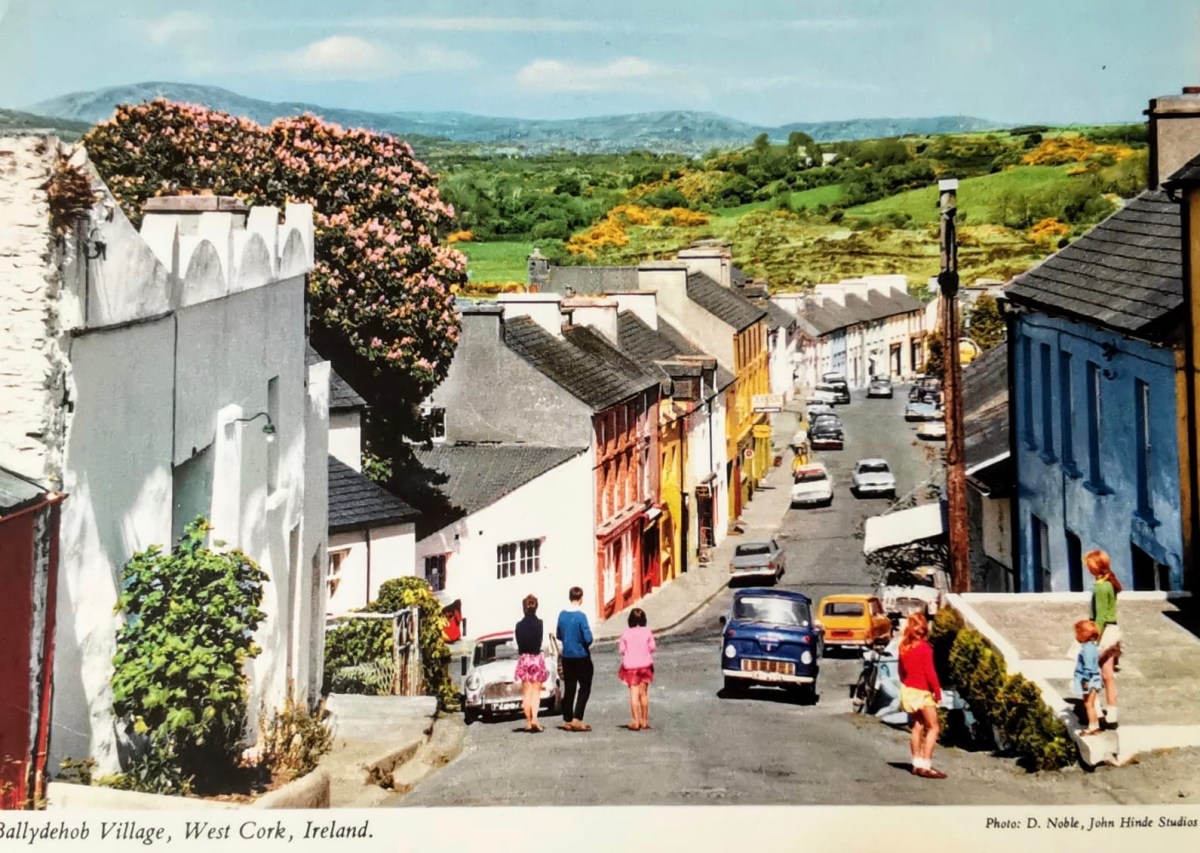
That’s John Seymour and his family in 1973, when the book was first published (upper picture) while the lower picture is a John Hinde postcard from around the same period showing Ballydehob. It looks a thriving, lively place with its coloured houses and shops, and I think those ‘Bohemians’ who are still with us today – and still have their homes in the village – would agree that it was in those days the centre of a very special world – of artists and craftspeople making a living and producing some exceptional work. Work that is being recognised, now, for its quality and unique character.

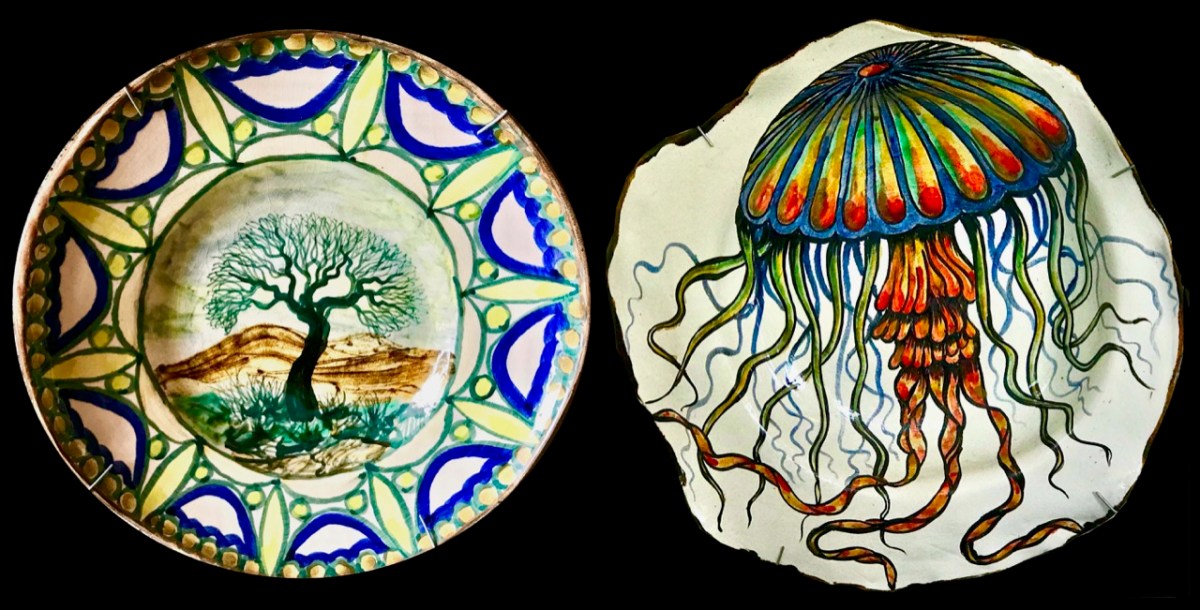
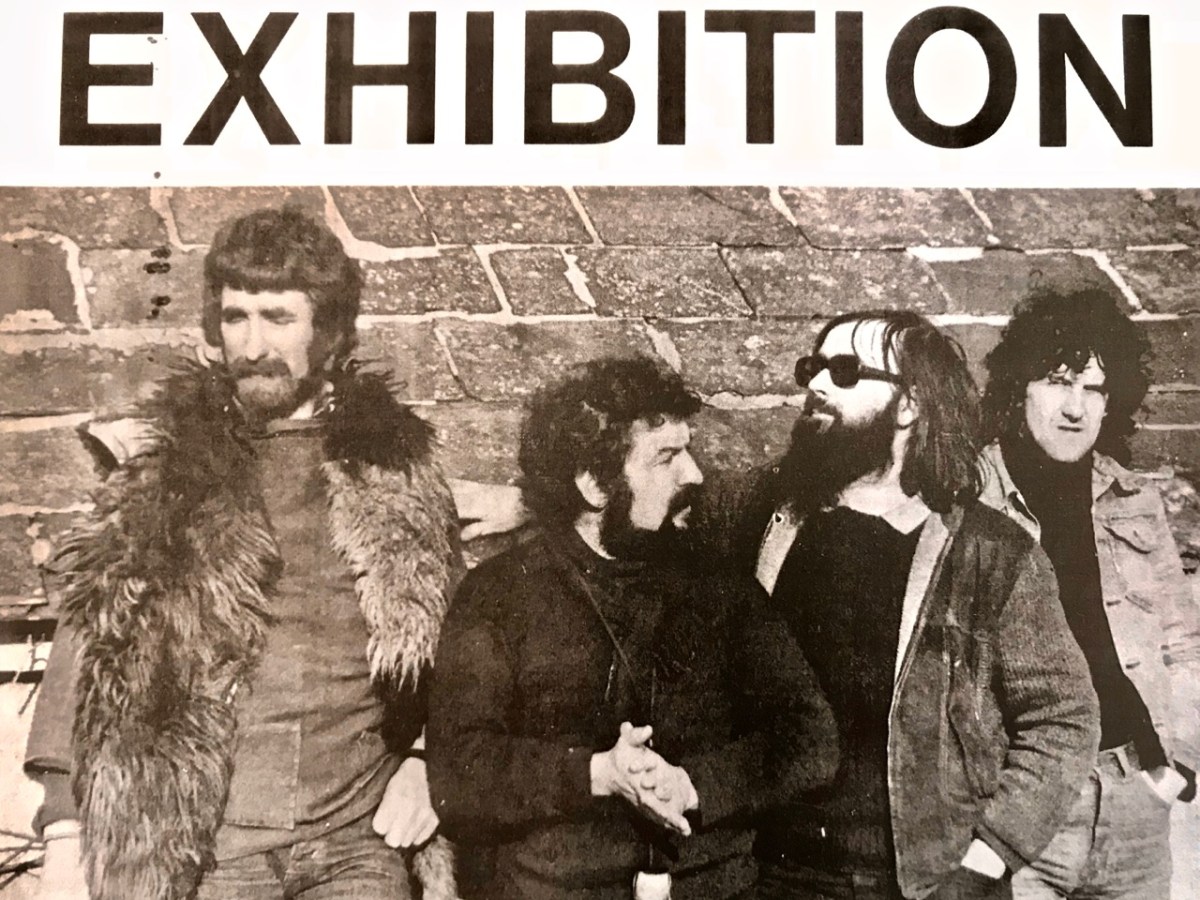
This is a wonderful photograph from the Museum archives: here you see four of the ‘Bohemians’ who were crucial to the Ballydehob project. On the left is John Verling – he and his wife Noelle produced the two plates on the header, Tree of Life and Jellyfish, and were central to the community, establishing their pottery at Gurteenakilla just outside Ballydehob in the early 1970s. John died in 2009, but Noelle still thrives in the area. Next is Pat Connor, still living and working – as an award winning ceramicist and sculptor – in West Cork. Beside him is Brian Lalor who, since those Bohemian days – has established a formidable reputation in Ireland as print-maker, artist and writer. Also, very relevant to this post, he is a co-founder and Curator of the Ballydehob Arts Museum! Fourth in line in the photo is watercolourist, David Chechovich, no longer with us. Here’s a photo from a couple of years ago showing Brian (left) with Leda May, another early arrival in Ballydehob and living and working right in the village to this day; also Pat Connor, and Carol James, who came over from England in 1974 and stayed on. They haven’t changed a bit, have they?

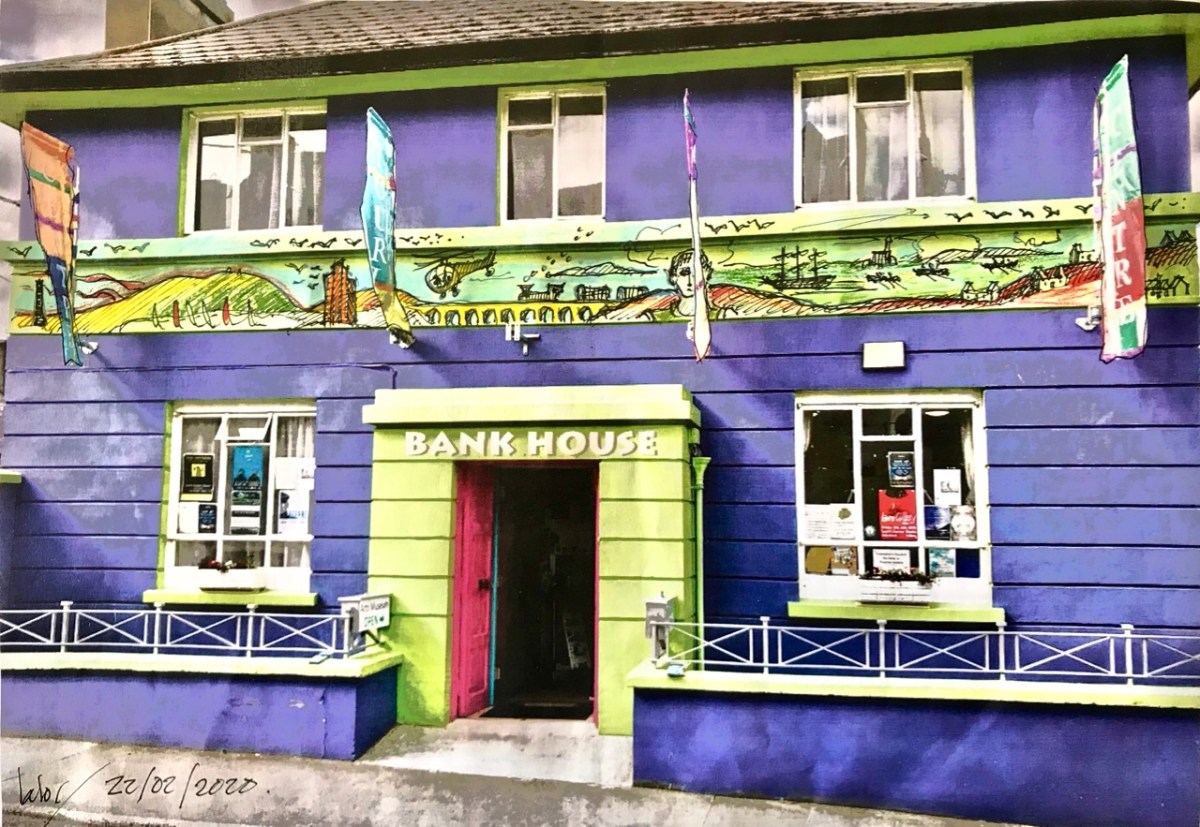
The Museum has a permanent home in Bank House, right in the centre of the village. As you might expect, it was once the local bank but – after closure – it was bought by the community and is currently finding fresh uses. This montage (above) is by Brian Lalor: he and I are imagining the building being livened up by a mural from Brian’s brush. Unfortunately, Covid has put a check on the Museum’s development over the last couple of years. But we are looking forward to getting things going again with a new exhibition for 2022. The photo below shows the Museum interior set up for the 2019 show.

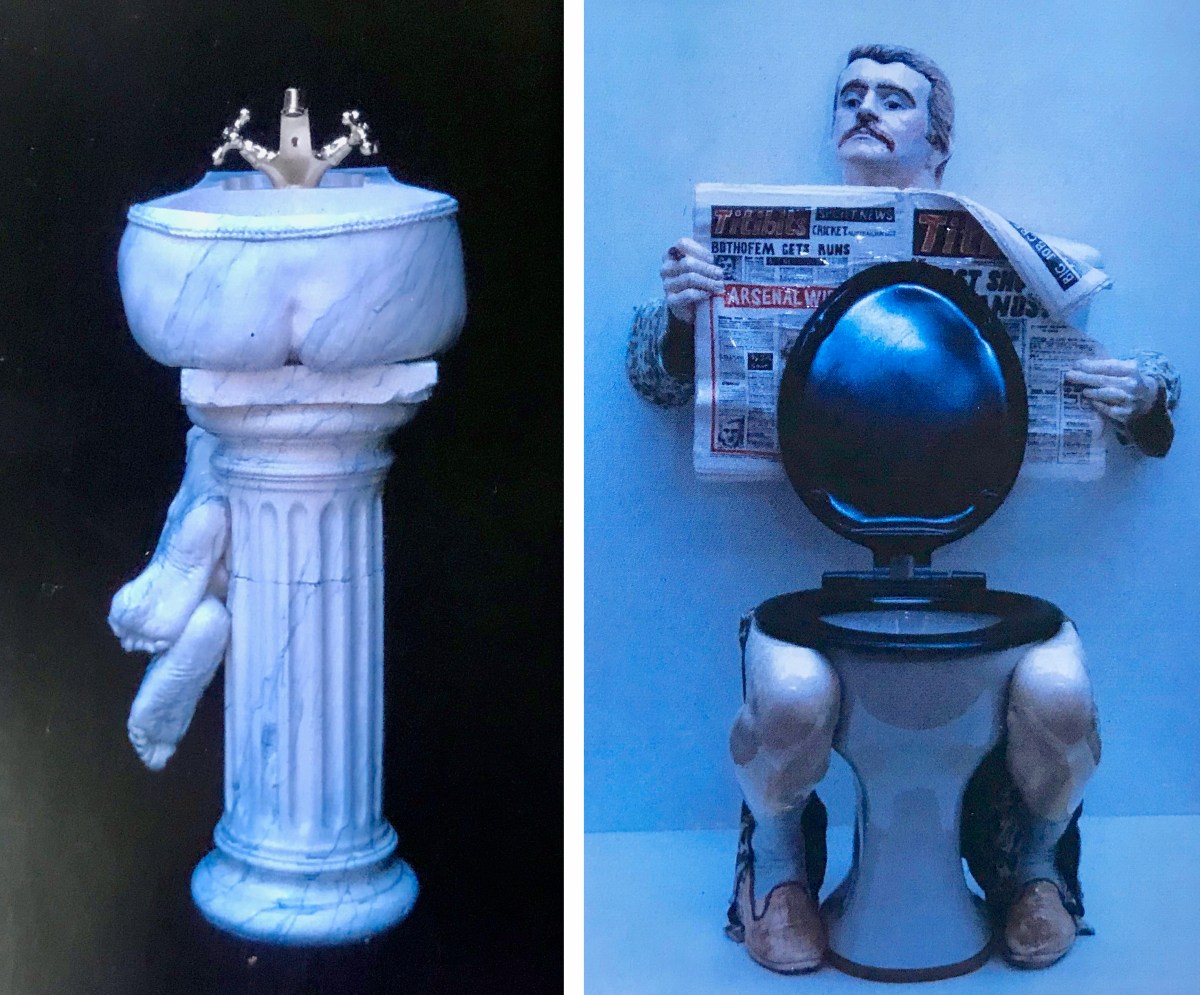
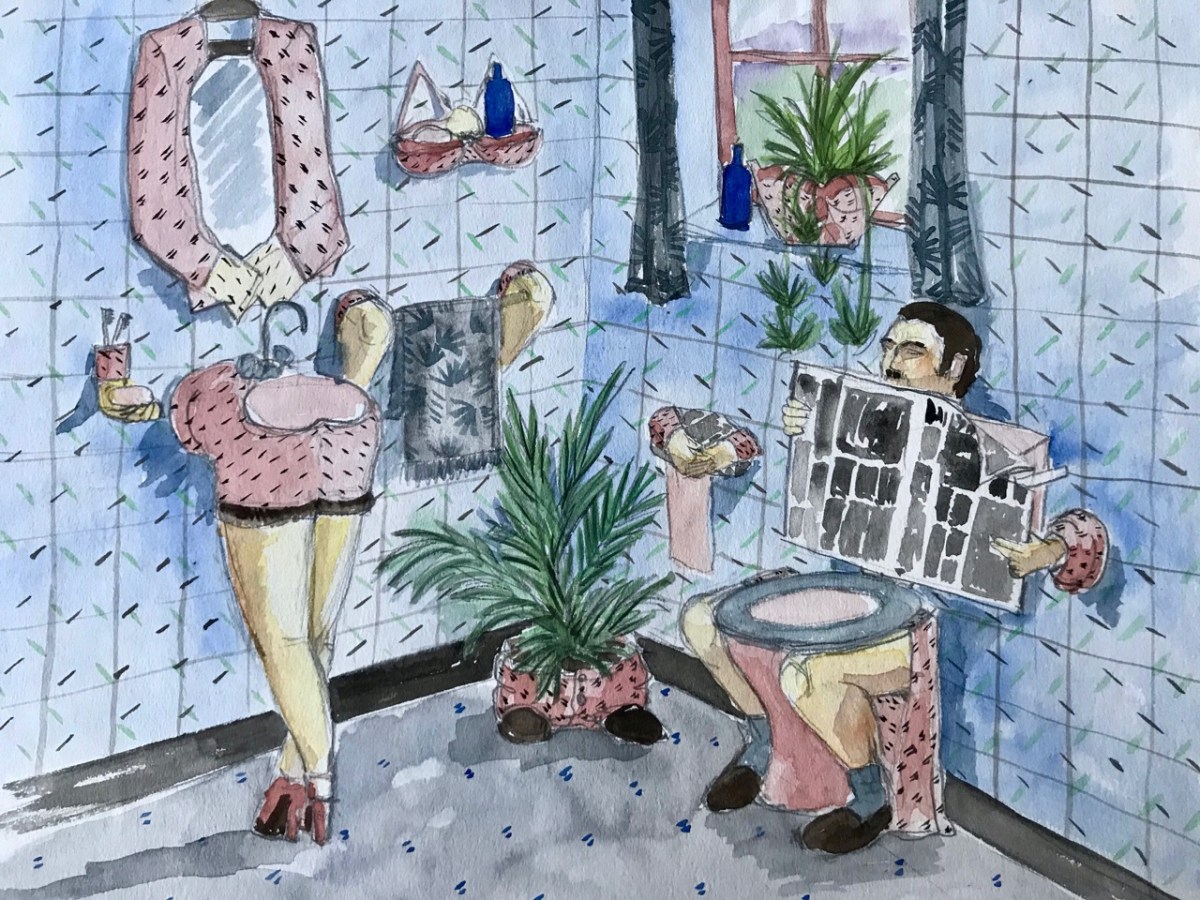
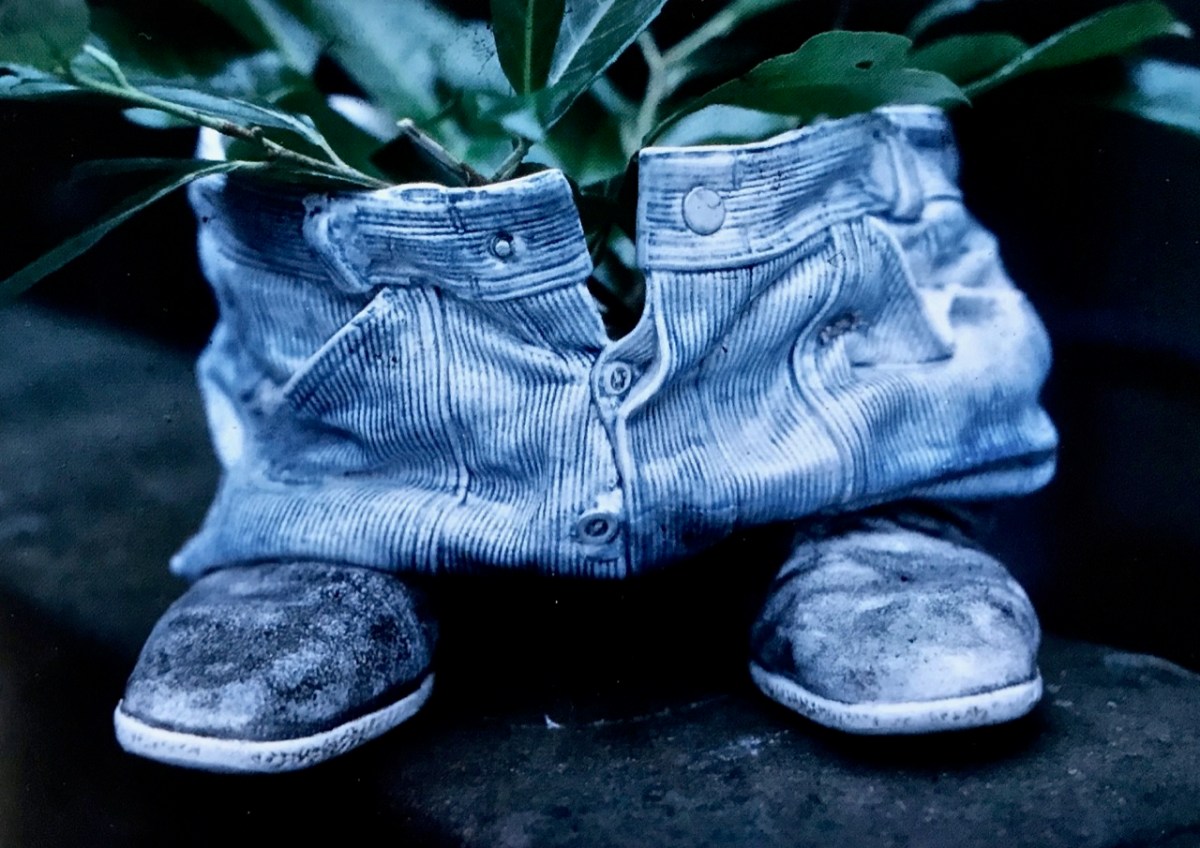
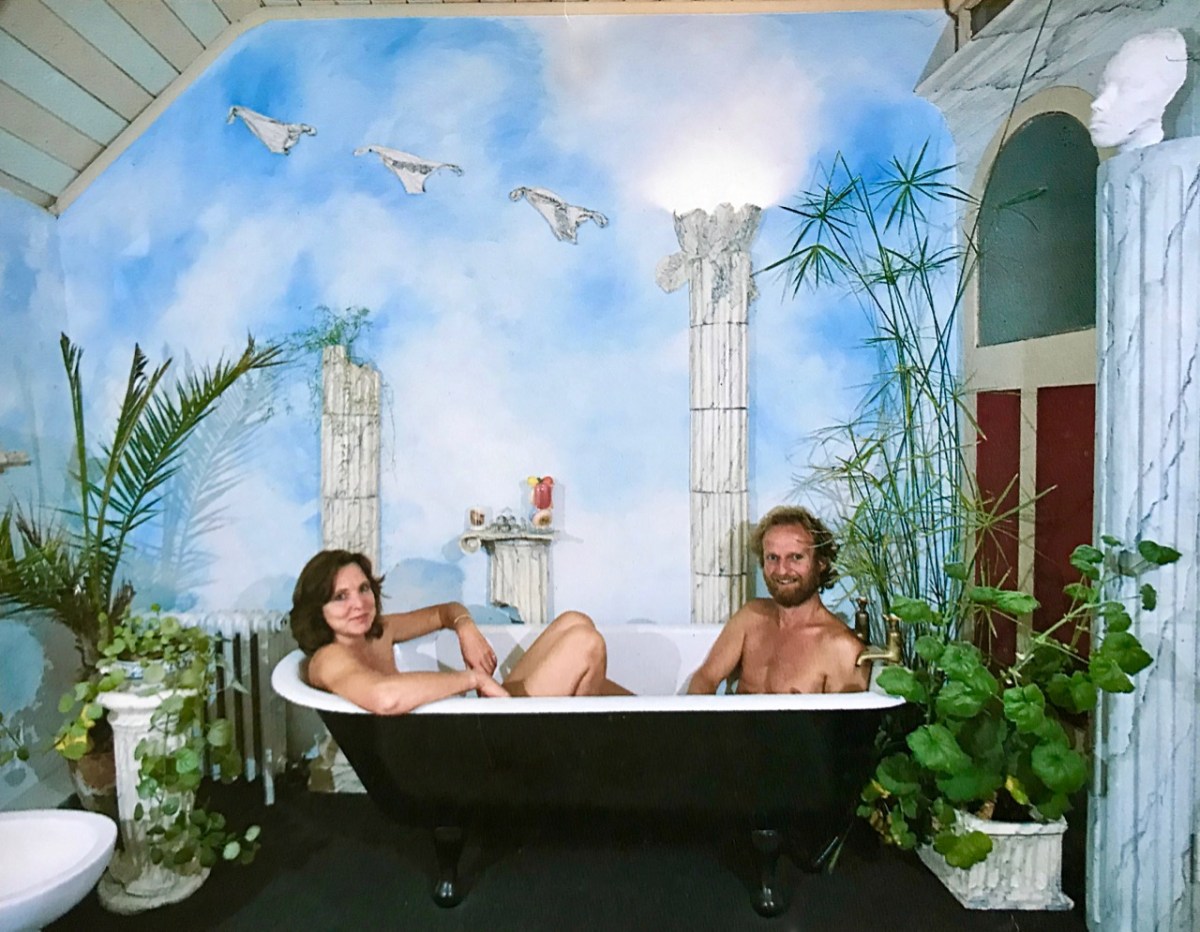
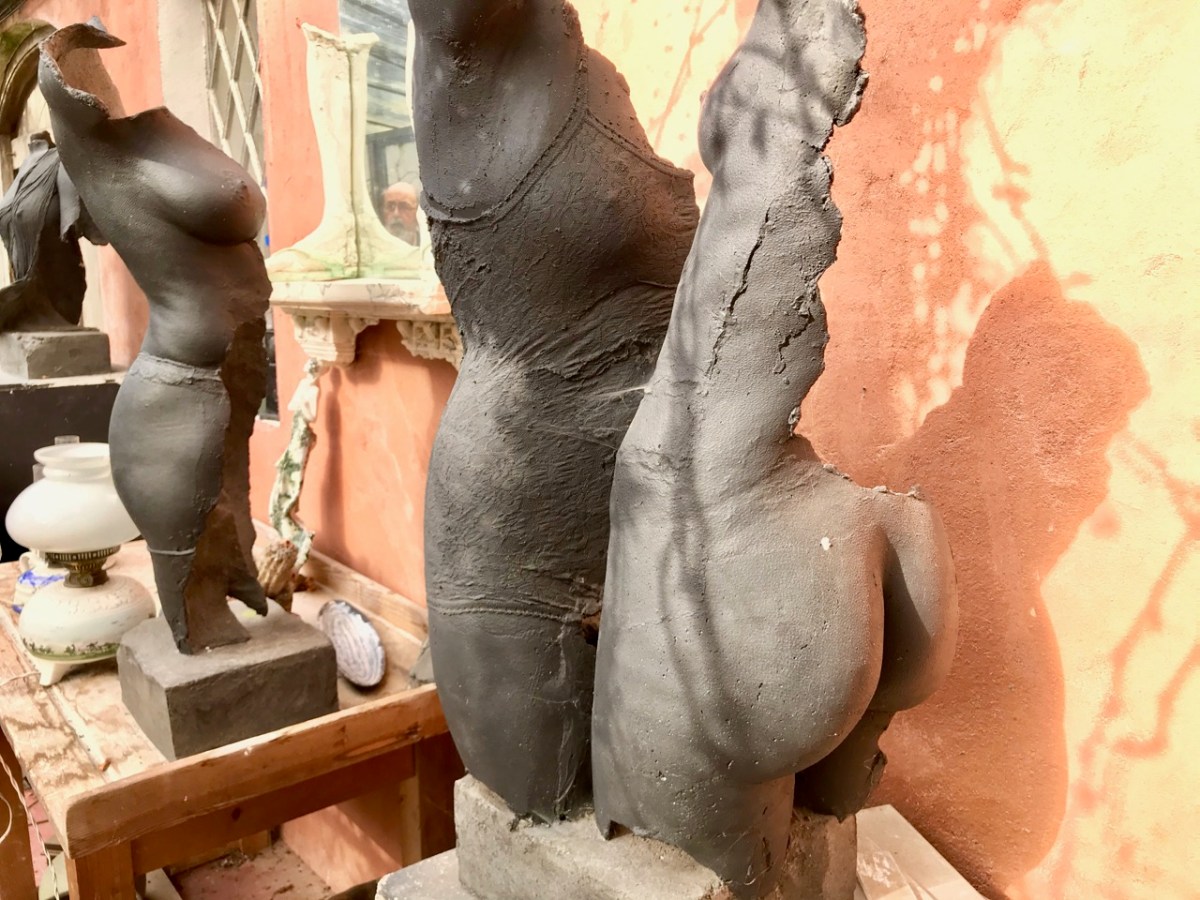
Here is an article – well worth reading – on the West Cork artists and our Museum (thank you, Peter , for pointing me to this). Mentioned in the article are the subjects of our next proposed exhibition, to be held in 2022, if all is well. They are Ian and Lynne Wright. They arrived in West Cork in 1973 and established their home, ceramics studio and an environmentally sound habitat at Kilnaclasha, Skibbereen. They are still there, although Ian spends much of his time on another environmental project in Tobago. Using the name Cors’ it’s Ceramics they experimented with body casting slipware and began to produce specialised one-off bathroom fittings – humorous and often erotic. They were hugely successful. Here’s a pictorial review of some of their work to give you a taster:

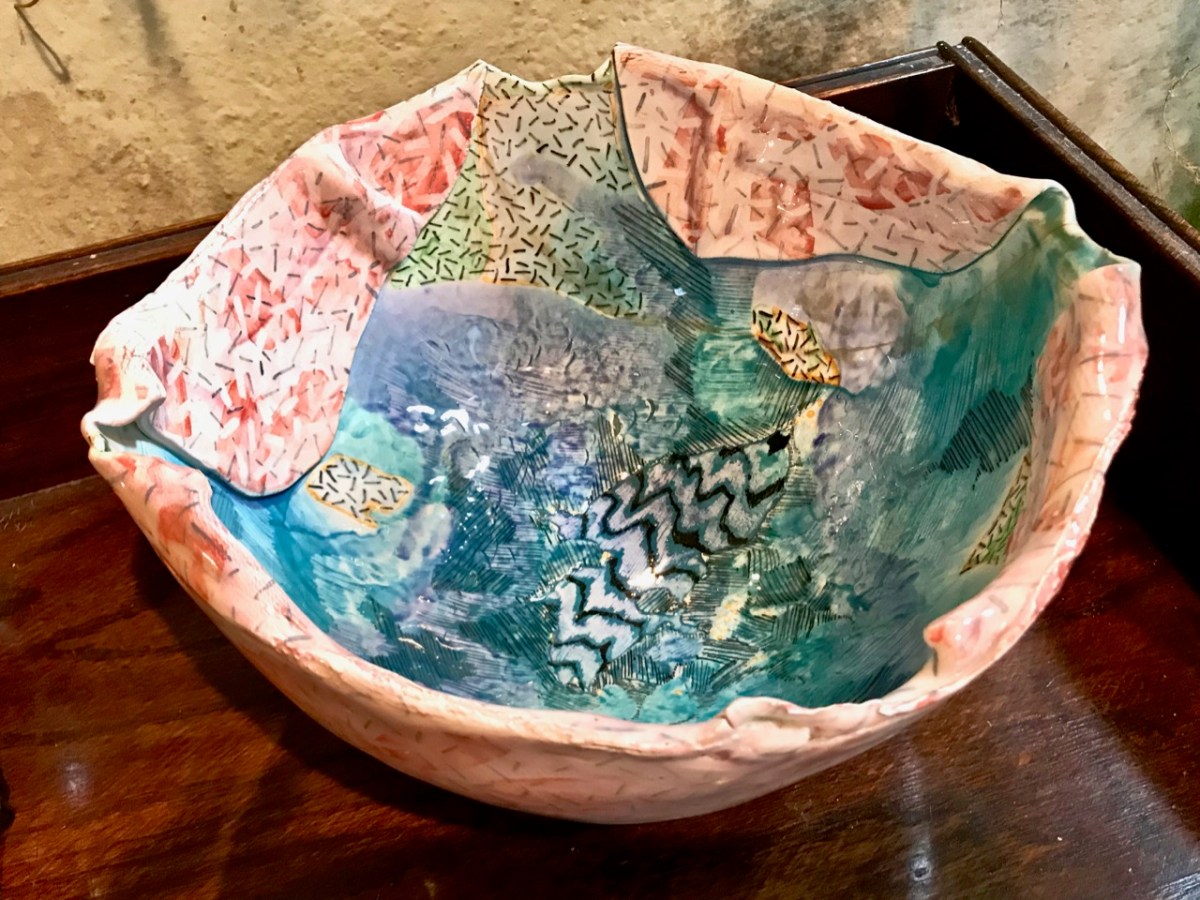
Ian and Lynne (above, from one of their bathroom product catalogues) gave up their ‘cheeky’ ceramics in 2002 but both are still producing; Lynne with large, colourful bowls and Ian with body casts (pics below). BAM hopes to show a significant selection of examples from their lifetime of work. It promises to be a spectacular exhibition: Roaringwater Journal will keep you up-to-date with progress.

You can find out more about the Ballydehob Arts Museum on the dedicated website, here

Working With Glass

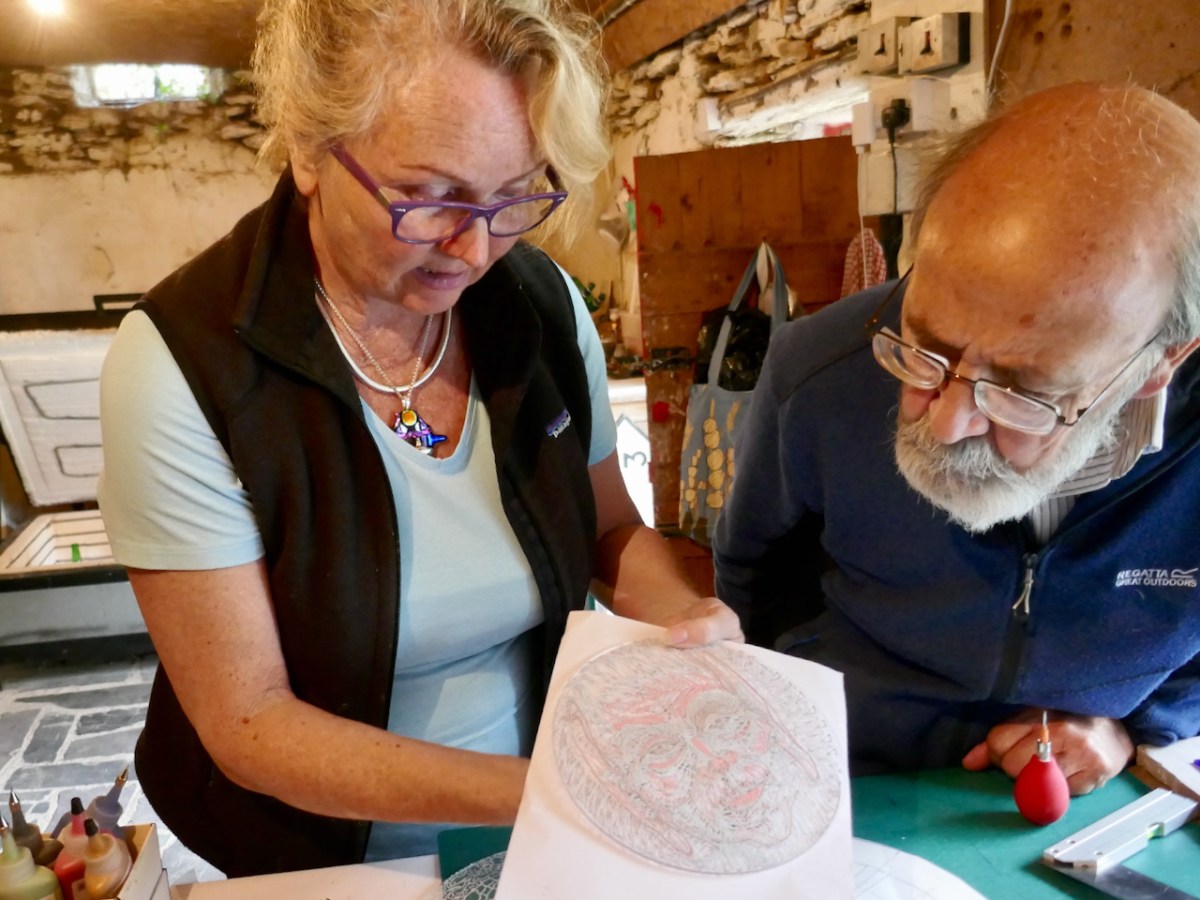
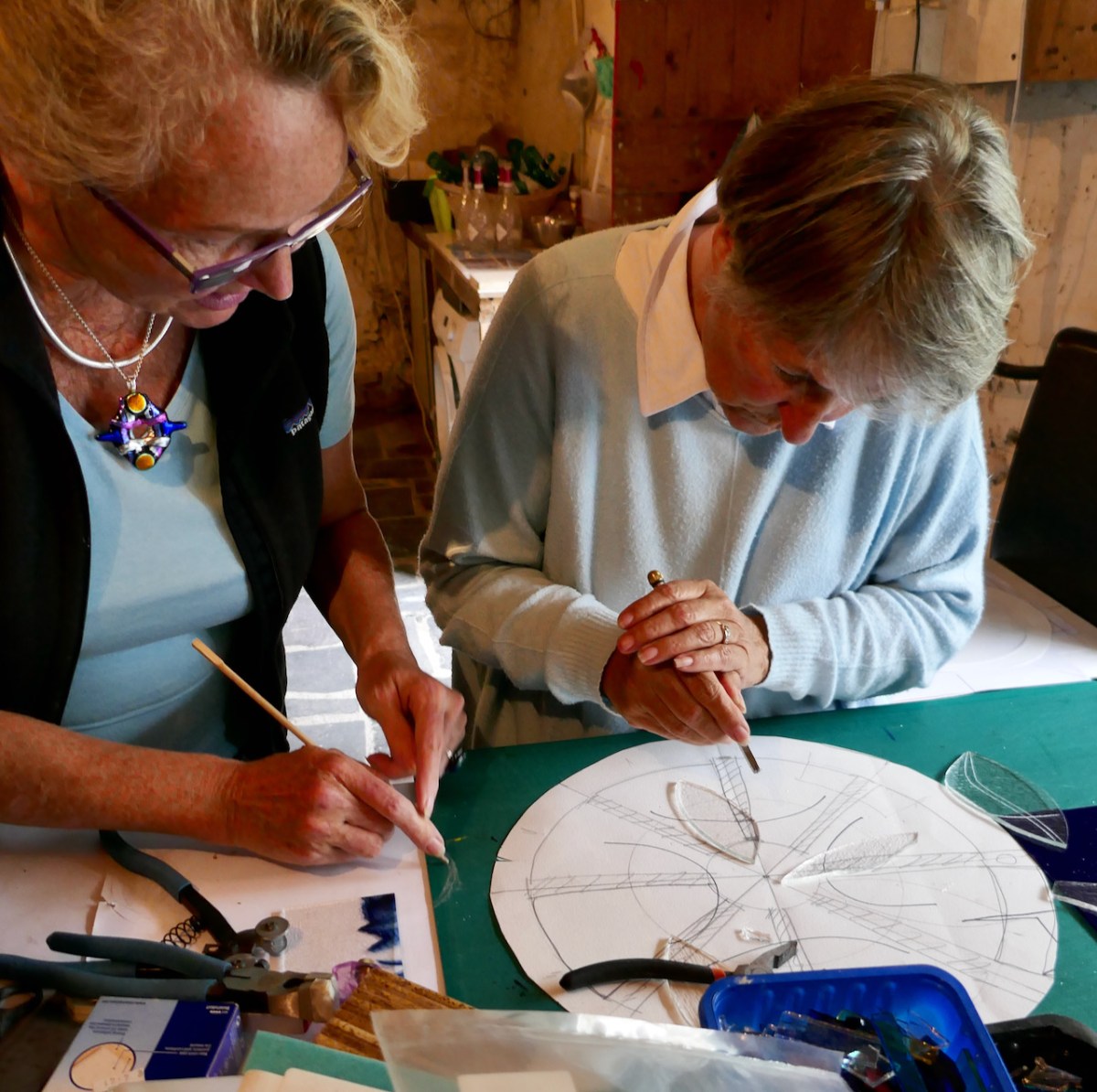
Finola and I went to a workshop on creative fused-and-painted glass. It was wonderful! We were guinea-pigs in that the glass artist – Angela Brady – was keen to try running an event and we were privileged to be invited, joining our friends Brian and Clair Lalor.

Top: that’s Angela introducing us to the medium of glass and showing us some of her own work. Centre: she’s encouraging Brian to turn his artist’s mind to the possibilities of the material. Above: Angela Brady and Robin Mallalieu (who are also architects) have taken over the former Brush Fire Pottery, just outside Ballydehob. This was the home and workplace of dynamic artists John and Noelle Verling, who bought the Gurteenakilla premises in 1973 and lived and worked there for very many years. John died in 2009 and Noelle now lives not too far away. To spend the workshop day in such hallowed surroundings added to the ambience, and could only have inspired us in our artistic endeavours!

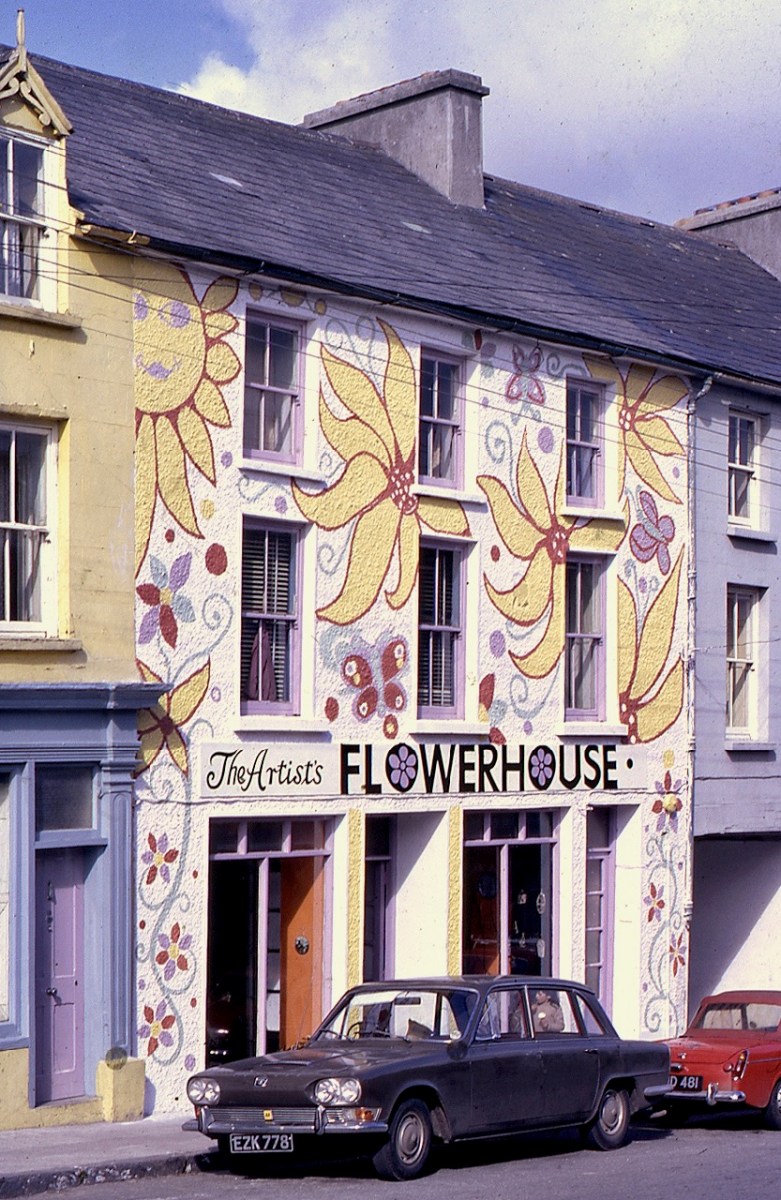
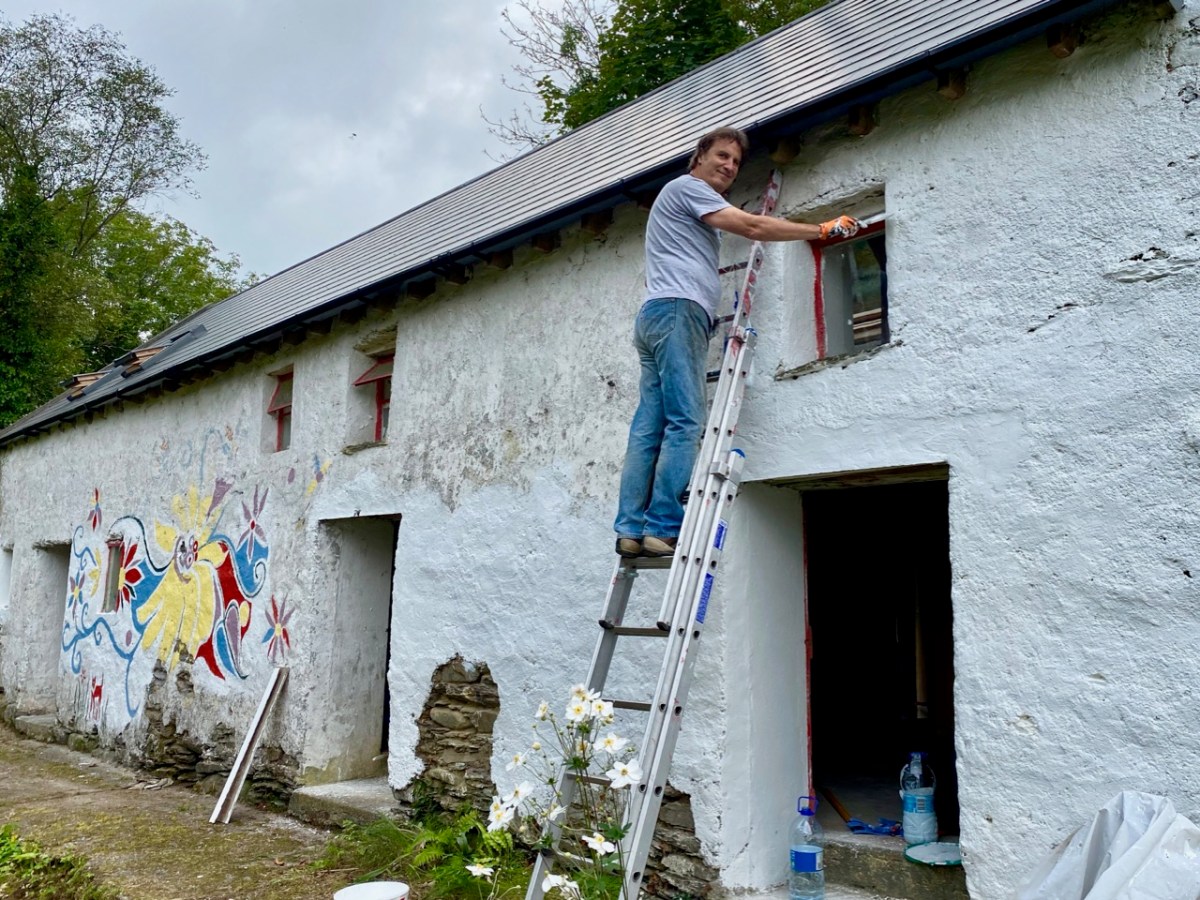
Back in the 1960s – the heyday of the Ballydehob Artists’ community – the pottery at Gurteenakilla was established by Christa Reichel who – together with her partner Nora Golden – went on to set up the Flower House on the main street in the village as a gallery and meeting place for the artists. They painted the vivid facade of the Flower House (the photo below dates from 1963, and is reproduced with the permission of Andrew Street): similar decorations were applied to the Brush Fire studio, where they survived and are now being restored by Angela and Robin.

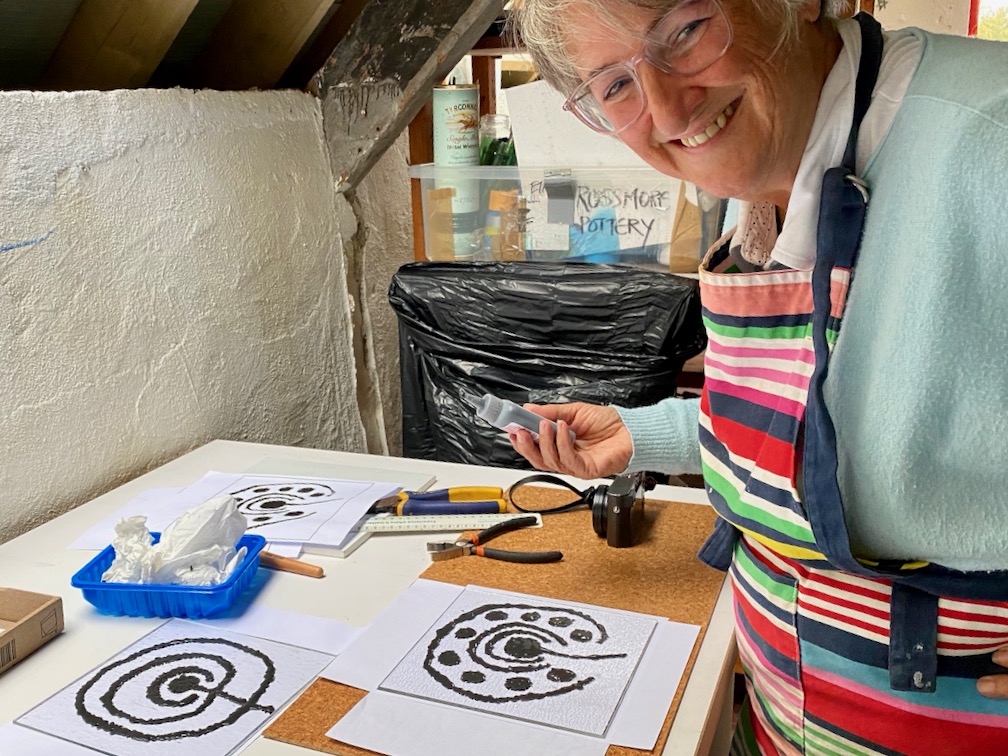
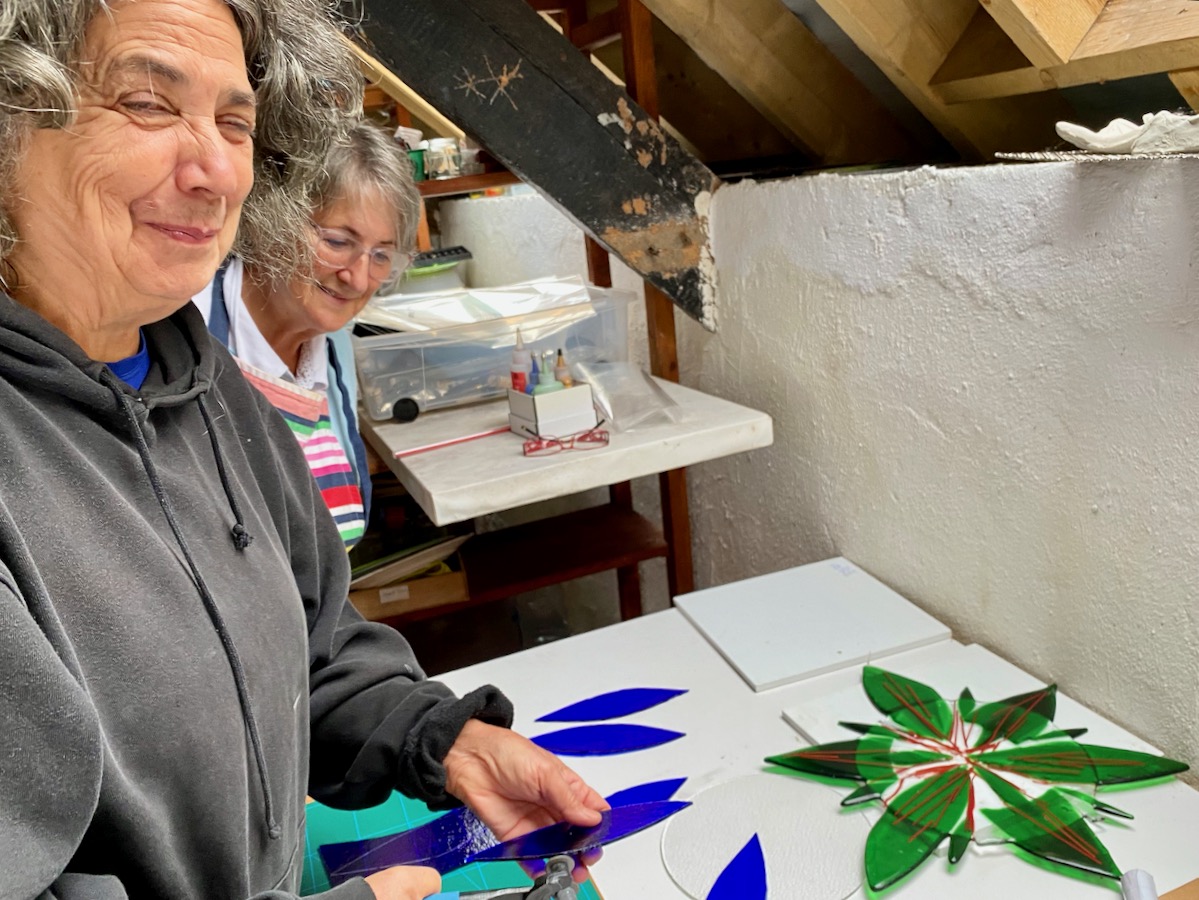
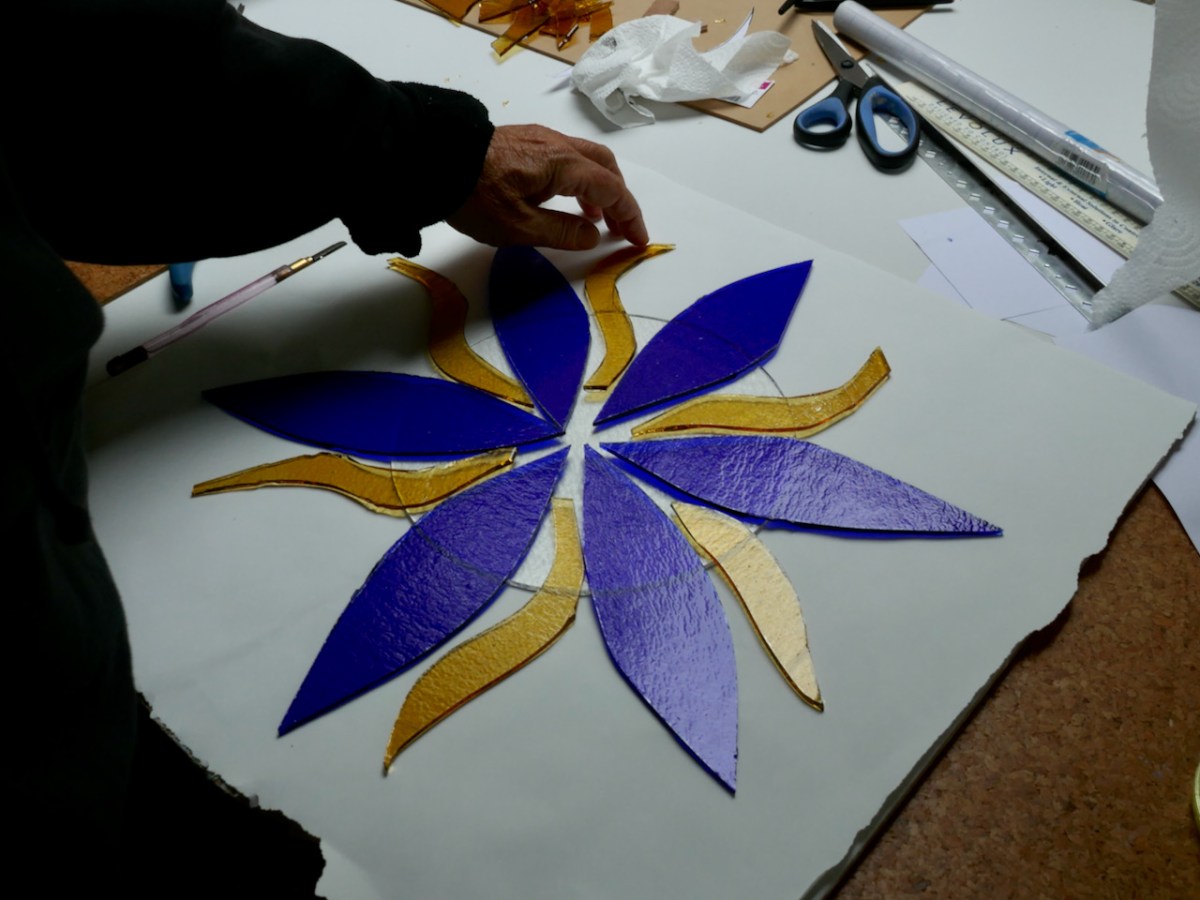
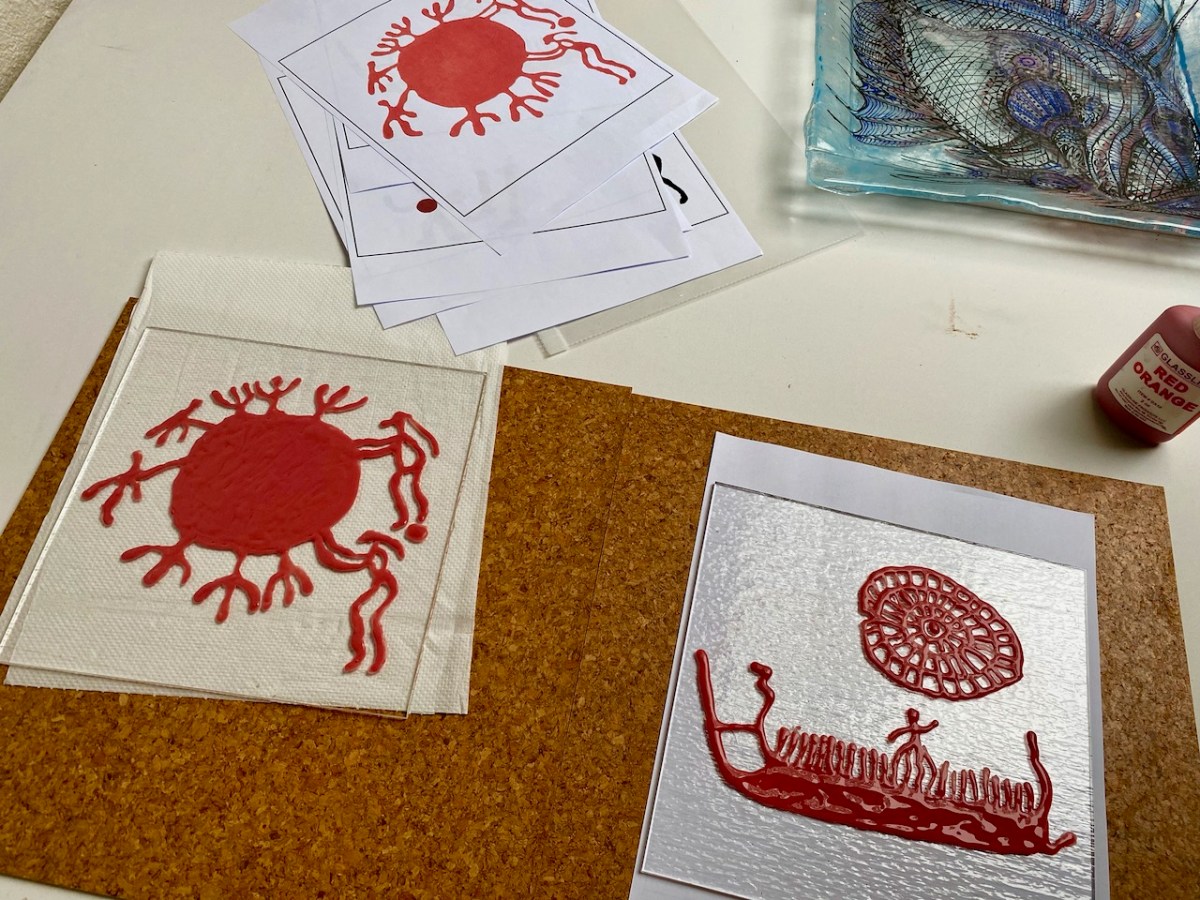
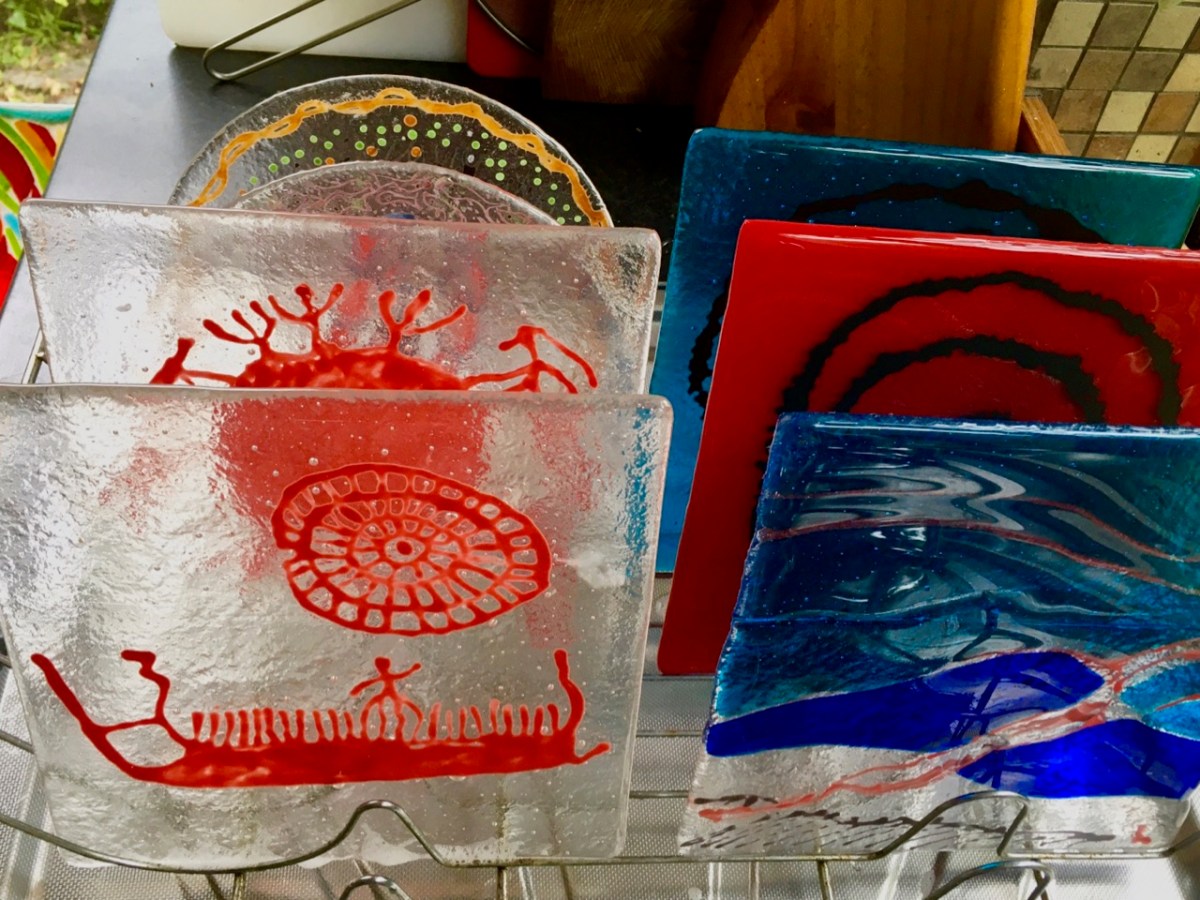
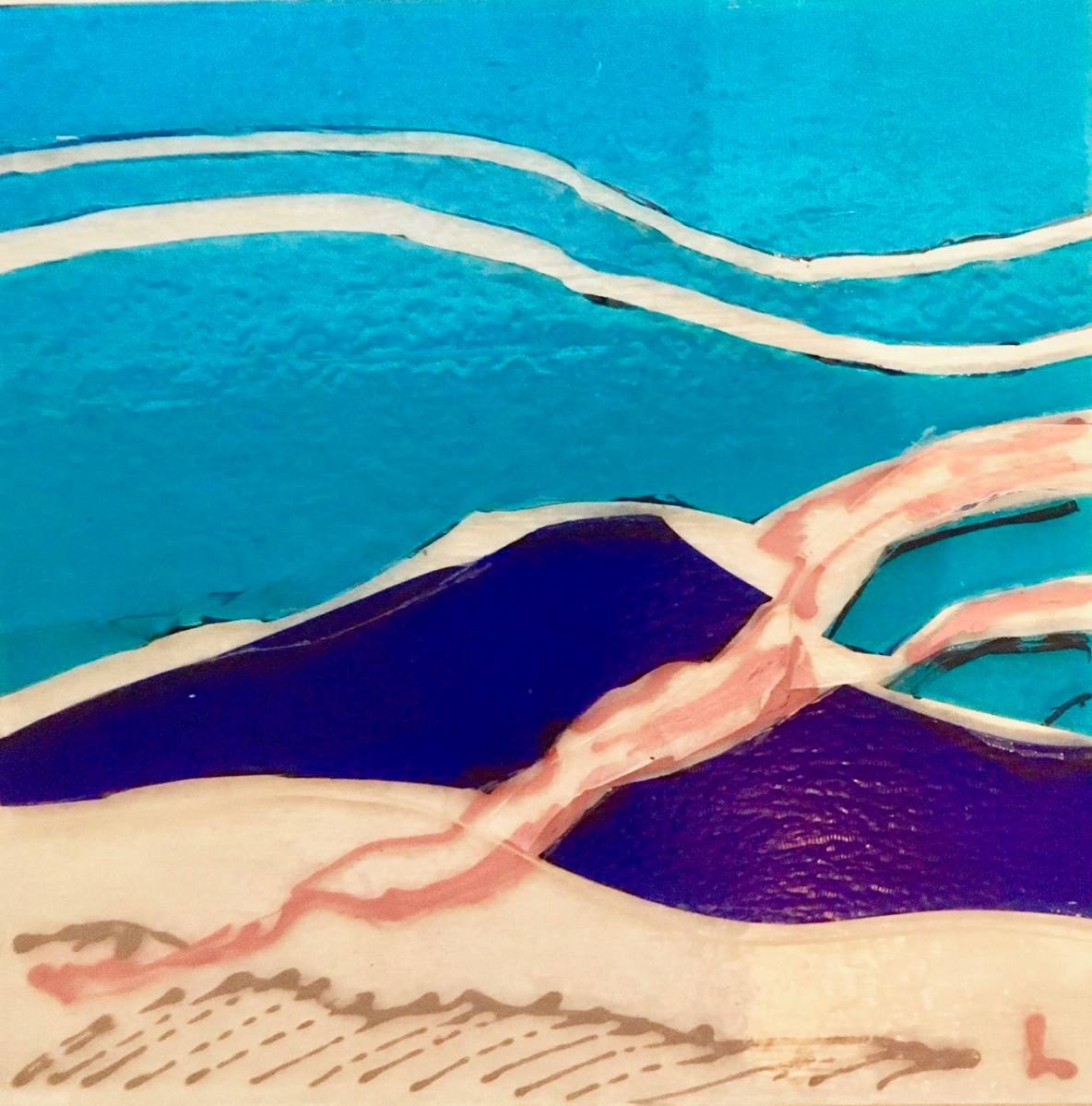
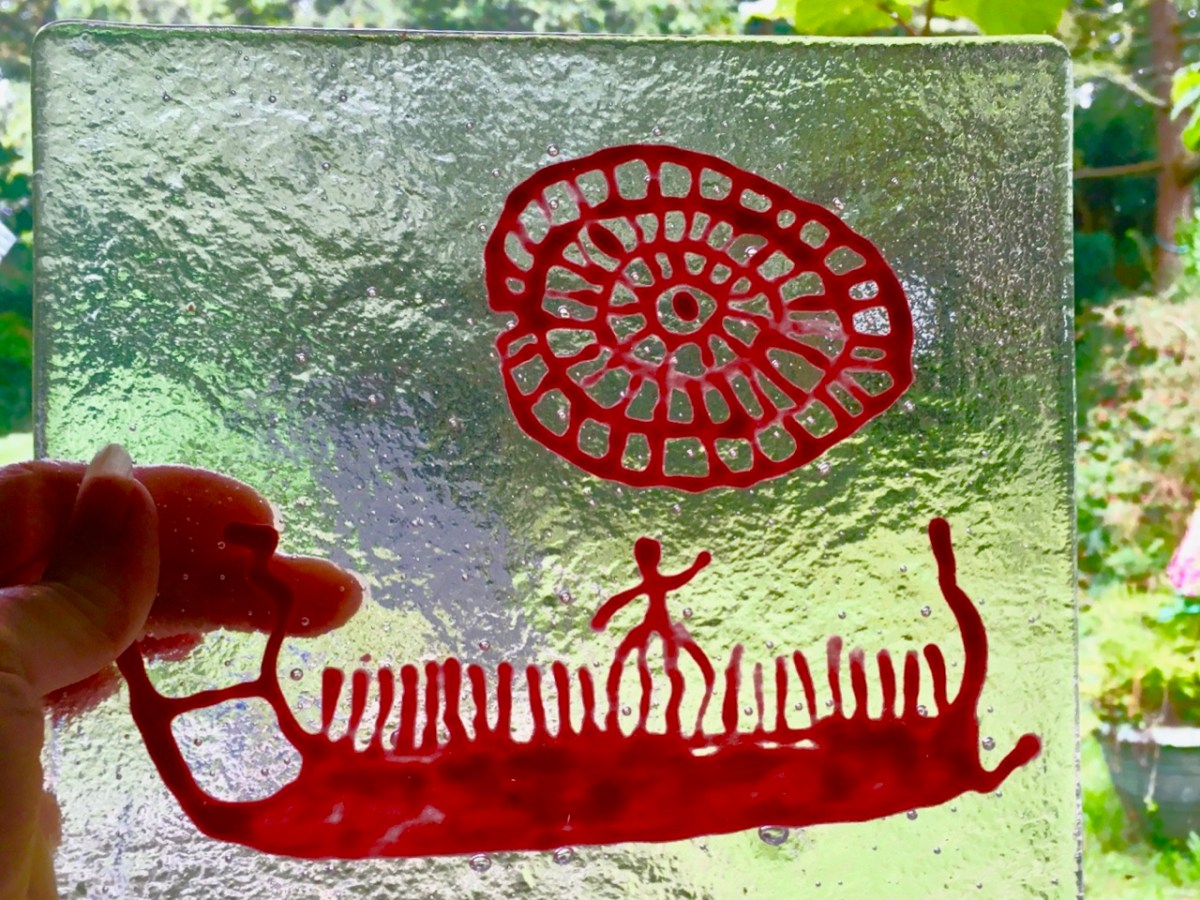
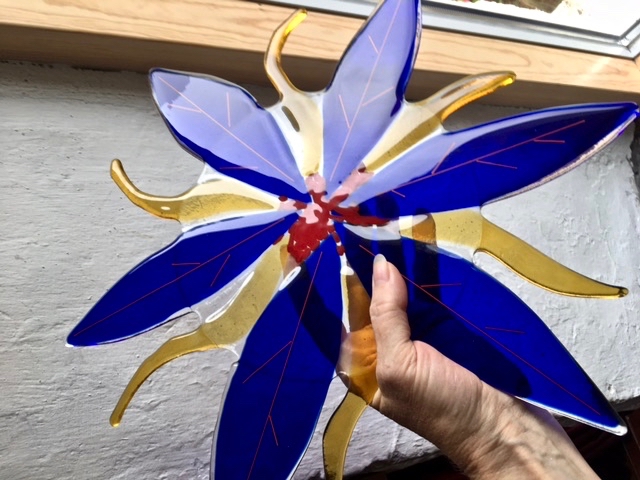
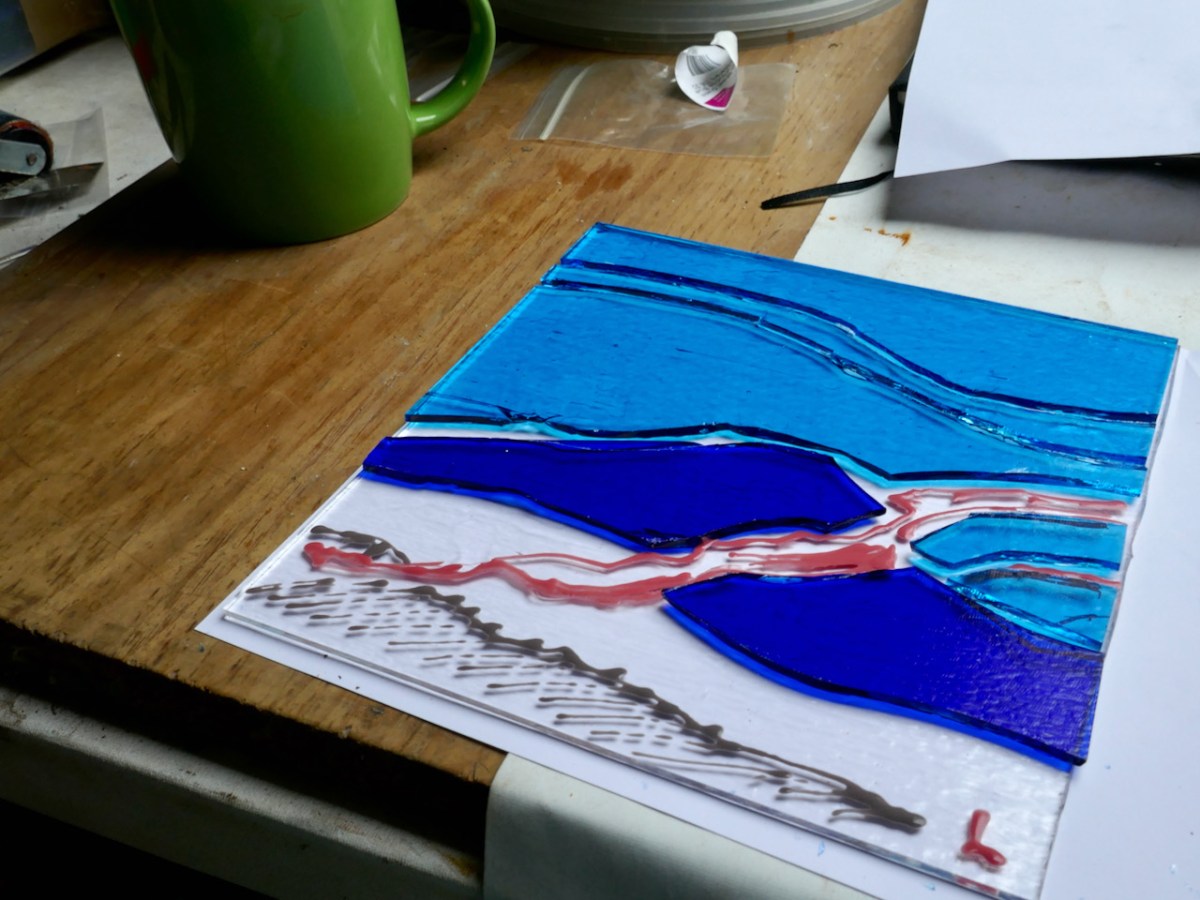
Below the Flower House picture is Nora Golden outside the studio at Gurteenakilla; and here are pics of Robin painting the studio building, and Angela’s restoration of the Reichel / Golden decorations. But back to the job in hand: in these venerable surroundings we learned how to cut glass, paint on it and prepare pieces for the kiln. We all had our own ideas: Finola and I decided to paint glass tiles with ancient motifs: Rock Art from Ireland and Scandinavia, some thousands of years old. Brian chose to use cut glass to enhance one of his exquisite sketches, while Clair was perhaps the most ambitious, planning a flower from cut pieces of glass which would require two sessions in the kiln to allow it to be ‘slumped’ to a three-dimensional shape. My view is that all the pieces were equally successful in their execution (but I am prejudiced!)

Top: Angela instructs Finola in the technique of cutting glass shapes, although Finola chose to use glass paint to reproduce some of her own Rock Art images traced during her studies in the 1970s. Above: Clair cuts and assembles a flower shape.

Top: my own pieces: on the left are attendants pushing the sun across the sky, while on the right is a ship carrying souls to the land of the Gods under a potent sun. All these Bronze Age images are found in Norway. Above, Brian working on his cut-glass sketch.

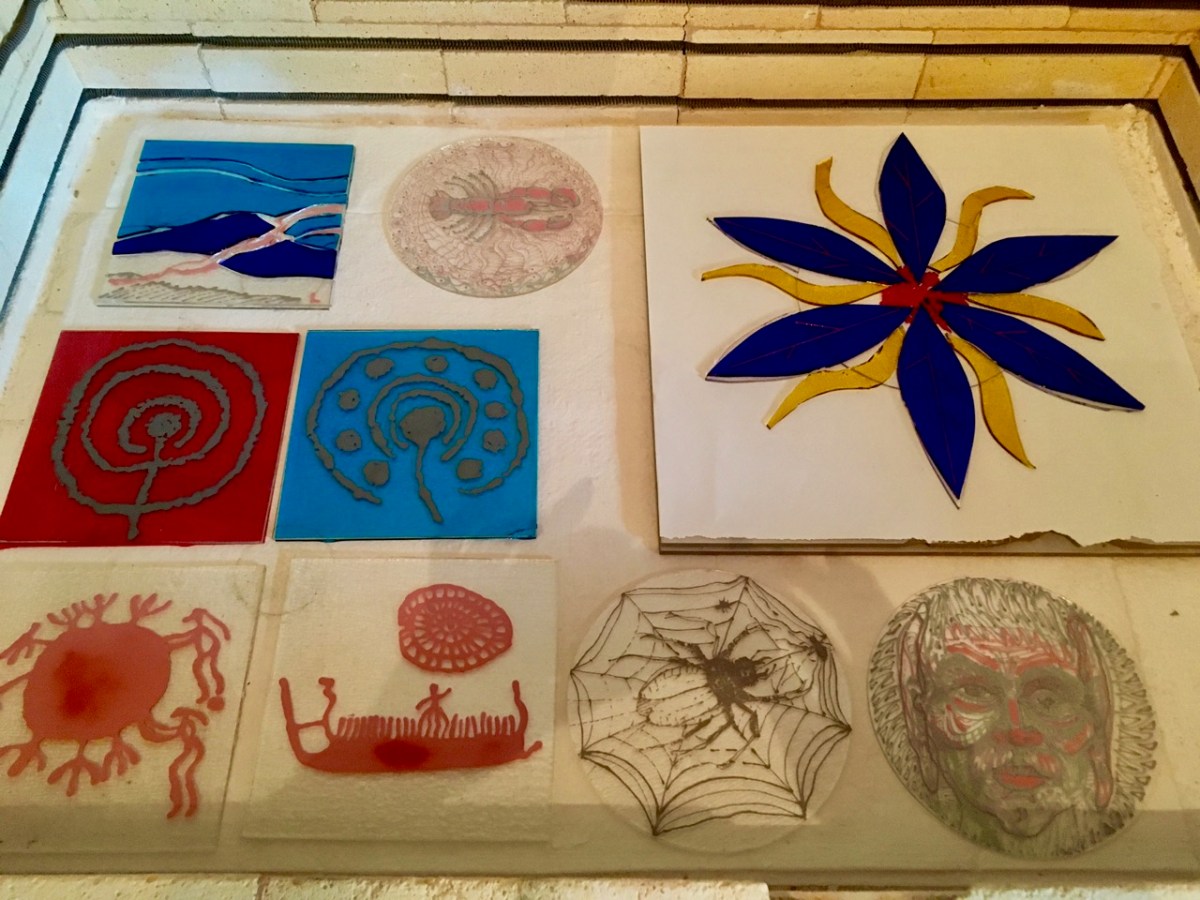
Artists at work in the studio – and the kiln room at Brush Fire. Before going in the kiln, we laminated our pieces with additional glass, to provide a stable background and – in some instances – colour. The firing is carried out overnight at a temperature of at least 760 degrees C. During that time the glass fuses and – hopefully – does not crack.. Angela was firing some of her own pieces at the same time: if you went to the West Cork Creates exhibition in Skibbereen during August of this year you would have seen many examples of Angela’s brilliant work, together with the work of other artists using glass as a medium.

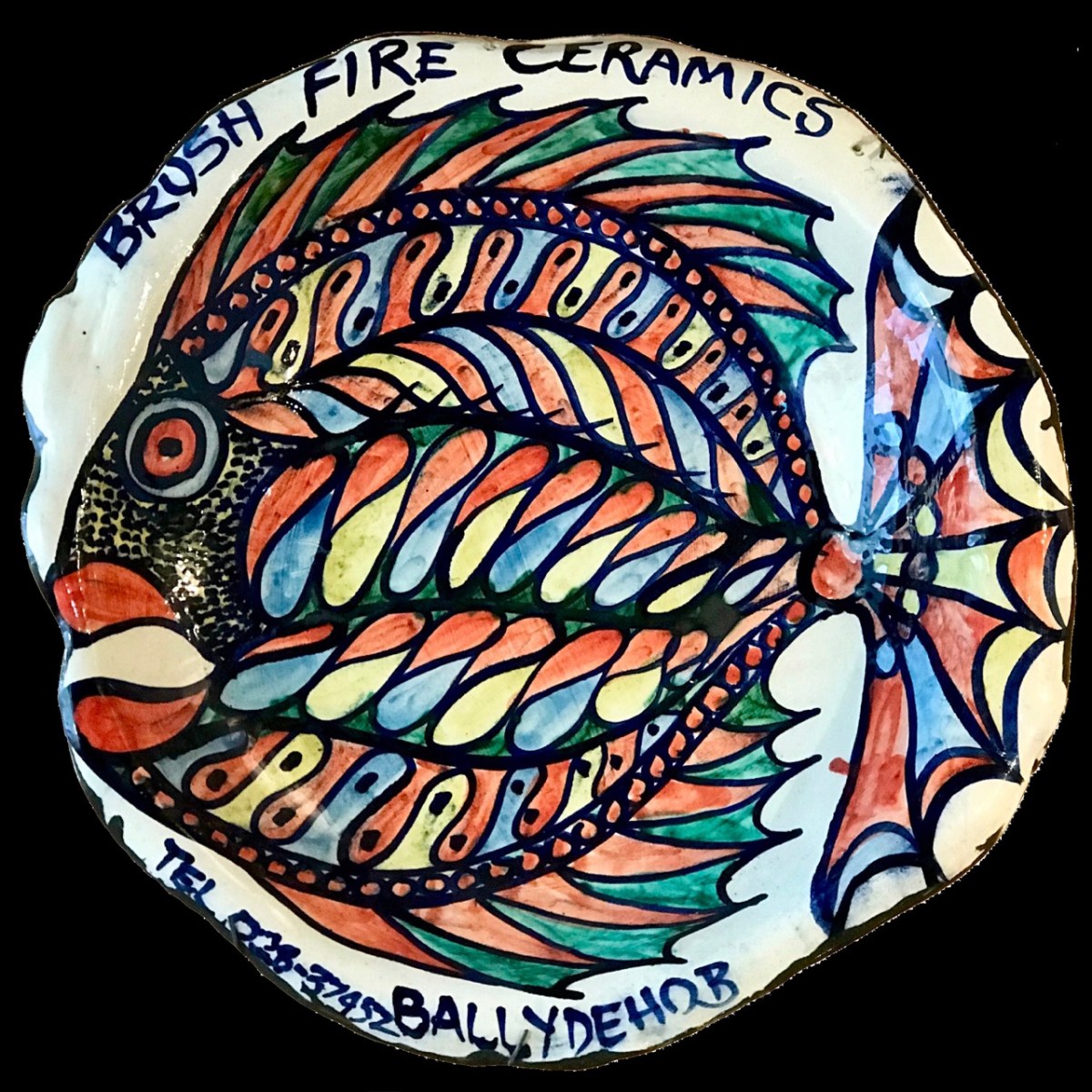
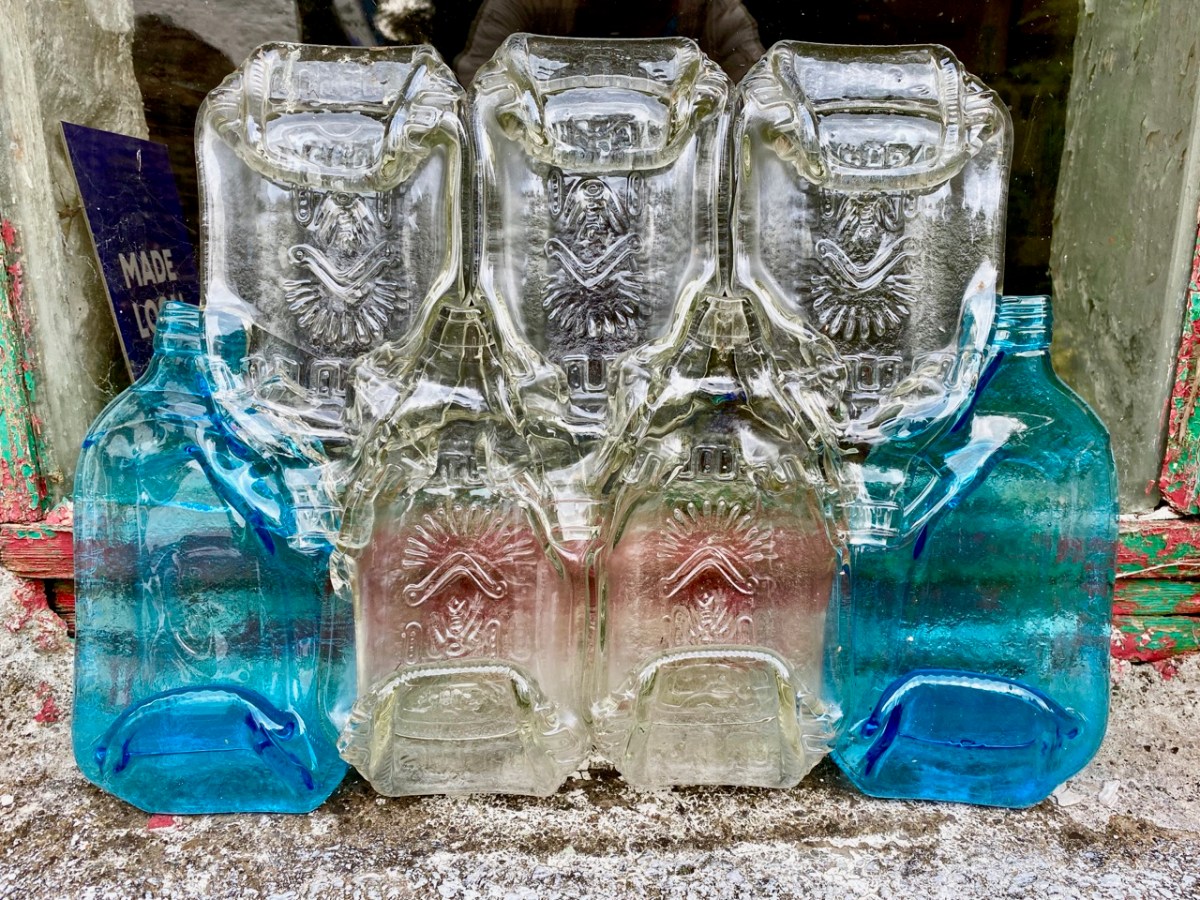
In Angela’s studio are many reminders of past times. John and Noelle Verling specialised in fish imagery – here’s the Brush Fire Ceramics sign that they made back in the day (above – since presented by Noelle to the Ballydehob Arts Museum), while above that is one of Angela’s glass pieces which pays due respect to her predecessors at Brush Fire. Below is a quirky example of Angela’s experimentation: she collected some interestingly shaped bottles from the recycling centre, and fused them together in the kiln:

The following day, Angela took our pieces out of the kiln once it had cooled, and washed them (above). Then we assembled at Nead an Iolair for the reveal. Thank you to Robin for the photos. Clair’s work had to be refired to allow it to ‘slump’, so that was unveiled later on.

Pieces (top to bottom) by Brian, Finola and myself. And – to finish as we started – Clair’s magnificent flower – before and after the second firing! Thank you to Angela for enabling each one of us to experience this most satisfying process. We would all like to take part again another day – and expand our new-found skills!

Pints and Pipes

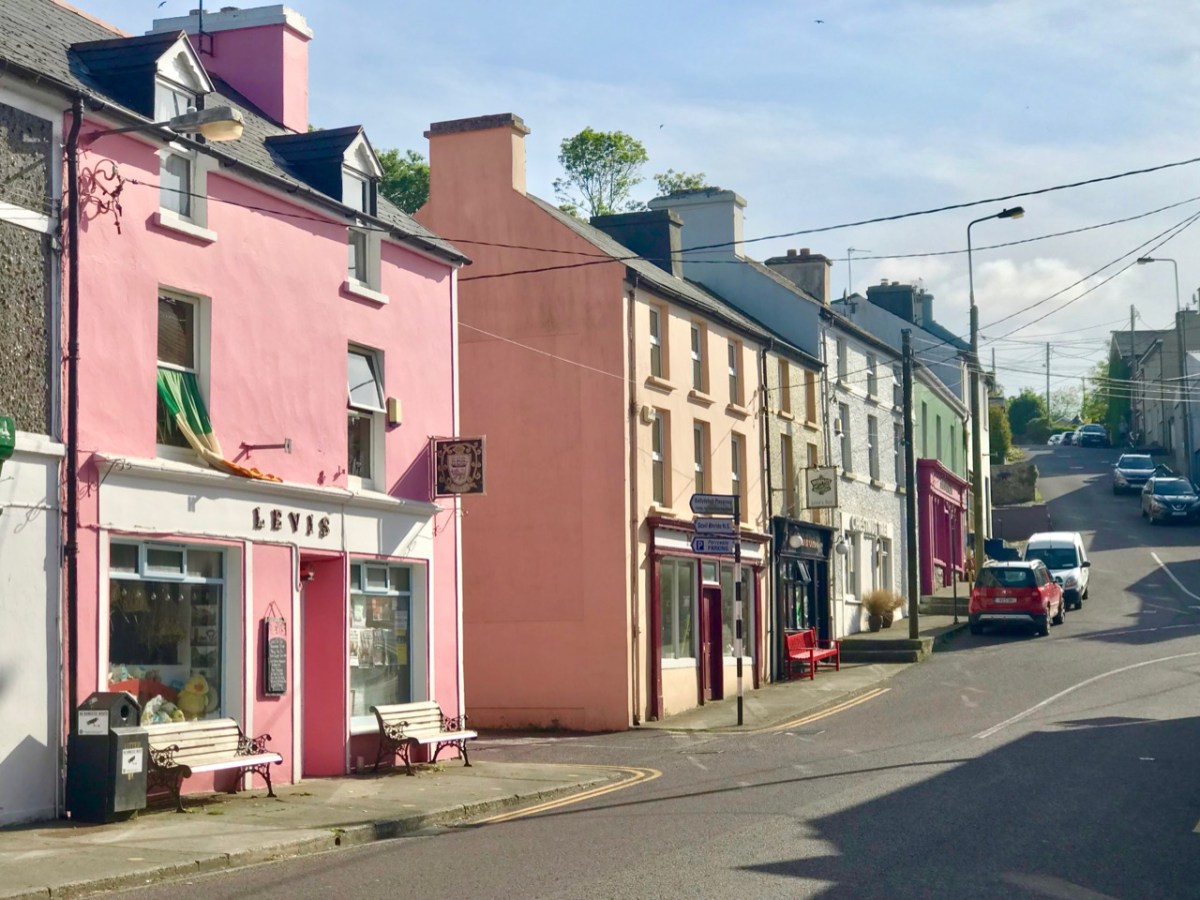
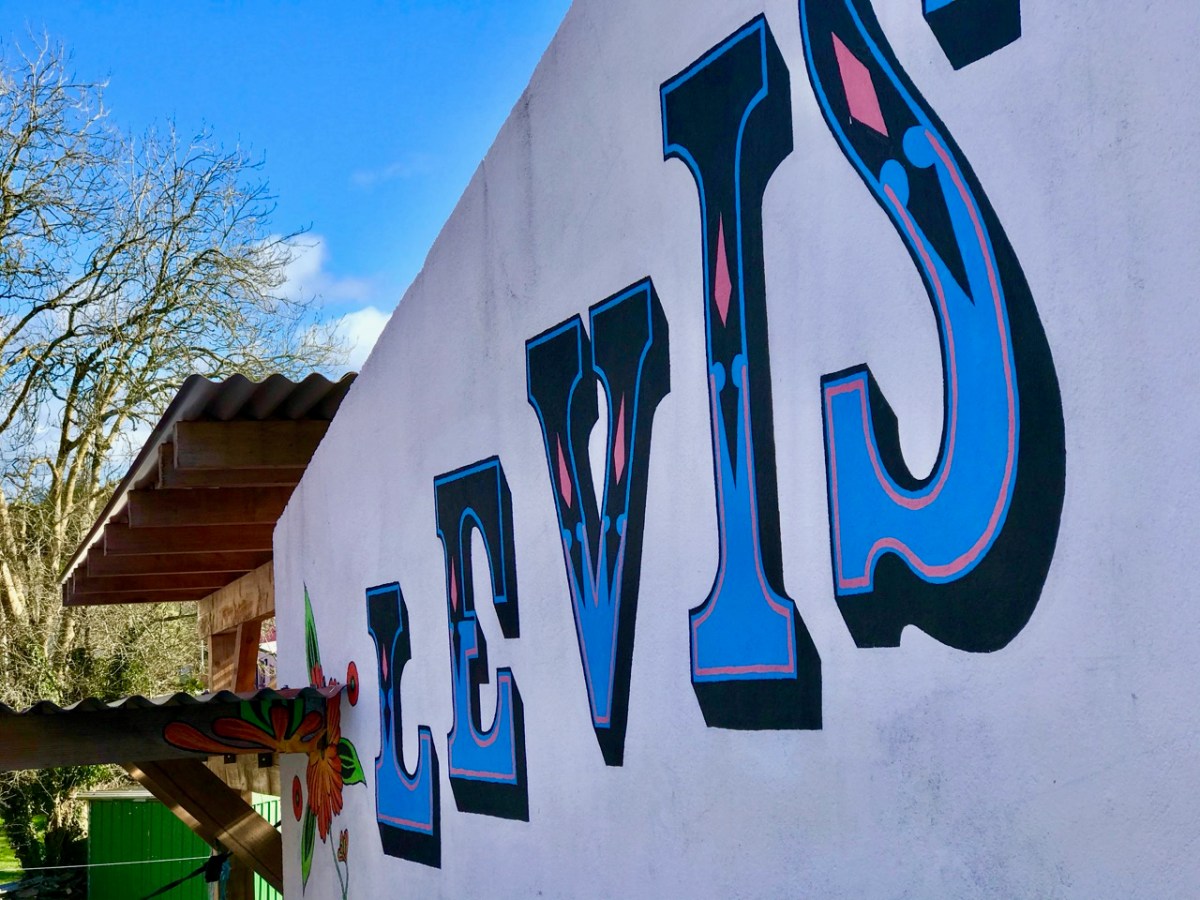
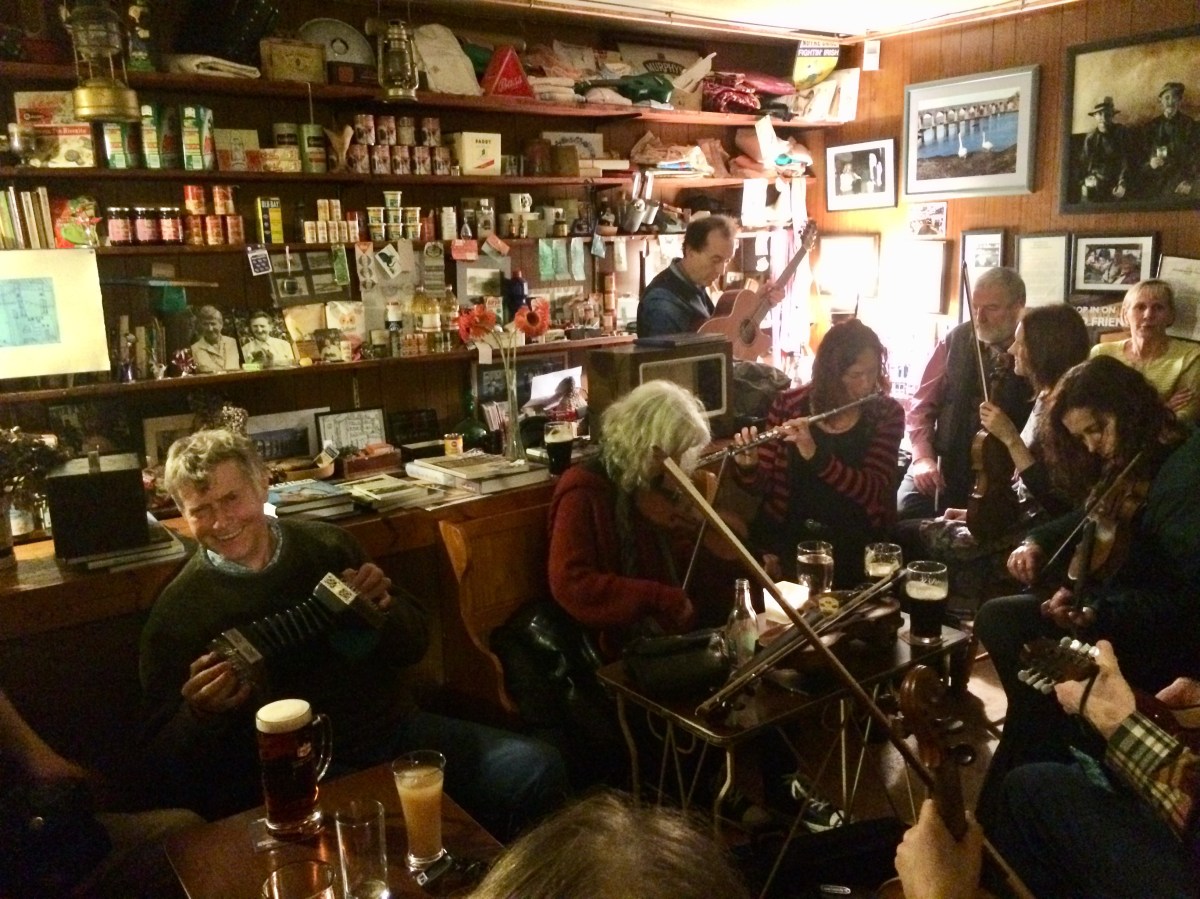
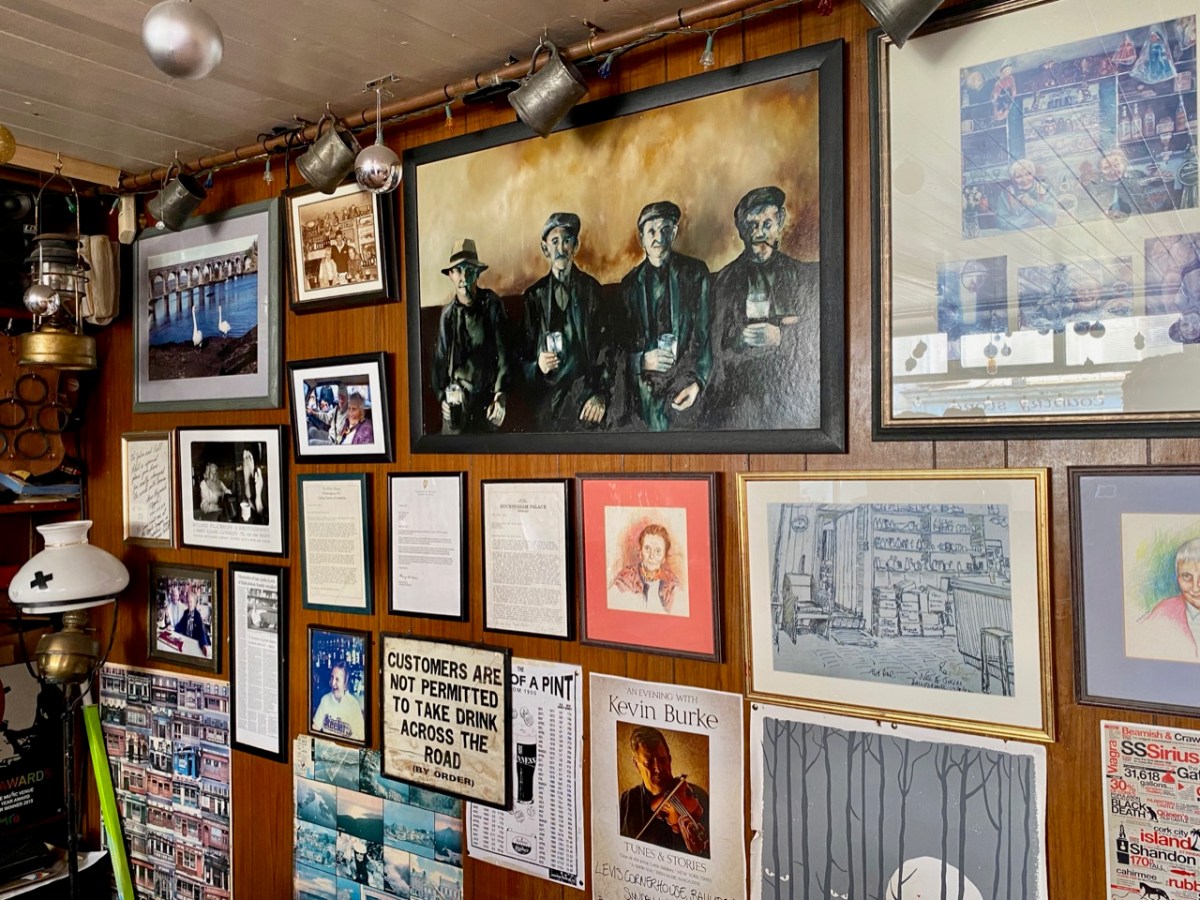
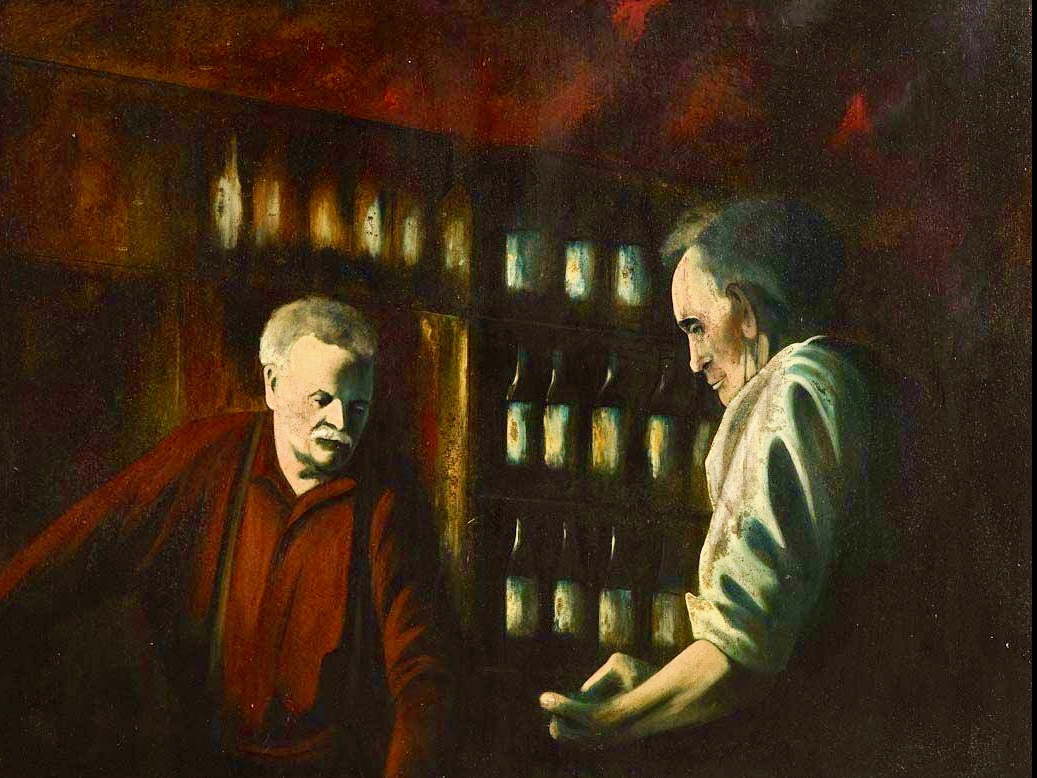
Today there is a story to tell, with lots of connections to the West of Ireland – and our own Ballydehob! That’s Levis’s Corner Bar, below, one of the village’s fine hostelries: try them all if you visit. Levis’s is known for its musical events but also for its traditional appearance inside. Look at the photo of the Irish music session (you’ll see me bottom left playing concertina) – that was taken a few years ago, before Covid; we are still waiting for those good times to return. On the wall behind the players you can catch a glimpse of a painting of men with pints and pipes.

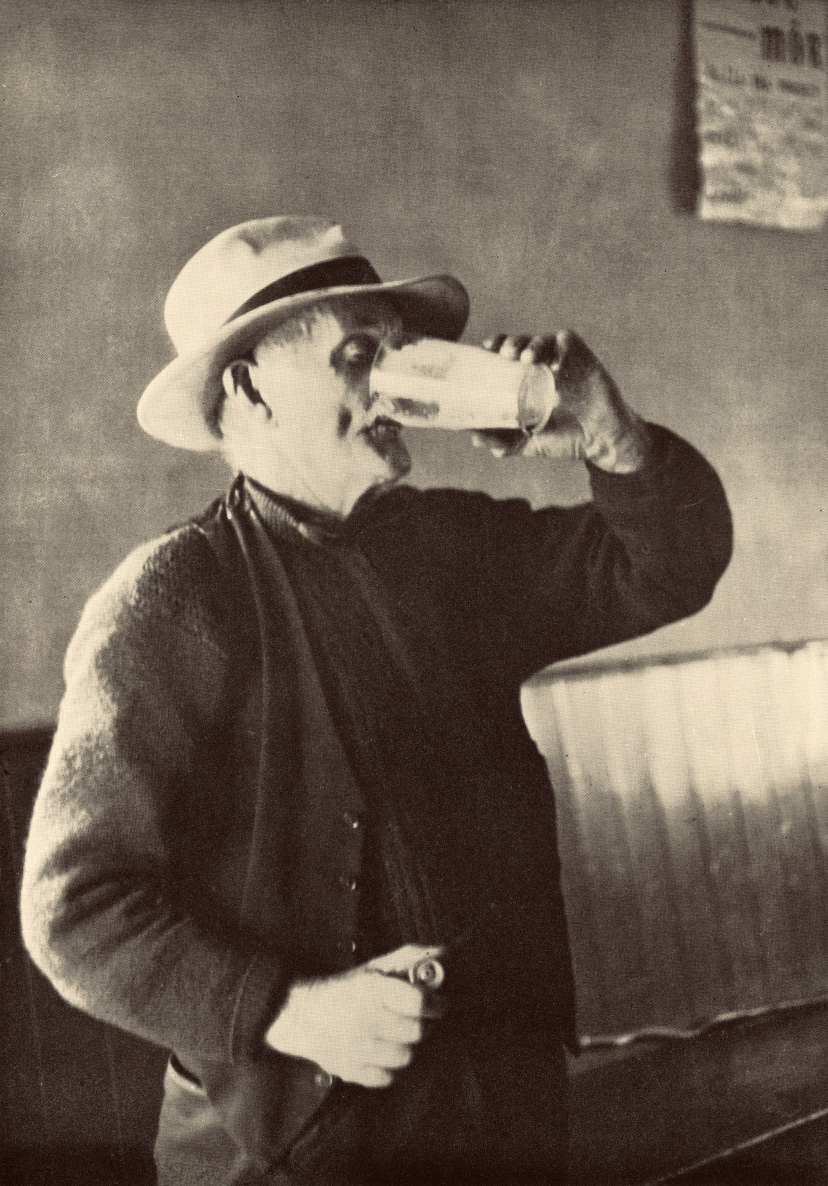
There’s a better view of the painting, above. When I first saw it – very many years ago now – I knew immediately that it was based on a photograph that had been taken by Tómás Ó Muicheartaigh – an Irish cultural hero who spent most of his life documenting traditional life, mainly in the western counties. He lived through the founding of the Irish Free State and was an enthusiastic proponent of the Irish language. This sketch portrait of him is by Seán O’Sullivan, a friend and compatriot:

Way back in the 1970s my then wife and I ran a small bookshop in a Devon market town, specialising in folklore and traditional life. It had a substantial section on Ireland, and Irish culture. We stocked a recently-published volume (1970) celebrating the work of Ó Muicheartaigh, and I very soon had to sell myself a copy, as it is a superb record of mainly rural life in Ireland during the early twentieth century. I have it to this day – of course.

There is the photograph in the book, above. It is captioned Piontí Agus Píopaí – Pints and Pipes, hence the title of this post. Below it is a photograph of two Aran Island fishermen relaxing on the rocks while waiting for the weather to improve before they set out to sea. But there is more – a list of the photographs with some expanded captions at the end of the book. The whole book is written in Irish so I have recruited Finola’s help in providing a transcription for the Pints and Pipes – here it is, in the original and then translated:

Piontí Agus Píopaí

Ceathrar pinsinéirí ag baint spraoi as lá an phinsin le píopa agus le pionta Pórtair. B’fhéidir nach mbeadh pionta go hAoine arís acu. A saol ar fad tugtha ar an bhfarraige acu seo. Féach, cé gur istigh ón ngaoth agus ón aimsir atá an ceathrar go bhfuill an cobhar ar píopa gach duine acu. Is mar chosaint are an ngaoth a bhíodh an cobhar agus chun tobac a spáráil, ach ní bhainfí an cobhar anuas den phíopa instigh ná amuigh

Pints and Pipes

Four pensioners enjoying pension day with pipes and pints of porter. They might not have another pint until Friday. They’ve spent their whole lives on the sea. Look, even though the four of them are inside, away from the wind and the weather, the cover is still on each of their pipes. The covers are to protect the tobacco from the wind and to make it last longer and they aren’t taken off inside nor out

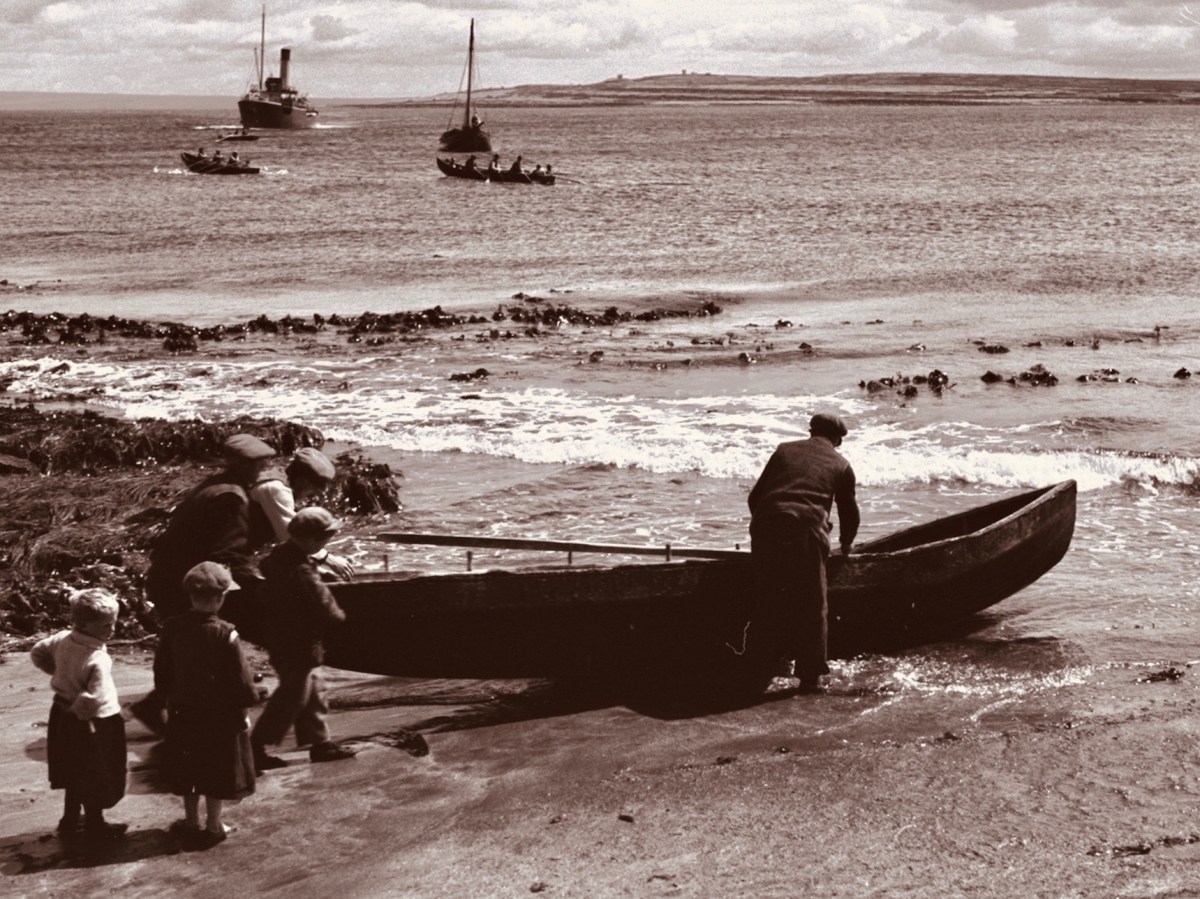
So, a fascinating piece of social history. Apart from conjecturing a date for the photo, I didn’t have much information to add when I first published it on Roaringwater Journal in February 2016. Because of the juxtaposition in the book, I guessed that the picture might have been taken around 1938, when Tómás is known to have visited and photographed the Aran Islands (and would have travelled through Kerry to get there). Here is one of his views of a Curragh being launched on Inis Meáin at this time (Dúchas):

I didn’t expect my story of Pints and Pipes to advance beyond this. But, last week, I received a message from a reader who had seen the photograph in Roaringwater Journal and was able to provide very significant additional information!

. . . My name is Joanne and I live in London. My dad found a photo on your website from a blog dated 14 Feb 2016 entitled Images – it is the Tomás Ó Muircheartaigh photograph of the 4 men drinking in a bar. My great-grandad is the man on the far left. It was great to find the photo as it is much better quality than the copy we have, unfortunately my nan had an original postcard but it was borrowed by a representative of Guinness many years ago and never returned! 

Joanne, September 2021

Joanne has proved to be a wonderful contact, and I am so grateful to her for providing information and allowing me to use it here. In summary:

. . . My great-grandad’s name was Seán Mac Gearailt but he was known as Skip.  He was from Baile Loisce in Kerry.  The photo was taken in a bar which was then called Johnny Frank’s in Baile na nGall (Ballydavid) but I think is now called Tigh TP.  I can see from the photos that have been digitalised Tomás Ó Muircheartaigh took a lot of photographs at Baile na nGall. Pints and Pipes isn’t in that digitalised collection . . .

. . . I gave my dad a call tonight and discussed the extract with him; he lived with his grandparents as a child in the late 1940’s/50’s and visited regularly so knows a lot about Skip. Dad remembers him collecting his pension on a Friday at Ballydavid and having a beer in Johnny Frank’s before going home to hand over the rest of the pension to his wife – so the extract in the book is correct on that. Skip was primarily a farmer but dad says he did go out fishing in a curragh at night. Dad remembers his nan being worried for him when he was out at sea. Dad doesn’t know the name of the other men in the photograph. Skip was friends with two Moriarty brothers (from Gallarus) – so dad thinks maybe the two men in the middle are them but he can’t know that for sure . . .

Joanne, September 2021

Wow! You can imagine how delighted I was to receive that information. But there’s more. I managed to find some early photos of Ballydavid (Baile na nGall in Irish), which is part of the Corca Dhuibhne Gaeltacht area. In fact we have been there – when we took the Irish language immersion course two years ago.

We didn’t photograph the Ballydavid bar, Johnny Frank’s at that time, but here (above) is a view of it from Wiki Commons. Also, to help set the scene, is a little piece online which features the bar, and weaves a tale…

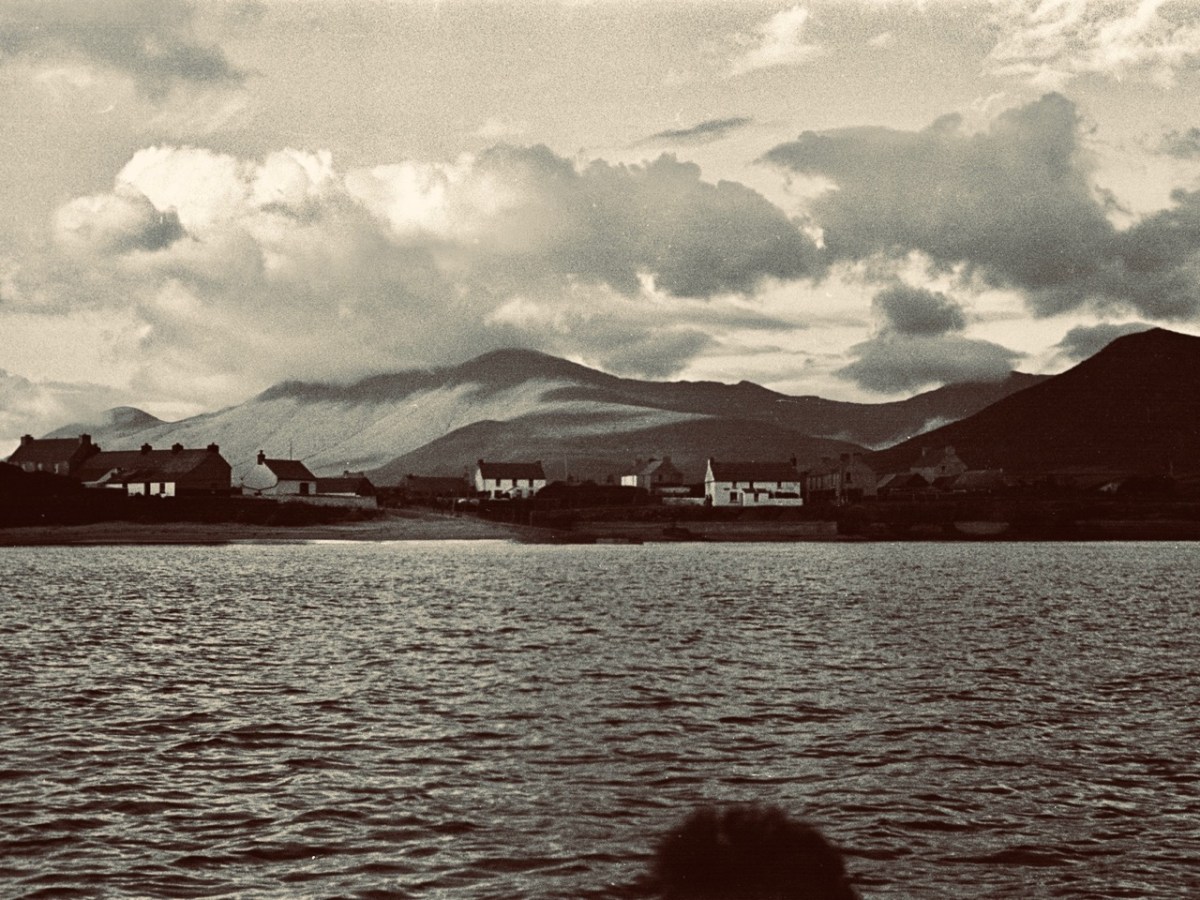
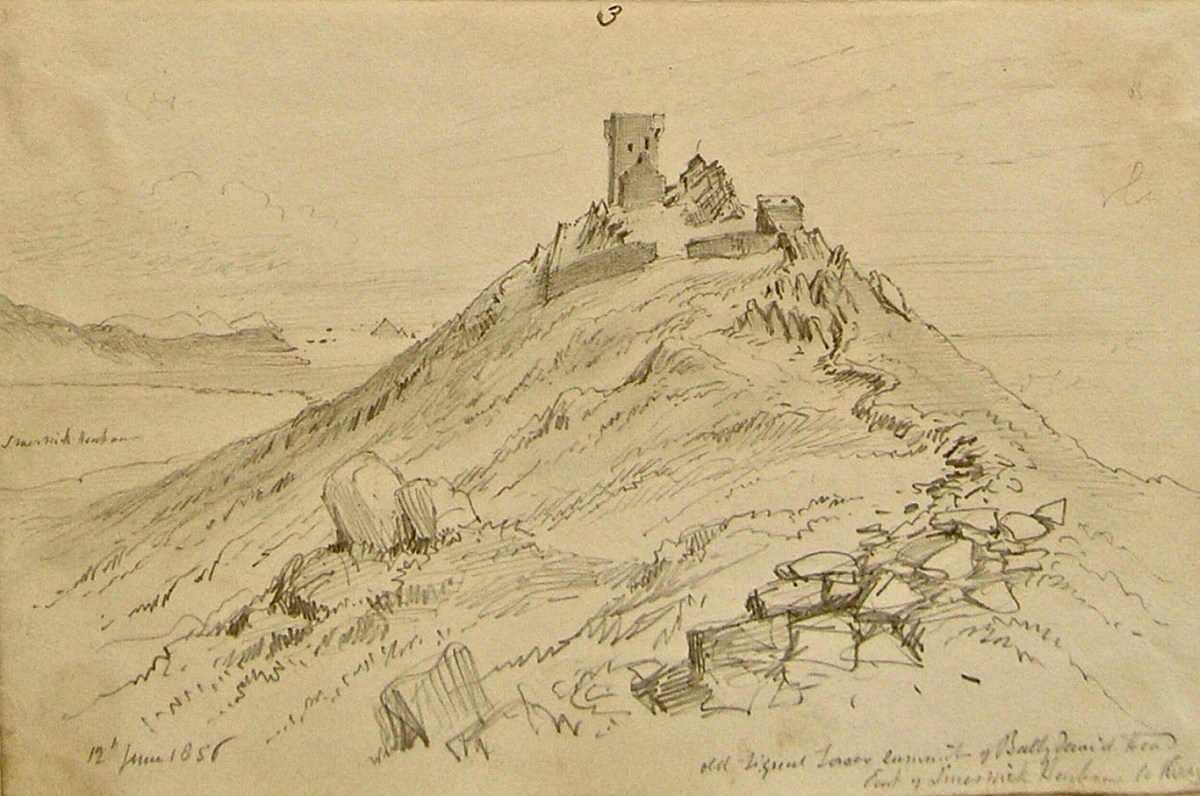
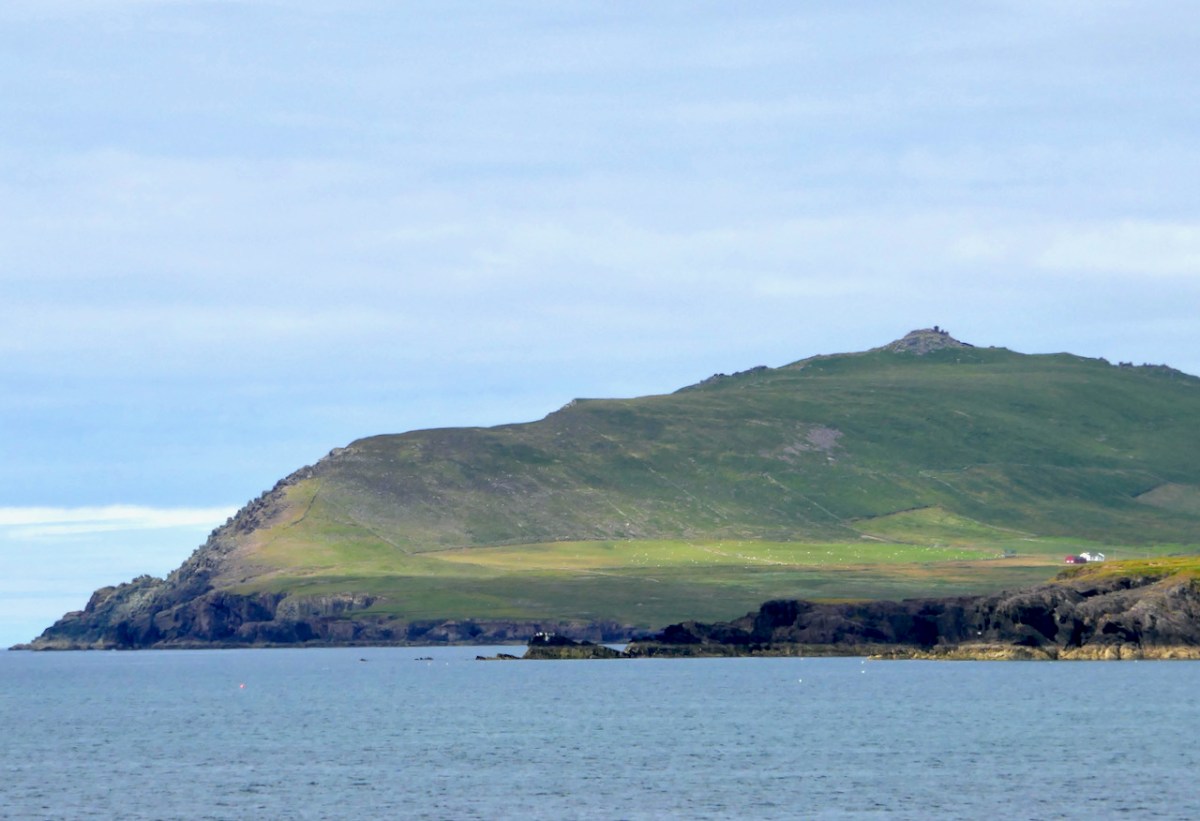
Regular readers will know my interest in the Napoleonic-era signal towers which dot the coast of Ireland, all built in the early years of the 19th century. There was one at Ballydavid Head, drawn (above) by George Victor Du Noyer as he passed by on one of his geological expeditions on 12 June 1856. We didn’t climb the Head when we visited, but we viewed it from a distance (below). The tower is now a ruin.

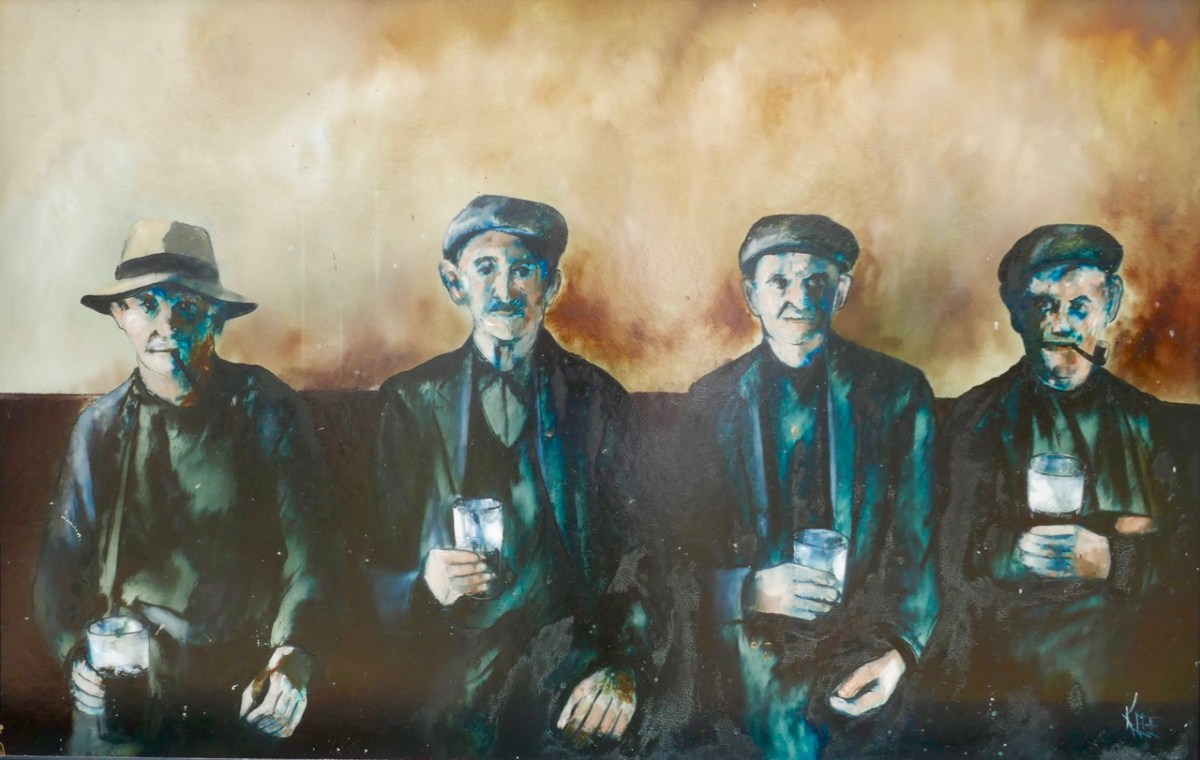
We have travelled far, far away from Ballydehob where, in some ways, the weaving of this tale began. We had better return. Here’s a reminder of that painted image of the ‘Pints and Pipes’ photograph in Levis’s Corner Bar. Compare it to the header photograph of this post.

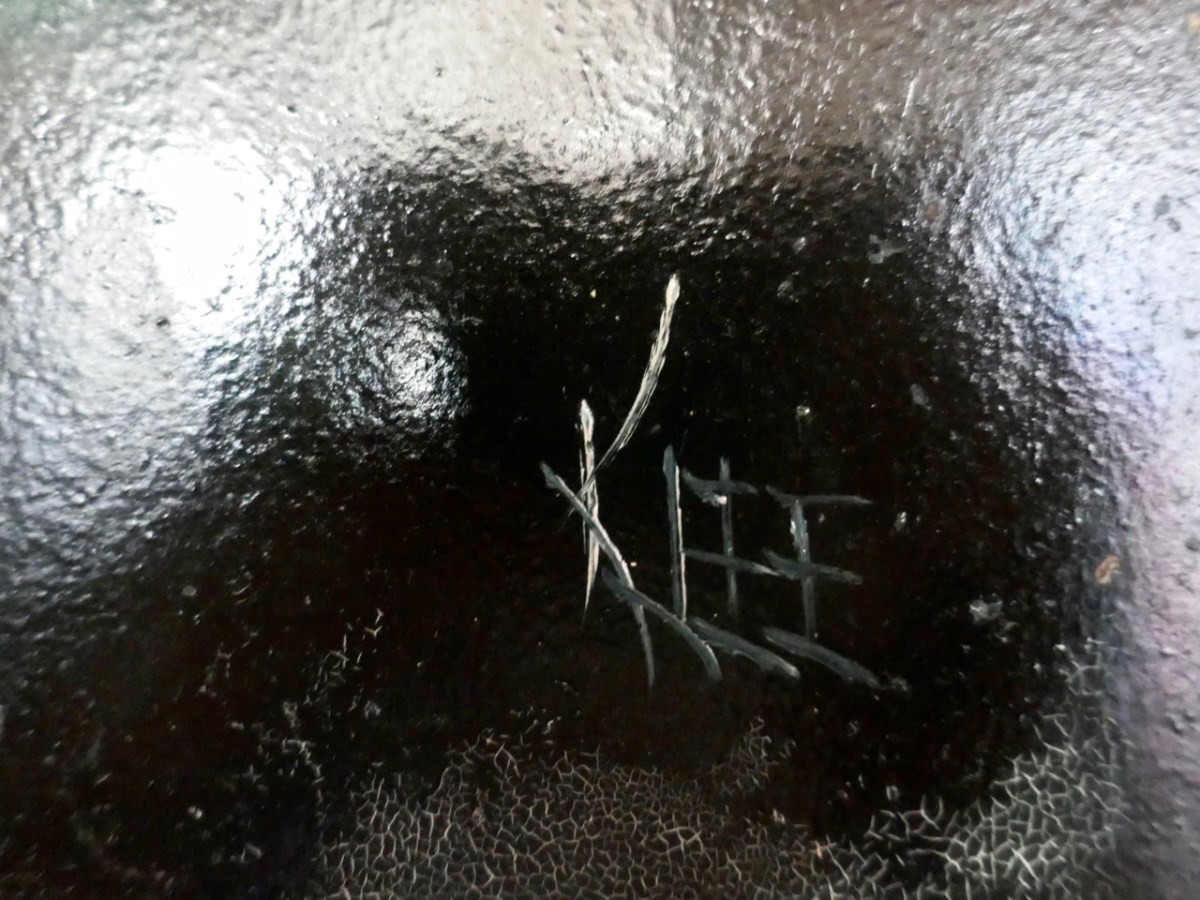
It is so obviously based on the Tómás Ó Muicheartaigh portrait, yet there are some differences. The pipes of the two men in the middle are missing! I can’t tell you why this is the case, but I can tell you now who produced the painting, as I was given a valuable link by Joe O’Leary, landlord of Levis’s (which his been in his family for some generations – but that is another story). The painting has a signature:

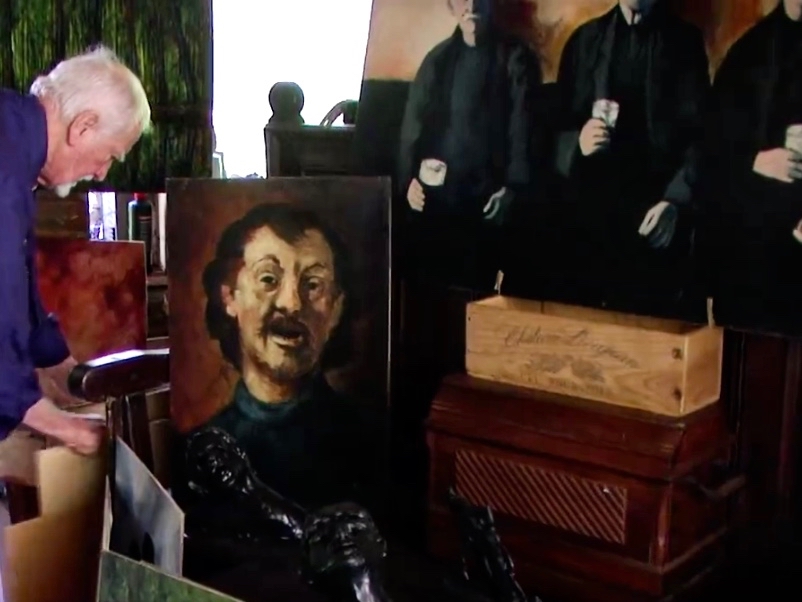
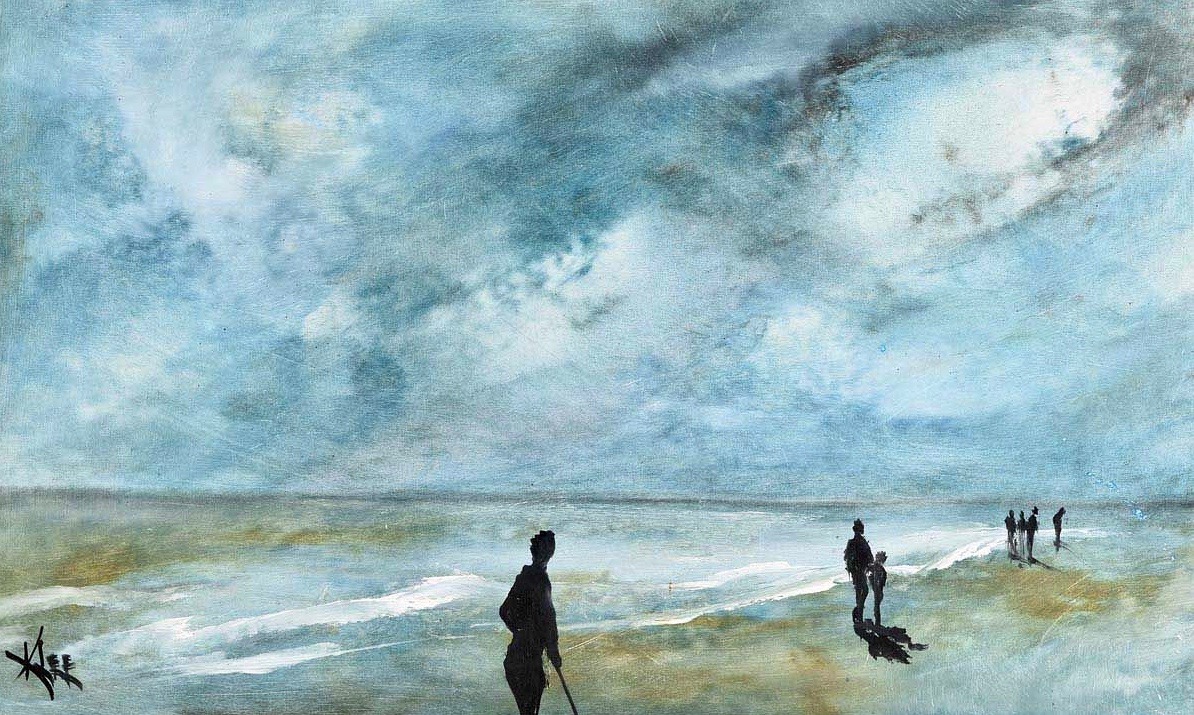
Paul Klee was, of course, a well known Swiss-born German artist who lived between 1879 and 1940: he had no connection whatsoever with Ireland! Nor did he have anything to do with this painting, which was in fact from the brush of Raymond Klee, born in Barry, South Wales, in 1925 but living out much of his later life in Bantry, West Cork, until his death there in 2013. During the 1950s and 60s he lived in the Montmatre artists’ quarter in Paris, and is said to have been a close friend of Pablo Picasso. There can be no doubt that the Levis’s painting is his work, as I came across a short video, taken late in his life, in his Ballylickey Gallery. I managed to ‘freeze’ the fast-moving film at this point:

There, you can see the artist himself on the left, and over on the right is the partial image of a huge painting propped up: it’s another version of Pints and Pipes… I wonder what became of it? Or, indeed, of much of the large body of work which he left behind in Ballylickey? You will find examples on the internet, including several from the catalogues of art dealers. He doesn’t seem to have exhibited a particularly consistent style and – by repute – ‘churned out’ some of his works very quickly but – it has to be said – to a willing audience. During tours of the United States he would paint large canvases in front of a crowd – perhaps 200 spectators – and produce work which he immediately sold to the highest bidder in the room! I have selected a couple of images of paintings which might be of interest to my audience. The upper painting is titled The Local, while the lower one is Sky Over Inchydoney.

I must end my tale. Here is a little bonus, especially for my correspondent Joanne – and she won’t see this until she reads this post for the first time. We were leafing through the Tómás Ó Muicheartaigh book; it’s hard to put down – over 300 seminal photographs of Irish life. Finola’s eagle eye picked out one which I had never noticed before – and here it is: Seán Mac Gearailt, Joanne’s Great Grandfather, Skip. The caption underneath is apt. Many thanks, Joanne, for setting me on this journey…

GO mBEIRIMID BEO AR AN AM SEO ARÍS . . .
Thanks go to my very good friend Oliver Nares, who worked on the photographs of Pints and Pipes and Skip for me, and greatly improved their quality. Have look at his own site

Guerrilla Botany in West Cork

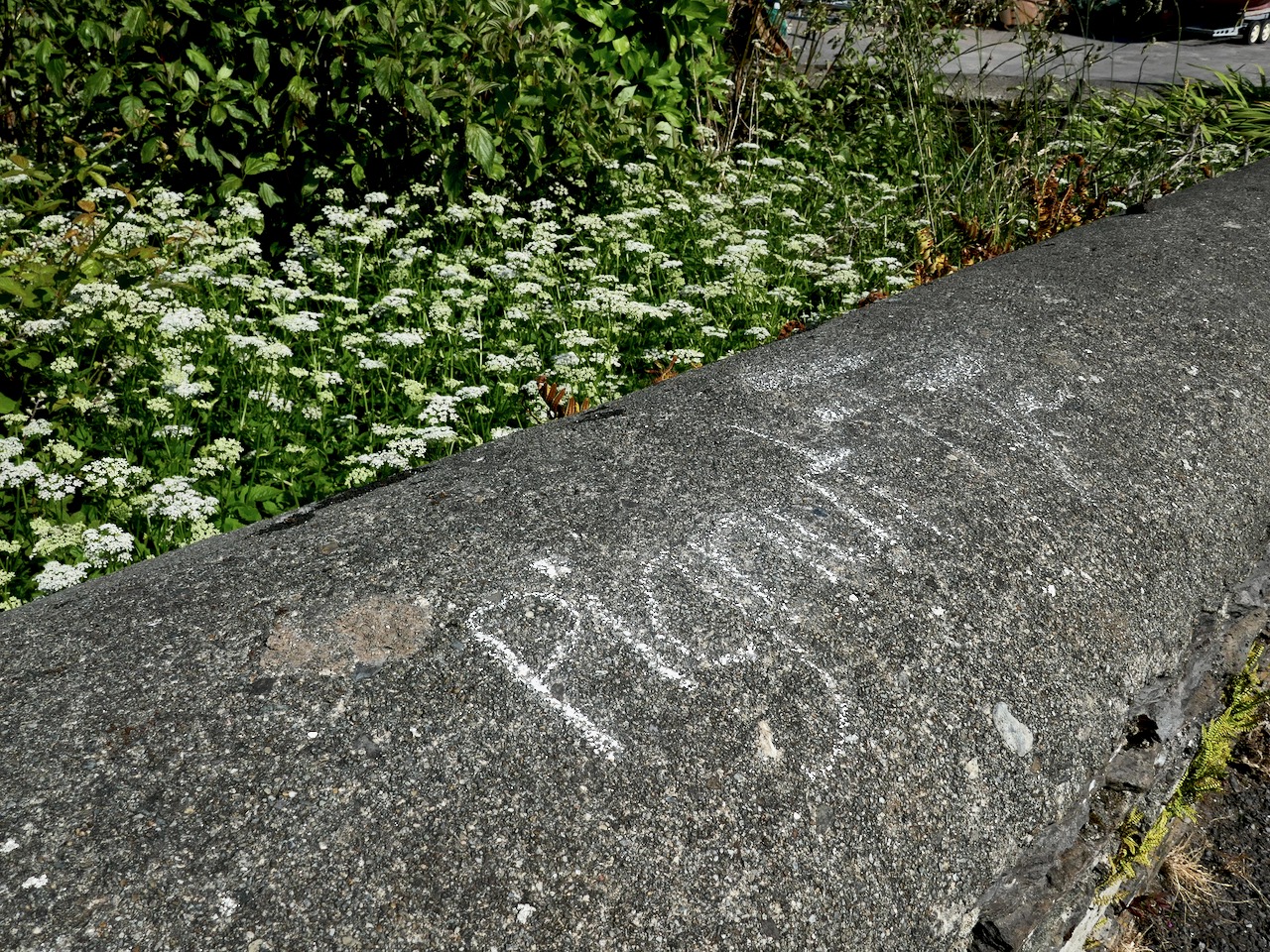
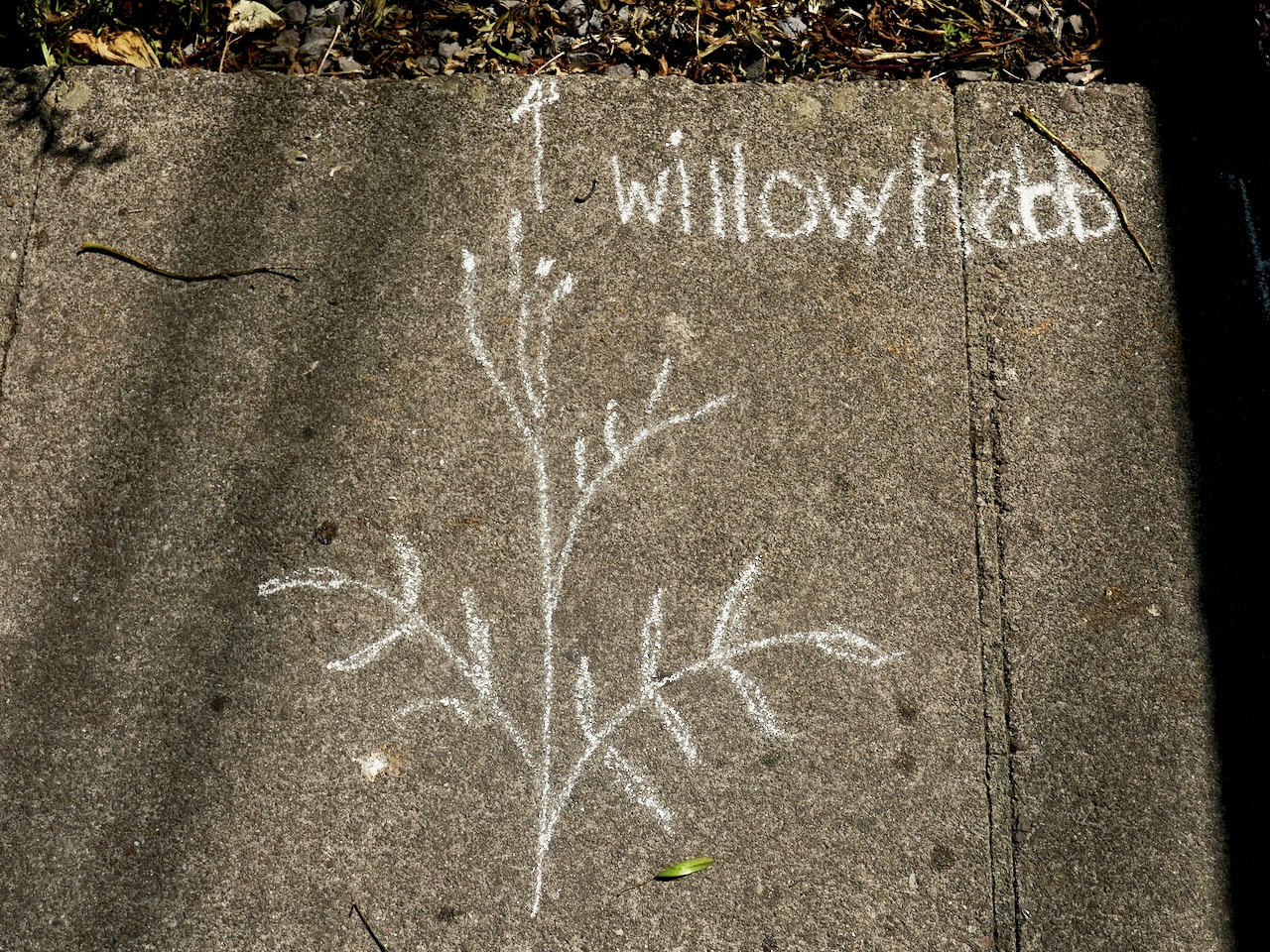
It started in France and has spread (like weeds?) across Europe, as a way of illustrating for casual walkers what we have all around us. All you need is chalk and a good wildflower book. I recommend Zoë Devlin’s The Wildflowers of Ireland – it’s how my love of wildflowers was sparked. If you have good reception on a phone or tablet, you can use her website Wildflowers of Ireland, but if you’re just starting, the book may be easier to search. Another excellent resource is Wildflowers of Ireland, although this one is wholly online.
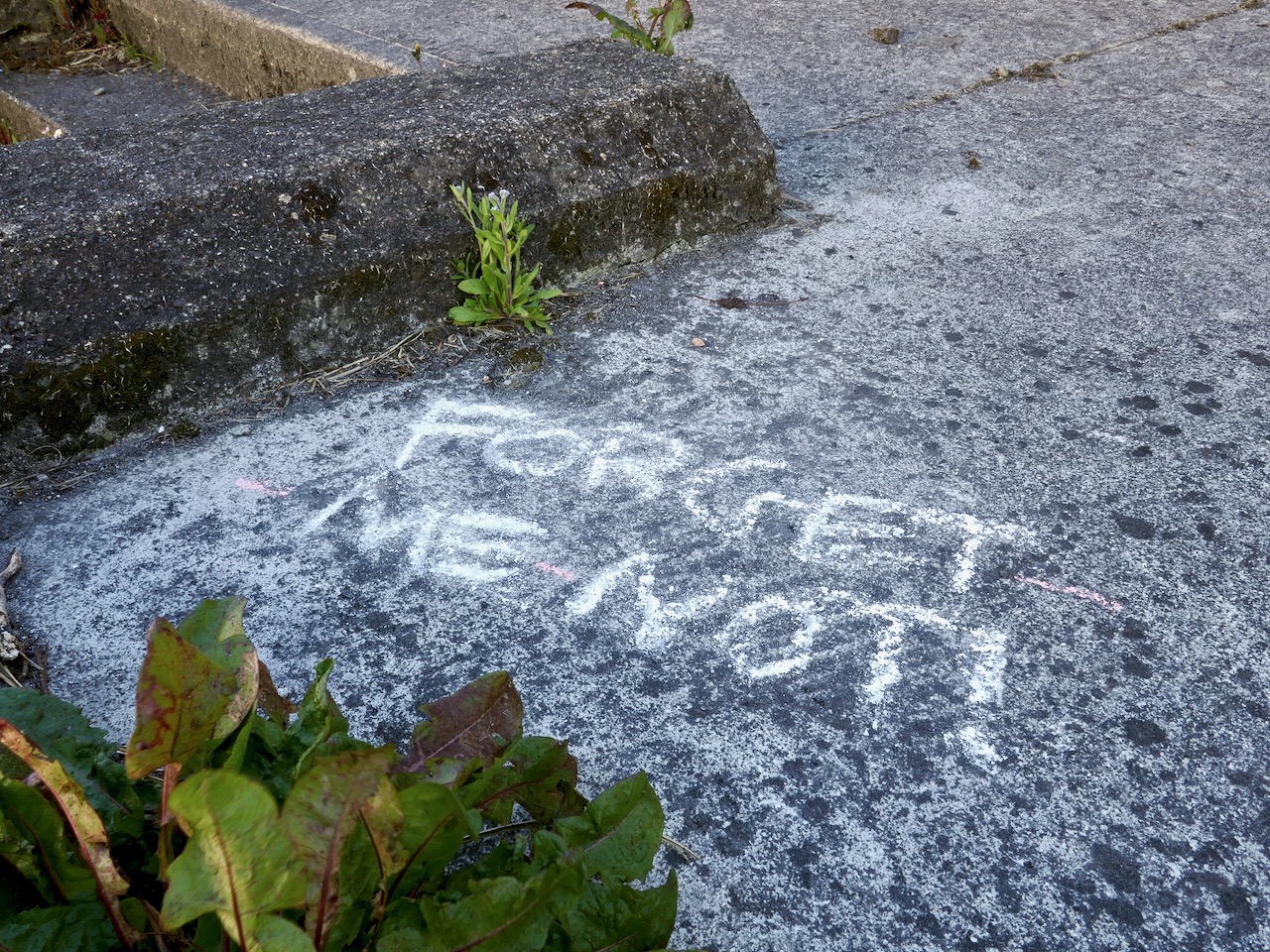
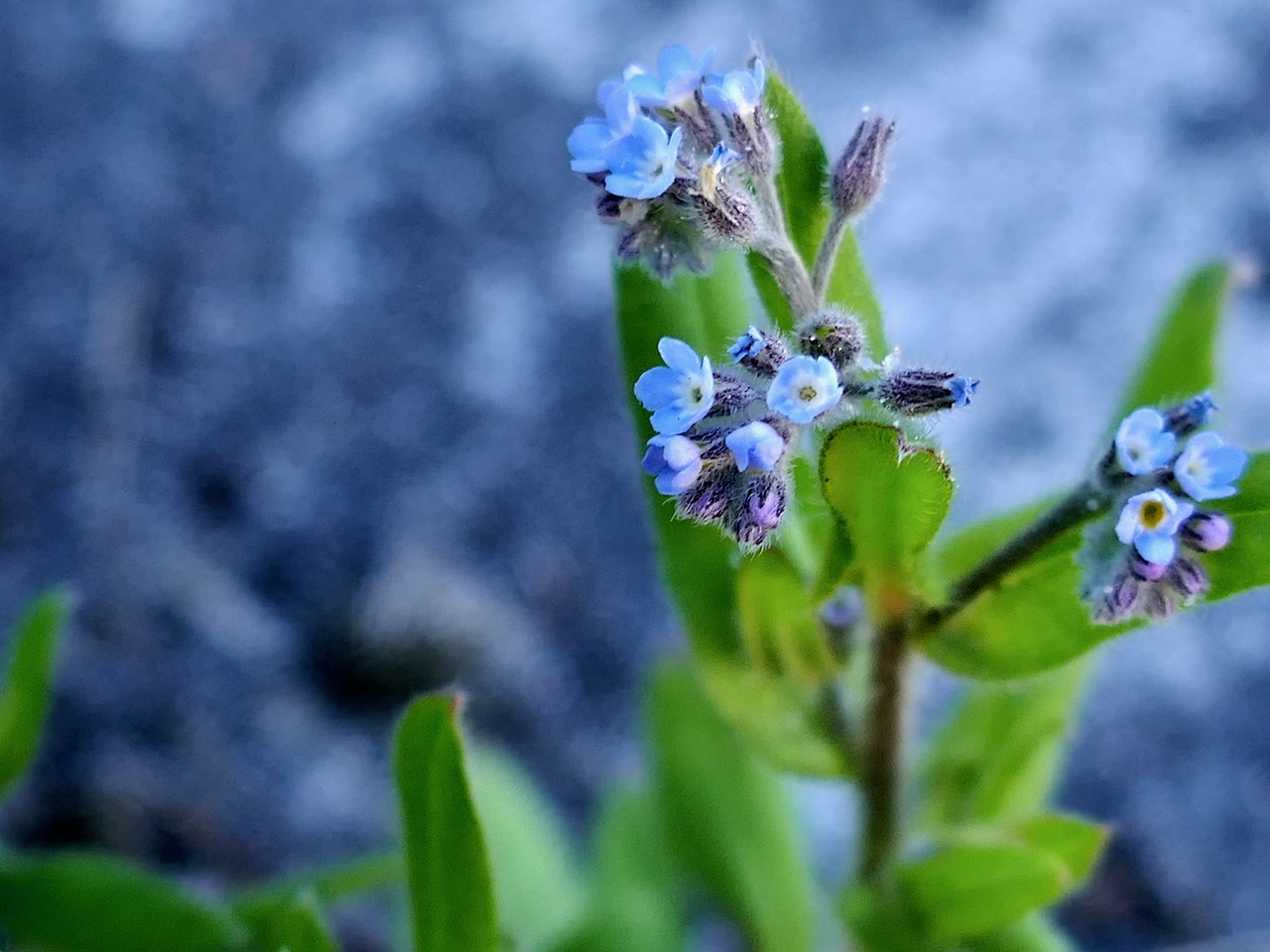
This lovely little Field Forget-me-not (chalked in the top photo, close-up above) is a metaphor what what we were trying to do in our West Cork villages

The Botany part is easy: it’s incredibly important to know what we have as we are losing species, many through loss of habitat or the use of herbicides. Urban environments are home to many wildflowers (no such thing as weeds!) all of which do important jobs in supporting the great chain of life by providing vital food, shelter and reproduction spaces to an enormous variety of insects.

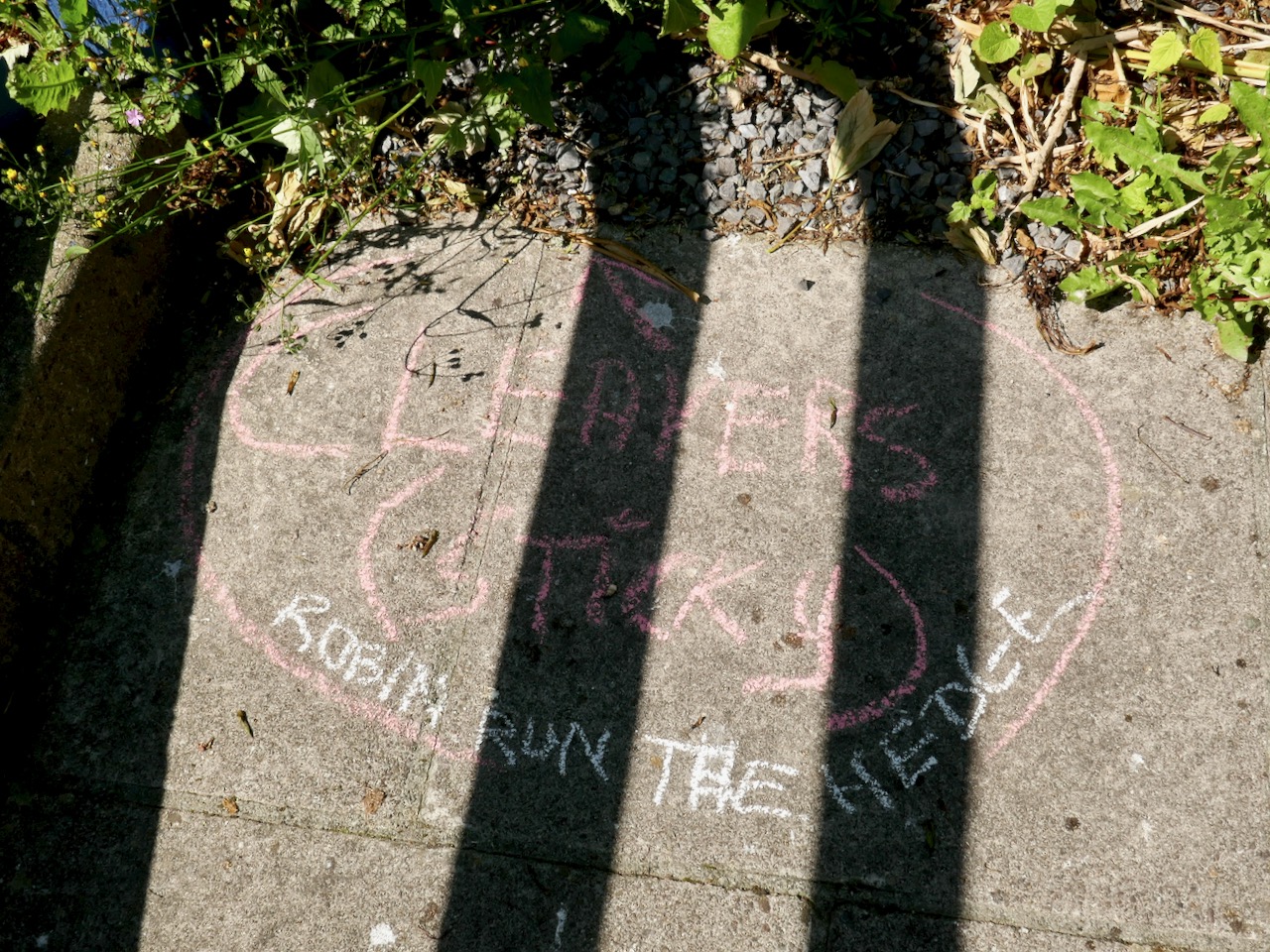
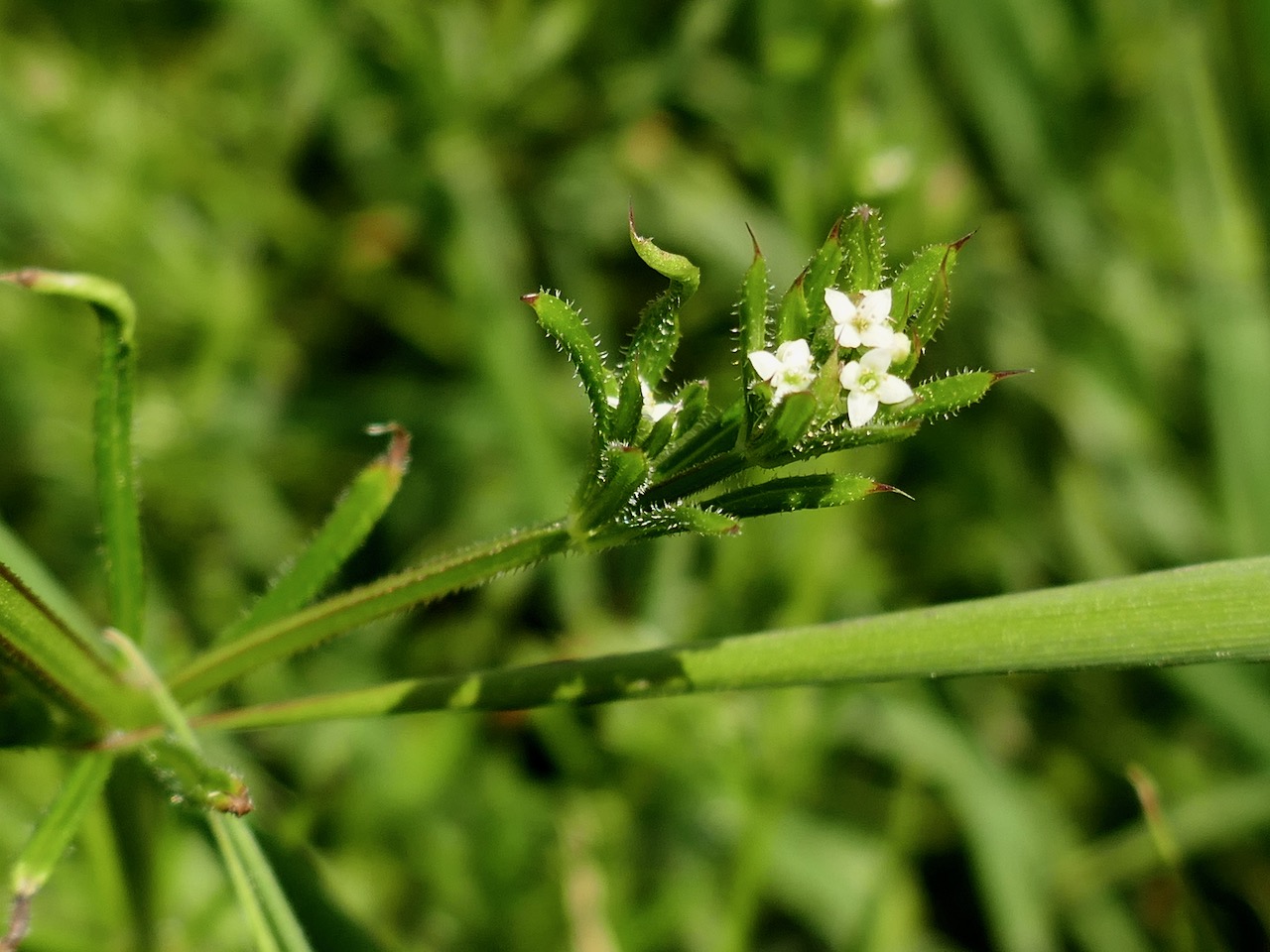
Cleavers – you might know it as Stickelback or Goose Grass, and one of the Flying Column grew up calling it Robin-run-the-hedge. It has a very efficient way of getting you or your dog to transport its seeds

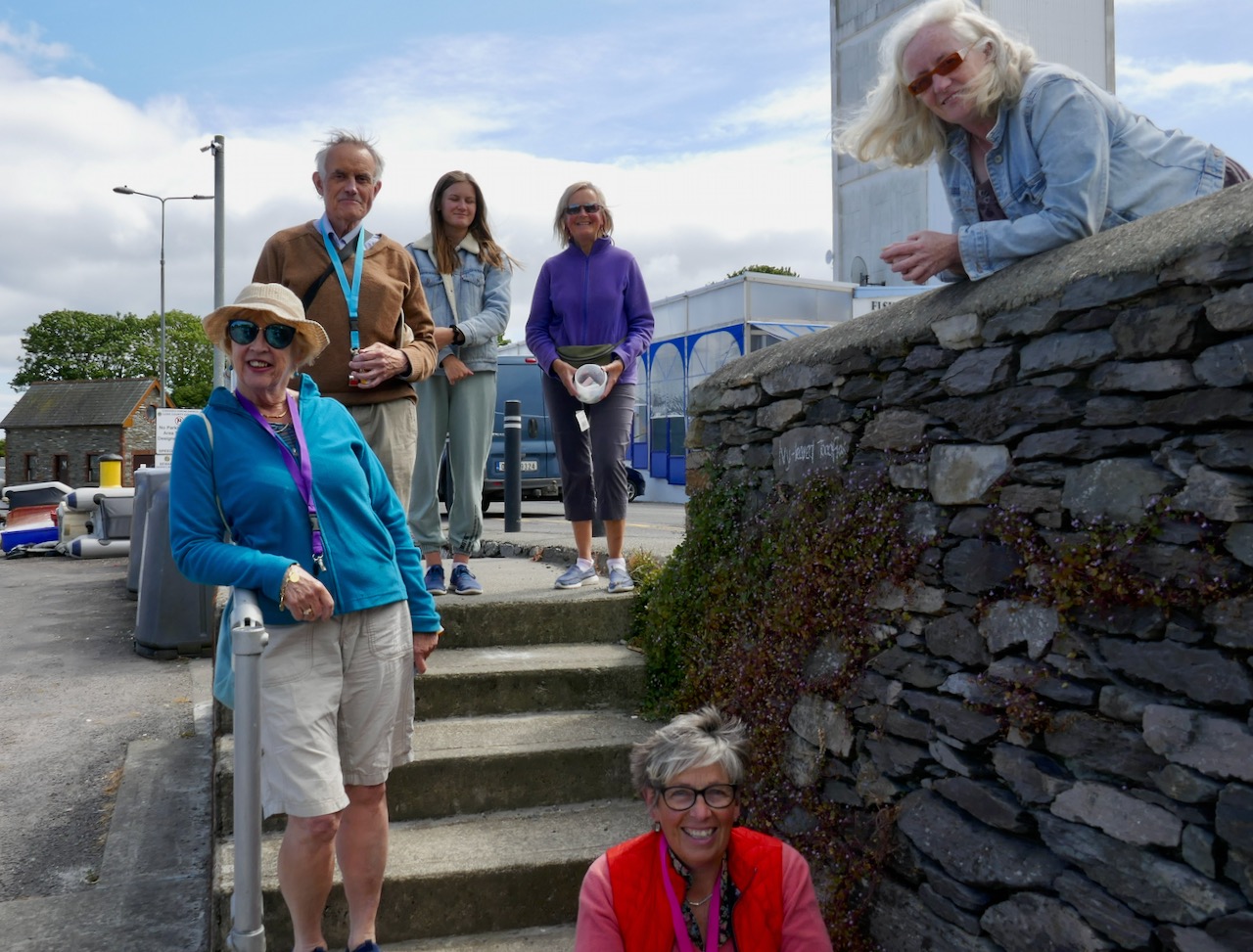
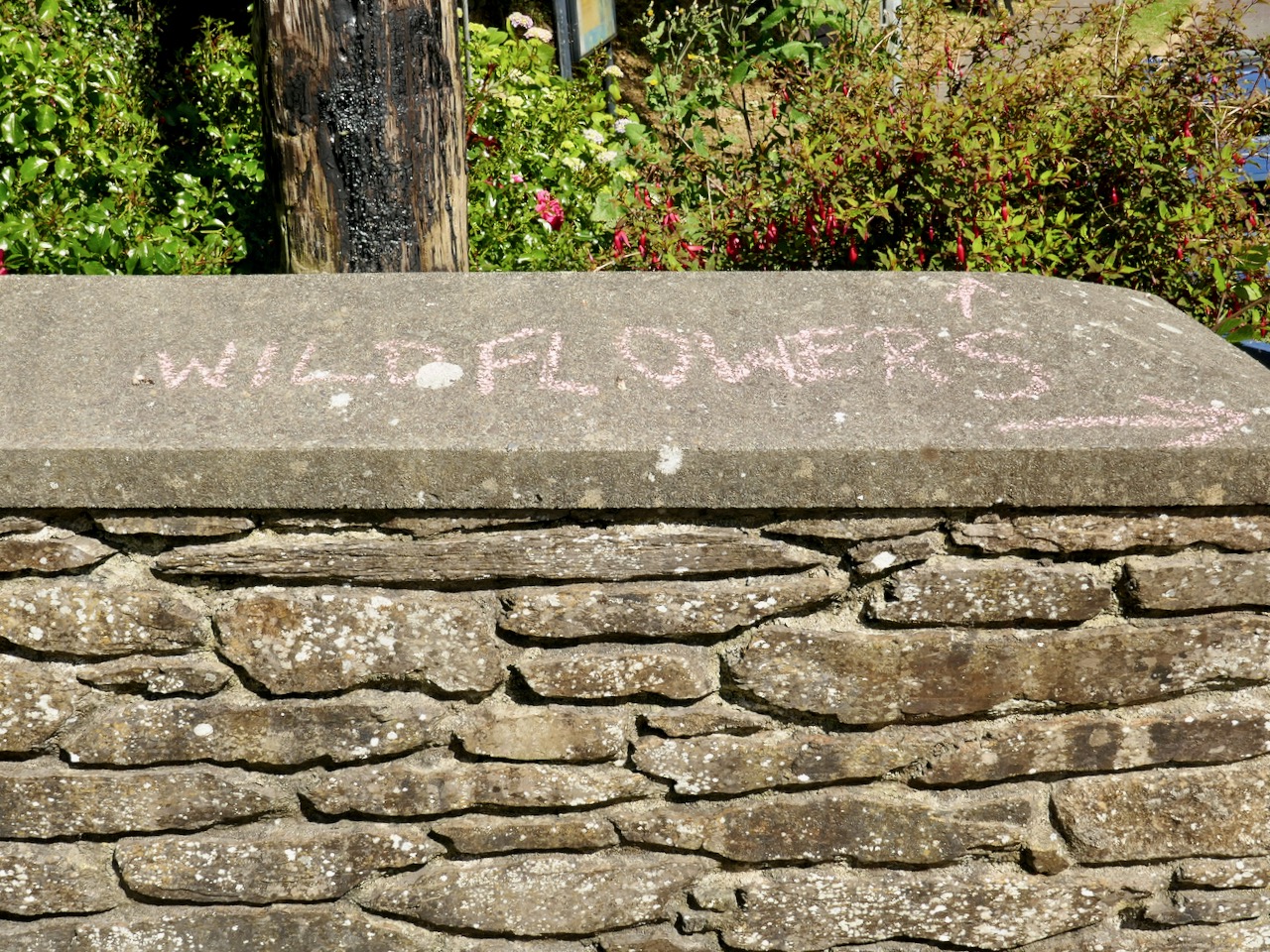
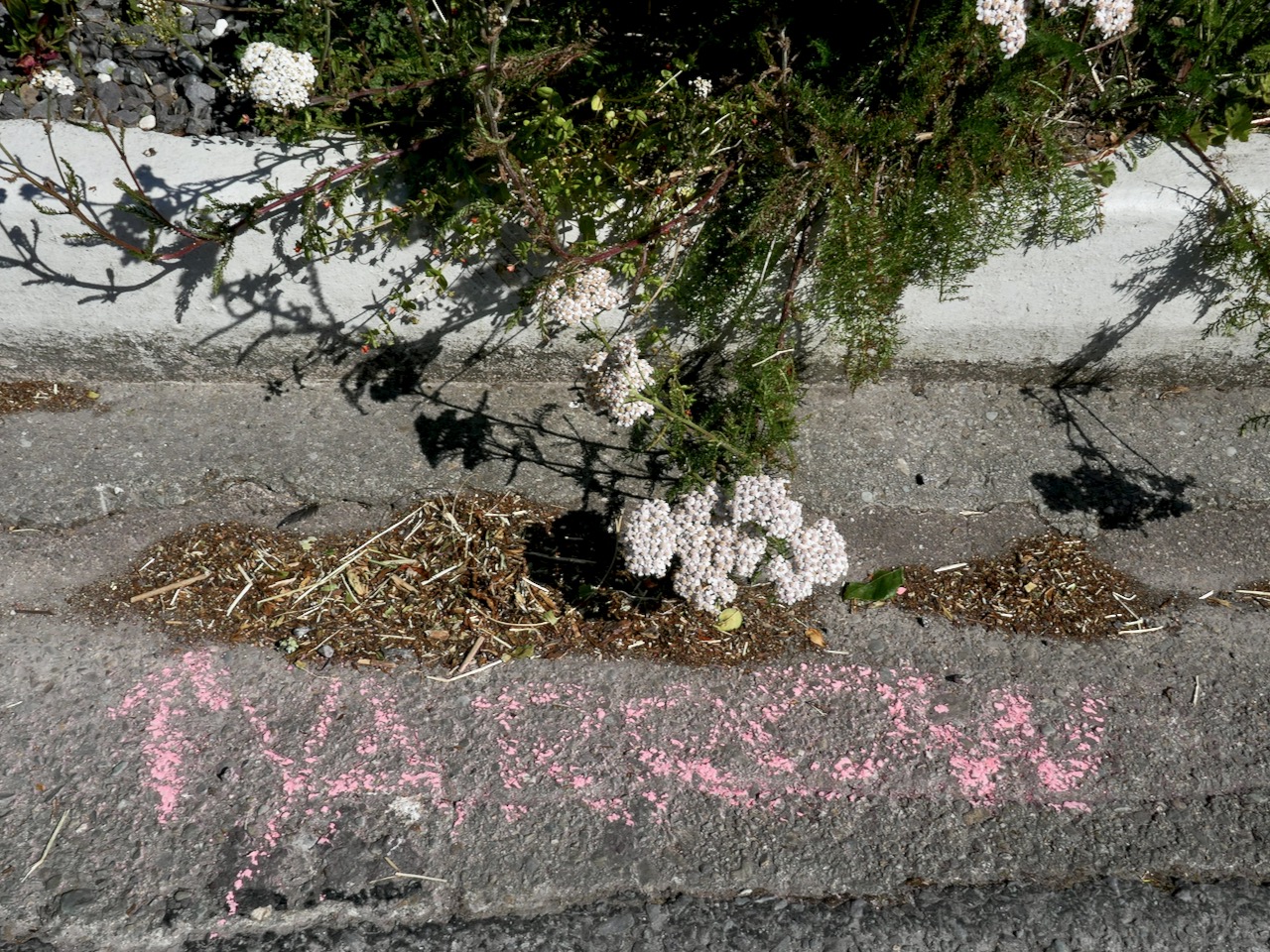
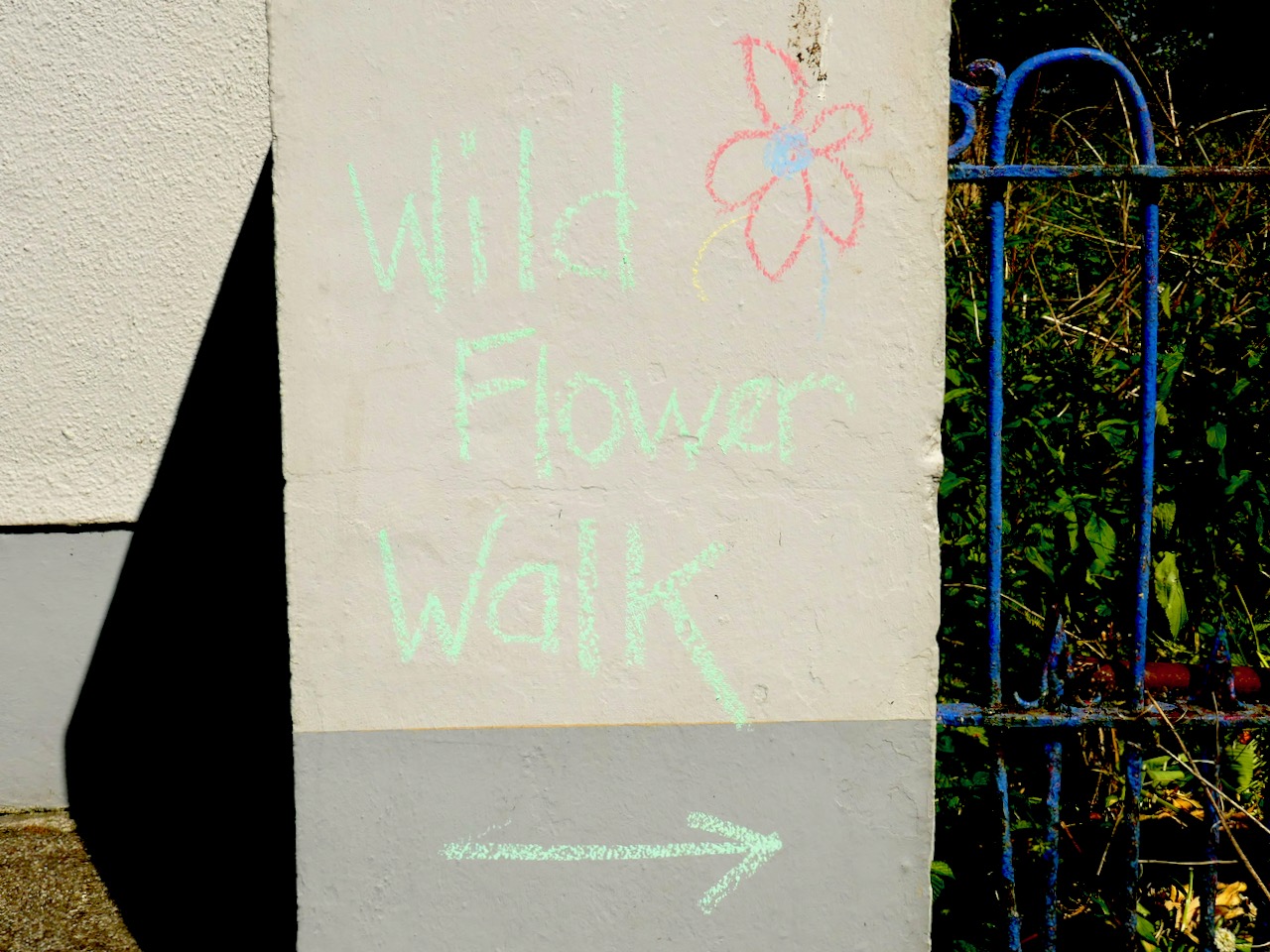
The Guerrilla part? Well, there is something subversive in writing and sketching what can be seen as graffiti on a footpath or a wall (but don’t worry – the first rainfall and it will be gone). It may even be slightly illegal, so ideally you deploy some level of stealth. However, the merry band in Schull yesterday, let’s call them Flying Column S, was having far too much fun to be deploying anything except their chalk.

Flying Column S (appropriately distancing) clockwise from top right: Karen, Julia, Úna and Con, Ann and Blathnaid

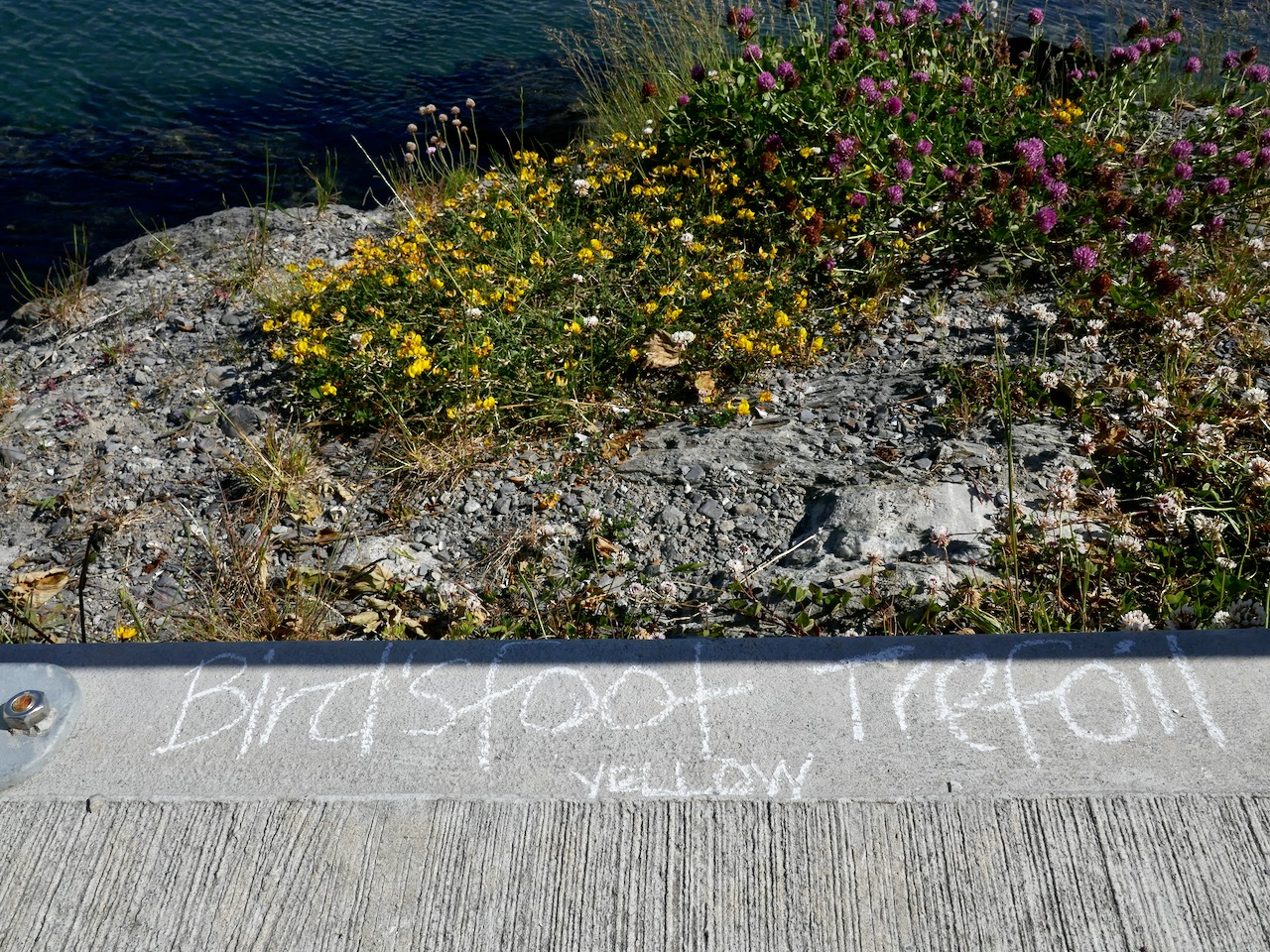
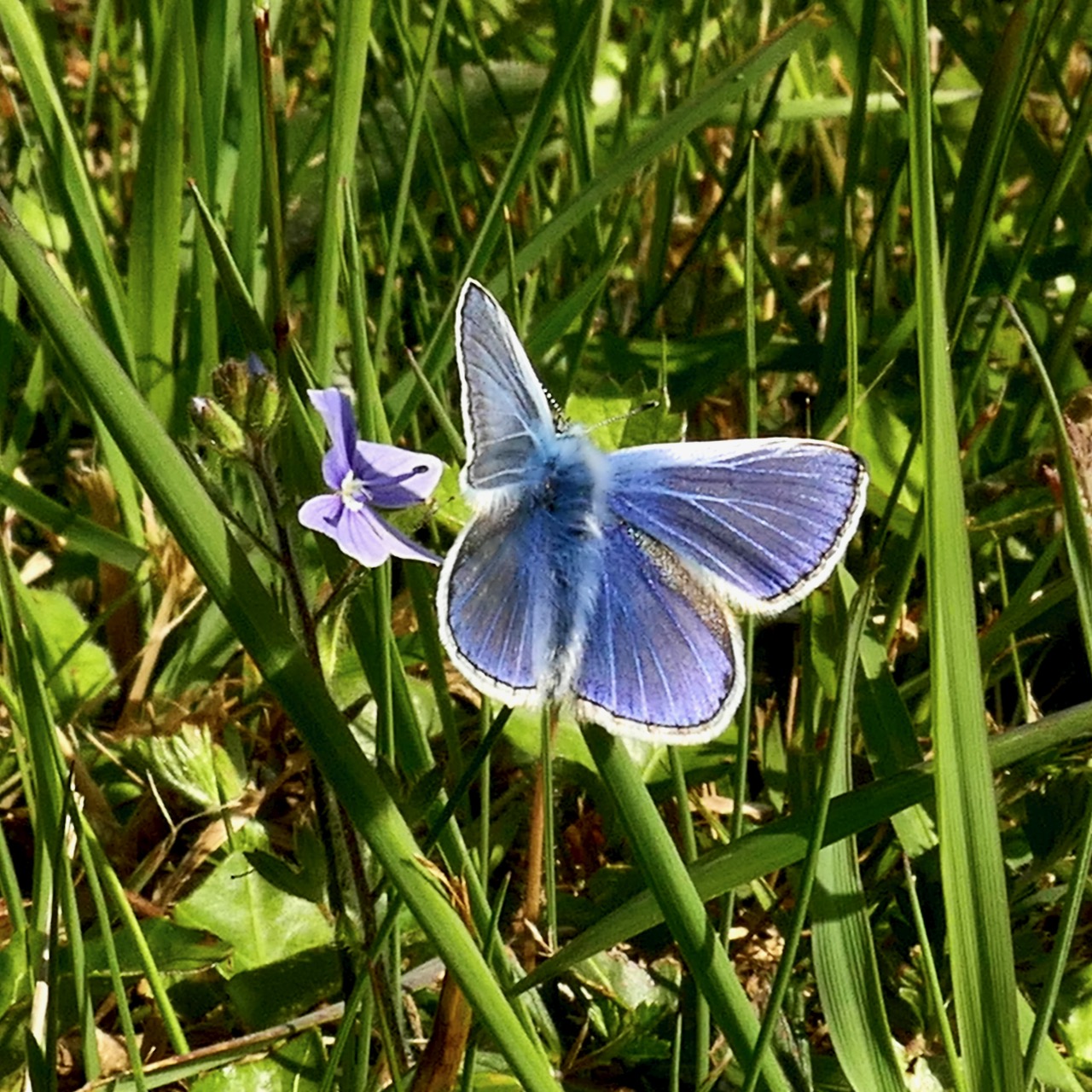
When you name something you give it an identity. That encourages people to look more closely at it and maybe do a little research into it. We are seeing all kinds of Bird’s-foot Trefoil (below, overlooking Schull Harbour, with Red Clover) at the moment, springing up in our lawns and frankly wherever it gets a chance. But did you know that this gorgeous little yellow flower, a member of the Pea Family, is the larval food plant of the Common Blue Butterfly?

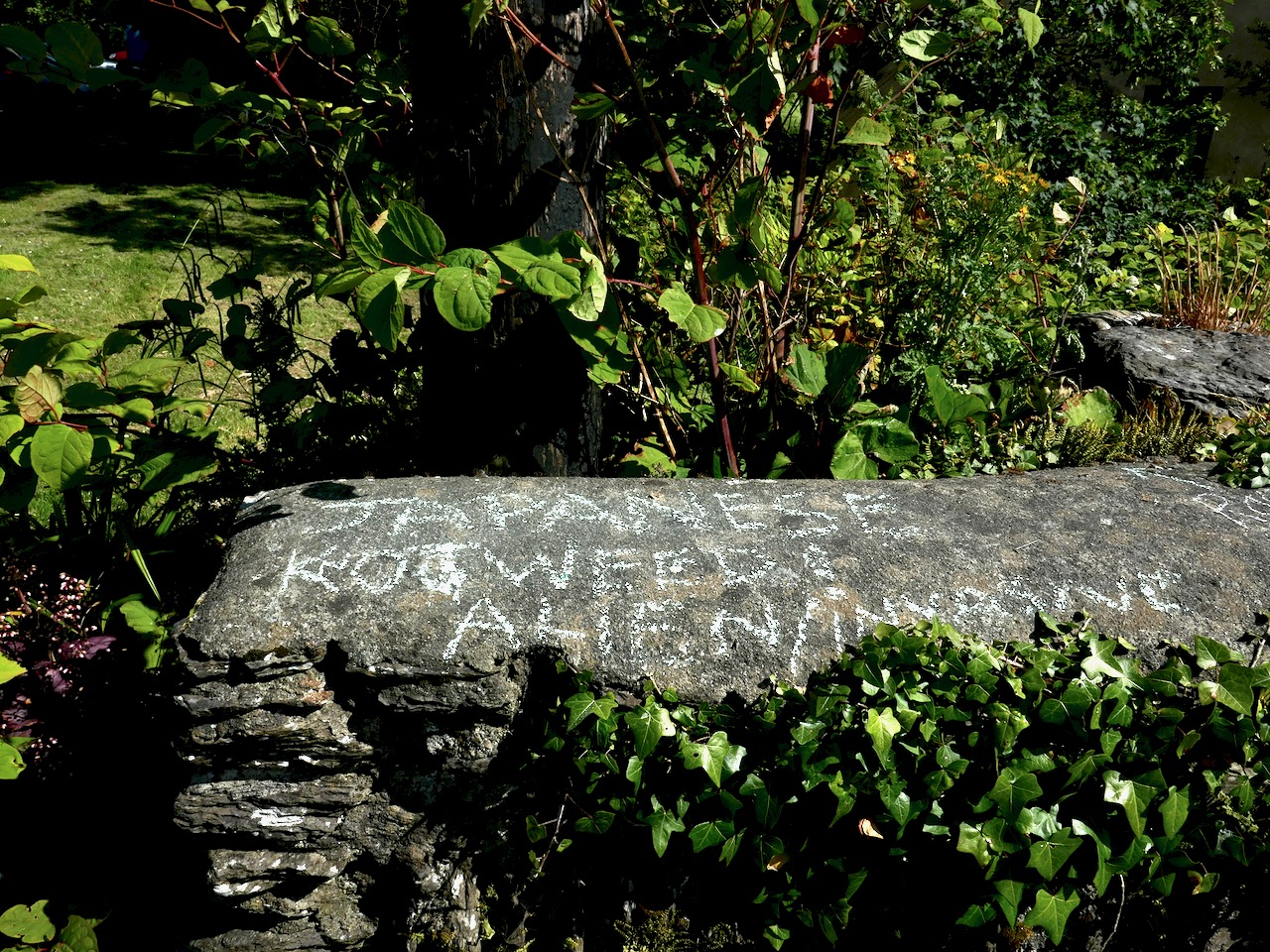
Most of the wildflowers we see around us in our towns and villages are native, but there are a few invasive aliens as well and it’s also important to know where they are and how they are reproducing. Japanese Knotweed is the most feared, for how difficult it is to get rid of, how damaging it can be, and for how it takes over vast areas of habitat, choking out native plants.

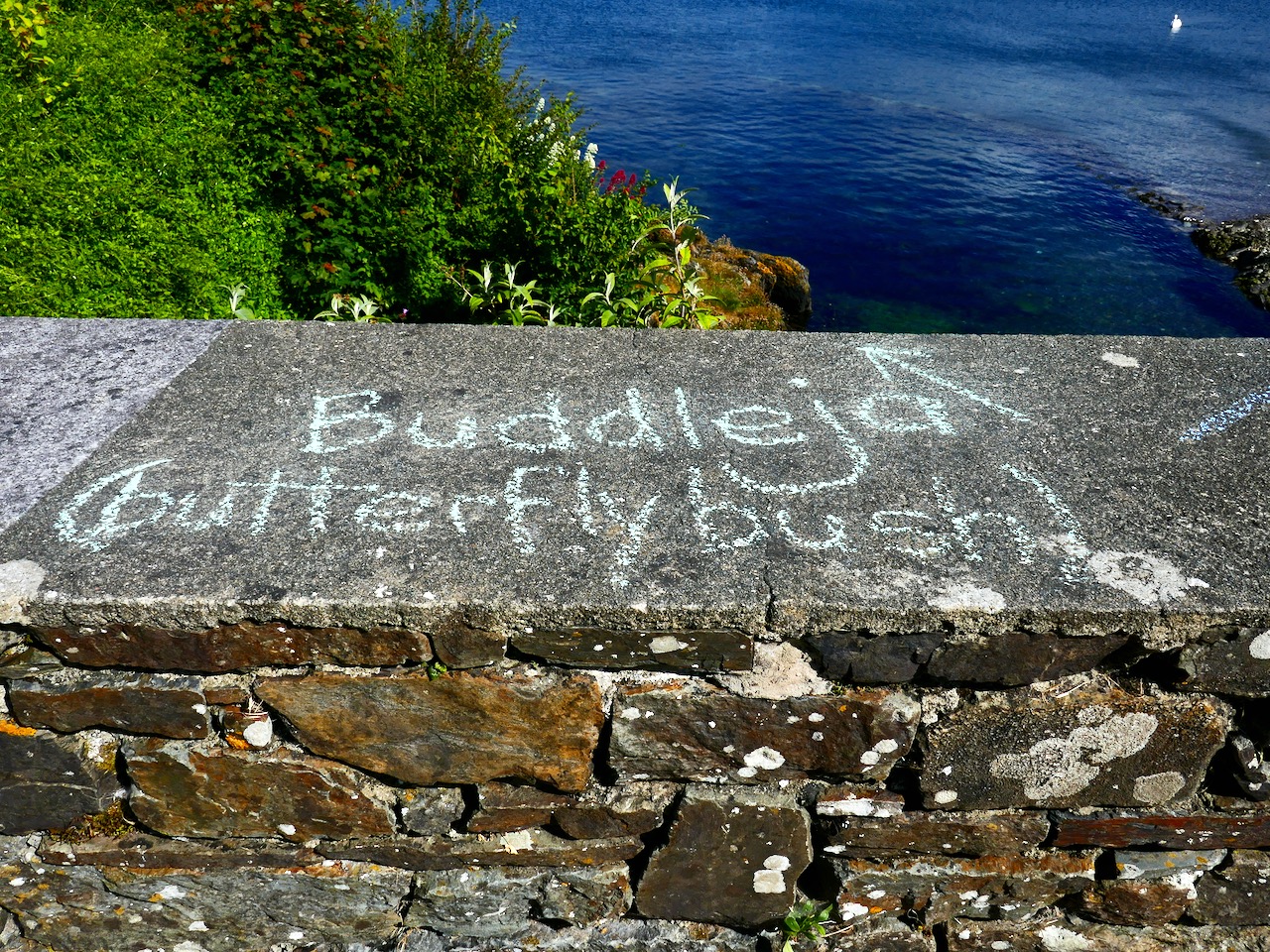
Buddleia, better known as Butterfly Bush, is beloved of butterflies for its abundance of nectar. But there is a dark side – it can become very invasive, and while butterflies love the nectar it provides it is not a butterfly host plant – that is, one that butterflies can use to deposit their larva, which will then feed on the leaves. In fact, over time, butterfly populations decline where Buddleia is left unchecked. The Buddleia below has not yet come into flower.

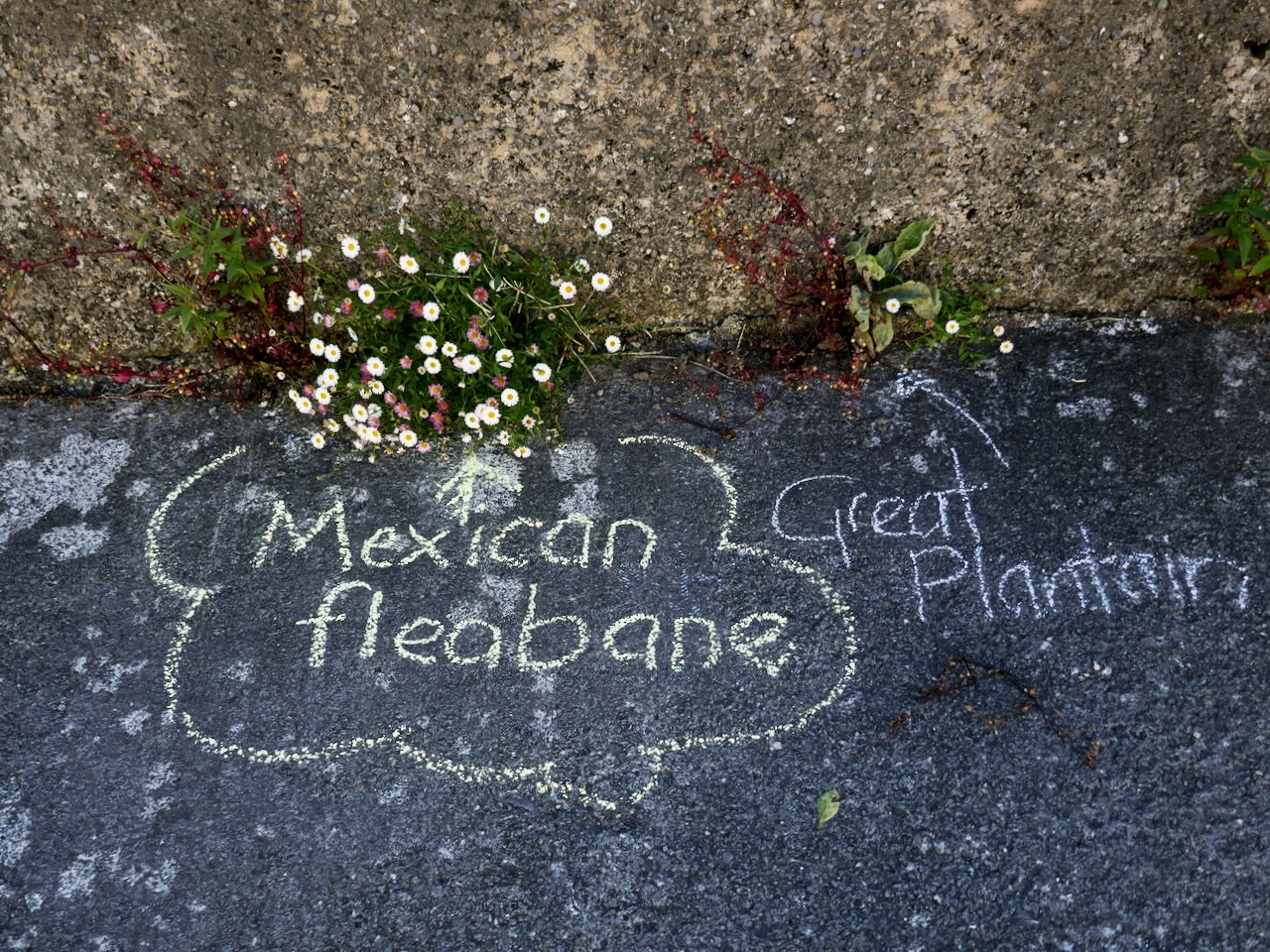
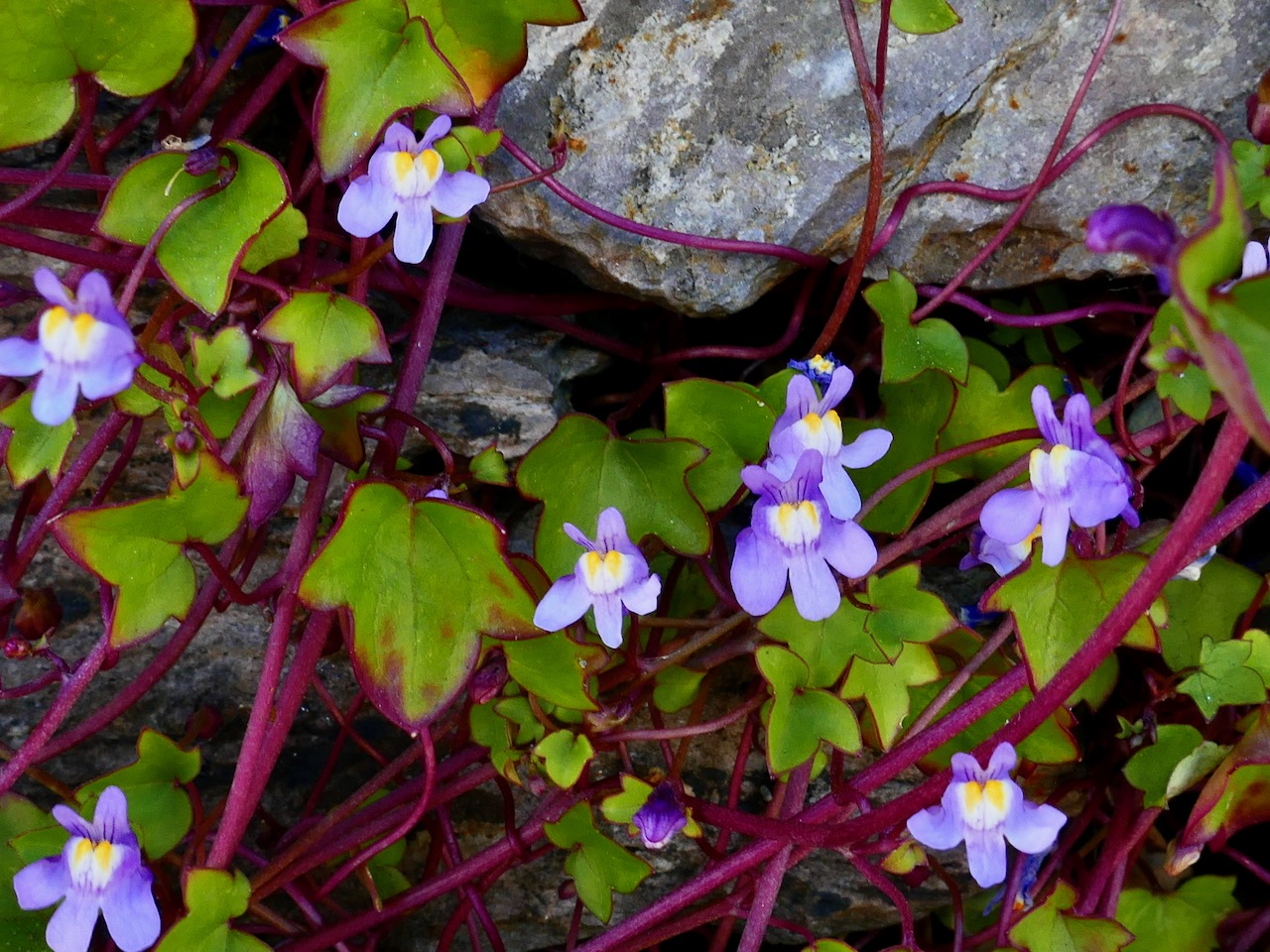
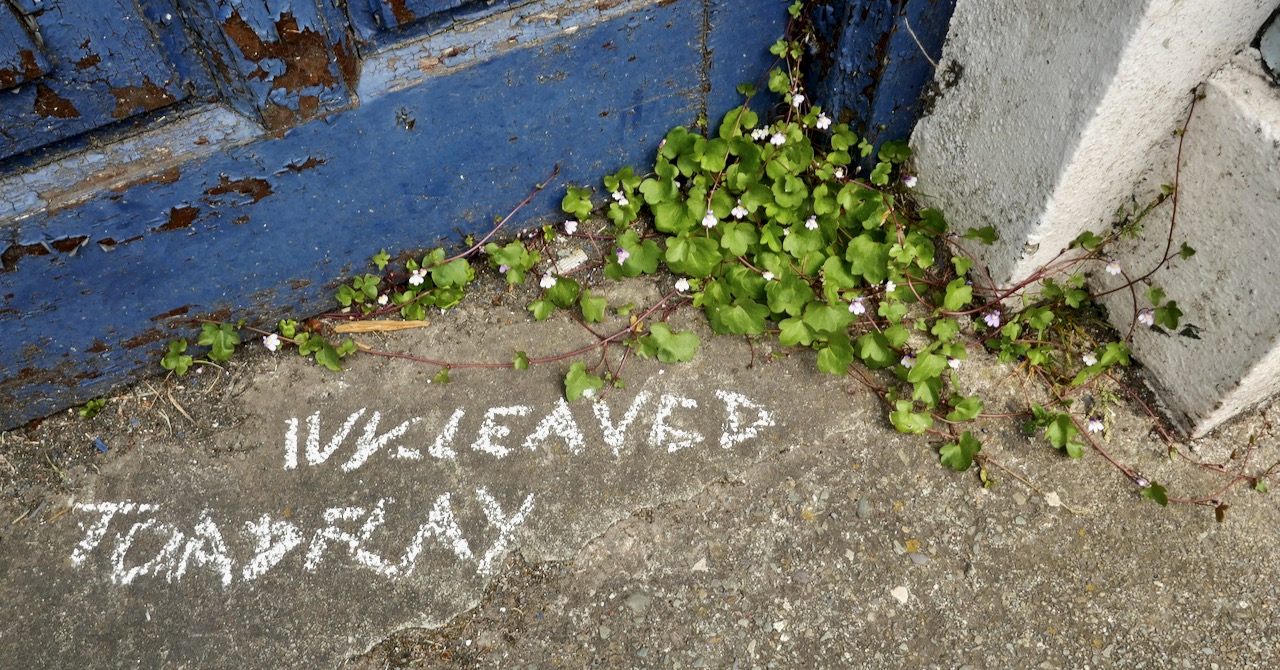
But there are other non-natives that are more benign. Mexican Fleabane (below with Greater Plantain) and Ivy-leaved Toadflax (a close-up – another photo is the last one in this post) both arrived here from elsewhere, but do not pose anything like the same level of threat. In fact they have settled in happily as neighbours.

But while they are certainly decorative and attractive to insects, it remains true that it is our native plants to which our native insects are best adapted.

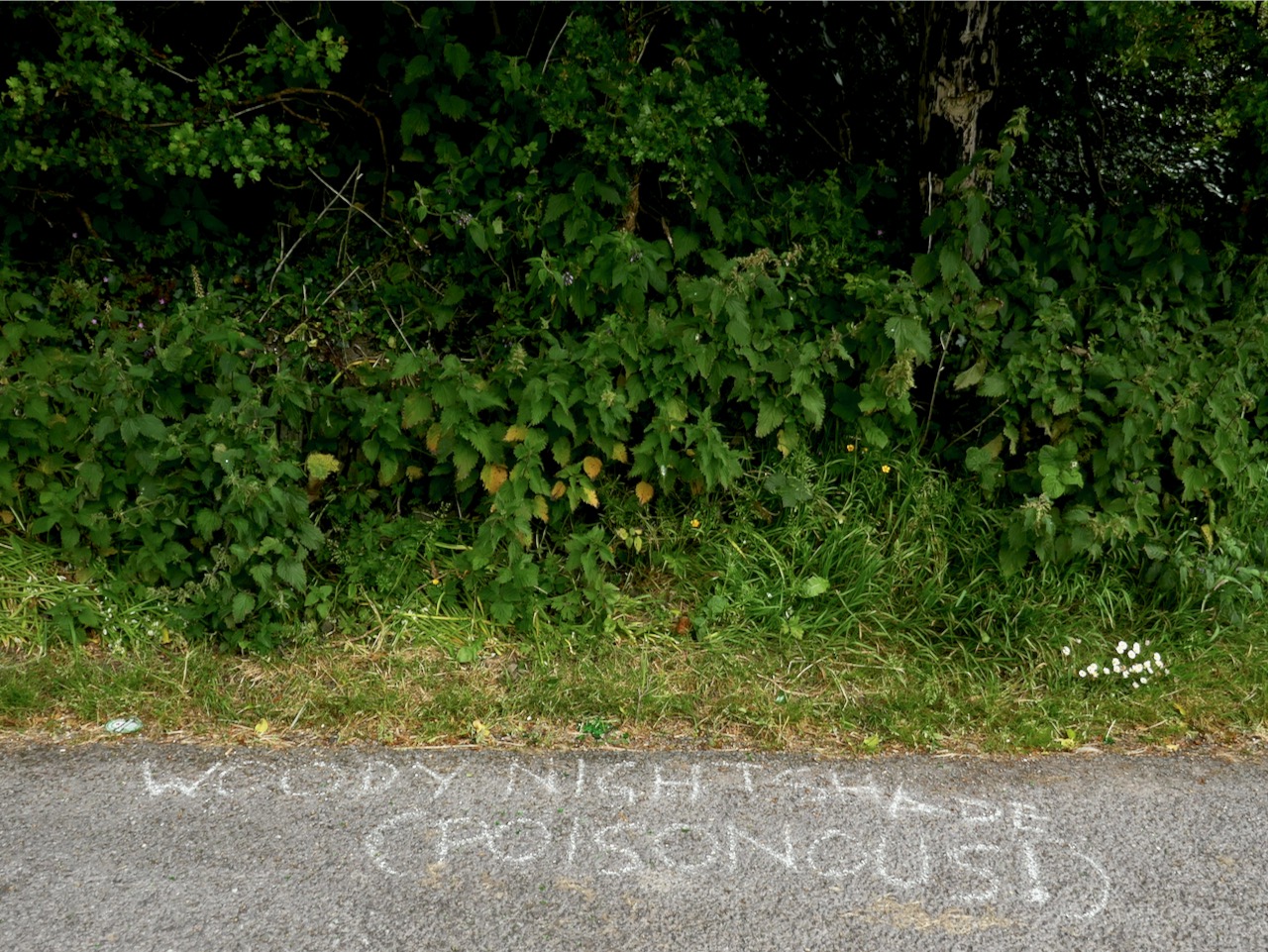
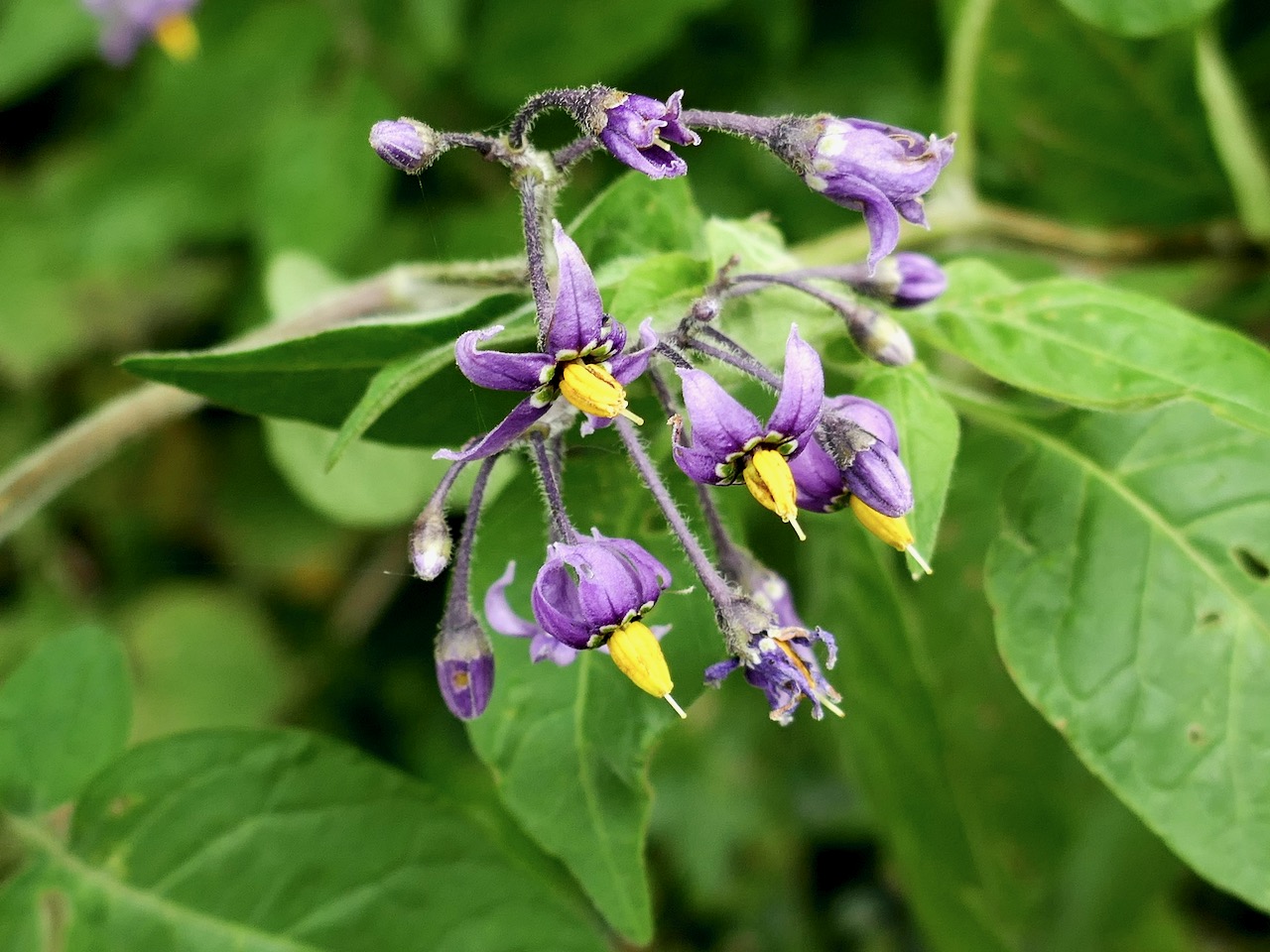
Native, of course, can also be dangerous – several of our native plants are highly poisonous to humans including the beautiful Foxglove that is blooming everywhere right now and the attractive but deadly Woody Nightshade, below. It’s also known as Bittersweet. Children need to be warned to stay away from the inviting red berries of this plant later in the summer.

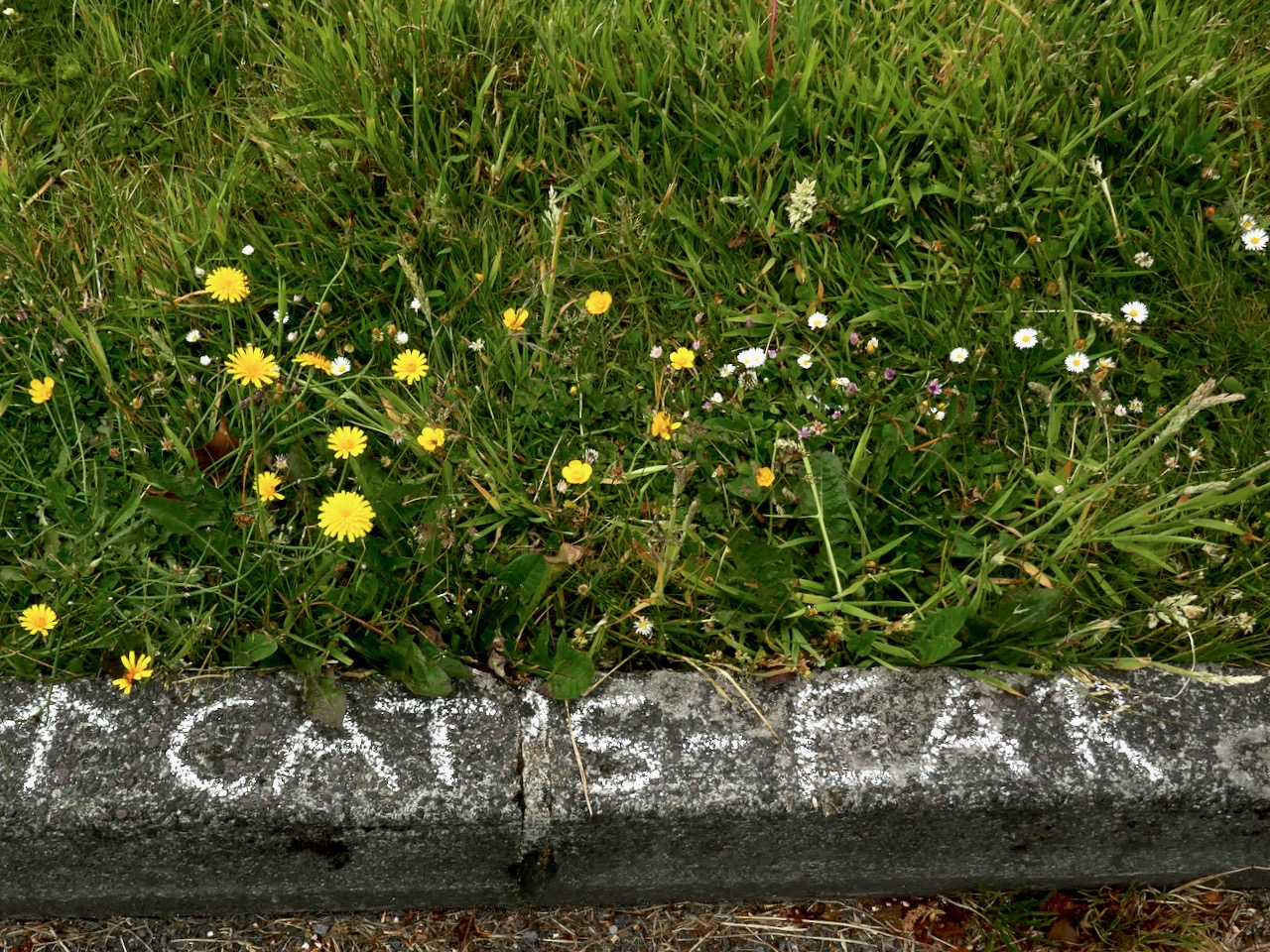
At first glance, we seem to see lots of dandelions, but most of the dandelions are gone over by now so what we are seeing are Sow-thistles, Nipplewort and most of all in West Cork, Cat’s-ear.

Cat’s-ear in Ballydehob, all mixed up with buttercups, daisies, White Clover, Club-rushed and grasses – an insect heaven

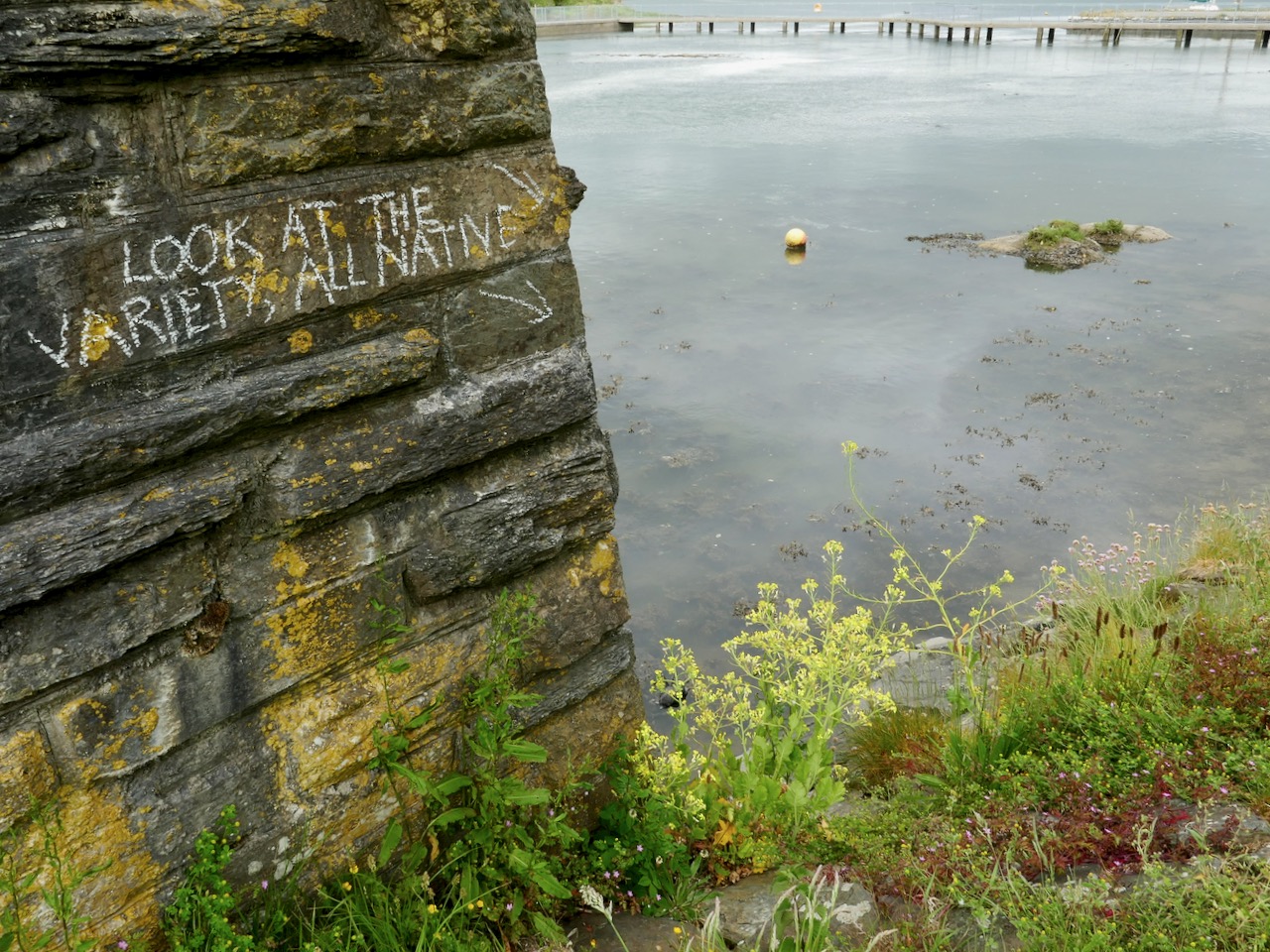
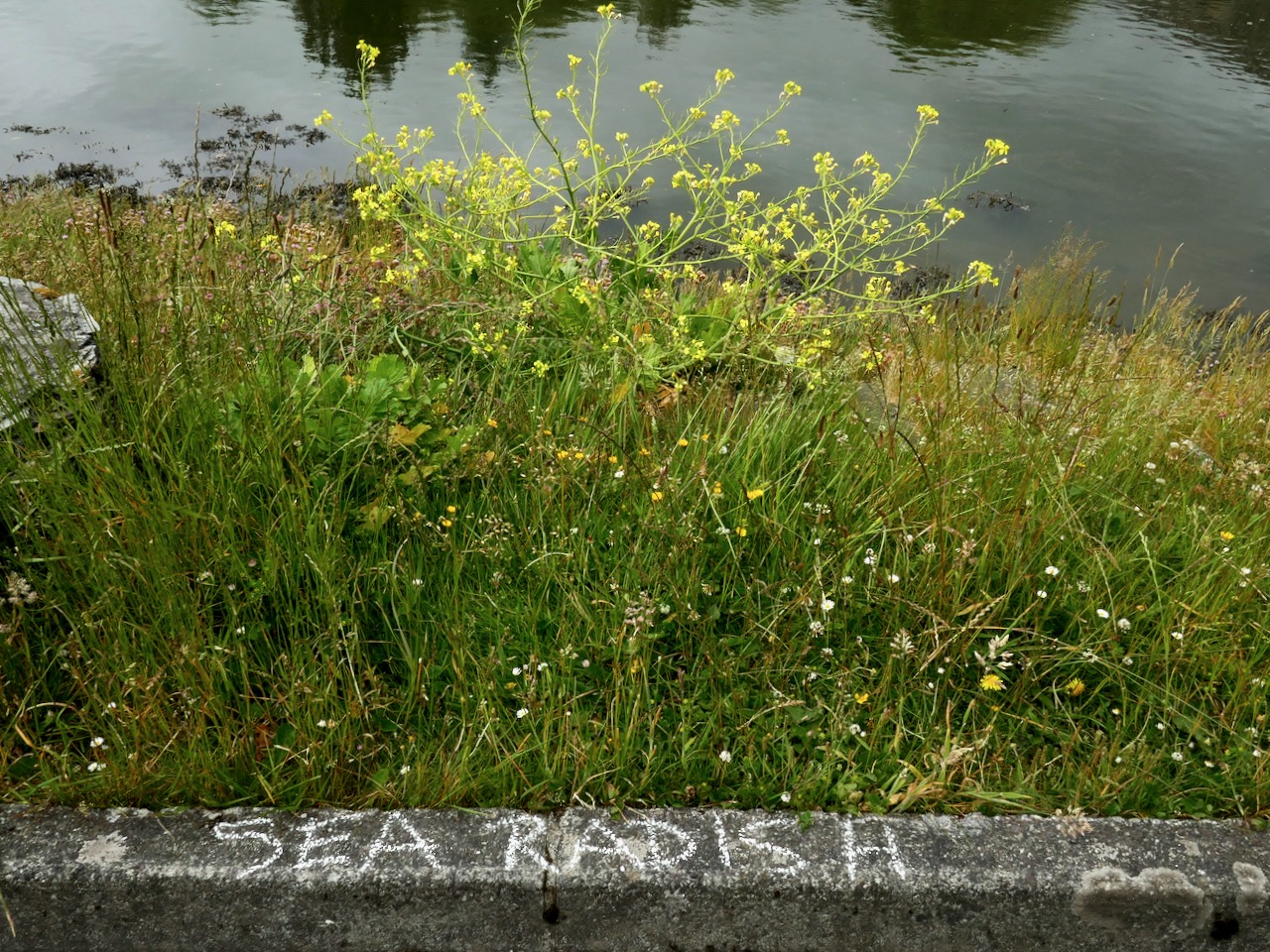
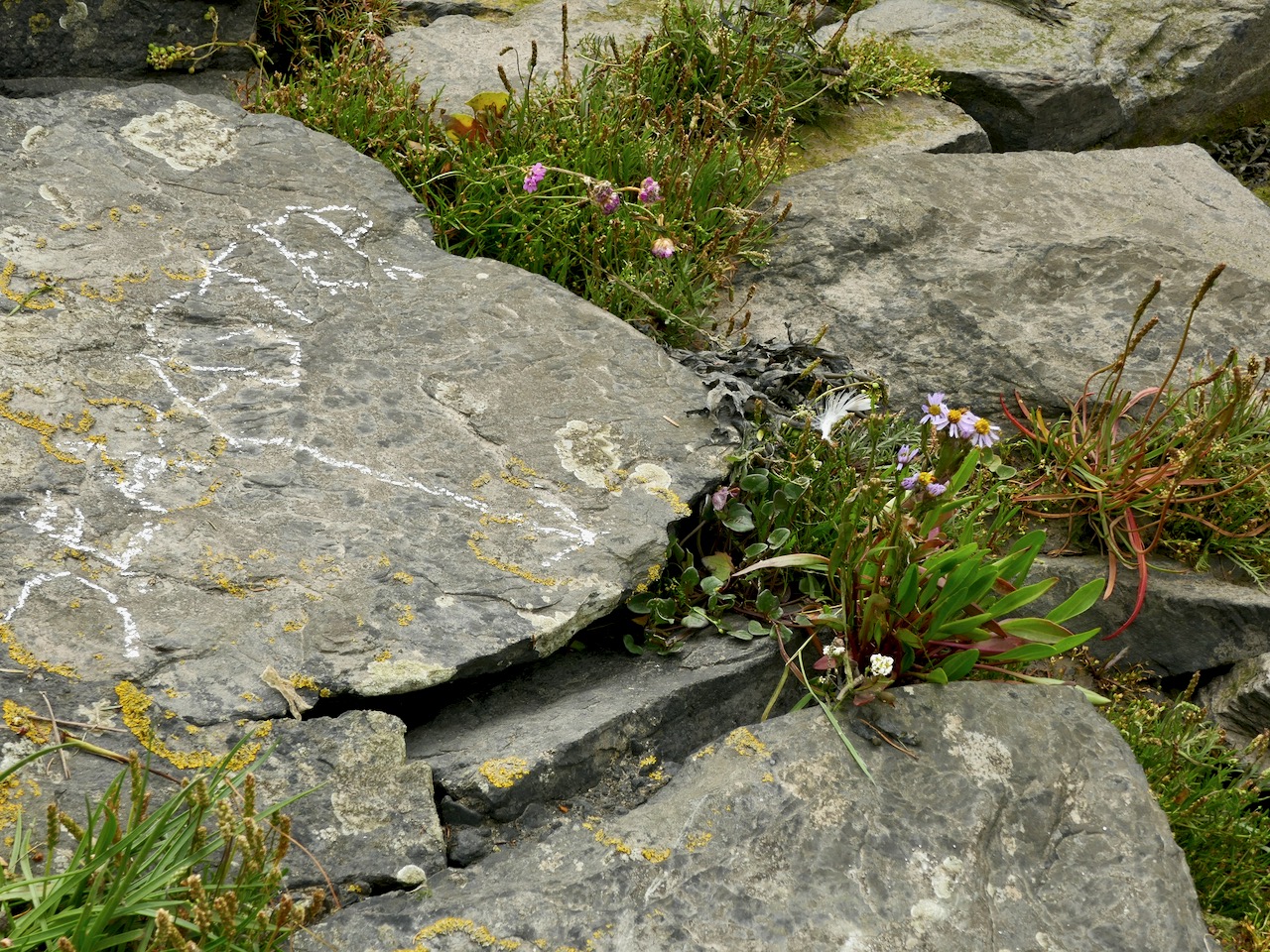
At the shore, marine species abound – take a look at my post on the Ballydehob Estuary – a haven for native wildflowers of all kinds. In Schull we chalked signs for Thrift (or Sea Pinks) and Kidney Vetch while in Ballydehob we pointed to Sea Radish and Sea Aster, the latter a plant that tolerates getting its feet wet in salt water.

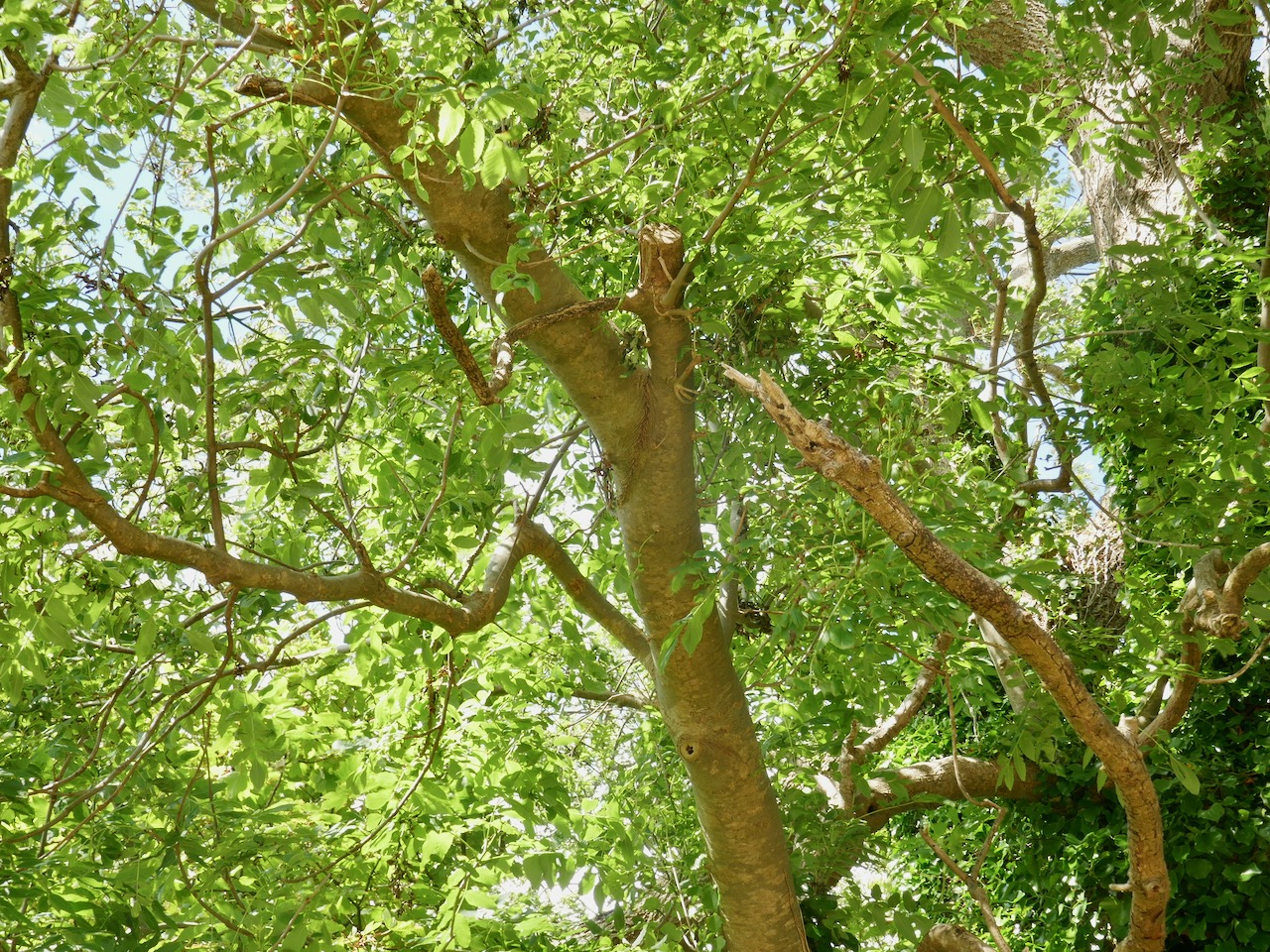
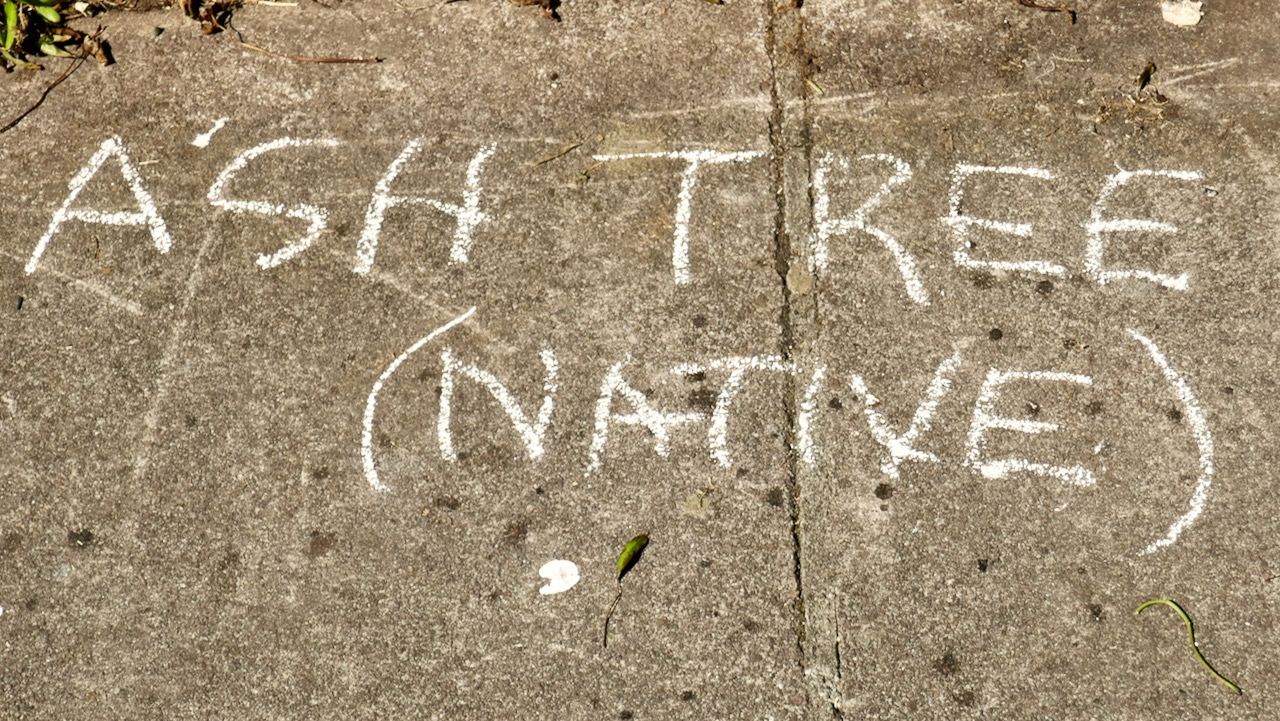
Trees, too, deserve our attention. Con was delighted with the number of elm trees around Schull and he pointed out one of our native Ash trees along the way. The Sycamore which springs up everywhere, on the other hand, is not native to Ireland and can grow to provide a powerful canopy under which other seedlings fail to thrive.

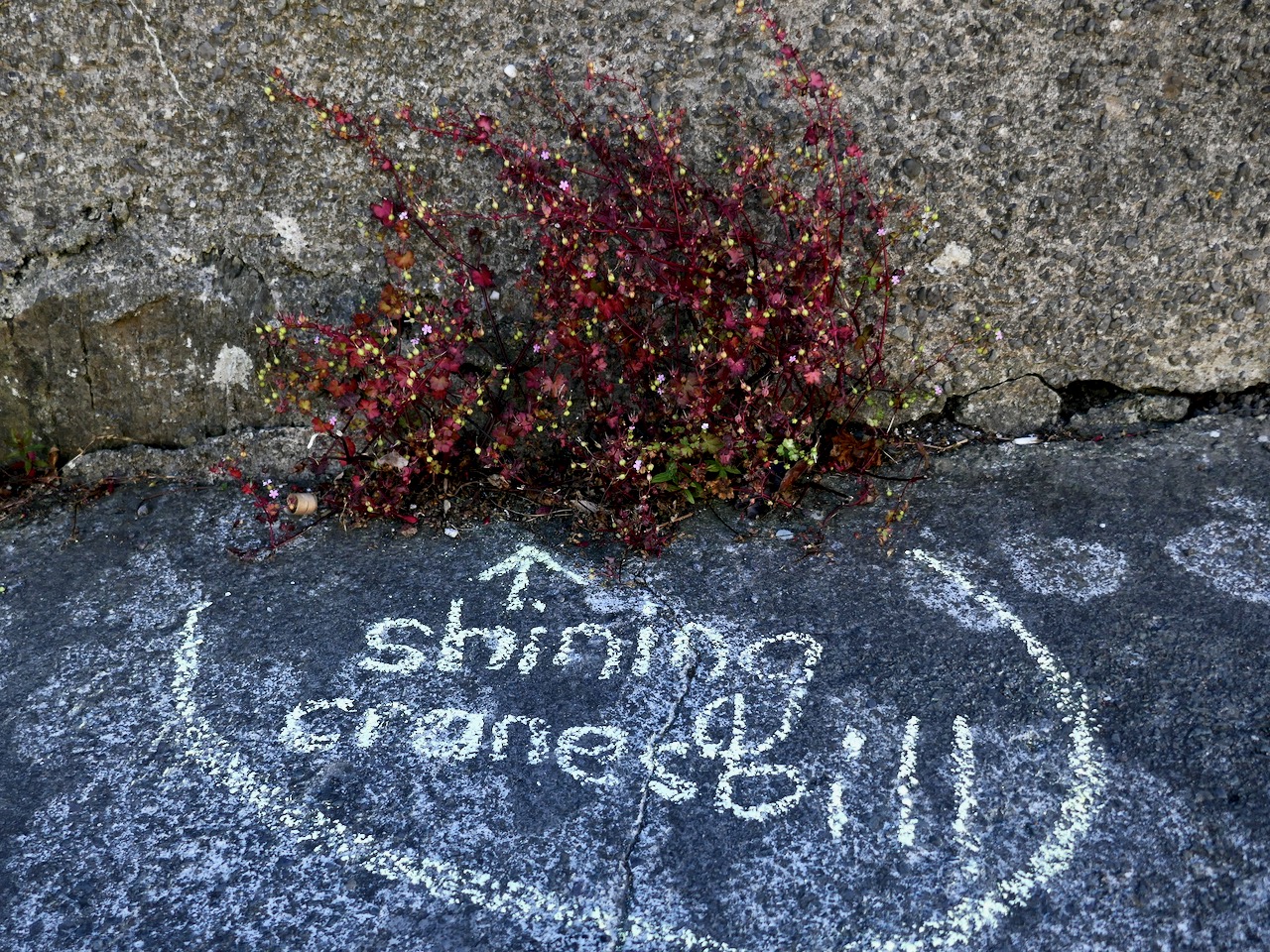
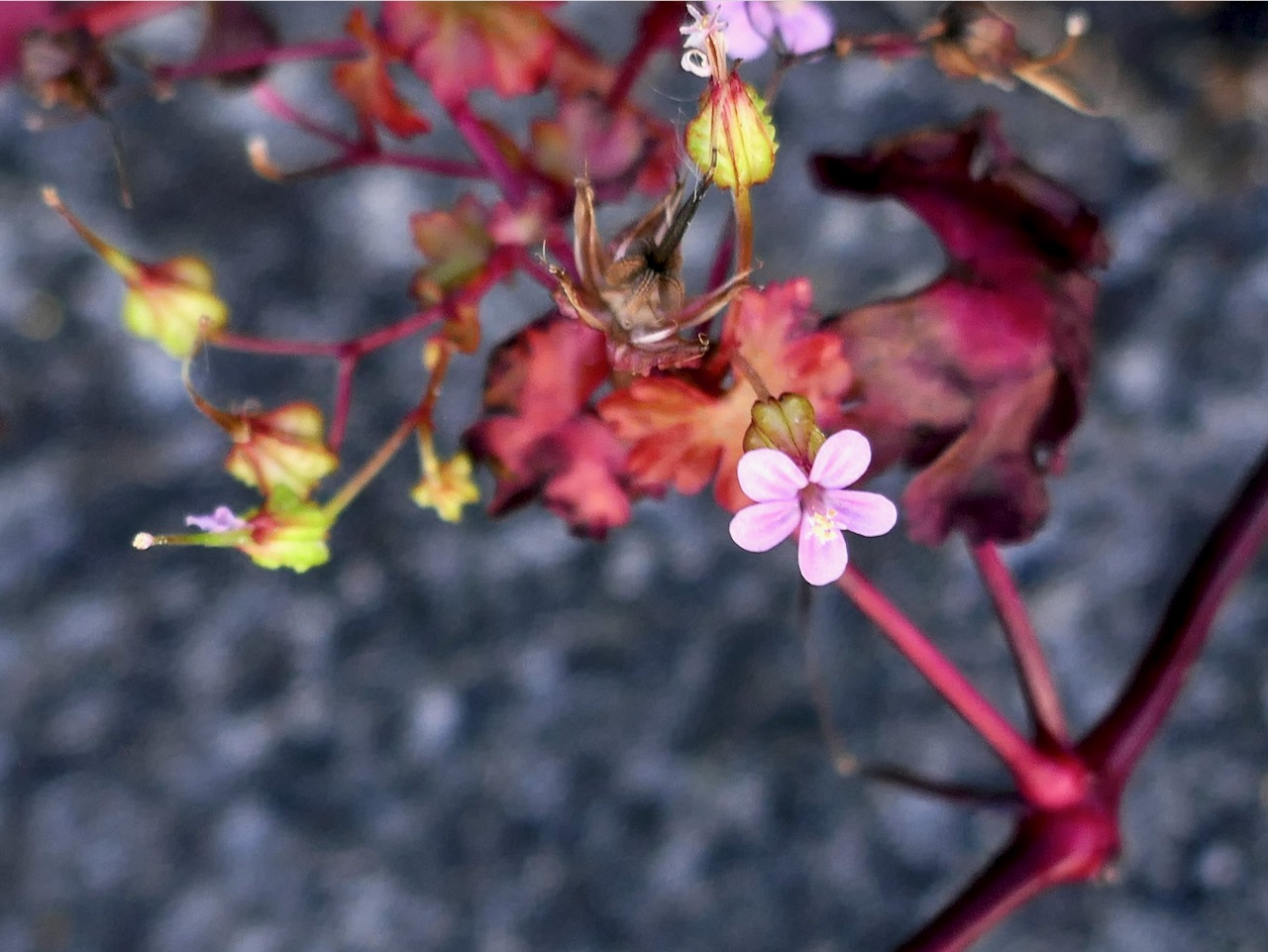
Herb-Robert is a perennial favourite but in Schull we found lots of its first cousin, Shining Crane’s-bill. The flower is very similar, although smaller, but the leaves are quite different, being round and glossy compared to Herb-Robert’s hairy fronds. Both turn an interesting red as they age. Bonus point to Karen for pointing out that this was not, in fact, Herb-Robert.

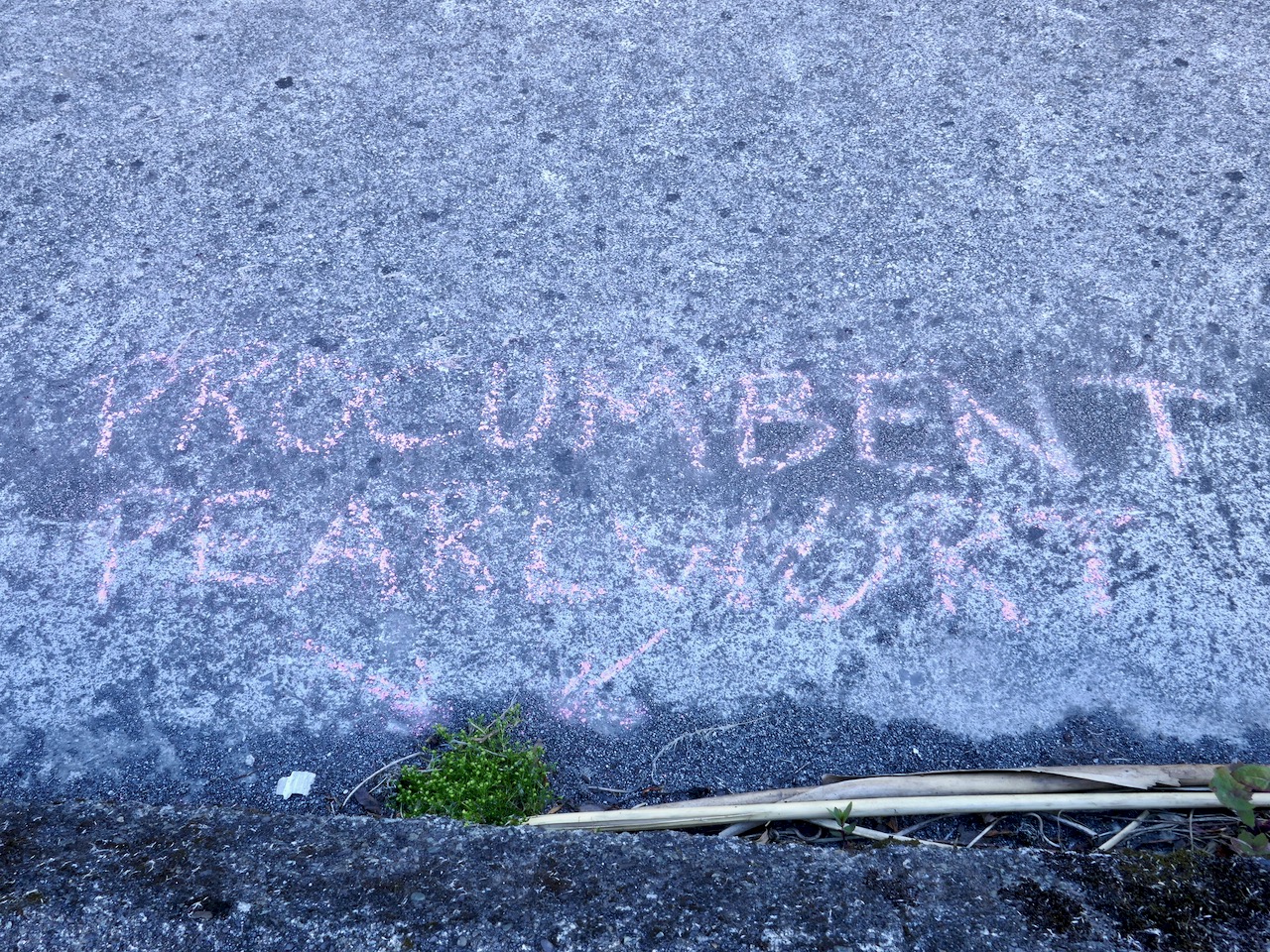
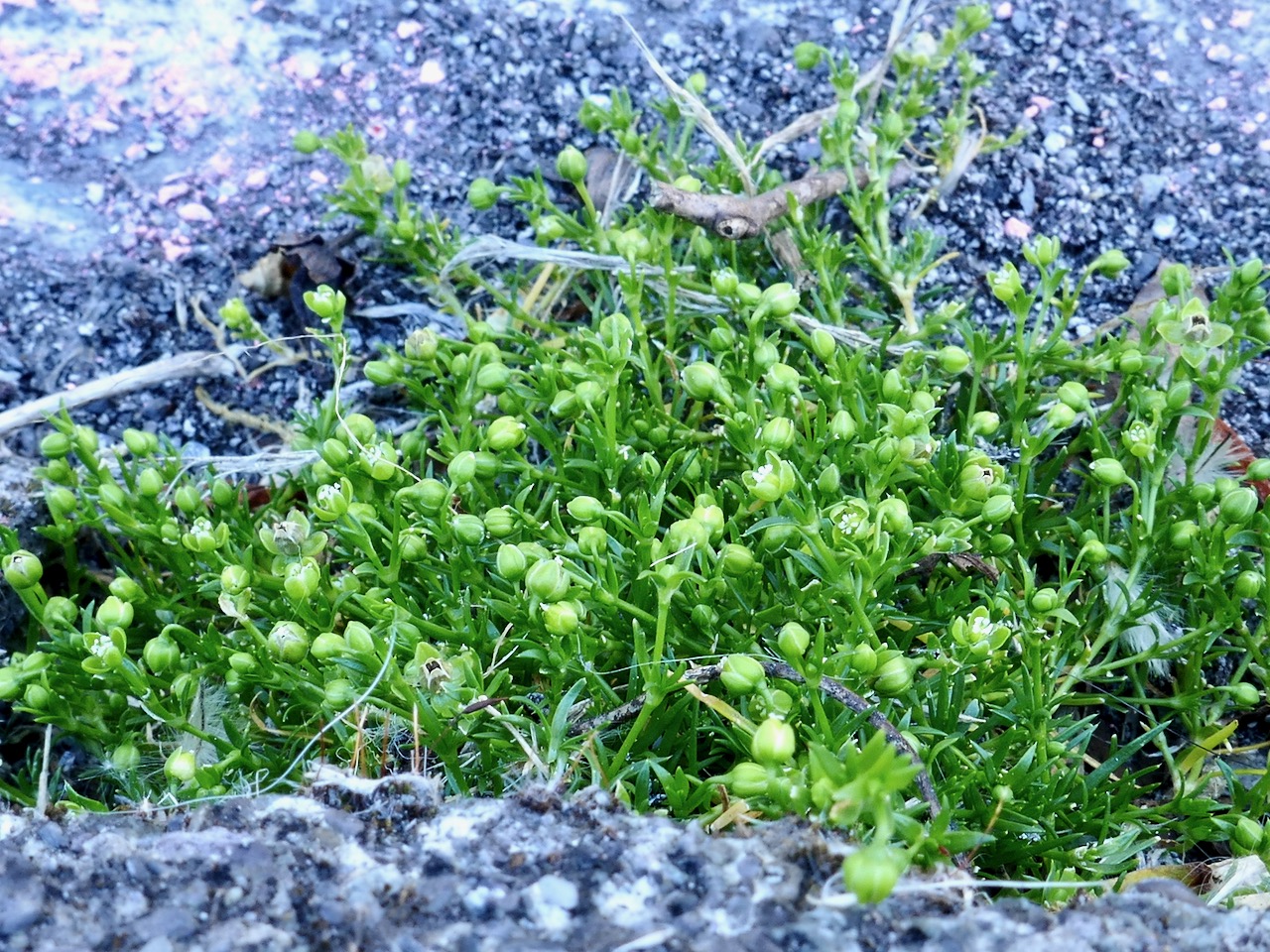
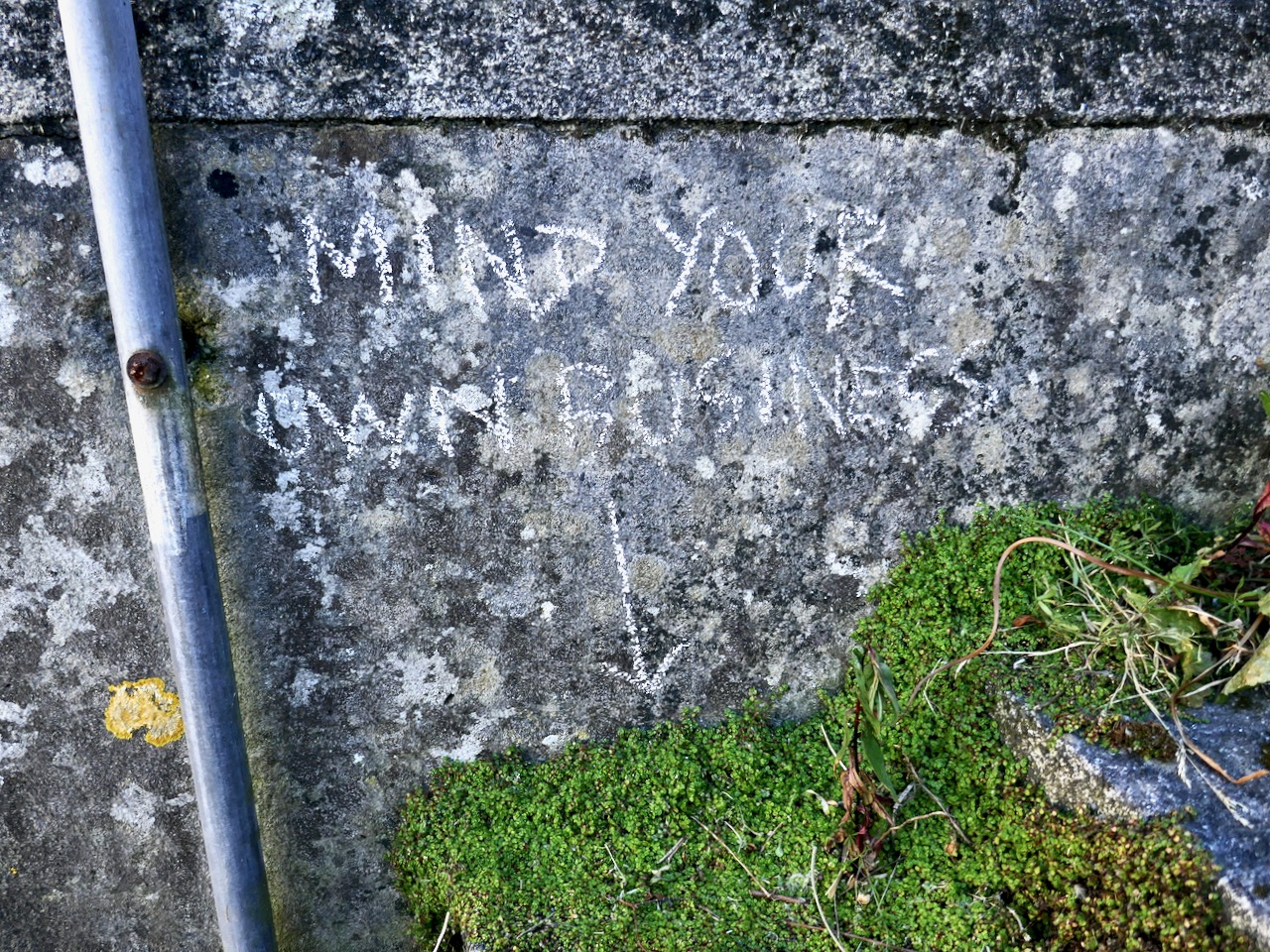
Some plants are so tiny and background-y that they are easily overlooked. A couple below – Procumbent Pearlwort and the charmingly named Mind-your-own-business. The second photo is a close-up of the Procumbent Pearlwort, showing its minuscule white flowers.

Foragers are the experts on what’s edible by humans – if you are interested in this, I highly recommend Forager Fred’s Facebook Page. One plant we did happen across in Schull was Pignut – I haven’t tried it myself, but apparently in the old days kids on their way to school would follow the stem down to the root with their fingers to find the little edible tubers. Any memories of that among our readers?

We identified lots more plants than I have room for here and we hoped that people would stop and take notice as they walk around the village and estuary of of Ballydehob and the Market car park and harbour road in Schull.

What do you think – is Guerrilla Botany a good idea? Why not get out and do some in your own community!


Transcendent Prospects

One of the advantages of the limitations that are placed upon us at the moment is that we have to look more closely at everything. We are seeing – and enjoying – the familiar landscape around us, so I am looking out, now, for the transcendent qualities it has to offer. [Transcendent: adjective – beyond or above the range of normal or physical human experience; surpassing the ordinary; exceptional.]

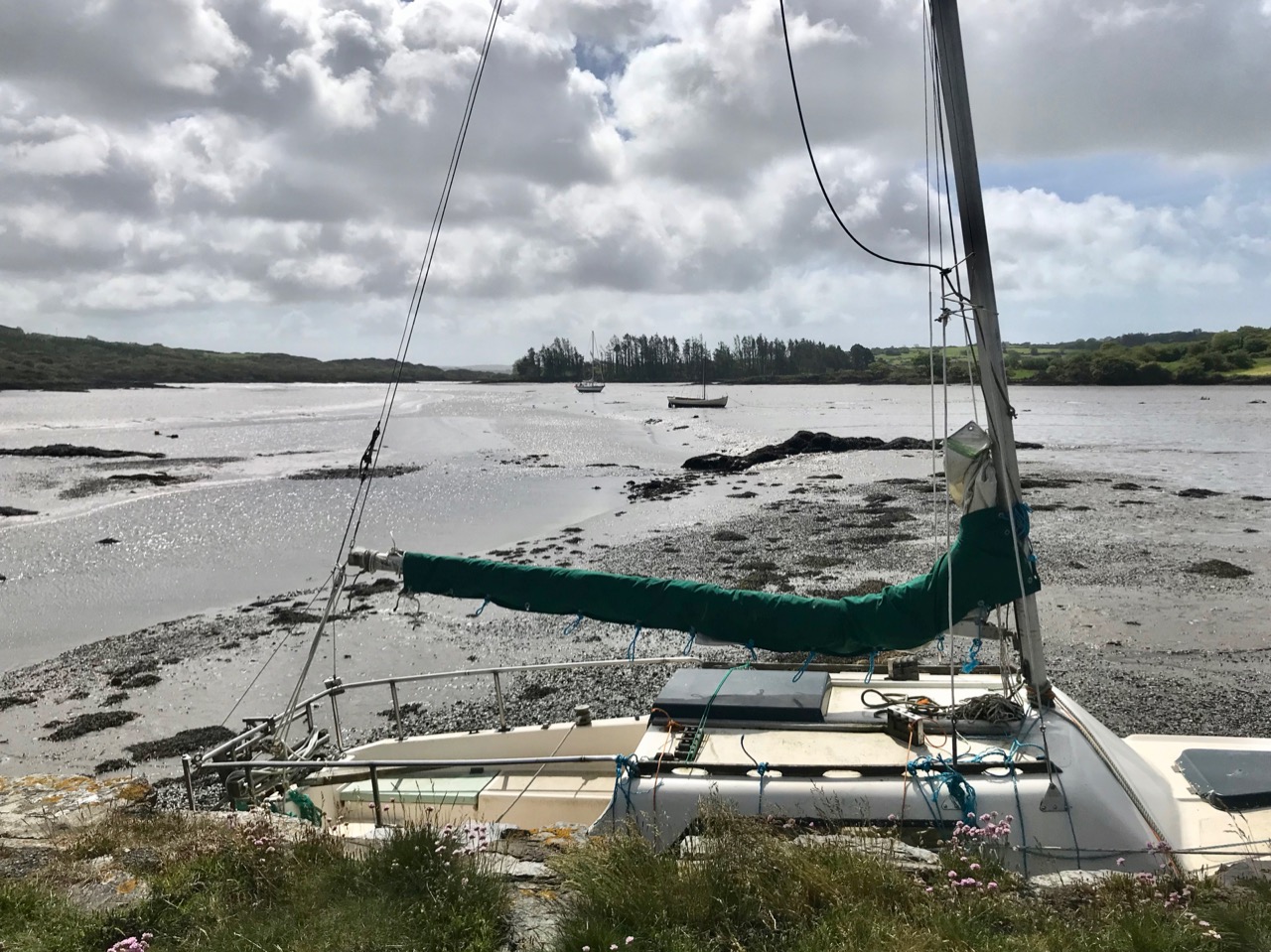
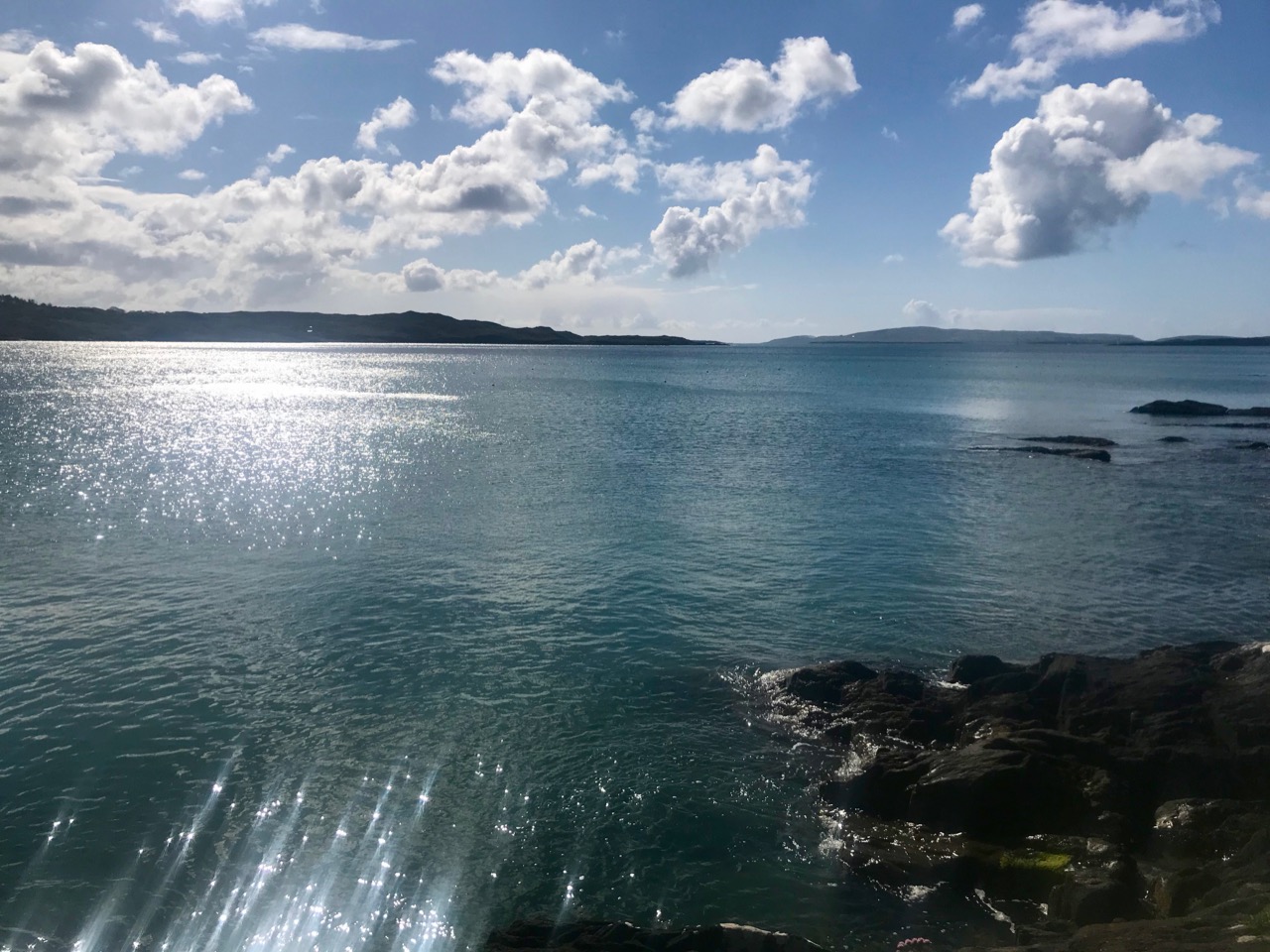
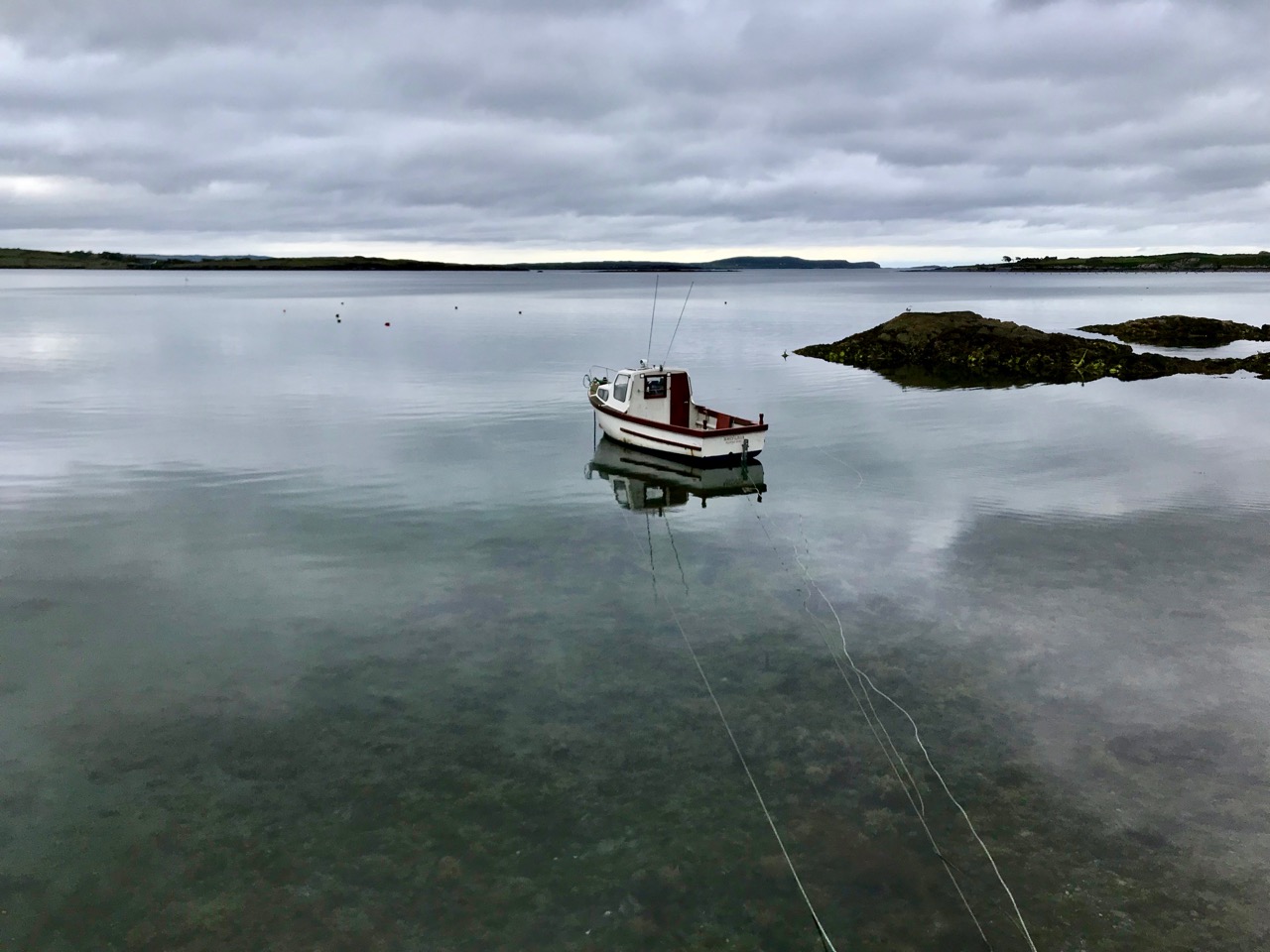
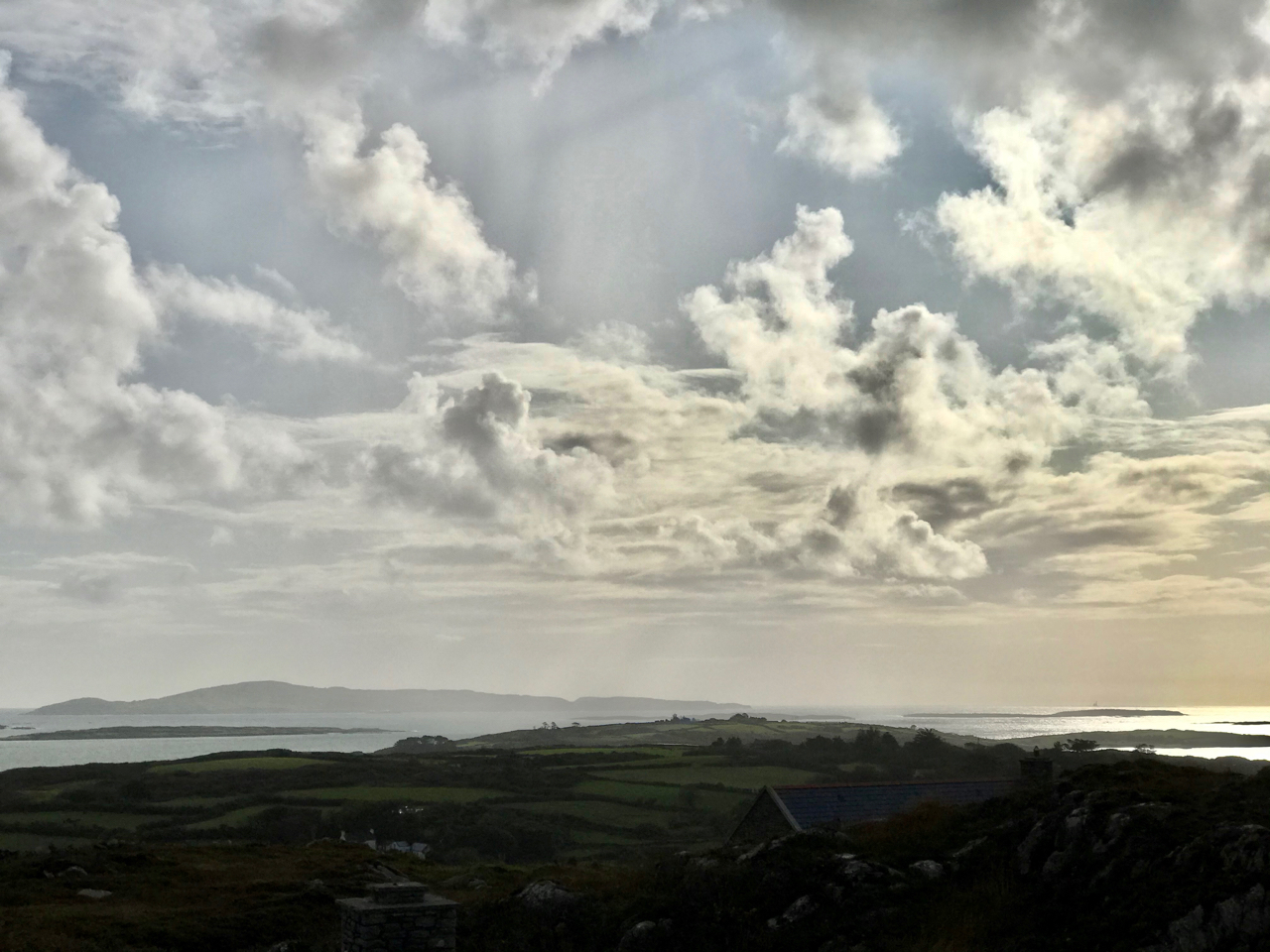
Waterscapes at Ballydehob, Schull and Dereenatra. Header: cloudscape over Cape Clear, Horse Island in the foreground

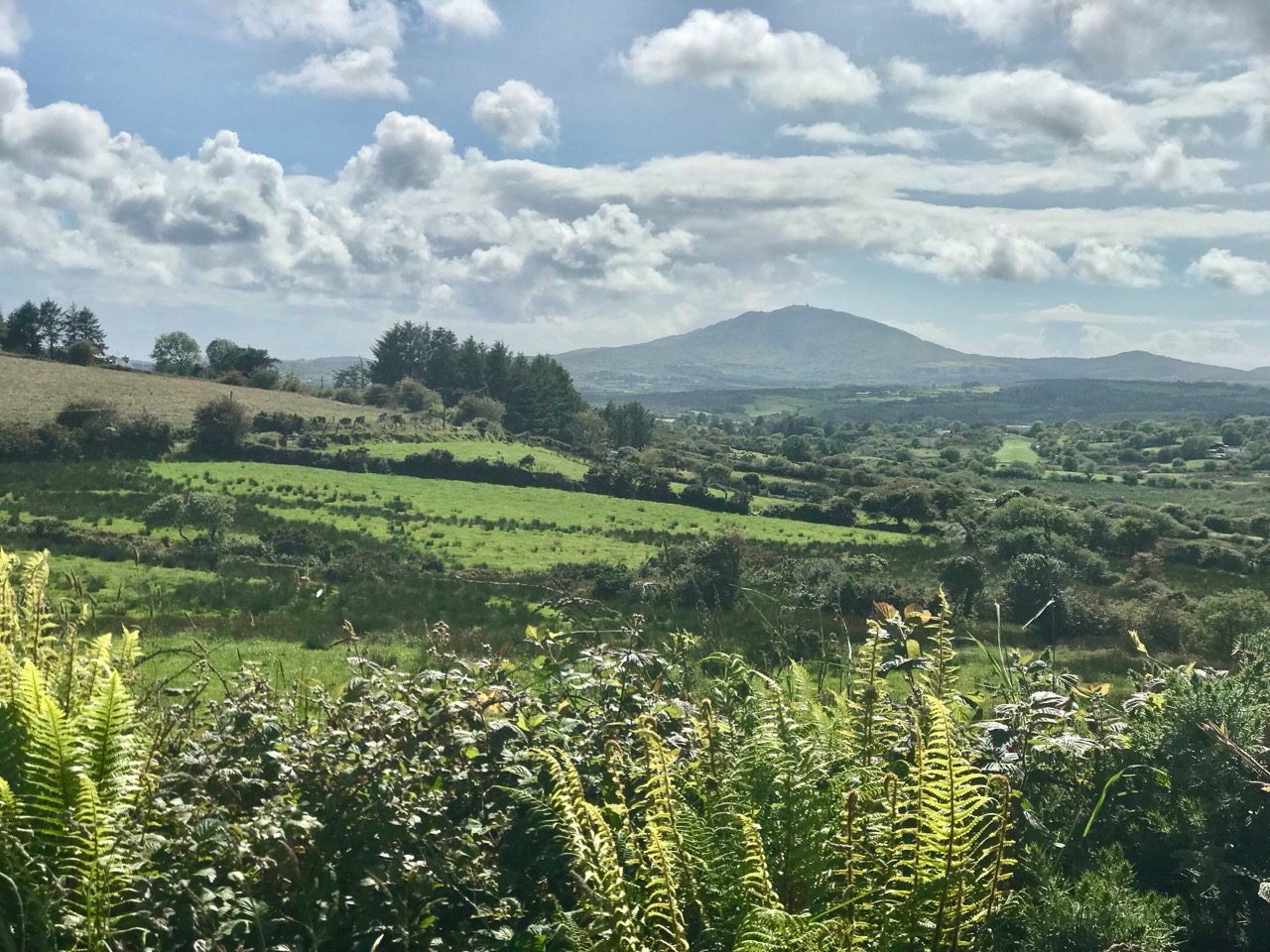
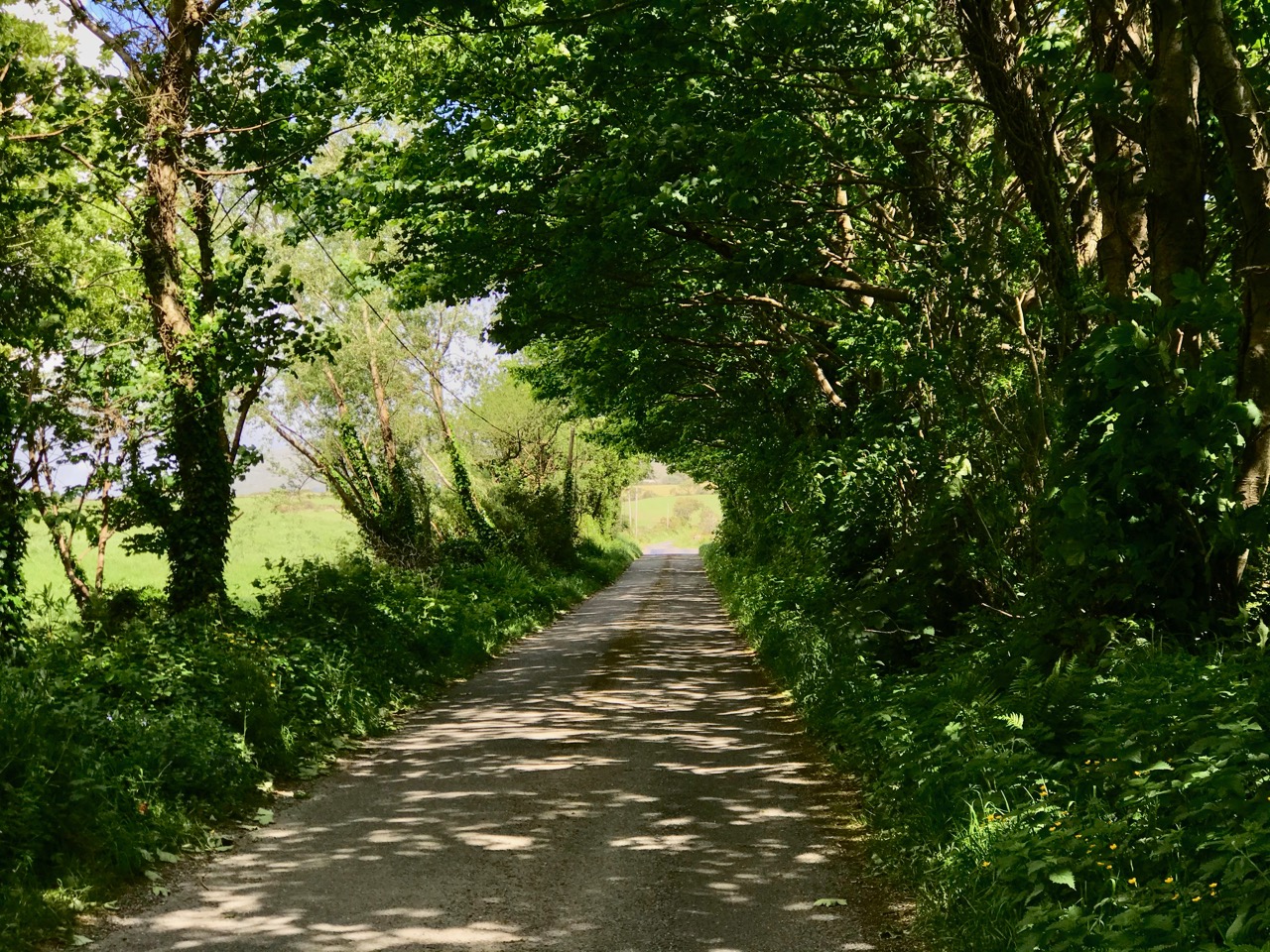
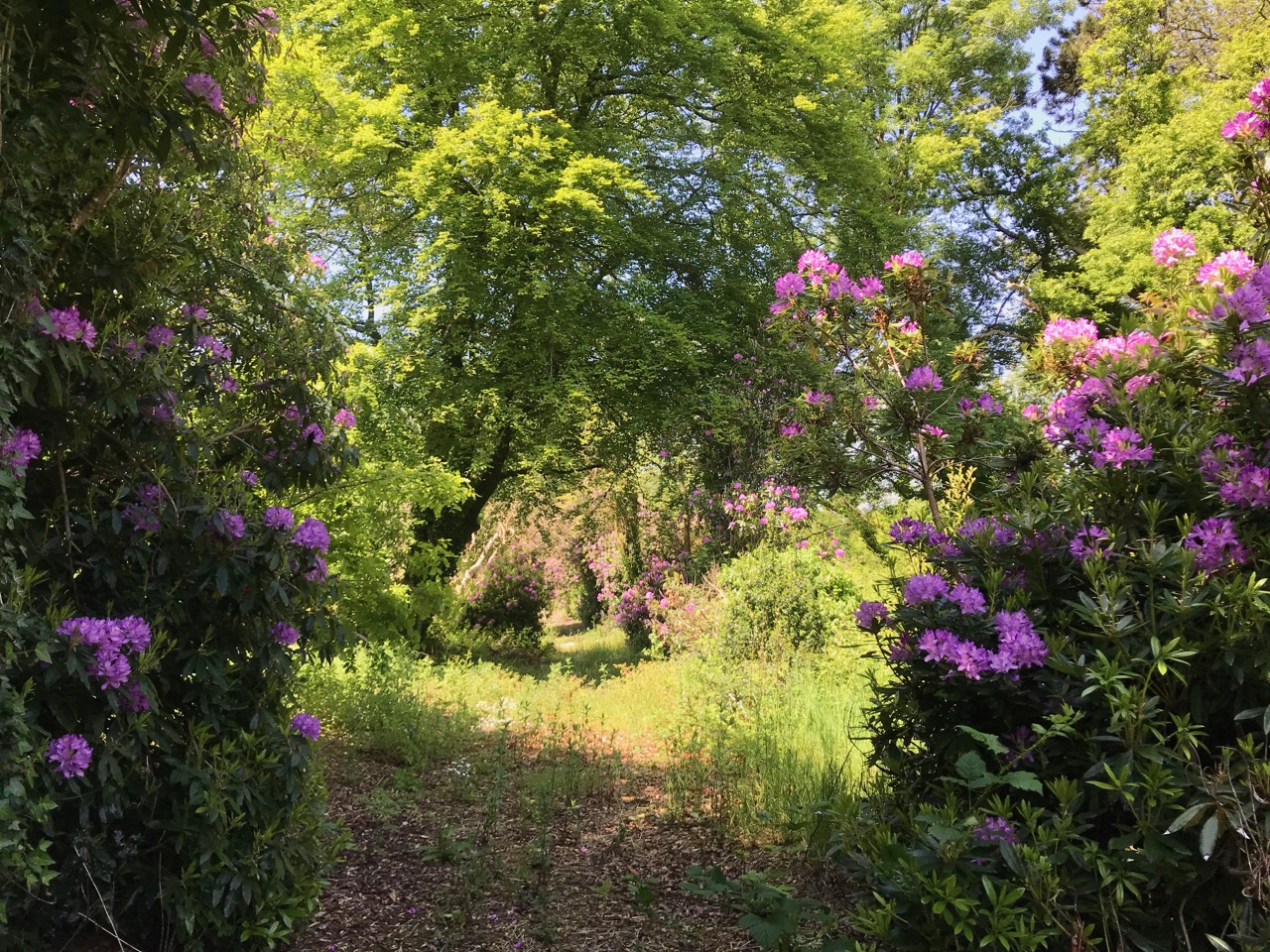
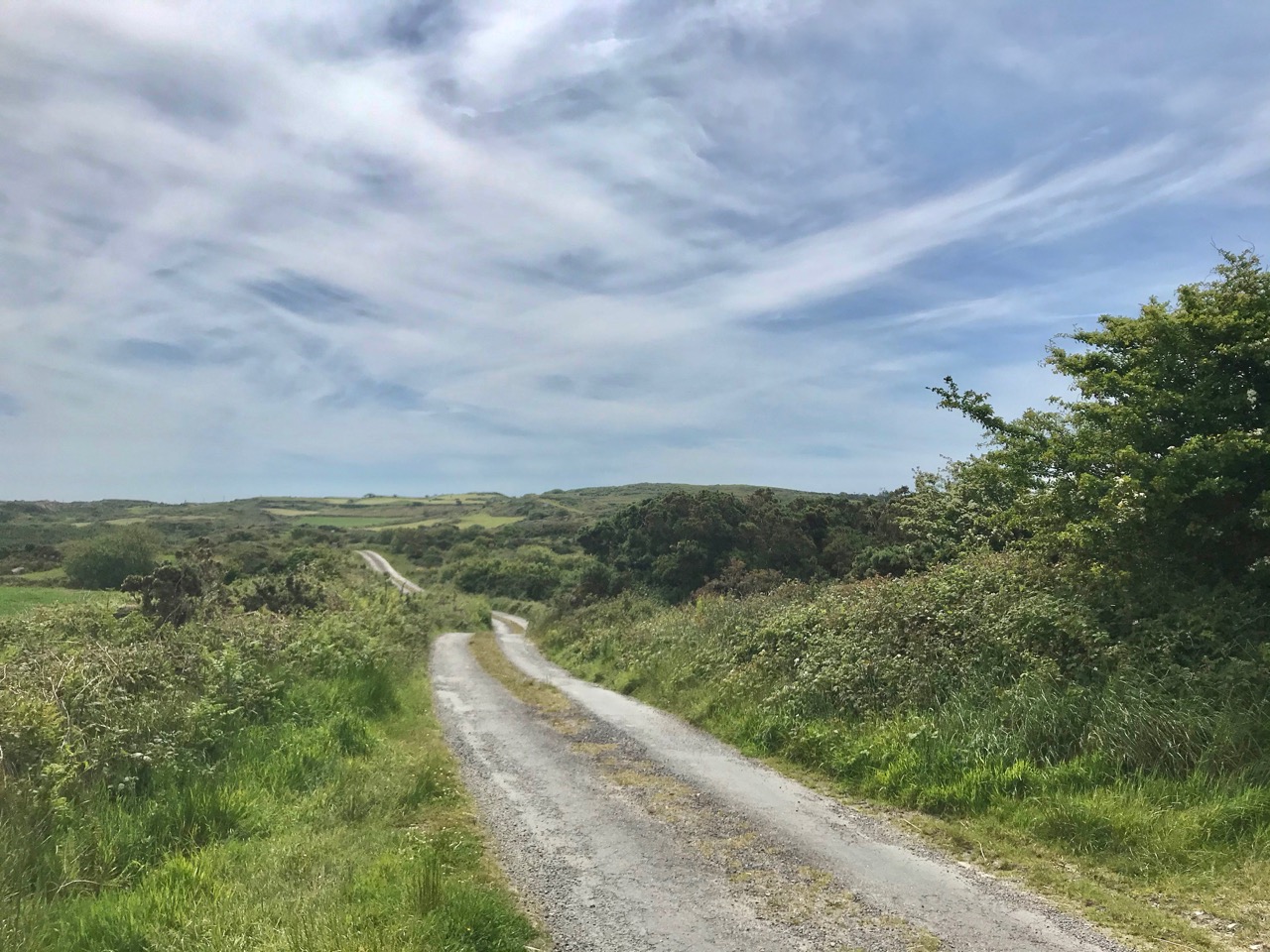
So, over the last couple of days I have wended my way around the boreens of Cappaghglass, Stouke and Ballydehob – armed only with my iPhone camera – to see what I can record to intrigue and delight you. I have looked, particularly, for the quality of light that the currently ubiquitous sun is casting on to our green fields and hedgerows, our evanescent skyscapes, and the waters of the bays that surround us. In Cornwall – where I spent many years – it was the quality of light that was all important to the artists who came to the little fishing communities of Newlyn and St Ives from the late nineteenth century, and even into the present day. They were searching for something which was and is missing in towns and cities: clear, unpolluted air, constantly infused with tiny droplets of water arising from the sea which surround that western peninsula. We have the same quality on our own Mizen Peninsula: it’s that moisture laden air which captures and refracts the light, enhancing clarity and colour – and our own artists always did and always will respond to that.

We sometimes drive further afield in West Cork, so that we can take our exercise with a change of scene. But all of the photographs here are relatively close to home. The clarity of the light is apparent: the detail of the distant hillsides is picked out even by the phone camera. The colours – all those greens and the blues of skies and water are true to life.

Our favourite views are often dominated by the distinctive profile of Mount Gabriel in the distance. This is the highest point of land on the Mizen, and must have been an important waymark throughout history, central to the orientation of travellers through this area, and probably imbued with significance and ‘stories’. My favourite is the one that says the Archangel had heard of the inherent beauty in the Irish countryside (highly believable to me!) and ‘touched down’ on the top of the mountain, leaving his footprint on the rocks. Here’s a post I wrote about Mount Gabriel – and its associated stories – six years ago.

I don’t want to overdo the West Cork boreens (you can see lots more of them here), but I just can’t resist them! Perhaps it’s what they symbolise – our journey through life, pathways leading us on optimistically into our own futures? When we are exploring overgrown lanes, like the one in the middle picture above, there is a sense of excitement about what we might find through the trees or around the corner: in this case, we were led to an abandoned house. What mysteries are contained there: lives fully lived and now departed. The lower picture is the boreen that leads us home from Stouke to Nead an Iolair: always one of my favourites.

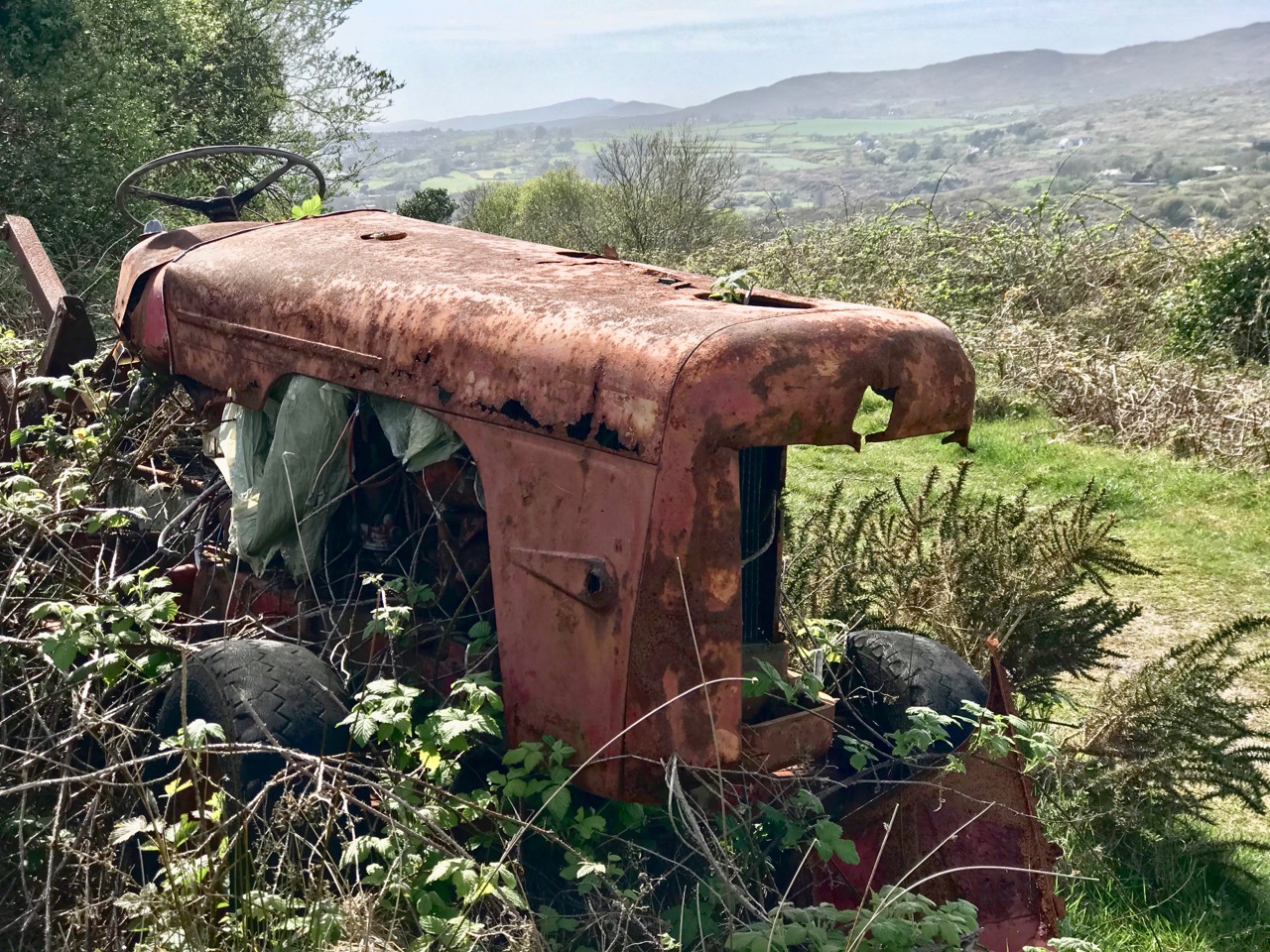
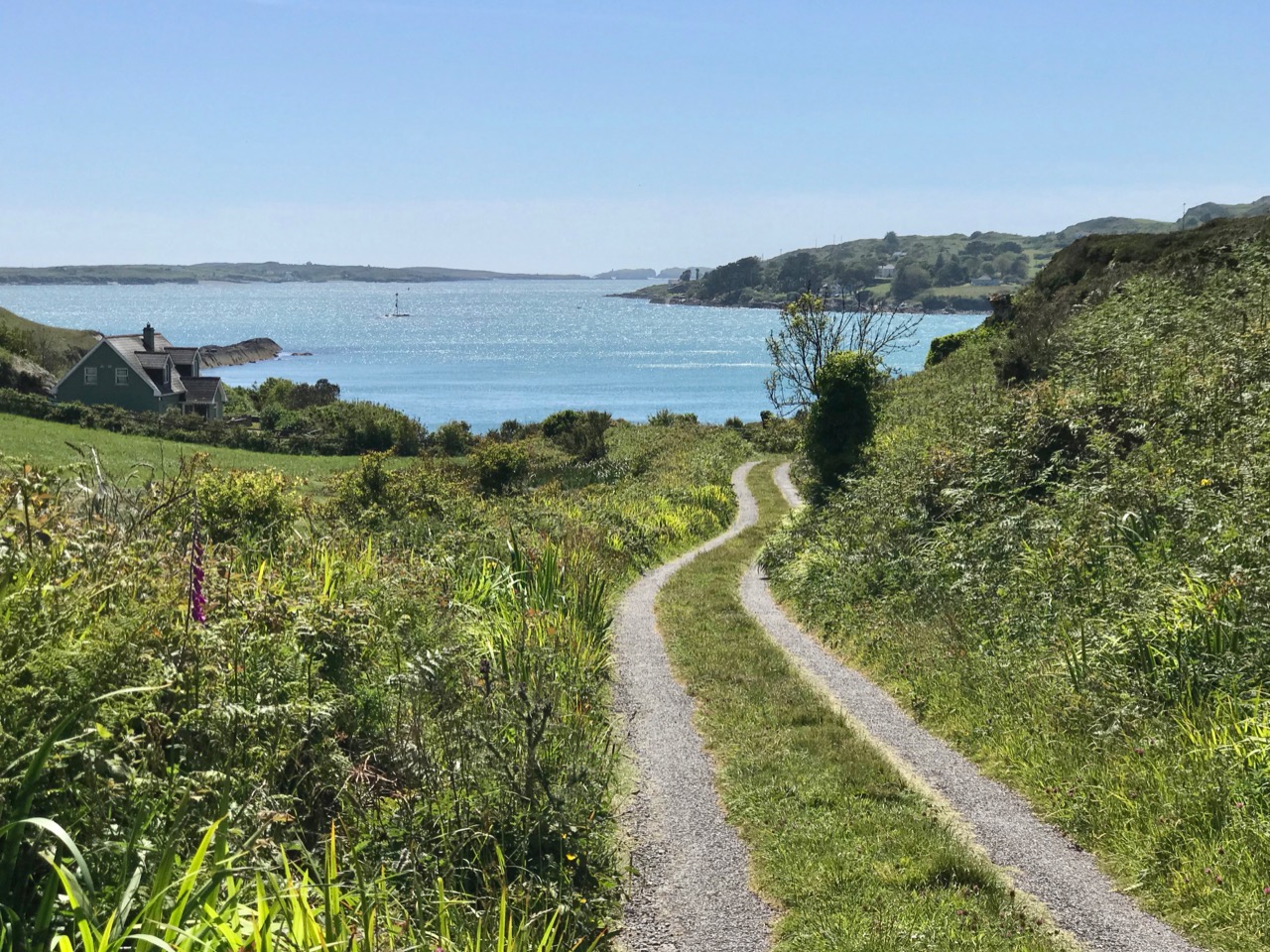
Upper – the colourful remains of an old tractor enhance (for me) the views from the Butter Road running out of Schull towards Ballydehob. Lower – this track is a highway leading down to the beach at Coosheen.

We look forward to the Covid19 restrictions being lifted, but it will be a while yet before travel constraints are removed. Even when they are, we will still appreciate what we have around us, and we won’t neglect the transcendent beauty of ‘our’ townlands and the sublime scenes that await us daily just a few steps from home.

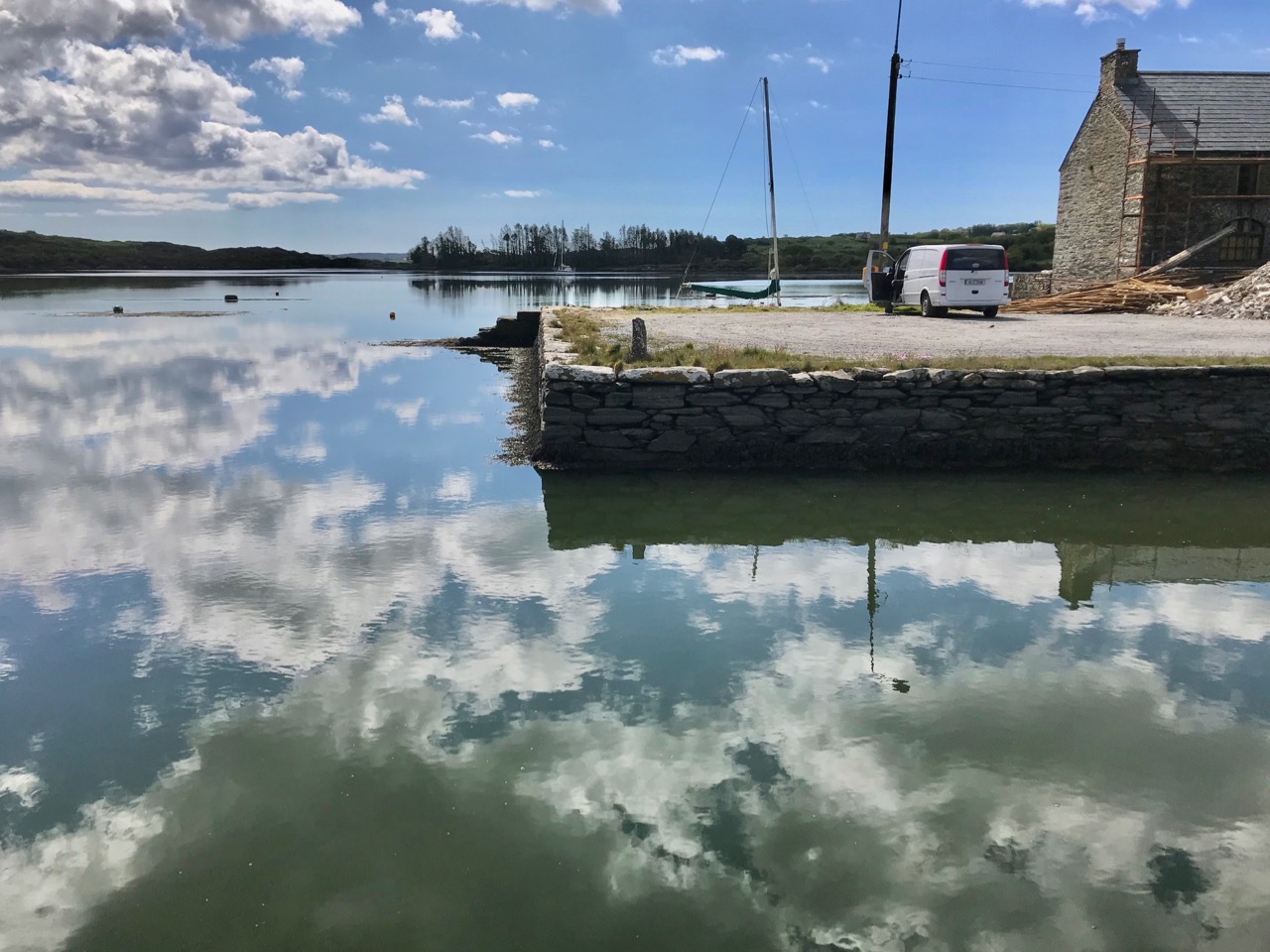
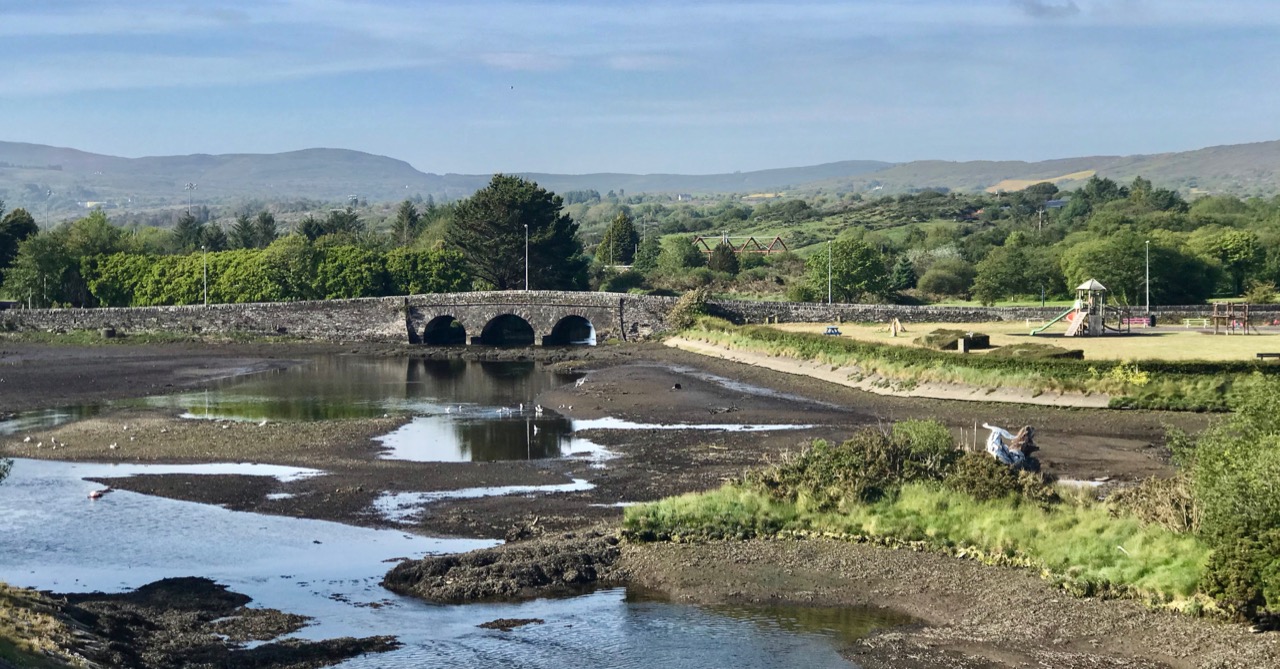
Back home: (upper) reflections by the once busy quay at Ballydehob with (lower) the road leading into Ballydehob passing over the three-arched bridge, overlooked by higher land to the north

If you want to read more about the artists in Cornwall who were influenced and inspired by the landscapes of that Celtic kingdom, read more here and here.

And for more about the West Cork artists’ community – there’s a website (and a museum) dedicated to their history here.