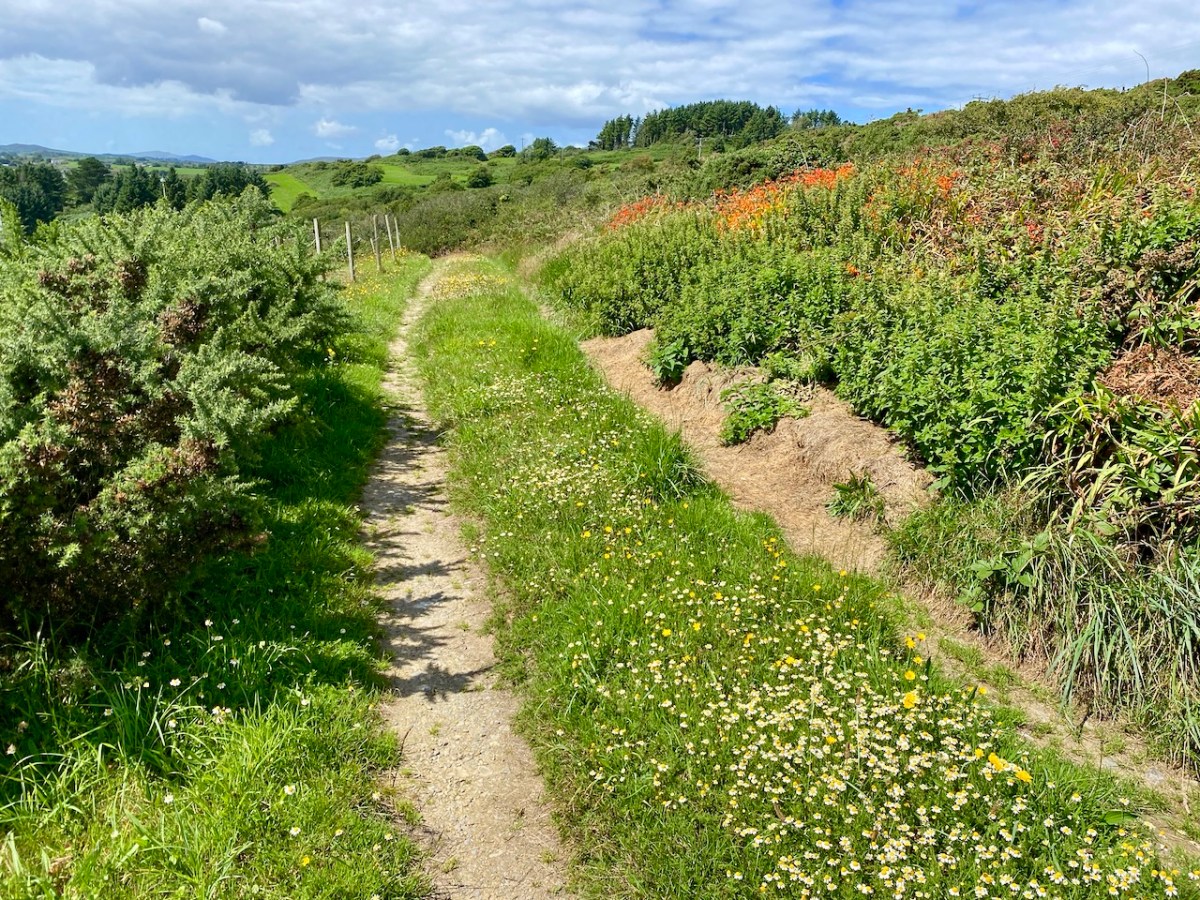
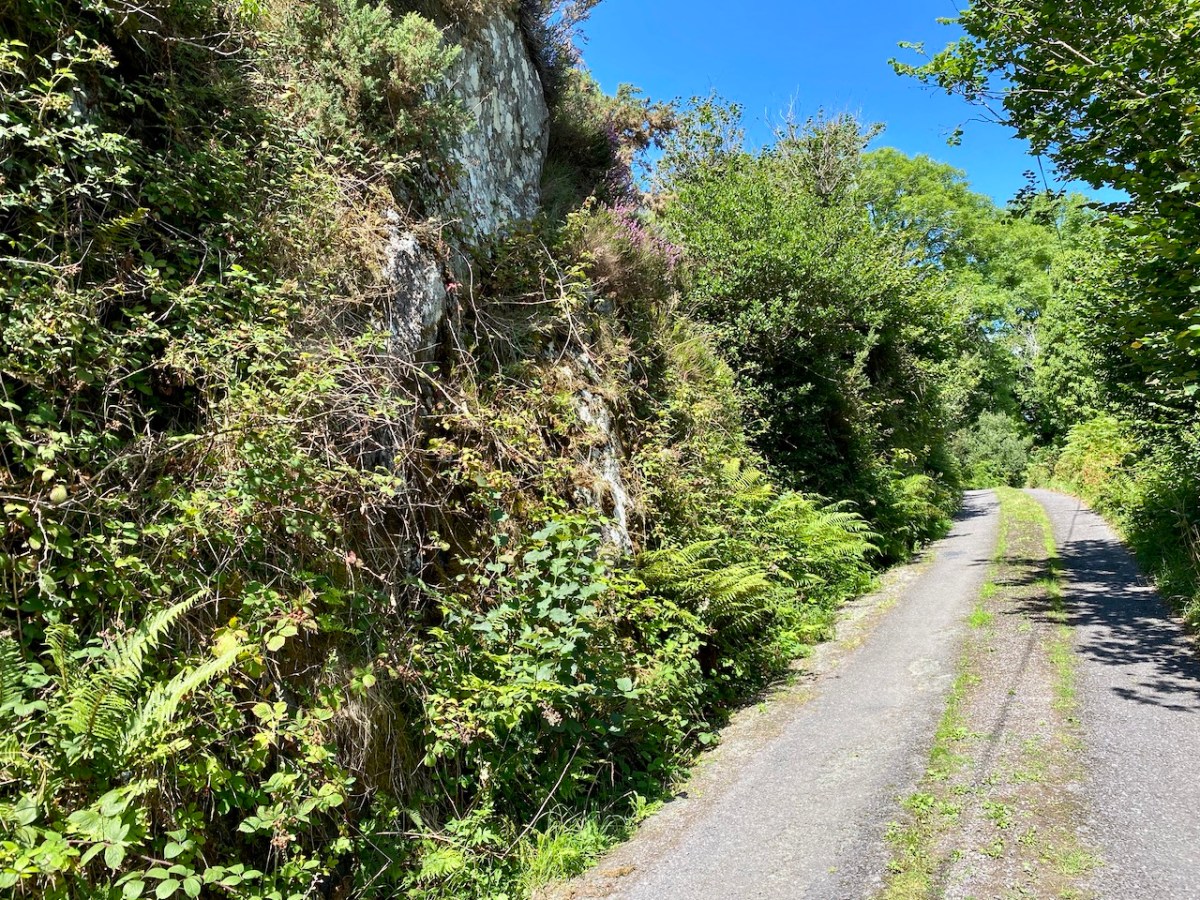
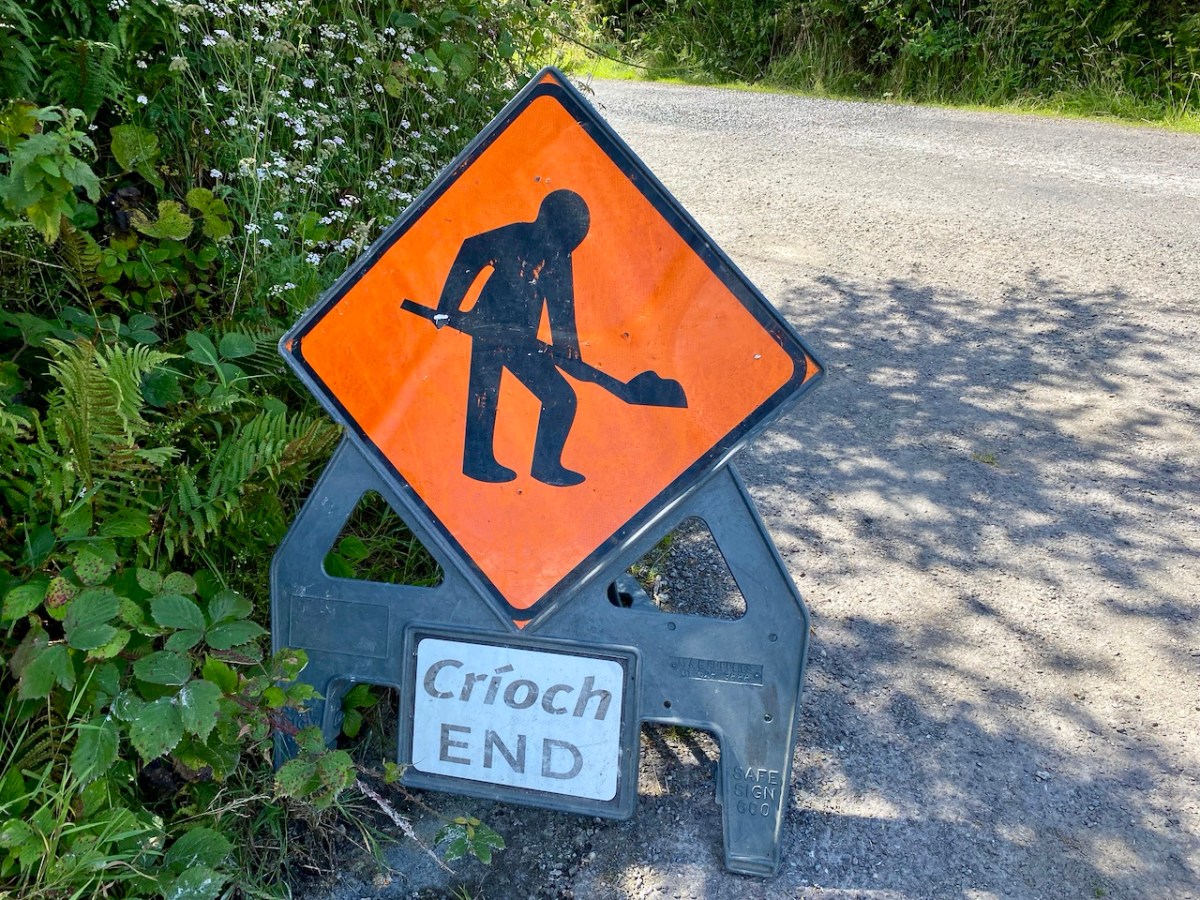
Road repairs in rural Ireland peak in the summer months. Favourable weather is responsible. Always be ready for holdups and diversions. ‘Boreens’ – narrow roads in country areas – are often unable to take the machines required to cut edges, fill potholes and restore surfaces while letting traffic through at the same time. In the worst cases, alternative routes can add many kilometres to a journey. So, when setting out, always leave yourselves plenty of time.
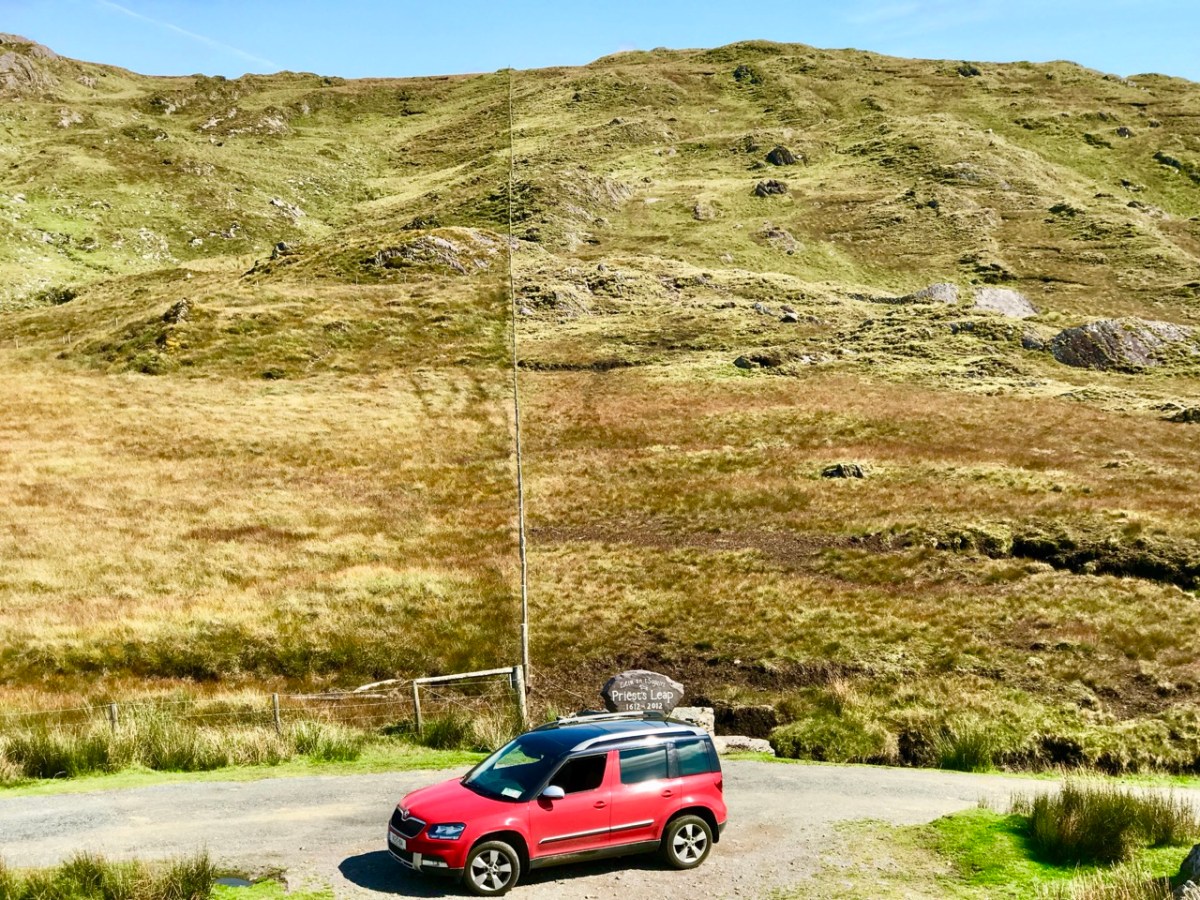
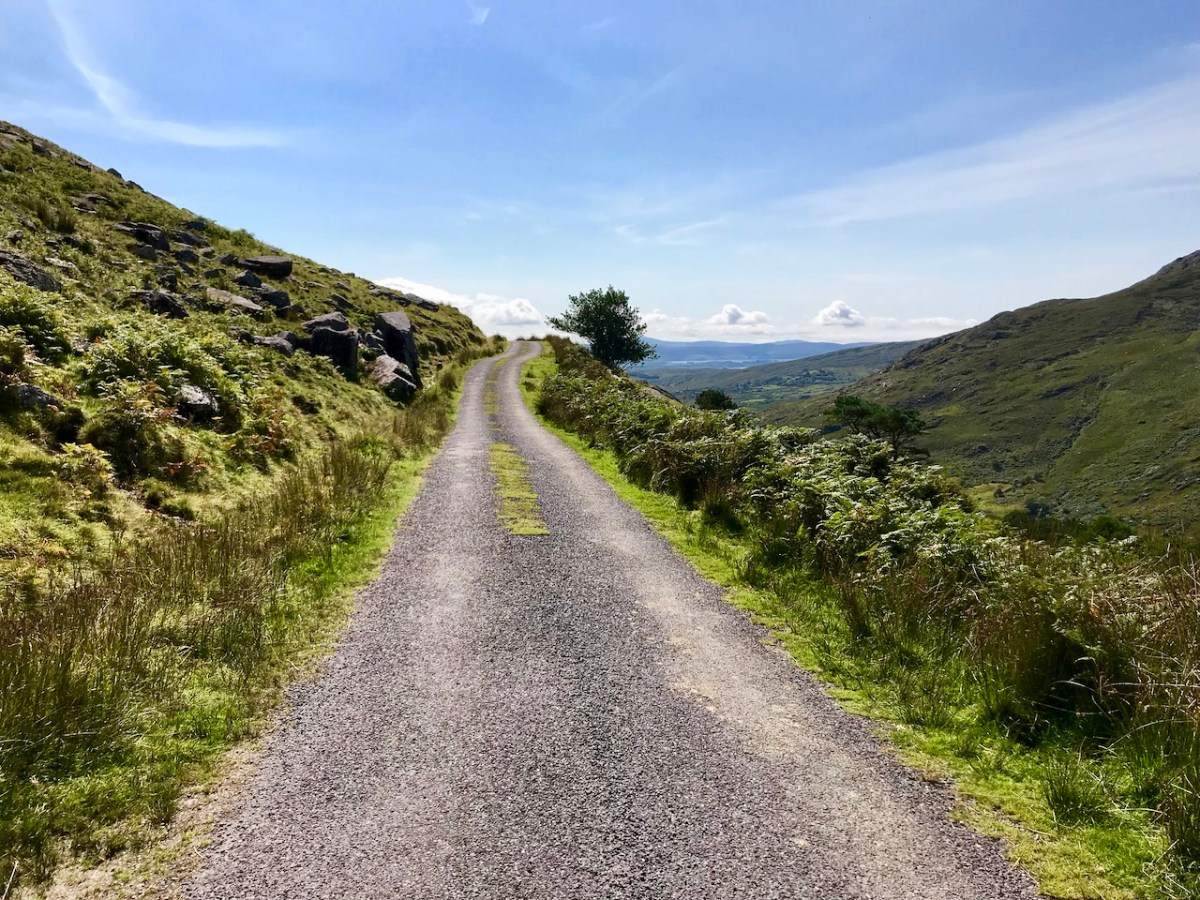
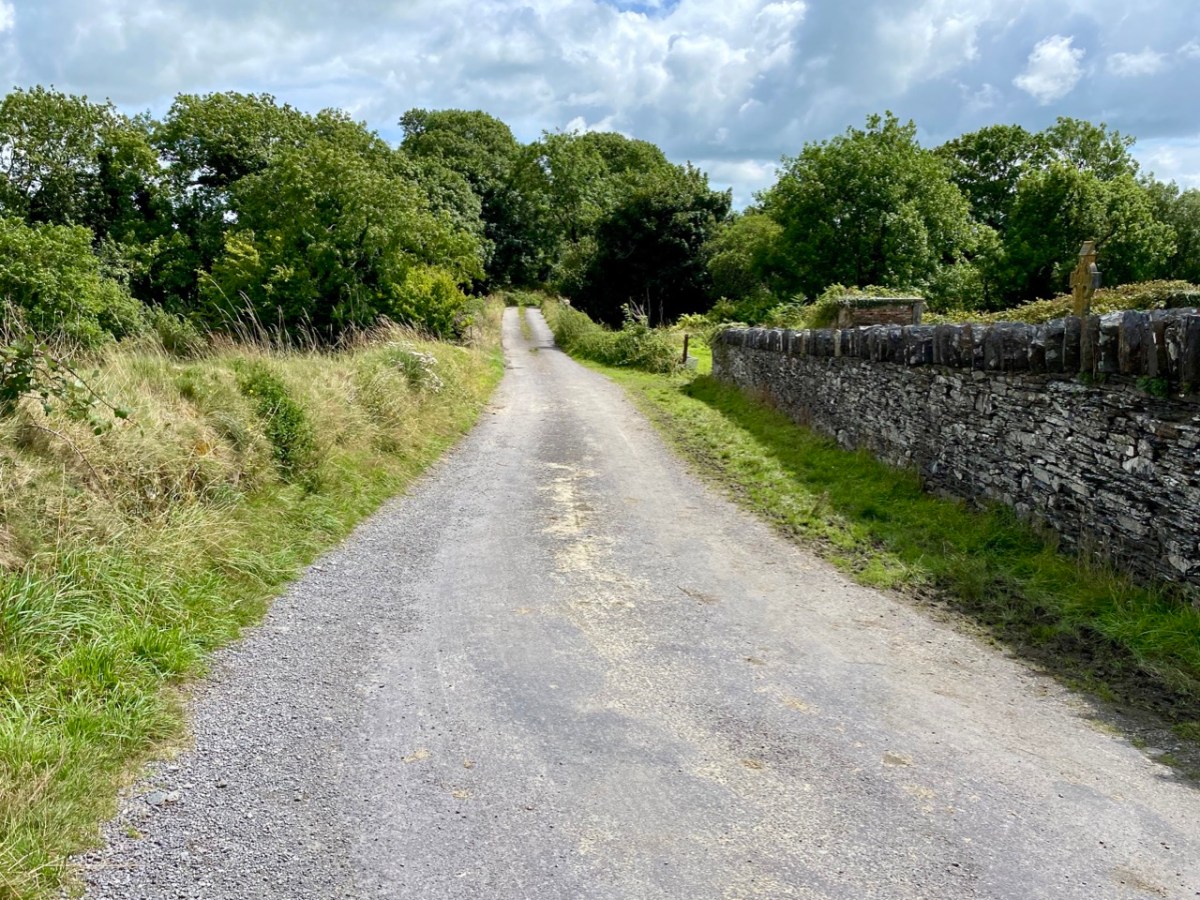
Here’s our Yeti straddling the border between Cork and Kerry on the Priest’s Leap road. That’s one of our favourites: the scenery is outstanding, but there can be problems if you meet someone coming the other way. In fact, that difficulty is present on very many of our local byways: hone your reversing skills!
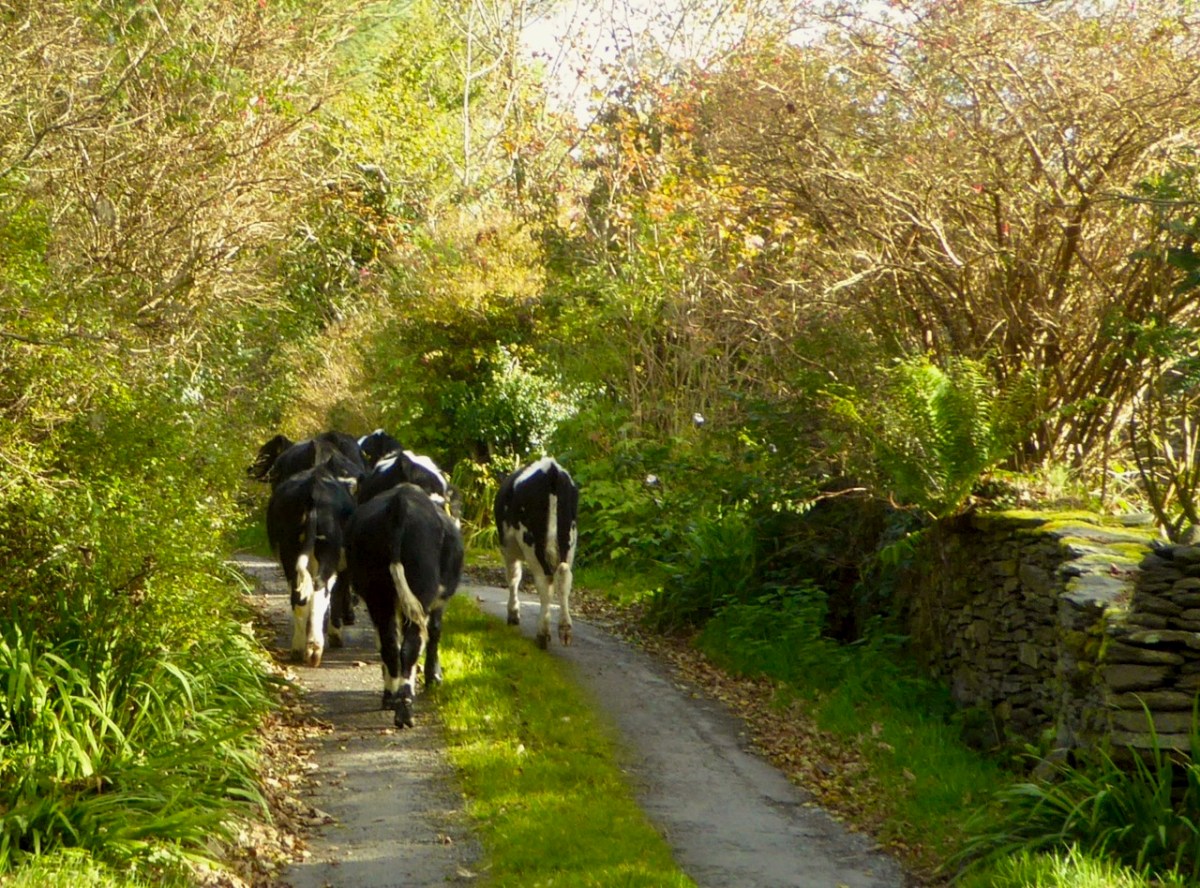
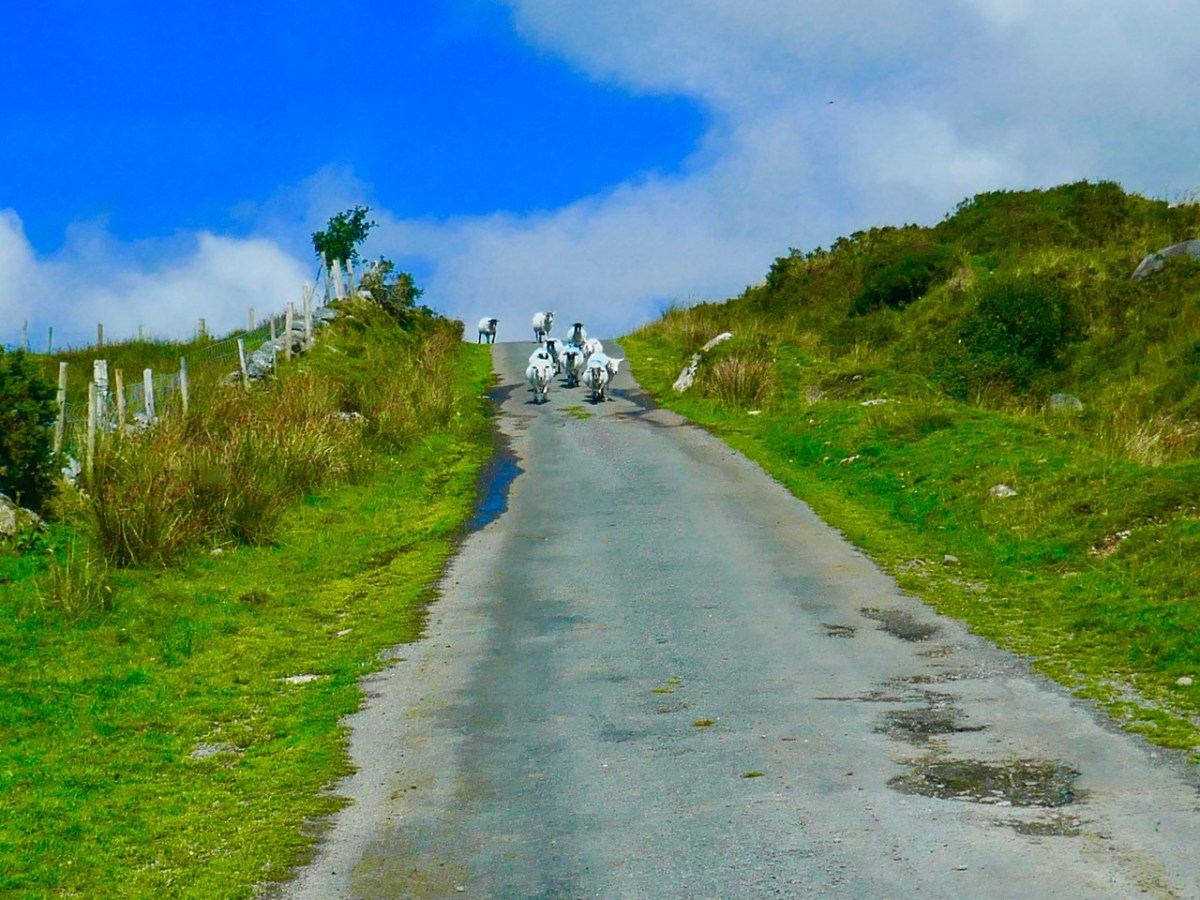
It’s not always other vehicles you have to watch out for . . .
A rural road can be a challenge: never be in a hurry. You just have to go with the flow, even if that means reversing for half a mile. In that situation, of course, the main difficulty is making the decision as to who will have to reverse: you, or the vehicle coming the other way. If that oncoming vehicle is a large tractor and trailer, you may not have much choice.
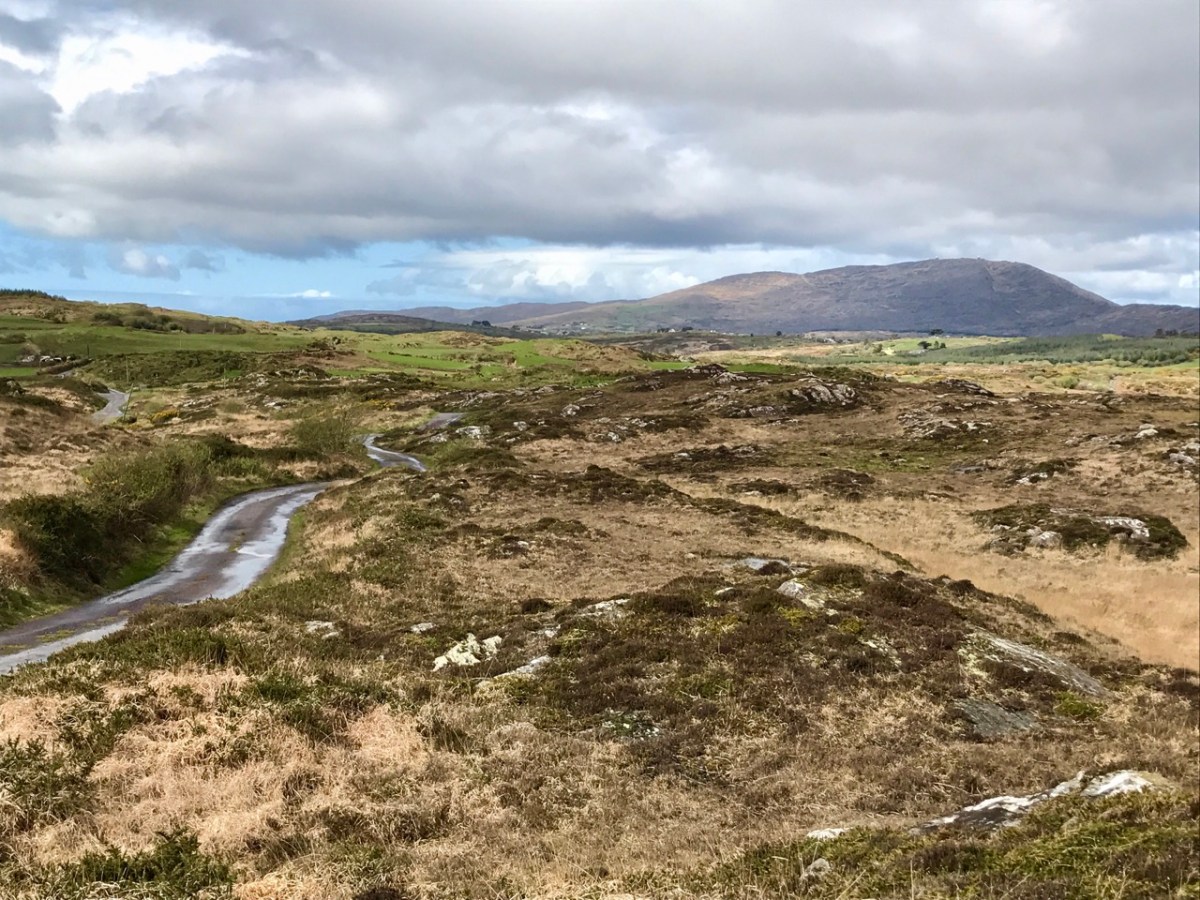
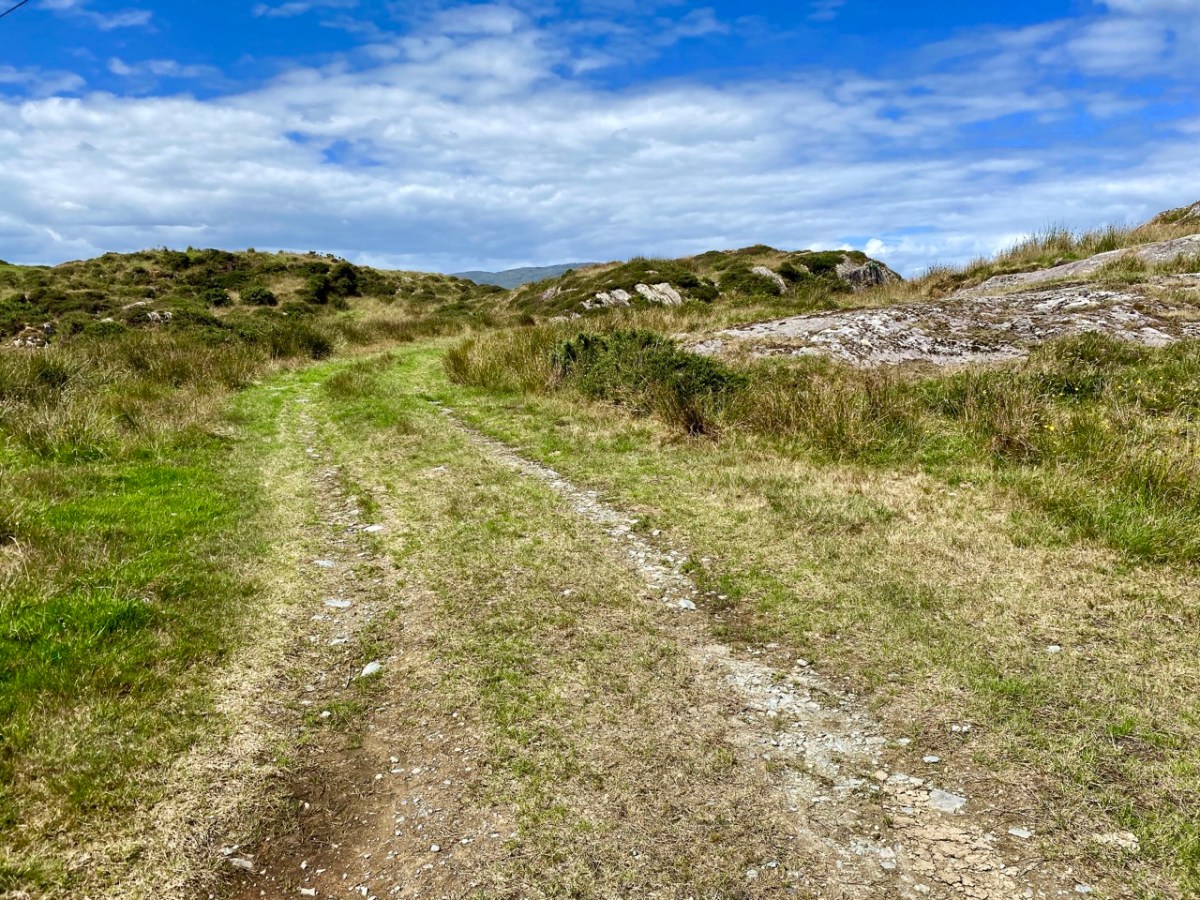
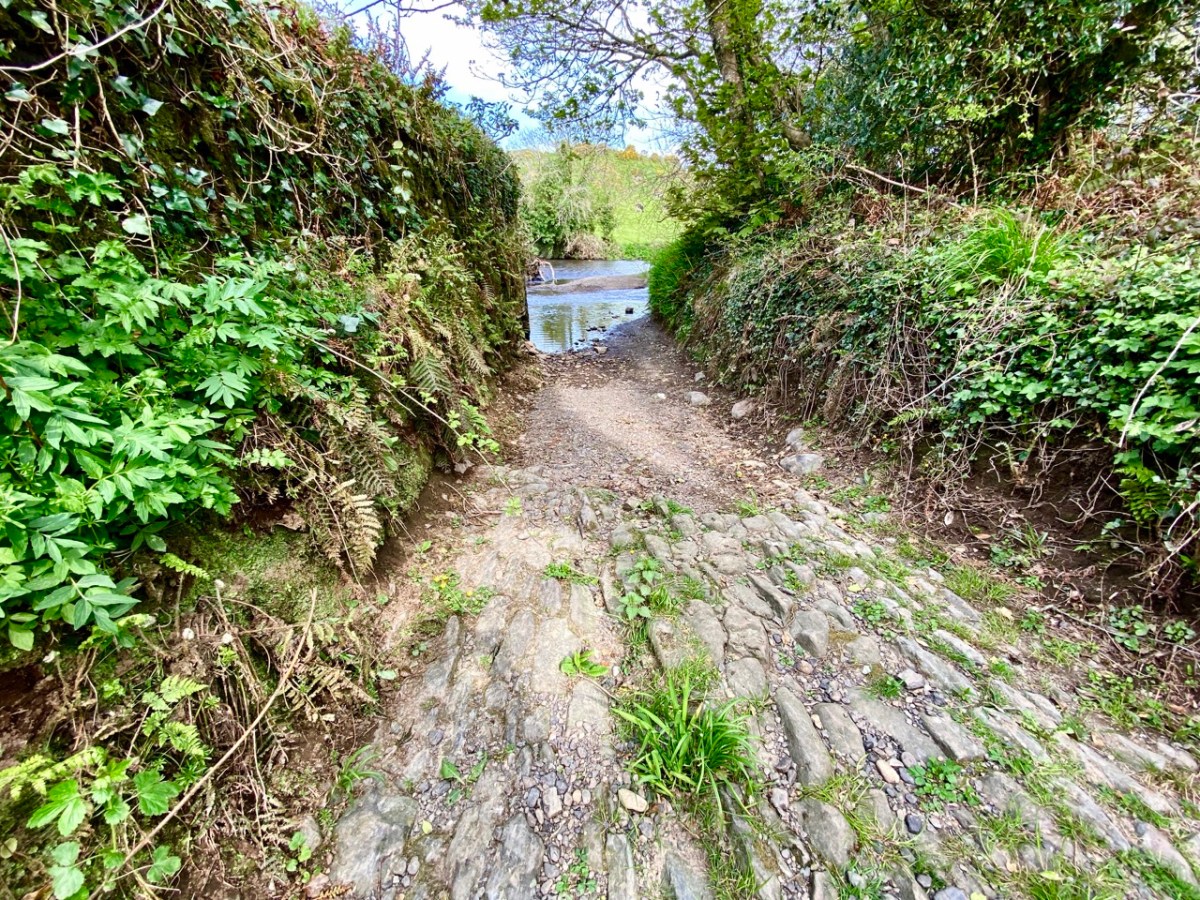
Yes, there are still a few roads around in very out-of-the-way places which are not surfaced as you might expect. They fit well into their rural surroundings!
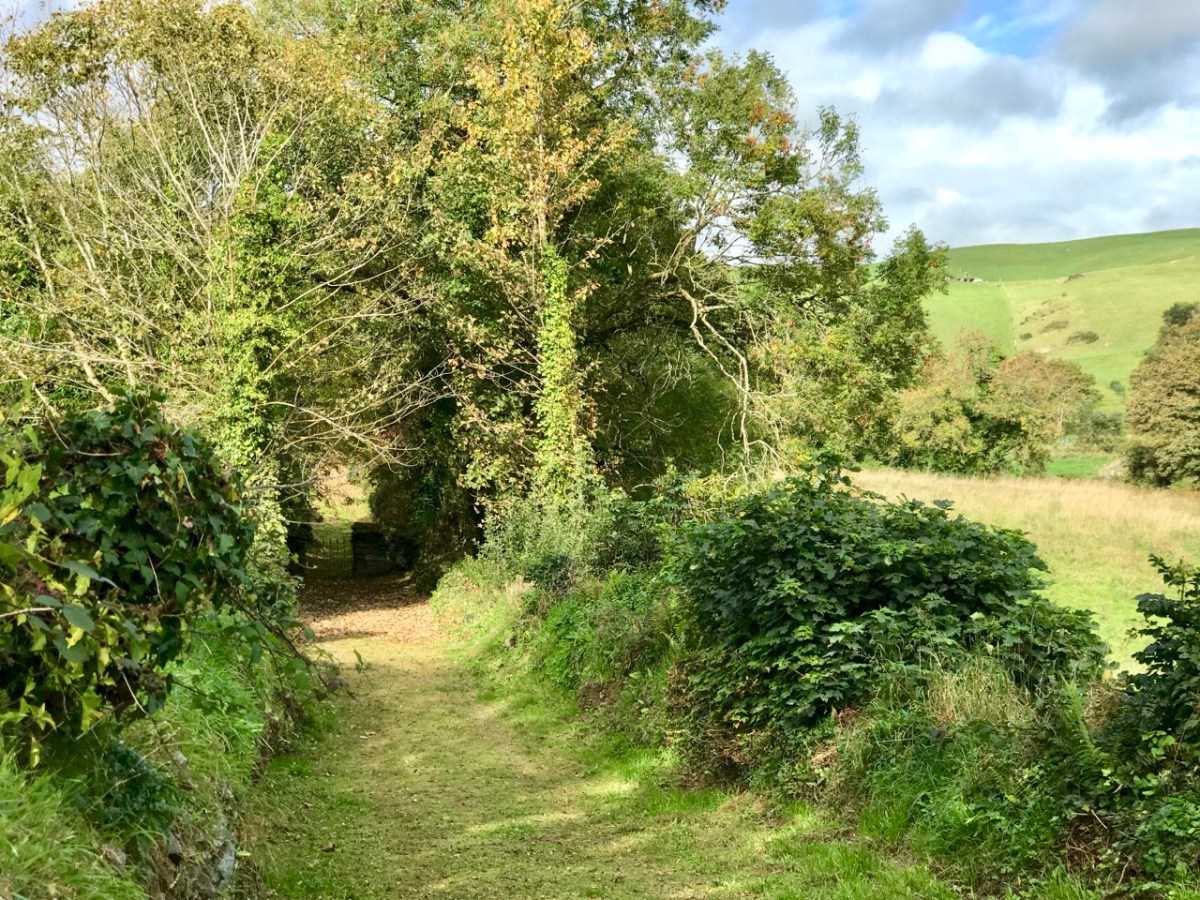
Take care not to get lost . . . Some of these boreens are not even marked on the map!
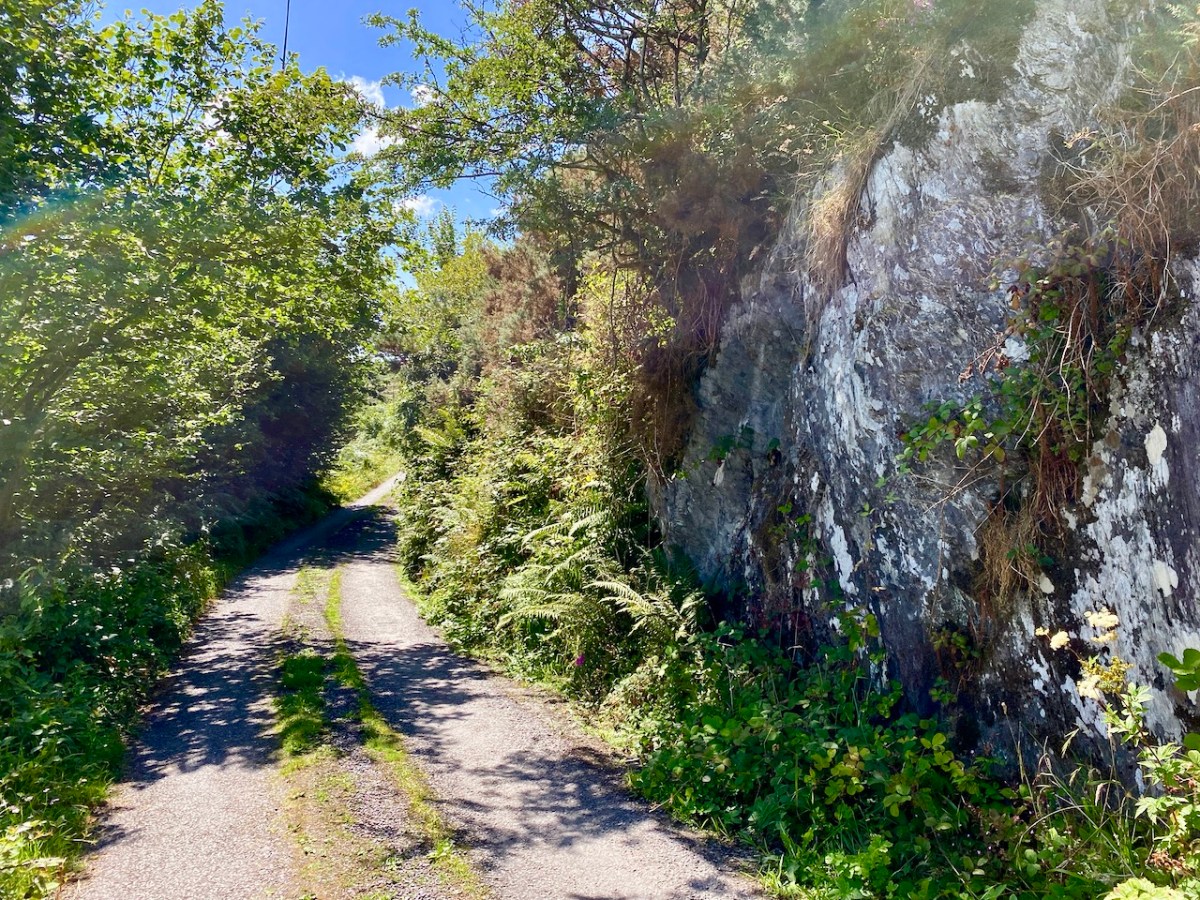
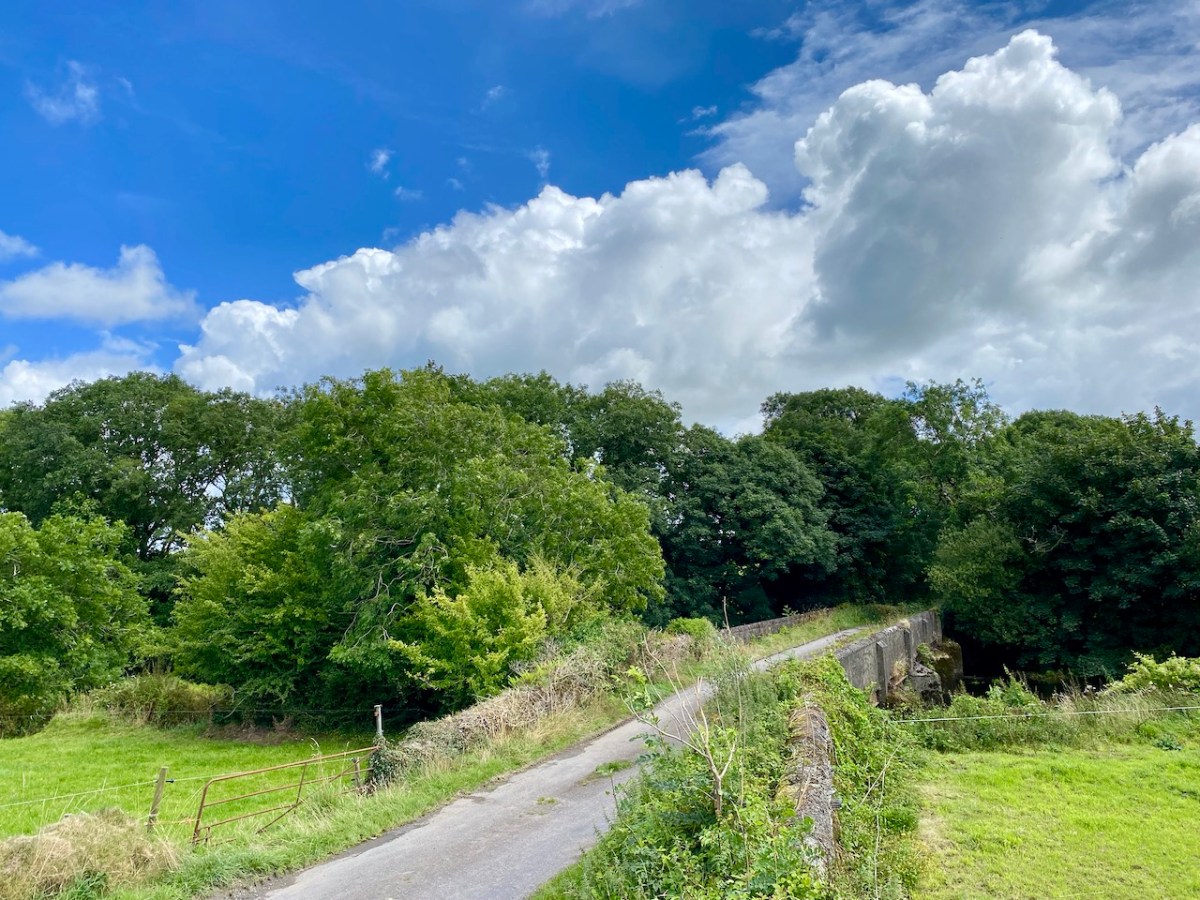
Give a thought to those who built these byways: quite a lot of engineering has been involved in carving through rocks to create a more or less level route.
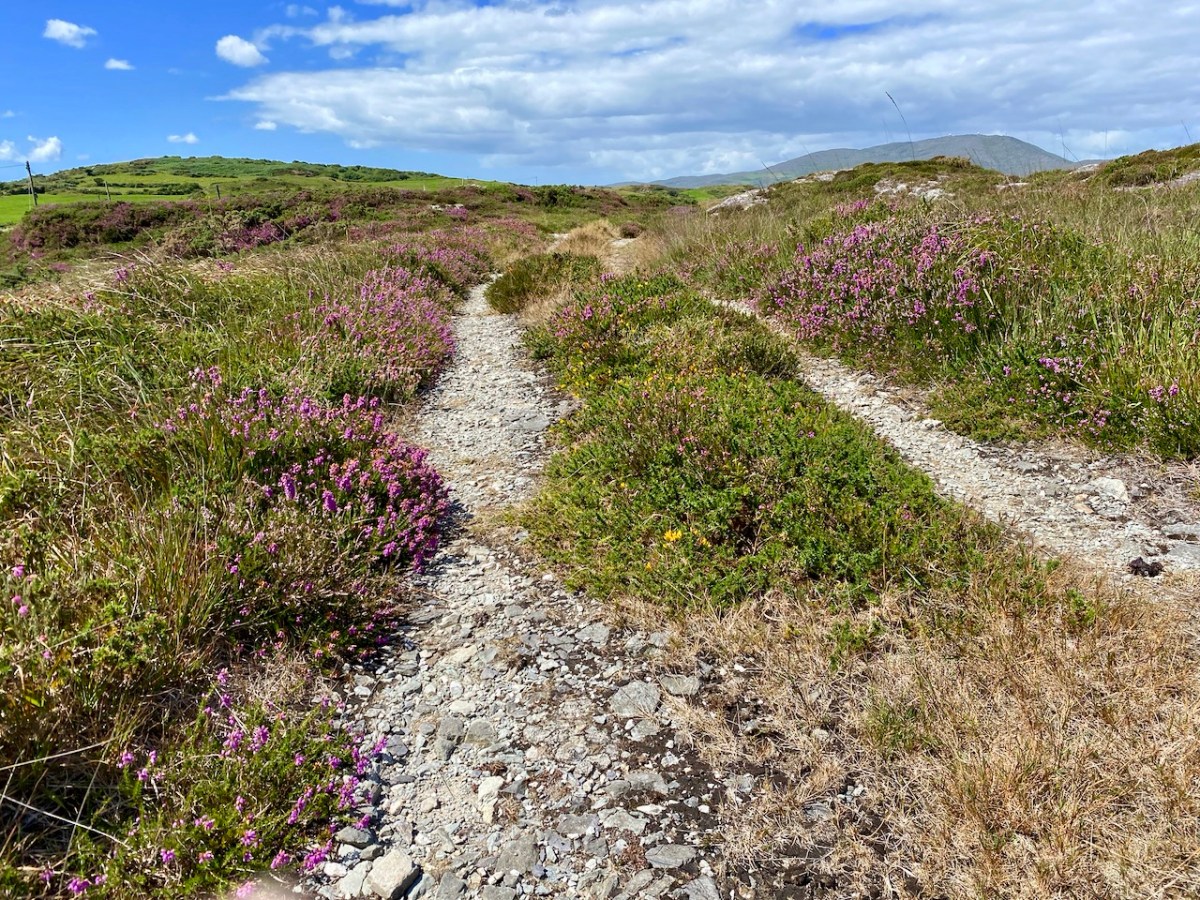
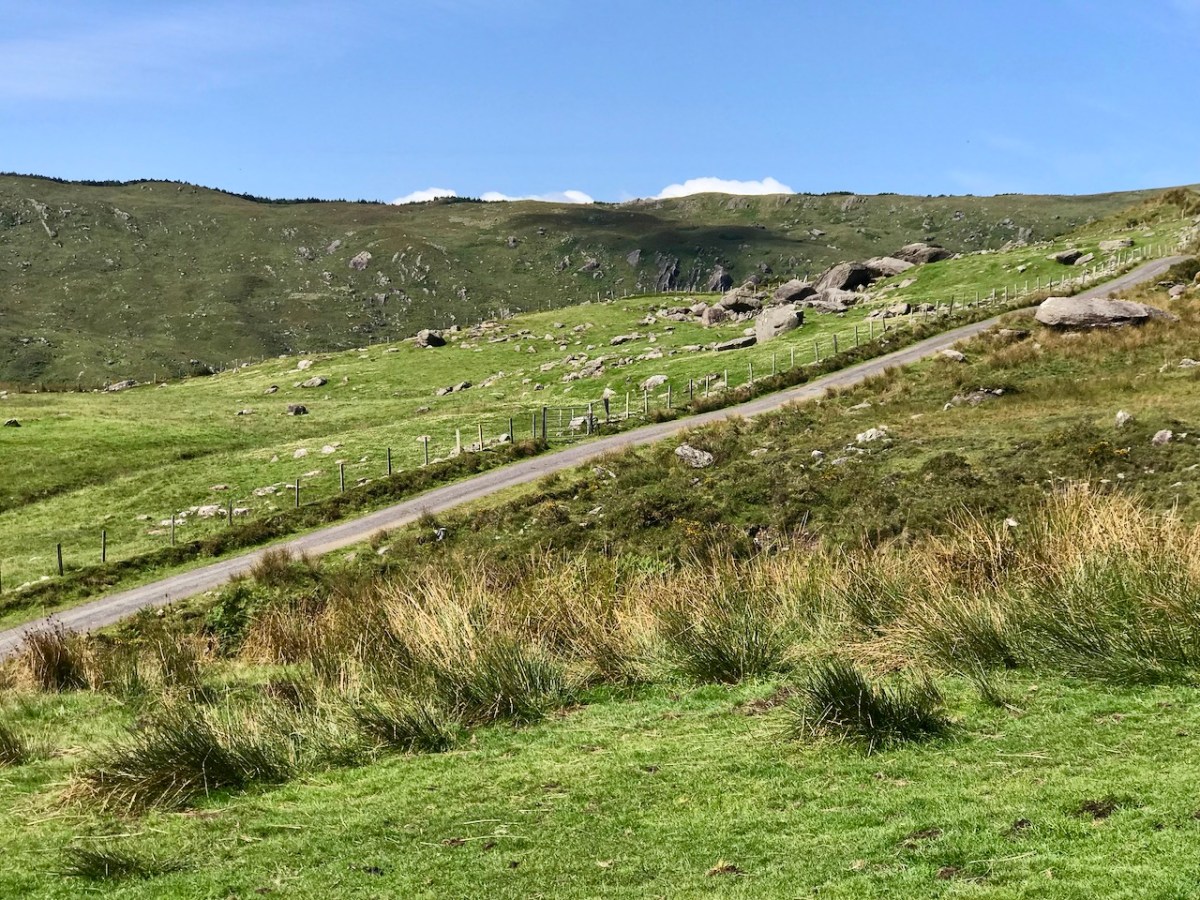
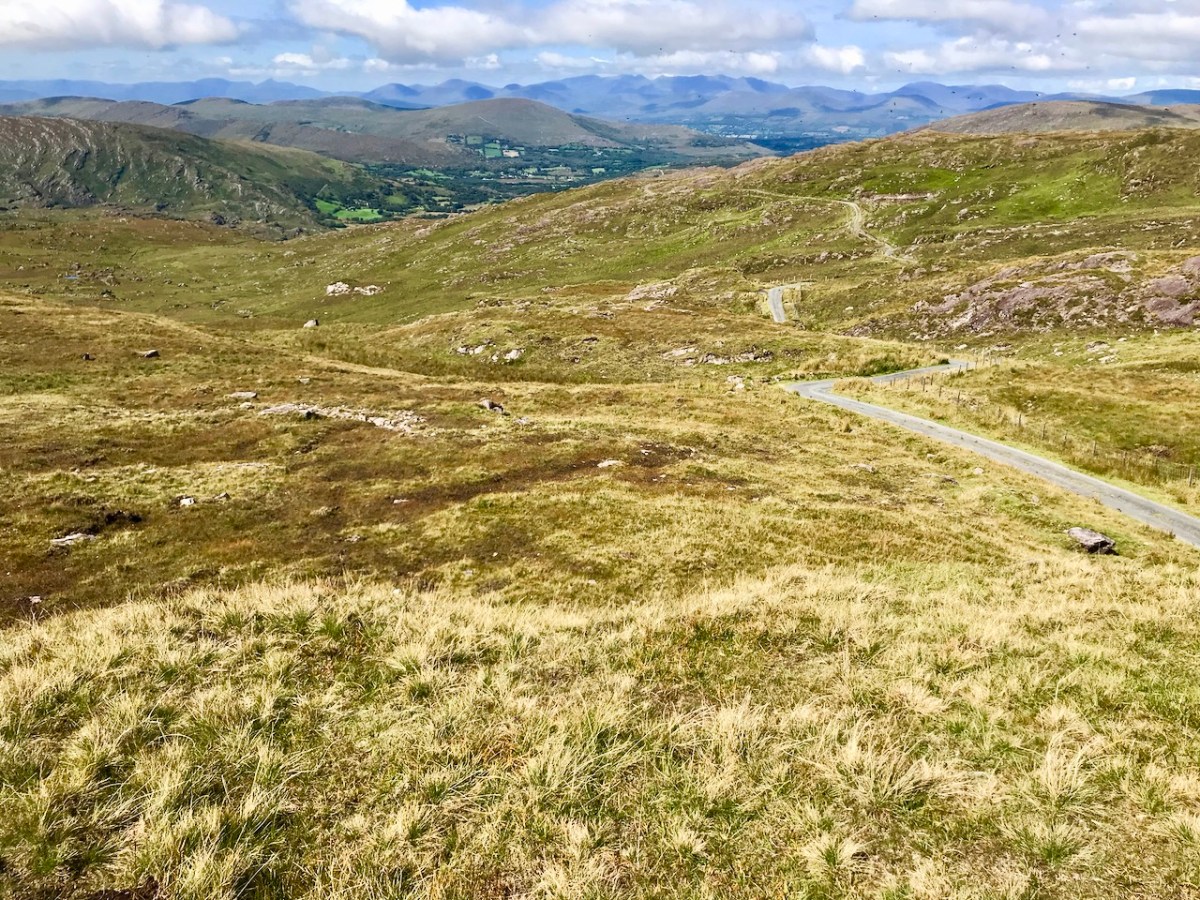
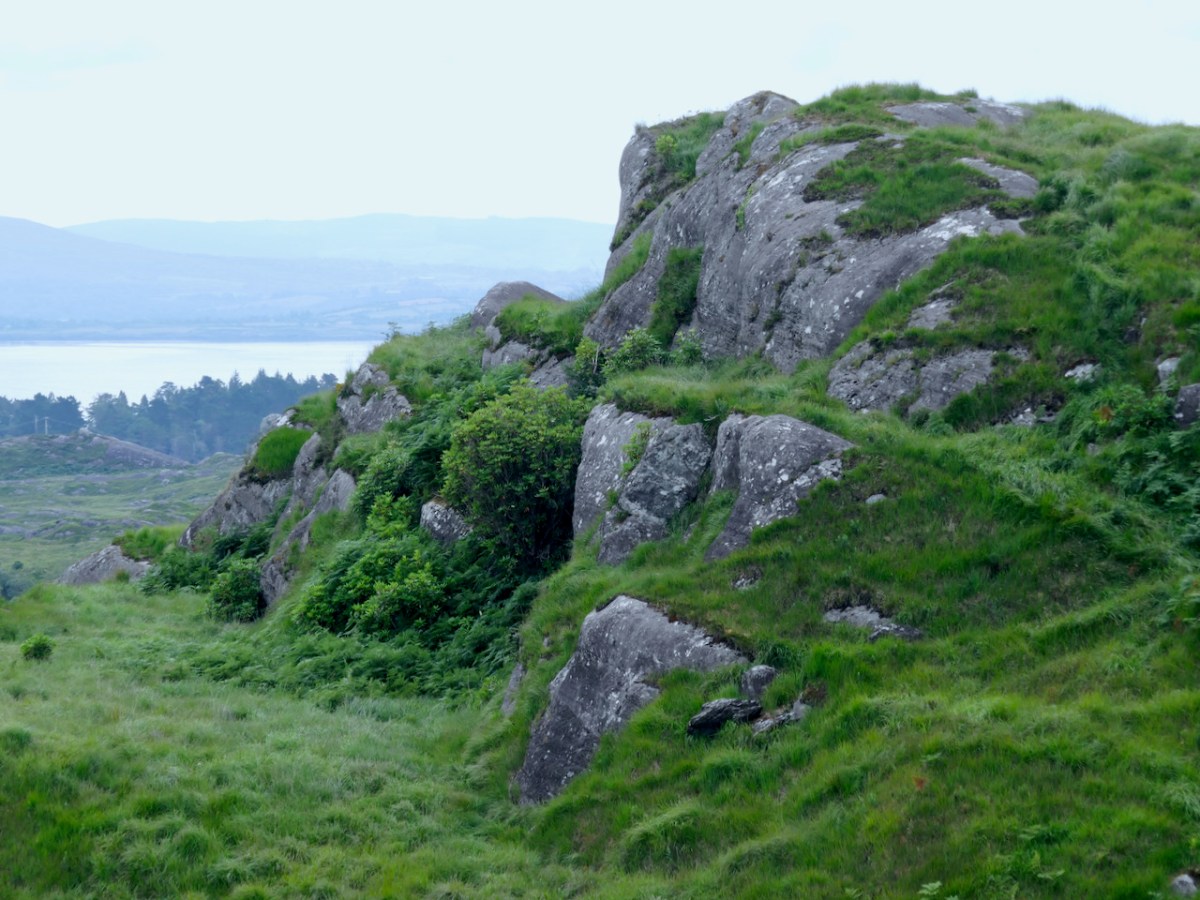
Some roads lead to a dead end. I prefer those that fly high – over the mountain passes; the scenery never disappoints.
. . . The Road goes ever on and on Down from the door where it began. Now far ahead the Road has gone, And I must follow, if I can, Pursuing it with eager feet, Until it joins some larger way Where many paths and errands meet. And whither then? I cannot say . . .
from ‘the old Walking Song’ by J R R Tolkein
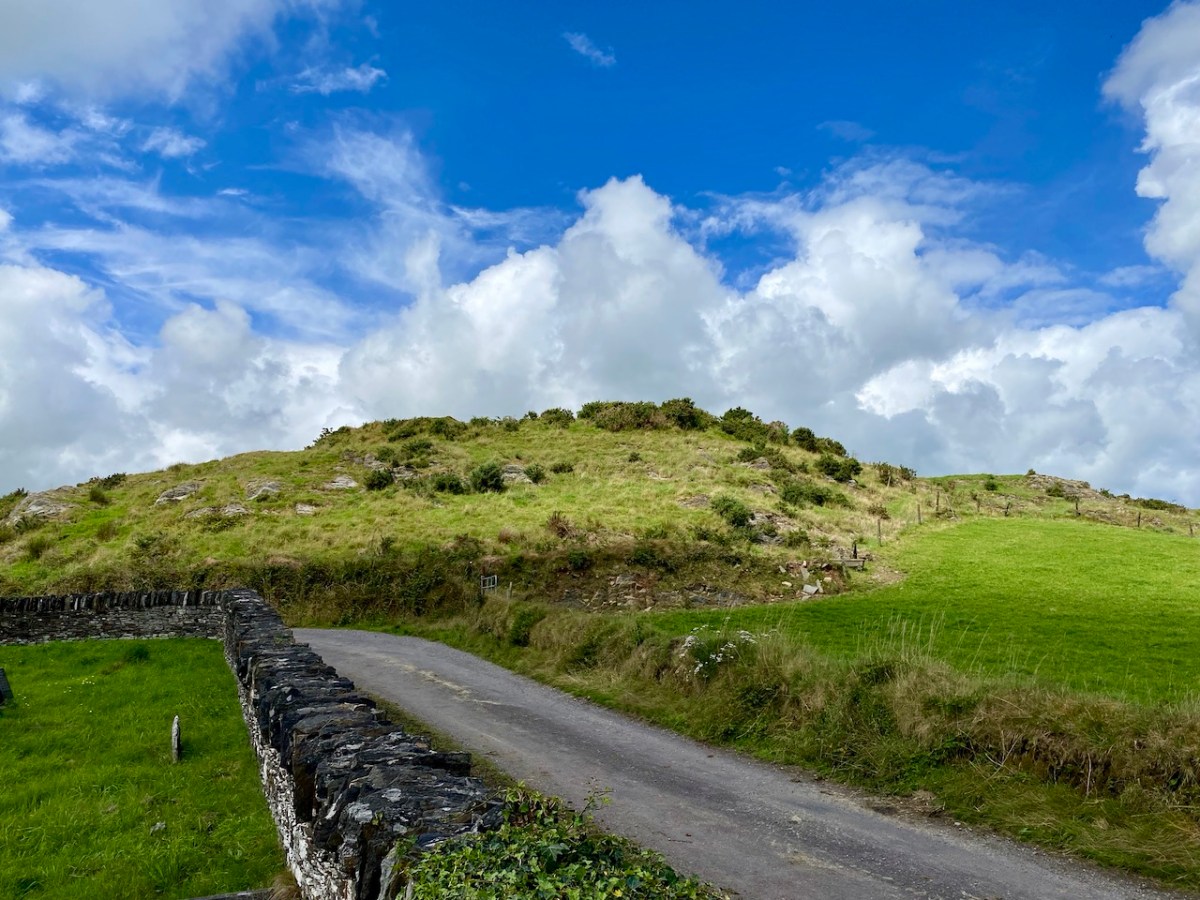
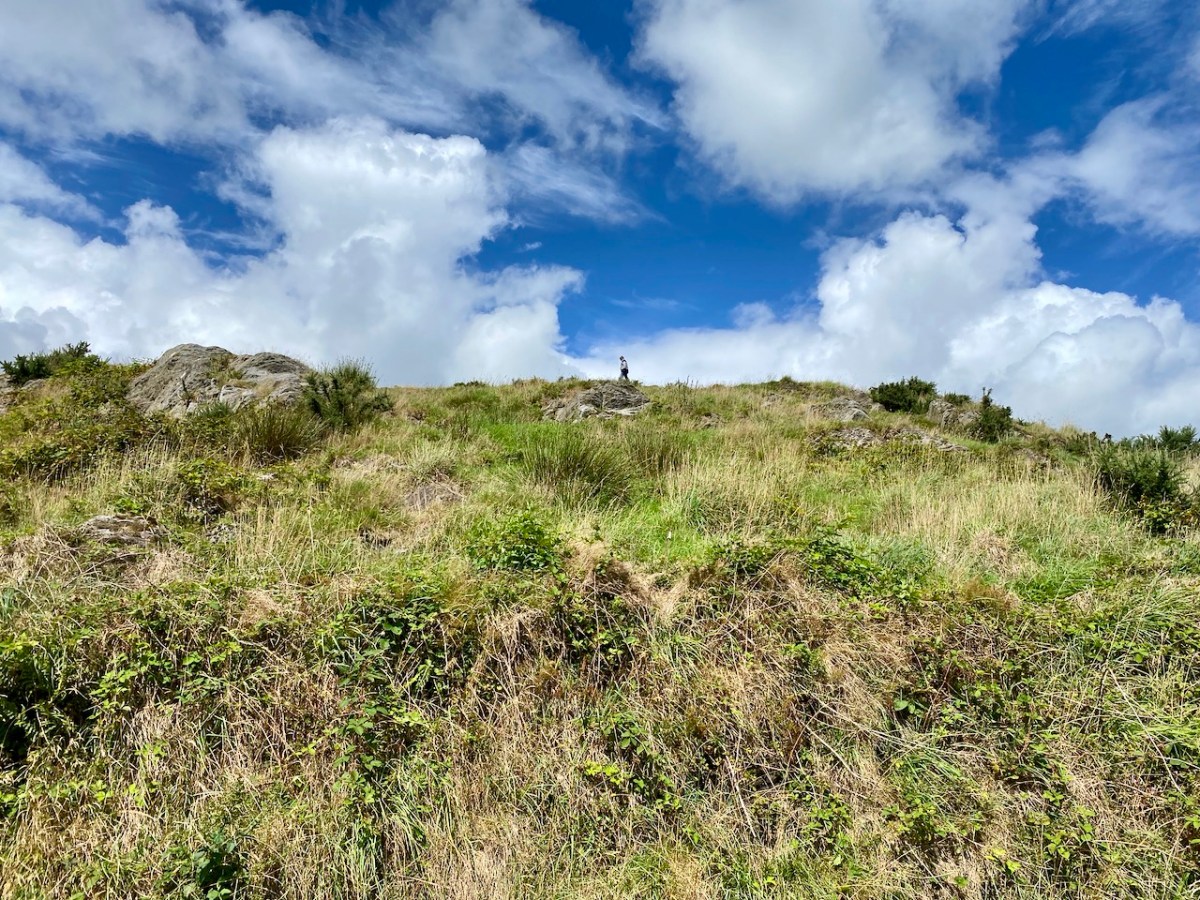
There’s always a reward to be had for travelling uphill: it’s the view from the top!
It’s been a very busy week! The best part about it was that my sister, Aoibhinn (pronounced Eeving), is visiting and she and I were able to do lots of things together. That’s her in the coral jacket, above. You see, she has ME, or Chronic Fatigue Syndrome, and she was really nervous about her ability to participate in the activities I had booked or planned, or stay the course once on them.
Aoibhinn does really well at managing her condition, but she has to be very careful or she can end up in a major crash. She struggles with tiredness and pain all the time (sore joints, headaches) but finds that sea swimming helps her cope mentally, so she was up for one of the things we planned to do together, our Dawn Swim and Pilgrimage with Gormú. We met Conor and Celine, and two other participants at Castlehaven and started off by walking the short way up to the Holy Well, where we heard of St Barrahane. Readers may remember Conor from the Placenames post.
Next came the swim. While Aoibhinn opted for a short immersion, I surprised myself by swimming all the way to Faill Dic, with encouragement from Conor, and the lovely safety valve of a float if I needed it. Breakfast was so welcome – porridge, fruit and hot tea made by Celine and Conor (below) – while we listened to more stories, all set around the cove we were in. It was a fantastic experience – I highly recommend it!
The Ellen Hutchins Festival andHeritage Week are both in full swing this week, so there are any god’s amount of things to choose from. We concentrated on botany and butterflies during the week and ended with stained glass and history yesterday.
Micheline Sheehy-Skeffington and Nick Scott led us through the Glengarriff Woods. While this walk involves an uphill section, the pace is easy because it involves lots of stopping to talk about the plants we encounter along the way. We loved Nick’s descriptions of the forest environment, and all the layers that make up the plant life from the canopy down. And we were riveted by Micheline’s focus on the Arbutus (AKA the Strawberry Tree), a rare tree that occurs only here and in the Iberian Peninsula.
Micheline is investigating her theory that it may have come with the Bronze Age miners who came to exploit the rich copper resources of West Cork and Kerry. Her recent article in Archaeology Ireland sparked my interest and I was thrilled to be able to go along on this walk with her.
The photograph above illustrates the challenges in tracking Arbutus trees – they grow on cliffs and in inaccessible places.
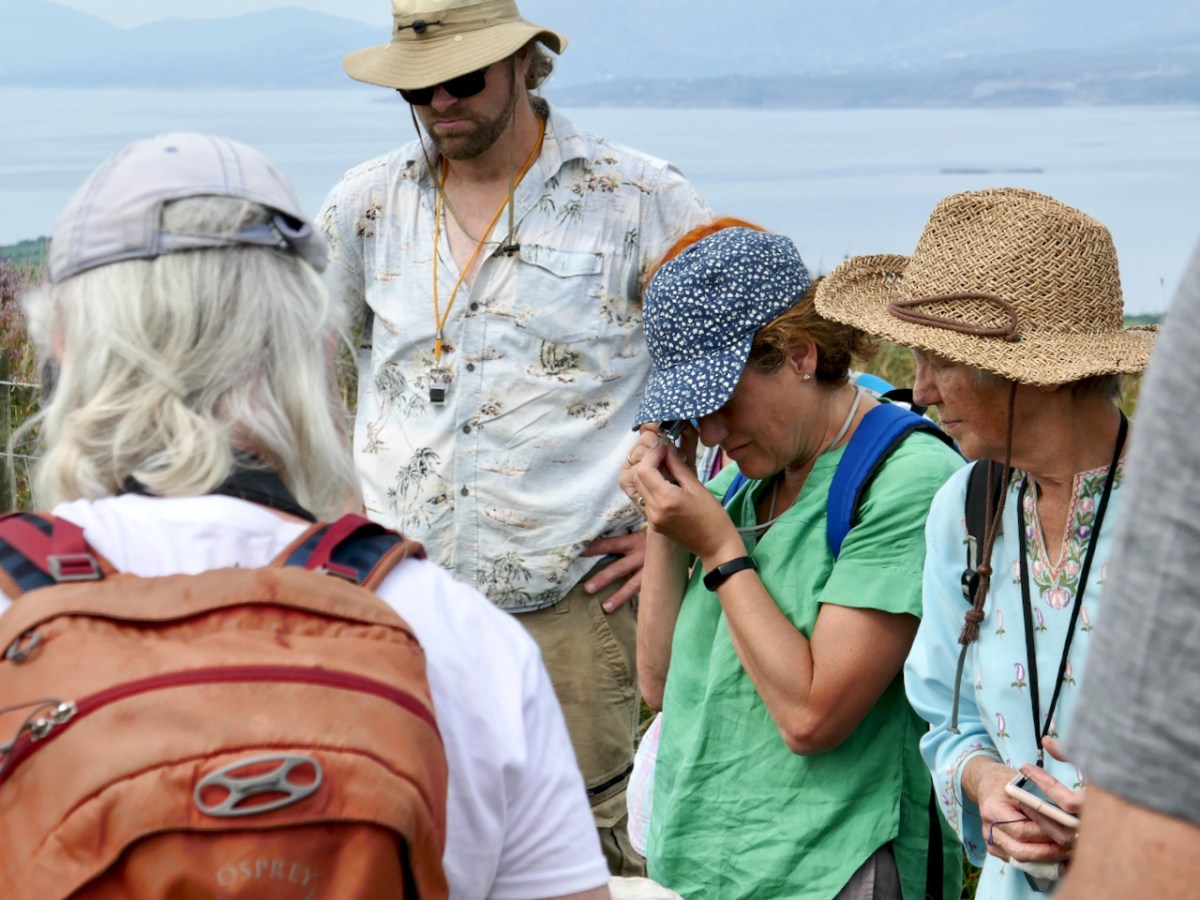
Once again, although this walk involved picking our way through long grasses and scrambling over rocks, the pace was slow, with frequent stops to ooh and aah over butterflies and hear Damaris talk about their habitats and plant requirements. Some of the plants were so tiny that we had to see them through a hand lens to really appreciate them.
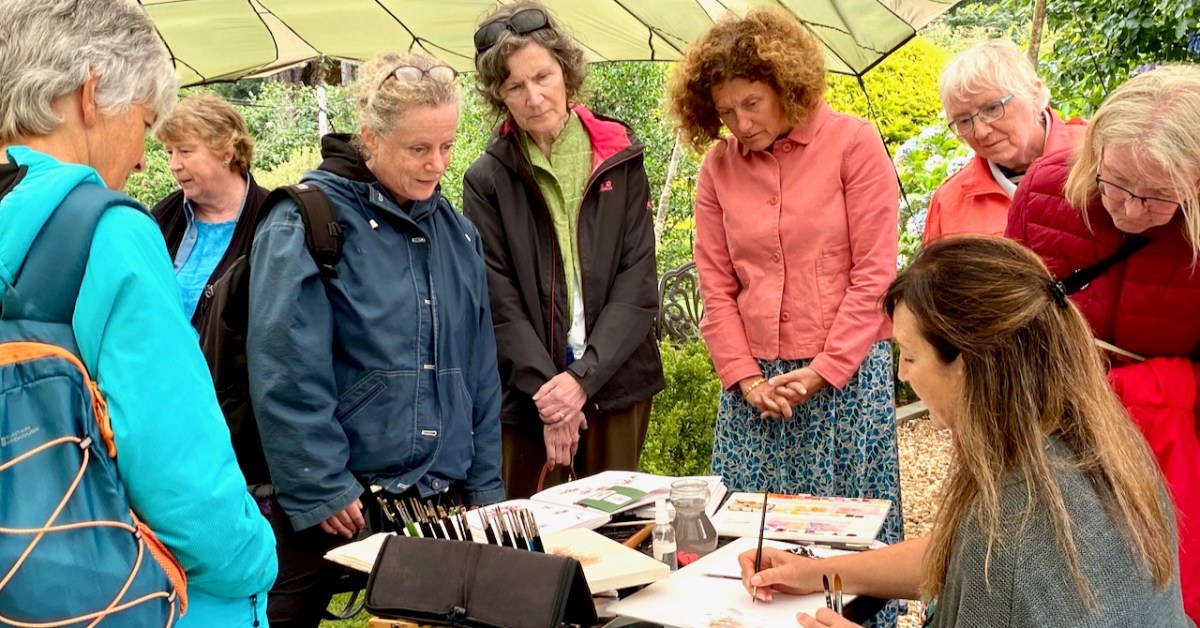
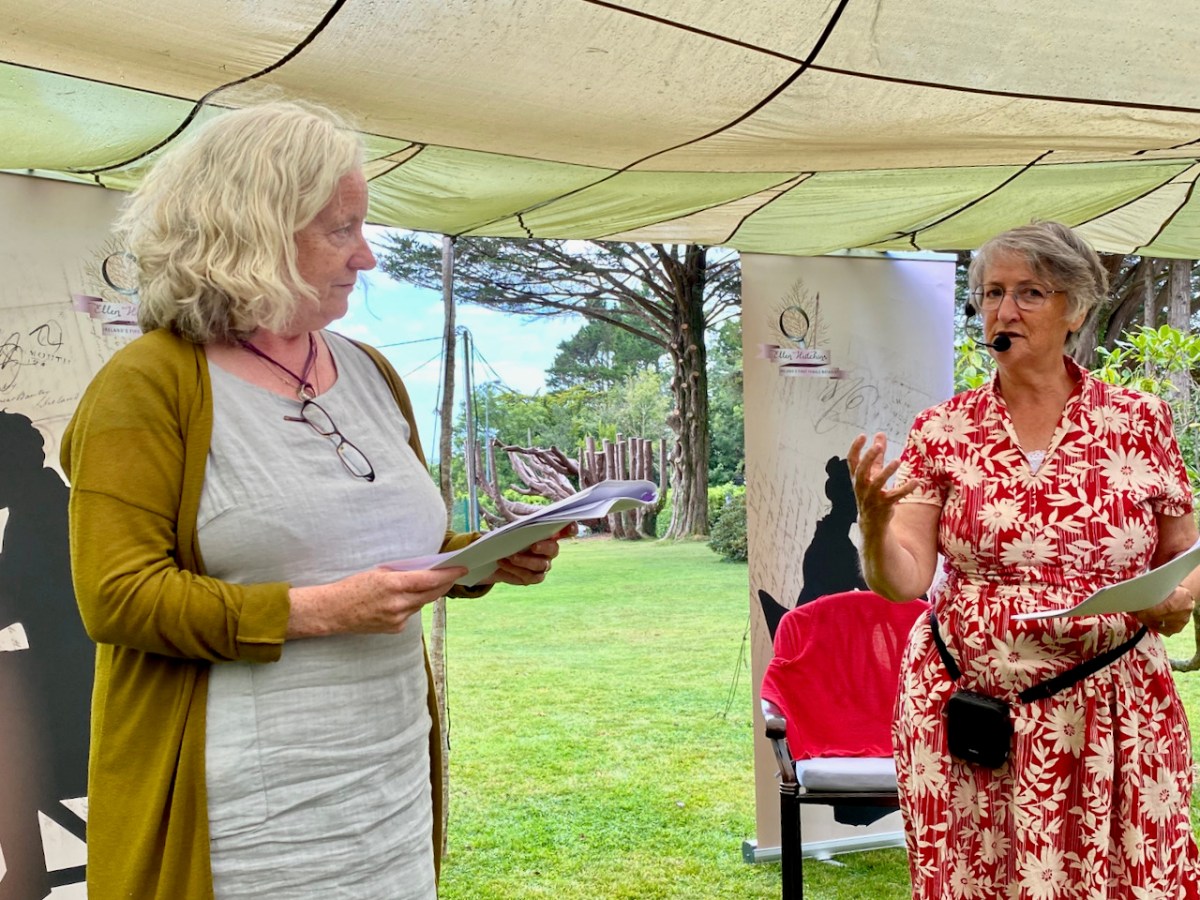
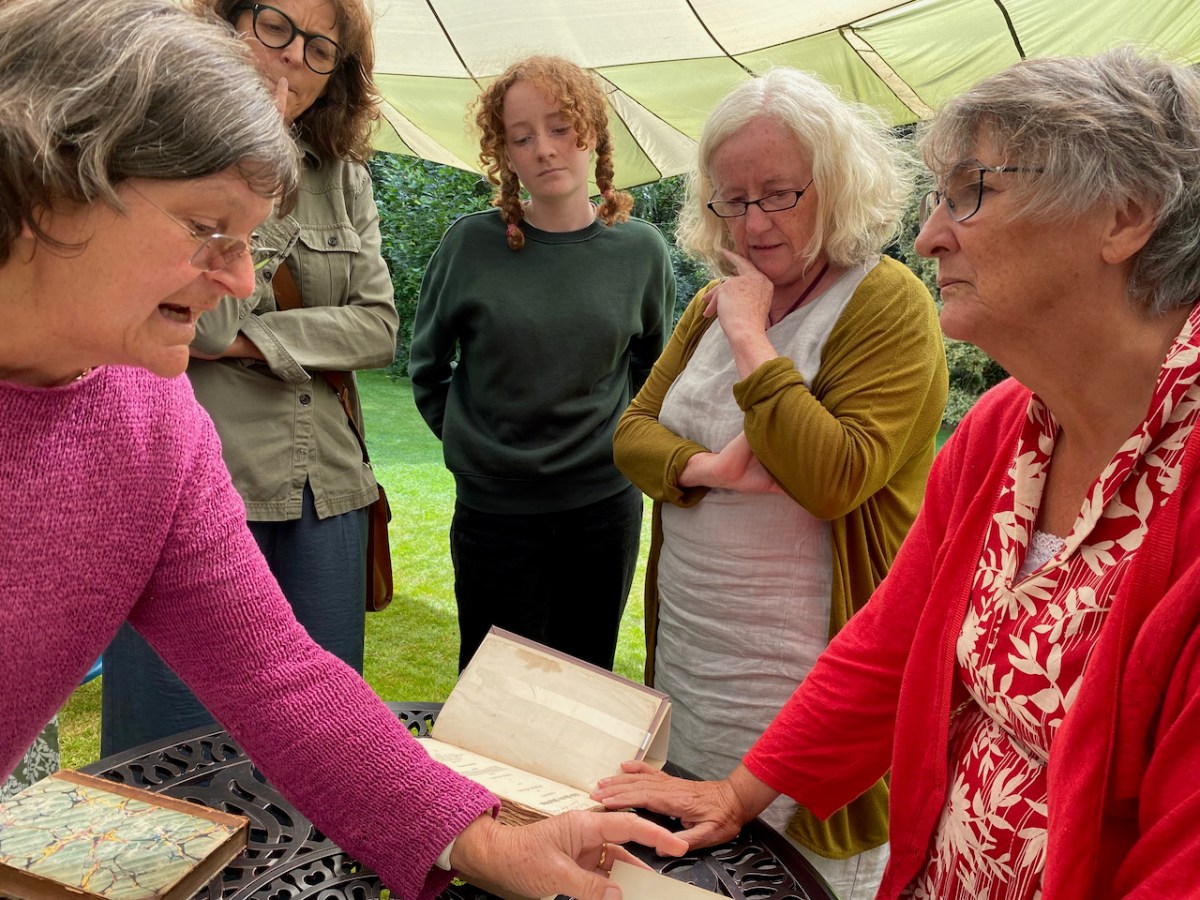
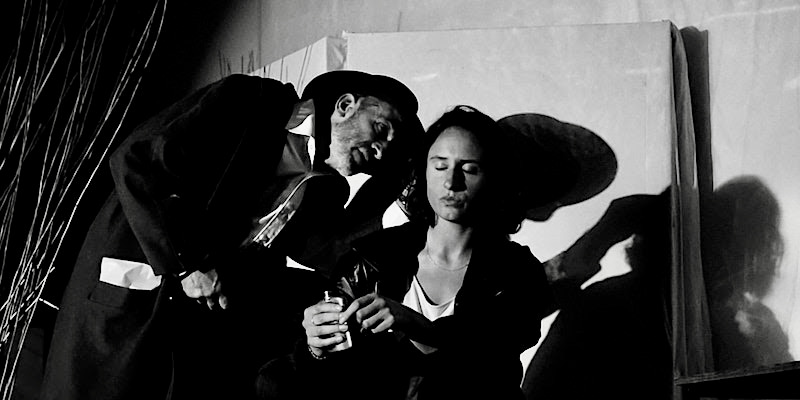
We had a rest day on Thursday, and on Friday it was time for Seaweed and Sealing Wax 2. This was the second production masterminded by Karen Minihan, based on the correspondence between Ellen Hutchins and Dawson Turner. See Robert’s post from last year for an account of Seaweed and Sealing Wax 1. This year, we were joined by the poet, Laura McKenna and the botanical artist Shevaun Doherty. That’s Shevaun surrounded by audience members in the top photo of this post, while Laura is in the photo below.
While Karen and I led the audience through the letters, Laura read a selection of poems that responded to Ellen’s life and work, and Shevaun worked away on painting a piece of seaweed, explaining her process to the audience at one point.
At the end, Madeline Hutchins, Ellen’s great, great, grandniece, showed us some of Ellen’s books and letters. As with last year, we were under a tent in the grounds of Sea View House Hotel, right next door to where Ellen herself had lived in the opening years of the nineteenth century.
We finished the week with a trip to Timoleague, where I was booked to give two stained glass talks at the Church of the Ascension Open House. This is part of a huge community effort to save and safeguard the fabulous mosaics in this church and I am always thrilled to be a part of it. Take a look at this video by the Rev Kingsley Sutton, Touching Heritage, to get an excellent overview of the whole project.
The church is truly one of West Corks hidden gems, and the fund-raising effort needs all the help it can get. In between the talks, we were whisked off to lunch at a fabulous private house right on the sea. Nice work if you can get it!
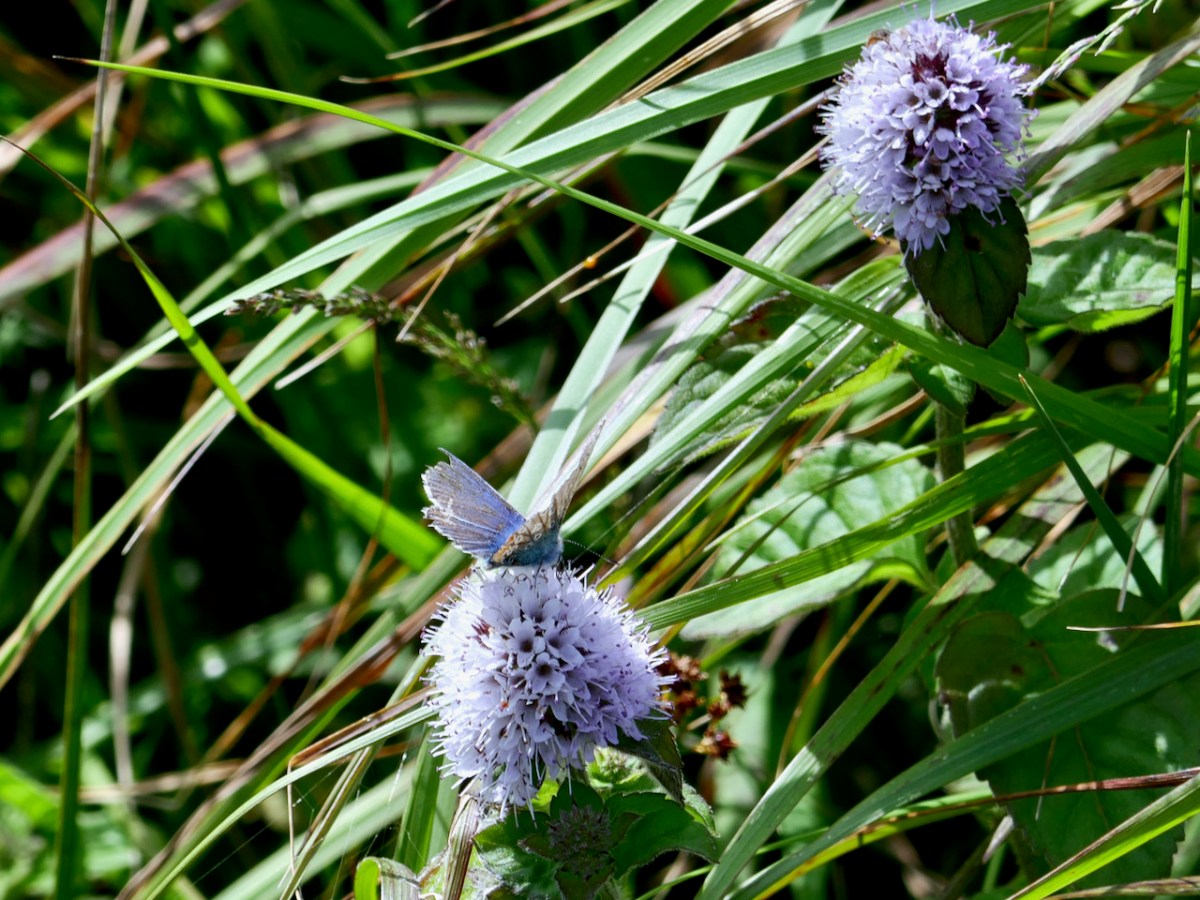
So – it’s been an incredibly busy week of flowers, talks, and butterfly hunting (above) and I am feeling it now. But all of our activities were accessible to Aoibhinn, with time to rest in between, or go for a lovely dip locally. So – if there’s anybody out there who wonders if you would be able for a botany walk or a dawn swim and ‘pilgrimage’ – no need to be intimidated by a title or a description when the pace is leisurely and, as Aoibhinn found, there’s always a handy rock to sit down on for a while.
I bet you can’t wait for more of me banging on about August in West Cork – so let’s get to it! Our week has involved all of the above, and I resisted the urge to add the word Bryophytes to the title. You’re welcome.
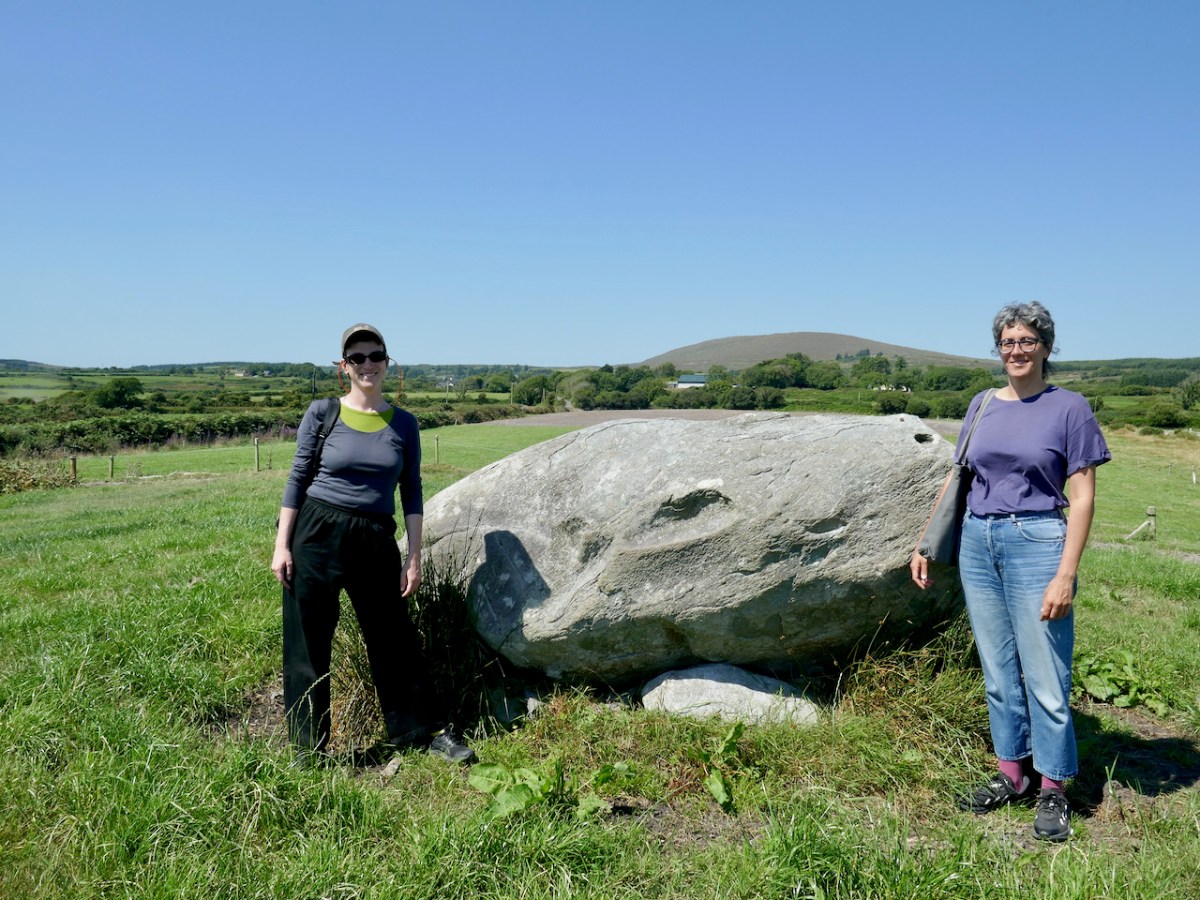
The boulders? Shorthand for Boulder Burials, just one of the ancient monuments we visited this week with Konstanza and Christiana, two of the artists in residence with the Crespo Foundation. They are both from Greece and collaborate on documentary and sound-based projects, and Konstanza is also an archaeologist. It was great fun to introduce them to some of our favourite sites on the Mizen, from rock art to wedge tombs, standing stone and boulder burials.
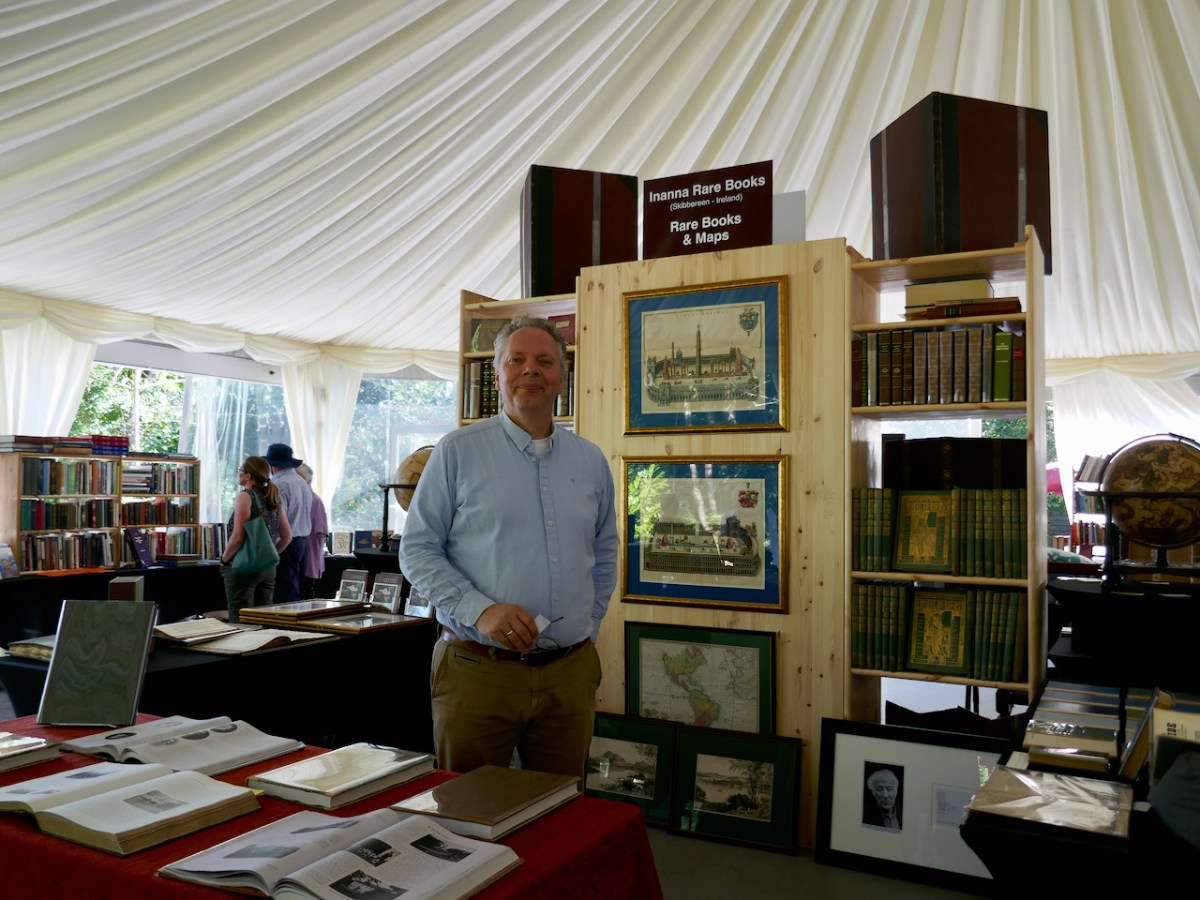
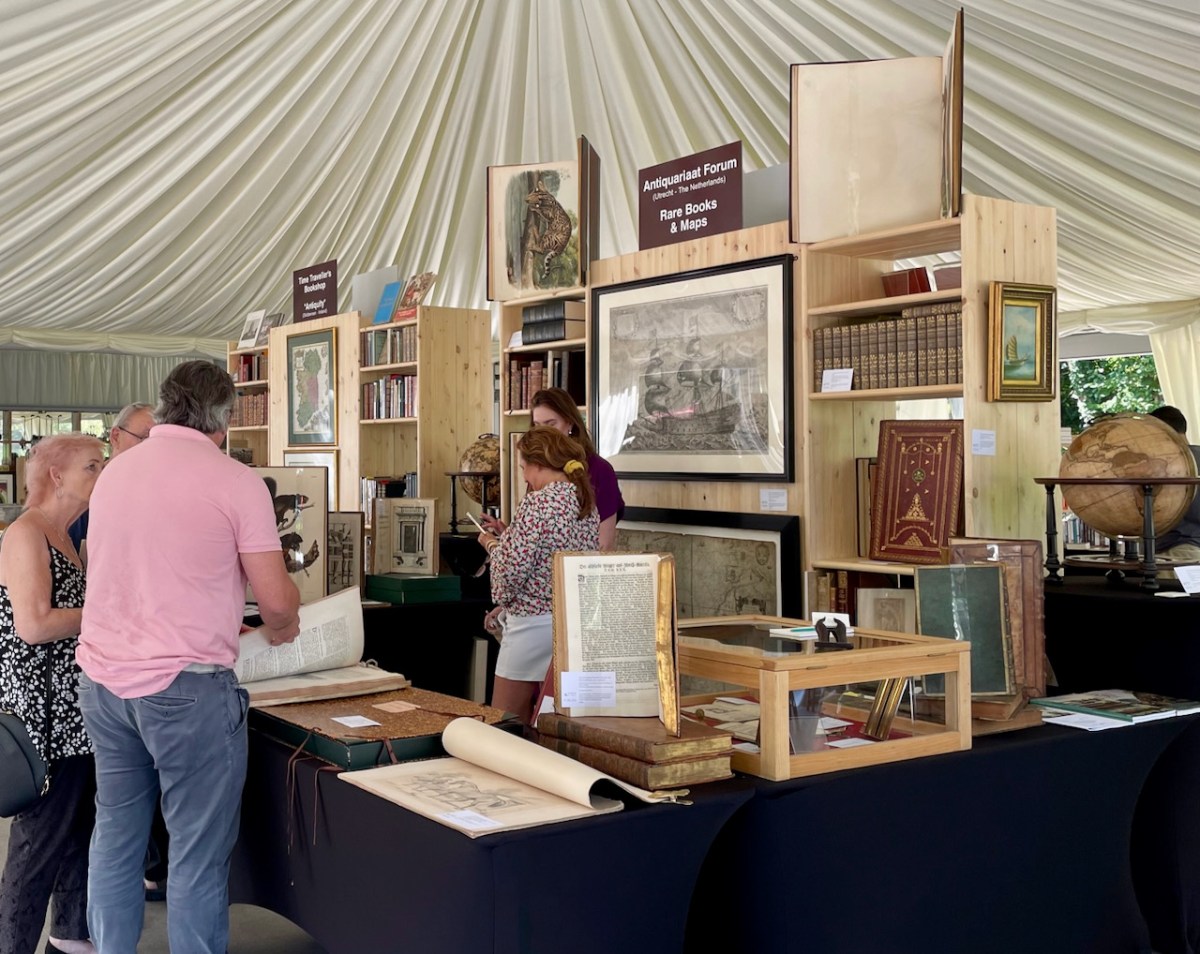
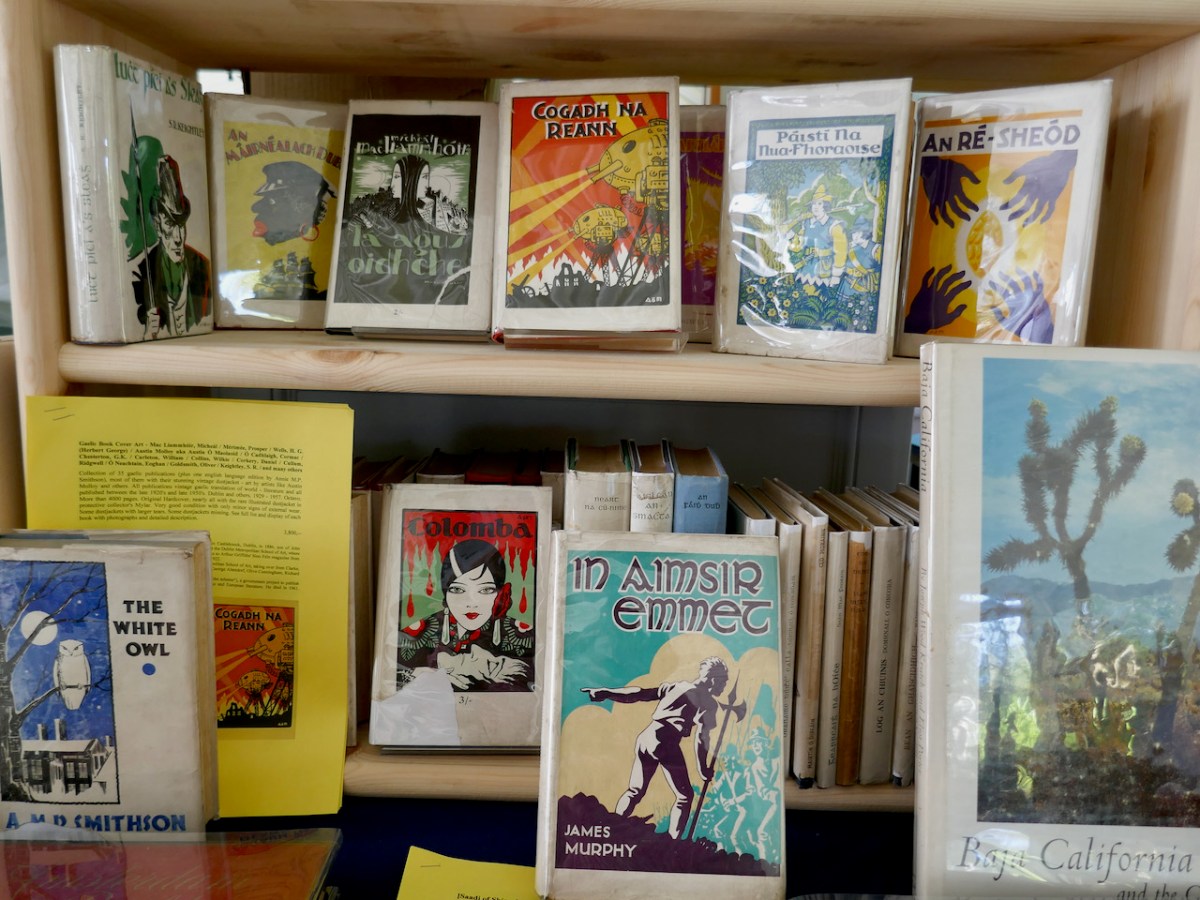
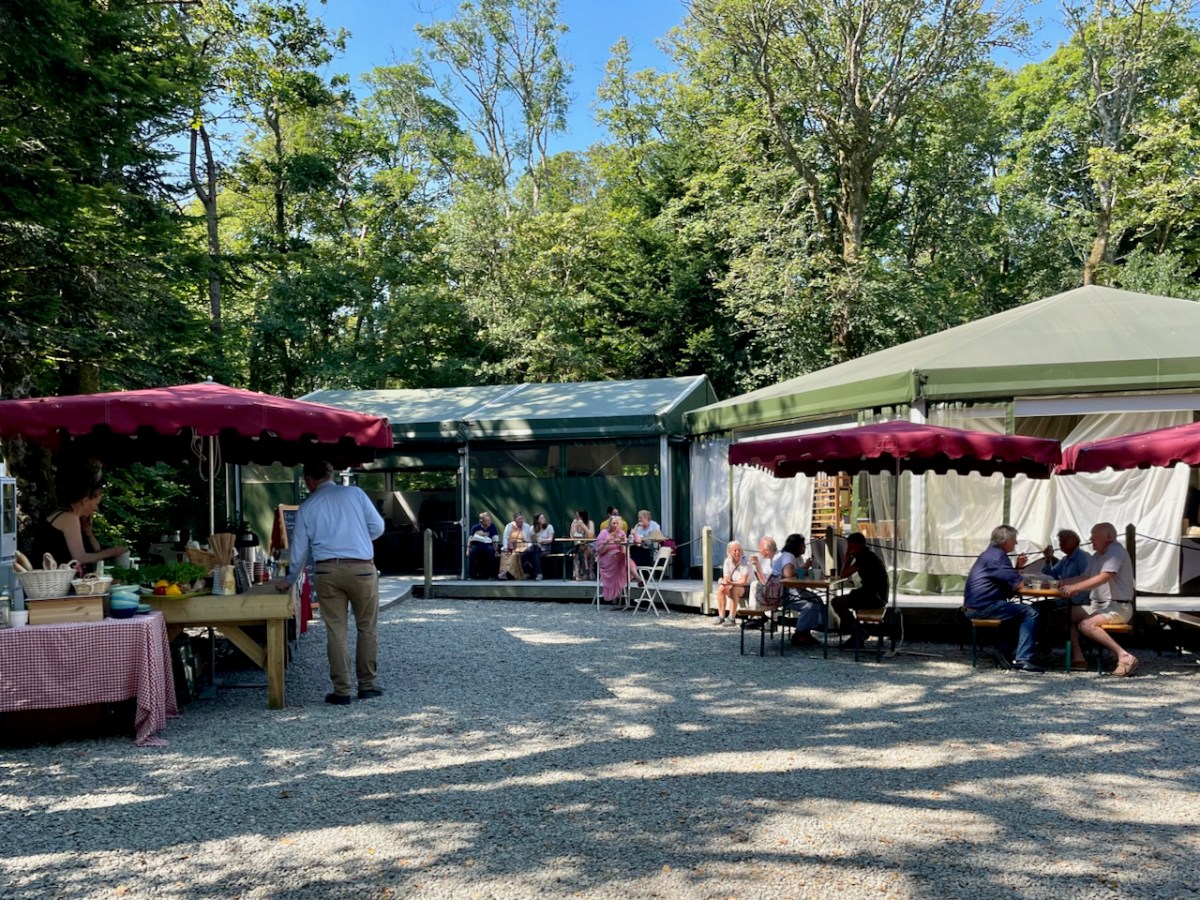
And then it was time for the Rare Book Fair, the brainchild of Holgar (below) and Nicola, who run, respectively, Inanna Rare Books and the Antiquity Bookshop and Plant-based Cafe. This is the inaugural fair and it took place out at the luscious Inish Beg Estate.
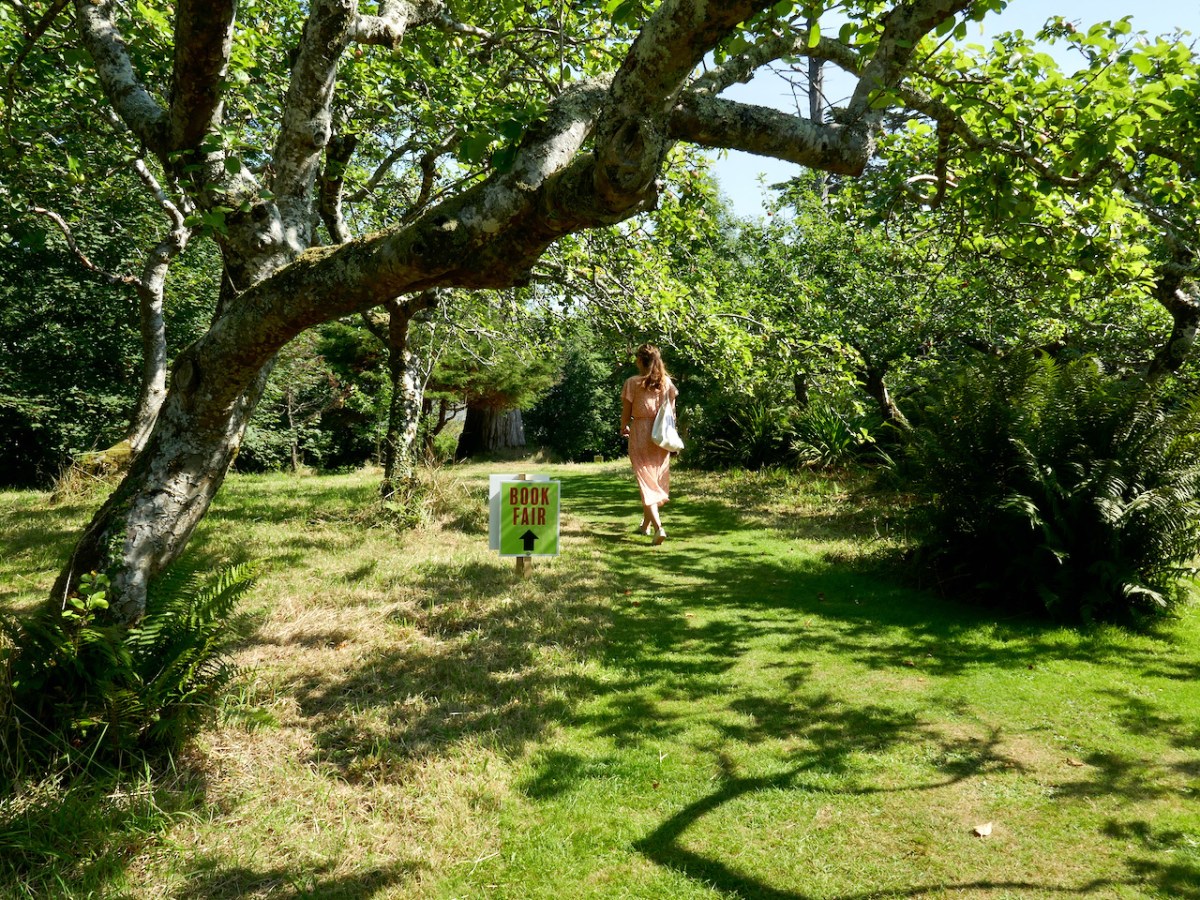
We love Inish Beg – nothing beats a good wander in the gardens and woods there – but even though we’ve been there several times, we were unprepared for the sheer magic of just getting to the book fair from the car park, all part of the experience.
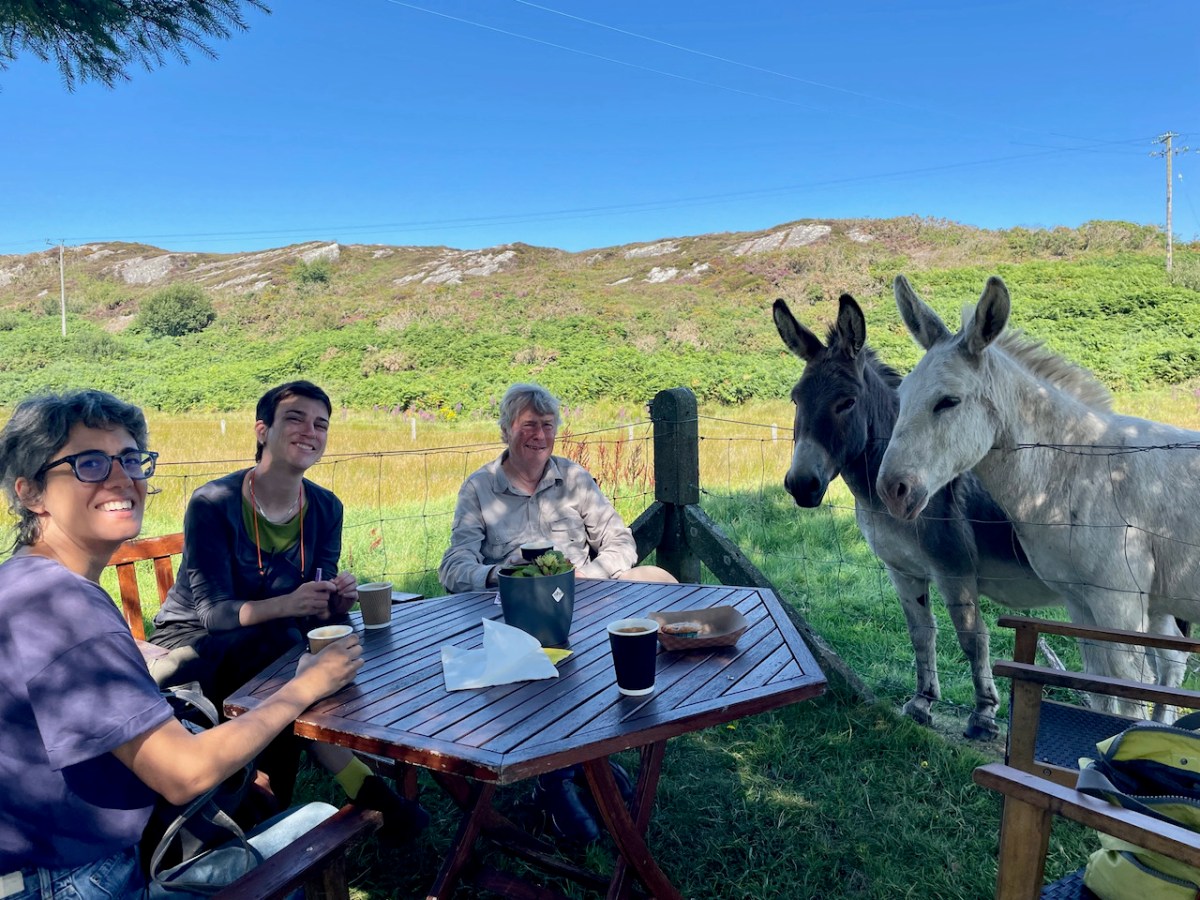
Of course we couldn’t come away without a few books, but the best part was just chatting to the booksellers – a passionate and knowledgeable group – and sitting outside sipping a cold drink and leafing through our purchases with other like-minded folk. Bliss!
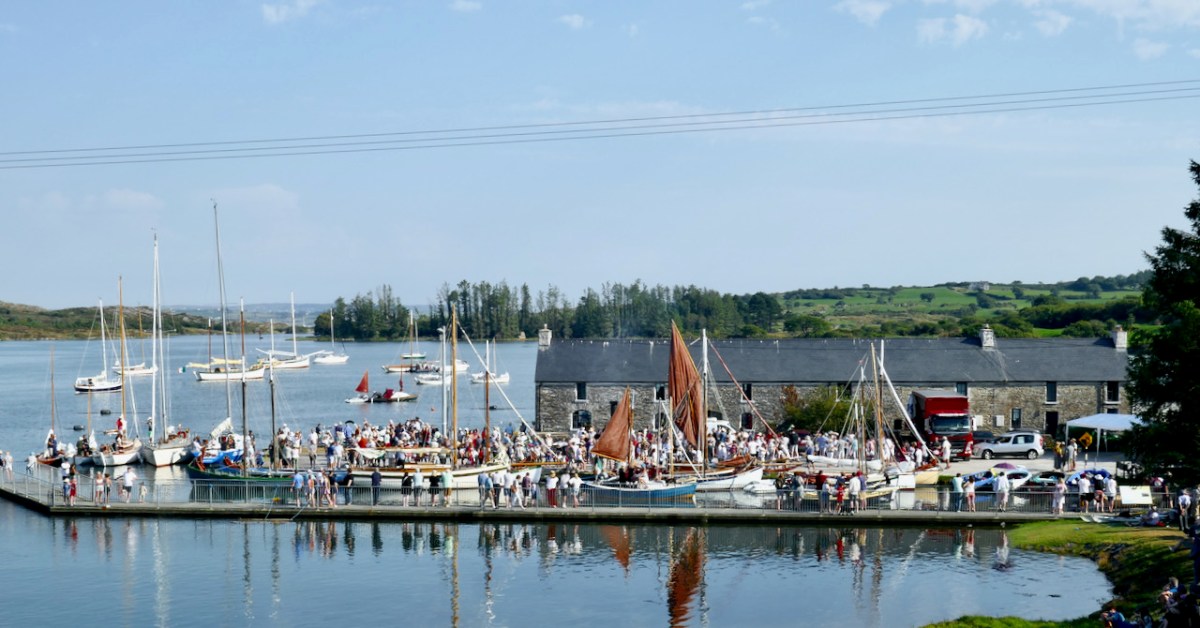
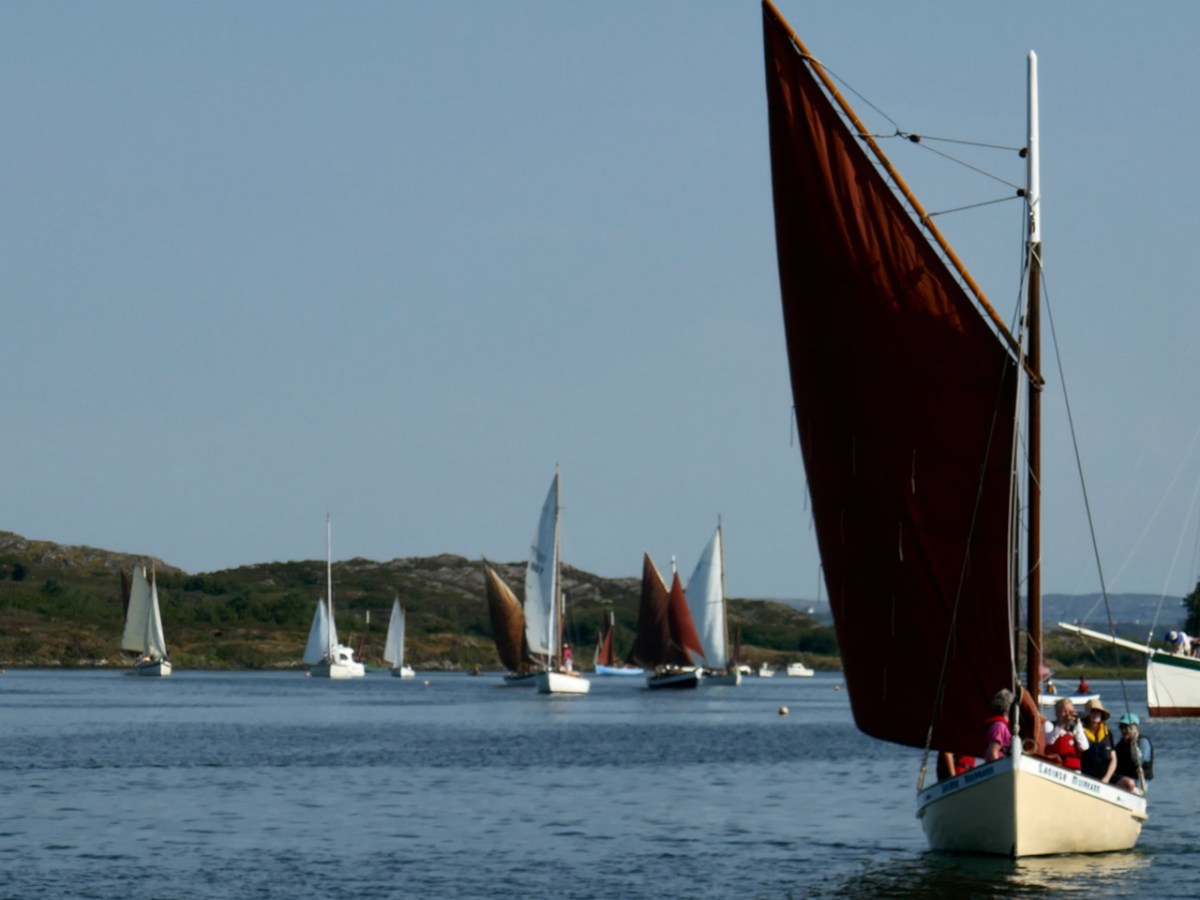
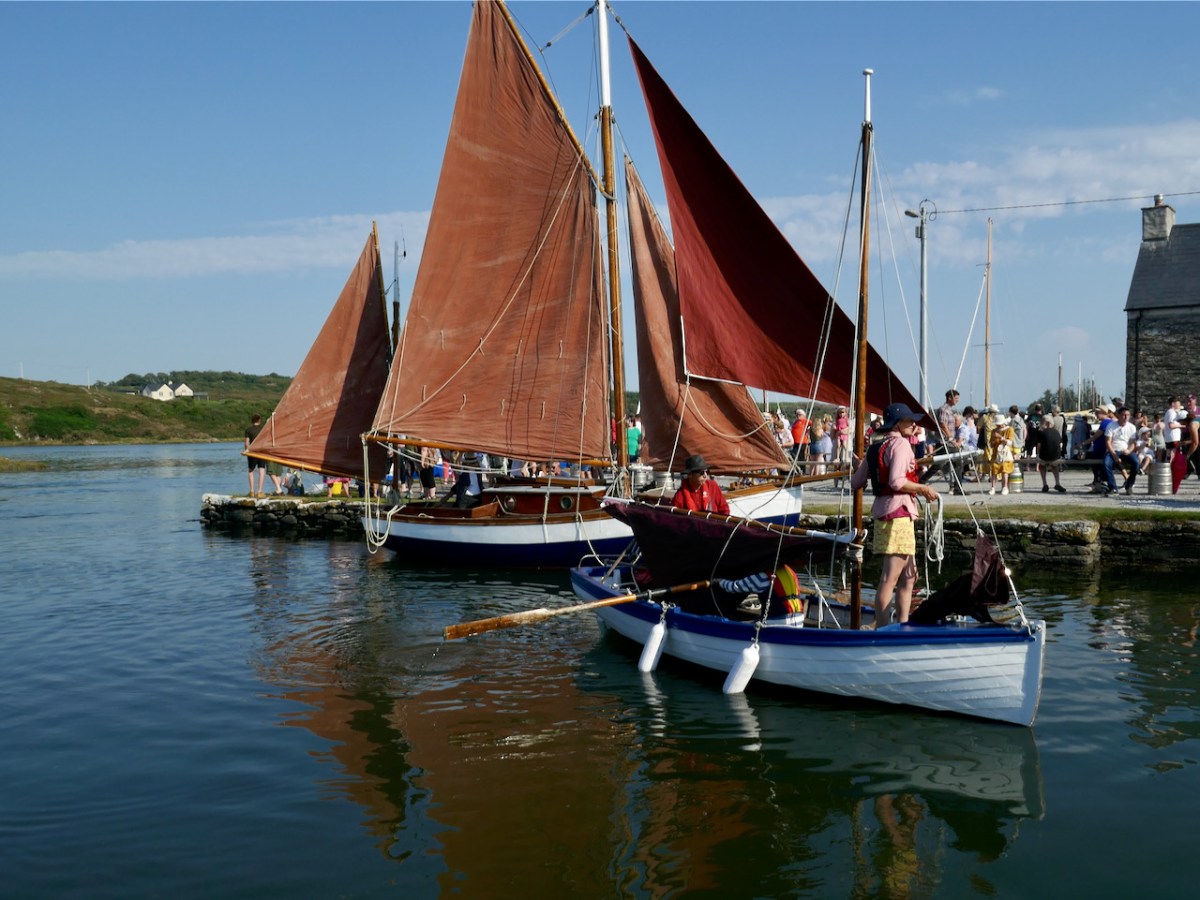
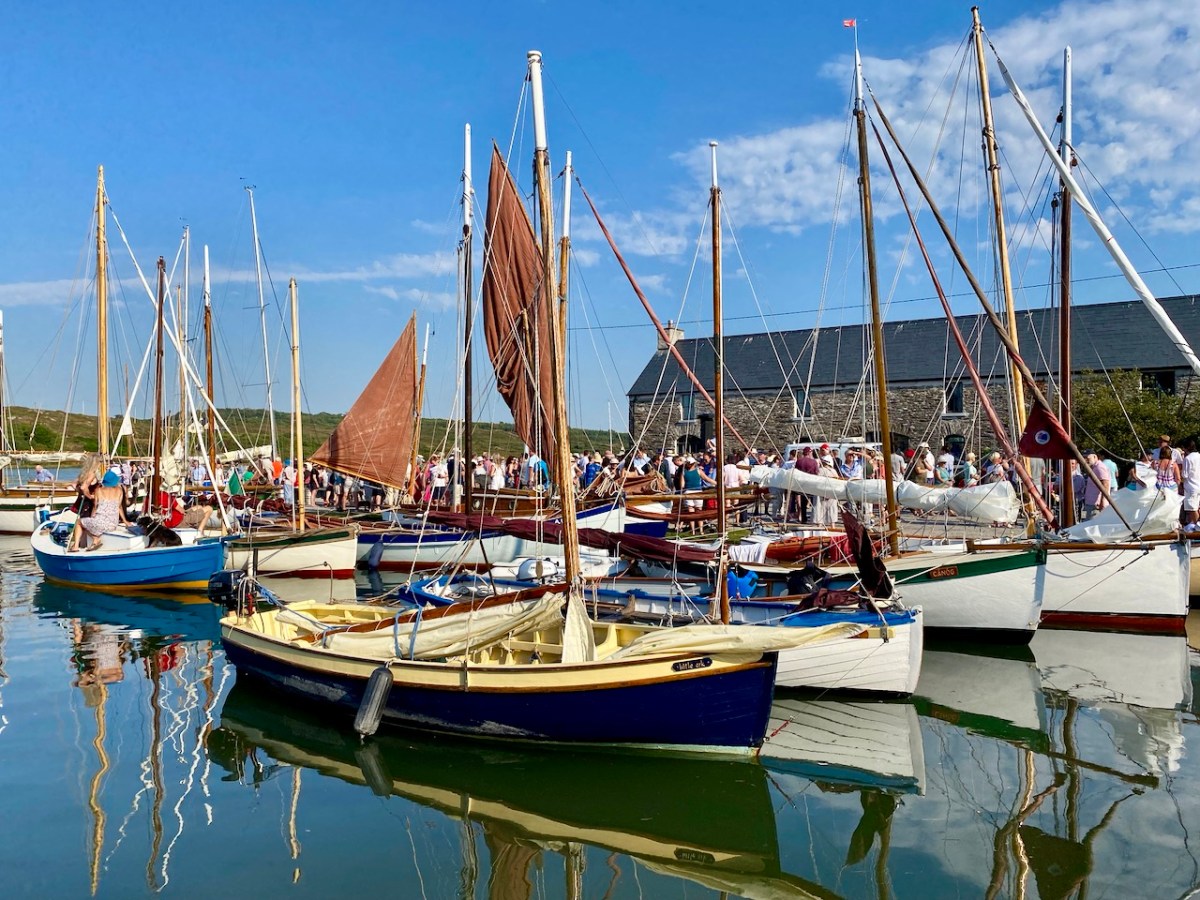
This book fair has the potential to become a very enjoyable permanent part of the West Cork Festival scene and I hope it does. On to Ballydehob and the annual Boat Gathering, or Cruinniú na mBád. Here’s my account of it in 2017 and in 2019 I had the wonderful experience of travelling in one of the boats with my friend Jack.
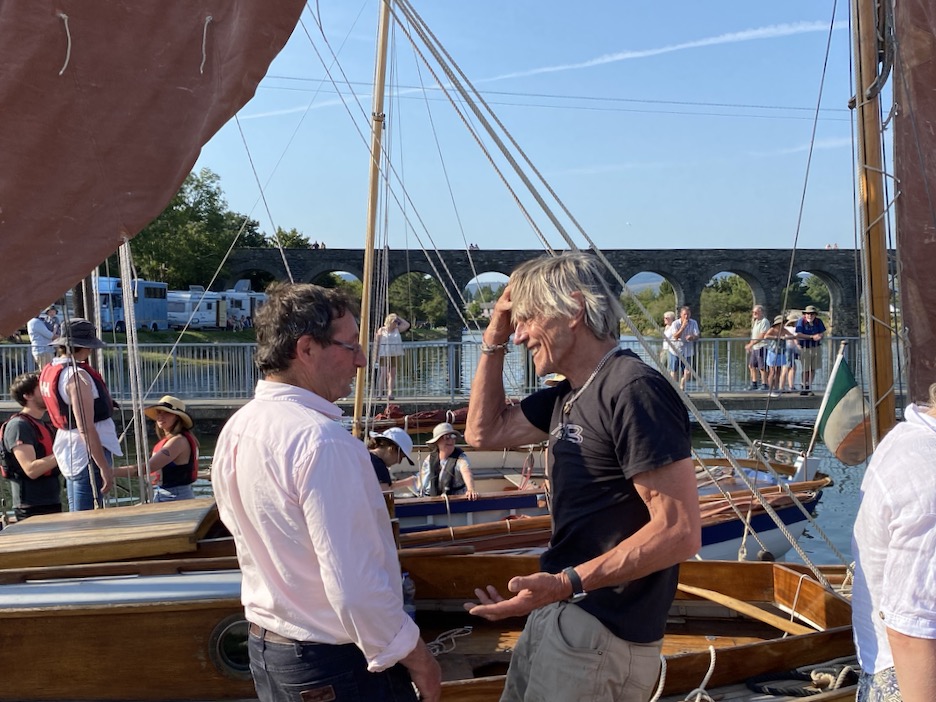
This is just a fantastic community event. The whole village gathers on the quay, there’s music and burgers and the crack is mighty. But it’s the sight of the boats, in full sail, coming up the bay on the rising tide, that is the big draw and takes us back to the days when this was a common sight.
That leaves us with bogs . . . and the first of these was to attend, in the attractive surrounding of Glebe Gardens in Baltimore, a local production of By the Bog of Cats (above), a play by Marina Carr, loosely based on the Greek tragedy of Medea. This is a powerful, multi-layered and haunting story of betrayal, abandonment, longing and revenge. It debuted in the Abbey Theatre in 1998 and has had many international productions (think Broadway and West End) since then. The Director, Terri Leiber, elicited outstanding performances from her cast, and the standing ovation at the end of the evening was well-deserved.
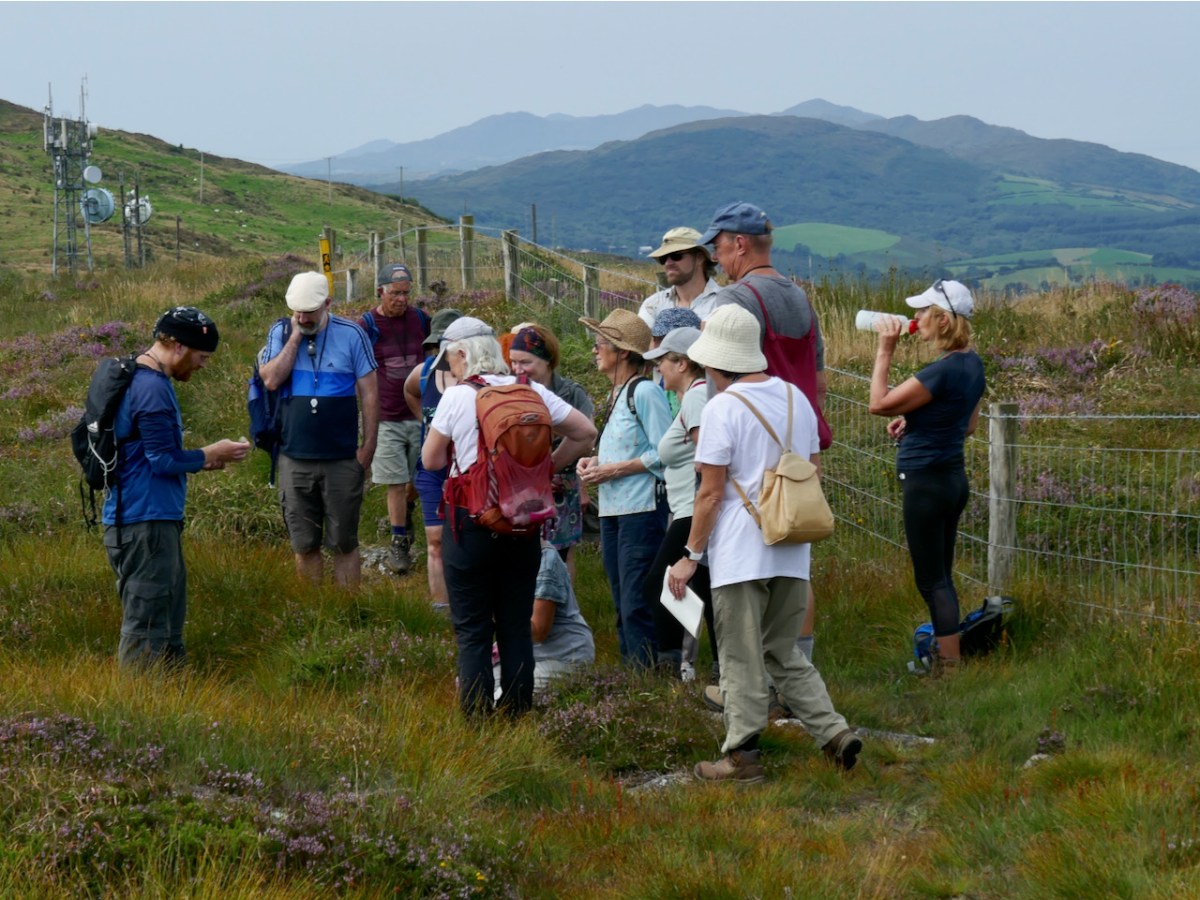
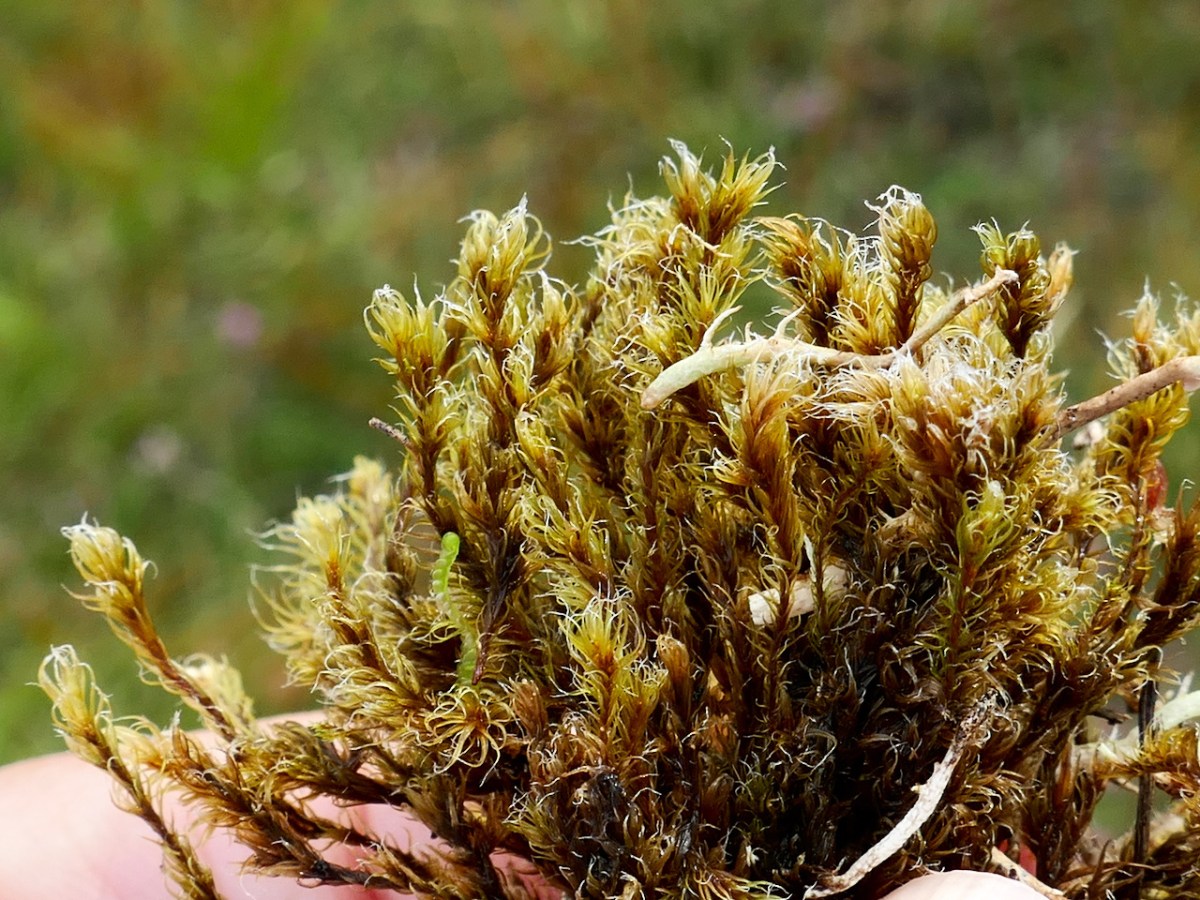
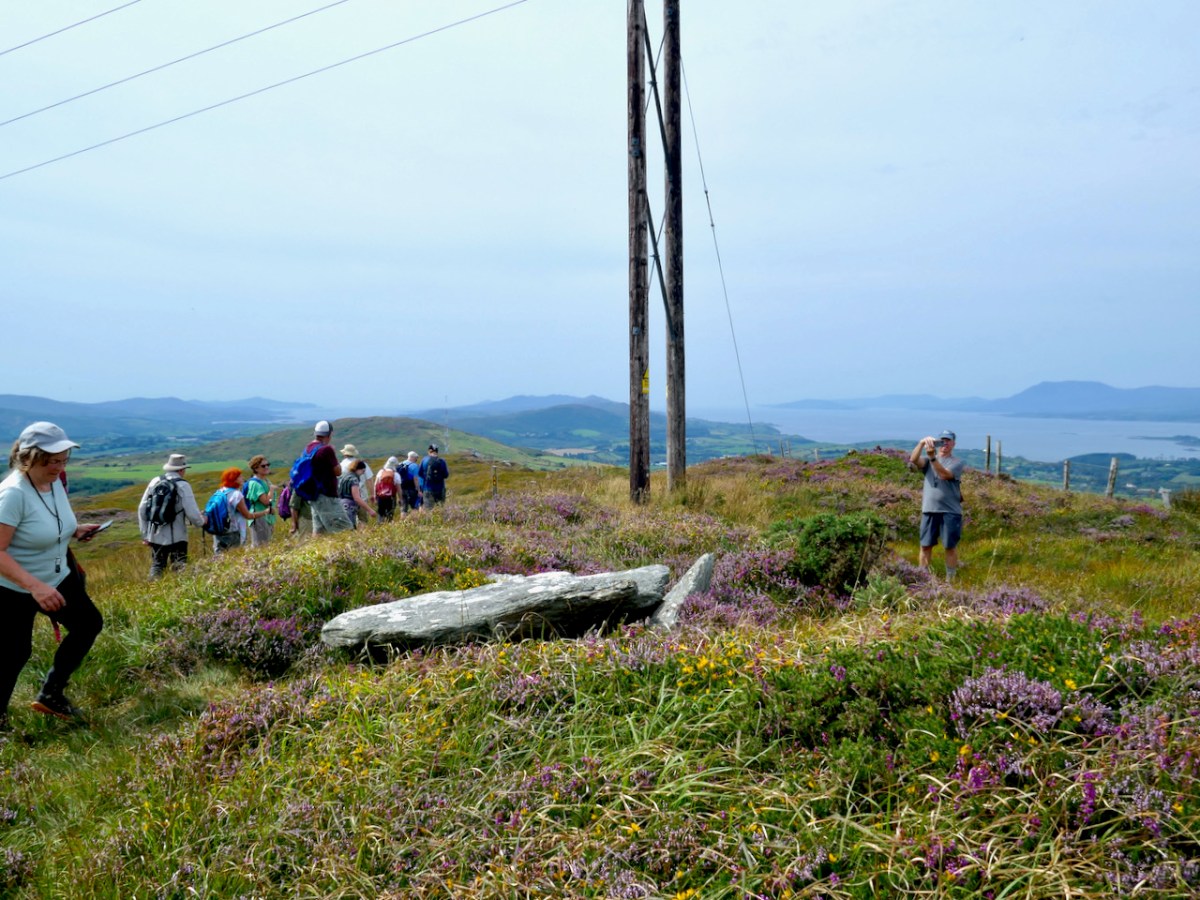
And the second bog? That was today, and although not the first event of the Ellen Hutchins Festival, it was the one that kicked it off for Robert, me and my sister, Aoibhinn, visiting from Dublin. Led by eminent botanist Rory Hodd, and provided with hand lenses, we tramped over the high land above Bantry, on a quest to understand more about heathland and boggy environments.
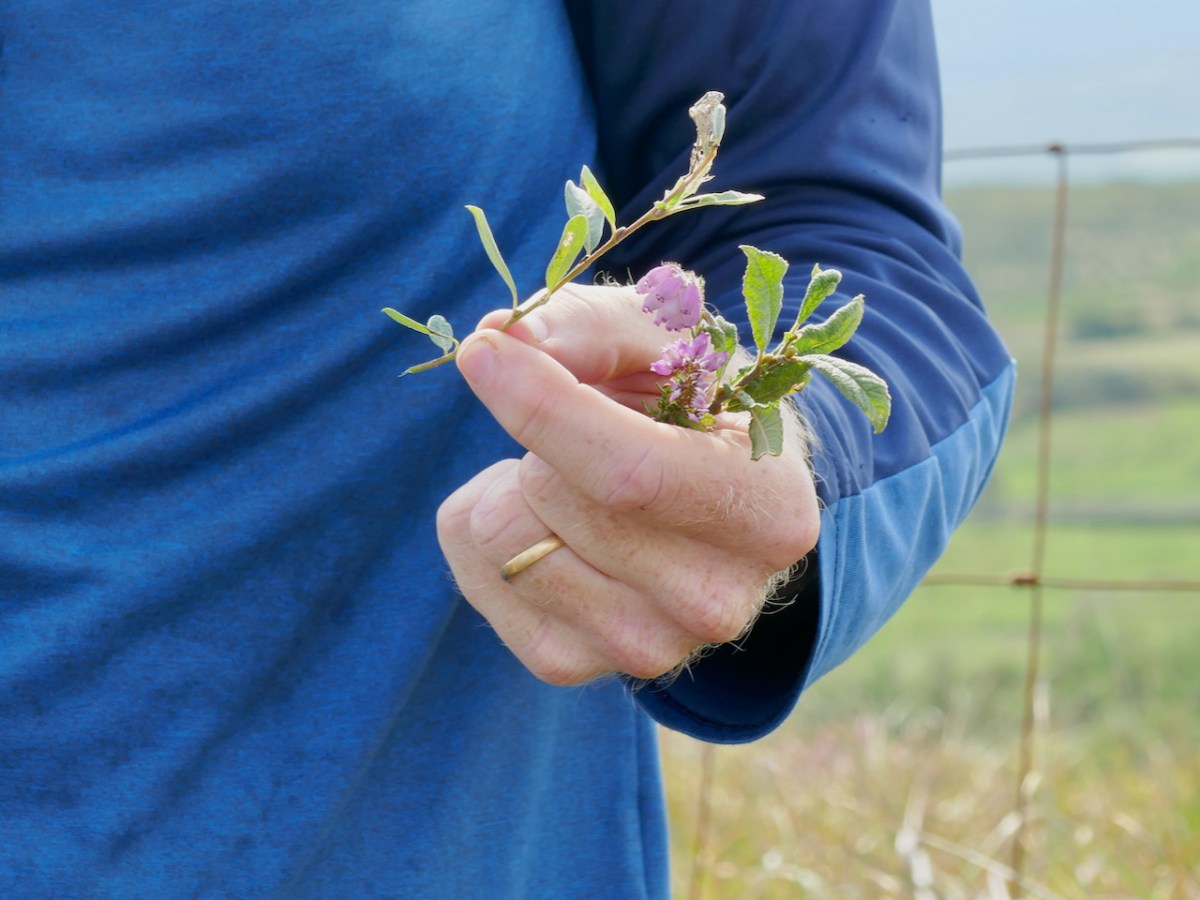
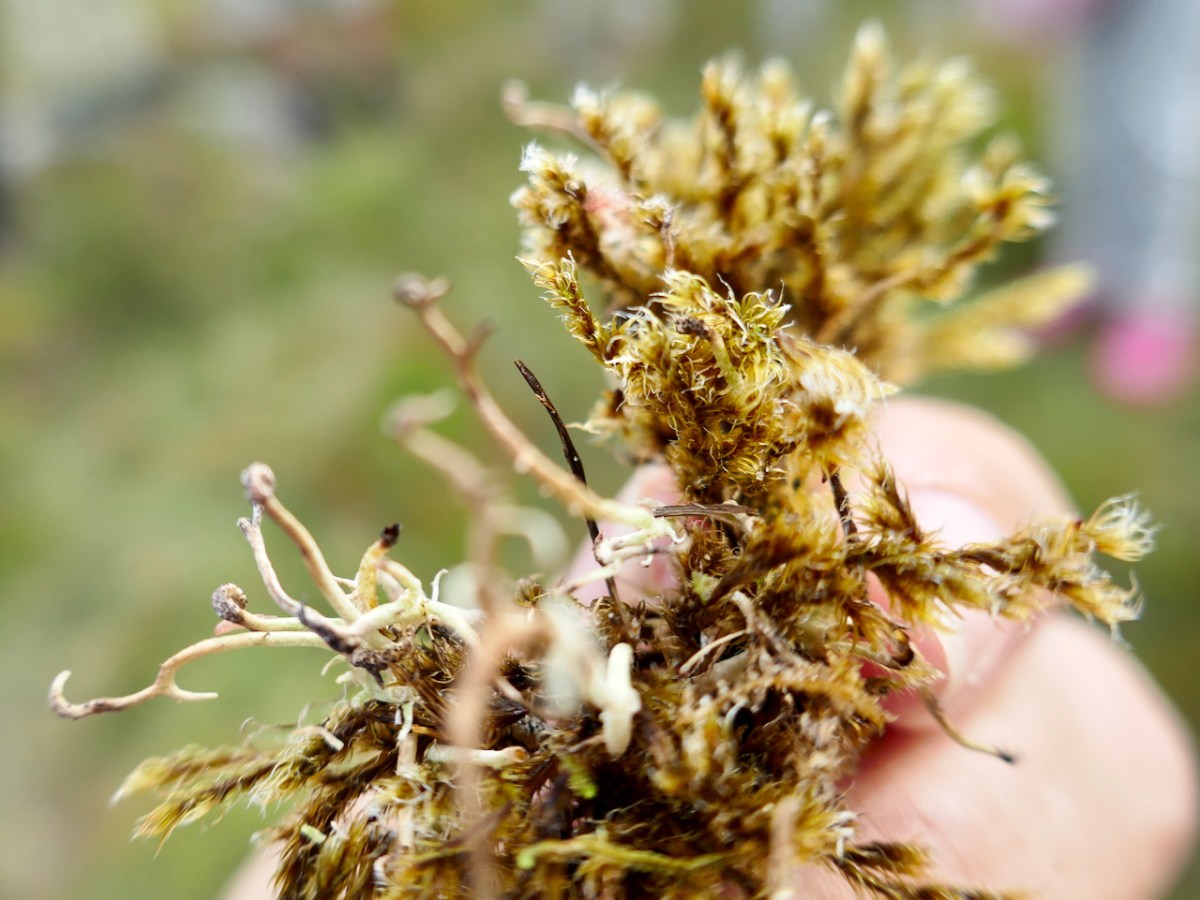
Rory is an acknowledged expert in this area, and it’s a real privilege to be on a walk with him. He knows everything, but manages to make it all accessible to the layperson. He explained how mosses, bryophytes, lichens, heathers and other plants interact to form the complex ecosystem that make up heathland and bogs.
I now know that ‘sedges have edges’ is not a reliable rule of thumb, and that the Purple Moor-grass that almost defines the winter bog landscape in West Cork (called Fionnán, or blond grass) actually decreases bio-diversity, and that one handful of plants can contain several different species of mosses (including invasive ones from New Zealand!) and liverworts!
And all of this in the most glorious landscape, with a view down all three peninsulas, the Mizen, Sheep’s Head, and the Beara, with a prehistoric wedge tomb at one of the high points (along with Ireland’s most unsympathetically located electricity pole) just to add some non-botanical interest.
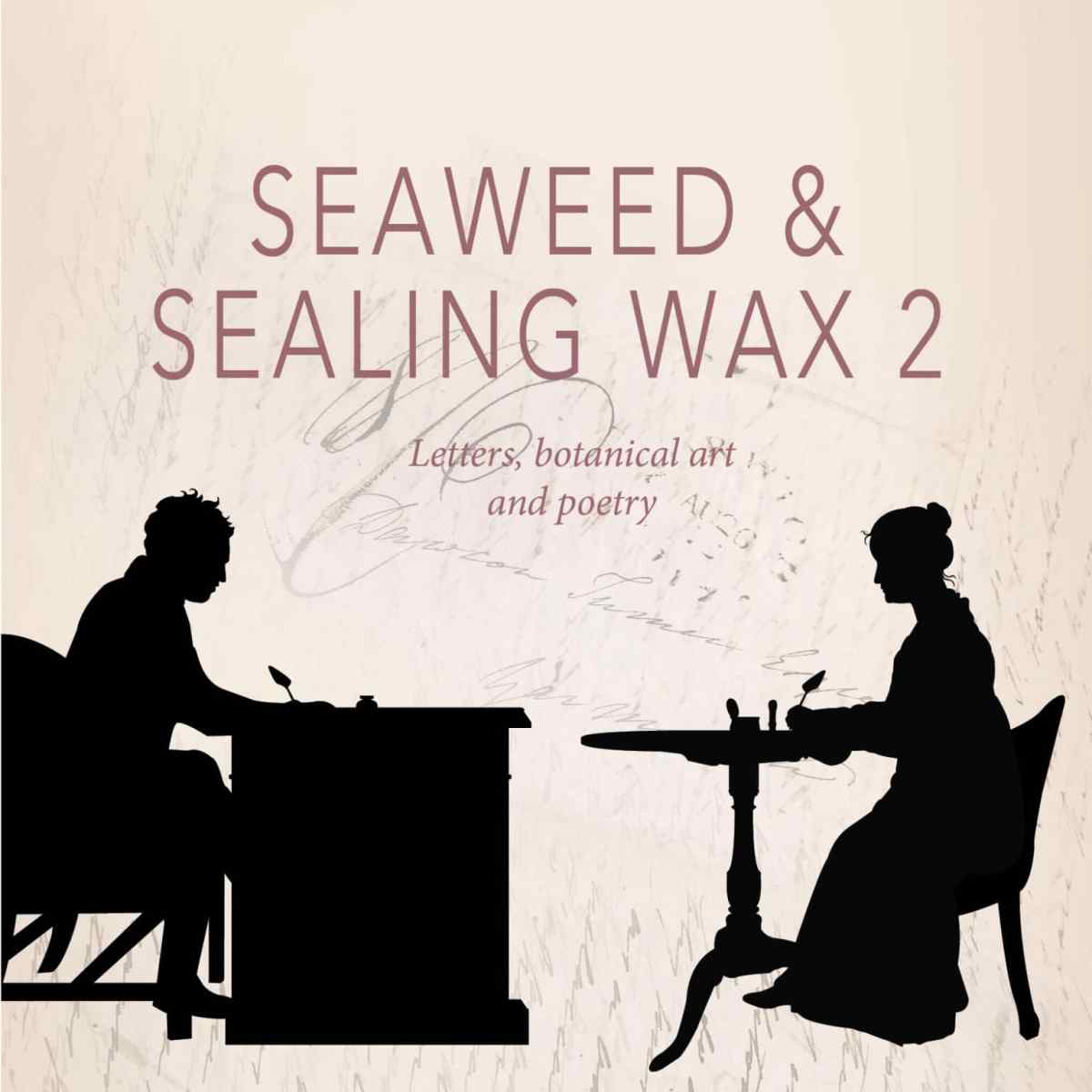
The Ellen Hutchins Festival continues all week, and you can still get tickets to many events. The one I play a part in, as MC, is on Friday. It’s called Seaweed and Sealing Wax 2, and it charts the correspondence between Ellen and Dawson Turner, continuing from Part 1 last year. It’s free but you have to register. Hope to see you there – come and say hello.
You’ll all know that Ballydehob is the true centre of art in West Cork. Our posts about the Ballydehob Arts Museum (BAM) set out the history of the community from the 1950s onwards. Artists settled in the environs – some camping out in the hills, and many of them remain connected with the area to this day. Local residents were at first amused – or bemused – by this ‘invasion’, but it soon became an accepted part of the character of the village.
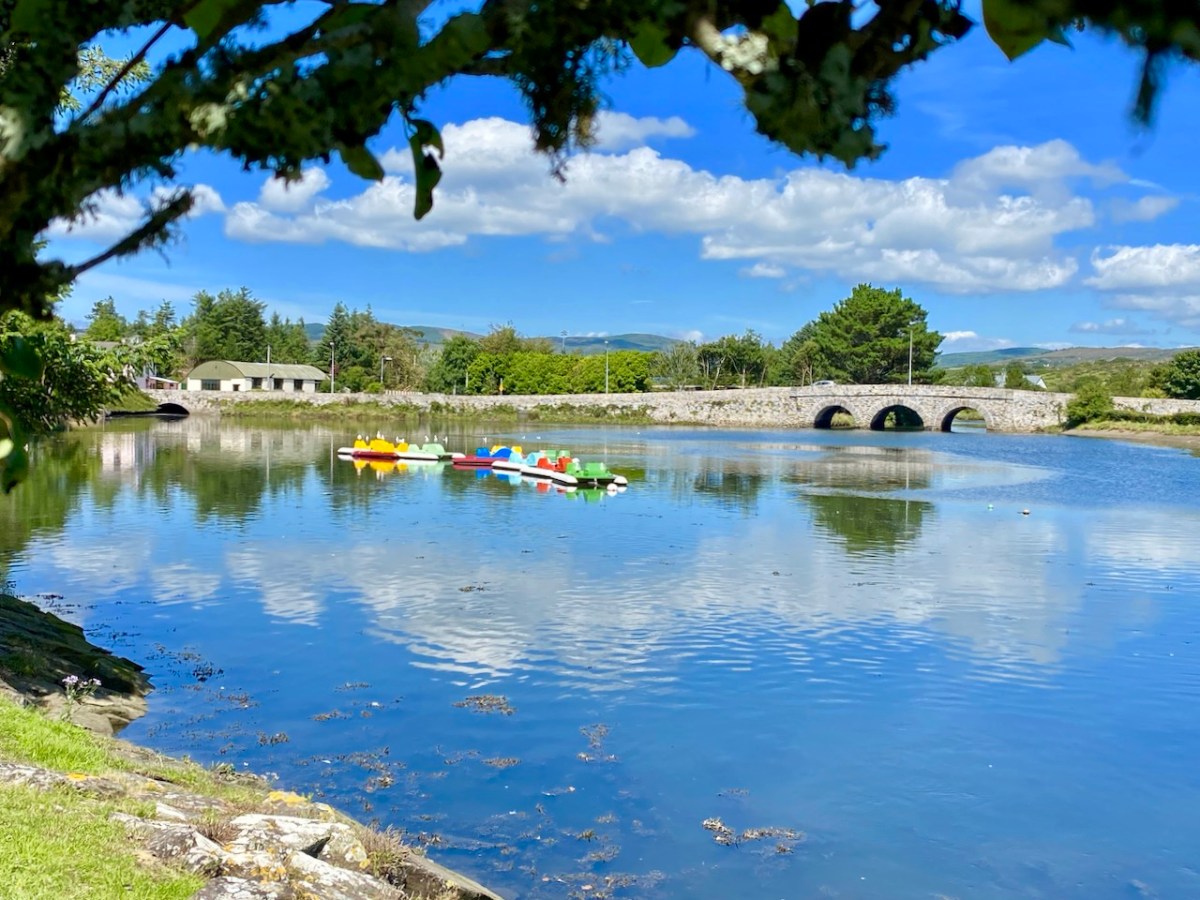
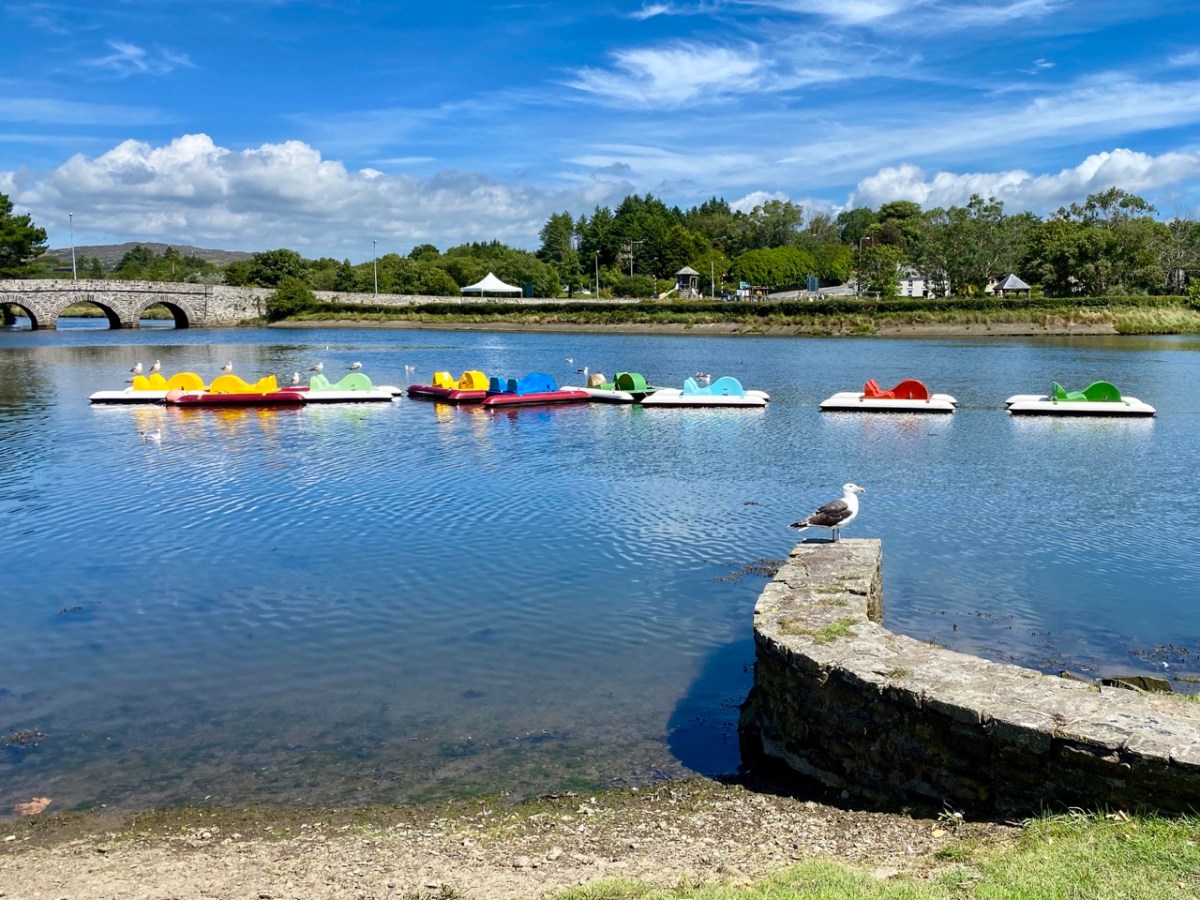
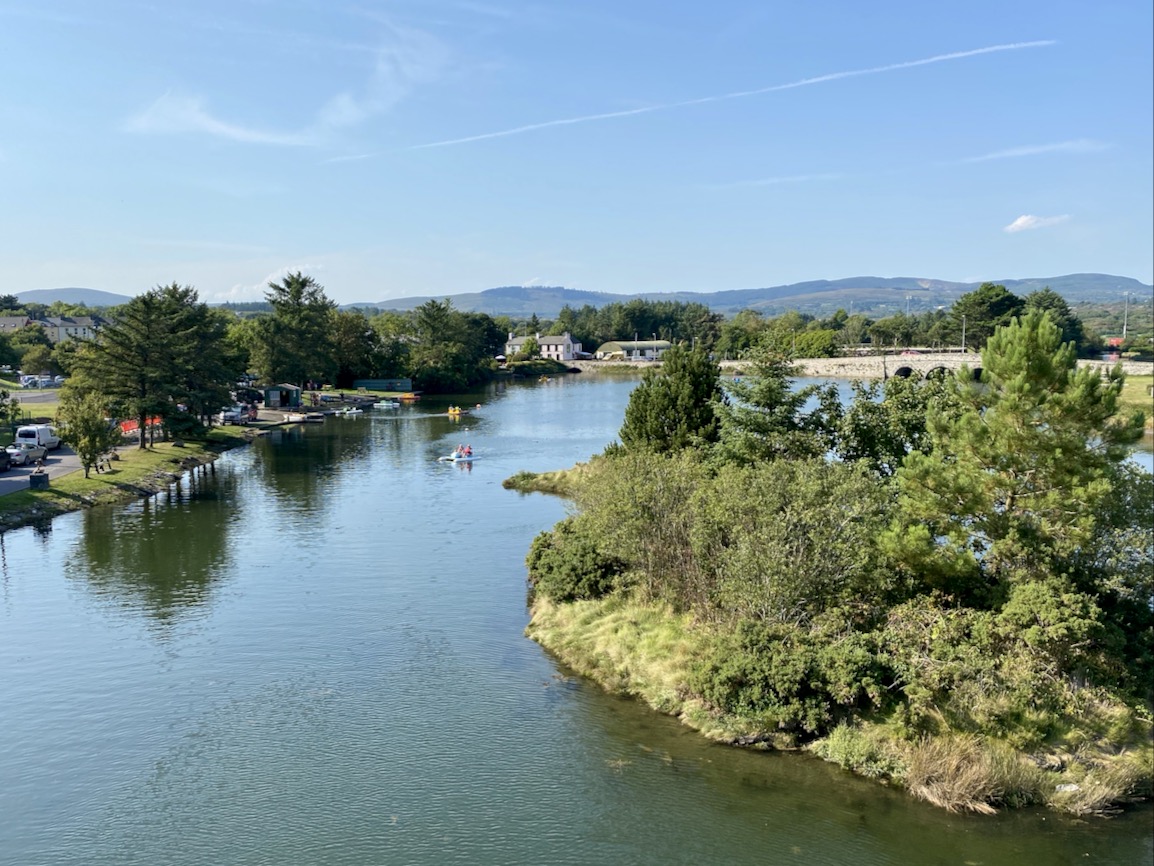
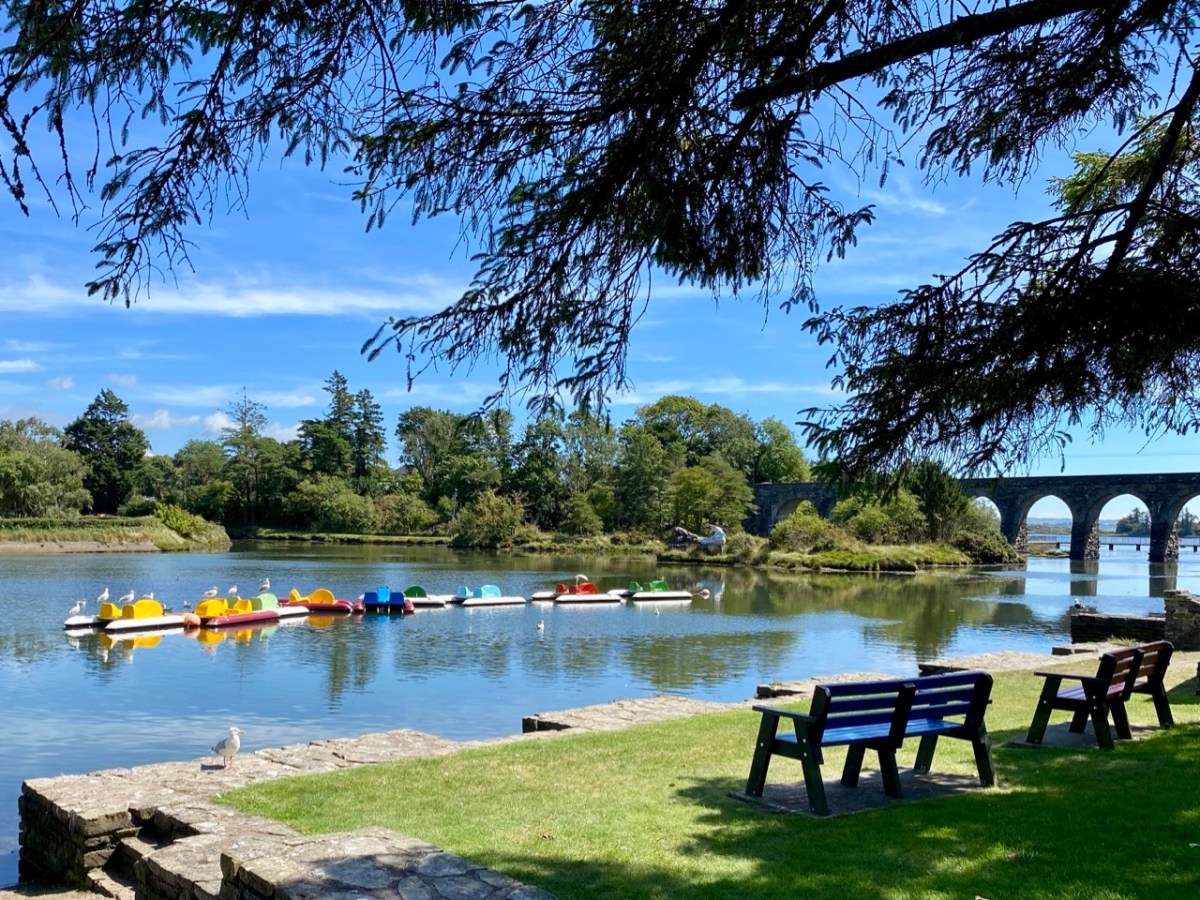
Right at this moment, an innovative installation is in place on the water in Ballydehob, just above the 12 arch viaduct and by the road bridge that comes into the town from the east. This is where the two rivers meet, the Bawnknockane and Rathraune, giving the town its name: Béal Átha an Dá Chab, which literally means Mouth of the Two River Fords.
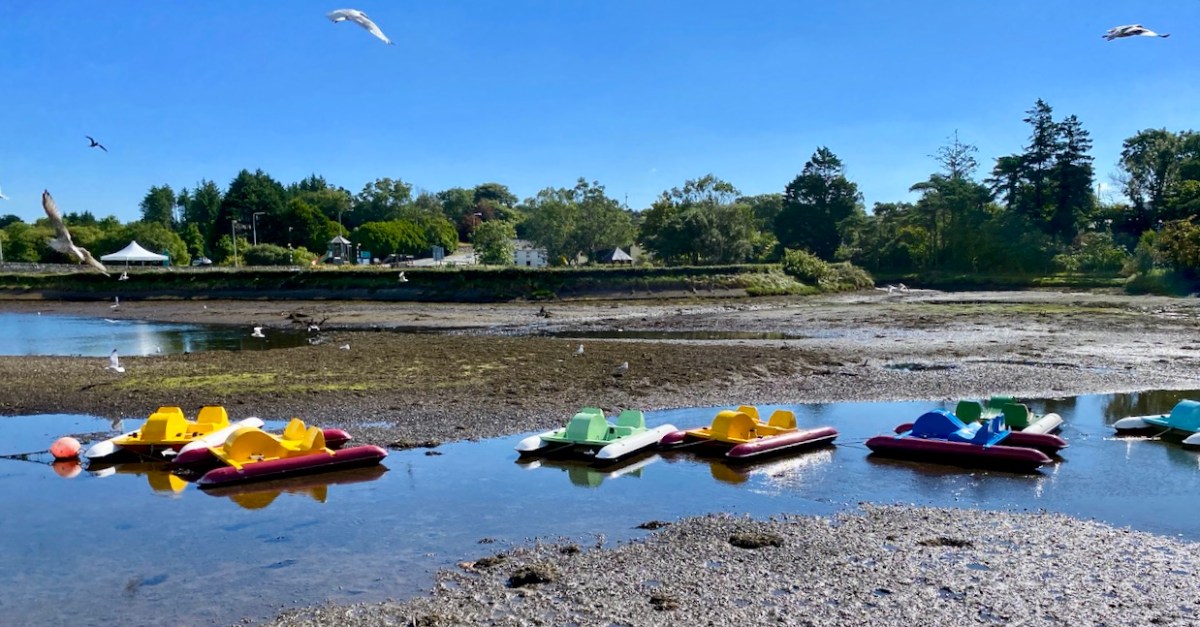
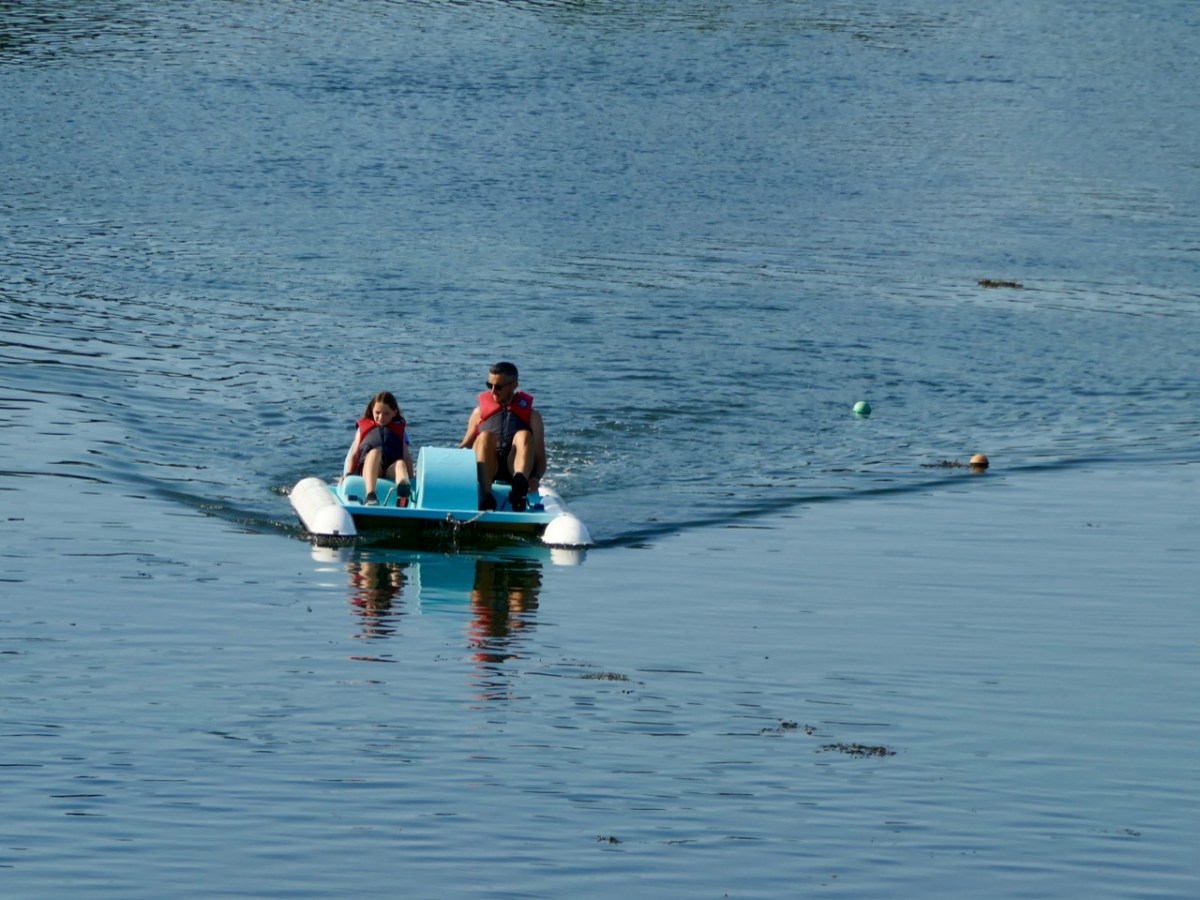
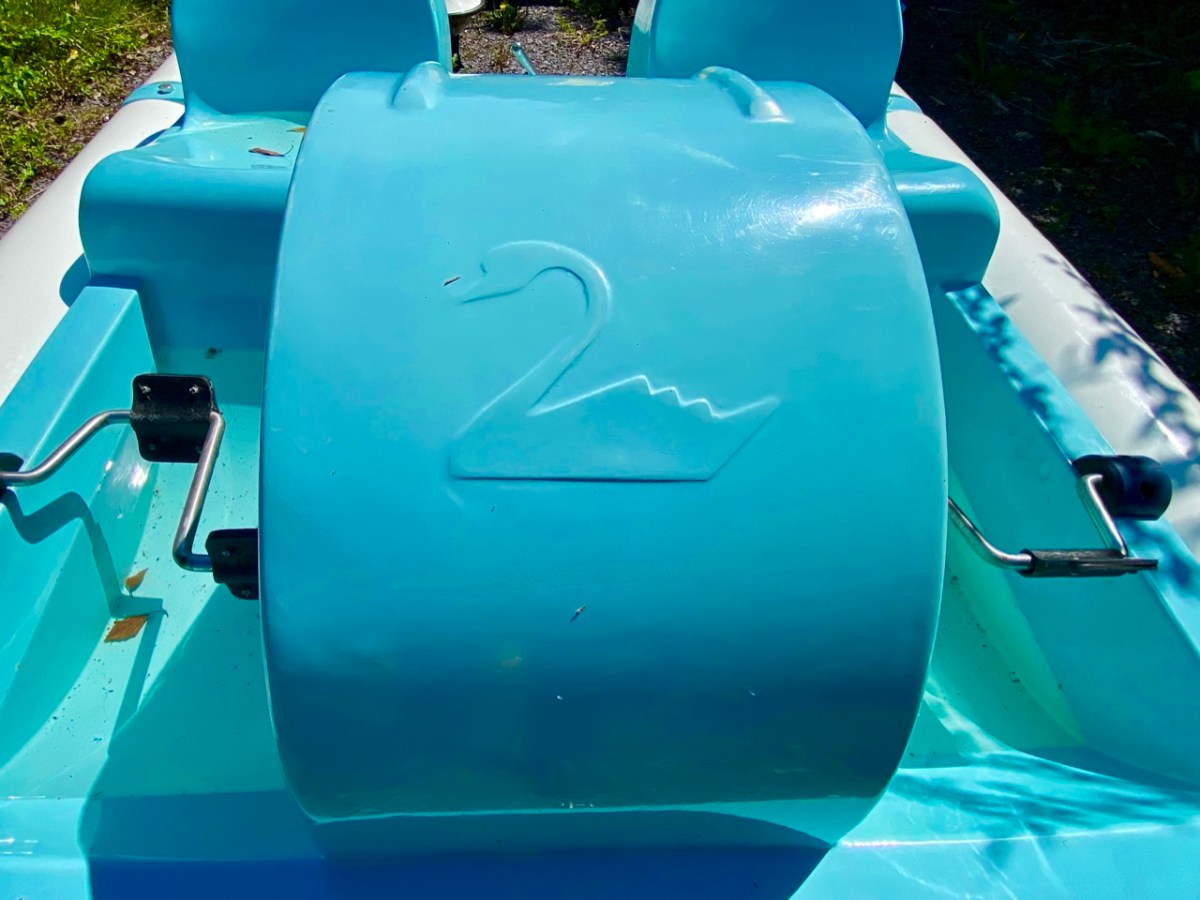
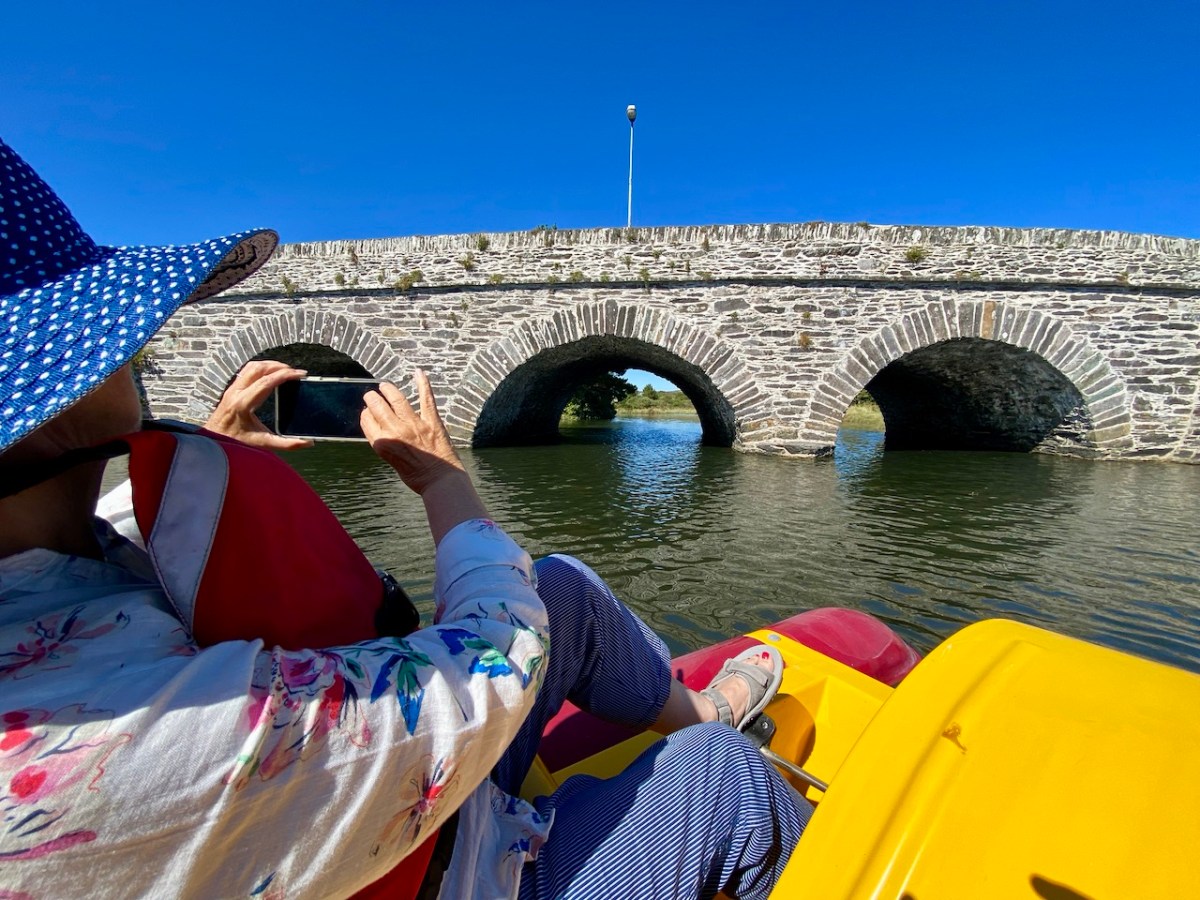
In summary, this art installation by Muireann Levis offers you a close experience of the water accompanied by a sensory soundtrack which is projected into the bay through a series of loudspeakers. The name of the project is Inbhear, which translates simply as Estuary. The way you experience the water is by climbing on board one of the ‘pedalo’ boats that were a common scene on the water here in Ballydehob back in the late 20th century. I remember seeing them on the estuary when I visited West Cork in that time, but they have not been in active use since then, so we were delighted to be among the first to experience their revival, a couple of days ago.
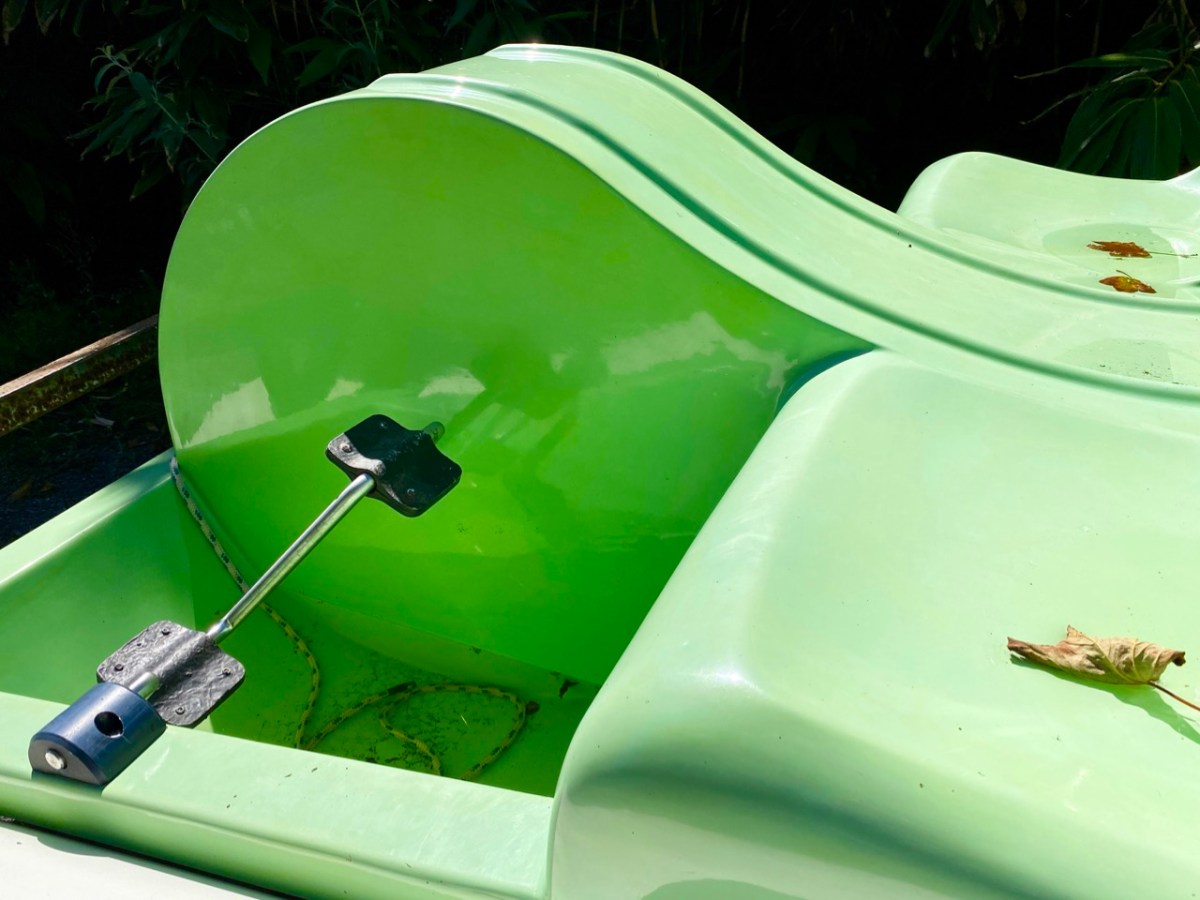
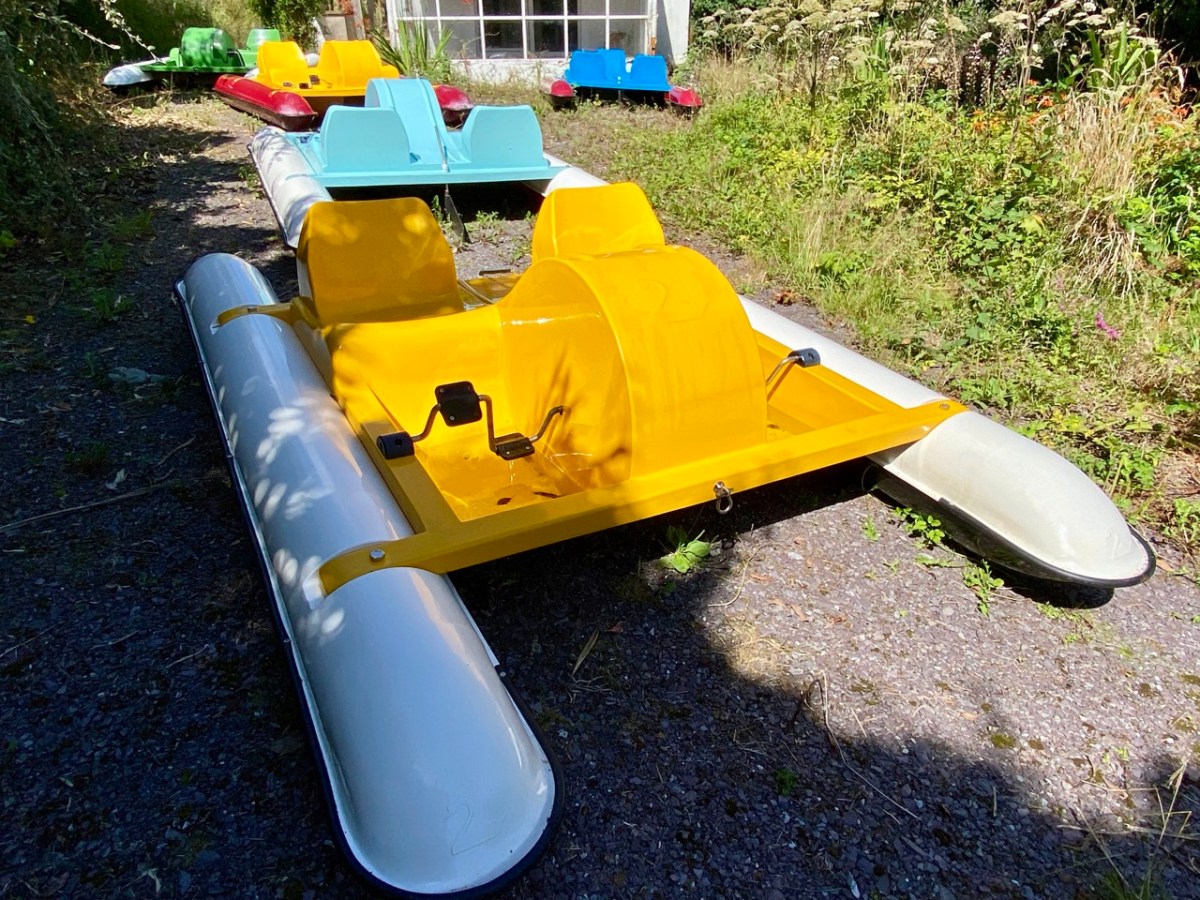
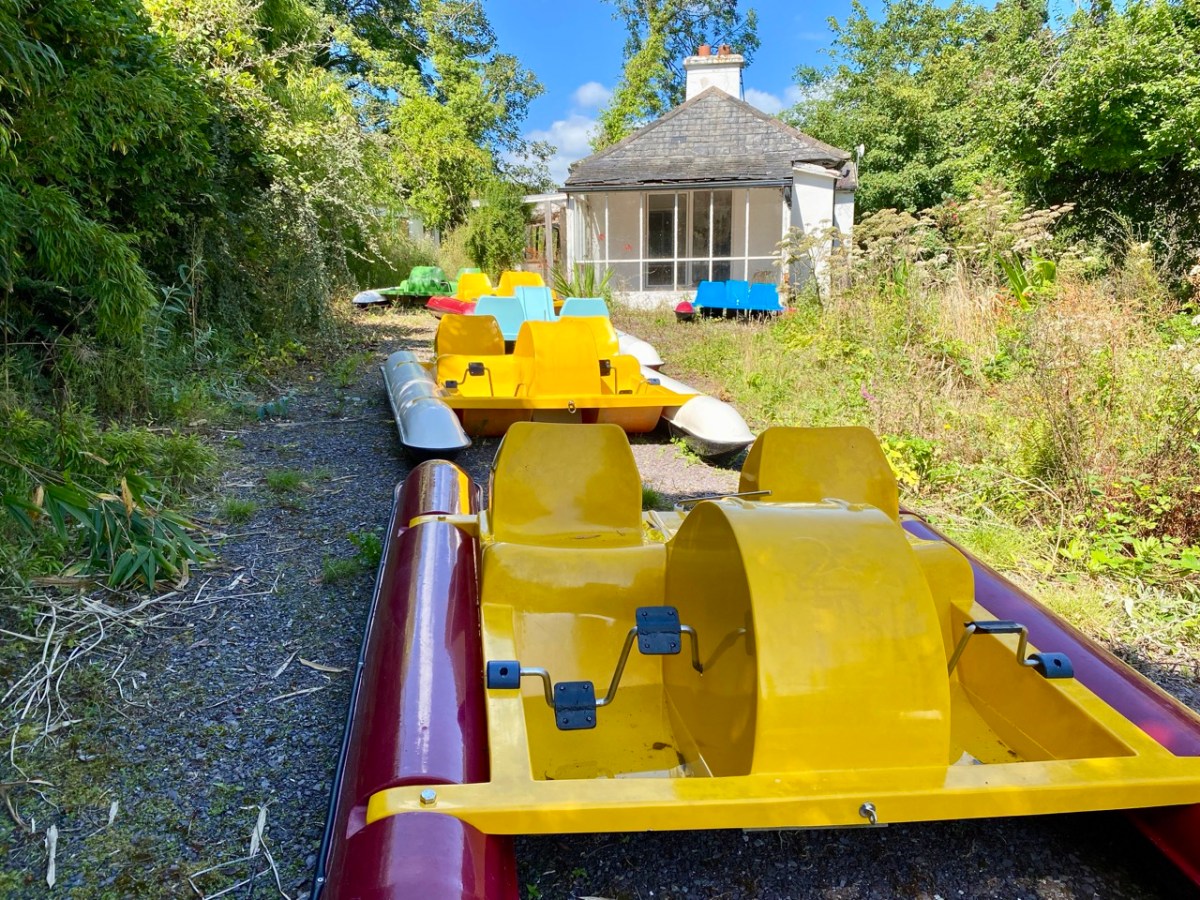
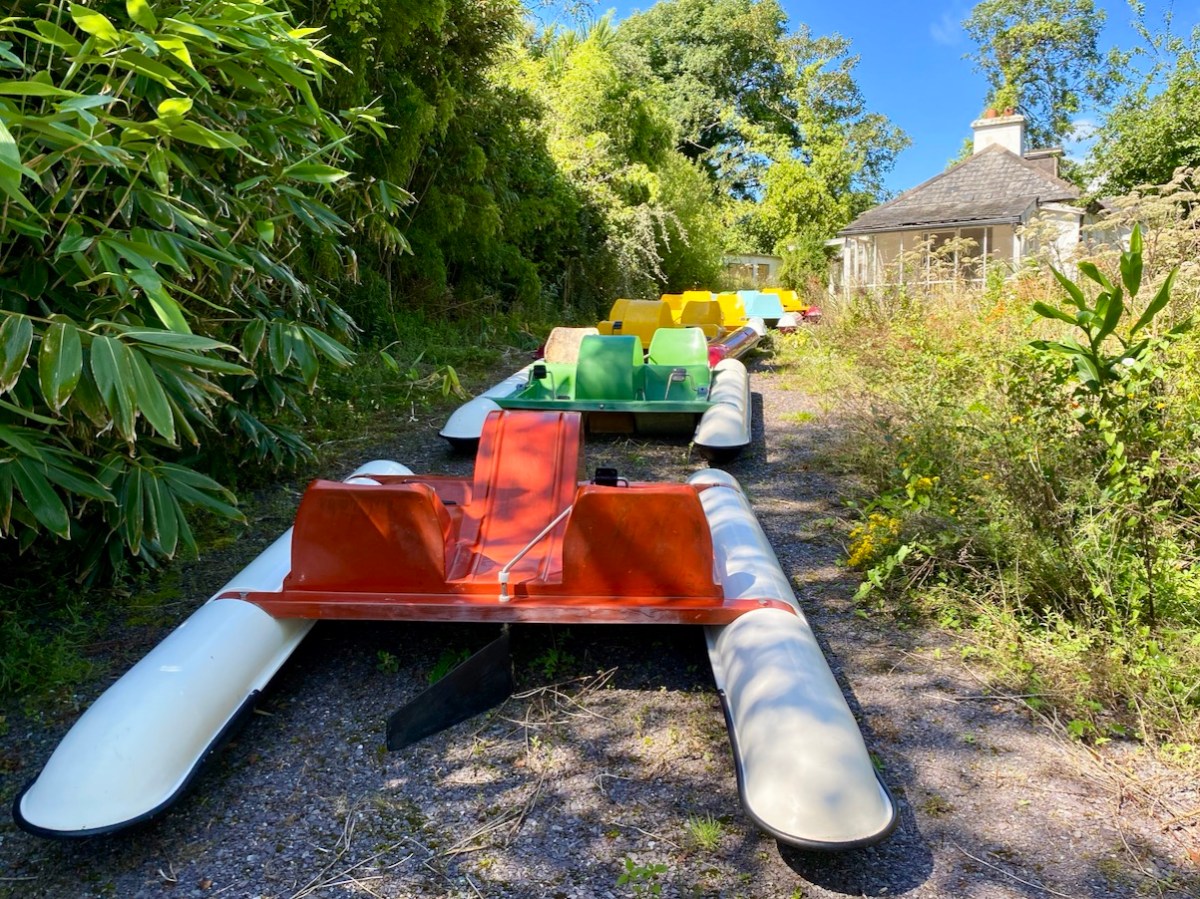
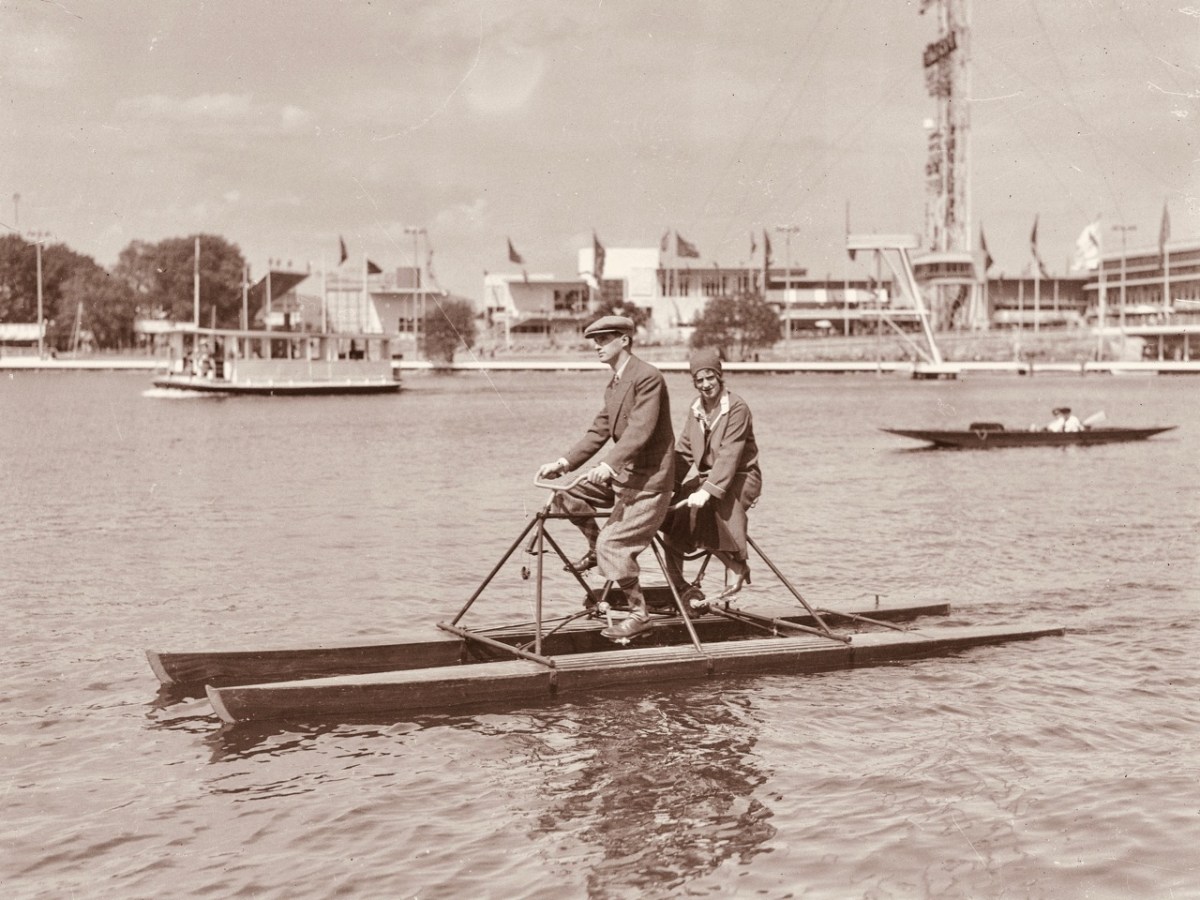
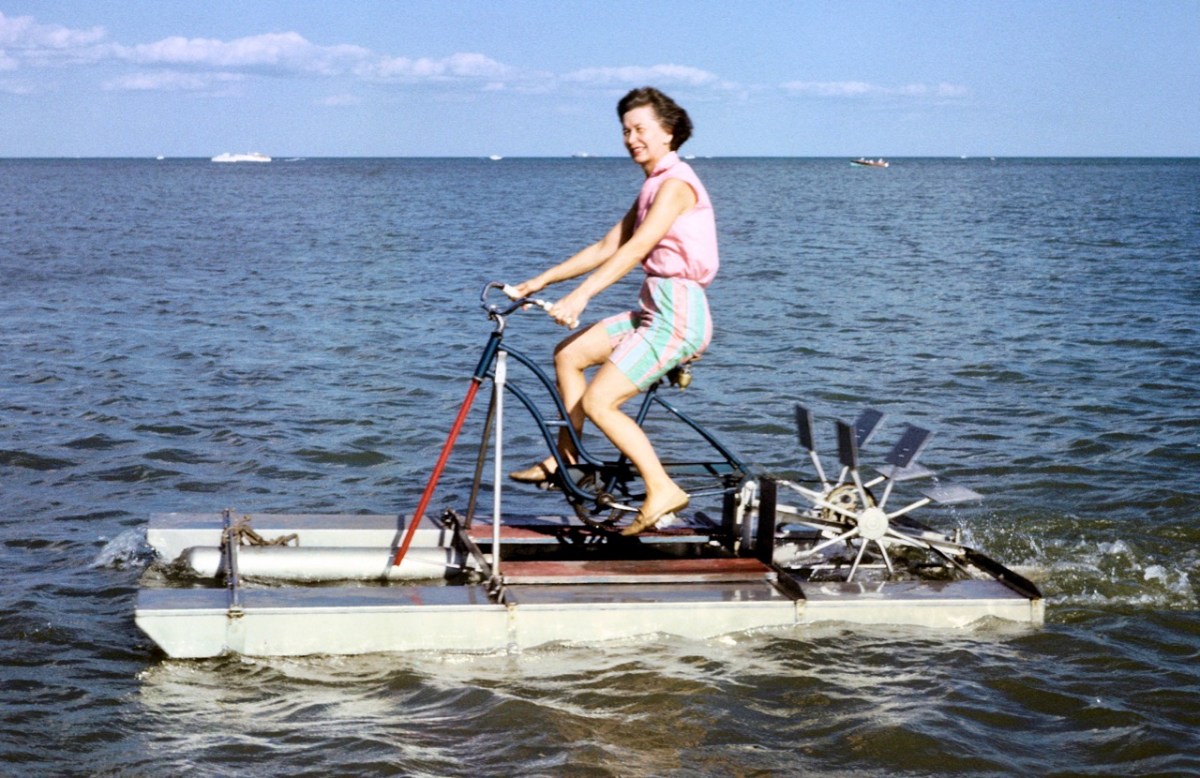
The pedalos have been kept safe and required only a little maintenance before coming back into service. Wouldn’t it be great to think that they might be brought out again on occasion? They are colourful and brimming with character. Have a look at these further examples from the historical archives of ‘pedal powered boats’; the first dates from 1930 in Stockholm, and the second is in Michigan, dated 1963.
Interestingly, the pedalos which we are seeing today were actually assembled in Ballydehob. They were made as part of a government employment scheme, and some were destined to be used in Barley Cove, with a small ‘fleet’ being set up in Ballydehob Bay. The latter deteriorated, but the Barley Cove boats have been stored well, and were recovered for this installation. So it’s a remote deja vu for these craft.
The meeting of the Bawnknockane and Rathraune rivers (above) creates an inner tidal pool – between the three-arched road bridge and the old railway viaduct, and this is where the installation has been set up.
. . . Working with field, hydro-phonic and electromagnetic recordings of the rivers and their many tributaries, Muireann invites us in to a relearning of her childhood environment, creating a piece that draws us closer to the everyday presence of water and elevates its endless subtleties . . . Inbhear, the Irish for “estuary”, finds meaning in its Old Irish roots where it translates to “a carrying in”. It offers a focal point for the carrying in and meeting of old and new identities, both social and environmental . . .
Inbhear event publicity
Finola shot these two videos while we were out on the water experiencing the event, and the soundtracks give an impression of what we could hear while we were afloat:
It may be too late for you to book this event: it’s only happening for a few days. Let’s hope that there’s a demand for a re-run in the near future: it’s such a celebration of so many aspects of Ballydehob, not least as a centre of pedalo boat production back in the day: who knew?
It’s very apt that I should be writing the post on this weekend, as we have just celebrated another Ballydehob event: the annual Cruinniú Bád (boat gathering) which happens at the quay around the highest tide of the summer:
With many thanks to Muireann Levis for inspiring the installation, and to Cormac Levis and William Swanton for information on the history of Ballydehob’s pedalo boats. We should also acknowledge the tireless endeavours of Eleanor Regan and the late Kevin Heaps who operated the pedalos getting on for forty years ago. William told me that Ballydehob Community Council has long been petitioning for the ‘Slob’ below the historic quay to be dredged to allow more boats to use that quay through the year. The sight of boats, small or large, on the water as visitors enter the village from the west would undoubtedly encourage enhanced footfall to the shops and hostelries of this remarkable community
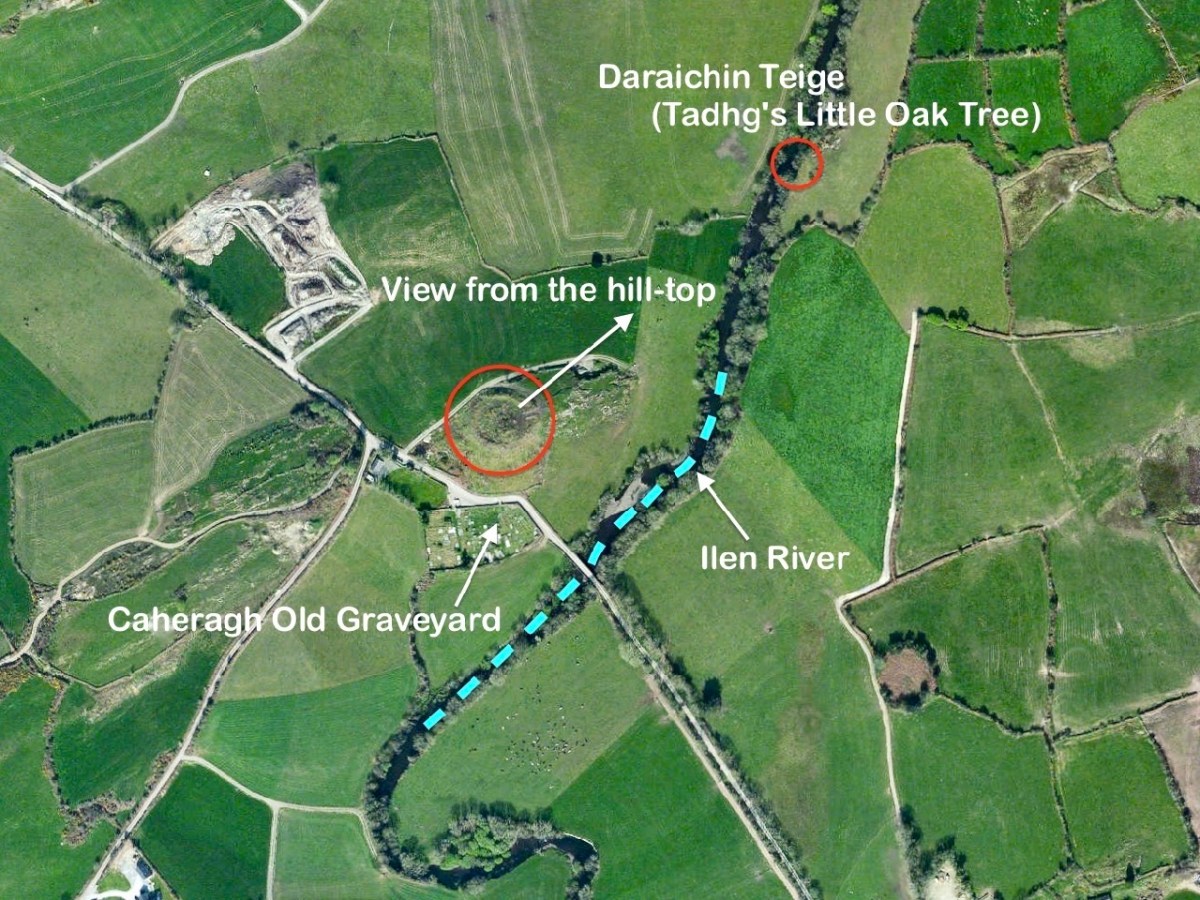
I’ll explain at the outset that Caheragh is (more or less) pronounced ‘corer’ (as in coring apples)! It’s a parish in West Cork that we have visited before. Have a look at my article on the Ilen River, here. This locality is brimming over with history and we go exploring as often as possible: there is always more to find. And – with wide views and cloud scapes in all directions from the high ground – it’s an uplifting place, especially when blessed with the August sun.
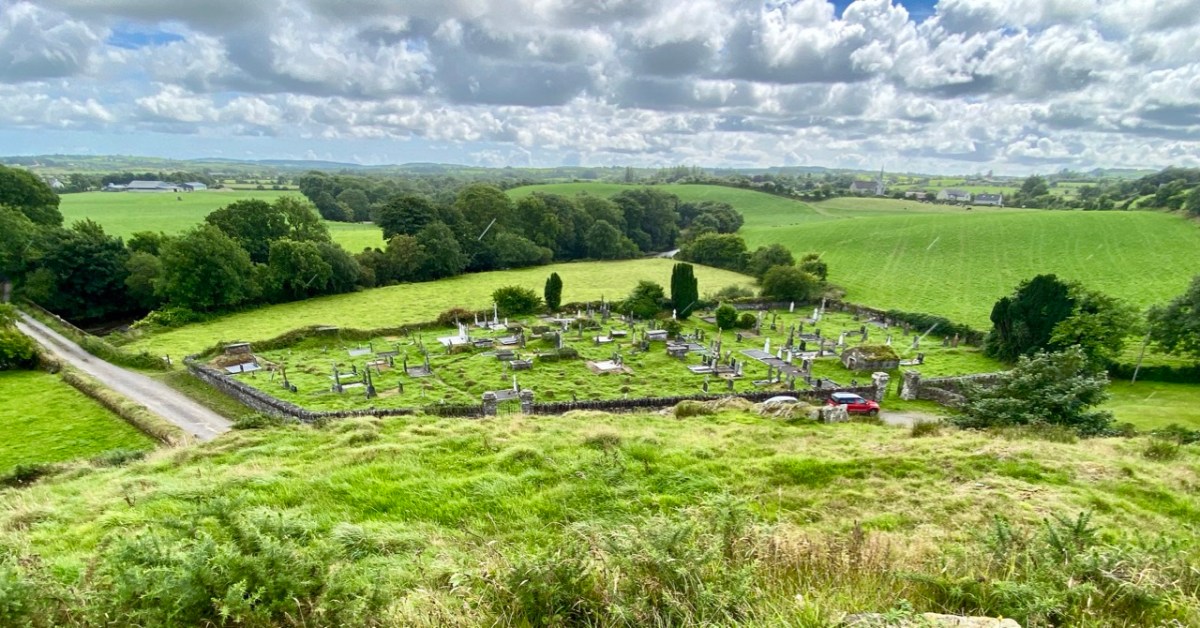
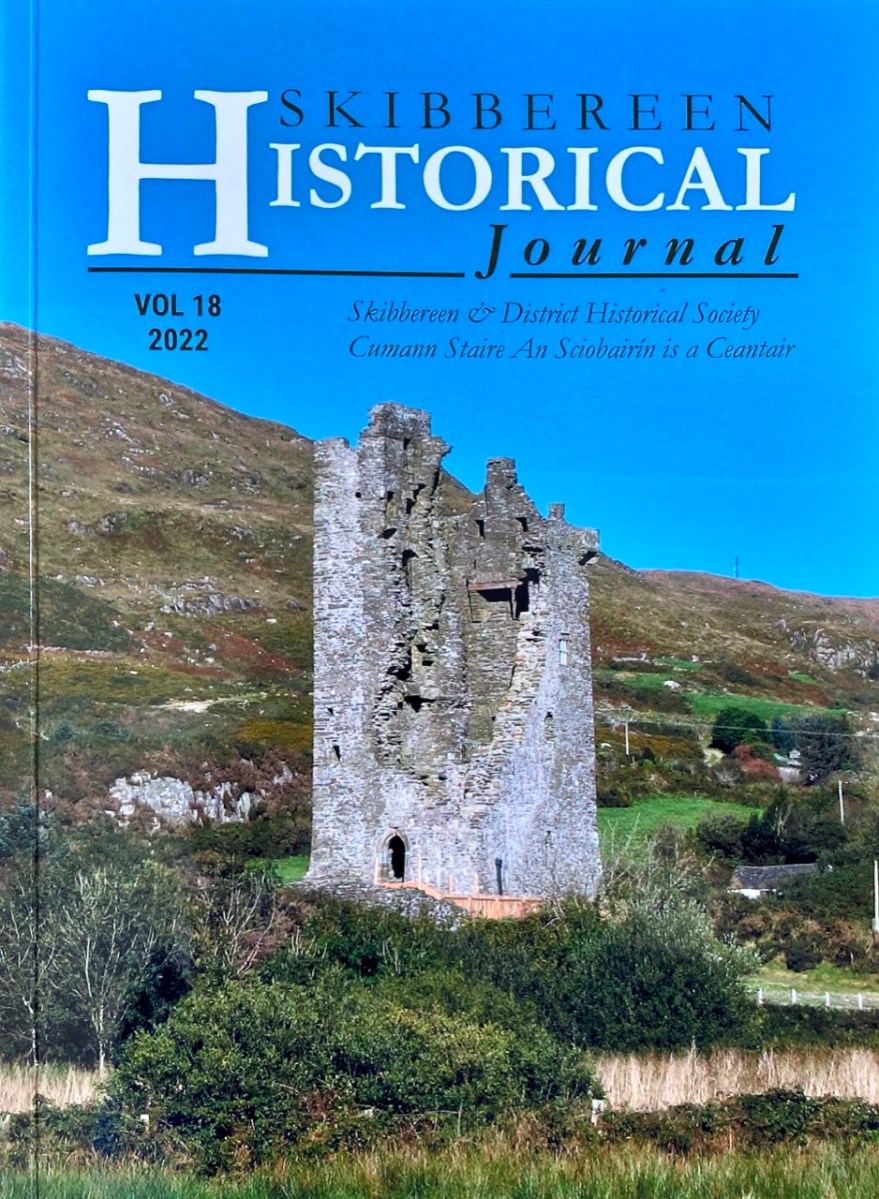
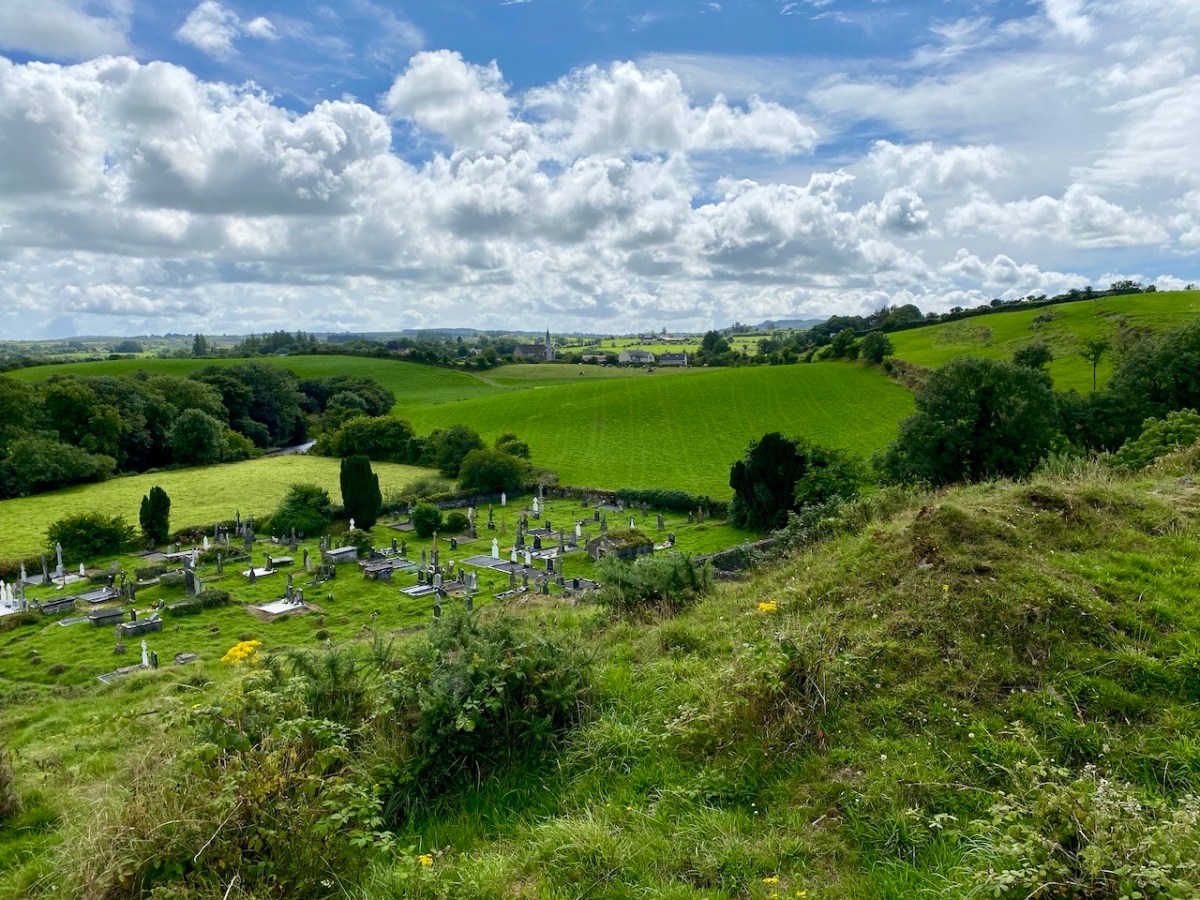
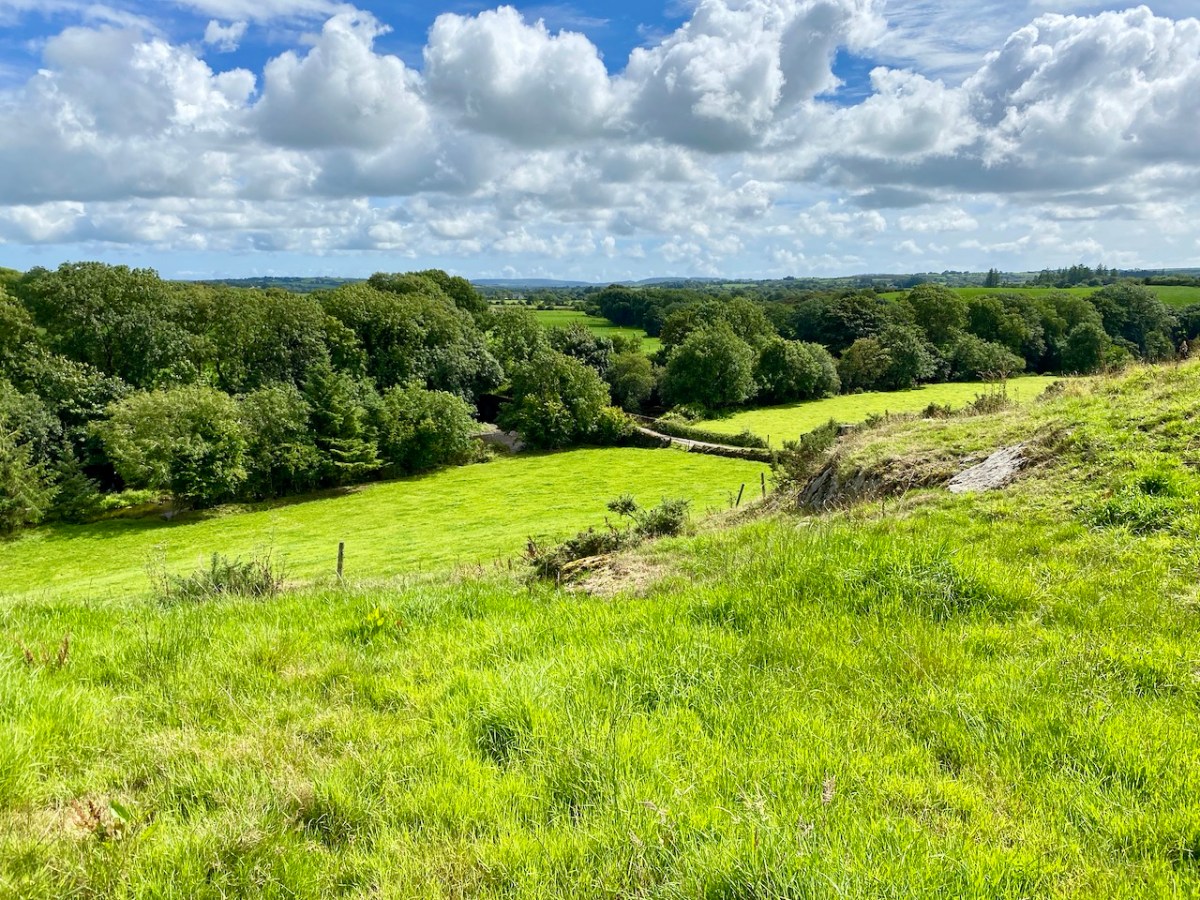
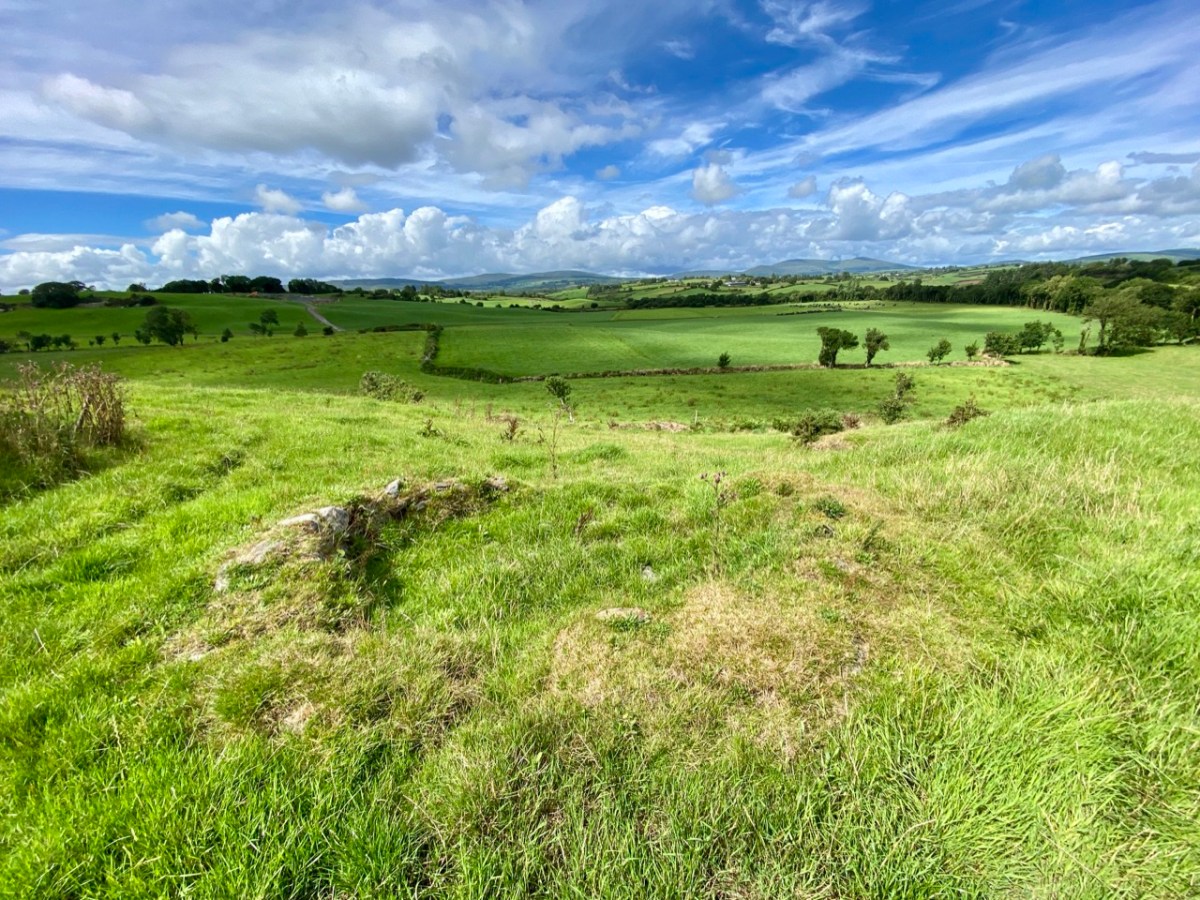
Here’s a vista to the north-east, from the top of the mound beside the graveyard that might just be a ring-fort, or possibly the site of a monastic centre dating from medieval times – more on that later. In the middle distance is the Ilen River with its wooded banks, heading out towards Castle Donovan and – eventually – to its source on Mullaghmesha (or, perhaps, Nowen Hill – we have yet to determine exactly where it rises. This post from the Sweet Ilen series covers the area). And that Donovan castle itself graces the cover of the latest Skibbereen Historical Journal (Volume 18, 2022), which you can get in bookshops locally, or online here. You will find a summary of some of my research on the Ilen River in this journal, together with many other fascinating and erudite articles.
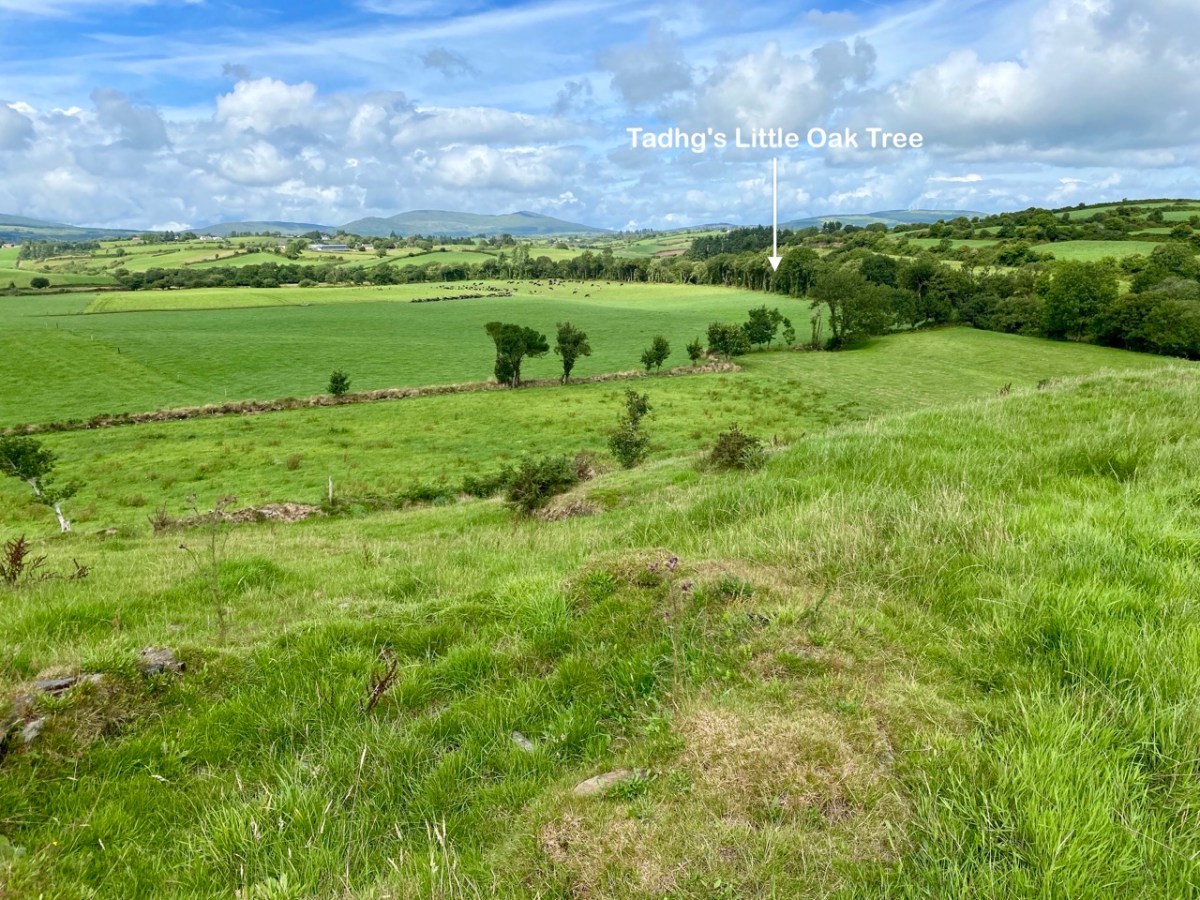
But, going back to that sunlit vista, you’ll notice Tadhg’s Little Oak Tree is indicated. I can’t resist quoting the story of this feature that appears as a ‘Redundant Record’ in the Historic Environment Viewer:
. . . On E bank of River Ilen. Site of tree, ‘Darriheen Teige’ or ‘Daraichin Teige’ (Tadhg’s little oak tree), where Tadhg O’Donovan, chieftain of Clan Cahill, was slain c 1560 by rival group of O’Donovan’s (O’Donoghue 1986, 55). Nearby is Poll a’ Daraichin (pool of the little oak) . . .
Archaeology.ie Historic Environment Viewer – Record CO132-066
Well, it seems strange that the ‘site of a tree’ is a recorded monument. In fact, if the oak was still flourishing (we couldn’t find it), it would probably be just one of only a few trees included in Ireland’s vast record of archaeological monuments!
For today’s post I am indebted to our historian friend Pat Crowley, who directed us to a clip from The Southern Star newspaper dated January 12, 1929. It was a letter written to the newspaper by Captain Francis O’Neill, retired Chief of Police in Chicago and well-known prolific collector of traditional Irish music. O’Neill (1848-1936) was raised in his family home at Tralibane, in the parish of Caheragh. He has been mentioned in this journal, and I was fascinated to read his letter, which became a protracted discussion on the parish, the old graveyard, historic sites and archaeology in the area.
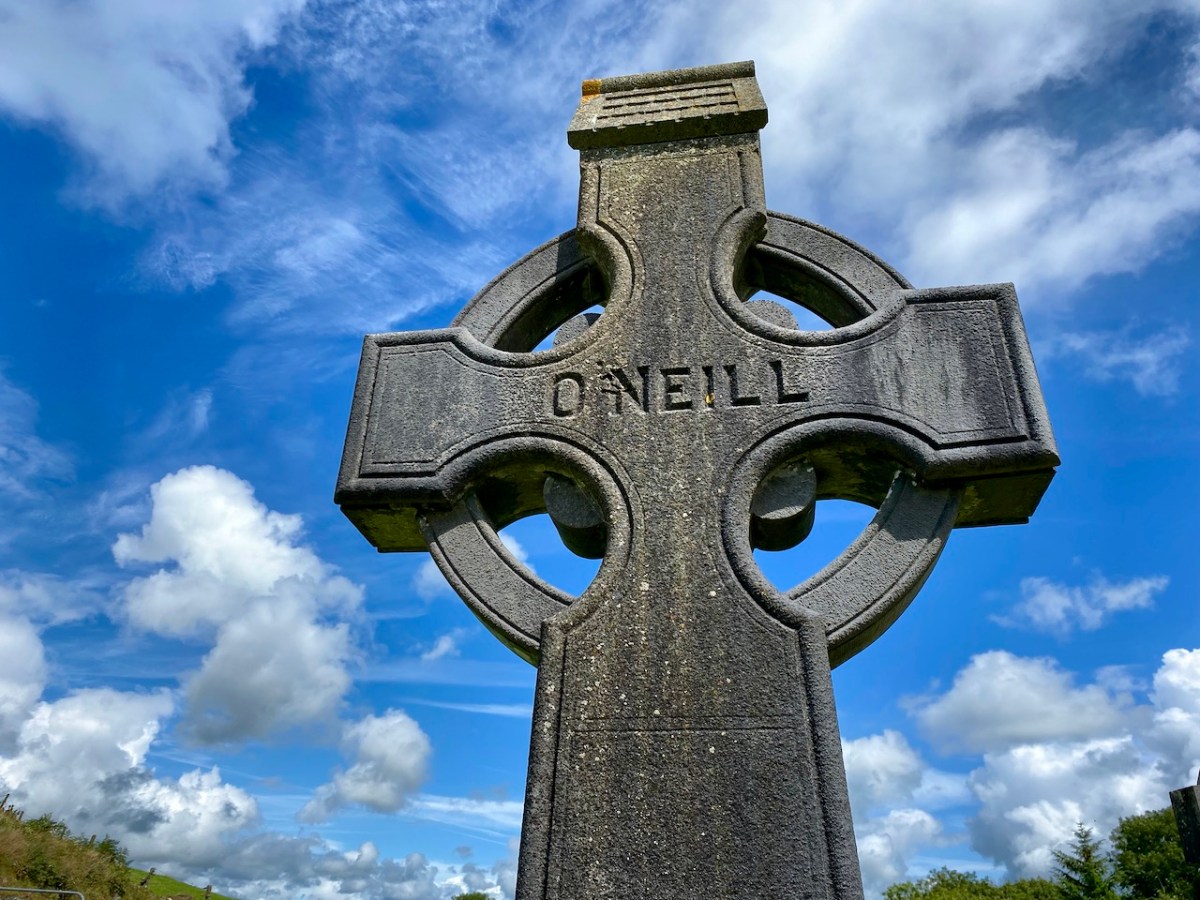
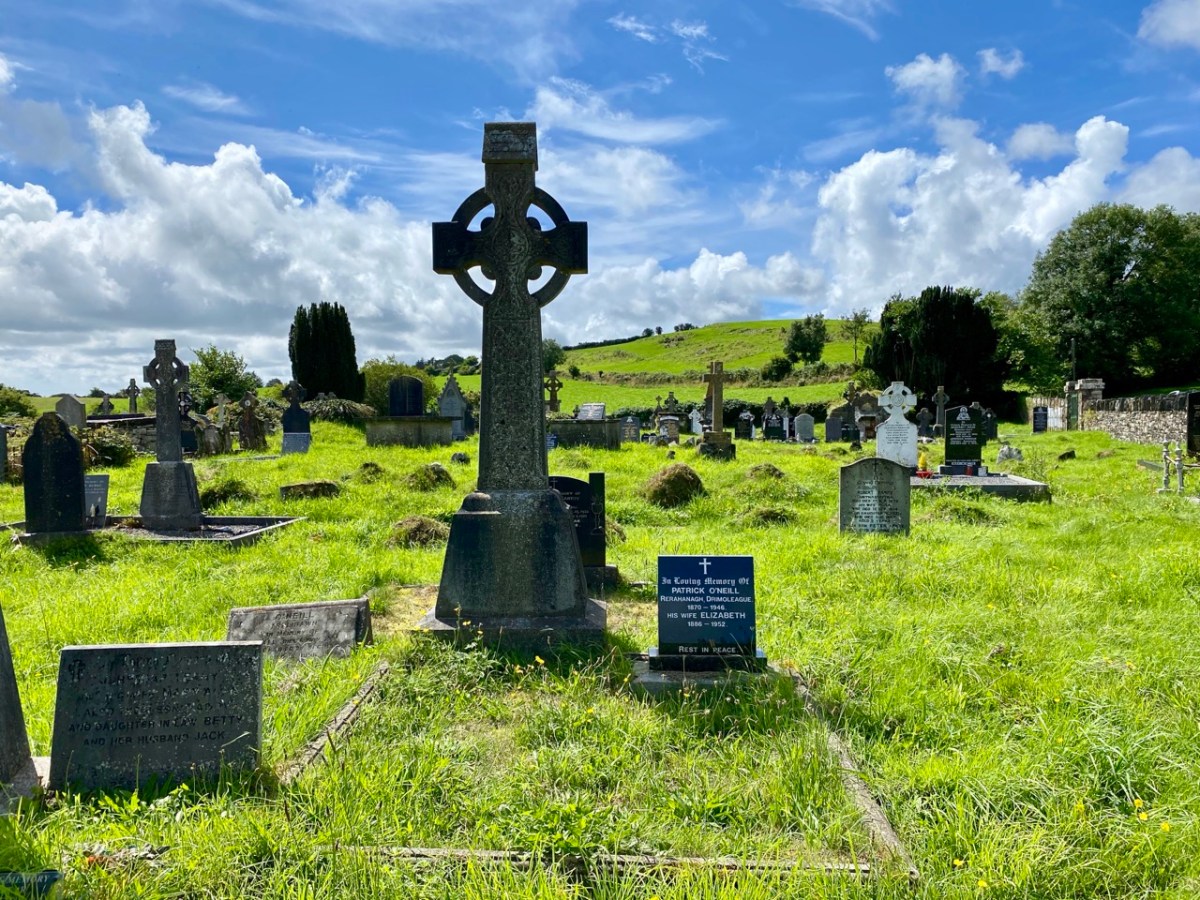
All this came about because Francis had returned from Chicago to West Cork in 1906 – after a long absence – ostensibly to visit the burial place of his parents, and to order a suitable monument to mark their graves (above).
. . . On my return to Ireland July 1906, after an absence of 41 years, I visited the bleak Caheragh graveyard, in which the remains of my parents, and O’Neill ancestors, were buried. There being nothing visible in the environment to indicate its origin as a cemetery, personal curiosity, abetted by that of the Downings of Tralibane – cousins of McCarthy Downing, MP – led to investigation . . . The result, somewhat disconnected and fragmentary, is herewith submitted for publication . . .
Southern Star 12.01.1929
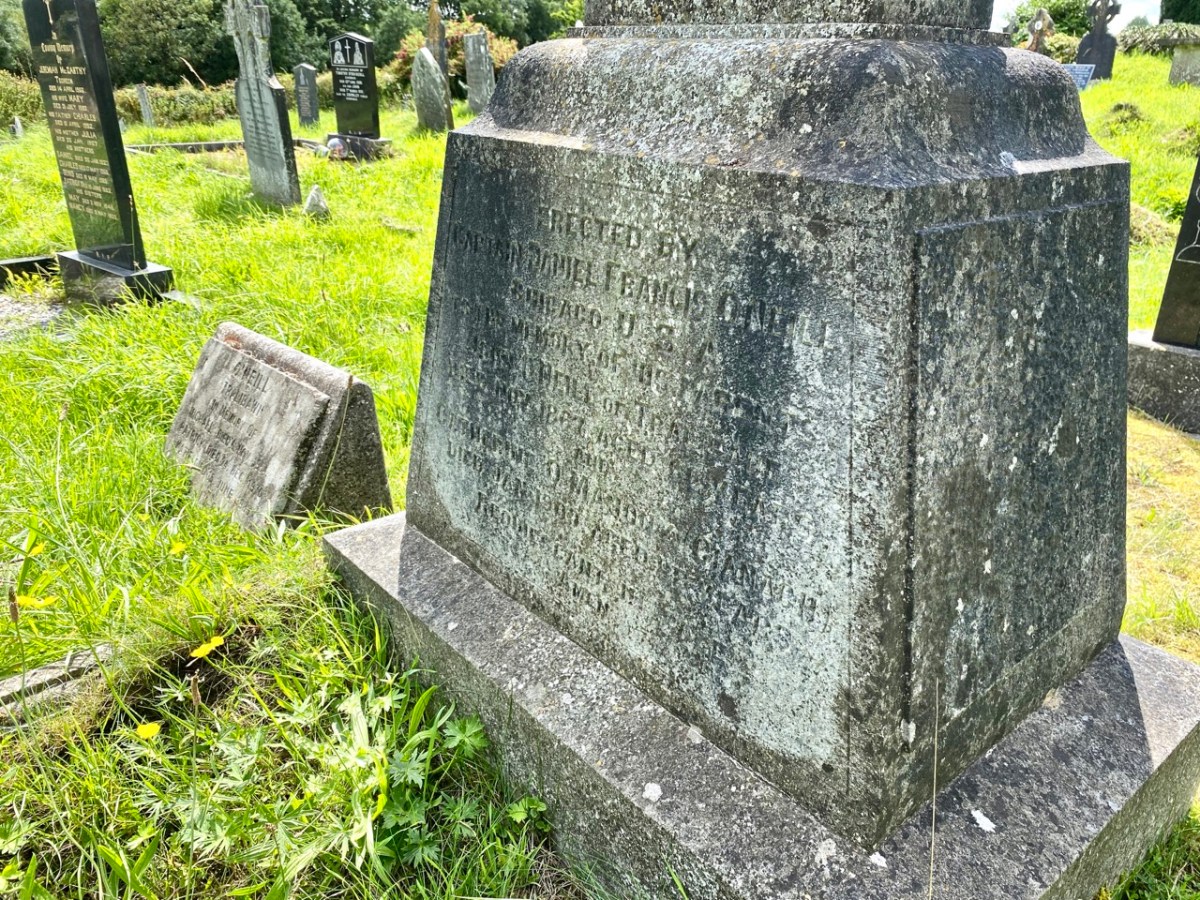
The O’Neill burial plot at Caheragh. Francis ordered the large cross to mark the graves of his parents. The inscription reads:
Erected By Captain Daniel Francis O’Neill Chicago USA To the Memory of his Parents John O’Neill of Tralibane Died Nov 1867 Aged 66 Years And Catherine O’Mahoney (Cianach) Died 1900 Aged 88 Years Requiescant In Pace Amen
Quoting again from Francis O’Neill’s letter to the Southern Star:
. . . All available authorities in my library have been consulted, and I find that references to the parish of Caheragh are both meagre and obscure… The earliest mention of this parish which has come to my notice, is in the report of Dive Downes, Episcopal Bishop of Cork and Ross, who made a trip on horseback to all parishes in his diocese in the years 1699 – 1702. Following is the entry: –“Caheragh Church, about two miles distant from Drommaleage Church to the SW lies close to the Island River (he means Ilen). On the west side of the river are 35.5 lowlands in this parish, of which 20 lie on the west side of the river, and 6.5 lie on the east side of the said river . . . There are about 12 Protestant families in this parish. ’Tis thought there are forty Papists for one Protestant in this parish . . . Will Gureheen, a very old man, is priest of this parish. . . The church is ruinous. The north side is down . . .”
Southern Star 12.01.1929
A vista to the west, from the top of the mound beside the graveyard. The present-day village of Caheragh is distant beyond the green pasture (a long way from this ‘Old Graveyard’ – why…?), identifiable through the spire of the 1963 Holy Family Church. O’Neill continues, now quoting from Samuel Lewis “A Topographical Dictionary of Ireland” published in London in 1837:
“Near Lisangle are the ruins of a strong castle, once the residence of McCarthy, King of Cork. The ruins of the old church also remain, which the people here call the ‘Abbey of Cahir” . . . The absence of ruins at Caheragh, which, by the way, seems to have never attracted the attention of historians or antiquaries, is easily accounted for. The stones, conveniently at hand, were utilised in the building of the walls which encompassed the graveyard . . .
Southern Star 12.01.1929
Above – the western boundary wall of Caheragh Old Graveyard. The small road continues over the Ilen River: the bridge here was built by the Congested Districts Board for Ireland in the early years of the twentieth century, to replace a ford, the stone flag bed of which can still be seen.
. . . The Irish word Cathair, spelled and pronounced in English Caher or Cahir, meant a circular stone fort, and therefore Caheragh, under any form of spelling, signifies the field of the stone fort. But where is the fort? one naturally asks. Remembering the descriptive nature of the Irish place names on my short call at Caheragh in 1906, I looked for something to justify the name and found it. In order to gain a vantage point, to view the country round about, I struggled through the thicket of furze to the top of the hill east of the road and, unexpectedly, to my great delight, found the outlines of the stone foundations of the Cahir, mostly covered with soil and grass, but quite distinct on the flat top. Again was the correctness of Irish topographical names vindicated . . .
Letter from Capt Francis O’Neill, Southern Star 12.01.1929
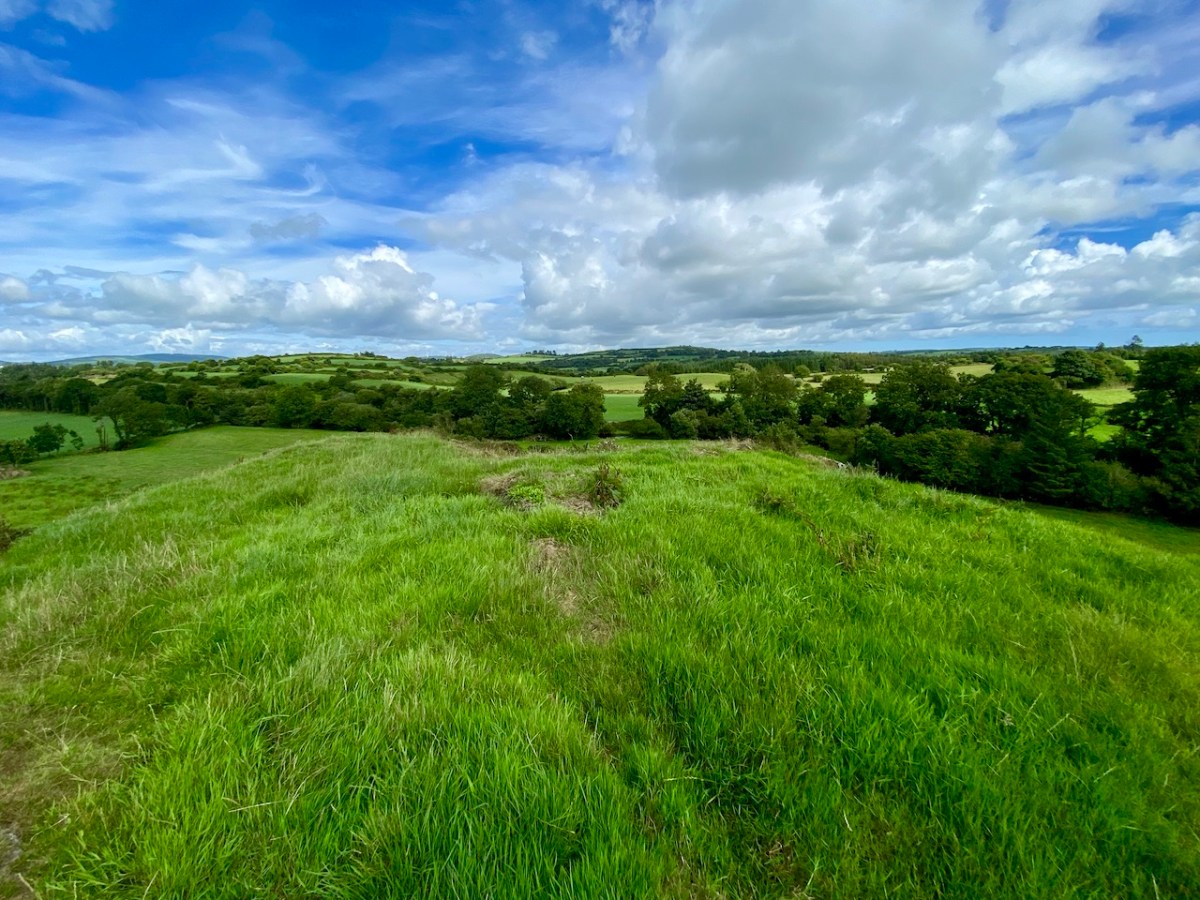
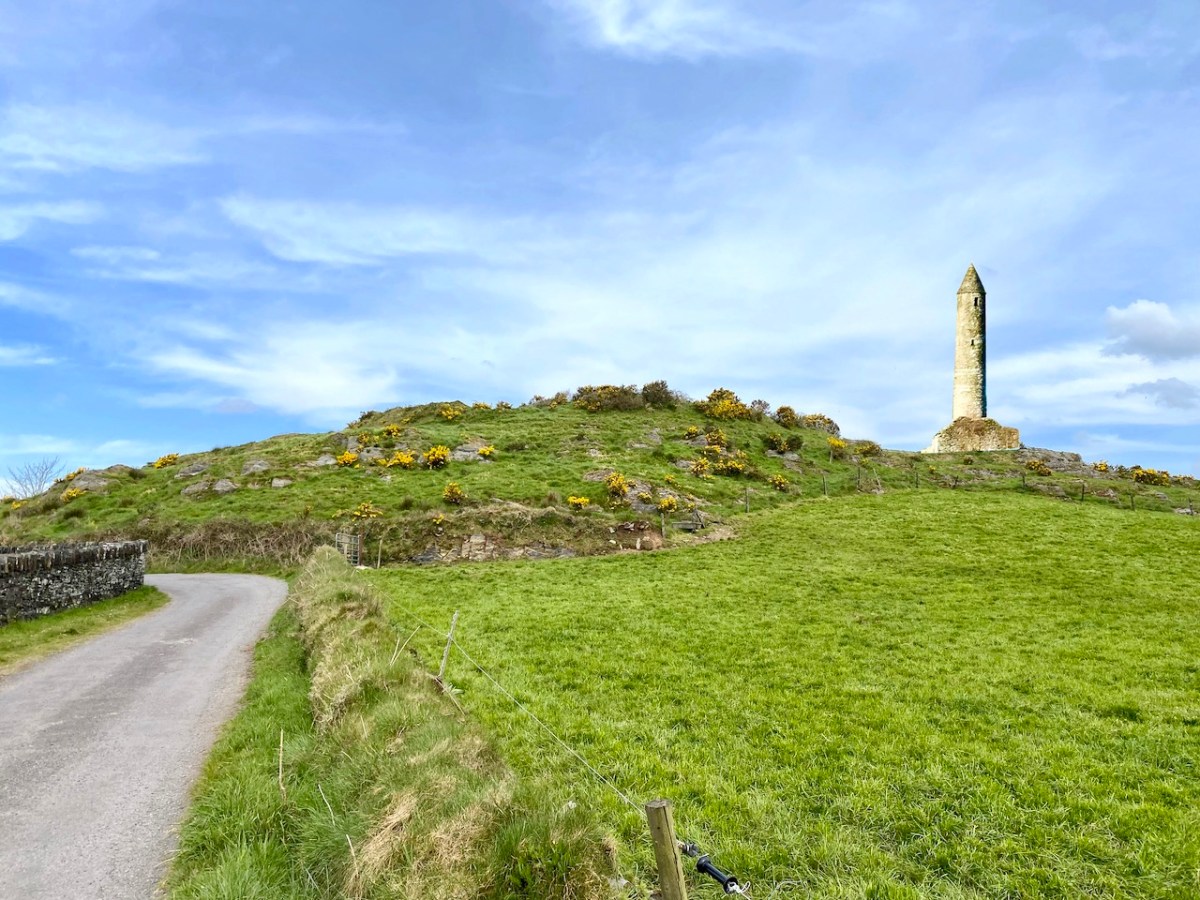
This feature (the two pictures above) is the hilltop referred to by O’Neill, where he claims to have found the ruins of the ‘Cahir’. Today it is recorded on the National Monuments Record as a ‘ringfort’ or ‘rath’:
CO132-017001-
Class: Ringfort – rath
Townland: CAHERAGH
Description: In pasture, atop hillock broken by rock outcrop. Circular area (36.5m N-S; 37.5m E-W) enclosed by earthen bank (max H 3.8m). Break in bank to NNW (Wth 5m); and WSW (Wth 4m), where triangular feature adjoins inner bank face. Possible souterrain (CO132-017002-) in SW quadrant
Archaeology.IE National Monuments Record
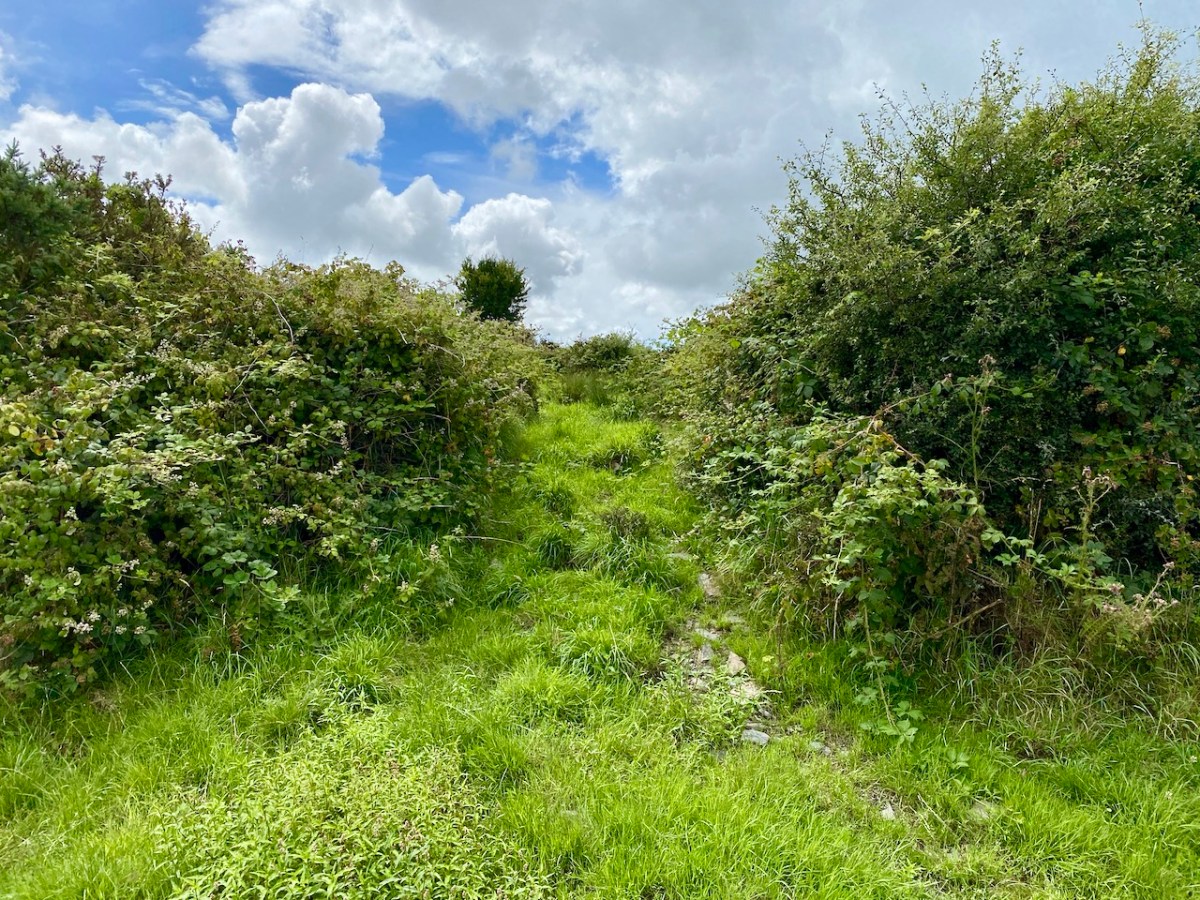
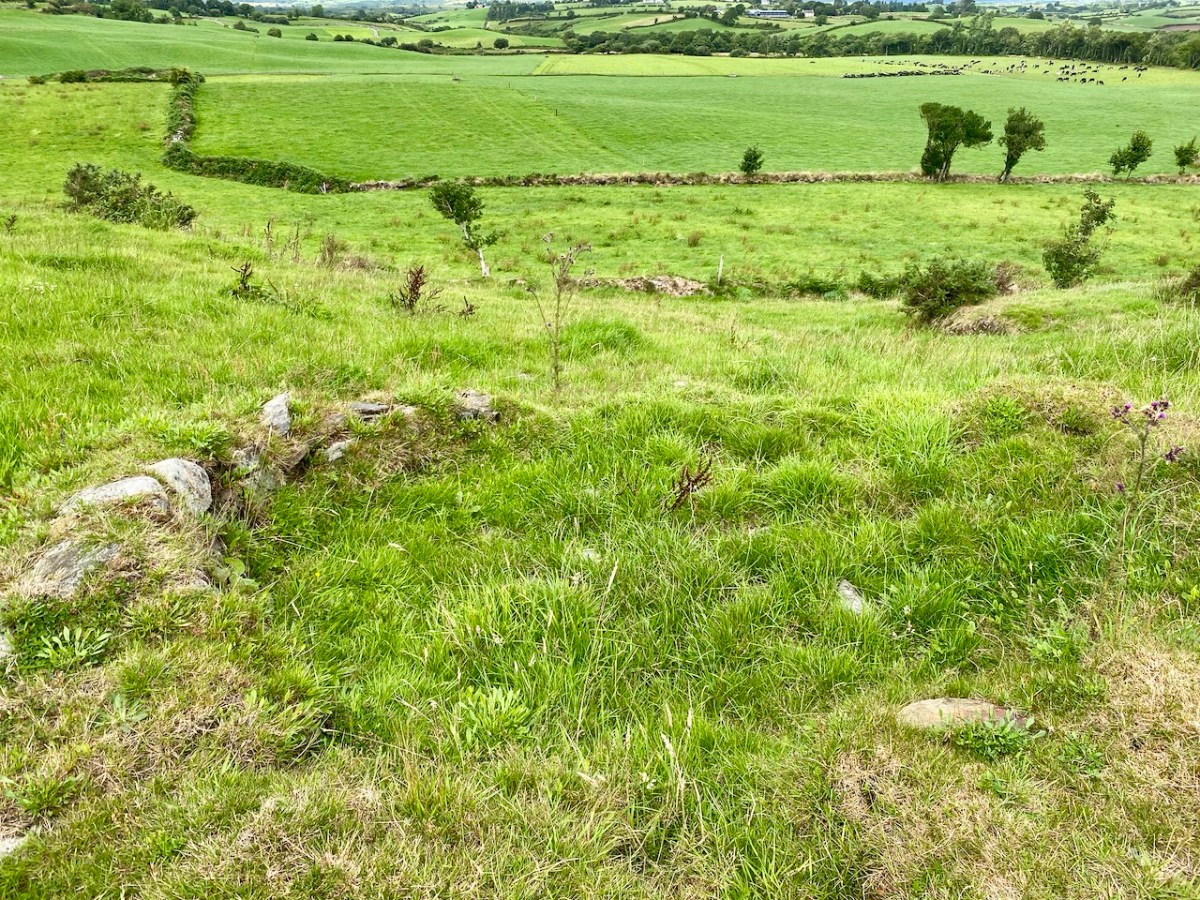
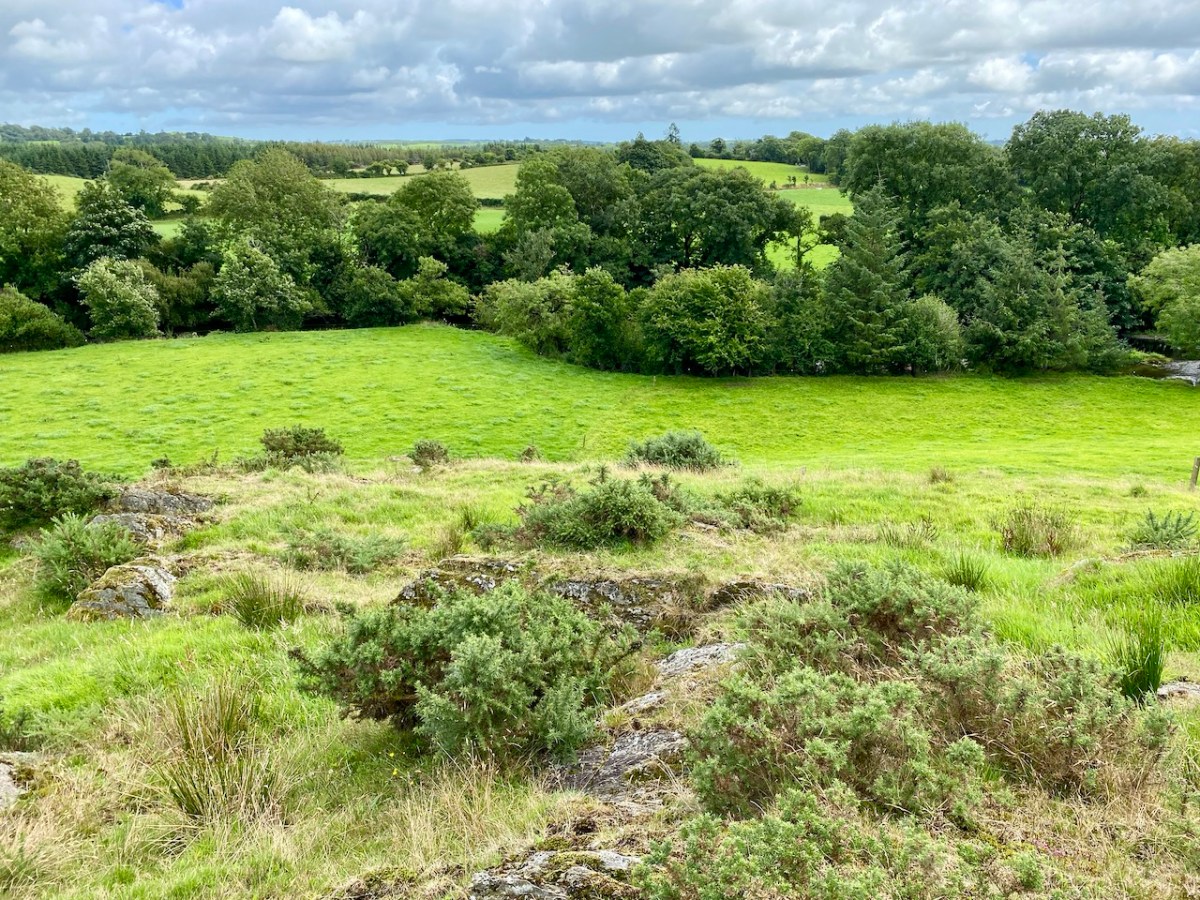
Top: flat-topped mound with circular summit, very much in line with the expectation of a ringfort structure. Centre: stone embankment seen from the top of the ‘fort’. Lower: a defined ‘entrance’ through the ‘fort embankment’ on the summit of the mound. This could be ancient or modern: cattle use the fields in which this feature is located, and some of the topography could be shaped by this usage over centuries.
. . . The builders of Abbeys and Monasteries were wise in their day in the choice of locations for their establishment, and one essential desideratum was near to a plentiful supply of water, such as the banks of lakes and rivers, or adjoining never-failing springs. In this instance the River Ilen met all requirements, and taking everything into consideration, I am led to the conclusion that the graveyard at Caheragh was the site of the “Abbey of Cahir” mentioned by Lewis in the Topographical Dictionary of Ireland . . .
Letter from Capt Francis O’Neill, Southern Star 12.01.1929
Above: evidence of built structures on the summit of the ‘ringfort’ mound at Caheragh. A significant circular foundation is clearly outlined. Perhaps, after all, there is some substance in the Captain’s musings on what occupied this site in earlier times? This account is from The county and city of Cork remembrancer; or, Annals of the county and city of Cork by Francis H Tuckey, Savage and Son, 1837:
. . . 1317 December 28, Geoffrey Fitz John de Cogan is presented by the King (by mandate to the Bishop of Cork), to the church of the Blessed Mary de Catheragh, in the King’s gift, by reason of his wardship of the lands and heir of John de Cogan . . . ‘Blessed Mary de Caheragh’ was a monastic site, said to be ‘situated on the hilltop commanding the view above the graveyard at Caheragh’ (possibly on the site of the ringfort). It was no doubt founded here because of the proximity of the watercourse . . .
So there – for your consideration – is the suggestion that the hill above Caheragh’s Old Graveyard (which may, in earlier times, have been a ringfort with a souterrain) was the monastic settlement Blessed Mary de Caheragh in medieval times. That’s quite a thought. My own opinion would be that the monastery would have been founded on the level ground close to the river: in fact where the graveyard is today. As the monastery declined, a church might have remained, eventually becoming a ruin. It was common for old churches and their environs to be used for burials and this might account for the comparative remoteness of this site from the village itself. Now – of course – there is no trace of a church ruin. This theory would hold good except for the annals quoted above, which state that a monastic site was situated on the hilltop overlooking what is now the graveyard.
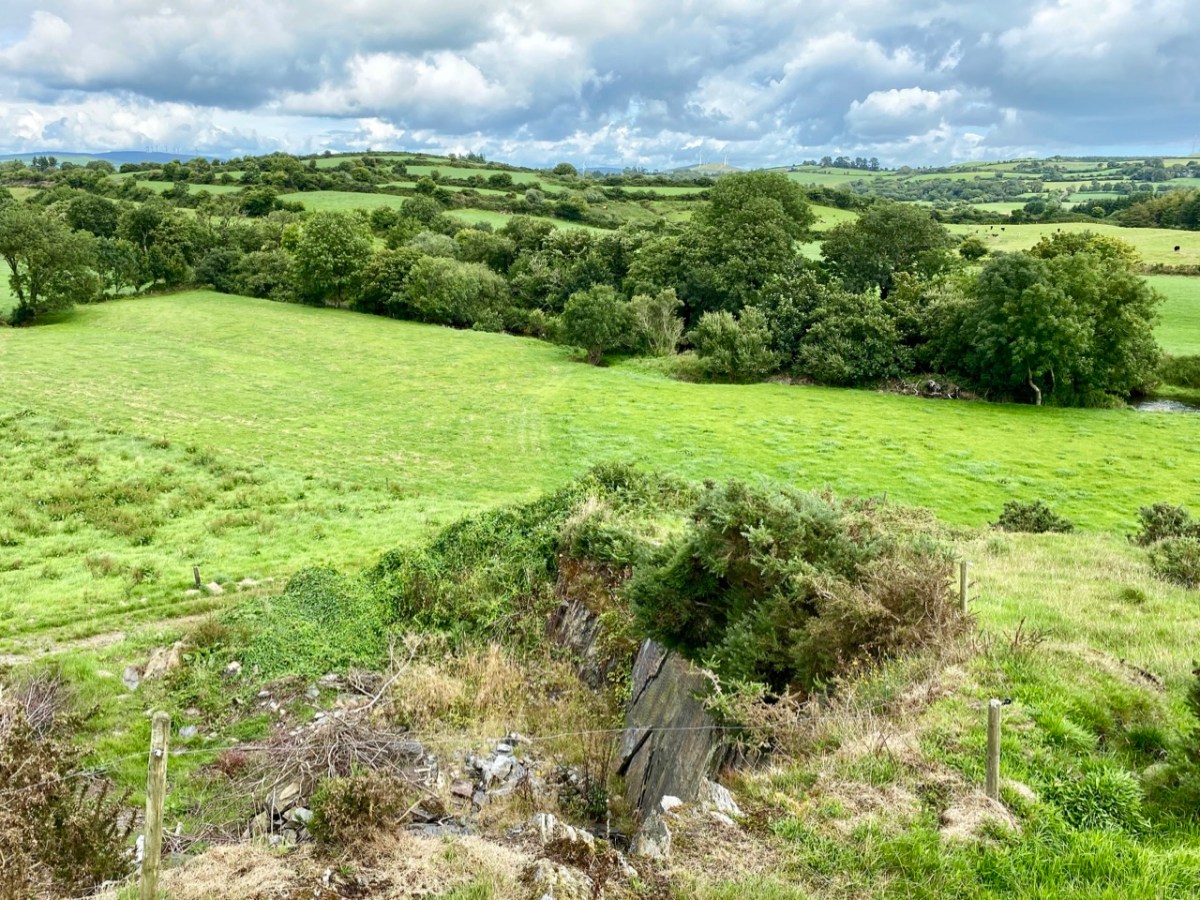
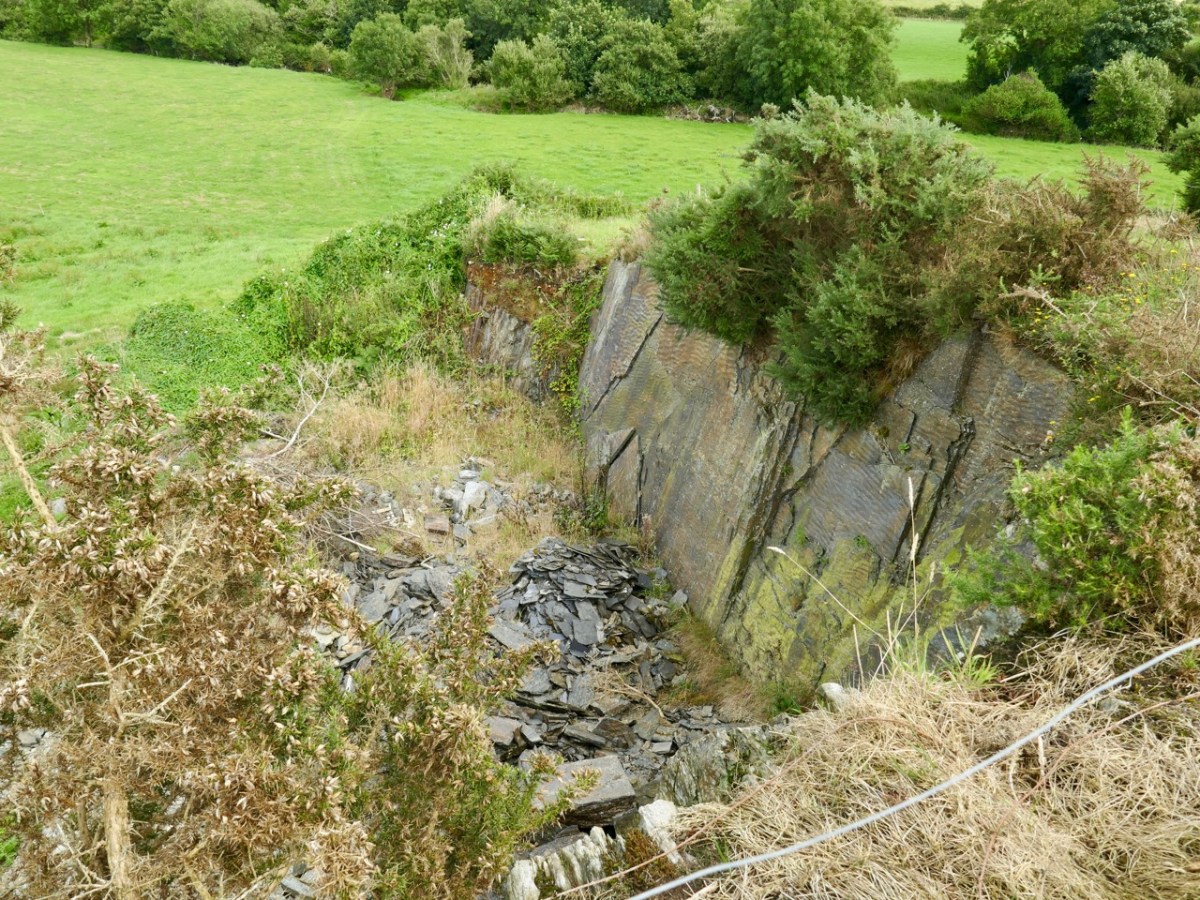
Evidence of stone quarries on the hillside suggest that significant quantities of stone has been used locally. Graveyard wall, field fences, or built structures? But the most challenging feature has to be the ringed foundation, or base, clear to see on the edge of the hill (below). Could it be a souterrain entrance – or, more fanciful, the base of a round tower?
I’ll leave you with that conundrum (and my whimsical daydream below) for now, but we will continue with Francis O’Neill’s musings (which become even more complex) in a future post.
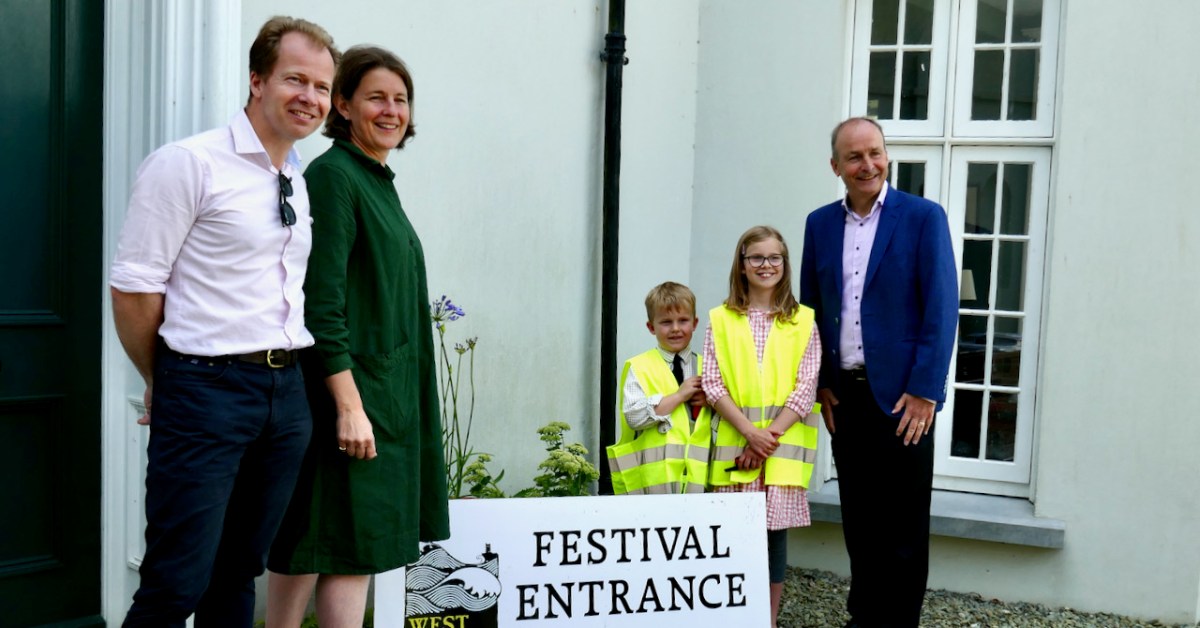
August has roared into West Cork bringing gorgeous weather and a plethora of can’t-miss events. I am wrecked already and we are only a week in! As I type we are in the middle of the marvellous West Cork History Festival. Yesterday Micheál Martin, our Taoiseach, came for the afternoon, as he has done several times in the past. He’s a former history teacher and very supportive of our Festival. He spoke compellingly in a few introductory remarks about our need for a nuanced view of Irish history, one that no longer depends on a single narrative. It was an honour to have him there – no fuss, very discrete security detail, and giving us his whole attention. (Above, Simon and Victoria Kingston, visionary Festival Founders, with their children Rory and Constance, and An Taoiseach.)
The theme of the first day was Black 47 – its the 175th anniversary of the worst year of the Famine – and I am struck anew by the horror of it all (That’s Lilian Lucy Davidson’s harrowing depiction, titled Gorta, above, which featured in the Coming Home Exhibition in Uillinn in 2018). Take a look at the Festival Program to see the range of what we were offered today. It’s a blended festival this year: a small in-house audience but anyone can register for the program online. It’s a high-quality production too – several pony-tailed and bearded young men in black were in command of all that. You can still buy tickets for the online portion – they will be good for two weeks. The luminous Jessie Kennedy, a long-time Festival collaborator, has assembled the Celestial Quartet, and together they have devised a selection of classical and newly-composed music to honour Agnes Clerke, the famous astronomer who grew up in Skibbereen during the Famine. Read all about her in my post From Skibbereen to the Moon.
The festival continues today with an emphasis on the Bandon Valley Killings – a traumatic episode in our West Cork History that deserves a full examination 100 years later.
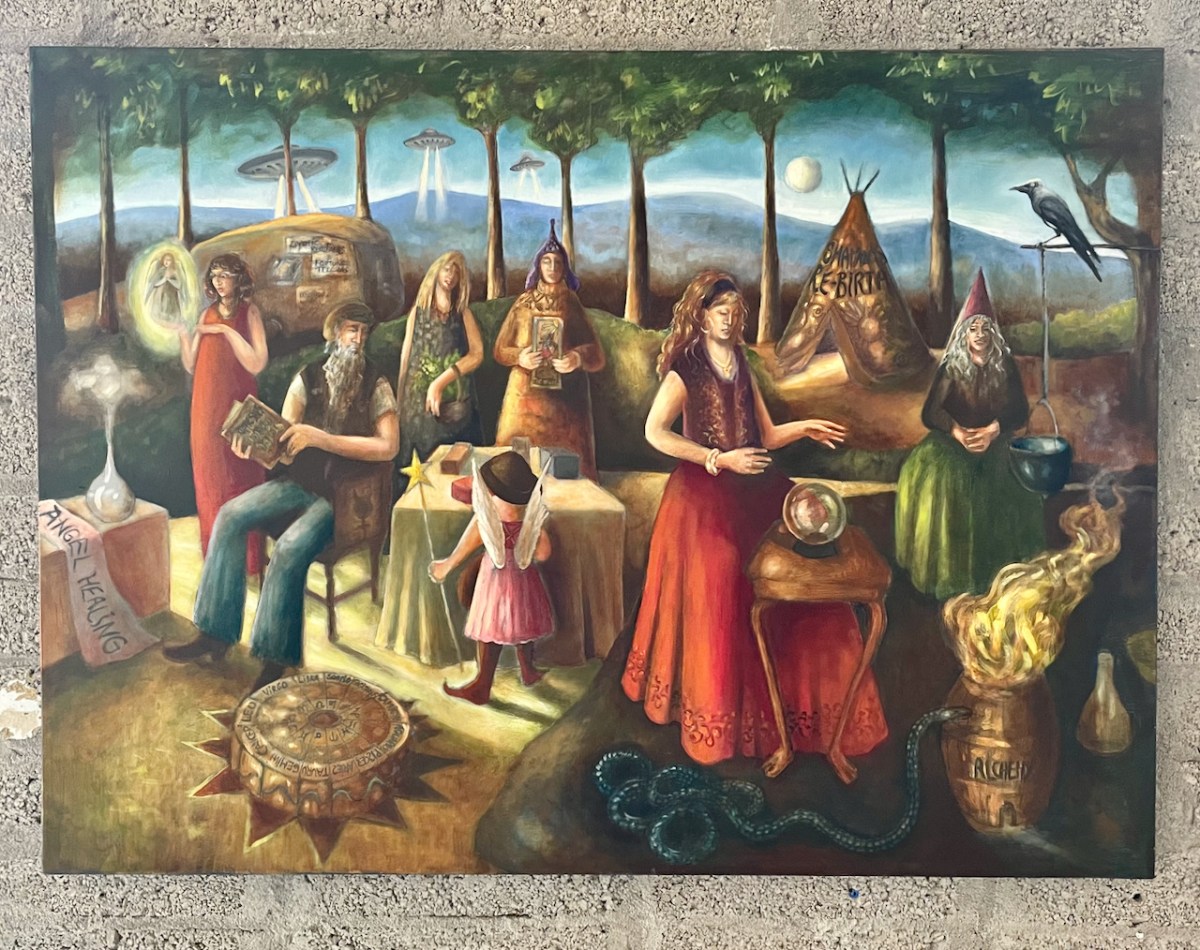
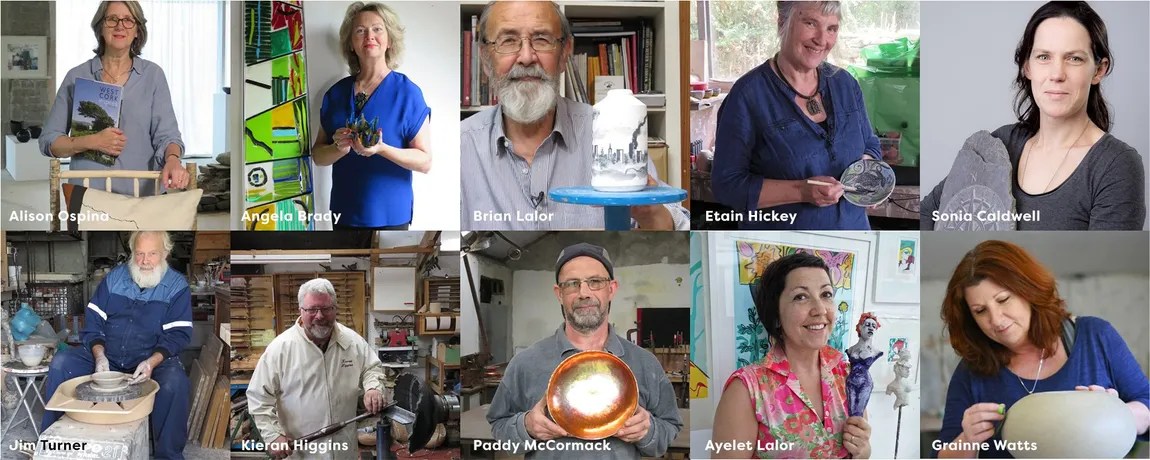
On a more cheerful note, yesterday marked the opening of what is consistently the best art and craft show in West Cork, year after year. It’s calledWest Cork Creates, is located in the O’Driscoll building in Skibbereen, and is curated by Alison Ospina and her jury panel. The calibre is as high as you will find anywhere. Above, for example, is Hilary Nunan’s work, which mixes fibres with acrylic paint – these are titled Grasses. Below is New Age Medieval, a painting by Carin MacCana. I wrote about Carin’s stained glass work in this post – she is now retired from teaching and has stated to devote her time to painting. She and Penny Dixie share an extension of the Gallery for their own show as well.
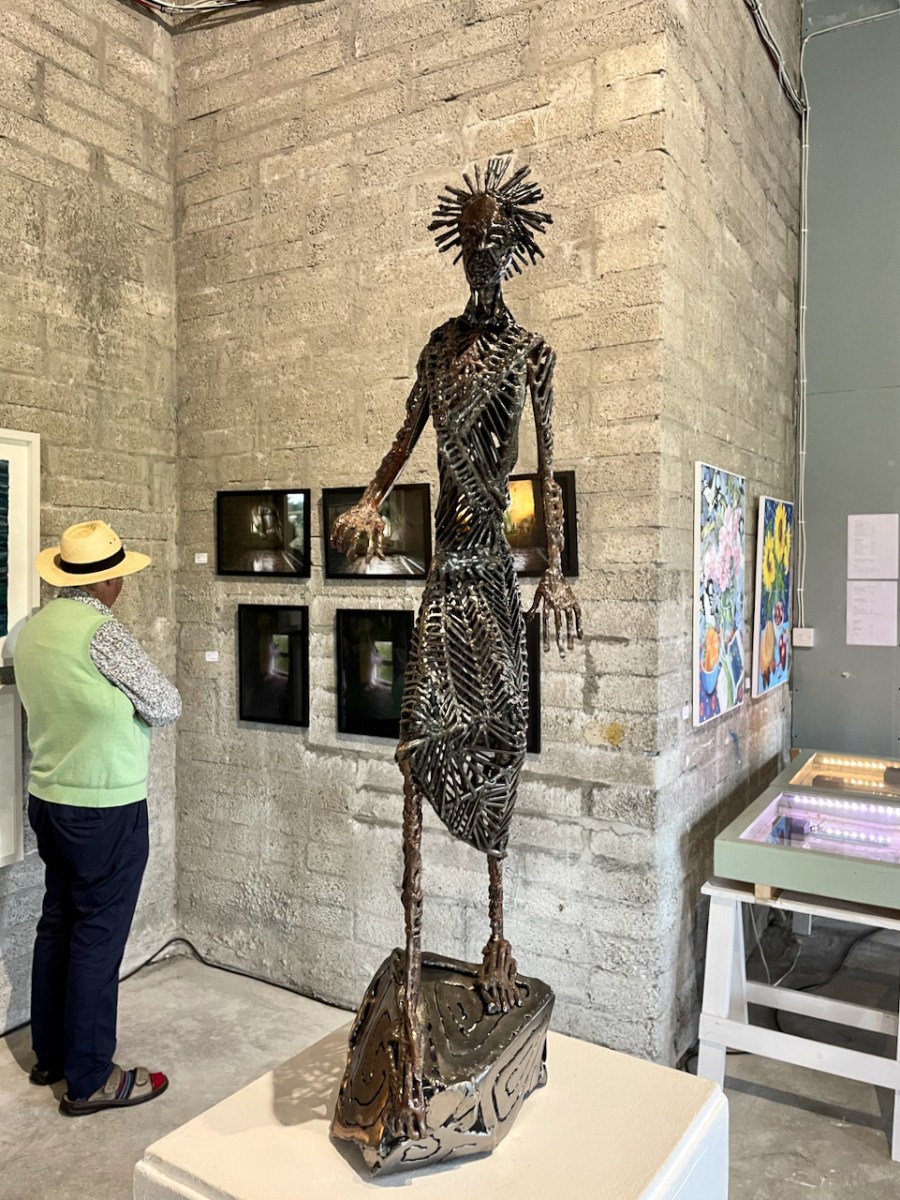
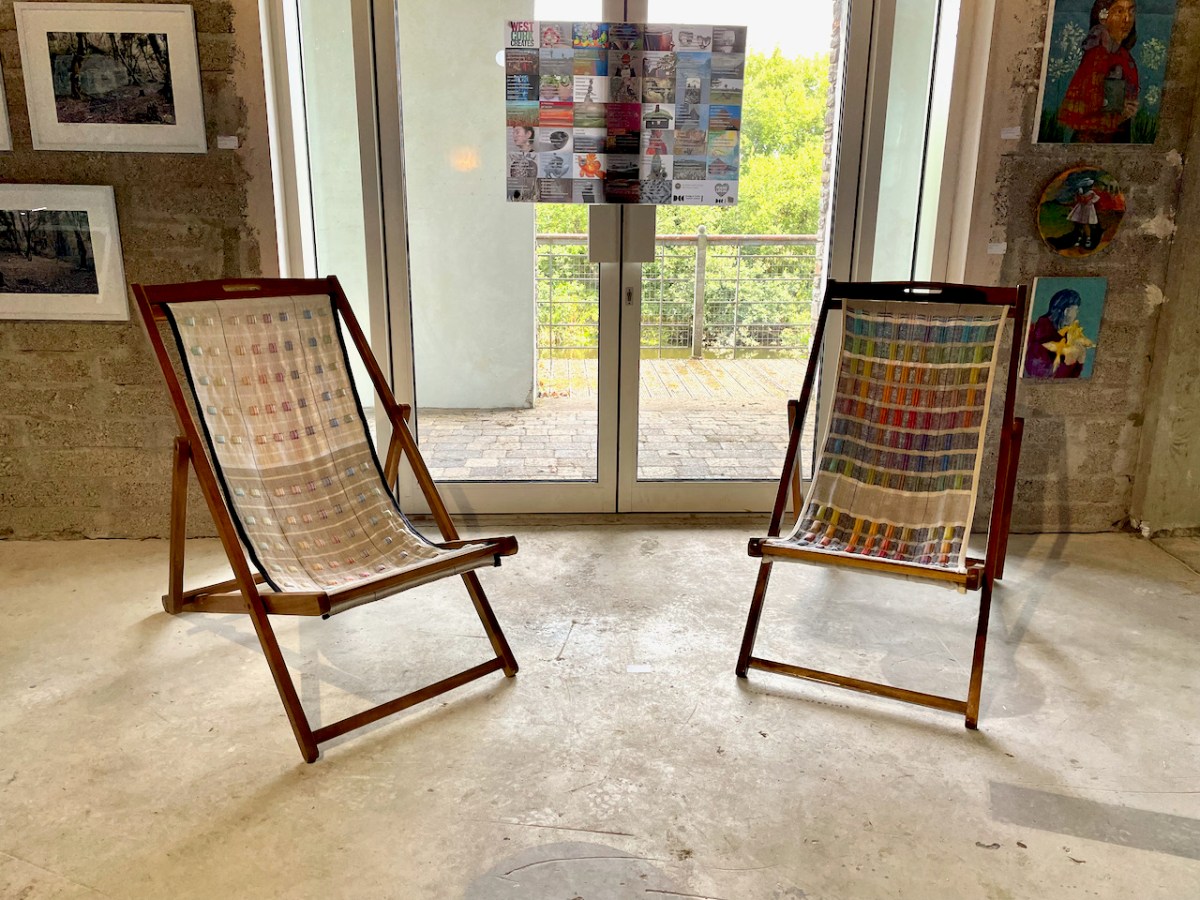
Dubhaltach Ó Colmán has several striking metal sculptures in the show (above). His work goes from strength to strength. But perhaps our favourite were the two deckchairs below, reclaimed by Suzanne McGuirk and covered with her own exquisite organic linen woven fabric. They are soon to grace the terrace of our own home!
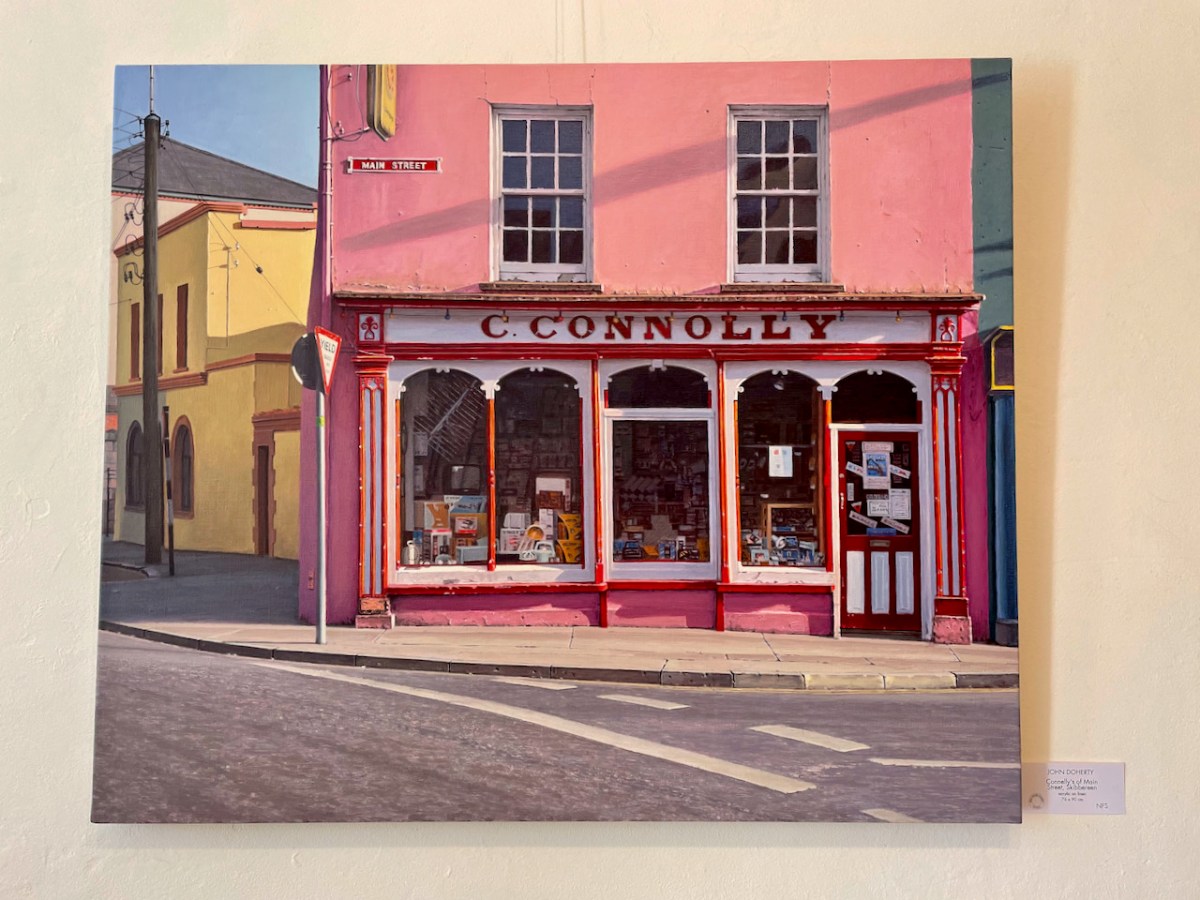
In Schull, the Blue House Gallery has just opened an exhibition of work by John Doherty. A photorealist painter, John’s work draws you in initially with its detailed representation of everyday objects: it’s nostalgia, you think at first, before it dawns on you that, as the Taylor Gallery says of his work: His images, coupled with the wry wit of their titles, point towards the human stories that exist behind the facades that represent a meticulous examination of the half-forgotten life of the past. No, that’s not a photograph, below, of Connolly’s of Skibbereen – it’s one of John’s paintings.
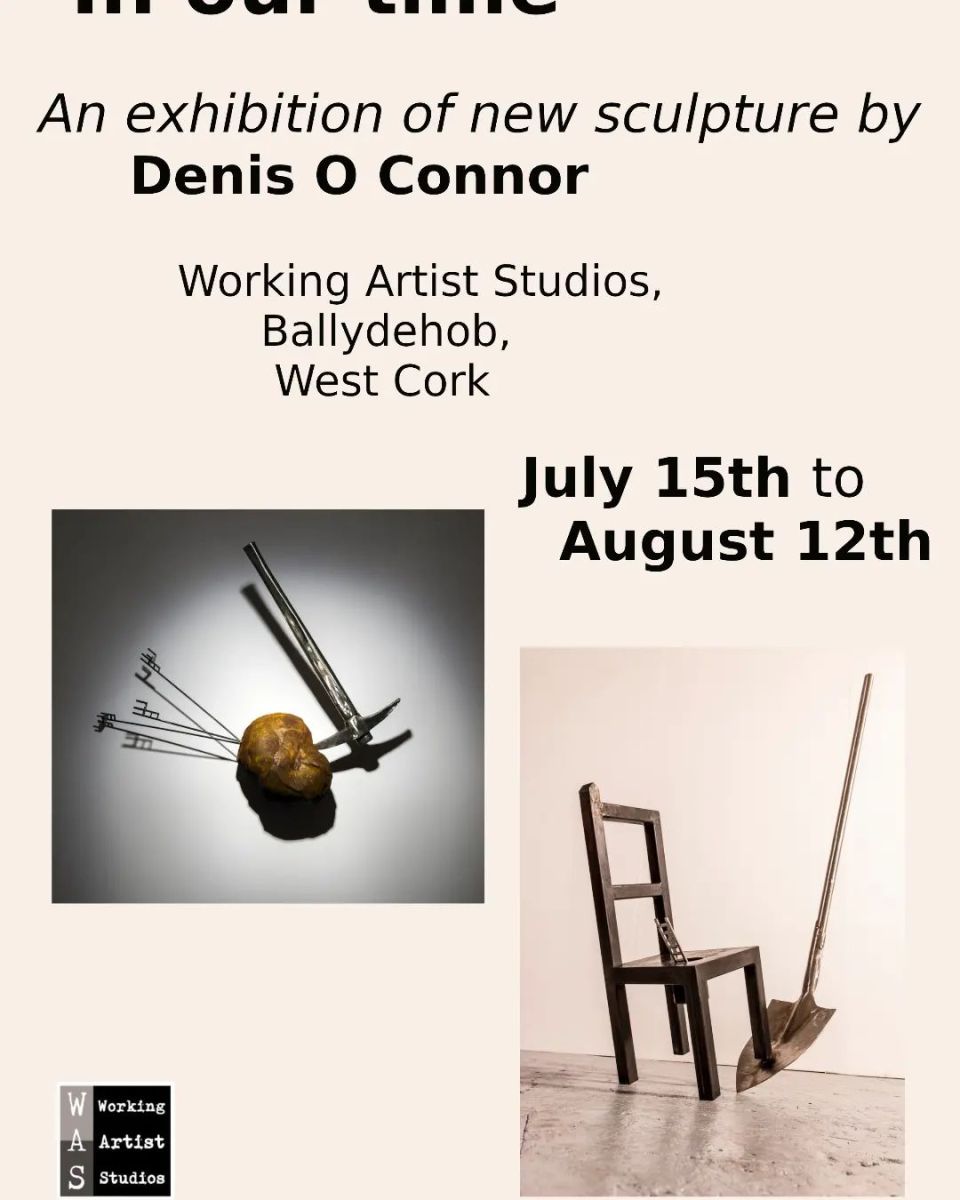
And in our small village of Ballydehob we have not one but four exhibitions, all worth visiting right now! Starting from the top of the main street, let’s first drop by The Working Artists Studio, who are currently hosting the sculptor Denis O’Connor. He’ll be giving a talk on Friday and we intend to be there.
Of his work he says:
Process and Making are central to my sculpture, working in an intuitive, physically dynamic way, trying to develop new ways of defining my language of sculpture. I work with the medium of steel towards creating physical forms [rocks and boulders] which begin to transcend a sense of how elements of the landscape are made but also its physical vulnerability and hostility.
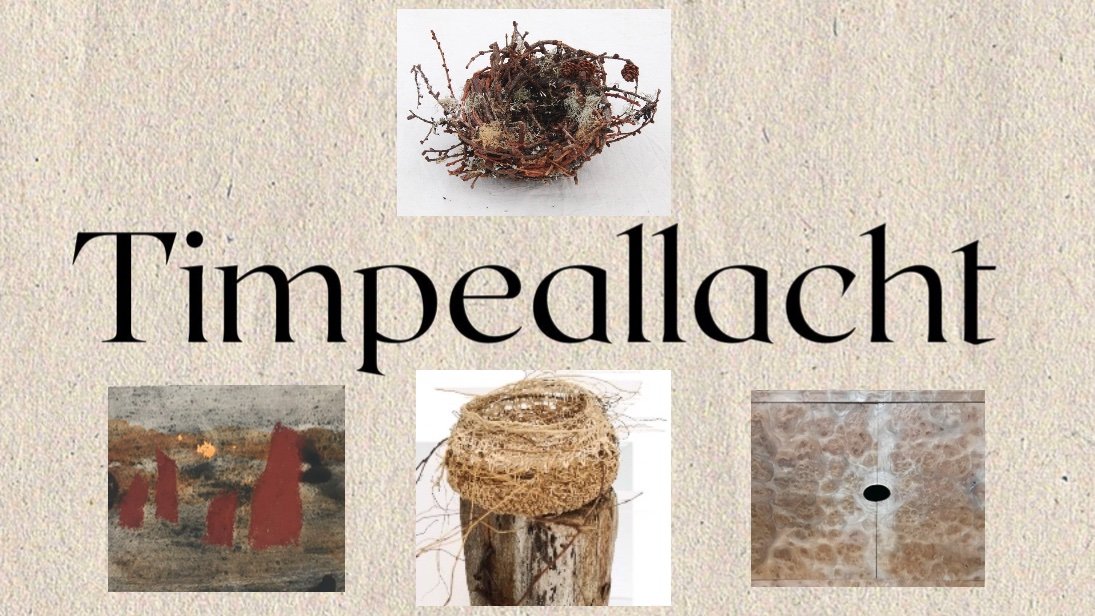
Finally, a new-ish addition to the village, the Kilcoe Studios is hosting Timpeallacht (it means surroundings or environment) in which all the items have been made from local and natural materials.
There’s more – much more – but this will give you a flavour of how we are spending our time right now. Next up for us is the superb Ellen Hutchins Festival. No wonder I’m exhausted – and blissed out. I will leave you with a ‘Head’ from the indefatigable Angela Brady – regular readers will remember we took a glass workshop with her.
Welcome to the UCD Library Cultural Heritage Collections blog. Discover and explore the historical treasures housed within our Archives, Special Collections, National Folklore Collection and Digital Library


















 Roaringwater Journal