Goat Islands: Two, For Now

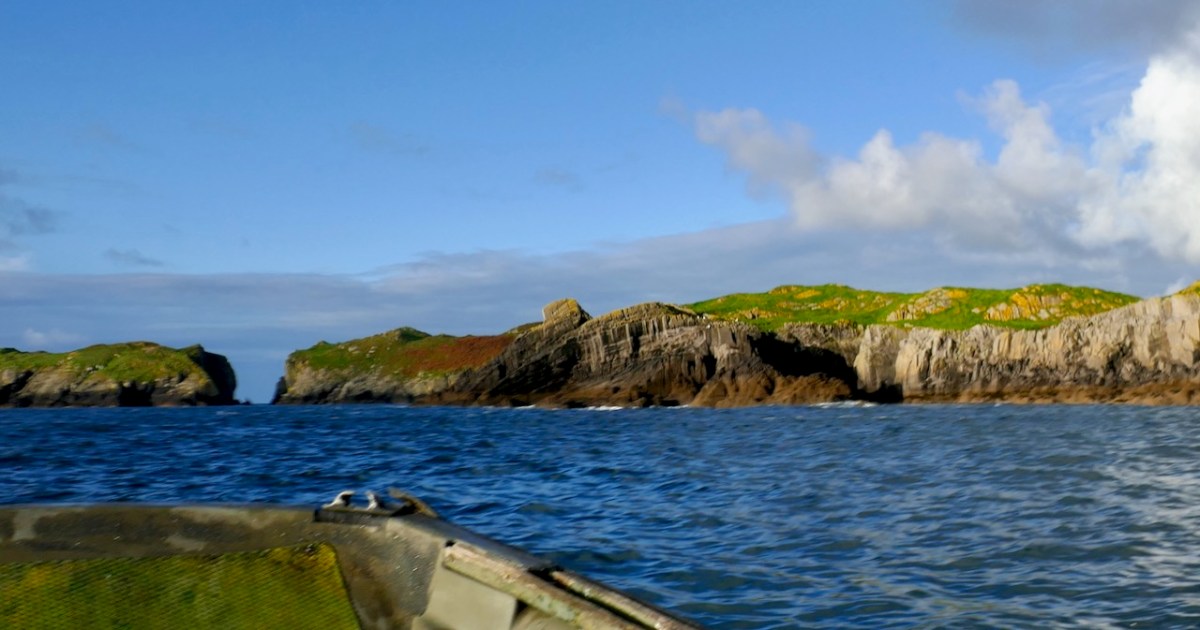
This week I was fortunate to be taken on a trip to the Goat Islands – Goat Island and Goat Island Little – by my friend Nicky – thank you, Nicky! We had a fine forecast for the morning and seized our chance.  
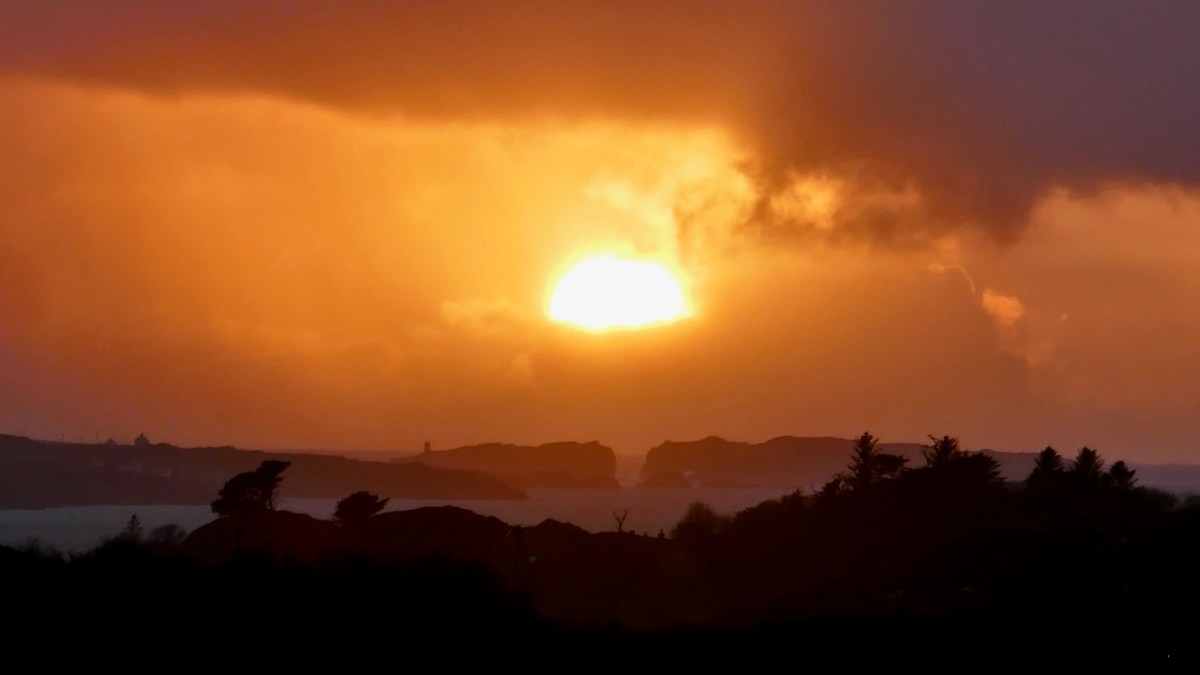
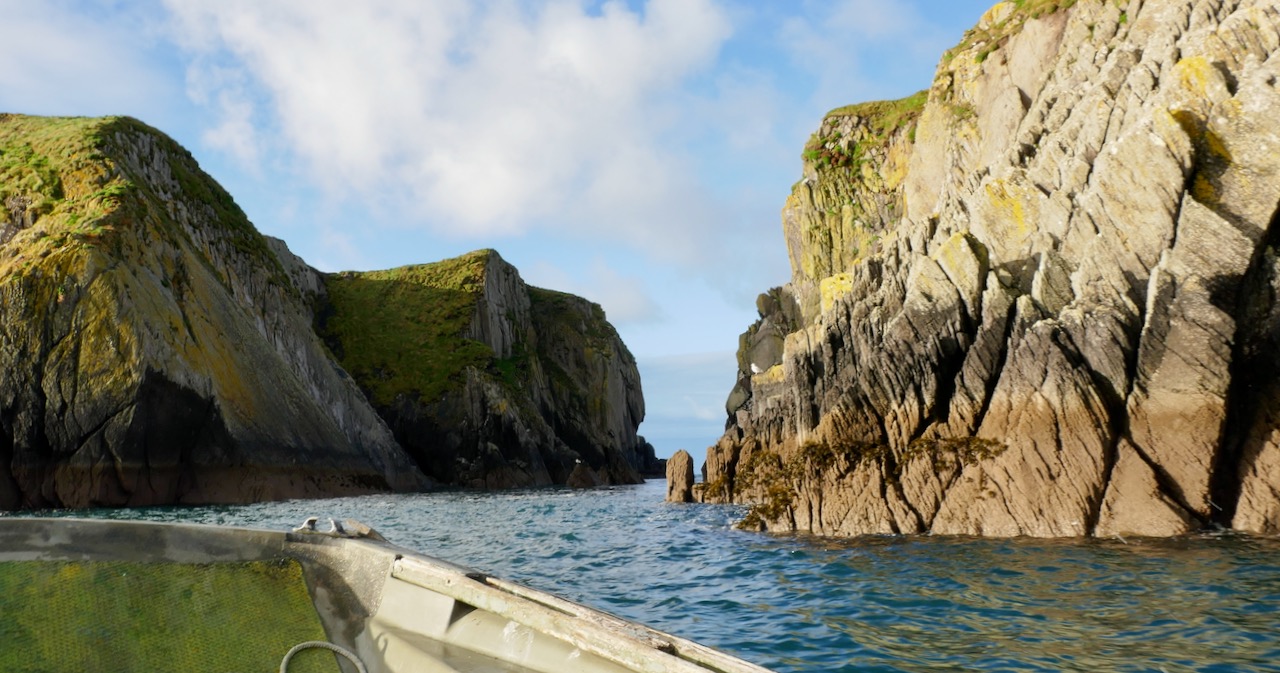
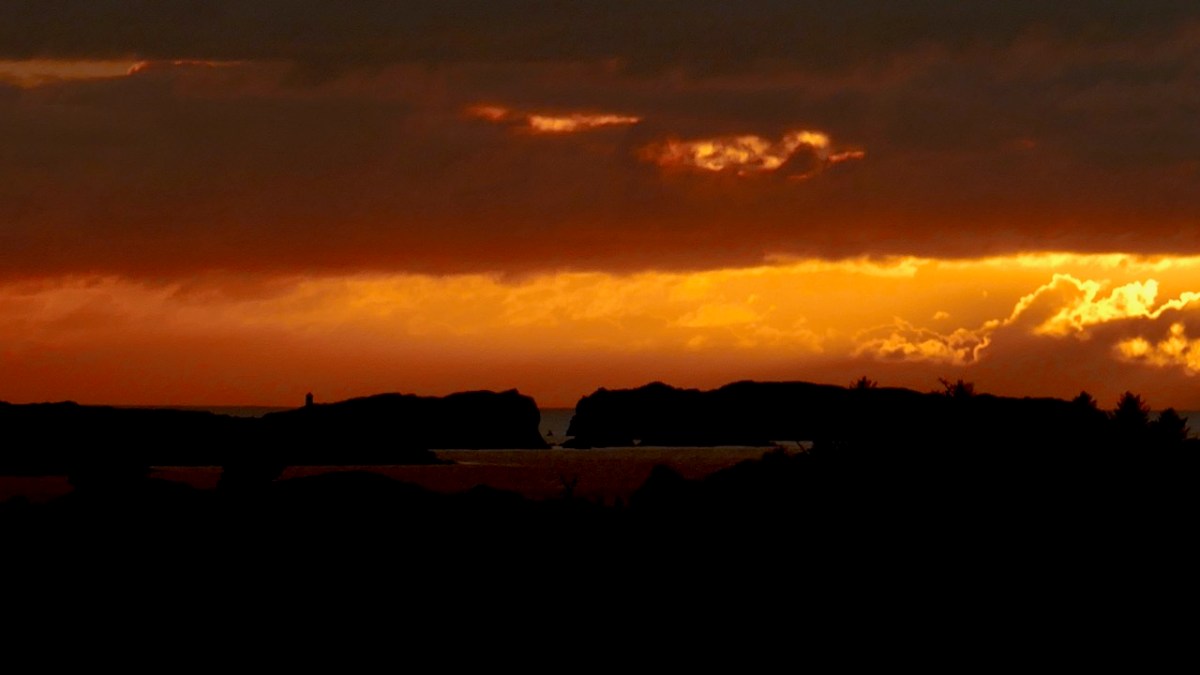
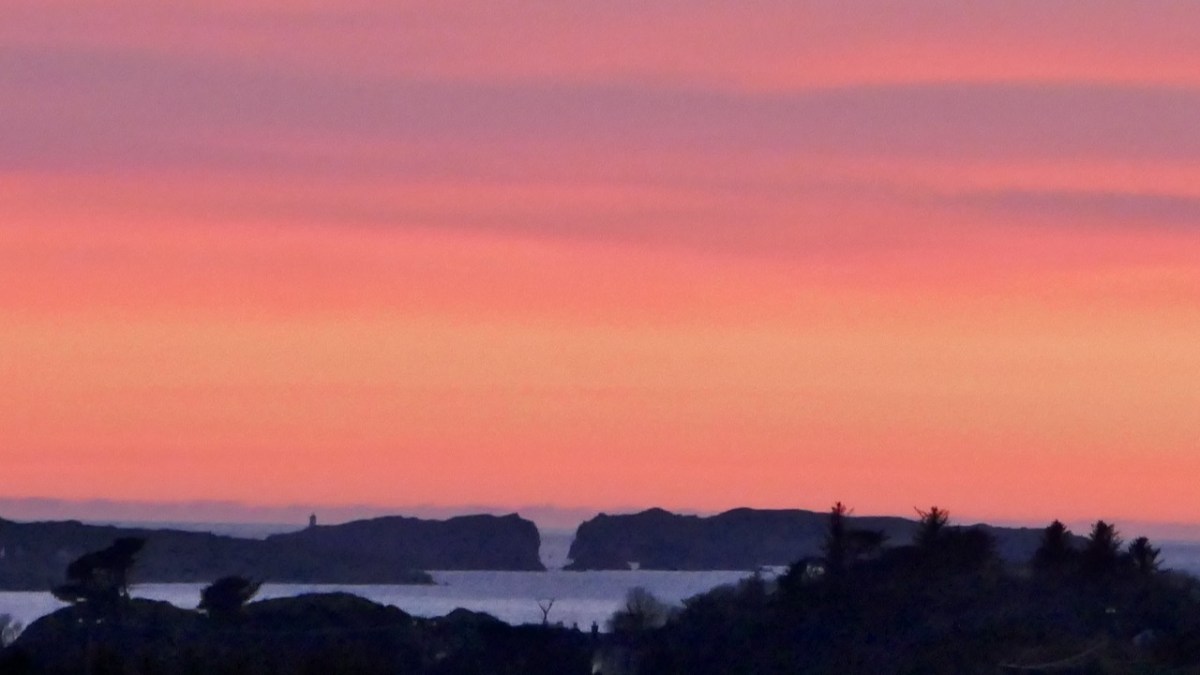
I can see the Goat Islands from my house and have been wanting to view them up close for as long as I’ve lived here. That’s because the two islands are separated by a cleft and twice a year the sun sets directly in the gorge created by that cleft. I’ve never managed to capture that moment (darn clouds) but I have come close. And somehow that impossibly romantic image, like a corridor to some magical realm, has sunk into my consciousness and manifested as a longing to go through that gorge in person. The experience was just as wonderful as I thought it would be.
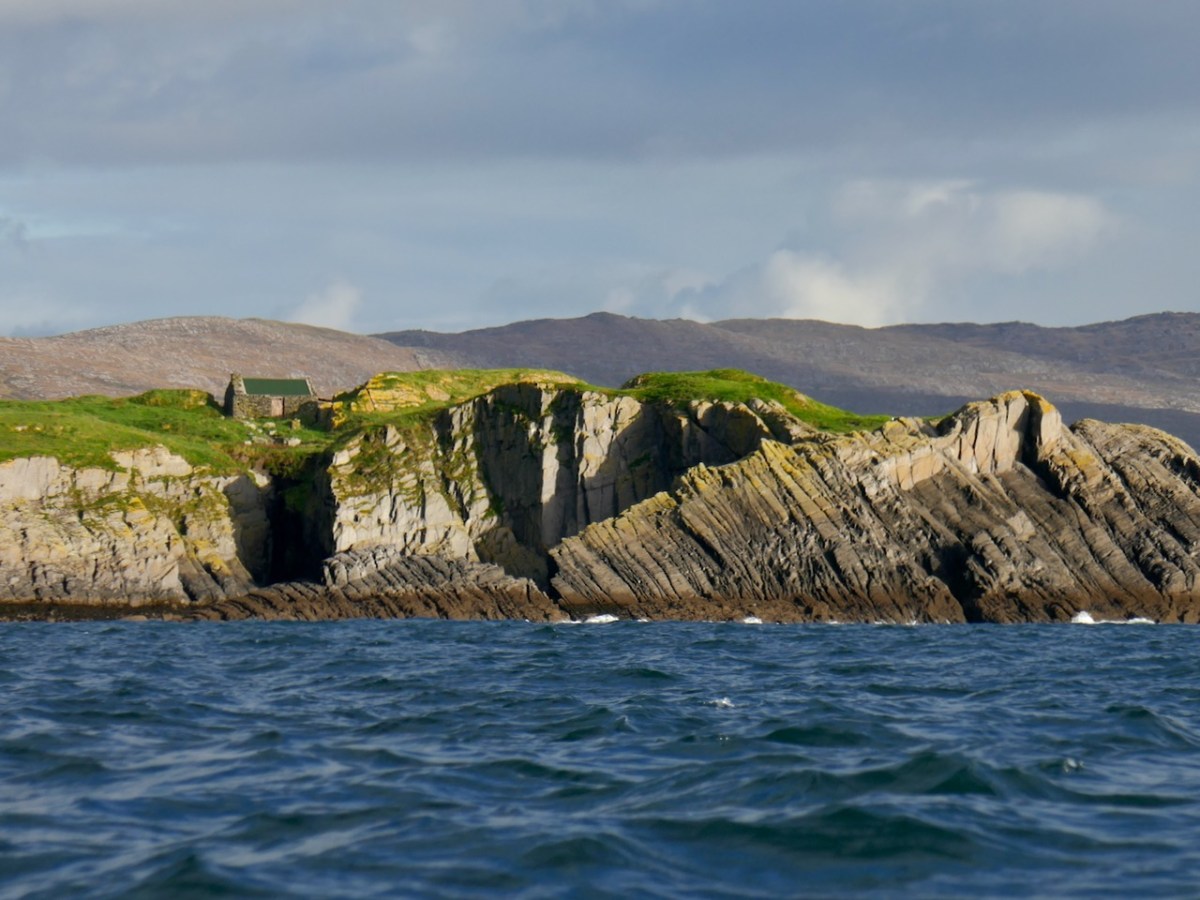
There isn’t much history to the Goat Islands. They are unoccupied now except for a herd of feral goats, but there is a small hut on Goat Island, recently re-roofed (does anyone know who has done this and why?).
When the first Ordnance Survey was done in the 1840s there was a cluster of buildings – probably the hut and a couple of outbuildings. 

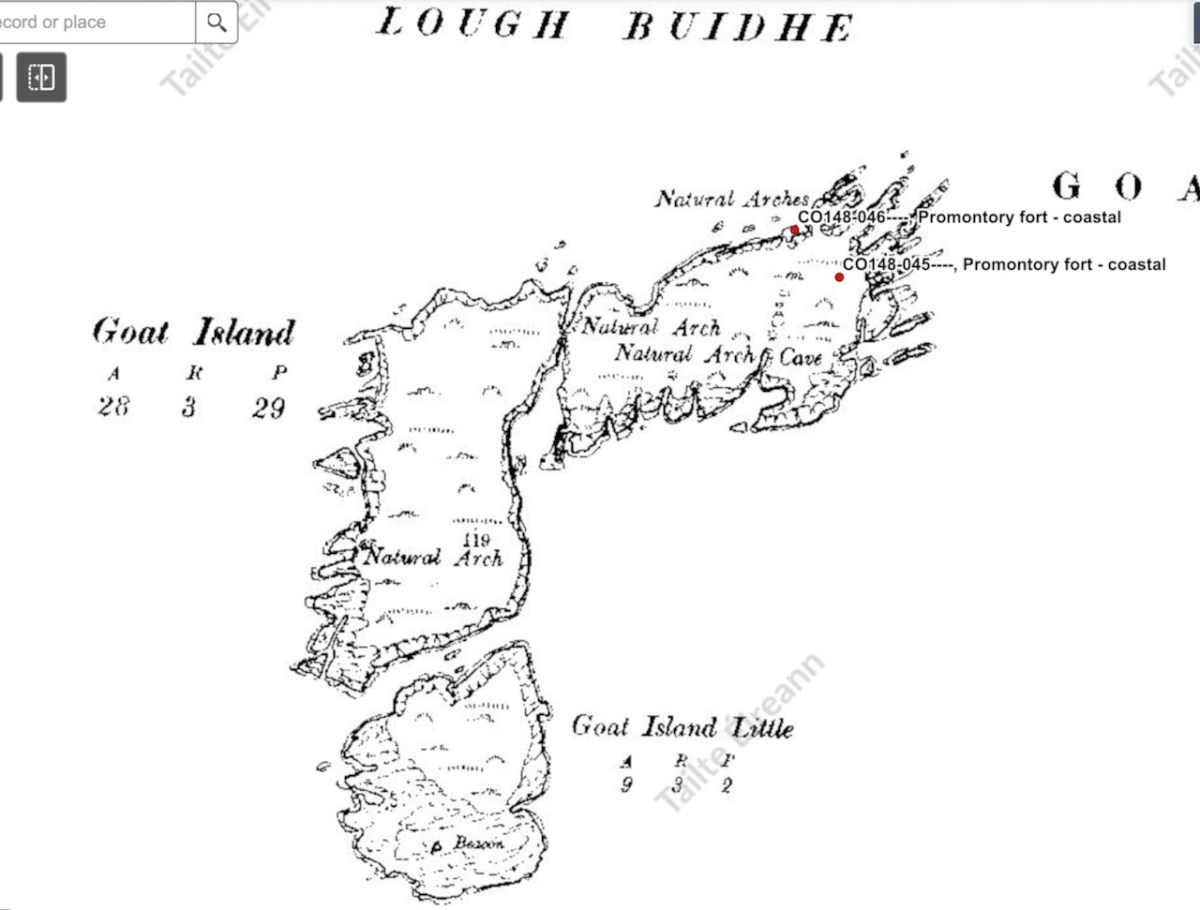
The name in Irish is Oileán Clutharach, which means Sheltered Island. Hmmmm – anything less sheltered is hard to imagine. On some maps and charts, the gap between Goat and Long Island is called Goat Sound, while the gap between Goat Island and the small rocky islet to the west is called Man-of-War Sound. That’s the 1849 Admiralty Chart below. I happen to have a copy, but you can find it here.
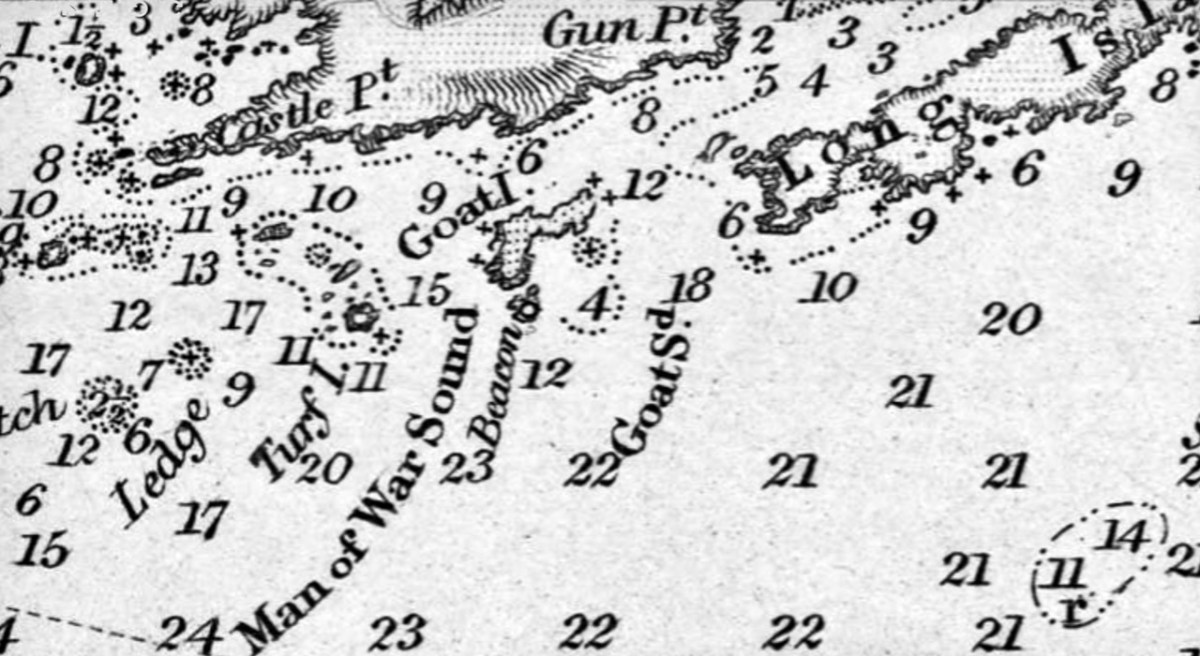
That islet is called Illaunricmonia, which translates, improbably, as Island of the King’s Copse, although it is called Turf Island on the Admiralty Chart. The sea between Goat Island and the mainland is labelled, on one of the early OS maps, Lough Buidhe, meaning Yellow Sea. All in all, a curious and seemingly inapt set of names that hint at more history that appears at first glance.
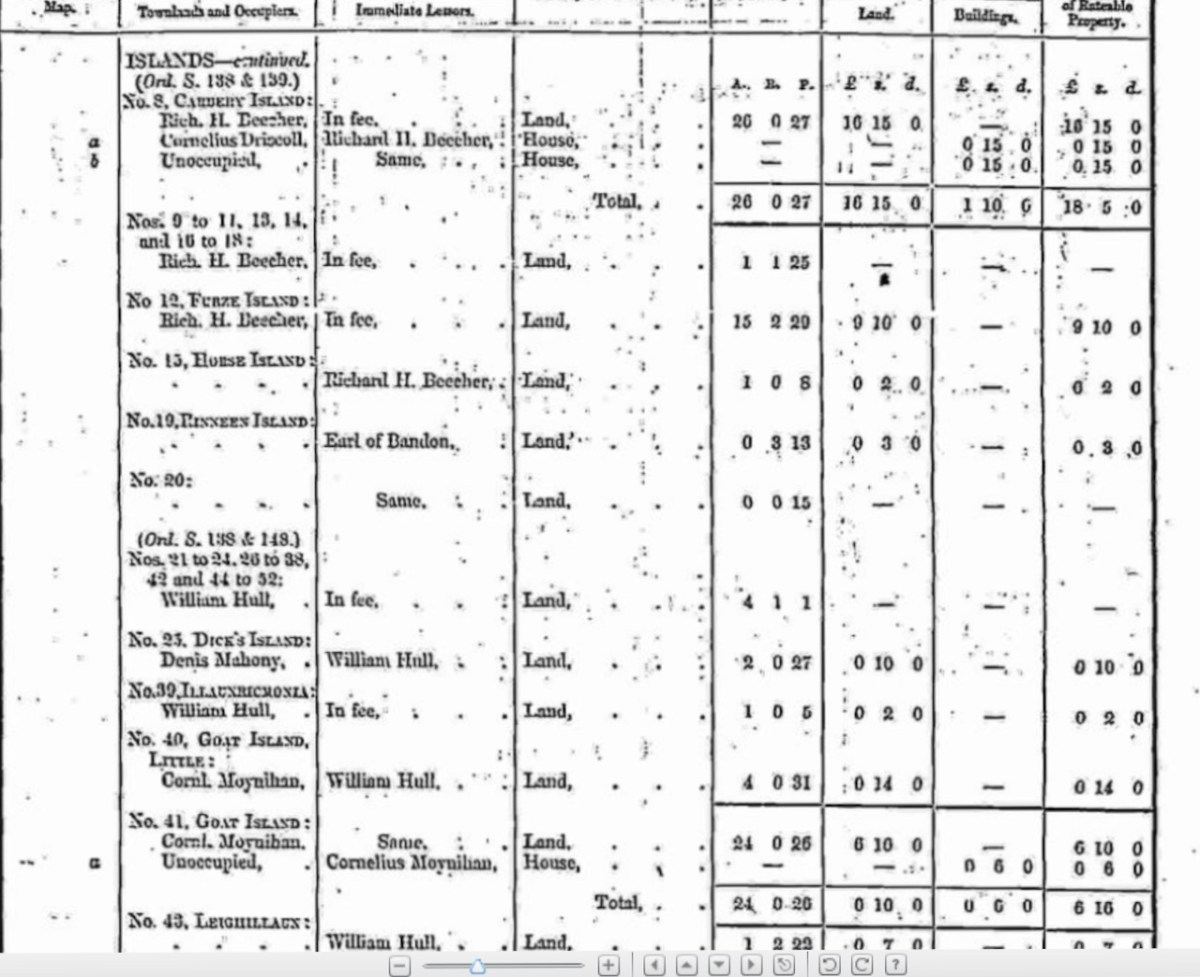
Griffith’s Valuation tells us both islands were owned by William Hull and Leased to Cornelius Moynihan. In the mid-nineteenth century, Goat Island Little was worth 14s and Goat Island 6£ 10s, while Moynihan’s hut was worth 6s. There are traces of lazy beds, visible even on the aerial photos – it’s hard to imagine how difficult it must have been to live here. Neither island has an obvious landing place but I understand it is possible to land on Goat Island if you know what you’re doing.
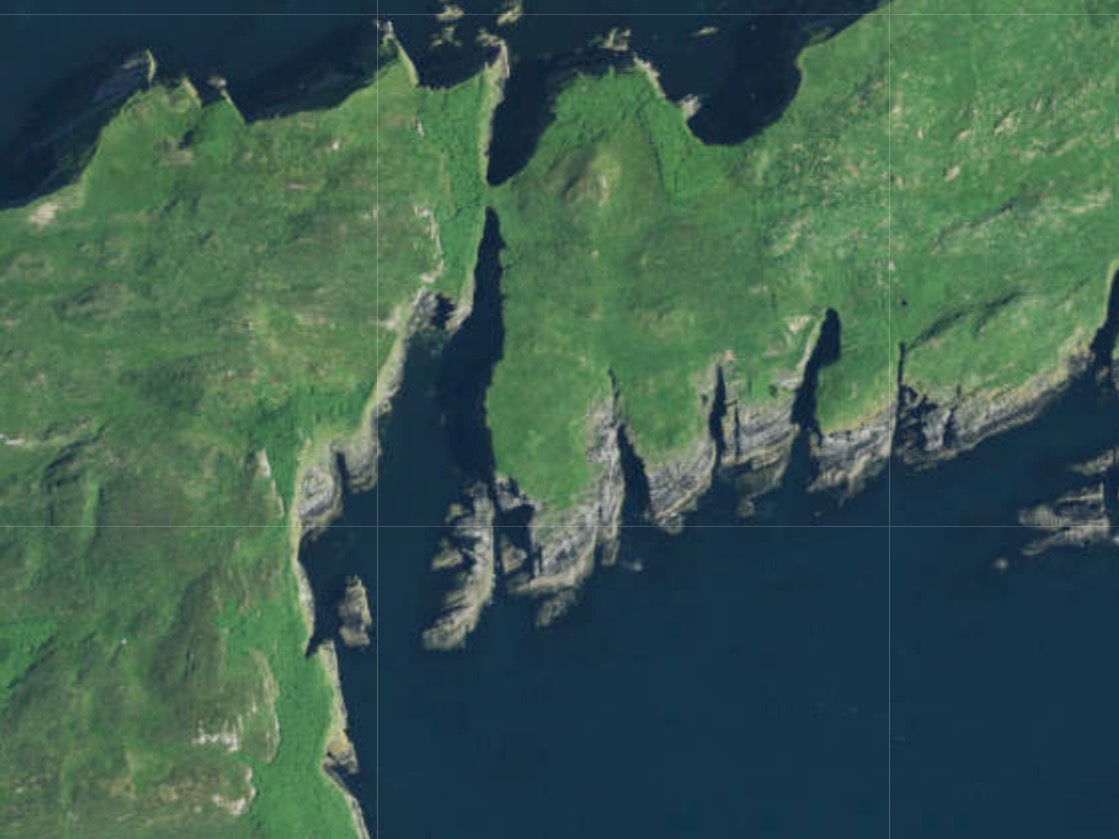
Not much history – but lots of geography! This was once one island, and probably joined to Long Island, which itself is one of a string of continuous islands off the coast. The cleft which divides it into two Islands probably started off as an indentation – and there are more indentations and developing clefts and fissures. Some of these now form sea-arches and at least one will eventually collapse, creating two island out of Goat Island. 
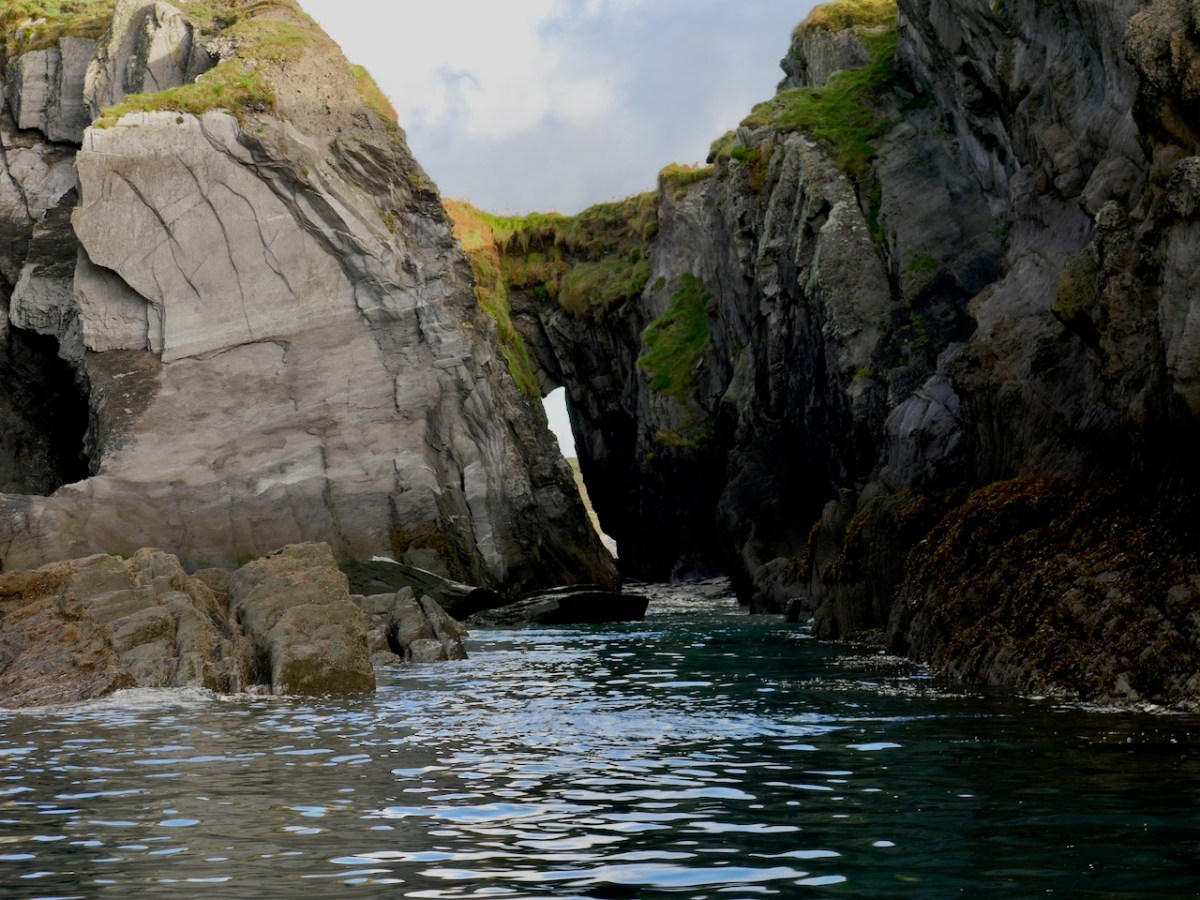
We could see right through the crack at the join point. 
The only structure on Little is a masonry beacon. Dan McCarthy in an entertaining piece for the Examiner, give the following account of the beacon.

Goat Island Little . . . was deemed suitable in the 1850s for the construction of a beacon to aid navigation for boats entering Schull Harbour via Long Island bay. A second beacon was constructed at Copper Point at the west end of Long Island. How the workers and boatmen managed to land themselves, as well as the stone, cement, and other materials needed for construction can only be marvelled at. In the end, the structure reached almost 5m in height and weighed 250 tonnes when it was completed in 1864. It was repaired in 1961 when 40 tons of gravel were brought from Schull to reinforce the foundations. However, The Skibbereen Eagle newspaper . . . recorded its distaste at the new construction. “These celebrated structures, finished at last… but to what order or style of architecture they belong we have been unable to discover. We have however been informed that, like their neighbour at Crookhaven, they are neither useful nor ornamental, as in the day time they are not required, while at night they can not be seen.”  The newspaper went on to recommend that, as in Normandy, the head of the gurnet fish, when properly dried, be filled with tow (wick) from which a brilliant light emanates when lit. Thus ‘an inexpensive and brilliant light would be produced, and the effect, no doubt, would be exceedingly useful and picturesque during the ensuing dark winter nights’.

While we don’t endorse the gurnet fish alternative, we do have to admit that this is not the prettiest beacon, being remarkably phallic is its appearance.

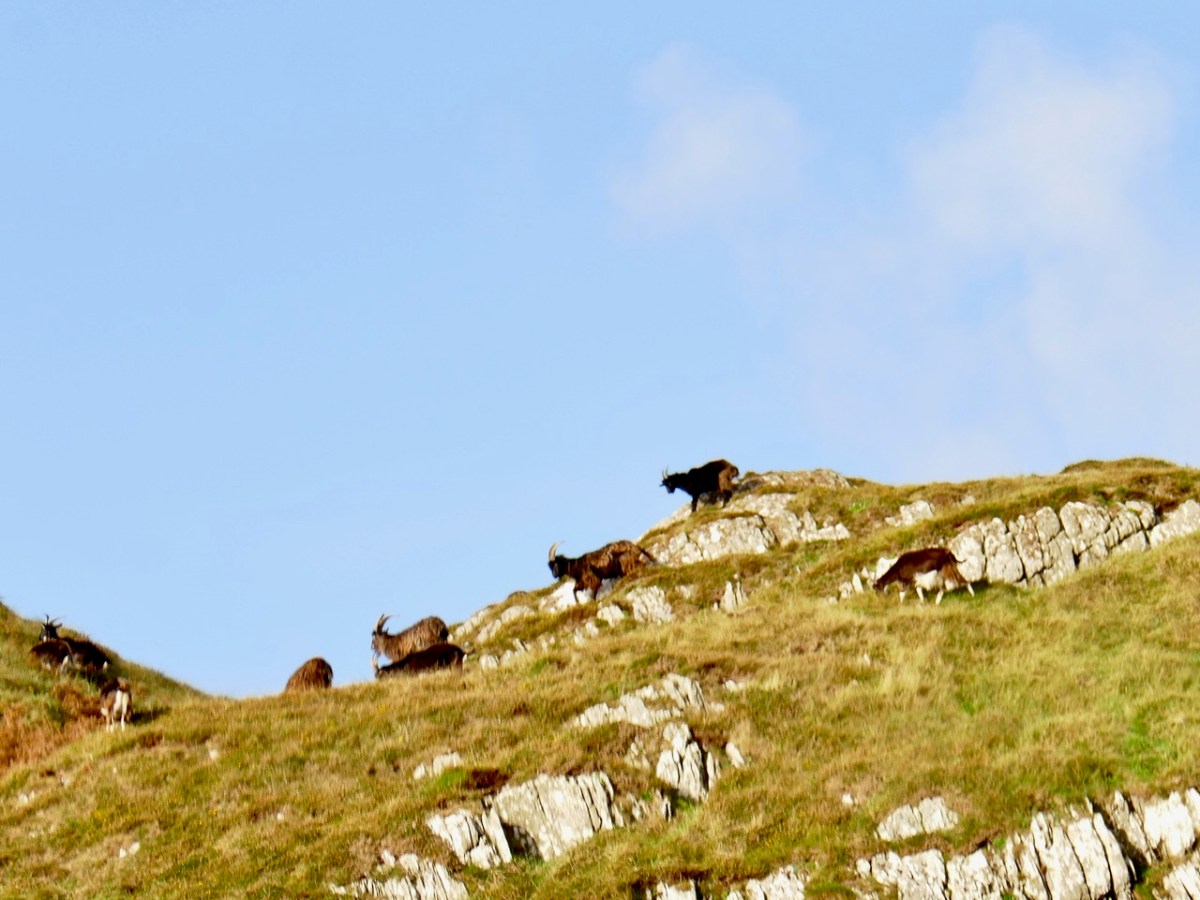
And what about the goats? Yes, they are there, on the larger island, with nothing to disturb them. The population, I imagine, is kept in check naturally by the availability of food.
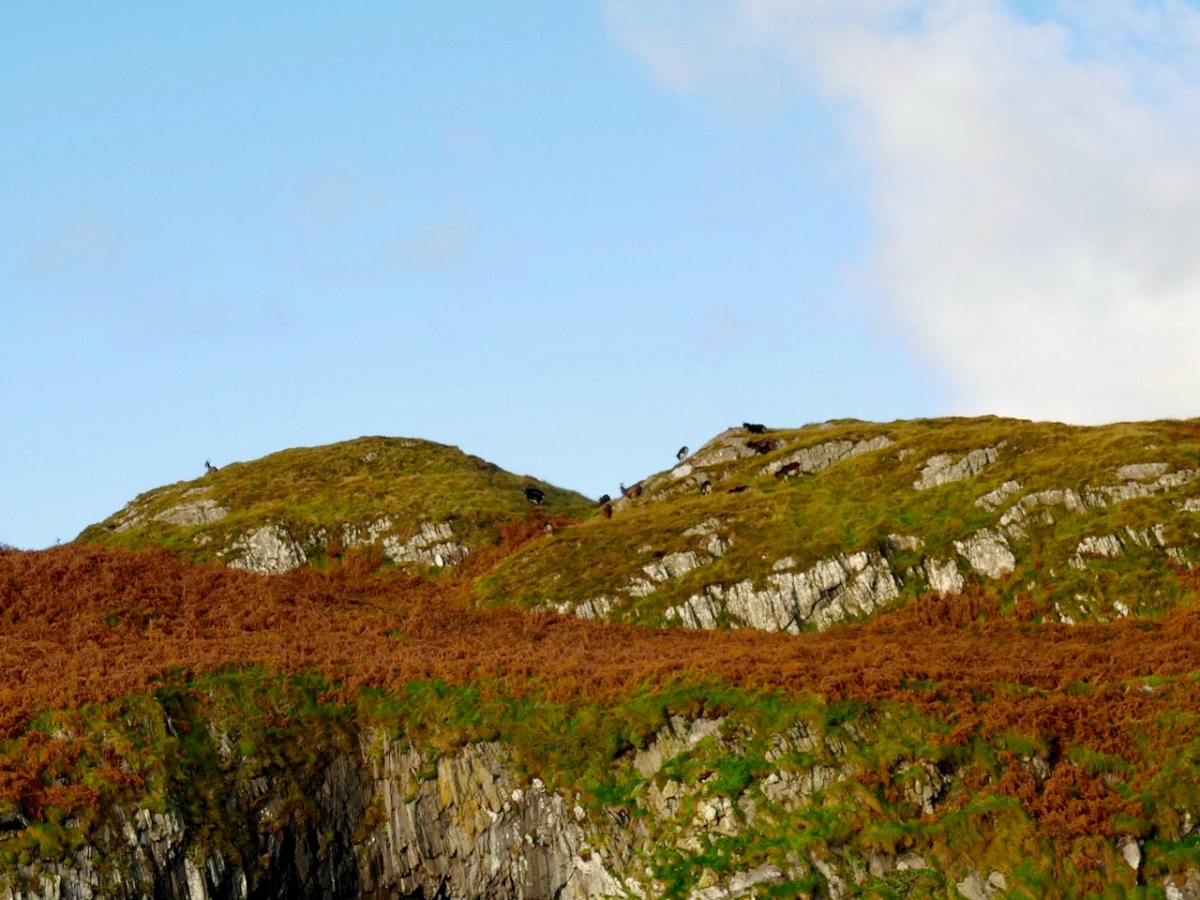
While a managed herd can be used to keep down invasive species (as in the Burren), in general a herd like this will just eat everything in sight and so John Akeroyd and the team who wrote The Wild Plants of Sherkin, Cape Clear and Adjacent Islands of West Cork, say that there are few plants to record and that the islands are of more interest for their birds than their plants.
Nicky is familiar with these waters so I knew I was in good hands. We set out shortly after nine, leaving from Rossbrin Cove, looking resplendent in the morning sunshine.
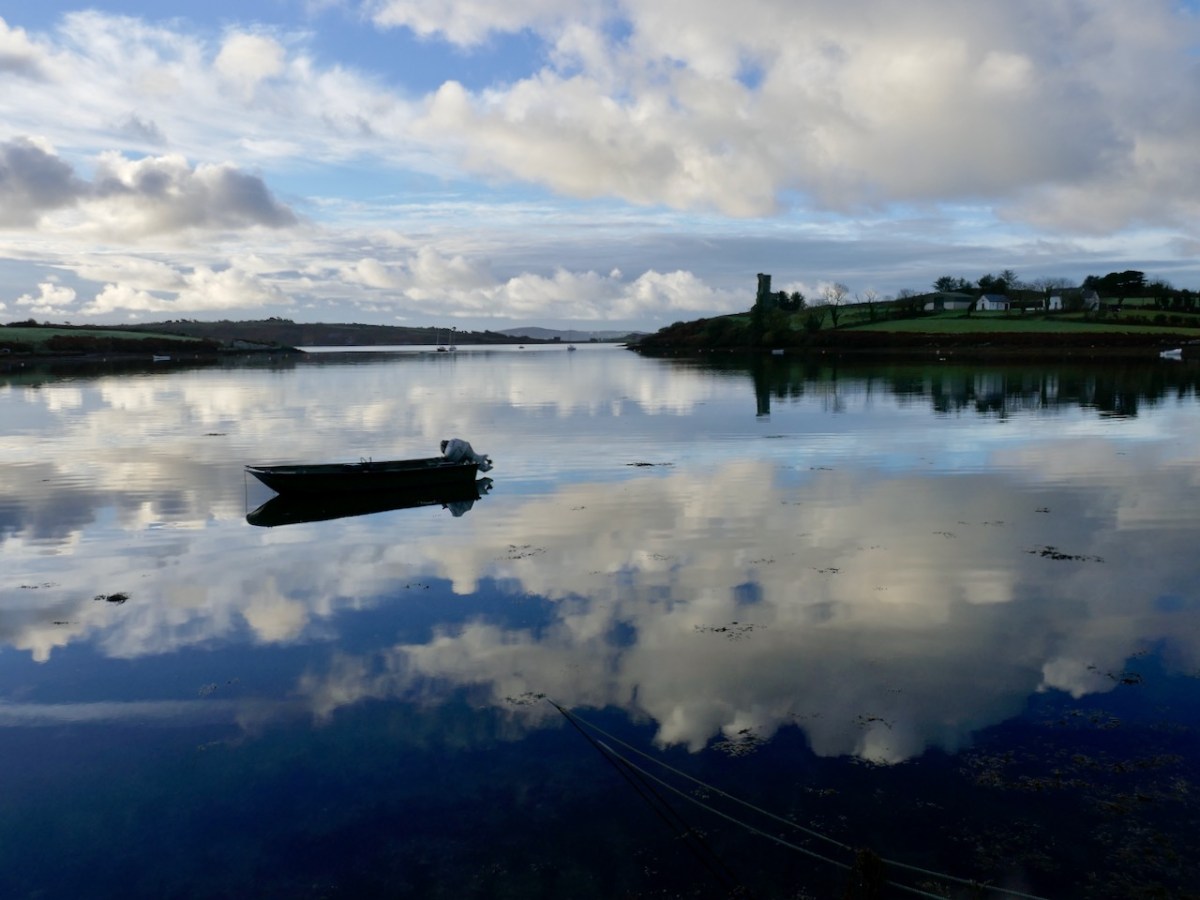
We passed Castle Island, the entrance to Schull harbour, and then Long Island.
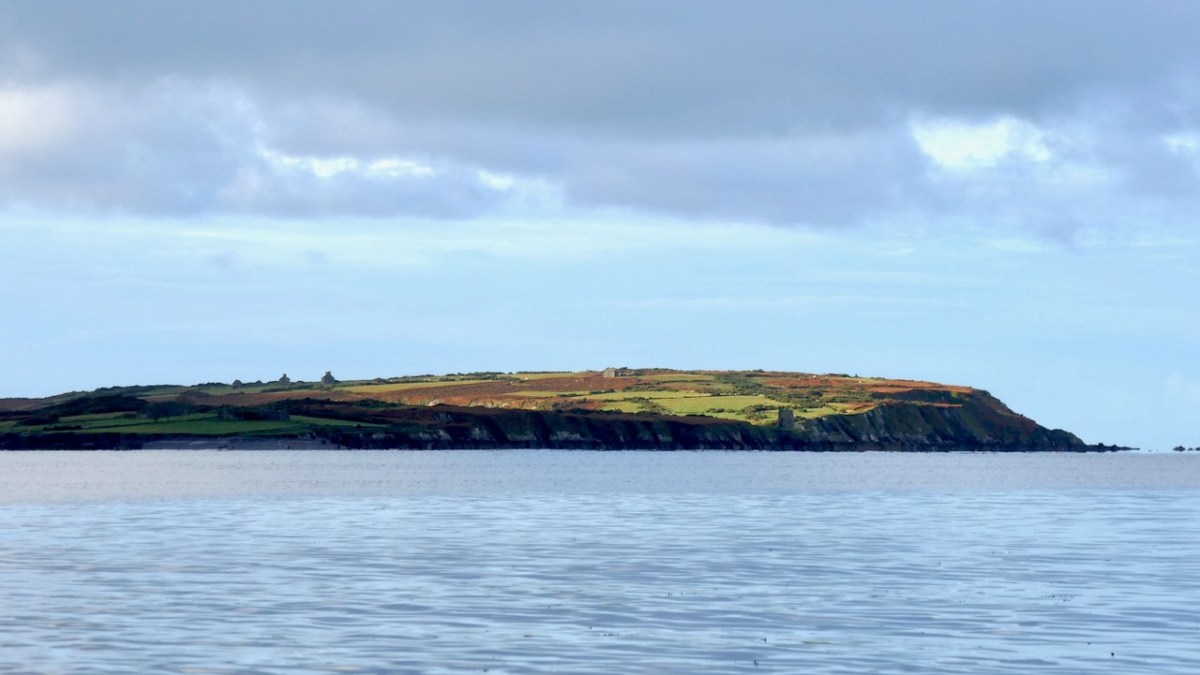
Our first glimpse of the islands was through the rocks at the end of Long Island. 

As we approached, the cleft loomed ahead and soon we were in it!

I switched to my iPhone, which does a better job of videos like this than my camera, so come with us now as we venture through the gorge, trying to avoid the very jagged rock right in the middle of the passage. You can view in YouTube by clicking on Shorts at the bottom of the video.

I’ve done it – fulfilled the ambition of many years and gone thought the corridor to the magical realm! There’s more to the story – we didn’t just turn around and go home, but I will leave that to the next post.
The Magic of Old Maps

We’ve done quite a few posts over the years about old maps – we are both fascinated by them. So I’ve decided to draw all those posts together into a new Menu Page, so you can easily find any post you’re interested in.

Several posts went into detail about maps from the Elizabethan period. The Elizabethans were map-makers and they had a special interest in drawing up maps of Ireland – to confiscate tracts of land from the rebellious Irish and assign them to colonisers. Jobson was the cartographer who mapped Munster: two posts detail the maps drawn up for that purpose.

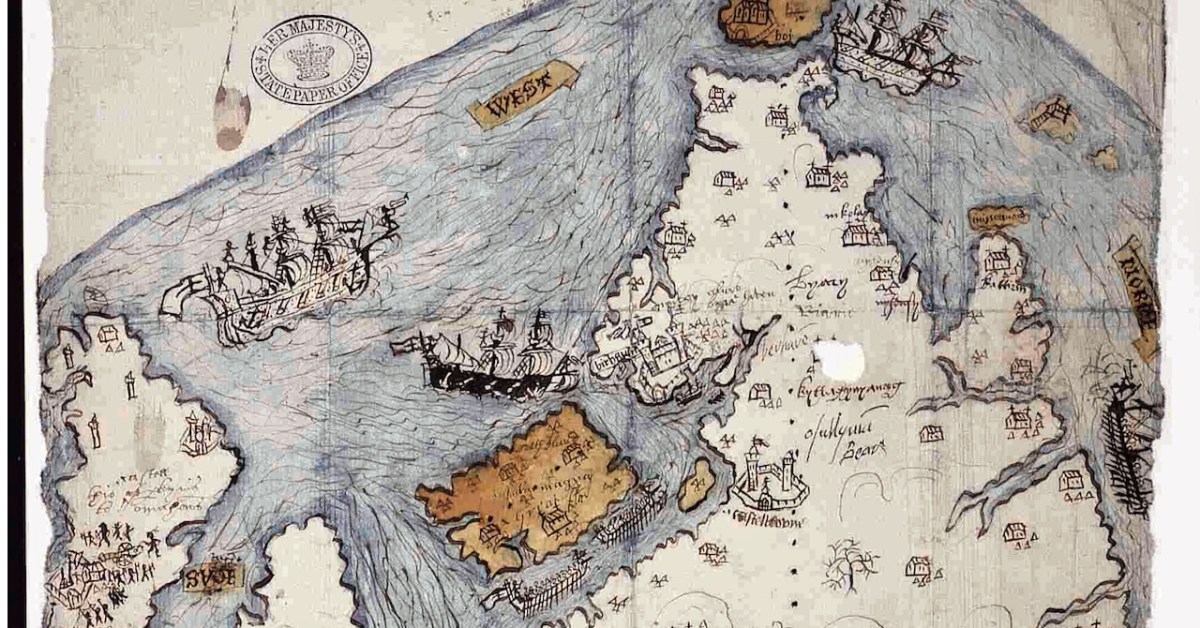
There’s a mysterious map in the British Public Record office – nobody knows who did it, but it was obviously done in the period following the Battle of Kinsale in 1601. While some of the elements are obvious, others are not, and pouring over a map like this raises as many questions as it answers. I titled the two posts Elizabethan Map of a Turbulent West Cork.

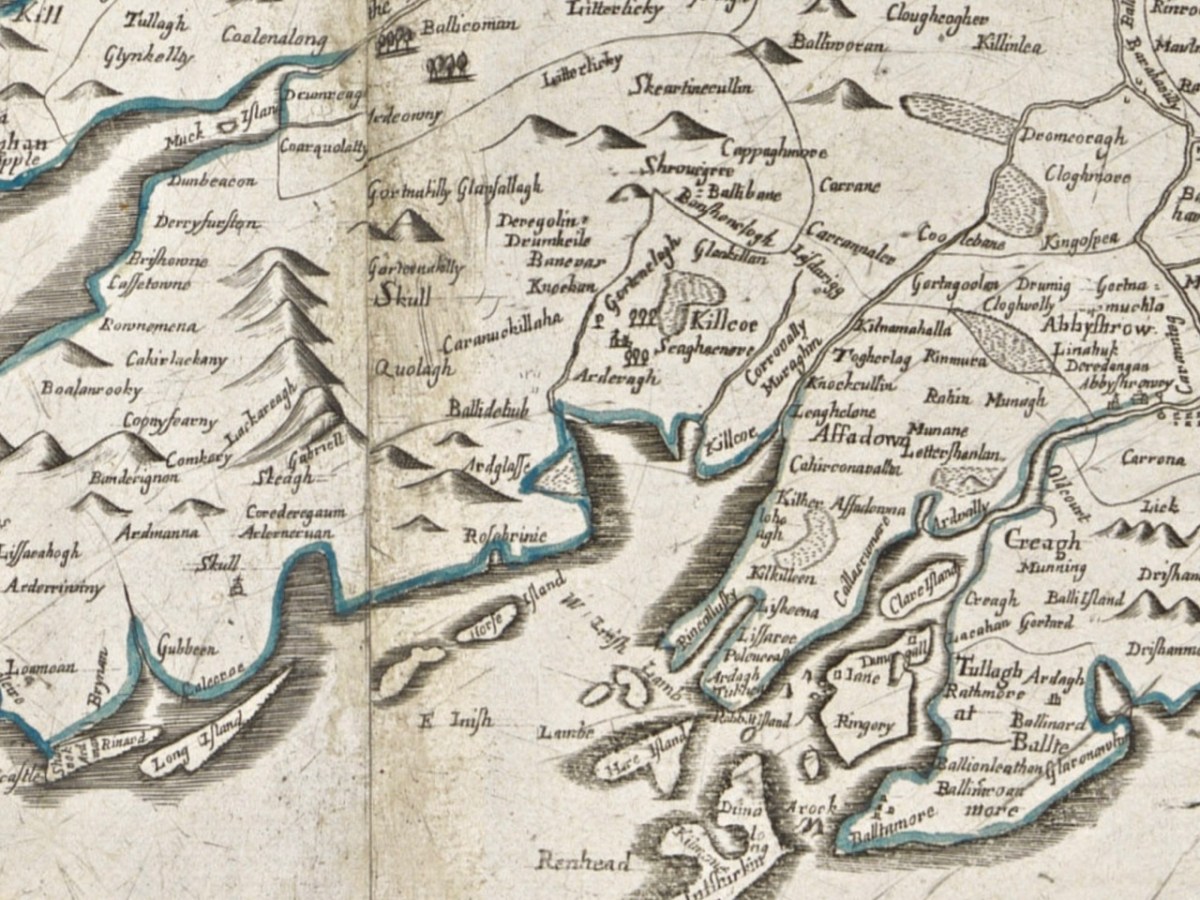
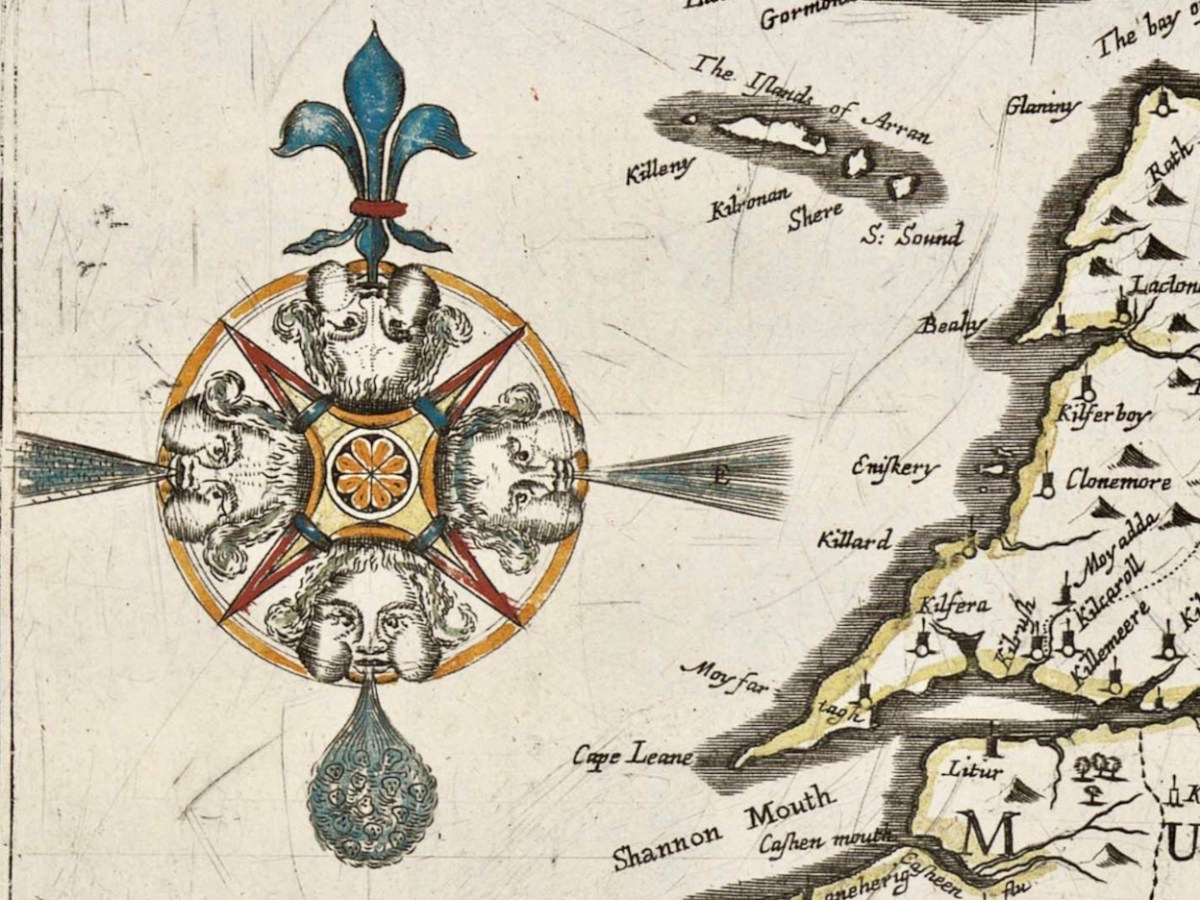
Two posts, Mapping West Cork, drew on maps from the David Rumsay Map Collection – a man who has done the world a great service by collecting and digitising maps from all over the world. These are very early maps by famous cartographers Mercator (done in the late 1500s) and Blaeu (from his 1655 Atlas). I’ve updated this post recently.

John Speed’s map, dating to 1611, although largely based on Mercator’s work, is more detailed and adds all kinds of interesting details about people and cities.

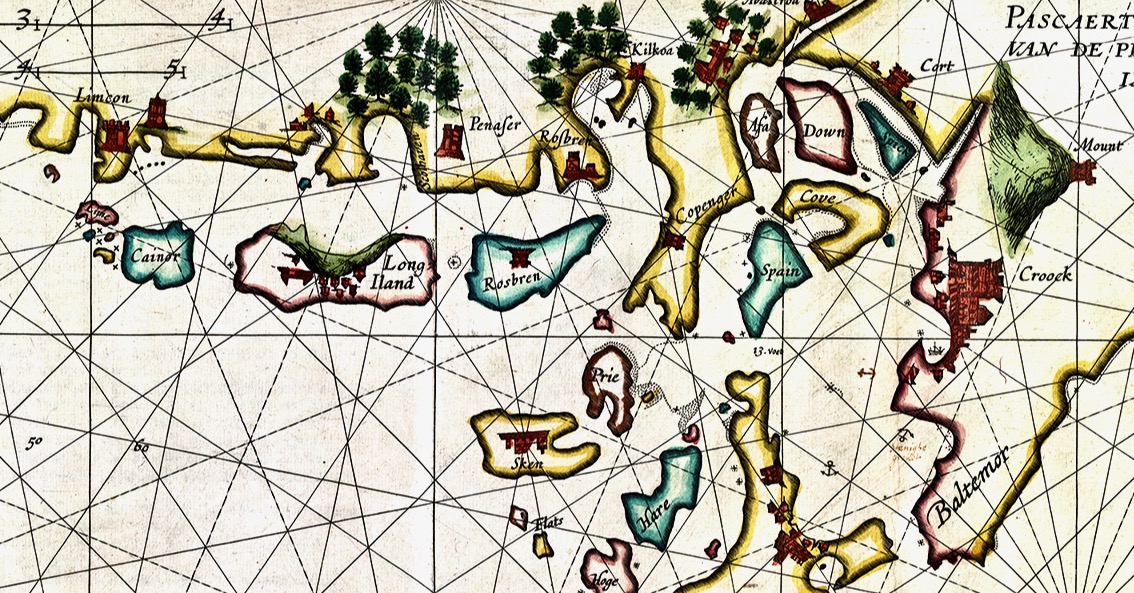
Robert’s post Roaringwater Bay in 1612 is about the Dutch Pirate Map. As he says in his post:     The thing that sets the 1612 map apart, however, is that it was made in secret, and largely from surveys only carried out at sea. Also, it was specifically intended to enable a Dutch fleet to assail the pirate strongholds which became numerous around the area from Baltimore to Crookhaven, centred on Roaringwater Bay and ideal for forays into the wider Atlantic trade routes.

A series of three posts, all written by Robert, explored the world of the Down Survey – conducted by William Petty under the instructions of Oliver Cromwell, and like the Jobson maps, done for the purposes of assigning land to colonisers. 

After an introductory post, Robert went into details about West Cork and then, in a third post, looked at Kerry. He is planning more in this series.

Finally, there’s Griffith’s Valuation – a series of detailed maps done by Sir Richard Griffith in the 19th century for the purpose of putting values on every square perch of land. Robert wrote about Griffith in The Rocky Road to Nowhere, and I used the Valuation in my post What the Forest Was Hiding.

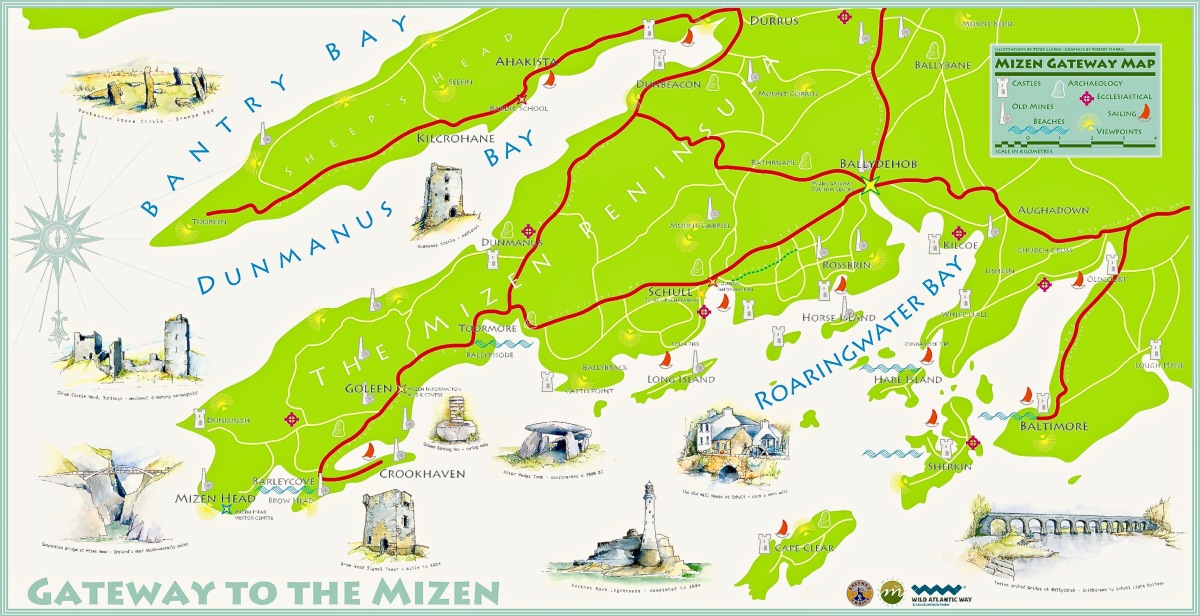
We will update The Magic of Old Maps page as we write any new posts. I am leaving you with a new map – it’s the joint work of Robert and Peter Clarke, and the original hangs in the Bank House, Ballydehob’s Tourist Information Centre.

If you want to browse the David Rumsey map collection for yourself, it’s here.

What The Forest Was Hiding

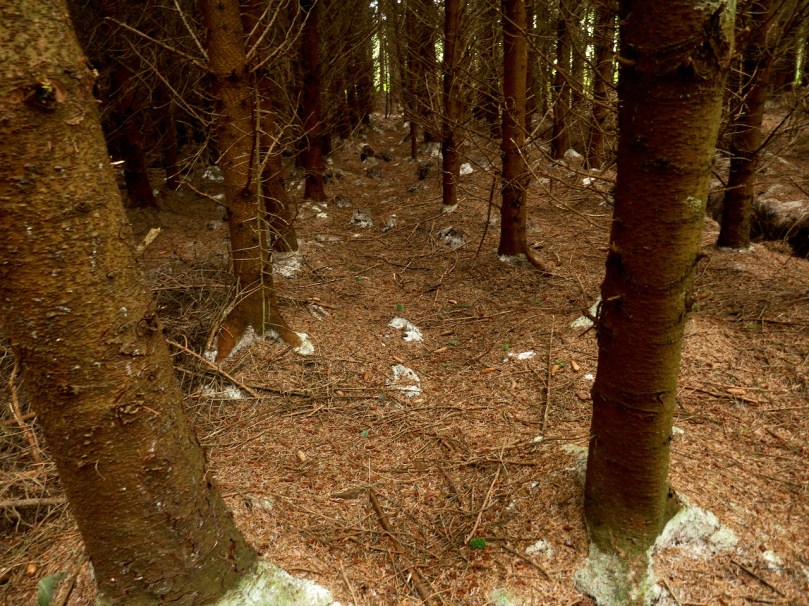
There are new forests going in all around us here in West Cork. While Ireland desperately need more trees, mostly in this area they seem to be sitka spruce – a species we have come to dislike intensely since it creates an ecological zone which does not appear to support much biodiversity; it covers, hides and damages much of our historical and archaeological heritage; and it creates dense dark patches on the landscape.

Contrast the biodiversity of a forest of sitka spruce with a planting of deciduous trees

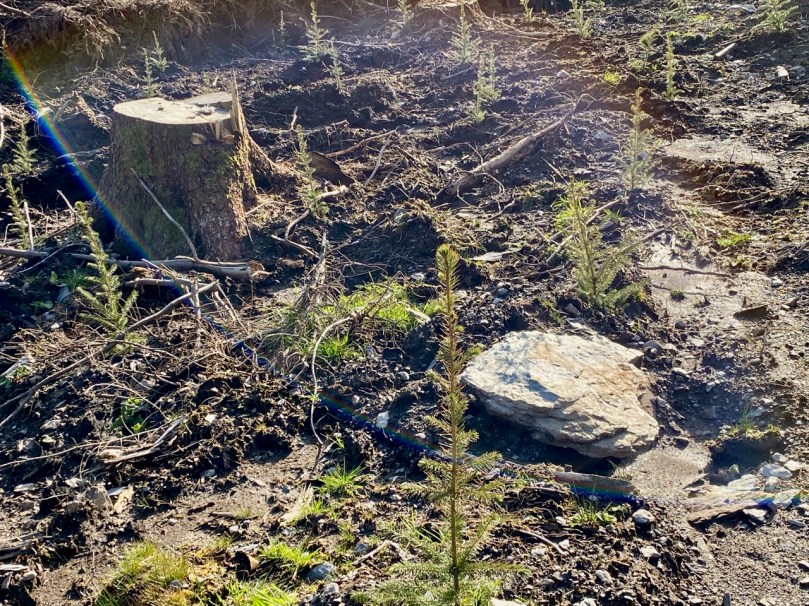
At the end of their growing cycle – 30 to 50 years – the forest is clear-felled, creating an ugly and hazardous environment into which new seedlings are planted. Best practice forestry nowadays is supposed to mix in broad-leaves species, leave nurse logs and open spaces, keep streams clear and accommodate natural habitat throughout the planting.

In our recent walk through a clear-felled forest we saw little evidence of best practice – indeed the seedlings were already in place, in serried ranks and all one species (above). 

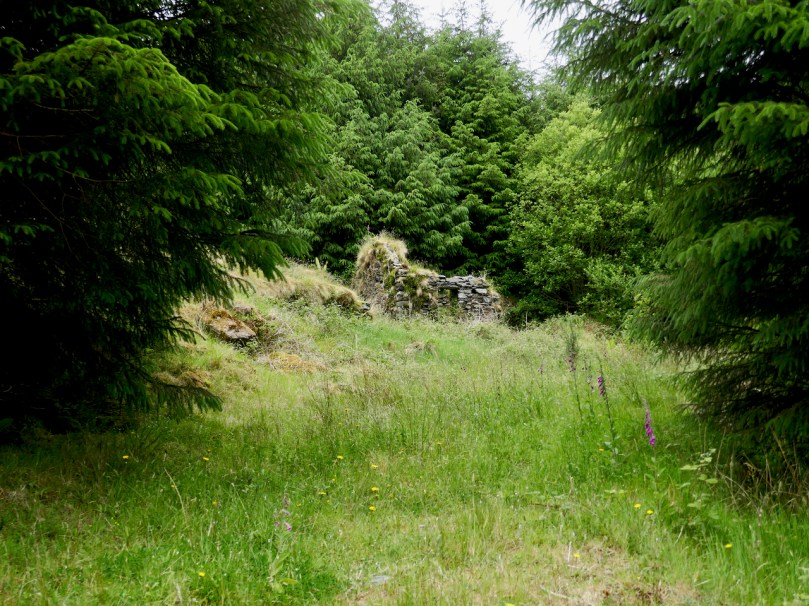
In this forest, explored last year, a clearing has been left for a ruined cottage

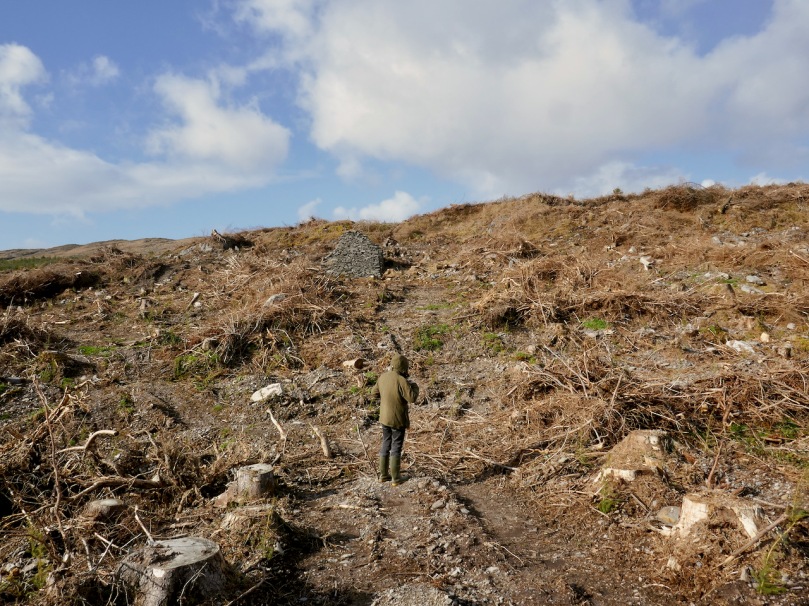
While an identified and recorded national monument is given a clearing (usually inadequate) in a plantation, other parts of our heritage are simply hidden, destroyed or damaged by the heavy equipment. Alerted by a friend (thank you, Lydia!) we took a walk yesterday on a clear-felled stretch of hillside, to see what the forest had been hiding.

The townland is Derryconnell, between Schull and Ballydehob so it’s within our 5K travel limit. We parked by the gate and walked up the well-maintained forestry road, with the clear-felled landscape all around us. It’s hard not be emotionally impacted by how devastated a landscape like this appears. Clear-cutting is highly controversial, with its proponents arguing that it can be done in an environmentally-positive and sustainable way. I have no idea, because I have no expertise in this area, if this particular patch has been cut using good science – perhaps others can comment.

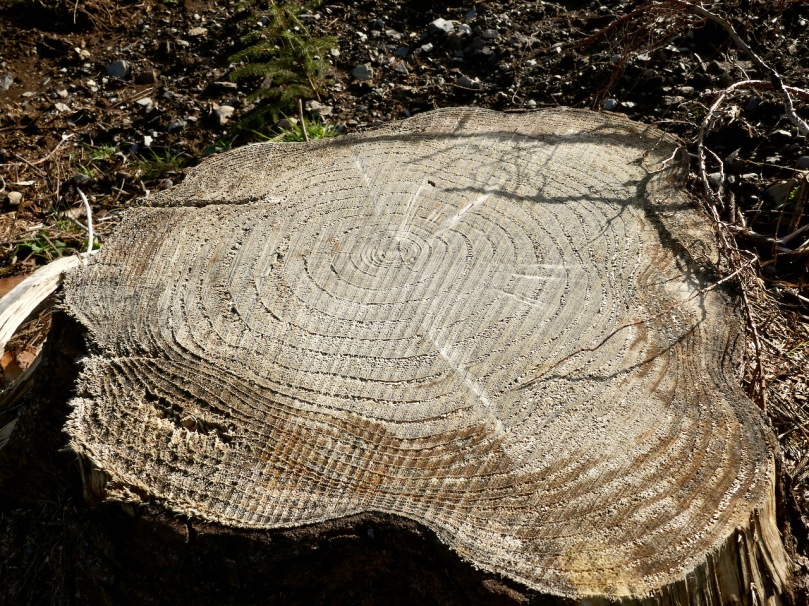
The trees had been cut after 30 years of growth – I counted the tree rings

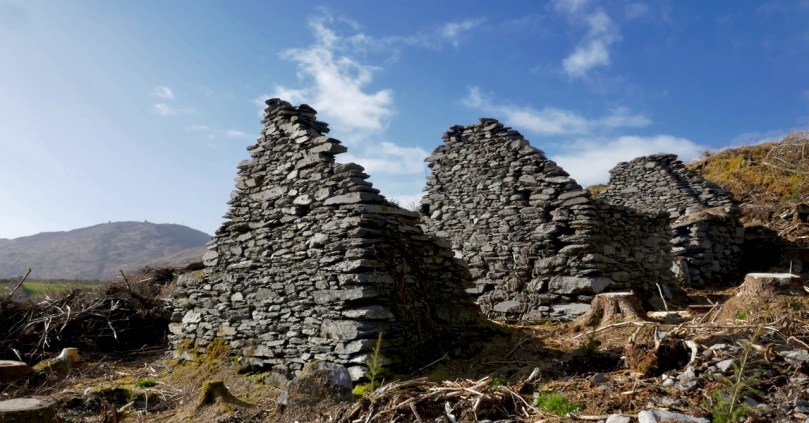
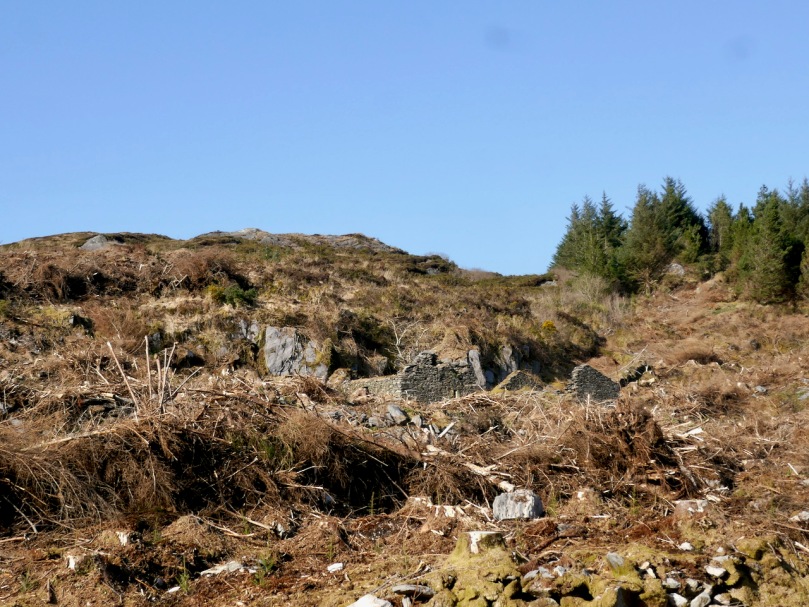
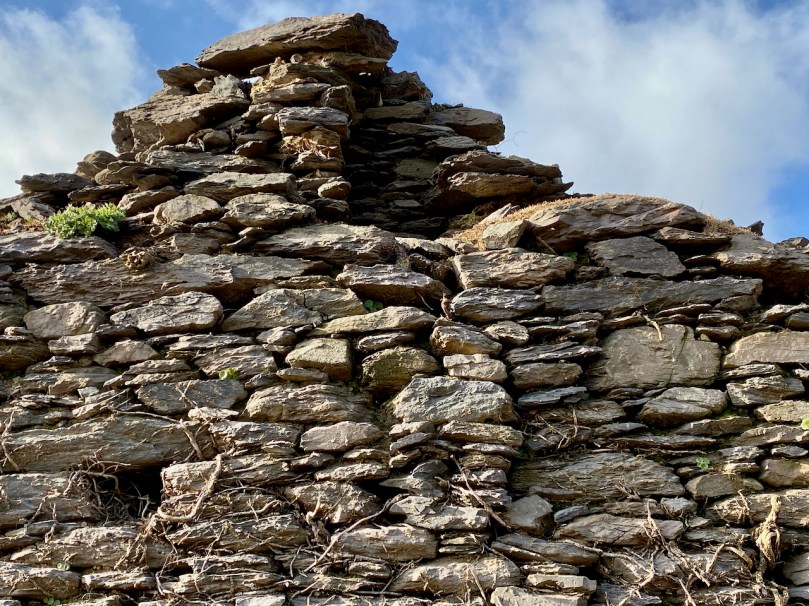
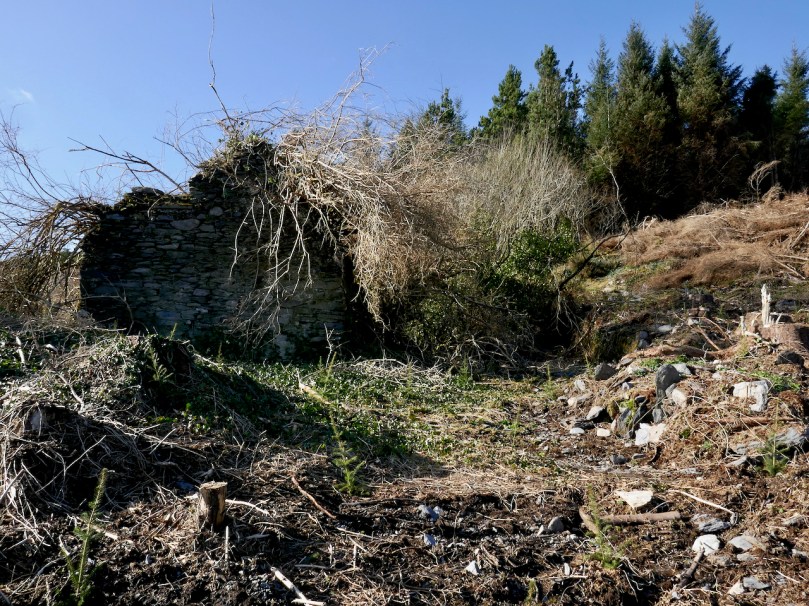
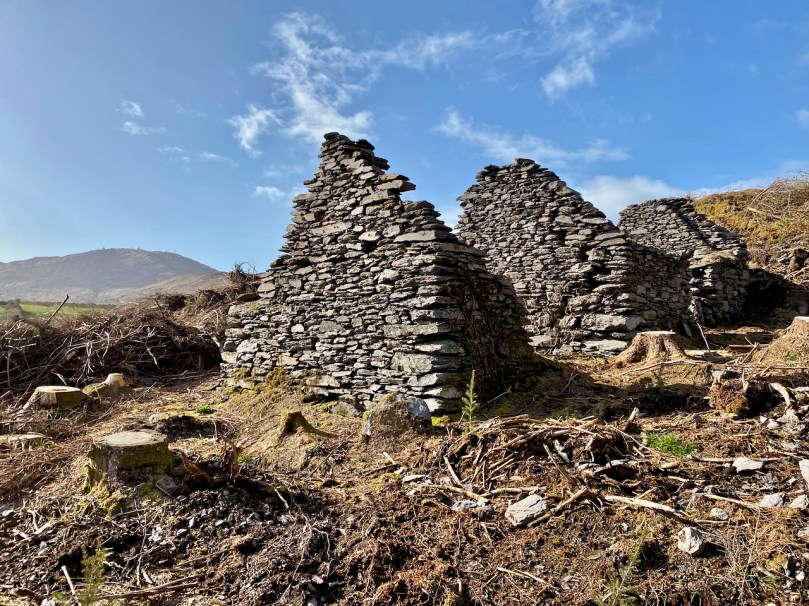
We soon saw what we were looking for – the end walls of old stone buildings. We walked up to each in turn, marvelling that they were still to be seen where they had once been completely hidden by trees. There was a west building, a middle set of two (below), and an east building.

It’s hard to know when stone structures like this were last lived in or used and it’s tempting to call something like this the remains of a famine village. However, some of them had cement detailing that indicated they may have been abandoned more recently than their ruinous appearance suggested. Lydia had noticed some late nineteenth or early twentieth century delph – in her photograph some bits looked hand-painted and some looked like transfer ware. 

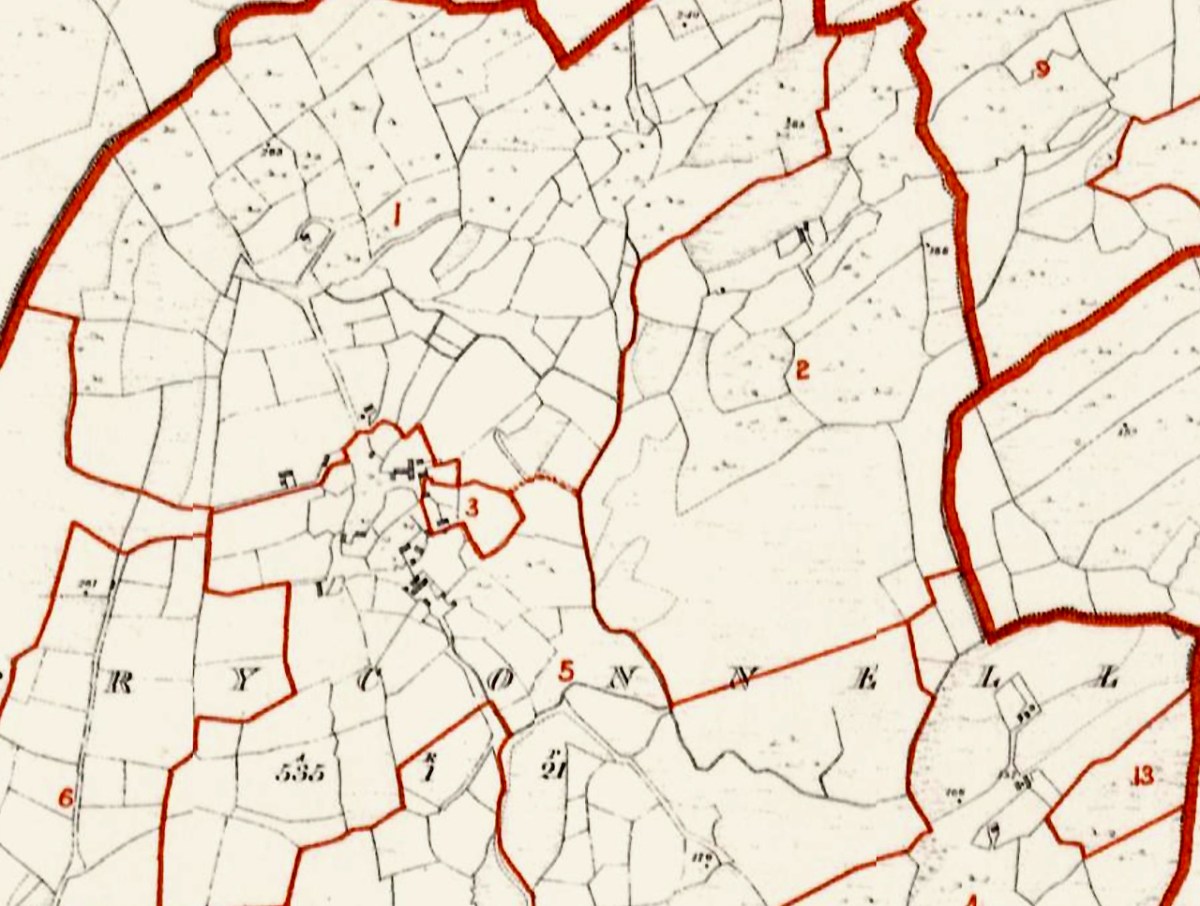
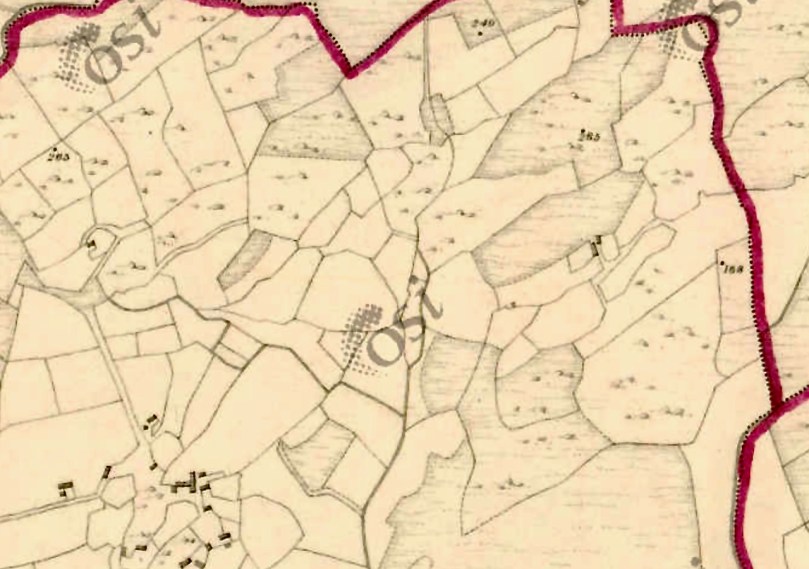
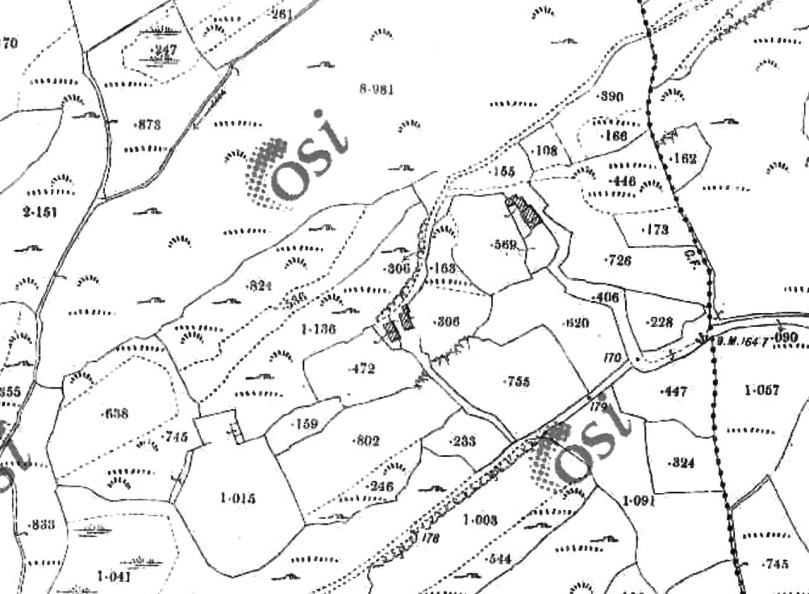
I went back to early OS maps and Griffith’s Valuation to see if I could put a date on what I was looking at. The earliest map, the Historic 6 inch, dates from 1829 to 1841. It clearly shows (above, on the right, near the red townland boundary) the middle two side-by-side buildings, so we can say for certain that whoever was living in the side-by-side set at the time the map was made, lived through the Famine. The house showed signs of later renovation (cement rendering around a window) so it may have been occupied or used into the twentieth century. 

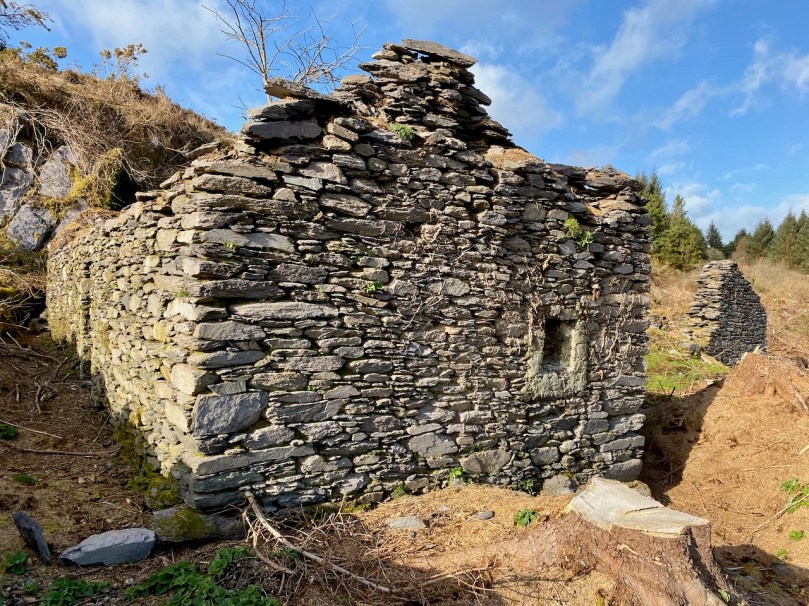
Above: The two buildings, house (closer) and barn, showing the cement rendering outside the window

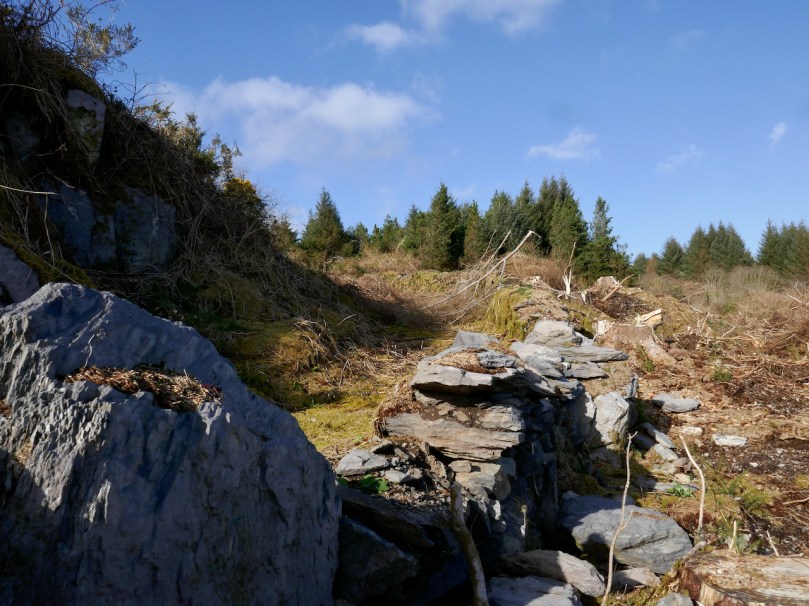
These two middle buildings formed a smallholding, with a clearly defined haggard outside the right-hand building. Along this haggard and leading to the house was an old green road (below). We’d like to go back sometime and trace how far this goes – it looked very inviting. 

The right-hand building of the two (below) had two doors but no fireplaces and therefore was most likely in use as a barn. It’s a substantial building but with few features except for a ledge along one wall.

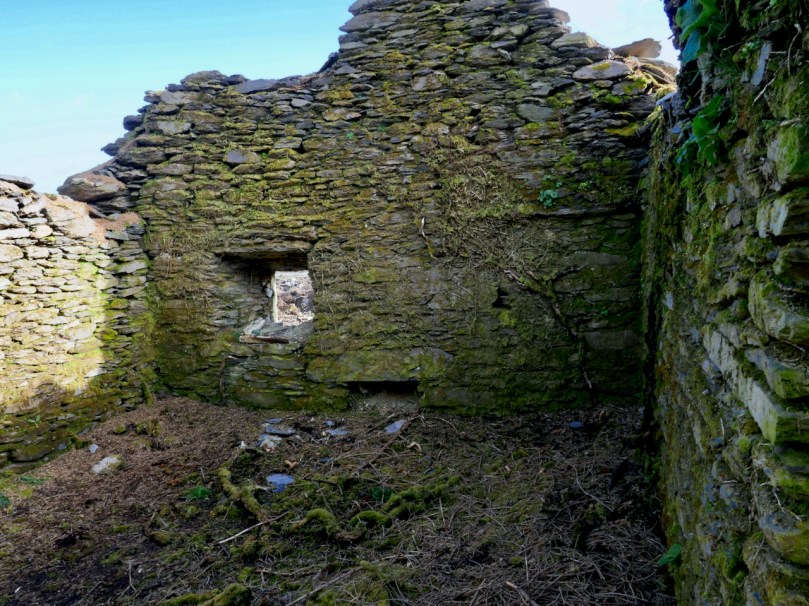
The left-hand building (below) was clearly a house, with a fireplace at each end. The larger fireplace had fallen and the collapse indicated that it had been a tall chimney. This was the principal room of the house, where most of the living and all of the cooking took place.

The other room also had a fireplace and this was a curious small affair, with the flue accommodated entirely within the thickness of the end wall.

Top: the end wall with its small fireplace; Middle: the flue within the walls; Bottom: the top of the wall showing the flue exiting

The easternmost building was very broken down and overgrown and it was hard to make out its features, but we did manage to establish that it had the same kind of small in-the-wall fireplace as the previous cottage, as well as some concrete detailing.

This is the latest of the structures, only showing up on the map that dates from the late 1880s to 1913. The map shows a longish building, with two projections at the rear, neither of which have survived. Given that it’s the newest building, it’s perhaps surprising that it hasn’t fared any better than the others.

The east building on the Historic 25″ map, showing that it was constructed after the 1840s but before 1913. On this map you can also make out the green road that runs behind the middle set of buildings

Finally, the westernmost building, which may or may not appear on any of the maps, has two distinct ‘rooms,’ neither of which has a fireplace, although outwardly it bears the appearance of a house/barn combination (below). There’s a small black dot on the earliest map (the Historic 6”) about where this structure is now, but it doesn’t seem substantial enough for what’s on the ground. Therefore, it seems that this building, or most of it, is also later in date and may even post-date the map from the turn of the 20th century.

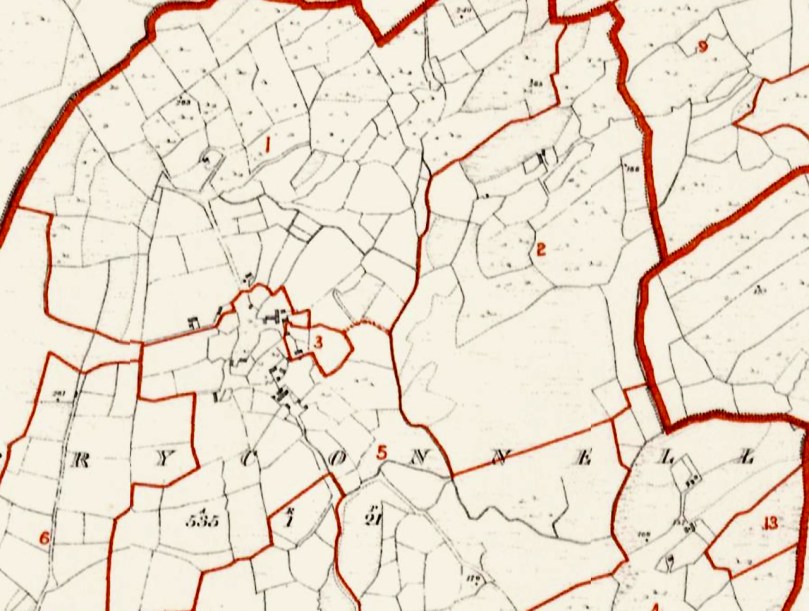
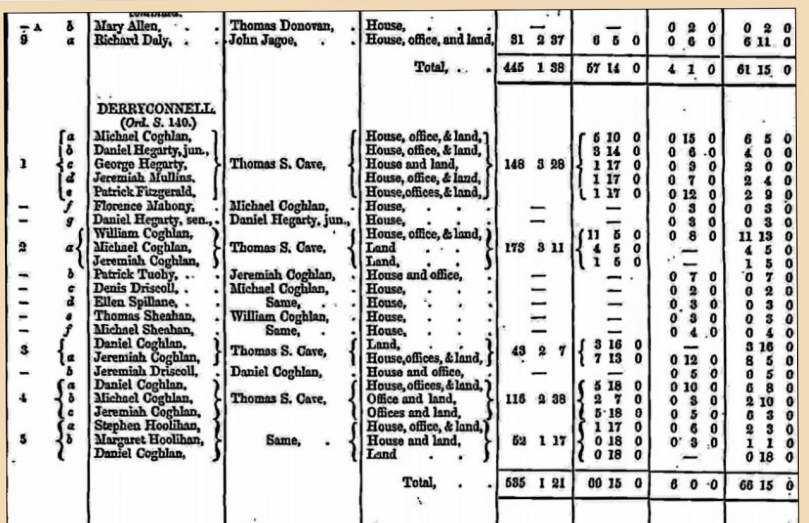
Who lived on this section of land? To answer this question we can turn to Griffith’s Valuation. This was a survey of Irish land that took place between 1848 and 1864, to establish the value of property for taxation purposes. The results are online and searchable by townland. The map tells us that the land we are looking at was parcel number 2 in the townland of Derryconnell (below). It was occupied by several tenants, despite the fact that only the side-by-side set of houses are on Griffith’s map. Perhaps the other tenancies refer to the renting of fields. 

What Griffith’s Valuation shows for parcel 2 is that William, Michael and Jeremiah Coghlan rented land from Thomas Cave, and in turn rented land (probably single fields) to Patrick Tuohy, Denis Driscoll, Ellen Spillane, Thomas Sheahan and Michael Sheehan. The Coghlans therefore acted as middlemen between Cave and their renters, illustrating one of the problems with the land systems at the time with the poorest having to pay enough so that a middleman (sometimes a series of them) could get their cut. 

We don’t know much about Thomas S Cave, but he owned extensive property around this area much of which had previously been part of Lord Audley’s mining interests. Beside the Derryconnell lands, he also owned plots in Rossbrin, Cappaghglass and Foilnamuck – all areas associated with mining – and he owned and may have lived in Cappagh House, a beautiful period property we featured in our post on the mine chimney that blew down and now lived in by our lovely neighbours Mark and Terri O’Mahoney and their family. Below is an old photograph of that house and the chimney as it stood then.

This has turned to be a little meander though history, geography and ecology and all the more enjoyable as I didn’t expect to be so stimulated when we set out for a simple walk within our 5K limit. Once again, thanks to Lydia, friend and fellow history buff, for the information on where to go, how to get there, and what to look out for.