Patrick and the Paschal Fire

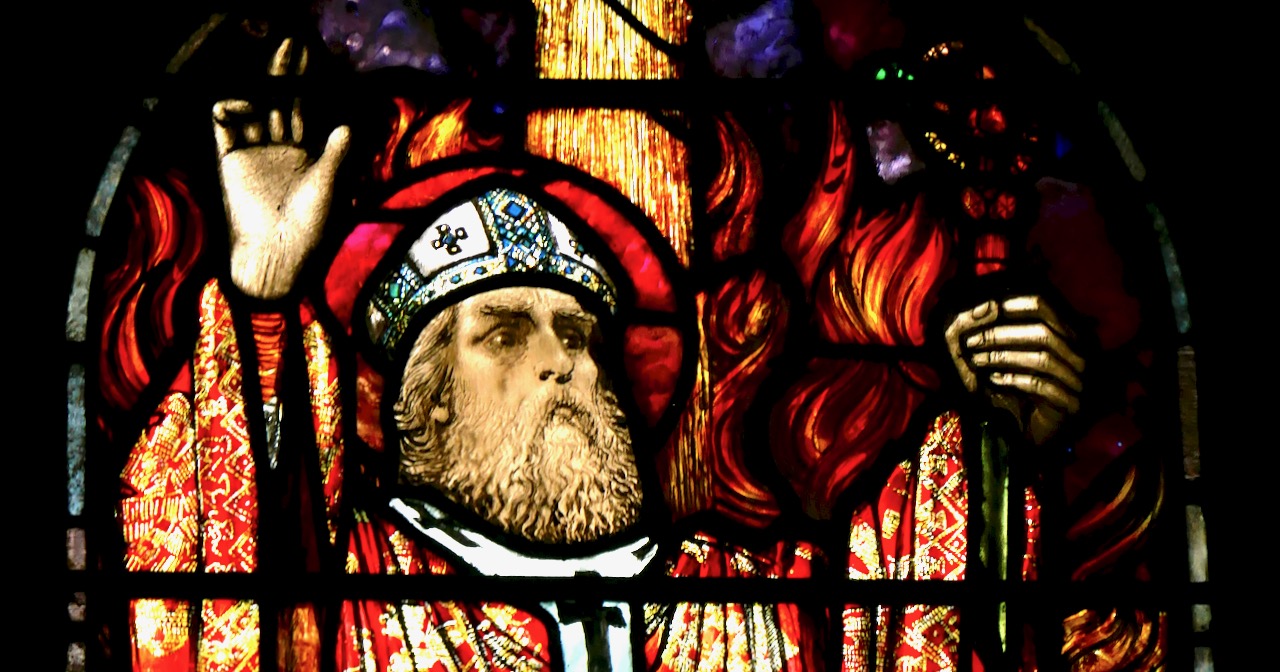
Every year on the seventeenth of March we celebrate Saint Patrick, and every year the same stories are told. It’s the shamrock-and-snakes version of our founding saint – always with images of the saintly bishop, in green, holding his crozier. These images are so familiar that Patrick himself has almost disappeared behind them.
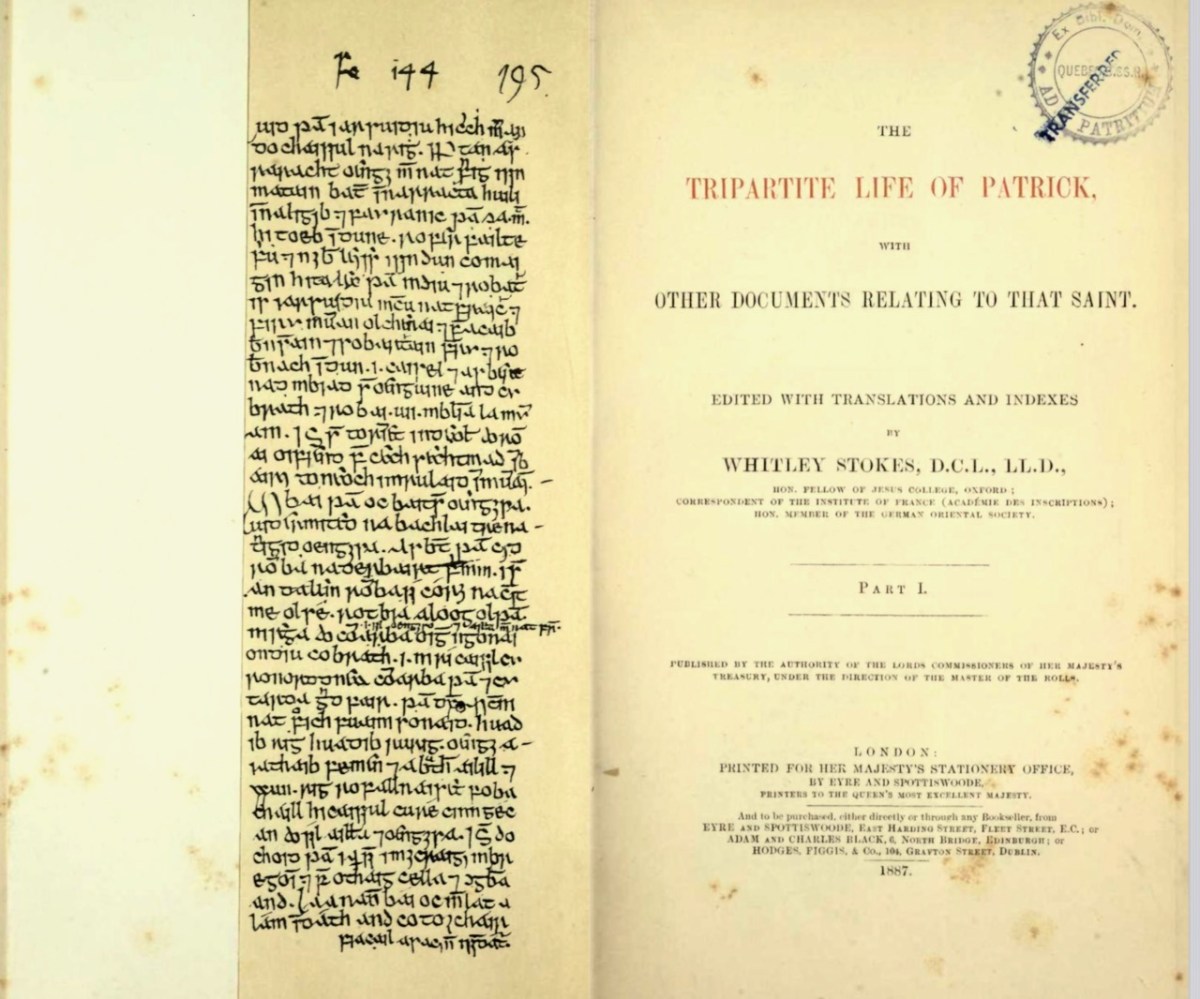
This year I want to go back to an older Patrick — fierce, muscular, and considerably more dangerous. My source is the Lebar Brecc Homily on Saint Patrick, a medieval Irish text drawing on traditions going back to at least the ninth century (you can find it here). It was translated by the great nineteenth-century scholar Whitley Stokes, who invented his own register to convey something of the flavour of the medieval Irish. His is a language that occupies territory somewhere between modern and archaic, and for more of Stoke’s wonderful formulations you read my post The White Hound of Brigown. Stokes’ edition of 1887 (below) remains the standard text.
A homily is a text written to be preached, and you can feel that in the Lebar Brecc account: it moves fast and it assumes an audience who will understand a psalm citation or a liturgical reference.The Lebar Brecc is also long and dense so I have decided to focus on the incident where Patrick lights the paschal fire on the hill of Slane, and the aftermath of that deed. At that, I’ve even had to cut out some of the action.
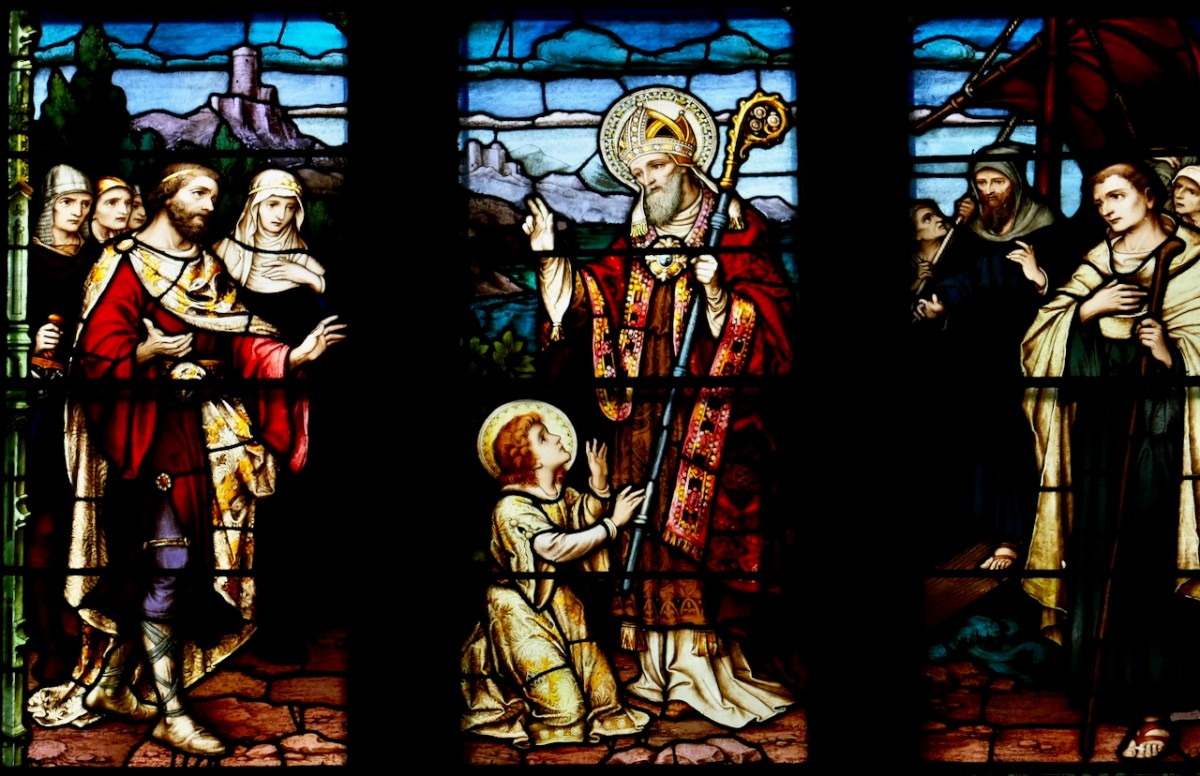
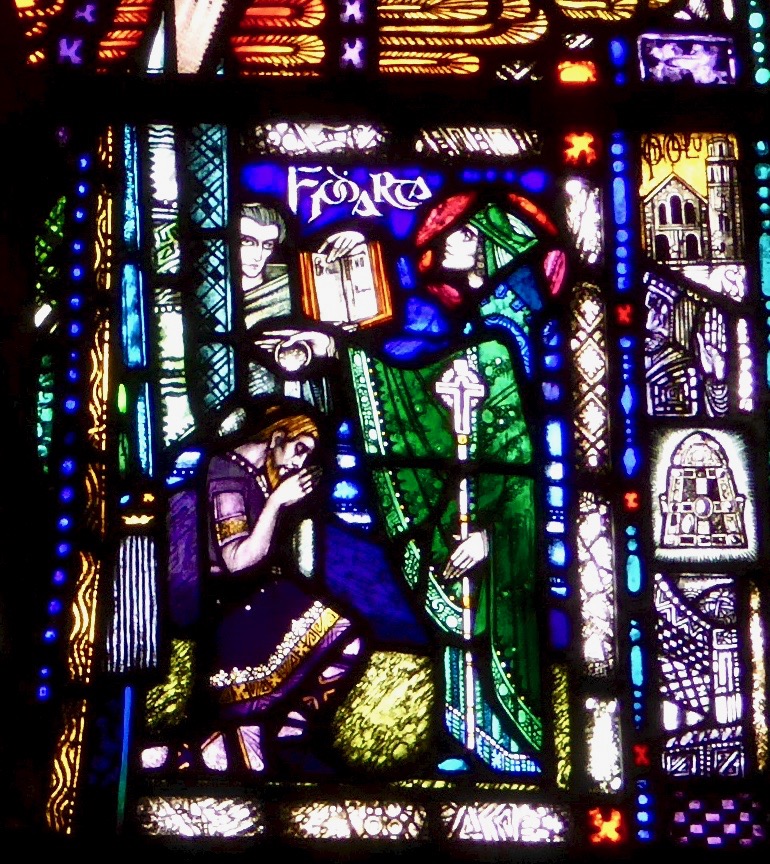
The story opens with a small, touching detail (above). A little boy attaches himself to Patrick as he is about to leave, and his family simply hand him over. He is called Benén in the text but we know him better as St Benignus, who becomes Patrick’s close companion and eventually his successor as bishop (read a more academic account of him here). He is a minor figure at the beginning, but watch for him: he will reappear before the story is over.
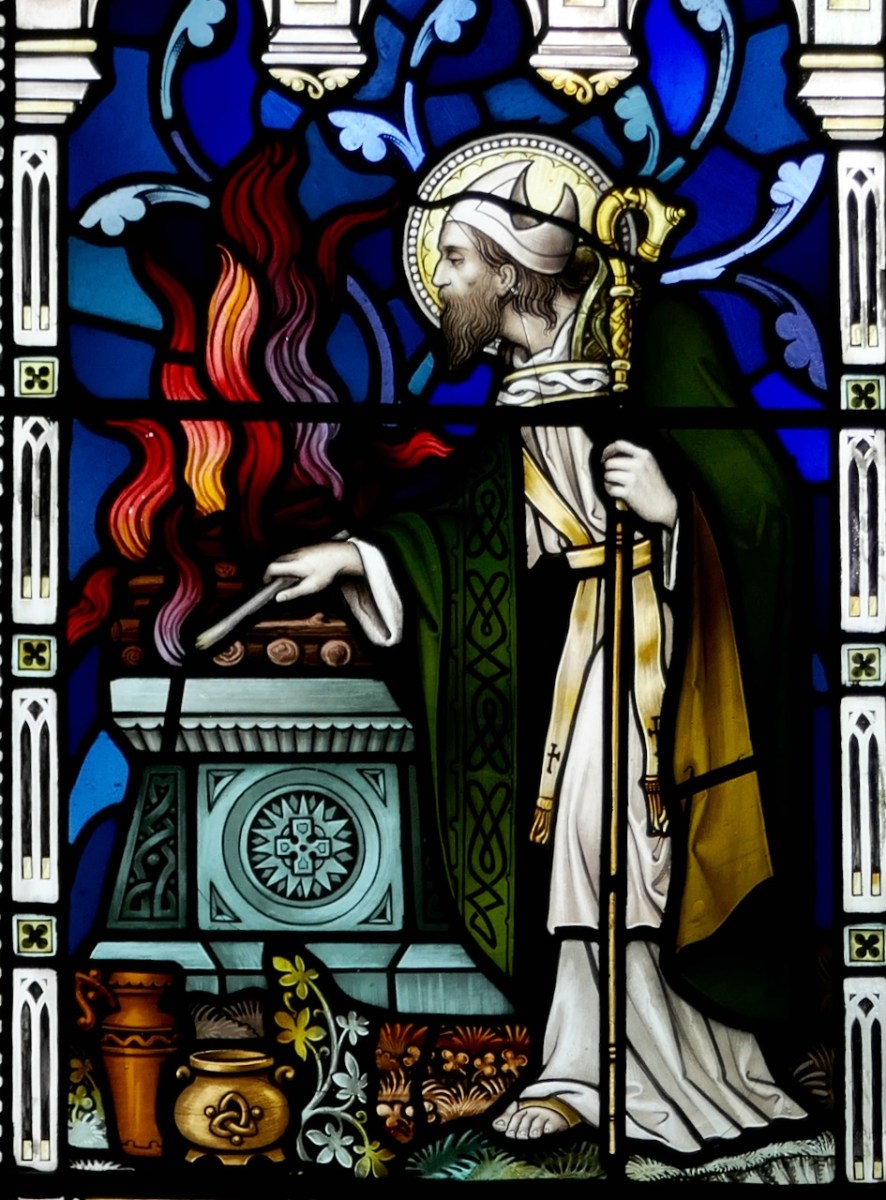
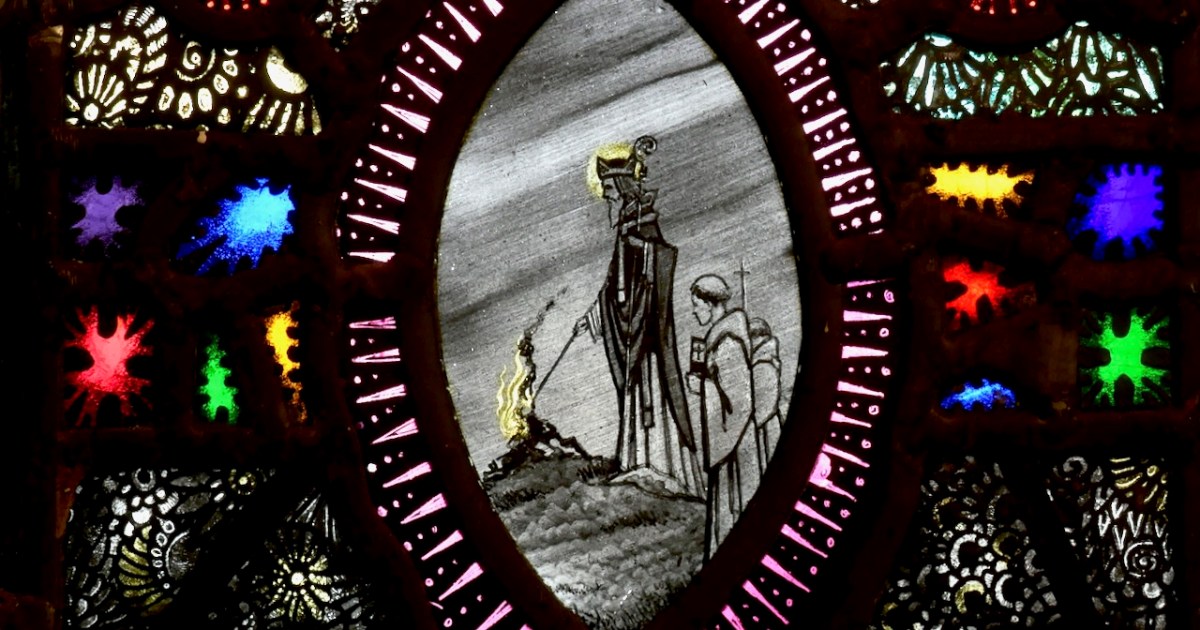
Patrick travels to Ferta Fer Féicc (the place now known as the Hill of Slane, in County Meath) and there, on the eve of Easter, he kindles a fire. It seems a simple act, but there was a sacred law in Ireland that no fire might be lit anywhere in the country on that night until the ritual fire had been kindled first at Tara by the High King. Patrick’s fire, visible from Tara, is an act of direct political and spiritual provocation. The druids of Loegaire’s court (Stokes’ ‘wizards’) immediately grasp what it means: Unless yon fire be quenched before this night, he whose fire yon is shall have the kingdom of Ireland for ever.
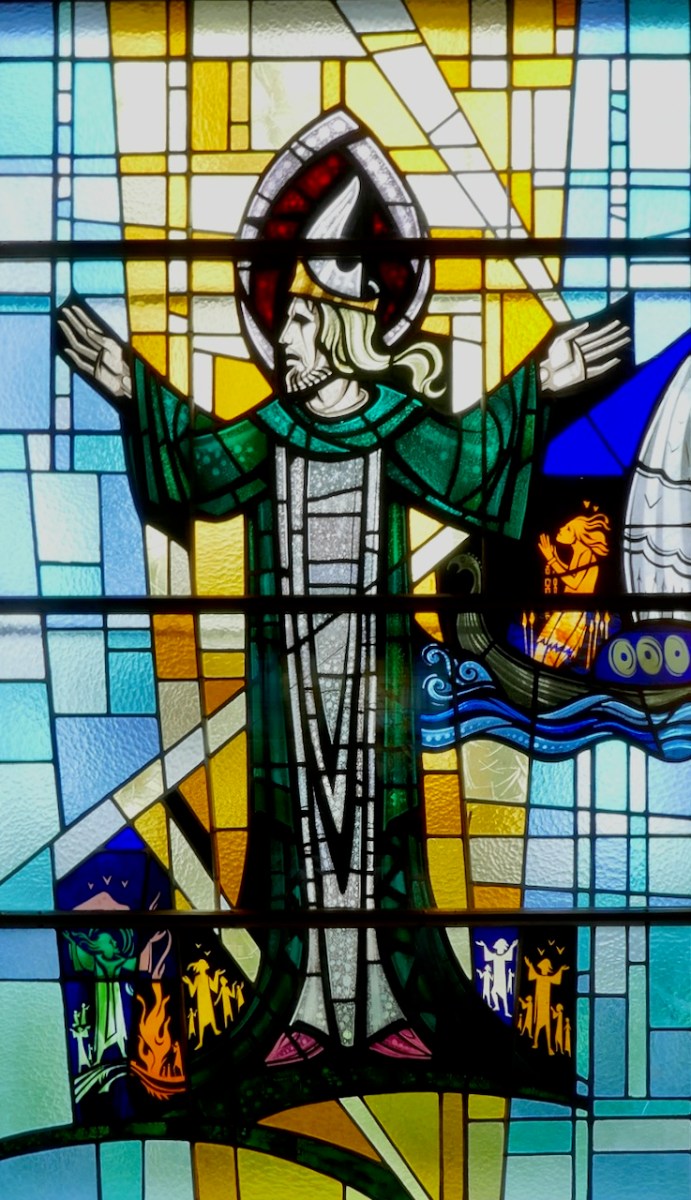
What follows is an intense confrontation, and I will let Stokes’ translation carry it:

Then said the King, “ It shall not be so, but we will go to him and kill him. The king arises with his host to seek Patrick and kill him ; but they did not arrive before the end of night. When the king drew nigh his wizards said to him, “ Go not thou to him” say they, “ that it may not be a token of honour to him. But let him come to thee and let none rise up before him.” Thus was it done. When Patrick saw the horses and the chariots, he then sang this verse : ‘Hi in curribus et hi in equis, nos autem in nomine Domini Dei nostri magni [ ficabimur ].’ But, when Patrick came in to the assembly, only the son of Deg rose up before him, that is, Bishop Erc, who is (venerated) at Slane.

Wait, what! Bishop Erc? Haven’t we met him before, in tales of St Brendan? What is he doing in King Loegaire’s assembly? This is one of the strange time-shifts that features in this story. Despite all of us learning at school that Patrick brought Christianity to Ireland, it seems it was already here. In fact the Lebar Brecc talks about Palladius coming before Patrick, who arrived into a country where the faith already had a foothold, however marginal. Erc of Slane is almost certainly the same Erc who later baptised Saint Brendan and blessed his famous voyage westward. He is a hinge figure: witness to Patrick’s arrival and sponsor of Brendan’s departure. Erc’s rising is a public act of recognition which came at some personal risk.
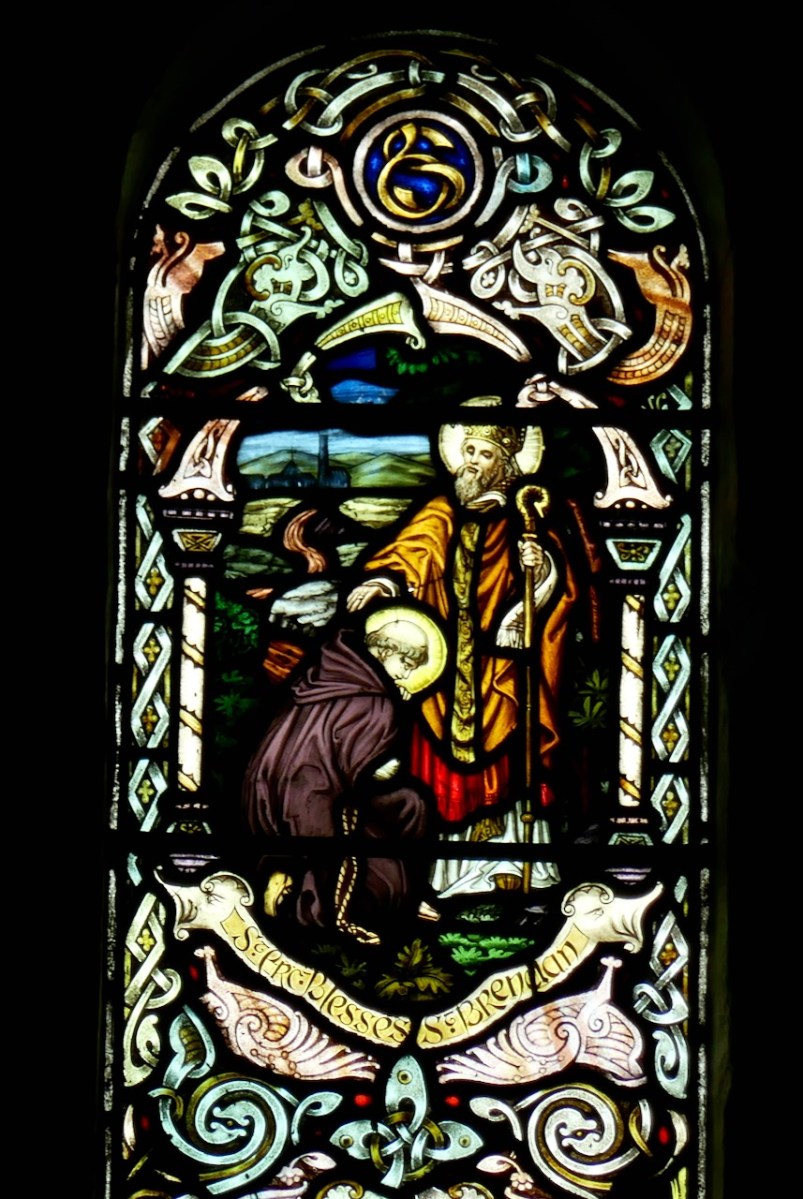
Then came one of the wizards, to wit, Lochru, fiercely and angrily against Patrick, and reviled the Christian faith. Then holy Patrick said : “ 0 my Lord, it is Thou that canst do all things. In Thy power they are. It is Thou that sentest us hither. Let this ungodly one, who is reviling Thy name, be destroyed in the presence of all.”

Swifter than speech, at Patrick’s word, demons uplifted the wizard in the air, and they let him go (down) against the ground, and his head struck against a stone and dust and ashes were made of him in the presence of all, and trembling and terror intolerable seized the hosts that were biding there.

Now, Loegaire was enraged with Patrick, and went to kill him. When Patrick perceived the onfall of the heathen upon him, he then exclaimed, with a mighty voice, “ Exsurgat Deus et dissipentur inimici ejus”* Came a great earthquake and thunder there, and a wind, and scattered the chariots and the horses afar on every side, so that they came even to Brig Graide and Sliab Moenuimn, and they were all slaughtering each other through Patrick’s curse, and there were left along with the king but four persons only in that place, to wit, himself and his wife and two of his priests.
My goodness, this is definitely not the Patrick of Hail, glorious St. Patrick, dear Saint of our Isle; On us thy poor children bestow a sweet smile. Sorry – I have always had a soft spot for Frank Patterson – quick diversion into the shamrock-soaked images here.

In fact, Patrick’s behaviour here reminds me of St Fanahan, the White Hound of Brigown, with his head-battler and sparks flying from his teeth – which in turn reminds me of Cuchullain and his warp spasms. But I digress – let’s carry on now with the story.

When terror seized the queen she went to Patrick and said to him, ” 0 righteous one and 0 mighty one, kill not the king, for he shall submit to thee, and give thee thine own will.” The king came and gave his will to Patrick by word of mouth, but gave it not from his heart ; and he told Patrick to go after him to Tara that he might give him his will before the men of Ireland. That, however, was not what was biding in his mind, but to kill Patrick, for he left ambushes before him on every road from that to Tara.
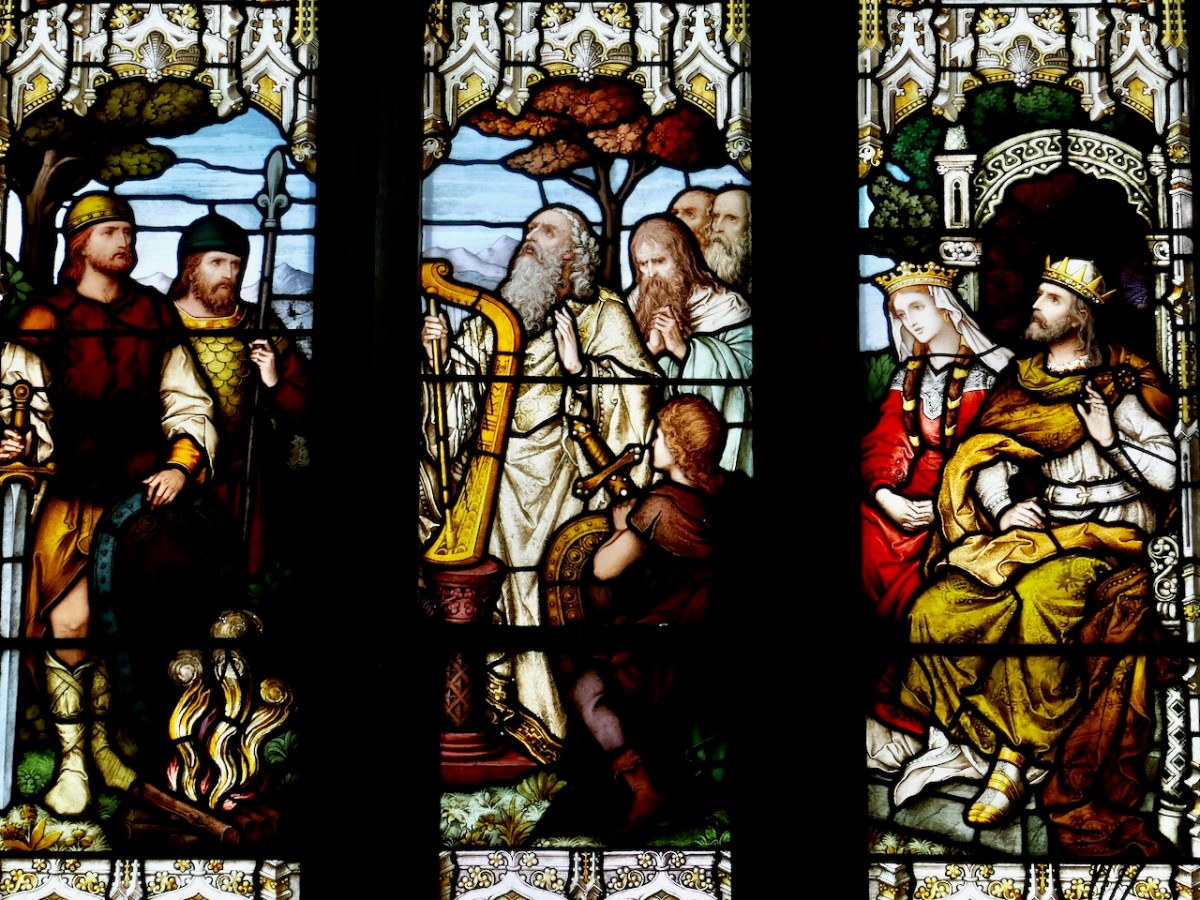
Thereafter went Patrick (and his train of) eight, together with a gillie Benén, past all the ambushes, in the shape of eight deer and behind them one fawn with a white bird on its shoulder, that is, Benén with Patrick’s writing-tablets on his back ; and thereafter he went into Tara, the doors being shut, to the middle of the palace. The king was then feasting with the kingfolk of Ireland around him at this hightide, for that was the Feast of Tara.

No one rose up before Patrick at Tara except the kings poet, Dubthach Macculugair, and he believed and was baptized, and Patrick gave him a blessing.

Patrick is then called to the king’s couch that he might eat food. Howbeit Patrick refused not that. The wizard Lucatmoel put a drop of poison into Patrick’s cruse**, and gave it into Patrick’s hand. But Patrick blessed the cruse and inverted the vessel, and the poison fell thereout, and not even a little of the ale fell. And Patrick afterwards drank the ale.

And where have we met a white deer before – ah yes, that would be the story of St Gobnait, who will find ‘the place of her resurrection’ when she sees none white deer. The image of Benignus as the fawn with the white bird is a lovely one.
Thereafter the hosts fared forth out of Tara. Then said the wizard, “ Let us work miracles together that we may know which of us is the stronger.” “ So be it done,” said Patrick. Then the wizard brought snow over the plain till it reached men’s shoulders. Dixit Patricius to him : “ Put it away now if thou canst.” Dixit magus : “ I cannot till the same time to-morrow.”

“ By my debroth ” (that is, ‘ by my God of judgment,’) saith Patrick, “ it is in evil thy power lieth, and nowise in good.” Patrick blessed the plain, and the snow melted at once.

The wizard invoked demons, and over the plain he brought darkness that could be felt, and trembling and terror seized every one. Dixit Patricius , “Take away the darkness if thou canst.” The wizard replied,

“ I cannot till the same time to-morrow.” Patrick blessed the plain, and the darknesses at once depart, and the sun shone forth …. All who were there gave thanks to God and to Patrick.
The miracle contest between Patrick and the unnamed wizard outside Tara has the quality of a folk tale with its snow conjured and melted, darkness brought and dispersed, but the theological point is precise. The wizard can bring affliction but cannot remove it whereas Patrick can do both.

Then another counsel was taken, that is, to build a house in that hour, the half thereof fresh and the other withered, and to put the wizard into the fresh half with Patrick’s raiment about him, (and) to place Patrick’s gillie, Benén, into the withered half, with the wizard’s tunic about him.

. . .and fire was put into the house, and the fresh half is burnt with the wizard therein, and Patrick’s raiment which was about him was not burnt. But the withered half was not burnt, nor the gillie, but the wizard’s tunic which was about him was burnt.

The king grows terrible at the killing of the wizard, and he proceeds to kill Patrick. But God’s anger came against the ungodly folk, so that a multitude of them, twelve thousand, perished.

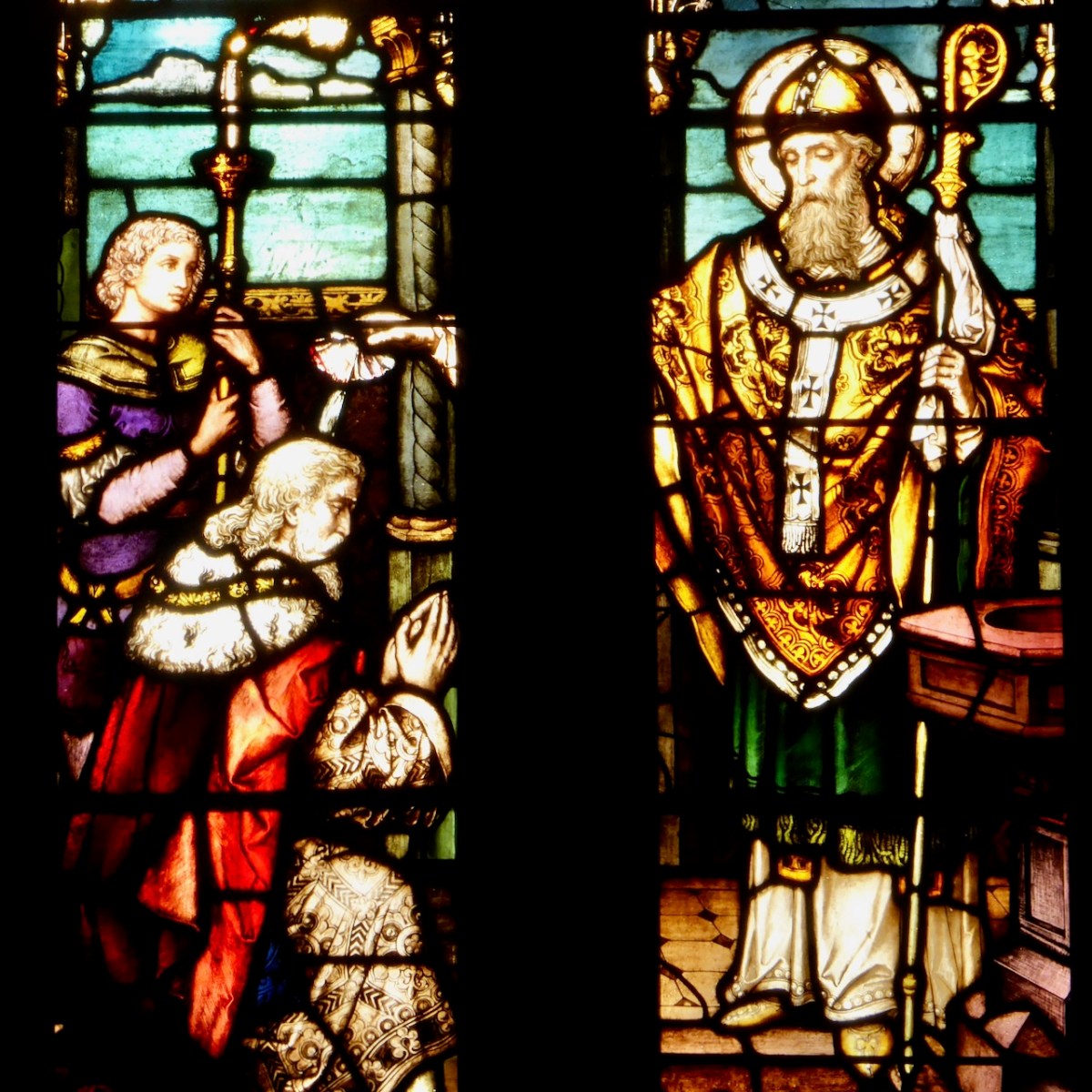
Terror then seized Loegaire, and he knelt to Patrick, and believed in God with (his) lips only, and not with a pure heart. All the rest, moreover, believe and were baptized.

The burning house episode is the climax. The wizard, wearing Patrick’s cloak, enters the half built of fresh green wood. Benignus, wearing the wizard’s tunic, enters the withered half. The green wood burns with the wizard inside it; Patrick’s cloak is unharmed. The withered wood does not burn; only the wizard’s tunic is destroyed. It is a reversal of every natural expectation, and the text presents it without comment, trusting the audience to get the significance of the miracle.
Patrick’s final words to Lóegaire, who has knelt and believed with his lips but not his heart, are worth a second look:

Patrick said to Loegaire, “ Since thou hast believed in God, length of life shall be given to thee in the kingdom. But in guerdon of thy disobedience aforetime, and because thou hast not received the baptism with desire, though thou believedst with thy lips, Hell shalt thou have, and from thy race till Doom there shall be neither sovranty nor chieftainship.”
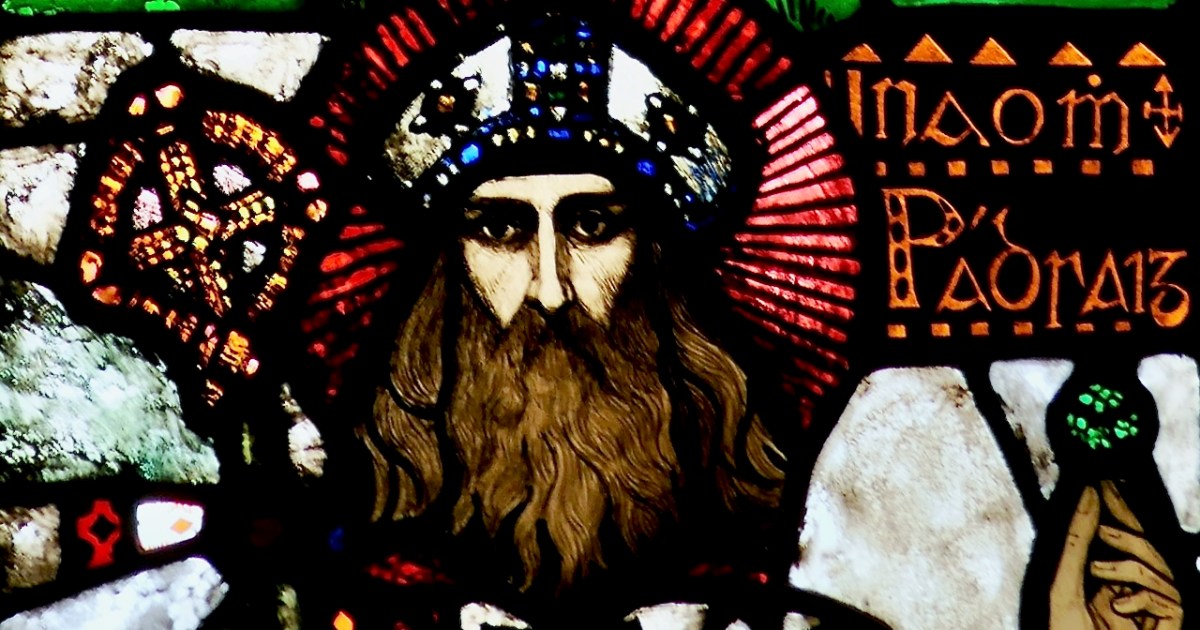
This is not the Patrick of the greeting cards, but a figure of formidable authority, distinguishing between outward compliance and genuine conversion, and prepared to curse a king’s entire lineage on the basis of that distinction. The medieval Irish church that preserved and transmitted this story clearly wanted a Patrick of the kind of power to rival and surpass the druids’ (or wizards, in Stokes’ parlance) power to bend kings – power over fire and snow and darkness. 
Maybe it’s time to reclaim that Patrick from the ‘dear saint of our isle’ with his shamrocks and raised hand in blessing. If this was the real Patrick, I suspect that when he raised his hand we would all be running for cover.
* “Let God arise and let his enemies be scattered” (psalm 68:1)

**A cruse is a small jar

Looking for Patrick

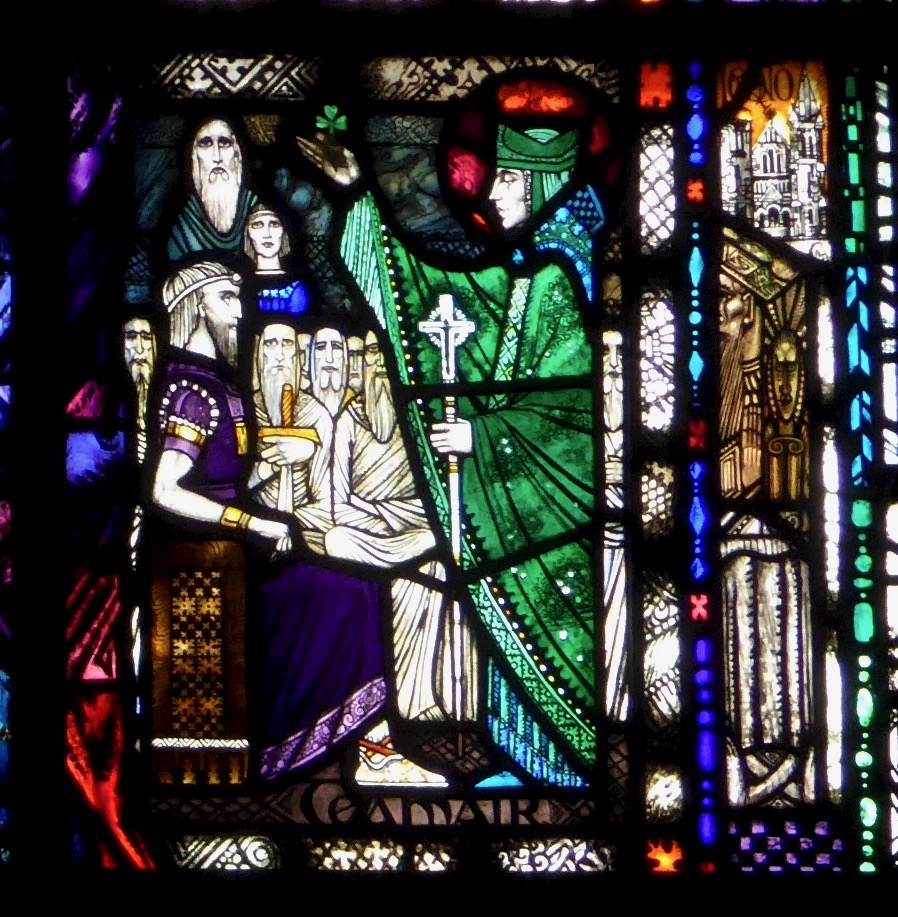
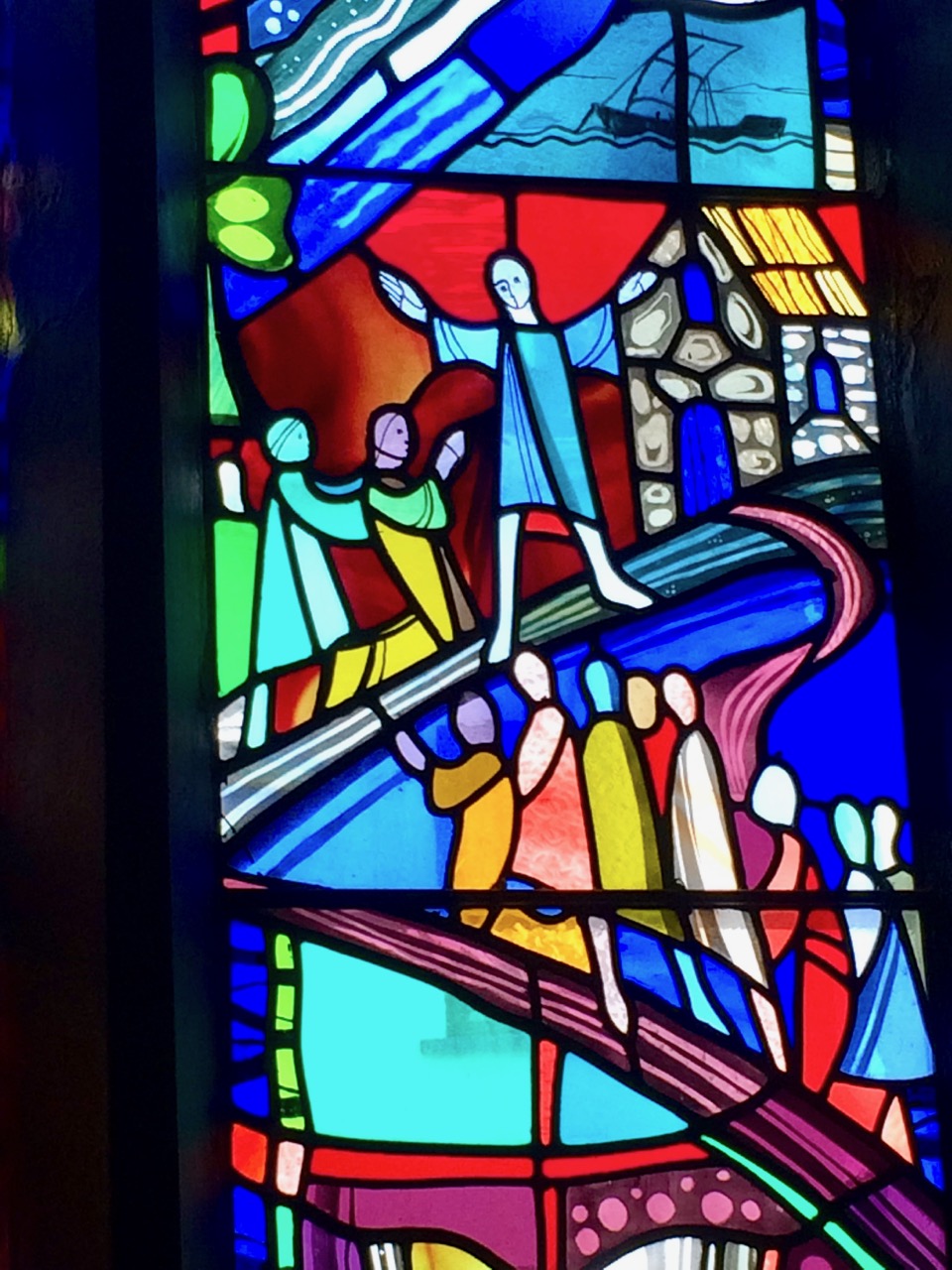
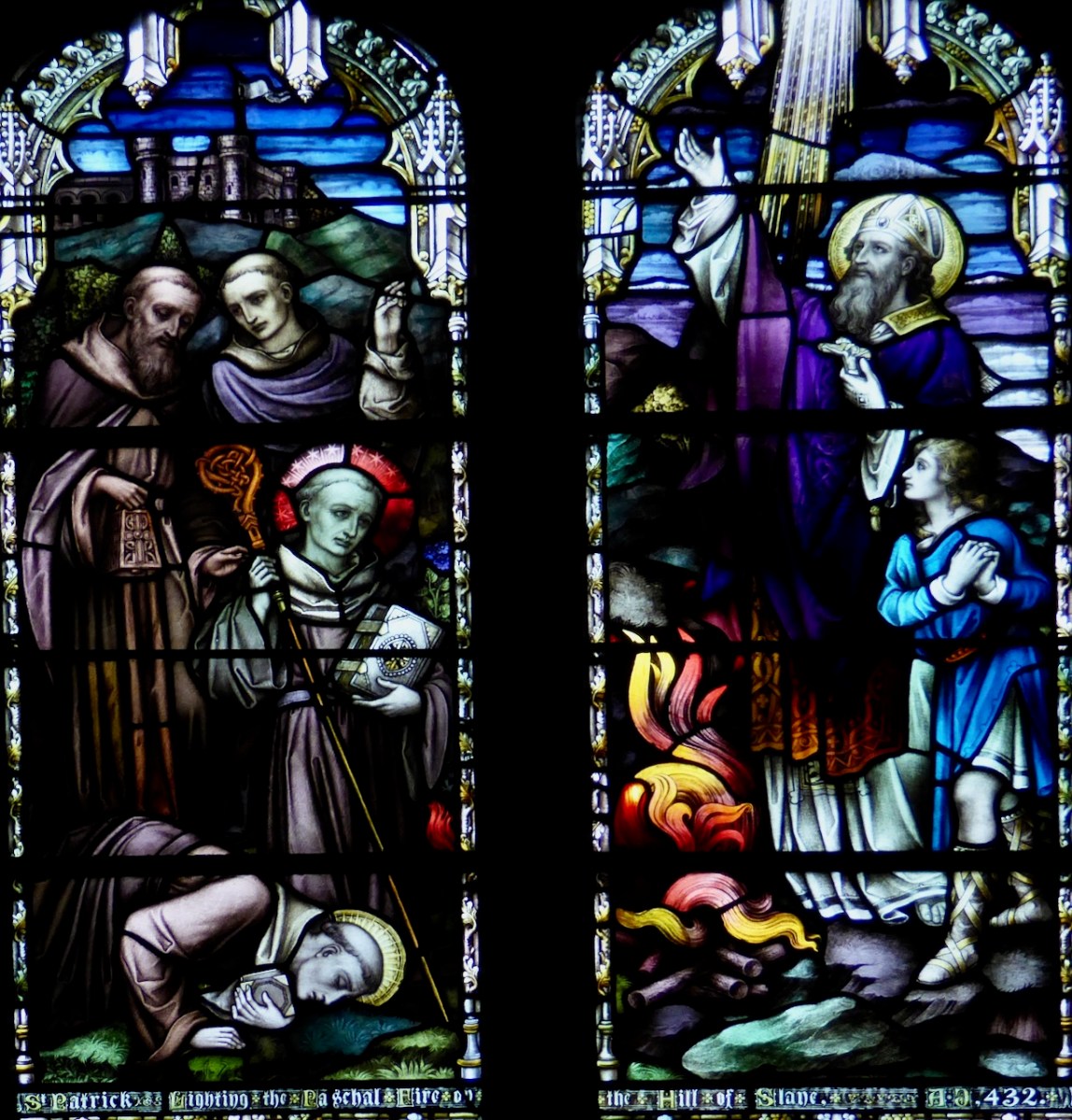
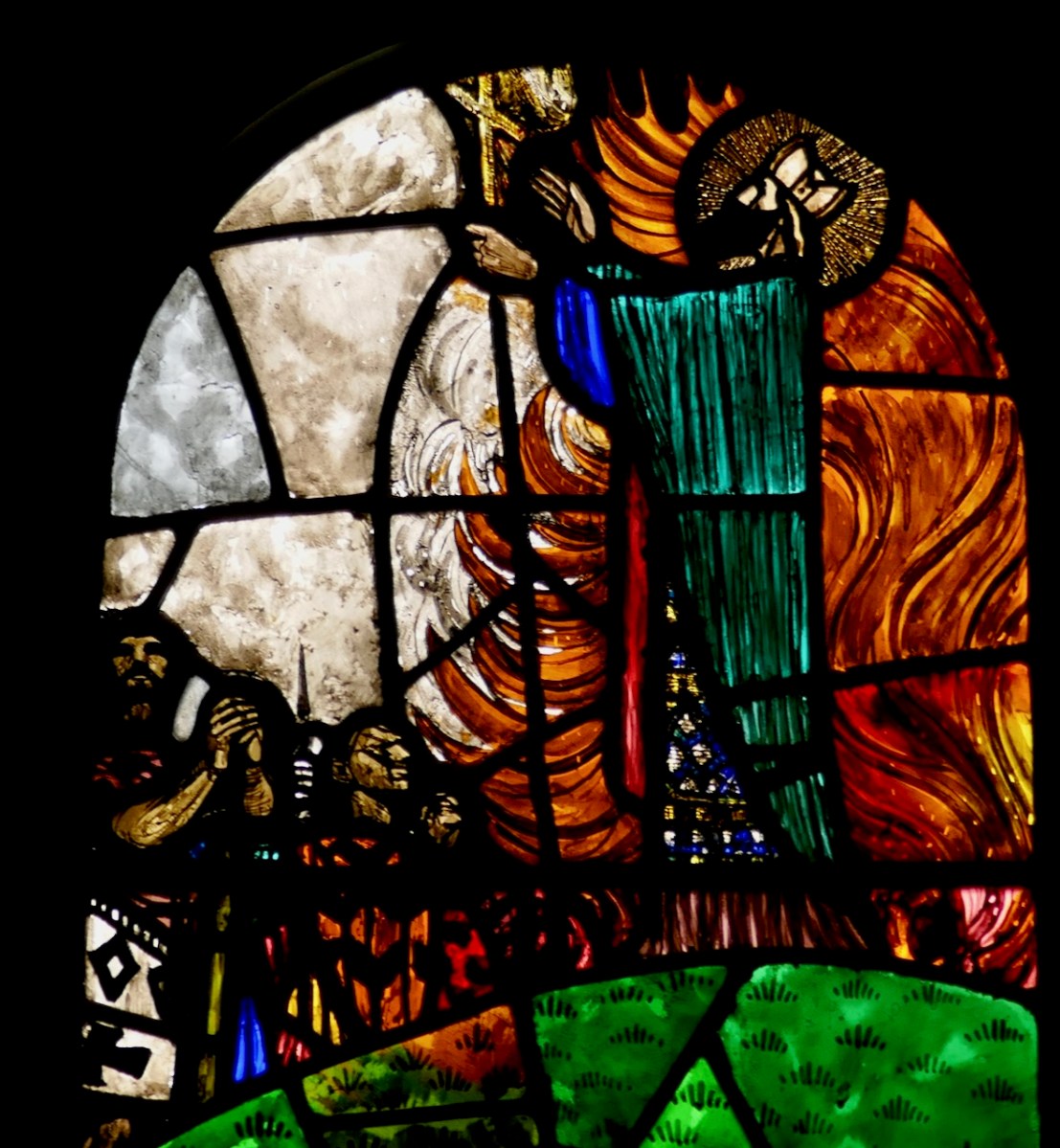
Patrick lights the Paschal Fire on the Hill of Slane. Richard King window, Church of St Peter and Paul, Athlone

A joint post – text by Robert, images by Finola

Last week we talked about Ireland’s very first saint – Ciarán (or Piran), who was born on Cape Clear. His aim in life was to convert the heathen Irish to Christianity, but they were having none of it: they tied him to a millstone and hoisted him over the edge of a cliff. Fortunately – and miraculously – the wondrous millstone floated him over to Cornwall where he became their Patron Saint and is celebrated with great acclaim on March 5th every year.

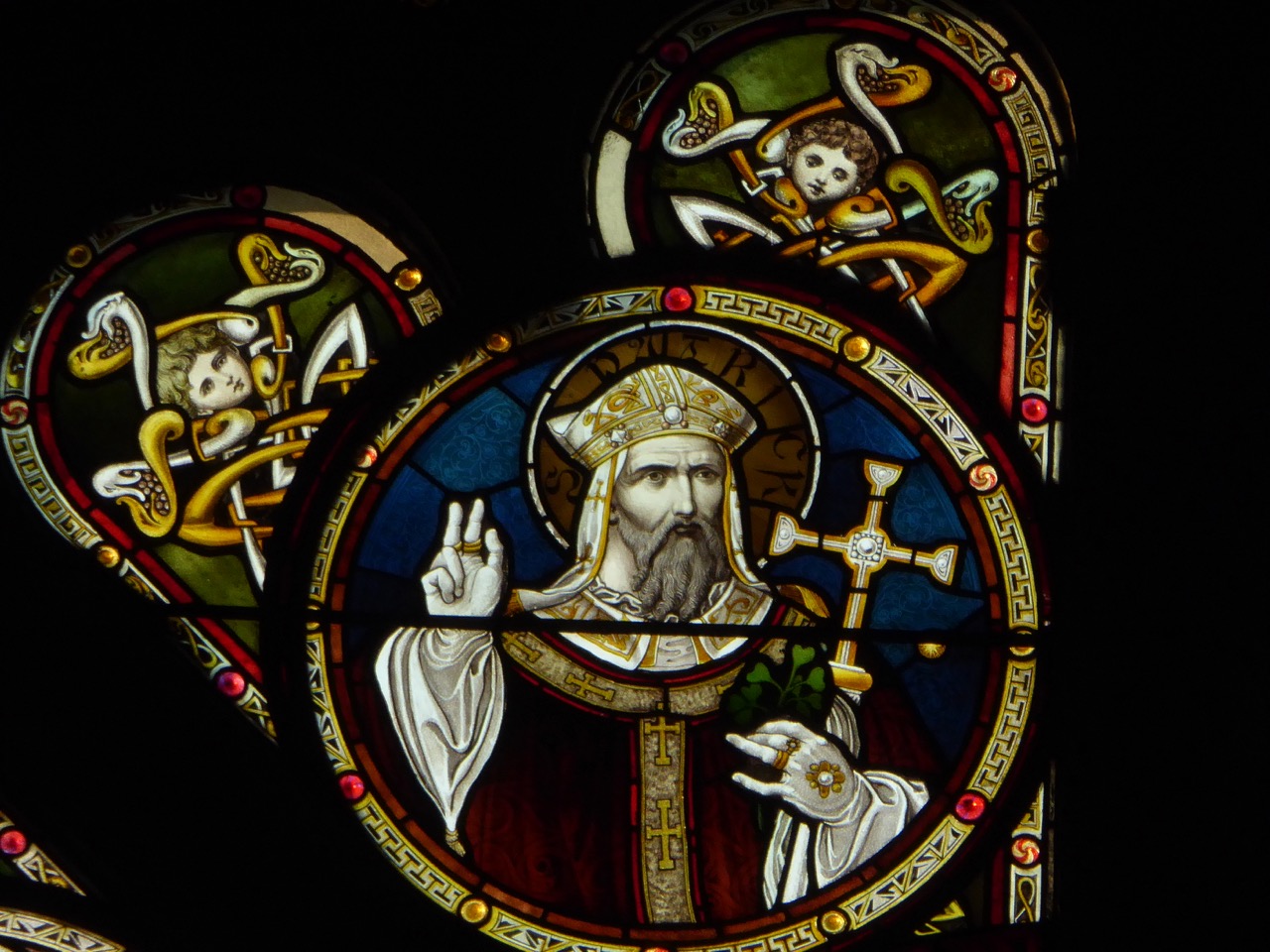
A typical representation of Patrick, older and bearded, in bishop’s robe, holding a shamrock in one hand and a crozier on the other. Skibbereen Cathedral

To return the favour of gaining an important saint from Ireland, the British have given Ireland their special saint – Patrick – and he is being celebrated this week in similar fashion. So here’s the story of Saint Patrick, seen through the eyes of an Englishman (albeit one with Cornish connections) and illustrated by Finola with a series of images from her collection.

Still traditional – looking fierce – but this one has beautiful detailing, including the interlacing surrounding the cherubs. St Carthage Cathedral, Lismore

Of course, there’s the real Patrick – the one we know through his own Confessio. The best summary we’ve come across of what can be deduced from the historical documents is the audio book Six Years a Slave, which can be downloaded from Abarta Heritage, and which is highly recommended (be warned – no snakes!). But what you’re going to get from me today is the good old-fashioned Patrick, with all his glamour and colour and centuries of accrued stories – just as he’s shown in Finola’s images.

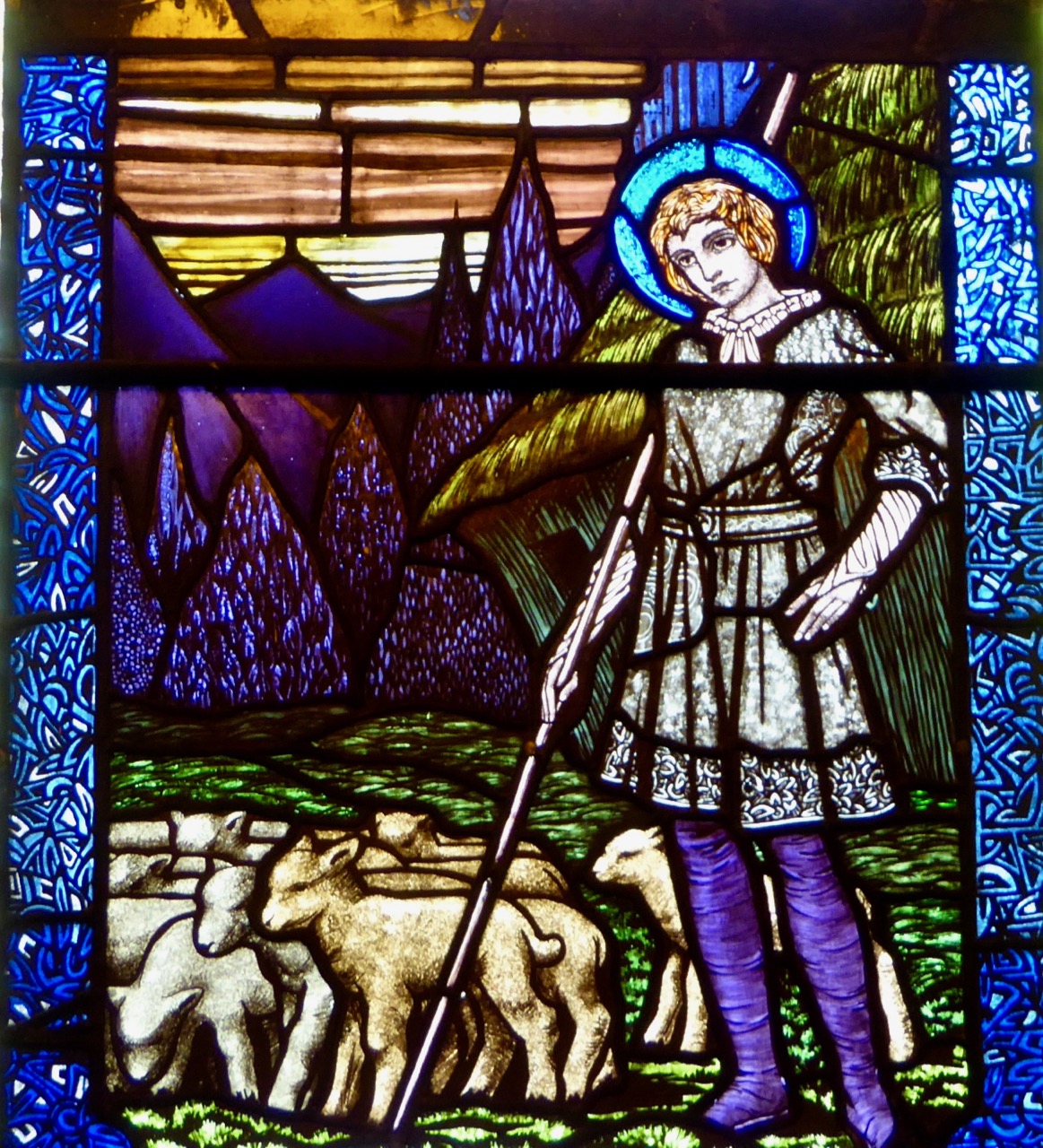
Six Years a Slave – this Harry Clarke window in the Church of The Assumption, Tullamore, seems to depict Patrick tending sheep during the period of his captivity

Patrick was born and brought up somewhere in the north west of Britain. He was of Romano British descent: his father was a a decurion, one of the ‘long-suffering, overtaxed rural gentry of the provinces’, and his grandfather was a priest – the family was, therefore, Christian. In his own writings Patrick describes himself as rustic, simple and unlearnèd.  When still a boy, Patrick was captured by Irish pirates and taken to be a slave in Ireland. He was put to work on a farm somewhere in the west and spent the long, lonely hours out in the fields thinking about the Christian stories and principles he had been taught back home.

Patrick is visited by a vision – the people of Ireland are calling to him to come back and bring Christianity to him. Richard King window, Church of St Peter and Paul, Athlone.  Read more about Richard King and the Athlone windows in Discovering Richard King

After six years he escaped from his bondage and made his way back to Britain – apparently by hitching a lift on a fishing boat. Because he had thought so much about Christianity during those years away, he decided to become a bishop which, after a few years of application, he did. Although he had hated his enforced capture he was aware that Ireland – as the most westerly outpost of any kind of civilisation – was one of the only places in the known world that remained ‘heathen’, and he was nagged by his conscience to become a missionary there and make it his life’s work to convert every Irish pagan.

Detail from Patrick window by Harry Clarke in Ballinasloe

When you see Patrick depicted in religious imagery he always looks serious and, perhaps, severe. You can’t imagine him playing the fiddle in a session or dancing a wild jig at the crossroads. In fact he was well know for his long sermons: on one occasion he stuck his wooden crozier into the ground while he was preaching and, by the time he had finished, it had taken root and sprouted into a tree!

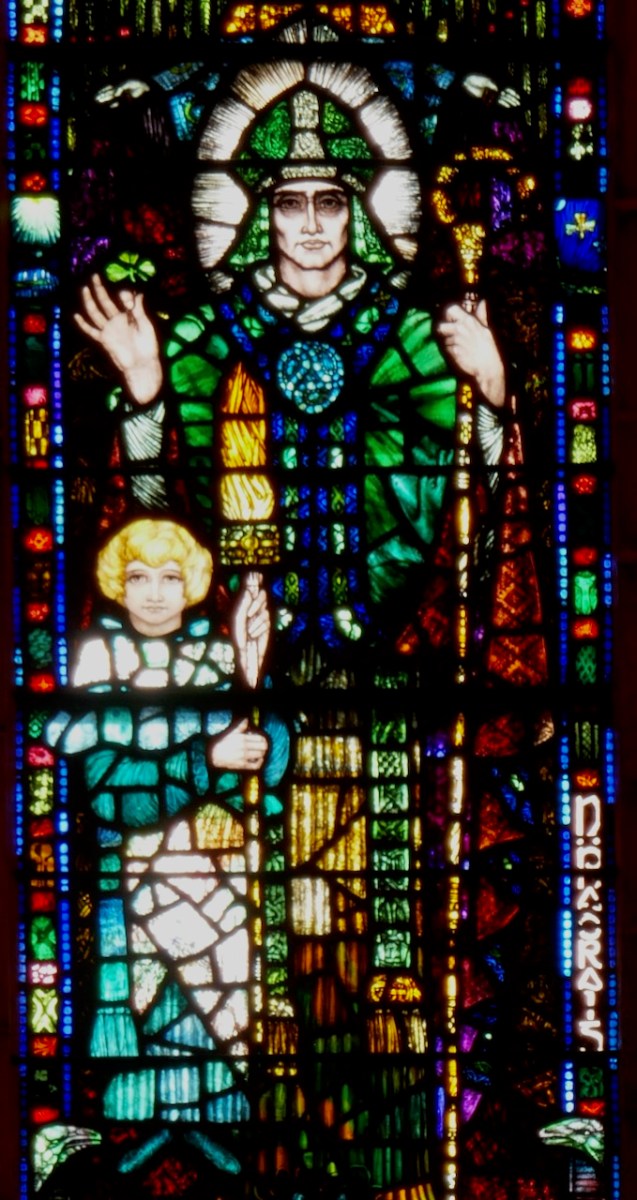
Patrick with his hand raised in a blessing, accompanied by his symbols of the Paschal Fire and the shamrock. Harry Clarke Studio window, Bantry

Perhaps it was his severity that caused him to be respected: while giving another sermon (at the Rock of Cashel) he accidentally and unwittingly put the point of his crozier through the foot of the King of Munster. The King waited patiently until Patrick had finished sermonising then asked if it could be removed. Patrick was horrified at what he’d done, but the King said he’d assumed it was all part of the initiation ritual!

In Richard King’s enormous Patrick window in Athlone, the saint is depicted as youthful and clean-shaven. Here he is using the shamrock to illustrate the concept of the Trinity

Patrick first landed on the shores of Ireland just before Easter in 432 AD and established himself on the Hill of Slane – close to the residence of the High King. In those days the rule was that only the King himself was to light the Bealtaine Fire to celebrate the spring festival, but Patrick pre-empted this by lighting his own Paschal Fire on the top of the hill, thus establishing his authority over that of the High King (see the first image in this post). Somehow, he got away with it – and the fire has been lit on the top of the Hill of Slane every Easter from that day to this.

Another panel from the Richard King window – Eithne and Fidelma receive communion from Patrick. They were daughters of the King of Connaught; Eithne was fair-haired and Fidelma a redhead, and they were baptized at the Well of Clebach beside Cruachan

St Patrick seems to have been everywhere in Ireland: there are Patrick’s Wells, Patrick’s Chairs (one of which in Co Mayo – the Boheh Stone – displays some fine examples of Rock Art), Patrick’s Beds and – on an island in Lough Dergh – a Patrick’s Cave (or ‘Purgatory’) where Jesus showed the saint a vision of the punishments of hell.

Patrick blesses St Mainchin of Limerick. Detail from the Mainchin window in the Honan Chapel, by Catherine O’Brien for An Túr Gloinne

The place which has the most significant associations with Patrick, perhaps, is Croagh Patrick – the Holy Mountain in County Mayo, on the summit of which the saint spent 40 days and 40 nights fasting and praying, before casting all the snakes out of Ireland from the top of the hill – an impressive feat. To this day, of course, there are no snakes in Ireland – or are there? See my post Snakes Alive for musings on this topic (it includes a most impressive window from Glastonbury!)

Like many Patrick windows, this one, By Harry Clarke in Tullamore, shows Patrick banishing the snakes. This one has all the gorgeous detailing we expect from Clarke, including bejewelled snakes

When Patrick considered that he’d finished his task, and the people of Ireland were successfully and completely converted, he returned to Britain and spent his retirement in the Abbey of Glastonbury – there’s a beautiful little chapel there dedicated to him.

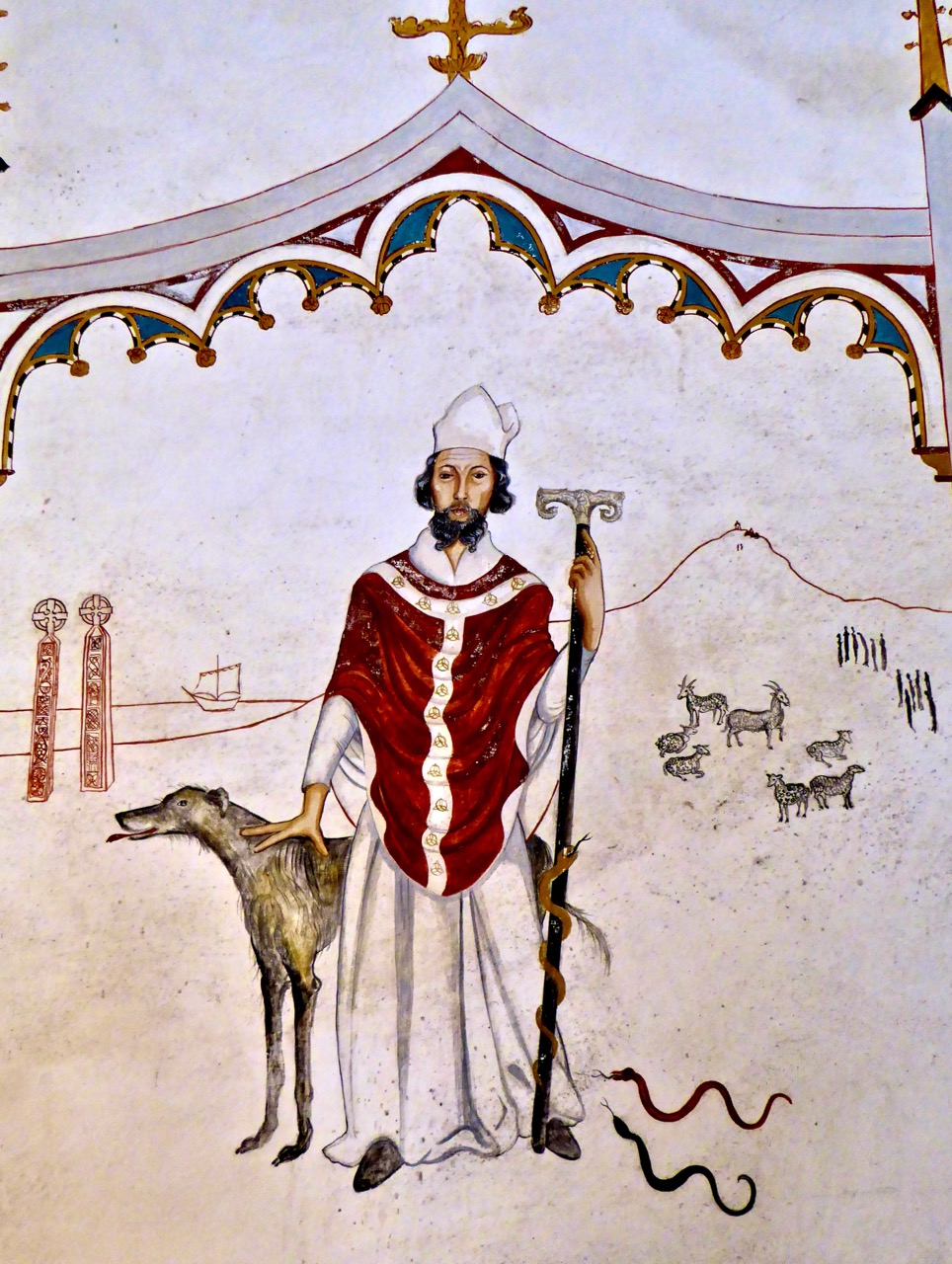
This depiction of Patrick on the wall of his Glastonbury chapel shows him with familiar symbols but also several unusual symbols – an Irish wolfhound, high crosses, and Croagh Patrick, the holy mountain

It’s logical he should have chosen that spot to end his days as it must be the most blessed piece of ground in these islands, having been walked upon by Jesus himself who was taken there as a boy by his tin-trading uncle, Joseph of Arimathea. St Bridget joined Patrick there in retirement and they are both buried in the Abbey grounds, along with the BVM who had preceded them to that place a few centuries earlier.

From the George Walsh window in Eyeries, Patrick returns to convert the Irish

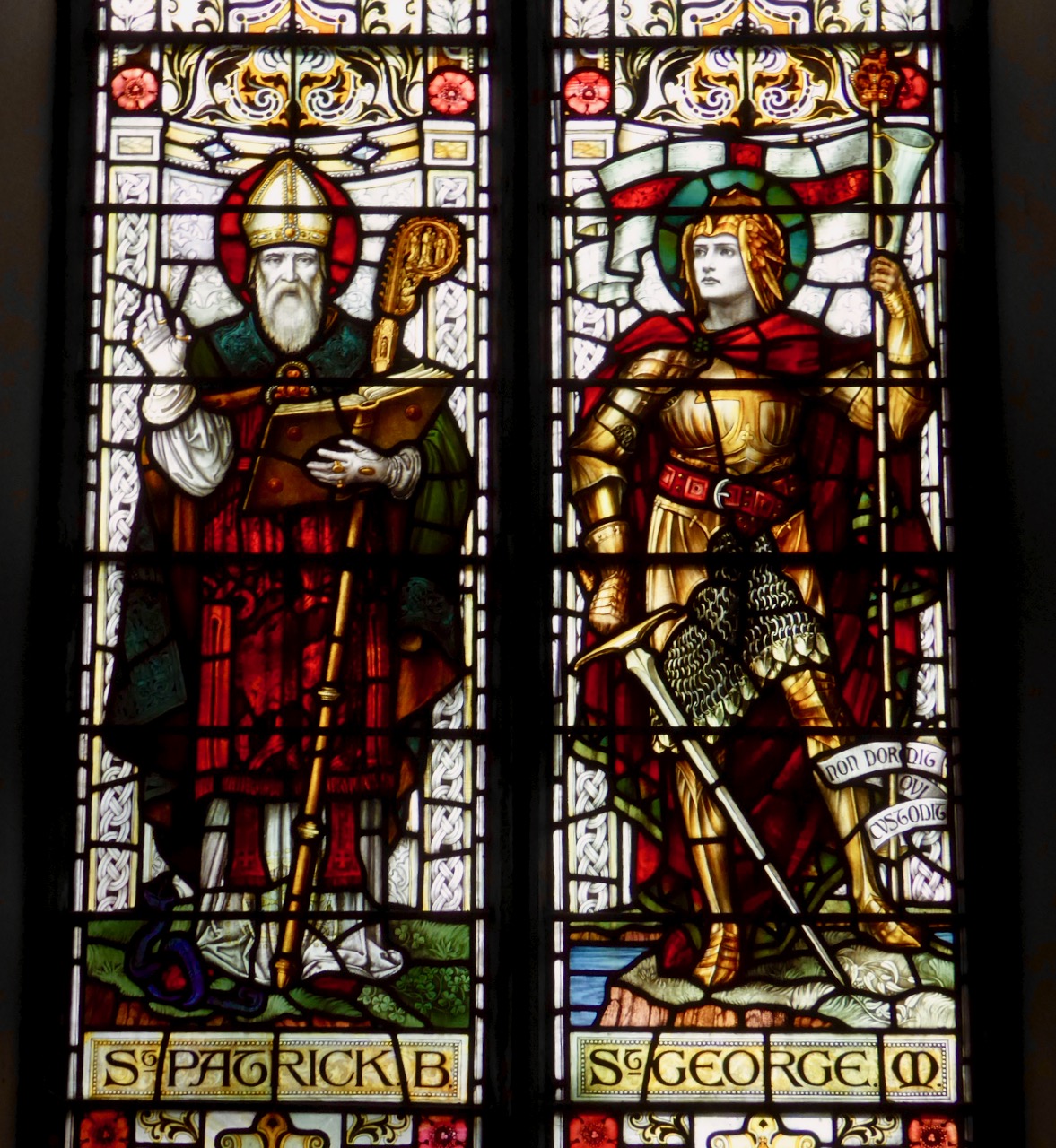
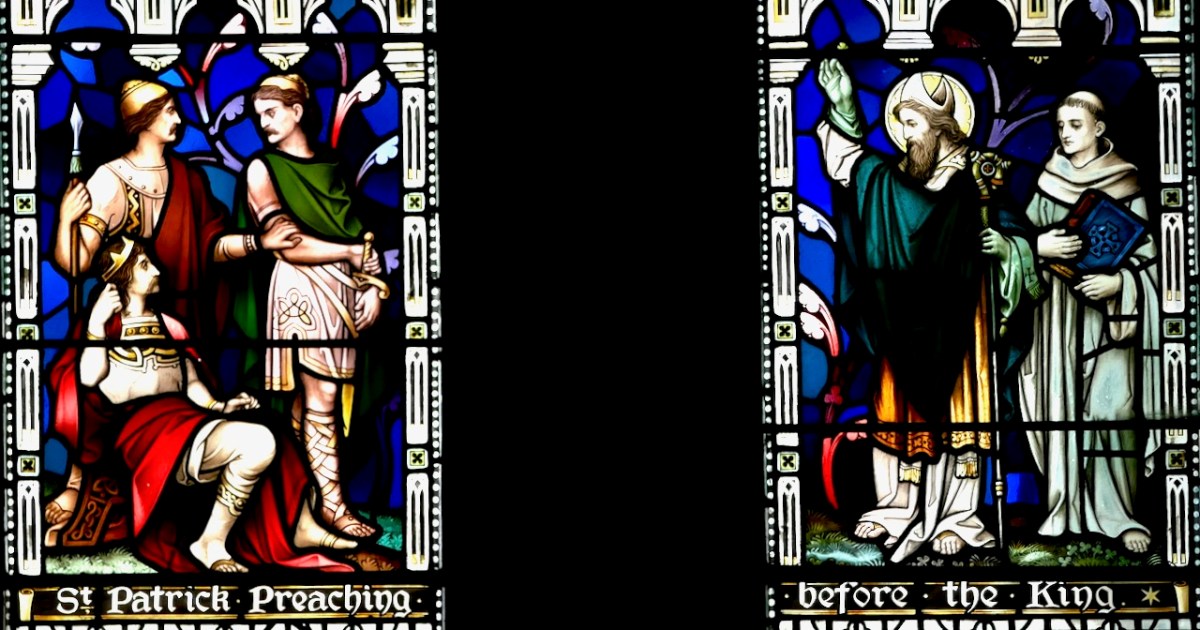
A depiction of Patrick below comes from St Barrahane’s Church of Ireland in Castletownsend where he is shown alongside St George. The window dates from before Irish independence and is an attempt to show the unity of Britain and Ireland through their respective patron saints. Perhaps meant to represent friendship between the countries, nevertheless nowadays it seems to display a colonial overtone that is an uncomfortable echo of past mores.

The window is by Powells of London and dates to 1906

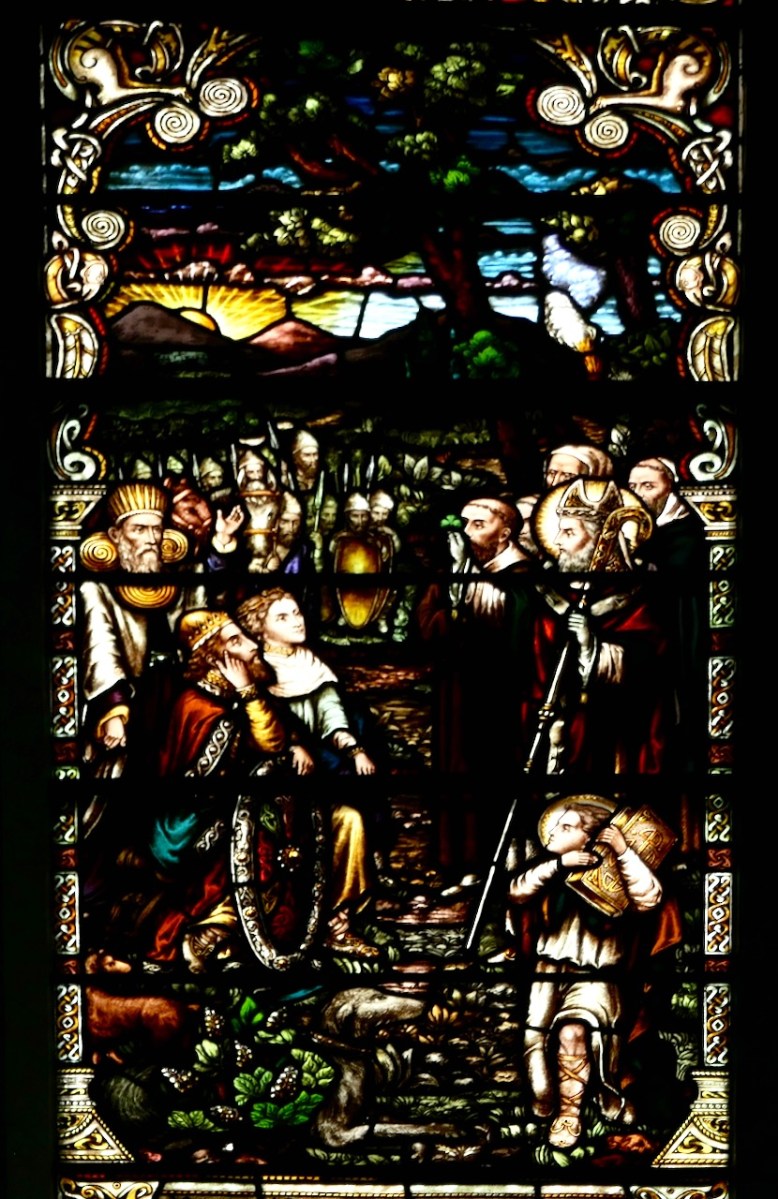
So let’s leave Patrick doing what he came back to do – a last panel from the Richard King window in Athlone shows him performing his saintly task of converting the Irish – one chieftain at a time.

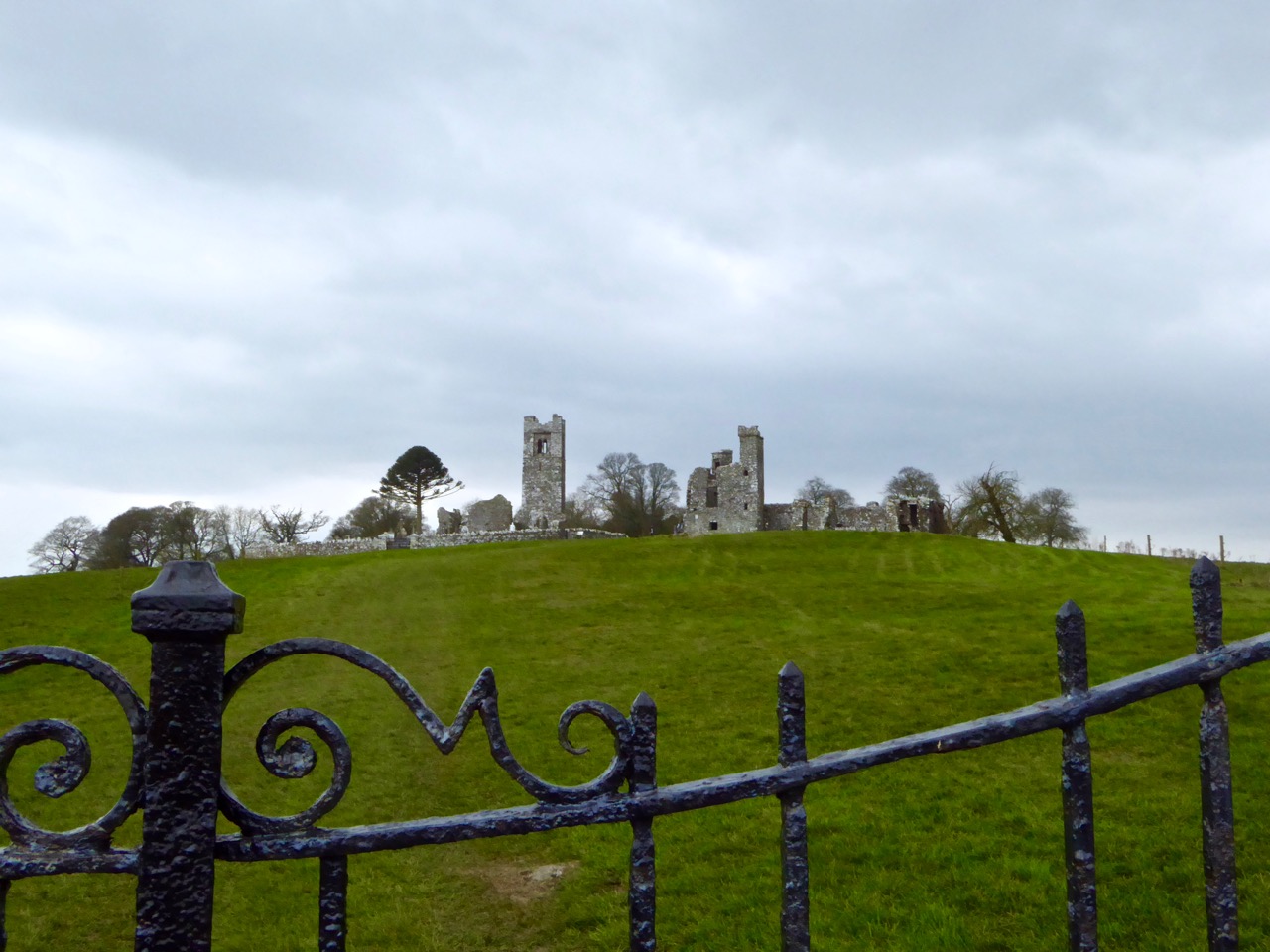
Hill of Slane

abbey + college

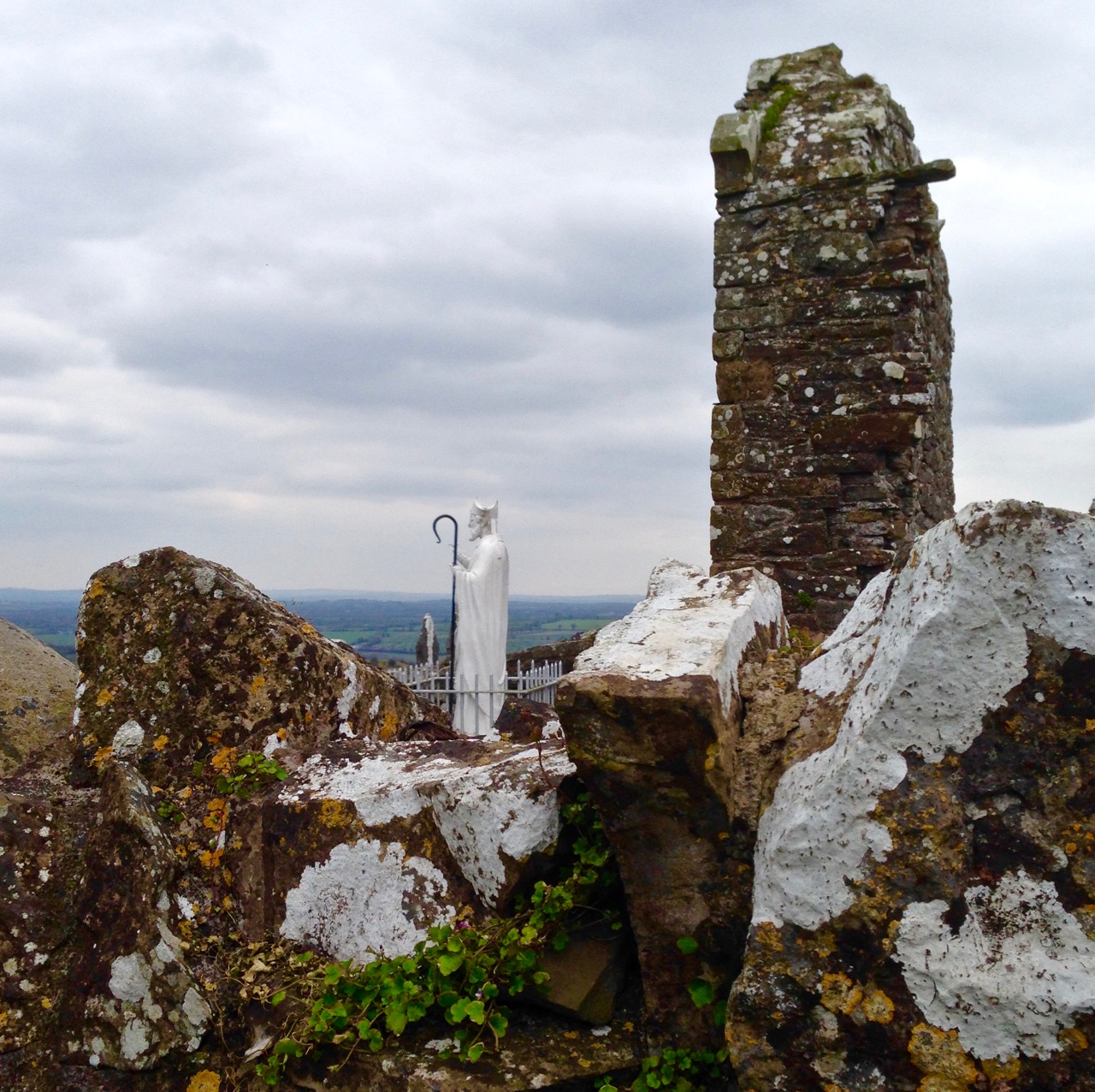
Our travels took us to the Hill of Slane. On its summit overlooking the River Boyne a depleted Saint Patrick (he’s lost his hands) looks forever out to the east, facing towards the mound of Millmount at Drogheda, about 15 kilometres away according to our Crow. Millmount is reputed to be the site of an ancient passage grave – and the burial place of Amhairgin mac Míled, who was regarded as the originator of the arts of song, poetry and music. The very first Irish poem The Song of Amhairgin was recited by him as he entered Ireland from the River Boyne, below the mound. Here’s a version of it translated (from the original Irish) by Lisa Gerrard:

I am the wind on the sea
I am the stormy wave
I am the sound of the ocean
I am the bull with seven horns
I am the hawk on the cliff-face
I am the sun’s tear
I am the beautiful flower
I am the boar on the rampage
I am the salmon in the pool
I am the lake on the plain
I am the defiant sword
I am the spear charging to battle
I am the god who put fire in your head

Who made the trails through stone mountains?
Who knows the age of the moon?
Who knows where the setting sun rests?
Who took the cattle from the house of the Warcrow?
Who pleases the Warcrow’s cattle?
What bull, what god created the mountains’ skyline?
The cutting word – the cold word?

The Saint lit the Pascal Fire on the Hill of Slane soon after his mission in Ireland began (the flame is still lit at Easter). That seems to me a symbolic action: a challenge issued, perhaps to the pagan traditions that had gone on for generations before the new religion arrived. Patrick’s fire-raising activities are also a comparatively recent addition to the lore of the hill: according to the Metrical Dindsenchas – combining poems from the Book of the Dun Cow, the Book of Leinster, the Rennes Manuscript, the Book of Ballymote, the Great Book of Lecan and the Yellow Book of Lecan – all sources well over a thousand years old and themselves most likely compiled from the timeless oral traditions of the Bards – Slane is the burial place of an ancient king:

…Slaine, whence the name? Not hard to say. Slaine, king of the Fir Bolg, and their judge, by him was its wood cleared from the Brugh. Afterwards, he died at Druim Fuar, which is called Dumha Slaine, and was buried there: and from him the hill is named Slaine. Hence it was said: Here died Slaine, lord of troops: over him the mighty mound is reared: so the name of Slaine was given to the hill, where he met his death in that chief abode….

(Translated by Edward J Gwynn in 1903)

The ‘mighty mound’ must surely be the enigmatic earthworks hidden in the trees to the west of the abbey and college ruins: these are variously described as a barrow or a motte.

Over the gate

Top: medieval profile; Above left: ‘Creature of Slane’ decorating the walls of the old college, and Above right: the tower of the monastery which dates from the 16th century

Mostly what we see today on the summit here is medieval: the hill remained a centre of religion and learning for many centuries after St Patrick. A friary church was established on the site of an earlier monastery in 1512: it was abandoned in 1723. Beside it is a medieval college, probably also 16th century. The stonework here includes some extraordinary carvings, sadly much dilapidated.

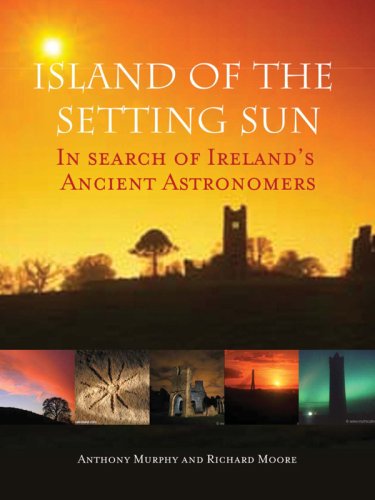
I musn’t shy away from another tradition associated with Slane Hill: the authors of this book make a convincing case for an alignment right across Ireland that takes in several historically important sites:

41s5jHsihjL…The Millmount-Croagh Patrick alignment stretches over 135 miles from the east coast of Ireland to the west, and has significant St Patrick associations … we found that the line from Millmount to Slane westwards travels all the way to Croagh Patrick, perfectly intersecting the little chapel on the summit of The Reek with breathtaking accuracy. Significantly, this line skirts the hills of Loughcrew on its way, and also travels directly through Cruachan Aí, one of the largest archaeological complexes in the whole world, with 200 monuments located in a 10-mile radius. Croagh Patrick, known in prehistoric times as Cruachan Aigle, is the place where, according to legend, Patrick banished the serpents from Ireland…

If nothing else, the theory at least demonstrates that St Patrick’s influence stretches the length and breadth of the country: witness his statue looking out from the Hill of Slane and another looking across from the lower slopes of The Reek!

croagh patrick 6

croagh patrick 5

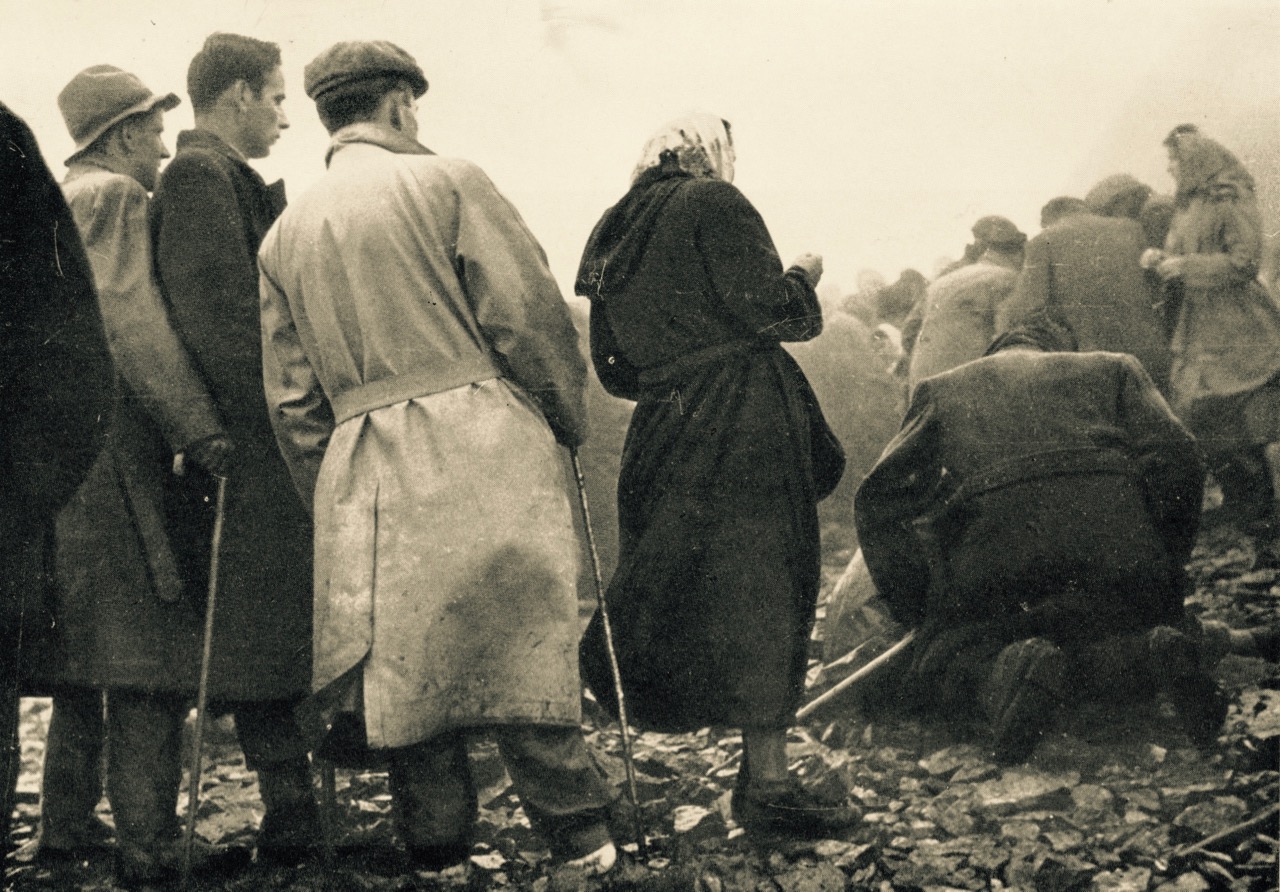
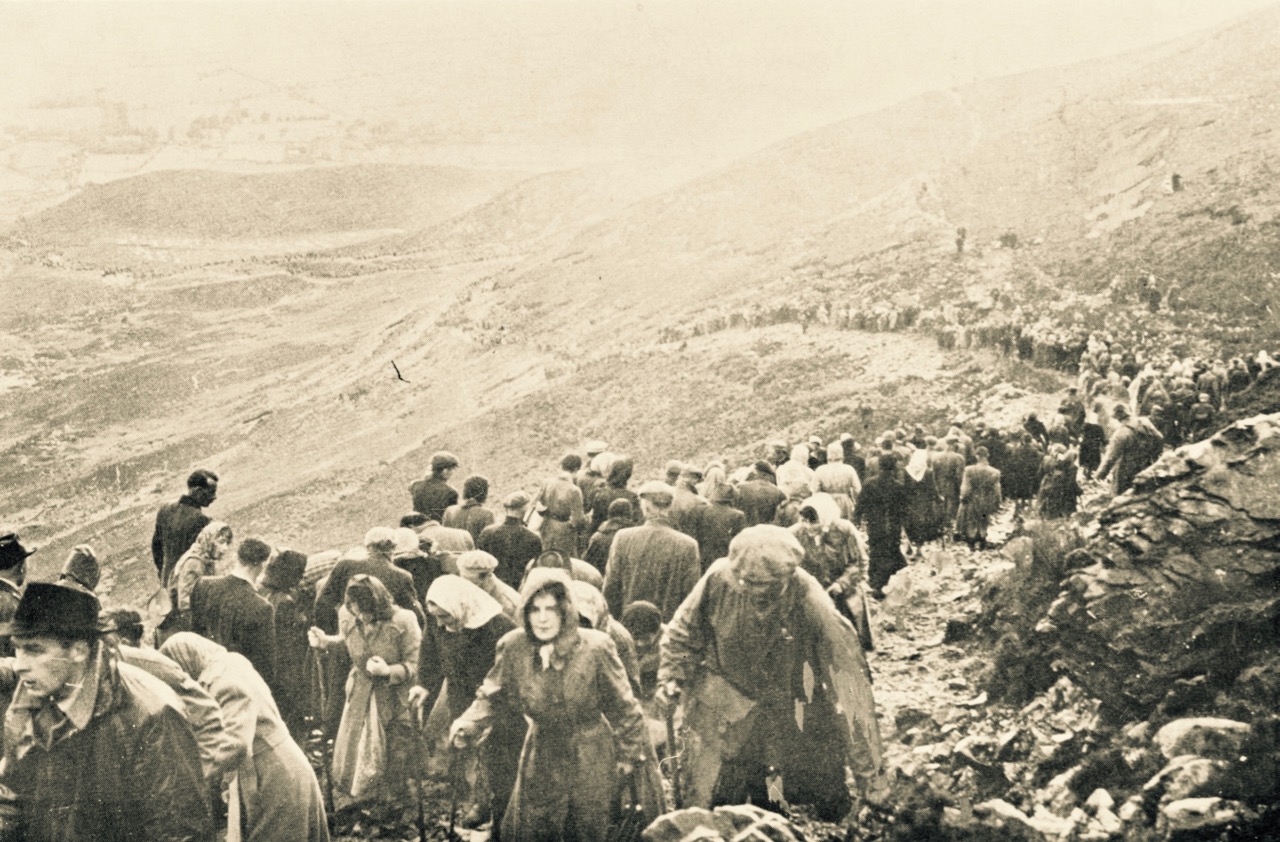
Pilgrimage for St Patrick on The Reek: Photos from the collection of Tomás Ó Muircheartaigh, who documented life in rural Ireland between the 1930s and the 1950s

St Patrick (his day was last week), Easter (this weekend), the Boyne neolithic monuments, Irish poetry, ancient kings and their battles, a little bit of astro-archaeology, the commemoration of the 1916 uprising in Dublin, the fight for Irish freedom… All seem to have joggled along beside each other in our recent explorations. Somehow they fit together and define an Irish-ness which is all-encompassing but not overwhelming. History is dancing all around us: alive and relevant.

watching saint p