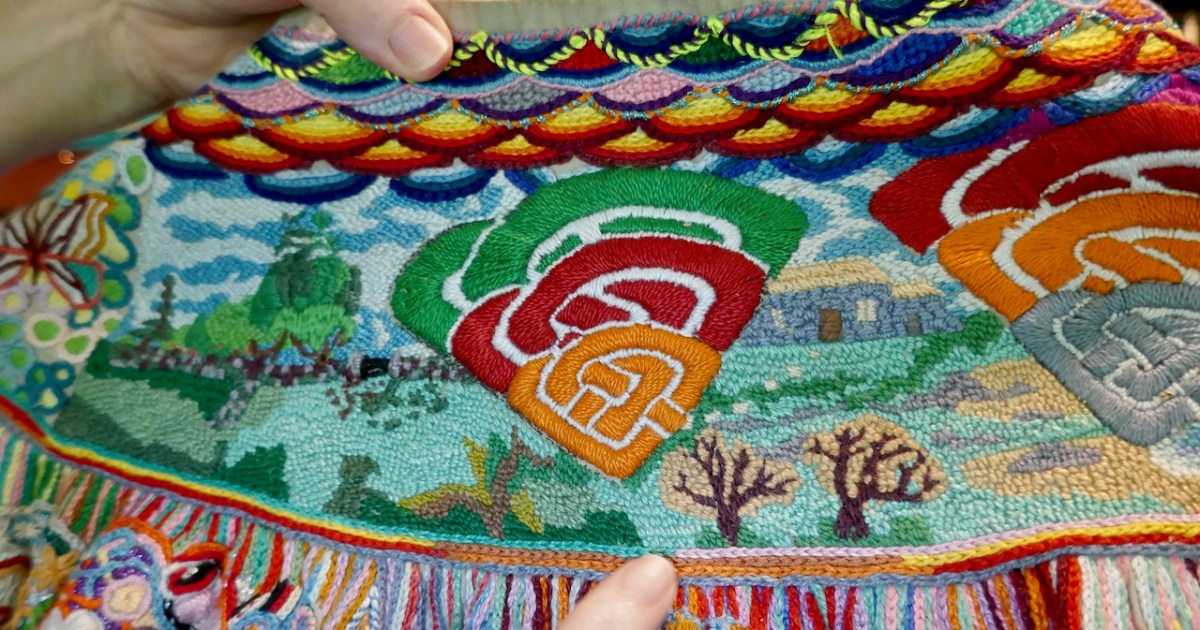
Stitching and Storytelling Among the Rocky Fields

At the very far reaches of the Mizen, surrounded by townlands whose names all translate as variants on the theme of rocky fields, in a place with immense views, lies an oasis of creativity and charm: the home of Owen and Kate Kelly and their family.
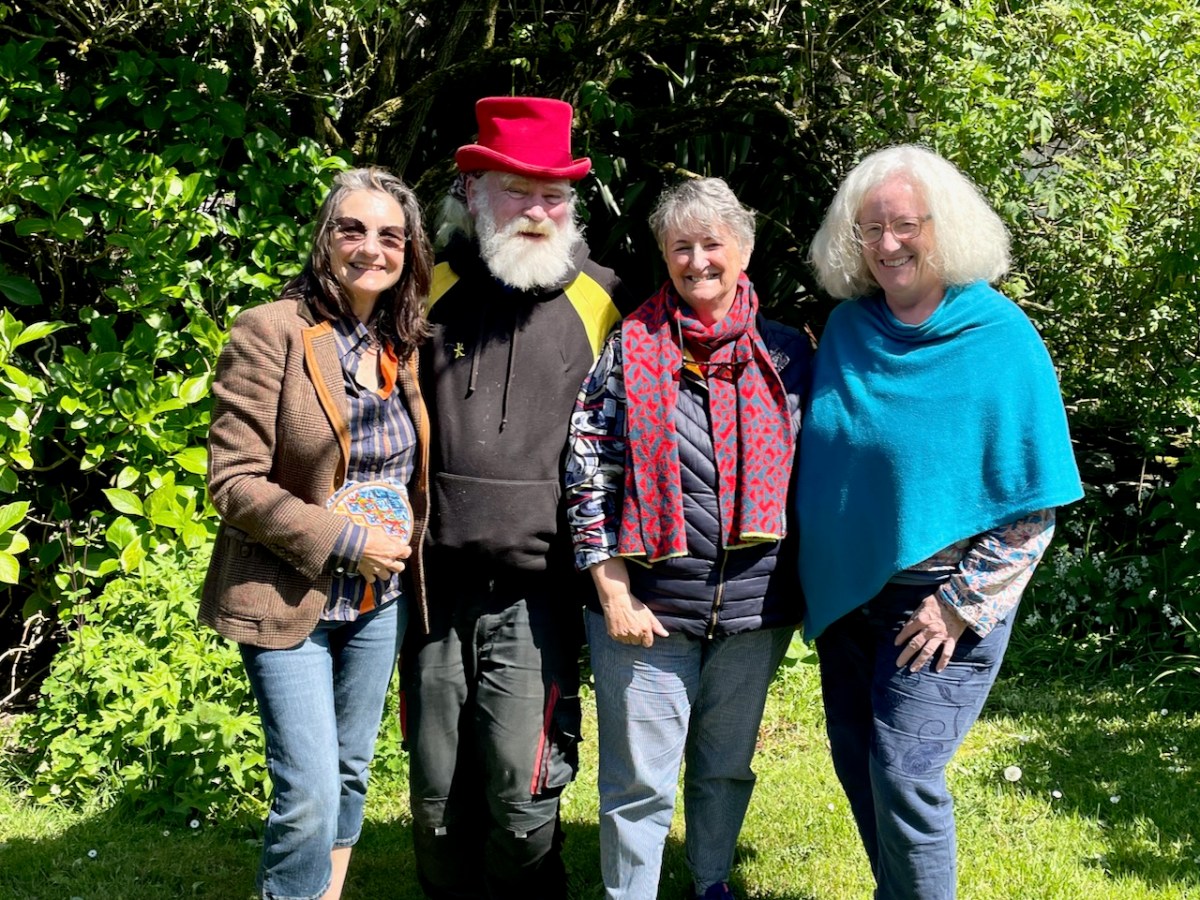
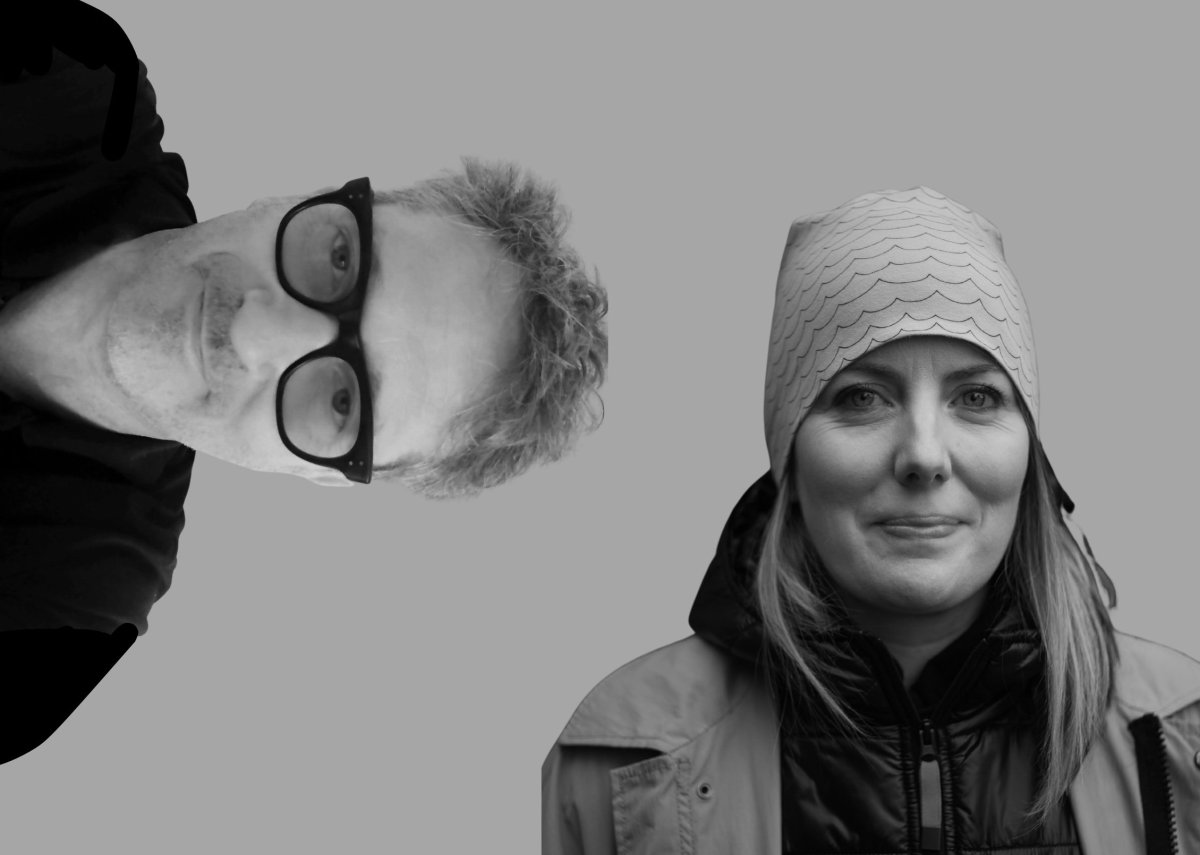
Three of us, Artist Christina, Blogger Finola, and Writer/Actor/Director Karen, fetched up there on a blue sky day this week, to visit Owen and see his craft. Owen is a stitcher, an embroiderer, a needleworker. He’s also a professional coach (international table tennis), a gardener and a conservationist. Nowadays, he, as a fifth-generation stitcher, makes his living crafting unique garments and decorative elements for high-end clothing. 
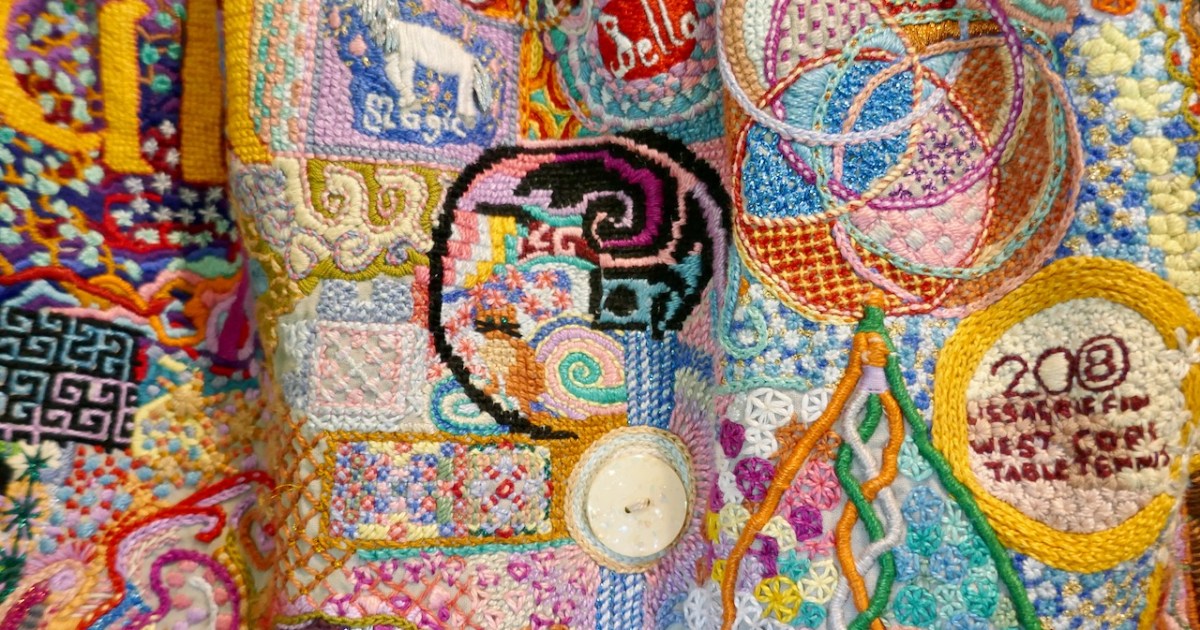
It has all grown organically from his social media accounts on Facebook and Instagram and Bluesky. Somehow, the like-minded find each other and the army of admirers grows, and the orders start to arrive.

Owen doesn’t just decorate – he tells stories with every piece. The first thing he showed us was his memory skirt, full of his own history. That’s his trip to Glastonbury, here’s a particularly memorable table tennis tournament, the birth of a daughter, his grandmother’s favourite stitch in her favourite colour. 
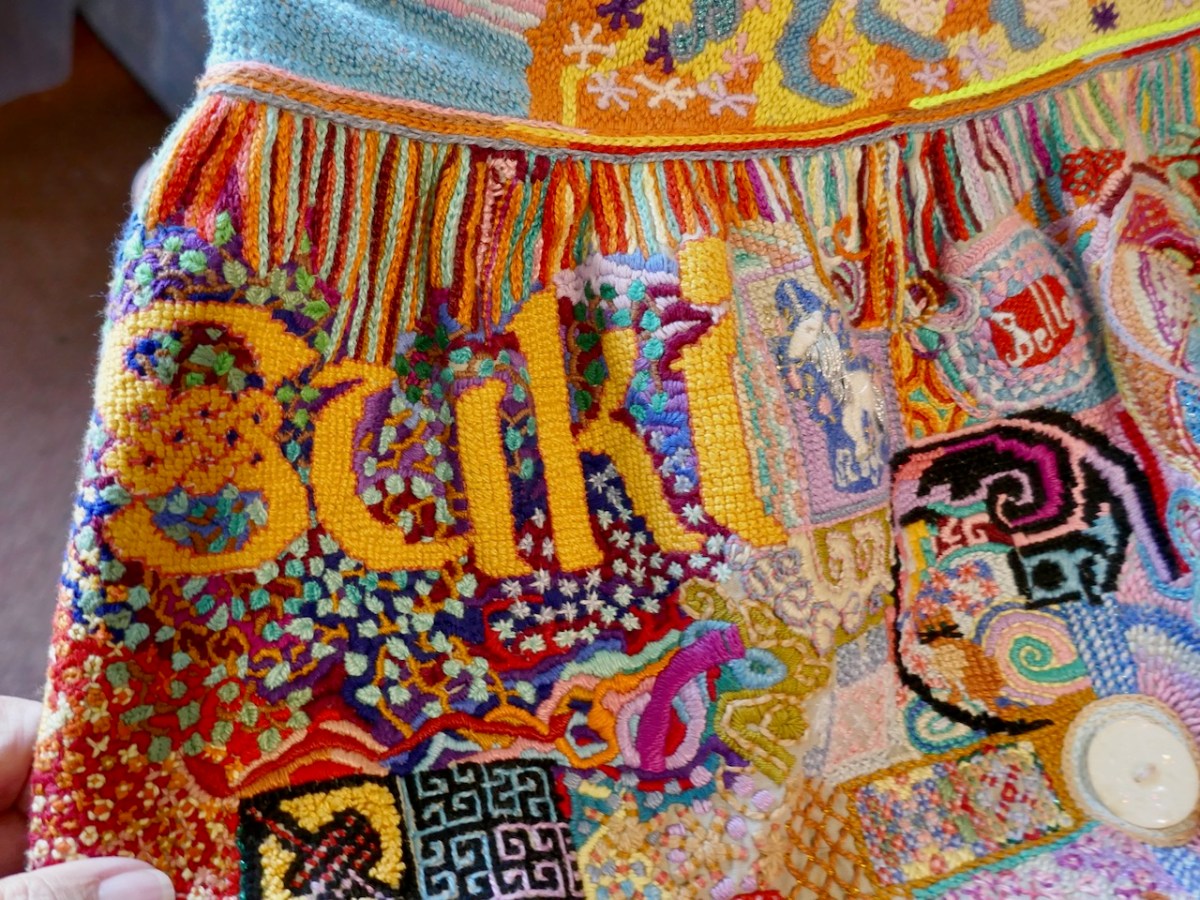
He thinks it’s finished and I certainly didn’t see any place to add more, but heck, you never know.
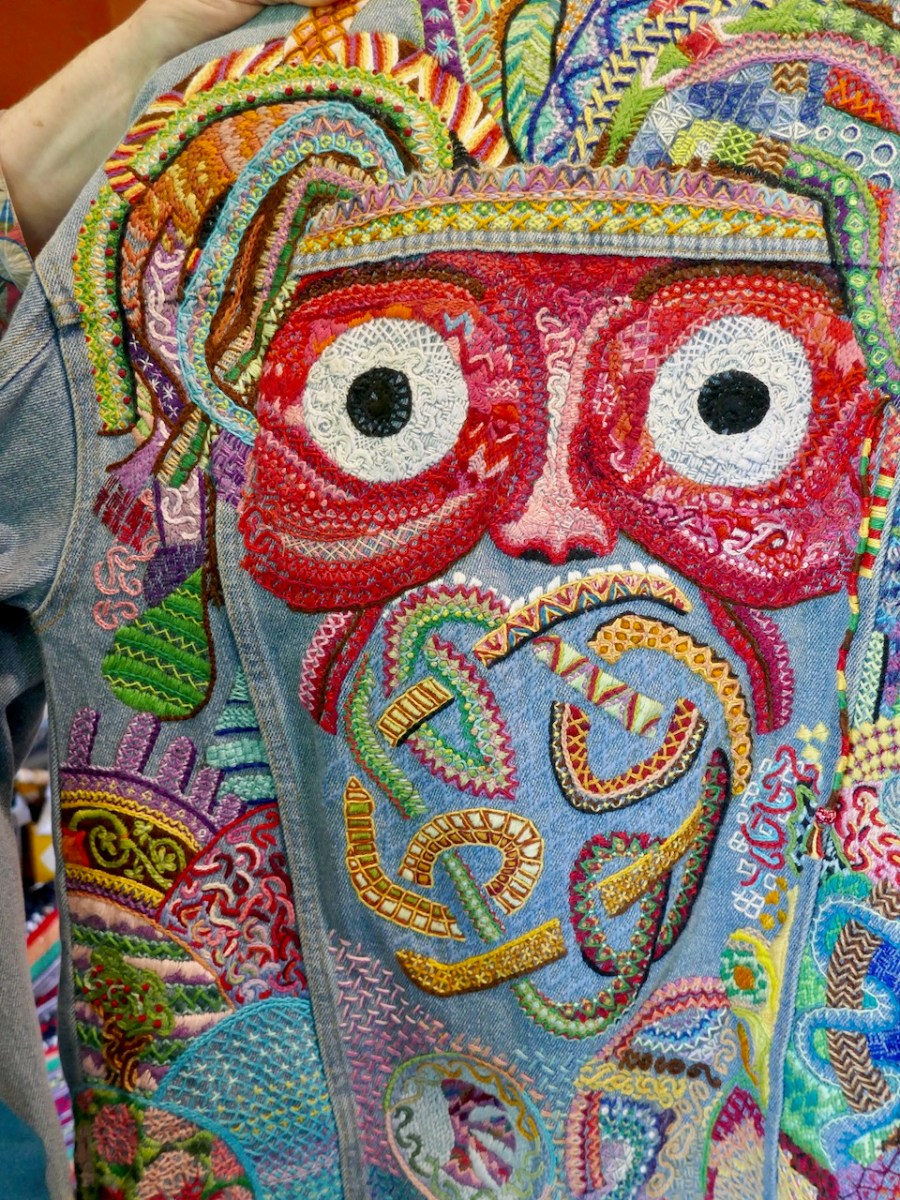
Here’s the back of a jacket that I assumed was an owl – but Owen was referencing the need for masking that so many people feel. That is, they cope with life by concealing their mental struggles, their ADHD or Autistic tendencies, in order to fit in. It’s exhausting, and his depiction is an act of masking in itself, since I jumped to the conclusion that this was a bird.
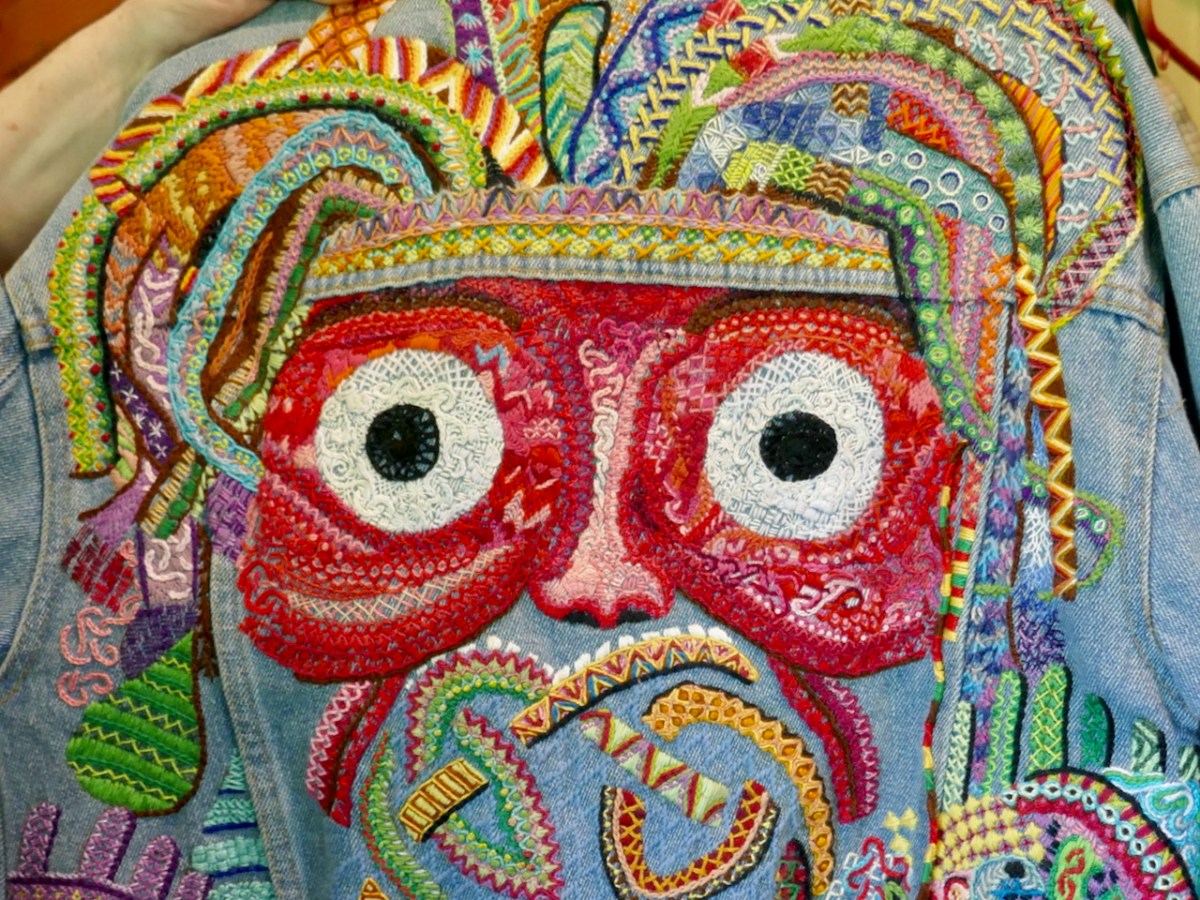
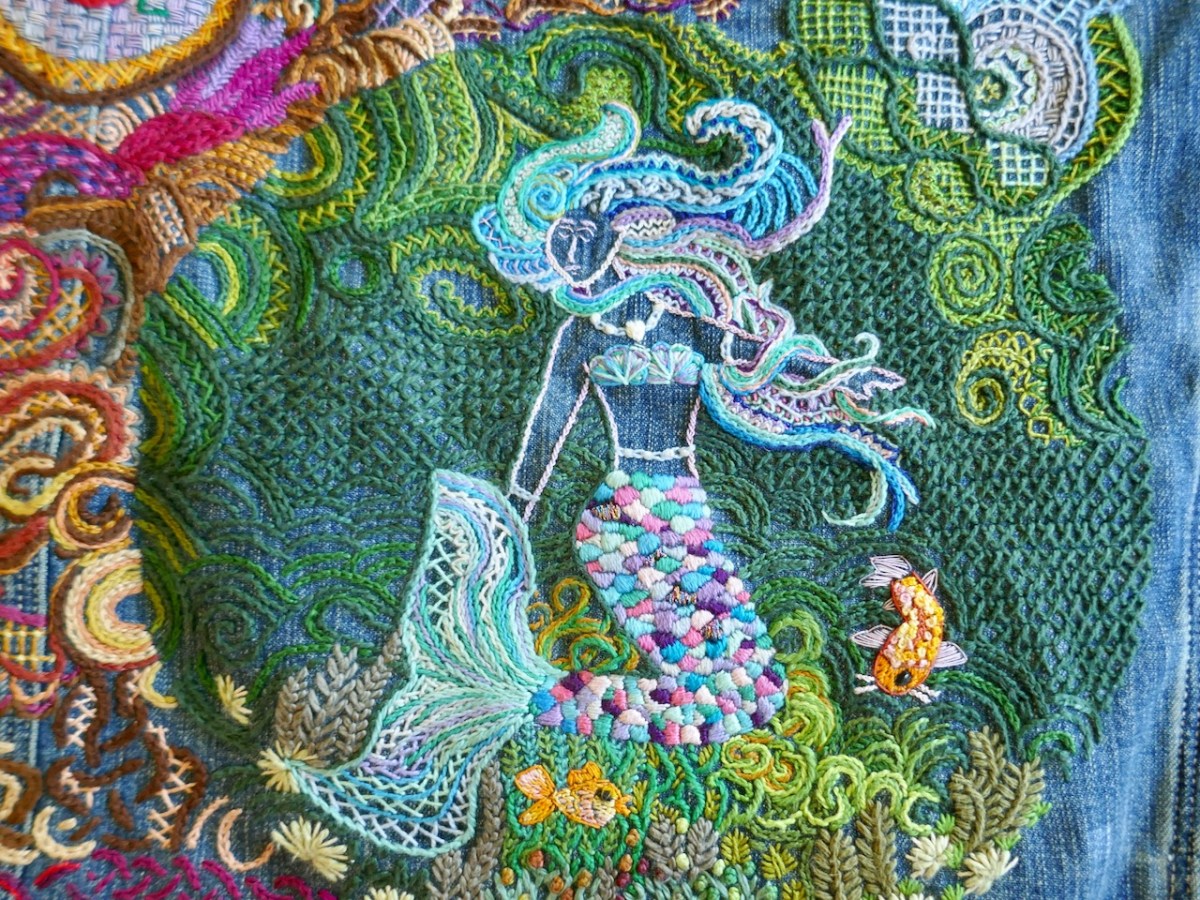
And the mask is a good piece to take a closer look at the sheer variety of individual stitching styles. I have a vague memory from school of learning blanket stitch, daisy chain, French something-or-other, but Owen must know hundreds of different stitch types. Zoom in!
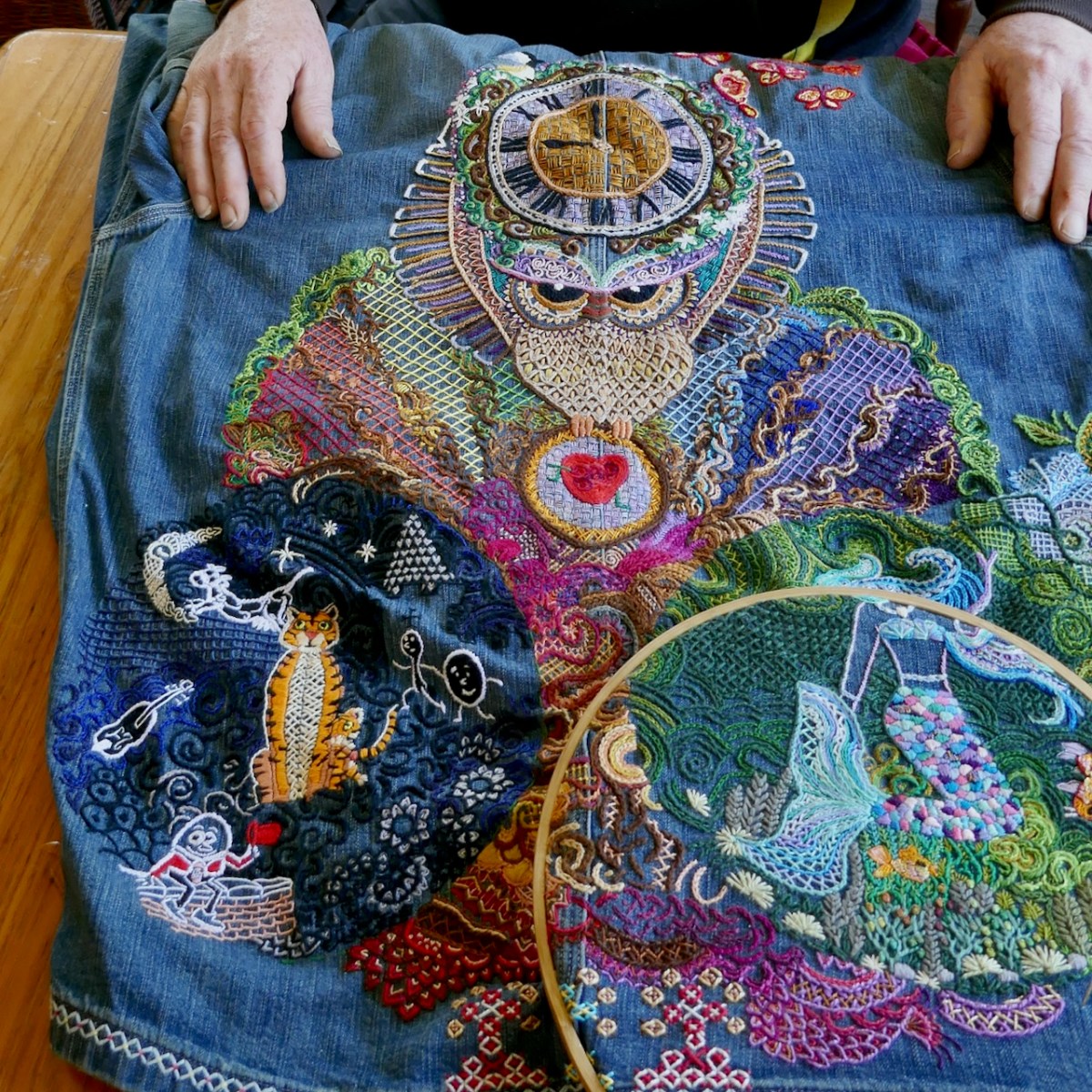
Owen walked us through the process of designing the back of a Ralph Lauren shirt for a client – sorry, that should be, for a friend. That’s what they all turn into. In this case he has already done pieces for other members of the family so he knows the children, the grandchildren, the stories, the likes, the hobbies, the icons they gravitate to.
What fascinated me most is that he doesn’t start out (as left-brained me would do) with a plan – there is no sketch design, no chalk marks on fabric, no story board or end-goal. But in his head is the story he wants to tell. He calls this process ‘flow stitching.’
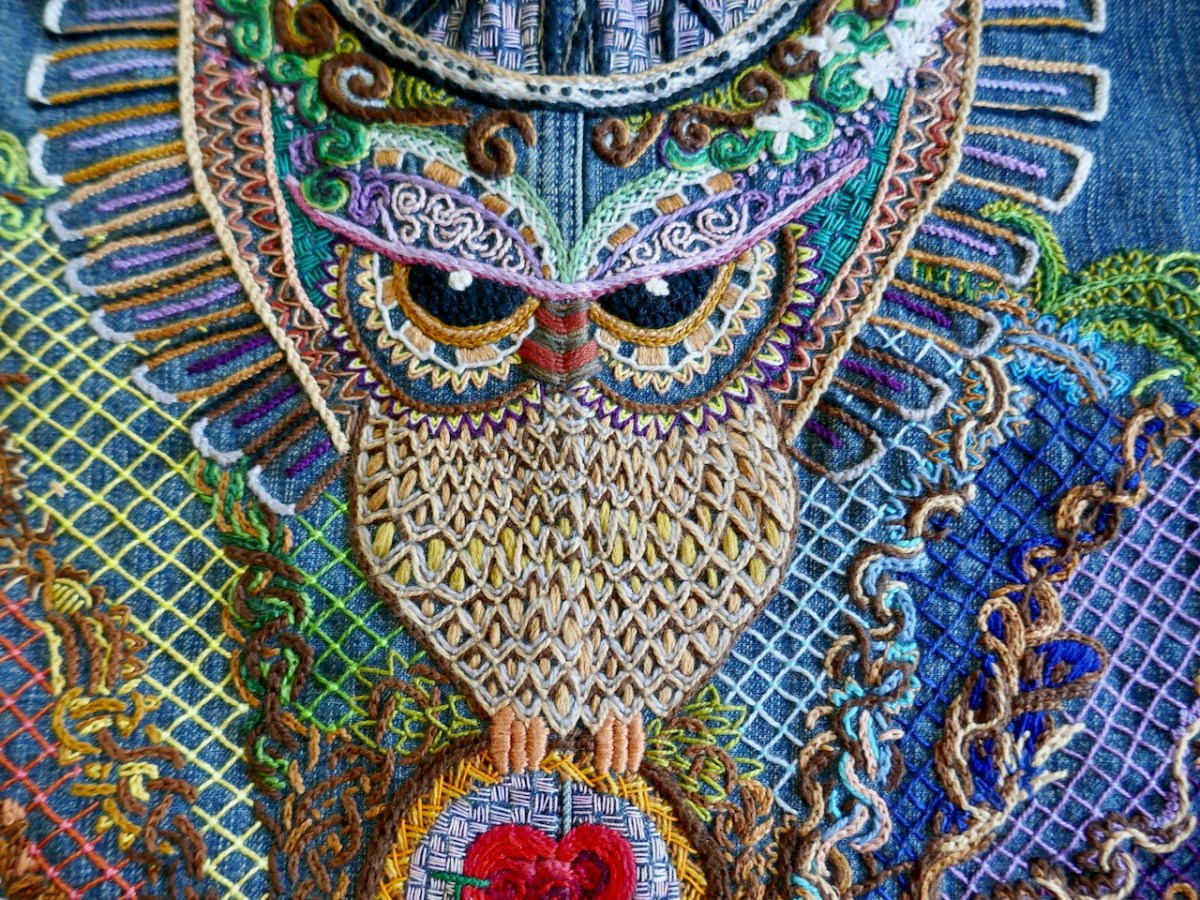
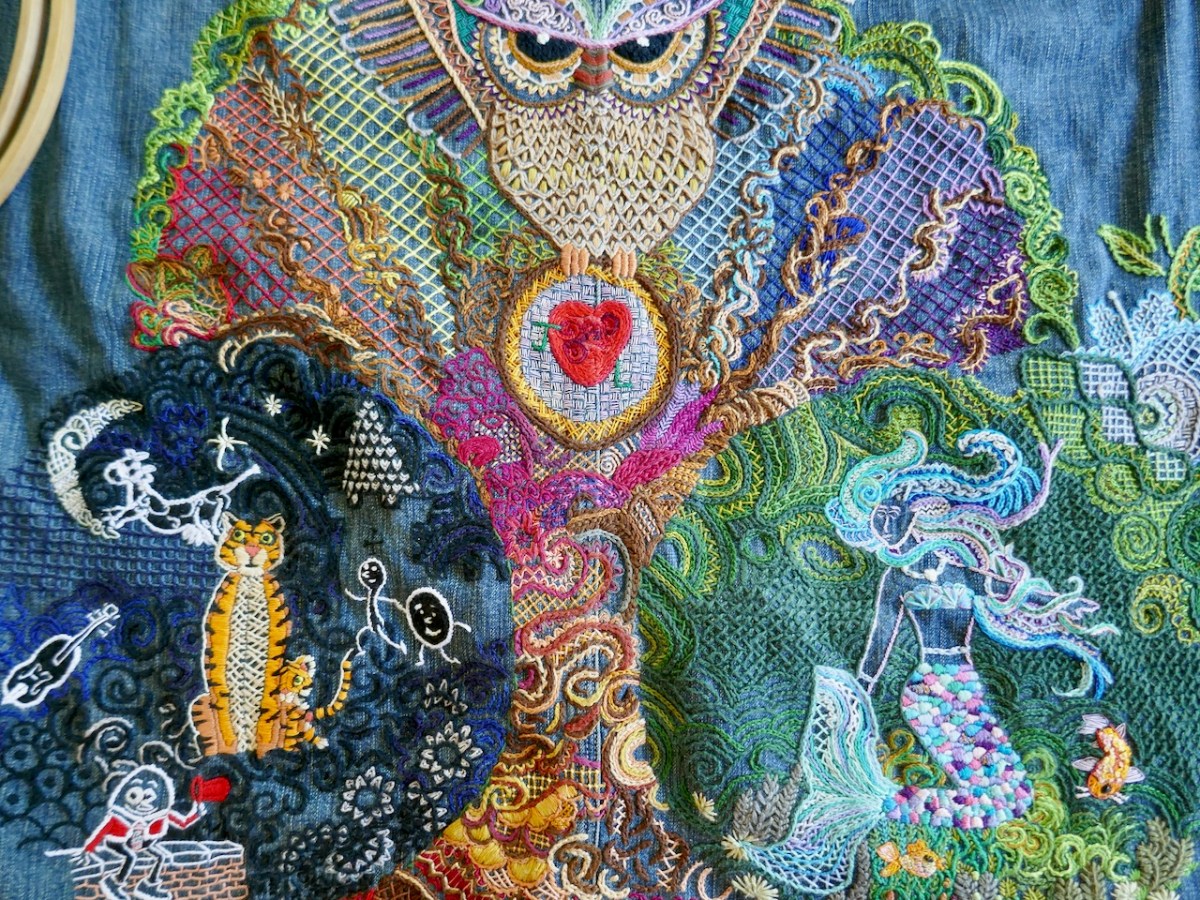
In this case the story is about a proud grandpa, so there’a grandfather clock and an owl for wisdom, and the heart that he and Grandma once carved on a tree. There’s a tree too, and a rainbow. And, can you see it? The overall shape is a Buddha.
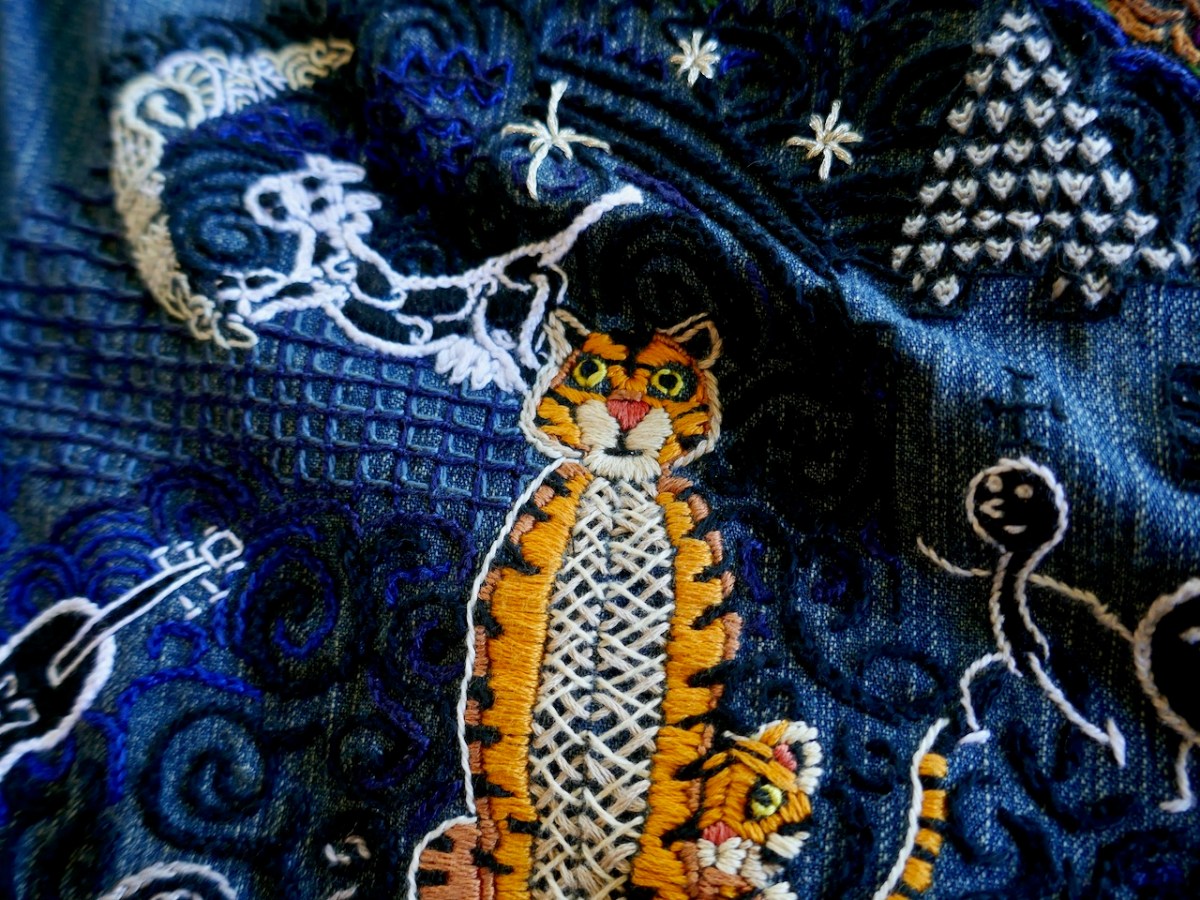
The grandson is there, with the tiger, and the cow jumping over the moon and Humpty Dumpty waving Owen’s signature red hat. The granddaughter loves mermaids. And in between there are all kinds of little symbols and references, in all kinds of different stitches and colours. As I poured over it, all I could think of was – be still my heart – how I would love to be at the unveiling of this wonderful garment. 
He learned his skills from his mother and grandmother and of course he got bullied in school but he persisted anyway. He’s heavily influenced by indigenous art, by Indian and Persian designs and by Celtic interlacing and illuminated manuscripts such as the Book of Kells. 
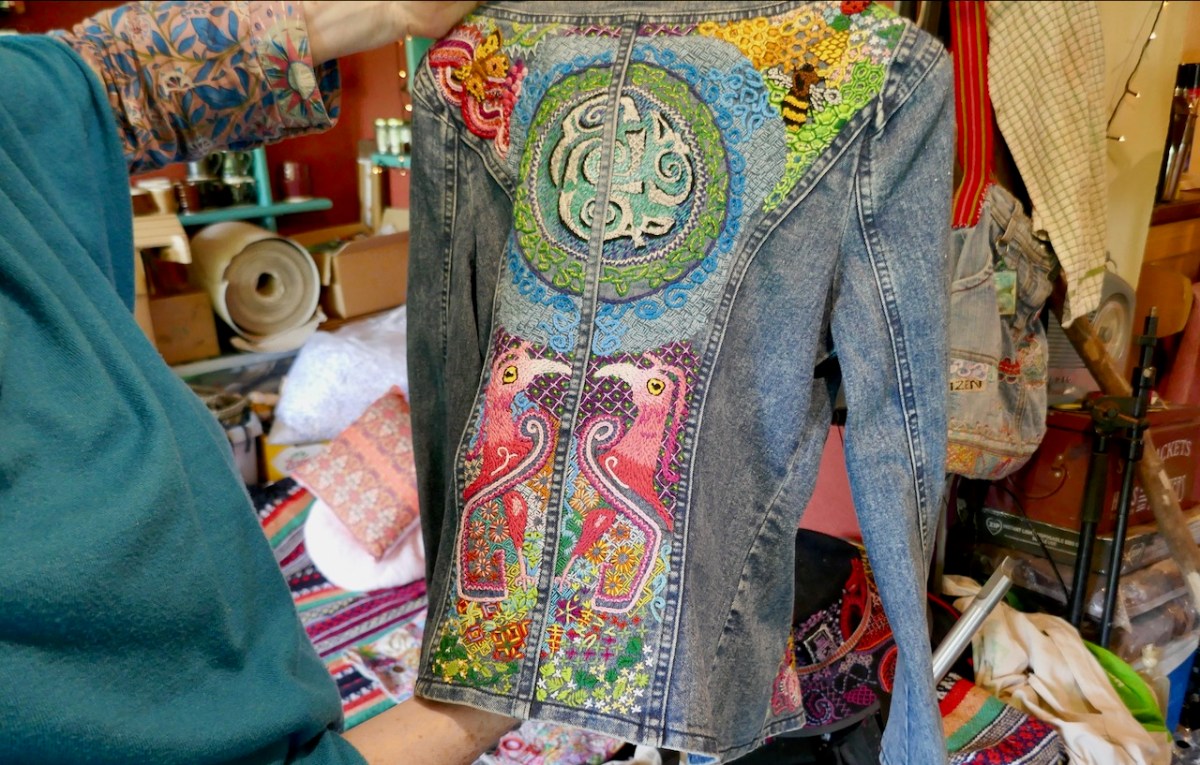
He cites his remote location on the edge of the Atlantic as another influence – the colours, the wildness, tuning in to the natural world and the deep tradition of story telling and mythology. 
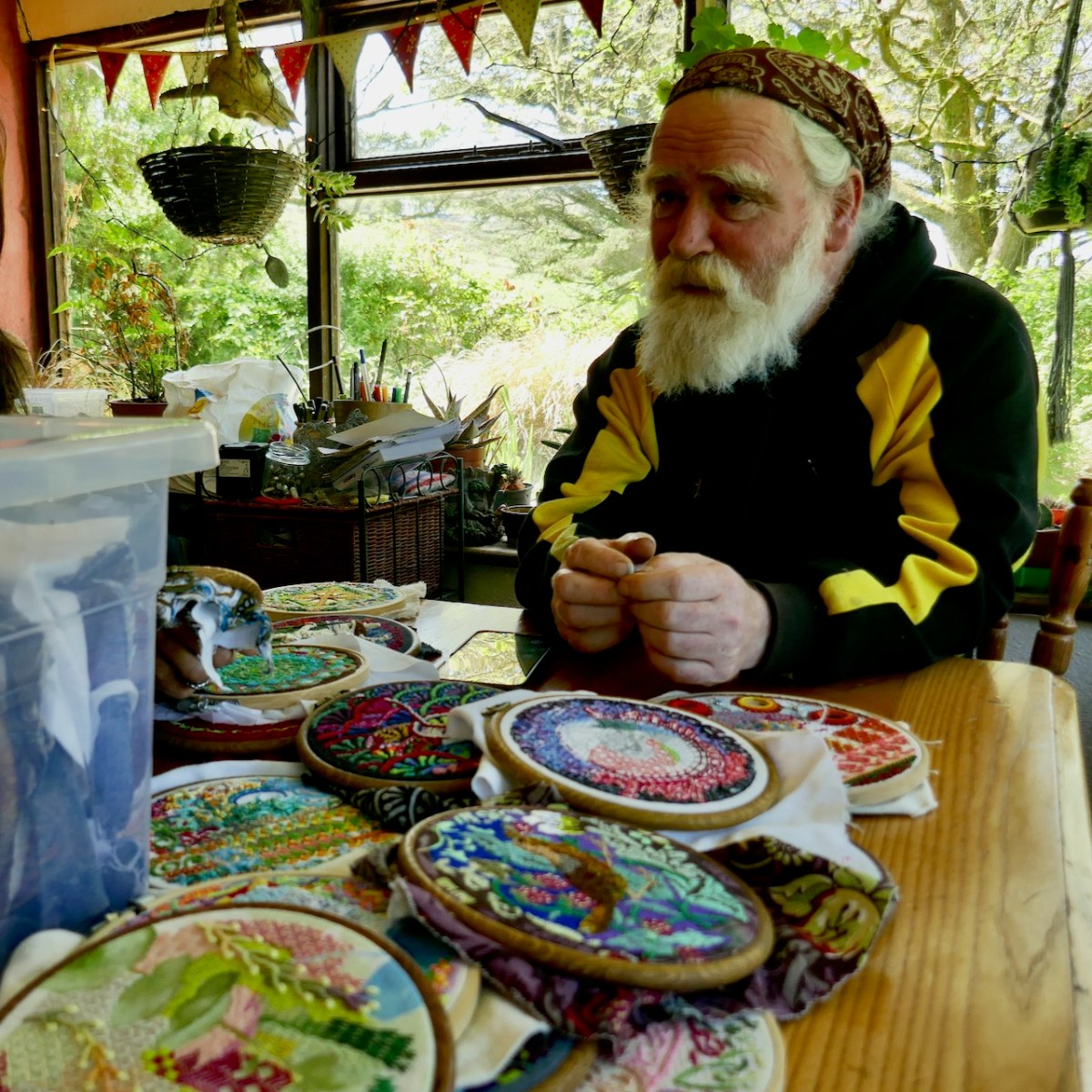
Ongoing projects include his hoops – 6” rounds, each one telling a story, and his quilt pieces, which will (may?) eventually make up a whole quilt. He loves to play with symmetry – with half- or quarter-designs for example, that need to be matched with other halves or quarters to make a whole.  
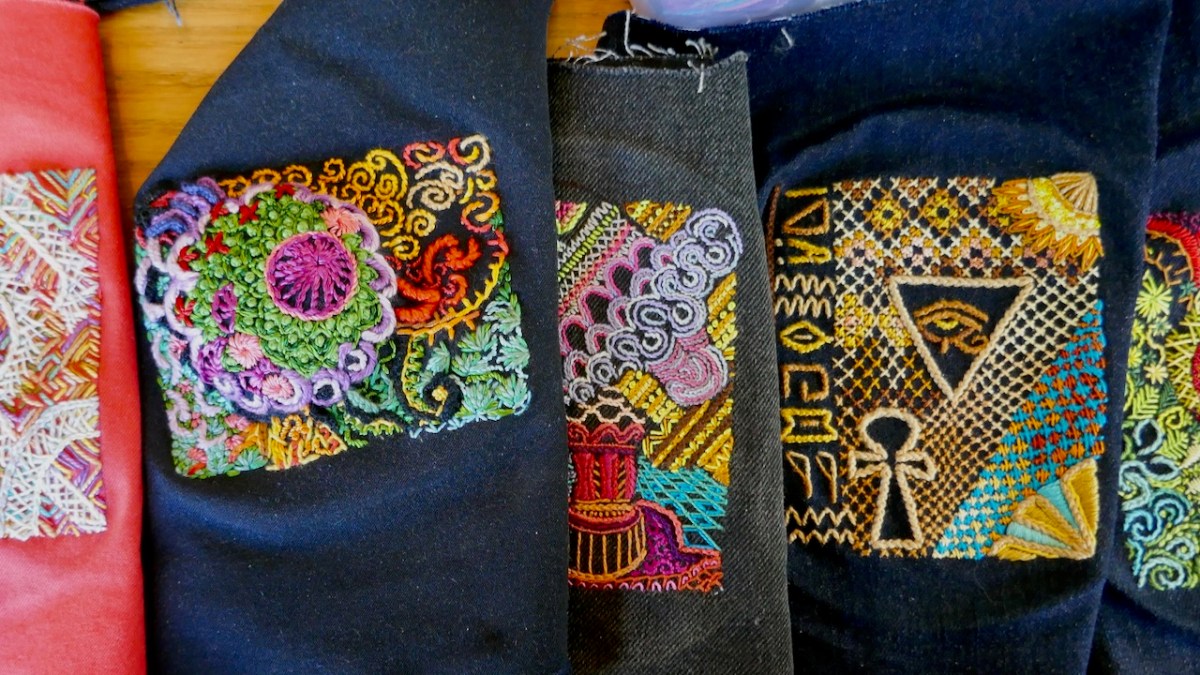
And of course – there’s Seamus! Seamus O’Comanssy is a little stitched guy who is travelling the world. He’s currently in Australia, but before that it was Slovakia and before that France. You can follow his journey – even volunteer to host him!
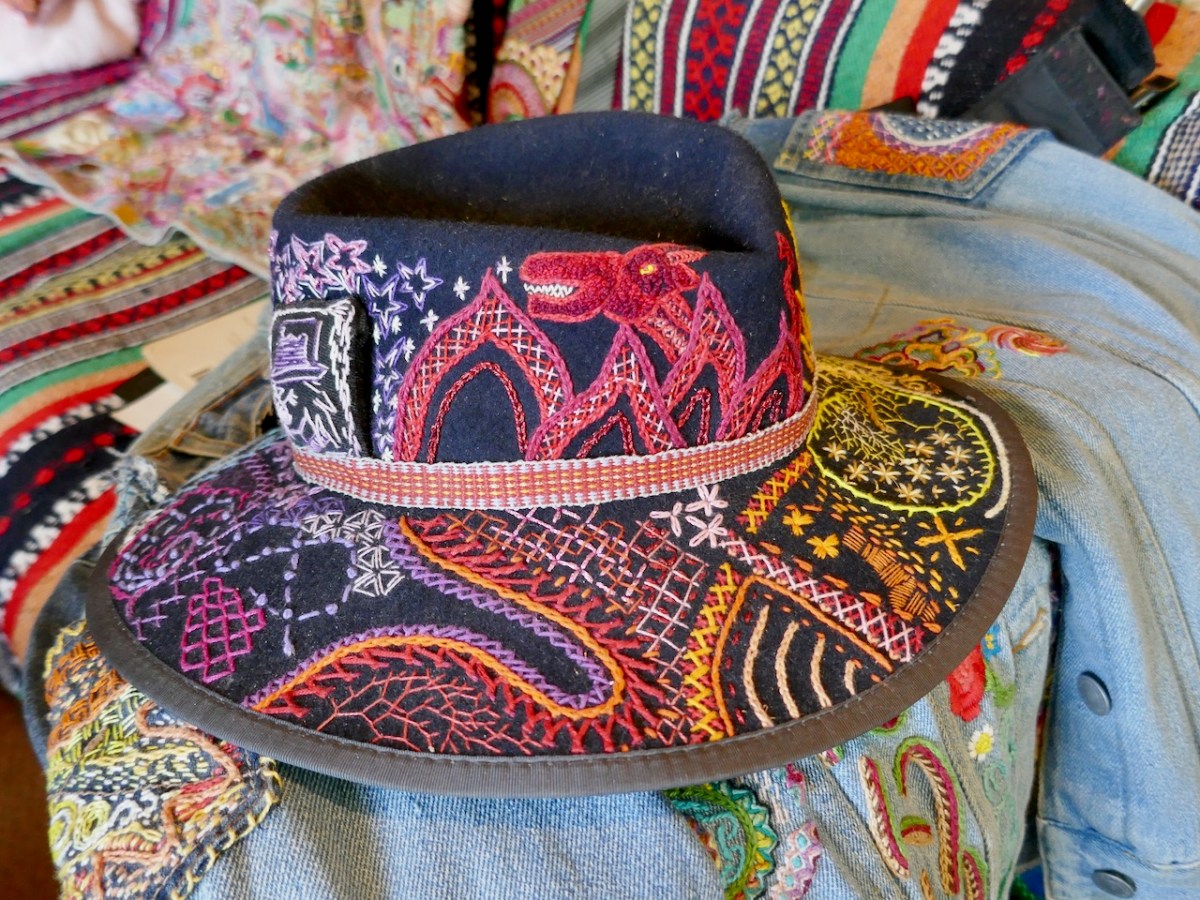
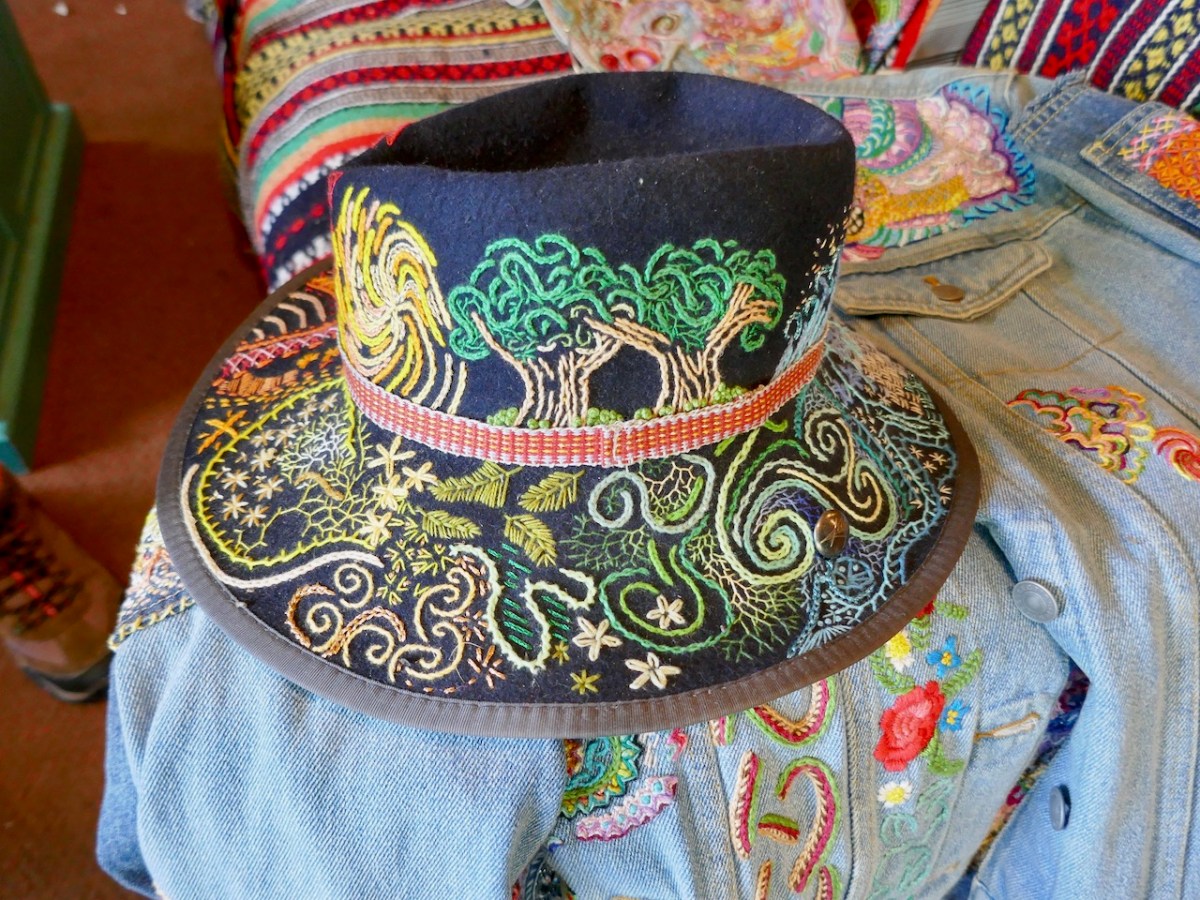
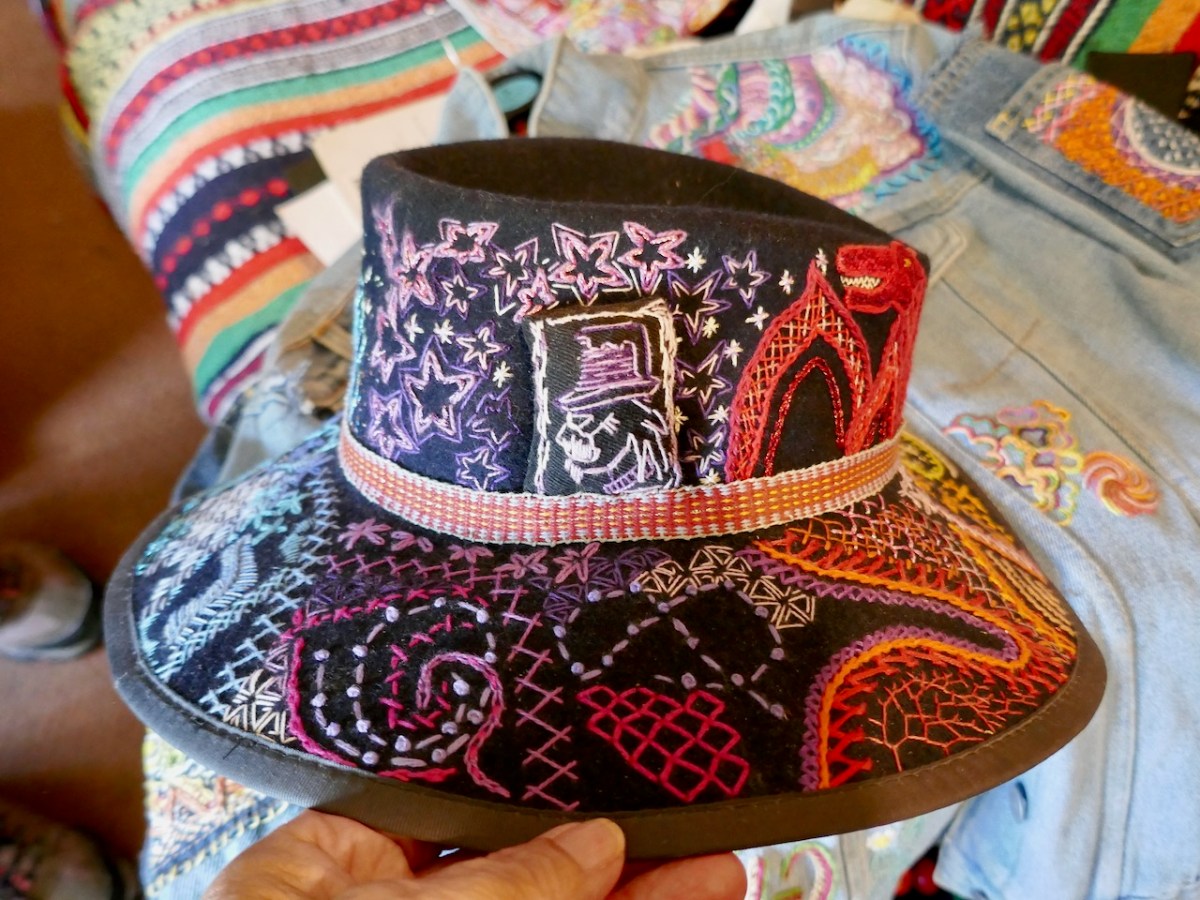
I’ll leave you with images of a hat – Owen is a hat man and his signature is a red hat. In fact when I met him recently he was wearing a red jacket, a red hat, and an amazing embroidered tie. 
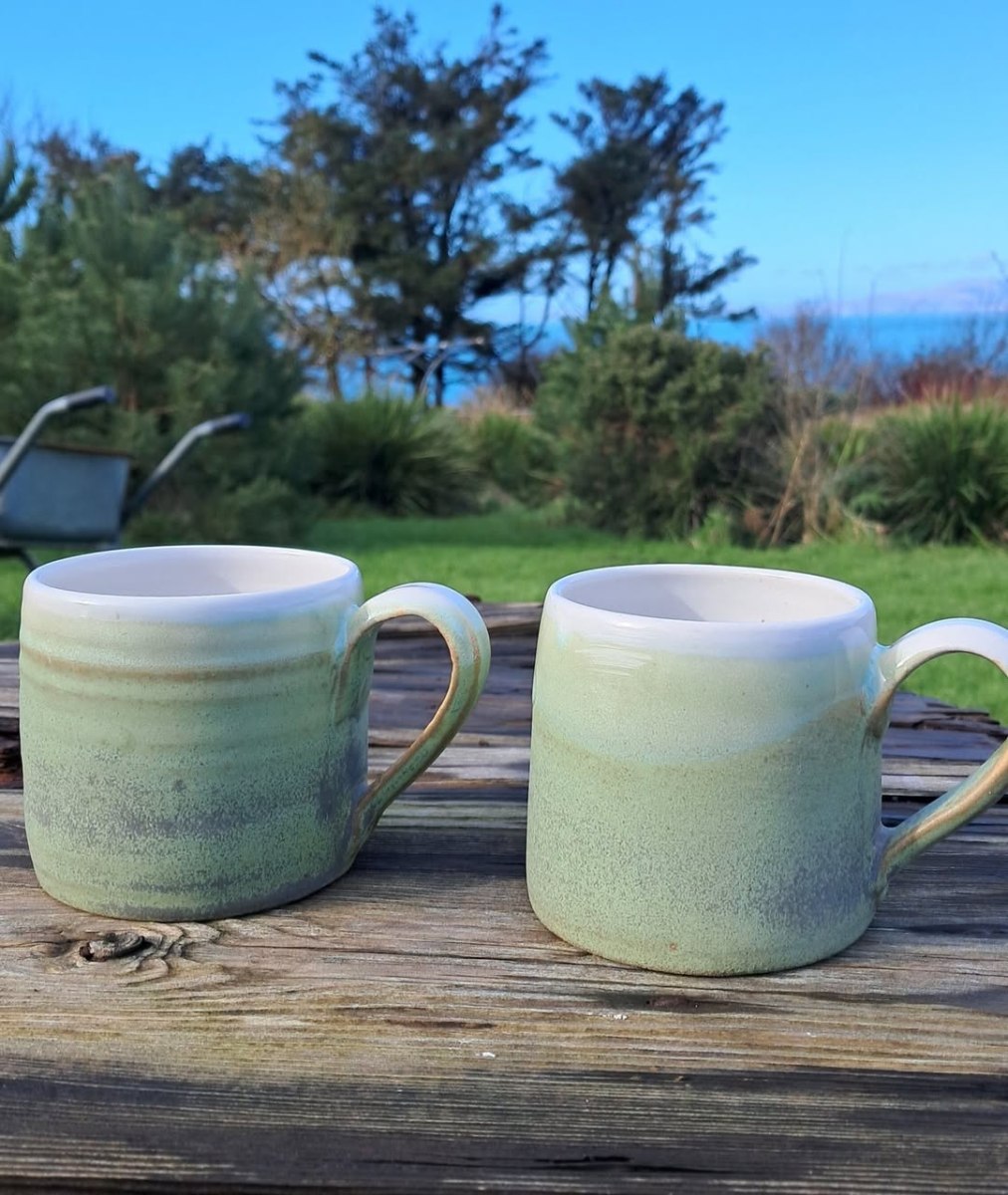
And I didn’t leave empty handed – I took away one of Kate’s lovely mugs. She’s been experimenting with a new green glaze and it’s gorgeous. I can report that coffee tastes really good from it too. That’s Kate’s own photograph, below. Her pottery is for sale at the Mizen Visitor’s Centre.
Thanks for such a lovely visit, Owen and Kate. 
If you’d like to hear Owen talking about his life and work, tune in to the Stitchery Stories Podcast.
Sit Stand Smoke – and Remember Kathleen

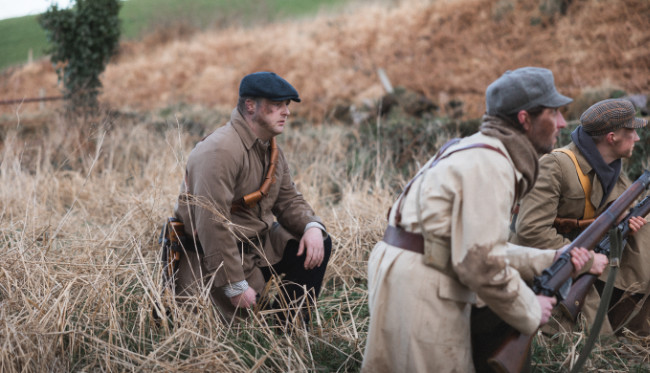
This week I experienced, in Virtual Reality, what is was to belong to a Flying Column during the Irish War of Independence. With the men, I crawled through a West Cork field, gun at the ready, alert for any sign of the British army or the Black and Tans.

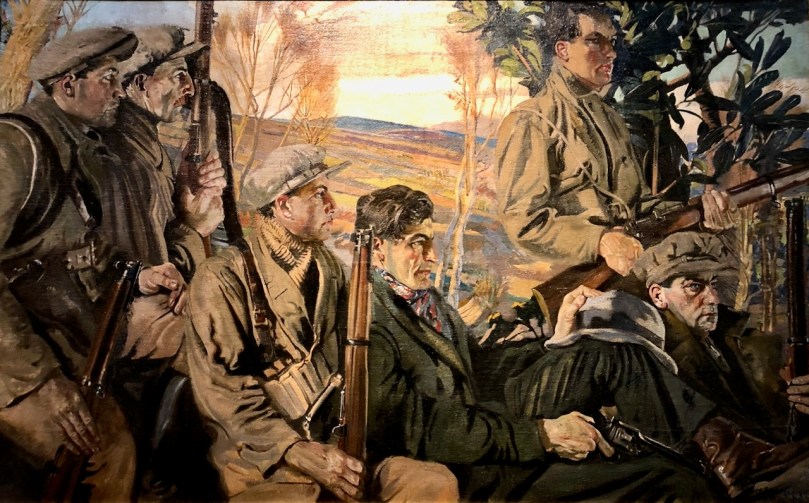
Or, at least, that’s what it felt like, and I must admit to a slight pounding of the heart as we were crouched behind that stone wall. In reality, I was on a swivel chair in the old Uillinn coffee shop, now repurposed as a VR theatre, wearing a VR headset. The Sean Keating painting that this experience is based on is the iconic Men of the South and you can read all about it here

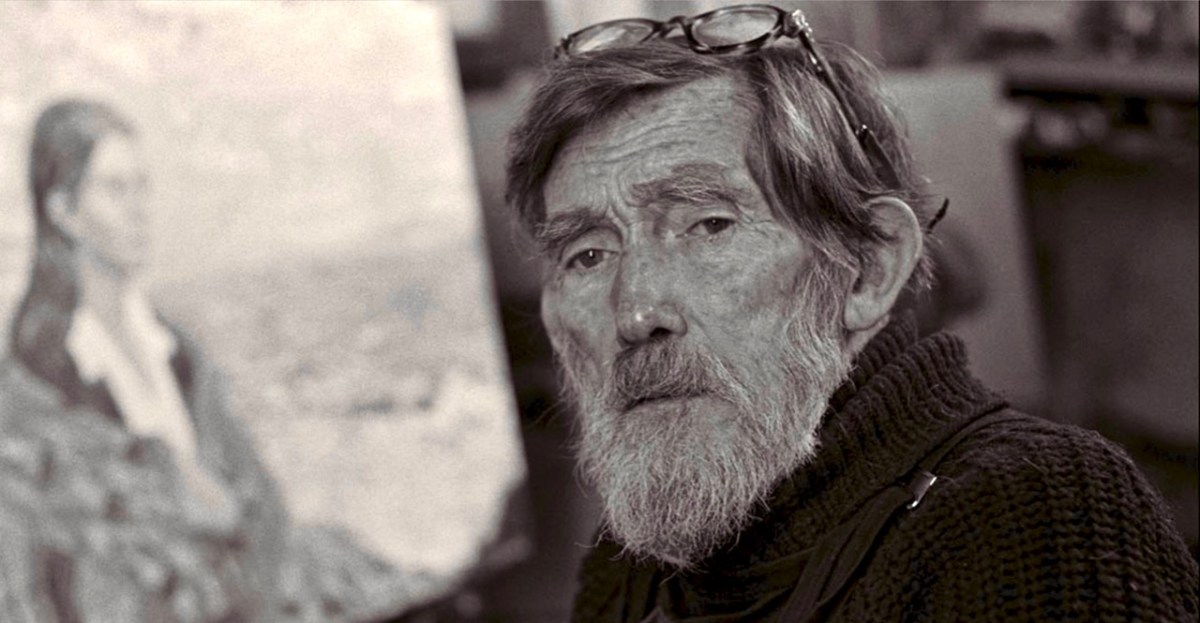
Keating’s grandson, David Keating, and his creative partner Linda Curtin, have produced the VR experience, shooting it in West Cork in “360 stereoscopic + volumetric capture” with the help of many local people and the new West Cork Film Studio. Dr Éimear O’Connor provided the expert consultations on Sean Keating (below) and features, amusingly, as an exasperated director of the action. If you get a chance to see this anywhere, grab it! You can also read more about Sean Keating in this post by Robert from 2020.

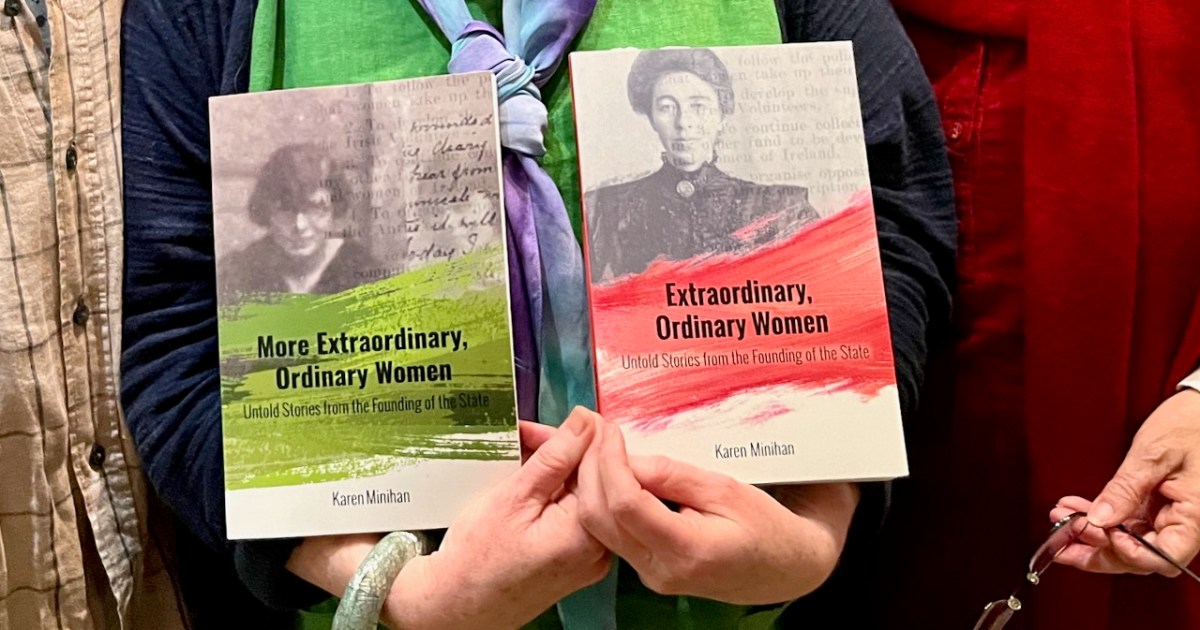
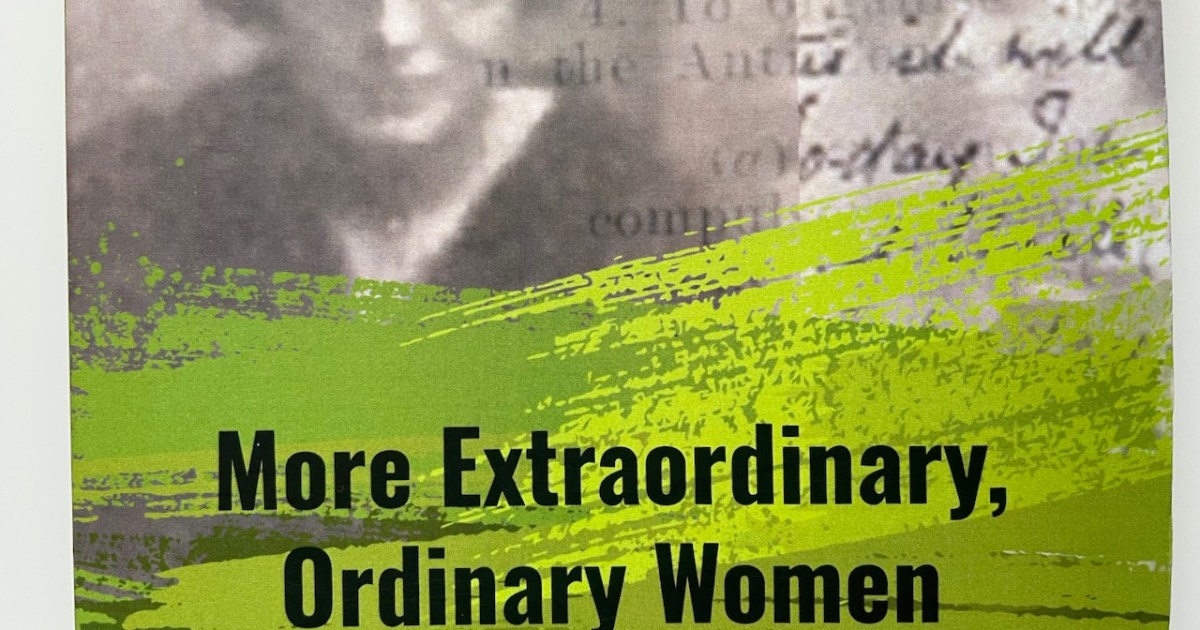
And this War of Independence action leads nicely into Kathleen O’Connell. You will remember her as one of the heroines of Karen Minihan’s book More Extraordinary Ordinary Women. Take a quick trip back to this post and read all about her and her daring and courageous deeds.  I concluded this section by saying

Kathleen was ruined financially by all her support for the cause. Letters of support for her pension application were fulsome in praise of her work and her commitment. She was awarded a grade E pension in 1939. She died, here in 1945, aged 50. She had not married and had no children, and all memory of her gradually disappeared from Ballydehob. When Karen went looking for the house she had lived in, it seemed nobody could remember the heroic Kathleen O’Connell who had once lived here.

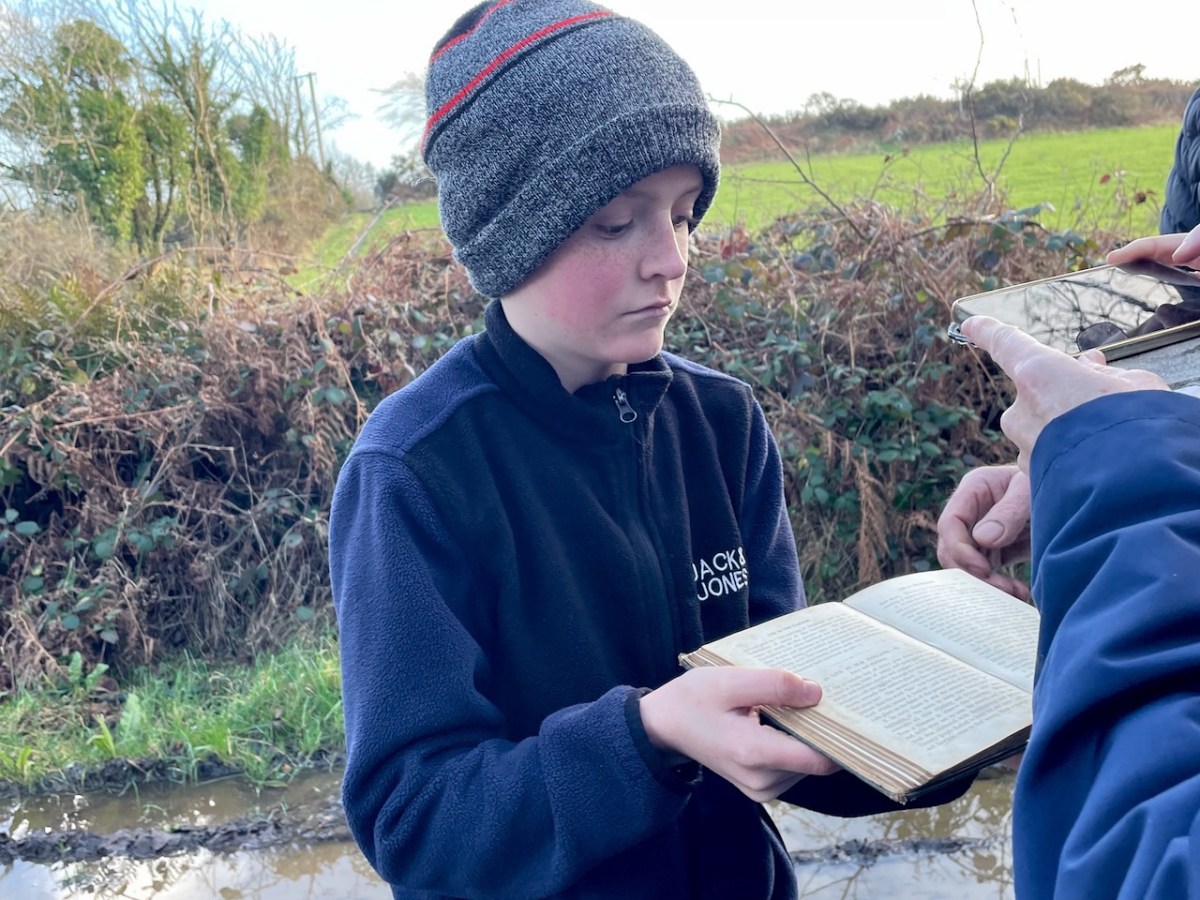
How wrong we were! Memory of Kathleen was far from dead. A relative of hers recently contacted Karen and on Friday afternoon we spent several hours with him and his charming grandson, rediscovering Kathleen from a man in whose family her memory was still fully alive. (He didn’t want his photo in the blog post, although Neven, the grandson, was happy to be in it.)

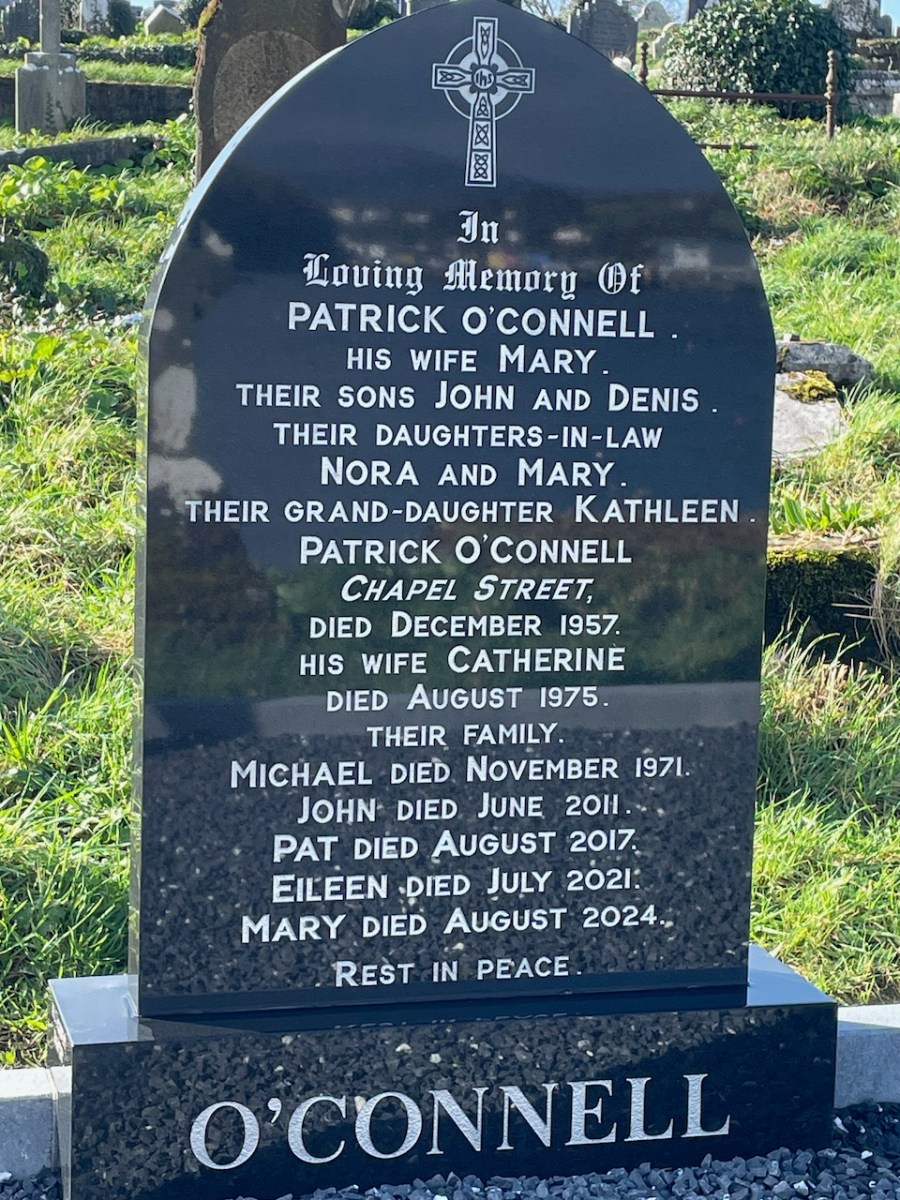
The first thing he showed us was her grave, at the historic Abbey Graveyard in Bantry. It contained many family members, including Kathleen. Our guide had knowledge of everyone in the grave and how they were related, and told us that there were probably more people in the plot than commemorated on the headstone. The grave looks out over the sea at Bantry.

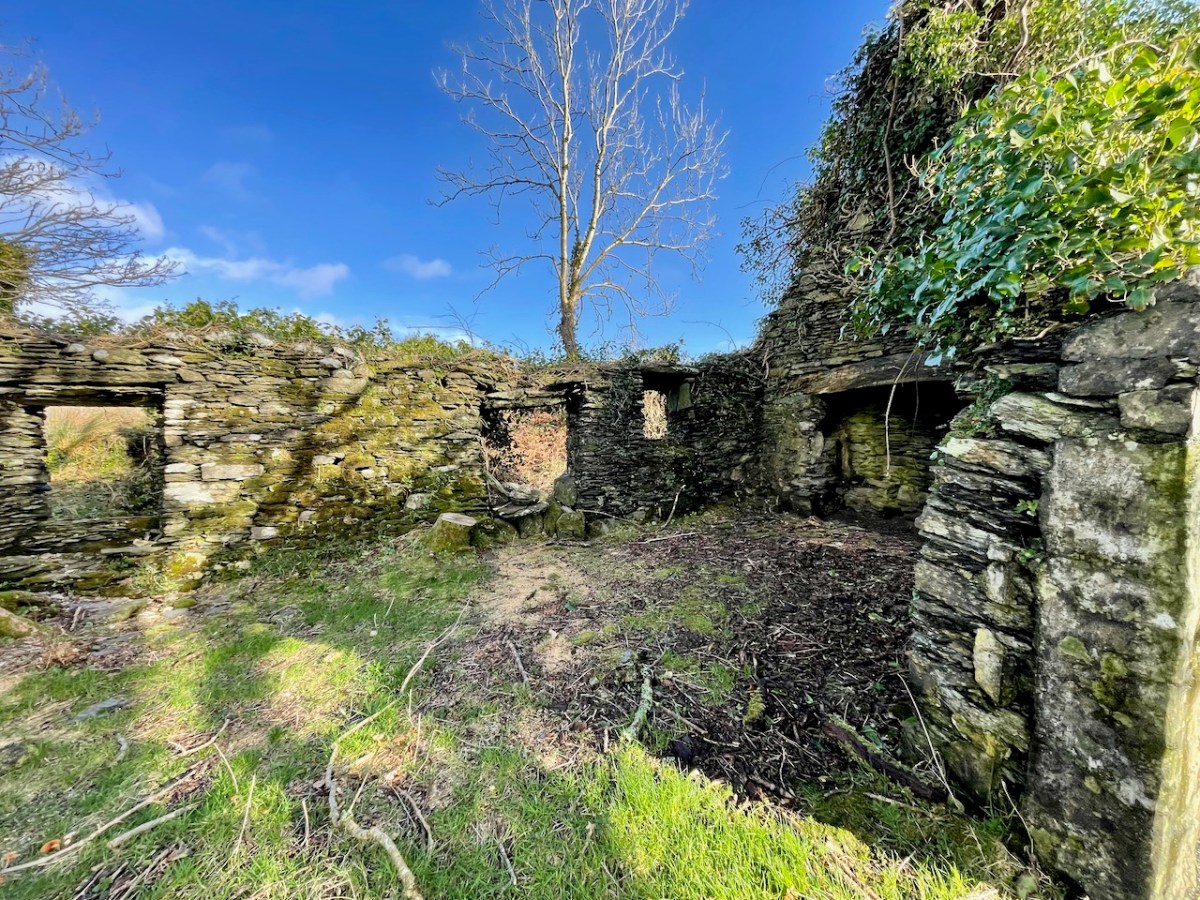
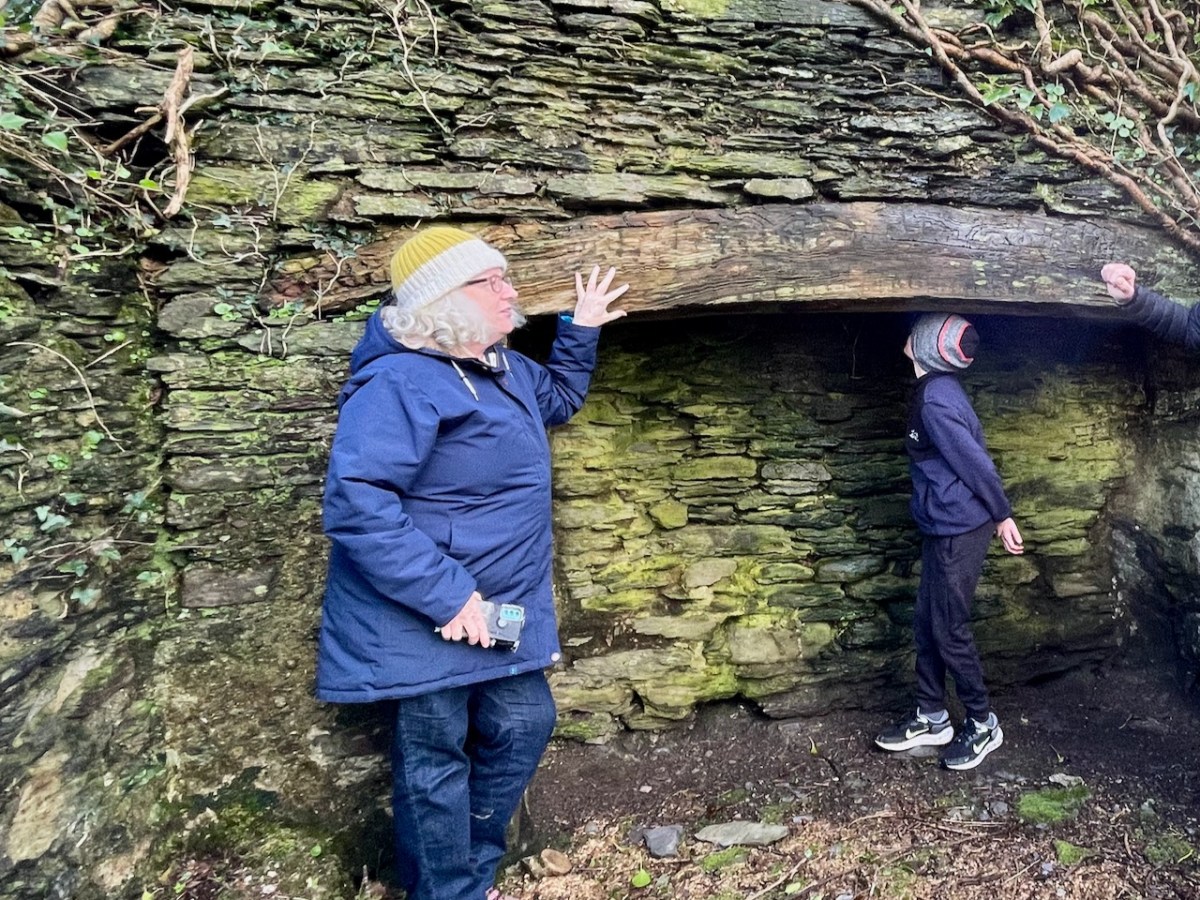
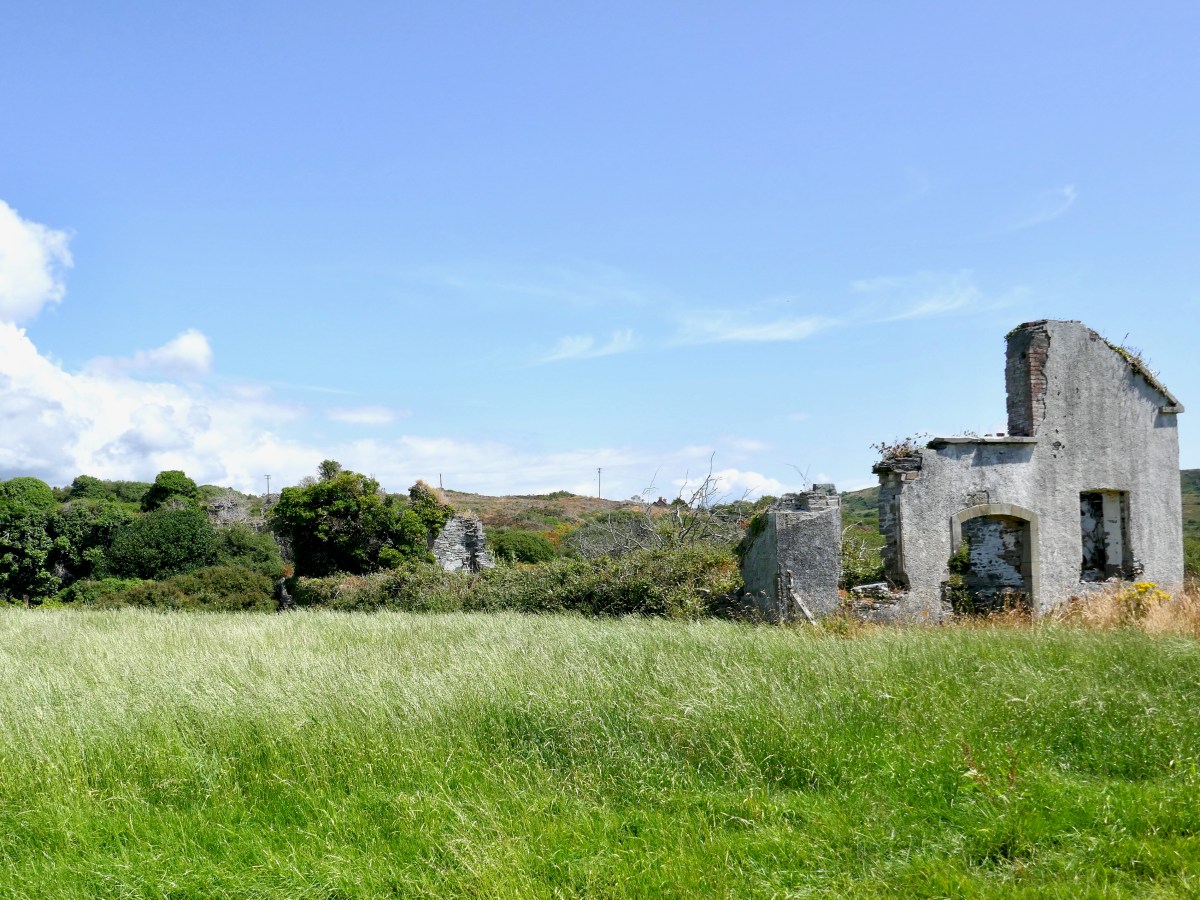
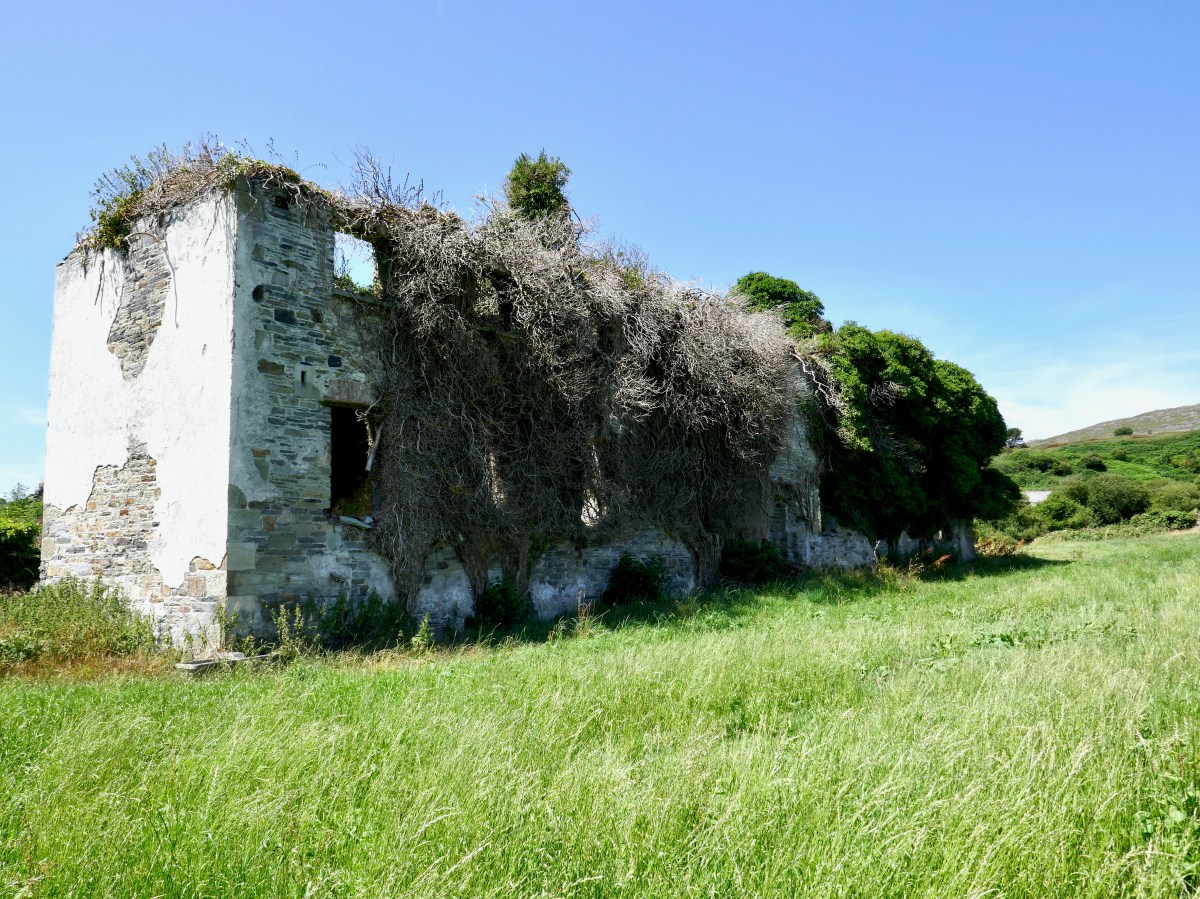
Next, he brought us to the cabin belonging to her Uncle Pat where she sheltered men on the run. It’s located in the hills behind Ballydehob, down several lonely boreens and across a couple of (very muddy) fields. The cabin, now roofless, still stands and still has the wonderful oak mantle across the open fireplace.

We marvelled that Kathleen was doing all this on her bicycle – it’s several kilometres above Ballydehob and about 100 metres above sea level. And of course few of the roads would have been paved at that time. Our guide told us that she was totally and passionately committed to the cause, and that, since she was an only child, she carried her parents along with her. It was really they who underwrote all the expenses she incurred in her work. 

In the family, it was understood that she had been engaged to a man who was a member of a Flying Column – just like one of the Men of the South, but that he had been shot. We could only wonder at the trauma and distress she had experienced. She left for America in 1925, but returned to live in Ballydehob, and her father eventually outlived her. 

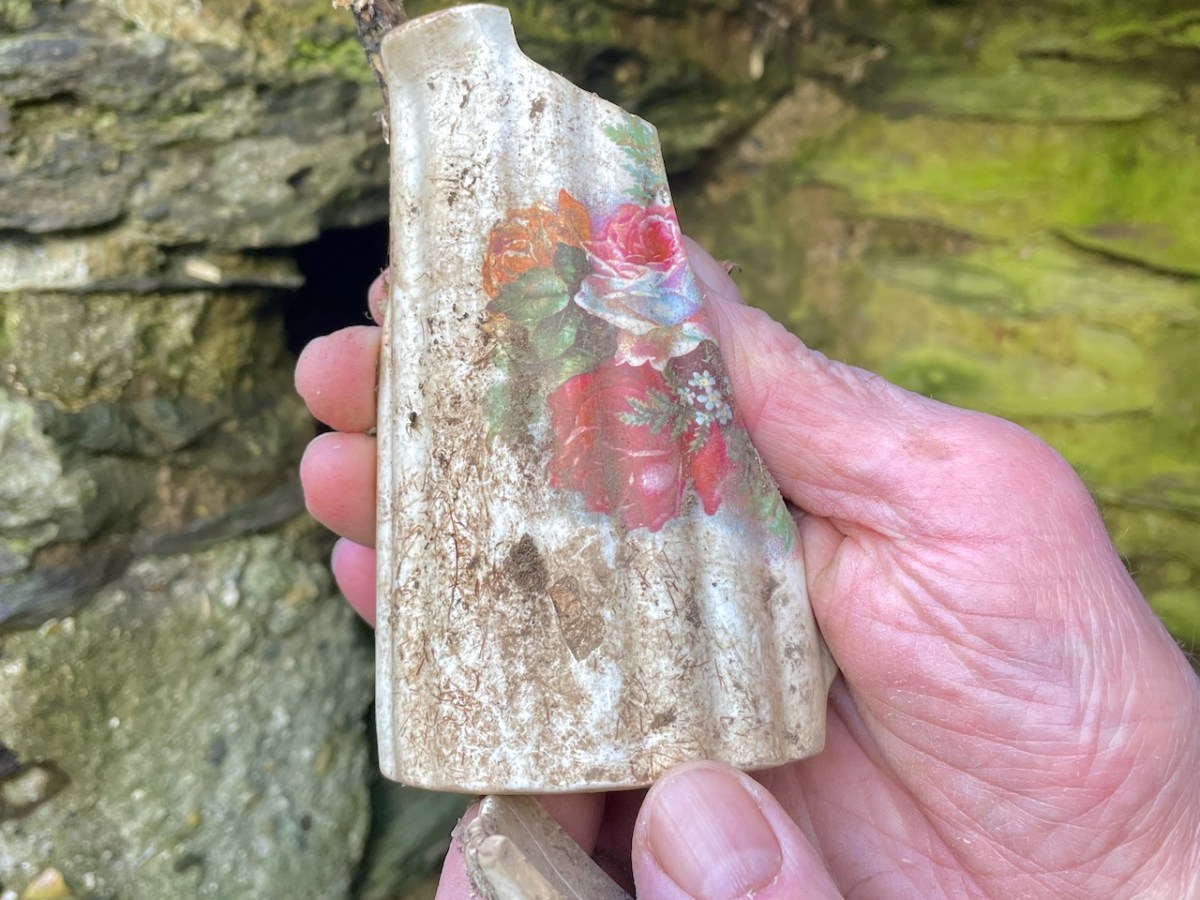
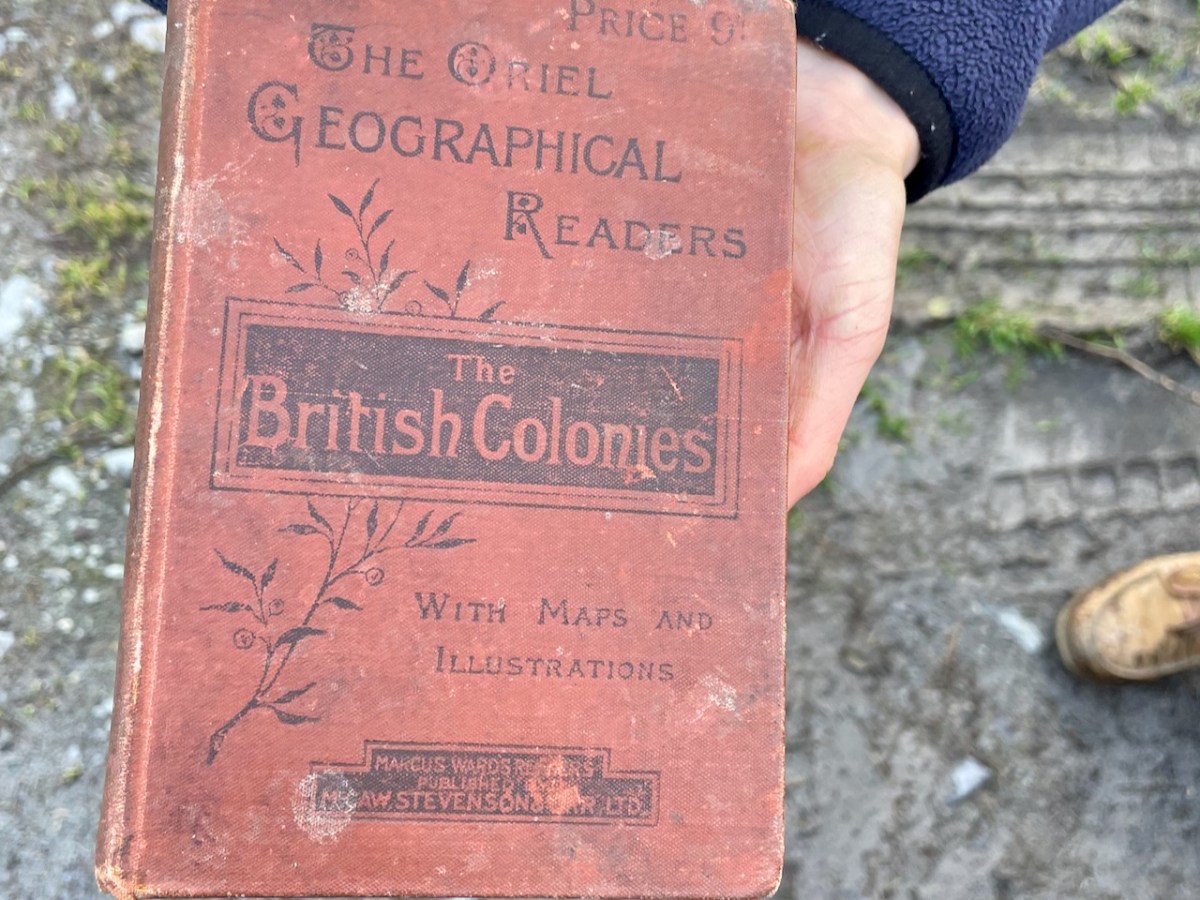
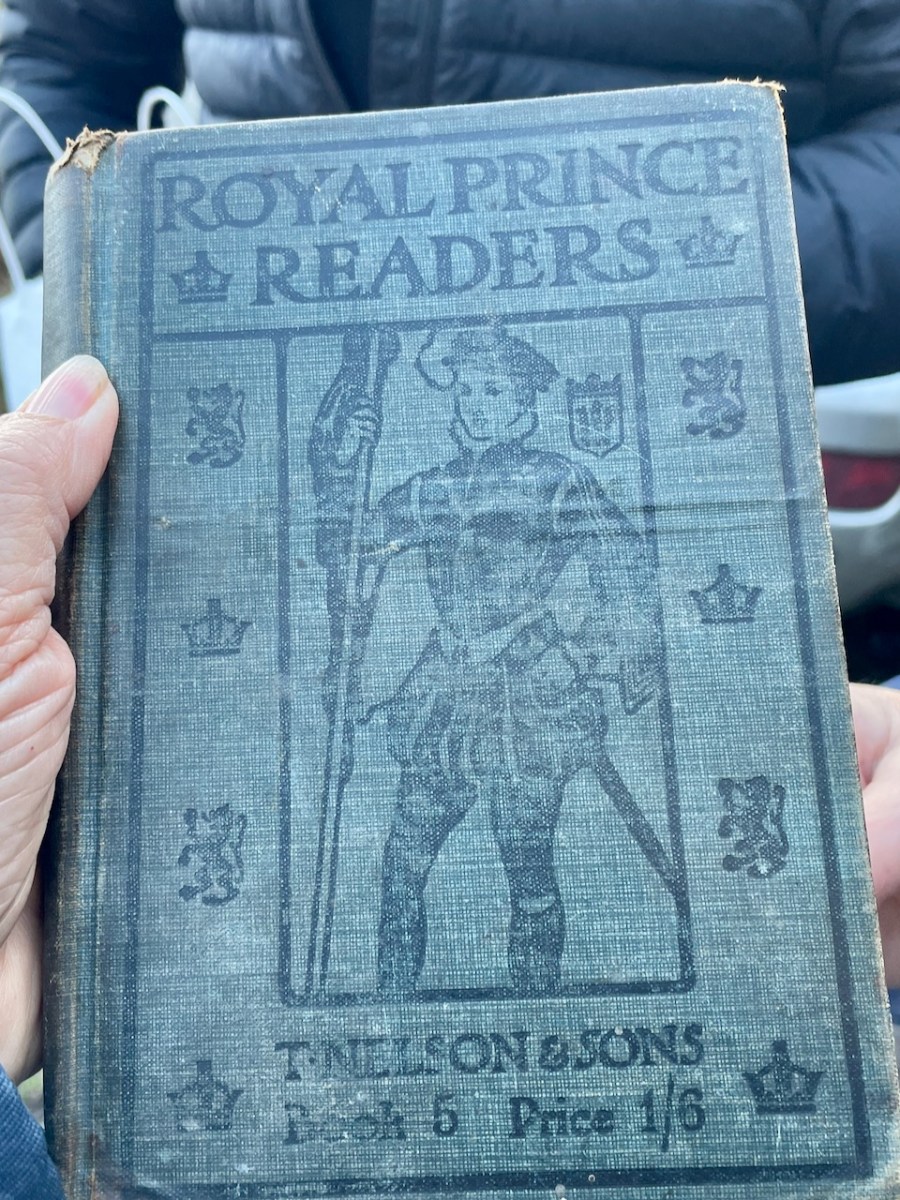
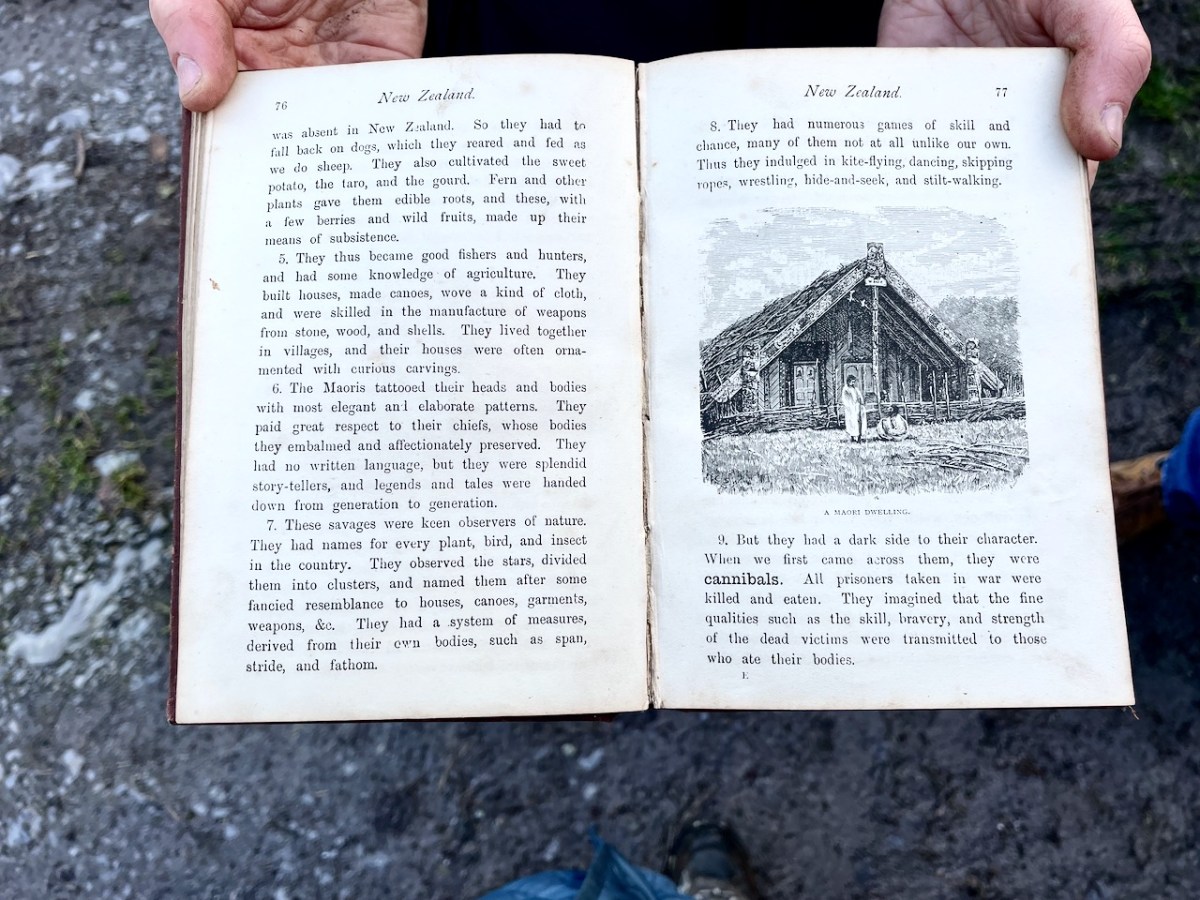
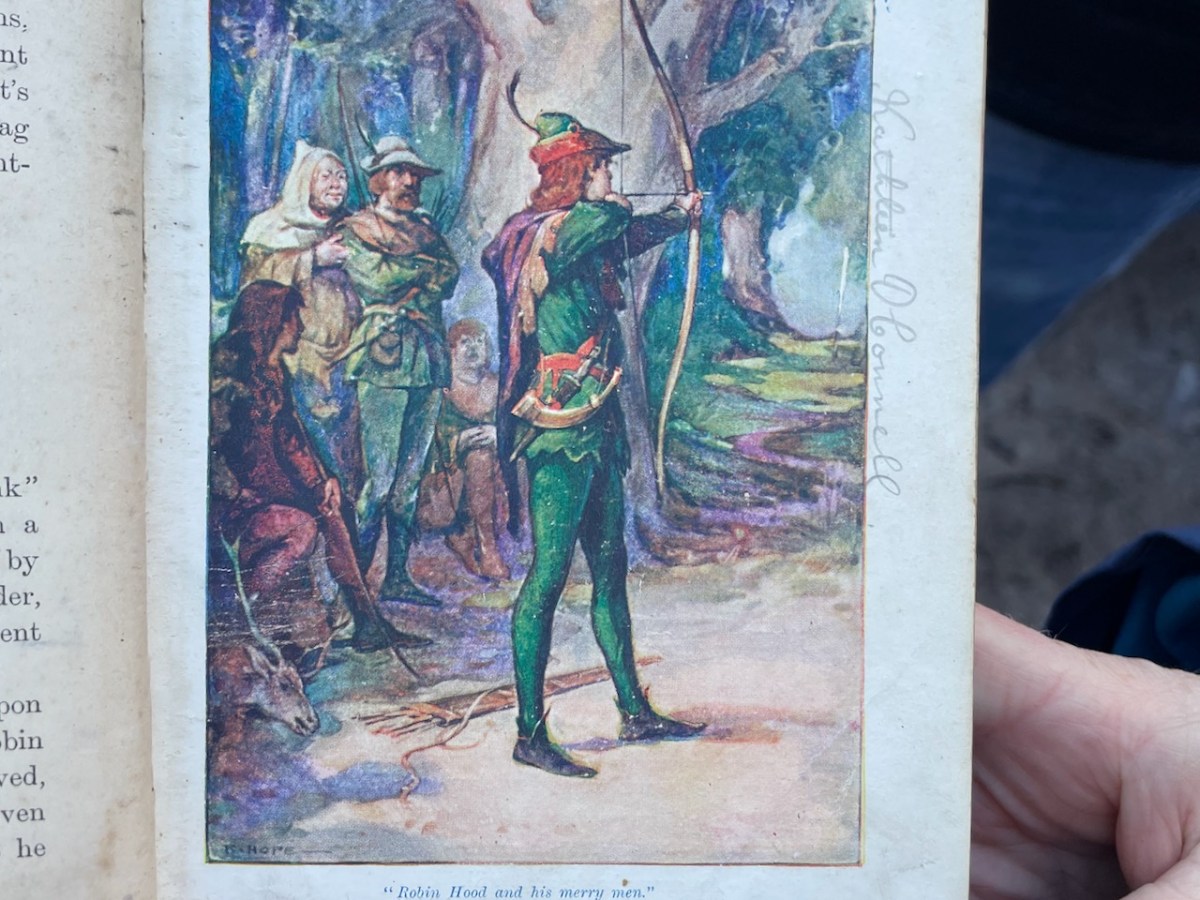
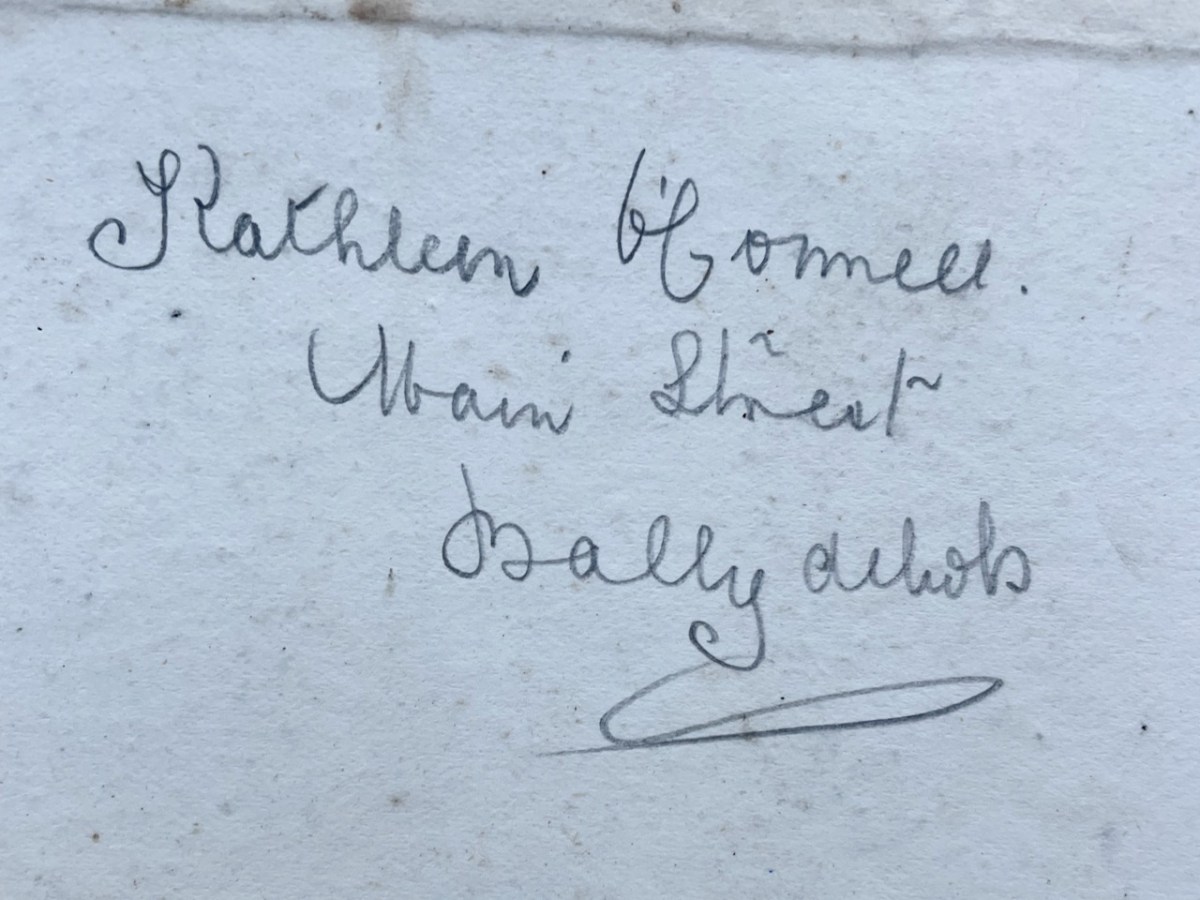
Our final mementoes of Kathleen were particularly poignant. Surviving in the family were two of her books, school books we think, in which she had written her name.

Each was very British – a reminder to us all what the standard school fare was at the time when we were members of the British Empire.

I have located a copy of the Royal Prince Reader (1910) on EBay – in Rajastan! A further reminder that empire was promoted through children’s literature as much as through military occupation.

Somehow these two books, her own possessions, brought Kathleen to life as nothing else could have done. We imagined her devouring these stories in school, and her gradual disillusion as she matured with what the Empire stood for.

It is an immense comfort to know that she is not forgotten after all.

More Extraordinary Ordinary Women

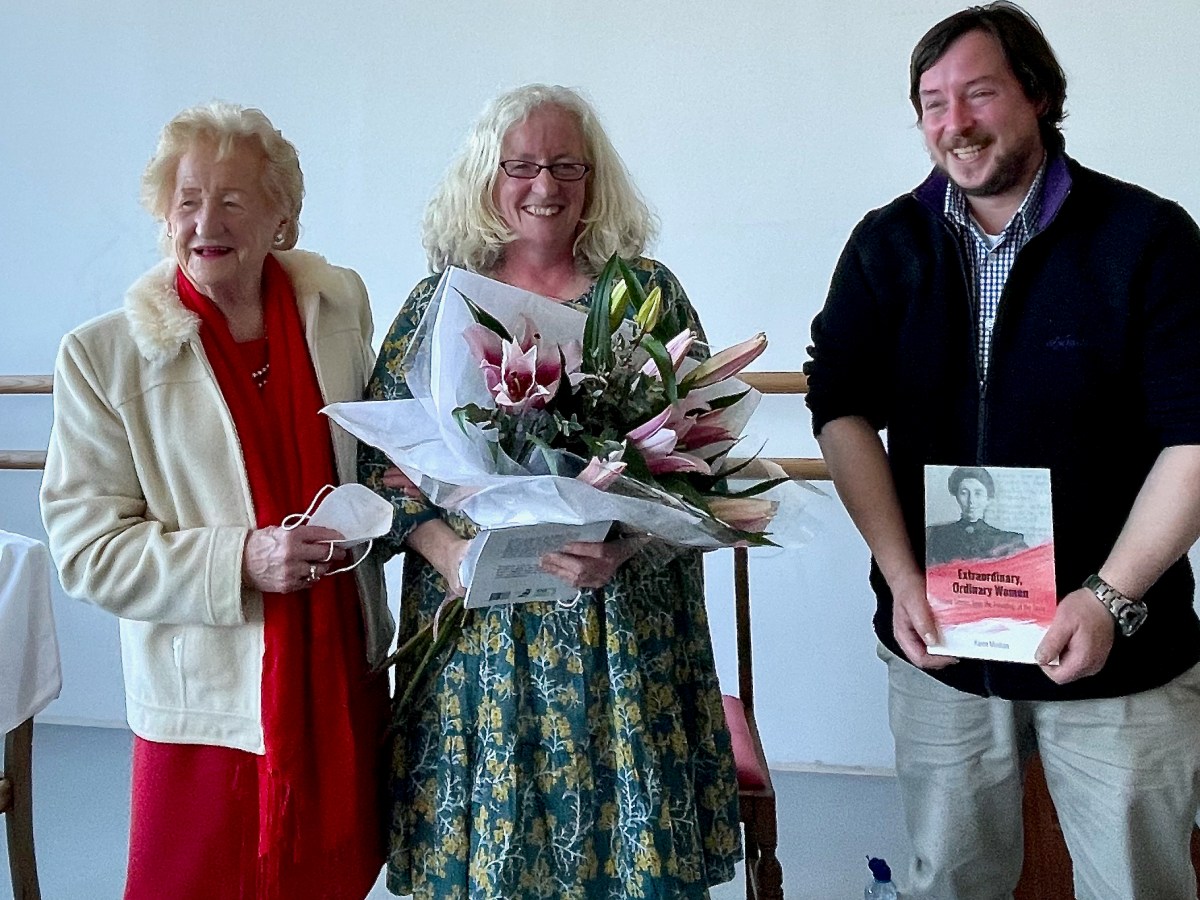
We launched Karen Minihan’s new book, More Extraordinary Ordinary Women, on St Brigid’s Day. The date was apt – Brigid was a woman venerated in her time, who founded the ecclesiastical city of Kildare and ruled benevolently over a vast monastic empire, but still lost out as Patron Saint of Ireland to a man. However, we now have a brand new public holiday in her honour and I think all the women in this book would be pleased about that.

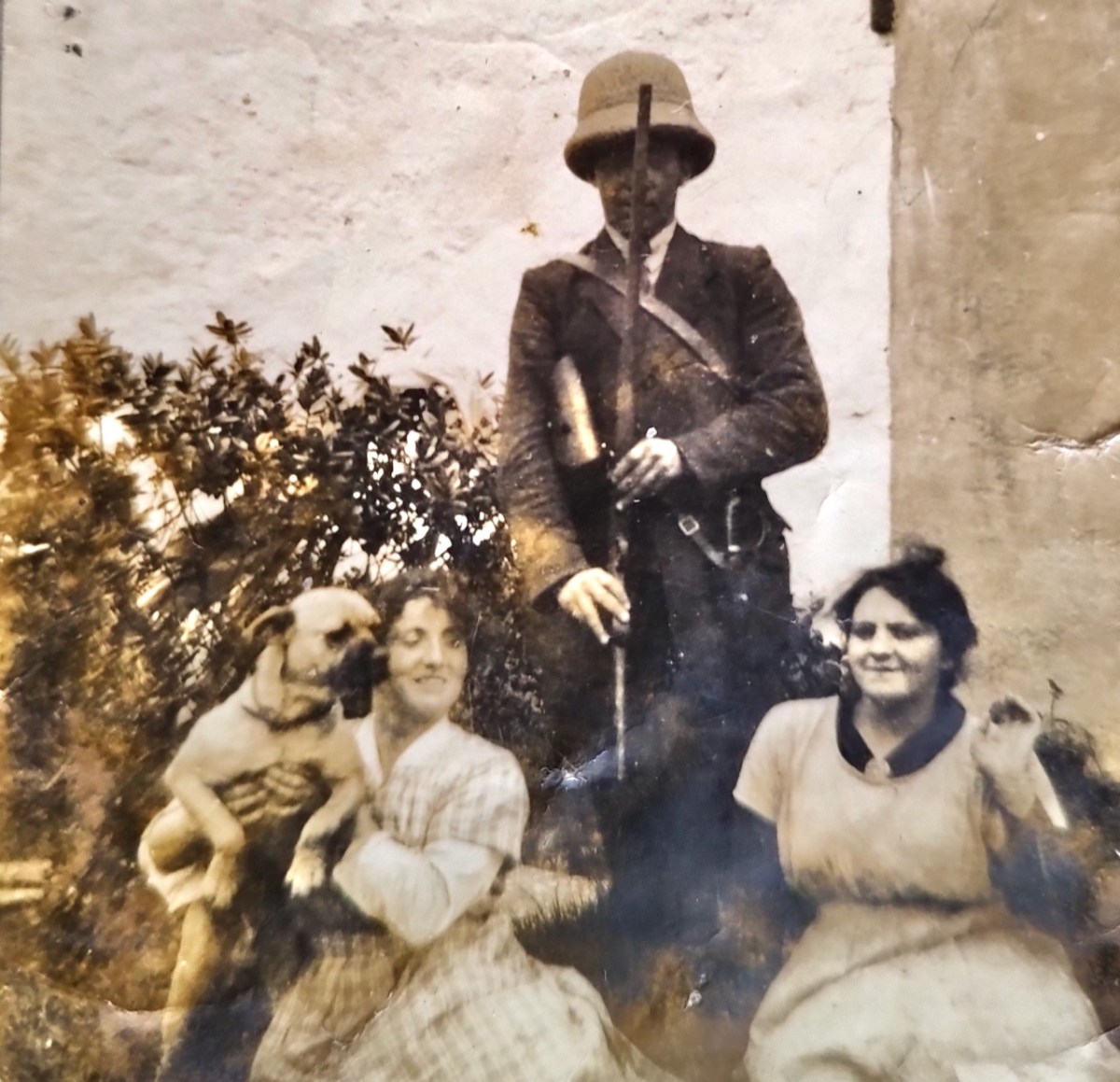
Here are May and Tess Buckley from Gortbreac in Castlehaven, who get a chapter each in this book, with their brother. They showed remarkable courage and resourcefulness – they also happen to be directly related to Ellen Buckley, O’Donovan Rossa’s second wife.

This is a follow-up to Karen’s first book, Extraordinary, Ordinarily Women, and I can’t emphasise enough the importance of the work that she has done with these two books. She has brought the lives of strong courageous women out of the shadows, and challenged the prevailing narrative that elevated the role of the male volunteers and members of the IRA over the parts played by everyone else. It’s not an exaggeration to say that women’s stories were more than neglected but that they were actively suppressed.

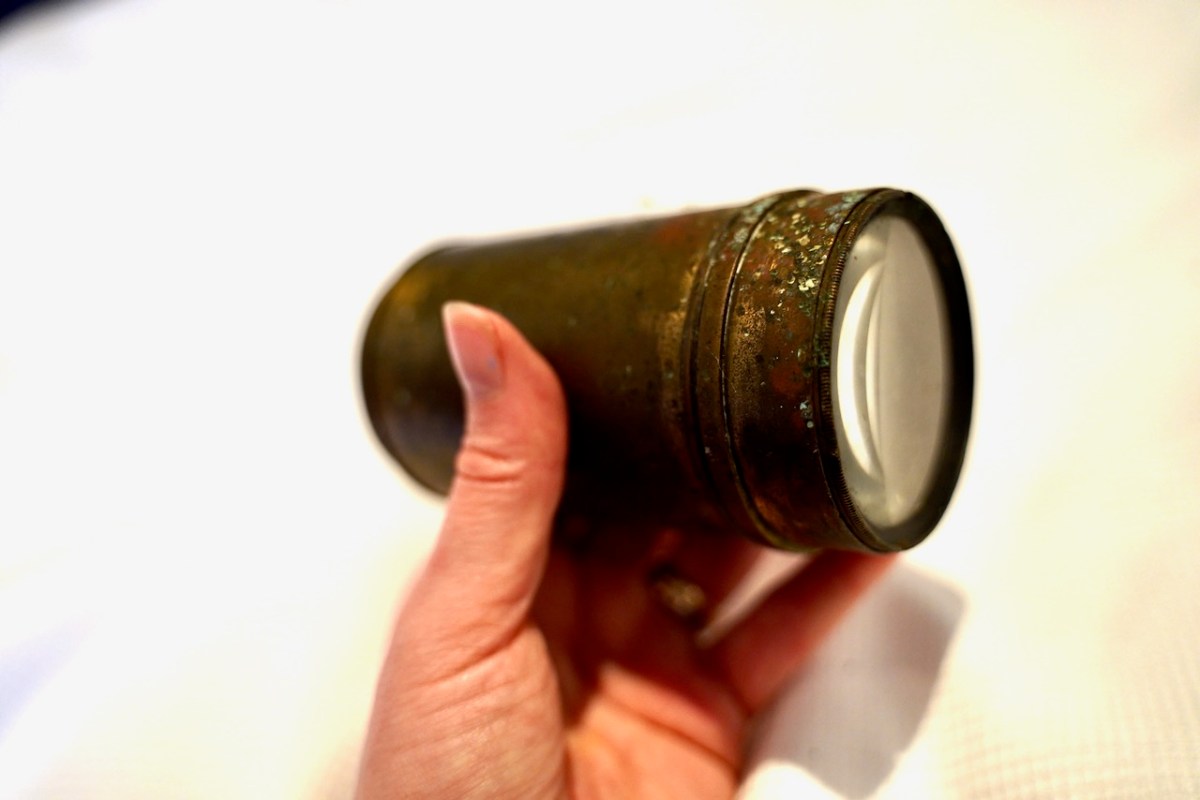
Tess Buckley’s telescope – she used it to identify any approaching military or police movements from afar

When the Military Service Pensions were established in 1924, women were explicitly excluded. Ten years later they were included in Military Service Pension Act 1934, which established five grades of service – A B C D and E, but relegated women to grades D or E. To get a D pension you had to be a Member of the headquarters staff or executive of Cumann na mBan OR in command of one hundred members or more. To get an E pension you had to prove you were in active service. They didn’t make it easy – requests for more information, for verification and letters of support – it often got so wearying that the women stopped pushing or said simply they had nothing more to add.

This is Mary Anne O’Sullivan of Bere Island on her wedding day. The situation on Bere Island was very difficult due to the presence of a British Army Camp (there until 1937) and Mary Anne showed great courage and presence of mind in hiding an escaped IRA prisoner

Many of them never spoke about their experiences, which made Karen’s research all the more daunting. This generation is only now discovering what their grandmothers and great-aunts did, sometimes by perusing the Pension files, or by discovering old documents in attics. Four of the stories in this book involve sisters – in Molly Walsh’s story Karen notes:

Molly did not speak of her experiences during this time to the generations that followed, she only spoke to her own siblings, sometimes they would go into a separate room to talk.

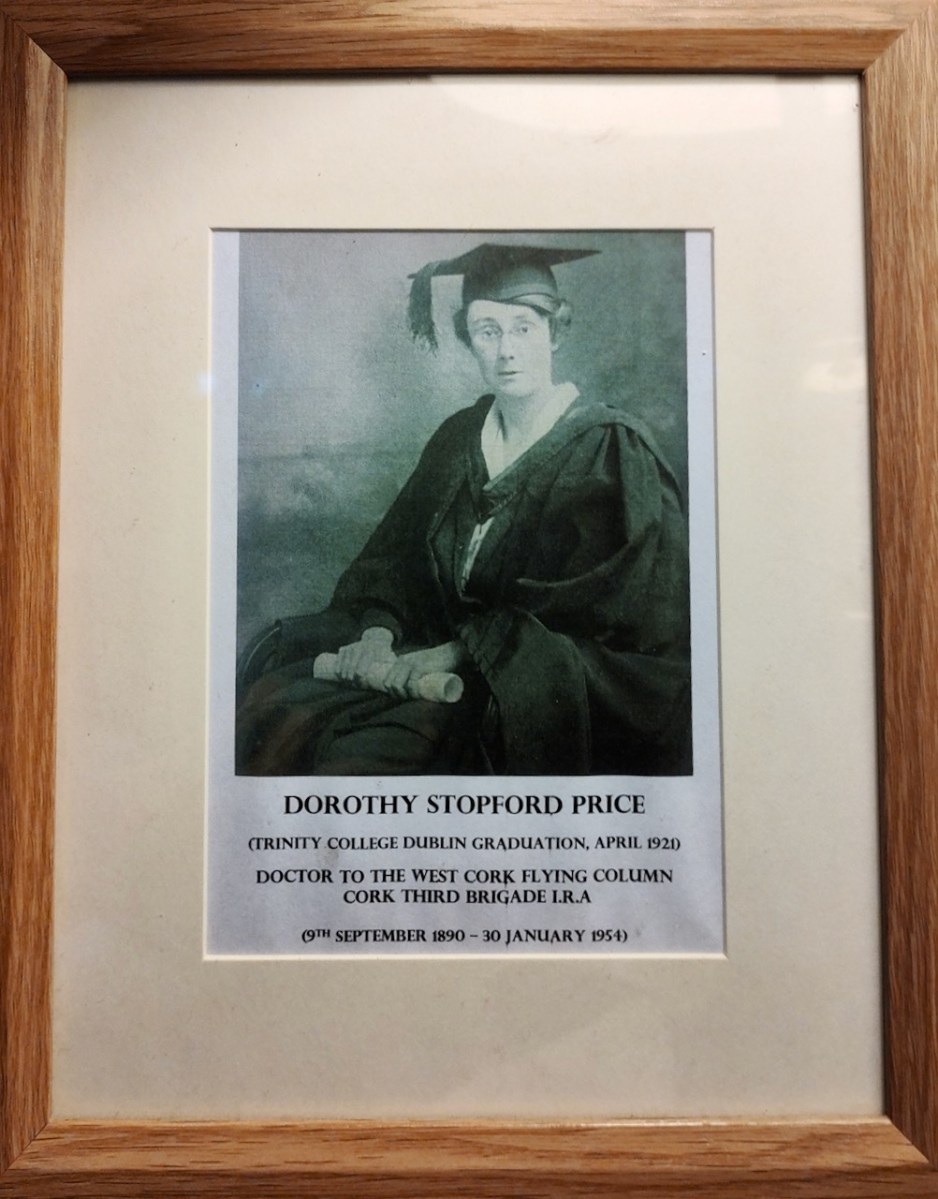
One of Molly’s great friends was Dorothy Stopford Price (above), who came from a landed Protestant family but spent time in Kilbritain teaching first aid at first and then as the community doctor and as medical officer to the local IRA Brigade. As an aside, although Dorothy pioneered the treatment and vaccination for TB in Ireland (below), all you ever hear about is the role played by a man, Noel Brown.

You have to read the book yourself to see how daring, brave and well-organised these women were, but I do want to tell you something of the story of Kathleen O’Connell of Ballydehob, who lived in a house two doors down from Working Artists’ Studio where we launched the book. She was an incredible woman – here are just some of her accomplishments, taken from Karen’s book.

In the Nominal Rolls of Cumann na mBan she is recorded as Captain of the Ballydehob branch and, by 1921, she was the Treasurer of Schull District Council (including Ballydehob), which had 114 members. What is also apparent is that she was trusted with possessing and delivering the secret, important information that the dispatches contained. And, of course, it meant that she put her own safety at risk. There is also a record of Kathleen being involved in setting up four or five “hospitals” in her area.

There was raid after raid.

During a Black and Tan raid on the town which occurred immediately after the vols. had been here (the house was reported) I had a large quantity of ammunition got by the volunteers in some raids on ex-policemen’s houses and elsewhere which was left to me to dump but I hadn’t got time…I got it out of the house by putting it in a large hand-basket and covering it with cabbage & bread. I went more or less in disguise wearing a shawl & long skirt, to get out of town to the dump, or safety somewhere, I had to ask the sentry for permission to get through… 

The village of Ballydehob was surrounded. She was sent by the sentry to the officer in charge and she managed to convince him to let her through …as I said I wanted to take bread home to children; all this time I had the basket of ammunition and some literature. I went about a mile with it. She had two loaded revolvers, a holster and some clips of bullets; and the consequences of being caught were stark: They would have shot me probably if they had discovered it.

I took part in an ambush which was laid at Barry’s Mill. Took out food a couple of times during the day alone, in Wood’s commandeered horse & trap, also took dispatches which arrived while they were there

She also scouted for the Volunteers that day, travelling back and forth to the mill. 

On the last trip I went out there, alarm was given of the approach of the enemy. I could not then get back. Commandant Lehane gave me his 45 revolver and I remained their with the others for a considerable time, until it was reported the military had gone some other way. . . 

17 lorries and private car with a ‘lady searcher’ arrived around this time in Ballydehob in order to search her and her home. She had been anticipating the visit – “I had everything dumped but the dispatch. It was in my pocket. I ate it.”

This is the house – the colourful one on the right in this picture – in which Kathleen O’Connell lived in Ballydehob

Kathleen was ruined financially by all her support for the cause. Letters of support for her pension application were fulsome in praise of her work and her commitment. She was awarded a grade E pension in 1939. She died, here in 1945, aged 50. She had not married and had  no children, and all memory of her gradually disappeared from Ballydehob. When Karen went looking for the house she had lived in, it seemed nobody could remember the heroic Kathleen O’Connell who had once lived here.

Another view of the house in Ballydehob, from Google Maps. There should be a plaque!

However dangerous Cumman na mBan activities were during the War of Independence, those dangers tripled during the Civil war, as did the horrors of families ripped apart. Cumman na mBan took an anti-treaty stance, and where they now supported all the efforts of the anti-treaty side, the pro-treaty fighters knew all their secrets, their hiding places and their habits. They had to be, therefore triply ingenious – and they were!

Another reason why now was an apt time to Karen to release this book is that we are facing an upcoming referendum. In the 1937 Constitution, heavily influenced by the Catholic Church – Archbishop McQuaid (above with deValera) submitted multiple comments and suggestions for amendments – DeValera and his government included this provision:

ARTICLE 41:2: In particular, the State recognises that by her life within the home, woman gives to the State a support without which the common good cannot be achieved.

This felt like a deep betrayal to many women of Ireland, who had rallied to the cause taking as their inspiration the words of the 1916 Proclamation, which said: The Republic guarantees religious and civil liberty, equal rights and equal opportunities to all its citizens, and declares its resolve to pursue the happiness and prosperity of the whole nation and of all its parts, cherishing all the children of the nation equally.

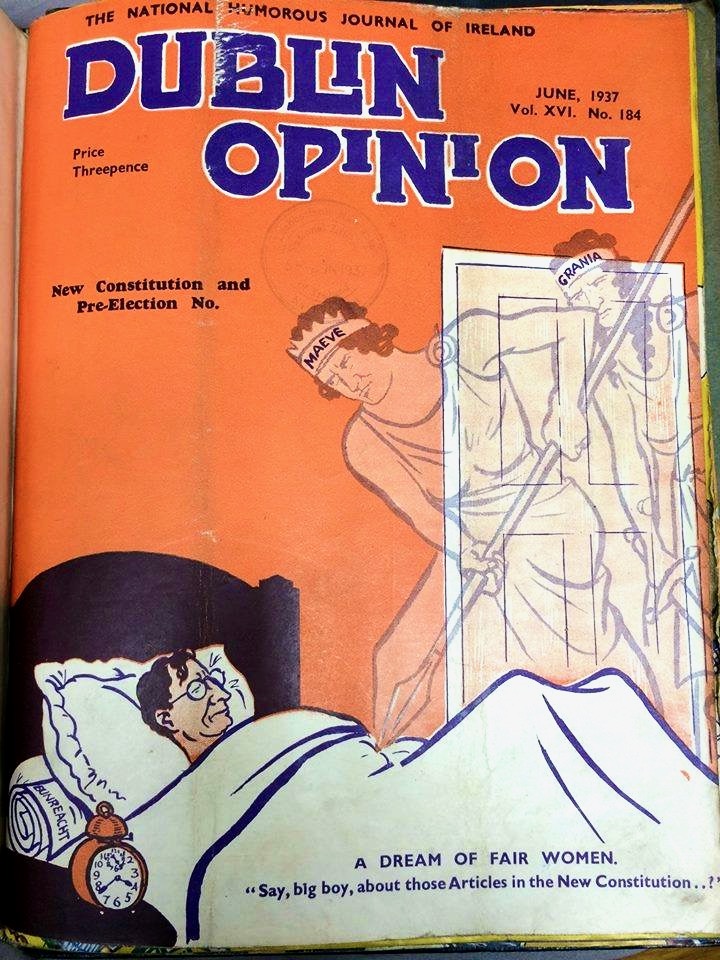
The cover of Dublin Opinion in June 1937. Queen Maeve and Grainne Mhaol are poking the sleeping deValera, who has the Constitution, Bunreacht na hÉireann, under his pillow

The upcoming referendum asks us to vote to remove the wording of Article 41:2. It’s 2024 – 100 years since these extraordinary ordinary women were playing their part in the founding of the state, only to be banished to a life within the home.

I like to think that Kathleen O’Connell, Lizzie Murphy, Tess and May Buckley, Molly Walsh and Dorothy Stopford Price, and all the other Extraordinary Women, are up there in heaven, chatting to one another over pots of tea, and casting a protective eye over the campaign to remove article 41. When it’s voted out, I see them nodding their heads and saying at least all our work wasn’t in vain.

I was honoured to be asked to launch the book!

Let’s all get out and vote for this constitutional amendment! It’s the best way we can honour the work that these extraordinary women did. That – and buy Karen’s book! It’s available in bookstores in West Cork or by contacting the author.

Accessible August 

It’s been a very busy week! The best part about it was that my sister, Aoibhinn (pronounced Eeving), is visiting and she and I were able to do lots of things together. That’s her in the coral jacket, above. You see, she has ME, or Chronic Fatigue Syndrome, and she was really nervous about her ability to participate in the activities I had booked or planned, or stay the course once on them. 

Aoibhinn does really well at managing her condition, but she has to be very careful or she can end up in a major crash. She struggles with tiredness and pain all the time (sore joints, headaches) but finds that sea swimming helps her cope mentally, so she was up for one of the things we planned to do together, our Dawn Swim and Pilgrimage with Gormú. We met Conor and Celine, and two other participants at Castlehaven and started off by walking the short way up to the Holy Well, where we heard of St Barrahane. Readers may remember Conor from the Placenames post.

Next came the swim. While Aoibhinn opted for a short immersion, I surprised myself by swimming all the way to Faill Dic, with encouragement from Conor, and the lovely safety valve of a float if I needed it. Breakfast was so welcome – porridge, fruit and hot tea made by Celine and Conor (below) – while we listened to more stories, all set around the cove we were in. It was a fantastic experience – I highly recommend it!

The Ellen Hutchins Festival and Heritage Week are both in full swing this week, so there are any god’s amount of things to choose from. We concentrated on botany and butterflies during the week and ended with stained glass and history yesterday. 

Micheline Sheehy-Skeffington and Nick Scott led us through the Glengarriff Woods. While this walk involves an uphill section, the pace is easy because it involves lots of stopping to talk about the plants we encounter along the way. We loved Nick’s descriptions of the forest environment, and all the layers that make up the plant life from the canopy down. And we were riveted by Micheline’s focus on the Arbutus (AKA the Strawberry Tree), a rare tree that occurs only here and in the Iberian Peninsula. 

Micheline is investigating her theory that it may have come with the Bronze Age miners who came to exploit the rich copper resources of West Cork and Kerry. Her recent article in Archaeology Ireland sparked my interest and I was thrilled to be able to go along on this walk with her.

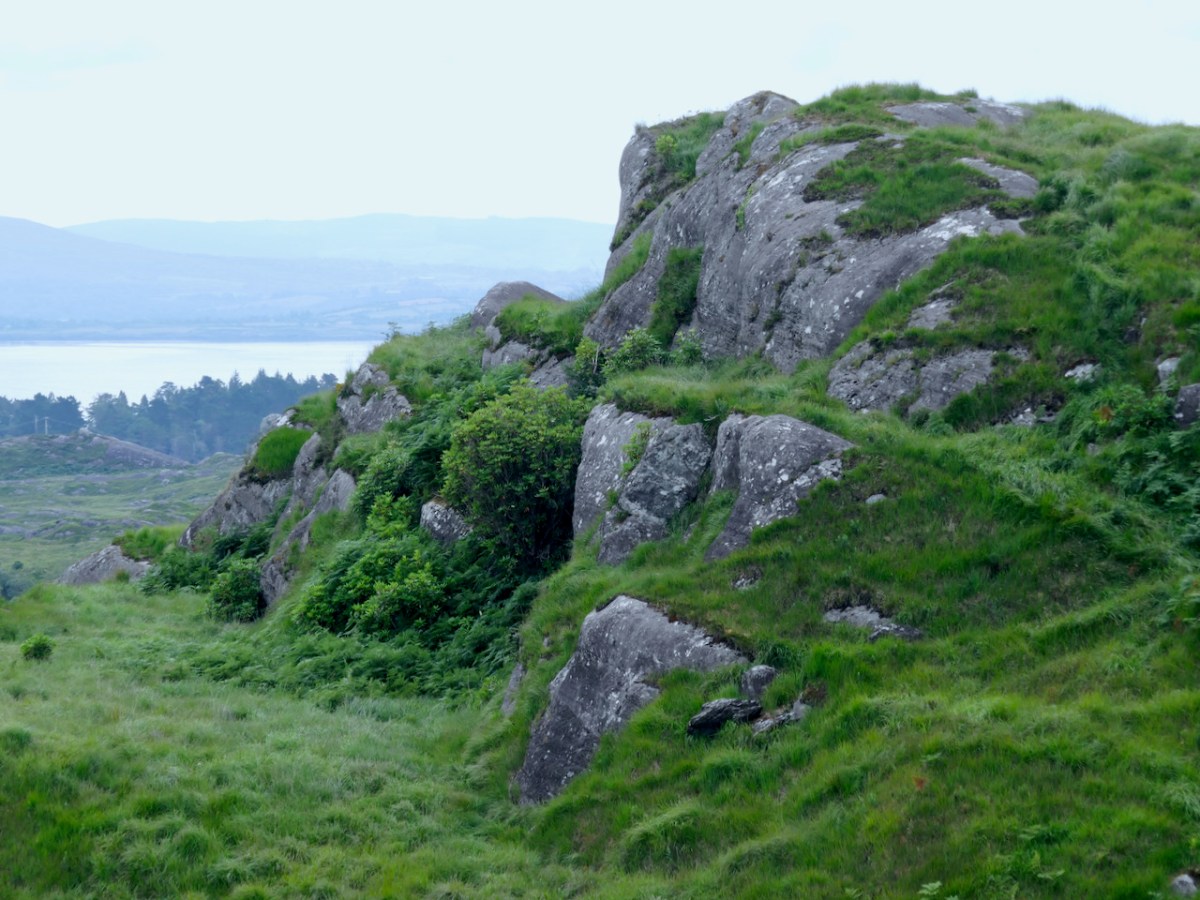
The photograph above illustrates the challenges in tracking Arbutus trees – they grow on cliffs and in inaccessible places.

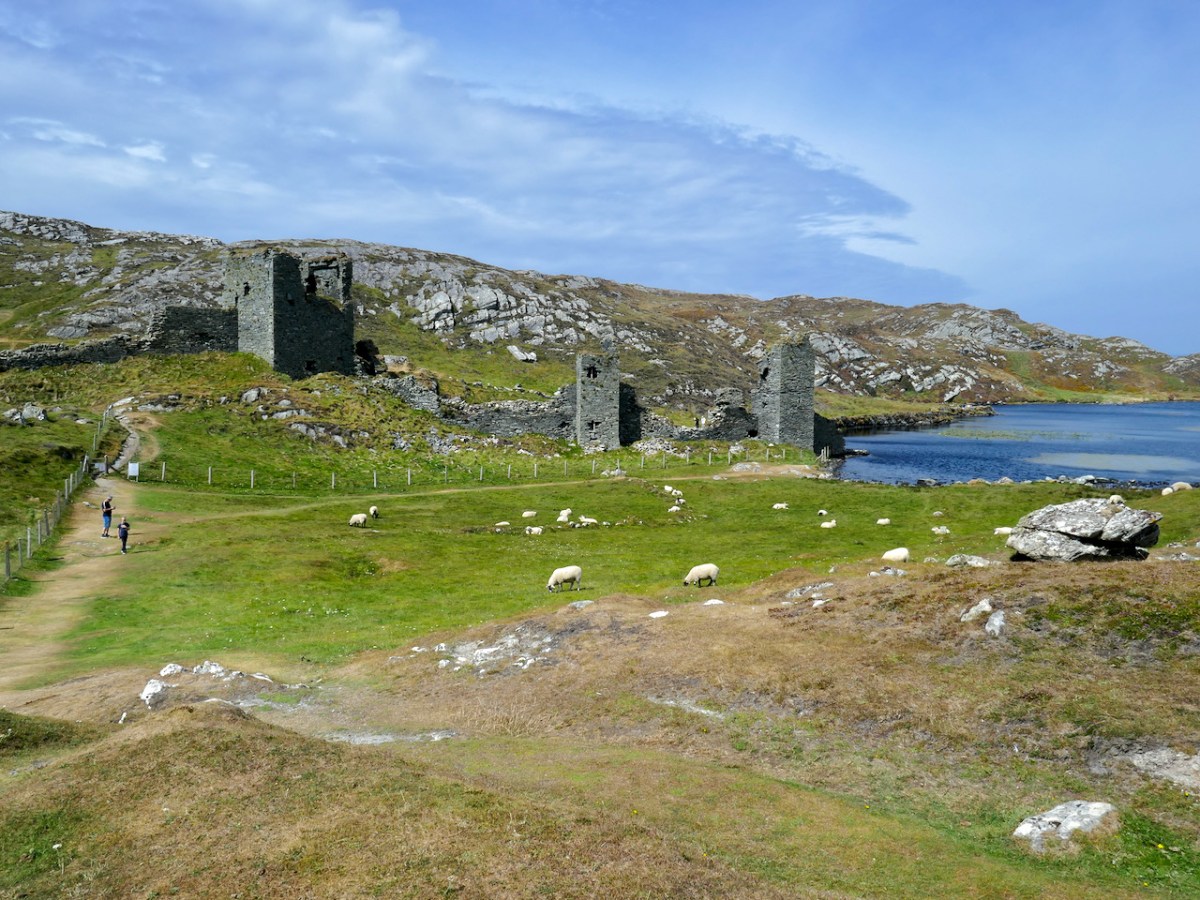
Our Wednesday walk was organised by the Cork Nature Network and was led by my friend Damaris Lysaght, a real local expert in plants and butterflies. And as if that wasn’t enough, it was at Three Castle Head, one of the most beautiful spots in Ireland and a place dripping with history

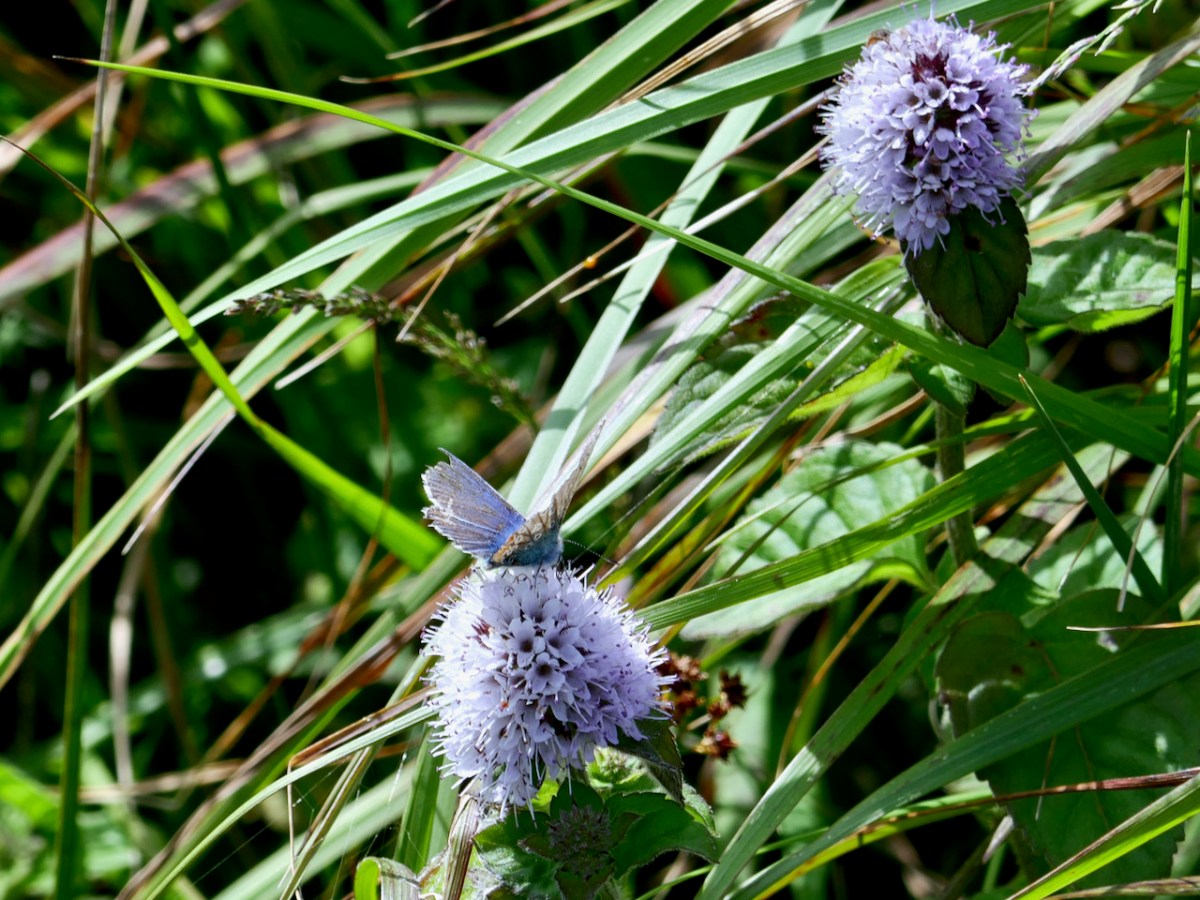
Once again, although this walk involved picking our way through long grasses and scrambling over rocks, the pace was slow, with frequent stops to ooh and aah over butterflies and hear Damaris talk about their habitats and plant requirements. Some of the plants were so tiny that we had to see them through a hand lens to really appreciate them.

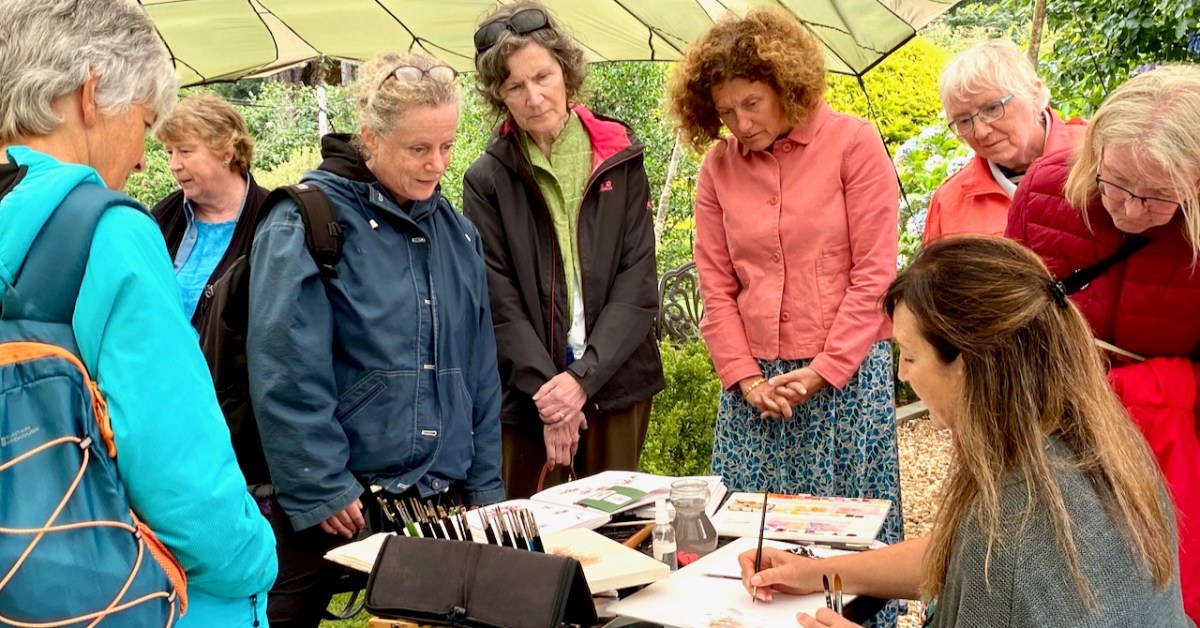
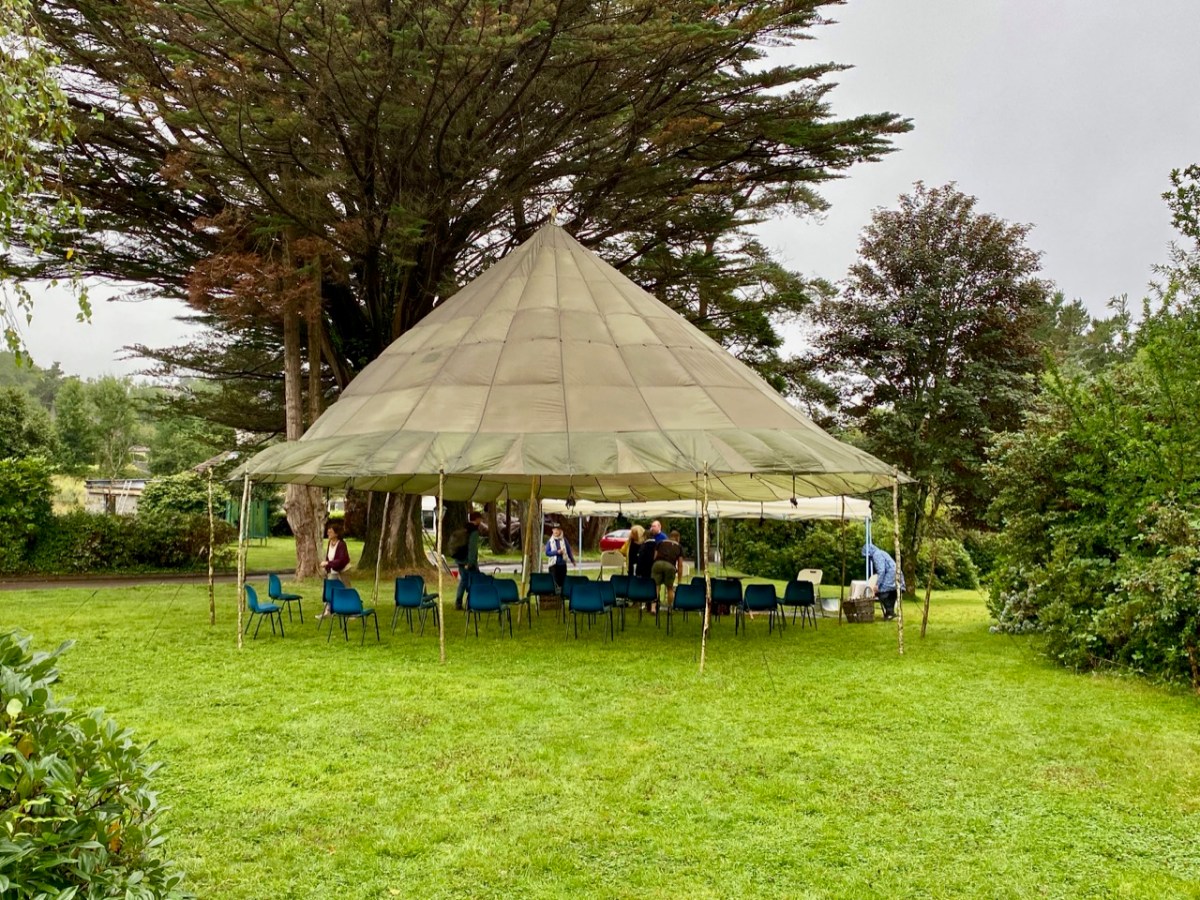
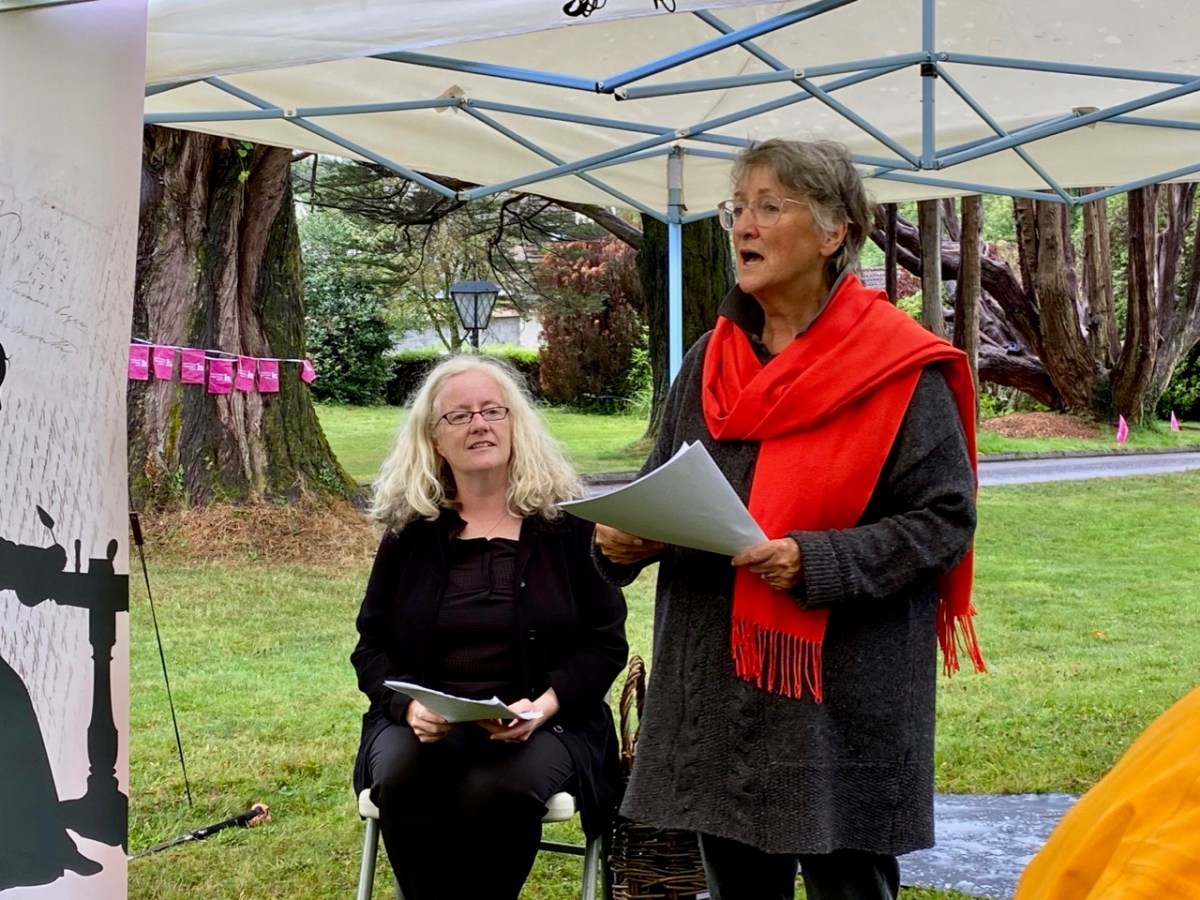
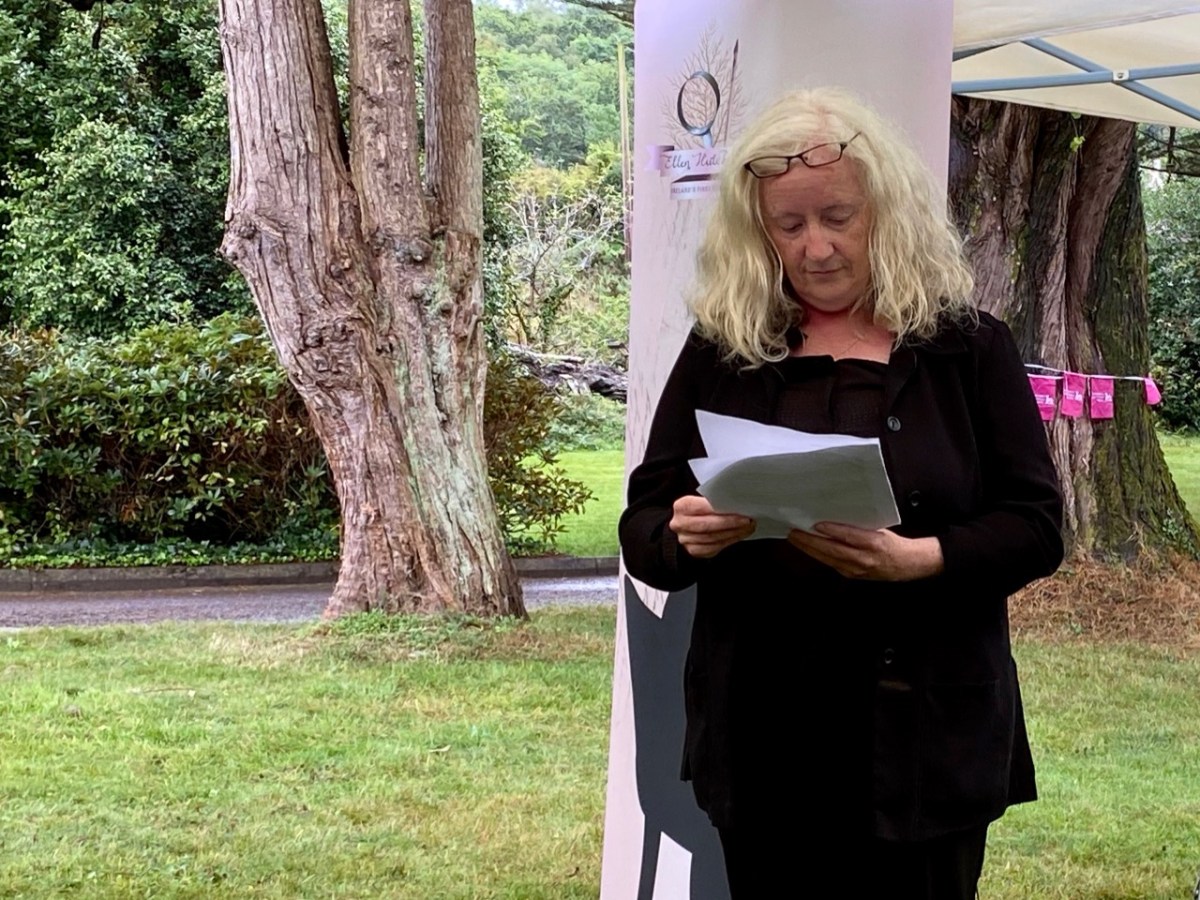
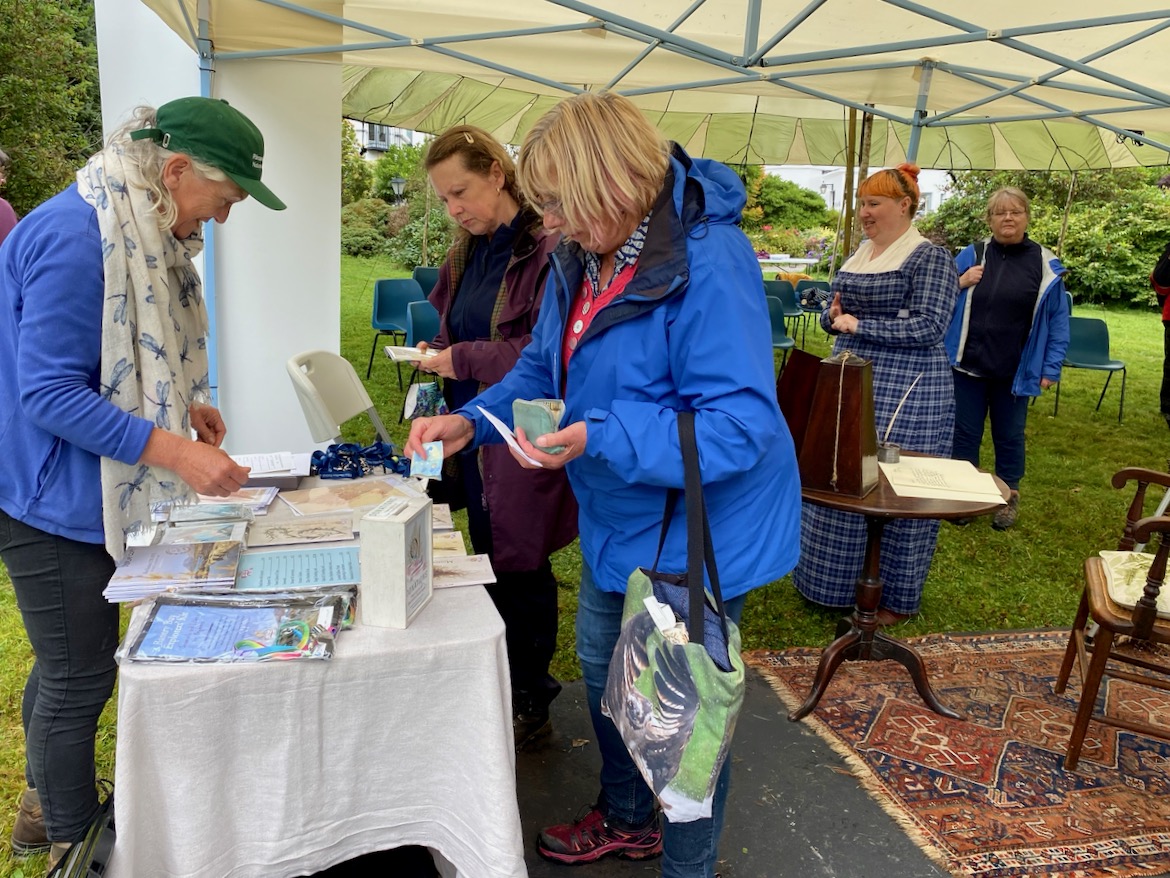
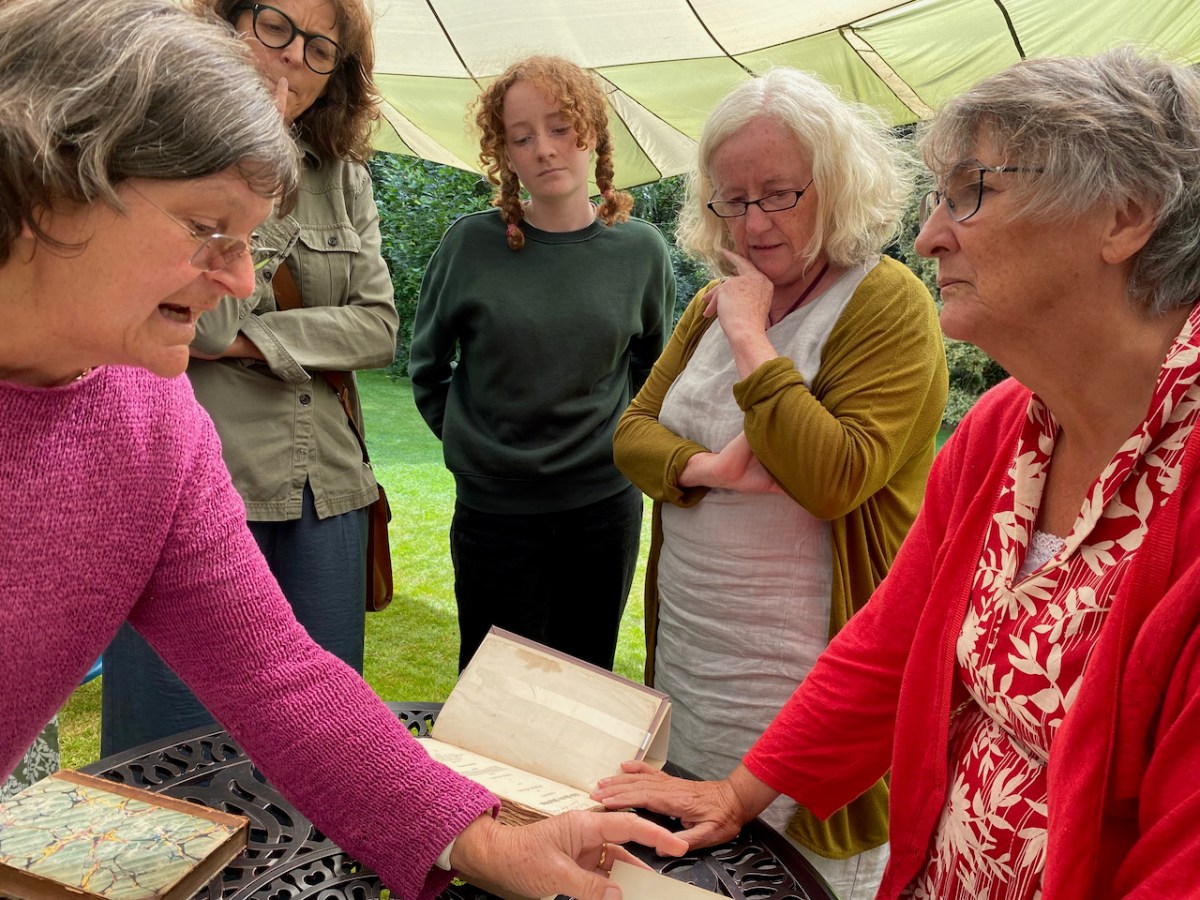
We had a rest day on Thursday, and on Friday it was time for Seaweed and Sealing Wax 2. This was the second production masterminded by Karen Minihan, based on the correspondence between Ellen Hutchins and Dawson Turner. See Robert’s post from last year for an account of Seaweed and Sealing Wax 1. This year, we were joined by the poet, Laura McKenna and the botanical artist Shevaun Doherty. That’s Shevaun surrounded by audience members in the top photo of this post, while Laura is in the photo below.

While Karen and I led the audience through the letters, Laura read a selection of poems that responded to Ellen’s life and work, and Shevaun worked away on painting a piece of seaweed, explaining her process to the audience at one point. 

At the end, Madeline Hutchins, Ellen’s great, great, grandniece, showed us some of Ellen’s books and letters. As with last year, we were under a tent in the grounds of Sea View House Hotel, right next door to where Ellen herself had lived in the opening years of the nineteenth century. 

We finished the week with a trip to Timoleague, where I was booked to give two stained glass talks at the Church of the Ascension Open House. This is part of a huge community effort to save and safeguard the fabulous mosaics in this church and I am always thrilled to be a part of it. Take a look at this video by the Rev Kingsley Sutton, Touching Heritage, to get an excellent overview of the whole project.

The church is truly one of West Corks hidden gems, and the fund-raising effort needs all the help it can get. In between the talks, we were whisked off to lunch at a fabulous private house right on the sea. Nice work if you can get it!

So – it’s been an incredibly busy week of flowers, talks, and butterfly hunting (above) and I am feeling it now. But all of our activities were  accessible to Aoibhinn, with time to rest in between, or go for a lovely dip locally. So – if there’s anybody out there who wonders if you would be able for a botany walk or a dawn swim and ‘pilgrimage’ – no need to be intimidated by a title or a description when the pace is leisurely and, as Aoibhinn found, there’s always a handy rock to sit down on for a while.

Drying Gelignite By The Fire: Extraordinary, Ordinary Women of West Cork

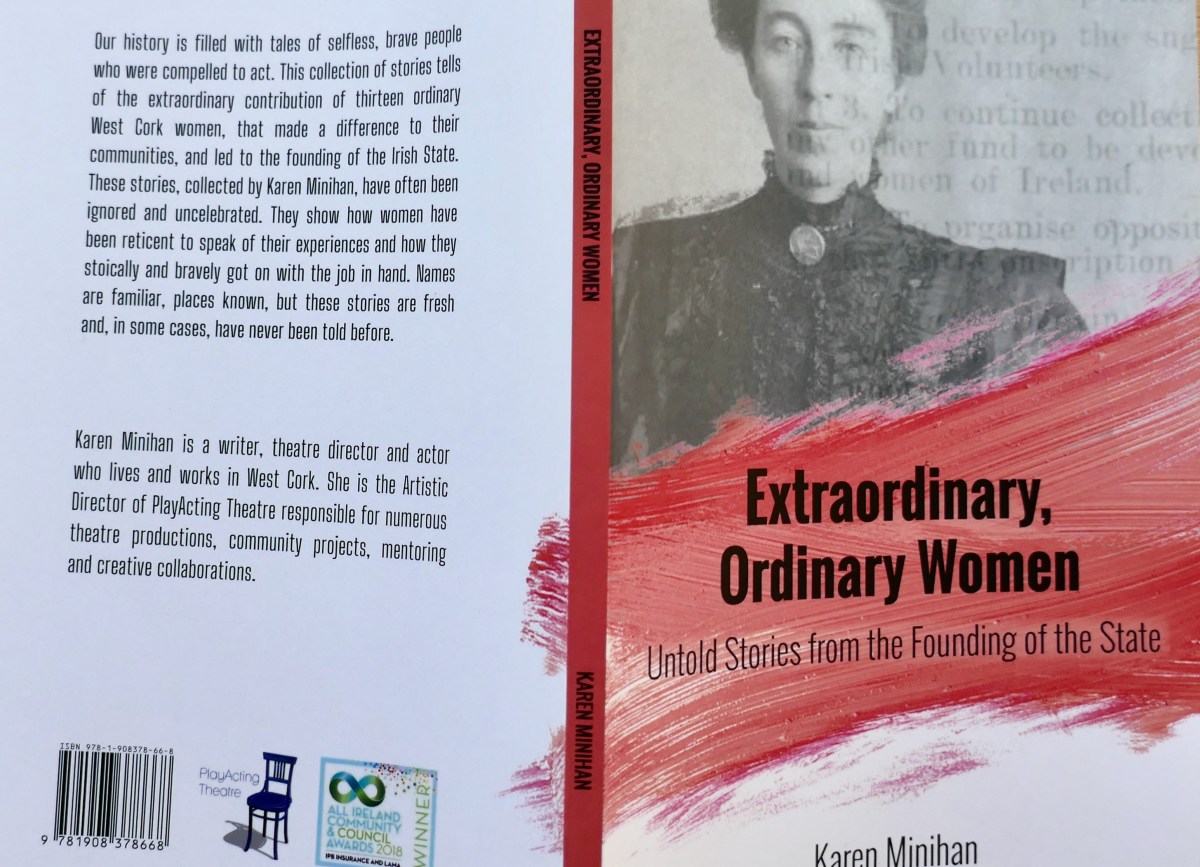
Karen Minihan has spent the last two years seeking out the forgotten stories of West Cork women who played an active role in the founding our our state. She has compiled thirteen of these stories into a compelling book – Extraordinary, Ordinary Women: Untold Stories from the Founding of the State. This book has opened my eyes to the courage and commitment of young (and not so young) women who took on dangerous roles in the War of Independence and the Civil War. Most did so as members of Cumann na mBan (the Women’s Company – the word Cumann actually means friendship), founded as an auxiliary to the IRA. This RTE piece is a good introduction to what the Cumann was all about, and includes an interview with Leslie Price, one of the women quoted in this book. Cumann na mBan, famously, was particularly well organised in West Cork and these women did everything to support the war against British occupation. 

Karen (centre) with her mother and Conor Nelligan, Cork County Heritage Officer at the book launch

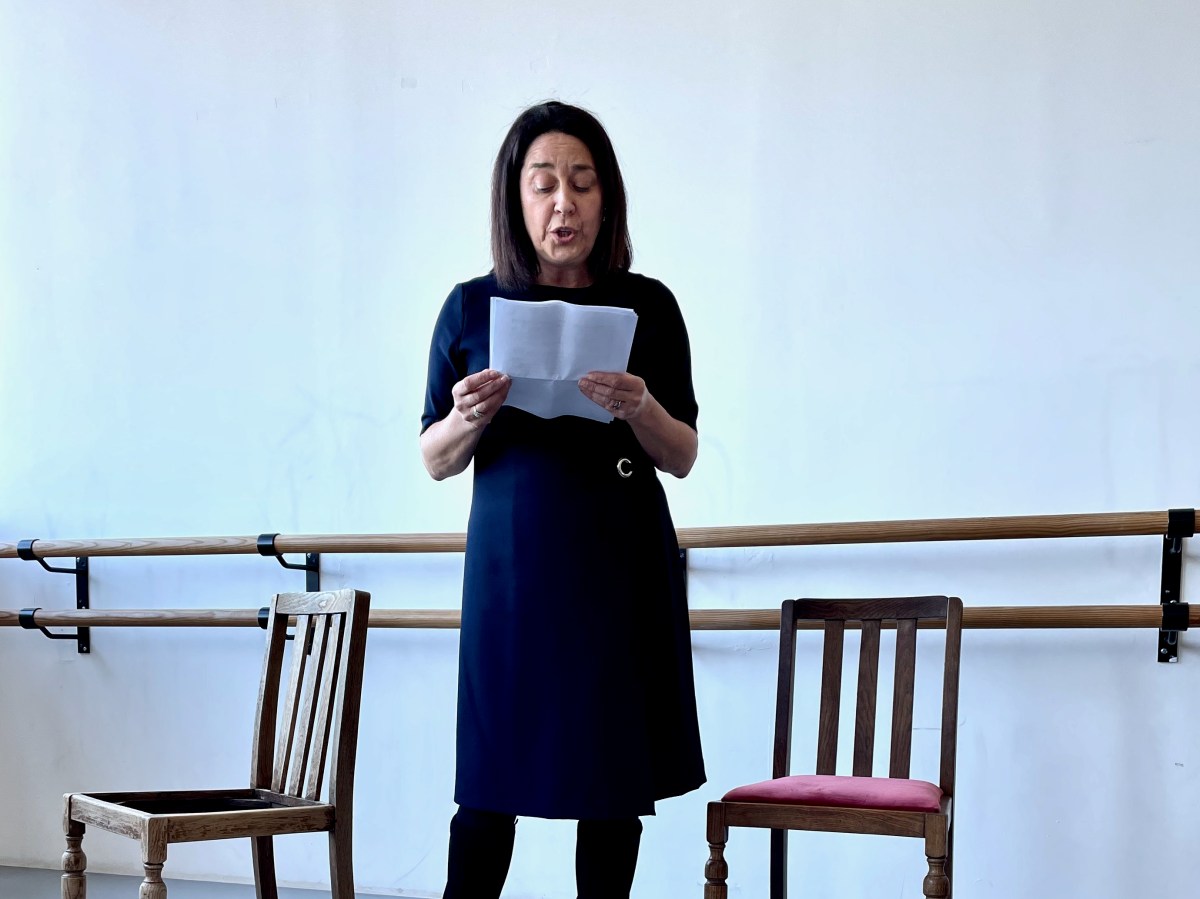
The book was launched on Friday at Uillinn (West Cork Arts centre) in Skibbereen, with a talk by Maura Leane (below), Professor of Applied Social Studies at UCC. She said:

Reading through the stories, I felt like I was watching an old, grainy, movie reel. Scenes were spooling out in my mind, providing beguiling insights into the history of the countryside around us, and into the activities that dominated the lives of many people living here, between 1915 and 1923, a time when West Cork, along with the rest of the country, was an active war zone. . . .It subtly shifts the spotlight of history, to pick out scenes that conjure up time and place, a local landscape, the atmosphere, and most importantly, a set of women characters. Characters, who have remained in the shadows, while attention was paid to the male heroes whose stories dominate our understanding of the period.

The stories are of women who were full of courage, spirit, skill and cleverness. The war would have been impossible without them – they scouted, carried dispatches, concealed and transported arms, nursed wounded men, raised money, sent essential supplies (like cigarettes!) to prisoners, passed on intelligence, cooked, sewed (many, many haversacks) and laundered for men on the run. They learned to handle firearms and to do first aid. They looked after the farms while their brothers were off with their Flying Columns. They cycled for miles through dark country roads to raise alarms or deliver messages. 

May Hickey lived in Skeaghnore – that’s her above in later life, not looking at all like the daring young woman revealed in her stories. They had a secret room where they hid men on the run – theirs being a ‘safe house’. May found herself many an evening cleaning rifles from the stashes she maintained in various hedges and ditches in the area. Also, “gelignite, tonite and detonators were given to me on various occasions to keep dry and often I was ordered to dry gelignite near the fire which was damp after the remainder being used for explosive purposes.” 

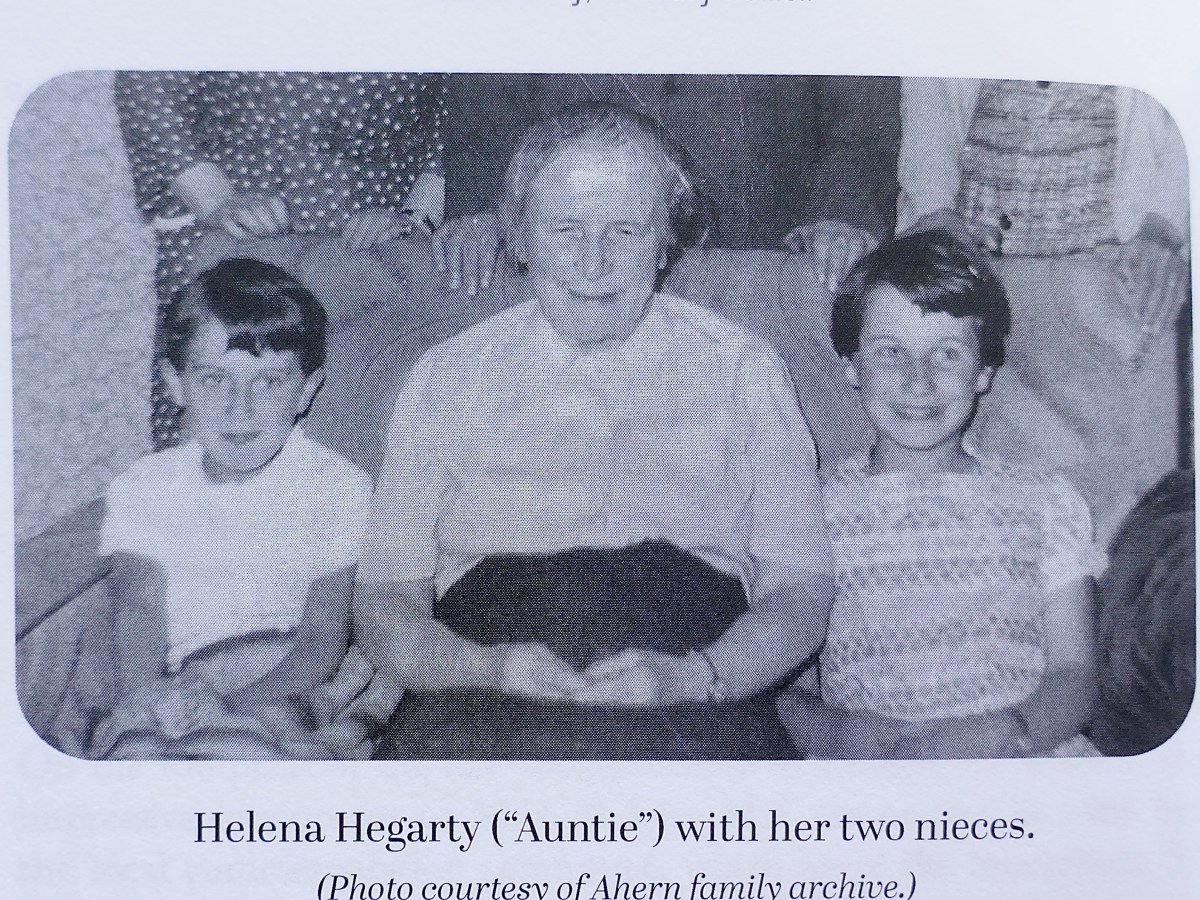
Helena Hegarty was the Matron of the Schull workhouse (above and below, as it is now). Incredibly courageous, she used her place of work to harbour IRA men and tend to the wounded. She even kept a British spy in the workhouse under lock and key for several weeks. She trained other women in first aid, and set up field hospitals. According to one account “she carried out her duties conscientiously and fearlessly.”

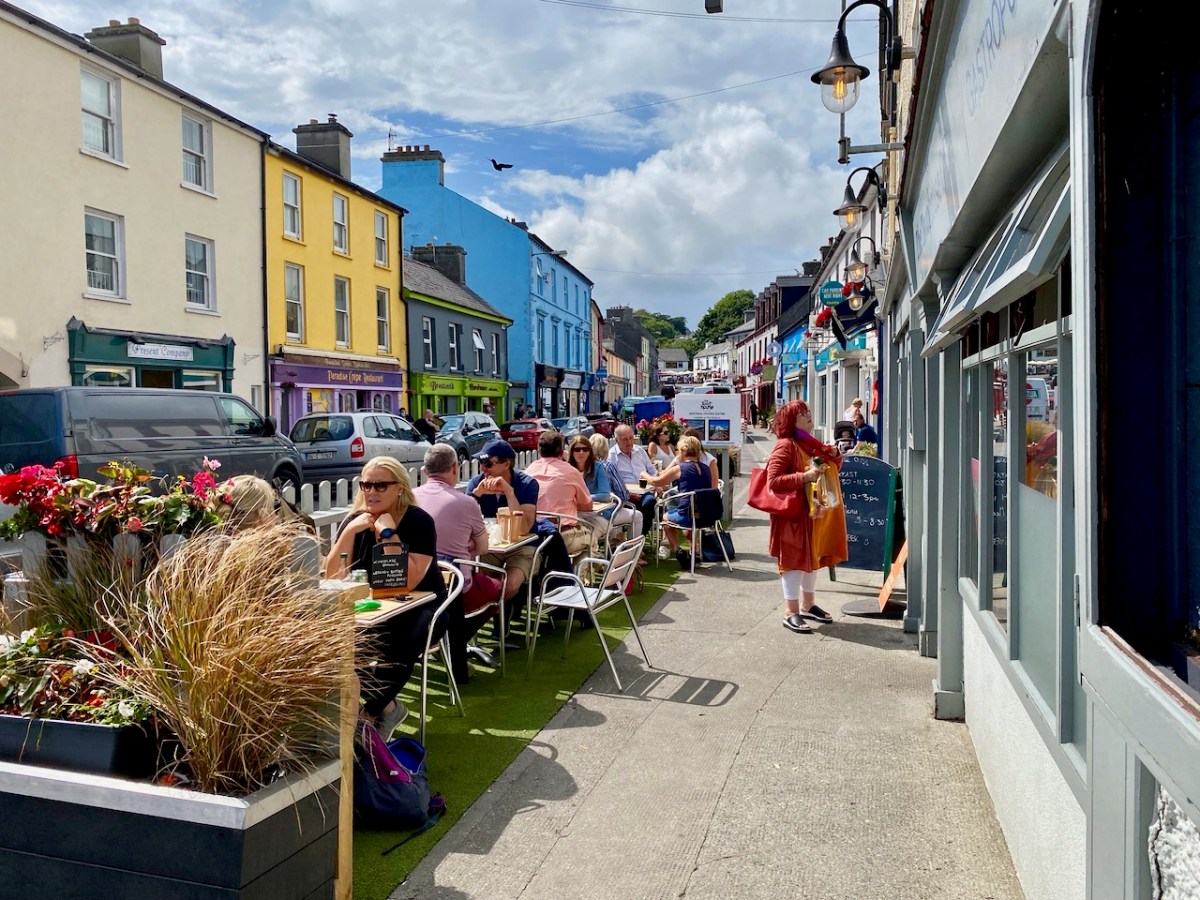
Having been given advance notice that the workhouse would be burned, she got out all the inmates and anything that could be saved. Because the British Military barracks in Schull was being attacked at the same time, she and her charges were under rifle and machine gun fire as they sheltered on the roads outside the workhouse. A recurring motif in the book is that few people knew of the heroism of the women who are portrayed. Below is Schull main street today – Helena Hegarty, warm and gentle and loved by all, ran a shop about where Brosnan’s Centra is now, after she was put out of work by the burning of the workhouse. She was known as Auntie by a generation of Schull children and their parents, who had no idea what she had done.

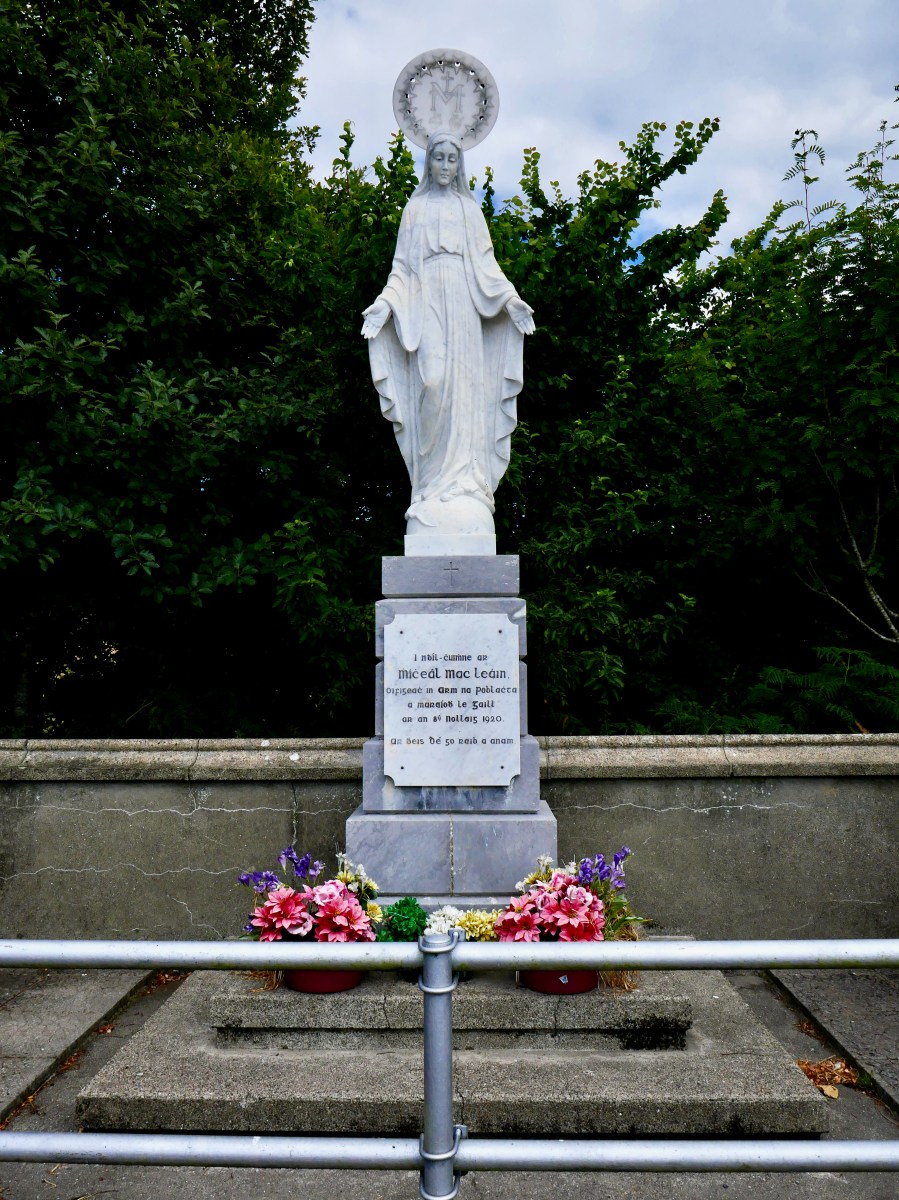
And in return the women were harassed by the Black and Tans and the RIC. Some women were roughed up and their hair was cut – it was called ‘bobbing’ and was a potent mark of punishment, used by all sides. They were threatened with having their house burned – they lived in fear but carried on. It took its toll – after Mary Ellen McLean’s brother, Michael John, was killed by the Black and Tans with appalling cruelty, she was ‘never the same.’ The memorial to her brother in Lowertown, (below), now occupies the spot where her post office was once the hub of intelligence for the region.

Most upsetting to us, as we look back from our present vantage point, is that their roles were undervalued. While heaped with praise both in the Bureau of Military History accounts of their deeds and in the Pension applications, they were routinely denied pensions by the (all-male) board, had their service downplayed and, where they were awarded a pension, were assigned to the lowest grade – E level. (Read more about that here.) Helena Hegarty was one such woman, awarded an E grade pension, despite the emphatic support by local IRA commanders for the work she had done

Karen includes the case of Bridget Noble, murdered by the IRA because she was a observed to be entering the RIC barracks. She had previously been bobbed and had lodged a complaint against the men who forced this on her, thus earning the ‘informer’ label. A thoroughly researched book by Sean Boyne (see his talk to the West Cork History Festival) has documented this case of the ‘disappeared’ woman of the Beara Peninsula.

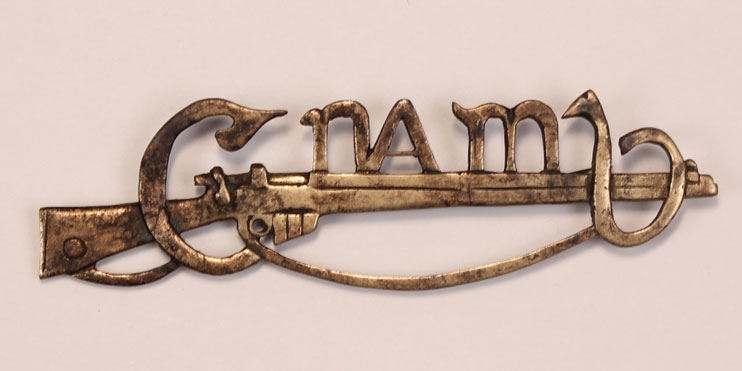
A Cumann na mBan pin – note the centrality of the rifle

At the launch, Maura Leane summed up Karen’s work thus:

By inviting us as readers to engage with Bridget’s story, Karen pulls us, uncompromisingly, into the trauma and the violence and the highly emotive reality of this period of war, in our own localities. And when this period was over, and everyone had to start the journey of living together again, side by side, and in common cause, this trauma had to be set aside. The memories had to be put away, the stories had to be left untold. And so, this time was rendered silent. And this is why Karen’s work here, is so important. Because what Karen has done is to gently and skilfully evoke voices and emotions from this troubled time. She has storied these voices and brought forth war time memories, in all their complexity and in all their nuances. And most importantly of all, she has brought into relief the feelings and the emotional resonance that is embedded in accounts of the past.

Sullivan’s Toy Shop was once the home and business of Rose O’Connell, one of the extraordinary, ordinary women

At the launch, Karen enacted a short play based on the chapter on Rose O’Connell. Poignantly, the shop where the action took place could be seen from the room, and some of her descendants were at the event. Karen’s book is available at all good West Cork Bookstores but if you’re not lucky enough to live here you can order it from Schull’s wonderful Worm Books (thewormbookshop@gmail.com). 

Seaweed and Sealing Wax

Finola has been involved in the Ellen Hutchins Festival since it began in 2015 – the 200th anniversary of the death of Ireland’s first female botanist. This year she was asked to help organise and MC an outdoor event, and has had a very busy time – together with her collaborators – leading up to this. On the day – last Friday – I went along to see the culmination of their hard work, and I thought I would share the experience with you.

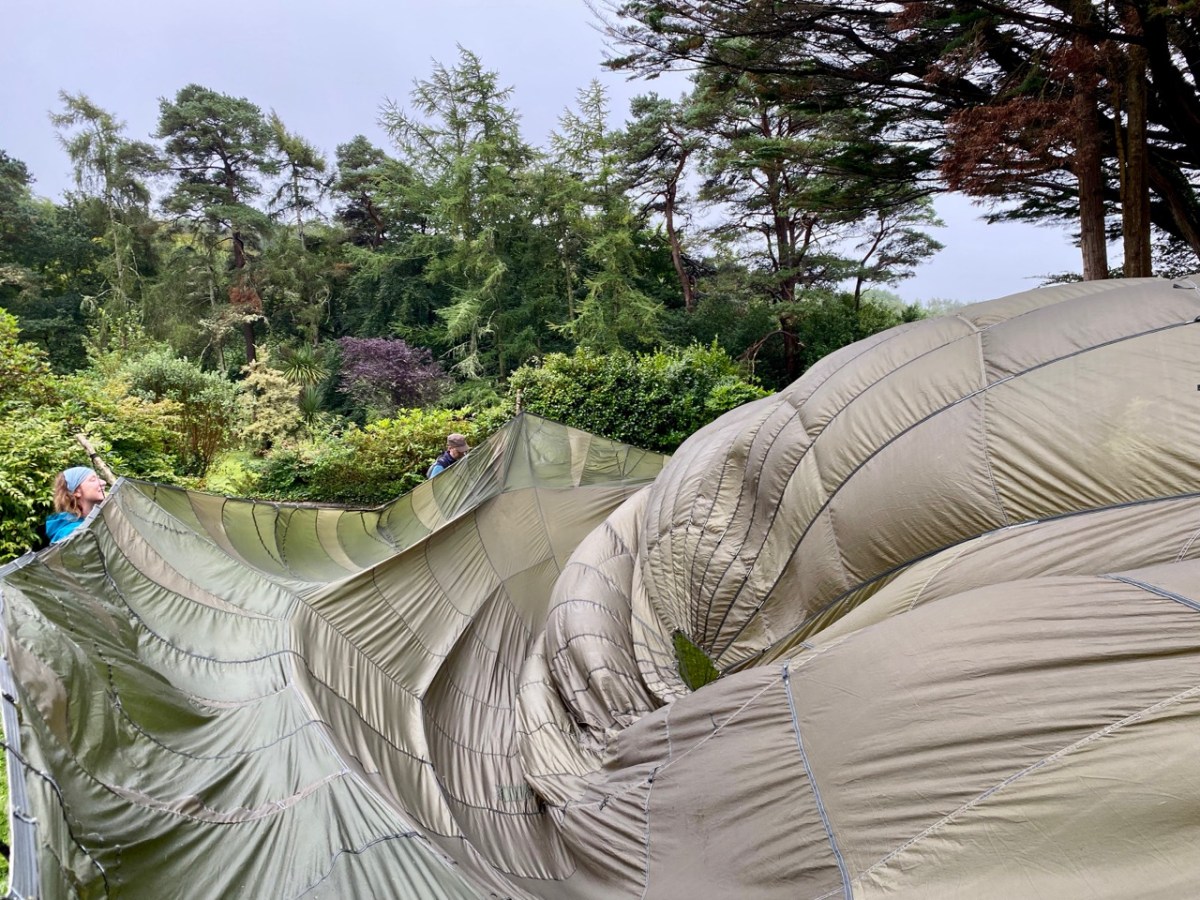
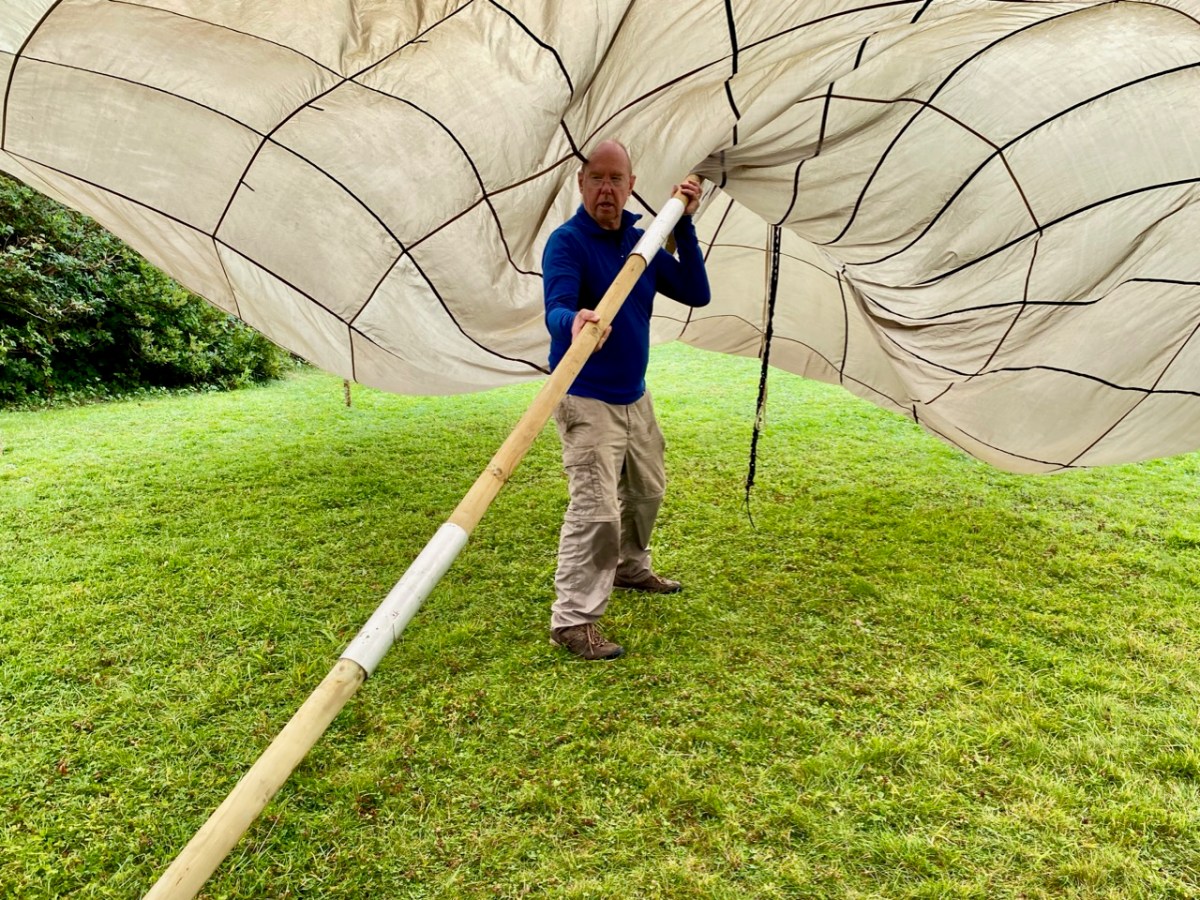
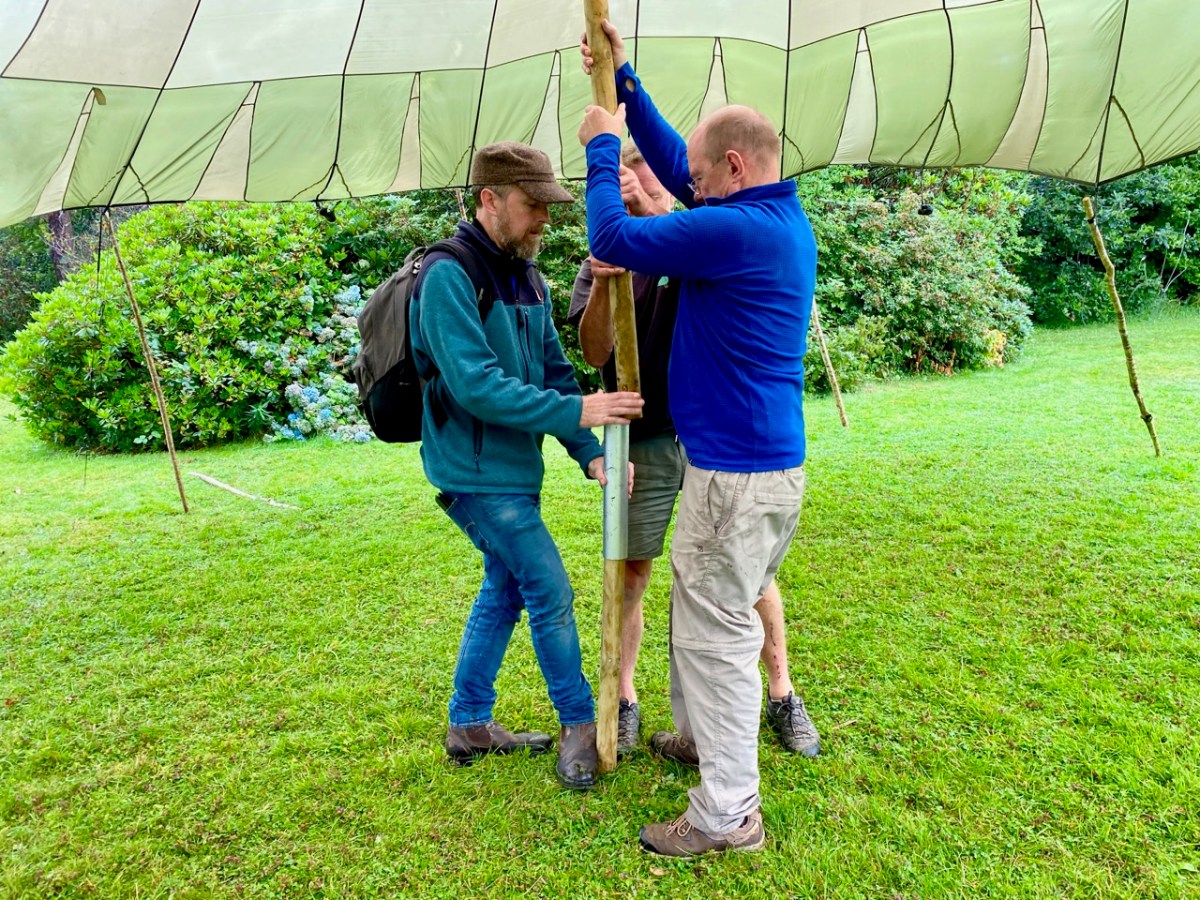
The weather forecast for that day was atrocious! Heavy rain and thunderstorms were predicted for the duration, and we set out for Ballylickey with some trepidation. However, as is often the case in West Cork, the weather forecasters were confounded. Nevertheless, the Festival team had prepared for all eventualities and we arrived in time to contribute to the setting up of a shelter made from a silk parachute and a number of wooden poles. The transformation of an empty area of lawn in the gardens of Seaview House Hotel into an impressive performance space in a very short time was quite remarkable – and a visual treat – as the swirling mass of silk was tamed by our team, directed by Seán Maskey.

Watching (and, indeed, participating) in this constructional triumph, I was taken back to the days when I lived in Cornwall and followed the escapades of two theatre groups there: Kneehigh Theatre and Footsbarn. Both started out as small troupes of travelling players who took their performance spaces with them and incorporated the action of creating and erecting their transitory auditoria into their shows: all part of the visual entertainment. Both those groups have evolved and travelled far away from their roots, but the evanescent nature of their early shows has stayed with me, to be pleasantly awakened by the happenings at Ballylickey.
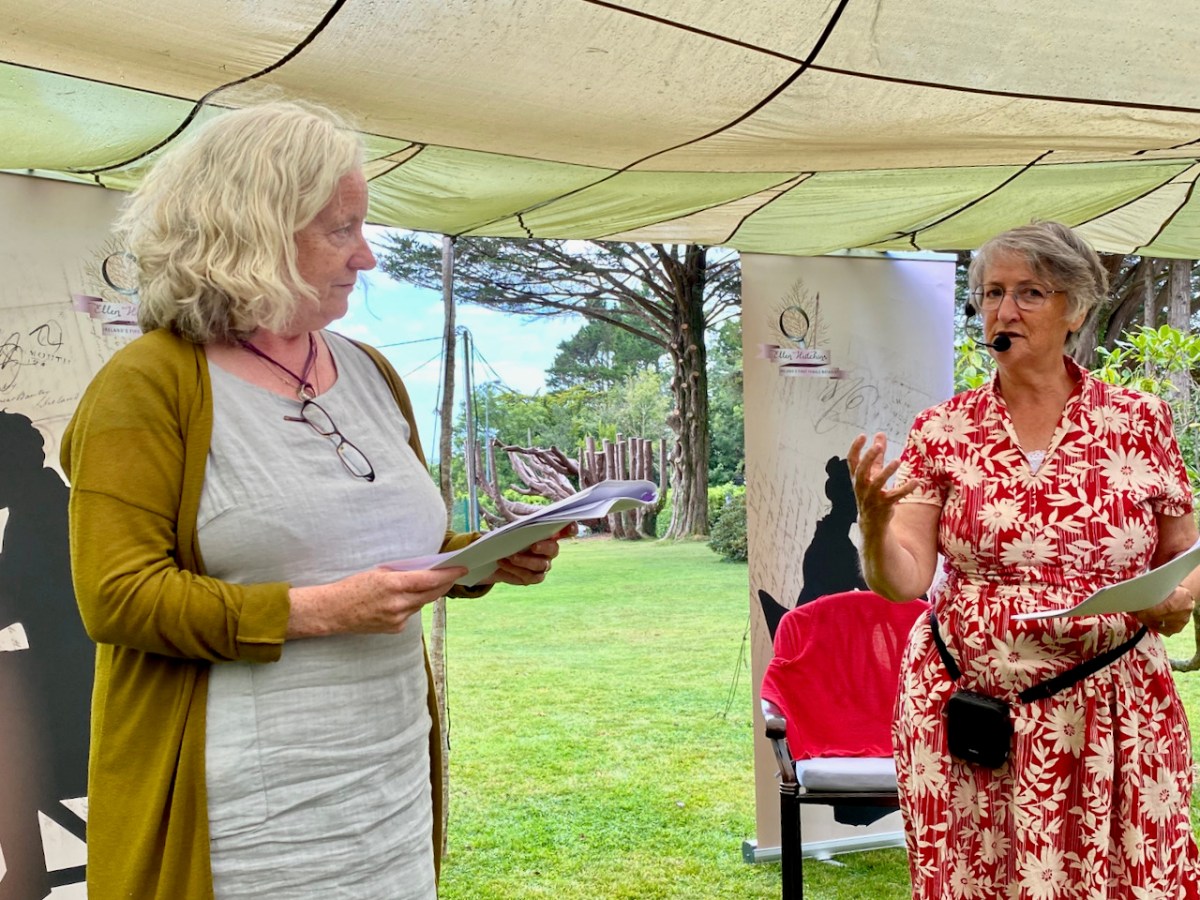
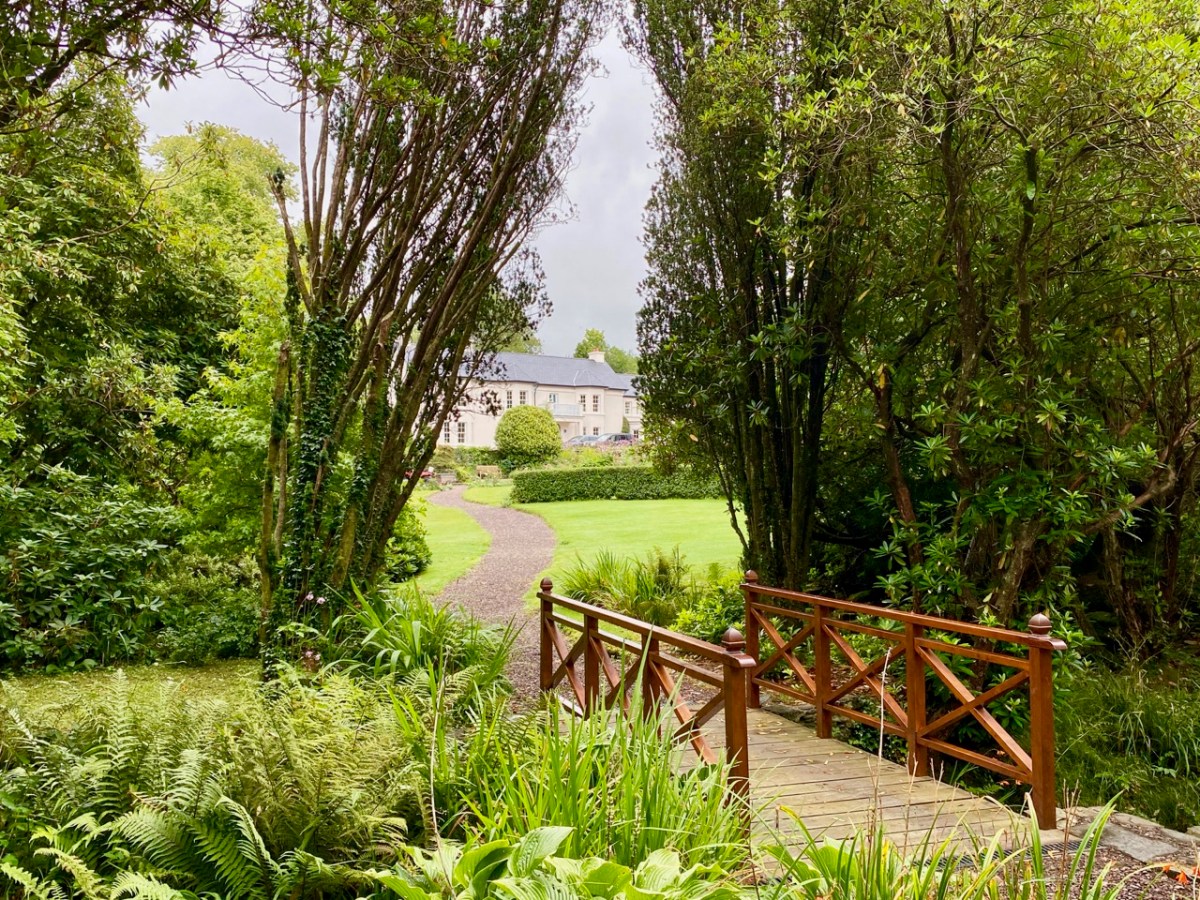
To see where Ballylickey fits in to the story of Ellen Hutchins, have a look at Finola’s post from 2015. Ellen was born in 1785 in Ballylickey House and lived much of her short life there. Seaview House – now the Hotel – was built partly in the grounds of the Hutchins family home, so it is a fitting venue for Festival events, as we know that we are following her own footsteps as she became interested in the world of plants and seaweeds which she discovered all around her as she was growing up.

. . . Ellen was a pioneering botanist who specialised in a difficult branch of botany, that of the non-flowering plants or cryptogams. She discovered many plants new to science and made a significant contribution to the understanding of these plants. She was highly respected by her fellow botanists and many named plants after her in recognition of her scientific achievements.In addition to being an outstanding scientist, Ellen was also a talented botanical artist. Botanical drawings serve science in a very important way . . .

Ellenhutchins.com

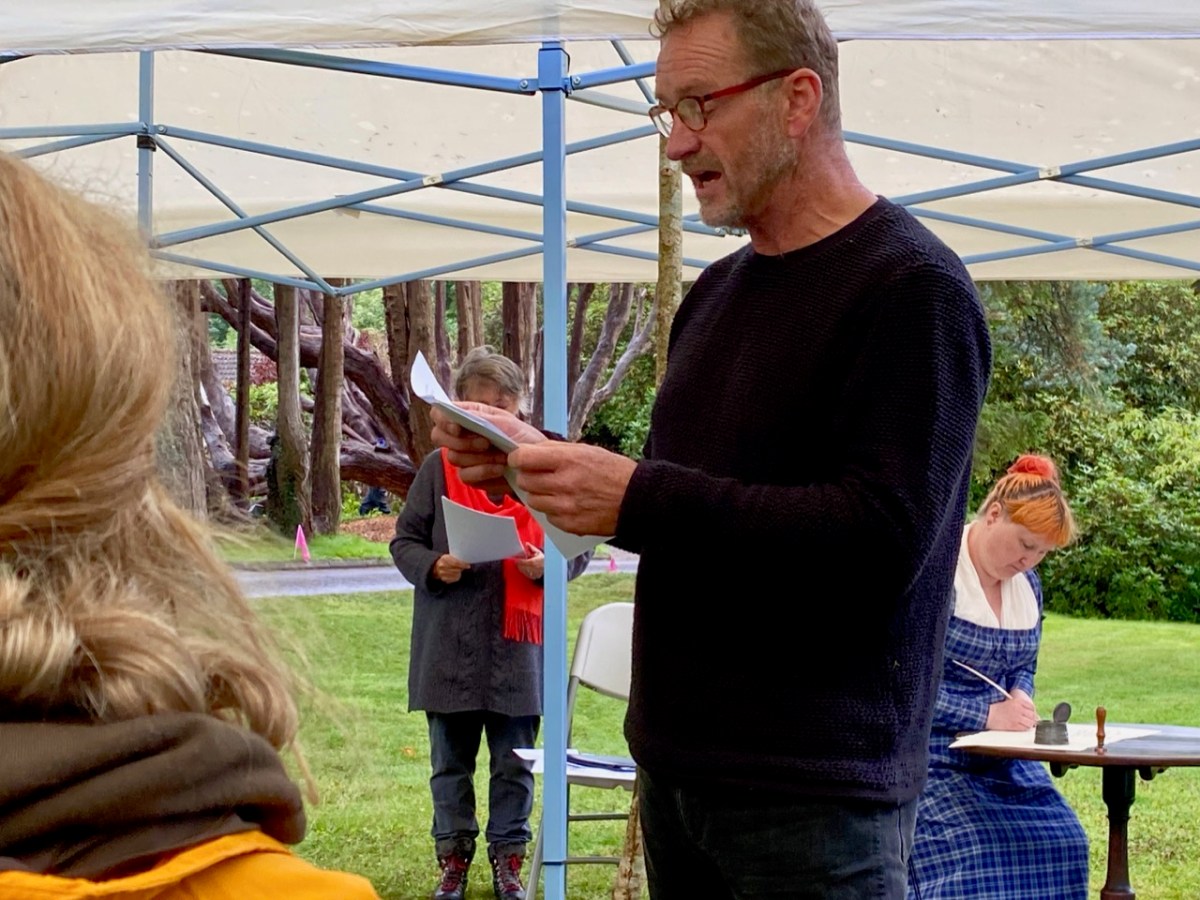
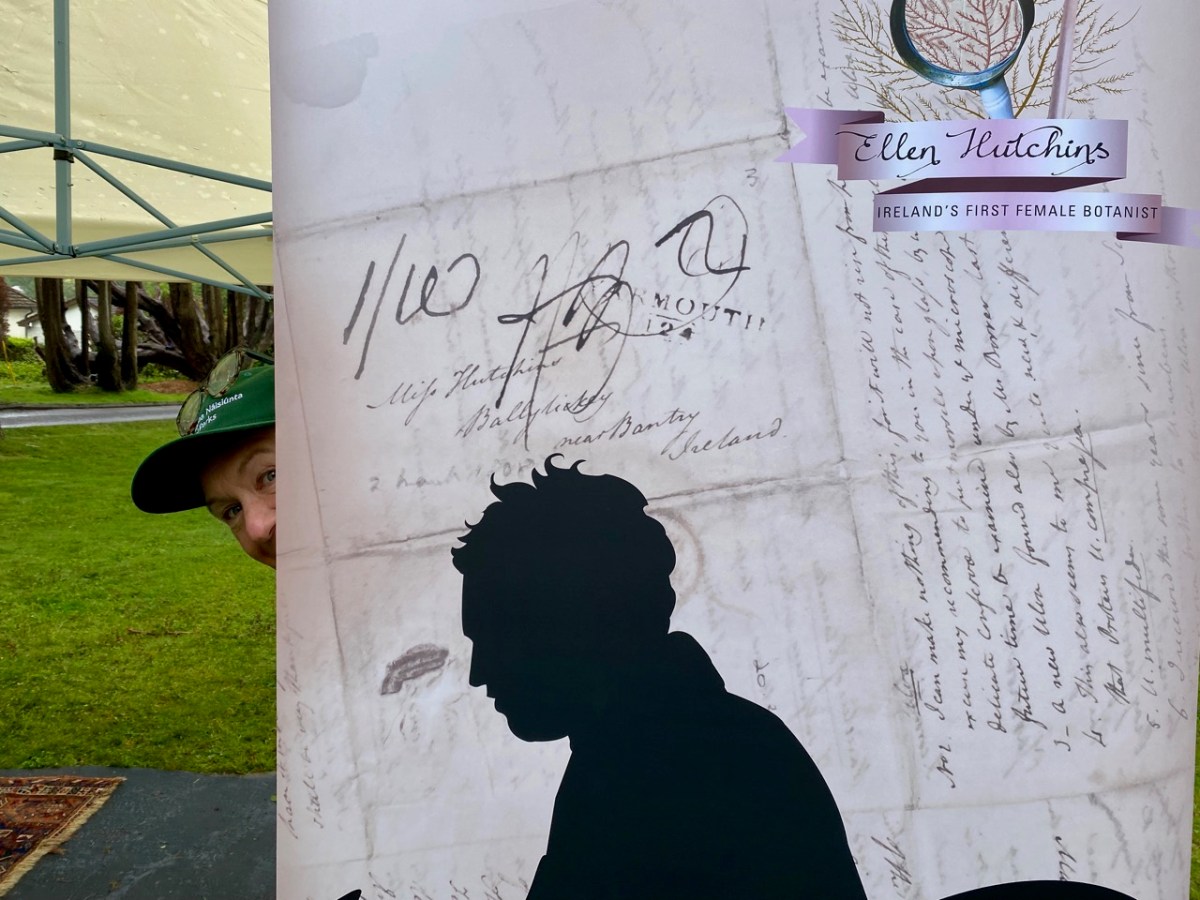
That’s Finola (above) introducing the subject of the day: the correspondence that passed between Ellen and Dawson Turner of Yarmouth, Norfolk, who had become a recognised authority on botany in early 19th century Britain, even though this was always a leisure pursuit: professionally he worked for his father, who was head of Gurney and Turner’s Yarmouth Bank and took over his role on his death. Dawson wrote numerous books on plants and got to know the leading botanists of the day, including Ellen. Amazingly, one hundred and twenty letters between her and Dawson survive. Those from Dawson Turner to Ellen are held by the Royal Botanic Gardens, Kew, and those from Ellen to Turner are at Trinity College Cambridge. Friday’s event was a reading of a selection of these letters. On Finola’s right, above, is Karen Minihan, an actor and drama director who lives in Schull: she read the letters from Ellen. Moreover, it was she who selected and organised the extracts – which were the heart of the performance.

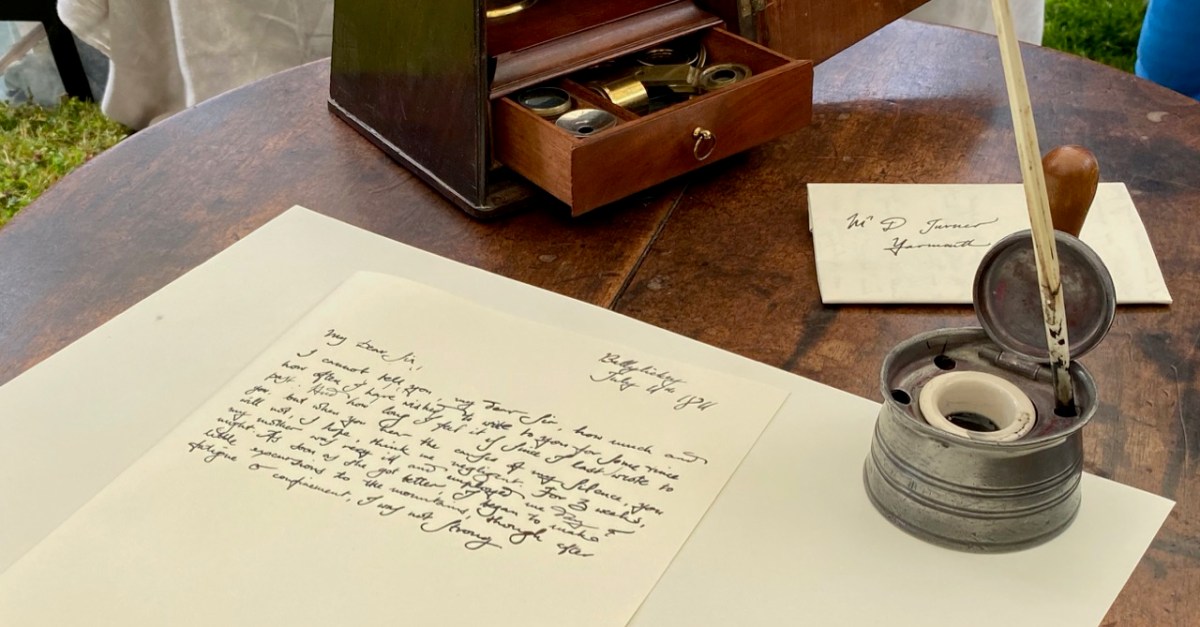
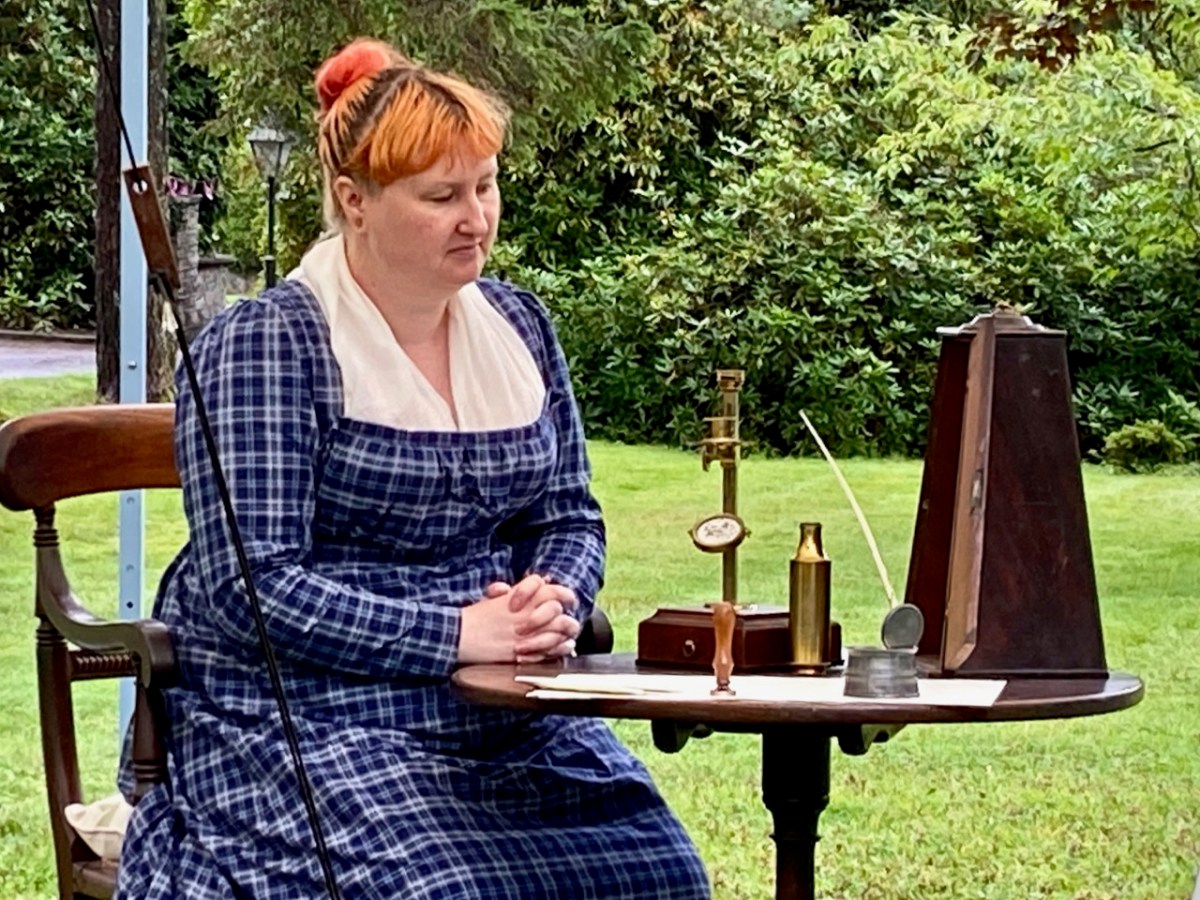
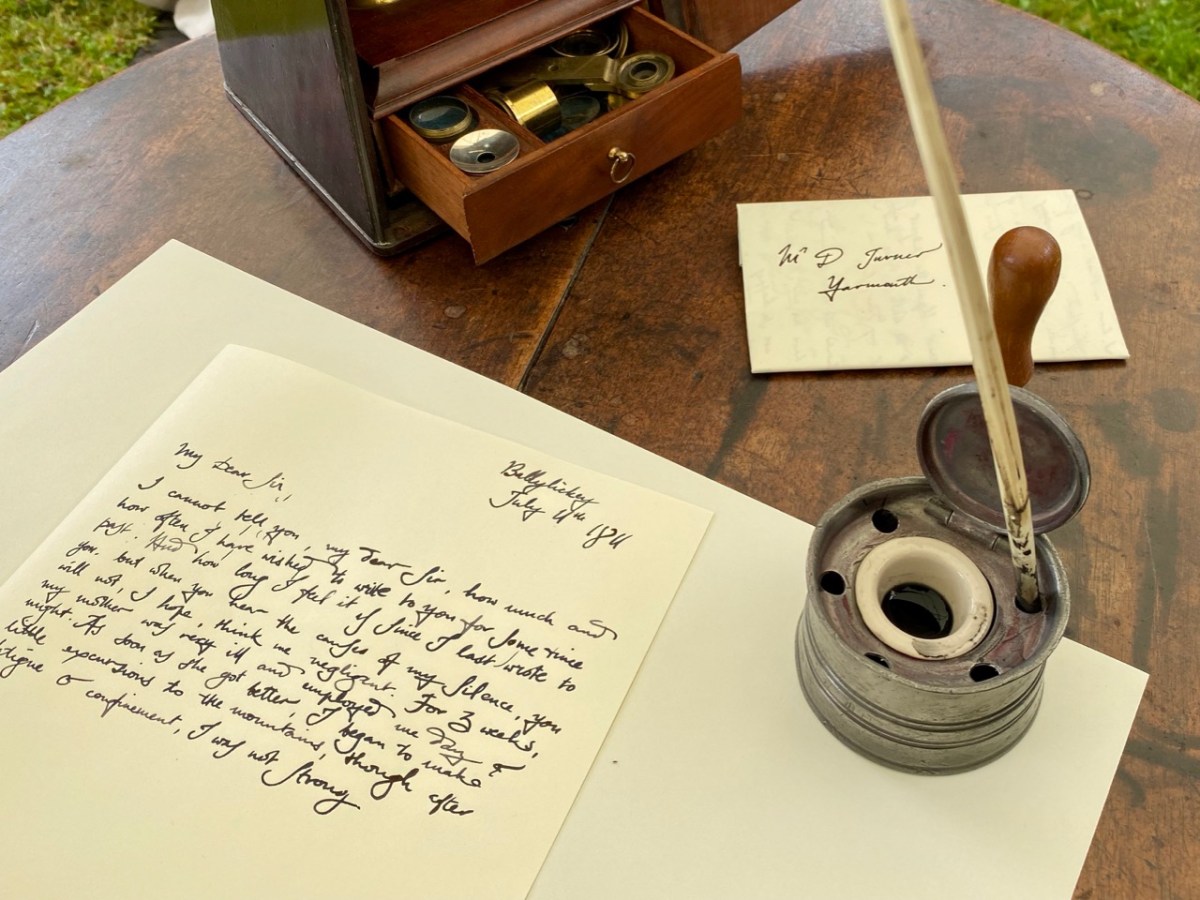
Above are the two other performers: on the right is Mark O’Mahony from Cappaghglass – he is a part-time actor, and here he reads the letters from Dawson. On his right is Carrie O’Flynn. She is a historic re-enactor and researcher: she appeared as Ellen, in authentic period dress, and provided really illuminating interpolations between letter-readings, informing us about the act of letter-writing itself in the early 1800s – the ink and quill pens; the postal service; Ellen’s probable appearance and dress (there are no surviving portraits of her) and the difficulties which Ellen would have had to face in pursuing here chosen interests, especially as she was herself quite frail and was for many years the carer of her own mother. Her achievements in the light of all this are truly remarkable, and Carrie succeeded in bringing this out with her contributions. Below she shows us the brass microscope that Ellen used – an essential item of equipment for her work.

As the reading of the letters progressed it became gradually obvious that a deep friendship was developing between the two botanists, and the language reflected this. Particularly telling (and this was drawn out in the selection of the letters) was the way the missives were framed as time went on. From a simple, almost curt formality in the earliest, we begin to read how their shared interests extended beyond the botanical; they exchange newly discovered poetry; Dawson tells Ellen that he has named his newly-born daughter after her; they imagine how they would like to meet each other and walk their favourite landscapes together. Each sends the other packages containing examples of the plants and seaweeds that preoccupy them, and their greetings at the top and tail of every page become increasingly warmer. We, the audience, open our imaginations as to how a happy fulfilment could ever metamorphose – West Cork and Norfolk are as far apart as any two place could be in early 19th century Britain. Poignantly, we learn that they never met: Ellen – always in poor health – died in 1815 at the age of twenty nine. We can only imagine that Dawson, remote in Norfolk, was desolate.

Important to our day – apart from the presenters and actors – were Madeline Hutchins (above – showing us some of Ellen’s drawings of seaweed), great great grand-niece and a co-founder of the Festival; and – behind the scenes but essential – the team, including Clare Heardman, co-founder of the Festival and a Conservation Ranger at the National Parks and Wildlife Service. Here’s Clare in action setting everything up – and running the Festival shop:

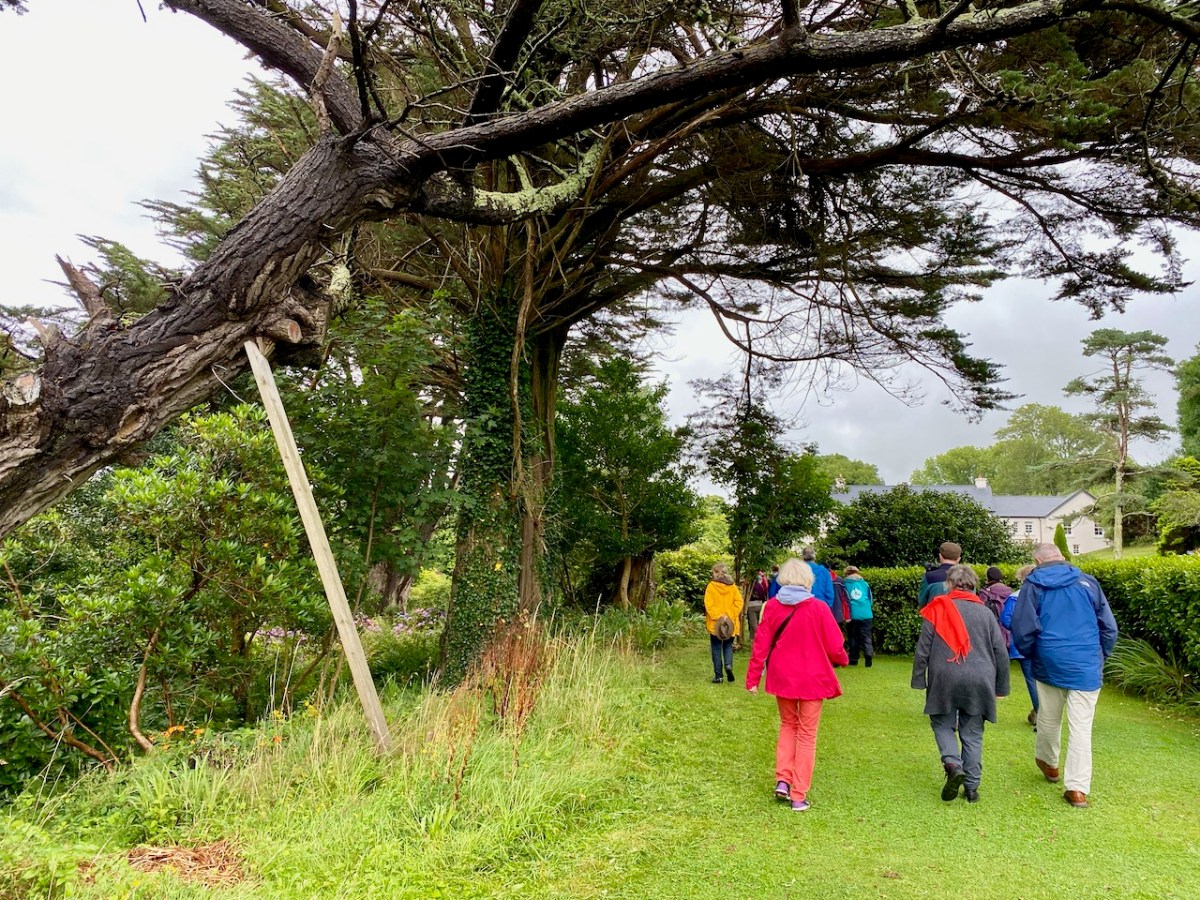
We had a further treat in store for us after the show: we were taken on a guided tour of some of the environments which Ellen would have known and explored during her life at Ballylickey. This felt really special, and brought us close, again, to the extraordinary young woman whose short but productive life we now celebrate here in West Cork.

Please note that Ballylickey House today is private property, and visitors should not seek access. There is plenty of the natural environment that Ellen would have been familiar with around Ballylickey and on the shores of Bantry Bay – well worth an exploration. And this link to the Ellen Hutchins Audio Trail is invaluable, especially to anyone who was not able to be at Friday’s event.

Particular thanks, of course, to all who participated – and attended – the event. It was a great success! Thank you to the weather Gods. And many thanks to Seaview House Hotel for providing the venue