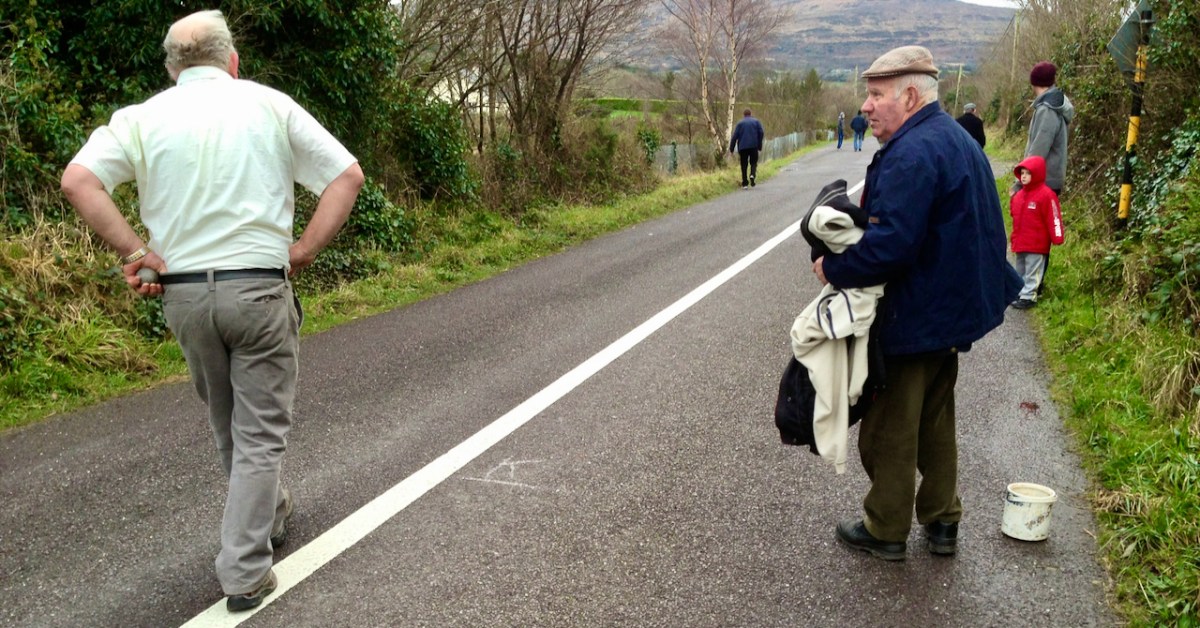
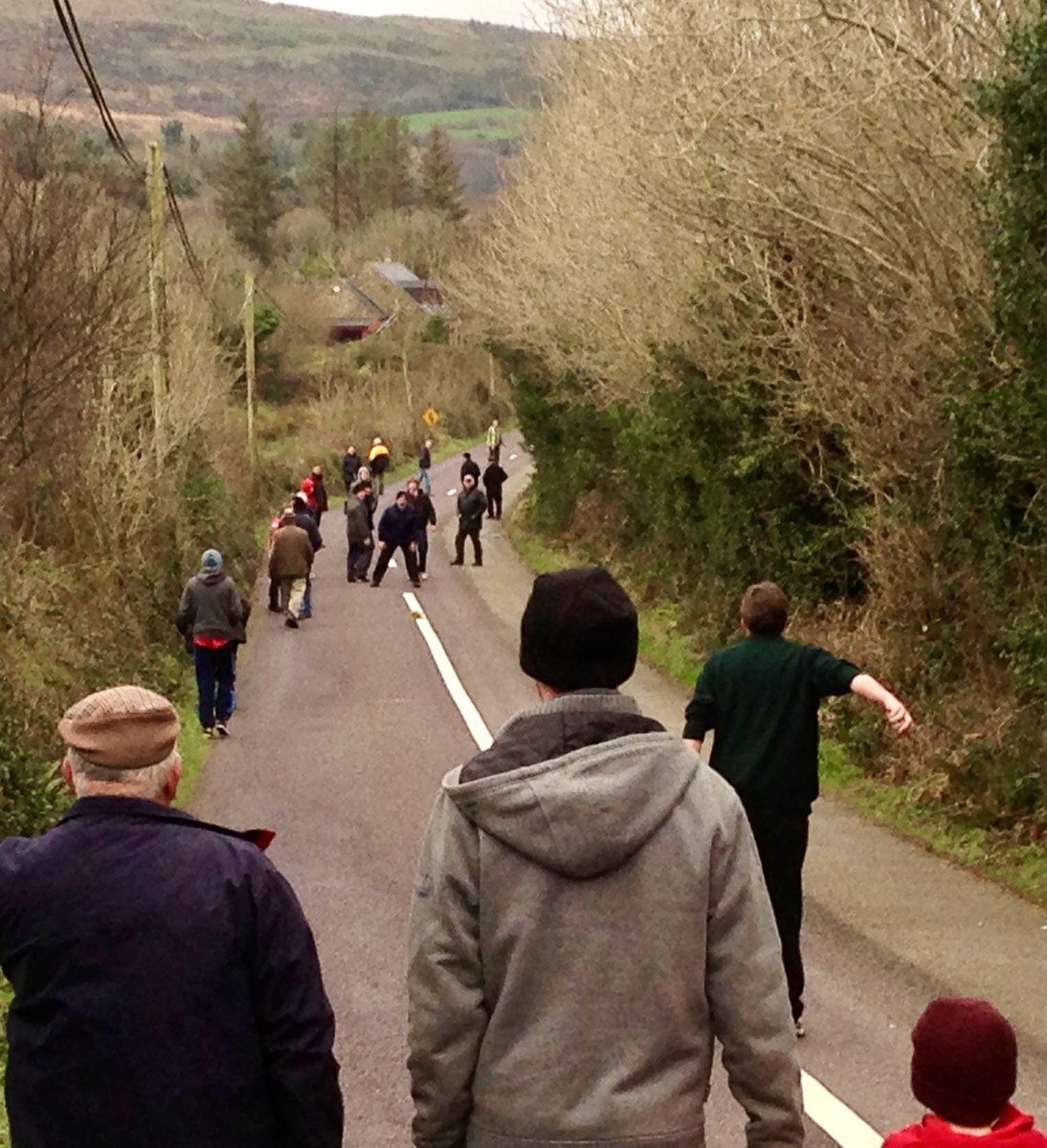
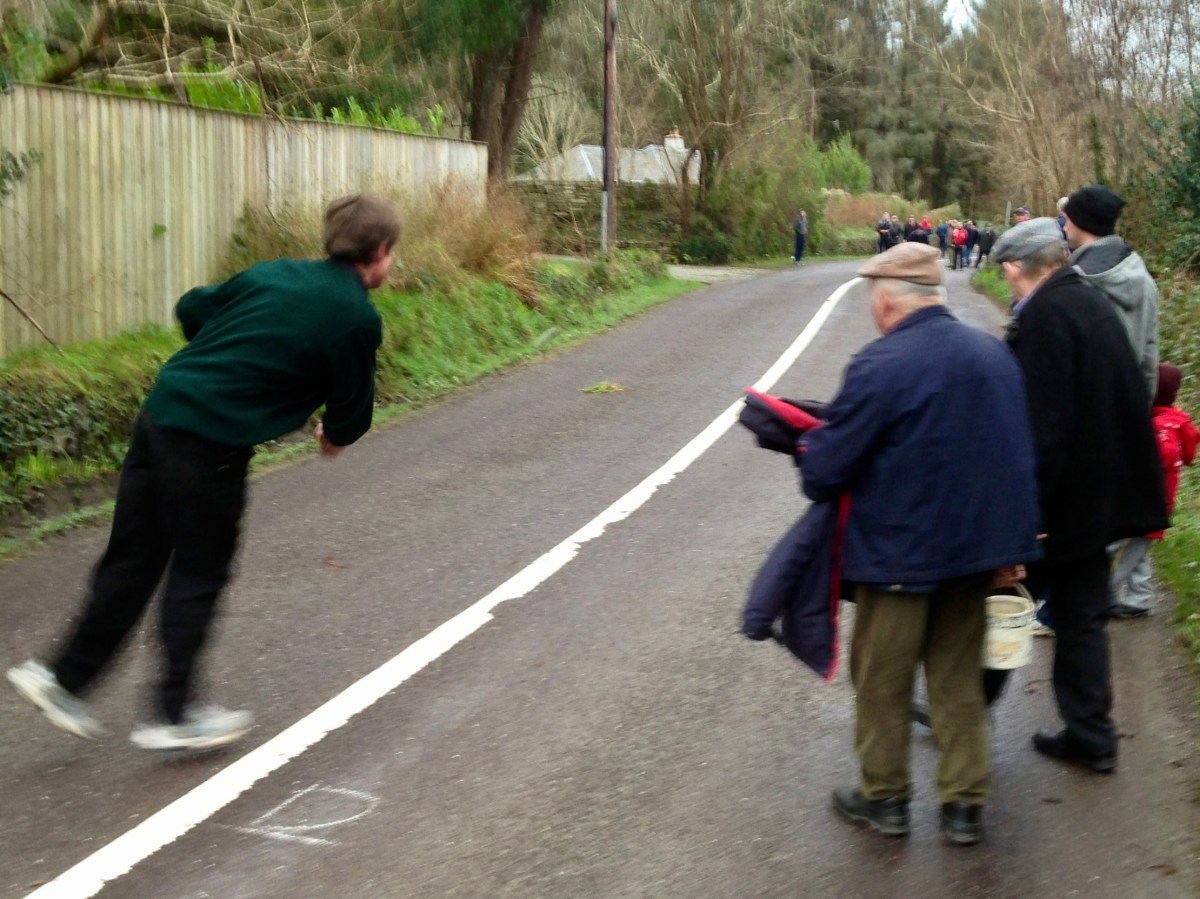
There’s a man about to ‘loft’ a bowling ball. Pronounce it Bowling, to rhyme with ‘growling’: in the Irish language it’s Ból an bhóthair – I’ve also seen the term Long Bullets used. This is a match we watched close to home – here in West Cork – all of ten years ago. It’s amazing we haven’t visited the subject again until now. In fact, it’s quite a secretive sport: if you put yourself ‘in the know’ you will be aware when it’s happening. Otherwise it’s something which you may pass by chance on any of the myriad by-roads of our county – and others.
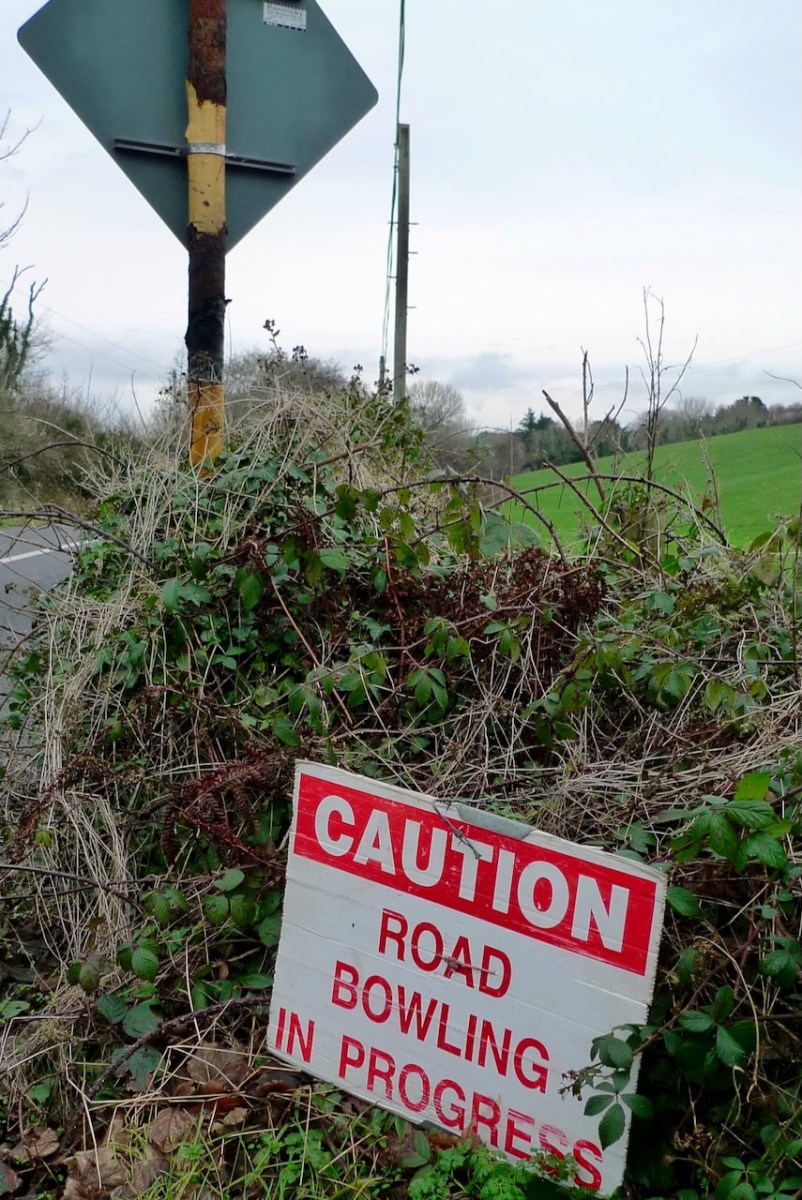
The sport is played mainly in the Counties of Cork and Armagh, although it may be encountered elsewhere in Ireland – in England, The Netherlands, Germany and – nowadays – in many of the United States. But you won’t find it on any Olympic Games timetable, and I’m not sure that it is ever televised: that would be a strange programme, as it’s challenging to follow and involves walks of many kilometres through tangled lanes and byways. Also, I don’t know whether any traffic laws are bent or broken in its pursuit.
Certainly, it has produced its champions.
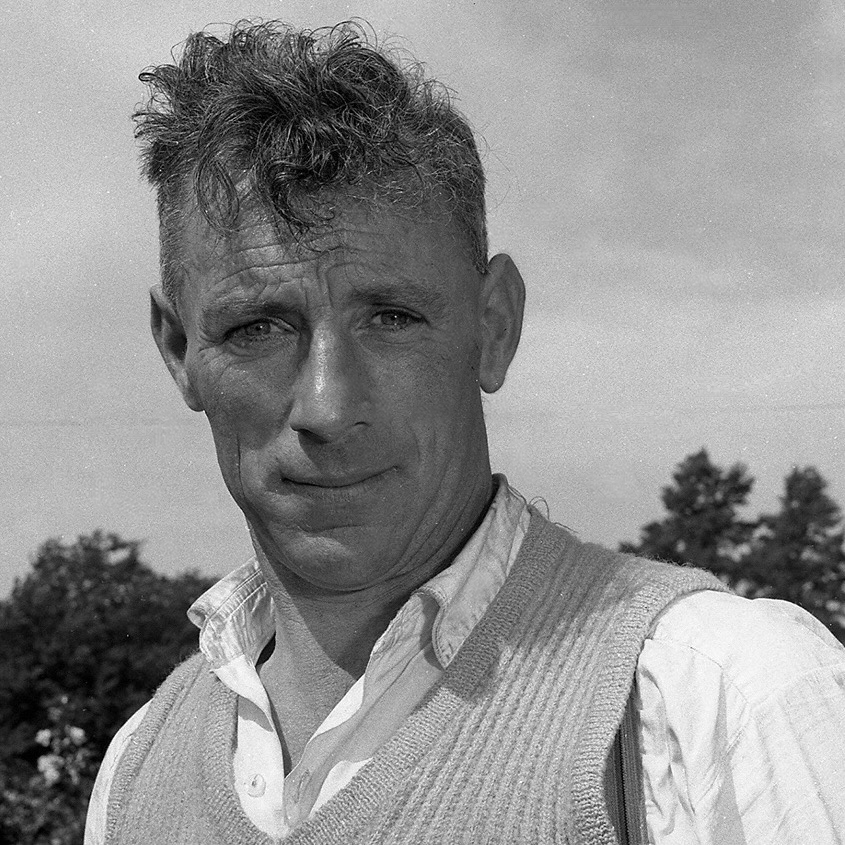
Here’s one: Mick Barry. The photo is likely to date from around 1955. Mick was All-Ireland Champion on eight occasions between 1965 and 1975. He lived a long life – 1919 to 2014. But he is best-known for having established a record – on St Patrick’s Day 1955 – for lofting a bowl on to the 100 ft high parapet of the Chetwynd Railway Viaduct just outside Cork.
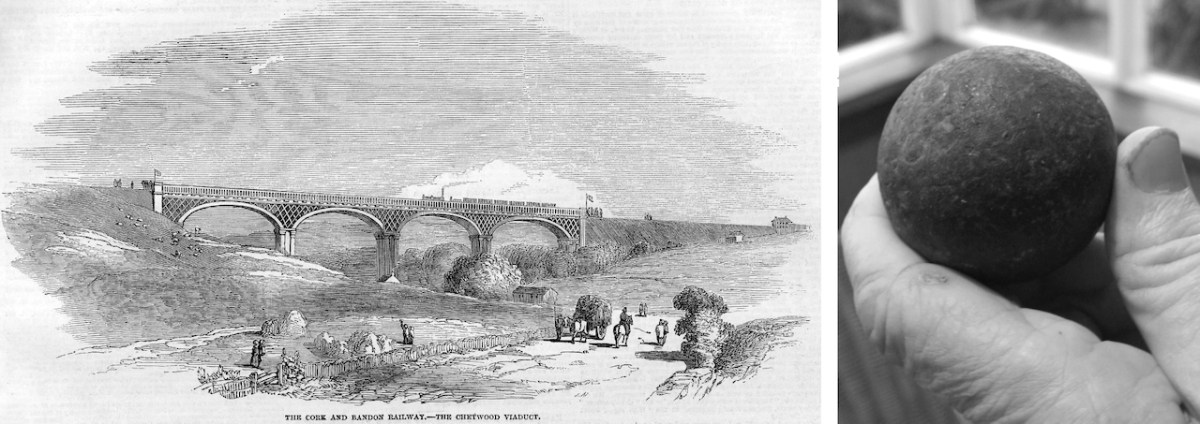
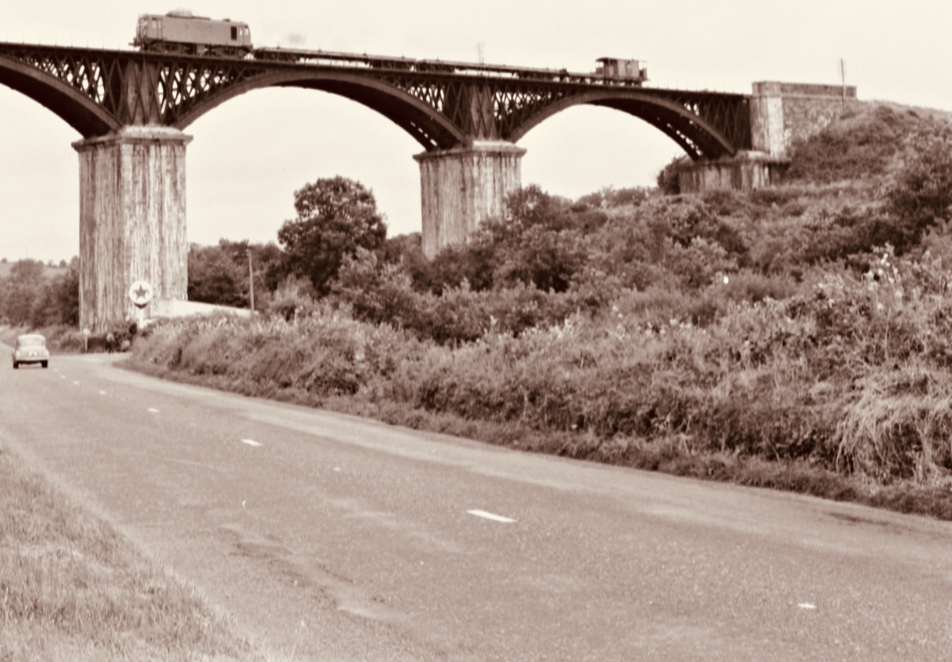
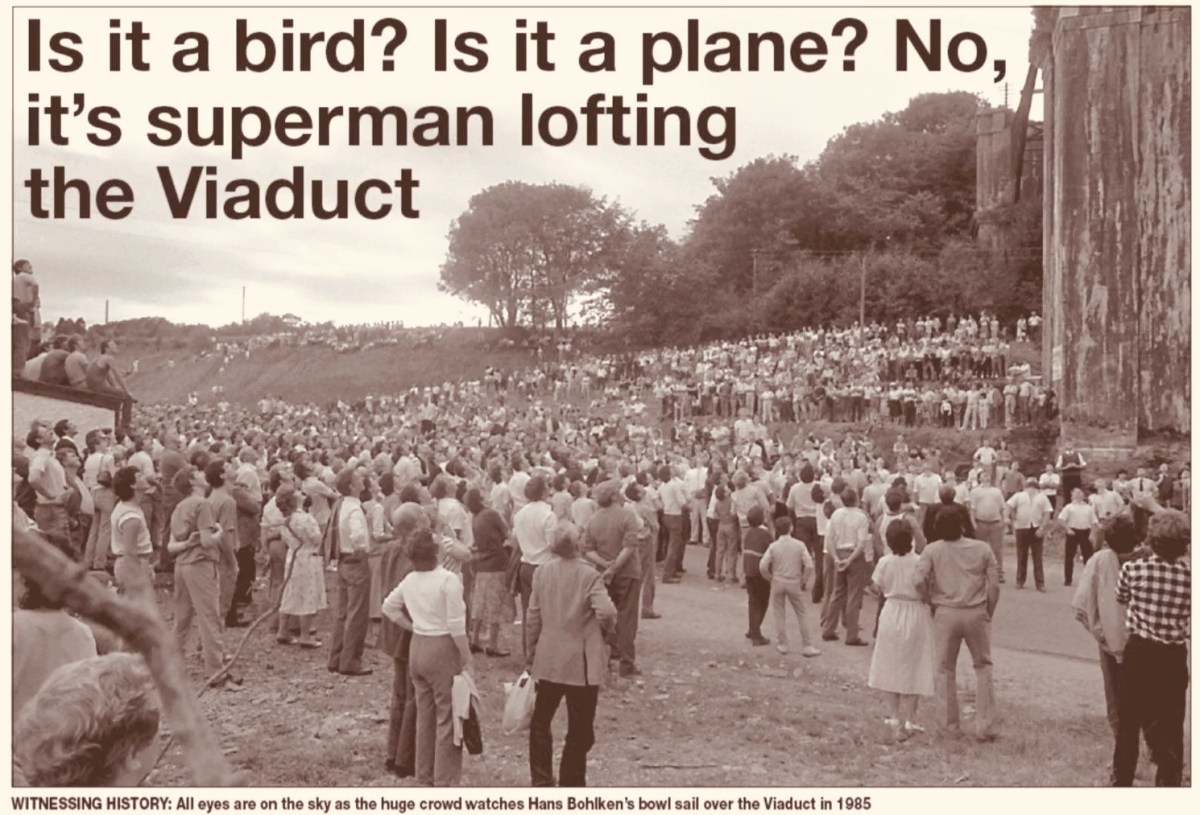
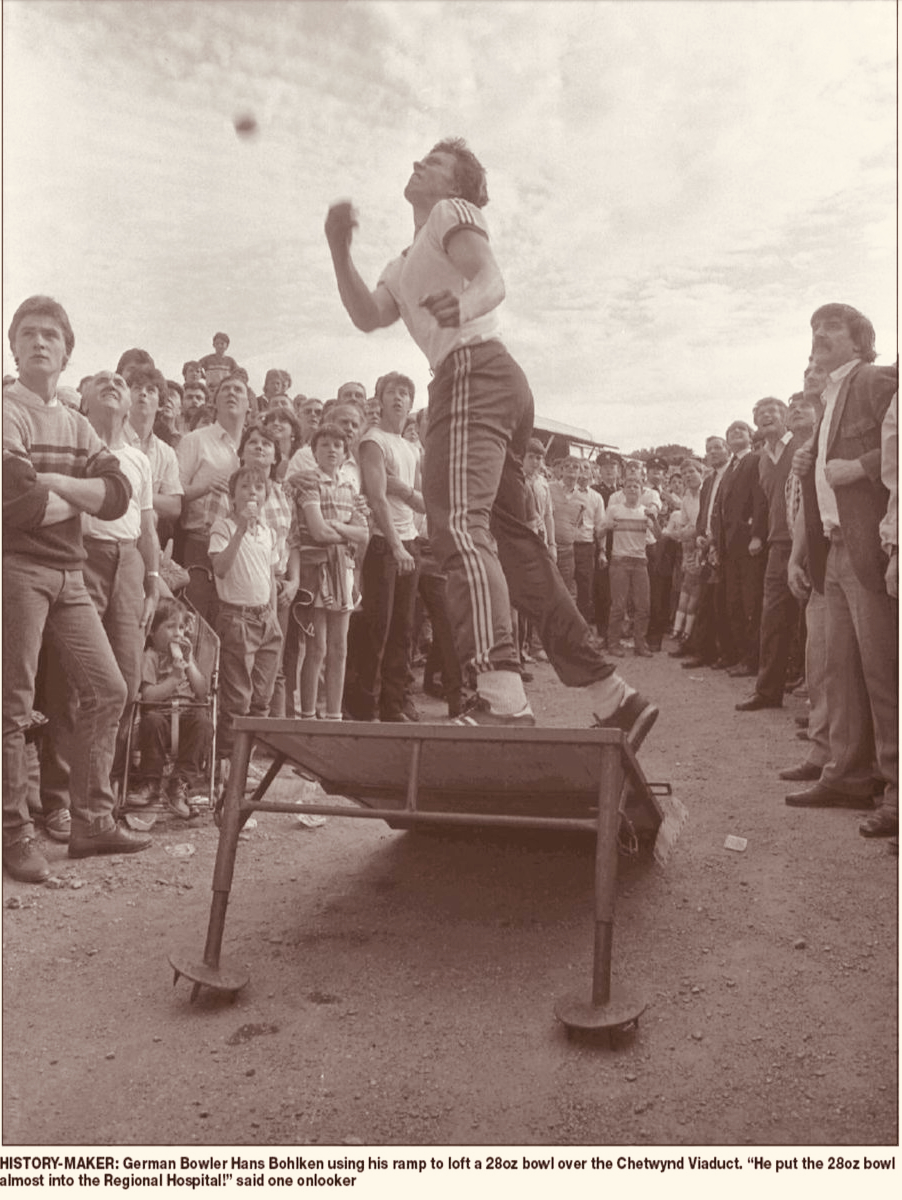
Above – the Chetwynd Viaduct in the 1960s, – after the line was closed, carrying a maintenance train, and – above that – a somewhat fanciful print of the same structure dating from a century before, together with the lead ball used by Barry. The same venue was the scene of another bowling spectacle thirty years later. In 1985 10,000 people showed up to watch a young German named Hans Bohlken loft a 28oz Road Bowl over the viaduct, using a portable ramp to improve his throw (images courtesy Cork Echo):
. . . In Irish road bowling the small iron and steel cannonball called a bowl is hurled down a 1 to 2-mile country lane. Throws can roll 250 or even 300 yards. Similar to golf, the player with the fewest throws to the finish line wins. Excitement builds as two evenly skilled players match each other shot for shot for more than a mile. Often, these memorable matches, called scores, are decided by only a few feet or inches’ distance past the finish line, both players with the same number of throws. The twists and turns of a narrow country lane, as well as the tilt of the road surface (the pitch and camber), provide a rich playing field for strategy and can spark spirited debate among the thrower, his coach and full-throated spectators . . .
WVROADBOWLING.COM
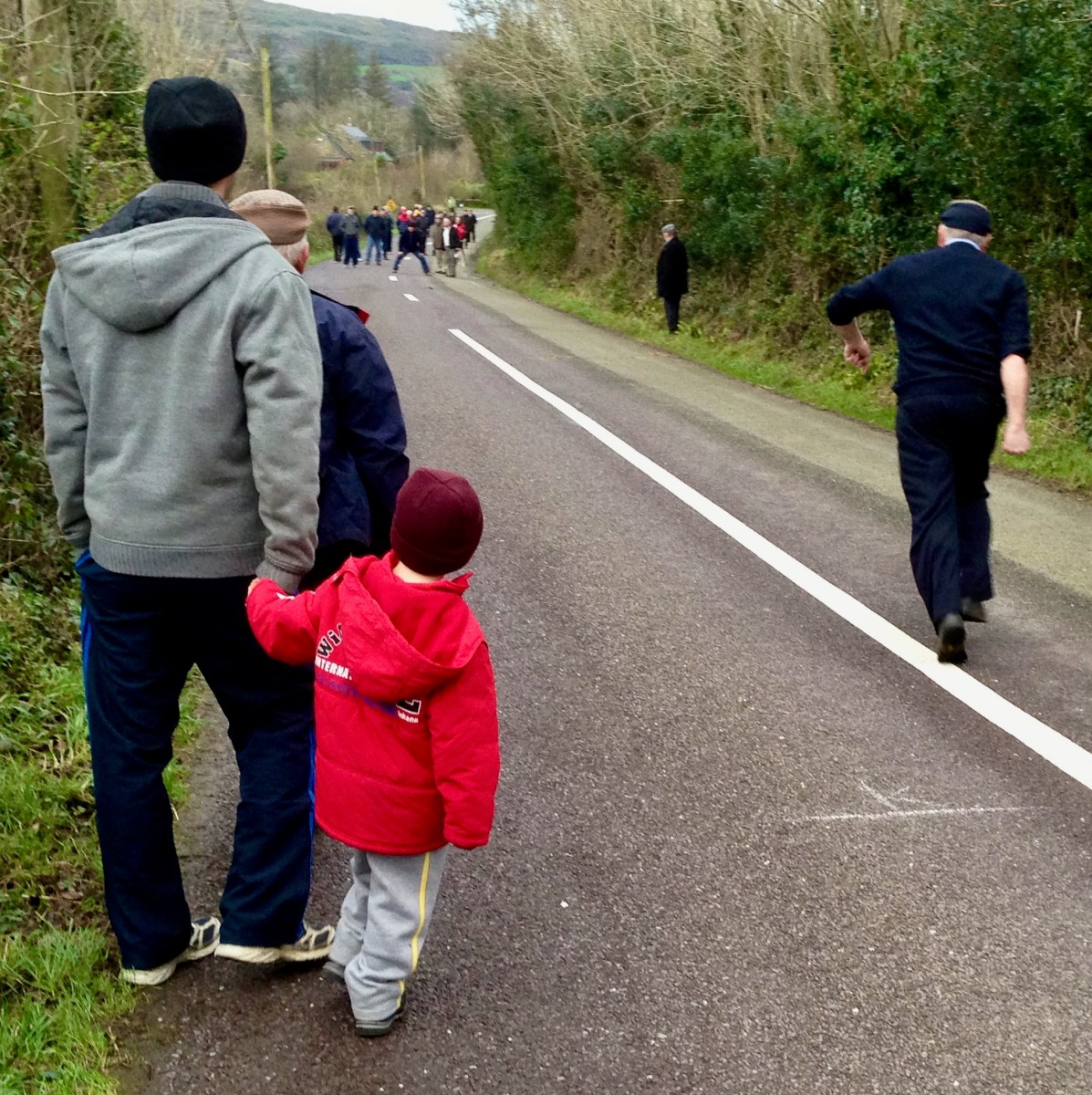
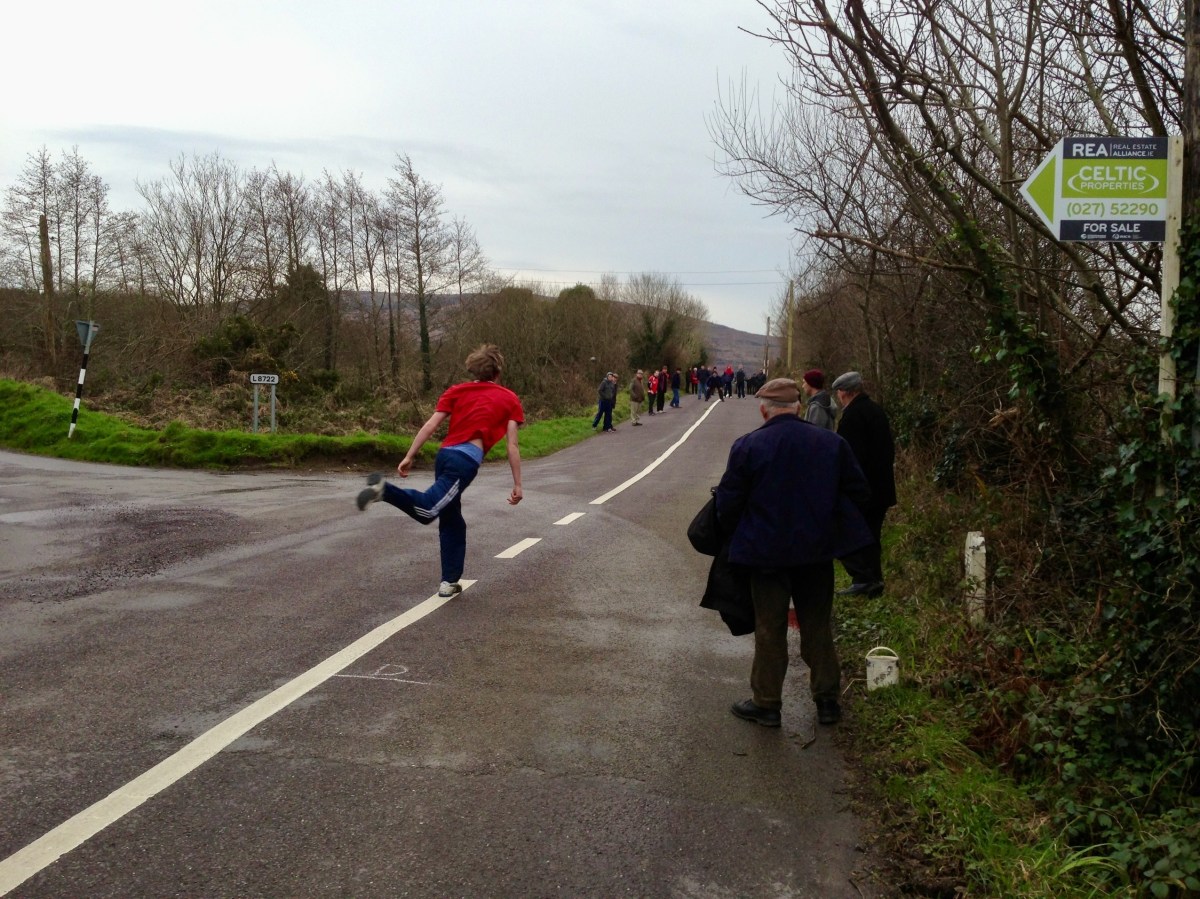
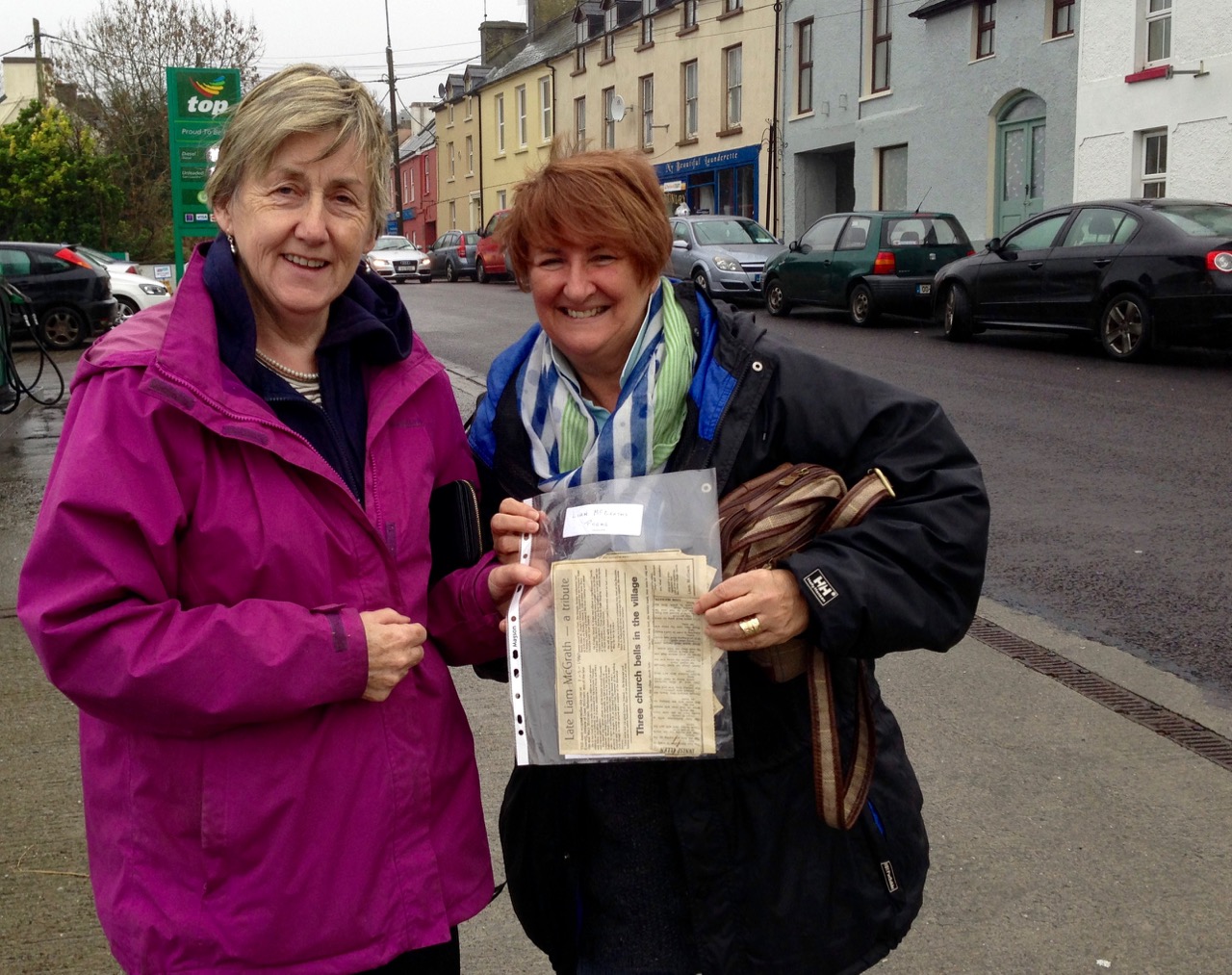
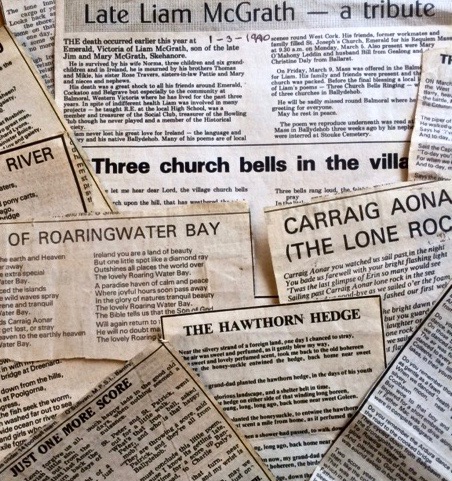
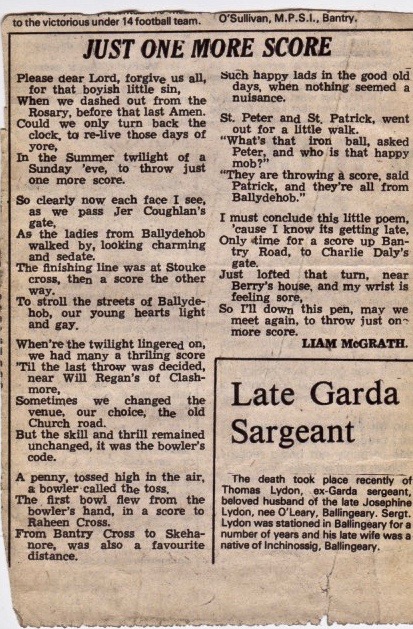
Finola drew my attention to a poem written by folk-poet Liam McGrath, who grew up in Skeaghanore, not far from us here in Nead an Iolair – and therefore as local a ‘folk’ as you could ever find. His work has been collected, but never widely published. Here is his commentary on the ancient pastime of Road Bowling:
Please dear Lord, forgive us all, for that boyish little sin,
When we dashed out from the Rosary, before that last Amen.
Could we only turn back the clock, to re-live those days of Yore,
In the Summer twilight of a Sunday ‘eve, to throw just one more score.*
So clearly now each face I see, as we pass Jer Coughlan’s gate,
As the ladies from Ballydehob walked by, looking charming and sedate.
The finishing line was at Stouke cross, then a score the other way.
To stroll the streets of Ballydehob, our young hearts bright and gay.*
When’re the twilight lingered on, we had many a thrilling score
’Til the last throw was decided, near Will Regan’s of Clashmore,
Sometimes we changed the venue, our choice, the old Church road.
But the skill and thrill remained unchanged, it was the bowler’s code.*
A penny, tossed high in the air, a bowler called the toss.
The first bowl flew from the bowler’s hand, in a score to Raheen Cross.
From Bantry Cross to Skehanore, was also a favourite distance.
Such happy lads in the good old days, when nothing seemed a nuisance.*
St Peter and St Patrick, went out for a little walk.
“What’s that iron ball, asked Peter, and who is that happy mob?”
“They are throwing a score, said Patrick, and they’re all from Ballydehob.”*
I must conclude this little poem, ‘cause I know it’s getting late,
LIAM MCGRATH – Died in Australia – 1990
Only time for a score up Bantry Road, to Charlie Daly’s gate.
Just lofted that turn, near Berry’s house, and my wrist is feeling sore,
So I’ll down this pen, may we meet again, to throw just one more score . . .
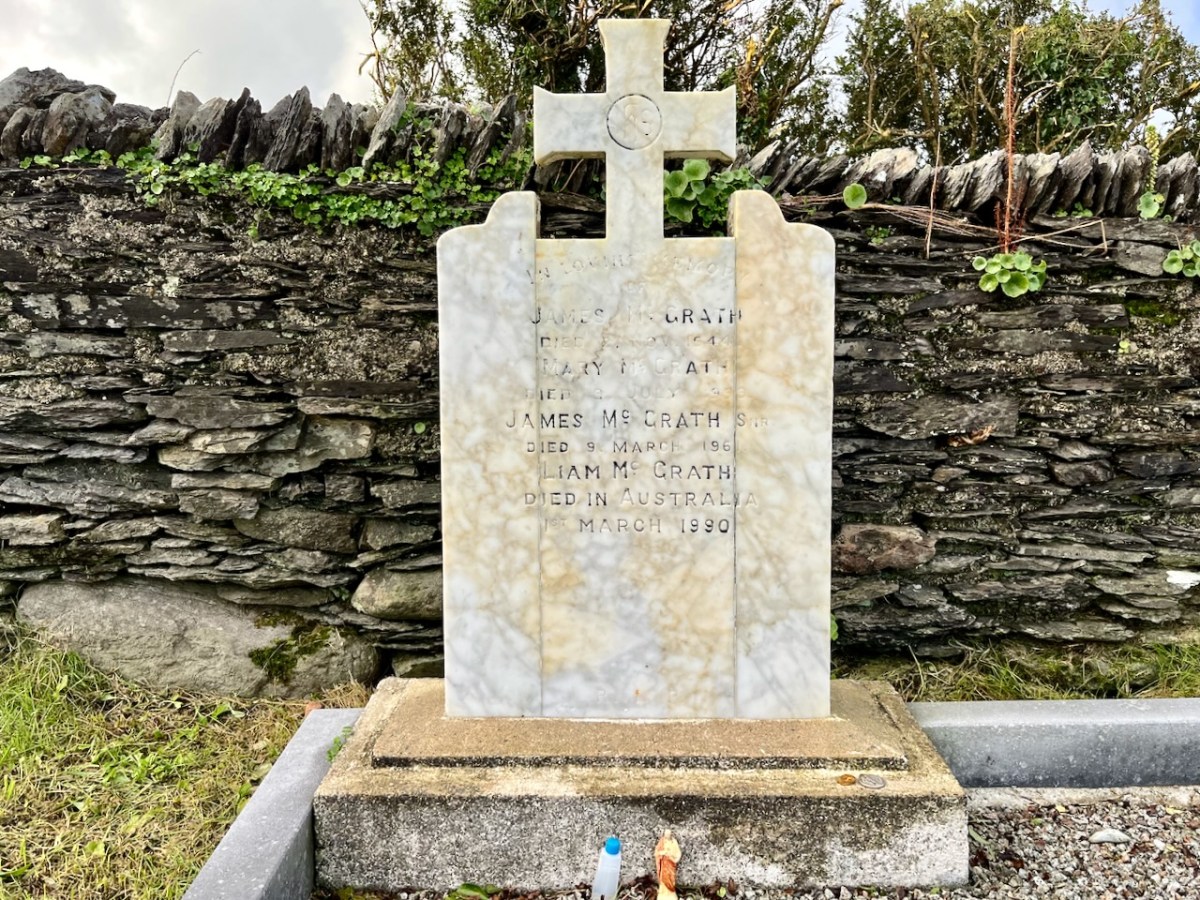
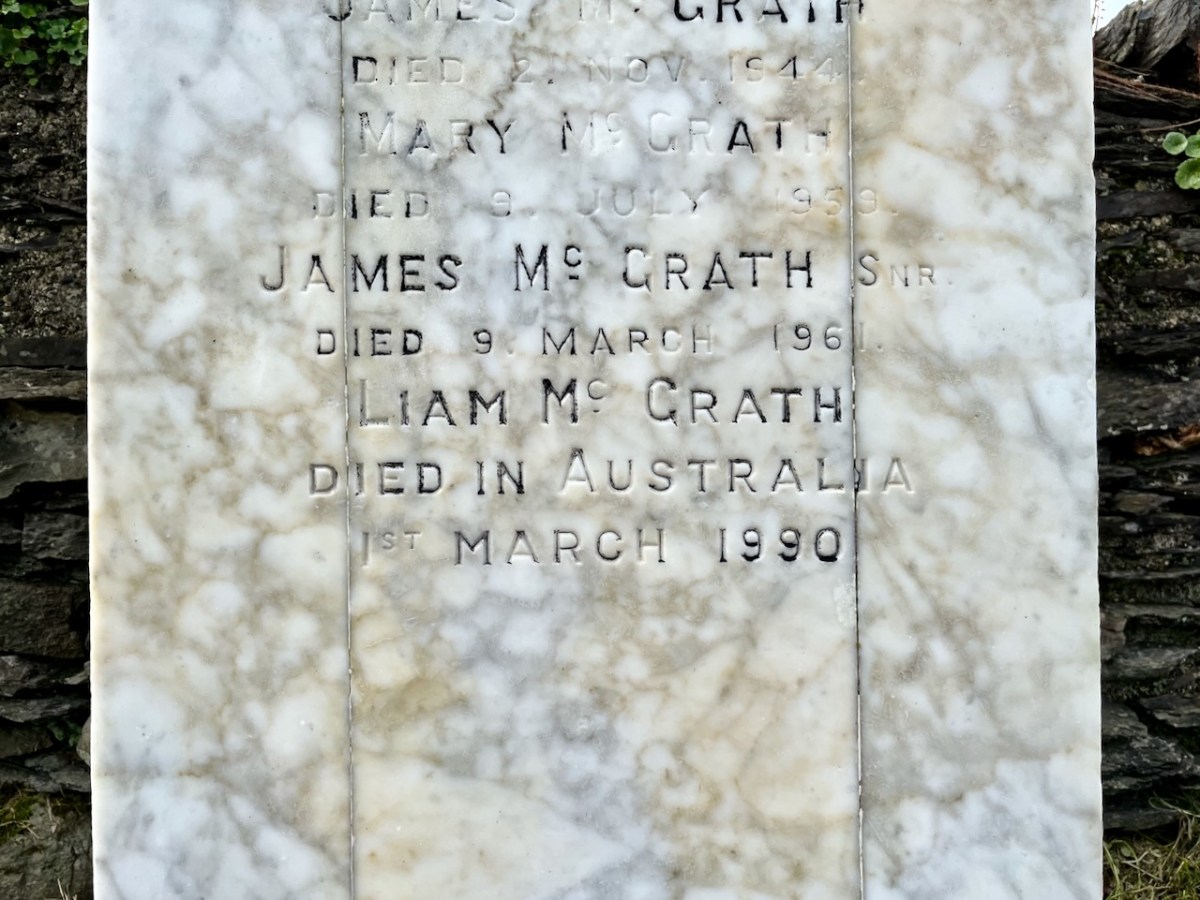
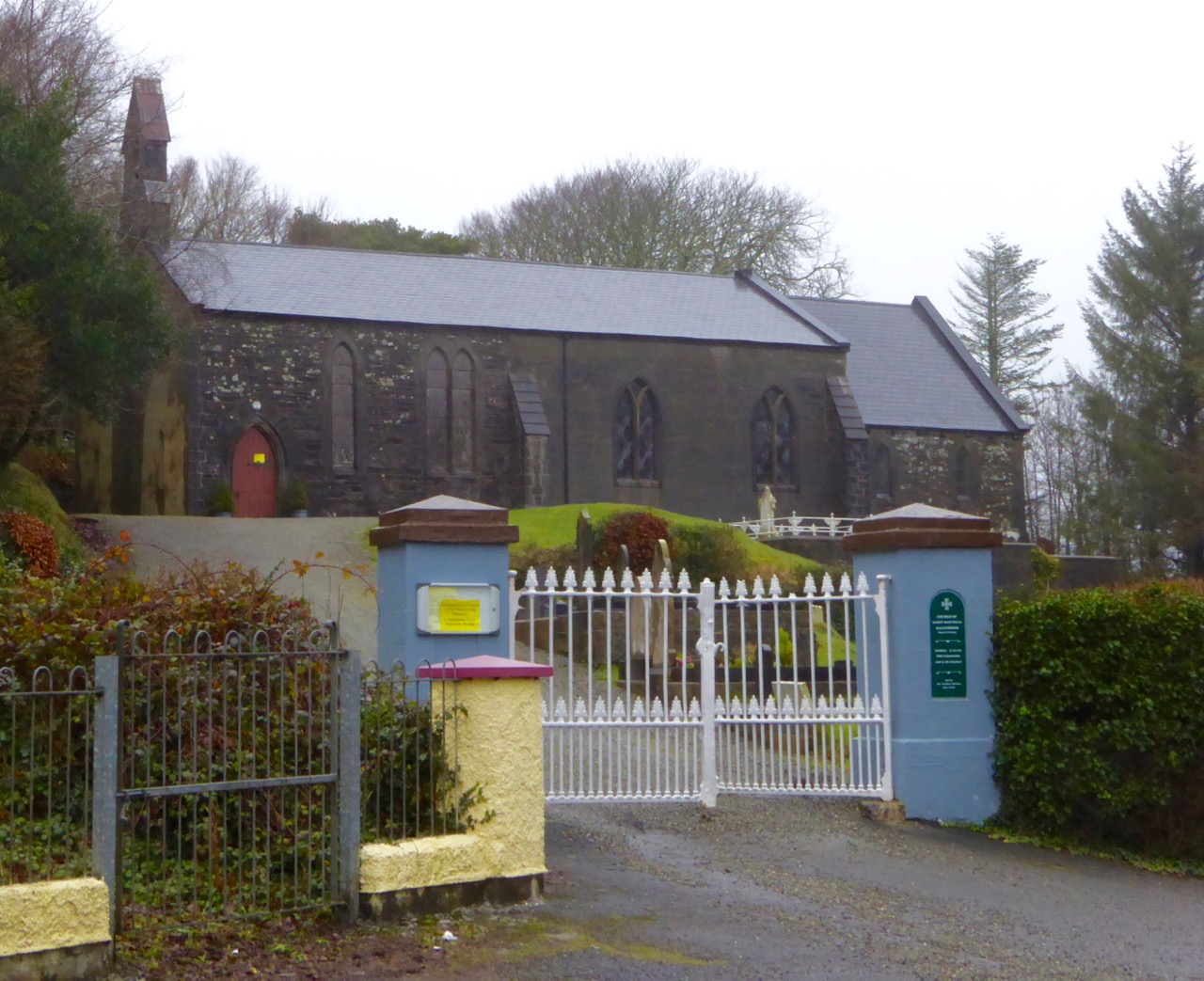
(Above) The McGrath grave in Stouke graveyard, in the next townland above our home. Liam died in Australia and his ashes are interred here.








 Roaringwater Journal