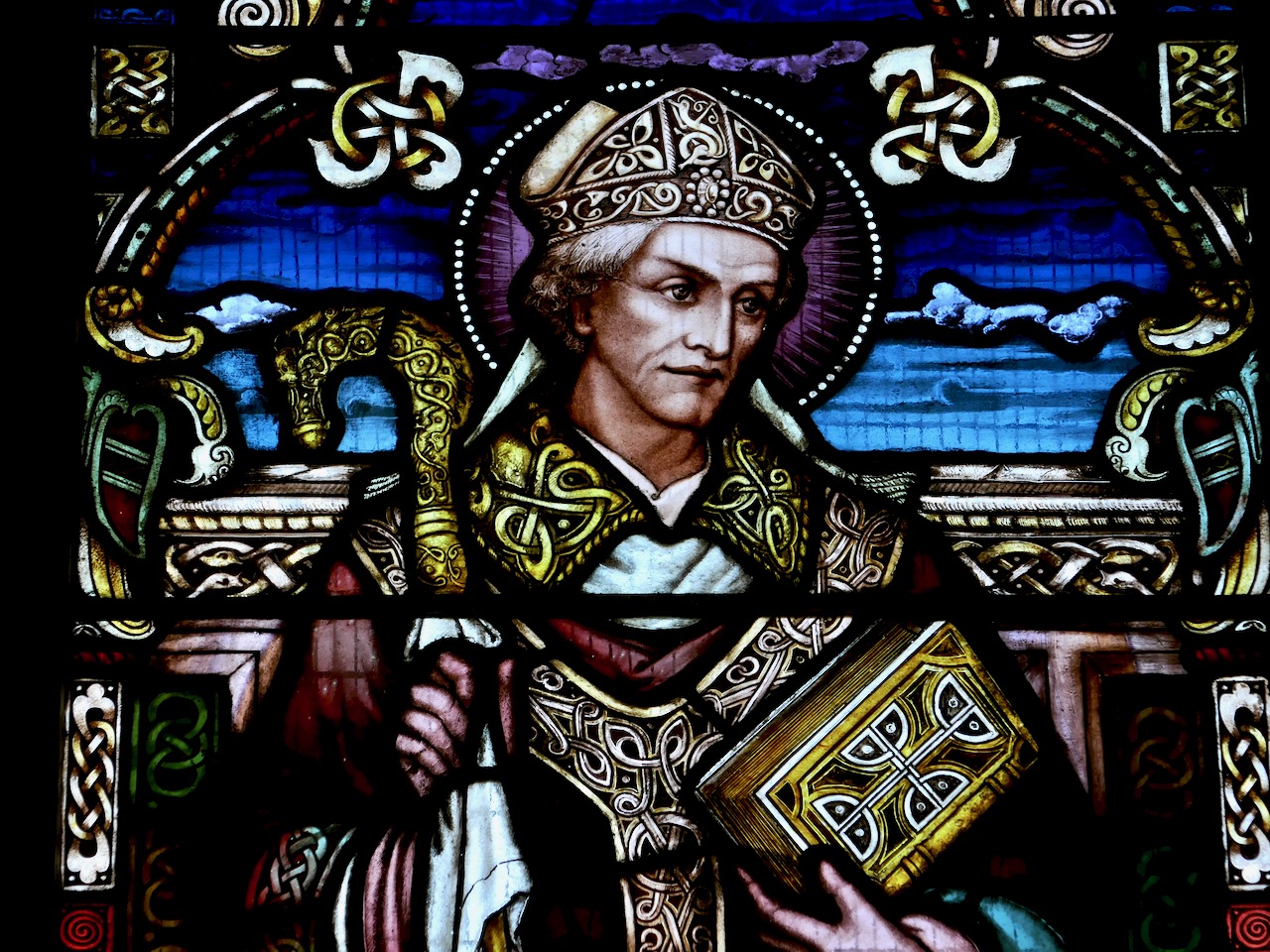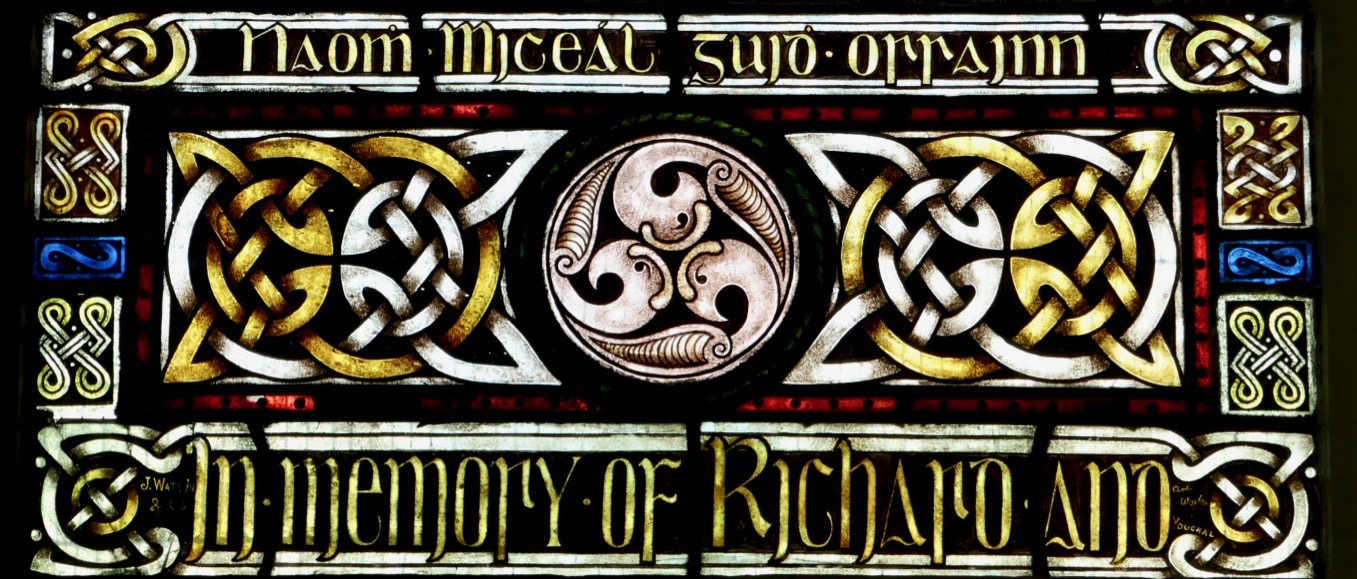
Watson’s Brian Boru: One Window, 7 Stories

Story 1: Jasmine

The first story concerns Jasmine Allen – she is the charming and erudite Curator of the Stained Glass Museum in Ely, in the UK. At a recent Stained Glass Symposium in Trinity, she showed us how stained glass studios were advertising their artistry and products at exhibitions in the late nineteenth and early twentieth centuries in Britain and Ireland, starting with the Great Exhibition in 1851, but happening at regular intervals after that. The Irish International Exhibition was held in Dublin in 1907. It was inspired by the success of the Cork International Exhibition of 1902 (see Robert’s post about that here) and even copied their thrilling water slide!  For a marvellous collection of images from that exhibition, see this Flikr Album from the Church of Ireland. The story of their discovery is also fascinating.

Irish international exhibition from Herbert Park, by National Library of Ireland on The Commons

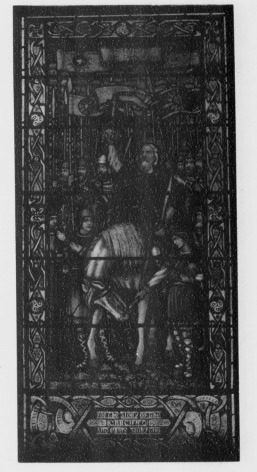
One of the exhibitors was James Watson and Co of Youghal. Jasmine subsequently sent me this image, saying: Catalogues of these exhibitions are all too brief and I would love to know what happened to it. Is it in a church or secular building in Clontarf? I only have a very bad image from the Art Journal (early b+w photography was worse than engraving for capturing stained glass!)
Story 2: Michael

I sent the photo to the group of colleagues, mostly contributors to the Gazetteer of Irish Stained Glass with whom I correspond on a regular basis and who are always helpful, asking if any of them knew the fate of the window. I got several “no idea” responses and then I heard from Michael Earley. Anyone interested in Irish stained glass will be familiar with the name of Earley, and Michael Earley, a great-grandson of the founders, has just completed doctoral studies on the Studios. I’ve featured Earley windows here and there in my blog posts, but here’s an example of their work – you will find it everywhere throughout Ireland, often distinguished by glass of unique and brilliant colour, enormous packed scenes of multiple angels and saints surrounding a central images, and beautifully rendered figures. Here’s one from St Aidan’s Cathedral in Enniscorthy.
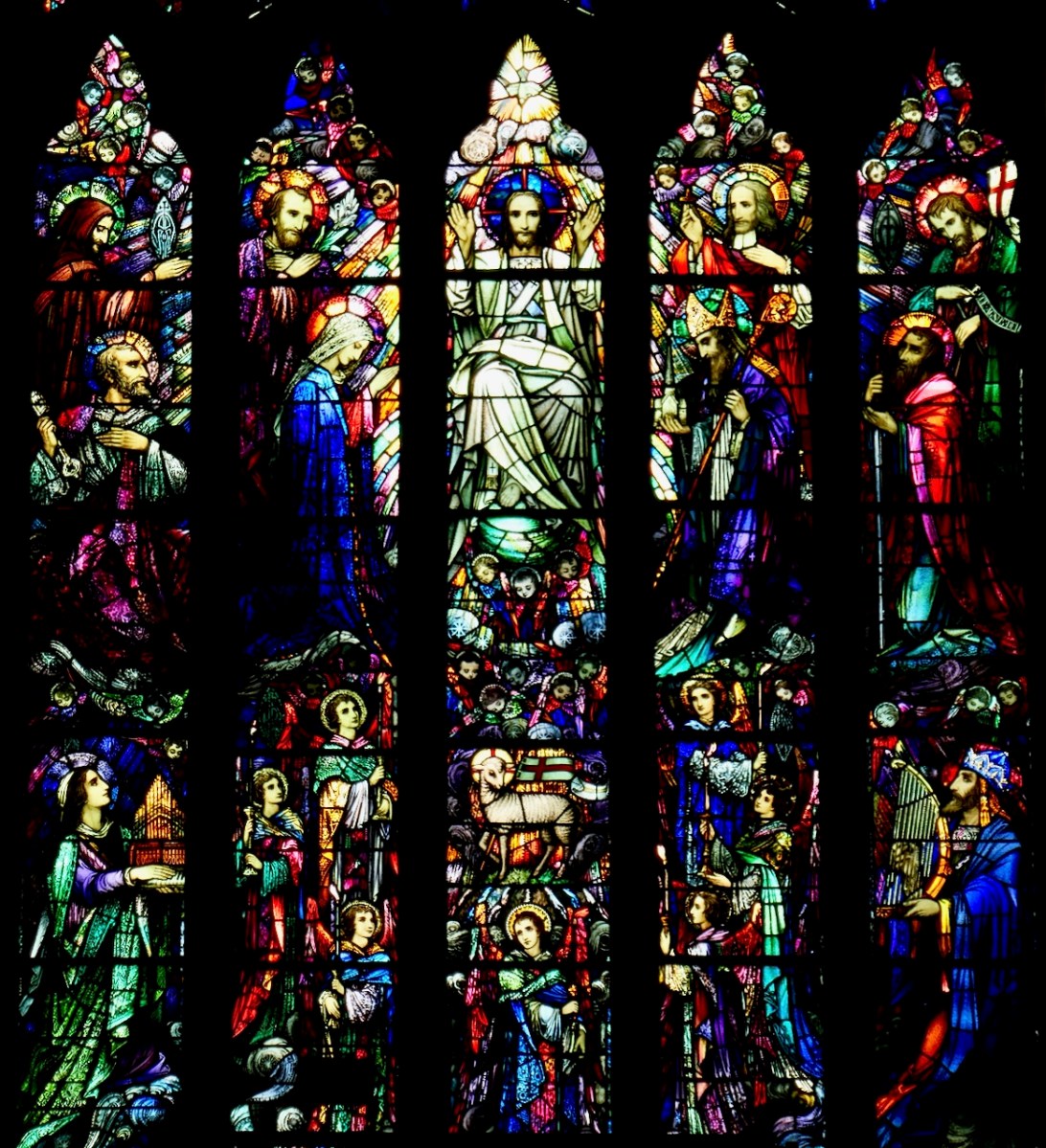
Michael didn’t know what had happened to the window, but he did send me two pages from the Irish Catholic Directory of 1908. The first page was an advertisement for James Watson and Co, The Art Work, Youghal, Co. Cork. Here it is:
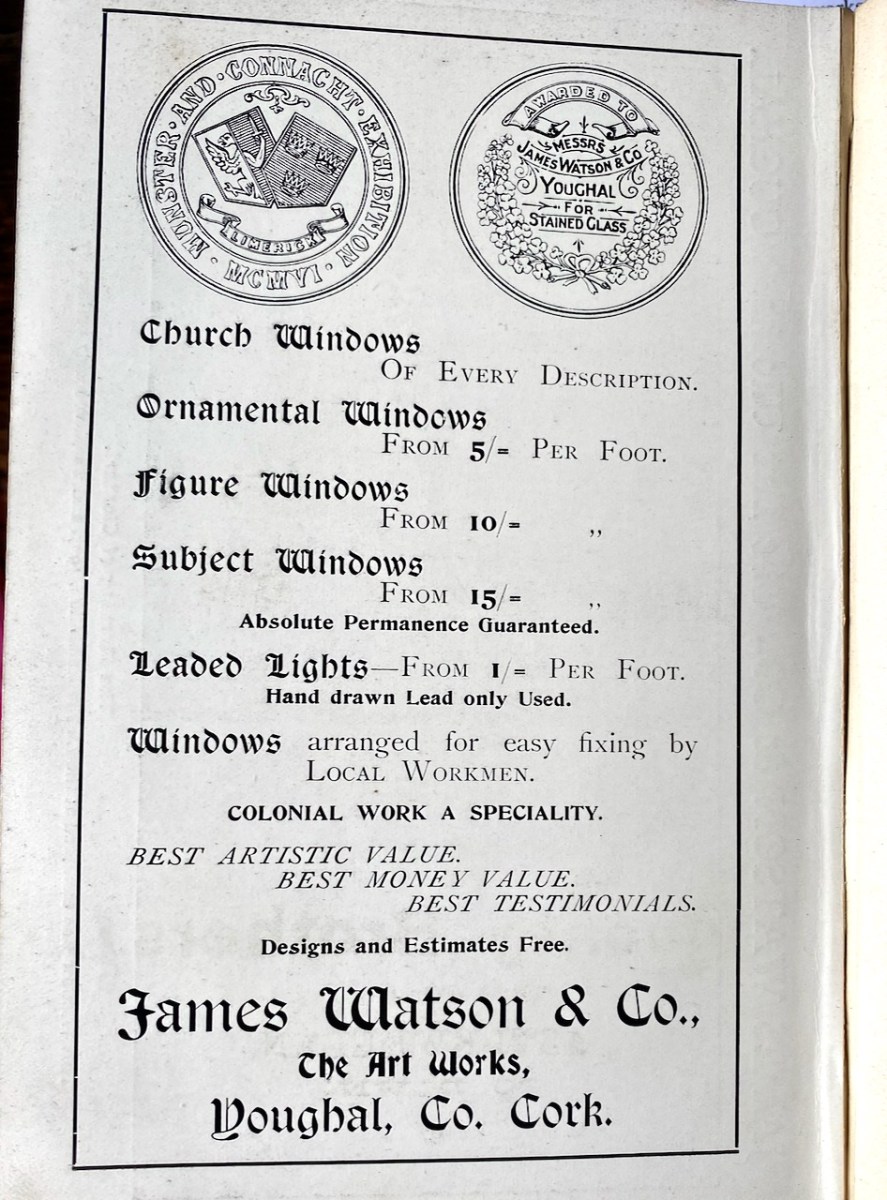
Much to savour in this ad – the prices, the variety of windows, “colonial work”. . .  The second page, though, hit the jackpot. It was from the same Directory, and was a full scale black-and-white photograph of the window. Titled The Morning of Clontarf, a subtitle reads “This window was exhibited at the Dublin Exhibition, 1907, and was favourably noticed by The Art Journal”. 
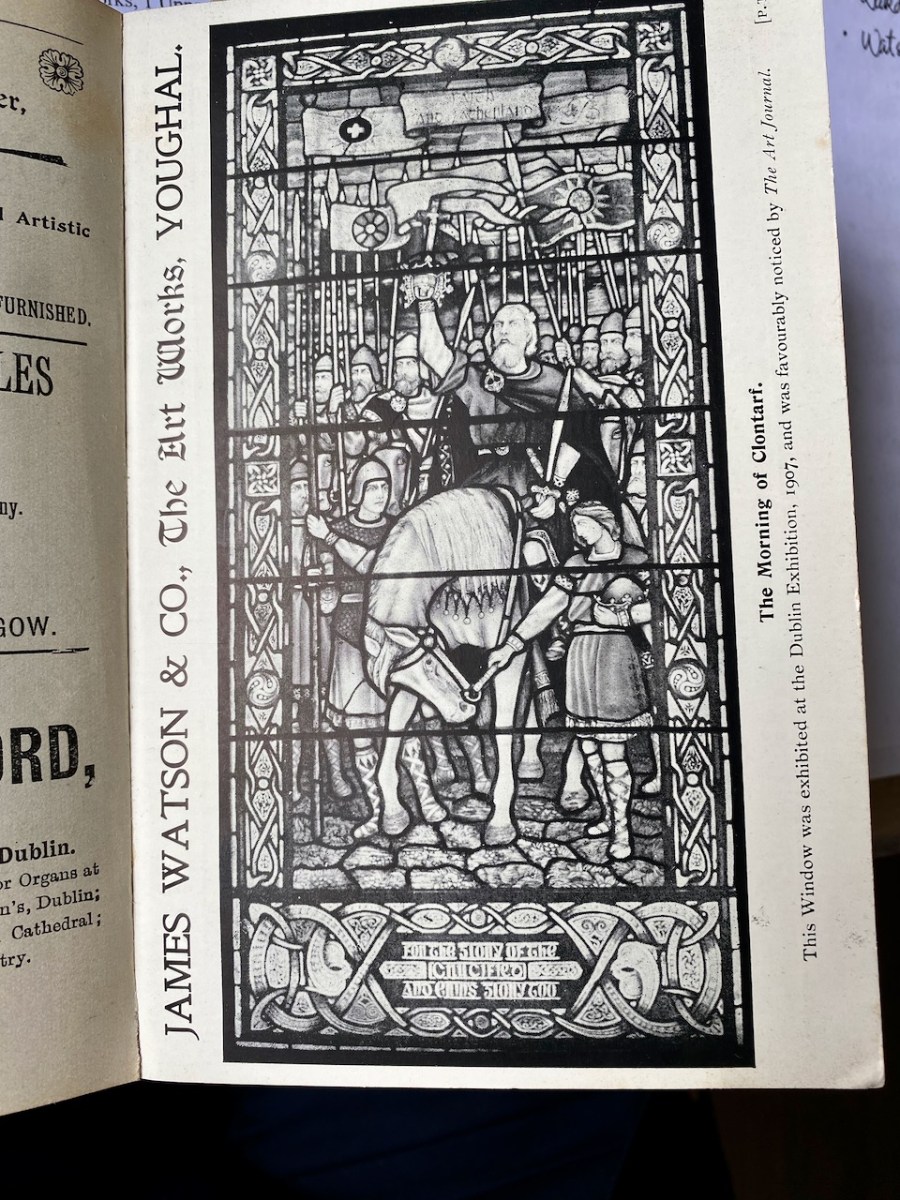
Now I had an excellent image with which to pursue my inquiries – and I knew exactly who to consult!

Story 3: Vera

The art historian who knows more than anyone else about Watson of Youghal is Vera Ryan. In fact, it was Vera who curated the Crawford Gallery 2015 exhibition of the Watson Archive, when the Crawford acquired the Archive. She also wrote the piece on Watsons:  Divine Light: A Century of Stained Glass, in the Summer 2015 edition of the Irish Arts Review. A couple of years ago, when I was trying to find information on a Watson window which was the centrepiece of an article I was writing for the Clonakilty Historical and Archaeological Journal (now published and available here), Vera mentored me as I tried to dig my way through the archive. We have been exchanging information ever since. 
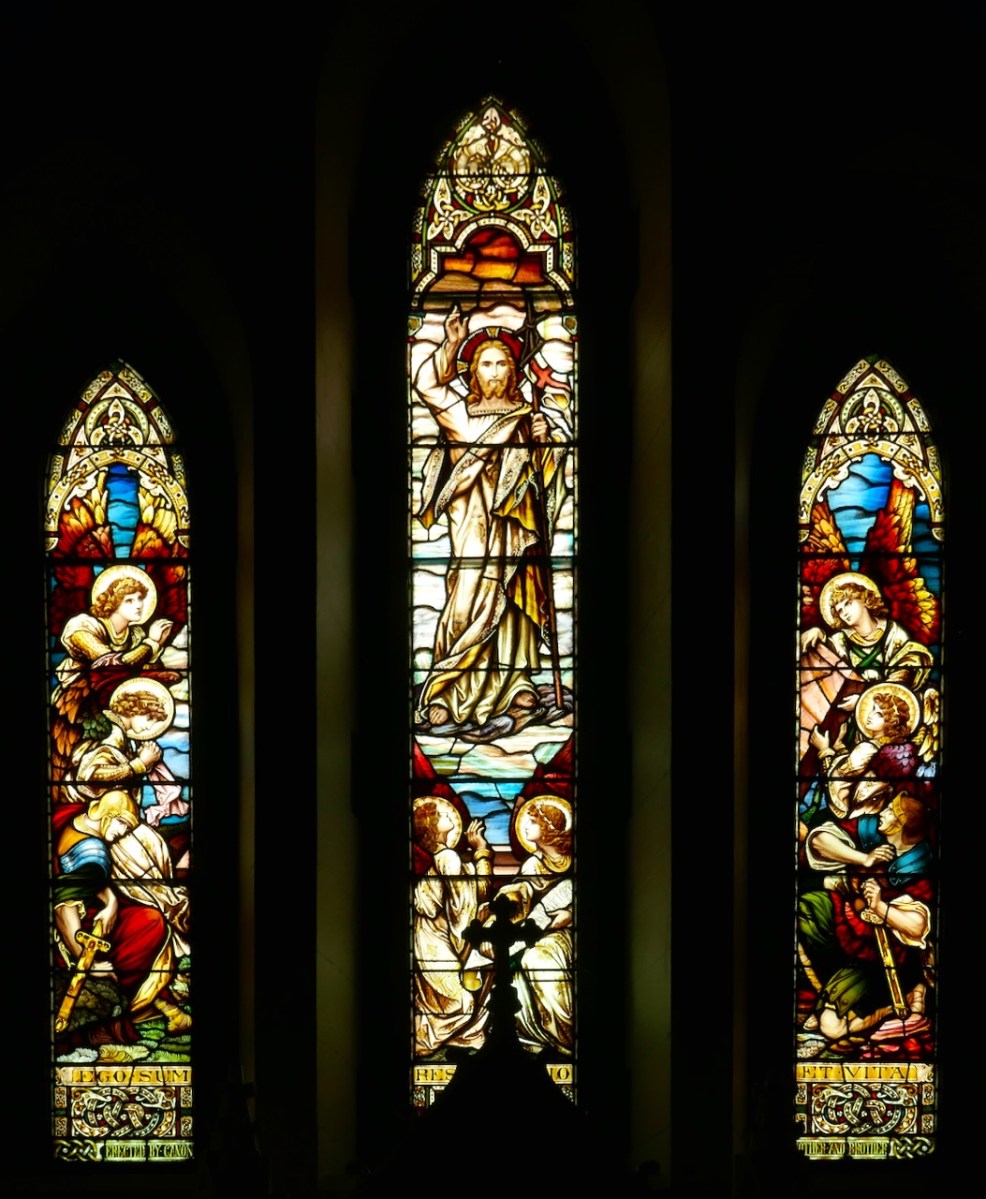
Above is a window in St Michael’s Church, Tipperary, erected in 1914. The design (below) and cartoon (below below) for this window were still in the Watson Archive and were displayed in the Crawford Exhibition. This represents a special opportunity to see the evolution of a stained glass window from concept to completion. 
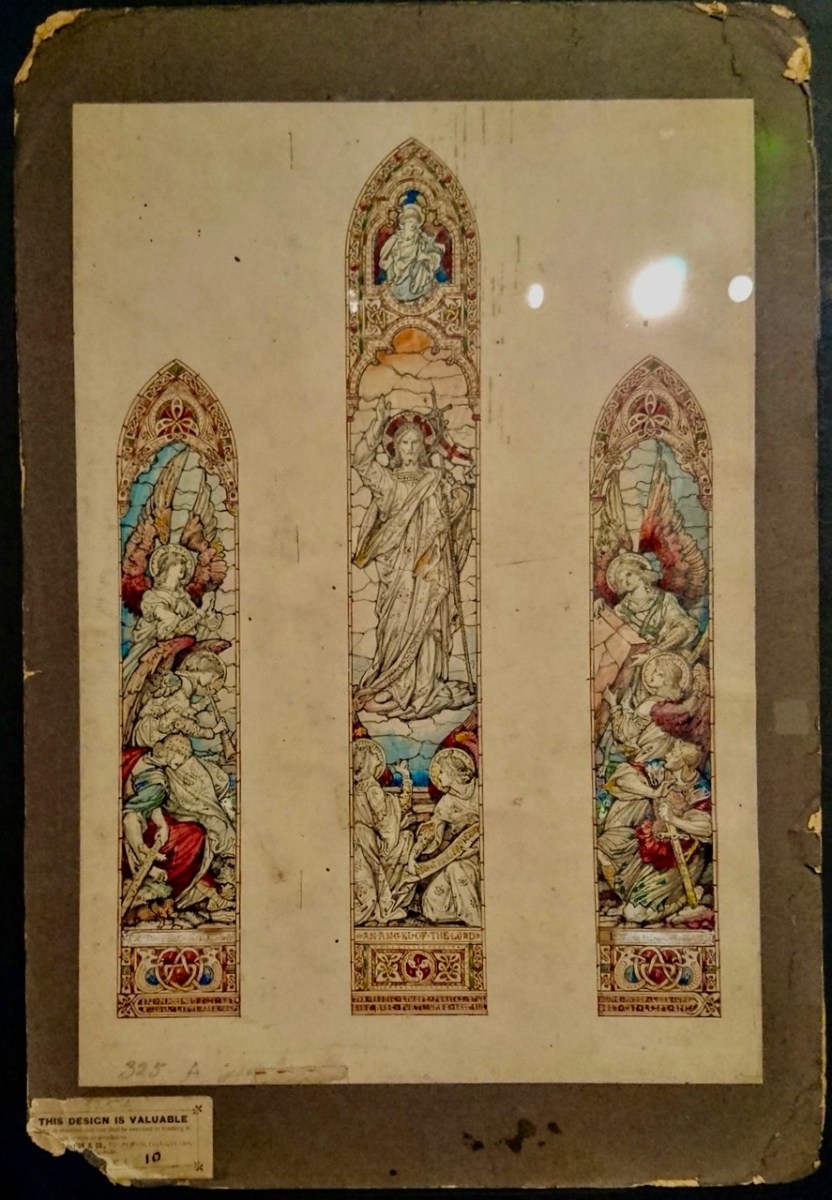
This opportunity is relatively rare in stained glass studies – there aren’t many collections like this, so it is wonderful that the Crawford rescued the archive, which has now been passed on for expert conservation, to the National Gallery of Ireland.
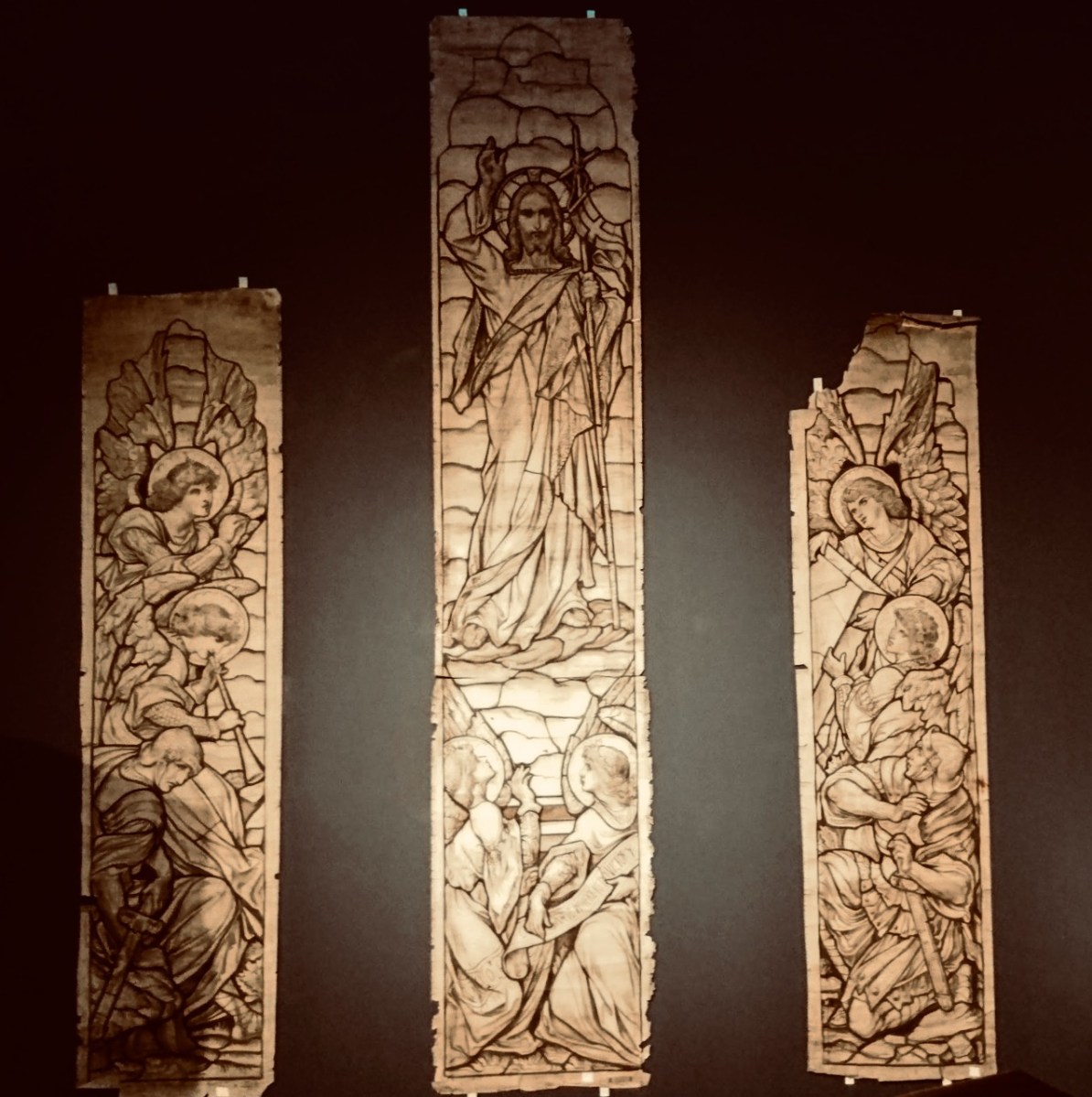
When I contacted Vera, she remembered the Brian Boru window well, and told me that the cartoon was part of what came to the archive, although in a very fragile state. The window, itself, she thought, was still extant, and possibly in Knappogue Castle. The important person to talk to, she said, was Antony Watson, great-grandson of James Watson and the executor of the Watson Estate.  Before I did that, I tried some detective work of my own.

Story 4: Jody

I don’t know Jody Halstead, but in 2016 she stayed at Knappogue Castle and posted a video to YouTube, titled The Knappogue Castle Most Visitors Don’t See. At about the 5 minute mark she arrives at a landing and as her camera roams around, it captures a stained glass window – and there it was! Here’s a screenshot from the video.
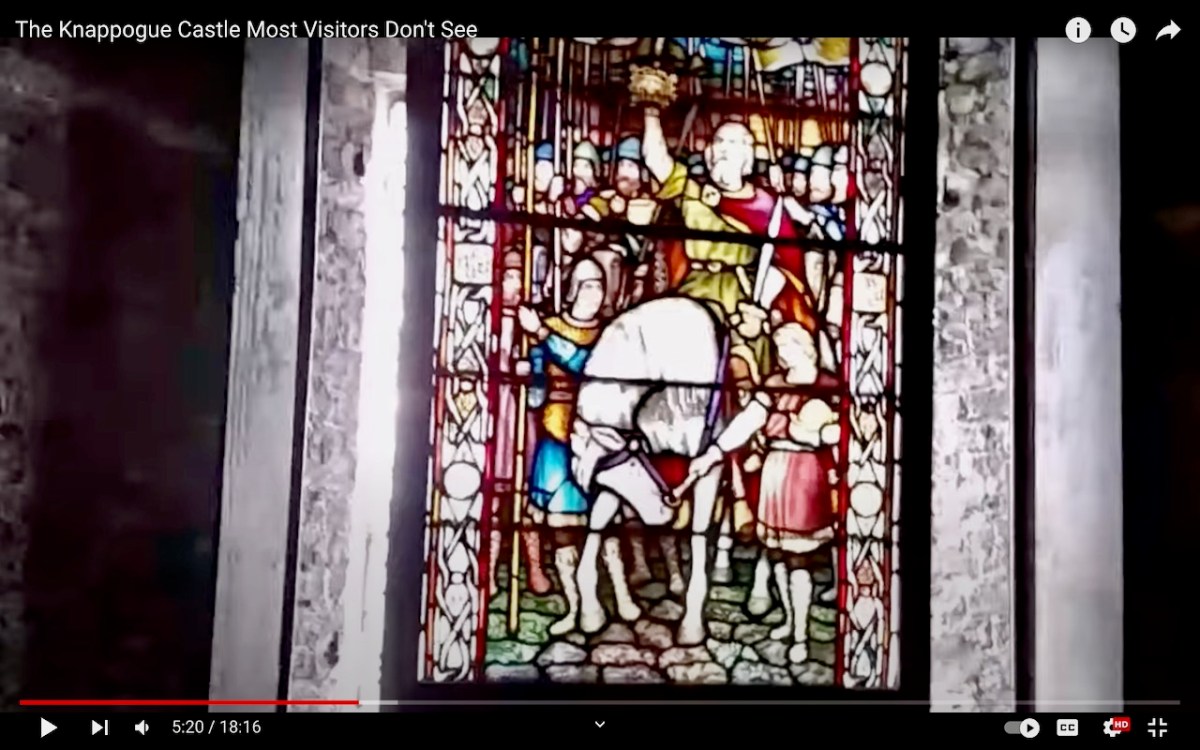
Because of Jody, now I had proof that the window was still in existence. The next challenge was how to get a good photograph of it. Once again, thanks to the glorious (and relatively small) world of Irish stained glass scholars and enthusiasts, I knew who to turn to.

Story 5: John

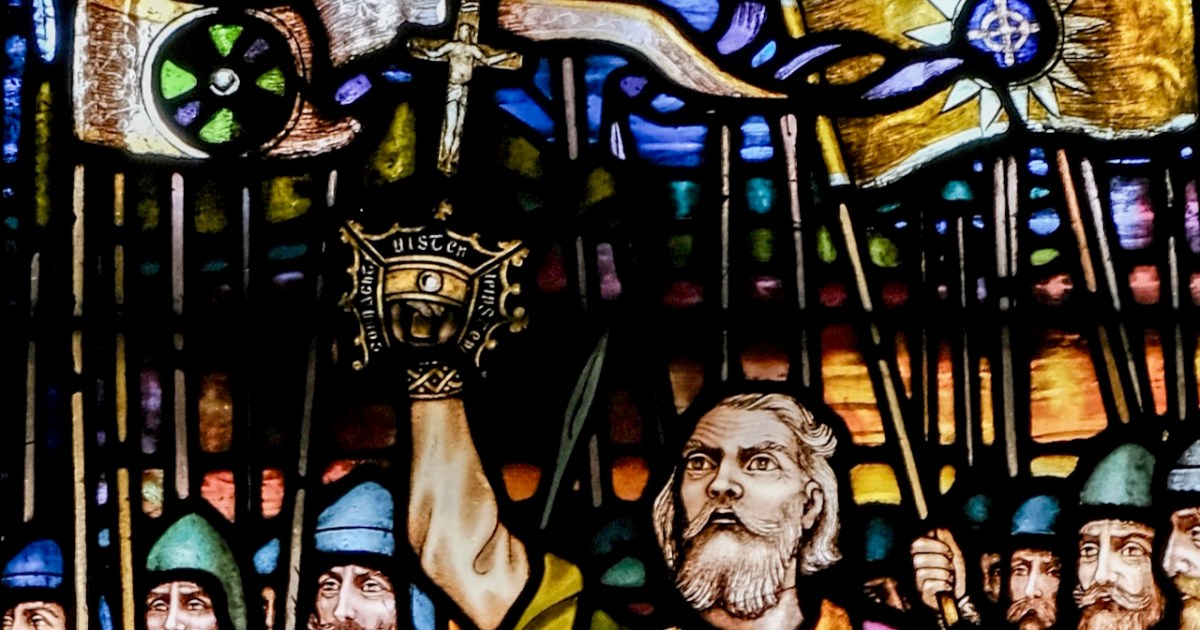
John Glynn is an outstanding photographer with an interest in stained glass. His was the excellent image from Kilrush I used in my post on Brigid: A Bishop In All But Name, and he lives in West Clare, about an hour by car from Quinn, where Knappogue Castle is located. I thought he might already have taken a photograph of the window – he hadn’t but promised to do so as soon as he could. To my great delight, he did it right away. Here is what he sent me.
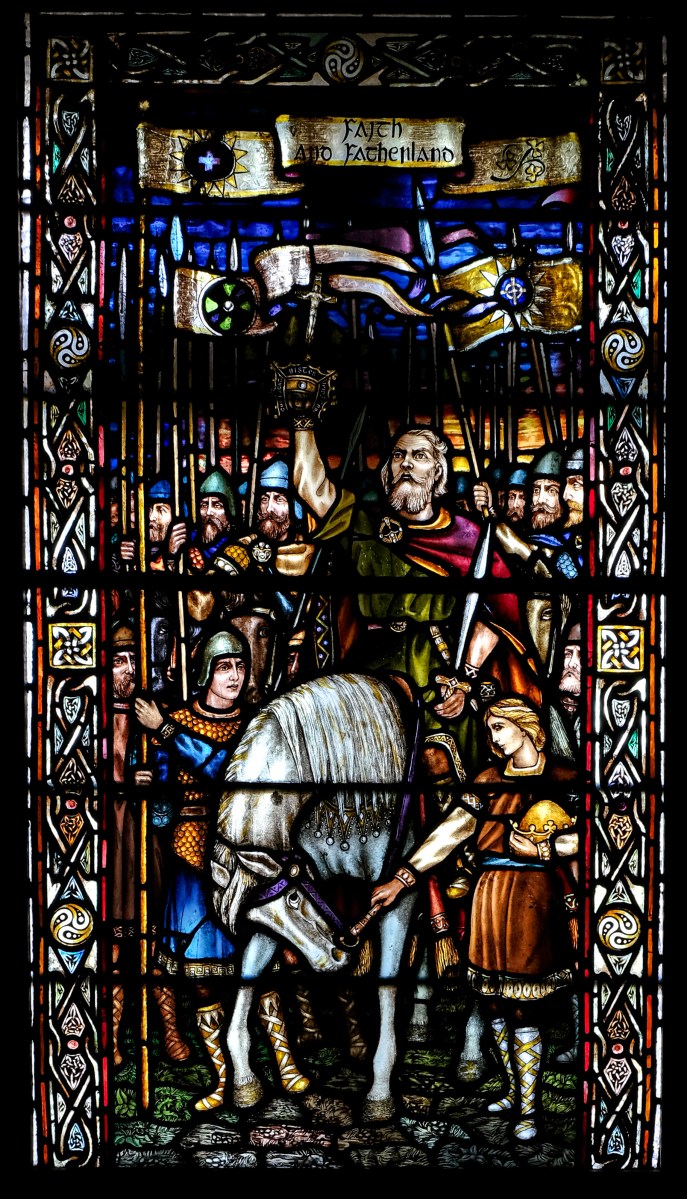
This and all detailed images of the Brian Boru window in Knappogue, are the work of John Glynn, and used with his permission

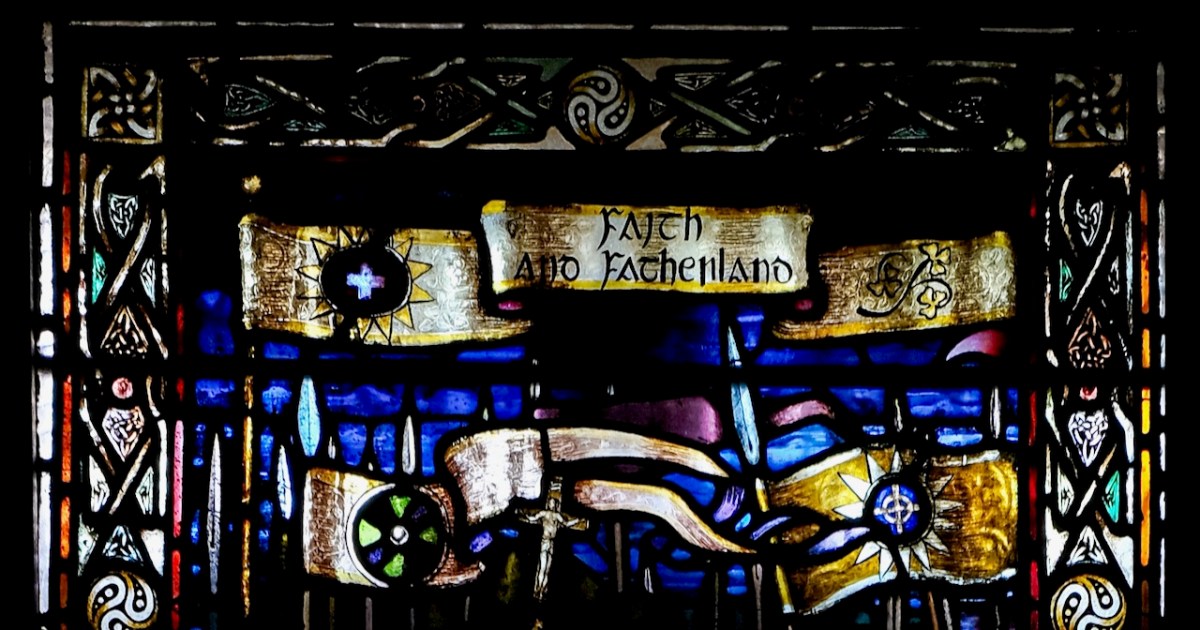
Isn’t it an amazing photograph! What’s also clear in this photograph is that the window is incomplete. To make it fit the opening, the predella, or bottom section, has been removed. Here’s what’s missing. 
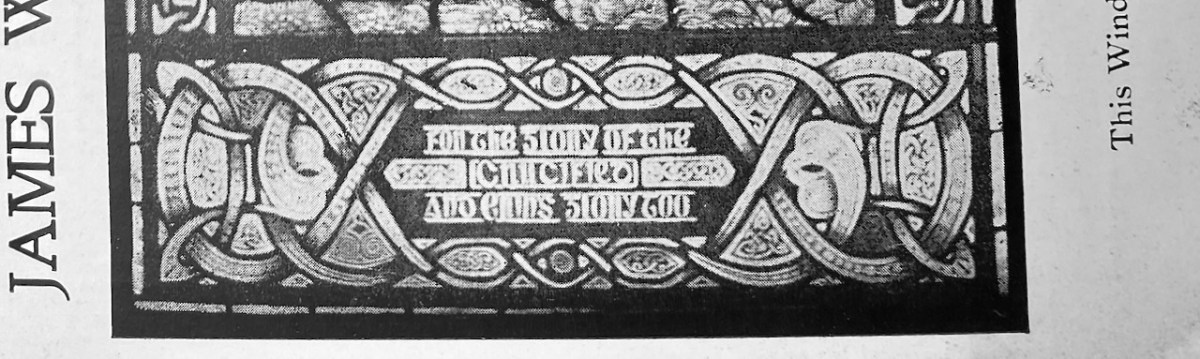
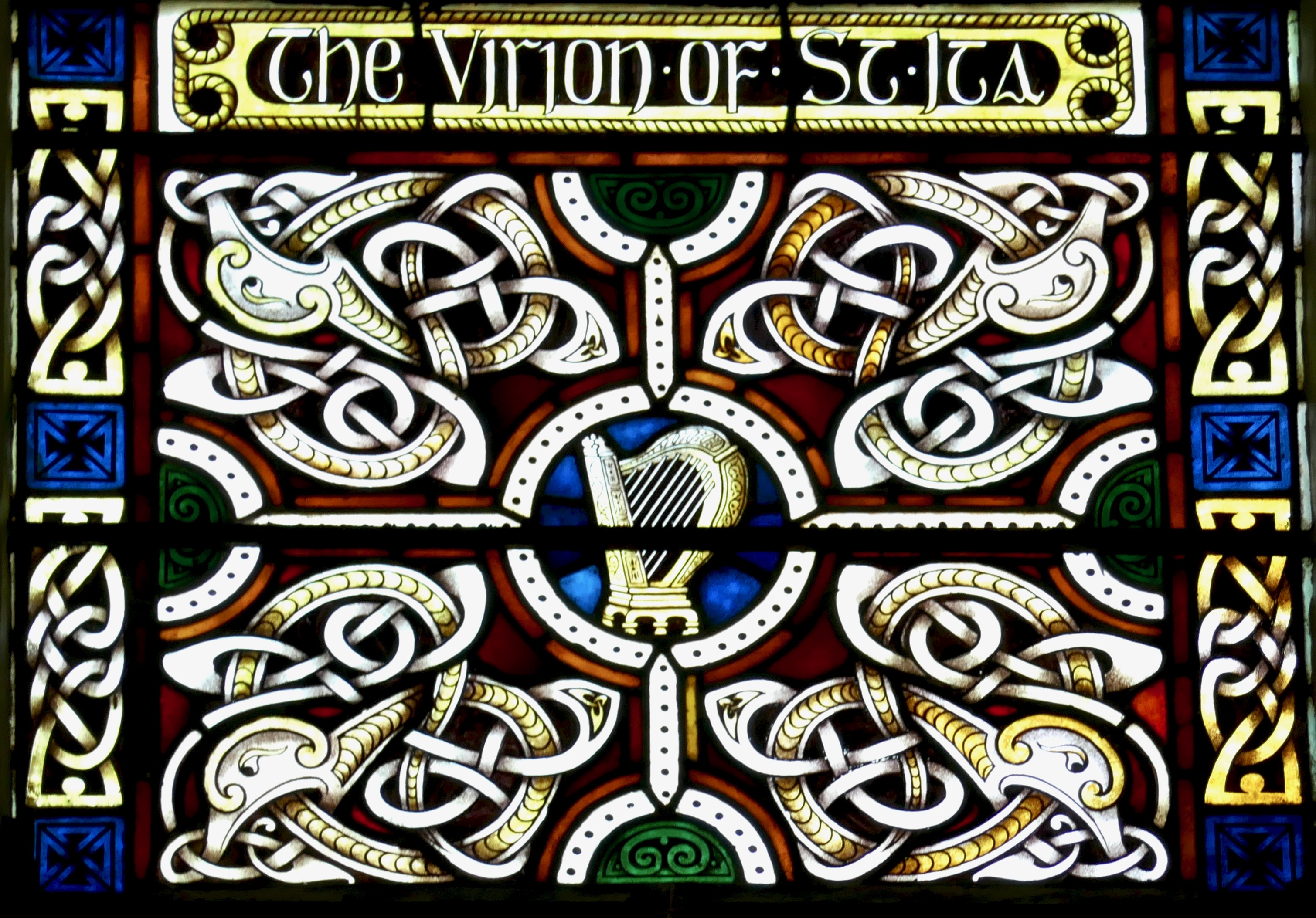
The text, in old Irish script, reads FOR THE GLORY OF THE CRUCIFIED AND ERIN’S GLORY TOO. The Celtic Revival interlacing that surrounds it is beautiful, and accomplished – it’s the thing that Watson’s were to become most famous for. So that’s a loss. Perhaps it was felt that the script was not suitable for a secular building: however it is more likely that it had to go in order to make the window fit. The rest of the window, comparing it to the original black and white images, seems to be intact. I was curious as to how the window came to be there, and this brings me to my second-to-last story.

Story 6: Antony

Vera kindly put me in touch with Antony Watson, and yesterday we had a long talk on the phone. Antony’s father was John Watson, Manager and Chief Designer for Watson of Youghal. John’s father was Clement, universally known as Capt Watson (he was an officer in the RFC/RAF), and Clement’s father was James Watson, seen here with a marble altar carver.
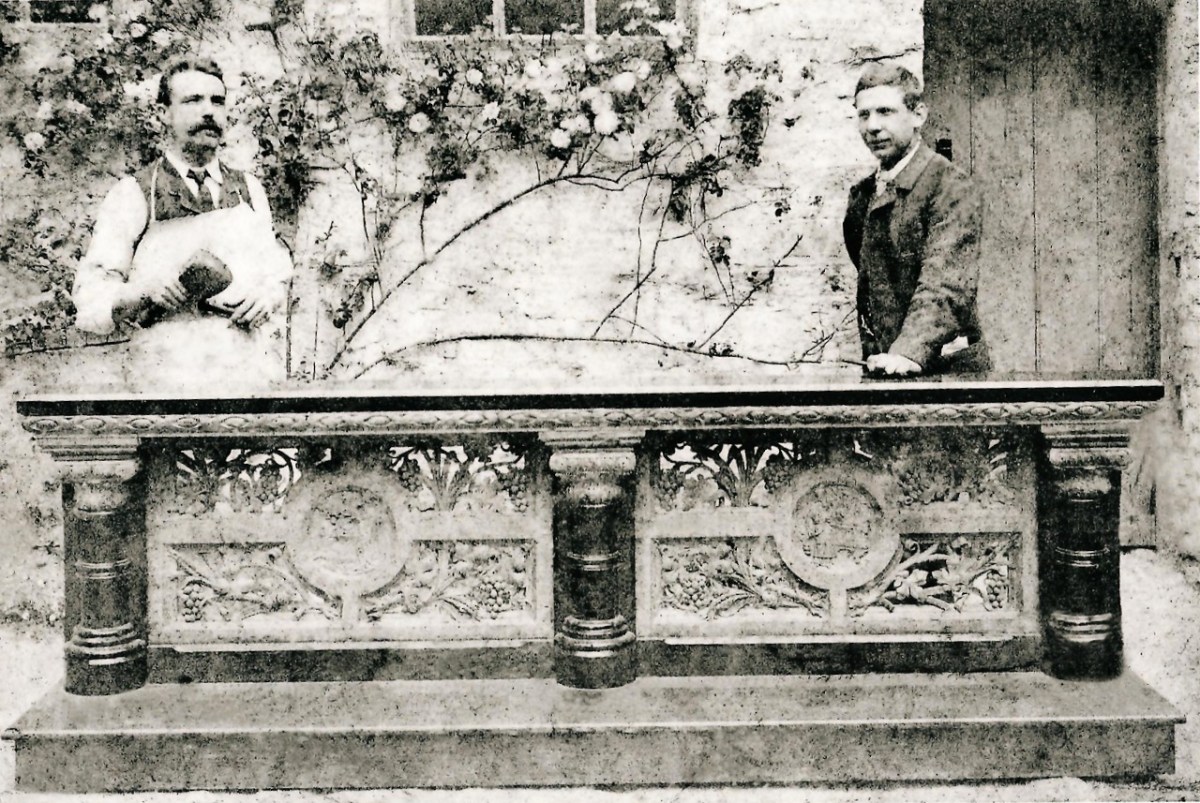
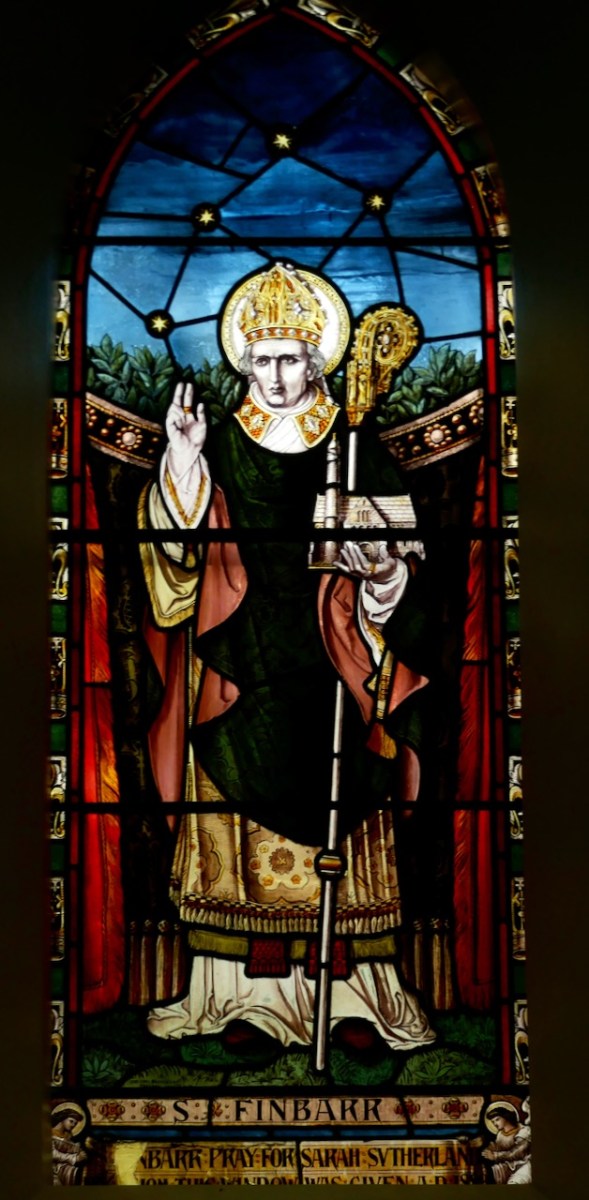
James had come from Yorkshire to run the Irish office of Cox, Sons, Buckley & Co, Church Outfitters, and eventually bought the Irish branch of the company. Here’s one of their early windows, in Ballingeary, from the 1880s, when they were still being signed as Cox, Sons, Buckley, Youghal and London.
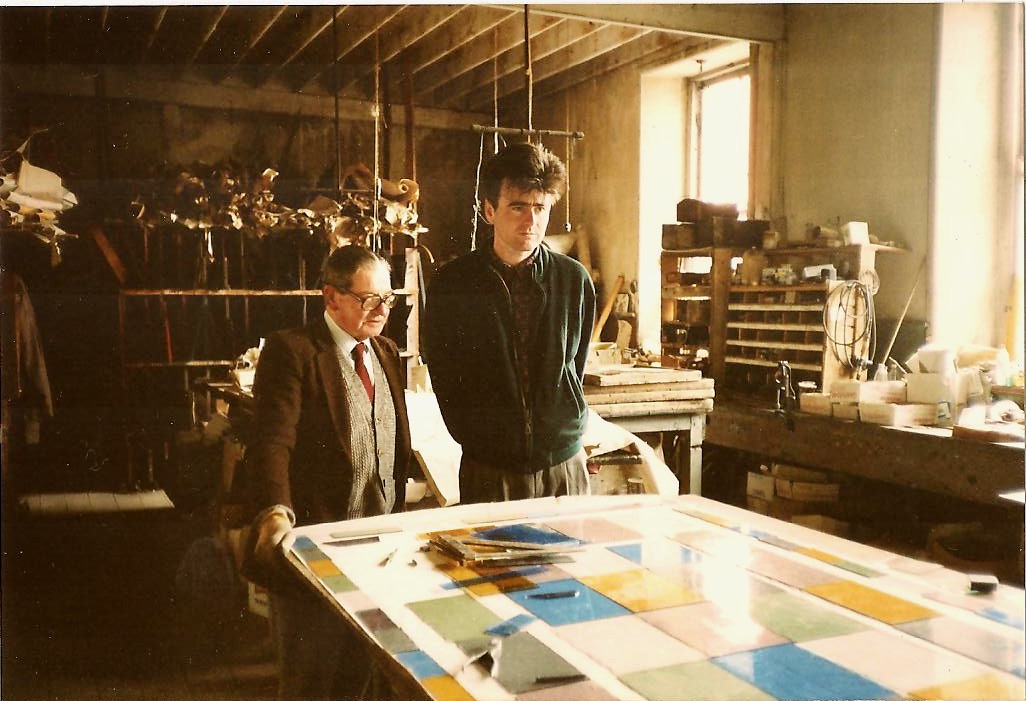
Antony told me the most enthralling stories, and I want to devote more posts to cover some of that treasure trove in the future, but I don’t want to get too distracted from Brian Boru now. Antony loved his life in and around the studios and workshops when he was young and has a very clear memory of the Brian Boru window. It stood, he said, in a rack in what was called the Great Hall (a grand name for a storage area for tall items). Here’s Jack, Antony’s father, with a client, in the early 1990s.
Watsons got the job of installing leaded windows into Knappogue Castle when it was bought by wealthy Americans – Mark and Lavonne Andrews. He remembers the day they arrived to see the Brian Boru window – there was a frantic tidy-up beforehand and the whole of Youghal turned out to witness two stretch limos arriving in state and disgorging the ‘Texas millionaires’ and their retinue.

Story 7: Mark and Lavone
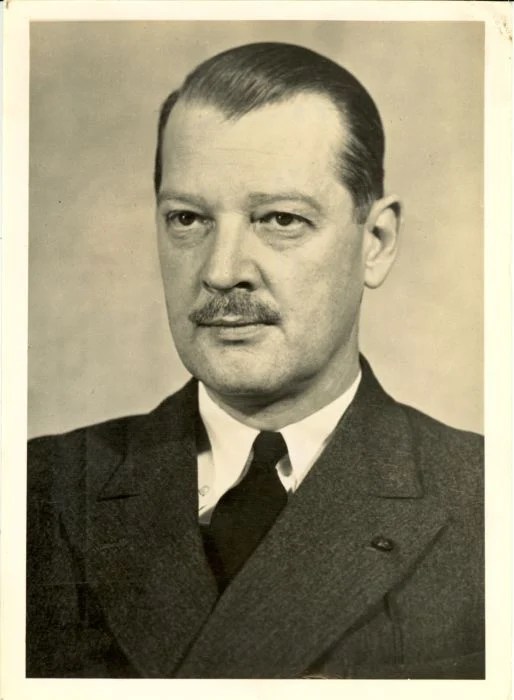
This is Mark Edwin Andrews, highly educated (Princeton) and cultured, and at one time Assistant Secretary of the Navy under Truman. He went on to become an industrialist and oil producer. His wife, Lavone Dickensheets Andrews (so sad I can’t find a photograph of Lavone) was a prominent architect. Together they purchased Knappogue Castle in 1966 and set about restoring it from a ruinous state. Knappogue is located in Quinn, Co Clare, the heart of Brian Boru country. It’s now owned and managed by Shannon Heritage.
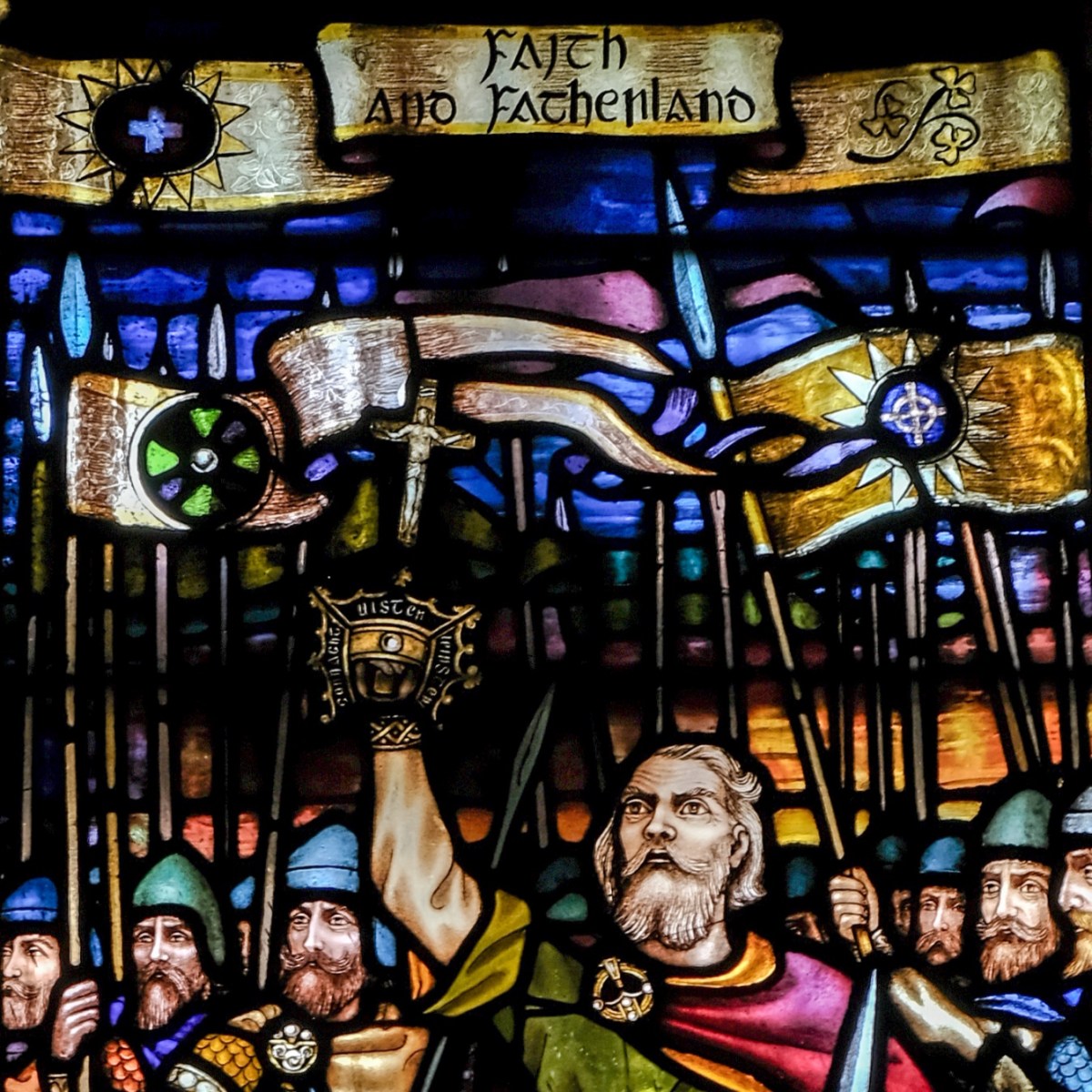
It was Mark and Lavone who rescued the Brian Boru window and had it fitted into Knappogue Castle, some time in the 1970s. And there it still is, a testament to the enduring attraction (and durability) of stained glass windows and their power to enchant and intrigue us.
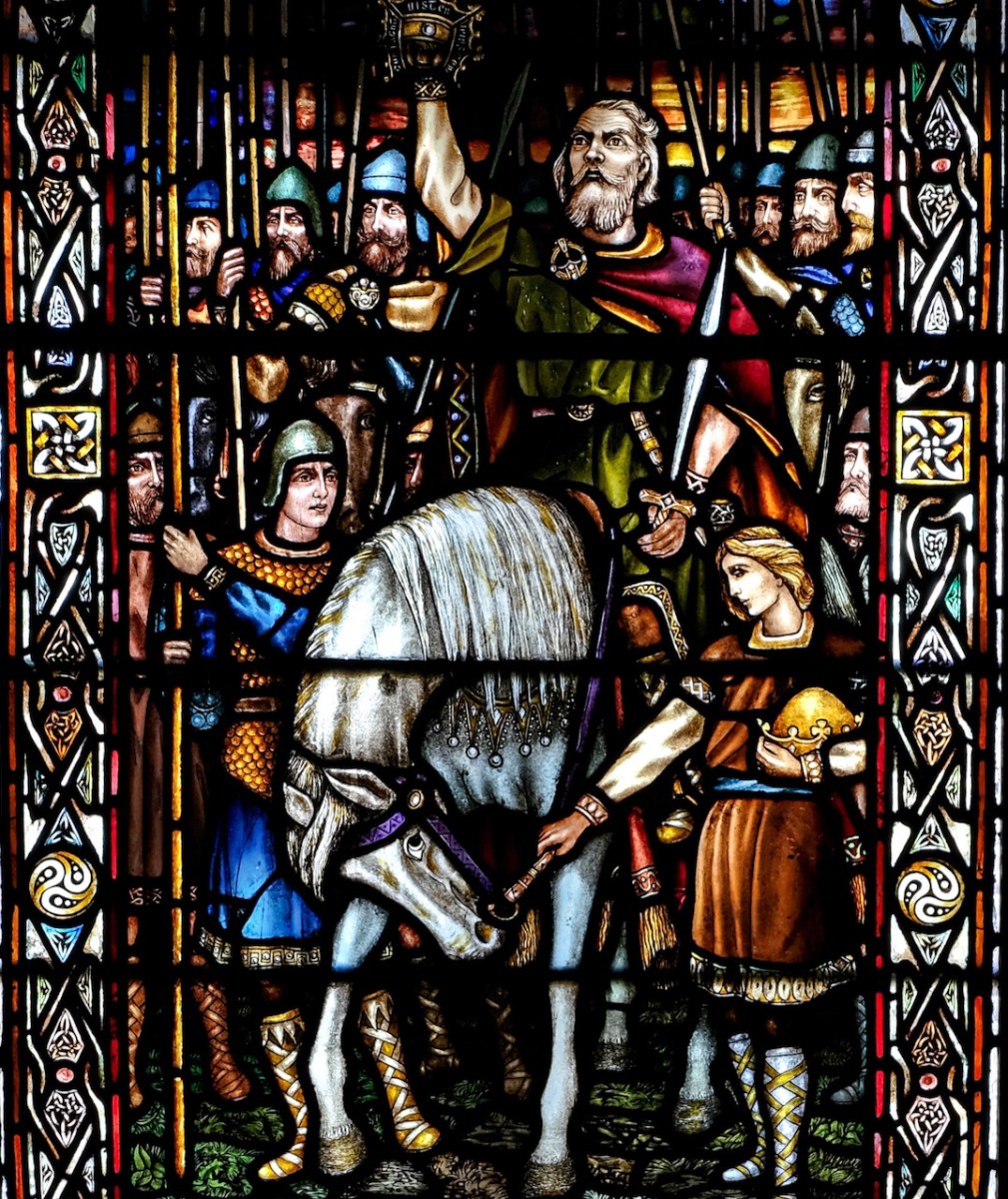
It’s a highly unusual window in so many ways, not least that it is a secular rather than a religious subject. It showed off, when it was exhibited, one of our historic heroes, Brian Boru (for more about Boru, see Robert’s post, Battling it Out), as well as the Celtic Revival decoration which Watsons mastered: both the subject matter and the treatment established them firmly in the Nationalist Camp. This of course, was a canny move designed to appeal to Irish Catholic church-builders. Antony tells me that nobody espoused Irish Nationalism more enthusiastically (or astutely) than James Watson, in the broad Yorkshire accent he kept to the end. 
As an image of Faith and Fatherland, this window knew exactly who it was appealing to. It appeals to us still.
St Michael

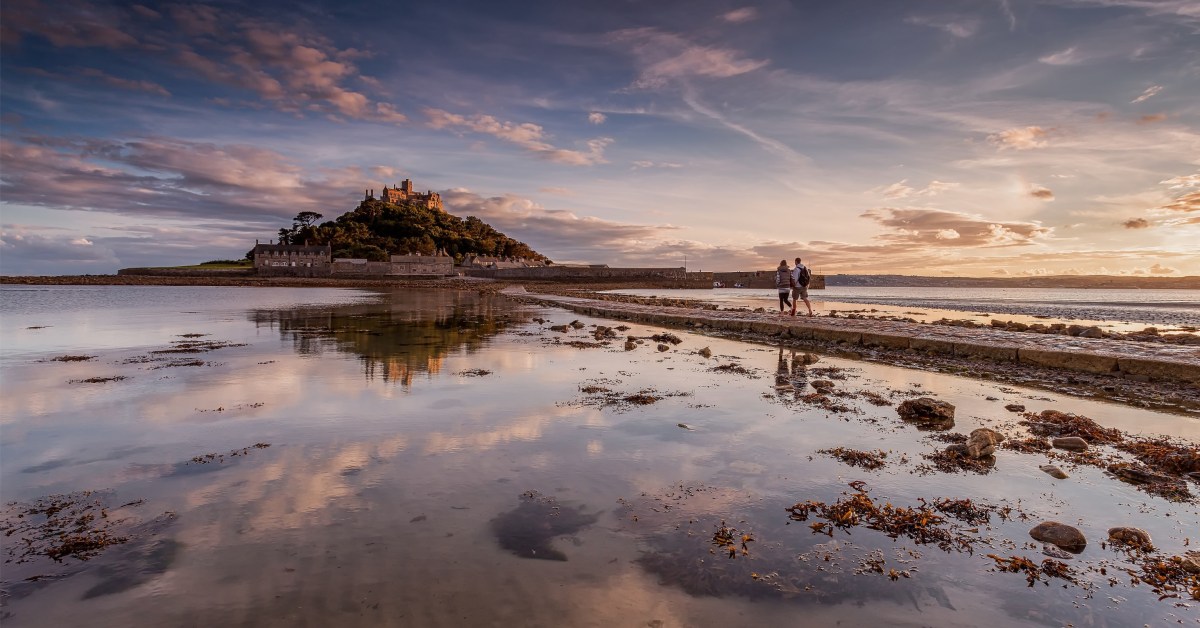
For a part of my life I lived in the west of Cornwall, looking out over St Michael’s Mount (above). Back in the 5th century, the Archangel himself appeared to fishermen on that rock. Legend has it that the Mount was constructed by giants and, also, King Arthur battled and defeated a giant there. As you all know, we have just passed Michaelmas – the day of the saint – September 29th.

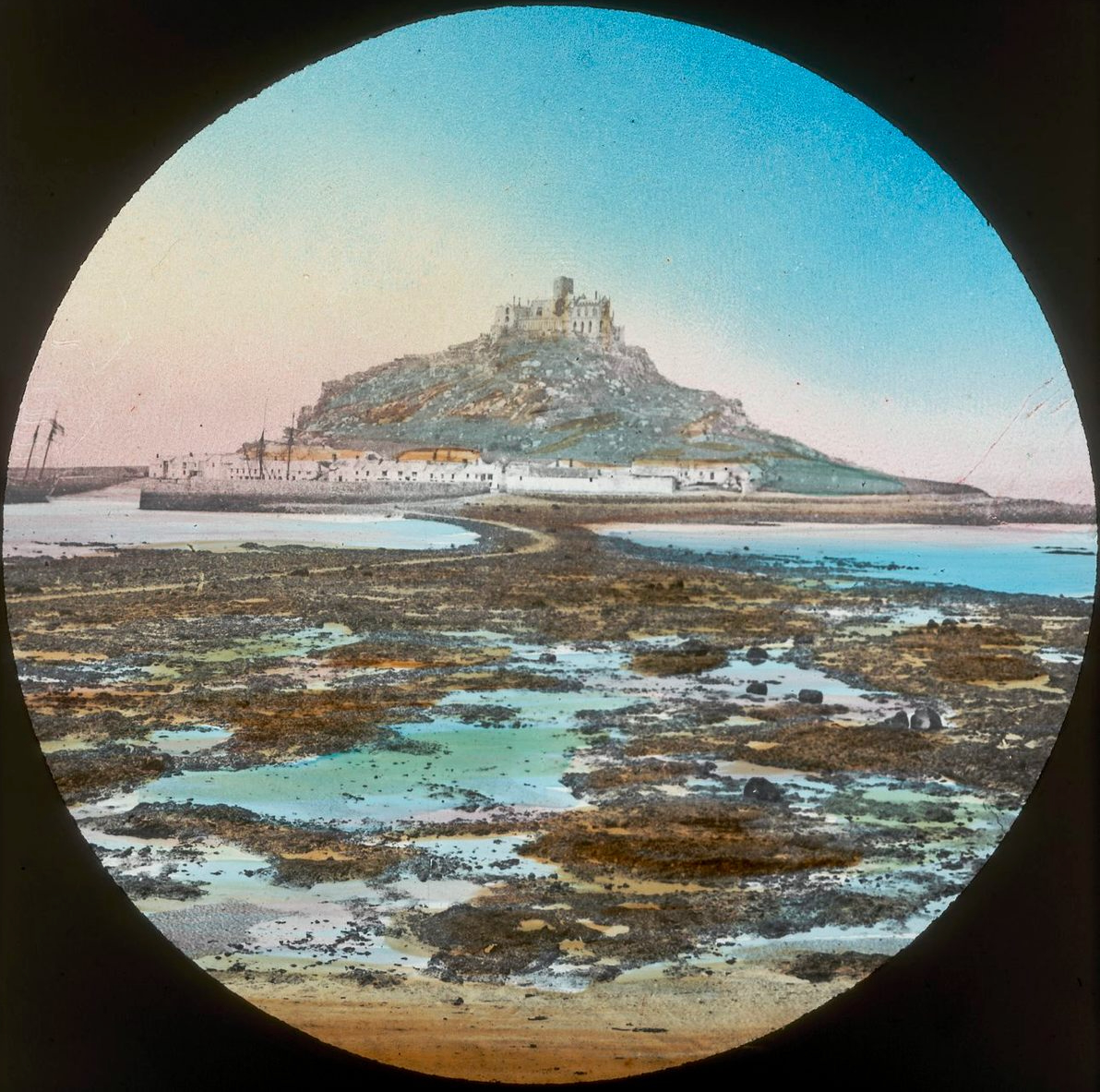
There is another ‘St Michael’s Mount’ on the coast of Brittany: Mont St Michel (above, from an old lantern slide). I have mixed memories of that place, having gone there on a school trip when I was twelve: I had all my hard-saved pocket money stolen from me in one of the little winding lanes that goes up to the summit. Michael is the patron saint of high places, so expect to find him on pinnacles.

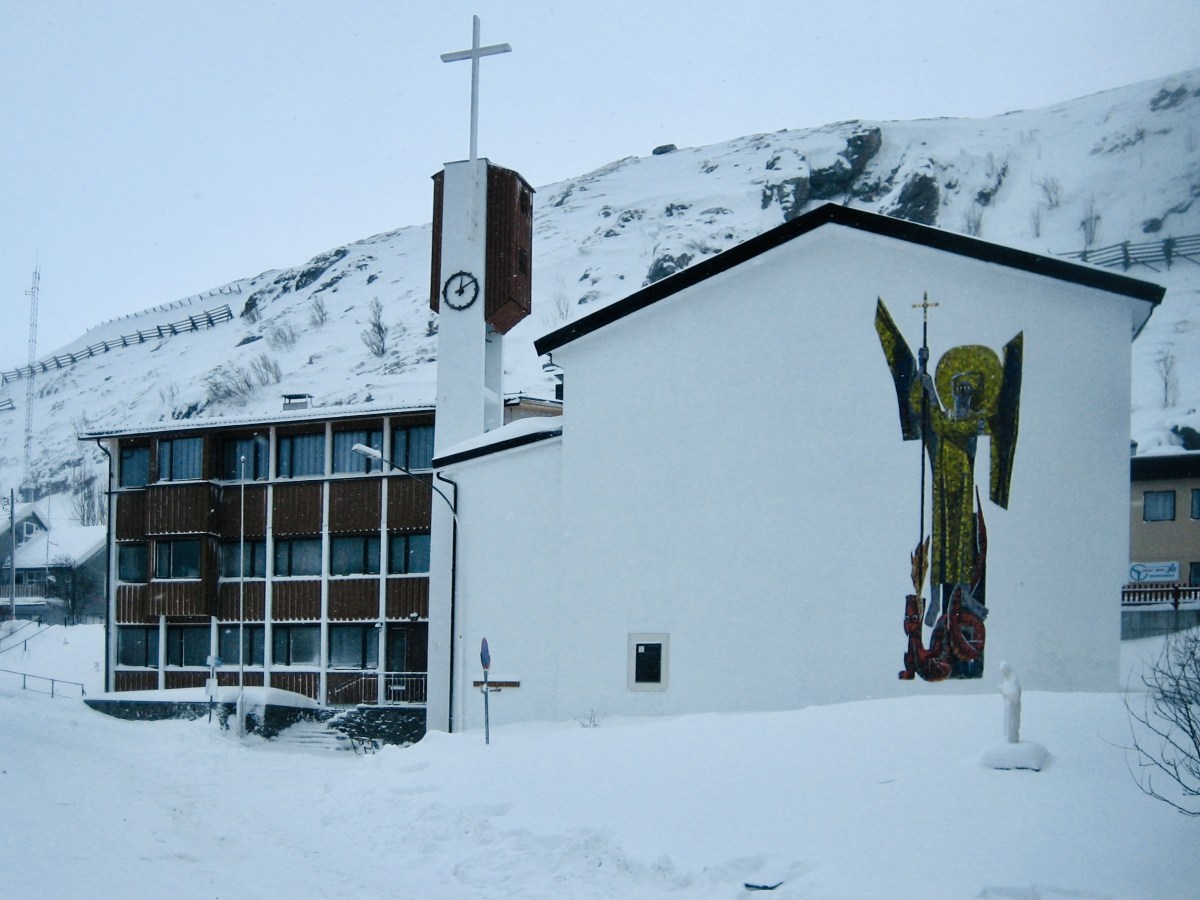
This St Michael’s church is certainly in a high place. It’s at Hammerfest in Norway, and has the distinction of being geographically the highest church in the world! (image by Manxruler)

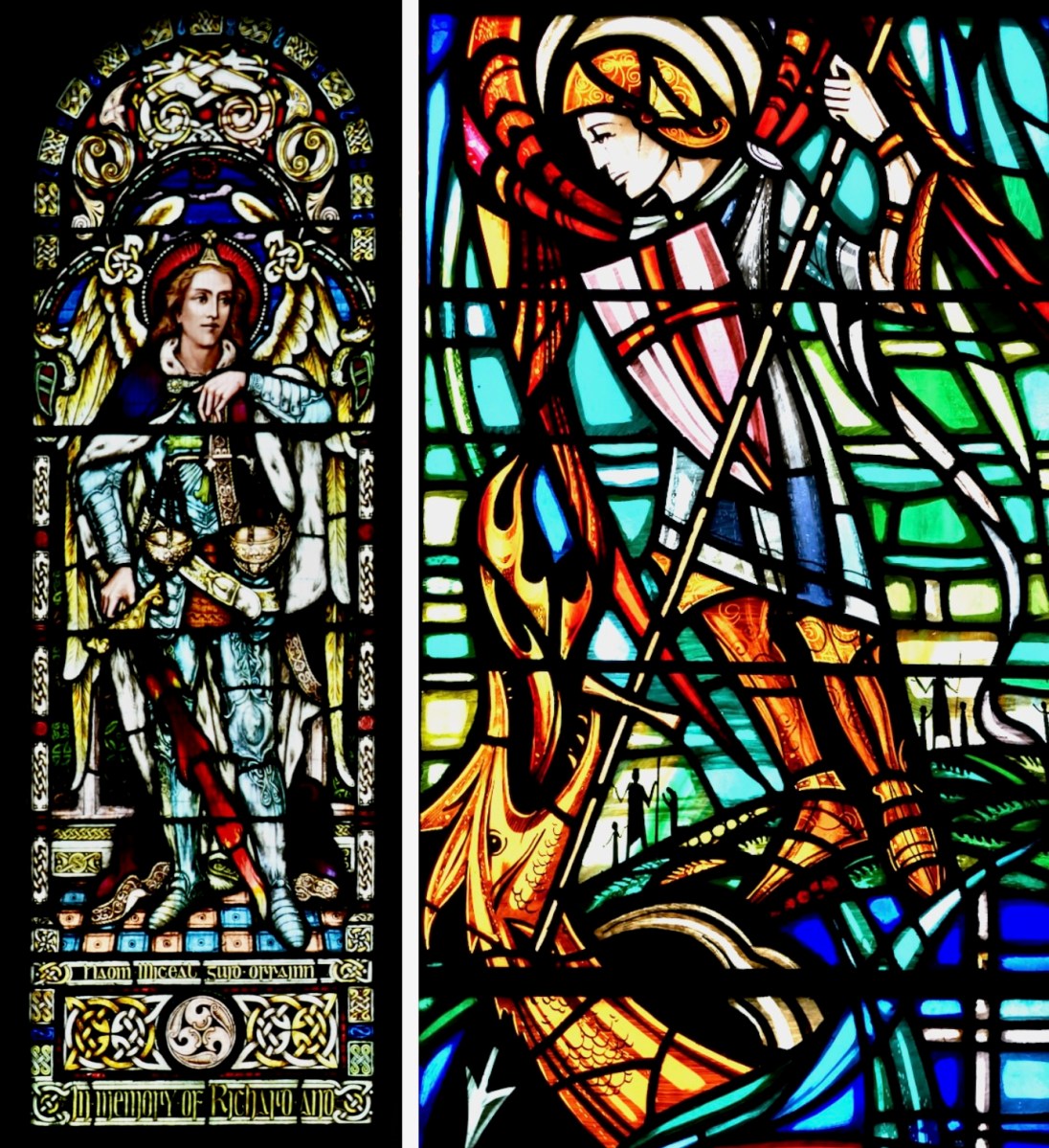
I asked Finola if there was very much in the way of St Michael imagery in Irish stained glass. There’s a fair bit: on the left, above, is a Watsons of Youghal image of the Archangel in his role as weigher of souls. He stands at the gates of Heaven waiting for you on Judgment Day with his scales in his hand. Often, beside him, angels hold up two books: the smaller one records the names of the blessed, while the larger book is a list of the damned… On the right is our friend George Walsh’s depiction of Michael defeating Satan, who here takes the form of an impressive dragon.

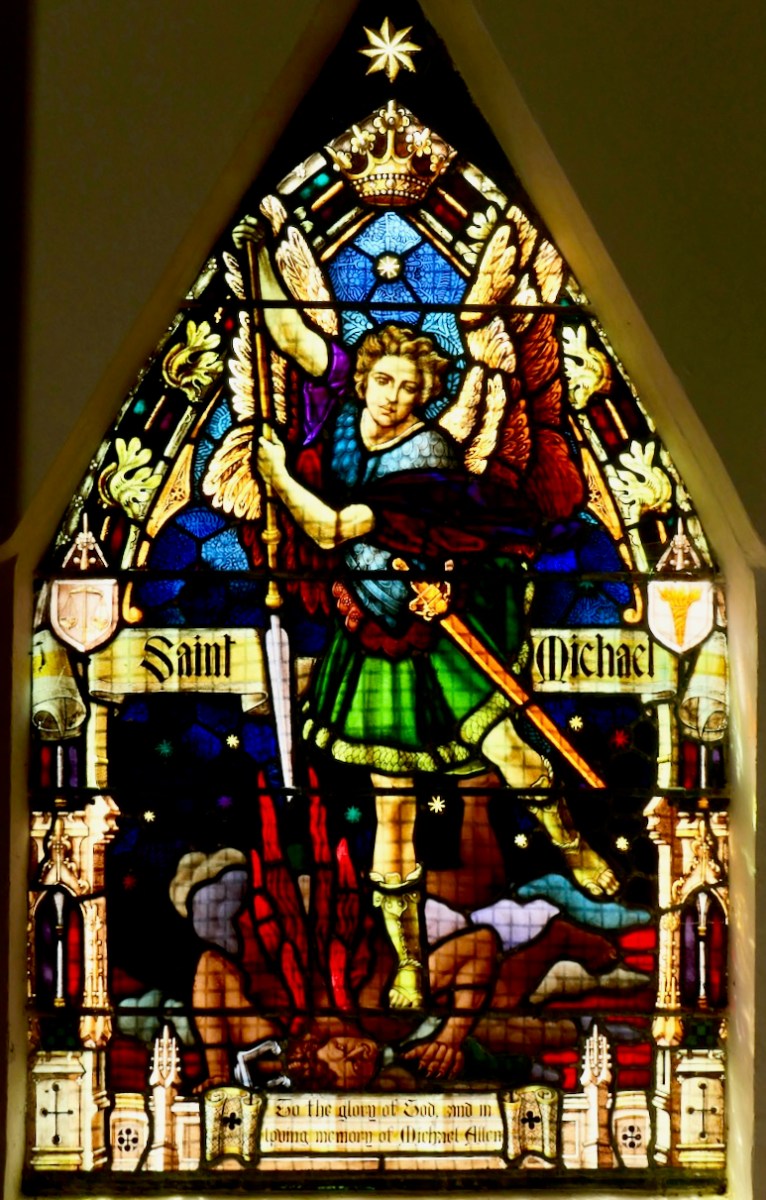
This St Michael is very local to us: it’s in Teampall Church at Toormore, and is by Clokey of Belfast (Finola’s photo). Look carefully and you’ll see the Saint pinning down the fire-breathing Devil.

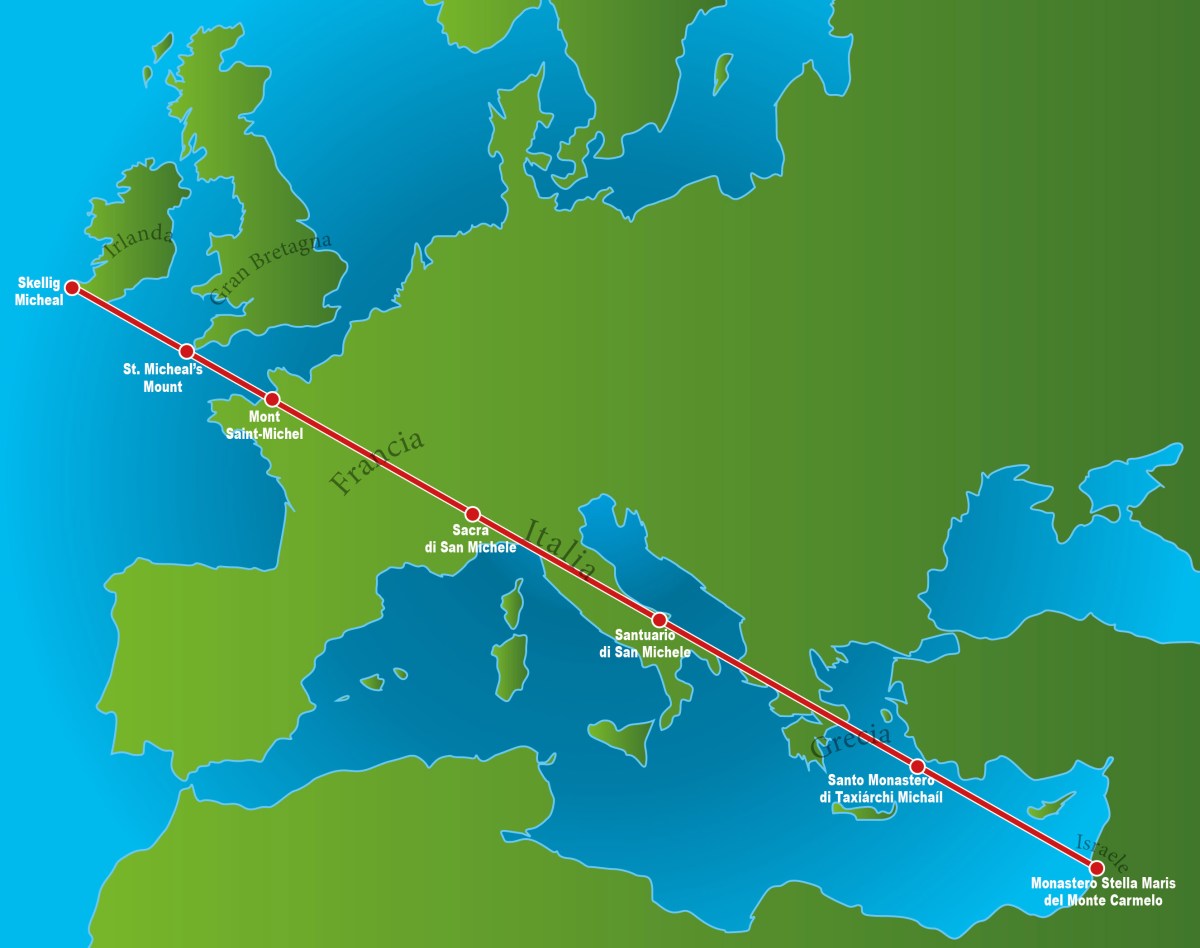
Also in my distant youth I was an ephemeral chaser of ley-lines: I have since thought better of it, but the idea of a straight line starting in Ireland and connecting seven St Michael sites while traversing Europe and Greece was attractive, and fleetingly convincing. Of course, there are many more Michael sites scattered around the Christian world which don’t fall anywhere near this line.

. . . As with other ley lines, no scientific evidence indicates that the alignment was planned and meaningful, making the claim pseudoscientific, but commonly reported at these sites. Physicist Luca Amendola noted that the deviation of these sites from the loxodrome that allegedly connects them ranges between 14 km and 42 km. According to legend the Sacred Line of Saint Michael the Archangel represents the blow the Saint inflicted the Devil, sending him to hell. Some also say that it is a reminder from Saint Michael that the faithful are expected to be righteous, walking the straight path . . .
Wikipedia

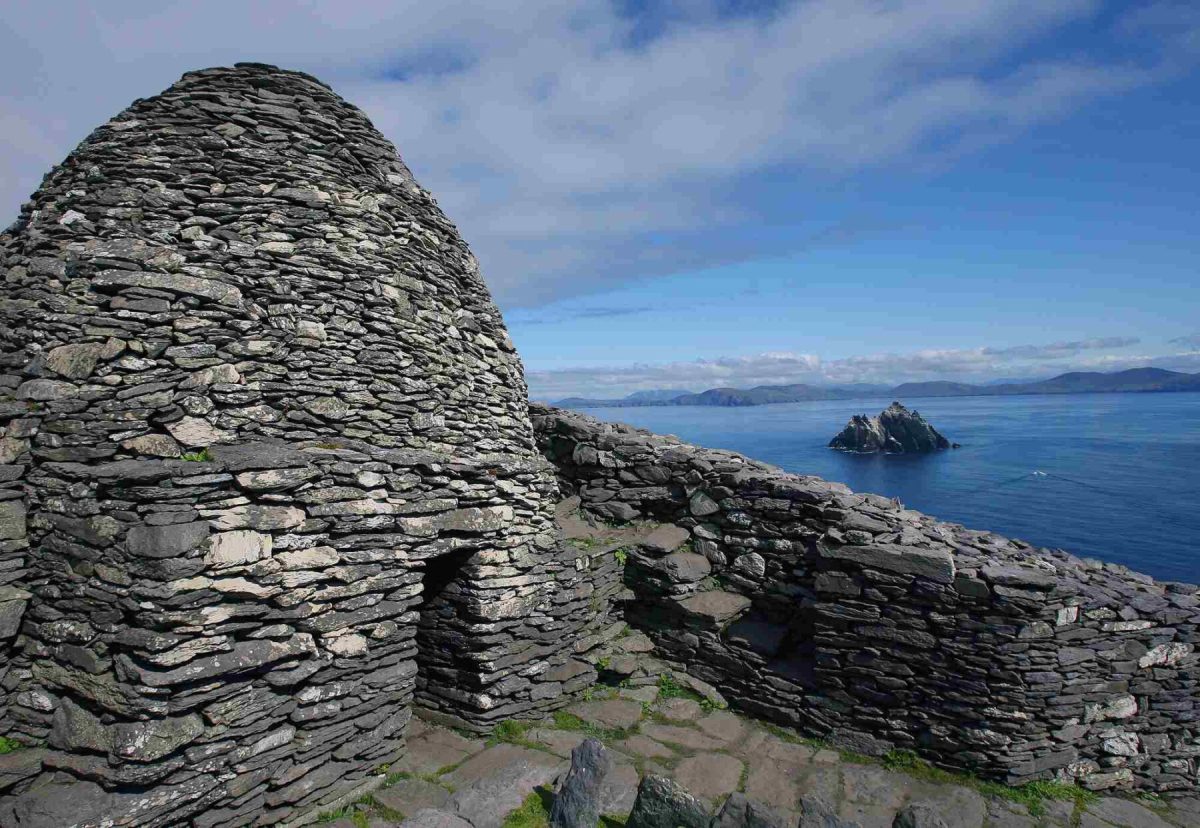
It’s nice to see that the phenomenon starts (or finishes) at Skellig Micheal, off the coast of Kerry (pic below courtesy of OPW):

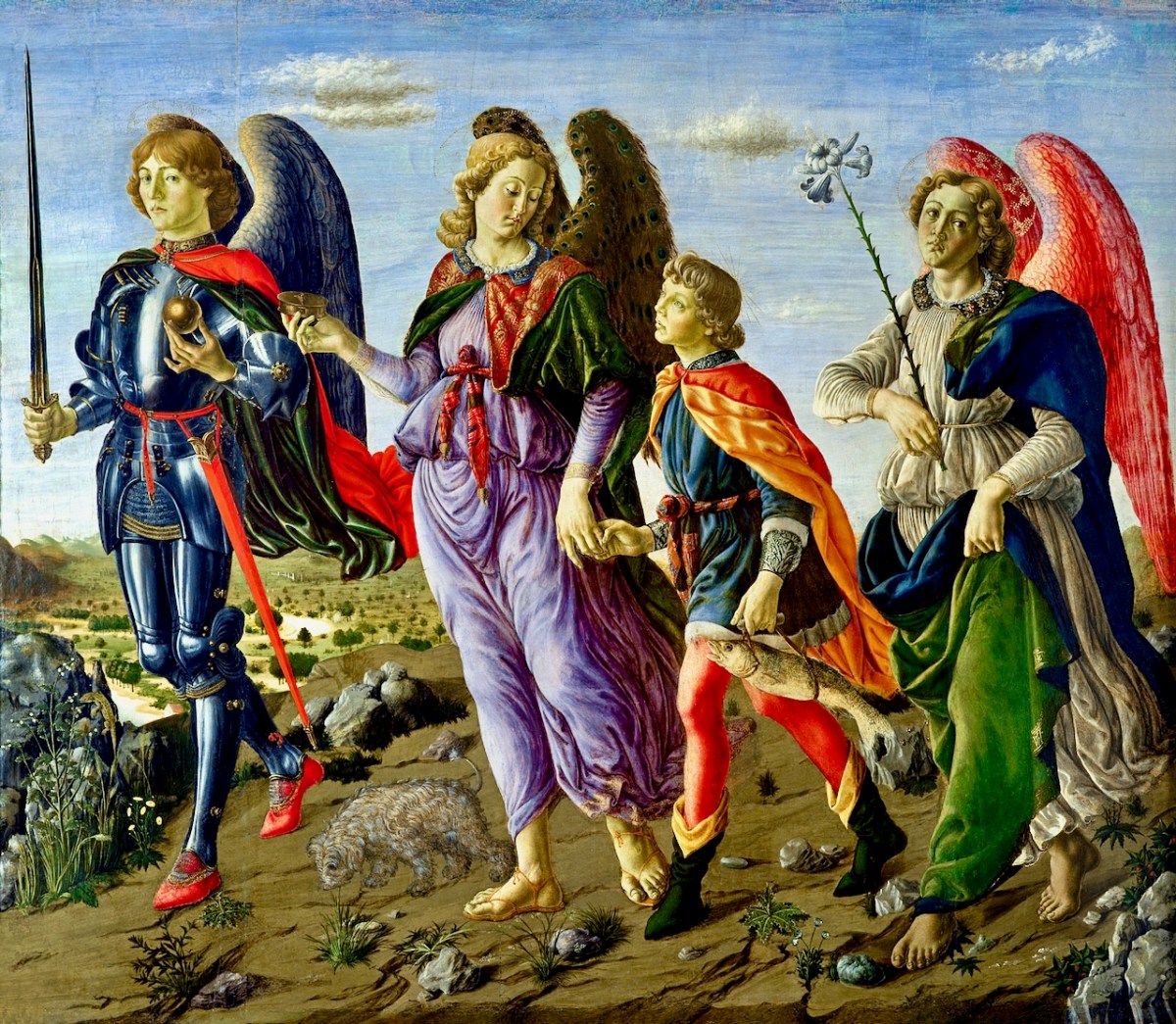
Here’s an interesting view of the three somewhat feminine Archangels painted by Francesco Botticini in 1470. Michael is on the left. With them is Tobias who, in the popular Biblical tale, overcomes obstacles as he and his heavenly guardians set out to discover a cure for his father Tobit’s blindness. They are successful, for Tobias returns with a cure for his father as well as a wife!

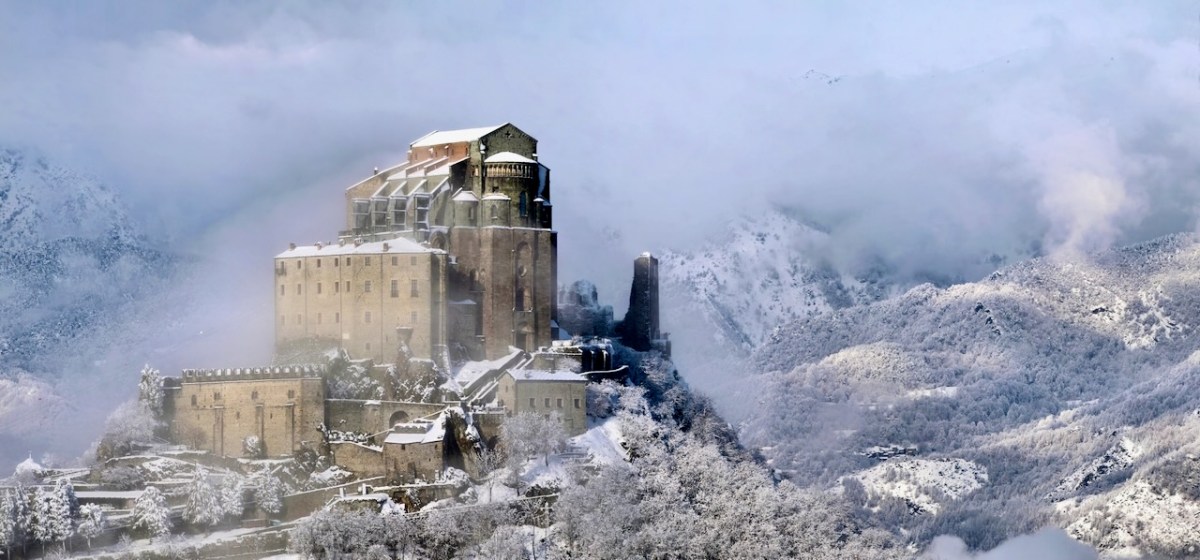
I couldn’t resist this wonderful image of a St Michael’s site (from Wikipedia). It is the tenth-century Sacra di San Michele on Mount Pirchiriano in Italy. It also happens to be on the Saint’s ley-line!

I’ll finish this little review of St Michael where I started – off the coast of Cornwall. This 1920s postcard of the Mount, from a painting by A R Quinton, sums up the romantic image which I still carry from my days lived on that coast.
The Nativity in Stained Glass

Dear Readers – we know you aren’t all on Facebook, so this is for those of you who follow us on WordPress or other platforms. On our Facebook page, we’ve been running a series on The Nativity in Stained Glass in the lead up to Christmas, so here, in one post, are those photographs and text. All the windows are Irish and 20th century. Merry Christmas to you all!

This one is by George Walsh and it’s in Frankfield Grange Catholic Church in Cork. This scene is part of a larger window, the main scene depicting the Annunciation. More about George Walsh here.

Kevin Kelly was a long-time stained glass artist for Abbey Studios. He loved doing Nativity windows. This one is in Inchigeelagh, Co Cork and featured on a UNICEF Christmas Card. It’s worth taking a look at the detail – amazing for what’s quite a small window.

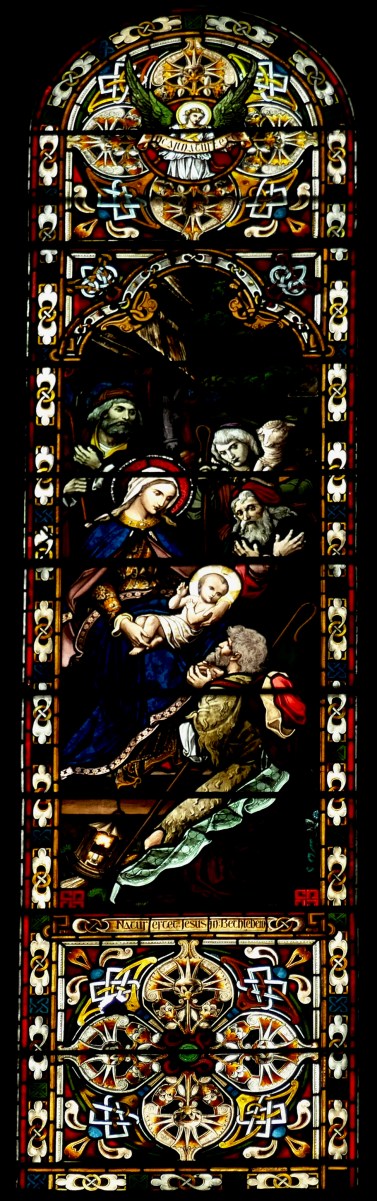
Our next Nativity in Stained Glass comes from St Carthage Catholic Church in Lismore and is the work of Watson’s of Youghal. While the figures are conventional, the ‘Celtic Revival’ decoration lifts this window far above the ordinary. Read more about Watsons and their mastery of this form, popular among Irish nationalists at the turn of the 20th century.

This beautiful Nativity window is in Mayfield, Cork, in the Church of Our Lady Crowned. The Murphy-Devitt Studios were a group of young, dedicated artist and designers, determined to bring something new to traditional stained glass. We think they succeeded magnificently.

This scene of the visit of the Magi is in Kilcoe Church of the Holy Rosary and is the work of Catherine O’Brien, the artist who worked longest in An Túr Gloine, the Arts and Crafts Stained Glass Co-operative founded by Sarah Purser and Edward Martyn to promote home-grown arts and craft in Ireland. This is a re-working of a previous window by O’Brien, proving that even Arts and Crafts practitioners were not above re-cycling.

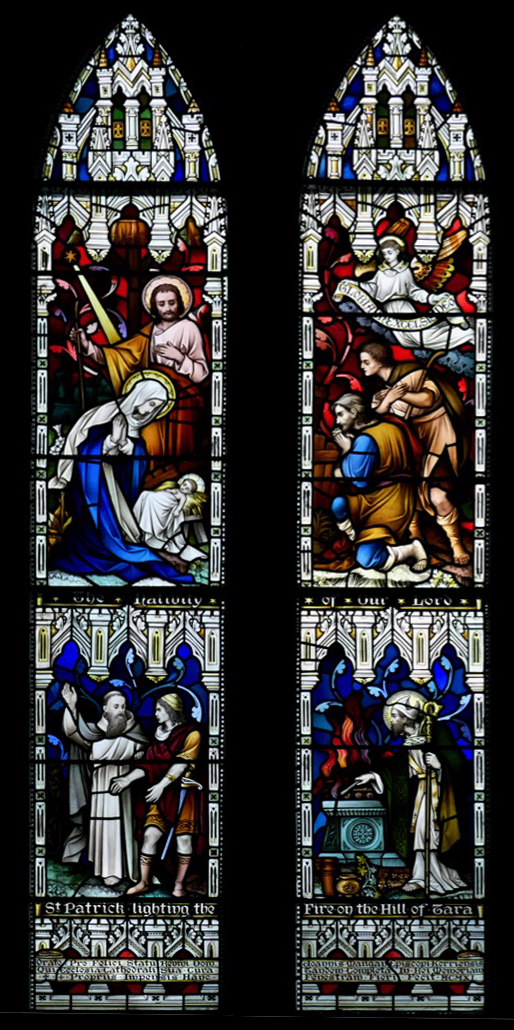
What does the Hill of Tara have to do with the Nativity?  In the Catholic Cathedral in Killarney are a whole set of windows that draw parallels between biblical scenes and Irish saints – all part of the push-pull between the Rome-centric internationalisation of the Irish church versus the desire of Irish congregations and clergy to see their own Irish and local saints depicted in their stained glass windows. In this case, the Nativity of Jesus is compared to the birth of Christianity in Ireland when St Patrick lit the Pascal Fire on the Hill of Slane (although the window says Tara, the story is that the high king saw the fire from the Hill of Tara). The windows are by Hardman, before they became Earleys.

The Dominican Convent in Wicklow town has a gorgeous series of windows – the Mysteries of the Rosary. They were done in the Harry Clarke Studios in 1938, several years after Harry’s death, but his influence is very evident. They were mostly designed and painted by William Dowling, but with much input from Richard King. To see if you know the difference between Harry Clarke and Harry Clarke Studios windows, take the quiz, or just cheat and go straight to the answers.

Patrick Pollen, although he grew up in England, made his stained glass career in Ireland. Having been bowled over by Evie Hone’s Eton windows he came to Dublin to work with her. Hone’s influence is readily apparent in these two panels, which form the predella (lowest section) of a window in St Michael’s church in Ballinasloe, Co Galway, dating to 1957. I haven’t written about Pollan (yet) but you can read about Evie Hone here.

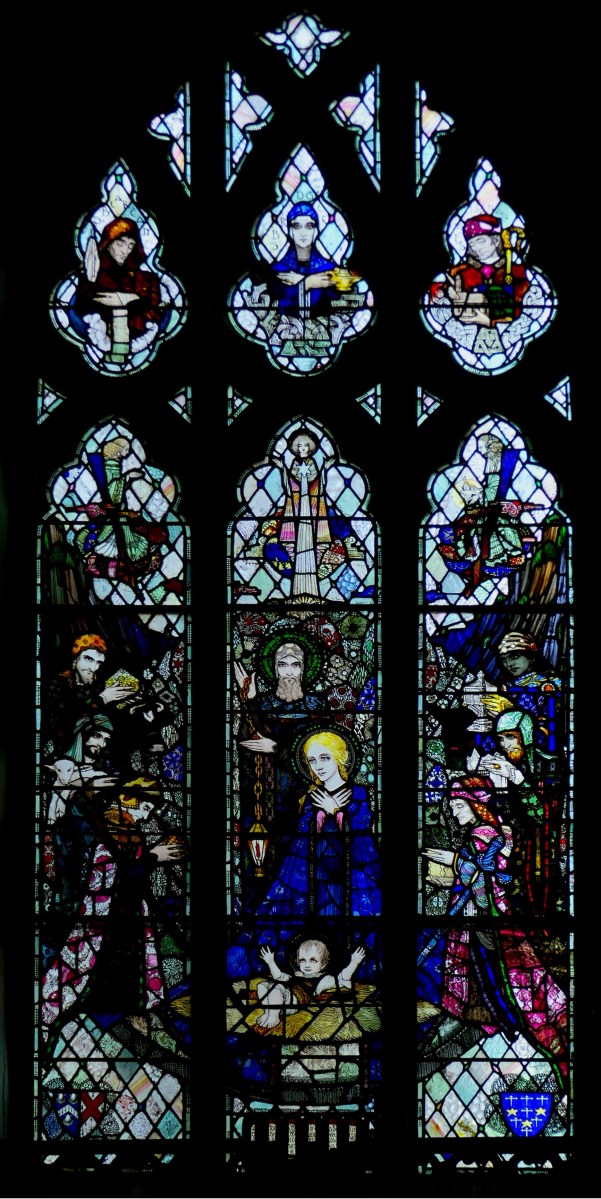
We’ve kept the best for last – the genius that is Harry Clarke. This is his Nativity Window, done in 1919 for Edith Somerville and her family, for the C of I Church of St Barrahane in Castletownshend, Co Cork. Lots more about Harry Clarke, Ireland’s greatest stained glass artist.

Painting With Light

What are we seeking right now? If social media is right, it’s distraction. But also beauty, comfort, reassurance… With that in mind, I have created a video slideshow of some of my favourite stained glass windows.

I could have used a totally different selection and perhaps I will do another one sometime. Meanwhile, this took me all day to do – learning how to do stuff like this seems to get harder as the years roll by. Funny how that works.

The music is Sí Beag Sí Mór by O’Carolan and it’s played beautifully by Susan Nares on the harp – thank you, Susie! Susie made this recording for Robert’s Swantonstown Sessions (have you checked in there yet?). The stained glass I’ve chosen is by Harry Clarke, George Walsh, Hubert McGoldrick, Murphy Devitt, Mayer of Munich, Joshua Clarke and Co., Thomas Denny, William Dowling, Richard King, Watsons of Youghal, and Earley and Co. For much more on Irish Stained Glass, including some of the artists I have chosen, have a glance over this page.

Here it is – I hope you enjoy it.

That He Might Better Rest

In my time browsing and photographing stained glass windows I have come across many WWI memorial windows in Protestant churches, but only three in Catholic churches – an extraordinary ratio, given that over two hundred thousand Irish men fought in that war, with Catholics far outnumbering Protestant Irish soldiers (simply because they represented a far greater portion of the population). It is estimated that thirty five thousand Irish soldiers died in that conflict. 

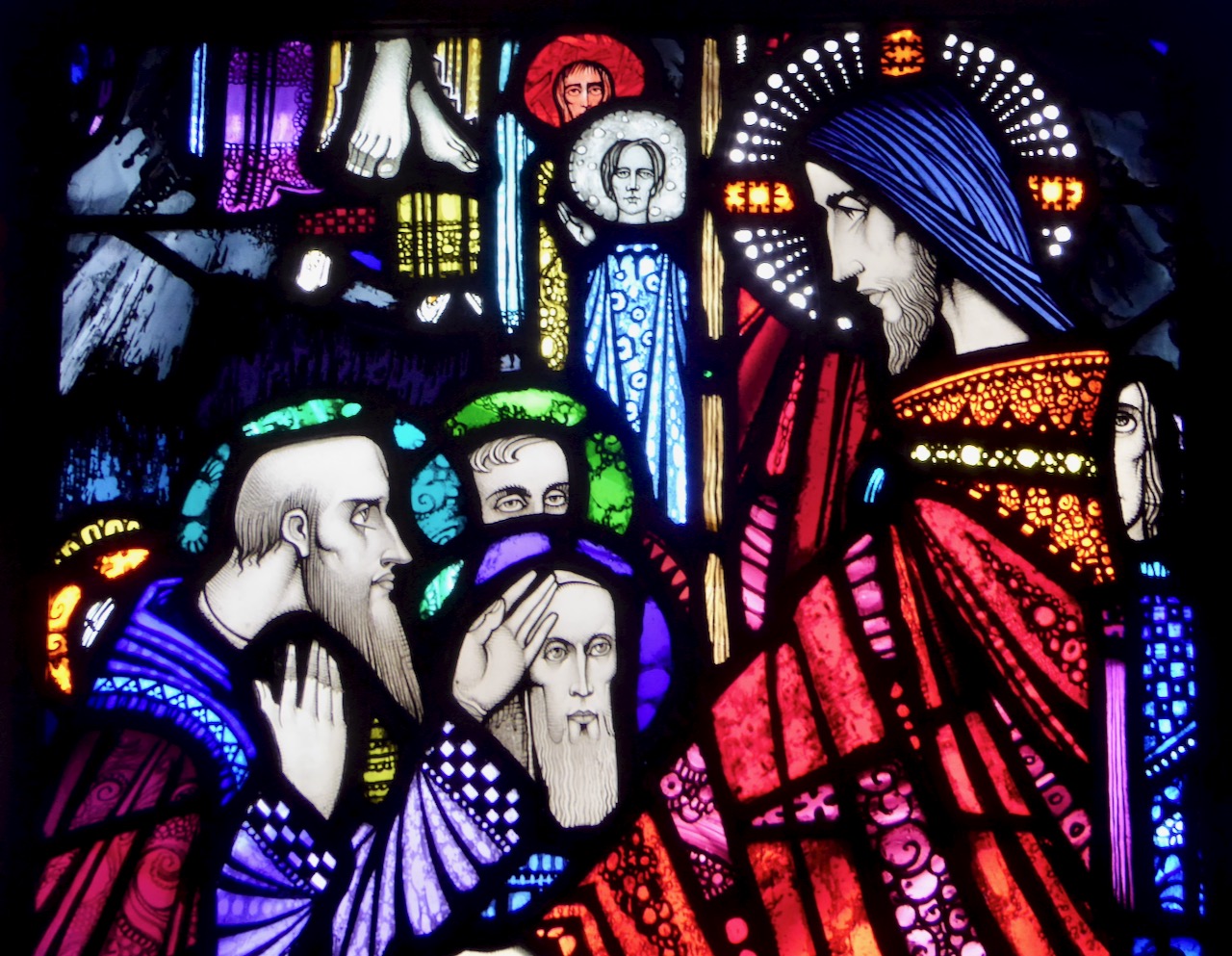
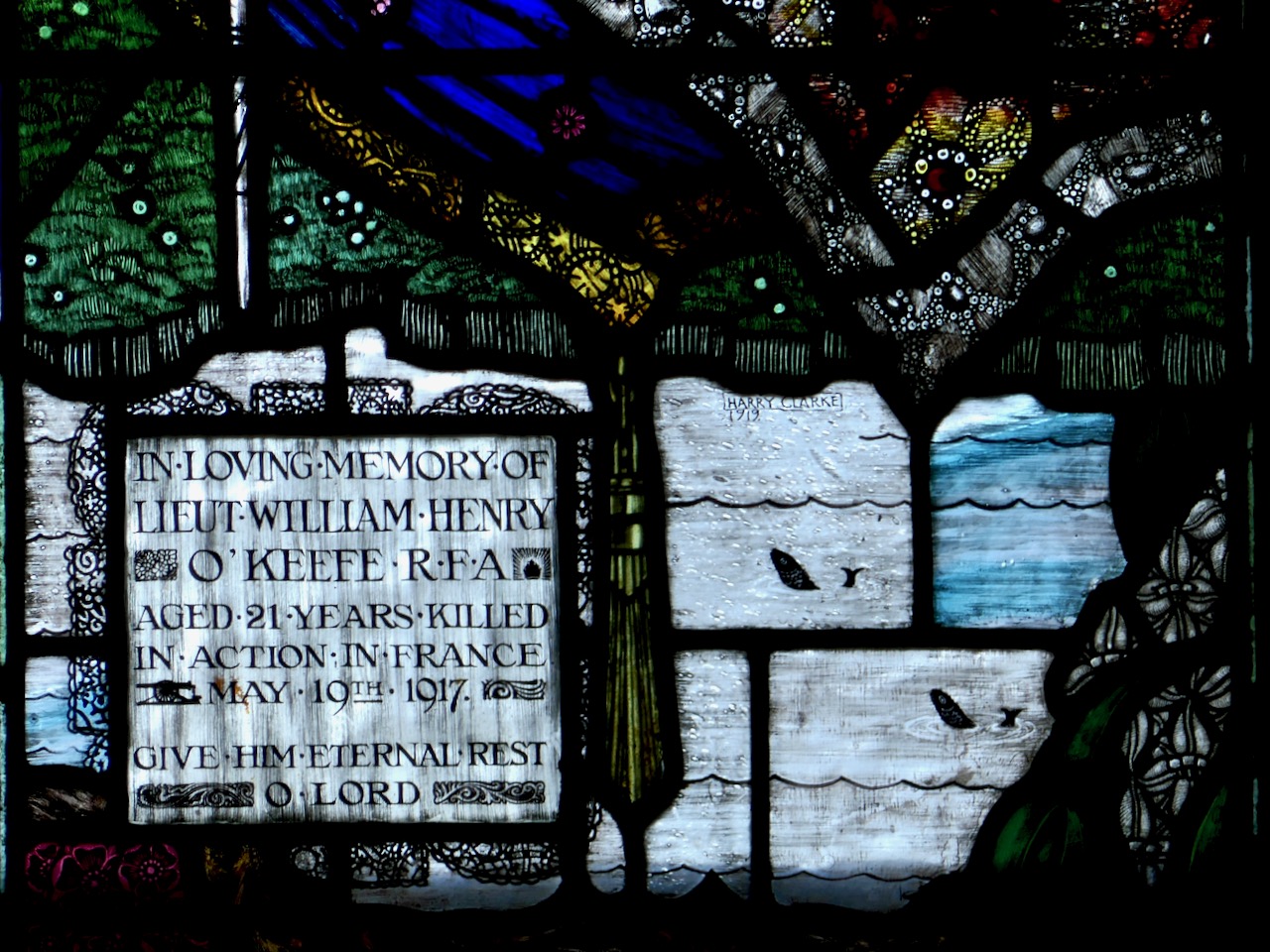
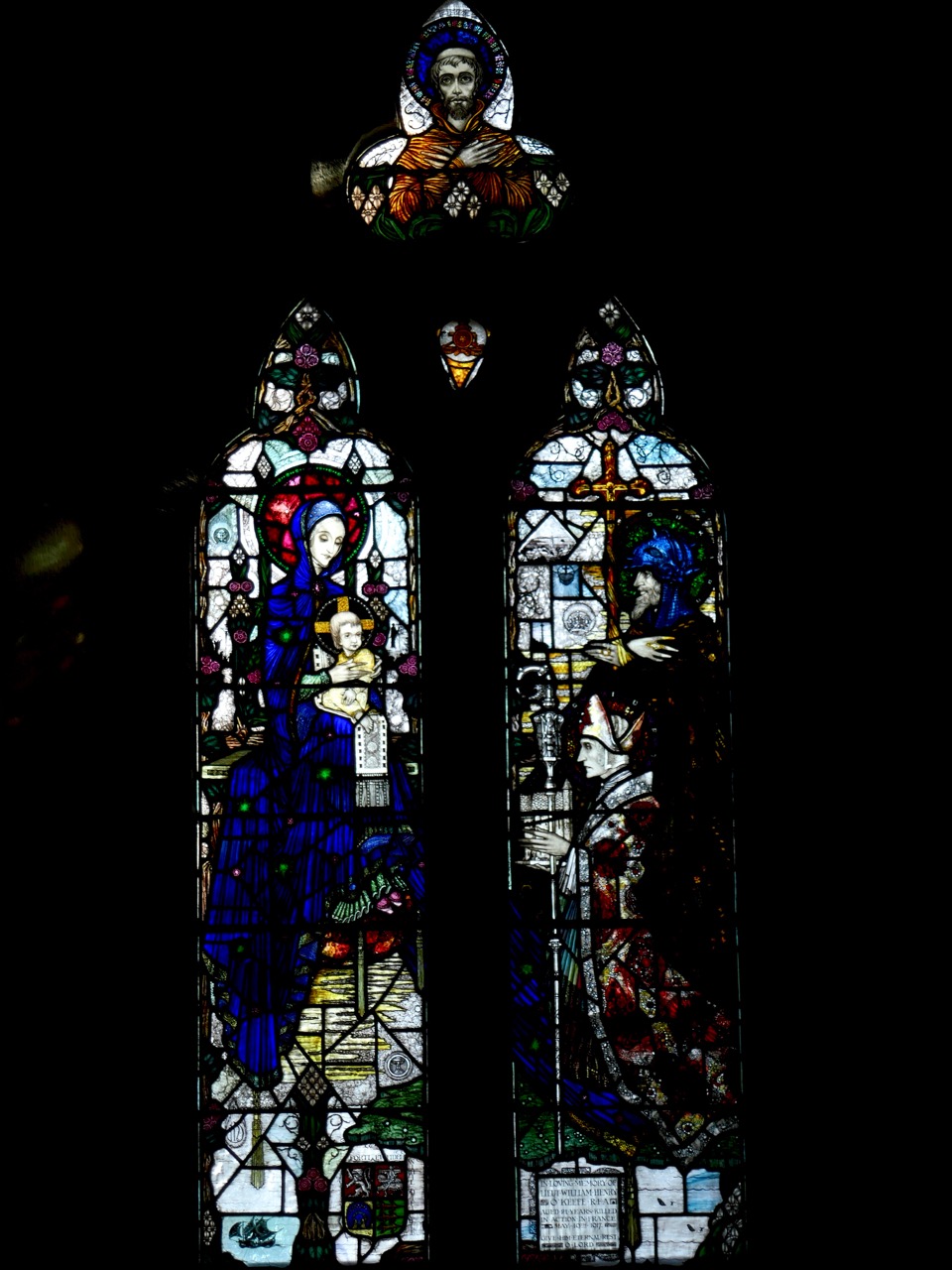
The O’Keefe War Memorial window in the Church of the Assumption, Wexford town, by Harry Clarke (above, and detail top image) 

There are many reasons for the lack of memorials in Catholic churches – for example, the vast majority of Irish soldiers in the British Army came from poor families who could not have afforded such a memorial. But also it has to do with the collective amnesia we developed about our participation in British wars. As I wrote in Outposts of Empire, returning soldiers came back to a new Ireland, one in which nationalist aspirations dominated, and many young Catholic men preferred not to speak about their British Army service.

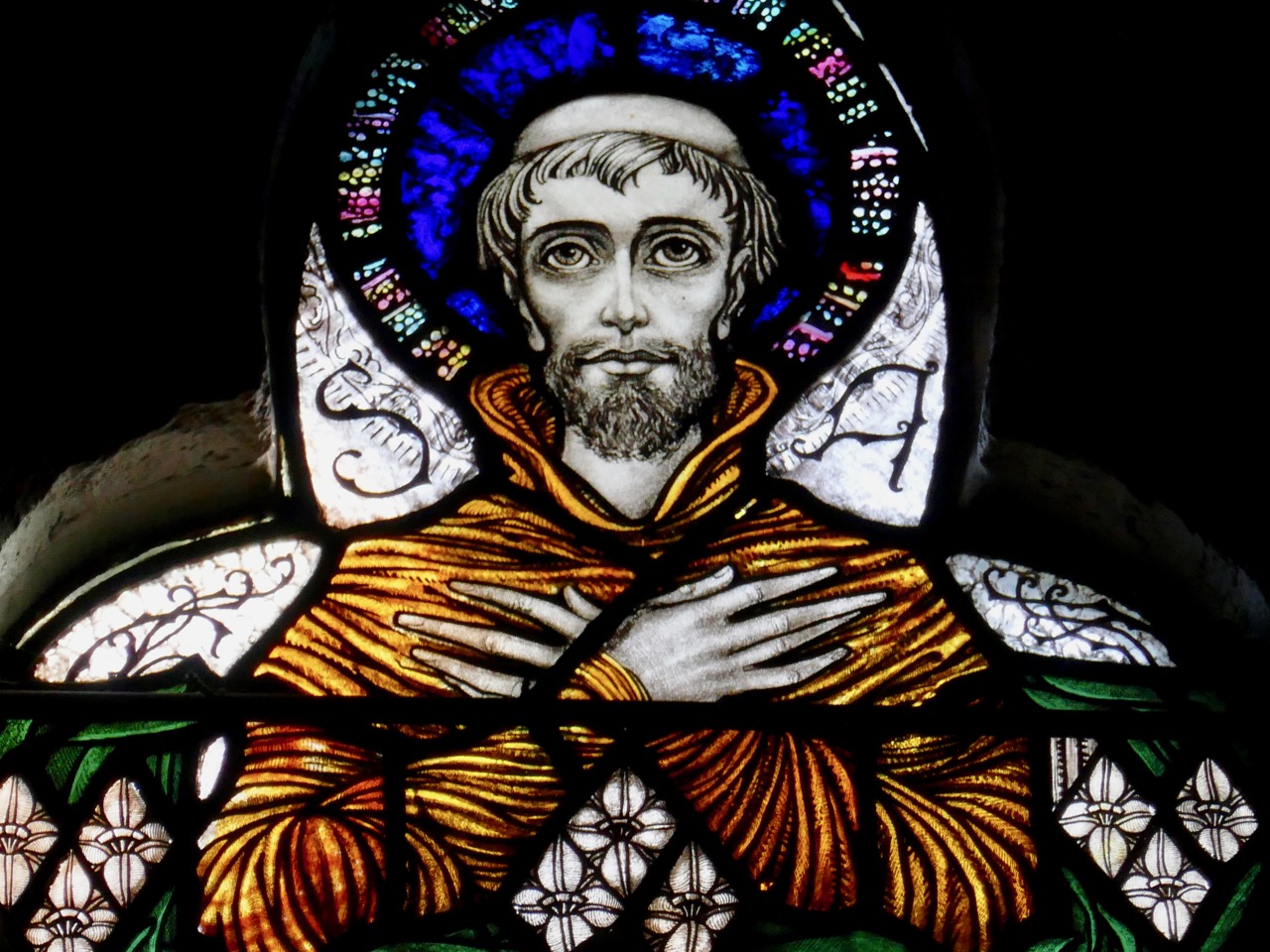
A figure, possibly St Anthony, in the top tracery light of the O’Keefe window

But the three windows I have seen are beautiful and interesting, using some different icons from so many Church of Ireland windows, which tend to feature Michael the Archangel defeating the dragon or a knight in armour fighting “The Good Fight” with regimental standards and lists of engagements in the bottom panel.

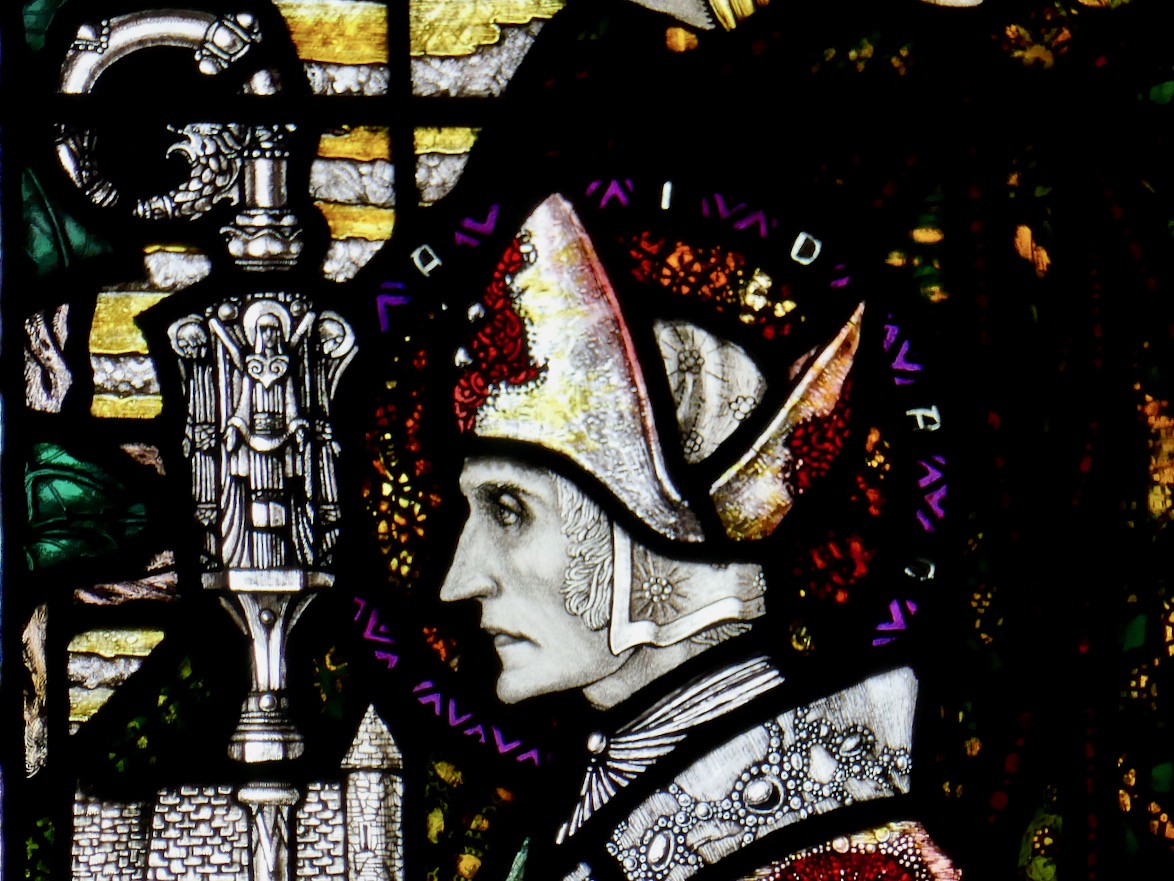
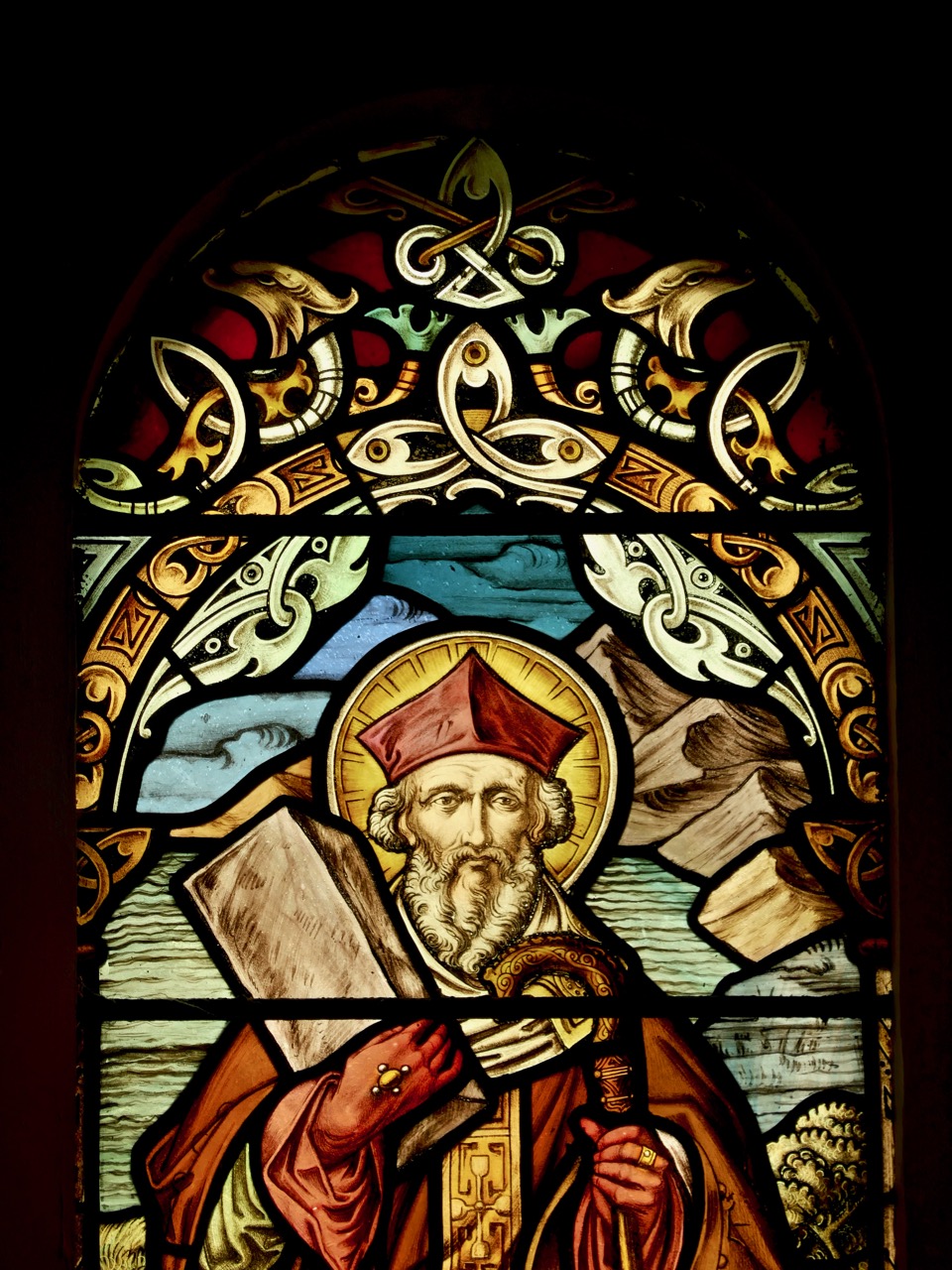
St Aidan of Ferns

I have started with everyone’s favourite, Harry Clarke, who designed and executed this window in the Church of the Assumption in Wexford town. The fallen soldier was 21 year old Lieut Henry O’Keefe and Harry travelled to Wexford in Sept of 1918 to meet his mother and discuss the window, which was installed the following year.

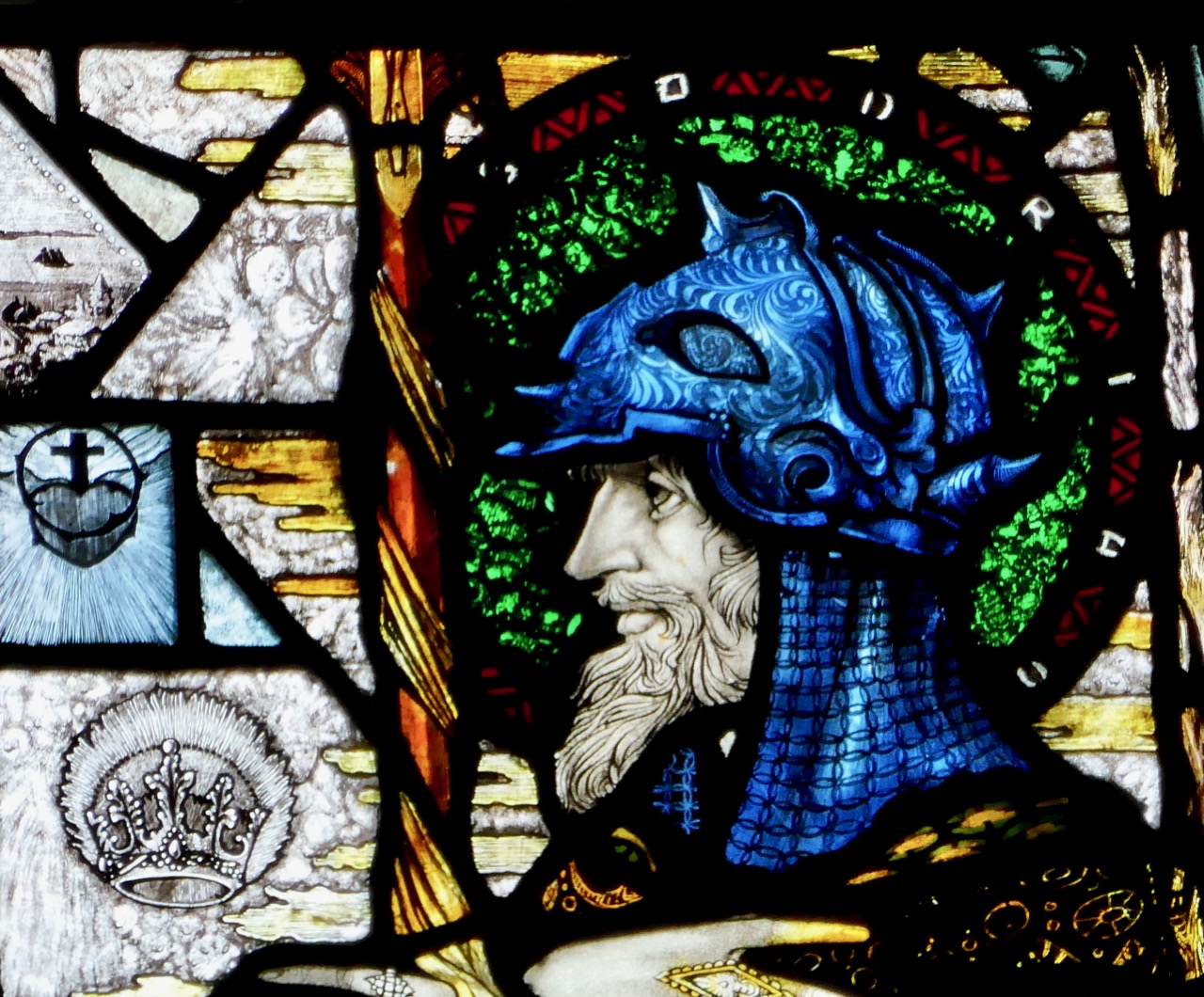
St Adrian, Patron Saint of Soldiers

The design is classic Harry Clarke. Serenely floating high on the left panel is the Madonna and child, clothed in an elaborate and bejewelled blue gown which extend across to the second panel where two saints have come to pay homage. The image of the Madonna evokes the bond between mother and child, while the two saints are carefully chosen: St Adrian is the patron saint of soldiers and St Aidan of Ferns represents Wexford. Above, in a tracery light, a monk, possibly St Anthony, gazes out in an attitude of prayer.

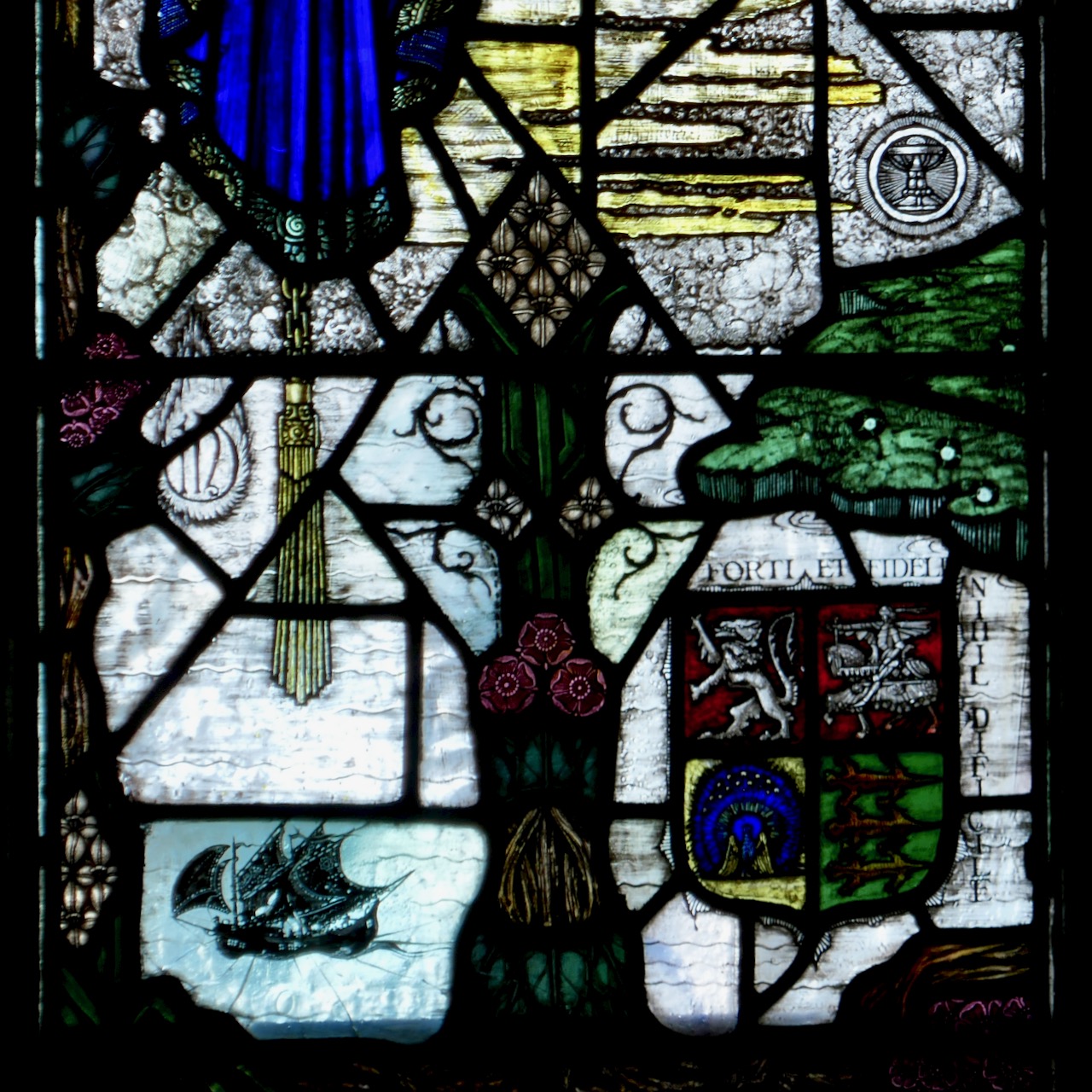
The O’Keefes were a prominent Wexford merchant family and their coat of arms is shown in one panel. Numerous tiny details – a ship, leaping fish, crucifixion images, a tiny image of the Church of the Assumption itself, as well as Harry’s ubiquitous floral ornamentation, fill every section. The overall result is highly emotive. I can imagine the O’Keefe family visiting often and finding comfort in the beauty and compassion of the imagery.

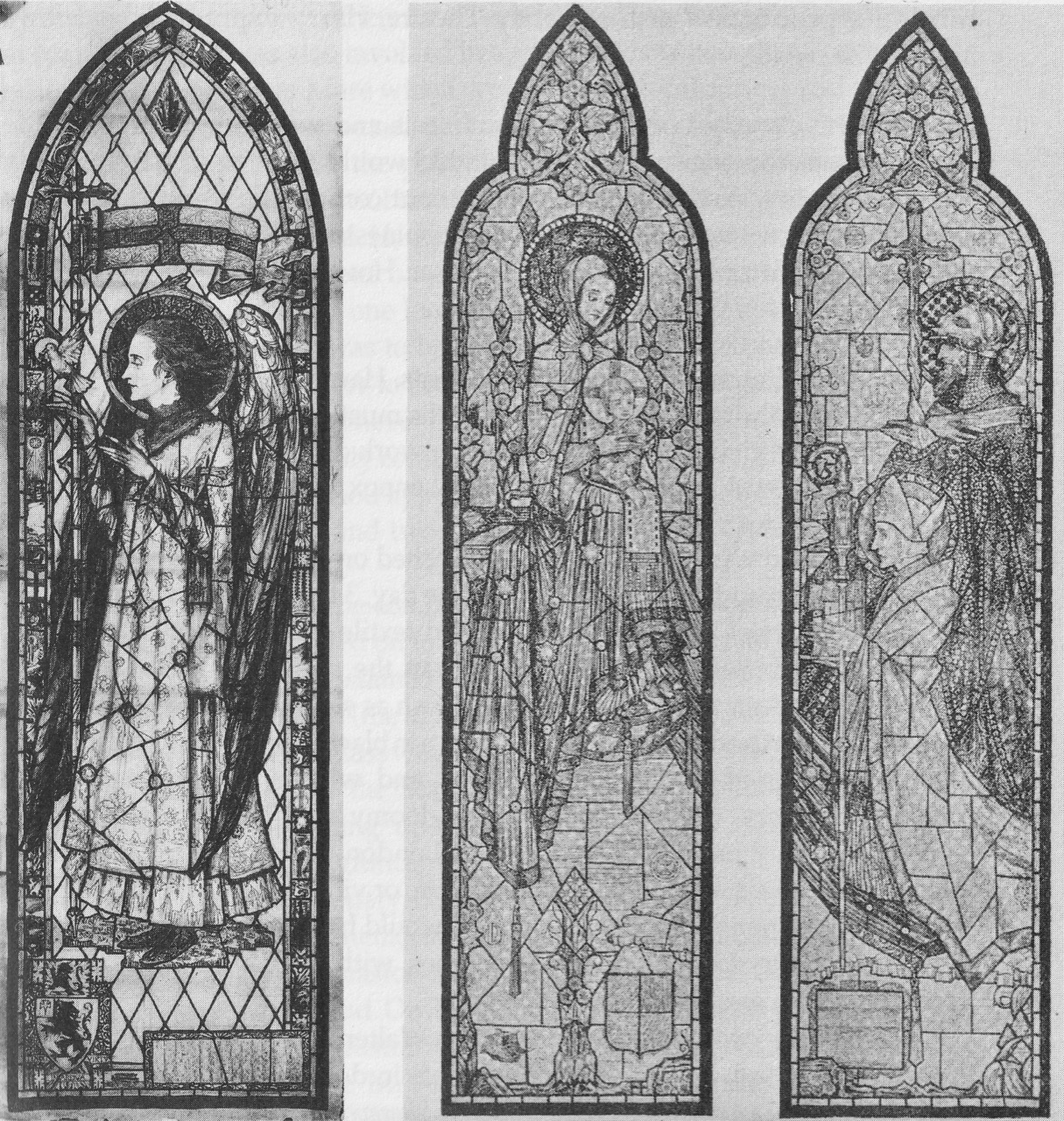
Harry Clarke designed two WWI memorial windows simultaneously and they are completely different. Above is the cartoon for the O’Keefe window and, on the left, for a window, Angel of Hope and Peace, for the Holy Trinity Church of Ireland in Killiney, Co Dublin

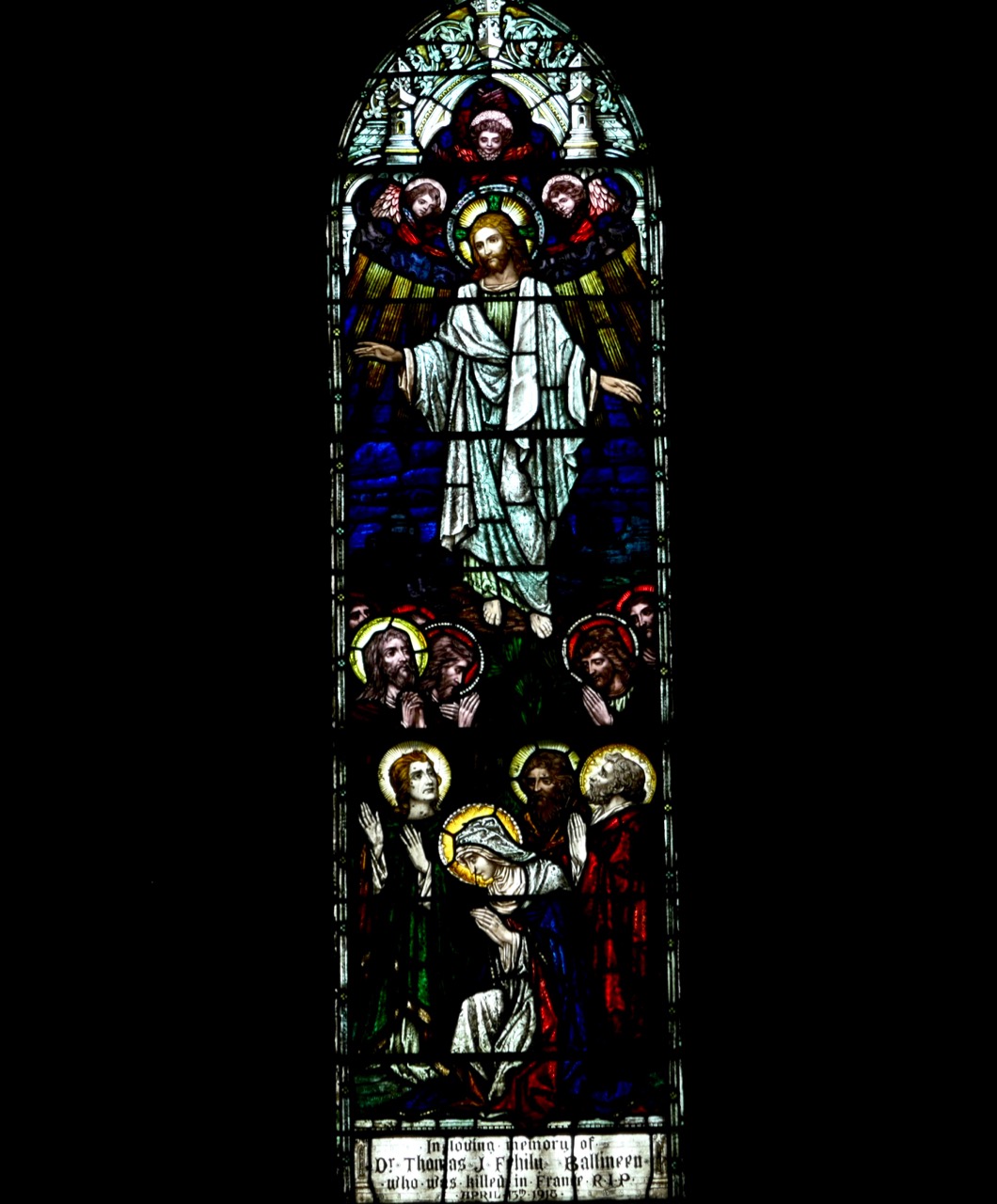
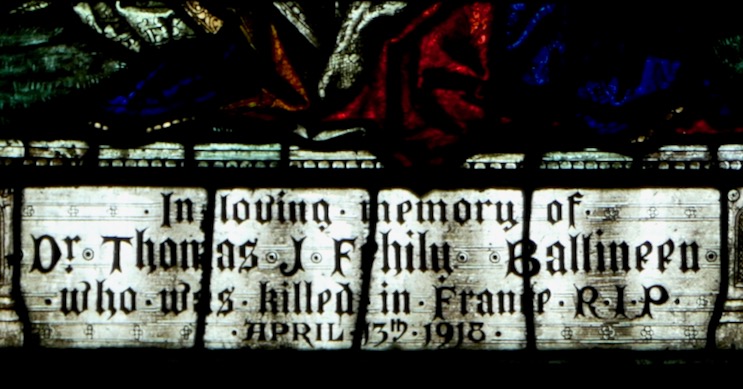
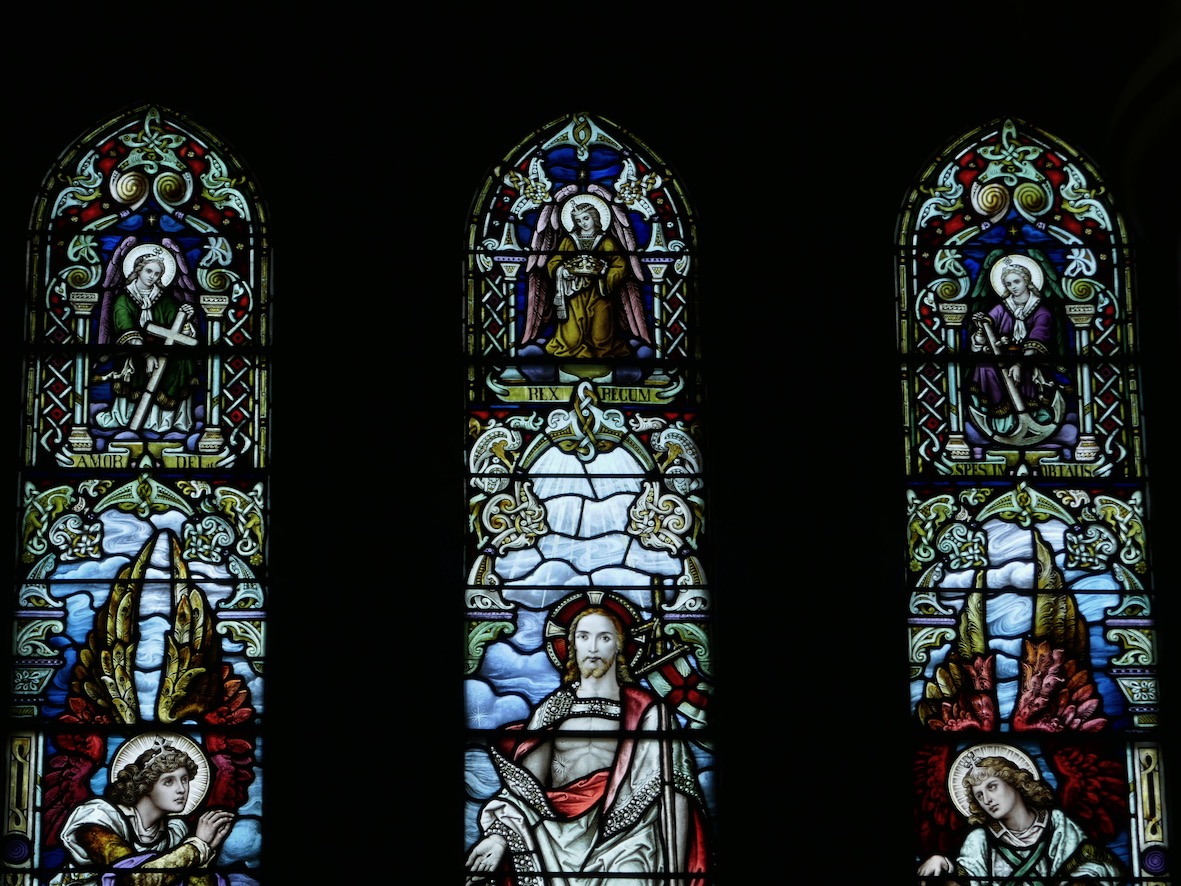
Our second example is from the West Cork Church of the Immaculate Conception in Enniskeane. Probably by Watsons of Youghal, this window is a memorial to Dr Thomas J Fehily, a native of the parish who qualified and practised medicine for many years before enlisting.

Local historian, Anne Lynch has given a good account of his life in a Southern Star article. She writes, Ballineen was a long way from the action when World War I started in the summer of 1914. However, two local brothers, both medical doctors, saw the war as an opportunity to utilise their medical skills. In doing so, it cost one brother his life, while for the other, it was the start of an illustrious career in the British Empire. The doctors were the Fehily brothers.

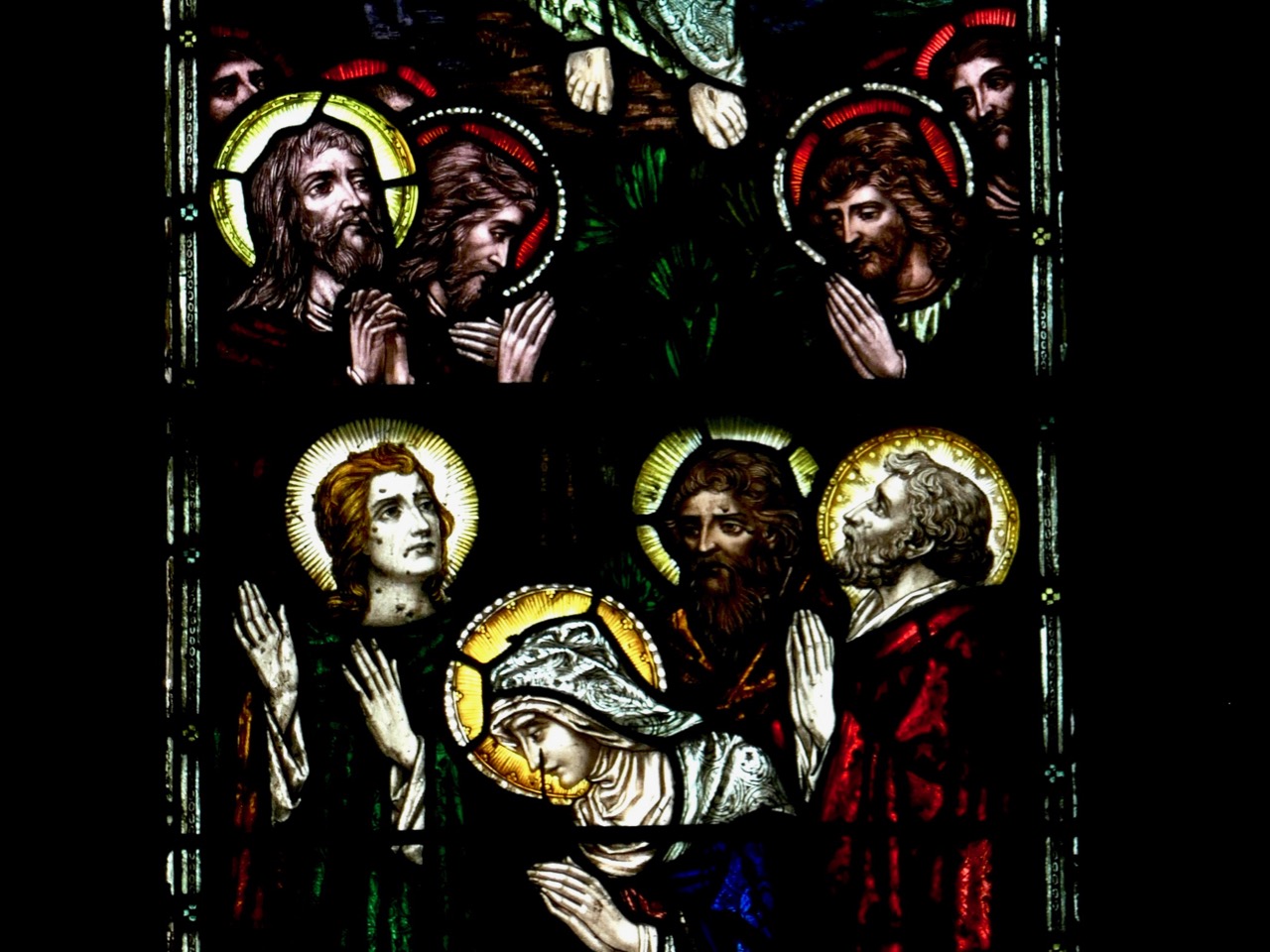
This is an Ascension window and at first I was puzzled by this choice for a war memorial window but as I thought about it, it became clear – Jesus ascends to heaven having sacrificed his life for his fellow man, while his sorrowing mother weeps below.

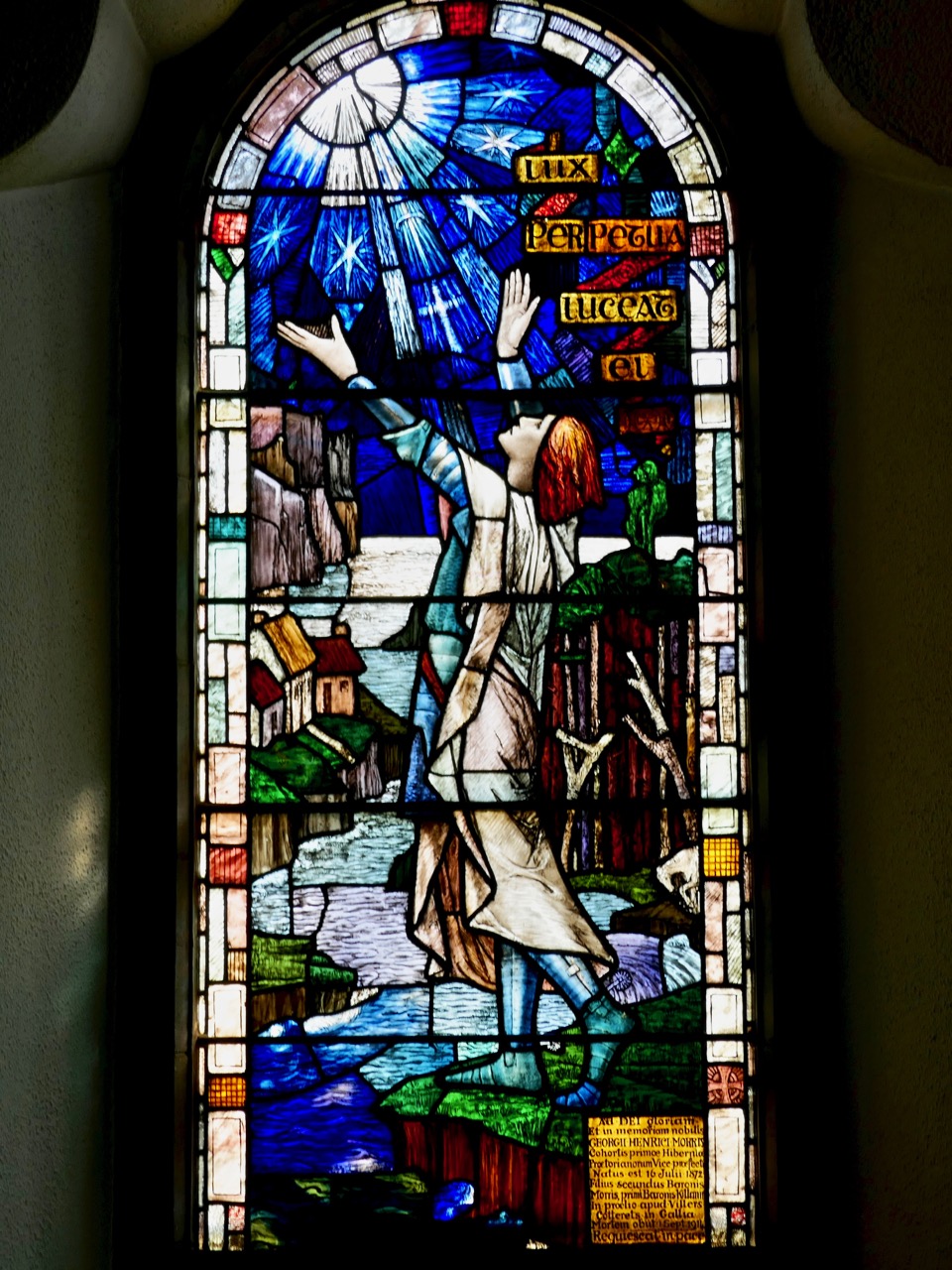
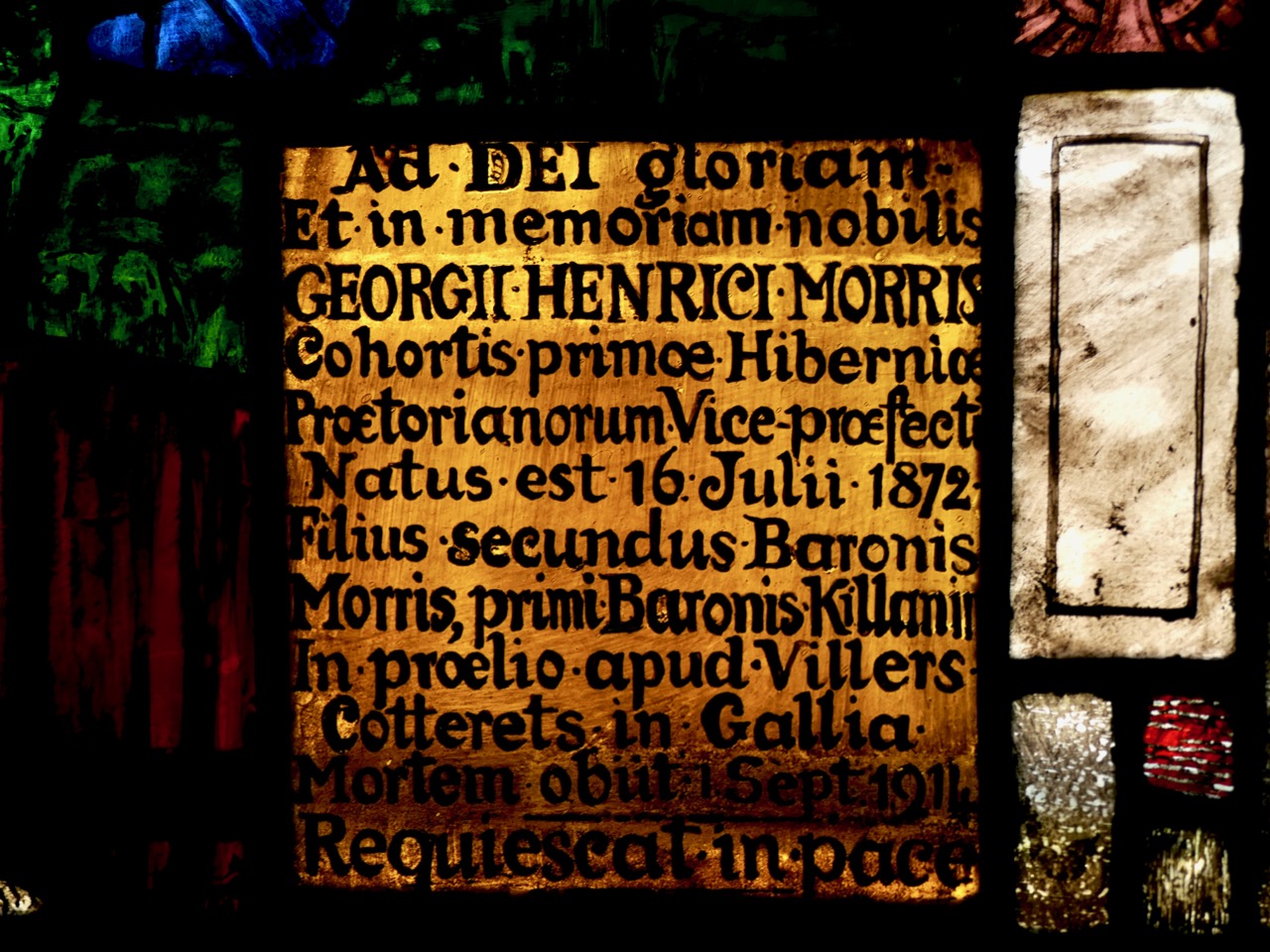
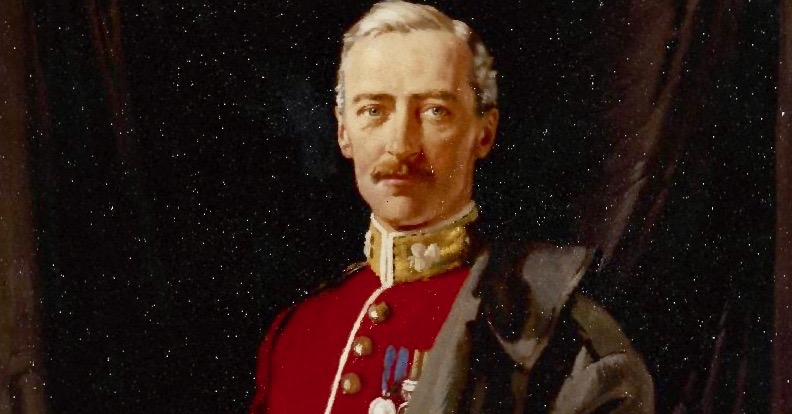
The final window is in the neo-Romanesque church of Spiddal in Co Galway and is dedicated to the memory of George Henry Morris, a hero of the war, and second son of Lord Morris.  A painting of George Henry by William Orpen ends this post.

There is an affecting account of a visit to his grave by his grandson Redmond Morris with his own children, where they even manage to take a photograph in the very spot that George himself was last photographed. By all accounts a brilliant man and a highly respected officer, George died within two weeks of arriving in France. Read more about him on his Wikipedia page and note that he was the father of Lord Kilanin, for many years the esteemed President of the International Olympics Committee.

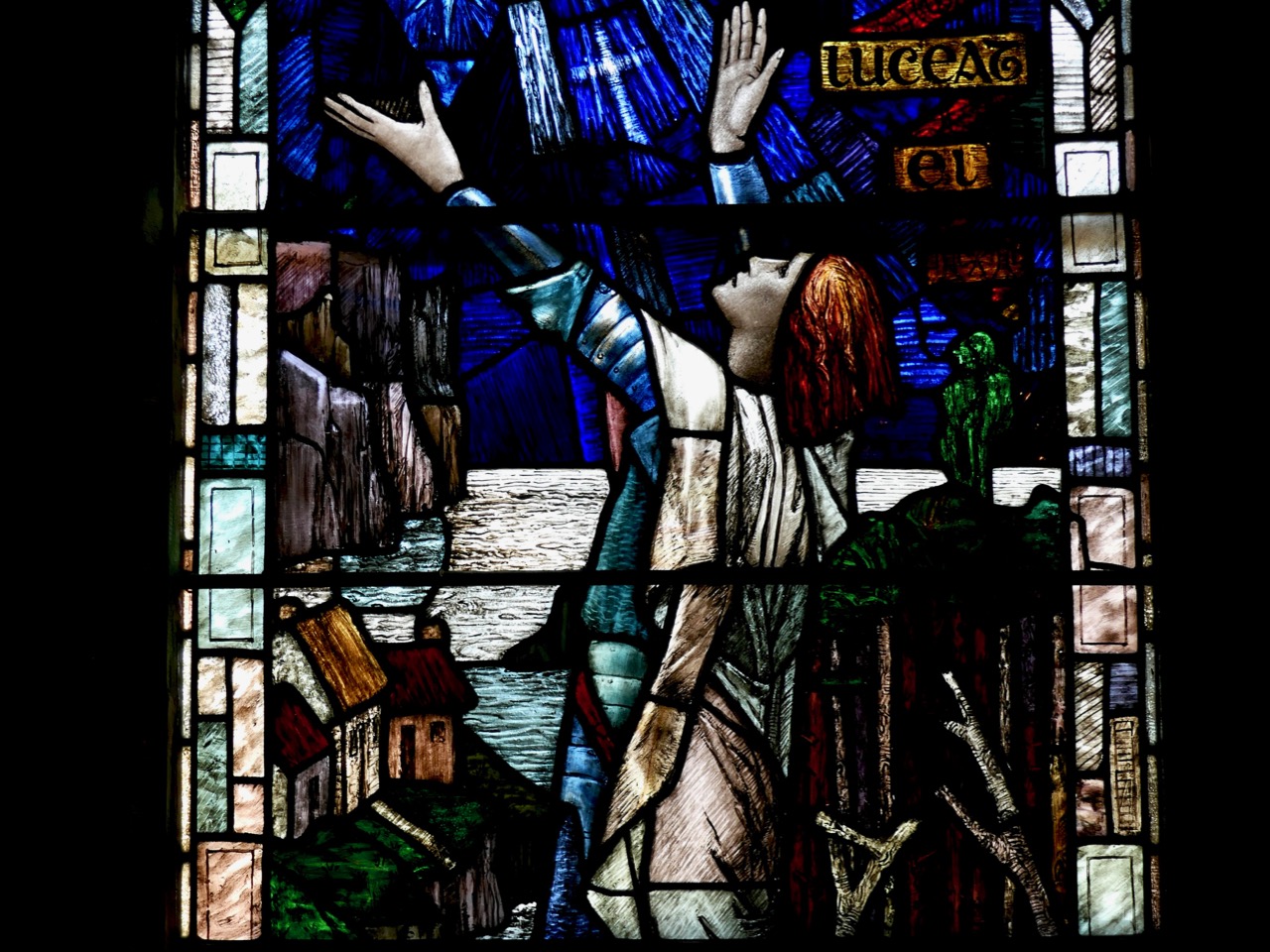
The window is by Catherine O’Brien, one of the artists of An Tur Gloine.  See this post about Loughrea Cathedral for more about this design co-op: Edward Martyn was also involved with the design and furbishment of this Spiddal church. O’Brien has depicted a golden-haired figure reaching upwards to a divine light, with the words lux perpetua luceat ei – Let Perpetual Light Shine Upon Them. The figure is a rider (denoted by his spurs only) and a riderless horse is seen at the bottom right. The location in Connemara is captured with thatched cottages and sea cliffs.

One of our most famous War Dead was the poet, Francis Ledwidge. His poem, A Soldier’s Grave, has given me my title, and I will leave it here now in honour of the many brave Irish men who gave their lives in WWI.

Then in the lull of midnight, gentle arms
Lifted him slowly down the slopes of death
Lest he should hear again the mad alarms
Of battle, dying moans, and painful breath.

And where the earth was soft for flowers we made
A grave for him that he might better rest.
So, Spring shall come and leave its sweet arrayed,
And there the lark shall turn her dewy nest.

George Henry Morris, painted by William Orpen

Watsons of Youghal – Revivalist Masters Part 1

The stained glass firm of J Watson & Co of Youghal not only represented a new type of Irish-based business when it started to operate in the 1880s but developed a uniquely Irish style of stained glass (see above). I introduced this topic in my post Symbols and Stories: Looking at Stained Glass, but I want to develop it properly in this post and provide further illustrations in the next. Watsons was first opened by Michael Buckley, who had Irish connections, as a branch of Cox, Sons, Buckley and Co of London but was eventually bought out by James Watson, a Yorkshire stained glass artisan who had come to work there a decade earlier. Members of the Watson family continued to make windows right up to 2012.*

This St Eltin window in Gougane Barra has been attributed to Michael Buckley. Note the Revivalist elements

Based in Youghal, the firm supplied stained glass all over Ireland, but especially in Munster. They competed with other new firms which had set up church supply and decorating businesses, mostly in Dublin. These included Joshua Clarke (father of Harry), James Pearse (father of Patrick and Willy) and the Earley Brothers, Thomas and John. All of them had learned the trade in Britain and some started as agents for such companies as Mayer of Munich and London or Hardman of Birmingham, but eventually employed their own artists and glaziers.

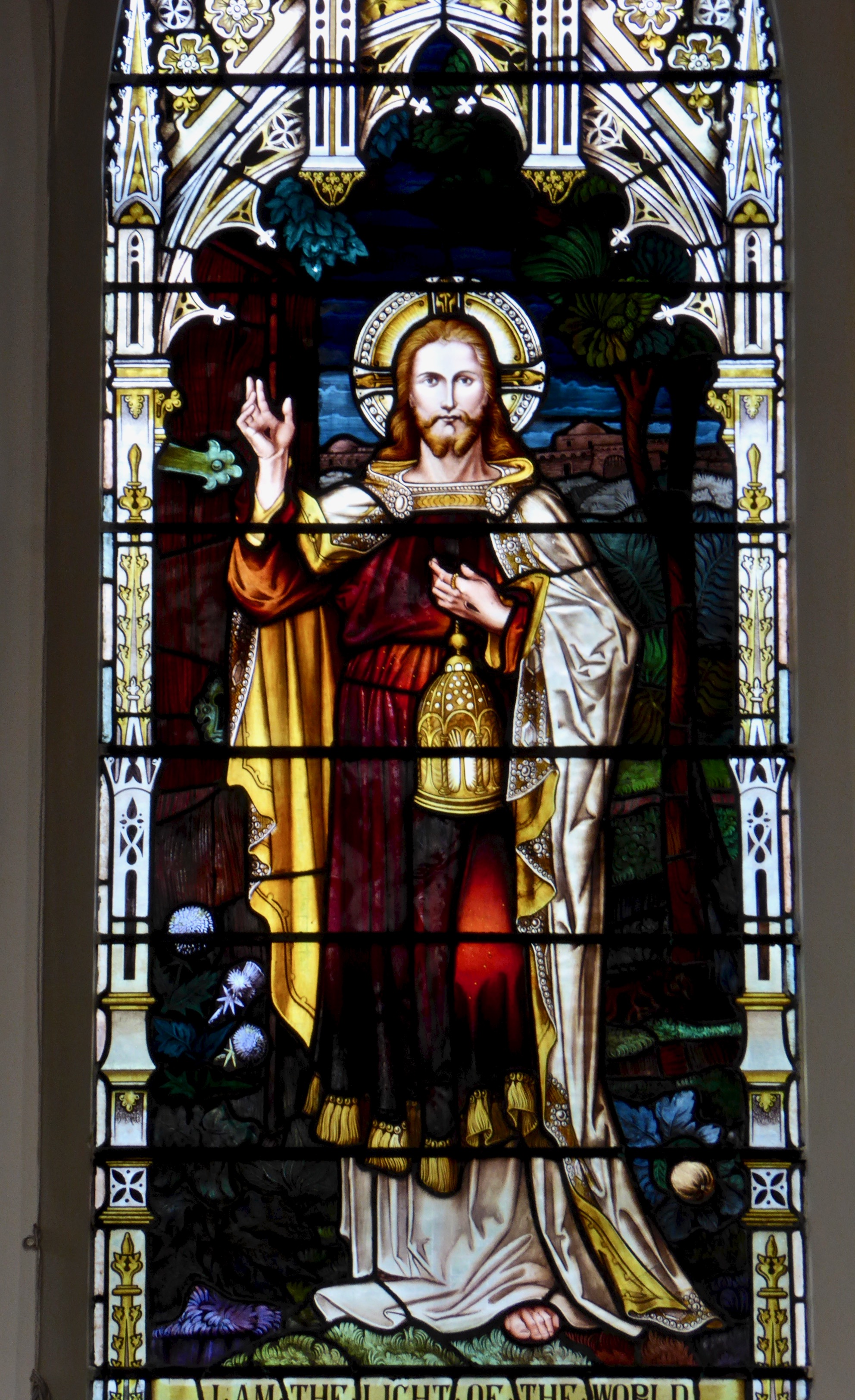
This is one of many Light of the World windows that Watsons produced, in St Brendan’s of Bantry Church of Ireland. Note the conventional Gothic canopies . This was a universal favourite, especially in Protestant churches and all the stained glass manufacturers had a version

This was a boom period for Irish church building and stained glass windows were, of course, one of the expressions of faith that could enliven and decorate the interiors. They also offered an opportunity for both clerical and lay people to contribute to the church and to commemorate deceased family members (and occasionally to commission an ego-stroking window for themselves).

Catherine O’Brien of An Túr Gloine painted this window for Kilcoe Church of the Most Holy Rosary in West Cork. Note the introduction of some interlacing as a minor element in the design. Patrick and Brigid, as the male and female patron saints of Ireland were always in demand for church windows

The choice of iconography for the window was dictated either by didactic imperatives (e.g. the Holy Family as a model to be emulated by the faithful) or by devotion to a particular saint, international, Biblical or local, or by church politics (e.g. Papal authority).  This was also the period when the Celtic Revival was in full swing and artists of all kinds were busy crowding graveyards with Celtic crosses, stitching Book of Kells symbols onto vestments, and painting illuminated addresses with complicated knotwork. Buying from Irish firms, once they were able to supply the orders, quickly became preferred.

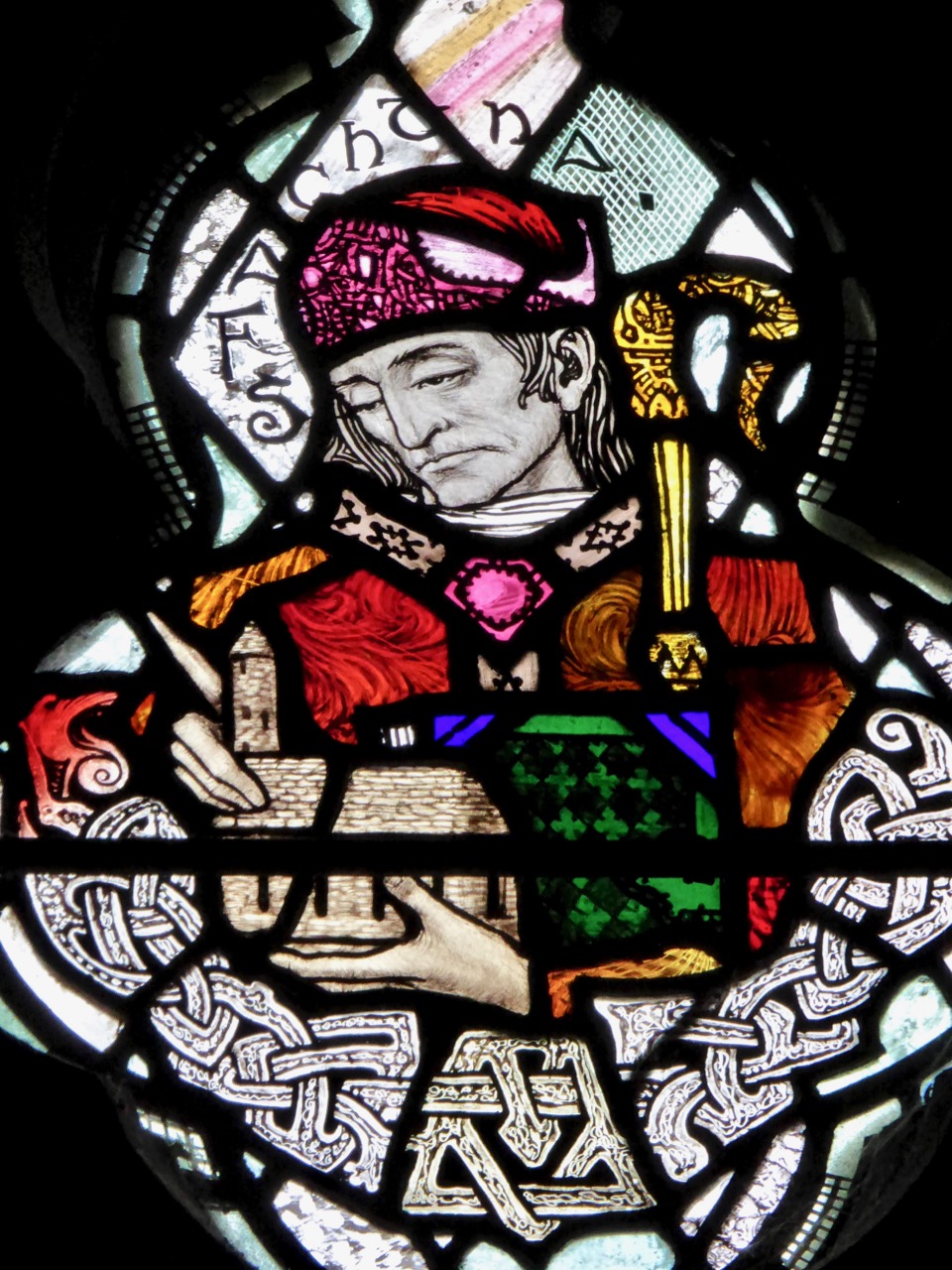
Harry Clarke did not incorporate much interlacing into his windows, but this one, of St Fachtna, in Castletownshend Church of Ireland, shows that he knew well how to do it

Nowadays the term Celtic is suspect: we no longer believe that the evidence exists for an Iron-Age invasion of a tall blonde race from the continent. Archaeologists and Art Historians often now use the term Medieval Insular Art, however Celtic Revival, as shorthand for the domination of a certain decorative style (as well as the re-discovery of a great literary tradition and the craze for antiquarianism) at the end of the nineteenth century and into the Irish Arts and Crafts period, is so well understood that I use the term, and ‘Revivalist’,  here in that spirit.

Contrast the canopies in this window, with its intricate interlacing, with the conventional Gothic canopies of the Light of the World window above. Watson’s executed this one for Charleville Catholic Church

In her in-depth analysis of the Watson Archives, art historian Vera Ryan has demonstrated that orders for stained glass often stipulated that instead of the gothic canopies favoured by the English and German manufactures, windows should contain Celtic (or even ‘Keltic’) artwork. While other firms included some minor elements of interlacing in a design (see the Brigid and Fachtna windows above), no Irish stained glass firm delivered on this request better than Watsons of Youghal – it became one of their hallmarks and a real selling point for Irish clergy of both Catholic and Church of Ireland persuasions.

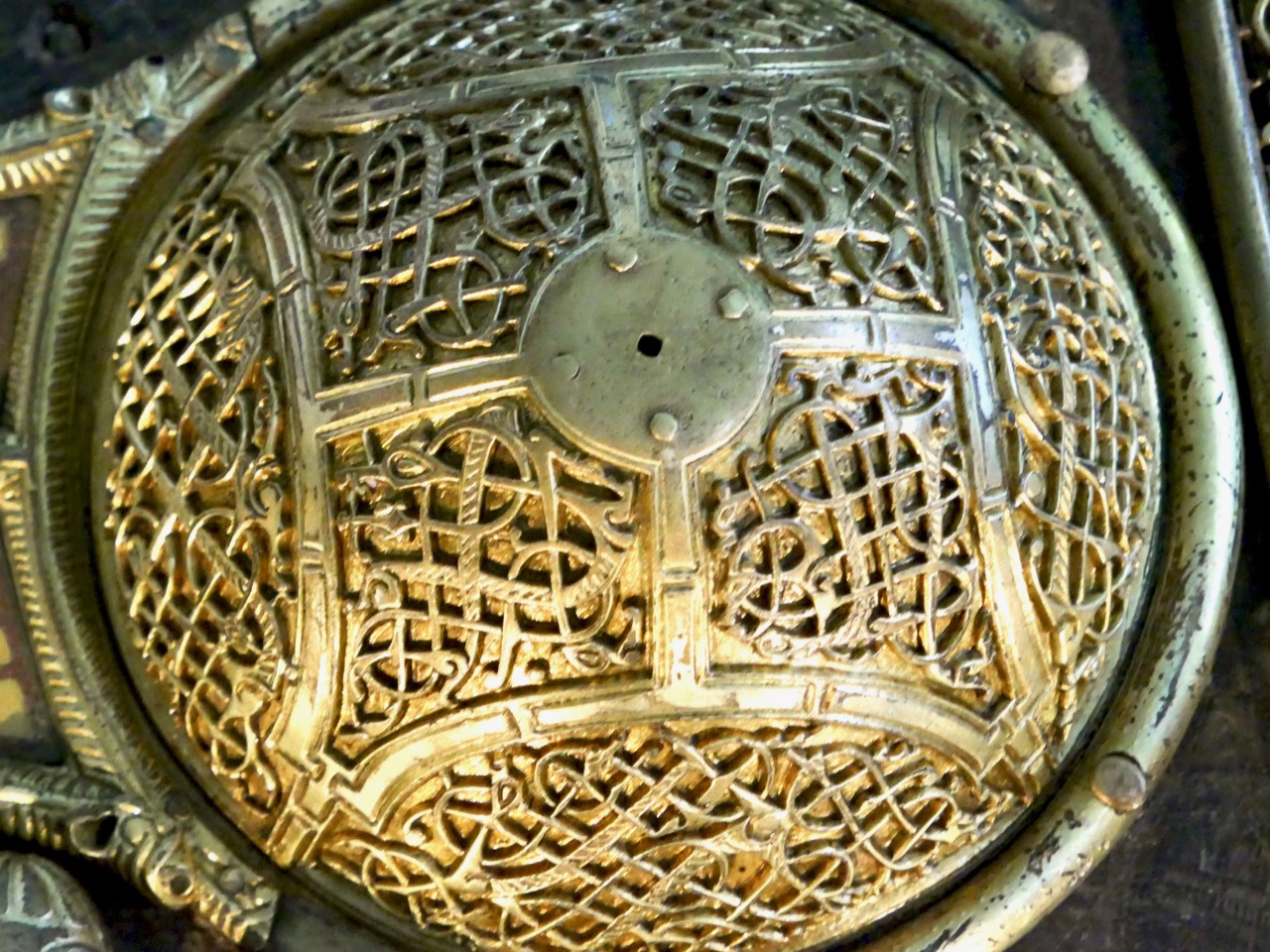
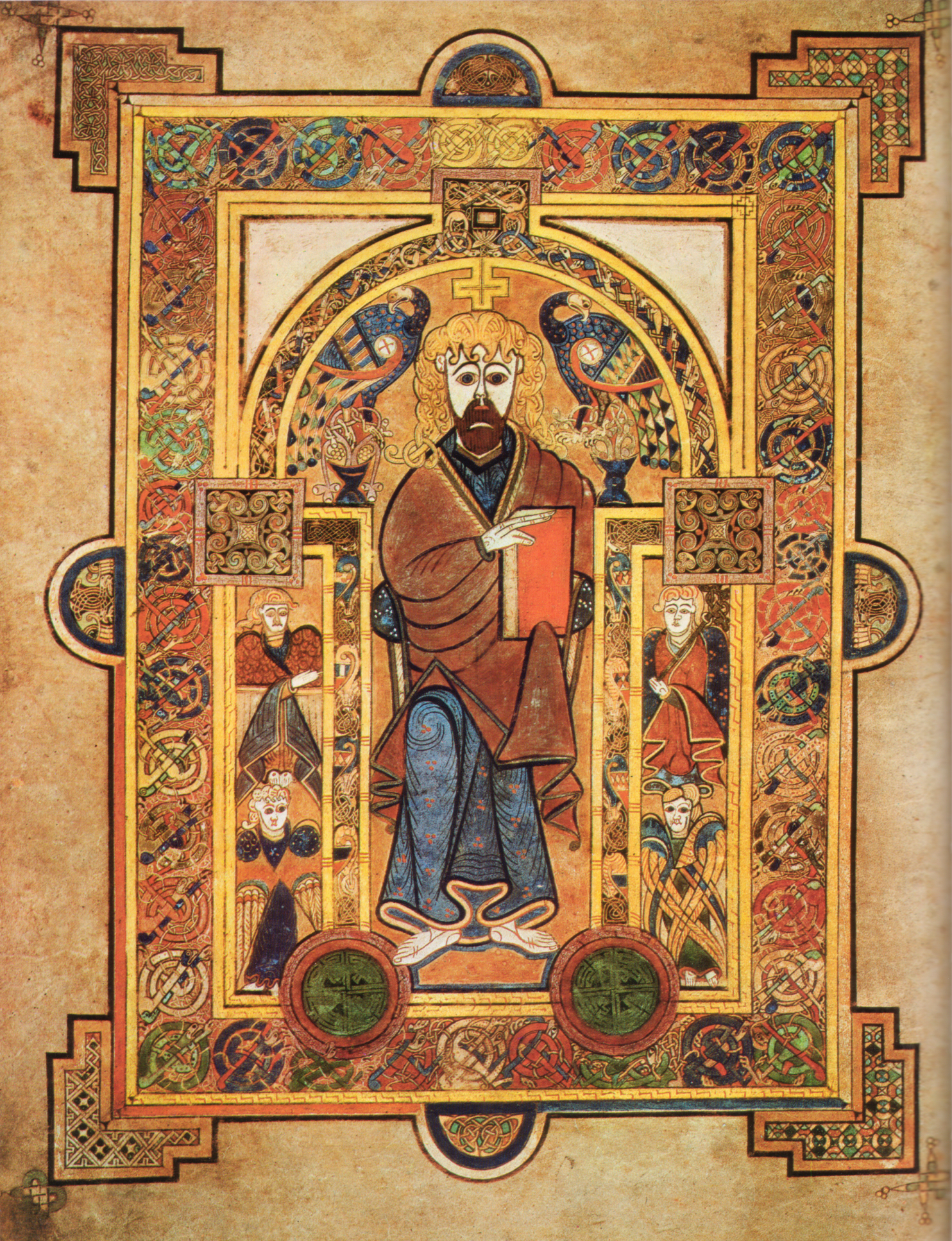
Models artists could learn from: Upper – a detail from St Manchan’s shrine, a replica of which was housed in the National Museum. Lower – The Christ Enthroned Page from the Book of Kells

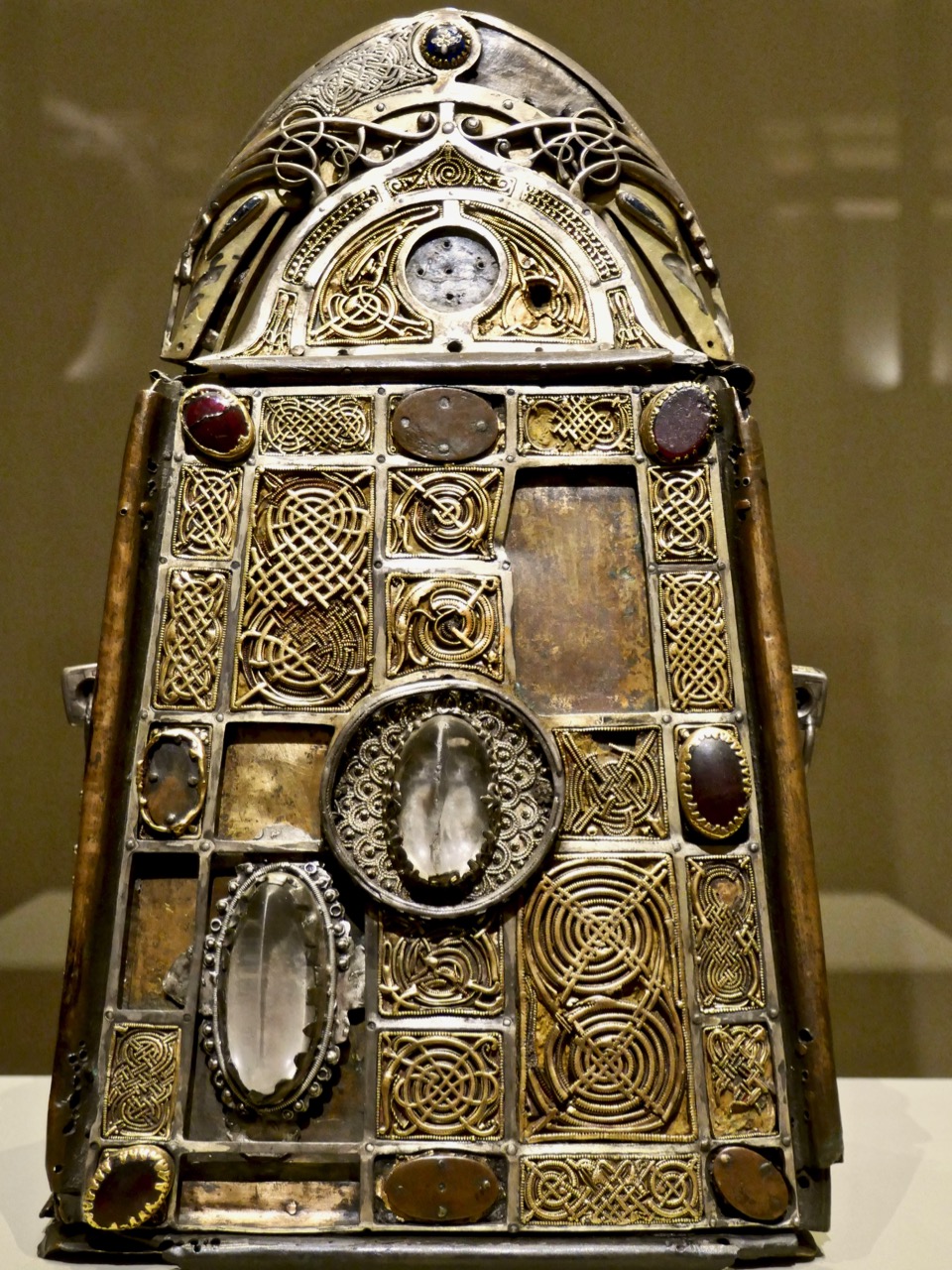
This was the most popular style of art at the time for all kinds of objects and it’s not hard to understand why. First of all, the interlacing itself is delightful, quirky and complex and full of tiny surprises. Secondly, the Revivalist motifs were taken from a rich treasury of sacred and secular Medieval objects that formed the nucleus of the displays in the National Museum, which opened its doors in 1877. The Tara Brooch (below), for example, created a sensation when it was found it 1850 and became instantly iconic, with thousands of copies being made.

Thirdly, and perhaps most importantly, here was now a truly indigenous art of which we could be justly proud. In an era of evolving nationalism, images conjuring up a glorious Christian past, replete with our own saints, literature and high art, was a reminder of what we had once been and what we had lost as a nation.

The Shrine of St Patrick’s Bell – not only a beautiful object but a potent symbol of what was seen as a Golden Age in Ireland of learning and piety

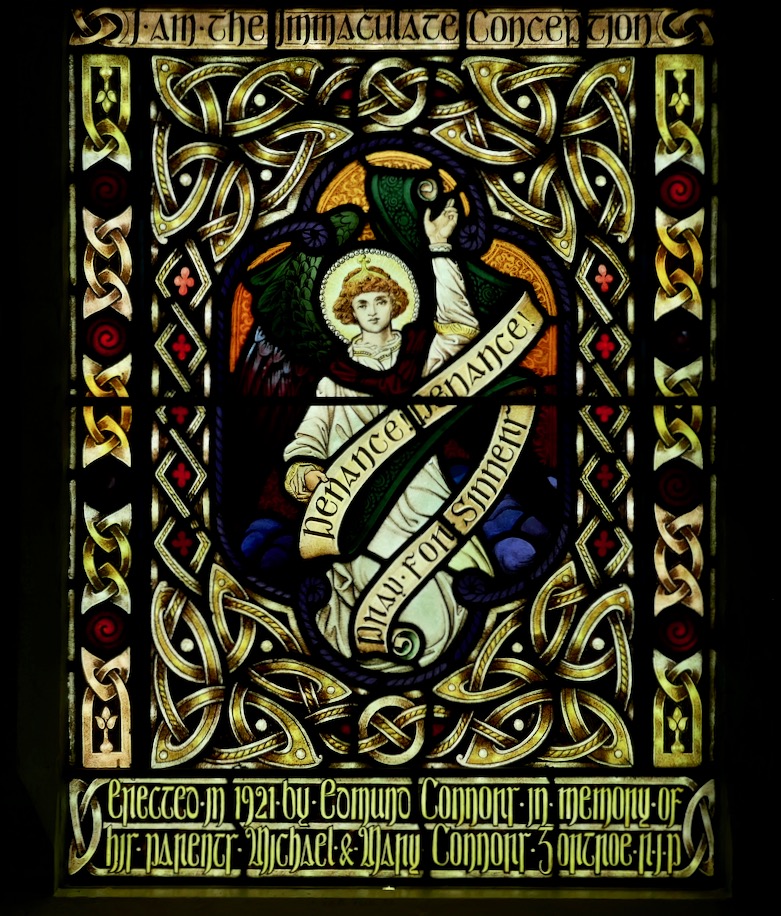
While their figurative designs remained conventional – think bearded men in long robes or saintly women in nuns’ habits, all in the style of renaissance paintings – the artists at Watsons had fun developing increasingly elaborate frames and canopies to surround their figures. Added to this was a mastery of Irish lettering styles, deployed to great effect whether the text was in Irish, English or Latin.

The use of interlacing and an Irish lettering style. Two continuous ribbons link the upper and lower surrounds, with the corner interlacing twisting around them. The Irish script was still being taught to us in school in the 1950s and 60s 

The net result was the development, in the hands of the expert and talented designers and painters at the Watson studio, of a hybrid style of stained glass window unique to Ireland – the overlayering of conventional objects of worship with the originally pre-Christian and later Early Christian/Early Medieval decorative style that came to be labelled ‘Celtic Revival’ at the end of the nineteenth century.

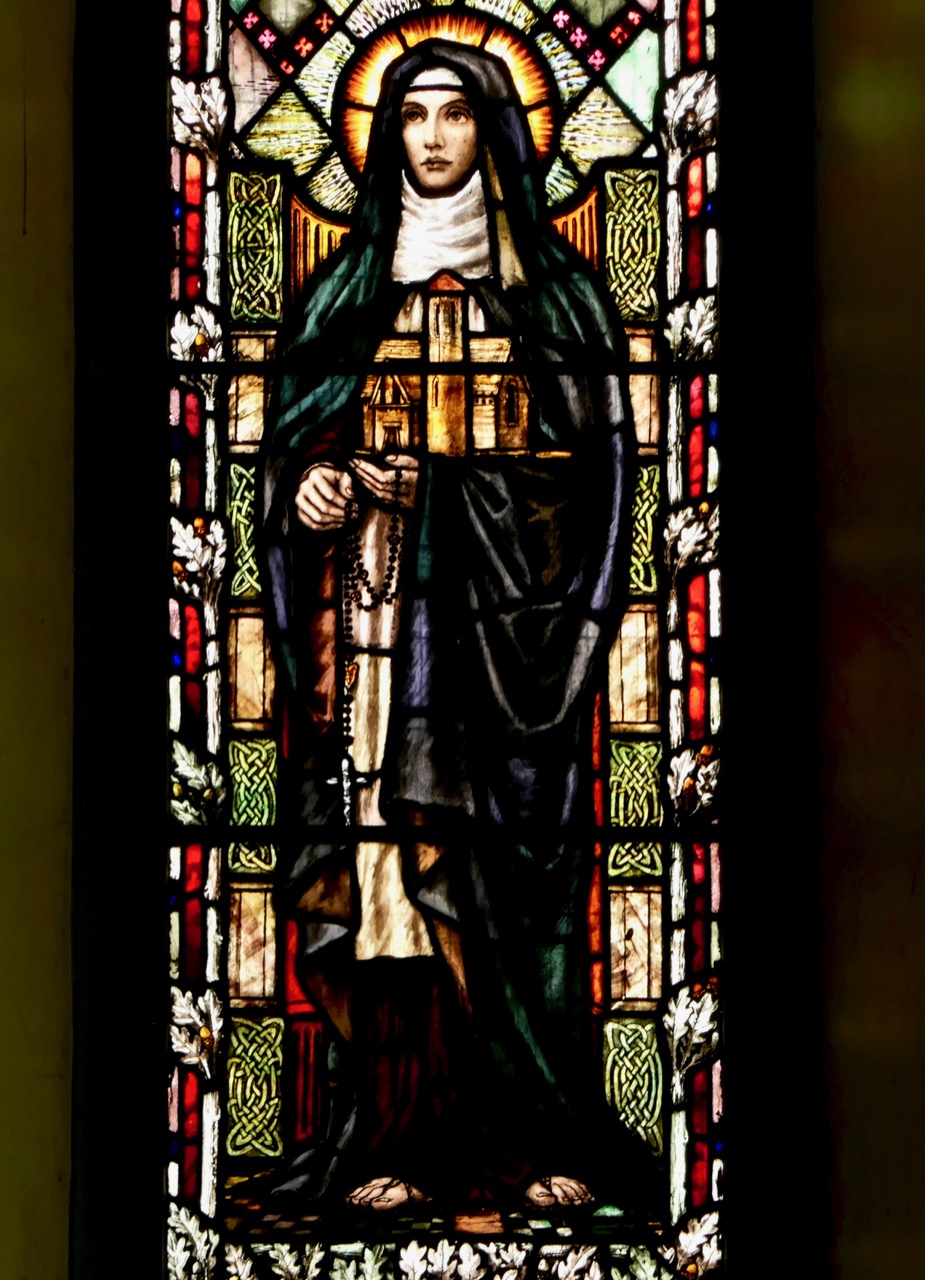
St Carthage, from his eponymous Catholic church in Lismore, Co Waterford. Details include the Book of Lismore, the Lismore Crozier (on display at the National Museum) and a whole galaxy of interlace motifs for the clothing and decorative surround

Next week – examples of Watsons’ use of Revivalist motifs and where to go to see them, as well as some original cartoons, now housed in the Crawford Gallery in Cork. I leave you with a detail from one of the windows employing interlace and lettering – but can you spot the signature?

*Much gratitude to Vera Ryan who has generously shared her Watson expertise with me, and to the Crawford Art Gallery for allowing access to the Watson Archive. I recommend Vera Ryan’s article Divine Light: A Century of Stained Glass in the Summer 2015 edition of the Irish Arts Review for those who would like to learn more about Watsons of Youghal.

Part 2 is here.