One Acre – One Year On

Last year I introduced to you the wildflowers that arrive unbidden every year to our one acre plot in West Cork. This year I will continue that tradition (if it’s more than once, it’s a tradition – agreed?), starting in March and ending in September and trying to choose different flowers from last year. It was a very different year!
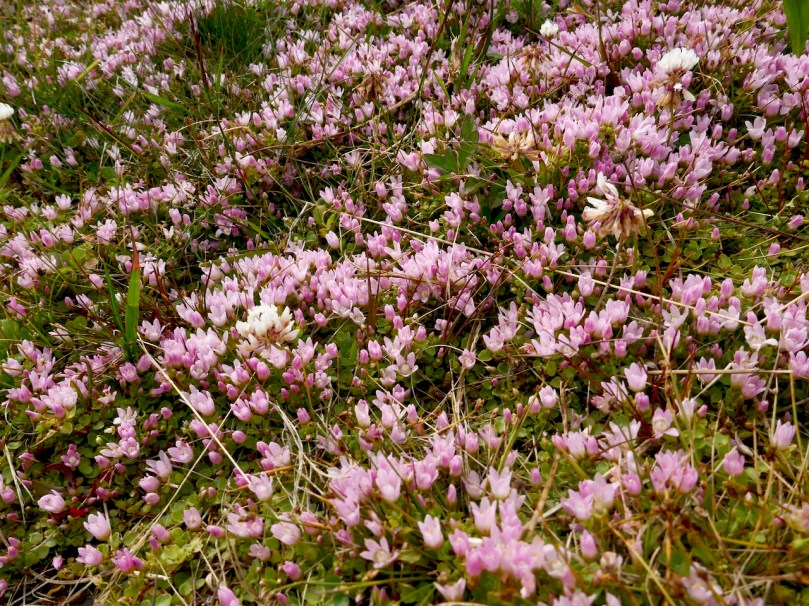
Top image – Blackthorn, the first of the trees to blossom in April (flowers before the leaves come). Above is Blog Pimpernel which grows on what had been quite a wet section of the lawn last year

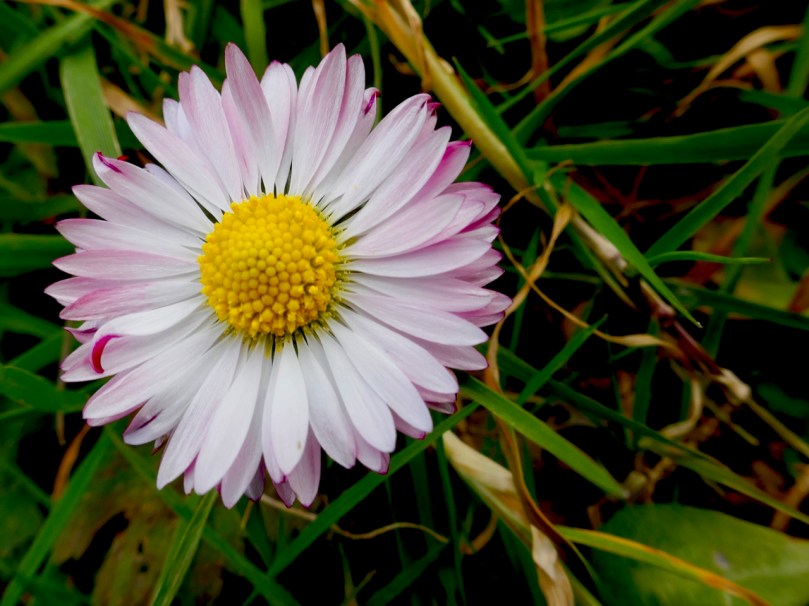
We had a late start to spring after a long and exceptionally cold winter. Everything seemed about two to three weeks later than last year, so that by March, all I really had to report was the good old lawn daisy.
But finally in April the chill abated and tiny flowers started to appear in the grass. Nothing too showy yet – some of them needed a magnifying glass to find. The mosses were having a field day, though, and our Blackthorn bushes put on quite a fireworks show.

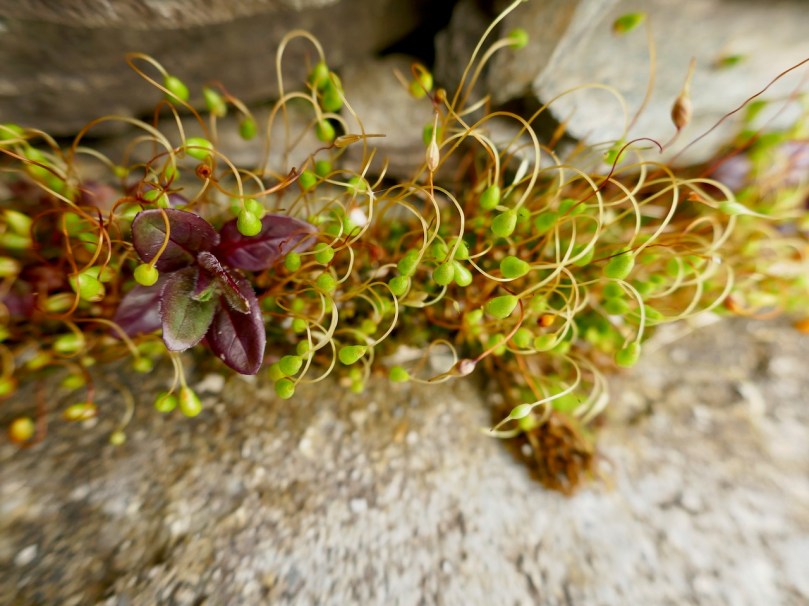
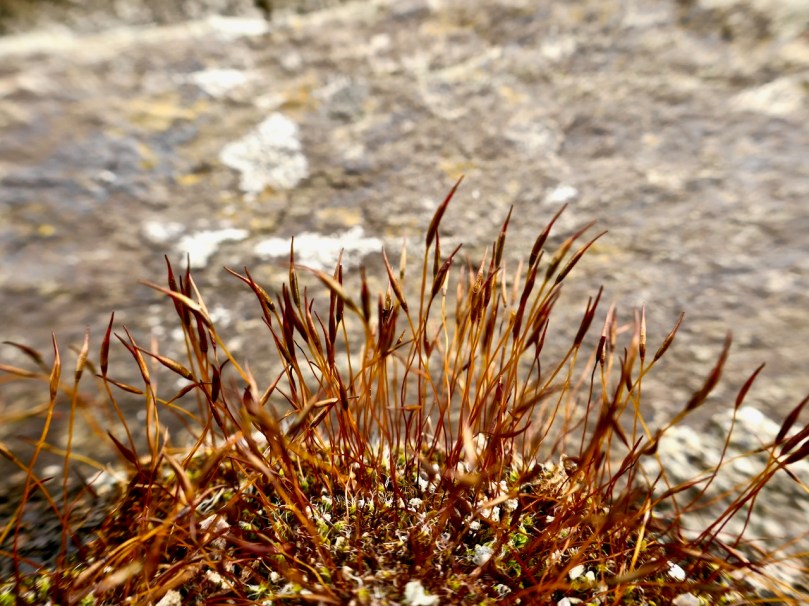
From the top: Keel-fruited Cornsalad (edible and more of a light blue than white); Hairy Bittercress; Common Dog-violet: Ground-ivy; two kinds of mosses

May started to warm up nicely and now the grasses started to grow in earnest, and my uncut portion – my wildflower meadow – took off with a profusion of grasses, sorrel, and clover.
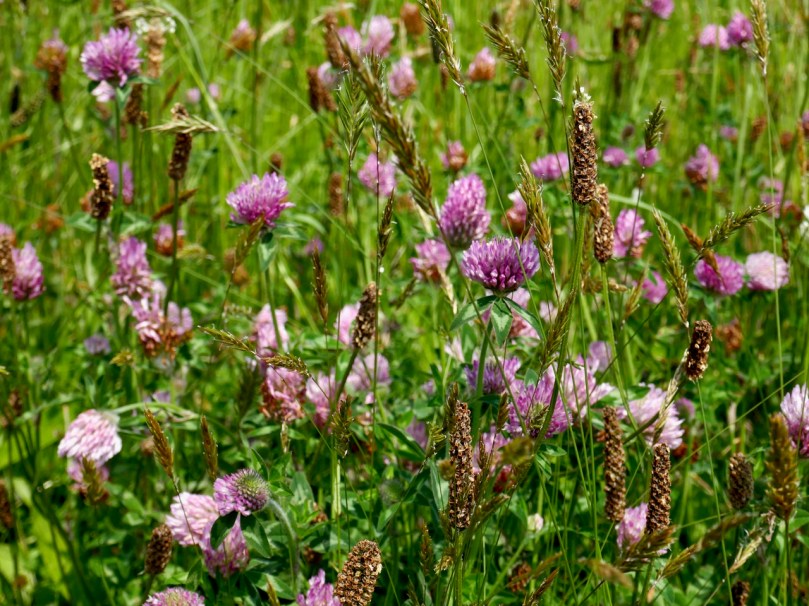
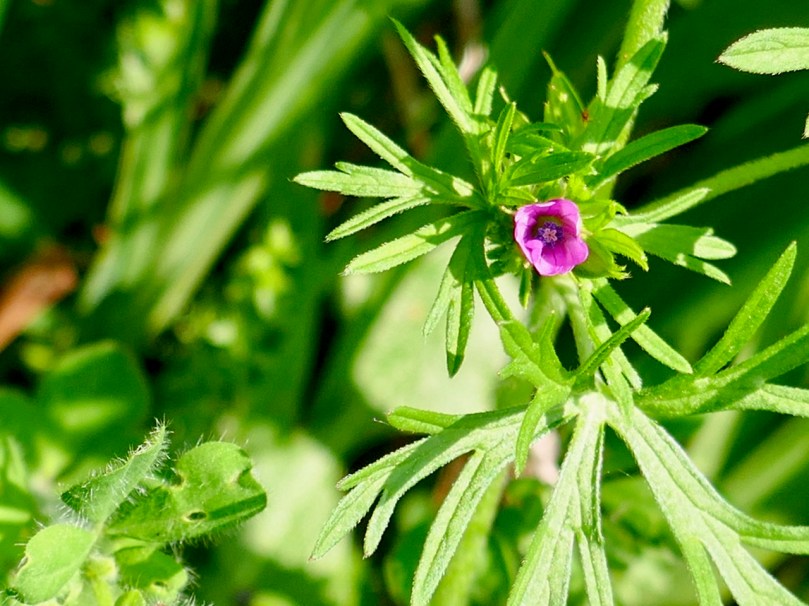
From the top: Grasses, Red Clover, Ribwort Plantain; Common Milkwort; Cut-leaved Crane’s-bill; Trailing St John’s-wort; English Stonecrop; Whitethorn (flowers after the leaves come)

And then, boy did it warm up – Flaming June, they call it, and it lived up to its reputation this year with everything suddenly verdant and pulsing with life and colour. Day after day of sunshine – we just aren’t used to that around here and as the month wore on the word drought was introduced to our vocabulary. Imagine – in Ireland!
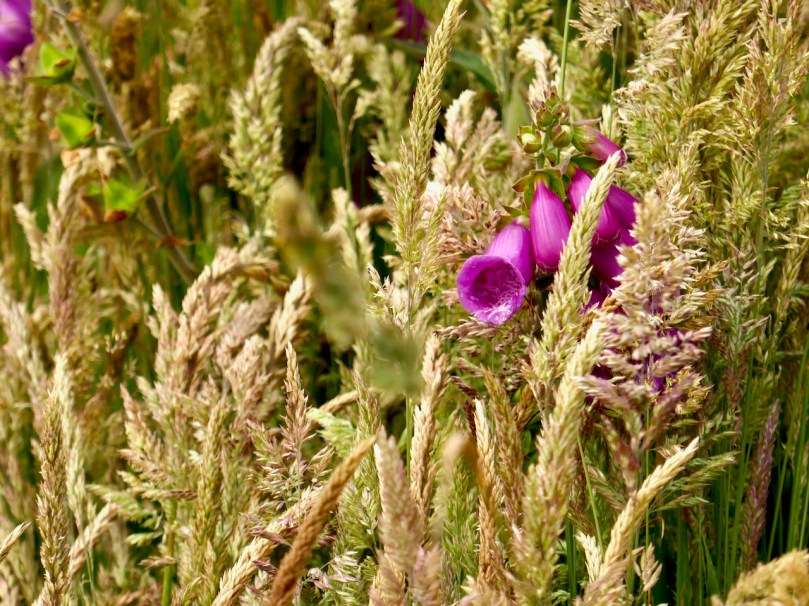
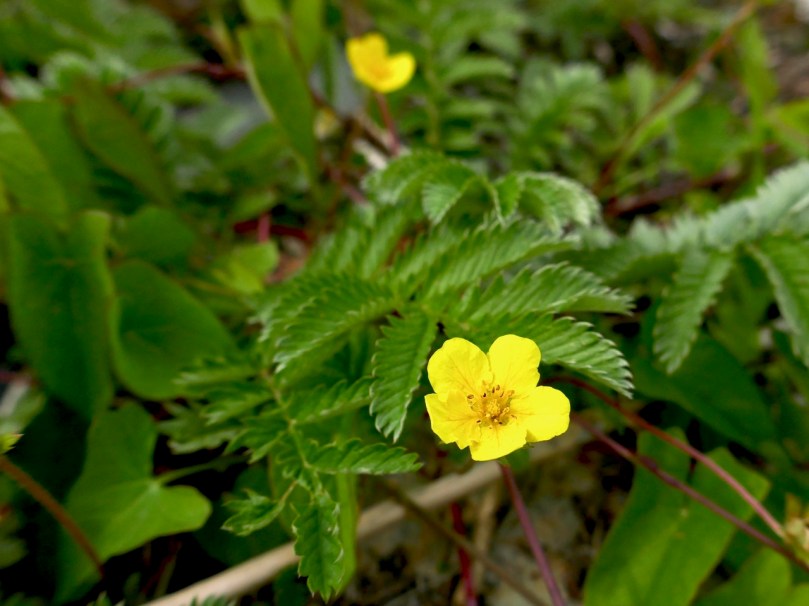
From the top: Grasses and Foxglove; Silverweed; Red Campion; Scarlet Pimpernel; Bog Pimpernel; White Stonecrop

July arrived and still no rain. As the month wore on things started to wilt and shrivel. The Bog Pimpernel, which had spread nicely from last year, gave up the fight and turned into dust. There were compensations, though – the long grasses turned the most delicious golden colour and the Knapweed, undeterred by lack of water, sprang up to populate the meadow.

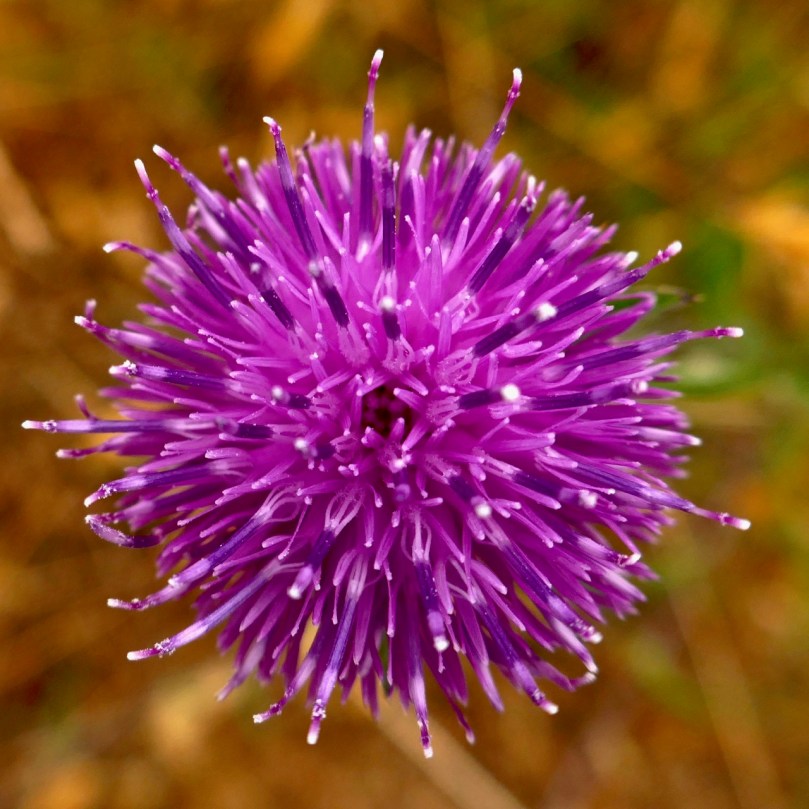
Grasses and Common Knapweed

The rain started in August – not as much as we needed, although it was welcome. But it was too late for most of the flowers to recover and flourish. But one wildflower more than held its own – Chamomile! Most of the chamomile that grows in Ireland (over 90%) occurs in West Cork and South Kerry and I am lucky to have extensive coverage here. Walking over it on a warm day releases that well-known sweet scent – it’s lovely to have!

From the top: Chamomile; Yarrow

And now it’s the end of September. The heather is flowering and the gorse is on its second or third blossoming of the year. I have discovered that somehow the invasive shrub Himalayan Honeysuckle has found its way to a hard-to-access section of my garden and I am not quite sure what to do about that but I’ll definitely keep an eye on it to make sure it doesn’t spread too much.

From the top: Bell Heather; Himalayan Honeysuckle

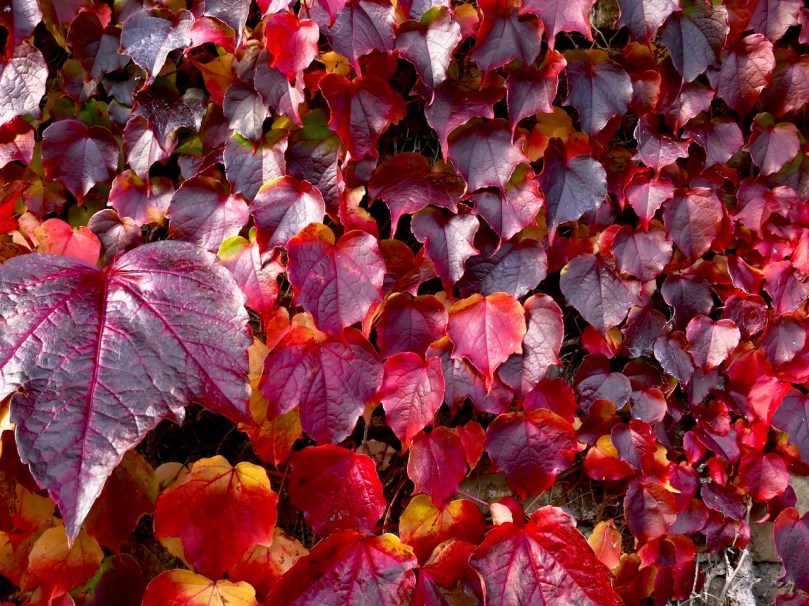
The glory of the property right now is the colour of the vine (I don’t know what it is) that covers the house. It’s not a wild flower, but it is irresistible and I think that’s a good way to end this post.


A Walk on Sherkin Island

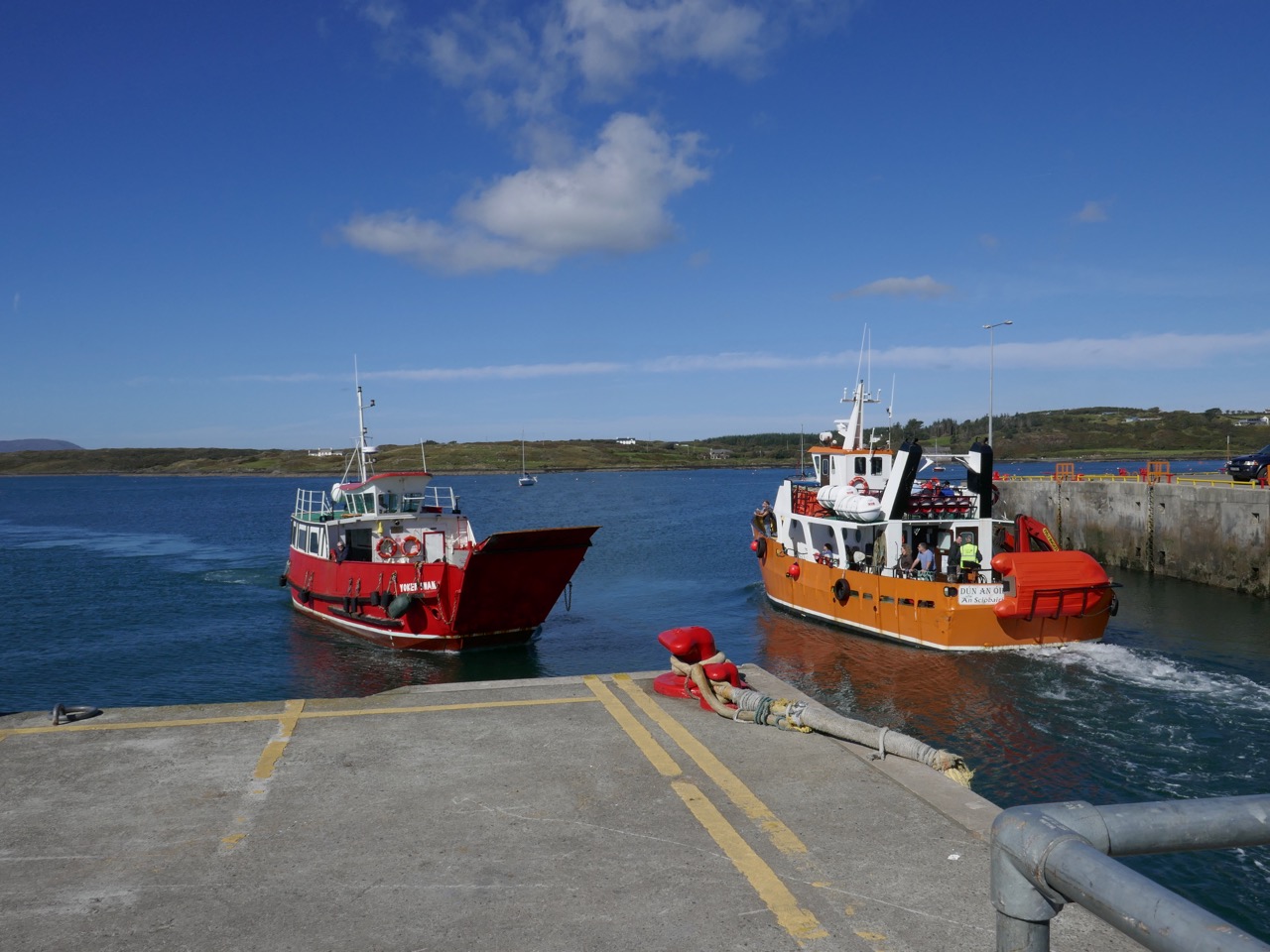
You can’t live in West Cork without constantly being aware of the sea – it’s all around us. And the offshore islands are always in our view as we look across Roaringwater Bay. It’s easy to get to the inhabited ones: there are good ferry services that run year round, although they can be hampered by winter storms. In this picture – above – the Cape Clear Ferry is leaving Baltimore, while the Sherkin Ferry is arriving to collect passengers for that island, including us: on a whim we went across on a wonderful warm September afternoon.

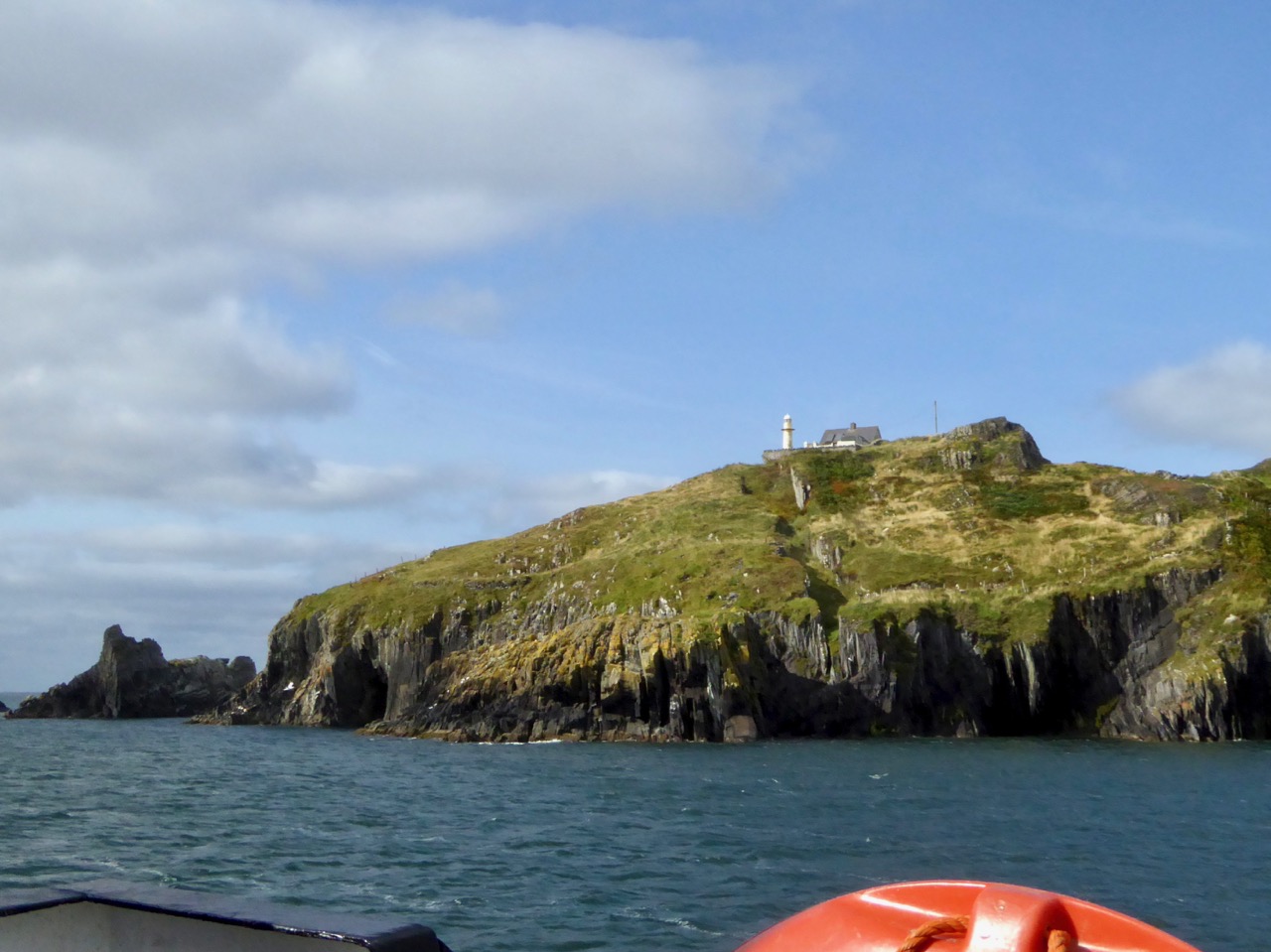
It’s a short sea voyage to Sherkin – all of 15 minutes! But it’s always exciting to be on the water. That’s the lighthouse on Sherkin in the picture above: it was built in 1885 of cast-iron construction and is now fully automated, as are all of Ireland’s lighthouses today.

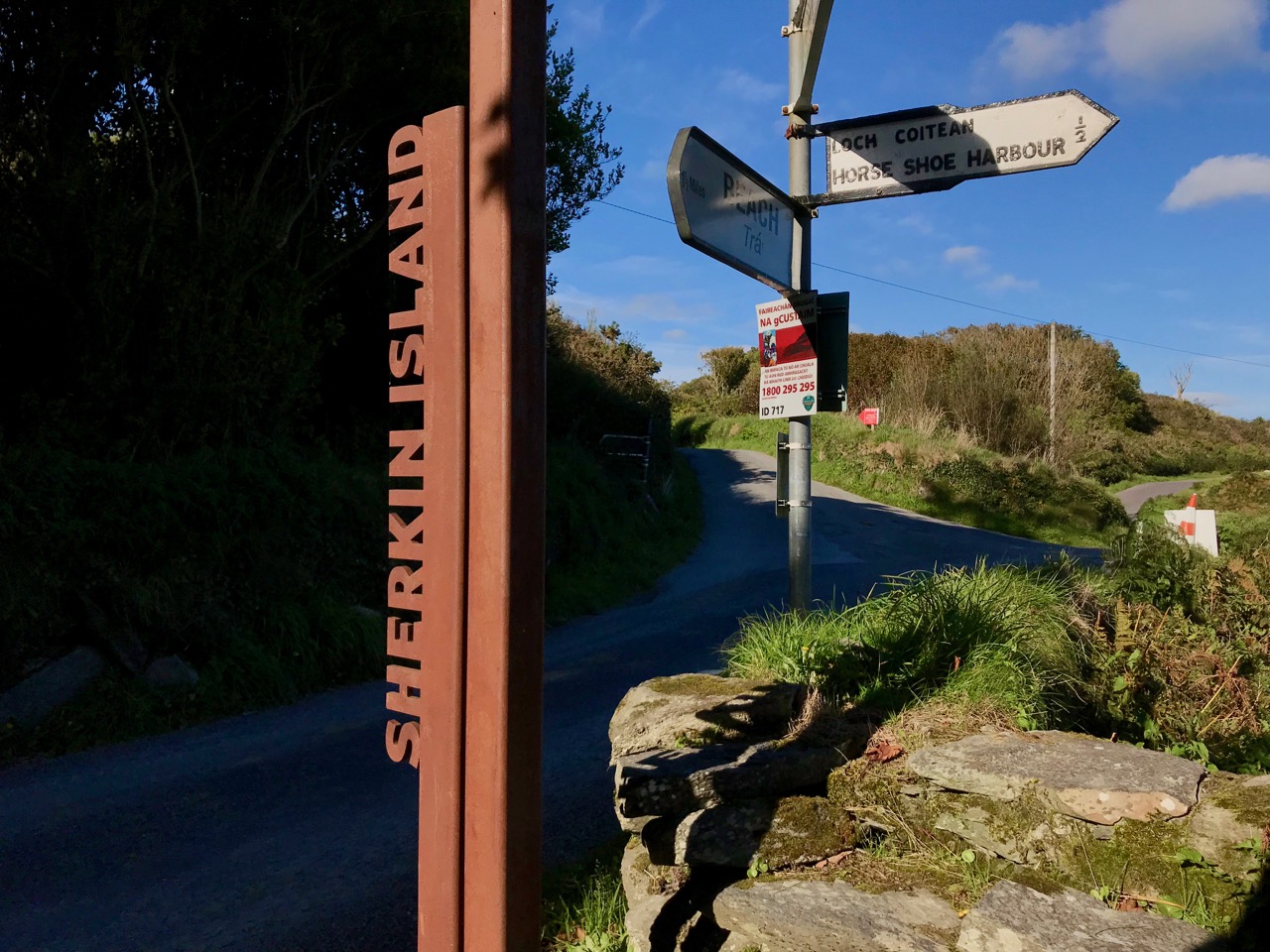
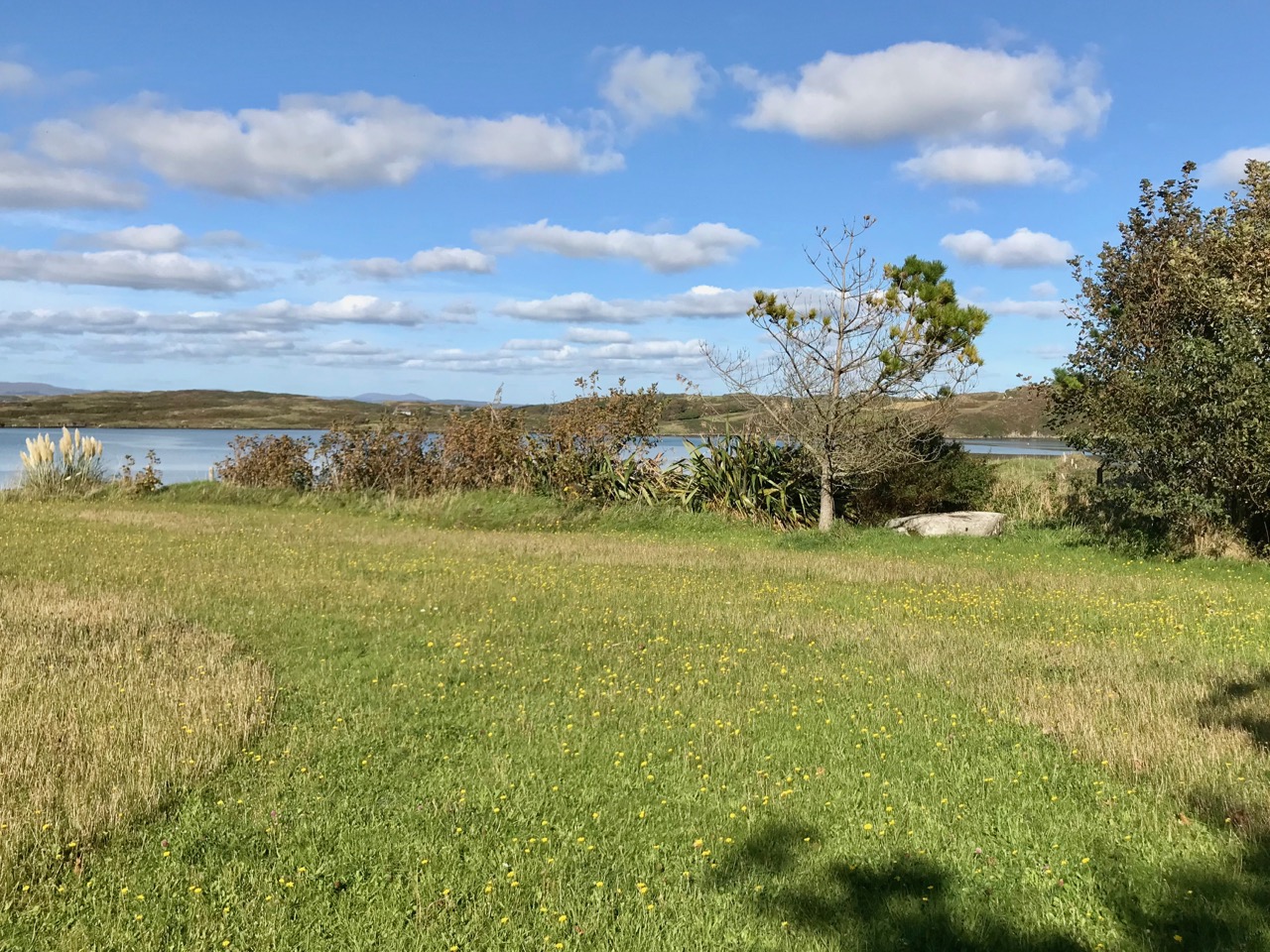
We did have an aim – to find a piece of Rock Art that may be the earliest physical evidence of human occupation on the island. It’s a cupmarked stone in the townland of Kilmoon, overlooking Kinish Harbour. It was a fair walk to the west, over deserted roads and through fields. After a bit of backtracking we managed to find the stone, well weathered but with its markings still visible. It is situated with panoramic views all the way round, taking in the peaks of Mount Gabriel, Mount Corrin and Mount Kidd on the mainland: surely it must have been placed with those views in mind?

This picture shows the cupmarked stone in its present setting, just inside a private garden (if you go, please make sure you seek permission from the owners of the house!), while the one above shows the panoramic distant view which the stone commands.

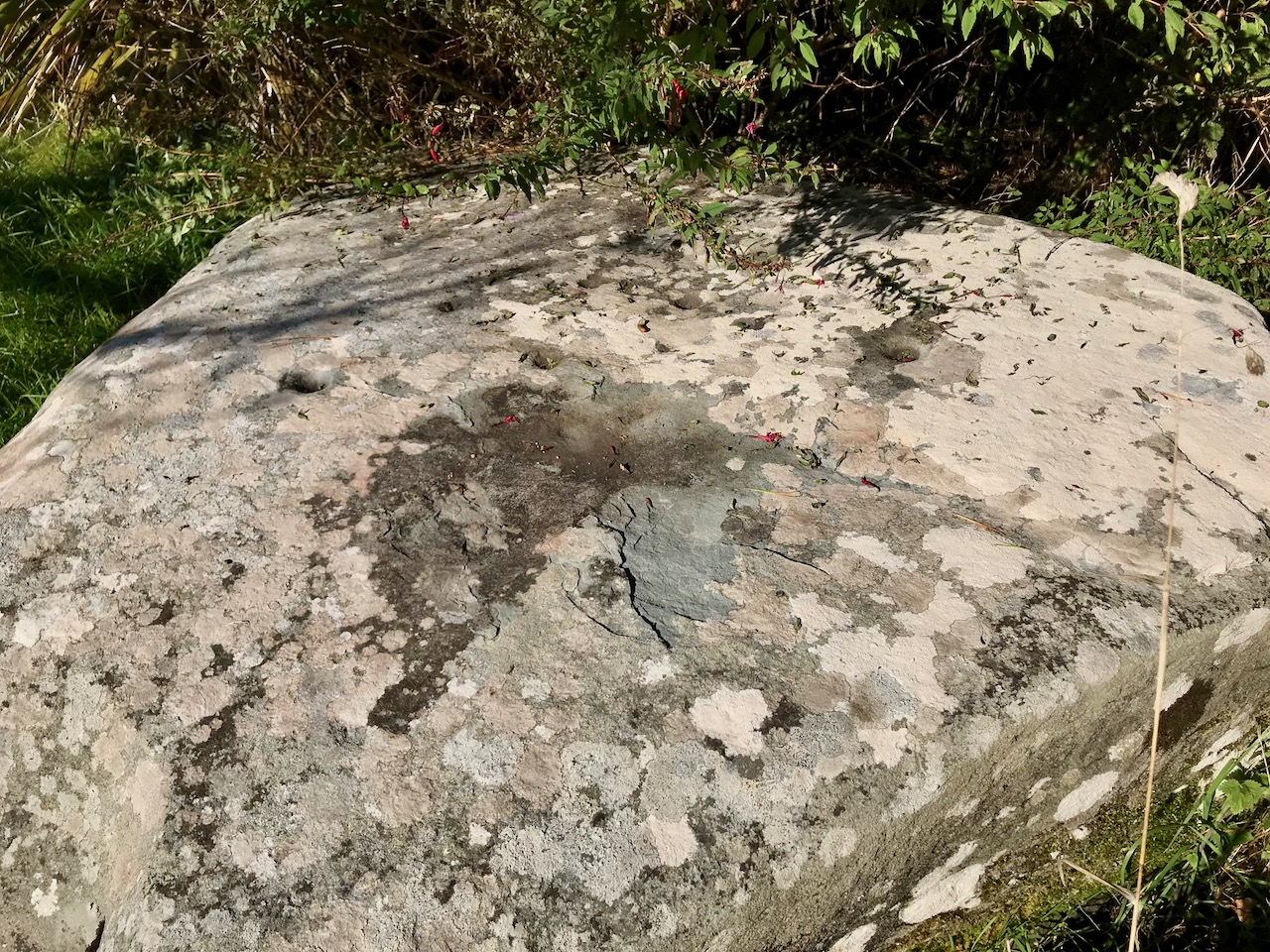
Here is the surface of the stone which is heavily blotched with lichen, but it is possible to make out the well defined cupmarks: there are 14 in all. If you want to find out more about cupmarked stones and how they compare with Rock Art in general, we wrote this post a while ago. It sparked off a whole lot of debate (have a look at the comments at the end of that post) – and there is still much to be discovered in a history that may go back 5,000 years.

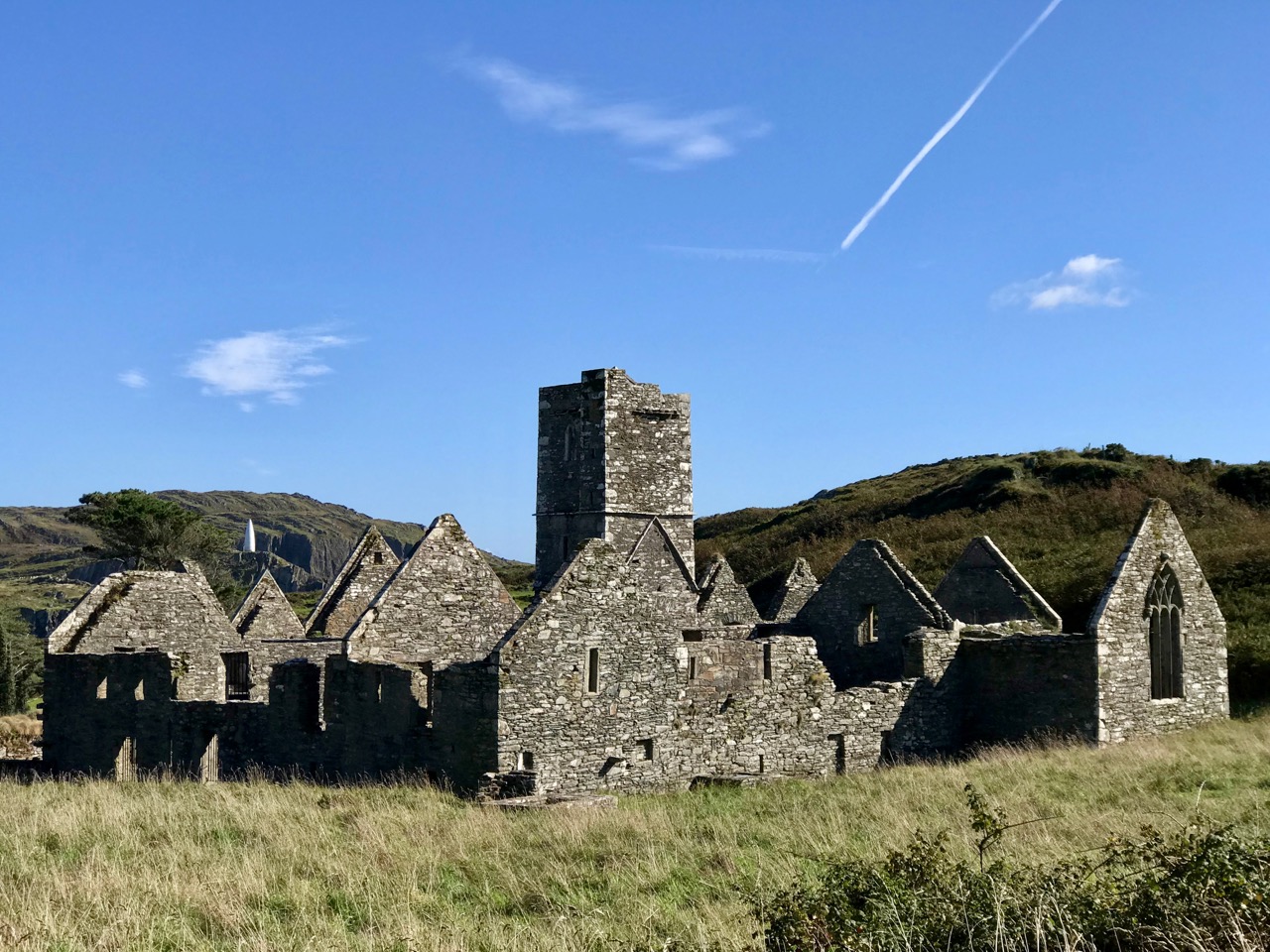
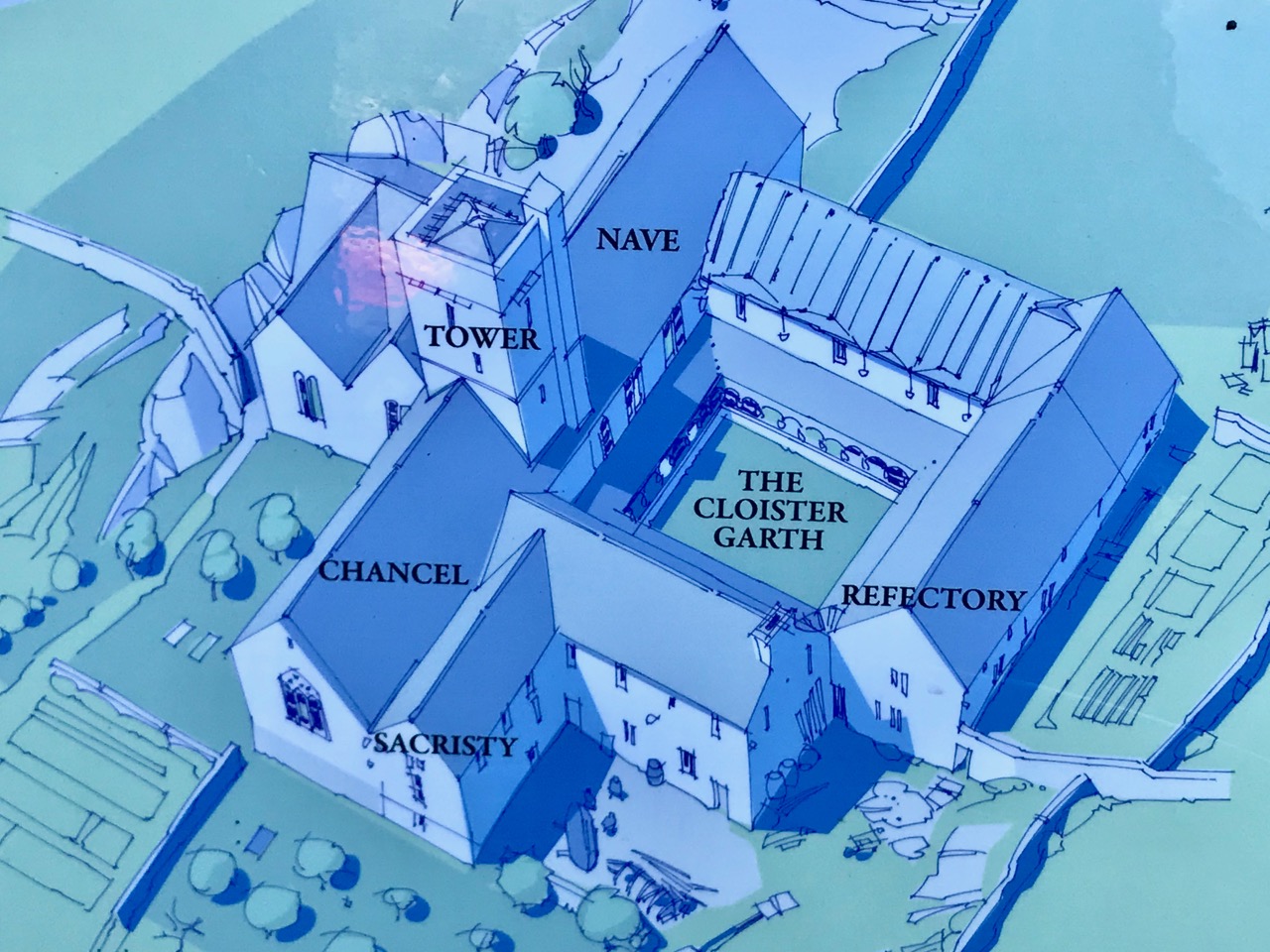
Our main mission was accomplished, but we couldn’t resist taking in some other historical sites while on the island. Firstly, we had a good look at the Franciscan friary – situated in the townland of Farranacoush – which has a colourful history. Here is a description from the current Irish Franciscans site:

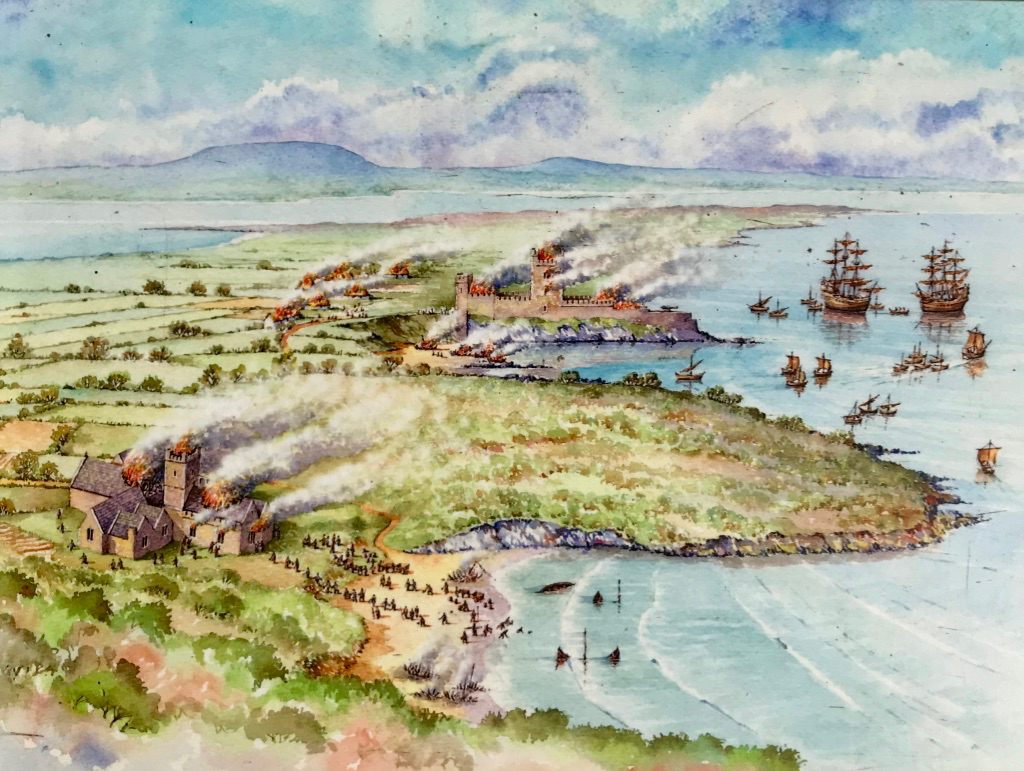
. . . Permission for this foundation was given by Rome to Finighin O’Driscoll in 1449, but it was not until just after 1462 that the Observant friars actually arrived. The friary became the traditional burial place of the O’Driscoll’s. In 1537 the citizens of Waterford burned the building in retaliation for acts of piracy by the O’Driscolls. The great bell of the friary was on display in Waterford as late as 1615. There is no evidence to suggest that the friars were disturbed by the events of the Reformation until the island was garrisoned by the English following the Battle of Kinsale. The friars soon returned and, except at the height of the Cromwellian persecu­tion, were active all during the seventeenth and well into the eighteenth centuries. The last friar, Fr Patrick Hayes, died soon after 1766 . . .

In the picture above – taken from the OPW information board – you can see the attacks of 1537 by ‘the citizens of Waterford’ on both the Friary (in the foreground) and the O’Driscoll stronghold of Dún na Long (beyond). The castle was subsequently partially rebuilt and was garrisoned by a Spanish force in 1601. It was then acquired and restored by the Becher family in 1655 and remained in their ownership until the late nineteenth century. We went to see what remains of the castle today.

Our visit to Sherkin only took an afternoon – albeit a golden one. There’s plenty more to see there – and other islands to be investigated. And an endless exploration of history to be had in the landscapes of West Cork.

Bumper Crop!

It’s the end of the summer – and harvest time. Over the months I have been gathering in yet more signs and curiosities from our journeys around Ireland. It’s now time to show off a few of them . . .

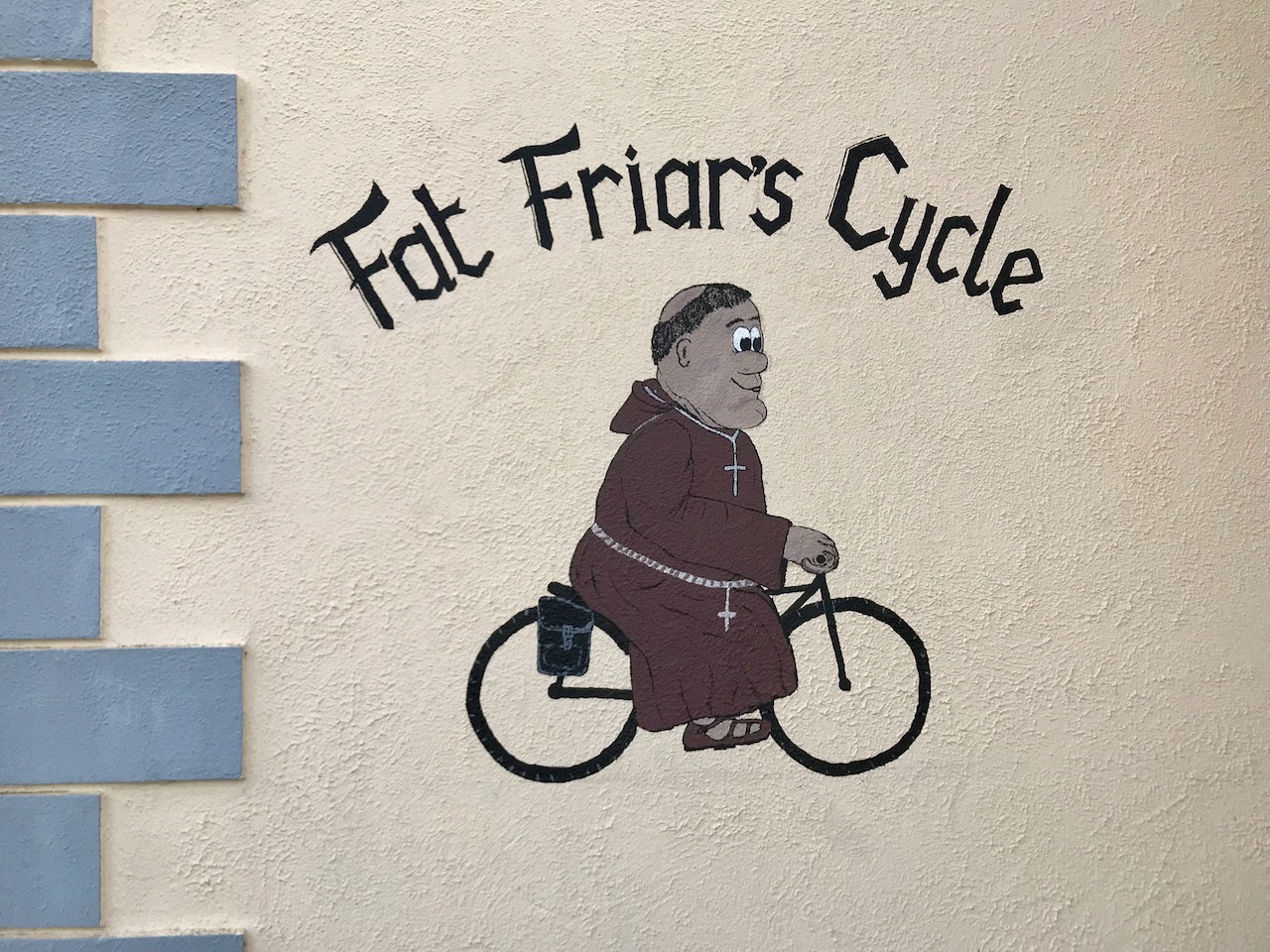
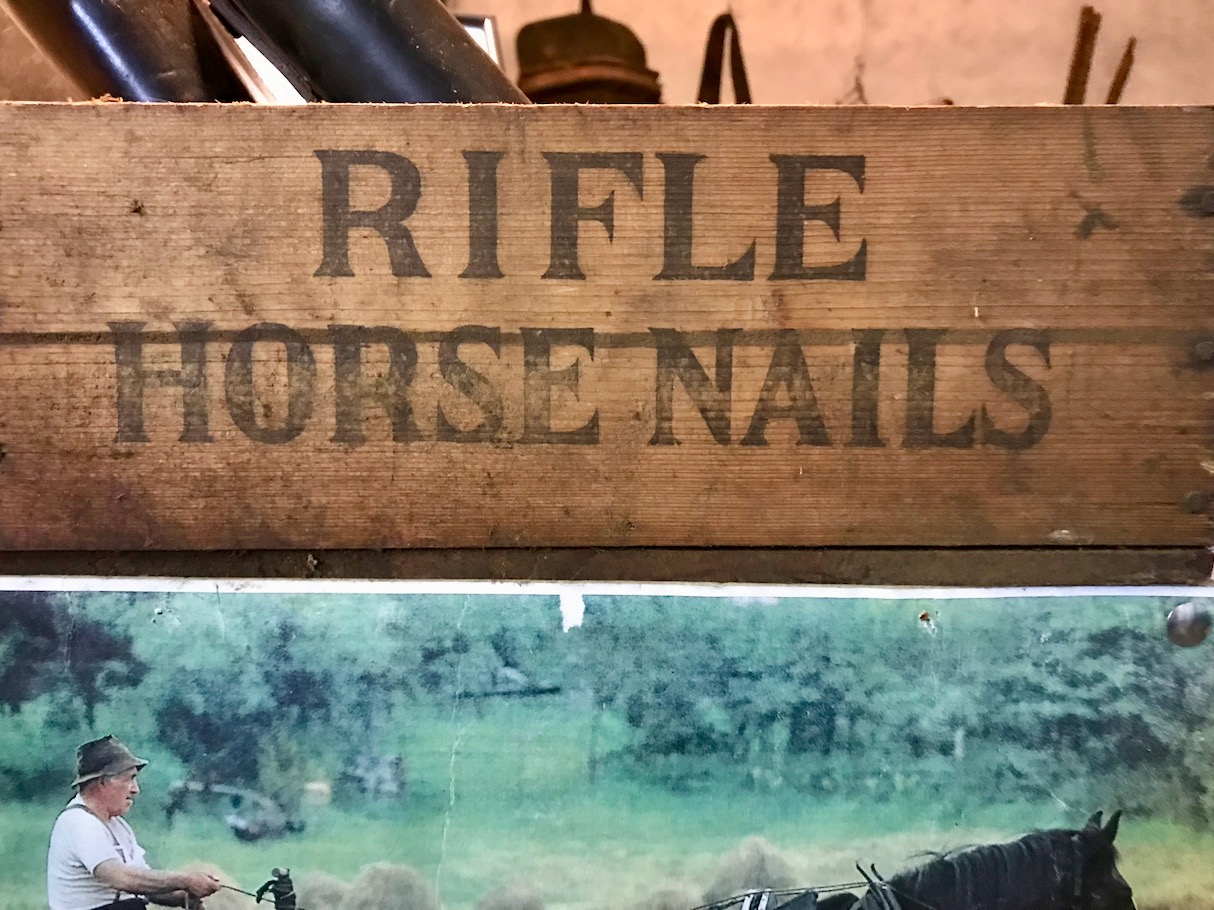
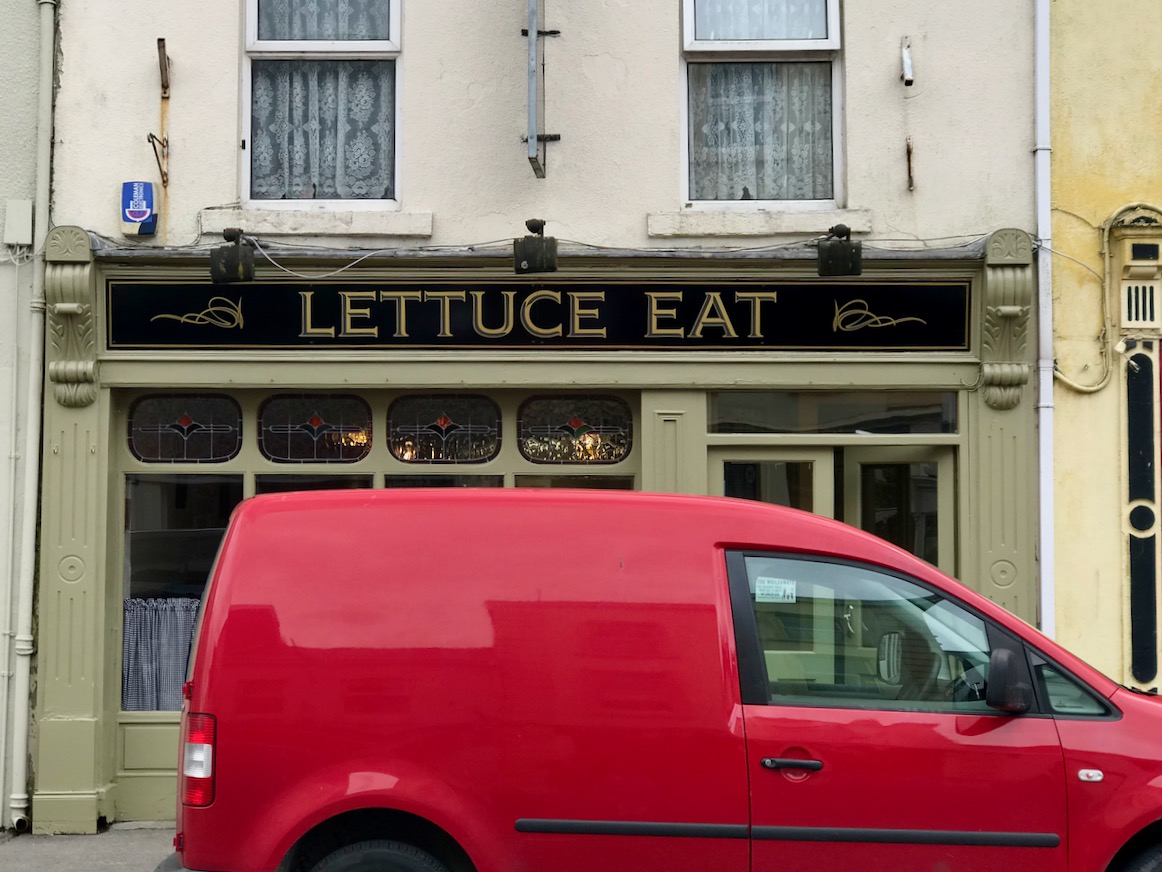
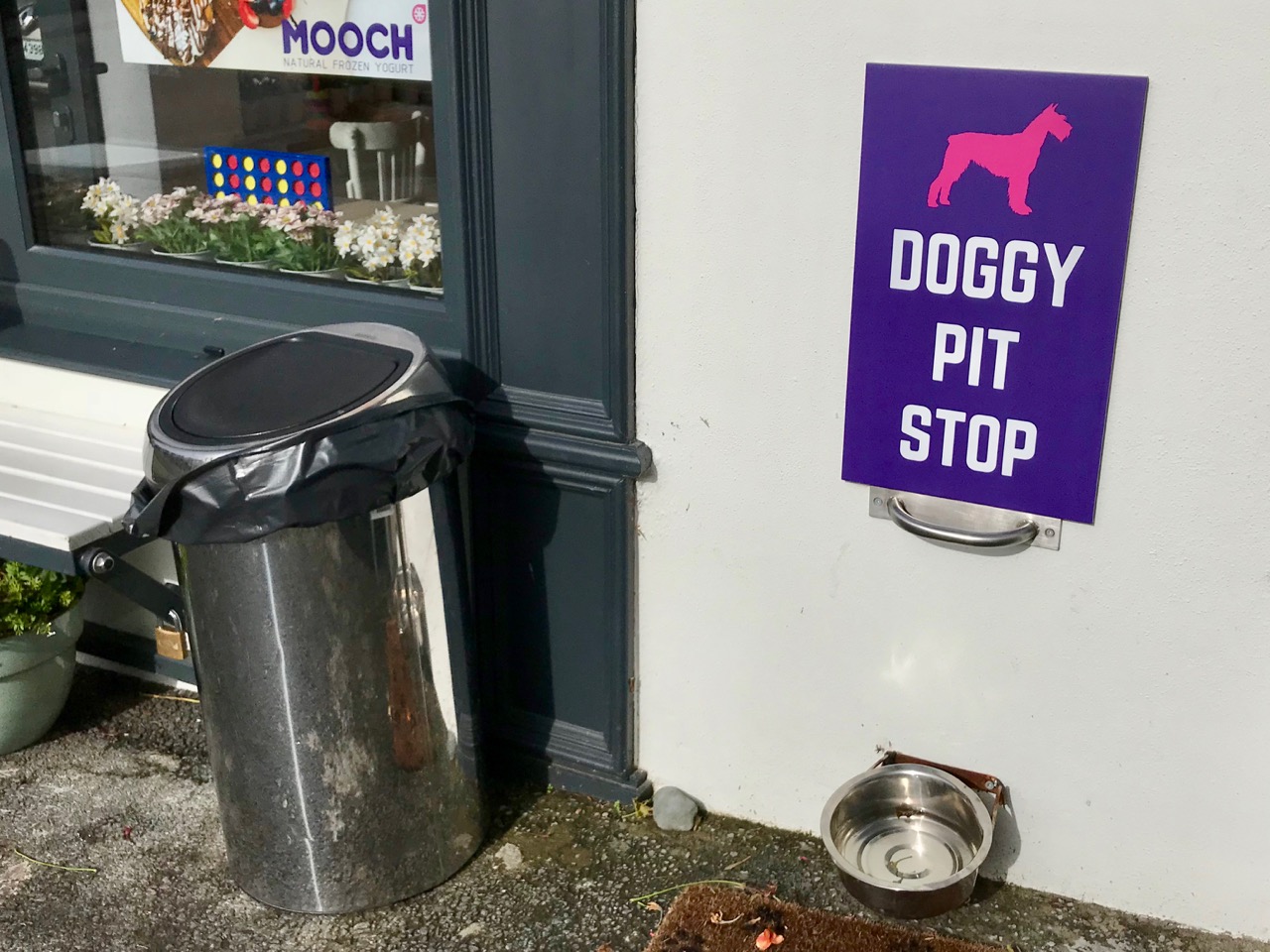
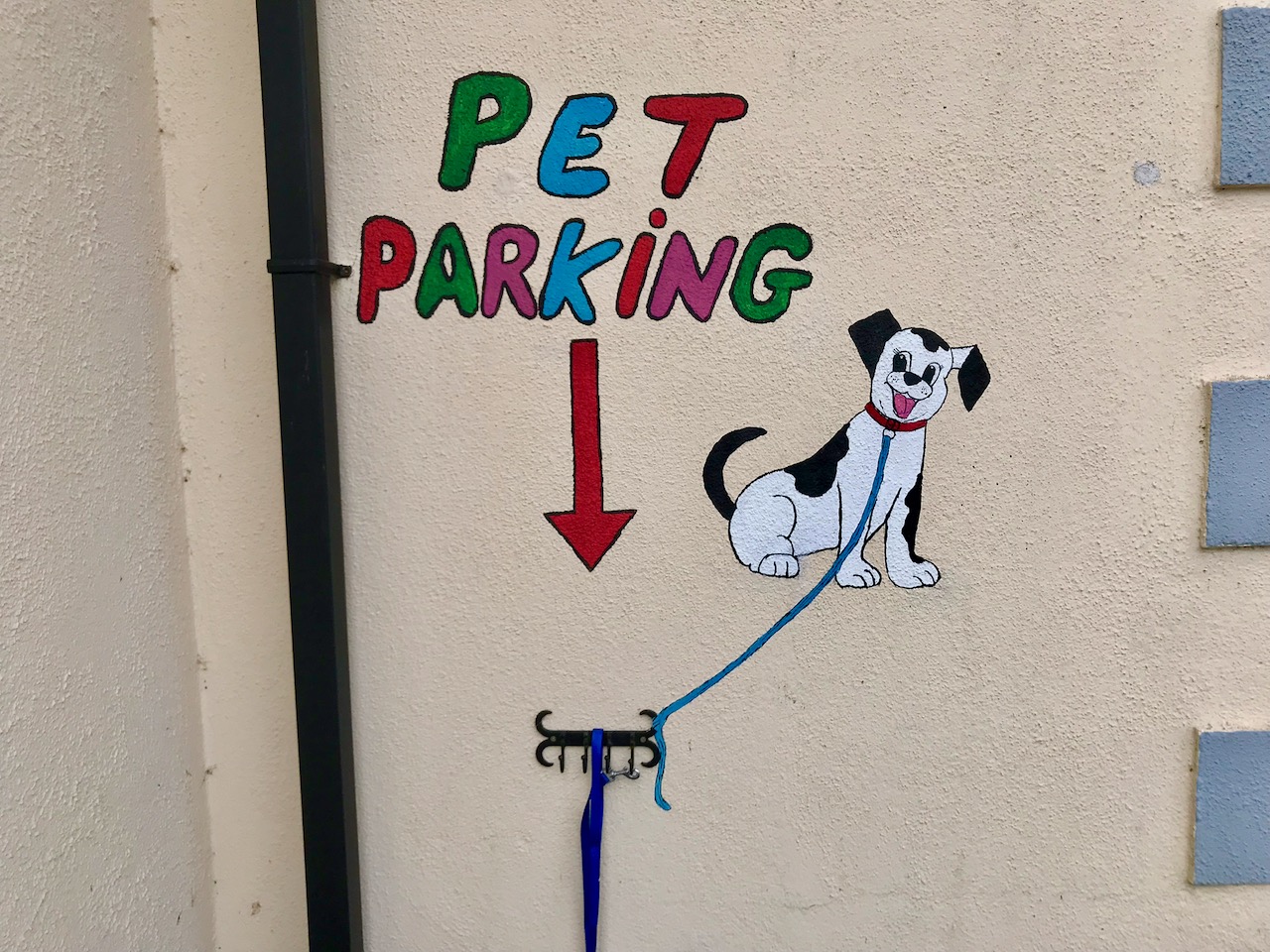
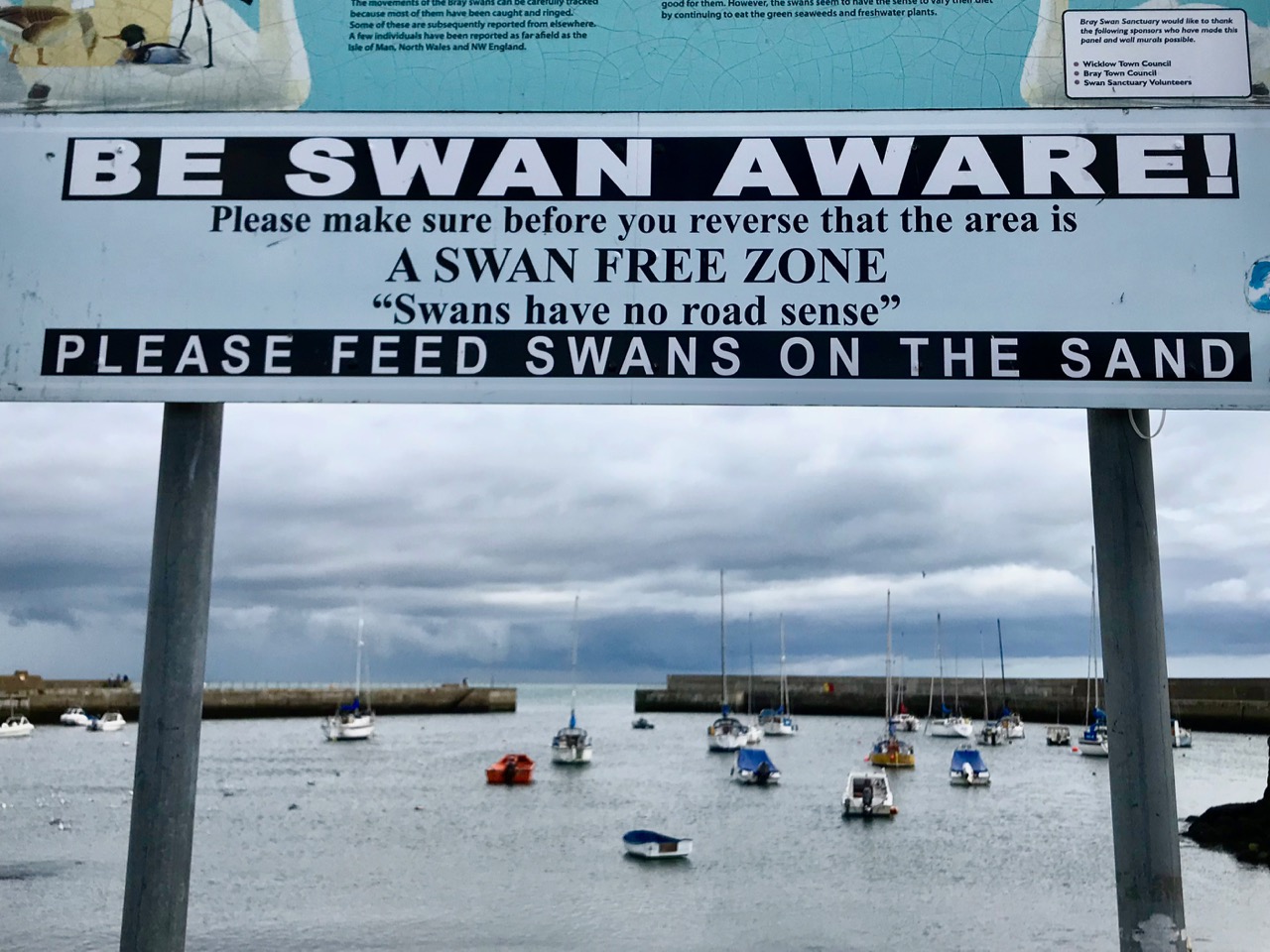
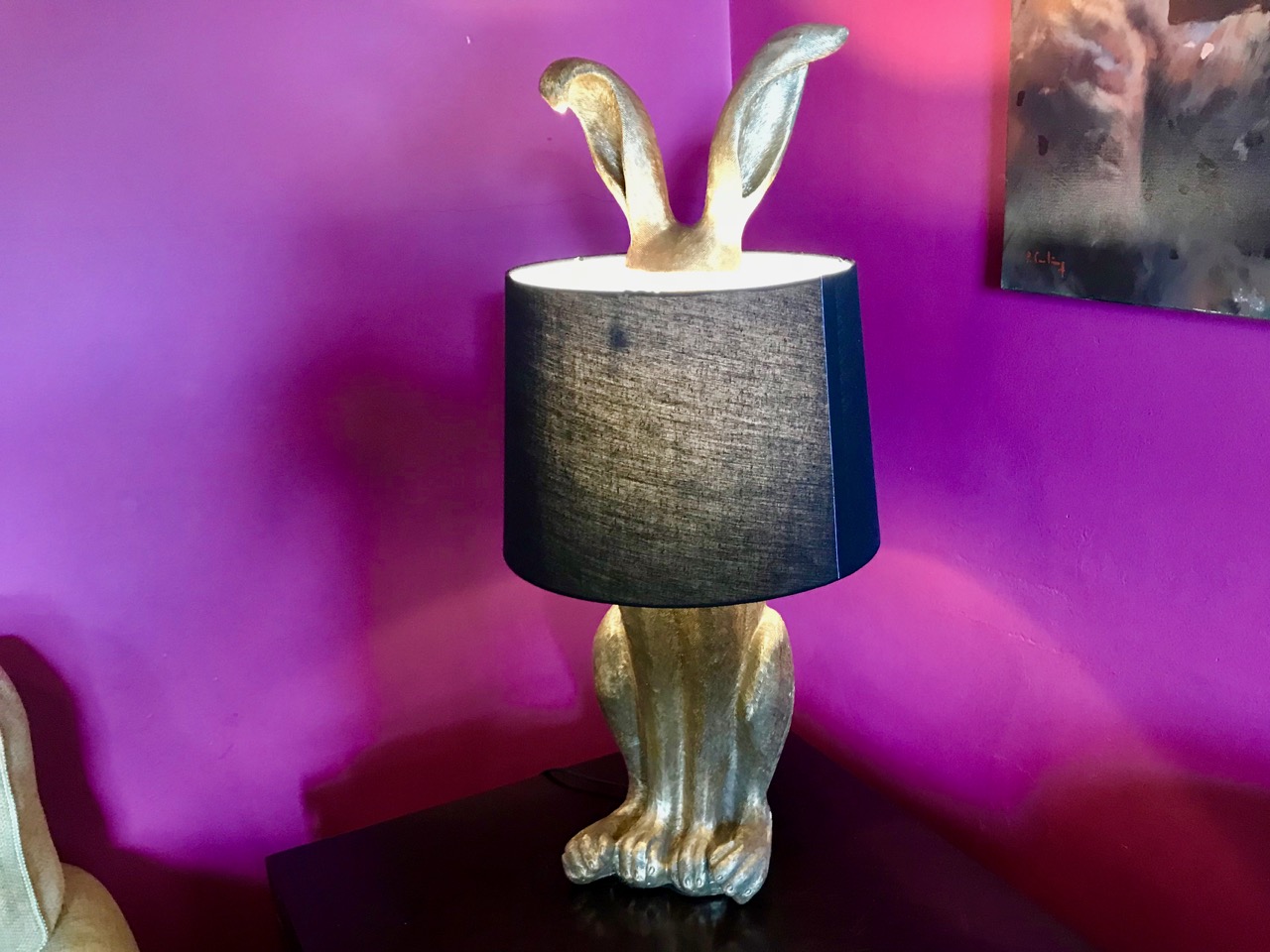
Some are obvious – and intentionally humorous; many are simply puzzling or inexplicable. Hopefully, most are at the very least entertaining. They don’t require a great deal of comment. But it’s certainly fertile ground for gleaning. Wherever you find yourself, take a good look around you: there’s a bumper crop out there.

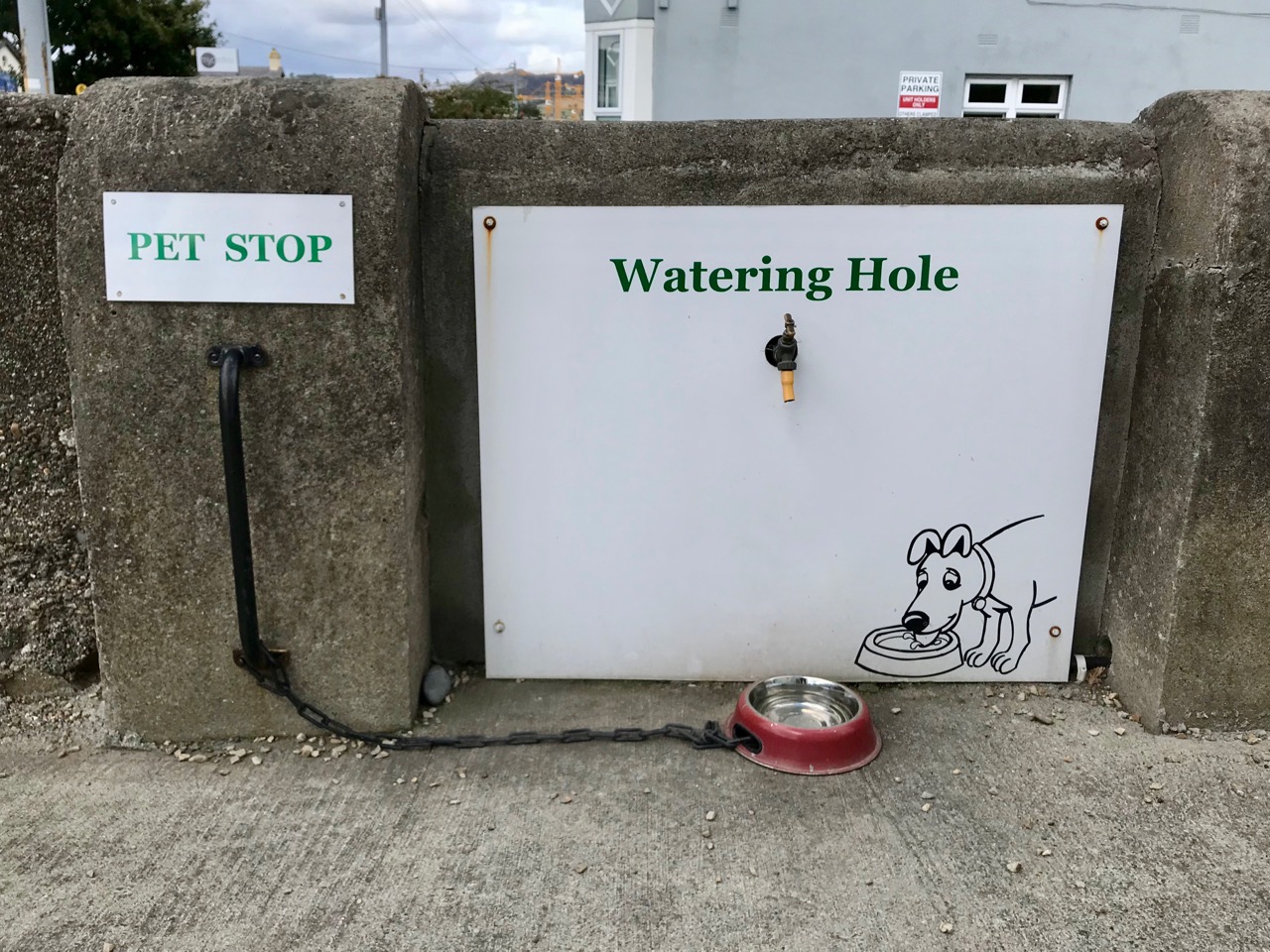
When you start ‘collecting’ signs, themes seem to emerge. Just over the last few days the animal kingdom has come to the fore:

Well, that’s enough of that theme for now – although there are more ‘pets’. To finish off, another miscellany – and I’m keeping some good ones back for another day.

Evie Hone and the Modernisation of Irish Stained Glass

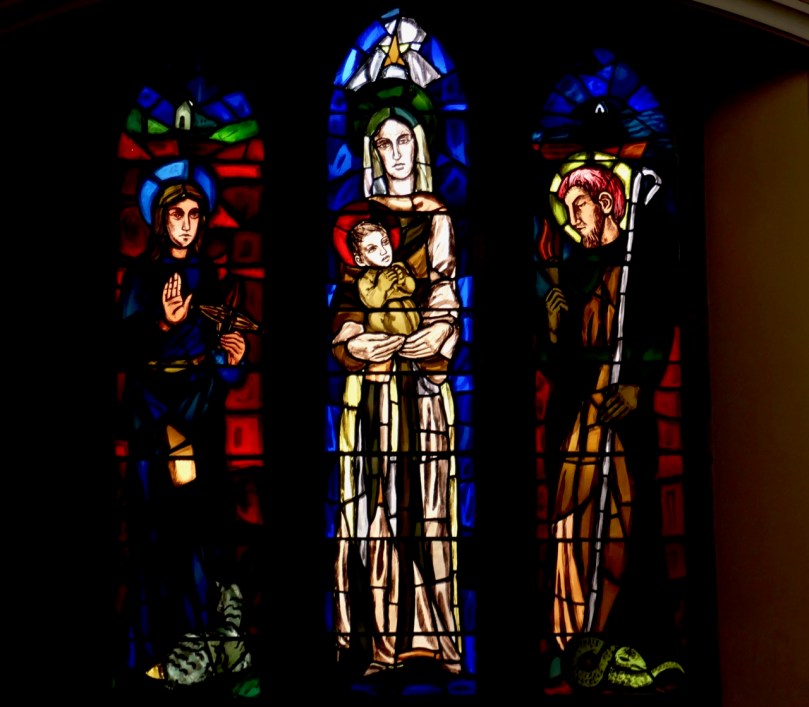
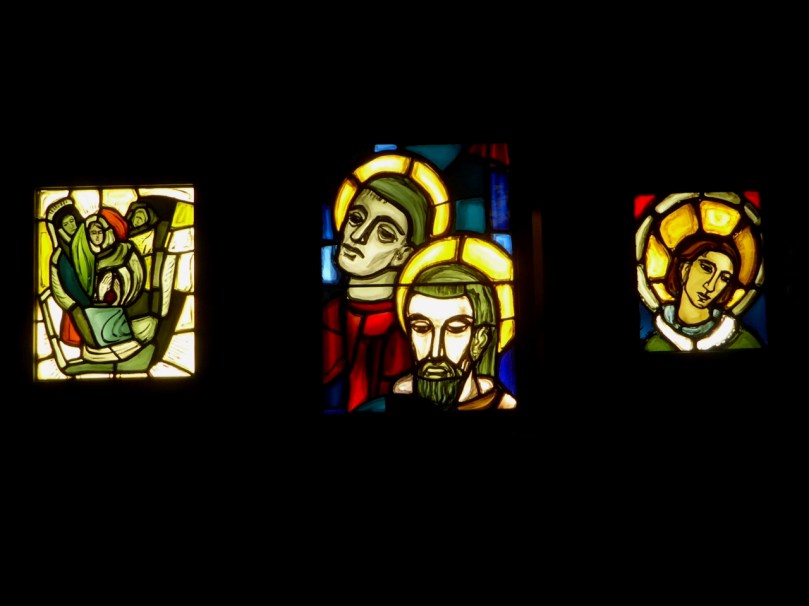
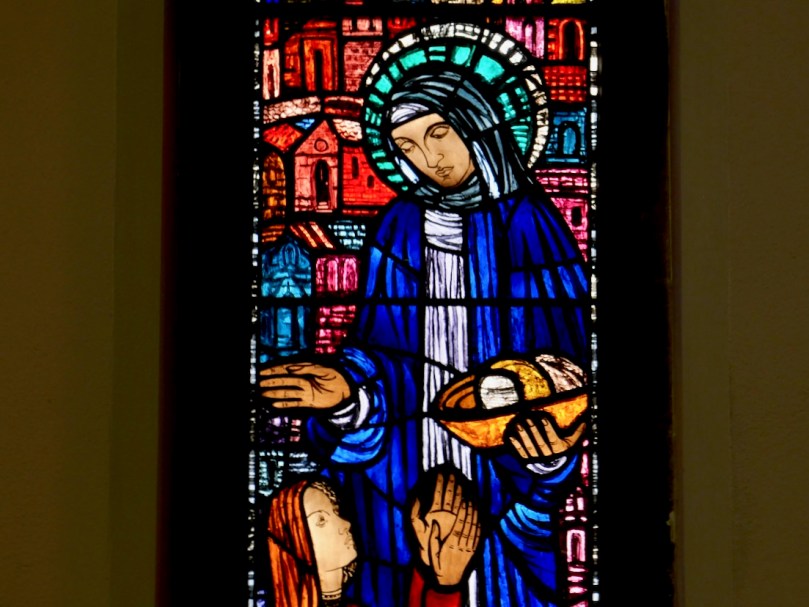
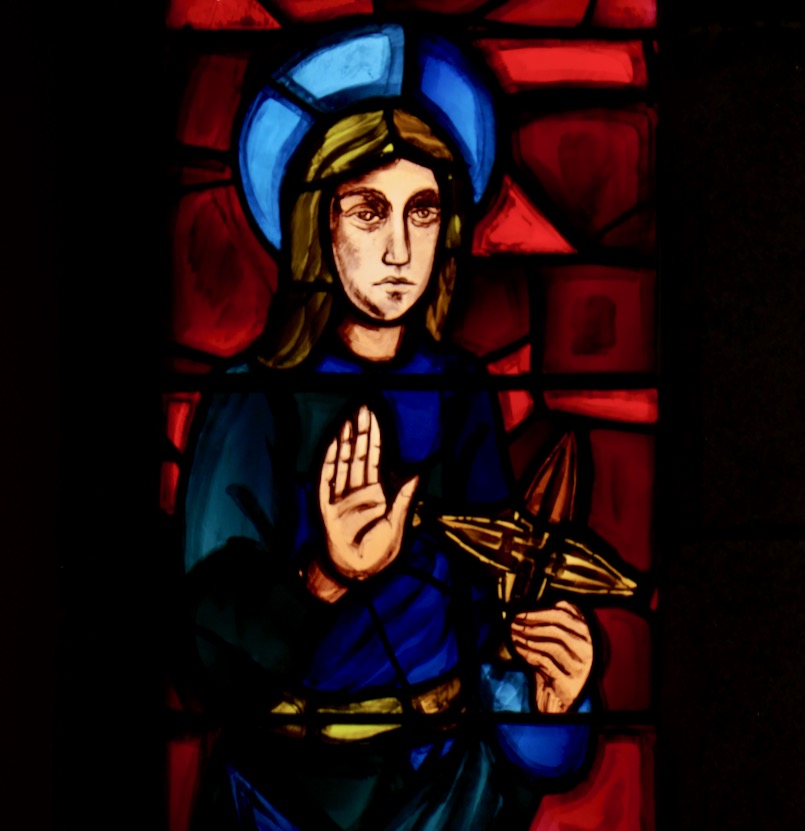
This is an Evie Hone window from Blackrock in Dublin – Bridget, Mary and Jesus, and Patrick. Evie Hone is one of our greatest stained glass artists and helped to move the practice of stained glass into a more modern direction. To appreciate this, it is helpful to know a little of her background.

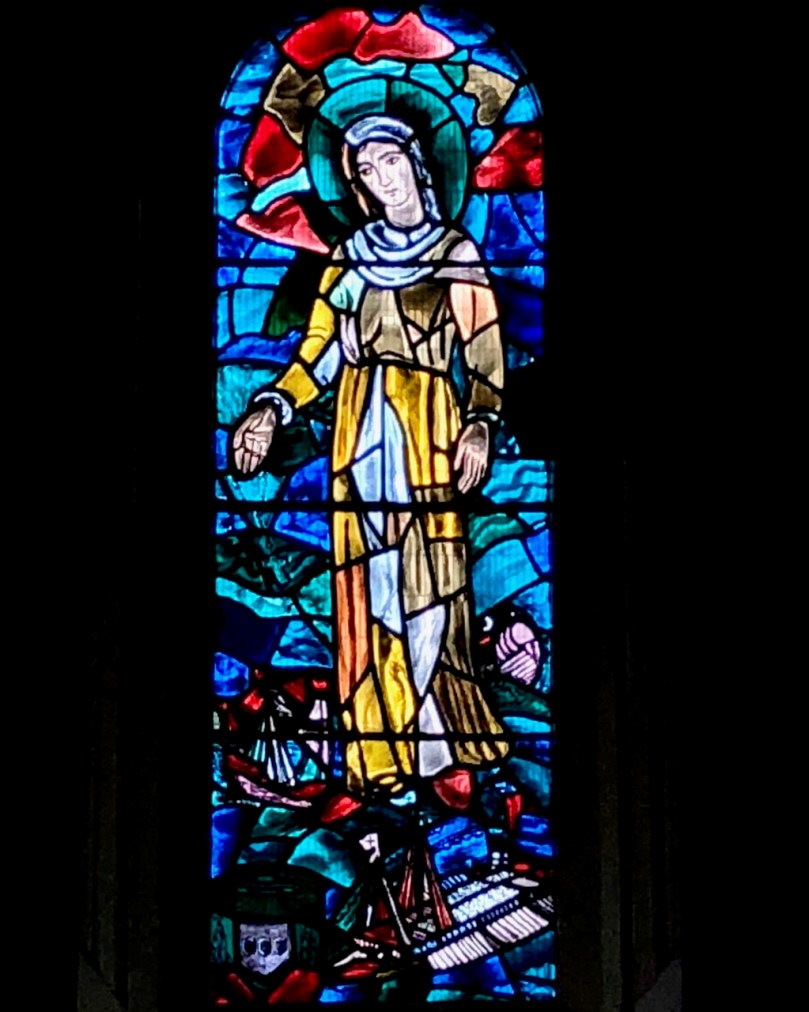
Our Lady of the Rosary, completed in 1948 for the Catholic Church in Greystones, Co Wicklow. While the figure is not cubist, the influence of that style is discernible

She was born in 1894 Dublin, a member of the extended Hone clan of painters and artists. A childhood accident left her disabled and in pain but also set the course for her life’s work by providing the consolation of sketching. She studied in Britain, Ireland and Paris, where she came under the influence of the Cubists, and also met her great friend and fellow-modernist, Mainie Jellett.

The Good Shepherd, also from Greystones

The two women applied to exhibit at the Royal Hibernian Academy but it was dominated by male traditionalists who refused to allow cubist paintings to be shown. They responded by exhibiting elsewhere and by starting a new organisation (the Irish Exhibition of Living Art, or IELA) for those interested in modern art. At first critics ridiculed this new style of painting but young artists were enthusiastic and gradually she and Mainie “introduced modern art to Ireland.”*

Evie Hone stained glass on display in the new, and very popular Stained Glass Room in the National Gallery

Evie was deeply spiritual, at one point joining a community of Anglican nuns and eventually converting to Catholicism. Moving away from painting to stained glass she trained under Wilhelmina Geddes and eventually joined An Túr Gloine in 1935. Her stained glass work was never strictly cubist, although the influence was traceable, but it was thoroughly modern.

This is her Bridget window for Loughrea Catherdral, completed while she was a member of An Túr Gloine and at the beginning of her development as a stained glass artist. It is noticeably a more conservative and less modern treatment  – contrast it, for example with Bridget from the Blackrock Church

Nicola Gordon Bowe, in her entry on Evie Hone in The Encyclopedia of Ireland (edited by Brian Lalor) says of her work for An Túr Gloine, she was designing and painting mostly figurative windows using a powerfully innovative vocabulary of deep smouldering colour and loose expressionist brushwork.

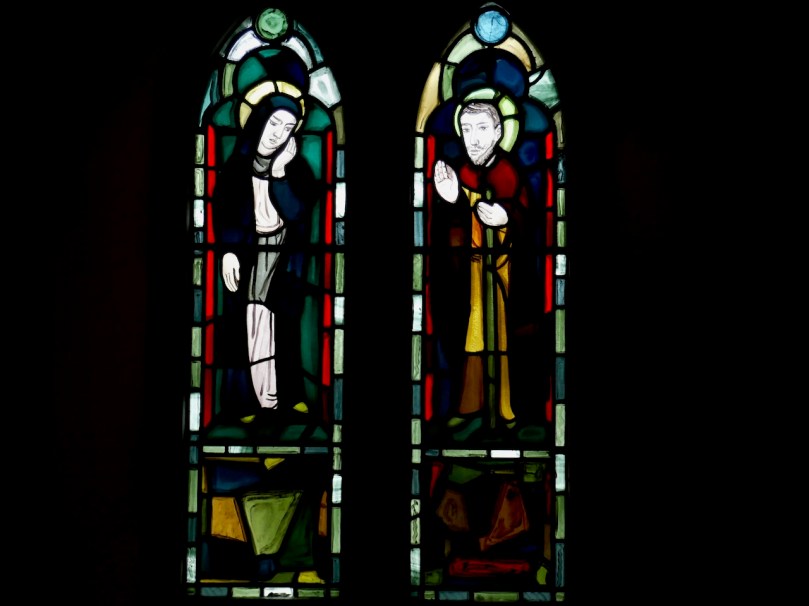
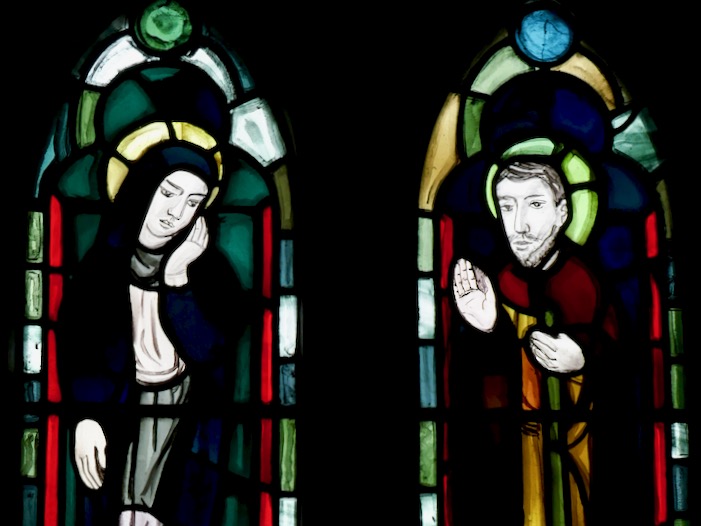
Two small windows from Cloughjordan Church (Co Tipperary) depict Mary and Joseph. These windows were among her last, and are beautiful in their restrained style and subdued palette

From 1944 she worked in her own studio at Marley Grange in Rathfarnham. Gordon Bowe, again: In ten densely packed years she introduced a new, loosely painted, resonantly coloured, and sombrely religious treatment. We are fortunate that a short documentary recorded this period on her life and work. It also functions as a primer on stained glass!
View the documentary here

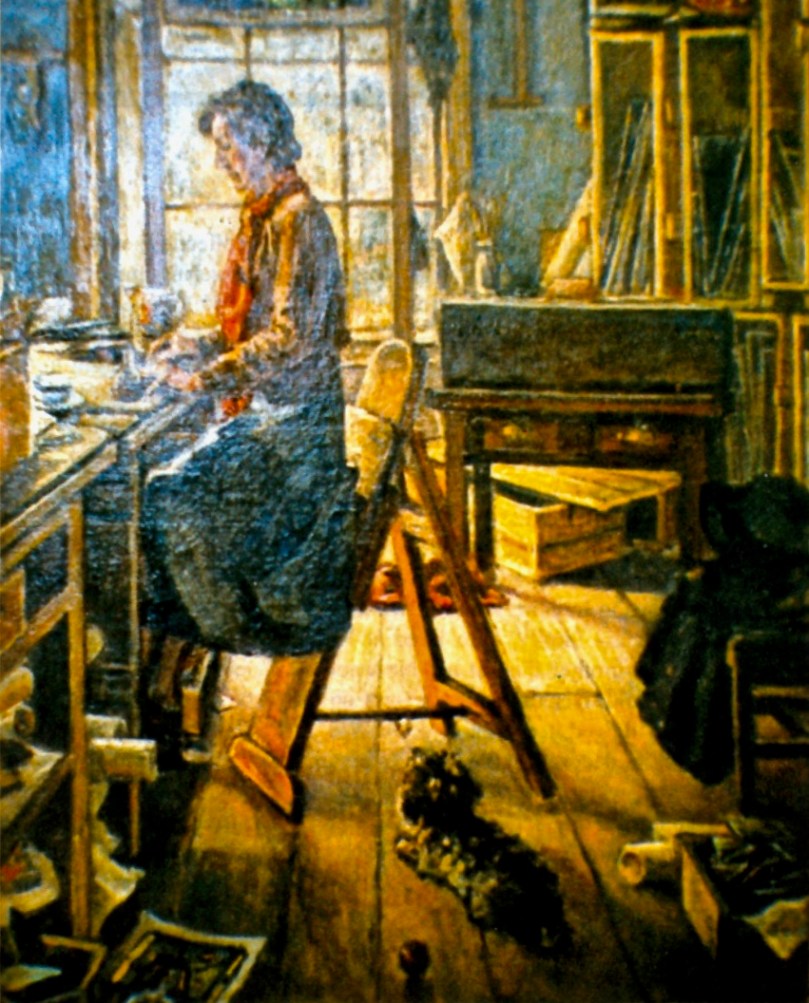
About the same time, in 1952, her friend and fellow-artist, Hilda van Stockum painted her in her studio, capturing her complete absorption in her work. This image comes from Marie Bourke’s paper* and is a copy of a photograph from a National Gallery Catalogue. The original painting is in the National Gallery.

What is most striking about her work, in contrast to her colleagues at An Túr Gloine, is how painterly it is. Using a restrained palette, with occasional bursts of bright colour, she creates quiet and reverential portraits of her sacred subjects. Modernity is obvious, but she herself claimed that the major influence on her work was medieval Irish carvings. If this was true, it was certainly mediated through an expressionist sensibility.

Bridget – detail from the Blackrock window

Evie Hone died in 1955. She has left an impressive legacy of paintings and stained glass windows. I have only used photographs that I have taken myself of windows that I have visited, but there are many more waiting to be explored.

* The quote, and also the photograph of the painting of Evie Hone in her Studio are from Evie Hone in Her Studio: Hilda Van Stockum’s Portrait, by Marie Bourke, in Studies: An Irish Quarterly Review, Vol. 86, No. 342 (Summer, 1997), pp. 165-174.  The paper is available on JSTOR

The Rock of Dunamase and Ireland’s Most Iconic Painting

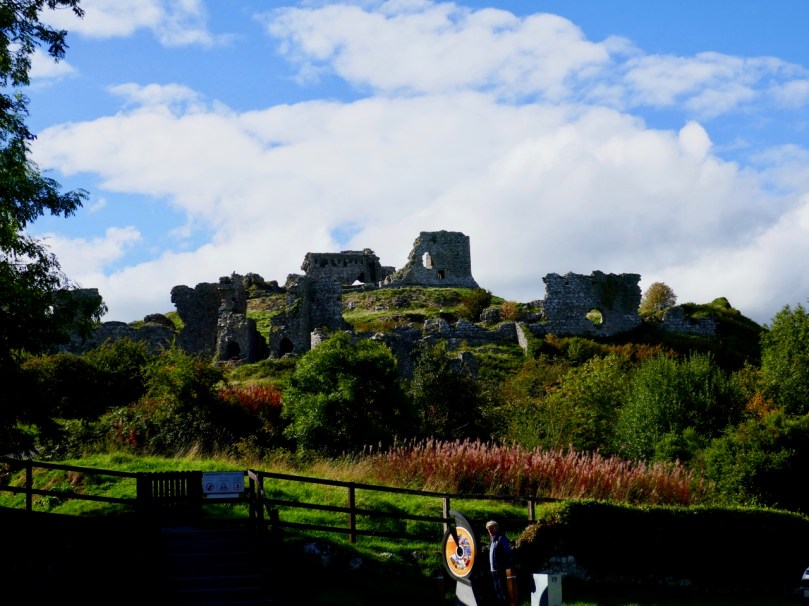
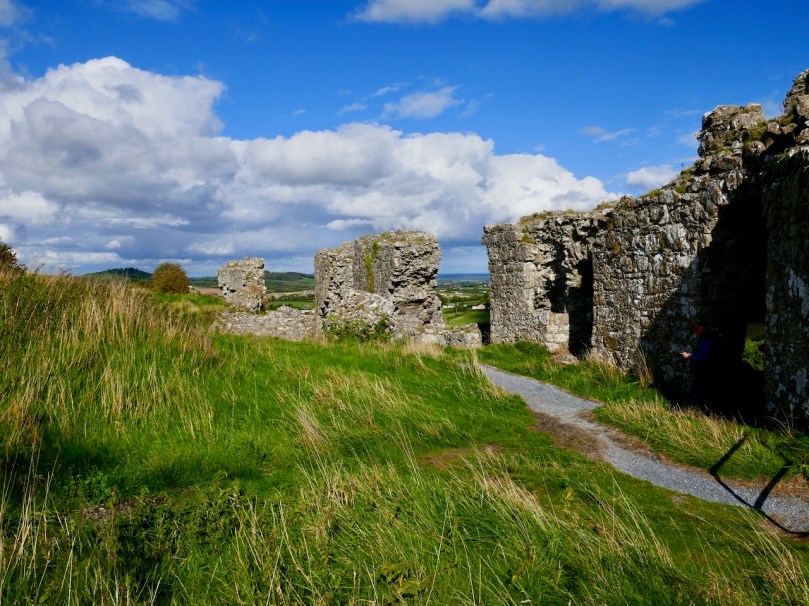
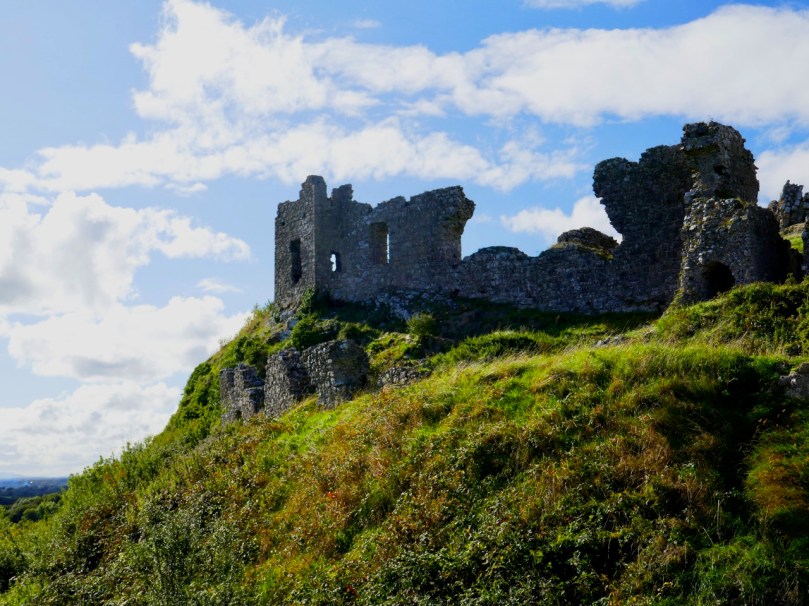
The ruins on the Rock of Dunamase in County Laois date mainly from the 12th century, very shortly after the Norman Invasion of 1169. That invasion was led by Richard DeClare, Earl of Pembroke, known as Strongbow, and it was at the invitation of Diarmuid MacMurrough, King of Leinster. MacMurrough had been ousted from his kingdom by Tiarnan O’Rourke and his allies, partly because MacMurrough had abducted O’Rourke’s wife Devorgilla (although some accounts say she went willingly). His request for help to King Henry II was welcomed, as the King was hoping to provide distraction to some over-ambitious knights, including deClare.

One of MacMurrough’s incentives to Strongbow was the promise of his daughter, Aoife, in marriage. The marriage took place in Christ Church Cathedral in Waterford in 1170 and following the death of Diarmuid in 1171, Strongbow declared himself King of Leinster.

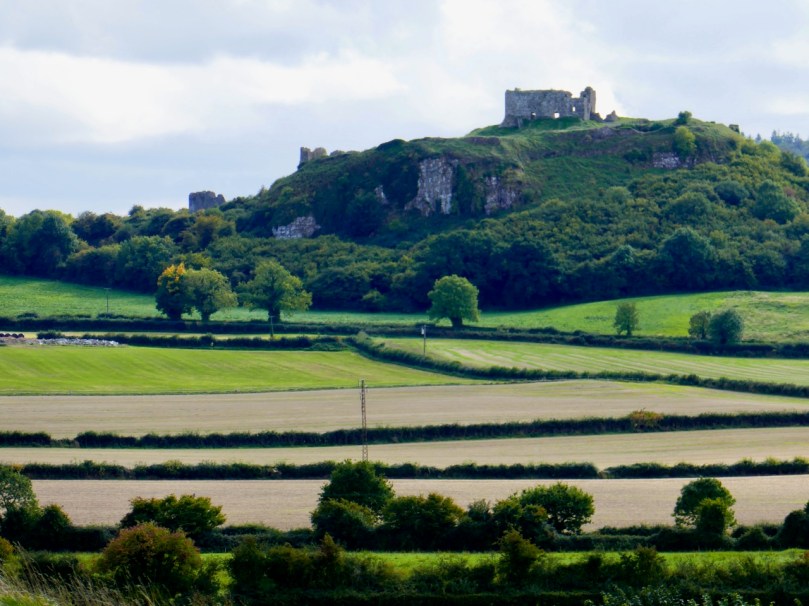
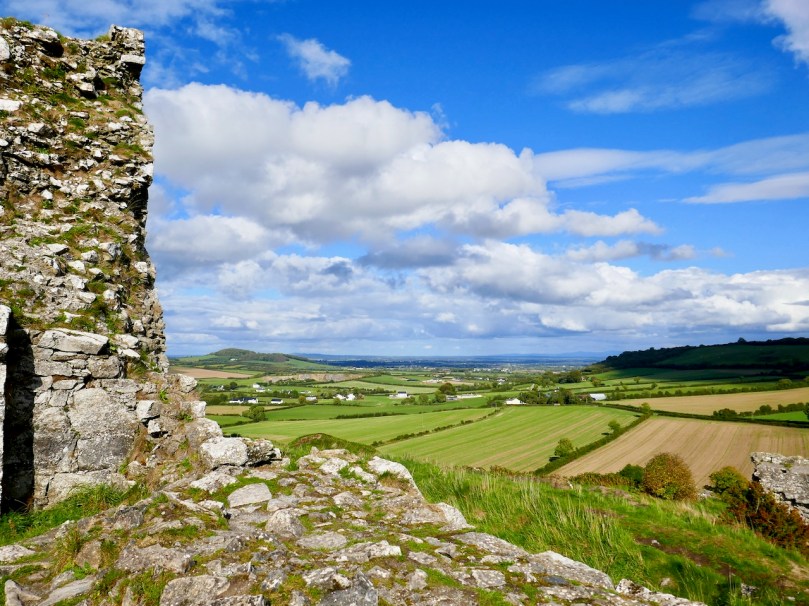
The summit of the Rock commands views of several counties

So where does the Rock of Dunamase come in? It was one of the MacMurrough strongholds, and accordingly was part of Aoife’s dowry when she married Strongbow. Thus, it is inextricably associated with the most turbulent events in Irish History. For some of the later (and indeed earlier) history of the Rock, I refer you to The Irish Aesthete’s excellent post A Rock and a Hard Place.

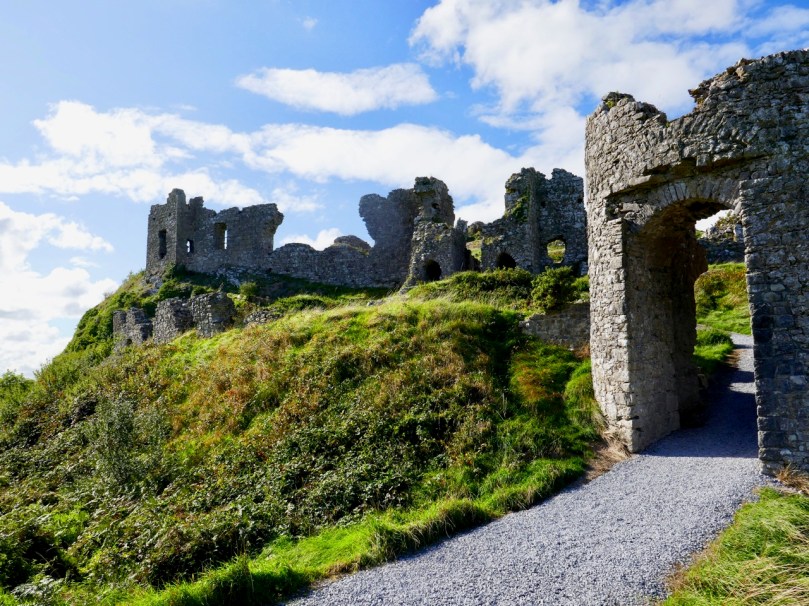
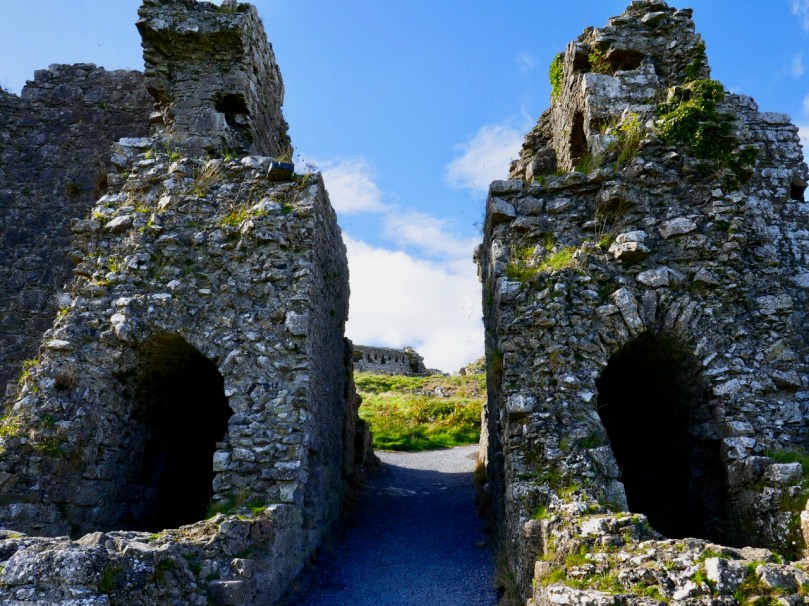
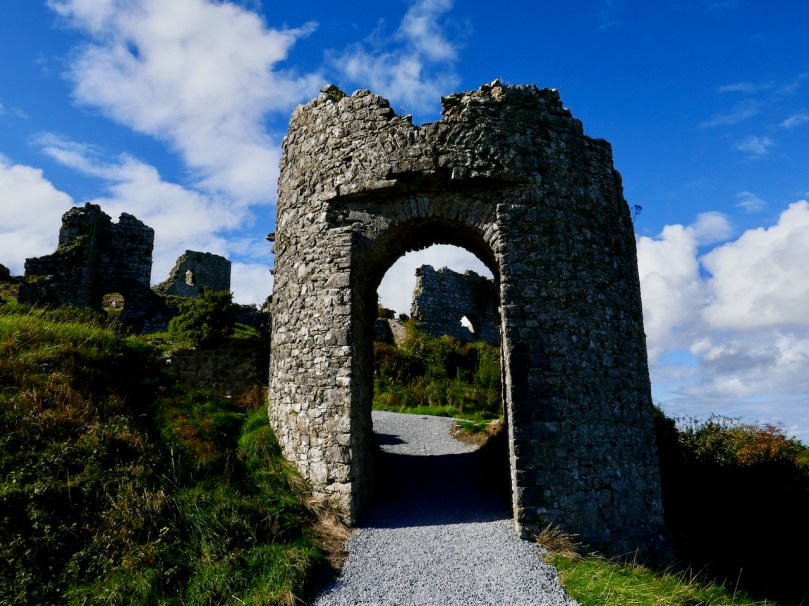
The Barbican Gate, with the curtain wall and corner tower above and behind

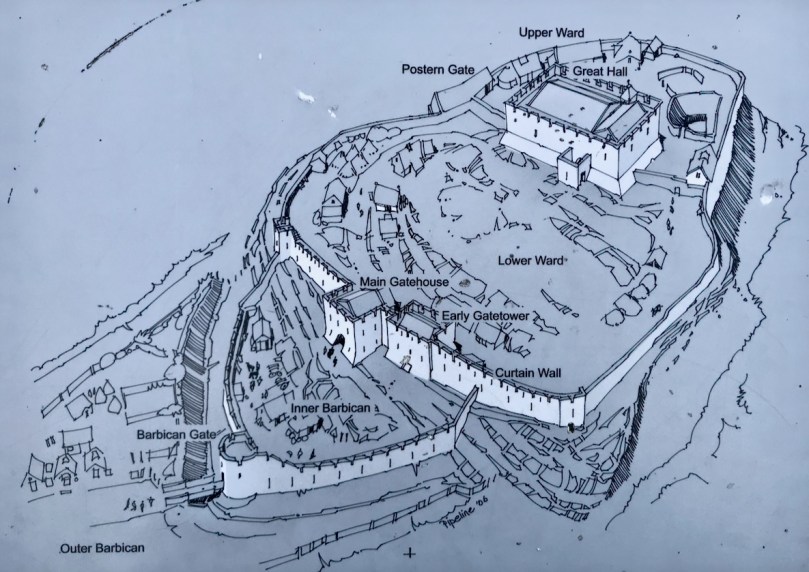
The fortifications and buildings at the Rock are in a ruinous state, of course, but enough remain to give you a good idea of what a strategic site this was and how the defences were designed. The first entrance was a barbican gate behind which was a small area known as the Inner Barbican. Once there, you were at the mercy of archers situated on top of the inner, or curtain wall, shooting down from their crenellated parapet.

From the OPW informational sign

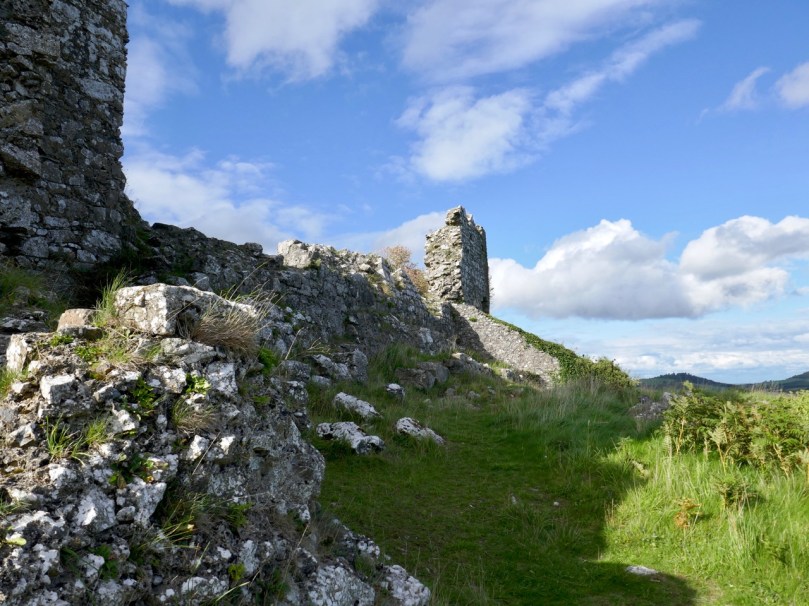
The curtain wall ran around the entire top of the rock. For three quarters of its length it was impossible to attack or breach with the weapons of the time because the wall was built at the top of a steep slope.

The more gentle slope of the east side necessitated the additional defence of the barbican gate. From the inner barbican a massive gatehouse with two towers gave access to the bawn or ward, while two corner towers guarded the northerly and southerly extent of the wall.

Looking upwards towards the Great Hall from the massive Main Gatehouse

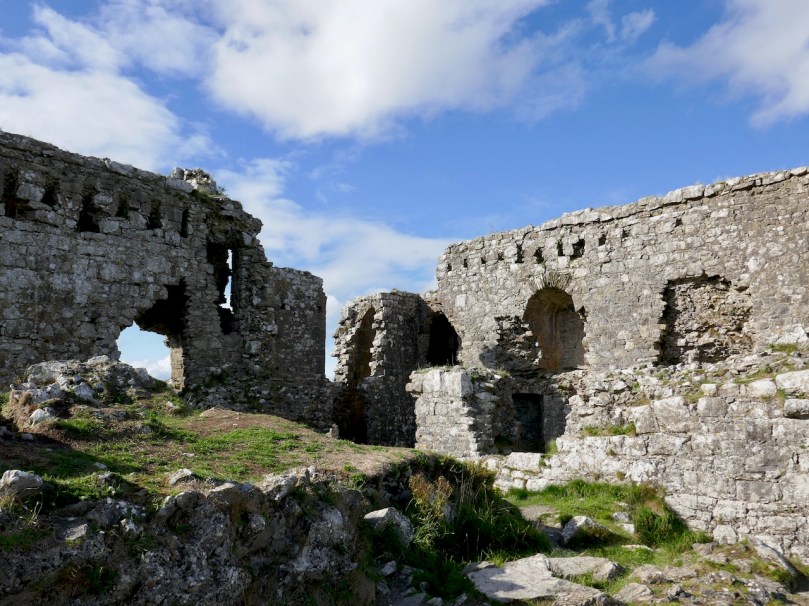
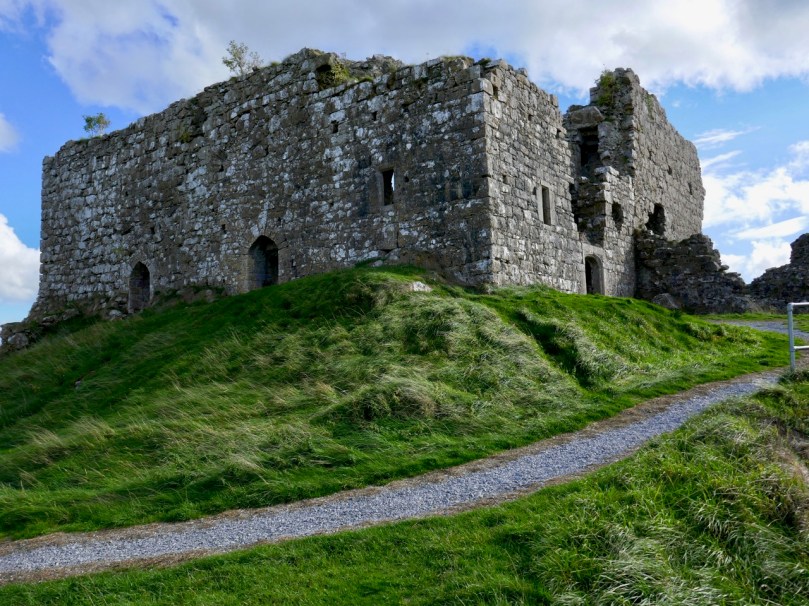
There are indications of other buildings inside the curtain wall, but all that is really significant today  is a large rectangular building known as the Great Hall. This was subject to reconstruction in the 1700s by the then owner (a grandfather of Charles Stewart Parnell) but the building project was never completed.

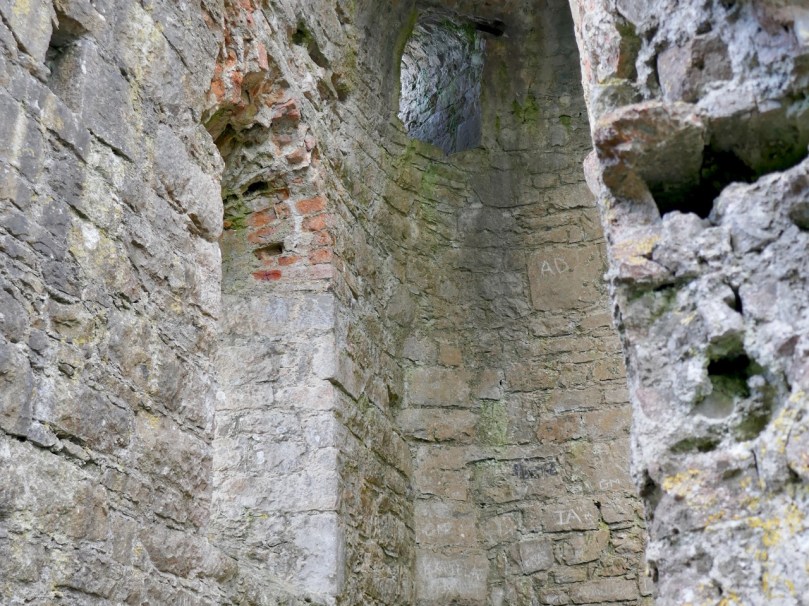
The main result of this reconstruction is to obscure and confuse original versus later parts of the fabric of the Hall. Everywhere you look what appears to be a gothic window embrasure is suddenly sporting red brick.

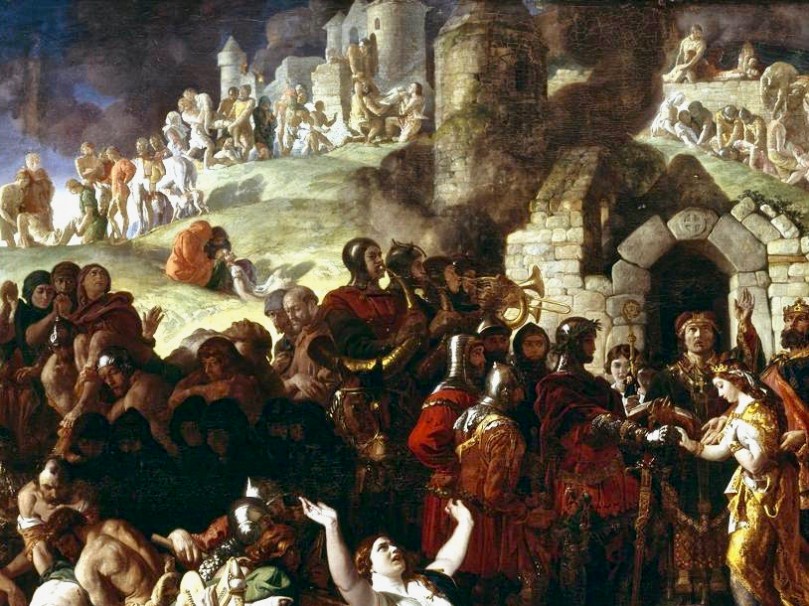
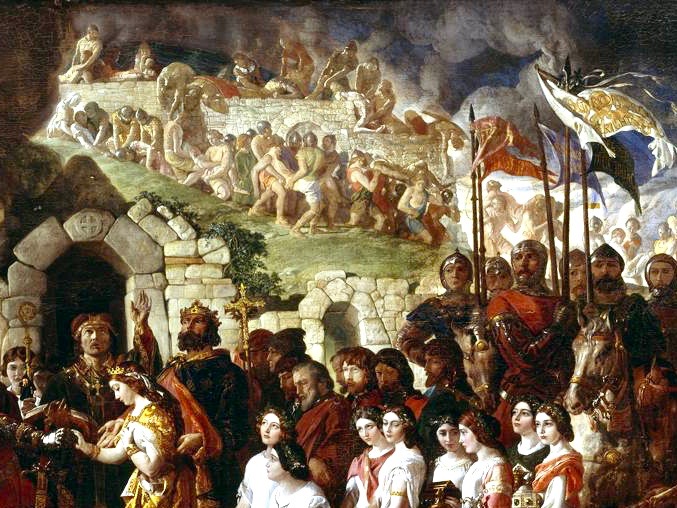
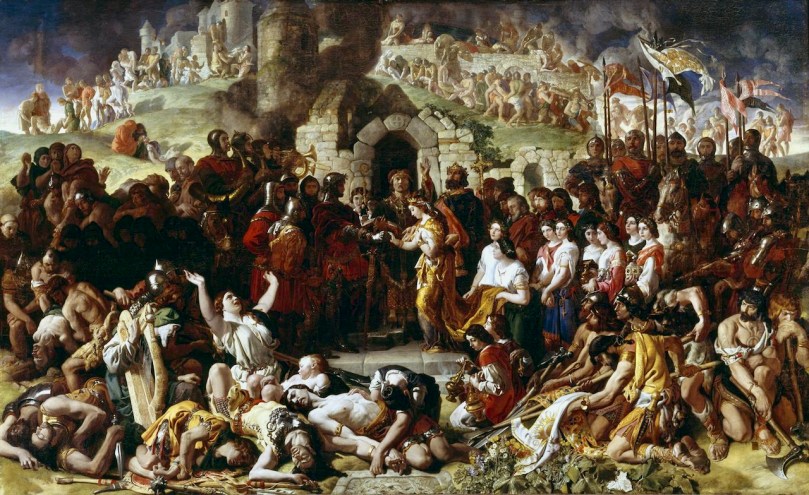
The Marriage of Strongbow and Aoife is the title of an enormous painting by Daniel Maclise that hangs in the National Gallery of Ireland (see the final photograph for the complete painting). It is, in fact, the largest painting in the Gallery, and has been completely conserved in recent years – a series of videos recording this massive process is available on YouTube (just Google ‘Strongbow and Aoife conservation’). But start with this video, in which Dr Brendan Rooney talks about the painting itself.

According to Dr Rooney, the background to the painting is of the City of Waterford, the city on which the marriage took place. The use of this backdrop (rather than, say, the interior of a church)  is used to dramatise the conflict between the Normans and the Irish Chieftains and the consequences of the invasion. He points out a round corner tower that appears to be based on Reginald’s Tower in Waterford, and asserts that the arched gateway calls to mind ‘similar’ gateways in New Ross and Drogheda.

Even if the backdrop is intended to convey a picture of Waterford it seems obvious to me that it is inspired by and based heavily on the Rock of Dunamase. This makes perfect sense from both an historical and a visual point of view. First of all, Maclise was depicting a catastrophic moment in Irish history that is closely associated with the Rock, in that it was the seat of the MacMorroughs, transferred to Strongbow as part of Aoife’s dowry, and which allowed him to subsequently claim succession rights to the Kingship of Leinster.

Secondly – look at it! While there may be echoes of Reginald’s Tower and other Irish medieval sites (such as a round tower) in the painting, it is clearly the steep Rock of Dunamase and its layers of defences that are being depicted. Maclise was known for meticulously researching his subject matter and it seems obvious to me that the marriage is being consecrated in front of the Barbican Gate, while above and behind are the ramparts of the curtain wall. There are still stretches of Waterford’s town walls extant, including towers, and it’s possible that they also provided some inspiration for the backdrop to the marriage scene. There are also a few Irish Norman castle sites that are built on a rocky prominence, but the most dramatic of them is the Rock of Dunamase.

Maclise’s The Marriage of Strongbow and Aoife is one of our most iconic paintings and has been one of the most beloved because of the subject matter. At the same time, the Rock of Dunamase is central to the most critical juncture on our history. They belong together – don’t you agree?

Daniel Maclise (1806-1870), ‘The Marriage of Strongbow and Aoife’, c.1854. © National Gallery of Ireland

Tralong Bay, Co Cork – A Prehistoric Drowned Landscape

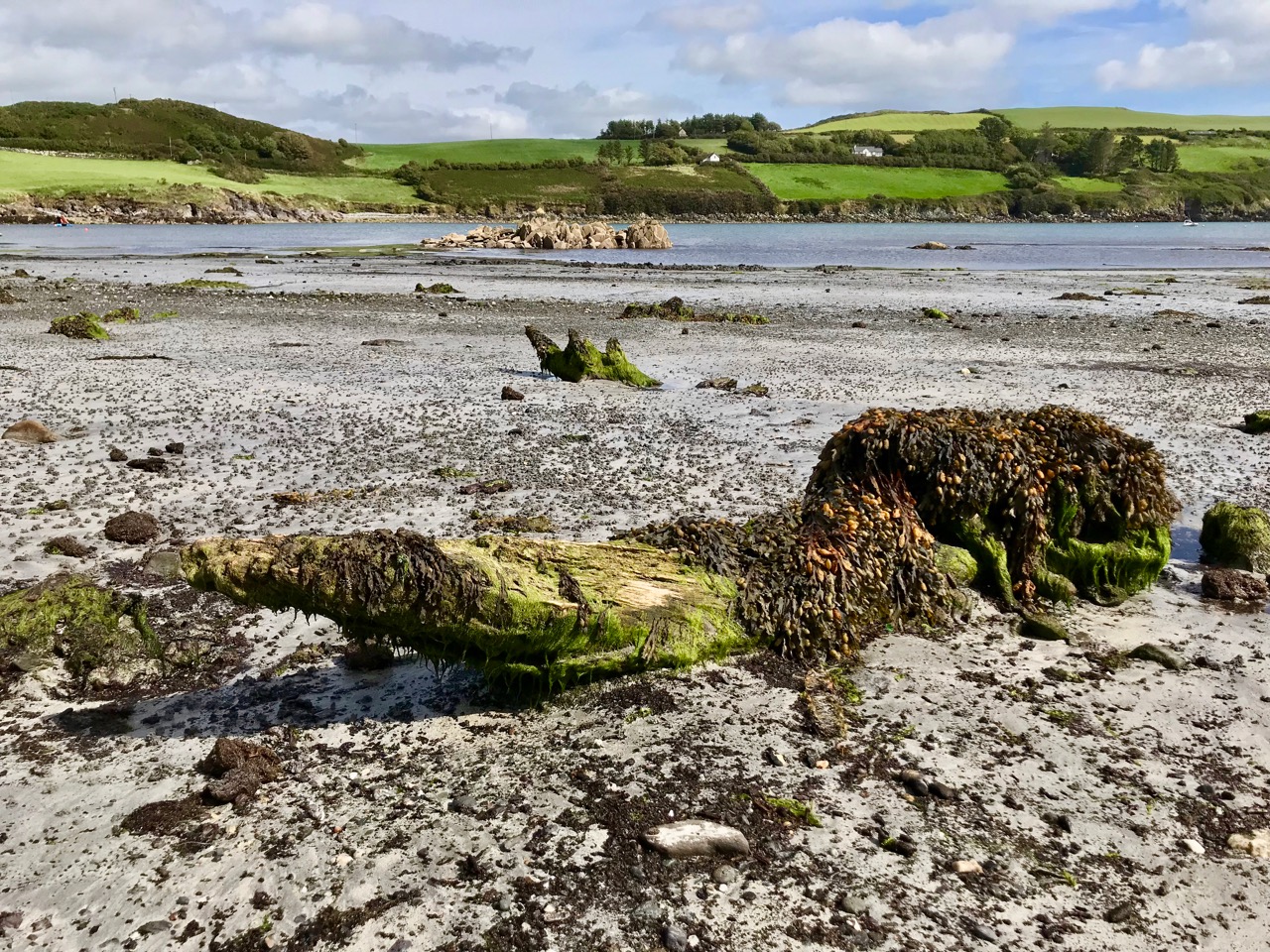
In West Cork it is possible to examine the remains of trees which were growing several thousand years ago – perhaps in the time of our earliest ancestors. Around the coasts of Ireland and Britain are sites of post-glacial forests which flourished close to an ancient shoreline until inundated by rising sea levels in the Neolithic period. Cycles of change in weather, tides and geology over millennia saw these remains flooded by encroaching seas, then resurfacing, only to be buried under sediment and sand as tides abated. We are living in an age of extremes and recent abnormal climate activity has in places exposed some of these remains which are as old as human activity in Ireland: this is Organic Archaeology!

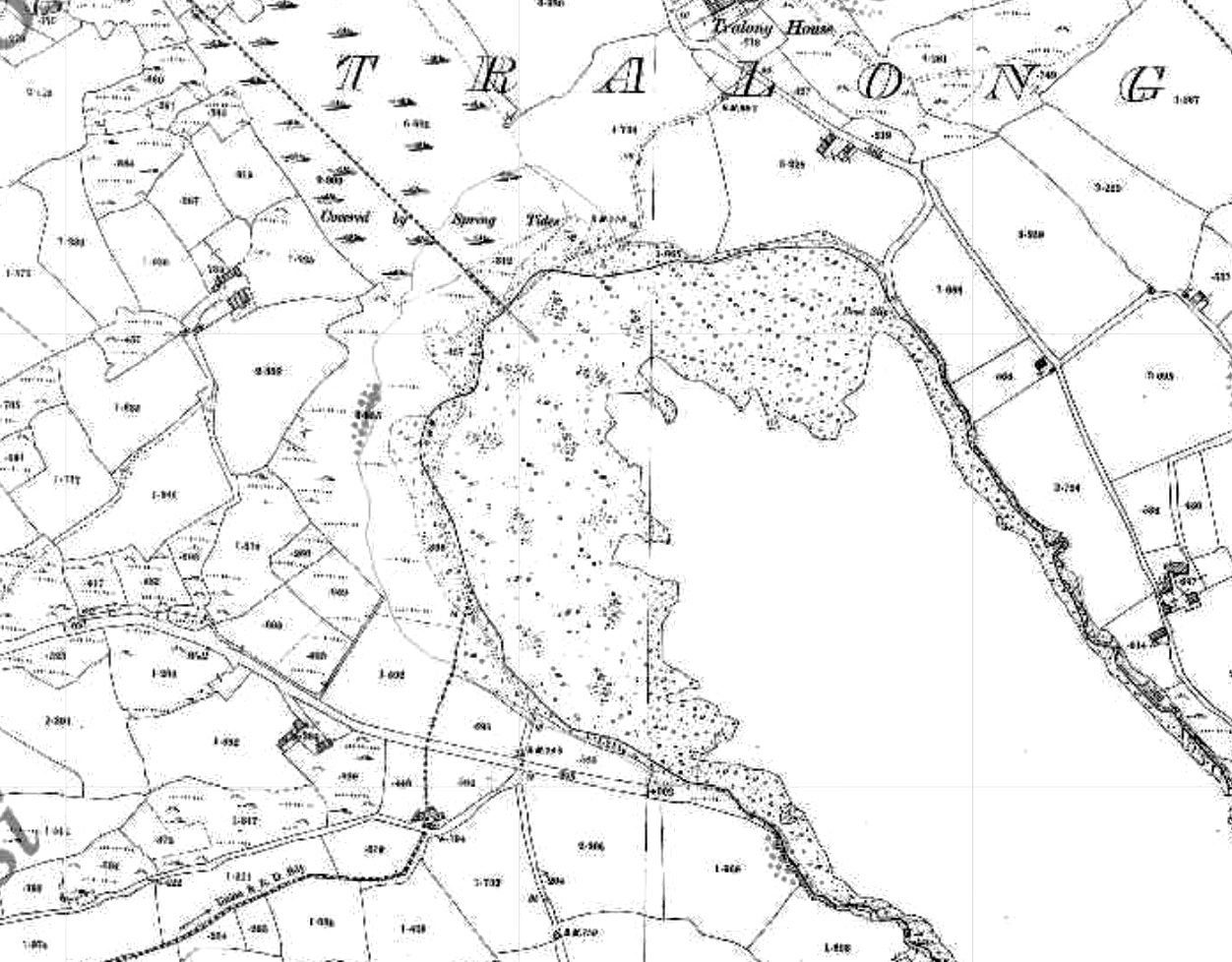
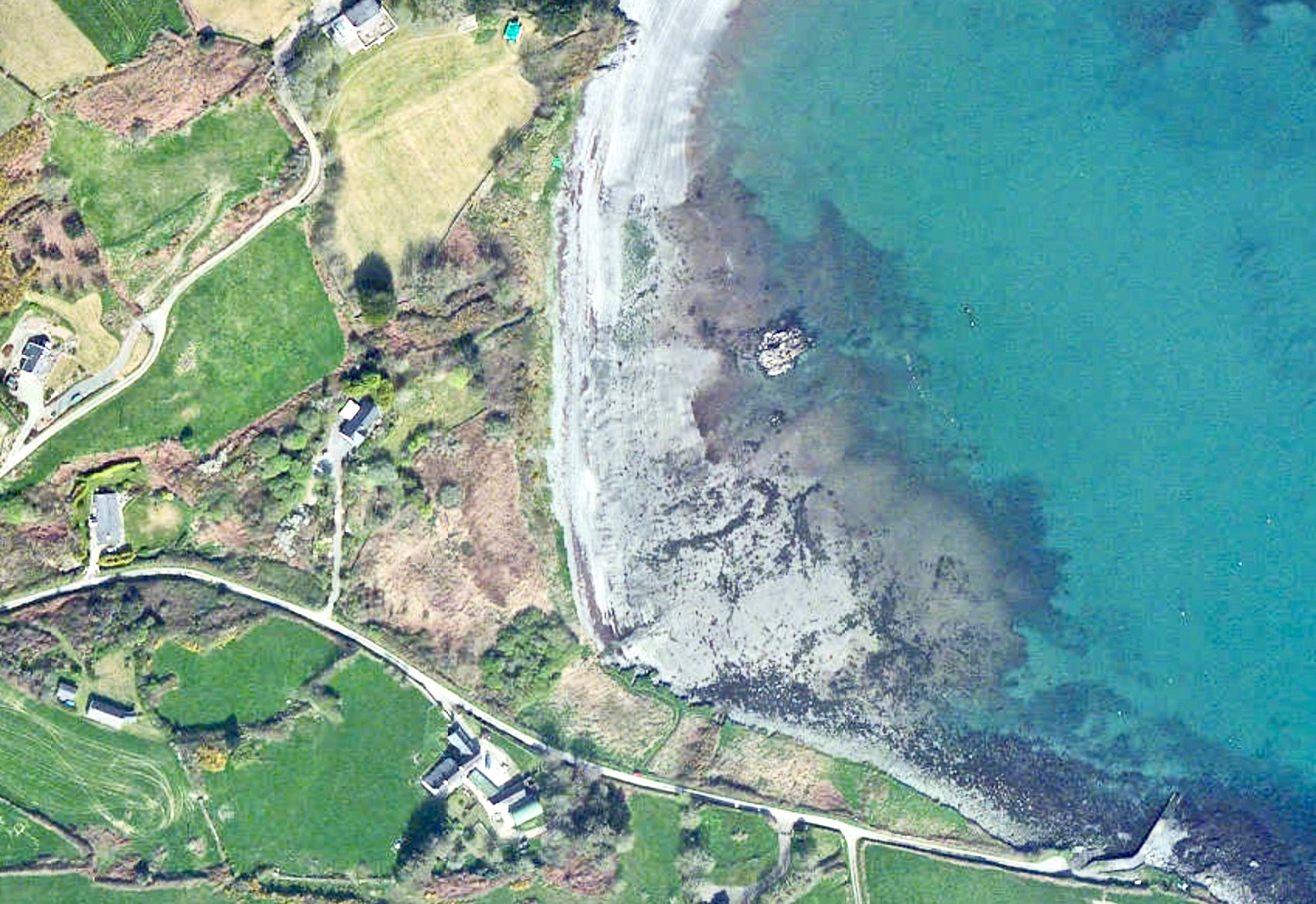
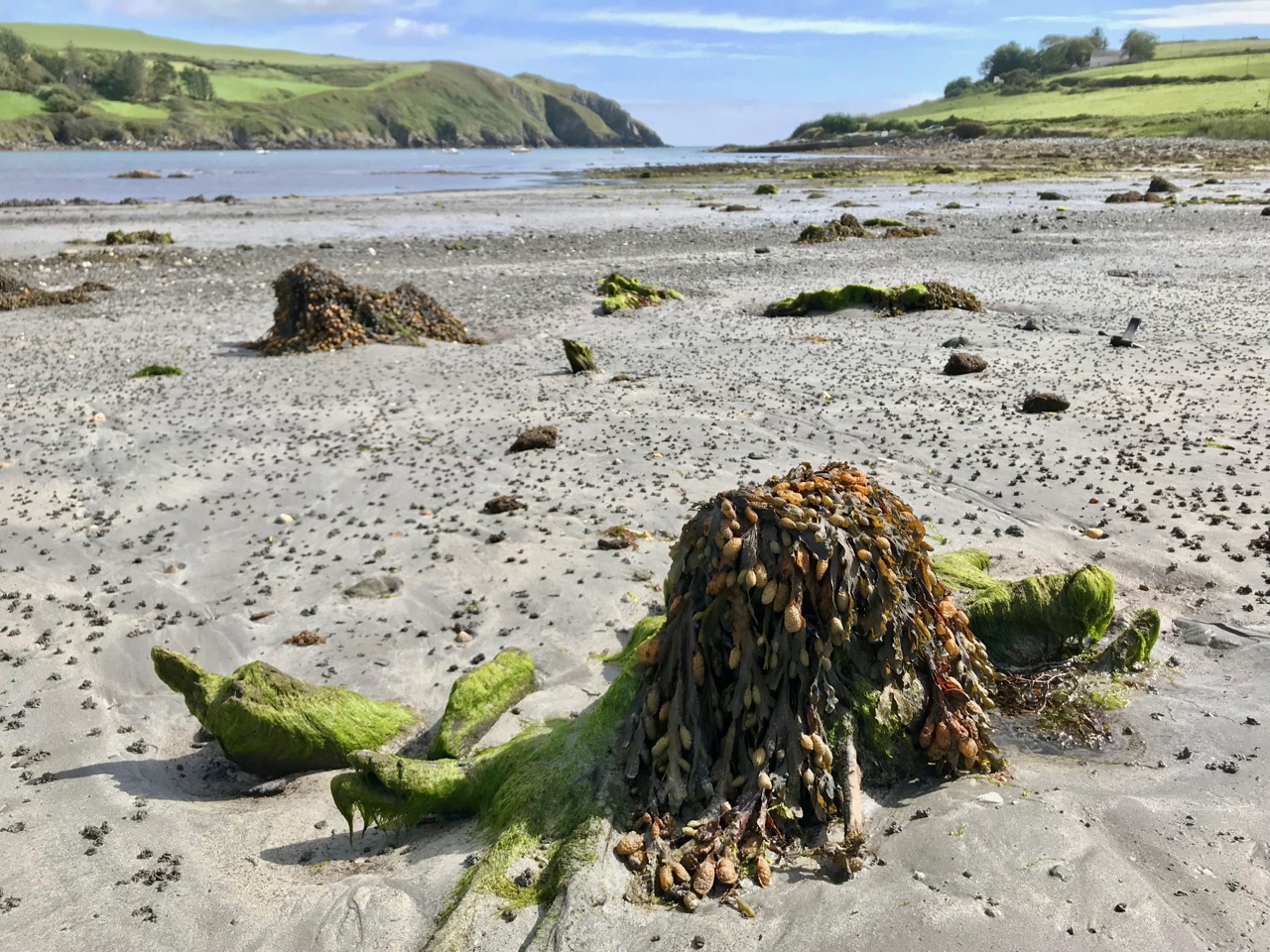
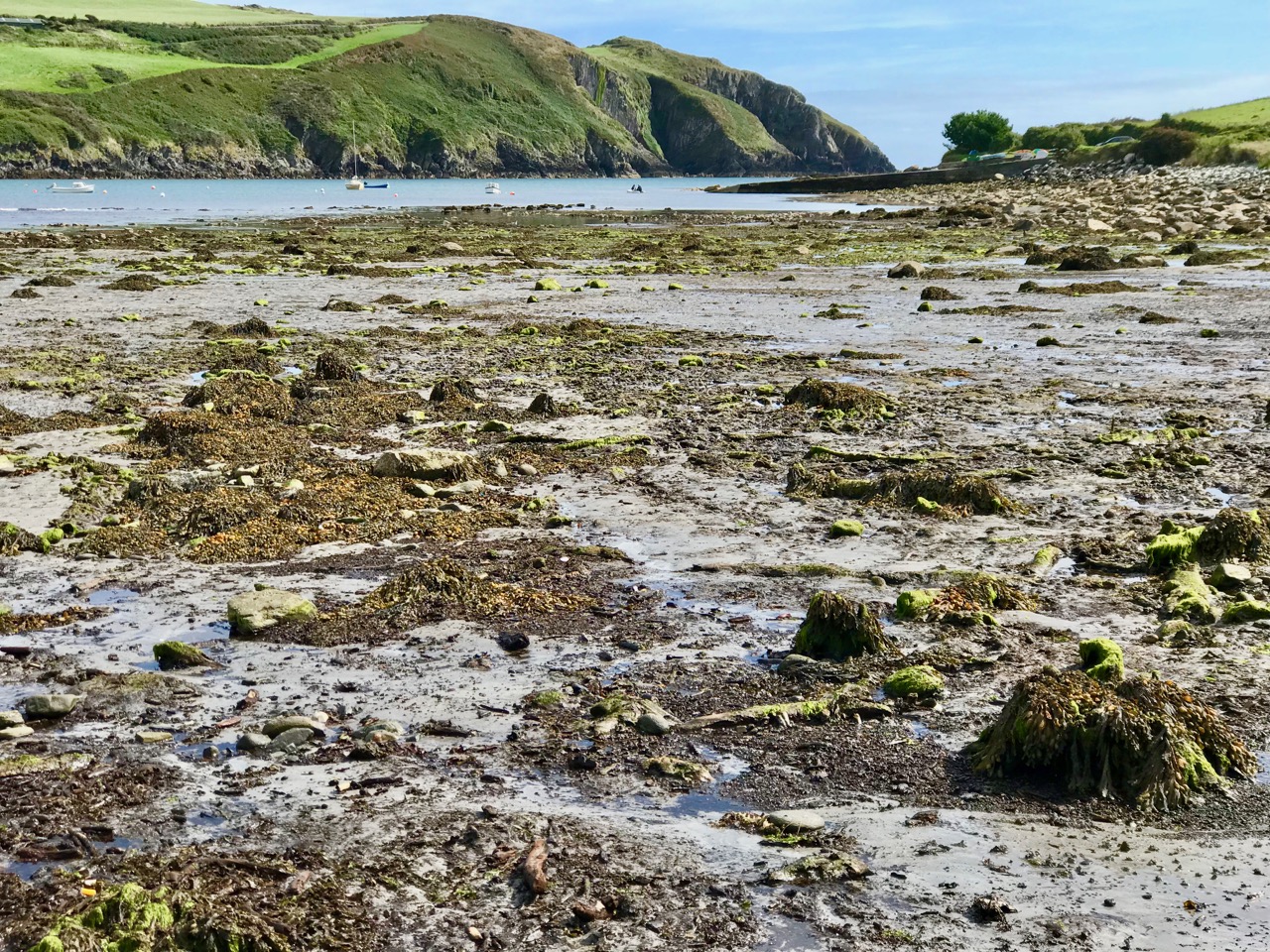
Header – Tralong Beach, between Glandore and Rosscarbery, where the remains of very ancient woodland can be seen. Upper map – the c1850 6″ OS map showing the shape of the coastline at Tralong Bay, and Lower map – a closer aerial view of the beach in modern times: the darker mass shows the partly submerged peat beds

Little has been written about the Tralong site, but another comparable drowned landscape has been revealed in Northumberland UK where archaeologist Clive Waddington, of the company Archaeology Research Services, has found the remains of an ancient forest on the coast of Low Hauxley. He reports:

. . . In 5,000 BC, the sea level rose rapidly and swallowed the earth. The sand dunes were pushed inland, burying the forest, and then the sea receded somewhat. Now, the sea level increases again: it cuts out the sand dunes and exposes the forest . . . During the course of the investigation, the archaeologists found evidence of human presence in the area: traces of adults and children , the analysis of which revealed that they were wearing leather footwear. With human footprints the scientists also found footprints of wild boar and brown bears . . .

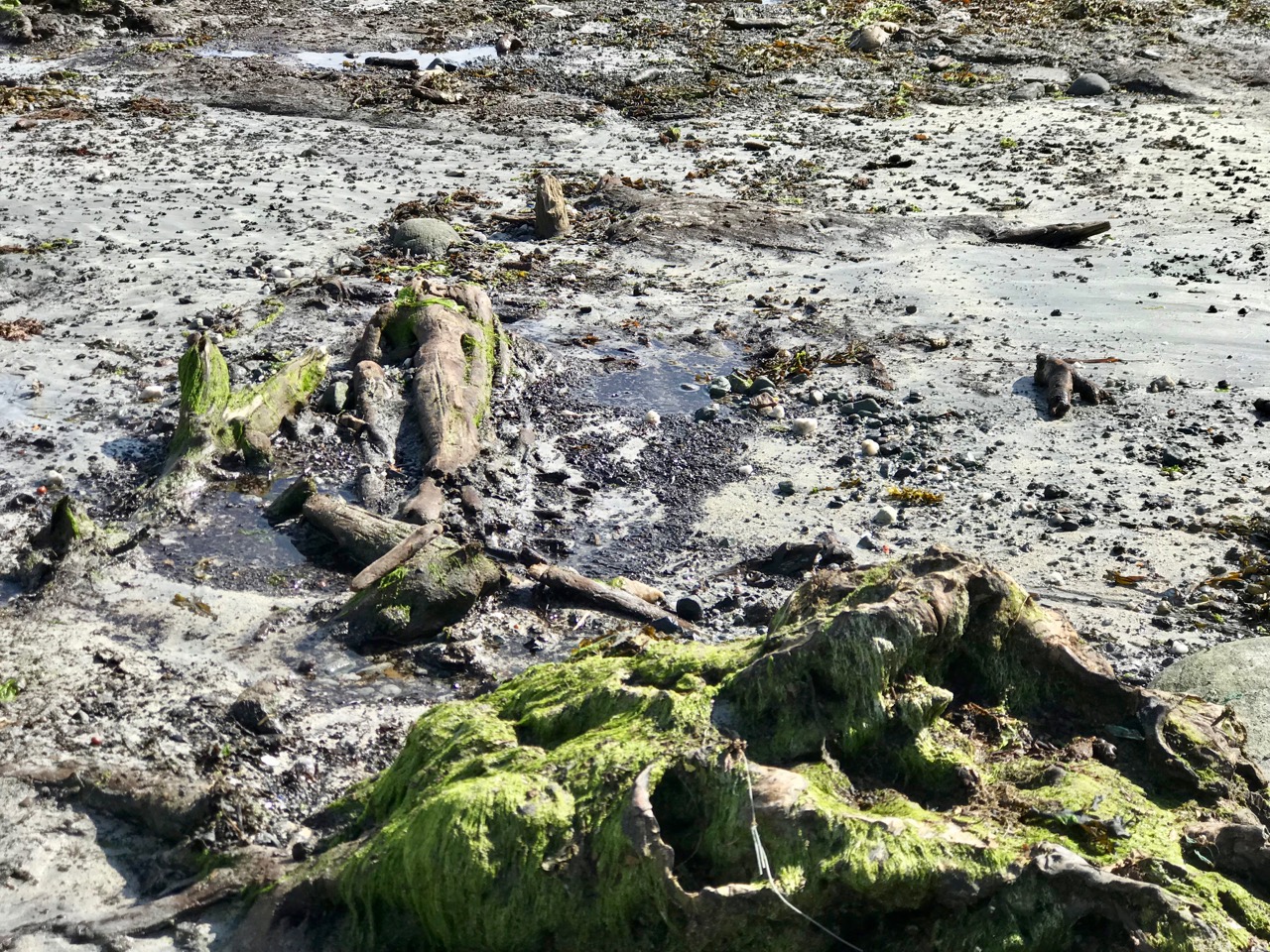
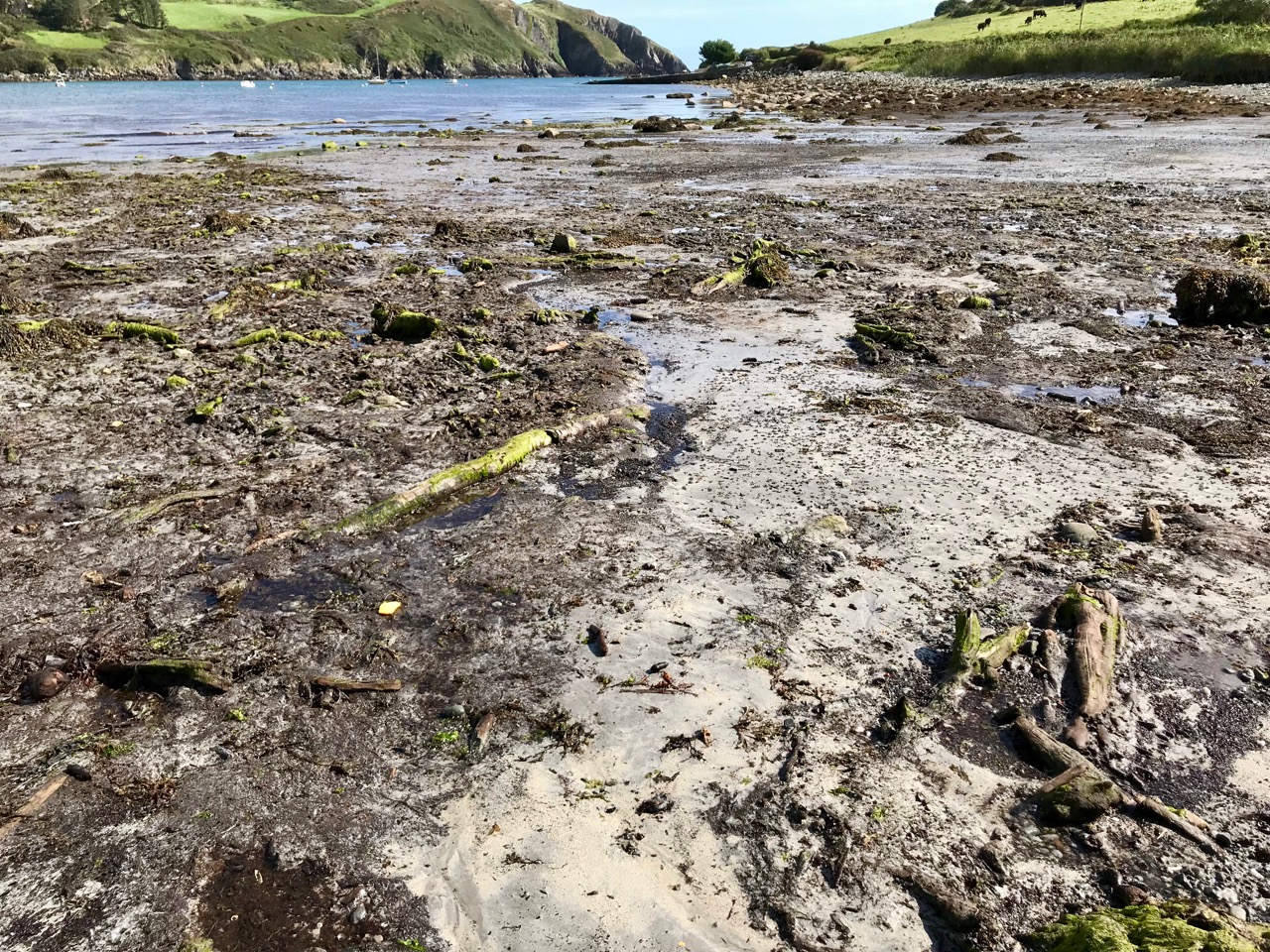
Part of the beach at Tralong Bay, Co Cork: the surface of the peat mass, which could be up to 4 metres thick, is interspersed with numerous tree boles, roots and scattered branch and twig debris. At one place I found a perfect complete pine cone, which could have been part of that debris.

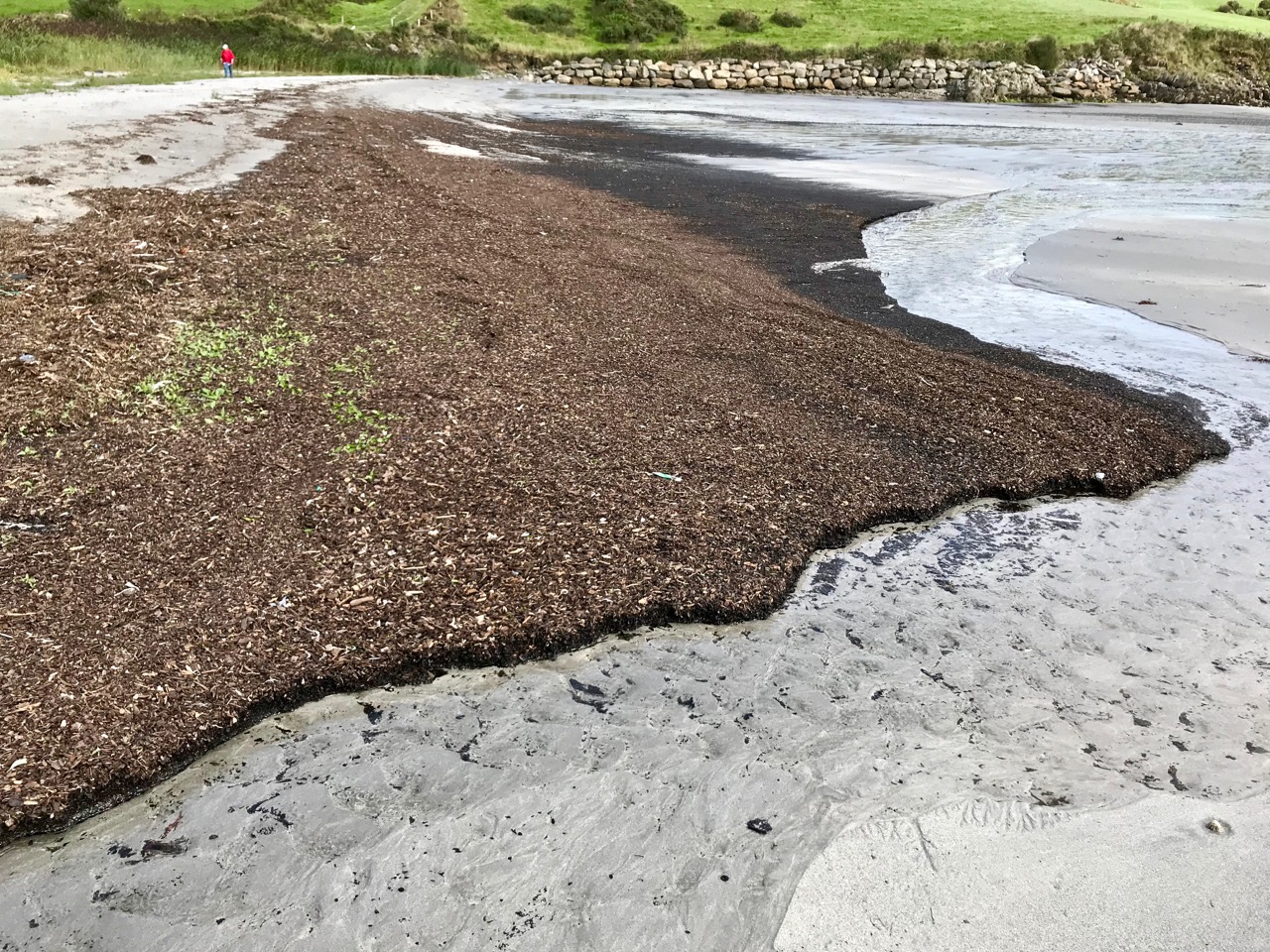
The surface of the beach is dotted with these remnants of ancient forest, over a wide area. It seems remarkable that there are also extensive blankets of loose material retained in the bay which must also originate from the forest.

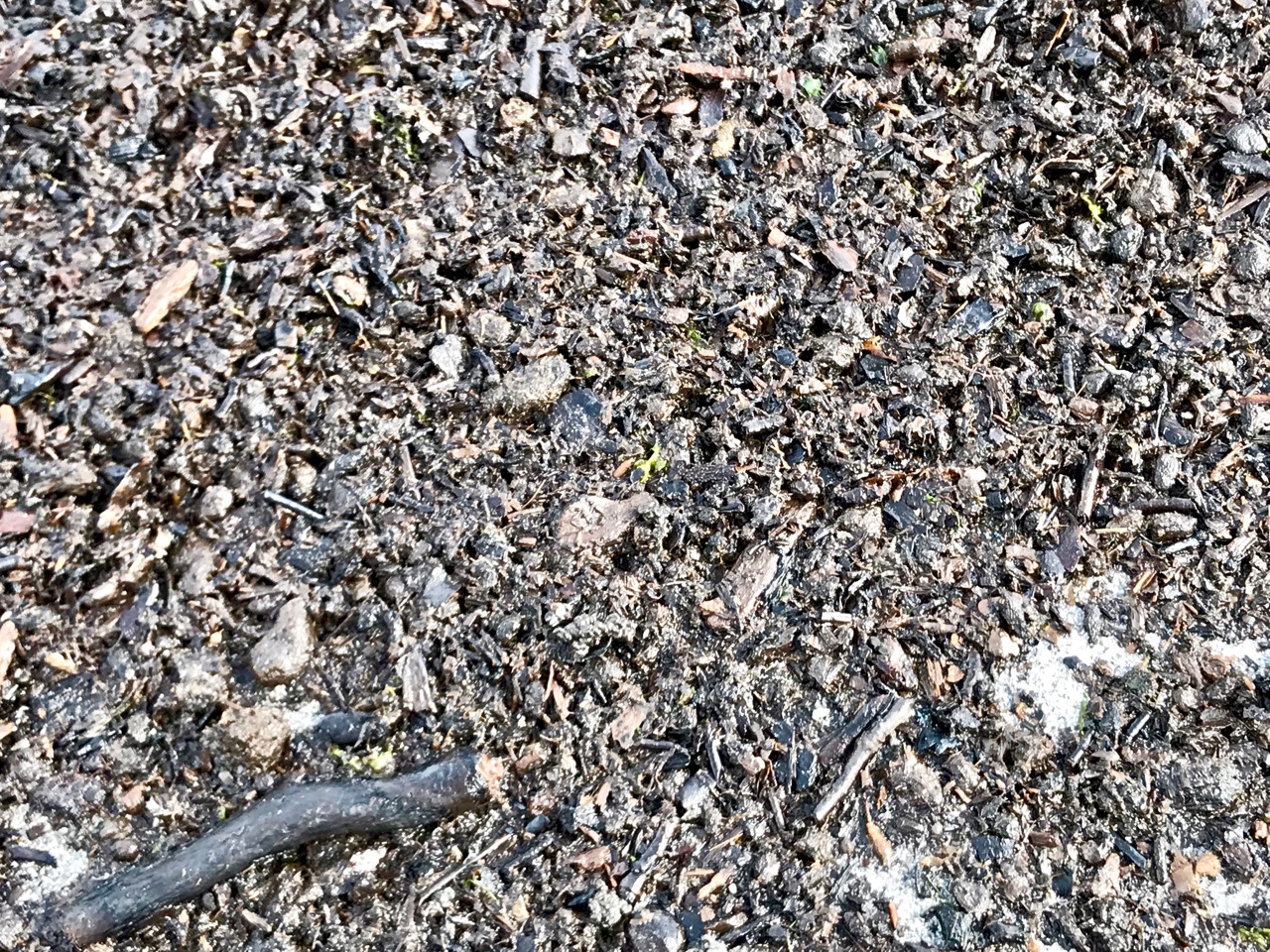
Upper picture – one of the huge blankets of organic material – mainly wood based – which has been washed up to the north end of the bay at Tralong since the extreme storms of 2014. Lower pictures – closer views of the debris showing recognisable material including twigs and branches.

In November 2015 Michael Viney wrote a piece in the Irish Times on drowned forests in Galway Bay:

. . . All summer the quiet tides returned the sand that last winter’s storms had dragged offshore, heaping it even deeper over the old oaken wreck on the strand . . . Perhaps, though I hope not, this winter’s great mill wheels of waves will grind that deeply again. Storms two years ago tore away whole layers of sand and stone west of Spiddal in Galway Bay, uncovering stumps of ancient oak, pine and birch from a 7,000-year-old forest drowned as the sea rose after the end of the Ice Age. The same exceptional seas, on the north coast of Connemara, exposed remnants of human occupation a metre thick in the sand-cliff shore of Omey Island. There were medieval burials among them, and bog at least 6,000 years old . . . Elsewhere along the west coast yet more of the kitchen shell middens of early settlers, back to the late Mesolithic, were stripped away. So the sea reveals the past and then takes it away . . . Glimpses of Ireland’s lost shores and drowned forests are not new. Pinewoods submerged off the Bray coast were described by Robert Lloyd Praeger at the end of the 19th century when construction of Bray harbour changed sediment flows and piles of collapsed trees appeared above the sand . . .

Ancient forests reappeared again in Bray, Co Wicklow, in 2001, and more were revealed recently – in 2017. The Irish Times reported earlier this year on a project to discover “the lost landscapes” of the Irish Sea

Tralong Beach will change again, as the weather patterns vary, and it may not always be possible to experience the drowned landscape here. It’s an unmissable journey into deep history.

With many thanks to Robin Lewando for introducing us to this site, and to Anthony Beese for providing additional material