Mapping West Cork, Part 2: John Speed

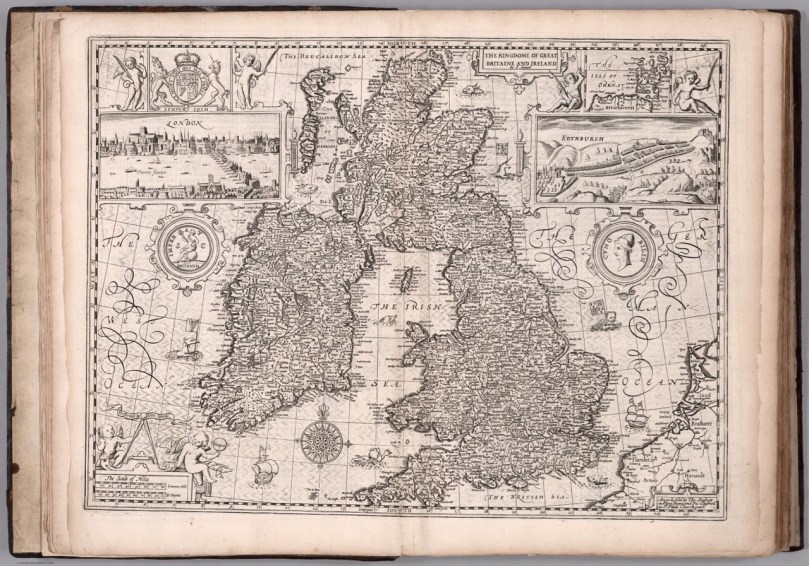
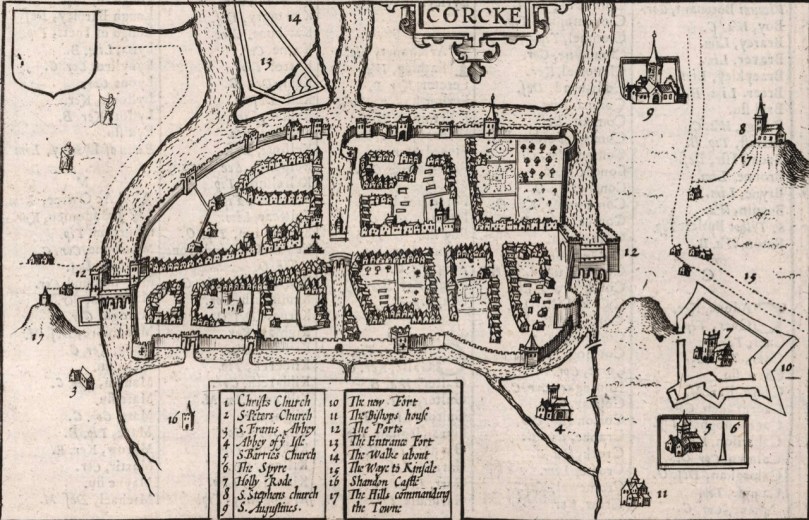
John Speed was one of the greatest of Britain’s map-makers, but it is unclear how much actual original cartography he did. Much of the information in his maps appears to be based on Mercator’s maps, which we featured in Mapping West Cork, Part 1. What does appear to be original, as there are no previous records of them, are the city maps, so we can be reasonably sure that these were done from his own calculations – laid out by paces rather than by measuring implements.
Who was John Speed? Born in 1551, he trained as a tailor but his passion was for maps and he finally worked his way into a full time position as a historian and geographer, even being allocated a room for his research by Queen Elizabeth I.

His magnum opus was The Theatre of the Empire of Great Britaine, published in 1611 and 12. This marks them as later than Mercator’s maps, but earlier than Joan Blaeu’s (see Part 1).  They were also drawn with the collaboration of Iodicus Hondius, who had drawn Mercator’s, which also explains the similarities to Mercator’s maps.

The edition of Speed’s atlas that is most often referenced is the one published in 1676, and that is the one that the wonderful David Rumsey acquired and uploaded to his map collection site. Until I read the fine print, I hadn’t realised that the maps in fact dated to 1611/12 and therefore were older than the Blaeu atlas.

This is the period immediately following the Battle of Kinsale in 1603, which marked the decisive end to the Nine Year’s War, and to the old Gaelic way of life. The maps were also made in the period after the failed Desmond Rebellions of 1569–1573 and 1579–1583. They still name the great Irish families rather than the English planters who would so totally supplant them over the course of the next century. In this regard, it is an important record of what was happening on the ground in 1611.
Along with his Atlas he produced a work that combined history and geography – the Invasions of England and Ireland, in 1601 and 1627. He was, of course, a devoted subject of the Queen (‘her sacred maiestie’) and his political opinions tended to the conservative, if not puritantinical.

This map is accompanied by the history of invasions, with suitable illustrations. I am particularly taken with the depiction of ‘Desmond beheded’

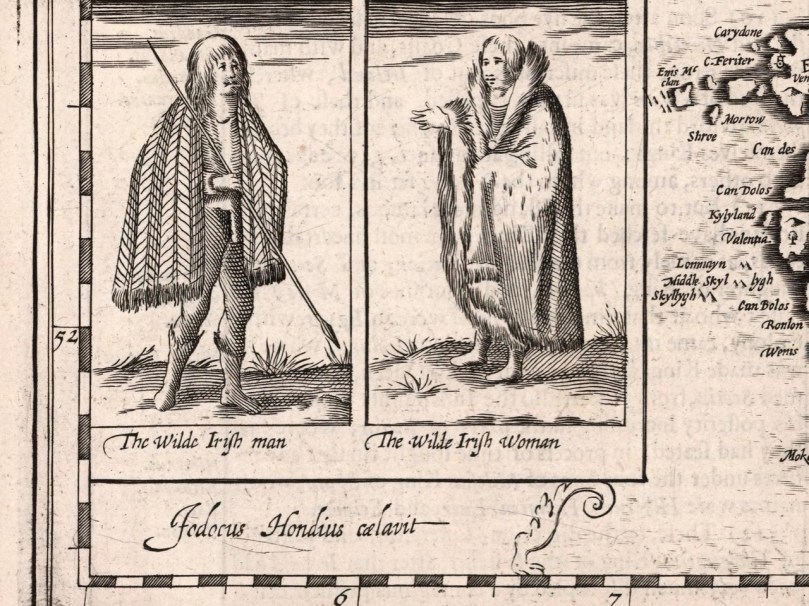
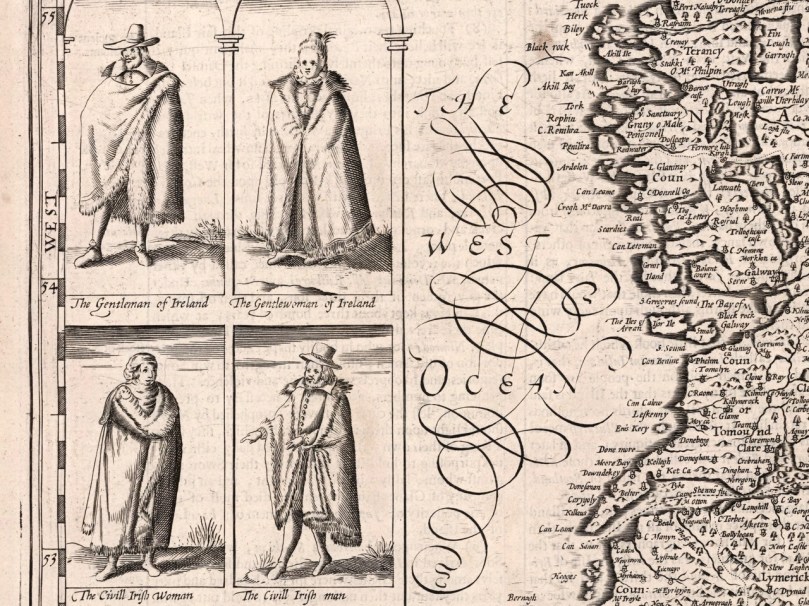
True to his day, he depicted the Irish quite differently from the British – the lowest grade of English person was the Countryman or Country woman, whereas in Ireland it was the Wilde Man or Woman.

The city maps were all new and it seems that Speed, with one of his sons, actually travelled to the cities he includes in his atlas and paced out the distances, drawing the maps based on these calculations. They are a unique and invaluable record of a time when Ireland had walled cities, especially given that so few intact stretches of those walls remain. (We’ve visited some impressive remains, though – see Youghal’s Walls and our post on the walled town of Fethard.)

The Dublin map is from a later edition

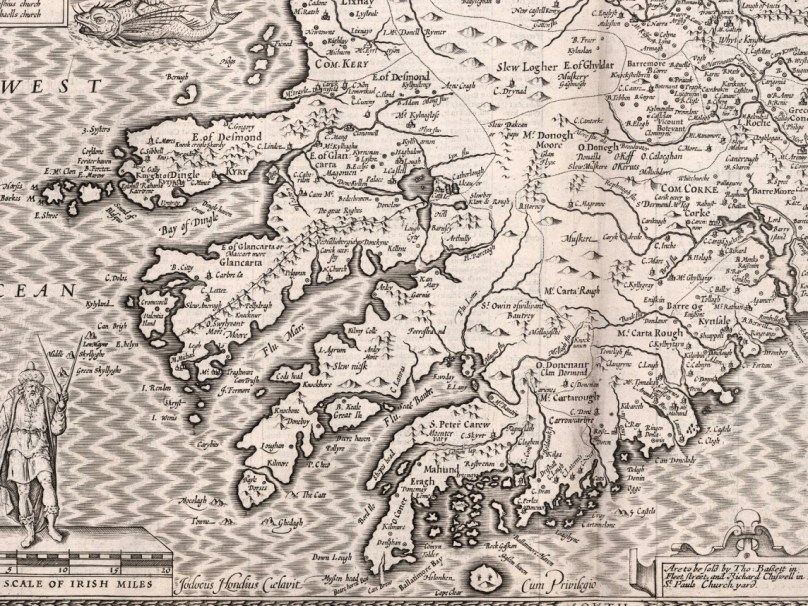
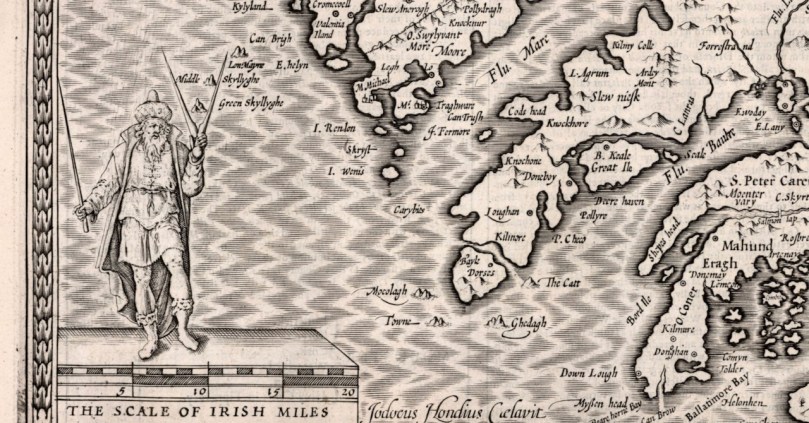
The actual physical depiction of the land is recognisably based on the Mercator map but there is more information now about locations and families. I was delighted to see Rossbrin show up (Roßbrenon) along with Ardintenant (Artenay), since it is this castle that we look across to from our home. Mizen Head and Brow Head are both marked, and the Sheep’s Head is also noted as Moentervary (Muintir Bheara is the Irish designation for that Peninsula).
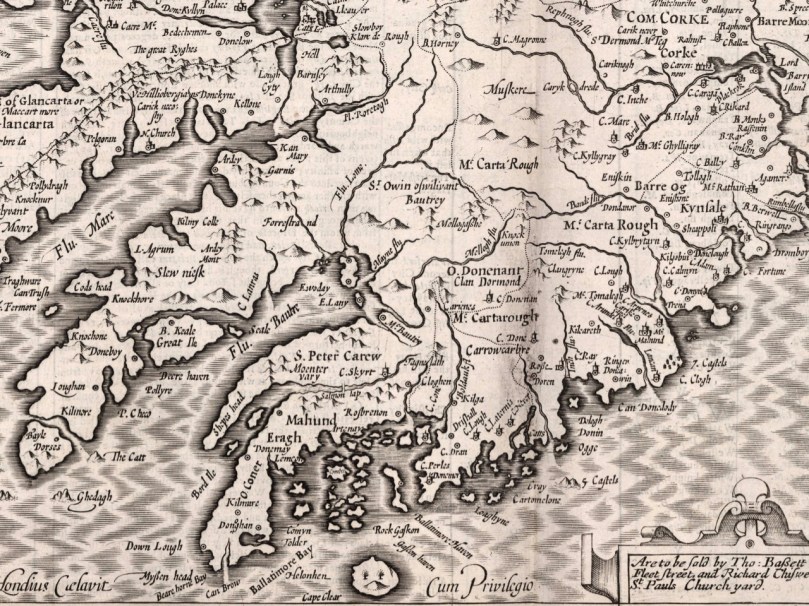
Besides the O’Mahonys, the O’Driscolls, the McCarthys, the O’Donovans, Sir Peter Carew occupies a chunk of land. Someday I will write about his claim to that land and the lengths he went to to secure the deeds to it. But perhaps I shouldn’t be too exclusive to West Cork: below is a section of North Cork and part of Kerry in 1612. What can you see?
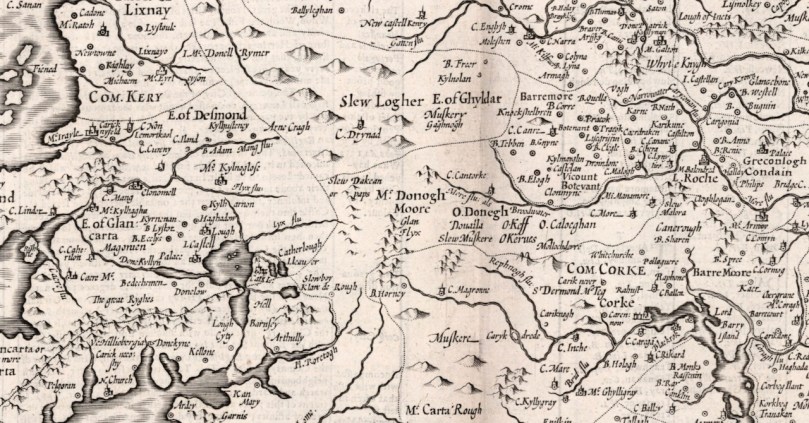
Maps drawn by a colonising power, have an agenda far beyond simply charting the territory. John Speed’s became the defining maps of the expanding British Empire during the seventeenth century and indeed they influenced British people’s perceptions of the world until well into the eighteenth. For us in Ireland, and in West Cork, they are an invaluable social document.
Mapping West Cork, Part 1

Industrial Archaeology in Crookhaven

Roaringwater Journal has featured Crookhaven many times. This far south-western outpost of Ireland has layers of history: thousands of years ago people lived in this area and made marks on the rocky landscape while countless generations of seafarers forged a ‘haven’ from the naturally sheltered ‘crook’ of land upon which the settlement is based. Even into the twentieth century pioneering technological advances were being made in Crookhaven: in the early 1900s Marconi sent some of the world’s earliest radio communications from Brow Head to vessels in the Atlantic shipping lanes.

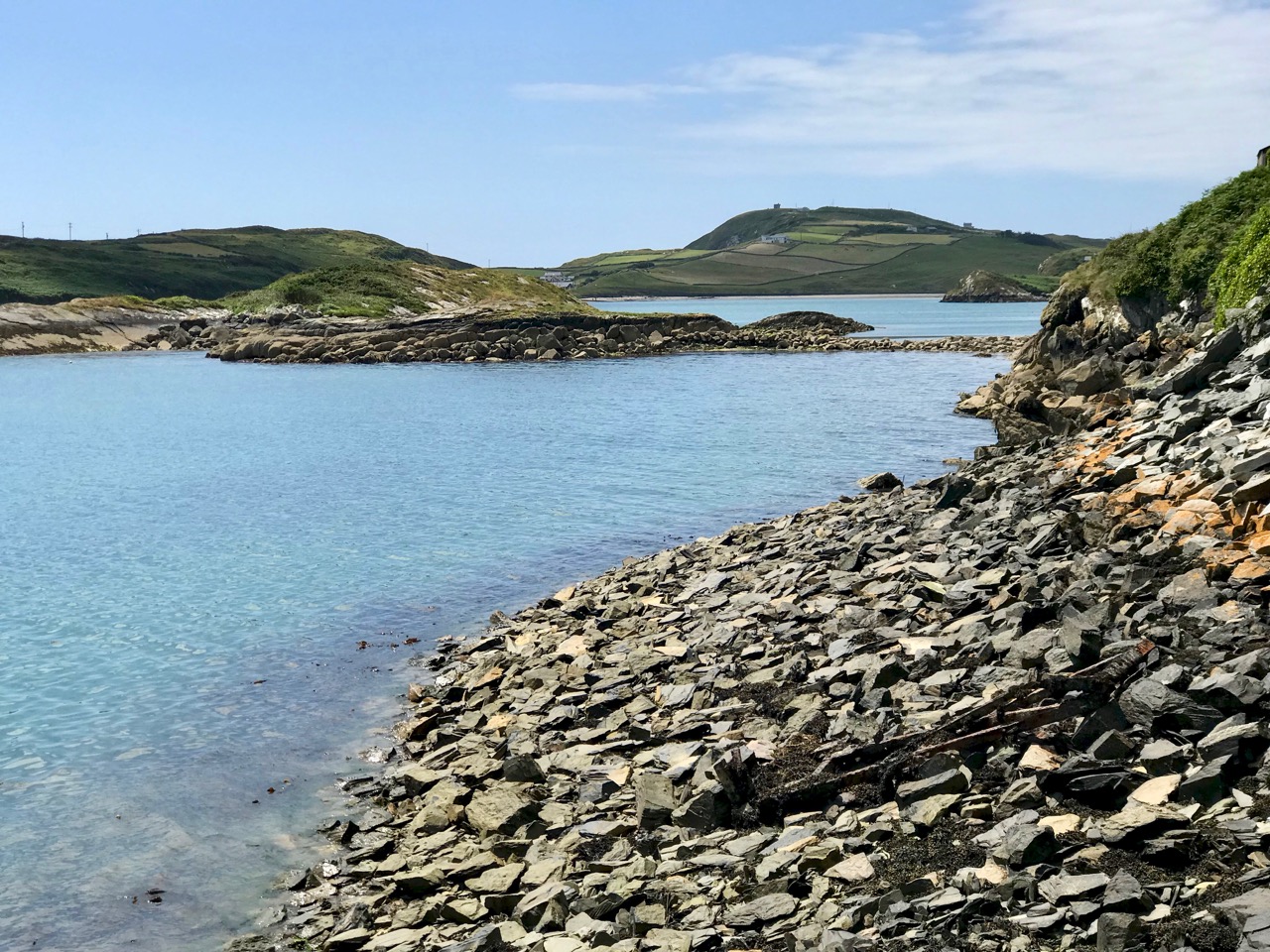
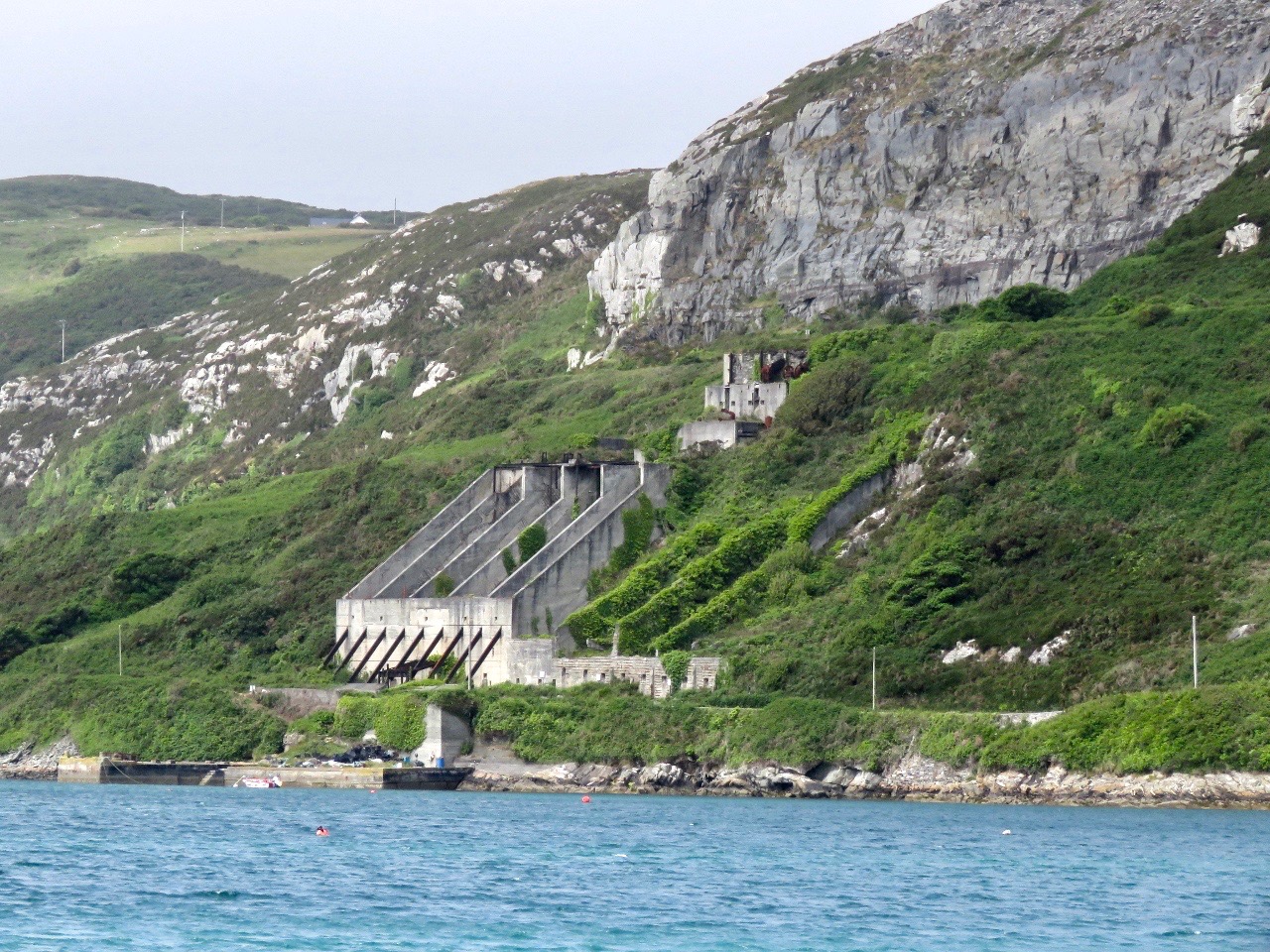
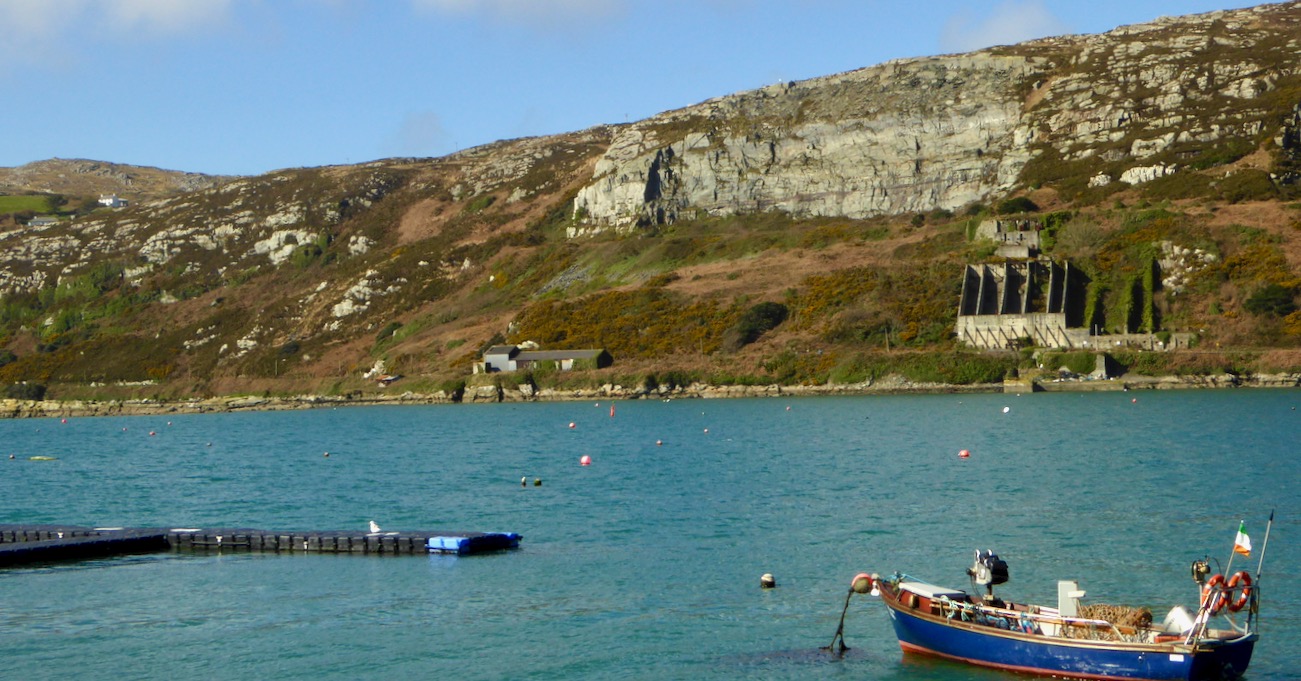
Header – the ‘old quarry’ dominates the landscape to the north of Crookhaven Harbour. Above – looking across the harbour from the ‘quarry quay’ towards Brow Head, one of the scenes of operation of Marconi in Ireland

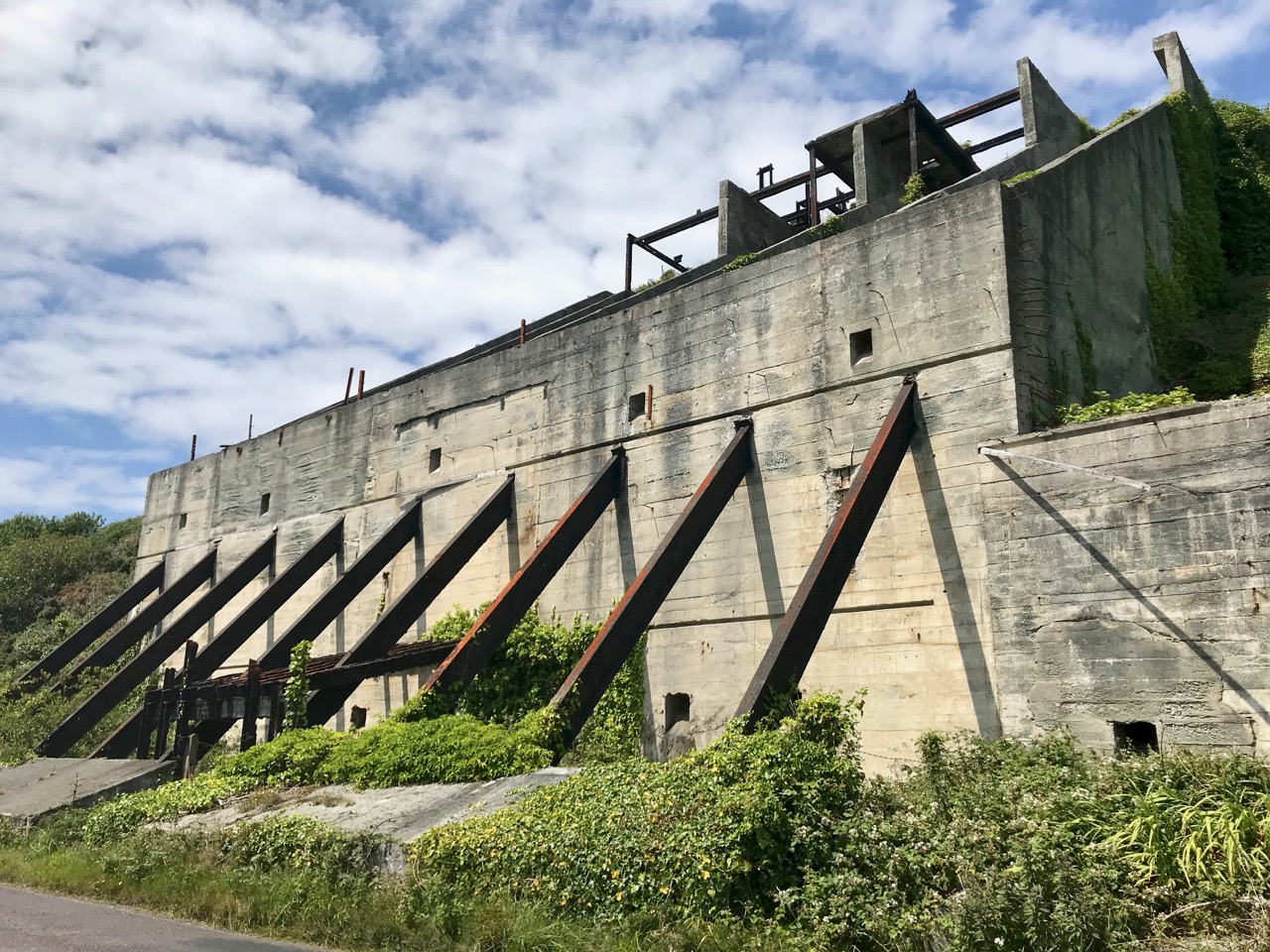
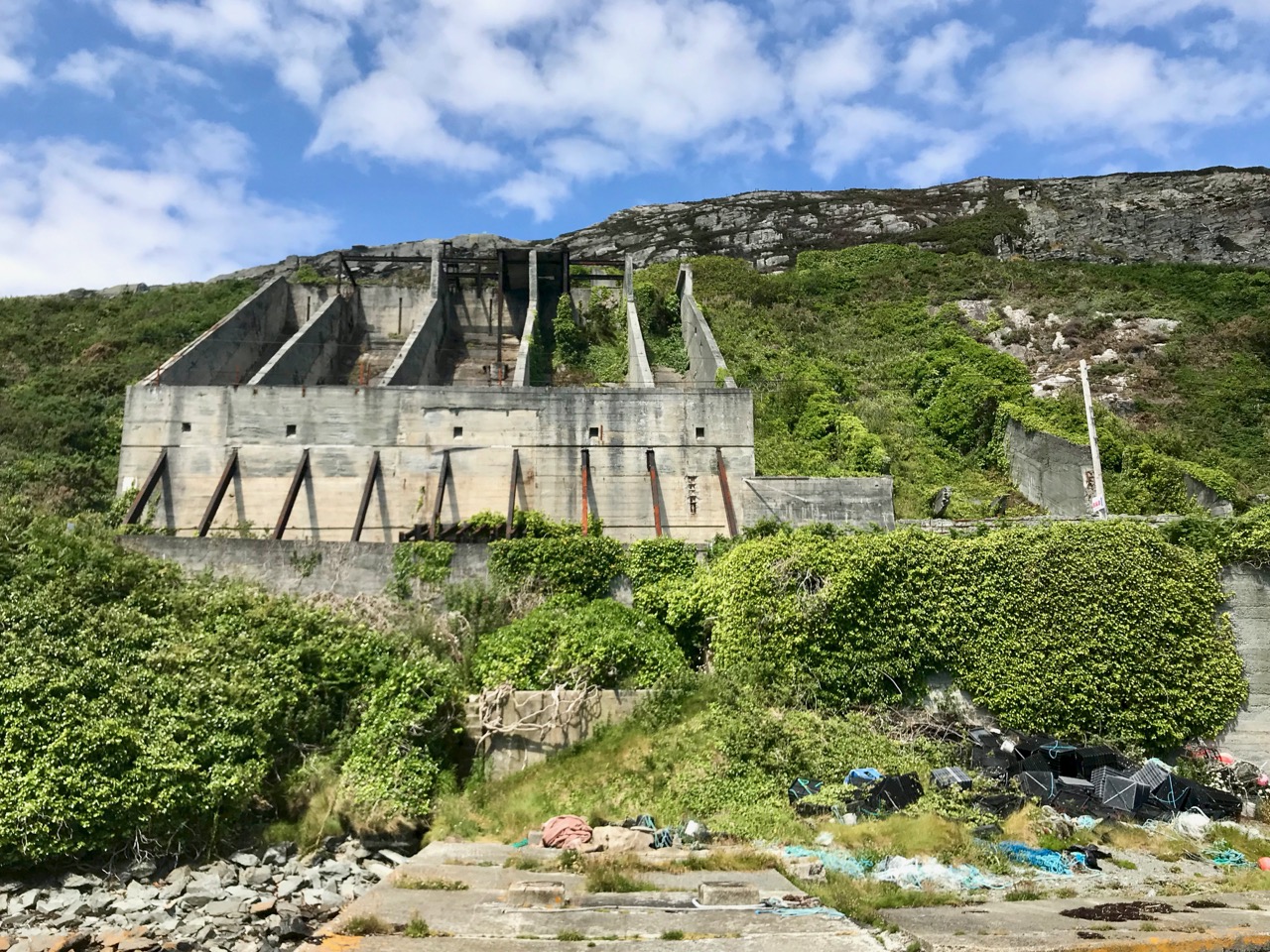
I am fascinated by all traces of industrial history: for me it’s ‘modern archaeology’: some of it might survive long enough to puzzle historians of the far future. I couldn’t ignore, therefore, the huge steel and concrete structures which line the R591 road which approaches Crookhaven when travelling from Goleen. They are built into the hillside above the road, and tie in with a substantial stone quay which has been constructed below it.

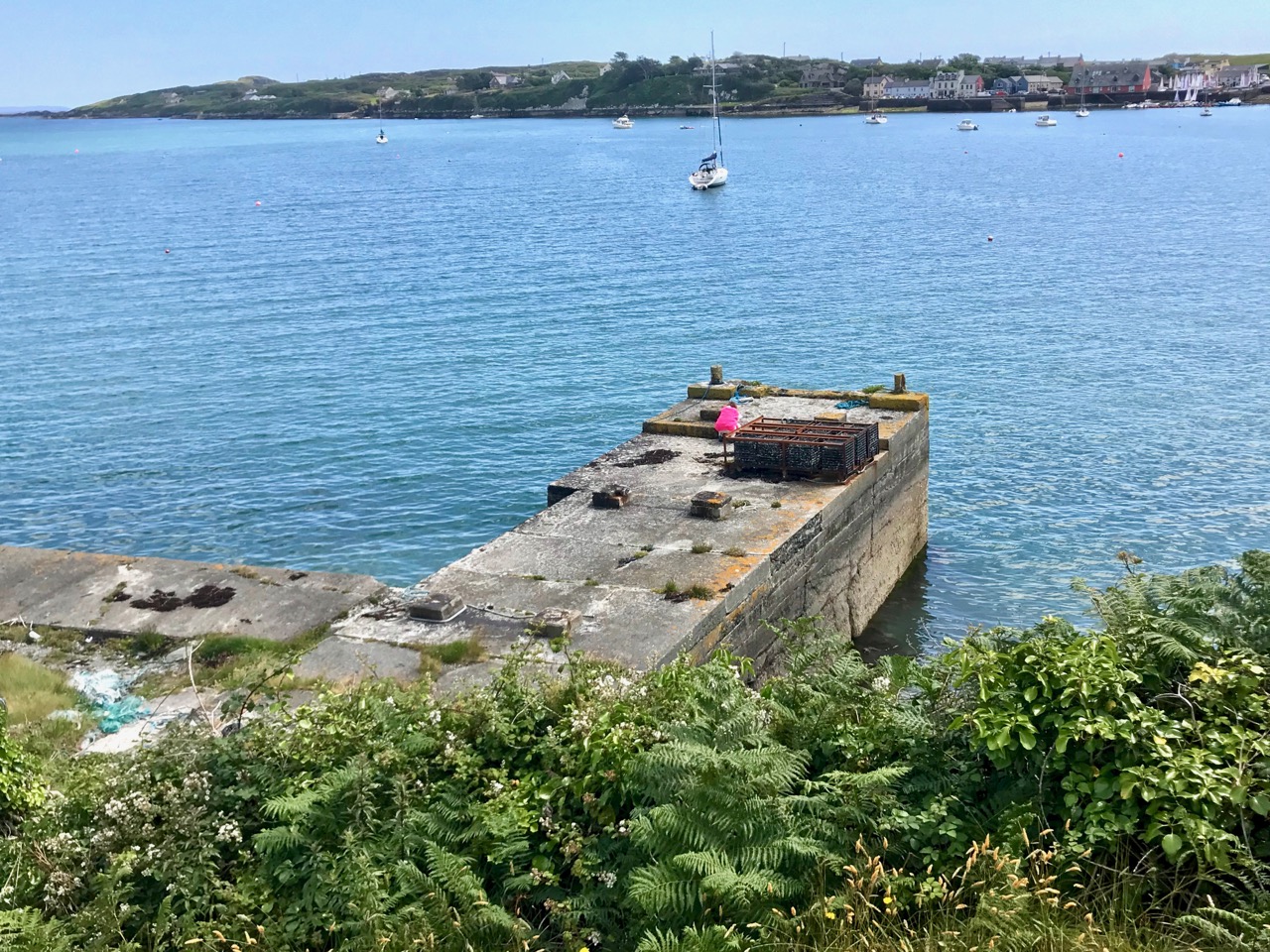
The quay which was presumably built to serve the quarry to the north of Crookhaven: the village can be seen across the water

Looking at the construction of this quay, and particularly the wear on the masonry steps leading down to the water, it would be reasonable to assume that the quay predates the concrete and steel structures which abut the road above it – by a long way. You might suppose that such significant edifices would have a history attached to them which would be easy to find, either from local informants, or in written or electronic record. However, I have so far drawn a blank. Well – not quite: there are countless identical references in contemporary accounts of Crookhaven to ‘…the old roadstone quarry on the side of the mountain, which provided metalling for the roads of Wales until 1945…’ I did find one variant, a caption to a general view of the area: ‘…Looking up to the roadstone quarry along the north shore of Crookhaven Harbour. The quarry was a source of gravel for Welsh tarred gravel roads until the 1930s…’

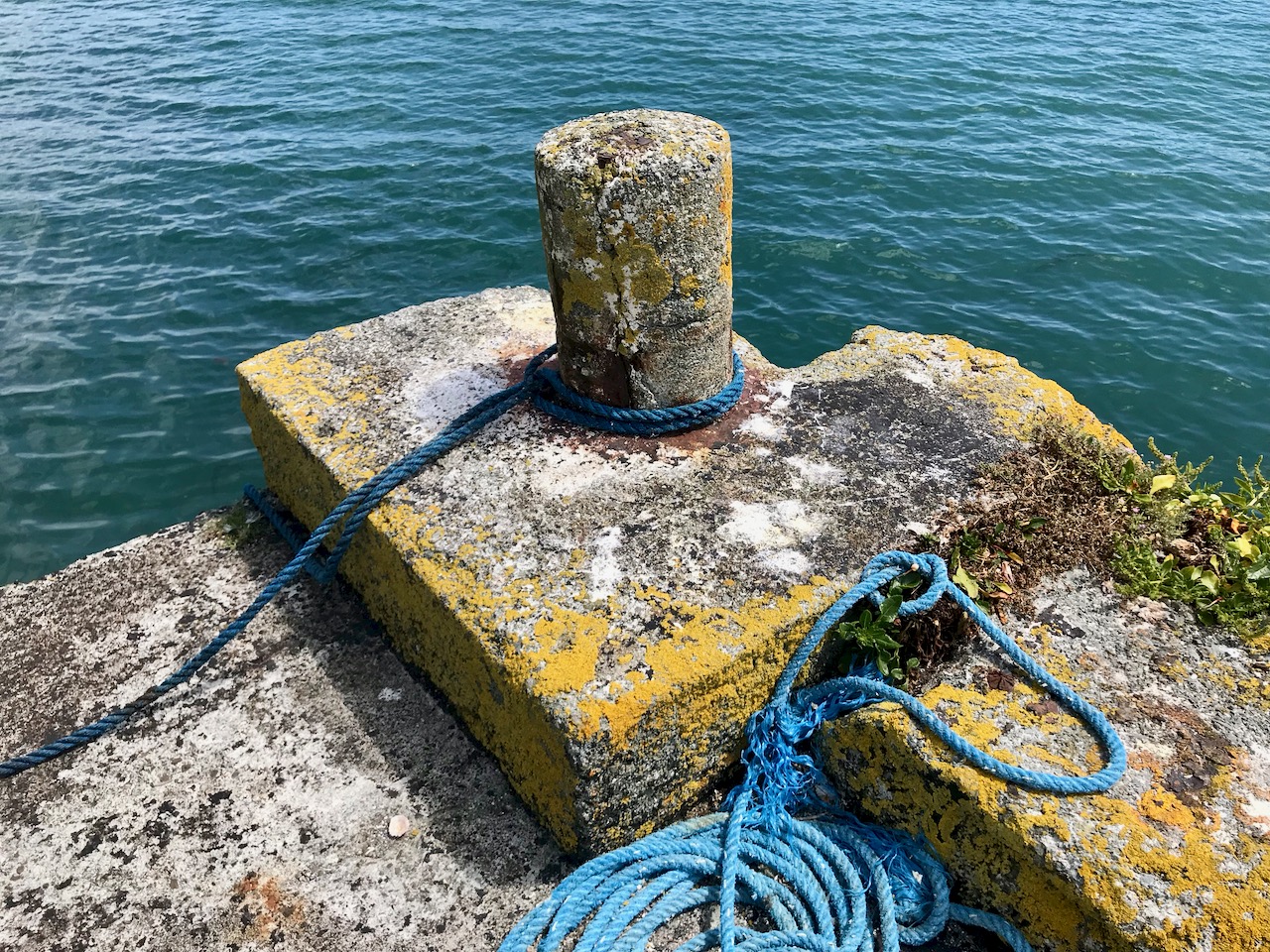
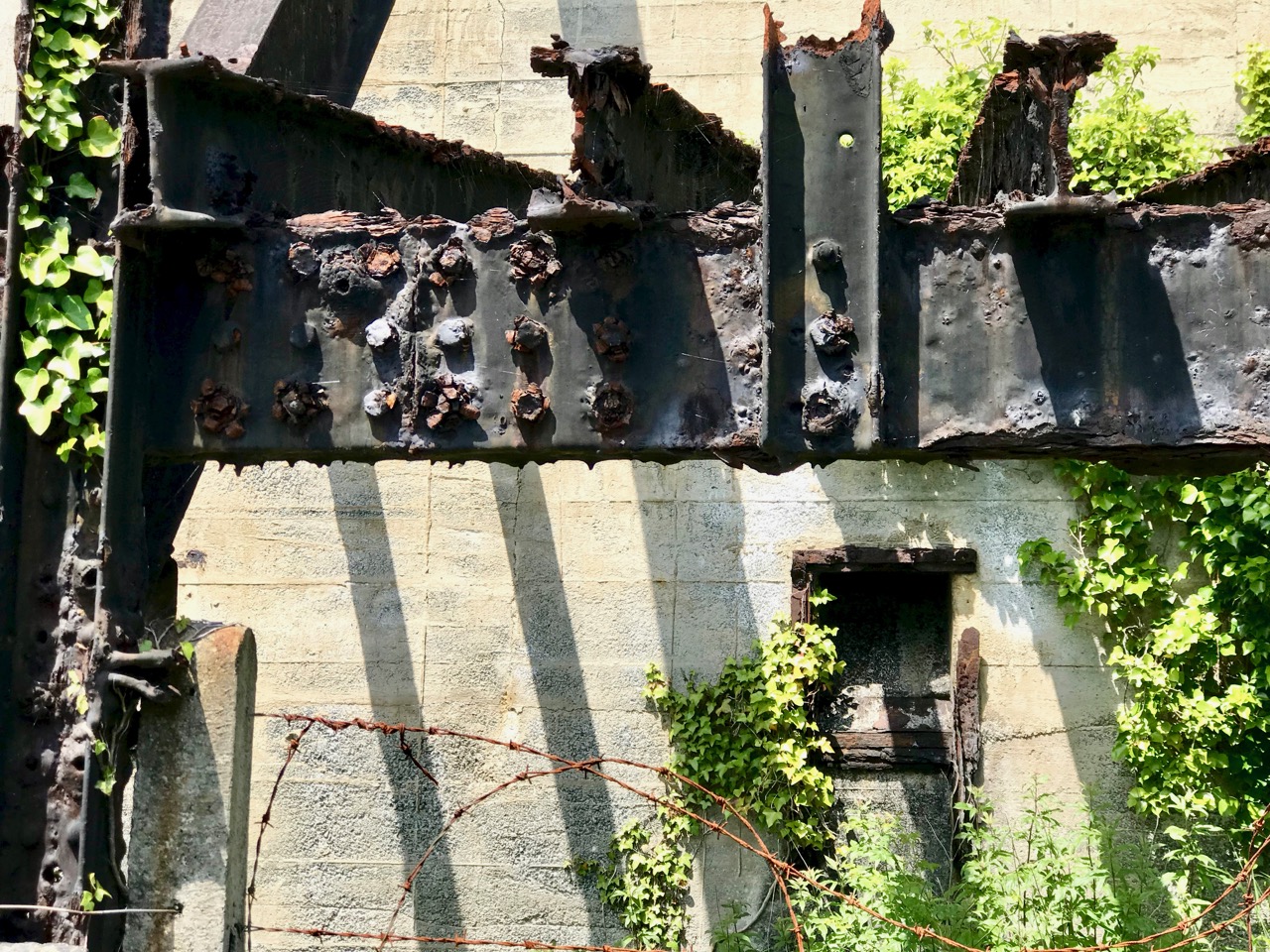
The quay below the ‘roadstone quarry’ is a paradise for industrial archaeologists and photographers! It must have had generations of users, up to fairly recent times, all of whom have left behind traces of their presence, but no solid history. I’m hopeful that readers of this post might be stirred to recall stories or memories – or even point me to some documented history to explain the provenance of this little piece of the complex West Cork jigsaw. *In fact, I have received information since this post was published – see the last paragraph.

I’m borrowing this photograph of the Crookhaven quarry from the log of the MV Dirona, with thanks to Jennifer and James Hamilton, who hail from Victoria, British Columbia and are currently cruising the world in their Nordhaven 5263 vessel. They explored the south west coast of Ireland in June 2017 and, from the water, took this perfect view of the quay, the ‘roadstone quarry’ and the mountain face above it, from which the stone has been extracted. The rock face could have been worked for stone before the 20th century, although we don’t have hard evidence for this: in September 1846 a road was proposed between Rock island and Crookhaven, and the county surveyor provided an estimate of £1,857. Prior to this, the road which had been built by Richard Griffith, civil engineer for Munster, extended as far as Rock Island, and passage from there to Crookhaven itself could only be made by water. The 1846 road is today the R591 which passes below the quarry. It would be reasonable to suppose that locally available stone suitable for roadmaking could have been used, and the quarry may have had its origins at this time. The construction of the adjacent quay could have been contemporary with this early use of the quarry, but the huge concrete and steel structures we see today are certainly an incarnation of the quarry workings in the early 20th century.

One of the fascinations of old industrial sites is the way they are taken over by nature if left relatively undisturbed. This one is no exception. There is a monumentality here which is being eroded and softened as time goes by. What does the future hold? Interestingly a -presumably serious – proposal was made in a not-too-long-ago iteration of the Goleen & District Community Council Development Plan:

PROPOSALS

2.24 The old roadstone quarry-works at Crookhaven Harbour should be developed as an amenity – perhaps a hotel with a restaurant with observation deck at the top…

Hmmm… notions of grandeur there, perhaps – and little regard for practicalities, but it shows the power of imagination! I think it’s far more likely that the area will remain in its present state for many years to come and, perhaps, attract a level of ‘industrial architecture tourism’. Incidentally, it’s not too far away from the site of a fish palace run by William Hull and the Great Earl of Cork in the early seventeenth century: the remains of this are there to see to this day, although almost entirely returned to nature.

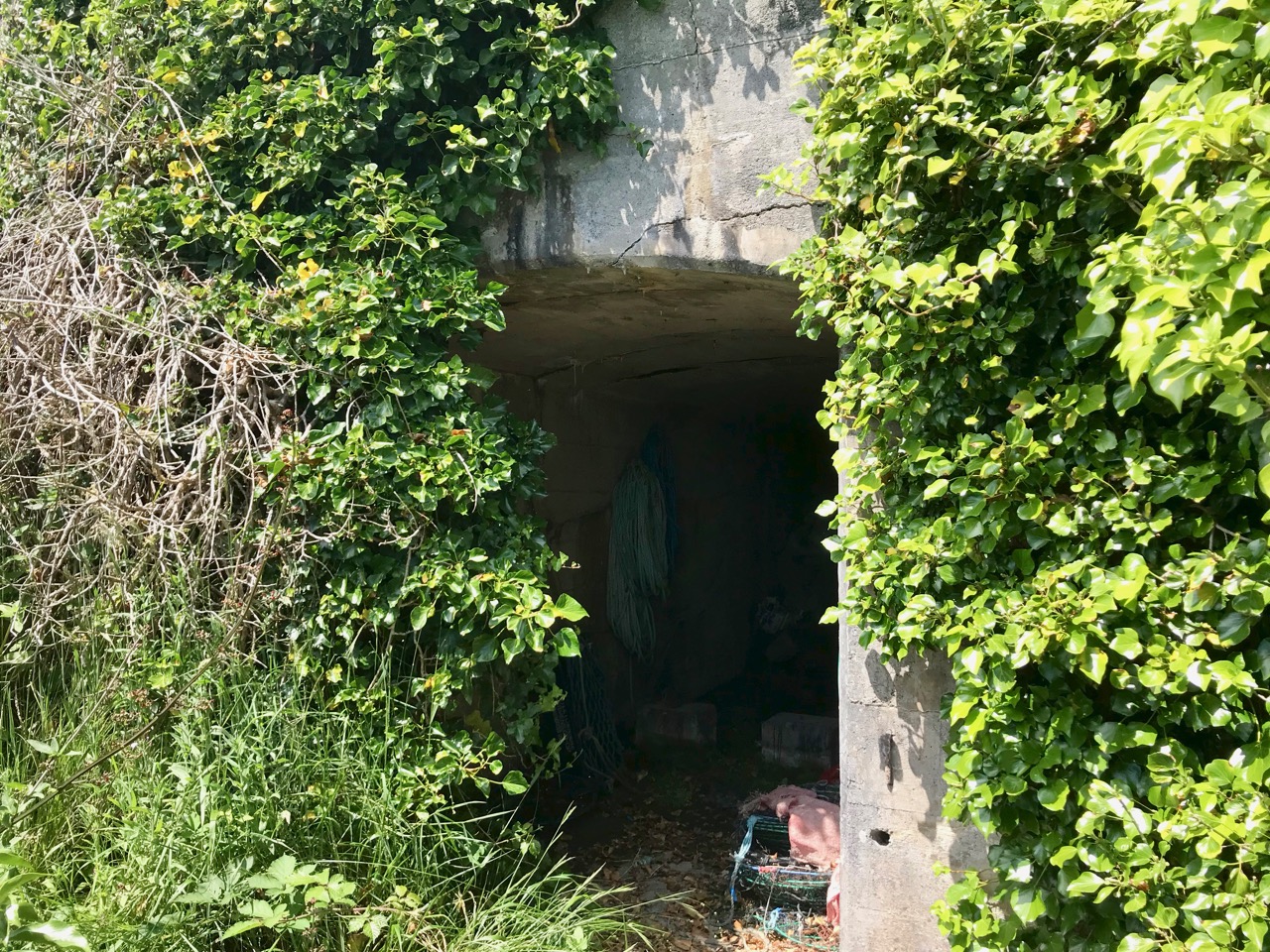
Below – a now impassable tunnel under the road connects the quarry workings with the quay; nature entangled with the leftovers of human activity

NOTE: in 2020 our friend, local historian and expert photographer John D’Alton of Schull has contacted Roaringwater Journal with some updated information about the Crookhaven quarry. John tells us that the quarry was never owned by the Roadstone Company. That was incorporated in 1949 by the Roche brothers who operated out of Dublin from the 1930s, but never operating this far south and west. John also adds that the company that operated the Crookhaven quarry was the Browhead Granite Company Limited, incorporated in London in 1917. The quarry opened for business in 1928 and closed in September 1939. It was this company that contracted for the construction of the impressive structure still there today. The company exported stone to various ports in England in particular, London especially, and Ipswich, among others, supplying stone for road surfaces. The Granite company was a successor to the Browhead Copper Mining Company that despaired of finding copper in mineable quantities in far West Cork. Interestingly, the structure is one of the earliest examples of this type of reinforced concrete construction in the country, the original Mizen (Cloughan Island) Bridge being another.

Many Thanks, John, for finding and sharing such detailed information which has been lacking until now!

Endpiece – the old workings and quay are directly opposite the centre of Crookhaven – here’s a view towards the quarry from the village: