Missing West Cork? Live here and love it? Always wanted to visit? Colum Cronin sent us this charming song some time ago and this is the perfect time to enjoy his wonderful voice with the images his song evokes. Wherever you are, stay safe and well, and sit back and enjoy.
Month: November 2020
Autumn at Lough Hyne
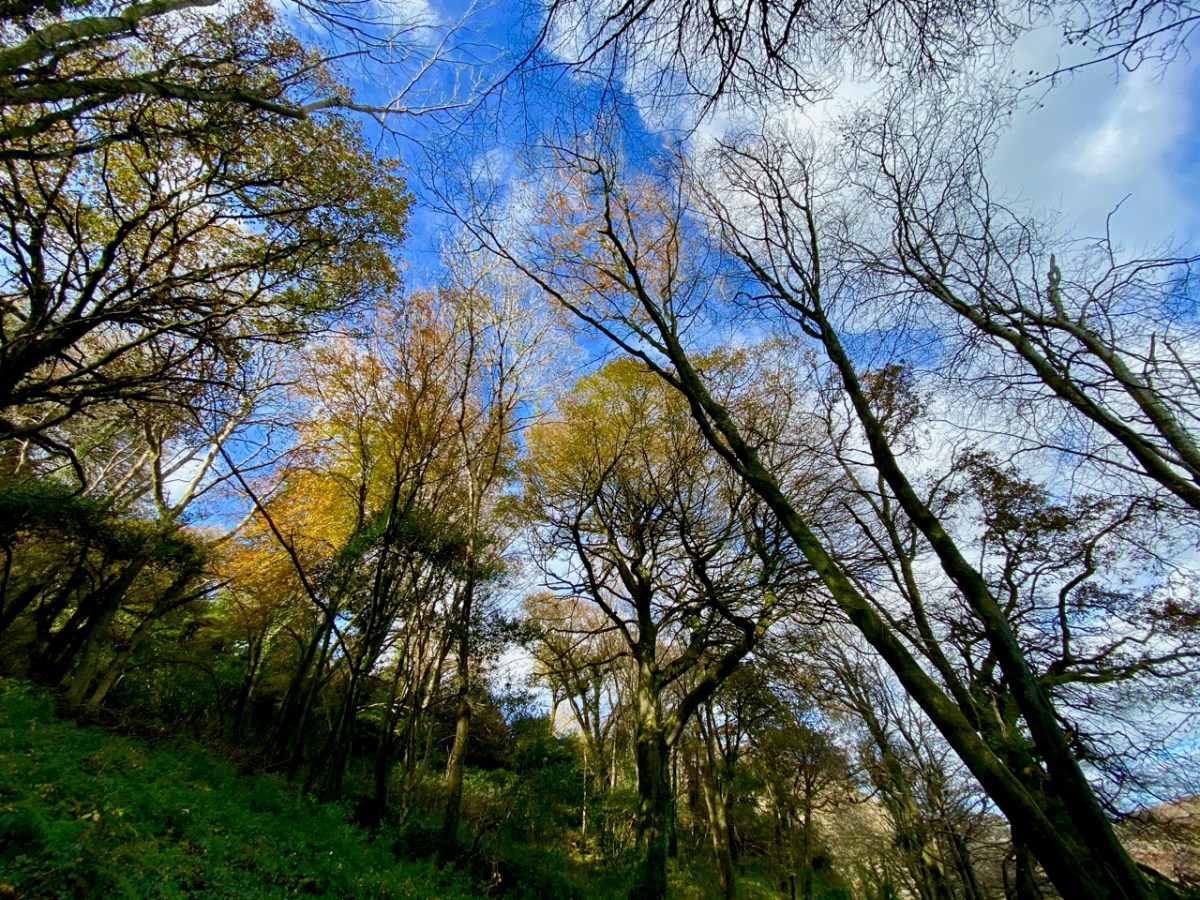
Wild West Cork: a rugged landscape of mountains, a myriad patchwork of pastures; inlets, coves, spruce plantations and an archipelago of mostly unwooded offshore islands. Where are the deciduous trees? This is what we ask ourselves when autumn comes and we want to see the changing colours; the wistful season of autumn at its best. The answer, for us, is Lough Hyne!
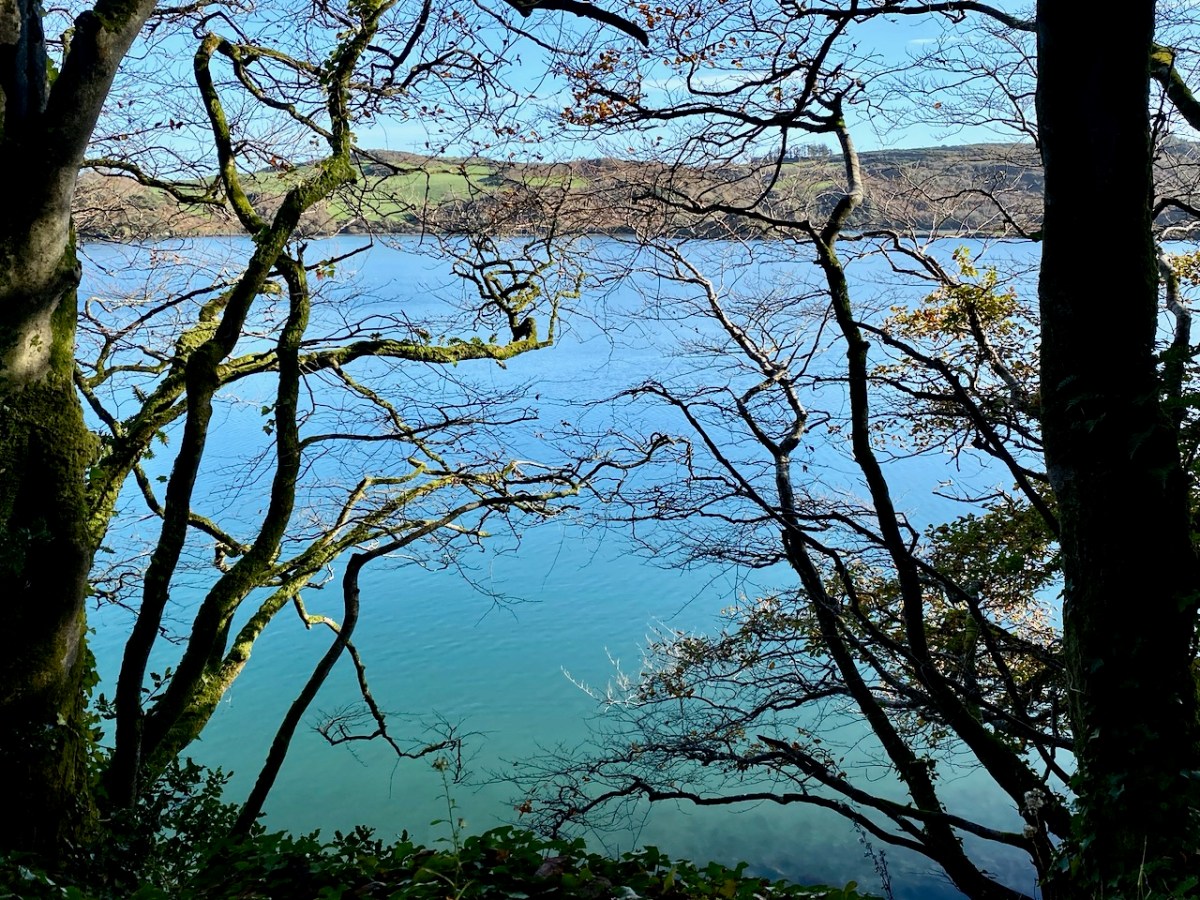
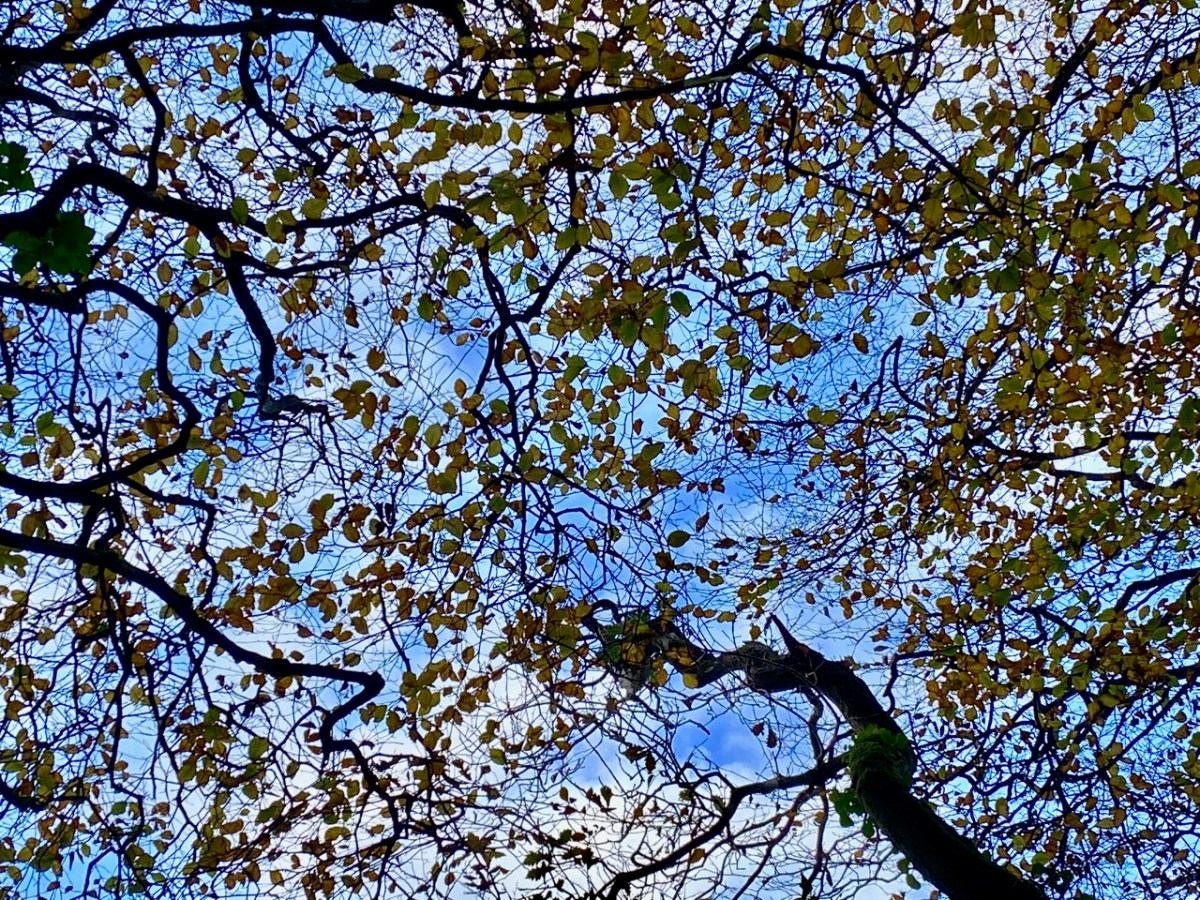
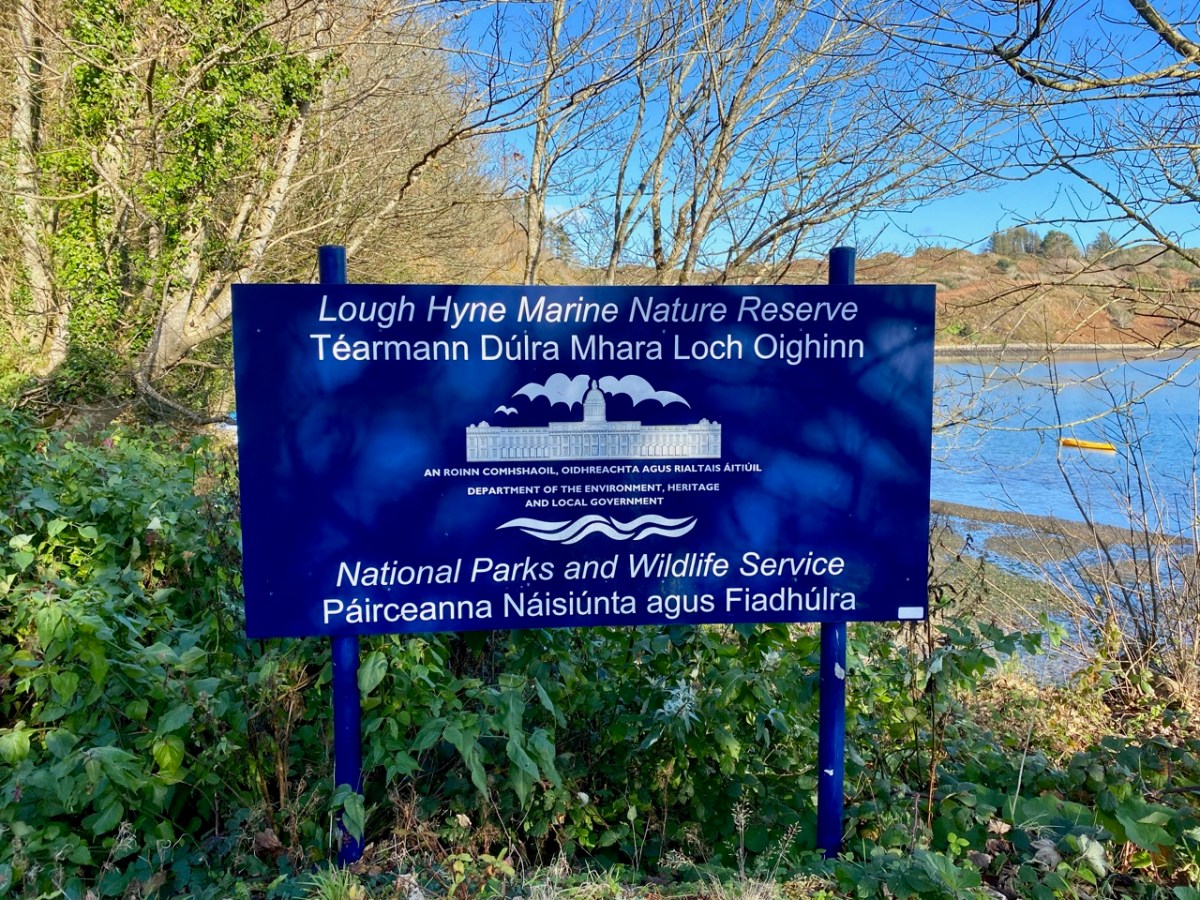
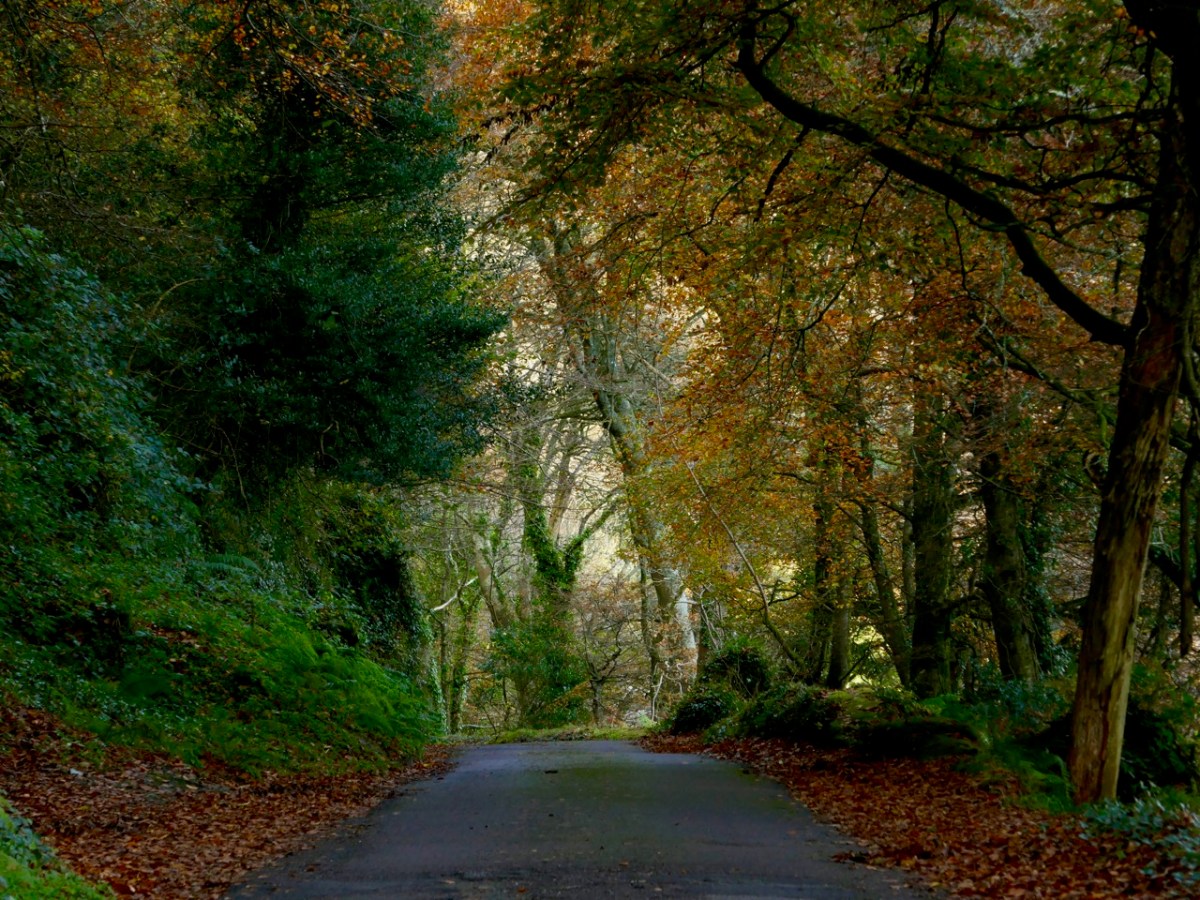
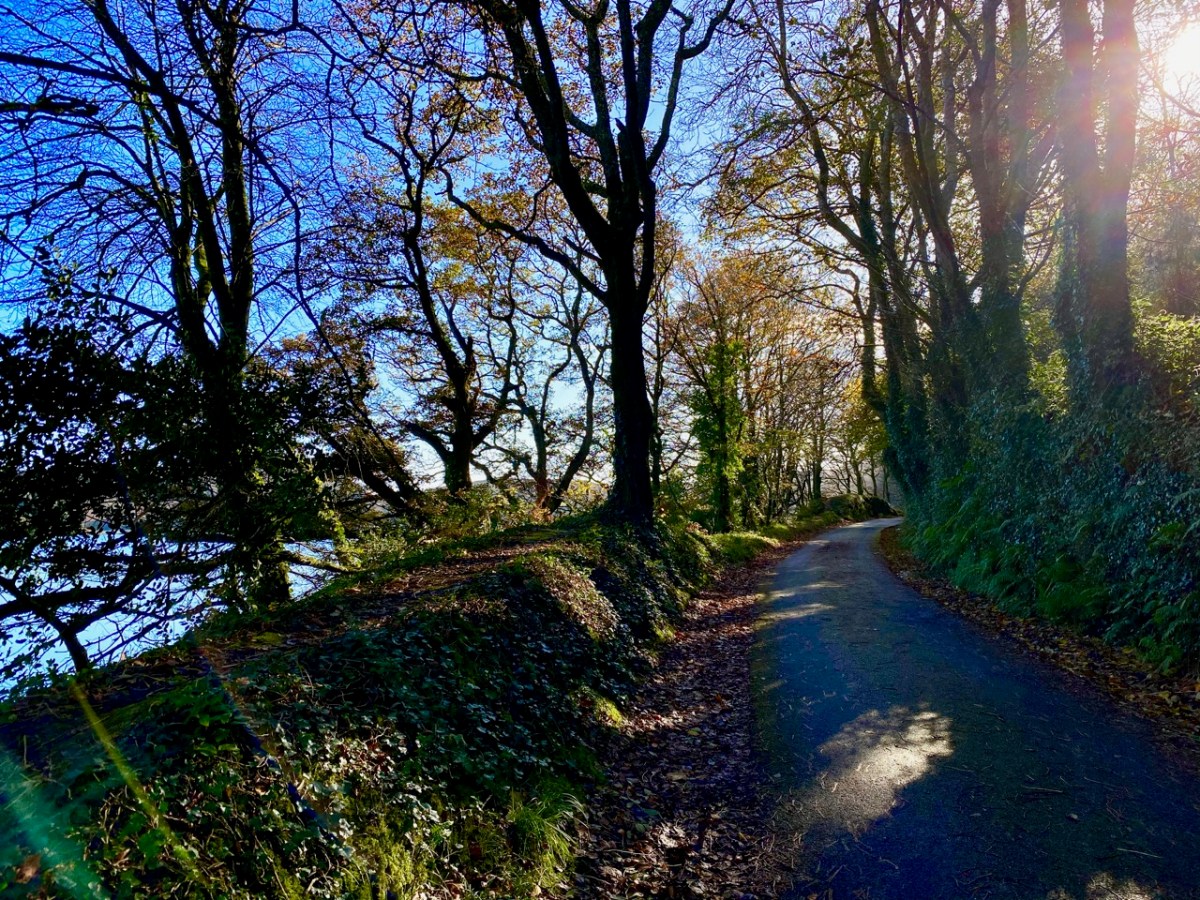
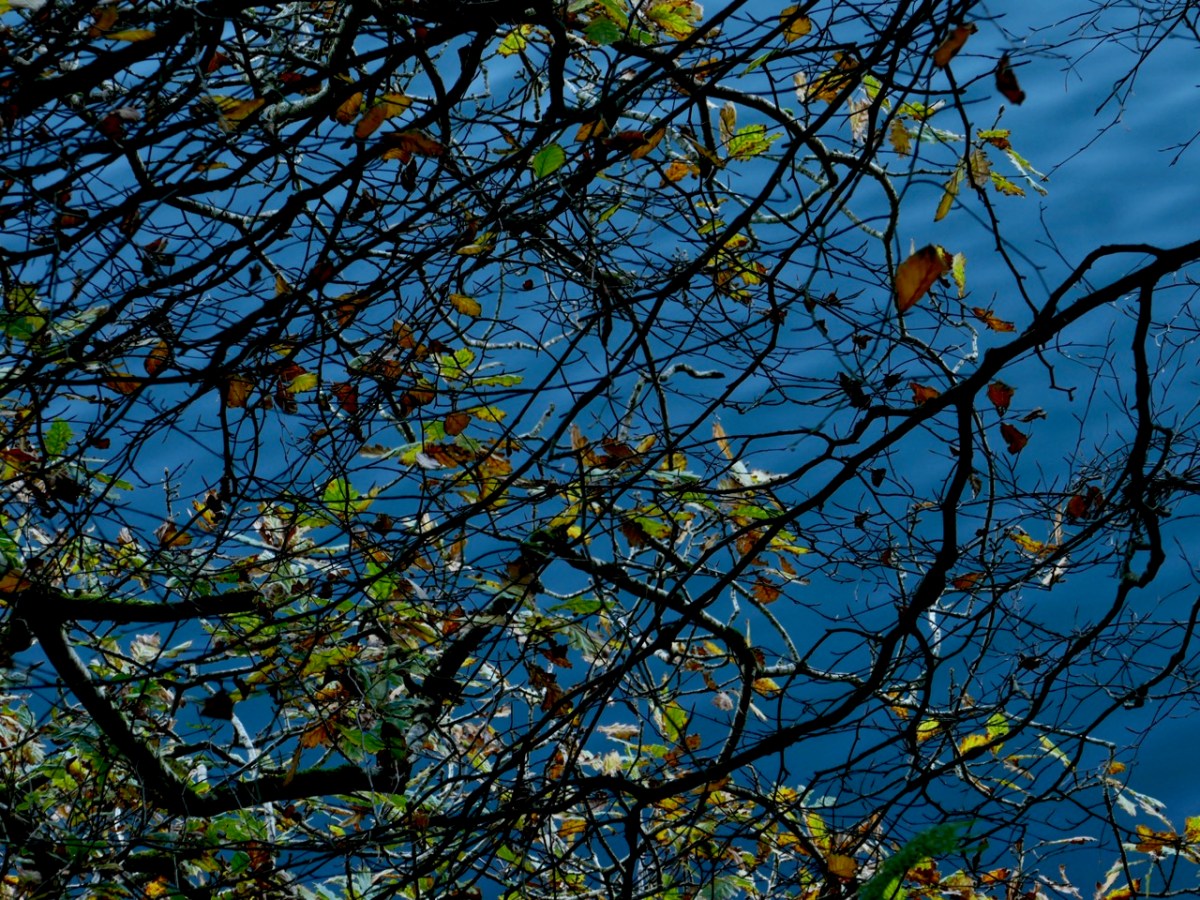
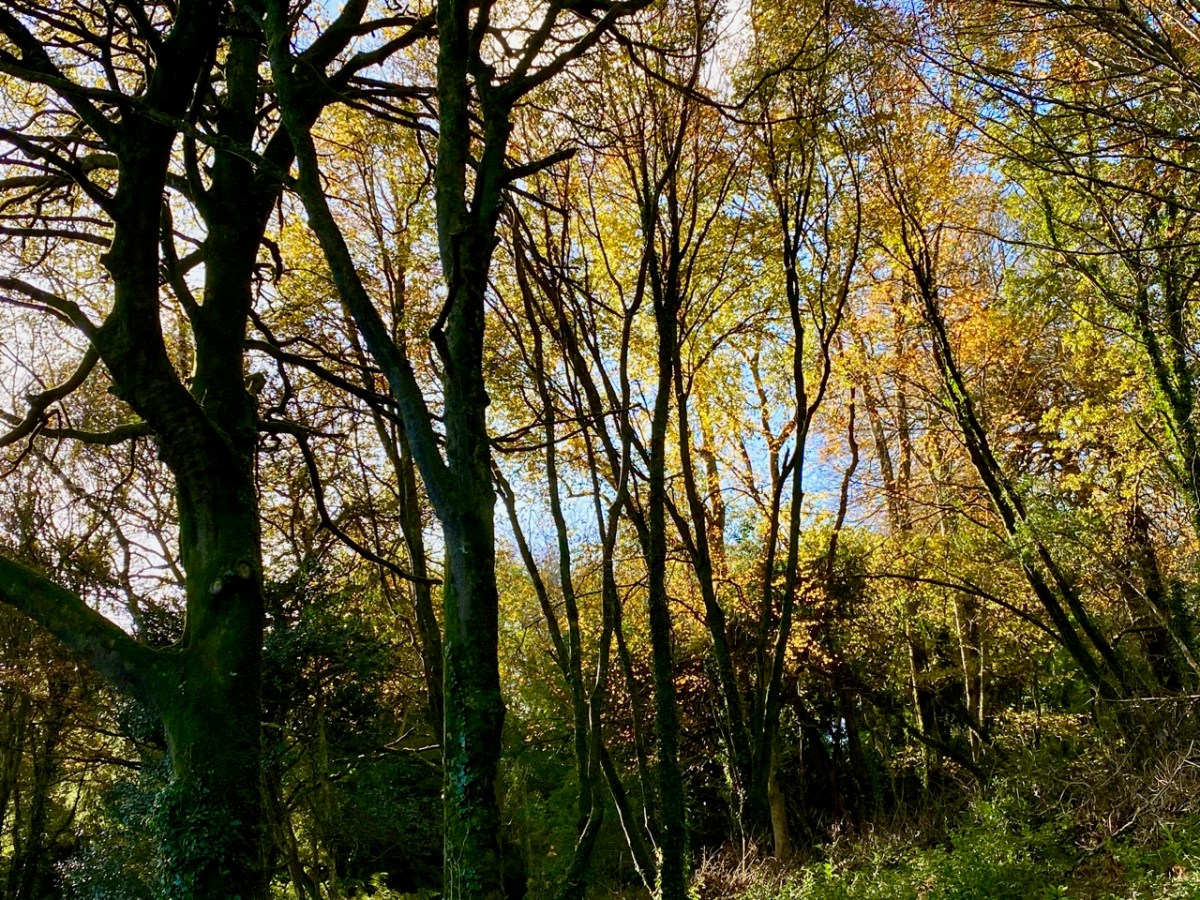
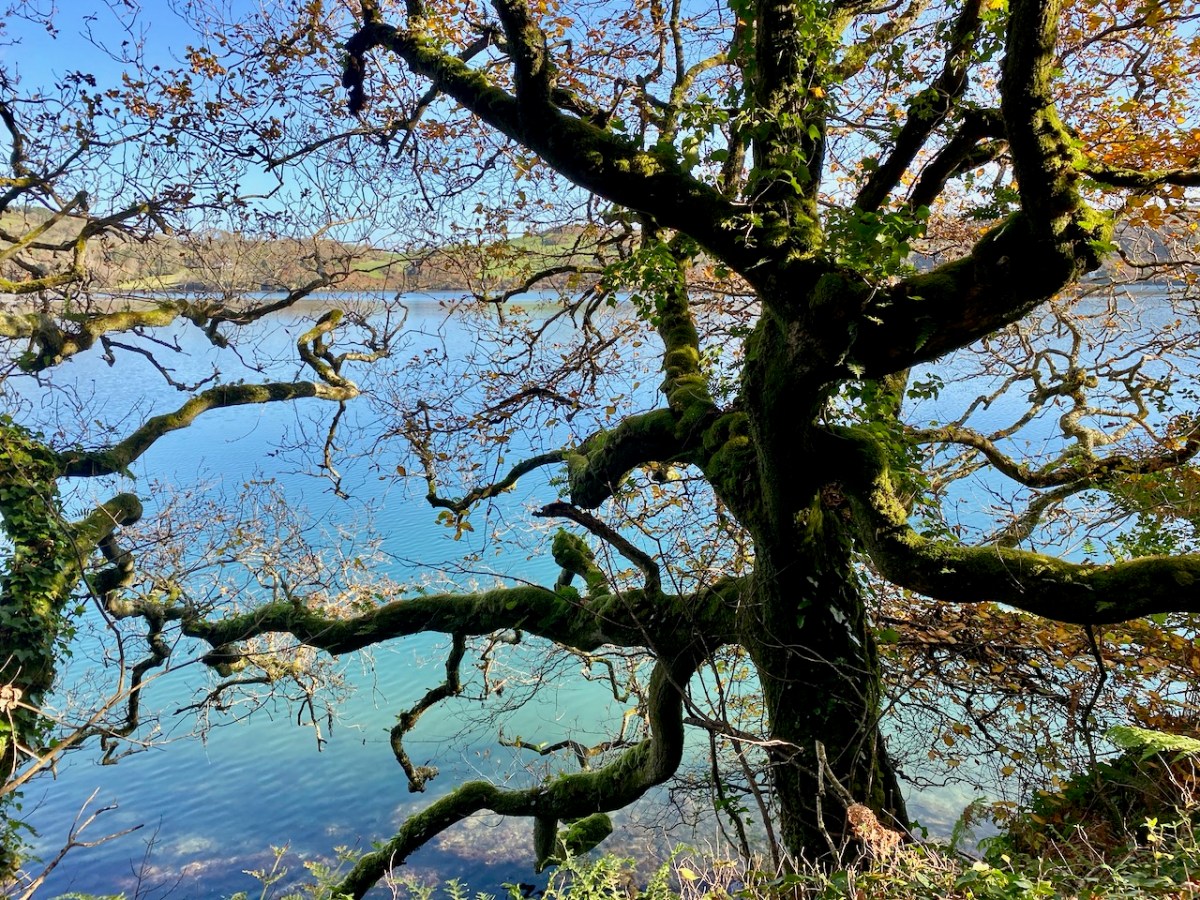
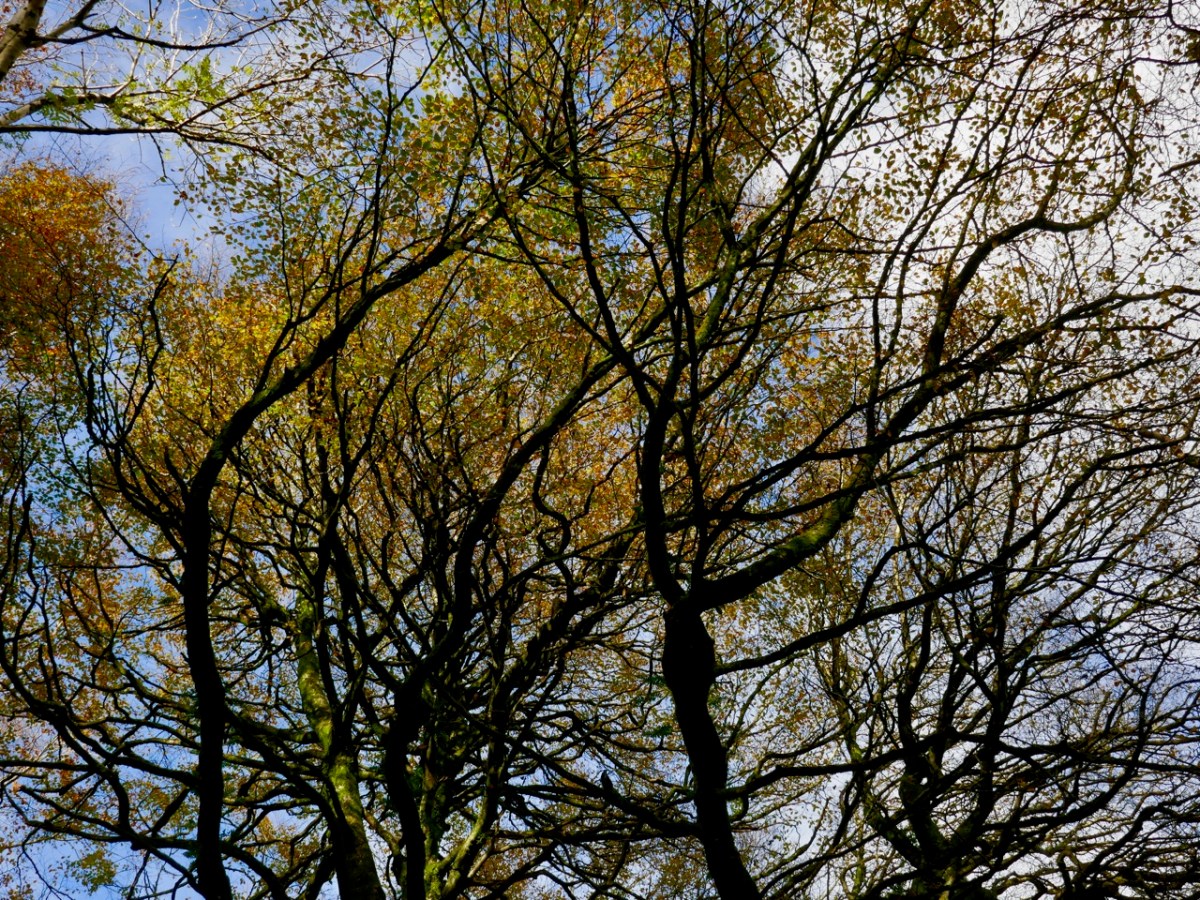
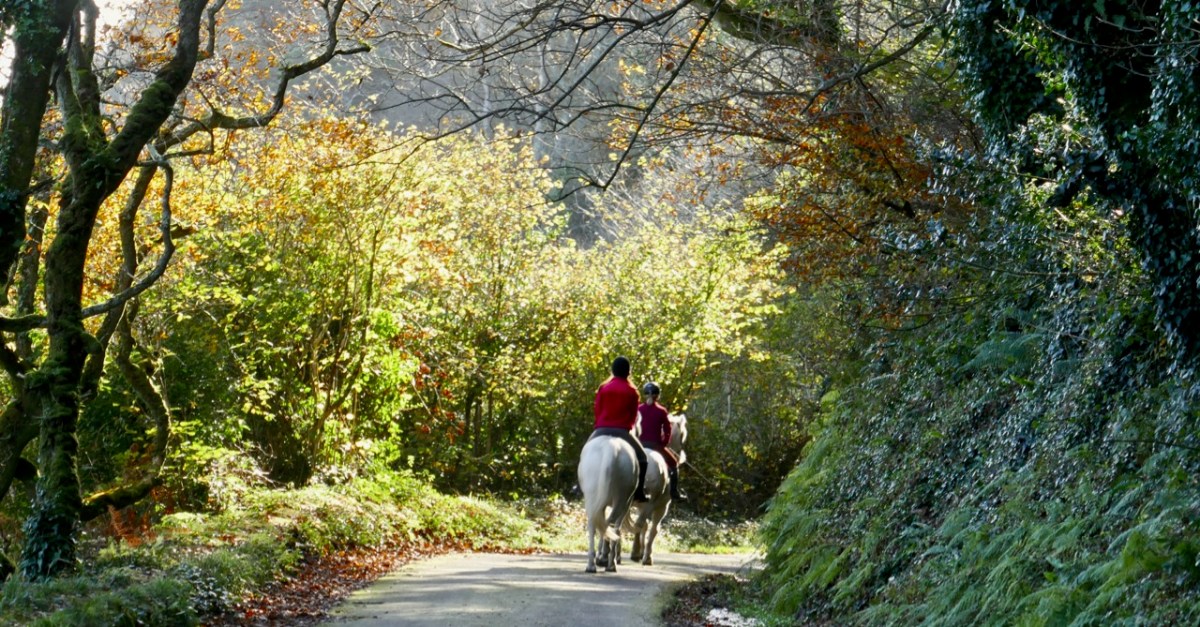
It’s just a skip and a jump to this tucked-away corner of our world. Once there, we are in a unique environment. It is Ireland’s first Marine Nature Reserve – international recognition for the ecology of this special place where not only the (salt) water is important both above and underneath the lake’s surface, but the immediate surroundings are hopefully sacrosanct for all time. These environs include woodlands which are just at this moment on the threshold of turning gold: we know gales are on the way which will tear and disperse them as winter sets in. Here’s a little tour of the paths on the edge of the water, featuring – above all – colour and texture: a feast for our eyes!
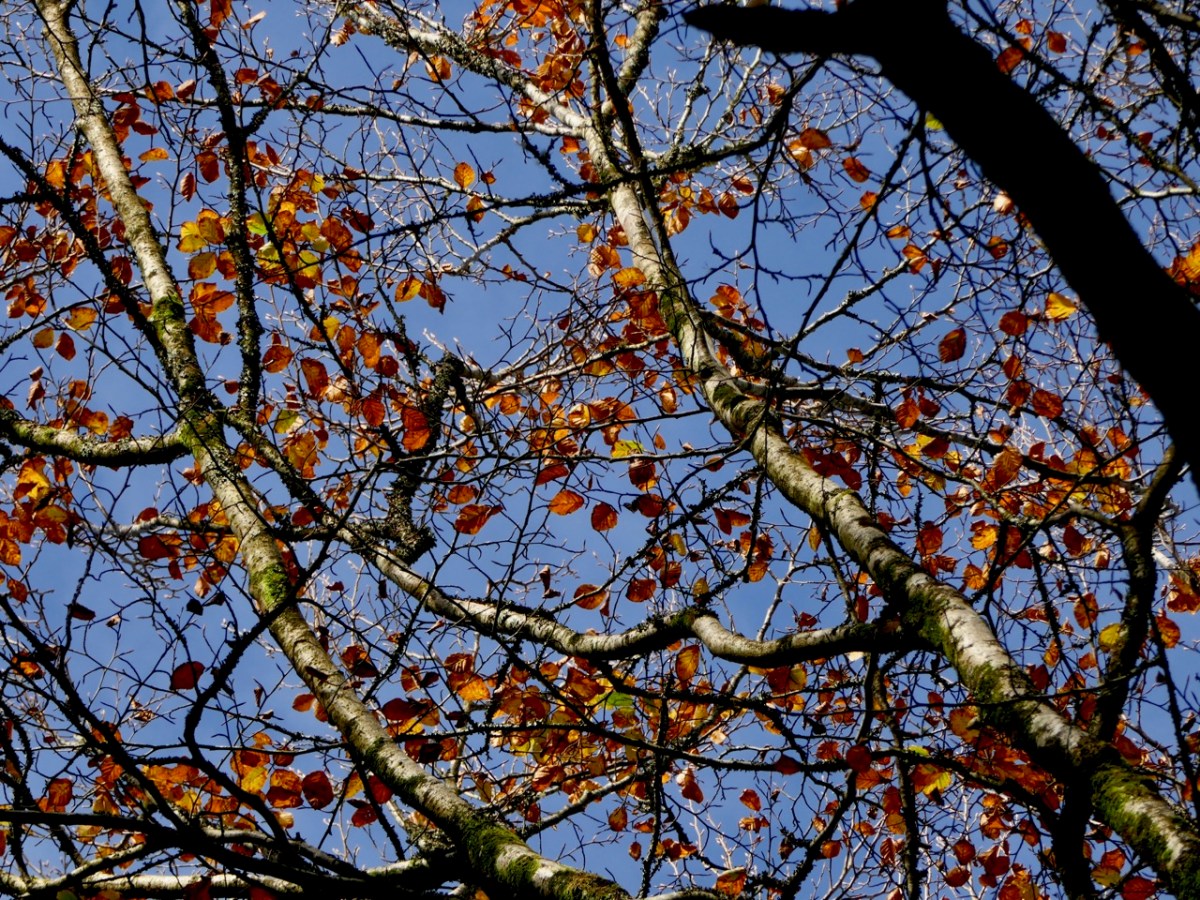
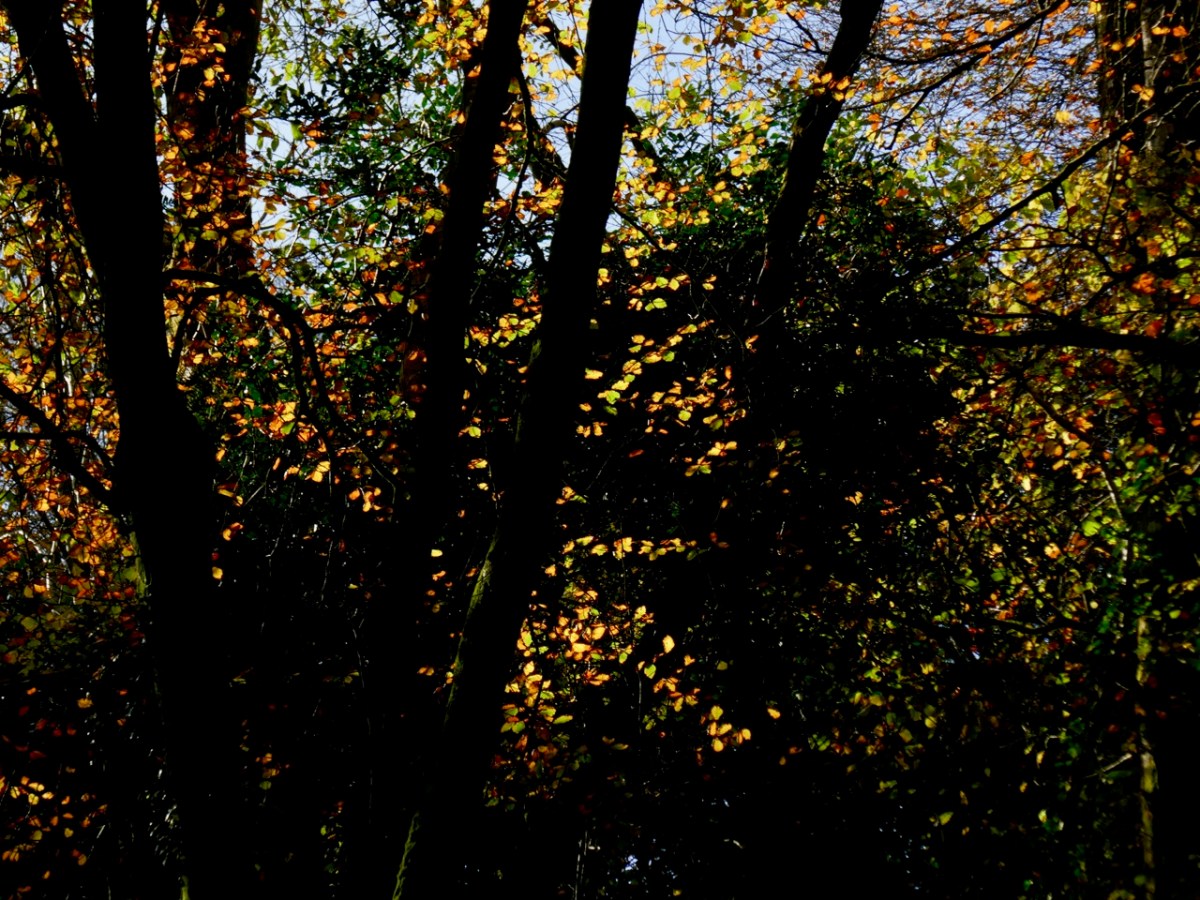
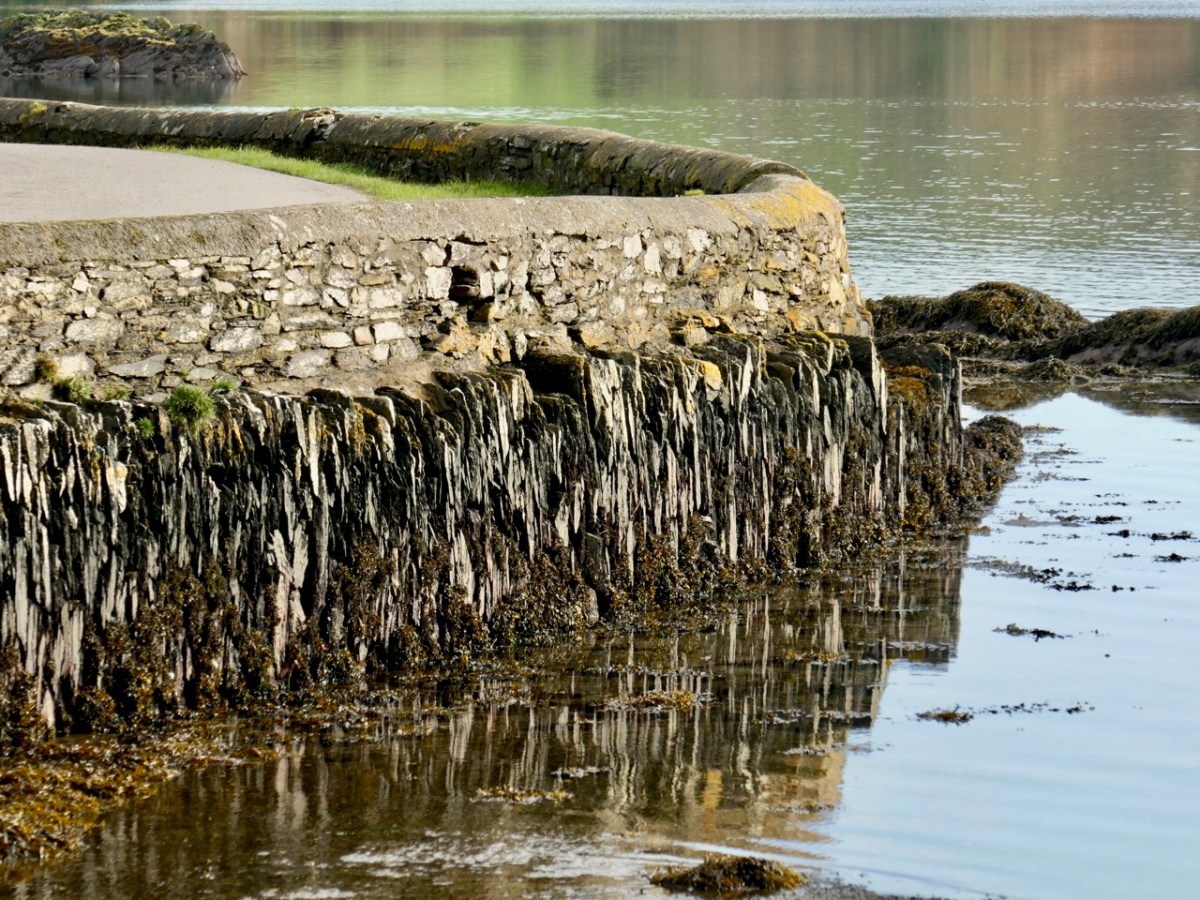
While the leaves are our main focus, everything else is worth a pause. The colour of the lake itself, certainly the wildlife it supports, but also the juxtaposition of boats, stone walls, shadows and sky are all brought to life by the early November sun.
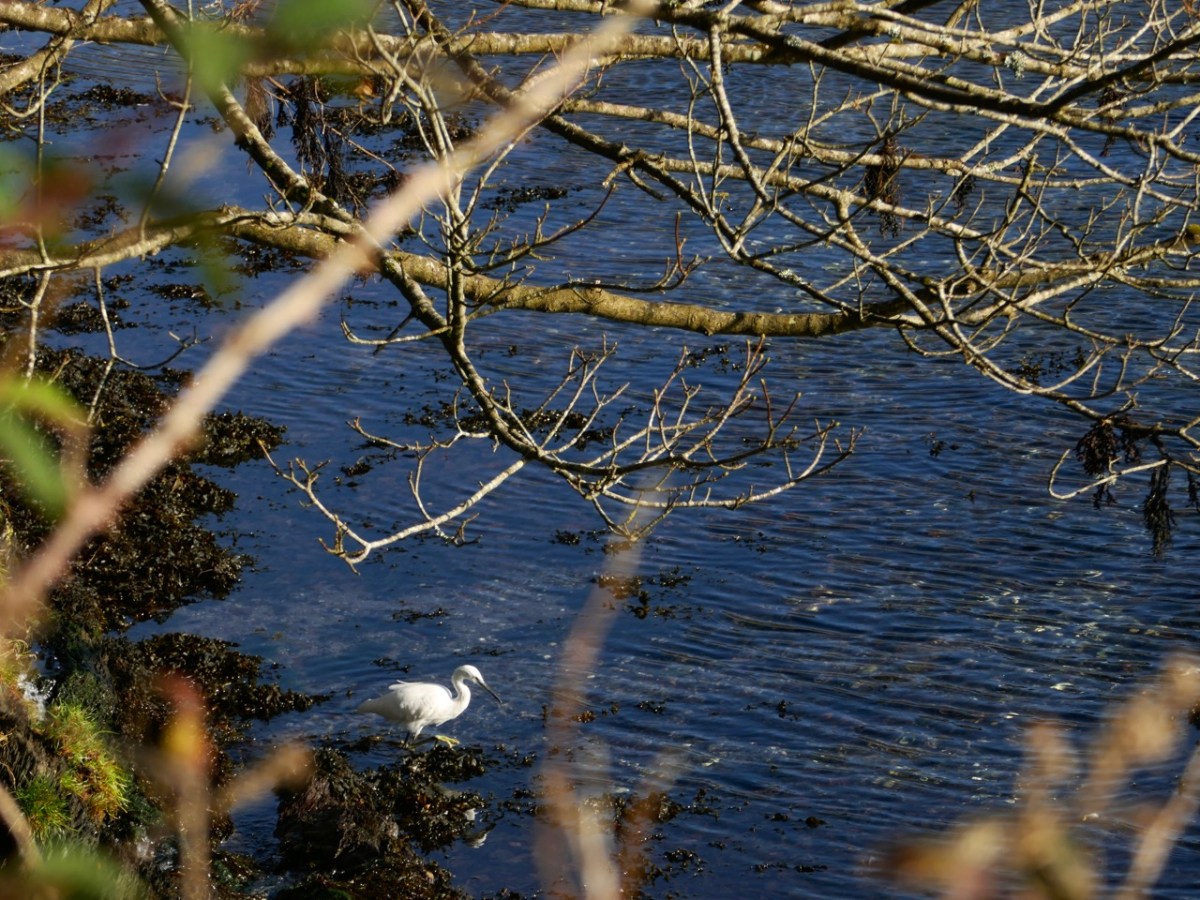
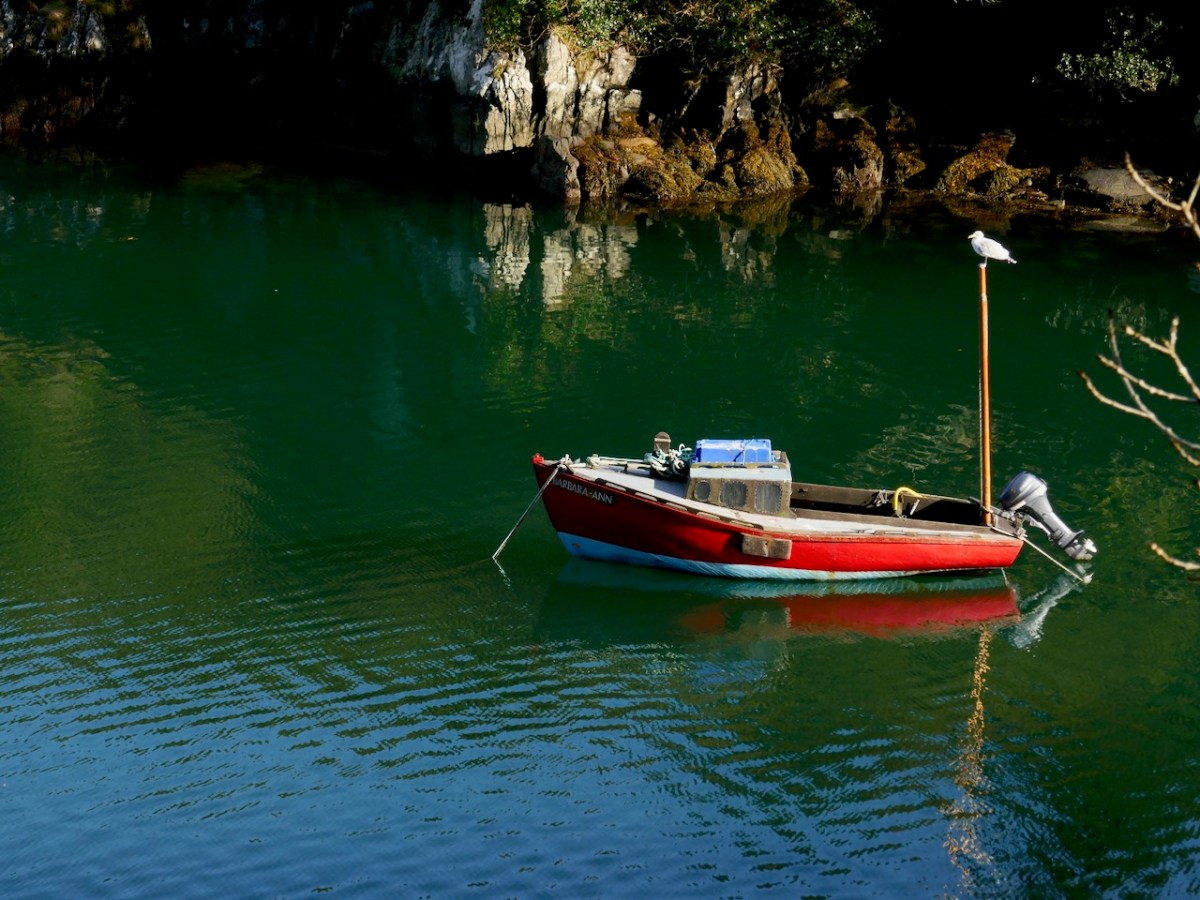
I can’t resist quoting William Makepeace Thackeray’s description of his travels through ‘The City of Skibbereen’ to Lough Hyne, which we find in his Irish Sketch Book, published in 1843. Thackeray, the English writer best known for Vanity Fair and Barry Lyndon, spent four months travelling around much of the country and – although he appeared to enjoy himself – he didn’t have many good words to say about Ireland or the Irish . . .
THAT light four-inside, four-horse coach, the “Skibbereen Perseverance,” brought me fifty-two miles to-day, for the sum of three-and-sixpence, through a district which is, as usual, somewhat difficult to describe. A bright road winding up a hill; on it a country cart, with its load, stretching a huge shadow; emerald pastures and silver rivers in the foreground ; a noble sweep of hills rising up from them, and contrasting their magnificent purple with the green; in the extreme distance the clear cold outline of some far-off mountains, and the white clouds tumbled about in the blue sky overhead.
* * *
Of all the wonderful things to be seen in Skibbereen, Dan’s pantry is the most sublime: every article within is a makeshift, and has been ingeniously perverted from its original destination. Here lie bread, blacking, fresh butter, tallow-candles, dirty knives — all in the same cigar-box with snuff, milk, cold bacon, brown-sugar, broken teacups and bits of soap. No pen can describe that establishment, as no imagination could have conceived it. But – lo! – the sky has cleared after a furious fall of rain — and a car is waiting to carry us to Loughine . . .
Thackeray – Irish Sketch Book 1842
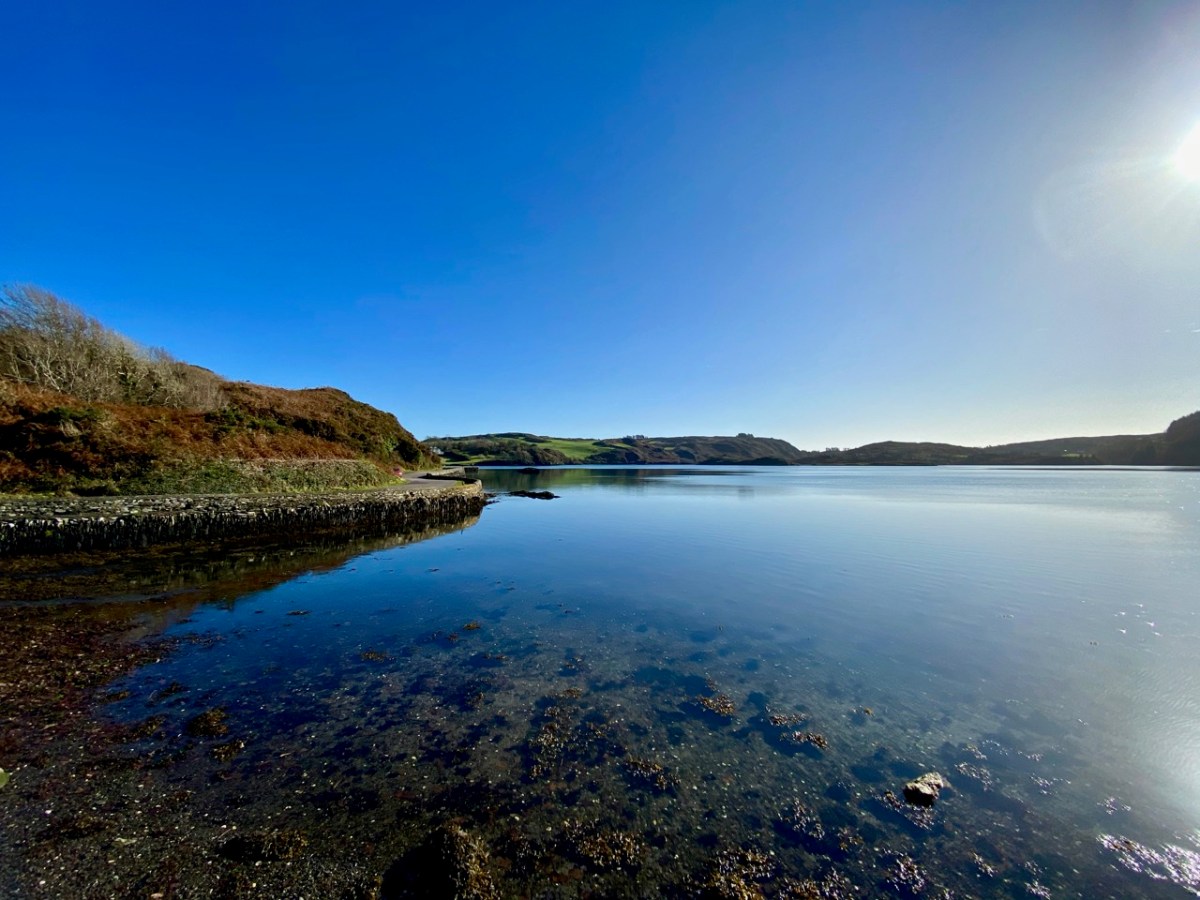
ALTHOUGH the description of Loughine can make but a poor figure in a book, the ride thither is well worth the traveller’s short labour. You pass by one of the cabin-streets out of the town into a country which for a mile is rich with grain, though bare of trees; then through a boggy bleak district, from which you enter into a sort of sea of rocks, with patches of herbage here and there. Before the traveller, almost all the way, is a huge pile of purple mountain, on which, as one comes nearer, one perceives numberless waves and breaks, as you see small waves on a billow in the sea; then clambering up a hill, we look down upon a bright green flat of land, with the lake beyond it, girt round by grey melancholy hills.
* * *
The water may be a mile in extent; a cabin tops the mountain here and there; gentlemen have erected one or two anchorite pleasure-houses on the banks, as cheerful as a summer-house would be on a bleak plain. I felt not sorry to have seen this lonely lake, and still happier to leave it. There it lies with crags all round it, in the midst of desolate flatlands: it escapes somewhere to the sea; its waters are salt: half-a-dozen boats lie here and there upon its banks, and we saw a small crew of boys splashing about and swimming in it, laughing and yelling. It seemed a shame to disturb the silence so . . .
THACKERAY – IRISH SKETCH BOOK 1842
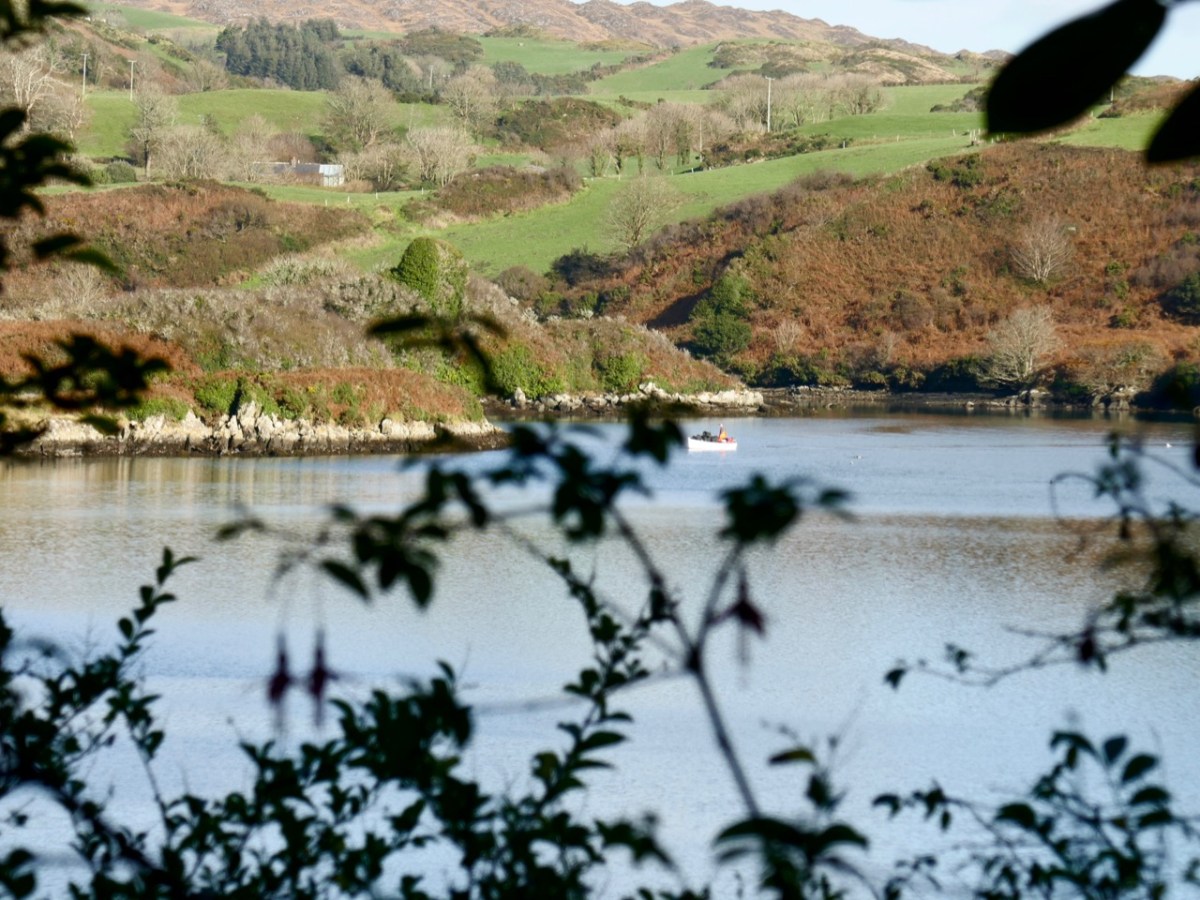
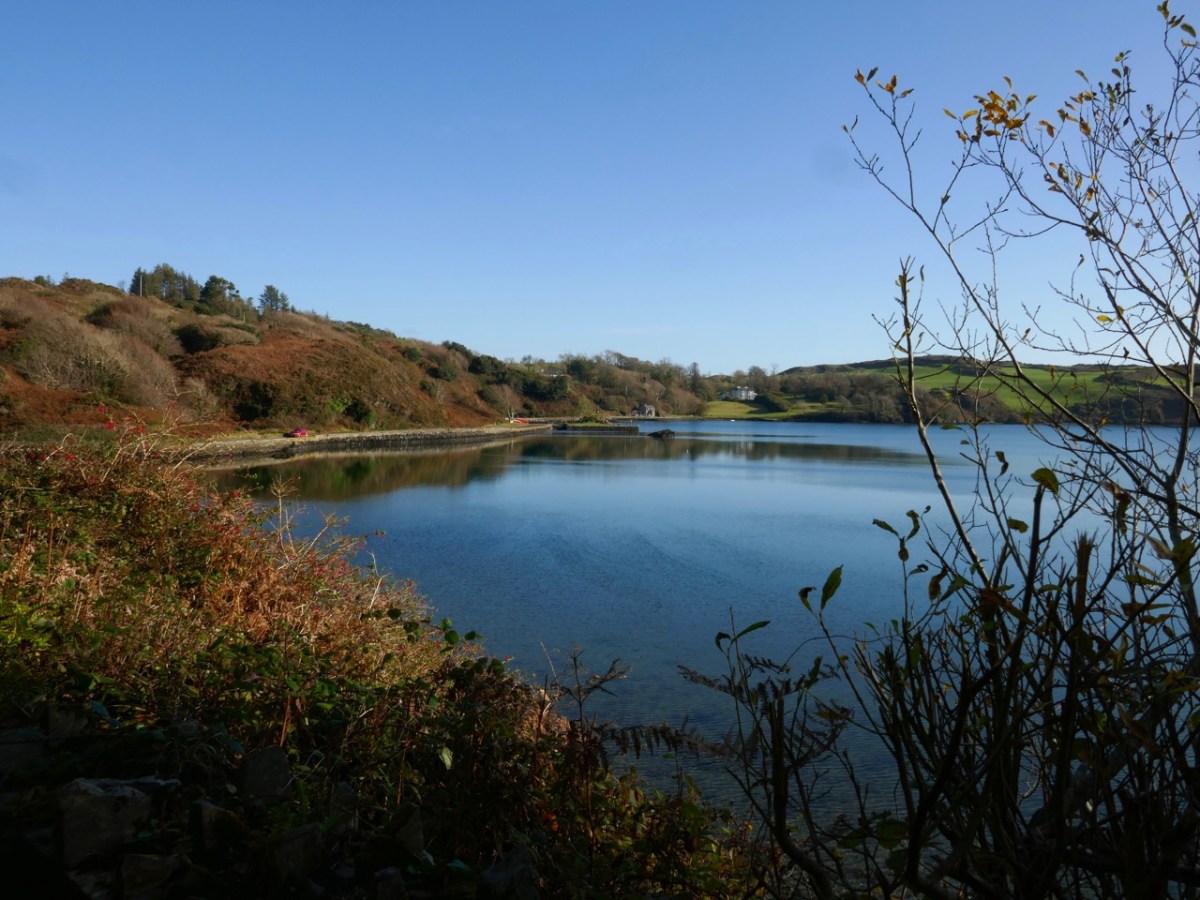
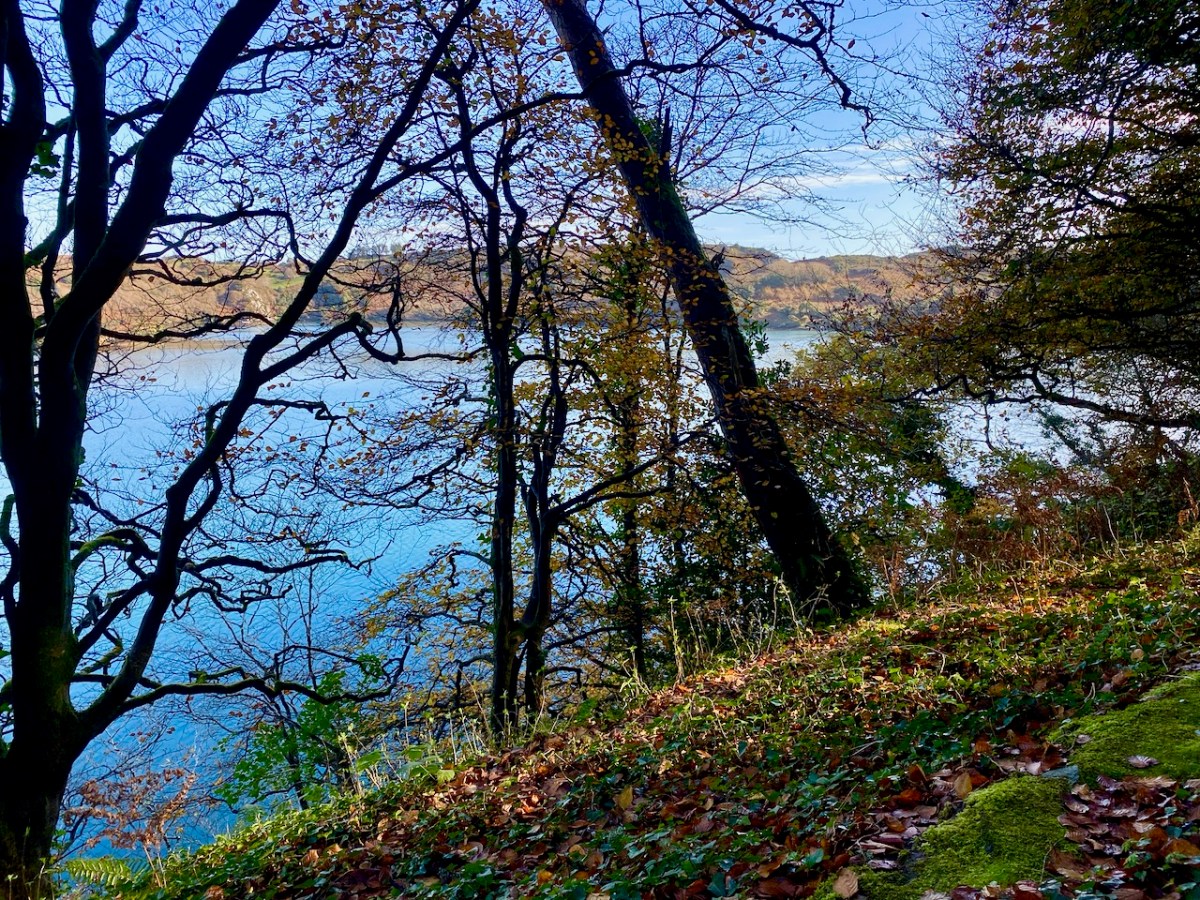
Thackeray’s Irish Sketch book is something we will return to in this journal, as it provides an unusual and, sometimes, surprising perspective on pre-Famine Ireland. But I can’t agree with him on Lough Hyne: grey melancholy hills . . . in the midst of desolate flatlands . . . Clearly, he cannot have visited on an autumnal day, and neither was he favoured by the sun. Perhaps there is a poetic justice there, somehow: we embrace everything that Ireland – and West Cork – has to offer; possibly his acute and carping scrutiny of the detail removes from him the more rewarding overview? For us, Lough Hyne was idyllic!
Our wonderful Skibbereen Heritage Centre has comprehensive information on Lough Hyne – and much more!
Building a Stone Wall

Our craft is one of the oldest in the world. Our handiwork is seen everywhere in town, country and village. The men who have gone before us have left us a heritage to be proud of; and we feel our own contributions have been for the good. With hammer, mallet and chisel we have shaped and fashioned tough boulders. We often curse our material and often we speak to it kindly – we have to come to terms with it in order to master it, and it has a way of dictating to us sometimes – and then the struggle begins. We try to impose ourselves in it, but if we know our material and respect it we will often take a suggestion from it, and our work will be the better for it.
That’s a quote from the preface of Stone Mad by the distinguished Irish Sculptor, Seamus Murphy, as are all the following quotes. Watching Diarmuid O’Callaghan rebuild our tumble-down stone wall I could see that same pride and respect for materials that Seamus talked about.
I suppose I imagined that stone wall building had somehow modernised in the same way that many ‘hand-forged’ gates are now mass-produced in China. But what I discovered is that Diarmuid built this wall using the exact same techniques and tools that the stone workers did who built Rossbrin Castle in the 15th century. You can see the remains of that Castle in the photograph below.
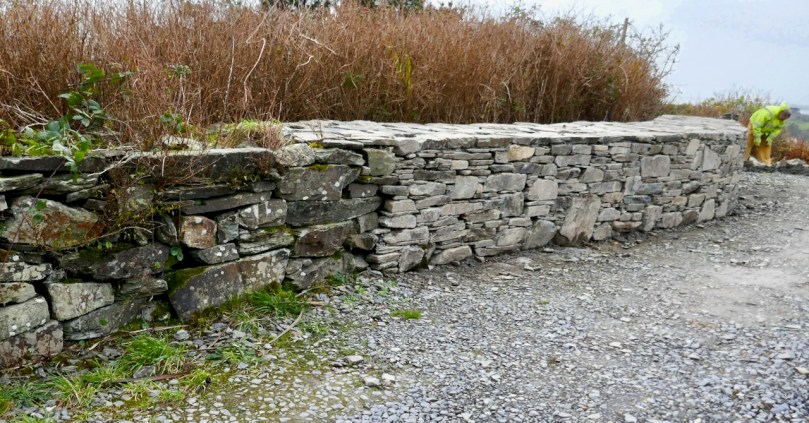
It’s called rubble construction, which simply means that the core of the wall is filled with rubble and mortar, while the outside or visible parts are shaped by the skilled sorting, selecting, shaping and placing of larger stones. In the photo below you can see the wall starting to take shape. Diarmuid is building on a concrete foundation – Rossbrin Castle is built on solid rock.

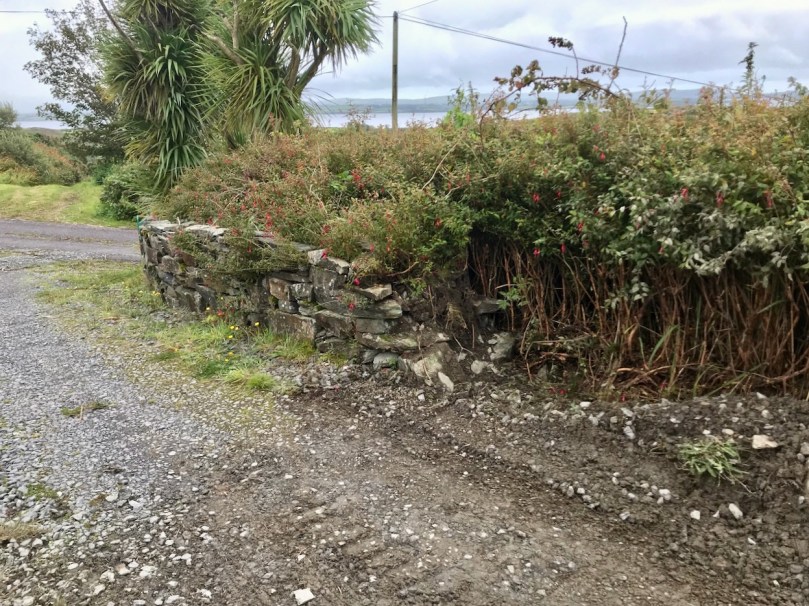
We wanted the wall to match, as closely as practical, the stretch that was still standing. Given that a stone wall is, in itself, a whole habitat for wild plants, my brief to Diarmuid was not to make it too tidy so that over time it would settle in and become covered in interesting growth in the same way as the existing wall. My request found a sympathetic ear and it became apparent quickly that here was a man who appreciated the craft of stone wall building and was fully alive to its long history, while having his own approach and practice.
Every graveyard, every old church, every old building keeps reminding us we are not as good as we think. They are our models, and very exacting they can be, very often they bring us down a peg or two and make us realise how much of our knowledge is handed down from old times, and what small advances we have made.
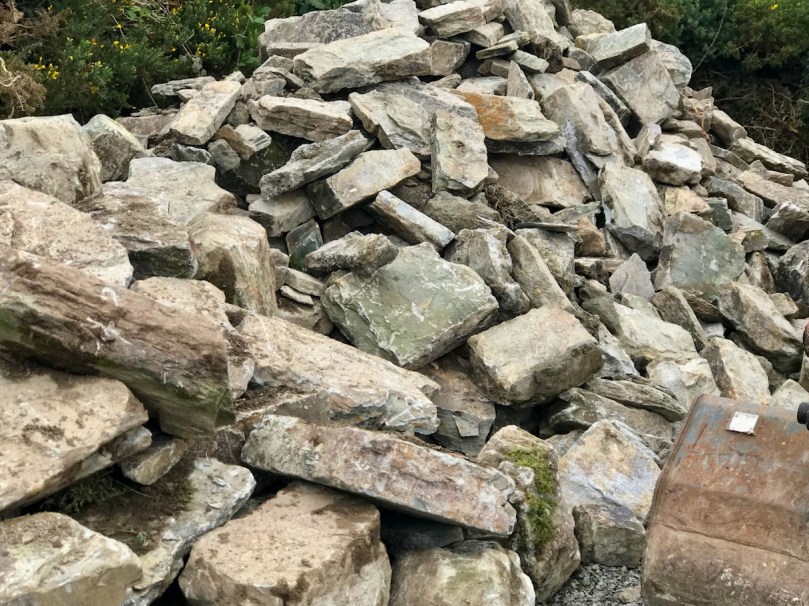
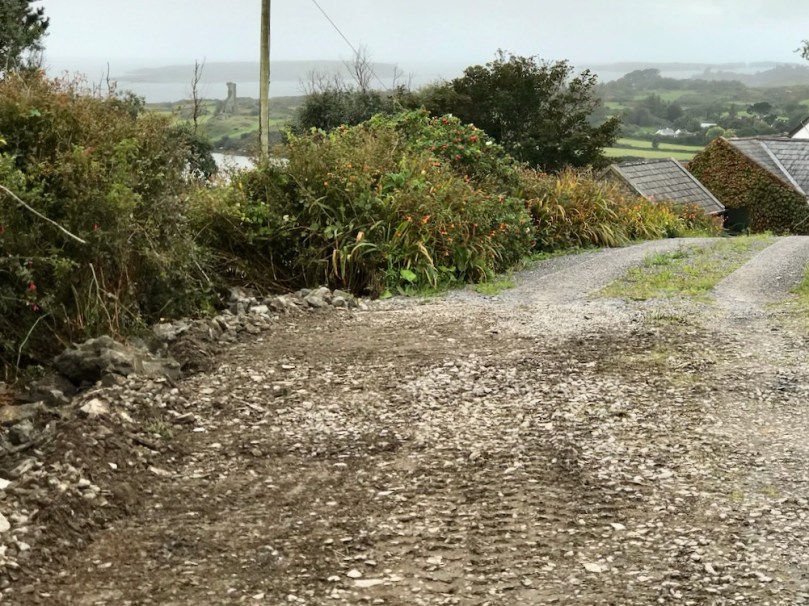
Some heavy equipment was needed in the beginning, all managed by our friendly neighbour Stephen O’Brien and his family who cleared into a neat pile all the fallen stones, dug a trench and laid a foundation for Diarmuid to work with. Diarmuid re-used almost every piece of original stone – it was remarkably efficient, with only a few bits left over.
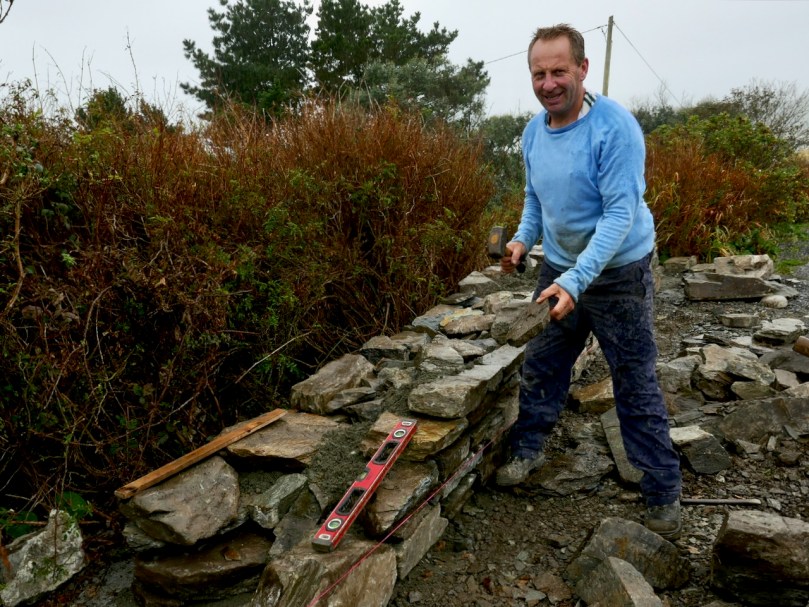
As I watched him work he explained his practice to me. “I turn every piece three times,” he said, “and then I can see exactly where it will go.” He lays the outer lines first, turning what was the backside of the old stones towards the front to present a new clean face. He lays down some mortar (nowadays that’s a loose mixture of concrete and sand) to bed the stones in, keeping his lines horizontal with judicious insertions of smaller pieces of stone. Once the outer lines are set he fills the interior with ‘rubble’ – a mixture of mortar and discarded pieces of stone.
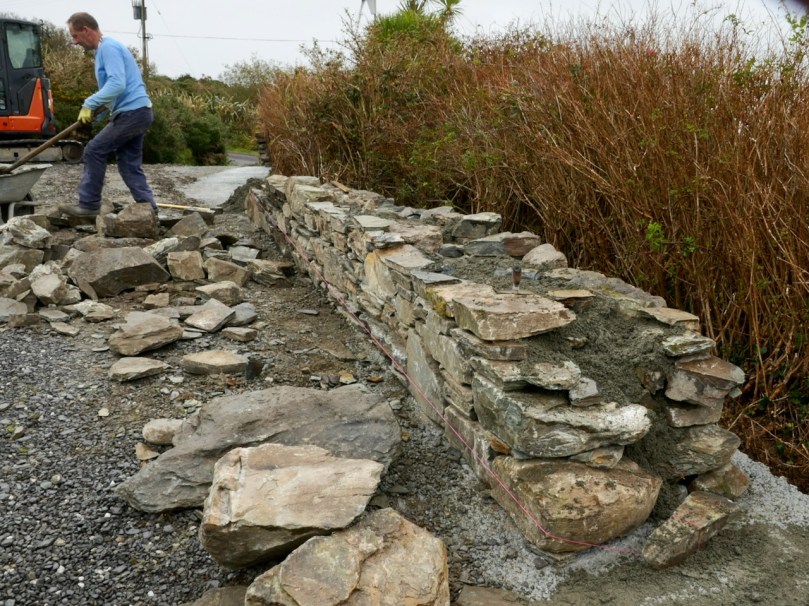
It all goes remarkably quickly and in no time at all the wall is taking shape. I was curious how he was going to manage attaching the new wall to the old so I asked him how he was going to marry to the two sections. “With love,” he grinned. I was struck by how he echoed Seamus’s description of medieval stone masons.
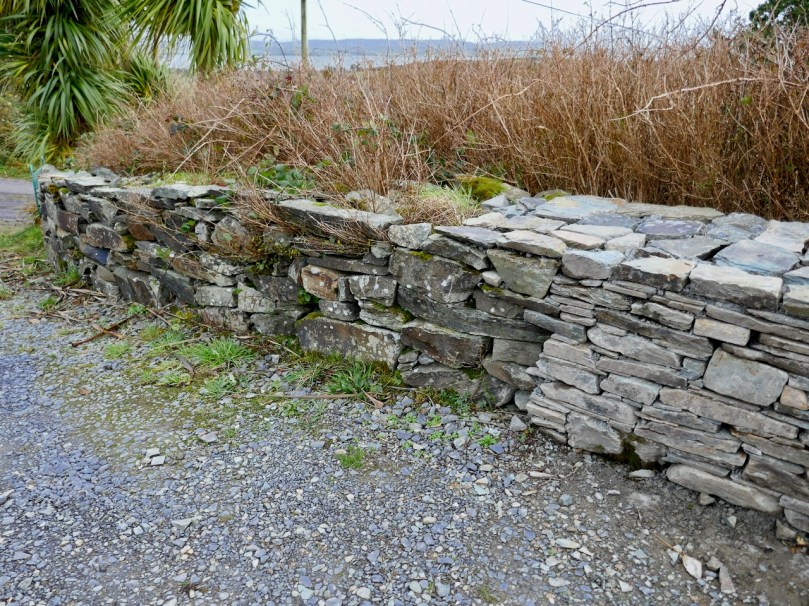
That was the spirit and attitude that prevailed in mediaeval times, when you had whole colonies of craftsmen gathered in the towns, building the big cathedrals.
They worked and they talked of work, and the ways and means by which other jobs were done, all the time comparing and striving to produce as good, if not better than the man at the next banker. Occasionally indulging in caprice and caricaturing vice and virtue, enjoying the exaggerated and the fanciful, or using as models the odd personalities that were on the job. Or they could be as reverent as the portal statues at Chartres. They loved their work, and one can sense the enjoyment they got out of that, each vying with the other to attract the attention of the rest. This sort of vanity pushes men on, it gives the imagination a chance to play about and thereby enriches our lives so that work is no longer a task, but a use of our leisure – in a word — pleasure.
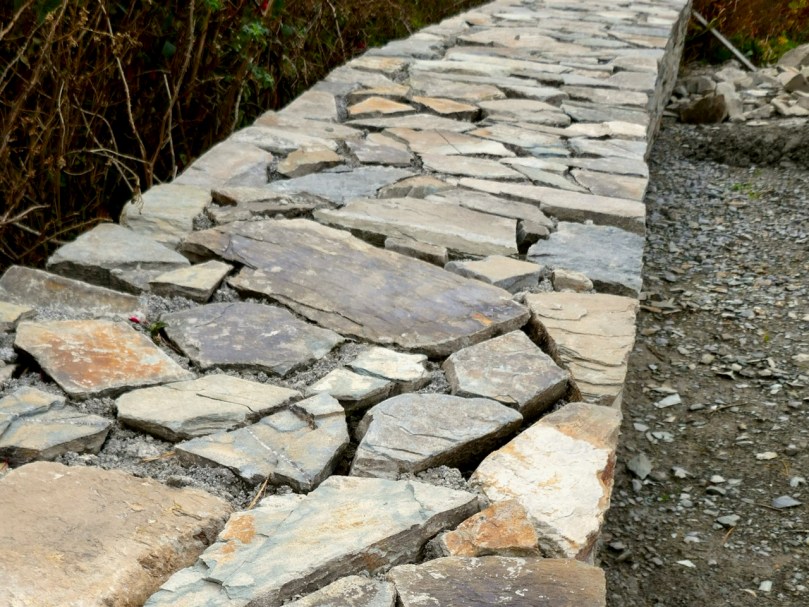
The finished wall is a thing of beauty. There’s still a good demand for stone walls in this part of the country – we have seen great new examples and others that are not quite so successful. Stone walls are such an integral part of the character of the west of Ireland and it will be a long time, we think and hope, before the demand for them dies out, but I will leave the last word for Seamus.
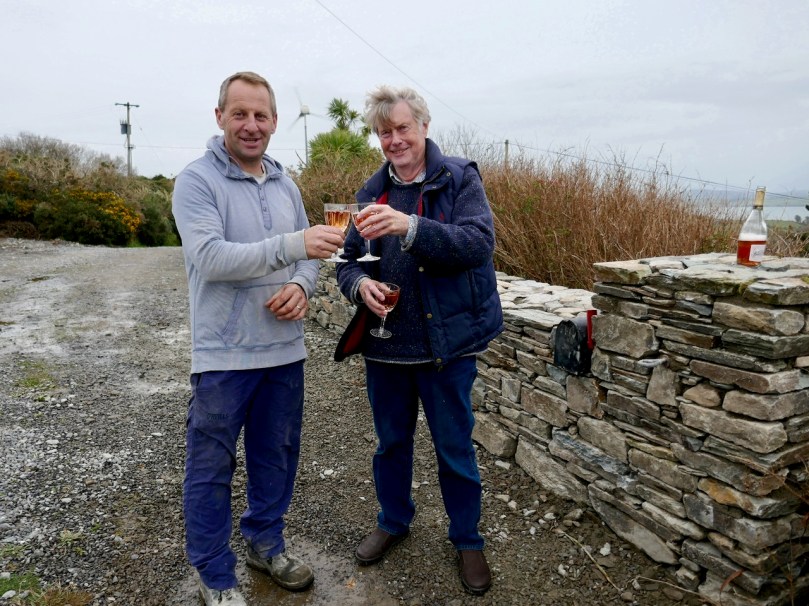
Times have changed and the work is no longer plentiful… But some of the old stonies will hold their heads high, and carry with them to the grave the feeling that they have left their mark on many a church, and on many a building, and that in the years to come, there will be people to admire the work they have left behind them, as we of this generation respect and understand the work of the men of long ago.
I often wish I had money and could take a few of the old stonies on a pilgrimage from graveyard to graveyard, from quarry to quarry, calling on the small stonecutters’ sheds here and there around the country, exchanging gossip about the members of the craft, and of the stone, and realising – marvelling – at the at the amount of knowledge and skill, and the years of thought that go to the perfecting of a craft.
But it is coming to an end, and more is the pity. Art grows out of the good work done by men who enjoy it. It is the wealth, surely, of any country.
Book of Lismore

This is a topical post, as only this week we heard the news that the Book of Lismore has been donated to University College, Cork to become the centrepiece of the library there. It will be accessible to students and will contribute to the knowledge and study of Gaelic manuscripts dating from the 15th century.

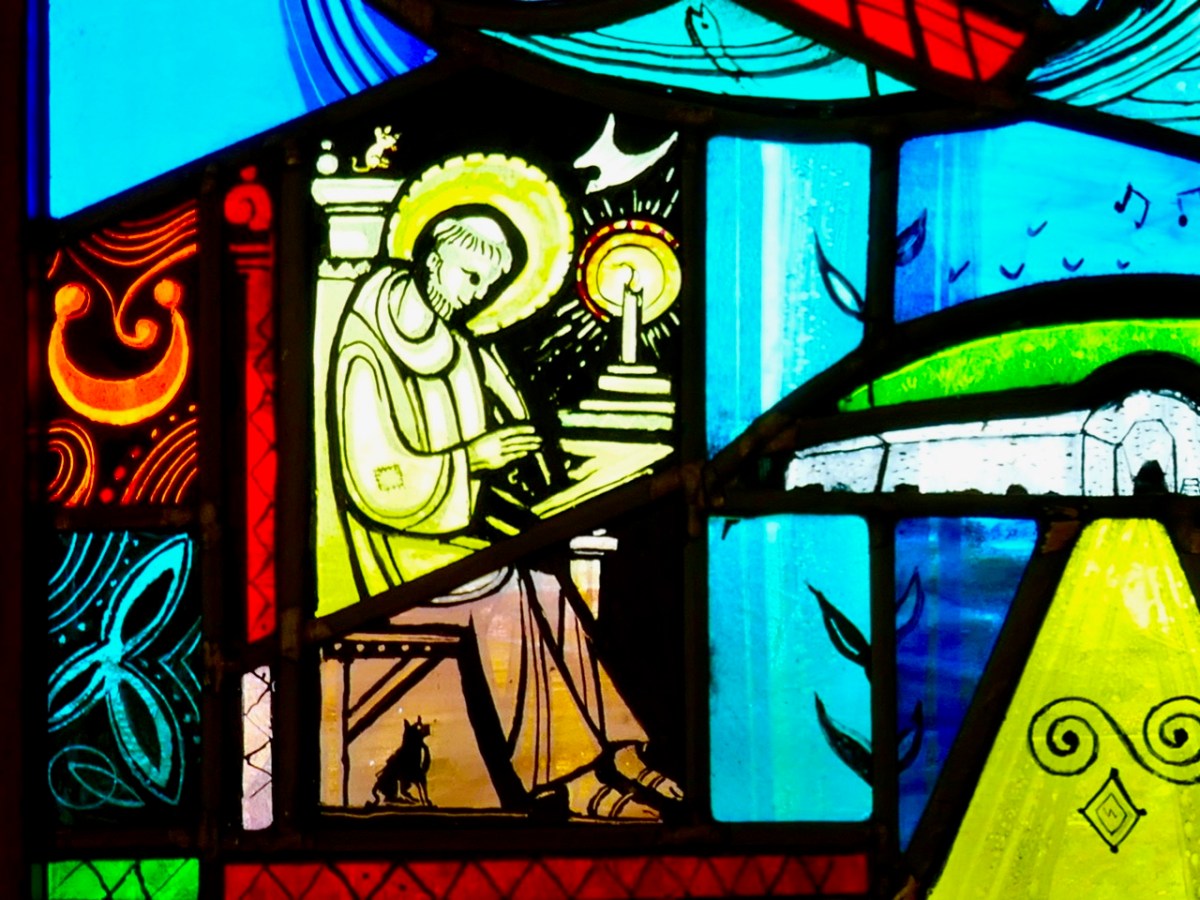
When we think of ancient Irish manuscripts we might visualise the Book of Kells, which is on display in Trinity College, Dublin. It’s remarkable to think that the Book of Lismore is over 500 years old, but that the Kells manuscript predates it by 600 years: it was created around 800AD. Here’s a scribe (from Finola’s window by George Walsh) who could be from any of those medieval periods when monks and lay brothers worked away in their scriptoriums making, copying and illuminating beautiful works which have become our most precious historical documents:
The Book of Lismore is written on vellum, and was compiled for Fínghin Mac Carthaigh, Lord of Carbery (1478–1505) and his wife Caitlín. It became known as Leabhar Mhic Cárthaigh Riabhaigh. It is entirely in Irish. What has really excited us is that, in introducing the installation of the book at Cork, UCC Professor of Modern Irish Pádraig Ó Macháin mentioned our own locality:
[The book] belongs to a period of creativity which was centred on the coastline of Cork. It is difficult to imagine those seats of learning and literature today when you look at the remote rural landscapes . . . In Rossbrin Castle – the O’Mahony stronghold – translations, treatise and journals were being made using contemporary European resources: it was a proto-university in pre-urban Ireland, paralleled by the vibrant poetic tradition of the O’Daly family in nearby Mhuintir Bháire [The Sheep’s Head] . . .
Pádraig Ó Macháin, 2020 (paraphrased)
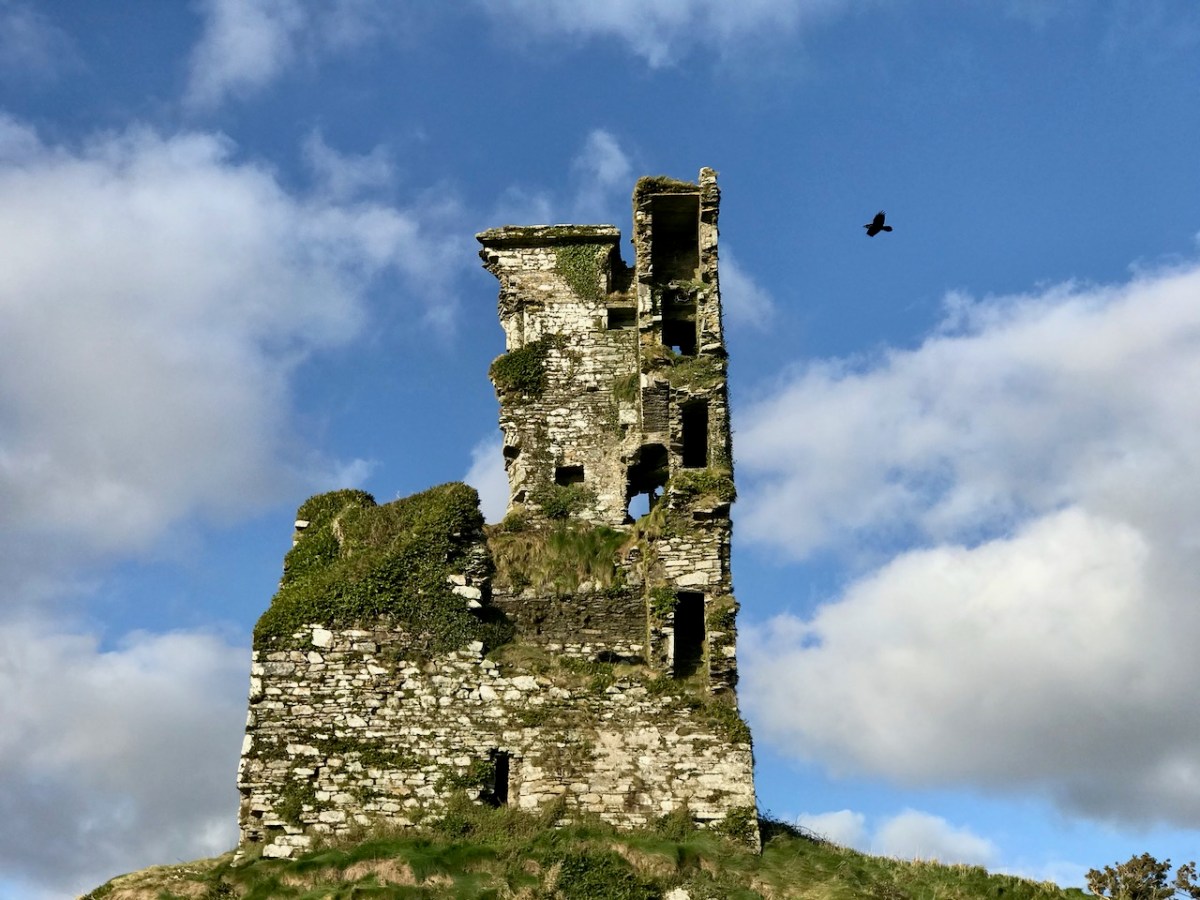
Rossbrin (above) was only one of many castles occupied by the Gaelic nobility along the coastline here in the 15th century and beyond: this ties in with my post of last week when I explored a 1612 map and identified many centres of occupation and scholarship which surely made West Cork so vibrant and cosmopolitan in earlier times. Books are known to have originated here – including the first to be written in Ireland on paper – and some of them survive to this day.


All the page illustrations in this post come from the Book of Lismore. It has a complex history and is likely to be by many hands. One – Aonghus Ó Callanáin – is certainly identified within its pages, and another – a friar named O’Buagachain is suggested. Tradition has it originating from the lost Book of Monasterboice and associates it with Kilbrittain Castle, Cork – reportedly the oldest inhabited castle in Ireland, dating from as early as 1035 and possibly built by the O’Mahonys – but also with the Franciscan Friary at Timoleague.
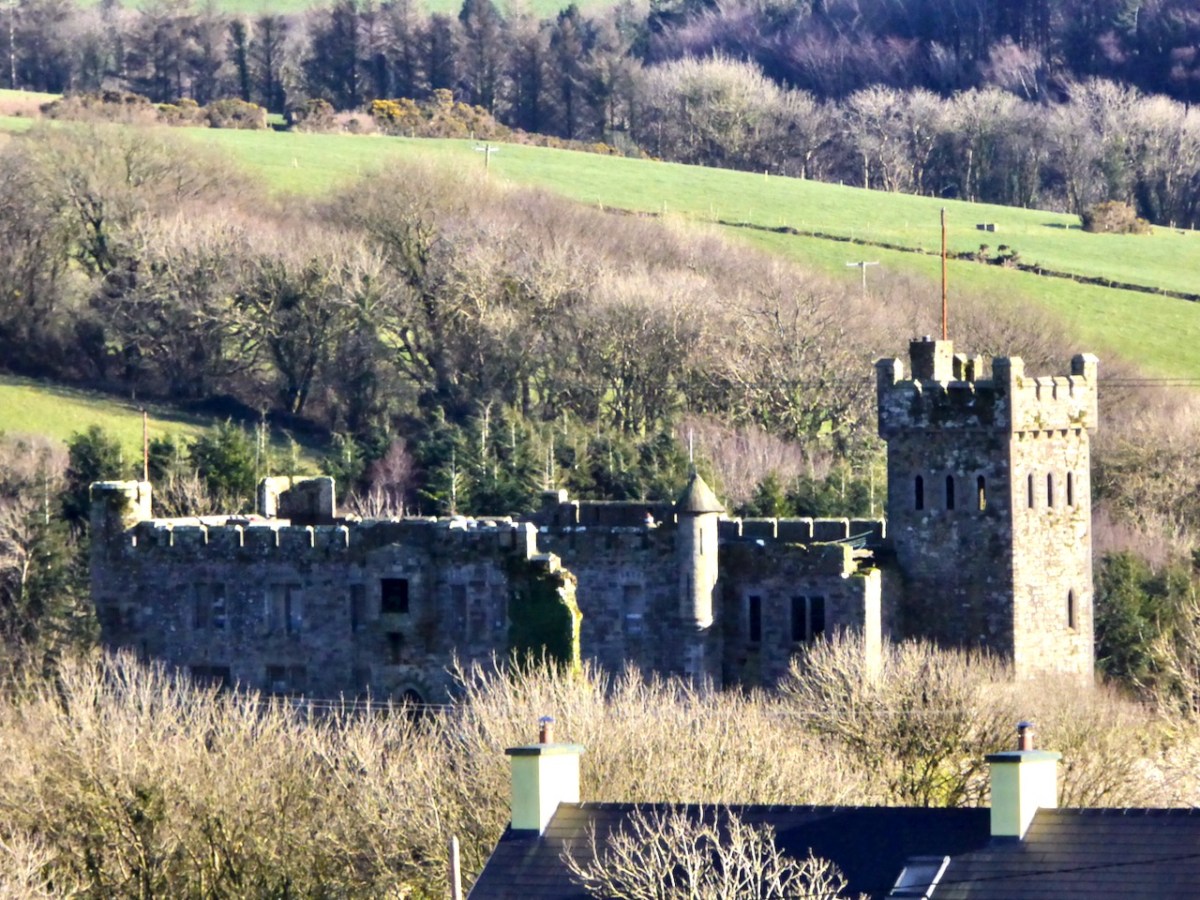
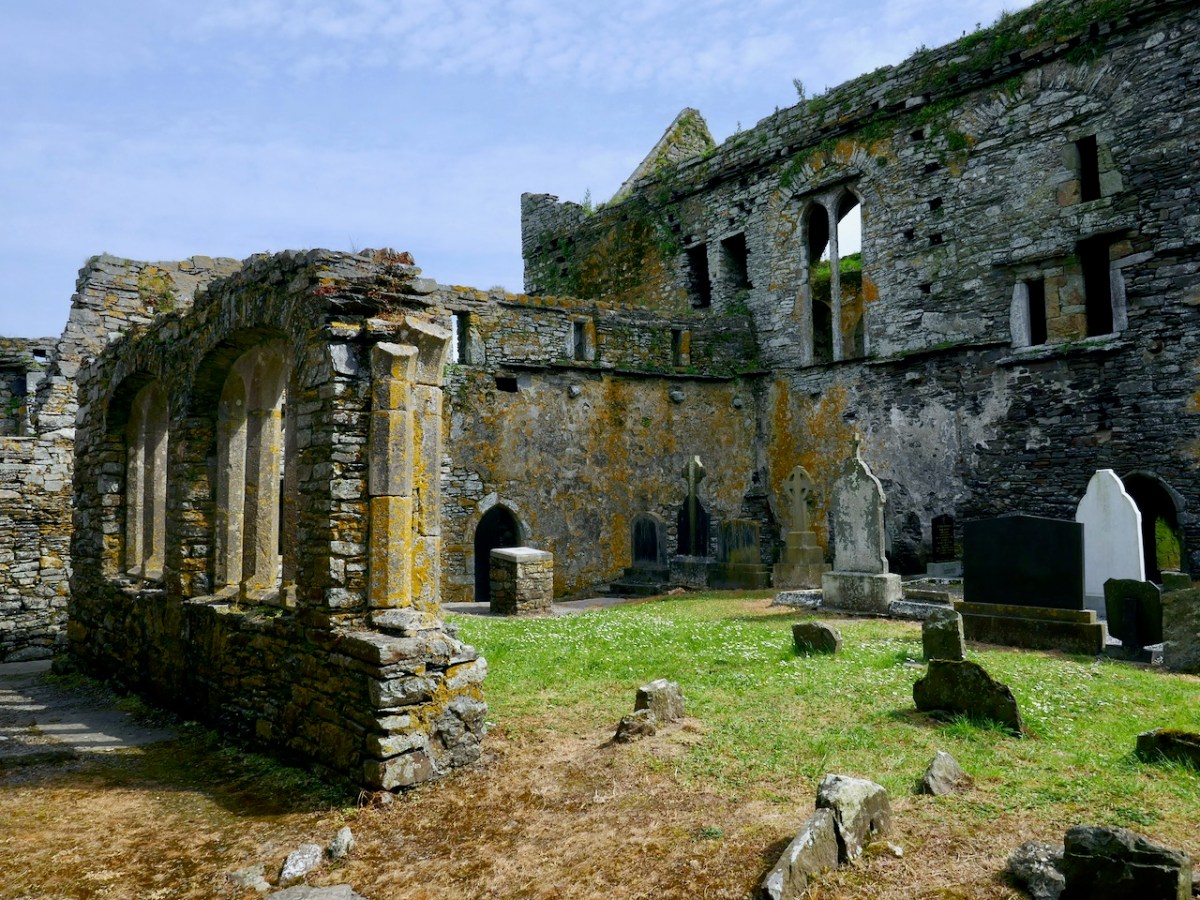
Upper – Kilbrittain castle in the present day: the original building is a thousand years old. Lower – the Friary at Timoleague, a foundation attributed to the MacCarthys in 1240, and plundered in the 17th century
The book fell into the hands of Richard Boyle, First Earl of Cork, during the Irish civil war in June 1642 and ‘vanished’ until its rediscovery in Lismore Castle in 1814. Apparently it was walled up together with the Lismore Crozier. By then the castle was owned by the Cavendishes, Dukes of Devonshire. It is this family that has donated the book to Cork and the nation, through the Chatsworth Settlement Trust.


Upper – Lismore Castle by TS Roberts, Aquatint and etching 1795 print by Samuel Alken. Lower – The Book of Lismore and the Lismore Crozier celebrated in this Celtic Revival stained glass window of St Carthage in Lismore Cathedral. The window is by Watsons of Youghal, and you can read more about them in Finola’s post here
One further thought: today is ‘All Saint’s’ – November 1st. The contents of the Book of Lismore include a section on the lives of the Irish Saints: these lives were translated by Whitley Stokes in 1890 and are available to read online. Finola has used this source in her post about Saint Fanahan, or Fionnchú. We look down on Rossbrin Cove and the ruins of the medieval O’Mahony castle – sometimes described as the greatest centre of learning in Europe! We feel excitement and gratitude that here in West Cork we are linked to this treasure from that age, now in the responsible hands of UCC.

 Roaringwater Journal