Gobnait’s Day

We stood still and listened: the air was filled with humming – Bees swarming in February? But no… it was the murmuring of the pilgrims saying the decades of the Rosary by the grave of St Gobnait…*

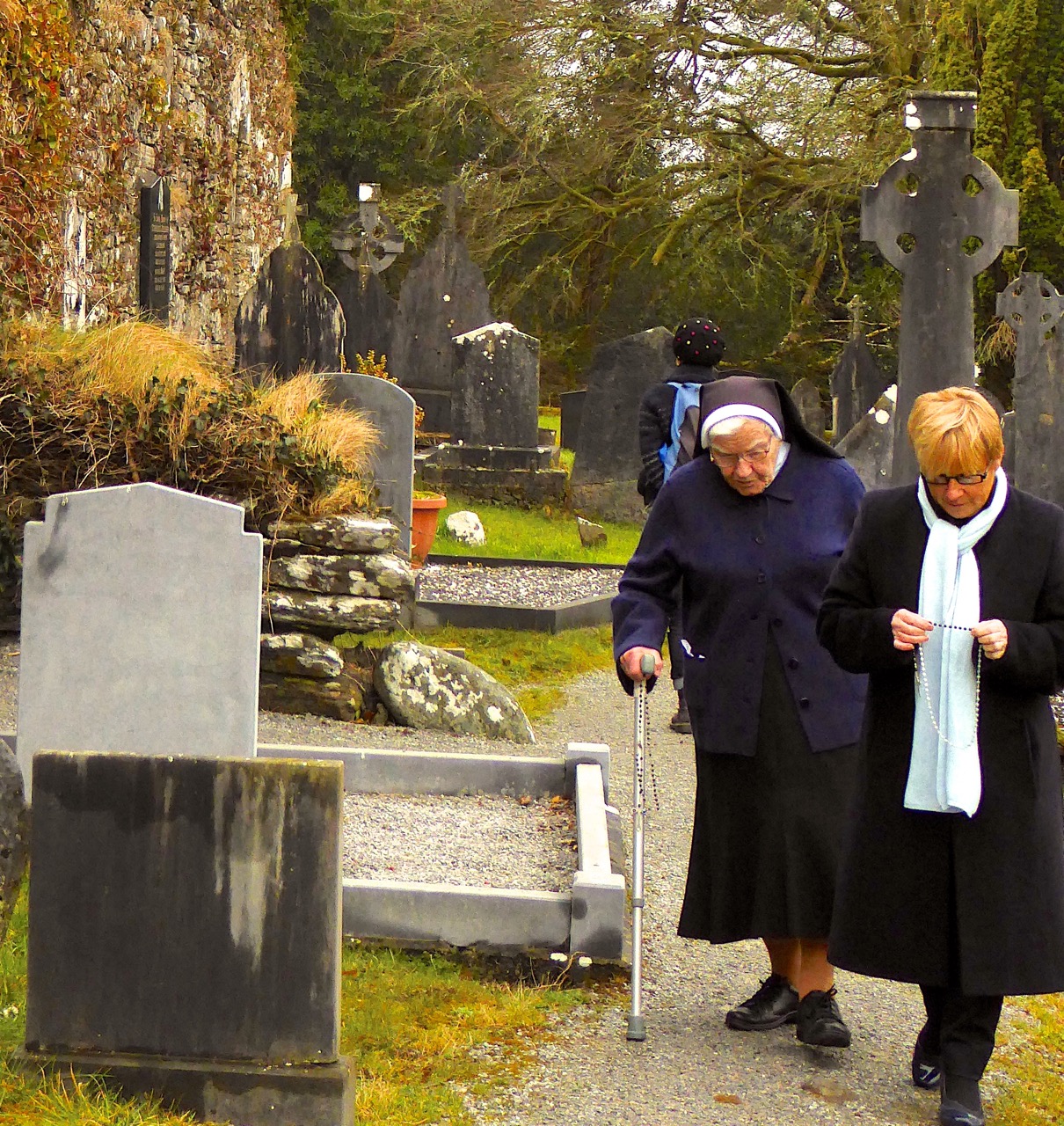
Making the Rounds at Saint Gobnait's Shrine on the Feast Day
Making the Rounds at Saint Gobnait’s Shrine on the Feast Day

We travelled up into the Muskerry Gaeltacht on Wednesday – 11 February: the Feast Day of Saint Gobnait. It’s a fair journey, and we felt that we had really gone into another world: we crossed over the Mountain of the Fairy – that’s my interpretation of the Shehy Mountains (Shee is Fairy) – others say the Irish Cnoic na Síofra means ‘hills of the animal hides’. For the first time in my life somebody – a passer by – addressed me in Irish… “An bhfuil hata agat le spáráil?” they said – “Have you got a hat to spare?” (I think it was a wry comment about the headgear I was wearing on the day).
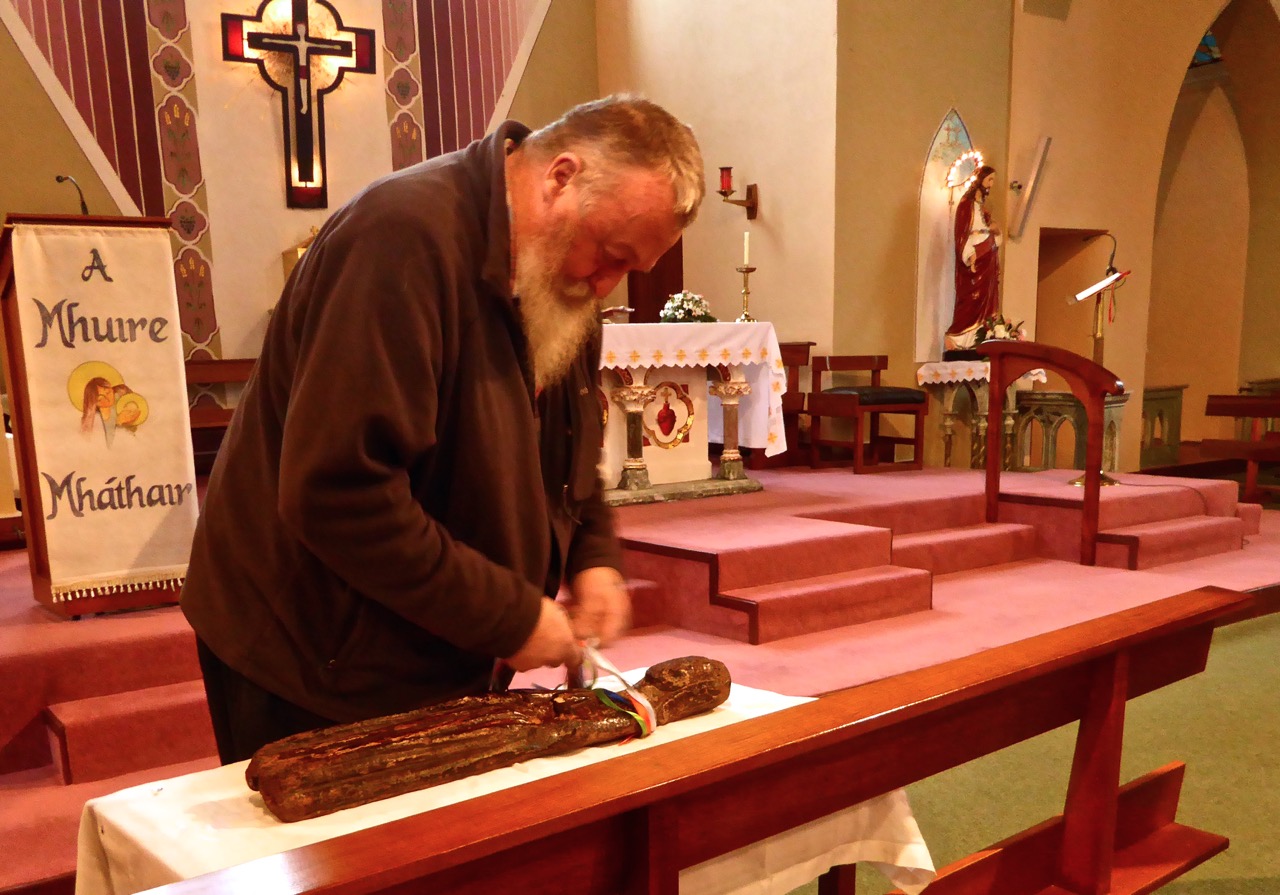
Wrapping the ribbons

Our goal was Saint Gobnait’s Church in Ballyvourney, where the Mass was to be heard celebrated in Irish. Also, we wanted to see the 13th century wooden statue which is brought in to the church on this day. When we arrived there was already a queue to buy ribbons and ‘measure’ them against the statue. In fact, it was quite an intricate ritual: first you wrapped your ribbons around the neck of the statue, then around the feet. Some did the same around the stomach – others passed the ribbons under the body of the statue and rubbed them along the surface. Many people kissed the statue and some picked it up and made the sign of the cross with it. We joined in and came away with a clutch of ribbons, now blessed by Saint Gobnait and imbued with health-giving and good-fortune-bringing properties.

Making the 'Measures'
Making the ‘Measures’

The church was completely full for the Mass (it was also broadcast outside), which was celebrated by two Priests and a very robust men’s choir – beautiful singing in Irish. It was an uplifting experience, even though I hardly understood a word. A friendly atmosphere imbued all who were there, and excitement was in the air. Afterwards, we visited the statue again and then headed for Saint Gobnait’s Holy Well, her grave and the ruins of her ancient church, where the ‘Rounds’ were being performed all day. That’s when we heard the humming – it should have been Bees: this Saint has always been associated with them, and her statue which overlooks the pilgrimage site (and which was carved by Seamus Murphy in 1950) is decorated with Bees and with a Deer. This is also part of her story: when she was travelling through Ireland looking for a site to establish her community she was told she must continue on her way until she met with nine white Deer. She found them in Ballyvourney and that’s why in our time the little settlement flourishes on this February day.

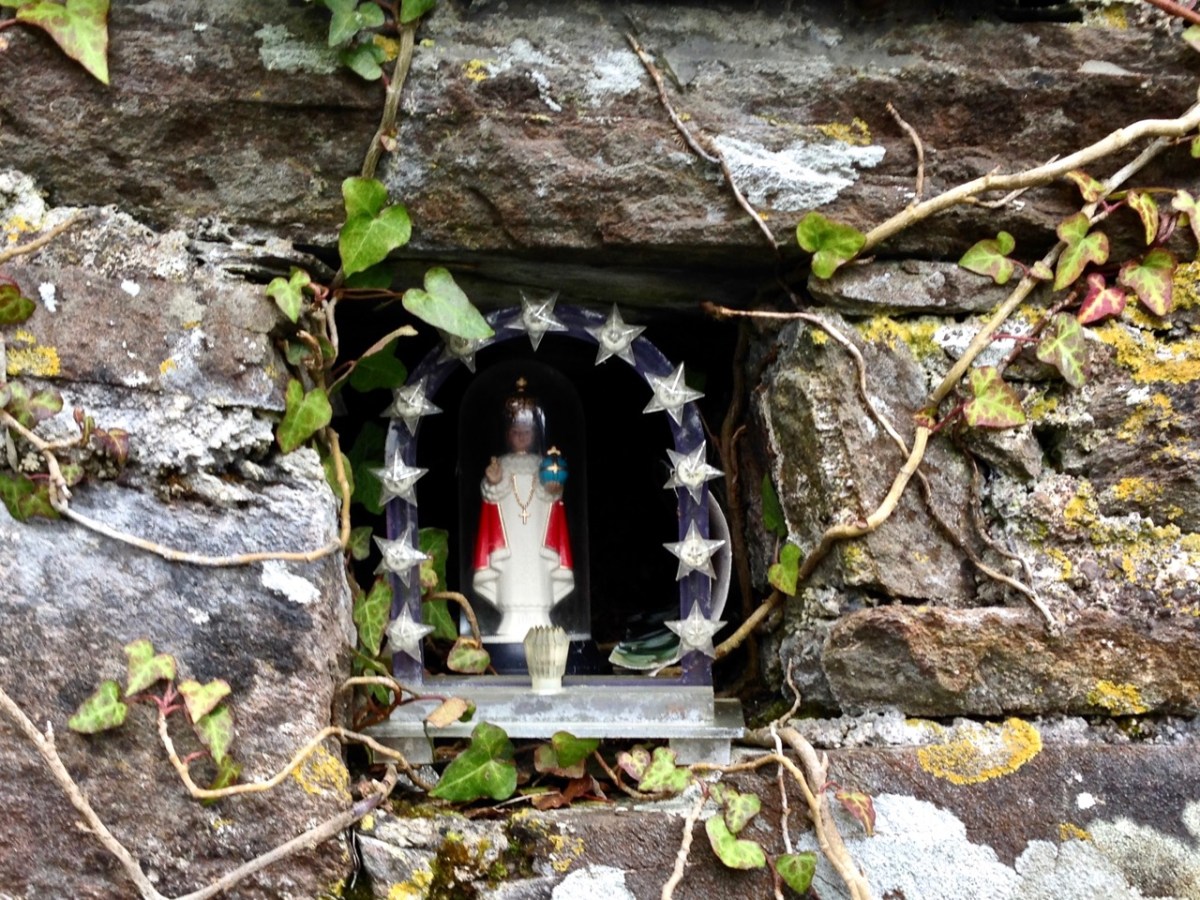
We heard that there is another Holy Well, hidden in the woods just outside the town and seldom visited. This is known as Tobar Abán – Saint Abban’s Well. That saint seems to be closely associated with Saint Gobnait although not much is known about the lives of either of them – they lived back in the sixth century.
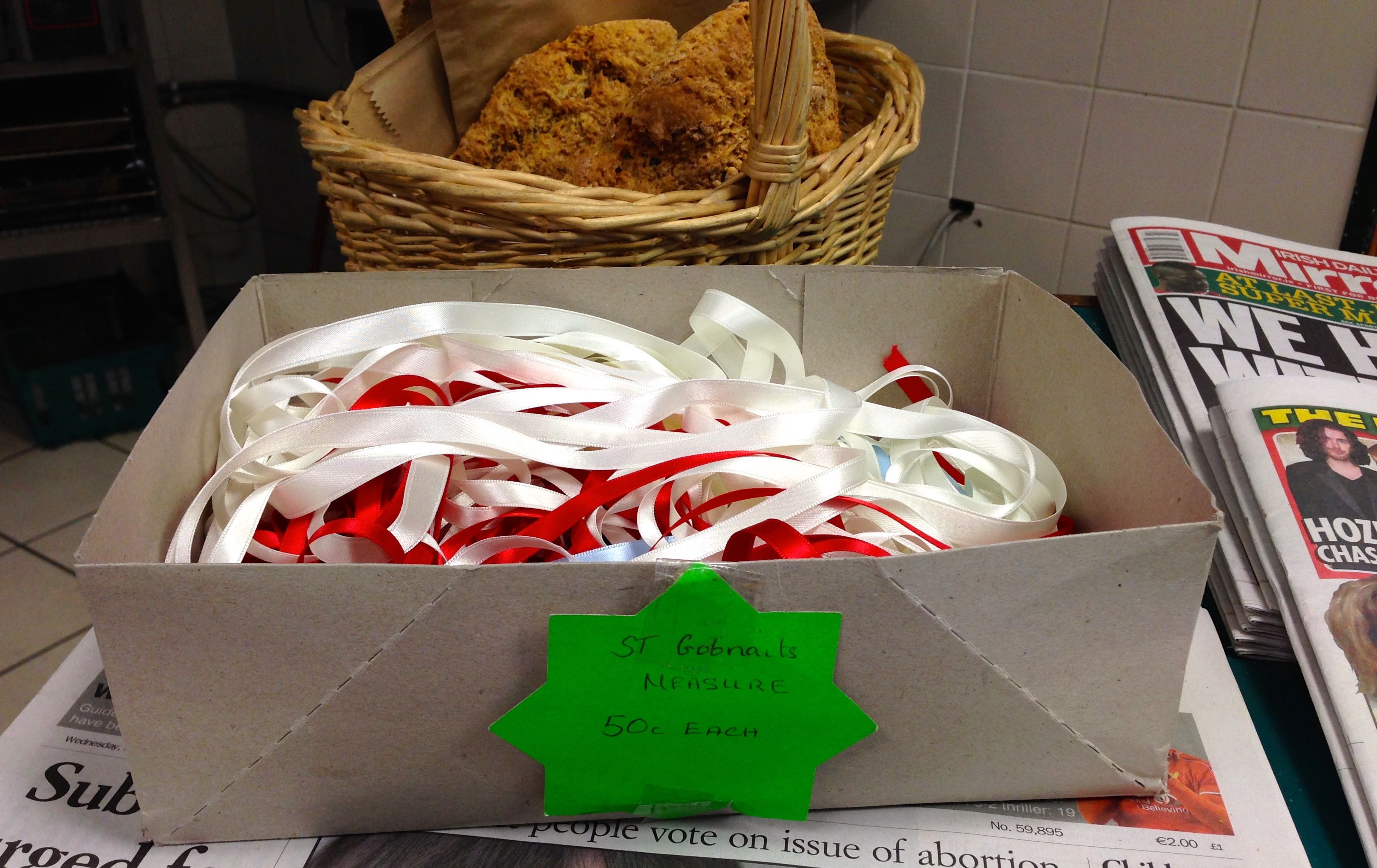
In the local shop
In the local shop

A visit to the Post Office provided us with the information we needed to get to this intriguing sacred site: walk over the bridge, go into the fields and look for a lone oak tree on the distant boundary – this marks the point where a trackway leads up through the woods. We made our way across a muddy pasture; the oak tree was prominent enough, and the track – but once inside the wood everything was quite densely overgrown. We would never have found it without the instructions, but we also had the help of red and white ribbons tied to trees and posts in strategic places – they had been there for some time: we wondered who set them up?

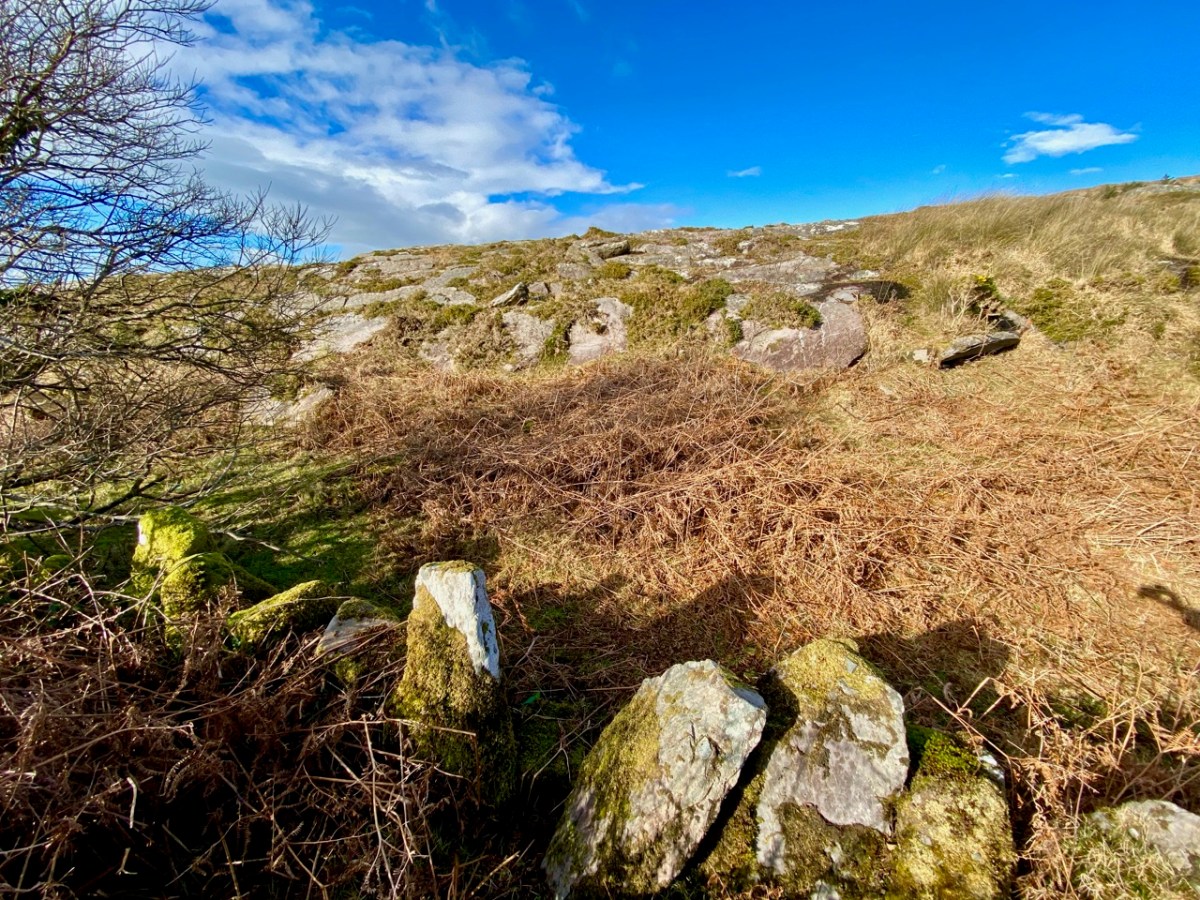
Tobar Abán is a wonderful site – a lonely outpost of religious sanctity but, for me, probably the most beautiful of all the holy places I have visited in Ireland so far. It’s an unexpected find: set away from everything, deep in an ancient oak wood, silent, still – one could imagine that it has always been like this, passing through generations of turbulent history and yet untroubled by it. Archaeologically it appears to be a cist with a cairn of stones built around it: this would imply pre-Christian origins. The lid of the cist (a burial chamber or repository for bones) is not visible – possibly it is under the large ballaun stone which rests on top. Above this is a small, relatively modern concrete cross embellished with offerings, beads and ribbons: other icons and objects are scattered around the site. The whole mound has a boundary defined by three standing stones, one of which is inscribed with ogham. Everything is covered in a layer of moss which seemed to exude a luminescence in the moist shade of the wood.
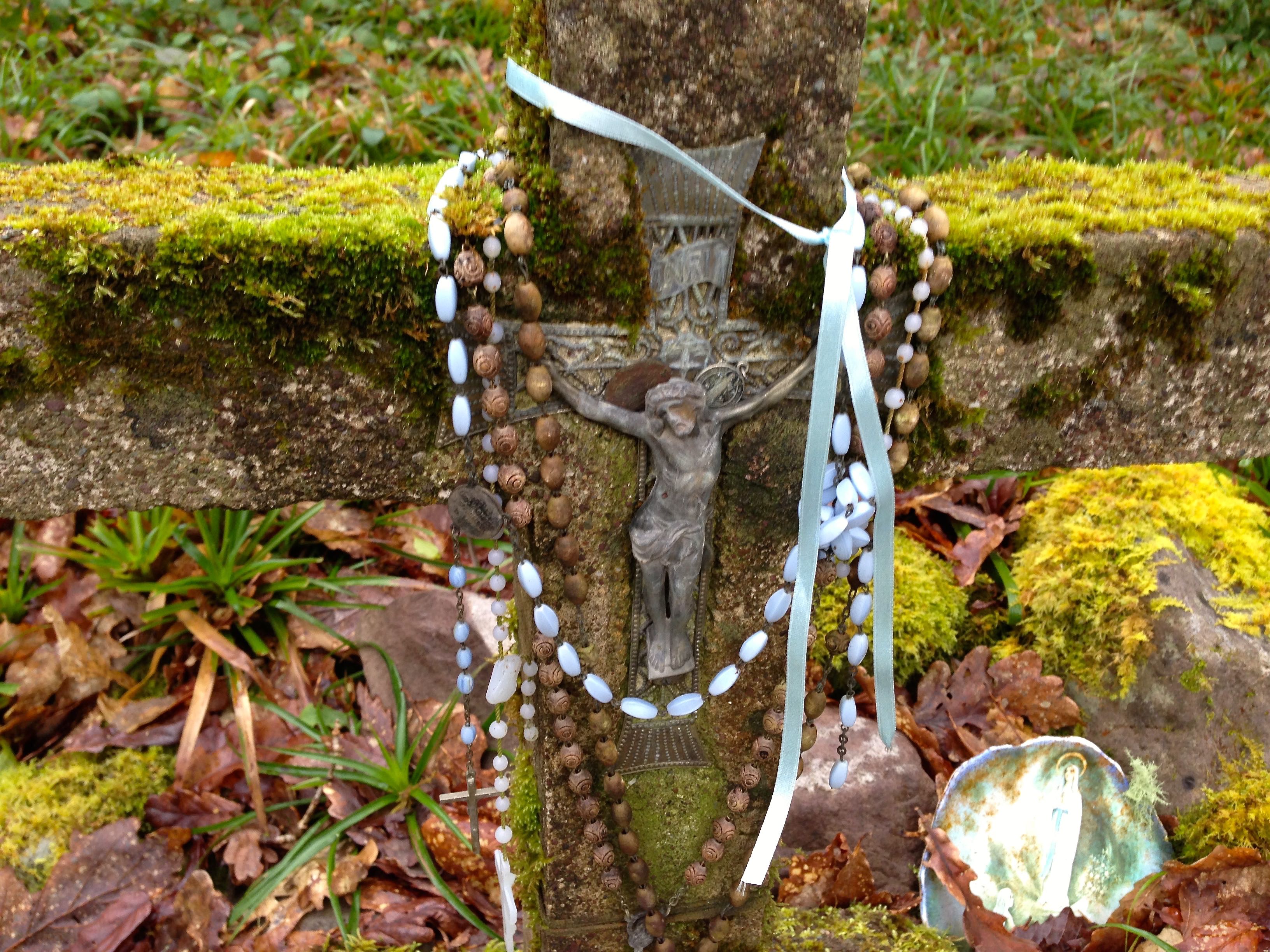
crucifix

Saint Abban (or Abbán moccu Corbmaic) seems to have been active in many parts of Ireland, and tradition has it that he lived for three hundred years. The stories that are important here are the ones that link him with Saint Gobnait. It has been said that he founded a monastery in Ballyvourney before she arrived, and that he was her mentor and gave the foundation to her. Some say that Abban and Gobnait were brother and sister. Most important, perhaps, is the tradition that Abban had a cell or church just outside Ballyvourney and that he was buried in that cell when he died in 520. Could it be his grave that we found?
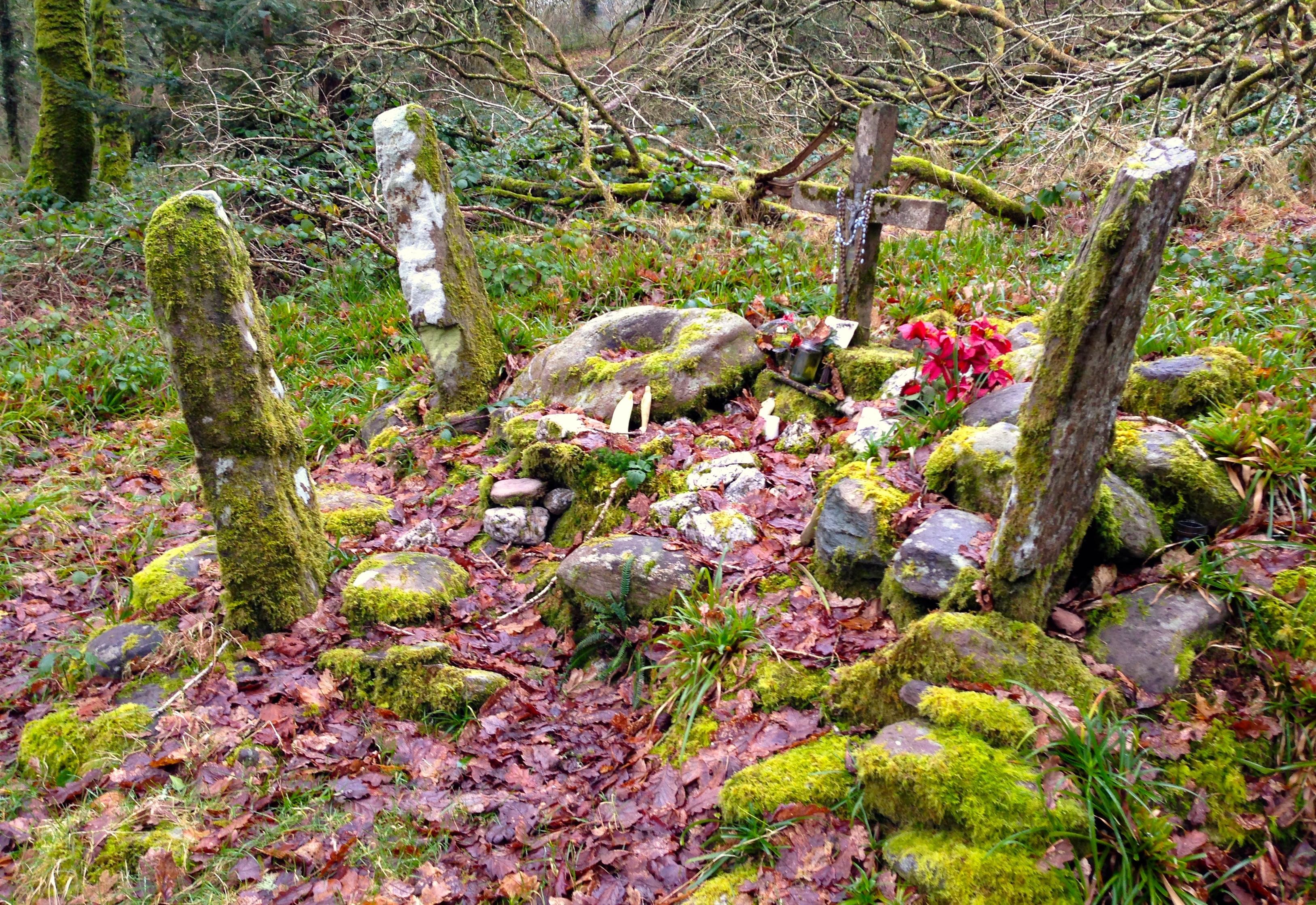
Saint Abban's Shrine - cell - or grave?
Saint Abban’s Shrine – cell – or grave?

Saint Abban’s Well is a little distance from the cist, and is quite unassuming, especially compared to the elaborate wells around Saint Gobnait’s old church. It is merely an opening in a rock set in the ground: an old tray covers it and keeps the leaves out, and a wooden box beside it contains some cups and plastic bottles for collecting the water.

Tobar Aban - Saint Abban's Well
Tobar Abán – Saint Abban’s Well

As we were making our way back across the fields we were surprised to see a lady in a red coat walking with a stick towards us. “Did you find it?” she asked. We assured her we had found the well and the shrine. “And did you see his bones?” she continued, “Last time I was there I lifted up the lid and saw the Saint’s bones inside…” We watched her go off towards the woods; when I looked back again she had disappeared.

Cist, Bullaun and standing stones

There’s so much about the day: the journey across the Mountain of the Fairy; the Irish Mass and the ritual of the ribbons involving a 13th century wooden figure; the Rounds and the humming of the Saint’s Bees; the magical shrine in the woods – and I really do wonder about that lady in the red coat…
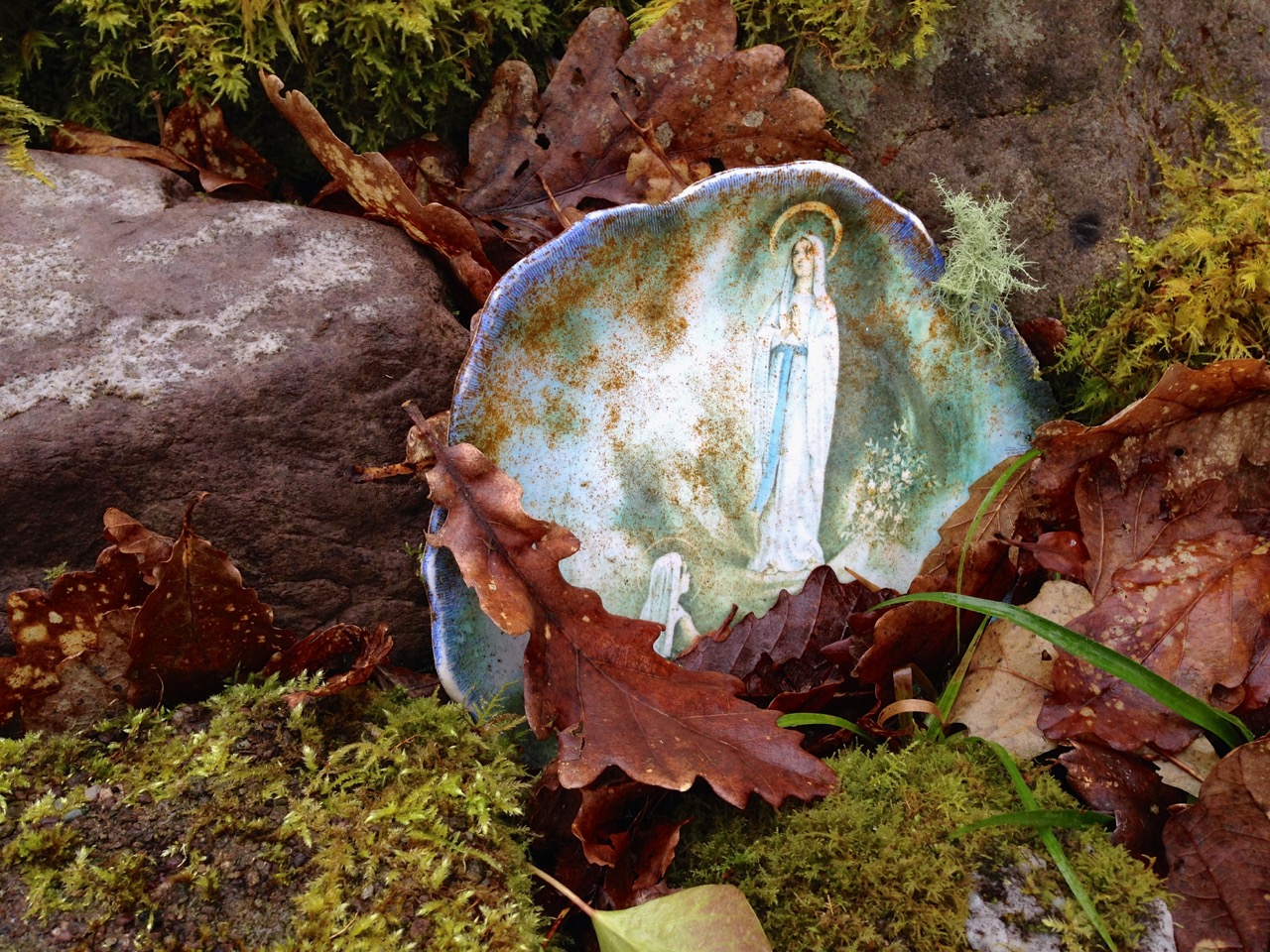
Offering at the Shrine of Saint Abban

* Originally titled A Murmuration, this post has been re-edited. Although published under Finola’s name this time around, the post and the re-editing are by Robert..
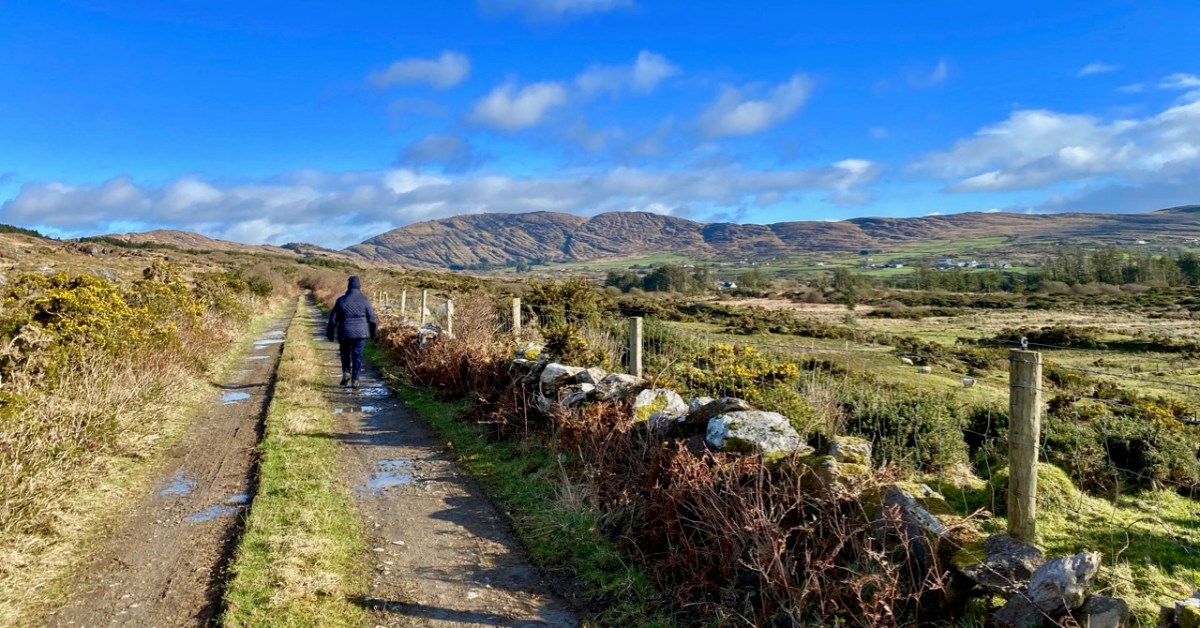
West Cork Rocks

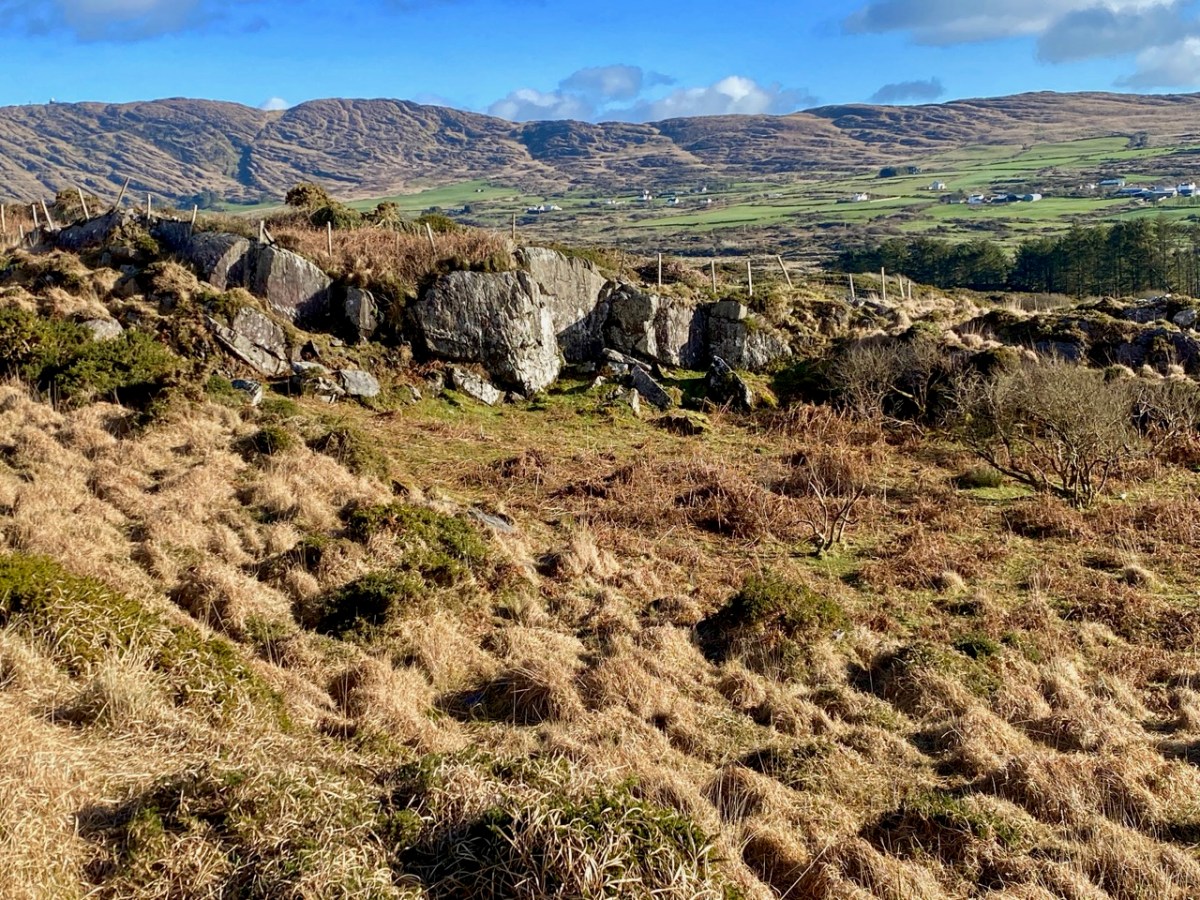
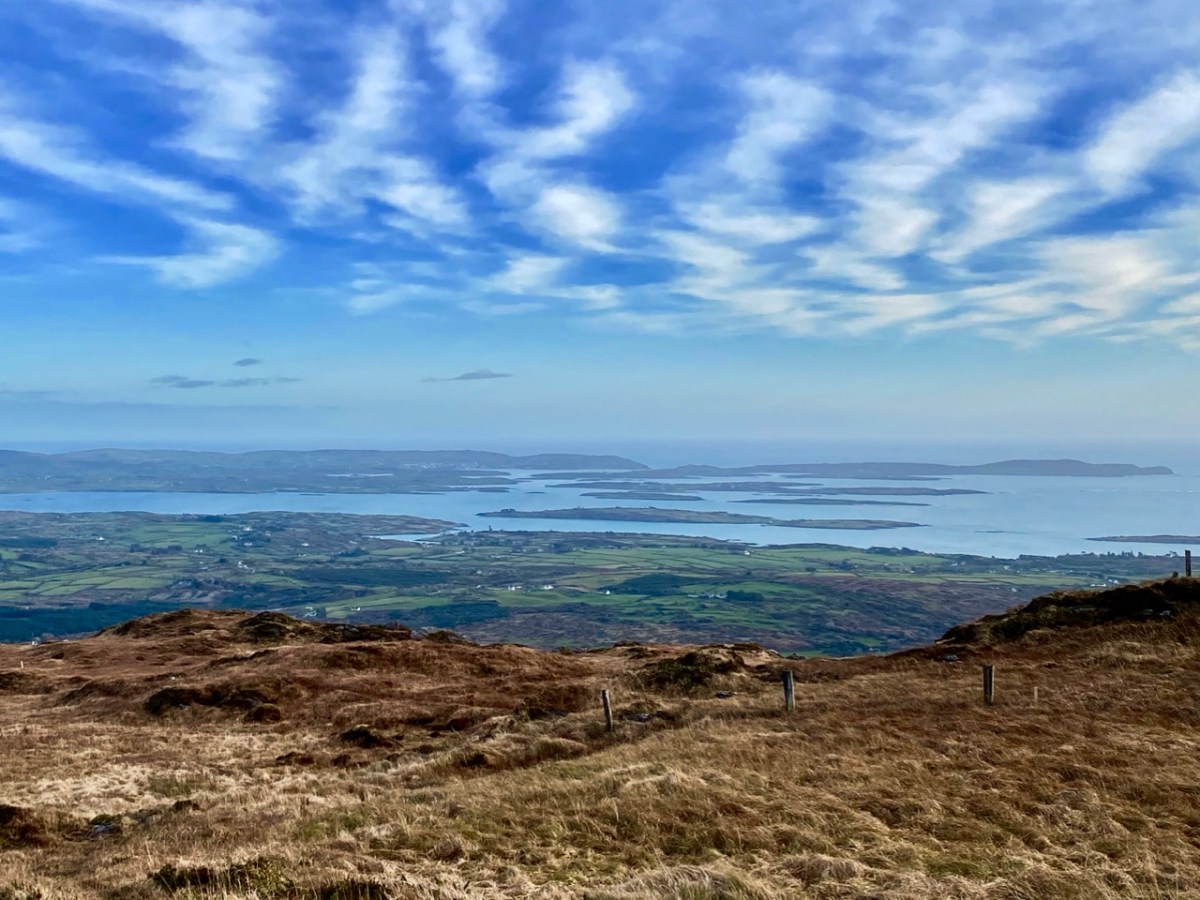
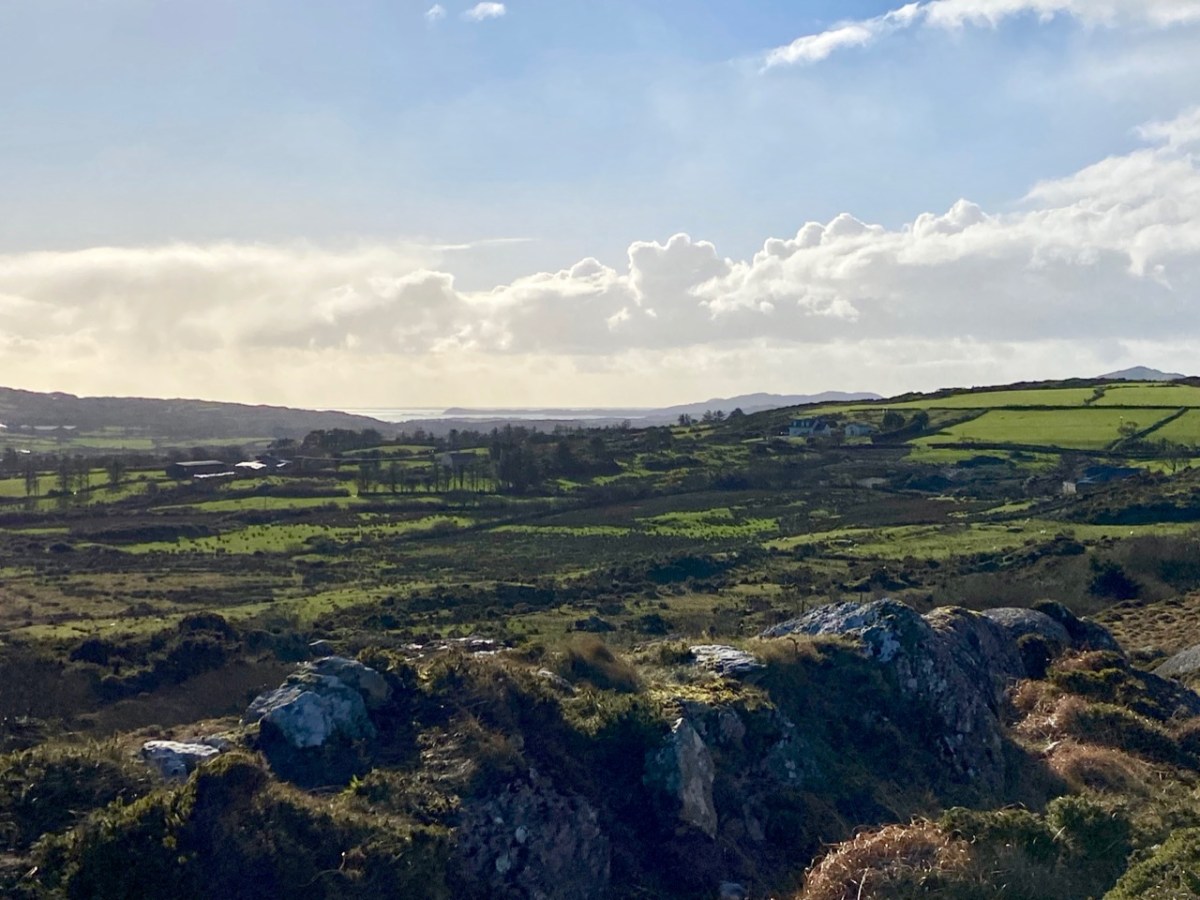
It certainly does! But this post is – literally – about rock: the hard, knobbly kind that is underneath us, surrounds us, and which has historically built our environment. In the picture above, taken on a clear February day during the most severe Covid lockdown, Finola is walking through beautiful West Cork. Beyond her is the great, gaunt outcrop of Mount Gabriel. Beside her is a traditional stone wall: its design unchanged over centuries. In the landscape all around her are rocks – large and small – scattered in the rough pasture.

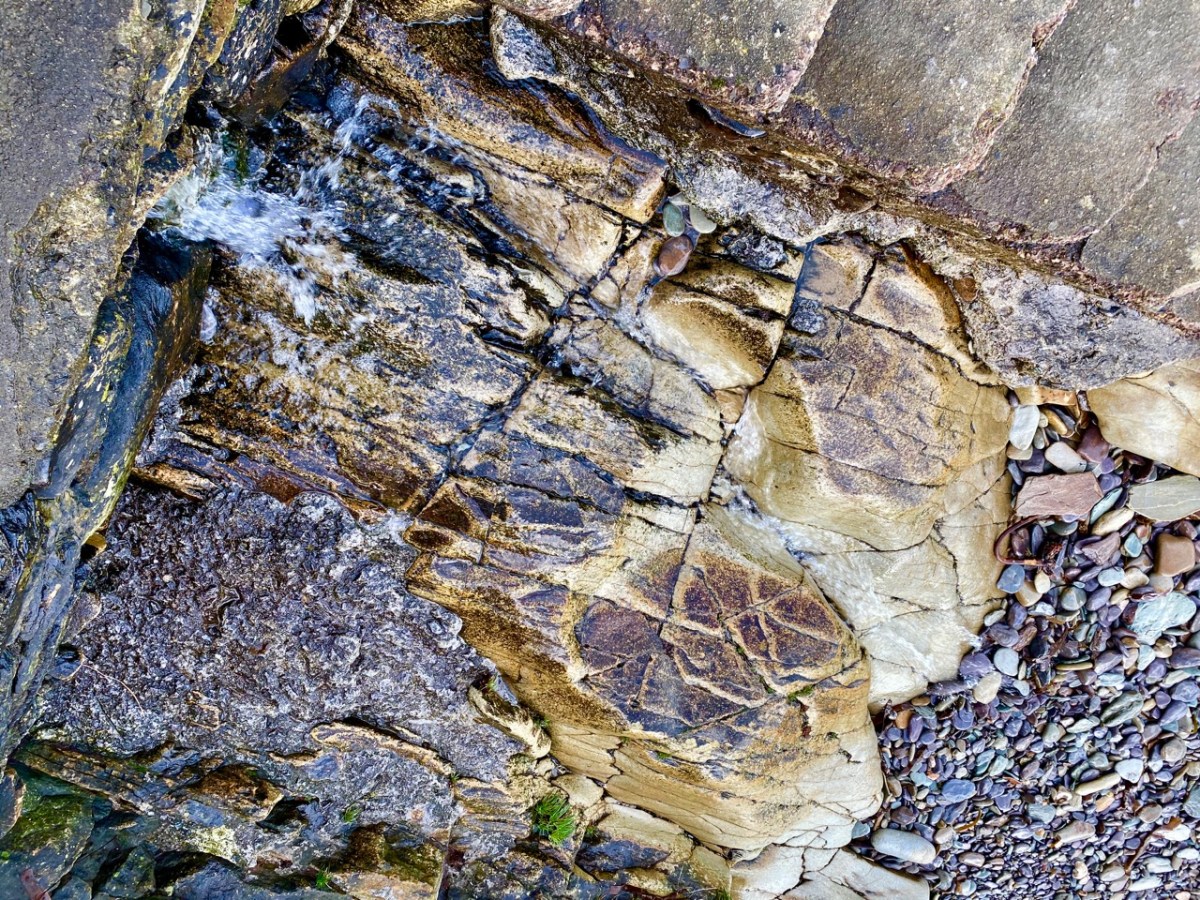
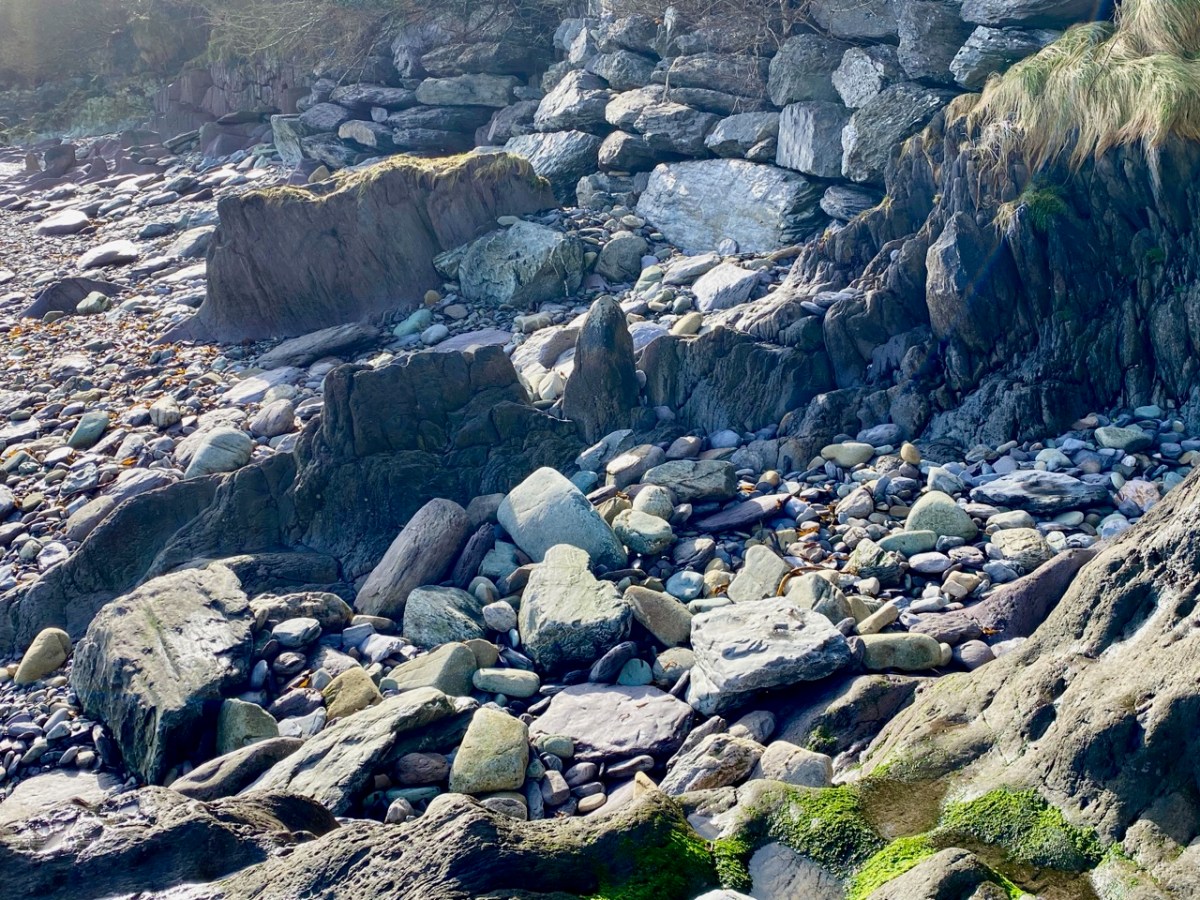
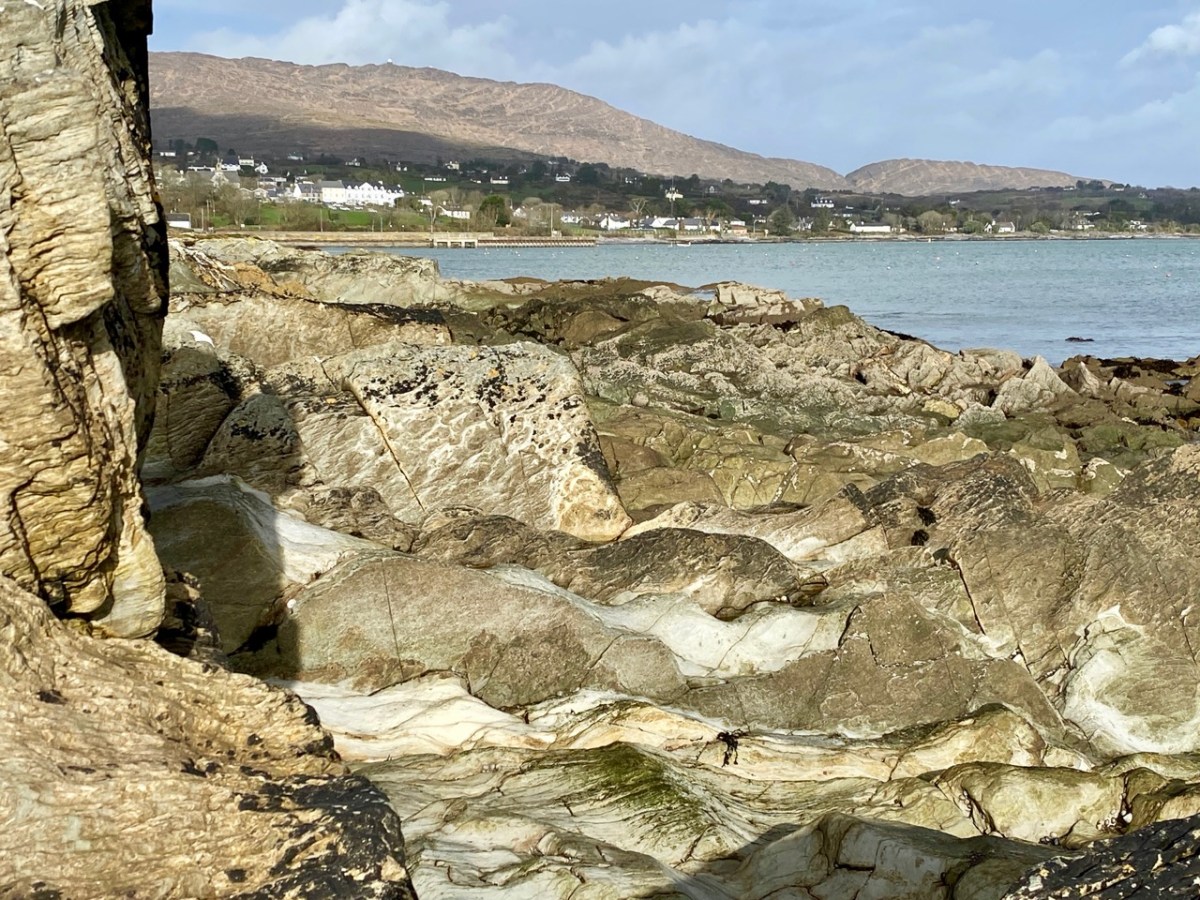
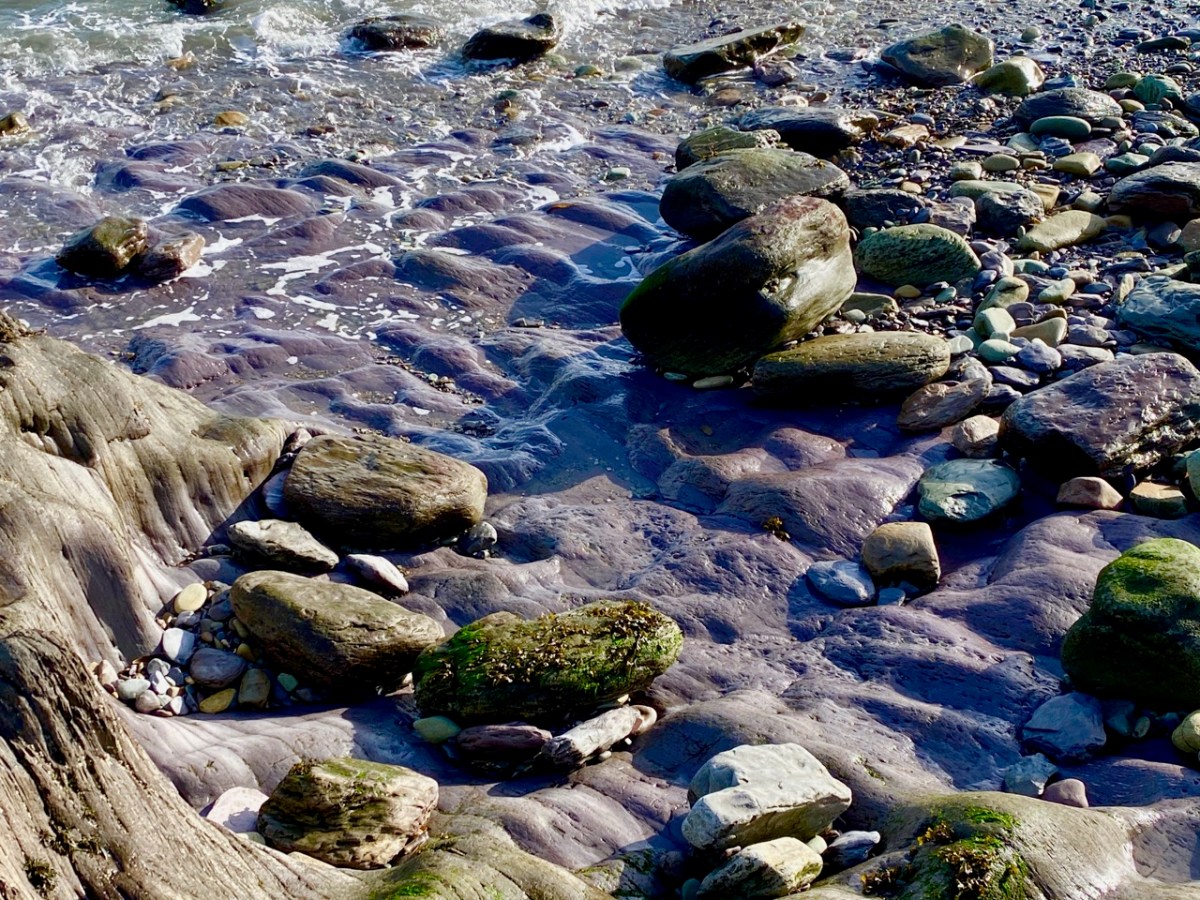
In the distance, of course, is the coast: there are very few places in West Cork where you cannot, at least, catch a glimpse of the sea – and so many where you can immerse yourself in it, or stand on its shore and admire the infinite textures which those same rocks display. It’s mostly Old Red Sandstone: that’s the correct geological term. It was laid down in the Devonian period – a while ago now: between 400 and 300 million years, in fact. This followed an era during which our mountains were built, known as the Silurian times. Continents were shifting and separating, and what was to become Ireland was a great arid desert – deserted: there was no-one around to see it!

Old Red Sandstone: in fact it varies in colour depending on its local history. Broadly, some of the mountain rocks are purple-grey, while those closer to the sea could be greeny-red, but that is probably far too wide a generalisation. The sheer beauty is in the infinite shapes and colours. What artist needs any finer palette?

In those deserted times, an ‘Old Red Sandstone Continent’ extended over what is now northwest Europe, but it is worth noting that in ‘our’ part of it – the Munster Basin, covering today’s Kerry and Cork – we have one of the densest masses of this rock in the world: at least 6 kilometres thick. And we have to appreciate what it has given to us – high mountain spines sweeping steeply down to an indented shoreline of coves, creeks and inlets, with the myriad mottled islands that we oversee. An unparalleled, unfolded world.

After the ‘desert’ period, but much later – only about a million and a half years ago – came the Pleistocene Epoch. the word is from the Greek polys and cene – meaning ‘most recent’ – and that brings us almost up to date. That was a time of great climate events: deserts were inundated and then covered in ice sheets 3 kilometres thick, while moving glaciers tore up the rock surfaces, advancing and retreating several times. Eventually, what had been desert became arctic tundra. It is supposed that the ancestors of our present day life forms happened along during this epoch, and managed to survive. But we don’t find any traces of them until after the last ice sheet retreated in our part of the world – only about 12,000 years ago. The landscape that was left behind was inundated by rising sea levels, and the very last land bridge (between Cornwall and the eastern tip of Wexford) was washed away after that, but not before the Giant Elk and its mammal relations had got a foothold on the western side. The snakes, however, didn’t make it. And what of the humans?

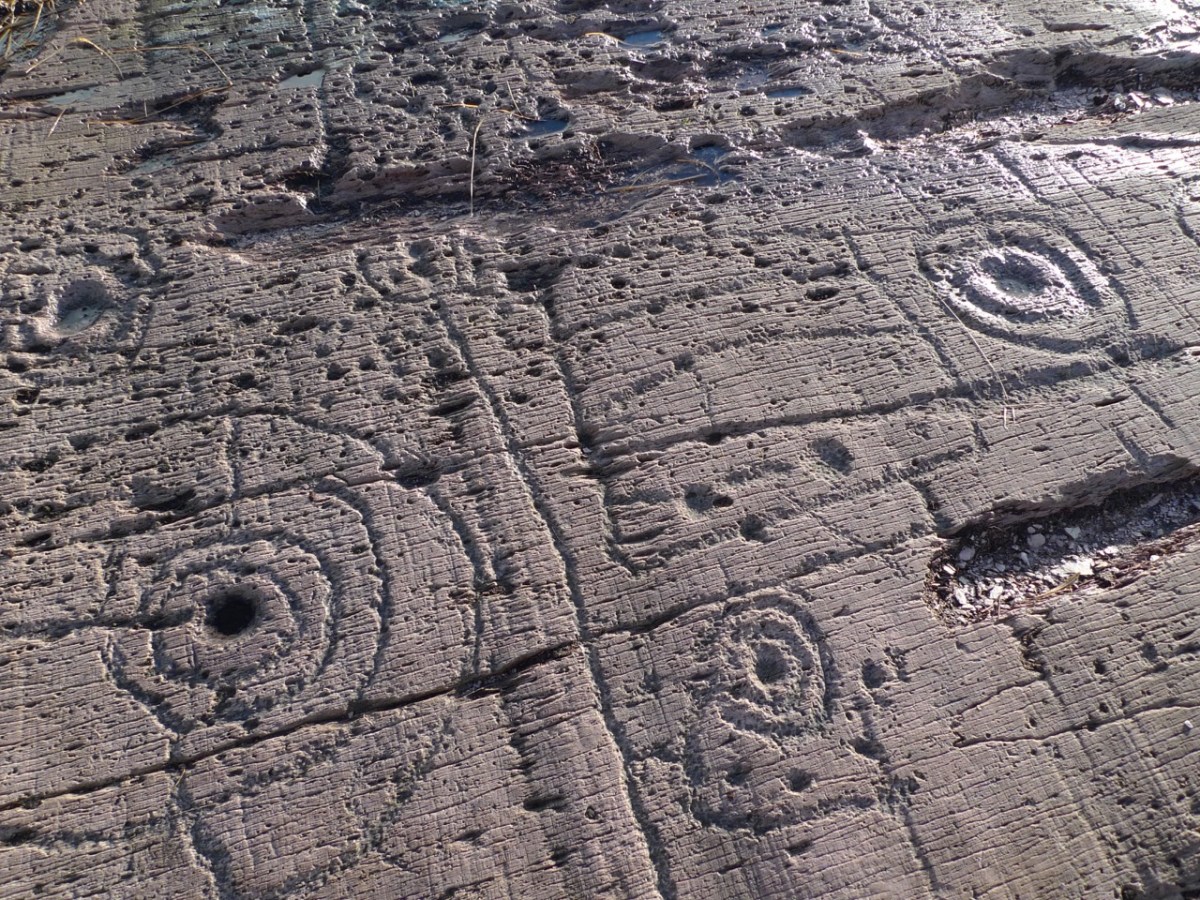
Well, the humans embraced the rocky landscape. They made their marks on the outcrops; then they moved the rocks about, and made architecture from them. We can still see their efforts, some 5,000 years later.

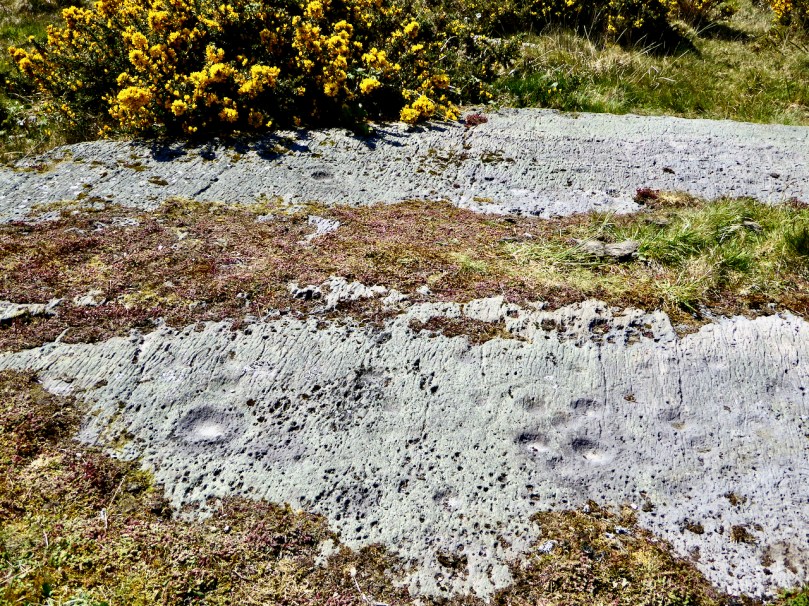
These Neolithic carved motifs could be the earliest human interventions on the natural Irish landscape: they might date from 3,000 BC. These examples are from West Cork, and were only discovered a few years ago. Finola wrote the definitive thesis on Rock Art when she studied at UCC in the 1970s, and we have staged exhibitions and given talks on the topic.

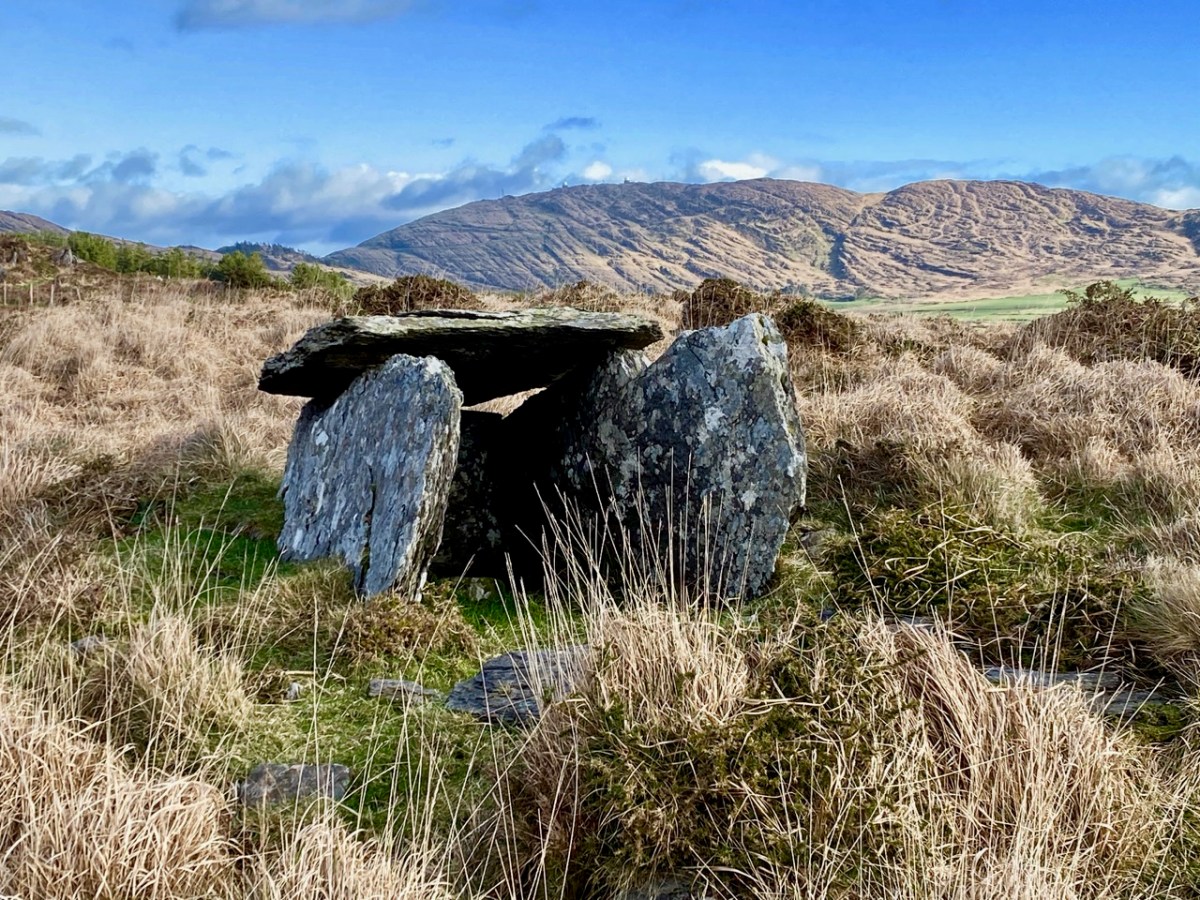
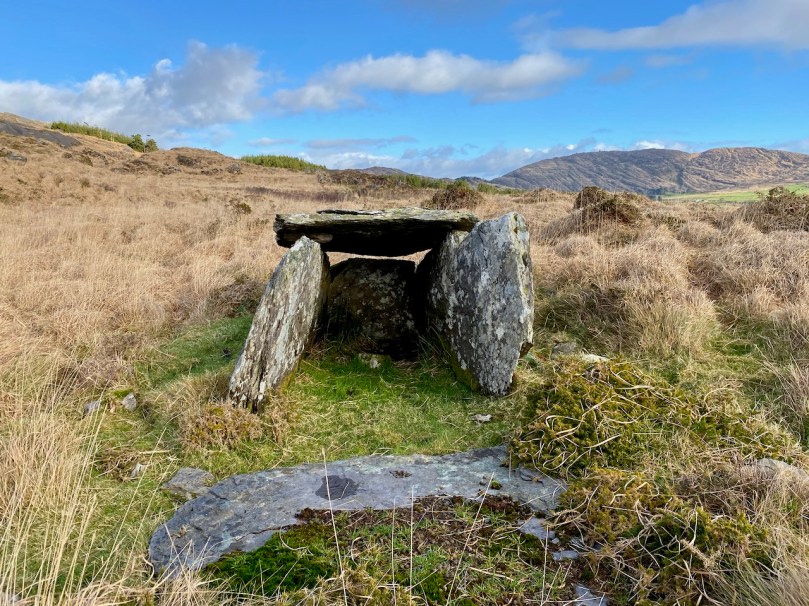
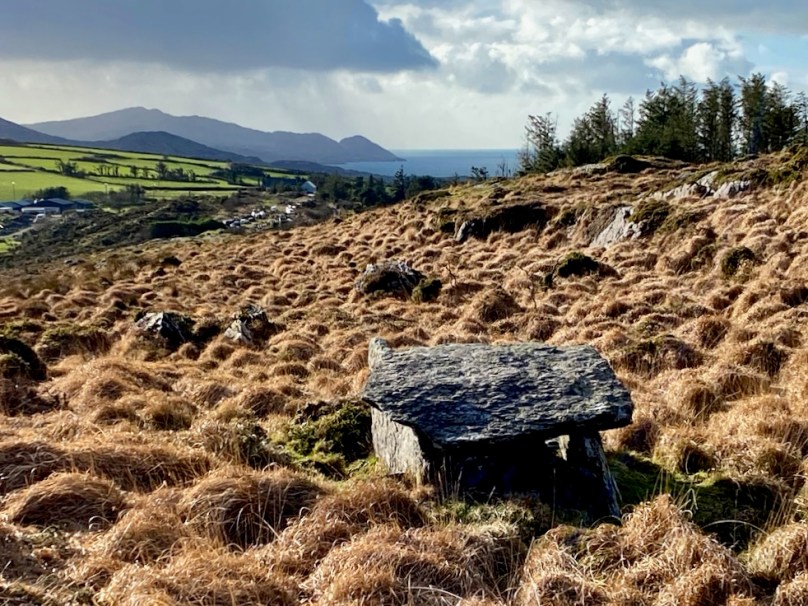
A couple of thousand years later, Irish people started to build things with the stones they found around them. This wedge tomb under the backdrop textures of Mount Gabriel at Ratooragh has rested here since the Bronze Age. Finola’s post today uncovers the fascinating folklore stories that generations have told about such artefacts. But restlessly working the fabric of the landscape – Old Red Sandstone – into walls, shelters, tower houses, temples and towns has never ceased.

Legends of Mount Gabriel: Wrought by Giants

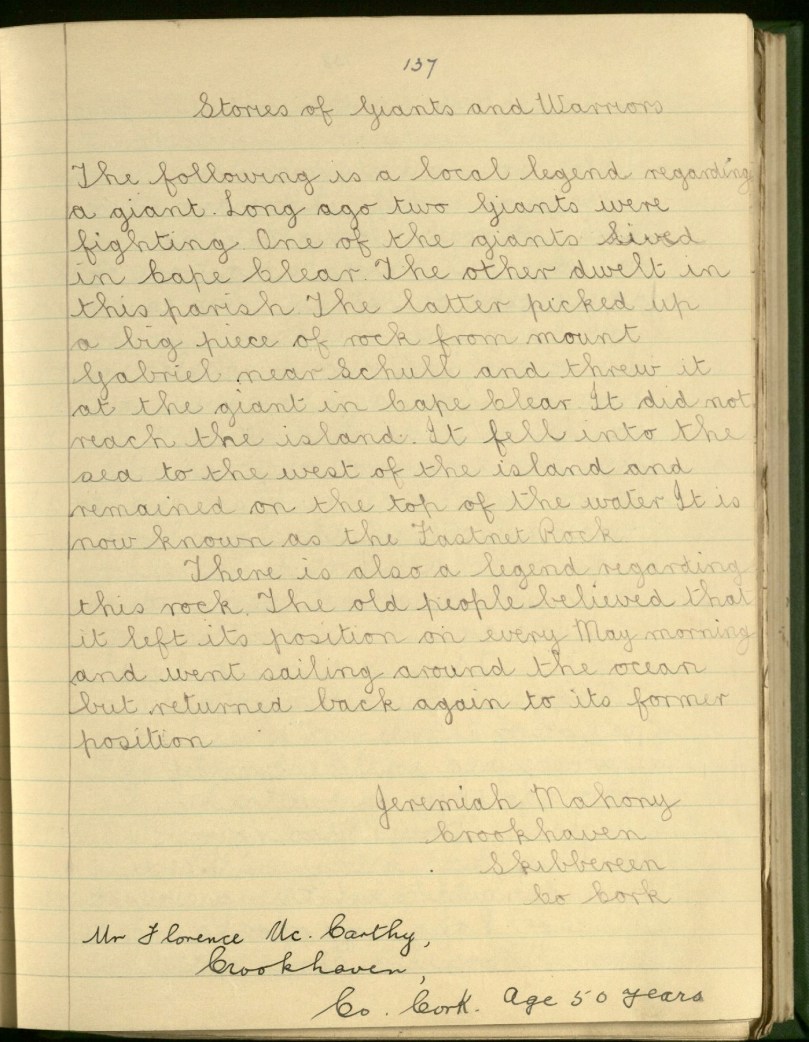
While references to Fionn MacCumhaill (or Finn McCool) occur in many of the old legends about Mount Gabriel, more often a generic ‘giant’ is identified as having lived on or near Mount Gabriel. Giants were, apparently, given to fighting each other and to hurling rocks through the air. Here’s a good example from Jeremiah Mahony of Crookhaven:

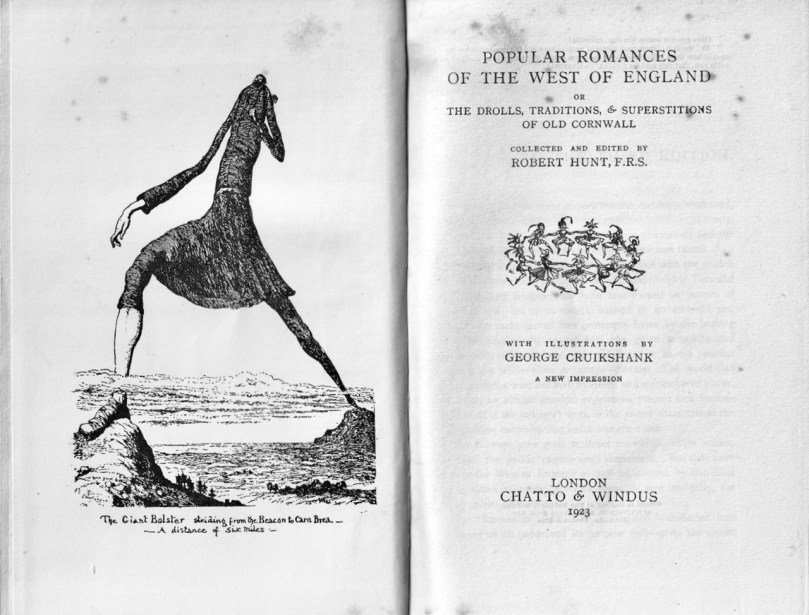
Giants are a familiar motif of folklore – just across the sea many of the same stories are told about the effects the Giant, Bolster, had on the landscape of Cornwall.

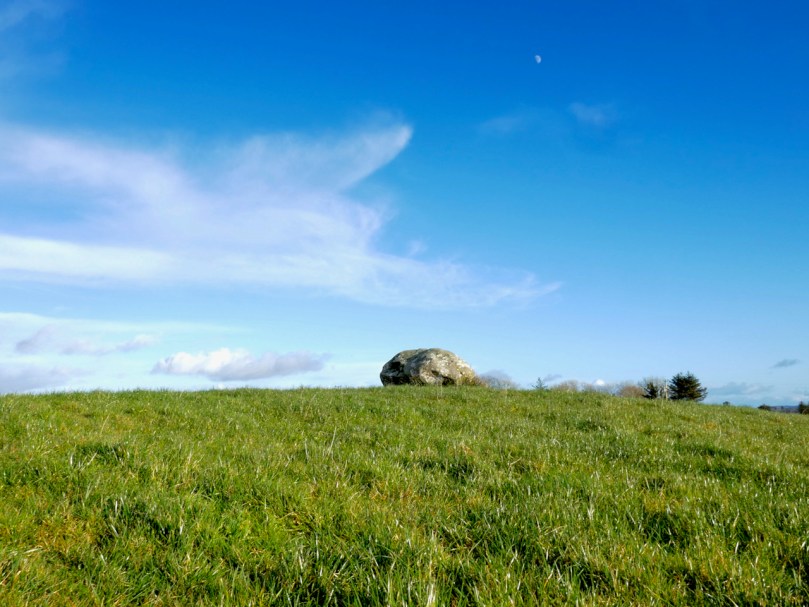
The rock that was seized and thrown didn’t always become the Fastnet; prominent rocks on the landscape were also identified, including what we know now as Boulder Burials (for more on this class of archaeological monument see my post Boulder Burials – A Misnamed Monument?). Here is Cornelius Moynihan from Derreenlomane School (long since closed), telling a tale he got from his grandfather of the same name, then aged 75.

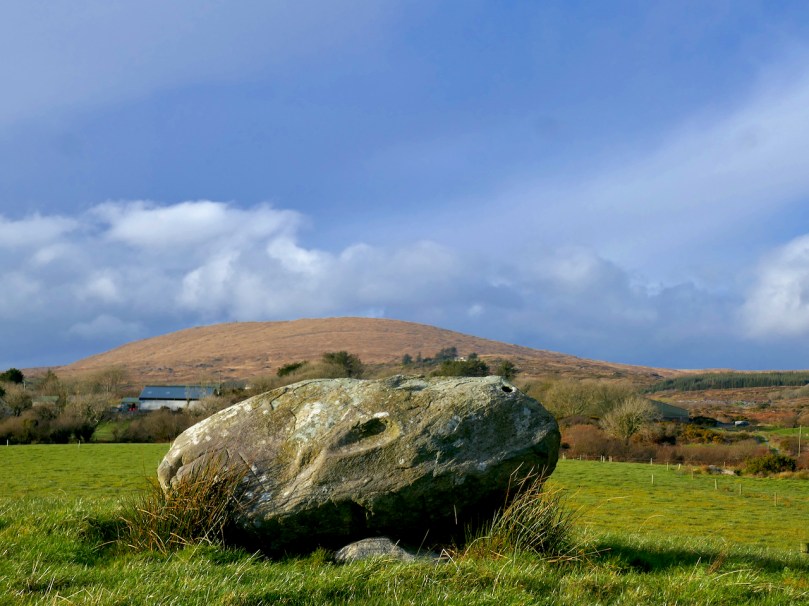
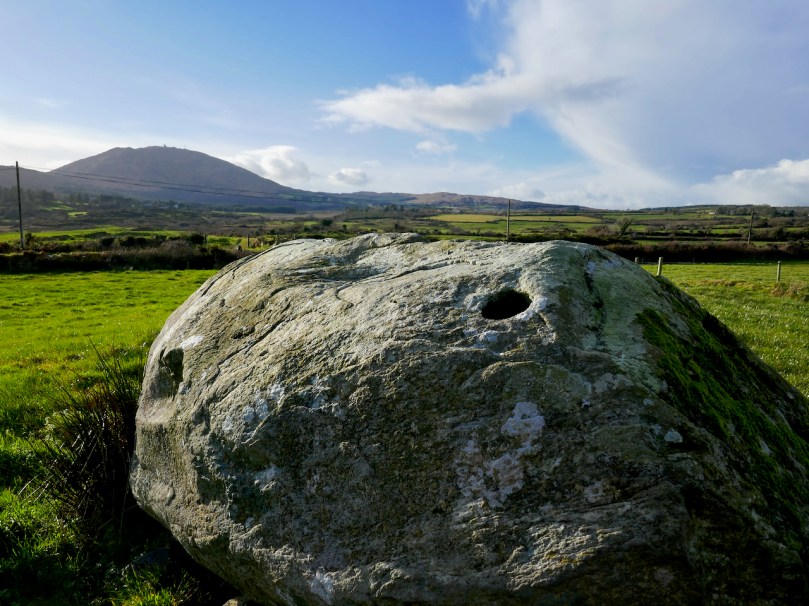
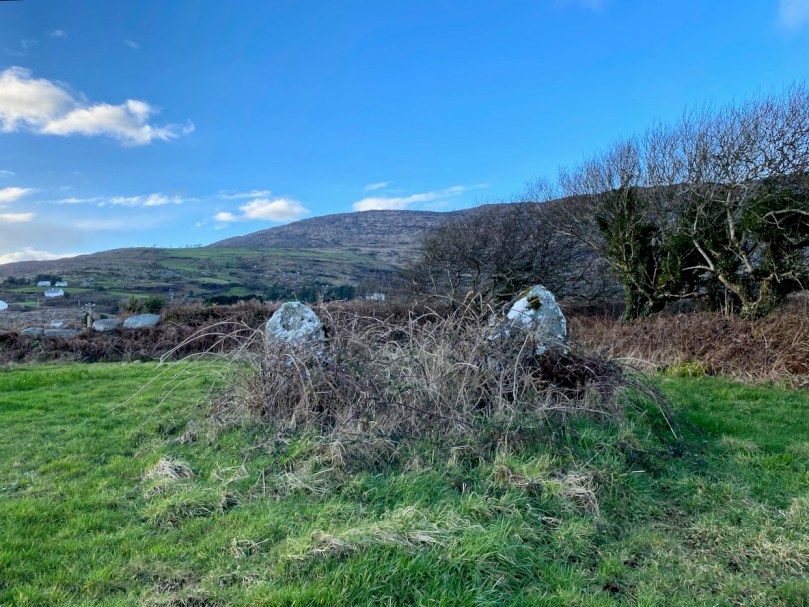
In my grandfather’s land in Rathravane there is a stone called “The Giant’s Stone”. A legend says that it was thrown from Mount Gabriel by a giant long ago. Those who believe this point out the print of a knee and prints of three fingers. It looks as if one end was lifted by human agency as it is supported at that end by three stones arranged regularly.

In an unusual piece of cross referencing, Tessie Coughlan from Dunbeacon School, on the other side of Mount Gabriel, tells of the same rock landing in Moynihan’s field (above, and below with Mount Corrin in the background).

The old people of this locality say that two giants once lived at the top of Mount Gabriel near the place where the lake now lies. One of them was much taller than the other but the smaller had two heads and was cleverer and stronger than the other. It is said that they killed any person who cut a tree on the mountain side and then they cast their bodies into the lake.

One day a dispute arose between the two as to which was the stronger and it was agreed upon that they should both lift a stone and throw it as far as they could. The two giants lifted stones of equal weight and threw them over the land together. The small giant threw his stone much farther than the other did and it fell in Rathravane in a field owned by Mr C Moynihan. The other stone fell in Dreenlomane and it is still to be seen.

The stone in Rathravane is oval shaped and it bears the five prints of the giant’s fingers. It rests on a height. The stone in Dreelomane is not shaped like the one in Rathravane but it is the shape of a coffin and bears the print of one of the giant’s fingers. The old people say that it is a real coffin and that a landlord is buried in it or under it. Several people have gone to break the stone, but owing to tradition they never struck it.

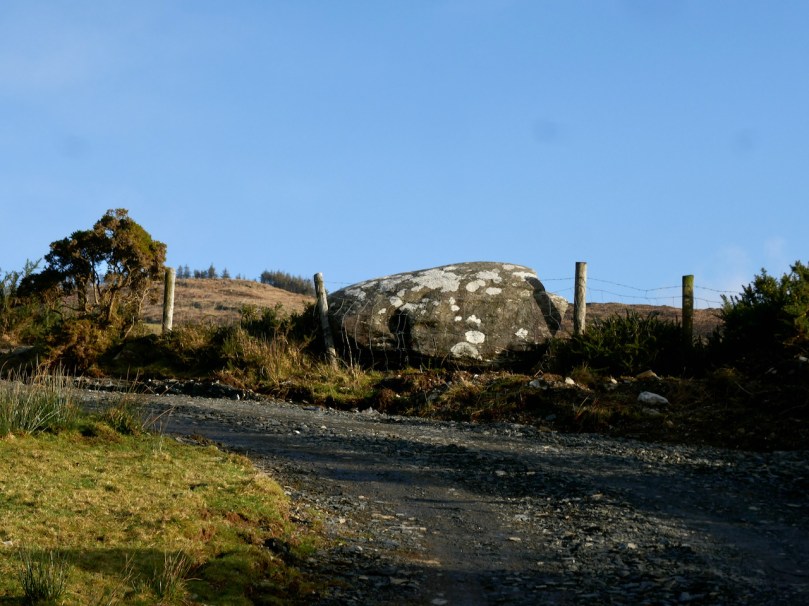
Perhaps this (above) is the other rock – it’s not in Derreenlomane but not far, on the slopes of Mount Corrin. Another student from Derreenlomane school, Rita Helen, tells a similar story in her piece titled Local Monuments, and goes on to describe several others.

There is a glacial stone in Mr. Young’s field and another in Mr. Moynihans field. The one in Mr. Moynihan’s field seems to have been lifted up at one end by some persons, as three stones have been placed under this end. People say there is a print of five fingers on the one in Mr. Moynihan’s field and that a giant threw the stone from the top of Mount Gabriel over into the field. 

In this photograph of the Rathruane boulder burial, perhaps you can see the knee imprint and one of the finger holes. That’s Mount Gabriel in the background.

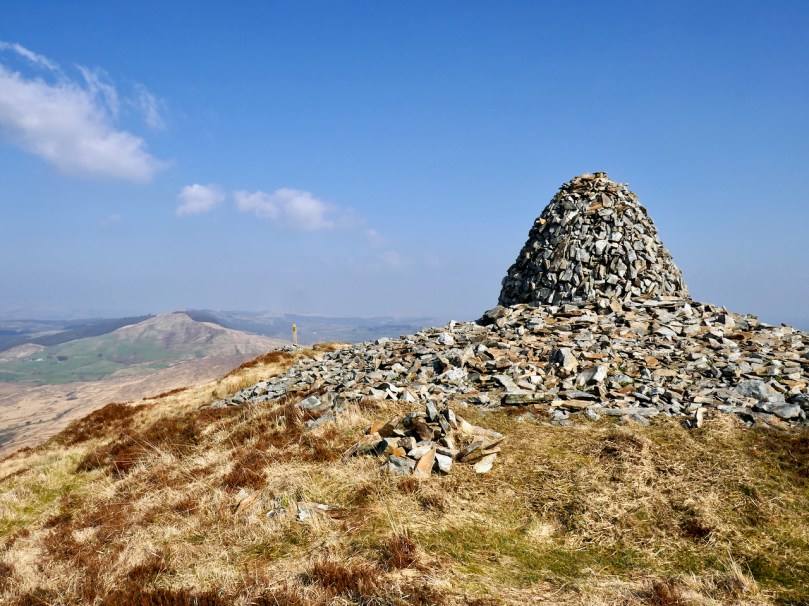
There is a cairn on top of Mount Corrin (Cnoc an Chairn).

There are two pillar stones in the townland called the Gallauns, parish of Schull, W.D.W. Carbery, Co Cork.

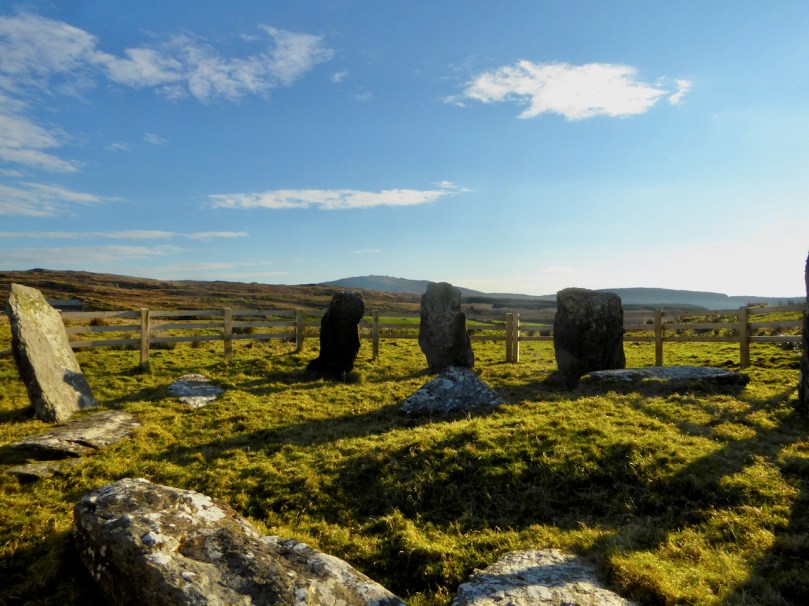
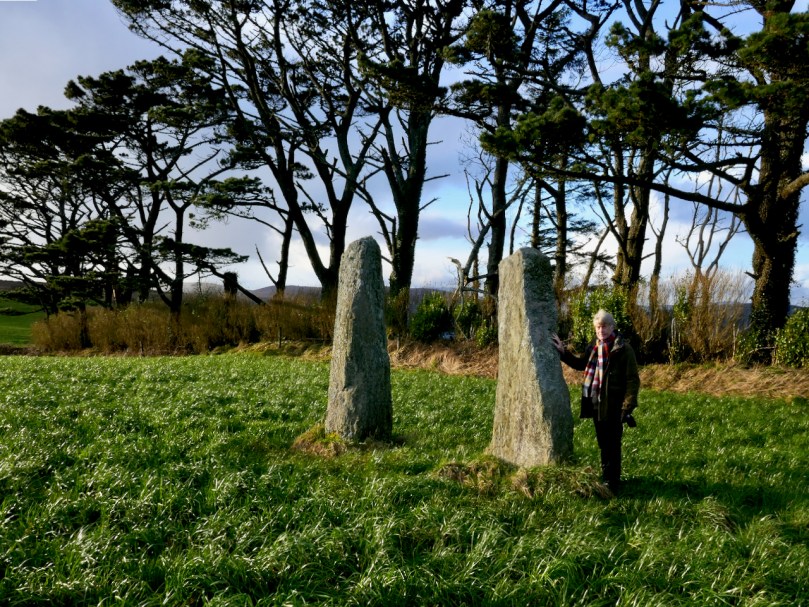
In another part of the townland there are six pillar stones forming part of a circle.

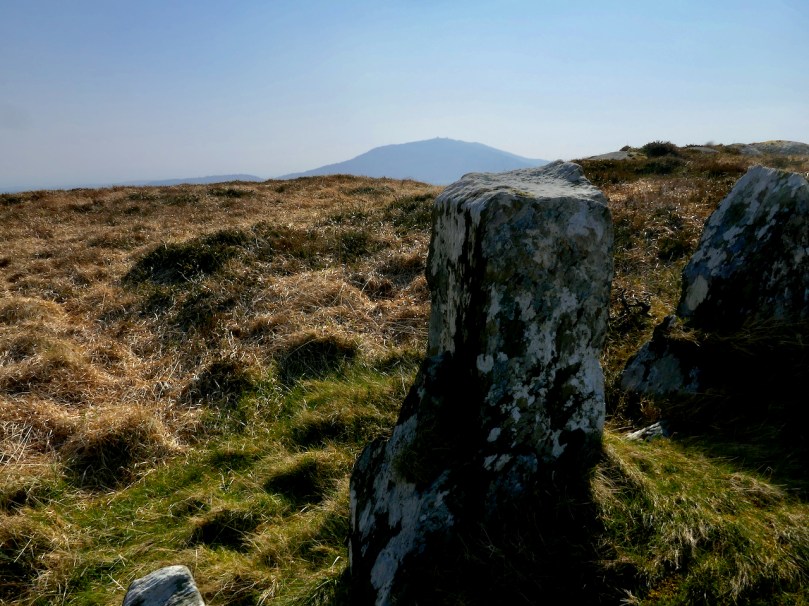
The only stone circle in the vicinity is in Dunbeacon, on the slopes of Mount Corrin, but Mount Gabriel is visible from it, as you can see in the photo above. Rita was from Rathruane, although she spells it as it is pronounced locally, Rathravane. It’s interesting that she also says There are no stones in the district with peculiar markings or strokes on them, since there is indeed rock art in Rathruane, quite close to the boulder burial. It’s an excellent example of prehistoric Rock Art, AKA cup-and-ring art.

Hannah Hayes, also from Derreenlomane has her own version of Local Monuments:

There are two large stones in Rathravane :- one in Mr. Young’s field and one in Mr. Moynihan’s field. It is said a giant threw the stone from Mount Gabriel to Mr. Moynihan’s field, and those who believe this say there is the print of five fingers in it. There are pillar stones called Galláin standing in the ground in the townland of Coolcoulachta. There are no ornamented stones in the locality.

Here are the Coolcoulaghta galláns or pillar stones – they constitute a type of monument known as a standing stone pair.

Here’s a piece from an unnamed student at Gloun School. It refers to “a kind of grave” and we wonder if this is the beautiful little wedge tomb in Ratooragh

In the western side of the Glaun hill up east of Timothy Driscoll’s there is a kind of grave. Long ago there was a chieftain living here and people say he was buried there and some treasure buried with him. On top of the clay there is a heap of stones and there is a fairly large stone standing in the centre and there is some writing carved on it.

This writing is nearly blotted out now. It was read by many people in olden times. No one ever tried to find the treasure.

No sign now of any clay or writing but the National Monuments record does reference traces of a mound which may have covered the wedge tomb originally but is impossible to make out now. There are panoramic views from this wedge tomb, not only to Mount Gabriel and Mount Corrin (above), but west to the sea as well (below).

We know you’ll want to be out and about as soon as we all can, doing your own exploring. As an enticement, here’s a story about buried treasure, courtesy of Caitlín Ní Árnéidig of the Convent of Mercy in Skibbereen.

Under a huge stone on the slope of a hill in my father’s farm, there is said to be hidden treasure.

It is said that one day “Athach Mór”, a great giant, was challenged to throw this huge stone (at least one ton and a half weight) from Mount Gabriel to that spot on the hill. First the giant seemed unwilling to try this feat but when he began to lift the stone it seemed of no weight, and he suceeded in landing it exactly on the spot.

Under it there is said to be an unusual thing (a nest containing seven golden eggs each seven inches in diameter and filled with sovereigns).

About four perches due west of this stone is another stone, under which a similar treasure is hidden.

An old man of the vicinity recently revealed that in order to find the treasure one must draw a straight line from one stone to another, then standing near the middle of the line hold a cord in the hand and lift it an eastward direction, so that it will [words missing] the stone and a light will be seen over the spot where the treasure is.

My uncle, having heard the story, decided to prove this, so he set to work at the mysterious stone. Having drawn the line he stood near the centre and cast the string eastward. Then to his astonishment he noticed a ray of light over a small portion of the stone.

He tried to split the stone but failed though still engaged at the work he finds it impossible to do.

All you have to do is figure out the location and , crucially, what the student meant to say where the words are missing. Good luck!

World Wetlands Day: A West Cork Bog Soak

In honour of World Wetlands Day, which we celebrate on Feb 2 every year, here is a selection of beautiful, weird and wonderful native plants from one small bog soak in West Cork.

Bogs are unique environments, highly acidic and with low nutrients. Nevertheless, some plants have adapted to thrive in them. It’s important we safeguard these diminishing natural habitats.