Revealing Rock Art: 150 Years of Images

This week a powerful image from Ken Williams of Shadows and Stone (copyrighted, used with permission) lit up the Irish Rock Art Facebook Page (180,000 people had seen it at last count, and it’s been shared more than 1500 times). The photograph, taken with Ken’s signature blend of natural and artificial light, was of a stone in Kerry often known as the Staigue Bridge Rock Art, although technically it’s in the townland of Liss.

As it turns out, this is one of the best-documented rock art panels in Ireland, with images dating from the middle of the nineteenth century to the present day.

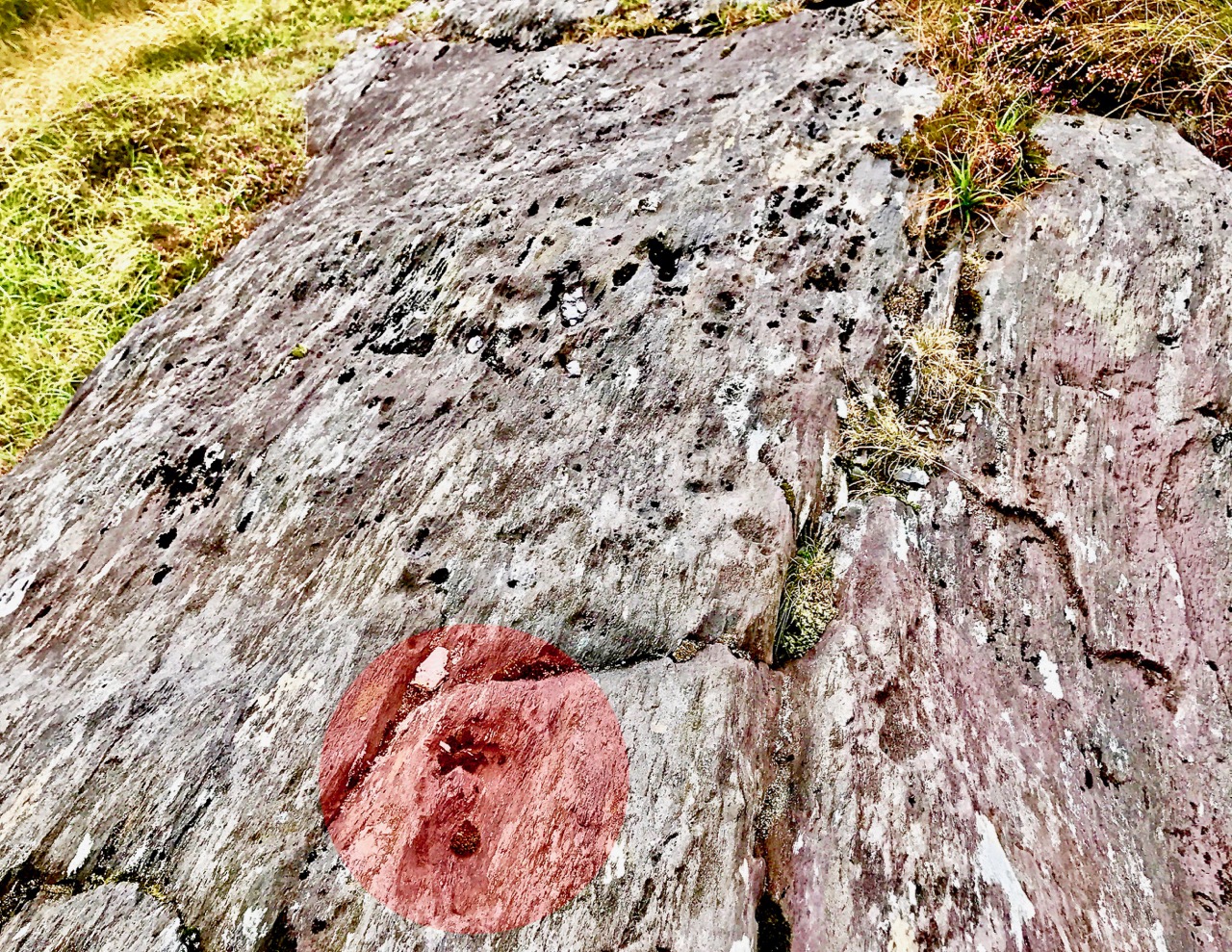
Taken on a recent visit to Liss/Staigue Bridge Rock Art site. This is probably what a casual visitor will see. Can you make out any carvings?

The response to this photograph highlights several important features of Irish rock art. First of all, it seems people are hungry to know more about these enigmatic carvings, and yet rock art is one of the least known aspects of Irish archaeology. Time after time, as Robert and I present exhibitions or give talks, we meet up with a near-universal response of “How come we’ve never heard about this before?”

Another view of the top section of the panel

Secondly, a photograph like this is not normally what you observe in the field. Commonly, rock art (and this one is no exception) is actually difficult to see under most lighting conditions. This rock is just off a popular hiking trail and the vast majority of walkers are unaware of what is a few meters from their path. Even if the route went right alongside it, most walkers would pass by without noticing anything unusual.

This will give you an idea of the extent of the panel

Thirdly, it is no longer possible to record rock art by any of the traditional methods that were in common use up to the 1990s. Nowadays, recording techniques that do not impact in any way with the rock surface are preferred, and that limits us to what can be imaged through photographic and scanning technology.

Aoibheann Lambe’s virtuoso photograph – this is the panel in the second photograph, taken from almost the same angle but under perfect natural lighting conditions. © Aoibheann Lambe

There are currently three ways in common use to photograph rock art so that the carvings will show up. The first is to use the natural low, slanting, shadow-casting, light at sunrise or sunset. Rock Art Kerry, the work of archaeologist Aoibheann Lambe, has an outstanding photograph of the rock surface using only natural light. Given our climate, it is likely that many visits to the rock in all kinds of temperatures, early in the morning or late in the evening, were necessary before the perfect shot was possible. Aoibheann’s Facebook page is the place to be these days for new finds – she is making discoveries at a breathtaking pace!

Another of Aoibheann’s photographs – this one shows the extent of lichen growth on the rock surface, which often functions to obscure carvings. © Aoibheann Lambe

The second is to use flash photography – a technique that Ken Williams has perfected and uses to great effect to show up even faint carvings. We’ve seen Ken working – this isn’t a mater of a simple flash on a camera – multiple flashes are deployed with a skill that comes from long experience, and respond to an electronic trigger on his camera.  If you haven’t already done so, a visit to his site is an absolute must for anyone interested in rock art – or indeed in Irish archaeology.

Finola and Robert from Roaringwater Journal and Ken Williams of Shadows and Stone at Derrynablaha in Kerry

The third technique is that of photogrammetry. In essence, this is the combination of multiple high resolution photographs to construct a 3D image of a rock surface. The Discovery Programme has been sponsoring 3D imaging of various national monuments, including Ogham Stones and Sheela-Na-Gigs, for some time. Under this program, The Dingle Museum (Músaem Chorca Dhuibhne) has produced a series of 3D images, including an excellent one of the Liss/Staigue Bridge rock art panel.

The top panel rendered in 3D – this is a screen capture. © Corca Dhuibhne 3D 2017

It is particularly exciting because it’s unusually clear (rock art 3D images can suffer from lack of clarity for a variety of reason) and also because this technique allows an image of the whole panel, whereas photography can only capture pieces at a time.

These stills have been captured from the 3D images on the Museum site but they do NOT compare with the experience of viewing and manipulating the 3D images on screen. It’s brilliant work, so please go to their page for the real thing. © Corca Dhuibhne 3D 2017

But back to the past, when it was still possible to produce drawings of the carvings. Back, in fact, to the 1850s! There were two Irish antiquarians called the Rev Graves. The better-known one was the Rev James Graves of Kilkenny, but the one we are concerned with here was the Rev Charles Graves, Bishop of Limerick and a noted mathematician, scholar, antiquarian, and President of the Royal Irish Academy. He was fascinated by Ogham and on a trip to view Ogham stones in Kerry he came across other ‘inscribed rocks’ of a type he was unfamiliar with. He wrote up his findings and presented them to the Academy in 1860.

Taken from the Wikipedia article on Charles Graves. Image above by Anonymous – Church Bells (1874–1875)) W. Wells Gardner, Publisher, London, Public Domain

The good Bishop had none of our modern scruples about interfering with the rock surface, or removing the turf to see what else he could fine. He did both: three feet of turf was stripped back to reveal the extent of the carvings and a rubbing was made from the whole surface, which was later converted to a survey-drawing. This, to this day, is the only drawing we have of the complete carving.

When I wrote my thesis on The Rock Art of Cork and Kerry in 1973 I said this about Charles Graves:

The first paper devoted to rock art in Ireland was by Rev. Charles Graves. In 1860 he read a paper to the Royal Irish Academy entitled “On a previously undescribed Class of Monuments”. His paper, mainly concerned with Co. Kerry, is still very valuable and his drawings and observations are often more accurate and more reliable than many later accounts.

My own drawing was done in 1972. The technique I used then was to chalk in the carvings and trace them onto clear plastic film. That tracing was then re-traced on to good quality paper using indian ink and a stipple technique and then photographically reduced by a professional printing firm. It is naturally an imperfect and subjective method, but long practice enabled me to produce surprisingly accurate renditions which stand up well to modern recording techniques.

I confined my drawing to the main area of carving and used Graves’ drawing as an additional illustration

There are few examples of Irish rock art with the pedigree of Staigue Bridge. It is classic cup-and-ring art in its execution but also contains the unusual elements of very large circles surrounding small cupmarks. It is enormous – a fact that would never have been appreciated if Graves had not determined to find the true extent of the carved surface (although of course we do NOT condone this practice now). It has a literature that goes back a century and a half, and was one of the first pieces of Irish rock art to be described and illustrated. It’s a national treasure.

Forbes – An Irish Artist in Cornwall

In yesterday’s gallery talk as part of the West meets West exhibition at Uillinn, Skibbereen, I concentrated on one of the many artists who made their way to Cornwall in the late nineteenth century: Stanhope Alexander Forbes. He deserves a Roaringwater Journal post of his own, as he rather neatly embodies the concept of linking the two westernmost seaboards of Ireland and England, which is an essential element of the West meets West project. Colloquially known as the ‘Father of the Newlyn School’ of painters who were established in the West of Cornwall, and who have left an impressive legacy of their work in the most remote part of the peninsula, it was probably his longevity that earned him that title (he lived in Newlyn for most of his working life and died there in 1947) rather than a particular comparison of his work with others. There was a large group of talented artists, men and women, who contributed to the reputation of the Newlyn colony.

Header Picture – Perranwell Viaduct, Cornwall, painted by Stanhope Forbes in 1933, when he was 76 (The Medici Society Ltd). Above – a photograph of the Newlyn Group, taken in the early 1880s: shown are Frank Bodilly, Fred Millard, Frank Bramley, William Blandford Fletcher, William Breakspeare, Ralph Todd, William Wainwright, Edwin Harris and (seated lower right) Stanhope Forbes

Stanhope Forbes was born in Dublin in 1857. His father, William Forbes, was manager of the Midland Great Western Railway of Ireland. William was also a folklorist and probably passed his interest in traditions and traditional lifestyles on to his son. Stanhope’s uncle, James Staats Forbes (also a railway manager) had a large collection of paintings from the French Barbizon School whose members (including Corot and Rousseau) abandoned formalism to draw directly from nature. Stanhope was familiar with these works and the aspirations of these painters, and it is likely that when he embarked on a career in art he was heavily influenced by their heritage.

Forbes early works: left – A Street in Brittany 1881 (Walker Art Gallery), and right – Beach Scene St Ives (City of Bristol Art Gallery) 1886

Norman Garstin, another Irish artist who joined the Newlyn group and documented some of its history, described the Forbes family as “…essentially of the nineteenth century, full of its movement and restless activity…” Stanhope attended the Royal Academy School in London where he would have had a traditional training in still life and figure painting in the studio. London itself in those post-Industrial Revolution Victorian days was no doubt dirty and noisy, and the air would have been polluted. Forbes and many of his student companions would have longed for clean air and light and yearned to join the then fashionable (but daring and rebellious) en plein air movement where the object was to paint ‘natural’ colours and tones direct from life, albeit with the inherent problems of changing light through the days and seasons, and the practicalities of carrying easels, canvases and equipment to wherever they wanted to paint. As Norman Garstin said: “…your work could not be any good unless you caught a cold doing it…” The young artists were attracted to Brittany, where they discovered an ‘idyllic’ unchanging lifestyle and, latterly, to Cornwall, where they also perceived the ‘rural idyll’ existing closer to home, among the villages, farms and fishing communities.

A Fish Sale on a Cornish Beach by Stanhope Alexander Forbes, completed in 1885 (now in the City of Plymouth Museum and Art Gallery). This spectacular painting – five feet long – is a masterpiece of composition and contains portraits drawn from real life: Newlyn locals were delighted to receive ‘sitting fees’ from the influx of artists

It’s probably true to say that the Newlyn artists romanticised the way of life in rural Cornwall by concentrating on the fishing communities and the beautiful seaboard. There was another reality: the interior of Cornwall’s peninsula was heavily industrialised in the 19th century by the metal mining industry. The artists must have been aware of this reality but ignored any recording of it. There was, at least, some acknowledgement of the hardship and distress of those connected to the sea itself. Frank Bramley’s Hopeless Dawn (beautifully painted although also romanticising in a very Victorian way the aftermath of lost lives at sea), painted in 1888, depicts the widow of a drowned fisherman being comforted by her mother; the lighting and composition of the interior view is remarkable.

Upper picture – the industrial landscape of inland Cornwall: Dolcoath Mine 1883. Lower picture – Frank Bramley’s A Hopeless Dawn, painted in 1888 (Tate Gallery, London)

Stanhope Forbes lived into his ninetieth year. By all accounts he achieved success in his chosen profession, but his personal life saw some tragedies: Elizabeth Armstrong – an equally talented artist who travelled from her native Canada to work in Newlyn – married Stanhope in 1889. She pursued her own career as a painter and etcher until her early death – aged 52 – in 1912. Their son Alec died on the battlefields of France in 1916. All are buried in the beautiful churchyard of Sancreed, in Cornwall.

Blackberry Gatherers, painted by Elizabeth Armstrong Forbes in 1912 (Walker Art Gallery)

West meets West – a celebration of three contemporary artists from Cornwall – runs through to 8 July at Uillinn, Skibbereen

I am indebted to Stanhope Forbes and the Newlyn School by Caroline Fox, published by David & Charles 1993, for much of the biographical information on the artist in this post.


Up and Running!

I was allowed behind the scenes to experience the exhibition of Cornish artists – West meets West – being unpacked and arranged. It’s quite a process. All the works are large scale and were packaged for protection during the journey across sea and land from Cornwall. For a while Uillinn’s spacious ground floor gallery seemed overwhelmed, and it was hard to envisage how the various elements (two dozen substantial pieces) would come together in harmony with each other.

Header: first day. Upper picture – the layout is under discussion with Gallery Director Ann Davoren, technical maestro Stephen Canty and Robert Harris; lower picture – the work is gradually unpacked and mounted

The work comprises paintings, a tapestry and a laminated glass piece by Matthew Lanyon; relief sculptures by Philip Booth, and ceramic sculptures by Tony Lattimer. Many are heavy, and they all have to be handled safely and carefully (white gloves only!).

The exhibition runs over Uillinn’s two galleries, and there was a bit of ‘trial and error’ involved in deciding how the dynamics of the pieces would interact. In fact, I believe all the exhibits are strong enough to stand alone but also relate to others when, inevitably, the viewer moves around and experiences the various juxtapositions.

Juxtapositions: upper picture – Lattimers and a Lanyon create excitement when seen together. Lower picture – Booth, Lattimer and Lanyon sing to each other, and perhaps we can see something of the shared elemental nature of all the works, which have a Cornish conception in common

There are a few ‘firsts’ in West meets West – it’s the first time that Cornish artists have visited Uillinn in a group show; this is, hopefully, a first step in a collaborative venture which will see the works of contemporary artists crossing between Cork’s west coast and Cornwall’s westernmost peninsula. Both communities have strong historic links and both have supported creative centres for arts and crafts going back a century and more – and still do. It’s also the first time that some of these works have been publicly shown.

Upper – Philip Booth’s dramatic enormous triptych, inspired by the landscape around Gwennap Head, Cornwall, displayed for the first time ever at Uillinn. It is constructed from an array of materials and uses a complex pallette. Also exhibited for the first time here is the newly completed ‘Altar Piece’ (Lower picture), a laminated glass triptych by Matthew Lanyon, here in use during the young childrens’ art exploration programme

Every exhibition has a formal opening. West meets West was opened by the Mayor of Cork County, Seamus McGrath, who spoke of the importance of maintaining links across the sea, particularly in these divisive times of ‘Brexit’. On the following day, there was a very well attended panel discussion where the artists were given free rein to relate their experiences in conceiving and creating their work: Matthew’s widow, Judith, represented him and gave us some wonderful insights into why the Lanyon works were made and how they might be interpreted. Philip Booth talked us through the processes involved in designing and building his complex constructions, while Tony Lattimer effusively expressed his working methodology.

The panel discussion (top), with Judith Lanyon, Phil Booth and Tony Lattimer

It has been a great achievement to get this dynamic, vibrant and colourful exhibition into the galleries at Uillinn. Please don’t miss it – it runs until 8 July – and look out for some extra events: I will be giving a talk following a guided gallery tour on Saturday next, 10 June, commencing at noon. Tony will be giving a ‘walk and talk’ on his work at 3pm this Thursday, 8 June – keep an eye on the Arts Centre website or Facebook. We are also planning a coach tour of sites in West Cork which have Cornish connections (there are many!). Please ask at the gallery if interested.

The Lusty Month of May

The month of May was come, when every lusty heart beginneth to blossom, and to bring forth fruit; for like as herbs and trees bring forth fruit and flourish in May, in likewise every lusty heart that is in any manner a lover, springeth and flourisheth in lusty deeds.  For it giveth unto all lovers courage, that lusty month of May.

–  Sir Thomas Malory, Le Morte d’Arthur 

One of our local roads is lined with Ragged Robin

Walking the boreens in May there is a sense of potency, urgency even, in the landscape. We’ve been asleep long enough, the flowers are saying – it’s high time we put in an appearance.

Another one has pignut on both sides. Pignut? Yes, there is such a flower – it’s widespread and the rounded roots which are said to taste like hazlenuts were a food source for pigs, and sometimes for humans too

After a long dry spring, everything is early this year in West Cork this year – and earlier than in the rest of Ireland too, thanks to our southerly location and mild climate. The big flowers are happening – the irises and the foxgloves in all their boldness and drama, as well as the tiny ones that are peeping out along the hedgebanks.

Glimpsed along the way: Yellow Iris is a bold native plant that likes damp places; St Patrick’s Cabbage grows extensively around the Cork and Kerry Peninsulas; this Spotted Orchid was one of several at the Heron Gallery Garden; Red Campion grows just across from my house

The Big Event in May for us was the launch of the Wildflower Trail, which I wrote about a couple of weeks ago. The launch was lovely – it was a great honour to have Zoë Devlin come and declare the trail open, and then lead us in a wildflower walk. The brochure is now in the Tourist Centres and already people are picking it up and wandering the boreens.

Zoë had participants spellbound – she just knows SO much!

For me it was a special opportunity to learn from Zoë when we walked the course before the launch. It was a great experience and I learned very quickly that for Zoë the wildflowers are just one aspect of an interdependent whole that includes butterflies, moths, bees, birds, and flora and fauna of all descriptions.

Clockwise from top left: Green Veined Butterfly; bee in foxglove; Painted Lady Butterfly; Red Admiral

I also learned how dedicated she is to recording all the flowers she sees for the National Biodiversity Centre Database. This is not a difficult thing to do, but it does take a little practice and a little time. I am resolved to up my own game in this regard and start sending in more records.

Our native – and gorgeous – White Water-lily

But mostly I just want to spread the joy – and help people to see the incredible beauty and diversity of wildflowers that we have in West Cork. Our boreens should be celebrated as National Treasures!

This boreen leads out of Ballydehob – it’s alive with an enormous variety of flowers.

Above is Wild Carrot -as its name suggests, this is the wild version of our cultivated carrot. Very young wild carrots are edible, but you must take extreme care as the plant is very similar to Hemlock Water-dropwort (below) which is very poisonous. This one is growing along a stream in Skibbereen – also the location of the Yarrow in my lead image (top of post).

Irish Spurge, above, is an intense yellow green in April. In May it acquires this little yellow spaceship flower heads. You have to get in really close to see them.

Salad Burnet (above) was grown in kitchen gardens from Medieval times as a salad vegetable and herb. The leaves, they say, taste like cucumber. I’ve tried them, and I have to say you’d need a vivid imagination to get a cucumber taste out of them.

Zoë alerted us to Russian Vine (above, wrapping around flowering nettles) down at Rossbrin Cove. Also known as Mile a Minute, it’s an introduced plant that acts like Bindweed (only worse) and is related to Japanese Knotweed, so very difficult to kill. Bad news!

I love the colour combinations you find in the hedgebanks. Wouldn’t this – buttercup and speedwell – make a great dress material?

A baby waterlilly – I was struck by how it looks, as if lit from within.

A final, tiny, flower of the hedges – appropriately name Mouse-ear

Artists of the Western Coasts

We look forward to welcoming our guest Cornish artists to Uillinn for the West meets West exhibition which opens this Friday – 2 June at 6pm – and runs through to 8 July. The three artists are excellent representatives of the vibrant arts scene in Cornwall, which was established from the late 19th century in Newlyn and St Ives and has been burgeoning through the late 20th century and into the 21st, especially with the opening of the spectacularly successful Tate St Ives gallery in 1993.

Header: Looking towards The Land’s End – Cornwall’s beautiful scenery has attracted artists and tourists for over a hundred years (photo by Phoebe Harris). Above: Tate St Ives – opened in 1993 – a spectacularly successful venue for cultural art tourism (photo by http://www.artfund.org)

Our artists are all from the West Penwith peninsula – the furthest landfall in the UK’s westernmost county of Cornwall. Phil Booth, Lamorna, will be showing some of his large sculptural relief constructions. Phil is known for these works but is also a talented landscape designer. His has spent many years teaching design and sculpture in Japan: he has intensively researched the form and meaning of traditional Japanese Gardens in Kyoto and is able to provide a high quality design service for anyone who is planning to construct a Japanese garden, or who might want to introduce Japanese elements into their own gardens.

Above left: Philip Booth. Above right: one of his relief constructions which will be shown at Uillinn – Beach Boulder

Matthew Lanyon sadly passed away while preparing work for our Uillinn exhibition. We will be showing many of his larger paintings (some are seven metres long!), but also some tapestry and a laminated glass piece which will be seen for the first time here in Skibbereen. Matthew’s father – Peter Lanyon – was one of the notable members of the St Ives School of Artists in the mid twentieth century. Peter was a painter and a teacher, and had a strong influence on many artists – not only in Cornwall and the UK but in Ireland as well. Matthew’s Cornish heritage, therefore, is very special in the context of West meets West.

The Late Matthew Lanyon with one of his huge paintings – The Listening Sea

Tony Lattimer lives in Penzance and has his studios and kilns on a beautiful wild acreage close to The Land’s End. His ceramic sculpture is large and visually stunning. Like the other exhibiting artists, he is recognised internationally. Tony has won the prestigious Emilia-Romagna Prize at Premio Faenza International Ceramic Art Competition, Italy twice – in 2005 and 2013. The MIC – International Museum of Ceramics in Faenza – is reputed to be the world’s largest ceramics museum and one of the liveliest art institutions in Italy. Tony has also exhibited at the Tate St Ives and many other UK galleries, and we are pleased that he is able to bring a selection of his new works over to Skibbereen.

Above left: Tony Lattimer preparing work for the kiln in his Land’s End studio. Above right: some of Tony Lattimer’s recent smaller works

Phil Booth and Tony Lattimer will be at the opening, and in the gallery at noon on Saturday 3 June to take part in a panel discussion on the artists’ work. Matthew will also be represented at this event. Please come! The following week – on Saturday 10 June, also at noon, I (Robert Harris) will be giving an illustrated talk titled Chasing the Light – Why the Artists Moved West. I will outline the historic connections and remarkable similarities between the two most westerly peninsulas of Britain and Ireland over a three and a half thousand year timespan, and explore the lives and work of artists who settled in both communities.

While this exhibition focusses on contemporary art from Cornwall it is part of a larger project envisaged by Uillinn (the West Cork Arts Centre). It is hoped that artists from West Cork will visit Cornwall to exhibit their work next year, and that this will become part of a regular cultural exchange between Cork and Cornwall in the future. There is a fascinating story to be told about the artists and craftspeople who arrived in West Cork from the late 1950s onwards and helped found a cosmopolitan, creative and free-thinking community here. Ceramicists, textile designers, printmakers, painters and writers all contributed to the mix. Because of that heritage there are many artists and creative people who continue to be attracted to the area today. Believe me, it’s the most stimulating place to live!

Don’t miss – West meets West – the work of contemporary Cornish artists, at Uillinn, Skibbereen, from 3 June to 8 July. Opening at 6pm on Friday 2 June.

Below: stirrings in Ballydehob: in the 1960s potter Christa Reichel and batik artist Nora Golden set up The Flower House as a shop, studio, cafe and haven for artists. “…Word spread that West Cork was a beautiful, creative place waiting to be discovered…” (Alison Ospina – West Cork Inspires) Photo courtesy Andrew Street

Sheep’s Head: Searching for Cornish Miners

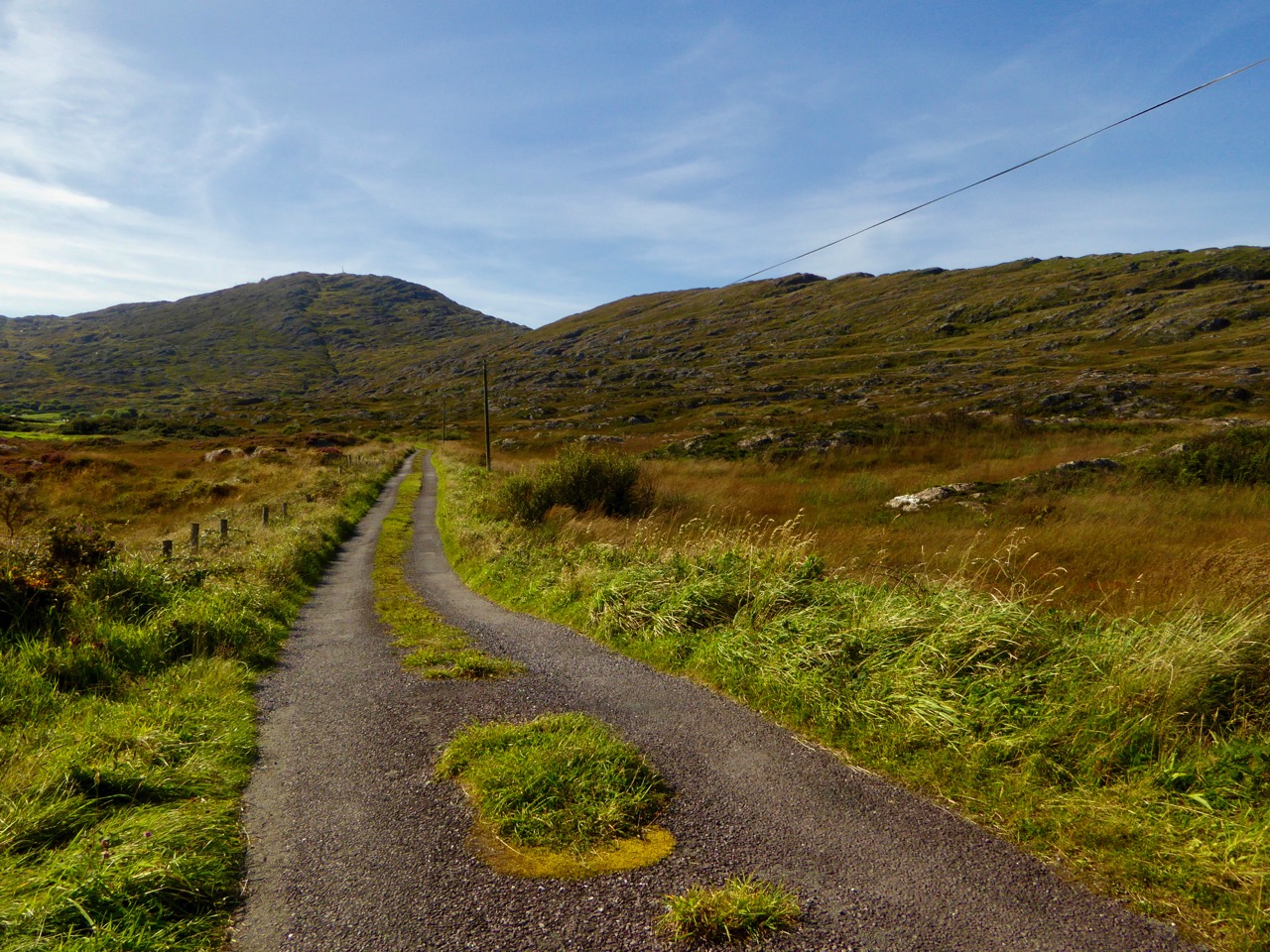
 Yesterday we did our favourite walk, along the Cahergal section of the Sheep’s Head Way. We had a goal – the remnants of the Gortavallig Mining Company which operated here briefly in the 1840s. Robert was researching this as part of all the West Cork/Cornwall connections related to the West Meets West Art Exhibition, which opens at Uillinn in Skibbereen next Friday (June 2).

Walking the Sheep’s Head Way, by Amanda Clarke, is our go-to book for everything on the Sheep’s Head. It’s an excellent resource and most of the information in this post comes from it. The stretch of the walk we did is described in two sections (as it’s part of the Way and also part of a loop walk), on pages 27 to 31, and pages 98-99 (Second Edition).

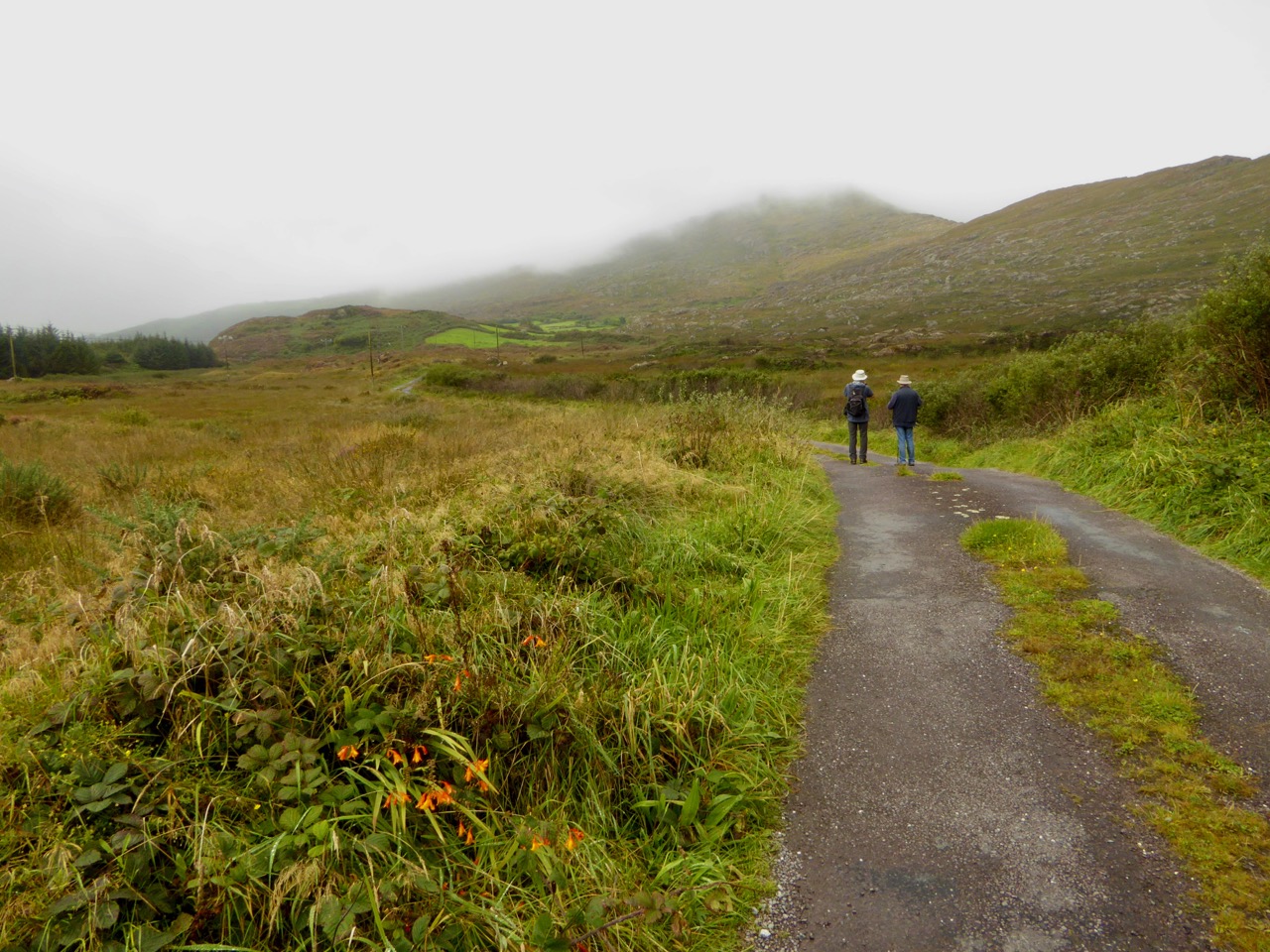
It was a fabulous day, sunny but not too hot – perfect for walking. The wildflowers were out in abundance – a serious hindrance to brisk walking as I cannot resist the temptation to photograph. At one point Robert thought he had lost me, but found me stretched out on the ground trying to get a close up of the tiny, exquisite, Heath Milkwort.

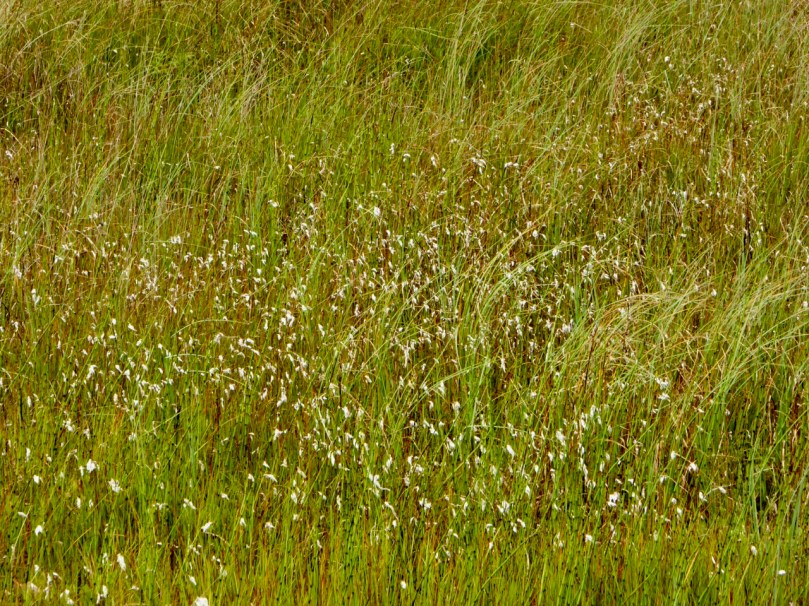
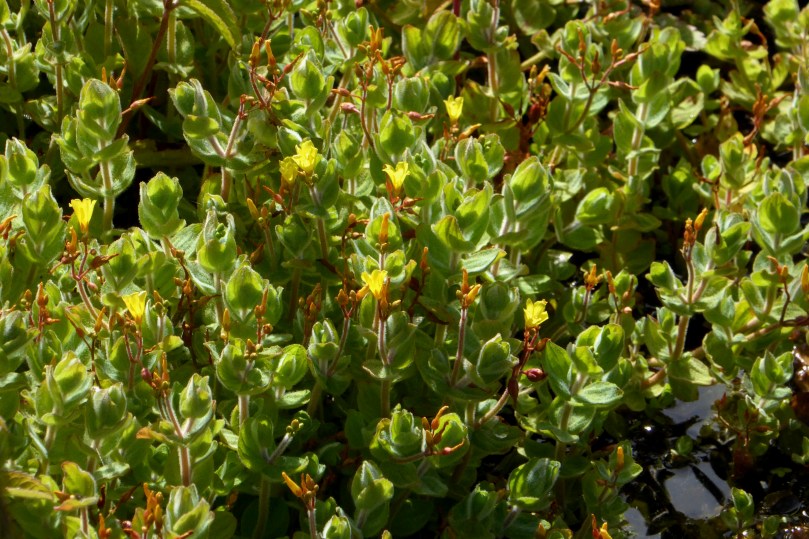
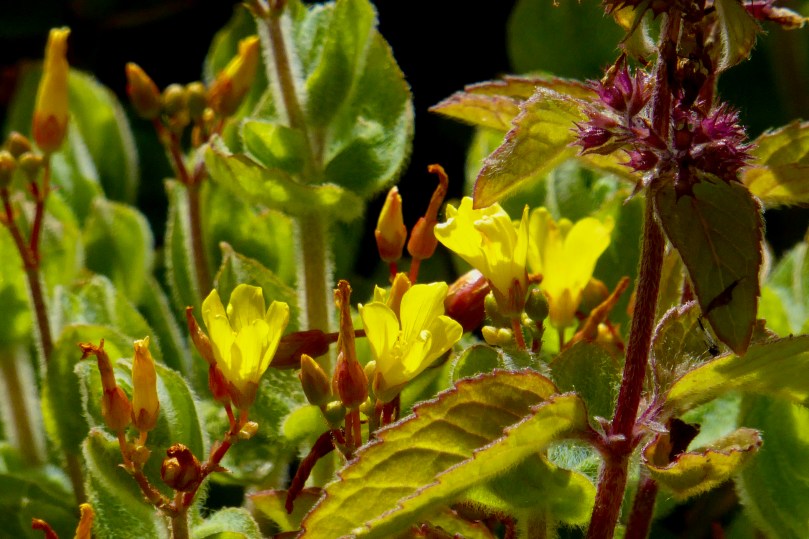
Later on, this hillside with be awash with pink Heather, but now the Foxgloves are everywhere, in all their purple glory, while Tormentil and Lousewort peep out from the among the grasses and heather.

Tormentil, above and Lousewort, below

This was once a populated part of the world and there’s a tiny abandoned settlement known as Crimea. This may be a reference to an ongoing feud between families, or a corruption of an Irish place name. There’s no denying the dramatic scenery, but life must have been very hard indeed. A cluster of houses like this was known as a clachán (kla-hawn) – the land was held in common by the inhabitants, with each family having a potato patch and the rest being for grazing and whatever crops would grow.

The Crimea: Tade Carthy’s cottage in the foreground

One of the houses has been recently partially restored. According to Amanda:

It was done partly to show people what living conditions were like not so long ago, and in part to honour the last surviving occupant of the Crimea, who recently celebrated his 100th birthday. Jerh (Jack Owen) Daly grew up in one of these cabins which were family homes until the late 1940s.

This old house belonged to Tade Carthy’s family and has been sensitively restored, the original flagstones and well discovered whilst working on it, Inside there is no fireplace but an open hearth built against the wall with a hole in the roof to let out the smoke. Doors positioned east and west allowed a through draught to also deal with the smoke. Little oil lamps fitted into niches provided additional lighting and a bed platform gave extra space for sleeping.

The recently re-discovered well

It was from this clachán, and from all over the Sheep’s Head, that local people trekked, during the height of the famine, to the mine. They also built the road, for which they were paid in food, rather than money.

Approaching the 1840s mine – the reservoir is in the foreground and the Cornish Miners cottages on the far side of the cliff

Amanda quotes from the Report of the Gurtvallig Mine, by William Thomas, June 1847:

A complete wilderness and barren cliff, which for the past age has been the undisturbed resort of the Eagle, the Hawk and the Wild Sea Birds, has by our labours for the past 16 months been changed into a valley of native industry, giving reproductive employment, food and a comfort, to numbers of the hitherto starving, but peaceable inhabitants of one of the wildest districts in the United Kingdom. For you can hear now, on our well secured dressing floor (mingled with the roar of the Atlantic) the busy voices of men, women, boys and girls, all engaged in breaking, dressing and preparing the ore for market.

Ten or eleven small houses stood here to house the specialist miners recruited from Cornwall

The mine was an actually an outpost of Cornwall in Ireland. The two Mine Captains, William Thomas and James Bennett, were Cornish, and the miners – 24 of them – had been recruited in Cornwall. A row of houses was built to house them, while the Captains had more comfortable quarters in nearby Cove (a story for another day).

A retaining wall was build to hold the reservoir

It was a busy place during its short life (it close in 1848 after only a year of full operation), with a forge, a carpenters shop, a reservoir, and below, a dressing floor and a quay to transport the ore.

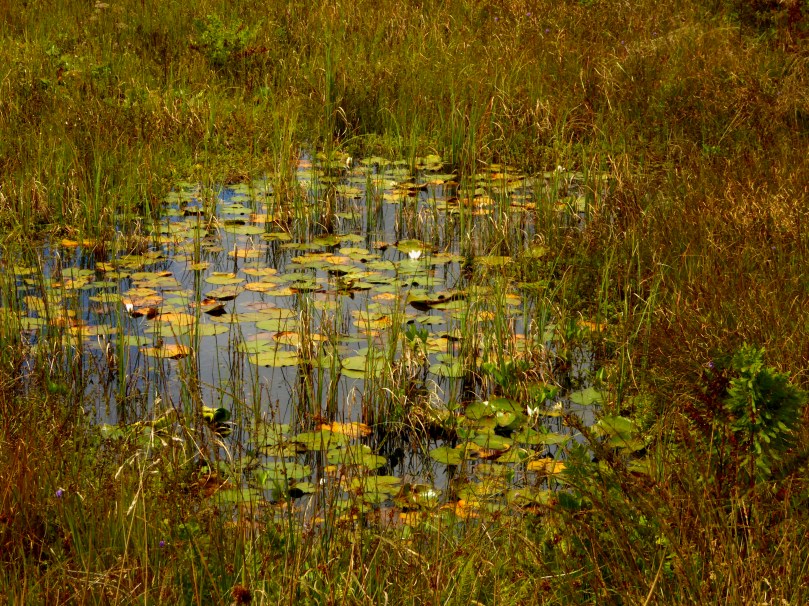
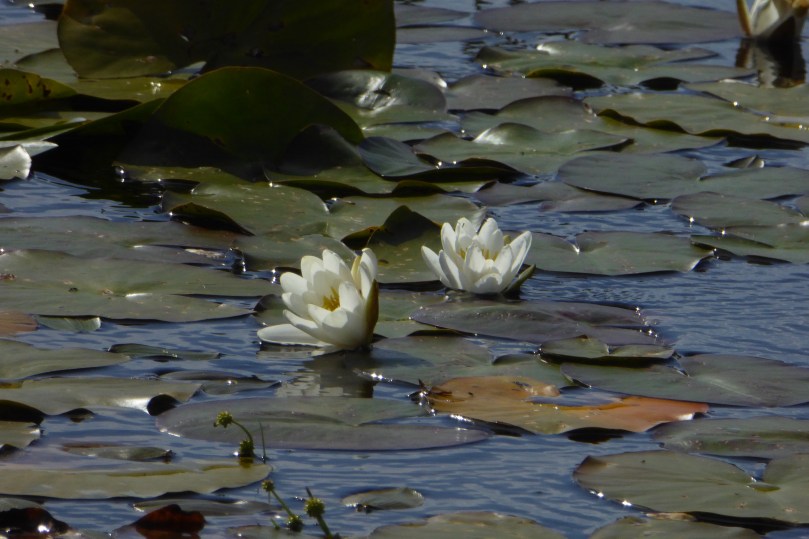
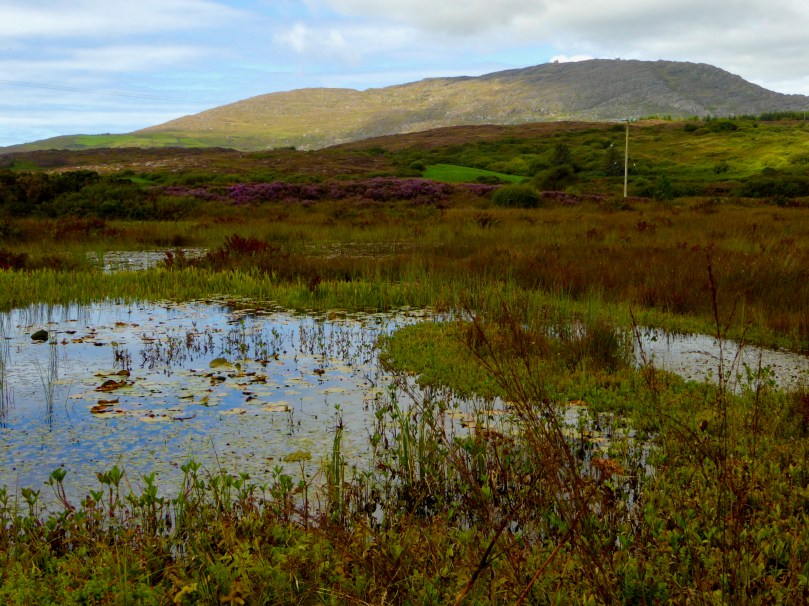
Now the reservoir is home to floating water-lilies, a native plant that was in full bloom yesterday and looking indescribably exotic. The tiny quay has disappeared, but its location can be glimpsed from the rope walk. This part of the hike is not for the faint of heart or vertigo-sufferers: the path is narrow, there’s a rope to hang on to one one side and on the other a yawning cliff falls dramatically away to the wild and roaring Atlantic described by William Thomas.

The rope walk and signage. The lowest photograph shows the location of the quay, reached by means of a steep path but no longer accessible

Our walk back, with the sun behind us, was splendid. To the north was Bantry Bay and beyond it is the remote and beautiful Beara Peninsula. I think I can safely say that this will remain our favourite walk – at least until we discover one even more remote, scenic, historic and thrilling. But then, that’s not difficult in West Cork.