I am the grateful recipient, earlier this week of Mary Oliver’s poetry collection A Thousand Mornings. Thank you to my friend Tim Farrelly – not sure what I did to deserve this, but I can’t believe I was unfamiliar with this poet. As soon as I cracked the book, I was entranced. Oliver died in 2019, aged 83 and I gather I was almost alone in the world in not knowing her work.
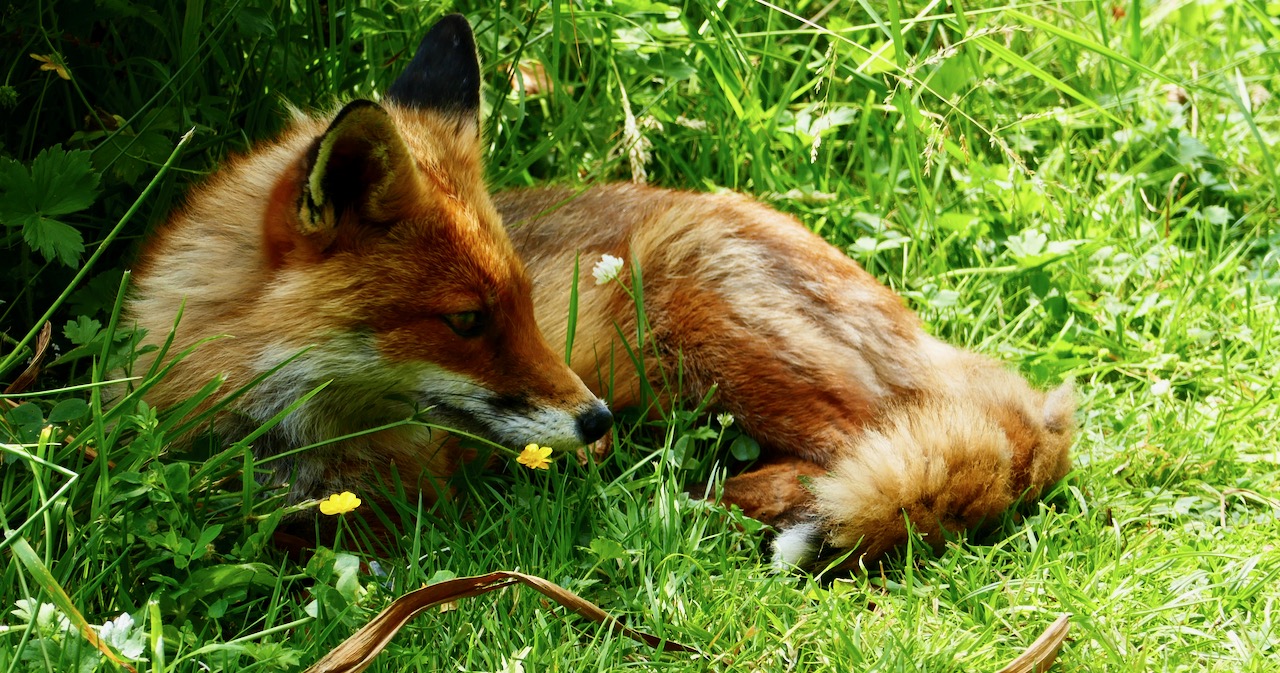
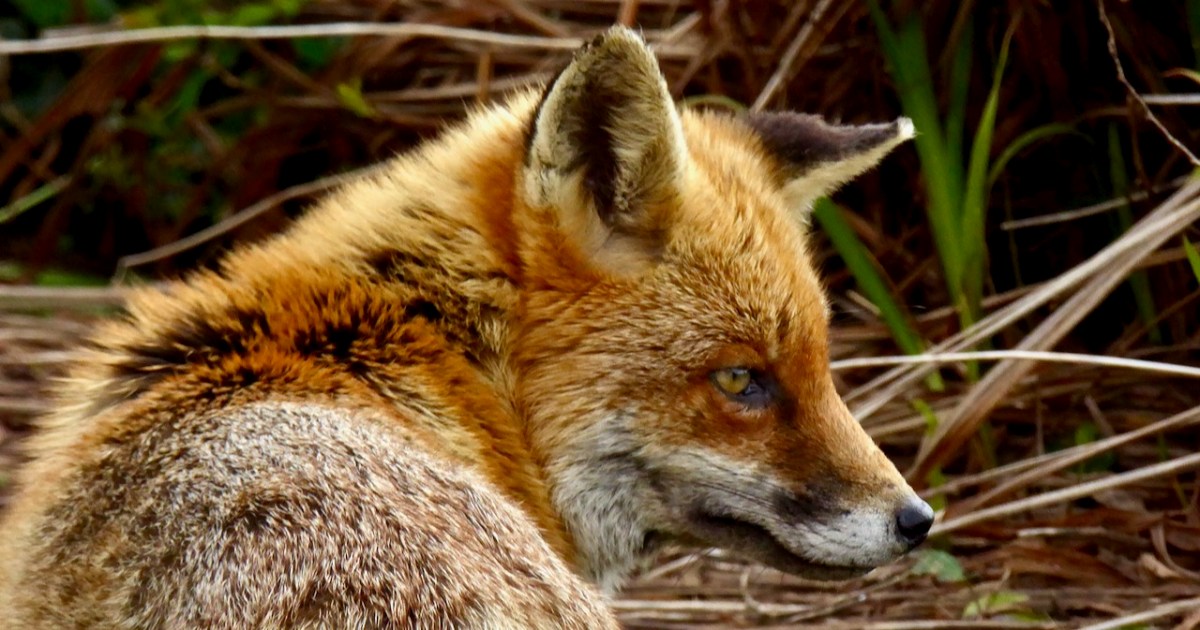
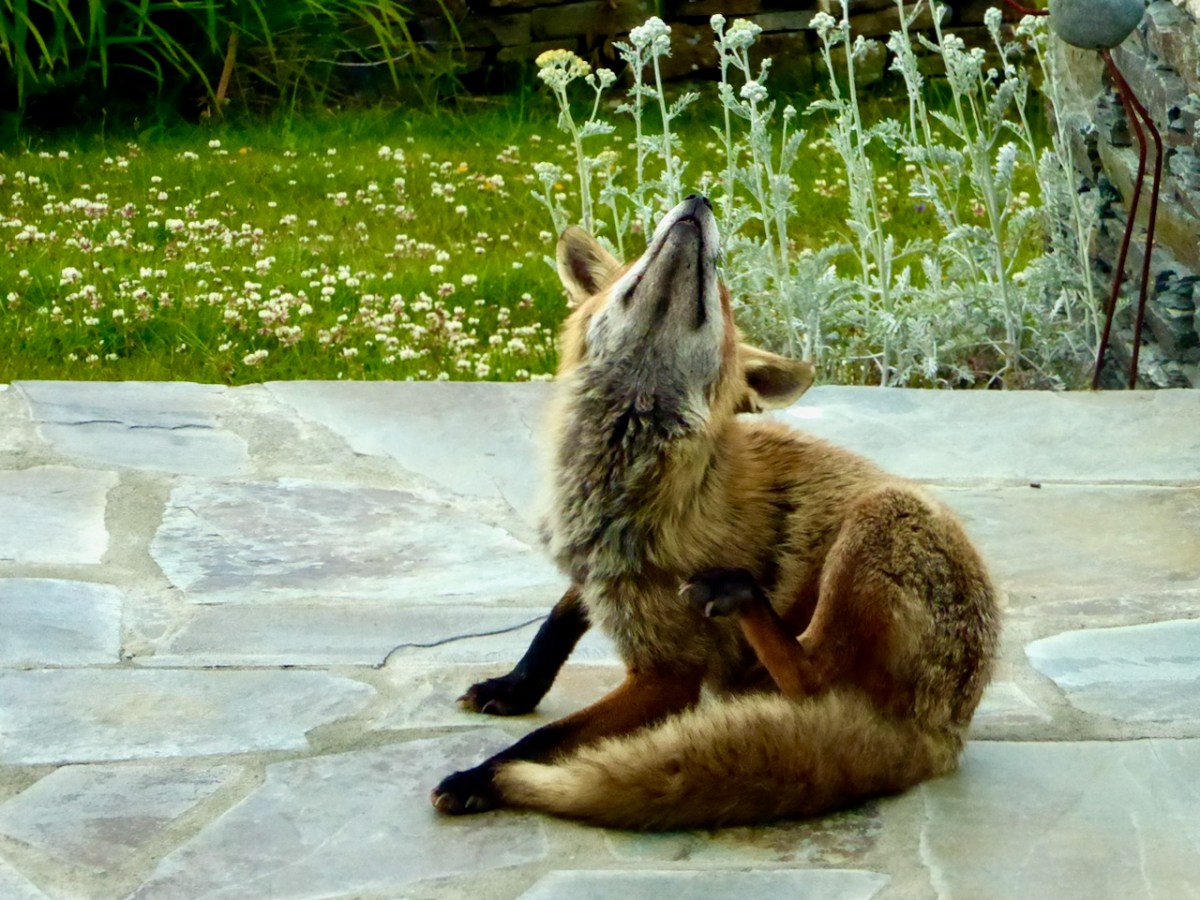
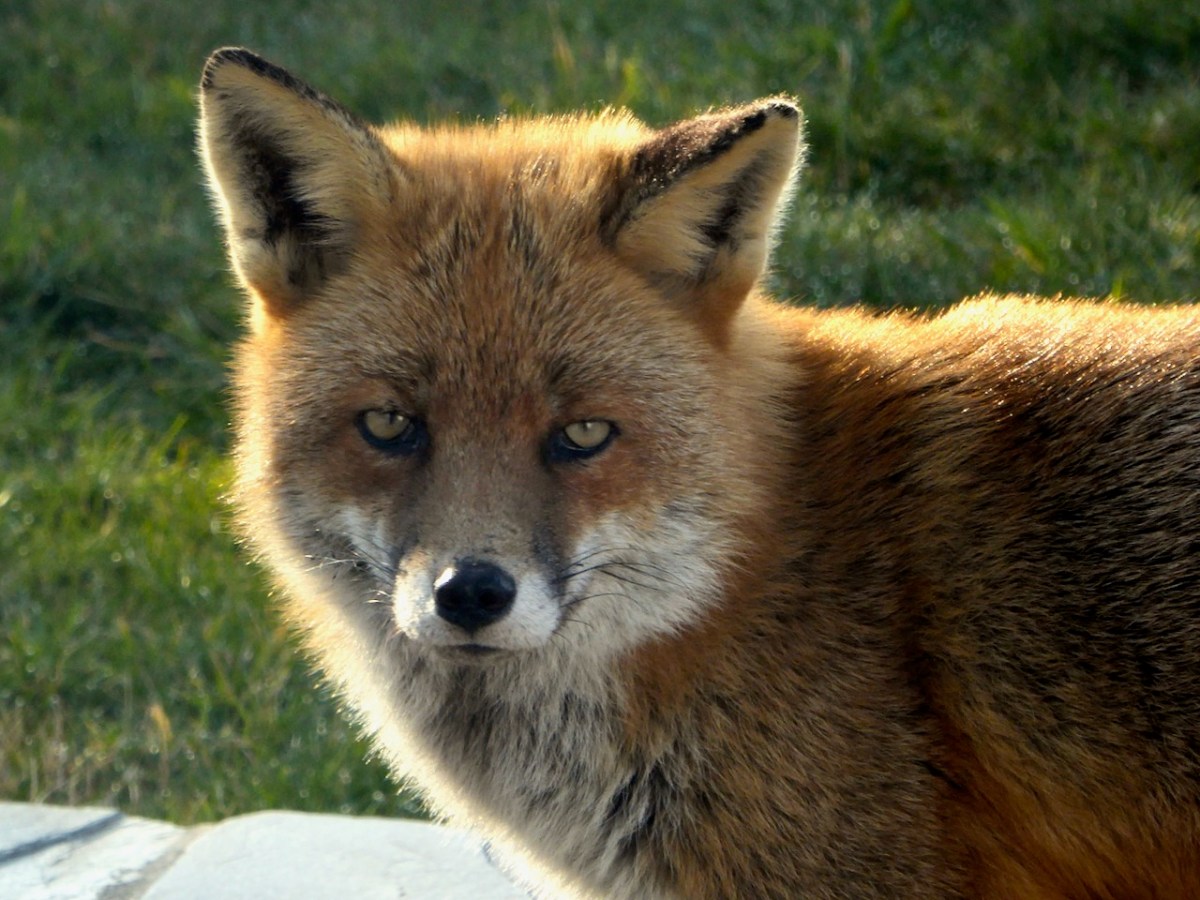
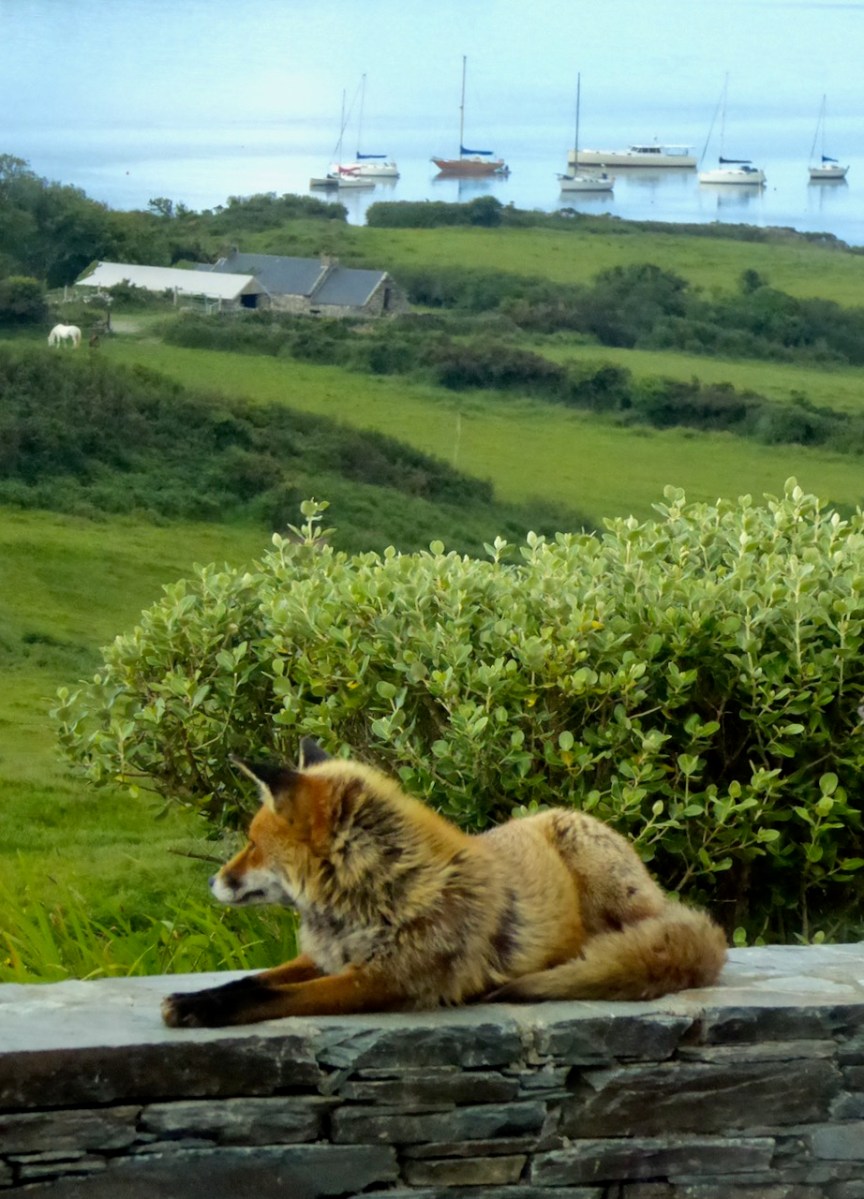
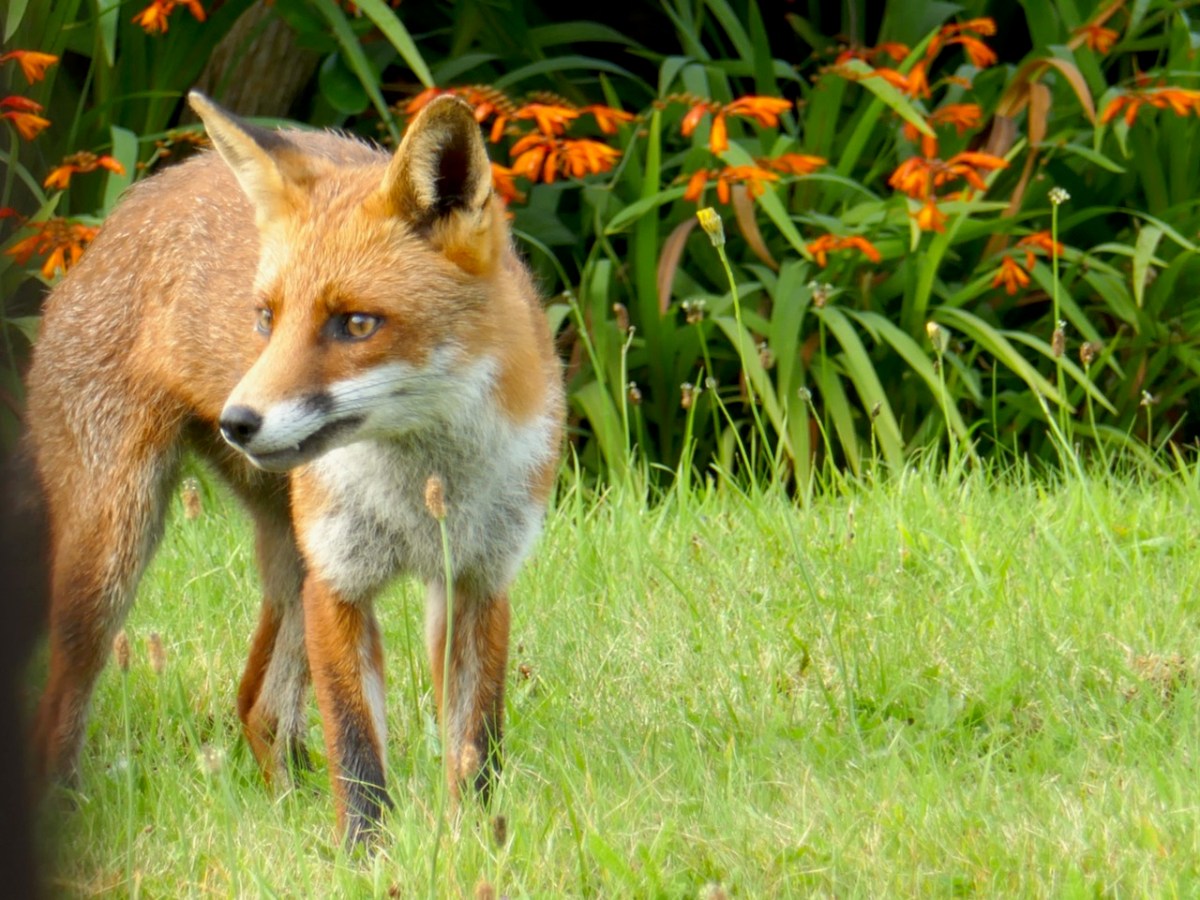
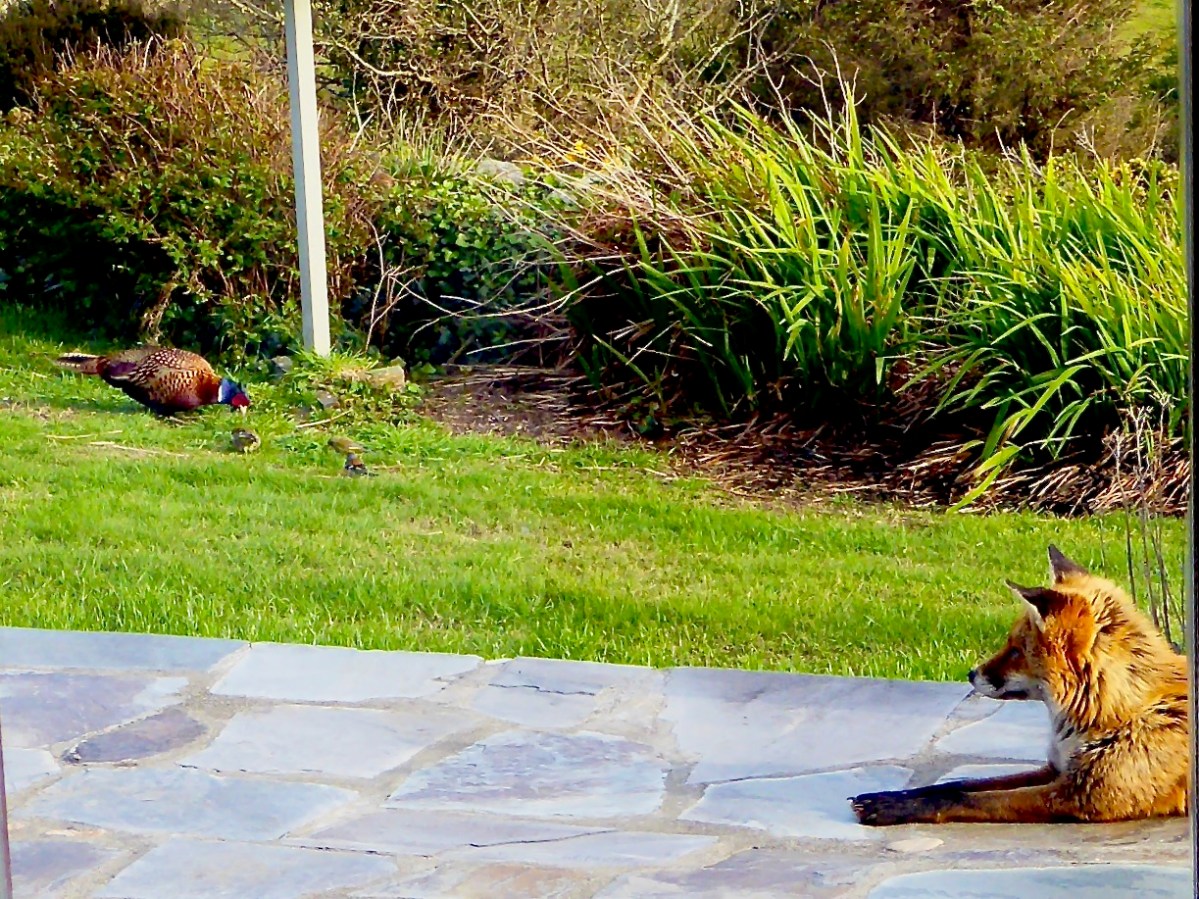
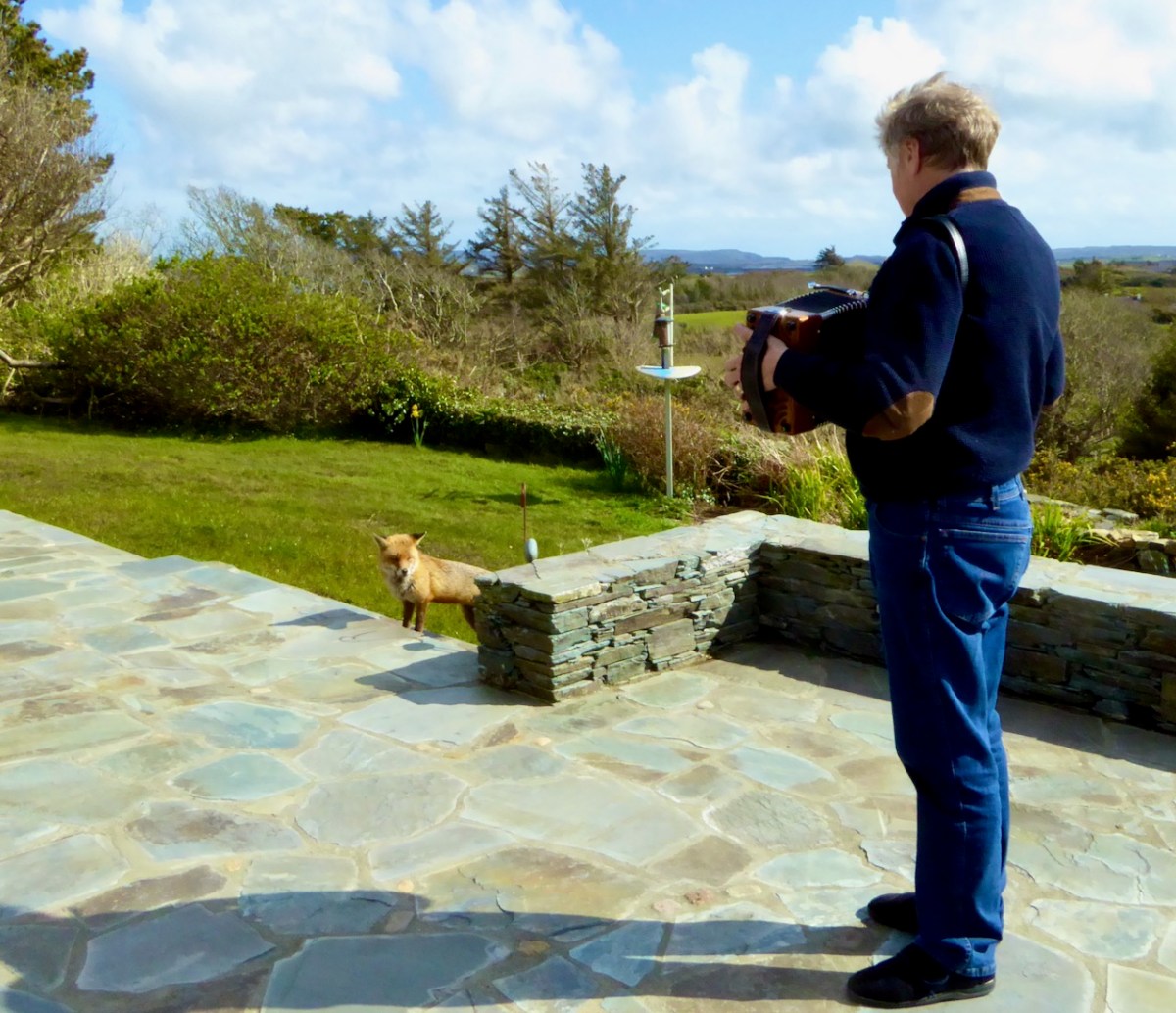
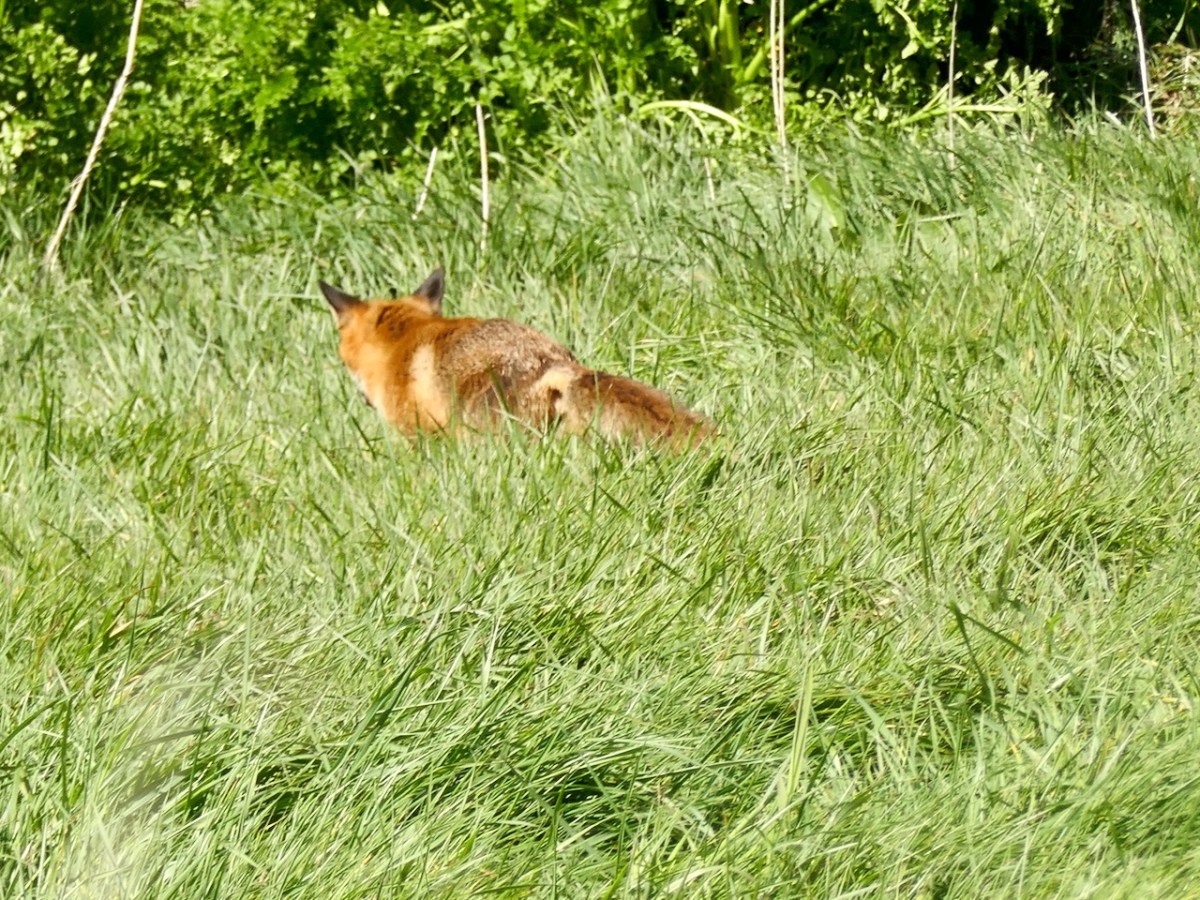
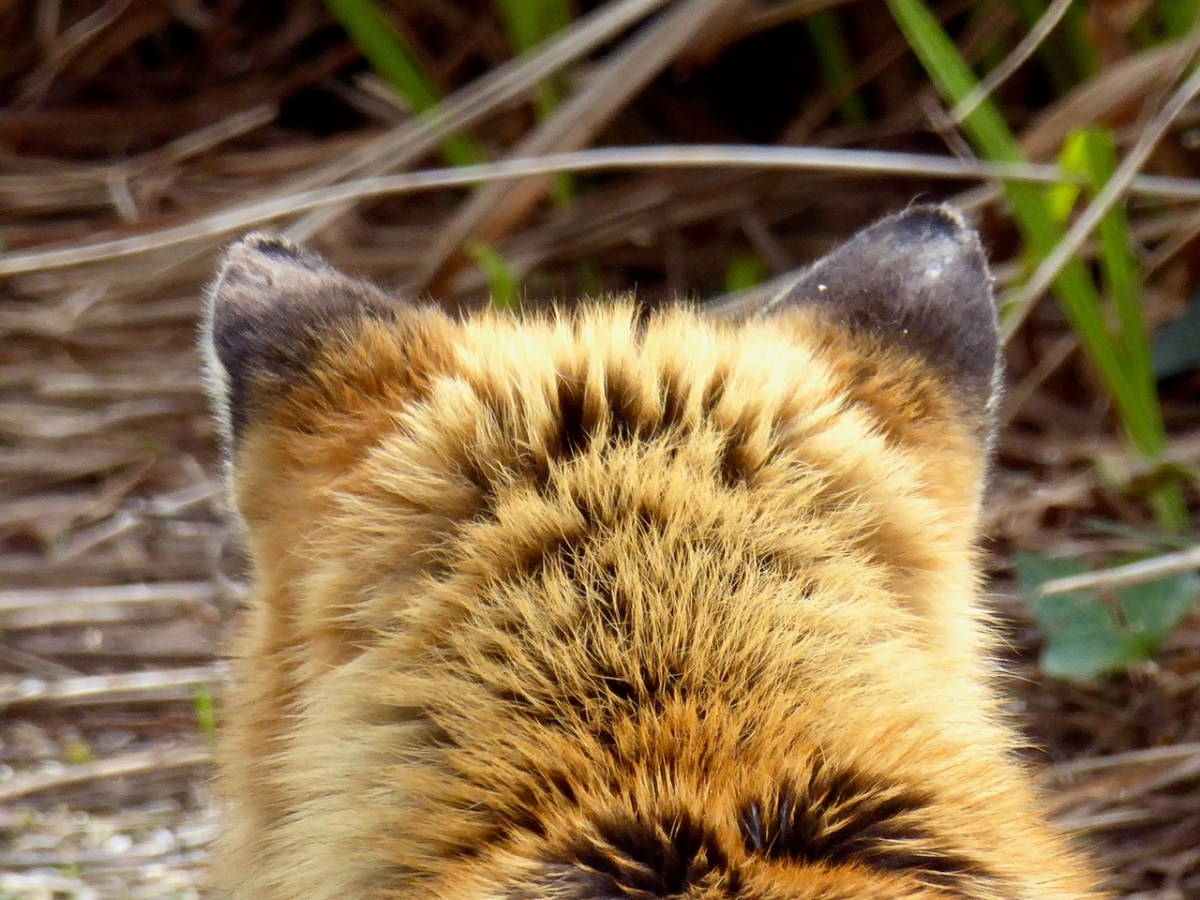
I have read and re-read her poem ‘Good-Bye Fox’ and I just knew that I had to unite it with photographs of our beloved Ferdia, about whom I wrote in this post, and Robert wrote in this one. I have applied for and been given permission to quote this wonderful poem in full.* So first, here it is.
Good-Bye Fox
He was lying under a tree, licking up the shade,
Hello again, Fox, I said.
And hello to you too, said Fox, looking up and not bounding away.
You’re not running away? I said.
Well, I’ve heard of your conversation about us. News travels even among foxes, as you might know or not know.
What conversation do you mean?
Some lady said to you, “The hunt is good for the fox.” And you said, “Which fox?”
Yes, I remember. She was huffed.
So you’re okay in my book.
Your book! That was in my book, that’s the difference between us.
Yes, I agree. You fuss over life with your clever words, mulling and chewing on its meaning, while we just live it.
Oh!
Could anyone figure it out, to a finality? So why spend so much time trying. You fuss, we live.
And he stood, slowly, for he was old now, and ambled away.
I found myself mulling and chewing over what Oliver is saying and contrasting it with my experiences with Ferdia.
The poem’s central dynamic — a fox who just lives while the poet fusses with words and meaning — relates closely to our relationship with Ferdia. Robert and I were doing exactly what Oliver’s fox gently mocks: writing, naming, observing.
And yet. . . Ferdia seemed to choose our company. He came back, repeatedly, voluntarily. That kinda complicates Oliver’s characterisation of the fox as loftily above our interest in him.
For me, it’s not just about a fox. It’s also about loss, and what endures in memory.
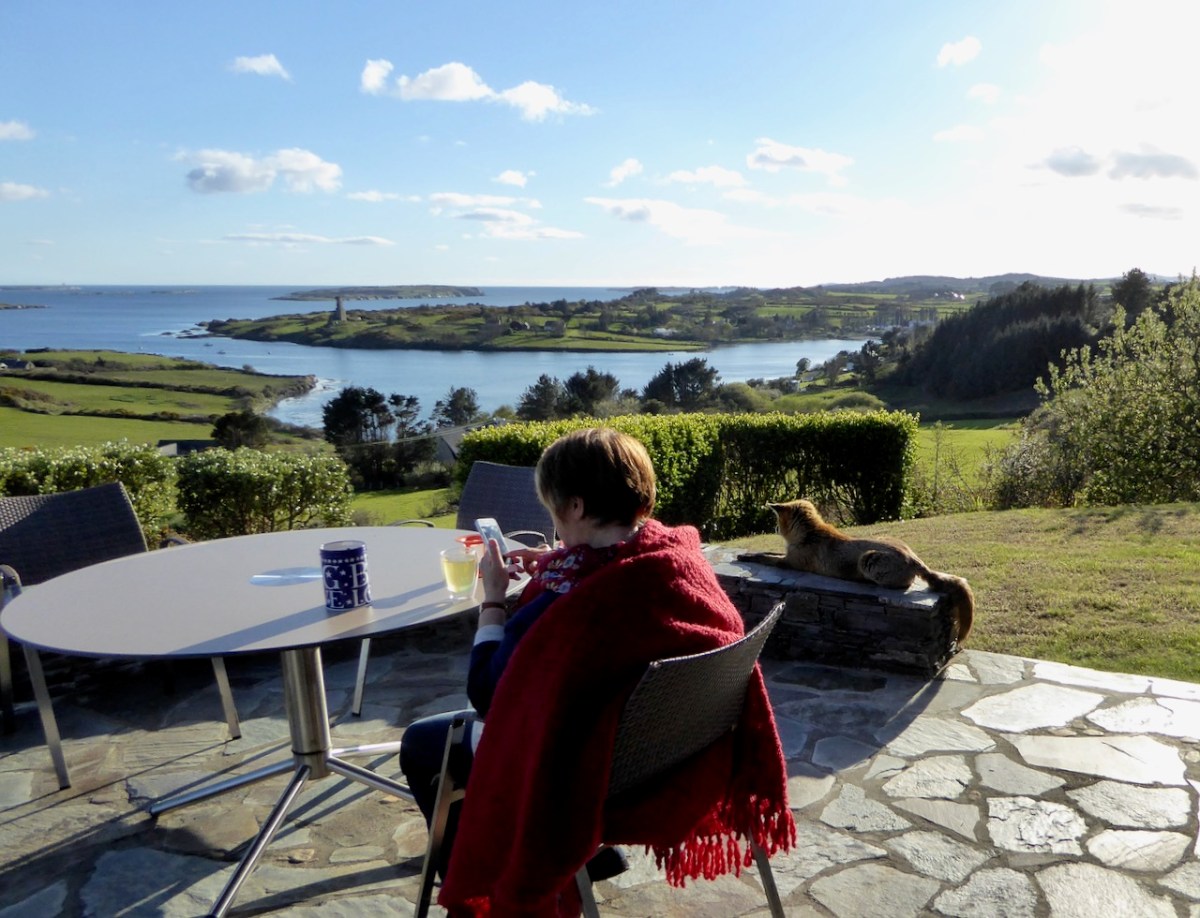
But I don’t have to rely just on memory, because we were recording, we were mulling and chewing over his presence in our lives. And we were loving it all – how he wore a rut in the lawn to our terrace, how he barked gently outside the window to alert us to his presence, how he carried scraps home to his family, how he loved to keep us company as we sat outside, and how much he liked it when Robert played his melodeon.
Ferdia ambled away in the end. I am so grateful we fussed over him while we could.
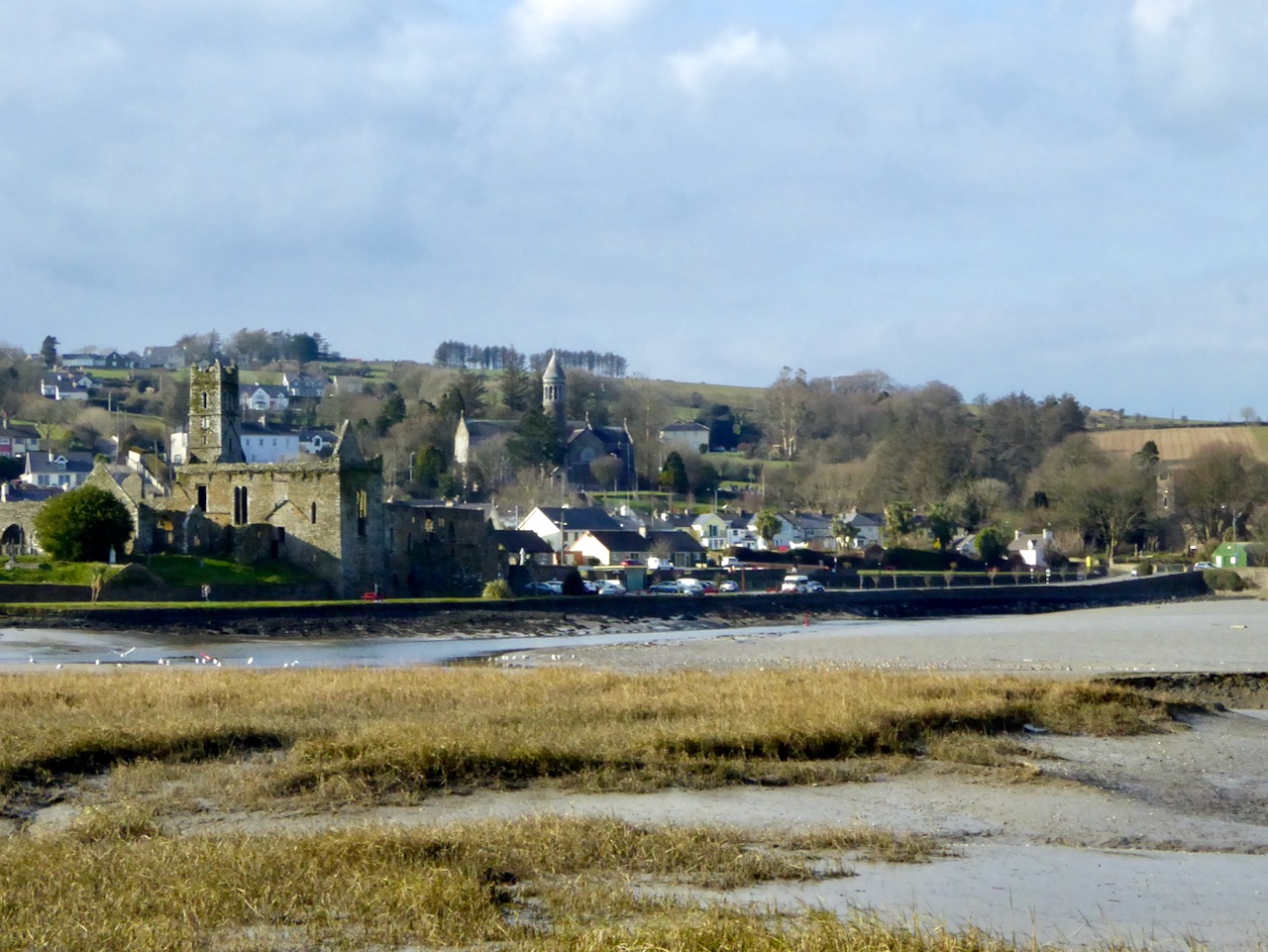
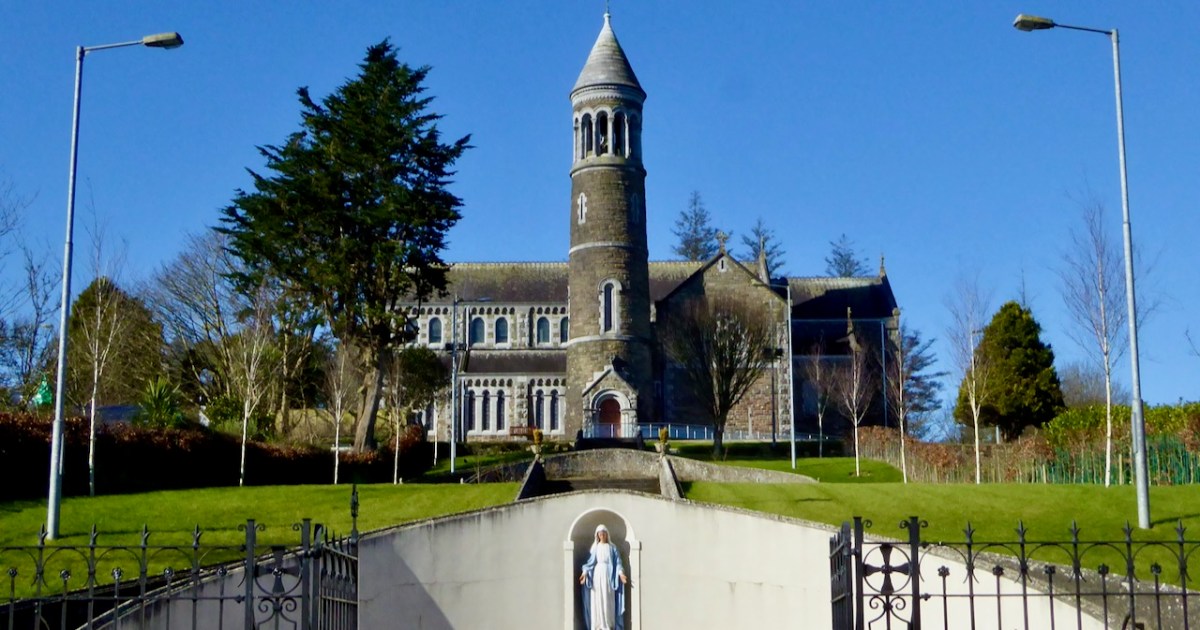
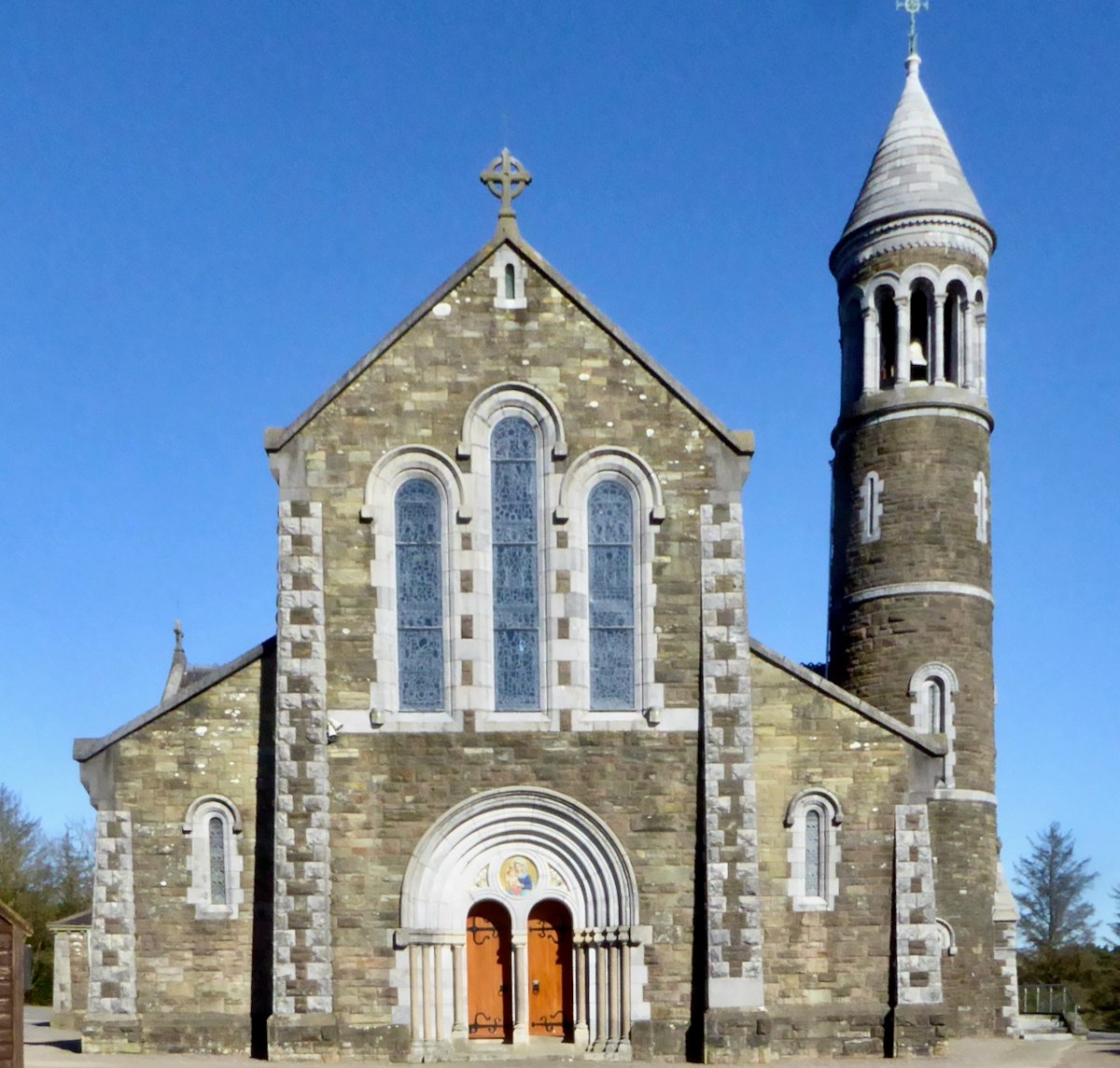
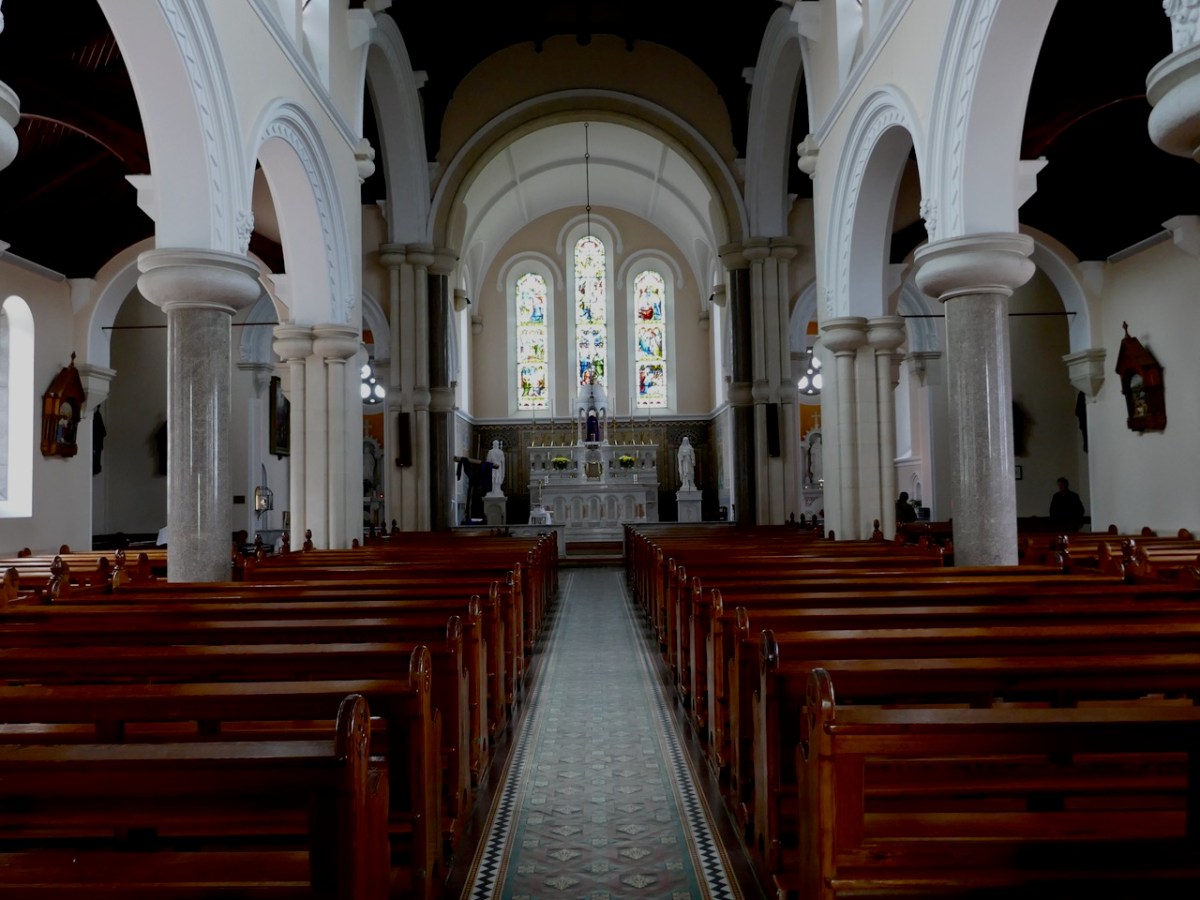
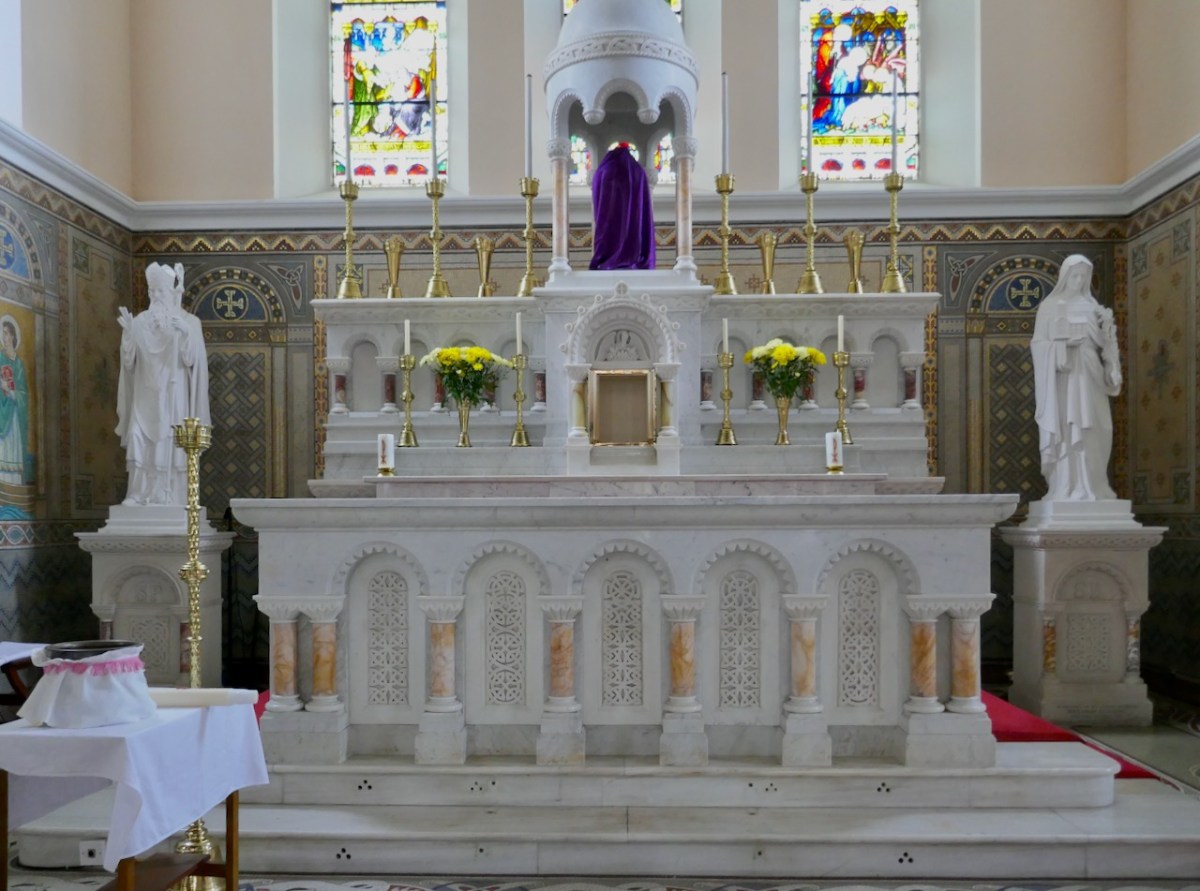
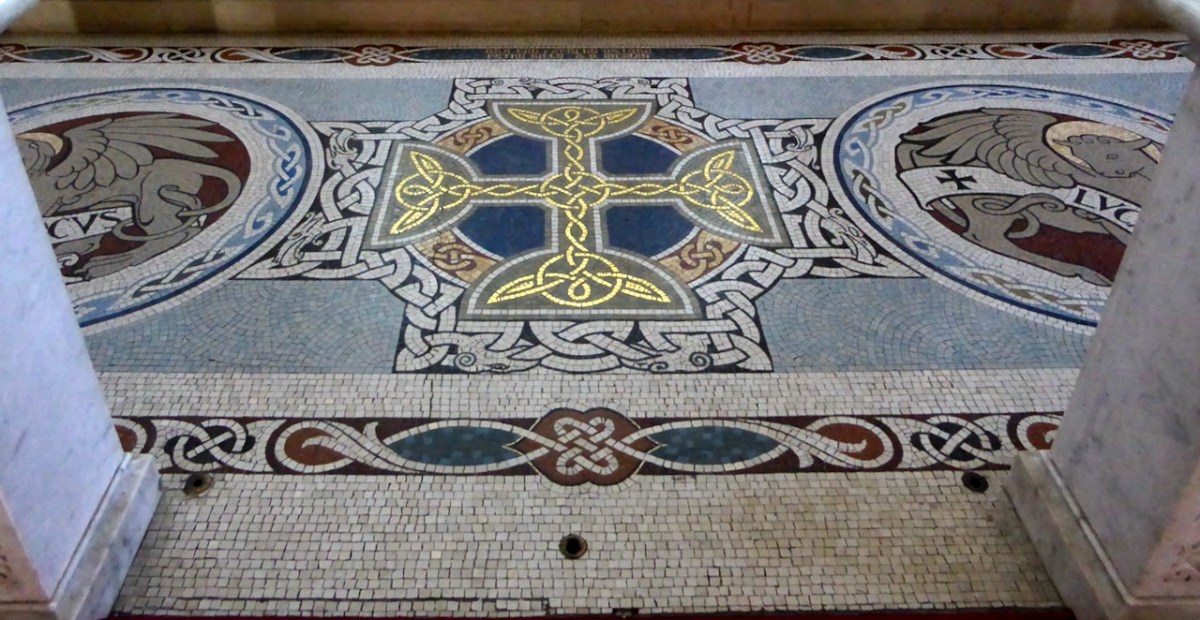
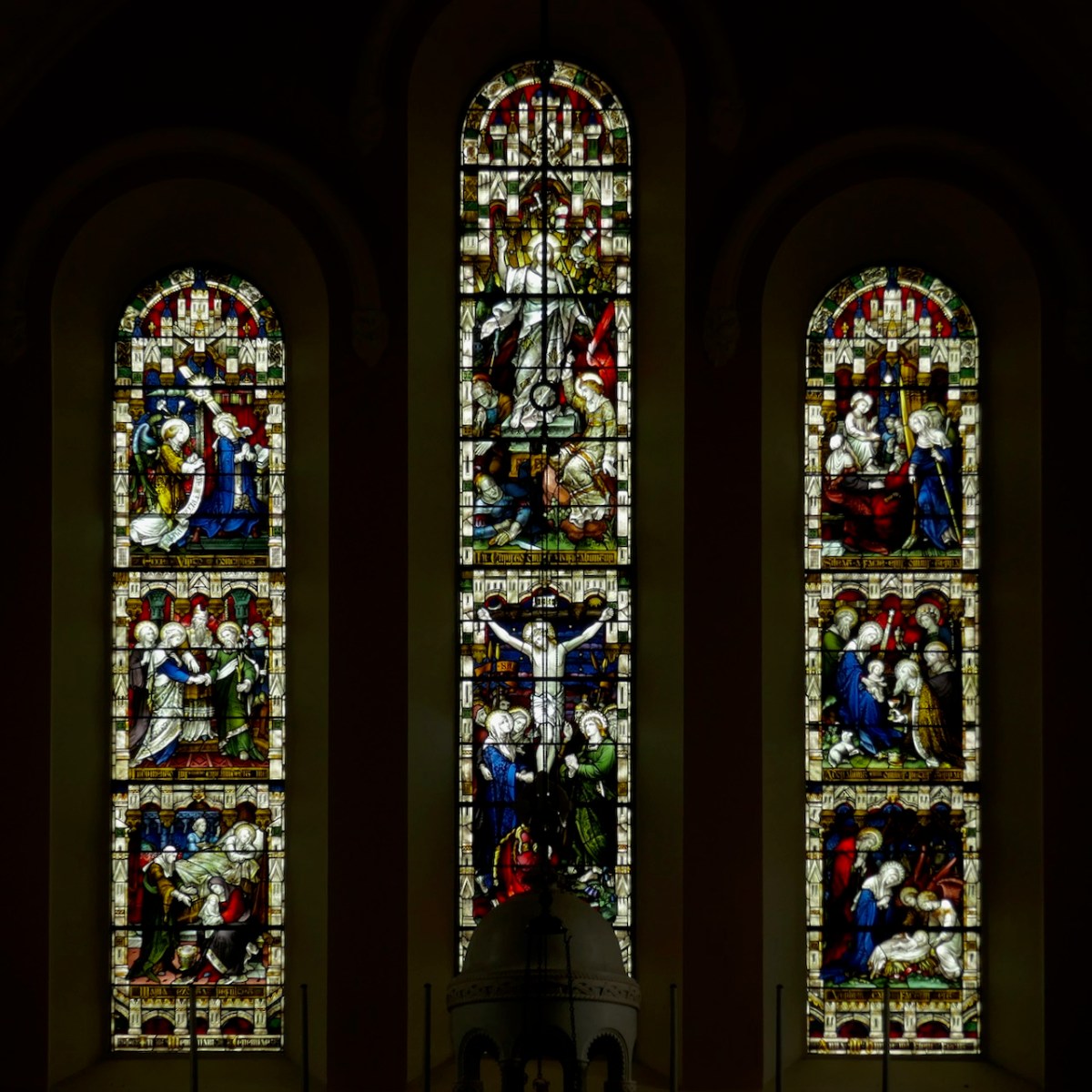
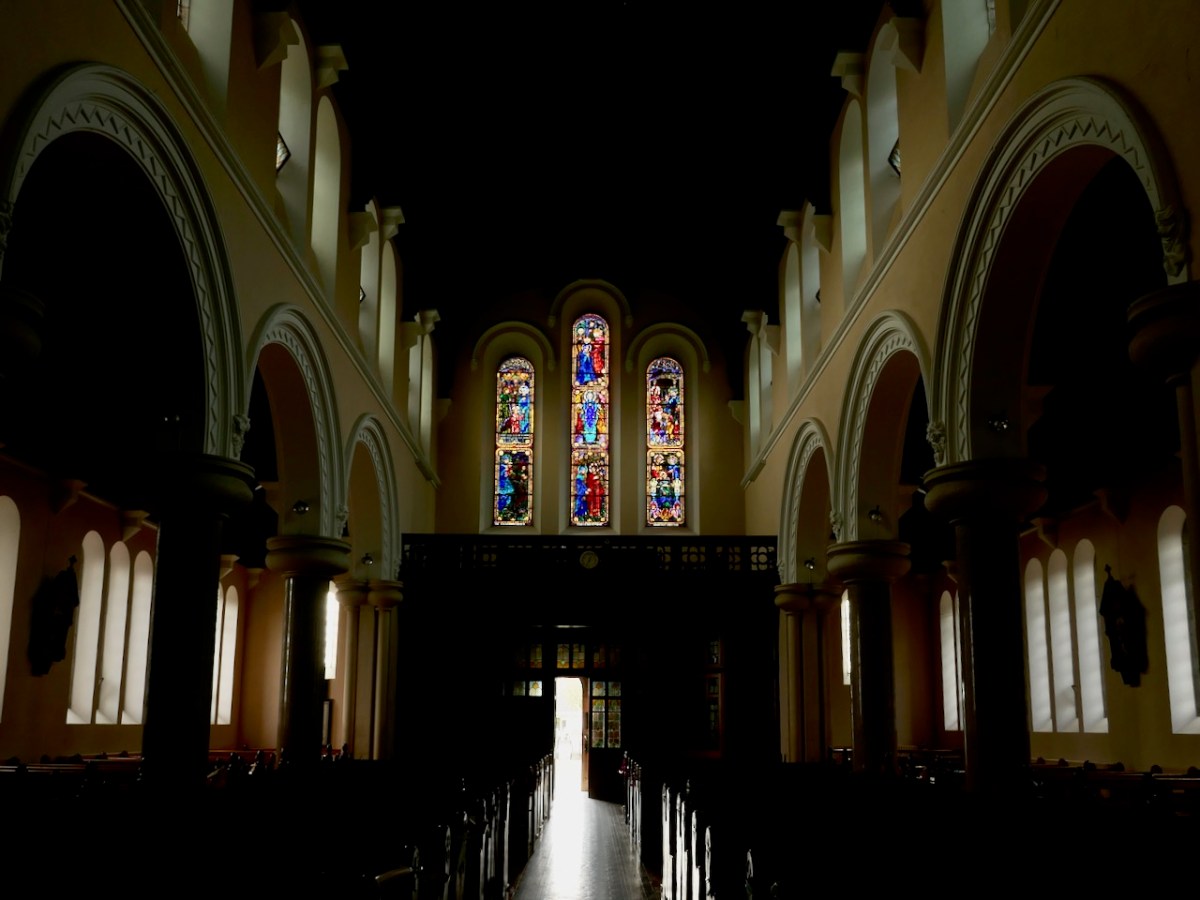
The Catholic Church in Timoleague stands proudly on a hill, instantly visible as the largest and most imposing building in the town. It belongs to the great era of Catholic church-building at the beginning of the 20th century and reflects, in its neo-Hiberno-Romanesque architecture, and its sheer size, many of the Catholic and nationalistic narratives and preoccupations of the time in which it was built.
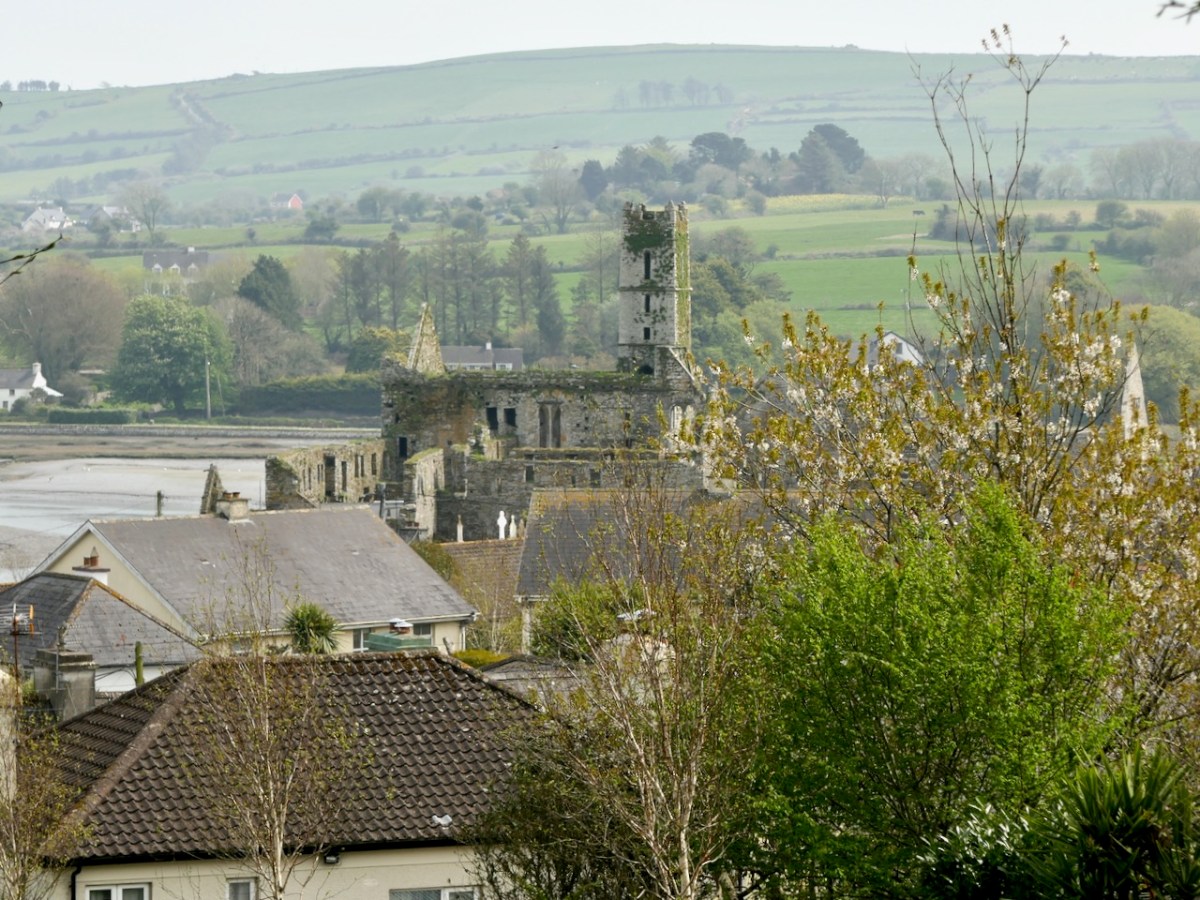
I have already written about the Timoleague Friary and the Church of Ireland Church of the Ascension. Together, they tell the story of Ireland from the 16th to the 19th centuries – the dissolution of the monasteries, the suppression of the Catholic Religion and the special position of the Established Church. But from Catholic Emancipation (1829) to Disestablishment (1869) and Cardinal Cullen’s Devotional Revolution (from 1850), the Catholic Church gained the ascendancy. An ambitious program of building was necessary to replace broken down ‘mass houses’ and provide large and suitable places of worship for the vast majority of the population.
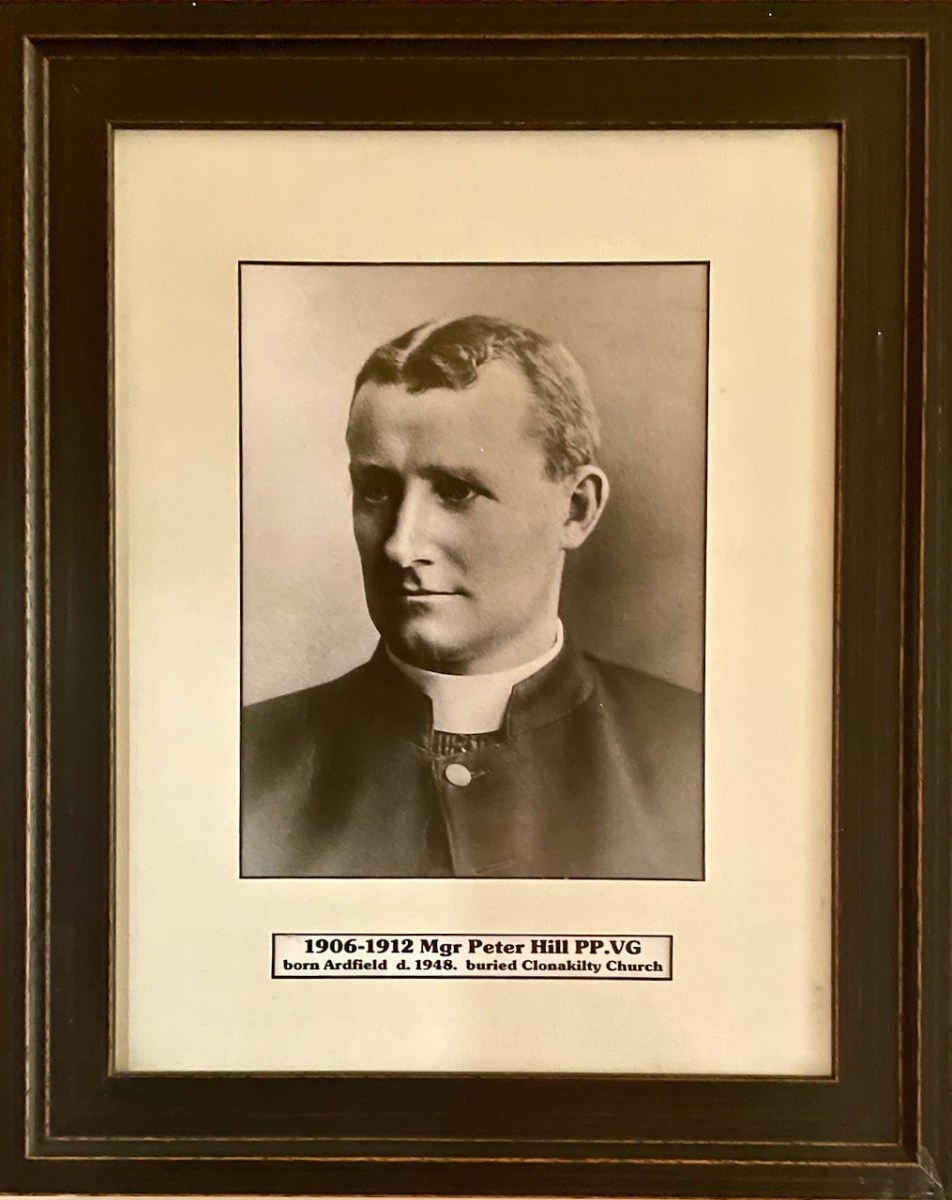
Ground-breaking and foundation stone ceremonies were highly ritualised. Fund-raising efforts were enormous and often involved canvassing emigrants. This took energy and dedication by the Parish Priest, Rev Peter (later Monsignor) Hill.
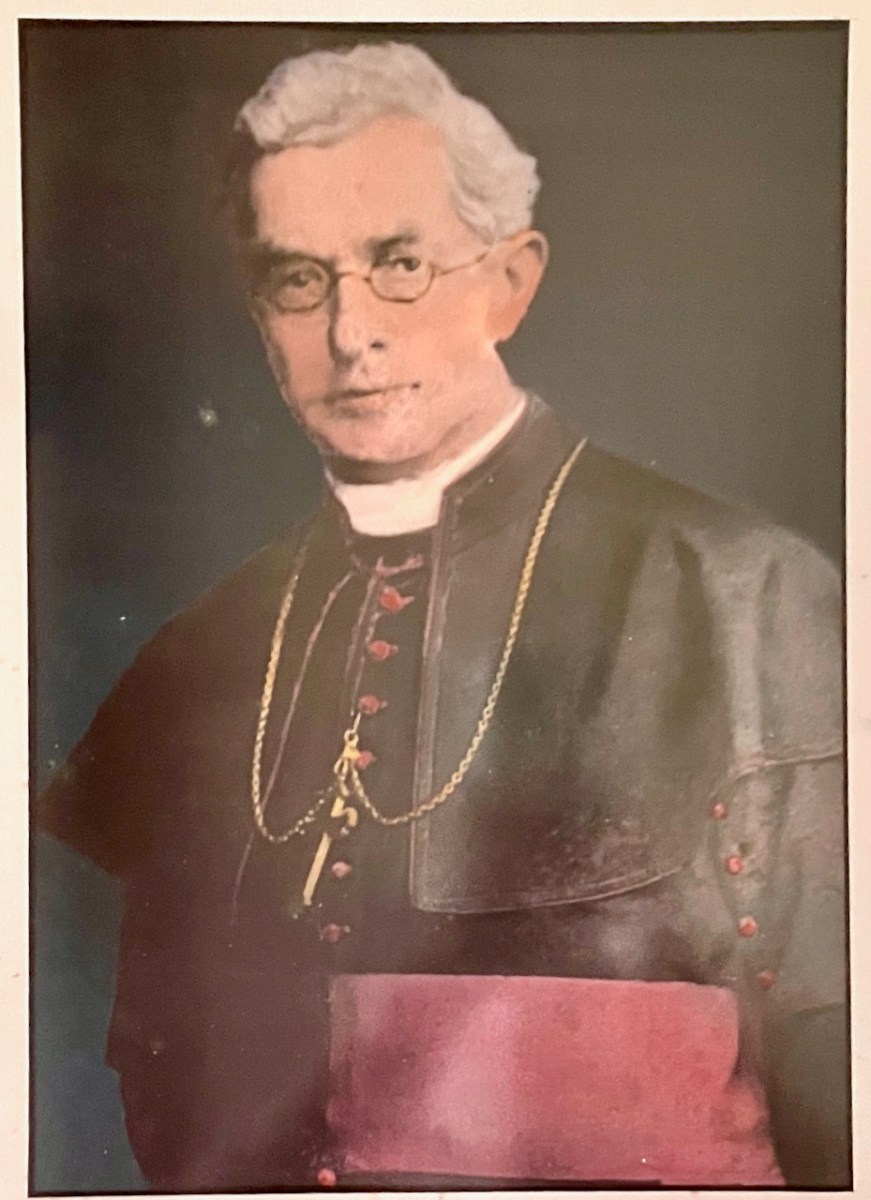
Once the church was built, or largely finished, it was consecrated, usually by a Bishop and in the case of Timoleague the Church of the Nativity of the Blessed Virgin Mary, this was conducted in 1912 by the Bishop of Ross but the oration was delivered by Dr Michael Fogarty, Bishop of Killaloe.
Bishop Fogarty was a passionate nationalist and noted orator who ‘involved himself closely in the social and political challenges facing Ireland’. Fogarty’s speech is remarkable to our modern ears as much for its nuance-free and emotive evocation of the centuries of Irish oppression as for the note of sectarianism that emanated from deep and long-held resentments. However, it seems to have been fairly typical of the speeches given by churchmen on such occasions and I have decided to quote it at length because it provides such a striking example of the kind of nationalistic rhetoric that congregations were listening to on these occasions. Some of us may indeed find it very familiar and remember the impassioned little patriots that we became as we wrote our history essays and sang about Kevin Barry.
The speech is quoted in full by the Skibbereen Eagle, Sept 14, 1912: Solemn Dedication by His Lordship Bishop of Ross/Impressive ceremonies/Eloquent Sermon by His Lordship the Bishop of Killaloe
So here is a deep dive into 1912 nationalistic and Catholic fervour.
Bishop Fogarty began
For many years, the faithful of Timoleague worshipped God in one of the poorest of churches … The Church in Ireland had passed out of its long night of persecution: she had entered on the bright dawn of freedom with renewed vigour, and her faithful sons and daughters strove to reconstruct her temples ….
He went on to castigate those who criticise the expenditure of money on churches,
as if they begrudged to the service of the Most High a shilling of that wealth they squander so lavishly in the service of man. For it is to be observed that the people who speak this – and I am happy to say that they are not Catholics – but if they worship at all for the most part worship in churches which they never built, but which they plundered by violence from others who built them – have neither scruple nor objection to that limitless expenditure which we every day witness in erecting public buildings, courts of justice, banks, Royal palaces, and private dwellings, some of which … have cost more money than would build all the churches in Connacht. But let the poor Irish man spend a shilling in honour of that God whom he adores … let a new window be painted, and organ erected, and we are told at once that this is money misapplied, that it shocks the economic sense, that it had been better spent in starting industries or given to the poor.
He continued,
Poor plundered Ireland. What a history has been hers. Nowhere else in the world has the faith of the people passed through so many ordeals of persecution without being conquered. Of temptation without being shaken, of scandal without being corrupted. And, therefore, much as I admire this splendid building and rejoice with you in its consecration, it is not, I confess, the beauty of its architecture, nor the solidity of its structure, nor the amplitude of its dimensions that move me now, but the thought of what it represents and stands for, the triumph of our long persecuted faith. Your Catholic ancestors lie buried for many generations around the walls of the old monastery yonder, now roofless and in ruins. They passed out of life, those brave soldiers of the faith, apparently defeated in their long and direful struggle for God and country; and when they died everything seemed lost to Ireland – land, freedom and religion.
But the flag for which they fought was not buried; nor was the spirit which spread it fearlessly to the breeze, despite all opposition, extinguished in the land. The blood which they shared as martyrs carried in it the seeds of ultimate triumph, and your noble new church, now built and consecrated in an atmosphere of freedom, is the fruit, as it is also a monument of the illustrious and lasting victory won for Catholic Ireland by these, our faithful forefathers. Their race and blood have passed through many vicissitudes of fortune since the dark and disastrous night of Kinsale; they have suffered many a wrong and many humiliations in the intervening centuries, and have undergone many great and sorrowful changes …
Referring to the fundraising needed to build a church like this, by voluntary contribution and without any form of state aid, he stated,
… though this system may sometimes press hard upon us, and though our richly endowed Protestant neighbours may sneer at our sometimes humble efforts, I regard it not only as a tribute to the intensity of our faith, but as a merciful dispensation of Providence for the preservation of the holy faith in the hearts of our people … the result of this system is that our priests and churches belong to the people themselves – that is the Irish priest as a rule is sprung from the people amongst whom he ministers. He is one of themselves, bone of their bone and flesh of their flesh. His heart and theirs keep perfect time and empathy. He is no foreigner, no outsider, no distant Aristocrat who disdains their humble lives, or chills them with his lofty airs.
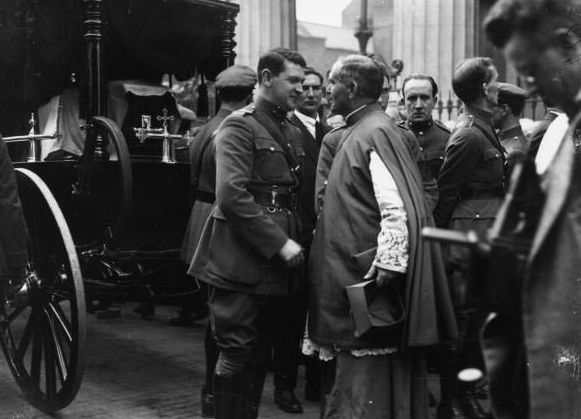
Bishop Fogarty lived until 1955 and died, still a committed republican, at the ripe old age of 96. He played a significant role in the struggle for Irish independence although he surprised many by being pro-treaty, possibly related to his personal friendship with Michael Collins.
Can you imagine him thundering from the pulpit in Timoleague in 1912, delivering his fiery oration to the willing ears of the congregation? How would you have felt, if you had been sitting there?
I am always delighted when readers contact me with stories about some of the West Cork places I have written about, so I was very pleased indeed to get a message from Jack Cooper, relaying a story from his friend Gabrielle McCracken, nee Chavasse. Gabrielle, an Oxford graduate, lives in Scotland now and has very happy memories of her childhood in the shadow of Mount Gabriel and subsequent visits back to the area.
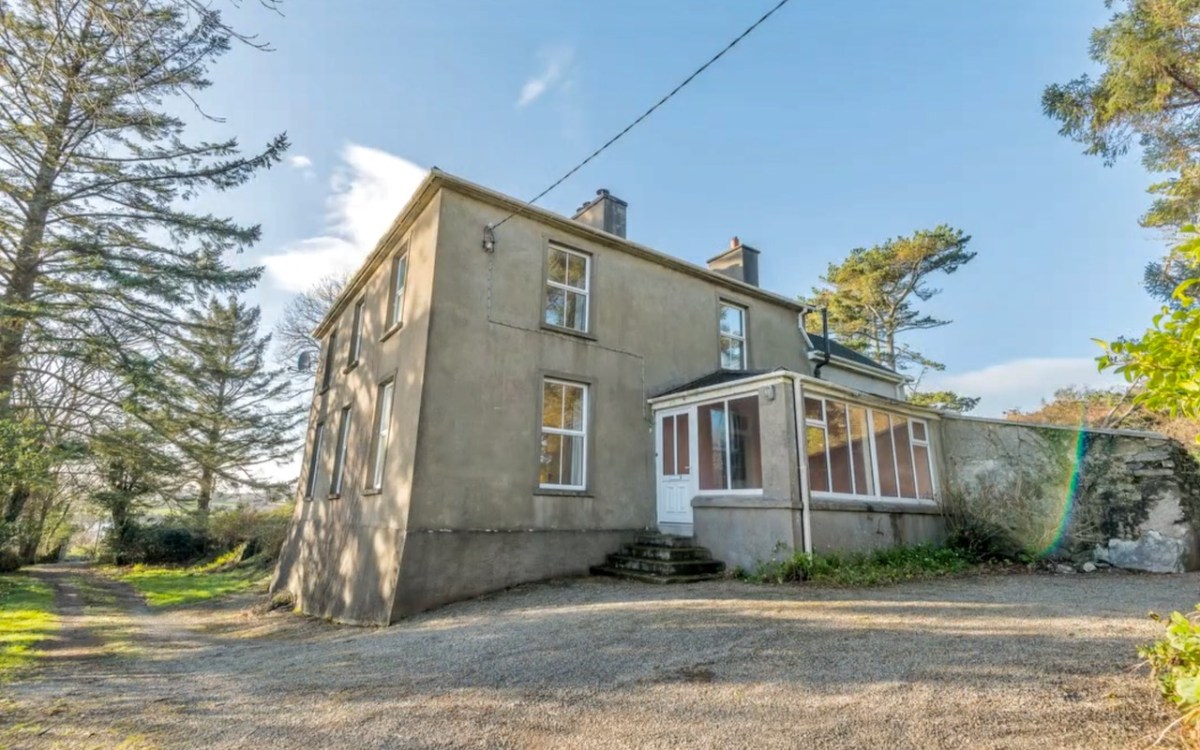
Gabrielle’s reminiscence takes shape around the small lake on the top of Mount Gabriel that I wrote about in my post Legends of Mount Gabriel: the Bottomless Lake. Here is her story, punctuated by comments and photographs from me. The Rectory (below) that Gabrielle refers to came up for sale a few years ago and this photograph is from the sales video.
In the early 1930s, my father, Claude Chavasse, became the Rector of the ‘altar’ parish in West Cork. It was his first parish : he already had a Mediaeval History degree and the history and legends of wherever he lived were of great importance to him. I was born in 1935 and spent the first five years of my life in that lovely parish: we could see Mount Gabriel from the rectory, hence my name.
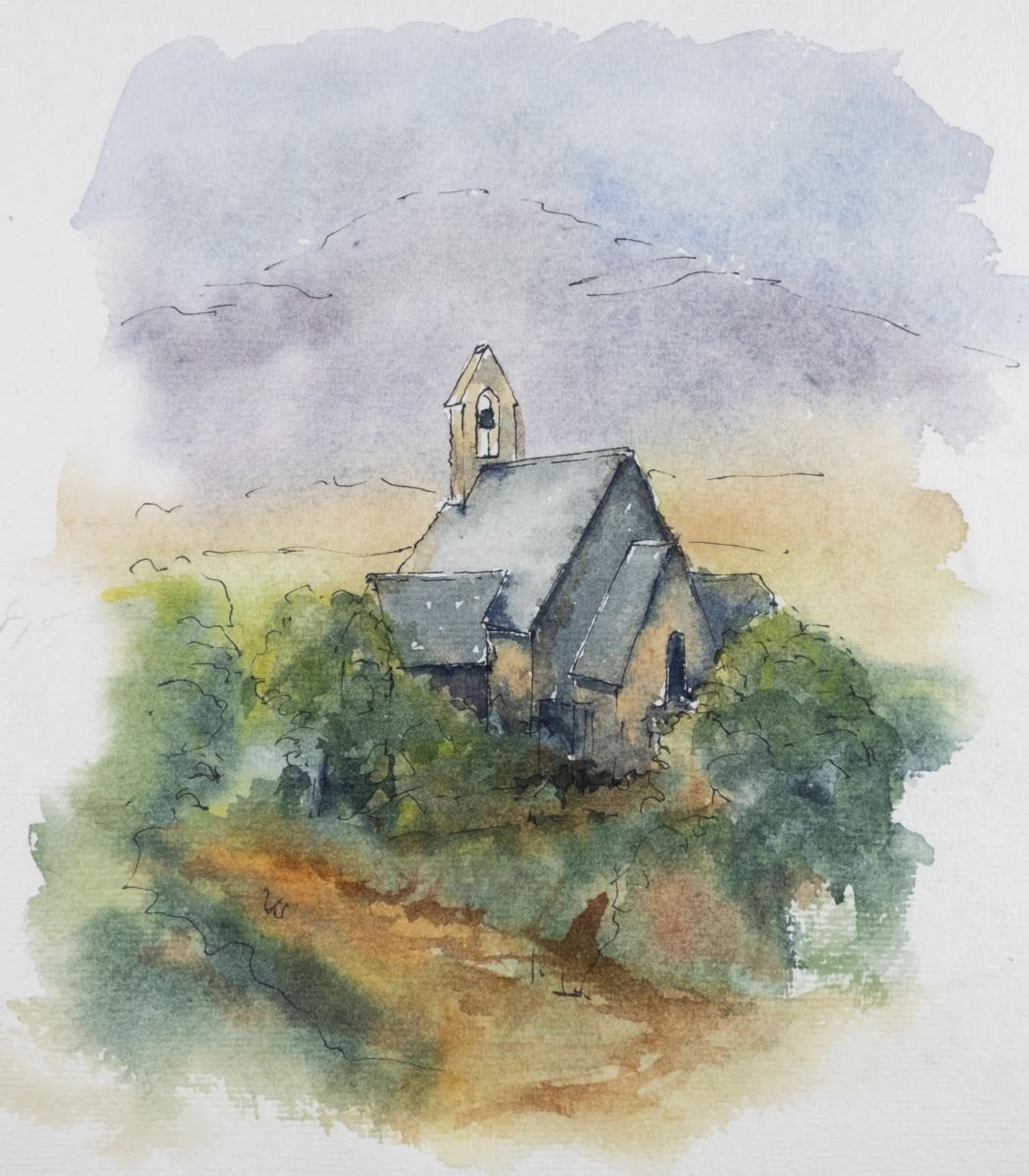
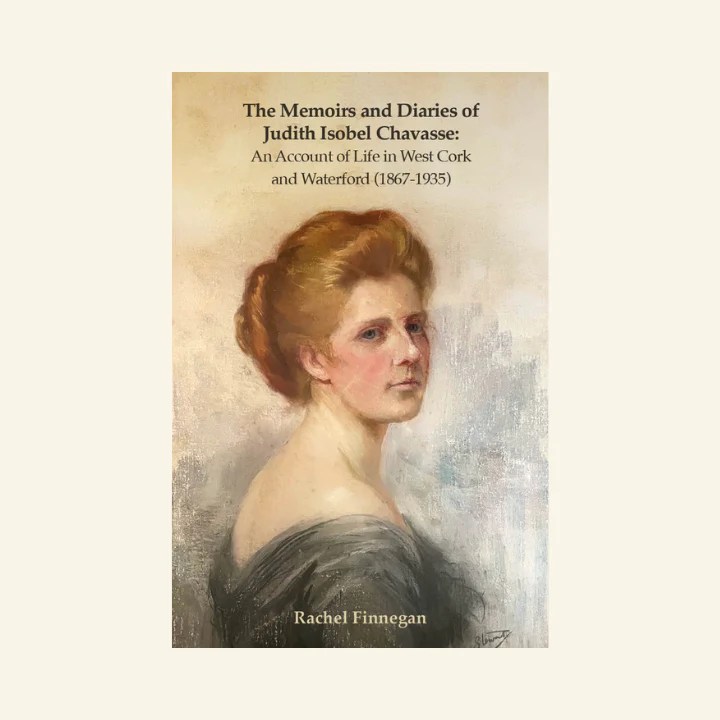
Peter Clarke’s lovely watercolour of the Altar Church is above. Claude was a member of the large Chavasse family associated with Castletownsend and New Court. Rachel Finnegan has written beautifully about the Chavasses in her bookThe Memoirs and Diaries of Judith Isobel Chavasse. Judith Isobel was Claude’s mother, Gabrielle’s grandmother.
I was brought up in the knowledge of the legend that the foot-shaped lake on the mountain was where the Archangel Gabriel had put his foot down on Earth on the way to Nazareth and the Annunciation. My parents often climbed the mountain and they told me that they had often swum in the lake undeterred by its reputation for being bottomless and that, if they went too deep, they might find themselves on the Fastnet Rock!In about 1948, my father took locum summer duty back in his beloved ‘altar’ parish, and so he and my mother were able to climb Mount Gabriel again but now with my sister and me. We all swam in the dark peaty water of the lake, and I remember it well.
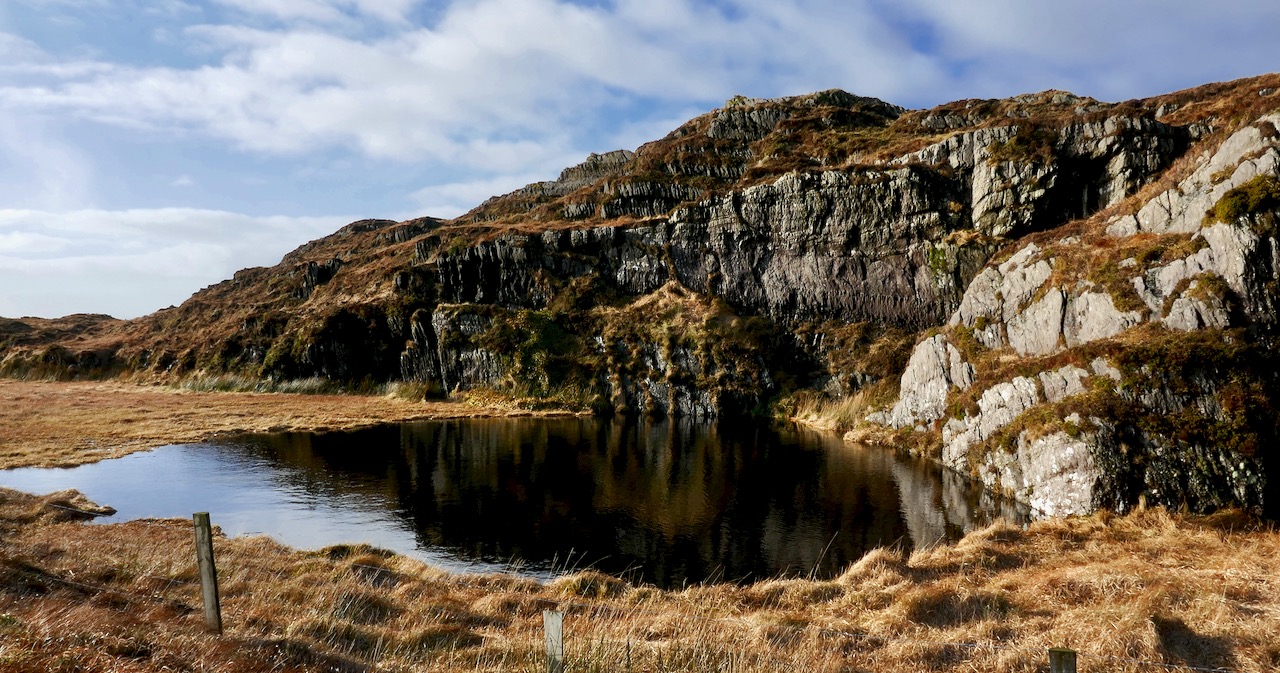
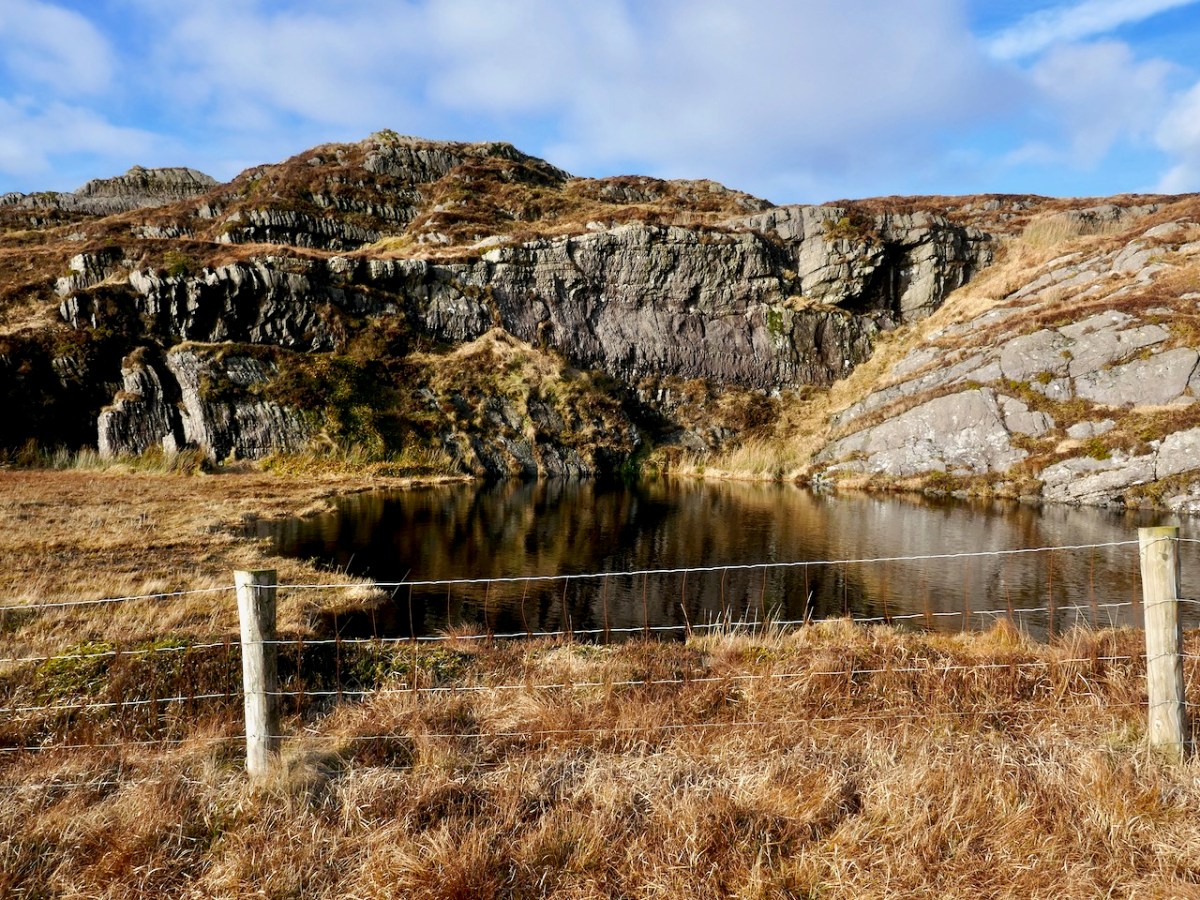
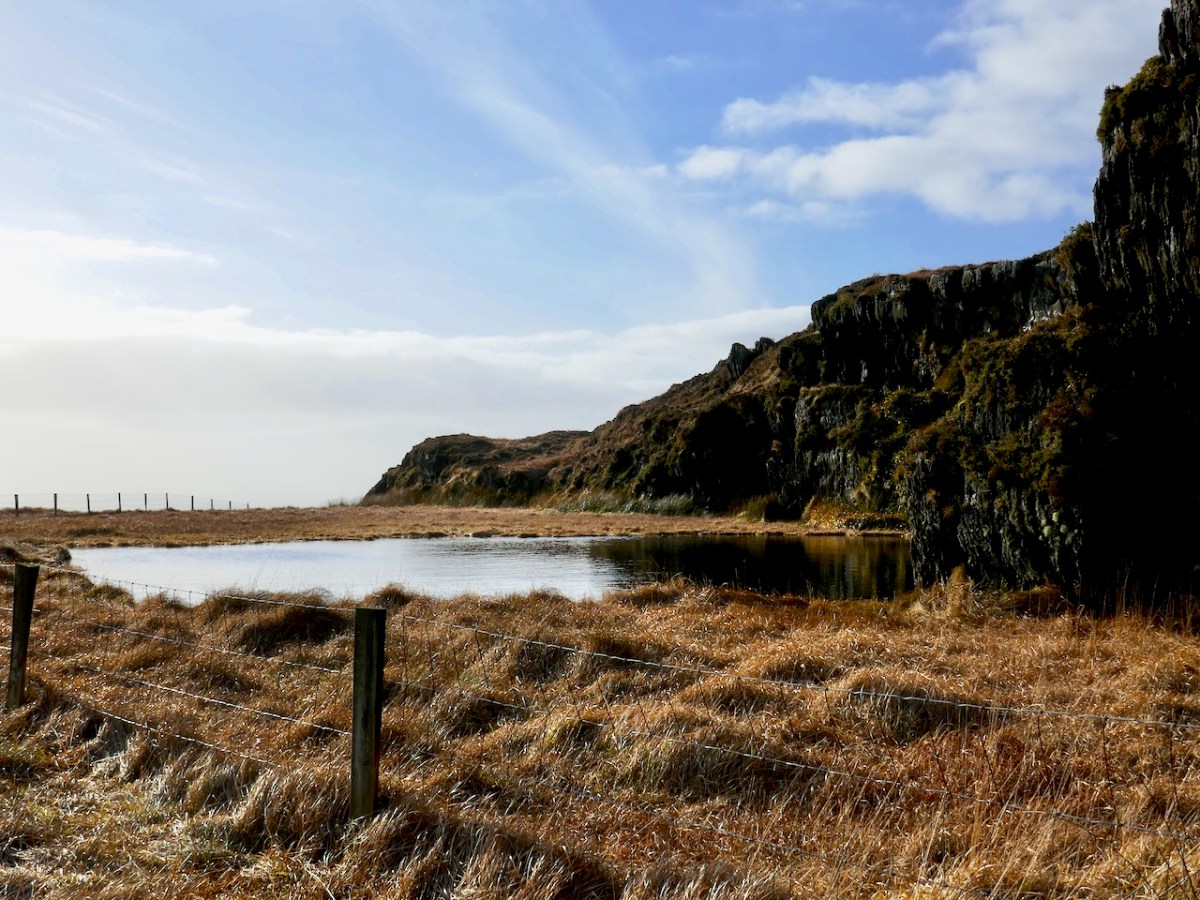
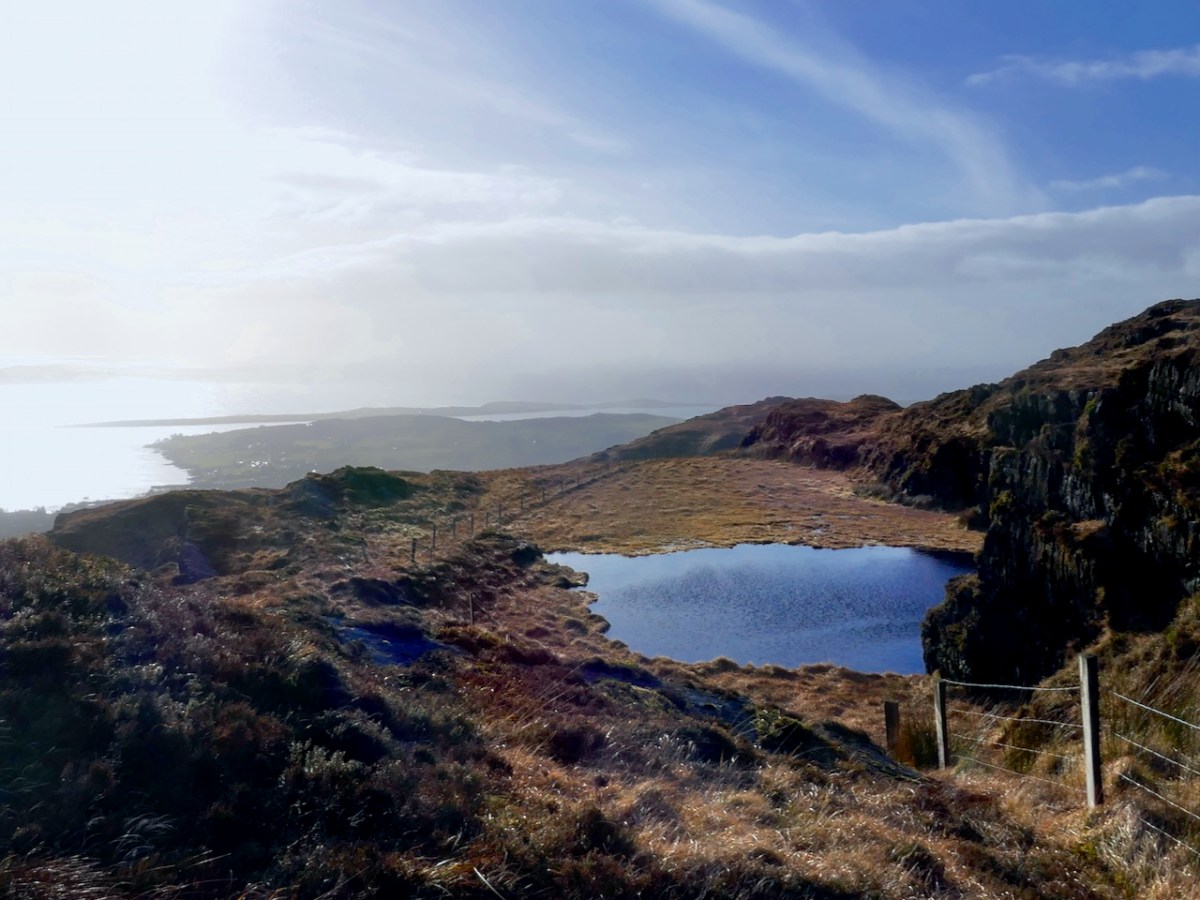
I love that they swam in the lake – it is dark and peaty as she remembers it but so alluring in its remoteness and in how it is contained within a pocket in the landscape with those cliffs in the background.
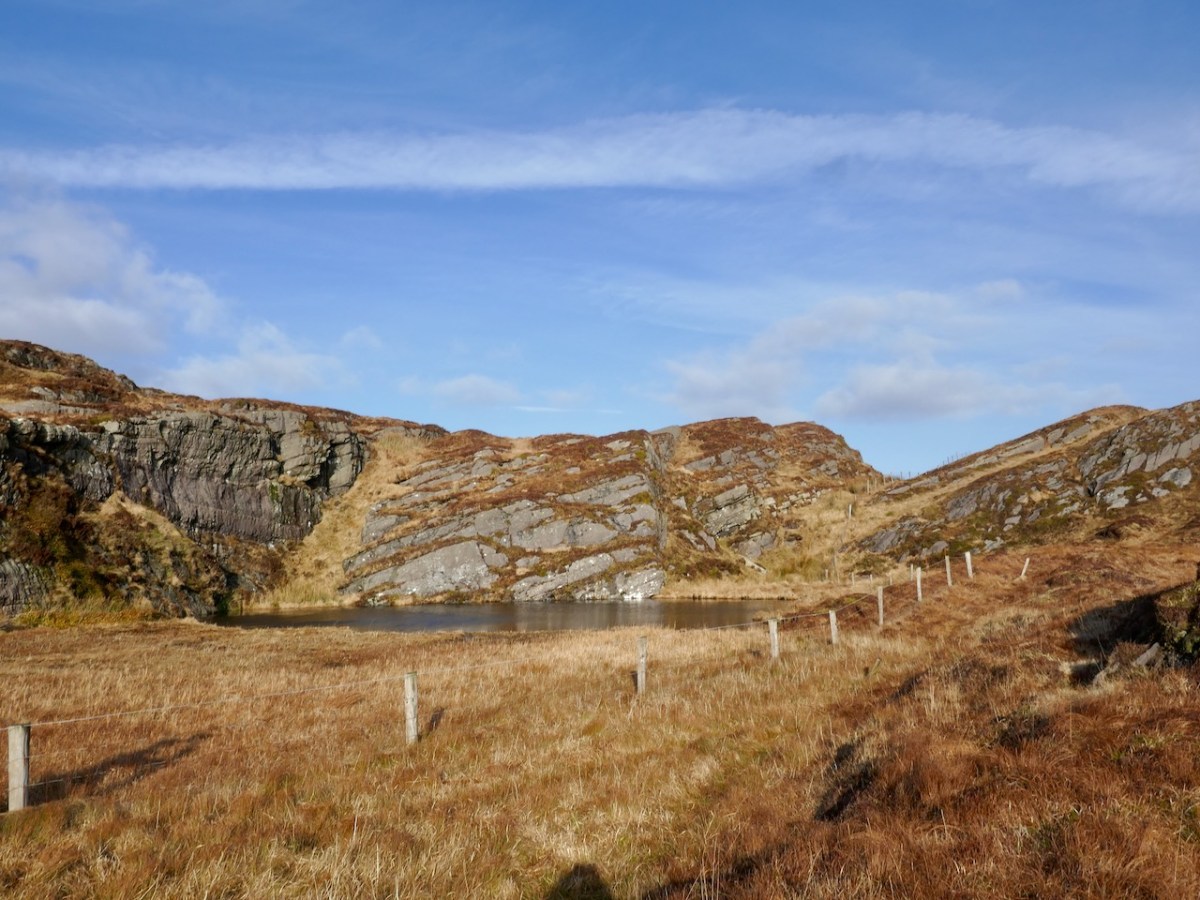
The lake may have been about 6 yards long and not very wide. It is hard to remember dimensions, but on one side, there was the curve as of an instep and on the other was a small steep rocky cliff, perhaps about 8 feet high with delightful little ferns growing in its crevices. There would have been very few tourists in those days, and there might have been a minimal footpath to the lake, but no road, no posts, no wire , all of which appear in more recent photographs.
While Gabrielle remembers the lake as smaller than it actually is (typical of us all) her description of the character of the lake is completely accurate – the ‘instep curve’ and the cliff with its ferns are all clearly visible. The fence with its wooden posts and wire are all much more recent.
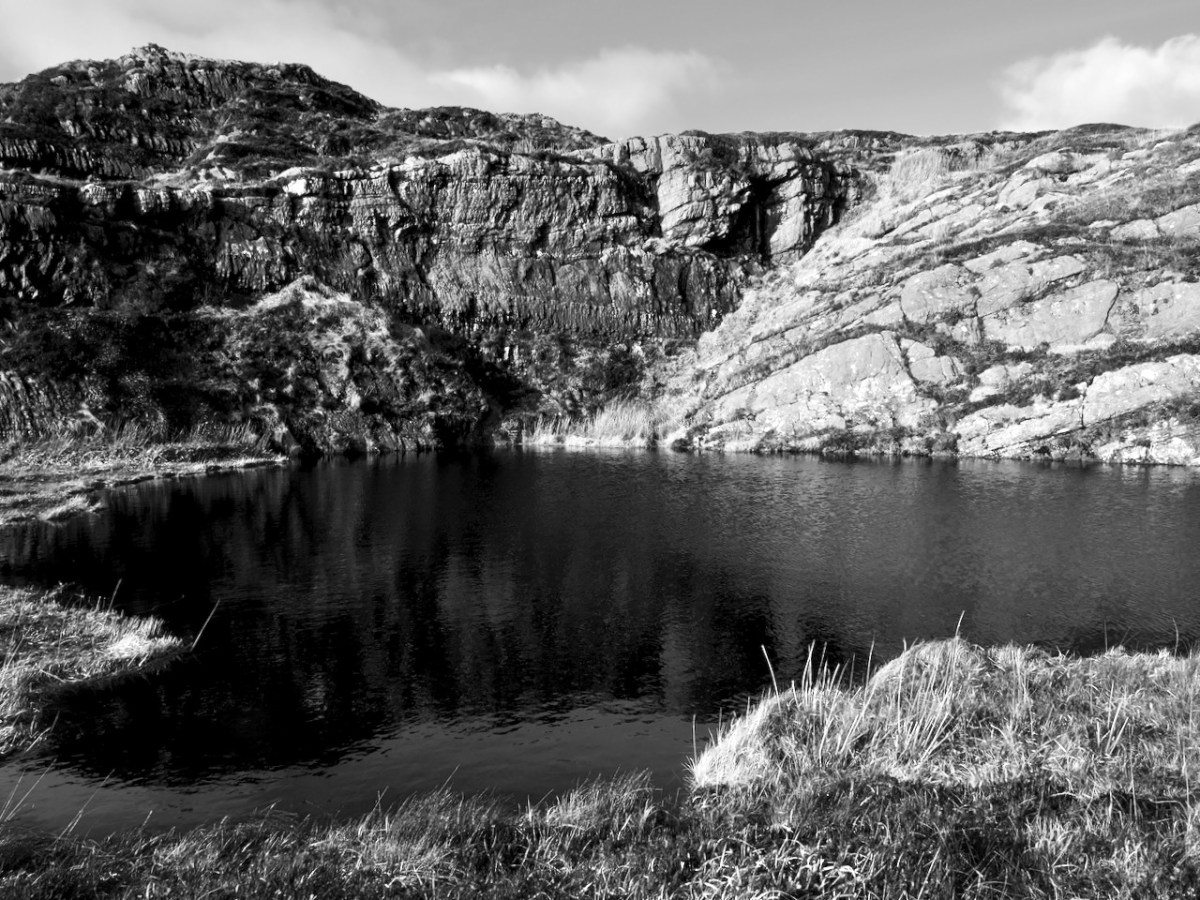
On that occasion, I took a black and white photograph of the lake (with my Brownie Box camera) and entered it in a school photographic competition, but, alas, I destroyed the negative and gave the only print to a friend a few years ago.
I have turned one of my photographs into a black and white image. I understand that Gabrielle’s vision is not good, so Jack will have to describe this to her.
In the early 1980s, when I and my two children were visiting relations (Dr. and Mrs Pearson, staying at Coosheen, Schull), I took my children up Mount Gabriel to visit the lake that was so important to me. We looked in vain. We clambered through thick heather, we climbed over rocks, we sought everywhere near the top of the mountain — I was devastated that we could find no sign of the lake.
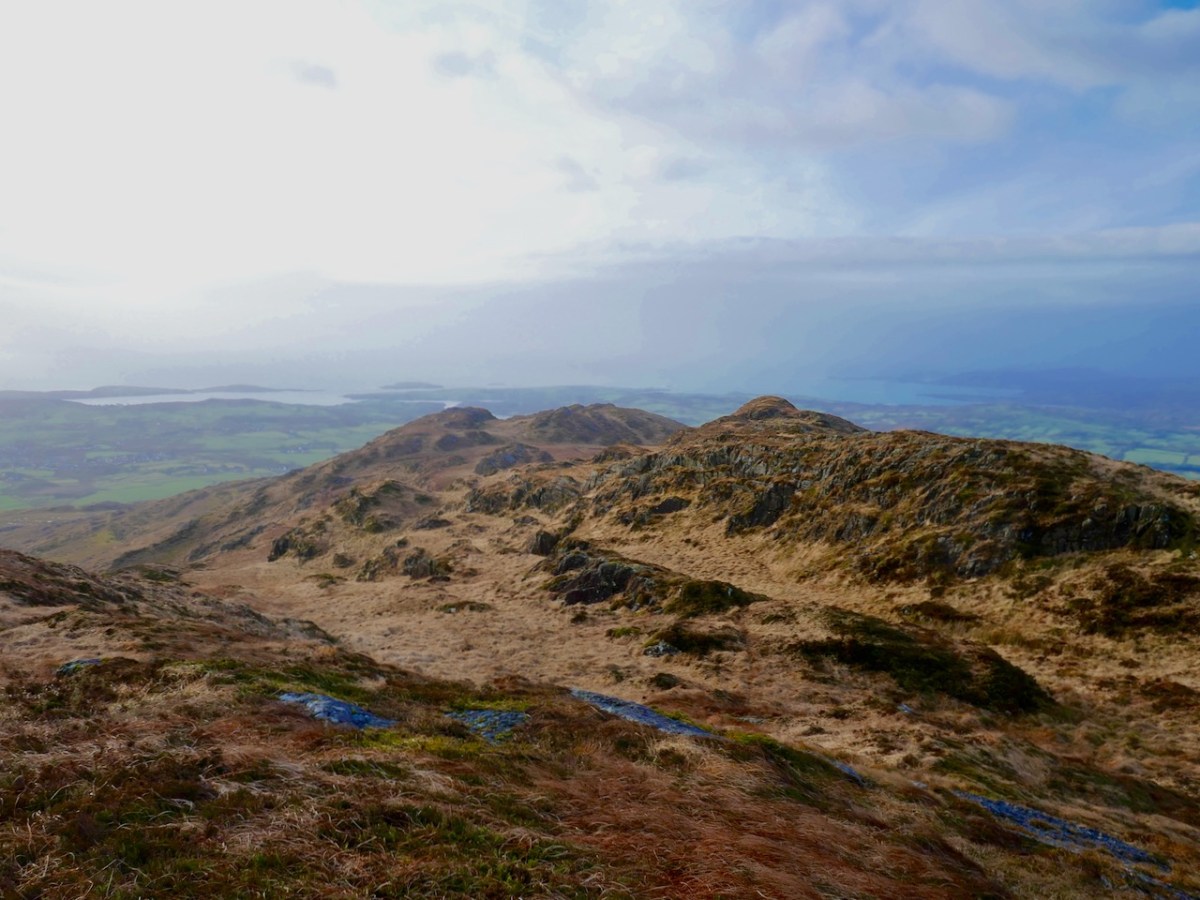
I know that feeling! Robert and I came close to missing the lake too and at one point felt like we might have to be rescued from the mountain while traversing the rough terrain (above). But I can assure Gabrielle that the lake is still there – we did find it eventually.
Straightaway, we climbed back down to Schull and went to the tourist office and asked the official (she was probably in her forties) what had happened to the lake? She asked if we meant the reservoir at the foot of the mountain and said that there was no lake, and she had no idea why the mountain was called Mount Gabriel!
There is a reservoir at the foot of the mountain (below) but of course that is not Gabrielle’s lake.
It occurred to me that the Americans, who were responsible for building a radar tracking station on the mountain summit, and knew nothing of the importance of lakes or legends, had infilled the lake with soil and rocks. It was a spring fed lake and any debris could have blocked the spring, leaving initially no trace of the lake.
This is an important part of Gabrielle’s story for a particularly interesting reason – it is illustrative of the fact that folklore about the mountain did not stop in the 1930s. This belief, that Americans built the dome, grew in the early 1980s as a result of an unfounded newspaper article claiming the installation was part of NATO defences, leading to a group called the Irish National Liberation Army (INLA) bombing one of the domes. In fact, the installations monitor civilian aircraft in Ireland’s upper airspace and have no military function.
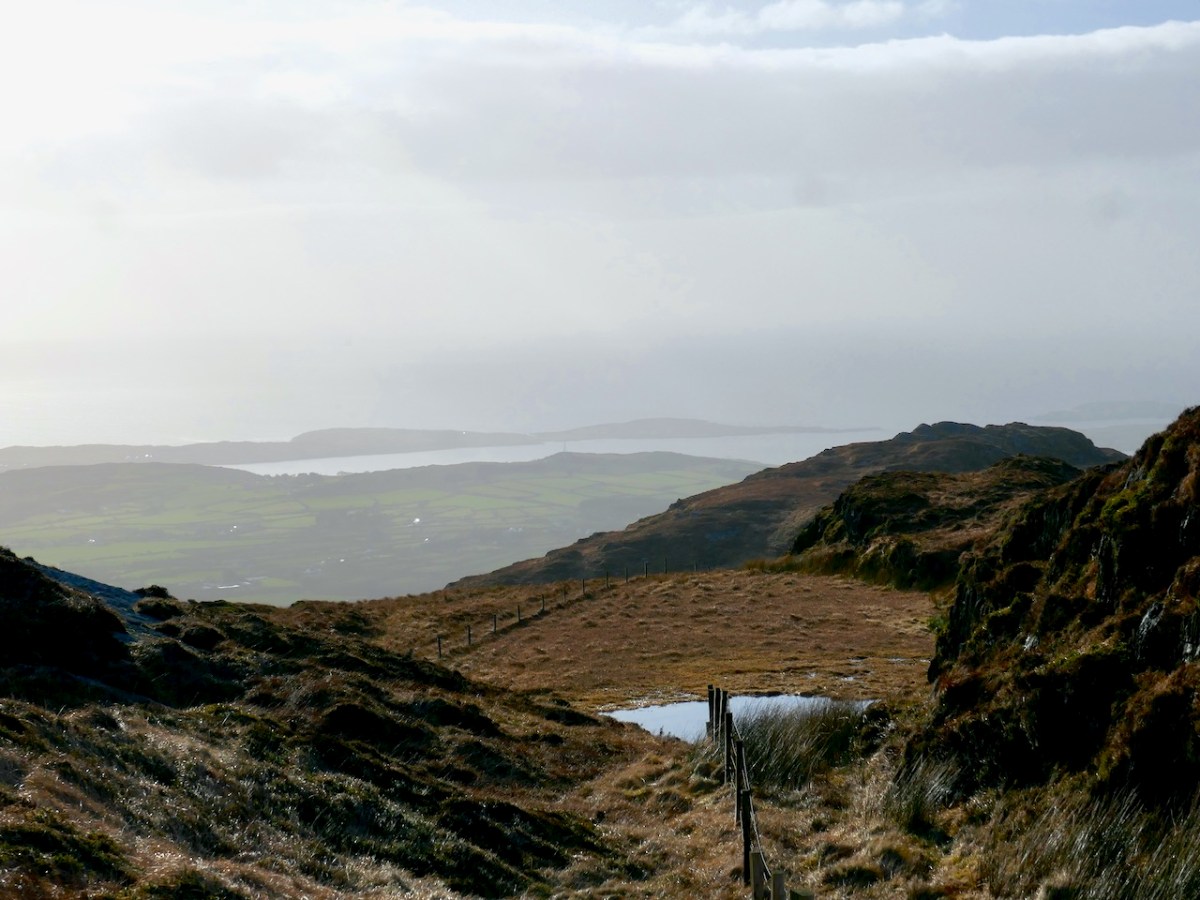
But now, in modern photographs, there appears to be a marshy area with a large puddle in its midst but hardly worthy of the foot of an archangel. Perhaps the puddle will grow larger and will, in time, become a lake again.
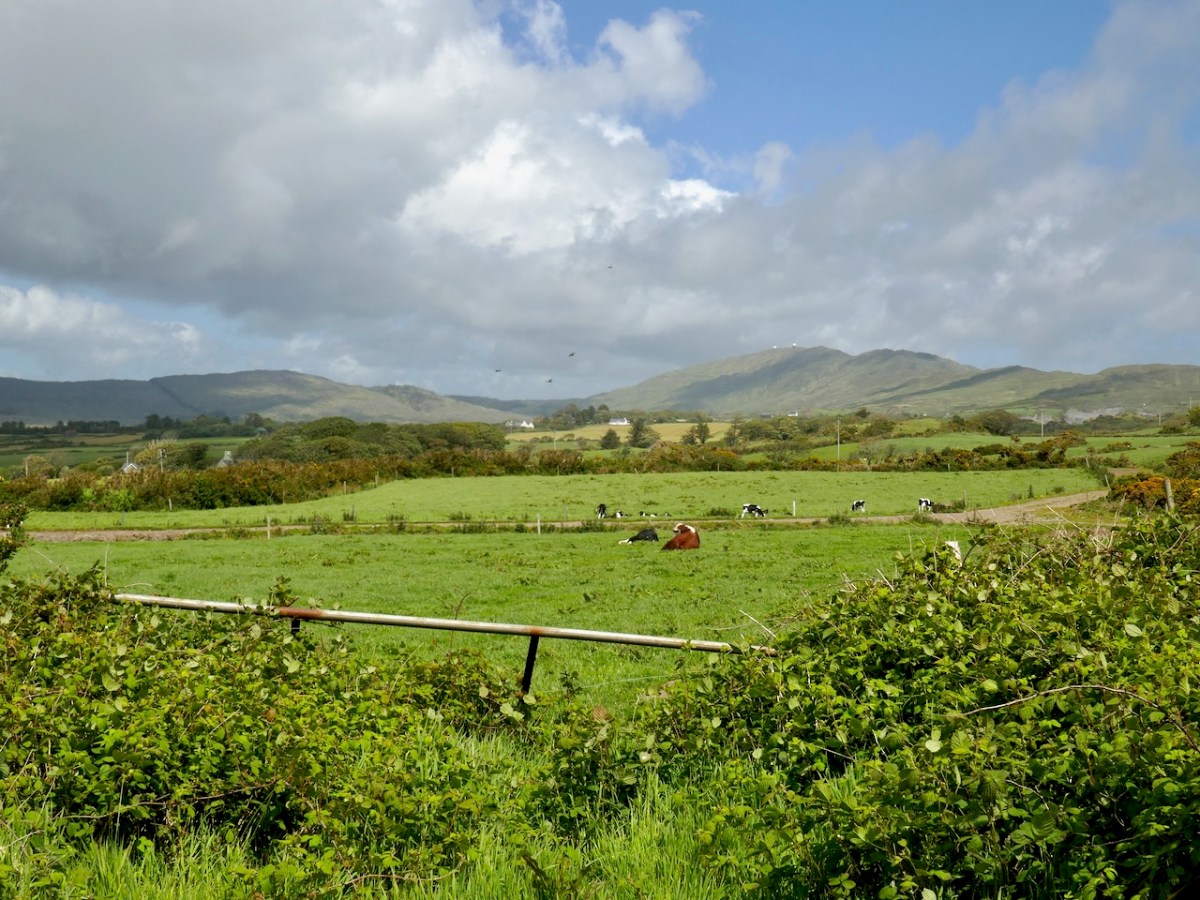
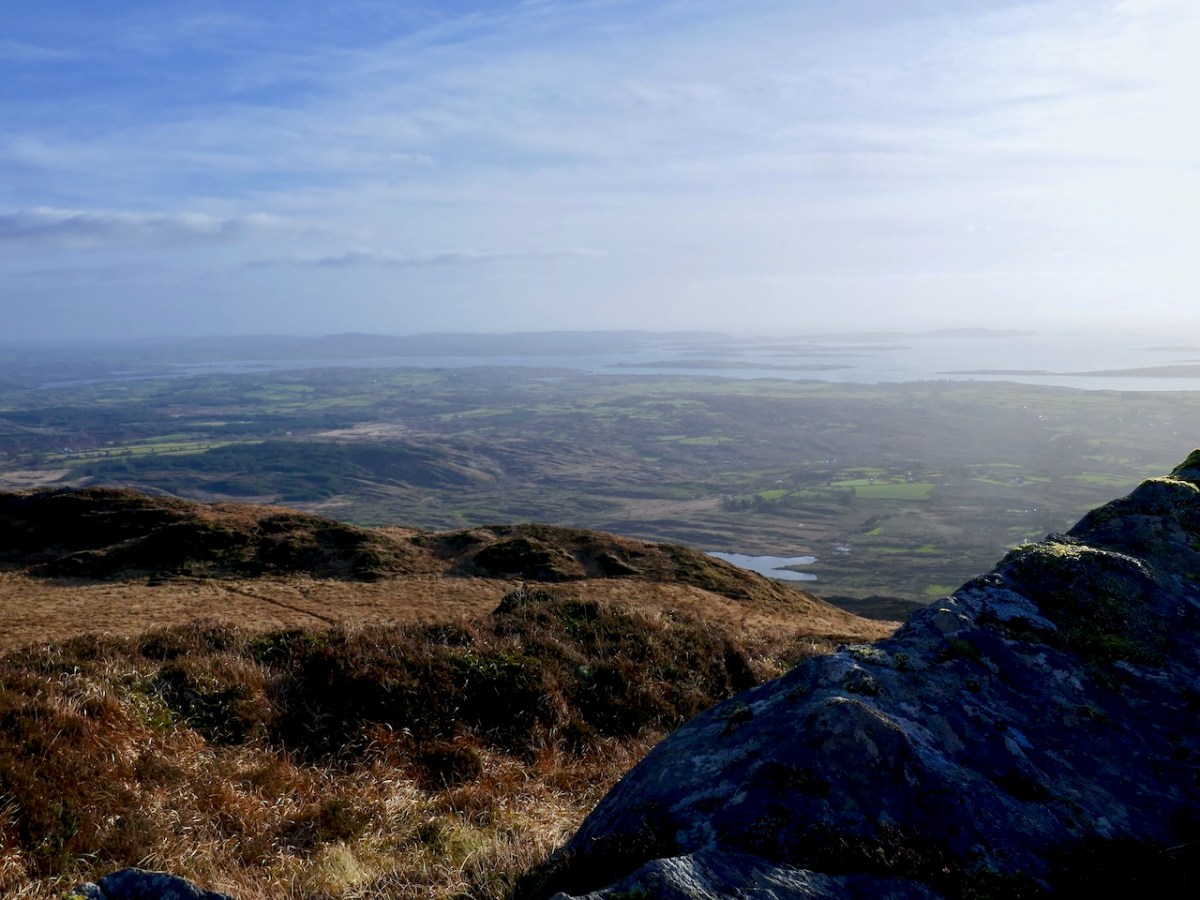
I think this impression is my fault – the photograph below does seem to emphasise a ‘marshy area’ with a puddle. In reality the lake seems to be more or less the same size in the earlier OS maps (dating to the 1840s) as it is now, and that photograph was taken in such a way as to hide most of the lake. I think I was just trying to show the location in relation to the sea and the islands in the distance.
Perhaps the photographs below help to correct that impression.
In my original Legends post, I wondered about the schoolgirl, Julia Creedon, who wrote about the lake in the 1930s and said Although she may have faithfully reproduced the essence of the story she heard from Dan O’Sullivan, her own abilities are very evident in this story, as is her immersion in reading other stories in this genre. Did she become a seanachaí (a story teller), or a teacher or a writer?. . . If she were still alive, she would be in her late 90s now.
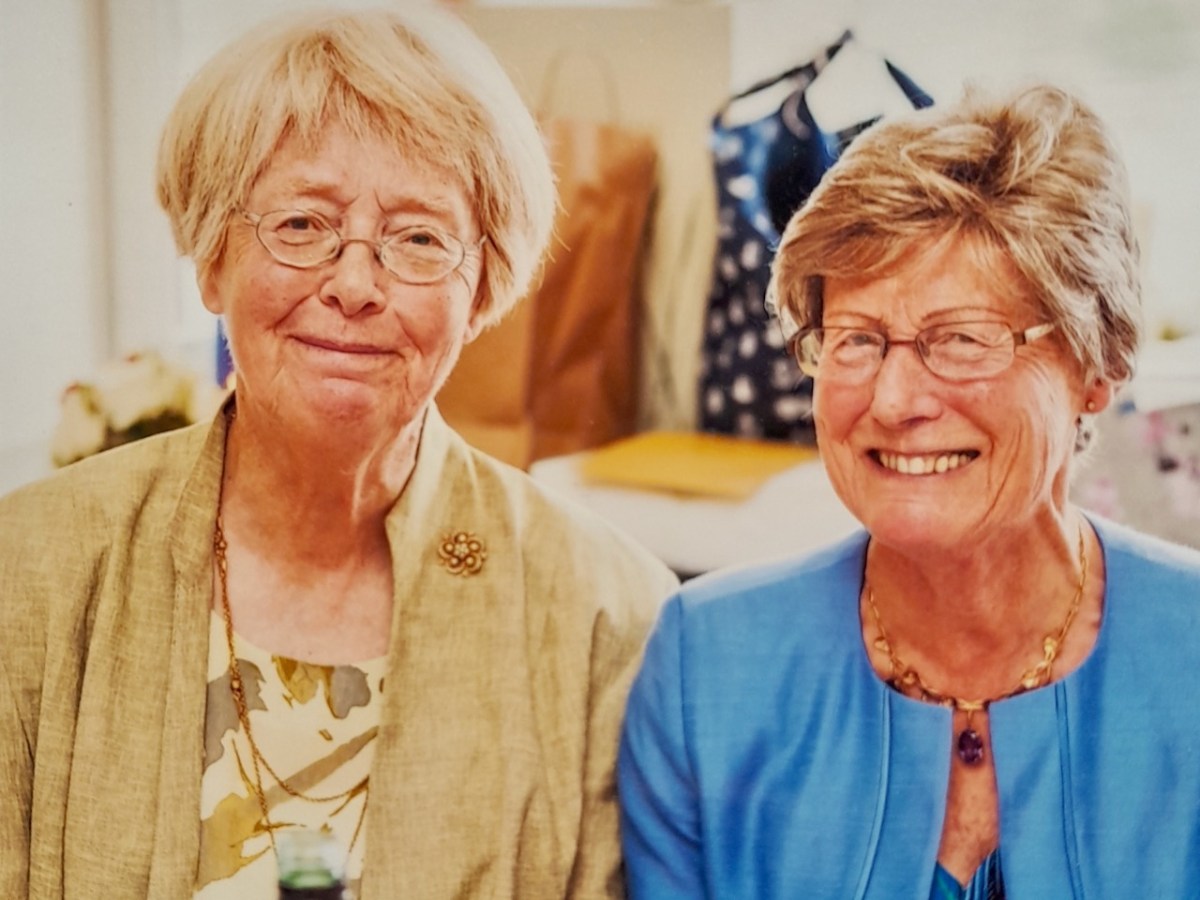
How wonderful is it, that just five years later, I have a reader in her 90s with her own living memories of the place. And here is Gabrielle, on the left, with her sister, Judith.
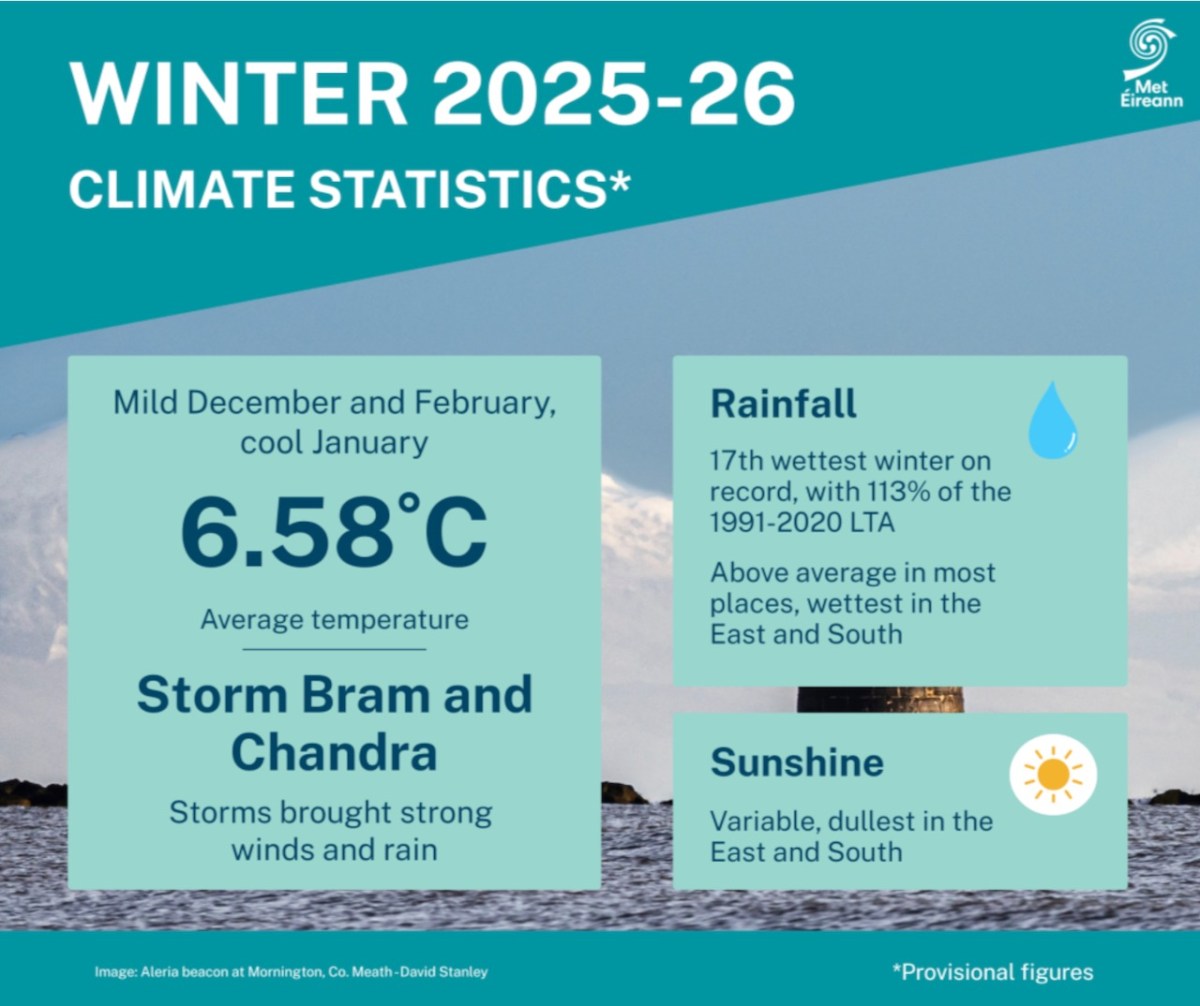
It’s not my imagination – we did indeed have more than average rainfall this winter, according to Met Éireann. It felt relentless and it just stopped the other day.
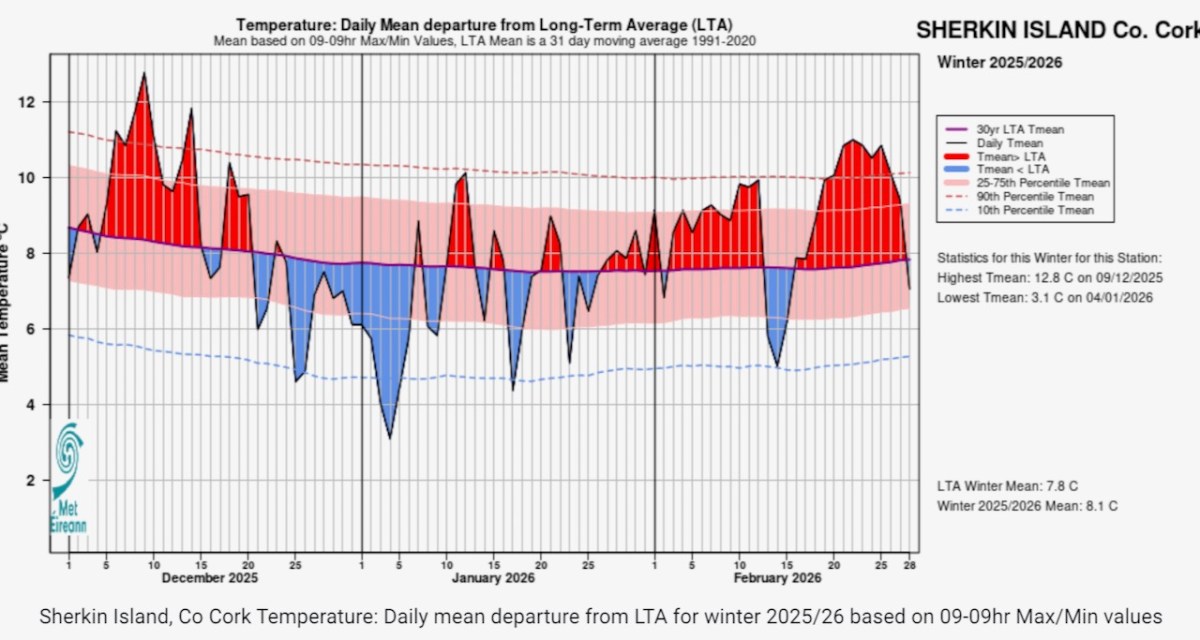
I am, apparently, wrong that the winter was also colder – above average temperatures resulted in the 20th mildest winter since 1990. It didn’t feel like that, though: looking at this chart from Sherkin Island shows lots of below-average spells, while Dublin airport had its ‘dullest’ winter since 1994.
So on Friday when my forecast app showed sunshine all day I headed out into this unexpected and most welcome balmy weather, pointing my car towards the end of the Mizen. As I drove I couldn’t help thinking of the story by Ray Bradbury, All Summer in a Day. It’s set on a colonised Venus where it rains constantly, and the sun emerges for only one hour every seven years. You can read it here, if you don’t know it, or watch it here, but be warned it’s very sad.
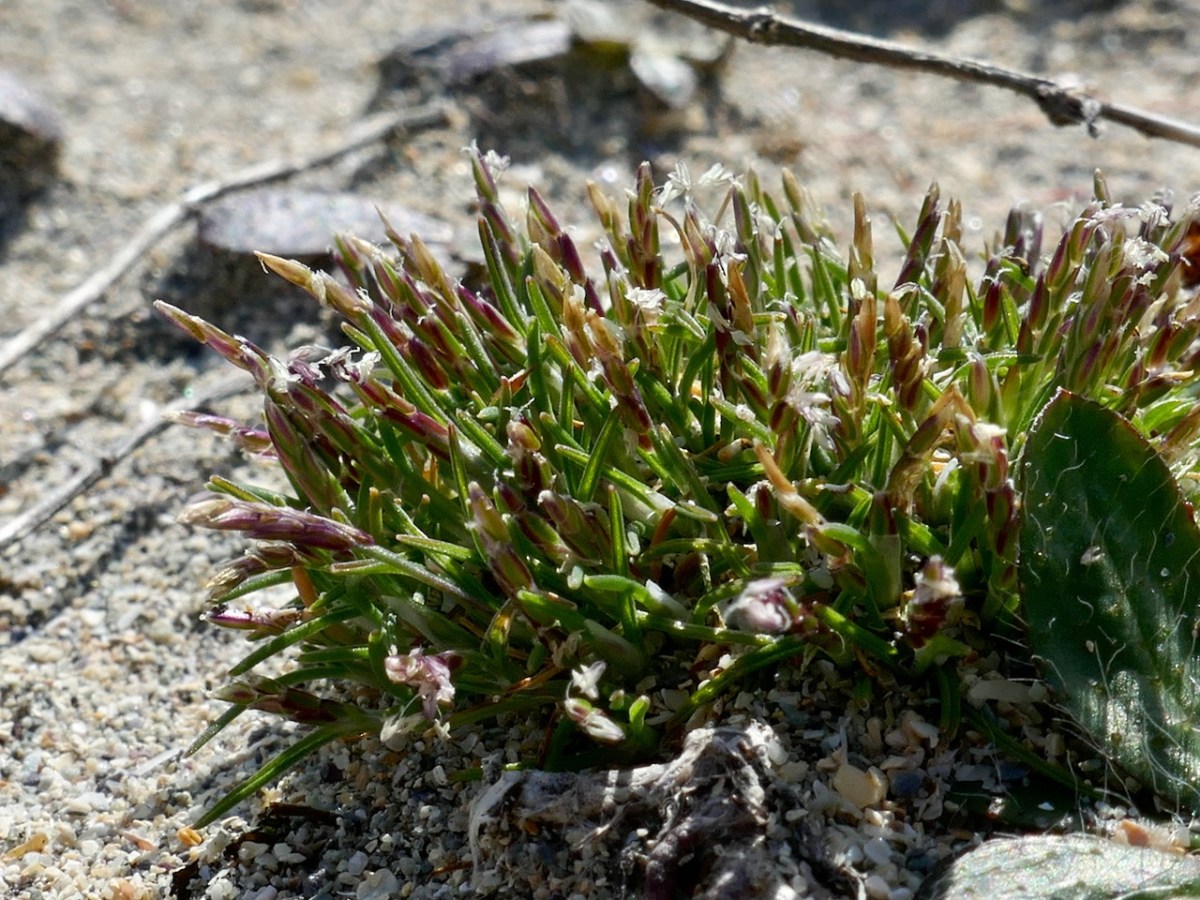
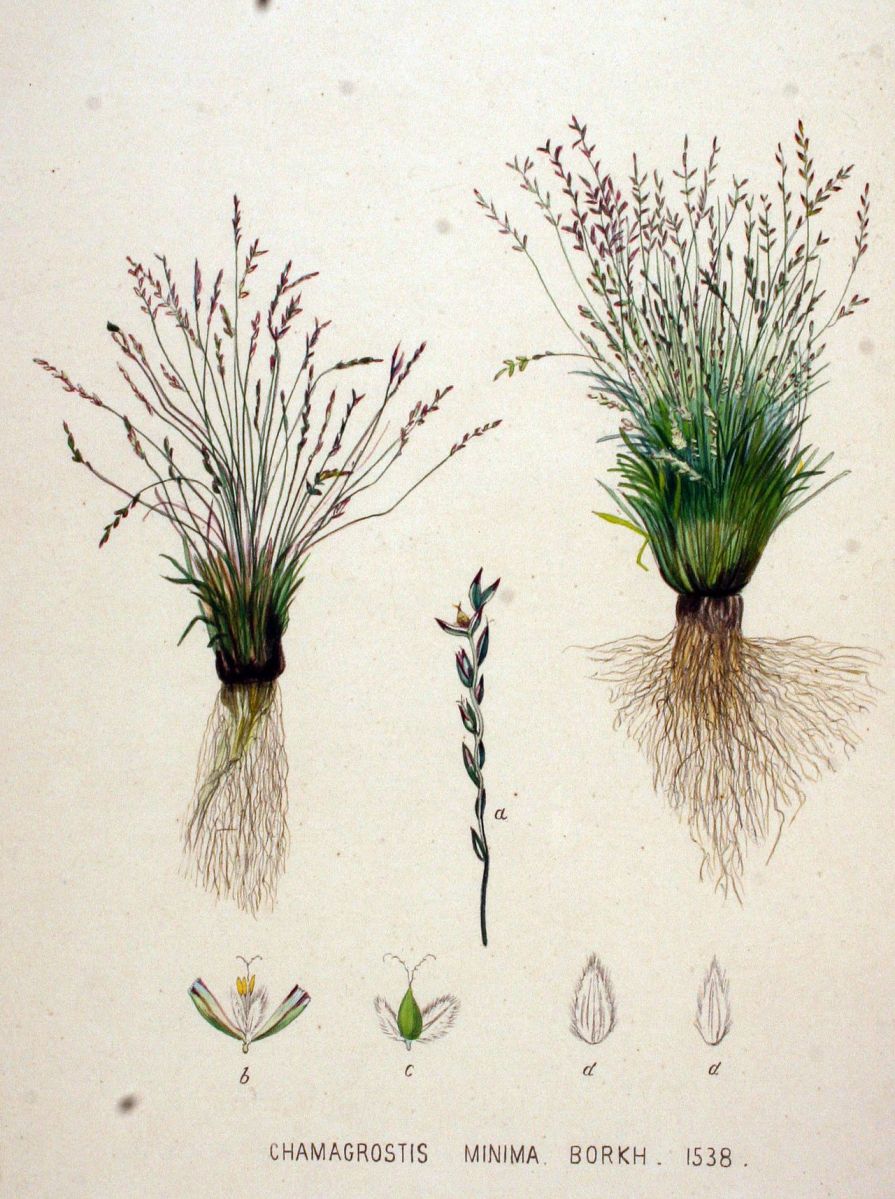
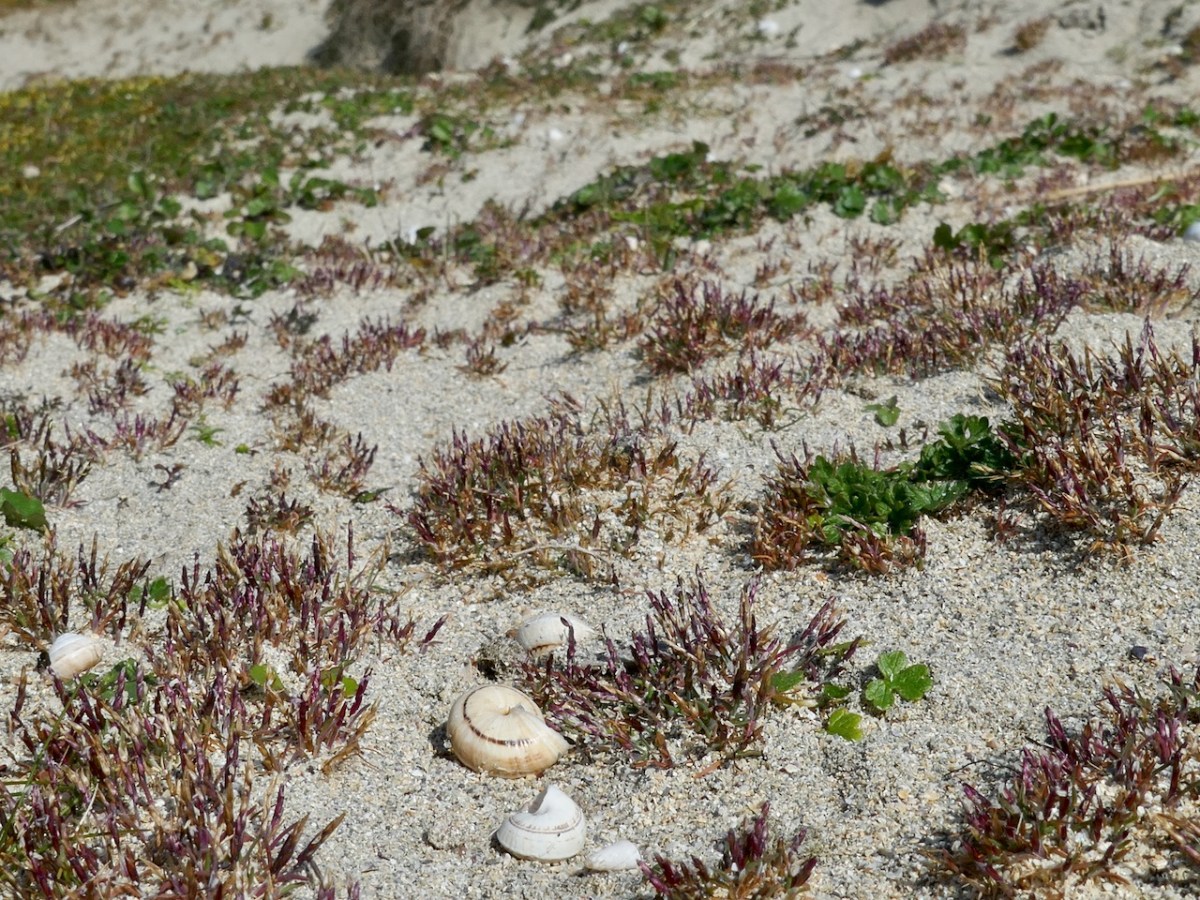
My immediate goal was to do my rare plant count. As I have related before, I monitor several rare plants for the Biodiversity Data Centre, and the one that comes up earliest is the least visually exciting. In fact, it would be hard to imagine a more homely little plant than Early Sand-grass (Mibora minima for the true botanists among you), although this illustration makes it look quite attractive*.
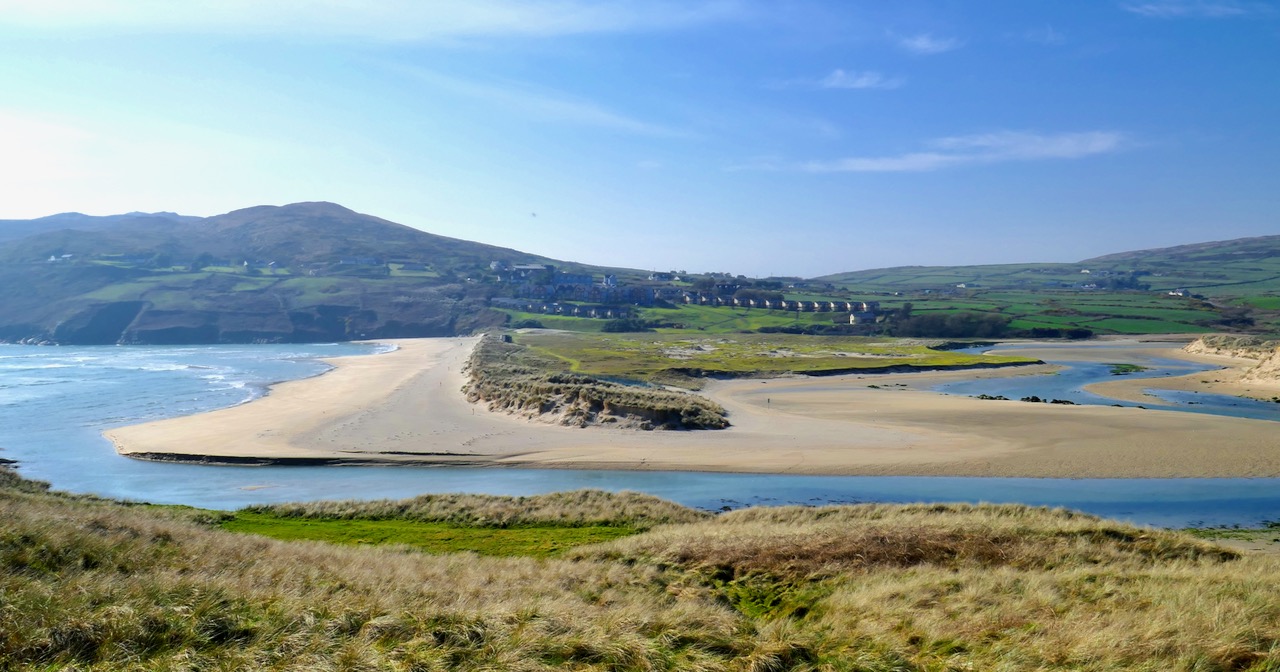
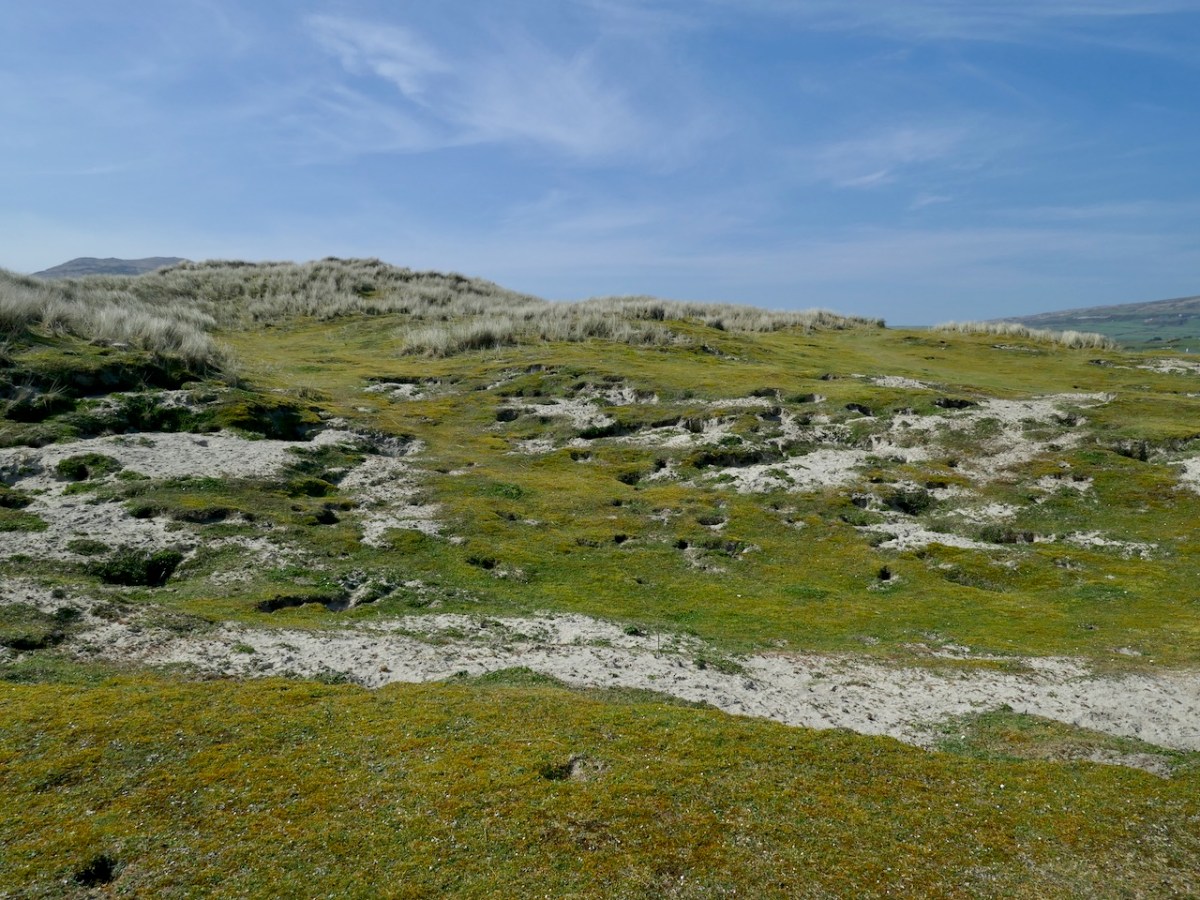
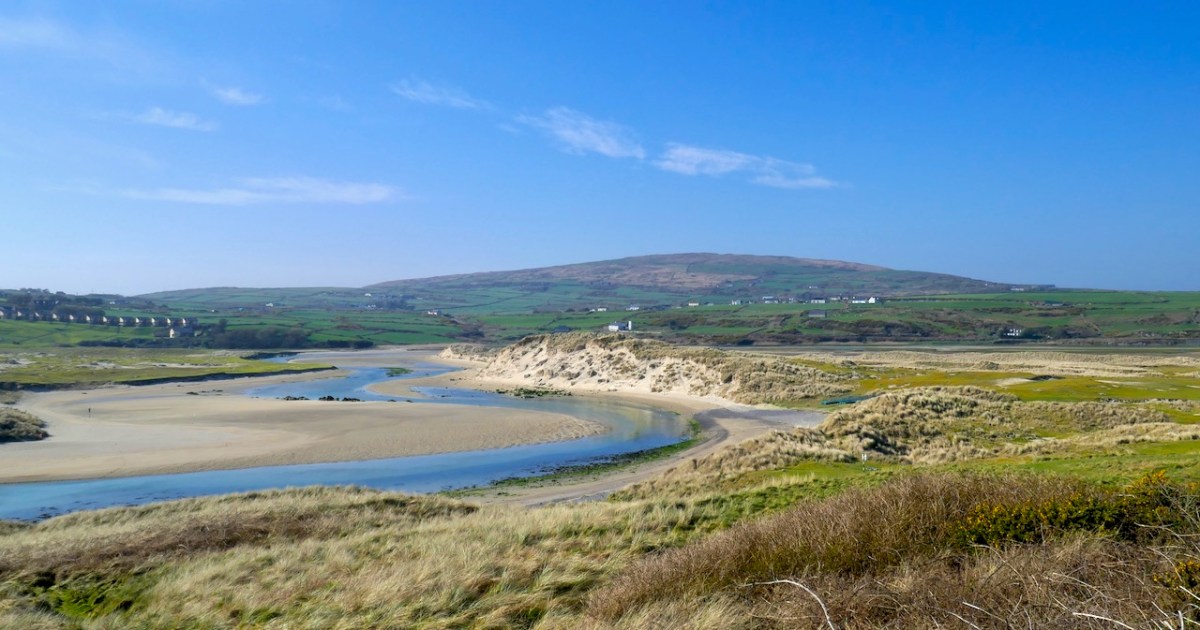
Spelled several different ways (one word, two words, hyphenated) this is one of the smallest, if not the smallest, grasses in the world, it is only found in Ireland in the dunes at Barley Cove and on Bull Island off the coast of Dublin. I volunteered to count it in 2022. So this is my 5th year observing it and I can say that it is holding its own and perhaps even expanding its range slightly each year.
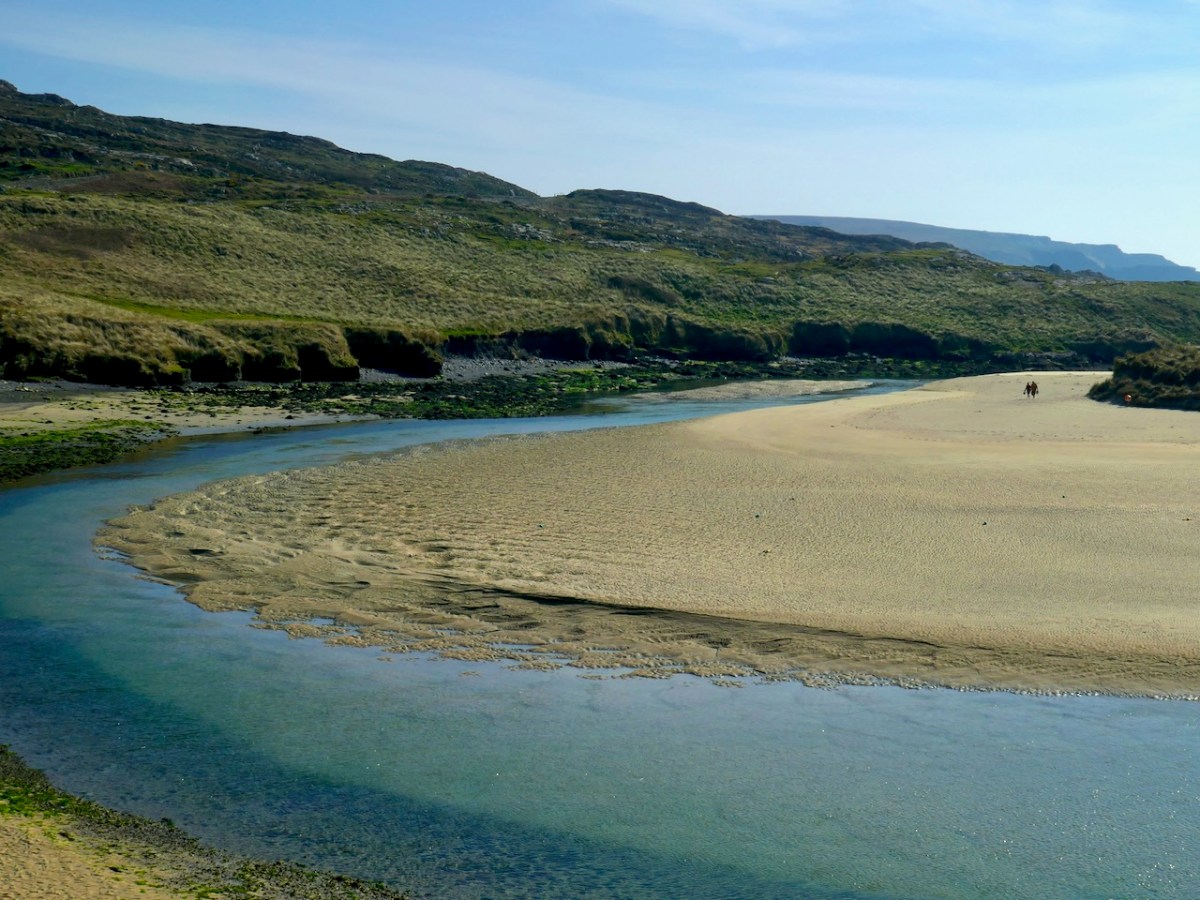
Seeking the plant involves walking slowly through the dunes with eyes always down and when I finally came up for air it was to realise that I had one of those days that often happen after extended periods of bad weather when the colours seem to spark off each other and the land and the sea provided a glorious panorama of hues and contrasts.
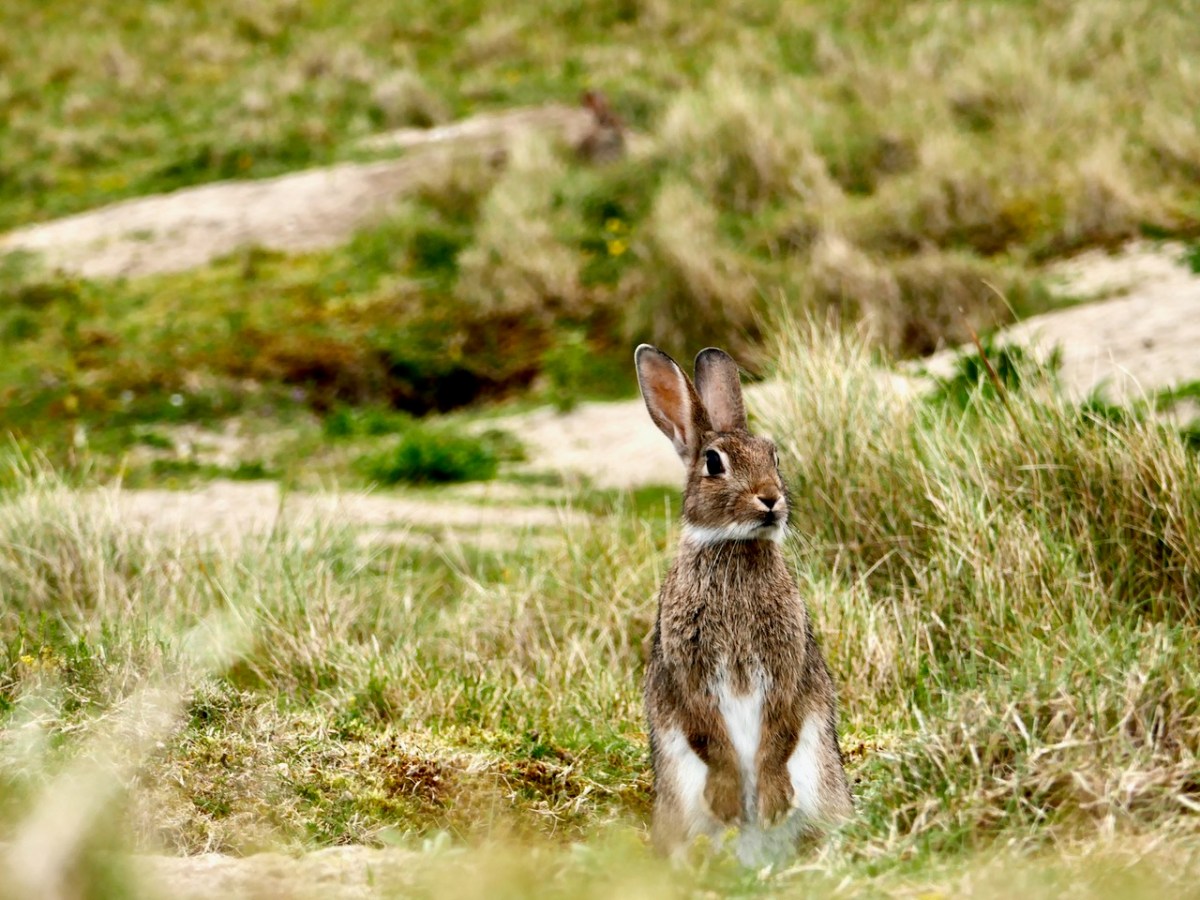
I also noticed what I think was quite an increase in rabbit activity on the area of the dunes I was traversing. Rabbits are both a blessing and a curse for dunes – see my post The Bunnies of Barley Cove for what I mean by that. The warrens can destabilise the dunes but on the positive side for my plant specifically, rabbit grazing keeps competitive grasses and coarser vegetation down, which can favour low-growing specialists that would otherwise be shaded out. Their burrowing also kicks up new patches of sand to host the Sand-grass.
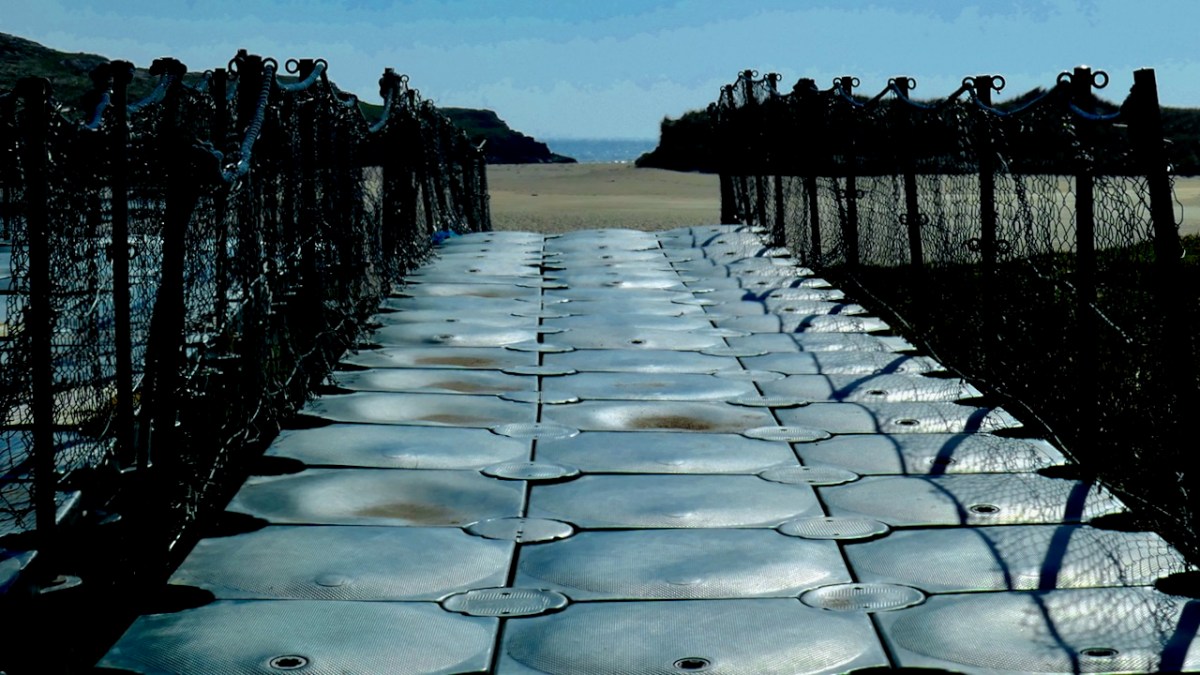
The path from the car park (I was the only car there today for a time) ends in an innovative pontoon footpath that allows access across the backchannel to the front dunes.
The pontoon is pulled up all winter and it hasn’t been re-set yet. There’s another way down, though, from the hotel at the far end, and it was good to see a couple enjoying the sensation that only walking on a beach barefoot provides.
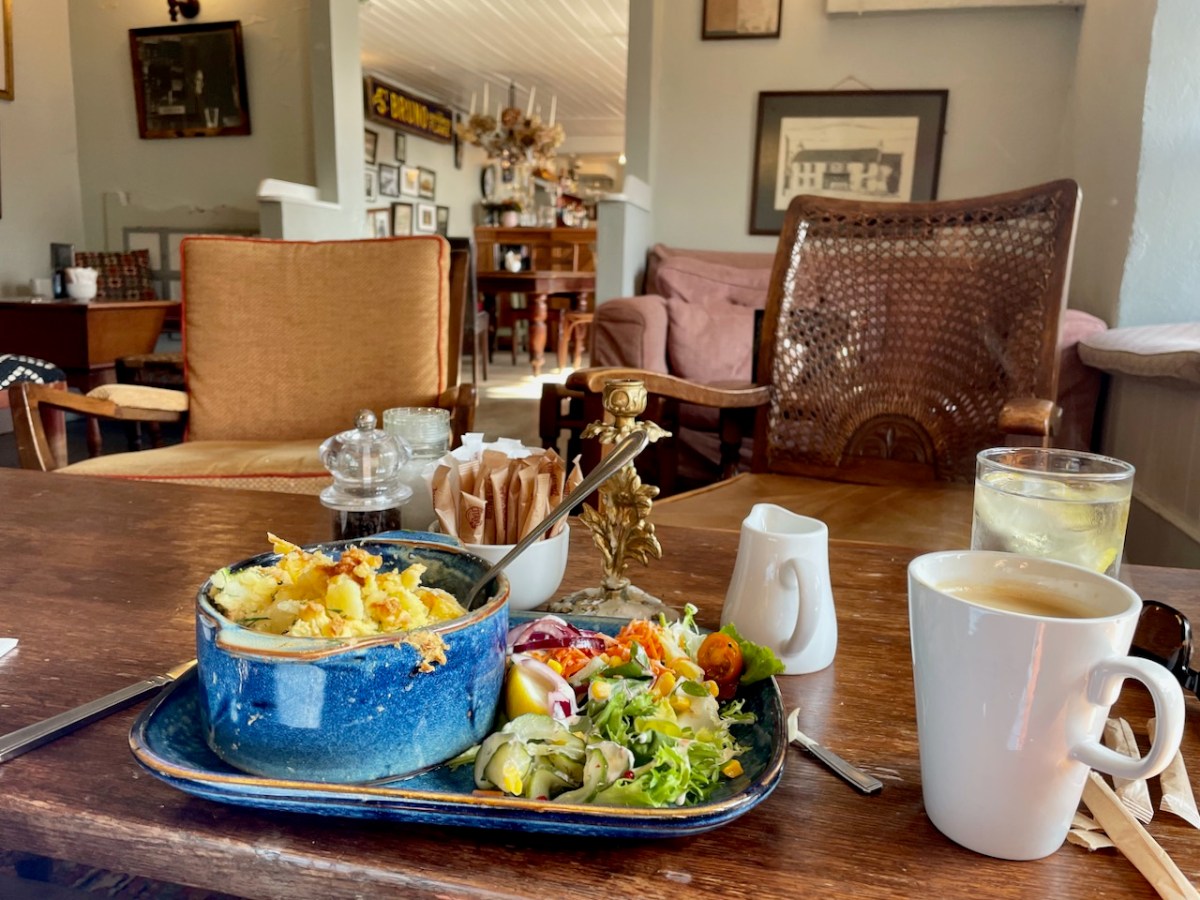
Having finished my count, I drove around then to Crookhaven and since it was lunchtime of course I had to stop at the iconic O’Sullivans pub, currently undergoing renovations and operating out of Nottage’s. (Fish pie to die for and a large americano, if you must know.)
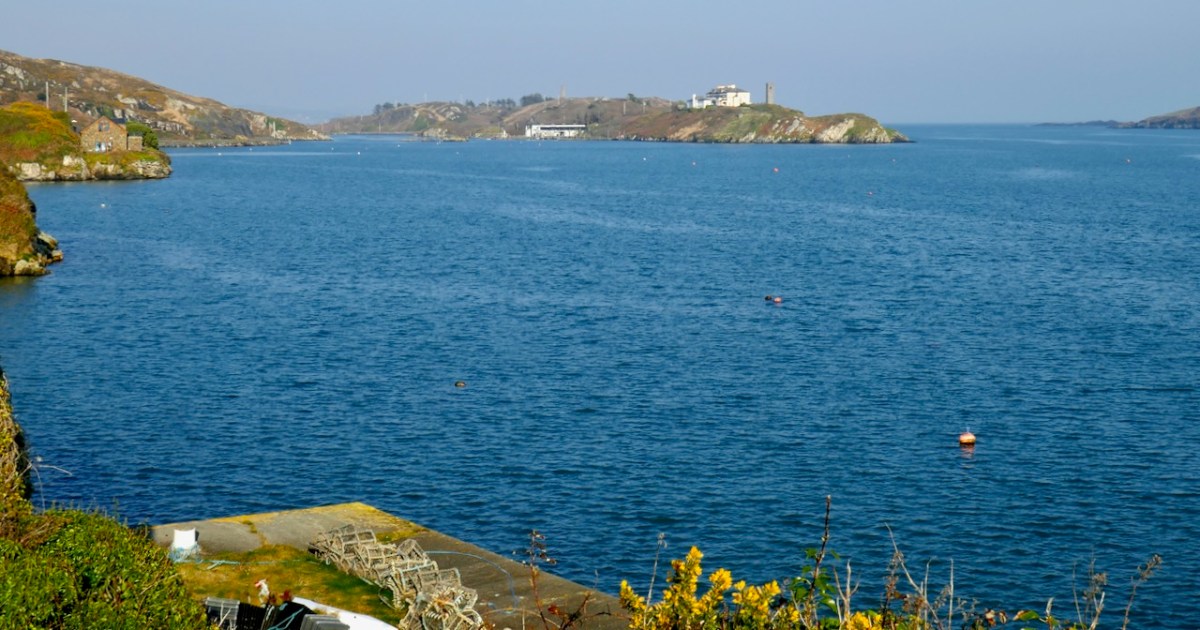
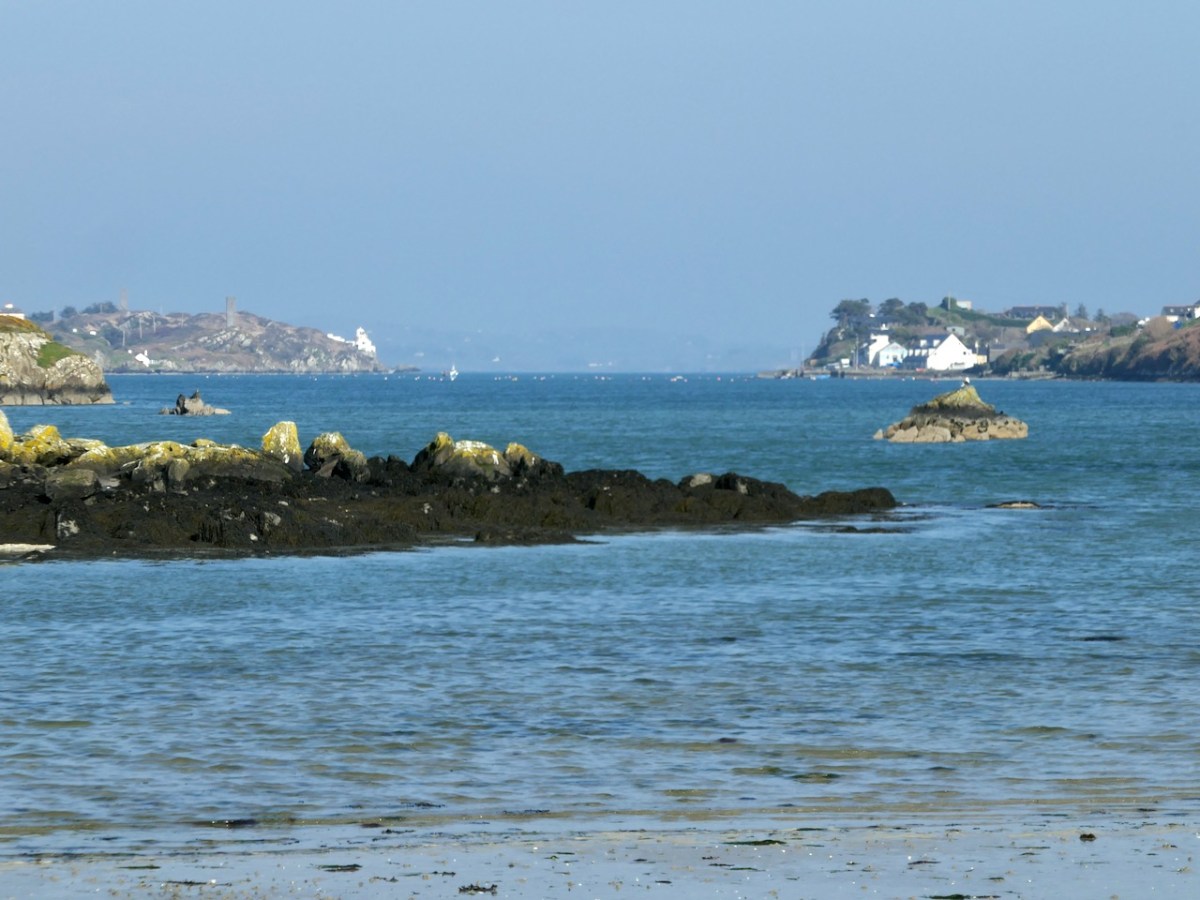
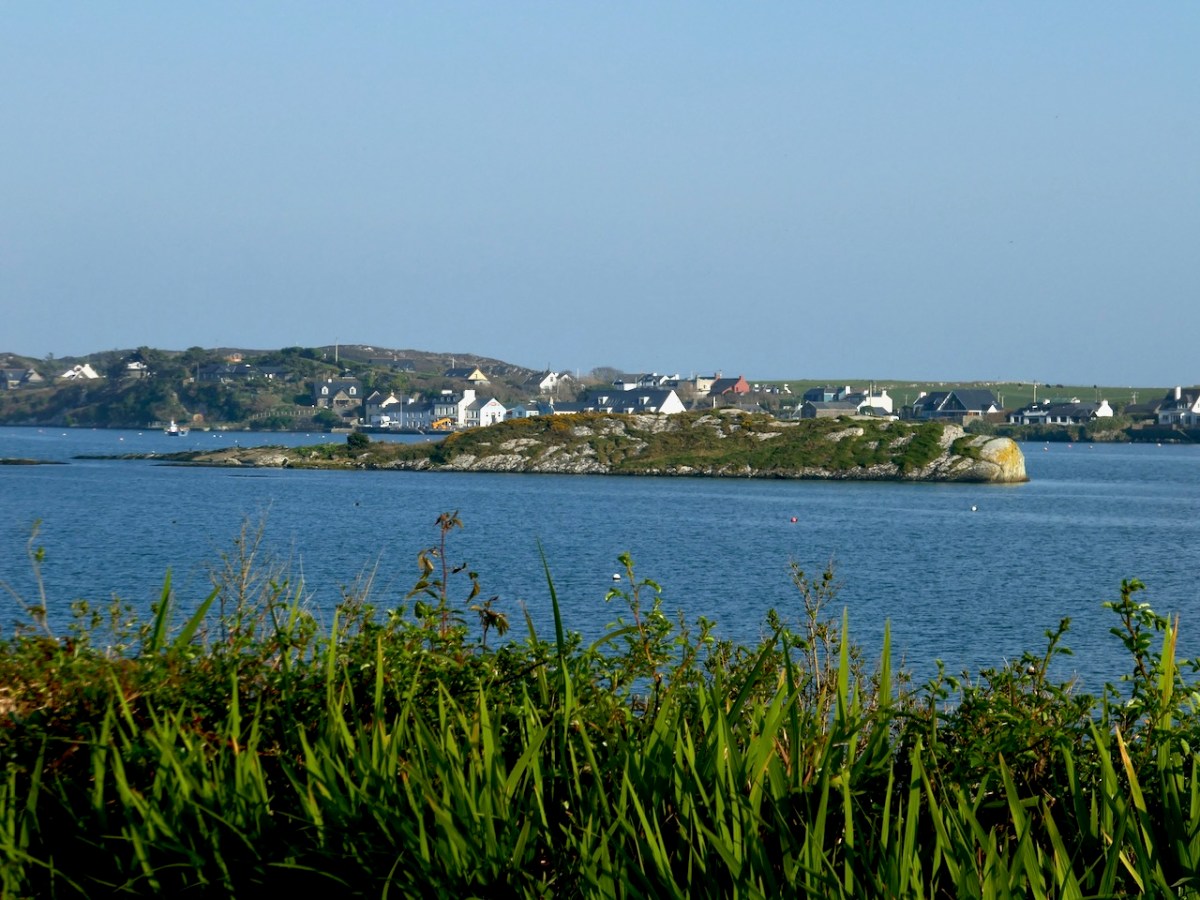
Surely this is one of the most scenic villages in Ireland. Hard to believe that it was once so busy that it was said you could walk across the harbour from ship to ship.
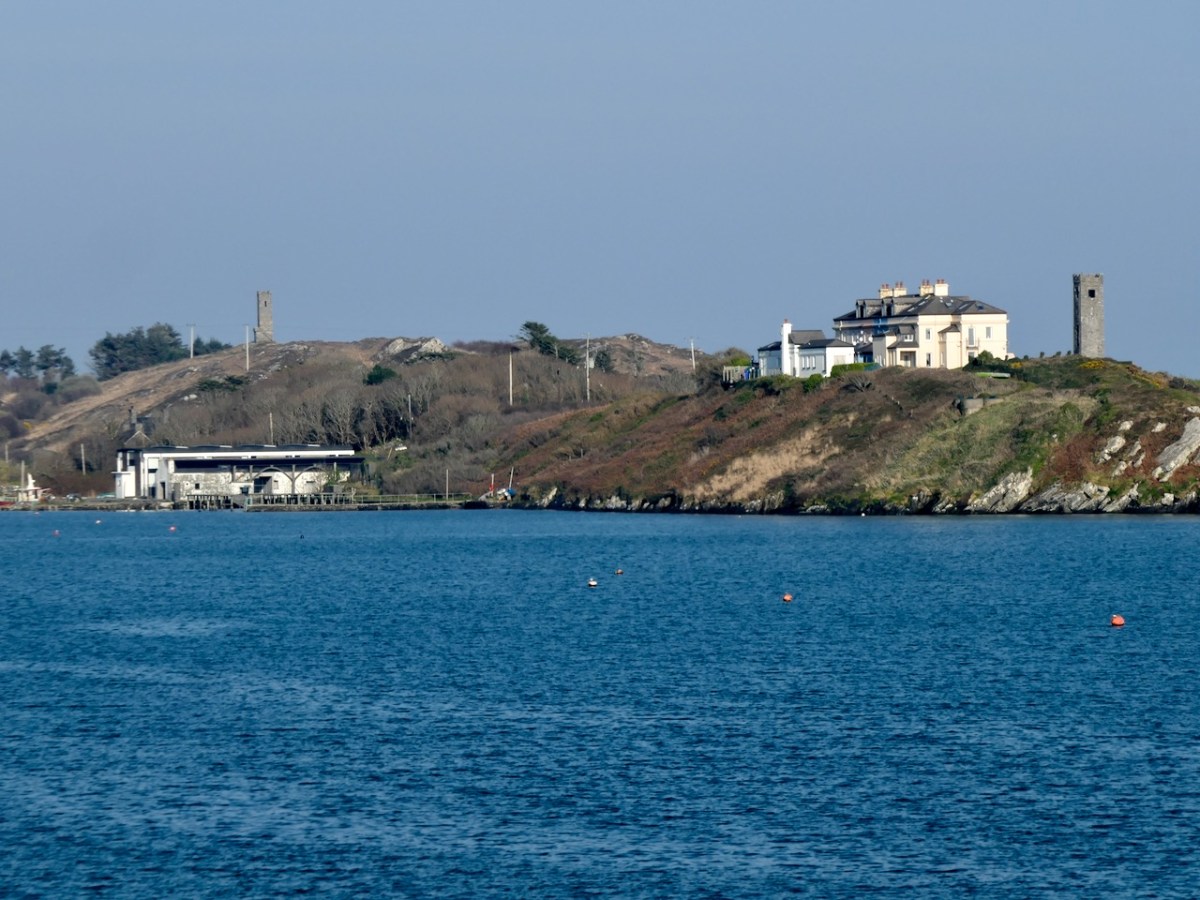
The two tall skinny towers on Rock Island are testament to that – this was where pilots could get a good view out to sea so they could send their boats out to guide ships safely into harbour. They may also have been used, according to one authority, for reporting ship movements to Lloyd’s of London for insurance purposes.
Rock Island is as full of history as Crookhaven – way back in 2018 we spent a day with Aidan Power getting the expert account of this tiny island where once over a hundred people lived and worked. It deserves another post one of these days.
I admit this post is a bit ‘light’ today – nothing much happened, I wandered around, took photographs, and enjoyed this wonderful part of the world. It’s what Robert always called a “then we went home for tea” type of post. But my last few posts have been pretty dense, so I hope you all forgive this dalliance with triviality.
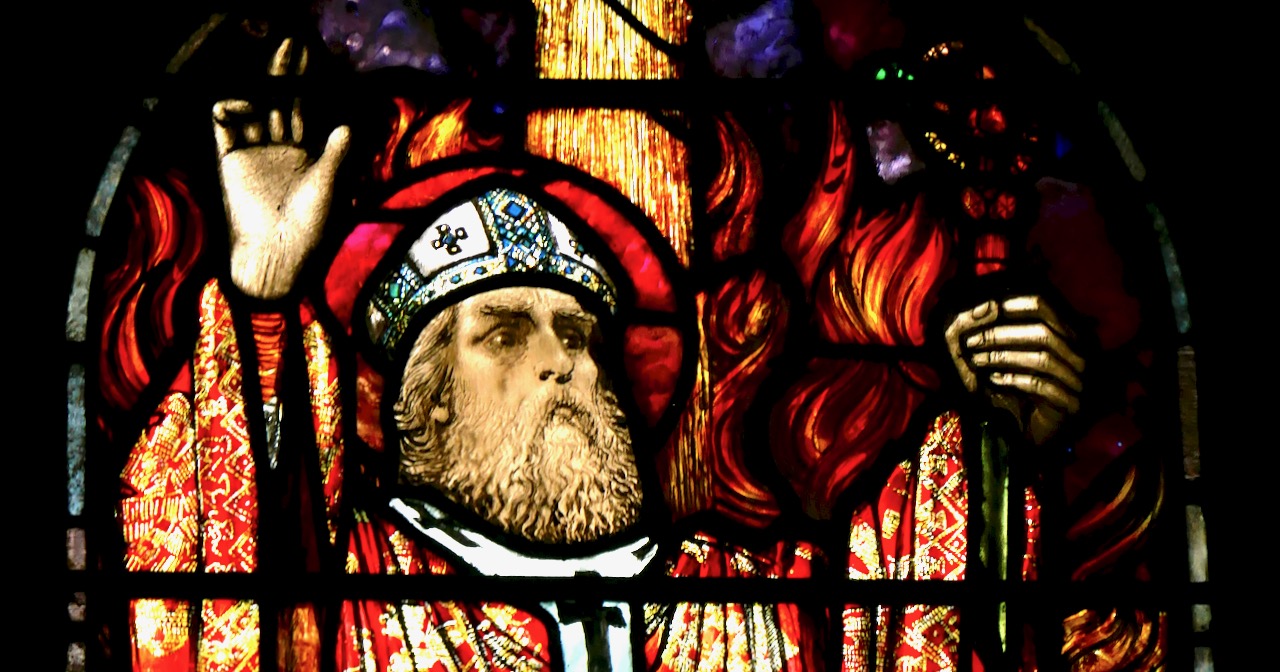
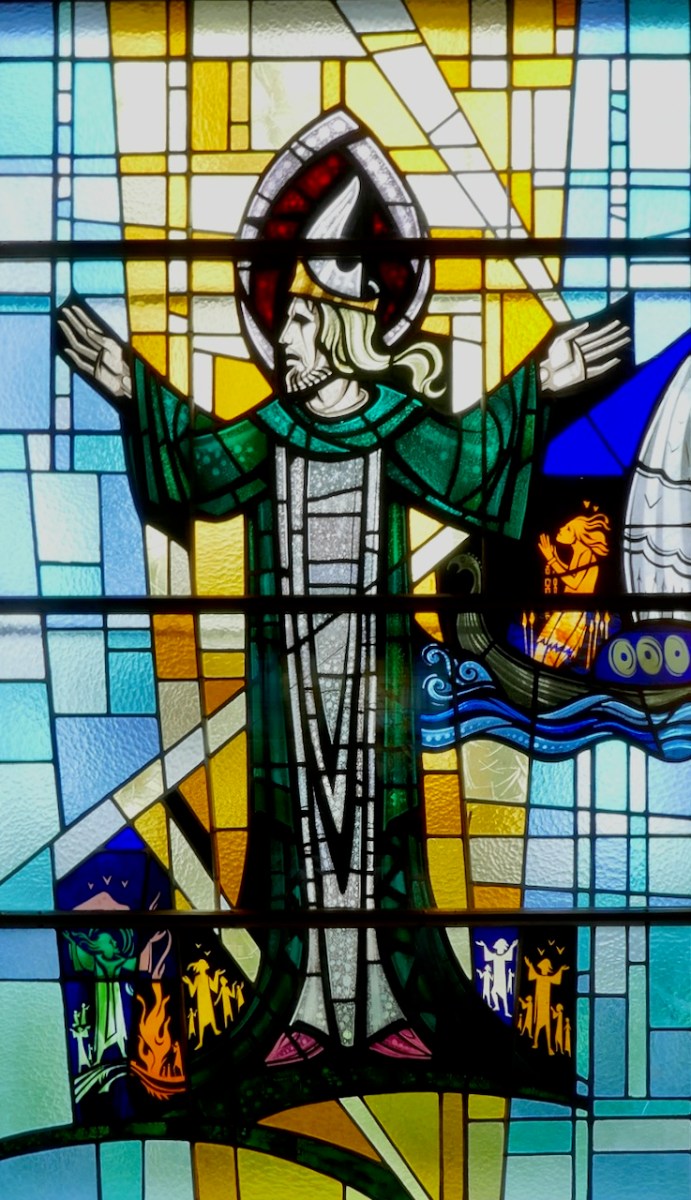
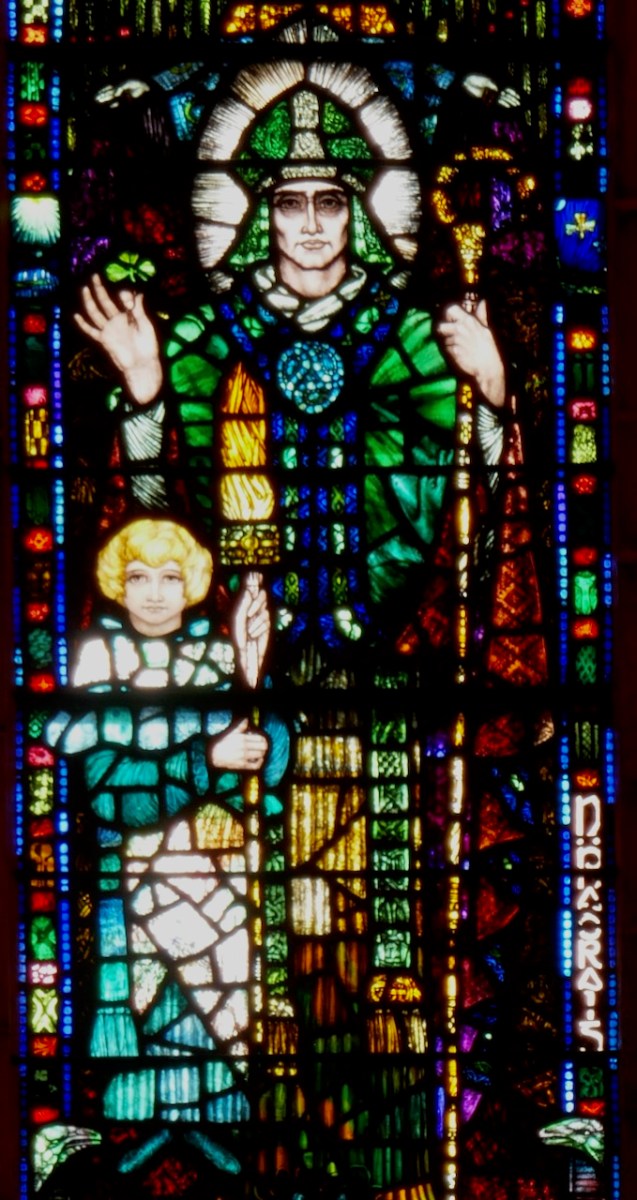
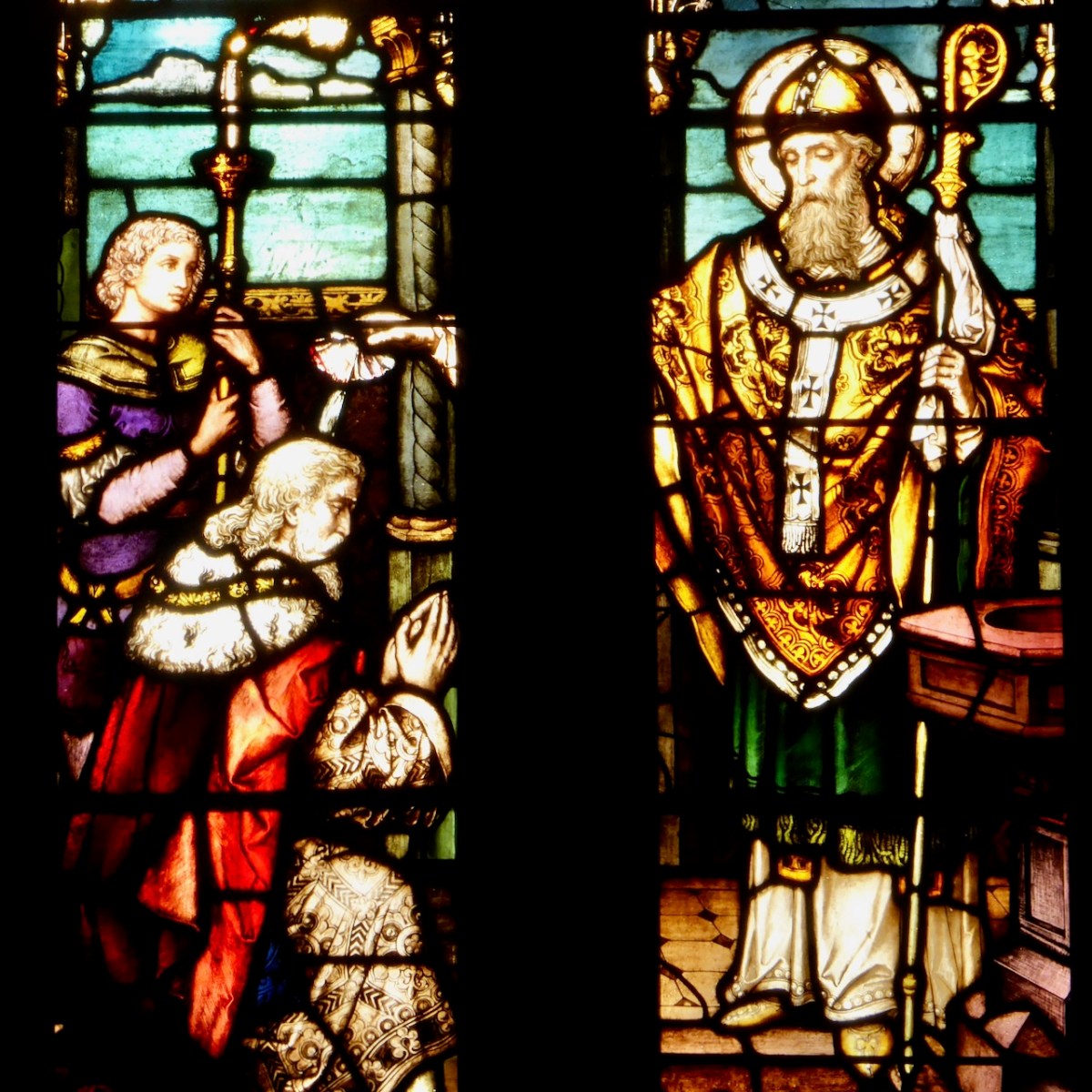
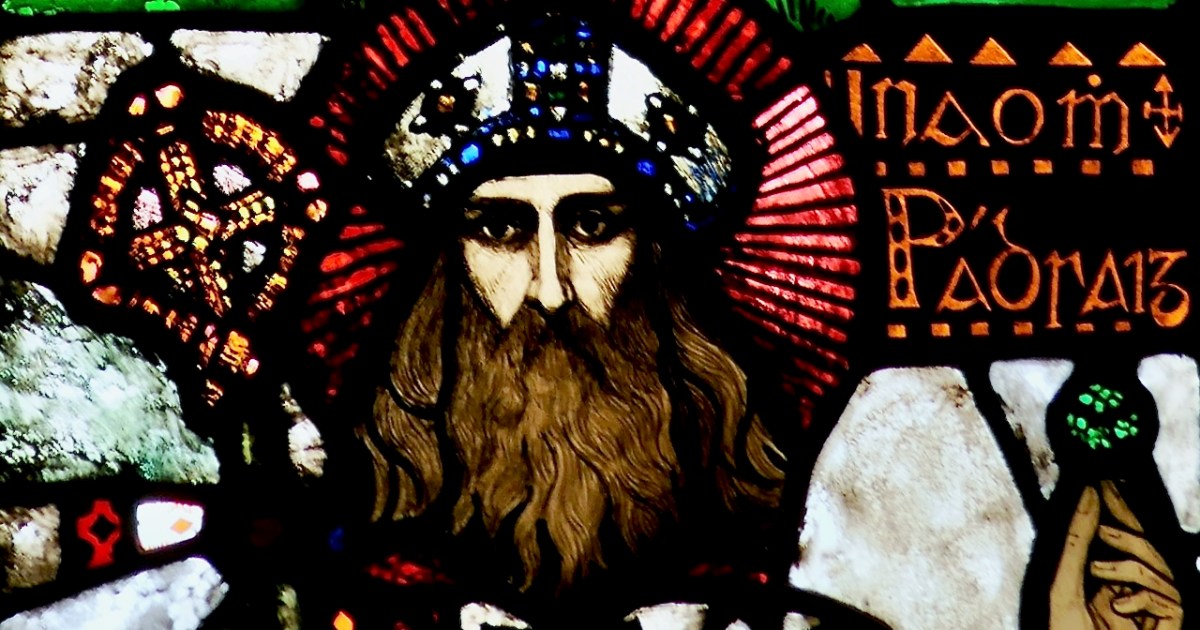
Every year on the seventeenth of March we celebrate Saint Patrick, and every year the same stories are told. It’s the shamrock-and-snakes version of our founding saint – always with images of the saintly bishop, in green, holding his crozier. These images are so familiar that Patrick himself has almost disappeared behind them.
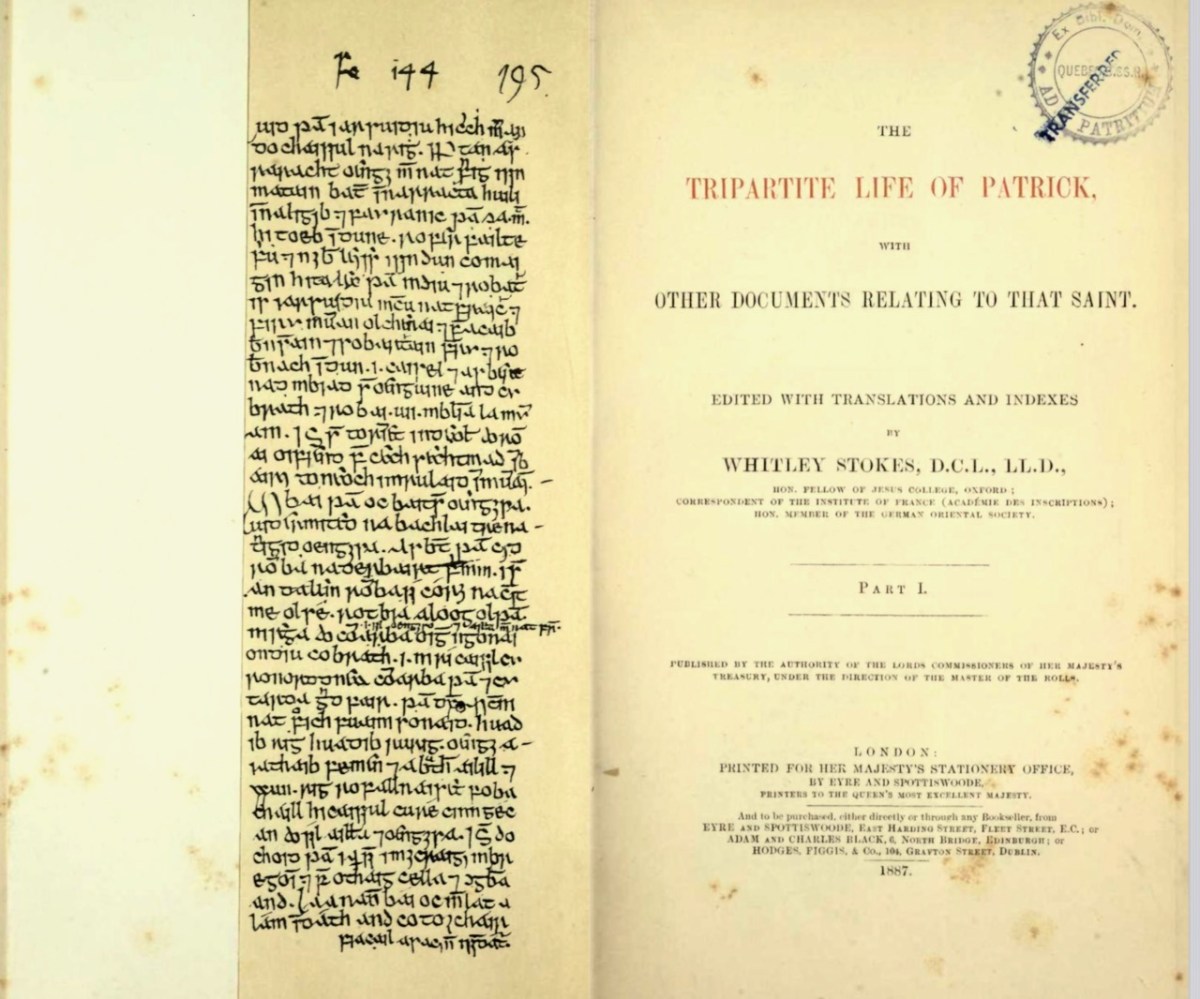
This year I want to go back to an older Patrick — fierce, muscular, and considerably more dangerous. My source is the Lebar Brecc Homily on Saint Patrick, a medieval Irish text drawing on traditions going back to at least the ninth century (you can find it here). It was translated by the great nineteenth-century scholar Whitley Stokes, who invented his own register to convey something of the flavour of the medieval Irish. His is a language that occupies territory somewhere between modern and archaic, and for more of Stoke’s wonderful formulations you read my post The White Hound of Brigown. Stokes’ edition of 1887 (below) remains the standard text.
A homily is a text written to be preached, and you can feel that in the Lebar Brecc account: it moves fast and it assumes an audience who will understand a psalm citation or a liturgical reference.The Lebar Brecc is also long and dense so I have decided to focus on the incident where Patrick lights the paschal fire on the hill of Slane, and the aftermath of that deed. At that, I’ve even had to cut out some of the action.
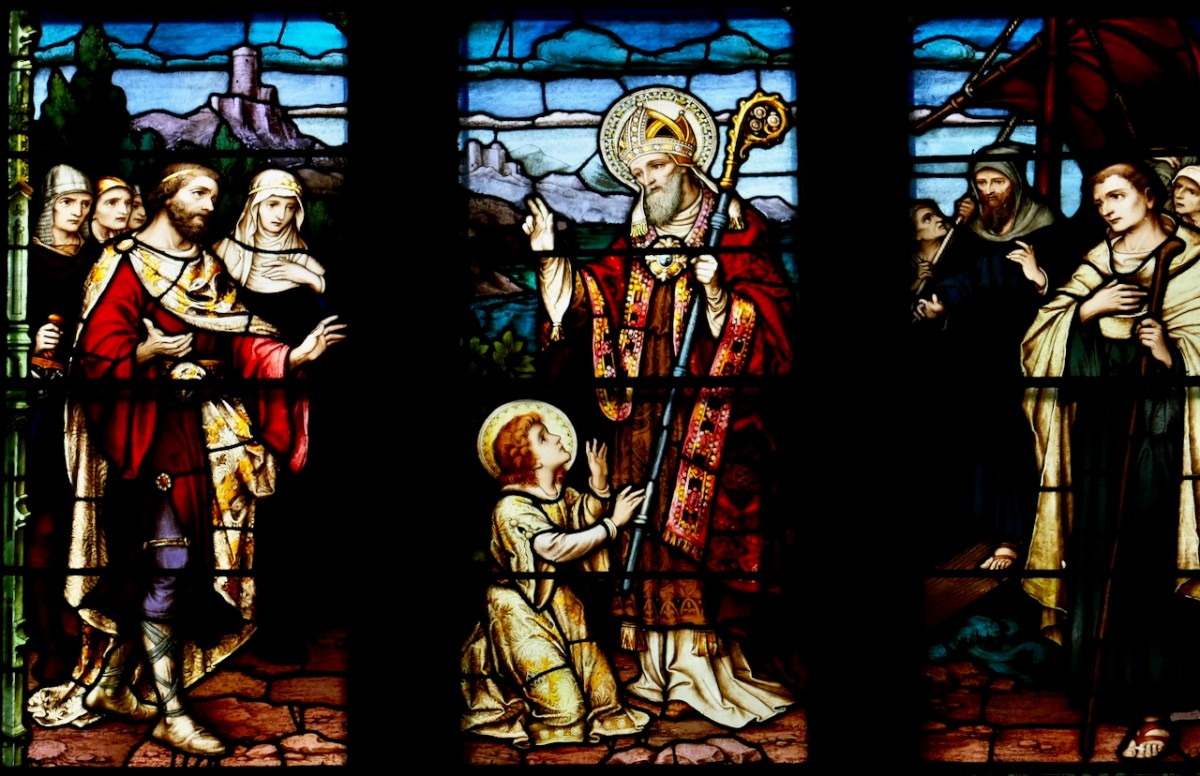
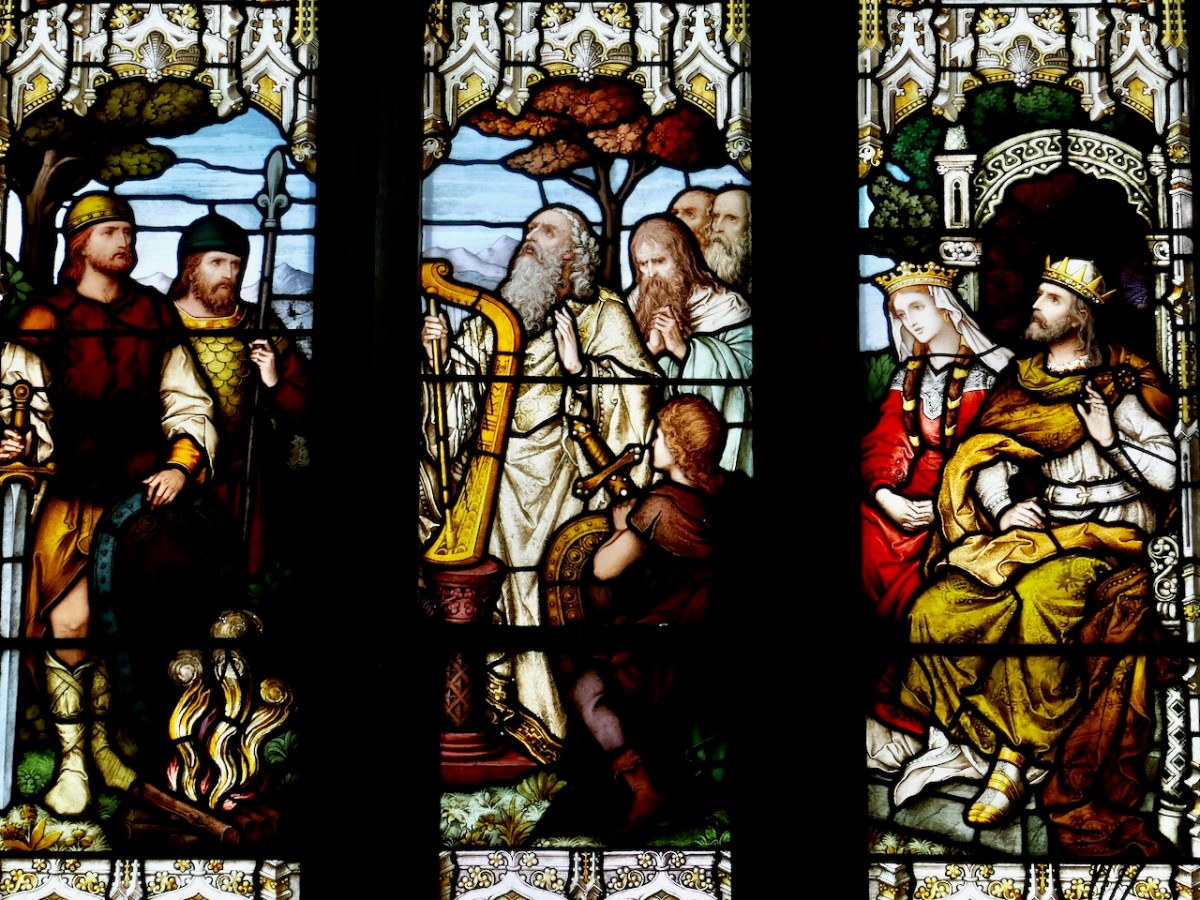
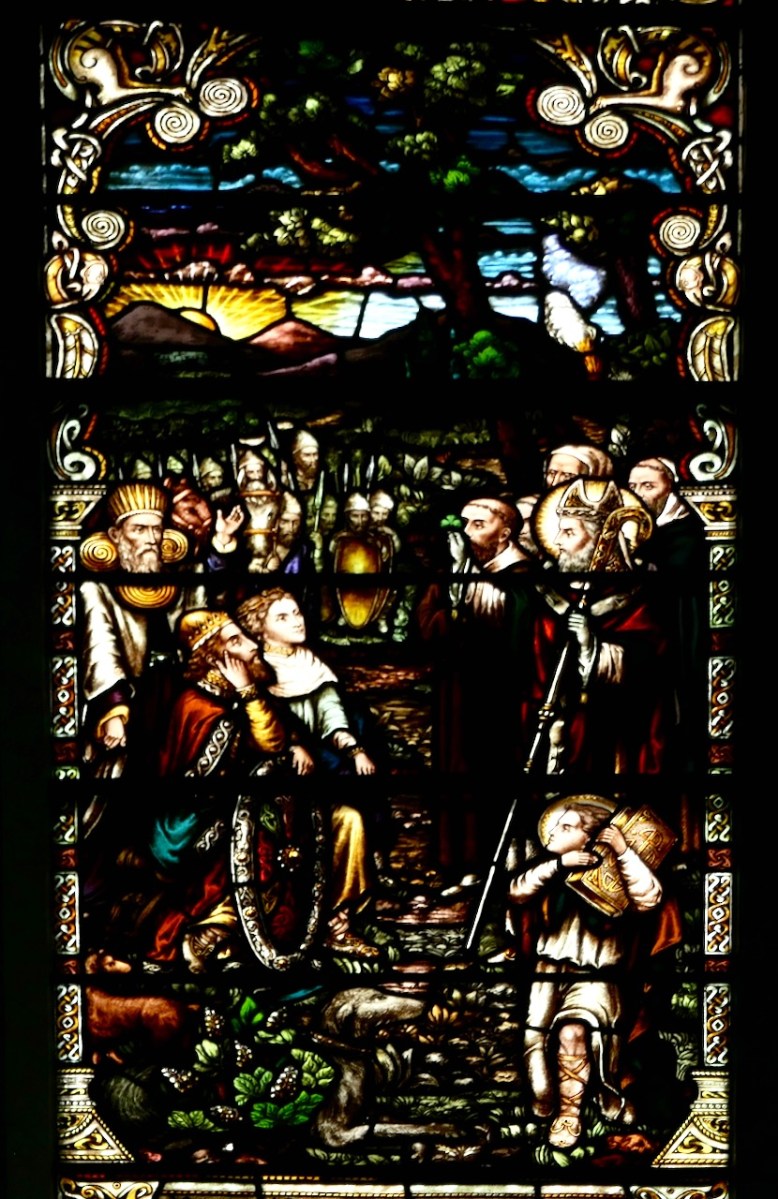
The story opens with a small, touching detail (above). A little boy attaches himself to Patrick as he is about to leave, and his family simply hand him over. He is called Benén in the text but we know him better as St Benignus, who becomes Patrick’s close companion and eventually his successor as bishop (read a more academic account of him here). He is a minor figure at the beginning, but watch for him: he will reappear before the story is over.
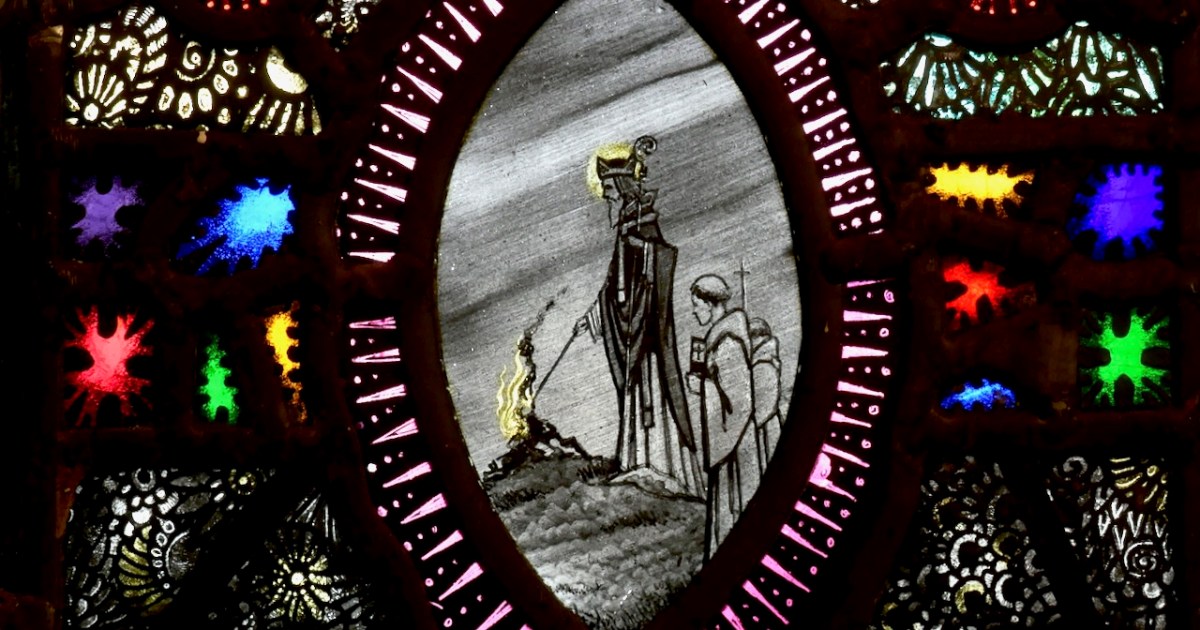
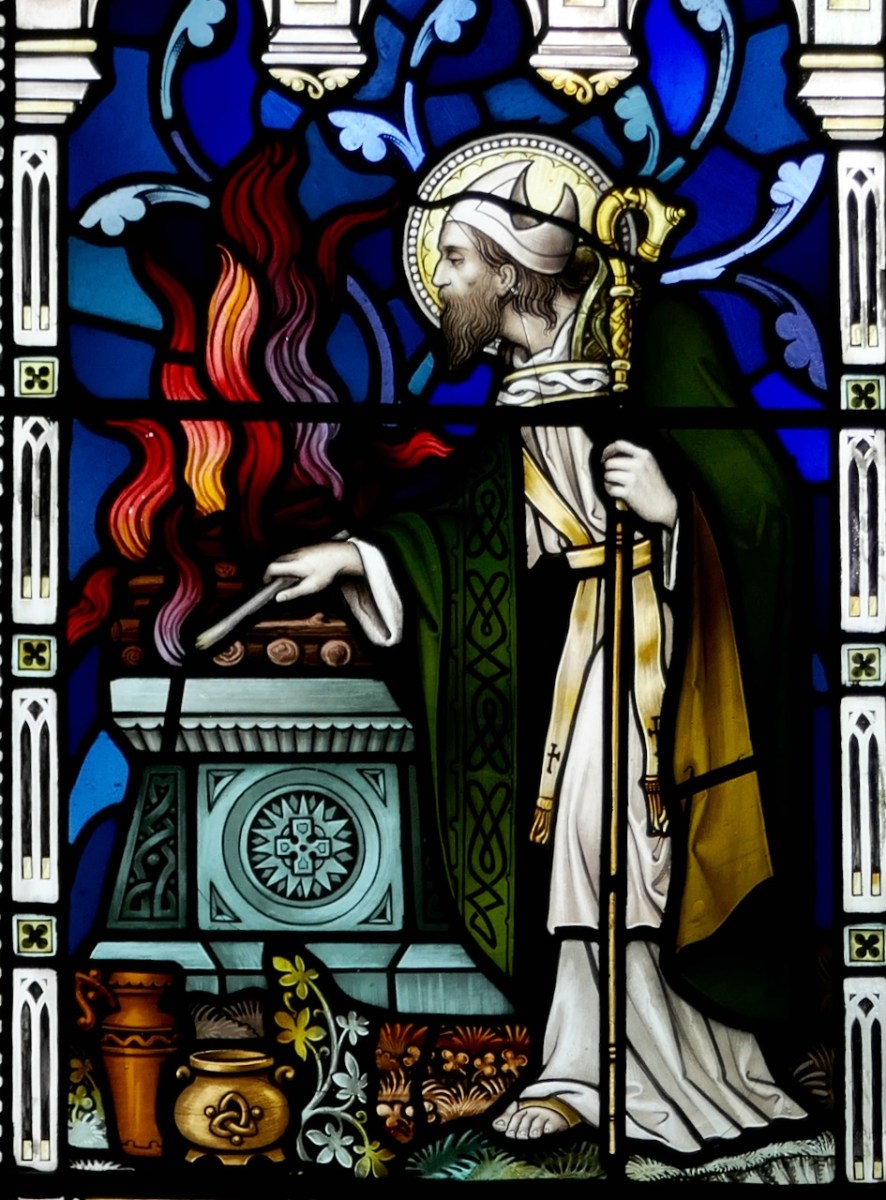
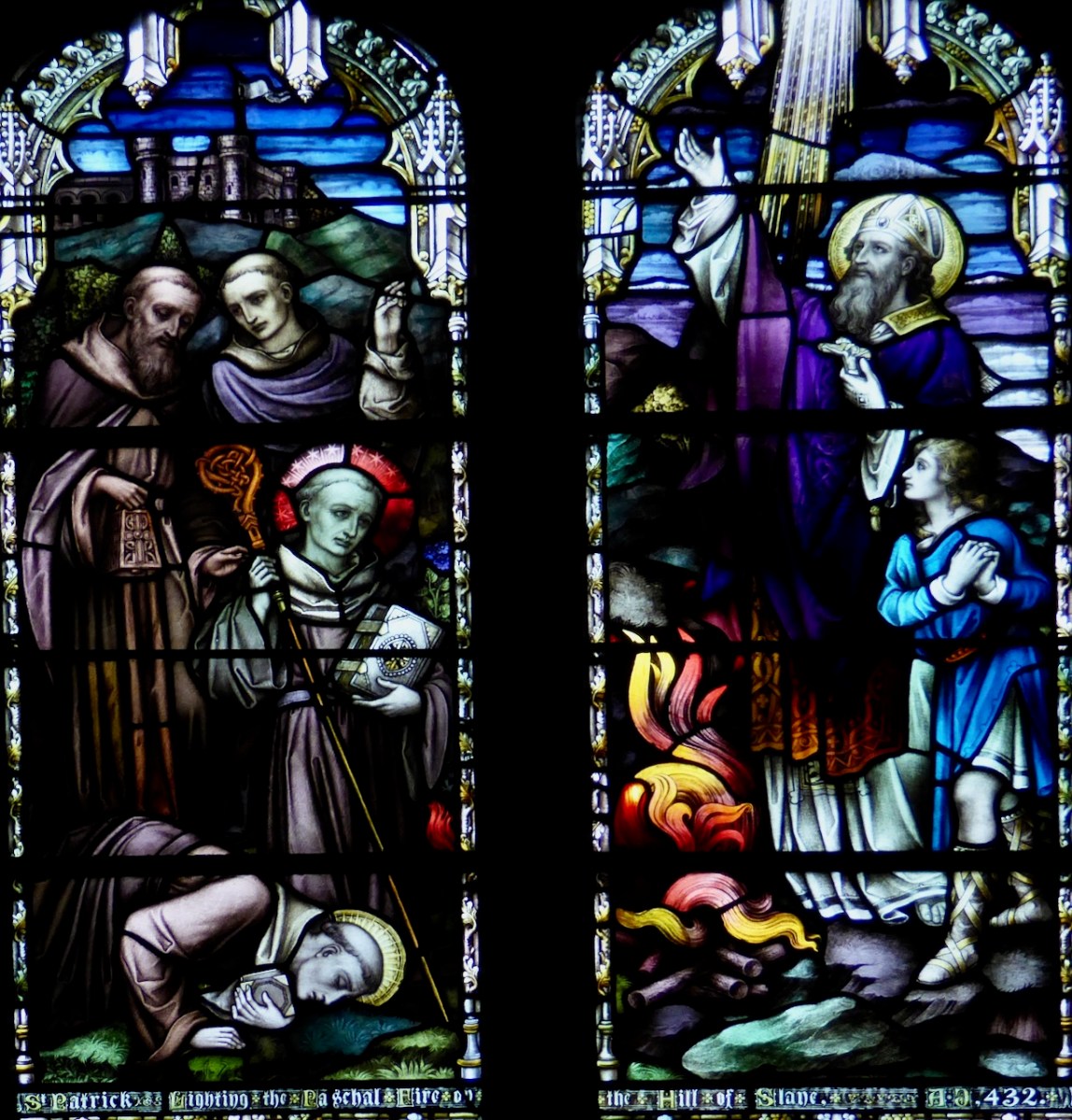
Patrick travels to Ferta Fer Féicc (the place now known as the Hill of Slane, in County Meath) and there, on the eve of Easter, he kindles a fire. It seems a simple act, but there was a sacred law in Ireland that no fire might be lit anywhere in the country on that night until the ritual fire had been kindled first at Tara by the High King. Patrick’s fire, visible from Tara, is an act of direct political and spiritual provocation. The druids of Loegaire’s court (Stokes’ ‘wizards’) immediately grasp what it means: Unless yon fire be quenched before this night, he whose fire yon is shall have the kingdom of Ireland for ever.
What follows is an intense confrontation, and I will let Stokes’ translation carry it:
Then said the King, “ It shall not be so, but we will go to him and kill him. The king arises with his host to seek Patrick and kill him ; but they did not arrive before the end of night. When the king drew nigh his wizards said to him, “ Go not thou to him” say they, “ that it may not be a token of honour to him. But let him come to thee and let none rise up before him.” Thus was it done. When Patrick saw the horses and the chariots, he then sang this verse : ‘Hi in curribus et hi in equis, nos autem in nomine Domini Dei nostri magni [ ficabimur ].’ But, when Patrick came in to the assembly, only the son of Deg rose up before him, that is, Bishop Erc, who is (venerated) at Slane.
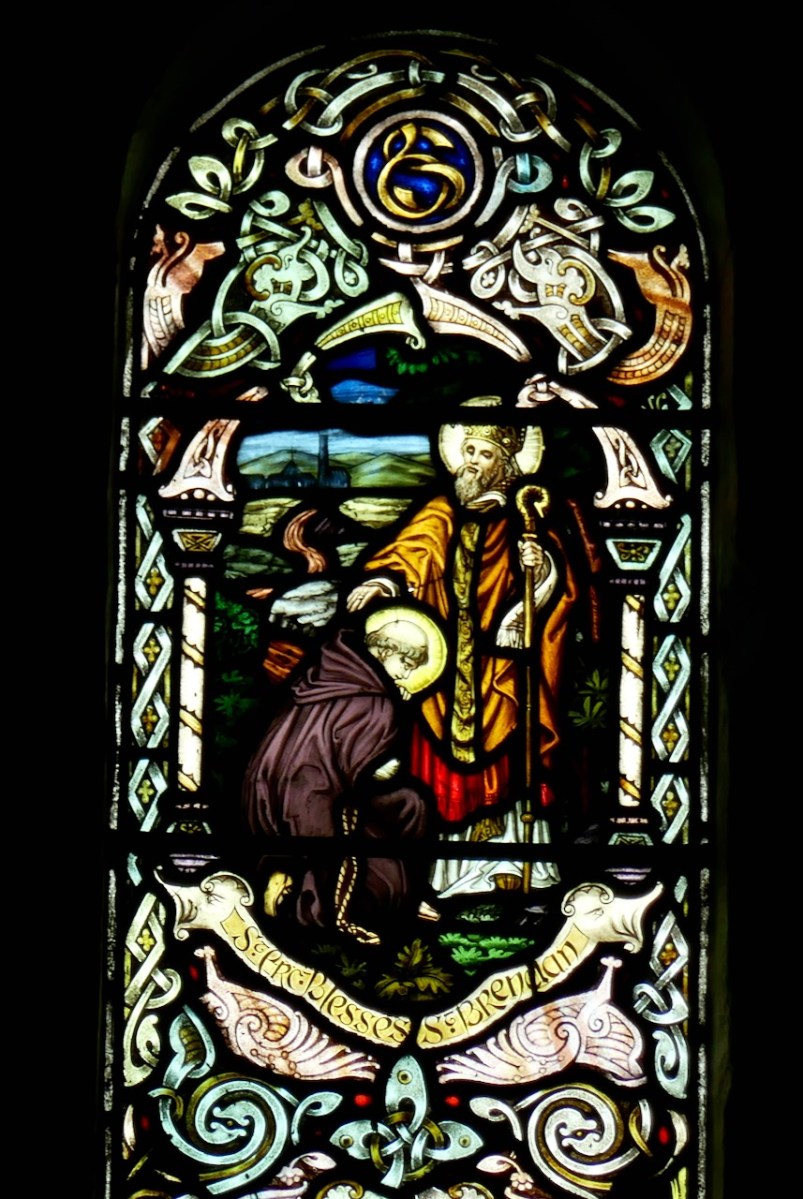
Wait, what! Bishop Erc? Haven’t we met him before, in tales of St Brendan? What is he doing in King Loegaire’s assembly? This is one of the strange time-shifts that features in this story. Despite all of us learning at school that Patrick brought Christianity to Ireland, it seems it was already here. In fact the Lebar Brecc talks about Palladius coming before Patrick, who arrived into a country where the faith already had a foothold, however marginal. Erc of Slane is almost certainly the same Erc who later baptised Saint Brendan and blessed his famous voyage westward. He is a hinge figure: witness to Patrick’s arrival and sponsor of Brendan’s departure. Erc’s rising is a public act of recognition which came at some personal risk.
Then came one of the wizards, to wit, Lochru, fiercely and angrily against Patrick, and reviled the Christian faith. Then holy Patrick said : “ 0 my Lord, it is Thou that canst do all things. In Thy power they are. It is Thou that sentest us hither. Let this ungodly one, who is reviling Thy name, be destroyed in the presence of all.”
Swifter than speech, at Patrick’s word, demons uplifted the wizard in the air, and they let him go (down) against the ground, and his head struck against a stone and dust and ashes were made of him in the presence of all, and trembling and terror intolerable seized the hosts that were biding there.
Now, Loegaire was enraged with Patrick, and went to kill him. When Patrick perceived the onfall of the heathen upon him, he then exclaimed, with a mighty voice, “ Exsurgat Deus et dissipentur inimici ejus”* Came a great earthquake and thunder there, and a wind, and scattered the chariots and the horses afar on every side, so that they came even to Brig Graide and Sliab Moenuimn, and they were all slaughtering each other through Patrick’s curse, and there were left along with the king but four persons only in that place, to wit, himself and his wife and two of his priests.
My goodness, this is definitely not the Patrick of Hail, glorious St. Patrick, dear Saint of our Isle; On us thy poor children bestow a sweet smile. Sorry – I have always had a soft spot for Frank Patterson – quick diversion into the shamrock-soaked images here.
In fact, Patrick’s behaviour here reminds me of St Fanahan, the White Hound of Brigown, with his head-battler and sparks flying from his teeth – which in turn reminds me of Cuchullain and his warp spasms. But I digress – let’s carry on now with the story.
When terror seized the queen she went to Patrick and said to him, ” 0 righteous one and 0 mighty one, kill not the king, for he shall submit to thee, and give thee thine own will.” The king came and gave his will to Patrick by word of mouth, but gave it not from his heart ; and he told Patrick to go after him to Tara that he might give him his will before the men of Ireland. That, however, was not what was biding in his mind, but to kill Patrick, for he left ambushes before him on every road from that to Tara.
Thereafter went Patrick (and his train of) eight, together with a gillie Benén, past all the ambushes, in the shape of eight deer and behind them one fawn with a white bird on its shoulder, that is, Benén with Patrick’s writing-tablets on his back ; and thereafter he went into Tara, the doors being shut, to the middle of the palace. The king was then feasting with the kingfolk of Ireland around him at this hightide, for that was the Feast of Tara.
No one rose up before Patrick at Tara except the kings poet, Dubthach Macculugair, and he believed and was baptized, and Patrick gave him a blessing.
Patrick is then called to the king’s couch that he might eat food. Howbeit Patrick refused not that. The wizard Lucatmoel put a drop of poison into Patrick’s cruse**, and gave it into Patrick’s hand. But Patrick blessed the cruse and inverted the vessel, and the poison fell thereout, and not even a little of the ale fell. And Patrick afterwards drank the ale.
And where have we met a white deer before – ah yes, that would be the story of St Gobnait, who will find ‘the place of her resurrection’ when she sees nine white deer. The image of Benignus as the fawn with the white bird is a lovely one.
Thereafter the hosts fared forth out of Tara. Then said the wizard, “ Let us work miracles together that we may know which of us is the stronger.” “ So be it done,” said Patrick. Then the wizard brought snow over the plain till it reached men’s shoulders. Dixit Patricius to him : “ Put it away now if thou canst.” Dixit magus : “ I cannot till the same time to-morrow.”
“ By my debroth ” (that is, ‘ by my God of judgment,’) saith Patrick, “ it is in evil thy power lieth, and nowise in good.” Patrick blessed the plain, and the snow melted at once.
The wizard invoked demons, and over the plain he brought darkness that could be felt, and trembling and terror seized every one. Dixit Patricius , “Take away the darkness if thou canst.” The wizard replied,
“ I cannot till the same time to-morrow.” Patrick blessed the plain, and the darknesses at once depart, and the sun shone forth …. All who were there gave thanks to God and to Patrick.
The miracle contest between Patrick and the unnamed wizard outside Tara has the quality of a folk tale with its snow conjured and melted, darkness brought and dispersed, but the theological point is precise. The wizard can bring affliction but cannot remove it whereas Patrick can do both.
Then another counsel was taken, that is, to build a house in that hour, the half thereof fresh and the other withered, and to put the wizard into the fresh half with Patrick’s raiment about him, (and) to place Patrick’s gillie, Benén, into the withered half, with the wizard’s tunic about him.
. . .and fire was put into the house, and the fresh half is burnt with the wizard therein, and Patrick’s raiment which was about him was not burnt. But the withered half was not burnt, nor the gillie, but the wizard’s tunic which was about him was burnt.
The king grows terrible at the killing of the wizard, and he proceeds to kill Patrick. But God’s anger came against the ungodly folk, so that a multitude of them, twelve thousand, perished.
Terror then seized Loegaire, and he knelt to Patrick, and believed in God with (his) lips only, and not with a pure heart. All the rest, moreover, believe and were baptized.
The burning house episode is the climax. The wizard, wearing Patrick’s cloak, enters the half built of fresh green wood. Benignus, wearing the wizard’s tunic, enters the withered half. The green wood burns with the wizard inside it; Patrick’s cloak is unharmed. The withered wood does not burn; only the wizard’s tunic is destroyed. It is a reversal of every natural expectation, and the text presents it without comment, trusting the audience to get the significance of the miracle.
Patrick’s final words to Lóegaire, who has knelt and believed with his lips but not his heart, are worth a second look:
Patrick said to Loegaire, “ Since thou hast believed in God, length of life shall be given to thee in the kingdom. But in guerdon of thy disobedience aforetime, and because thou hast not received the baptism with desire, though thou believedst with thy lips, Hell shalt thou have, and from thy race till Doom there shall be neither sovranty nor chieftainship.”
This is not the Patrick of the greeting cards, but a figure of formidable authority, distinguishing between outward compliance and genuine conversion, and prepared to curse a king’s entire lineage on the basis of that distinction. The medieval Irish church that preserved and transmitted this story clearly wanted a Patrick of the kind of power to rival and surpass the druids’ (or wizards, in Stokes’ parlance) power to bend kings – power over fire and snow and darkness.
Maybe it’s time to reclaim that Patrick from the ‘dear saint of our isle’ with his shamrocks and raised hand in blessing. If this was the real Patrick, I suspect that when he raised his hand we would all be running for cover.
* “Let God arise and let his enemies be scattered” (psalm 68:1)
Last week I introduced you to the modernist stained glass practice known as dalle de verre, and its beautiful realisation in St Augustine’s in Cork. It was the work of the world famous Gabriel Loire. To see what made him so renowned, just take a look at this project, or google the Symphonic Sculpture installation in Japan.
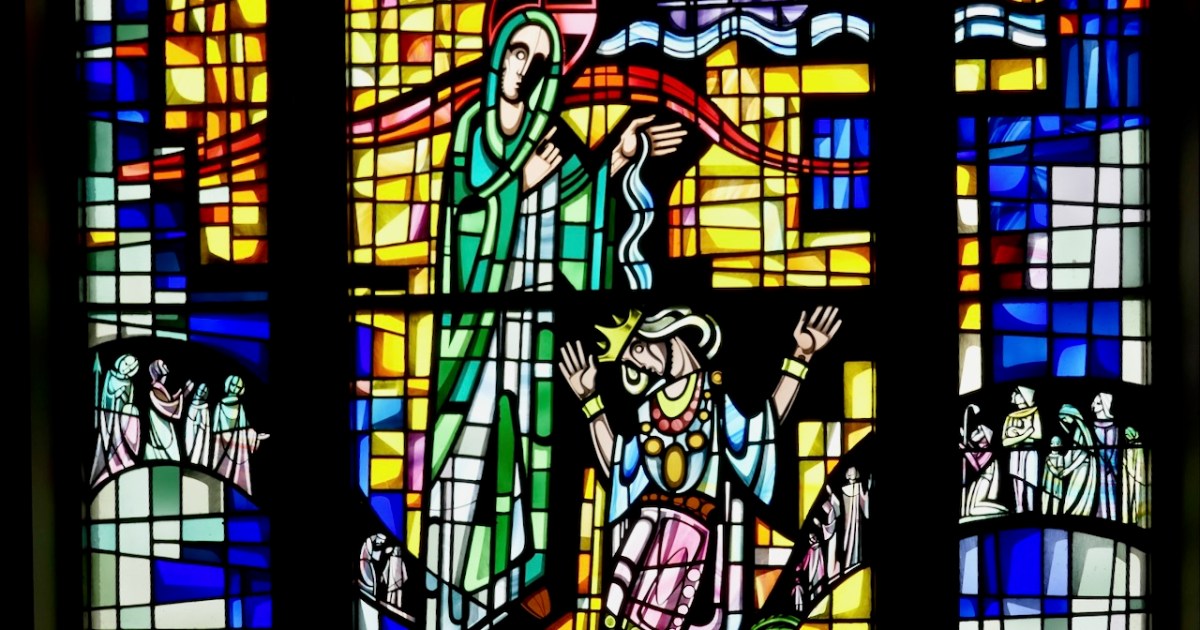
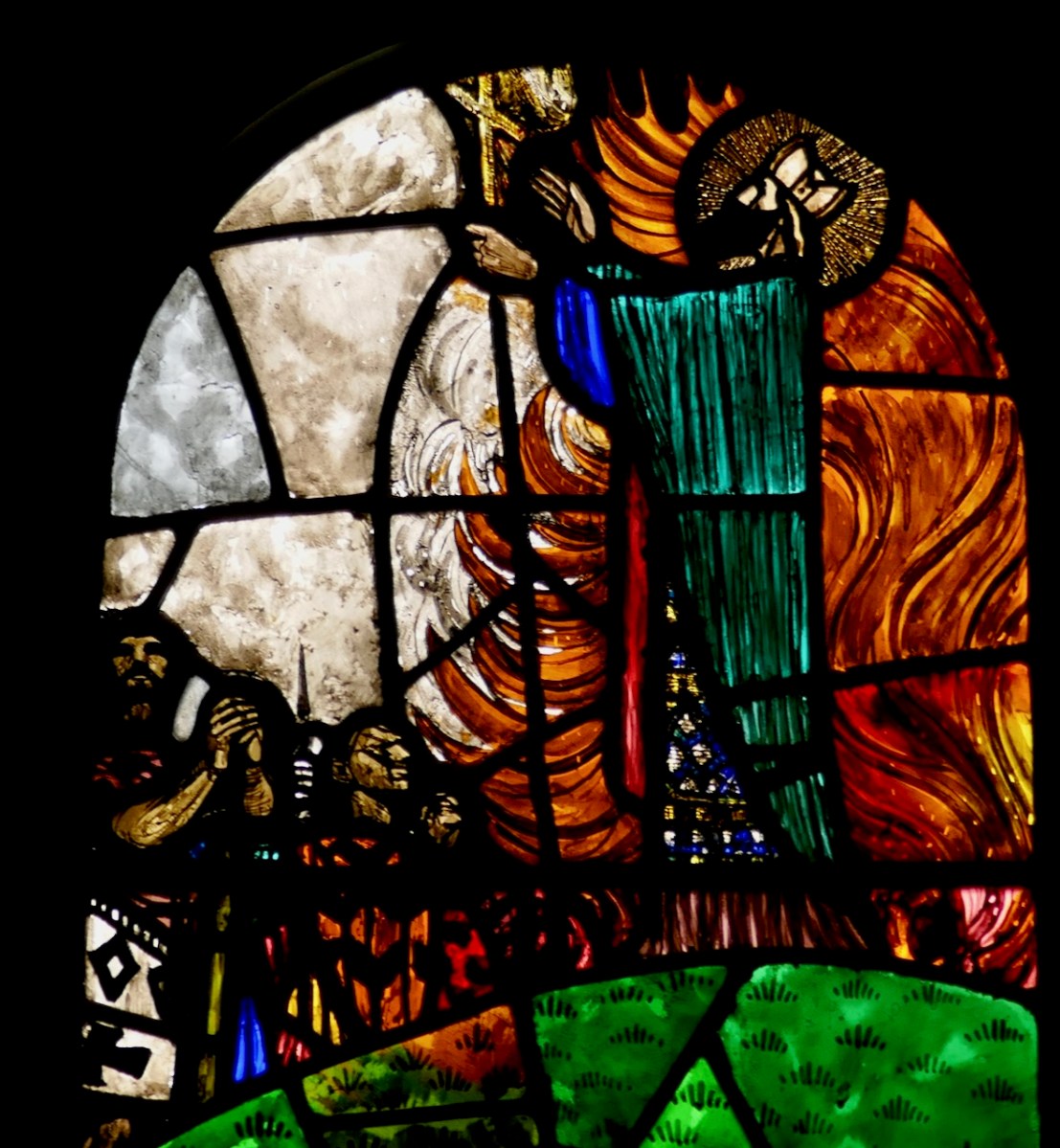
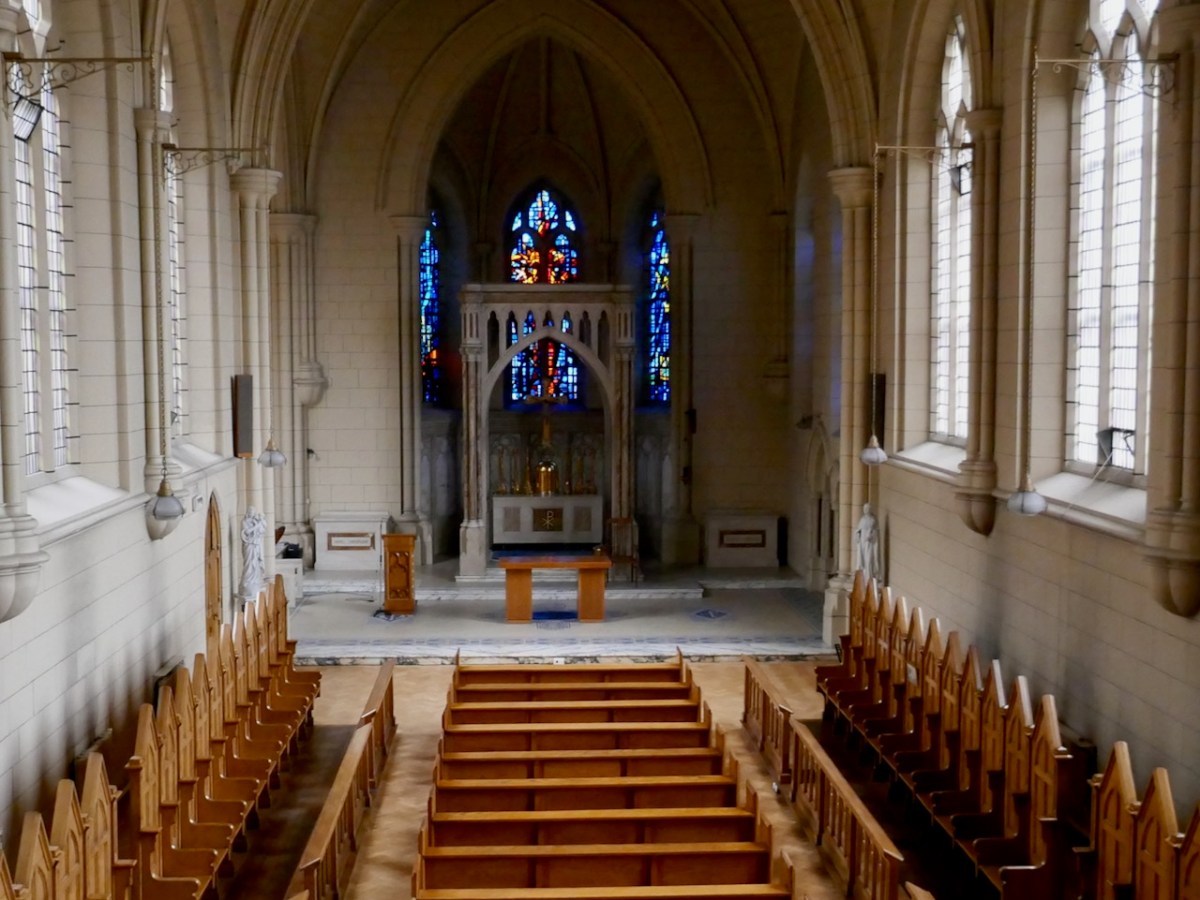
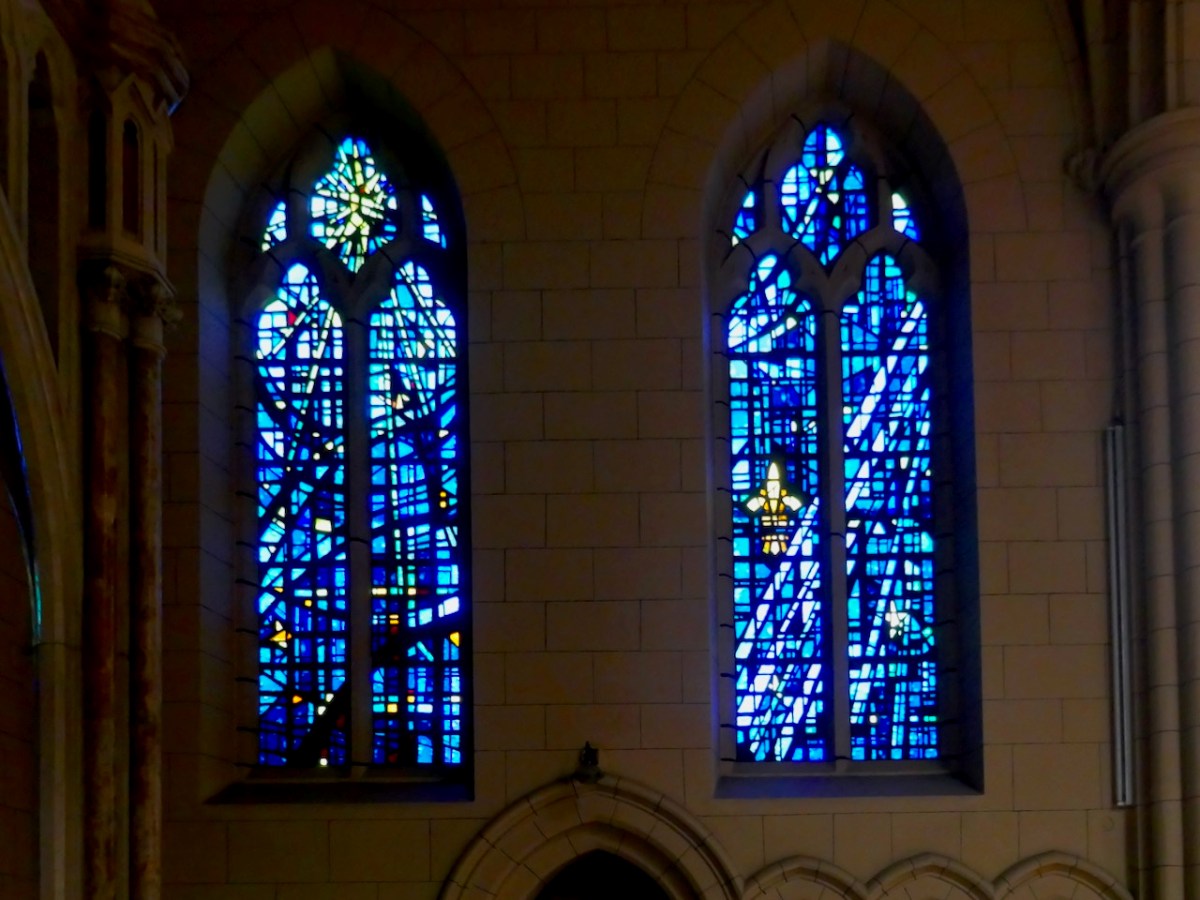
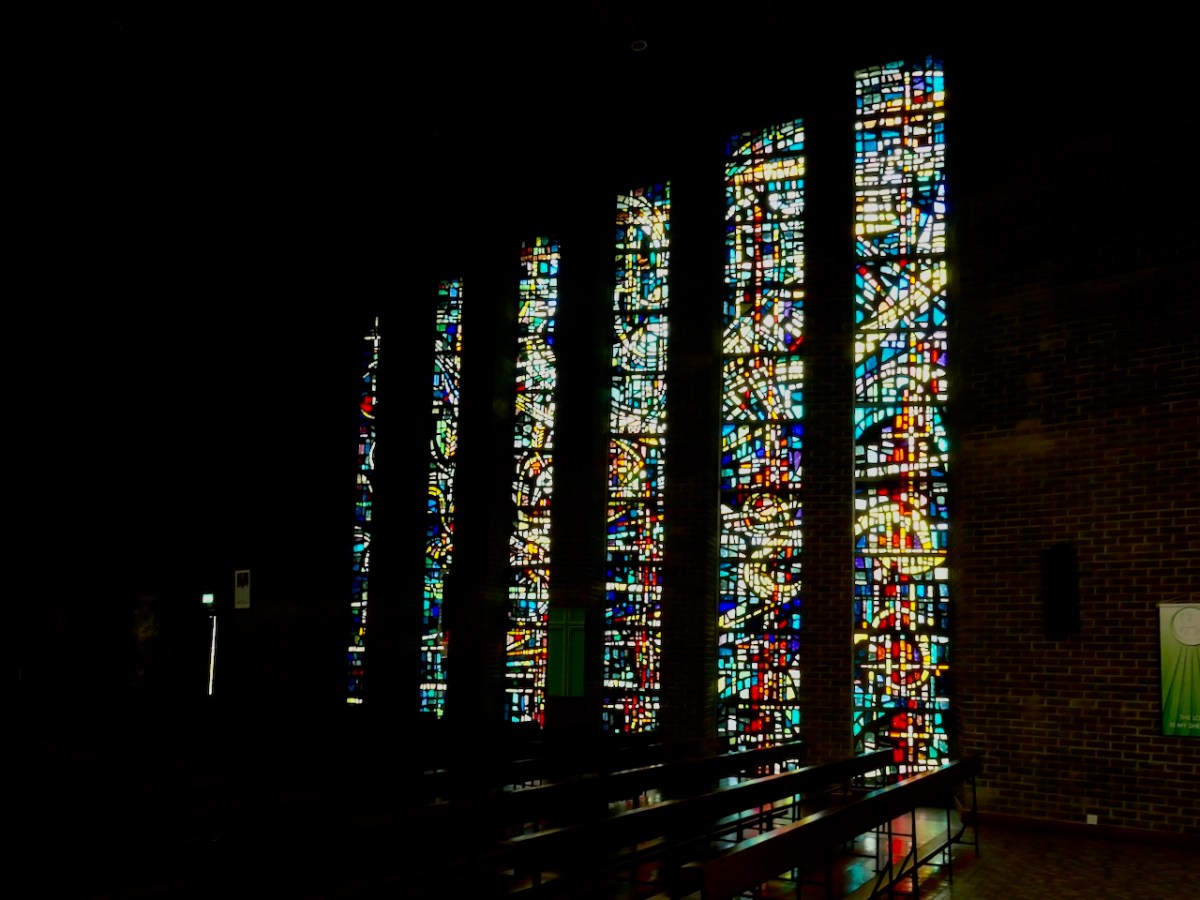
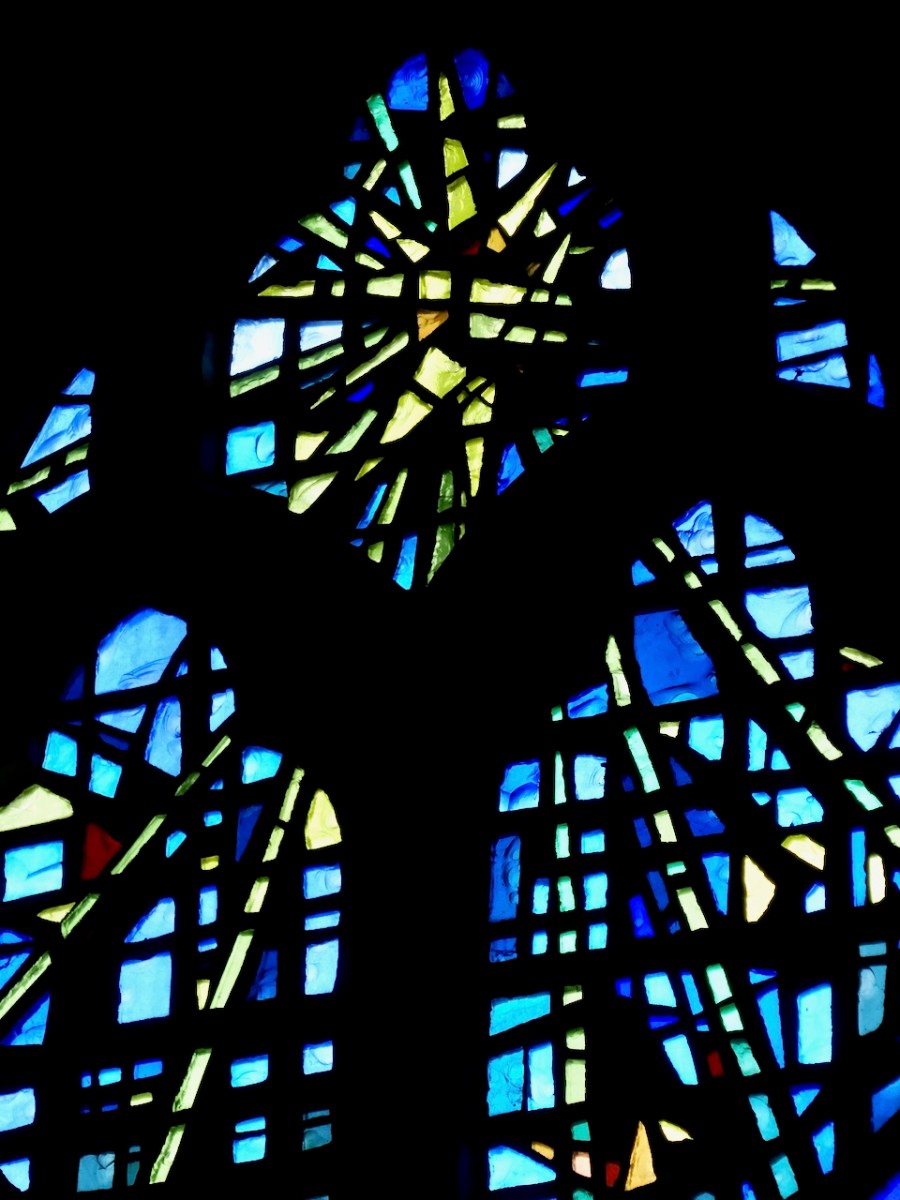
We have three more examples of Loire’s dalle de verre work in Ireland. In a now largely-unused church attached to the Dominican Convent in Belfast (above), we have his earliest Irish windows (1962) – 5 lights titled Resurrection, Redemption, Prediction, Nativity and Annunciation. They are hard to photograph and even harder to interpret – the titles were supplied to me by the Ateliers Loire.
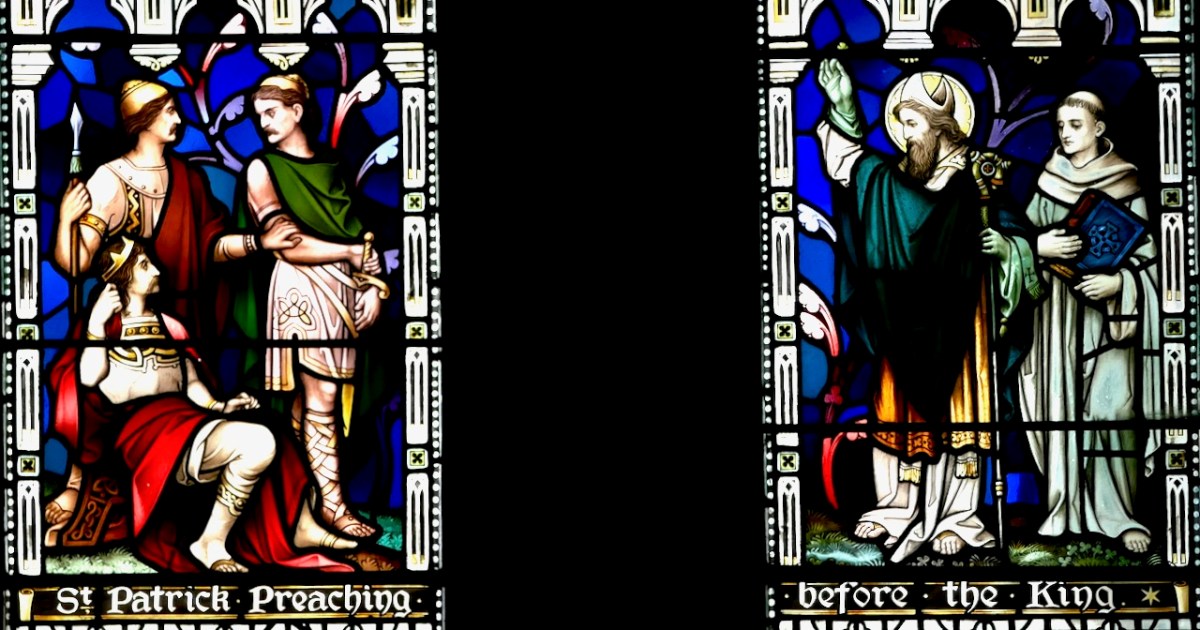
For those used to traditional stained glass, dalle de verre represented a radical departure from their expectations and we must not underestimate the courage and vision of architects and congregations in embracing this avant-garde medium. Rather than a familiar depiction of a Resurrection, Annunciation, or St Patrick, what faced parishioners were swathes of deeply coloured glass sometimes with recognisable iconography, but often with difficult-to-interpret motifs, as in the Belfast windows.
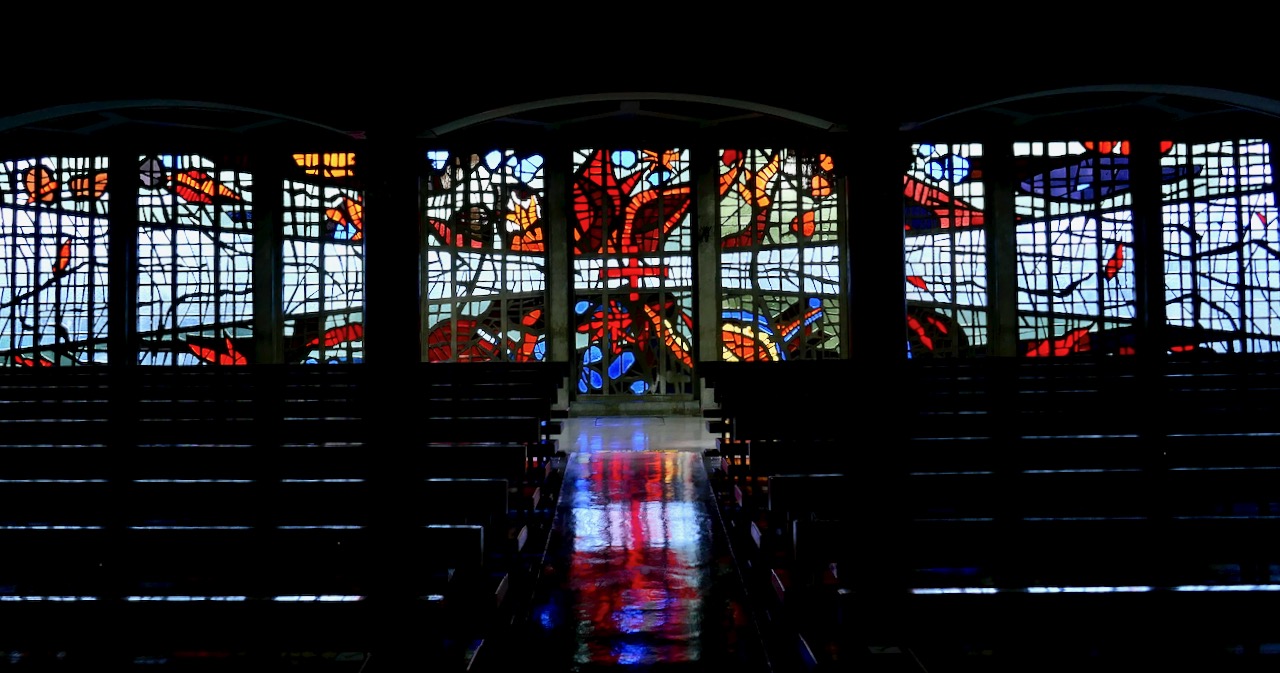
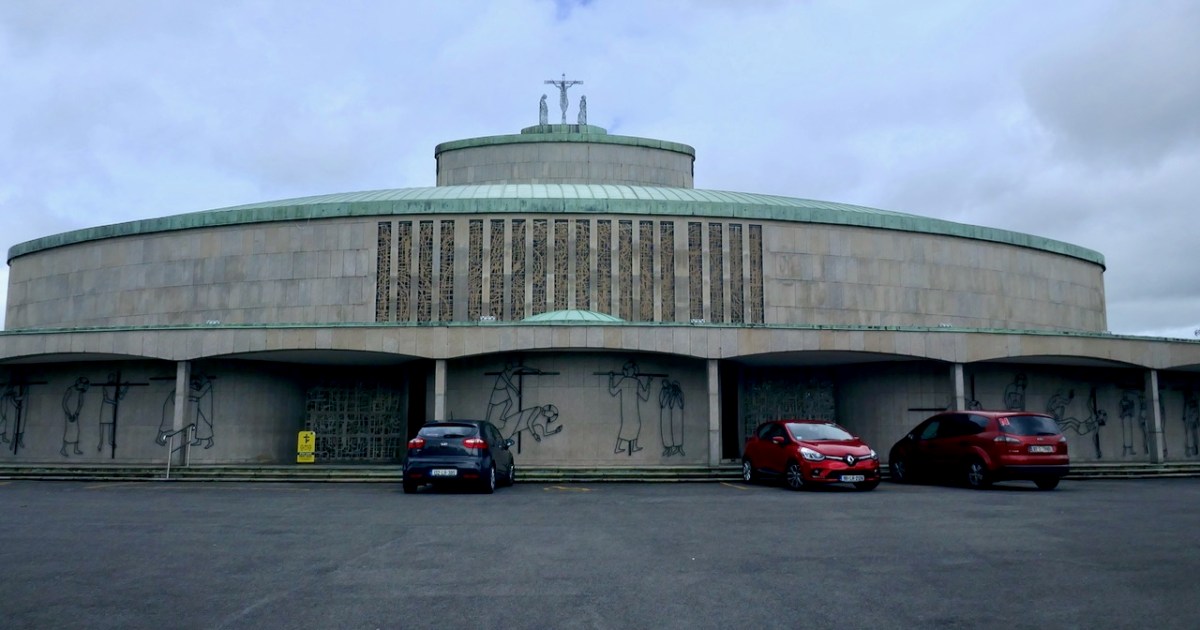
And sometimes with nothing but colour variation to encourage a prayerful or contemplative mood. Gabriel Loire adopted the maxim, Arrange it so that in what you do, there is nothing, but in that nothing, there is everything each person seeks. His philosophy can be seen in action in the Holy Redeemer Church in Dundalk (above) (1965-68), an extraordinary modernist building with work by the best artists of the day. The success of the design can be credited to the architects, Frank Corr and Oonagh Madden, and the breadth of the art to Michael Wynne, who acted as advisor on the project. Works by Oisin Kelly (rooftop crucifixion), Imogen Stuart (exterior stations), Ray Carroll, and Michael Biggs adorn the exterior and interior, while floor to ceiling expanses of dalle de verre by Gabriel Loire provide, in Michael Wynne’s words, one great abstract symphony of colour.
Wynne goes on to say that the windows lend a rich mystical light to the whole interior and to comment on the splendid harmony that exists between the building and all the necessary adornments. Such a unity lends a dignity, a calm and prayerful mood to the building. *
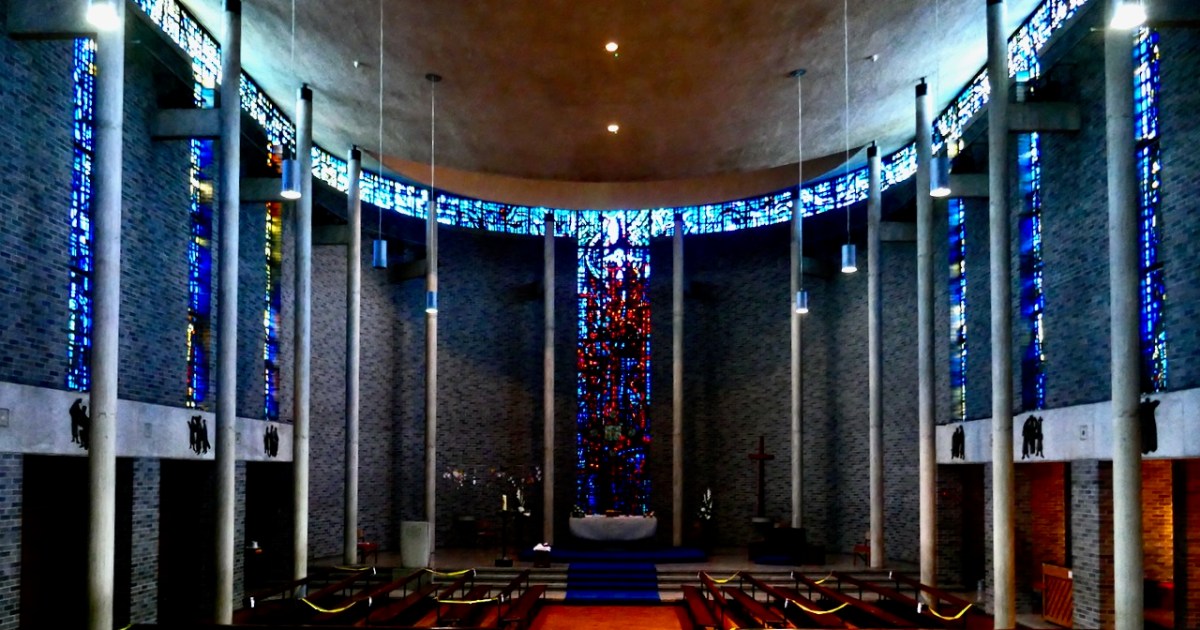
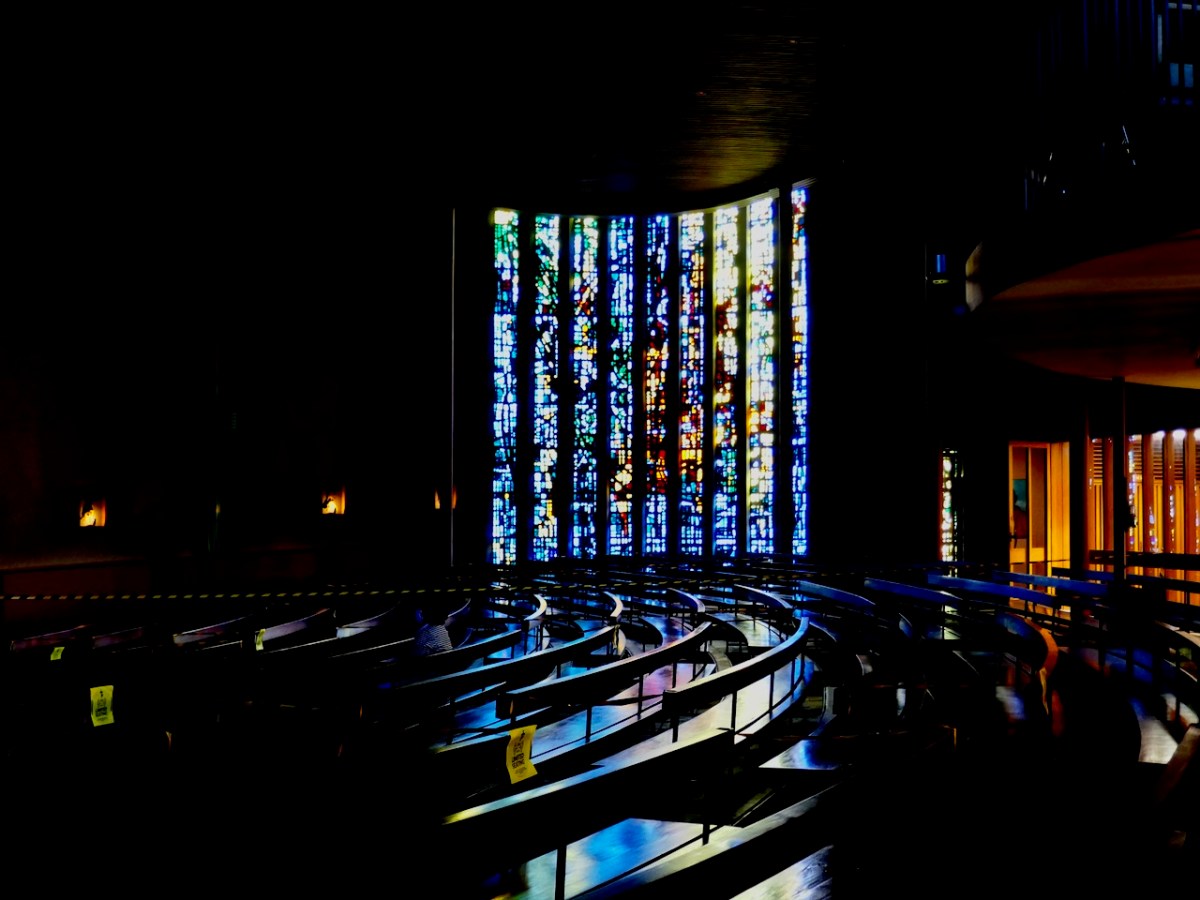
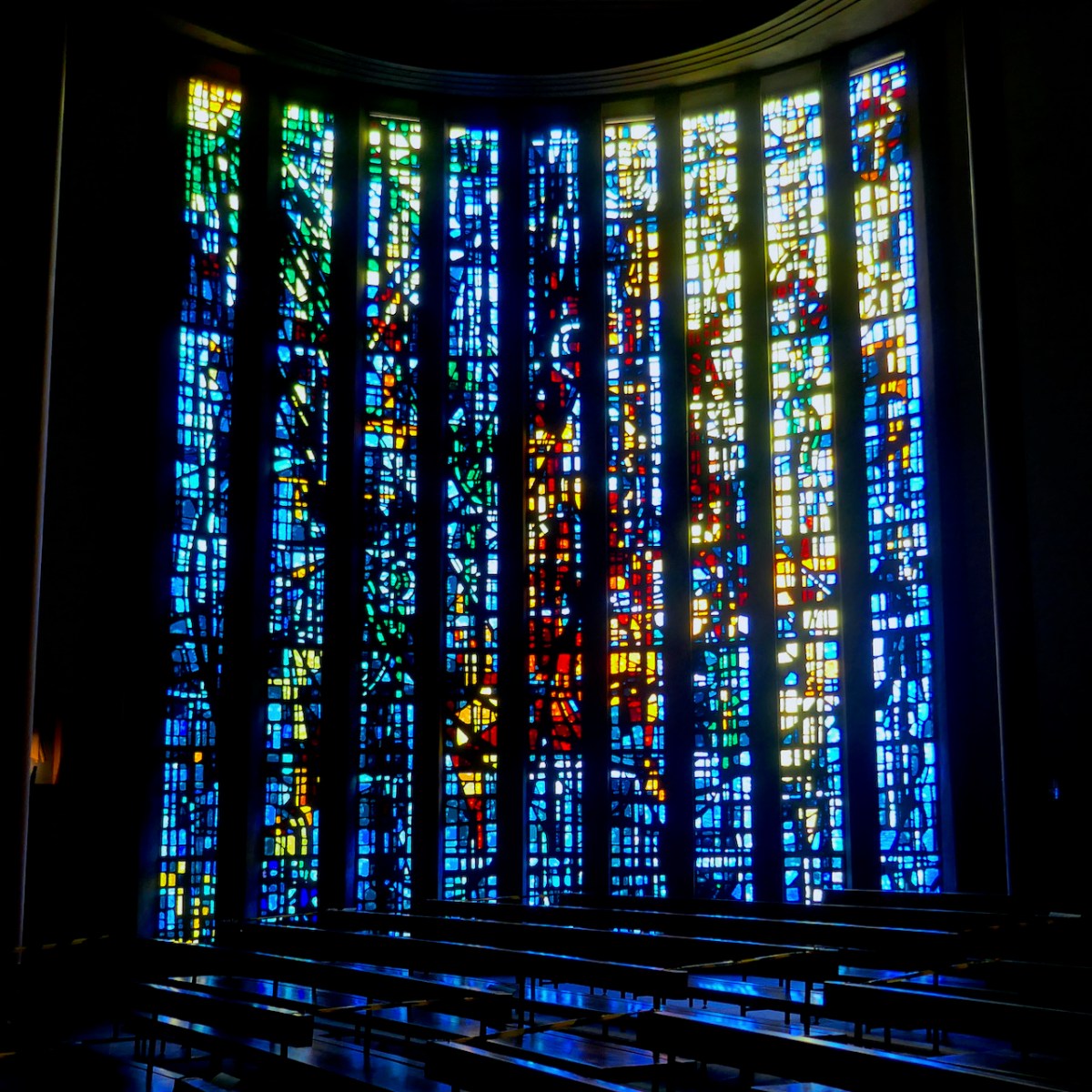
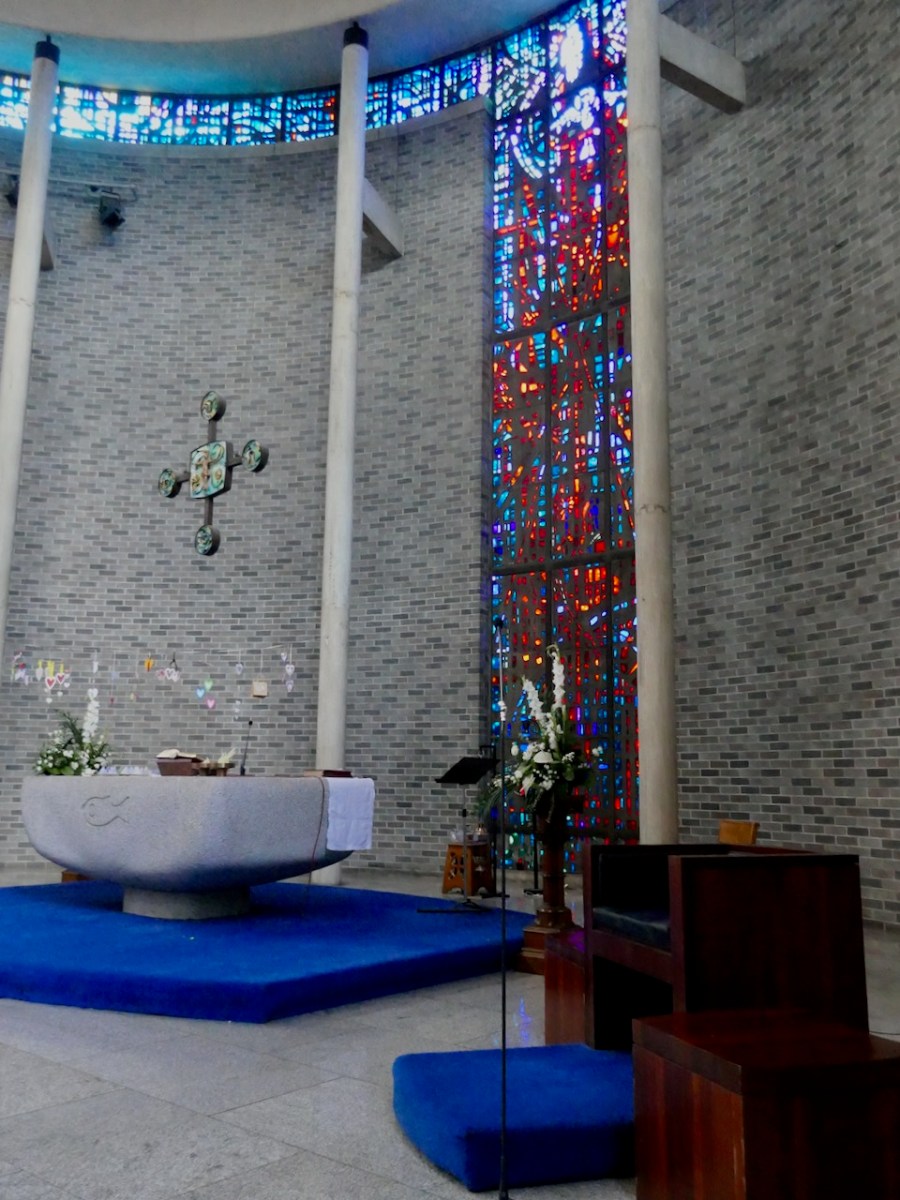
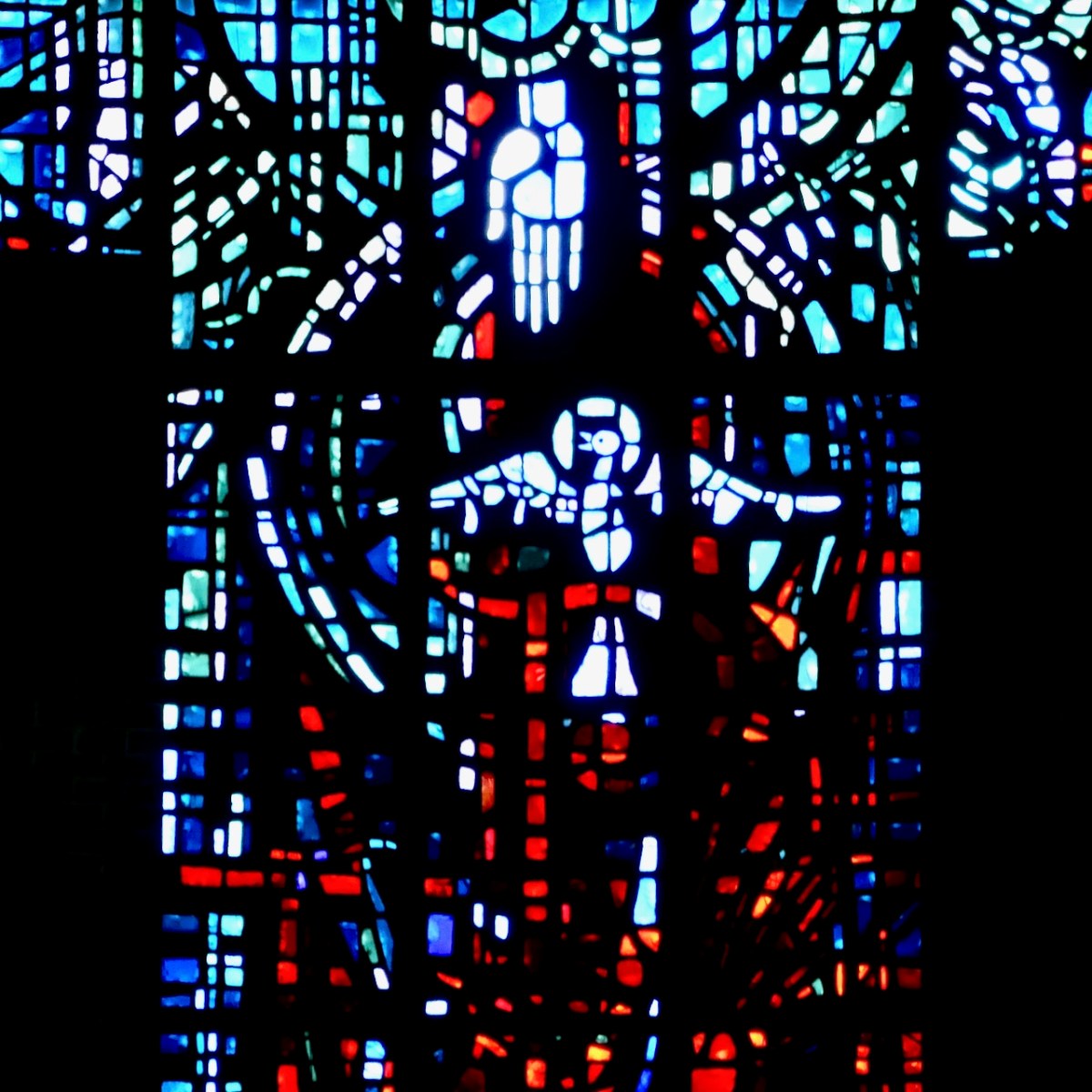
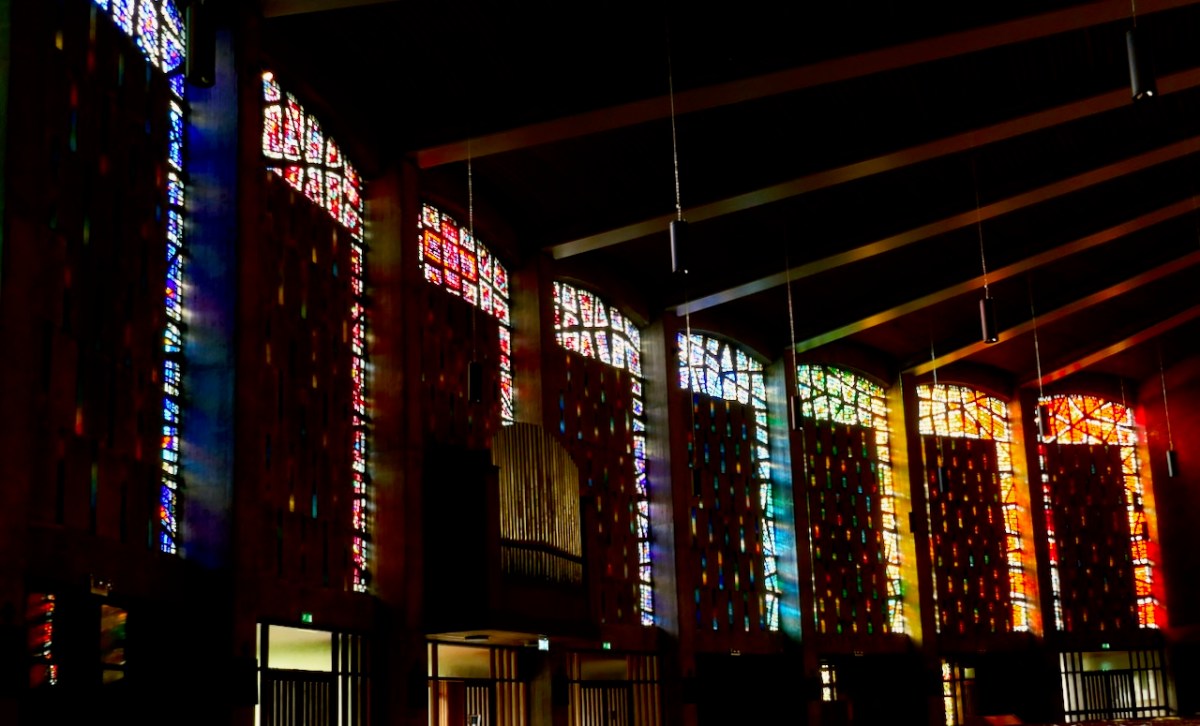
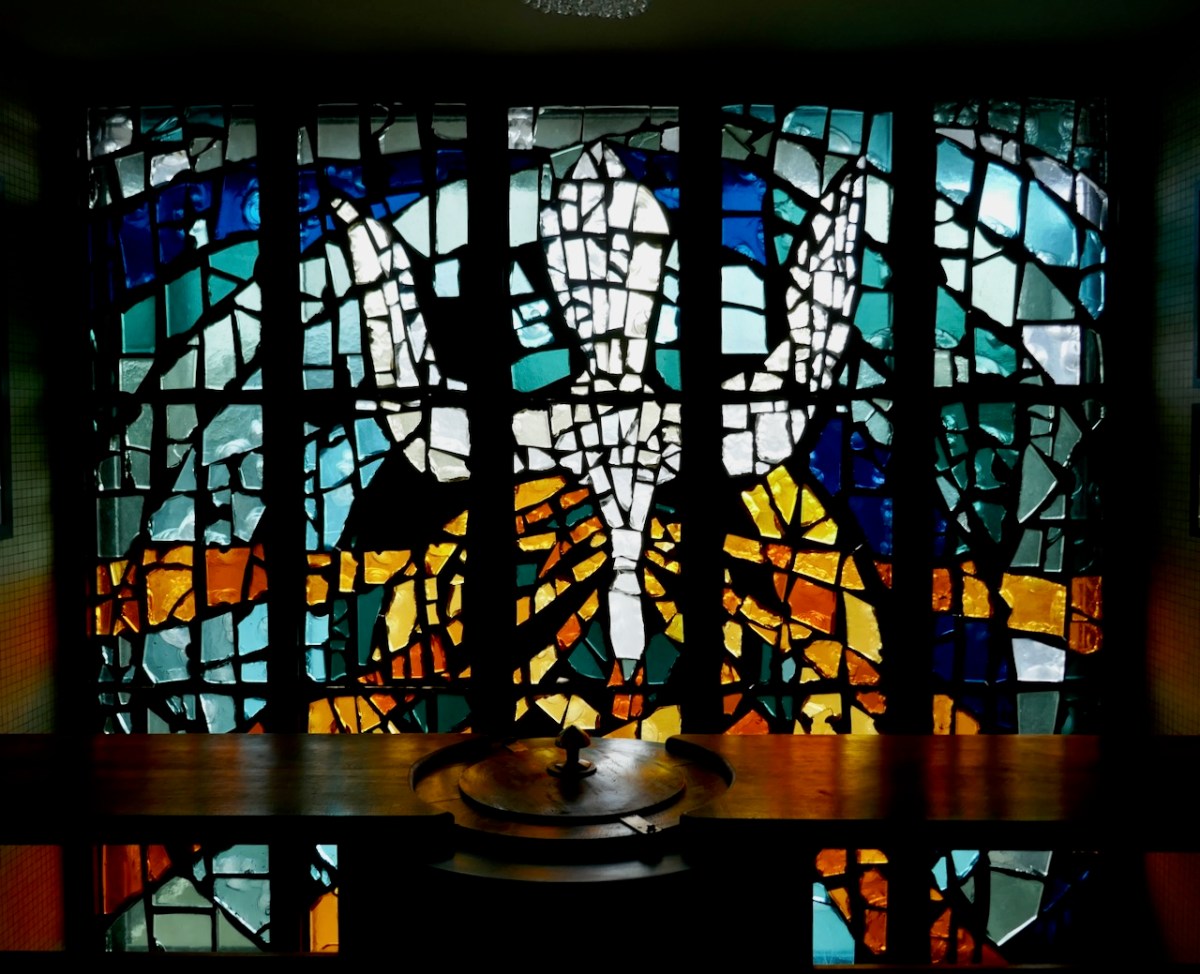
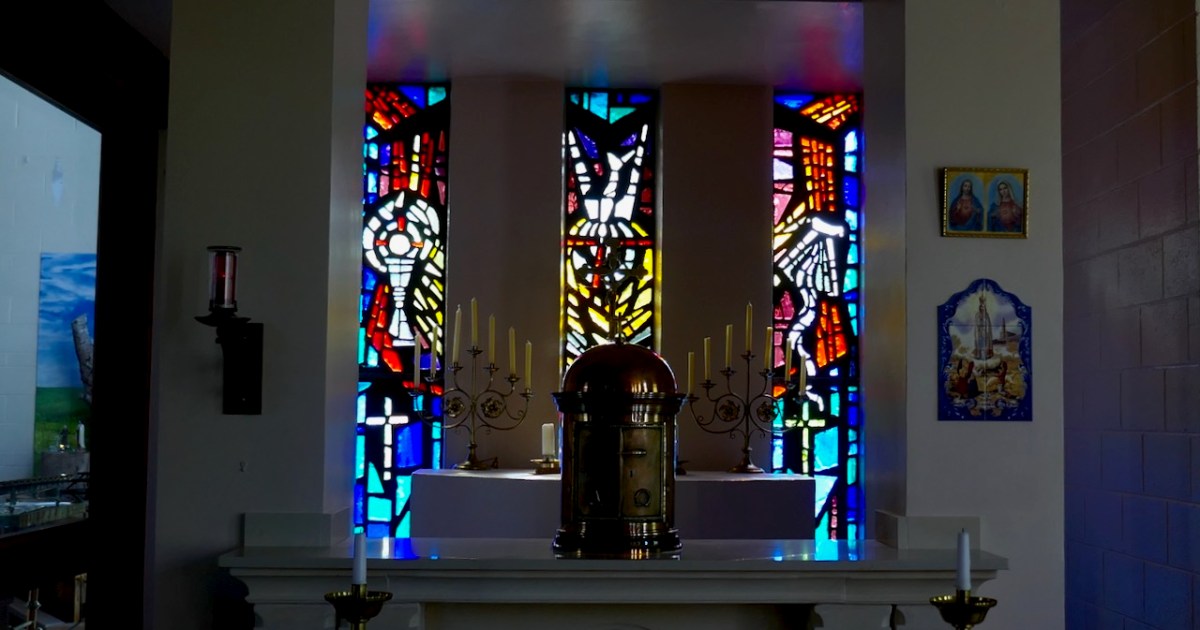
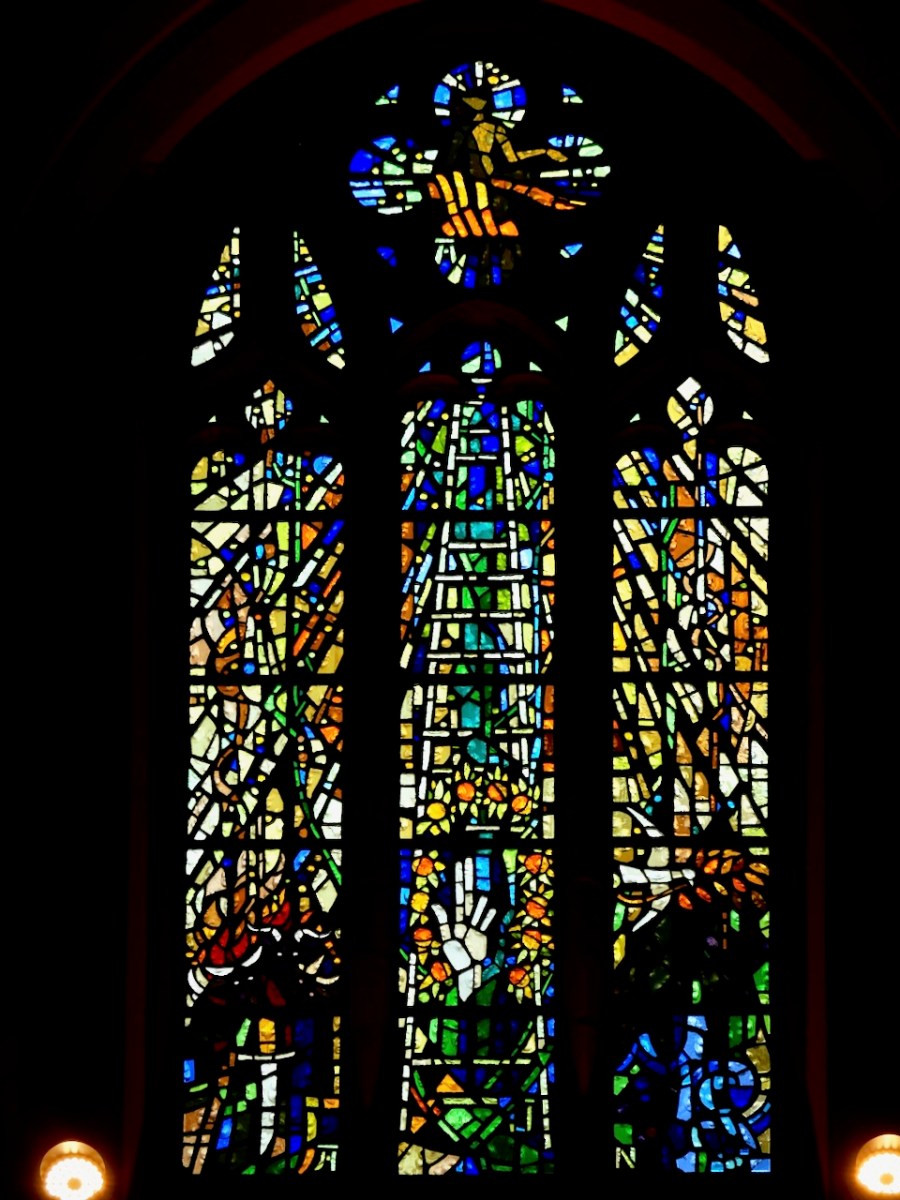
In the Andrew Devane-designed church in St Patrick’s Campus of DCU in Drumcondra, also built in the mid 60s, the curved walls are punctuated by tall panels and a clerestory of dalle de verre. See the lead photo on this post (the one under the title) and the one below. While mostly abstract, some iconography has been incorporated by Loire into the windows.
Because thick lines of concrete are used to outline the images, they are semi-abstract rather than refined. The hand and the dove are clearly discernible in the tall central window, but it cannot be said that the dove is entirely successful – it looks to my eyes like a cartoonish dicky-bird – showing the difficulties of smaller-scale iconography with this medium.
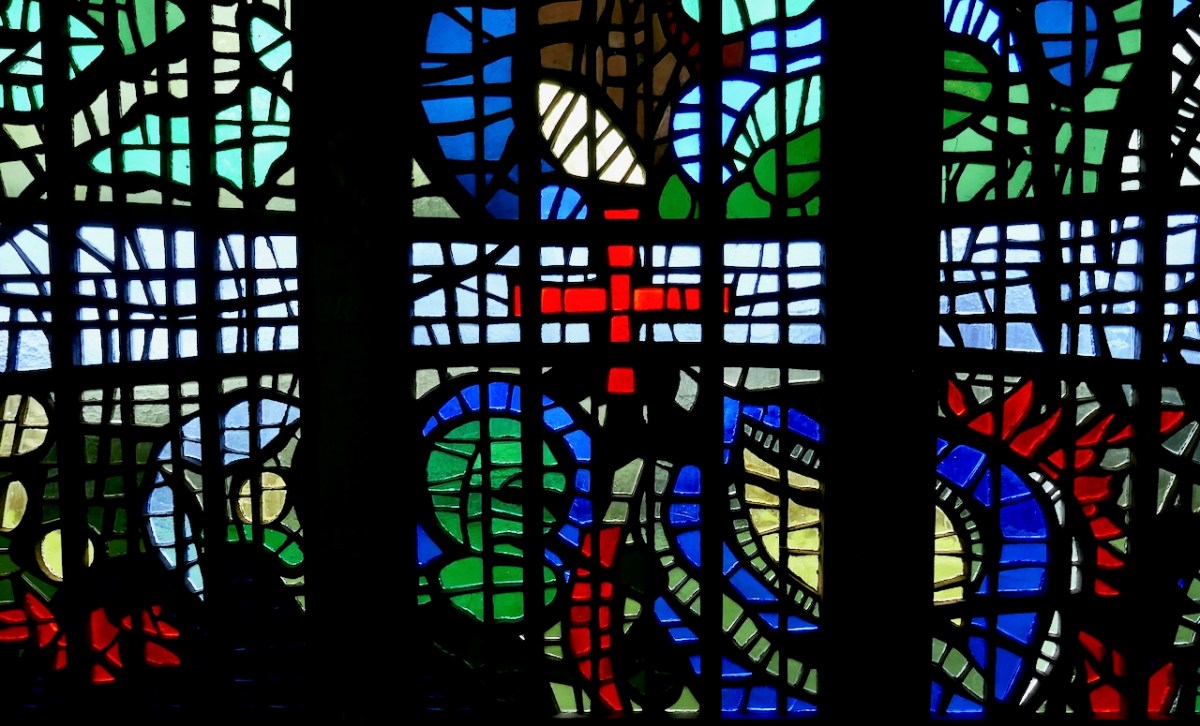
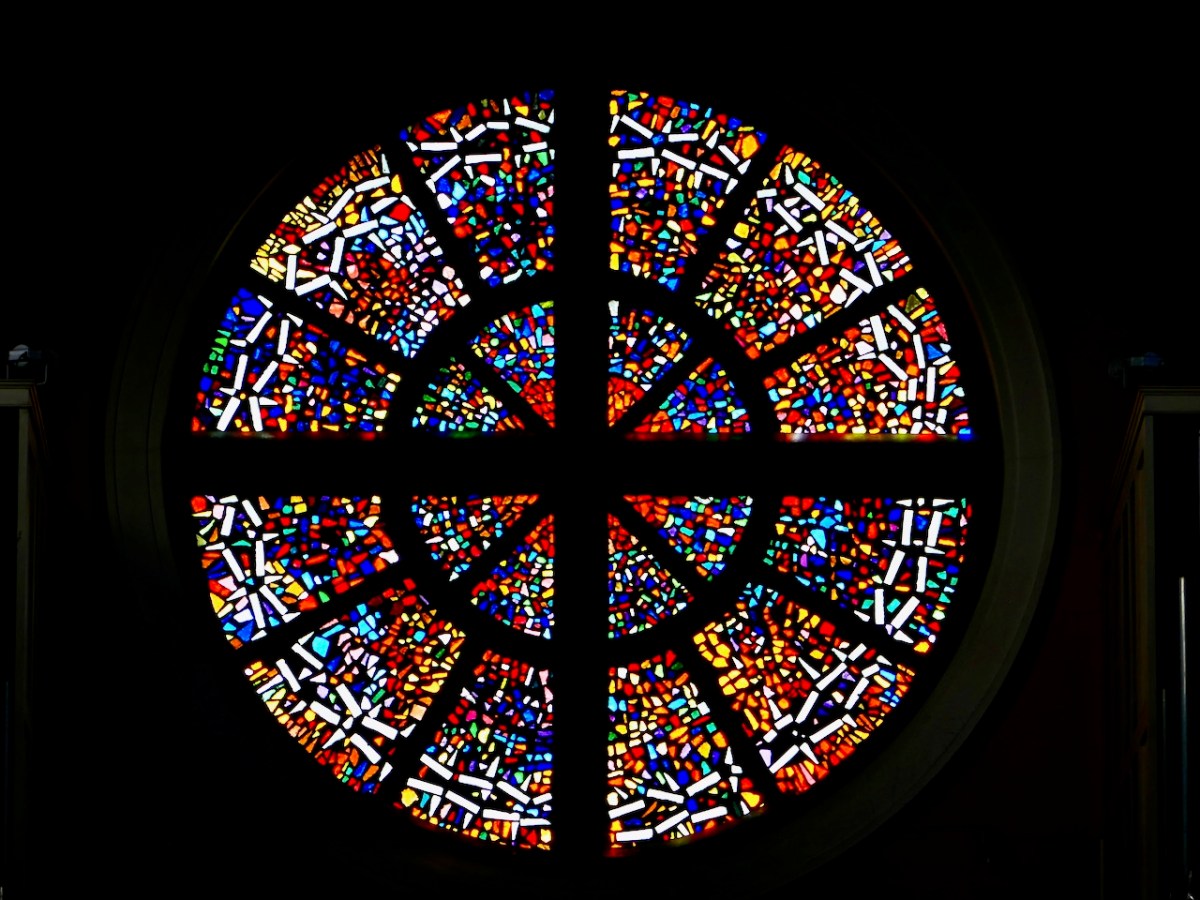
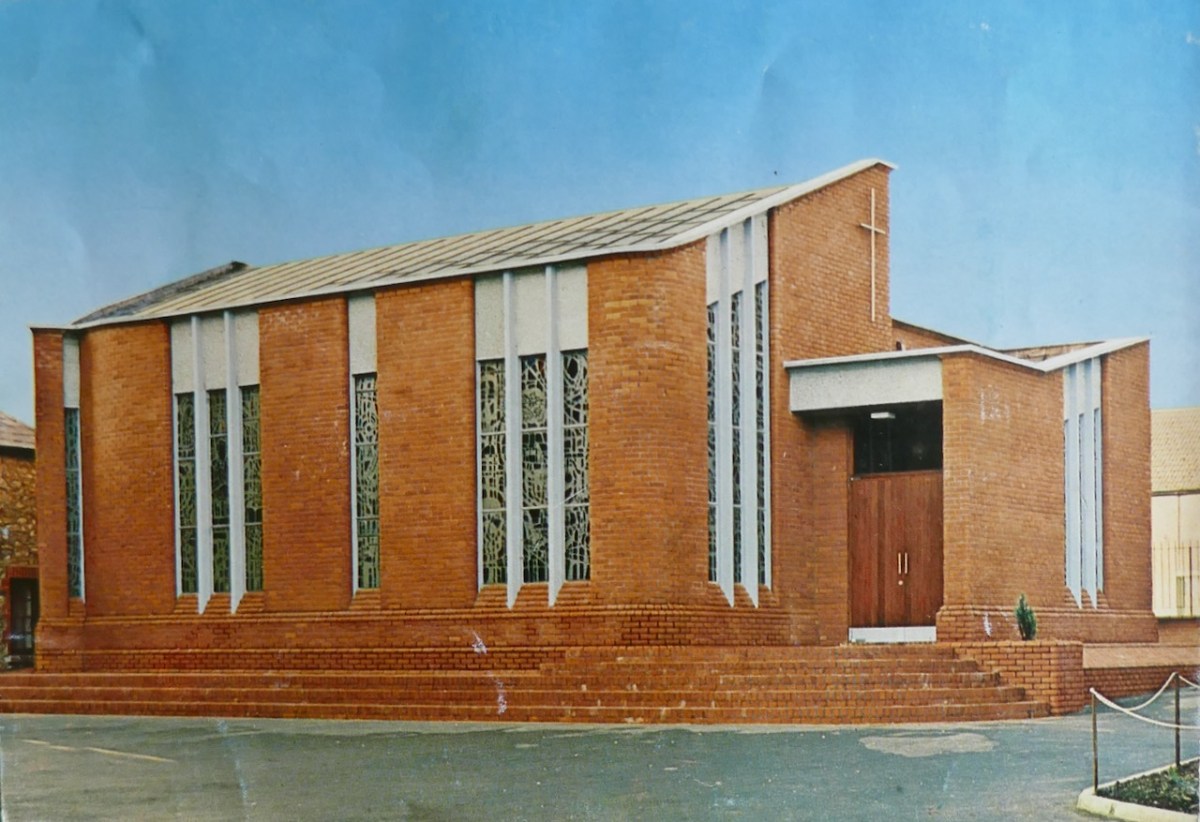
But the Irish dalle de verre story goes beyond Gabriel Loire: other mid-century artists mastered it and were employed by Irish architects. I will show you two examples first by non-Irish artists. The Church of the Sacred Heart in Waterford – it also is my featured image (above the title) for this post – contains glass by the distinguished British artist Patrick Reyntiens. Here’s a detail, below of that window.
The second church is St Bernadette’s in Belfast, with glass by Dom Norris of Buckfast Abbey. This church is well worth a visit for its many artistic treasures.
Irish artists got in on the act too – George Walsh brought the techniques of dalle de verre back with him from America in the 60s and, working with Abbey studios, introduced it as an ecclesiastical art form into Irish architecture. Here is his Crown of Thorns for St Mary’s Westport, designed by George Campbell and executed by George.
Other studios, such as Murphy Devitt, also used it, and quite close to me I have this charming example in Lowertown church. It’s the Dove of Peace/Holy Spirit, of course, but it became known in the studio as the Holy Gannet.
Although for the most part the churches I have shown you have retained their dalle de verre windows, in at least two cases (the Sacred Heart in Waterford and St Bernadette’s in Belfast) this has come at the cost of enormously expensive conservation projects. In other cases, dalle de verre windows have failed and churches have even had to be demolished.
For example, the original Edmund Rice chapel in Waterford (above) had to be replaced but George Walsh’s dalle de verre windows were partially saved and displayed in the new church (below). George had combined dalle de verre in these windows with the innovative use of painted glass panels, and even some painting on the dalles.
Dalle de verre windows failed because glass, concrete and steel (used to reinforce the concrete frames of the panels) expand at different rates, and external glazed walls are subject to all the effects of weather. Over time resin was substituted for concrete but this brought its own problems – the epoxy mix had to be just right (and this was all still experimental) or it could, and did, twist and crack as the building settled. The Irish climate – high humidity, temperature fluctuation, driving rain – exacerbated all of these mechanisms, both for cement and resin mixes.
I recently visited a church in Keenaught Co Derry (or Londonderry for my NI readers). It has a soaring wall of dalle de verre windows designed by George Walsh and executed in the Abbey Studios in 1973. The likeness to the work of Gabriel Loire is obvious and indeed George credits Loire as a significant influence on him. The church is enormous and the tall narrow windows lend a beautiful ambience to the interior. However, the windows are buckling at the top and will need conservation work at some point.
On the same trip I visited a much smaller dalle de verre installation in Swanlinbar, also by George, still looking colourful and rock steady in a side chapel.
I’d love to hear from readers who have come across other examples of dalle de verre work. As an architectural material it held such promise and it is a tragedy that much of it is no longer standing. The Gabriel Loire window below is from Vancouver, part of a series in St Andrew’s Wesley on Burrard St, viewed on a visit there. I had been in that church for events on numerous occasions when I lived in Vancouver, but knew nothing about these fabulous windows at that point.
By the way, Ateliers Loire is still going strong in Chartres, now run by Gabriel’s grandsons, Bruno and Hervé. Take a look at their recent work. And for anyone looking to learn more about Gabriel Loire I recommend this book which is in French and English. [Update – see comment below re the cost of this book!]
Finally, some of the text (now lightly edited) in this and the previous post on dalle de verre was originally written for a 2021 article on Dalle de Verre in Ireland in Glass Ireland, a publication of the Glass Society of Ireland. The full article is available here.
* Wynne, M, The Church of the Redeemer, Dundalk, THE FURROW, vol. 20, no. 8, August 1969, pp.411- 414
Welcome to the UCD Library Cultural Heritage Collections blog. Discover and explore the historical treasures housed within our Archives, Special Collections, National Folklore Collection and Digital Library