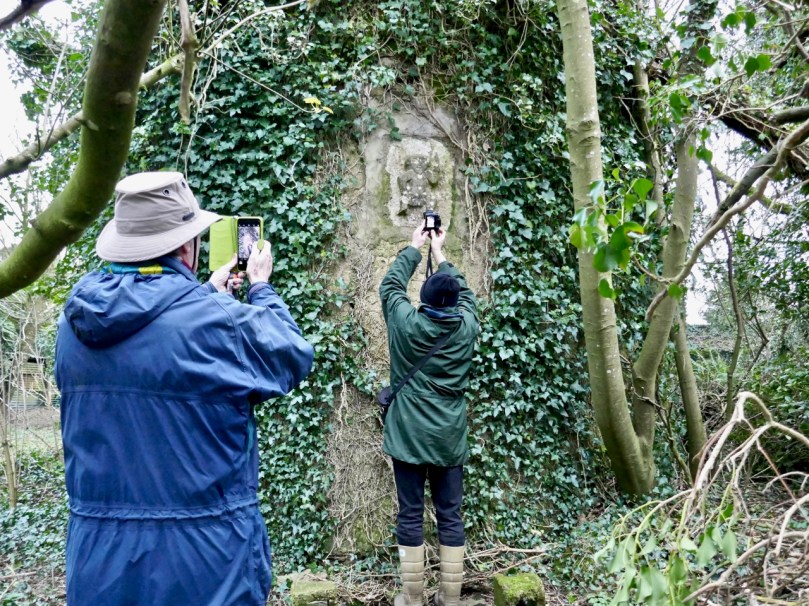
Recording the Sheelas

The sheela-na-gig is one of Ireland’s most mysterious historical artefacts, and one that has fascinated professionals and amateurs alike since the antiquarian days. What is a sheela-na-gig? It’s a carving of a female figure (mostly – there are also male figures, or seán-na-gigs), often crudely executed, with the focus on the hands reaching down to display the vulva. The female is often described as aged, or a ‘hag’ and the carvings have certain features that are common to many, such as staring eyes, ribs, stylised hair and breasts.

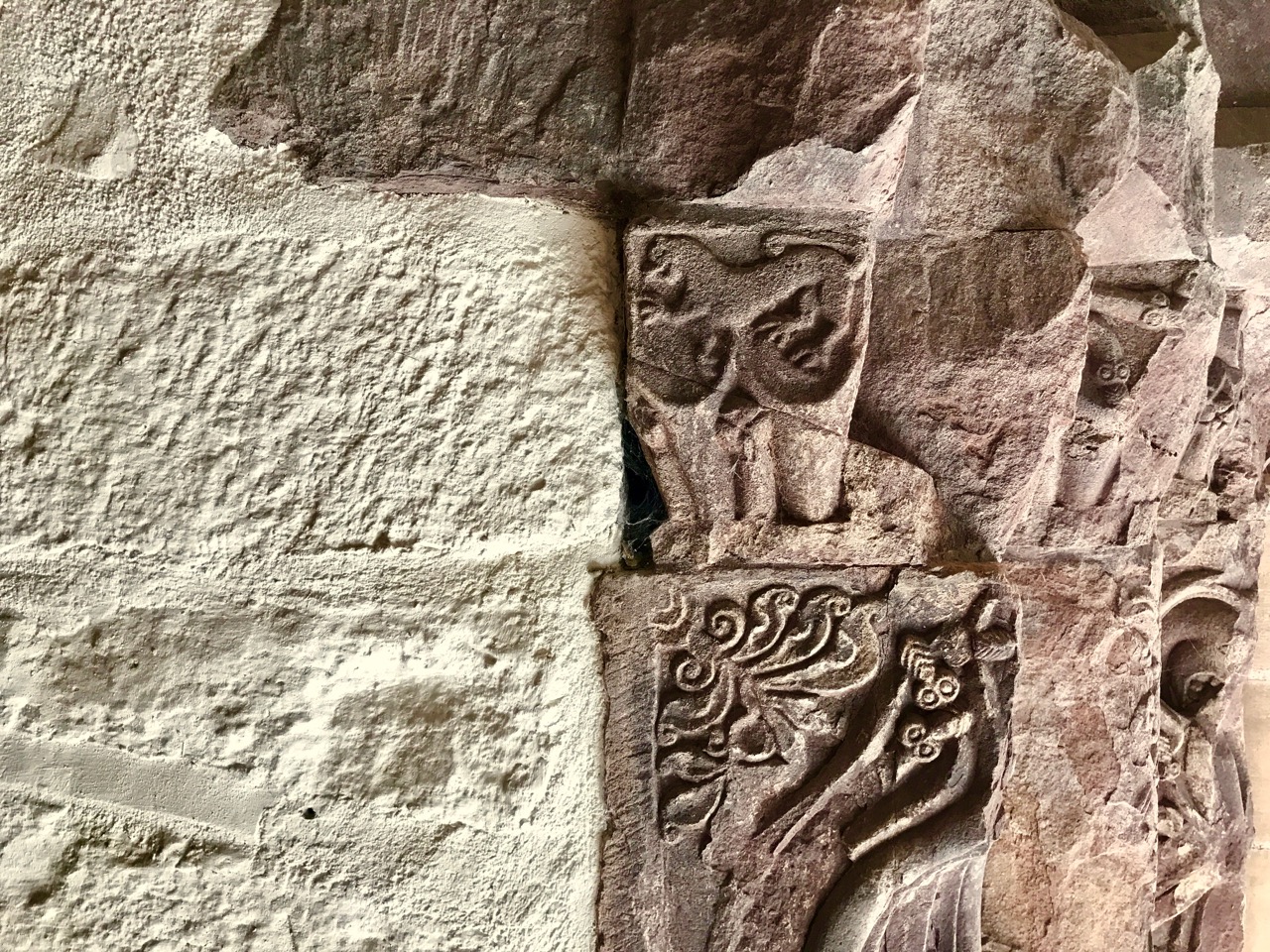
This is a romanesque arch at the Nuns’ Chapel in Clonmacnoise. Can you make out the tiny exhibitionist figure carved into one of the lozenges?

The carving of Sheelas probably started in the 12th century, as part of the corpus of fanciful or grotesque carvings that were used to decorate romanesque churches. Some are still found in romanesque contexts, especially outside of Ireland. In Ireland, two possible romanesque examples I have seen are at Liathmore and at the Nuns’ Chapel at Clonmacnoise. However, most Irish sheelas appear to have been either separated from their original locations or carved later, possibly up to the late 1500s. They are found on medieval churches, 17th century castles, the sides of old barns, at holy wells, and indeed in museums. Sheelas have been stolen, lost or destroyed and many of the existing sheelas are damaged.
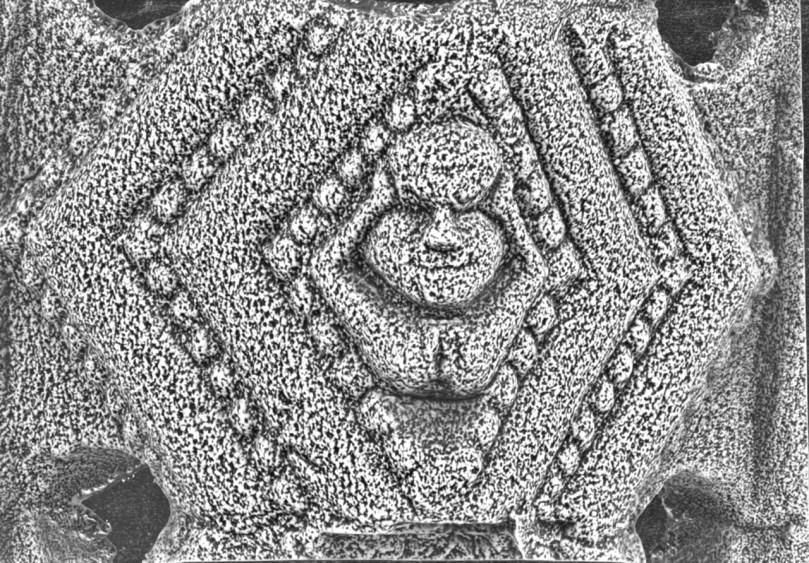
Does this help? This is just a screen capture of one of DH_Age’s 3D renderings – view it properly online here. This may be a very early sheela or simply one of the grotesque figures associated with romanesque carvings. The tiny figure is grinning and has its legs over its head, exposing the vulva and anus

There are multiple theories as to what a sheela represents and how they were ‘used’ on structures. Were they intended to attract and ward off the evil eye? To serve as a warning against lust? To invoke the sacred feminine through the powerful image of the vulva? The hag, or cailleach, is a vibrant motif in Irish mythology as a form taken on occasion by a goddess. Several sheelas are associate with saints, and believed to be representations of them.

At St Gobnait’s Church in Ballyvourney it is customary to rub the sheela as part of the rounds

We have visited many sheelas (and one seán) and noted that it is always difficult to photograph them well. They are invariably out in the open and very worn. The details are difficult to discern and often obscured by lichen. Even where they are indoors, they show the signs of of exposure to the elements, so it is impossible to view them in what would have been their freshly-carved state. And of course they are deteriorating with every passing decade.
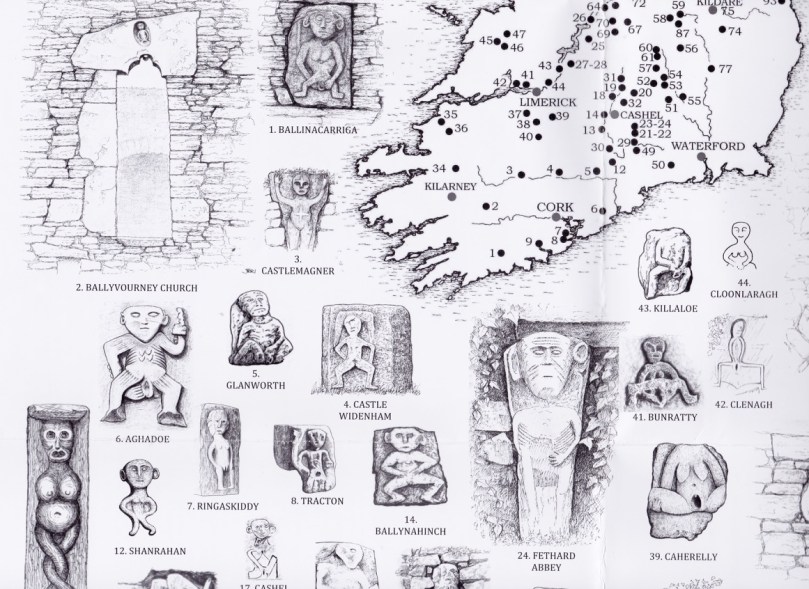
From Jack Roberts’ resource map (see below) – a collection of southwestern sheelas

Fortunately, there’s this great project out there run by DH_Age, or Digital Heritage Age, to record all the sheela-na-gigs using the latest 3D imaging technology. Hats off to Gary Dempsey and Orla Power for undertaking this incredibly important initiative with the support of The Heritage Council. They are working away on visiting all the Sheelas in Ireland and already have a substantial body of images to view online.
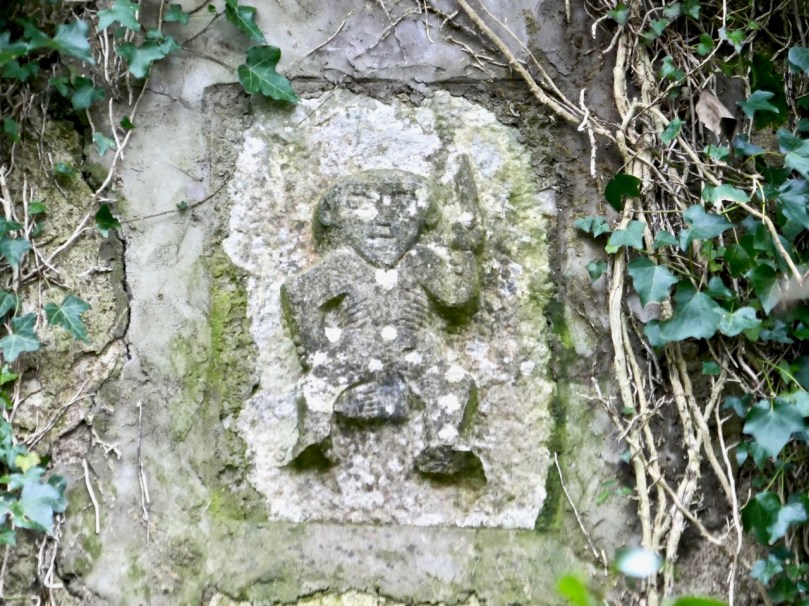
The Aghadoe sheela is damaged (the feet are broken off) and covered in patches of lichen

Take a look at their collection of Cork sheelas to see how a good 3D image can reveal the true nature of a carving. The Aghadoe (Co Cork) example is particularly striking to me, because we visited it recently and I found it quite hard to photograph. The 3D image shows the breasts, the ribs, how one arm goes behind the legs to display the vulva while the other holds something aloft, and the curious bumps on the wrists that defy interpretation.
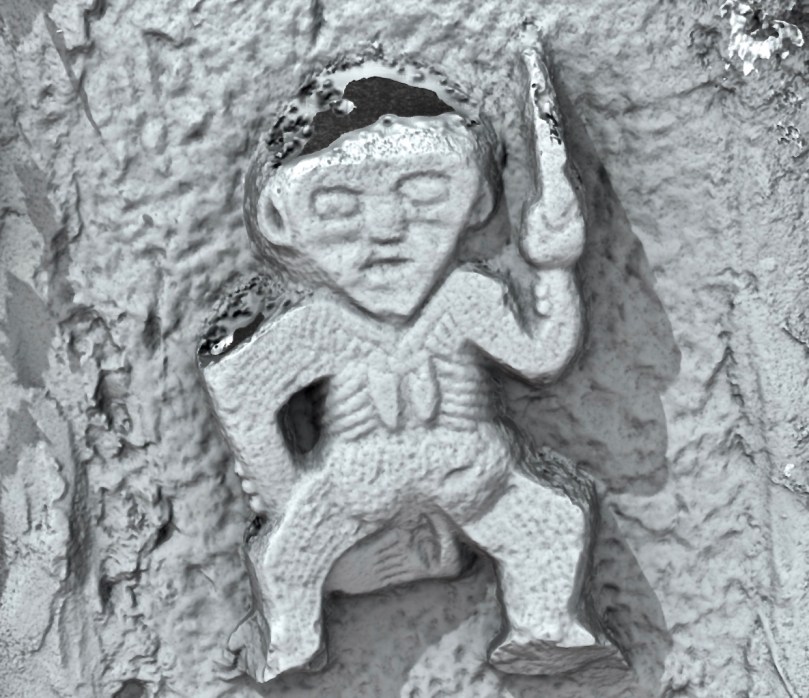
The DH_Age’s 3D rendering of the Aghadoe Sheela: the clarity of detail is impressive, but view it online for the full effect

The Aghadoe Sheela-na-Gig has a complicated history of being placed in different locations but it is currently on the side of a dovecote of indeterminate date and looking like at any moment it will be covered by the thick growth of ivy all around it. There was a tower house here at one point, and the sheela was reported as ‘probably from the castle’ and as ‘lying beside it.’ It’s a little tricky to track down now, so it’s a big thrill to find it and to see that, for the moment at least, it’s in the relatively protected position of being cemented into the dovecote wall.

Jack Roberts’ sketch of the Aghadoe Sheela

Our old friend Jack Roberts has written extensively about sheela-na-gigs and has published a marvellous resource – a one page fold-out map of the Sheela-na-Gigs of Ireland. You can order this from Jack’s site. His illustrations, as usual, are superb, and his artist’s eye managed to make out much of the detail that my camera couldn’t catch.
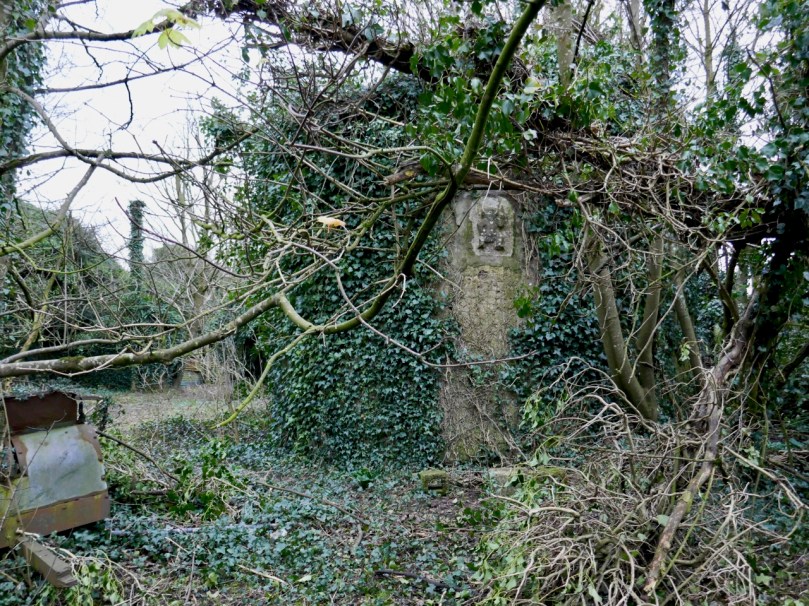
The Aghadoe Sheela is currently cemented on to a dovecote

I will come back to sheela-na-gigs in a future post but for now, you can check out these resources, for Ireland and for Britain, to learn more.

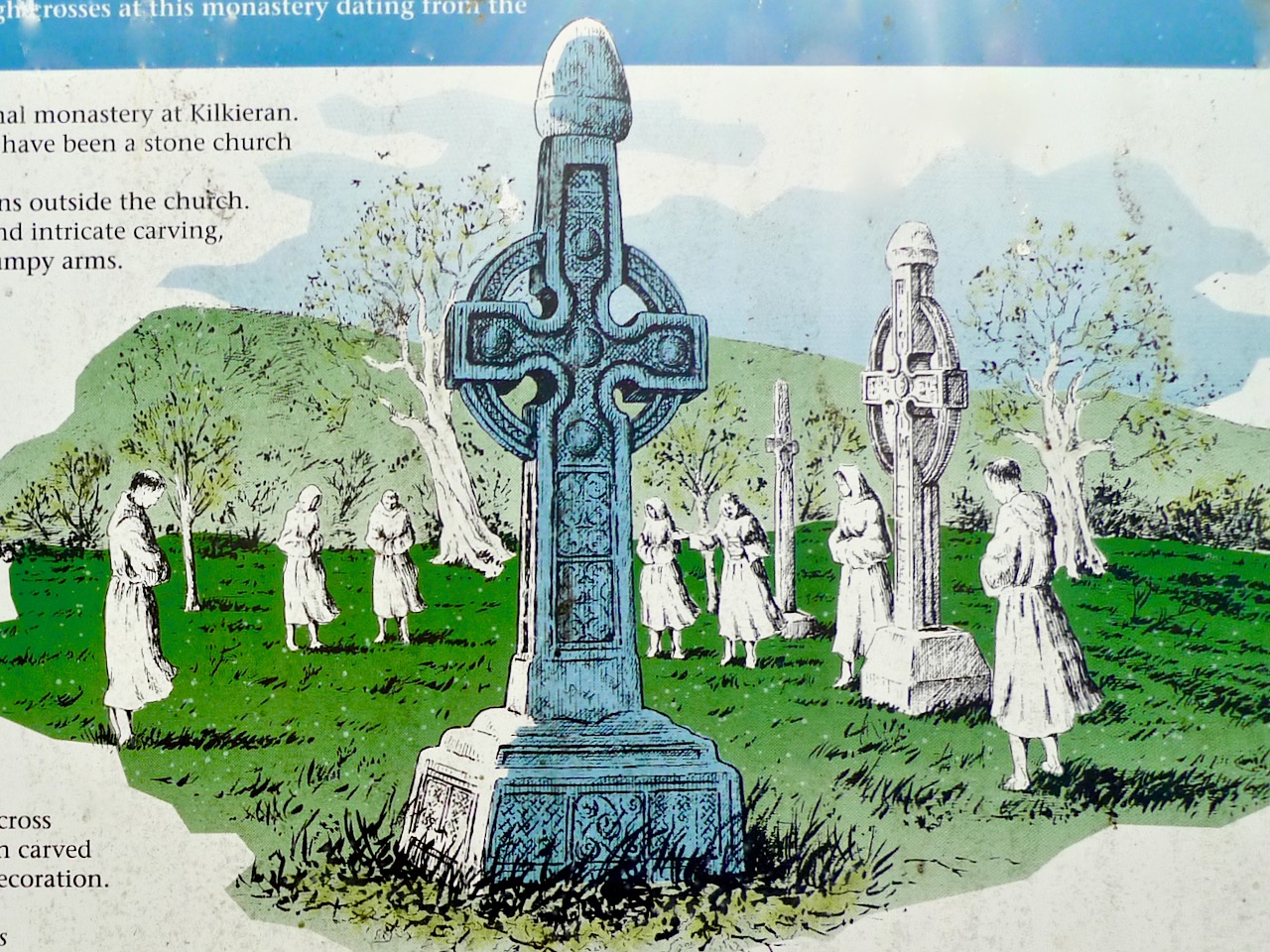
Kilkieran High Crosses – Medieval Gems

You will remember Saint Ciarán of Saigir, who was born on Cape Clear, perfectly framed in our view from Nead an Iolair? He was known as the ‘First Saint of Ireland’, preceding Saint Patrick by almost a century, and also as one of the Twelve Apostles of Ireland. A manuscript dating from 1629 and housed in the Bibliothèque Royale, Brussels, tells how the Twelve Apostles were educated together in Clonard, Co Meath – the most important monastic school in early Christian Ireland – under Saint Finian. It is said that ‘ . . . there were no fewer than 3,000 pupils getting instruction at one time in the school in the green fields of Clonard. The master excelled in exposition of the Sacred Scriptures, and to this fact must be mainly attributed the extraordinary popularity which his lectures enjoyed. Finnian’s gift for teaching and his absolute dedication to the ascetic ideal, inspired a whole generation . . . ‘ St Finian achieved the age of 140 years himself, while Ciarán – who went off to Cornwall where he is known as St Piran (you will also remember) – lived to be 206 before falling into a well on the way home from a wild party. There’s a lot to be said for being a saint in those days.

These are extracts from the OPW signboard located at the site

Why are we revisiting St Ciarán? Well, we’ve just past March 5th, which is his day, so we have to celebrate him. To do that we will go off to County Kilkenny, where there is a very important medieval site, noted for its high crosses but with plenty more to see: it’s a 45 minute drive north of Waterford city. The site, known as Kilkieran (Kieran is an alternative anglicised spelling, prefixed by ‘Kil’ which means ‘church of’) was once home to a monastery founded by St Ciarán, and the high crosses date from the 9th century.

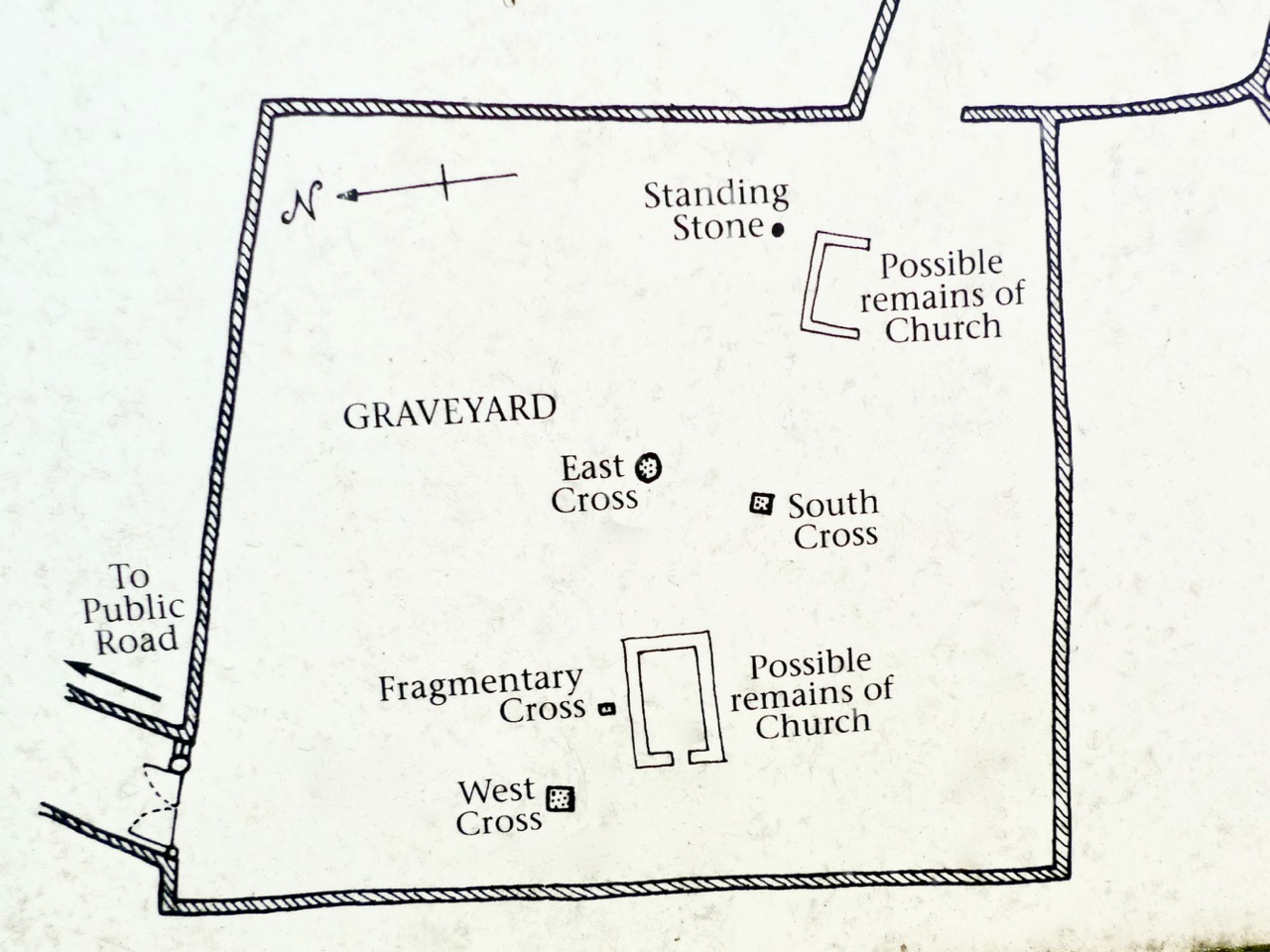
The West Cross has animal motifs and some unusual interlacing carved on the various elements; below is the site plan included on the OPW signboard

To be able to see exquisite artistic medieval carved stone from 1200 years ago still standing where it was first placed is remarkable. In other discussions on high crosses and similar works of expertise we have asked whether these gems should be preserved out of the elements – as some are – to prevent the deterioration which is undoubtedly taking place. While I tend to favour that approach – and it seems to me to be particularly appropriate where they are replaced by high quality replicas ‘in the field’ – there is something very special about visiting intact sites like this one. The whole conservation process is full of dilemmas.

The enigmatic East Cross – unlike any other Irish High Cross

There were once four crosses at Kilkieran. Three are still complete and in reasonable condition, although much weathered, while the fourth is just the stump of a shaft. One –  the East Cross – is unusual: it is slender, largely undecorated, with minimal crosspieces and no roundel. There’s a nice little tale about it: the cross was attacked and destroyed by iconoclasts, but was painstakingly reconstructed in the mid-19th century by blind local stonemason Paddy Laurence, who had lost his sight while working on the construction of the Palace of Westminster in London: the old Palace had been ravaged by fire in 1834 and was rebuilt to its present design under the auspices of Charles Barry and Augustus Pugin.

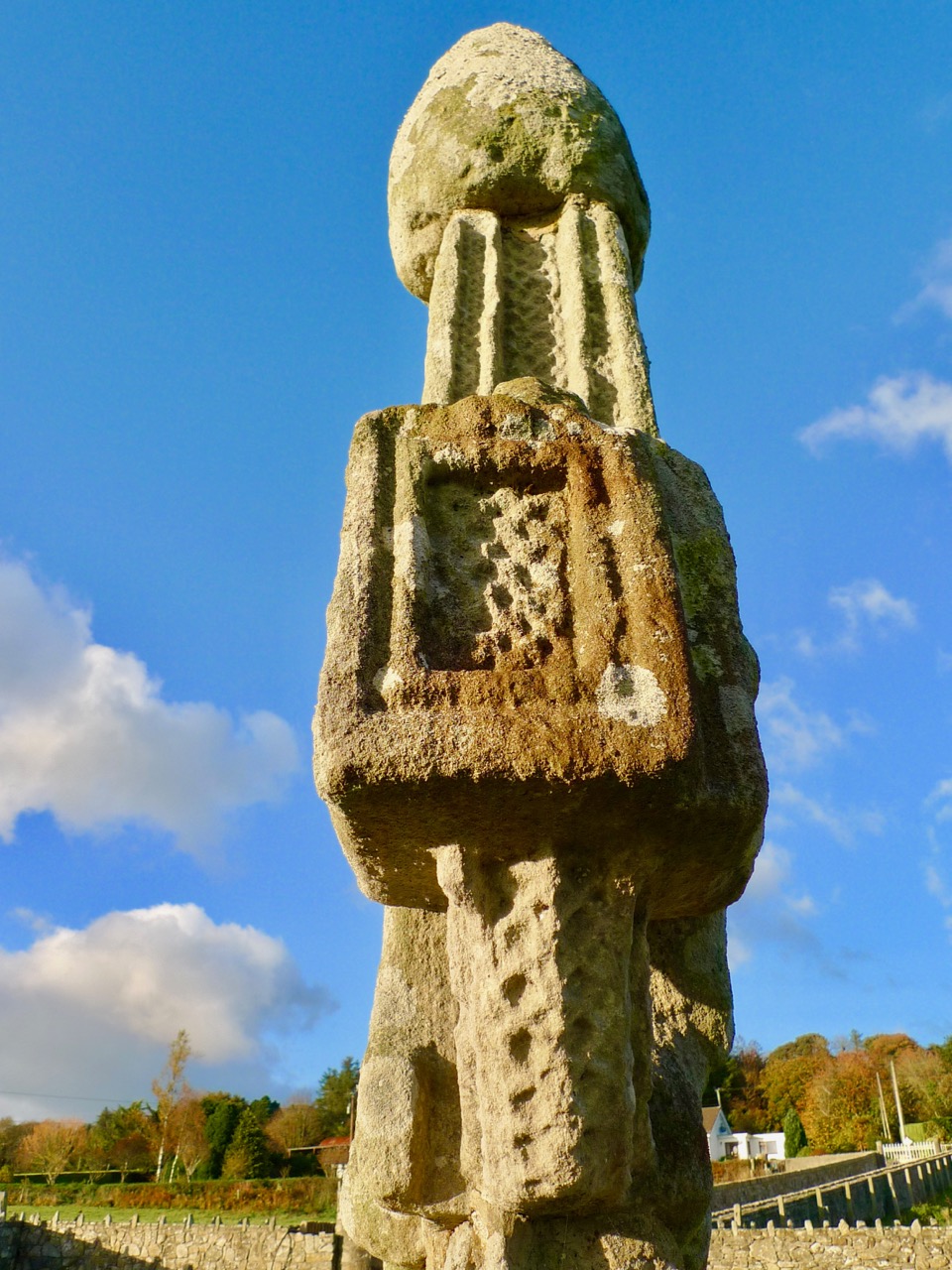
The plain South Cross: the large, acorn-shaped capping is found on other crosses in the ‘Ossory Group’

The high crosses at Kilkieran are simpler and less decorated than many others, but have a great dignity, especially in the context of the burial ground which has grown up around them. We were fortunate to visit them on a really clear day, when the shadowed relief stood strongly out.

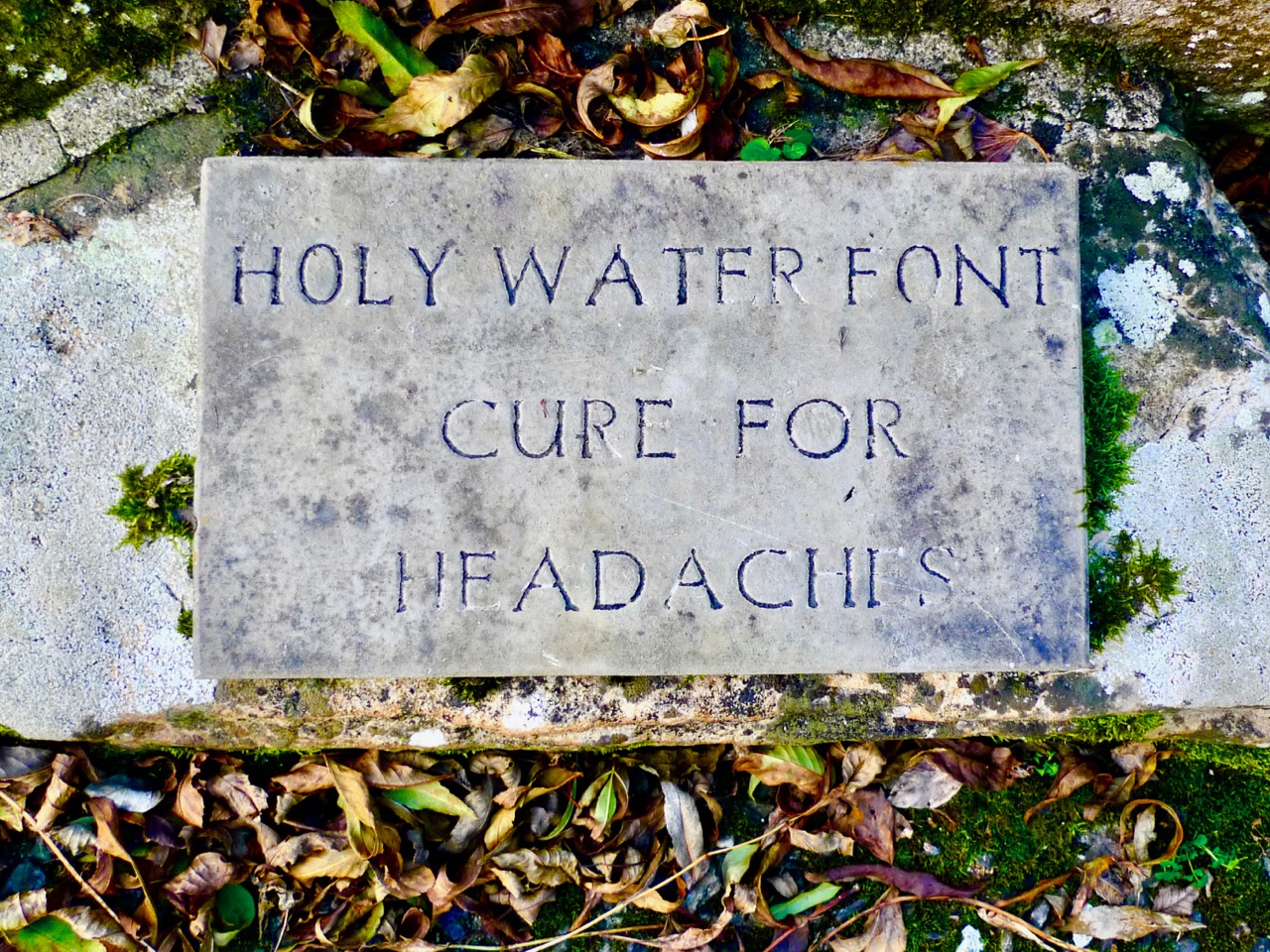
A still-visited Holy Well and bullaun stones are found on the old monastery site

You will want to go to Kilkieran yourself: when you do, don’t miss some fine ancient grave slabs and the nearby Holy Well. Then you should take yourself off to the other High Cross sites in what is known as the ‘Ossory Group’, beginning with nearby Ahenny. I’ll be writing about them all soon.

Below – an early carved grave slab on the site, carving on the West Cross shaft, and a detail of the West Cross ring

Viking Traces

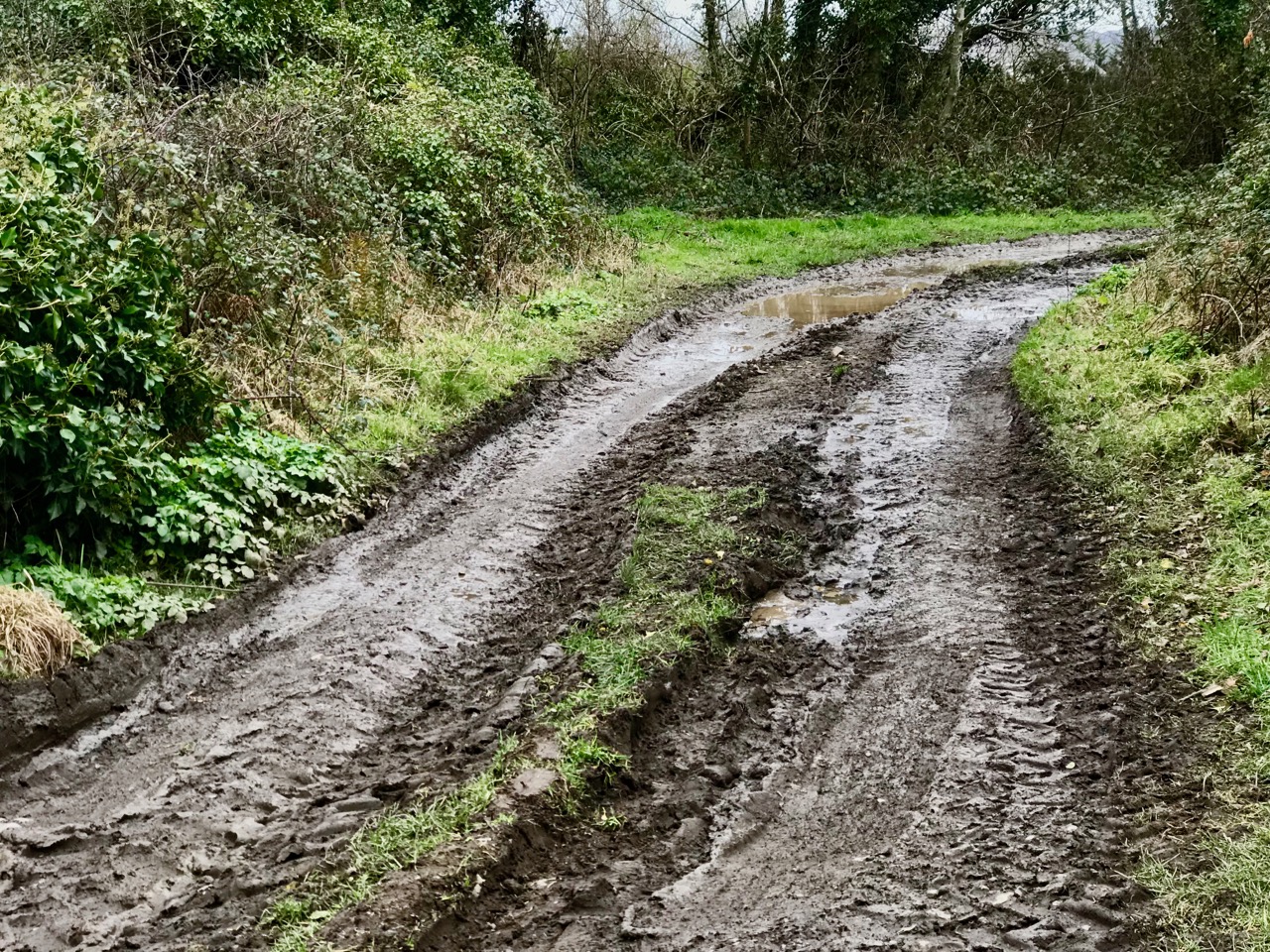
If you want to find some remote Irish history which is a long way off the beaten track, try the city of Dublin! Just a few minutes’ drive from the edge of this bustling metropolis (and down a long, rough and muddy farm track) is a collection of carved stones which have their roots in the time of the Vikings.

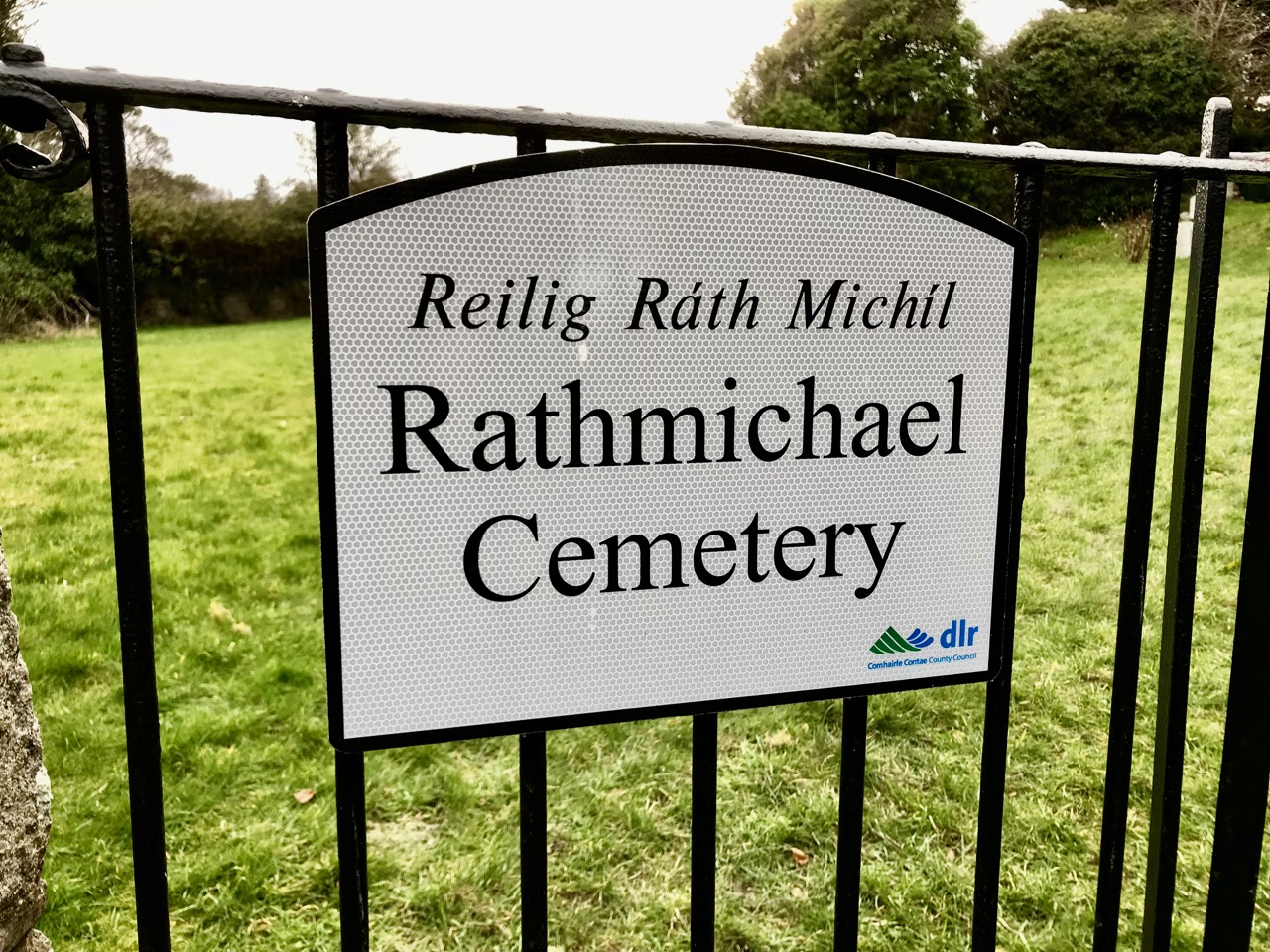
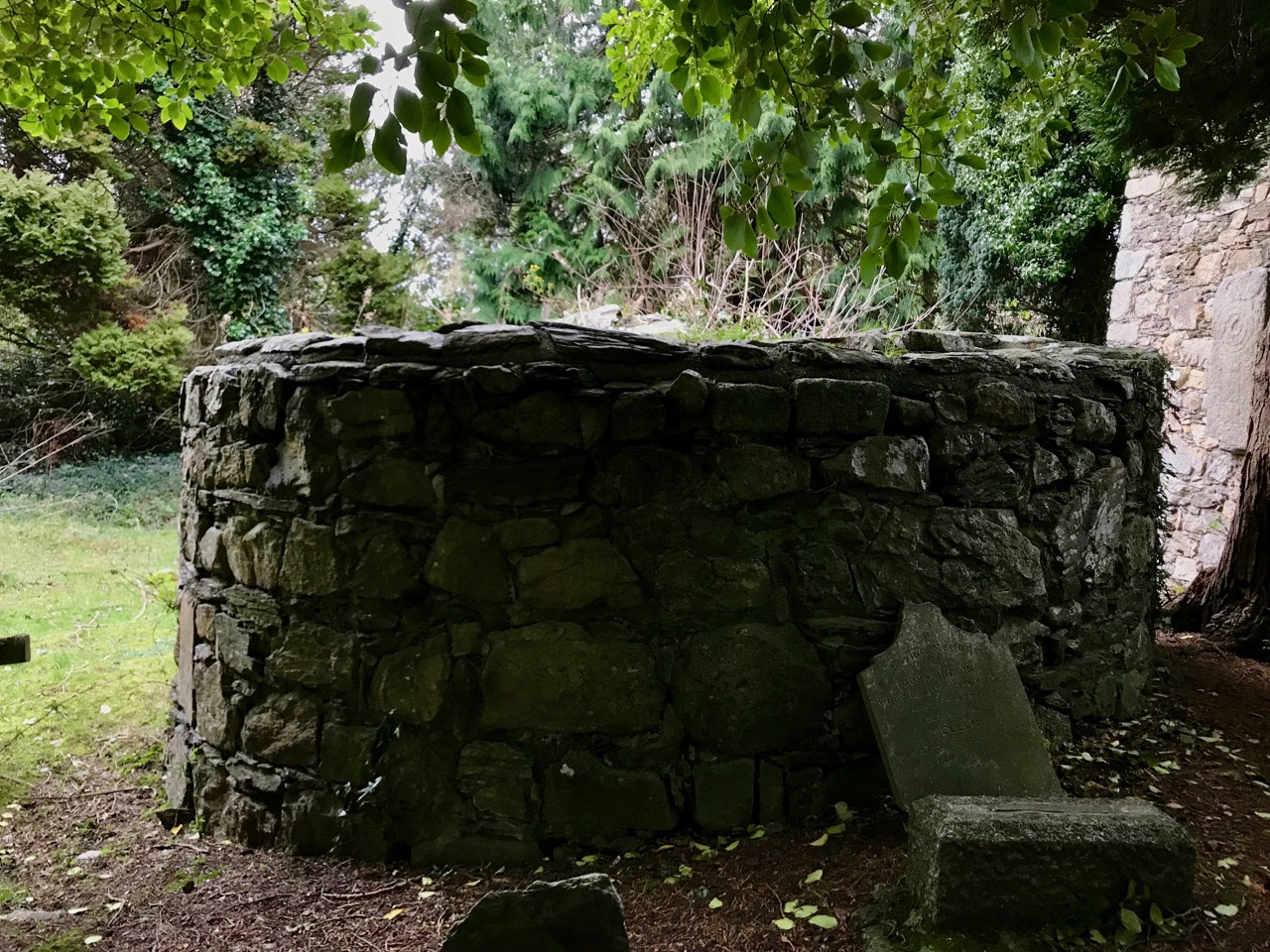
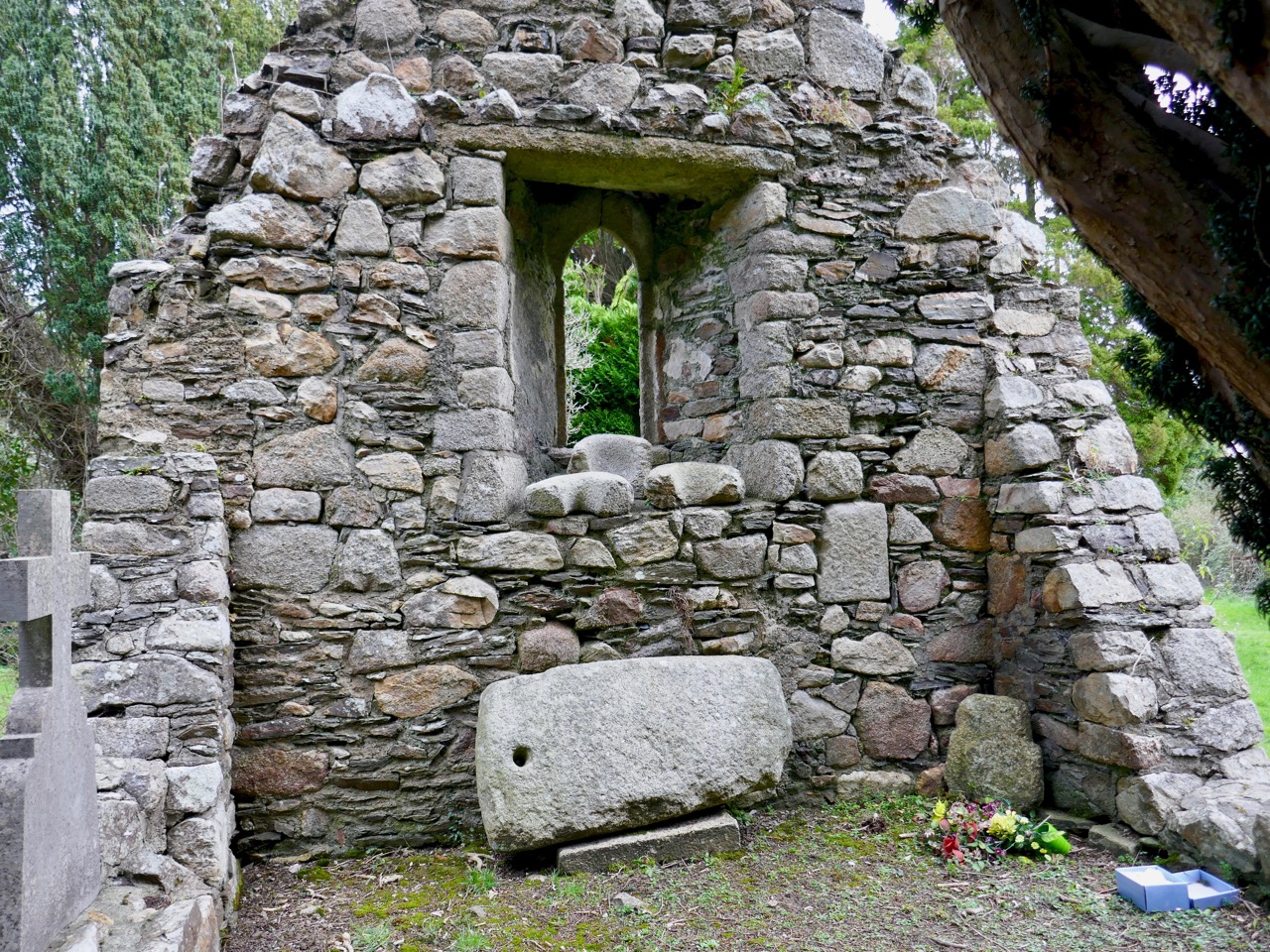
Here, in the barony of Rathdown, the remains of a small ruined church date from the twelfth century, but a monastic settlement was set up long before that by St Comgall of Bangor, who lived from 520 to about 600 AD. There is the stump of a round tower here, known locally as the Skull Hole, as bones from the surrounding graveyard were thrown in here. Some say, also, that it is actually the entrance to an underground tunnel going down to the coast: furthermore, a piper was once seen to enter the tunnel playing his pipes – but was never seen again!
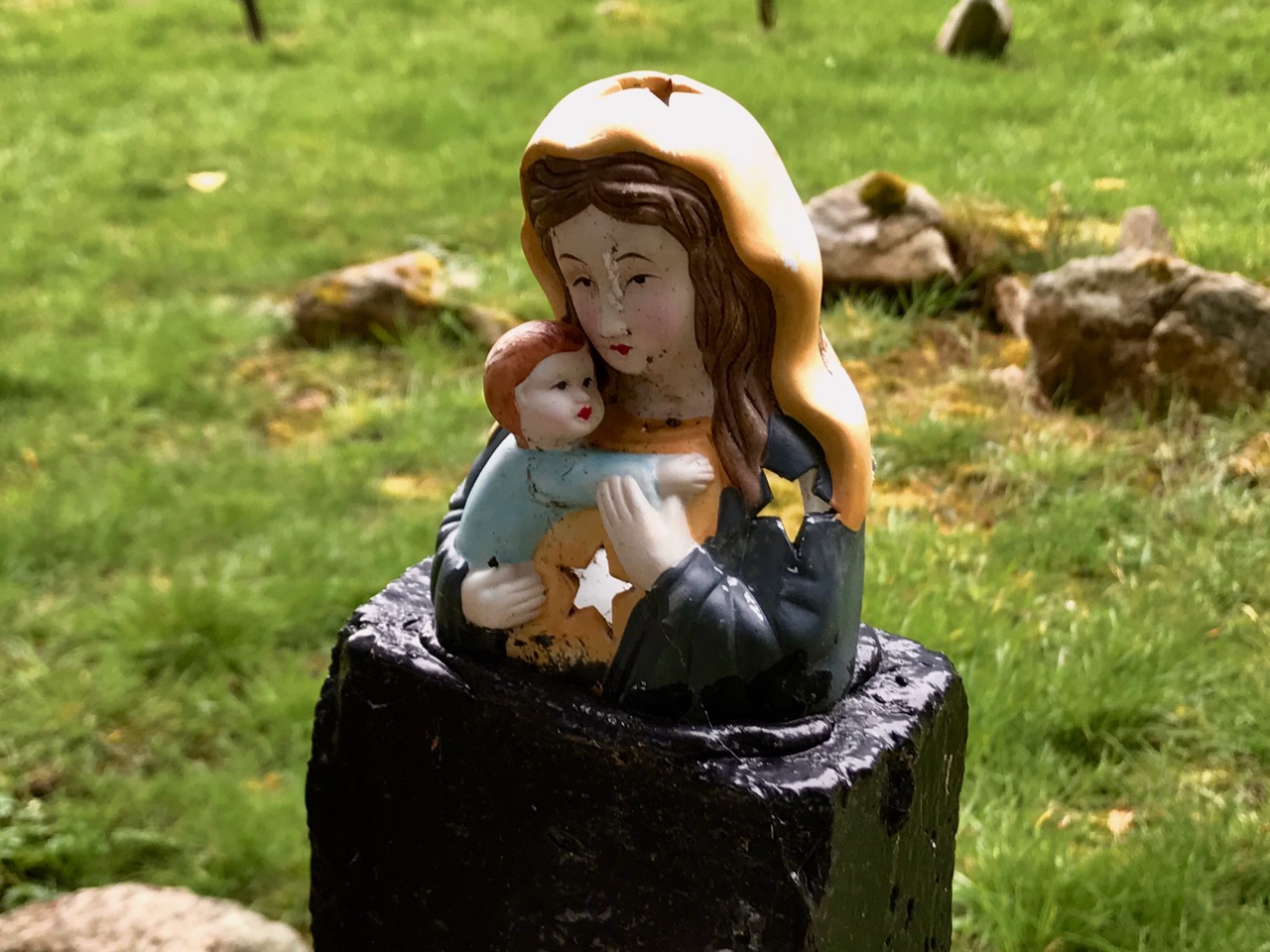
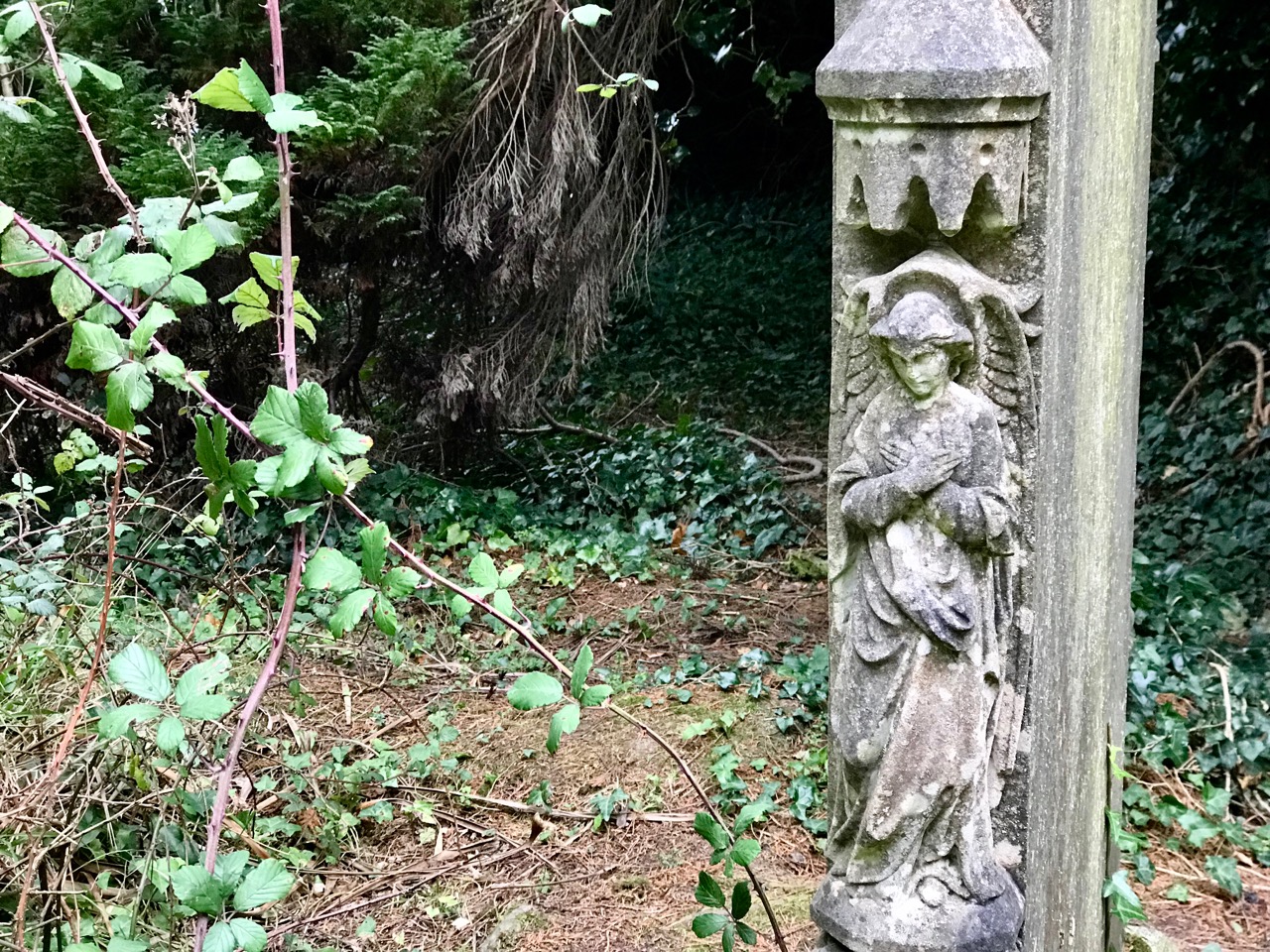
There is another piping tale connected with a nearby site: Puck’s Castle. A fairy piper is often seen jumping from rock to rock while also playing his pipes. We watched and listened, but in vain . . . Here are some of the noteworthy ‘modern’ gravestones in the cemetery at Rathmichael:
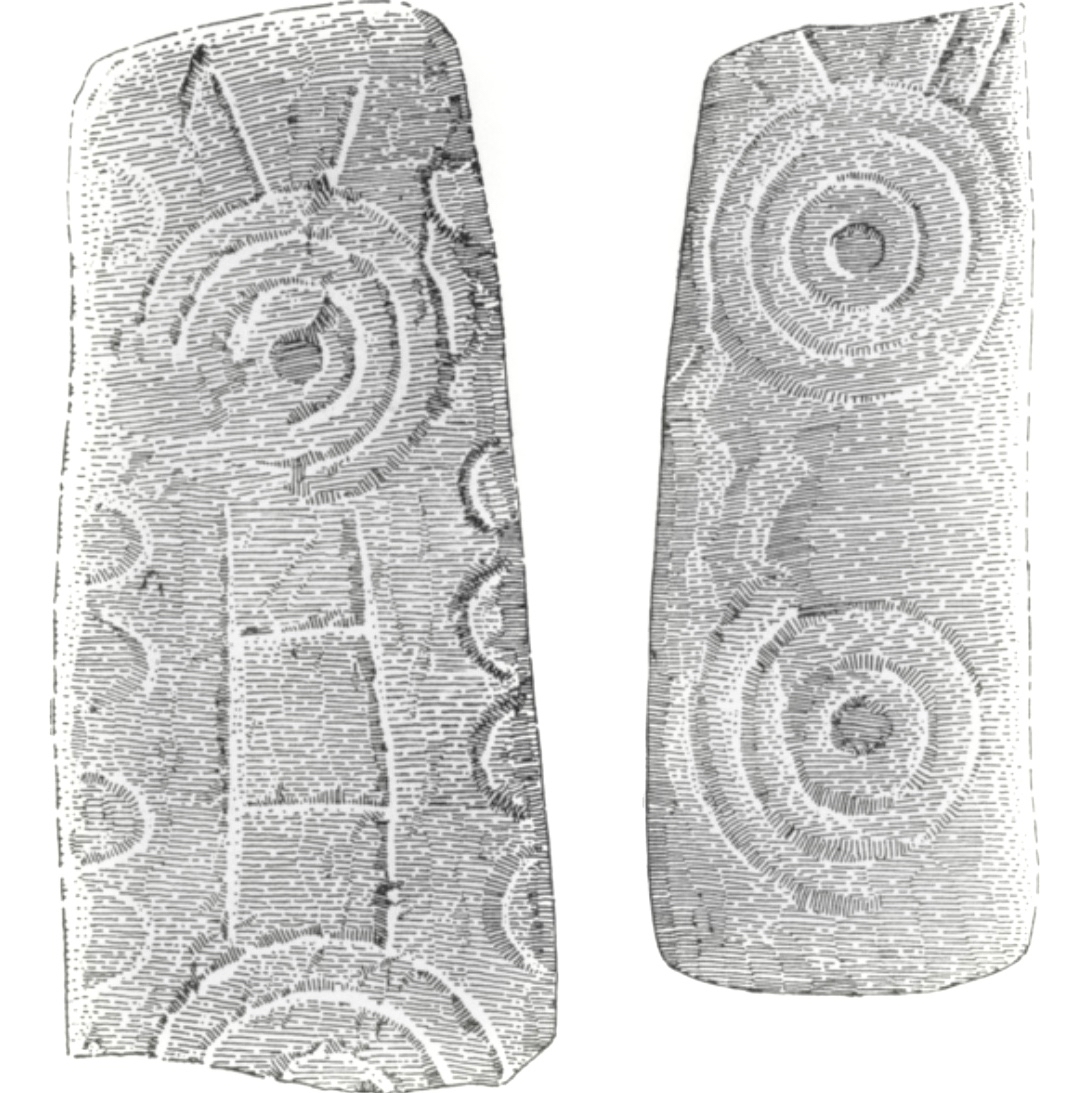
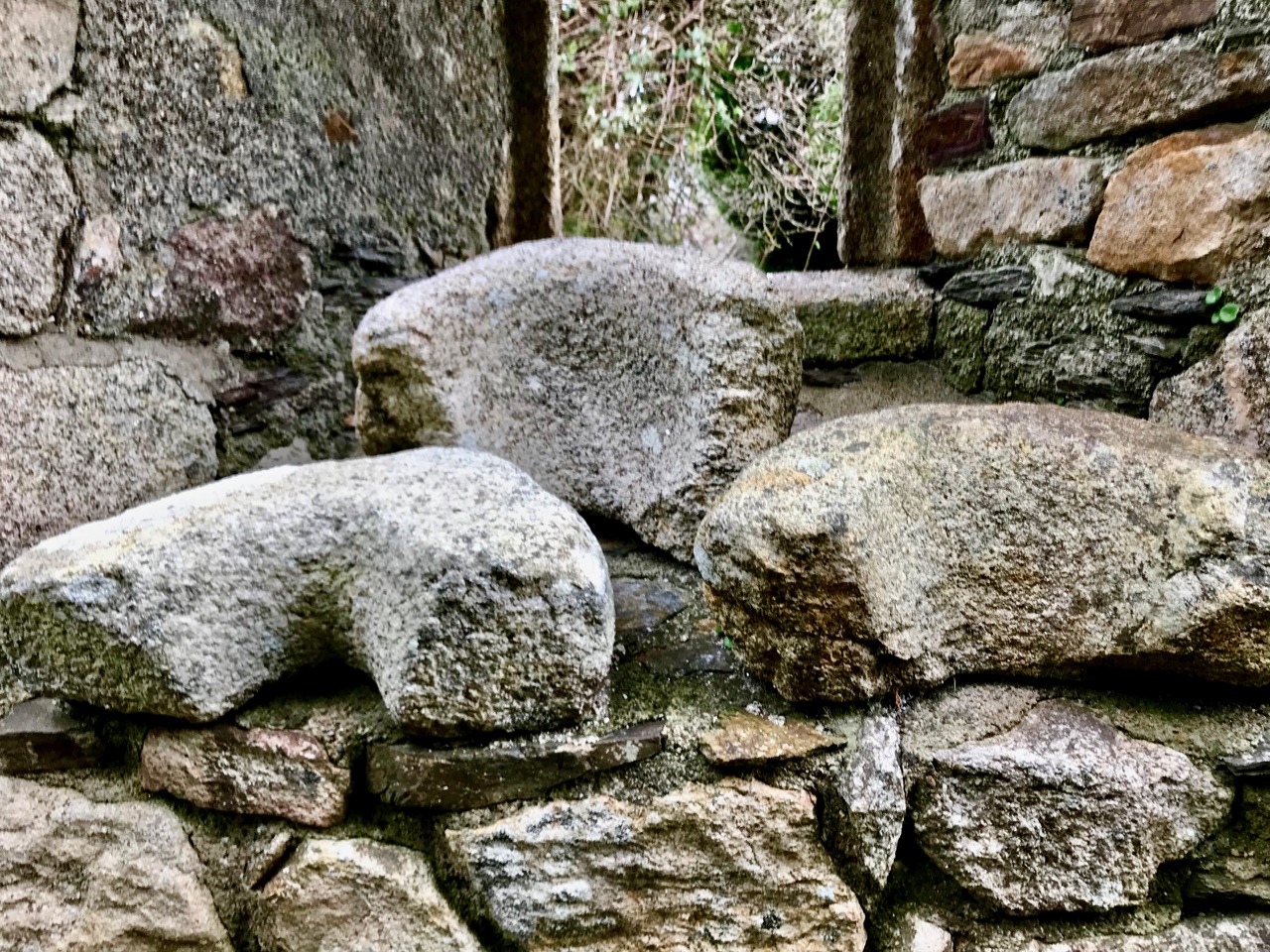
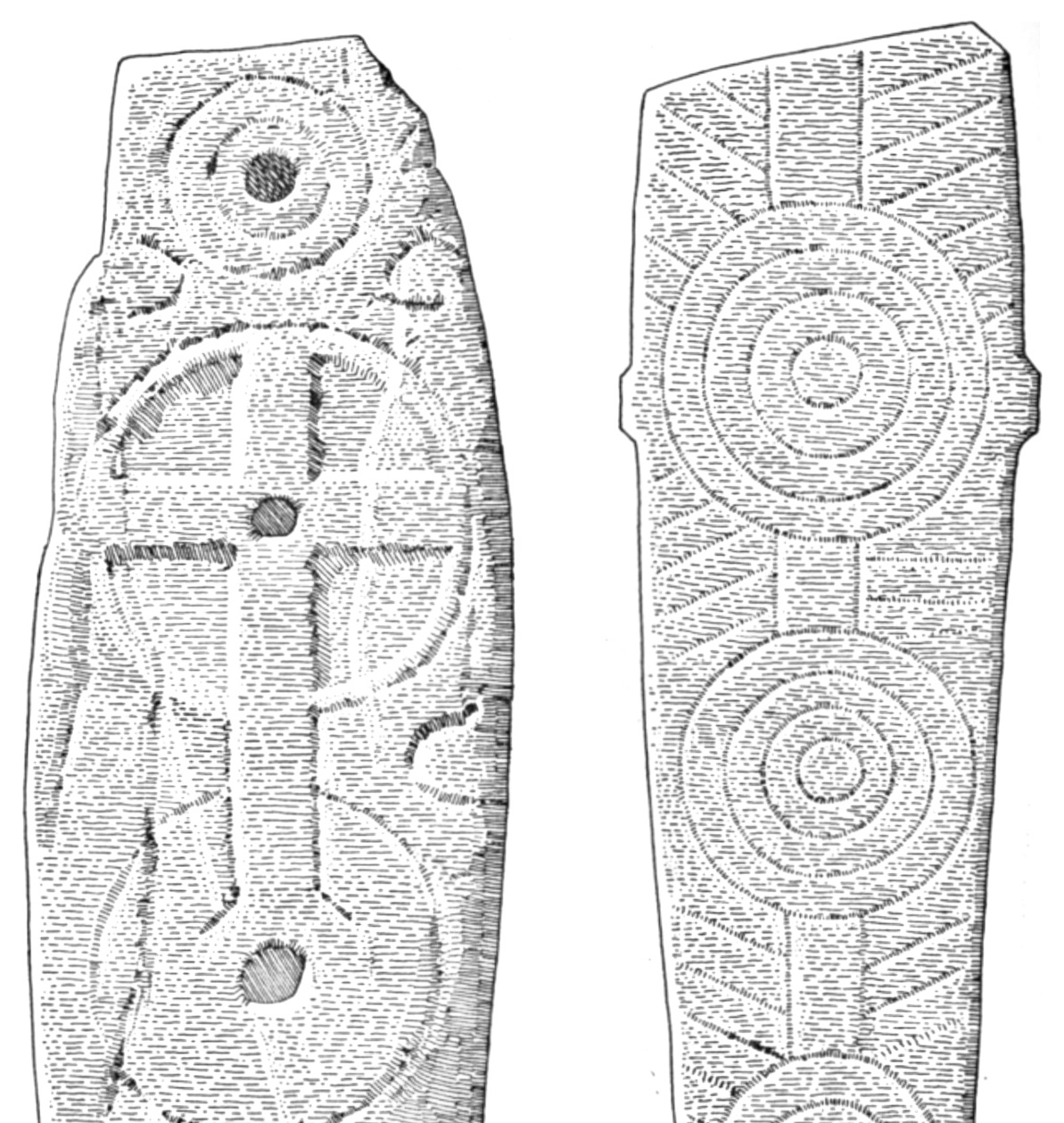
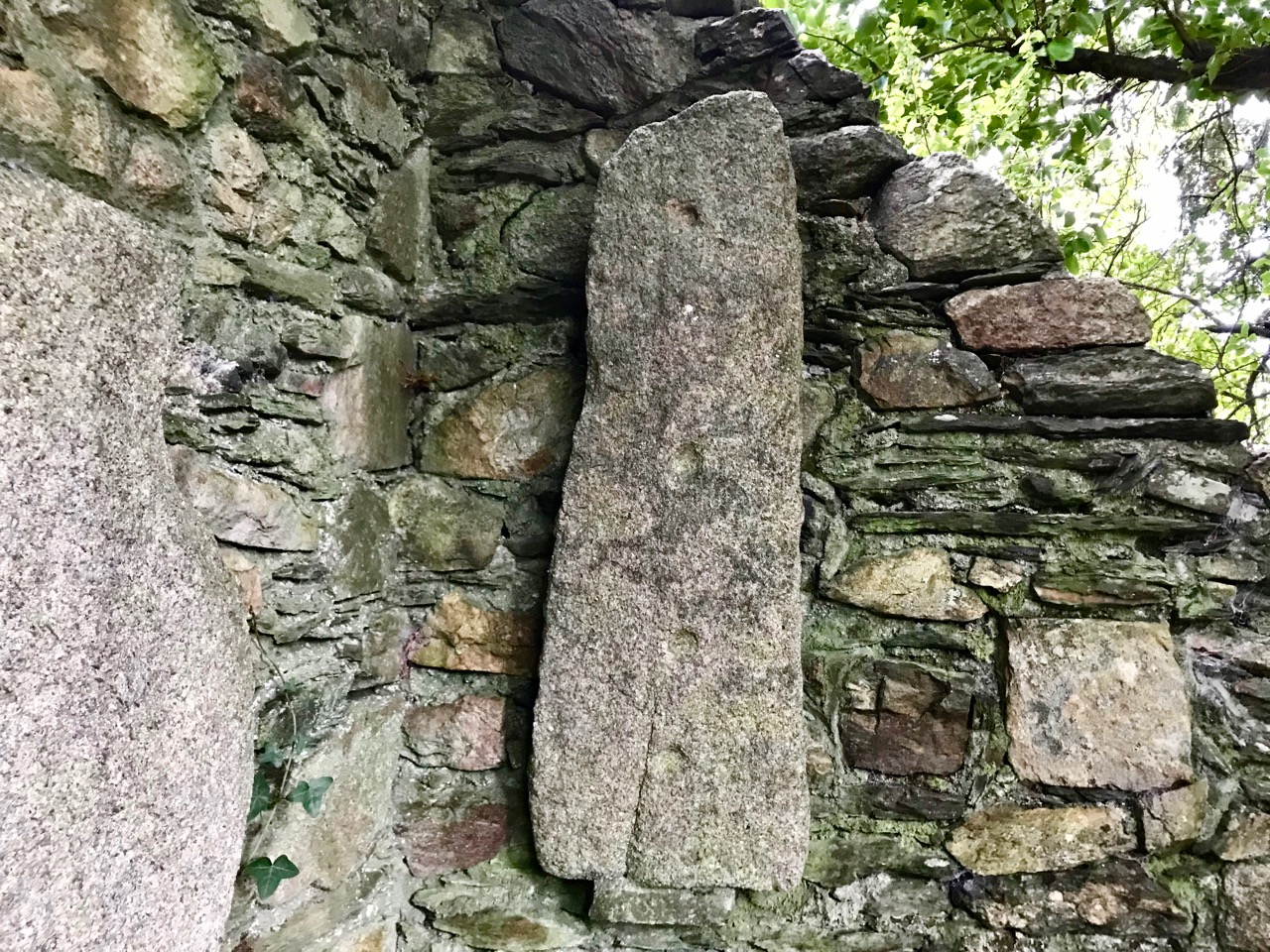
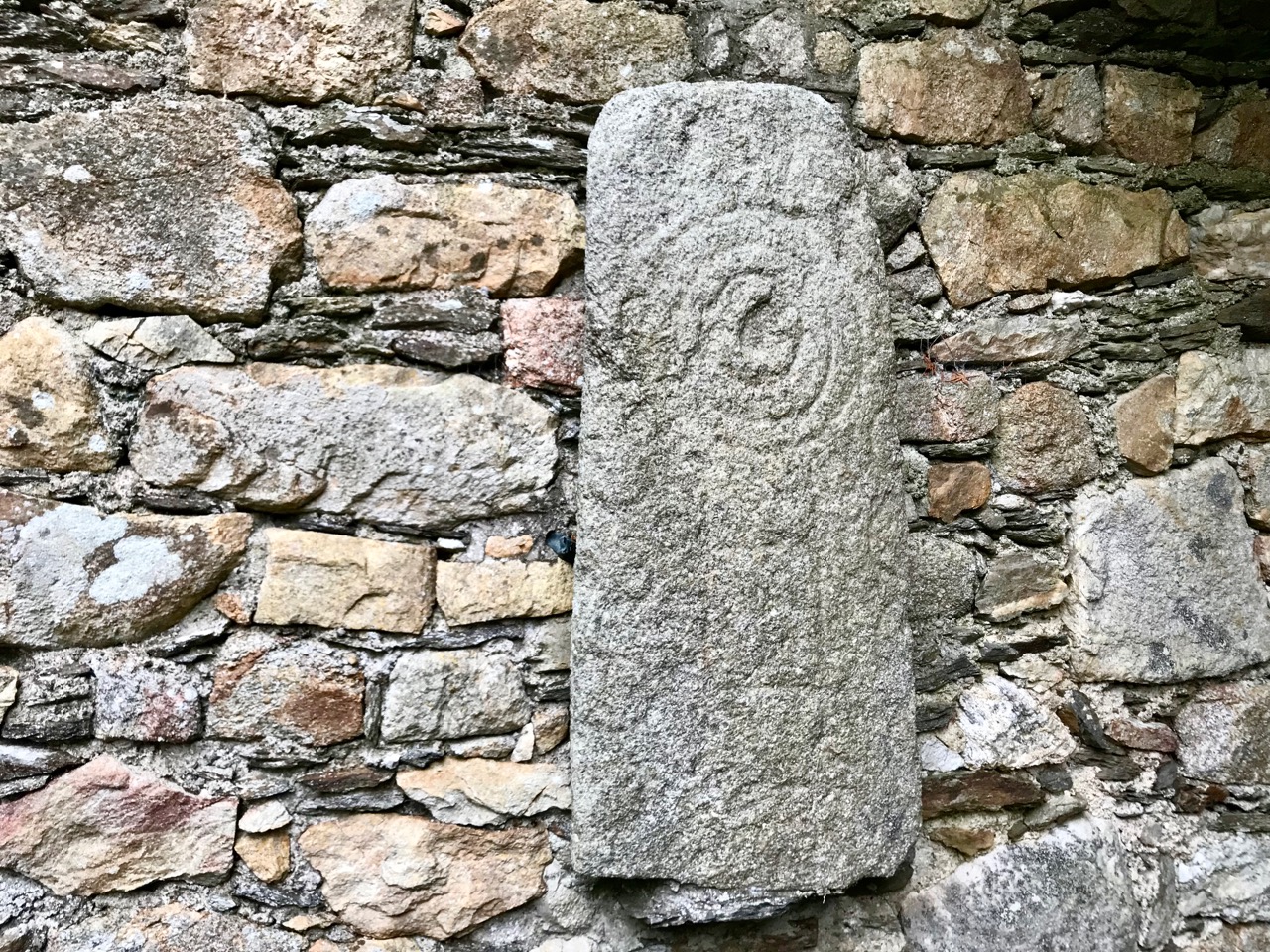
But the real treasure of the place are the carved stones which date from Viking times, and which are probably early Christian grave markers. They are generally known as The Rathdown Slabs. Some of these we would classify as ‘Cross Slabs’, even though, on some, the cup marks and concentric circles make us think of Prehistoric Rock Art. Well worn by time and weather we can still make out the various motifs – and we are fortunate to have good drawn records of these stones dating from a study carried out by Pádraig Ó hÉailidhe, a member of the Society of Antiquaries of Ireland, and published in volume 87 of the Journal of that Society in 1957.

Rathdown Slabs (top to bottom): 1 and 2; 8 and 9; 3 and 4 – as classified by P Ó hÉailidhe in his 1957 study

From around 850 AD we find mention of Norse names: Amláib (Olaf the White) arrived in Dublin in 853 and ruled jointly with Ímar (Norse Ívarr inn beinlausi – ‘Ivar the Boneless’). Amhláib was a Norwegian but Ímar may have been a Dane. Ímar is mentioned as ‘king of all the foreigners in Ireland’ at his death in 873. The grave slabs at Rathmichael probably date from the time when Viking settlements were established in the Dublin area, and – although we tend to think of the Vikings as plunderers of monasteries – it seems that they began to follow Christian practices once they settled in Ireland. 

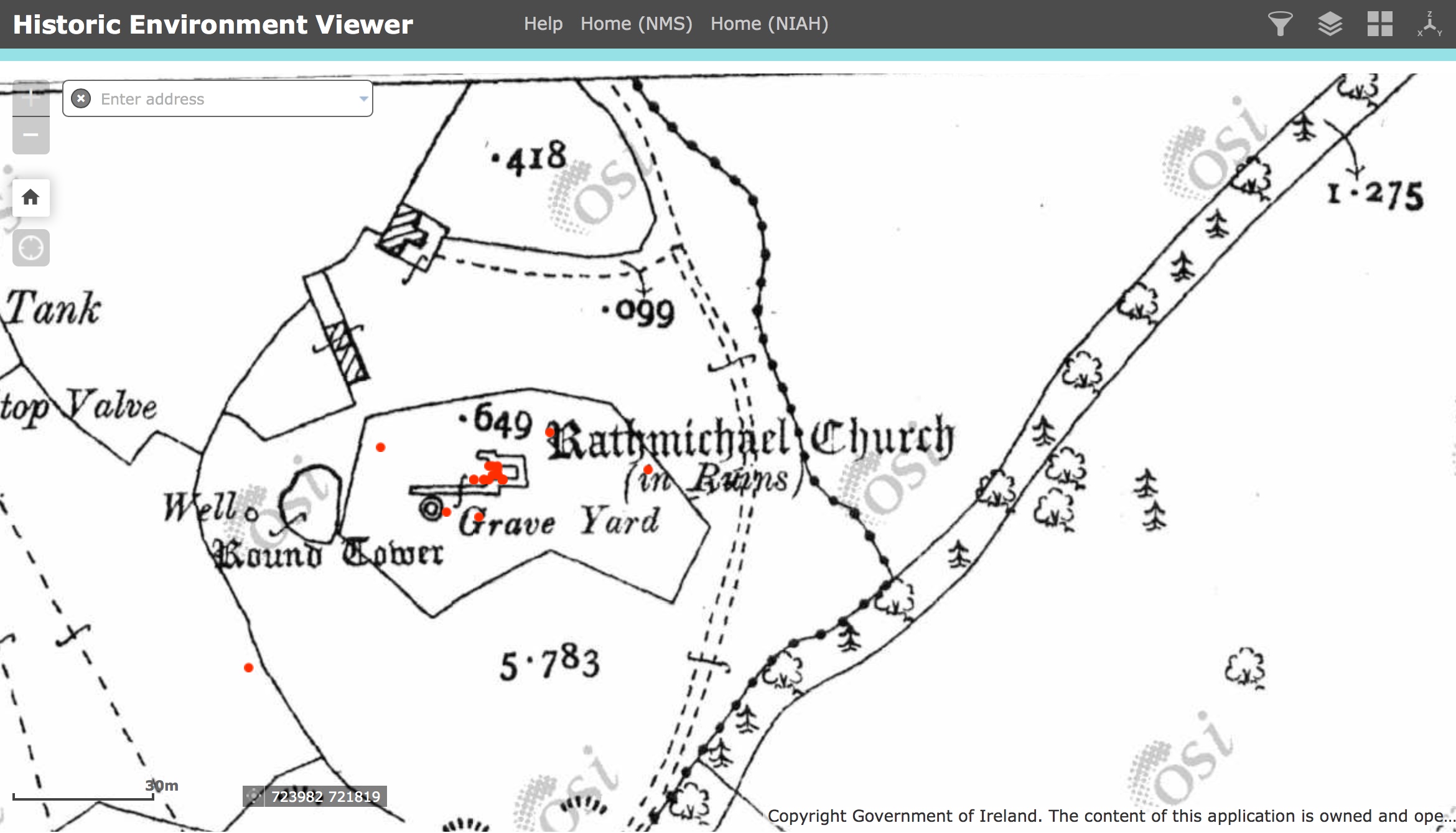
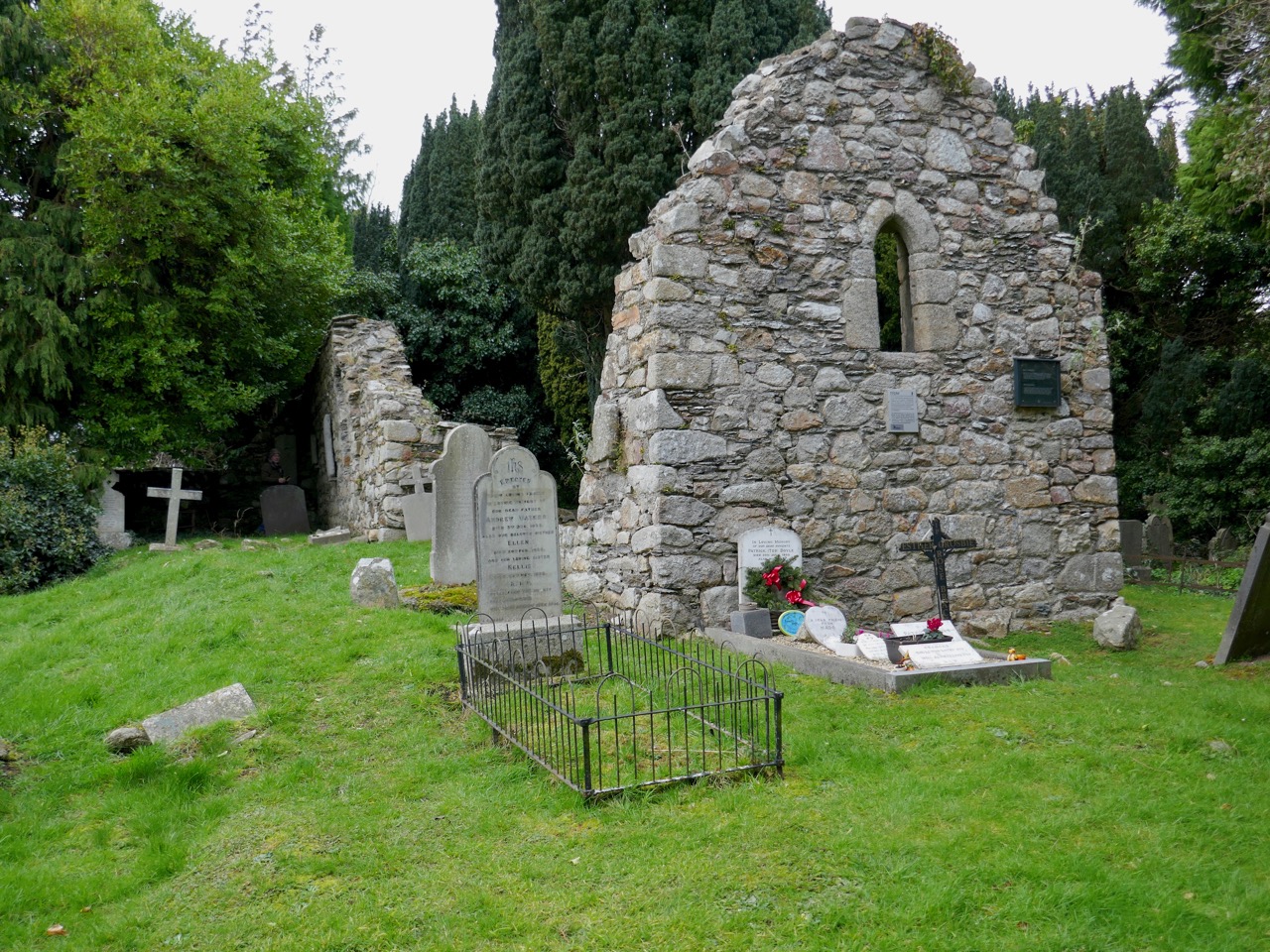
Top – Rathmichael Church with its round tower and Viking graves was established on an ancient Rath or fort, in fact one of the largest in the locality: you can see the probable circular outline of the fort in this extract from the National Monuments Service Archaeological Survey Database; middle – ruins of the medieval church at Rathmichael and, lower – fragments of Bullaun Stones at the church site

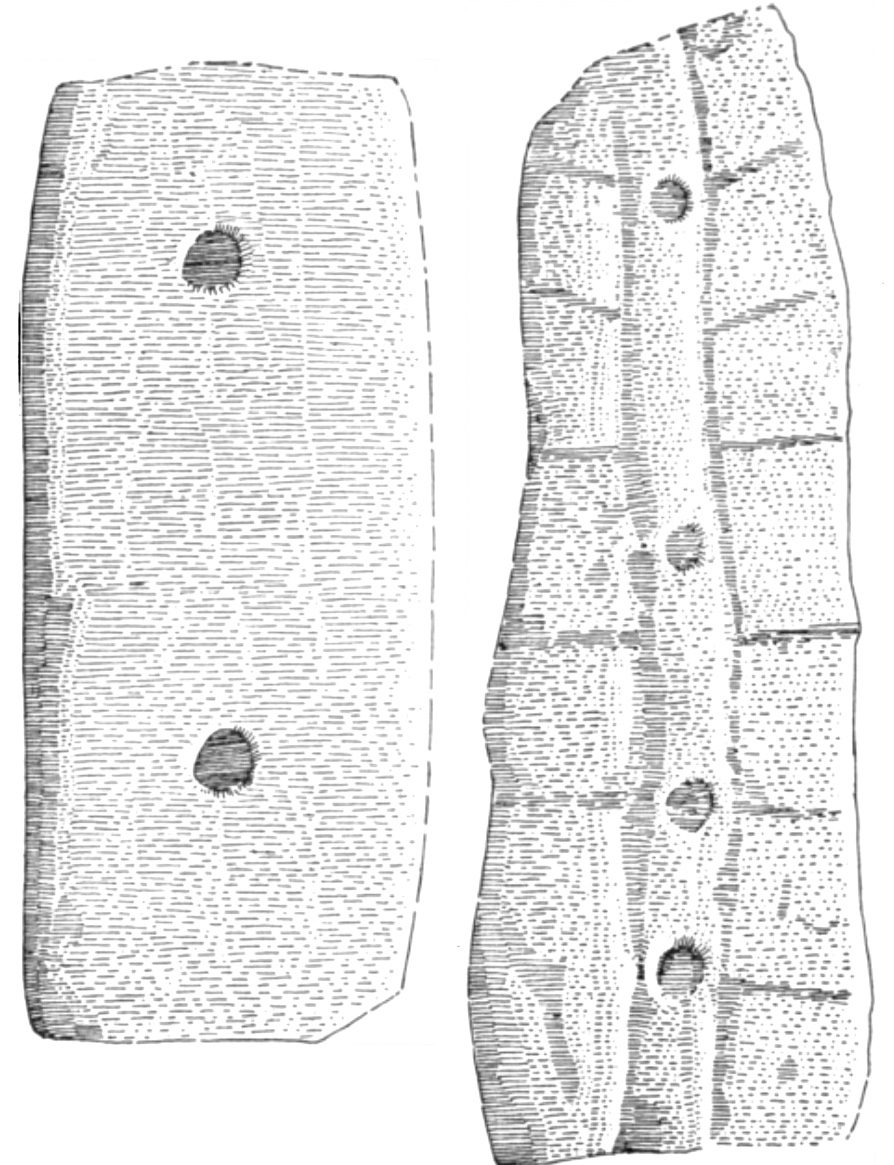
Other – probably related – inscribed slabs from the wider area are recorded by Pádraig Ó hÉailidhe (below): Dalkey Castle Heritage Centre displays one of the finest of them all (left), while the Tully Slab (right) is assumed to have come from another remote church ruin close by – however I cannot find any record of its current whereabouts. If anyone can throw light on this, please let us know.

Dalkey and Tully grave slabs – drawn by Pádraig Ó hÉailidhe, 1950s

I have used the drawings by Ó hÉailidhe because they are so clear: we visited the Rathmichael site this week and were struck by how faded much of the inscription seems to be. It could be that we were not seeing the carvings in a good, clear light. Worryingly, it may also be that the stones are suffering from accelerated weathering (much as our unprotected medieval high crosses appear to be) due to acid rain and pollution. You can see for yourselves by comparing the drawings above with our own photographs, a selection of which form the tailpiece of this post.

Mizen Magic 8: The Altar

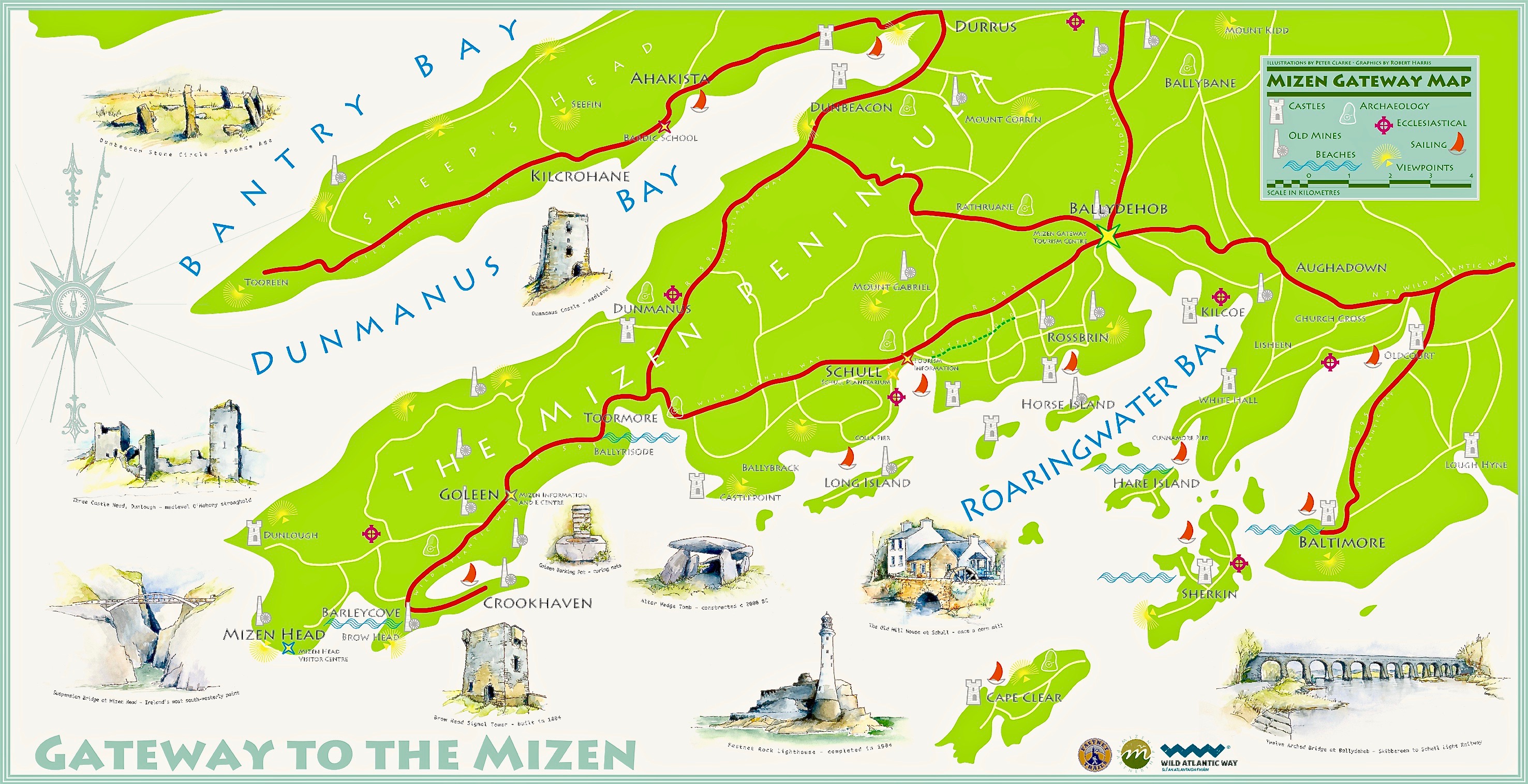
Here’s the Mizen Peninsula shown on a map drawn by Robert for the Bank House tourism centre in Ballydehob and embellished with Peter Clarke‘s exquisite watercolour sketches of just some of the places that should not be missed by visitors to West Cork . . .

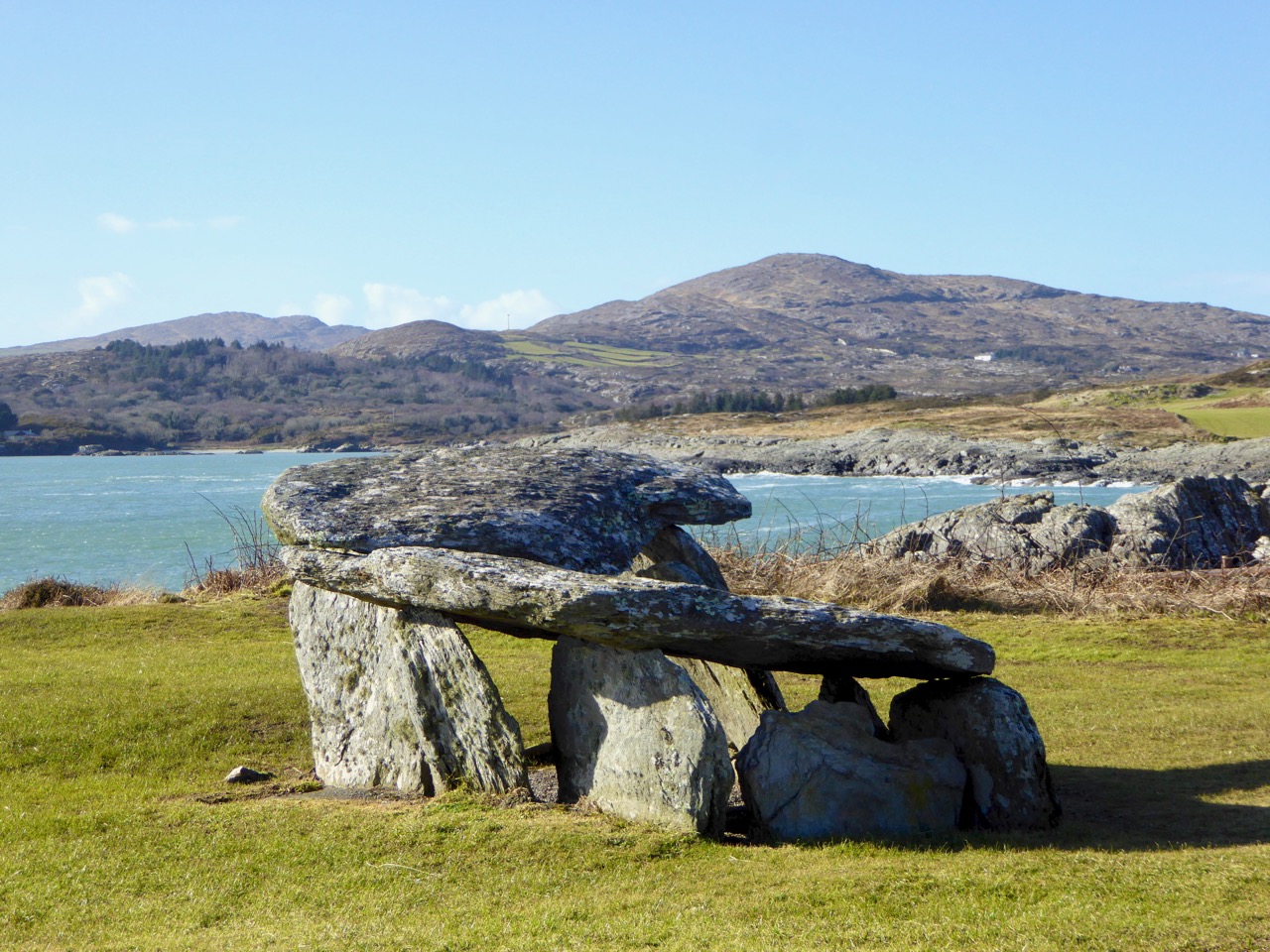
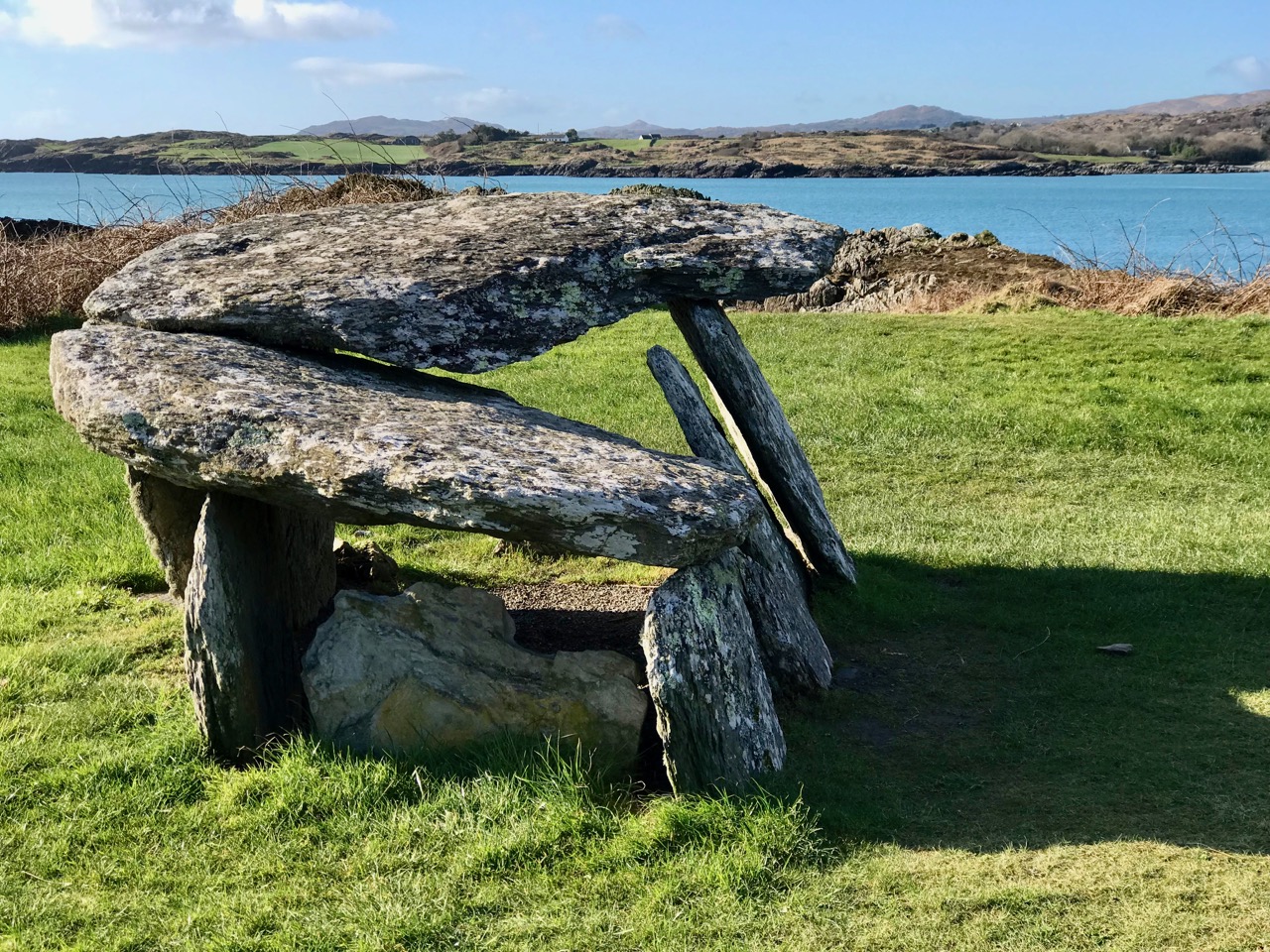
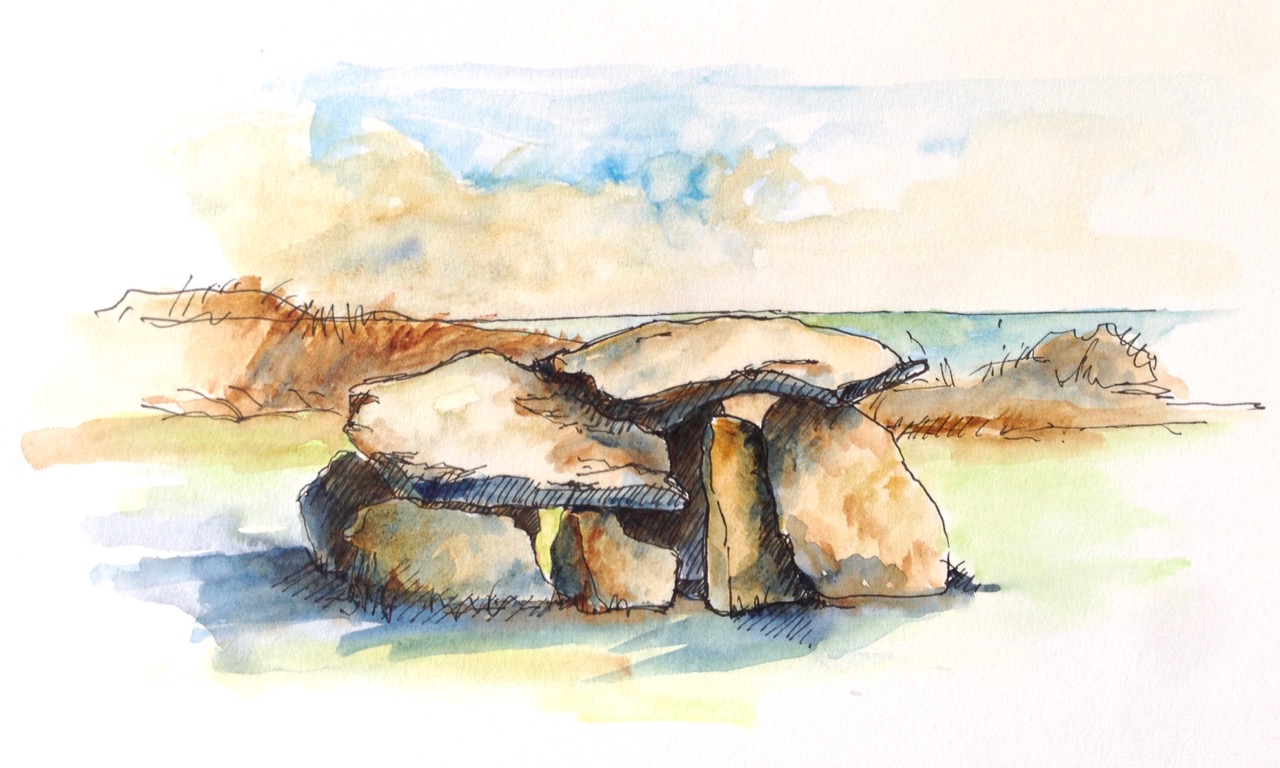
. . . And here is another rendering from Peter of one of the ancient sites that everyone goes past when travelling to the far west: possibly one of the most accessible pieces of archaeology on this section of the Wild Atlantic Way. It’s the Altar Wedge Tomb at Toormore Bay.

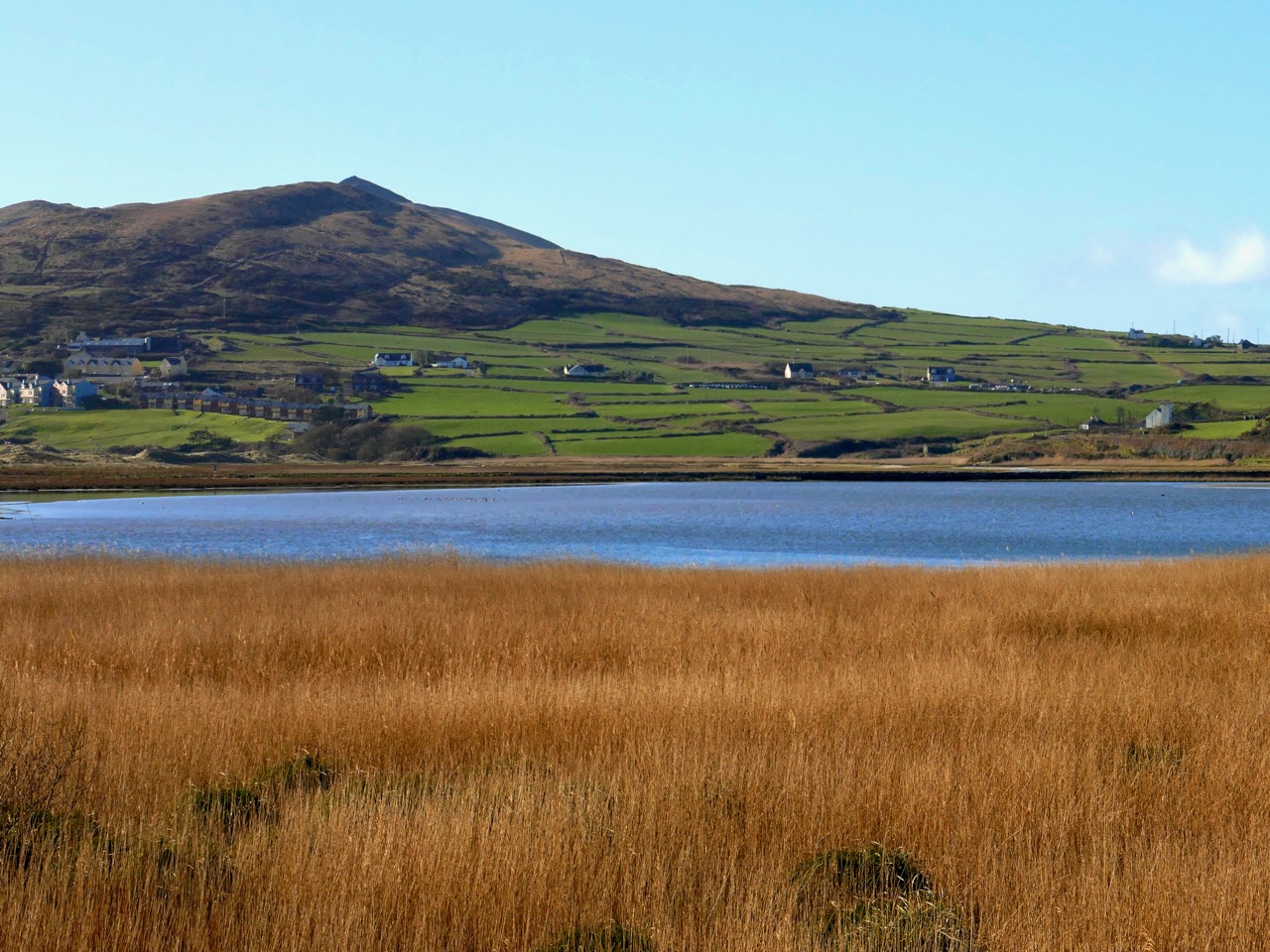
It’s early February, and Imbolc has passed. That means that Springtime has officially started here in Ireland. Sure enough, we looked out over a sunlit Roaringwater Bay this morning: soon we were heading out towards Goleen, Barley Cove and all points west. We stopped at The Altar and had it all to ourselves. You can see here that it’s orientated towards the Mizen Peak – that sharp little pyramid which is right on the centre of the picture – and lies to the west. For me, there’s a perfectly natural symbolism about placing the dead in a tomb that is aligned on the rising and the setting of the sun: that’s something we still do, several thousand years on!

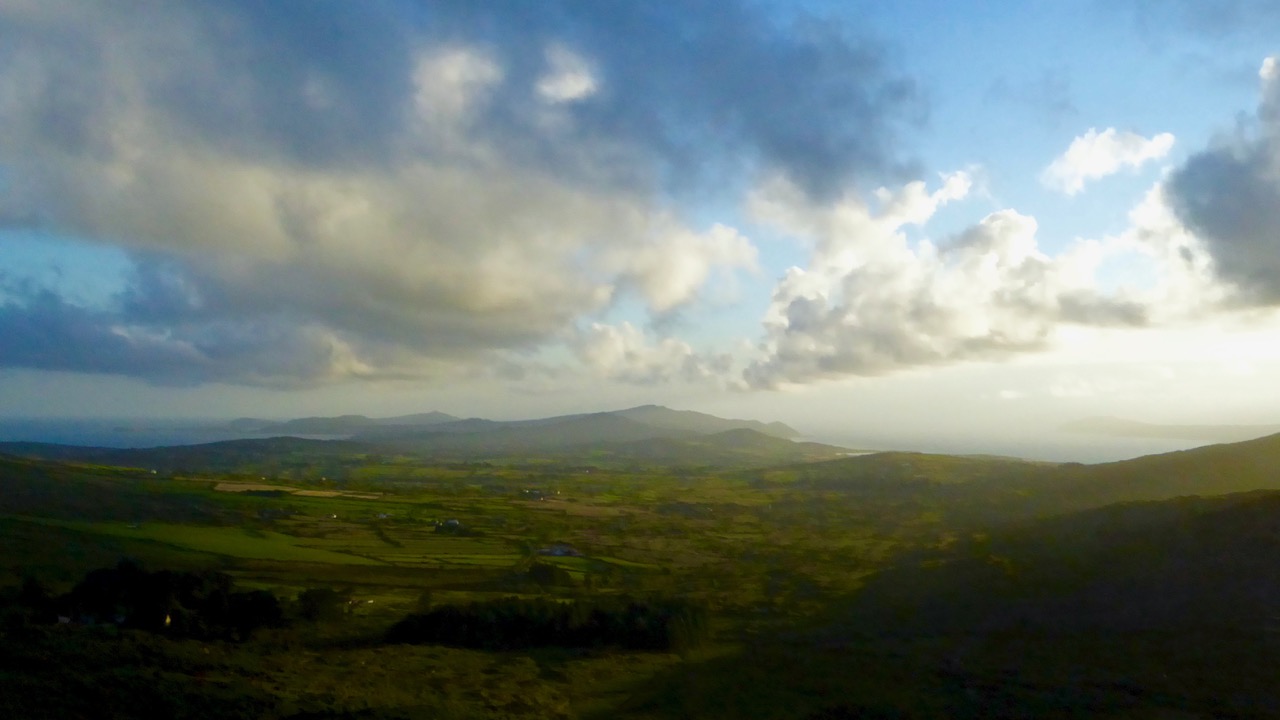
The upper picture, taken on the Winter Solstice, shows the Mizen stretching away from the heights of Mount Gabriel: the Mizen Peak is the little pointed blip just left of centre. The lower picture looks across the wetlands behind the sand dunes at Barley Cove, and was taken today in the Spring sunlight: the Peak is clearly visible as the highest point. I believe that our forebears attached great importance to high places, as many stone monuments and Rock Art often seem to be placed in the landscape with commanding views towards hilltops. Mike Wilson’s site Mega-What sets out his detailed studies of the orientation of ancient sites within the natural landscape. Here is his analysis of the setting of the Altar Wedge Tomb.

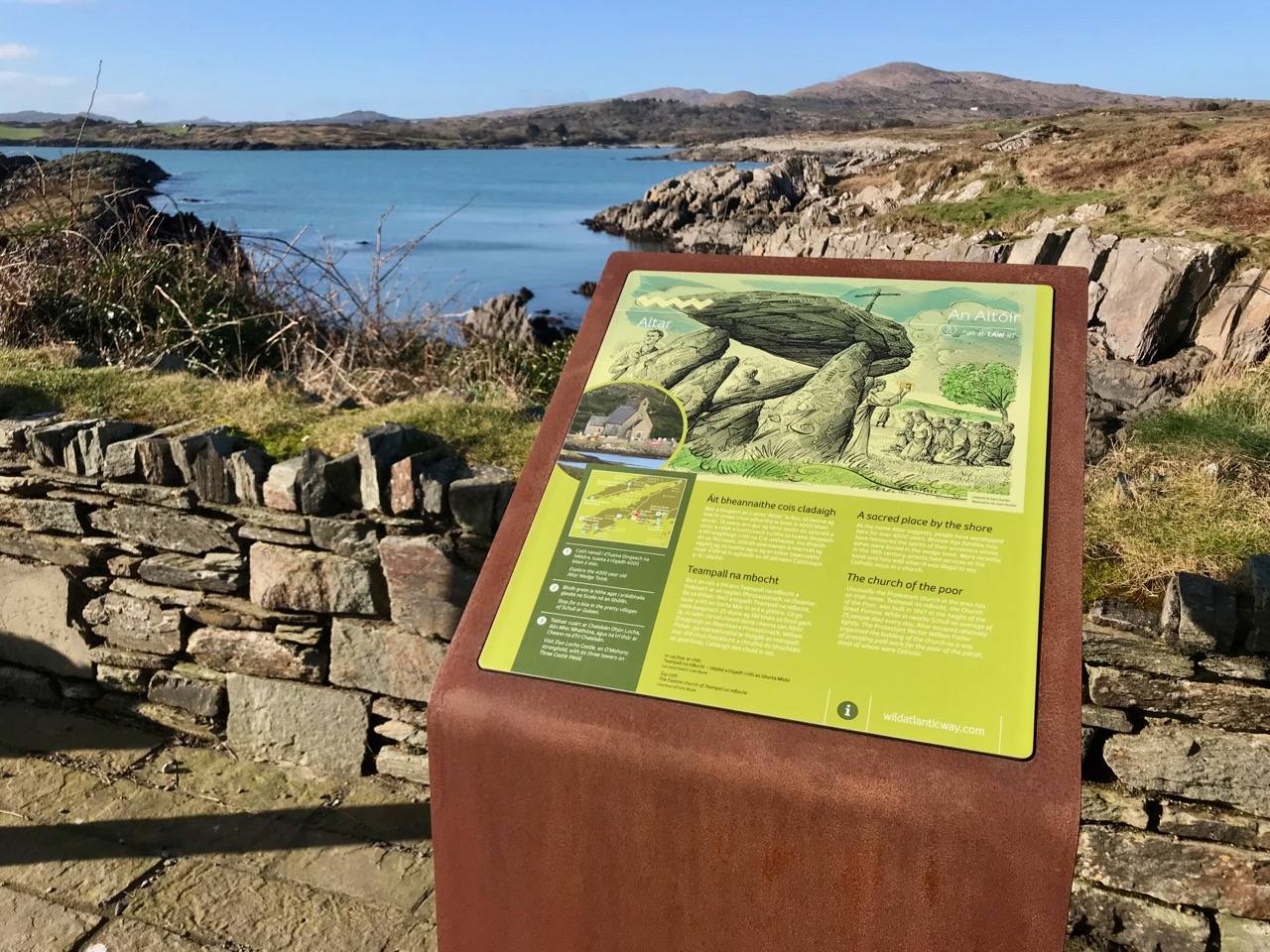
I am always alert for the ways in which our special sites are interpreted for us. I created a bit of a storm a while back when I commended the signage which has been put in place along the Wild Atlantic Way using visually strong corten steel elements (above left) supplemented more recently by (in my opinion) very well designed information boards. The image on the right above is from an earlier OPW board which explains the possible early use of the wedge tomb, while the images below show the new signage, which features the later use of the tomb as a Christian altar during the Penal times (hence the name: The Altar), with a drawing by Sam Hunter. I am struck by the way this monument has been a focal point for differing rituals spanning countless generations.

When writing about archaeological subjects I am always on the lookout for the way that antiquarians saw the sites which we are familiar with today. I had hoped that George Victor du Noyer – the subject of an excellent recent exhibition in Cork’s Crawford Gallery – might have drawn this wedge tomb when he travelled the country for the Ordnance Survey during the early nineteenth century: he may well have done, but the annotation and cataloguing of his vast legacy of work has yet to be completed and I have not found such a record. His drawings below are not of The Altar, but a portal tomb, Ballybrittas in County Wexford. Portal tombs (sometimes known as dolmens) share similarities with wedge tombs, but are earlier, dating from between 3000 BC to 2000 BC, while wedge tombs tend to be associated with the Bronze Age, which followed this period.

Cremated remains were found in Altar Wedge Tomb when it was excavated in 1989 by Dr William O’Brien, now Professor of Archaeology at UCC. We can never know exactly what the significance of these impressive structures was to those who built them. For me, I’m pretty sure that it was connected with their relationships to, and respect of, the landscapes which they inhabited, and which they invested with meaning. They must certainly have paid heed to the passing of the seasons and the continual cycles of nature, and their closeness to all of this must have given them an inherent knowledge of the paths of the sun, moon and stars. Above all, our ancestors had to understand and appreciate the environment around them, and make it work for them. In a practical sense, certainly, but also in terms of the stories they might pass on about the meaning of places.

Above – the magical landscape of the Mizen: we will never tire of it

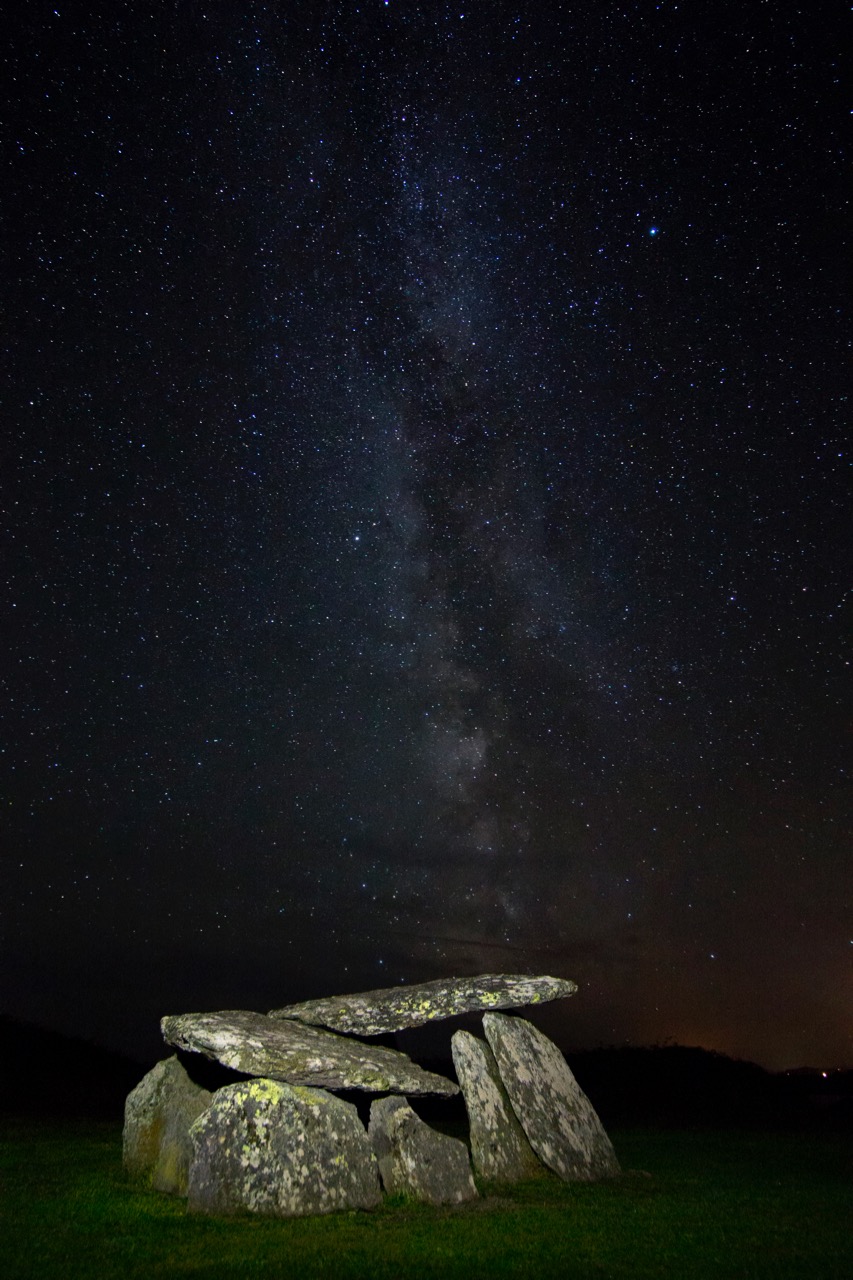
The tailpiece picture, which is from Wikimedia Commons, attributed to Lukeoc88, is a remarkable timeless view of a human construction in the setting of our Universe: Altar Wedge Tomb under the Milky Way.

Pagan and Pure

How does a prehistoric calendar mark turn into a pagan feast and then into a Christian saint’s day? This year, the cross-quarter day is Feb 3, yesterday: that is, the day that lies half way between the winter solstice and the spring equinox. Together with the solstices and equinoxes, the cross-quarter days divide the year into eight ‘months’ and they also establish the dates for the ancient festival days of Imbolc ( Feb 2, spring), Bealtaine ( May 1, summer ), Lunasa (Aug 1, harvest), and Samhain (Oct 31, start of winter). In fact, the actual cross-quarters times don’t fall always on those dates but close enough so they have become established as the festival days.

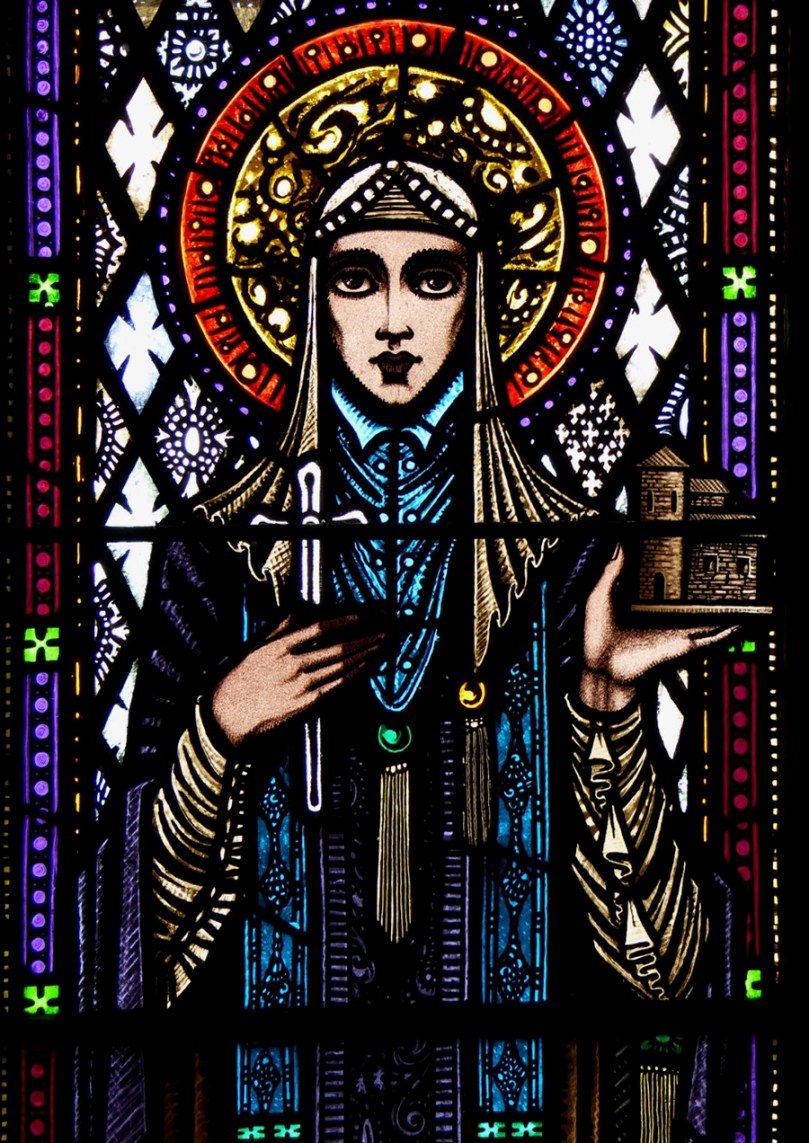
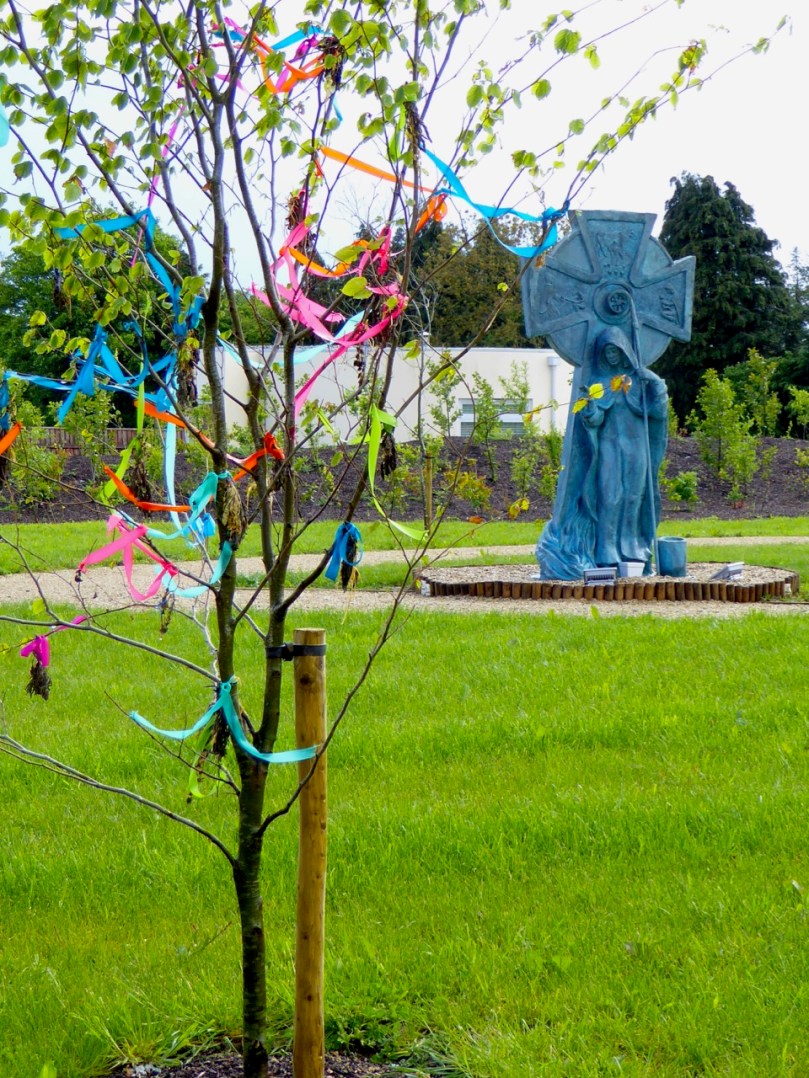
The Brigidine Centre in Kildare, run as retreat and contemplation house. The lead image in this post is a St Brigid stained glass window in Ballinrobe, Co Mayo

As so often happens when an ancient culture is Christianised, Imbolc became conflated with a saintly feast day, that of our own Saint Brigid, the female patron saint of Ireland. Brigid may have originally been a female deity, also called Brigid, or perhaps Danu. This is all controversial, of course – did the idea of the goddess or the idea of the saint come first, for example? Whatever the origins, the marking of the cross-quarter day turned into Imbolc the pagan festival, and finally into Saint Brigid’s Day, and all over the country we make St Brigid’s Crosses, leave a scarf out at night for her to bless, or, still, in Kerry, dress up as ‘Biddies’ and go from house to house, carrying a Brídeóg doll and singing and dancing in a ritual that must be as old as time.

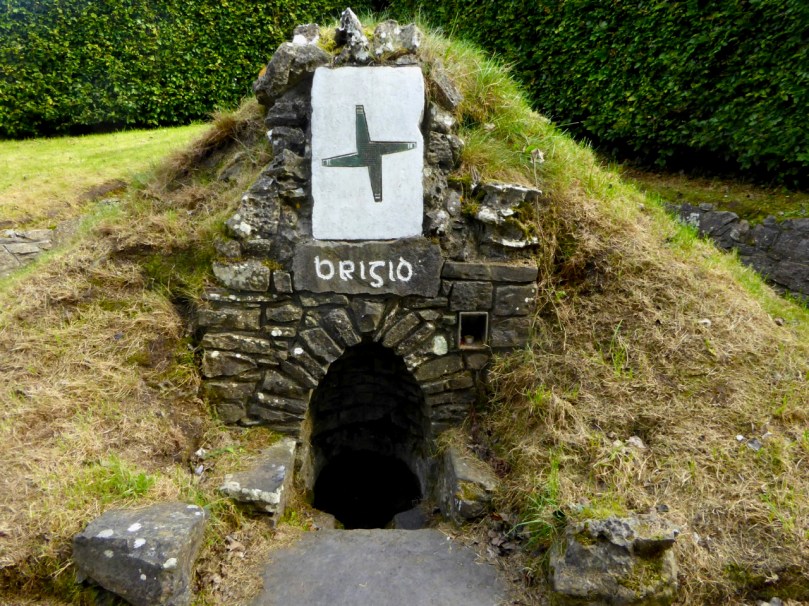
Another custom is to visit those holy wells that are associated with Brigid. Amanda has a special post on that – and is celebrating two years of holy well hunting!

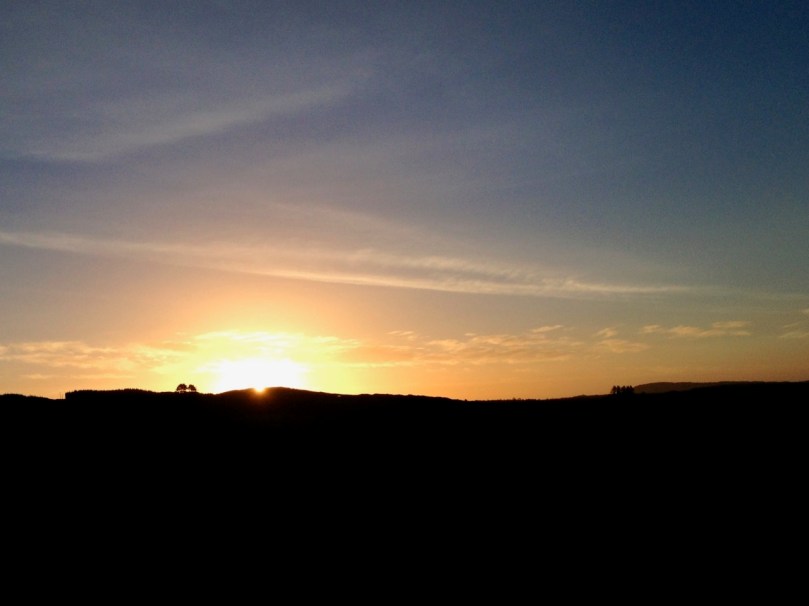
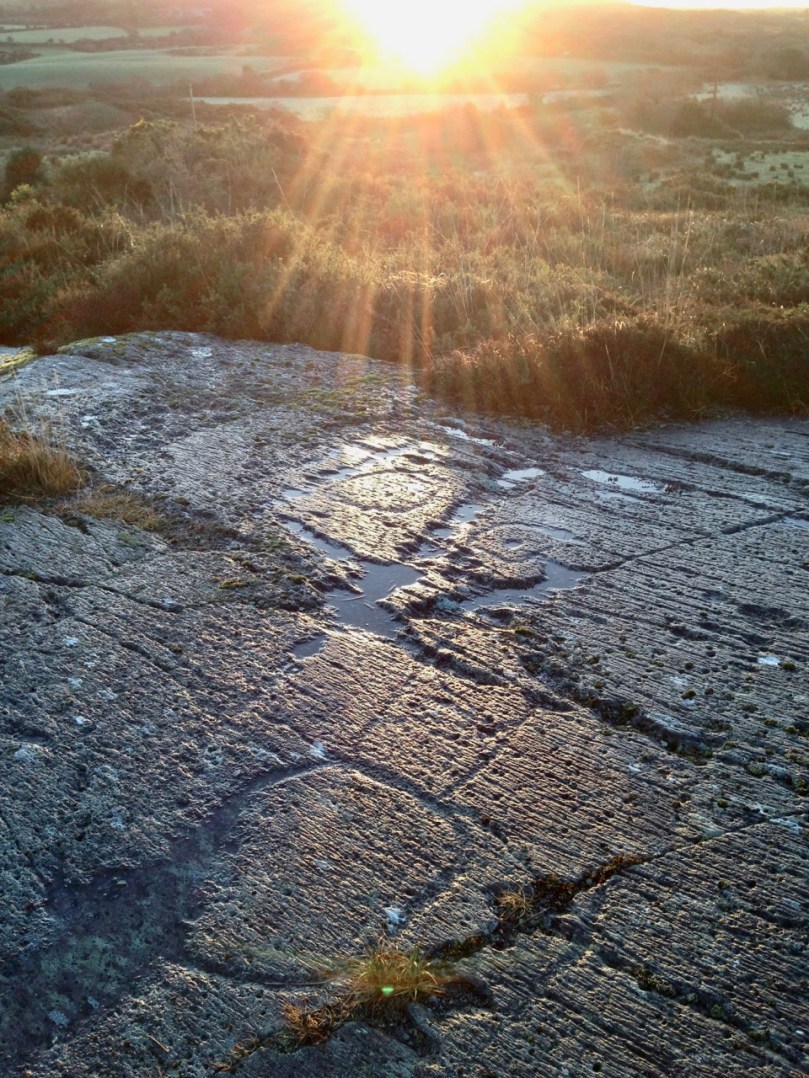
On one Imbolc that lives in our memories Robert and I arose early in the morning and went to watch the sun rise over a small prominence, standing on a piece of 5,000 year old rock art. Our account of that occasion is here, and below is the thrilling moment the sun rose, and lit up the ancient carvings.

Our friend, the poet Paul Ó Colmáin, from whom we take Irish lessons, used one of his own poems as a teachable moment this week, and I was struck by how perfectly it captures that sense of the turning year, the joy of sunrise, the deep embedding in our Irish souls of the ancient and the traditional and the embracing of both. I give the poem first in Irish. For those of you who do not speak it, you can take my word that the language is beautiful and contains nuances that his English version cannot capture, brilliant as it is.

Lá ‘le Bhríde

Dhúisigh an ghrian sinn

an mhaidin úd,

solas órga

ag stealladh

‘is ag scairdeach

isteach ar an urlár,

ag slaparnach

thuas na fallaí,

ag sruthlaíonn

an doras síor-oscailte isteach.

Níor thuigeamar

ar dtús

cad a bhí ag titim amach.

Níor aithníomar

torann buí na Gréine.

Ach chuimhníos

go tobann ar na bhfocail a dúraís,

mar dhraoi:

“Tiocfaidh an Ghrian thar nais ar Lá ‘le Bhríde.”

Agus d’árdaigh dóchas,

ársa, pagánaigh im’ chroí,

inár suí sa leaba,

Bríd nó Danú,

an lámh in uachtar ag an t-earrach,

bhí an geimhreadh, gruama thart.

“Tiocfaidh an Ghrian thar nais ar Lá ‘le Bhríde.”

Paul’s English version of the poem is given below. At the time he wrote it, Paul, his wife, the artist Marie Cullen, and their sons were living on the Great Blasket*, off the Dingle Peninsula, the only inhabitants of the Island.

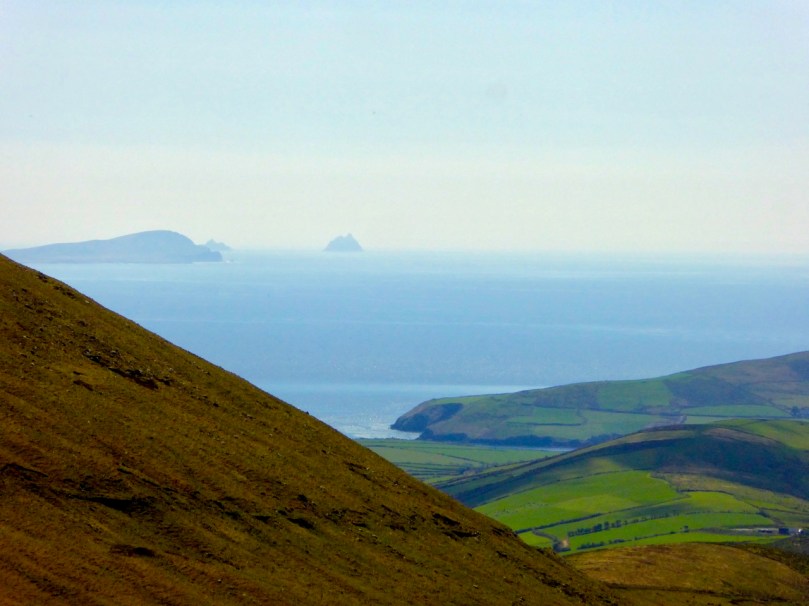
The Blasket Islands lie off the cost of Kerry, near the Dingle Peninsula. An Irish speaking enclave, it is now uninhabited

Winter was long on the Island, made gloomier by the fact that the sun, due to a combination of high ground and orientation, did not shine on their dwelling all winter.

The sun awoke us.

Like a fanfare

or a burst of wild laughter.

Playfully.

Unfamiliar.

Spilling in along the floor.

Splashing up the walls.

Streaming in through the ever-open door.

We didn’t – at first-  know what was happening,

Didn’t recognise the bright clamour of the sun.

Then we remembered the words

That you, druidlike, had spoken:

“The Sun will come back on St. Brigid’s Day.”

And a welling of Hope,

Pagan and Pure,

Came rising inside us,

Sitting in bed,

Brigid or Danú,

The Winter defeated:

“The Sun will come back on St. Brigid’s Day.”

We’ve turned the corner and spring is finally in the air. Today was golden and we spent it on The Mizen (see below). Thank you Brigid/Danu/Imbolc/ancient Calendar Keepers!

*If you’re ever in Kerry, make sure to visit the Blasket Centre

Fading Treasures

For me, Ireland’s greatest treasures are those that are shy of publicity. There’s nothing more rewarding than turning off the beaten track and negotiating a narrow boreen with a lush growth of grass down the middle and brambles scratching your car on either side to find – often by chance – a stunning piece of medieval architecture, perhaps just the fragments of a ruin in a field, but revealing the beauty of a decorated doorway or an ornately carved corbel. Always these items are discernible but fading. Their splendour – and the exquisite craftsmanship that created them – are manifest. But there’s a melancholy in these finds: you see them, and wonder at them, yet you ask: how many more generations will be able to appreciate these works of ancient hands?

A classic case study would be the medieval high crosses. There are a remarkable number of these still intact on the island of Ireland, and many more fragmentary remains. We go out of our way to search for all these traces in our travels: some of those we have visited to date can be found through this link. It’s such a rich archive, and there are many more to be written up.

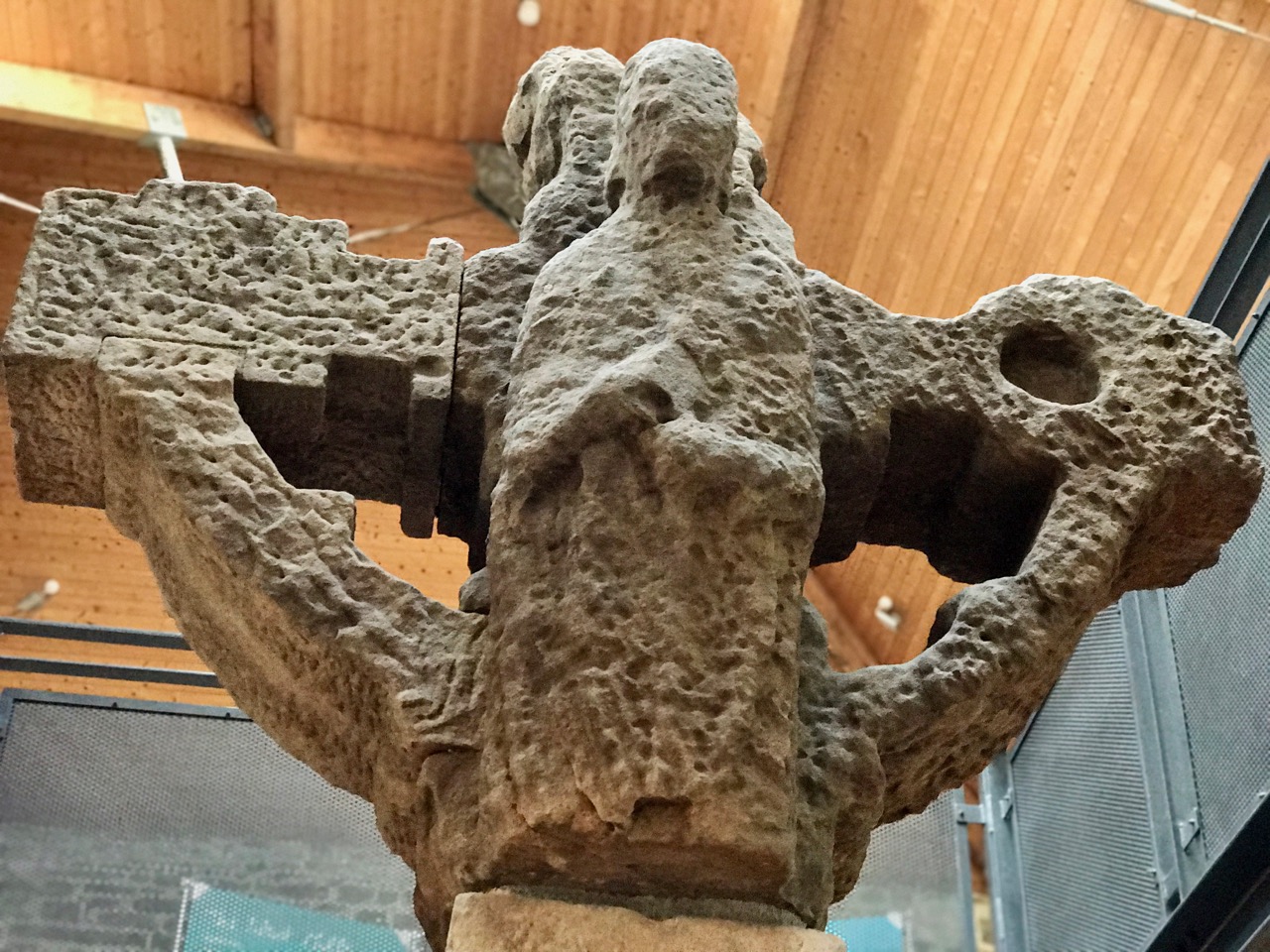
Above is St Cronan’s High Cross, Roscrea, Co Tipperary. As you can see, this example has been removed to an indoor location (Black Mills Heritage Centre), to protect it from further weather deterioration, although all the fine detail has been lost. In fact, this example has been assembled from sections of two different medieval crosses for purposes of display. I am an advocate of protecting these artefacts in this way, as acid rain and modern pollution seem to be accelerating the decay of the stone monuments. As in many cases with the protection measures, a high quality reproduction cross has been placed on the original site in the churchyard of St Cronan’s, just a few metres away. Have a look at my post on Monasterboice for a further discussion on the arguments for preservation of these monuments – and compare the condition of the as yet unprotected high crosses there with the wear and tear above.

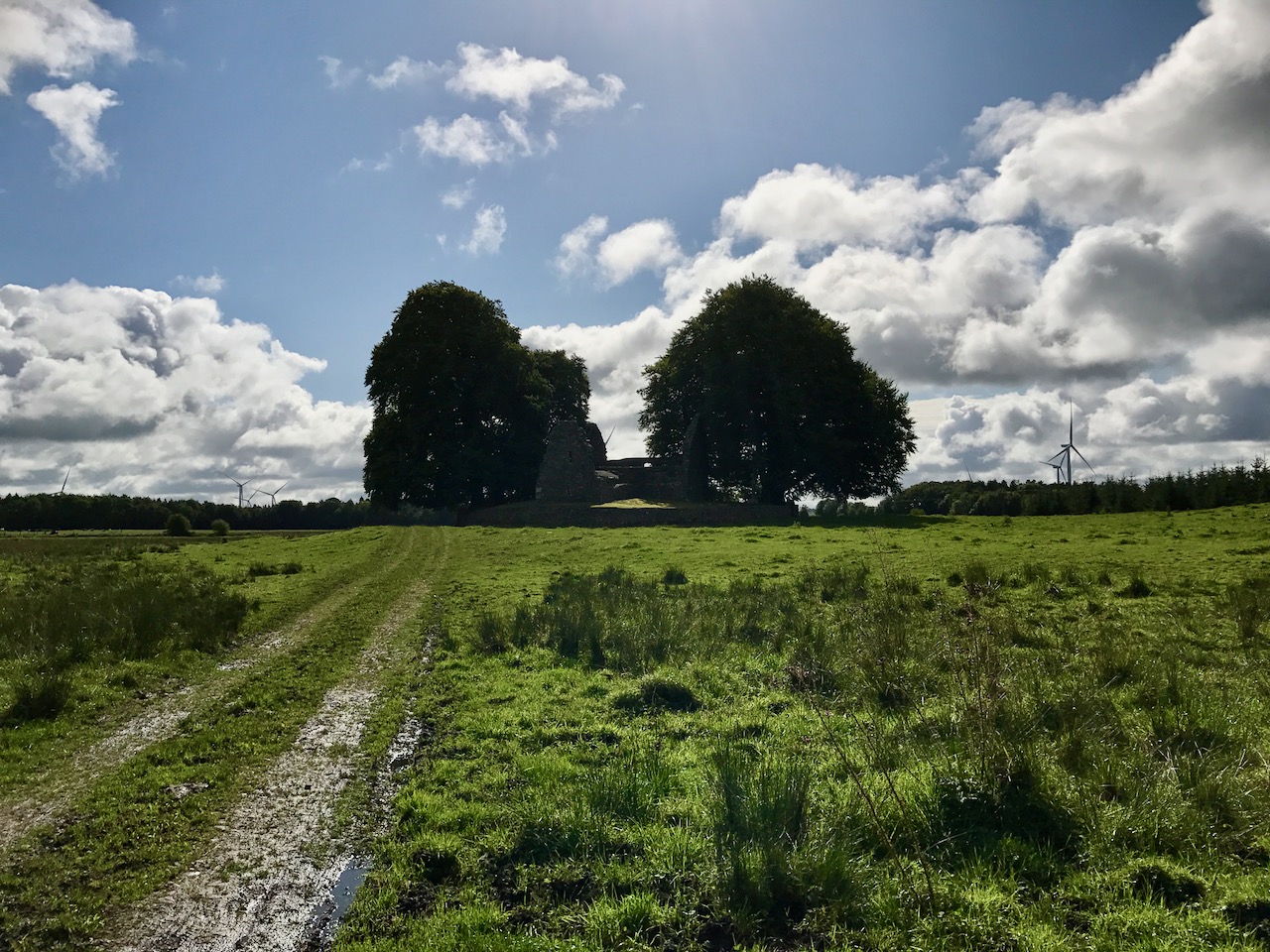
While in Roscrea, you can take your own journey along a ‘secret track’ to find treasures. Visit Inis na mBeo (Island of the Living) at Monaincha, just a stone’s throw from the town: you are likely to be the only visitors there and can fully appreciate the solitude of the location while exploring a ruined Romanesque church and a reconstructed high cross (above). The monastic site was founded in the 6th century, and was then a true island, only accessible by boat; now you can walk to it. Not least of its attractions is the fact that you are immortal while you are there (so they say). Certainly, we came back alive, but I was concerned to read later that another tradition has it that when the now dry lough contained water, no woman or female animal could ever set foot in or cross it without dying instantly. (Below – looking along the remote trackway that takes you to the former Island of the Living at Monaincha).

Another ‘rescued’ high cross can be found quietly located in the far less remote (but still a little unsung) Cathedral of St Flannan in Killaloe, Co Clare. Megalithic Ireland has a good account of the history of this cross, which can be seen in the images below (while the header picture at the top of this post shows exquisitely carved detailing from a Romanesque doorway in the same Cathedral):

. . . The High Cross in St Flannan’s Cathedral was moved to Killaloe from Kilfenora in 1821. Originally the cross stood on the highest point south of Kilfenora Cathedral, and became known as the cross on the hill. Dr Richard Mant who was appointed Bishop of Killaloe and Kilfenora in 1820, was appalled by the condition and lack of respect shown for the antiquities in Kilfenora. The cross, which had fallen in 1820, was sent to the Bishop the following year. He had it erected on the grounds of his residence Clarisford Palace. The cross was moved at a later date by a Bishop Ludlow and moved back within the Palace grounds in 1850. In 1934 the cross fell again and this time broke into three pieces. It was re-erected inside the cathedral and fixed against the west gable. In 1998 the cross was repaired and erected as a free standing cross. It stands over four metres high and bears a figure of christ in the centre of the head . . .

The White Cross of St Tola (images below) may not be on everyone’s list of things to see at Dysert O’Dea in Co Clare (you are more likely to be channelled to Corofin), but it’s easy to visit from the better known Romanesque monastery ruins: the ecclesiastical centre was founded by the saint in the 8th century. Cromwell’s forces destroyed the monastery and demolished the cross, but the cross was repaired by Michael O’Dea in 1683. The Synge family restored the cross again in 1871, and in 1960 it was temporarily dismantled and shipped to Barcelona for an exhibition on Irish art.

Clonmacnoise is likely to be on everyone’s list, and rightly so. It was one of Europe’s most important religious centres in medieval times. Ireland’s Ancient East website describes it thus:

. . . The whole of this early Christian site – including ruins of a cathedral, seven churches (10th–13th century), two round towers, high crosses and the largest collection of early Christian grave slabs in Western Europe – is a vast story in stone that keeps alive the spirit of Ireland as a Land of Saints and Scholars . . .

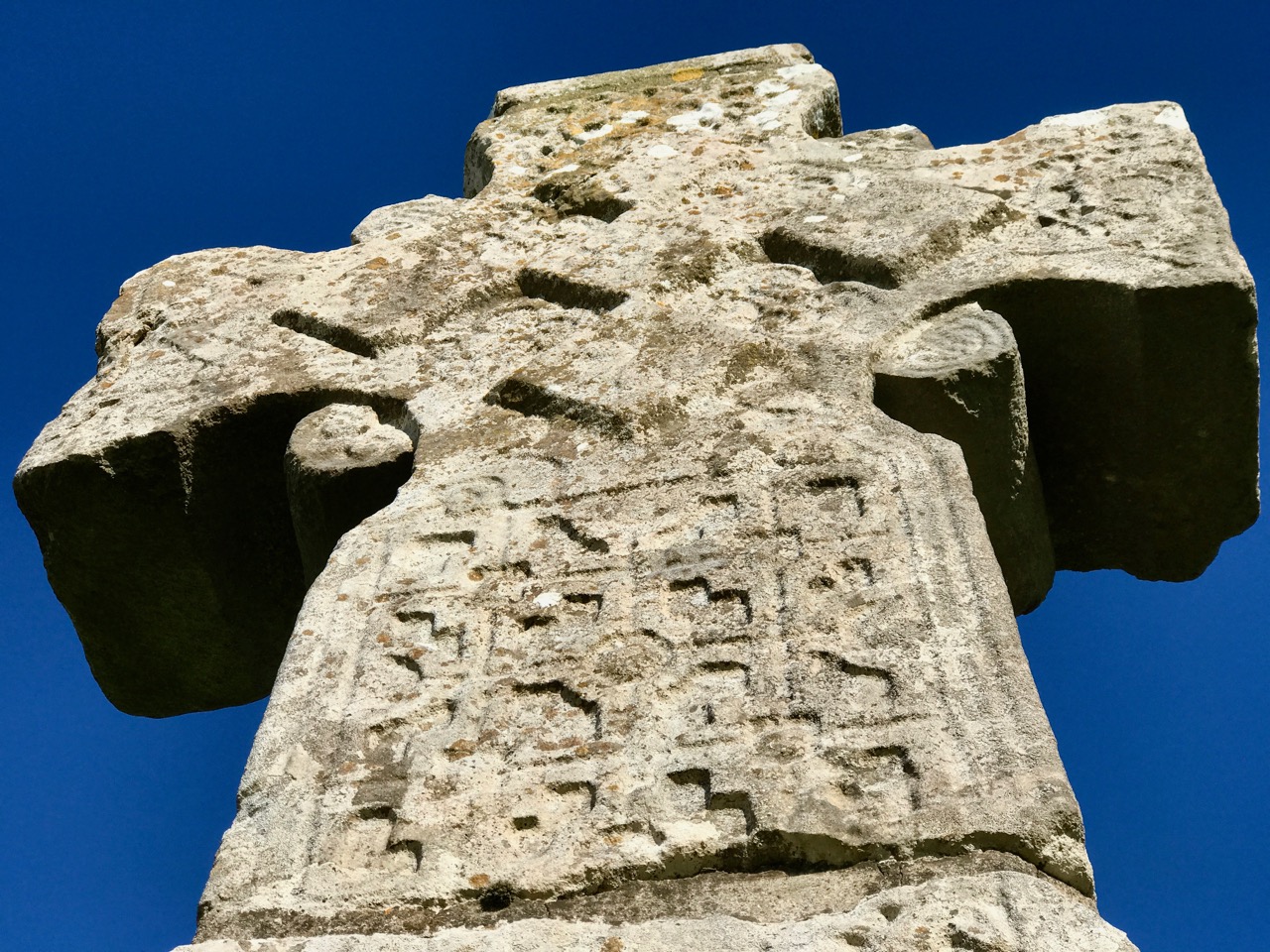
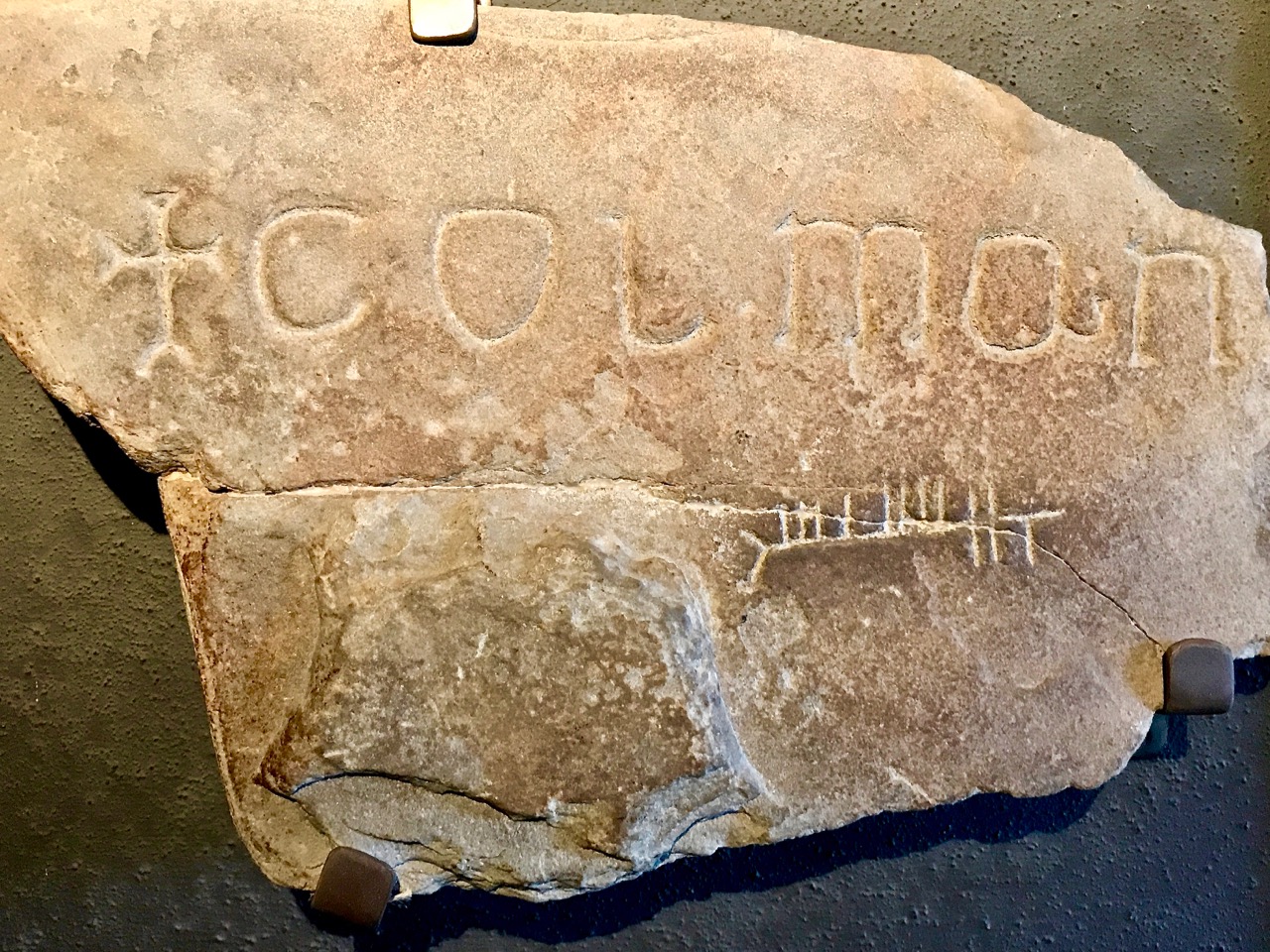
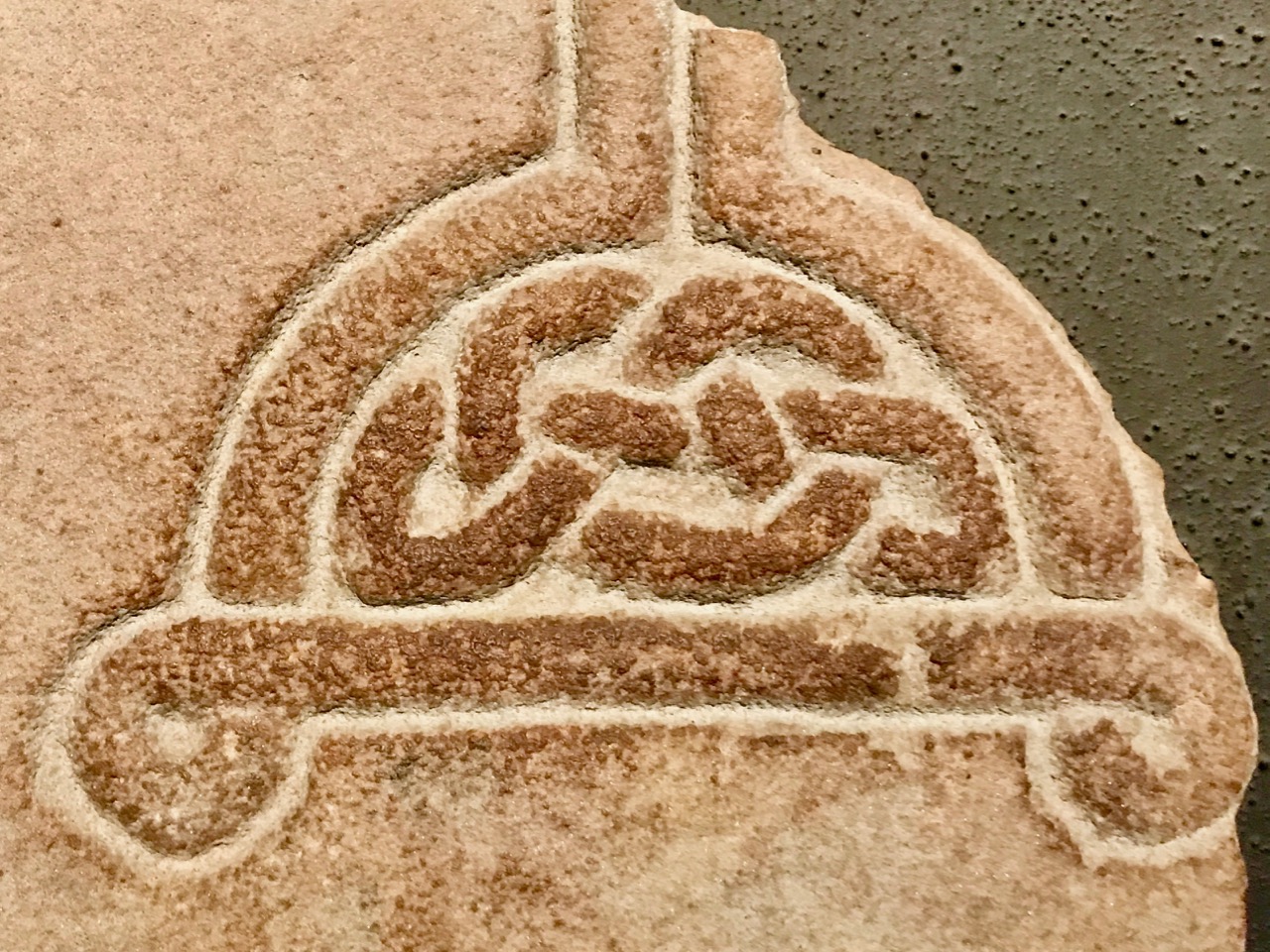
There are three conserved high crosses at Clonmacnoise – all are placed inside the visitor centre, while quality replicas are positioned on the original sites: this is a good exemplar of how to look after ancient stones and, while perhaps the seasonal crowds can be off-putting, I believe it’s the only answer for maintaining access to and displaying this valuable history. Ancient East mentions the important grave slab collection: after the high crosses (and, of course, Romanesque architecture) I feel these are the most beautiful representations of art and craftsmanship that connect us across the centuries to our remarkably focussed forebears.

These are just a few examples of the many grave slabs which are fortunately conserved at Clonmacnoise. But there are many more monuments that are less fortunate, albeit they may enjoy some sort of state care. There are just not enough resources to look after the huge historical heritage of Ireland: we can only hope that, in time, they will all be fully appreciated and that not too many treasures will fade away.