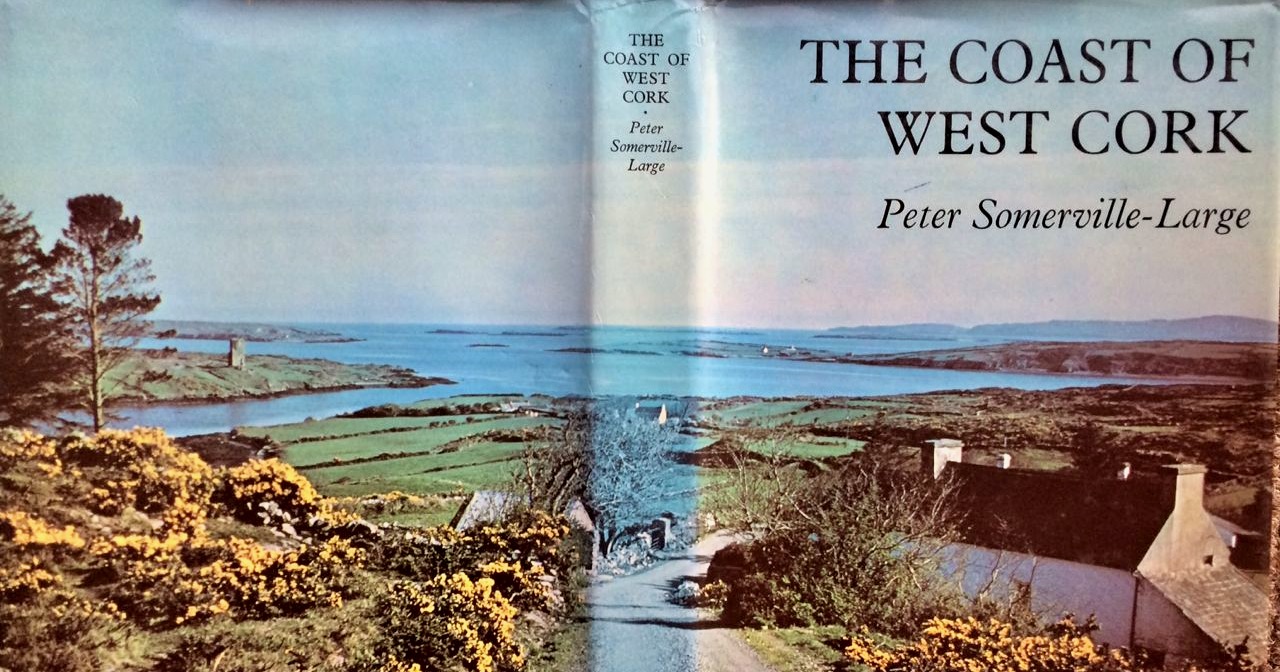
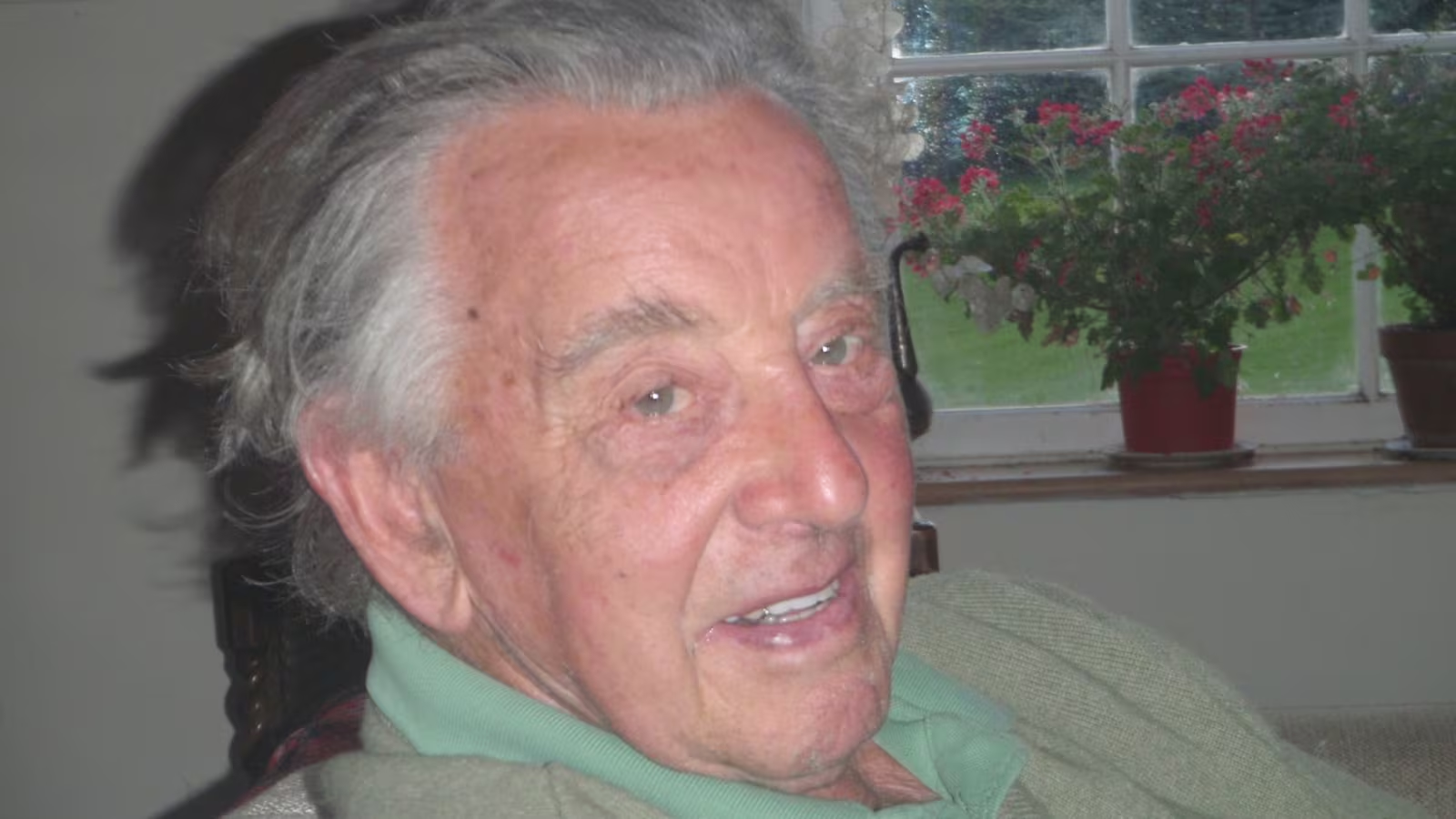
Peter Somerville-Large and The Coast of West Cork

I was out of the country when the writer, Peter Somerville-Large, died in October – I just realised this week that he is gone. What another loss to the world of Irish culture and writing. I never met Peter, but we exchanged letters in the aftermath of me publishing the post I wrote in 2014 and which I reproduce below – a review of his most beloved book, The Coast of West Cork. The book is still in print, although the newer paperback editions lack the black and white photographs of the original.
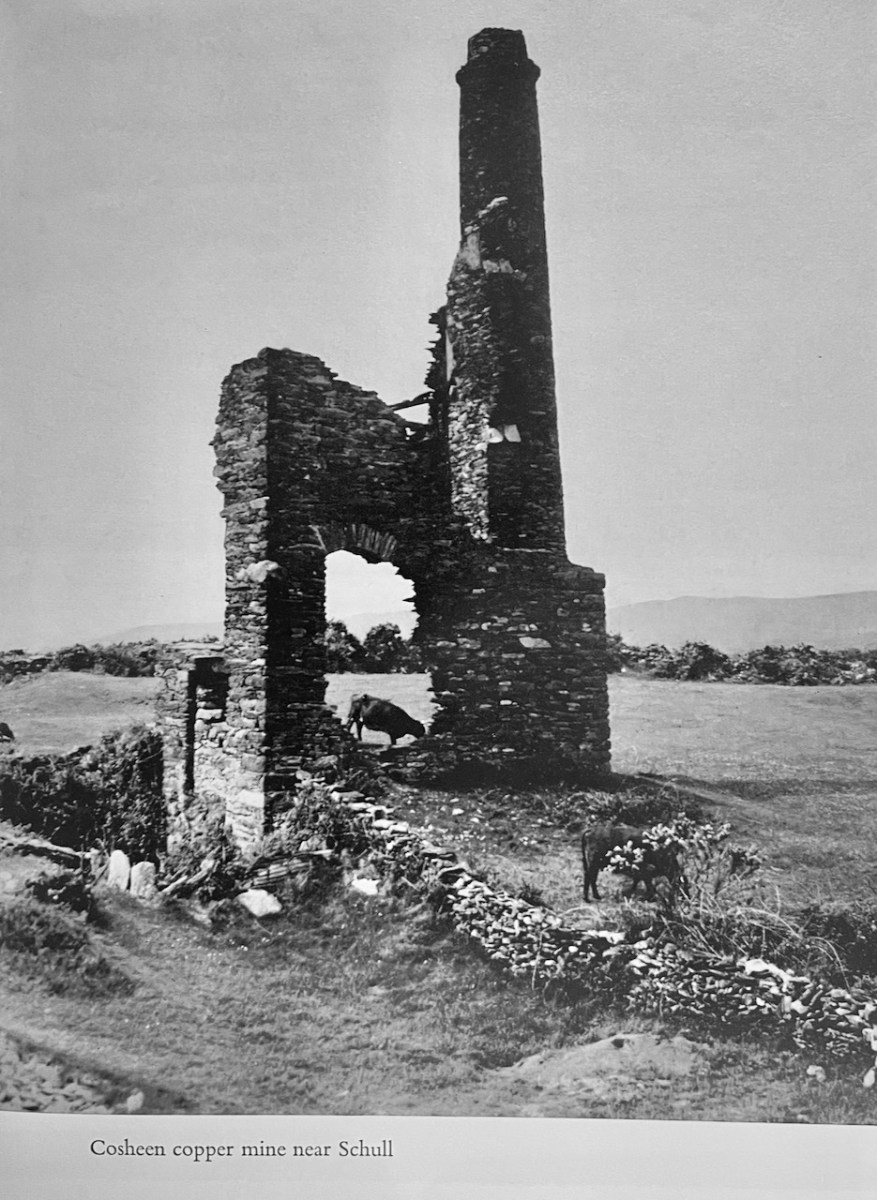
Here’s an example, and it’s one that shows why this book is such an important record of its time, the early 1970s. According to Mindat, The Coosheen Copper Mine was. . .

Once dubbed the “richest mine in the world” by a correspondent with the London Times, . . . worked a small but extremely rich copper deposit close to the surface from 1839-1877. The mine briefly reopened in 1888-1890 and again in 1906-1907 but only produced a trivial amount of ore. . . On the top of the hill 5 fenced off shafts can be seen and the largely obliterated ruins of the engine house built in August 1860 (bulldozed by the local council in the 1980’s as it was deemed both dangerous and an eyesore!).

This photograph of Ballydehob reminds us what a thriving commercial town it was. 55 years later, you can still recognise the shopfronts, although few are actively trading.
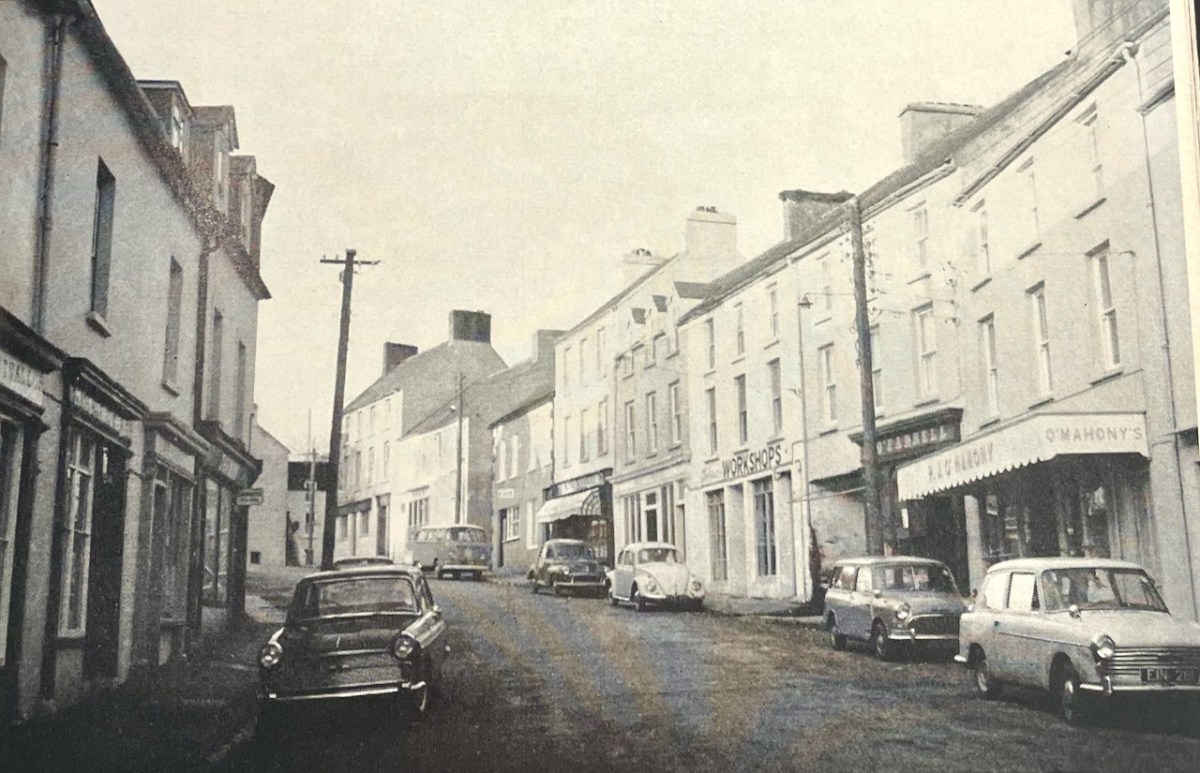
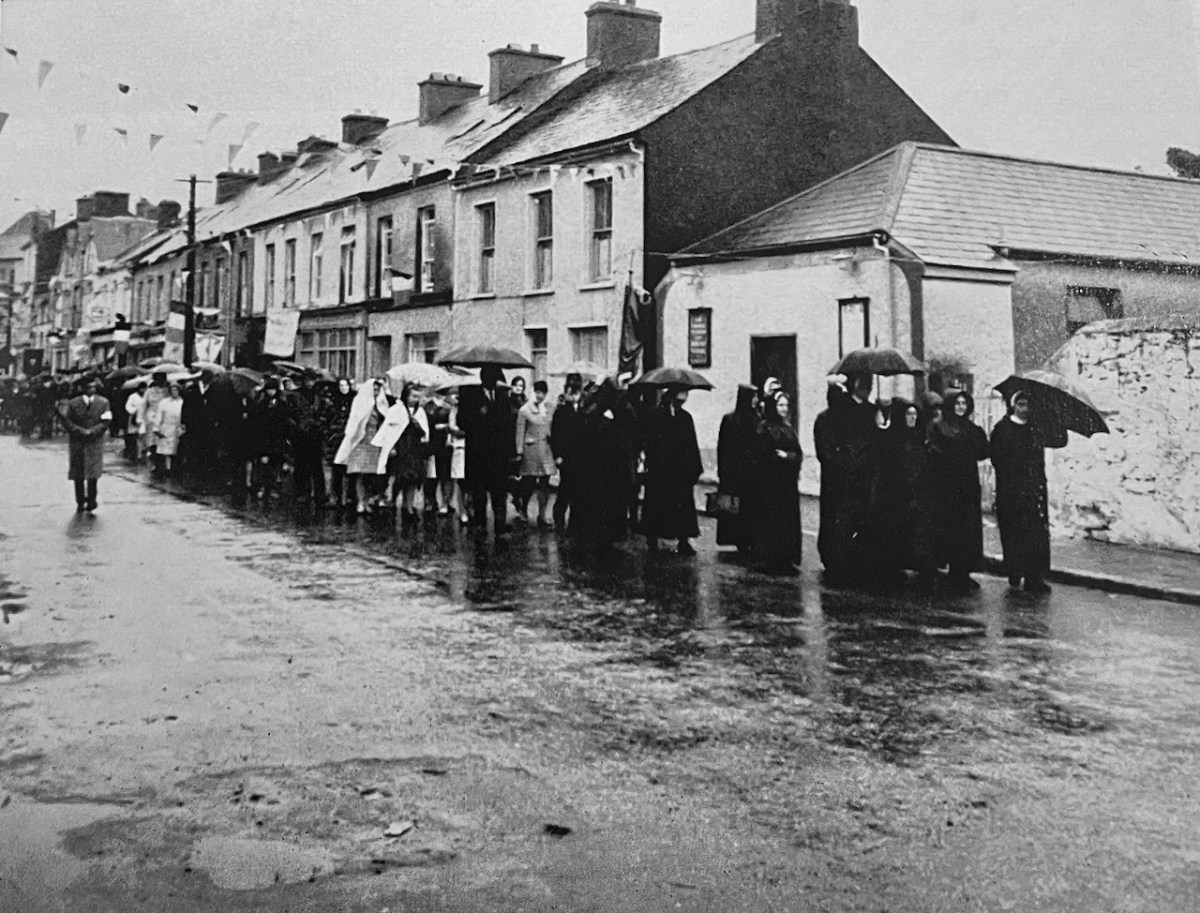
The final photograph from the original edition of the book that I want to share is of a temperance meeting in Skibbereen. Do any of our readers remember this?
And now, here is the original post, written 11 years ago, 1n 2014

The Coast of West Cork
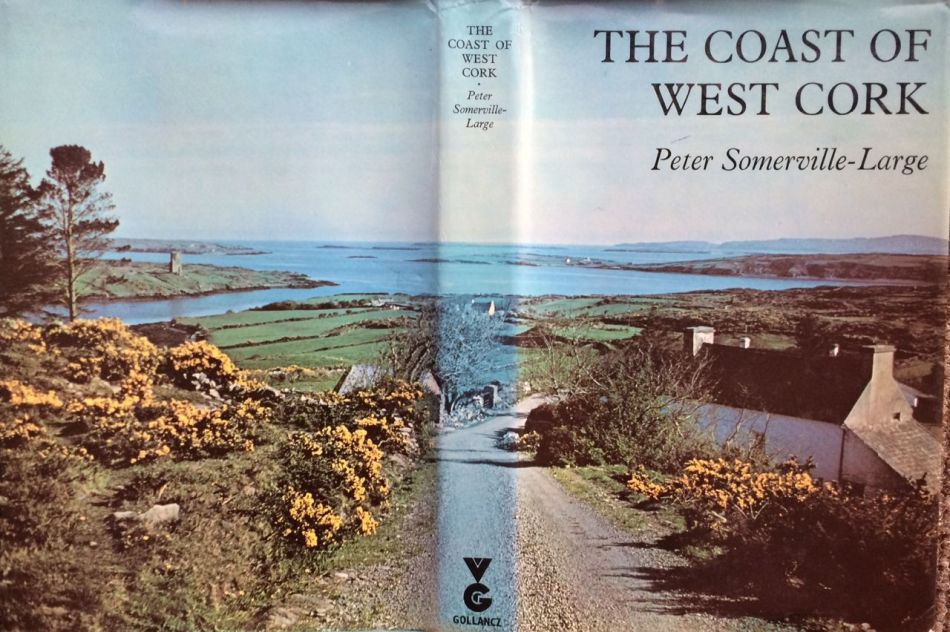
Coast of West Cork cover

Every personal library in West Cork, maybe in Ireland, has a copy of the book The Coast of West Cork by Peter Somerville-Large. First published in 1972, it is a classic of travel writing – amusing, learned, thoughtful – that still holds up as a fascinating portrayal of this part of the world. The photograph above is of the front cover of the book, signed by the author, that I brought with me to Canada when I emigrated in 1974. Forty years later, I am living on the very spot where this photograph was taken! It took me a while to figure this out, as the picture is actually reversed. [EDIT: note that when this photograph was taken, in 1970, the castle was still intact – most of it collapsed in a storm in 1974. For what it looks like now, see Robert’s 2020 post, The Castle of Rossbrin.]

Peter Somerville-Large, now in his 80s, is still writing. He is connected to the old Castletownshend families (Edith Somerville was a relation and he mentions Townsend aunts) and was already very familiar with West Cork when he set out to tour it by bicycle in the spring of 1970. He takes every road, every byway and boreen, and describes in detail the scenery, the characters and the conditions along the way.
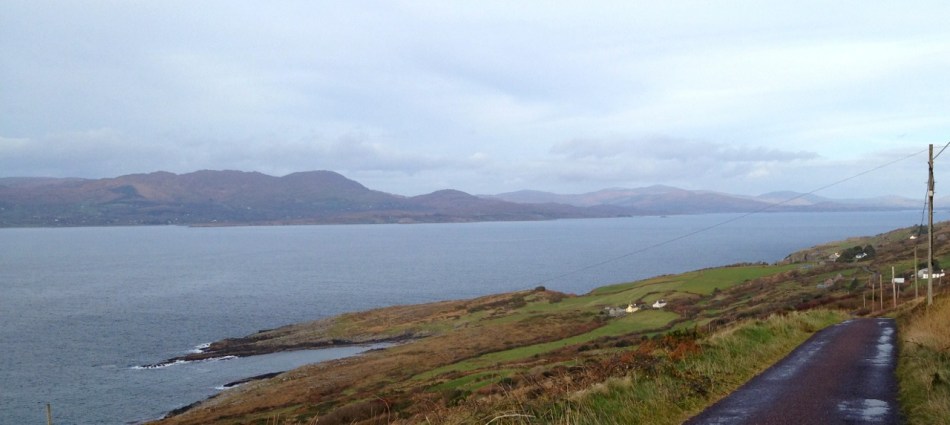
Grand road for cycling!

Far more than a travel diary, this is a comprehensive account of West Cork. Somerville-Large’s erudition is impressive. Either before or after his journey he spent many hours in the National Library, researching the history, folklore, archaeology and literature of the area and he weaves this knowledge seamlessly into his narrative. Because of his own personal background, he is able to include stories and anecdotes from the Big Houses of the gentry. A great aunt

…remembered going down to a cellar which was filled with swords used to arm the tenants during the time of the Whiteboys and also with empty stone wine jars which had carried wine smuggled in from France. From this cellar there was believed to be a passage underground to the O’Driscoll Castle of Rincolisky, whose truncated remains are to be found in a neighbouring field…An earlier Townsend sent his…page down the passage to see if it was clear. The boy was never seen again.
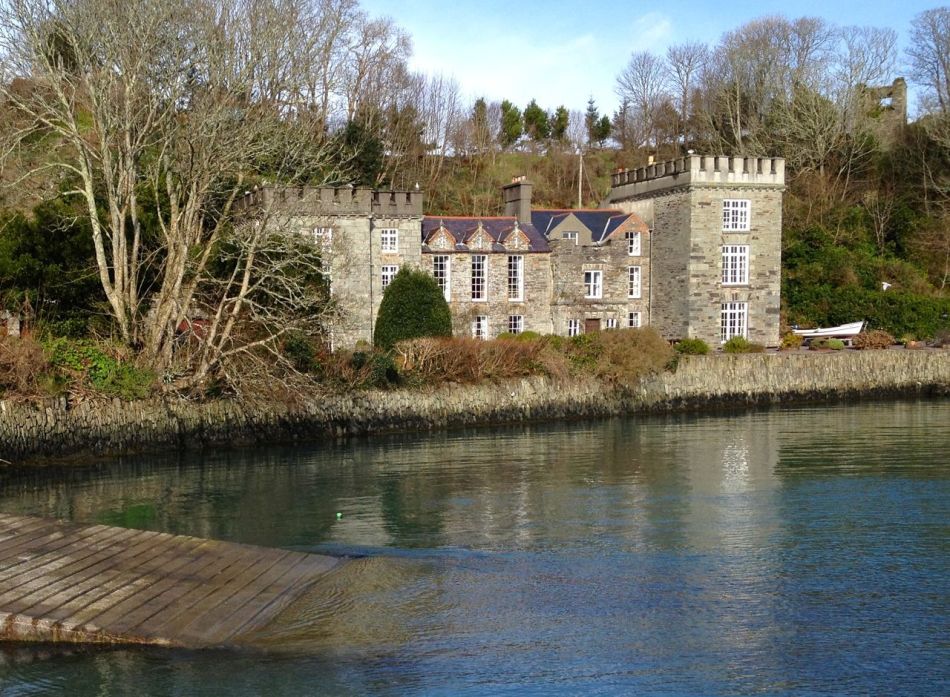
Castletownsend Castle
Castletownshend Castle

His affection for the place leads him to mourn the loss of population from the Islands of Roaringwater Bay.

One by one the small islands became deserted…Only a few years ago I visited Horse Island, just opposite Ballydehob. The last people there, an elderly couple, were living all alone. It was summer, and the old man was sitting in a chair outside his house, his feet in a basin of water. His wife, behind him, fed hens. Next year, they were gone. The house, still intact and comfortable, stood empty, the linoleum in place, last year’s calendar on the wall. Down by the pier a plough had been thrown into the water where it looked like a gesture of despair.
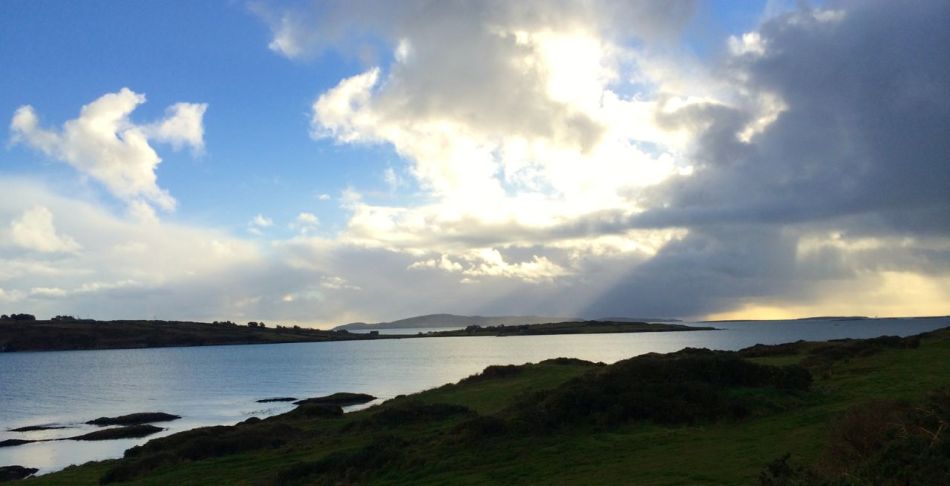
Looking across to Horse Island

He documents the importance of the creamery in the social life of the townlands, the old occupations of fishing and mining and the loss of such sources of income, the string of castles that dot the coast and the great irish families that built them, the brash new bungalows springing up around the scenic areas, the awful legacy of the famine, and the sheer beauty of the scenery. He is conscious of a way of life passing. Going out of his way to visit a sweathouse (a feature of the Irish countryside in times past) he ends up in the O’Sullivan’s kitchen, drinking whiskey and eating biscuits.

Mrs. Sullivan told me that the valley was once thickly populated, and when she was a girl there had been sixty children at the school that closed last year. The way of life had gone with it…Once it had been a great place to live in, her husband said. There were monthly fairs at Ballydehob and Schull, and he had walked all the way to Bantry with the cattle and all the way back again.
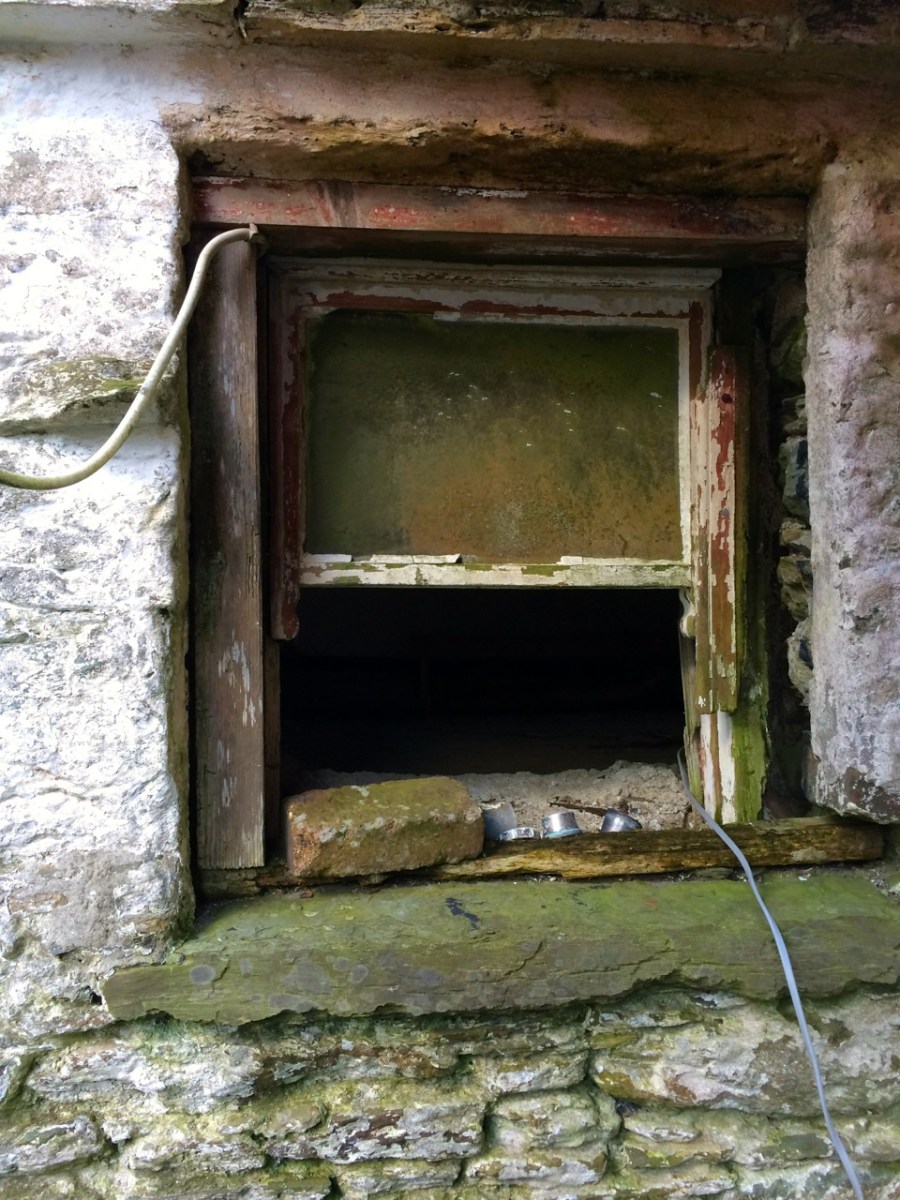
Deserted cottage
Deserted cottage

The parts I have quoted deal with the area around where we live, but the bicycle trip stretches from Clonakilty to the Beara Peninsula. Describing West Cork as it was in 1970, it is now an important historical document in its own right, alongside such accounts as Thackery’s Irish Sketchbook of 1879, or the Pacata Hibernia of 1633. Mostly, however, it is a charming, engaging and fascinating depiction of a special place.
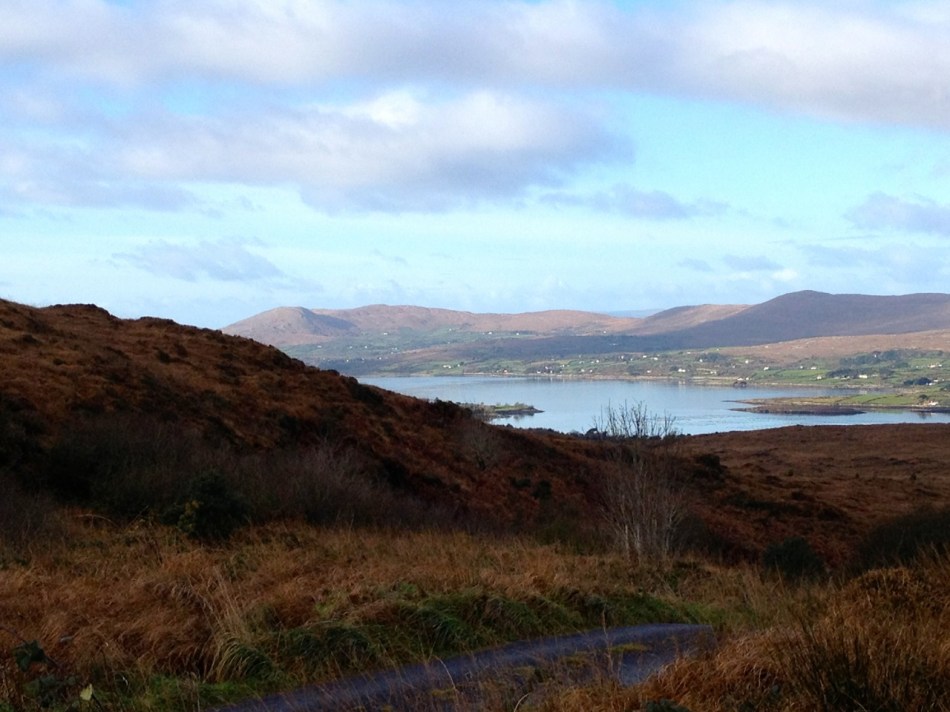
Over the hill to Durrus

Crookhaven Through Time

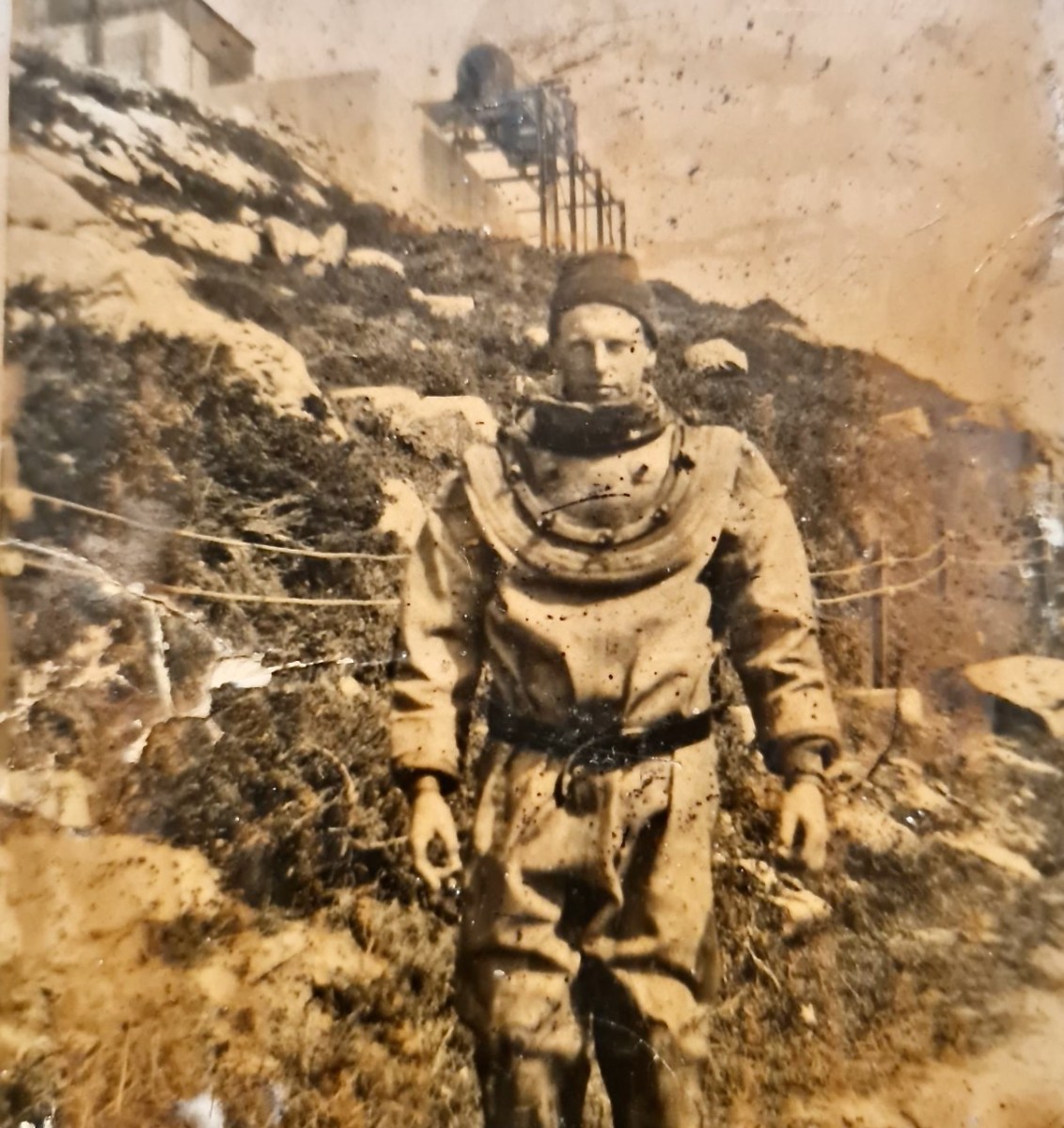
I’ve had the most marvellous emails from James Goggin – thank you James! Three of his grandparents came from Crookhaven – and the fourth, well that’s him in this spectacular photograph. Yes, he’s in a diving suit. James tells me: His name was Allen G Tyson, and he had come from Wales to work at the Crookhaven Quarry, seconded from Flintshire council in North Wales. Aggregates from the quarry were sent to North Wales amongst other places. He was a tall man and brilliant mathematician and civil engineer and lived with us in later life until his death in ’79. He designed the first dual carriageway in N.Wales and worked on the blue jubilee bridge in Queensferry (similar to and at the same time as Sydney and Newcastle bridges). 

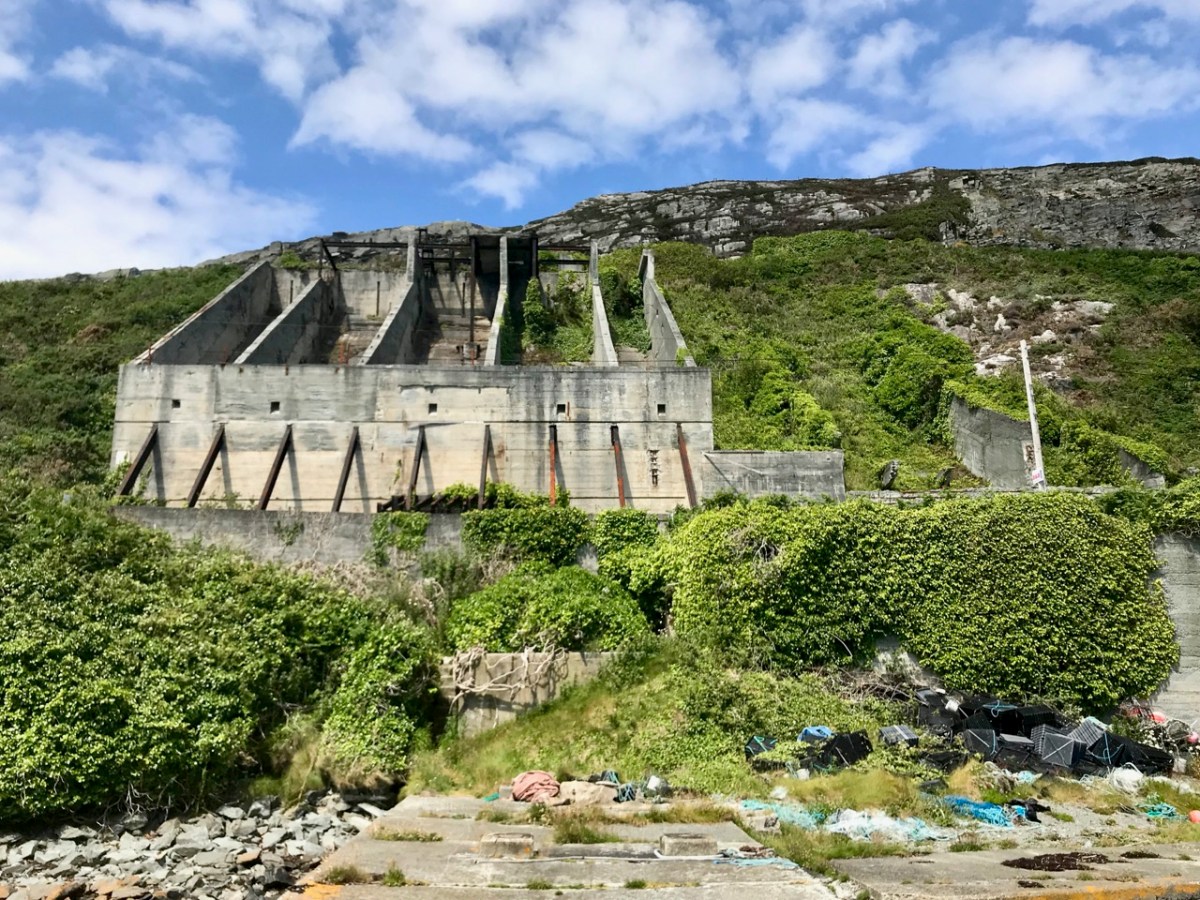
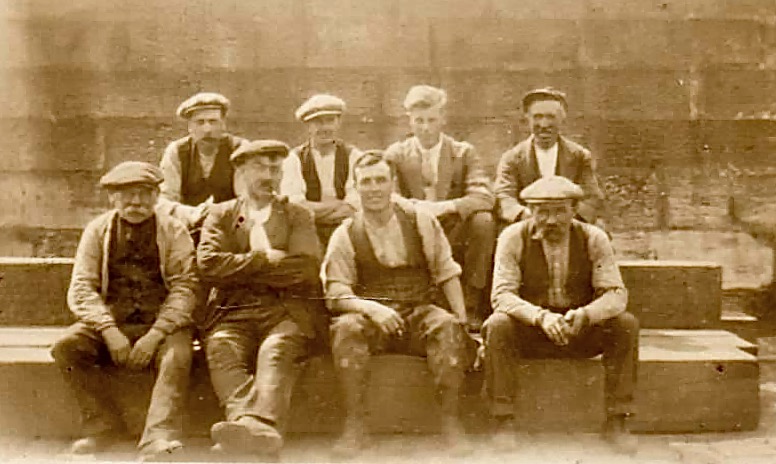
The quarry, of course, is the monumental structure, above, that Robert wrote about in his post Industrial Archaeology in Crookhaven, one of our most popular posts. It seems that anyone who has ever been to Crookhaven has wondered about that wall of concrete across the bay. James also sent me this shot of a group of men who worked at the quarry. Cloth caps and moustaches were the order of the day – except for Allen Tyson – he’s the suited and coiffed individual in the back row.

Once in Crookhaven, Allen met and married Bridget O’Driscoll. They had 5 children, including James’s mother Phyllis, who married Joe Goggin. Joe died not too long ago at the age of 91 and still has a sibling in Clonakilty, James remembers happy family holidays in his Nana’s house, the old Barracks next to the Marconi House in the village. He is full of stories and precious memories.

My father used to row coal to the Fastnet for a shilling or two.  He told me of an uncle who used to shoot the sea mines ( like prickly conkers) with a .303 from Carrigeen cliffs off Rock Street. Nana would climb down to the sea for driftwood for the fire into her 70s. I remember the sacred heart picture and light, and the lights would flicker as I believe there was a generator in the village for power. A large old transistor radio in the kitchen with all the valves visible. Cold cupboard (a safe) under the stairs. Soda bread (and marmalade daily made in the range.  

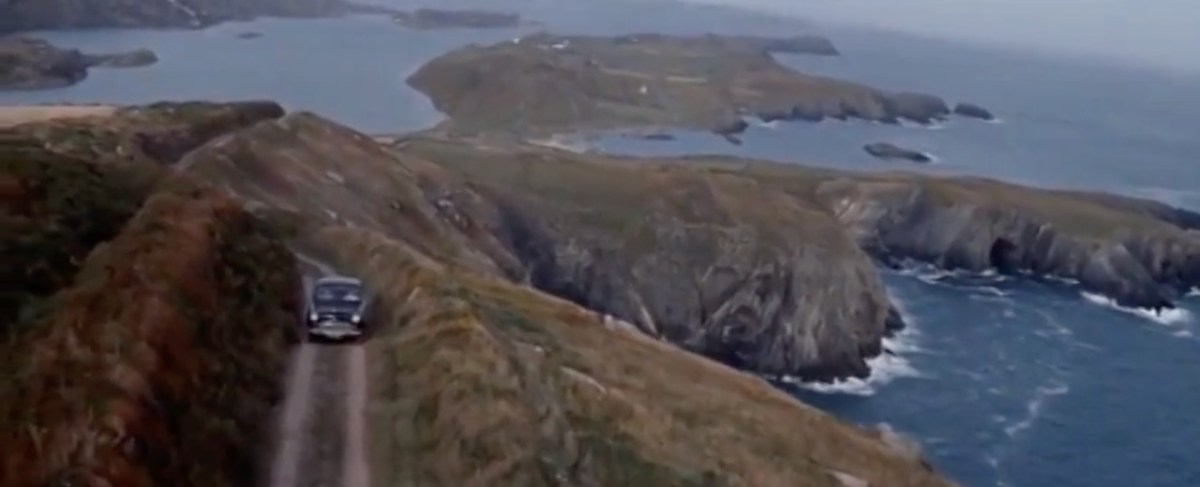
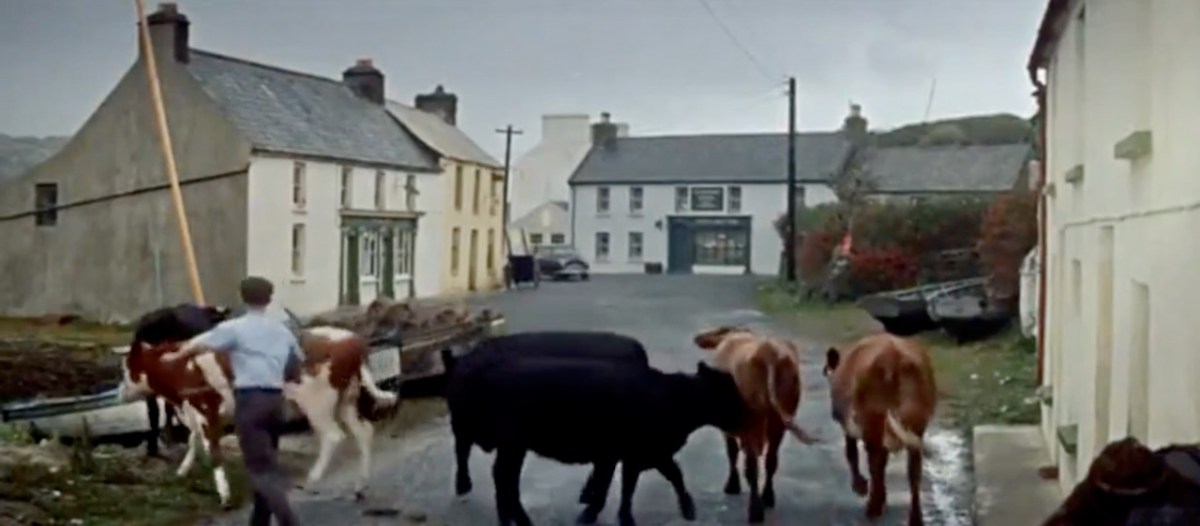
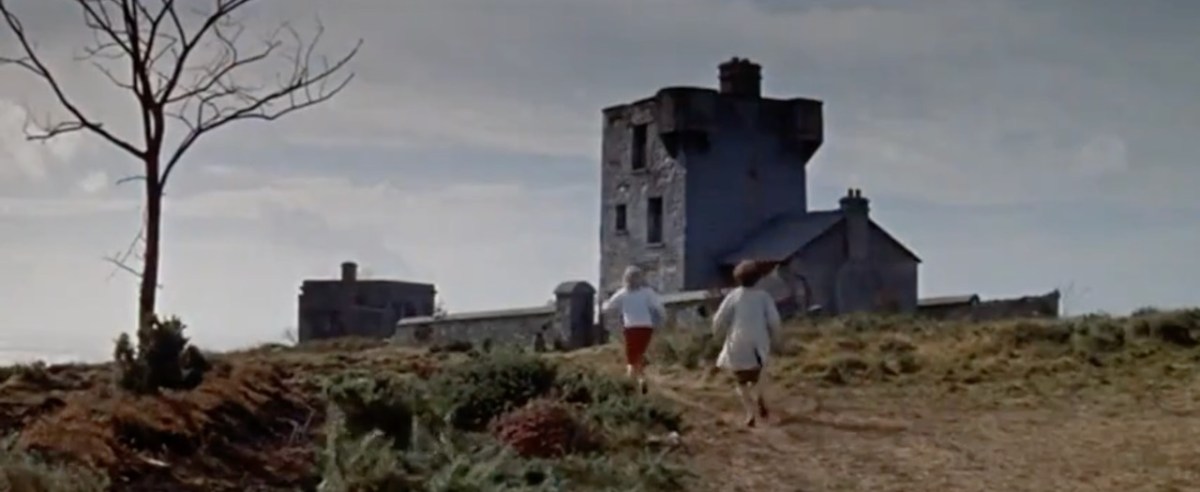
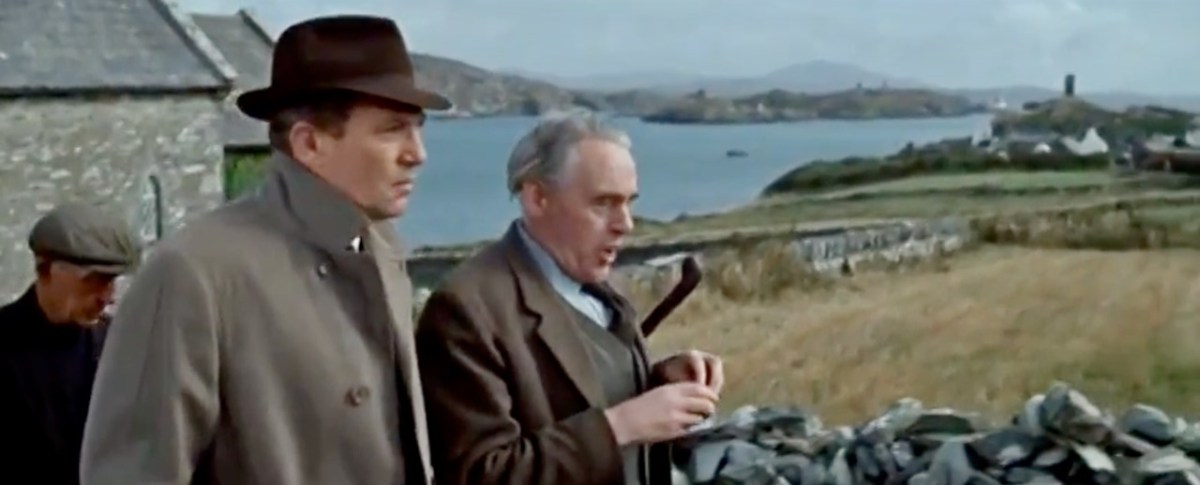
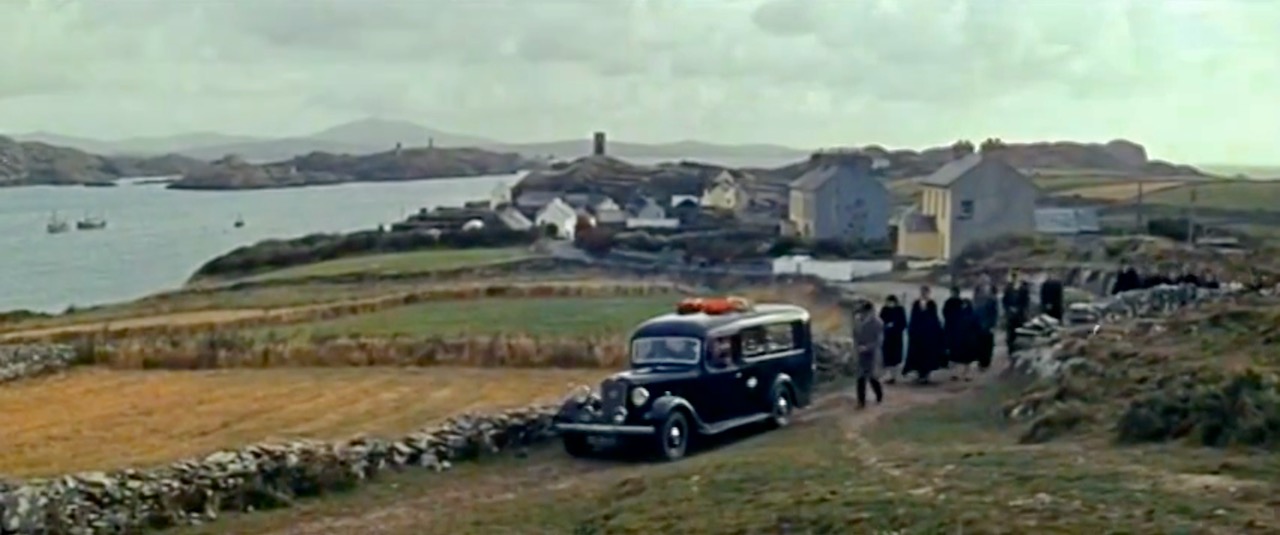
James told me several other stories about his father, whom he admired and loved. But he also sent me another gem! A link to a movie, I Thank a Fool, made partly in Crookhaven, and released in 1962. You can watch it here – the Crookhaven parts start around the 1:09 mark and it is a complete nostalgia fest for those of us who love this part of the world. Here are some screen captures.

The village is still totally recognisable.

The 1804 Brow Head Signal Station is used as a ‘house’ where some of the action takes place. You can see Marconi’s Wireless Telegraph station in the background. For more on these structures go here for Marconi and here for the Signal Station.
There is also a funeral at St Brendan’s Church. The procession gives us a marvellous opportunity to see back to Crookhaven and the mining magazine that was once clearly visible behind the town, but which is no longer a mark on the landscape. I’ve used that as my feature image at the top of the post, but here’s another take. That’s Peter Finch as the leading man.

I love it when this kind of serendipity happens – thanks again, James. I know that anyone who loves Crookhaven, as we do, will really like this walk through past times.

The Return of the Earls: The 2025 Crowley Clan Gathering

I spent Saturday in Baltimore celebrating, with dozens of Crowleys, a signal occasion. This celebration involved the iconic boat The Saoirse, exhaustive genealogical research, long lost cousins meeting for the first time in over 300 years, and a remembrance of a devastating episode in Irish History – the Flight of the Earls. 

Let’s start with the Flight of the Earls. The Battle of Kinsale in 1601, was the moment that marked the end of the power of the great Irish families and the end of the Gaelic way of life. Many heads of those families who had fought at the battle fled Ireland from Rathmullen in Donegal, heading for the continent, in 1607. Their names can be found in the lists of those who fought in the armies of Spain, France and the Austrian Empire, as well as, sometimes lightly disguised, as landowners, wine-growers and grandees in those countries.

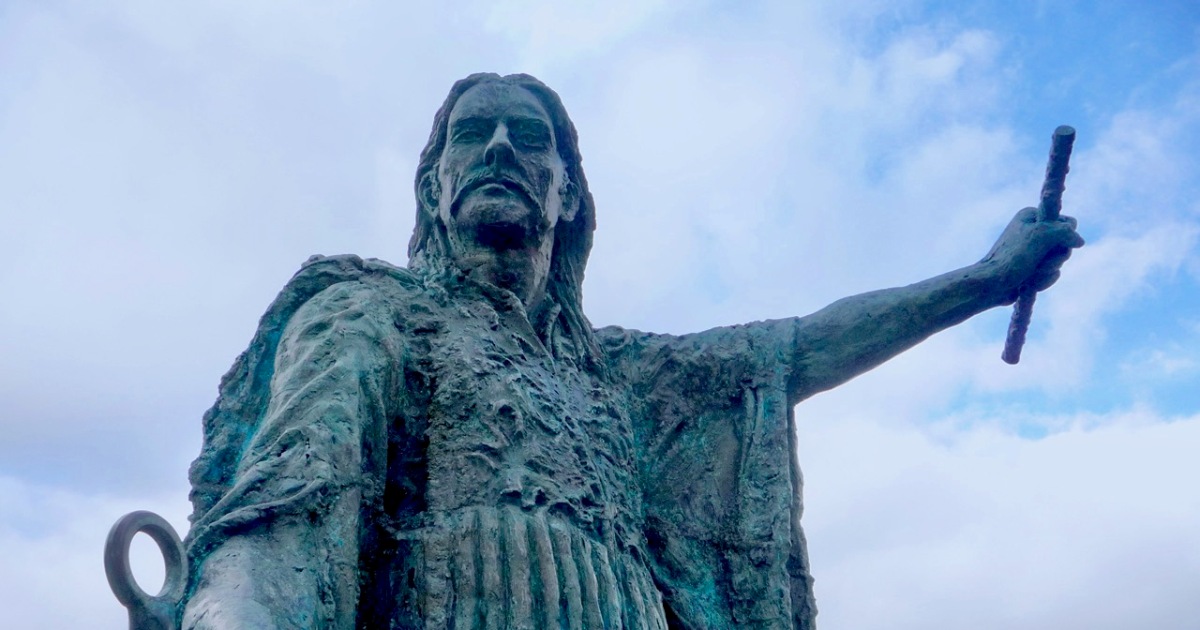
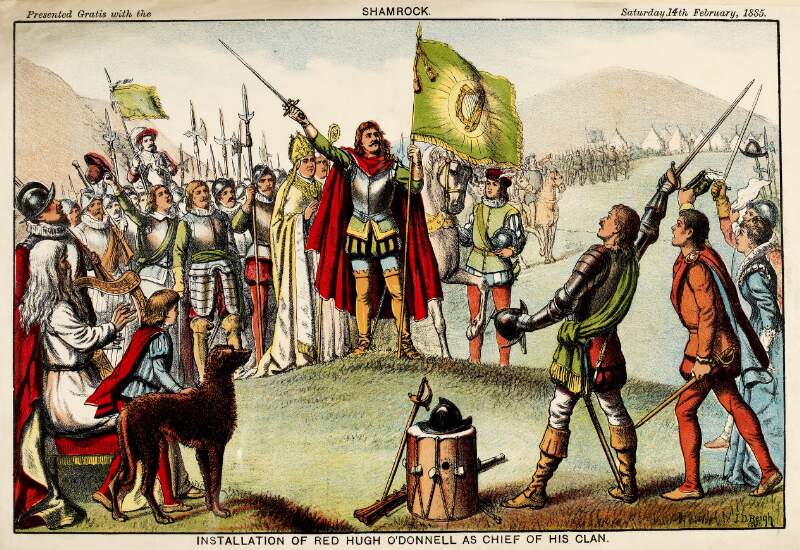
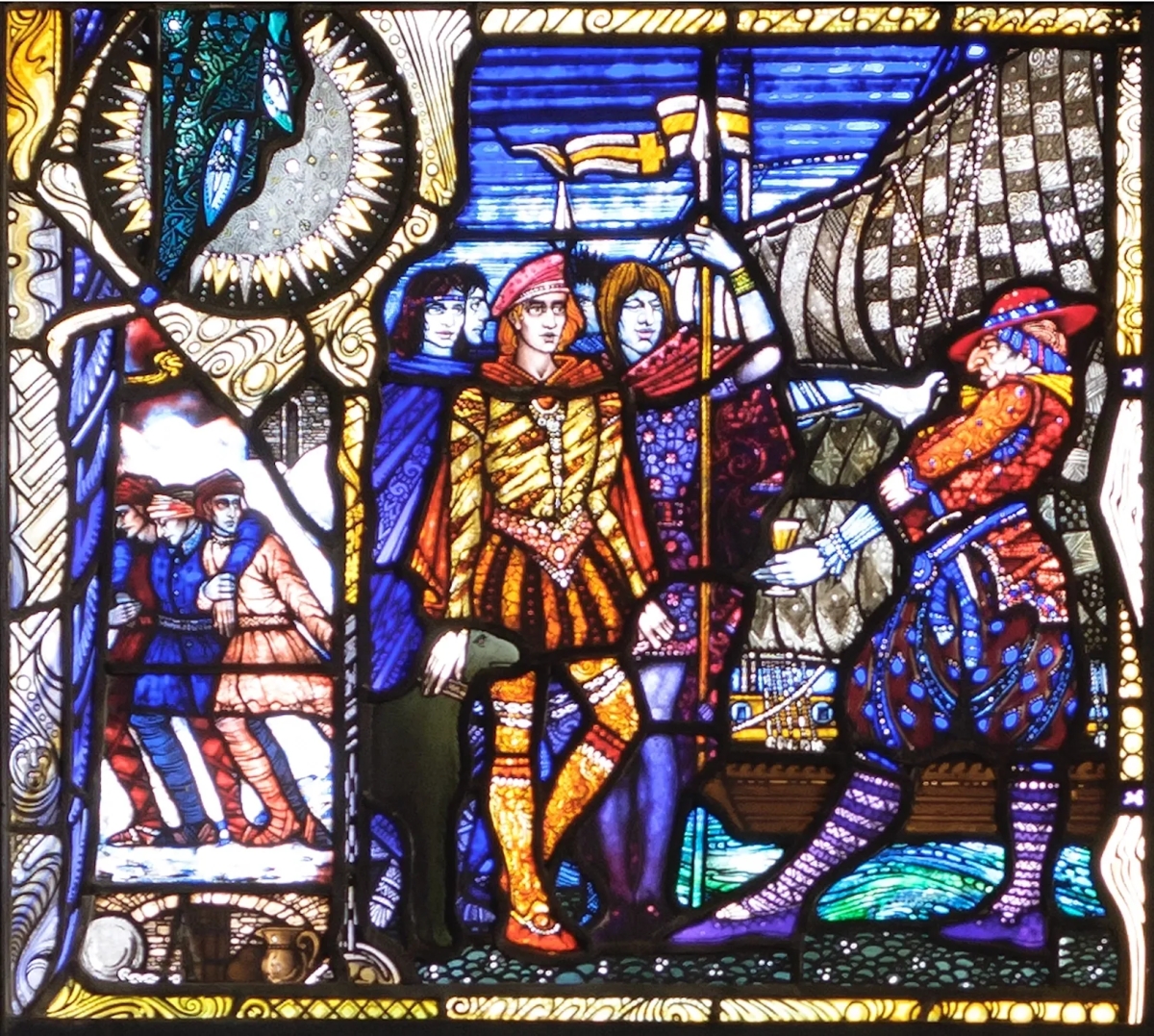
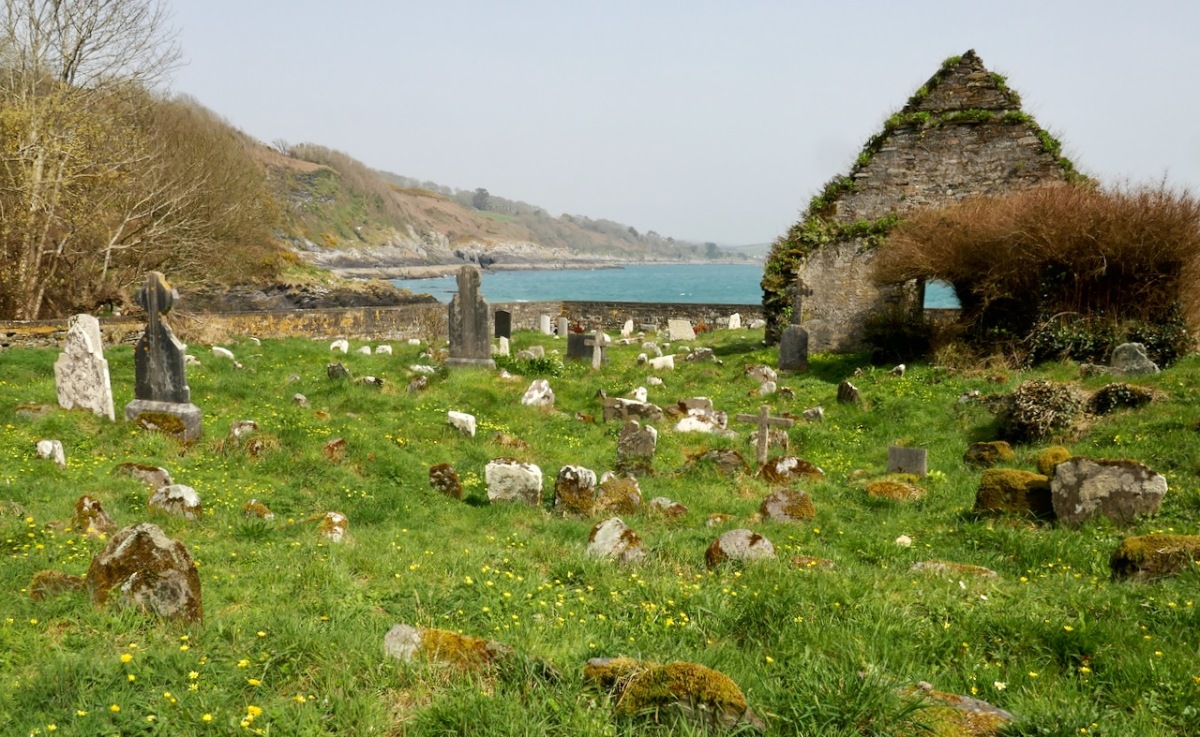
However, one of the leaders, Red Hugh O’Donnell of Donegal, set out earlier, on January 6th, 1602, and he sailed from nearby Castlehaven (below). You can find the whole story, told in a highly entertaining way, on the website of our old friend Gormú. That’s Richard King‘s rendition of Red Hugh, above, being offered a poison cup by a traitor, causing him to die in Spain (where his grave has recently been identified). My lead photograph is his statue, by Maurice Harron, in Donegal town and the cartoon is by John Dooley Reigh, from The Nation (I think). We in West Cork have never forgotten that this is a West Cork story and we feel we can claim Red Hugh as one of our own. This connects us in a special way to the whole saga of the Flight of the Earls.

That flight did not stop in 1607 – Irish men and women, clan chieftains, soldiers and peasants alike, continued to leave for the continent over the next centuries. 

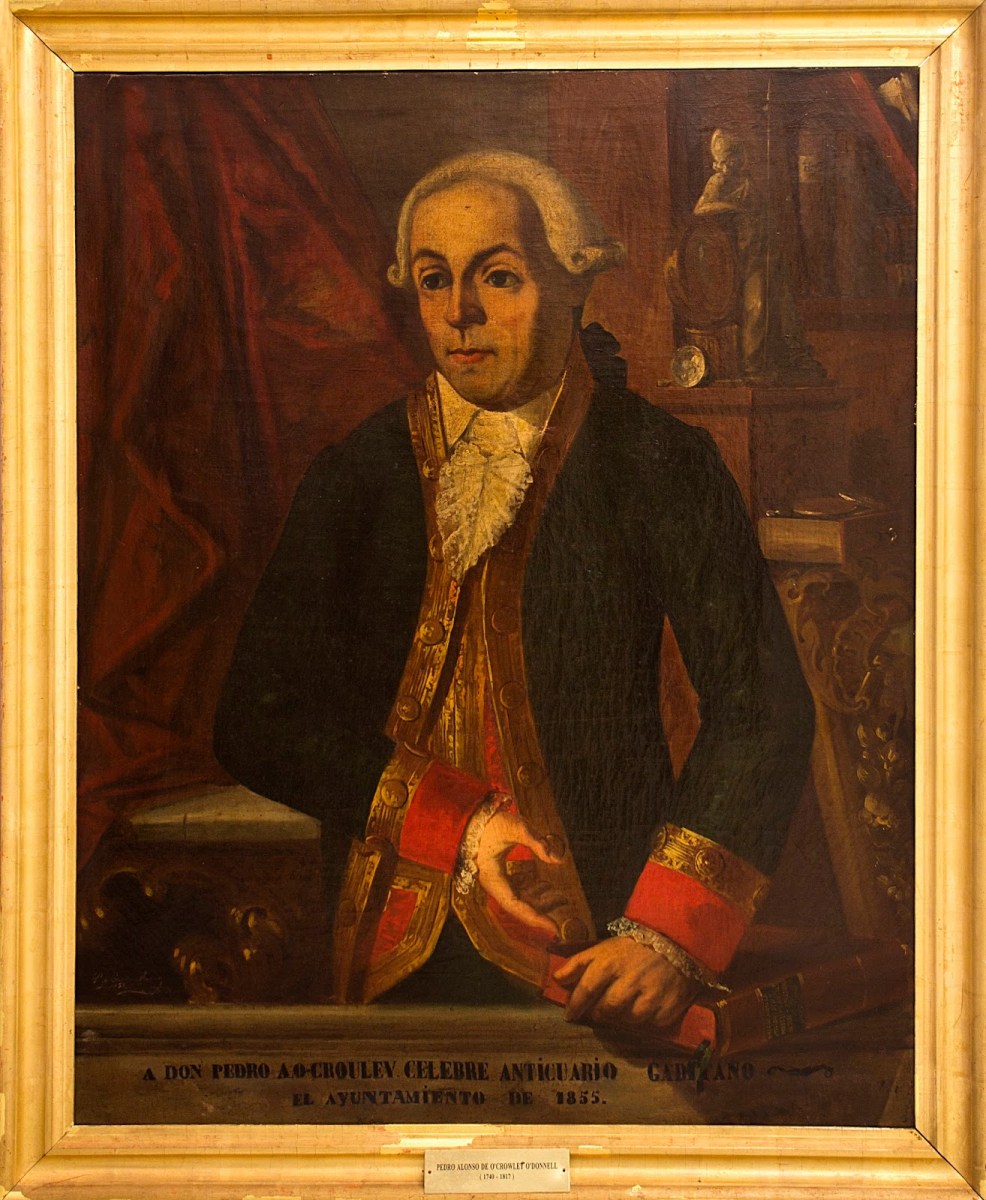
Among those who left were the parents of Don Pedro Alonso O’Crouley. Here are the details from the Crowley Clan website:

Pedro Alonso O’Crouley was born in Cadiz in 1740. Both his parents had emigrated from Ireland. His father Dermetrio (Diarmuid or Jeremiah) was from Limerick claiming descent from Cormac O’Crowley born in Carbery, Co. Cork in 1550. His mother was an O’Donnell from Bally Murphy in Co. Clare.

At nine years old he was sent to France where he got a classical education from the Augustinians at Senlis. He chose to follow a career as a merchant and got a licence for Veracruz and made his first journey to Mexico at the age of 24. Over the next ten years he repeated the journey several times and built up a large fortune from his trading business.

While in Mexico, or “New Spain” as it was called, he gathered every bit of information he could about the country and its history, geology, vegetation, animals, etc. and wrote up his findings in the “Idea compendiosa” – A description of the Kingdom of New Spain” in 1774.

After returning from Mexico O’Crowley stayed on in Cadiz pursuing his interests in antiquities and history. In 1794 he published a catalogue of his private collections called “Musaei o’croulanei”. It lists over 5,000 Greek and Roman coins and 200 paintings including works by Van Dyck, Rubens, Murillo, Velaquez, Zurbaran and Ribera. He also had many geological specimens he had gathered in New Spain.

Pedro remains very famous in Cadiz, where his house functions as a museum. And – there are descendants! In 2014 the Crowley website received a letter:

My name is José María Millán Fuentes, and I am a descendant of O’Crowley. I live in Cádiz, Spain, and I am doing work for the University of Málaga on my ancestors. I speak very badly English, but I have a lot of interest in the topic. I would like to help you, and that you also should help me. I have read in your web Antonio Castro, and also I descend from Pedro Alonso O’Crowley O’Donell and Adelaida Riquelme O’Crowley. I have a lot information about the family up to Pedro Alonso, but then everything fades away.

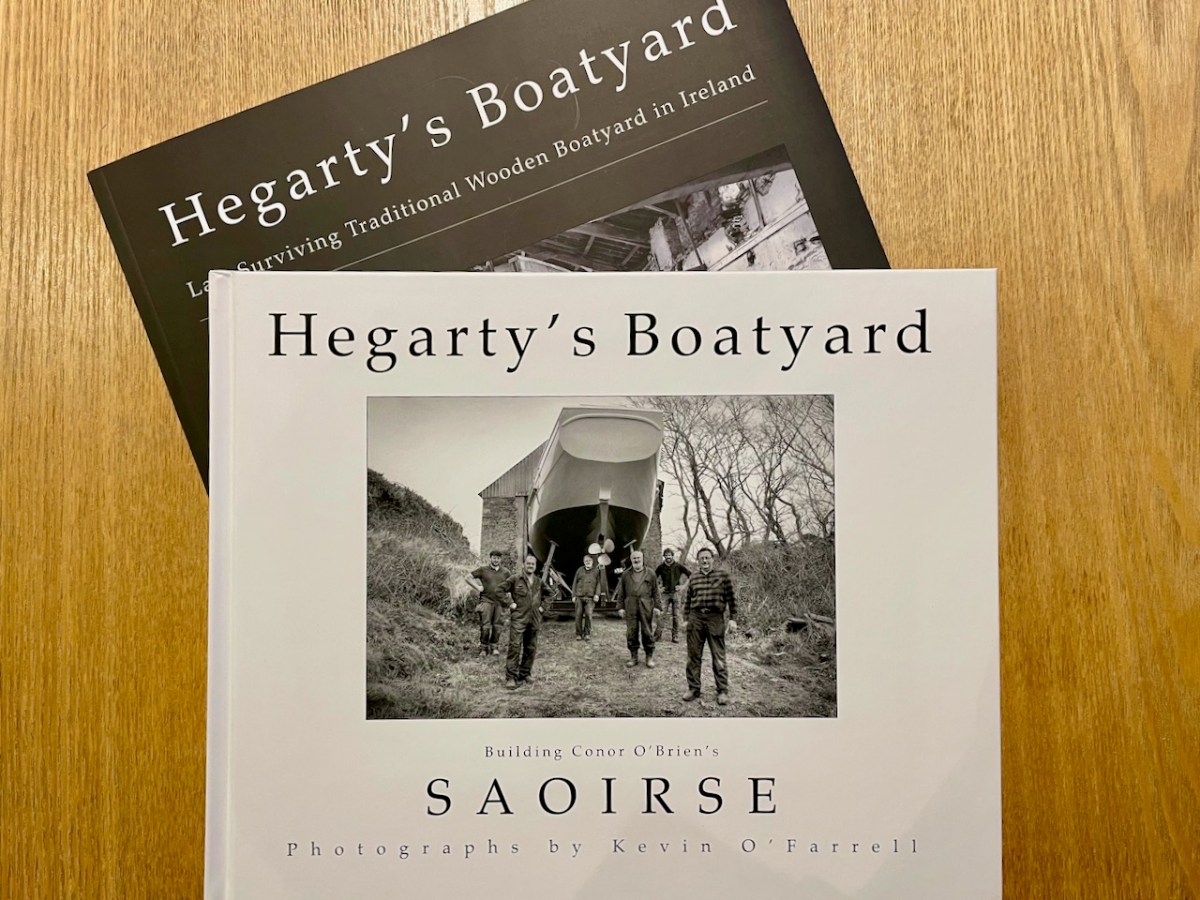
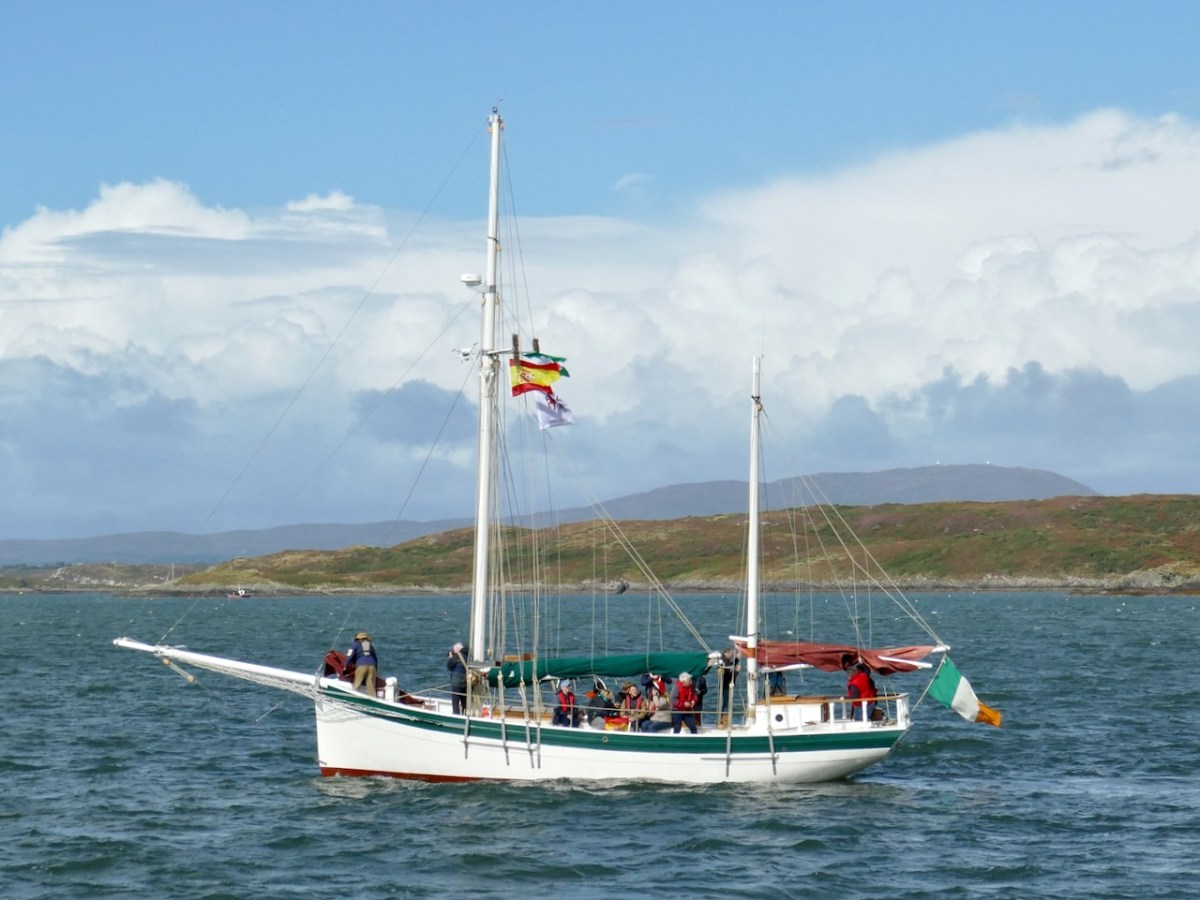
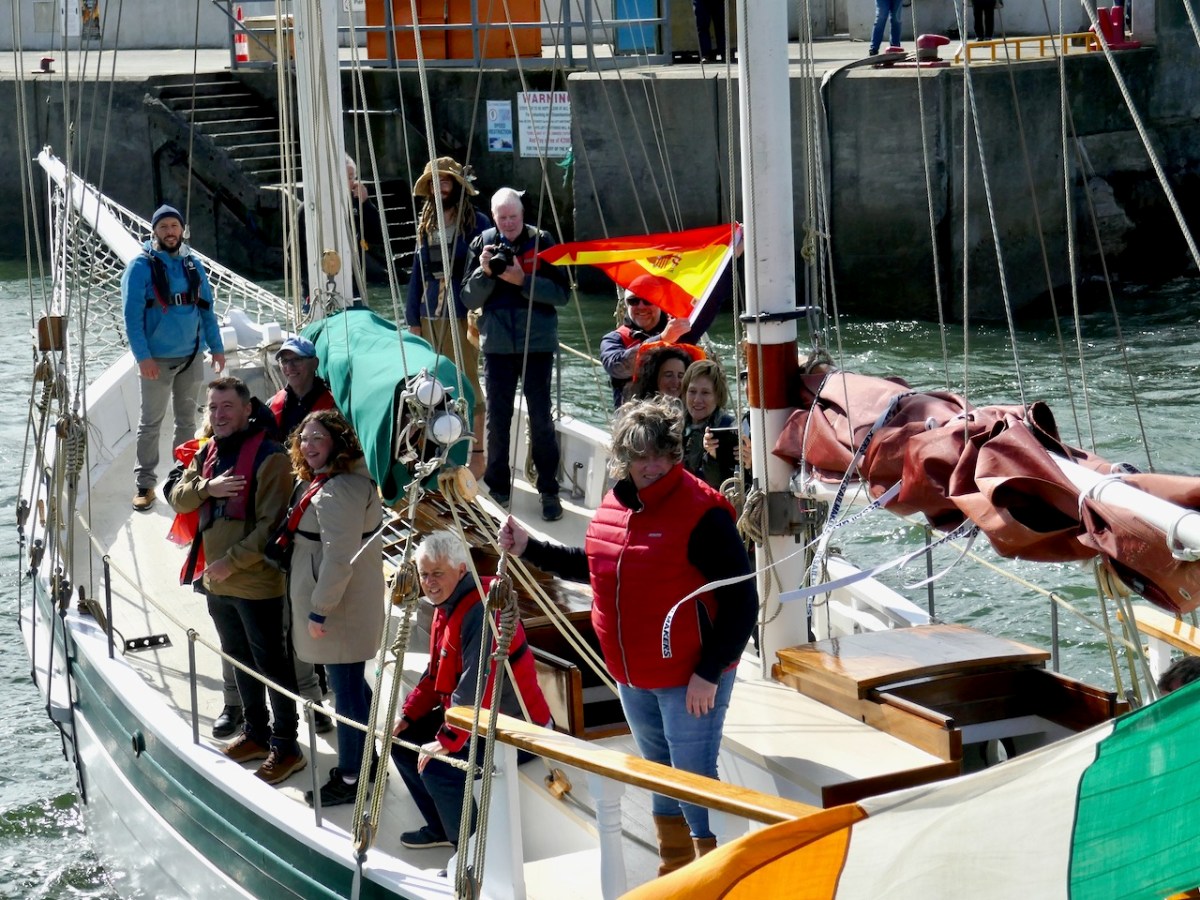
Eleven years later, José Maria is to be the guest of honour at the Crowley clan gathering. The committee discusses how best to make the most of this moment and comes up with a genius idea. He should arrive by sea, born into Baltimore on the iconic boat, the Saoirse. Read about the Saoirse here, and for true traditional wooden boat enthusiasts, you can buy Kevin O”Farrell’s brilliantly photographed book on its reconstruction in Hegarty’s boatyard. 

The Saoirse is a big, gaff-rigged yacht, the original version of which was built to sail around the world. It requires a great deal of skill to sail, and thus the task was entrusted to Liam Hegarty.

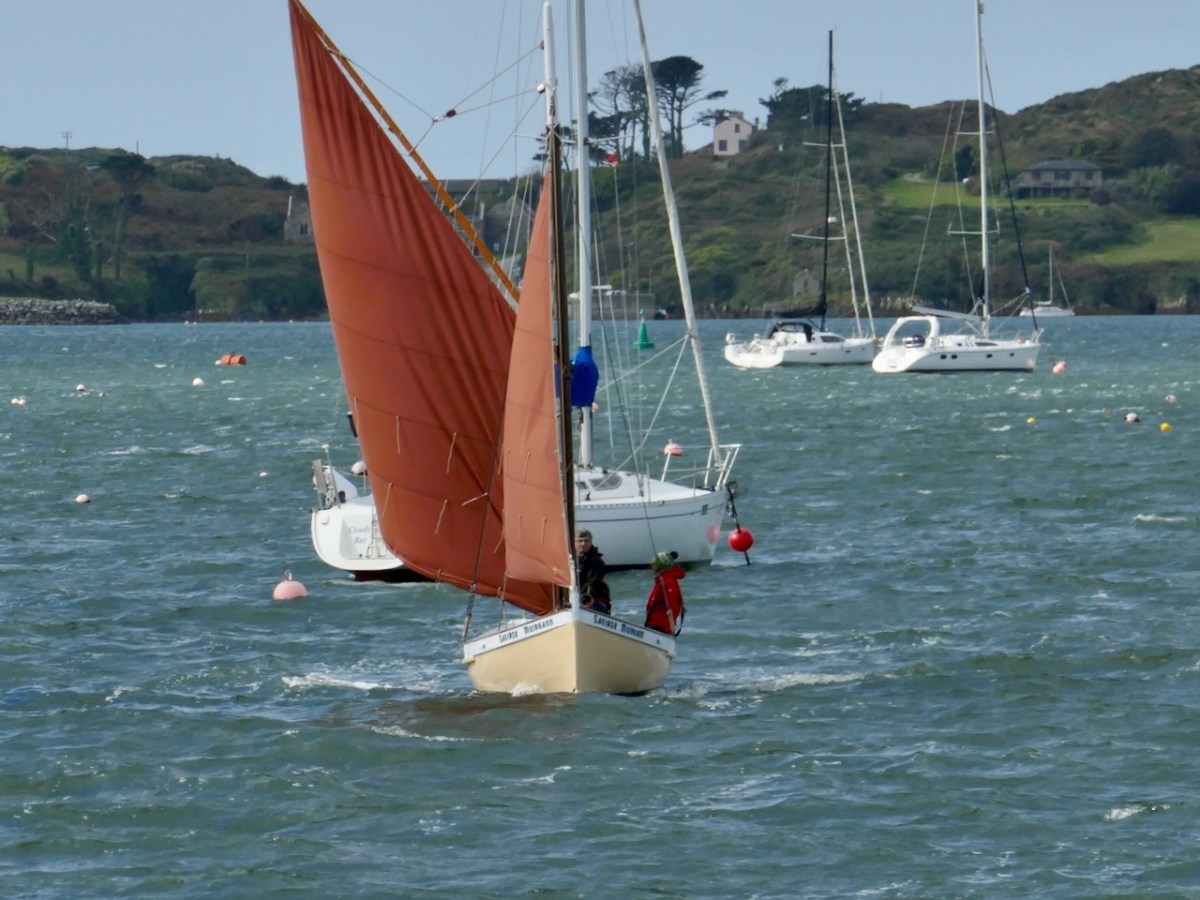
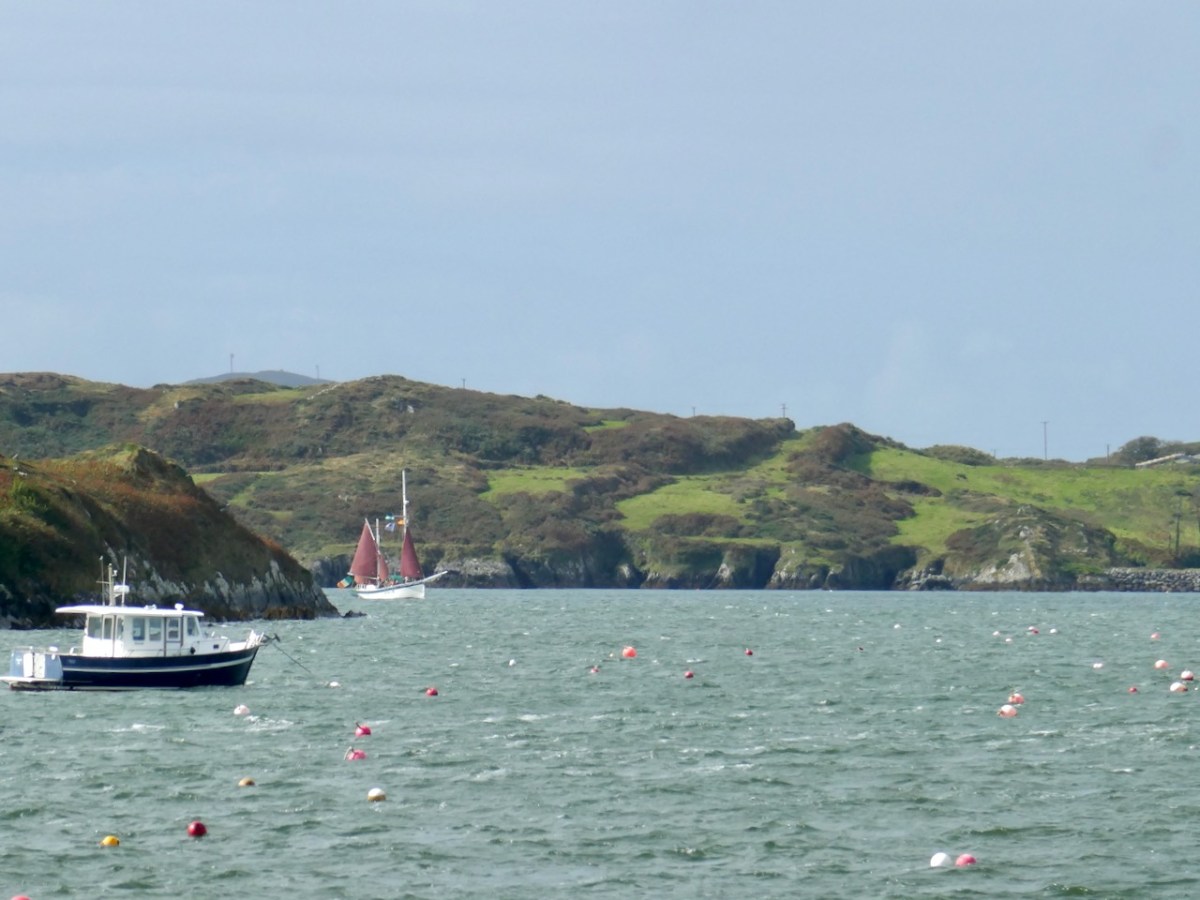
A flotilla of traditional wooden boats was to accompany her into the harbour but high winds scuppered that plan so in the end only two boats made up the guard of honour – Cormac Levis’s Saoirse Muireann (above) and Nigel Towse’s Honorah

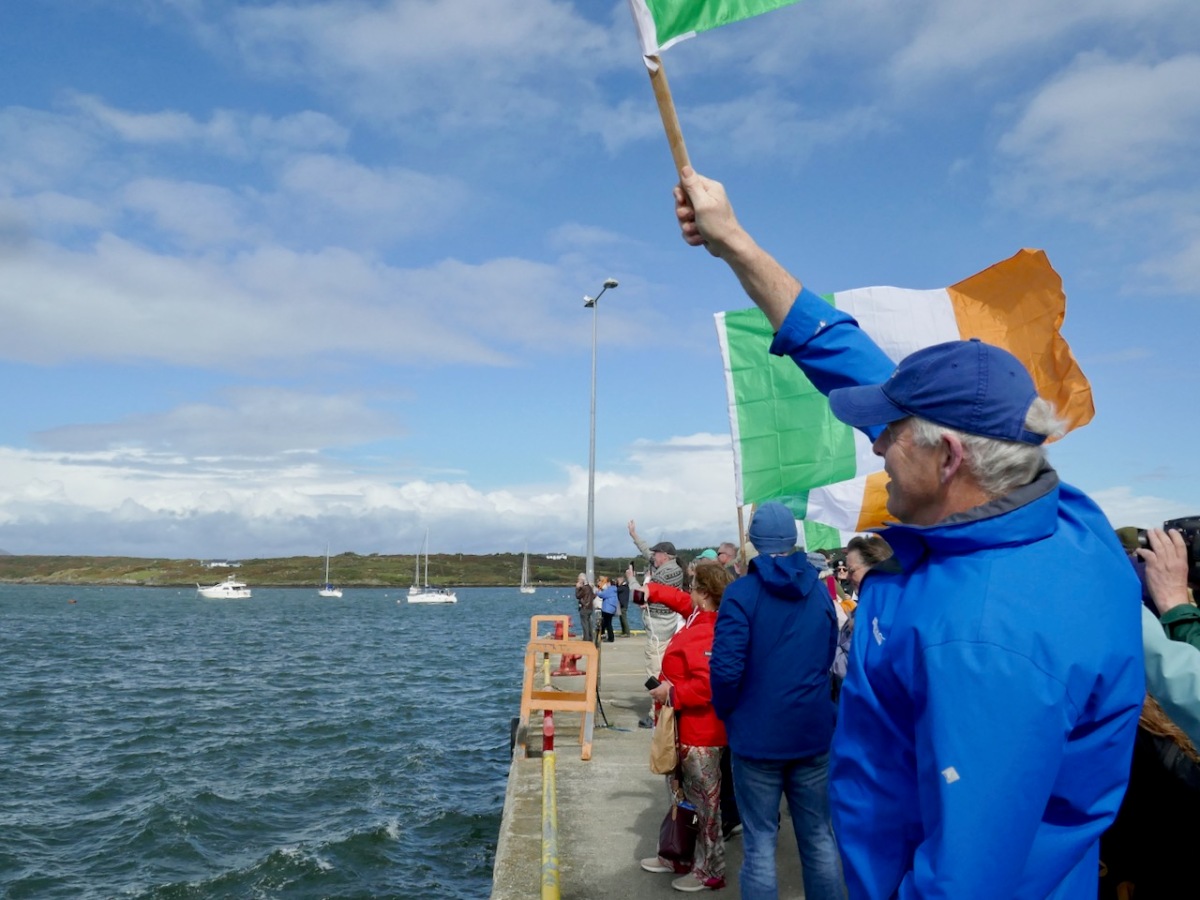
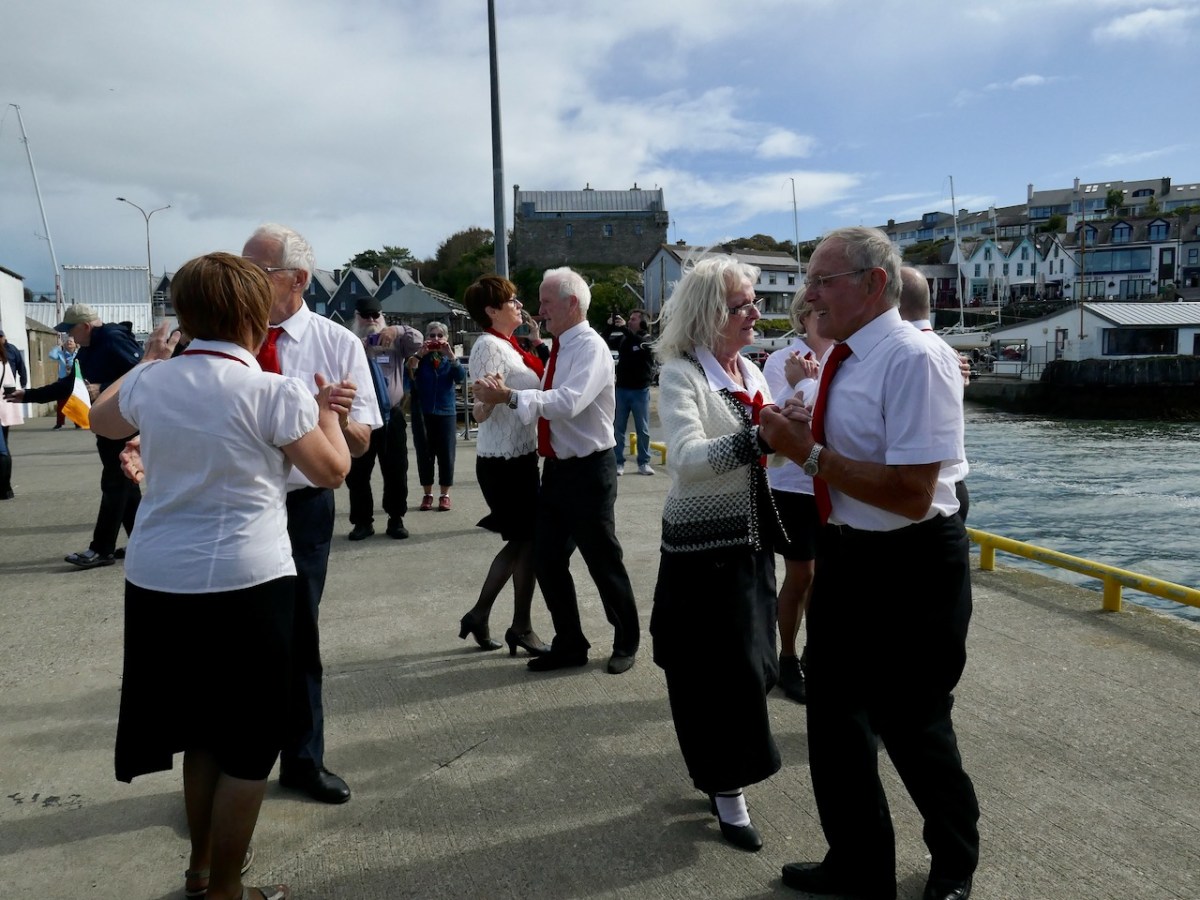
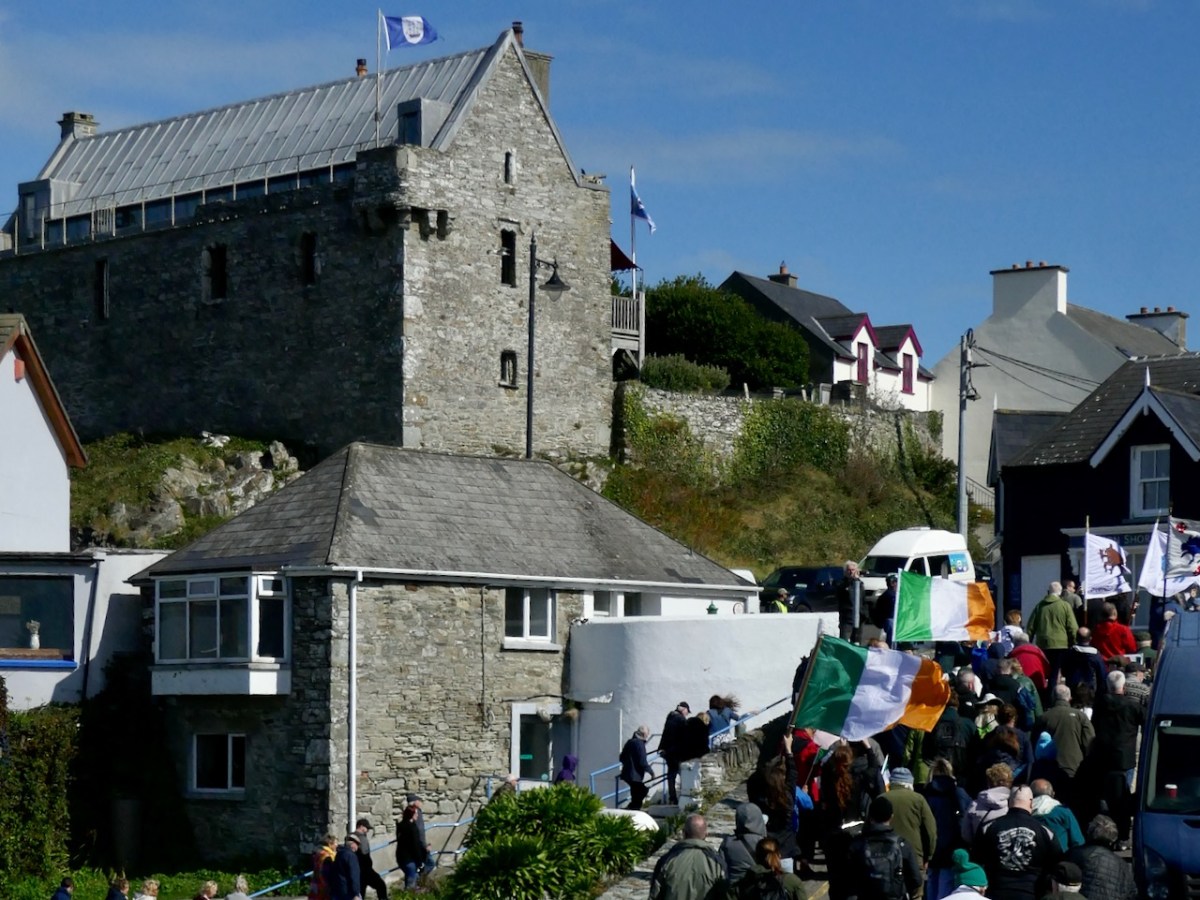
It was thrilling to see the Saoirse round the Beacon point and tack into Baltimore. I stood with a large contingent of Crowleys, waving flags and cheering, while a group of lively dancers set all our toes tapping.

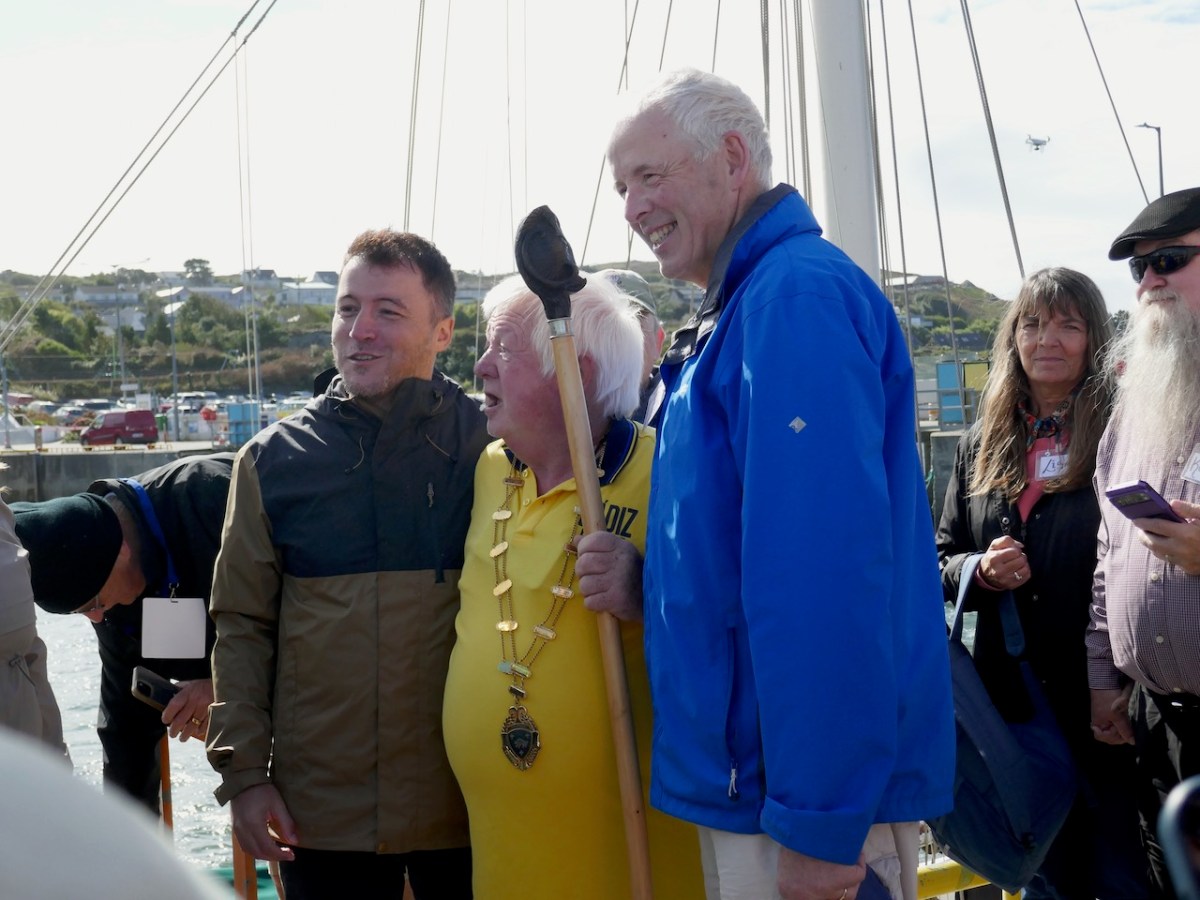
The most moving moment was when José María  climbed up the ladder to the pier, to be met with his 7th cousin, Kevin Crowley from Martinstown, Co Limerick, and enfolded in a welcoming embrace. The Clan Taoiseach, Larry Crowley gave a short, perfect speech. He said, and I paraphrase – José María, your ancestors fled Ireland 300 years ago. They were escaping from oppression, from poverty, from dispossession and from the consequences of resistance. But here we are now, all of us proud Europeans, standing shoulder to shoulder

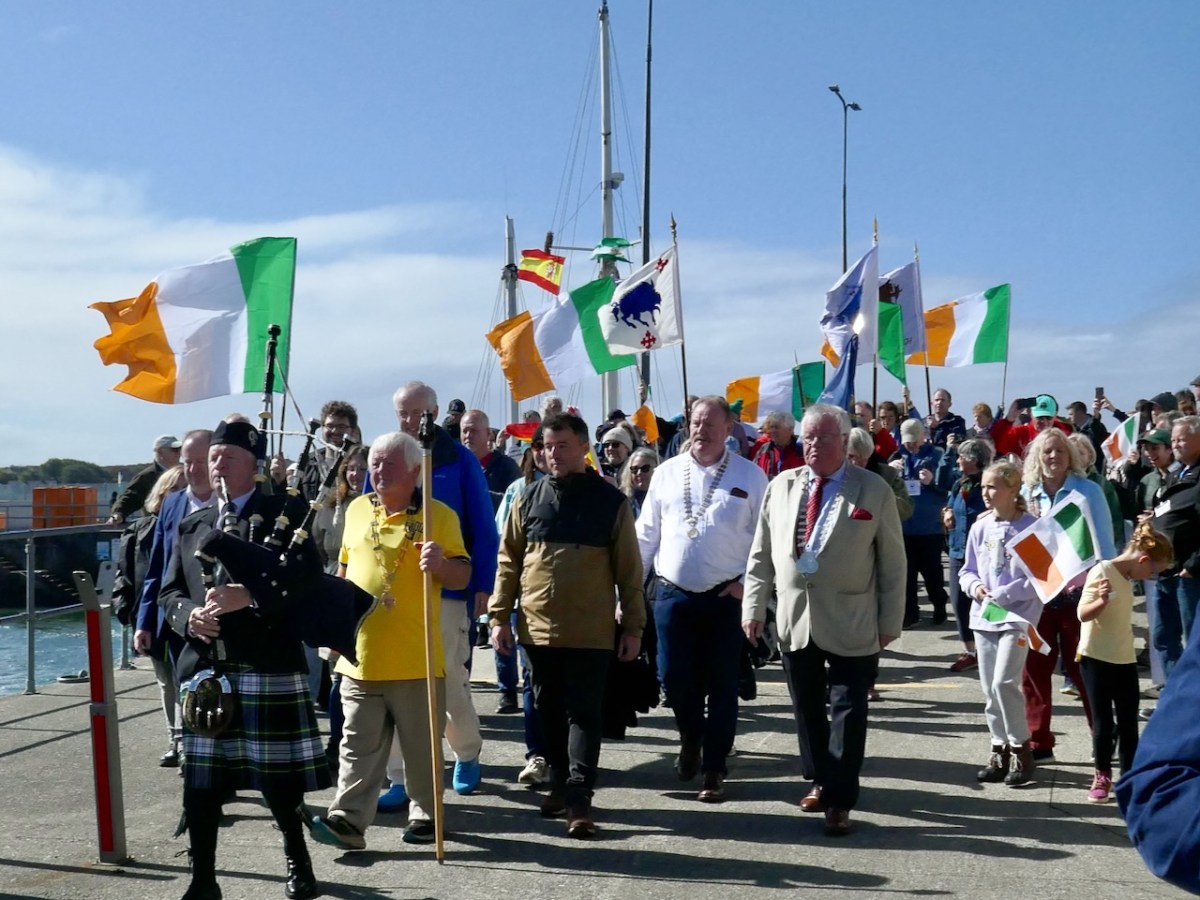
Led by a piper, we marched up to the village square.

I was struck by the aptness of the Spanish flags passing under the walls of Baltimore Castle – a castle that, in its day serviced the vast Spanish fishing fleets that came for the pilchards and herring. The O’Driscolls became fabulously wealthy through that commerce, and forged alliances with the Spanish that came back to bite them in later years.

There were more speeches, including a masterful summing up of Baltimore’s history by William Casey, and then a squall had us running for cover. The Algiers Inn and other eateries in Baltimore served up a smashing array of sandwiches and soup. I chatted with New Zealand Crowleys and American Crowleys and Irish Crowleys – we all agreed that it had been a perfect Welcome Home.

I may not have all the details exactly right – corrections welcome from knowledgeable Crowleys. My special thanks to Charlie Crowley for inviting me along.

Sherkin Friary

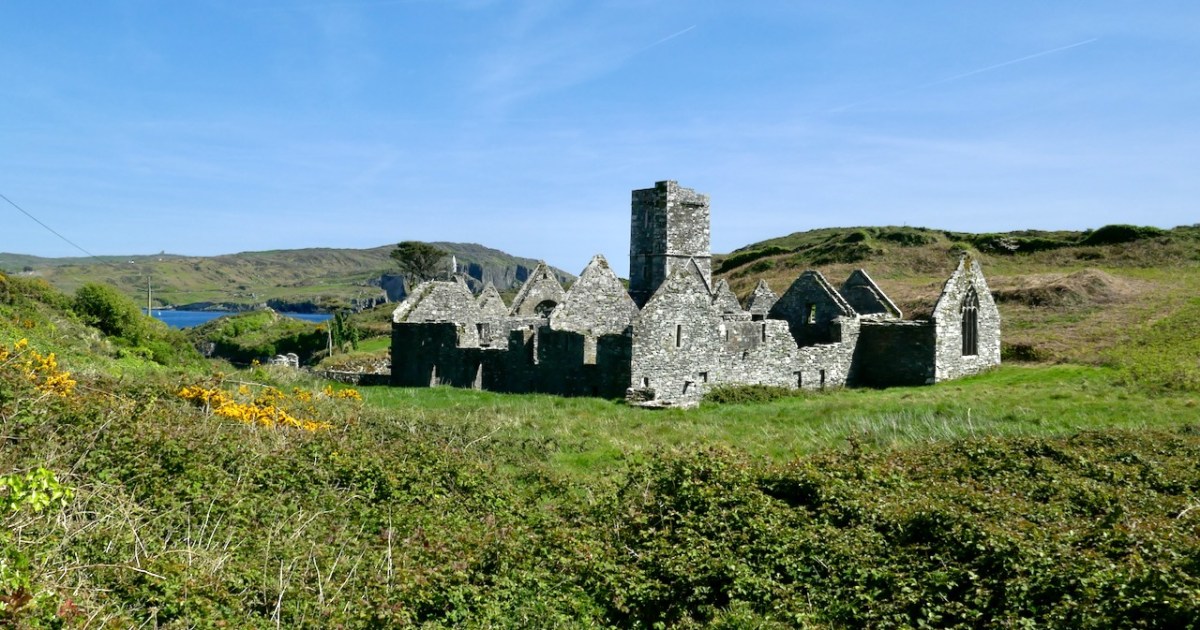
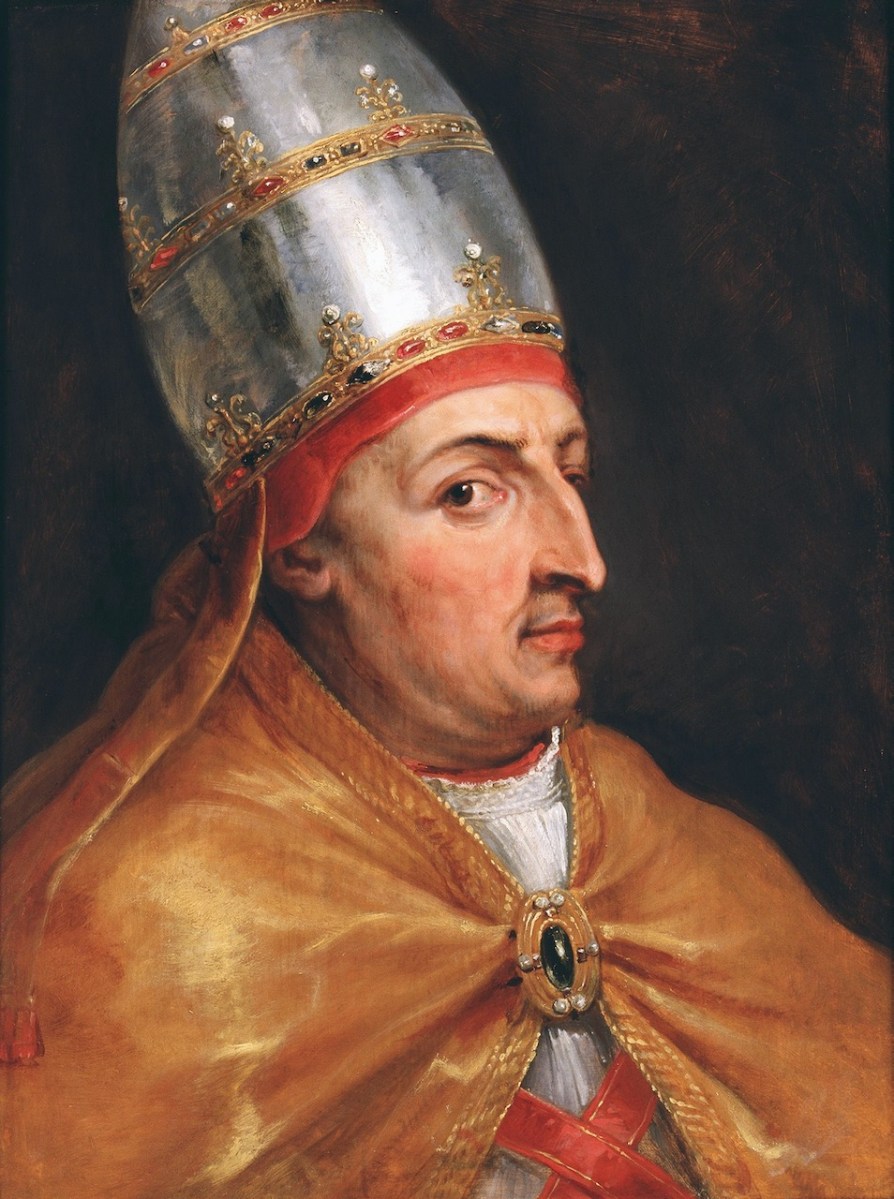
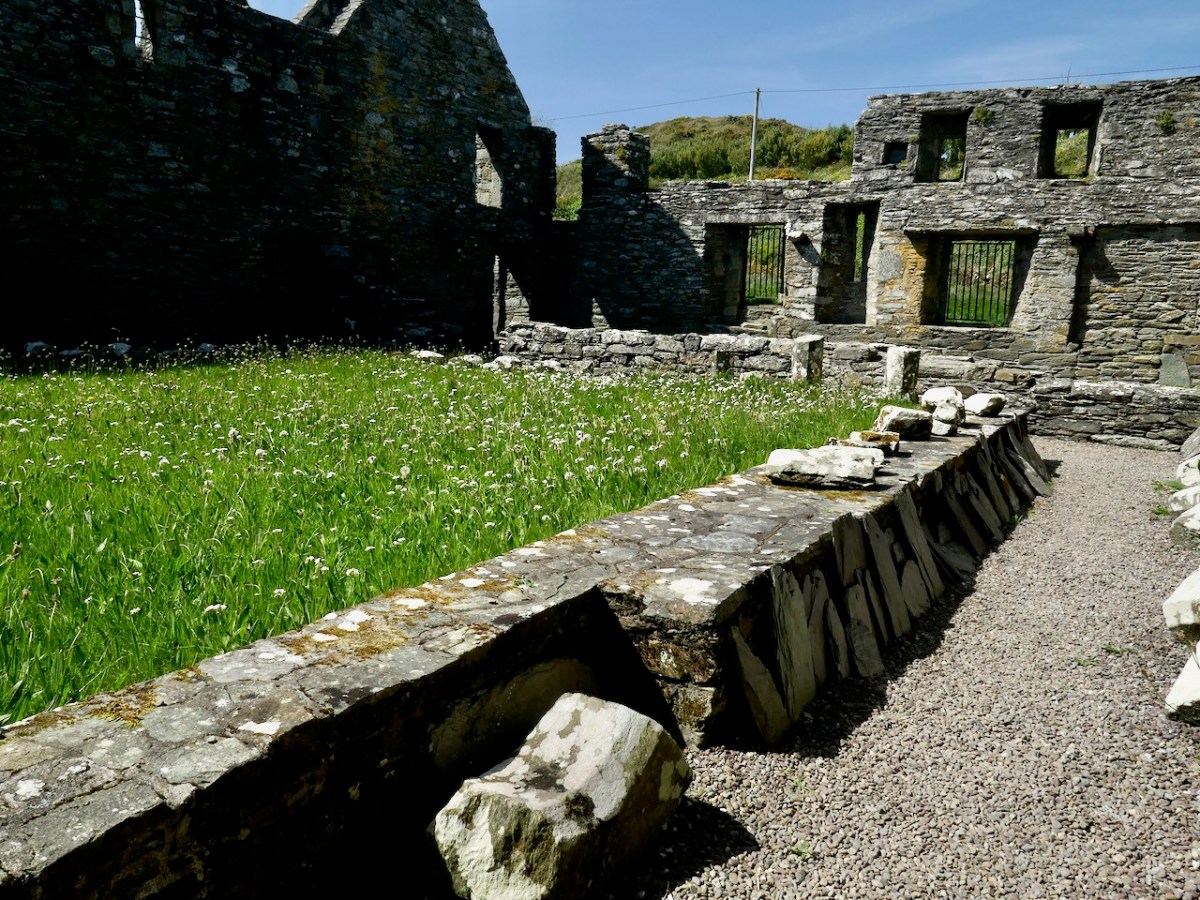
The Franciscan Friary on Sherkin Island (also called the Abbey) was established by Fineen (Florence) O’Driscoll, chief of the wealthy O’Driscoll clan, which had its headquarters in what is now Baltimore, but which, in the middle ages, answered to the name of Dún na Séad – Fort of the Jewels (how’s that for flaunting your wealth?). We know this because Fineen applied to the Pope himself for permission to found a friary. The Pope was Nicolas V, here seen in his portrait by Rubens. Although he was only Pope for eight years he was highly influential and responsible for many church innovations (such as the Vatican Library) and buildings (he started St Peter’s Basilica). He’s certainly giving Rubens the side-eye.

Ann Lynch, who excavated the Friary between 1987 and 1990 (source of much of the information below) tells us that Nicolas, despite being so busy in Rome,  

. . .in 1449, mandated Jordan Purcell, bishop of Cork, his dean, and a canon of Ross to license and to found a friary in his territory in honour of God, St. John and St. Francis. . . This reference is thought to refer to Sherkin Island (also known as Inis Arcain) and the licence explicitly states that the friars are to be under the jurisdiction of the Observant movement. There is no reference to building the friary however until 1460-2 when the  founder is given as Florence O’Driscoll.

The Franciscan Friary on Sherkin Island, Co. Cork, Excavations 1987-1990,

Ann Lynch, 

Journal of the Cork Historical and Archaeological Society, 2018, 55–127

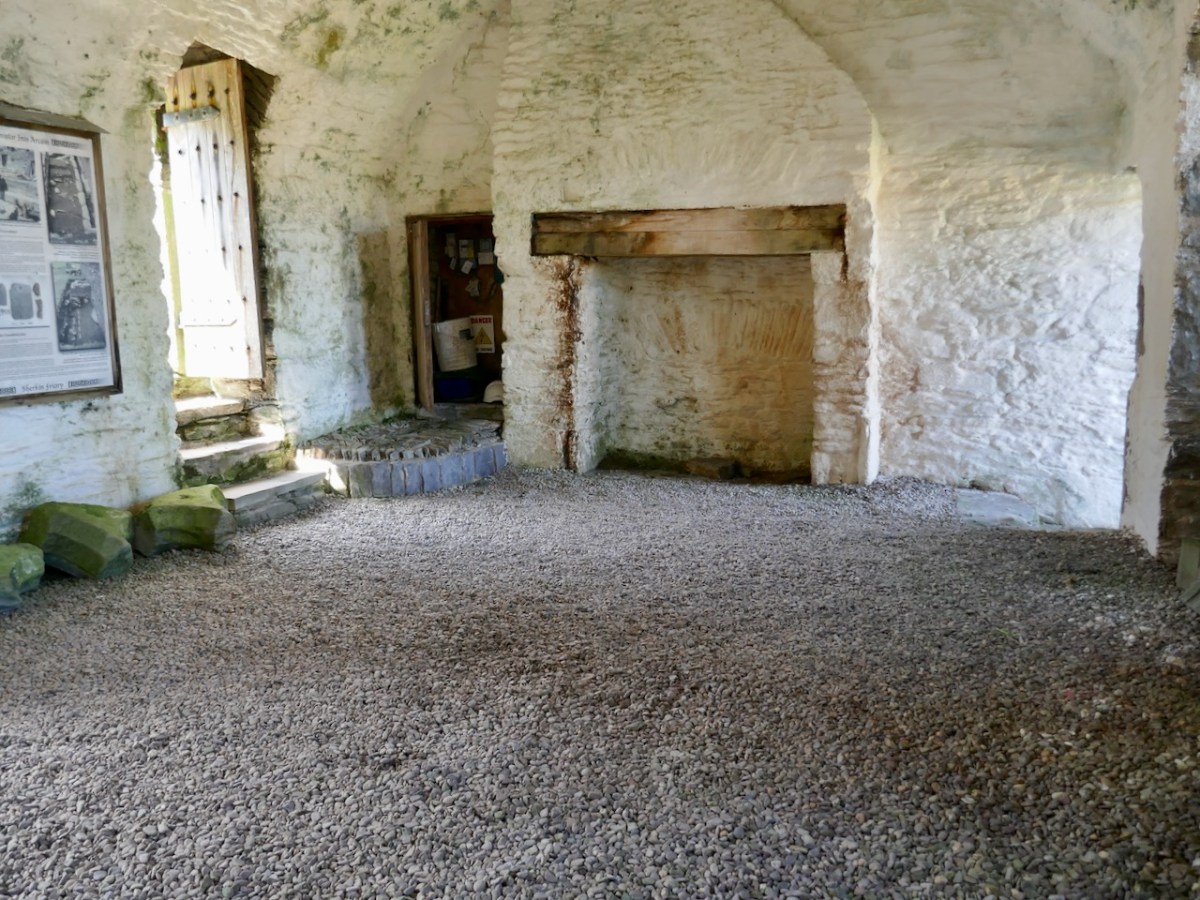
The Observant Movement aimed to restore the order’s focus on poverty, simplicity, and communal living as originally envisioned by Saint Francis. They did indeed seem to have lived a simple life – the only comfortable room in the place, and one use for communal living, was the chapter house, below.

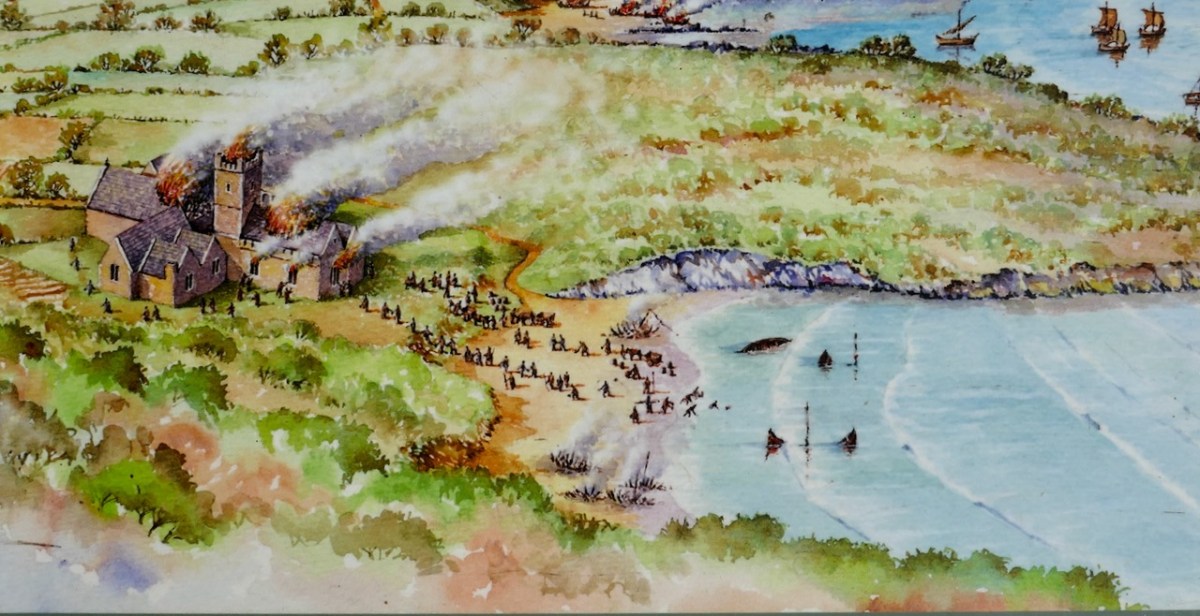
The siting of the Friary, close to Dun na Long Castle (see last week’s post) was not unusual in medieval Ireland, apparently. The castle was supposed to provide protection for the Friary, while the Friary afforded spiritual benefits to the castle inhabitants and the O’Driscoll chiefs. However, as we have seen last week, this didn’t go according to plan. The Waterford men sacked the castle in 1538 and plundered the Friary, setting it alight, and leaving it badly damaged.

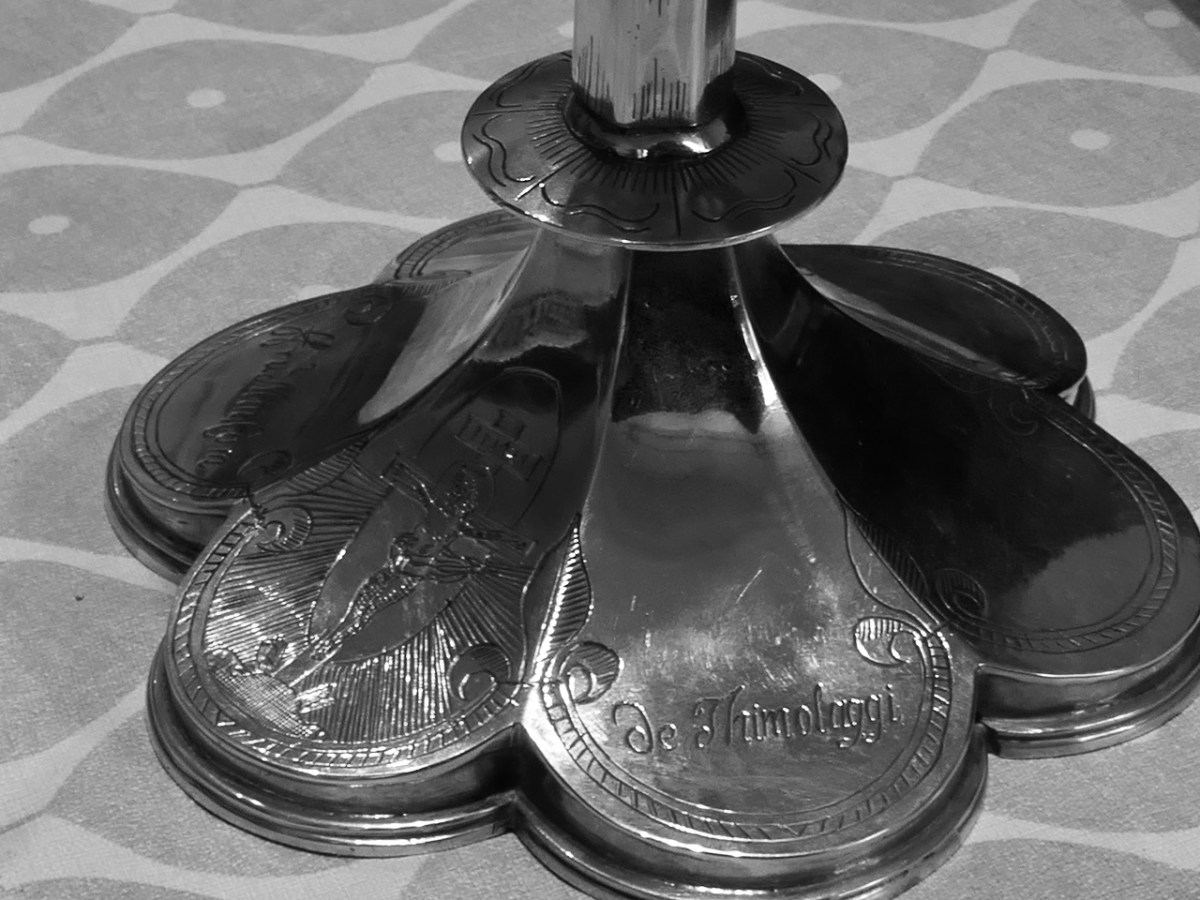
They also made away with the Friary bell, as well as some chalices and other valuables. Below is the base of the famous Timoleague Chalice, probably very similar to what was stolen. You can read the story of the Timoleague chalice here.

While the Friars fled for a while, they did return and lived at the friary until the last of them, Fr Patrick Hayes, died sometime after 1766. The Bechers took possession of it at that point and held on to it until they handed it over to the Commissioners of Public Works in 1892. It has been in the care of the State since then.

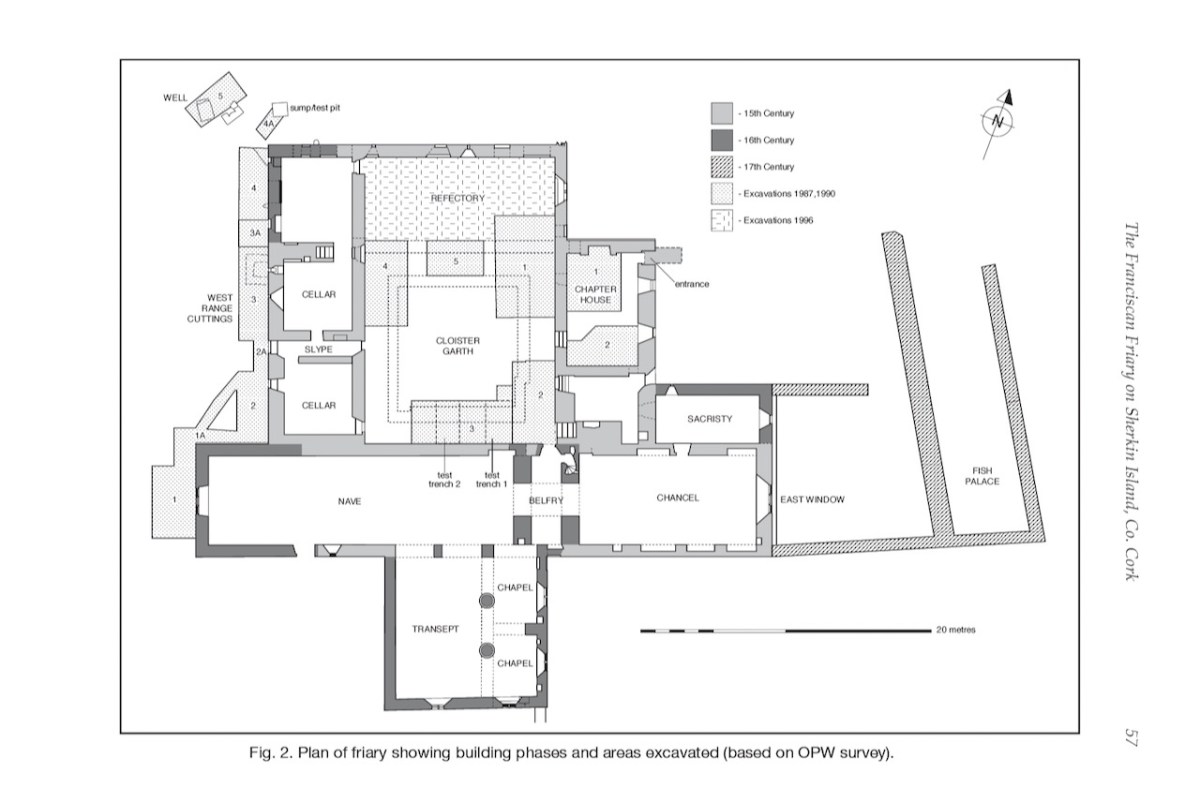
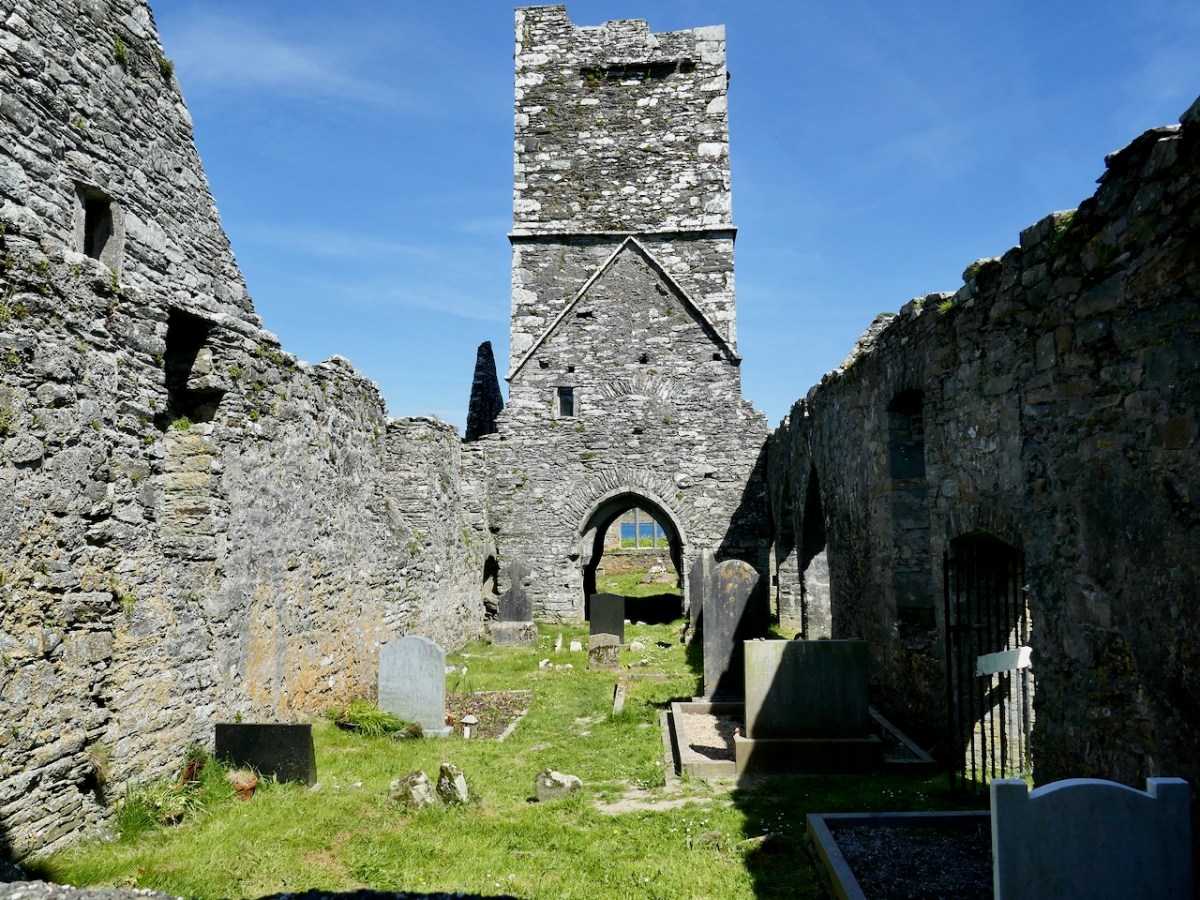
In form, the Friary is fairly typical of Franciscan houses in Ireland, with a long nave and chancel church, a bell tower, a cloister, side chapels, and a chapter house and refectory. 

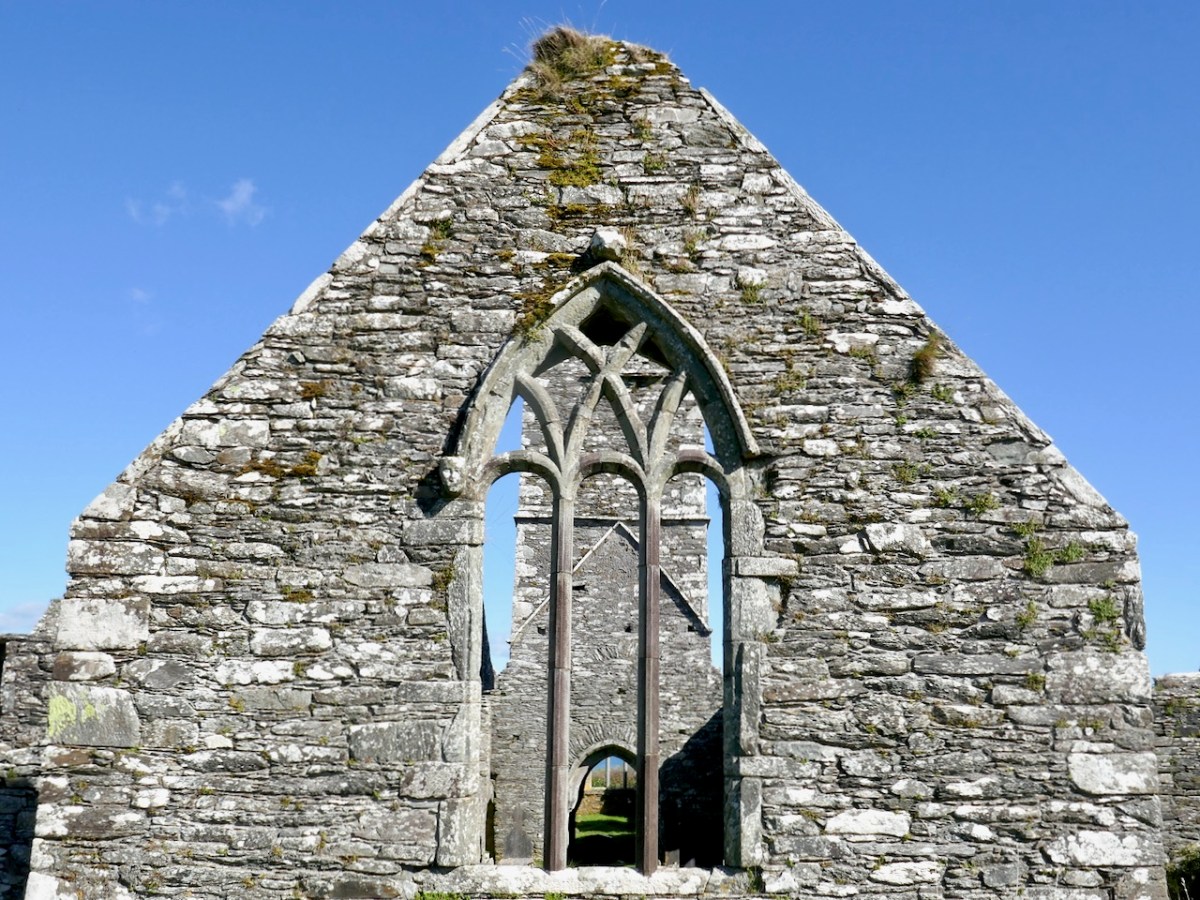
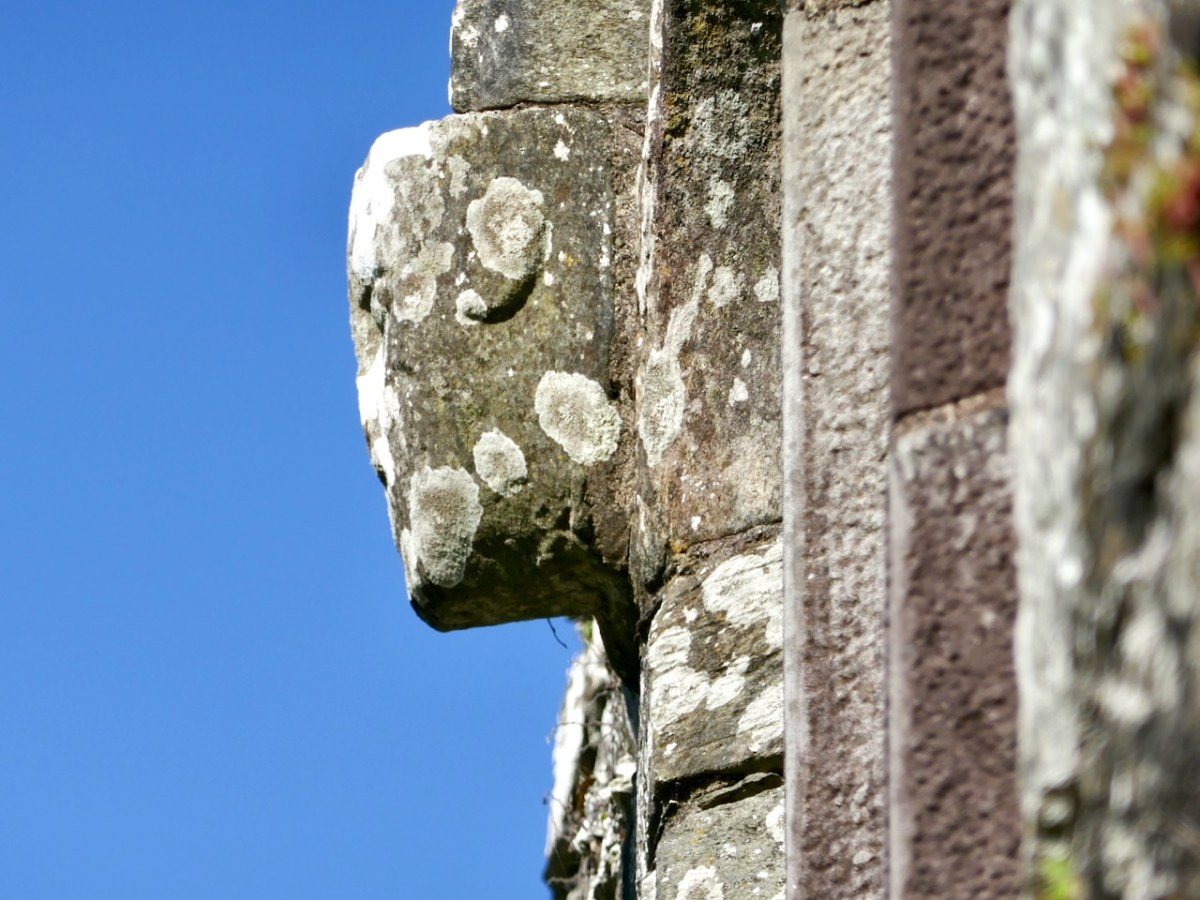
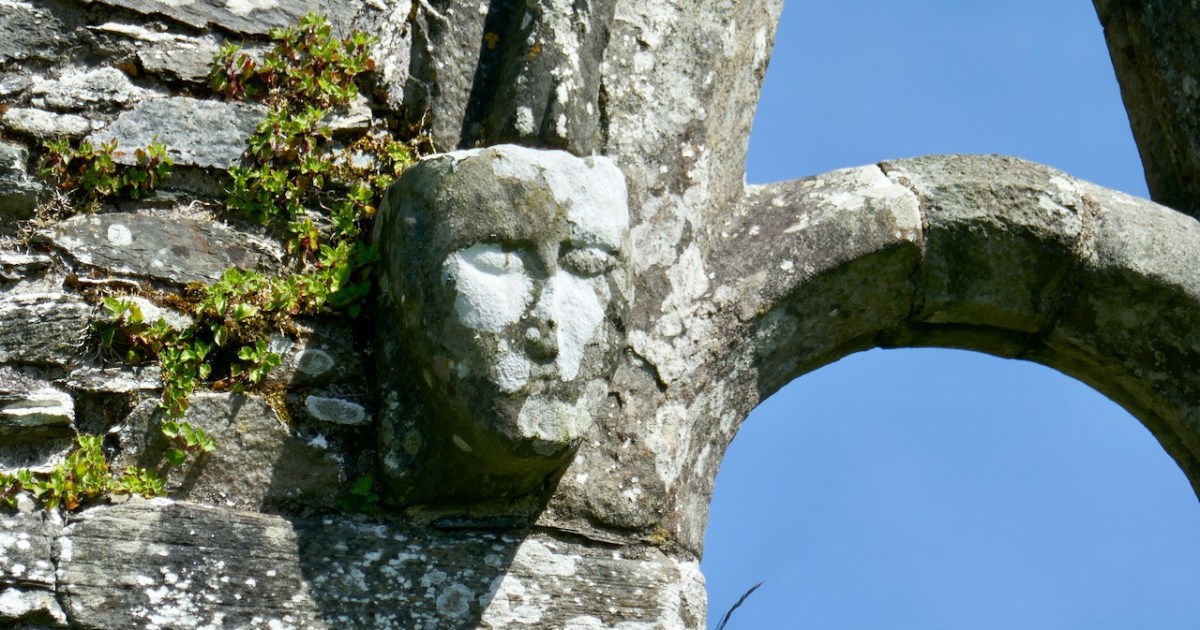
The nave and chancel run slightly north of east-west, due to the lie of the land. The West window has three lights and attractive tracery. We know that these would have contained stained glass, since fragments were found during the excavation, but we don’t know what they would have depicted. One of the charming features of this window are the heads – two still present although the one at the apex is too worn to make out, and a third indicated by a gap at the base of the hood moulding.

I am tempted to see a female saint in  the one head that is still fairly complete. After all, St Mona is the patron saint of Sherkin, so why would it not be her?

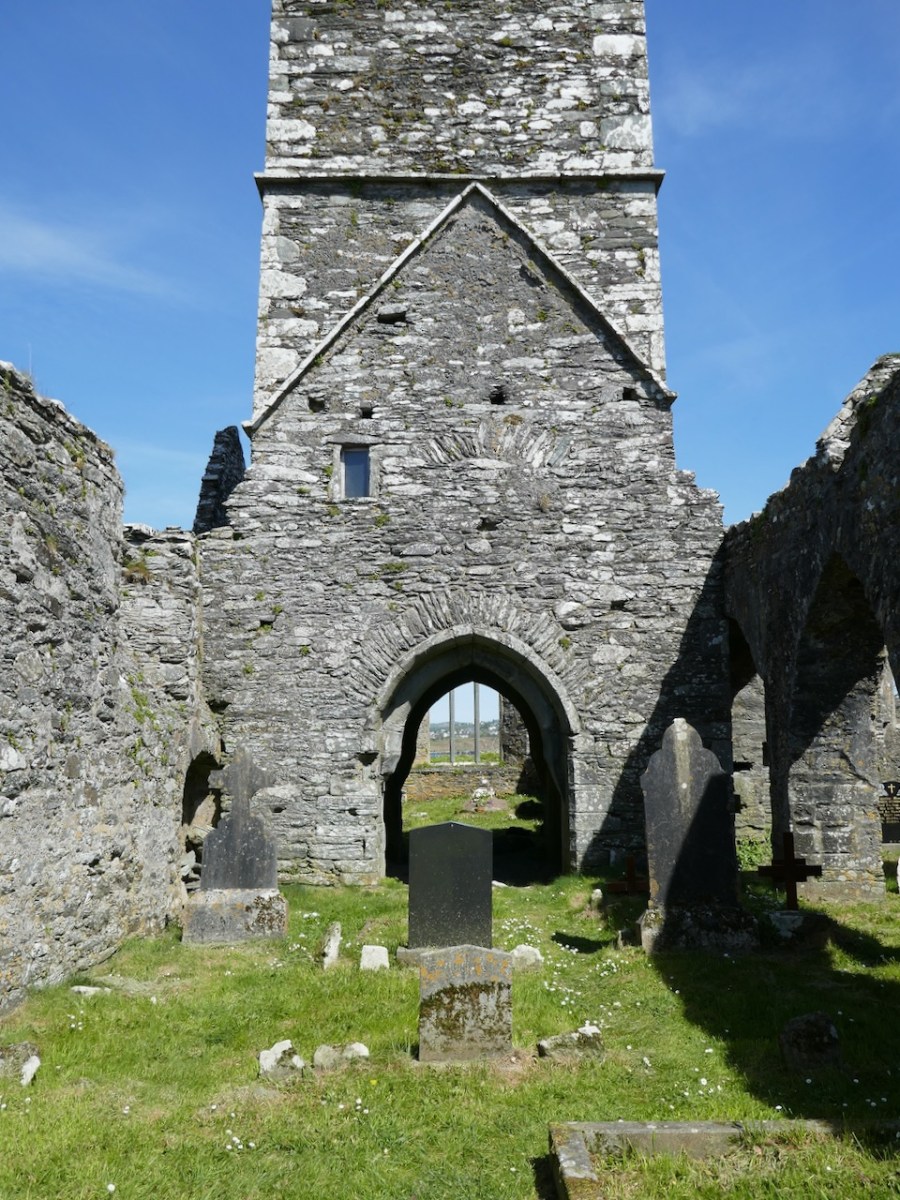
The tower or belfry, situated between the nave and the chancel, is a familiar feature of Franciscan Friaries – we see the same thing (although on a larger scale) in Timoleague.

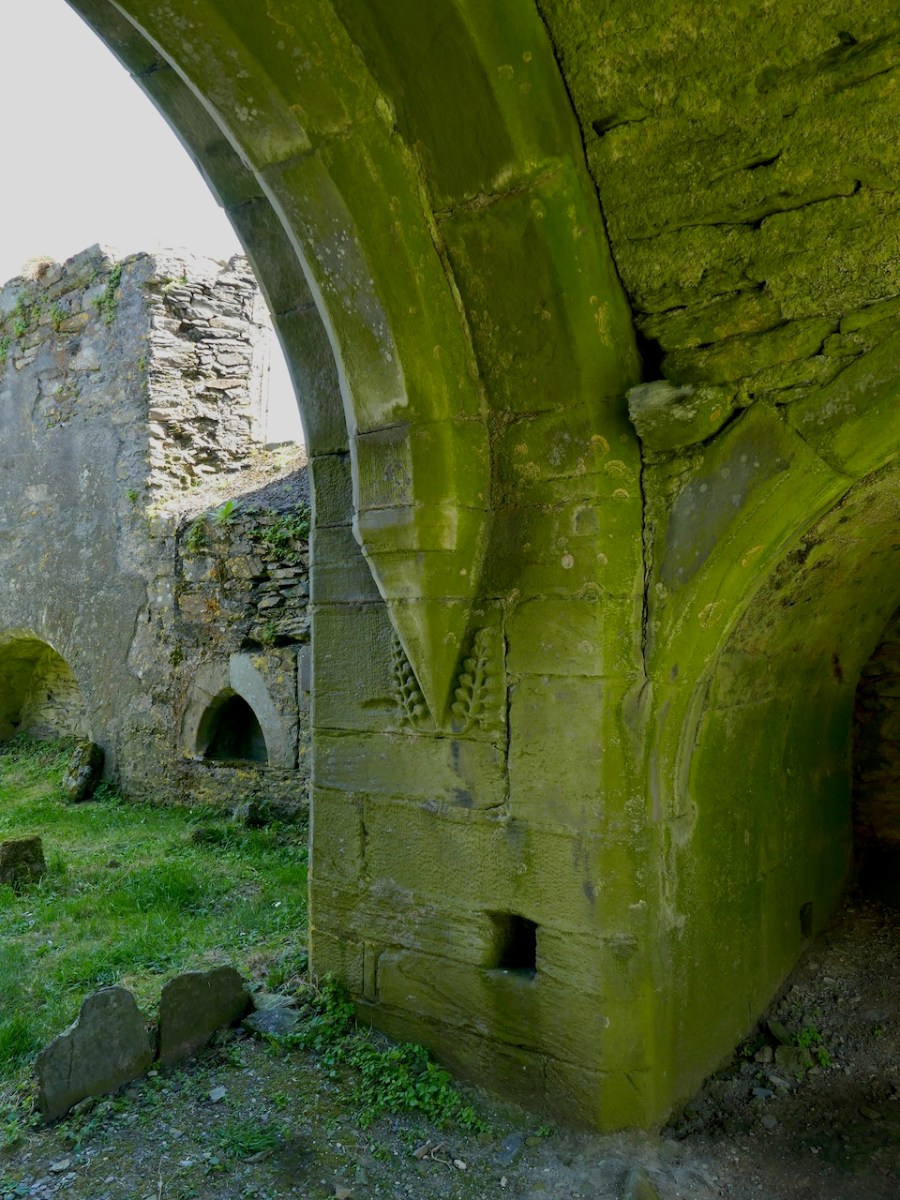
The base of this Sherkin tower has a little decorative carving – a very welcome note of frivolity in what is overall a plain building. Although, of course, we do not know how it was decorated: it may have had frescoes and painted walls and have been quite colourful, although generally the strictly observant friaries were not highly decorated.

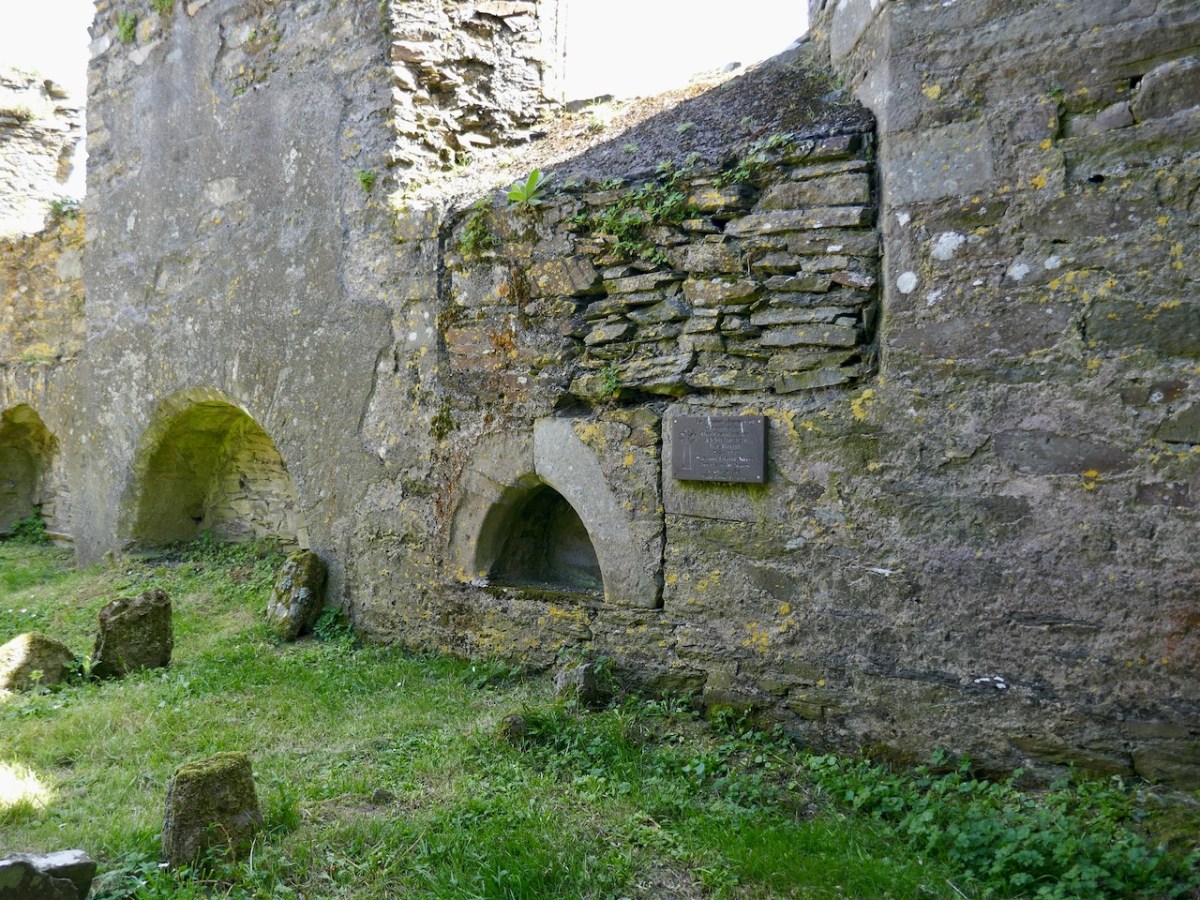
The chancel (the inner sanctum) also has an eastern three-light tracery window, identical to the one at the west end. There are various niches in the walls in the chancel, and I am wondering if one of them might be an Easter Sepulchre. I have just been learning about these in the latest Archaeology Ireland magazine, in a fascinating piece by Christiaan Corlett. You can read more about them here. In essence they were resting places, from Good Friday to Easter Sunday, of the crucifix, the Host and various other sacred elements, all of which would have been contained in a carved box, which was then deposited in the niche. This niche certainly fits the bill, except that it is on the south wall, rather than the more normal north wall.

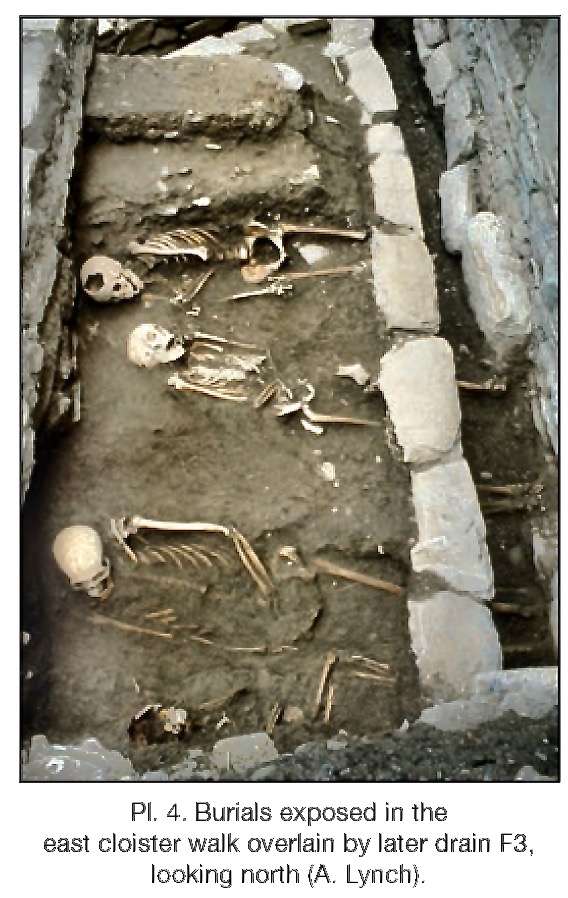
The cloister was filled with rubble when Ann Lynch started her excavations. Nothing of it was to be seen, but as you can see the excavation revealed a small but perfectly formed feature.

And it seems that this is where the monks were buried! As the friars were pacing the cloister walk, intoning their office, they were walking on ground above the bones of their brethren who had died before them. Twenty four of them were found, aligned with their heads to the west and their feet to the east. There were no grave goods: they were buried as simply as they had lived.

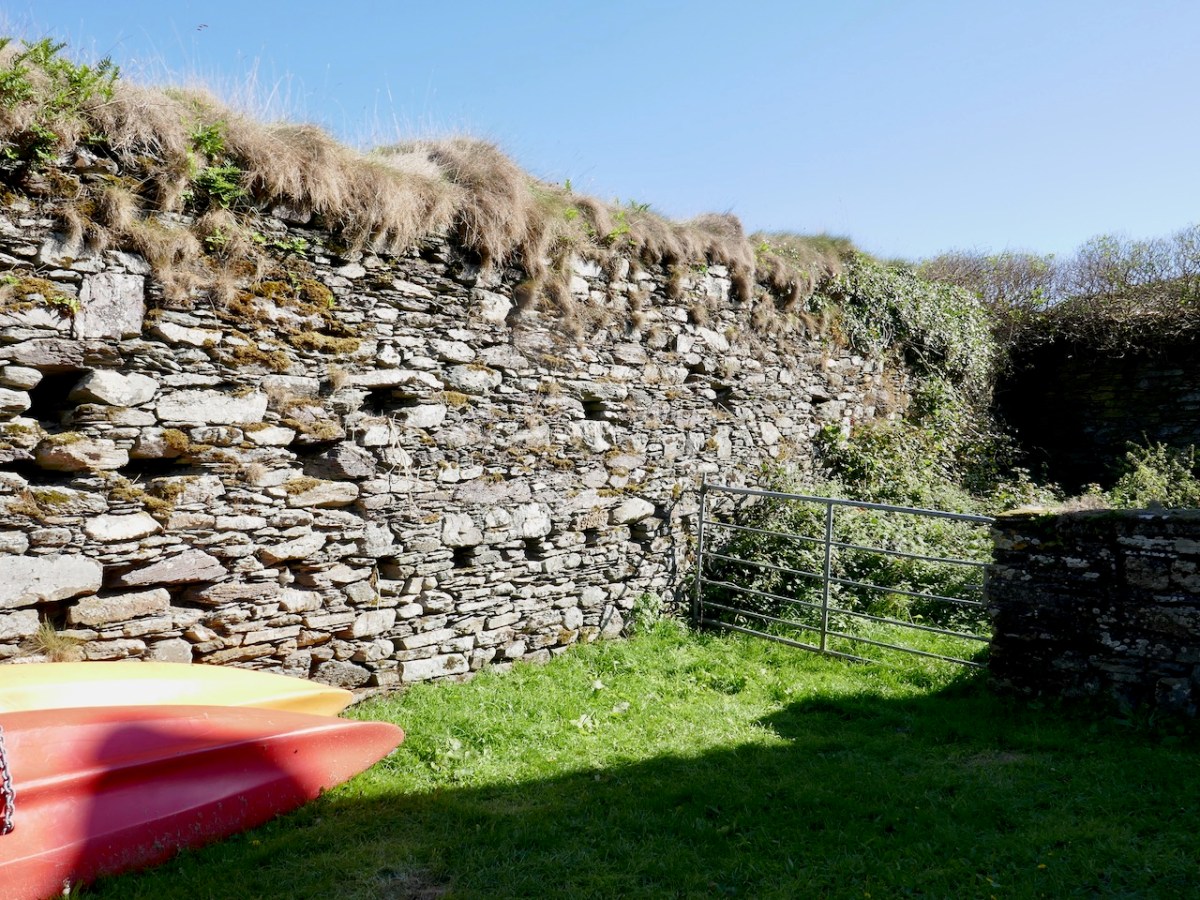
Later, in the 17th and eighteenth centuries, the west end of the friary was used as a fish palace – a place for curing fish and packing them into barrels. The holes in the walls in the image below would have held press-beams. See Robert’s post Fish Palaces and How They Worked, for more on this. Somehow that seems like an ignominious end for a place built as a focus of worship. 

Today, the first thing you see as you step off the ferry is the friary, peaceful and beautiful in its island setting. It has seen its fair share of turbulence, of industry and of neglect. Now it reminds us that life goes on despite all that, but it never stays the same.

The Black Eagle of the North (Saints and Soupers 9)

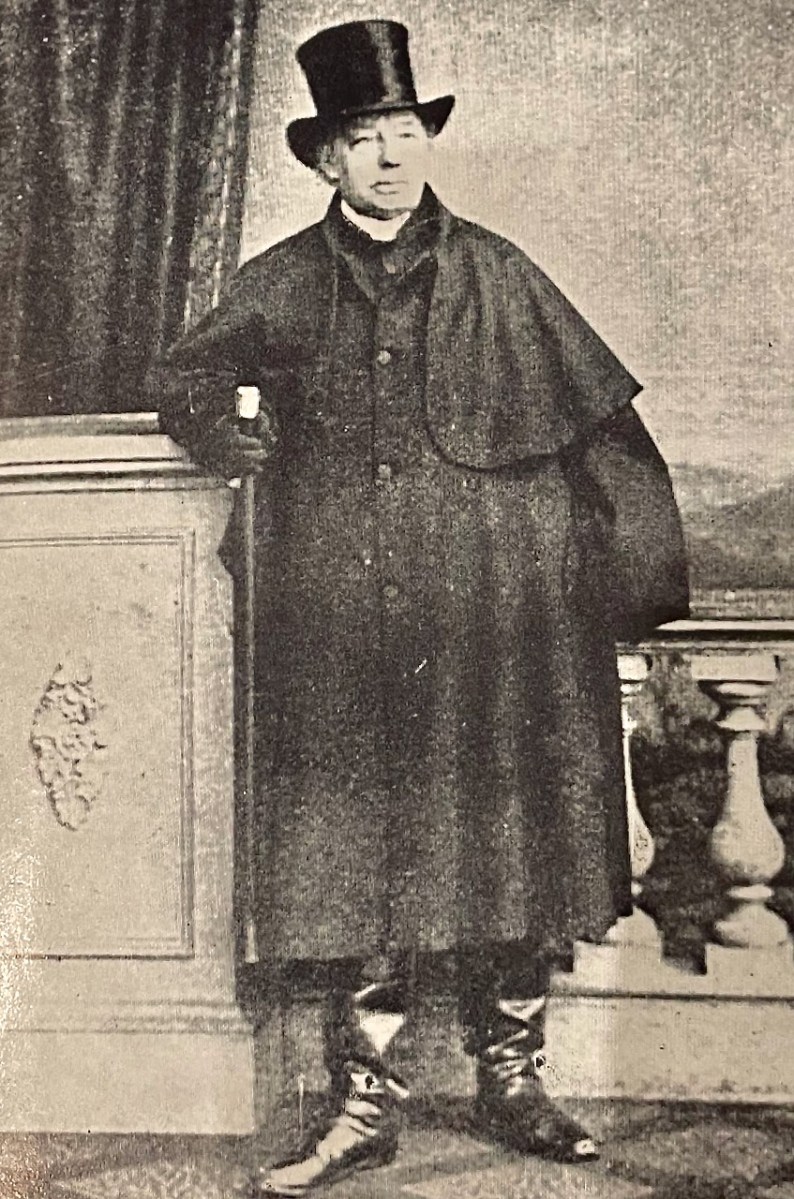
If you’ve read my series Saints and Soupers, you might remember the character who appears in Part 6, Father John James Murphy – The Black Eagle of the North. That’s him, below. It’s always been my intention to revisit him at some point, specifically to try to investigate that amazing nickname. It’s only taken me 6 years. 

First of all, let me tell you why now, and then the deeply personal reason why I want to write more about Fr Murphy. Why now? I have just been loaned a copy of Father John Murphy: Famine Priest by AJ Reilly, published in 1963 by Clonmore and Reynolds – my sincere thanks to Jennifer Pyburn of Schull for the loan, and Dan Allen of Goleen for conveying it to me. An aside – the Clonmore in the publisher’s title is from Lord Clonmore, later 8th Earl of Wicklow, who together with his partner Reynolds (about whom I can discover nothing) founded the only serious Catholic publishing company in Ireland in the first part of the 20th century. Apparently, when Clonmore was a boy, he used to attend the servants’ mass on Sunday morning and later converted to Catholicism, which horrified his Church of Ireland Anglo-Irish family. His father disinherited him, but he nevertheless succeed to the title in 1946. His father, by the way, was the Earl of Wicklow I wrote about in my post Ecce Homo: Harry Clarke’s Kilbride Window

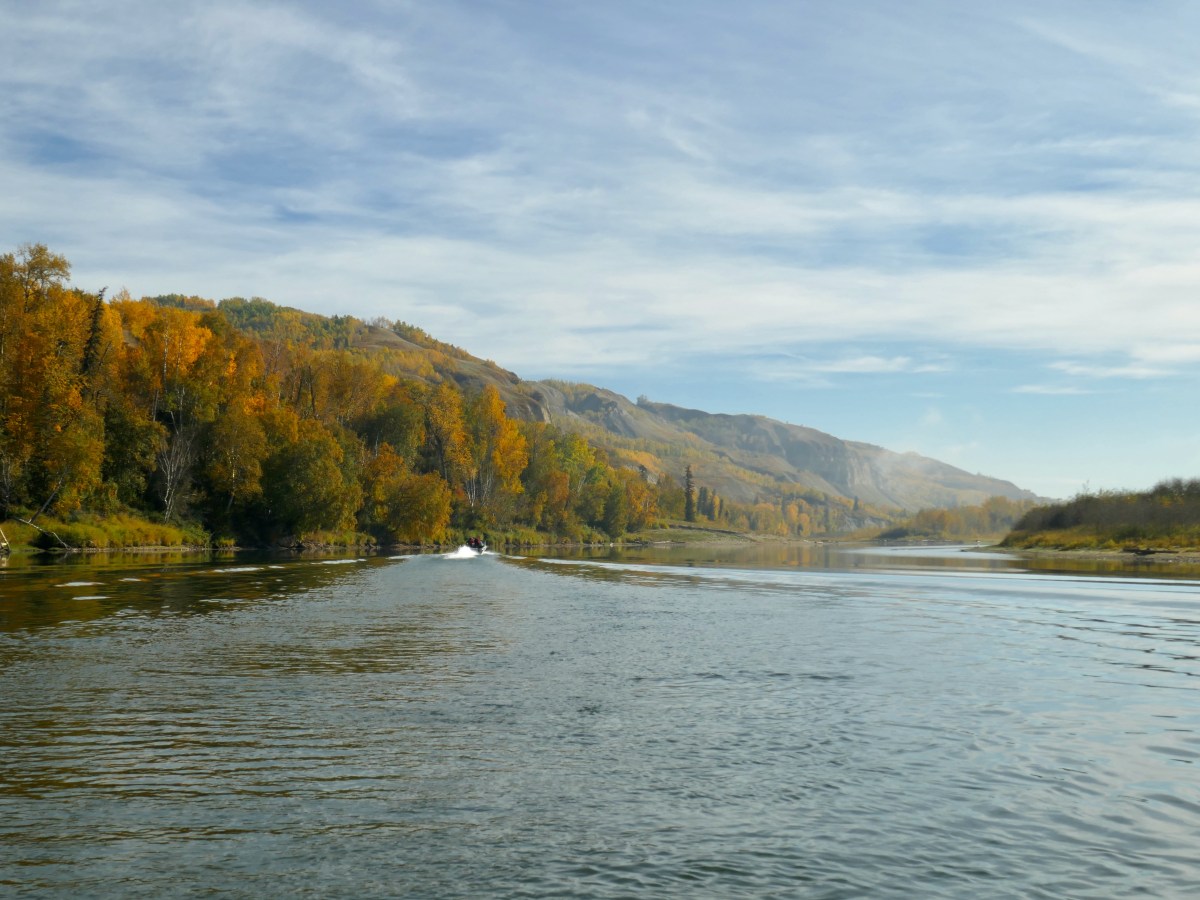
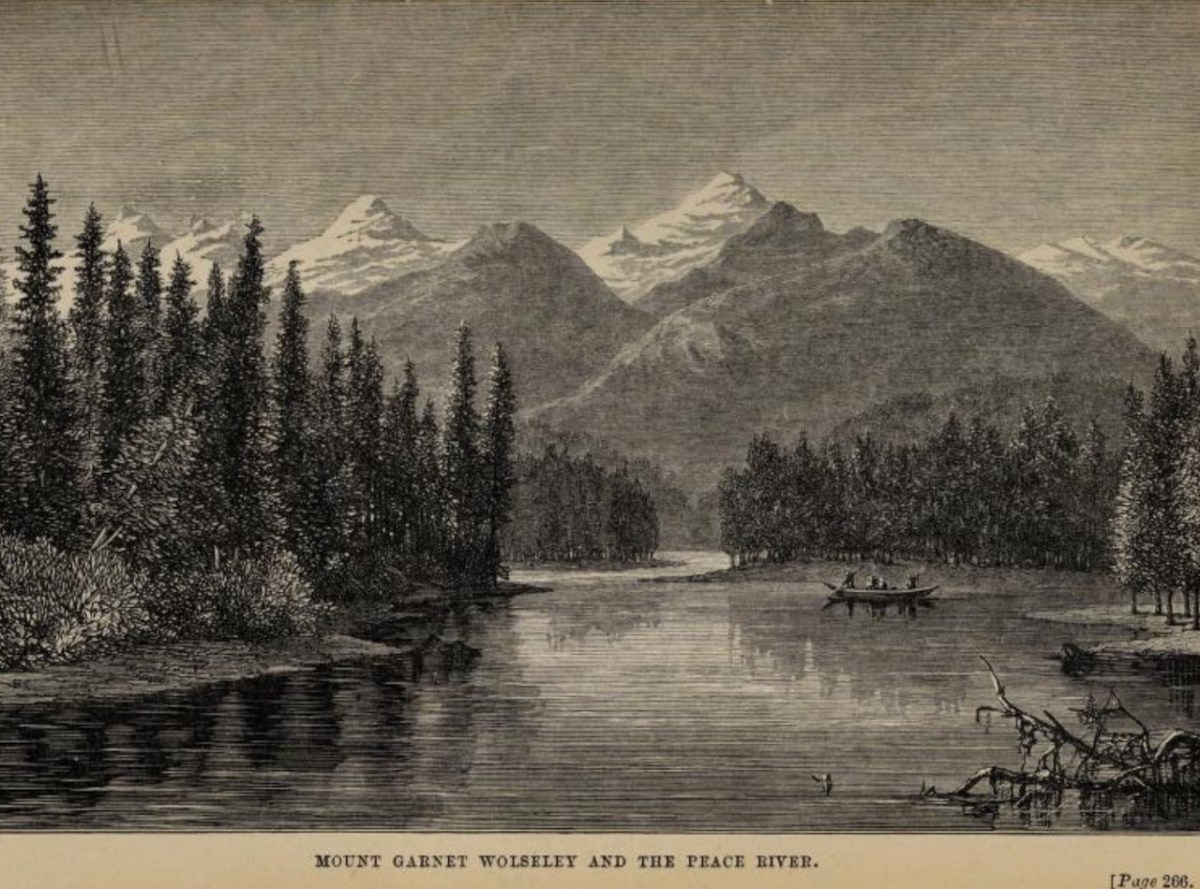
And the personal reason? Reading about Fr Murphy transported me back to my own fur trade days! From 1974 to 1978 I was enrolled in a doctoral program in Archaeology at Simon Fraser University in Vancouver. My research and projects were centred on the excavation of fur trade forts along the Peace River (above), in northern British Columbia, built and occupied between 1793 and 1823, when they were shut down as a result of a massacre. For several summers I camped on the fort sites and dug what was left after 150 years of abandonment. I also spent time in the Hudson’s Bay Co Archives in Winnipeg, piecing together from the original manuscript journals what had happened in those forts. So when I read about Fr Murphy and his time in the Hudson Bay company, some of it is so familiar. Some of it, of course, is pure speculation – something that is readily admitted by Reilly.

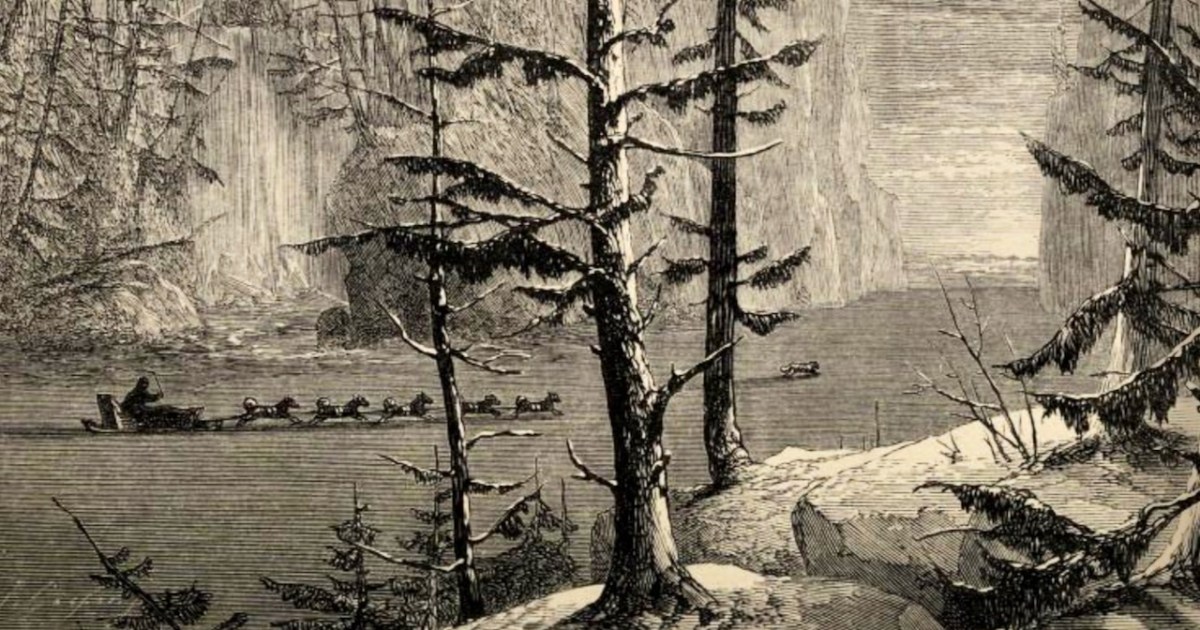
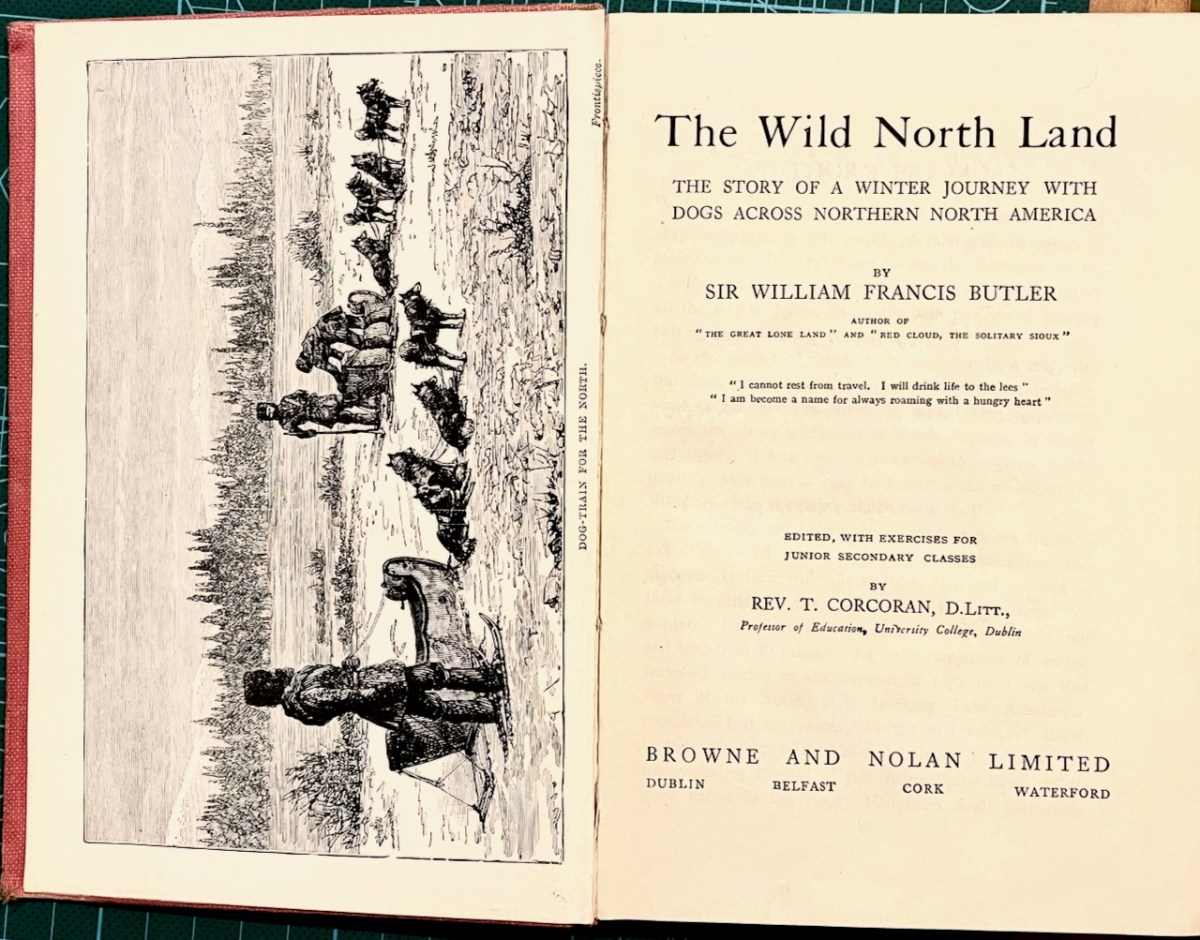
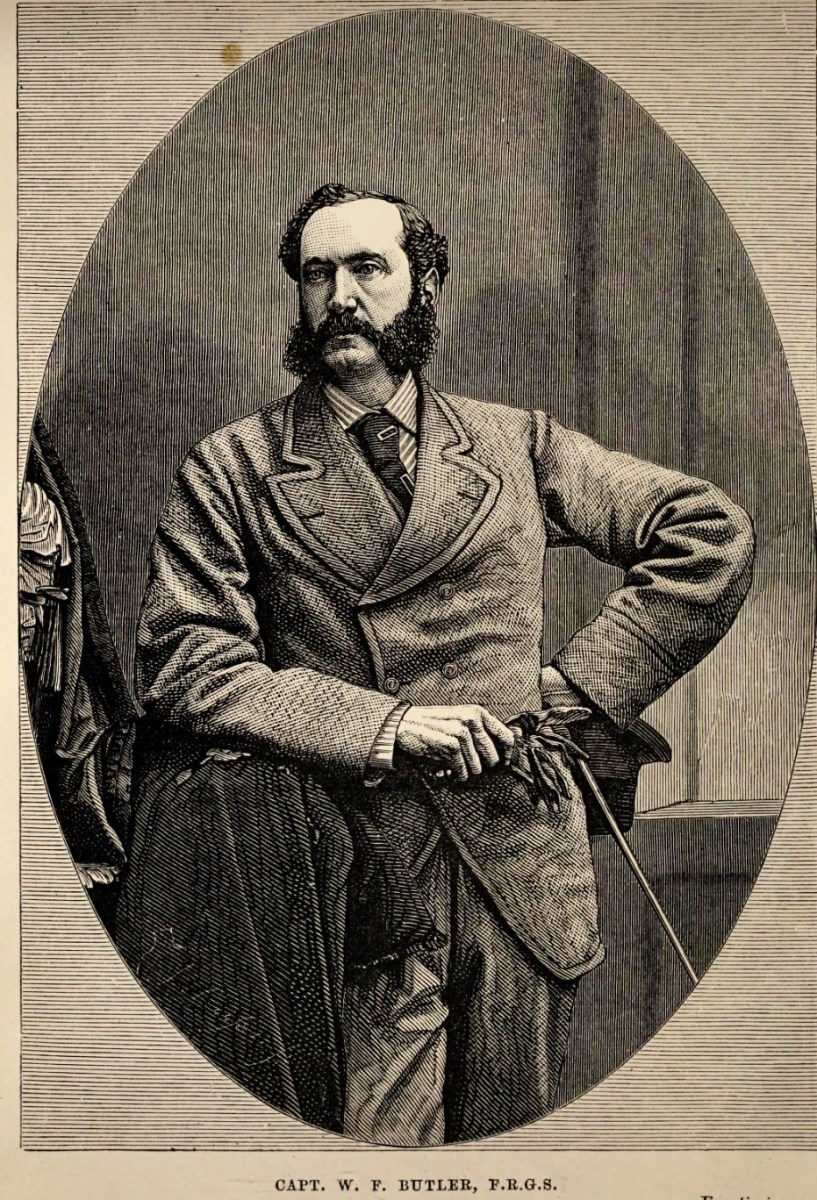
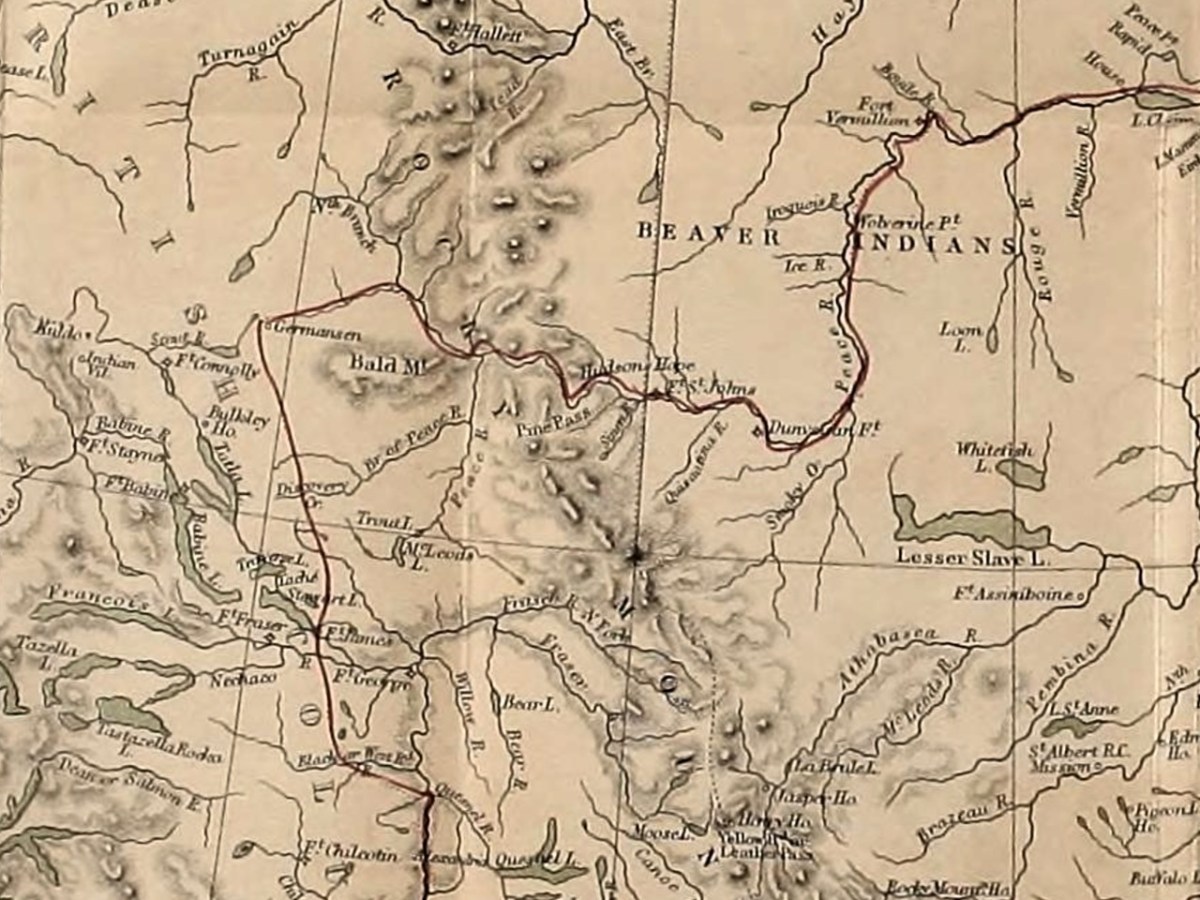
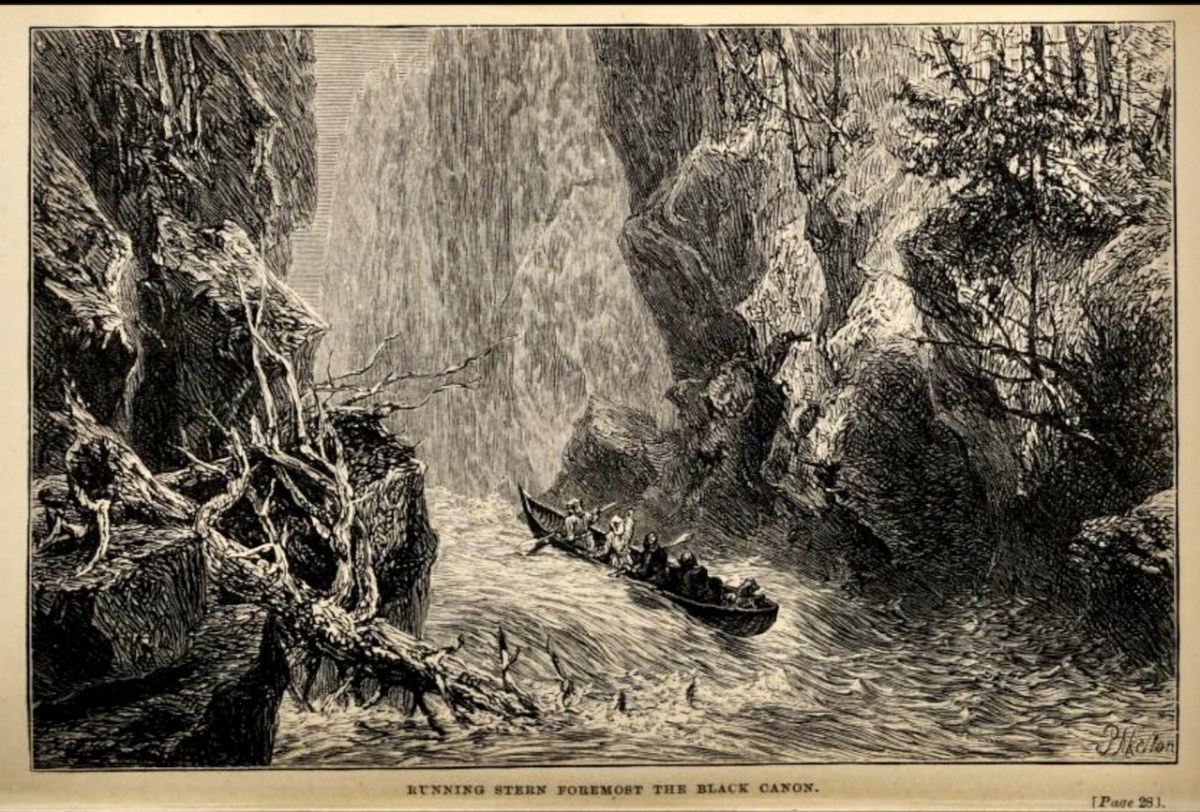
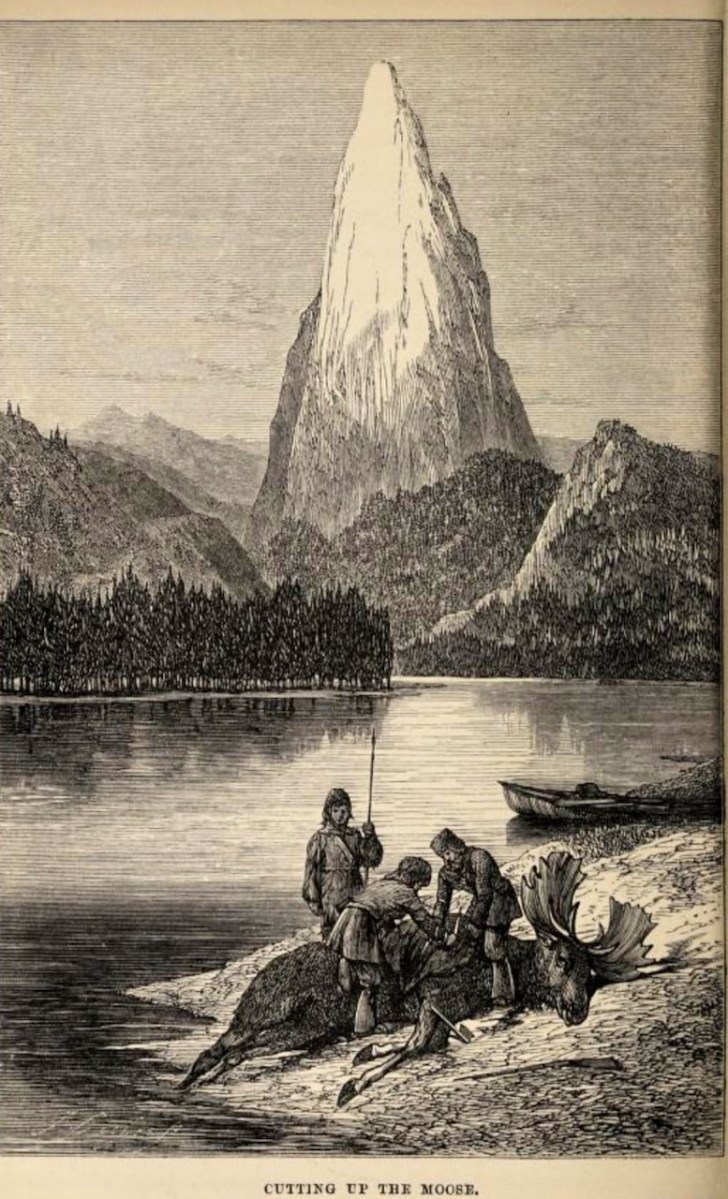
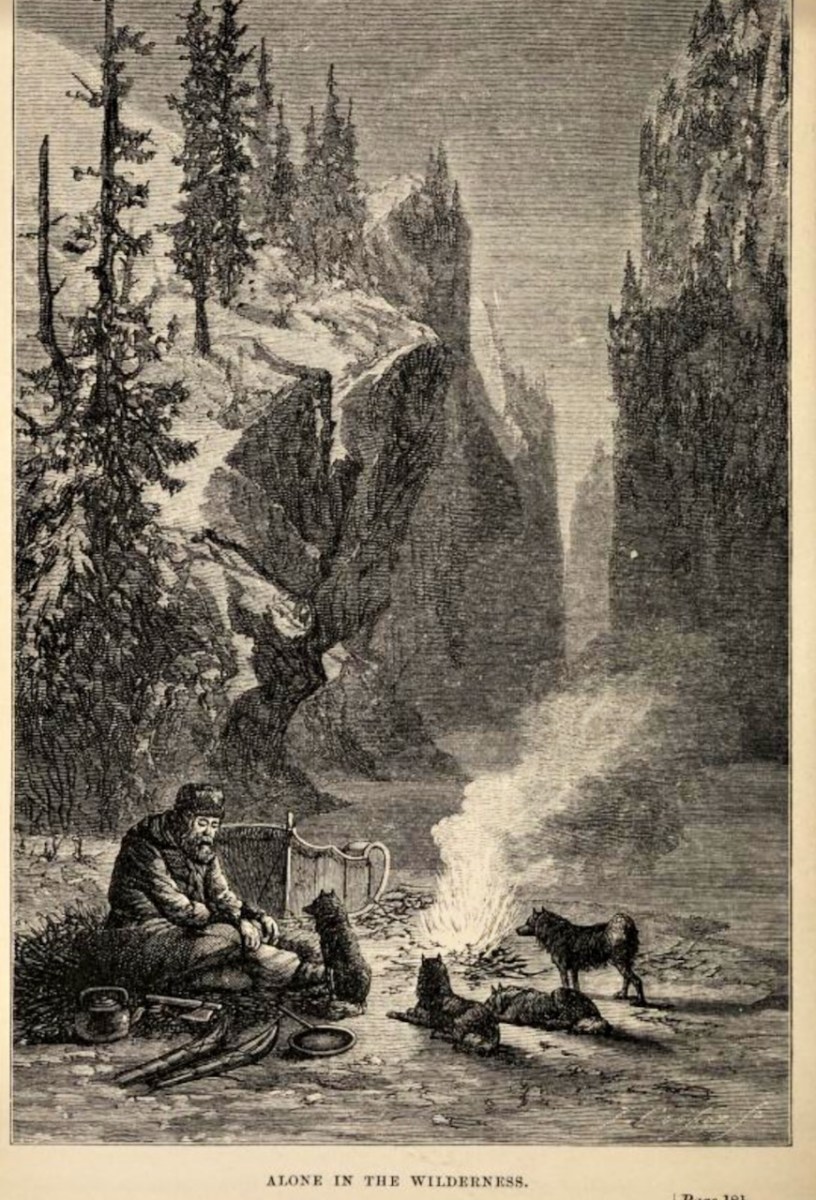
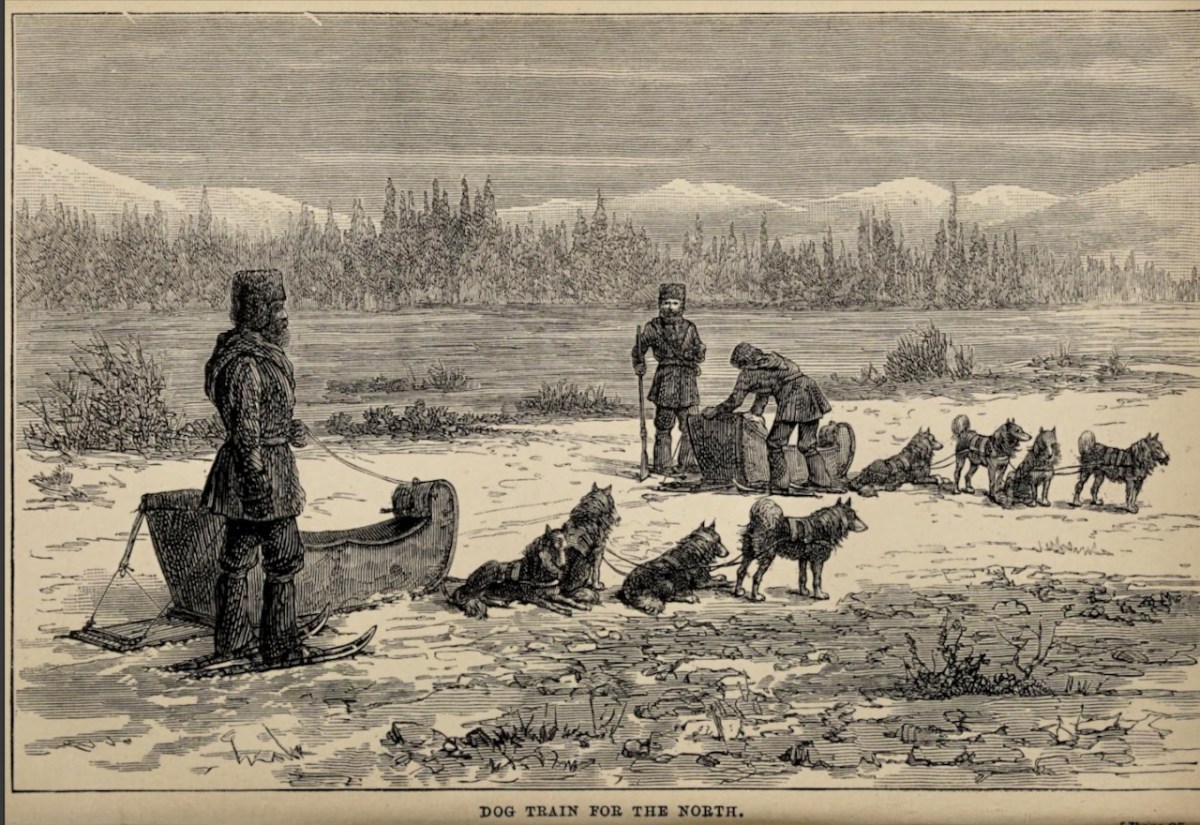
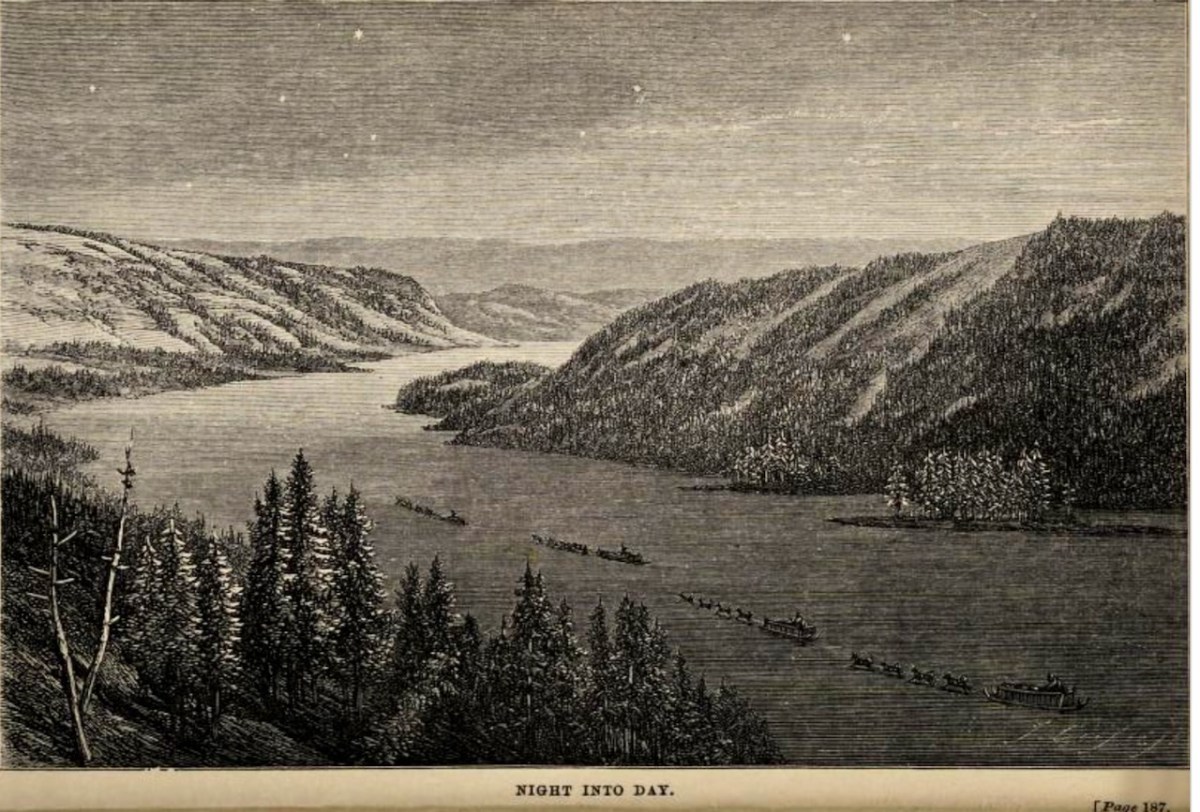
One of our resources for what life was like in early British Columbia was a book, The Wild North Land, by an Irish man – William Francis Butler (below). That’s my copy, above, but it is available on good old archive.org. What a man – adventurer, soldier, writer – he became one of my heroes. He undertook a journey across the wilds of Canada, in the footsteps of the fur traders, in the 1870s, living as they would have lived. So I am illustrating this post with pictures from that book. HIs map is part of his epic journey – the part that contains the Peace River. Try to find Fort St John on it – that’s where I was digging.

Reilly has done a masterful job of piecing together what can be gleaned from sparse documentation. He has tried to be as accurate as possible, but his pen runs away with admiration for his subject and with his enthusiasm for his deeds. What is clear is that Murphy joined the Hudson’s Bay Company as a clerk in 1816.

He was a tall young man with naval experience in the East India Company already, and his physique, courage and talent shone through in his various assignments. Here’s a mention in a dispatch:

I send you a young clerk by the name of Murphy who has been engaged for the service by Auldjo of Montréal. He is totally without experience in the fur trade, but I think you will find him active, zealous and intrepid. He is rather inclined to be wild and will be the better of being under strict discipline. But I have observed many marks of good principles and I am confident he is disposed to act right if the line of his duty is distinctly pointed out to him.

and another`;

A very steady, spirited and enterprising young man; who bears privations and hardships with cheerfulness and has conducted himself in every undertaking he had to perform with credit and satisfaction.

From a different source, by B G Mac Carthy, comes what is likely an accurate description:

To hold one’s own under such grim conditions one needed to have great courage and tremendous physical endurance. Murphy was now a man of well over six feet in height, of mighty frame and muscle. His strength, daring, honesty and unusual intelligence made him an invaluable servant of the Company. From the beginning he had to prove his mettle, since he seems always to have been chosen for the most hazardous tasks. Immediately on his first arrival at New Brunswick House he was sent to capture two men of the North West Trading Company who were wanted for robbery. It was then late autumn. None but an experienced woodsman, hunter and fighter could hope to survive in that wild and frozen land. 

Several tales are told of his popularity with the Indians*, and through their liking for him many new faces were seen coming to trade at New Brunswick House, the post he was put in charge of. There is also a six year hiatus in the records in which it is unclear where he was and what he was doing, but he may have been living in Canada and pursuing life as an independent trader. It is during this period he is thought to have been adopted by a Indian community and given the name Black Eagle of the North.

This account is from his nephew, Colonel Hickie.

Soon he became restless; and one day, with a party of trappers, he left the settlement and struck into the heart of the forest. While on the March he encountered a tribe of Indians, with whom he threw in his lot and wondered through the wilds of Canada for 12 years. Crowned with feathers, dressed in skins, and with a painted face, the Indians loved him. He was elected their chief and was known as the black eagle of the North.

The whole idea of becoming a Blood Brother and living as a chief among the Indian community is very Boys Own – the stuff of many a romantic wild west melodrama. However true all this was, the soubriquet followed him when he left Canada and eventually, via Rome, ordination, Liverpool and Cork, arrived in Goleen at the height of the Famine, riding his black ‘charger’ and tasked with winning back the souls of the Soupers of Toormore. It is mentioned in his obituaries, so it was obviously part of his mystique and reputation for the rest of his life.

He didn’t stay long in Goleen, possibly less than a year and the rest of his days were spent in Cork, where he built the magnificent Church of Peter and Paul in Paul Street. He died an archdeacon, with a reputation for charity and kindness to the poor and a saintly disregard for his own comfort.

His life has inspired Reilly’s book, but also two essays, both of which seem equally full of fanciful accounts, some of which are based on reminiscences from family members. The lengthy quote in Part 6 of Saints and Soupers that starts The scene changes to a clearing in the virgin forests of Canada is from White Horsemen by M P Linehan, and the quote from Col Hickie is from this piece.

*I use the term here as it is used in the original documents, but the accepted term now for indigenous Canadians is First Nations people

Here is the page with links to the complete Saints and Soupers series.

Sit Stand Smoke – and Remember Kathleen

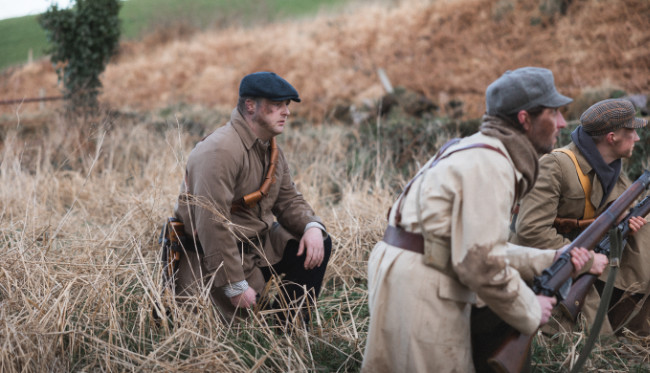
This week I experienced, in Virtual Reality, what is was to belong to a Flying Column during the Irish War of Independence. With the men, I crawled through a West Cork field, gun at the ready, alert for any sign of the British army or the Black and Tans.

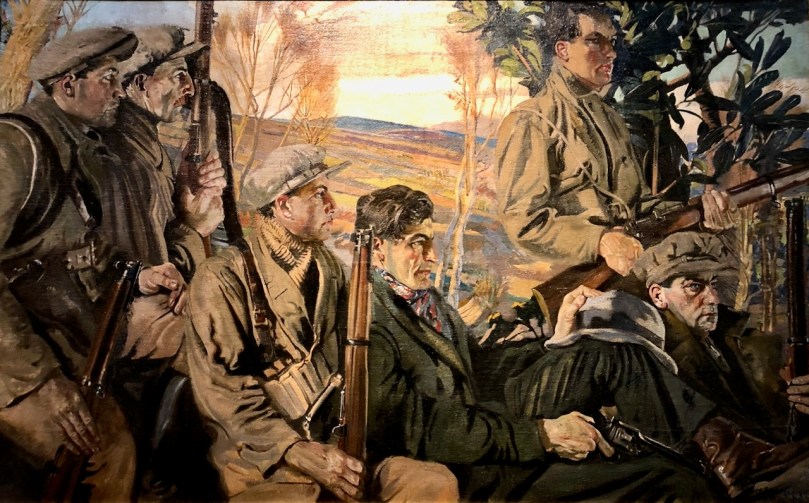
Or, at least, that’s what it felt like, and I must admit to a slight pounding of the heart as we were crouched behind that stone wall. In reality, I was on a swivel chair in the old Uillinn coffee shop, now repurposed as a VR theatre, wearing a VR headset. The Sean Keating painting that this experience is based on is the iconic Men of the South and you can read all about it here

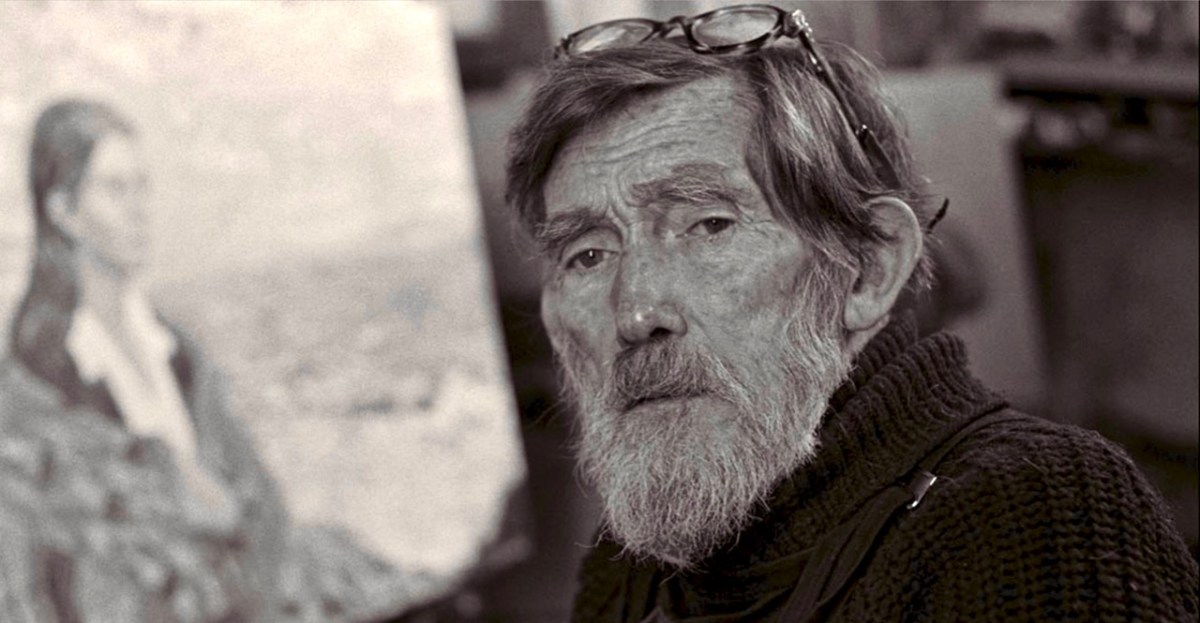
Keating’s grandson, David Keating, and his creative partner Linda Curtin, have produced the VR experience, shooting it in West Cork in “360 stereoscopic + volumetric capture” with the help of many local people and the new West Cork Film Studio. Dr Éimear O’Connor provided the expert consultations on Sean Keating (below) and features, amusingly, as an exasperated director of the action. If you get a chance to see this anywhere, grab it! You can also read more about Sean Keating in this post by Robert from 2020.

And this War of Independence action leads nicely into Kathleen O’Connell. You will remember her as one of the heroines of Karen Minihan’s book More Extraordinary Ordinary Women. Take a quick trip back to this post and read all about her and her daring and courageous deeds.  I concluded this section by saying

Kathleen was ruined financially by all her support for the cause. Letters of support for her pension application were fulsome in praise of her work and her commitment. She was awarded a grade E pension in 1939. She died, here in 1945, aged 50. She had not married and had no children, and all memory of her gradually disappeared from Ballydehob. When Karen went looking for the house she had lived in, it seemed nobody could remember the heroic Kathleen O’Connell who had once lived here.

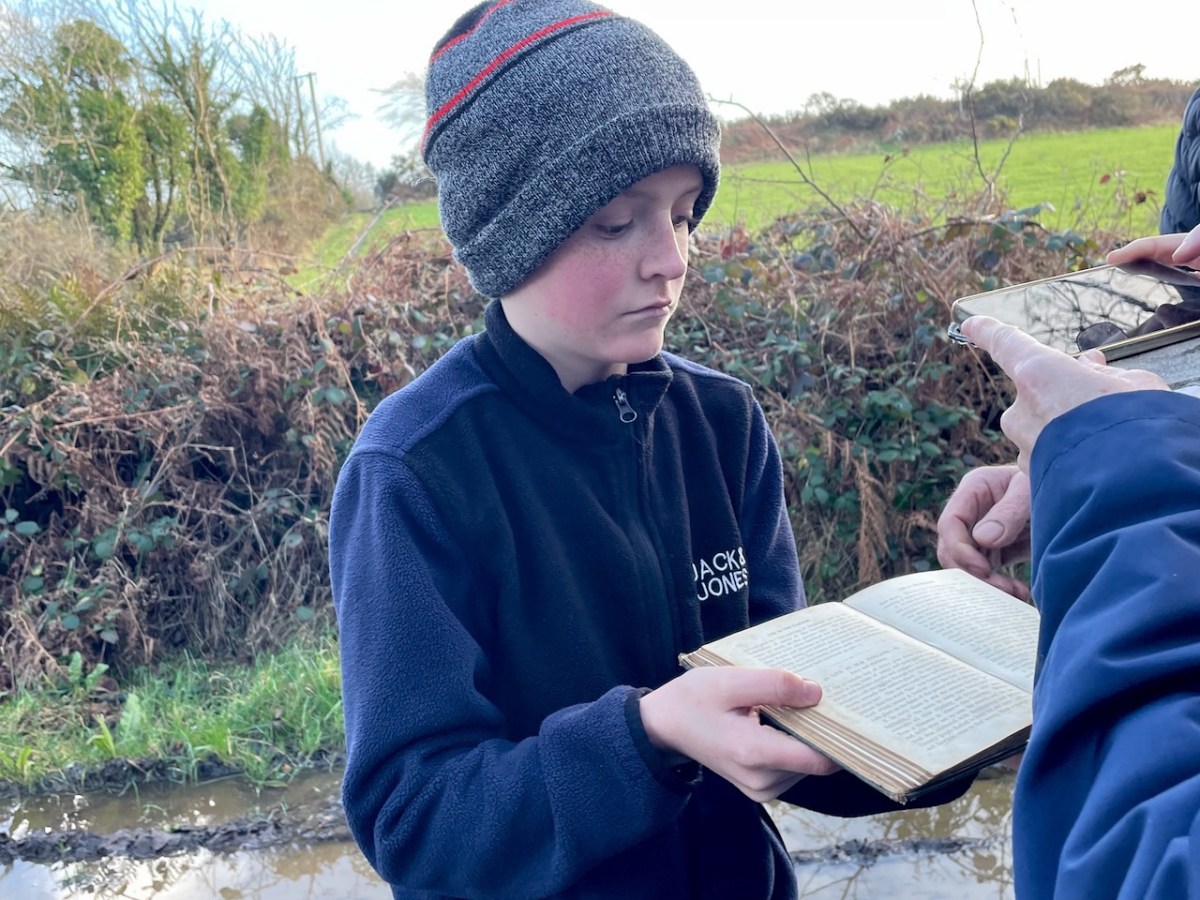
How wrong we were! Memory of Kathleen was far from dead. A relative of hers recently contacted Karen and on Friday afternoon we spent several hours with him and his charming grandson, rediscovering Kathleen from a man in whose family her memory was still fully alive. (He didn’t want his photo in the blog post, although Neven, the grandson, was happy to be in it.)

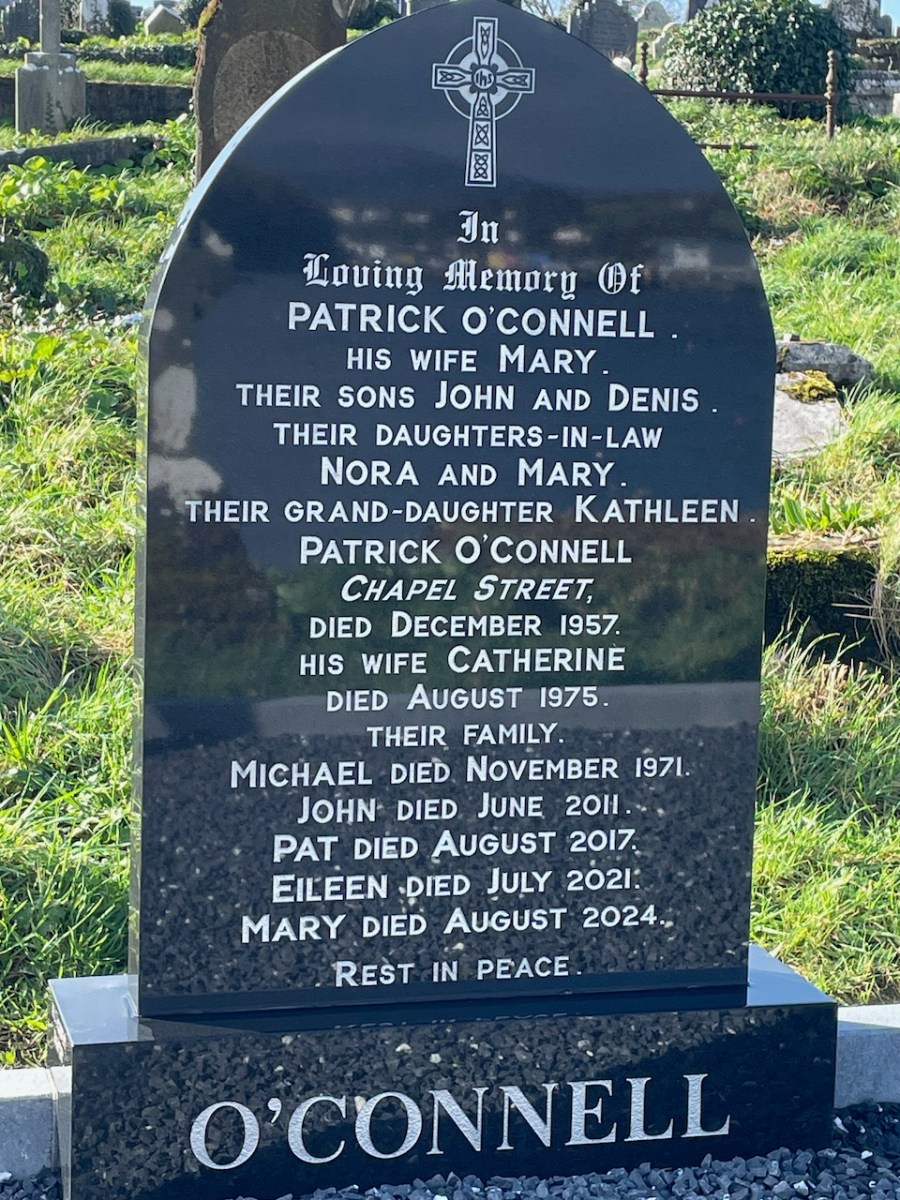
The first thing he showed us was her grave, at the historic Abbey Graveyard in Bantry. It contained many family members, including Kathleen. Our guide had knowledge of everyone in the grave and how they were related, and told us that there were probably more people in the plot than commemorated on the headstone. The grave looks out over the sea at Bantry.

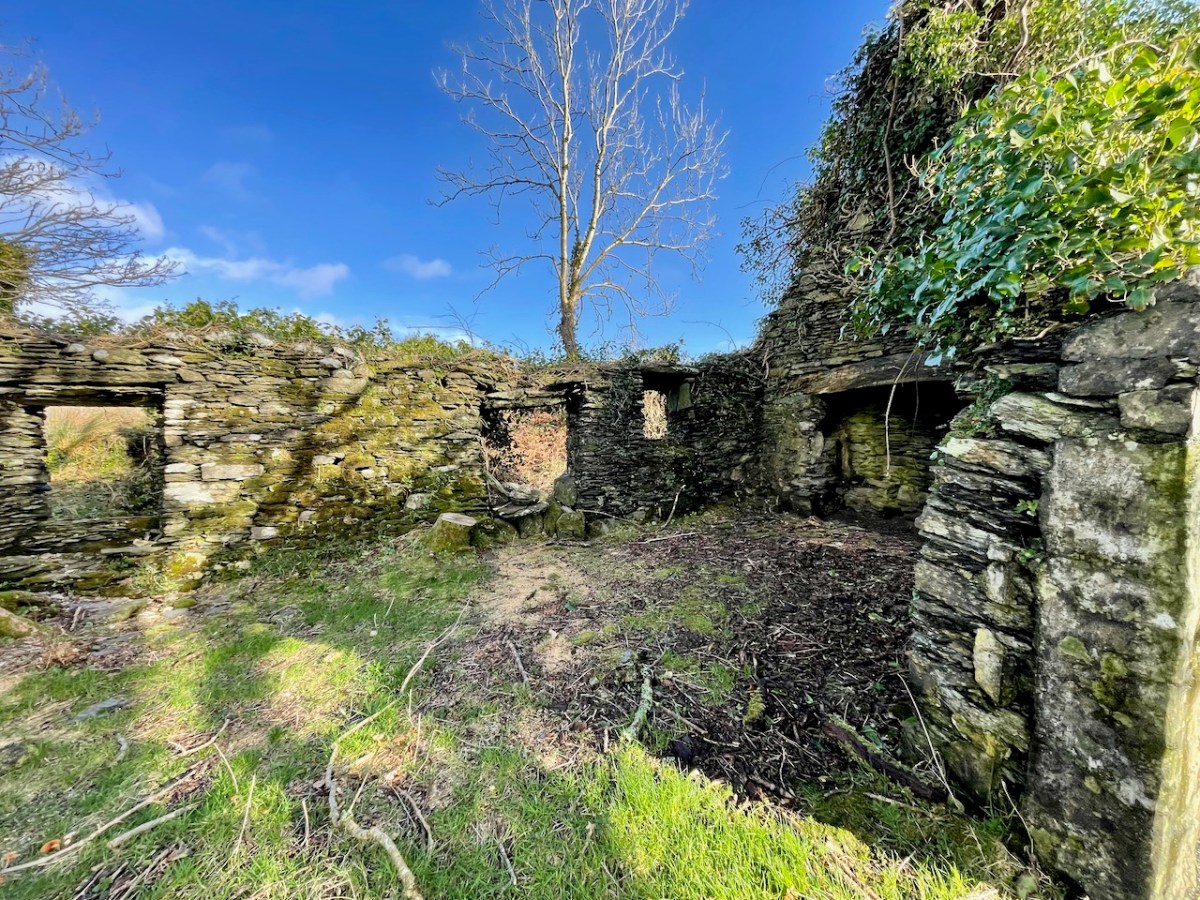
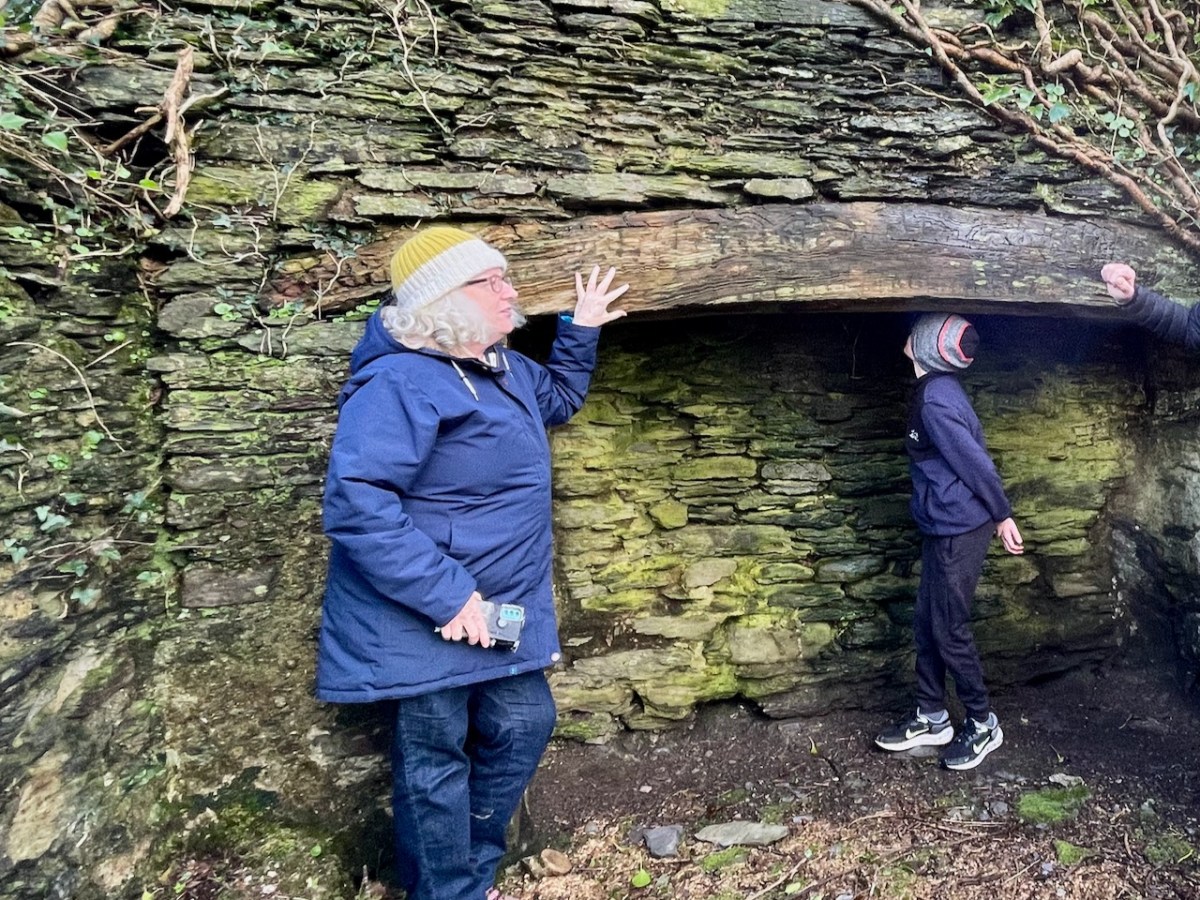
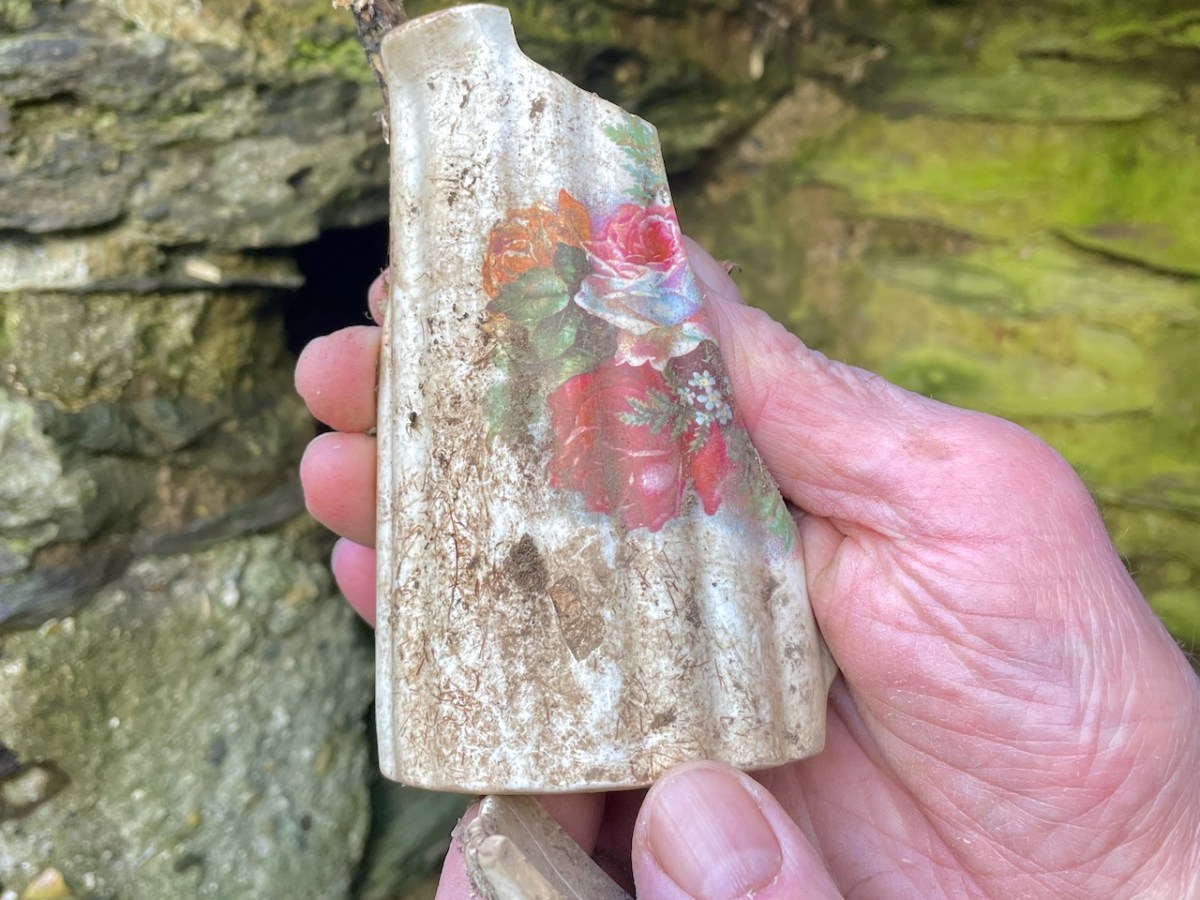
Next, he brought us to the cabin belonging to her Uncle Pat where she sheltered men on the run. It’s located in the hills behind Ballydehob, down several lonely boreens and across a couple of (very muddy) fields. The cabin, now roofless, still stands and still has the wonderful oak mantle across the open fireplace.
We marvelled that Kathleen was doing all this on her bicycle – it’s several kilometres above Ballydehob and about 100 metres above sea level. And of course few of the roads would have been paved at that time. Our guide told us that she was totally and passionately committed to the cause, and that, since she was an only child, she carried her parents along with her. It was really they who underwrote all the expenses she incurred in her work. 
In the family, it was understood that she had been engaged to a man who was a member of a Flying Column – just like one of the Men of the South, but that he had been shot. We could only wonder at the trauma and distress she had experienced. She left for America in 1925, but returned to live in Ballydehob, and her father eventually outlived her. 

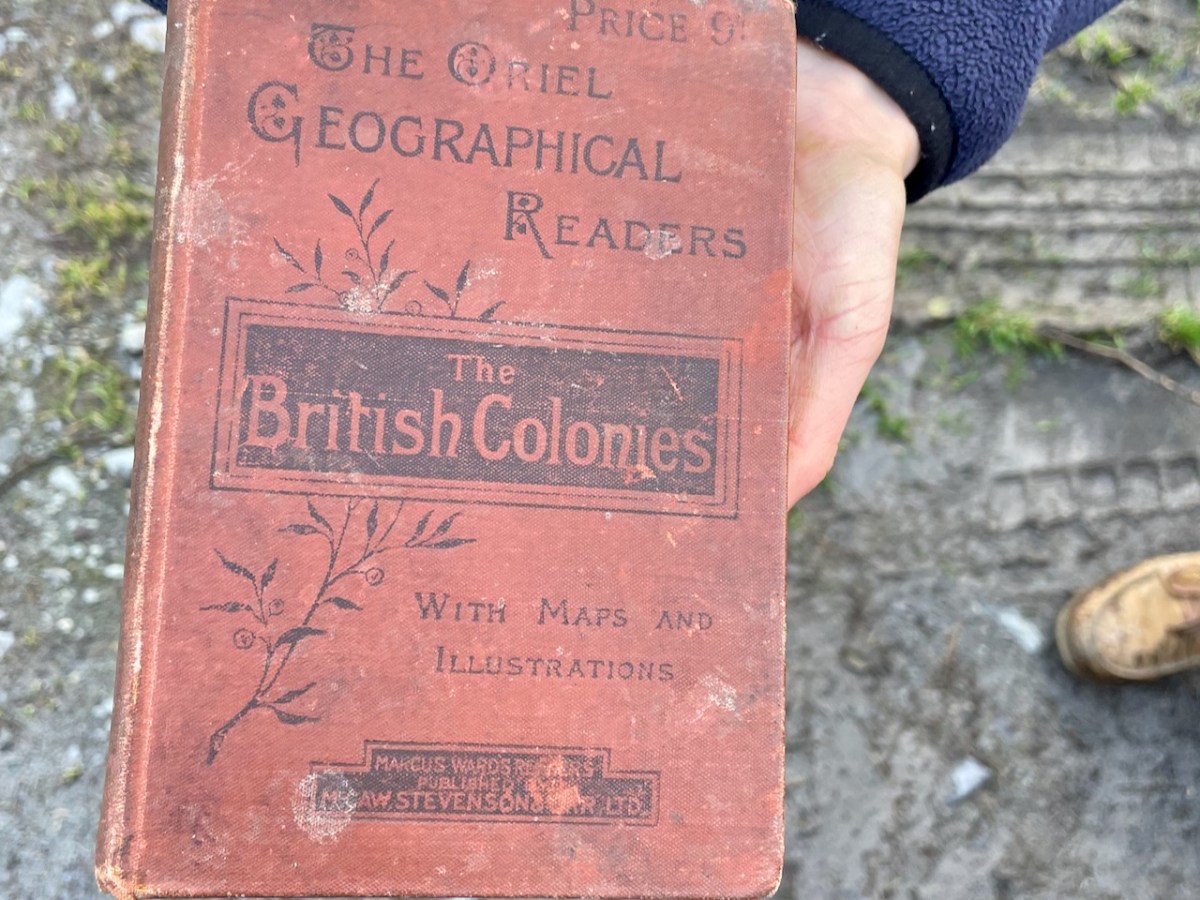
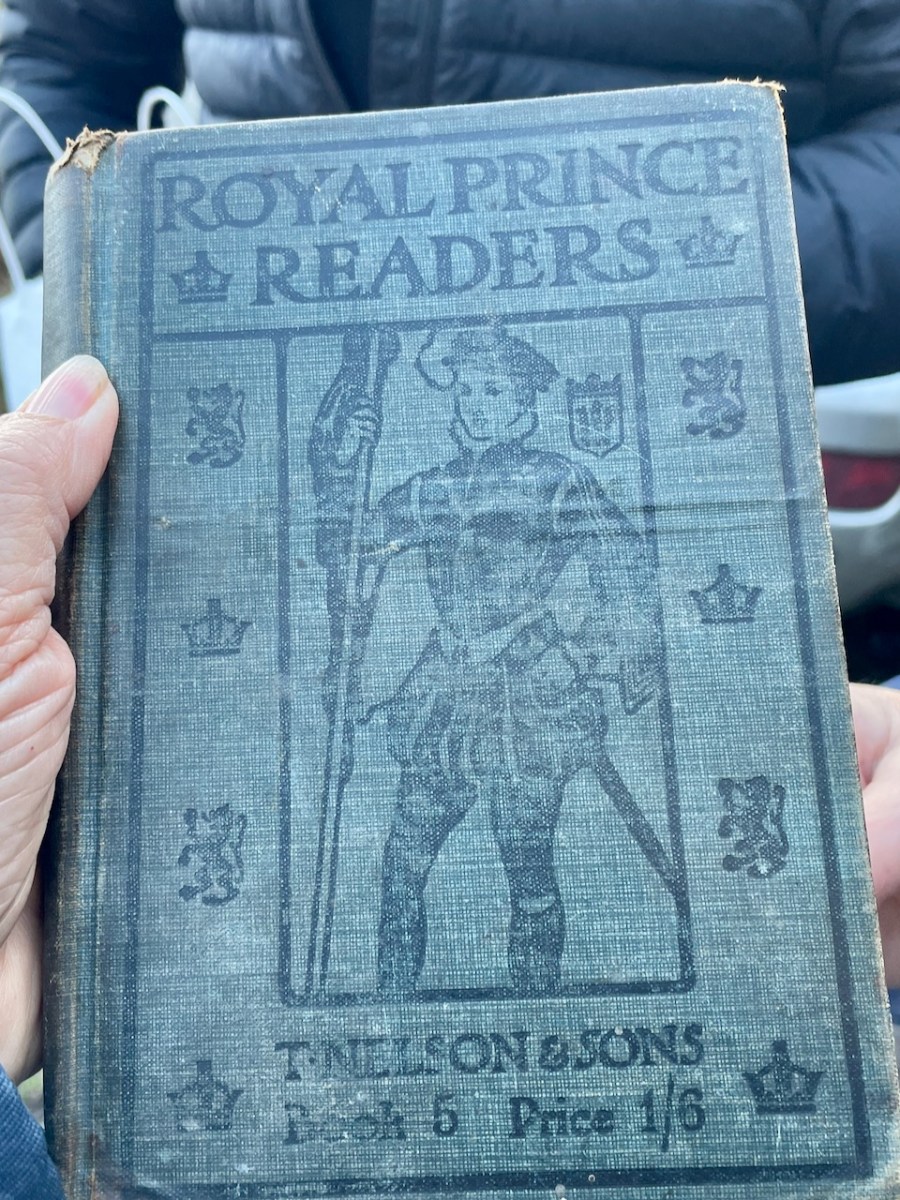
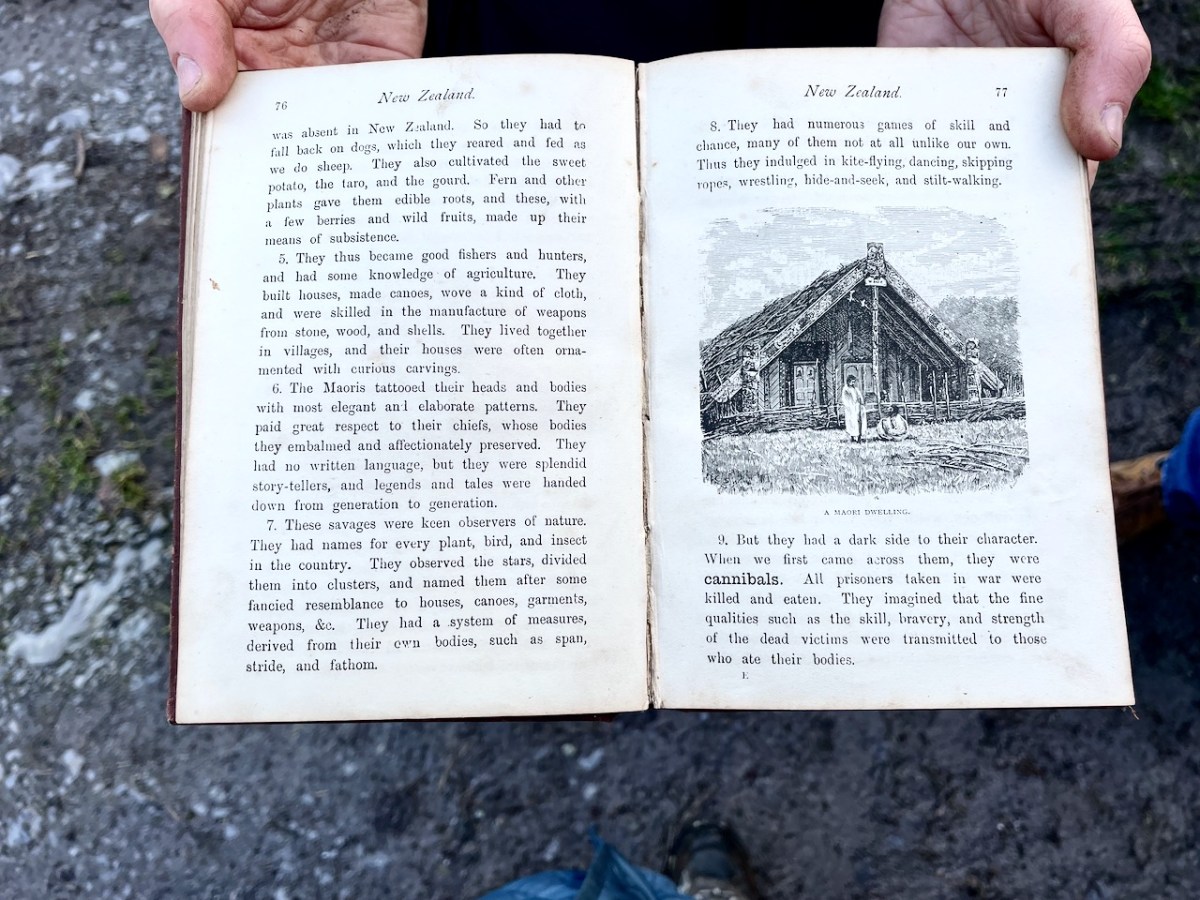
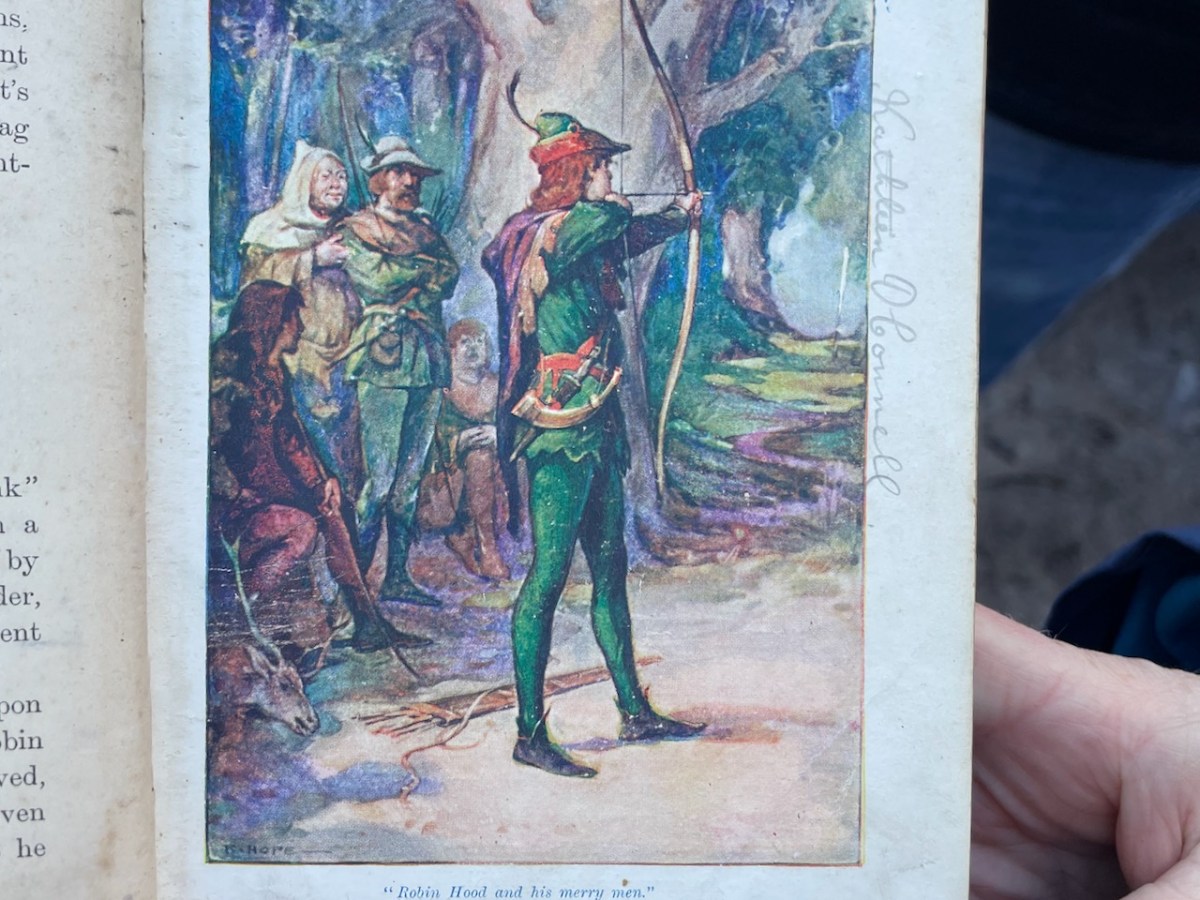
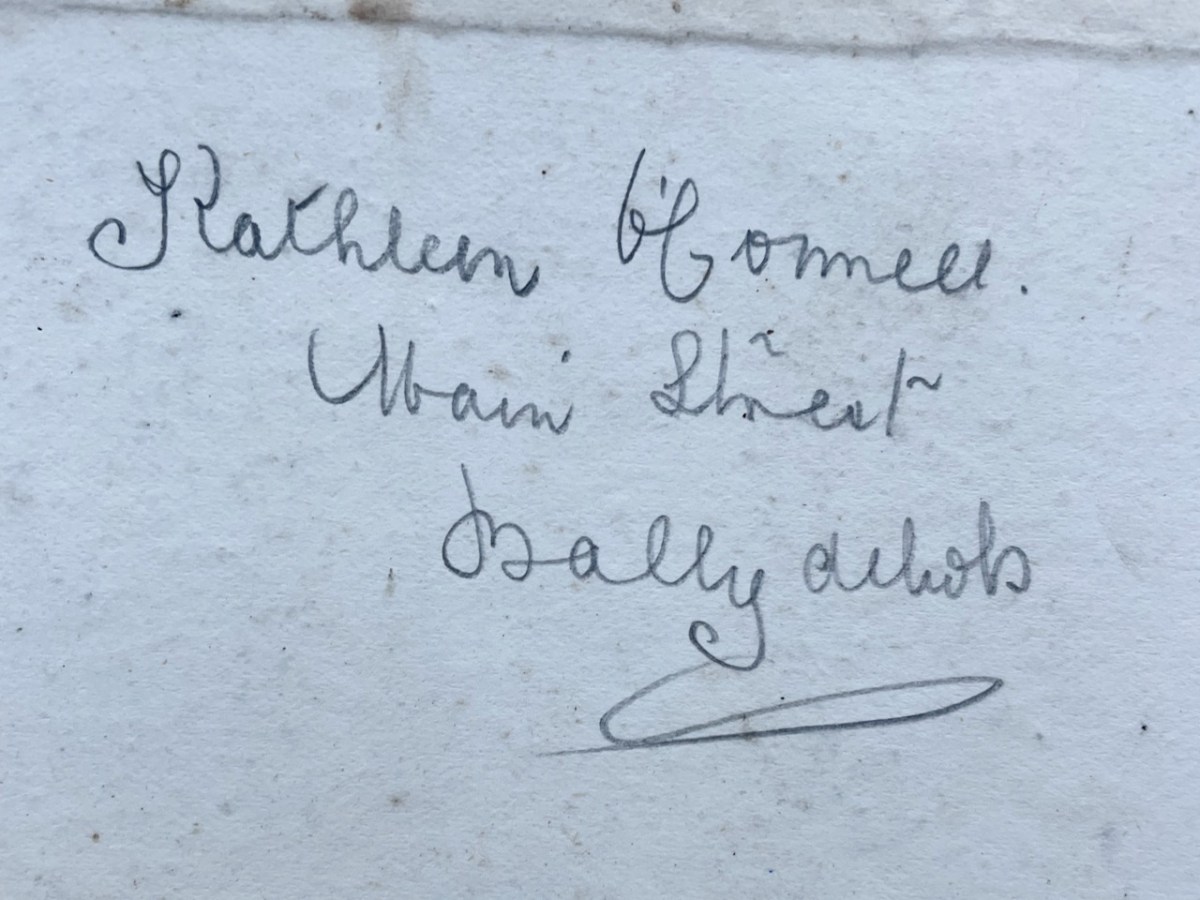
Our final mementoes of Kathleen were particularly poignant. Surviving in the family were two of her books, school books we think, in which she had written her name.

Each was very British – a reminder to us all what the standard school fare was at the time when we were members of the British Empire.

I have located a copy of the Royal Prince Reader (1910) on EBay – in Rajastan! A further reminder that empire was promoted through children’s literature as much as through military occupation.

Somehow these two books, her own possessions, brought Kathleen to life as nothing else could have done. We imagined her devouring these stories in school, and her gradual disillusion as she matured with what the Empire stood for.

It is an immense comfort to know that she is not forgotten after all.