Queen of the May

May Eve activity: setting up the May Bush

May Eve activity: setting up the May Bush

I was excited to learn – from one of my favourite and most faithful volumes on folklore: The Year in Ireland by Kevin Danaher (Mercier Press 1972) – that on May Day the Fastnet Rock weighs anchor, casts off her moorings and goes sailing about in Roaringwater Bay! I spent May Eve in a whirl of anticipation – and hot spring sunshine – awaiting the morrow which would present this wonderful spectacle to add to the feast to be seen from our window. The morrow that came, ostensibly the first day of summer, was a disappointment: the wind was in the east – and biting – and the whole bay was encased in damp, grey fog. The perambulations of the rock remained out of sight until nightfall, by which time the sweeping light had smugly returned to its rightful place twelve miles off shore.
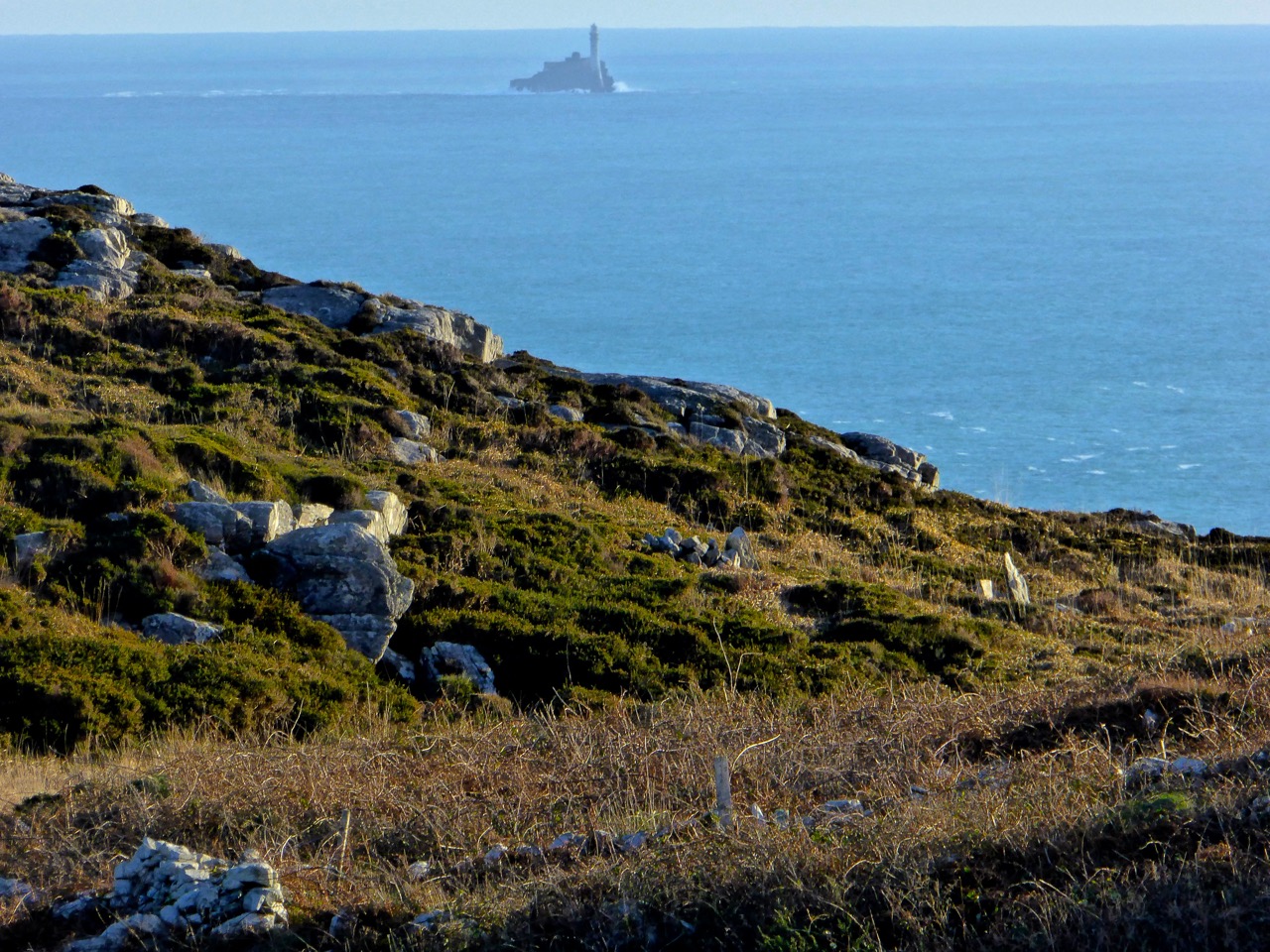
Dancing Rock...

Dancing Rock…

My only consolation – again, according to Danaher – is that a cold, wet May morning heralds an excellent summer (and this certainly came about last year). I could write all day about Danaher’s observations on the subject of Mary’s month – in his book 42 pages are devoted to it: the longest section by far, indicating the importance given to this part of the year in the traditional calendar. But I’ll leave that for another time and concentrate on our own activity: putting up our May Bush.

When I lived in the west of England it was a toss-up between going to Minehead or Padstow on May Day – occasionally both. They were contrasting experiences: in Minehead, on the north coast of Somerset, you had to take pot luck – there was no fixed itinerary to the day and you never quite knew what you were going to see, or where or when. What you wanted to see was the Hobby Horse, sometimes known as the Ship-horse, or the Sailor’s Oss. I’ll refer you to another classic book – by chance also dating from 1972: A Year of Festivals – A Guide to British Calendar Customs by Geoffrey Palmer + Noel Lloyd (Frederick Warne):

…The head of the horse (or the mast and sails of the ship) is in the centre; and a long rope tail, once a real cow’s tail, is fastened to the ‘stern’. The man inside the contraption glides and sways through the streets, and sometimes swings his tail around anybody who refuses to contribute to the collecting-box… The ship form of the horse is said to date from 1772 when, on the evening before May Day, a ship sank in a storm off Dunster, three miles from Minehead. The only object to be washed ashore was a dead cow, the tail of which was used to decorate the horse…

Now, the early photograph below is one of my all-time favourites as an illustration of a folk custom: it’s optimistically captioned Hobby-horse Festival, Minehead, Somerset and says to me that such traditions will continue forever because ‘they have to be done’ – even if the rest of the world has lost all interest…

The First of May at Padstow is another matter altogether. It’s a huge gathering: all the roads are closed to traffic and at times it seems impossible that any more people could be fitted in to this modest Cornish fishing community. Here there are two ‘Obby Osses’: the Red Oss, sometimes known as the Original or Old Oss, is stabled in the Golden Lion, while the Blue Oss – or Temperance Oss has its headquarters in the (perhaps more temperance friendly) Public Library. Both horses come out in the morning of May Day, led by a ‘Teaser’ and accompanied by numerous dancers, drums and accordions, perambulate all around the town, and well beyond it, finally meeting in the evening at The Square, in the shadow of an elaborate and colourful May Pole.

Padstow taster… Photos from the 1960s and 2006:

Preparing the Maypole in Bavaria

Preparing the Maypole in Bavaria (Florian Schott, Ellbach)

While I was experiencing my first Padstow May Day in the 1960s, our Cappaghglass neighbour Dietrich was in Bavaria, watching the construction of an enormous Maypole: he also remembers all the children dancing around it holding up May Bushes. For our own May Bush we took our inspiration from Danaher:

…The children set up their May Bush in the same spirit in which we hang out our flags on a national holiday, to celebrate an occasion, but some – at least – of their parents were glad of the feeling of protection against unseen forces which the May Bush gave…

Oh yes! We have to be aware that…

…So powerful were the preternatural forces abroad in the night between sunset on May Eve and sunrise on May Day that almost anything might be expected to happen… (Danaher) while …The powers of evil, always on the alert to entangle and destroy souls, being most dangerous and powerful on May-Eve, on that day the maids were apt to be uneasy and rather sullen, watching us suspiciously lest we might, through our unbelief, frustrate their precautions against danger. They strewed primroses on the threshold of the front and back doors – no fairy can get over this defence – and in the cow-byres they hung branches of rowan while the head dairy-woman sprinkled holy water in mangers and stalls. The milkmaids, at the end of the evening milking, stood to make the sign of the cross with froth from the pails, signing themselves and making a cross in the air towards the cows… from The Farm by Lough Gur by Mary Carbery (Longmans, 1937).

Burning the land

Burning the land

We have had a long, dry spell and there have been a number of gorse fires recently in our neighbourhood: this one occurred on May Eve – traditionally a time in Ireland when bonfires were lit – although the gorse fires have nothing to do with that tradition. Here are the observations of William Wilde (father of Oscar) in Irish Popular Superstitions, Dublin, 1853
…Turf, coals, old bones, particularly slugs of cows’ horns from the tan-yards, and horses’ heads from the knackers, logs of wood etc were also collected, to which some of the merchants generally added a few pitch and tar-barrels. The ignitable materials were formed in depots, in back-yards, and cellars of old houses, long before the approaching festival; and several sorties were made by opposing factions to gain possession of these hoards, and lives have been lost in the skirmishes which ensued… With the exception of one ancient rite, that of throwing into it the May bush, there were but few Pagan ceremonies observed at the metropolitan fires. A vast crowd collected, whiskey was distributed galore… The entire population collected round the bush and the fire; the elder portion, men and women, bringing with them chairs or stools, to sit out the wake of the winter and spring, according to the olden usage… Fiddlers and pipers plied their fingers and elbows; and dancing, shouting, revelry and debauchery of every description succeeded, till, at an advanced hour of the night, the scene partook more of the nature of the ancient Saturnalia, than anything we can presently liken it to…

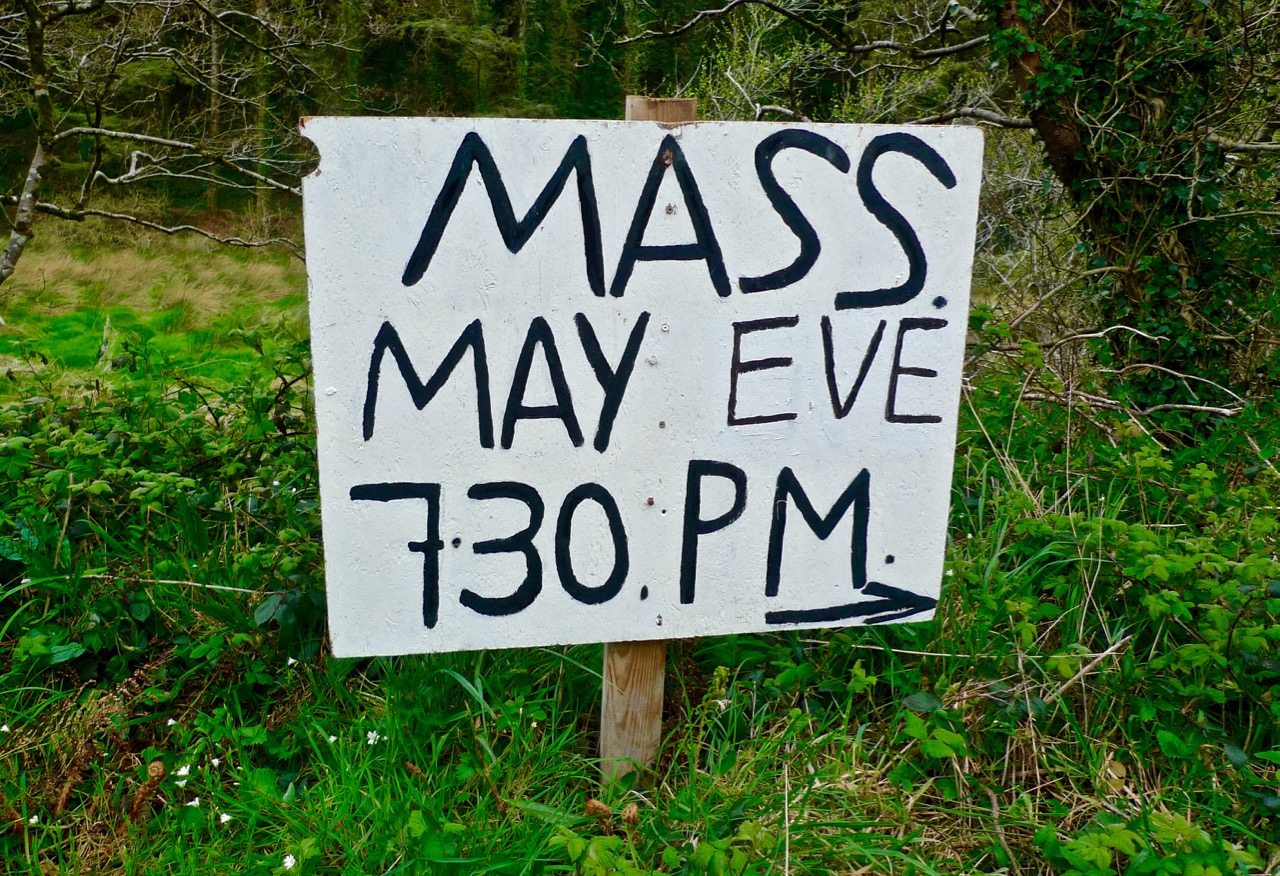
mass sign

By contrast, our own rural activities were much more calm and constrained. I couldn’t miss out on an outdoor Mass celebrated at one of Lough Hyne’s Holy Wells – the Skour Well. On a beautiful evening – attractive to the midges – it felt the most natural thing in the world to be at a site which has been considered sacred for hundreds, if not for thousands of years, and to take part in a ceremony which is also ancient. I counted over eighty people, including a gentleman of 97, at this event – presided over by two priests and centred on a portable altar with cloth and candles, the revered well being the backdrop. Prayers were said and hymns were sung in English, Irish and Latin.

There’s a continuity here which defies any twenty first century rationale. I was very conscious that this was the way that faith was practiced in Ireland in the penal times (requiring that a watchful eye be kept out for the Redcoats) – but also it was an honouring of nature and a respect for the elements: earth, water, sun and rain – old ways carrying on regardless of new technologies.

A May garland – Hatherleigh, Devon:

Finola’s memory of May Day in her schooldays was of all the girls wearing veils and processing down to the grotto saying the Rosary; and, every day throughout Mary’s month, singing the refrain that was sung at the close of the Mass at Skour Well:

O Mary! we crown thee with blossoms today,
Queen of the Angels, Queen of the May.
9074db7eb01031a082d064758b8b18ba

Glen of Ghosts

glen

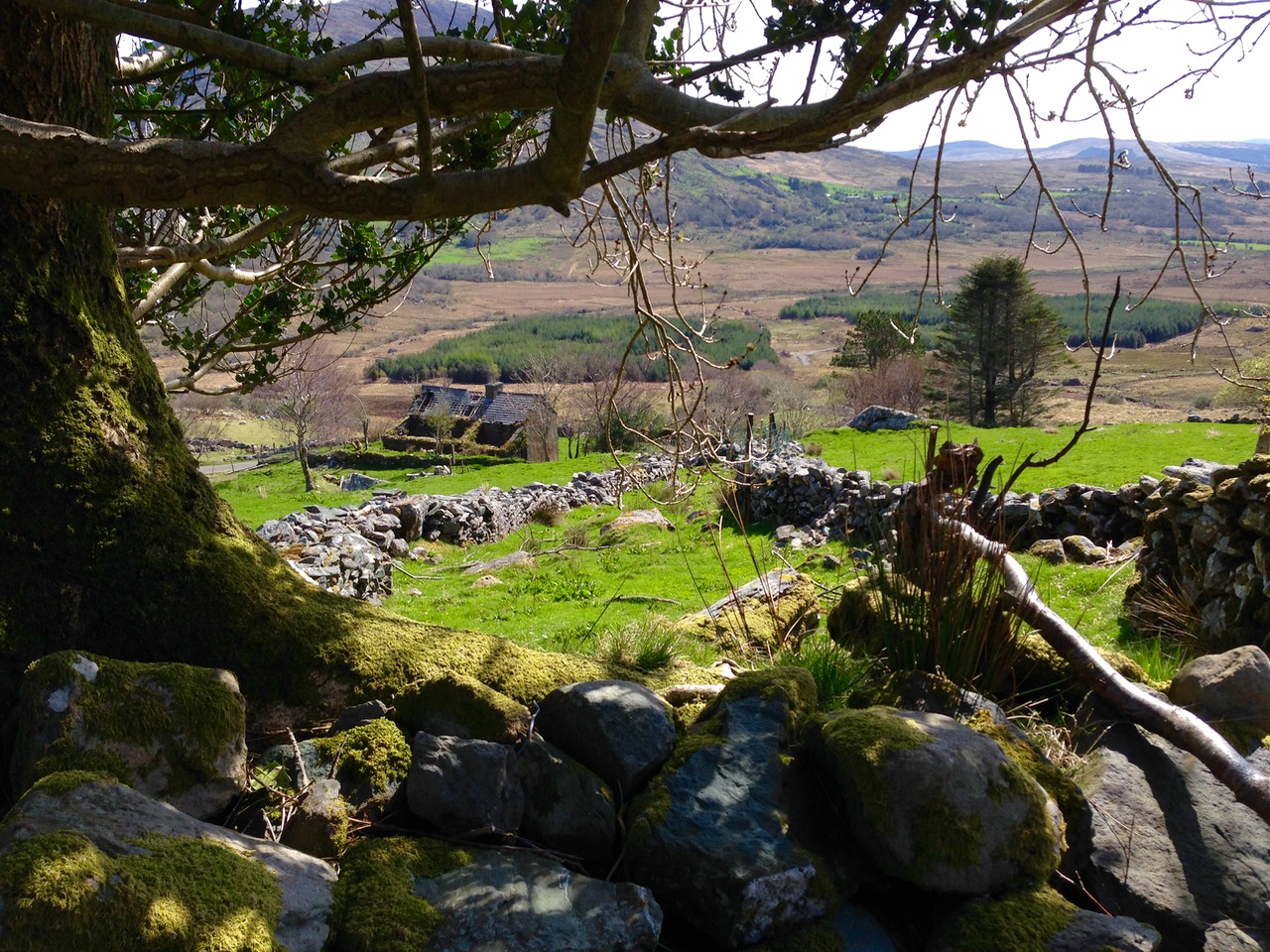
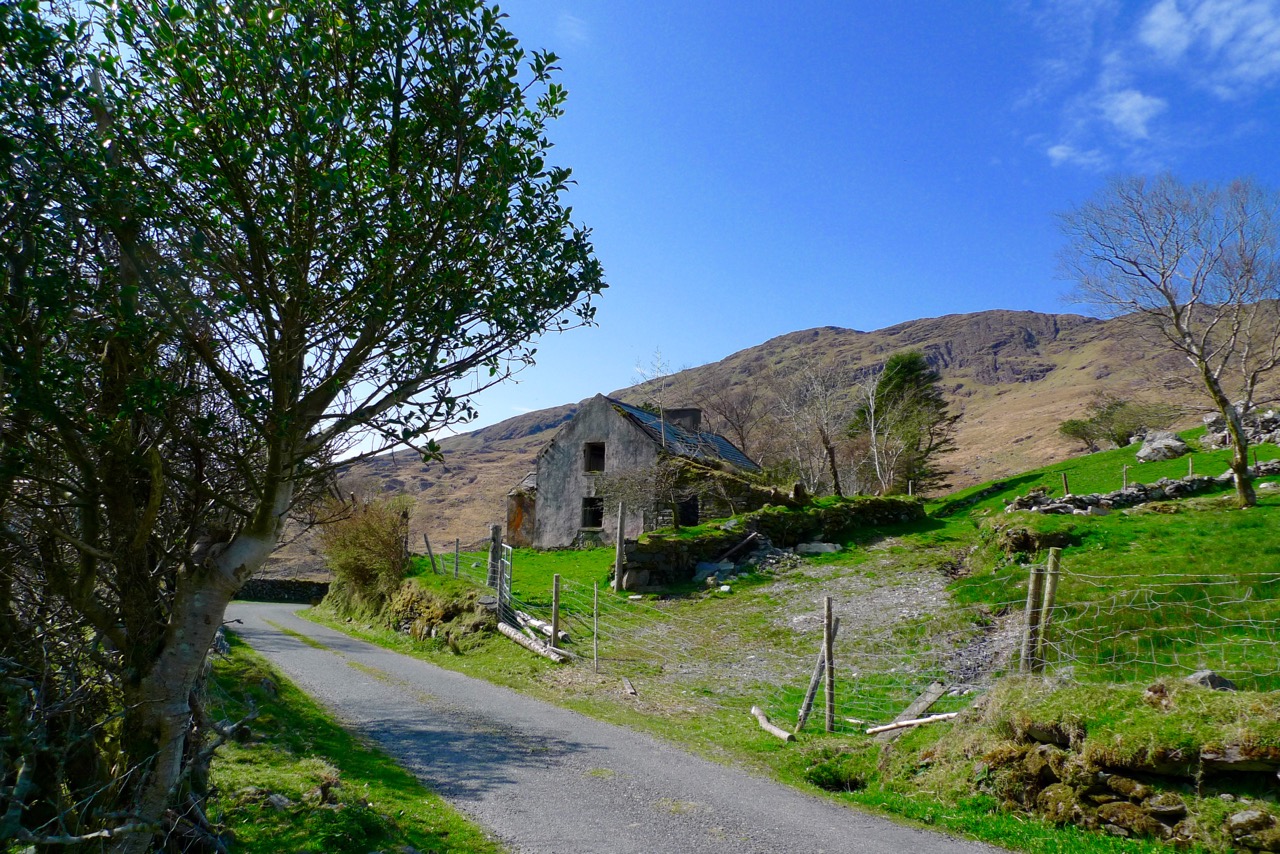
There are some places in this world that touch you deeply in the soul. Derrynablaha has that affect on me. I first went there a few years ago and immediately felt that it was alive with ghosts. I was in search of Rock Art then, and Finola had told me about her experiences in the early 1970s – an intrepid young student on an old Honda 50 loaded down with sheets of cellophane and measuring rods. She had met the O’Sullivans who dwelt in the single farmstead there – they plied her with tea and directed her to the rocks above the house where treasures awaited. When I drove into that valley 40 years later I found only the ruins of the O’Sullivan cottage. It was a poignant moment – the mountains were empty: in some ways it felt like the loneliest place on earth, yet also one of the most beautiful.

The old O'Sullivan farmstead returning to nature

The old O’Sullivan farmstead returning to nature

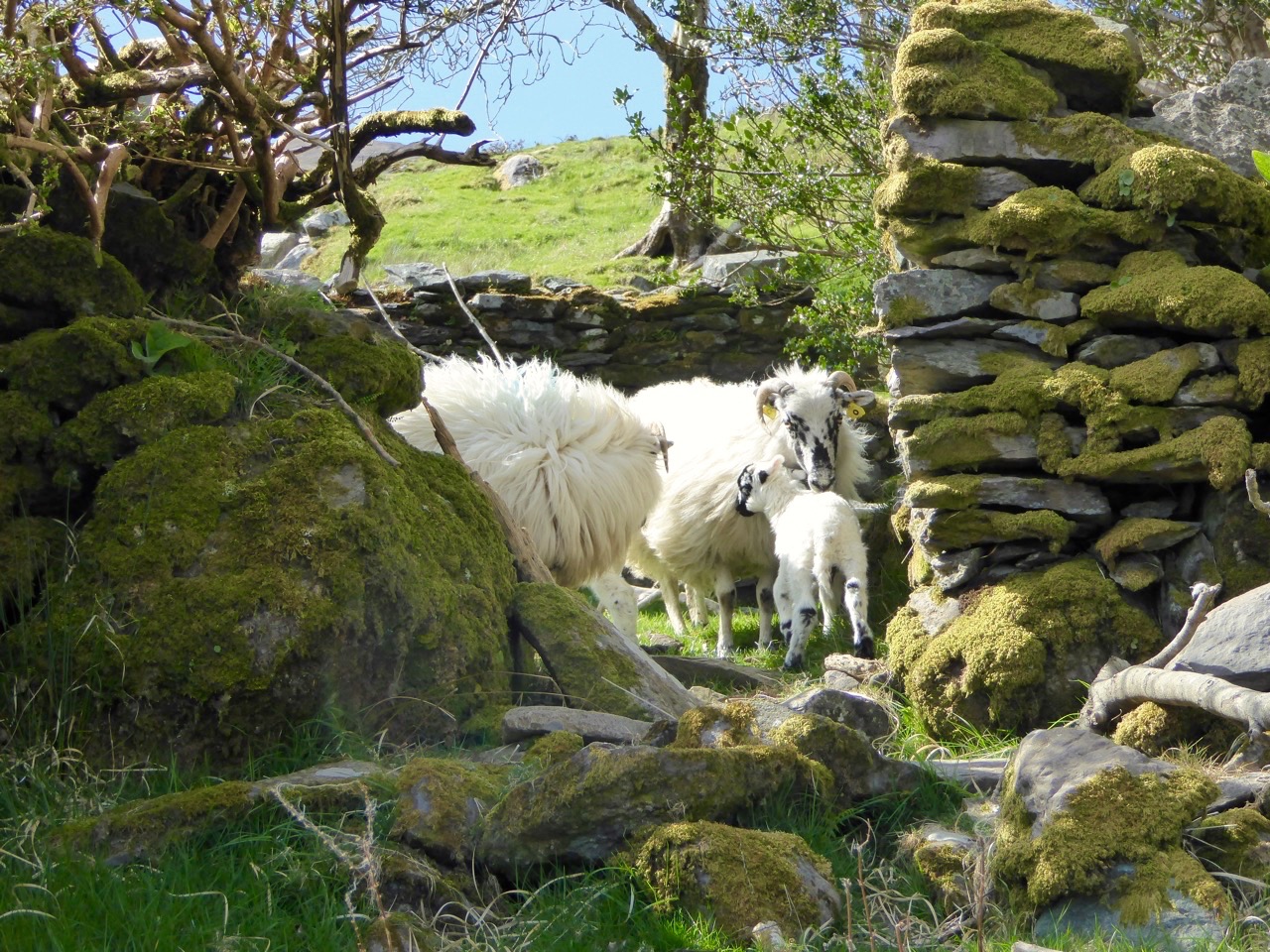
What kind of a beauty is that? A mixtures of lives vanished and nature healing the wounds. Sheep still grazing on those rock-strewn fields: men from another valley tending them – O’Sullivans also, but – they claim – no relation to the last generation there.

New life among the old stones...

New life among old stones…

Those lives are recently gone but, as I first climbed the precipitous slopes to the west of the old farm, I felt the presence of other ghosts – from a more ancient time. It’s a long haul up to the iconic carved stone which commands the wide view across to Lough Brin but, each time I make that journey, I feel more strongly drawn to the people who made that place their home – or possibly their temple.

View from the 'very special' carved stone

View from the ‘very special’ carved stone

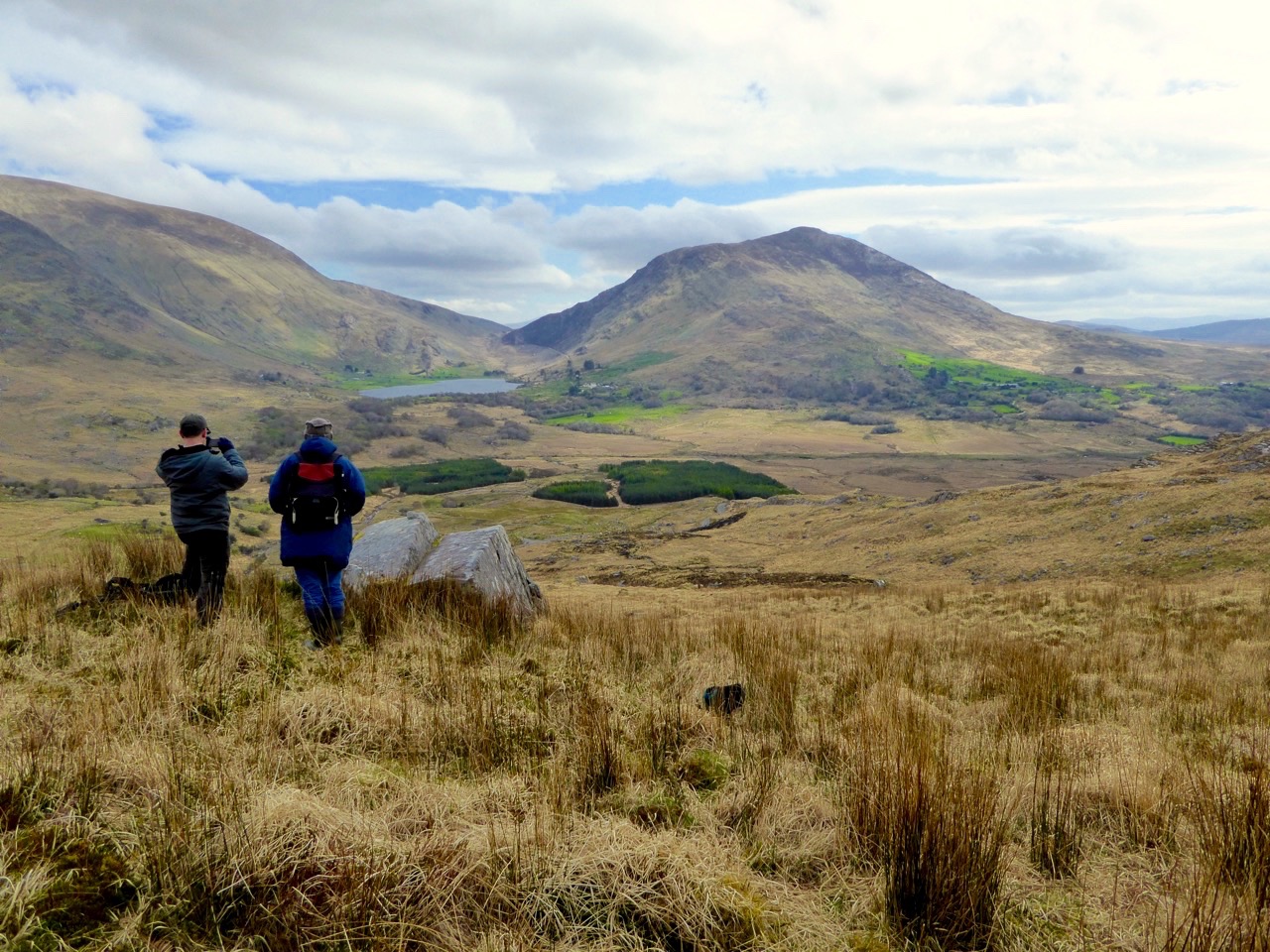
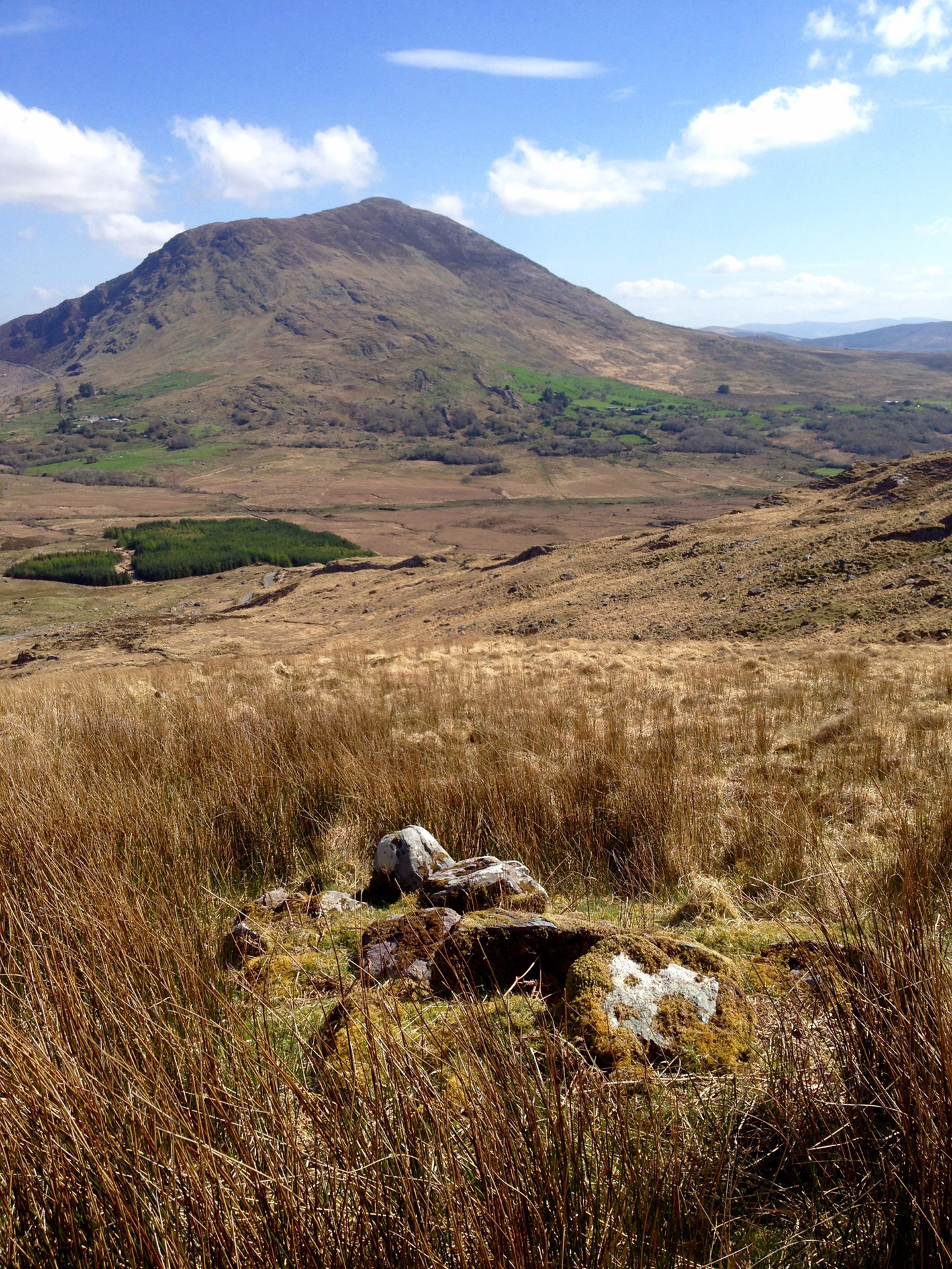
This expedition must have been my fourth visit to the hillside which commands such a magnificent view over the townlands of Derrynablaha and Derreeny and which takes in the lake on the valley floor – seemingly a mere puddle from that elevation yet  in fact covering several hectares. On each visit I find more evidence of prehistoric occupation: on this occasion it appeared to me that the carved stone is sited on the edge of a circular plateau; I could trace old retaining walls below, some circles which could have been hut walls half lost in the undergrowth and – above this site – a wall of boulders which might have dammed the stream which runs down the mountain here, to create a little reservoir. I also saw the vestiges of a wedge tomb – aligned east to west – and the base of a cairn… All this, of course, is my imagination at work, but it’s a place where the imagination can take wing.

sky pan

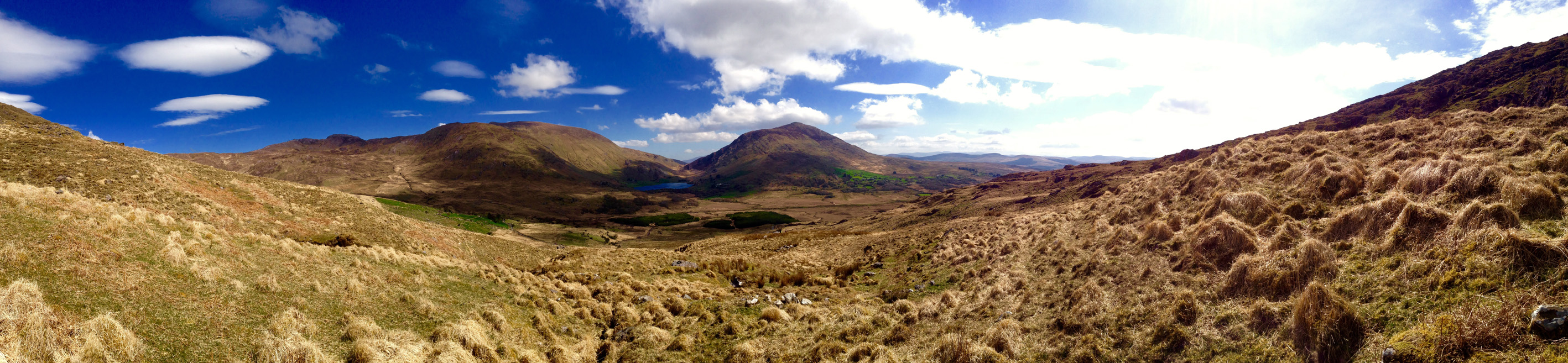
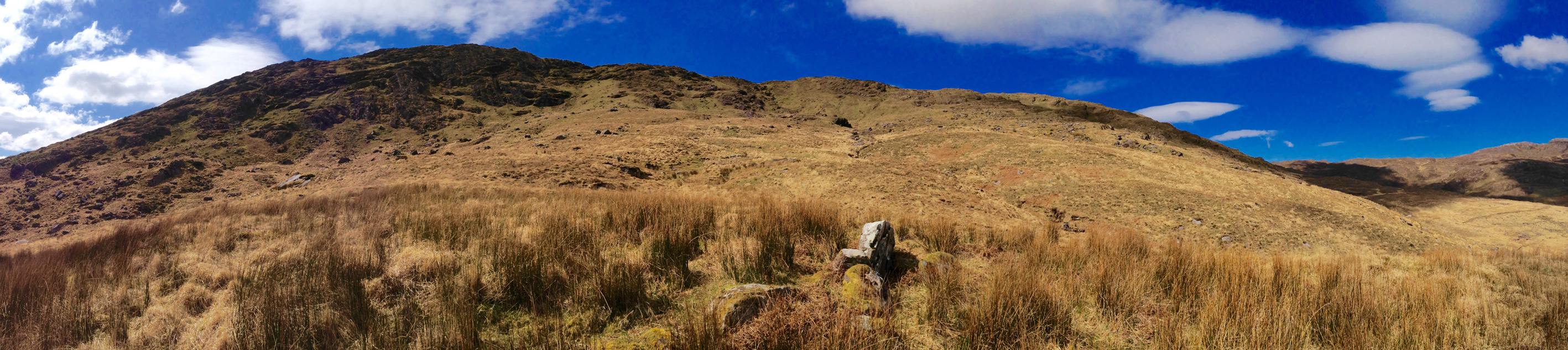
Panoramas from the plateau - east and west

Panoramas from the plateau – east and west

I have so many questions… Was there once tree growth at this level? Derrynablaha means ‘little oak wood of the flowers’ – I imagine something like the stunted oak forests on Dartmoor, where the ancient trees are gnarled and twisted from the ravages of a harsh climate, but which cling to the rocky terrain. But possibly the plateau was raised above this – a place where visibility over the whole landscape was important and visitors anticipated in advance. In my dreams I see fires burning up there in the night, figures dancing, songs being sung… Are they really Wolves and Deer I see moving around the fires, or are they my own ancestors wearing grotesque masks?

clouds

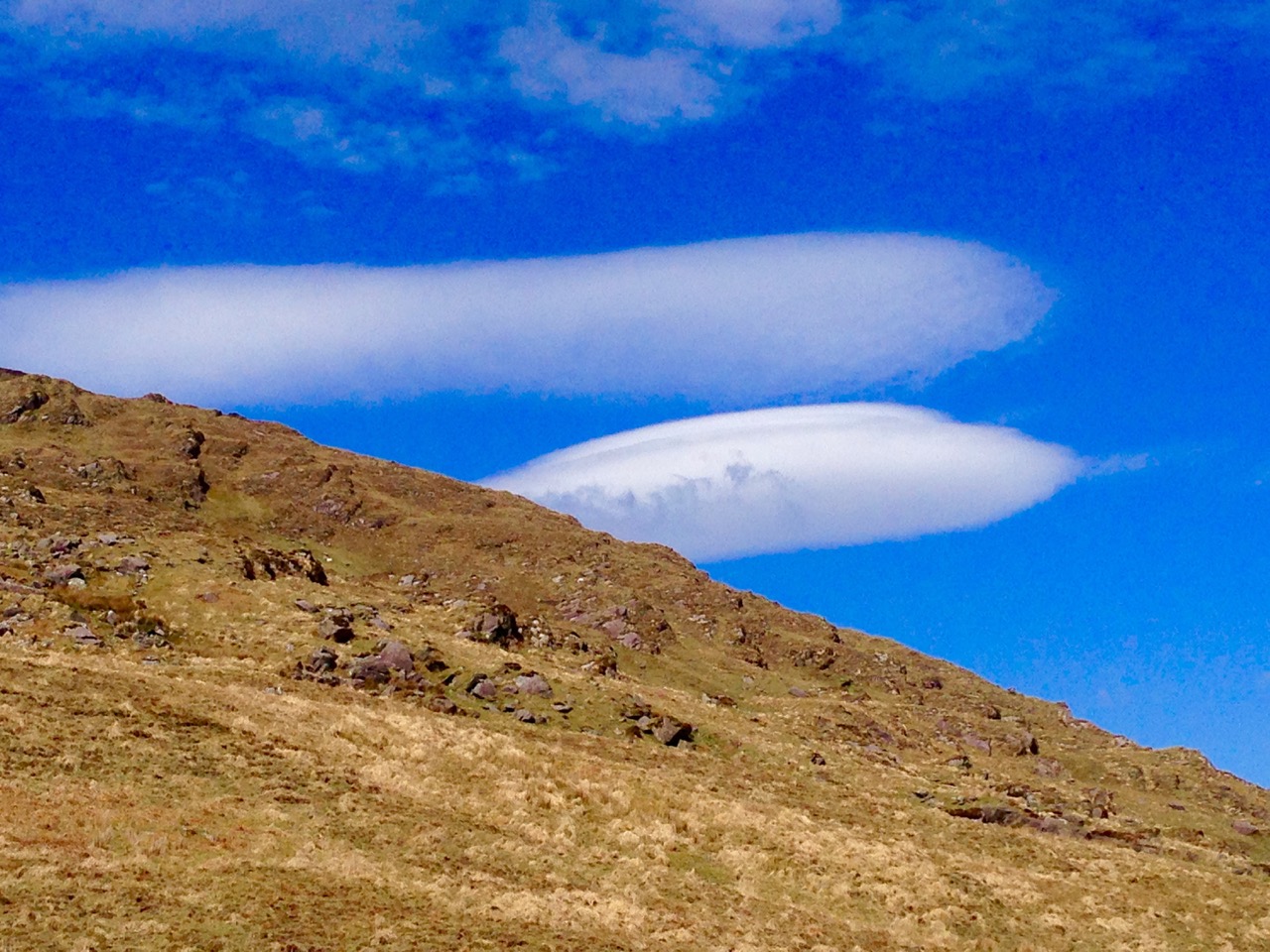
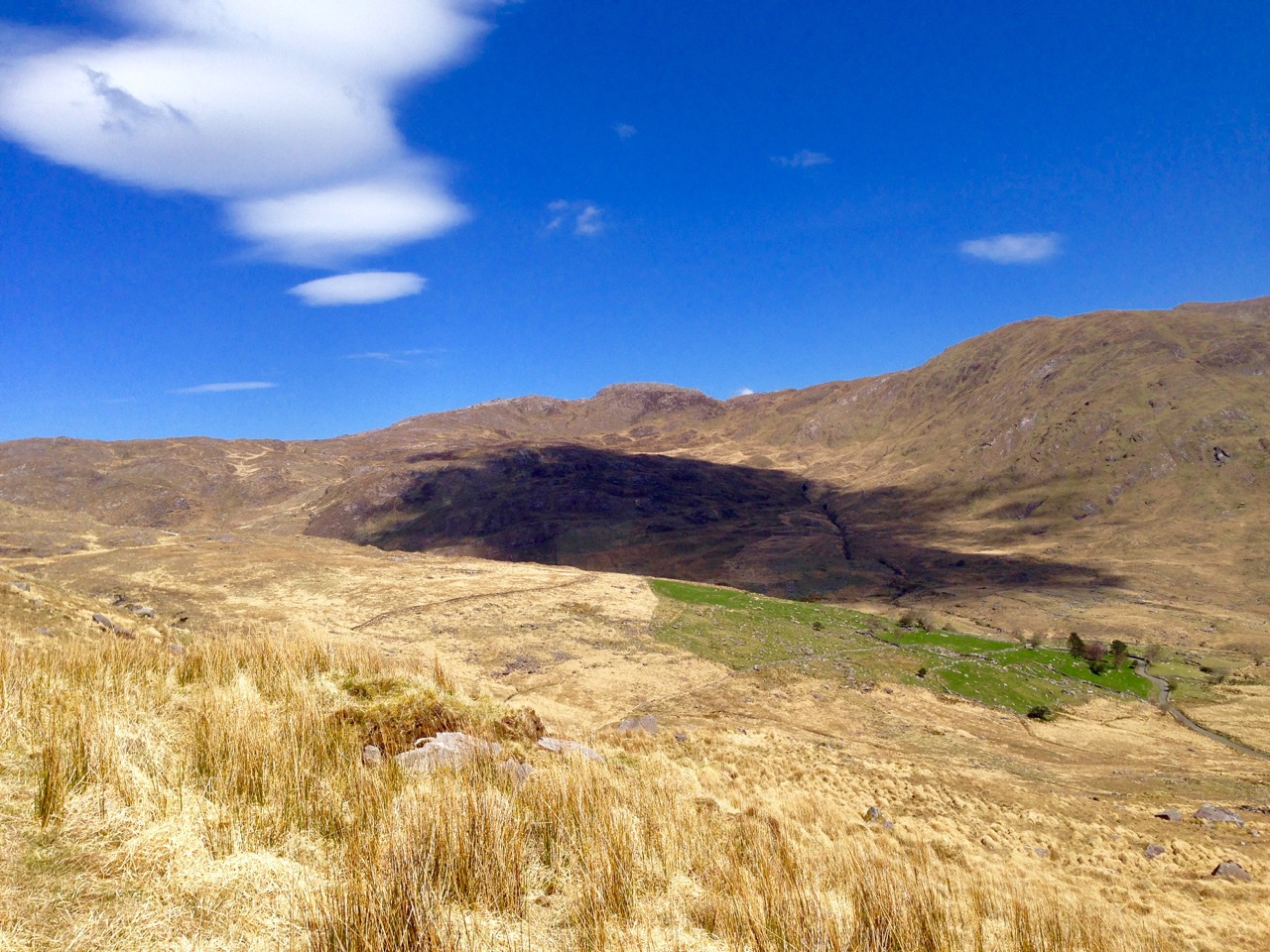
Dream clouds?

Why shouldn’t I have these thoughts? After all, technology might have changed over 5,000 years – but our minds haven’t. It’s not so hard to try and understand our forebears: I like to think they appreciated the power of the pristine landscapes which they inhabited – just as we are awed by the magnificence of their old haunts as we see them today.

Wedge tomb on the plateau?

Wedge tomb on the plateau?

And did those feet…

We discovered St Patrick in Glastonbury!

We discovered St Patrick in Somerset!

Finola had never been to Glastonbury, so I thought a visit on our way back home to Ireland was in order. Like me, she found the town itself fascinating: every shop seems to have a ‘mystic’ theme, and even the coffee is imbued with an otherworldly aura…

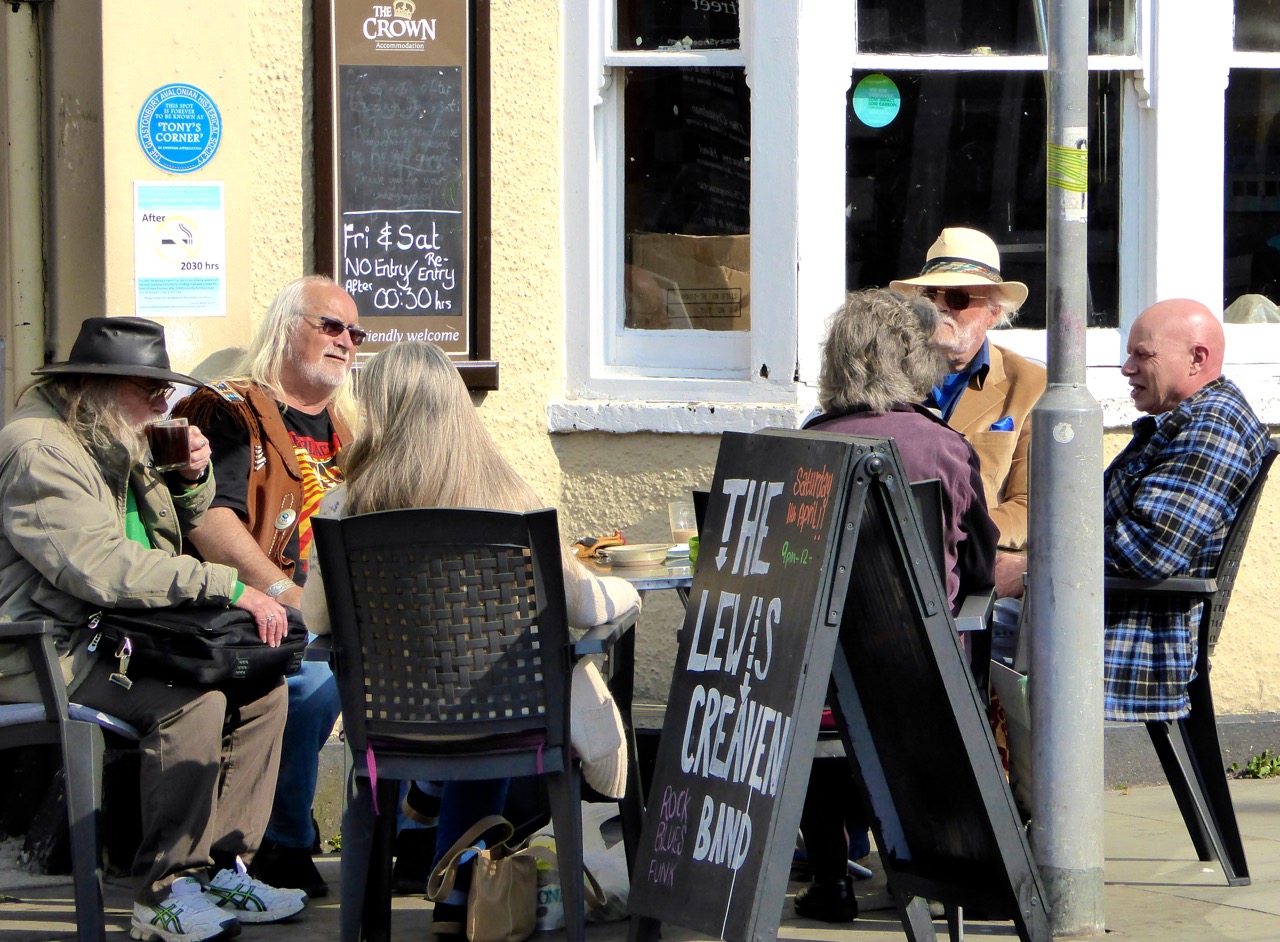
Coffee time in Glastonbury

Modern Pilgrims? Coffee time in Glastonbury

Why is this Somerset town so steeped in esoterica? It attracts ‘New Age’ adherents, pagans and Christians. Perhaps because it was a place of pilgrimage centuries ago – one of the most important in Britain. The biggest surprise for us was to find a chapel there dedicated to St Patrick!

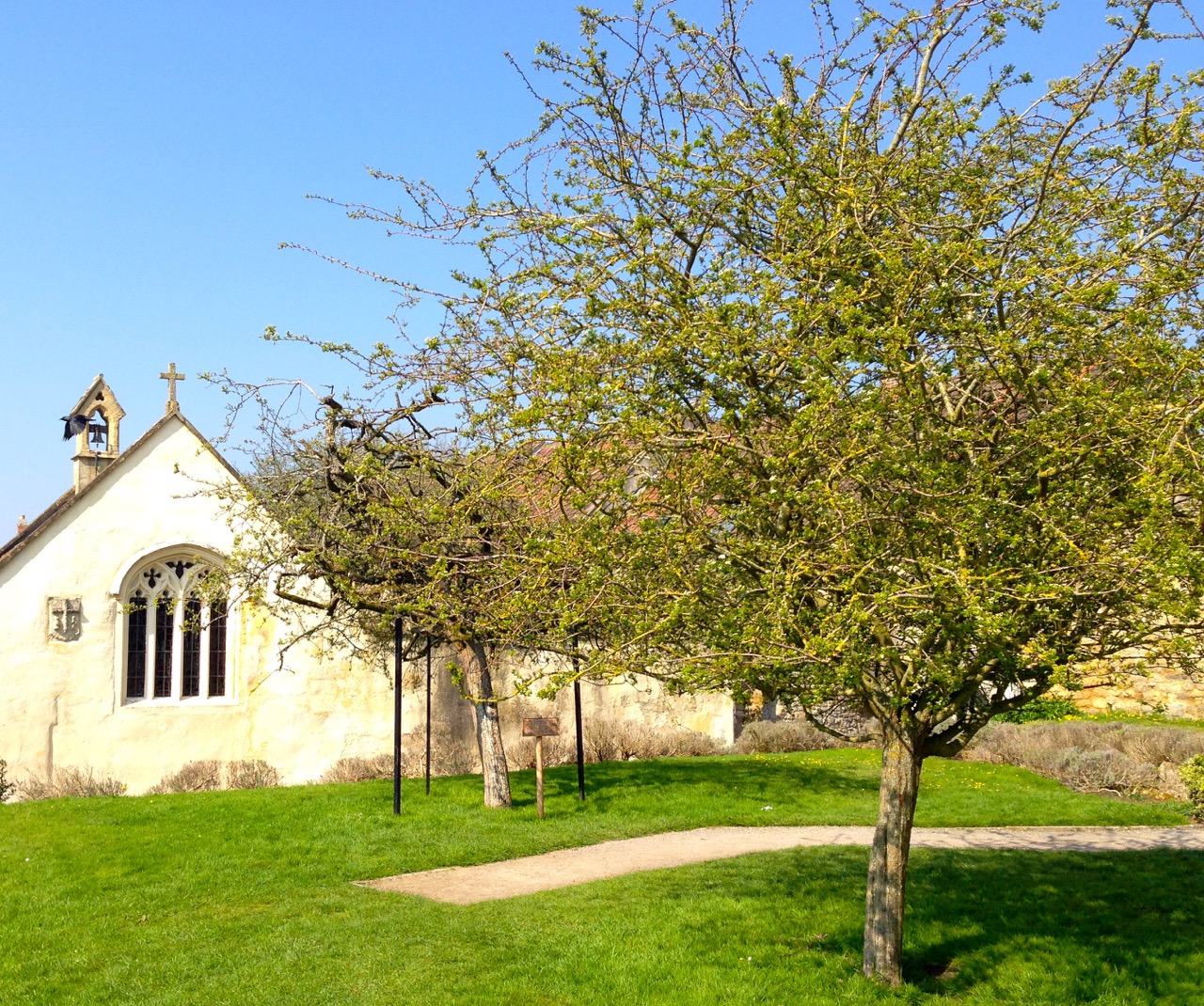
St Patrick's Chapel - one of the earliest buildings at Glastonbury

St Patrick’s Chapel – one of the earliest buildings at Glastonbury

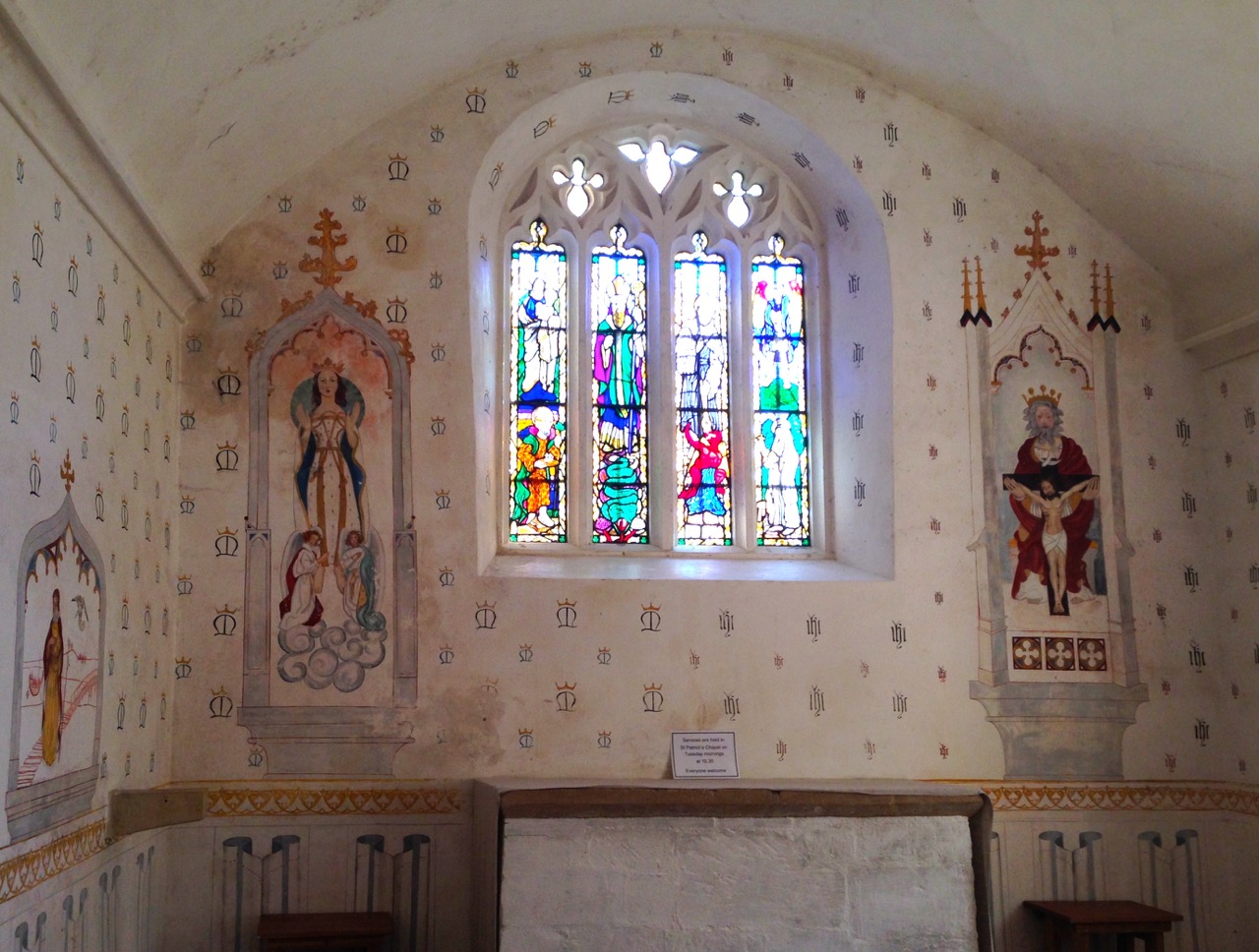
Inside St Patrick's Chapel

Inside St Patrick’s Chapel

The chapel is in the grounds of Glastonbury Abbey and – like the Abbey itself – the little building has had a chequered history. It is well preserved, however, although the wall paintings and glass are from a modern renovation.
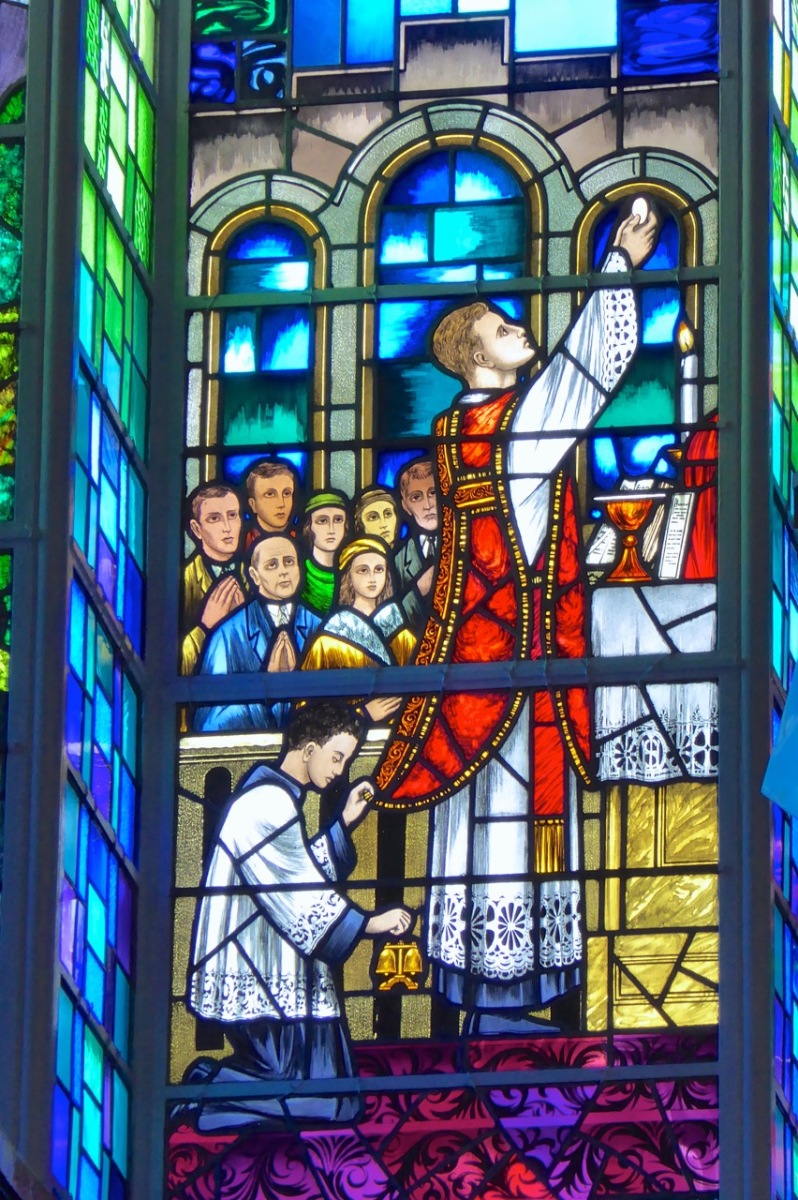
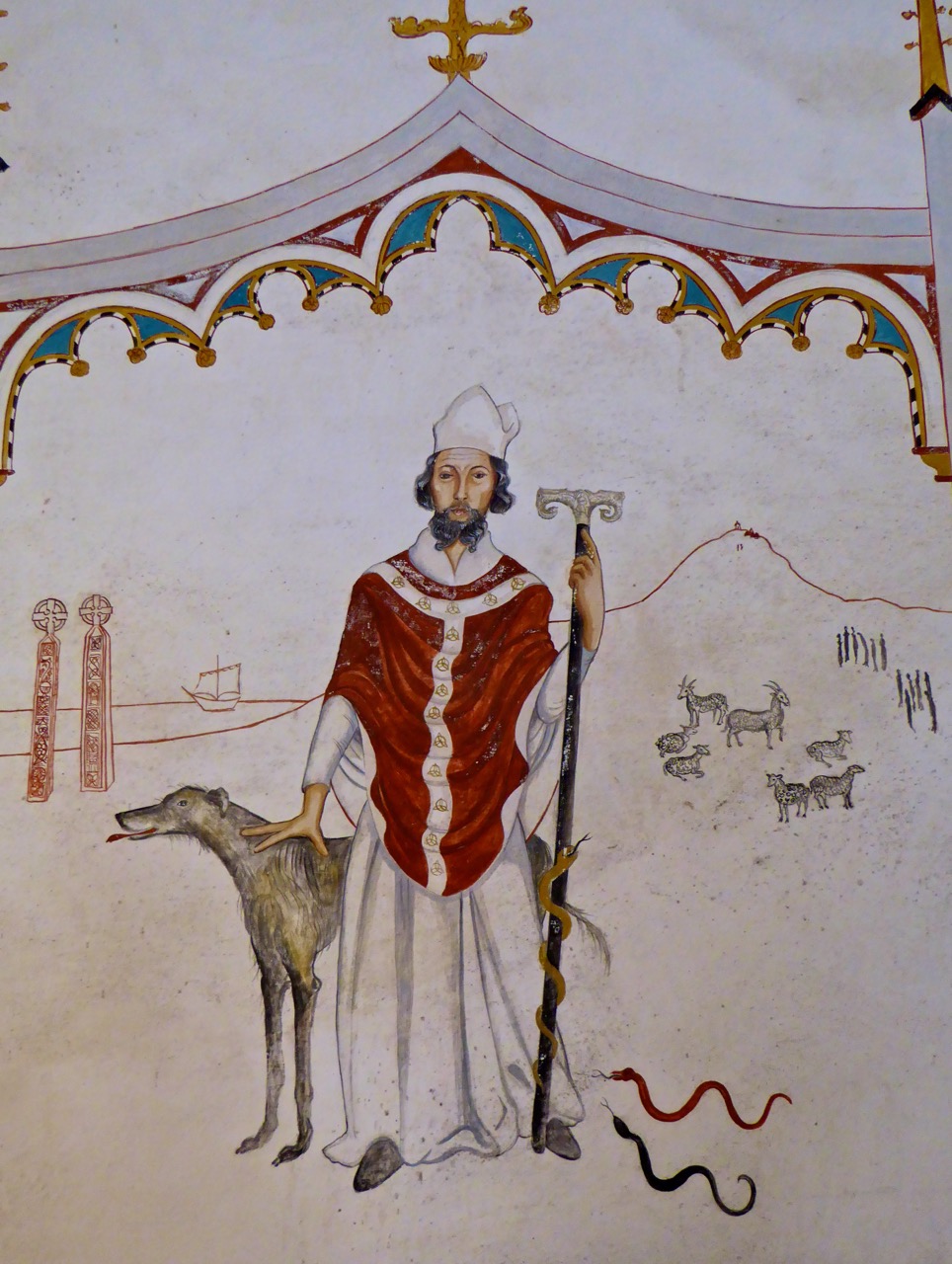
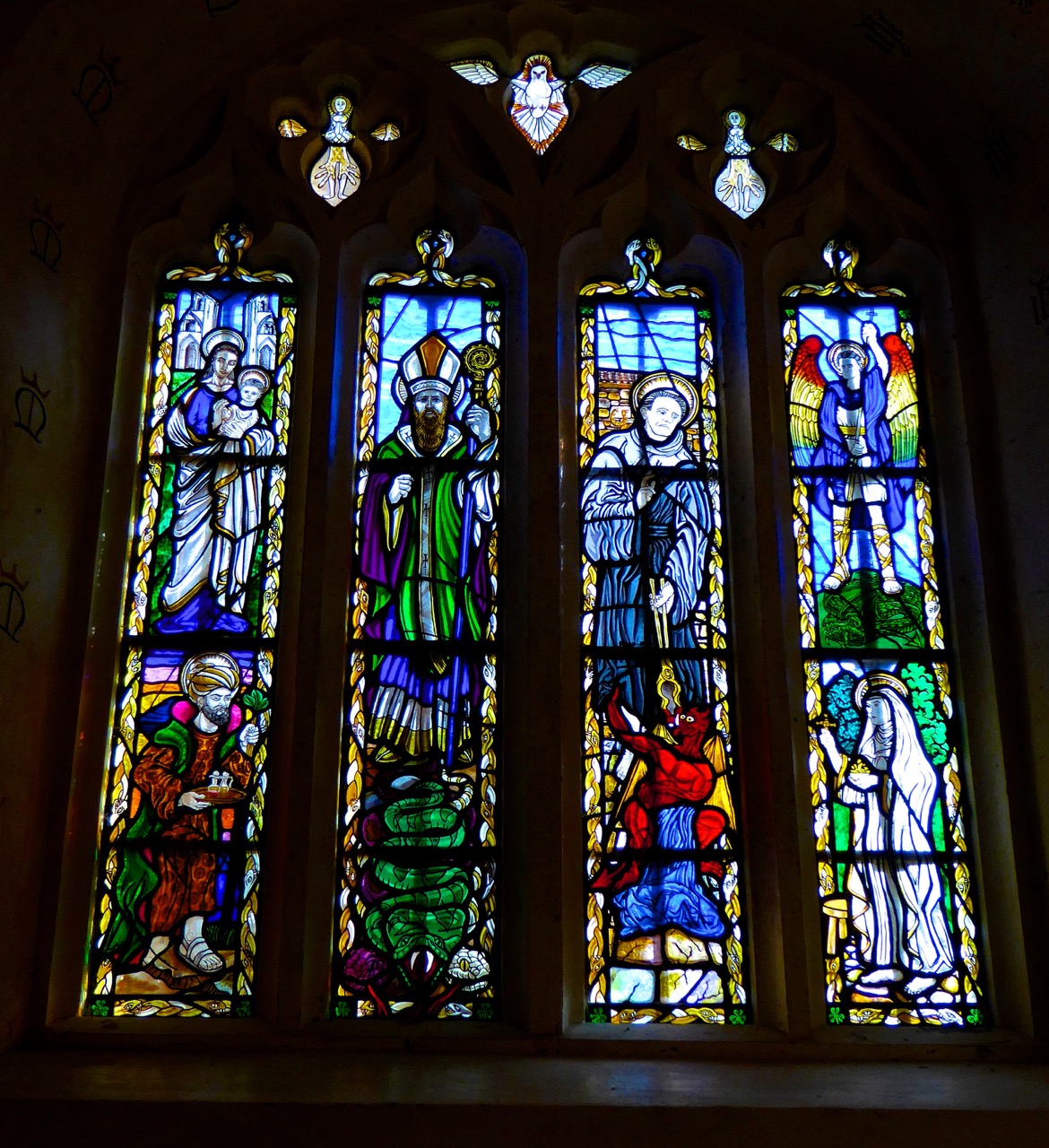
The chapel window - note St Patrick's wonderful snake!

The chapel window – note St Patrick’s wonderful snake!

Glastonbury is a place of history and of legend. The most important of these has to be the one that William Blake immortalised in his poem Jerusalem:

And did those feet in ancient time walk upon England’s mountains green…

‘Those feet’ are the feet of Jesus himself who – tradition insists – was brought to this site as a boy of twelve by his great-uncle, Joseph of Arimathea, a tin trader. Jesus in Britain? No wonder the Abbey was such a glorious place, and a rich and powerful one in medieval times. Even in ruins, the buildings have a presence and elegance which for me is unmatched in any of the other ancient monastic sites I have visited. With that history there couldn’t be anywhere more important outside of the Holy Land.

Back to the story – When Joseph landed on the islands that were Somerset in those days, he climbed to the top of Wearyall Hill and planted his staff there. It took root and grew into a thorn tree. Magically, that tree always flowered on Christmas Day. The original thorn has gone from the hill, but cuttings have been taken over time and they exist elsewhere: one such is within the Abbey grounds, just outside St Patrick’s Chapel. They still flower on Christmas Day, and the Queen is always sent one of the blooms.

Glastonbury's Holy Thorn, planted by Joseph of Arithamea

Glastonbury’s Holy Thorn, planted by Joseph of Arithamea

A tradition tells us that St Patrick grew weary of his work in Ireland and returned to Britain in old age. He went to Glastonbury because of its importance, and he was joined there by a band of monks who elected him their Abbot. After a few years he died and was buried in the Abbey grounds. Other important visitors here included St Brigid – who is pictured milking her cow on the wall of St Michael’s Tower on the Tor. St Brigid is also considered a Goddess – suitable for a town in which Paganism and Christianity seem to co-exist quite happily.

Typical Glastonbury shopfront

Typical Glastonbury shopfront

St Brigid - another Irish Saint in Glastonbury

St Brigid – another Irish Saint in Glastonbury

The stories go on and on: a multitude of Saints is buried around the Abbey evidently – and the Virgin Mary herself visited – with her Uncle Joseph – and (some say) is also buried there…

We musn’t forget another Glastonbury VIP – King Arthur. In the twelfth century the grave of Arthur and Guinever was found by monks when carrying out restoration works in the nave of the Abbey. This added to the notoriety – and the fortunes – of the monastic establishment…

sign

Time Warp

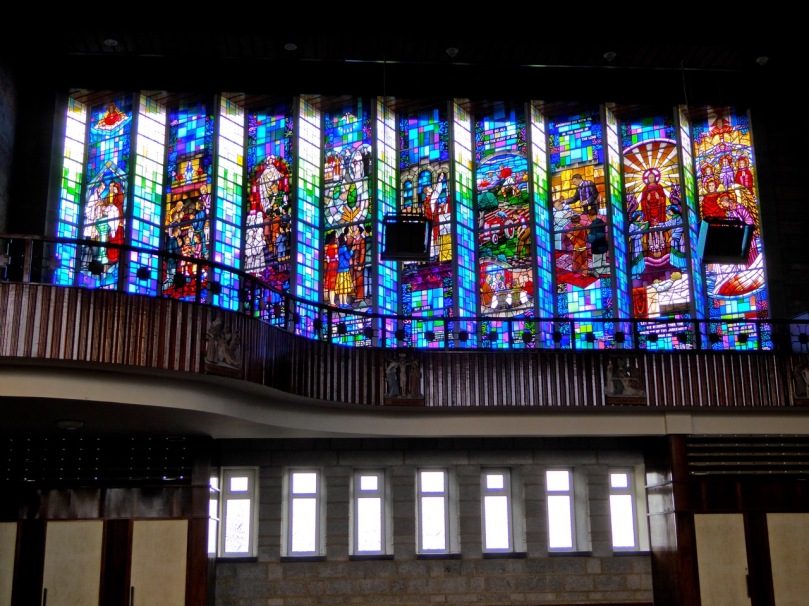
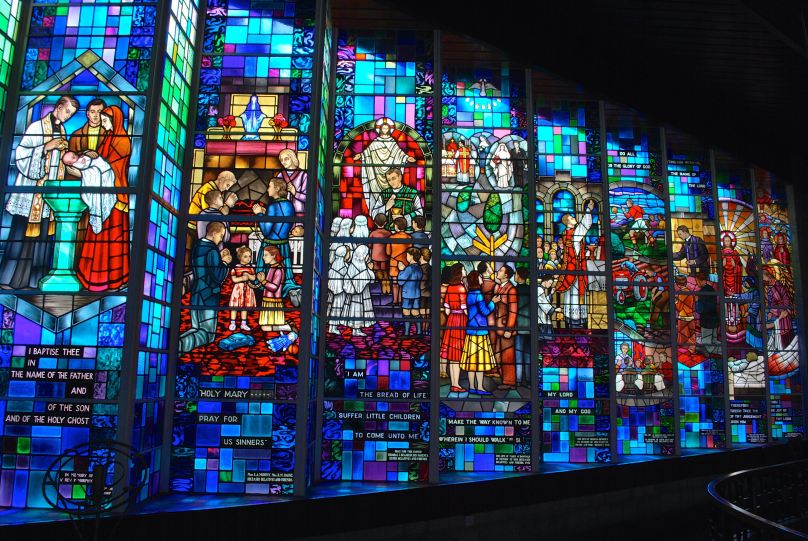
Stained Glass Wall in All Saints Church, Drimoleague

Stained Glass Wall in All Saints Church, Drimoleague

It was the early 1960s and I was sitting in class in my convent school while Mother Francisca explained the purpose of our education and gave us a glimpse of our futures. “What we want for you, girls,” she said, “is to be Good Wives or Nuns.” This week, I landed back in that classroom with a bang. Did I visit my old school? No – I strayed into a time warp. In doing so I rediscovered part of my heritage I had almost forgotten and I met a brilliant young scholar who helped me access those dim memories again.

All Saints, Drimoleague - 1950s modernist architecture

All Saints, Drimoleague – 1950s modernist architecture

All Saints Catholic Church in Drimoleague is one of the most extraordinary buildings in West Cork. First of all, it’s a fine example of mid-century modern architecture (and there aren’t a lot of those in West Cork) and an engineering triumph. Built in the 1950s of concrete and limestone, its cavernous interior has no need for pillars: nothing intrudes between worshippers and altar. It’s like stepping into an enormous, curiously bright, almost empty box. Secondly, it has extraordinary artwork in the form of a giant mural behind the altar and a panel of stained glass windows above the balcony on the south wall. It was the stained glass that stopped me in my tracks.

All Saints, the interior

All Saints, the interior

The glass is laid out in a series of frames that takes the viewer from birth to death – no, beyond death, to heaven. The church was built in the 1950s and each frame represents the values of rural Catholic Ireland of that time. In a strange way it reminded me of a High Cross, in that the illustrations that we see on High Crosses were meant to tell a story – a biblical one in that case – and to instruct the viewer in the tenets of the religion. The purpose of this wall of glass was also educational – to provide a primer to mass-goers on the aspirations and actions that should guide their lives.

The Stained Glass panel, image © Richard James Butler

The Stained Glass panel, image © Richard James Butler

My parents, imbued with the message that the family that prays together stays together, developed an intermittent enthusiasm for saying the rosary. We would gather in the kitchen after dinner, each with our beads, and kneeling on the hard tiles we would tell off the Sorrowful or the Glorious Mysteries. The second frame shows just such a family, and I particularly love the toys on the floor and the statue of Mary on the mantlepiece. There’s a grandmother and a baby in a cot, and a little girl being inducted into the Mysteries by her older sister.

The next frame shows First Communion, with the girls in miniature bride outfits (as they are to this day) and the boys in their Communion suits with the short trousers and knee socks that all boys wore at that time. Since my godson in Dublin is about to make his First Communion I have been hearing about the process and I understand that apart from the length of the boy’s trousers not a lot has changed in 60 years.

First Communion

First Communion

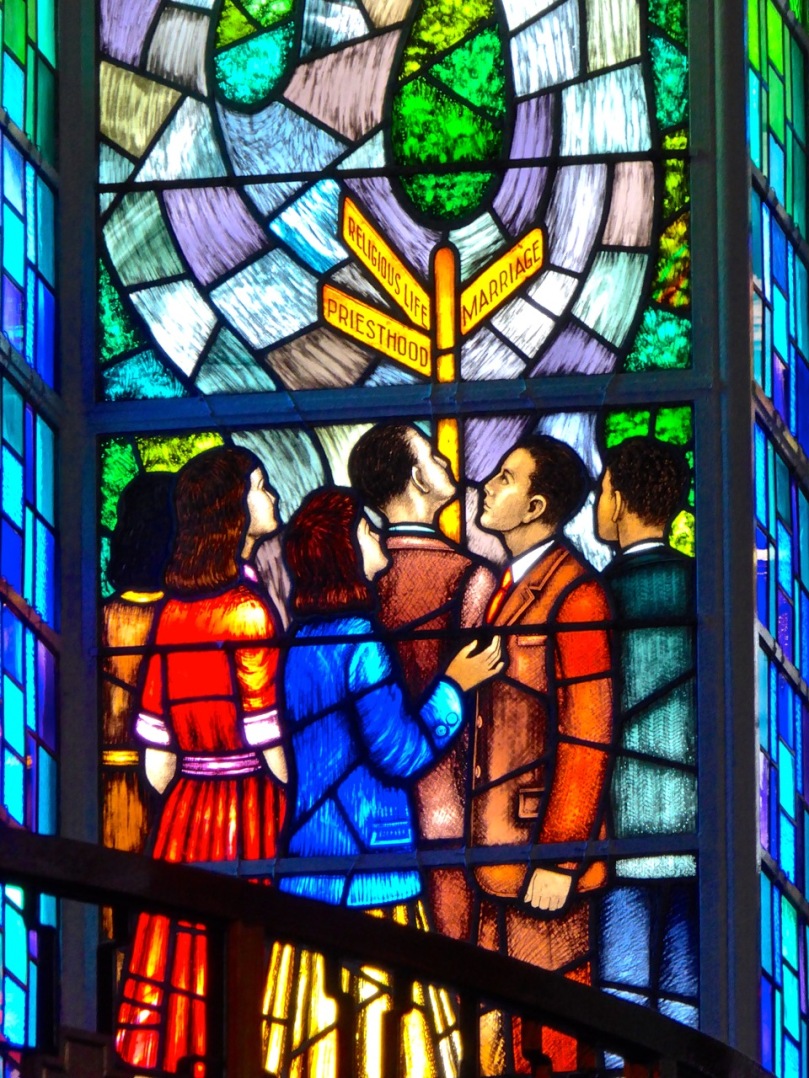
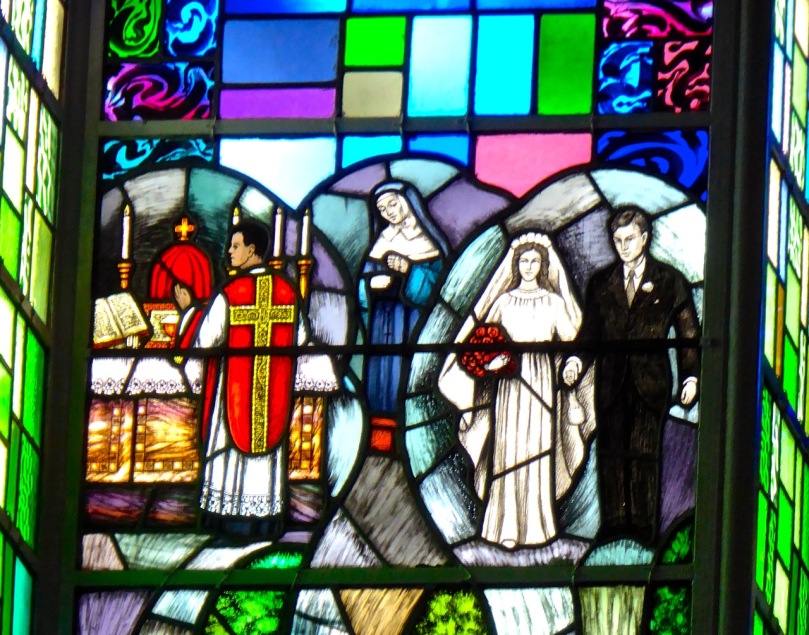
The one that brought me back to Mother Francisca shows earnest young men and women gazing at a directional sign which shows them their choices – marriage or the religious life. That was it! To hammer home the point the top of the panel shows a wedding, a priest and a nun. I’m casting my mind over the group of girls I went to school with – we didn’t produce any nuns and while most of us married I can’t think of a single one who hasn’t worked – we count among us an ambassador, teachers and principals, a town planner, an artist, a college dean, office administrators, a medical doctor, an international expert on child protection, a veterinary nurse, a parliamentary reporter, a lawyer…the list goes on. But none of this was discussed at school: we had no career guidance, no aptitude tests, no encouragement of any kind to think of ourselves as people who would work for a living. What’s curious is that we developed those careers in the complete absence of any kind of conscious preparation for them at the secondary school level.

Choices

Choices

Choices made

Choices made

The sixth frame might be my favourite. It’s the ‘work, rest and play’ lesson. At the bottom of the frame a happy family sits around the tea table. Above them men work on the fields and on top those men are playing Gaelic football while their wives sit on a bench on the sidelines and chat to each other. Men were to head the family, work and play hard, and women were to provide the supportive role. I doubt if anyone foresaw when that glass was designed in the 1950s that in the next century (only a few days ago in fact) two Irish rugby squads – the men AND the women – would bring home the Six Nations Cup for Ireland.

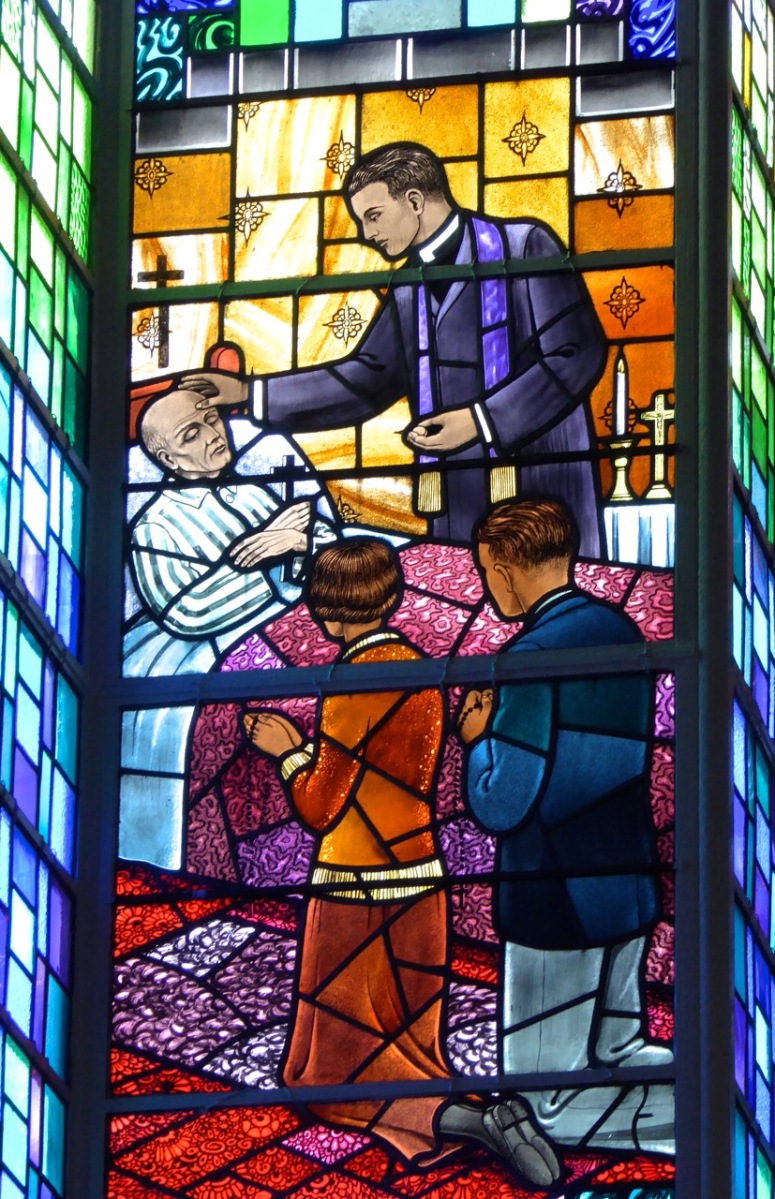
The last three frames deal with end of life, including Last Rights, death, and reception into heaven – the reward for living the exemplary life presented in the stained glass wall.

Last Rites

Last Rites

If you grew up like I did in 1950s Ireland, or if you are interested in the art and architecture or the social history of this period, the Church of All Saints in Drimoleague tells a fascinating story. There is little available online about this church – I couldn’t even find out who designed the windows. But my research revealed that one other person was as struck as I was by this church, although in a more scholarly way. Richard James Butler is a gifted young art historian from Bantry who is completing doctoral studies at the University of Cambridge. We were lucky to hear him speak at the Bantry Historical Society recently on the subject of the courthouses of West Cork – a topic we had no idea could be as interesting until we heard his erudite and engaging presentation. He has written a paper, All Saints, Drimoleague, and Catholic visual culture under Bishop Cornelius Lucey in Cork, 1952-9, which will be published in the next issue of the Journal of the Cork Historical and Archaeological Society. I’ve had a sneak peak, thanks to Richard’s generosity in sharing his findings with a fellow enthusiast. His paper deals with the Catholic ethos within which that era of church construction operated, with the role of the local community in commissioning such an unusual edifice, with the enormous mural, and with the windows. It was only after communicating with Richard that I learned that the windows were the work of the Harry Clarke Studios* and how unusual they were for their day in not being concerned solely with images of saints, the life of Christ, or Mary. If you get a chance to read his paper when it’s published, do so – it may make you take a fresh look at the legacies of 1950s Ireland by which we are still surrounded.

Devotion in 1950s West Cork

Devotion in 1950s West Cork

* For a discussion of the difference between Harry Clarke windows and Harry Clarke Studio windows, see this post.

Cork’s Rebel Daughter

most dangerous

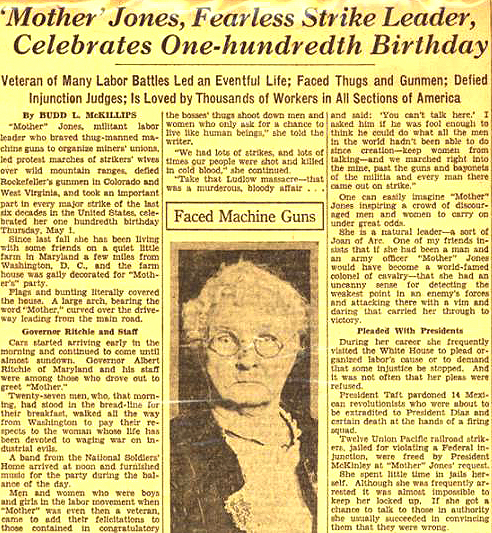
The Most Dangerous Woman in America

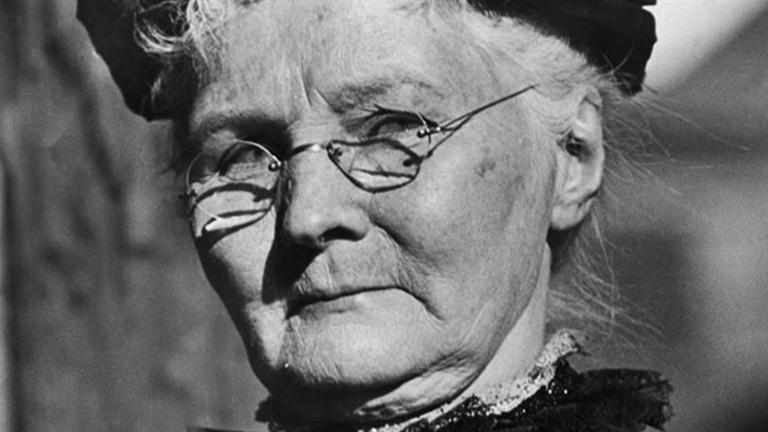
Mary Harris was born in Cork City in 1837. Like the lady herself, that’s a bit controversial: she claimed to have been born on 1st May 1830 – probably because that enabled her to celebrate her 100th birthday in 1930 – but also because the first day of May has always been associated with workers’ rights. She didn’t make a huge impact in Ireland, as she emigrated with her parents as a child. The first paragraph of her autobiography (published 1925 by C H Kerr + Co, Chicago) succinctly summarizes the early years of her life:

…I was born in the City of Cork, Ireland, in 1830. My people were poor. For generations they had fought for Ireland’s freedom. Many of my folks have died in that struggle. My father, Richard Harris, came to America in 1835, and as soon as he had become an American citizen he sent for his family. His work as a laborer with railway construction crews took him to Toronto, Canada. Here I was brought up but always as the child of an American citizen. Of that citizenship I have ever been proud…

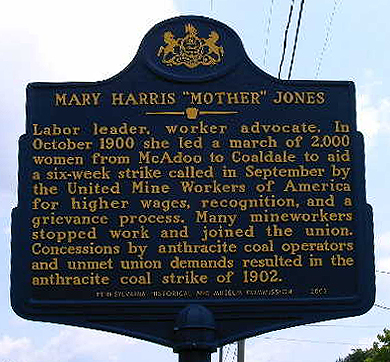
Mary Harris – Mother Jones – remembered in Cork (left) and in the US (right)

Mary was a ferocious socialist – perhaps influenced initially by her husband George E Jones, a member of the Iron Molders Union in Memphis. She lost her husband and four young children to a yellow fever epidemic in 1867, and seemed to take the emerging Labor Movement as her family thereafter. She re-created herself as ‘Mother Jones’ and spent the rest of her life supporting the rights of workers in the railroad, steel, copper, brewing, textile, and mining industries. The five foot tall white-haired Irish lady participated in hundreds of strikes all over America, and attracted public attention by mobilising miners’ wives to march with brooms and mops in order to block strikebreakers from entering the mines.

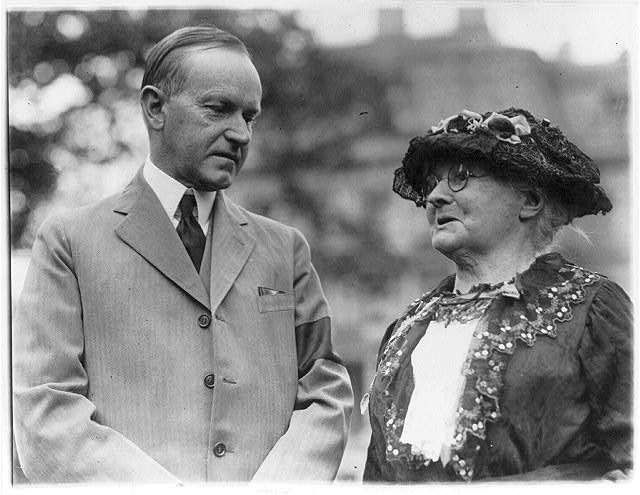
Mother Jones meets President Coolidge in 1924 (Library of Congress)

Mother Jones meets President Coolidge in 1924 (Library of Congress)

Mother Jones helped found the US Social Democratic Party (1898) and the Industrial Workers of the World (1905); she published articles in the International Socialist Review, met and lobbied (and gained the respect of) several Presidents and spent time in jail. On one occasion when violence broke out during a mine strike in West Virginia, a state military court convicted her of conspiracy to commit murder.  Nationwide protest led the Governor to commute her twenty-year sentence.

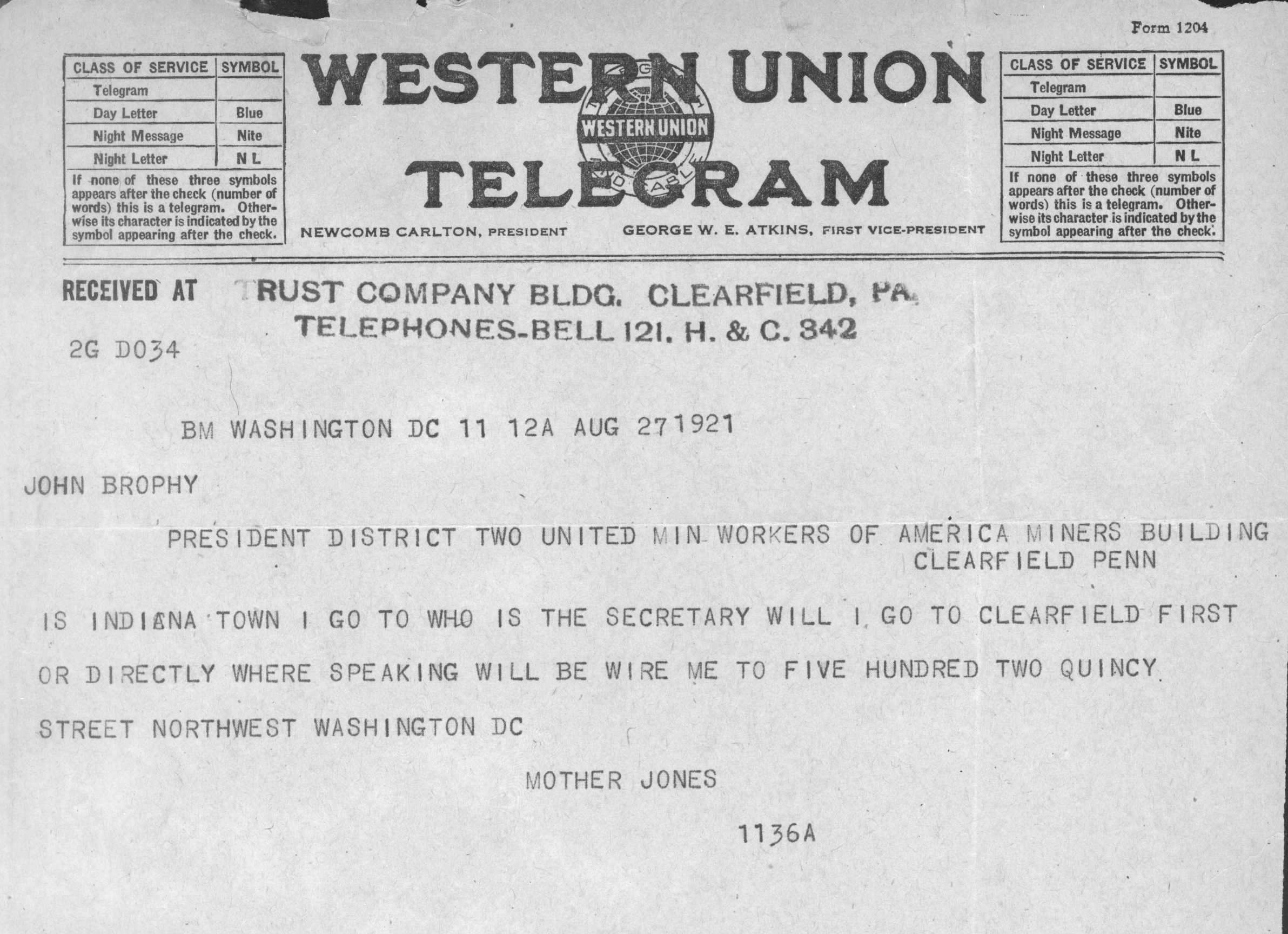
Mother Jones in action in 1921

Mother Jones in action in 1921

Some quotations ascribed to Mother Jones:

A lady is the last thing on earth I want to be.  Capitalists sidetrack the women into clubs and make ladies of them

Pray for the dead and fight like hell for the living

My address is like my shoes. It travels with me. I abide where there is a fight against wrong

No matter what the fight, don’t be ladylike! God almighty made women and the Rockefeller gang of thieves made the ladies

I asked a man in prison once how he happened to be there and he said he had stolen a pair of shoes. I told him if he had stolen a railroad he would be a United States Senator

The employment of children is doing more to fill prisons, insane asylums, almshouses, reformatories, slums, and gin shops than all the efforts of reformers are doing to improve society

I’m not a humanitarian, I’m a hell-raiser

memorial

Strangely, Mary did not support the women’s suffrage movement in the United States: she considered it a middle class diversion taking the focus away from the fight against social injustice and basic universal rights for all workers. In her eighties she was still actively supporting strikes involving streetcar, garment and steel workers.

Mary Harris Jones died on November 30, 1930.  After being celebrated by a mass in Washington DC, she was buried at the Union Miners’ Cemetery in Illinois, next to victims of the Virden, Illinois mine riot of 1898.  Her funeral was attended by thousands of labour supporters, mine workers and other mourners.

Cork remembers this daughter of revolution: we found a commemorative plaque in the Shandon district, close to the old Butter Market – historically the city’s most notable industry. In the States her name lives on also: Mother Jones is an independent, non-profit making magazine and website reporting on politics, the environment, human rights, and culture ‘…that in its power and reach informs and inspires a more just and democratic world…’

MoJo – the liberal Mother Jones Magazine

Bravo, Mary Harris of Cork, for being so committed to the fight for the basic rights of humanity in general and the working population in particular. And watch out, capitalists and oppressors – as she is reported as saying frequently ‘…the kaisers of this country are next, I tell ye…’

motherjones1


New Archaeology

Unexpected Discovery...

Unexpected Discovery…

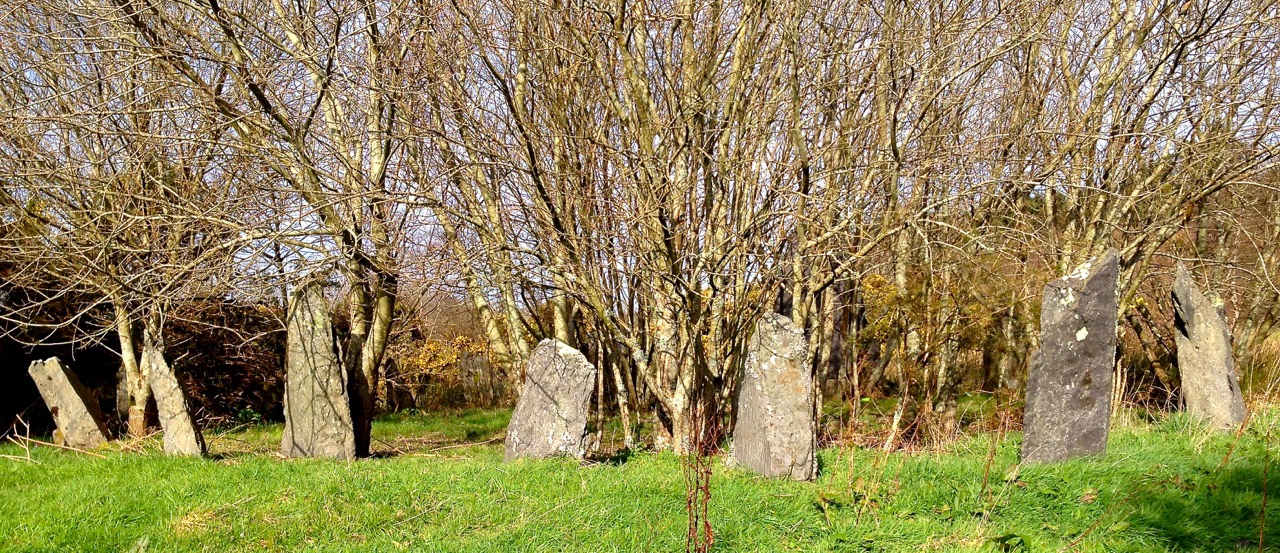
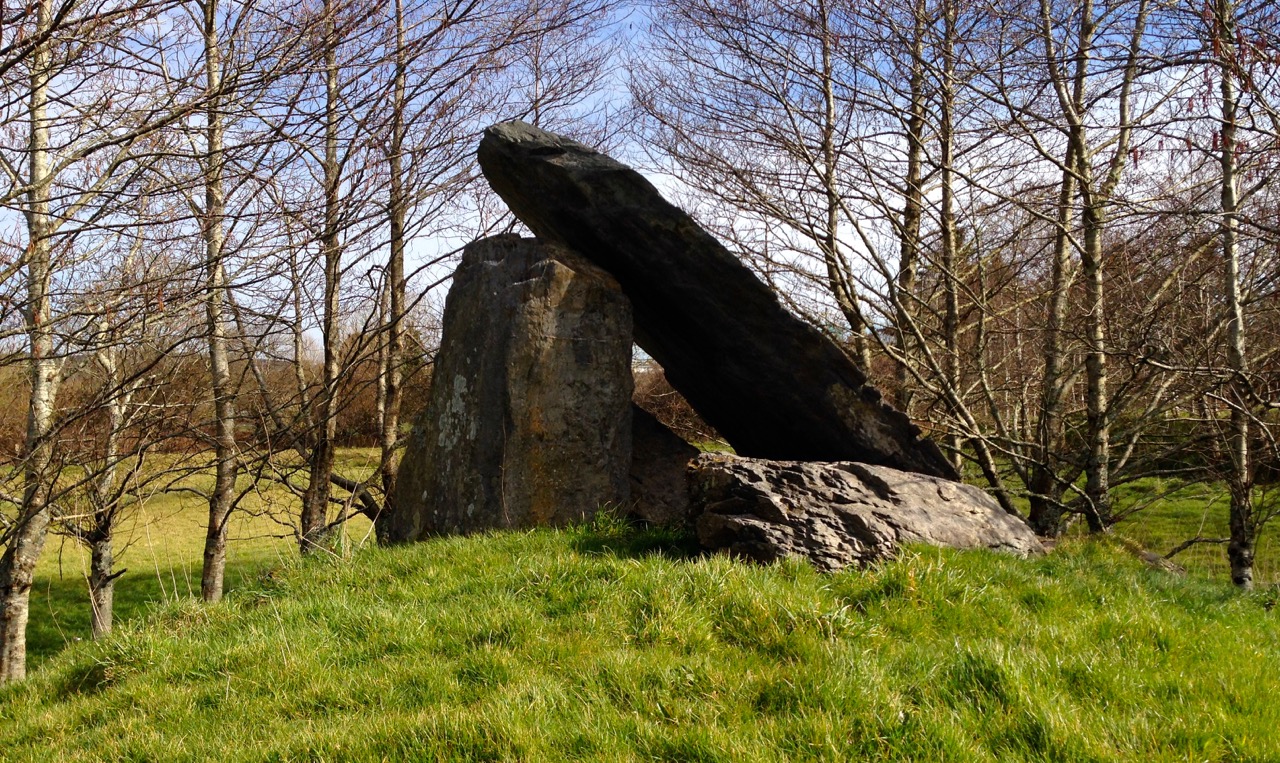
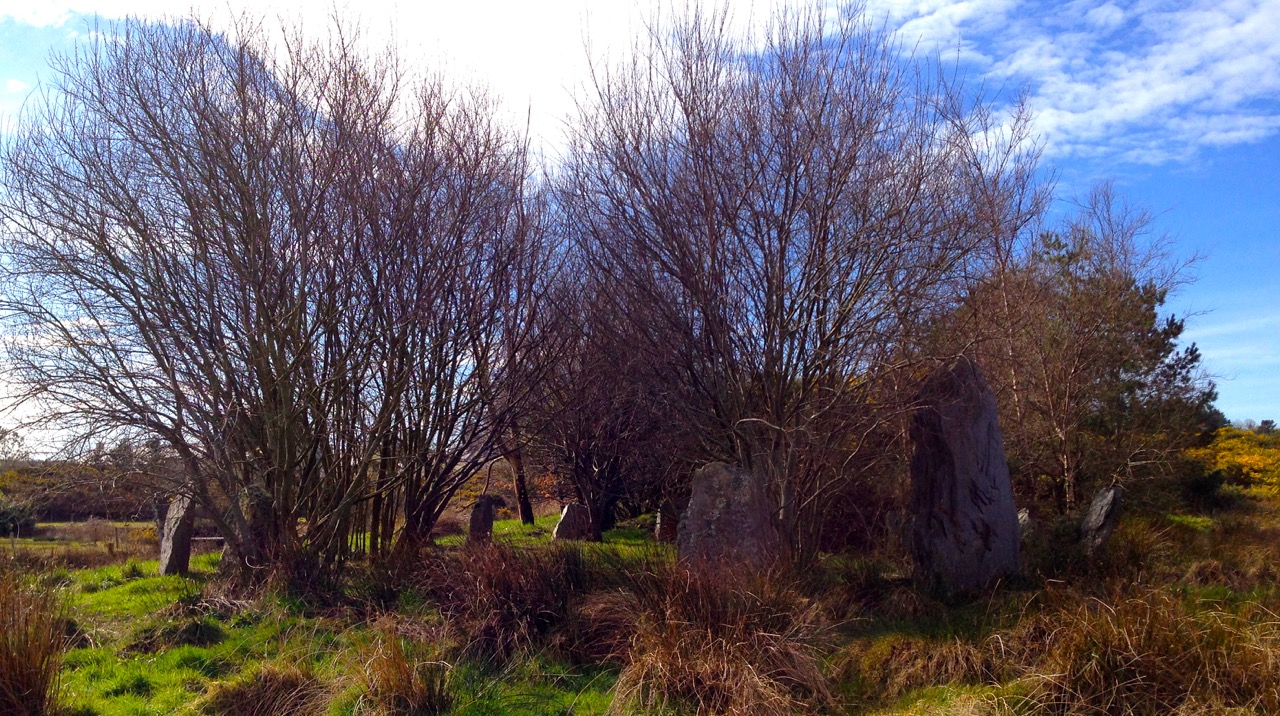
Wow! A hitherto unrecorded stone circle, a boulder burial, a gigantic standing stone and a dolmen… all found on a Saturday morning walk.

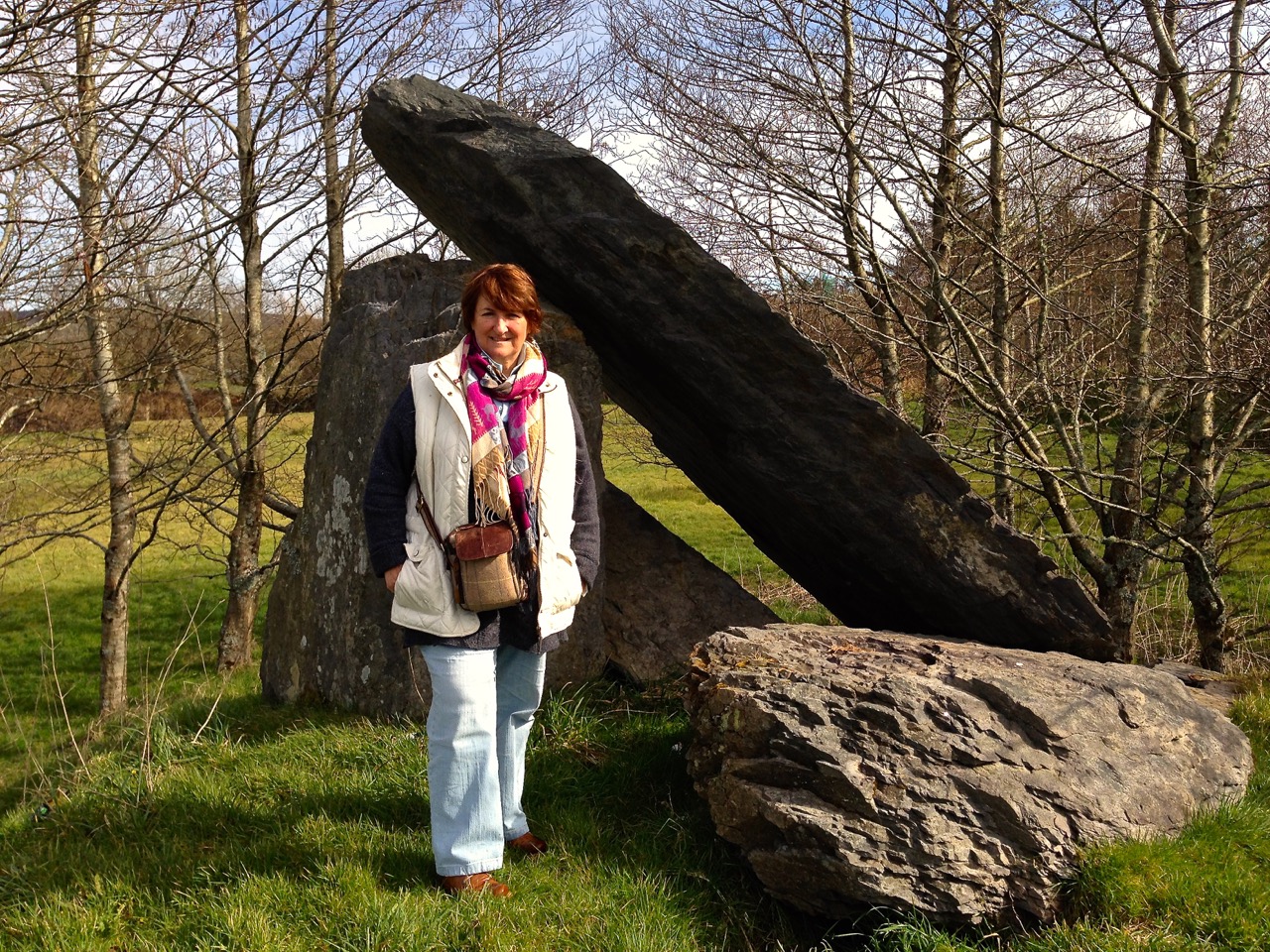
Ballydehob's Dolmen

Ballydehob’s Dolmen

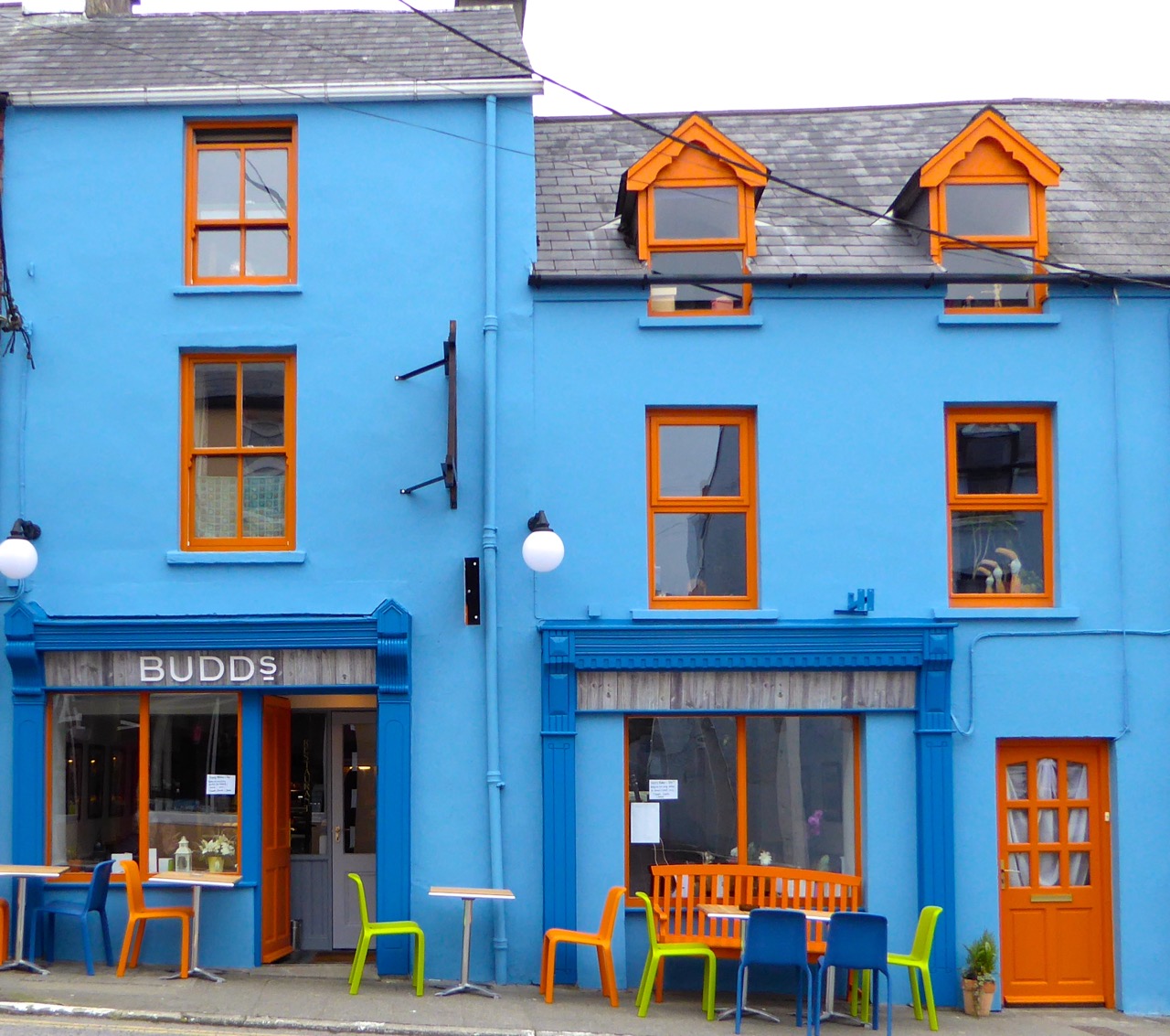
Budds

Our expedition began after a great breakfast in Budds – Ballydehob’s newest eating venue: try it out – it has an attractive cheerful atmosphere and the food is excellent. After this sustenance we set out to explore – for us – uncharted territory. Did we travel miles out into the wild hills of West Cork to find these remarkable pieces of archaeology? No, we walked a few metres down the road…

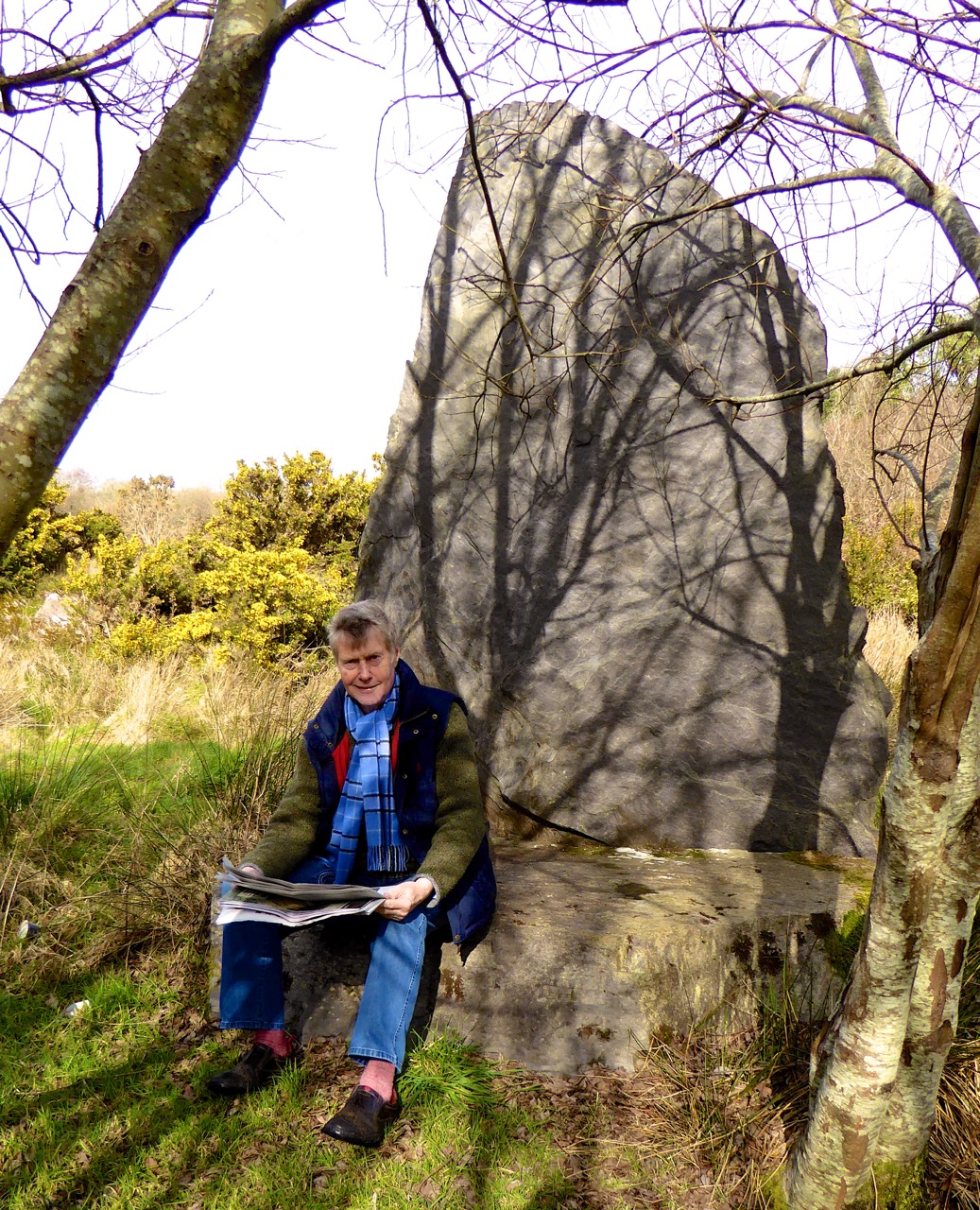
Time for the weekend paper - Robert takes to the Druid's Chair

Time for the weekend paper – Robert takes to the Druid’s Chair

Right behind the main village street in Ballydehob is a spectacular example of twentieth century Irish history: a golf driving range with a prehistoric theme!

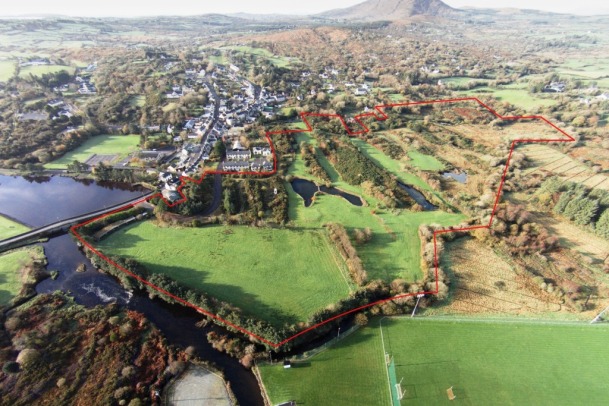
Aerial view of the site

Aerial view of the site

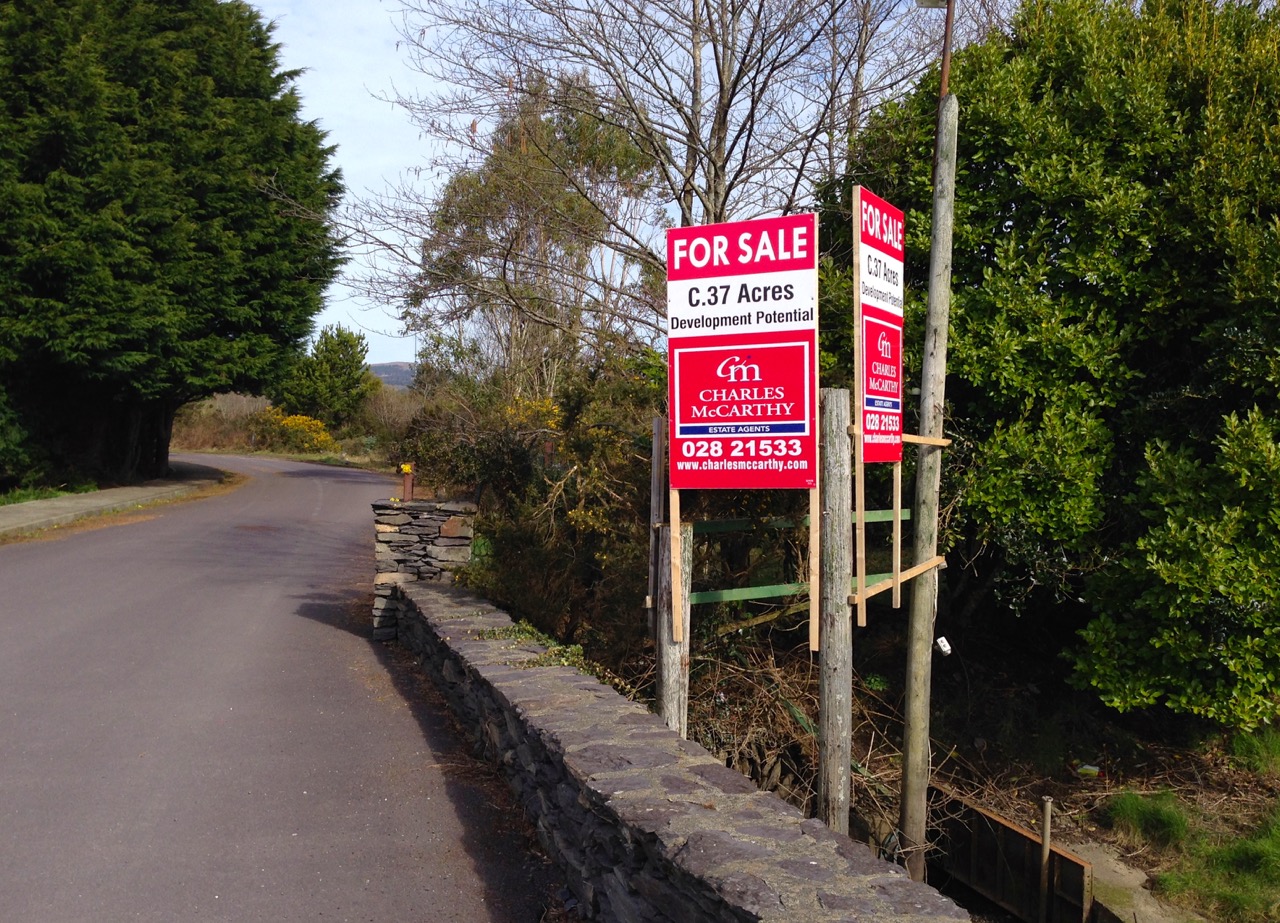
Ballydehob’s Golf enterprise came with the Celtic Tiger – and went when the Tiger collapsed. It’s now a site looking for a buyer – you could have it!

for sale

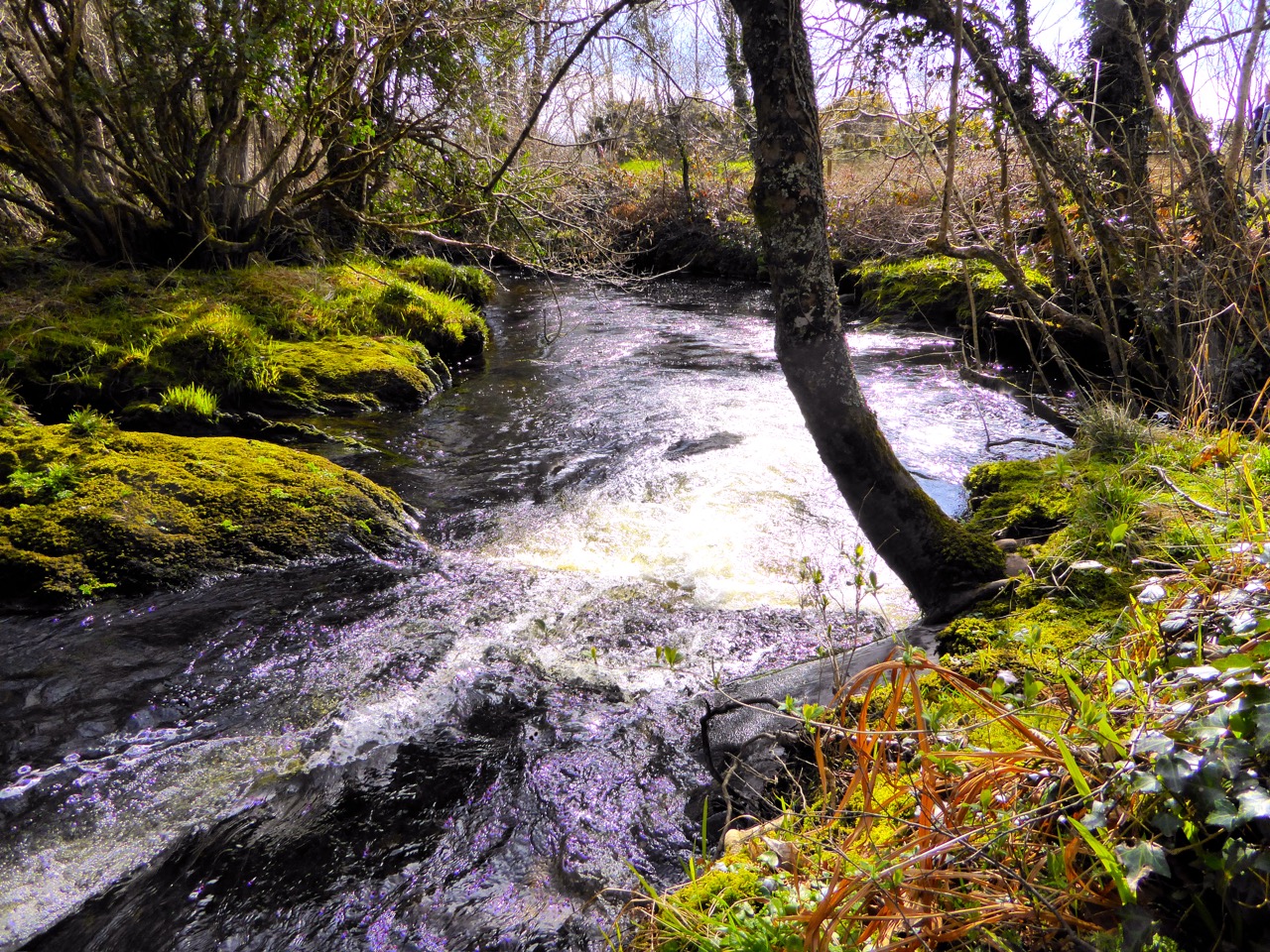
But we do hope that if someone does buy the site, then they keep all the features: the winding paths by the river, the parkland which feels so rural and secluded, yet is within a stone’s throw of the main N71 highway – and all the New Archaeology...

Riverside Walk...

Riverside Walk…

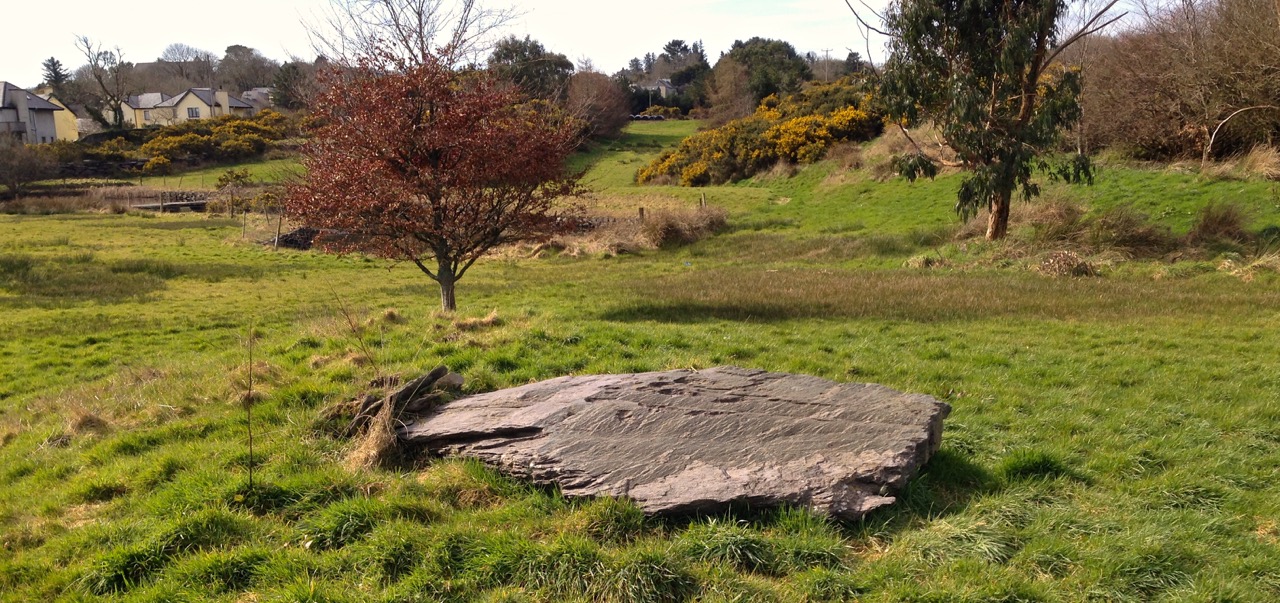
Boulder Burial...

Boulder Burial…

Circle within an 'ancient grove'...

Circle within an ‘ancient grove’…

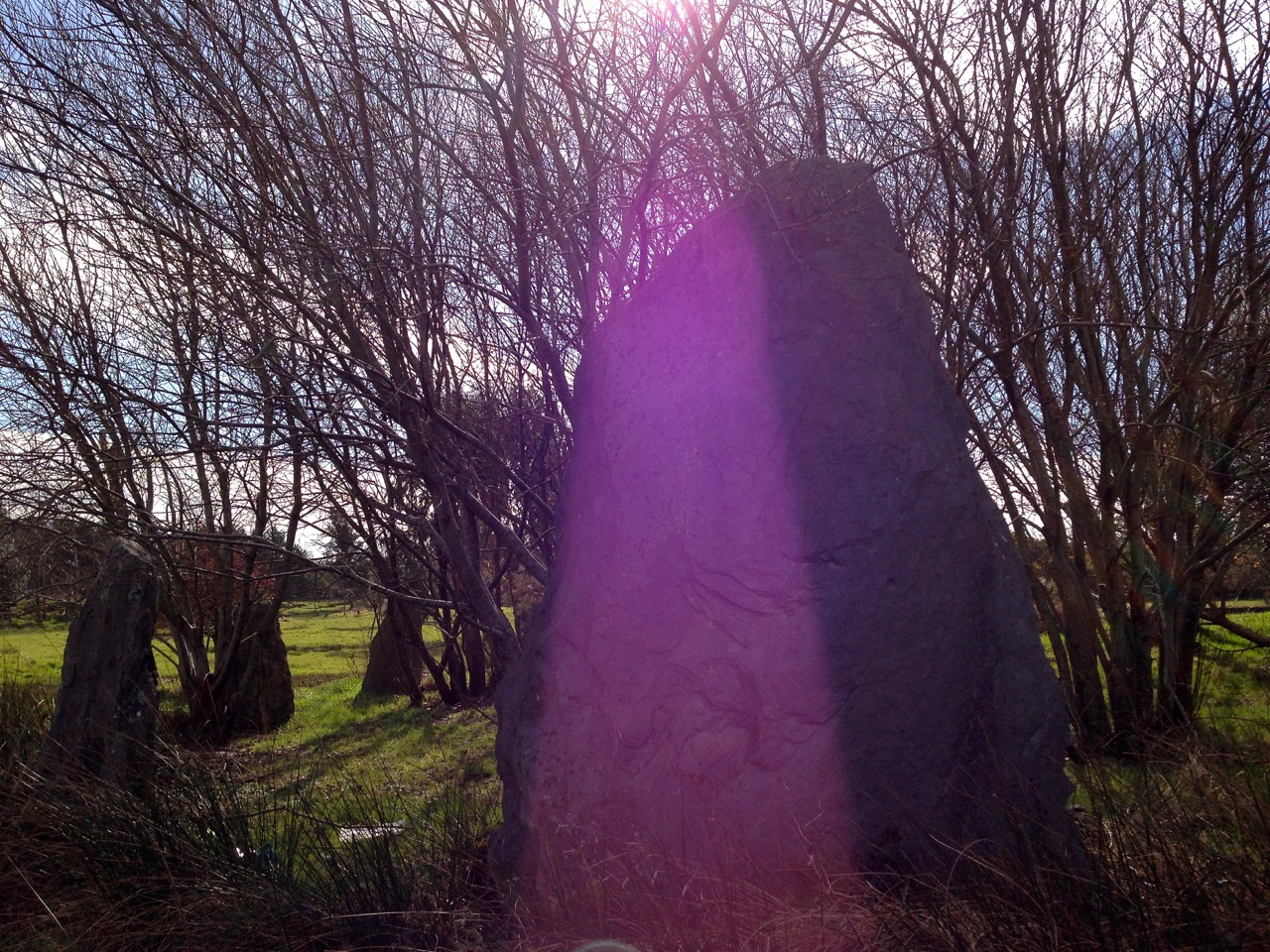
Megalith, enjoying a trick of the sun...

Megalith, enjoying a trick of the sun…

The unfortunate demise of the West Cork Golf Academy has left Ballydehob with an unofficial ‘town park’ – a very pleasant place to walk on a balmy spring morning. If only there was a way that this could become a permanent amenity for the community. But the land has a value and – presumably – potential for some worthwhile development. Who knows what the future holds? Meanwhile, we enjoyed our chance discovery of New Archaeology right on our doorstep!

PS – since publishing this post earlier today, I realise from comments received that some readers have been puzzled by it: rest assured that all this ‘new’ archaeology dates from the twentieth century – and was constructed as part of the golf project! They made such a good job of it that it could just prove very confusing for archaeologists of the future…

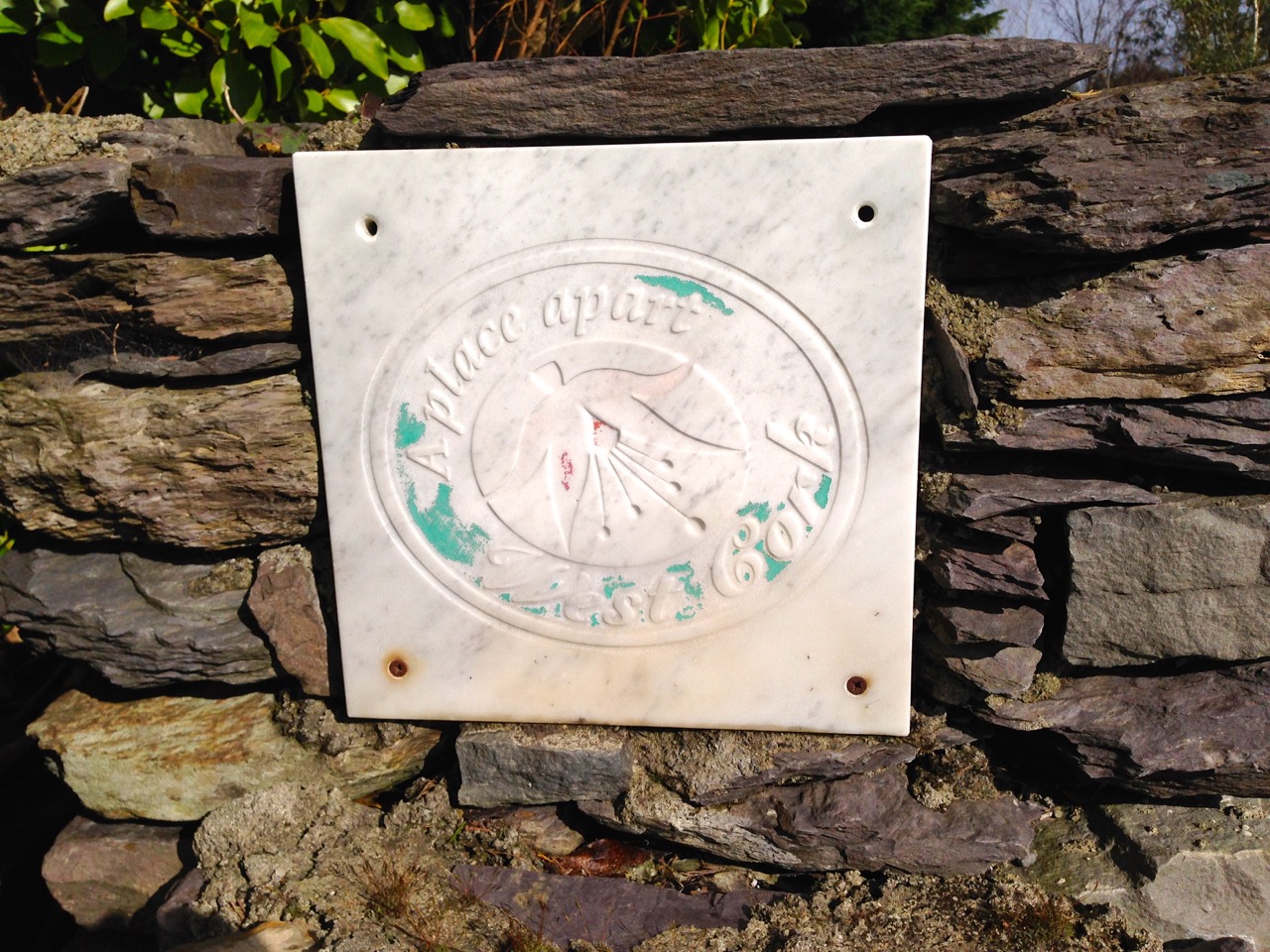
A Place Apart certainly - the Fuscia Brand labelling dating from better times

A Place Apart certainly – the Fuschia Brand labelling dating from vanished times

Finola enjoys the spirit of 'A Place Apart'

Finola enjoys the spirit of ‘A Place Apart’