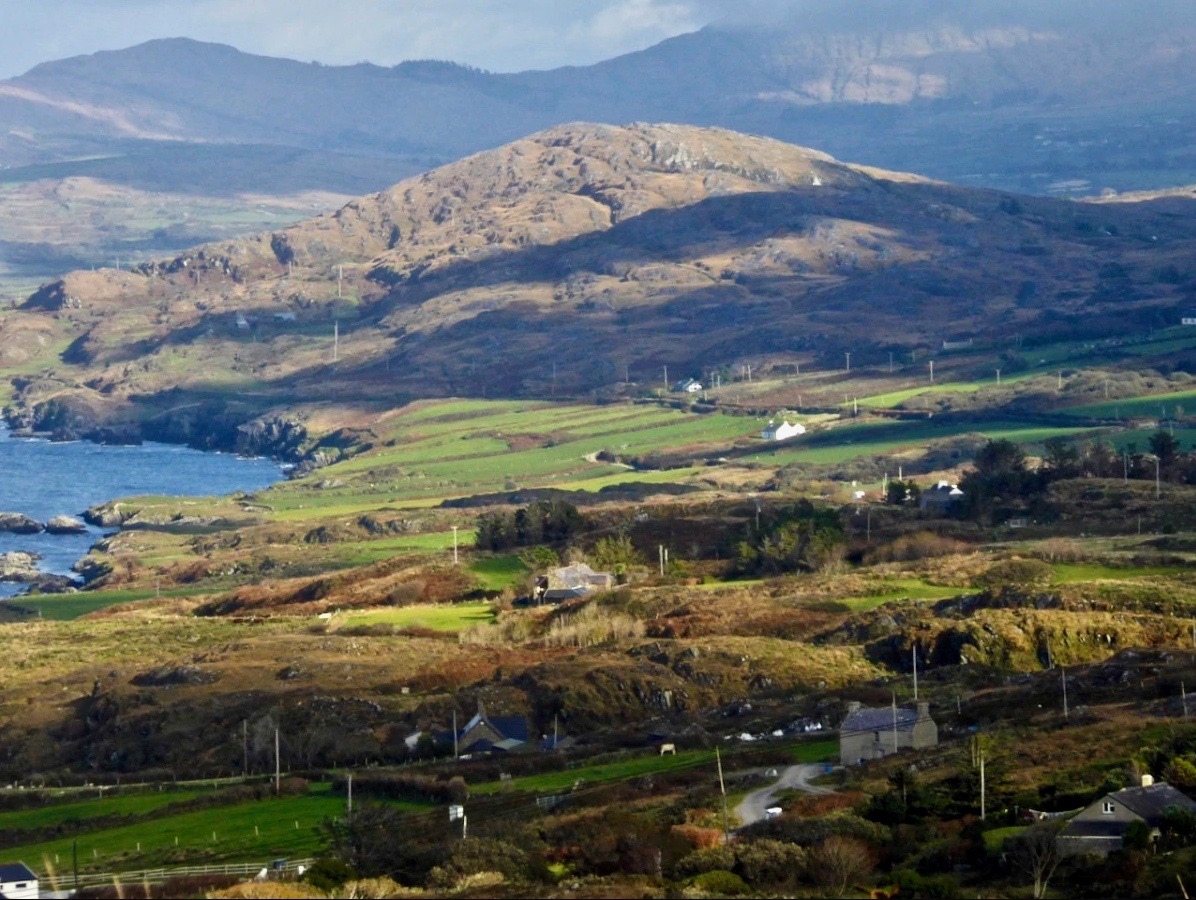
The story of a Swiss Government foray into West Cork at the time of the Cold War has seeped into folk memory. When we settled in Ballydehob in the early twenty-first century we heard many accounts and – as is often the case – sensation takes preference over sober fact. Nevertheless, the tale is worth telling, and I have set out what I perceive to be accurate. It all centres around the man above – Colonel Albert Bachmann – and two locations: Murphy’s Cove, Tregumna, and Liss Ard House, just outside Skibbereen.
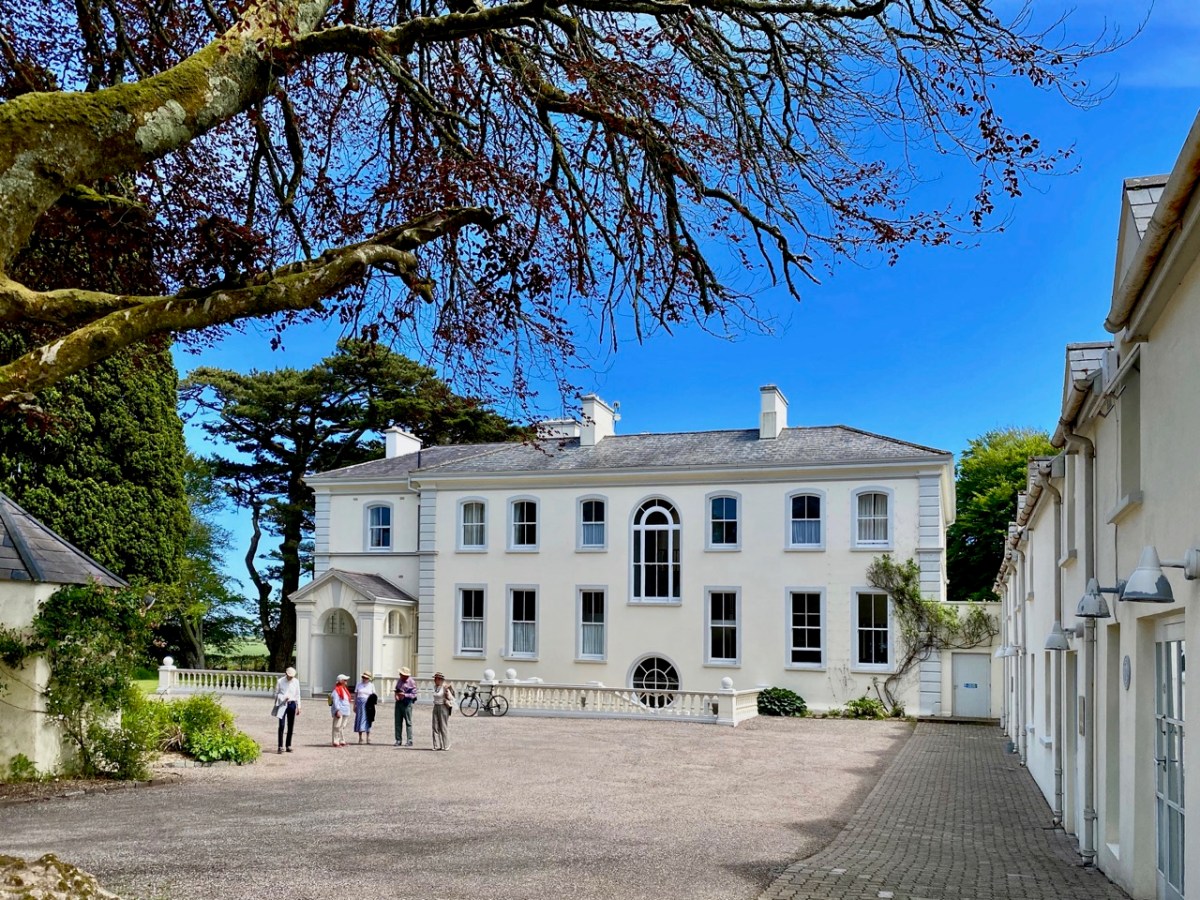
Contrasting atmospheric conditions: Murphy’s Cove, Tregumna, on this misty October day (upper pic) and Liss Ard House on a beautiful June day in 2021 (lower pic). Our story properly begins in 1962 . . .
The cover of Esquire magazine, January 1962 features an article headed ‘9 Places in the World to hide’: one of these places is “Cork – Ireland”. In fact, the article suggested that Cork was considered the safest place in all Europe in which to hide from the predicted nuclear holocaust. I was a teenager in the UK at the time, and remember the worries of everyday life through that year – in particular the Cuban Missile Crisis. 1963 was little better – dominated by Kennedy’s assassination. We didn’t have a television in those days – friends did; but our ears were glued to our wireless sets, not knowing what to believe, or expect. Now – sixty years later – I’m older and wiser. I survived.
. . . COLONEL ALBERT Bachmann, who has died in Cork at the age of 81, was the James Bond of Switzerland. He came to west Cork in 1963, fell in love with the area and bought property there. At the time he was rising through the ranks of Swiss military intelligence, though Switzerland is typically seen as the world’s most neutral state with few if any belligerent enemies. Bachmann took himself on a secret mission to Biafra, then trying to secede from Nigeria, where he implied mysteriously that he was involved in secret arms deals with the Shah of Iran. He passed himself off as an upper-crust Englishman called Henry Peel who smoked a pipe, though with his Germanic accent it is difficult to imagine this disguise was successful . . . He was promoted to Colonel in the intelligence and defence section of Switzerland’s Untergruppe Nachrichtendienst der Armee (UNA). This gave him authority over three units of secret Swiss military intelligence, including a special service set up to respond to any threat of Soviet invasion, which he felt very sure could happen . . . .He hunted with the West Carberry, where he was something of an embarrassment, having his own ideas about which fields he could gallop across without the permission of the owners . . .
Obituary in the Irish Times 14 May 2011
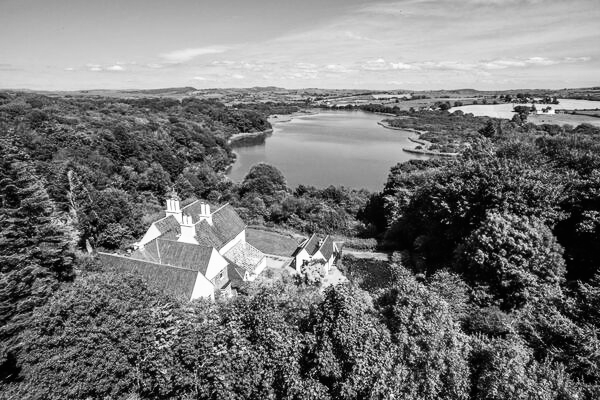
It has been said that, with Swiss military money, he bought 200 acres of land in West Cork, including Liss Ard House (above, from Skyscape). From 1976 onwards, Colonel Bachmann converted Liss Ard into an exile for the Swiss Federal Council (the governing body of the country, which has seven elected members). Known locally as “The Funk Hole of Europe”, it was equipped with all modern high-tech computer facilities long before such equipment was widespread in Ireland. The cellars were dug out and strengthened to store the massive Swiss gold reserves that the government would bring with them.
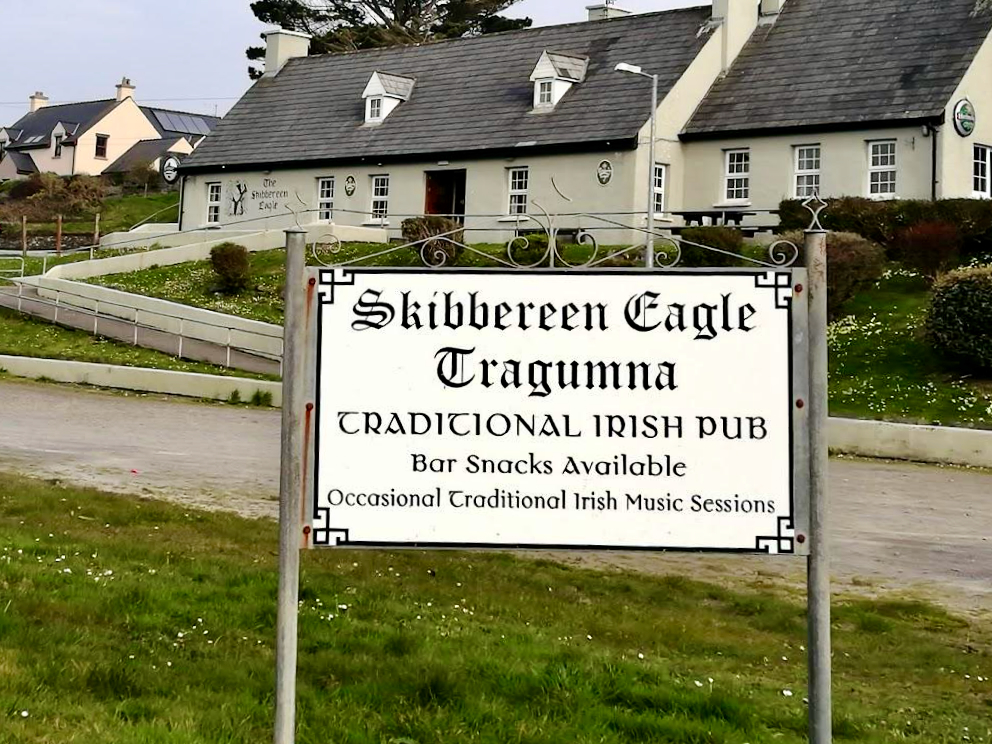
Above are some of the cottages in Murphy’s Cove that Bachmann bought, possibly also with Swiss money. Ostensibly they were to house fleeing diplomats in the event of the predicted collapse of civilisation. The Colonel’s interests, however were not always related to the Cold War. He set up a pub in Tragumna, the Skibbereen Eagle: named after an infamous local newspaper. Rumour has it that the kitchens were oversized because they would have to feed the exiled envoys. It’s still a popular establishment.
In fact, the more you try to delve into the life of Bachmann, the more enigmas you encounter. Some reports say that he raised the money himself to purchase Liss Ard: the historian Titus J Meier showed in a book that Bachmann acquired the property on the west coast of Ireland with the help of private and institutional sponsors. The Swiss Government only paid annual rent twice, each time amounting to 50,000 francs.
. . . Bachmann was obliged to retire in 1980. An official investigation criticised P-26 [a Cold War stay-behind army in Switzerland charged with countering a possible invasion of the country] as an illegal paramilitary programme, operating as a clandestine, parallel structure within the Swiss security network, and lacking governmental authorisation or control. When Bachmann’s secret army was finally dismantled, its war chest – gold worth six million Swiss francs – was donated to the Red Cross. But he always insisted that it served a vital function. “How vital,” Bachmann told the reporters who sought him out, “I cannot tell you.” . . .
Bachmann’s Obituary in The UK Daily telegraph
Another view of Liss Ard Estate (courtesy Irish Examiner)
Esquire Magazine January 1962
Col Albert Bachmann: born November 26, 1929; died April 12, 2011
Above – on the left is the old Vaughan’s Hall in Ballydehob. Local historian Eugene McSweeney tells this tale:
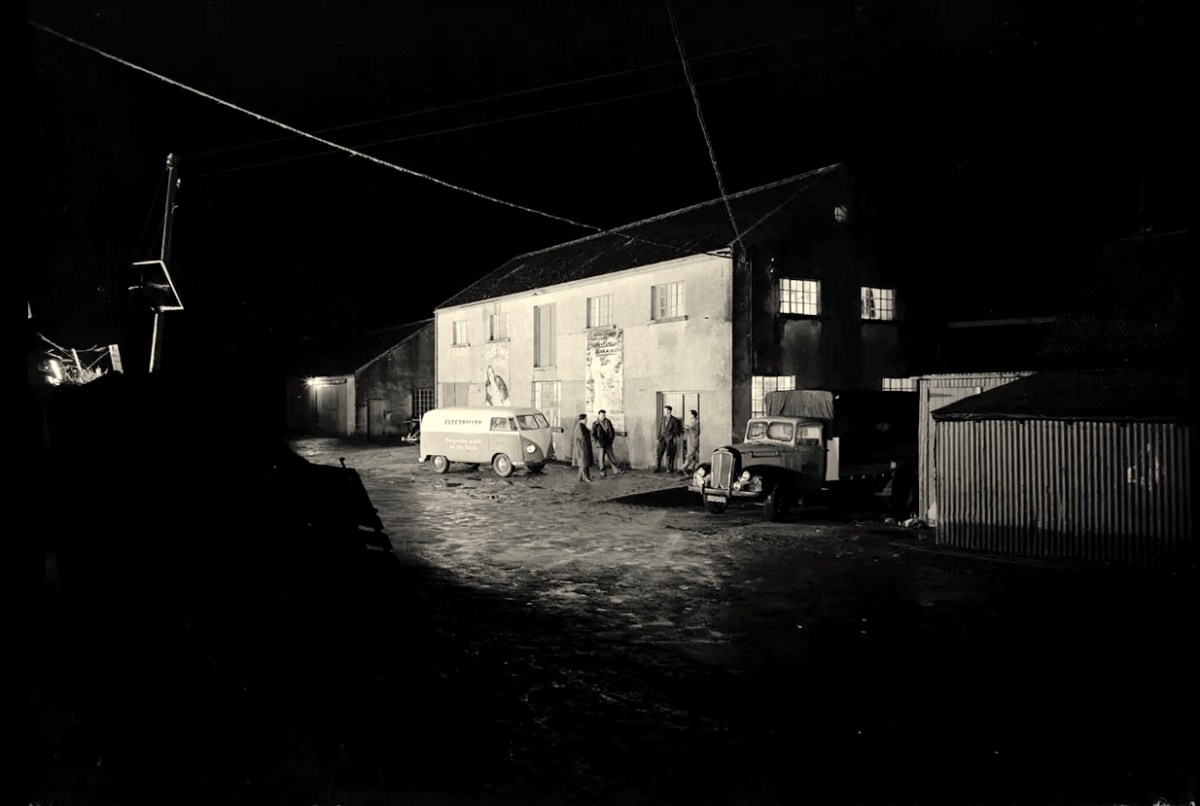
. . . This hall in Ballydehob ‘had the Electricity’ around 1951-52. UK Queen Elizabeth II was crowned in 1953 – June 2 – and a film was made by the BBC. This film was sent around to be shown in village halls etc all over Britain, but also in Ireland. Vaughan’s Hall was able to borrow a projector, and an evening was set aside to show the coronation film. There were ‘some local lads’ who felt that good Irish citizens shouldn’t be gawking at this English Royal event. They brought some heavy chains, and threw them over the new electric wires connecting into the hall. This caused a short circuit and the lights – and the film – went out! Ballydehob had to wait for another day to see the coronation . . .
Eugene McSweeney, Ballydehob
During the 1930s most towns in Ireland were connected to the National Grid. The outbreak of World War II in Europe led to shortages of fuel and materials and the electrification process in Ireland came to a virtual halt. In the early 1950s the Rural Electrification Scheme gradually brought electric power to the countryside, a process that was completed on the mainland in 1973 – not without some Herculean efforts by the on-site crews . . .
. . . While battling with the rocks in the Schull/Ballydehob fastnesses, blasting our way to our goal, we were informed that our next area was Castletownbere. No stick of exploding gelignite could produce more of a stunning effect in the Area Office than when the news reached us. Then we knew we were being accepted and acknowledged as mountainy men, men of steel and gelignite, capable of shaking still further the serenity of the West Cork mountains whose calm had not been disturbed by the noise of men and clash of steel since O’Sullivan Bere . . .
ESB ARCHIVES – AO Report 1951
Above – the pegging teams faced an onerous task when they moved over to the Beara Peninsula. Here are extracts from the reports of the Area Officer when works set out towards Castletownbere in late 1951:
. . . In November 1951 I left Ballydehob to visit Castletownbere area, the future scene of our endeavours. Looking at the country between Glengariff and Castletownbere I wrote off the battle of the Schull area as a skirmish, as I felt that the real battle was here. Here were crags, crevices, canyons, woods, bogs, etc, which defied all exaggeration. W Trusick, the pegging engineer, was very much depressed at the thought of what lay ahead of him as we climbed up the winding road from Glengarriff to the heights of Loughavaul and beyond again to Coolieragh. However, when we topped the climb at Coolieragh the vista of mountain and sea that met our eyes gave us a temporary respite from our morose reflections . . .
ESB ARCHIVES
Extract from the reports of the Area Officer when works set out towards Castletownbere in late 1951:
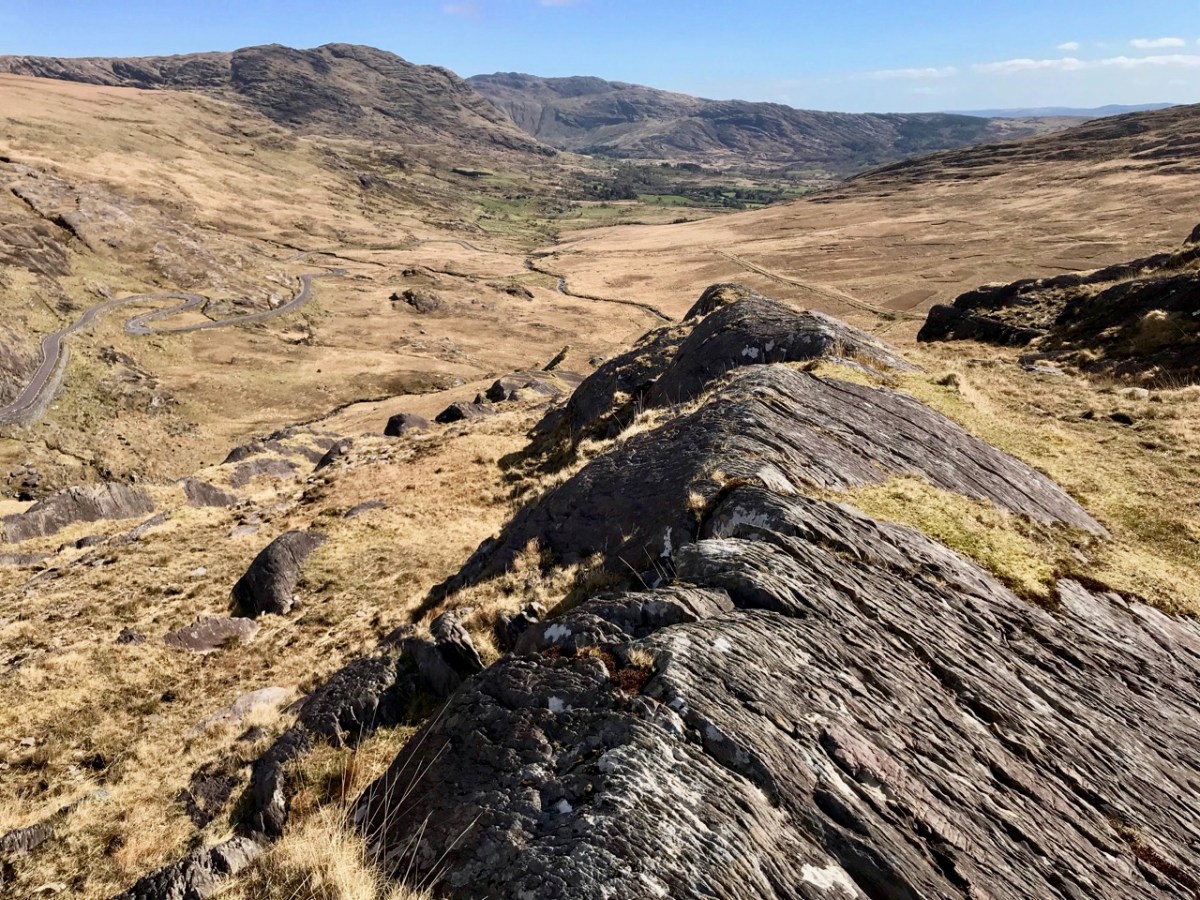
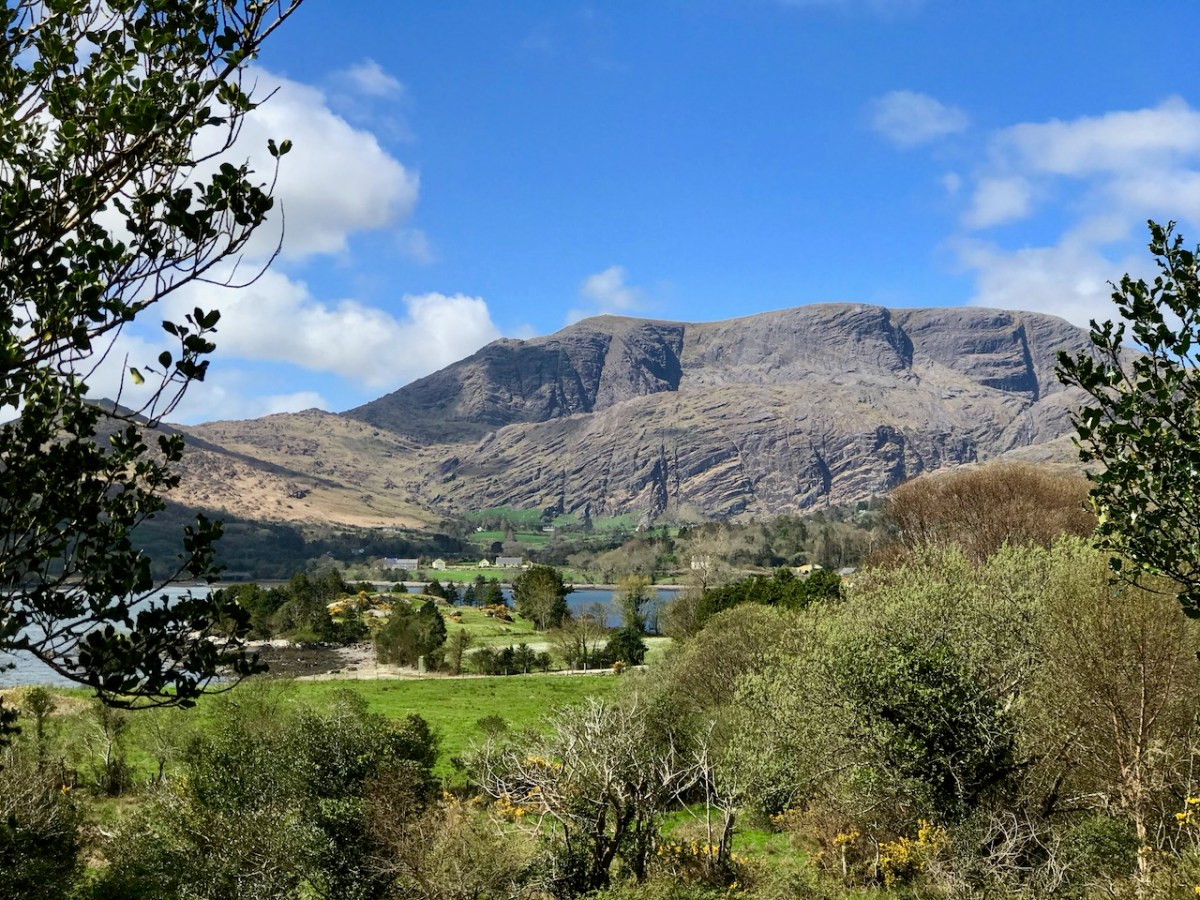
. . . Here was a scene that is hard to equal anywhere else in Ireland. Ahead of us lay the country of O’Sullivan Beara. Away in the distance lay Beara island like a sleeping monster resting on the sea, protected on the northern side by the massive bulk of Hungry Hill, and farther west by a ring of mountains whose western slopes dip down into the Atlantic Ocean. Behind us we looked across Bantry Bay at Bantry away in the distance sheltered by the bulk of Whiddy island. Nearer to us was Glengariff with its myriad of islets and heavily wooded hinterland, cosy and comfortable looking, secure in the shelter of its encircling mountains. On a cold November day in the weak wintry sunshine people do not stay long admiring scenery from such a dank vantage point as Coolieragh, and so we continued our journey westwards along by Adrigole, close to the Healy Pass, skirting the foot of Hungry Hill with its silver streak waterfalls and finally we arrived at the capital of the Beara Peninsula, Castletownbere . . .
ESB Archives
. . . Mr O’Driscoll and his crew in Dromahane, had apparently two major obstacles: First, the landed gentry who vehemently objected to the “beastly sticks” being put anywhere on their land: the second being a van which objected to moving under any circumstances whatever. Of the original 320 economic acceptances, 57 were ‘backsliders’, most of these being cottagers and small farmers. As an offset, 20 new consumers were gained, mostly having large premises, with the result that the total revenue was increased by £2. Only 20 premises were wired for outside light, due, in general, to the speed with which the contractors wanted to move from one house to another, and to their telling their clients that outside wiring could be done after they had been connected to the supply lines. Principal items sold in the area were 20 cookers, 30 irons, 20 kettles and 11 Milking Machines. Milking Machines are becoming increasingly popular in this area, solving as they do, the problem of milking on a Sunday when, normally, labour is not available. Mr O’Driscoll is doubtful if post development will meet with any marked success . . .
ESB Archives – DromAhane, Co Cork
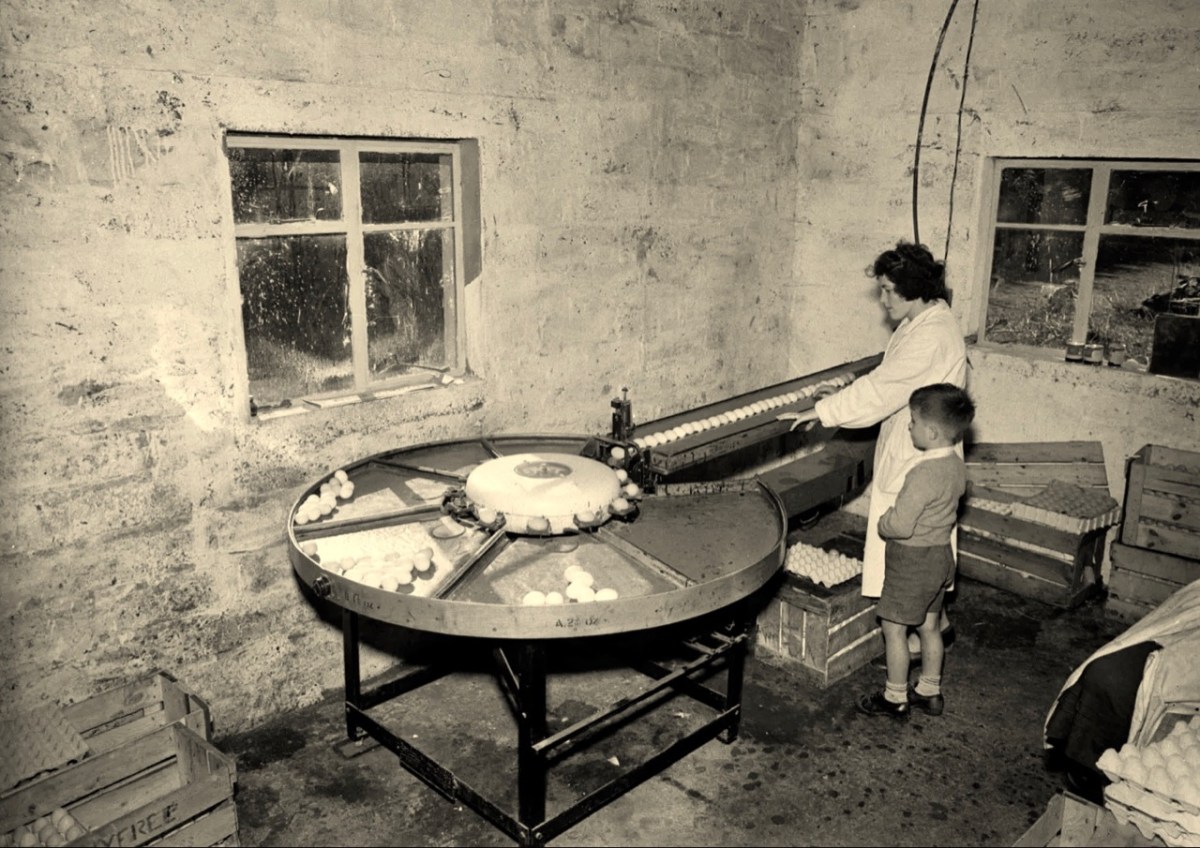
It’s intriguing that the reports in the ESB Archives from the time of installation so often represent negative views about the ‘success’ or otherwise of the rural electrification project (Mr O’Driscoll is doubtful if post development will meet with any marked success). It’s as if this ‘new fangled’ technology is never going to take the place of the way traditional life is lived in remoter places. With this viewpoint, the drudgery of manual tasks such as bringing in water from an outside source, cooking, washing clothes is likely to continue, with the housewife / farmer’s wife and their children having maximum input. It’s just as well that a more enlightened attitude prevailed in some places – here’s an early taker of the benefits of an electric egg sorting machine (ESB Archives):
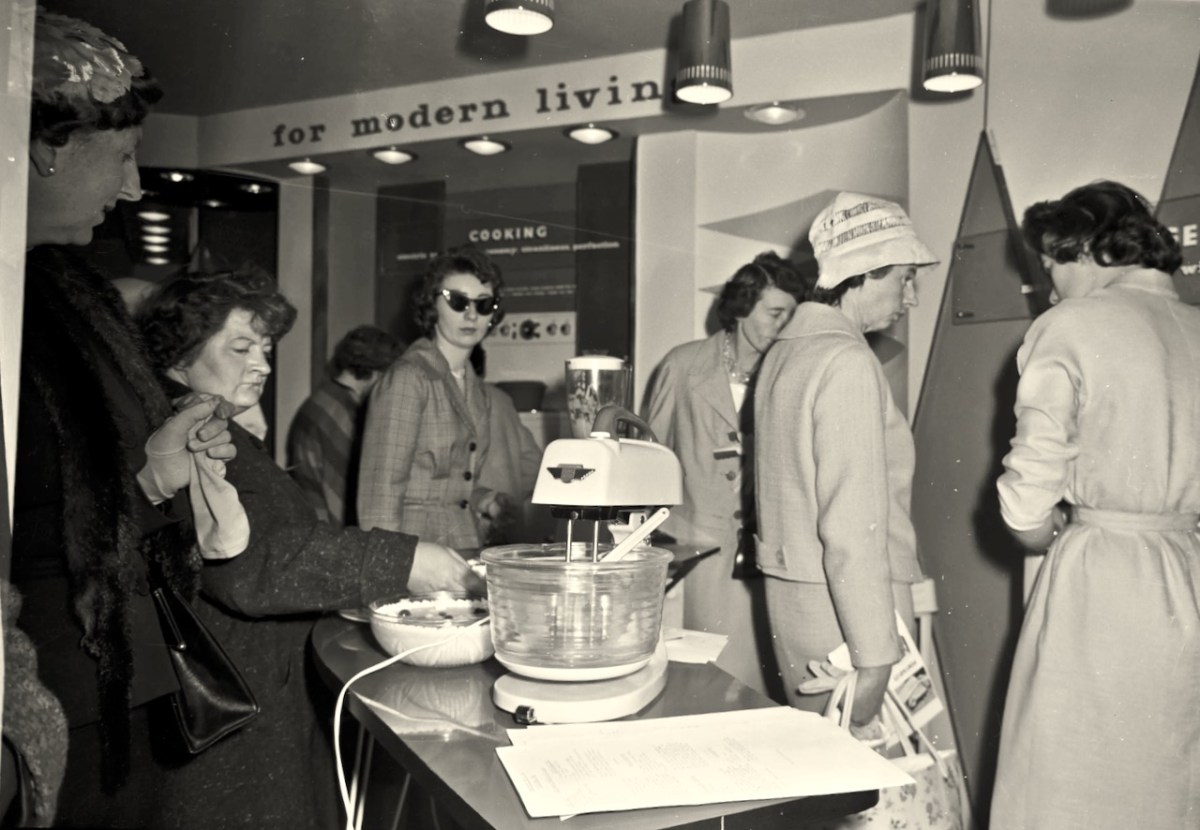
In urban areas, there was certainly enthusiasm for the improvements which ‘modern living’ offered (below). The new devices must have appeared exotic at first, but no doubt their benefits were instantly apparent to those who set their minds positively.
The heroes were the riggers and the geligniters, braving the elements and the raw landscape, to eventually bring power to the furthest reaches of rural Ireland (a task not completed, it could be said, until 1991, when Cape Clear – off our own West Cork coast – was connected to the National Grid). After those heroes came the dealers and traders. Someone had to provide all the water heaters, pumps, milking machines, refrigerators, cookers, washing machines . . . It was big business.
Above – an ESB salesman exercising persuasion on a willing customer. The man looks on! Below – interesting juxtaposition . . .
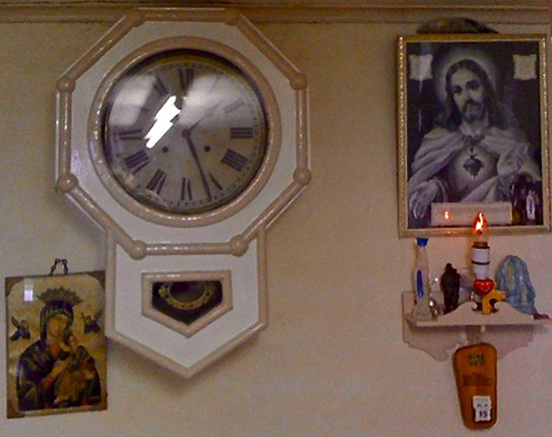
. . . Once a community was connected, or about to be connected, the ESB held public demonstrations of household appliances. These were then sold bringing electric irons, kettles, stoves to homes. The demonstration evening in Glenamaddy was held in January 1951. The handwritten report records that it took place “in the very fine Esker Ballroom”; these events were social occasions that brought communities together. The Glenamaddy evening “was attended by about 90, including 50 women. As is usual, the women appeared to be more keen than the men and more inclined to ask questions (and to argue). After the demonstration, a melodeon player turned up and an impromptu dance got under way” . . . Small towns and rural townlands became brighter and winters less harsh and Christmas more special as the fairy lights began to shine. It also gave rise to a rural Irish icon as every house had the Sacred Heart picture with the (electric) red lamp: many didn’t get a kettle and washing machine until later on . . .
ESB ARCHIVES
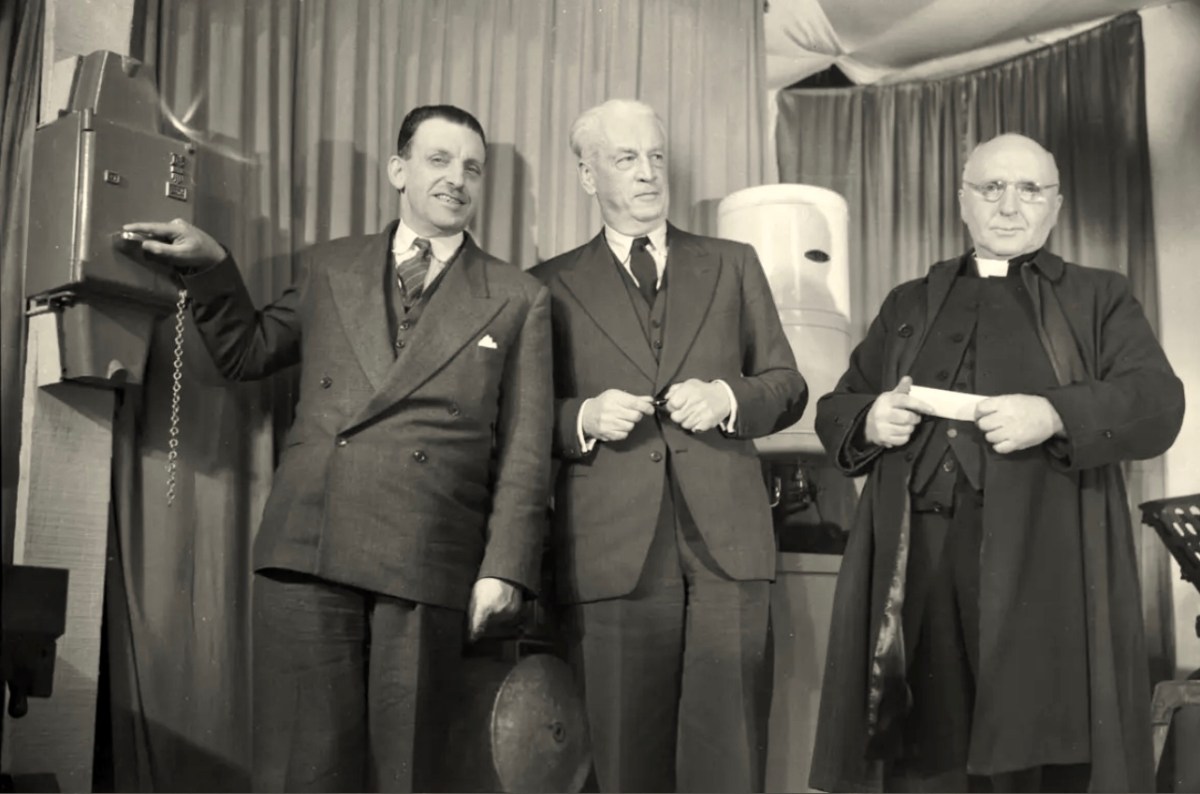
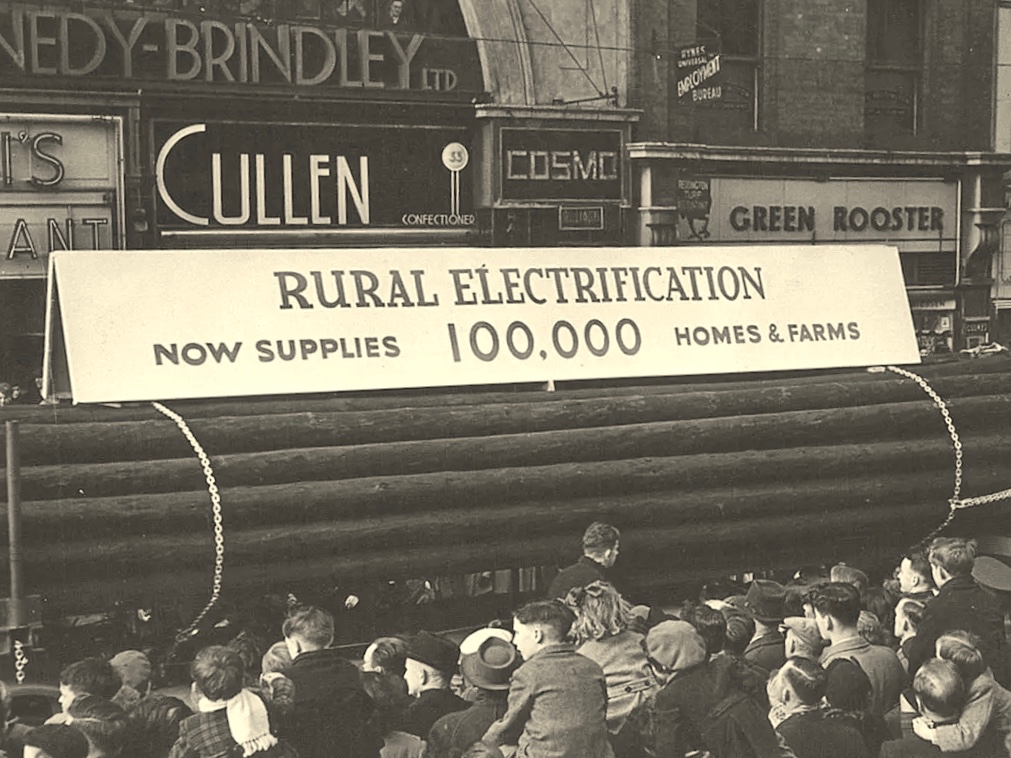
(Above) Seán Lemass – Minister for Industry and Commerce – performing the formal ‘switch-on’ in Ballinamult Creamery (Co Waterford) on 1st March 1954. This was the Electricity Supply Board’s 100,000th customer. Also in attendance are Mr R F Browne, ESB Chairman, and The Very Rev Father Walsh, PP Ballinamult.
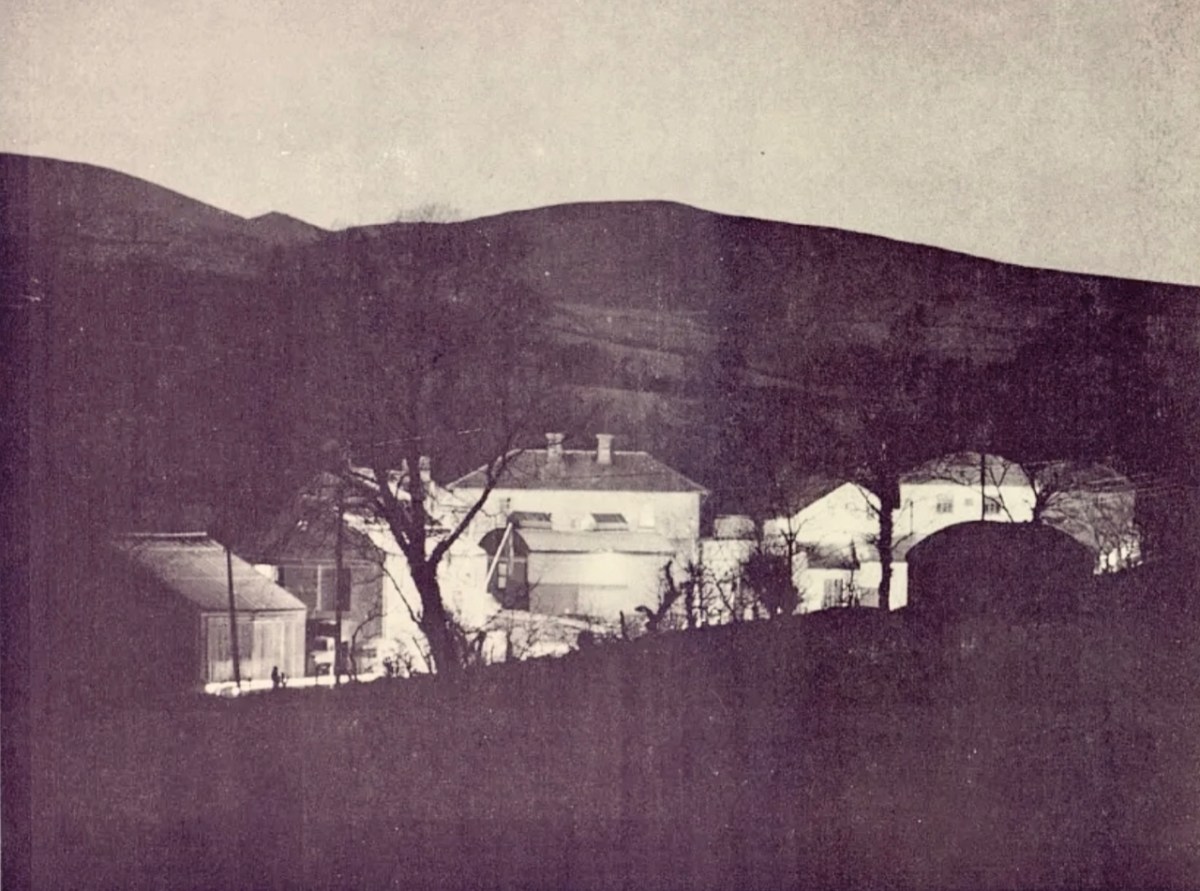
Above: “As the last rays of sun leave the hills, the lights go on at Ballinamult Creamery, the Board’s 100,000th Rural Consumer”
. . . In November, Miss Crowley of the ICA toured Sherkin Island and lectured in nearby Skibbereen giving her ideas on modern home-making and sponsoring the use of electricity to a great extent. The area demonstration at the end of November was very well attended and sparked off a keen interest in the various appliances on show, just as the connections in the area were commencing. ESB sales in the area are now in the region of £1,300 while contracts are on hands for six pumping installations . . .
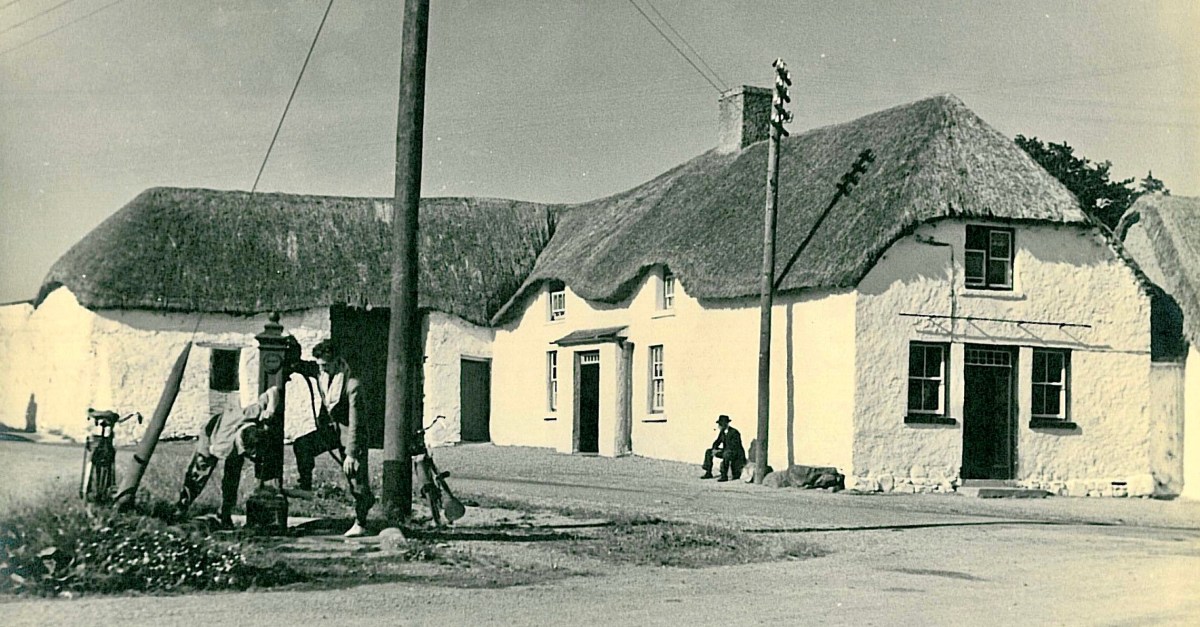
The traditional Irish village: Lusk, Co Dublin, in 1954 (photo from ESB Archives). Thatched buildings, the village pump, bicycles: a man sitting on the stone smoking his pipe. The intrusions are the poles and the overhead lines bringing the modern world into rural Ireland. Lusk was connected to the new grid close to the beginning of a project that spread out from the major conurbations from the late 1920s, taking some fifty years to embrace the whole state.
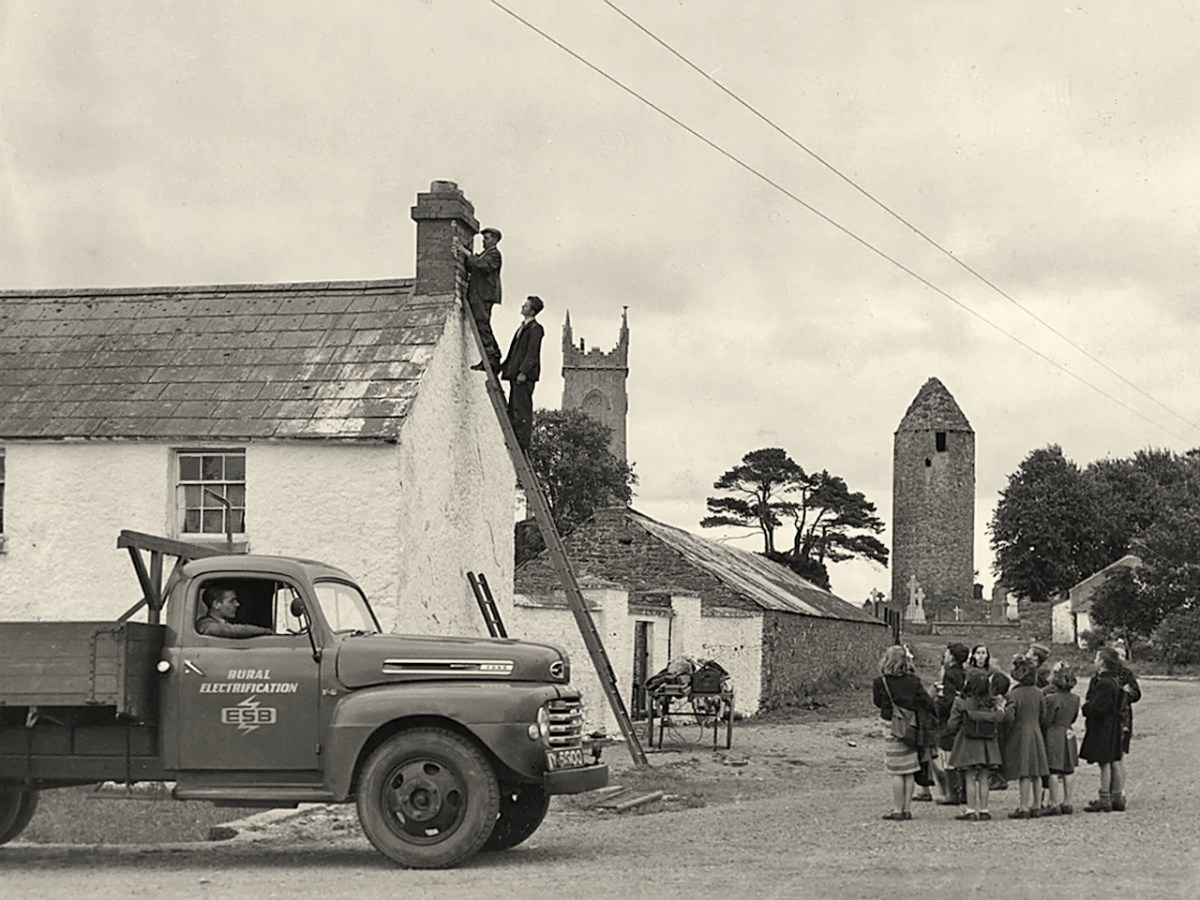
Rural Electrification arrives in Dromiskin, Co Louth, in 1949. Cork Electric Supply Co Ltd was in operation in Cork City before 1927. It supplied 4,225 homes and businesses in 1929, rising to 5,198 by March 1930, before being acquired by ESB in April 1930. Close neighbouring communities began to receive connections from 1930 onwards; Skibbereen and Bantry waited until 1937, while Schull and Ballydehob were without until works crept into furthest West Cork in 1952.
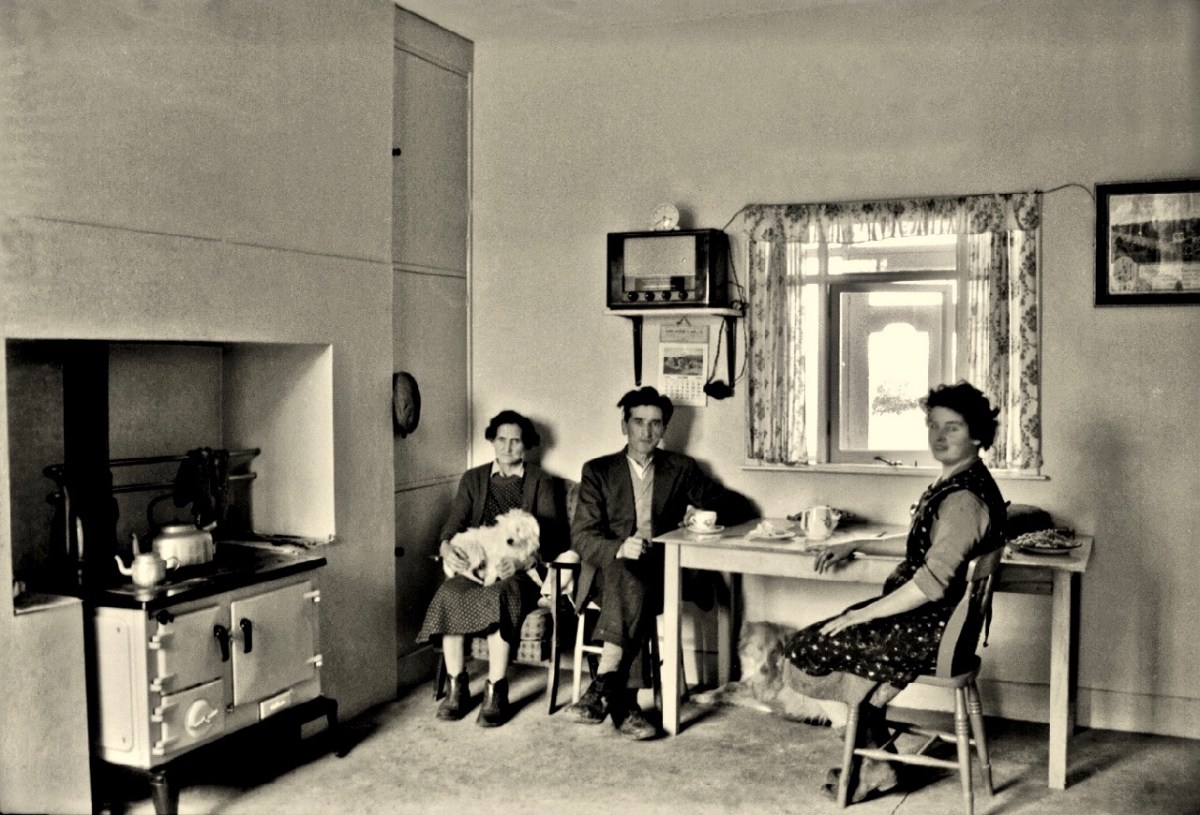
Above – family Life in 1950s rural Ireland (photo by Robert Cresswell). When I was a boy in 1950s England, I was probably fortunate to live in a house where electricity had been connected: my parents were quite progressive in that respect. I well remember the brown bakelite switches and plugs (two sizes: small and large). However, I often visited my Granma who lived in a house without any of it. It was a bit like the one above (which is in Kinvara). Gas globes hung from the ceilings: they had to be lit with tapers while pulling down on a lever. Cooking and heating came from a black coal range, and there was one cold tap in the scullery. There was no bathroom or shower, only a toilet outside in a shed. But there was a large wireless set – just like the one shown above. It was powered by an ‘accumulator’ which had to be taken to the shop up the road to be refilled with acid every few weeks. My Granma lived and died without ‘electrics’.
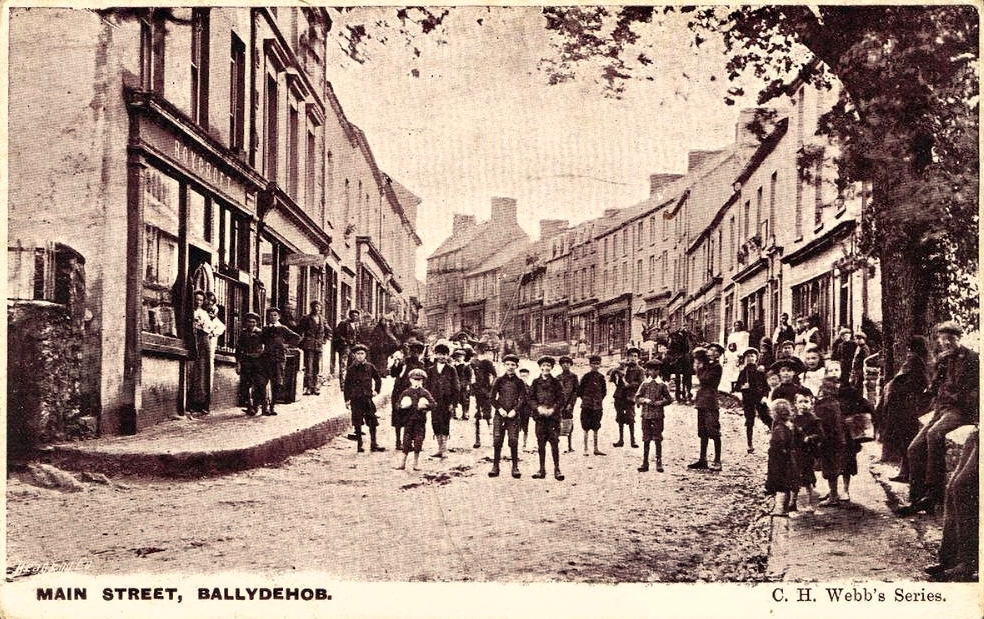
Above – Ballydehob before electrification. The ESB Archives are alive with colourful descriptions of the Rural Electrification works arriving here and in neighbour Schull. Reports from the on-site engineers are droll . . .
Schull Rural Area, April 1952 . . . Mr O’Driscoll opens his post-construction report in almost poetic terms and then to show that he is not bound to one form of art, proceeds to give us a word picture of the terrain in Schull, which is even more realistic than the deepest purples that Paul Henry ever used. We gather that pegging was, at times, a highly arduous and dangerous task and it would appear that among the wonders of the modern world, the greatest (in the view of the pegging team), was how this Area was ever selected for electrification . . .
ESB Archives
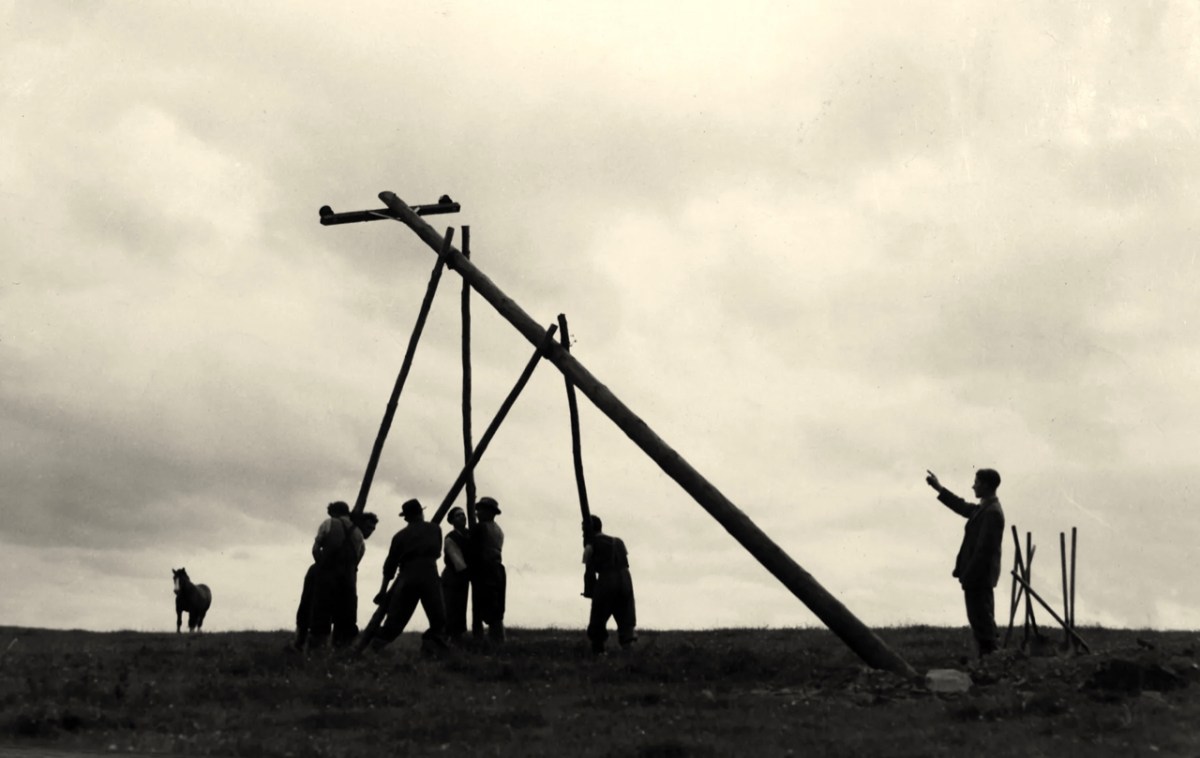
‘Pegging’ is a term in common use in the ESB Archives. It refers to the art of raising poles and stringing them with wires across the country. Evidently, the ‘landed gentry’ unkindly described them as “those beastly sticks”. Over 1 million poles were erected eventually, with 78,754km of wire used and a total of 2,280lbs of gelignite consumed during construction. The overall cost was some £36m (equivalent to €1.5bn today).
. . . We had very few wayleave difficulties. Sometimes an argument would develop with a local farmer whether the patch of grass where we put a peg was a field or not. If he convinced us it was a field, which he usually did by showing us the welts on his hand, we shifted the peg. It would seem too much like taking the bread from the mouth of a child to destroy his farm and livelihood by one pole . . .
ESB ARCHIVES
Above – Celebrations came with the connection of the 100,000th premises in 1954. Now we return to our own West Cork:
. . . It is interesting to note, and perhaps might be taken as a headline, that the early switch-in of the villages of Schull and Ballydehob (1952) had an excellent reaction on the more outlying areas and could not be denuded of all credit for the extra consumers eventually connected . . . There was an amusing revival of an ancient rivalry between the two villages. Ballydehob, looking with pride at their 100kVA transformer, were inclined to be scornful of Schull where a 50kVA transformer was erected; but the Schull people not to be out-done, countered by pointing out that there were many more poles in their “Town” than in Ballydehob “Village”. . . Only 8 houses remained to be wired when the gang left the area, 3 of these were parochial property and 4 were under the control of the Board of Works . . .
ESB ARCHIVes
The mention of “parochial property” in the paragraph above – from the ESB Archives – is of significance. The term would be applied to churches and schools, certainly. As outlined in last week’s post, Seán Keating was scornful of his view of the clergy position on Electrification: his Night’s Candles painting shows the priest still reading by the light of a candle while the world moves on around him. We can find differing views on the attitude of the Church.
. . . Throughout the length and breadth of Ireland politicians of all political shades lobbied the ESB for their area to be electrified. It wasn’t just politicians who tried to exert their influence: in July 1957, the parish priest of Ballycroy, County Mayo, wrote to the Rural Electrification Office. He said that his parishioners were anxious and that they believed he could influence decisions at the Dublin head office. “Sometimes people get an idea that the PP isn’t taking any interest in these matters. I need not add that I have a very deep enthusiasm for the light coming to Ballycroy” . . .
Above – celebration in Dublin St Patrick’s Day Parade 1954. Here in Ballydehob I was pleased to hear some reminiscence from retired schoolmaster Noel Coakley pertaining to the ‘parochial property’ which remained to be wired when the gangs left the area:
. . . Having had the luxury of the electric light when growing up in Bantry town in the 1940s and 50s, rural electrification was a subject of which I was blissfully unaware until my first teaching post, 60 years ago next month in Tragumna National School near Skibbereen. Though the building was wired for electricity and rural electrification had already arrived in the area, the school wasn’t connected to the grid. On checking the reason, the reply I received from the then School Manager, the local Parish Priest, was, ‘Why would a school need electricity?’ End of the matter! Indeed, I should have known better because my own alma mater, Bantry Boys’ NS which was on the Hospital Road, wasn’t even wired for electricity. In fact, it wasn’t connected until the autumn of 1970 during the 2 year experiment, 1969-71, on having Summer Time all year round. Back teaching in Bantry by then, teachers and pupils had to endure almost pitch dark classrooms for the first year of the trial. Coming to Ballydehob in February 1971 was going from darkness into light because the school here could even boast of having electric sockets into which we could plug new fangled machines like tape recorders, while Bantry Boys’ had only being upgraded to two 100w single bulbs per classroom. Regarding Rural Electrification in Ballydehob, I think the village was connected around 1954. I do recall that the area around the townland of Knockroe, bordered between Bantry Road and Skibbereen Road, didn’t get connected until the 1970s because the majority of residents refused connection when the rest of the district was being electrified . . .
Noel Coakley, Ballydehob – personal communication
Above – a network of ‘pegs’ crossing the north side of the Mizen today.
Once again, I am grateful to Michael Barry for pointing me in the direction of some of this information, and for switching on the lights for me in respect of the extensive ESB Archives. I also appreciate the contributions of Noel Coakley and Eugene McSweeney, Ballydehob. Are there any other stories out there? More to follow next week!
There’s a wealth of tales to be told about the first decades of independent Ireland. The 1920s and 1930s saw a flourishing of confident projects portraying a nation on the cusp of change, establishing itself in Europe and beyond. One such was the hydro-electric scheme at Ardnacrusha on the River Shannon. Foundations were laid in 1925 and works completed within four years, providing the young country with what was then the world’s largest power station. The intention was to enable everyone in Ireland to avail of the most trendsetting modern commodity: electricity.
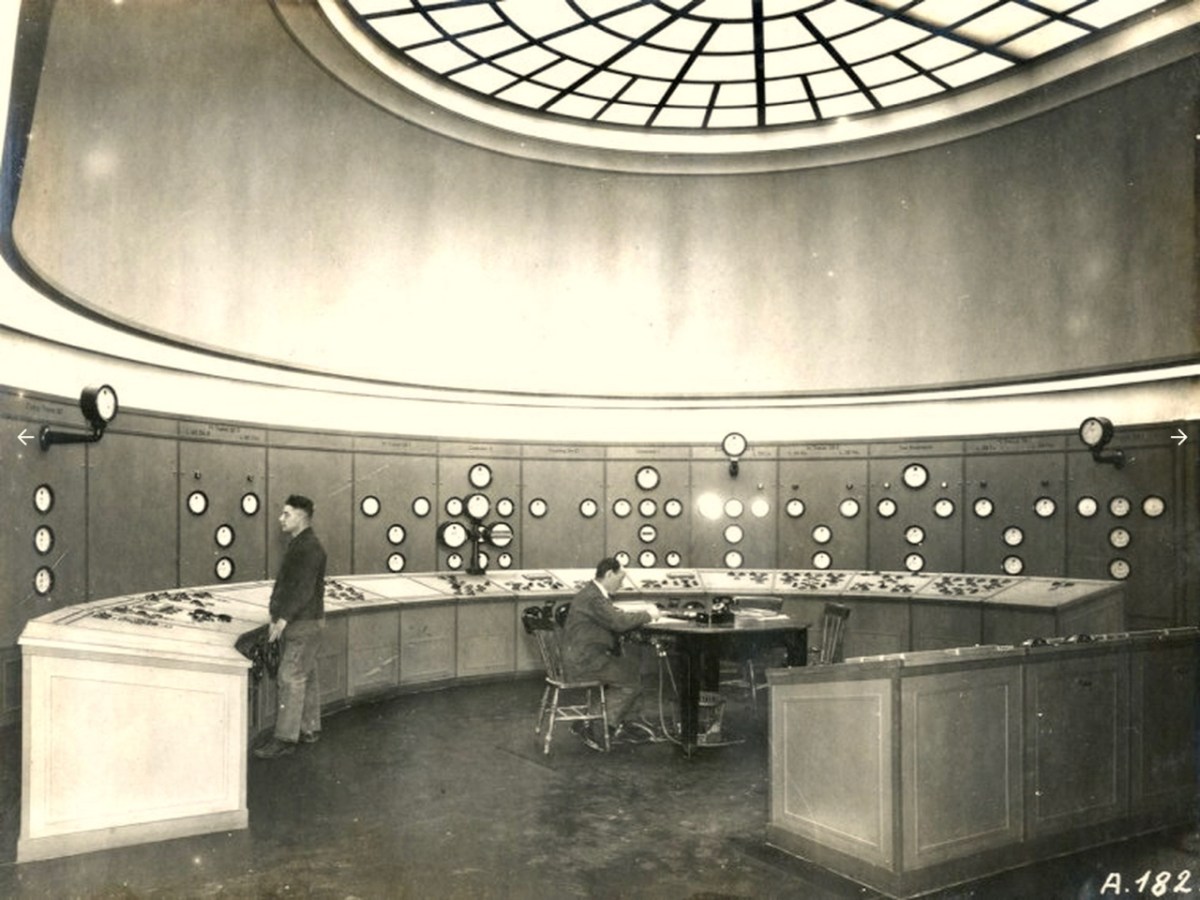
The documentary photo above looks like a scene from a science-fiction film: it’s the control station at Ardnacrushsa, shortly after the completion of the project. This, and many other of the illustrations which I will refer to, are taken from the excellent ESB Archives: I am very grateful to them for the use of these. The building of the huge dam and power station was documented in fine detail – and not just in words and photographs. The notoriously outspoken and visionary artist – Seán Keating – chose to record the accomplishments in his own medium, painting.
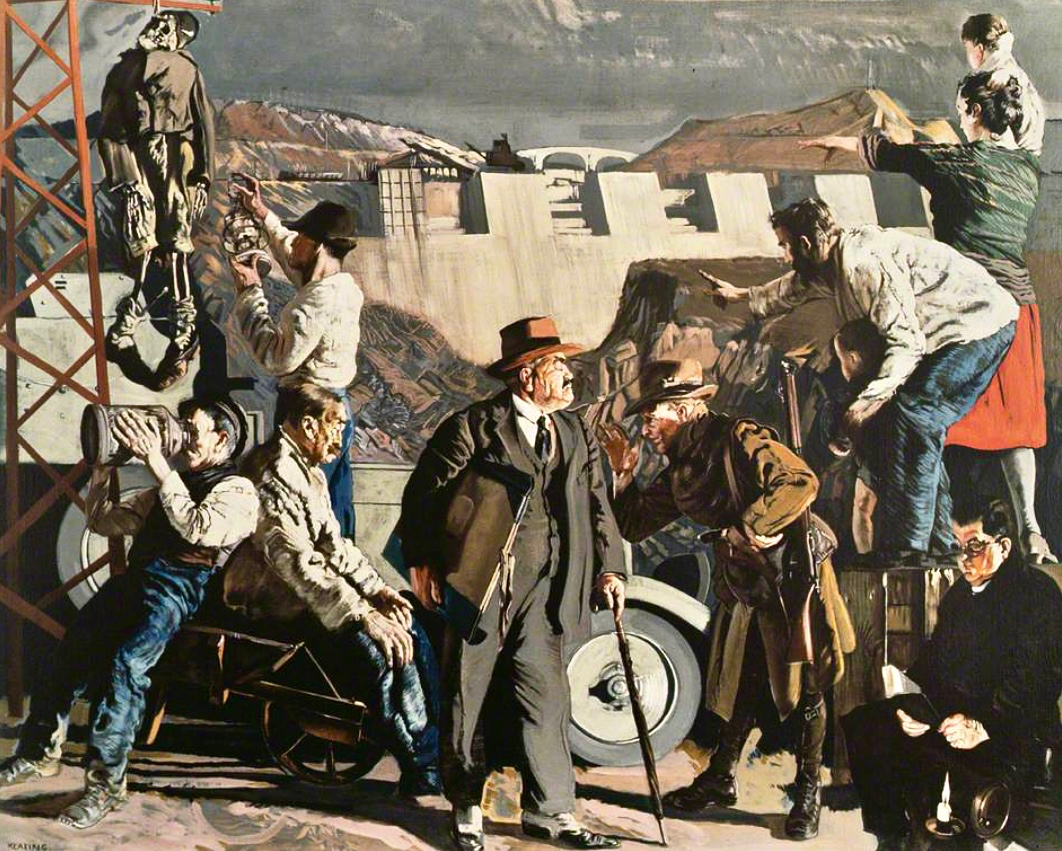
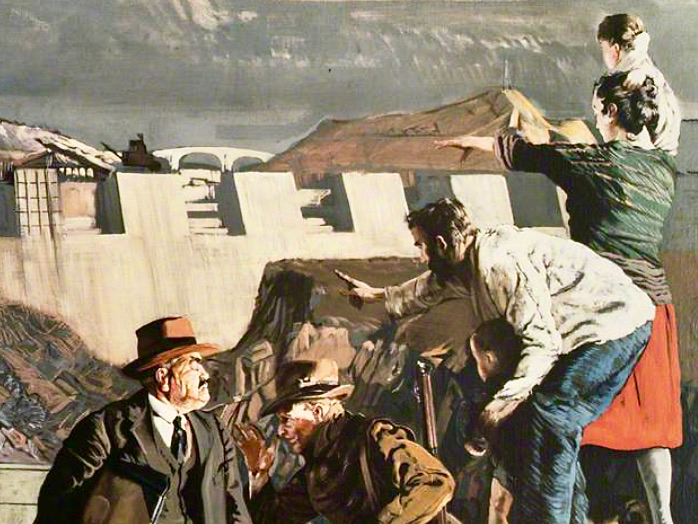
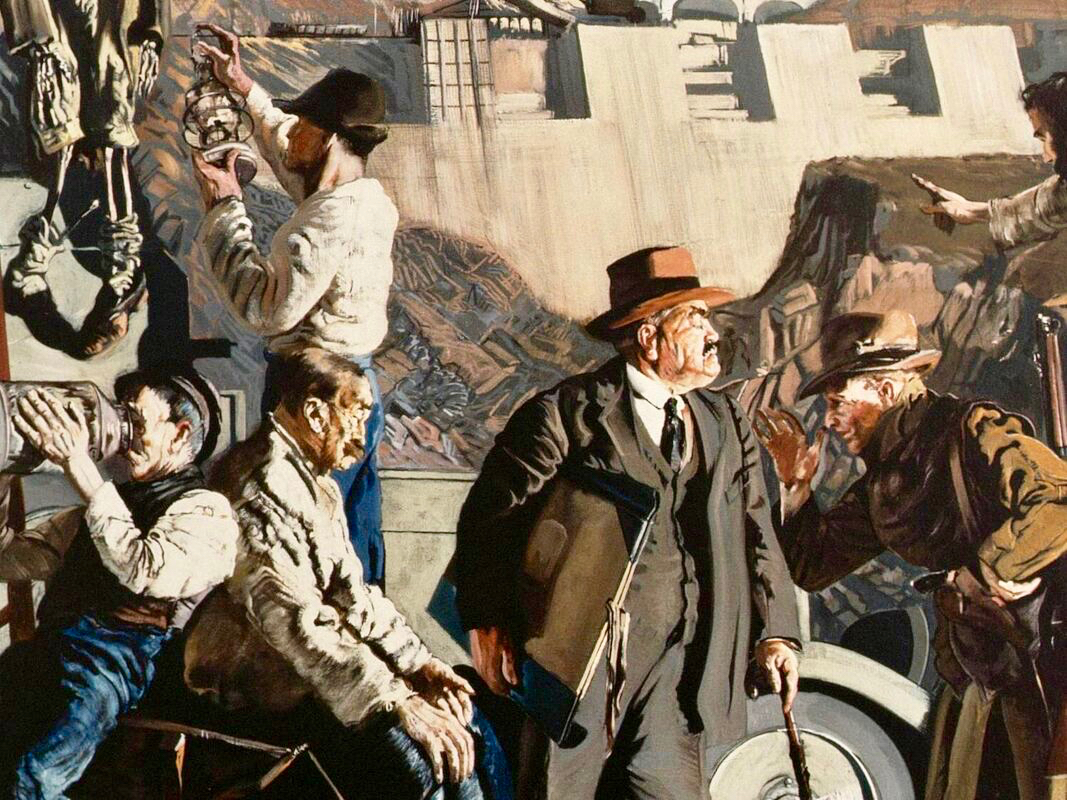
This is one of Keating’s works from the time: Night’s Candles are Burnt Out. (Thanks to Gallery Oldham). It is, perhaps, the finale of his series drawn and painted during the construction of the works – which he undertook on site under his own initiative and without a sponsor. Art historian (and biographer of Keating) Dr Éimear O’Connor suggests:
. . . Keating went down to Ardnacrusha because he knew that the construction project was emerging history. It was all happening around where he was born and raised. The machinery was going to carve up this landscape that he saw as ‘a medieval dungheap’, that was how he described it in later years. And this was a metaphor for him, the whole thing was all about Ireland moving forward into modernity. Night’s Candles features the dam at Ardnacrusha, but also includes a group of figures in the foreground, all of whom represent different aspects of what Keating saw as the Ireland of the day. When he showed it at the Royal Hibernian Academy in Dublin, it was called ‘the problem painting of the year,’ which Keating thought was hilarious. They couldn’t get their heads around this idea of what he was trying to do at all . . .
O’Connor: Seán Keating: Art, Politics and Building the Irish Nation, 2013 (Irish Academic Press)
In this detail from the painting we see Keating himself (top right) together with his wife and sons, pointing to the vision of Ireland’s future. On the left of the full painting is Keating again, inspecting a hanging skeleton, perhaps reminiscent of the Famine. Most significantly, perhaps, at the bottom right is a priest reading by the light of the candle. O’Connor is clear about this portrayal:
. . . It tells you an awful lot about Keating and his attitude to the Church at the time. Like many others in the cultural sphere in Ireland, he was disappointed with post-Treaty Ireland, with successive governments and the Church, who were in cahoots, if you know what I mean. He knew well that the whole country was tied up with them, and with that kind of organized religion that was deeply conservative. And Night’s Candles is very much an expression of that disappointment, I think . . .
O’Connor: Seán Keating: Art, Politics and Building the Irish Nation, 2013 (Irish Academic Press)
It’s worth dwelling on this painting a little longer, and viewing Keating’s thought processes, through O’Connor’s eyes:
. . . What Keating was trying to do was reflect upon a country on the brink of change. It was in those years, in the 1920s, that the term ‘gombeen man’ came into being. We all know that it means the kind of businessman or politician who’s making money off the backs of everybody else. And that’s the gombeen man in the middle of the painting. I think it’s quite clear that Keating’s hope was that modernity, as represented by Ardnacrusha, would end all that stage-Ireland paddywhackery that had prevailed for years . . .
O’Connor: Seán Keating: Art, Politics and Building the Irish Nation, 2013 (Irish Academic Press)
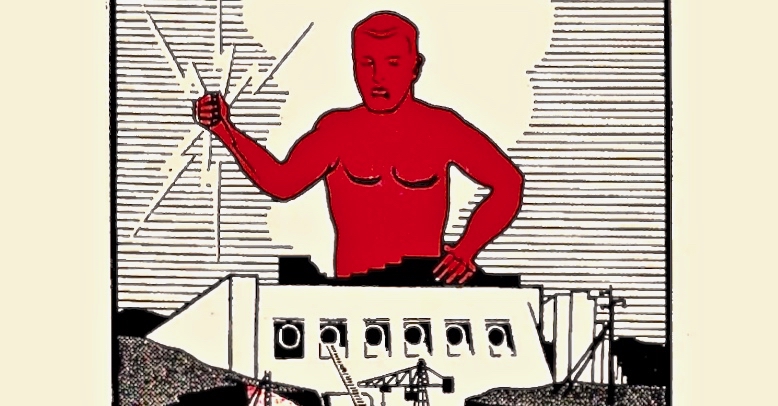
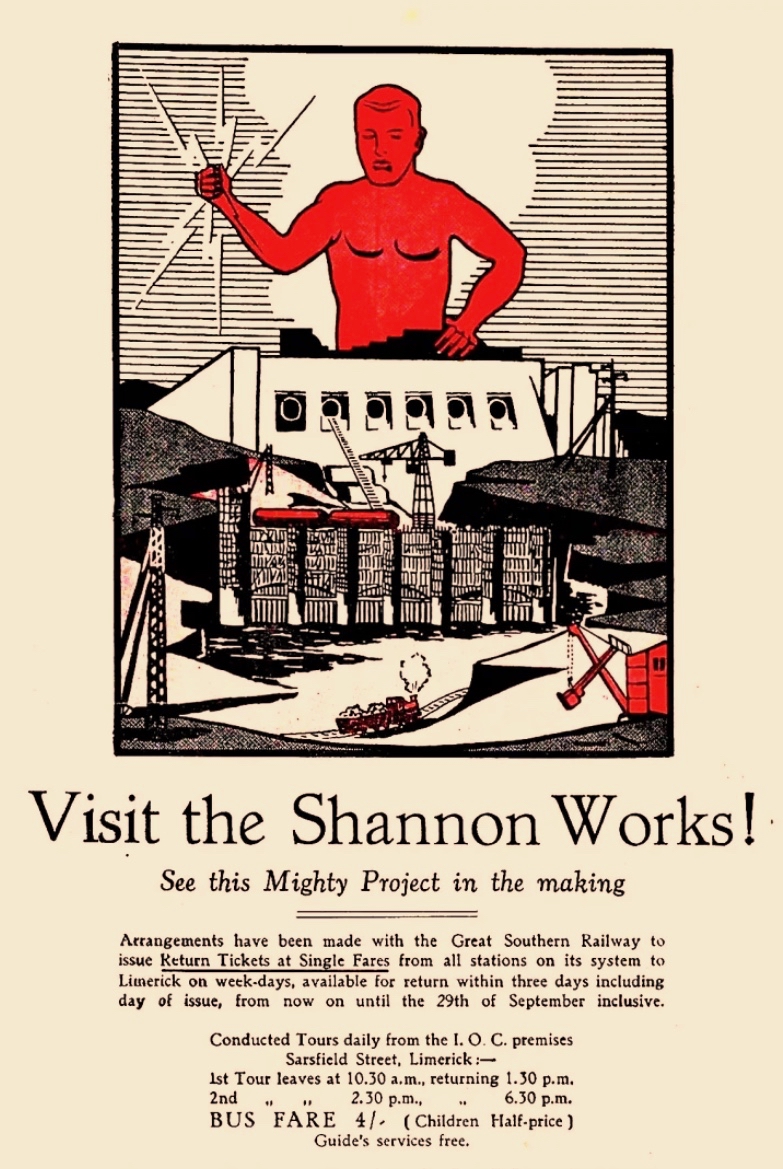
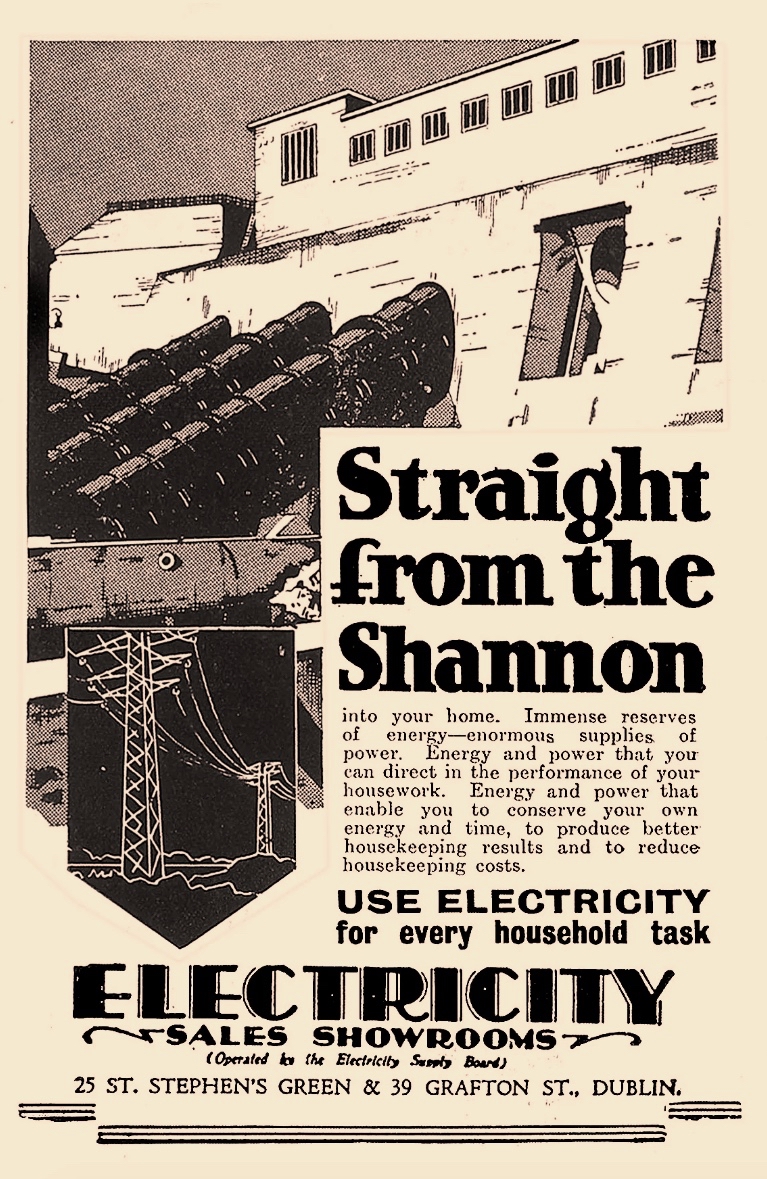
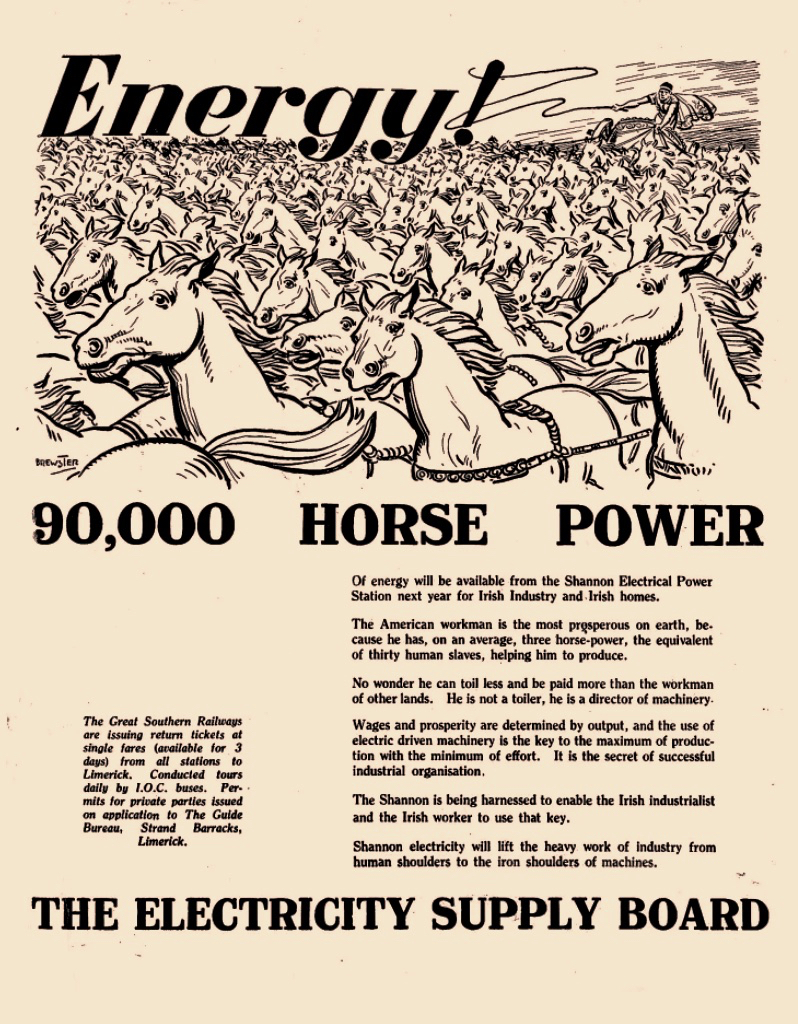
Above – posters from the time of the construction work at Ardnacrusha (ESB Archives). It was certainly the most exciting project in Ireland’s young days, and tourism was encouraged. Hand-in-hand with the major works themselves went a crucial publicity campaign to encourage people to embrace the coming of a readily available electricity supply to homes and businesses. The steps taken to try and ‘get the message across’ was an uphill task. Considerable funds were expended – and a large sales force garnered – to tour the country and persuade the population to buy into the project.
The visuals, humour and underlying psychology of this Ardnacrusha construction-era promotional poster really appeal to me. In case you can’t read the ‘small print’, this is the message that’s being pushed:
. . . 90,000 Horse Power of energy will be available from the Shannon Electrical Power Station next year for Irish Industry and Irish homes . . . The American workman is the most prosperous on earth, because he has, on average, three horse-power, the equivalent of thirty human slaves, helping him to produce. No wonder he can toil less and be paid more than the workman of other lands. He is not a toiler, he is a director of machinery . . .
Post-Famine, America was always seen as the ‘golden land of opportunity’ for Irish emigrants. Now, in 1930, we are being told that Ireland will have the capability to match those fabled fortunes!
. . . Shannon Electricity will lift the heavy work of industry from human shoulders to the iron shoulders of machines . . .
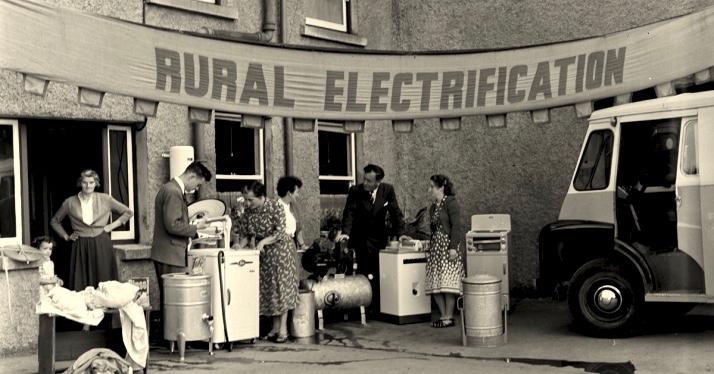
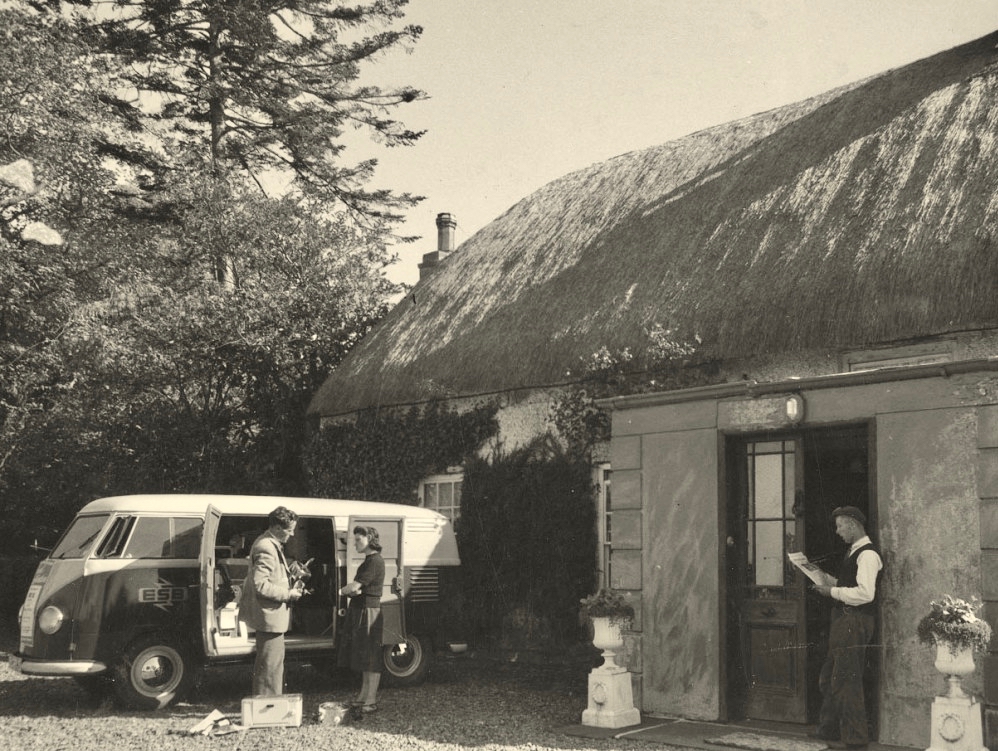
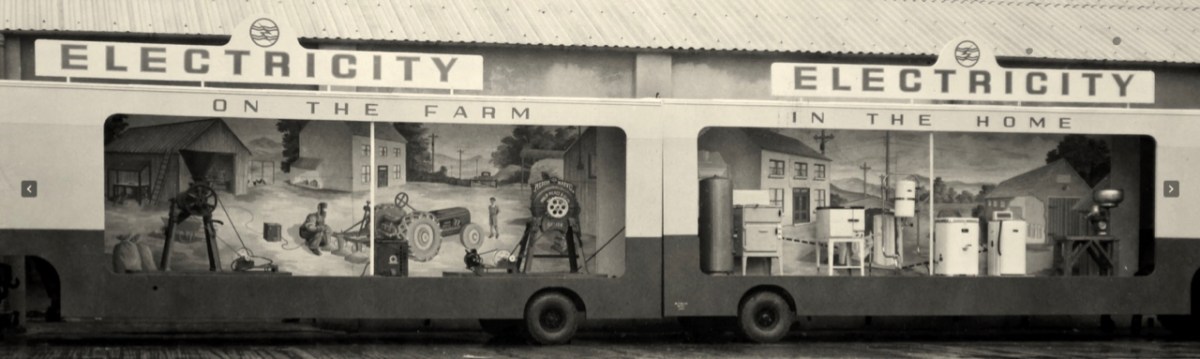
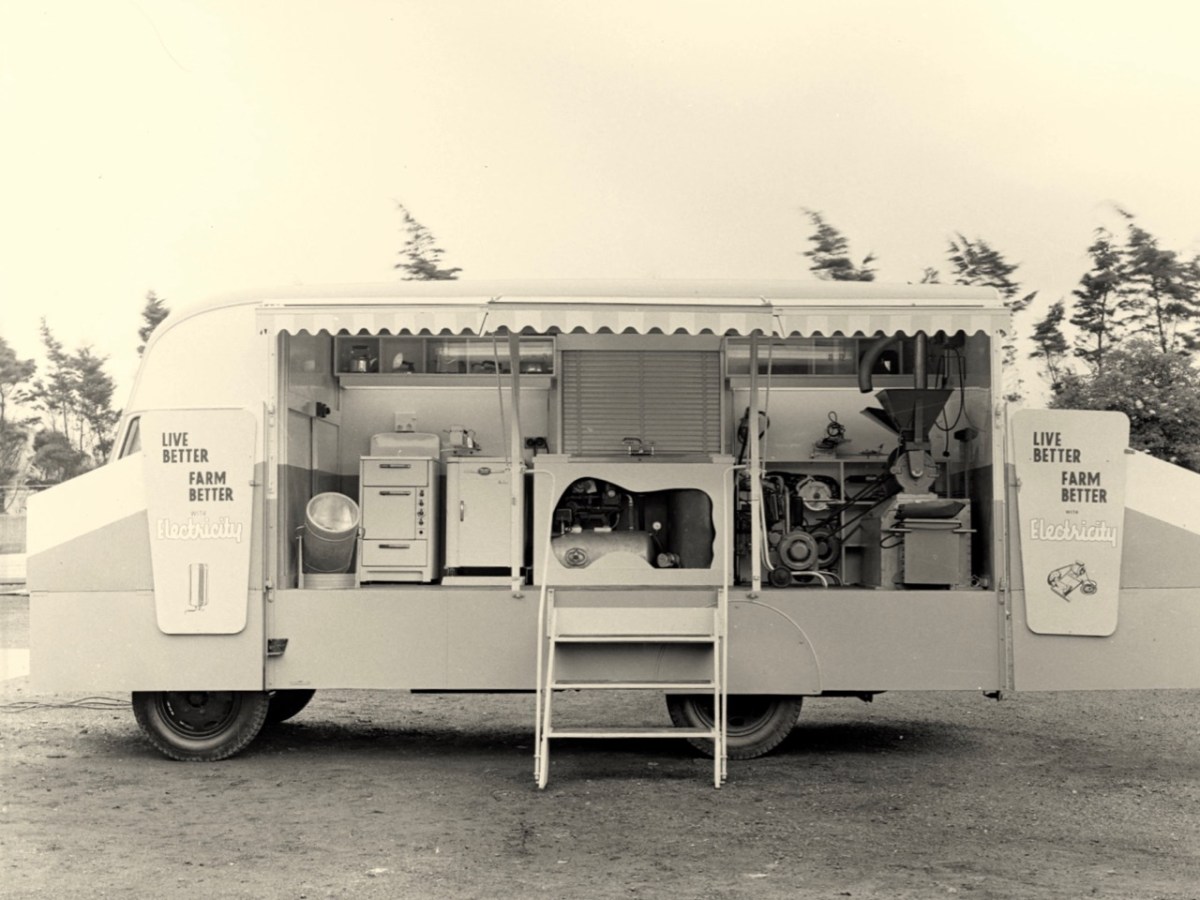
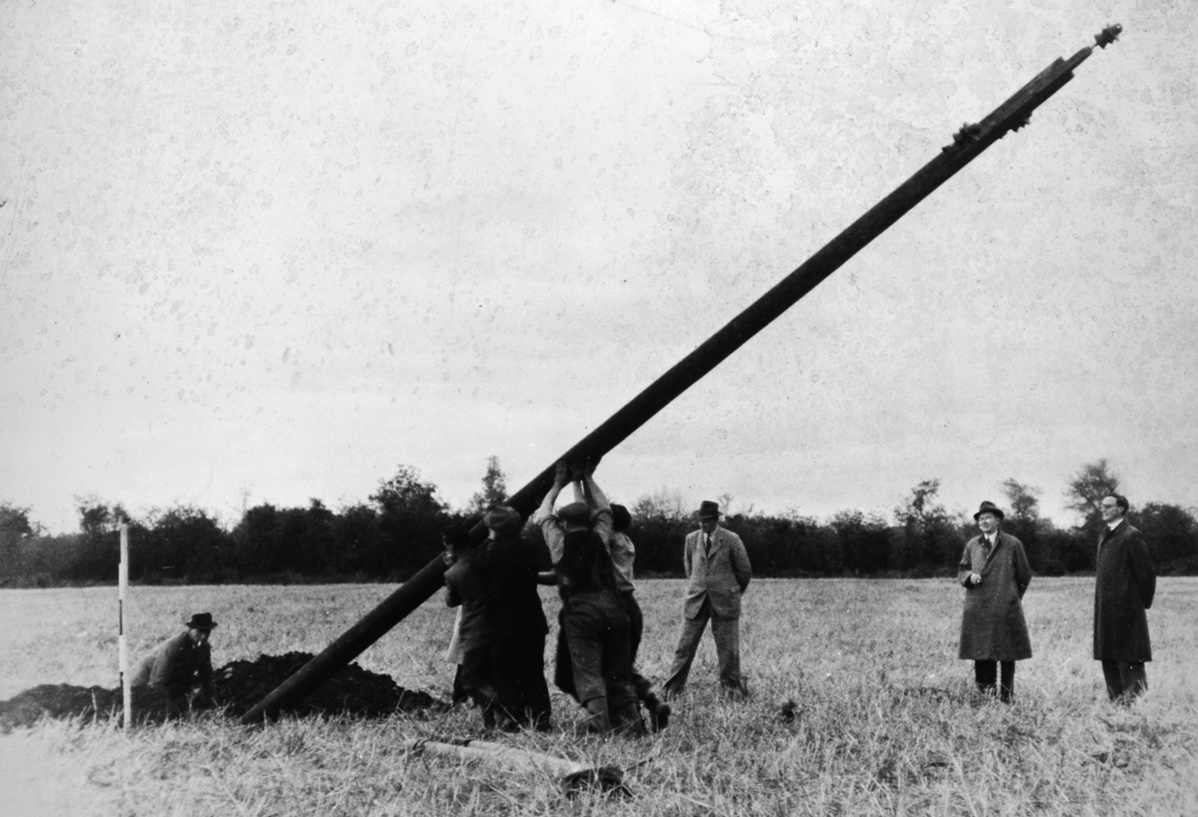
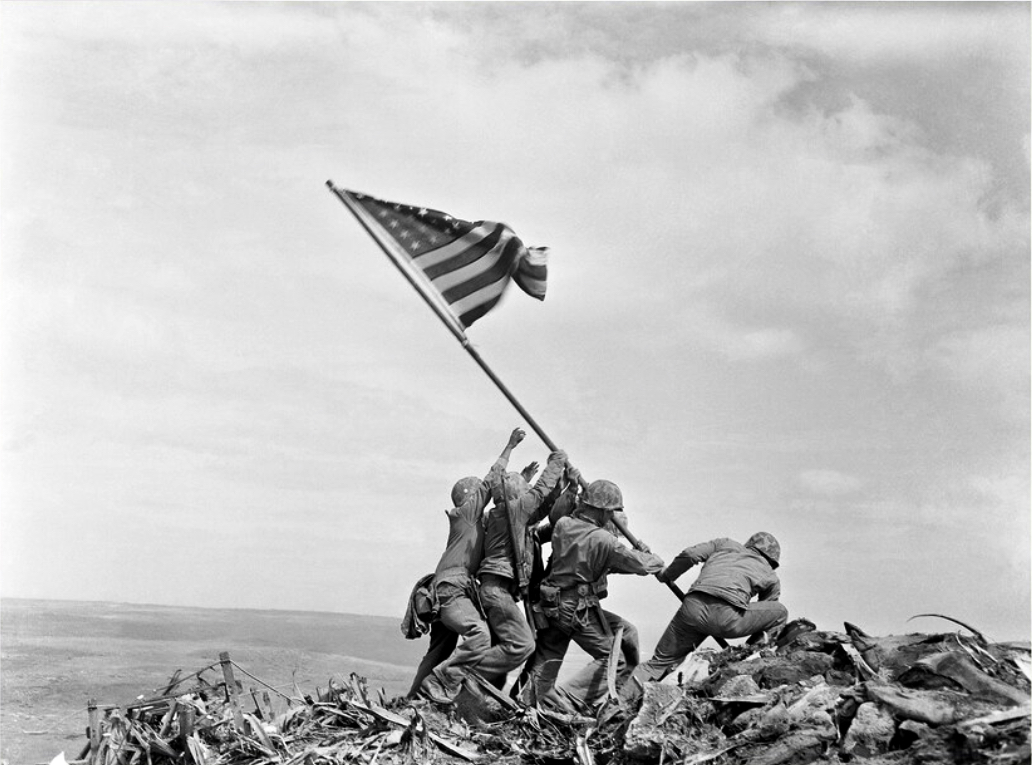
The coming of electricity across Ireland opened up markets for retailers to vend a host of innovative gadgets. This mobile electricity showroom from the 1950s (ESB Archives) covers the gamut of lighting, cooking, refrigerating, water supply to sinks using pumps, milking machines and labour-saving devices for farms. In a future post I want to focus on Rural Electrification, which was a long haul: taking poles and wires out into the extensive hinterland. This was – arguably – the most heroic part of the process of electrification, and we can’t help wondering whether the following somewhat iconic ESB print of the first ‘peg’ being raised at Kilsallaghan, on 5 November 1946 was inspired by the famous Iwo Jima Victory photograph taken by Associated Press photographer Joe Rosenthal on February 23 1945 (lower pic). Both portray a moment of triumph.
Many thanks are due to Michael Barry who referred me to material from the ESB Archives covering our own West Cork areas. Watch out for our commentary on this in a forthcoming post!
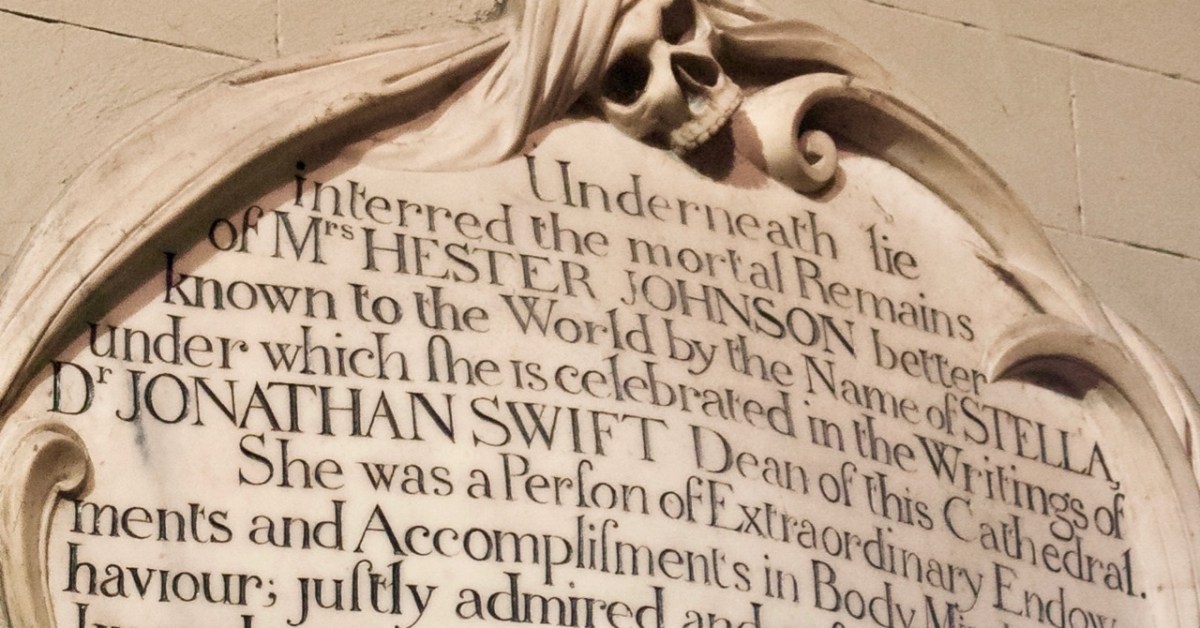
This fine memorial in St Patrick’s Cathedral, Dublin, celebrates Mrs Hester Johnson – “better known to the World by the Name of Stella”. There is so much about Mrs Johnson that is enigmatic, not least the use of that term ‘Mrs’. Hester was born ‘Johnson’ and remained unmarried throughout her life, even though she was linked so closely to Jonathan Swift – and many commentators have suggested they were secretly married or, at the very least, lovers.
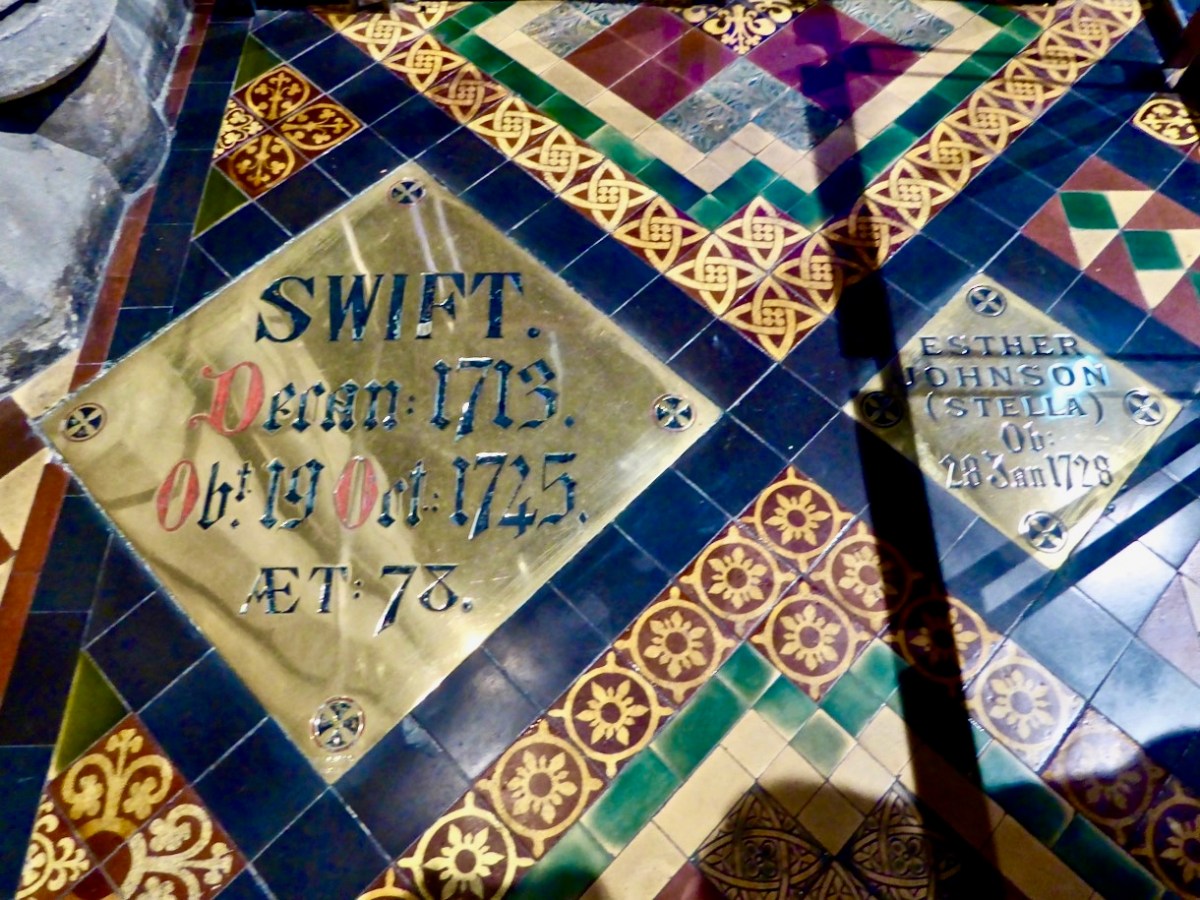
It is poignant to see the entwined plaques in the floor of the Dublin Cathedral. Both were buried there: ‘Stella’ in 1728 and Swift in 1745: he was placed beside her at his own request. Much has been written about Jonathan Swift – he was a formidable author, satirist and analyst of contemporary Irish life in the 17th and 18th centuries, while ‘Stella’ existed mainly in his shadows. We would probably know nothing of her without the association. Having written previously about Swift – and my part in his life (read it here) – I thought I would tackle the story of ‘Stella’: her name was known to me from a young age. Before going further, though, let’s solve that first little mystery – the use of Mrs on Stella’s memorial. In the Oxford University History Workshop Journal, Volume 78, Issue 1, Autumn 2014 Dr Amy Erickson claims:
. . . Mrs was applied to any adult woman who merited the social distinction, without any marital connotation. Miss was reserved for young girls until the mid eighteenth century. Even when adult single women started to use Miss, Mrs still designated a social or business standing, and not the status of being married, until at least the mid nineteenth century . . .
Dr Amy Erickson
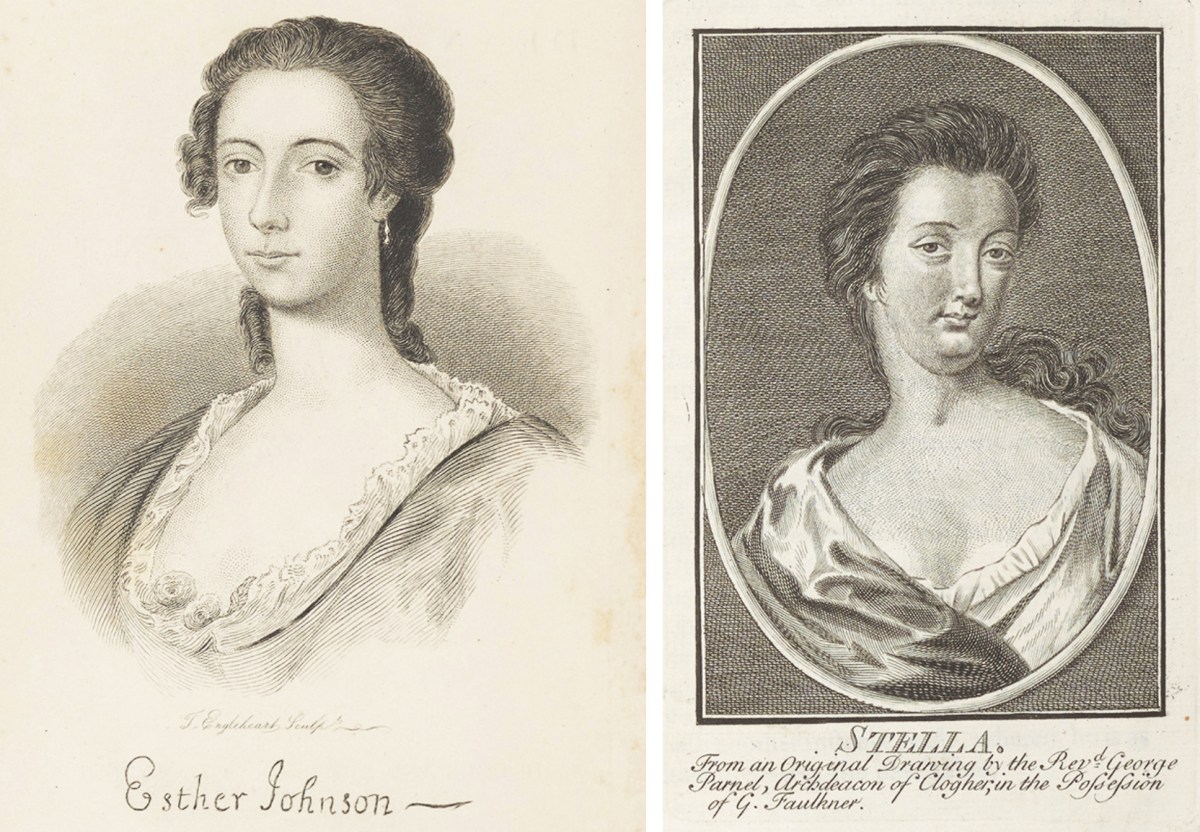
Above left: an alleged portrait of Esther was reproduced in William Wilde’s 1849 book on Swift, and claims for it an “undoubtedly authentic” history, adding that it matches physical descriptions made of Stella during her lifetime:
. . . It was originally in the possession of the distinguished Charles Ford of Woodpark, where Stella was constantly in the habit of visiting, and where she spent several months in 1723, when probably it was painted, Stella being then about 42. The hair is jet black, the eyes dark to match, the fore-head fair, high, and expansive, the nose rather prominent, and the features generally regular and well-marked . . .
William Wilde
Above right: “Stella, From an Original Drawing by the Rev’d George Parnell, Archdeacon of Clogher, in the Possession of G Faulkner”
. . . George Faulkner, Swift’s Dublin publisher, placed this purported portrait of Stella across from the beginning of Swift’s memoir of her in an edition of Swift’s Works. The artist is wrongly attributed, it actually being by the poet and scholar Dr Thomas Parnell, who had been intimate with Swift around 1716, when this drawing was most likely made. Swift had begun writing his memoir on the evening of Stella’s death, on January 28, 1728, just weeks shy of her forty-seventh birthday. Their friend Thomas Sheridan, who was with Stella in her final days, preserved a story about “the secret marriage” of Swift and Stella. If they were indeed married, public recognition of their marriage never happened. According to an old lady who may have inhabited Stella’s former cottage: “. . . some says she was his wife, and some says she wasn’t, but whatever she was, she was something to him . . .“
Esther Johnson was born in Richmond, Surrey, England in 1681. She spent the early years of her life at Moor Park House, Farnham, Surrey (above). This was the home of Sir William Temple (1628 – 1699) – diplomat, statesman and essayist: from 1688 until his death he employed Jonathan Swift as his secretary (Swift’s mother was a distant relative of Temple). Esther’s parentage has been the subject of much speculation. The weight of evidence is that her mother acted as companion to Temple’s sister, Lady Giffard, and that Esther, her mother and her sister Anne were regarded as part of the family. Esther’s father is said to have been a merchant who died young, but local rumour suggested that she was Temple’s illegitimate daughter. I have found no concrete evidence to confirm or deny this.
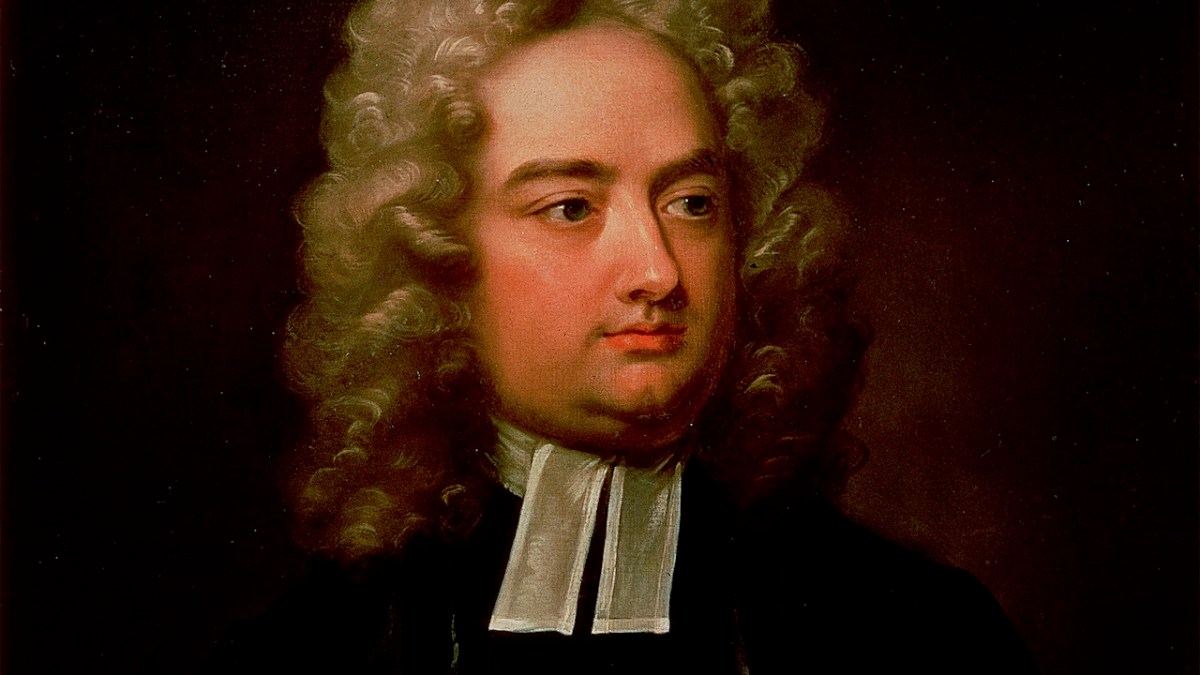
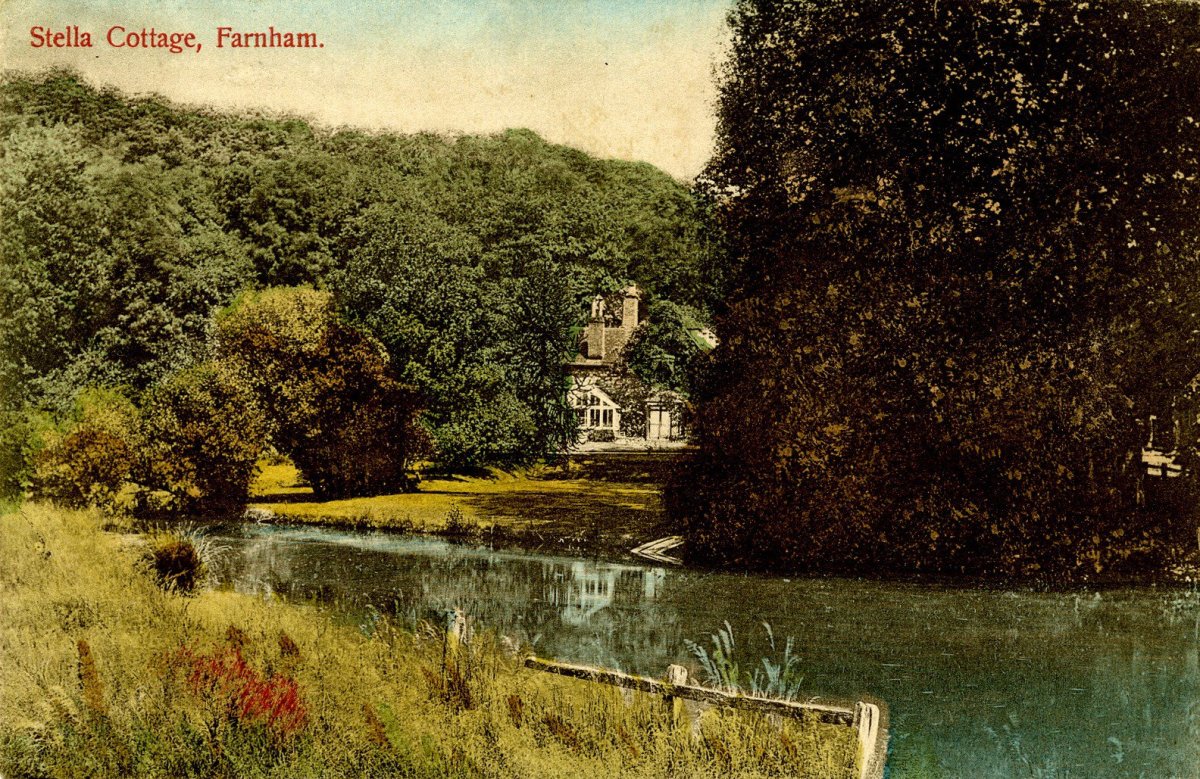
(Above) Jonathan Swift, painted by Charles Jervas c1710. When Swift first met Esther at Farnham she was only around eight years old, and he was charged by Temple to become her tutor and mentor. He gave her the nickname ‘Stella’, but we don’t seem to know why or when. Now, here’s another enigma: in my younger days I was familiar with Moor Park House and its environs. I remember there was a cottage some distance from the estate, named ‘Stella Cottage’. It definitely existed once (and may still exist) – here’s a postcard showing it:
I was told (by my grandmother) that Swift’s ‘Stella’ lived in this cottage, and that he would walk to visit her there ‘every day’. This doesn’t quite tie in with the account suggesting that Esther Johnson lived in Moor Park House – although she could, of course, have moved away at some point. Also, at what place in its history was ‘Stella Cottage’ so named? It’s possible, even, that Swift gave his pet name to ‘Stella’ because there was already an association locally with that appellation – so the cottage itself may never have had anything else to do with Esther. As our story moves forward, Swift’s employer – Temple – died in 1699 (Swift reportedly said that “all that was good and amiable in mankind had died with Temple”). This left Swift without a job or home. Interestingly – bearing in mind we don’t know exactly where Esther Johnson figured in Sir William Temple’s life – he bequeathed to her a significant sum of money, and some property in Ireland.
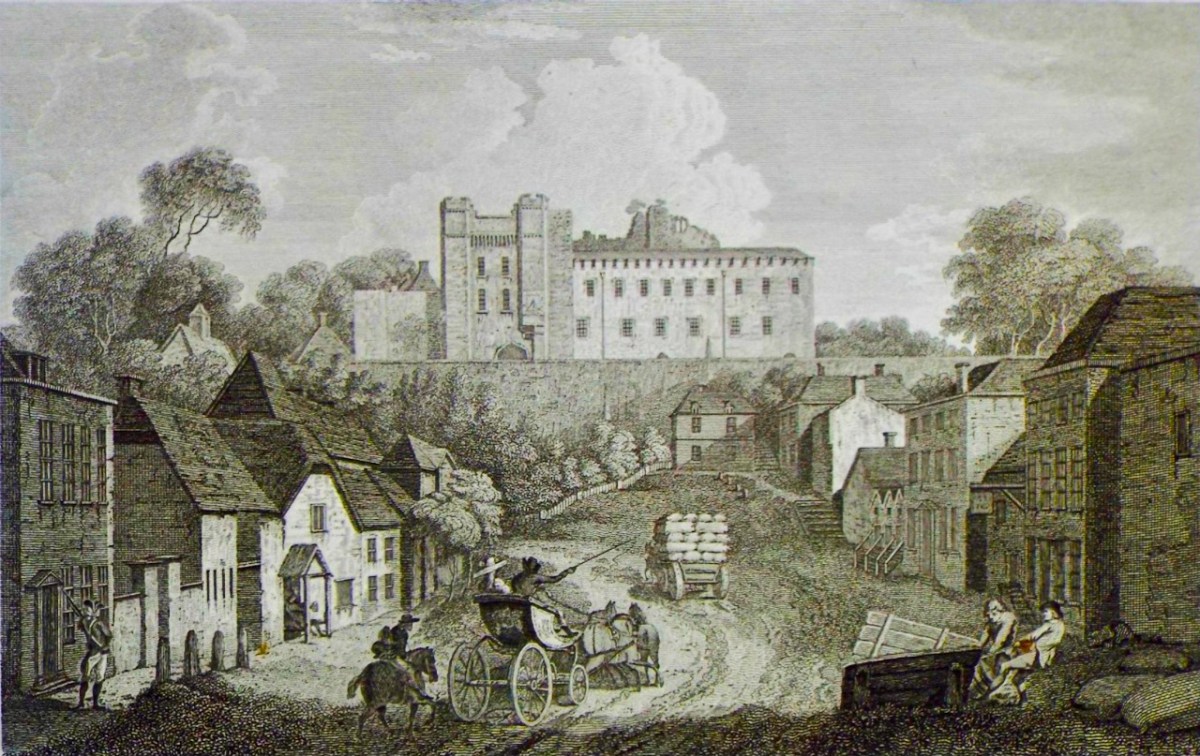
Above – Castle Street at Farnham, Surrey in 1788. Swift was an ordained minister of the Anglican Church in Ireland. After Temple’s death, he was unable to maintain his lifestyle in England and returned to Ireland (his birth and upbringing were in Dublin and Kilkenny). In due course (1713) – he was appointed as dean of St Patrick’s Cathedral in Dublin: a position which enabled him to indulge his many enthusiasms – writing, political commentary and satire – for the rest of his days. He encouraged ‘Stella’ also to move to Ireland, which she did in 1702, ostensibly living with her companion, Mrs Dingley. A further rumour on the relationship between Swift and ‘Stella’ needs to be quoted:
. . . Whether Swift and Stella were married has always been a subject of intense debate. The marriage ceremony was allegedly performed in 1716 by St George Ashe, Bishop of Clogher (an old friend of Swift, and also his college tutor), with no witnesses present, and it was said that the parties agreed to keep it secret and live apart. Stella always described herself as a “spinster” and Swift always referred to himself as unmarried; Rebecca Dingley, who lived with Stella throughout her years in Ireland, said that Stella and Swift were never alone together. Those who knew the couple best were divided on whether a marriage ever took place: some, like Mrs Dingley and Swift’s housekeeper Mrs Brent laughed at the idea as “absurd”. On the other hand, Thomas Sheridan, one of Swift’s oldest friends, believed that the story of the marriage was true: he reportedly gave Stella herself as his source . . .
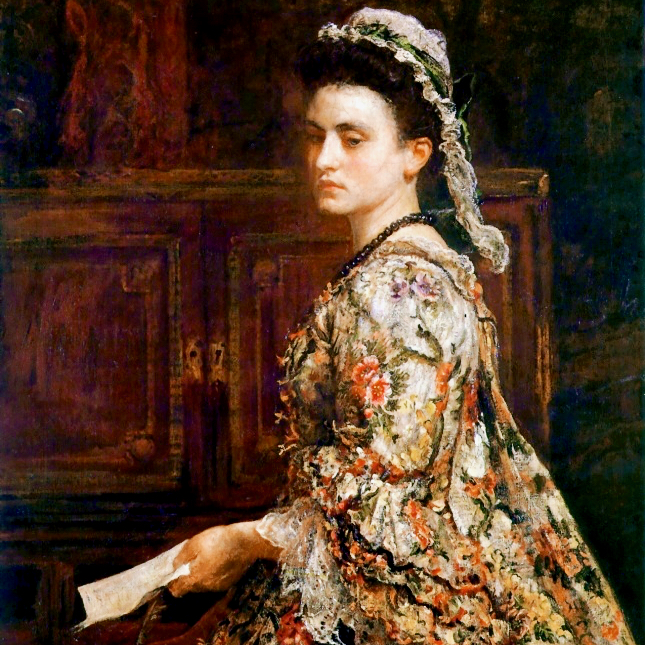
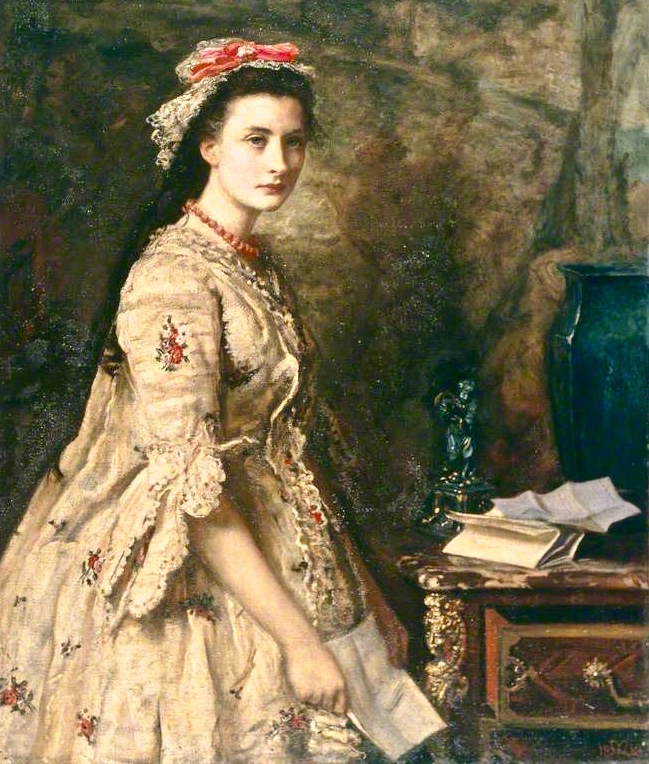
This lady – Esther Vanhomrigh (1688–1723) was painted by John Everett Millais in 1868. It depicts another rumoured ‘lover’ of Jonathan Swift, who gave her the name ‘Vanessa’. We know very little about her actual appearance, although she was said “not to be a beauty”. She is holding a letter, which we are to assume was written to or from Swift with whom, from what we can gather, Vanessa was infatuated – although her feelings were apparently never reciprocated. The expression on her face in Millais’ imaginary portrait could imply her frustration. The artist painted ‘Stella’ in a companion piece (Sudley House, Liverpool):
It can be no coincidence that Stella is also holding a letter. In this case, perhaps, the expression which the artist has chosen to depict is less severe. Jonathan Swift kept up a remarkable correspondence with Stella while he was away in England between 1710 and 1713. He certainly never intended it for publication in his lifetime. The Journal to Stella appeared first in 1766 and consists of 65 long and detailed letters – thousands of words in all, ranging from minute accounts of his daily life, through witty commentary and some mildly intimate deliberations.
. . . If the Journal shows us some of Swift’s less attractive qualities, it shows still more how great a store of humour, tenderness, and affection there was in him. In these letters we see his very soul; in his literary work we are seldom moved to anything but admiration of his wit and genius. Such daily outpourings could never have been written for publication, they were meant only for one who understood him perfectly; and everything that we know of Stella—her kindliness, her wit, her vivacity, her loyalty—shows that she was worthy of the confidence . . .
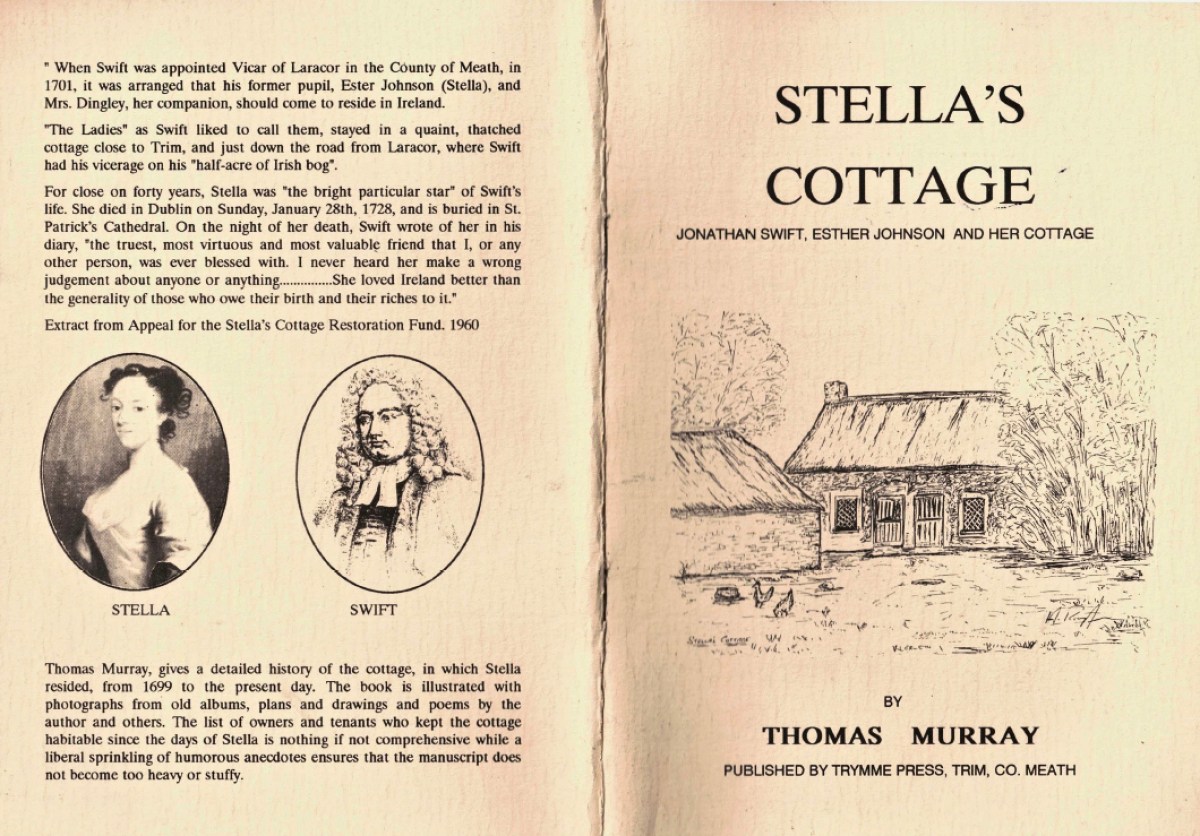
This small account of the story of ‘Stella’ – Mrs Hester Johnson – reveals a little of what we are able to piece together of the lady and her possible (probable?) relationship with the towering figure of Jonathan Swift, a matter which has fascinated scholar-historians over the generations. We can make assumptions, but reach no firm conclusions. The enigmas of the tale remain, and are certainly celebrated wherever local geography and lore are able to relate to some aspect of the oral traditions. As an example, I was pleased to find a pamphlet dating from 1991 which tells of a ‘Stella’s Cottage’ far, far away from Moor Park, Farnham. This one is near Trim, Co Meath. It suggests that this was where Stella and her companion, Mrs Dingley, lived ‘just down the road from Laracor,where Swift had his vicarage on his half-acre of Irish bog‘.
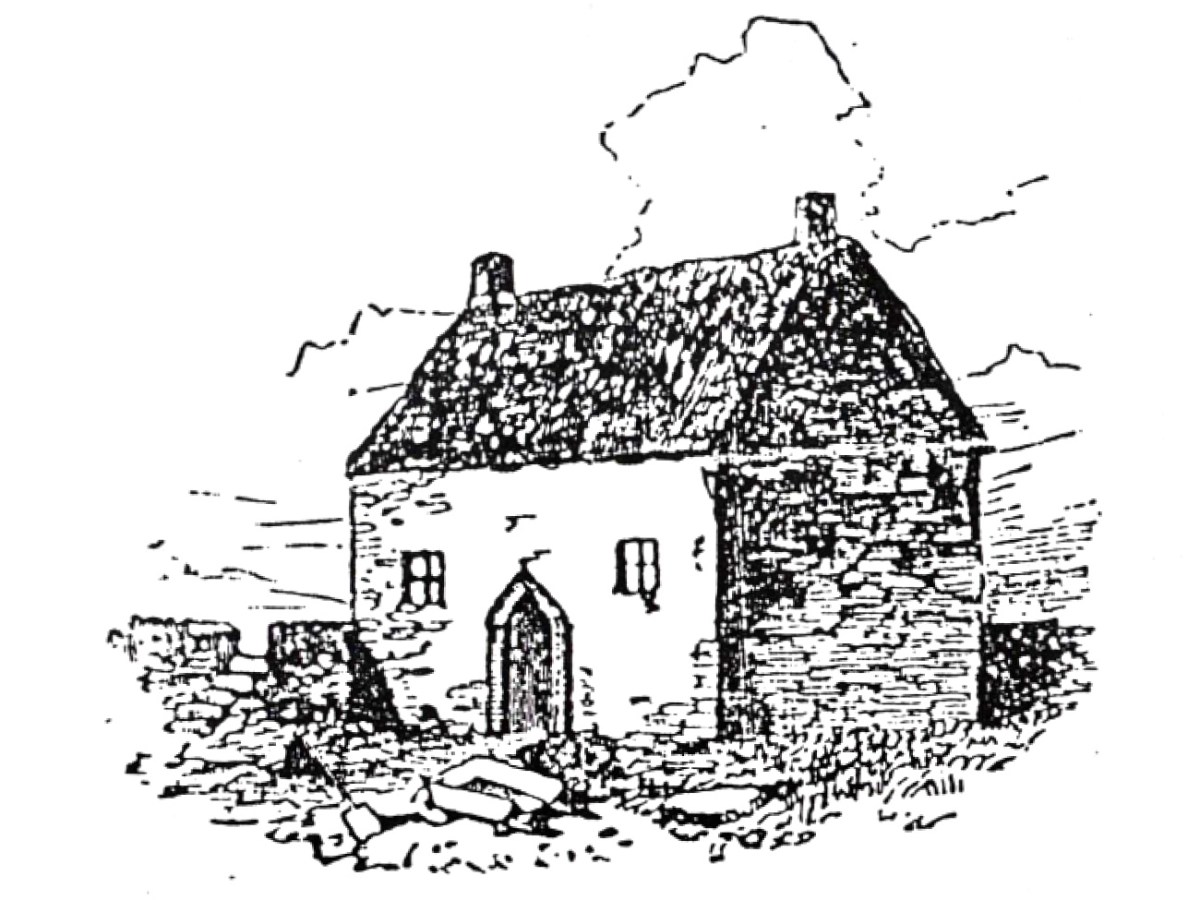
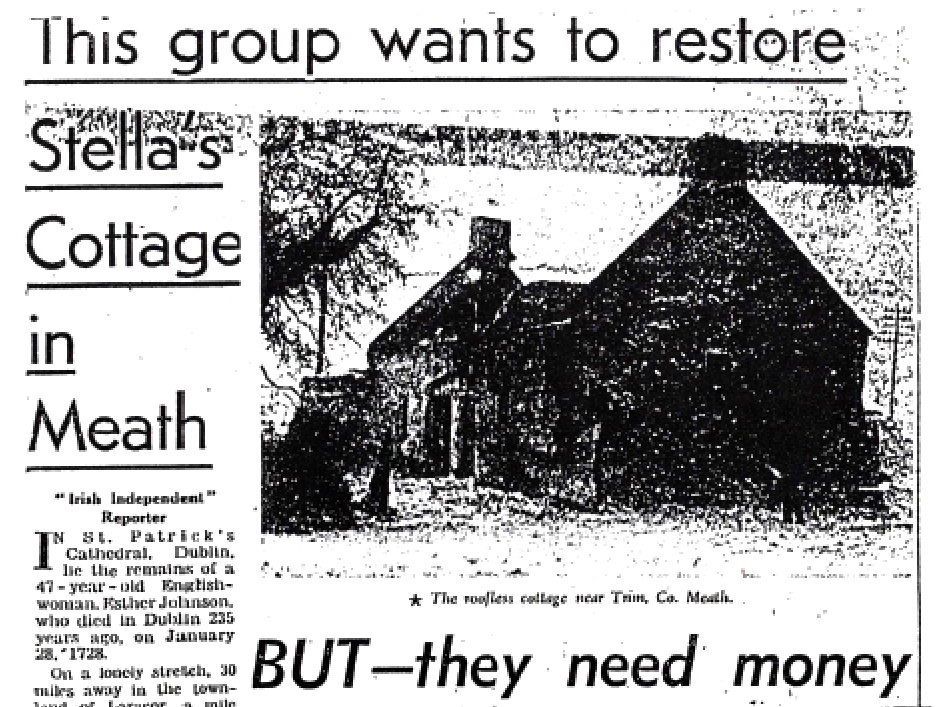
The pamphlet is, in part, an appeal to save what was then left of the cottage, and to fund a restoration of this important piece of Irish history. The appeal was apparently unsuccessful: today the spot is marked by some low stone walls and a plaque. This is a drawing of Stella’s Cottage in 1847:
Many have been fascinated by the Swift / Stella story. In 2020 Michael Billington edited a series in the UK Guardian titled ‘Forgotten Plays’. This is one:
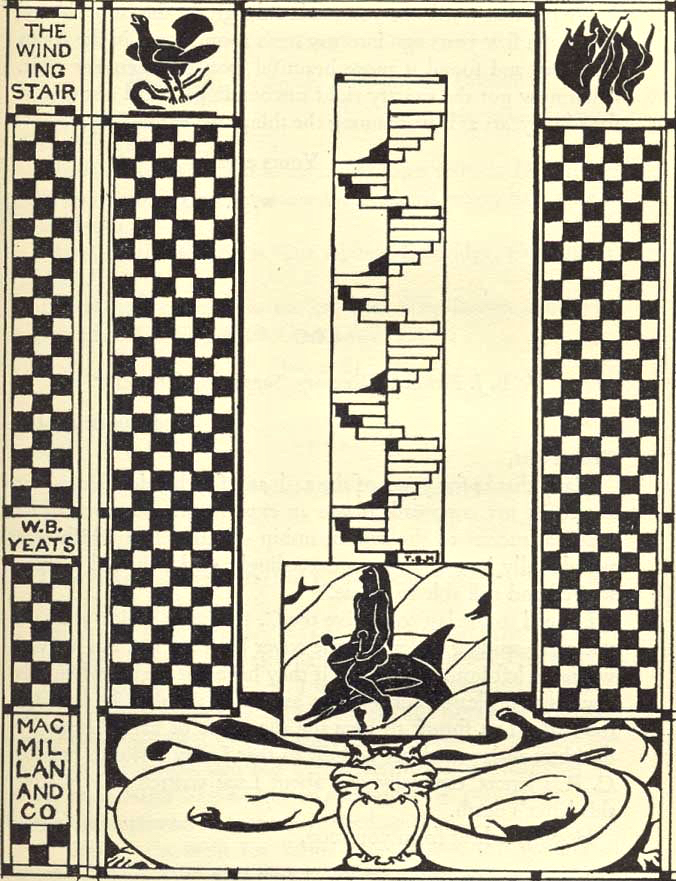
. . . Few plays are more forgotten than those of WB Yeats. Revered as a poet, he’s ignored as a dramatist yet he deserves to be remembered for a number of reasons. He cofounded the Abbey theatre in 1904, he put Irish legend and history on stage, and he sought to create a drama “close to pure music”. His output was huge – his Collected Plays runs to more than 700 pages. The Words Upon the Window-Pane (1930) is in many ways exceptional: it is Yeats’s only play with a realistic modern setting. Its subject is a seance held by the Dublin Spiritualist Association in rooms once occupied by Jonathan Swift’s Stella. Yeats has much fun at the expense of the visitors – one of whom wants advice about setting up a teashop in Folkestone – but the main concern is to expel an evil spirit who has been haunting past sessions. It turns out to be that of Swift whom we hear – through the medium, Mrs Henderson – bitterly rejecting offers of love from the two women who most adored him. What is astonishing is the way Yeats pulls off a double trick. Far from being an attack on Swift, the play is a defence of his refusal to beget children because of his dread of the future. But, rather like David Mamet’s The Shawl about a phoney clairvoyant with psychic gifts, the play suggests that the money-grubbing Mrs Henderson may actually have conjured up the crabbed spirit of Dublin’s celibate dean . . .
The Guardian 27 July 2020
Lastly, consider this ‘alternative view’ by Michael Foot: Debts of Honour (Faber 1980) –
. . . British politician Michael Foot was a great admirer of Swift and wrote about him extensively. In Debts of Honour he cites with approbation a theory propounded by Denis Johnston that offers an explanation of Swift’s behaviour towards Stella and Vanessa. Pointing to contradictions in the received information about Swift’s origins and parentage, Johnston postulates that Swift’s real father was Sir William Temple’s father, Sir John Temple who was Master of the Rolls in Dublin at the time. It is widely thought that Stella was Sir William Temple’s illegitimate daughter. So Swift was Sir William’s brother and Stella’s uncle. Marriage or close relations between Swift and Stella would therefore have been incest, an unthinkable prospect. It follows that Swift could not have married Vanessa either without Stella appearing to be a cast-off mistress, which he would not contemplate. Johnston’s theory is expounded fully in his book In Search of Swift . . .
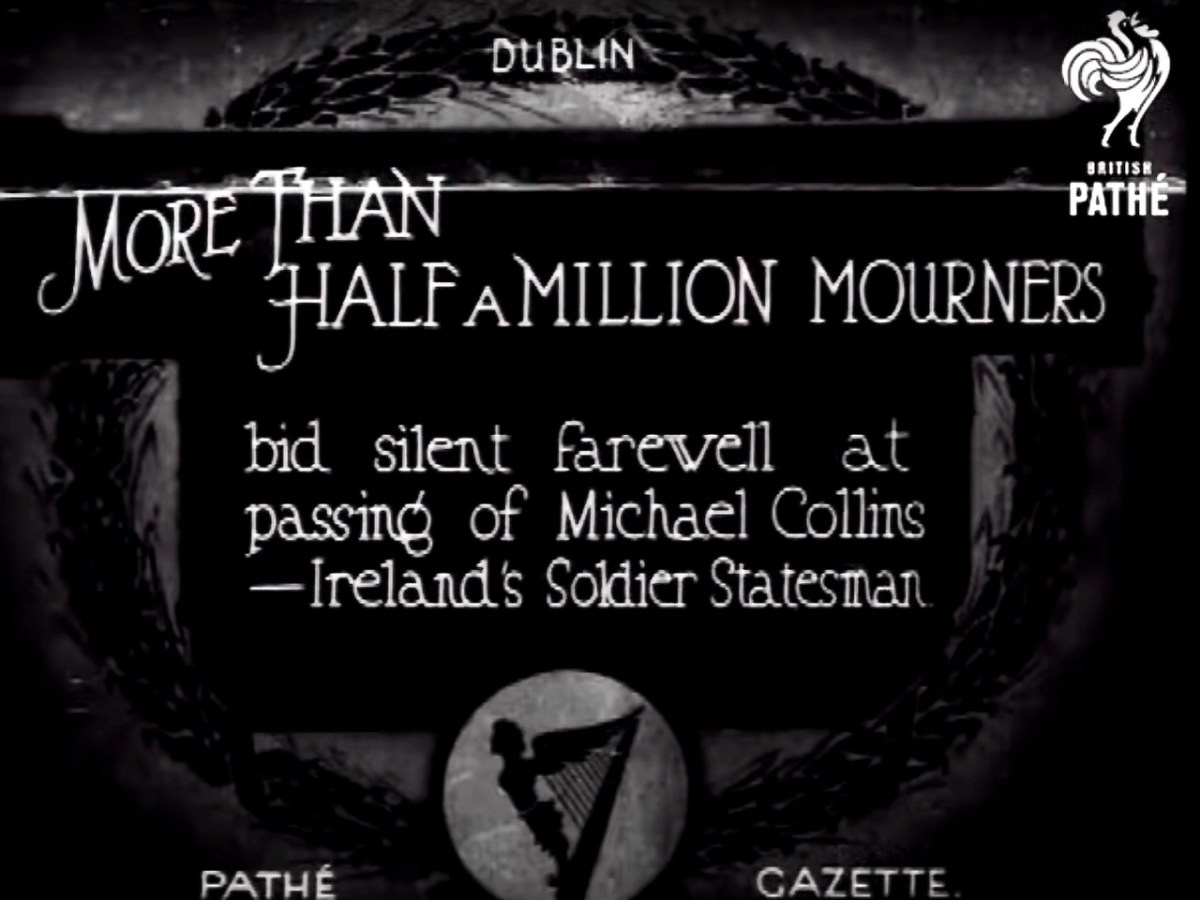
It would have been hard to miss the centenary of the death of Michael Collins over this past week. He was killed at Béal na Bláth, West Cork on 22 August 1922, during the Irish Civil War. His passing – and his life – has been the stuff of legend ever since. He’s buried in Glasnevin Cemetery, Dublin, but the events this week were focussed on the place where his life ended – not far from where we live.
Micheál Martin – Taoiseach and Head of Government in Ireland – (on the left, above) and Leo Varadkar – Tánaiste and Deputy Head of Government – (on the right) presided over the ceremony at Béal na Bláth this week (picture courtesy of The Independent). This was an historic get-together as both men lead different parties – Fianna Fáil and Fine Gael respectively: these are in coalition at the moment, together with the Green Party. The Taoiseach said in his speech that the willingness of those of differing political views to try to find common ground was one of the great strengths of modern Ireland. In Collin’s time, a century ago, such coming together would have seemed extremely implausible.
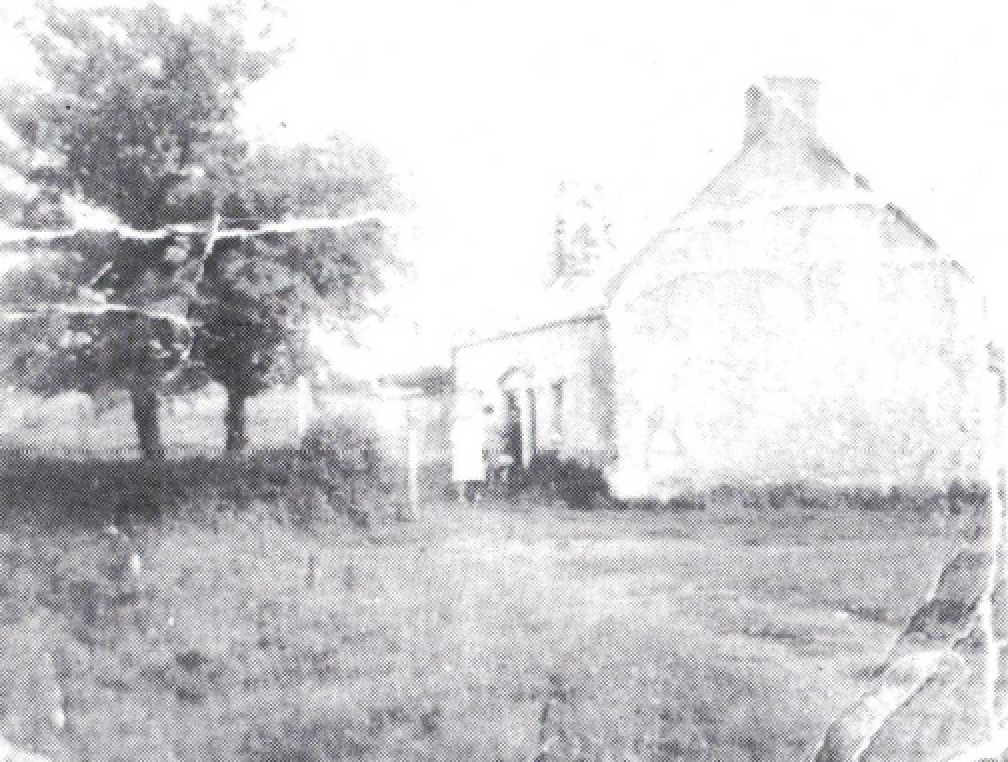
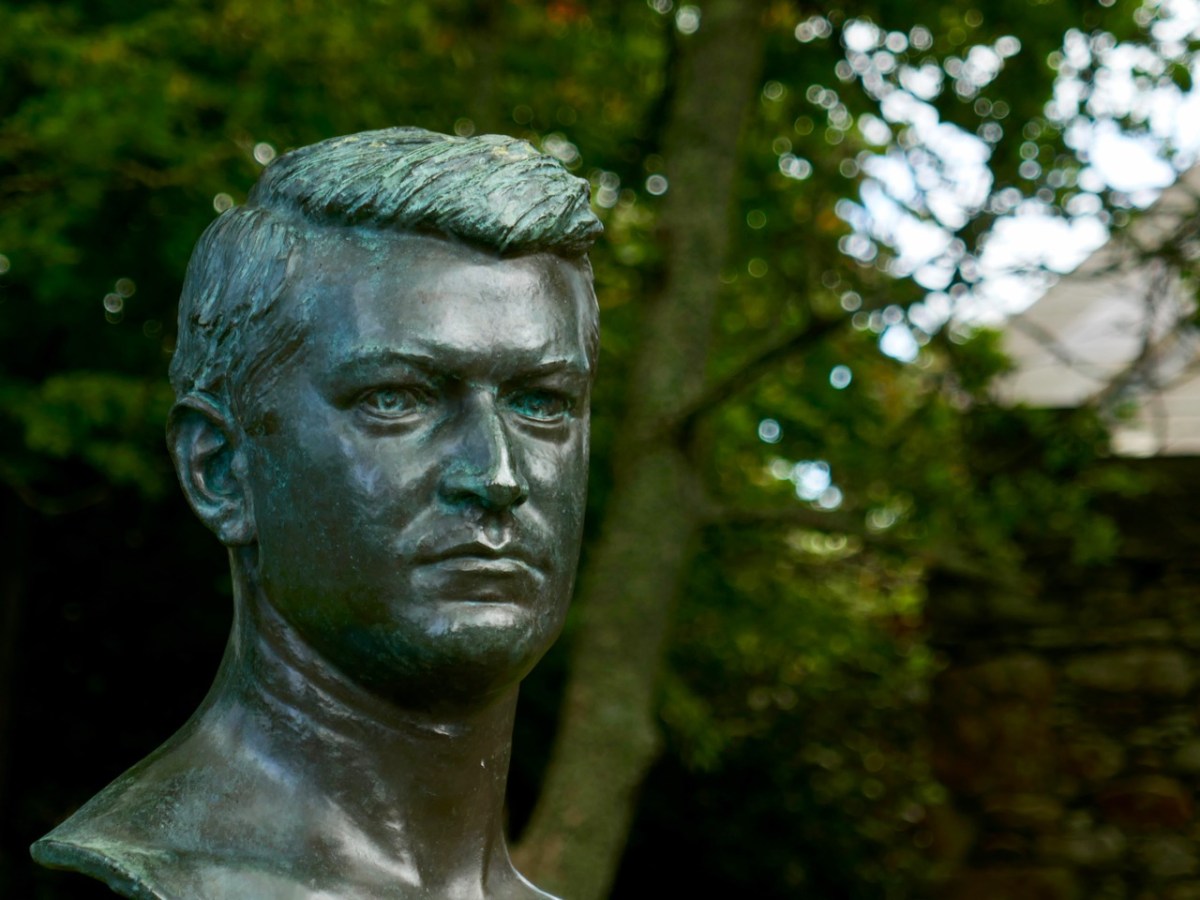
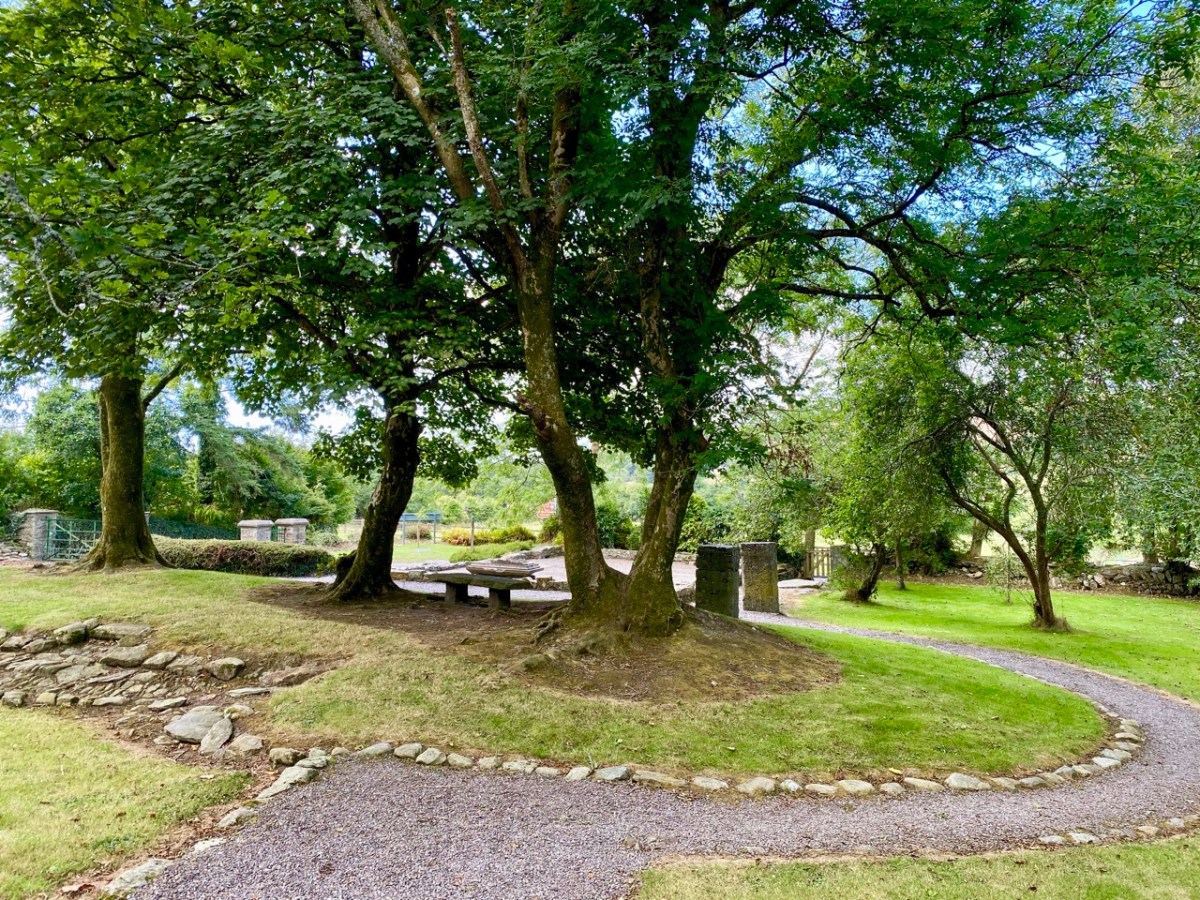
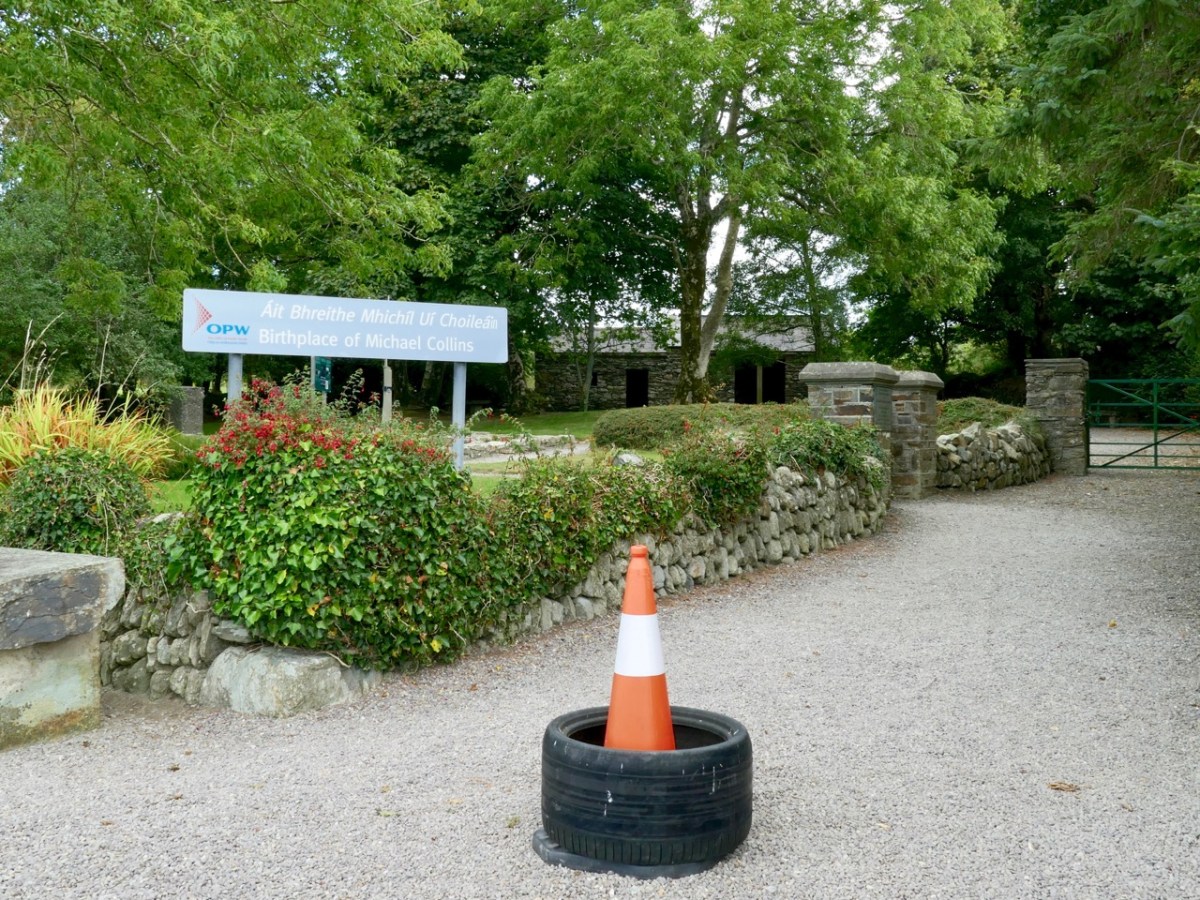
This bust of Michael Collins is sited at his home place, Woodfield, Sam’s Cross in West Cork. There’s nothing left of the main house now (below): it was burned down during the Irish Civil War. But the original cottage still stands as a shell (it’s behind the trees in the background of the lower photo, to the right of the Public Works signpost). It was there that Collins was born.
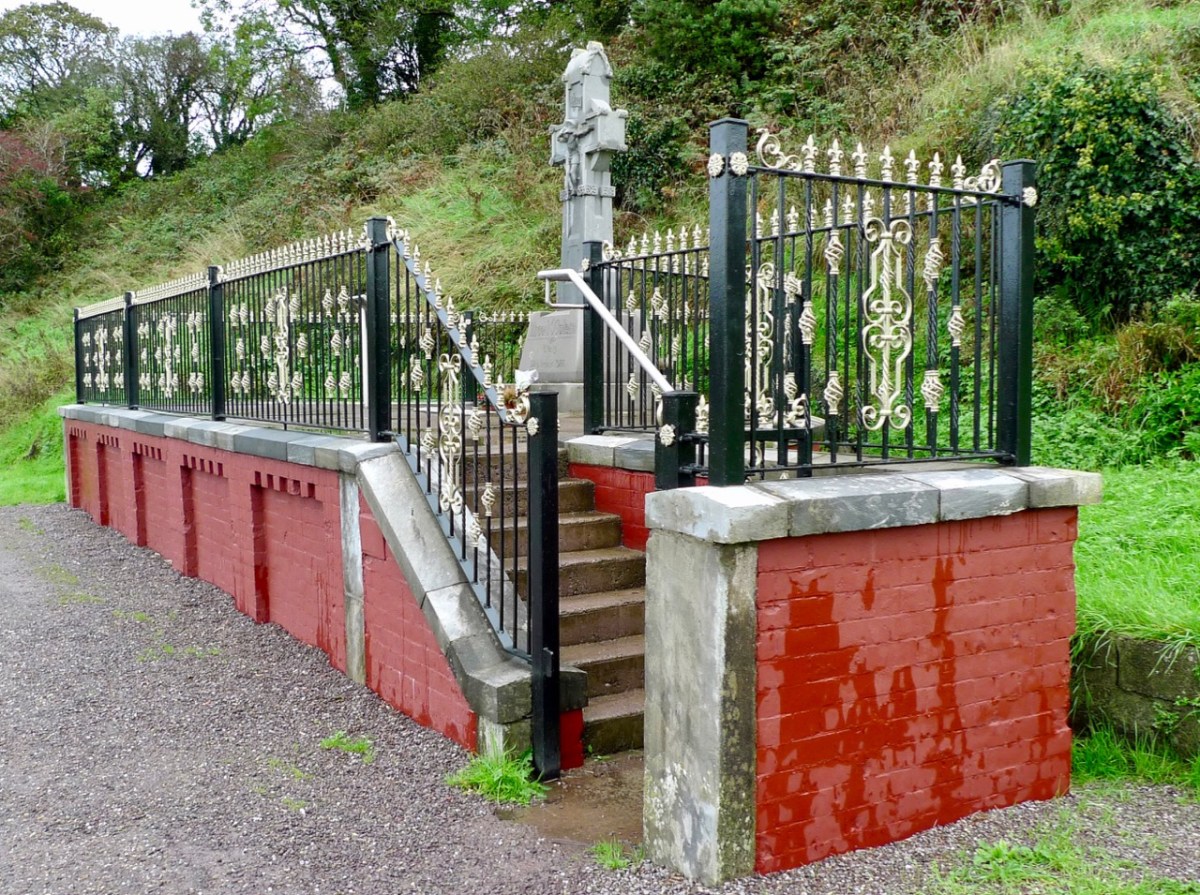
We didn’t go to the official ceremony at Béal na Bláth on the 21st: many thousands of people attended. We were interested to visit a bit later in the week, to see how the site has been upgraded to mark the centenary. Previously, the memorial itself was gaunt and severe: here’s a pic from our visit in 2013:
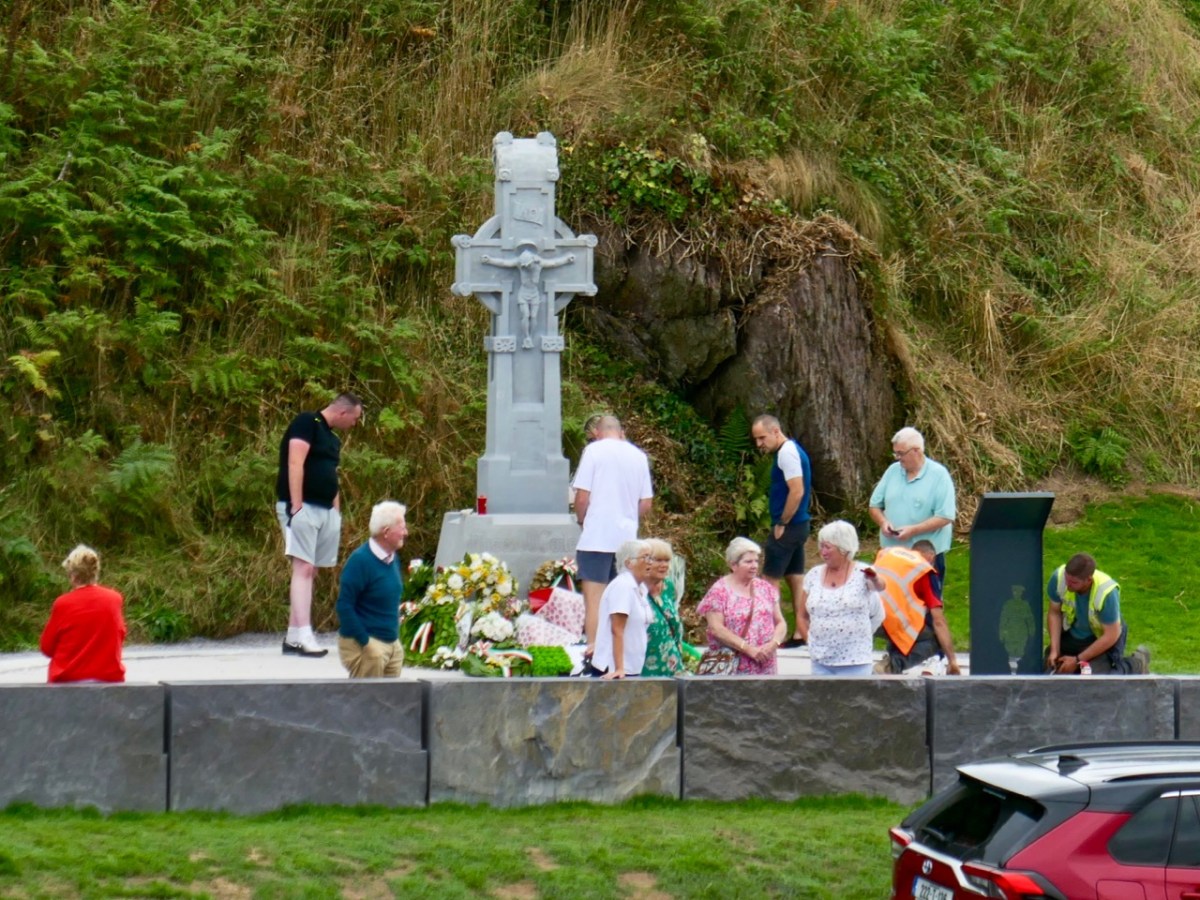
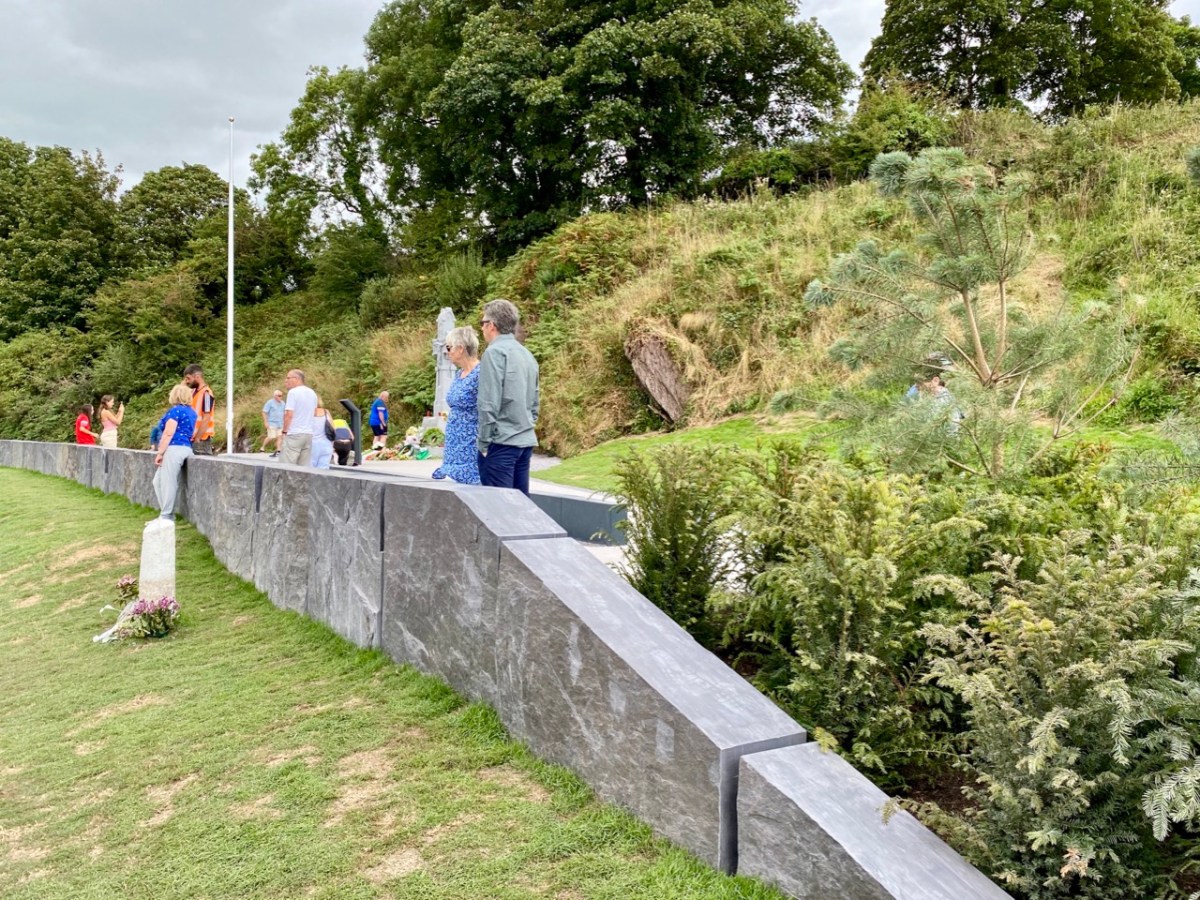
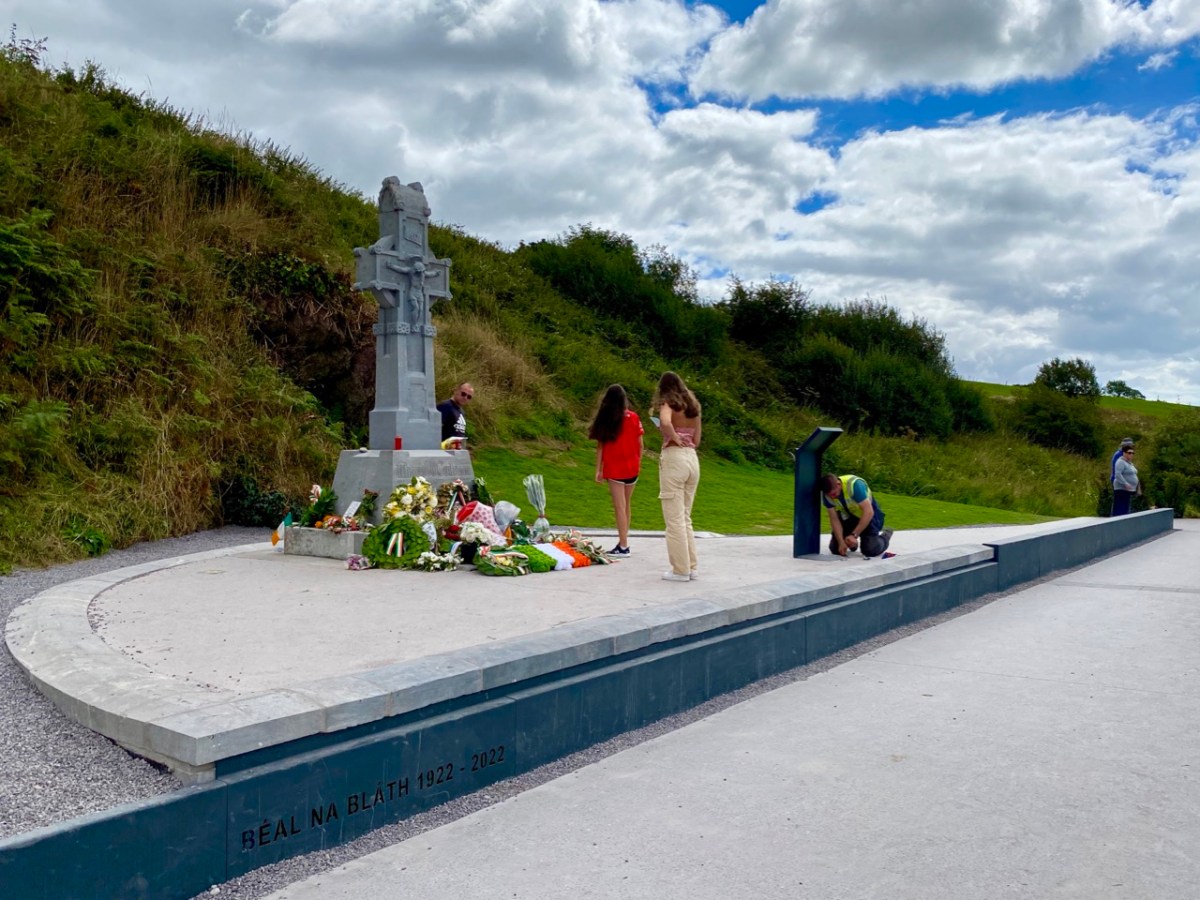
It’s significantly different now: car parking has been rationalised and the commemorative cross is the main focus, with some significant hard landscaping. In our opinion, the works (by Cork County Council) have succeeded in focussing the main elements, and the scale is more human.
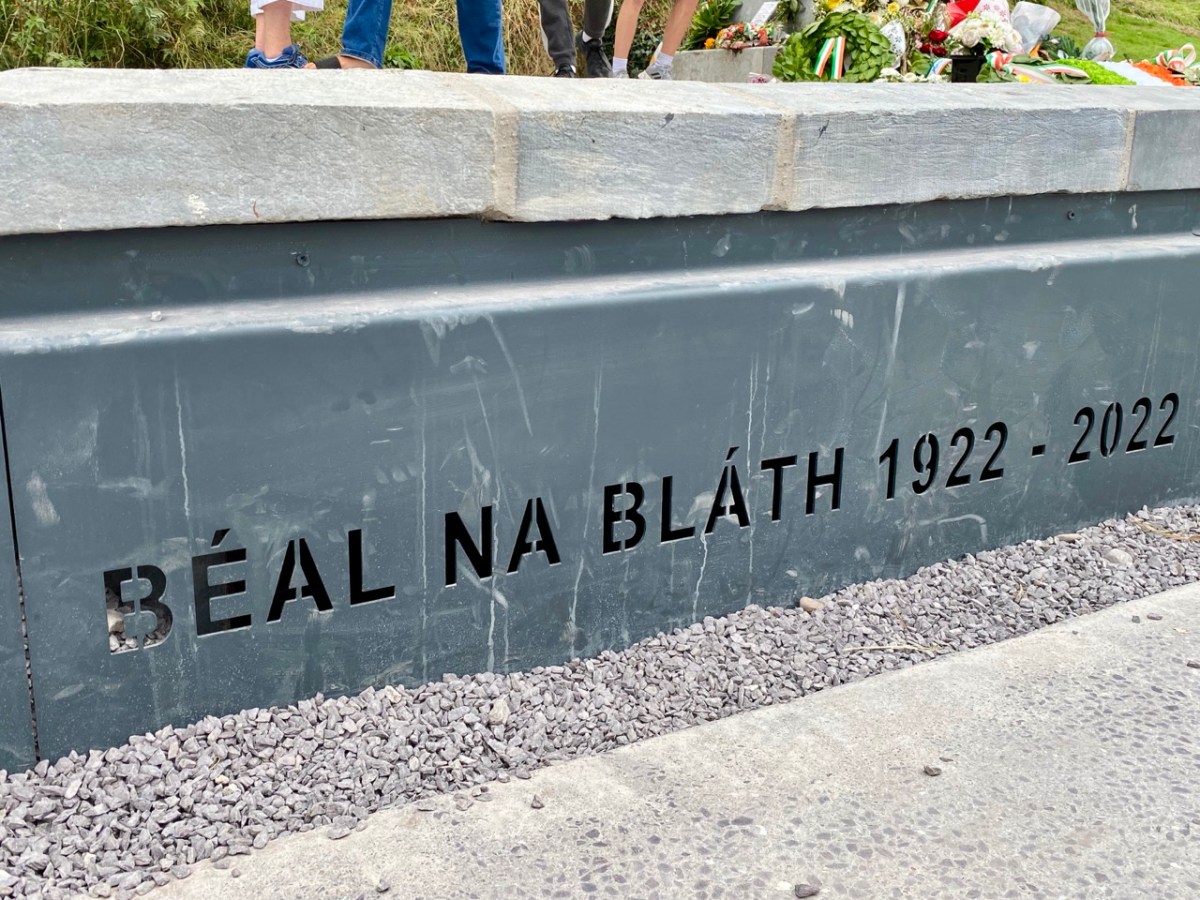
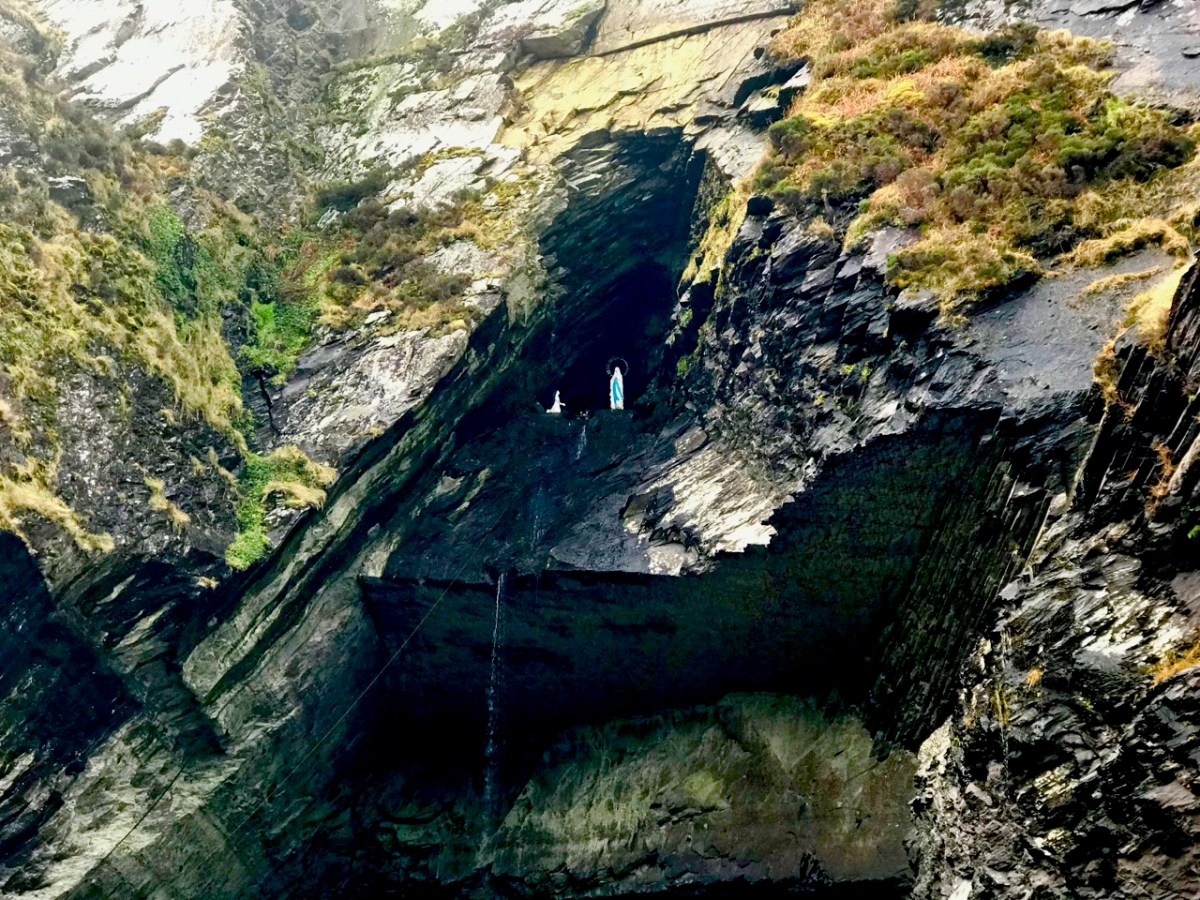
The new walling defining the edge of the memorial site is built from huge blocks of slate from Valentia Island Quarry, Co Kerry: “. . . the most westerly quarry in Europe . . .” The material is fittingly monumental. When we visited Valentia back in January 2019, we recorded the fact that this quarry has its very own Marian grotto:
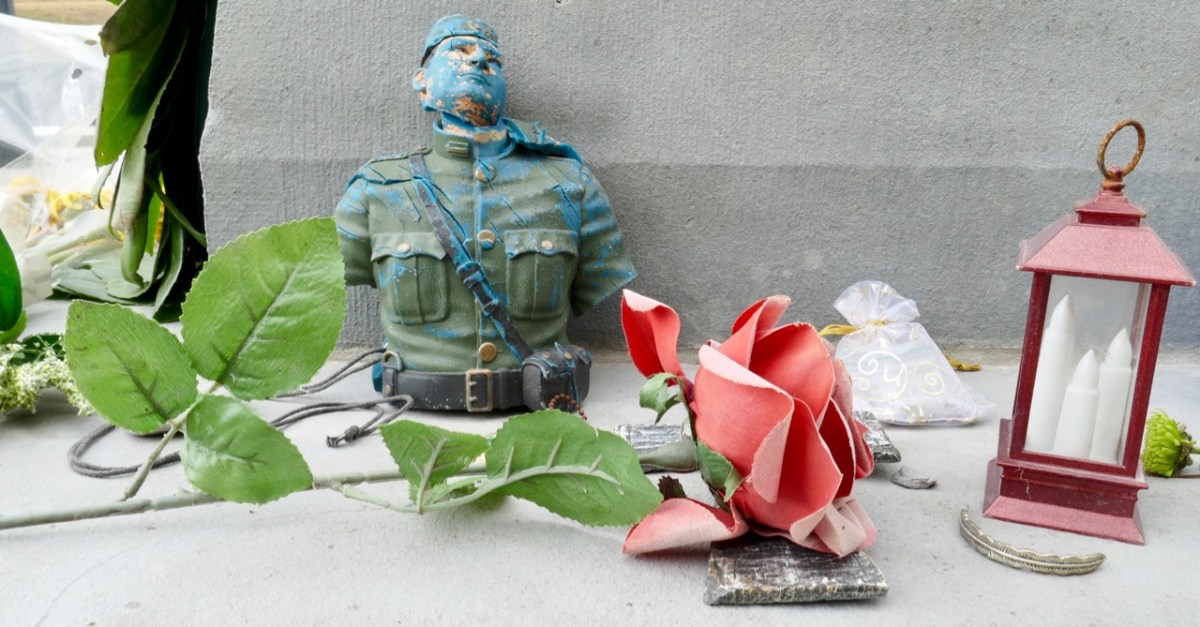
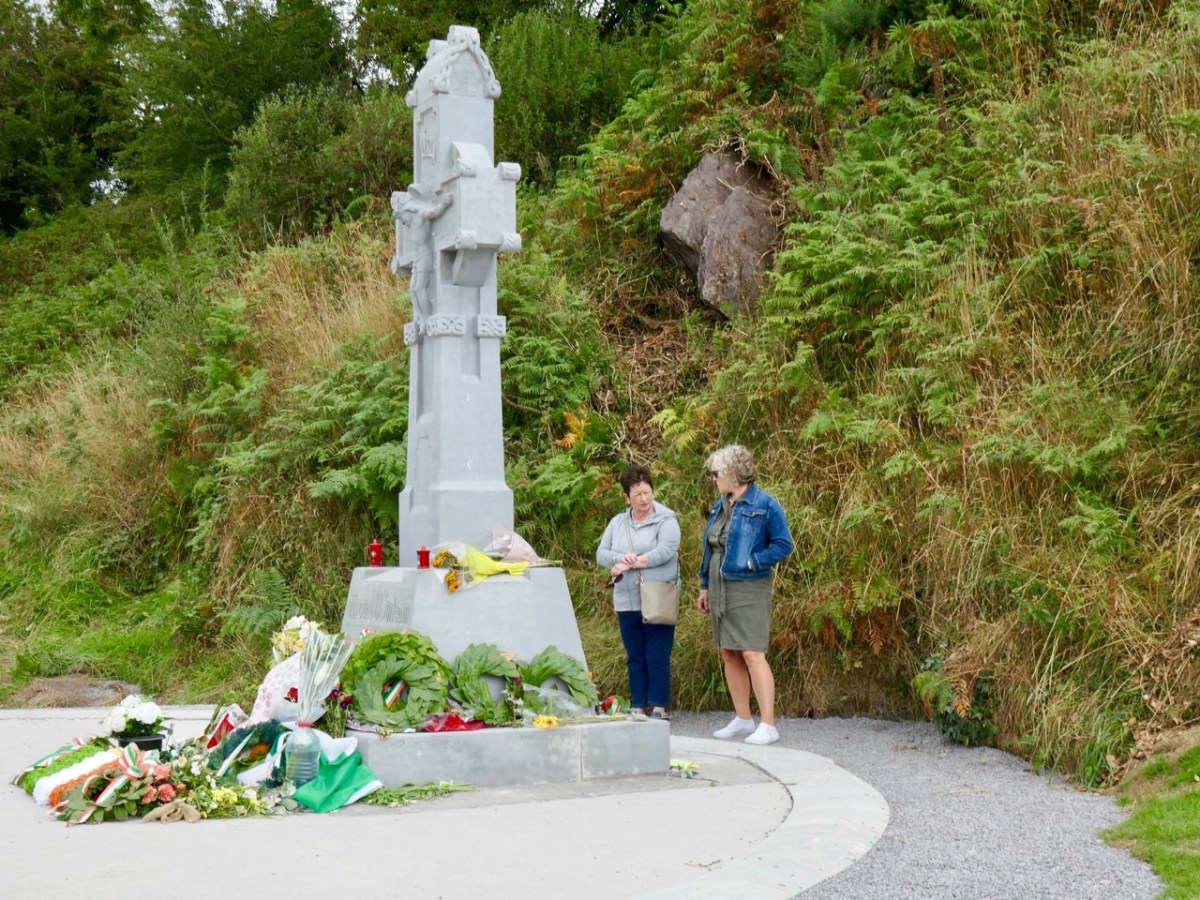
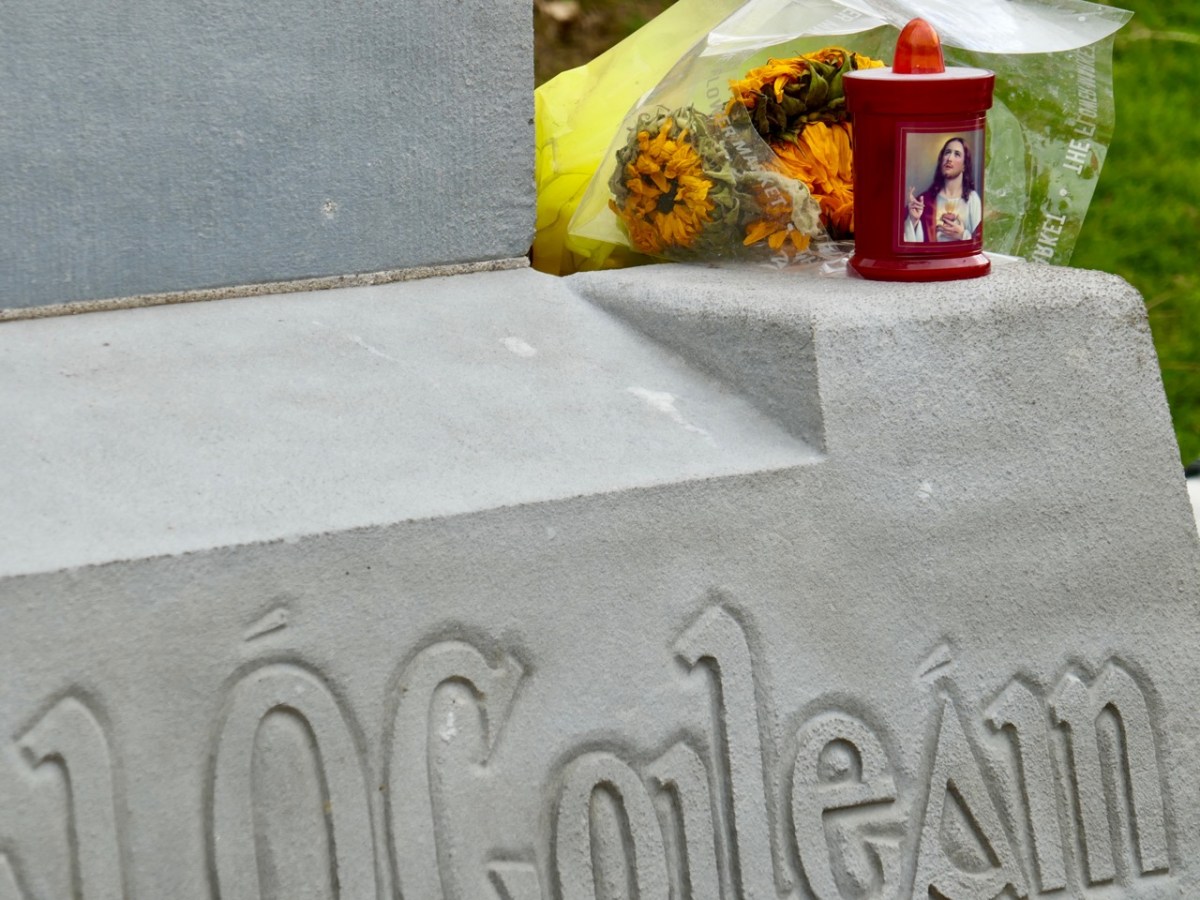
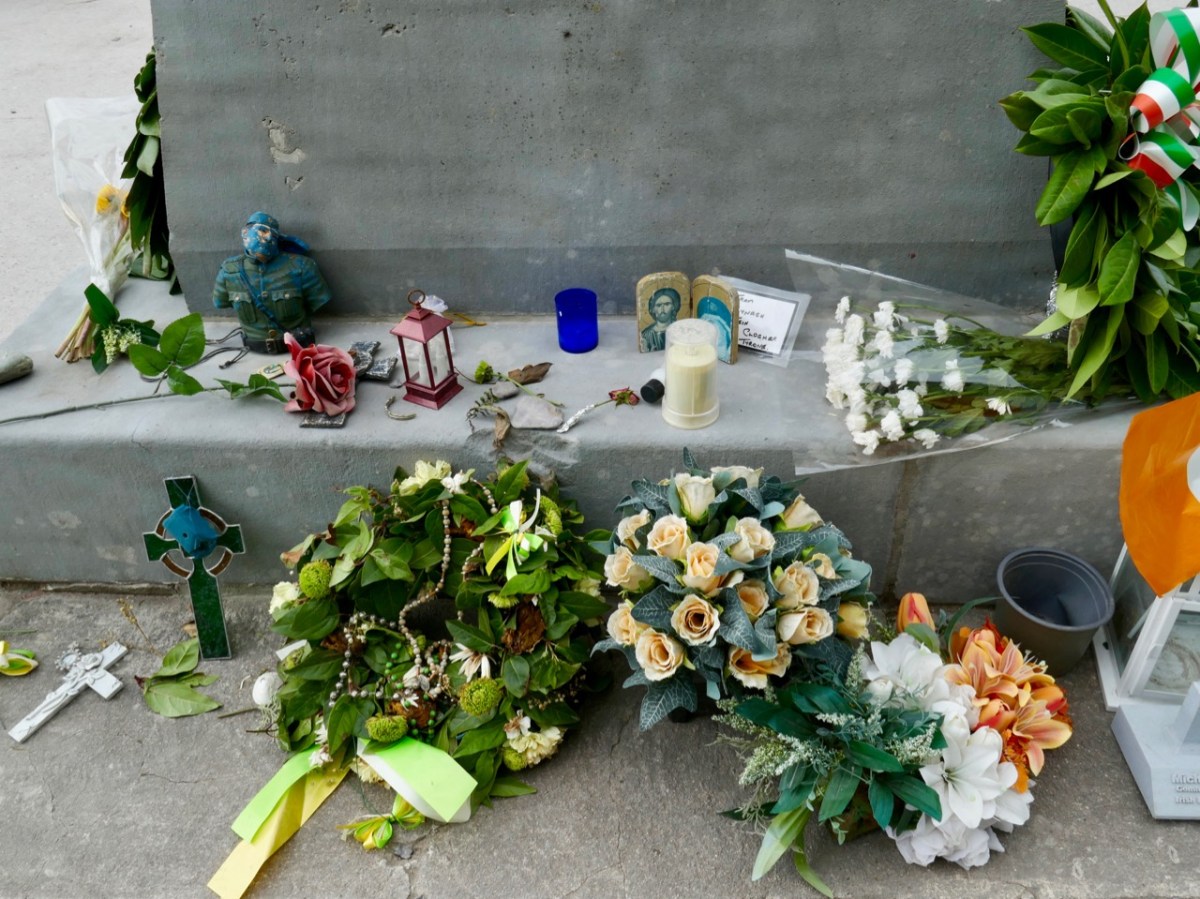
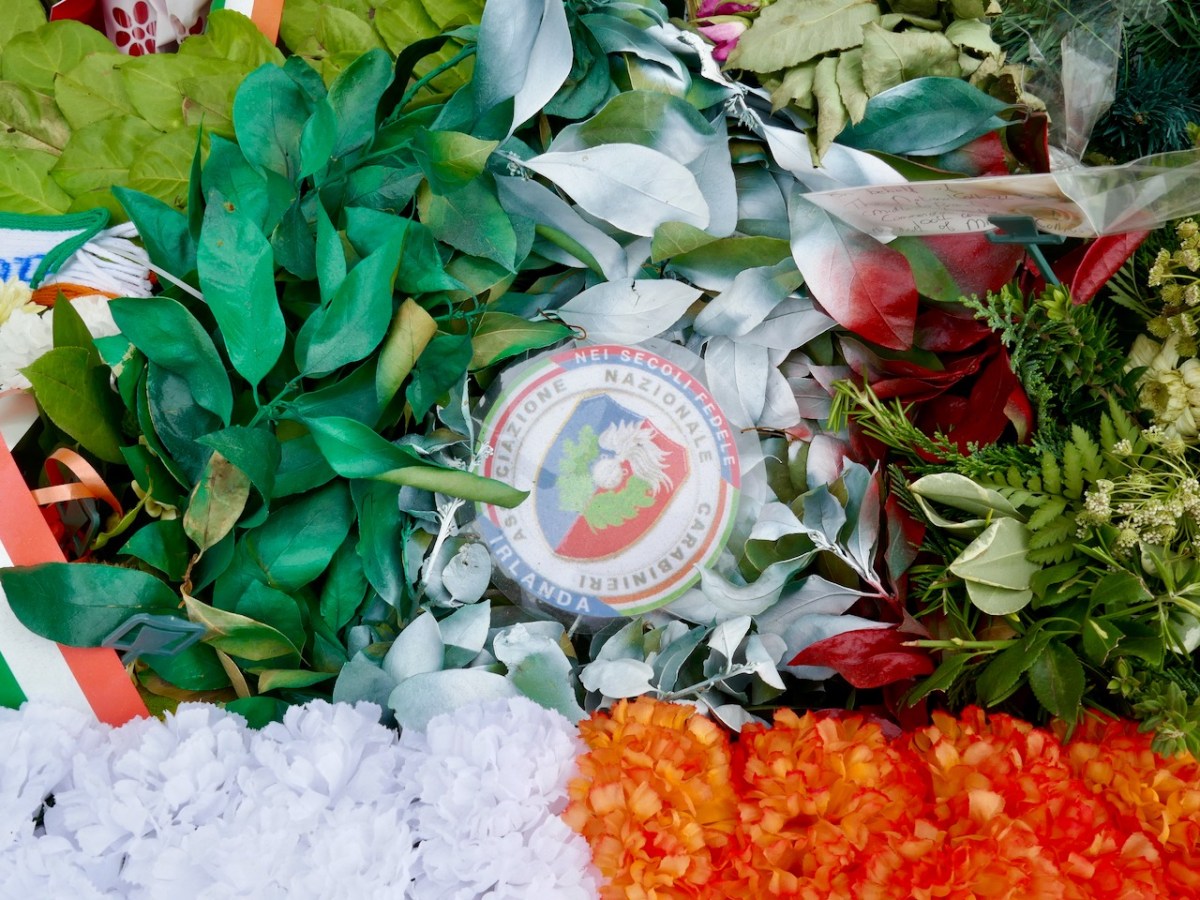
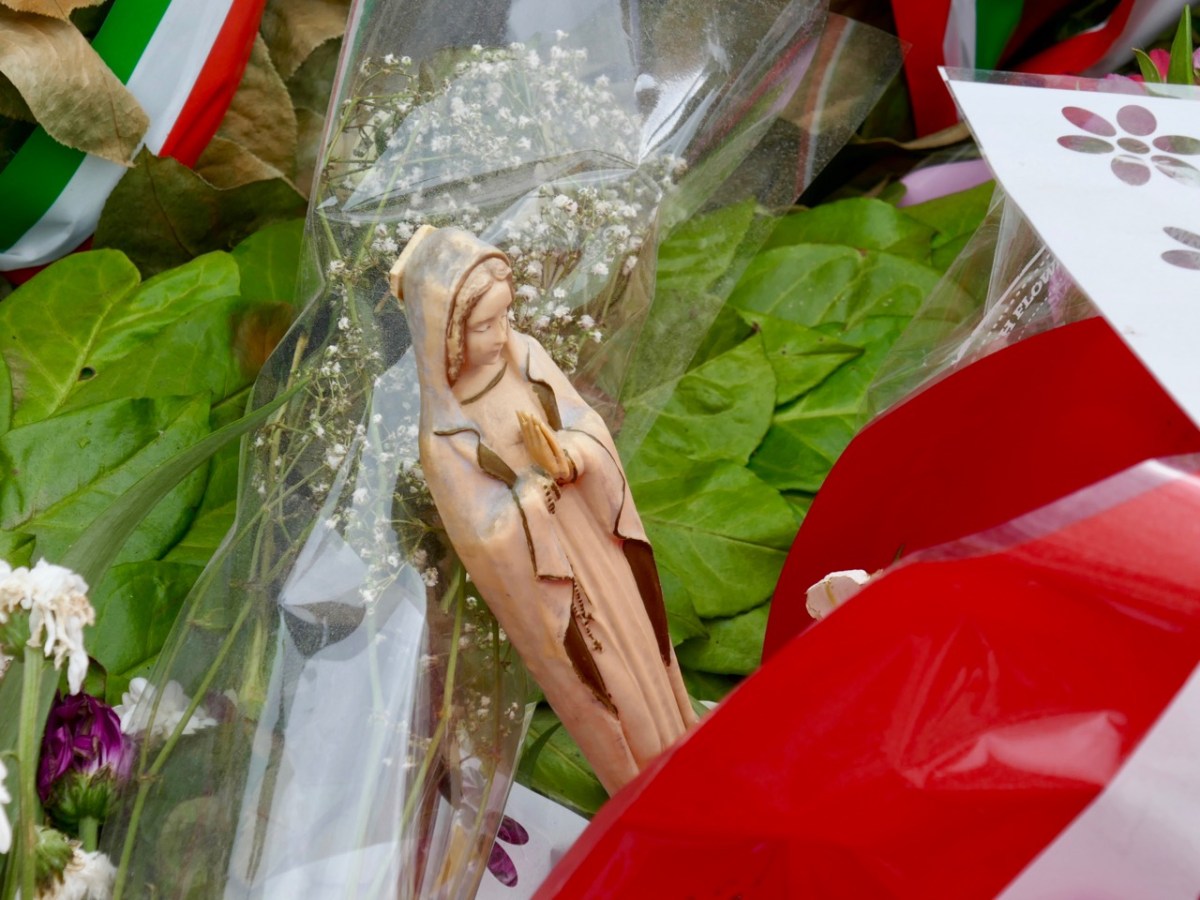
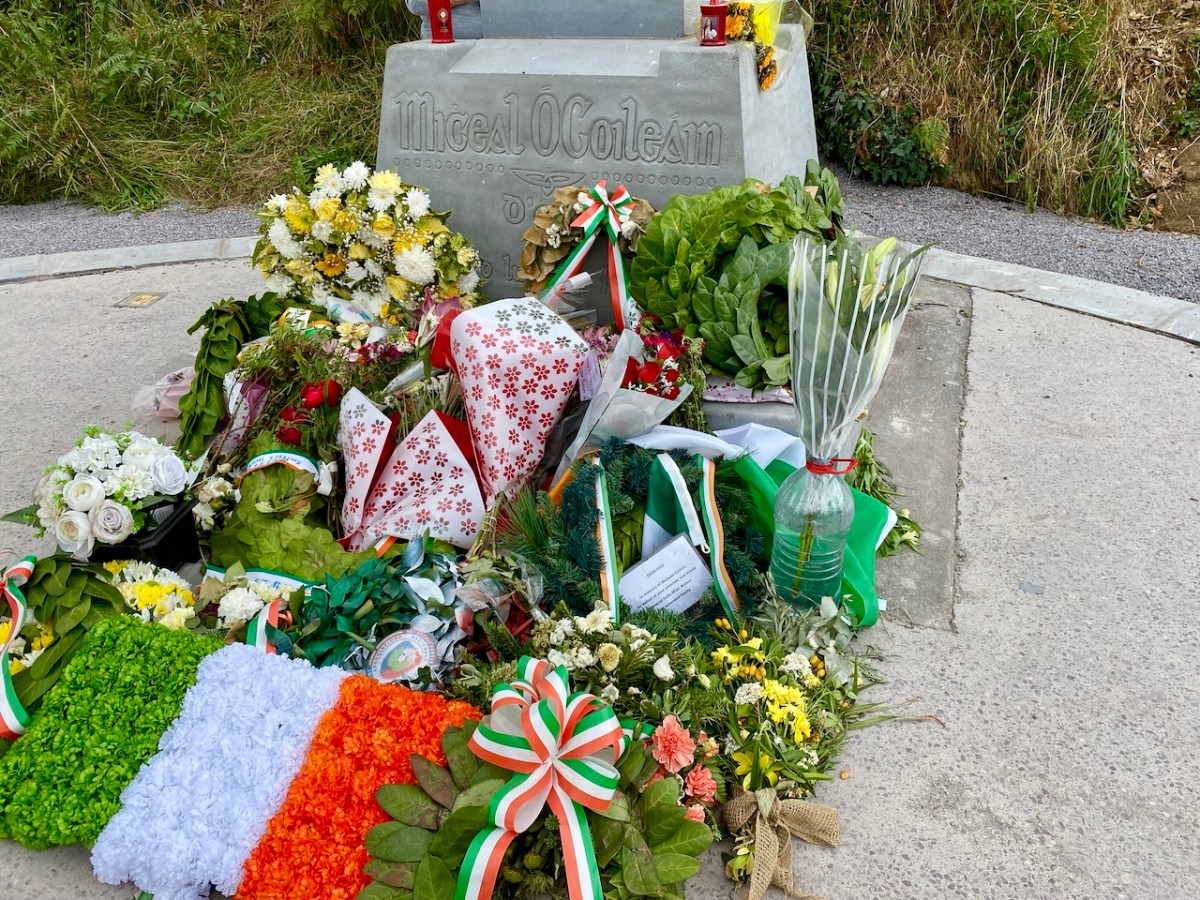
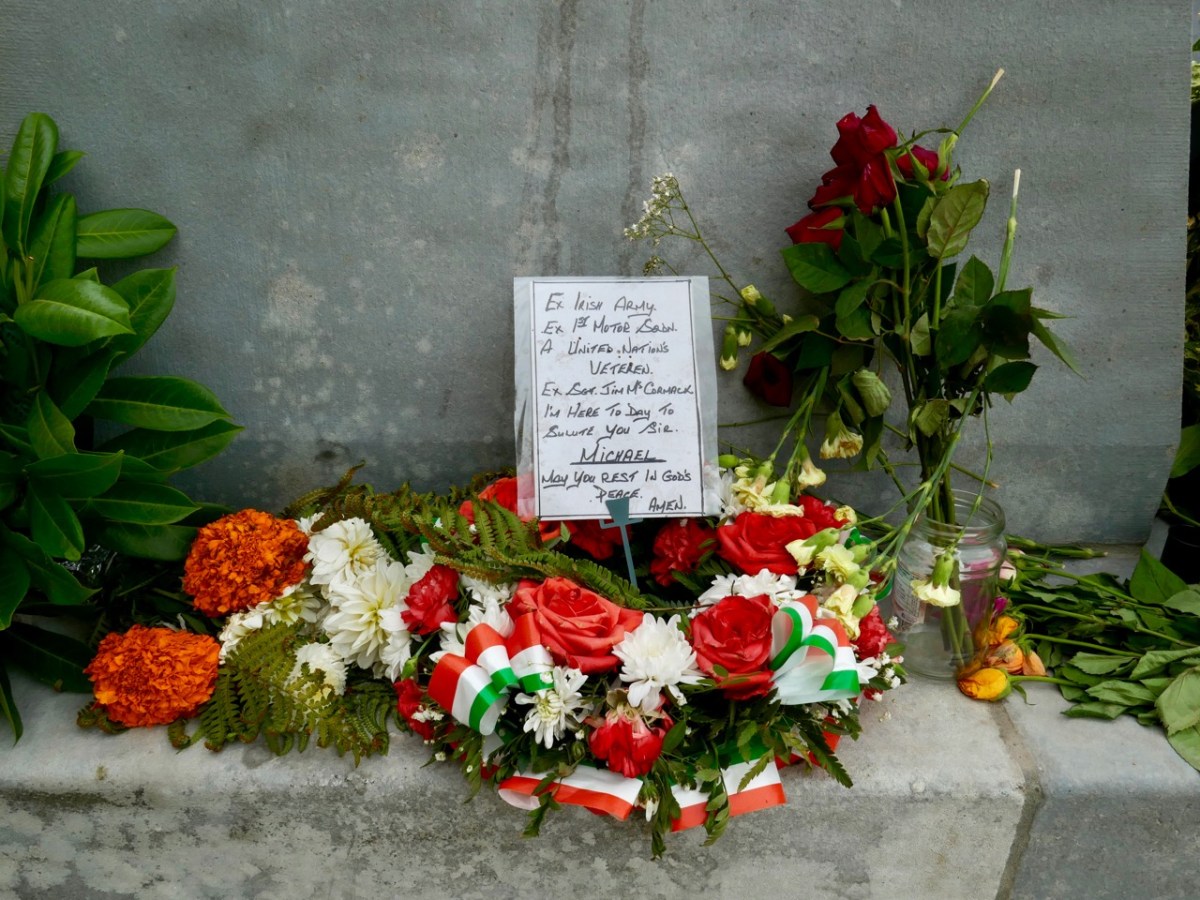
We were interested – and pleased – to see that the upgraded memorial still gives space to ‘popular’ offerings. We maintain that Michael Collins is on his way to beatification, and he is already being treated as more than a fallen warrior (although that status is, in itself, heroic). Amongst the floral tributes are religious symbols, messages, and ‘relics’.
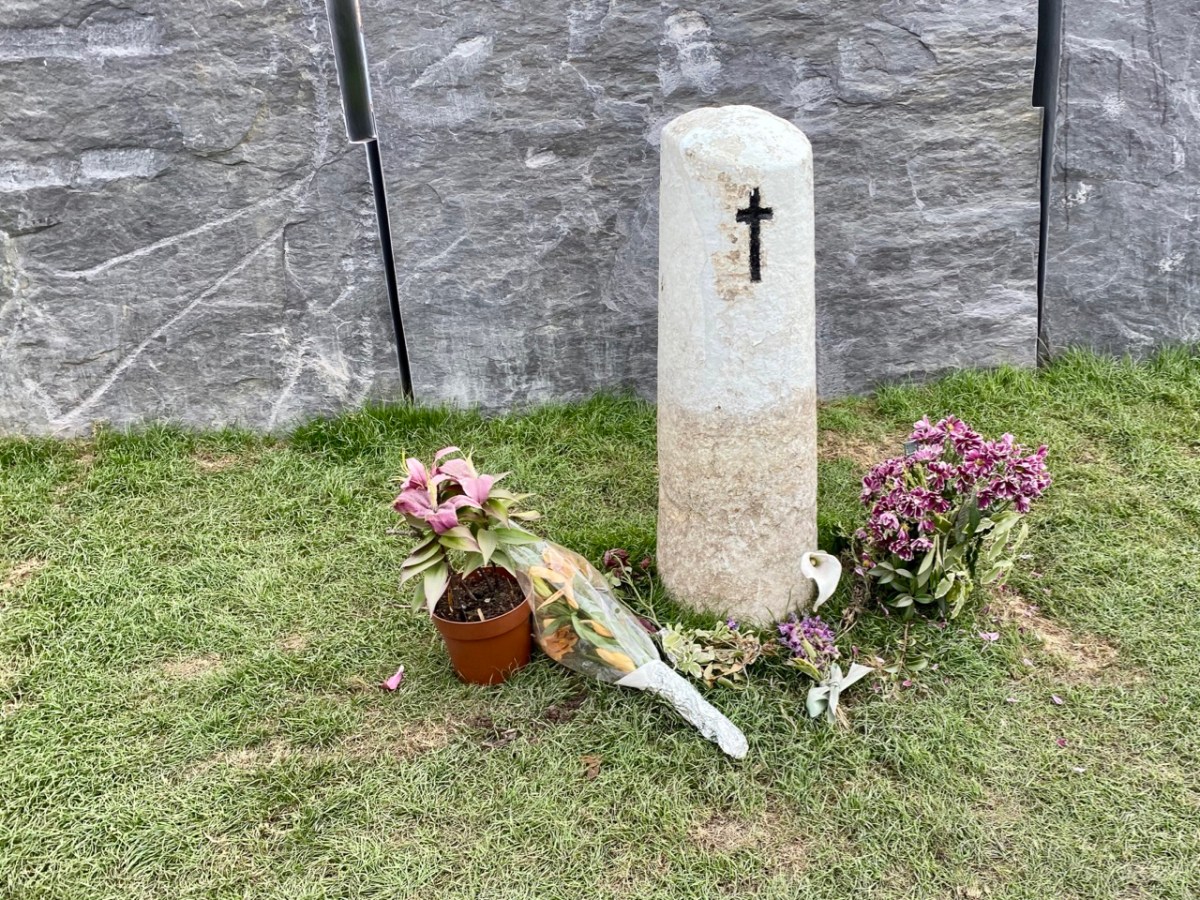
And – of course – the fateful spot (above) where Collins fell is still marked by the simple white stone which has been at this site for generations.
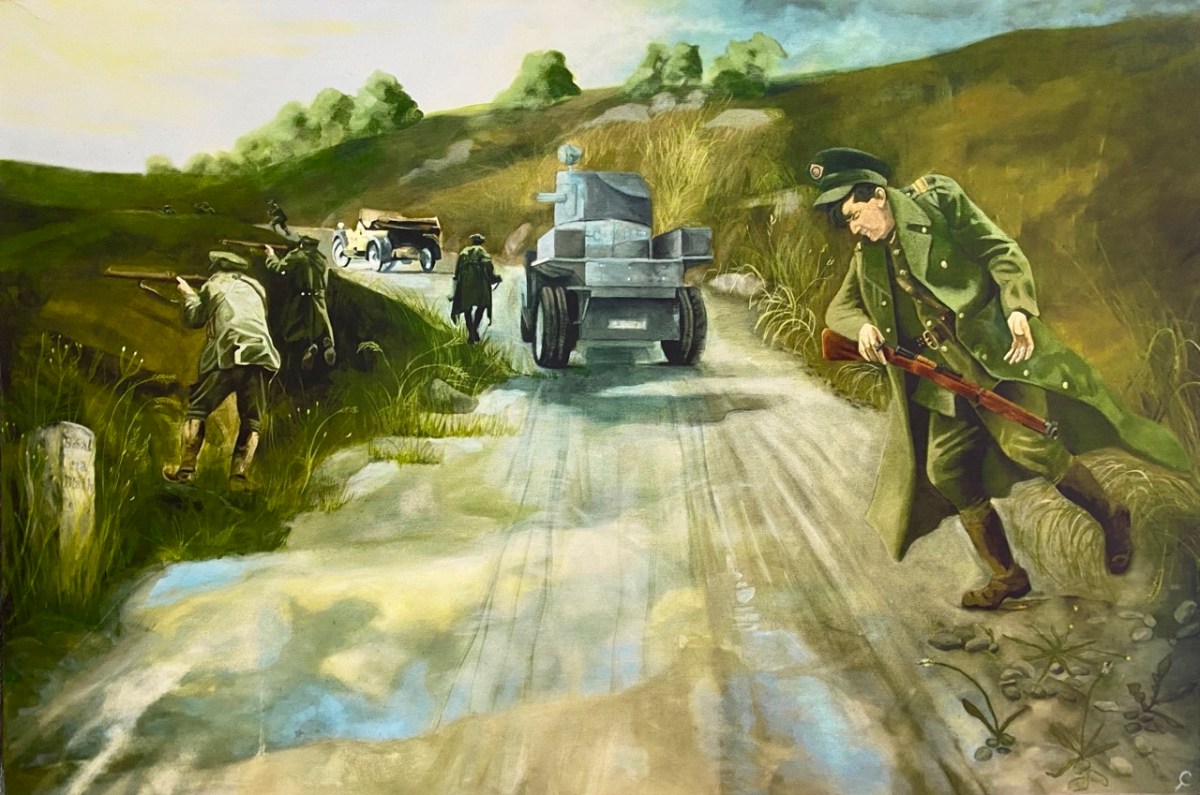
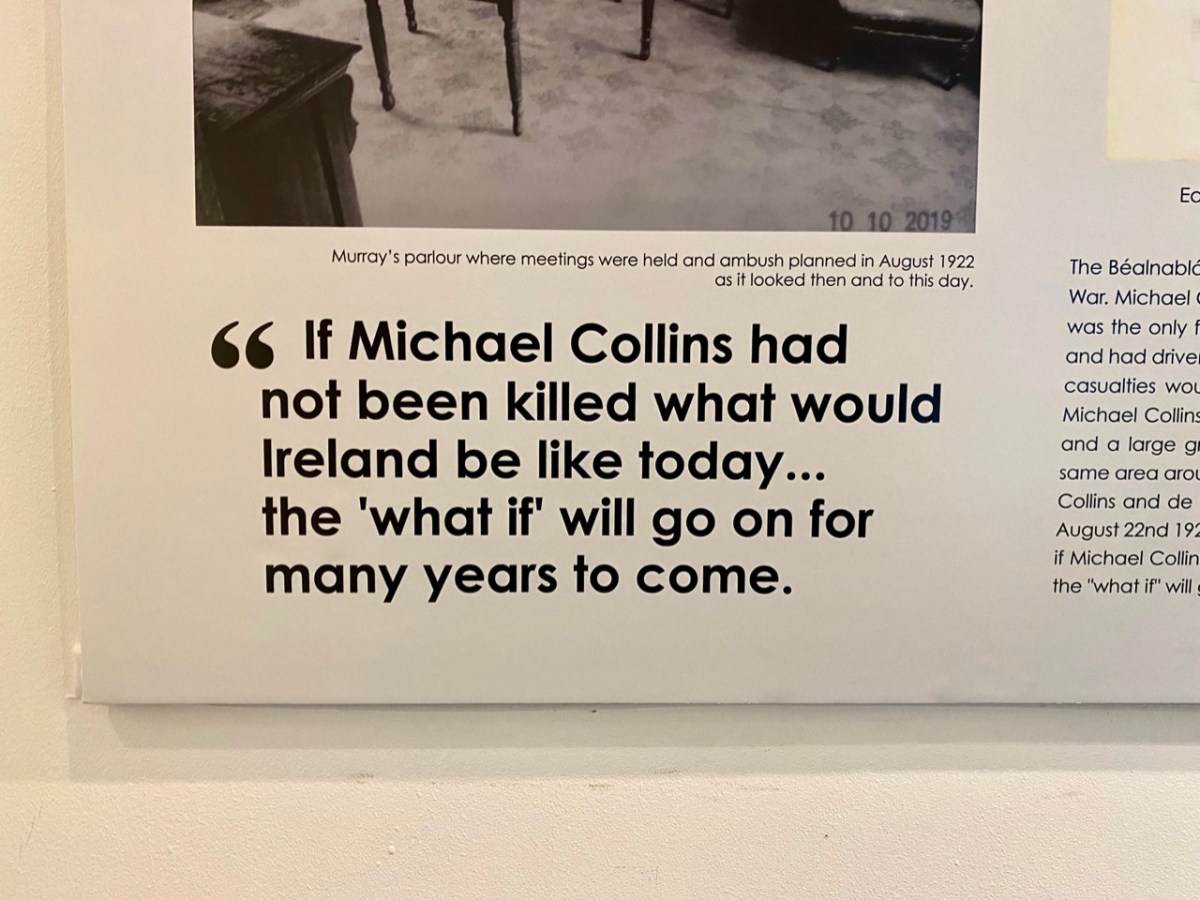
‘The Moment’ at which Collins was shot by an enemy bullet, captured in a dramatic painting (above), now on display in the Michael Collins Centre at Castleview, Clonakilty. No one has ever been held to account for the shooting, which was the only fatality on that day, and some have suggested that Collins was not intentionally targeted, and may have been the victim of an accidental ricochet. It’s most likely that we will never know the true story, but there’s no doubt that popular folklore has stepped in to fill the gaps.
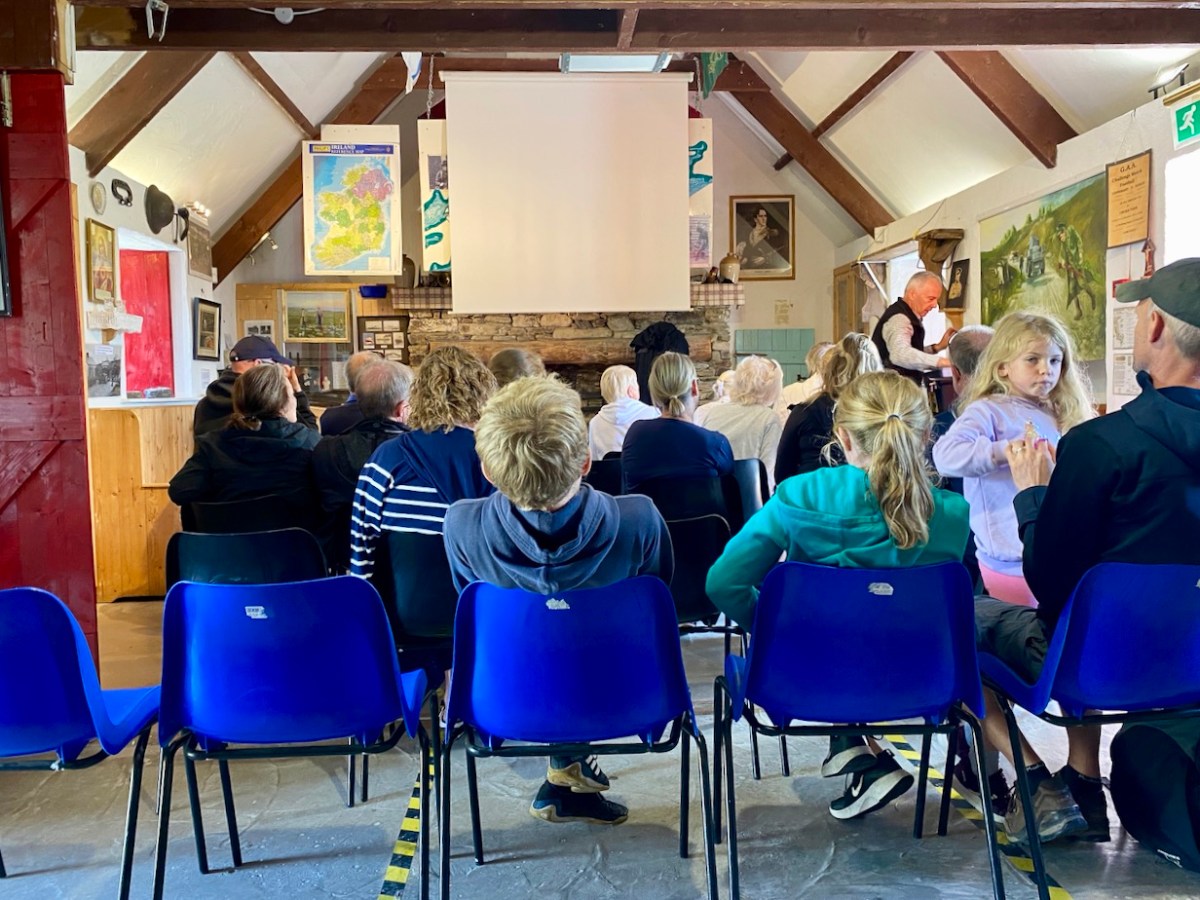
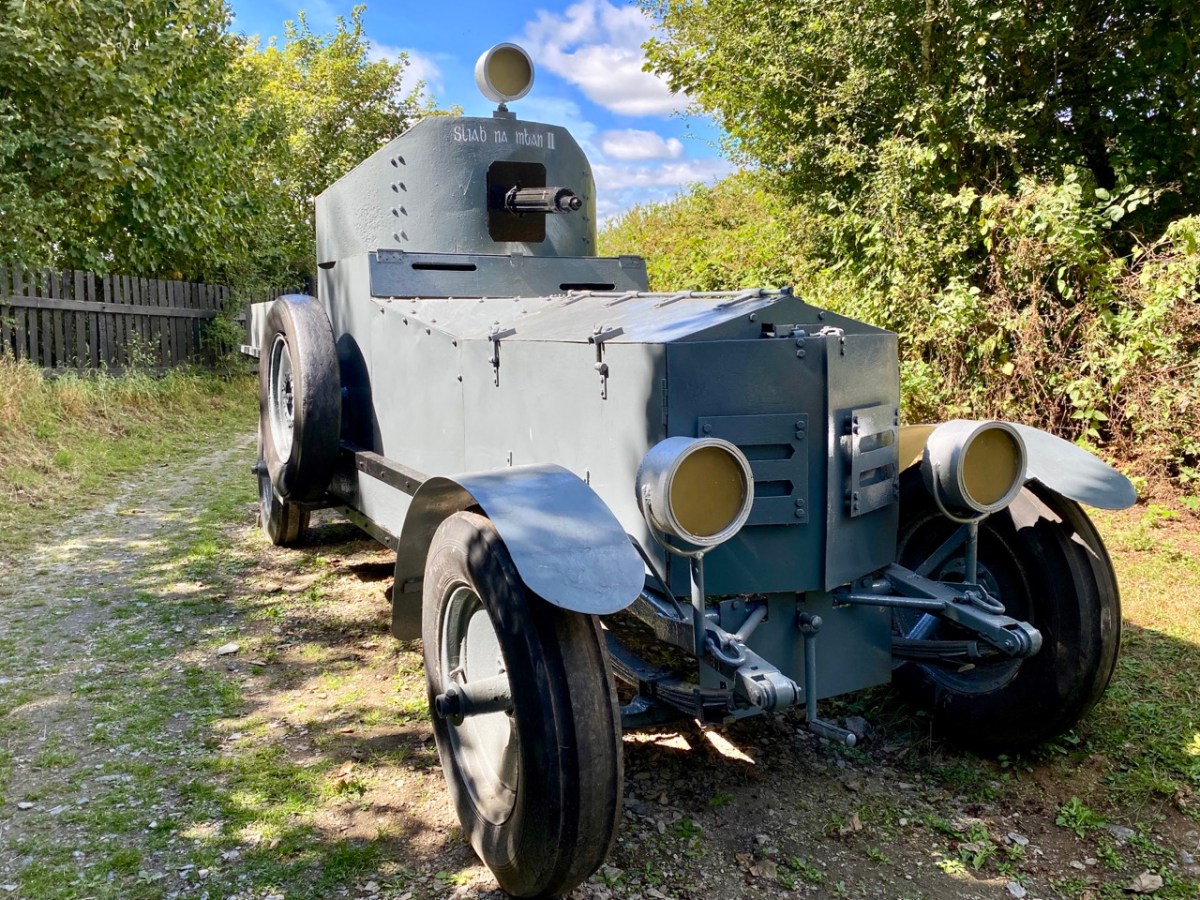
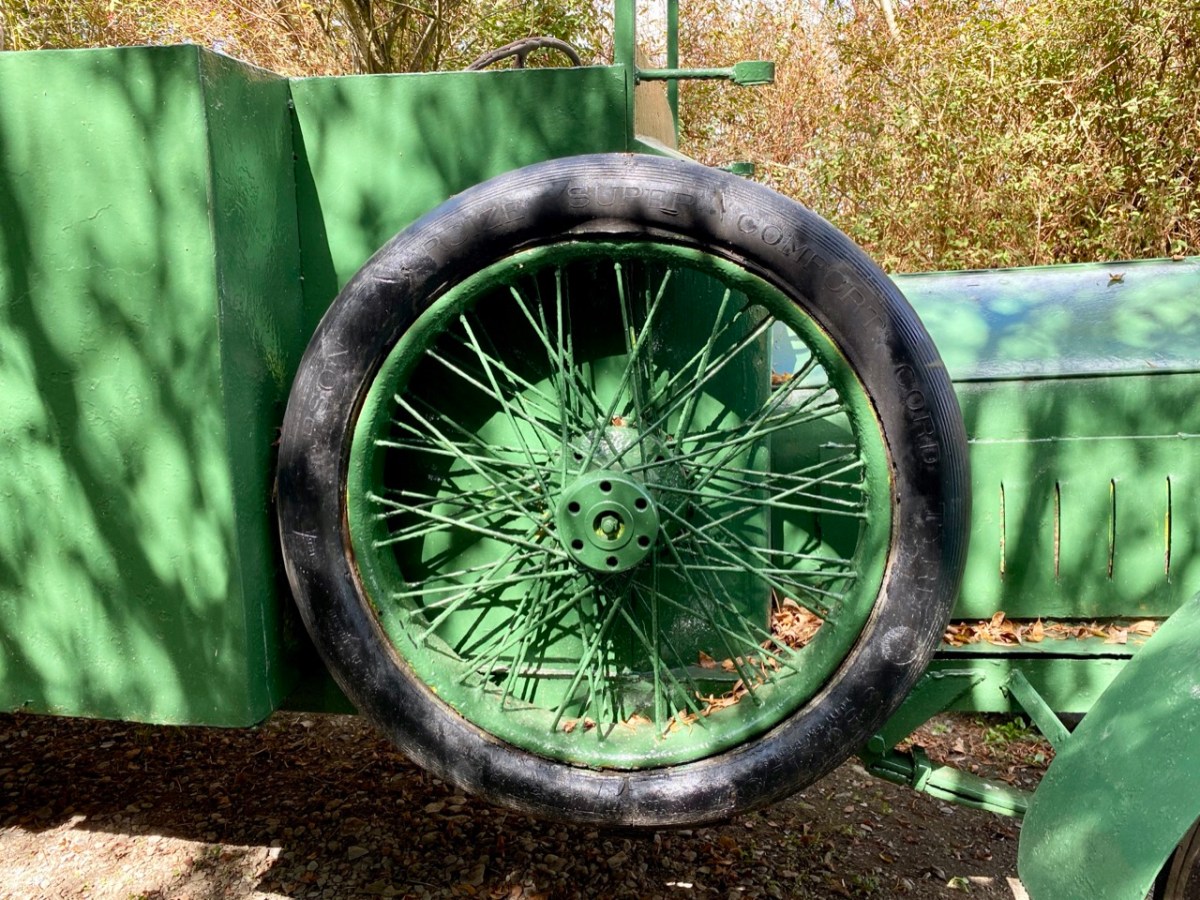
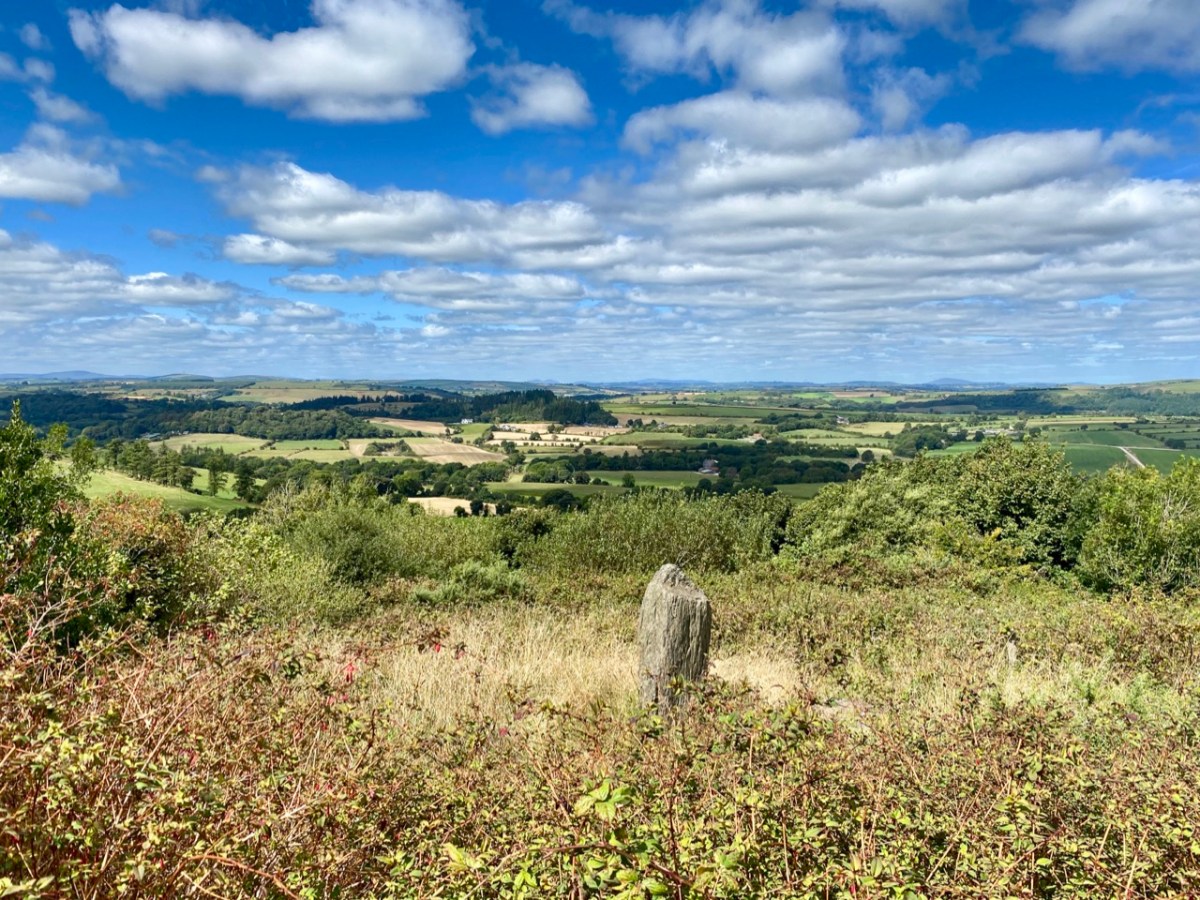
The Michael Collins Centre (above) has been run for over 23 years by members of the Crowley family who are directly related to Collins. Visitors are given a comprehensive presentation on his life and times – and his death. There are many artefacts and memorabilia, including replicas of the vehicles which were in the convoy at Béal na Bláth. It’s also well worth looking out from the Museum grounds to the spectacular view across the Argideen River valley (below). Argidín means Little Silver River, and it flows from Reenascreena to Courtmacsherry.
We are keenly watching the progression of Michael Collin’s journey towards sainthood – or further. During the narrations we attended, we noted the descriptions of some of his followers as ‘apostles’. Also, we can’t ignore the fact that he foretold his own death (after he was sent to England to negotiate and sign the Anglo-Irish Treaty). His sister Mary Collins was nine years old when Michael was born in what she said were ” … miracle conditions, as there was no doctor and no trained nurse … mother and baby were well and comfortable … ” Michael was adored by the family, with his old Uncle Paddy predicting the future upon his birth, saying: “Be careful of this child, for he will be a great and mighty man when we are all forgotten” …
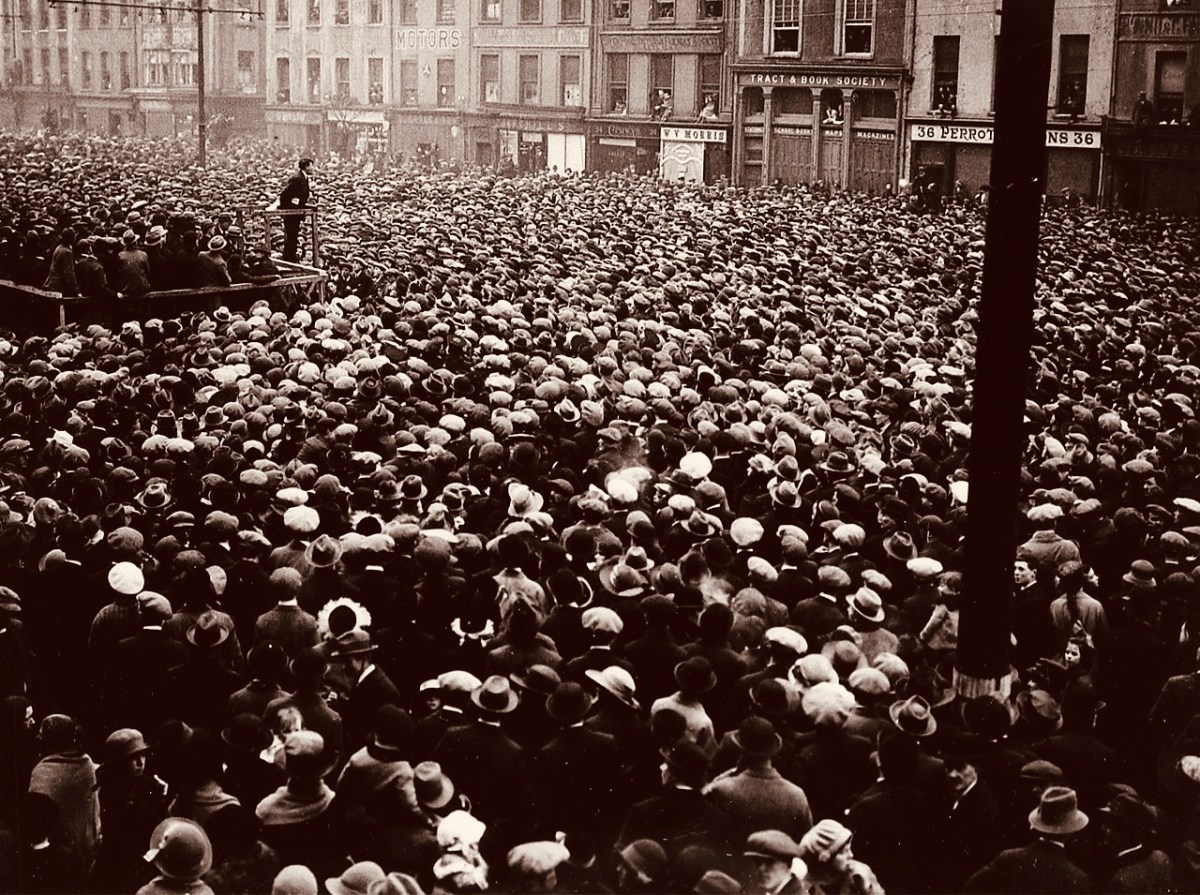
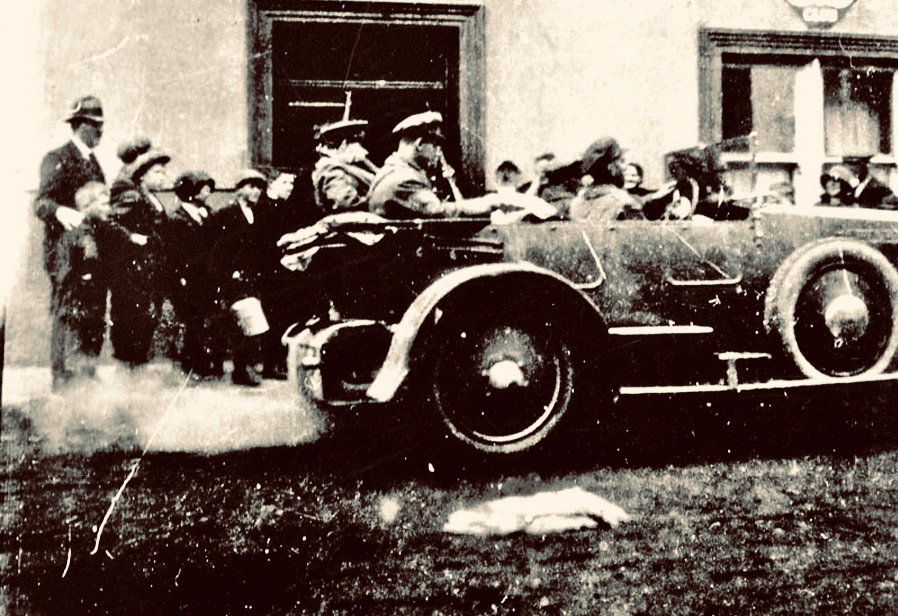
(Above) – a reminder of the ‘glory days’ – Michael Collins addressing huge crowds at a Free State demonstration in Cork City, 13 March 1922 (Wikimedia Commons). (Below) – Collins (behind the driver) leaving the Eldon Hotel, Skibbereen, 22 August 1922: the last known photograph of the hero (Cork Public Museum).
Welcome to the UCD Library Cultural Heritage Collections blog. Discover and explore the historical treasures housed within our Archives, Special Collections, National Folklore Collection and Digital Library












 Roaringwater Journal