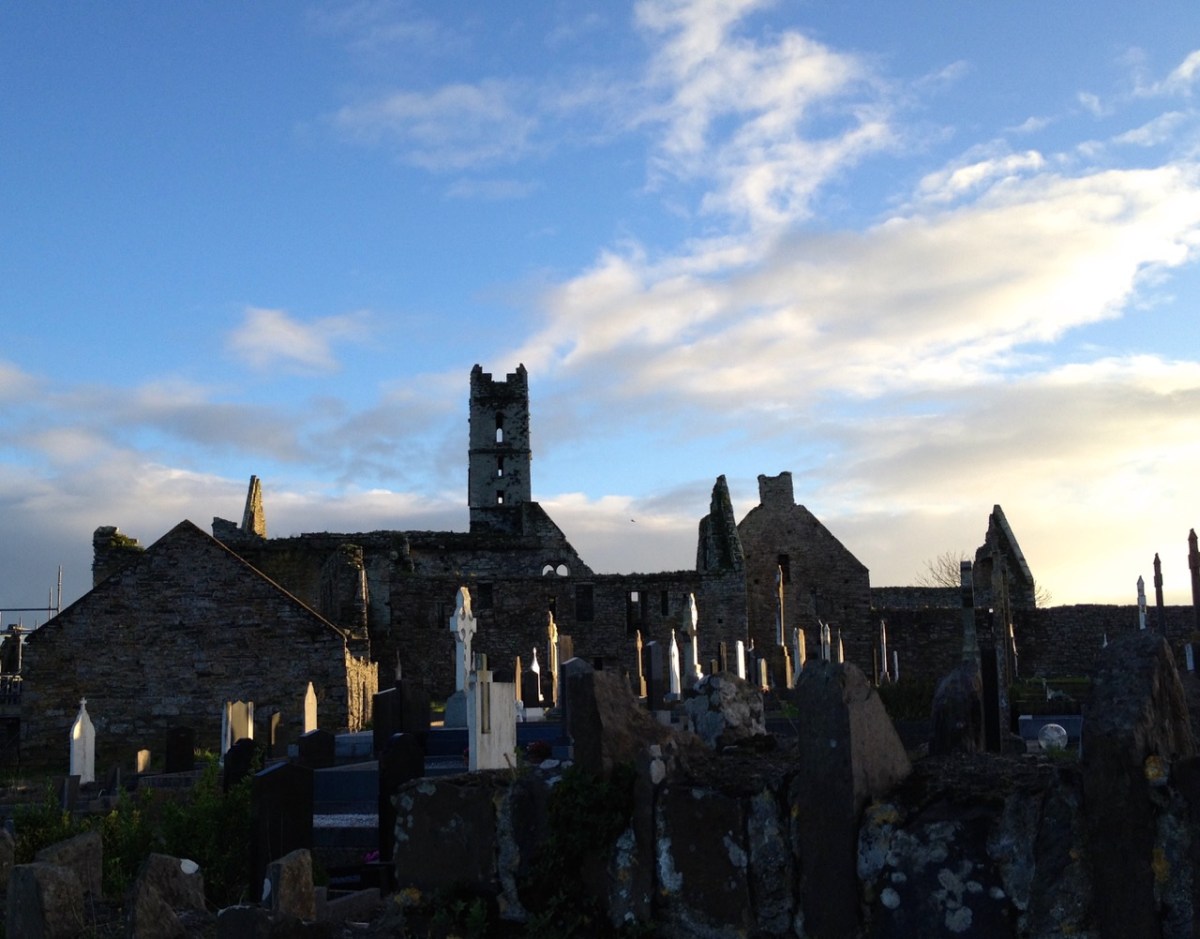
We had a great afternoon yesterday, exploring aspects of the history of Timoleague, in West Cork. Our Finola Finlay (above) was involved in an event organised by the Glass Society of Ireland. . . a professional all-island, non-profit association that opens a window onto the contemporary Irish Glass Community . . . The day’s proceedings were centred around the ecclesiastical buildings in the town, the earliest of which is the Franciscan Friary, now a substantial ruin beside the Argideen River.
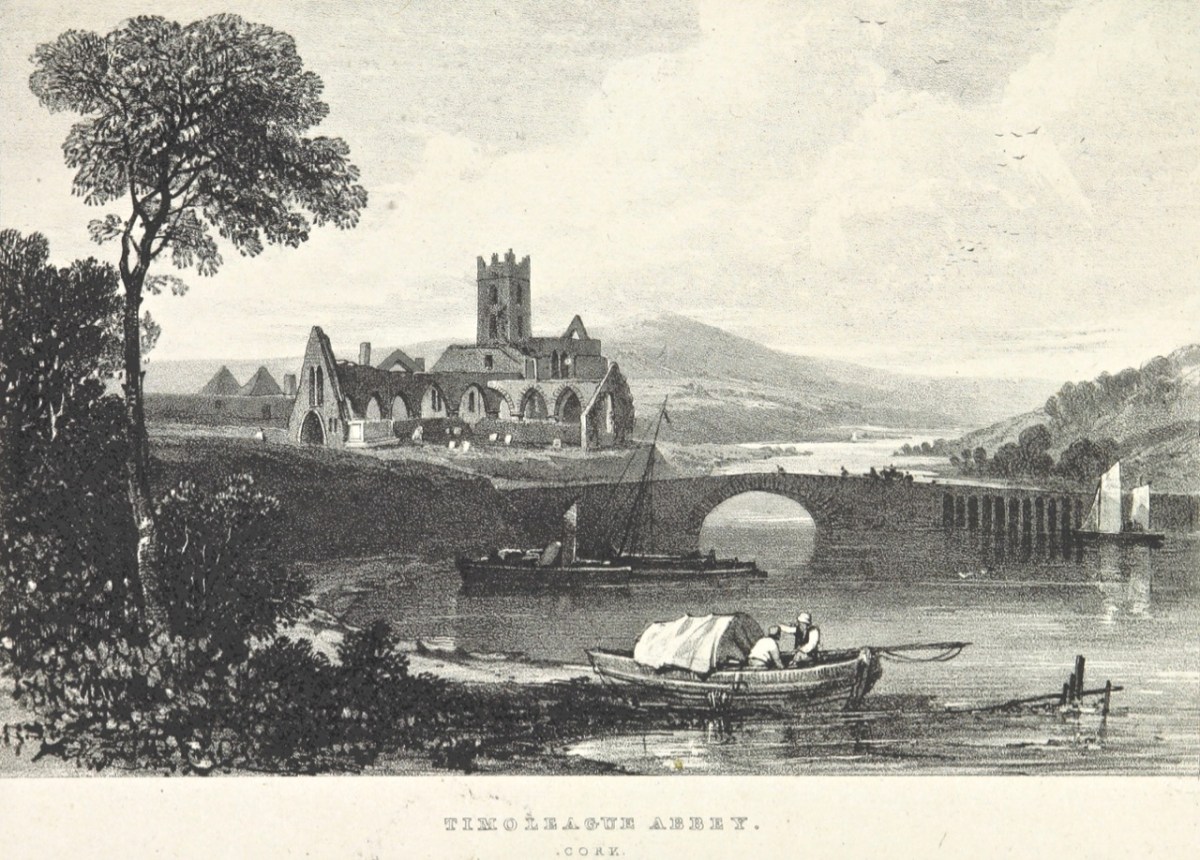
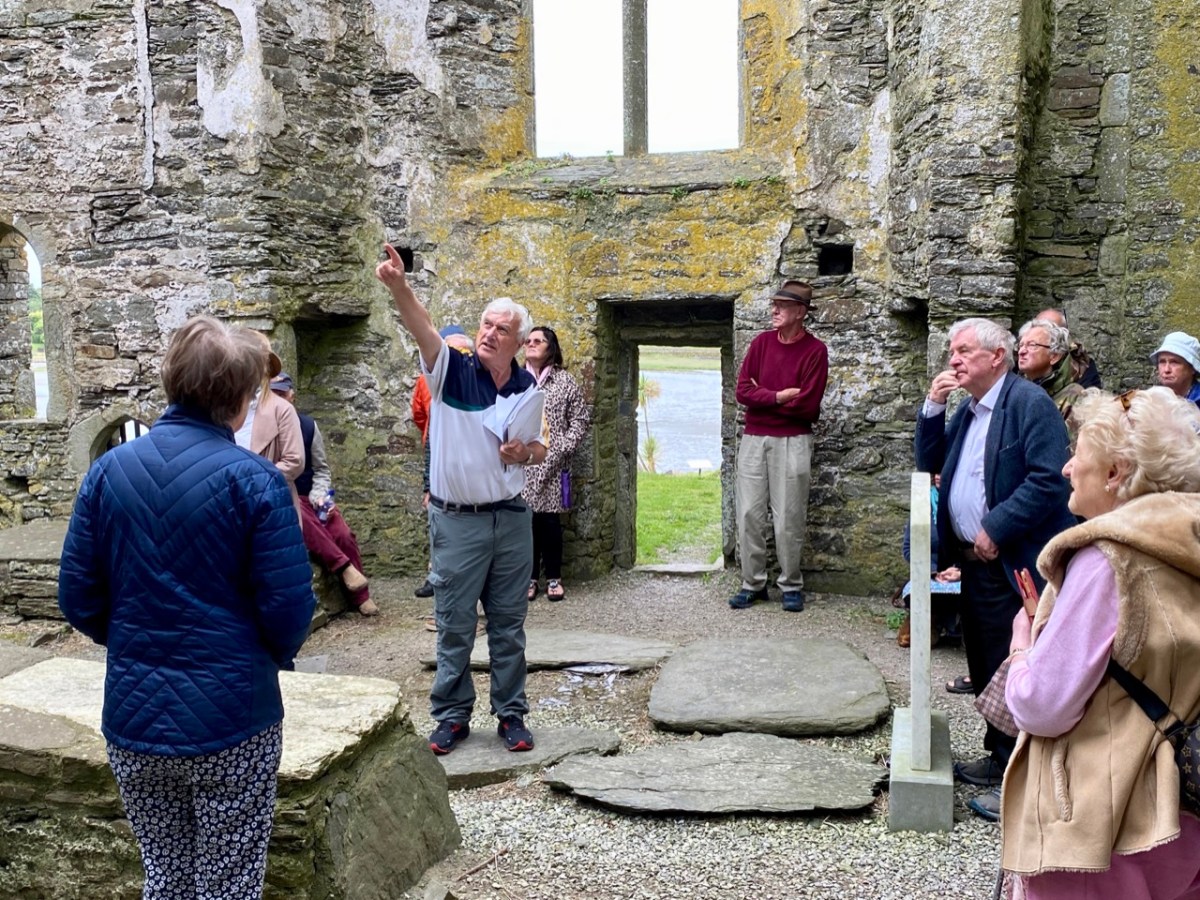
This view of the ruined ‘abbey’, above, dates from 1830. It is located on the site of an early Christian monastic settlement founded by Saint Molaga, from whom the town of Timoleague derives its name. A story that I heard for the first time yesterday was told by local historian Donal Whooley: the Saint was trying to found his community back in the sixth century, but everything that he and his followers built fell down the following day. According to legend, it was originally to be built a mile west of Timoleague, but all work done on that site by day would fall down by morning. Interpreting this as God’s wish that the church should be built elsewhere, Molaga fixed a blessed candle on a sheaf of corn, and floated it down the Argideen river, siting his settlement on the spot that it came ashore, on the big bend in the waterway where the Friary ruins can be found today. Here is a view from the great three-light window which looks out to the east over the river. Finola told us that, in its heyday, this window would have been filled with beautiful medieval glass, bringing light and colour into the substantial nave of the church.
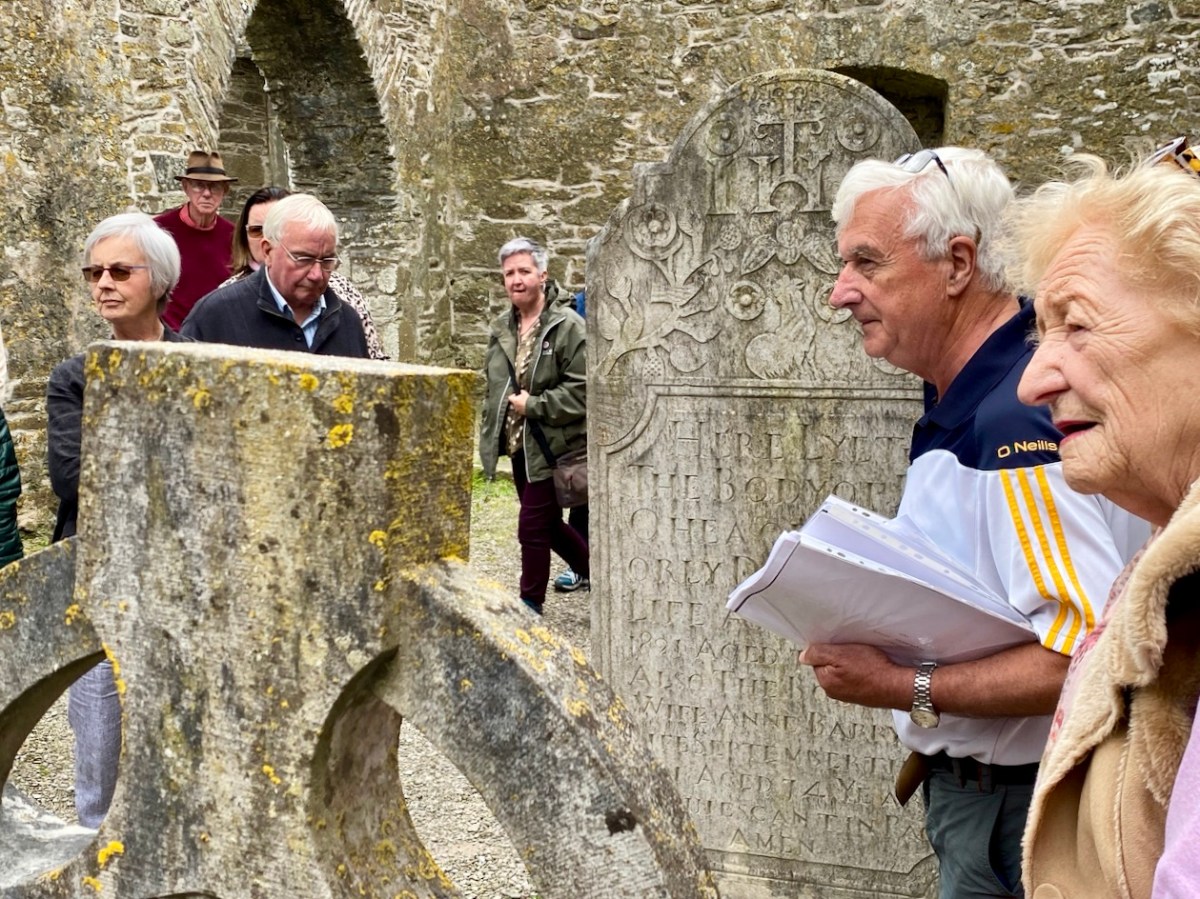
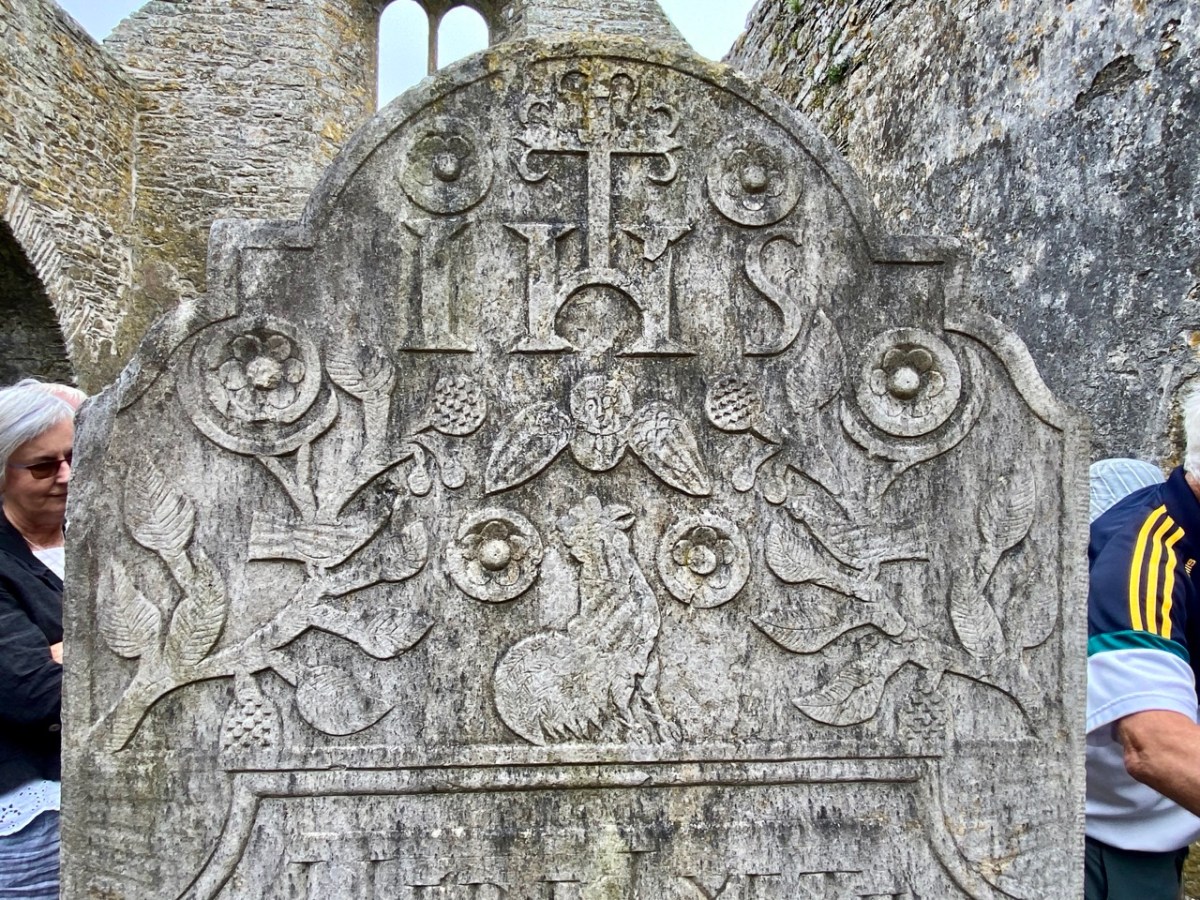
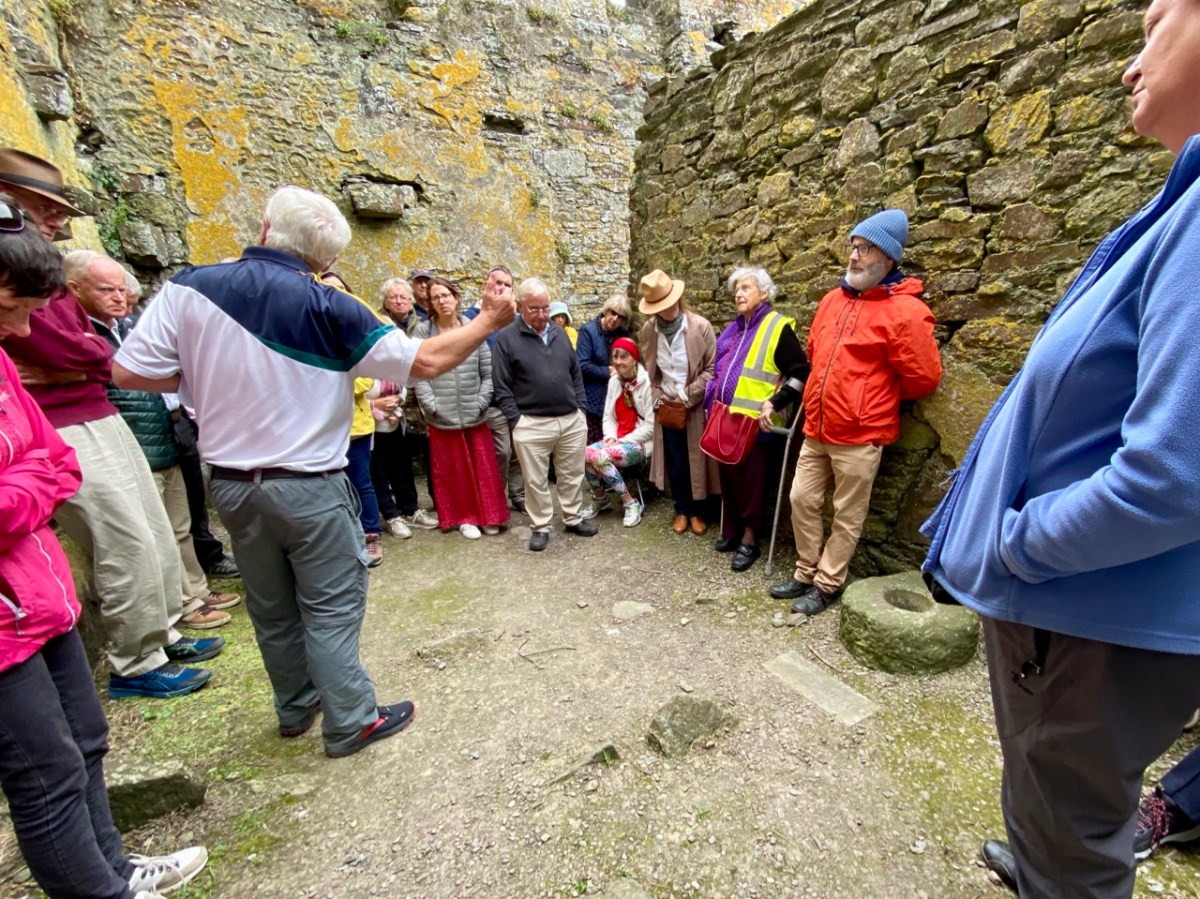
That’s Donal, above, leading our group of almost fifty keenly attentive people who shared an interest in the town and its history. To the right (in a blue jacket) is Father Patrick Hickey. He told us of the symbolism of the cockerel you can see on the large headstone in the nave (below), dating from 1821. Evidently some of the disciples were standing together while Christ was being crucified: nearby stood a pot in which a rooster was being boiled for supper. Judas reportedly said: do you think there’s any chance that our Lord will rise again? Mrs Judas retorted: there’s about as much chance of that as there is of that rooster jumping out of the pot and crowing! At which point – of course – the cockerel did just that!
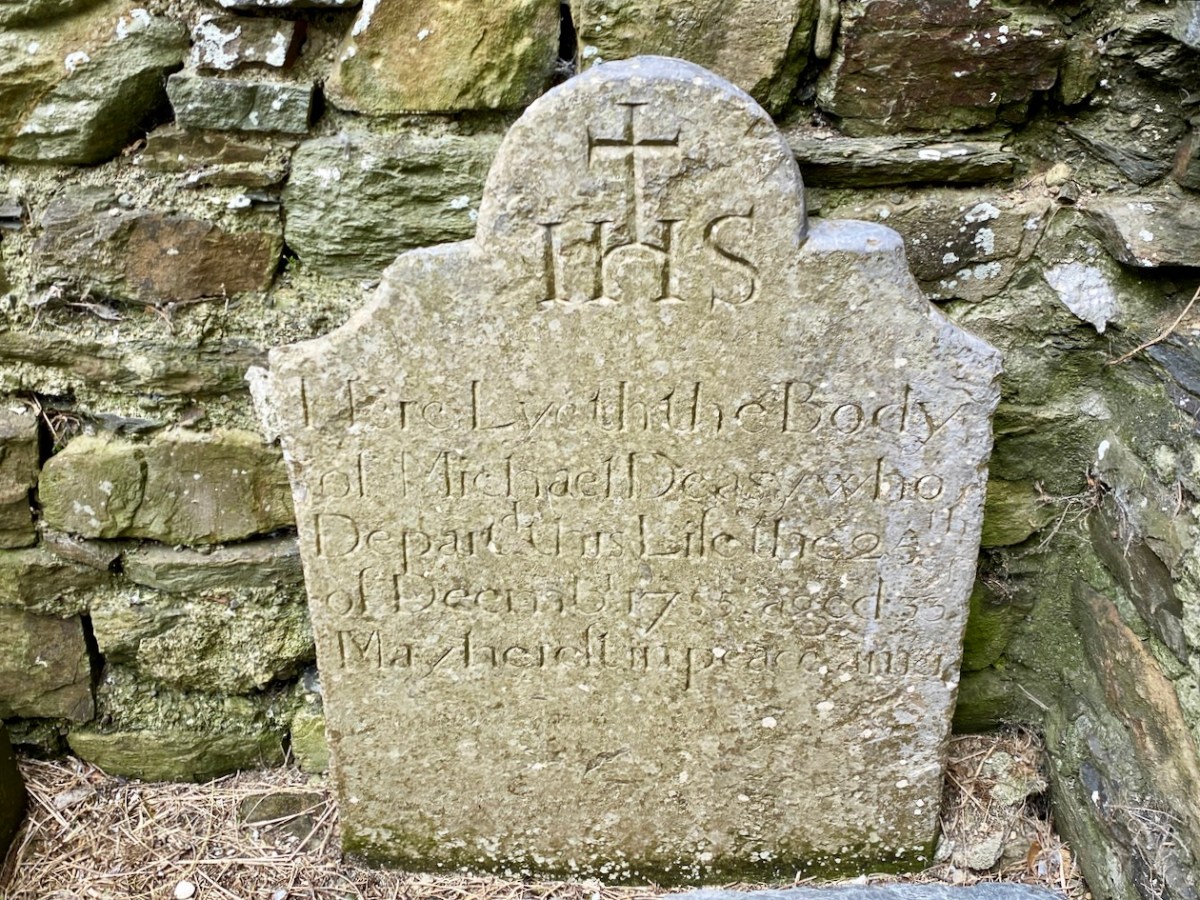
It was the custom to place burials in ruined church buildings. Here’s another fine headstone in Timoleague Abbey, to Michael Deasy, ” . . . who departed this life on the 23 December 1755, aged 33. May he rest in peace. Amen . . . “
Lively discussions ensued on the efficacy of wart wells, and Donal suggested that this repurposed bullaun stone, above could be the oldest human element on the whole site!
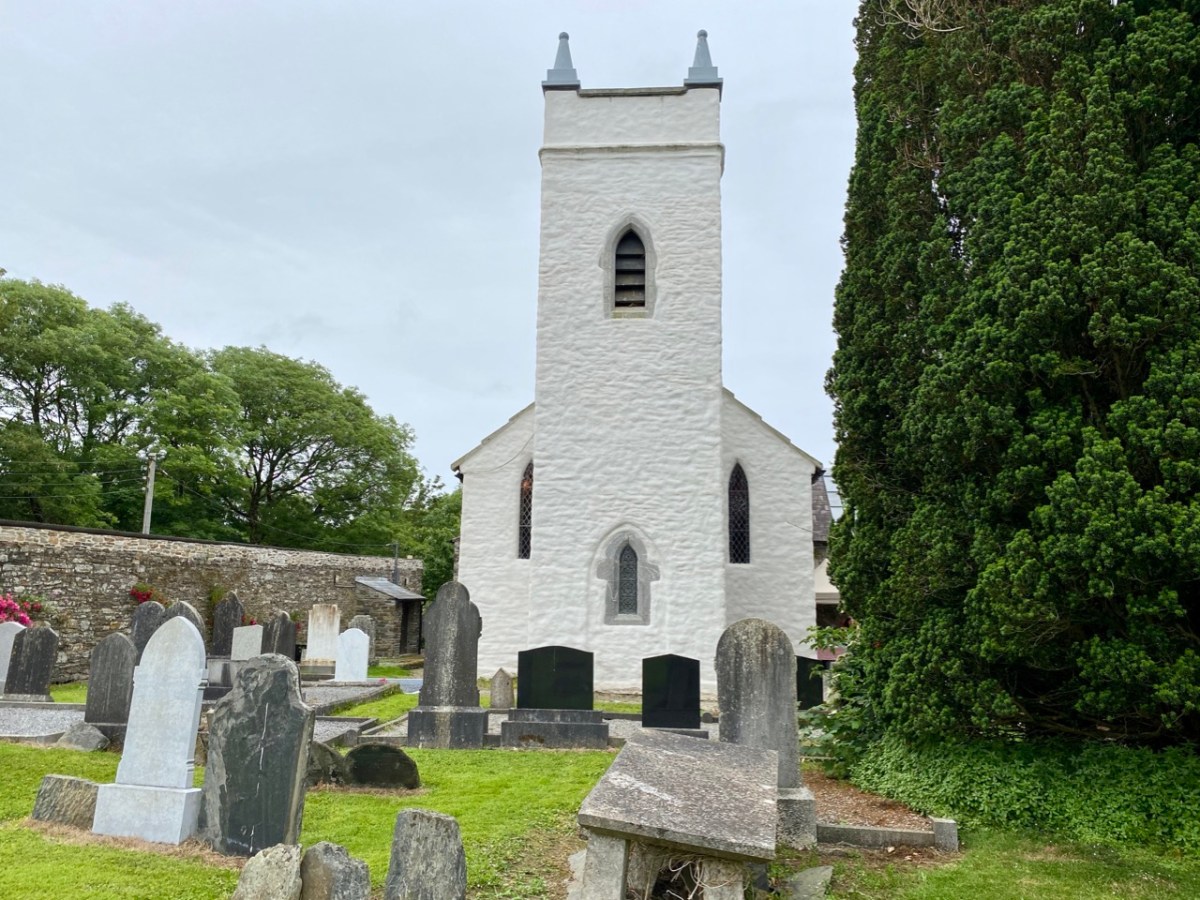
Here’s an aerial overview of the geography of Timoleague. The Friary ruin is only one of many historic sites of interest which caught our interest yesterday. It was Finola’s task to introduce us (or those of us who had never seen it) to the little Church of the Ascension.
This building is currently undergoing major improvement works: the lime rendered tower has created a striking landmark in the town. This work has become necessary by water penetration through the stonework leading to deterioration of the fabric. The conservation project is led by a hard-working Parish committee who also served us delicious tea and cakes since the tour was a fund-raiser for their efforts.
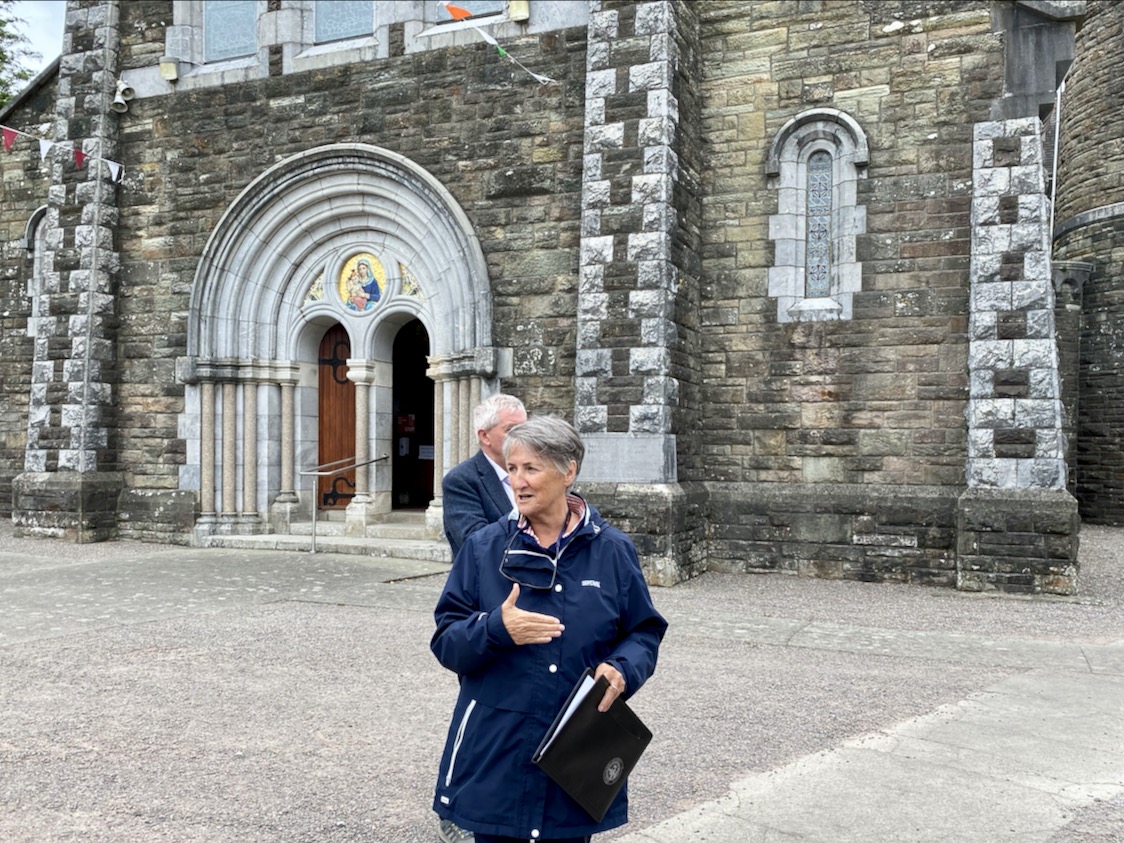
The early OS map extracts, above, give further context to the town’s history. The top map dates from the 1830s and comparison of the plan forms of the Church and Chapel buildings with those in the lower map, which dates from c1900, and then the present day aerial view (higher up the page) shows the degree of change which has taken place. We finished our town tour in the Church of the Nativity of the Blessed Virgin Mary. Here’s Finola standing outside it, below, prior to giving us an introduction to the history of the building, and its windows.
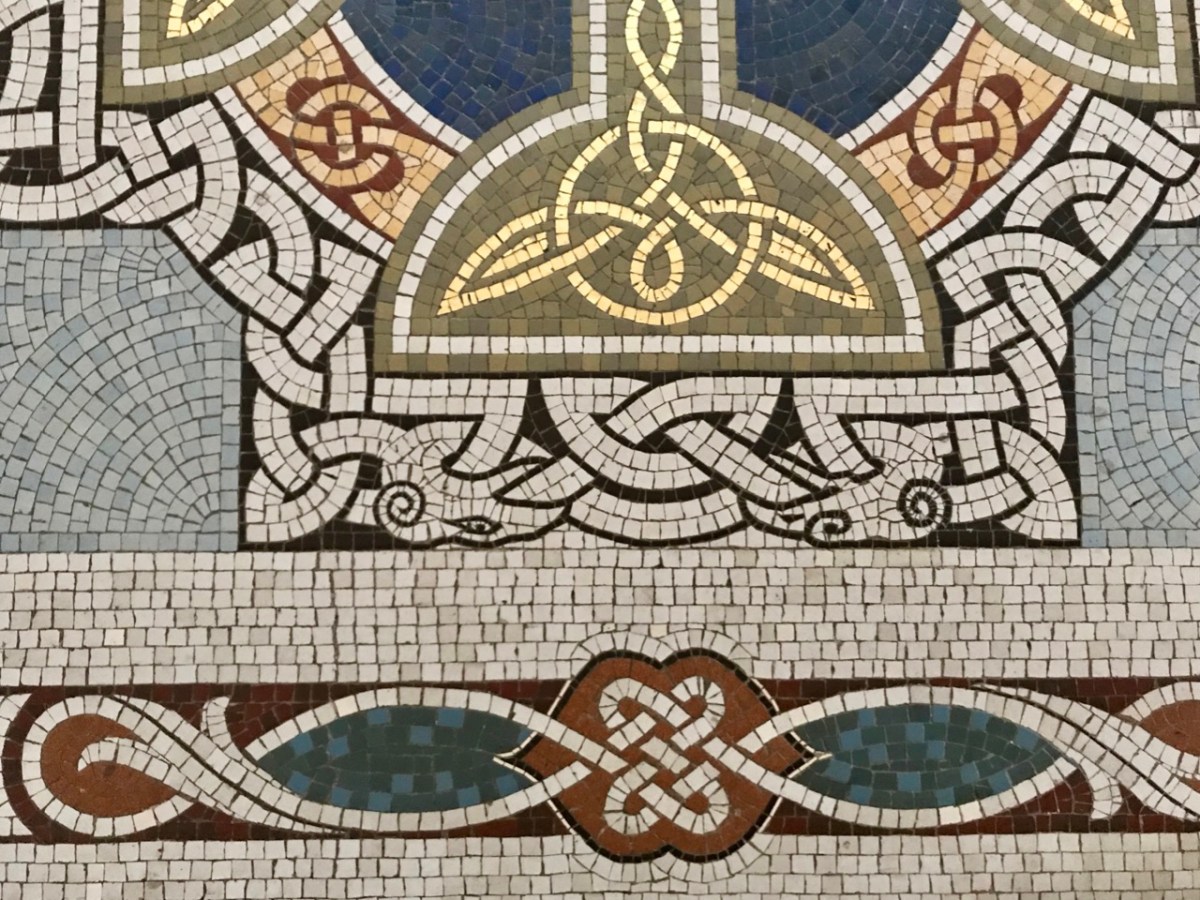
The fine Harry Clarke Studio window (one panel of which is shown in the upper picture) is a ‘must-see’, as is the mosaic work from the same church. The building work for this Catholic church, replacing an earlier chapel, dates from 1912.
Father Patrick Hickey nicely rounded off our day of Timoleague history by showing us the replica of the ‘Timoleague Chalice’ (above). The replica is kept in this Catholic church. According to Fr Hickey, ‘back in the penal days’ three monks were found floating in an open boat just off the island of Cape Clear. They had with them a box, or trunk. They were brought ashore but two of them died. The other asked that the box be kept on the island – but unopened – until he could return to retrieve it. He never returned, and in later years another visiting Priest said it could be opened. Inside was a gold chalice – blackened with age – and some liturgical vestments. The vestments fell to dust immediately, but the chalice was sent away for inspection, and was confirmed as coming from the Friary at Timoleague, where the replica is now kept.
Here is another ‘souvenir’ of Timoleague – it’s an extract from a poem written in Irish: The Mourner’s Soliloquy in the Ruined Abbey of Timoleague. The poet, Seághan Ó Coileáin, ” . . . was a Gaelic-language poet born in County Cork, in a time of faded Irish glory. He lived as a village schoolmaster, with a large family and no patron . . . “
Abroad one night in loneliness I stroll’d, Along the wave-worn beach my footpath lay; Struggling the while with sorrows yet untold, Yielding to cares that wore my strength away: On as I mov’d, my wayward musings ran O’er the strange turns that mark the fleeting life of man.
The little stars shone sweetly in the sky; Not one faint murmur rose from sea or shore; The wind with silent wing went slowly by, As tho’ some secret on its path it bore: All, all was calm, — tree, flower, and shrub stood still, And the soft moonlight slept on valley and on hill.
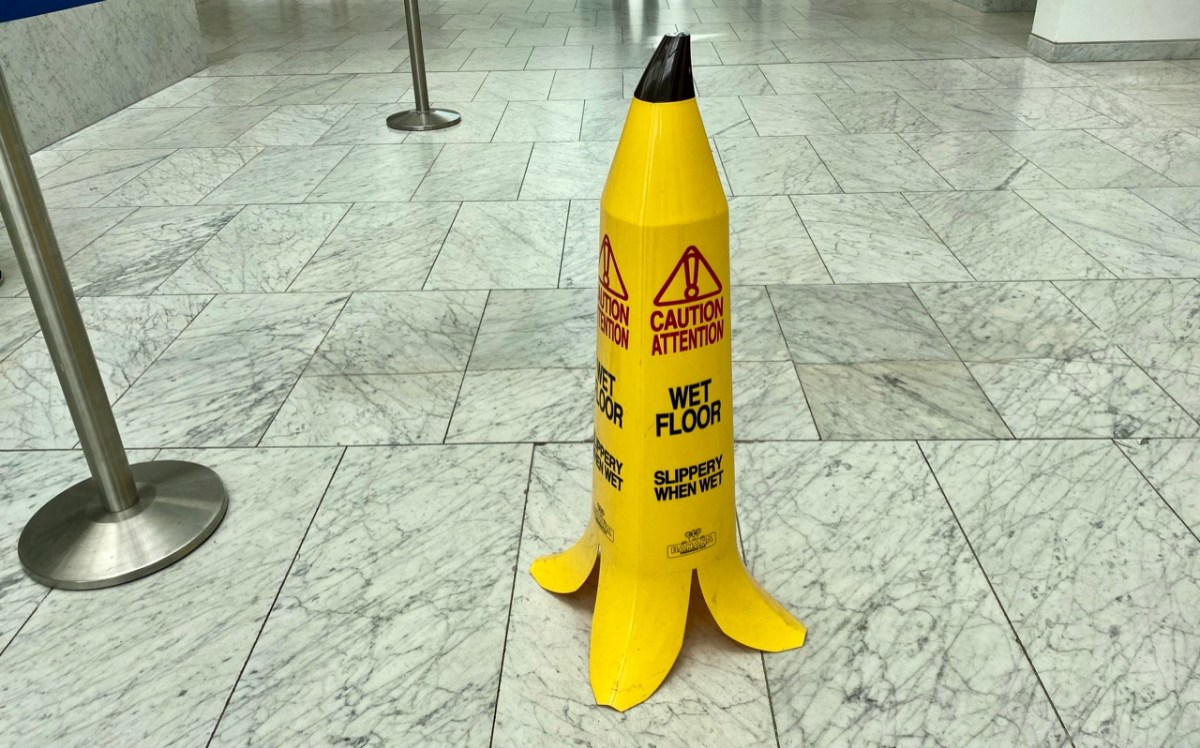
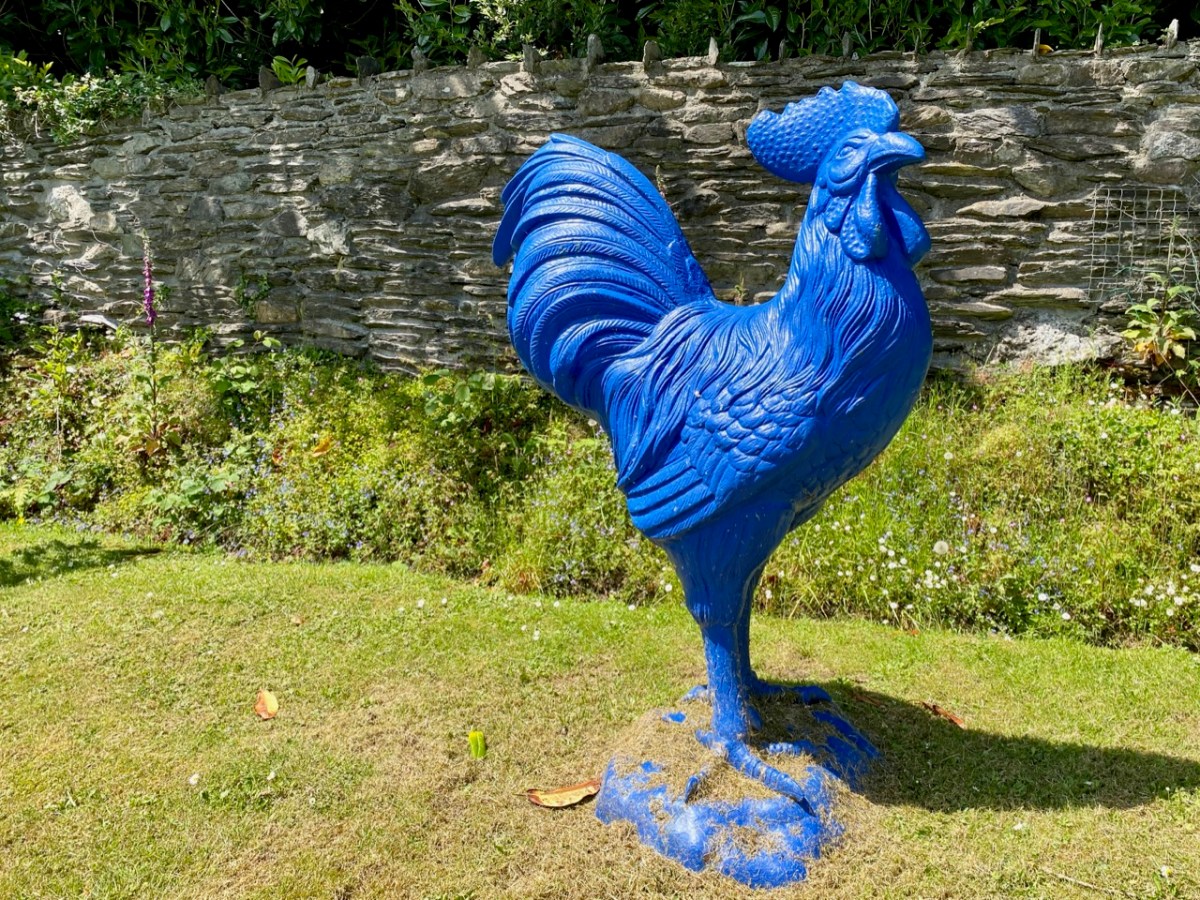
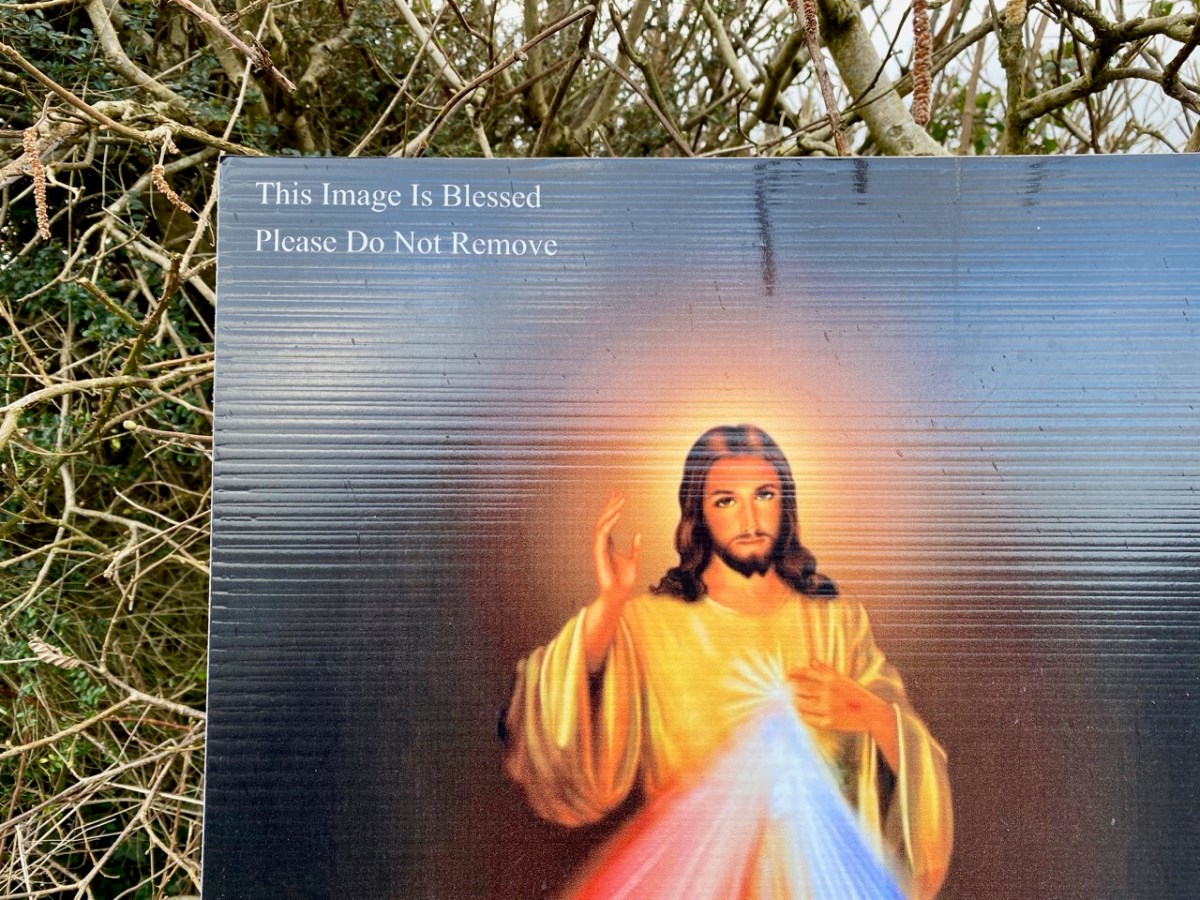
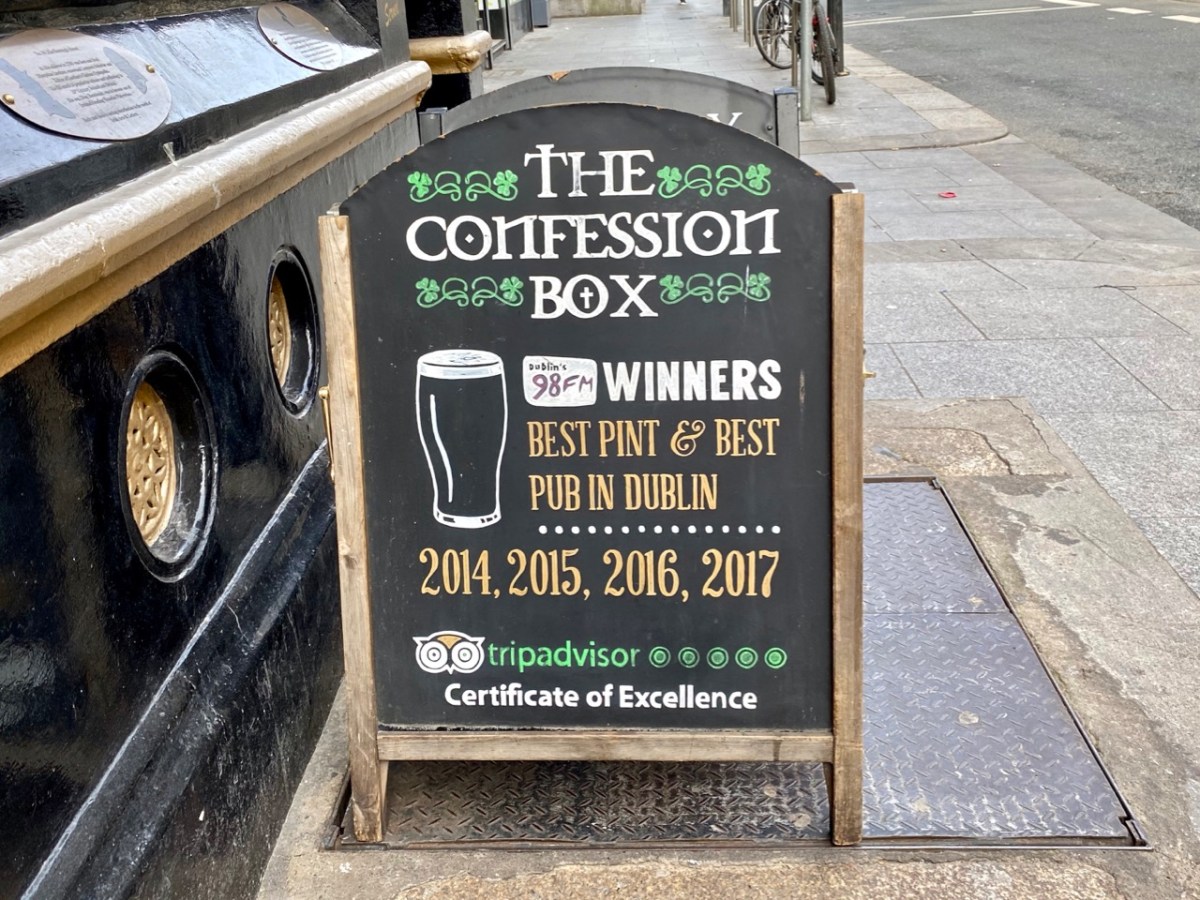
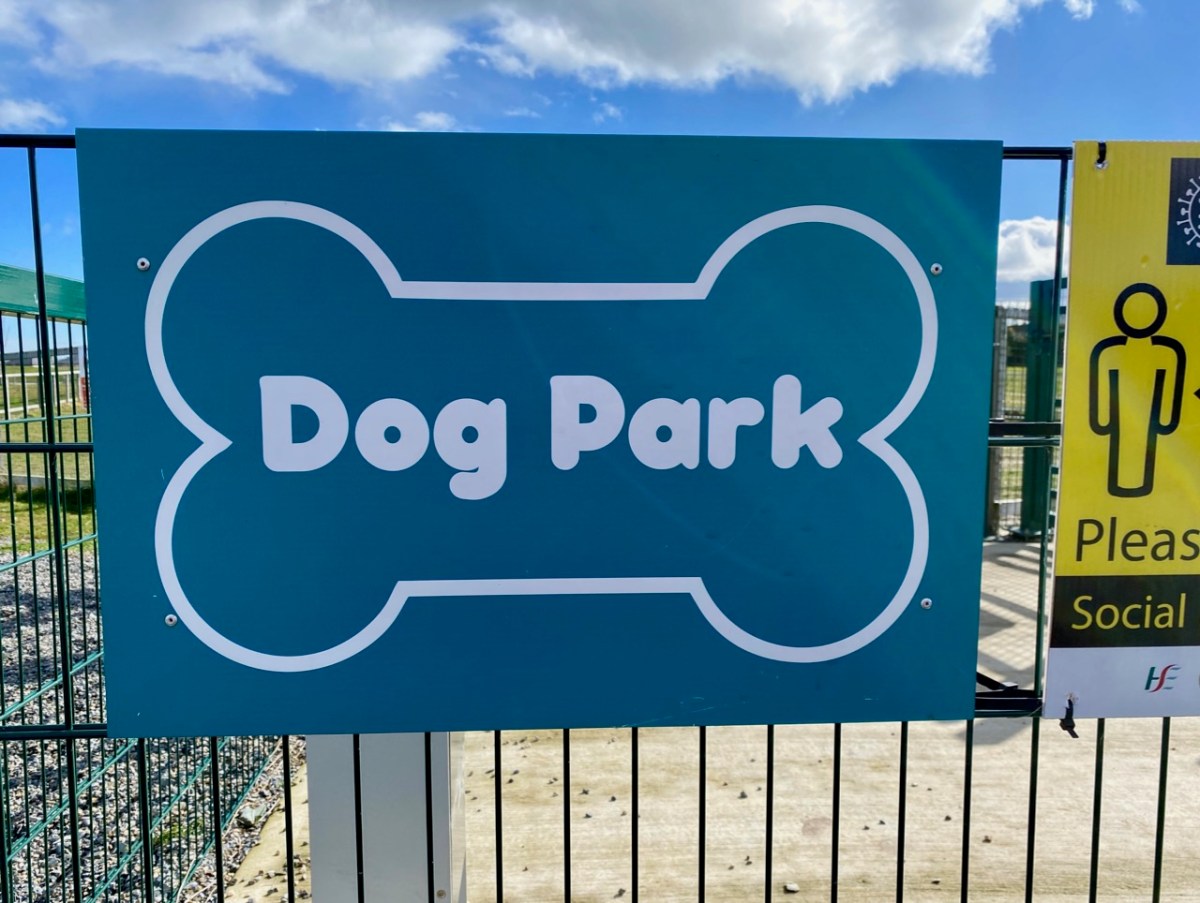
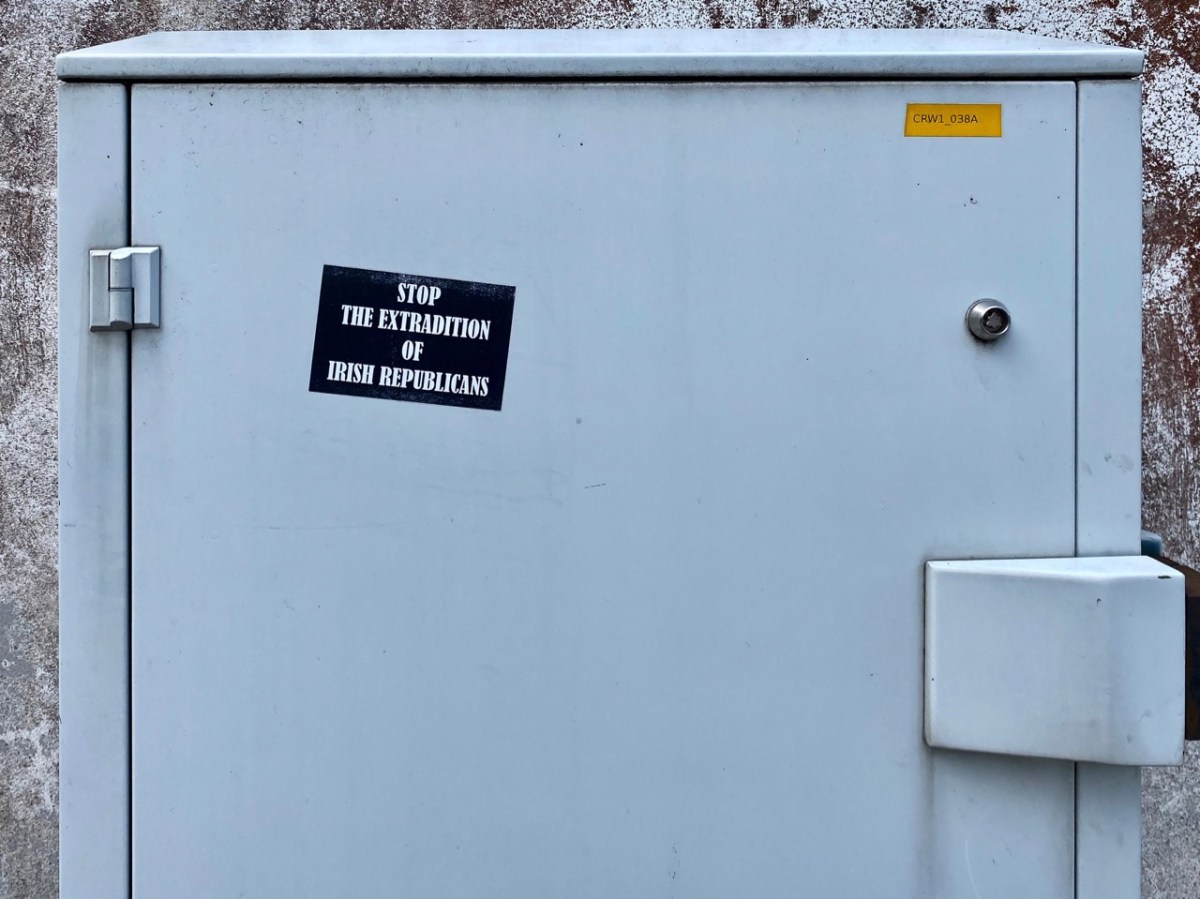
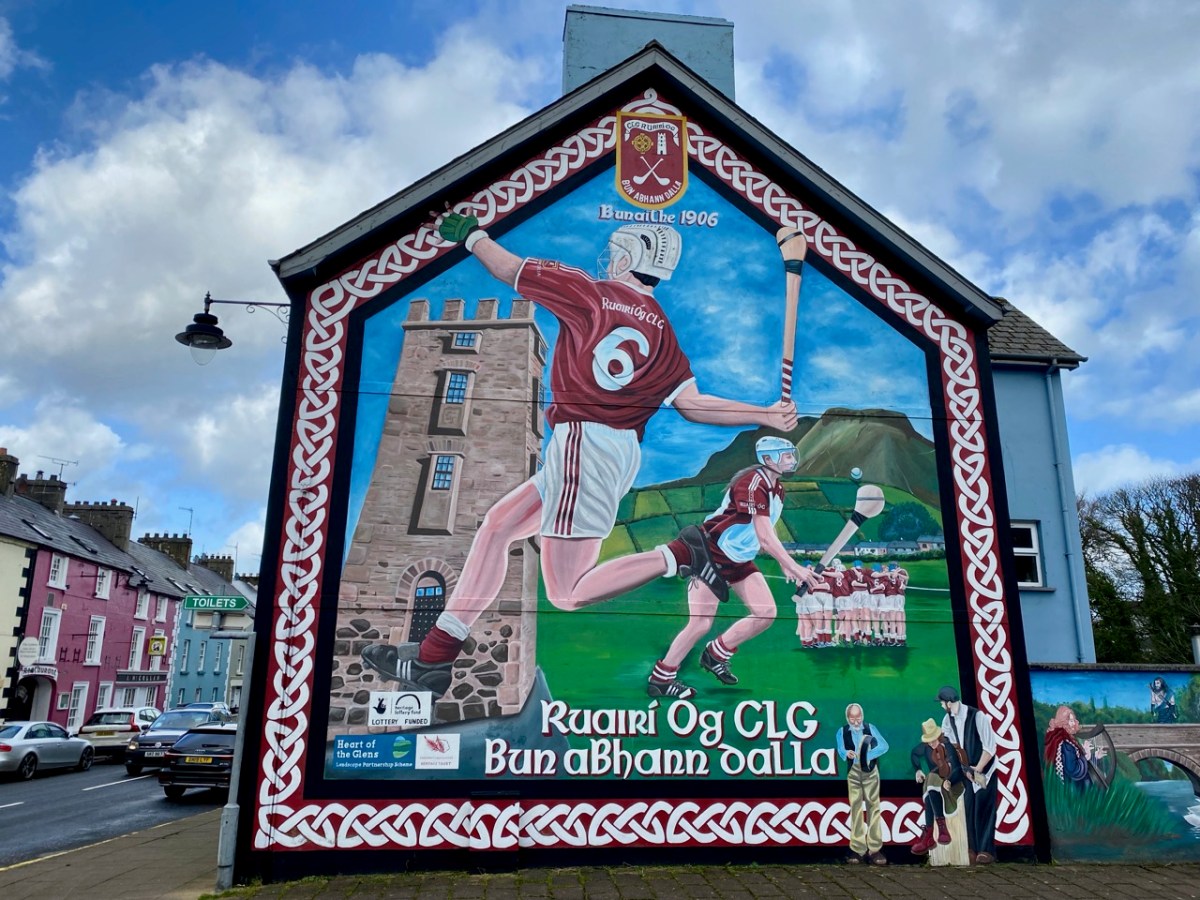
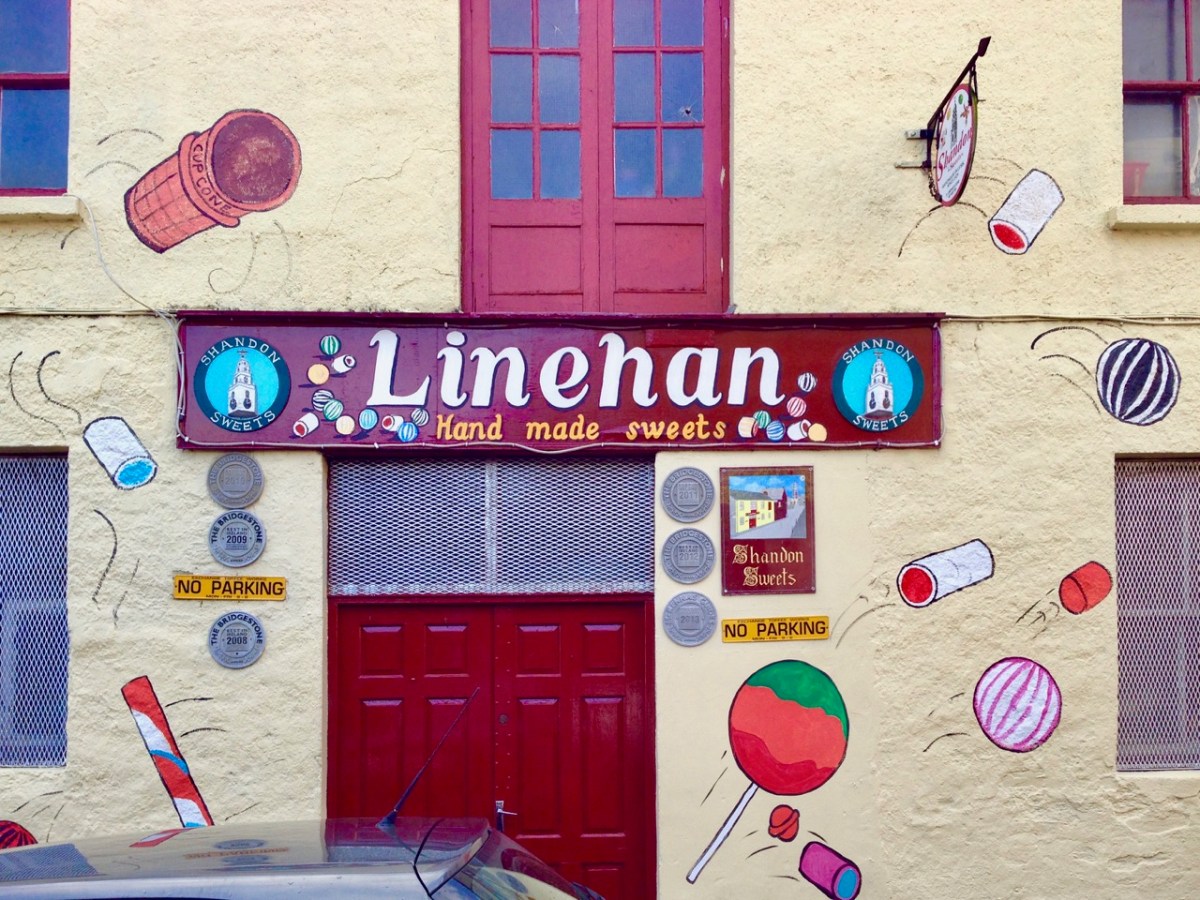
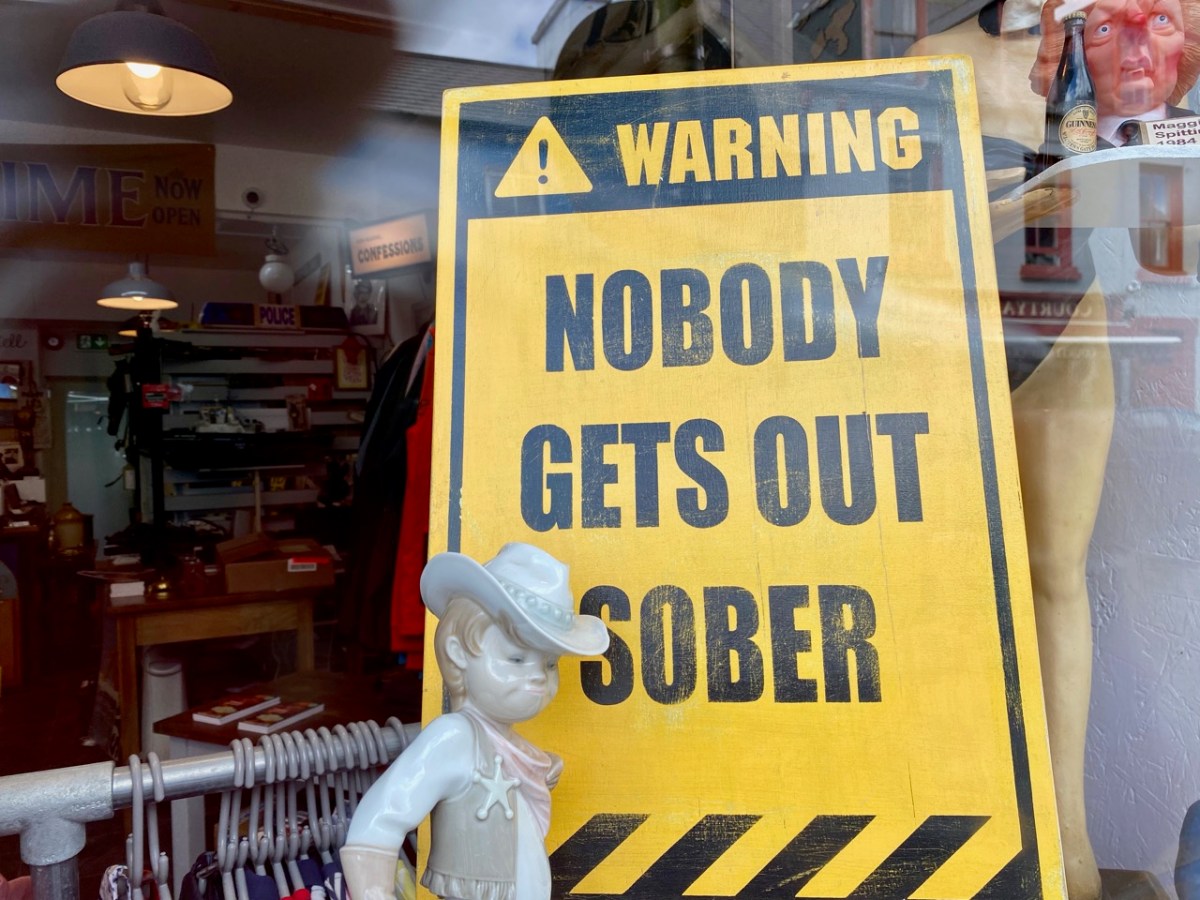
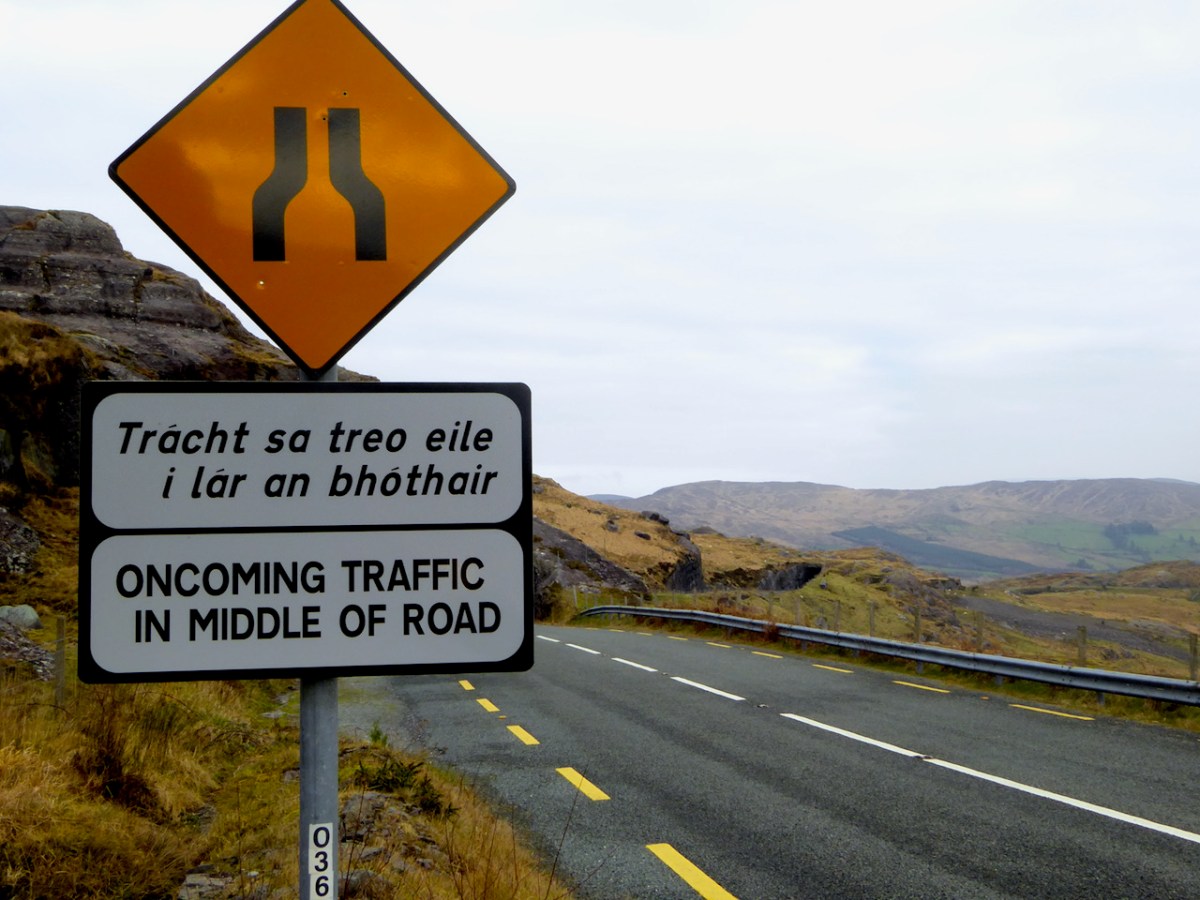
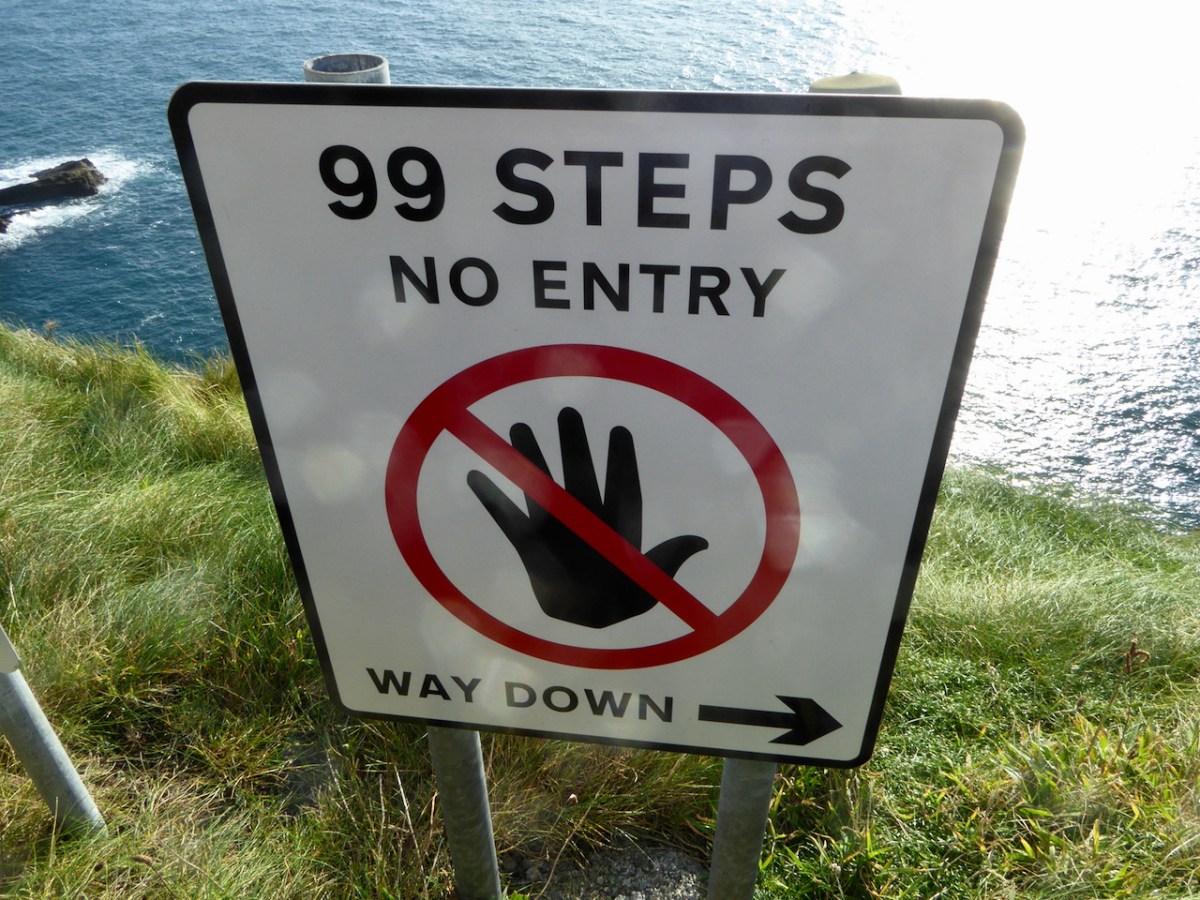
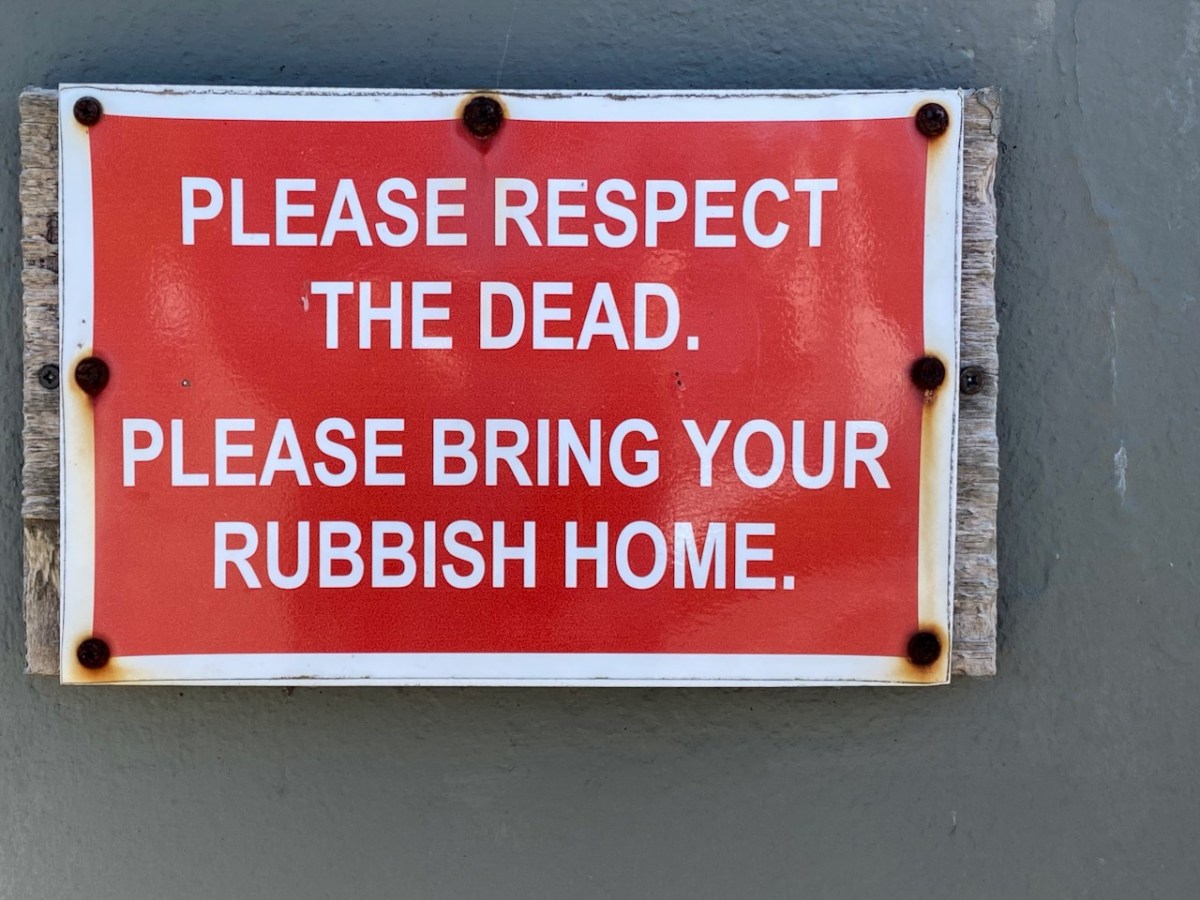
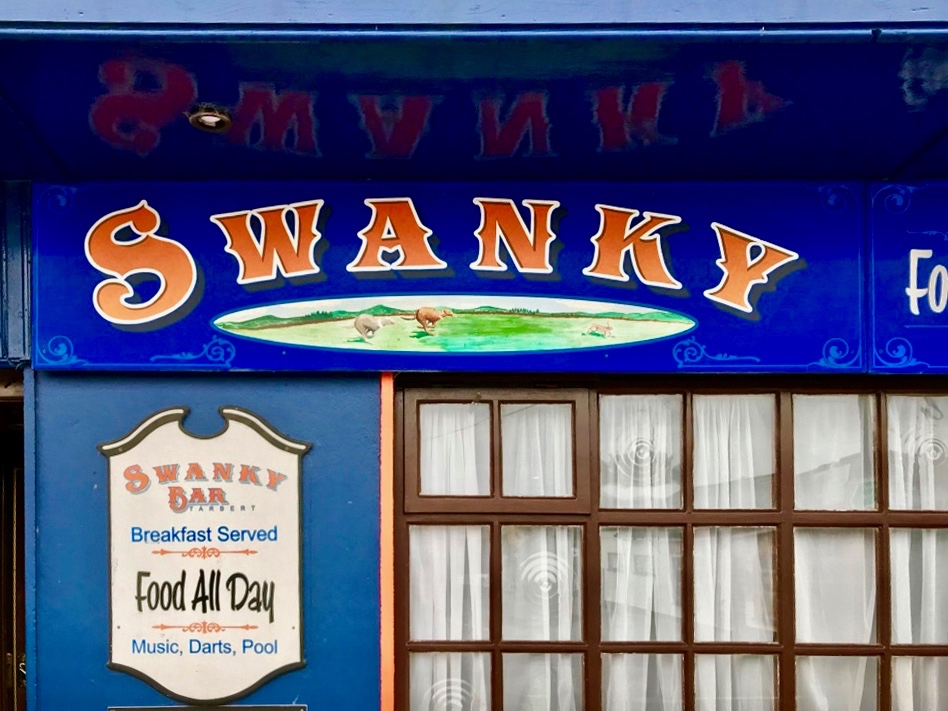
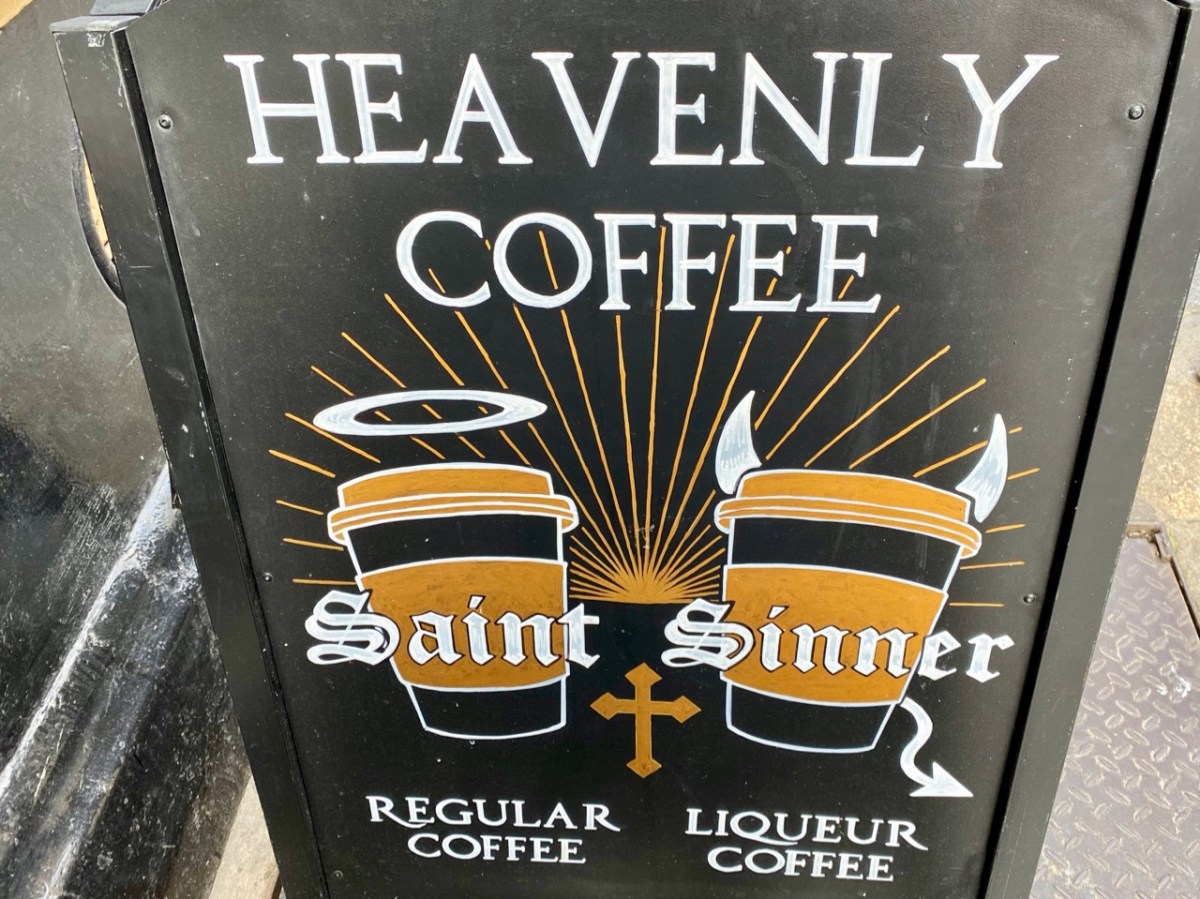
Another post about signs in Ireland: I ‘collect’ them and update them every few months. The slippery banana – above – is a classic and is to be found in the City Hall in Cork. Following it are a whole variety of examples with – hopefully – some touches of humour about them. Others have to be classified as eye-catching curiosities, including this magnificent bright blue cockerel.
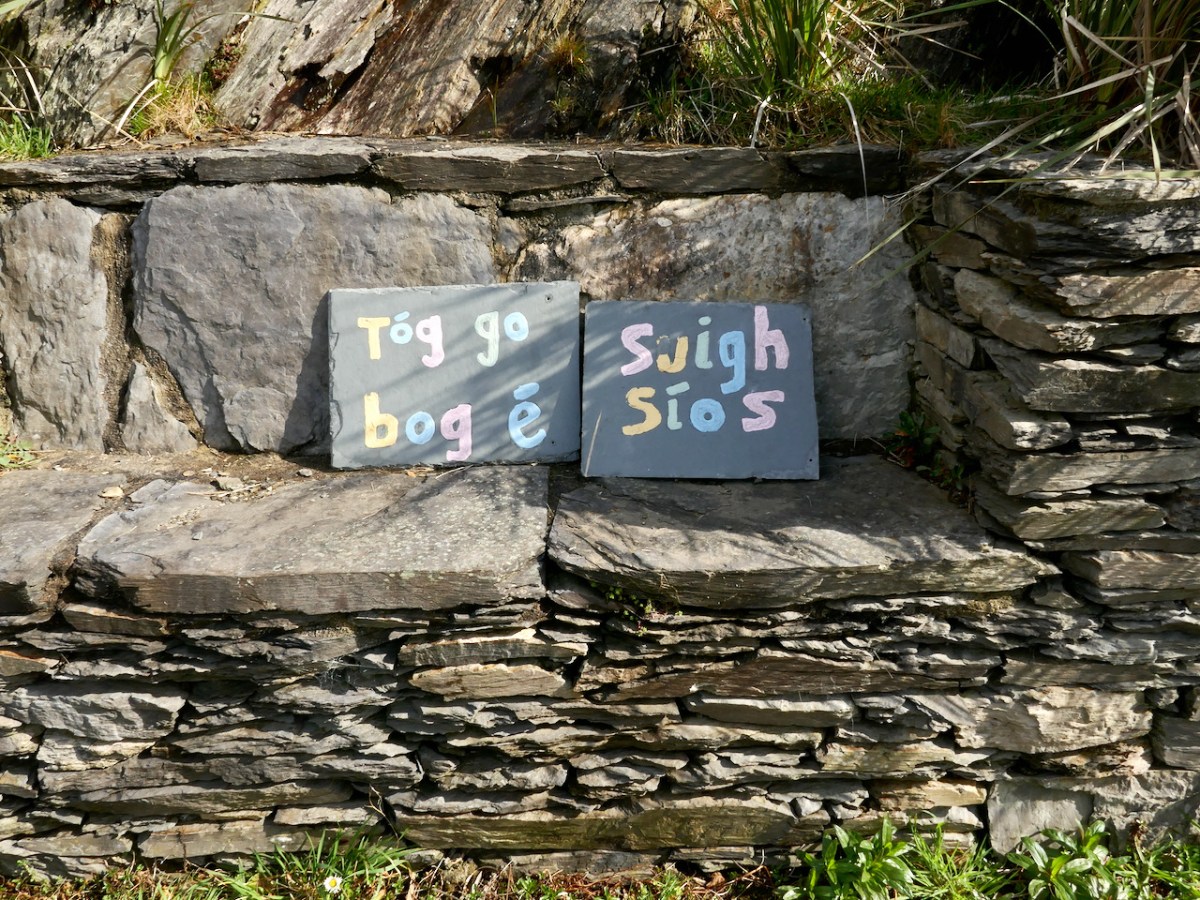
Mostly, the signs just speak for themselves…
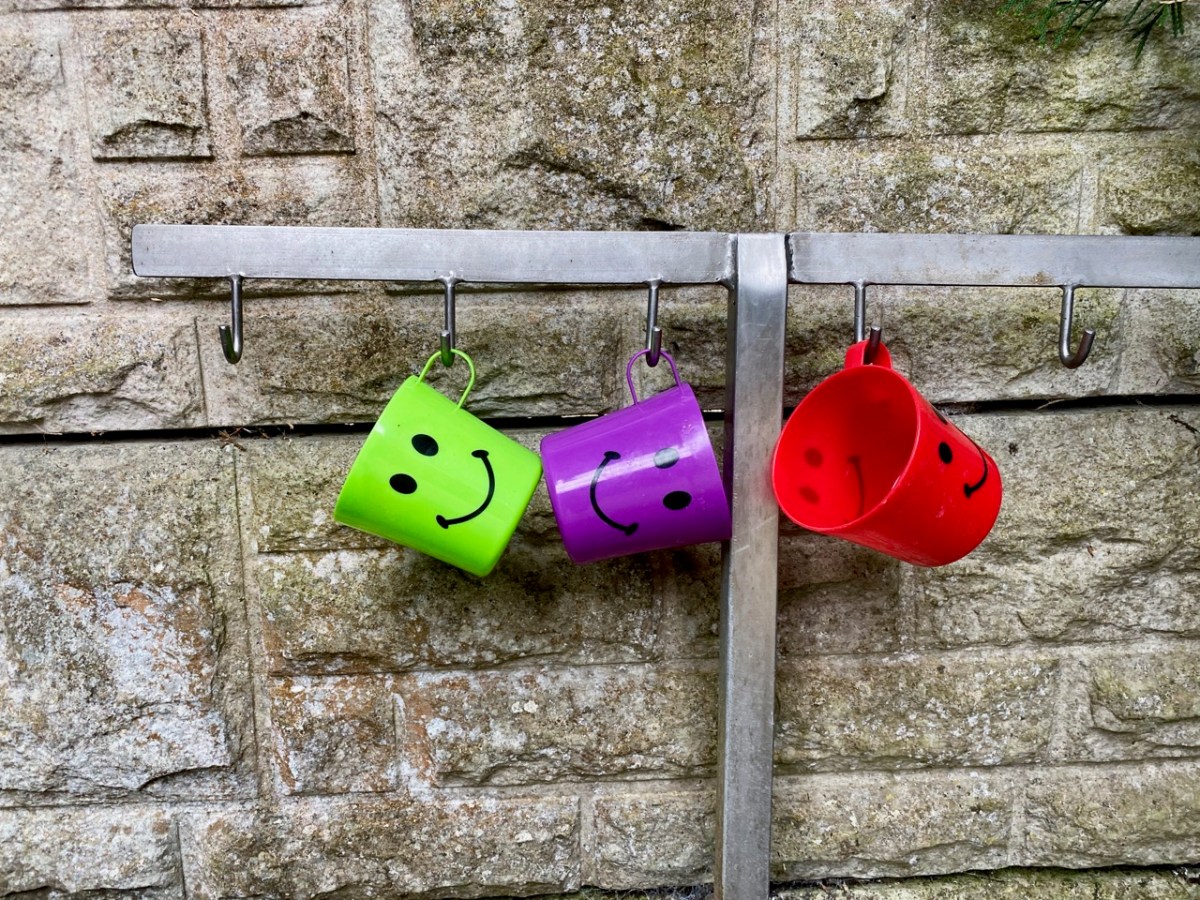
These cheerful cups can be found at a wayside Holy Well.
The gate above, also from Cork city, shows what architectural gems are waiting to be discovered on the streets. I was pleased – and puzzled – to come across the following:
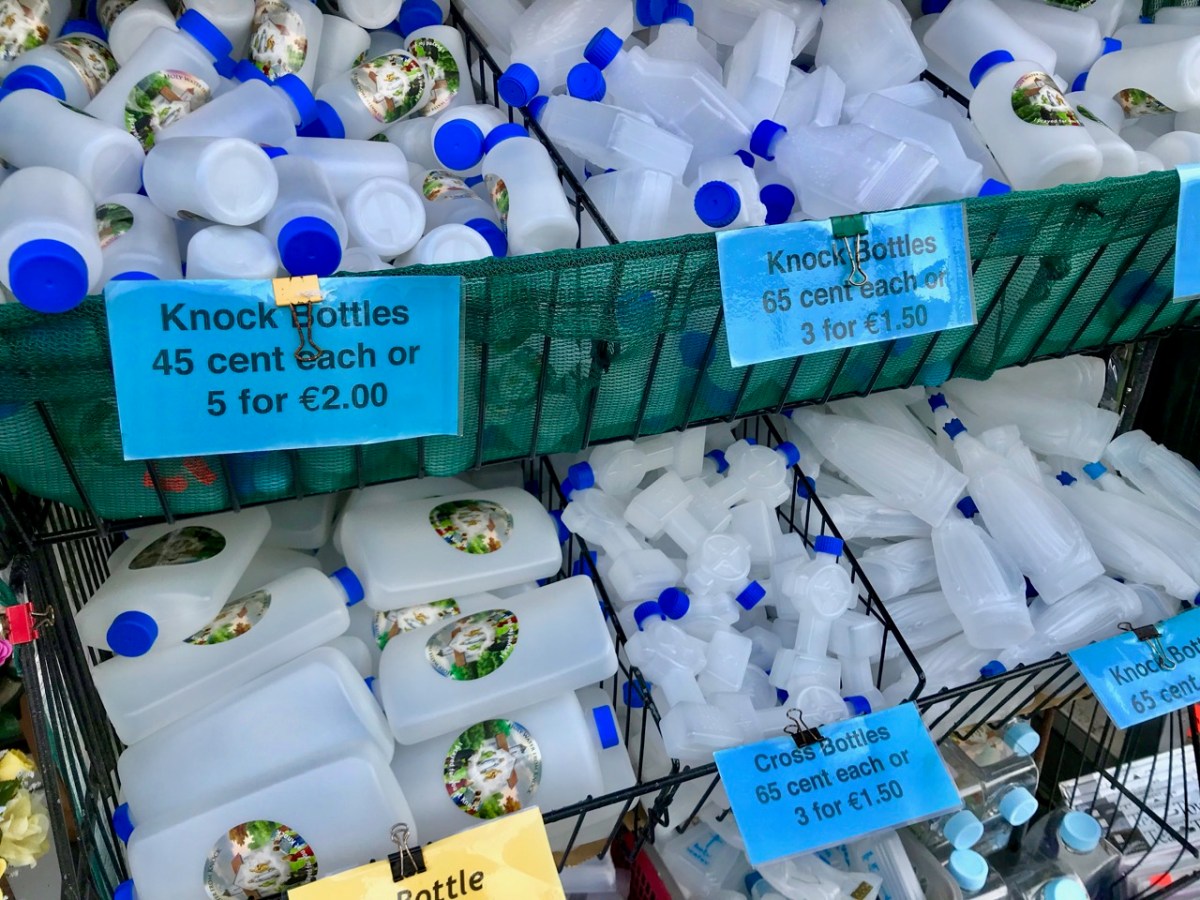
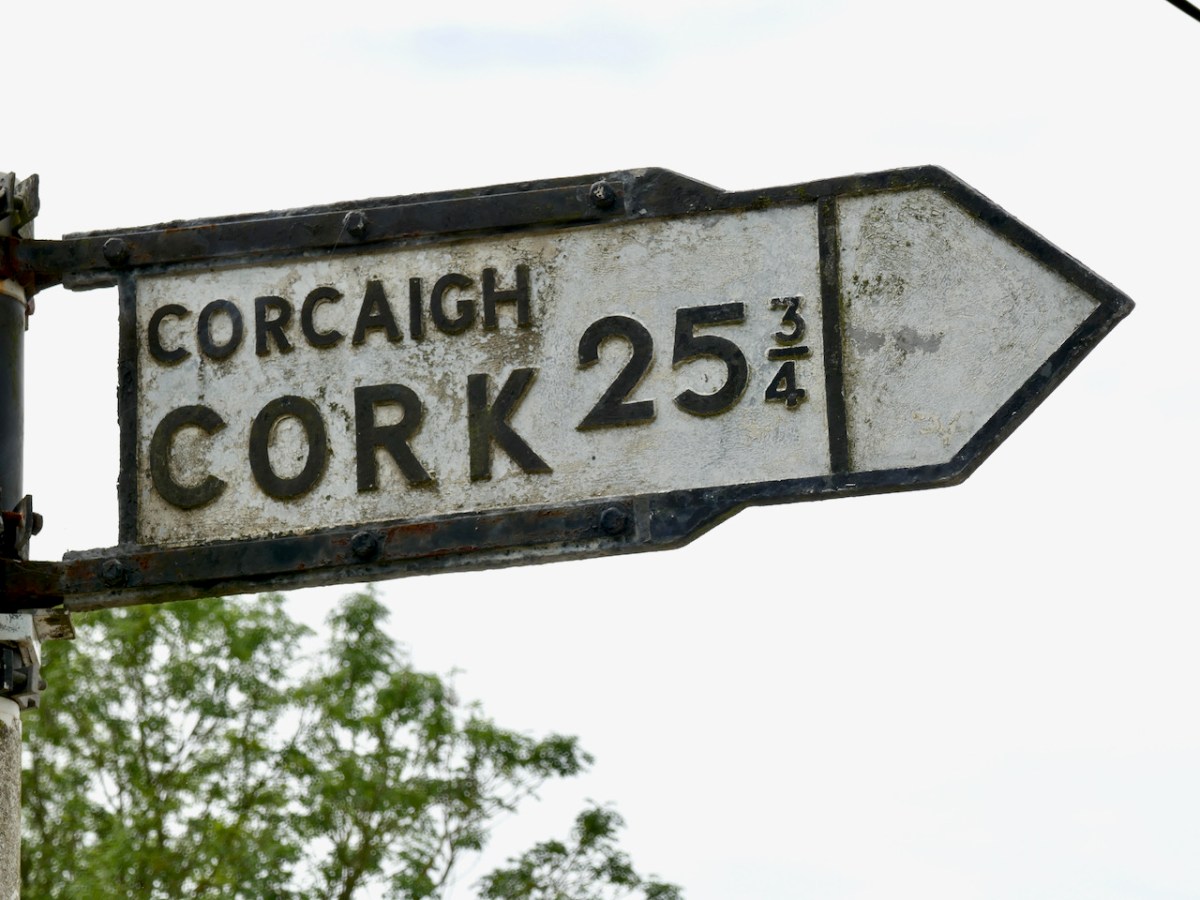
If you visit Knock (above) you can collect your own holy water. This is my report on the place. Here (below) is a curiosity – not far from our West Cork home: an old signpost marking the distance in miles. You might say it’s one that got away!
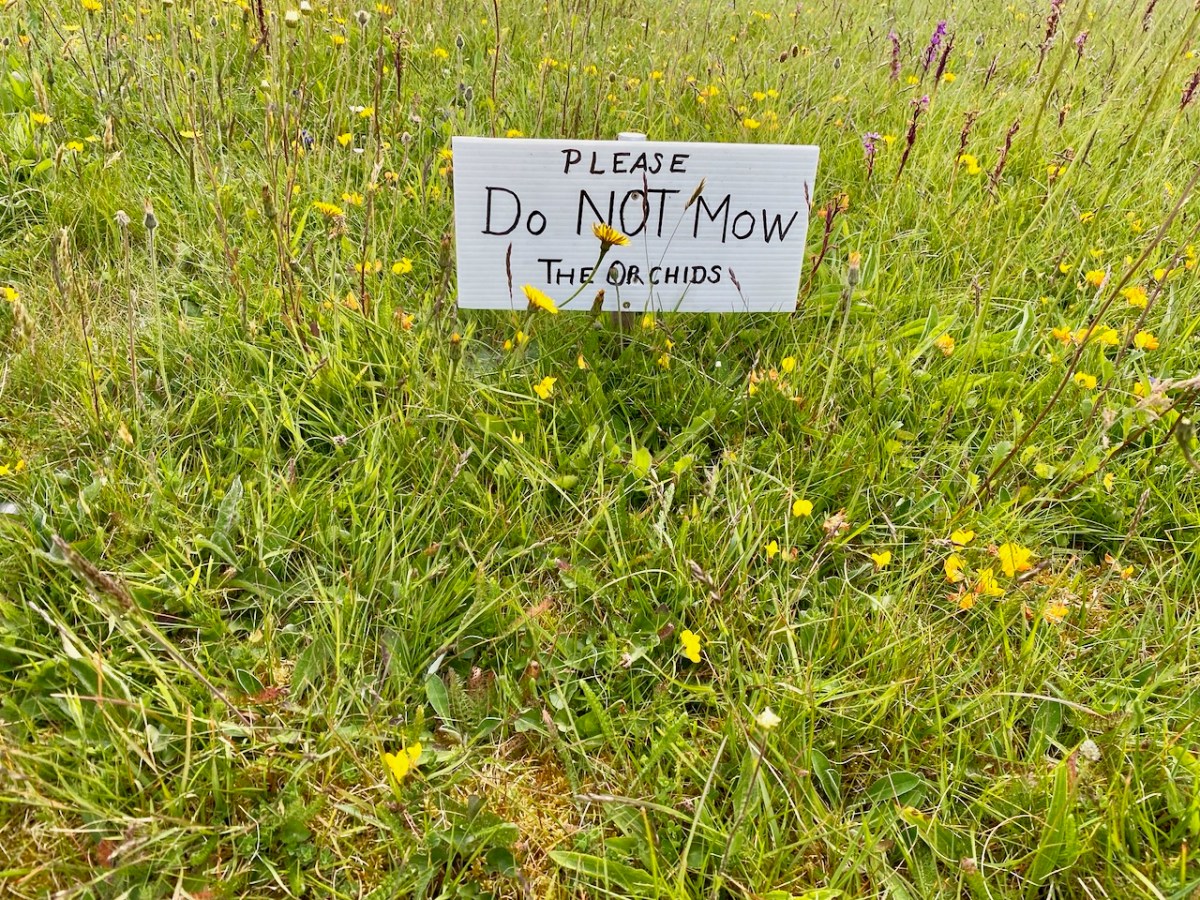
Quite right! The orchids at Toormore Church are spectacular, and have to be looked after.
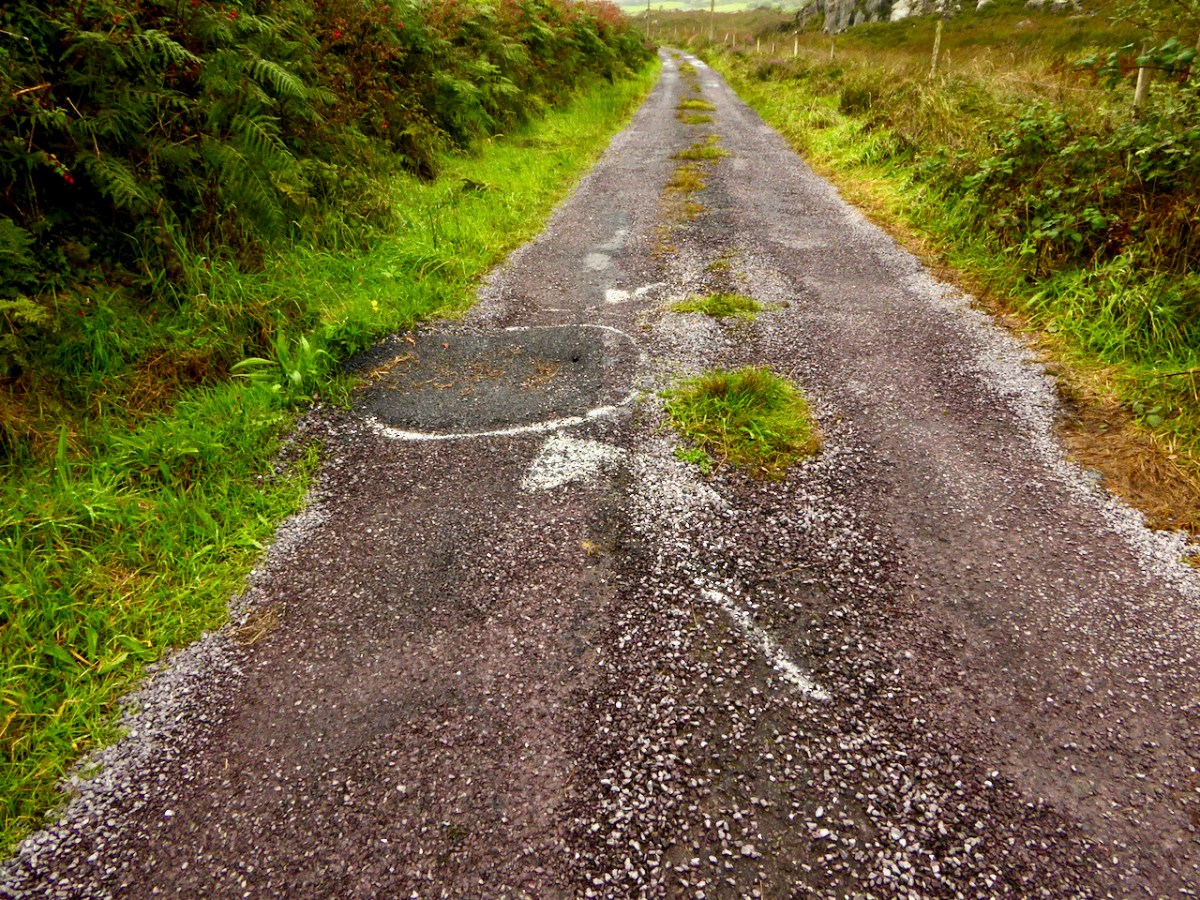
A coded message from another world, perhaps?
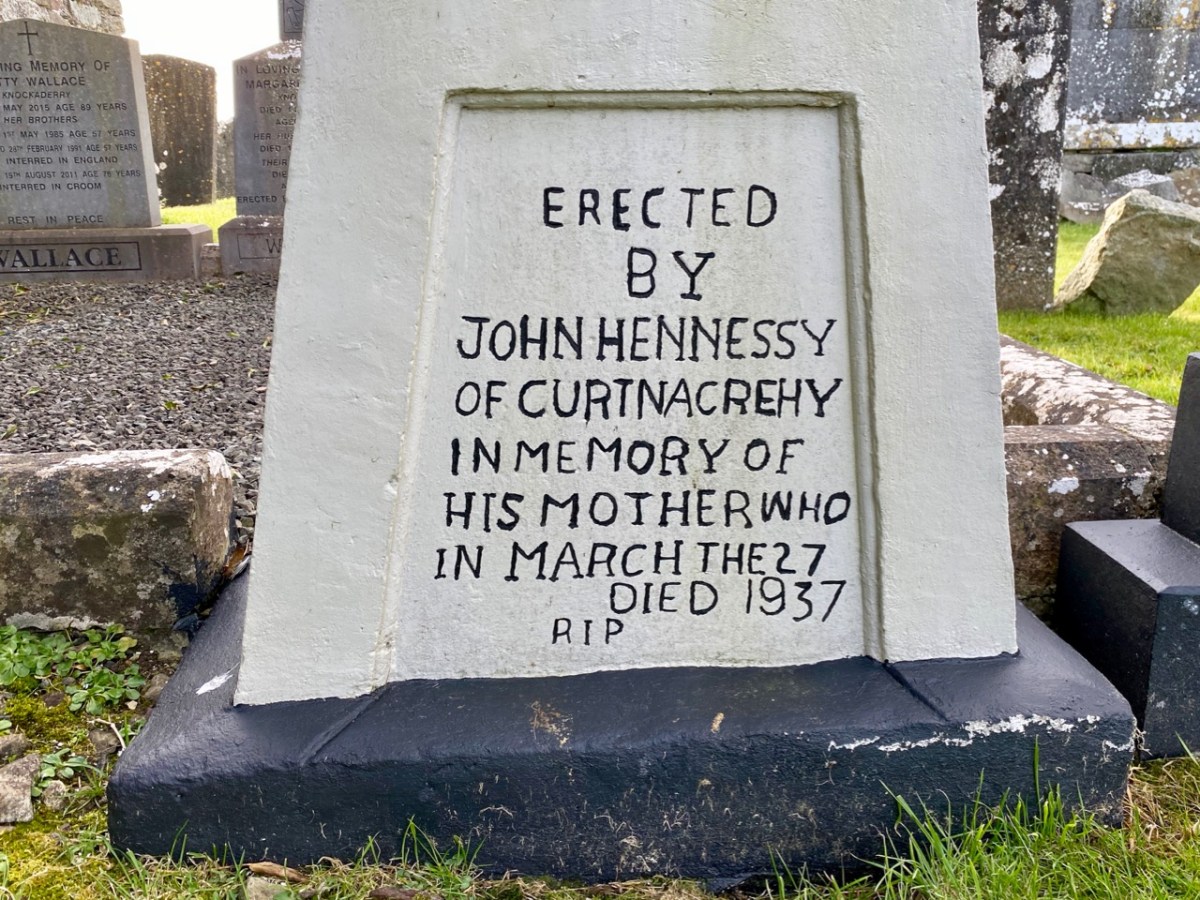
Signs can be enigmatic here in Ireland. There’s usually a reasonable explanation for them, though.
There’s plenty more where these came from (in fact they come from all over Ireland). Keep a watch out yourselves!
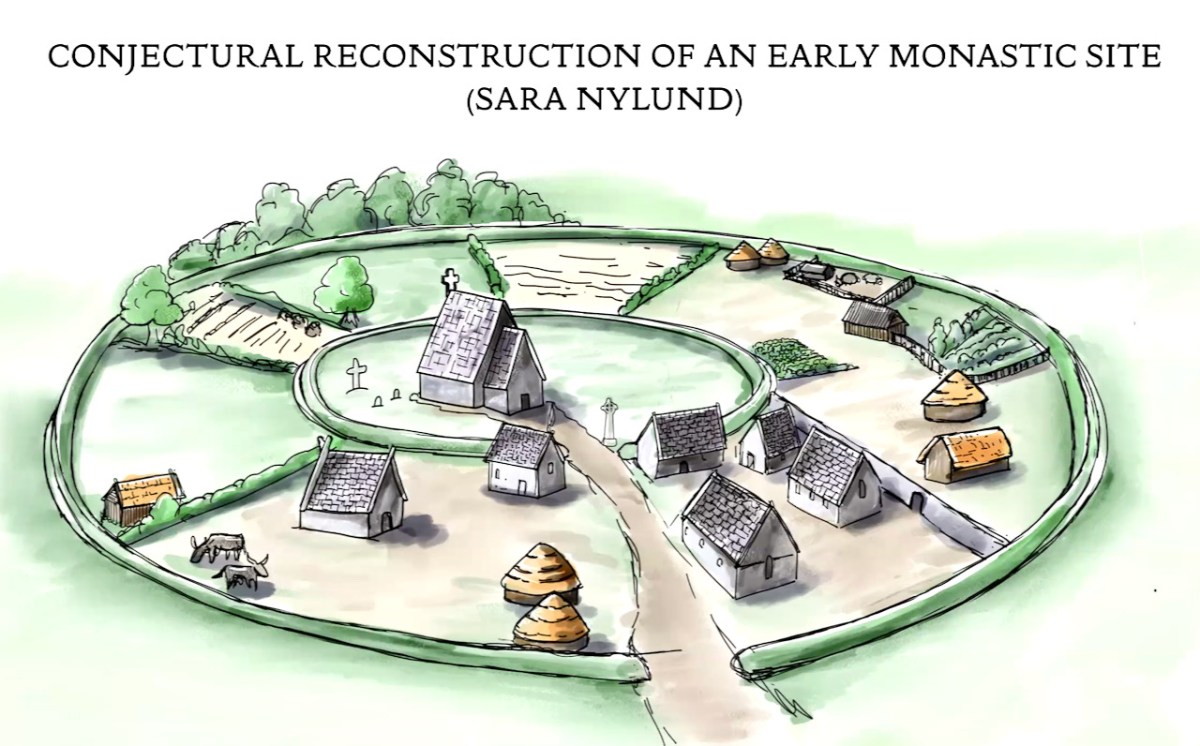
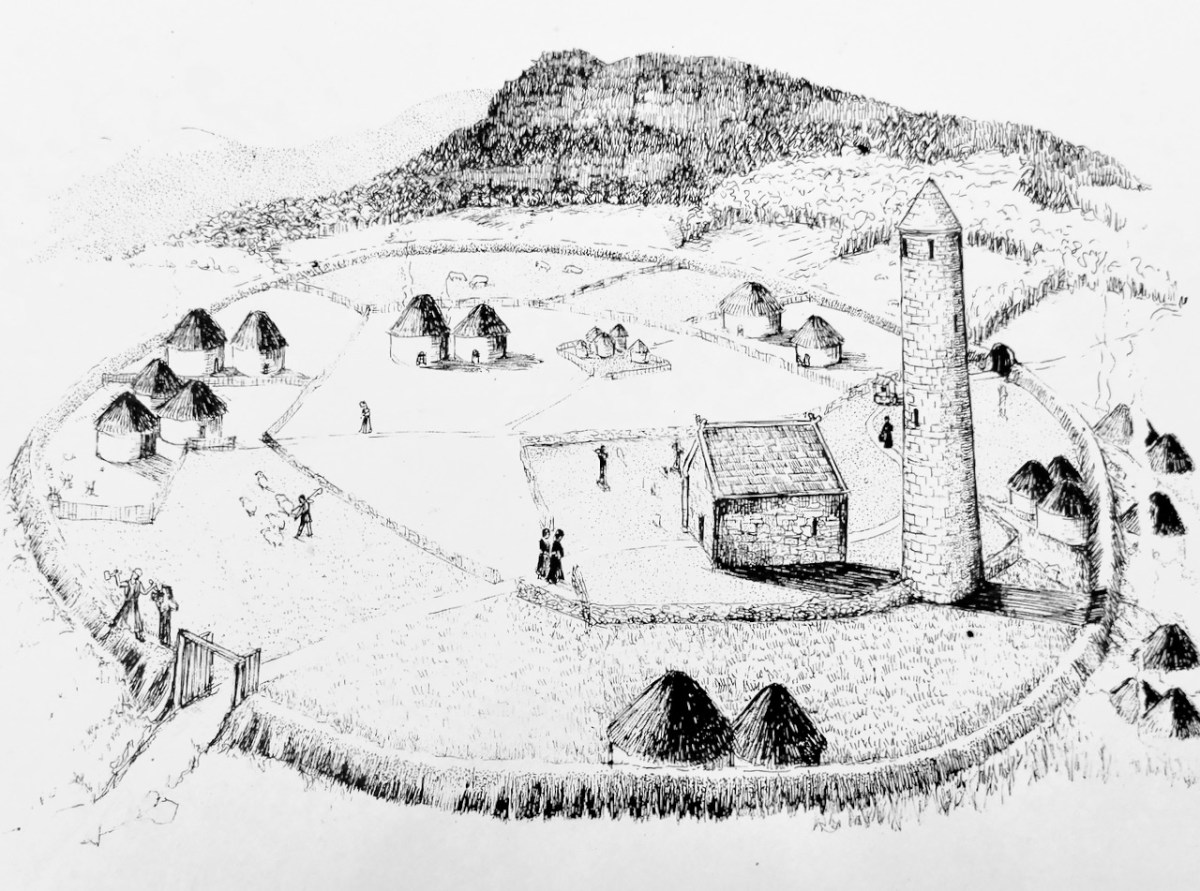
Many thanks to Sara Nylund for her wonderful reconstruction drawing of an early ecclesiastical site
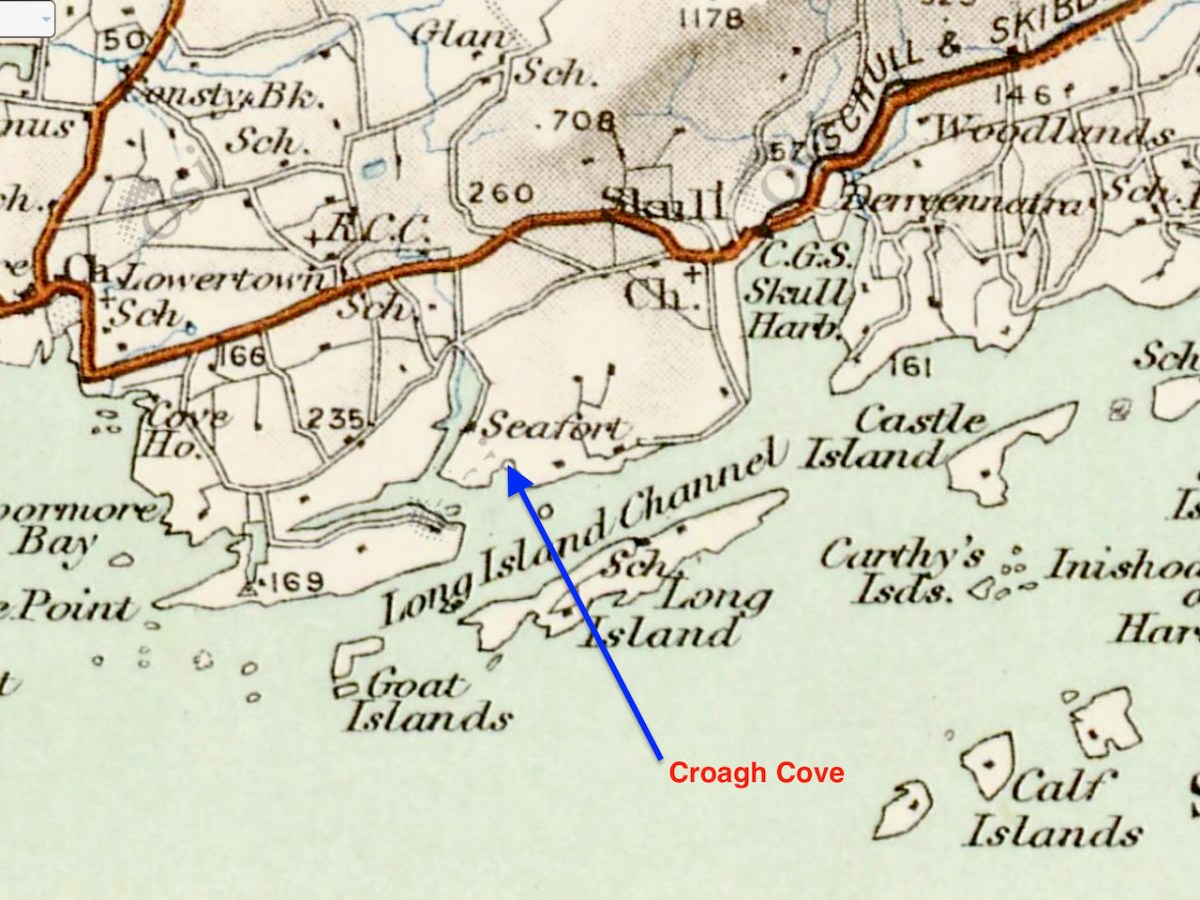
A couple of years ago, confined to explorations within 5km, Robert wrote about Croagh Bay (pronounced locally as Crew Bay). Recently our friends Donagh and Tamsin enticed us back to take a closer look at the eastern part of the Bay – Croagh Cove (Crew Cove).
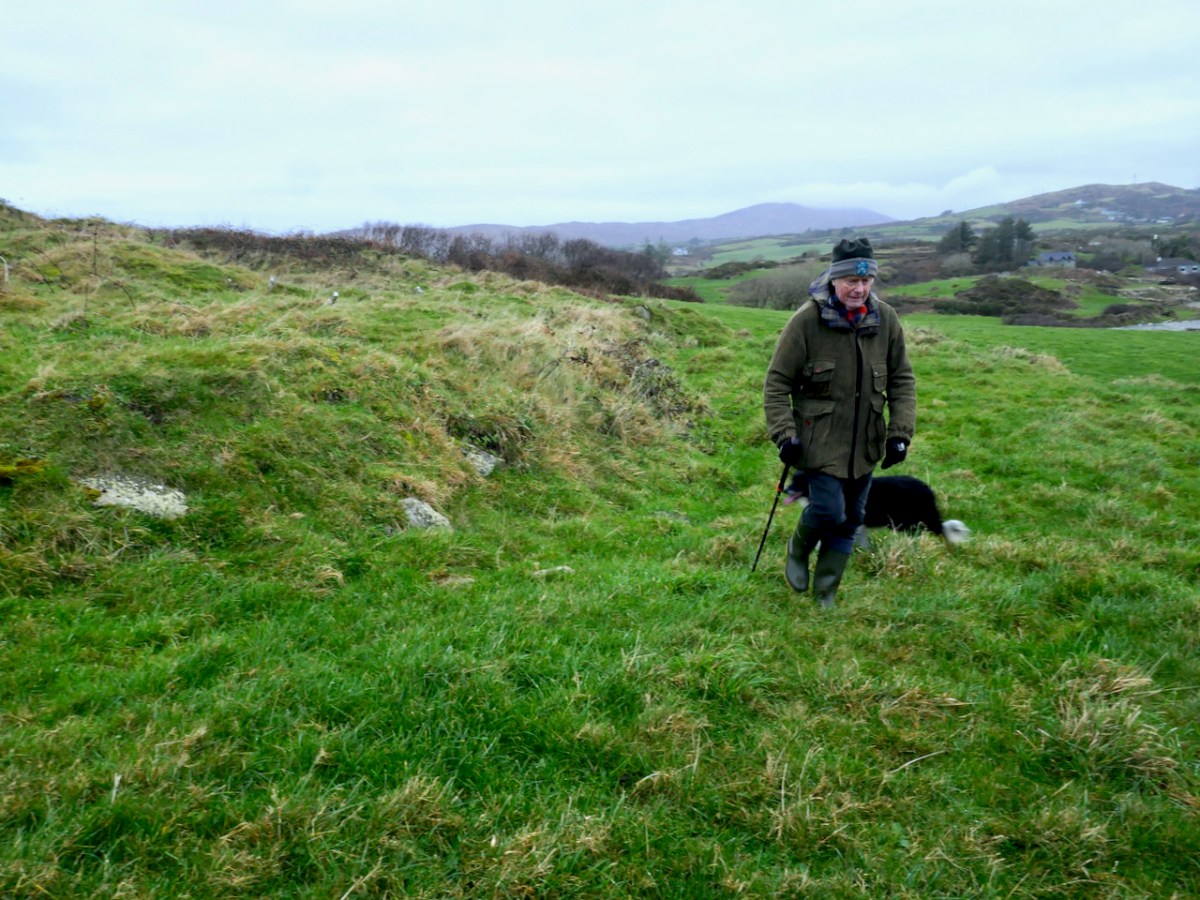
What intrigued us about this place and why we were eager to visit (apart from Donagh’s world-class coffee) was a place marked on the map as an ‘ecclesiastical enclosure.’ There aren’t a lot of those on the Mizen, although there may be more early ecclesiastical sites than have been identified and recorded. Kilbrown (see my post Mizen Mud), Cove and Kilbronogue are the only others so far.
What establishes a site as a likely ‘early ecclesiastical enclosure?’
The Irish church was dominated by scattered rural monasteries from the sixth century onwards. These were surrounded by large enclosures (varying in diameter from 40 a.m. to 400 M), often circular or oval in plan, and usually far more extensive than the surviving graveyards. In some cases the original bank, fosse or stone wall survives but more often the line of the monastic enclosure (or vallum) is indicated by curving field boundaries, roadways or a laneways. As well as the church and graveyard, these enclosures contained the dwellings, outhouses and workshops of a community, sometimes approaching the size of a town. Because the buildings were constructed of wood nothing survives above ground today; the graveyard often contains the ruin of a mediaeval church. In some cases the surviving burial ground has no inscribed headstones but was used for the burial of unbaptised children during the last few centuries. Bullaun stones and cross-inscribed stones are often found on early church sites while holy wells may be situated close by and retain the name of the saint anciently associated with the site. Unfortunately little of the history of the early church in West Cork has survived and the earliest reference to many of these sites is as late as the 12th century.
The Archaeological Inventory of County Cork, Vol I, West Cork. P 271
So, as you can see, not much normally survives on the surface but a tell-tale sign is a circular or oval enclosure, or (often) two concentric enclosures, with the barely-discernible signs of buildings inside. (Readers may remember the above illustration from my post on Ardpatrick – no sign of a round tower at Croagh, though!).) The memory of these places as once-sacred seems to be retained locally, and led to their use as Cillíní, or Children’s burial grounds in the past. See my post Unknown Souls for more about Cillíní – ‘the loneliest places on earth.’ Thus – small uninscribed headstones peeking out through the grass is an indication that this may be a cillín, and in turn perhaps something more ancient yet.
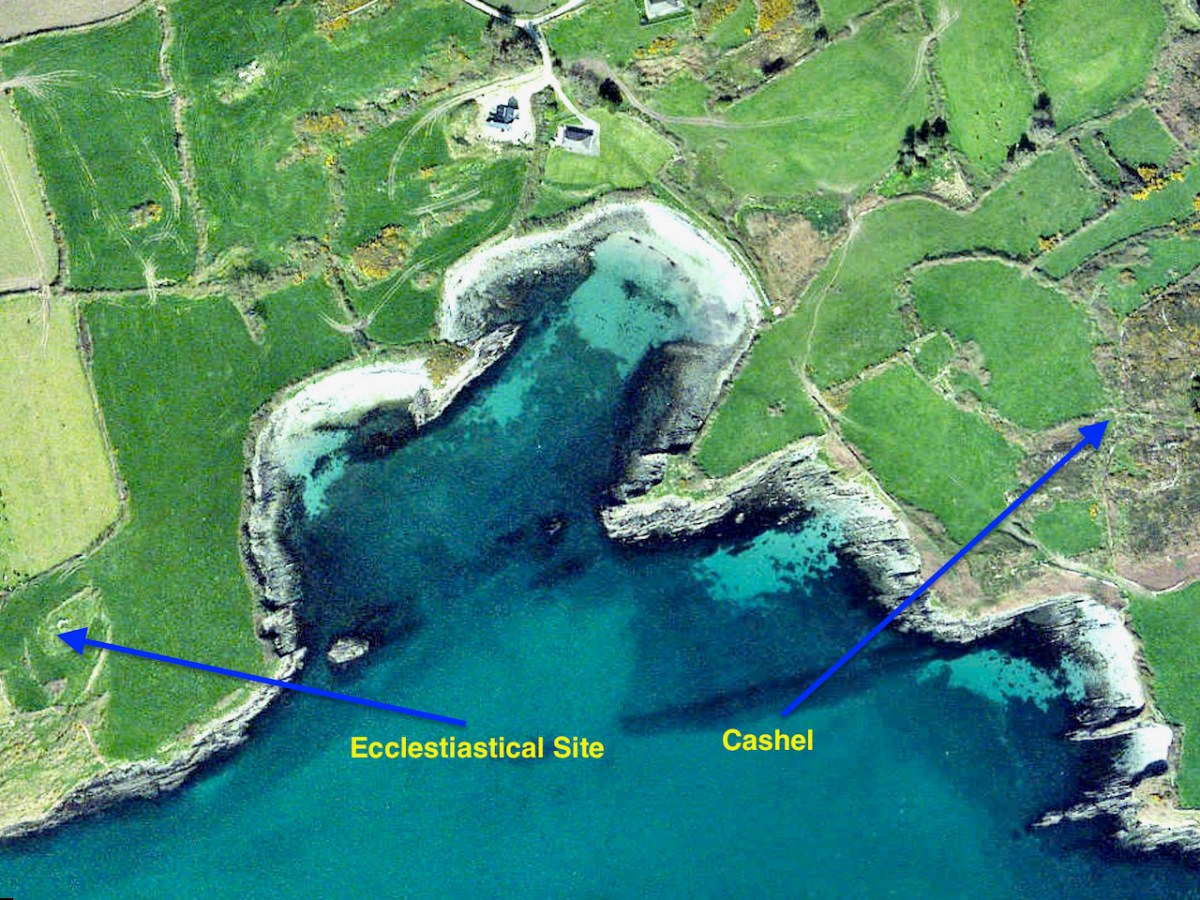
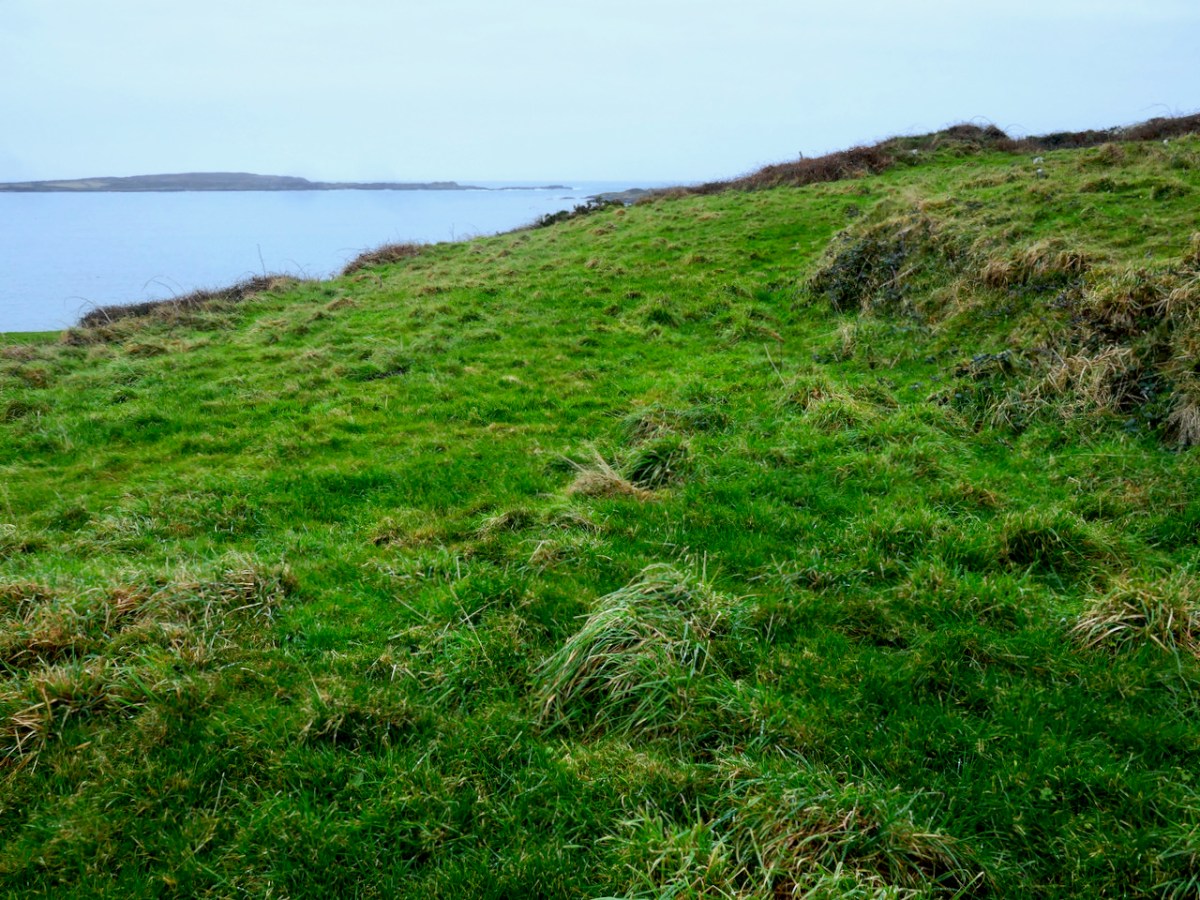
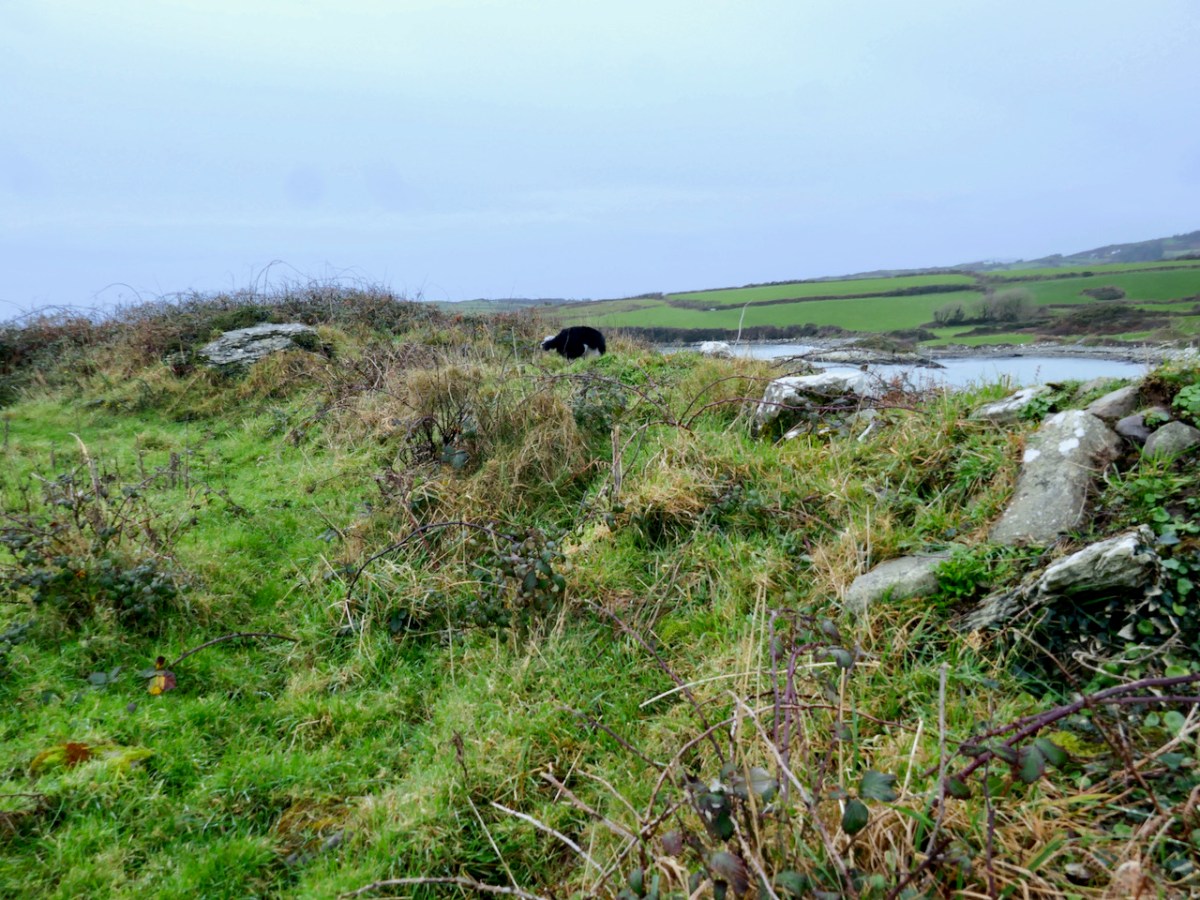
The original site may have been carved out of the hillside – the flattening process leaving a sharp-edged bank on the sea-ward side (above and below). This reminded us of the similar bank we found at the possible ‘Scoil Mhuire’ site that Robert reported on in his post Schull – Delving into History.
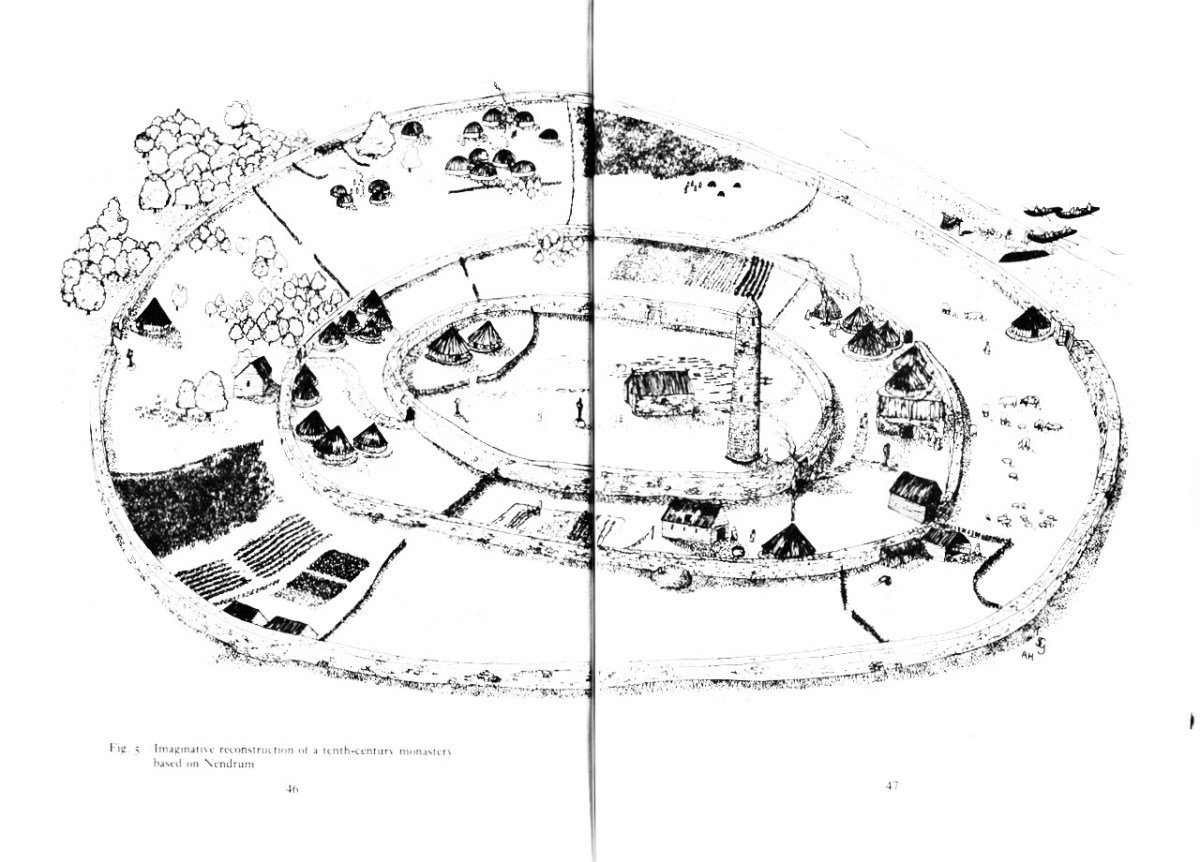
What would such a site have looked like? They varied enormously in size – for example Glenadalough in Wicklow and Kells in Meath would both have been monastic cities. Most, however, and especially in remote places, would have been small religious foundations in which there would be a central church surrounded by an inner wall, and houses and gardens for the monks surrounded by an outer wall.
Nendrum in Co Down shows what a monastic settlement considerably larger than Croagh might have looked like. The Illustration is from The Modern Traveller to the Early Irish Church by Kathleen Hughes and Ann Hamlin
The word reilig (pronounced rellig) is the Irish word for graveyard and it comes from the word for relic. Early sites like this were assumed to have had a founding saint, who gave his or her name to the site. Kilbrown, for example, would be the church of Brón, and he would have been buried on the site – hence the ‘relic’ association. Kilcoe was named for a saintly nun, St Coch. The echoes of the cult of those saints would have remained alive through the centuries in the names of townlands and holy wells.
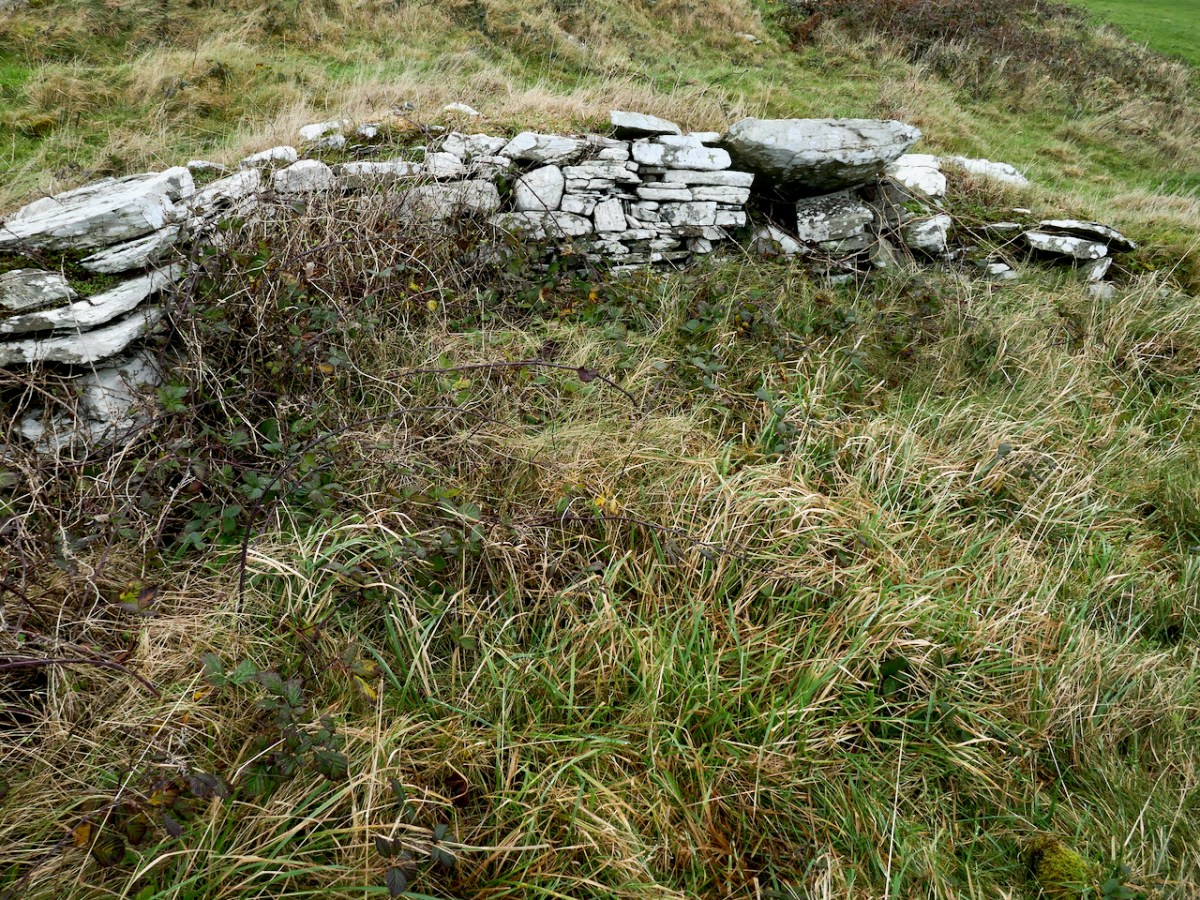
Possible remains of church at Croagh
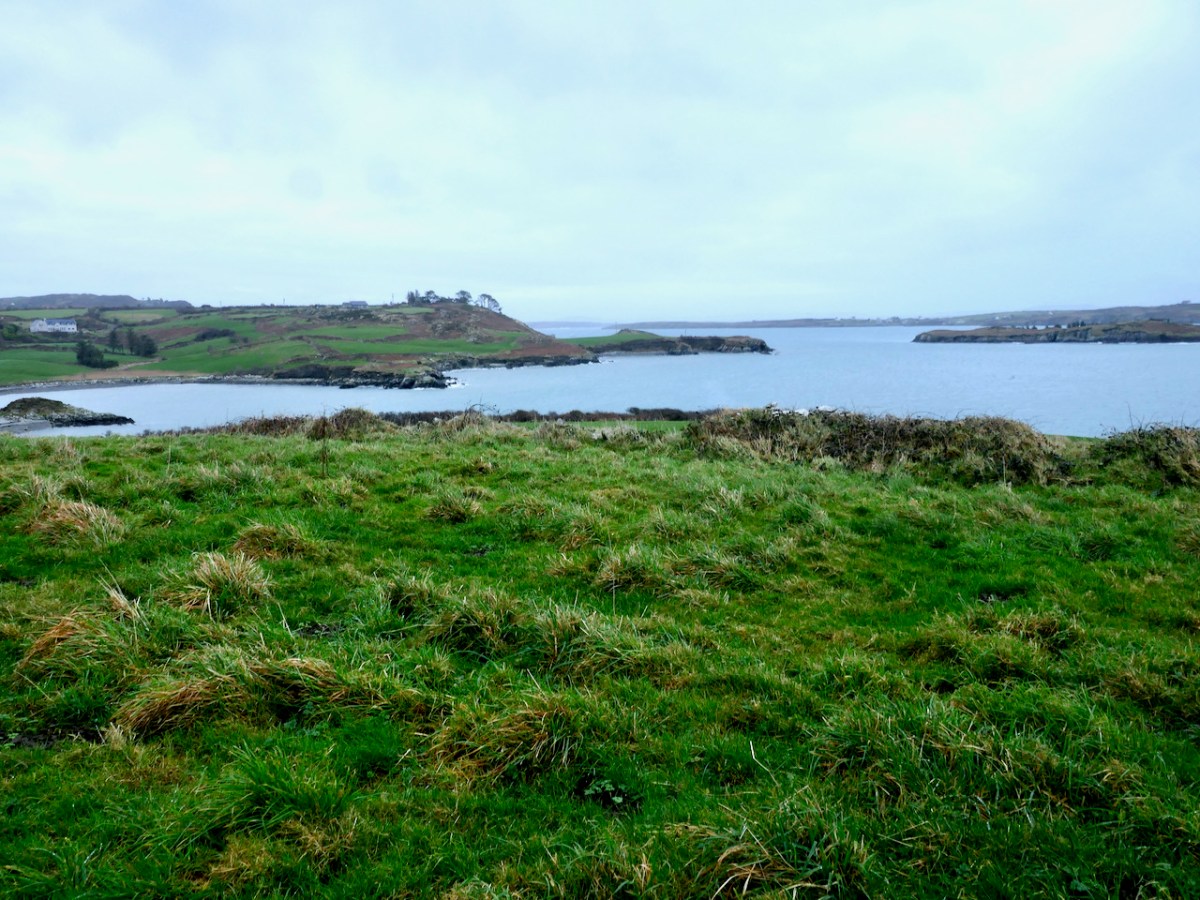
The name Croagh, however, is based not on a saint’s name but on the Irish word for a ‘stack’ and may refer to the gentle hill that rises up from the water. It was, and remains, an almost perfect spot to establish a peaceful settlement based around hard work and prayer. There’s a lovely little beach below, so transport and travel was easy by water. It’s in a sheltered haven protected from storms by Long Island off the cost, and from it there’s a good view out to sea (below) so the monks could see Vikings or other raiders coming.
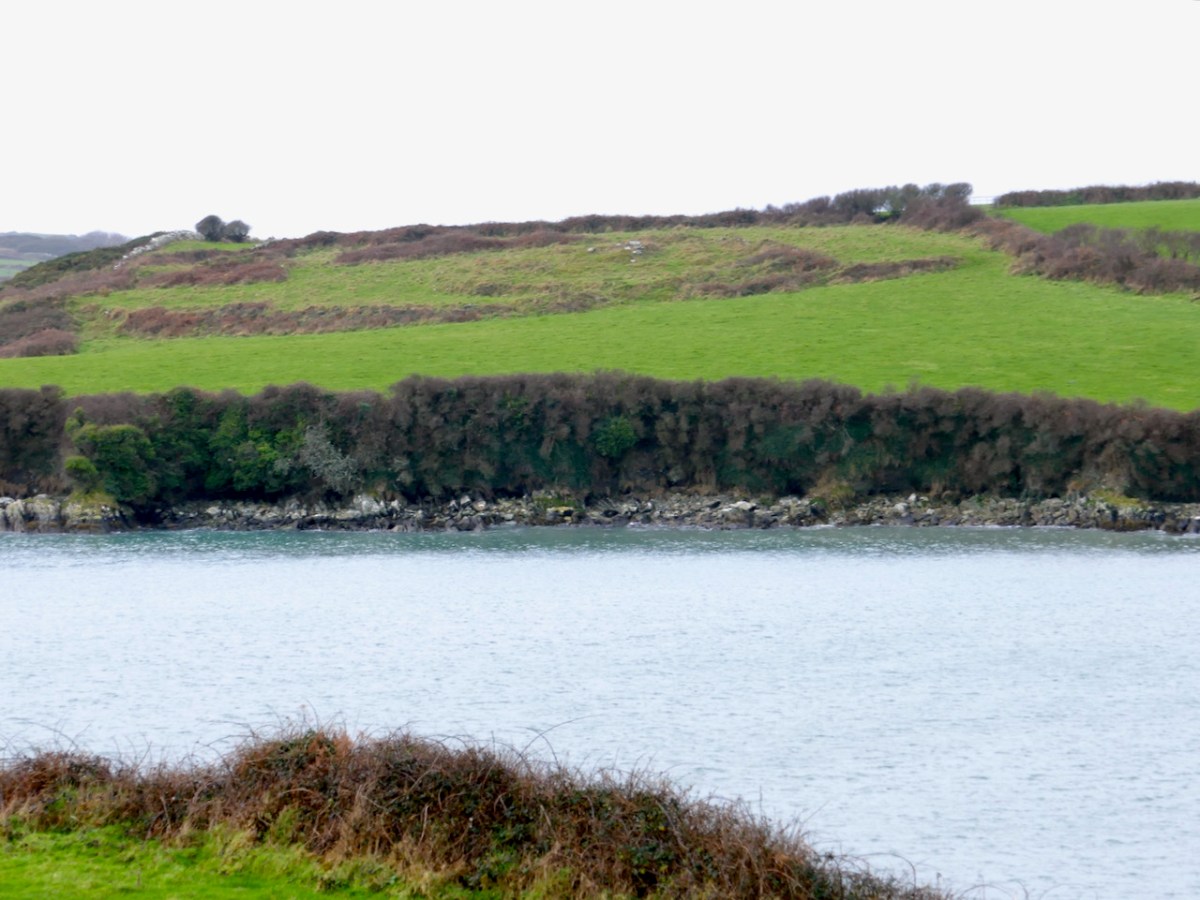
And right across the Cove there’s a ring fort – a cashel, in fact, since it looks like the walls were made of stone (below). It’s a classic – on elevated ground with commanding views all around, out to sea and to the low hills behind. Puzzlingly, this cashel is not recorded by National Monuments. It’s overgrown by bracken so may not have been obvious at the time of the survey.
This juxtaposition, across the cove from each other, of an early-medieval monastic settlement and a fortified residence, leads to speculation as to the relationship between the two. Was the monastery endowed by the local chief, committing the monks to say prayers for his eternal soul in exchange for land and protection? This is certainly a familiar pattern from the later medieval period.
View of the ecclesiastical site from the cashel
This is just a tiny corner of the Mizen. There is much more of interest in this small townland but for today I wanted to focus on these early-medieval sites. In their ruins lie clues to a distant but vibrant past.
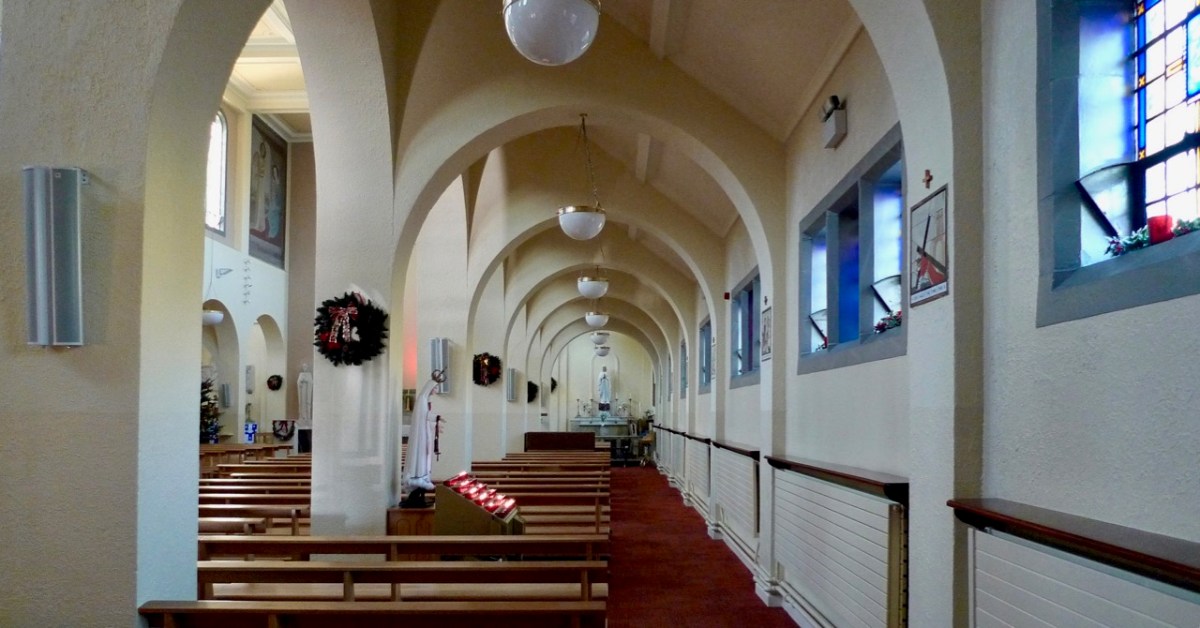
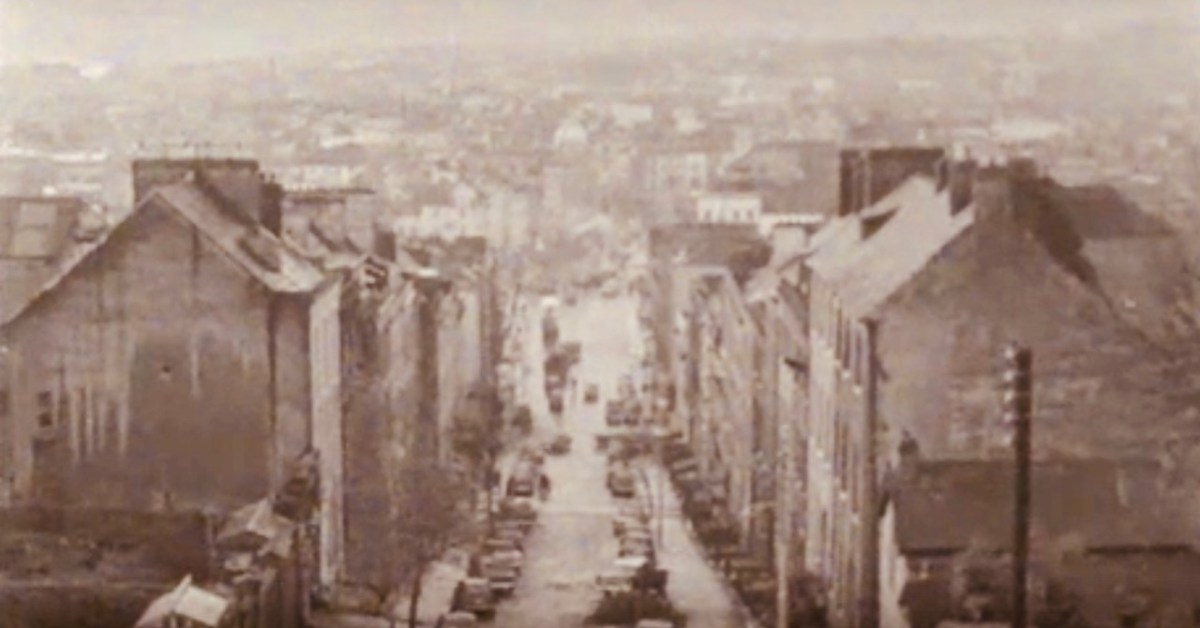
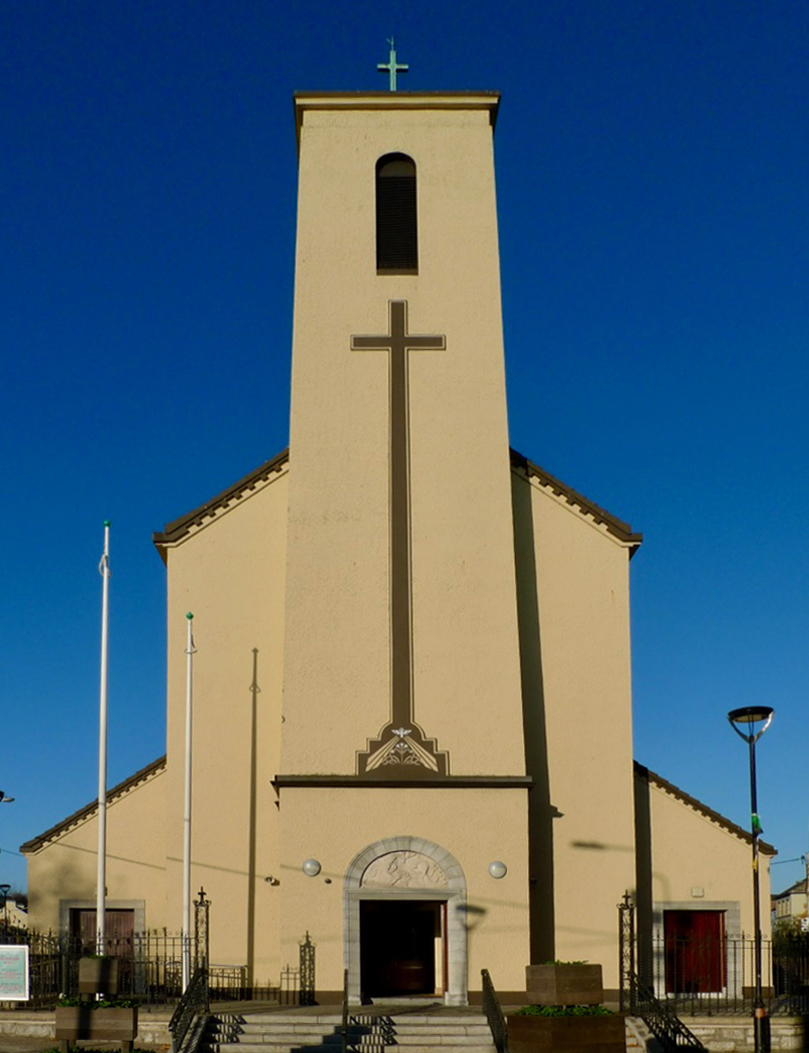
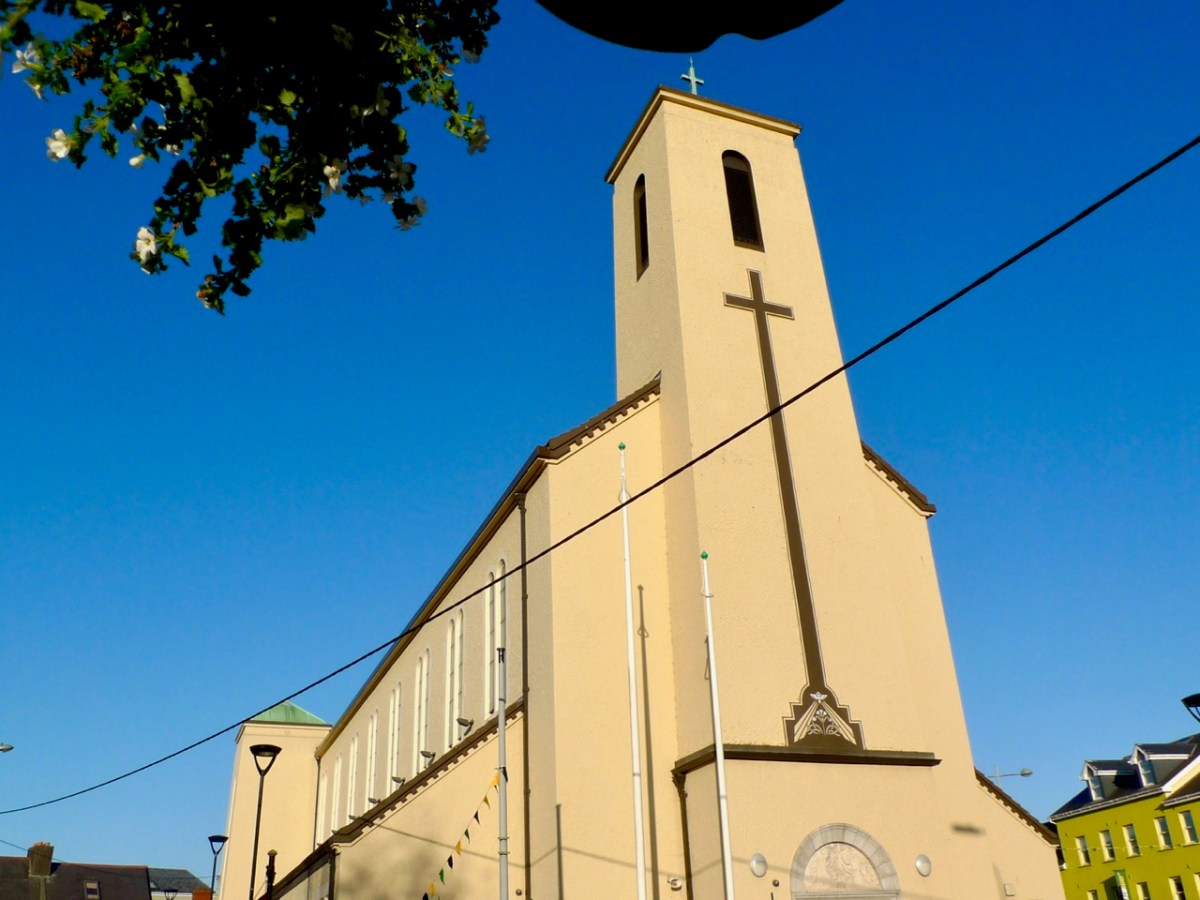
This is Cork city in the 1940s. The subject of today’s post is a Cork man – the sculptor Séamus Murphy. Born in 1907 near Mallow, Murphy took classes at the Crawford School of Art before apprenticing as a stone carver at O’Connell’s Stone Yard in Blackpool, a parish in the city, for seven years. Murphy and his work could occupy several posts, but today we concentrate on his only architectural building project, the Church of the Annunciation in Blackpool. Séamus Murphy can fairly claim to be the ‘sculptural designer’ of this building – as he conceived the way it would appear – while the architect Edmond Patrick O’Flynn most likely carried out the technical drawings and specifications.
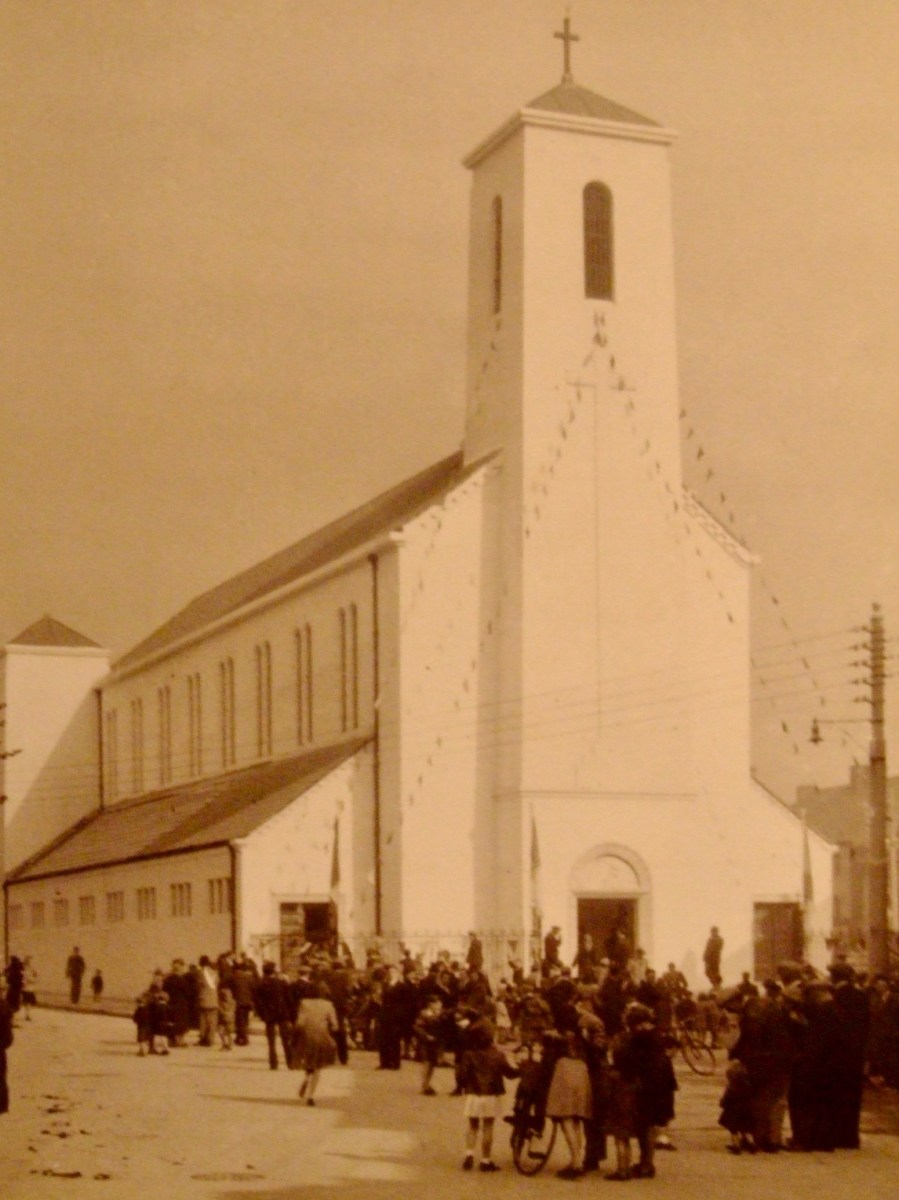
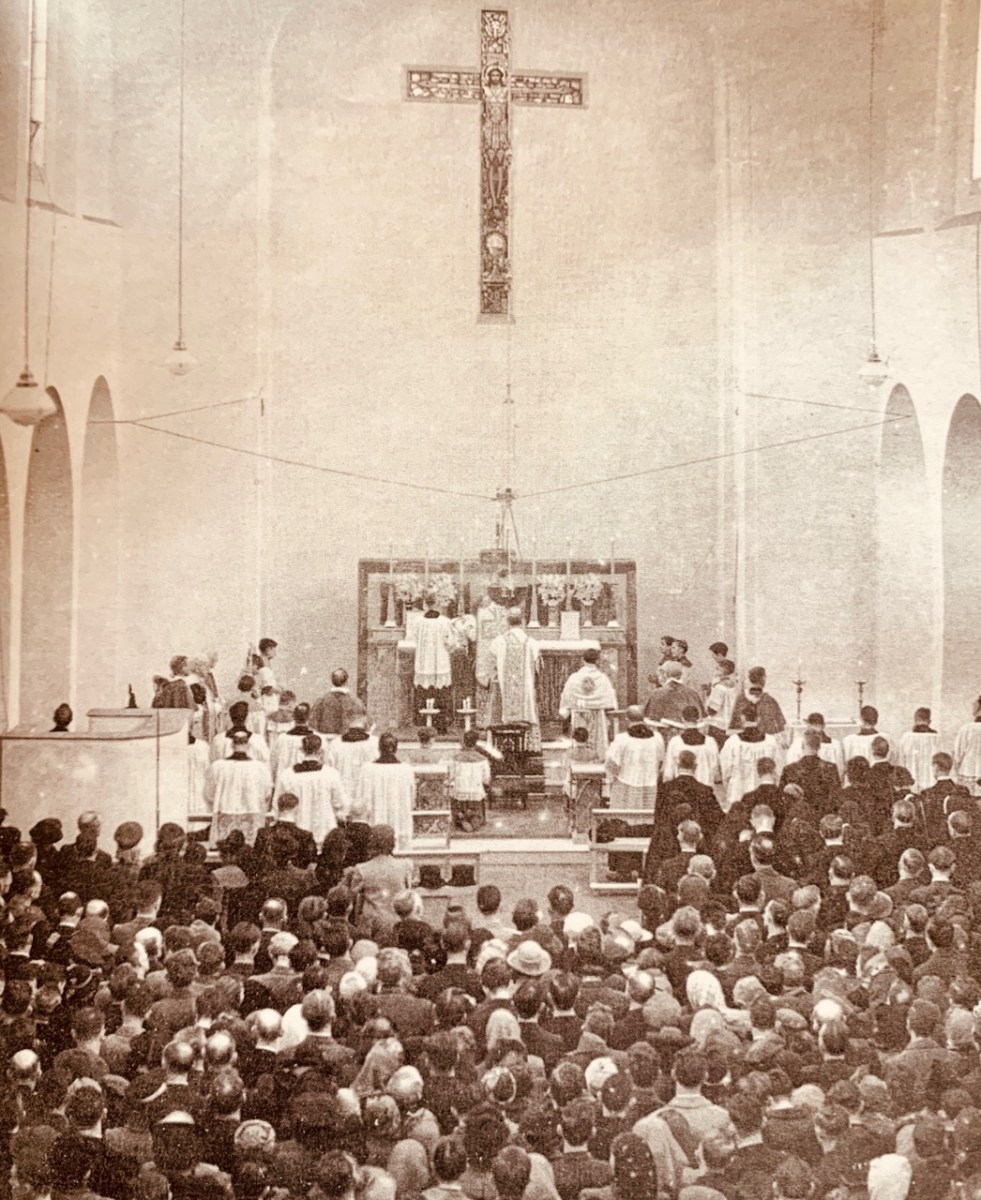
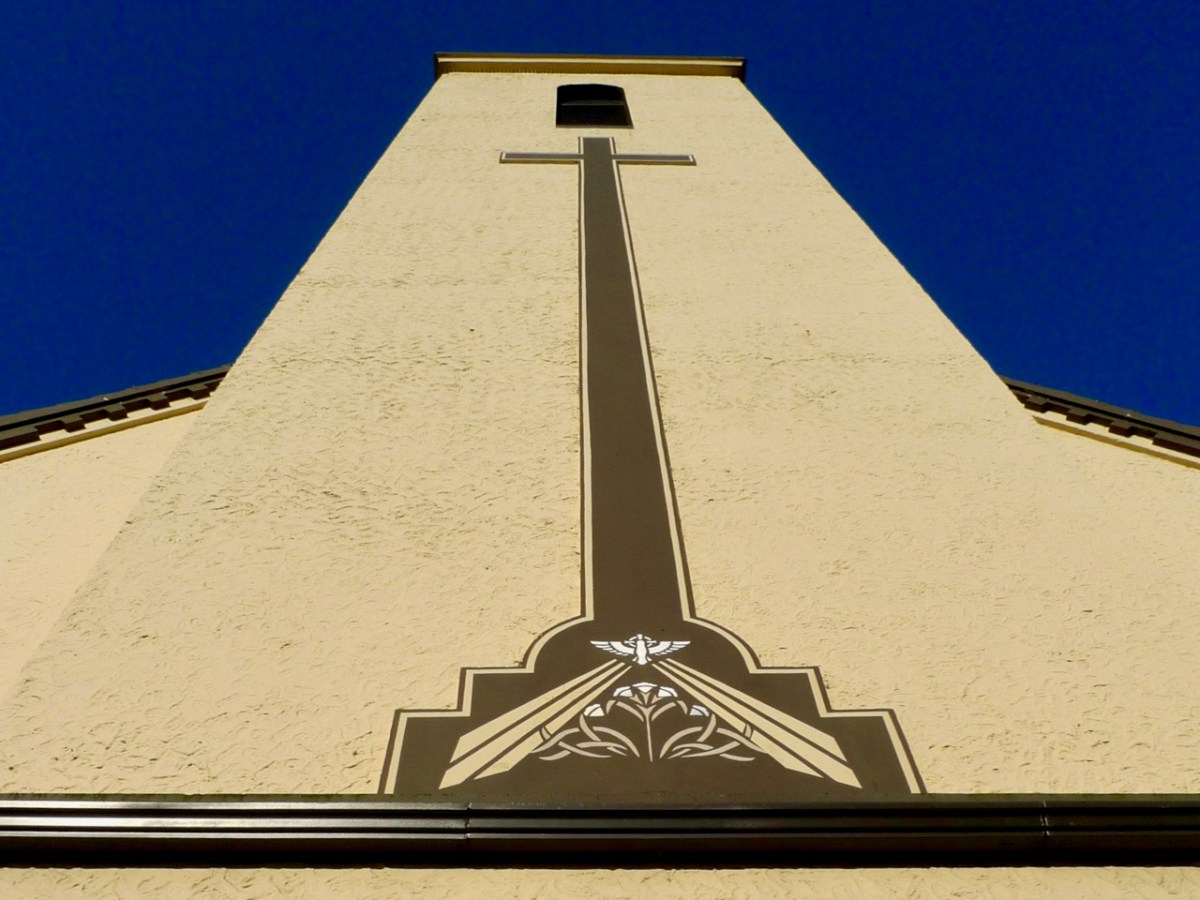
According to the Murphy family, Séamus found inspiration for Blackpool from pictures of churches in South America. In particular, the roughly textured render on the external walls is said to have derived from the adobe finish common in Spanish missionary churches there. The Cork church was commenced in January 1945, and the picture above (courtesy of Cork City Library) dates from around that time. The picture below – also courtesy Cork City Library – shows the dedication ceremony in the church on 7 October 1945.
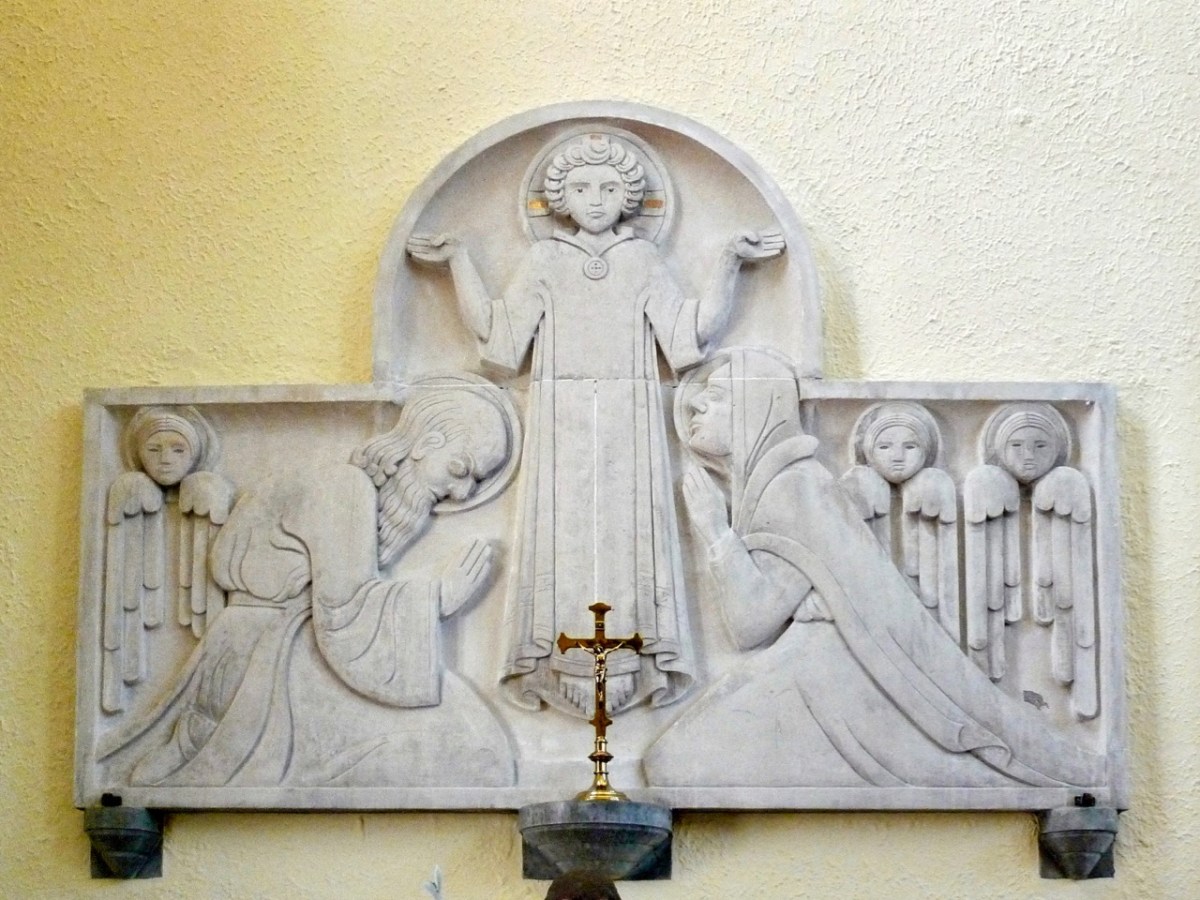
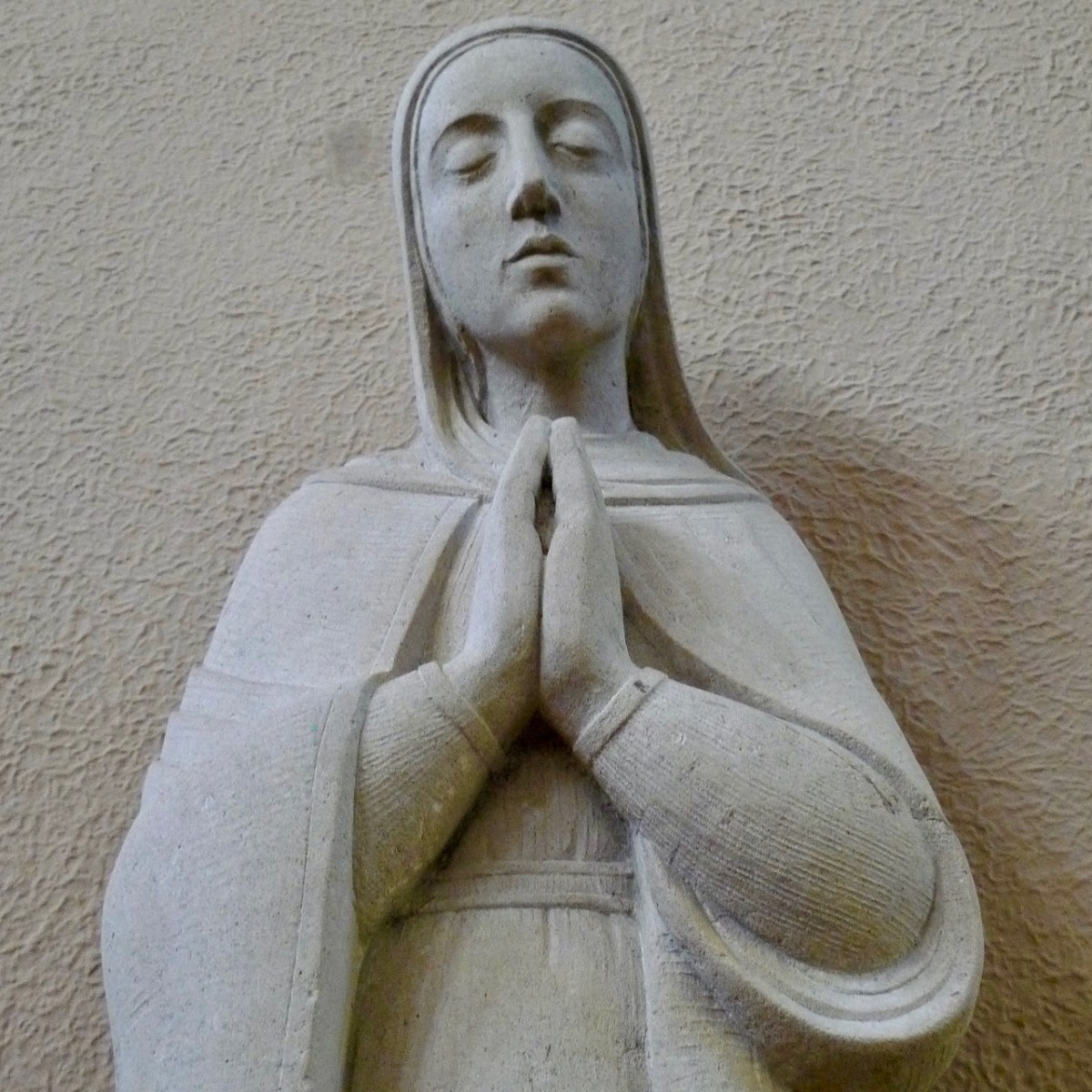
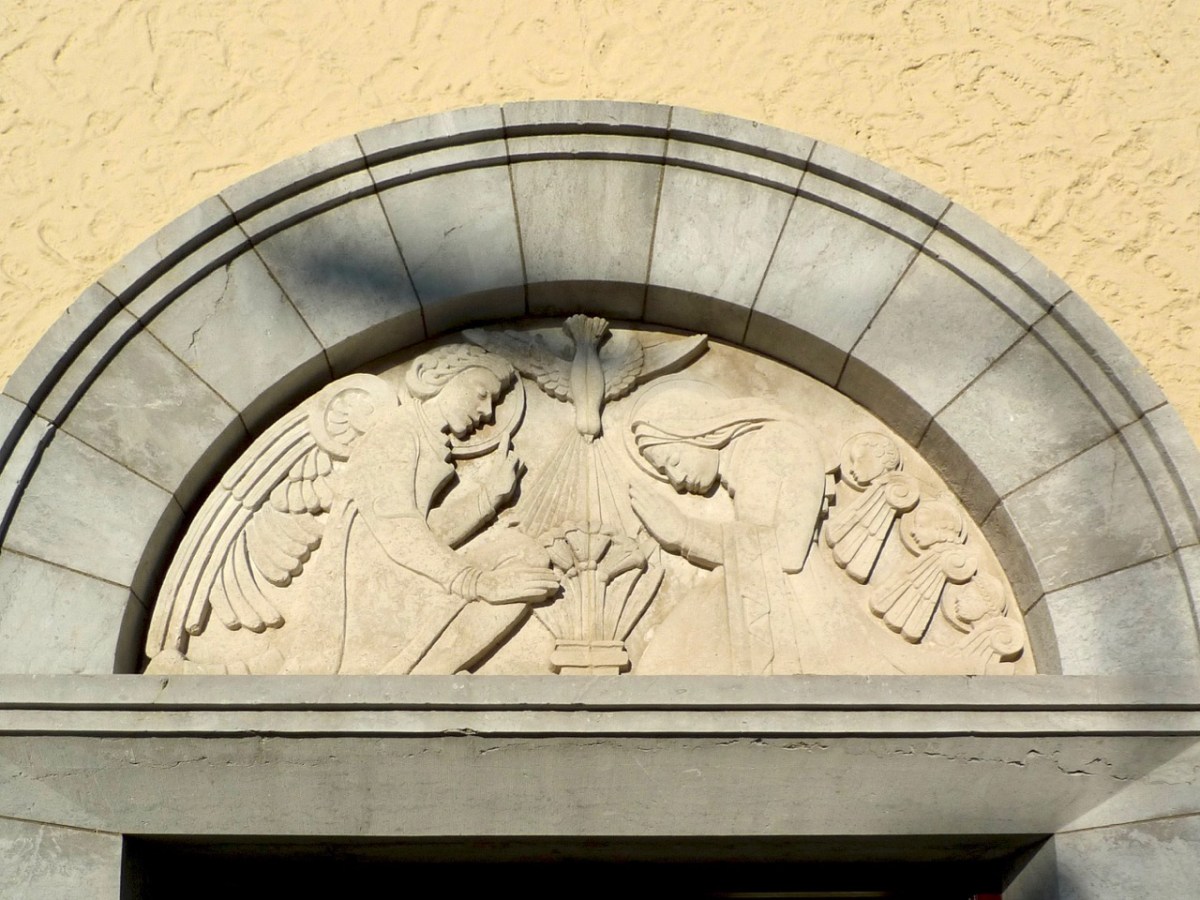
This picture of Séamus, above, is from the RTE archives. The Blackpool project is a good area of study, as the church shows the sculptor’s ability to conceive large, three-dimensional spaces as well as his skills in producing his own figurative and relief works, a number of which are used in the church furnishings: they are of polished Portland stone.
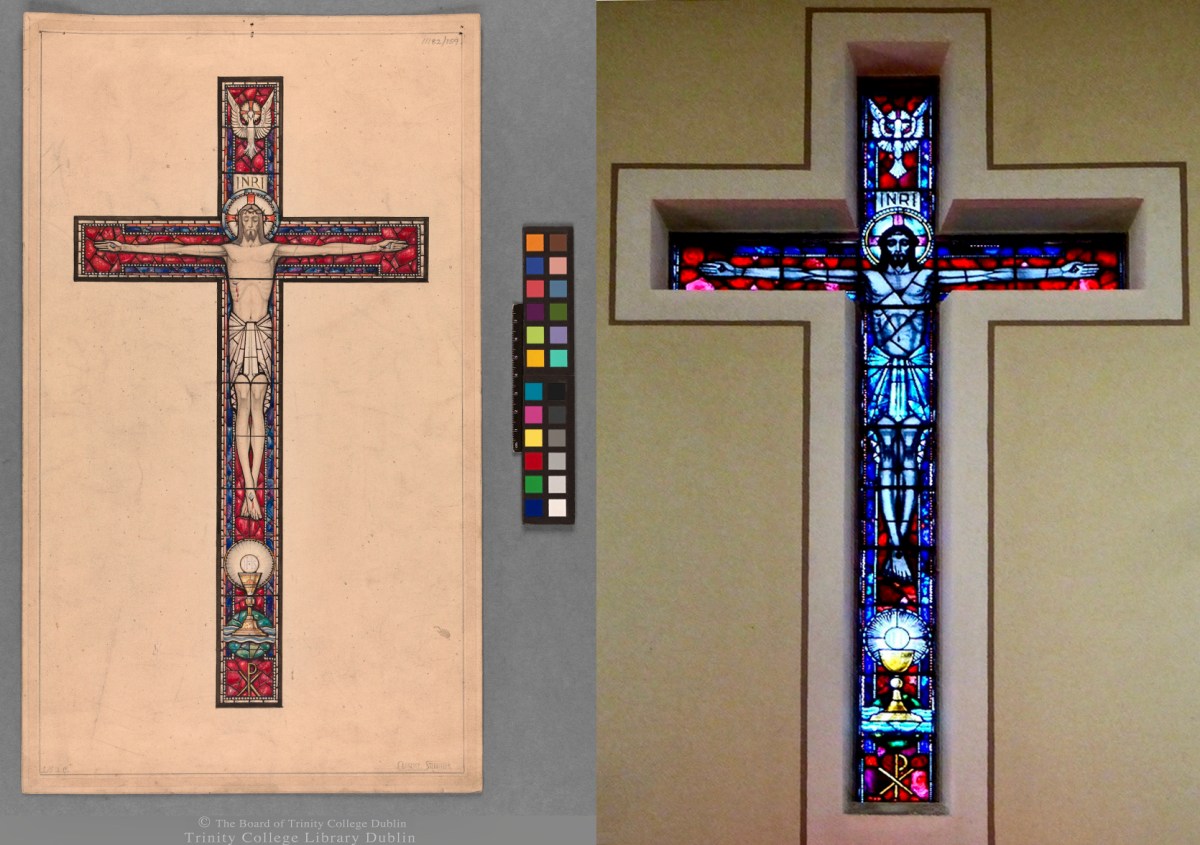
While the church is a valuable repository of Séamus Murphy’s design and carving skills, the work of many other contemporary artists can also be found in the building. The stained glass windows are from the Harry Clarke Studios, designed by William Dowling.
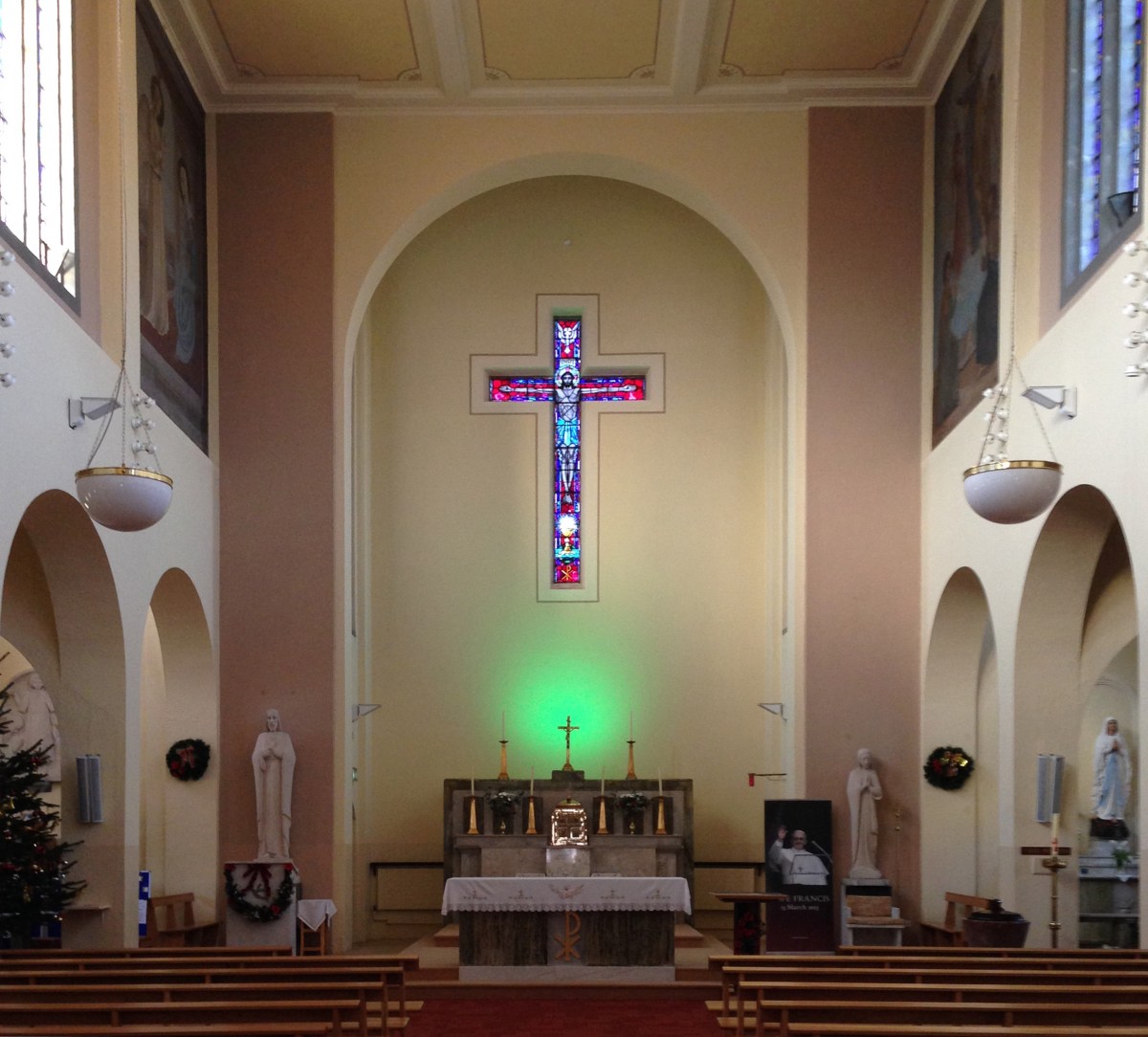
Particularly striking is the crucifix window at the east end. Above is the original cartoon (courtesy of Trinity College Library Dublin) by Dowling, side-by-side with an image of the window today. All the windows are of fine quality.
A full view of the east end of the church. The interior has changed very little over 77 years and is, therefore, a great tribute to Séamus Murphy and the the commissioning family of William Dwyer, then head of the nearby Sunbeam Wolsey factory. Dwyer funded the whole project as a memorial to his daughter Maeve who had sadly passed away in 1943.
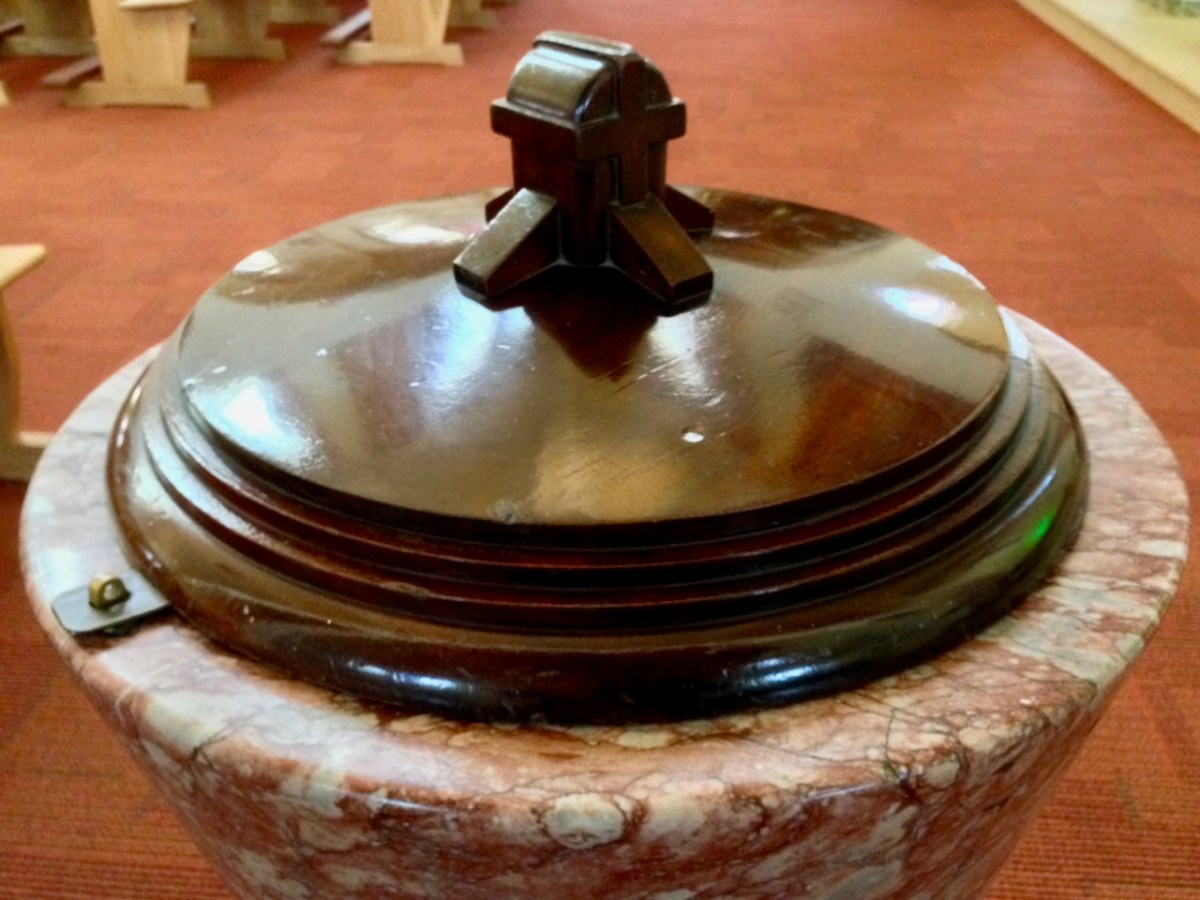
This fine font cover was carved by hand by Bart, a younger brother of Séamus.
Murphy’s Church of the Annunciation is certainly a landmark building – not just for Cork, but for the whole of Ireland. And Séamus himself must rank as one of the outstanding artists of the Free State. You will come across his distinctive work in many locations; I will be directing you to some of them in future posts.
Many thanks to Orla Murphy for giving me valuable insights on her father’s works
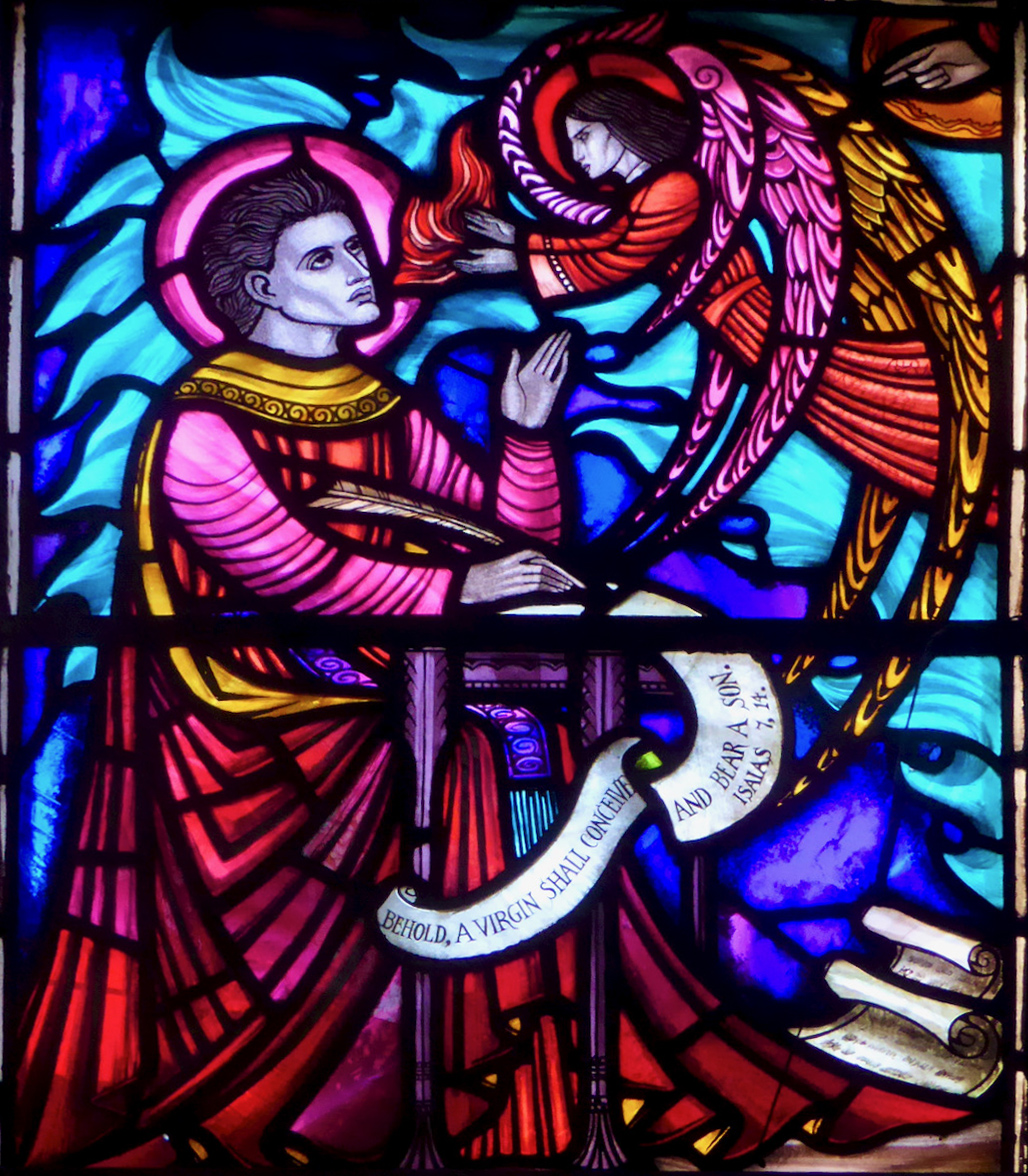
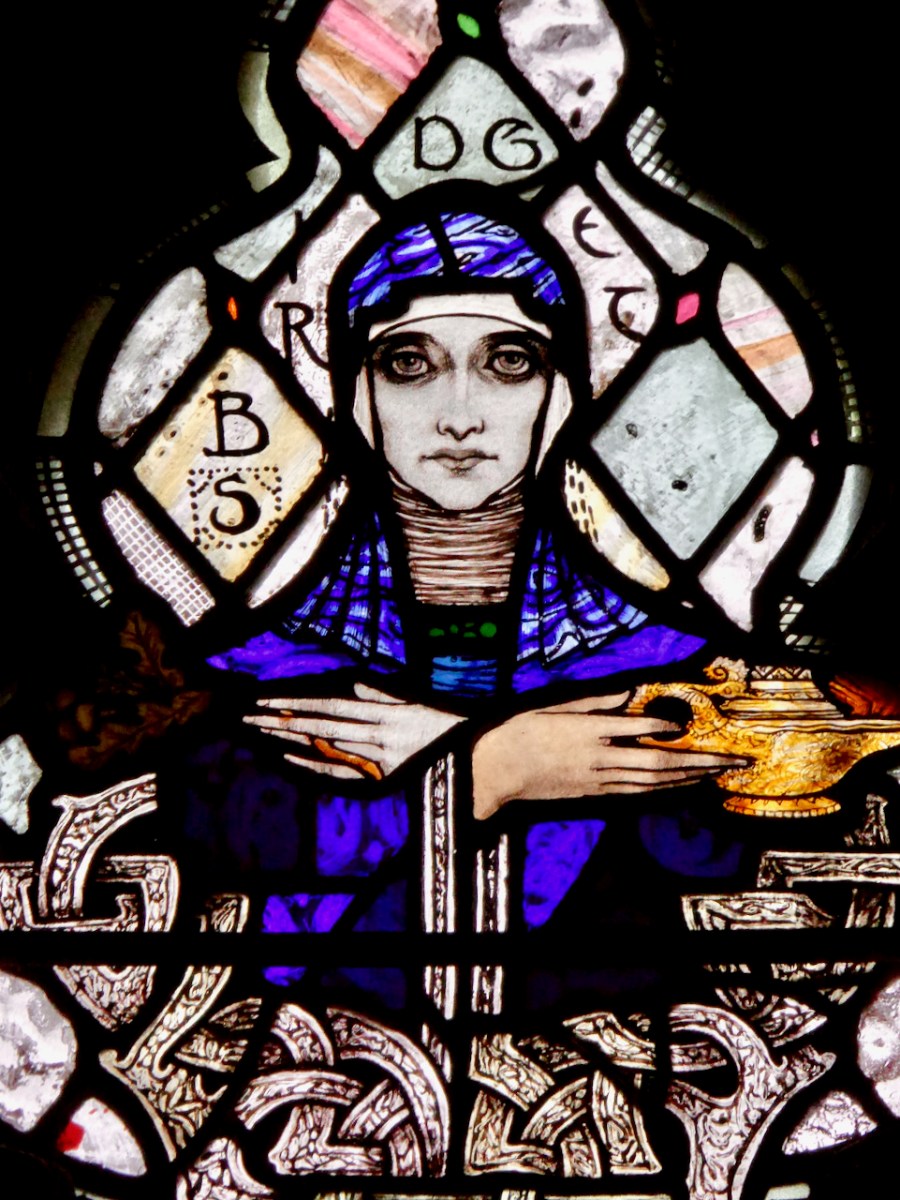
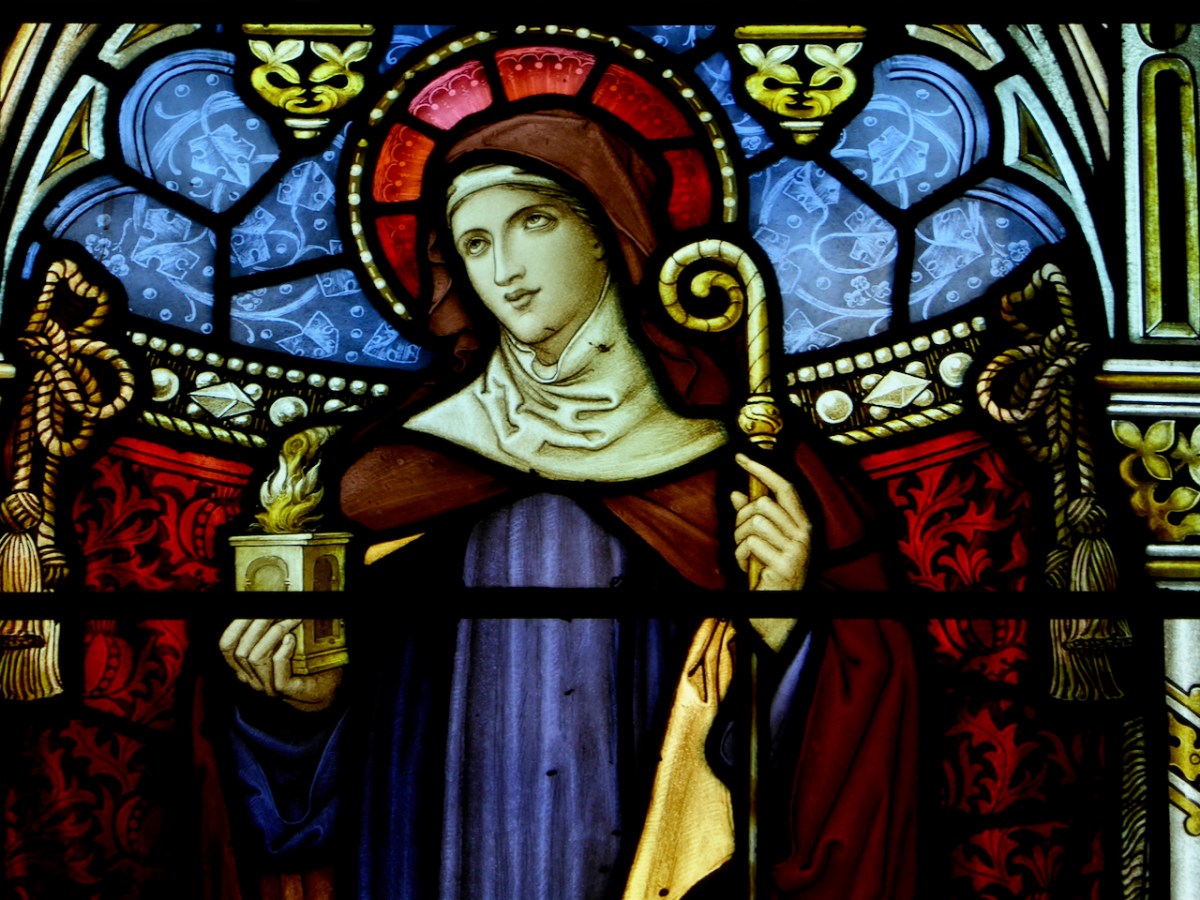
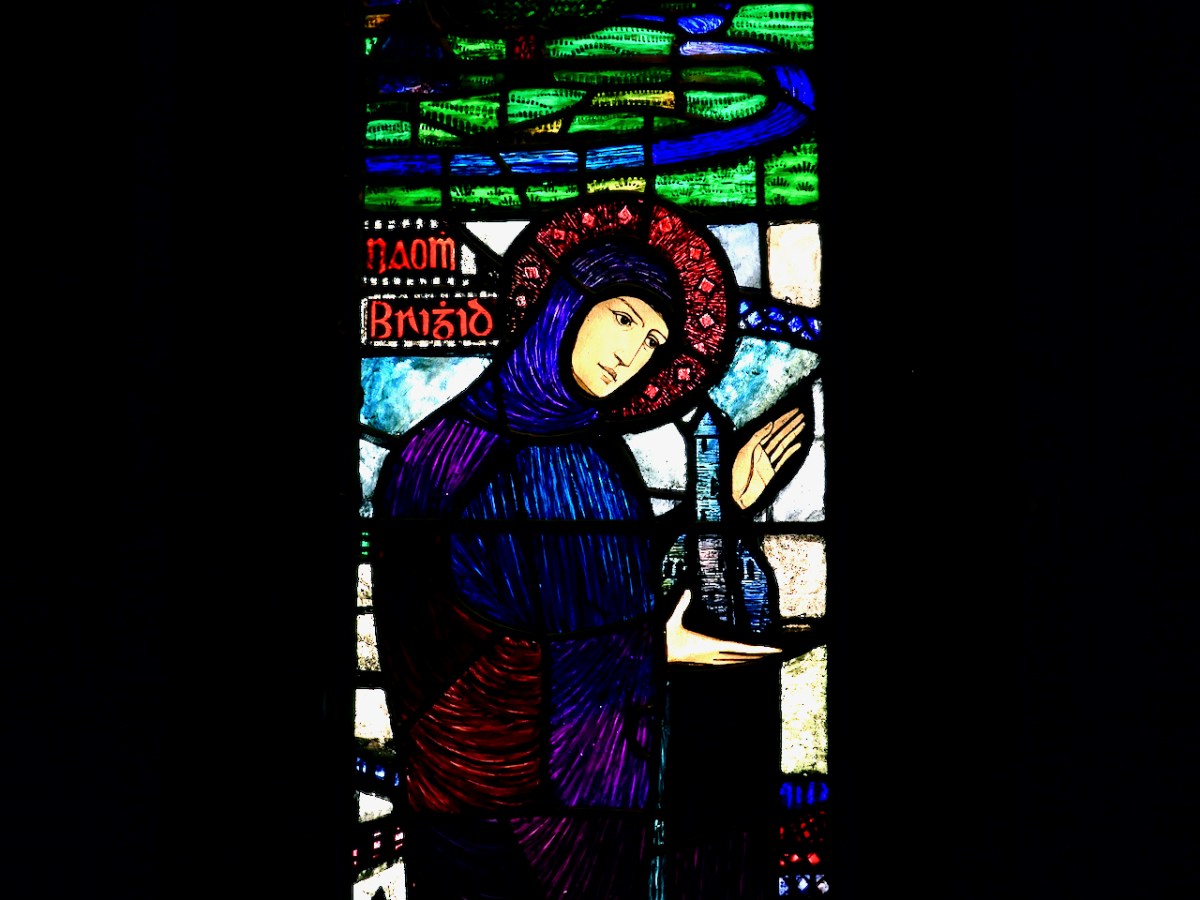
Starting next year, we’ve been given a new National Holiday! It falls on Feb 1, which is celebrated as St Brigid’s Day in Ireland. (Also Imbolc but that’s another story.) Although in my far-off youth I had a devotion to St Brigid and took her name as my Confirmation Name (is this just a Catholic thing?) I realised I knew very little about Brigid herself. So I set out to do some digging, using my own photographs of her image in stained glass to illustrate. That’s Harry Clarke’s take on Brigid above, from the Honan Chapel in Cork, and another one of his below, from Castletownshend.
Note the lamp, which is one of her attributes, since she is associated with a perpetual fire that miraculously never went out. Given this is Harry Clarke, the lamp looks suspiciously like something from the Arabian Nights.
For the life of Brigid, although there are many, many versions, I have turned to two sources. The primary source is The Life of Saint Brigit by Cogitosus*. Almost unbelievably, this Life dates from about 650 and is written in Hiberno-Latin. Cogitosus may have been a monk in Kildare, steeped in the cult of Brigid. Part of this cult was to claim the highest status for Kildare of all the Irish monastic settlements and therefore the Primacy over all Ireland – a claim that was eventually won by Armagh, which trumped Kildare by its appropriation of St Patrick. Cogitosus’s story is told in the form of 32 miracles, each of which leads us through Brigid’s life.
My second source is the Life of Brigit from the Book of Lismore**, translated by Whitley Stokes. I love Stokes’s language, a form which he seems to have invented himself to convey something of the Medieval Irish he was translating (see this post on The White Hound of Brigown for more on this). The Book of Lismore dates to the fifteenth century and it is thought that the Lives of the Saints within it, or some of them, were written in the Abbey at Timoleague in West Cork. In both versions her name is given in translation as Brigit, rather than Brigid which is the more usual modern spelling used in Ireland.
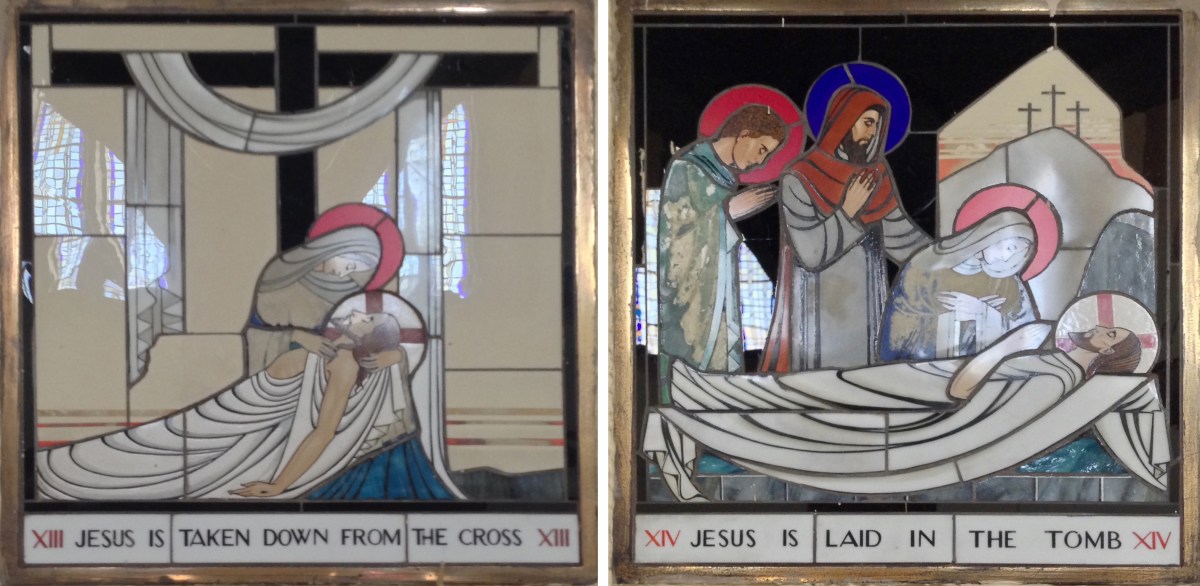
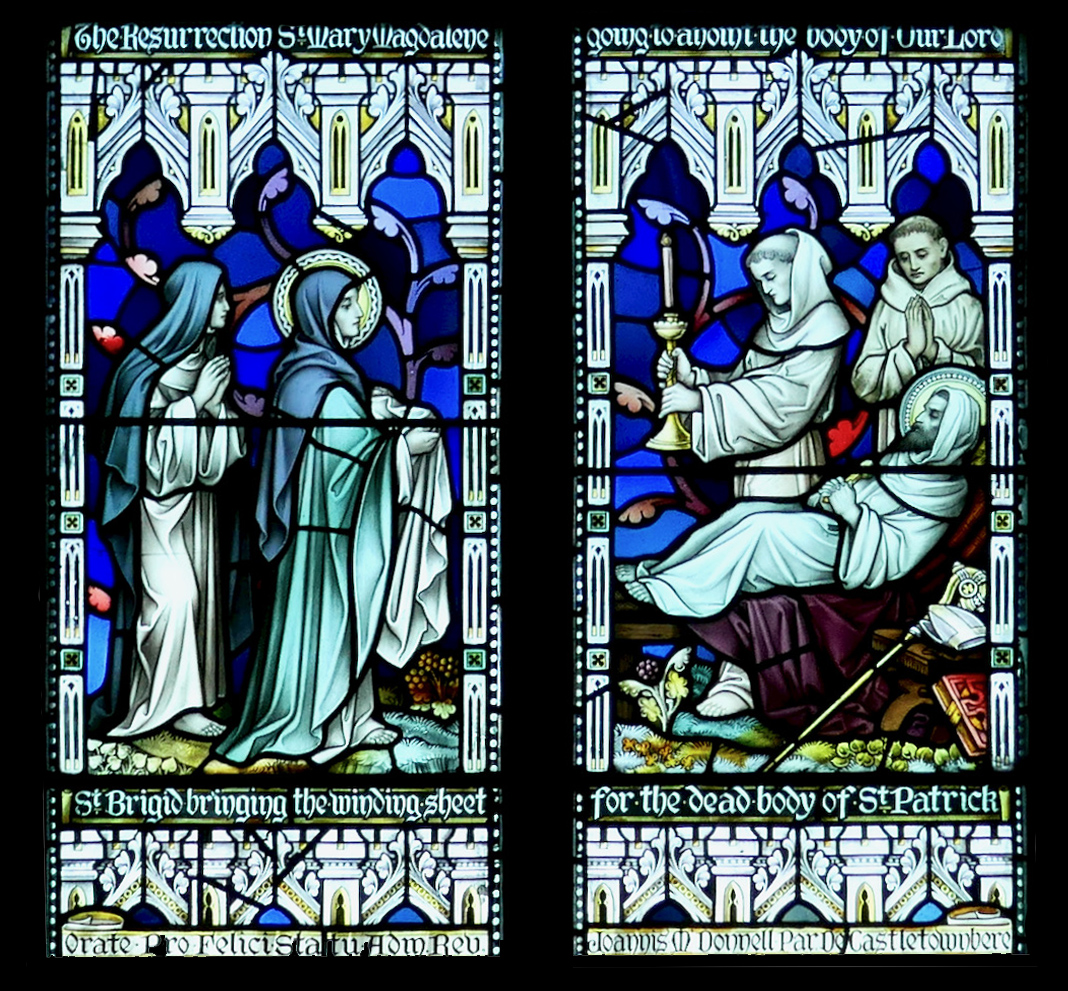
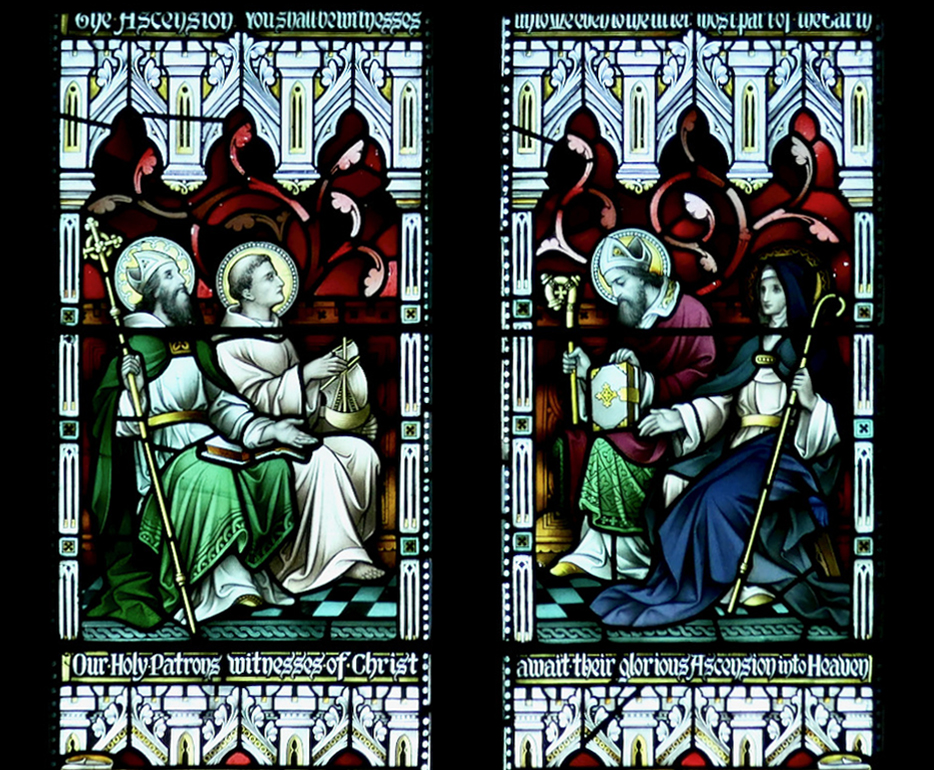
In this window, Brigid brings the winding sheet for the dead St Patrick, a story that does nor feature in either of the Lives I am using here. This is the lower section of a paired window in Killarney Cathedral, part of a series that draws parallels between the Life of Christ and the Lives of Irish Saints. In this case, Brigid is being compared to Mary Magdalene anointing the body of Christ
Many of the same stories occur in both lives. Significantly, though, Patrick is not mentioned in the earlier Life by Cogitosus, although he appears frequently in the Book of Lismore as if she and he were living contemporaneously. There are other differences, showing how the stories grew through the ages, but both agree that Brigid was the daughter of Dubhtach and a bondswoman called Broicsech. Like all good Irish saints, her birth and her greatness is foretold. From the Book of Lismore:
The wizard went to meet him, and asked whose was the woman who was biding in the chariot. Mine, saith Dubthach . . .The wizard asks if she was pregnant by anyone. She is pregnant by me saith Dubthach. Said the wizard, Marvellous will be the child that is in her womb, her like will not be on earth. My wife compels me, saith Dubthach, to sell this bondmaid. Said the wizard, through grace of prophecy, the seed of thy wife shall serve the seed of the bondmaid, for the bondmaid will bring forth a daughter conspicuous, radiant, who will shine like a sun among the stars of heaven. Dubthach was thankful for that answer, for till then no daughter had been born to him.
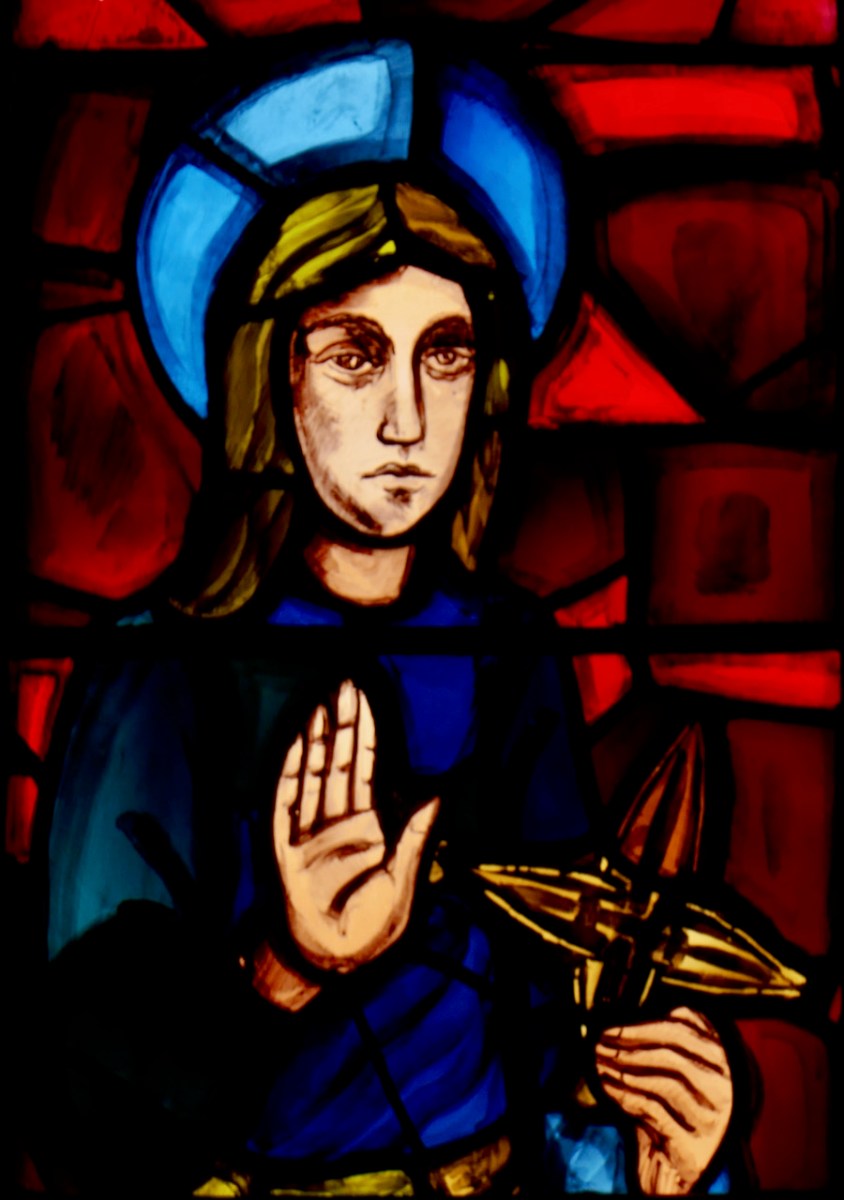
This image of a young Brigid is by Evie Hone and is in Blackrock, Co Dublin. Evie Hone’s windows are pared-to-the-bone, deeply spiritual depictions inspired often by ancient Irish carvings.
I love the fact that Dubhtach rejoices to have a daughter since most of these stories glorify the birth of male babies. Brigid accomplishes many miracles as a child, mostly having to do with her charity and her faith. Here’s one such from Cogitosus:
So, when she was old enough, she was sent by her mother to do the work of churning so that she could make up the butter from the cow’s milk which had been dashed; she too was meant to carry out this work, in the same way as other women were accustomed to do, and to deliver for use the complete yield of the cows and the customary weight and measure of butter at the appointed time with the others. However, this maiden with her most beautiful and generous disposition, preferring to obey God rather than men, distributed the milk and butter liberally to the poor and the guests. So, when as usual the appointed time came for all to hand in what the cows had yielded, her turn came. And when her workmates presented the finished result of their work, the aforementioned blessed maiden was also requested to hand in her work in like manner.
In dread of her mother since she had nothing to show because she had given the lot away to the poor without a thought for the morrow, strengthened and inflamed with an ardor of faith so intense and unquenchable, she turned to the Lord and prayed. Without delay the Lord heard the maiden’s voice and prayers. And, being a helper in the hour of need, he came to her assistance with the generous bestowal of a divine gift, and lavishly restored the butter for the maiden who had confidence in him. Astonishingly, the very moment after her prayer, the most holy maiden proved that she had fulfilled her task by showing that nothing was missing from the fruit of her work, but that it was even more abundant than her workmates.
A rather sumptuous Brigid from the Harry Clarke Studios, in Ballinrobe
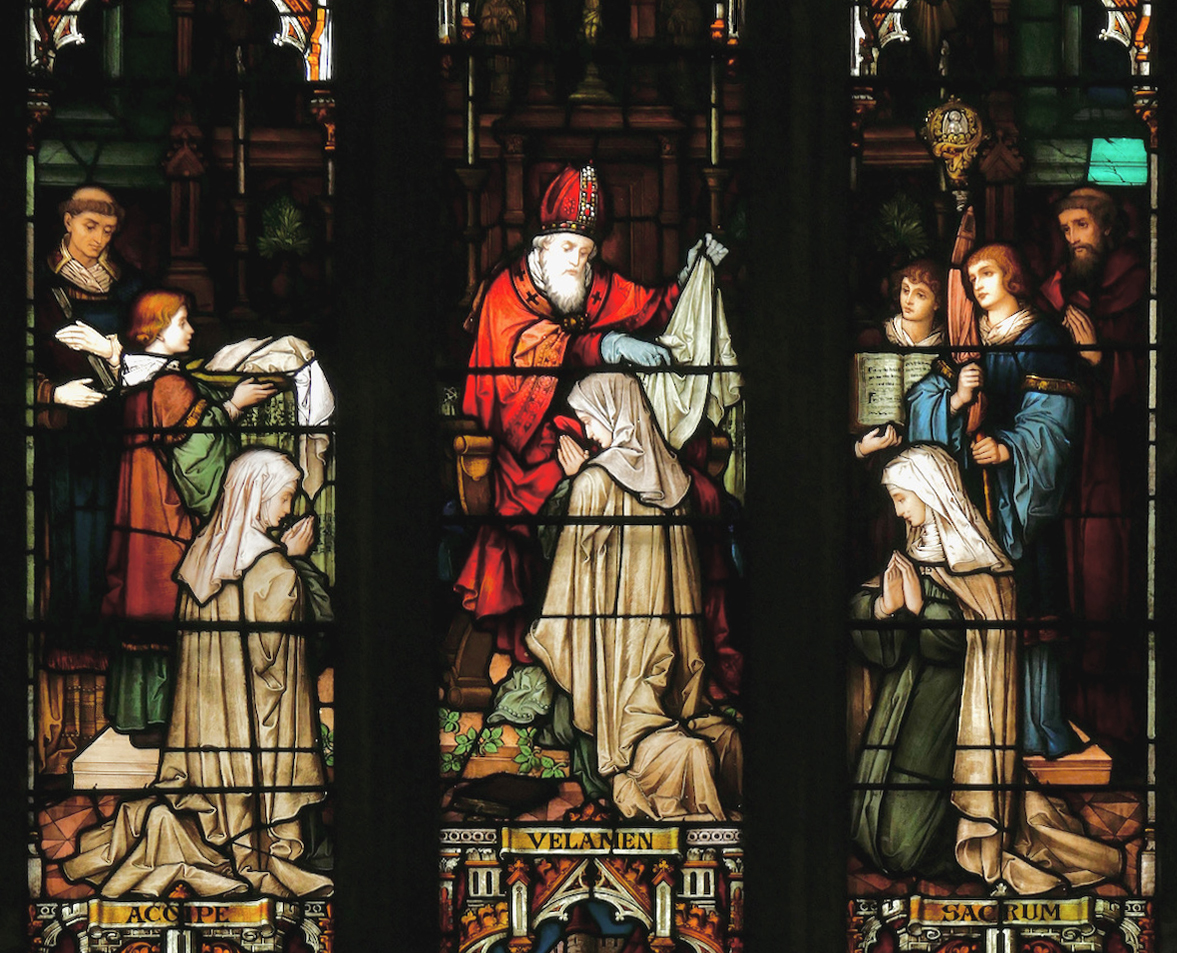
Eventually, determining to be a virgin and devote her life to God’s work, she took the veil. Cogitosus relates that
Brigit, inspired from above and wanting to devote herself as a chaste virgin to God, went to the most holy bishop MacCaille of blessed memory. Seeing her heavenly desire and modesty and seeing so great a love of chastity in this remarkable maiden, he placed the white veil and white garment over her venerable head.
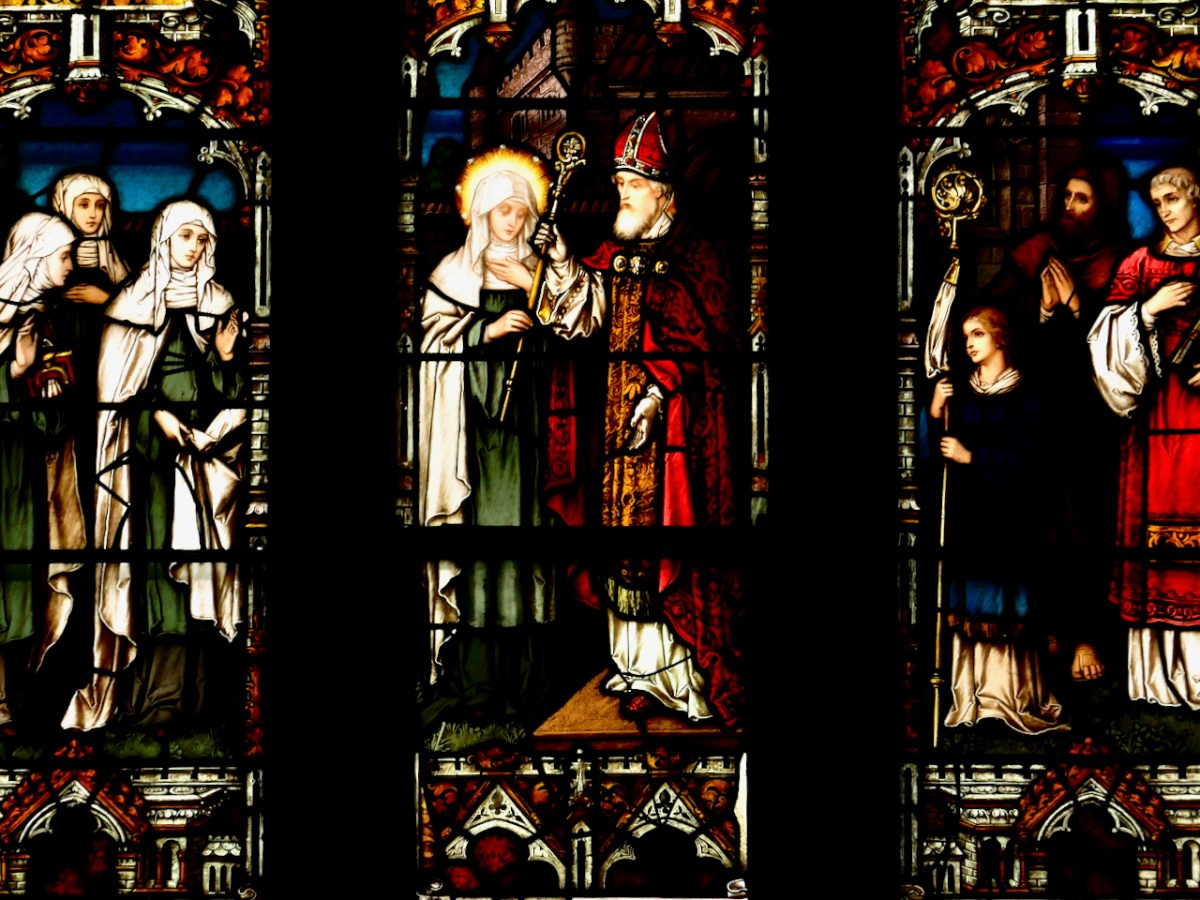
However, by the time the author of the Lismore life wrote his account, MacCaille had been relegated to inferior status and the Bishop who confers the veil is Mel, who is depicted in the window above, in Armagh Cathedral, performing the ceremony. By now, the story has acquired one of its most-quoted aspects – that Brigid, through divine intercession, is actually made a bishop. The next image, the lower panel of the previous window, shows Mel handing Brigid a crozier, symbol of episcopal authority. This large window is by Mayer of Munich.
Brigit and certain virgins along with her went to take the veil from Bishop Mel in Telcha Mide. Blithe was he to see them. For humility Brigit stayed so that she might be the last to whom a veil should be given. A fiery pillar rose from her head to the roof-ridge of the church. Then said Bishop Mel: Come, O Holy Brigit, that a veil may be sained on thy head before the other virgins. It came to pass then, through the grace of the Holy Ghost, that the form of ordaining a Bishop was read out over Brigit. Mac-caille said, that a bishop’s order should not be conferred on a woman. Said Bishop Mel: No power have I in this matter. That dignity hath been given by God unto Brigit, beyond every (other) woman. Wherefore the men of Ireland from that time to this give episcopal honour to Brigit’s successor.
Although she is associated with many places in Ireland (there are numerous townlands called Kilbride or Kilbreedy) it is the great city of Kildare that is most closely hers. She managed the city, the Lismore Life says, in partnership with Conleth, a hermit whom she persuades to join her. Cogitosus tell us:
And as by her wise administration she made provision in every detail for the souls of her people according to the rule, as she vigilantly watched over the Churches attached to her in many provinces and as she reflected that she could not be without a high priest to consecrate churches and confer ecclesiastical orders in them, she sent for Conleth, a famous man and a hermit endowed with every good disposition through whom God wrought many miracles, and calling him from the wilderness and his life of solitude, she set out to meet him, in order that he might govern the Church with her in the office of bishop and that her Churches might lack nothing as regards priestly orders. Thus, from then on the anointed head and primate of all the bishops and the most blessed chief abbess of the virgins governed their primatial Church by means of a mutually happy alliance and by the rudder of all the virtues. By the merits of both, their episcopal and conventual see spread on all sides like a fruitful vine with its growing branches and struck root in the whole island of Ireland. It has always been ruled over in happy succession according to a perpetual rite by the archbishop of the bishops of Ireland and the abbess whom all the abbesses of the Irish revere.
This window by Watsons of Youghal is in St Carthage’s Catholic church in Lismore and is a great example of the Celtic Revival decoration they specialised in. Note the proliferation of oak leaves above her – Kildare is from Cill Dara, meaning Church of the Oakwood, and the oak leaf is one of her attributes, along with the lamp and the crozier, also shown
Cogitosus goes on to say this of Kildare and her establishment (and don’t forget he was writing in or around 650!):
And who can express in words the exceeding beauty of this church and the countless wonders of that monastic city we are speaking of, if one may call it a city since it is not encircled by any surrounding wall. And yet, since numberless people assemble within it and since a city gets its name from the fact that many people congregate there, it is a vast and metropolitan city. In its suburbs, which saint Brigit had marked out by a definite boundary, no human foe or enemy attack is feared; on the contrary, together with all its outlying suburbs it is the safest city of refuge in the whole land of the Irish for all fugitives, and the treasures of kings are kept there; moreover it is looked upon as the most outstanding on account of its illustrious supremacy.
Today we honour St Brigid as one of the founding great women of our culture. She is often shown with Patrick and Columcille as one of the three great Patrons of Ireland. In the window above, also from Killarney Cathedral, Brendan has been added in because, well, we’re in Kerry.
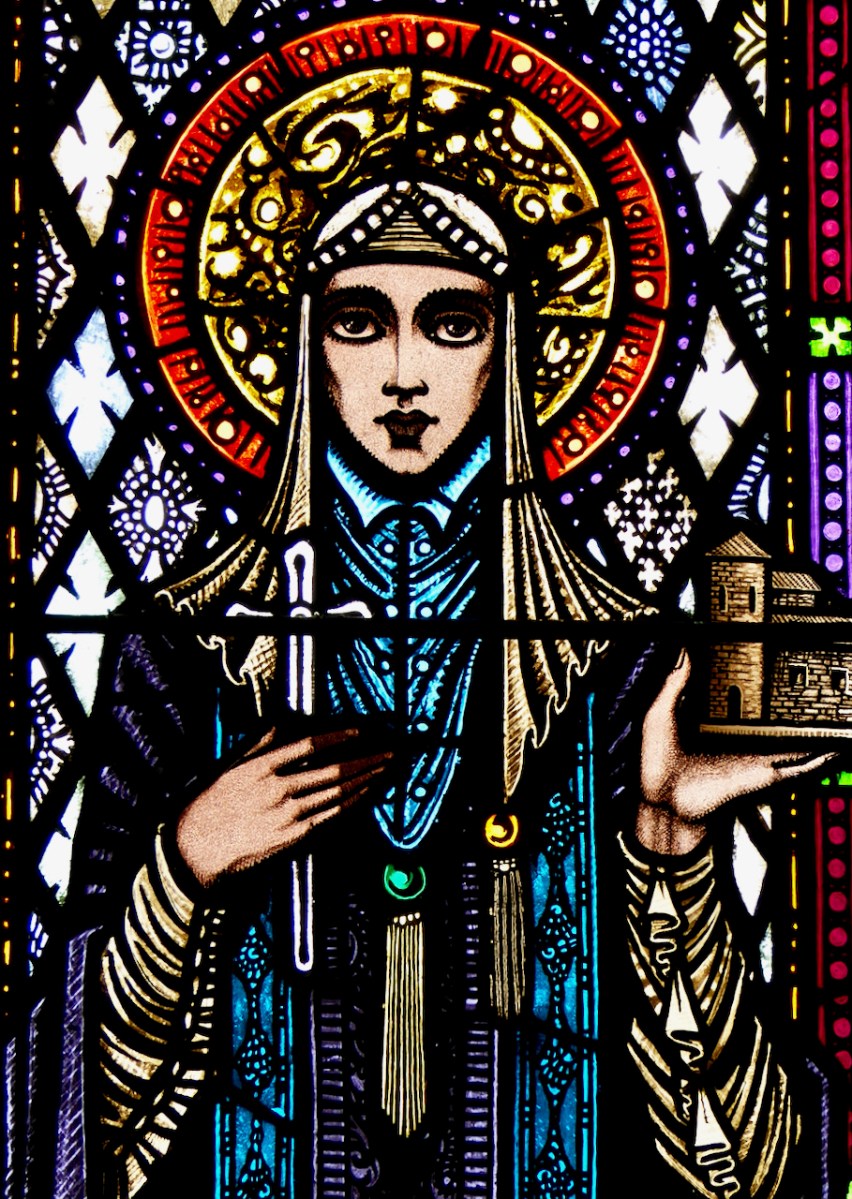
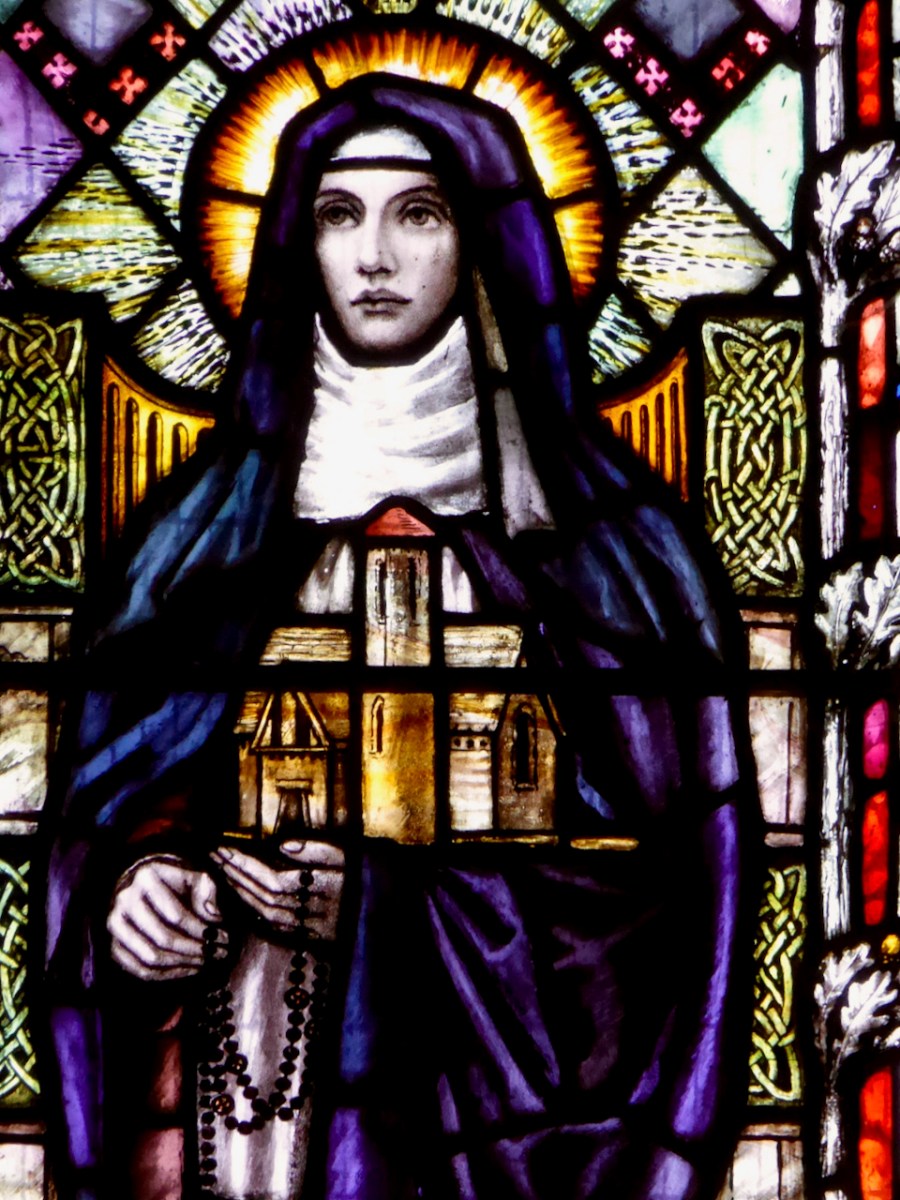
This window is in the Church of the Most Holy Rosary at Kilcoe, near us in West Cork. It’s a bit of a mixed metaphor – we see her holding her church, which is clearly based on the 12th century Cormac’s Chapel at Cashel, and surrounded by her oak leaves. However, she is also holding a set of rosary beads, something that doesn’t appear in Catholic imagery before the 13th century. It’s beautifully executed, though, by Catherine O’Brien of An Túr Gloine.
Brigid’s end was peaceful. As it is related in the Book of Lismore:
Now when it came to the ending days for Brigit, after founding and helping cells and churches and altars in abundance, after miracles and marvels whose number is as the sand of sea, or stars of heaven, after charity and mercy, then came Nindid Pure-hand from Rome of Latium. The reason why he was called Nindid Pure-hand was that he never put his hand to his side, when Brigit repeated a paternoster with him. And he gave communion and sacrifice to Brigit, who sent her spirit to heaven. Her relics are on earth with honour and dignity and primacy, with miracles and marvels.
A conventional image of Bridget in the church in Goleen, West Cork, by Watsons of Youghal. She’s looking very saintly indeed. By now, you no doubt recognise all her attributes
Summing up her life and legacy, the anonymous author of her Life in the Book of Lismore says:
For everything that Brigit would ask of the Lord was granted her at once. For this was her desire: to satisfy the poor, to expel every hardship, to spare every miserable man. Now there never hath been anyone more bashful, or more modest, or more gentle, or more humble, or sager, or more harmonious than Brigit. She never washed her hands or her feet, or her head among men. She never looked at the face of a man. She never would speak without blushing. She was abstinent, she was innocent, she was prayerful, she was patient: she was glad in God’ s commandments: she was firm, she was humble, she was forgiving, she was loving: she was a consecrated casket for keeping Christ’s Body and his Blood: she was a temple of God. Her heart and her mind were a throne of rest for the Holy Ghost. She was simple (towards God): she was compassionate towards the wretched: she was splendid in miracles and marvels: wherefore her name among created things is Dove among birds, Vine among trees, Sun among stars. . . . She is the prophetess of Christ: she is the Queen of the South: she is the Mary of the Gael.
Brigid by Michael Healy, in the stained glass room at the National Gallery, holding her church with the round tower that can still be seen in Kildare.
It is entirely appropriate that a new National Holiday is named for Brigid. About time, in fact!
*Cogitosus’s “Life of St Brigit,” Content and Value. Author(s): Sean Connolly and J.-M. Picard. The Journal of the Royal Society of Antiquaries of Ireland , 1987, Vol. 117, pp. 5-27
**Lives of Saints from the Book of Lismore, Edited with a Translation, Notes and Indices by Whitley Stokes, Oxford, 1890.
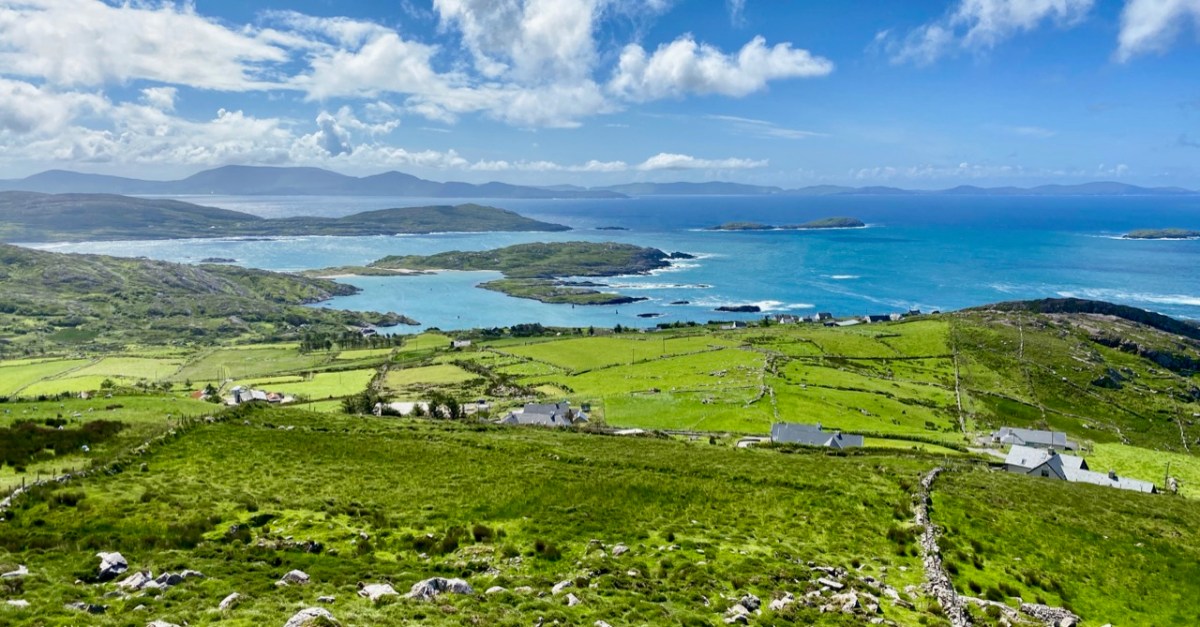
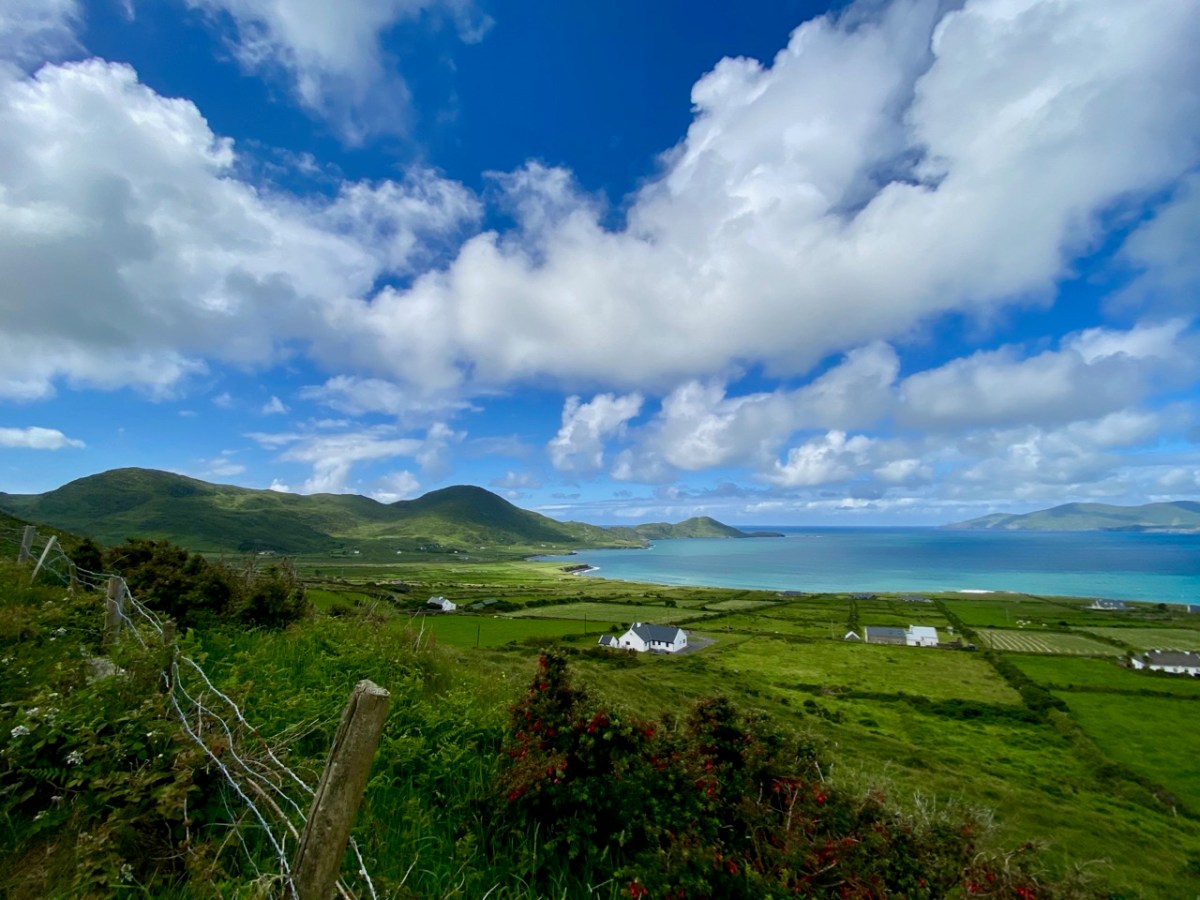
We spent a couple of days in Kerry a week before midsummer, and gave you some account of our discoveries on Church Island, Lough Currane, and up in the hills at Caherlehillan – both memorable Early Christian sites. Our adventures did not end there: we managed to take in, also, some other ancient treasures, a couple of Kerry characters, and some stunning scenery – hard to match – as we travelled back to West Cork along the Ring of Kerry road (above).
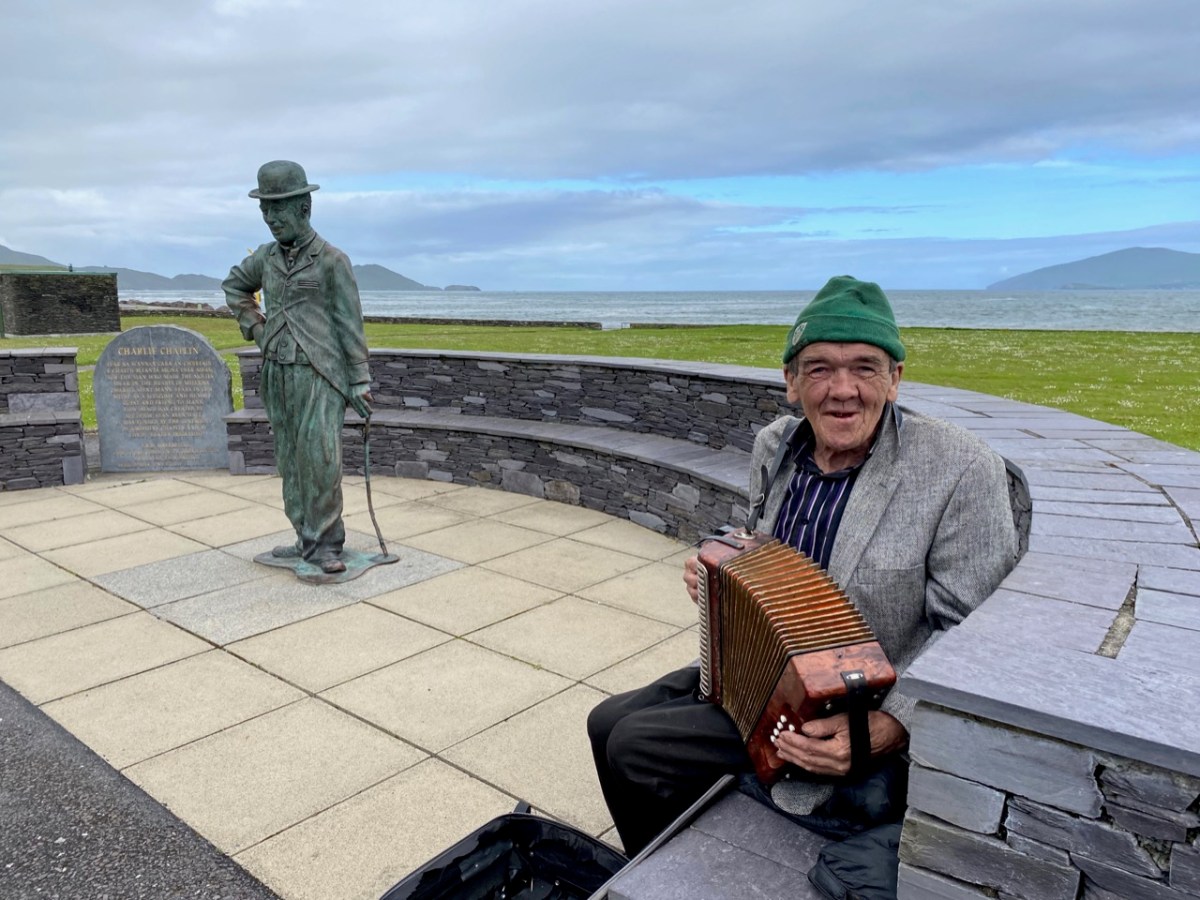
Firstly, here are Charlie Chaplin and Michael Collins (above), both familiar figures in Waterville. The Hollywood star spent his summer holidays in the coastal town for many years with his family and is commemorated by a bronze statue, while Michael can be found on most days in this much photographed location, always ready to entertain with Kerry polkas and slides on his accordion.
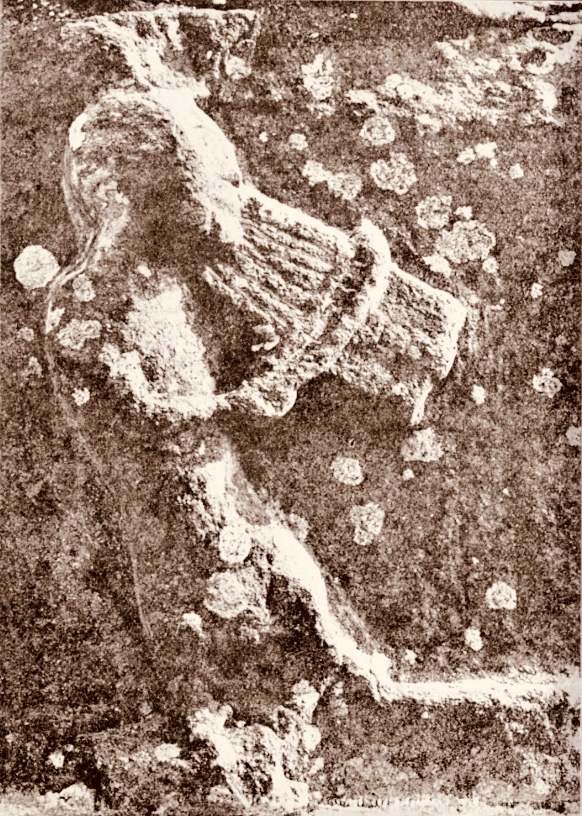
Here’s a much earlier Kerry musician: he’s known as ‘The Fiddler’, and is an unusual medieval representation of an instrumentalist found in the romanesque ruin on Church Island, Lough Currane. I was pleased to find this photograph in the Royal Society of Antiquaries of Ireland Notes from 1908 by P J Lynch as it shows the carving as it was found by the OPW when they took over the site. Now the original, which had suffered accelerated weathering, is kept protected in a museum while a well-worn replica is in place on the site. I believe the carving is a good representation of a medieval bowed lyre, an instrument with six strings which survives today in some cultures, although Lynch gave the following commentary:
. . . The interest in this stone centres in the musical instrument. The examples of ancient carving in Ireland representing stringed instruments are few, and confined to harpers. The photograph illustrates this instrument very clearly. It is the ancient cruit or fidil, said to be the parent of the violin. There are six strings indicated by sunken lines in the stone. The figure appears to wear a kind of tight-fitting tunic. Dr O’Sullivan states that the word fidil being a teutonic version of the original name vièle, it may be concluded that the original instrument was introduced through the Anglo-Saxons, and not through the Normans. He adds that up to the eleventh century it consisted of a conical body, and after that it became oval. If this be a portion of the twelfth-century instrument, the older pattern must have survived. The Kerry people were probably as unwilling to change in those days as they are at present . . .
P J Lynch – Some notes on church island – RSAI 1908
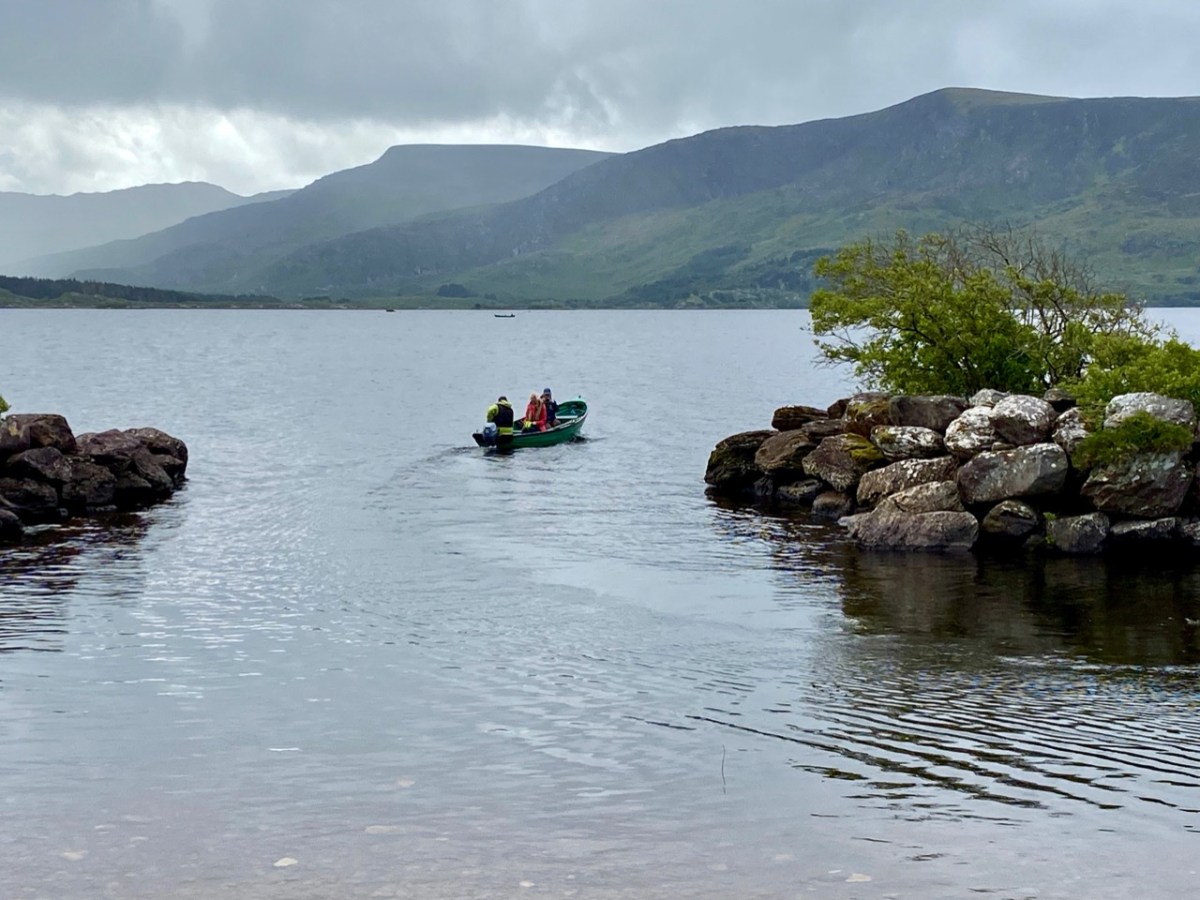
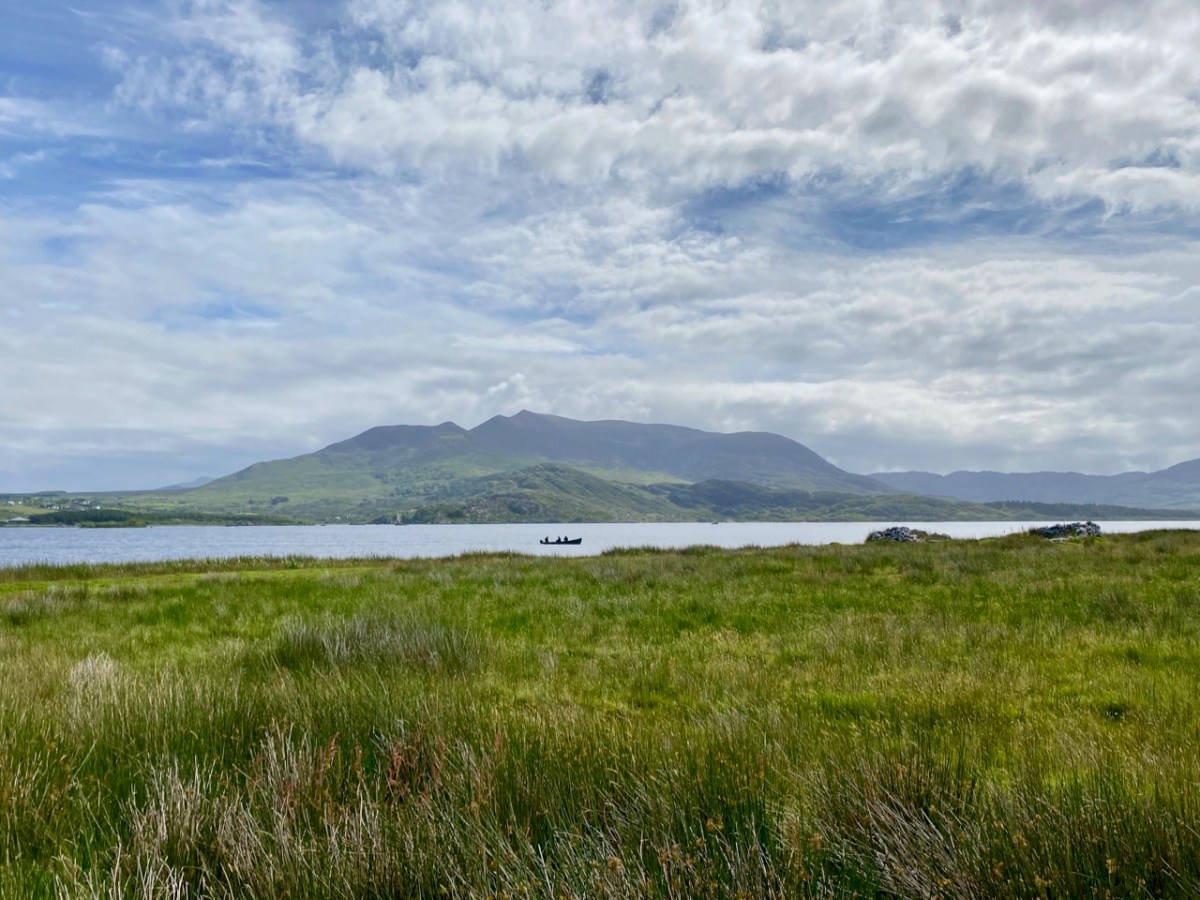
Our trip out to Church Island (above) was accompanied by moody weather, but we were fortunate with other expeditions which included the discovery of ancient sites in the townland of Srugreana (Srúbh Gréine in Irish, which is translated variously as sunny stream, gravelly stream or – my favourite – snout of the sun: Kerry certainly offers some tricky pronunciations for those unfamiliar with the area, or the language!).
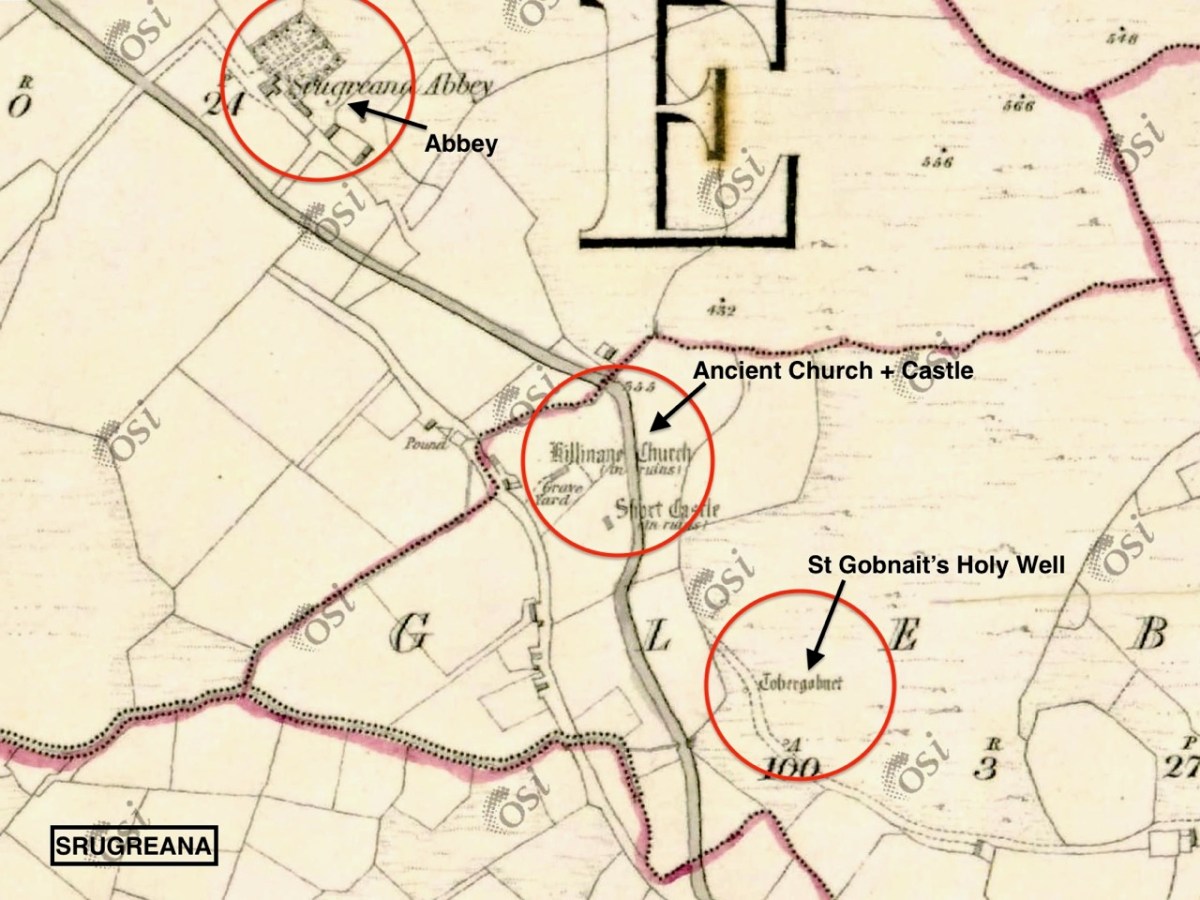
This extract from the 6″ OS map, dating from the mid-1800s, shows one area we explored on our Kerry day. It throws up some enigmas: Killinane Church (the church of Saint Lonan or Lonáin) is often referred to as Srugreana Abbey, but this is a separate site indicated further to the north-west on the early plan.
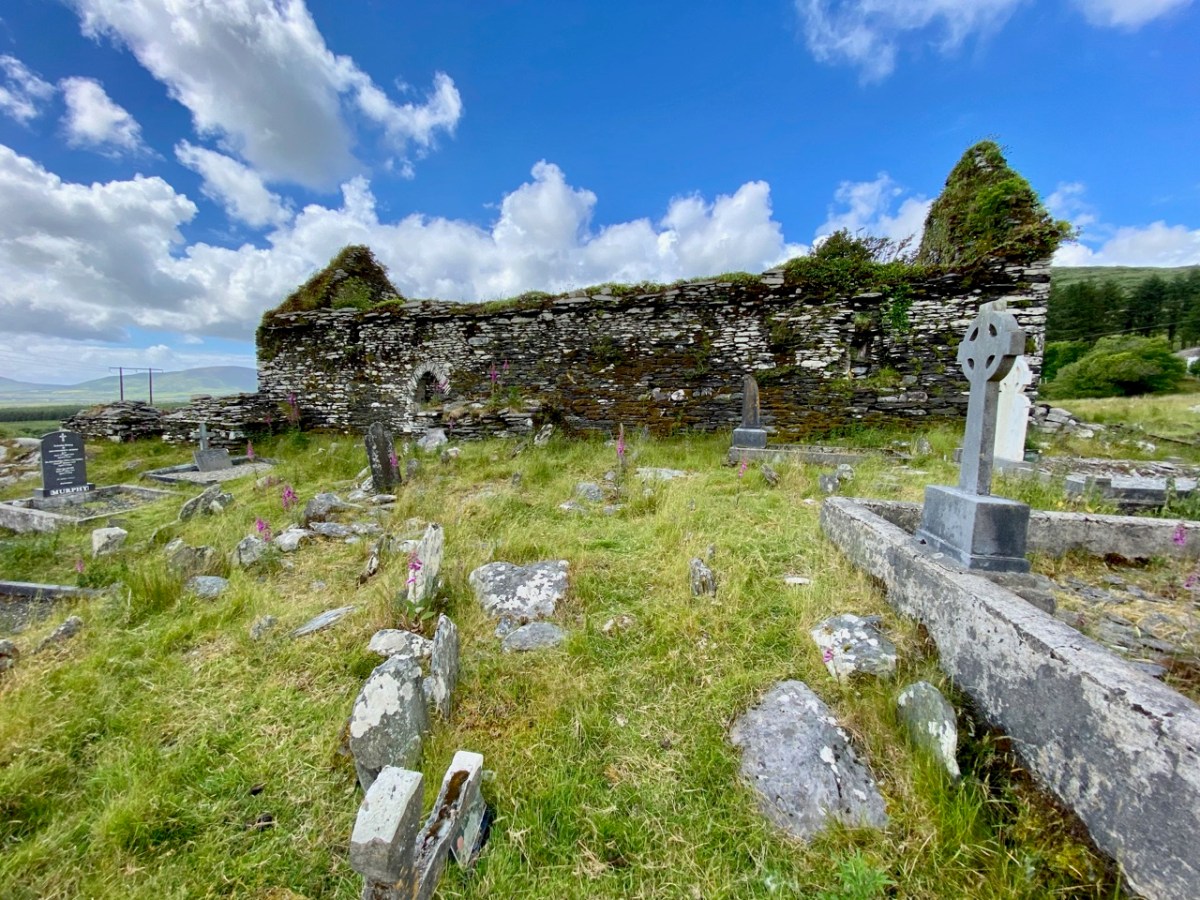
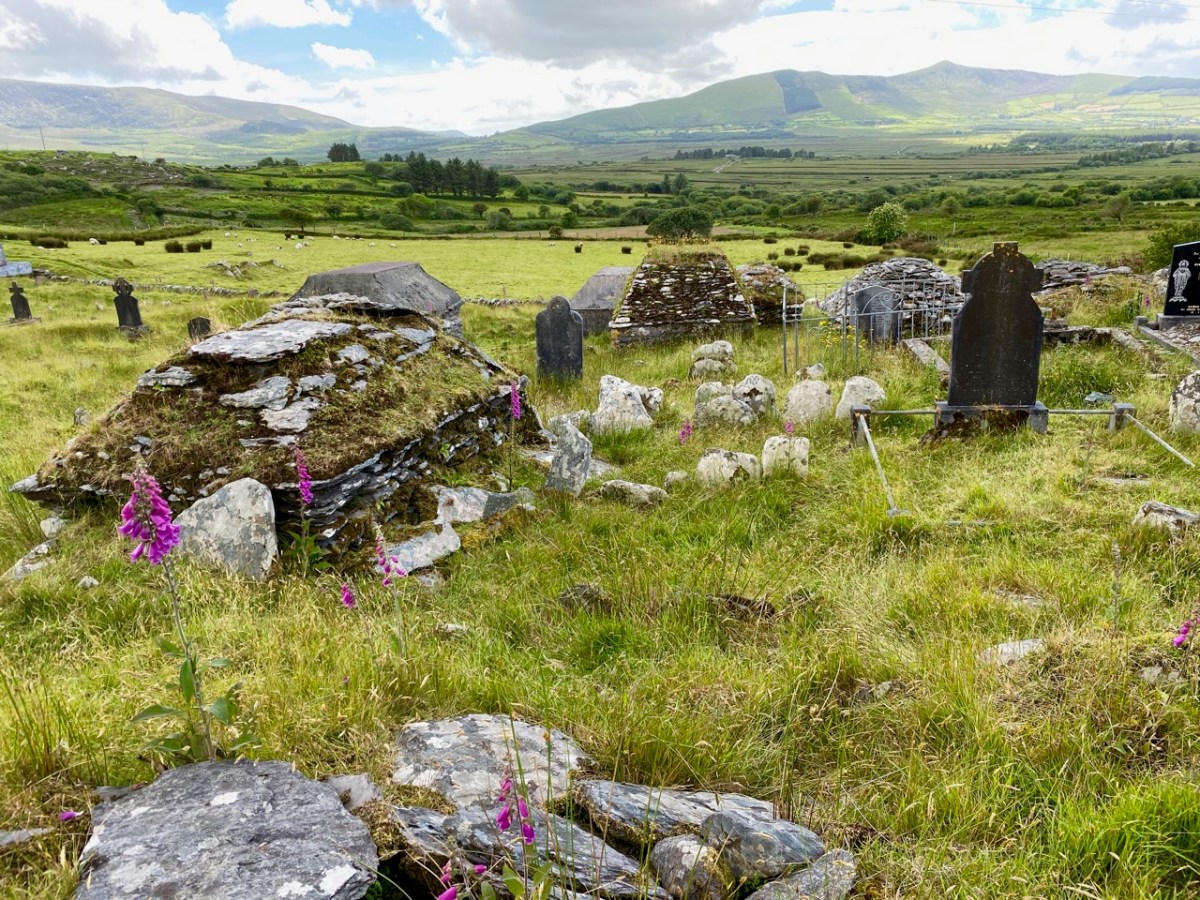
The church site at Srugreana is remarkable in many ways. A 2012 survey commissioned by Kerry County Council Heritage Office found there are at least 1,290 unhewn, uninscribed gravemarkers around the medieval church, and a significant number of ‘house type’ tombs, some of which are ‘two-storey’, like the one above. The concentration of graves – many of which cannot be dated – suggests how populous this now remote area was at one time.
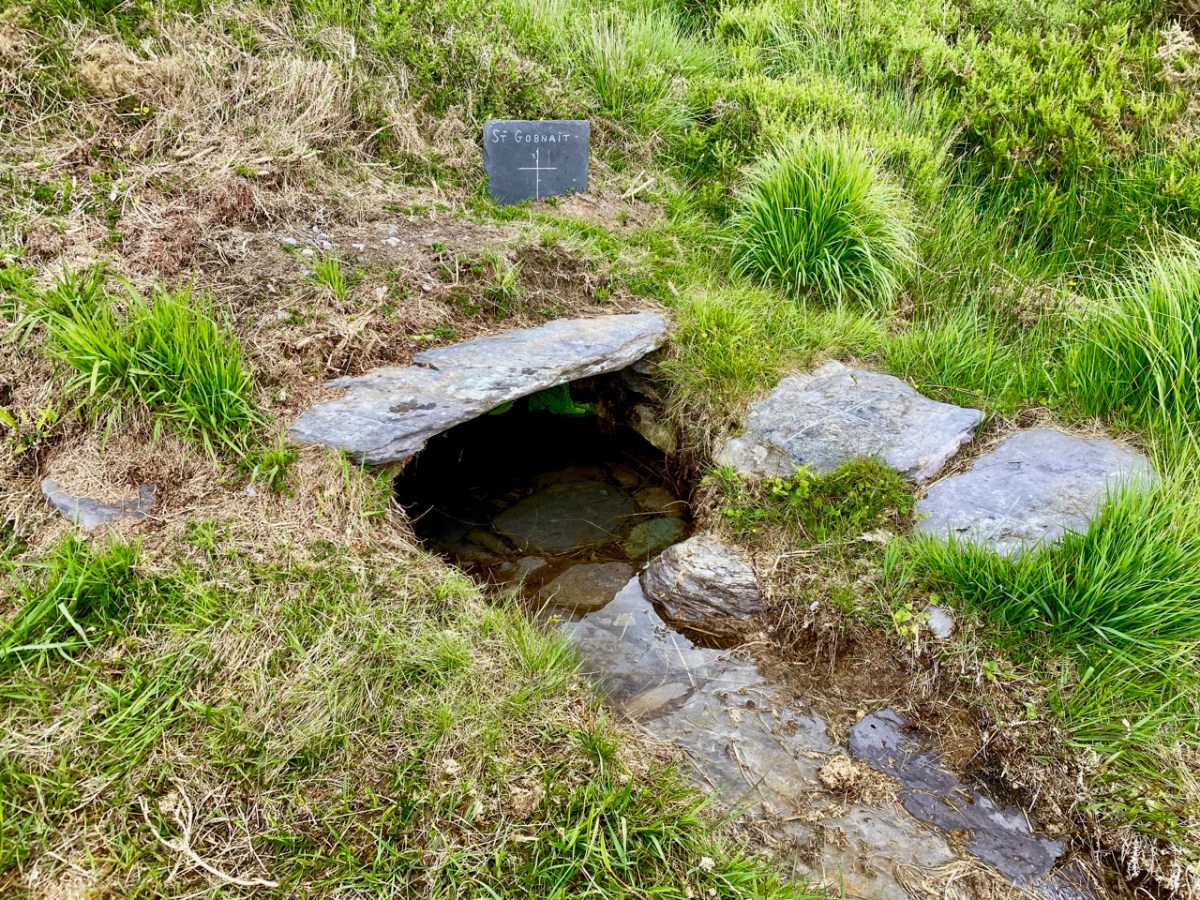
The main purpose of our visit to Srugreana was to search out a holy well dedicated to Saint Gobnait (above). The expedition was led by Amanda, who runs the Holy Wells of Cork and Kerry website. You need to read her comprehensive article on this particular saint here. Interestingly, while we were visiting the well we met the new owner of the land on which it sits. She had no idea that there was a holy well here, and also was unaware of its apparently recent renovation! Note the crosses carved on the stones by visiting pilgrims, above.
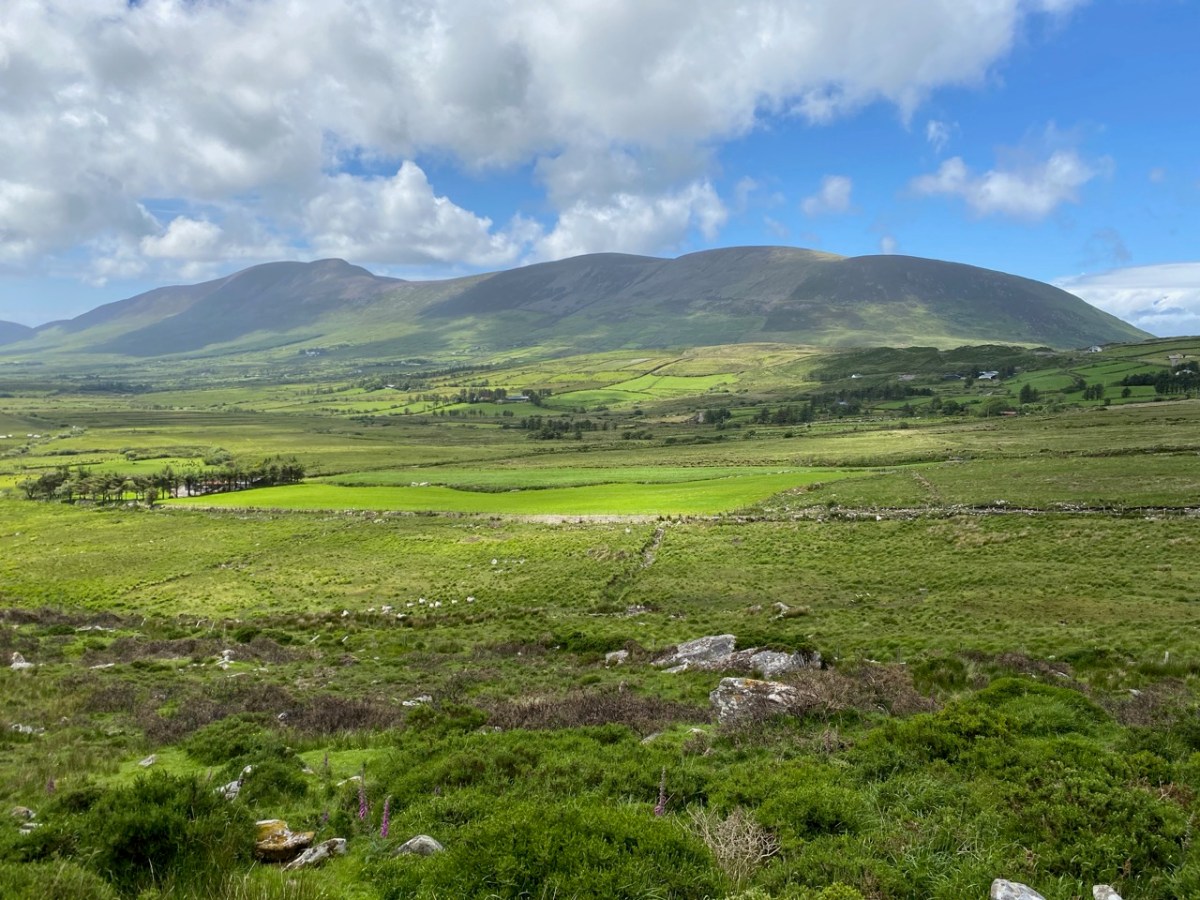
From the above accounts, and our two previous posts, you can tell that we had a most productive time exploring just one small area in the ‘Kingdom’ of Kerry. I am rounding off this entry with some more photographs of our journey back along the coast. The weather gave of its best for this county which is our neighbour, and we will continue to explore it and look for more archaeological gems. Keep reading!
Welcome to the UCD Library Cultural Heritage Collections blog. Discover and explore the historical treasures housed within our Archives, Special Collections, National Folklore Collection and Digital Library



















 Roaringwater Journal