A Pyramid in West Cork

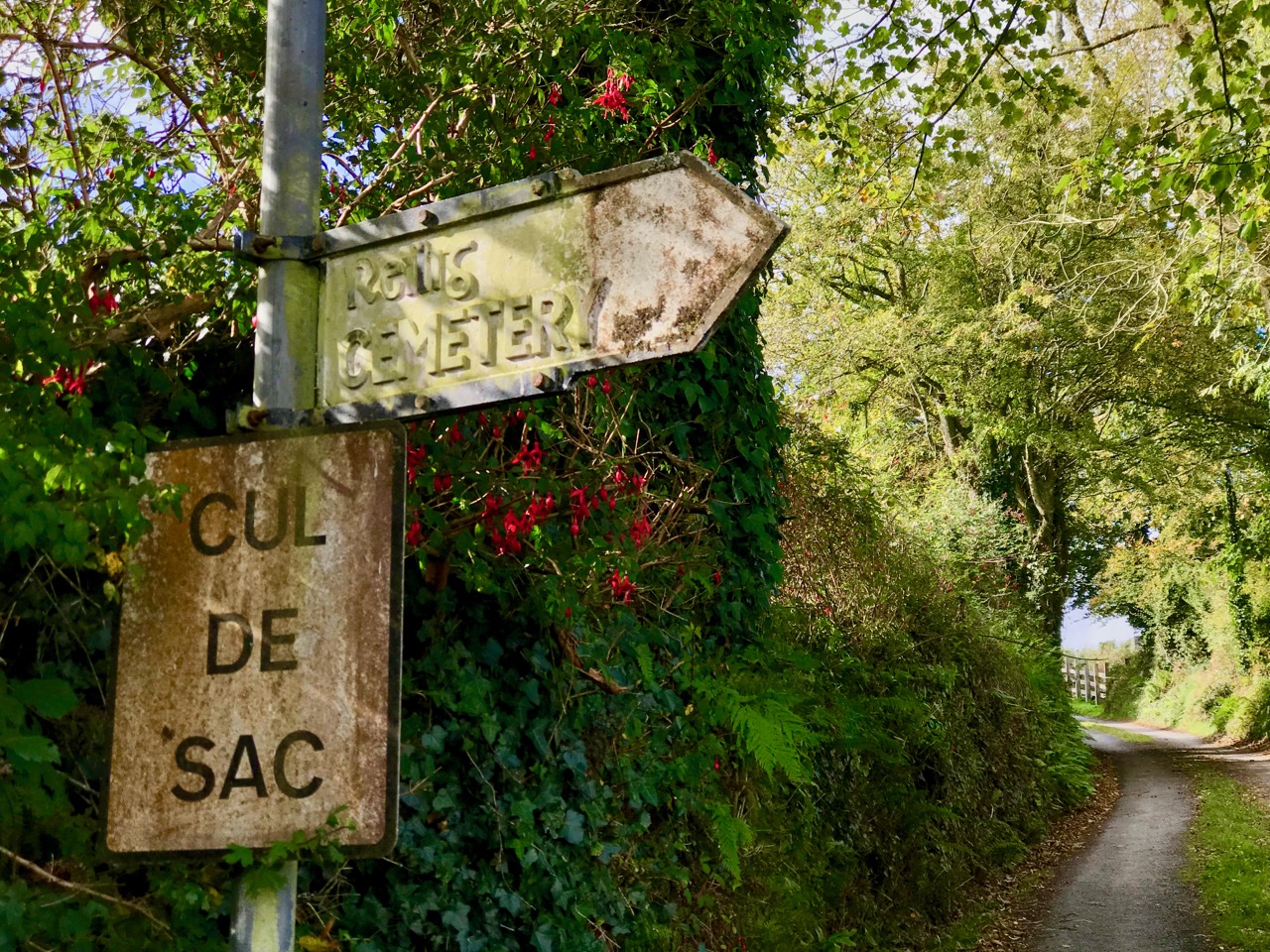
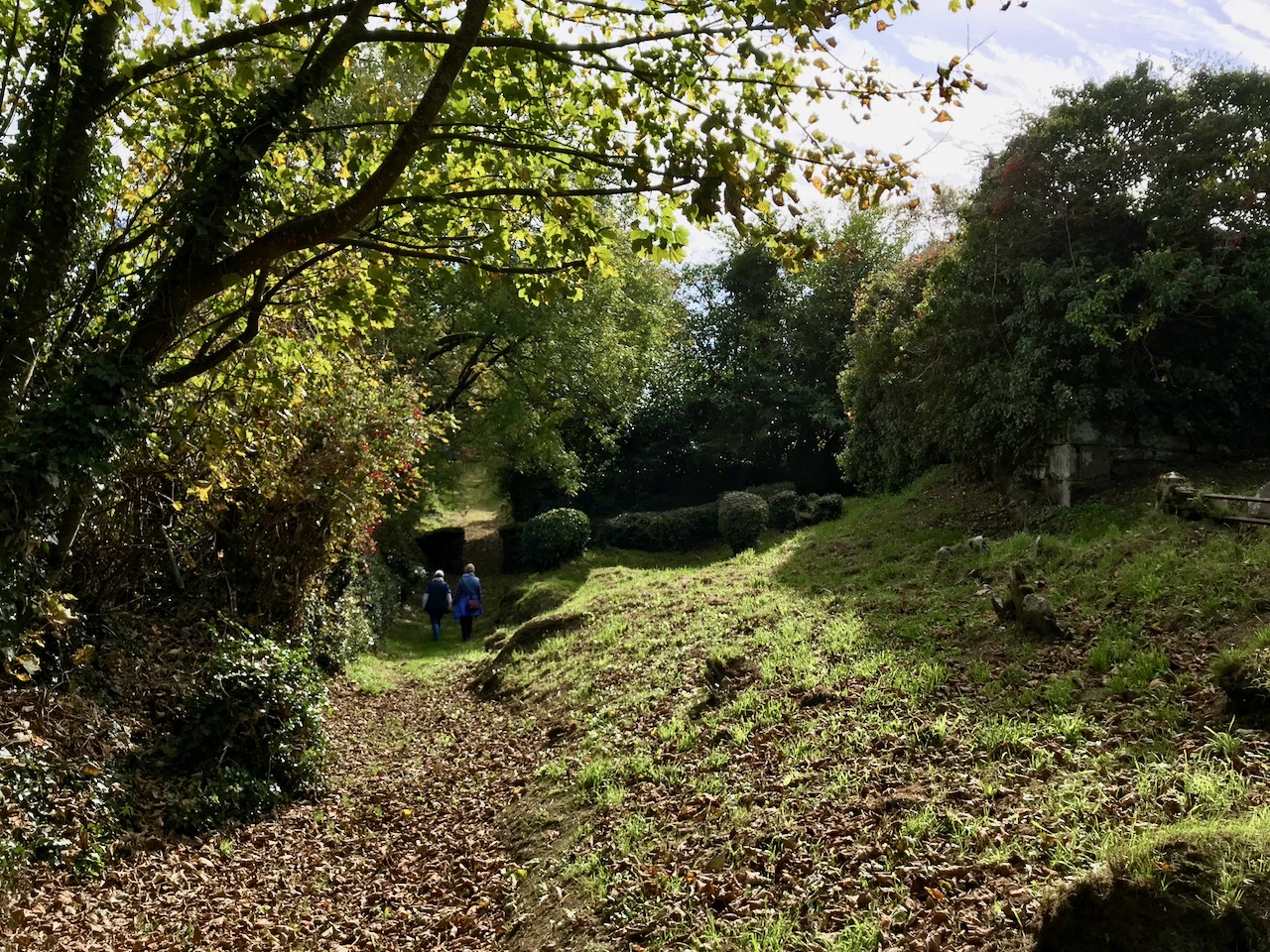
In our travels we always have an eye open for signposts, especially those that point down leafy, narrow boreens: there’s probably some piece of almost lost history at the end of every one. We were beckoned, last week, by a fading cast iron plate written in ‘old Irish’ – Reilig – and the English word Cemetery. It was in a remote spot, and indicated a long, green lane with a gate in the distance. There had to be something there for us!
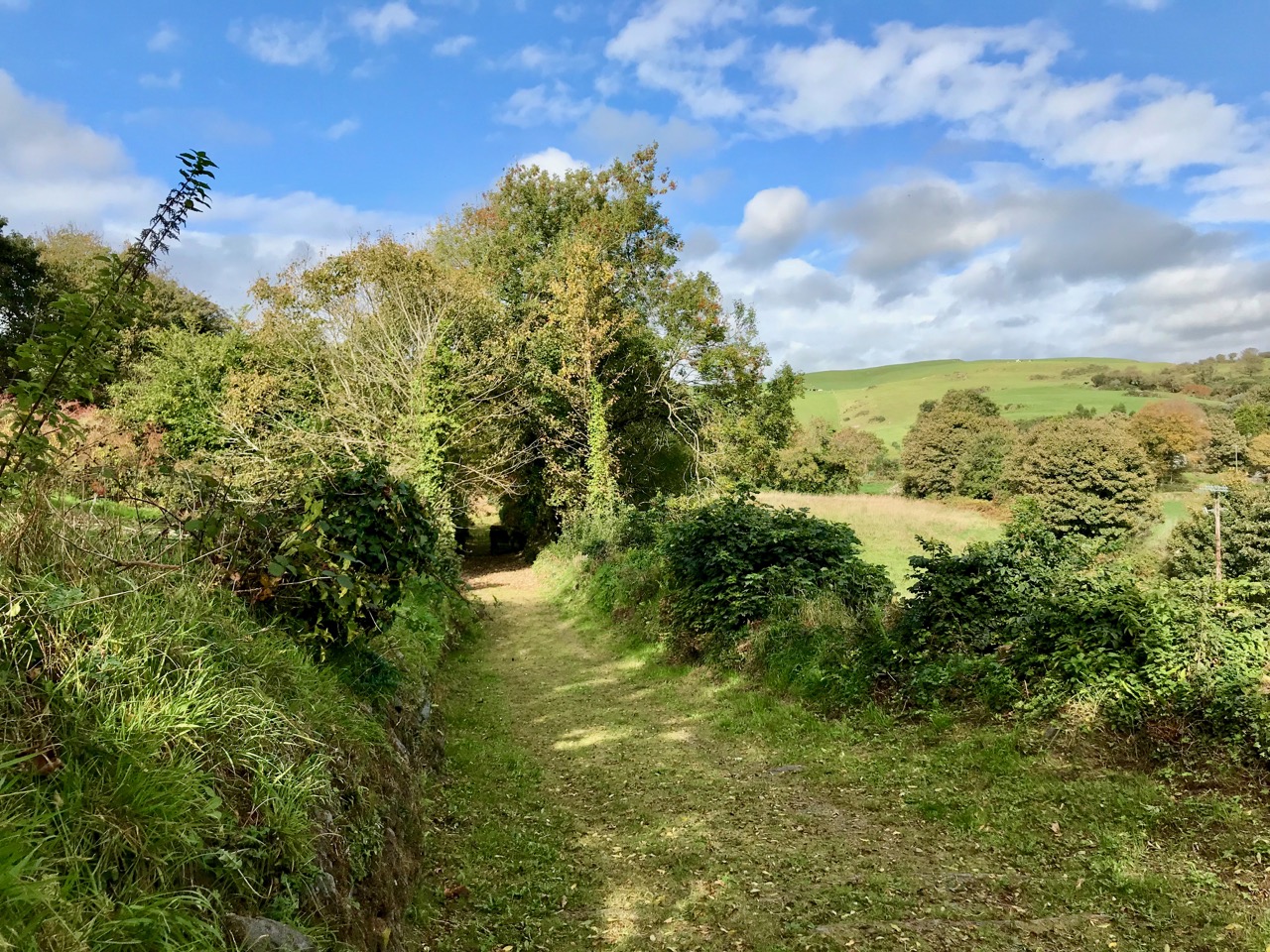
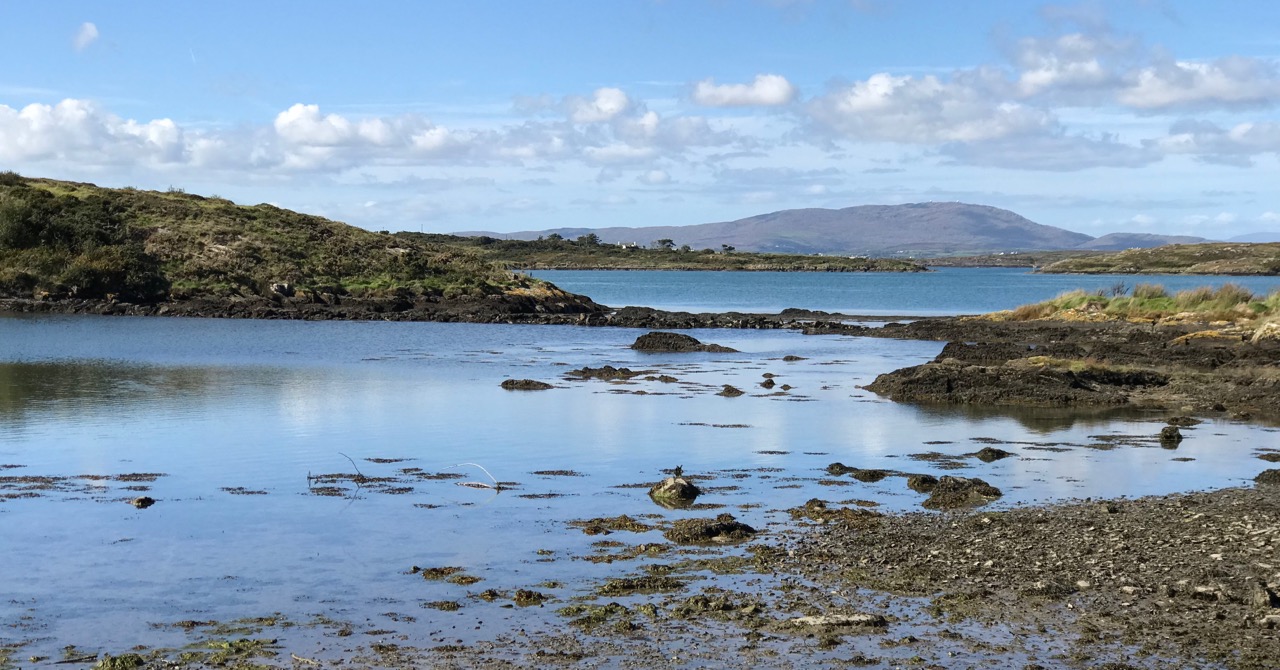
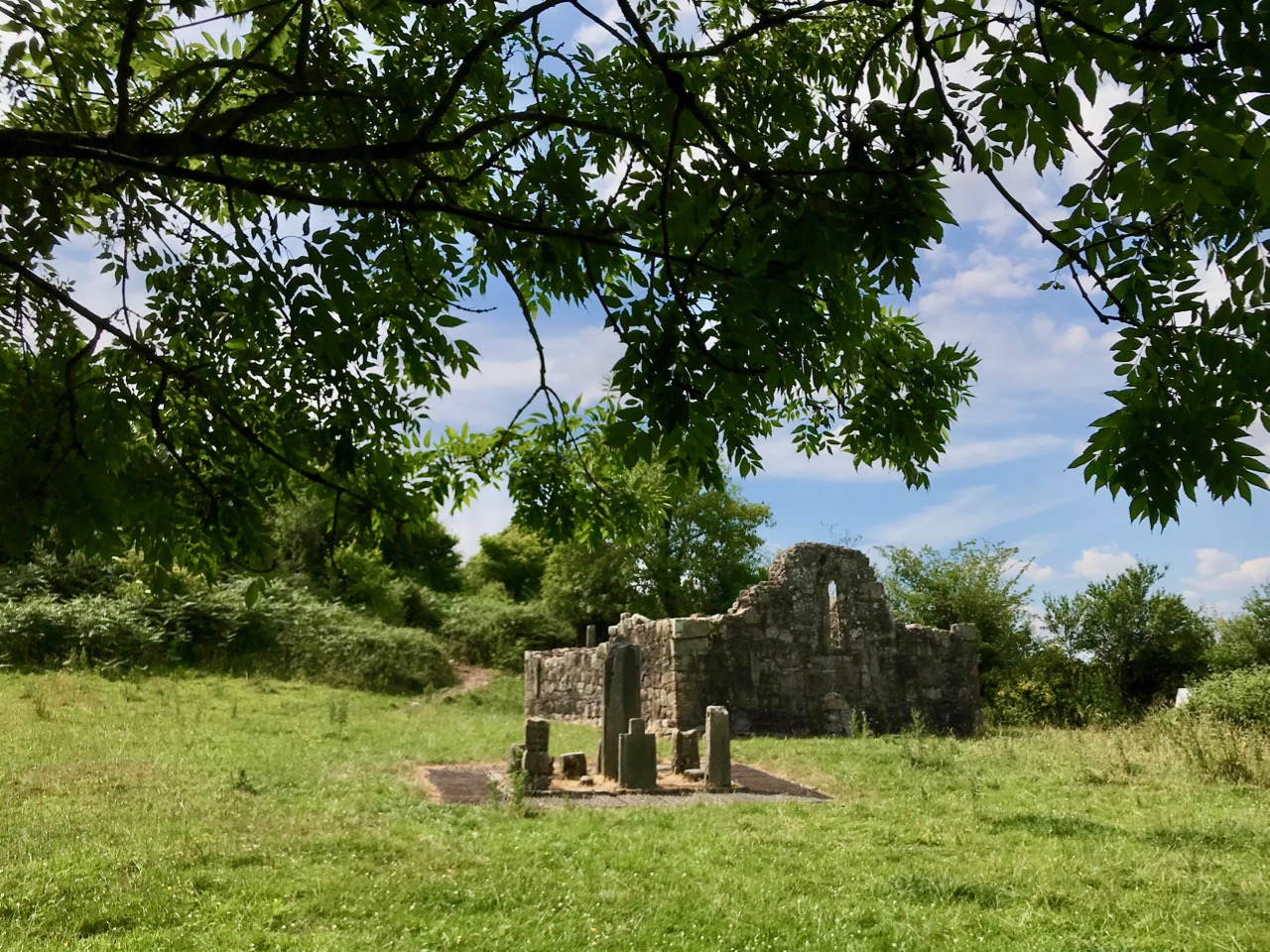
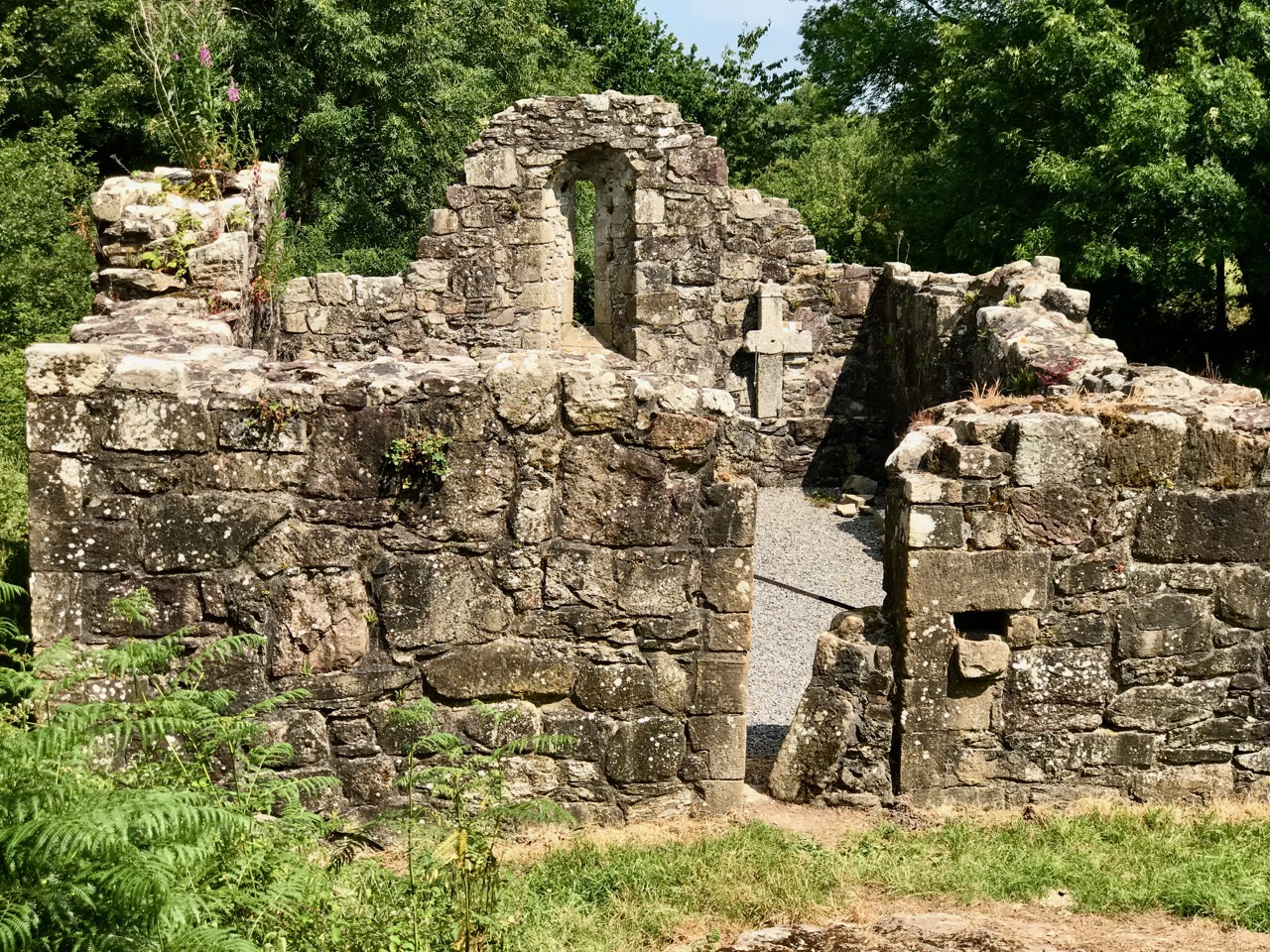
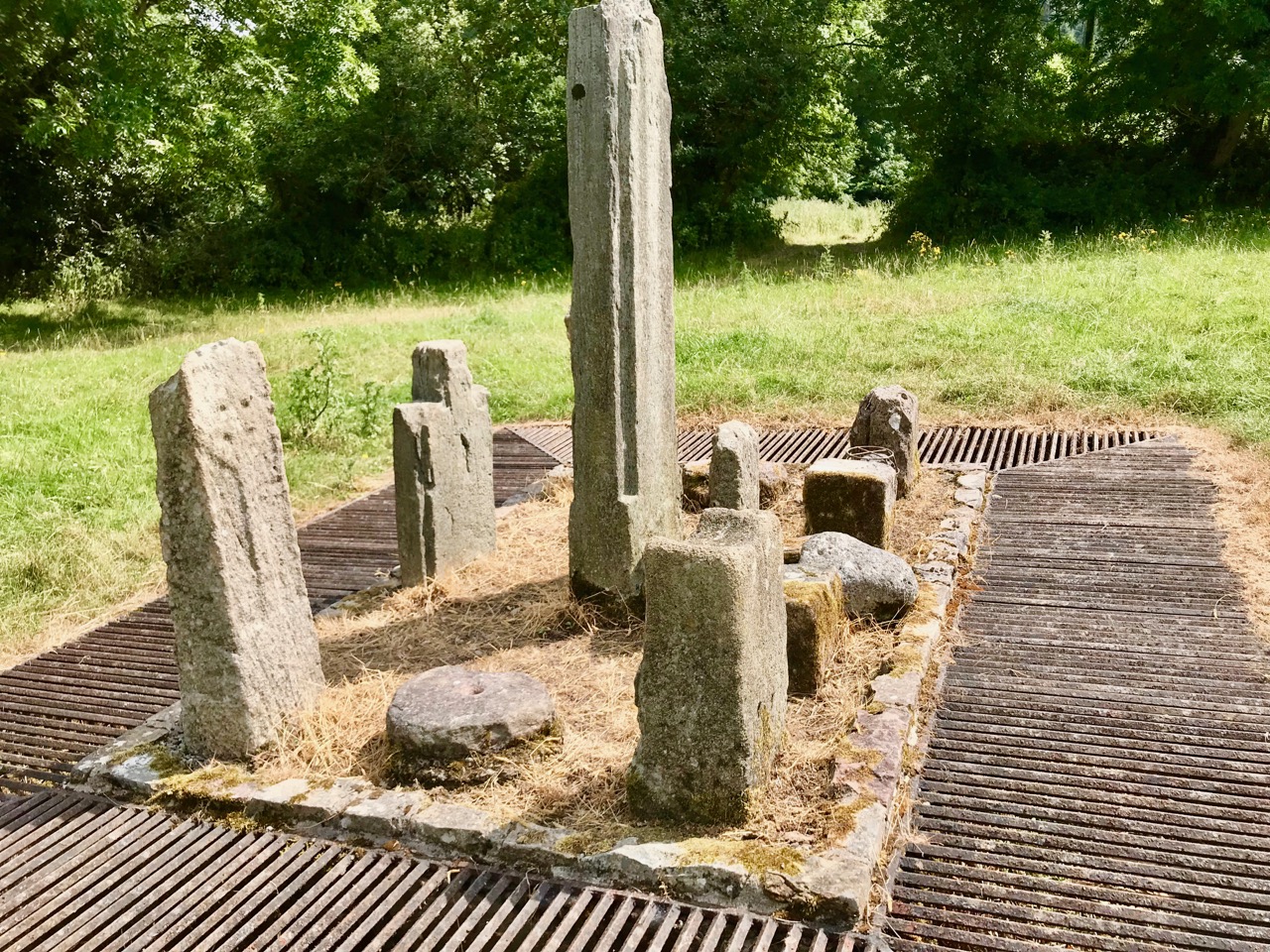
We were in West Cork, just by the little harbour of Glandore (in Irish Cuan D’Ór – Harbour of Gold). The green boreen took us down to an old burial ground which surrounds the ruins of a church dating, probably, to the 12th century. Around this are ancient stones – marked and unmarked – which signify the resting places of generations. It seems an idyllic place to rest, right off the beaten track, with only the sounds of nature to enhance the peace.
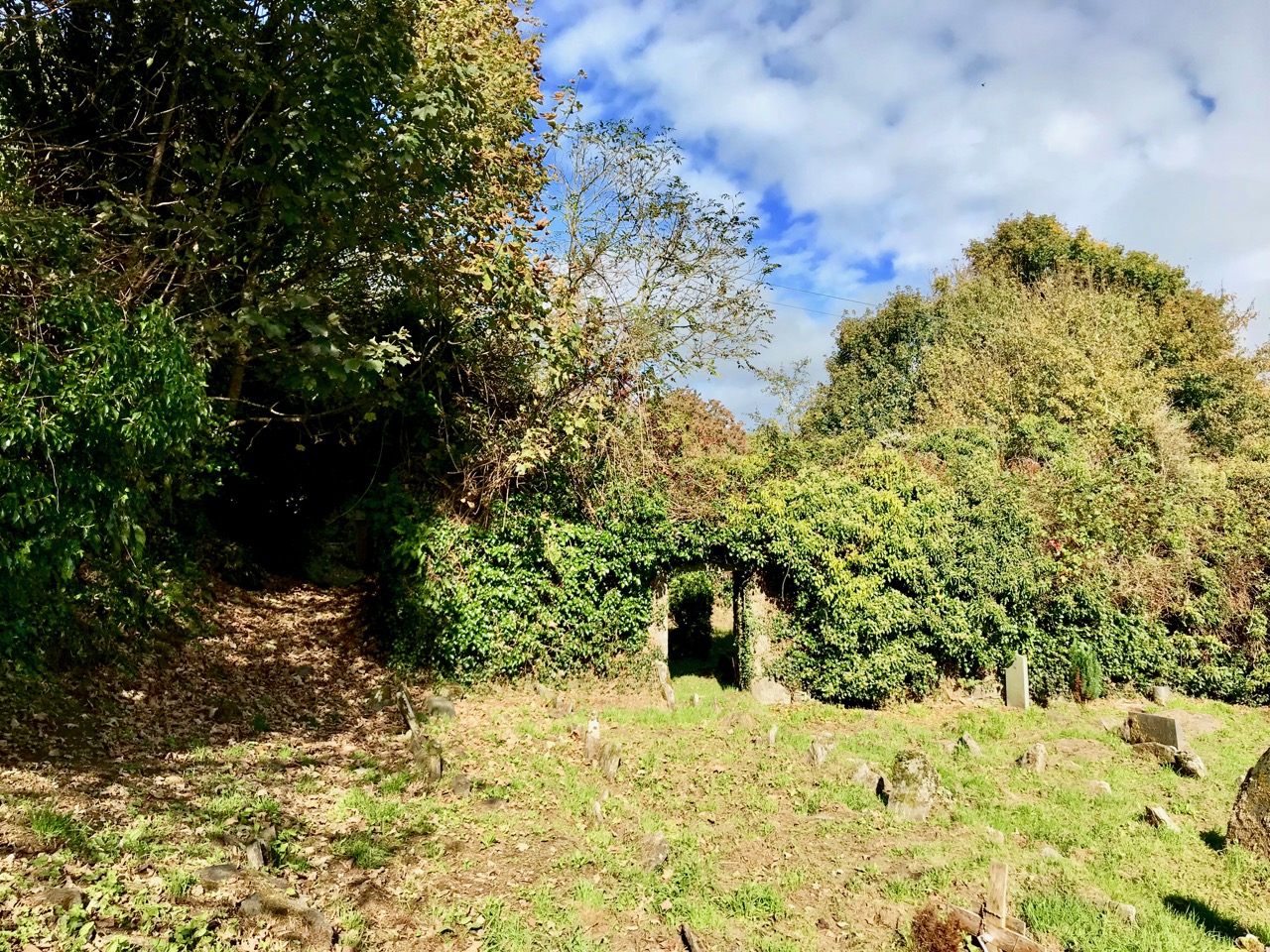
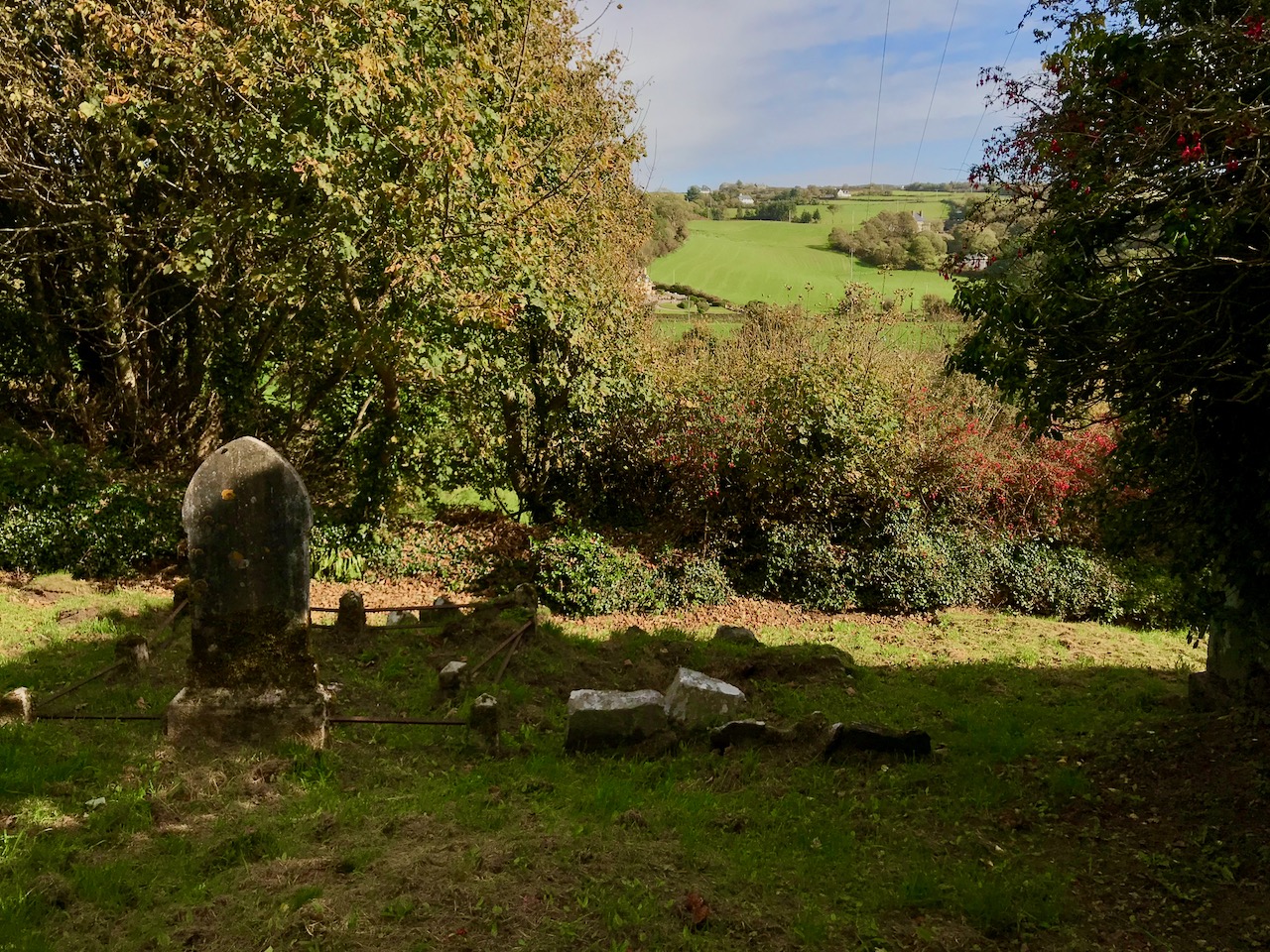
‘As quiet as the grave’ might be an apt expression in this place where we spent half an afternoon and saw no living soul. But the physical evidence of those who had passed was constantly fascinating. In Ireland, the simplest of grave markers is just an undressed stone firmly embedded in the soil. To us, they look random and rough, but it is said that every stone is chosen for a particular shape which is always remembered by the family who set it, and who passed the knowledge on – no markers were needed as long as that memory continued. Other stones are inscribed, although these are fewer – and some are particularly fine: a Celtic cross which dates to 1931, for example.
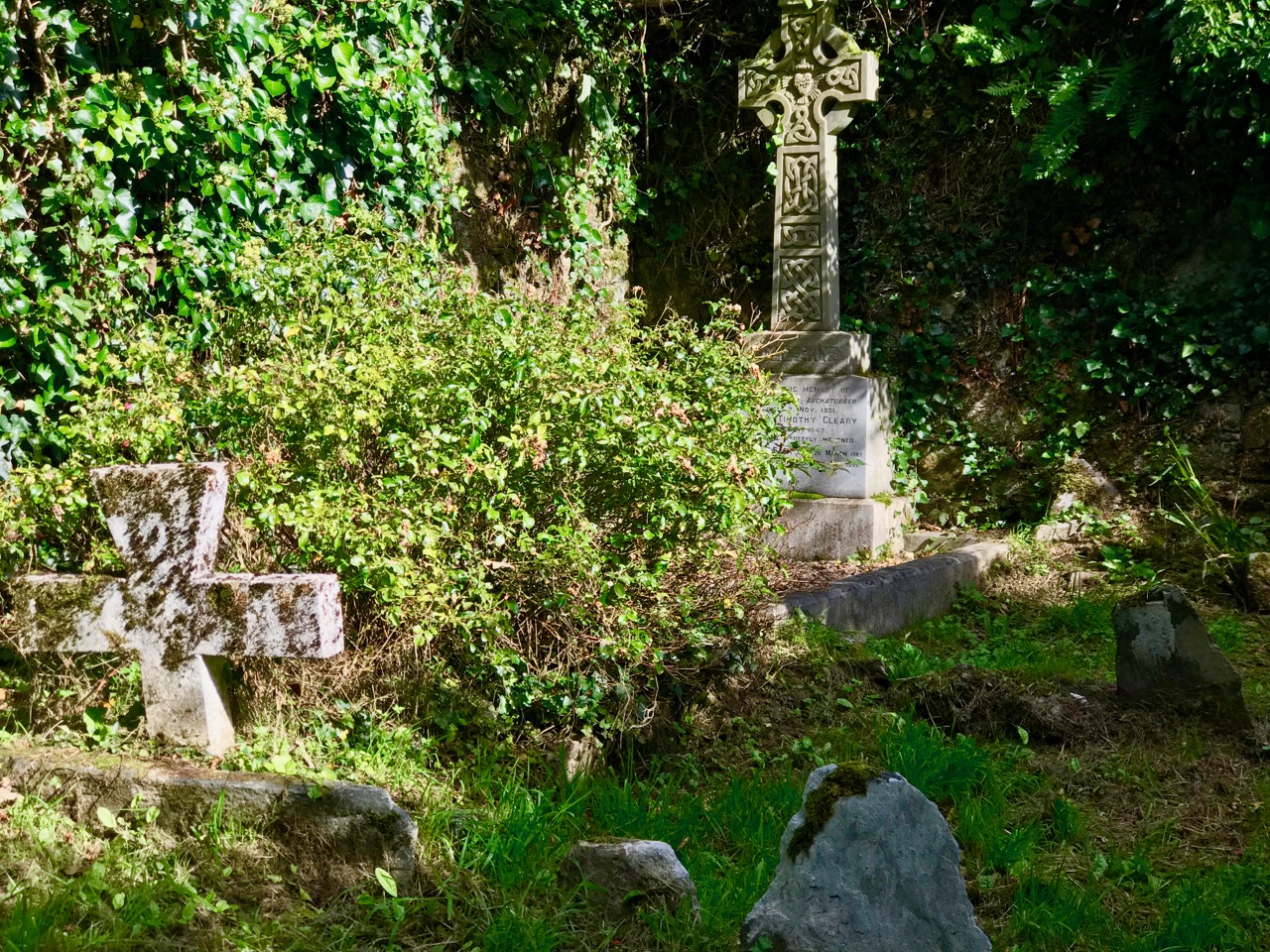
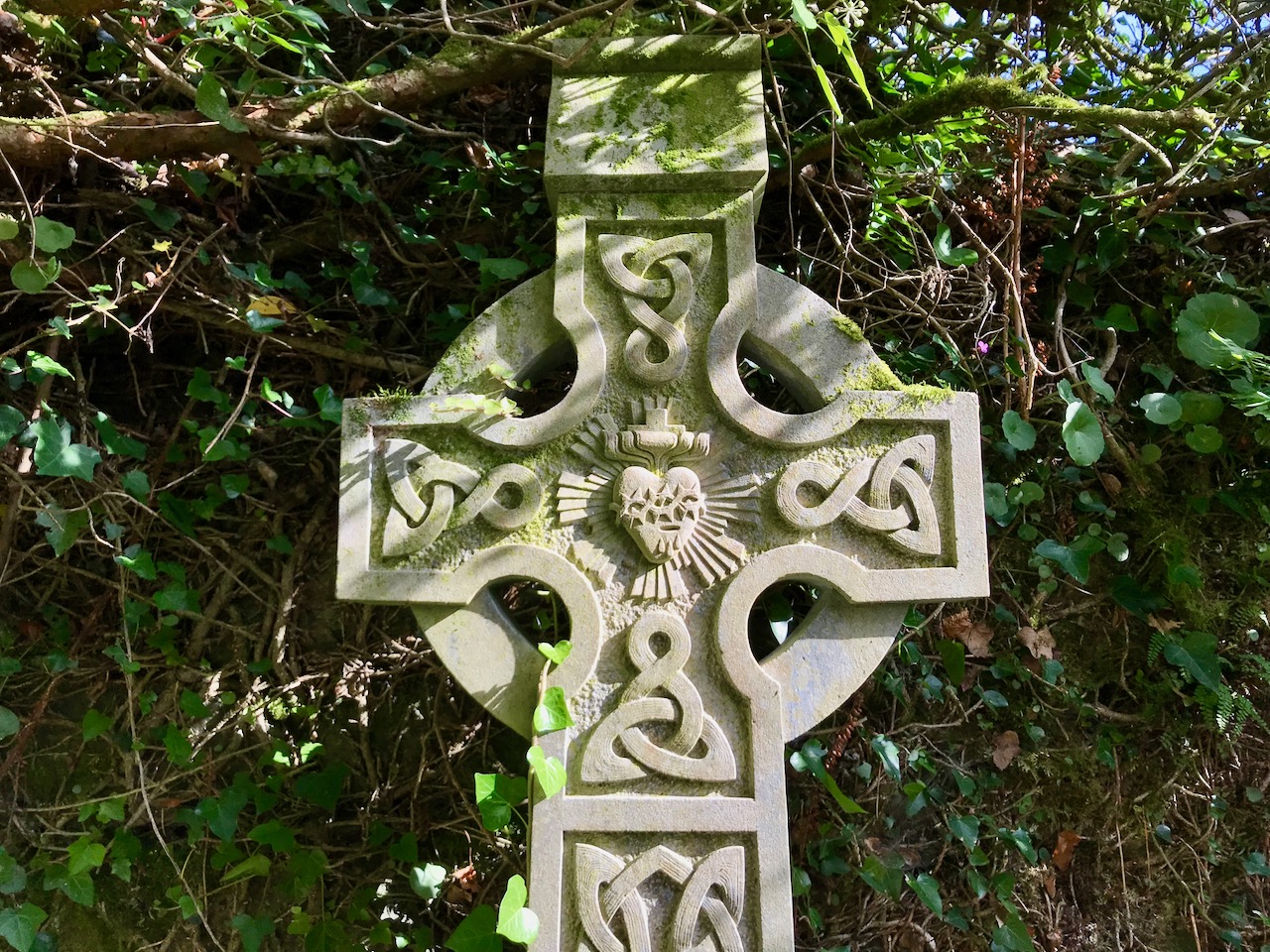
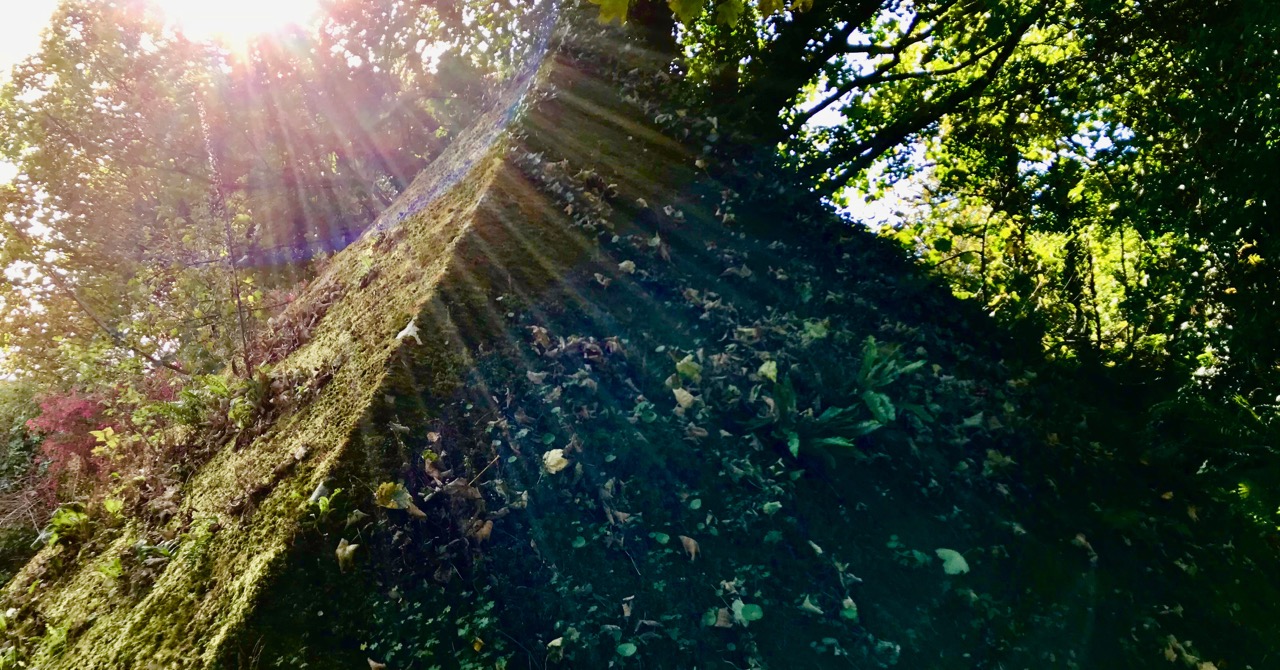
So far, our explorations in the Old Cemetery were typical of many another burial ground, but as we walked around the back of the ruined church we were astonished to see something we have never come across before in Ireland – a large pyramid!
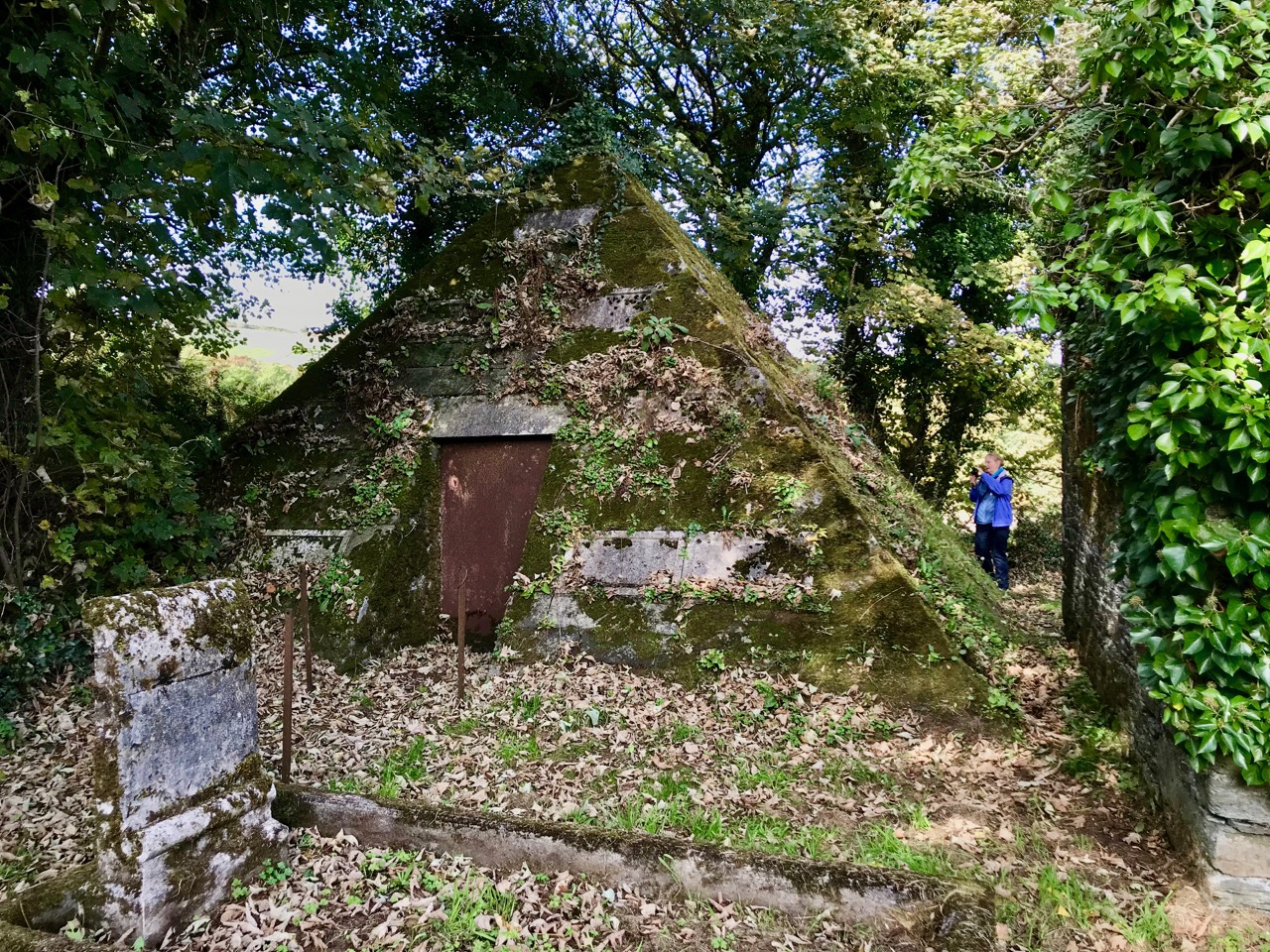
You get a sense of the scale of this construction by the figure in the picture above. No Giza, perhaps, but nevertheless something monumental and unexpected in this out-of-the-way corner of West Cork. It isn’t alone, as right next to it is another mausoleum (for a mausoleum is the pyramid’s purpose): an ivy-clad masonry stronghold, huge and impenetrable.
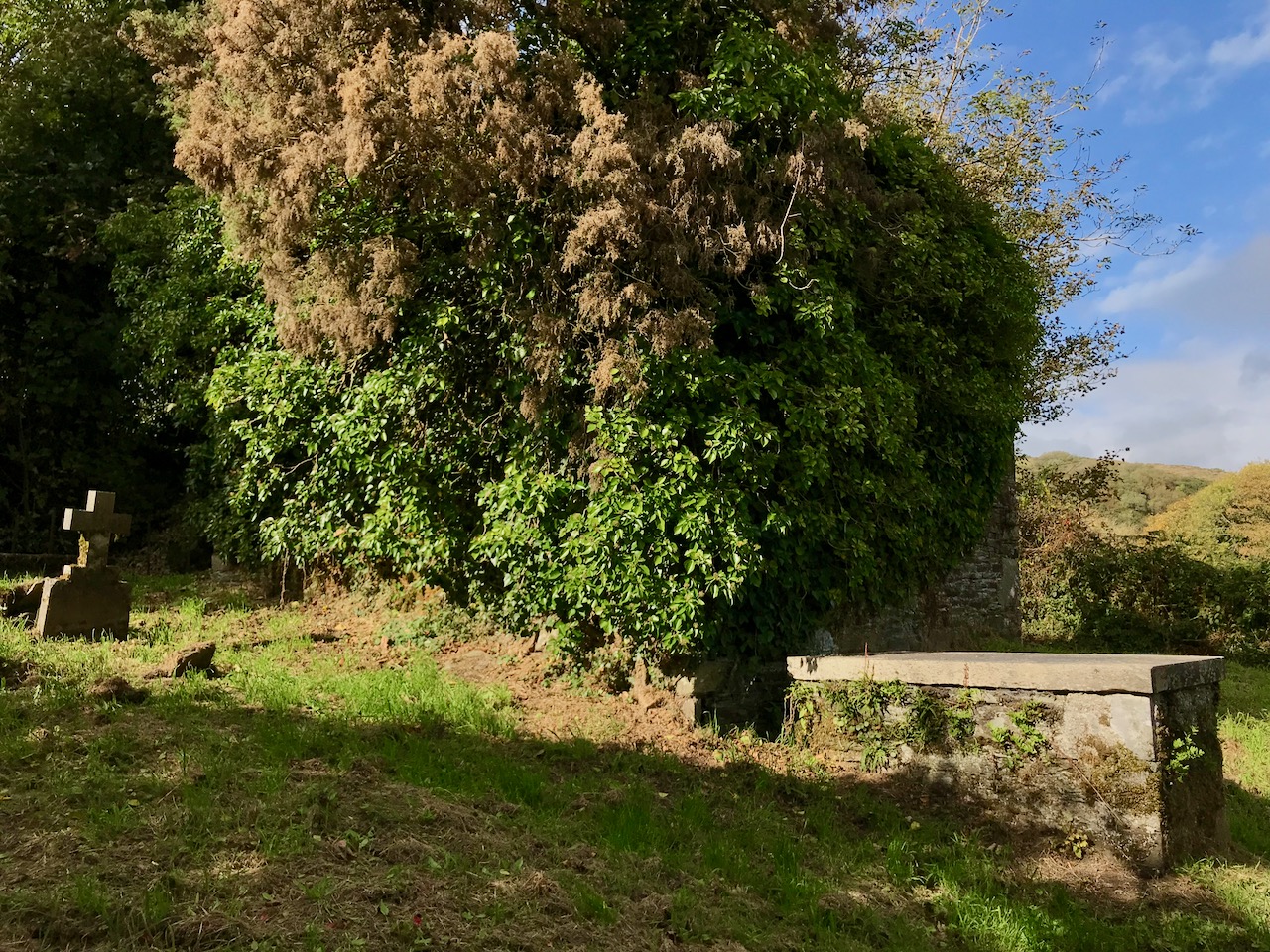
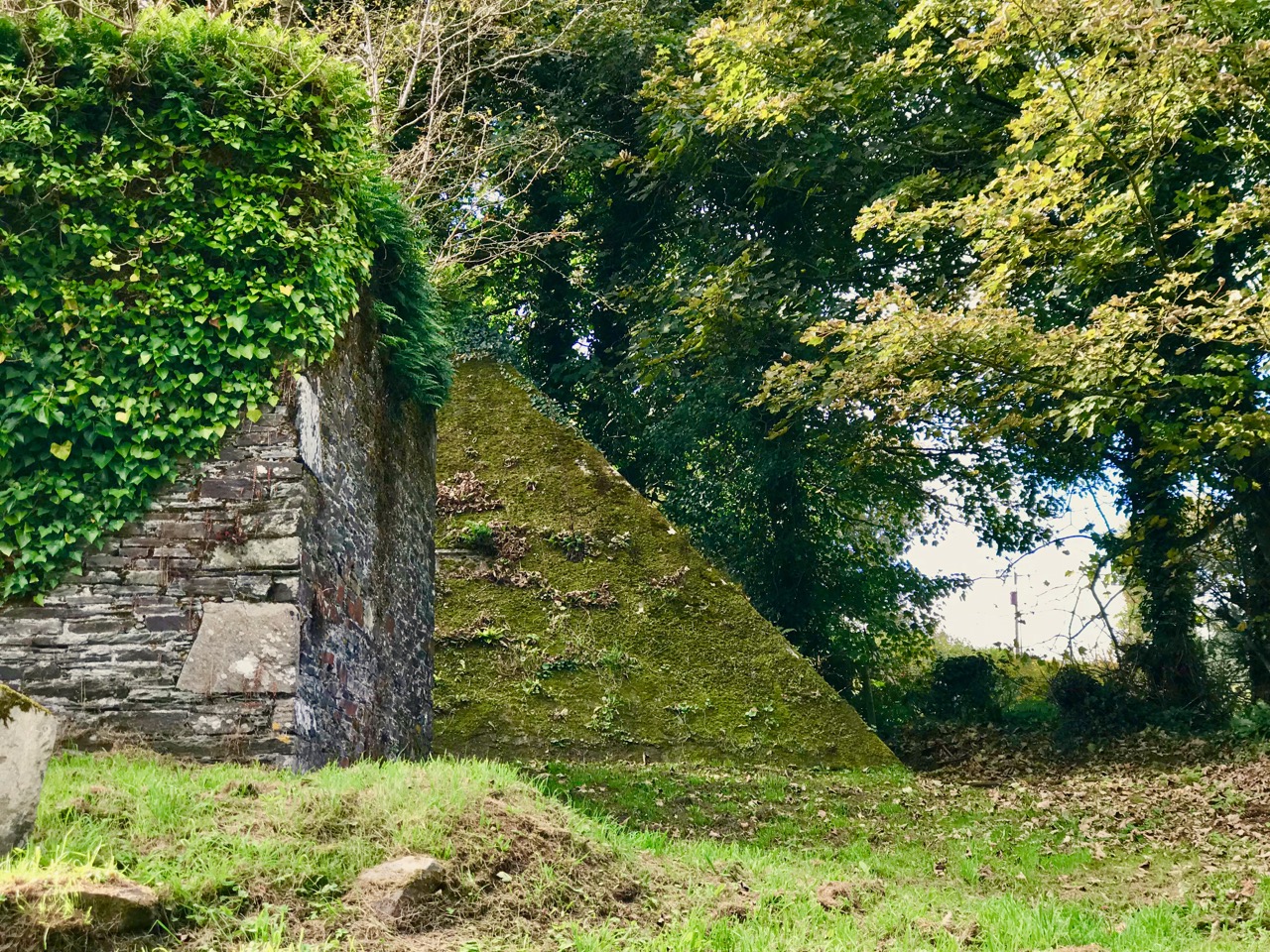
The two vast tombs stand side by side (above) in an odd juxtaposition. We scratched our heads in wonder and searched for clues of names and dates while we were there in the churchyard and, later, in records online. Very little is revealed. There are several inscriptions set on carved stone plaques on the pyramid – all impossible to read because of the moss and lichen growth. Over the iron doorway is a lintel inscribed with – I believe – the name John Hussey de Burgh.
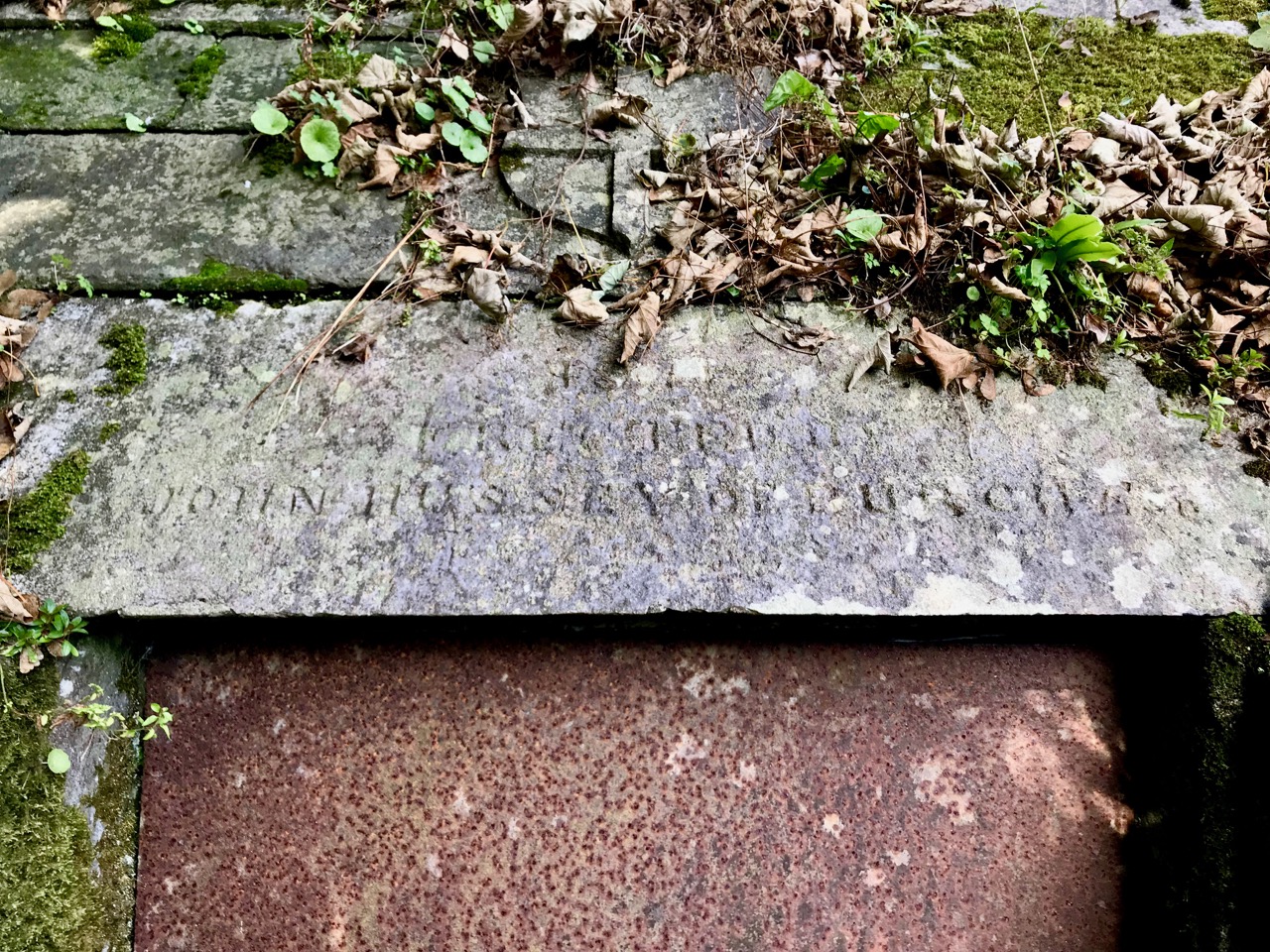
Later searches revealed the following:

. . . John de Burgh was born on 10 June 1822 and died 25 April 1887. Page 159 of The Calendar of Wills and Administration 1858-1922 in the National Archives of Ireland records that the will of “John Hamilton Hussey de Burgh late of Kilfinnan Castle Glandore County Cork Esquire”, who died on 25 April 1887 at the same place, was proved at Cork on 6 July 1887 by “Louis Jane de Burgh Widow and FitzJohn Hussey de Burgh the Executors”. Effects £1,246 11s 1d . . .
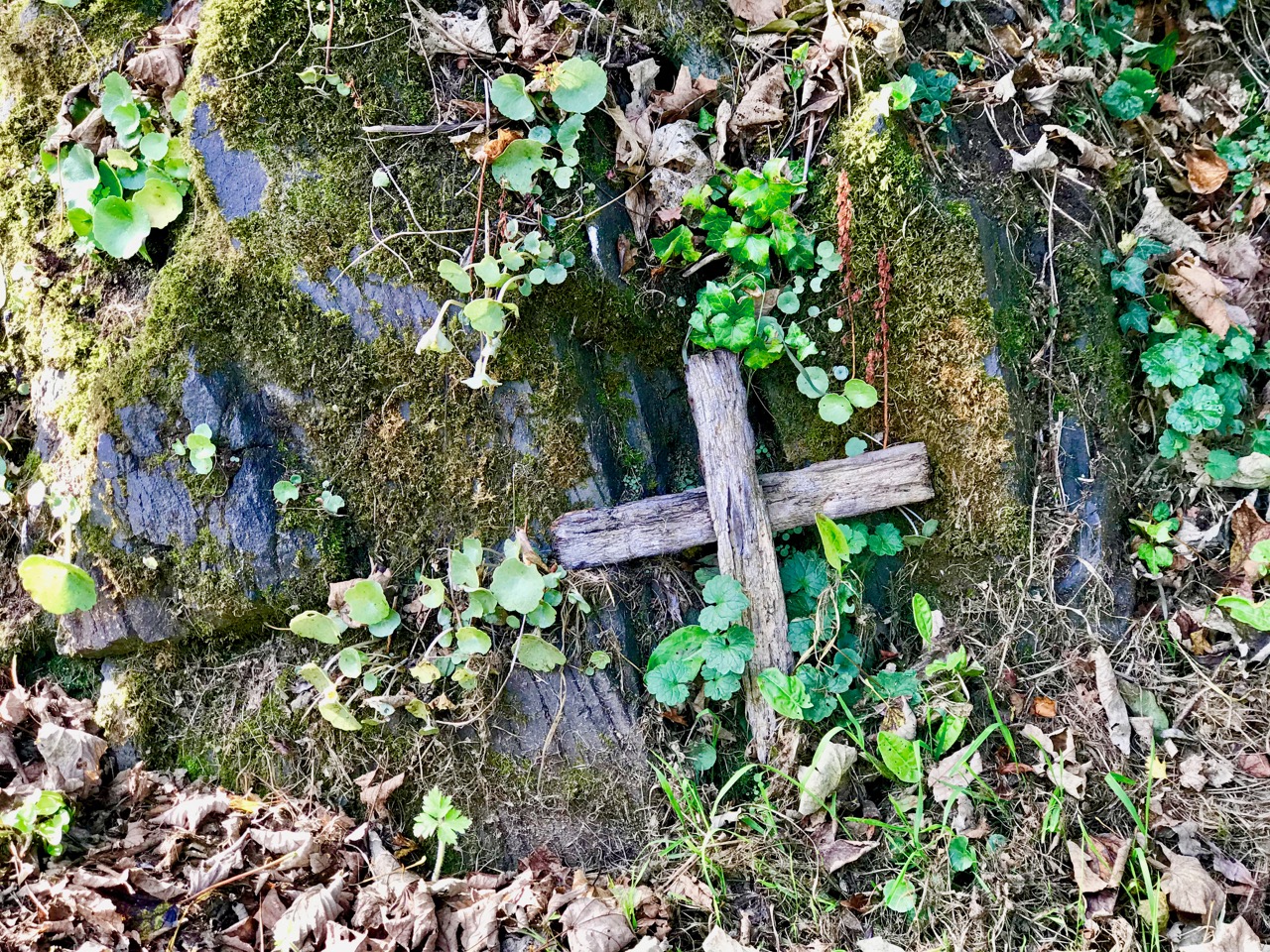
Kilifinnan Castle (a replacement built on the site of a structure dating from 1215) is a short distance to the south of the old cemetery, and it is highly likely that John Hamilton is the de Burgh commemorated on the pyramid. Apparently, he had seven children so it is likely that at least some of the other plaques would refer to these. The large stone-block tomb was giving up no secrets, with no apparent entrance and no plaques. There are signs that the burial ground is still visited and kept tidy.

We had to tear ourselves away from Glandore’s Old Cemetery: it is a beautiful and peaceful place. We didn’t much increase our knowledge of the history of the settlement itself, although the 1861 C of I Christ Church (Kilfaughnabeg – The Little Church of Fachtna) above the bay has a display of local lore and tales and is in any case well worth a visit: the only approach to it is through a tunnel hewn from a rock face.
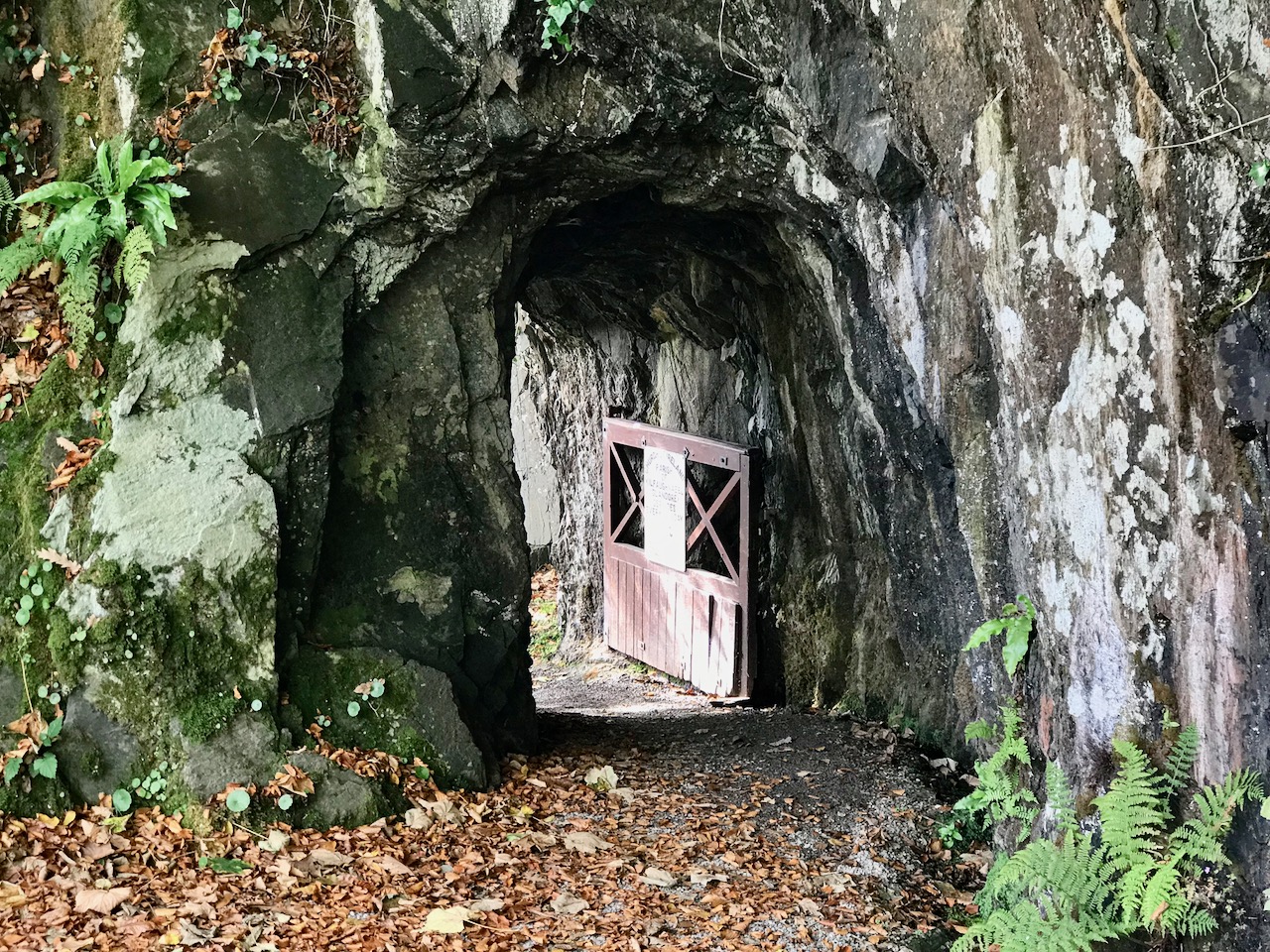
Our explorations in the Reilig left us with questions to be answered: not least, what was the inspiration for the pyramid, which seems so alien in far away West Cork?
A Walk on Sherkin Island

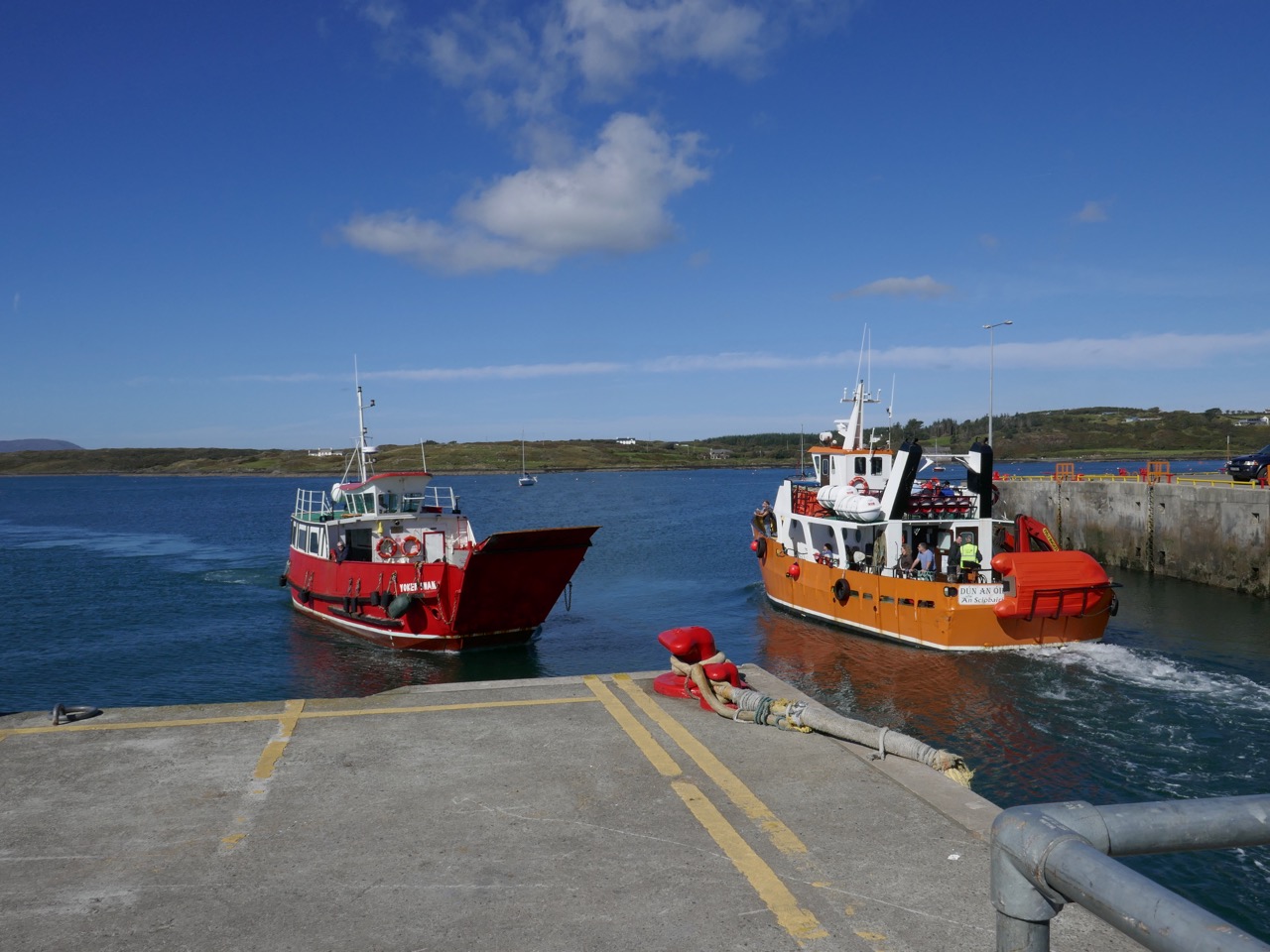
You can’t live in West Cork without constantly being aware of the sea – it’s all around us. And the offshore islands are always in our view as we look across Roaringwater Bay. It’s easy to get to the inhabited ones: there are good ferry services that run year round, although they can be hampered by winter storms. In this picture – above – the Cape Clear Ferry is leaving Baltimore, while the Sherkin Ferry is arriving to collect passengers for that island, including us: on a whim we went across on a wonderful warm September afternoon.

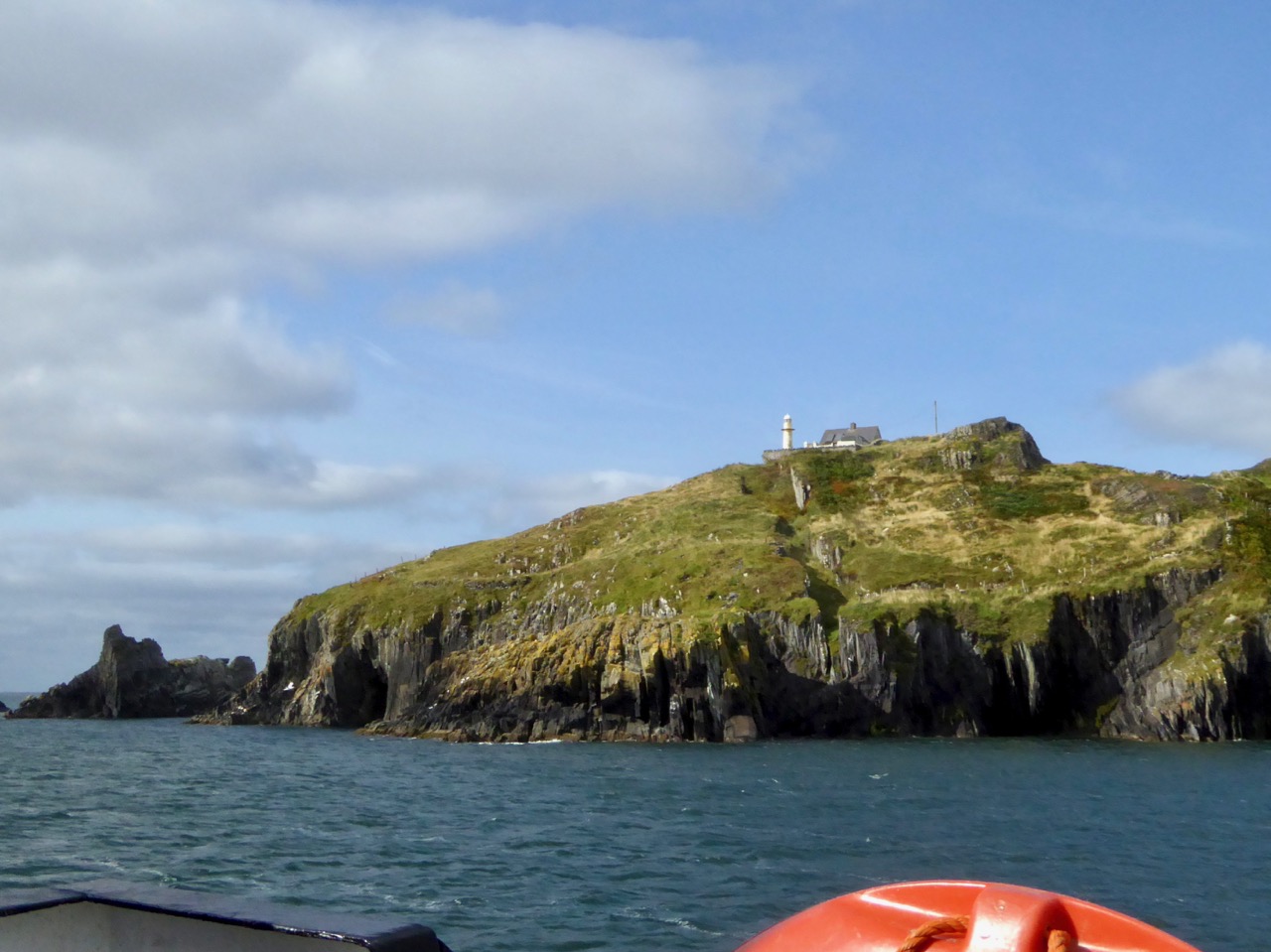
It’s a short sea voyage to Sherkin – all of 15 minutes! But it’s always exciting to be on the water. That’s the lighthouse on Sherkin in the picture above: it was built in 1885 of cast-iron construction and is now fully automated, as are all of Ireland’s lighthouses today.

We did have an aim – to find a piece of Rock Art that may be the earliest physical evidence of human occupation on the island. It’s a cupmarked stone in the townland of Kilmoon, overlooking Kinish Harbour. It was a fair walk to the west, over deserted roads and through fields. After a bit of backtracking we managed to find the stone, well weathered but with its markings still visible. It is situated with panoramic views all the way round, taking in the peaks of Mount Gabriel, Mount Corrin and Mount Kidd on the mainland: surely it must have been placed with those views in mind?

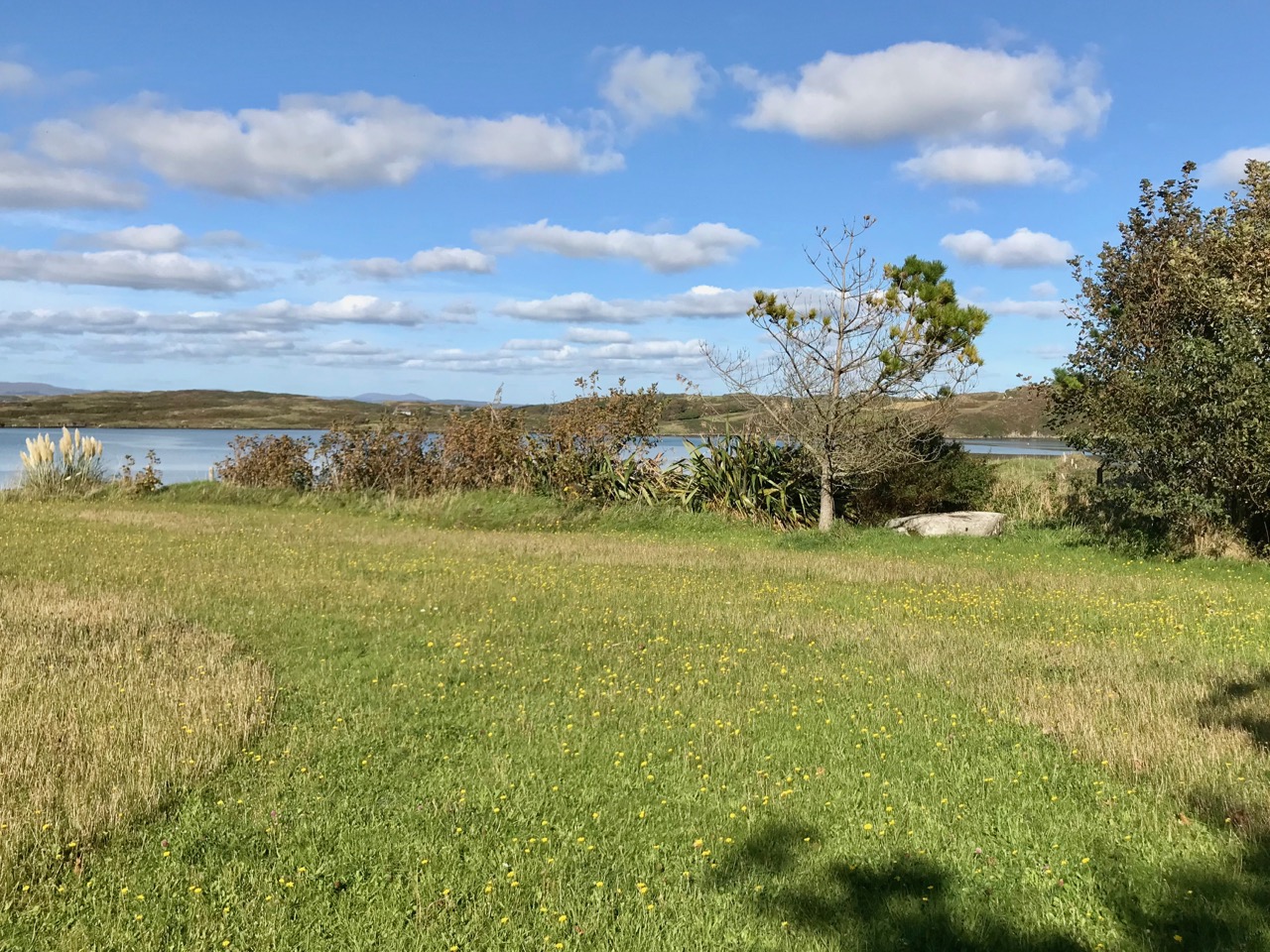
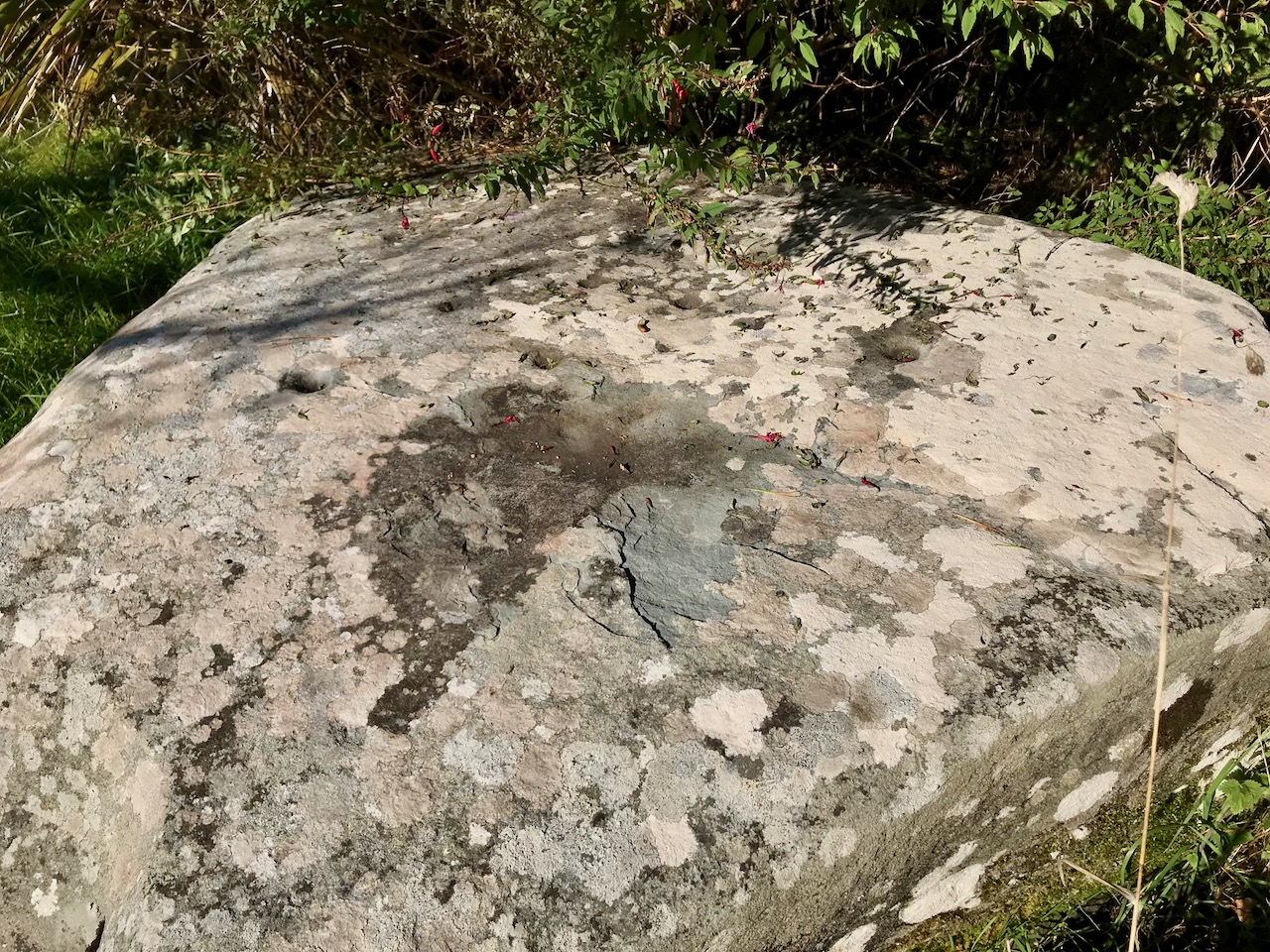
This picture shows the cupmarked stone in its present setting, just inside a private garden (if you go, please make sure you seek permission from the owners of the house!), while the one above shows the panoramic distant view which the stone commands.

Here is the surface of the stone which is heavily blotched with lichen, but it is possible to make out the well defined cupmarks: there are 14 in all. If you want to find out more about cupmarked stones and how they compare with Rock Art in general, we wrote this post a while ago. It sparked off a whole lot of debate (have a look at the comments at the end of that post) – and there is still much to be discovered in a history that may go back 5,000 years.

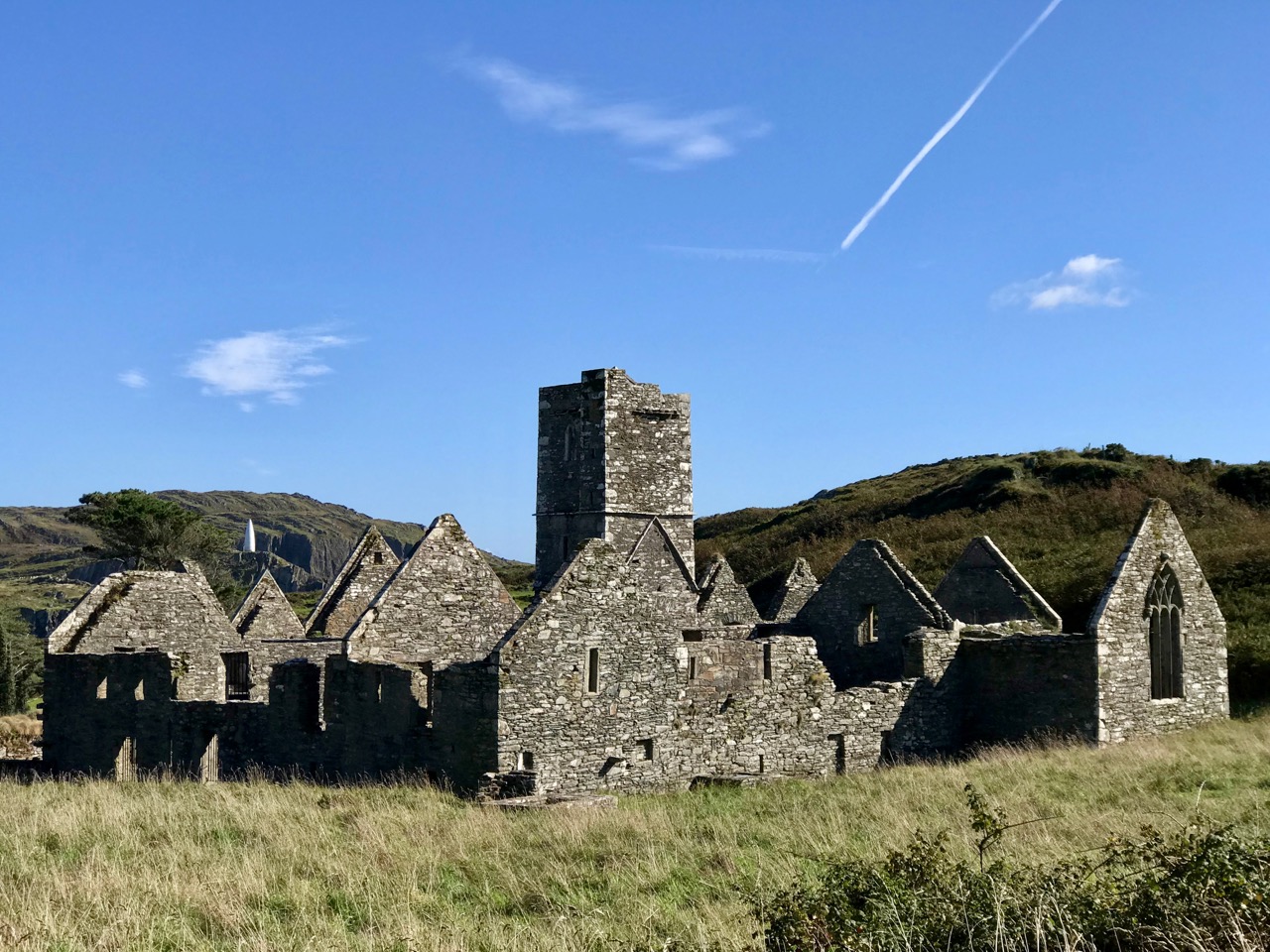
Our main mission was accomplished, but we couldn’t resist taking in some other historical sites while on the island. Firstly, we had a good look at the Franciscan friary – situated in the townland of Farranacoush – which has a colourful history. Here is a description from the current Irish Franciscans site:

. . . Permission for this foundation was given by Rome to Finighin O’Driscoll in 1449, but it was not until just after 1462 that the Observant friars actually arrived. The friary became the traditional burial place of the O’Driscoll’s. In 1537 the citizens of Waterford burned the building in retaliation for acts of piracy by the O’Driscolls. The great bell of the friary was on display in Waterford as late as 1615. There is no evidence to suggest that the friars were disturbed by the events of the Reformation until the island was garrisoned by the English following the Battle of Kinsale. The friars soon returned and, except at the height of the Cromwellian persecu­tion, were active all during the seventeenth and well into the eighteenth centuries. The last friar, Fr Patrick Hayes, died soon after 1766 . . .

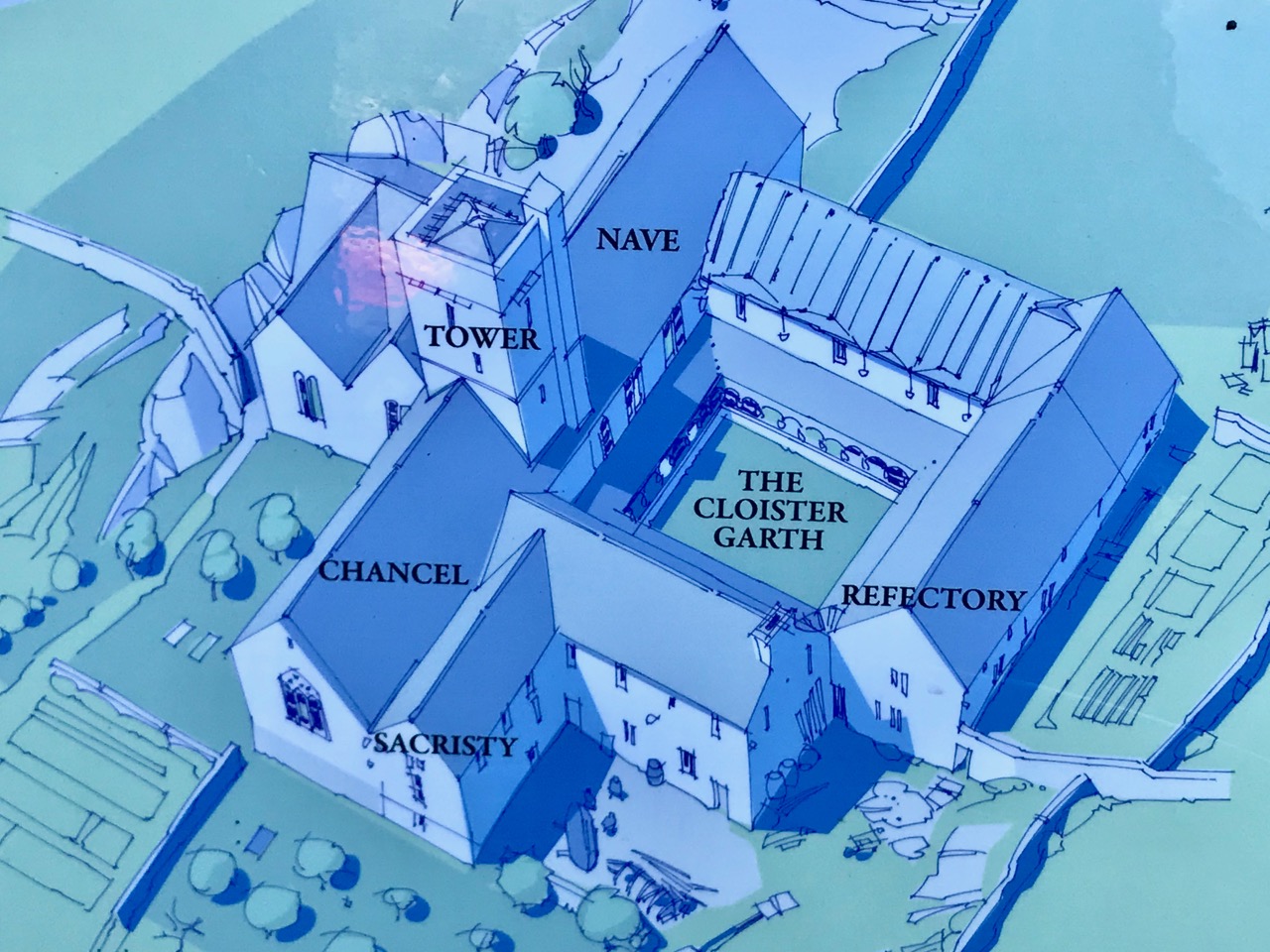
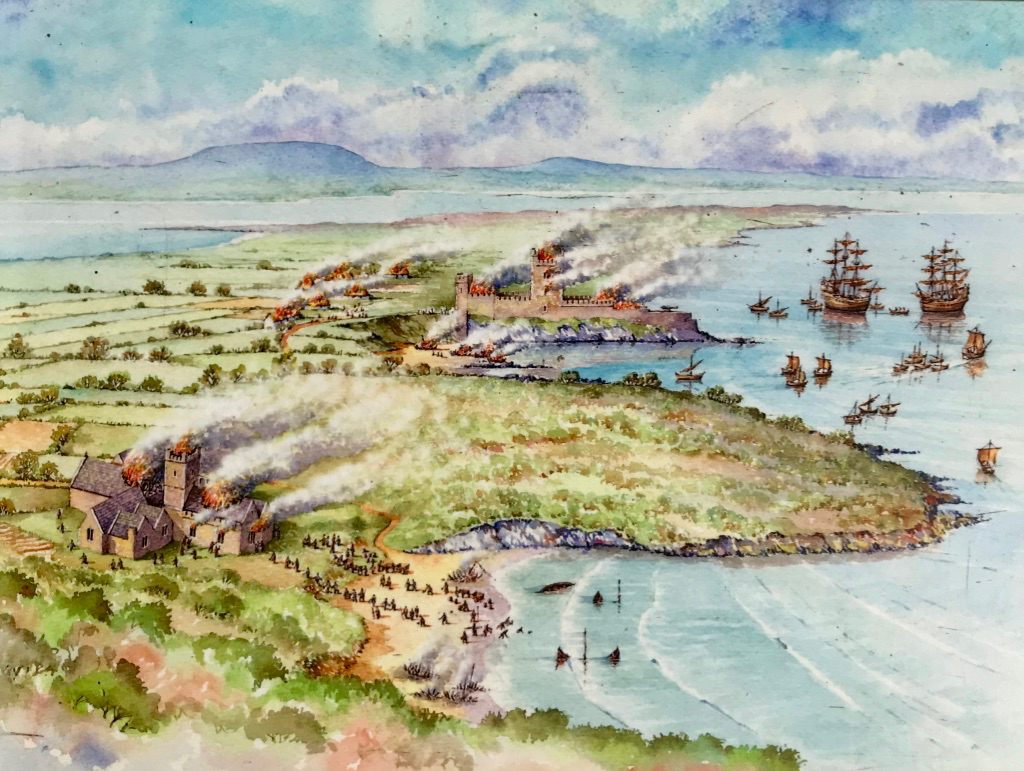
In the picture above – taken from the OPW information board – you can see the attacks of 1537 by ‘the citizens of Waterford’ on both the Friary (in the foreground) and the O’Driscoll stronghold of Dún na Long (beyond). The castle was subsequently partially rebuilt and was garrisoned by a Spanish force in 1601. It was then acquired and restored by the Becher family in 1655 and remained in their ownership until the late nineteenth century. We went to see what remains of the castle today.

Our visit to Sherkin only took an afternoon – albeit a golden one. There’s plenty more to see there – and other islands to be investigated. And an endless exploration of history to be had in the landscapes of West Cork.

‘Ye Citie of the Seven Crosses’

As you will know from these pages, ‘Ireland of the Saints’ is a country rich in treasures dating from medieval times. Architecture and stone carved ecclesiastical monuments were prolific on the island of Ireland, with many examples and fragments remaining. Finola has a series covering Romanesque Architecture, while I have always been on the lookout for High Crosses from the early medieval period. Over 250 examples of High Crosses are said to survive in Ireland, either complete or broken – a remarkable number. Without fail, all are beautiful, and wonderful examples of early art and craftsmanship.

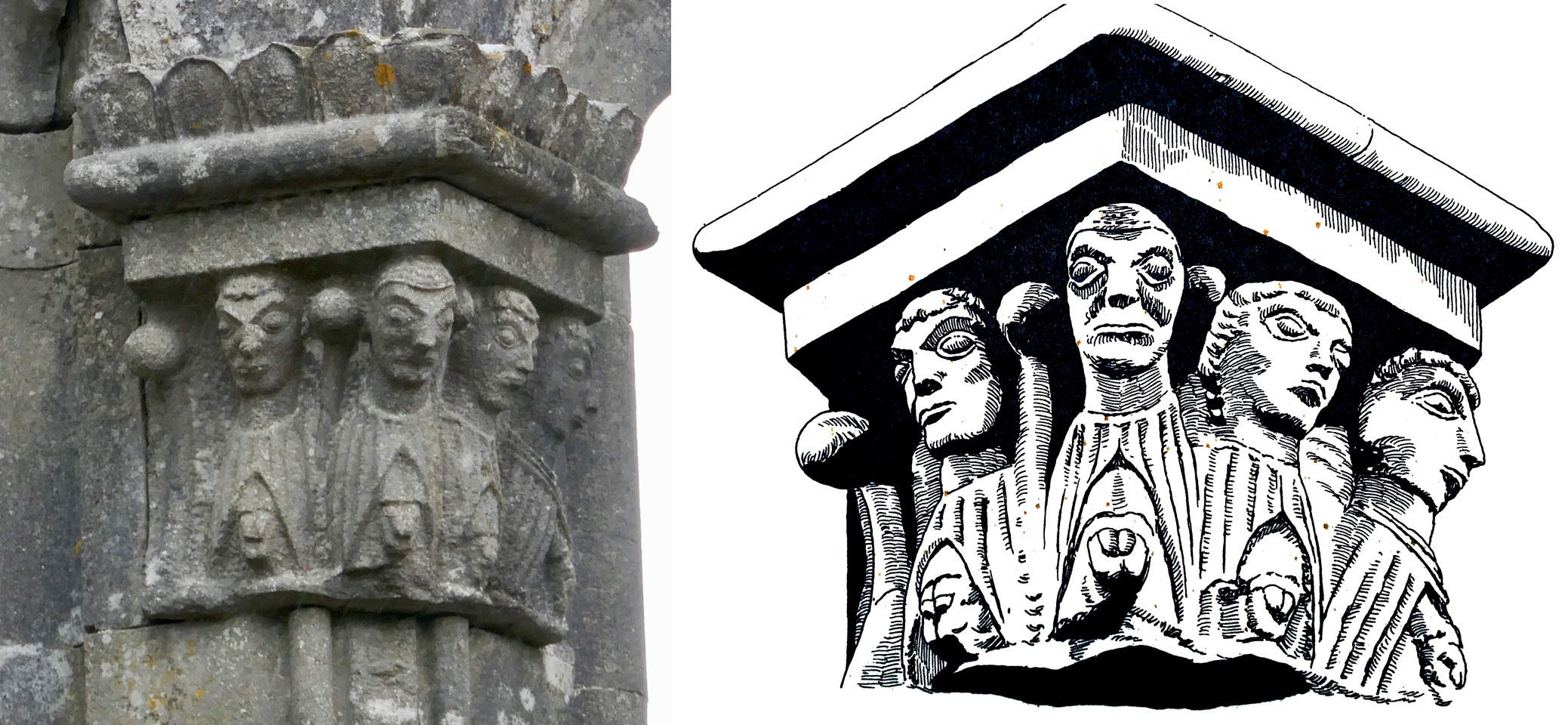
When we are out and about, we usually don’t have to go very far off whichever route we are travelling to find more examples to add to our archive of The Irish High Cross. Last week was no exception: we were off to the Burren in County Clare to see a new exhibition of the work of our friend Keith Payne, and it was no trouble to take a little detour in County Clare to view ‘Ye Citie of the Seven Crosses’ – Kilfenora. A wonderful carved capital on the Cathedral there is shown above (the drawing of it on the right is from Duchas). I knew the place because of its famous Ceilidh Band, but I am now aware that even this admirable institution must take second place to the Kilfenora High Crosses.

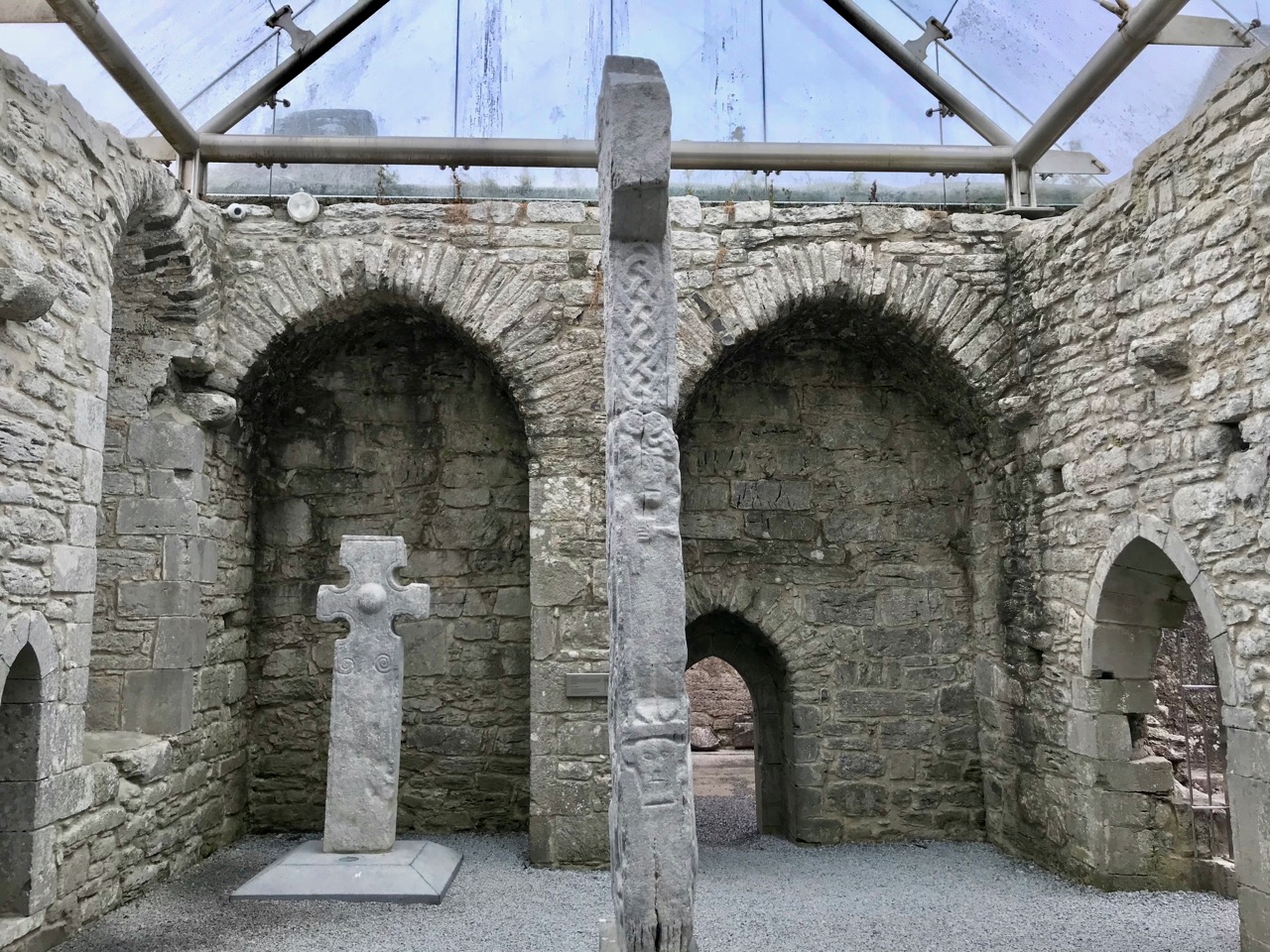
The most detailed description of the Kilfenora crosses was written by historian Jack Flanagan (1921 – 2014) and it’s available online, courtesy of Clare County Library. Jack lived most of his life around Kilfenora, and charts the fortunes of the High Crosses through the 20th century, mostly from his personal experience. Now they are well looked after – some are under a glass roof – but they have suffered various misfortunes throughout the last Millennium. Above are all that’s left of two of the crosses – both now protected.

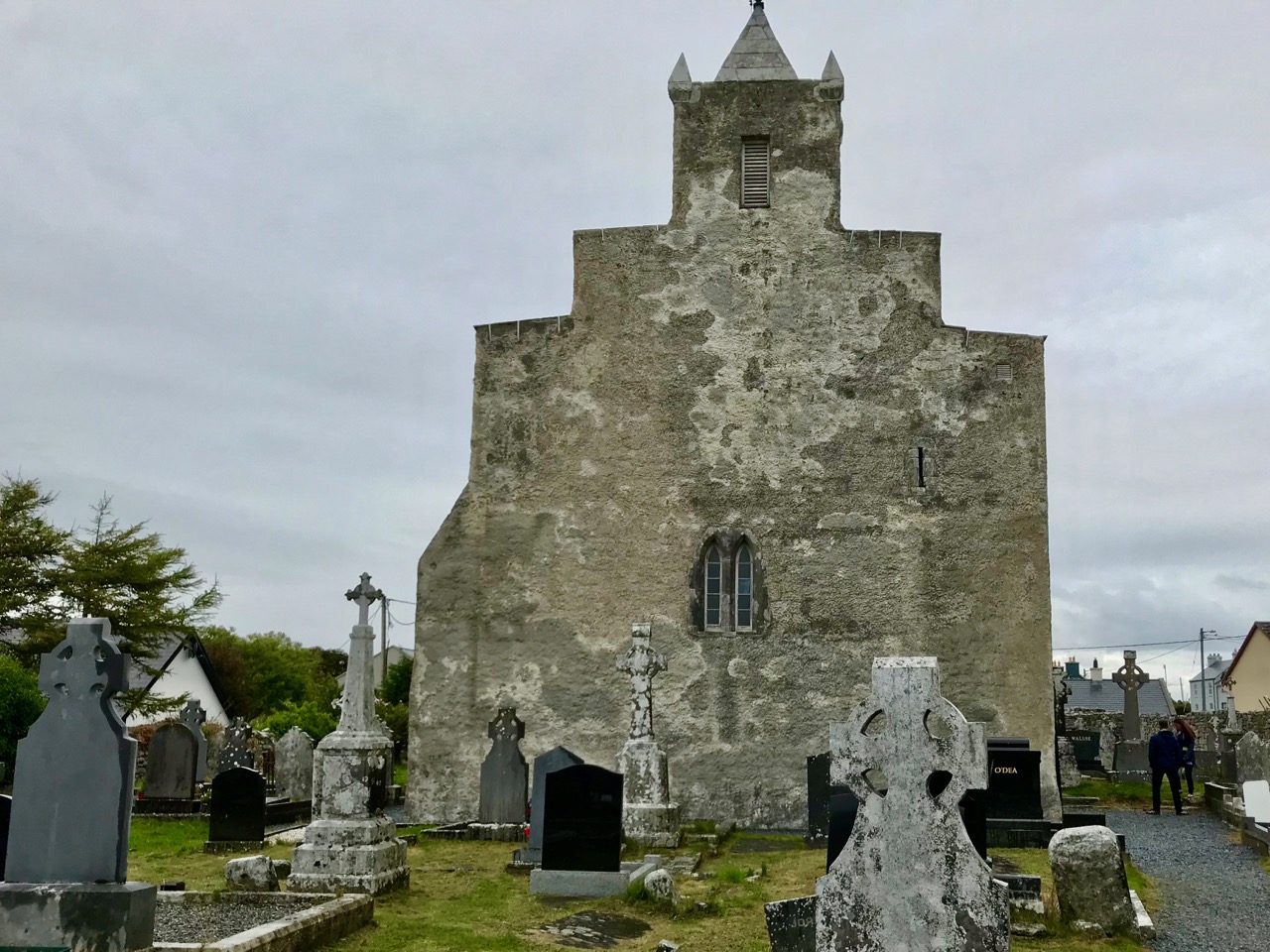
You would hardly think of Kilfenora as a ‘city’ – but the hamlet of thatched dwellings was an important monastic centre from the days of  Saint Fachtnan (from County Cork) who founded it around 650AD. It has its Cathedral (above), although . . . it was the smallest with the poorest diocese in Ireland . . . (Flanagan). However in 1111 the Synod of Rathbreasail snubbed the claims for diocesan status by Kilfenora, and the O’Connors and the O’Loughlens came together in their desire to remain aloof from the Diocese of Killaloe which was very much under the patronage of the O’Briens. There was history here, as it was the O’Briens who had burned Kilfenora Abbey and its inhabitants in 1055. At the Synod of Kells in 1152 Kilfenora did succeed in its claims, and attained status as a separate diocese. It’s said that some of the High Crosses were carved and erected to celebrate this achievement.

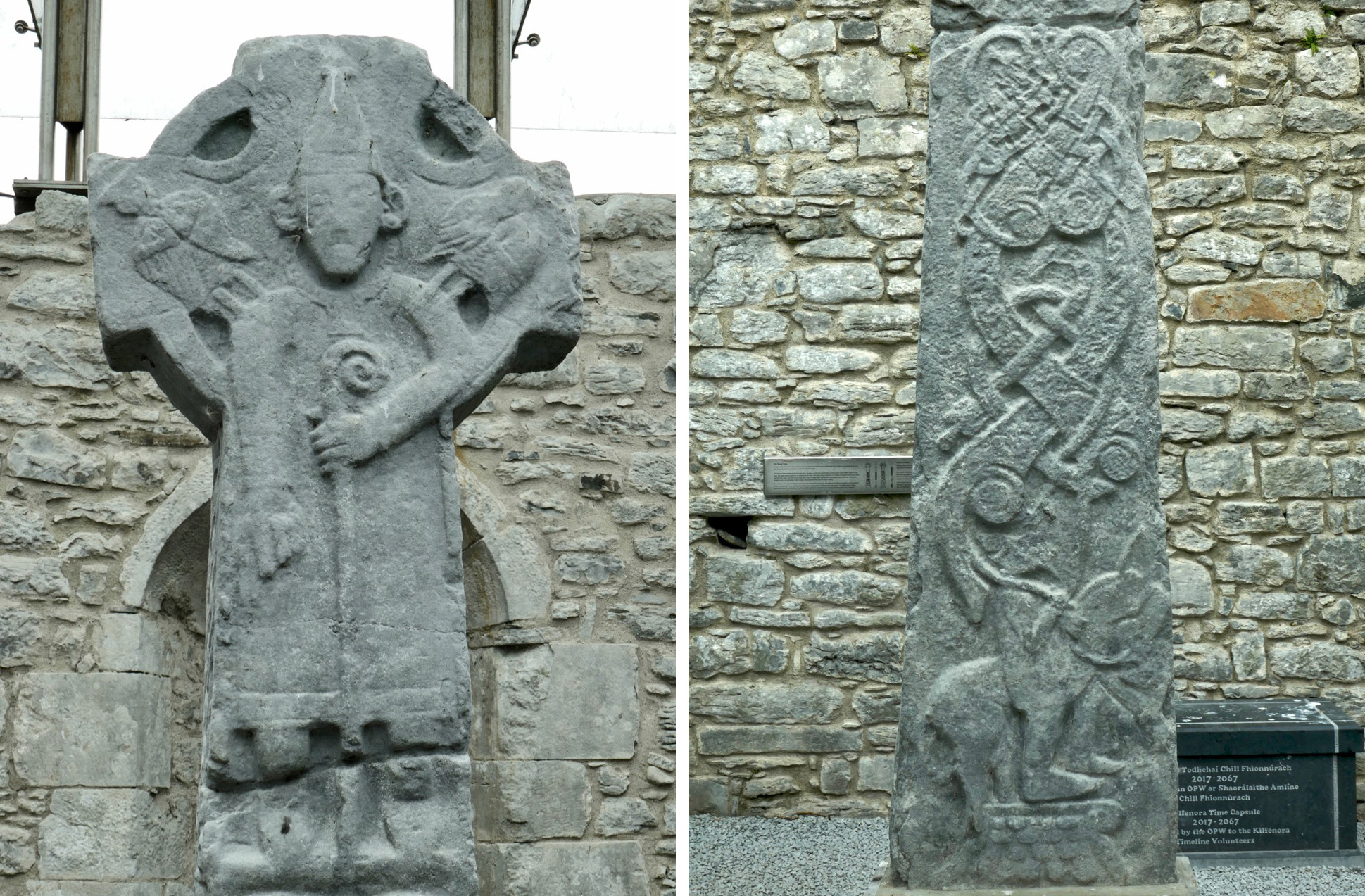
If this is the case, then the Kilfenora High Crosses are relatively late examples of the art. This would seem to be borne out by the style of the finest of them – now known as the Doorty Cross – because the interlacing designs on the shaft are undoubtedly influenced by Scandinavian motifs. This, then, must have been a time when the Viking invaders were not only accepted but also assimilated into the artistic culture: this would have been the case by the mid twelfth century.

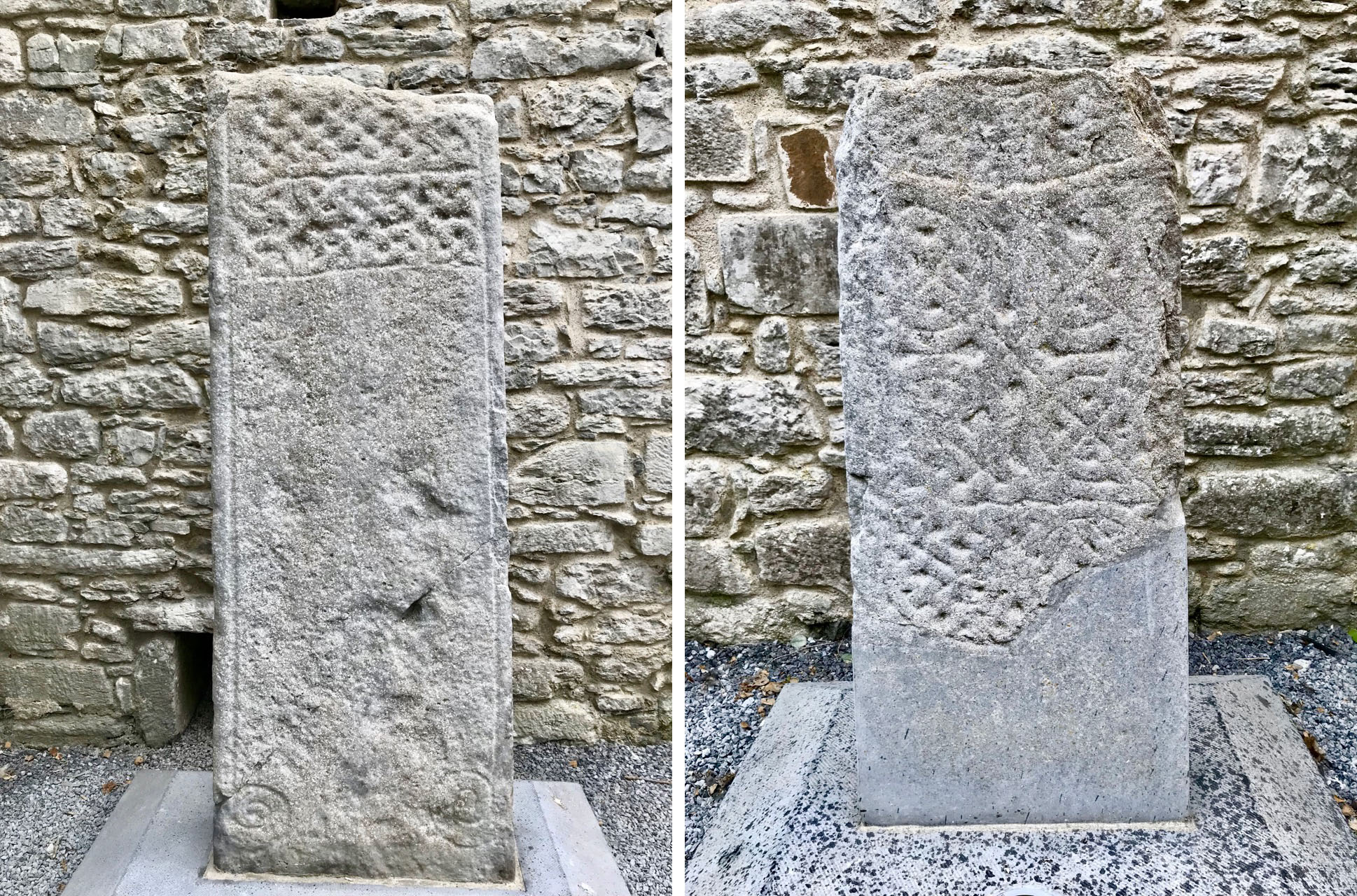
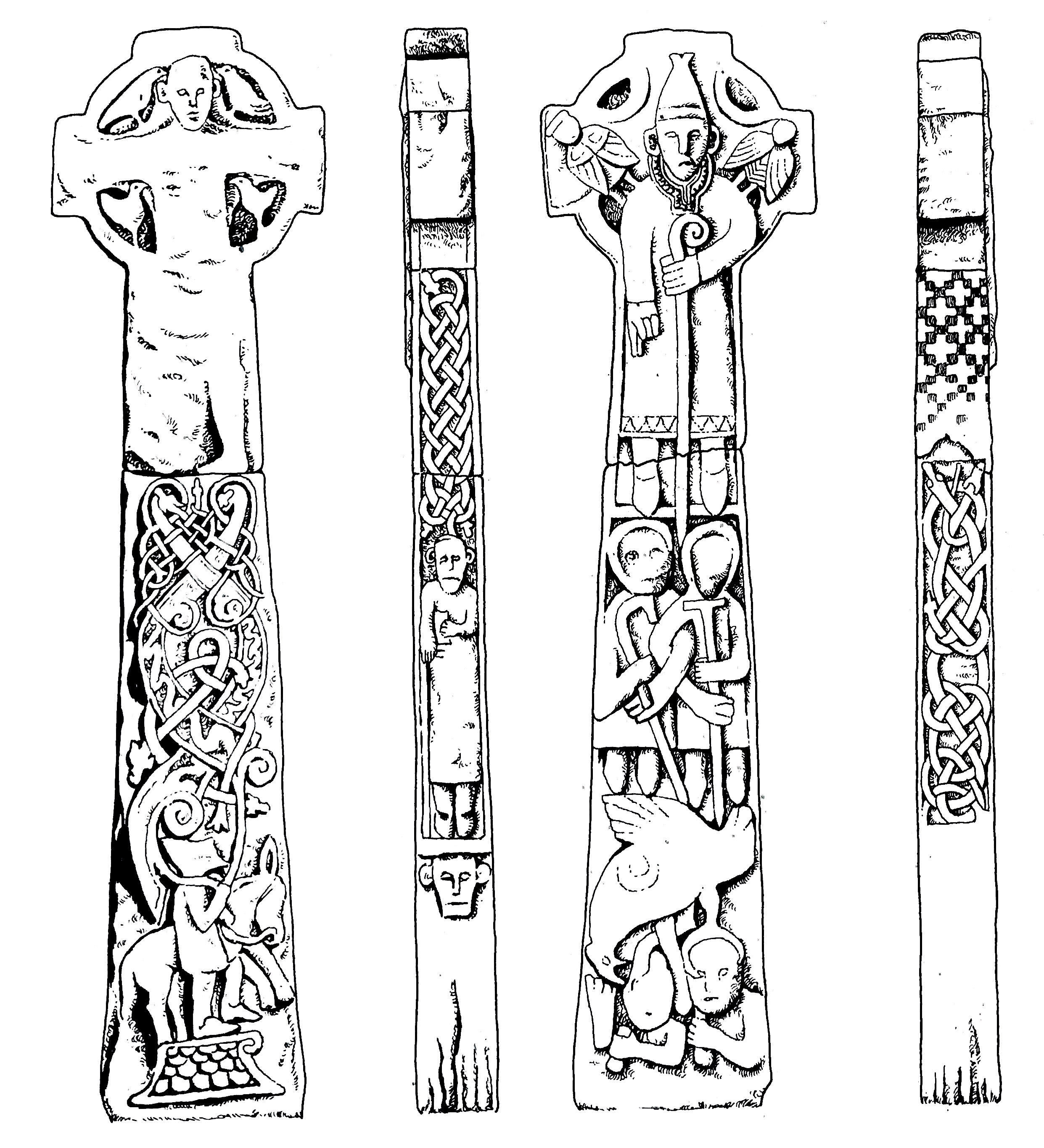
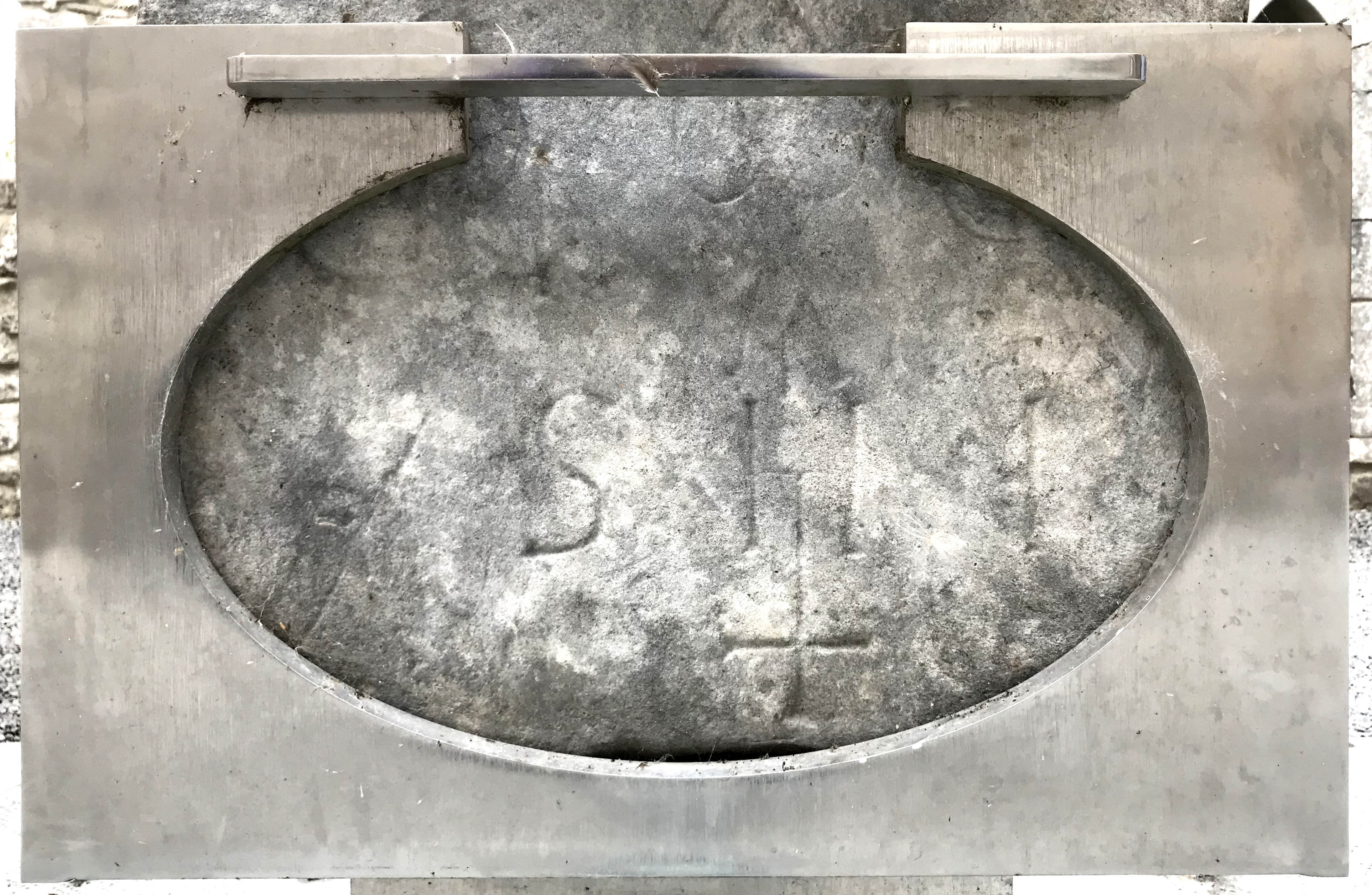
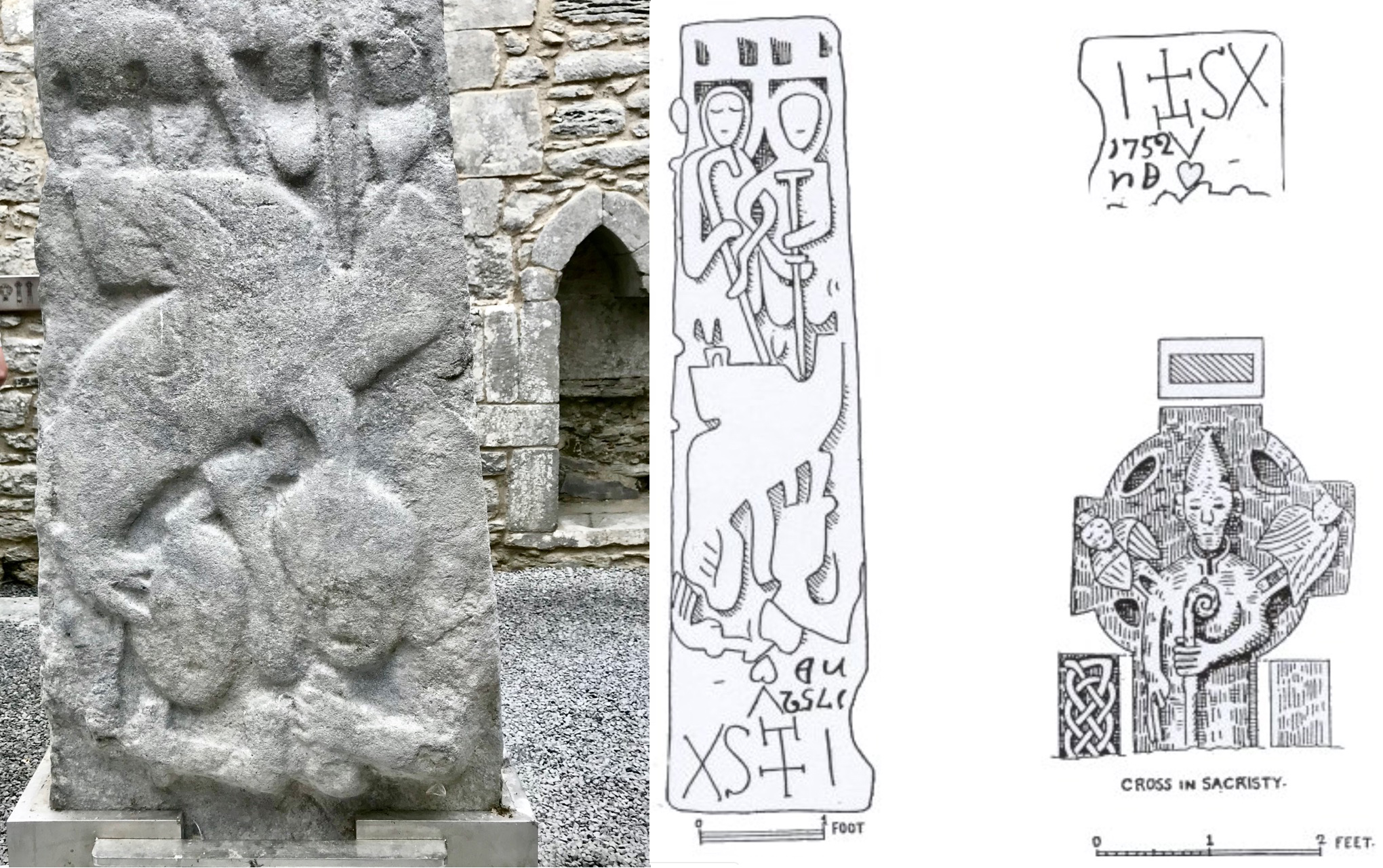
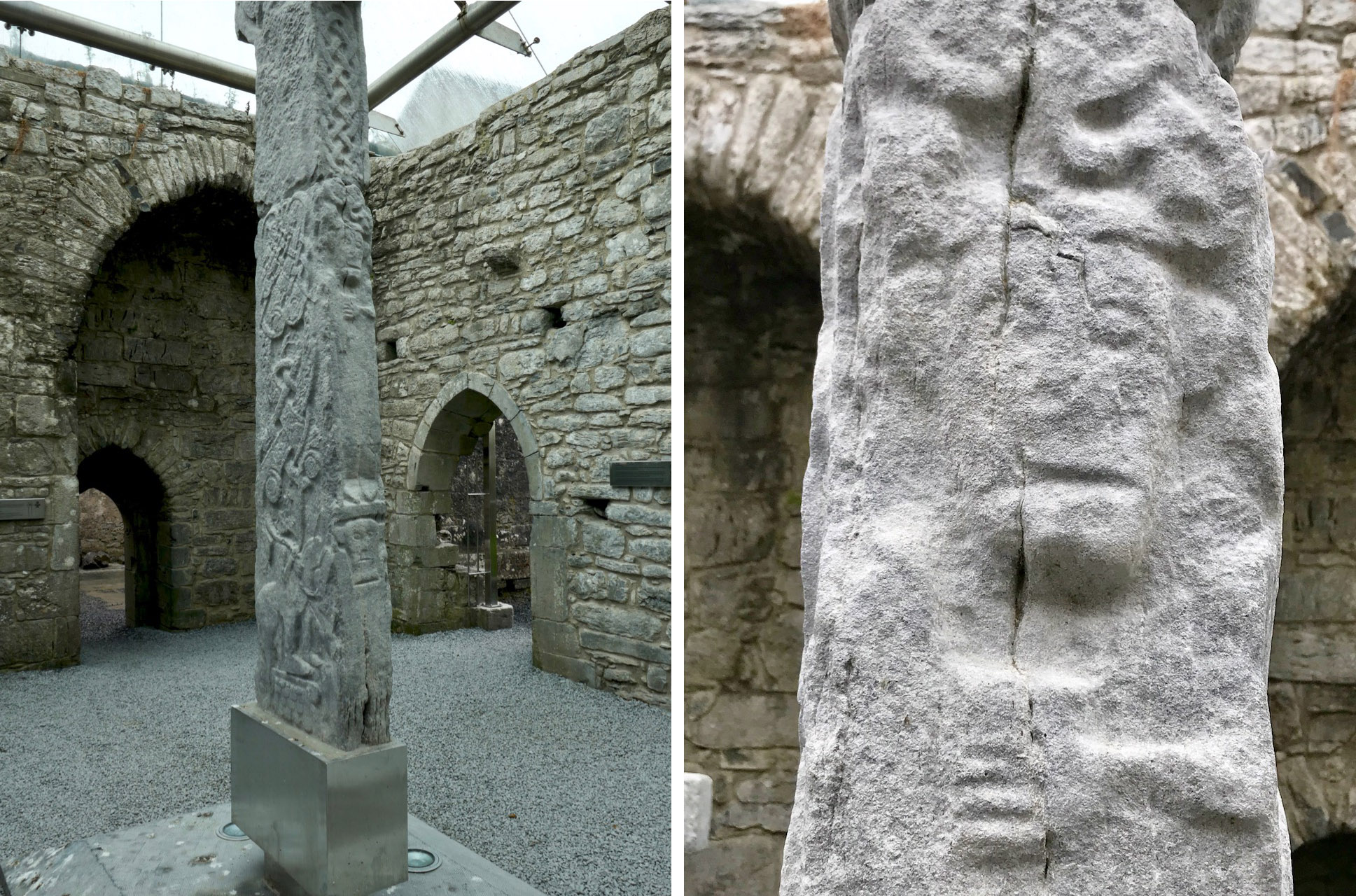
The Doorty Cross (upper, details from west and east faces and lower, Duchas drawing) has a partially traceable history. Jack Flanagan remembers when the main part of the shaft was in use as a grave slab of the Doorty family in the burial ground of the Cathedral, while the head was lying under the chancel arch in the sacristy. In the 1950s the two parts of the cross were reunited by the Office of Public Works, and the restored cross was erected next to the Doorty grave – hence this cross is now known as the Doorty Cross. Interestingly, there is an inscription on the base of the cross shaft which dates from 1752: this was buried when the cross was re-erected, but is now visible as the cross was removed into the new glass roofed shelter in the mid 2000s. The upper picture below shows the inscription visible today – it’s upside down on the raised cross: the lower picture shows a drawing made by Westropp in 1910 when the shaft was still used over the grave: the inscription can be read as IHS X V n D – the V n D stood for V ni Doorty.

The battle between the diocese of Kilfenora and Killaloe wasn’t quite won as they became combined in later years. Dr Richard Mant was appointed Bishop of Killaloe and Kilfenora in 1820, and in that year he set out on a visitation of his two diocese. In early August he arrived in Kilfenora which he described as “the worst village that I have seen in Ireland and in the most desolate and least interesting country” . In a subsequent letter to a friend he describes;

. . .  On a visit to Kilfenora in 1820 where there had been five or six stone crosses I found two or three broken and laying on the ground, neglected and over-grown with weeds. On expressing my concern that these remnants of ecclesiastical antiquity were left in such a state, a clergyman of the parish proposed to send me one of them, which he said might be done without difficulty or danger of giving offence, as when they were brought to that state the people had no regard for them. One was accordingly sent to Clarisford, and I caused it to be erected among some trees in a picturesque spot, between the house and the canal, having inlaid the shaft with a marble tablet bearing the inscription annexed below. When my daughter was at Clarisford about three years ago, the cross was still standing, being considered “an ornament to the grounds” . . .

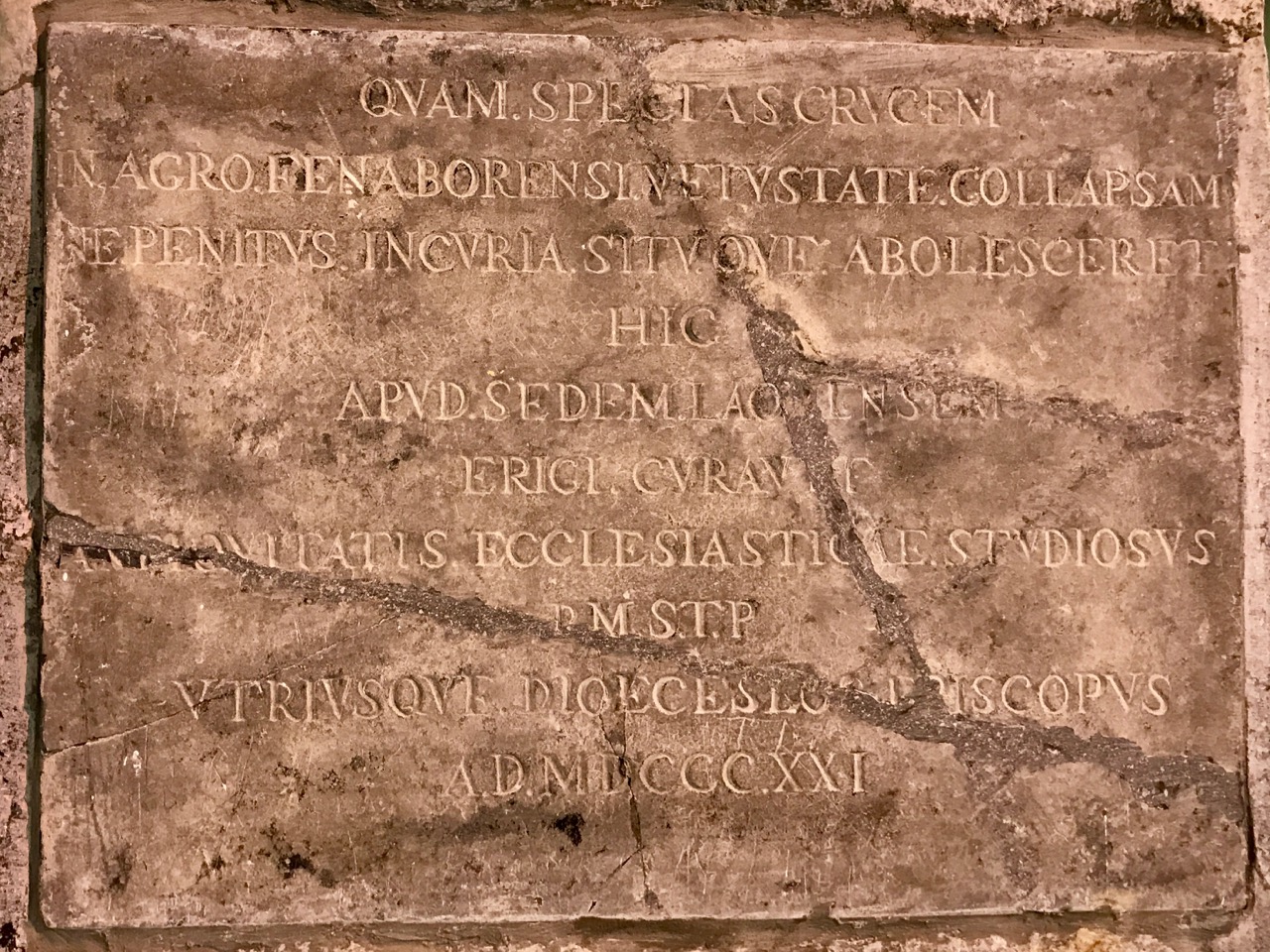
Upper picture – the High Cross which was taken from Kilfenora by Bishop Mant in 1821, and which has ended up – after a series of excursions – in St Flannan’s Cathedral, Killaloe. A translation of the Latin on the marble tablet which was placed there by the Bishop:

. . . R.M.S.T.P. (Bishop’s name and title) of both diocese, being solicitous for church antiquity, took care to erect at the See of Killaloe this cross which you see, and which collapsed at Kilfenora lest it entirely disappear through neglect, and by reason of the site A.D. 1821 . . .

It seems there was still little love lost between the two diocese. The Kilfenora Cross on the Hill has now been moved into the St Flannan’s Cathedral at Killaloe – and that’s where we saw it back in September last year. When you speak to local people in Kilfenora you get a sense that there are grumblings – they feel they would like their cross back: it would be one of the finest in the collection.

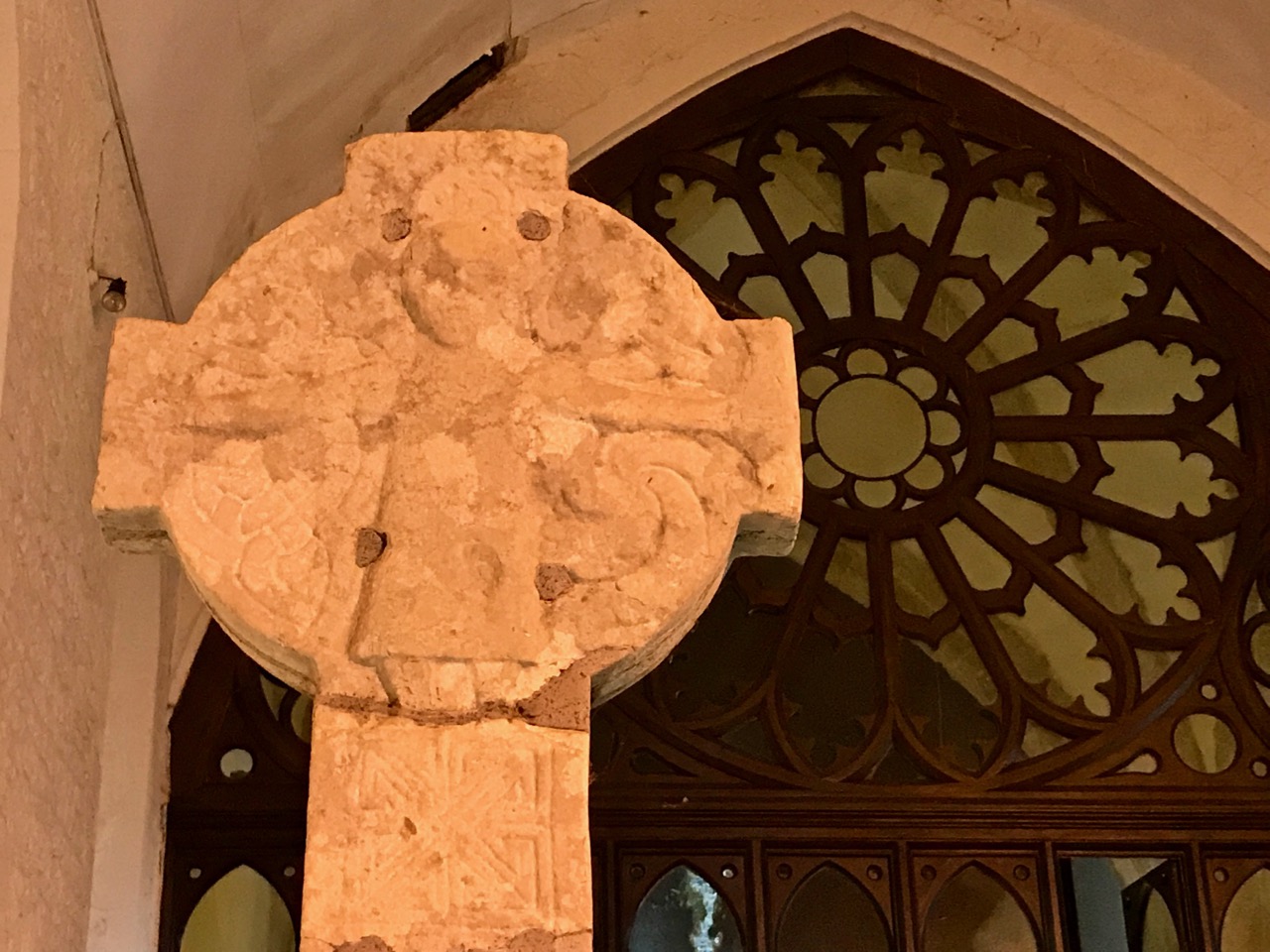
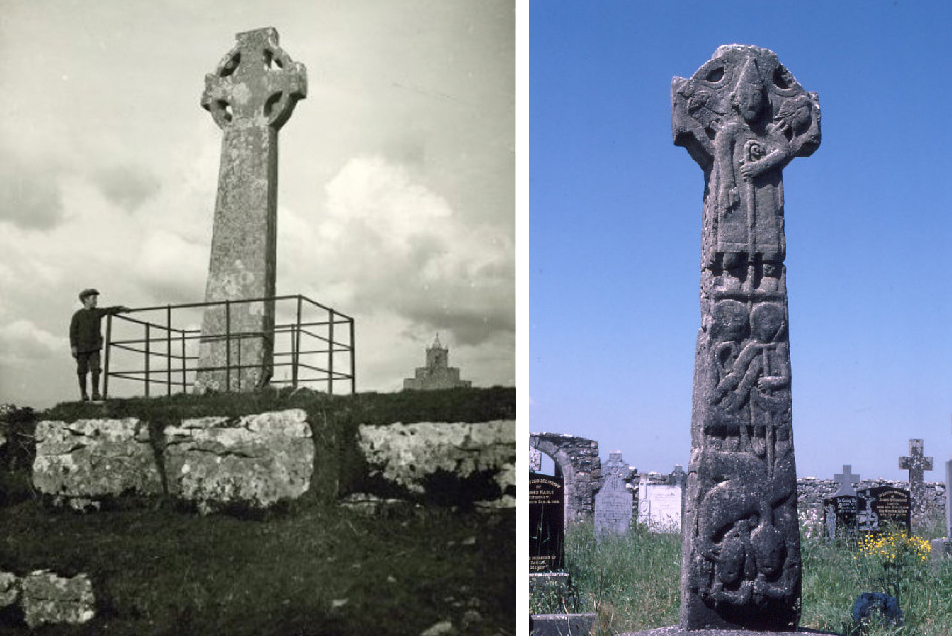
Left – the West Cross (see header picture and below) in 1910, possibly taken by Westropp: it’s still in situ to the west of the Cathedral today – the cathedral building is on the right of this photo. Right – the Doorty Cross standing beside the Doorty grave in 1980.

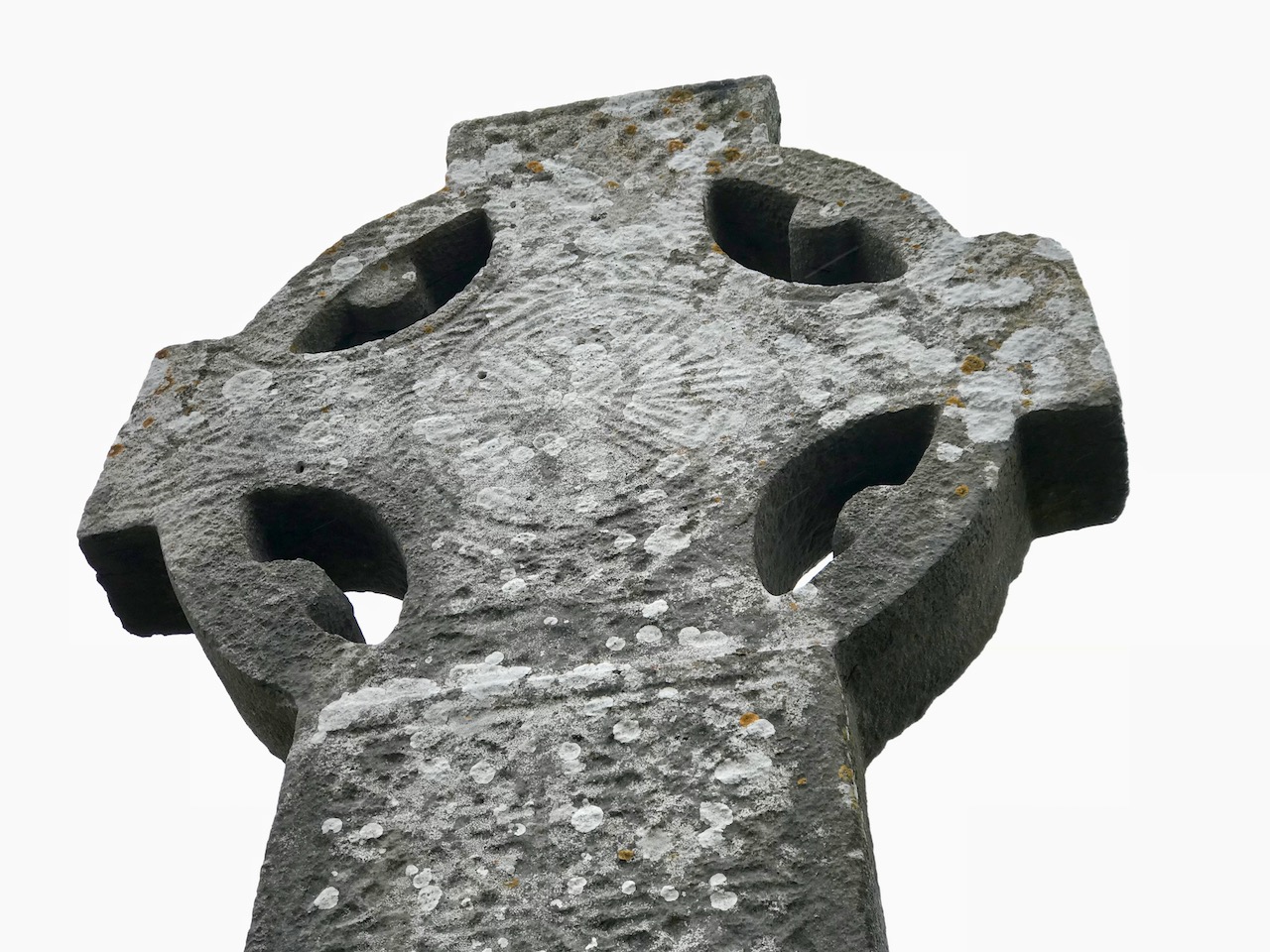
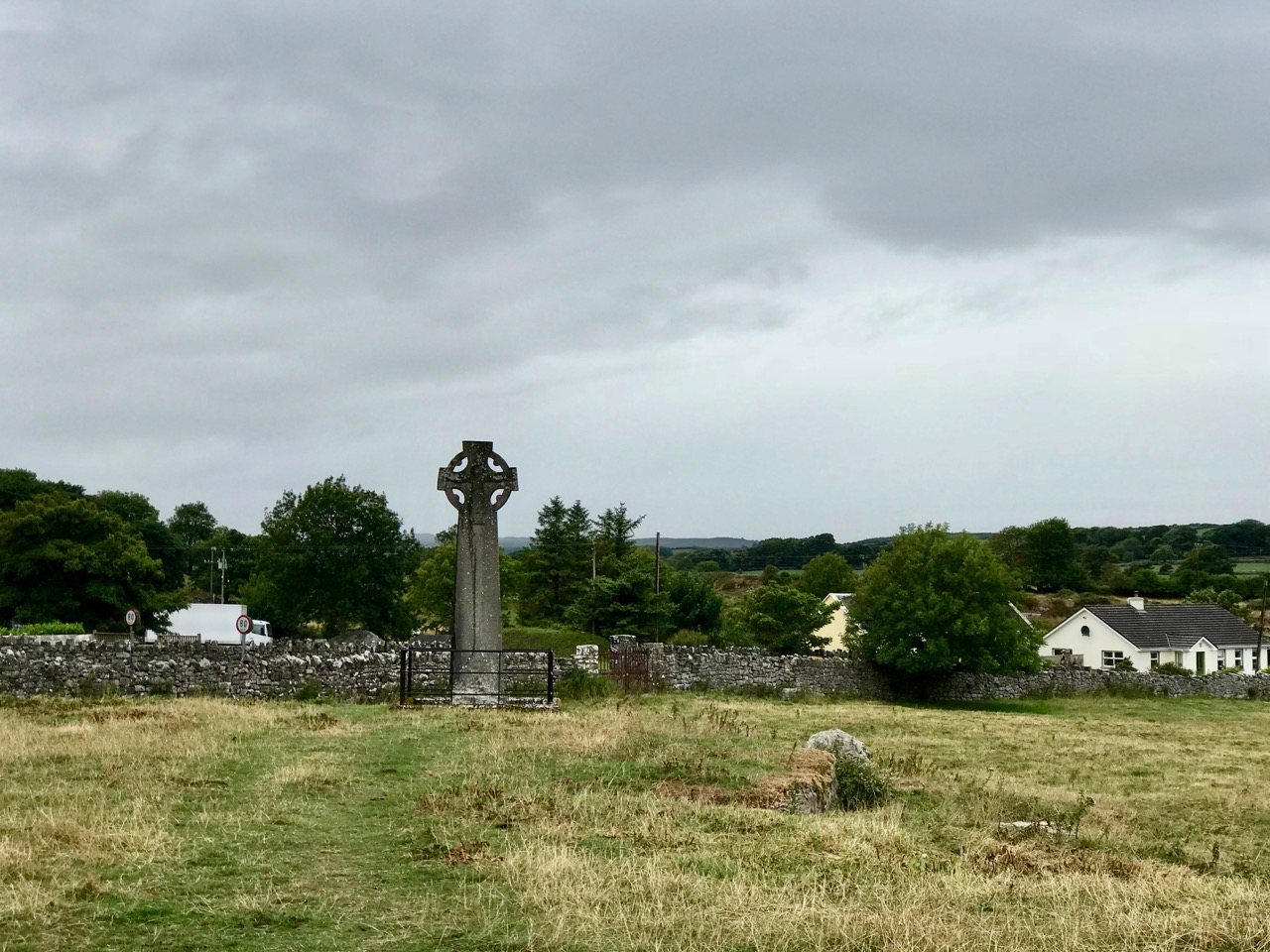
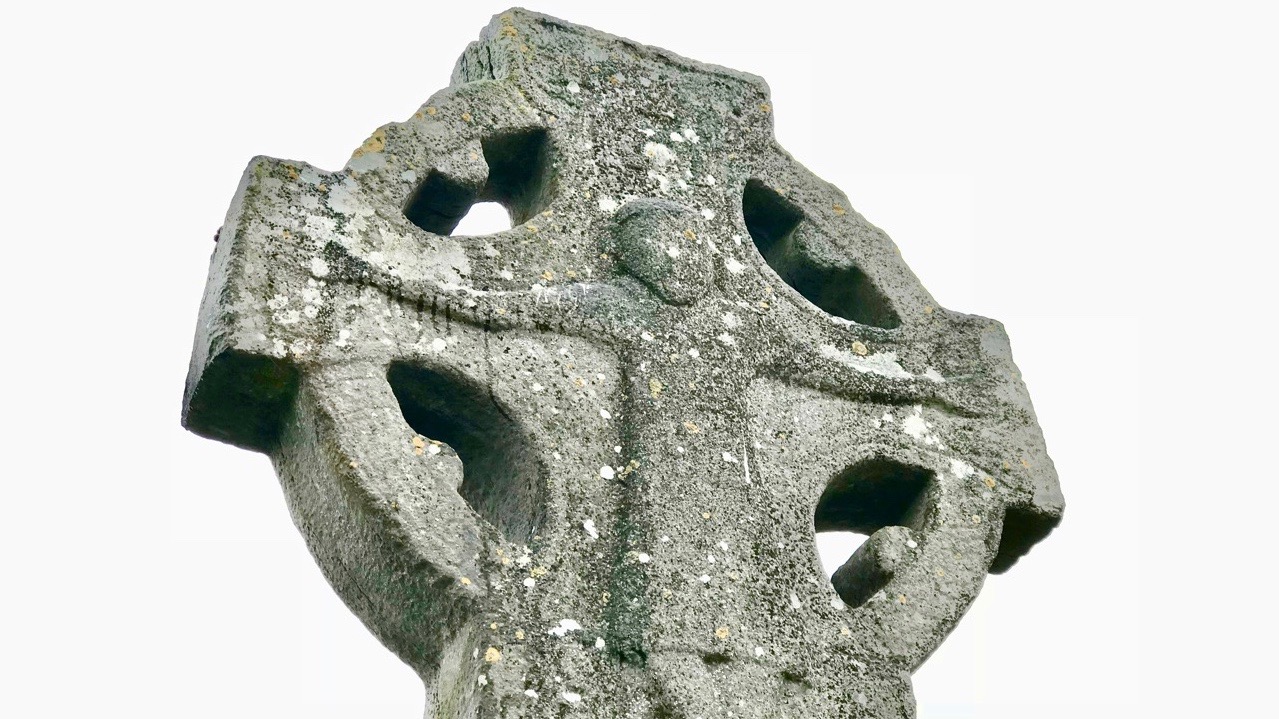
The West Cross at Kilfenora has escaped capture under the glass roof and still stands – probably where it always has – on a prominent knoll to the west of the Cathedral. It’s open to the elements, but seems to be in good condition. In some ways, the protection of these ancient pieces does in some way detract from their magnificence, but there’s no doubt that constant exposure to the weather extremes that we experience here in Ireland must ultimately adversely affect them. It’s a conundrum – and a debate we have touched on before.

Perhaps my own response to these protected High Crosses in Kilfenora is that I feel they are under-appreciated. I saw – at the height of the tourist season – coach-loads of visitors disembark, enter the sheltered enclosure, stand and look at the old stones for a few minutes and then file out. What did it all mean to them? There are interpretation boards but I doubt they get the message across: these are great monuments of the world, to be revered, respected and wondered at: these representations take you back through a thousand years of history: we are fortunate that we can still be in their presence.

Off the M8 – Searching out Péacáin

Once again we followed in the footsteps of our friends Amanda and Peter – she of Holy Wells of Cork and he of Hikelines. They had visited the Glen of Aherlow in County Tipperary and pointed us to St Berrahert’s extraordinary site at Ardane which I described in this post. Not far away is another site, which Amanda reported on fully in her own post, here. It is equally remarkable, and related to St Berrahert’s Kyle in that they were both restored by the Office of Public Works in the 1940s. They are also both very easily accessible in a few minutes from the M8 motorway at Cahir.

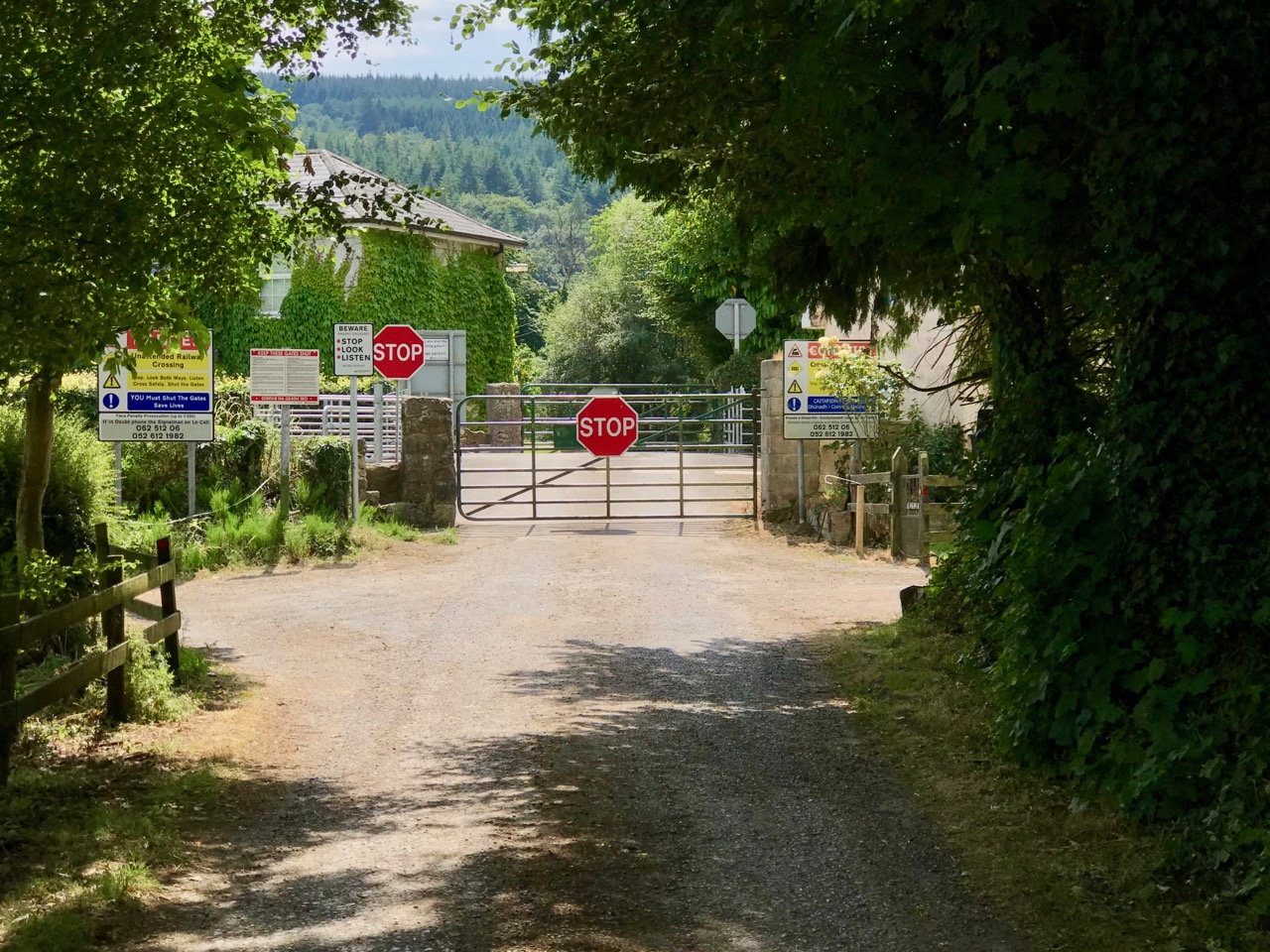
We were delighted to be travelling again through the beautiful Glen in the shadow of the Galtee Mountains (above) as we searched out a boreen that led us down to the railway, as directed by Amanda. We parked and crossed at the gate, watching out carefully as this is the Waterford to Limerick Junction line used by two trains a day (except on Sundays!)

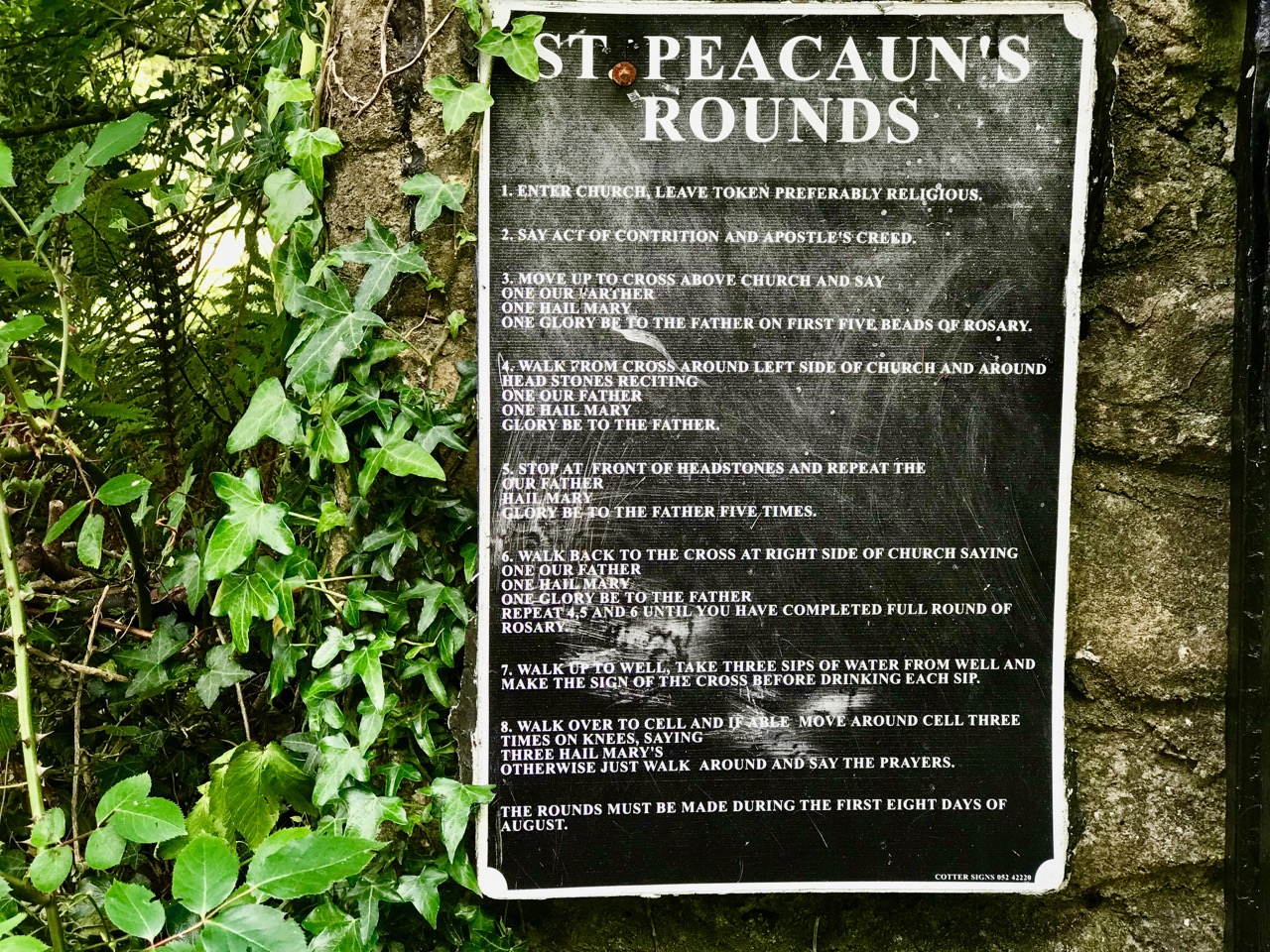
Once across, we were in an idyll. It’s a private lane, running alongside a gentle stream, but the Bourke family allow visitors to walk (as they have done for centuries) to the old church, the cell and the holy well of Saint Péacáin. Ancient stone walls line the way, and trees overhang, shading the dappled sunlight in this most exceptional of Irish seasons. We met Bill Bourke, who regaled us with tales of his life spent mostly far away from this, his birthplace – but who returned to rebuild the family home and to enjoy perpetual summer in what is, for him, the most beautiful setting in the world. He also told us of the crowds who used to come to celebrate St Péacáin at Lughnasa – 1st August – paying the rounds and saying the masses.

In her monumental work (it runs to over 700 pages) The Festival of Lughnasa – Oxford University Press 1962 – Máire MacNeill points out the harvest feast day was such an important ancient celebration that it survives as the focus of veneration of many local saints who would otherwise have been known for their own patron day, and she particularly mentions Tobar Phéacáin in this regard: a place well away from any large settlement where the great agricultural festival was so critical to the cycle of rural life.

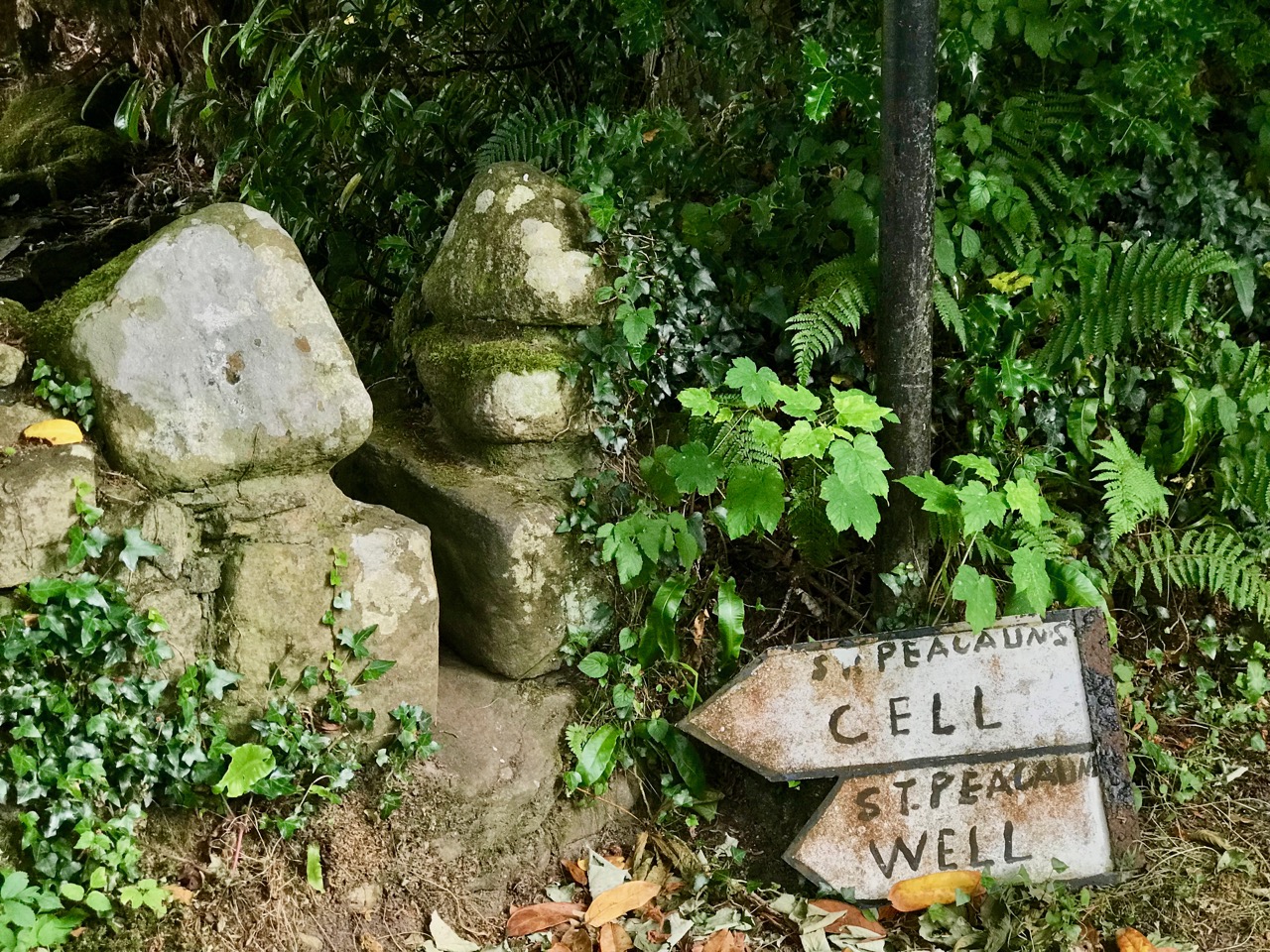
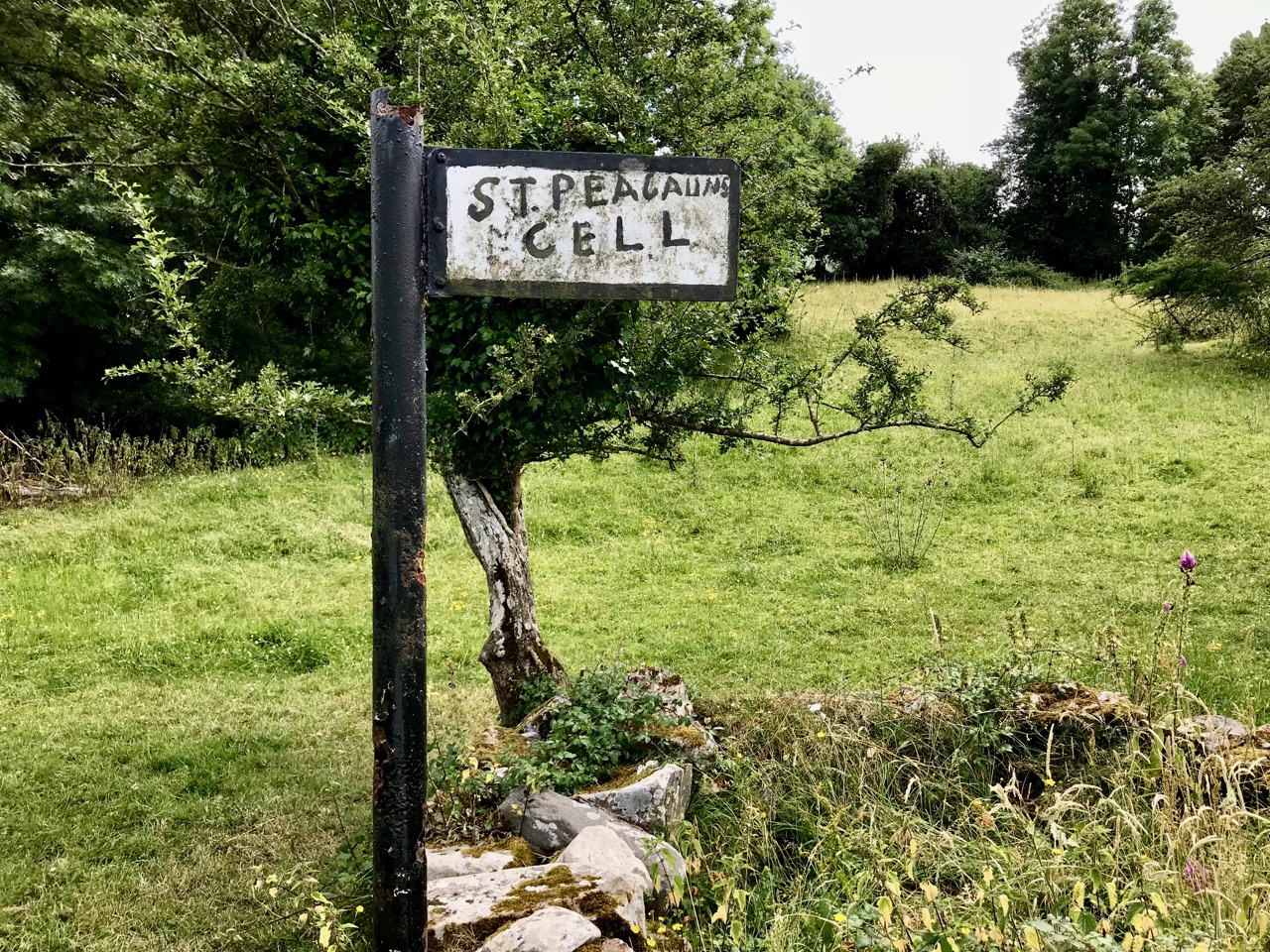
The rural setting of St Péacáin’s Cell can be seen above, just in front of the trees; the church and the well are nearby. MacNeill provides a description of Tobar Phéacáin and includes some variant names:

. . . Tobar Phéacáin (Peakaun’s Well), Glen of Aherlow, Barony of Clanwilliam, Parish of Killardry, Townland of Toureen . . . On the northern slope of the Galtee Mountain at the entrance to the Glen of Aherlow and about three or four miles north-west of Caher there is a well and ruin of a small church. About a mile beyond Kilmoyler Cross Roads a path leads up to it . . . In 1840 O’Keefe, of the Ordnance Survey team, reported that the old church was called by the people Teampuillin Phéacáin, or just Péacán . . .

. . . The well, which he described as lying a few perches south-east of the church was called Peacan’s Well or Tobar Phéacáin. It was surrounded by a circular ring of stonework. He stated: ‘The pattern-day still observed at this place falls on the 1st of August, which day is, or at least until a few years since, has been kept as a strict holiday.’ Devotions were also, he said, performed there on Good Friday . . .

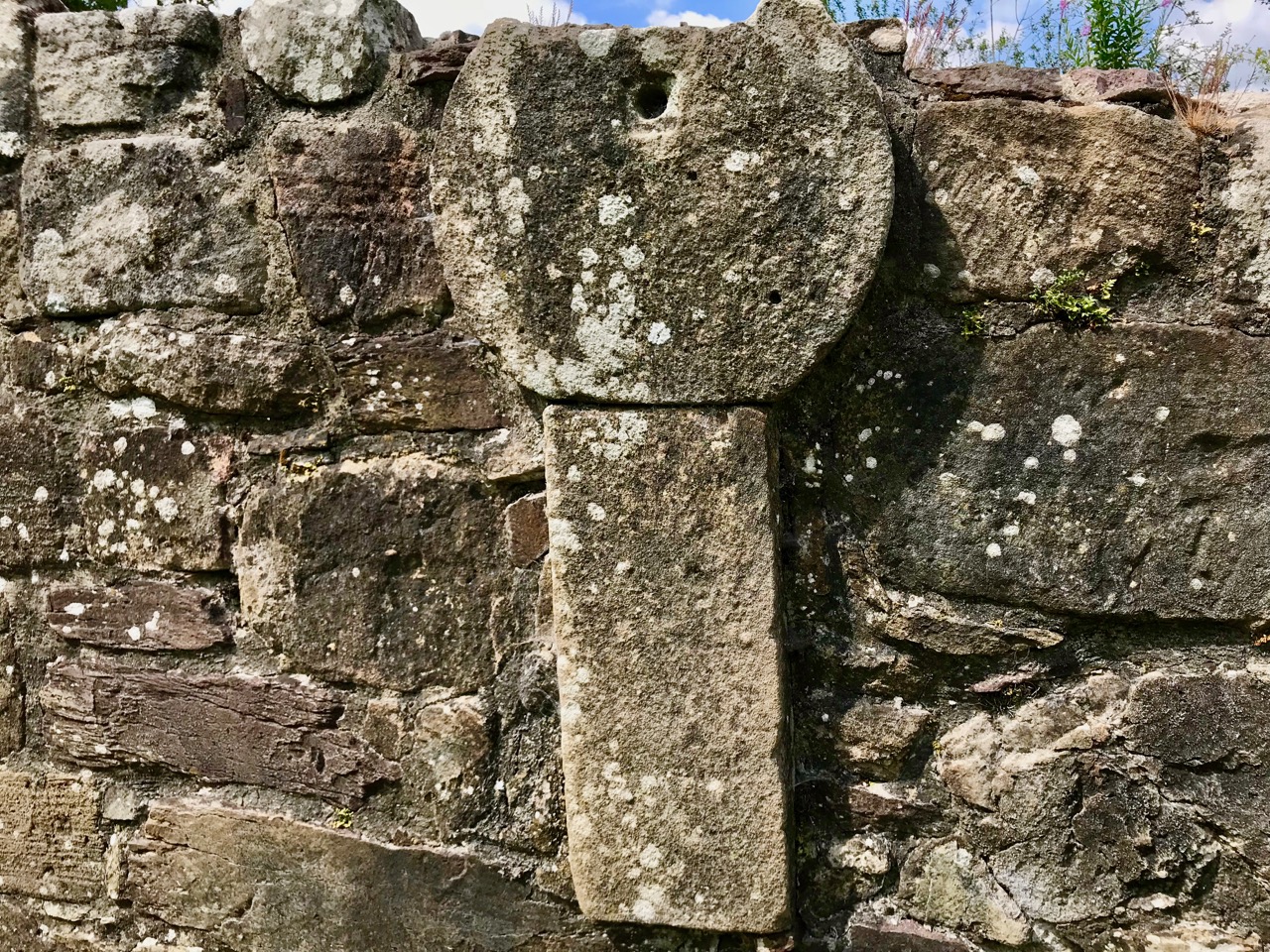
A hundred years after O’Keefe wrote this, the church ruins were tidied up by the Office of Public Works. As at St Berrihert’s Kyle, it seems there were numerous carved slabs on the site and remnants of high crosses, implying a significant ecclesiastical presence here. All these have been fixed in and around the church ruin for safekeeping, and in an intelligent grouping. It’s wonderful to be able to see such treasures in the place they were (presumably) made for, and to experience them in such a remote and peaceful ambience.

McNeill continues:

. . . Nearby is the shaft of a cross which tradition avers was broken in malice by a mason who was then stricken with an inward pain and died suddenly as a punishment for his sacrilege . . . O’Keefe was told a story of a small stone, 6 or 7 inches long and 4 or 5 in depth, having ten little hollows in it and resting in a hollow of the ‘altar’ of the old church. Christ, or according to others St Péacán, asked a woman, who had been churning, for some butter; she denied having any and when the visitor departed she found the butter had turned into stone which retained the impression of her fingers . . . Nuttall-Smith speaks also of a cave where the saint used to practice austerities . . .

The carved fragments are quite remarkable and are in all likelihood well over a thousand years old. I have yet to see anywhere in Ireland – outside of museums – which has such an extensive collection of fascinating medieval antiquities as these sites in the Glen of Aherlow. Here you can also see cross slabs and a sundial said to date from the eighth century.

Nuttall-Smith’s ‘cave’ – quoted by MacNeill above – is likely to be St Péacáin’s Cell, set in a field on the far side of the river. This was probably a clochán, or beehive-hut, of the type once used by anchorites. It is protected by a whitethorn tree, but was quite heavily overgrown on the day of our visit. We could make out the ballaun stones inside, said to be the knee prints of the Saint who made his constant devotions there. Amanda – in her post on the holy well – reports that Péacáin would also stand daily with arms outstretched against a stone cross, chanting the psalter.

McNeill discusses the significance of weather at the August celebrations:

. . . Paradoxically for a day of outing so fondly remembered, no tradition of the Lughnasa festival is stronger than that which says that it is nearly always rainy. No doubt this has been only too often experienced. Saint Patrick’s words to the Dési: ‘Bid frossaig far ndála co bráth’ (Your meetings shall always be showery) must be as well proved a prophecy as was ever made. Still there must be more significance in the weather beliefs than dampened observation. Certainly it was expected that rain should fall on that day, and sayings vary as to whether that was a good or bad sign . . . There are a few interesting beliefs about thunder, which was also expected on that day: the loud noise heard at Tristia when the woman made rounds there to have her jealous husband’s affection restored; the prophecy that no-one would be injured by lightning at Doonfeeny, a promise also made by St Péacán . . .

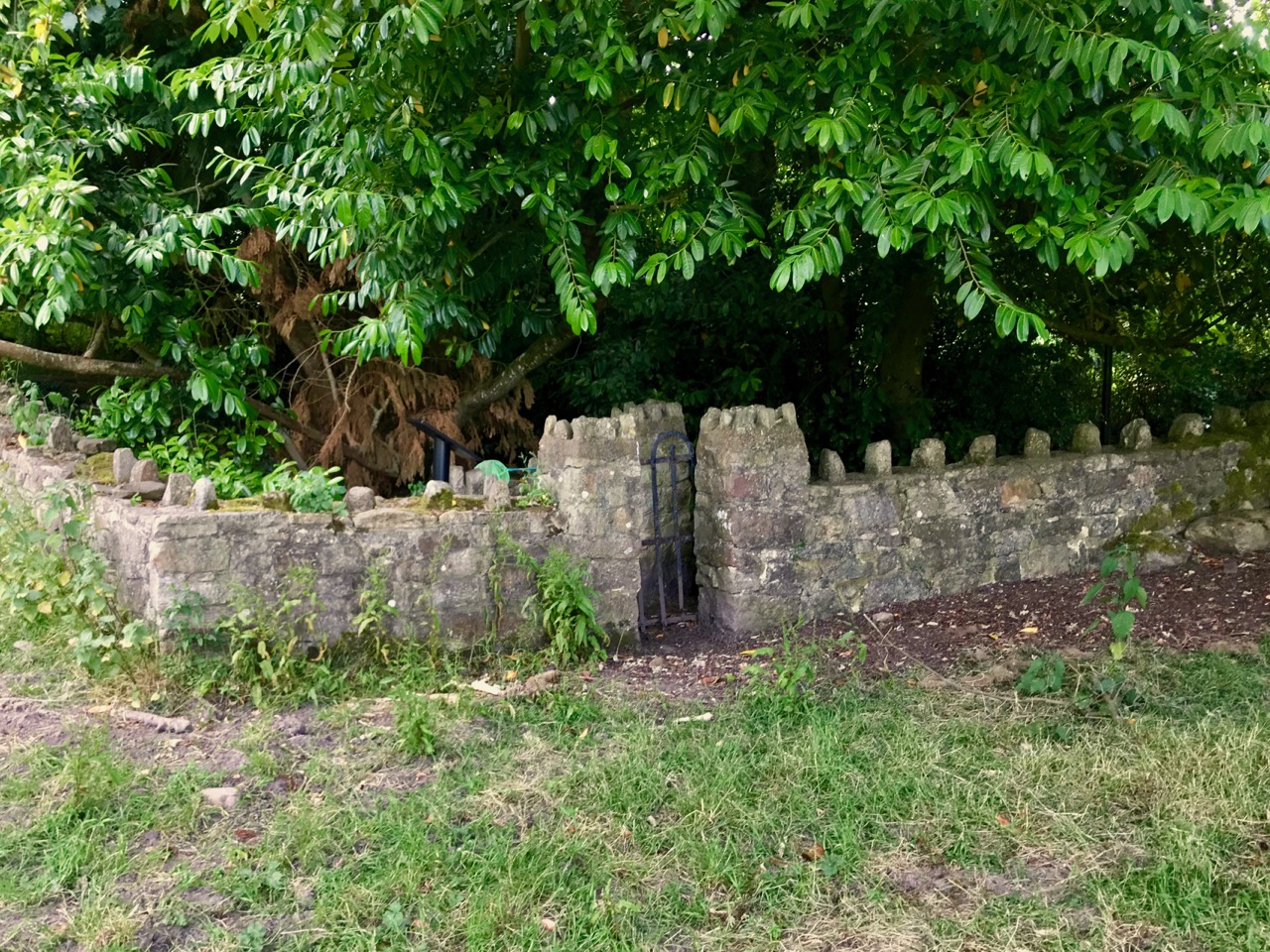
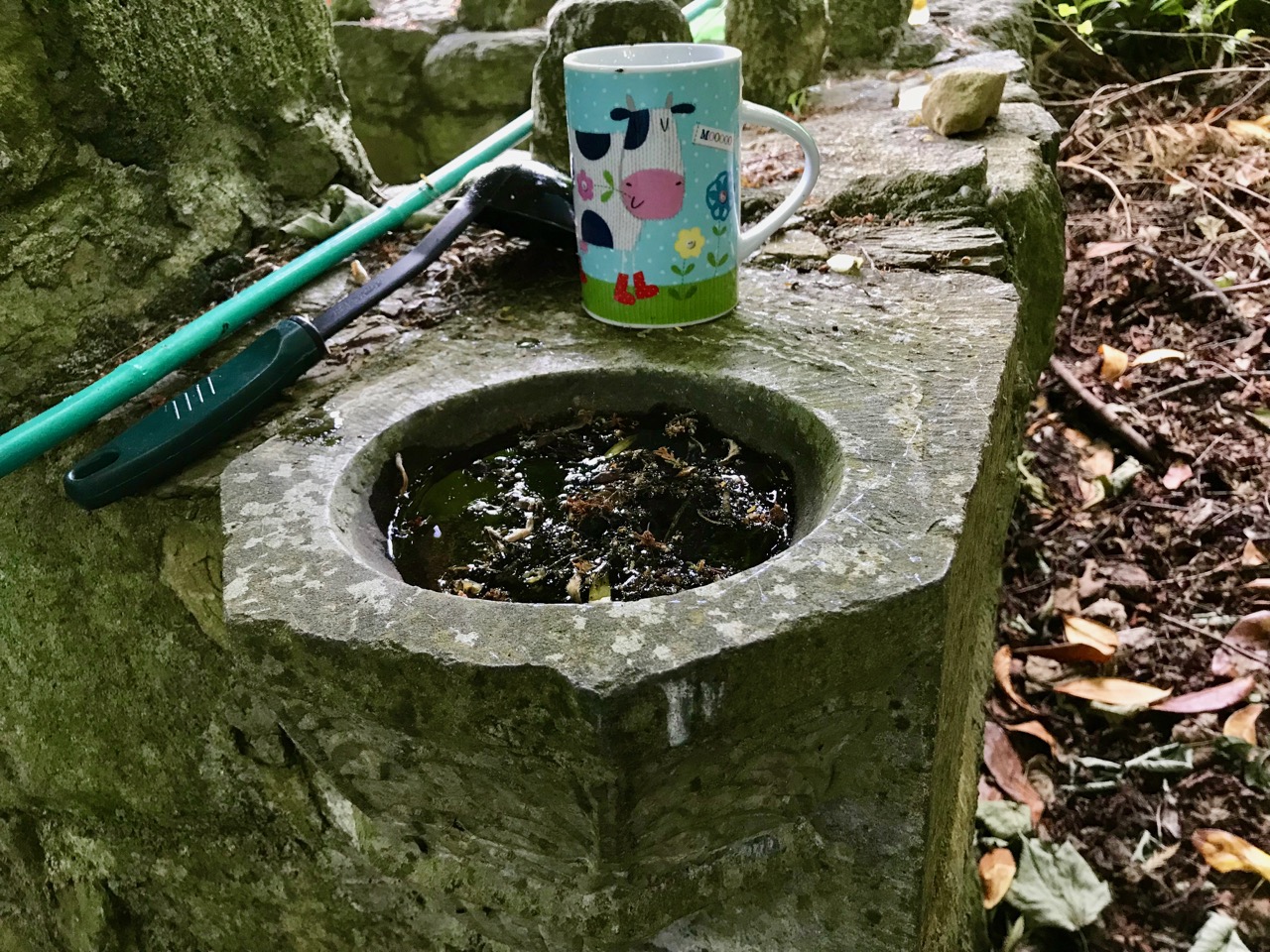
The holy well is tucked away in a stone-walled enclosure hidden under the trees on the edge of the field which contains the Saint’s cell. It’s also a tranquil place, obviously still much visited: the water is crystal clear, refreshing and will ensure protection from burns and drowning.  This is a magical setting to complete the day’s travels in the beautiful Glen of Aherlow.

A Visit to Knock

Our travels have taken us to quite a few Christian pilgrimage sites in Ireland: they are all fascinating, and range from St Patrick’s holy mountain  – Croagh Patrick (where snakes were cast out of this country forever) – through the rather daunting Station Island on Lough Derg (where a medieval pilgrim entered, and returned from, Purgatory) to the more ‘unofficial’ shrine at Ballinspittle, here in West Cork, where a statue of the Virgin was seen to move (by hundreds of onlookers) in 1985. Recently we found ourselves in Mayo, so a trip to Ireland’s most impressive shrine – at Knock – was essential.

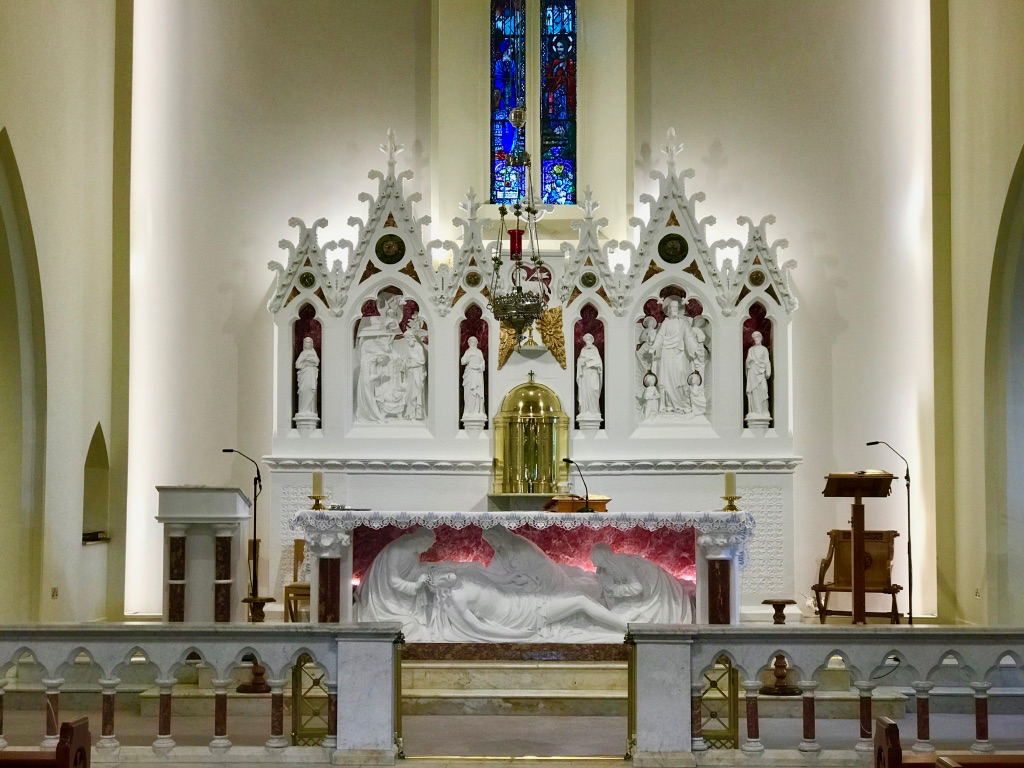
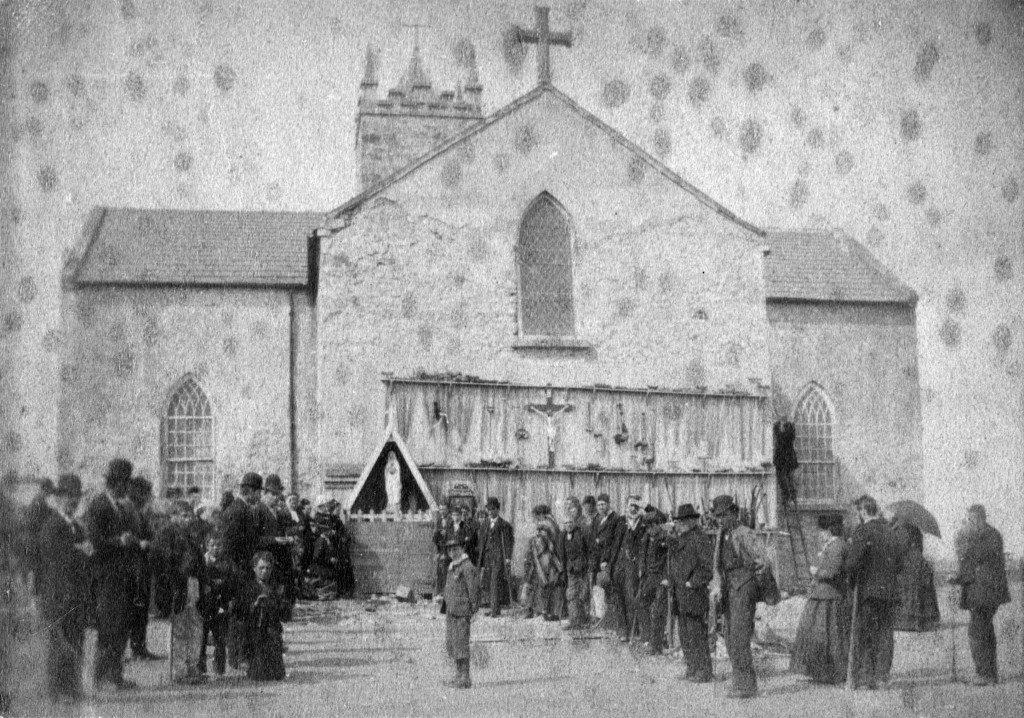
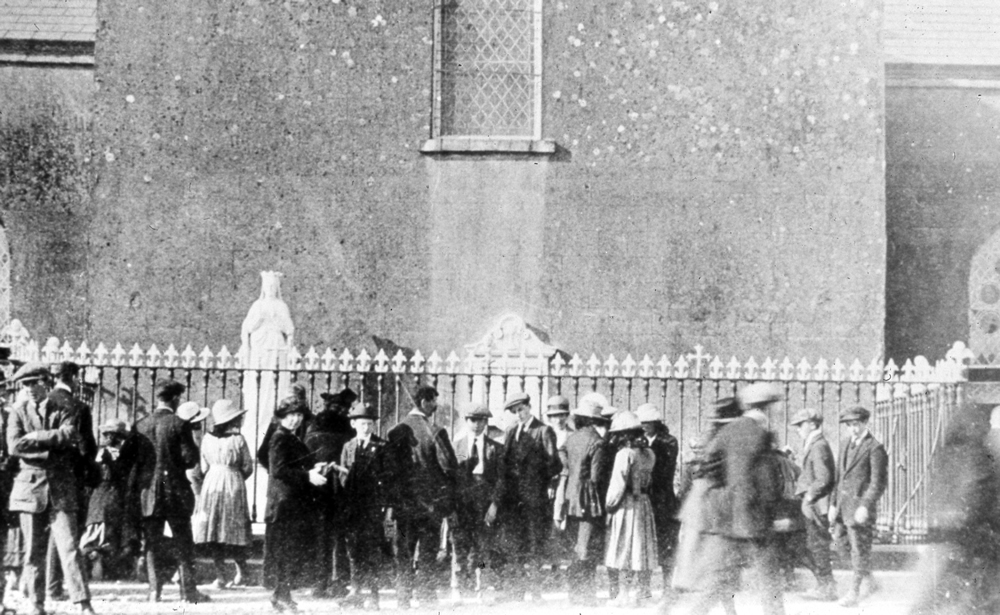
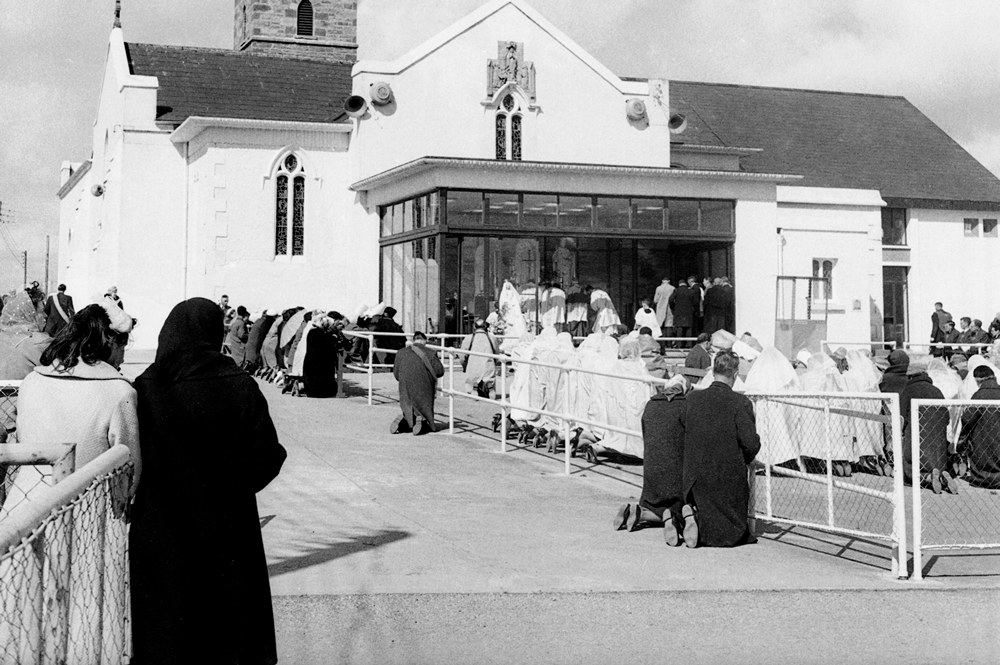
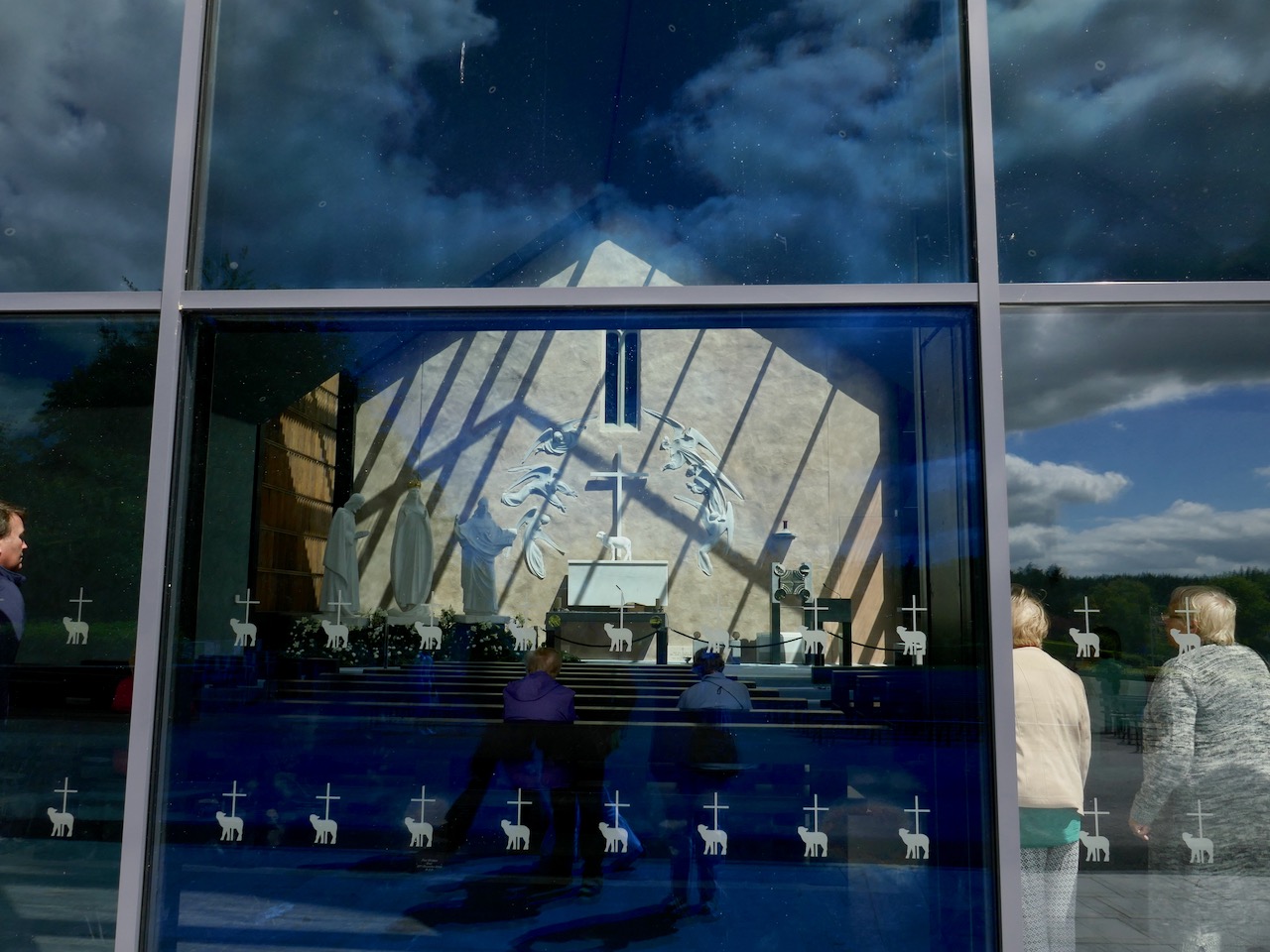
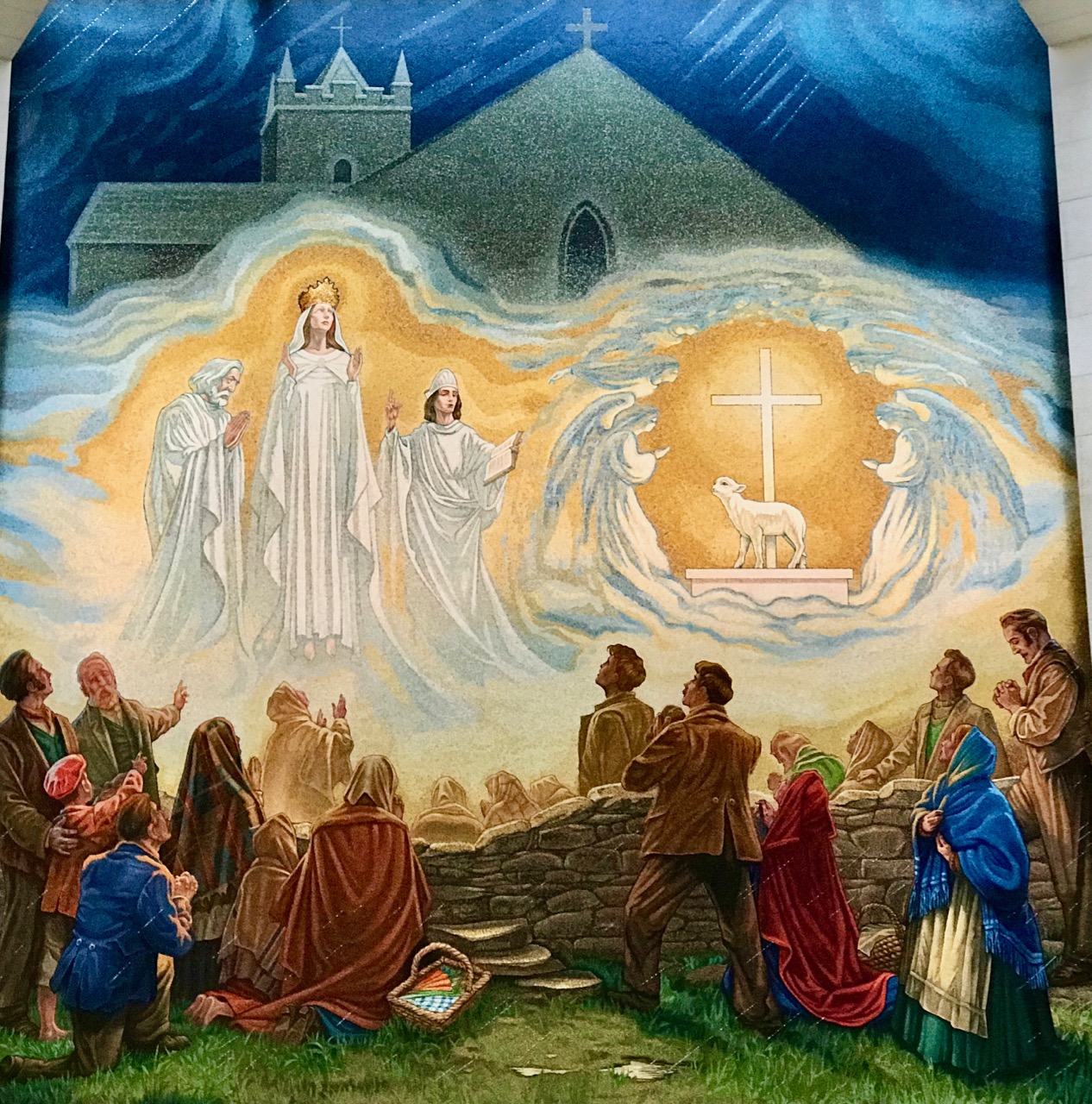
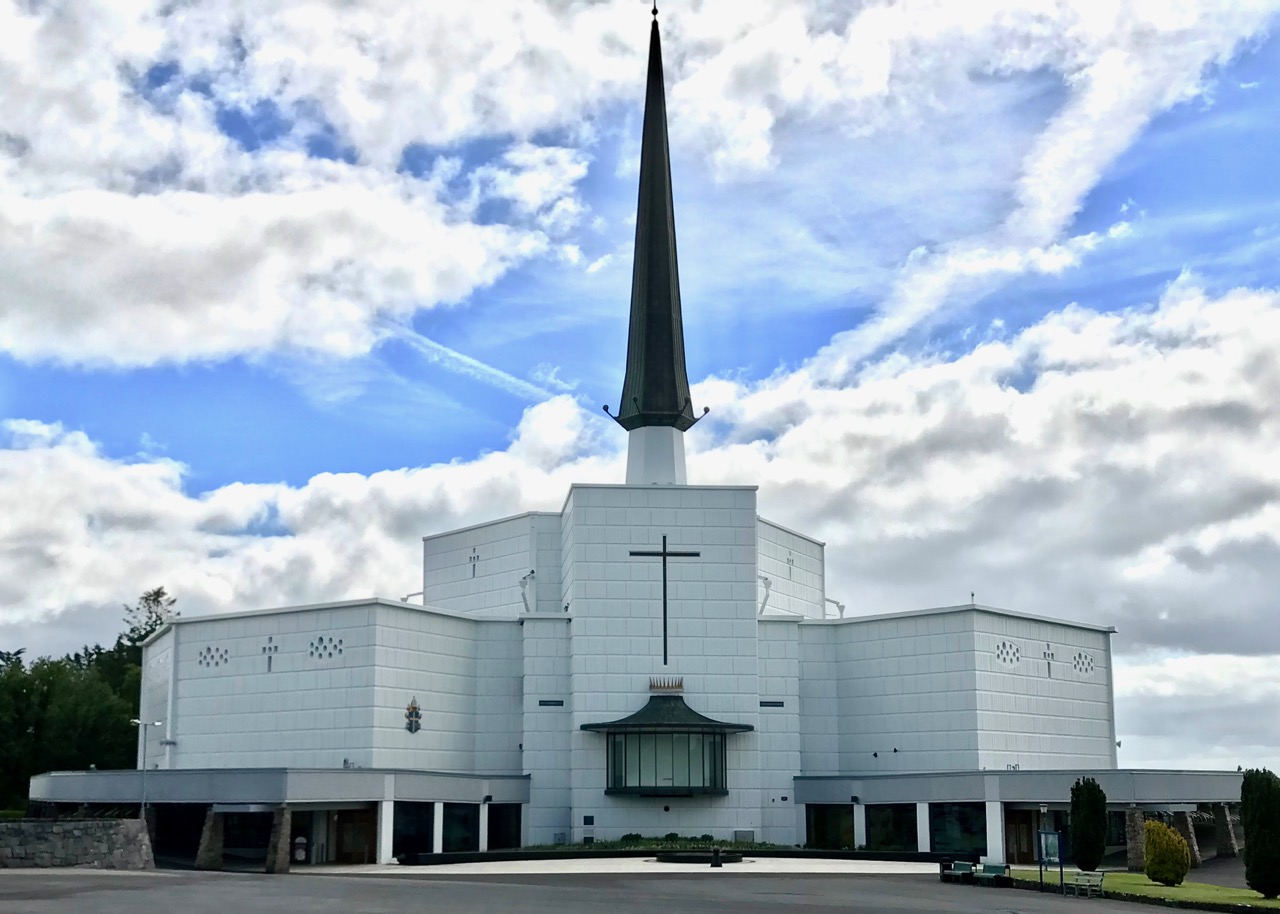
These illustrations show the evolution of the shrine. At the header is the updated interior of the Parish Church of Knock-Aghamore today, showing the beautiful high altar which was made by P J Scannell of Cork and which was presented as a gift during a pilgrimage in 1880. Behind this east wall is the gable where, on 1st August 1879, fifteen local people witnessed an apparition of Mary, Joseph, St John the Evangelist, and a lamb on an altar which seemed to float, stationary and silent, in front of the wall. It was 8pm and the rain was pouring down, yet the gable wall and the ground in front of it remained dry. The vision – which was also seen by others – seemed to last for about two hours. The upper picture above, which probably dates from around 1880, shows the gable and in front of it a rack of crutches and other paraphernalia apparently left by those cured at the shrine. The very first recorded cure, which happened soon after the vision, was of Delia Gordon, a young girl from nearby Claremorris, who was instantly cured of an acute ear infection and deafness after her mother scraped a little of the plaster off the gable wall and placed it into her ear. You can see in the upper picture where considerable amounts of the plaster appear to have been removed (presumably, following that first cure); by the 1930s (second picture) an iron fence had been erected to protect the wall. In 1963 (third picture), a dedicated chapel had been built in front of the gable, and today (fourth picture) a modern Apparition Chapel is in place to contain the large number of pilgrims who attend mass there on a daily basis. You can also see the elegant sculptures which have been installed on the wall to represent the figures of the apparition.

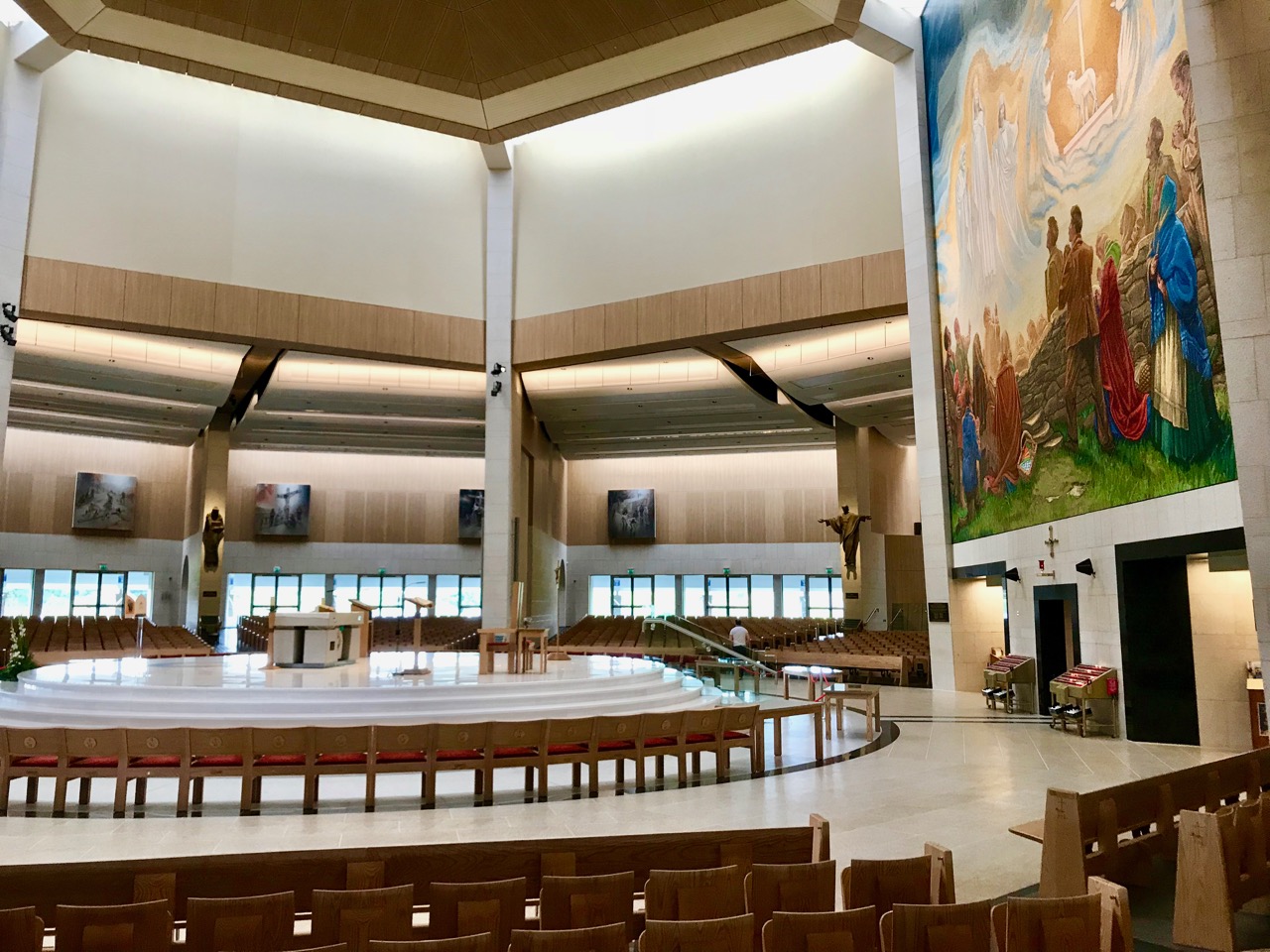
The vision is superbly depicted in this enormous mosaic which has recently been installed in the Basilica at Knock. P J Lynch, the artist who designed the mosaic, said he . . . tried hard to capture the sense of the wonder that the witnesses must have felt on that wet August evening back in 1879 . . . The mosaic measures 14 metres square and is one of the largest single flat pieces of religious mosaic of its kind in Europe: it is made predominantly from Venetian glass smalti and there are approximately 1.5 million individual pieces of mosaic in the complete work.

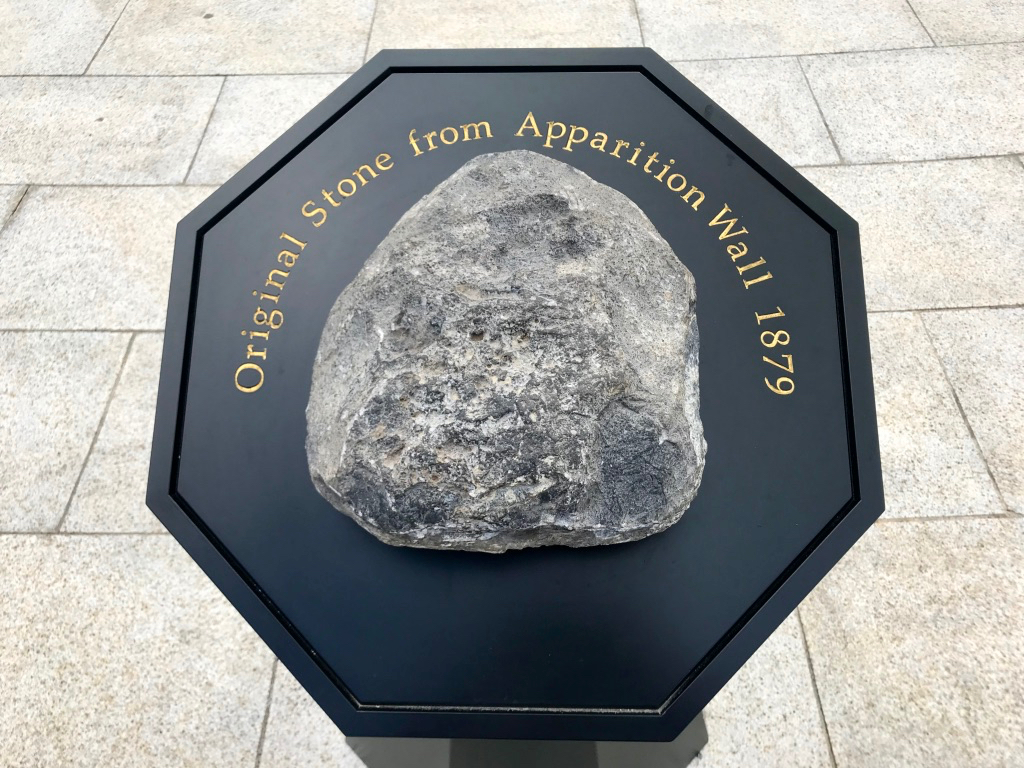
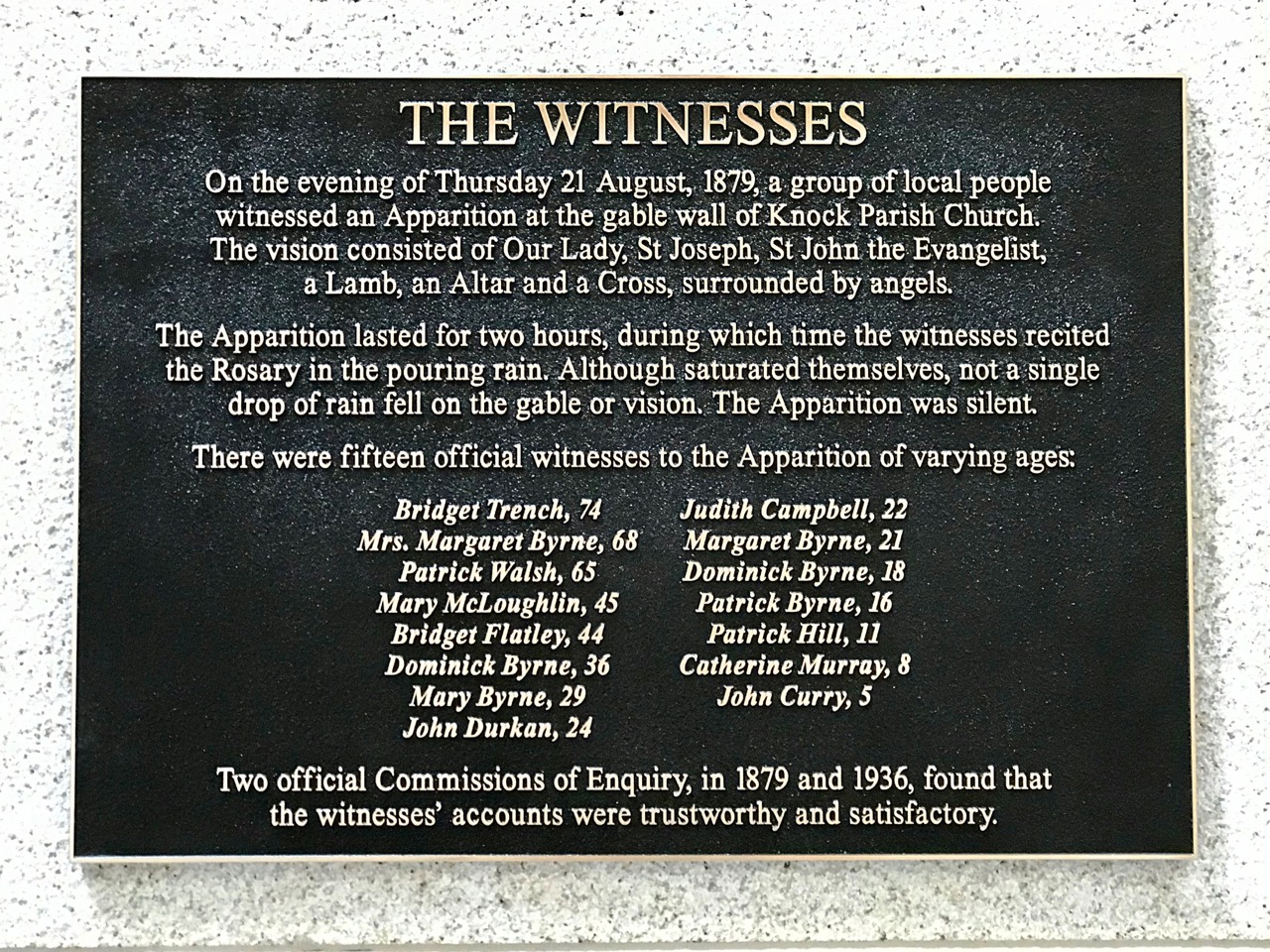
This is original stonework from the gable wall to the Parish Church: the lower picture is a panel built in to the modern Apparition Chapel wall. The statements made by the 15 witnesses who saw the vision at the wall in 1879 are fully documented here – an official Commission of Enquiry was held by the Catholic Church in that same year and concluded . . . the words of the witnesses were trustworthy and satisfactory . . . a further investigation in 1936 interviewed the then surviving witnesses, who corroborated what they had seen. Mary Byrne, who was 29 at the time of the apparition and 86 during the second enquiry said . . . I am clear about everything I have said and I make this statement knowing I am going before my God . . . She died shortly afterwards. John Curry, the youngest witness, was 5 in 1879. The child said . . . he saw images, beautiful images, the Blessed Virgin and St Joseph. He could state no more than that he saw the fine images and the light, and heard the people talk of them, and stood upon the wall to see them . . . He confirmed his memories when interviewed in new York for the 1936 enquiry.

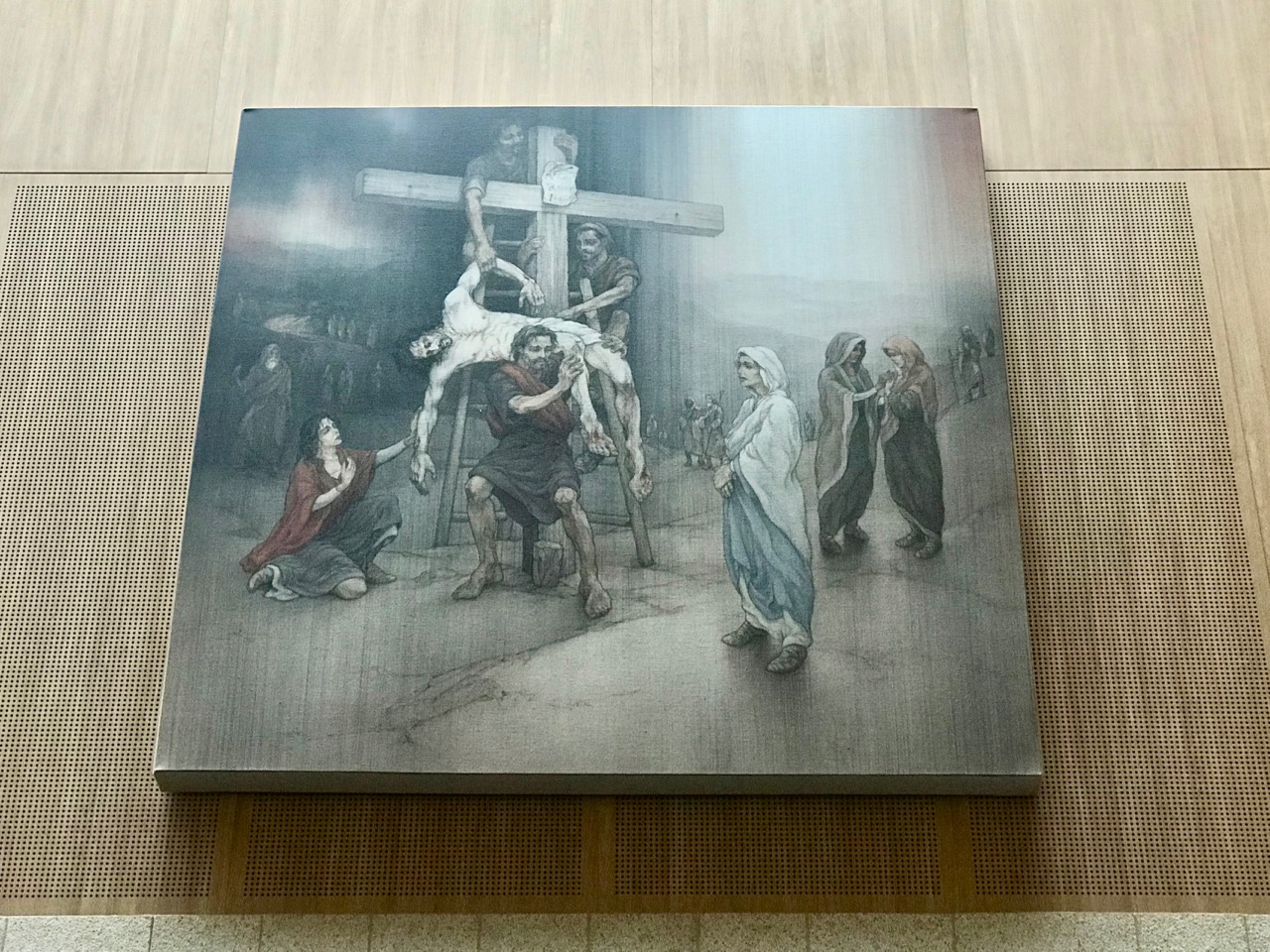
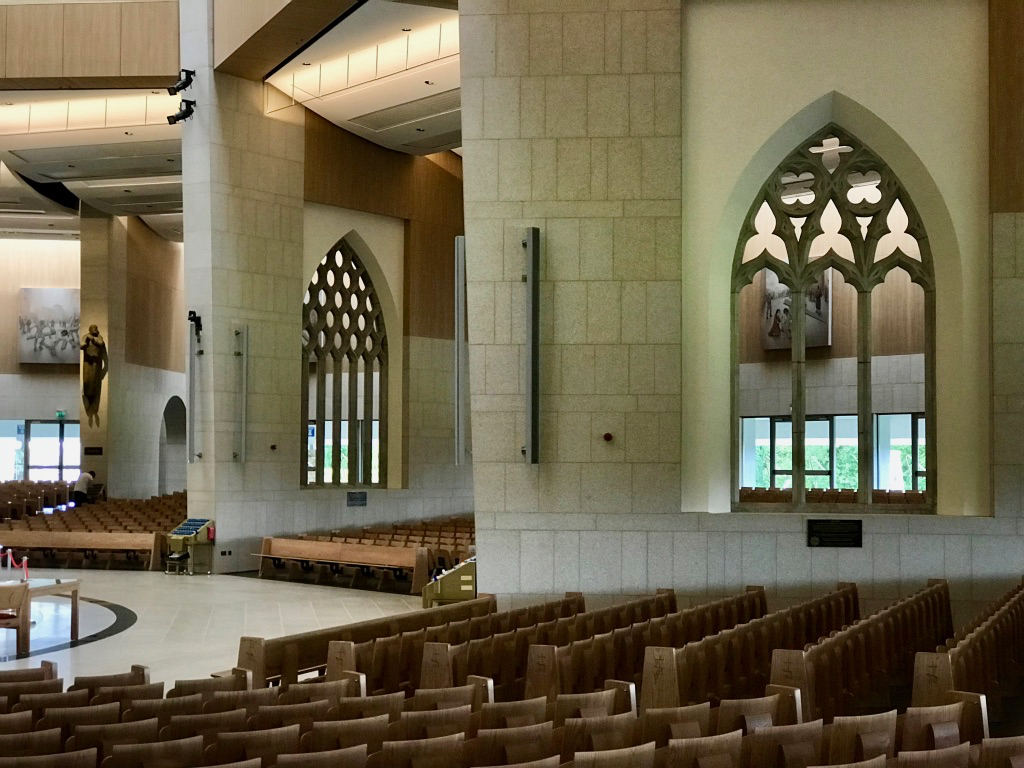
Over a million people a year come to Knock, in search of faith, enlightenment, cures perhaps: or just out of curiosity. It is a place with a great sense of purpose – and long may it continue. As a (now retired) church architect I was distinctly struck by the enormous Basilica which was constructed initially in the 1970s and which has been refurbished very recently. It is spectacular in its size and scale and is fittingly  furnished with powerful works of art. In particular I was impressed by the large, harrowing, painted Stations of the Cross, the work of Mayo artist, Ger Sweeney.

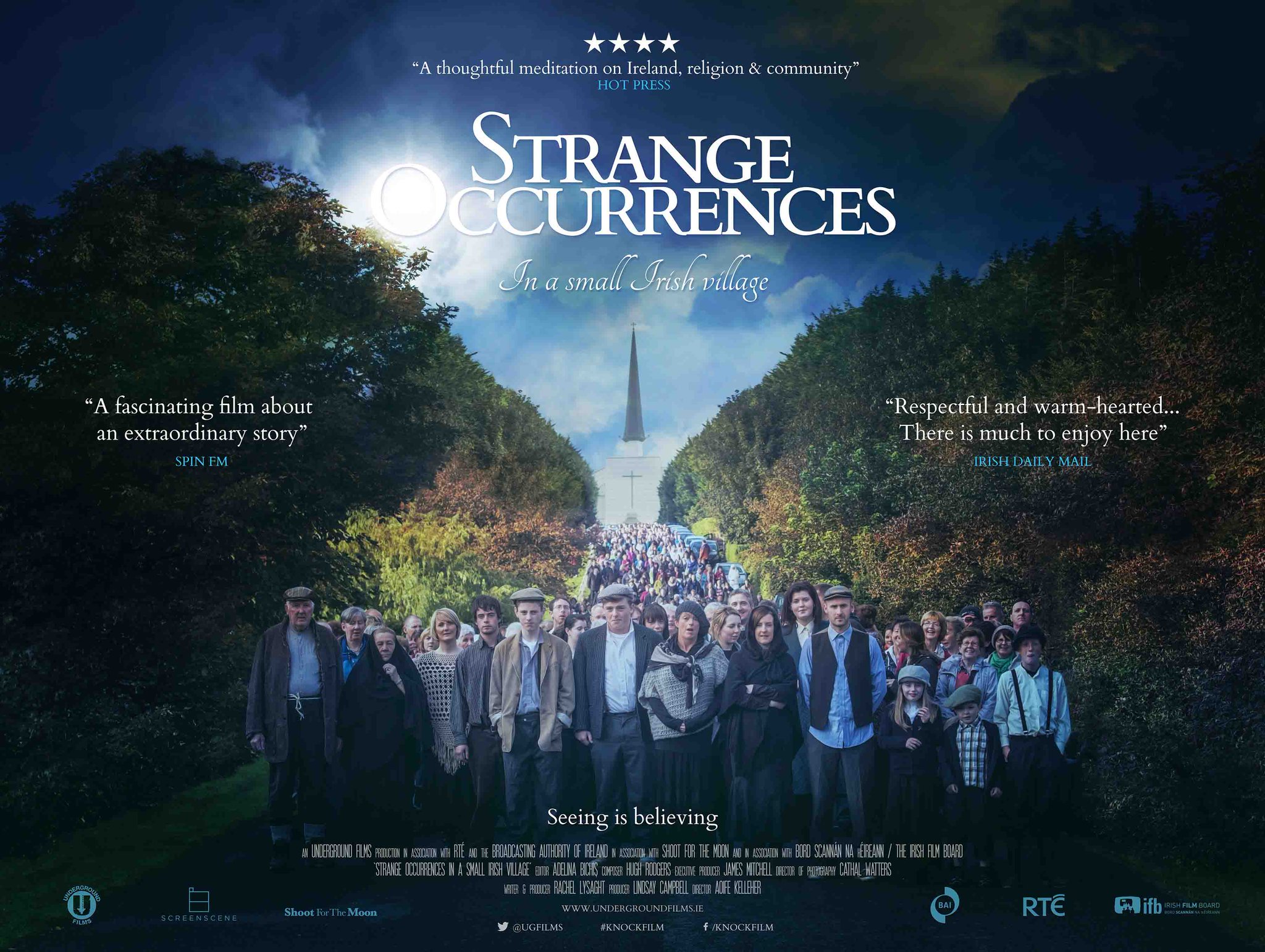
If you have a spare couple of hours it’s worth finding and watching this entertaining and fair-minded documentary about Knock, made by RTÉ in 2016:

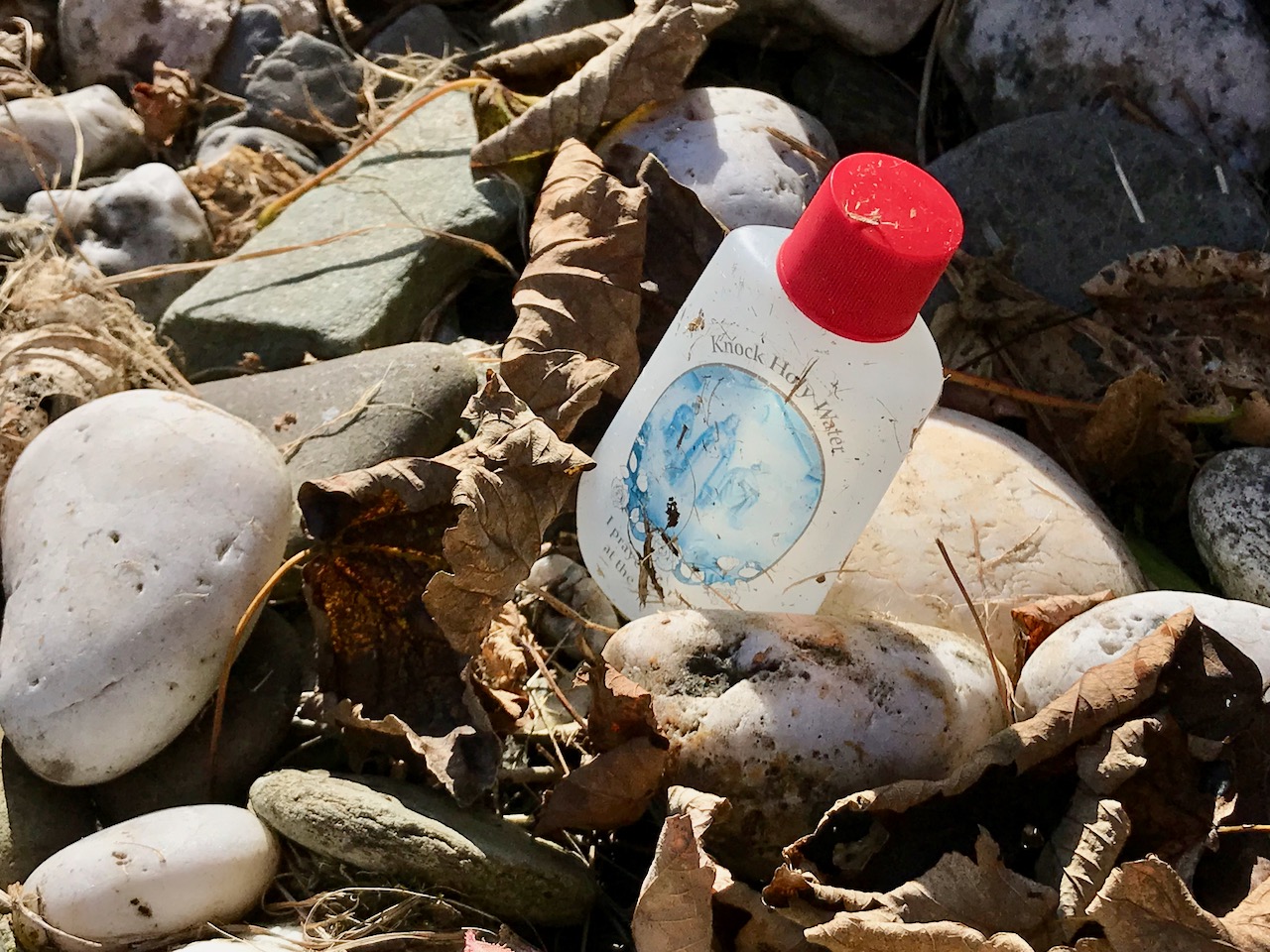
I make no judgments as to the veracity or otherwise of what was witnessed on that day in 1879. There have been many theories put forward, ranging from magic lanterns to unrest provoked by the Land Acts! But why should we doubt the faith of anyone, whatever their religion? The Christian story is all about miracles, so surely miracles are just as possible in the 19th century as they were in the 1st… The village of Knock carries on its normal life around all the trappings of the shrine: shops selling statues and Holy Water bottles abound, and add to the colour. On the site you can look out the well-curated museum, and treat yourself to good refreshments. It’s all worth visiting, even if your interest is purely anthropological. The Pope himself will be there this August and all the 45,000 (free) tickets have been booked. If the sun keeps on shining – and perhaps it will – it’ll be a grand day for all!

Off the M8 – A Secret in The Glen of Aherlow

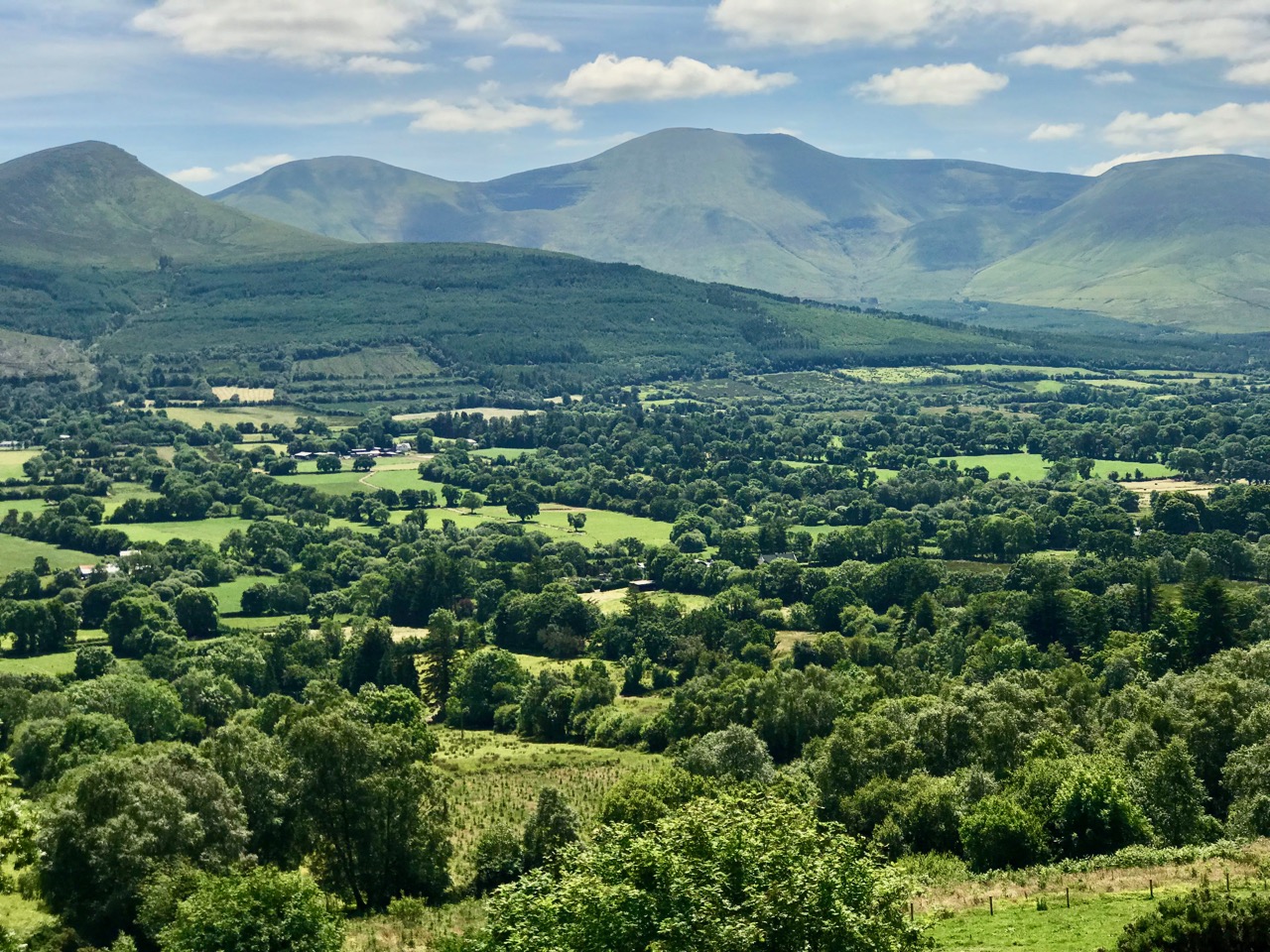
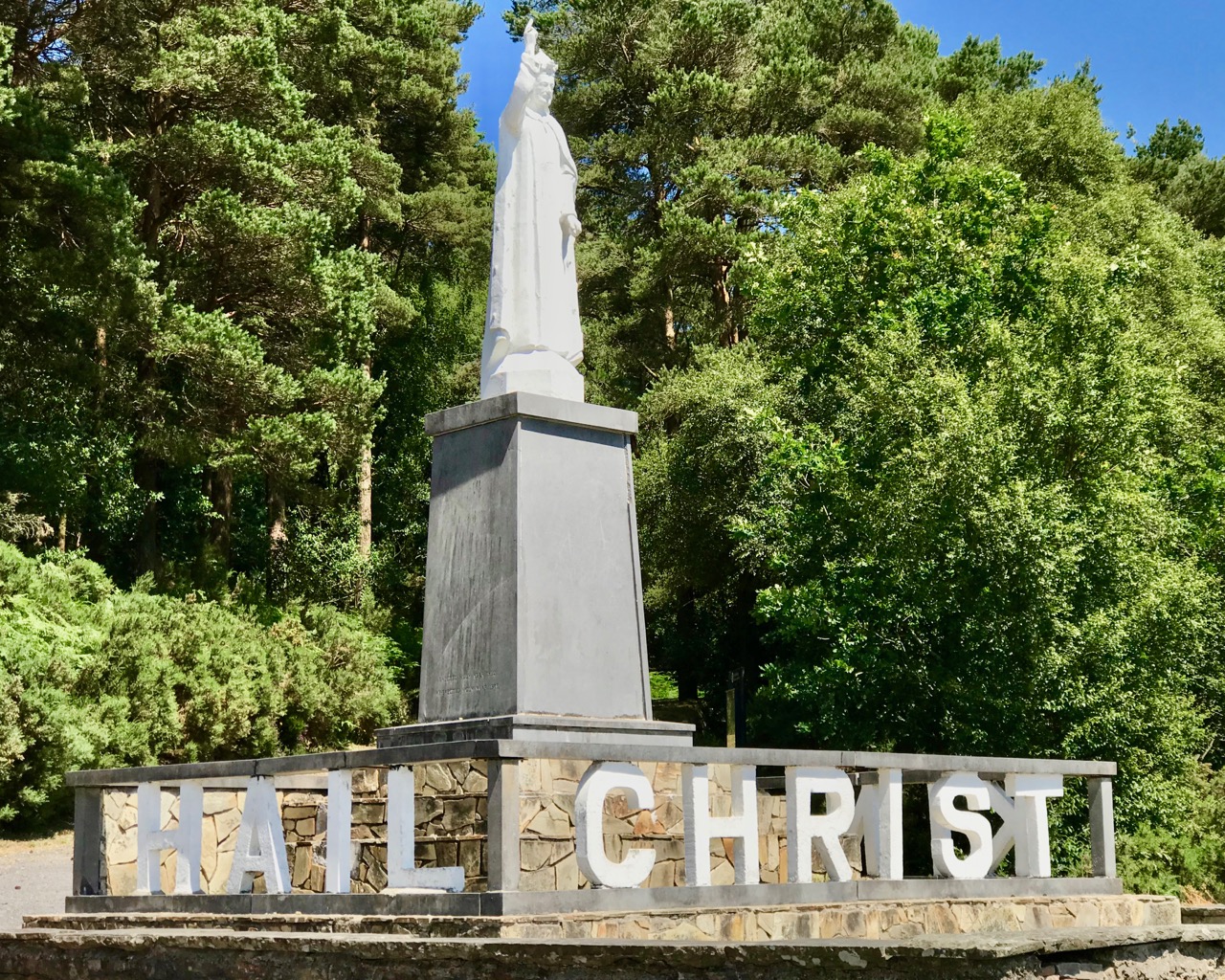
The Glen of Aherlow, County Tipperary: I had never heard of it. However, as you can see from the view, above, the place deserves to be explored: it’s about 20 minutes from junctions 10 and 11 near Cahir. That’s not too much of a diversion. From the spot where this photo was taken – on our travels this week – you can look out across to the Galtee Mountains, a prospect enjoyed for eternity by this imposing statue of Christ the King, whose hand is raised . . . in blessing the Glen, its people and all those who pass by . . . The statue was originally placed here by volunteers in the Holy year of 1950, and recreated in 1975. It has become the symbol of the Glen.

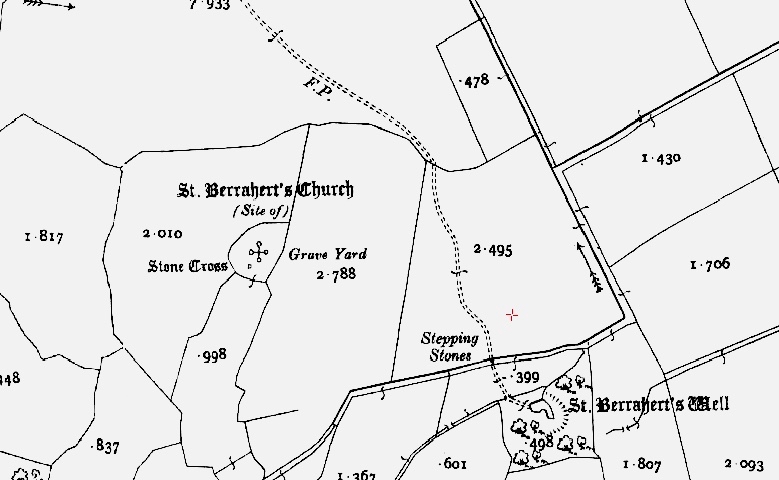
We were passing on our way to search out a secret which the Glen holds: somewhere in the townland of Ardane, we knew that there is a very ancient site where treasures have been hidden away for centuries. The first edition of the Ordnance Survey map has it marked:

I was intrigued, because a ‘Stone Cross’ indicated in this way often implies a High Cross, and a monastic settlement, so I was anxious to investigate. You will remember previous posts I have written on the many magnificent examples of these medieval treasures which Ireland holds. We had been alerted to this site by our friends Amanda and Peter, who have recently visited, and Amanda has given a comprehensive account of St Berrahert’s Well (also shown on the map) in Holy Wells of Cork. Like Amanda, I am unsure if there is a ‘correct’ spelling of St Berrahert: he is also known as Berrihert, Berehert, Bernihardt, Bericheart, and Bernard! Not a lot is known about him, other than that he came to the Glen after the Synod of Whitby in AD 664 and died on 6 December 839 – one of the saints who, like St Ciarán . . . the first Saint of Ireland . . . had a remarkably long life and who has left his name behind in the heart of Tipperary.

The place is generally known as St Berrahert’s Kyle (from the Irish word cill, ‘church’). It’s hard to find. We enlisted the help of Jimmy Martin, a local resident, who regaled us most entertainingly – and at great length – about hooded monks, crows and strange characters he had personally encountered at the site, and cures which he had witnessed at the well. Following his instructions we crossed fields, passed somnolent cows, and saw before us the remarkable ‘Kyle’.

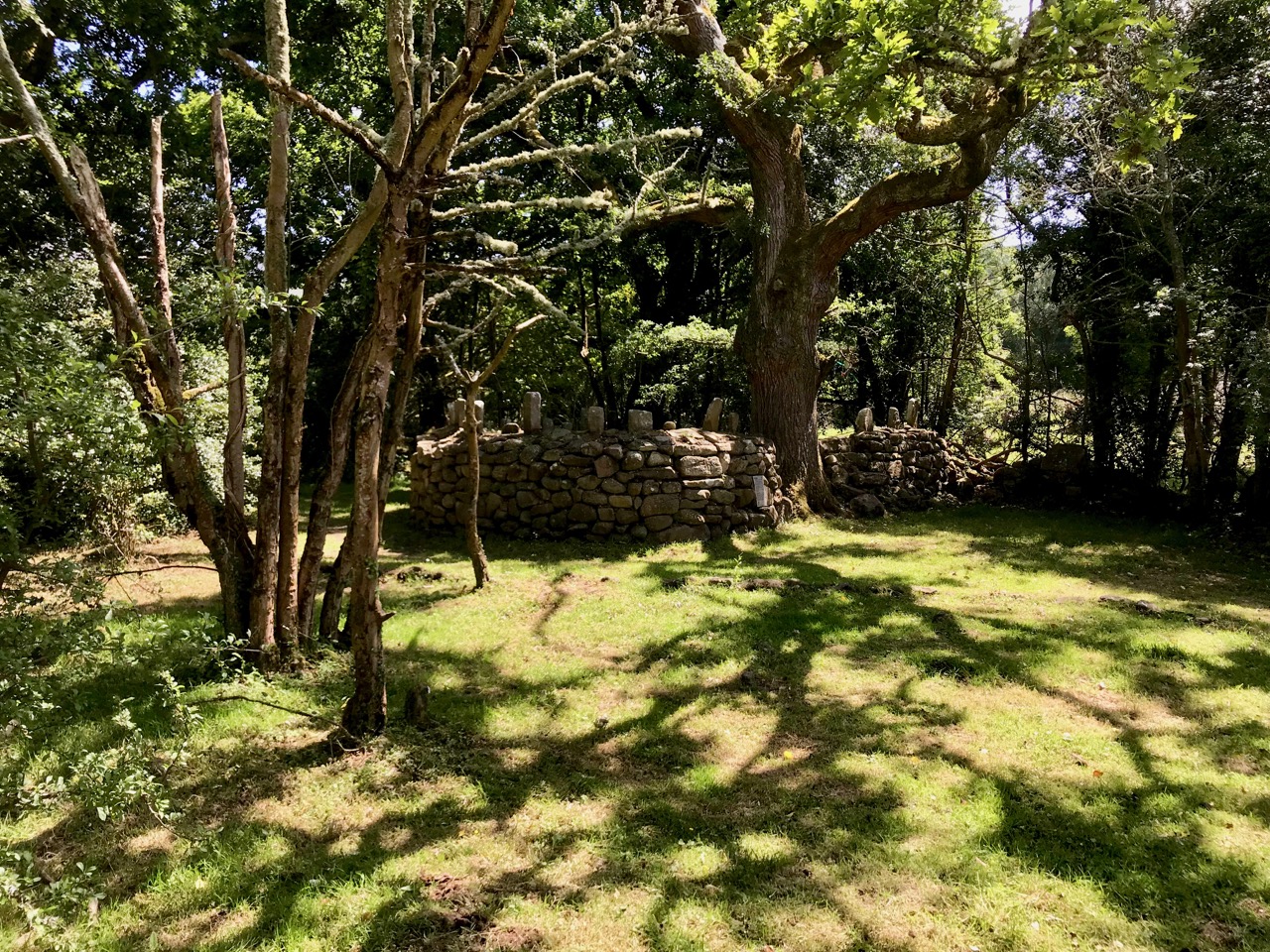
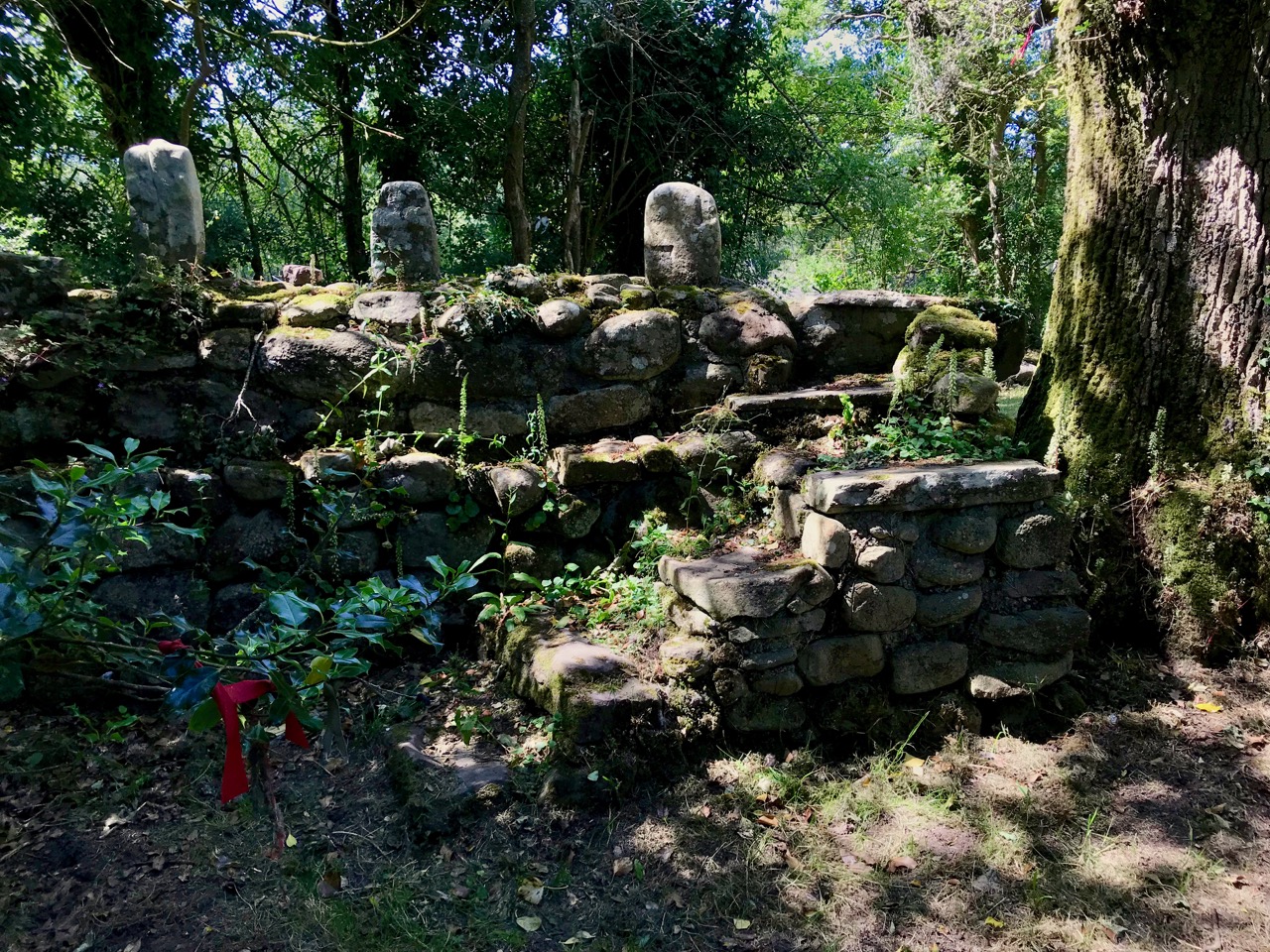
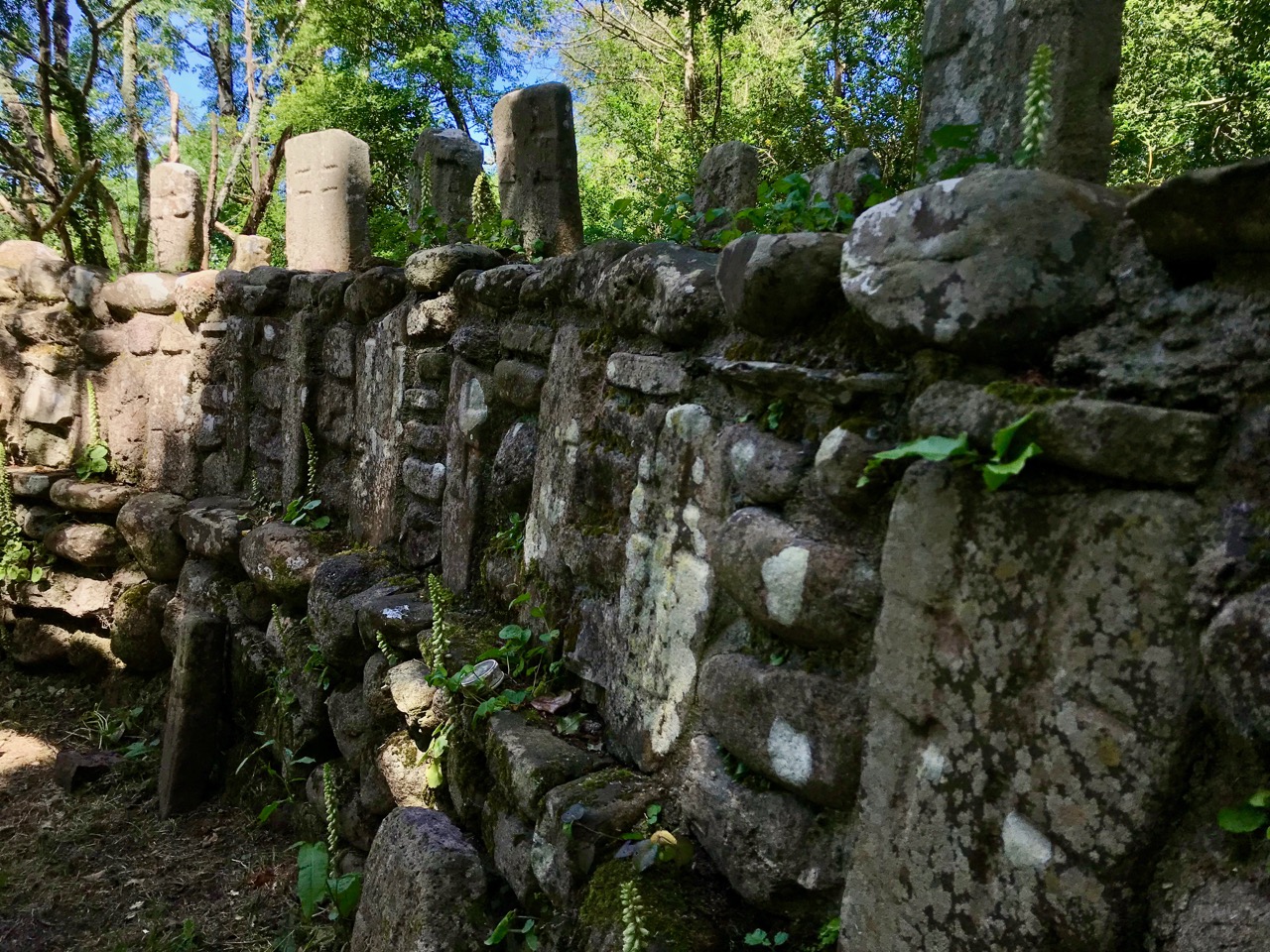
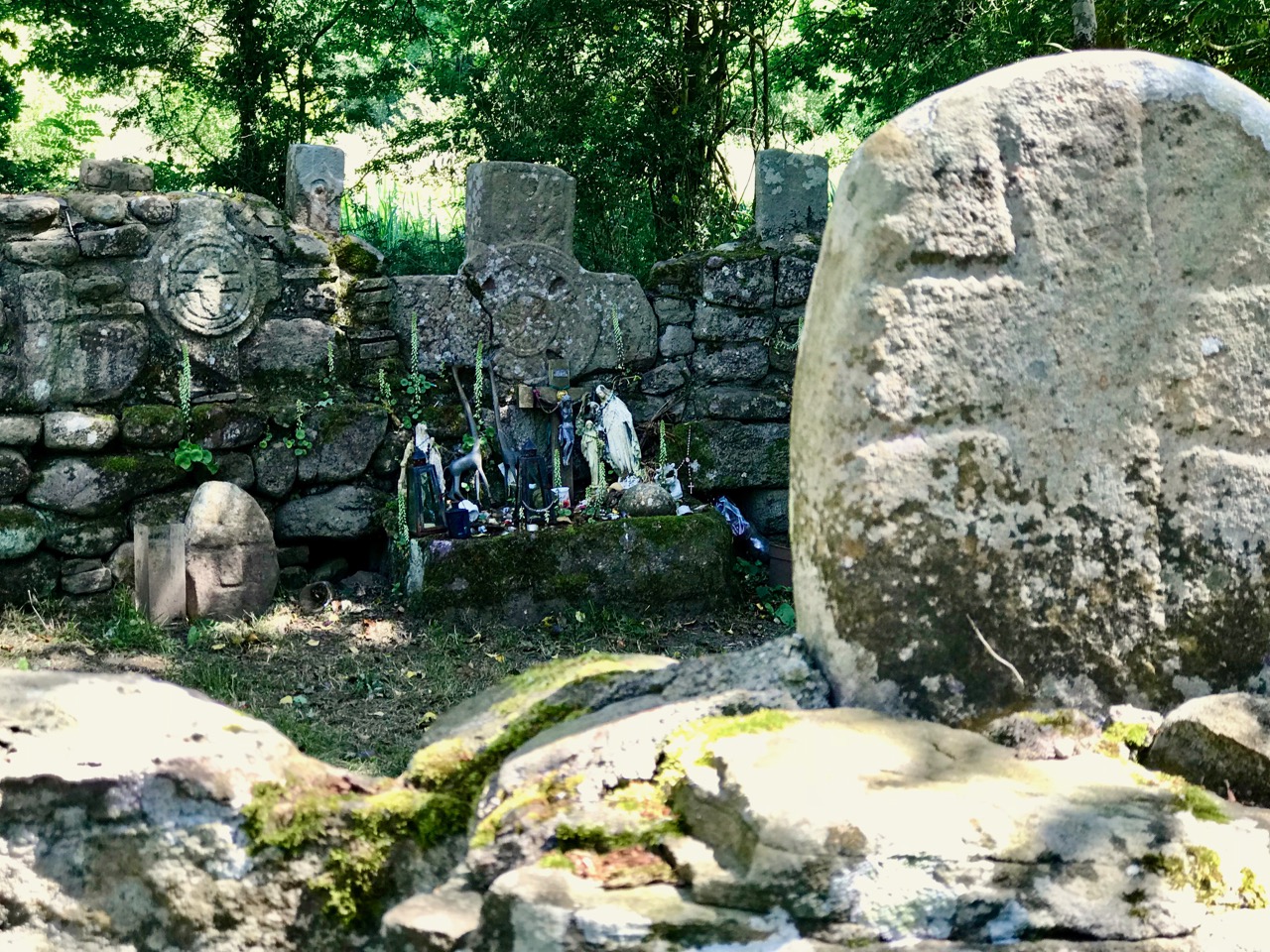
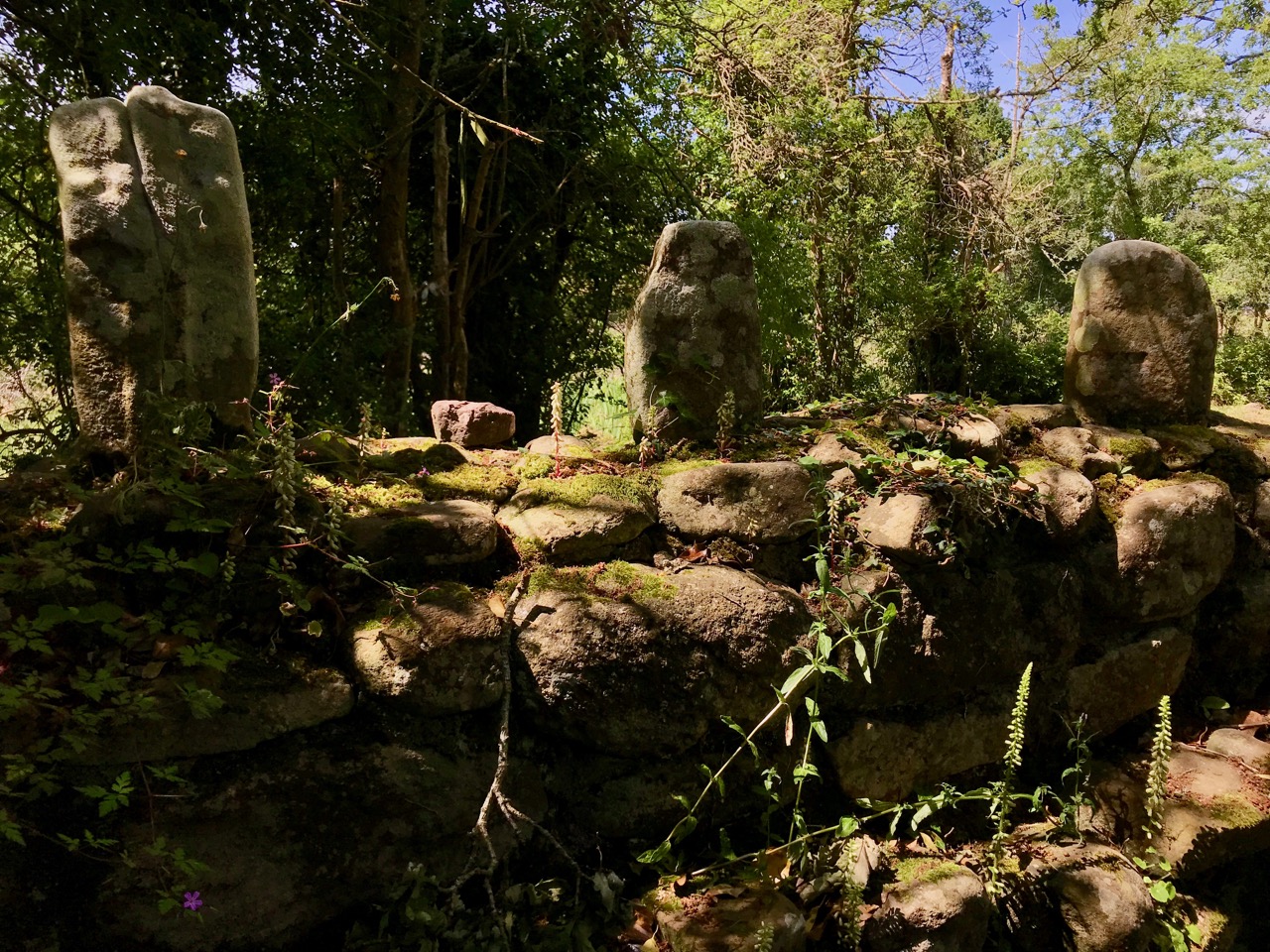
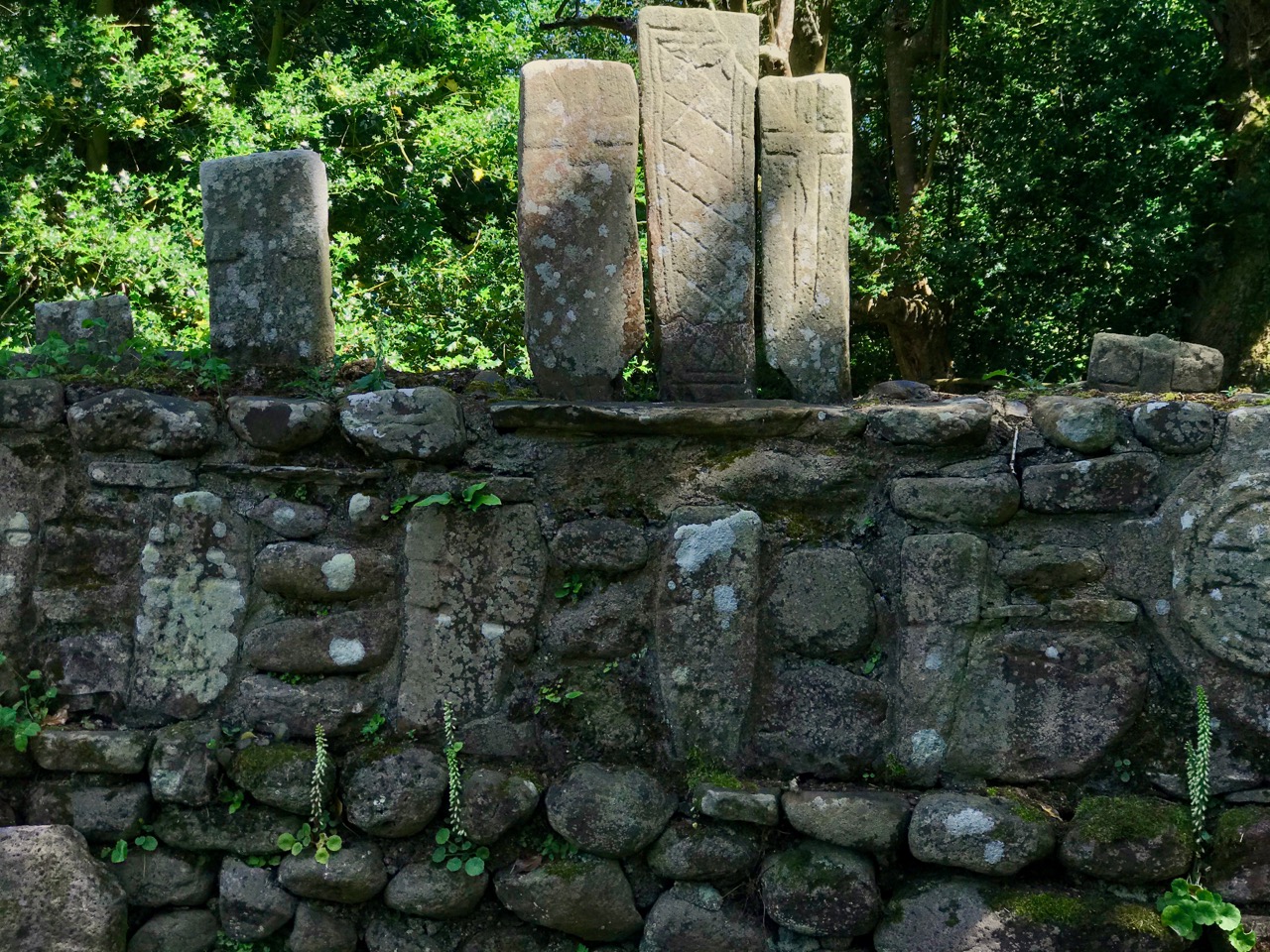
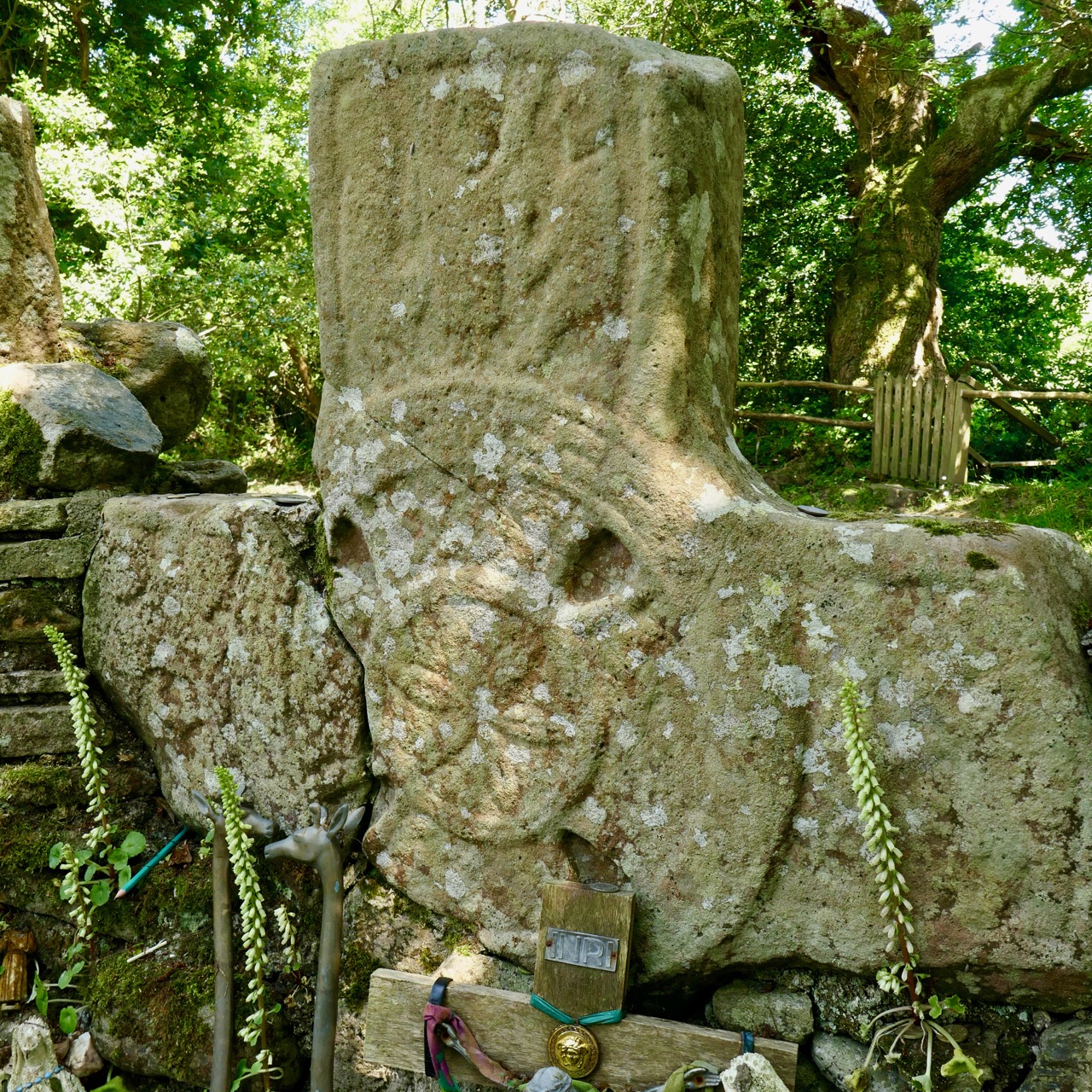
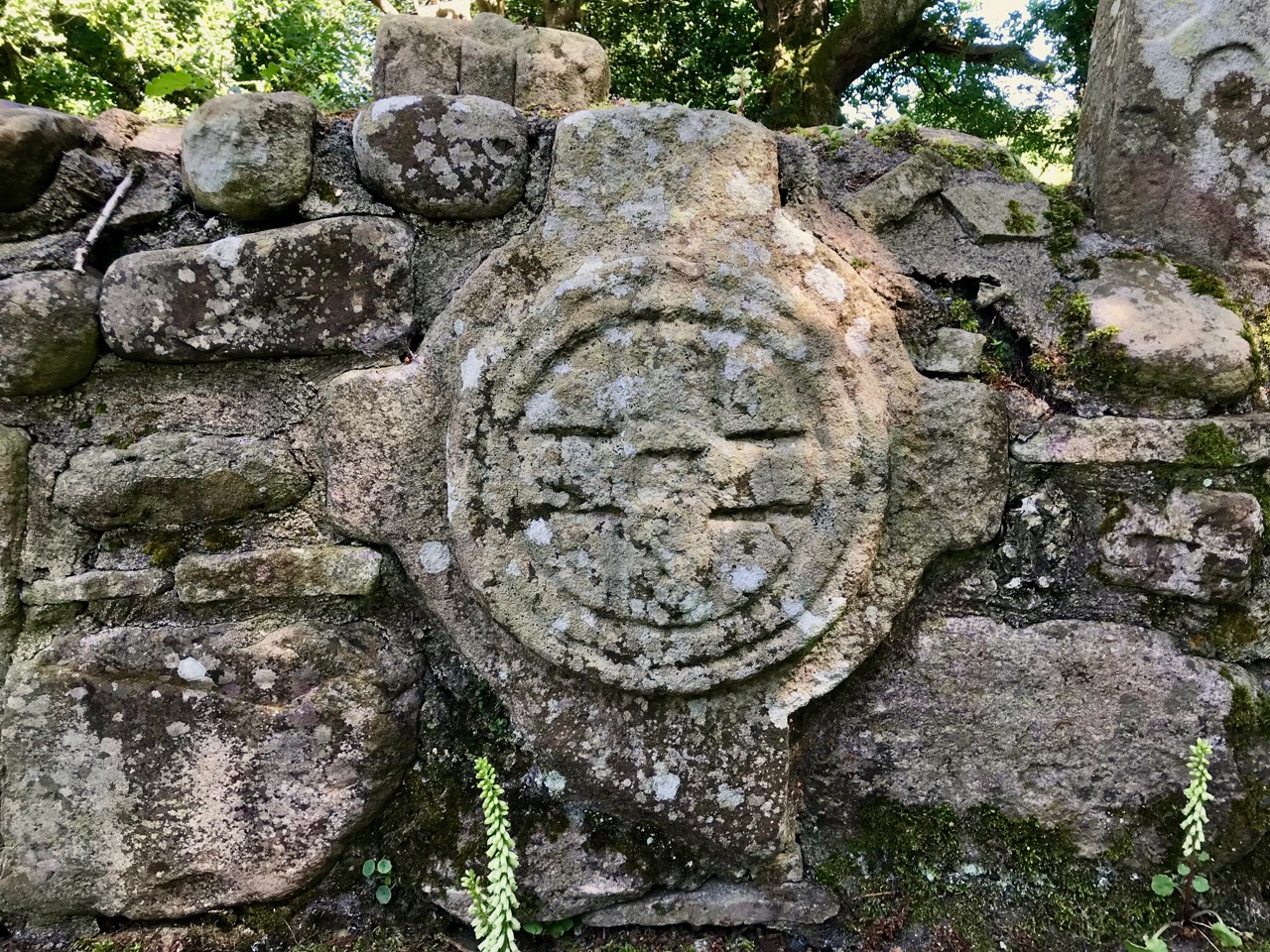
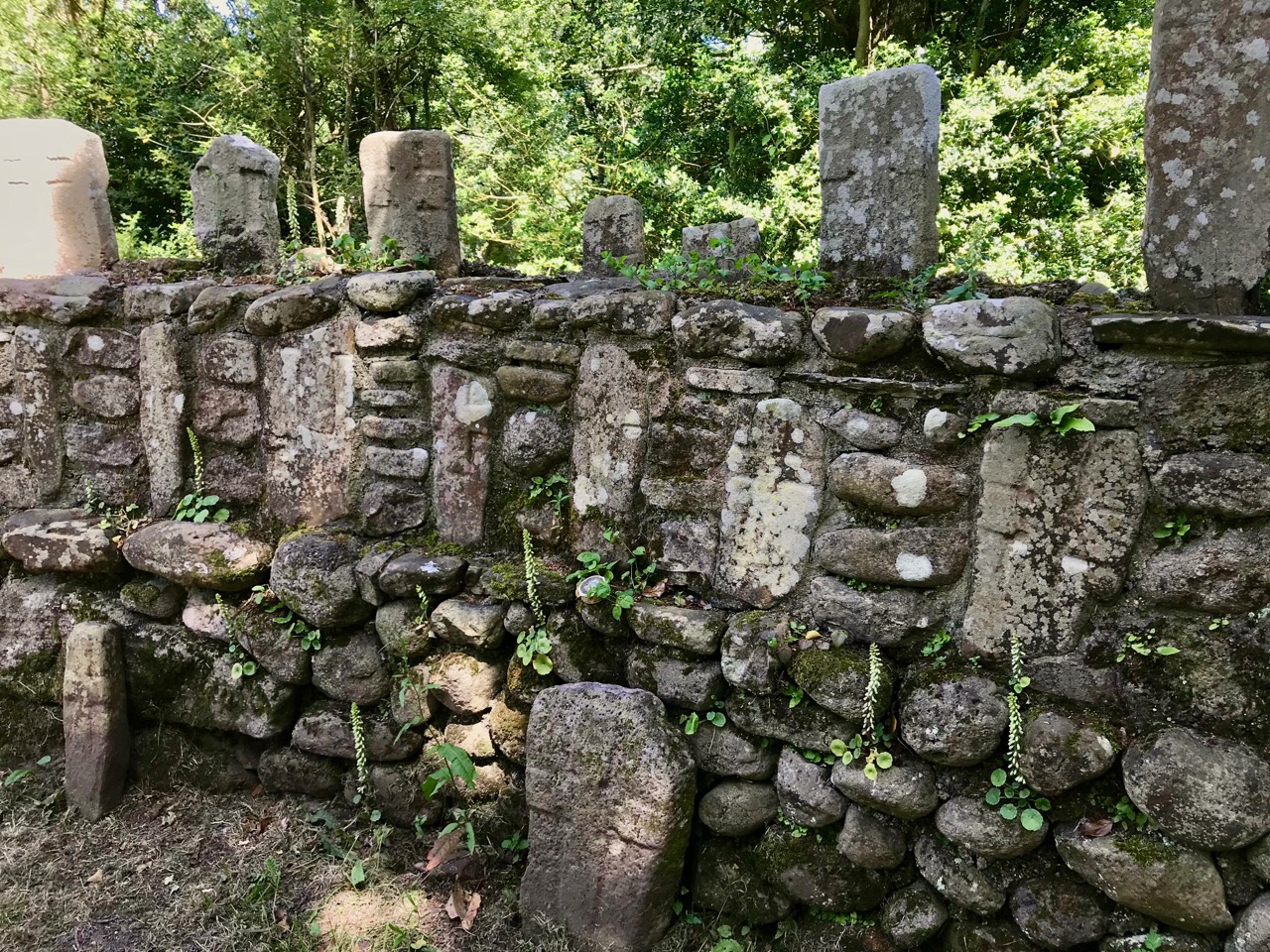
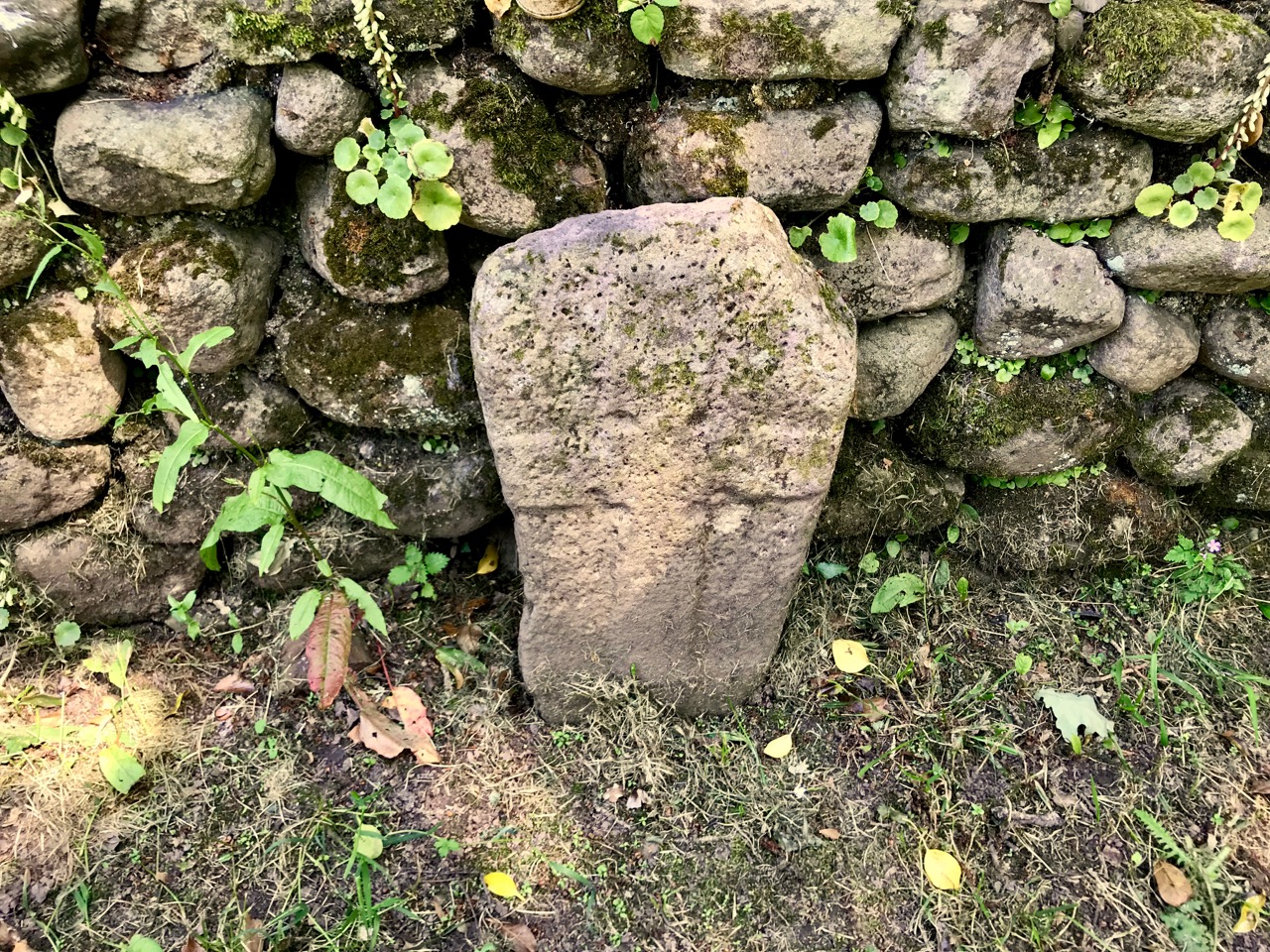
Stone walls and large trees completely encircle an oval shaped enclosure, and the only way in is by steps going over the wall. You are unlikely to be fully prepared for what you find inside. I had hoped for a High Cross – or the fragments of one: we did find a High Cross (perhaps two), but we also found around 70 other stone crosses! Somehow, the Kyle has become a repository for them, but hardly anything is known of their history. After our visit I looked into the stories and found that the enclosure itself – which feels timeless – is probably only as old as I am…

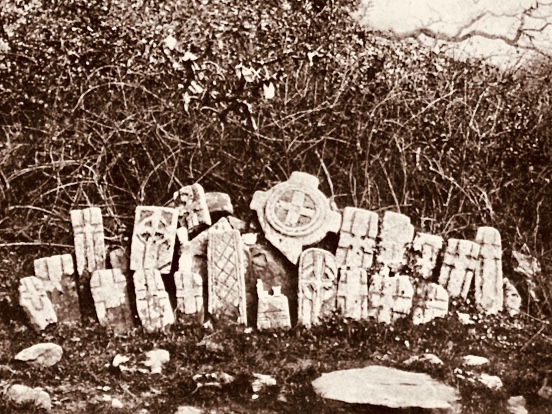
This photograph was taken in 1907. It shows that, for whatever reason, by that time a collection of stone crosses was assembled here. Suggestions have been made that an ancient church on this site was robbed of good building stone, but ‘sacred’ marked stones were left behind out of respect (or from fear of divine retribution). But records do show that the stone enclosure was built in 1946 by the Office of Public Works. What we see today, therefore, is (like me) 72 years old, although of course the stones themselves must have been carved long ago.

The whole collection of stone cross slabs, cross wheels and decorated pillar stones has been put together into an aesthetically pleasing composition which is exciting and – relatively – in safe keeping. To my mind it’s a far better way of displaying these enigmatic pieces than being tucked away in a museum. On a day when the harsh sunlight and perfect blue sky cast deep shadows and outlined the carvings so clearly the place was absolutely magical: the outside world seemed so very far away. The two largest crosses are set close to each other, built into the wall itself. The first is – to my mind – undoubtedly a High Cross in the medieval tradition; it is likely to have originated here, in St Berrahert’s holy place. As to the others, their stories will probably remain untold. But I wish them all well, and hope that future generations appreciate that what has been put together here has a life of its own and should remain an open secret, to be revealed to anyone who makes the effort to search it out.

A pilgrim path – set out with ‘stations’ – encircles the enclosure (photos below). Would this be part of the 1946 construction? From here, the way to the well is marked across more fields, and requires negotiating a boardwalk. It’s a trip that has to be made, though, as the well itself – continuously bubbling up from the sandy bed – is just as magical as the Kyle.