Whisperers

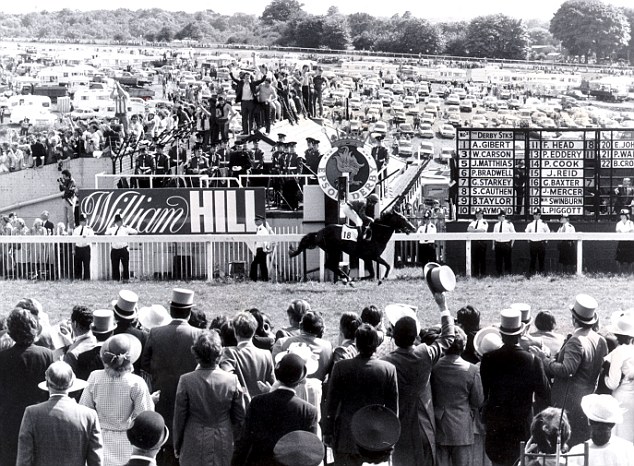
Shergar wins the 1981 Derby by ten lengths!

Shergar wins the 1981 Derby by ten lengths!

The skill of the Irish in breeding, training and riding horses is unbounded. These arts are swathed in folklore and storytelling as much as in reality. Take Shergar – record-breaking racehorse whose 1981 win was the longest margin in the Epsom Derby’s history: after an illustrious career the horse was kidnapped from Ballymany Stud, near The Curragh in County Kildare by masked gunmen – and never seen again. The incident has been the inspiration for conspiracy theories, books, documentaries, and a film.

You’ve all heard of the Horse Whisperer, a novel by Nicholas Evans which, in 1998, became a blockbuster film starring Robert Redford? Well, the term ‘Whisperer’ was around long before that, used to describe people who communicate with and train working horses. As far back as 1648 it was recorded that a Sussex horseman, John Young, had the art of controlling horses ‘…by means of the whisper…’ – but the most famous of the historical ‘Whisperers’ is a man from County Cork, James Sullivan. He was born in Mallow towards the end of the eighteenth century, ‘…an ignorant, awkward rustic of the lowest class…’ according to Mile’s Modern Practical Farrier, 1843. Sullivan ‘…gained the singular epithet of Whisperer by an extraordinary art of controlling in a secret manner and taming into the most submissive and tractable disposition, any horse or mare that was notoriously vicious and obstinate… He seemed to possess an instinctive power of inspiring awe, the result perhaps of a natural intrepidity, in which I believe the greater part of the art consisted… A faculty like this would have, in other hands, made a fortune; but Sullivan preferred to remain in Ireland…’

A woodcut by C F Tunnicliffe

A woodcut by C F Tunnicliffe

It’s worth quoting a little further from the story of this man from Cork, here from one of my much-thumbed books which I have carried with me for countless years – The Horse in the Furrow, by folklorist George Ewart Evans:

‘…Sullivan’s best known exploit was his taming of King Pippin, a notoriously vicious horse, at the Curragh in 1804. A man who had offered to put on his bridle had been seized by the horse and shaken like a terrier shaking a rat. He was saved only by the amount of clothes he had on his back. It appears that this was the custom of the Irish countryman to show off his wardrobe on occasions such as this, and if he had three coats he put them all on. After this incident they sent for Sullivan to subdue the horse. He shut himself up with him all night, and in the morning the horse was following him about the course like a well trained dog: he won a race at the same meeting…’

Another of my favourite writers whose many books pad out the folklore section of our library here at Nead an Iolair is Kevin Danaher. I can’t resist quoting from The Horseman’s Word in Irish Country People, Mercier Press, 1966:

‘…At the horse fair the buyer would look out for the characteristics of a good horse as laid down in the old saying: “…Three traits of a bull, a bold walk, a strong neck and a hard forehead; three traits of a fox, a light step, a look to the front and a glance to each side of the road; three traits of a woman, a broad bosom, a slender waist and a short back; three traits of a hare, a lively ear, a bright eye and a quick run against a hill…”

A first hand account of Whispering from Danaher’s childhood:

‘…It was at a fair in Rathkeale that I saw for the first and only time the strange power of the “horseman’s word”. A young colt, either through fear or perverseness, was prancing and kicking wildly when a boy of about seventeen walked in and fondled the horse’s nose, talking quietly. Immediately the colt became calm and the boy took the headstall and led him up and down as meek as a lamb. We were told that this boy, the son of an itinerant horse dealer, had the power to calm any horse. Some people said it was a hereditary secret in his family, others that he had learned it from an old Palatine farmer in the district who also had this strange gift. It was said, too, that as well as being able to quieten horses and break untrained animals in a matter of minutes, this boy could get a horse to stand still and not move for any force or persuasion until he or somebody else who had the power released it. There is no doubt at all that certain persons have this gift, not only in Ireland but all over the world, but no satisfactory explanation is forthcoming. In Ireland it is known as ‘cogar i gcluais an chapaill’ or simply ‘the whisper’ and its potency is held to lie in the words which are spoken in the horse’s ear…’
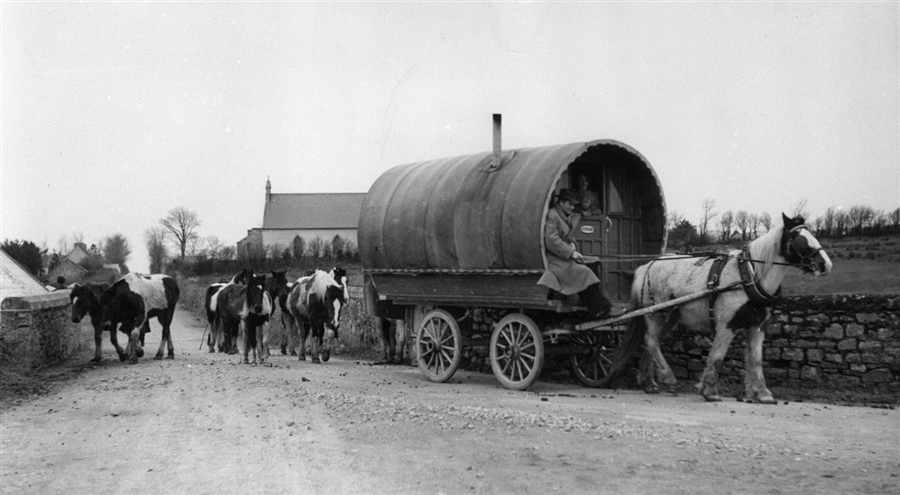
Irish Travellers, County Clare 1951

Danaher mentions an ‘itinerant horse dealer’. Today we might call them Gypsies or Travellers. In Ireland they are well-known for their skills in horsemanship, and for breeding a very particular type of draft horse, suitable for pulling the vardo and also for riding and sulkie racing. The horses are often piebald or skewbald. You may be sure that the Travelling fraternity are natural Whisperers!

The 'Gypsy Horse' is a light draft cob

The ‘Gypsy Horse’ is a light draft cob

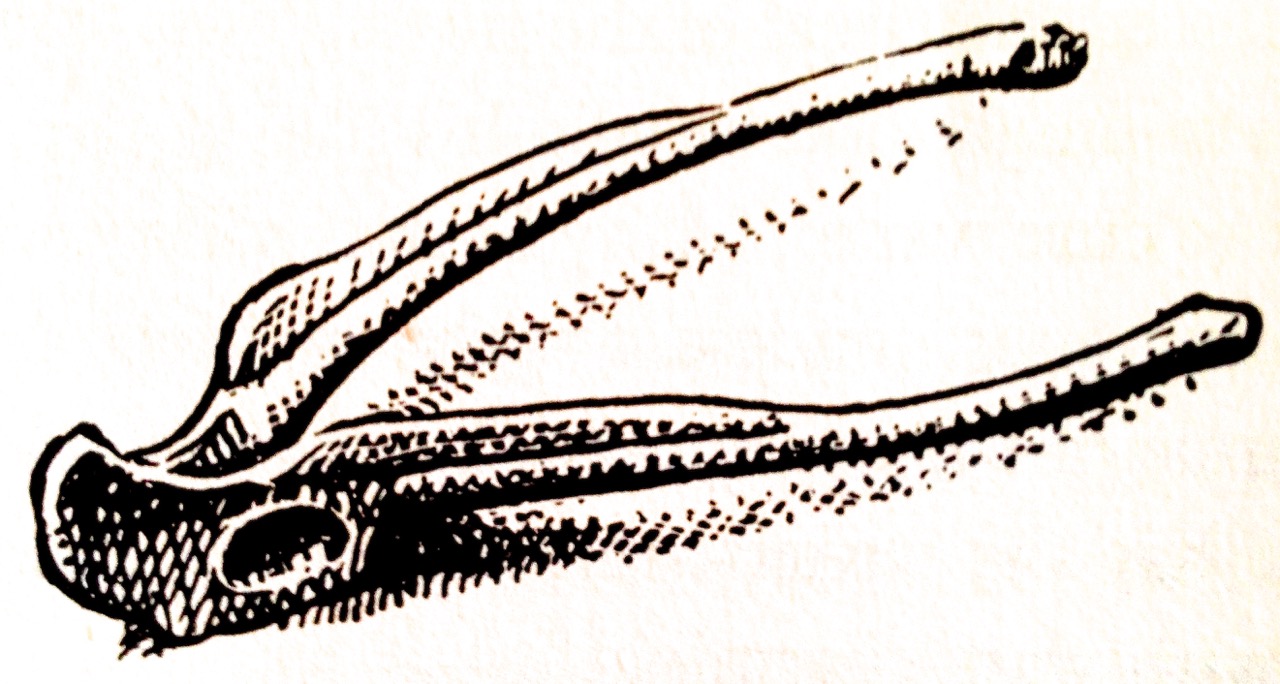
Both Evans and Danaher mention the Toadmen in their discussions. These characters would use divination to gain their power over horses. One such ritual was called the ‘Water of the Moon’, and was commonly practised in the East Anglian and Cambridgeshire regions of England. It required that the horseman kill a frog or toad and hang the body on a thorn tree until only the skeleton remained.  At full moon the man then had to take the skeleton to a running stream and throw it into the water.  One small forked bone would detach itself from rest and float upstream, and it was this bone from which the horseman would then derive power over horses.
The magical bone of the Toad...

The magical bone of the Toad… (Tunnicliffe)

Have a look at this clip from Canada – it’s not Ireland, but it’s about a modern day Horse Whisperer, and makes good watching…

Speed the Plough

Speed the Plough

In England today – the first Sunday after Epiphany – they ‘bless the plough’. I can’t find any mention of a similar tradition in Ireland, but please let me know if you are aware of one. It’s because the day marks the end of the agricultural holiday which follows Christmas: tomorrow is Plough Monday – the first day of the farmers’ working year – which has its own traditions. Ploughs were traditionally taken around with collecting boxes by mummers and molly dancers in parts of Eastern England, and in some places were used as a threat: if householders refused to donate to the participants their front paths would be ploughed up! Of course the ploughs used in these customs were all drawn by horses at one time – something that hasn’t died out yet: our friends Tim and Sandra keep their own working horses here in West Cork, and I’m quite sure they have mastered the art of Whispering for themselves.

philatelynews-irish-horse

On the Butter Road

The old Butter Road runs between Schull and Ballydehob

The old Butter Road runs between Schull and Ballydehob

For most of its history, roads were a hit-and-miss affair in Ireland. We didn’t get the great Roman road builders, and anyway, it was easier to get around on the water. Some routeways led to Dublin or Tara in the early medieval period, but a real road system didn’t develop until the 18th Century with the building of turnpike highways between major cities. In the 18th Century, Cork became the largest centre for the butter trade in the world and needed transportation corridors to ensure butter could get from remote rural areas to the Butter Exchange (now a museum) in the city. The Butter Roads were built from the 1740s on, and provided an efficient and speedy (for the time) route to market. Butter was packed in firkins (40 litre barrels), stacked onto carts, and transported from West Cork and Kerry to Cork City to be loaded onto ships for Australia and America.

The Old Mill

The Old Mill

Here and there, traces of the old butter roads remain. One stretch runs between Ballydehob and Schull and in the last few years a project to open it as a walking route has been spearheaded by students of the Schull Community College. It starts at the Old Mill, now open as a gallery by our friend, the esteemed wildlife photographer, Sheena Jolley. Sheena has enhanced the mill stream and stabilised the workings, still intact in her basement. A visit to her gallery is a great way to start or end your walk.

Robert on the stepping stones

Robert on the stepping stones

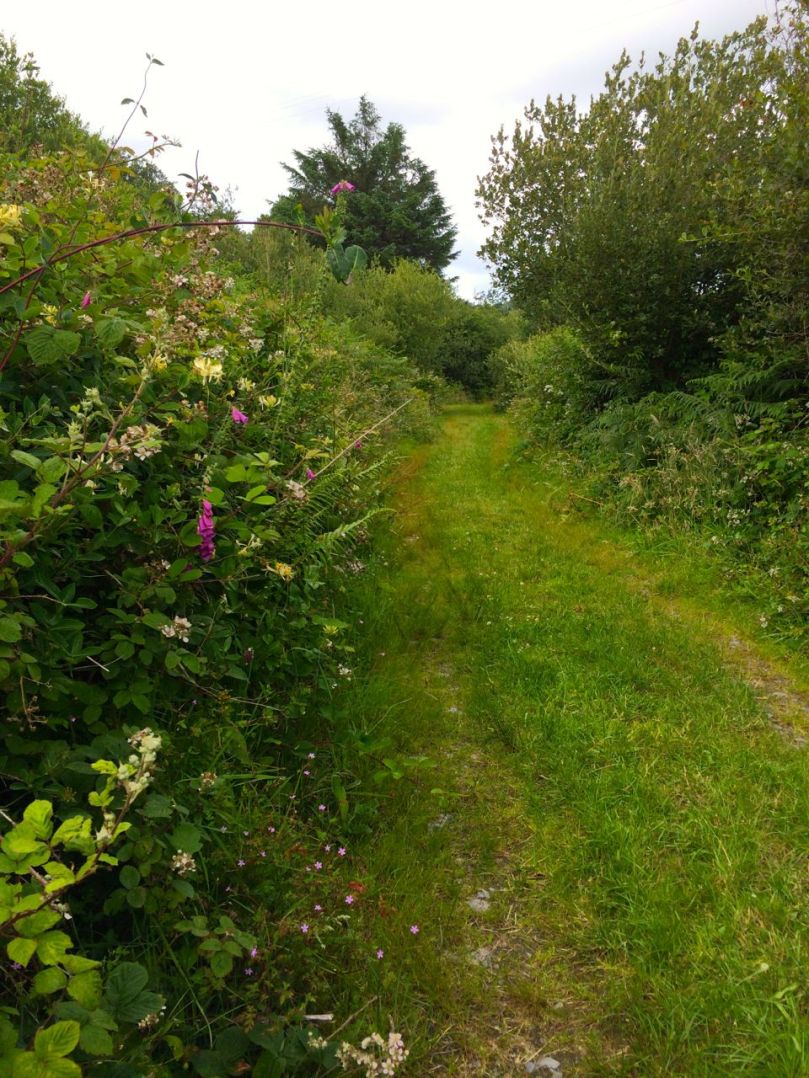
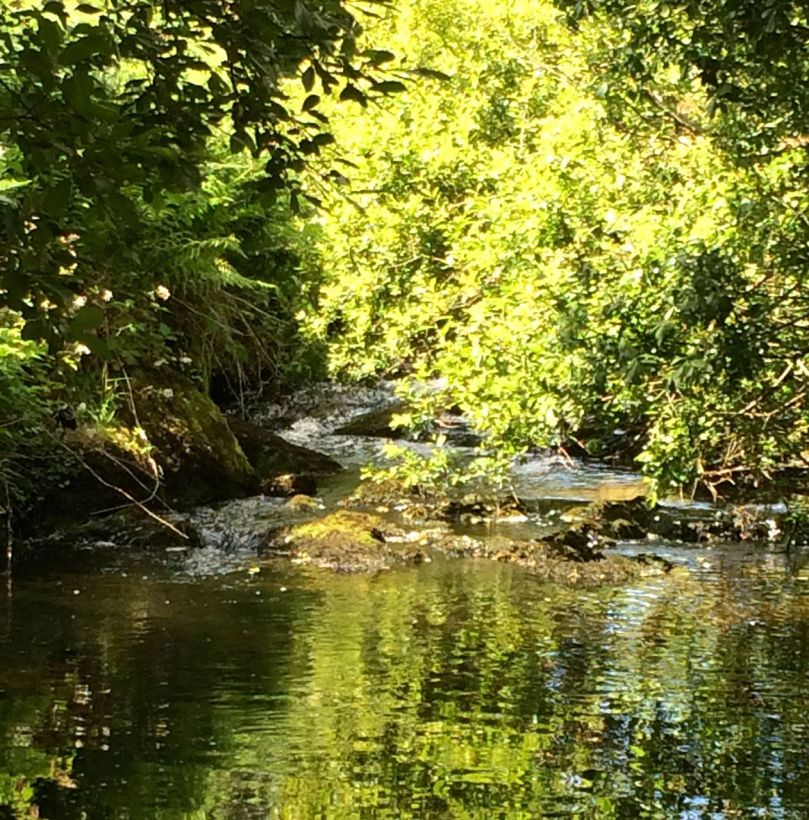
Setting out from the mill we were immediately on the old green road, soft underfoot, running between hedgerows alive with wildflowers, winding gently uphill. A plaque tells the story of the butter roads and of the current project. Gurgling and murmuring, the mill stream is on your right until you come to cross it. This is accomplished on stepping stones where we found it impossible not to linger and contemplate the gentle water. 

The mill stream

The mill stream

Onward and upward, passing an abandoned farmhouse, and marvelling at the variety of flowers along the route. Having been presented with the superb Zoë Devlin’s The Wildflowers of Ireland (thank you, Amanda!) I can now identify most of them, so here is a selection – captioned, by dint of my new-found knowledge. (Mousing over the pictures will bring up the captions, clicking on them will take you to full size images.)

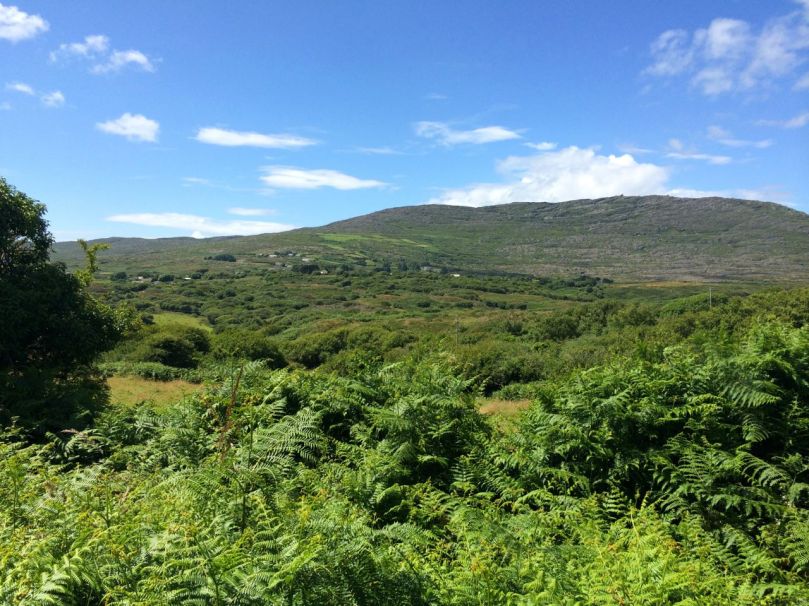
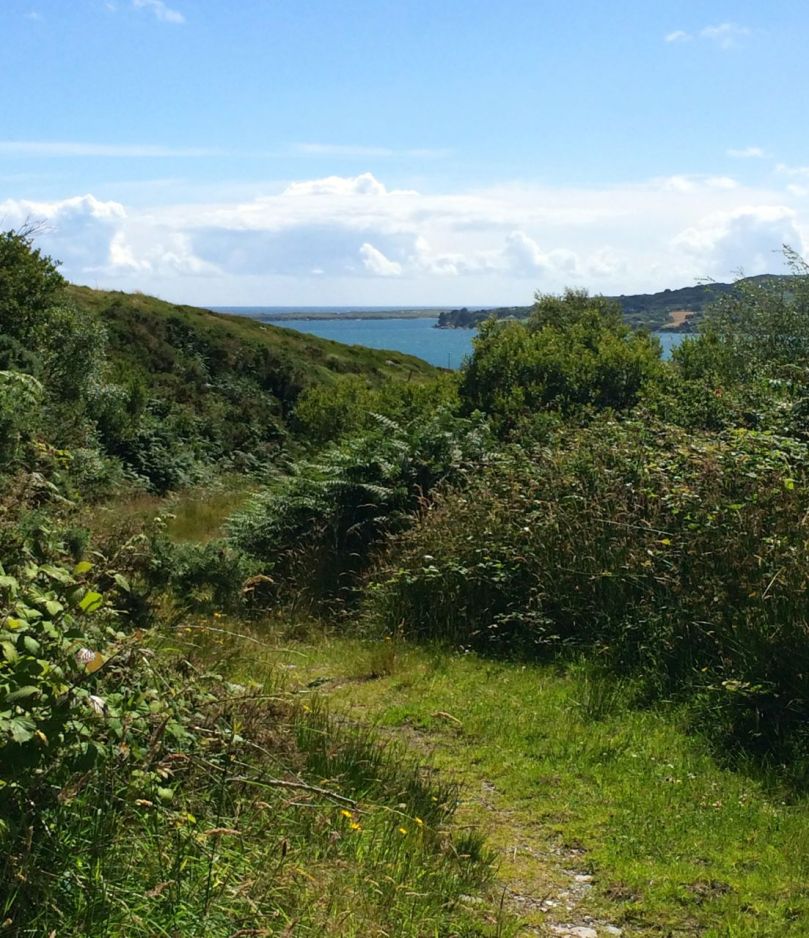
As the road ascends, we could look back towards Schull and Long Island, or north to Mount Gabriel. The sense of peace, of being in a place of age-old tradition, is palpable. 

Mount Gabriel

Mount Gabriel

Near the top of the hill we met the Newman family, setting out from their farmhouse to walk down to Schull. John and Helen grew up in this house, walking to school in Rossbrin (about 4 km away) every day and John still lives in the house. He has a fascinating collection of old tractors and an obvious interest in farm machinery of every kind. They told us they had the butter road all to themselves in the old days, but now it’s quite popular and they are glad to see it used and enjoyed. A Mr Henry Ford once lived in the farmhouse, related to THE Henry Ford, whose father came from Ballinascarthy, near Clonakilty. 

Three generations of the Newman Family

Three generations of the Newman Family

The Butter Road is an ancient right-of-way, but access depends on the goodwill of those, like John Newman, and like Paddy Hayes whom we met on the way down, whose farms and fields lie along the route. This is a marvellous resource for the people of Schull and Ballydehob and we are grateful to those whose vision and hard work and generosity of spirit have made it a reality. 

If you want to experience the tranquility of the deep countryside, lovely views, and a sense of how the making of a road could connect far-flung communities to the wider world, we recommend an afternoon spent on the Butter Road. 

Walking back down: Long Island comes into view

Walking back down: Long Island comes into view

Driving Home the Point

Another grand road

Another grand road

In my two previous posts about driving in Ireland, I chronicled the bureaucracy involved in registering our car and in applying for an Irish driving licence. Since Ireland and Canada do not have a mutual recognition agreement I had to take the theory test, a series of 12 mandatory lessons, and then take the road test. The good news is that I passed – I am now a fully qualified Irish driver! More good news – we got a €50 rebate on our car insurance. And best of all – having never even sat in a tractor in my life, I am now licensed to drive one. This is particularly pleasing since it is the vehicle of choice for the farmer visiting the pub at night in country villages, so you never know when I might be called upon to use this facility.

I can park my tractor in town now if I want.

I can park my tractor in town now if I want.

The bad news is that, between all the fees and the mandatory lessons, I spent a LOT more than the €50 I saved. It also cost me several months in which I was unable to drive on my own, and the aggravation of being trapped in an inflexible bureaucracy that refused to acknowledge my 40 years of safe driving.

I've learned to be alert for road signs

I’ve learned to be alert for road signs

However, all that paled when it came to the frustrations of learning to drive in a whole new style. As my friend Danny puts it, if someone tries to teach you how to walk (place this foot here, now lift this one) you will fall down. It just messes with your head to have to unlearn a sequence of actions that is as familiar as breathing, and relearn them a different way. This is not to do with being a better driver (although I think I am a better driver now), but with passing the test by demonstrating the correct procedures in the approved sequence.

You MUST not stop or park in a box junction

You MUST not stop or park in a box junction

Some examples might help to demonstrate. Shoulder checking is a huge thing in Canada – looking over your right and left shoulder before moving off, changing road position, turning a corner, etc. It’s because of the danger of not seeing a cyclist in the car’s blind spot. In Ireland, they want you to do a quick glance, no more. Here, you MUST check your mirrors before signalling, and after – there’s a strict sequence to follow. In Canada they teach you to take one hand off the steering wheel so that you can turn around and look out the back window when reversing – here they want both hands on the wheel at all times. You WILL be asked to reverse around a corner (you would not be asked to do that in a Canadian test) and you WON”T be asked to parallel park (a Canadian right of passage). None of these things are matters of life and death – they are all stylistic, but this is what you will be tested on. The national pass rate for the test is only 56% so there is a very real possibility of failing, no matter how well prepared you think you are.

No parking where there are zigzag lines. Or double yellow lines. Or both.

No parking where there are zigzag lines. Or double yellow lines. Or both.

Meanwhile, all around you, you will see Irish drivers doing the most appalling things and routinely flouting the rules of the road. This can be put down to the lax driving standards of the past, and so it is encouraging that it is now more difficult to get a license and that the expectations for skill and safety have been elevated. (See an interesting discussion on this here.)

Don't drive too close behind the slurry tank

Don’t drive too close behind the slurry tank

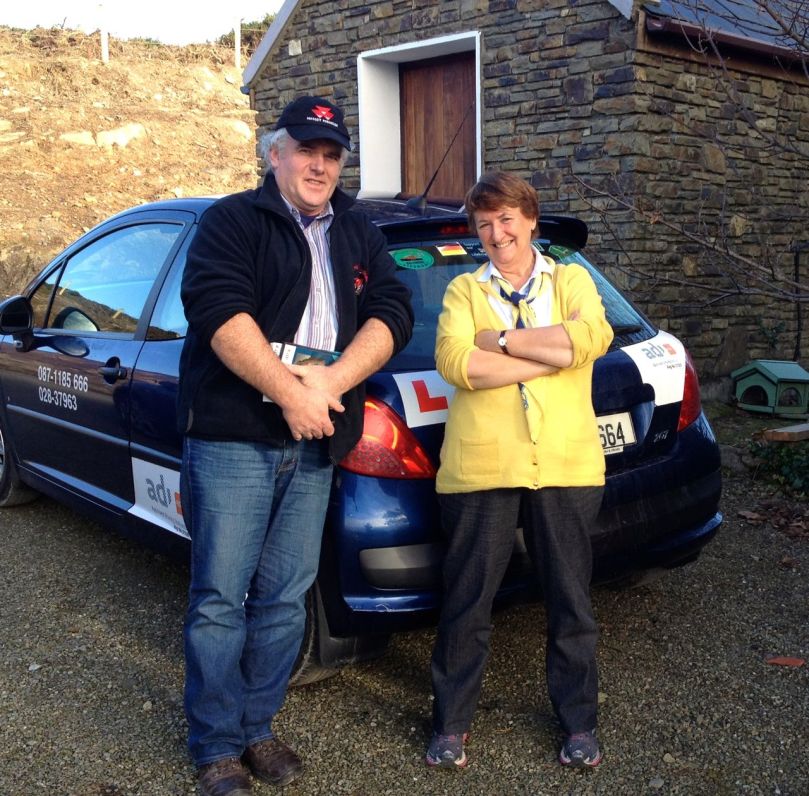
There was one bright spot in all of this – my driving instructor, Frank O’Driscoll. Having spent years driving big rigs all over Europe, and huge buses around the tiny West Cork roads, there’s nothing about driving that Frank hasn’t seen or done. Sympathising with my plight, he nevertheless gently prodded me through the lessons in sequence and encouraged me to just get on with it. An hour and a half in the car with Frank wasn’t just about driving, though. He has a great tenor voice and on the long straight stretches we roared our way through Come By The Hills or The Fields of Athenry, punctuated by snatches of poetry or by snippets of local history. Back at the house Robert put the kettle on and we settled down to tea and laughter as Frank filled in the log book and entertained us with his West Cork wit and stories.

Frank – if you’re reading this – I almost miss my driving lessons!

Frank O'Driscoll - instructor par excellence

Frank O’Driscoll – instructor par excellence

The Flying Snail

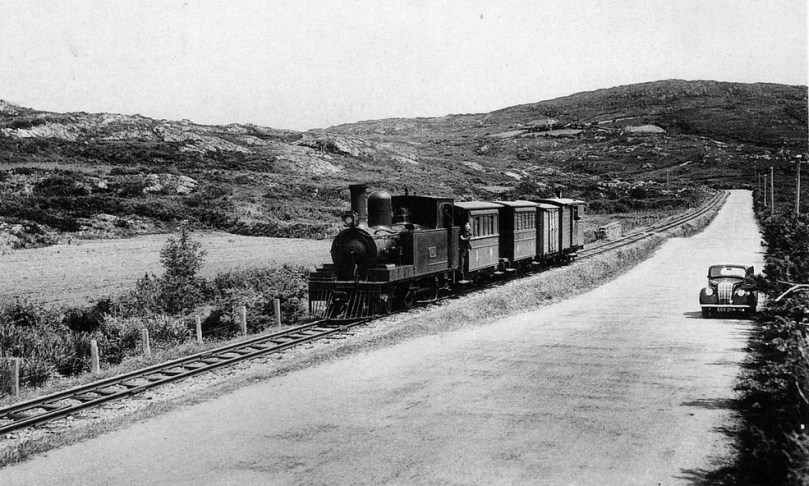
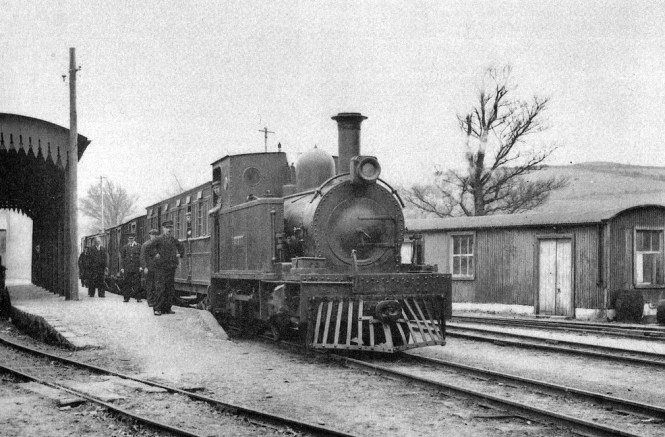
Iarnród - between Ballydehob and Schull 1939

Iarnród – between Ballydehob and Schull 1939

In the heydays of transport by rail, the south of Ireland was served by a network of lines radiating out from Cork. Most of these were scenically picturesque – the nature of the countryside saw to that – and all were imbued with Stories, still recounted with relish by the local people who remember them, or whose mothers and fathers remembered them. Here’s one of the stories – told about the Chetwynd Viaduct, coming out of Cork on the way to Bandon.

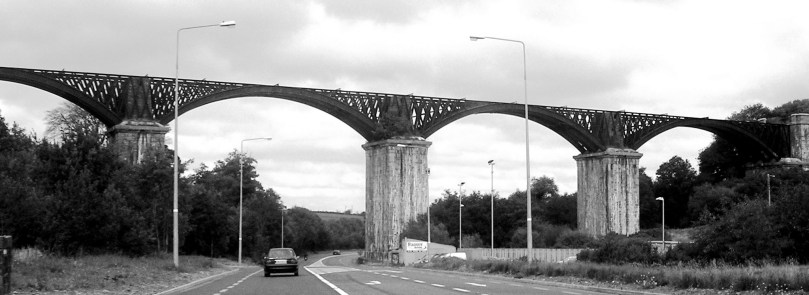
Chetwynd Viaduct today - a scheduled monument

Chetwynd Viaduct today

This structure was designed by Charles Nixon, a pupil of Isambard Kingdom Brunel, and built between 1849 and 1851. It’s still in place today, passing over the main  N71 road from Skibbereen, and is a scheduled monument. The railway, track and track bed have all gone. For quite a while after its construction it was known as “The Bowlers’ Everest”. Alert followers of these posts will know about Road Bowling already (don’t forget to pronounce it correctly: Road Bowelling) – a very skilful and ancient Irish sport involving hurling a heavy iron ‘bullet’ along a road, and getting it from one place to another in the shortest number of throws. For Bowellers, the viaduct presented an obvious challenge: to throw the ‘bullet’ on to it. This was attempted many times year after year, but it took a mighty man to do it: Mick Barry, widely acknowledged as the greatest bowlplayer ever. My informant was careful to add “…This has been said by many and denied by very few…” The Cork Examiner takes up the tale:

“…Barry conquered the Bowler’s Everest, the Chetwynd Viaduct on the Cork-Bandon Road on Saint Patrick’s Day, March 17th, 1955. He lofted the 16oz bowl on to the 100 foot high parapet; an incredible feat which required almost superhuman strength, virtually defying the laws of physics. This feat was witnessed by thousands of spectators…”

chetwyndbolmc

Bowlers’ Everest – the viaduct at Chetwynd and a 16oz ‘bullet’

Less commonly cited is another Chetwynd story: on September 8th, 1985, watched by over 10,000 people, Hans Bohllen from West Germany lofted a 28oz bowl clean over the viaduct, clearing the top by ten feet.

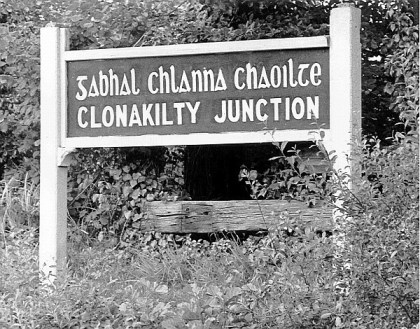
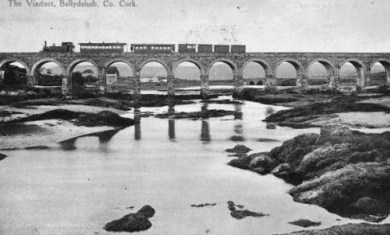
clonjunctionLines from Cork eventually penetrated surprisingly far into the south west extremities of the state: to Kinsale, Bandon, Courtmacsherry, Clonakilty, Bantry, Baltimore, and – on a 3ft gauge narrow line snaking out of Skibbereen – to our two local towns of Ballydehob and Schull. It’s worth mentioning the colourful history of railway track gauges in Ireland: the standard now is 5ft 3in – something shared in the world with only Brazil, Australia and New Zealand – but earlier lines had 4ft 8½ins [UK and Europe standard], 6ft 2ins and 5ft 2ins, and when trams were first introduced to Dublin they had 5ft 2 and a bit.

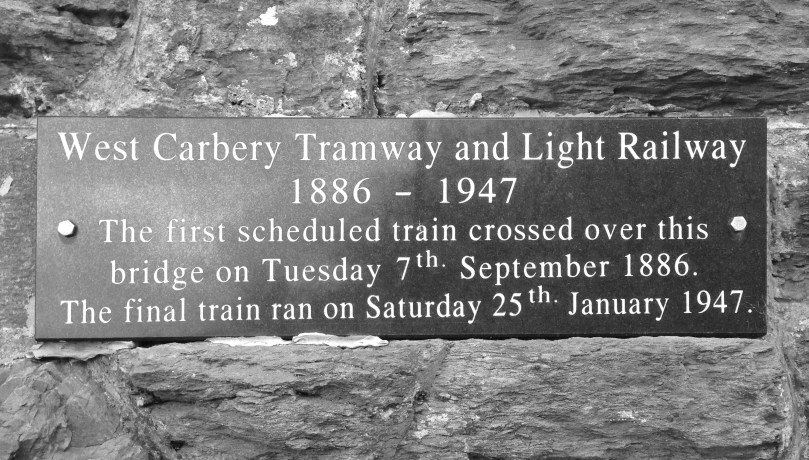
plaque

Local history: plaque on the viaduct at Ballydehob

In 1925 all the railway lines in the new Irish Free State were amalgamated to become the Great Southern Railway, and in 1945 the system was consolidated with road transport concerns and trams to become Córas Iompair Éireann. The logo used by CIÉ until 1964 was affectionately (and, perhaps, cynically) known as The Flying Snail.

Córas Iompair Éireann - the national rail and bus company - logo used between the 1940s and 1964: known affectionately as 'The Flying Snail'

‘The Flying Snail’

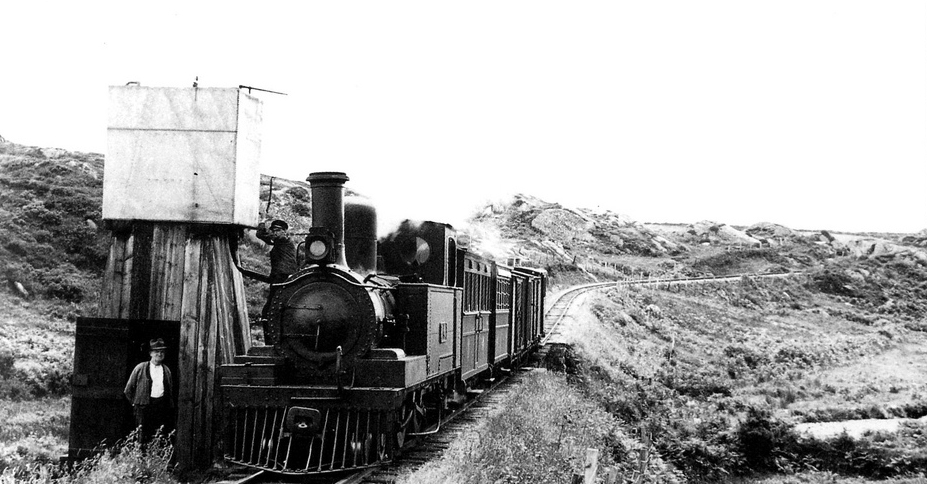
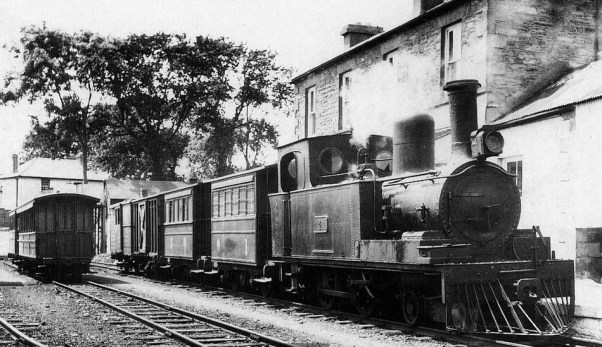
ballytrainmcThe line out to us here in West Cork was particularly eccentric and would have been a magnet for present day railway enthusiasts if it had survived. In places the narrow gauge track ran along the main road; it reached speeds of up to 15 miles per hour… But how we all wish it was still possible to catch a little train out of Schull, Ballydehob or Skibbereen and arrive in Cork in a bit. It would be grand!

view

Water stop – with a view…

schull station

Leaving Schull Station, 1939

skibb station

All aboard at Skibbereen!