Affirmed? Because even though we are Boomers and the world seems to be run increasingly by and for Millennials, we’re comfortable with most of the technology we need to cope with our progressively digitised daily lives and to produce a weekly blog.
Daunted? At what’s ahead of us: the Internet of Things where everything is connected; augmented reality where a pair of glasses will supply additional information about anything we desire; the gameification of internet experiences; and increased reliance on high quality video.
Looks like we have work to do!
Inspired? Because the takeaway message was so encouraging for people like us who create and produce content week after week – you can have the highest, whiz-bang technology in the world but it’s all a means to an end – and that end is to tell a story.
Humans have an innate social and psychological need for stories and a hunger for knowledge – that message was at the core of much of what we heard on the day we attended, even if the sessions had names like Innovation and Creative Thinking or Perspectives and Insights from an Irish Start Up.
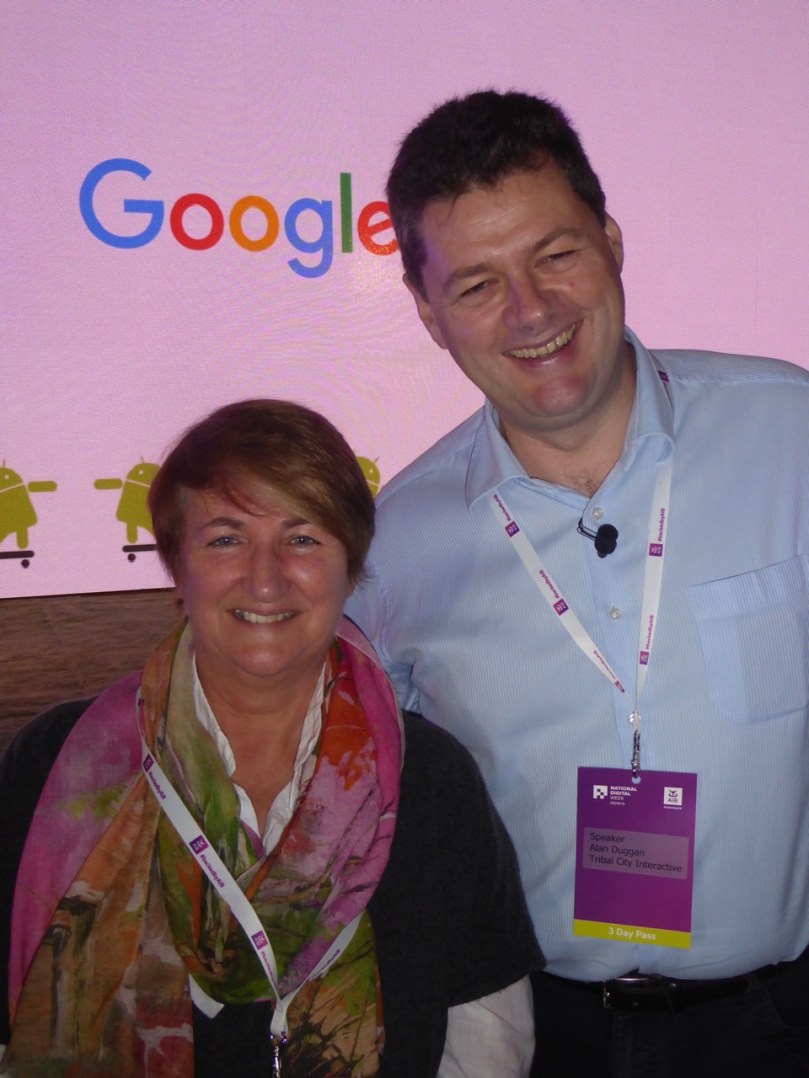
Finola with Alan Duggan of Tribal City Interactive, based in Galway
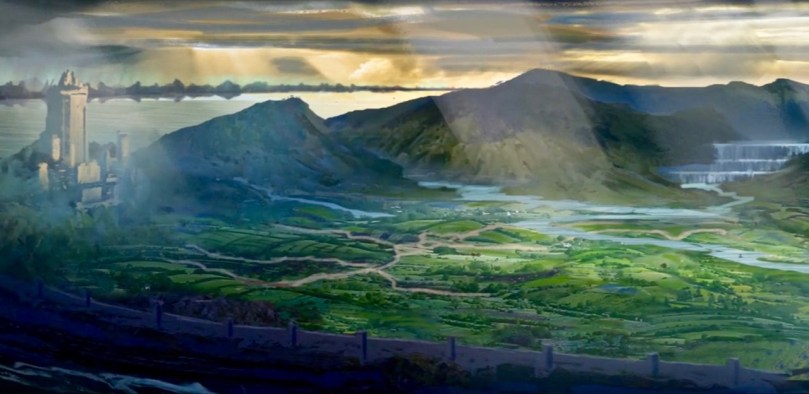
The Irish Start Up under discussion is a group called Tribal City Interactive and they are developing a new game called Runes of Aran. The thing is, it’s all based on Irish mythology, straight from the Leabhar Gabhála, or the Book of Invasions, which tells the story of the successive waves of people who came to Ireland. (See Robert’s post First Foot for more about the Irish origin tale told in the Leabhar Gabhála.) And the game is going to be stunning! Here’s the premise:
A storm has been raging for days.Navigation is impossible, your ship is being inexorably pulled towards a mysterious island at the edge of the world.It is a place which exists in the stories of all mariners; it is a place to be shunned.It is Aran.
The ship is finally dashed ashore at the foot of huge towering cliffs.Only you get off the ship alive, crawling ashore into a surprisingly calm bay. The cliffs form an impenetrable barrier, except for a cave that frames a massive doorway composed of two tall blue stones, capped by an even larger lintel piece. Standing in the doorway is an old man, dressed in a long grey tunic.He is Amergin the Bard, and he waits patiently for you.
Amergin explains an old magic has pulled you to this place and now you are trapped, doomed to spend the rest of your days on this lost island. Unless…
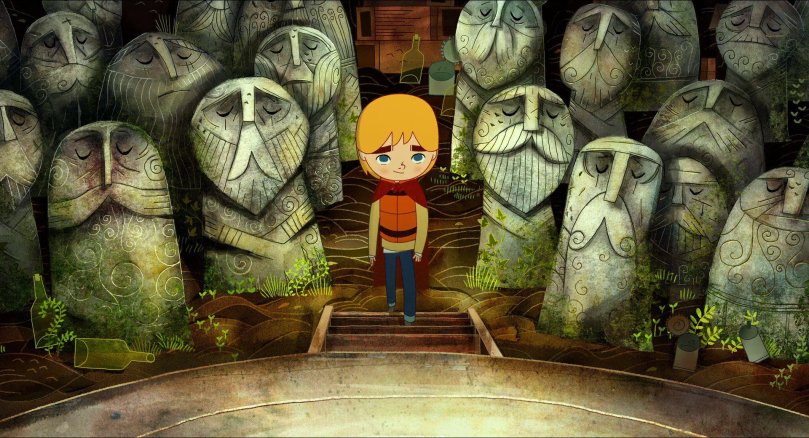
We were also excited to see Cartoon Saloon here, talking about their projects. We love their animated films: The Secret of Kells and The Song of the Sea are both based on Irish legends and myths and both were nominated for major international awards. The Song of the Sea also uses imagery directly inspired by prehistoric Irish art. Just look at this screenshot – it manages to combine Boa Island figures with Newgrange-type spirals.
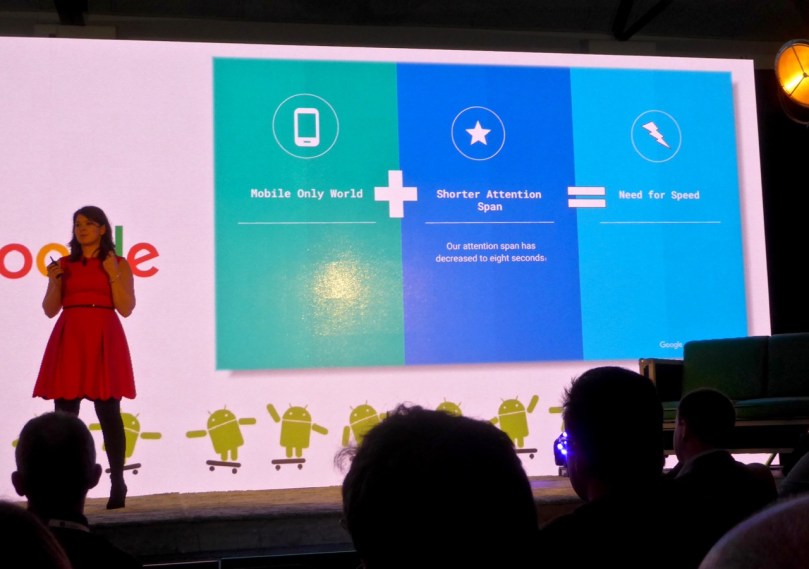
Google has a massive presence in Ireland and Google folk were here in droves. We had booked a one-to-one session in their Digital Garage, where Karl gave us excellent advice (and food for thought) on how to really look at our website and what we might consider doing a little differently.
I’ve only given you a tiny flavour of National Digital Week. We met all kinds of people here, from CEOs to hot-shot young programmers to visionary developers to people just like us, working on the fringes of technology and wanting to learn. And all of this in the heart of West Cork.
The old Lady’s Well Brewery repurposed as the Google Digital Garage
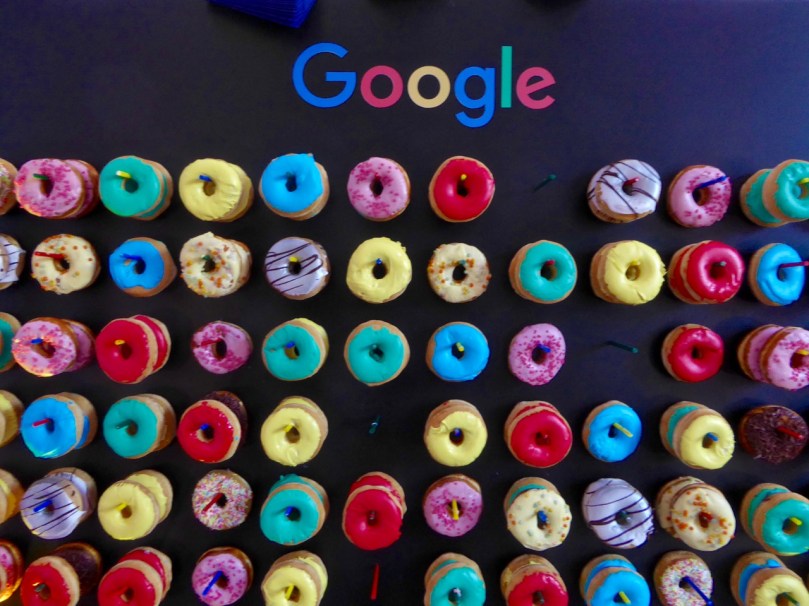
A massive vote of appreciation to the dynamic young people who run the Ludgate Hub in Skibbereen and who organise this conference- what an amazing job they do. Next year, come and experience it for yourself. Oh – and don’t miss the Wall of Donuts!
There are wild beasts all around us! Animal, fish, serpent or fowl, real or mythical, carved, painted – imagined. This is my second ‘Menagerie’ – previously we explored the Honan Chapel in Cork, and I was struck by all the wildlife representations there, as set out in this post from over two years ago.
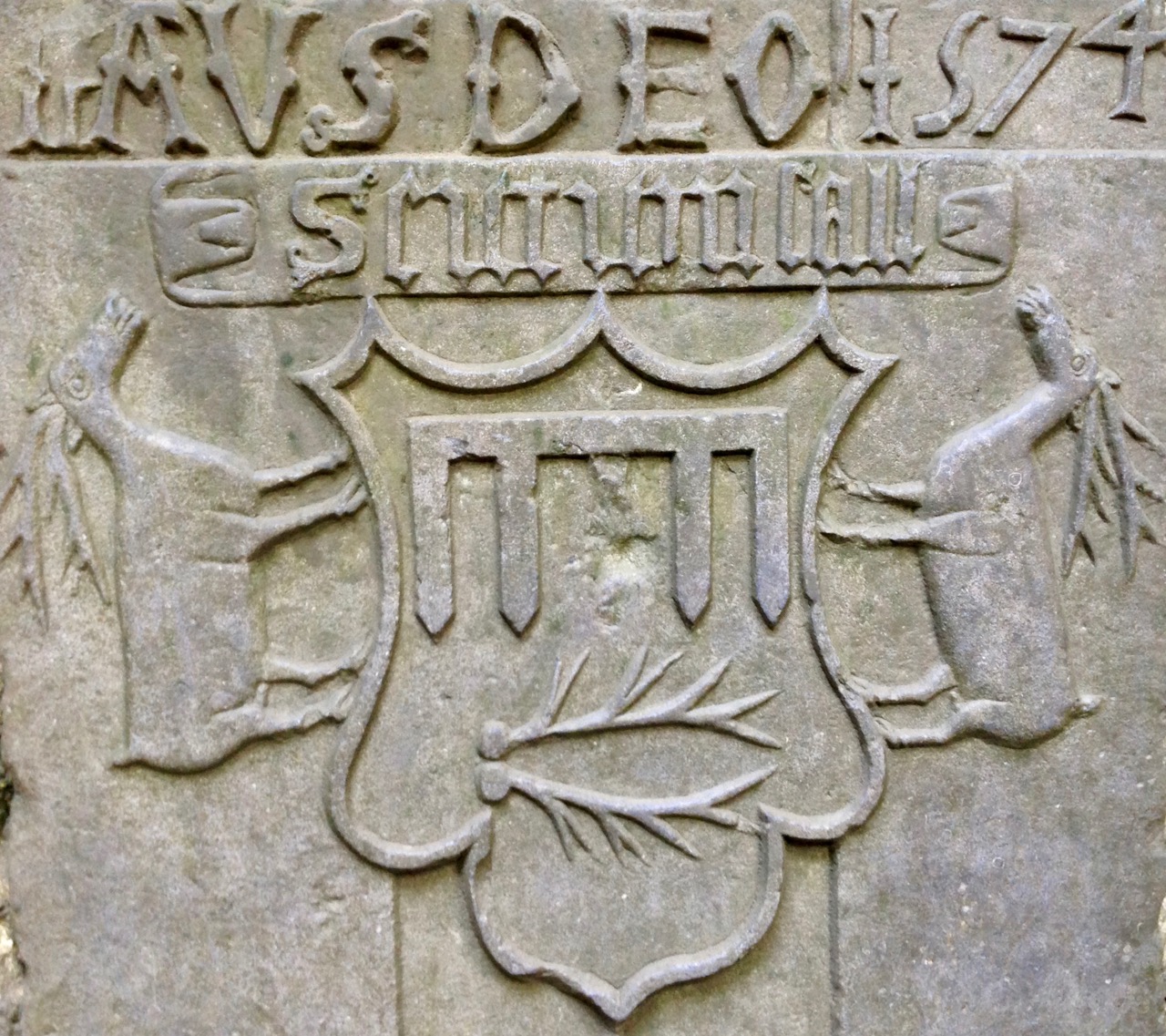
Deer and antlers on a memorial plaque in the Cathedral at Cashel – one of the earlier representations here, dating from 1574. Top picture – believed to be a tiger, this fine beast lies at the feet of a medieval knight in St Canice’s Cathedral, Kilkenny
Our travels take us around many of Ireland’s historic sites, and I’m always on the lookout for Creatures – they are abundant everywhere. Countless stories of the saints involved animals: they are common symbols on tombs and heraldic plaques, but we can’t resist also using them today – for inns, shop signs or just decoration on the streetscape. Have a look around you – you might be surprised how many you can see…
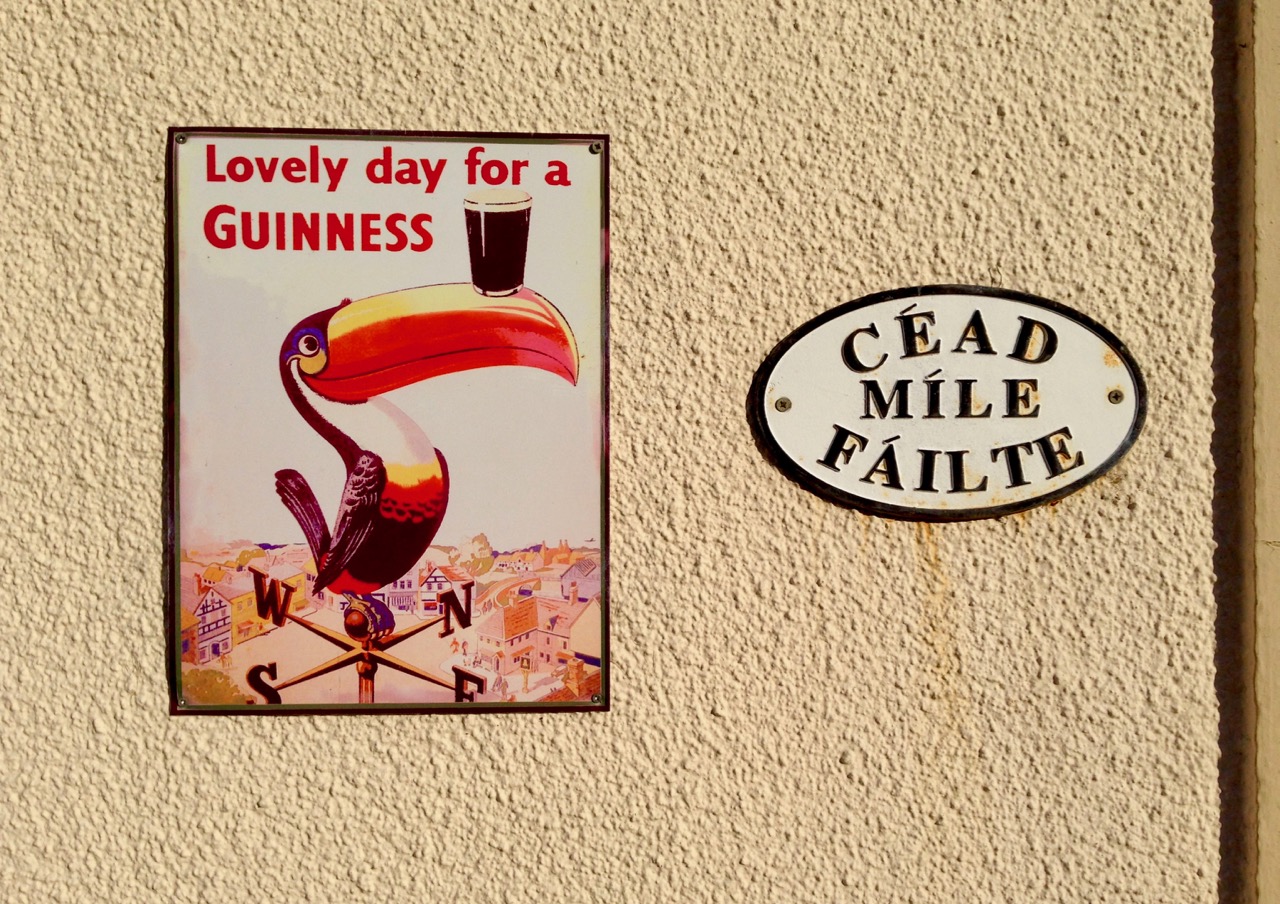
Inhabited streetscapes: top – two Kilkenny Cats undoubtedly belonging to Dame Alice Kytler and, above – there are plenty of these toucans still around in Ireland! They originate from a ‘zoo’ advertising campaign for Guiness begun in 1935 (abeted by Dorothy Sayers who wrote captions and verses); the toucan campaign flourished until 1982
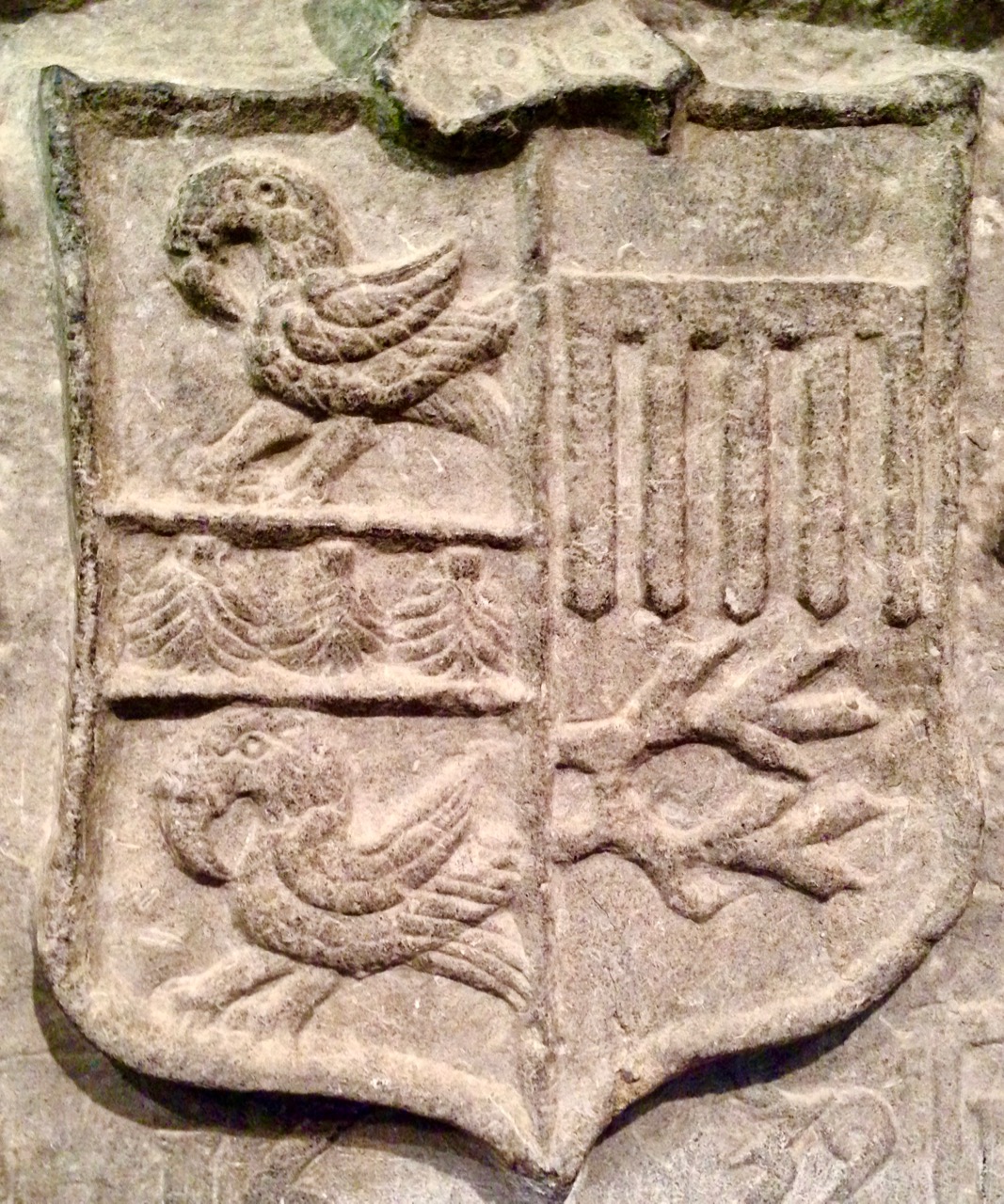
Nobody has ever claimed the toucan as an Irish bird, but pelicans were certainly not uncommon in medieval carvings here. That’s because the pelican in early Christianity symbolises atonement as it was believed to wound itself in order to feed its young with its own blood.
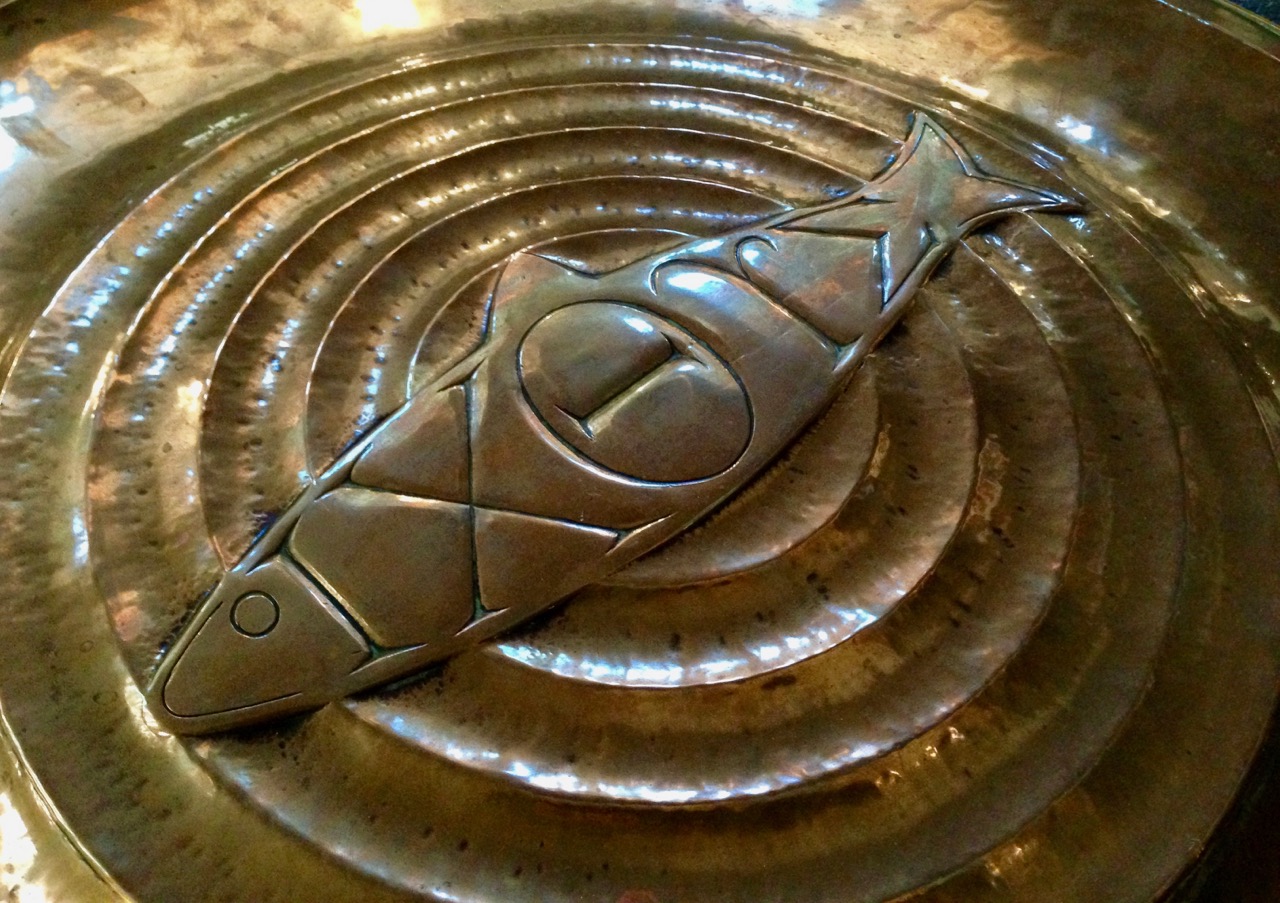
Christian symbolism: top – medieval pelicans at Cashel, and below – a fish incorporated in a modern lid to the ancient font in St Canice’s Cathedral, Kilkenny. The Greek ΙΧΘΥΣ is an acrostic for Ἰησοῦς Χριστός, Θεοῦ Υἱός, Σωτήρ, literally translating as Jesus Christ, Son of God, Saviour
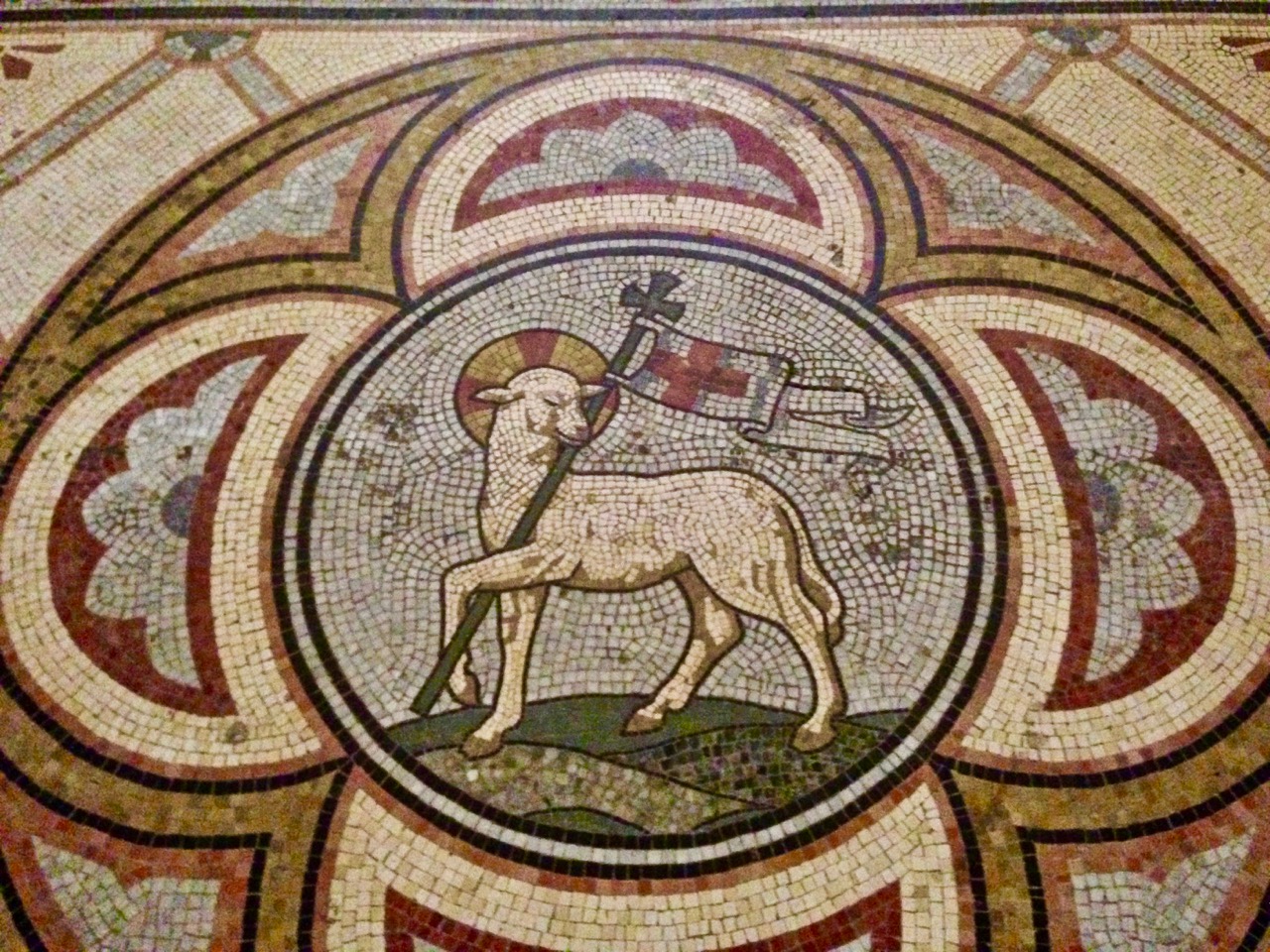
Also in Christian symbolism the lamb represents Jesus – the Lamb of God – who was sacrificed in order to atone for human sin.
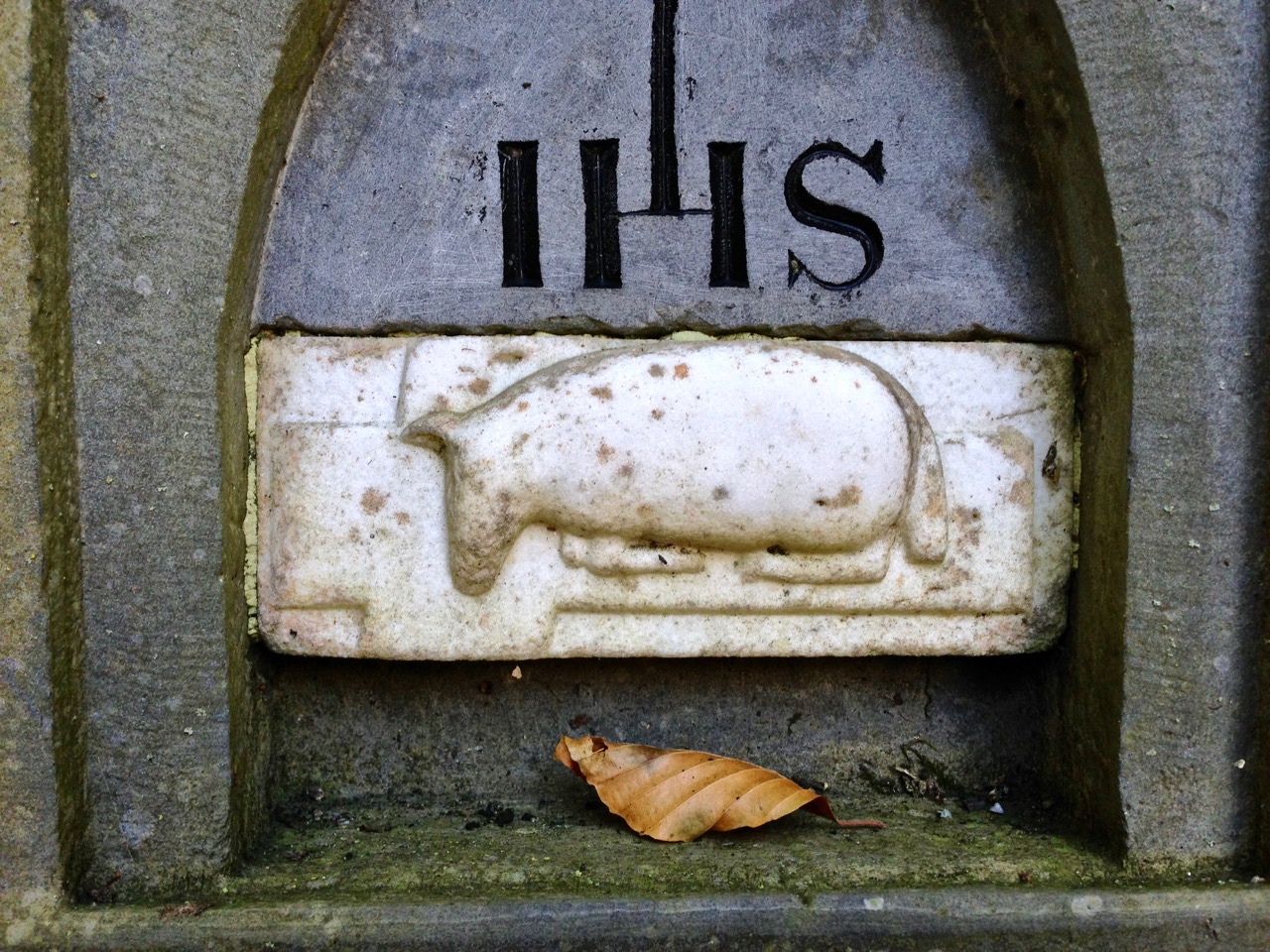
Top picture – not a wild beast, perhaps, but a pascal lamb mosaic in St Mary’s Cathedral, Kilkenny. Lower picture – this strange creature is also a lamb, from a graveyard memorial in Killeen, Co Meath
Lions are popular animals in Britain and Ireland, possibly because they appeared on royal crests and were therefore associated with status and dignity. I was surprised to find bears and eagles well represented.
All the lions (graphic tiles and wistful memorials) are from the Collegiate Church in Youghal. The stained glass is from St Peter’s Church, Bandon, Co Cork and shows off bears (from crests of the Earls of Bandon – their motto was Bear & Forbear), eagles, another lion and – for good measure – a fine serpent
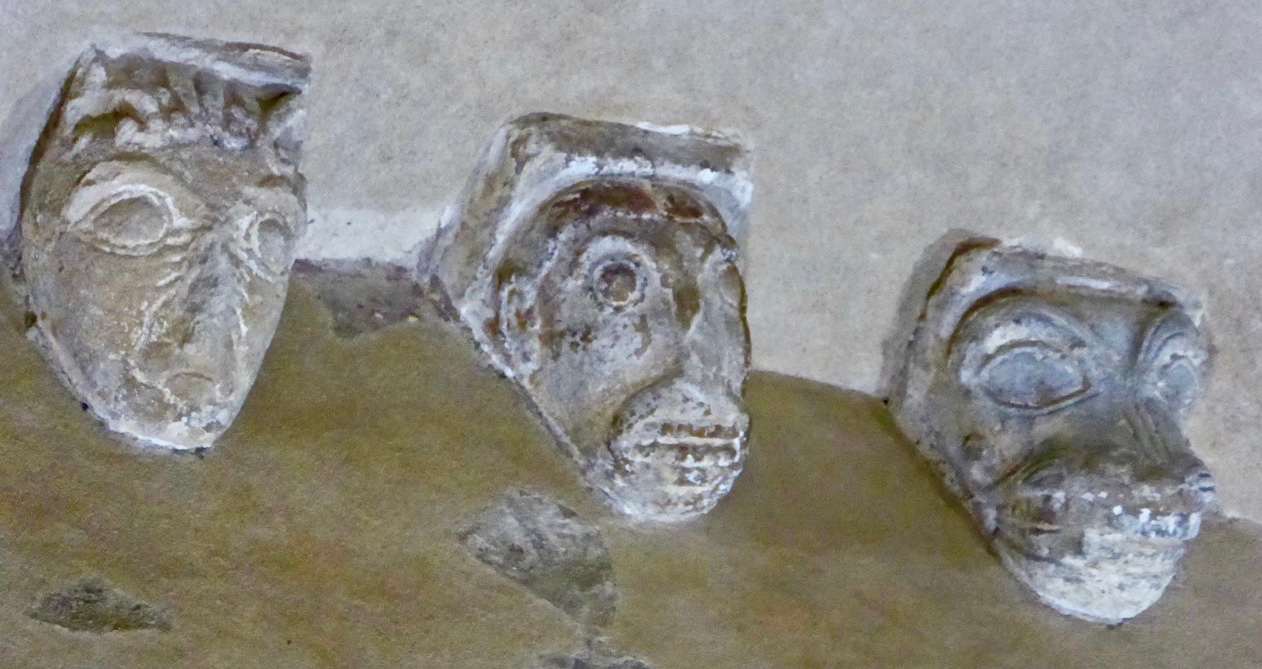
Some of the most splendid and oldest carved stonework in Ireland is to be found at Cormac’s Chapel, Cashel and at Clonfert Cathedral, both dating from the twelfth century. The Hiberno Romanesque doors and arches display arrays of human heads but also numerous creatures.
Upper pictures – a small selection from the riotous carvings at Clonfert Cathedral, Co Galway and – lower picture – ambiguous creatures from Cashel, Co Tipperary: all are around 900 years old
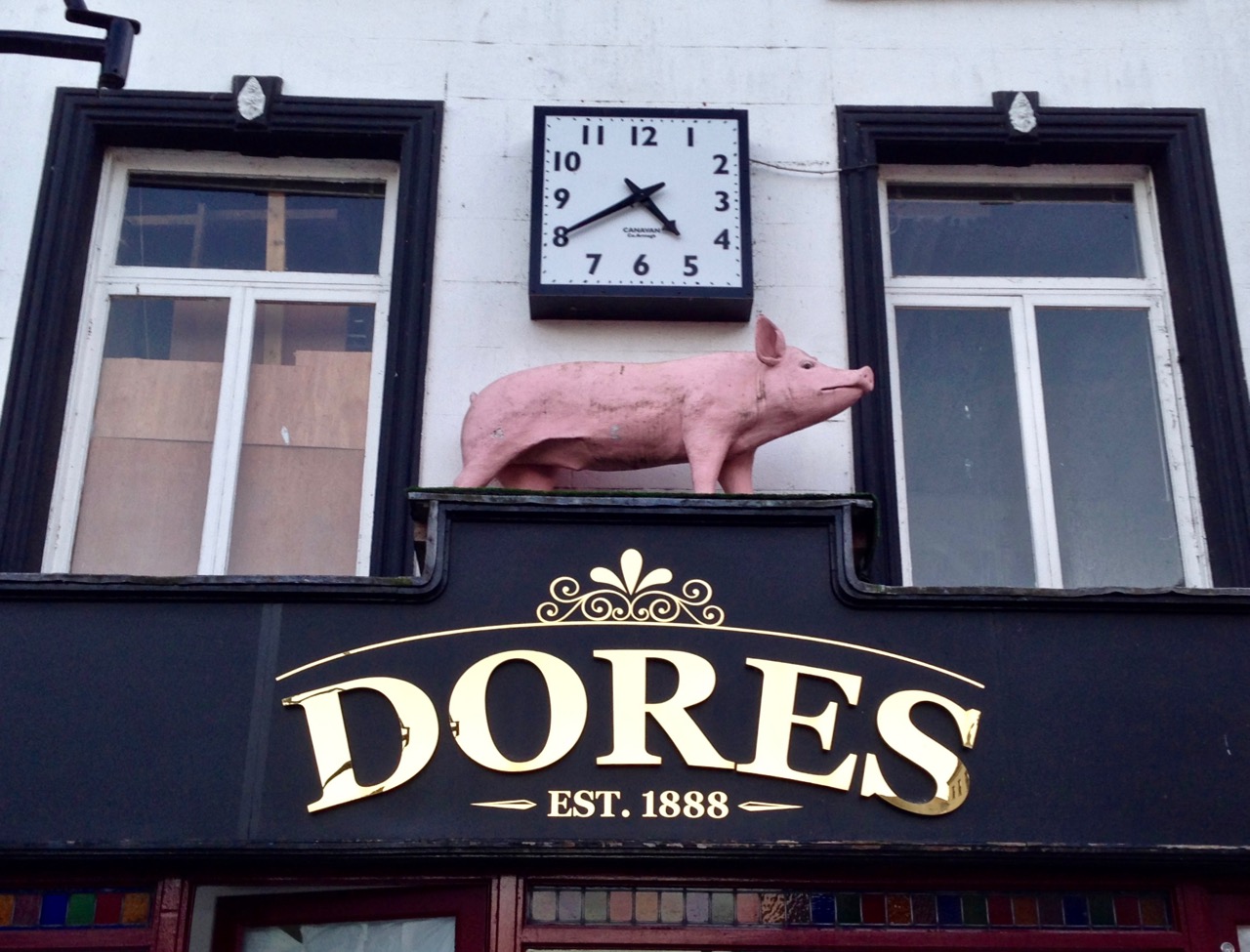
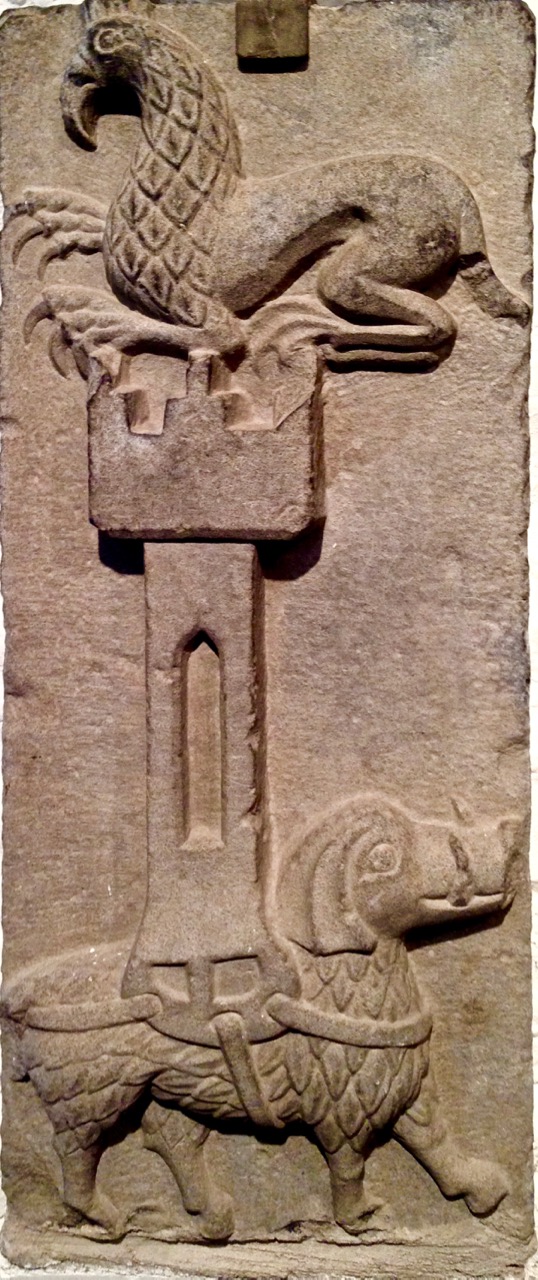
I’ll round off for now with some more cat-like creatures and a Kilkenny pig. Oh – and a carving we found in the Cashel museum, titled ‘Elephant and Castle’. Both the carving and the name are enigmatic, as the creature with a castle on its back (wherein resides another creature – a gryphon?) looks to me like a boar with feathers!
Here is a typical Harry Clarke piece of stained glass – note the large expressive eyes and long tapering fingers, the gorgeous raiment of the angel and that headdress, the additional tiny angelic figure hiding in the blue glass, the border filled with non-repeating decorative elements. All classic Clarke elements, right? But this is not the work of Harry Clarke. He died in 1931 and this window was designed, executed and installed in 1937, by the studio that he founded and which carried on after his death under the name Harry Clarke Studios.
The first image in this post is from the Patrick window and shows Vox Hibernicæum – the people of Ireland calling Patrick back to convert them. The image above is from the same window – Patrick preaching to the chieftains **
This window, it turns out, along with several others in the same church, was the work of Harry Clarke’s apprentice, the man who stepped into the breach caused by his death and took over as the main stained glass artist of the Studio. That man was Richard King.
The Joseph window: each frame tells a story from the life of Joseph or references other biblical Josephs.
I had never heard of Richard King until I stepped into Sts Peter and Paul’s Catholic Church in Athlone during our Midlands trip. That’s not all that surprising, because after Harry Clarke died windows from his workshop were generally signed simply by the Studio and individual artists were not identified. Mostly, it seems, this was to capitalise on the Harry Clarke brand, which by the time of his death was justly celebrated, and thereby to keep orders coming in.
Close up of the lowest frames in the Joseph windows. Clockwise from top right: the marriage of Mary and Joseph; the death of Joseph; Genesis 41:55 When all Egypt began to feel the famine, the people cried to Pharaoh for food. Then Pharaoh told all the Egyptians, “Go to Joseph and do what he tells you.”; Four rivers and two deer: the four rivers of Paradise; This is a reference to another biblical Joseph mentioned in Psalm 104, ‘constituit eum dominum domus suae et principem omnis possessionis suae’ – He made him master of his house, and ruler of all his possession **
Richard King had been trained by Harry: he had executed windows designed by Harry under Harry’s close supervision. A promising artist when he joined, he probably did more than set glass etched and drawn by Harry, but may have been responsible for background elements, borders, details. Harry was away in Davos, gravely ill, for the last year of his life and Richard may well have translated his cartoons (window designs on paper) into glass. But I am speculating here, and I hope to learn and write more about Richard King in the future. He went on to have a long and distinguished career as an illustrator.
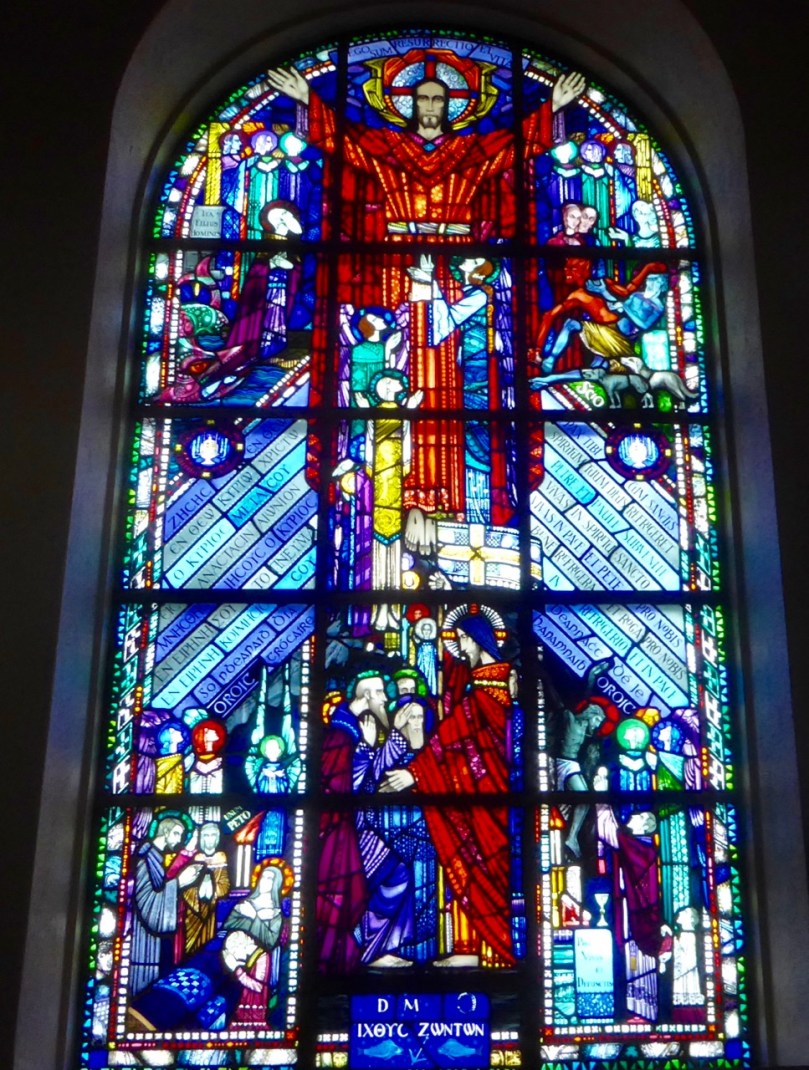
The Purgatory window: prayer fragments in Greek, Latin and Irish; the righteous ascend to heaven; Christ descends to purgatory with a banner to lead those who have done their penance up to heaven; in the lower left St Monica is on her deathbed while St Augustin looks on; lower right, the mass is celebrated; upper right, Jonah (whose purgatory was to be in a whale) and upper right Job, who was robbed of everything he held dear by the devil, thus testing his faith **
The King windows I photographed are enormous. (There are other Harry Clarke Studio windows by Richard King in the church as well as windows by other companies, but I will concentrate on these ones for the purpose of this post.) They represent St Joseph, St Patrick, Jesus, Mary and Purgatory. All follow the same convention of placing the main figure centrally, surrounded by smaller panels which tell stories or illustrate events from the life of the central character.
Close up: Christ descends to purgatory
Close up: the Job panel
The sheer size of the windows has allowed ample scope for this approach, but size alone cannot account for the myriad details that King inserts into every possible space in the window. Words abound, in several languages and scripts. References to the ancient and the modern, the mythological, the hagiographical, and the historical jostle for space with abstract designs, tiny figures both realistic and imaginative, symbols, animals, buildings – everywhere the eye lingers new elements are discovered. In its essence, this is very Harry Clarke; in the sheer exuberance of its execution, this is Richard King having fun, cramming in as much as his own fertile imagination can offer up.
This is the Mary window and these sections concentrate on images of Marian veneration. Clockwise from top left: workers pause to pray the Angelus; a family says the rosary together; St Simon Stock receives the scapular from Mary (more on this here); Mary; St Dominic receives the rosary **
The Harry Clarke Studios closed down in the 70s. For many years after Harry’s death in 1931 it carried on his tradition of highly stylised and beautiful works of art in stained glass, although over time works became more conventional and quality suffered as orders were harder to get, costs rose and corners were cut. Look, for example at the Studio windows in my post Time Warp, about the Drimoleague church, done in the 50s. But that’s in the future – what we can see, under Richard King’s assured hand, are windows that proudly carry on the Clarke preoccupations with designing windows that dazzle and inspire.
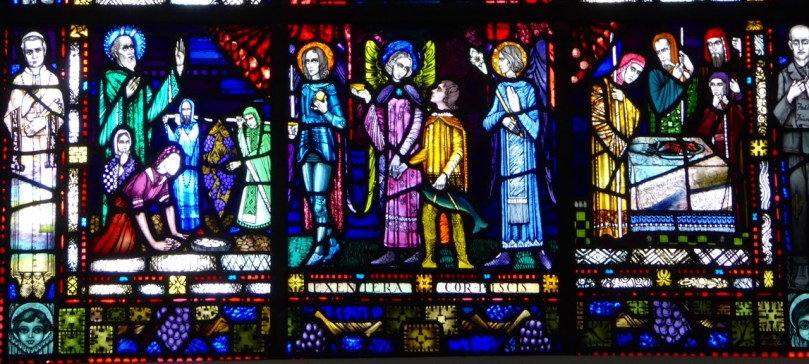
Details from the Jesus window from left to right: Pope Pius x; Manna from heaven; Tobia walking with the Angel Raphael, with Michael and Gabriel; eating the paschal lamb; Matt Talbot, a Dublin man who died in 1925 and who was considered on the path to sainthood because of his extreme practice of asceticism **
Perhaps, though, there is another element that creeps in now that Harry is gone – the religious fervour of the early years of the state is now in full swing. Government and Church Hierarchy work hand in glove to develop and promote a vision of Ireland that is devout, Catholic, monocultural, conforming and repressive. A high point in this relationship occurs in 1932 with the Eucharistic Congress in Dublin – an event explicitly referenced in the Patrick window. Richard King will never, as Harry did, fall afoul of puritanical state censorship – he will go on, in fact, to become the chief illustrator for a Catholic magazine.
The top of the Patrick window explicitly references the Eucharistic Congress of 1932 and the crossed flags of Ireland and the Vatican. Try to enlarge this image and see how many different elements you can identify. Good luck!
But in 1937 he is at the height of his powers as a stained glass artist. I hope to find and illustrate more of his work in that medium in future posts.
From the bottom of the Patrick window: Patrick lights the paschal fire on the Hill of Slane; he is flanked by images of two St Patrick Cathedrals, New York and Melbourne; Beneath, the swans represent the ancient myth of the Children of Lir (although there were four swans in the myth, not three) – the spell they are under is broken when they hear St Patrick’s bell
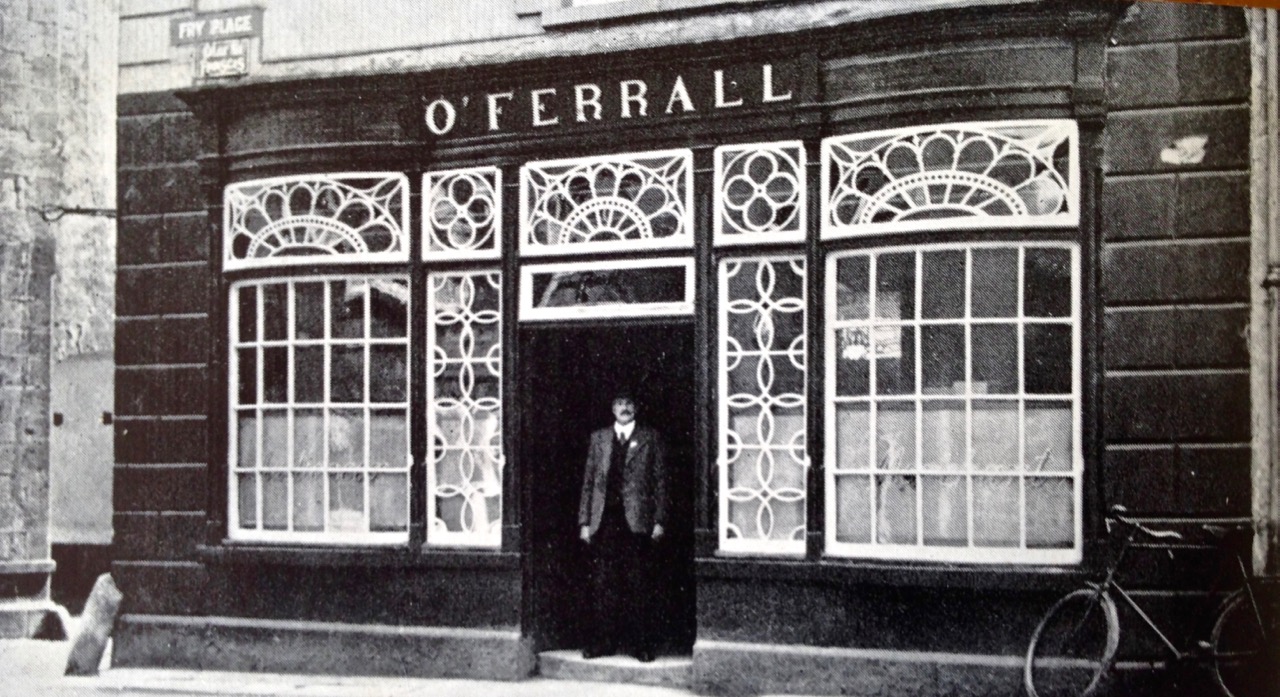
…One of the shops we visited was O’Ferrall’s, whose frontage dates from the days when shop-fitting was not merely a business but an art, as the picture we took of it, with ‘himself’ in the doorway, clearly reveals. Old Mr O’Ferrall was a tall gaunt figure. His hawk-like features had an aristocratic cast which was somehow enhanced by a long coat of archaic cut and a high stand-up collar. He had, we discovered, a great sense of the past, and as we sat together in the confined space of the small wooden cubicle to which, as in most Irish bars, women must retire in order to drink with propriety, he talked of the history of Athlone. Like that of most Irish towns, it has been stormy… (Green & Silver L T C Rolt 1946)
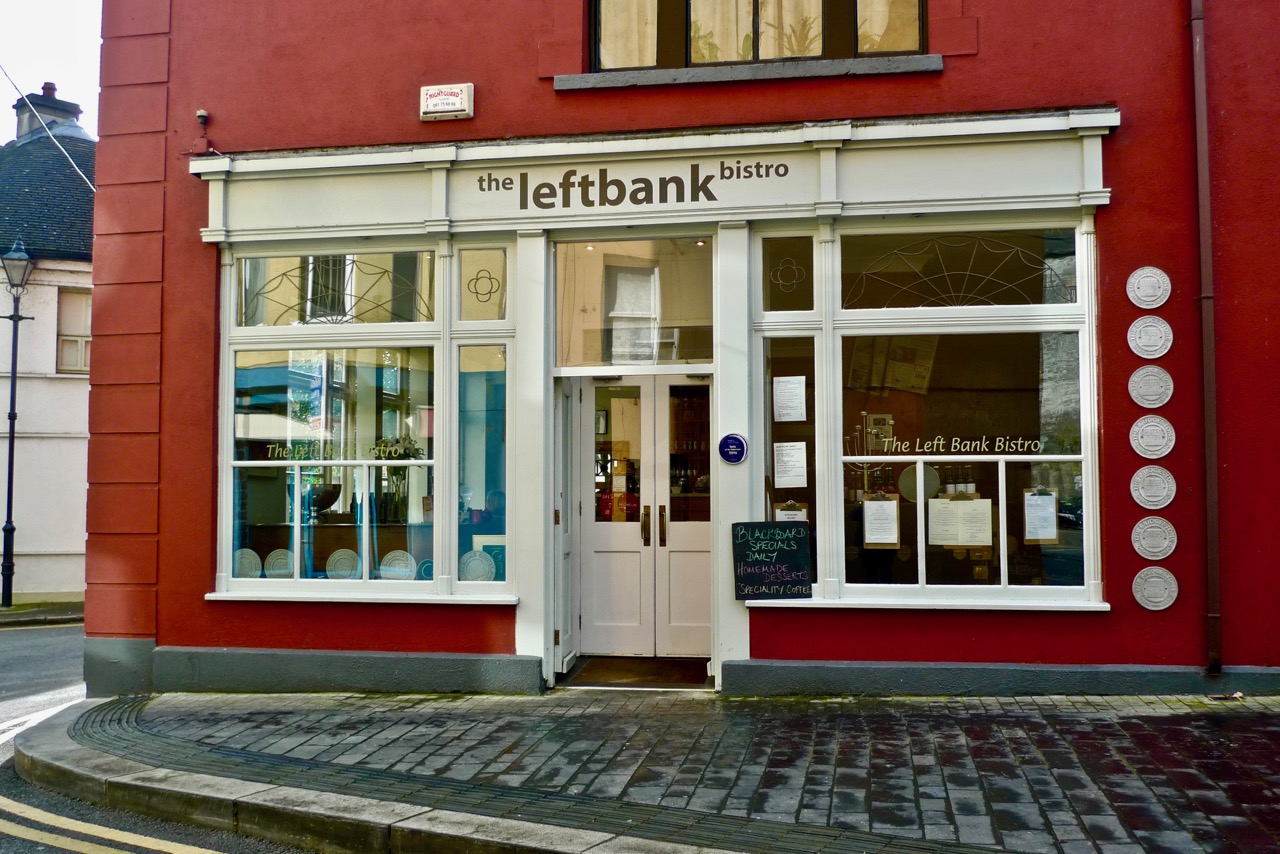
Top picture – Angela Rolts’ photograph of O’Ferrall’s shop and bar, Fry Place, Athlone – taken in June 1946 just before the Rolts embarked on their journey around the Irish waterways which they describe and illustrate in their book Green & Silver. Lower picture – the same view, Fry Place, Athlone – taken in 2016 – now a highly regarded bistro. The new shop frontage pays due respect to its predecessor in terms of overall proportion and despite the loss of the ornate bow windows. It’s interesting, too, that – seventy years on – the premises is still a local meeting place and purveyor of good food and drink
This is the fifth instalment of the Travel By Water series… When we retraced the steps of Tom and Angela Rolt – seventy years after they made their voyage of discovery around the Irish canals and waterways – we visited the town of Athlone for the first time. We were impressed enough to determine that we would return for a more detailed exploration of this midlands settlement, historically a strategically important crossing point of the Shannon – a formidable barrier intersected with her great lakes – the largest river in Britain and Ireland.
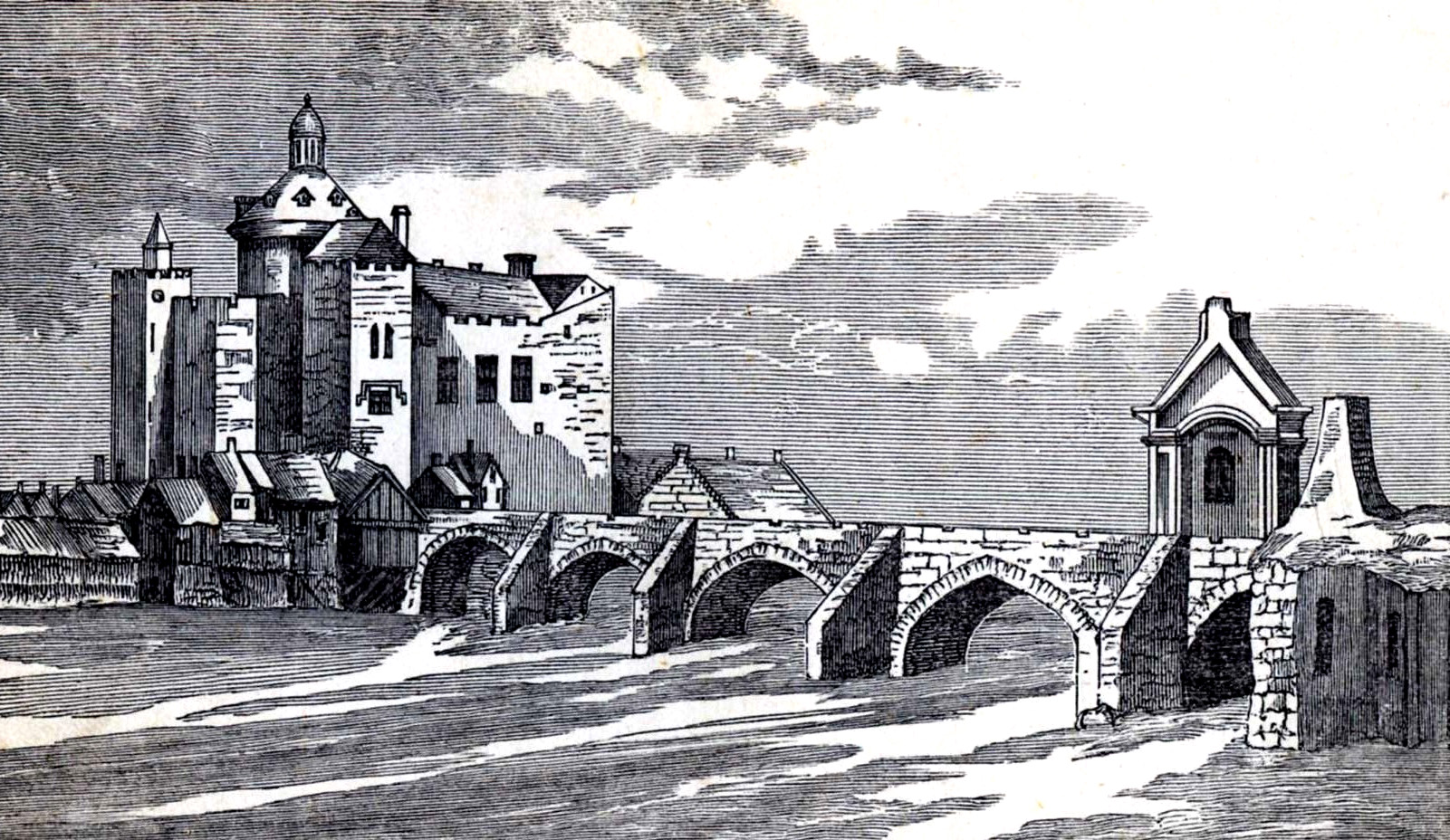
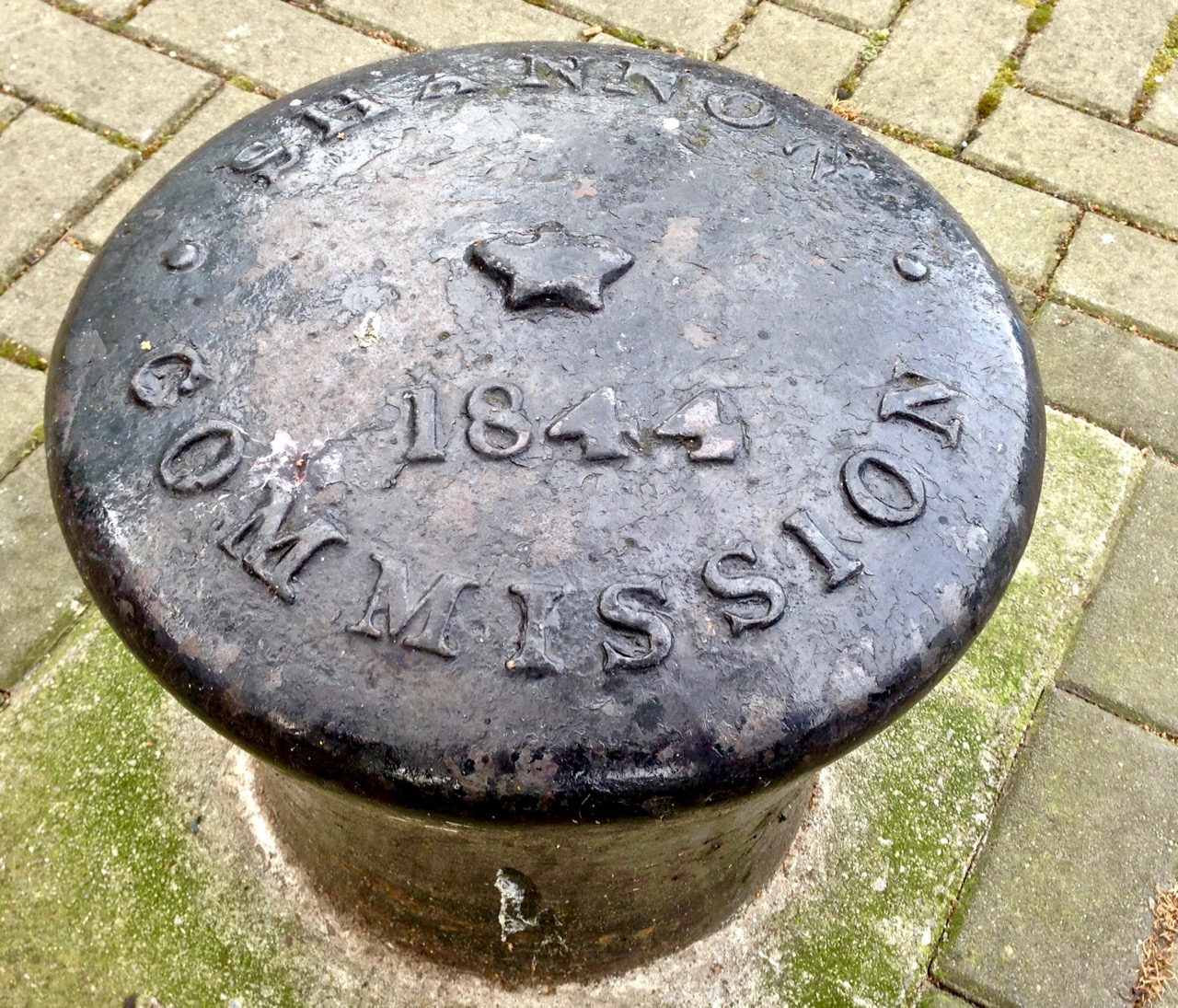
At one time (some histories say as early as the Bronze Age) this river crossing just below Lough Ree would have been a wide ford – Luan’s Ford. In the 11th century, Tairrdelbach Ua Conchobar, King of Connacht, had built a wooden bridge which survived, with various restorations, until 1566, when the first stone bridge was constructed (depicted above in a print now in the Aidan Heavey Public Library, Athlone). It could well be this medieval bridge that is commemorated in the ceilidh dance The Bridge of Athlone. The present bridge was opened in 1844.
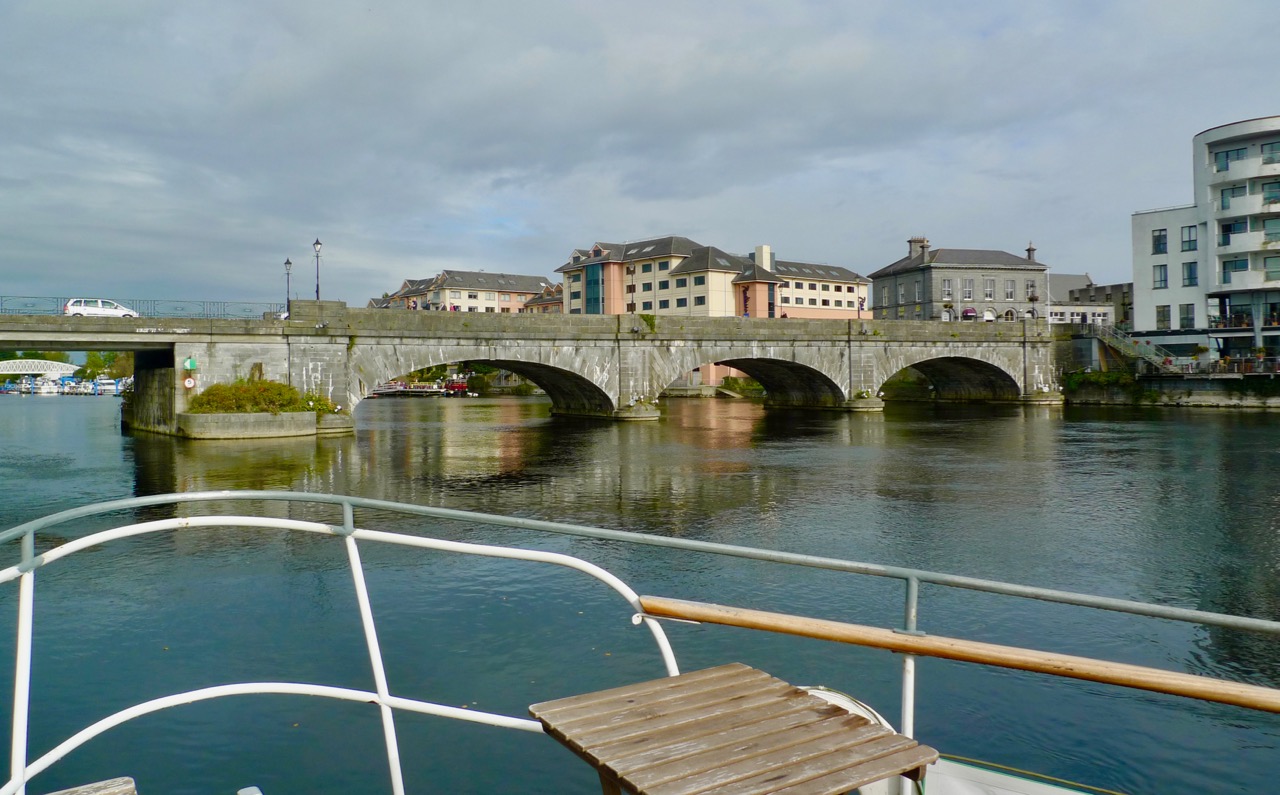
Athlone’s Victorian bridge today. Note the flat ‘navigation arch’ on the left (west side of the river): this replaces an earlier movable section of the bridge which allowed taller boats to pass through
The Shannon Navigation is now managed by the cross border authority Waterways Ireland. This body also manages the navigable canals, rivers and lakes throughout the island of Ireland, and does a very good job of it. Such an undertaking would probably have never been foreseen by the Rolts 70 years ago when some of the canals had been derelict for many years, and others were in poor condition. The Rolts’ borrowed boat Le Coq was based in Athlone and was probably the last craft to fully circumnavigate the circular route encompassing the Royal Canal, the Shannon and the Grand Canal in the 20th century: the Royal Canal fell into disuse shortly after the Rolts’ journey and was formally closed in 1961. Today the Royal Canal is completely restored to navigation (it was reopened in 2010).
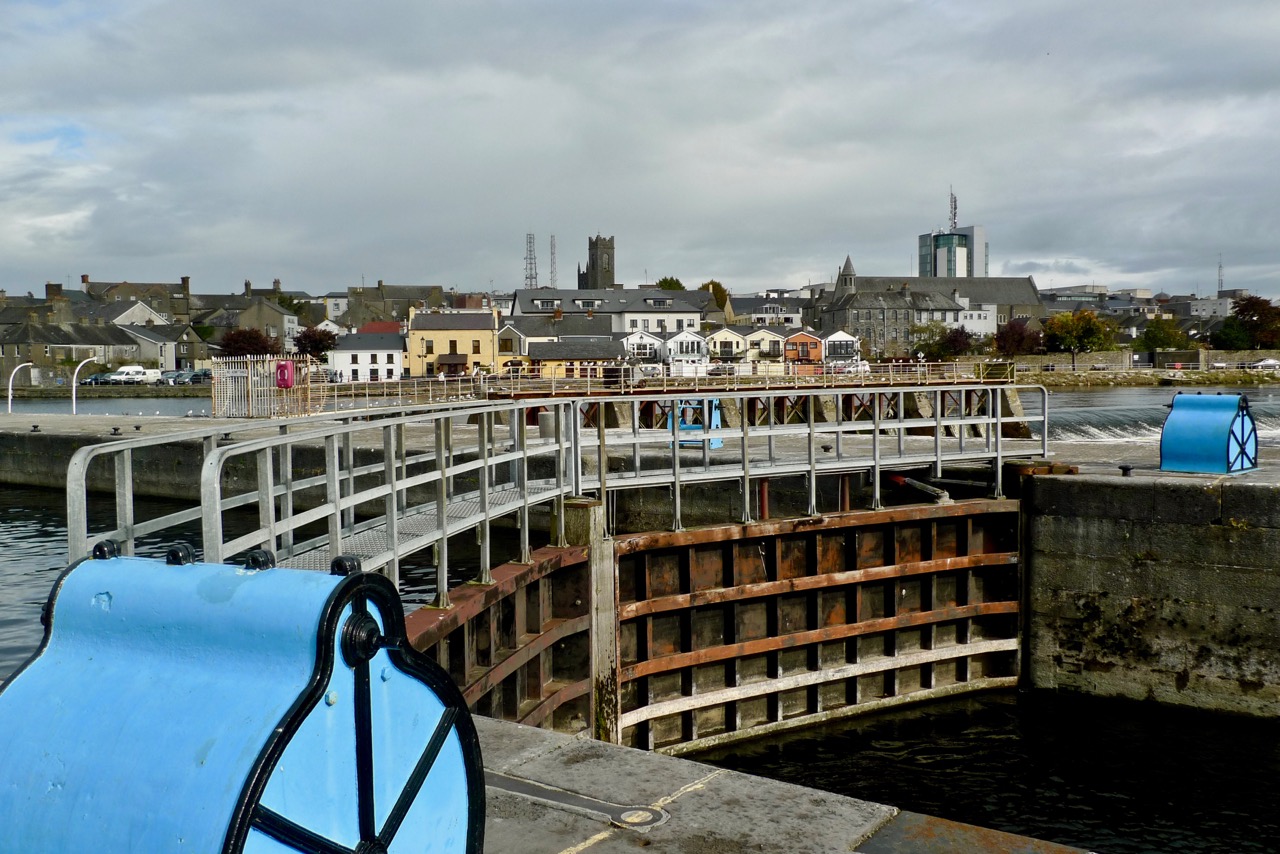
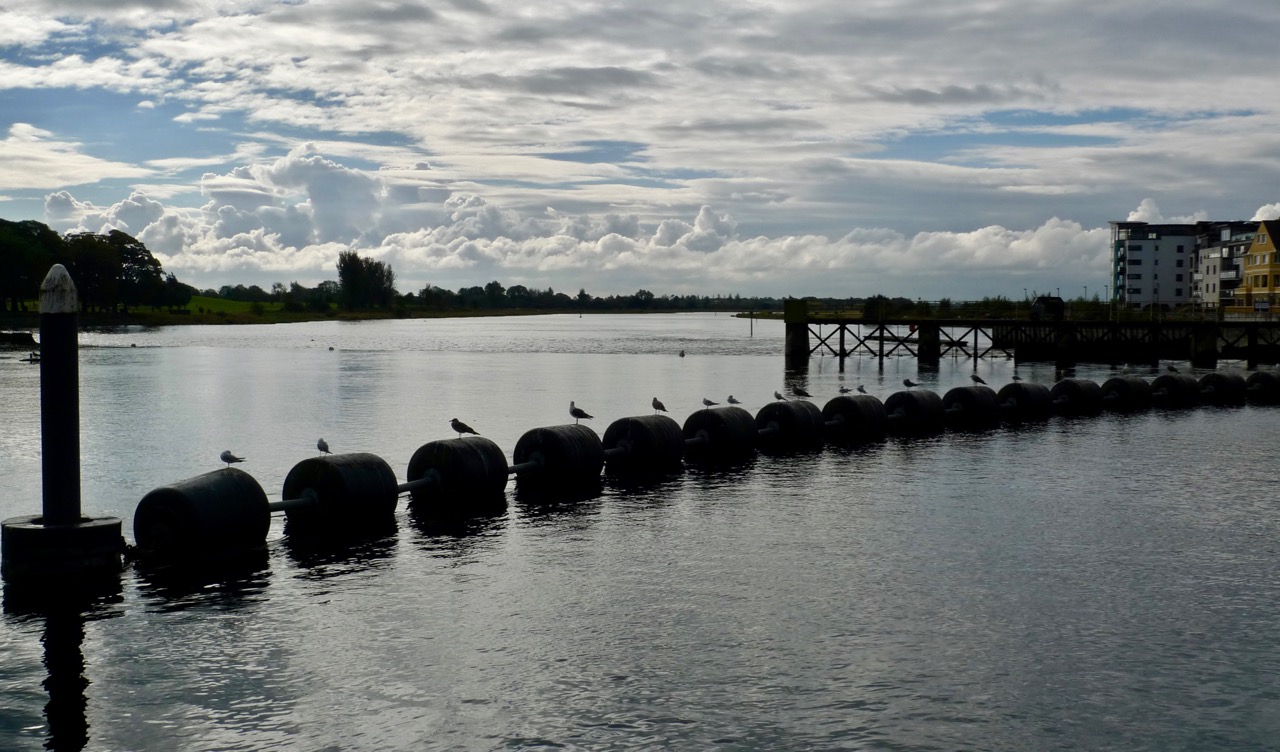
Upper picture – Athlone Lock today – some of the original Victorian lock machinery has been retained and is in working order although the main operations are electrically powered. Middle picture – upstream of Athlone the river widens dramatically as it approaches Lough Ree. Lower pictures – distinctive livery of the lock machinery in Athlone: note the commemoration of Thomas Rhodes, the engineer of the navigation improvements
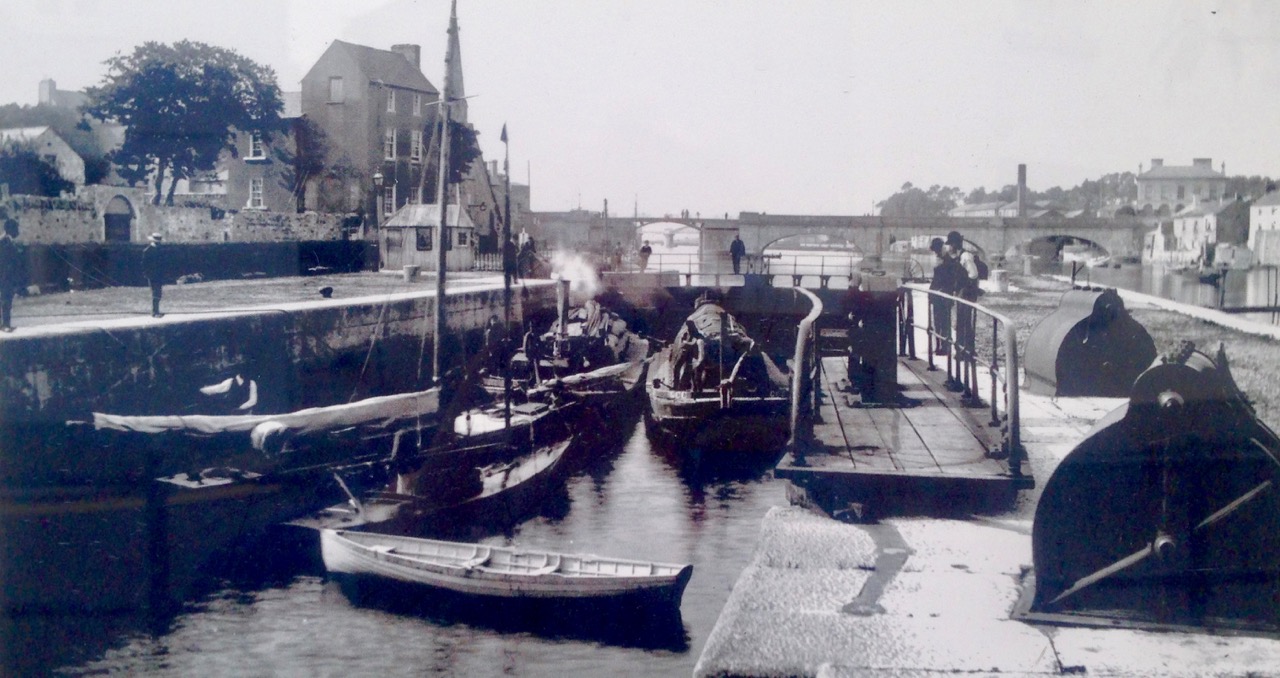
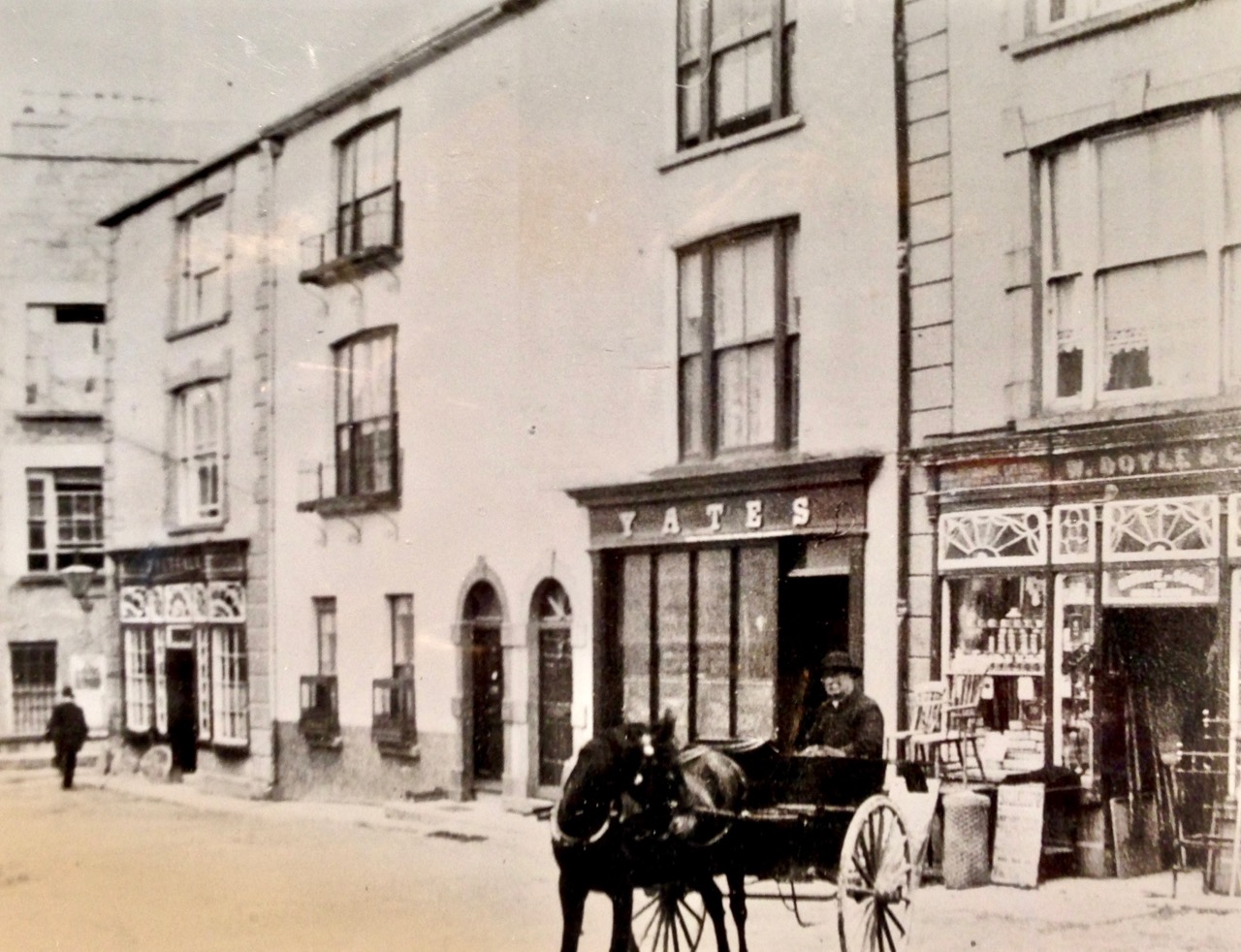
We were fortunate to find some early photographs of Athlone and the river: these significantly predate the time of the Rolts’ journey but are worth showing for historical interest.
Upper picture – probably early 20th century – the lock at Athlone: note the commercial craft in the lock, one of them a steamer, and the lifting span on the bridge in the distance. Lower picture – Fry Place, Athlone, courtesy of The Leftbank Bistro: this probably dates from the late Victorian period and shows O’Ferrall’s on the left (see above) and a matching shopfront to the right
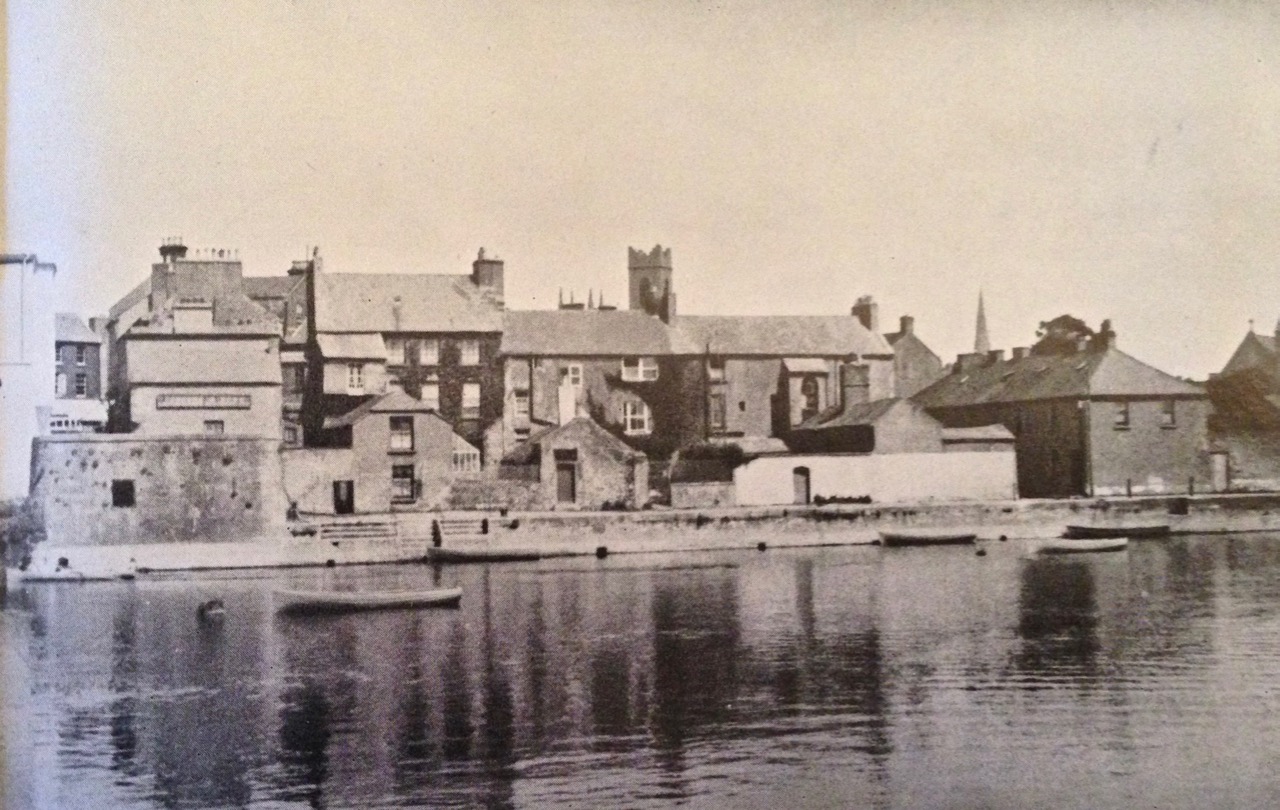
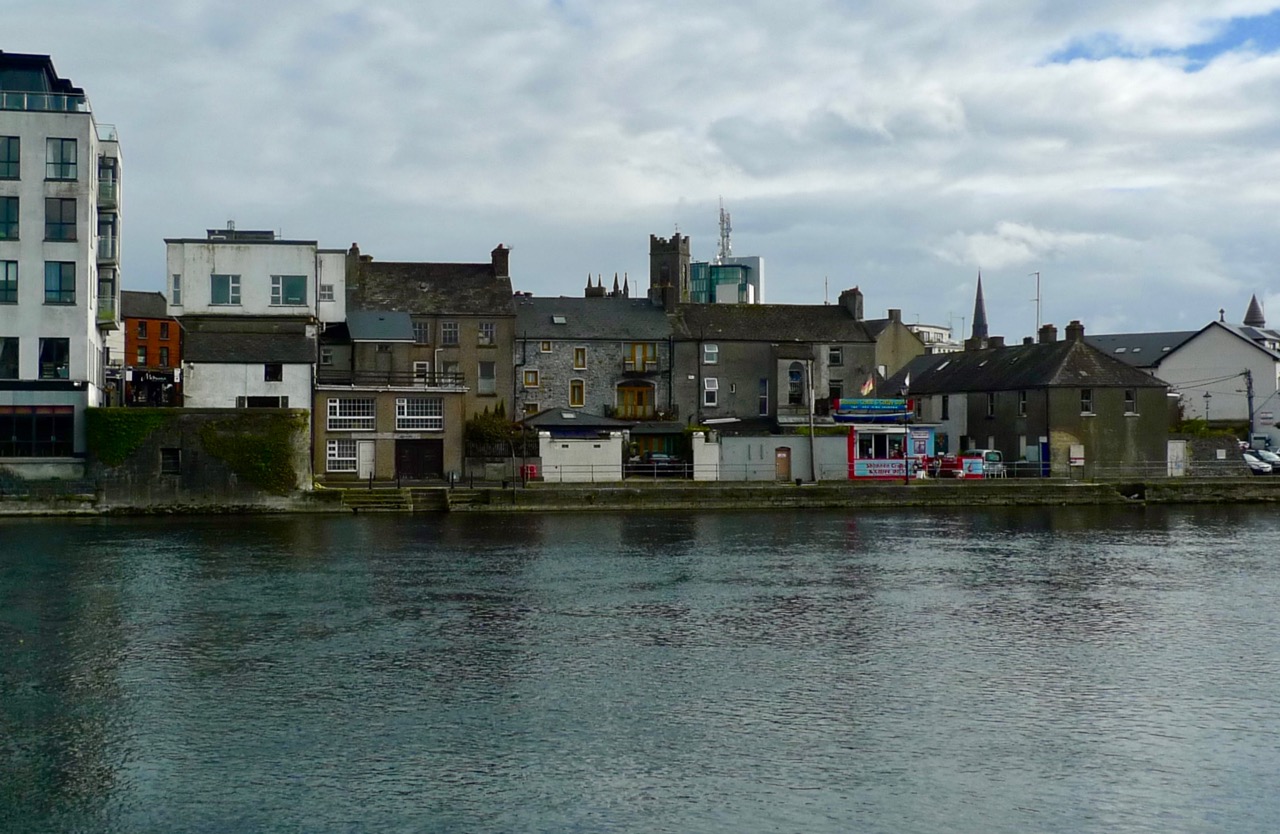
Compare Angela Rolt’s photograph of Athlone’s waterfront in 1946 (below) with my 2016 picture underneath it. Architecturally there is very little change to the buildings she recorded. Obviously, there has been considerable alteration to the town elsewhere in the last 70 years but the river itself has remained a constant.
We were chasing ghosts on our whole journey, following in the wake of Angela and Tom Rolt who travelled the waterways of Ireland exactly 70 years ago – in 1946; their odyssey was described in Rolt’s book Green & Silver. I received this book as a prize for essay writing when I was at school in the early 1960s and it fanned my interest in canals but also in Ireland. I had always intended to explore the canals of Ireland and this year Finola and I did just that – to mark the seventieth anniversary of the Rolts’ voyage, and to mark my own seventieth birthday.
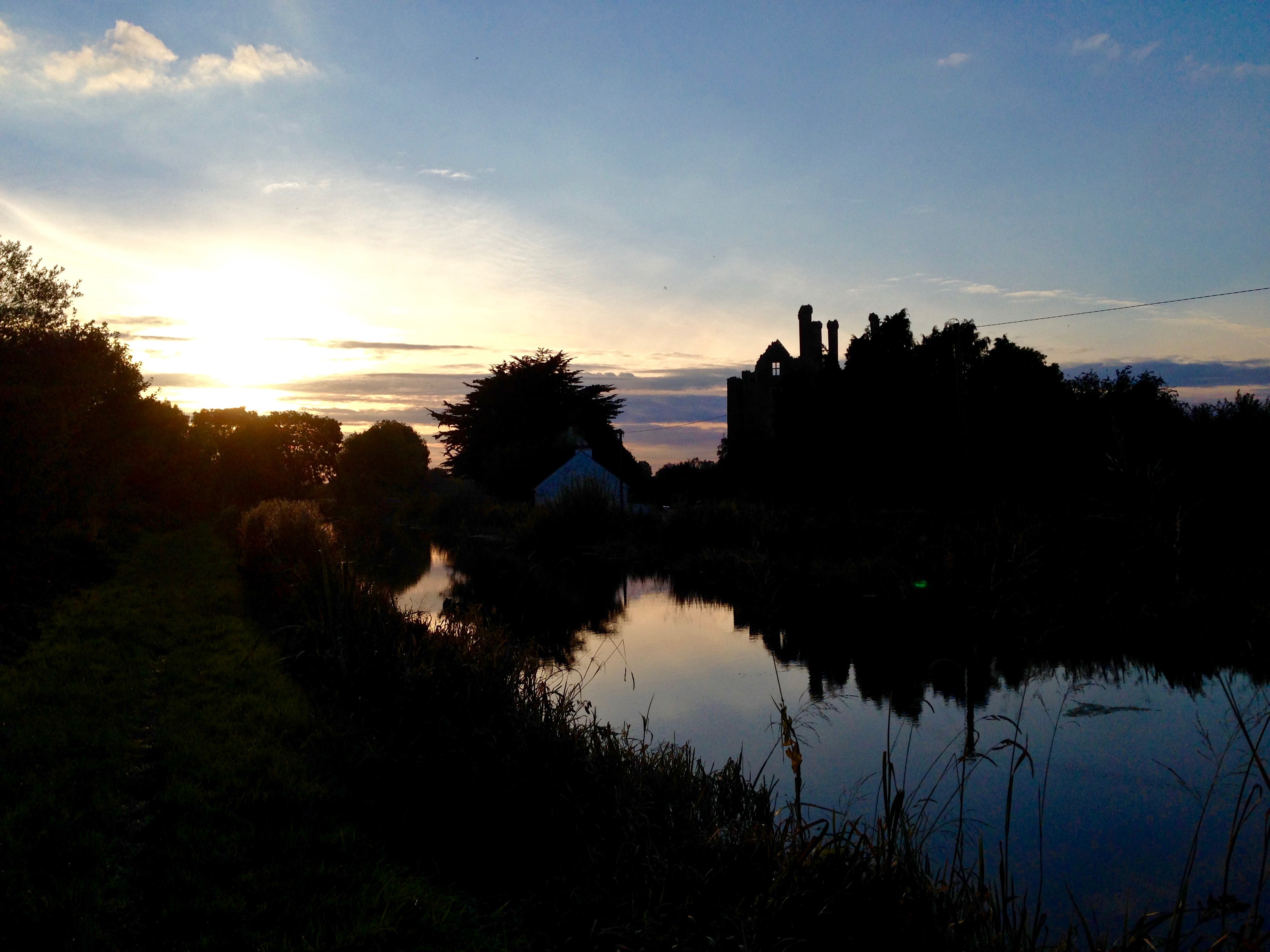
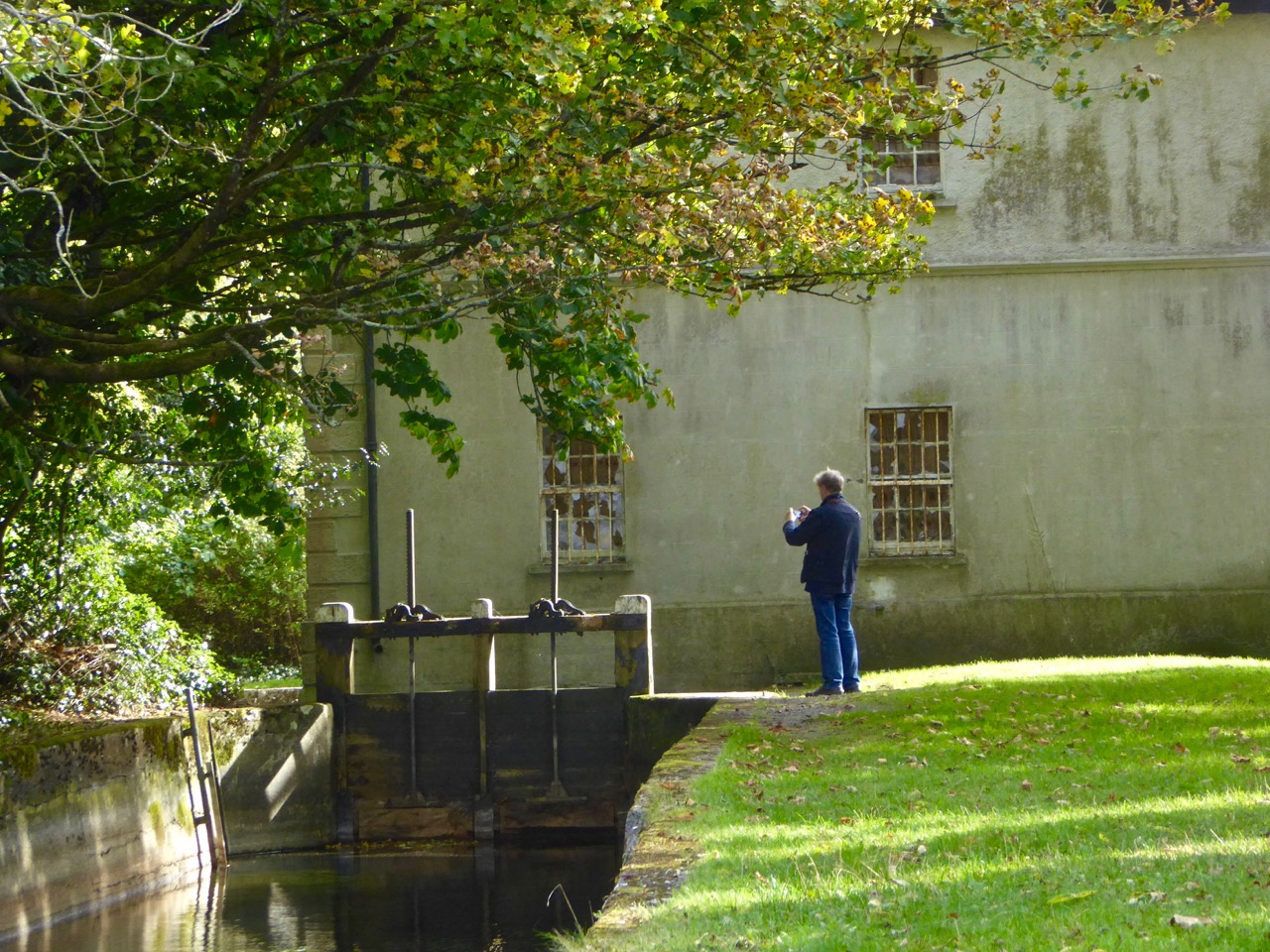
Top picture – ghostly reflections beside the Grand Canal at Ballycowan. Above – Robert photographing the impressive sluice house on the Royal Canal Feeder at Lough Owel: sadly, the house is empty and now deteriorating
The first ghosts we looked out for were the Rolts themselves. Would anyone have remembered them? Did they make enough of an impression – two eccentric English travellers intent on discovering a way of life in Ireland which had almost ended at that time? Their book is remembered today by canal enthusiasts; in fact there is a plaque given to anyone who completes the circumnavigation of the Royal Canal, the Shannon and the Grand Canal. It’s known as the Green & Silver Route. As the Inland Waterways Association of Ireland says, …with the closure of Ireland’s Royal Canal in 1961, Rolt’s Green and Silver offered successive generations of boaters the only opportunity to experience this journey by boat. His book offered a glimpse of what might be experienced if, and when, the canal was restored. Rolt was the first to document a successful transit of the route in Green & Silver, a book which had such a positive influence on the development of the Irish waterways… The book has gone into five editions, so the journey is certainly not forgotten. However, we did not meet anyone who had stories to tell about the Rolts; nothing seems to have passed down through the generations about them – perhaps this post might bring something out?
Left – the frontispiece of my copy of the Rolts’ book. Right – the Green & Silver Plaque, presented to boaters making a circumnavigation of the now restored route that the Rolts followed seventy years ago
But there are other ghosts in the pages of Green & Silver. The Rolts passed through Draper’s Bridge Lock on the Royal Canal:
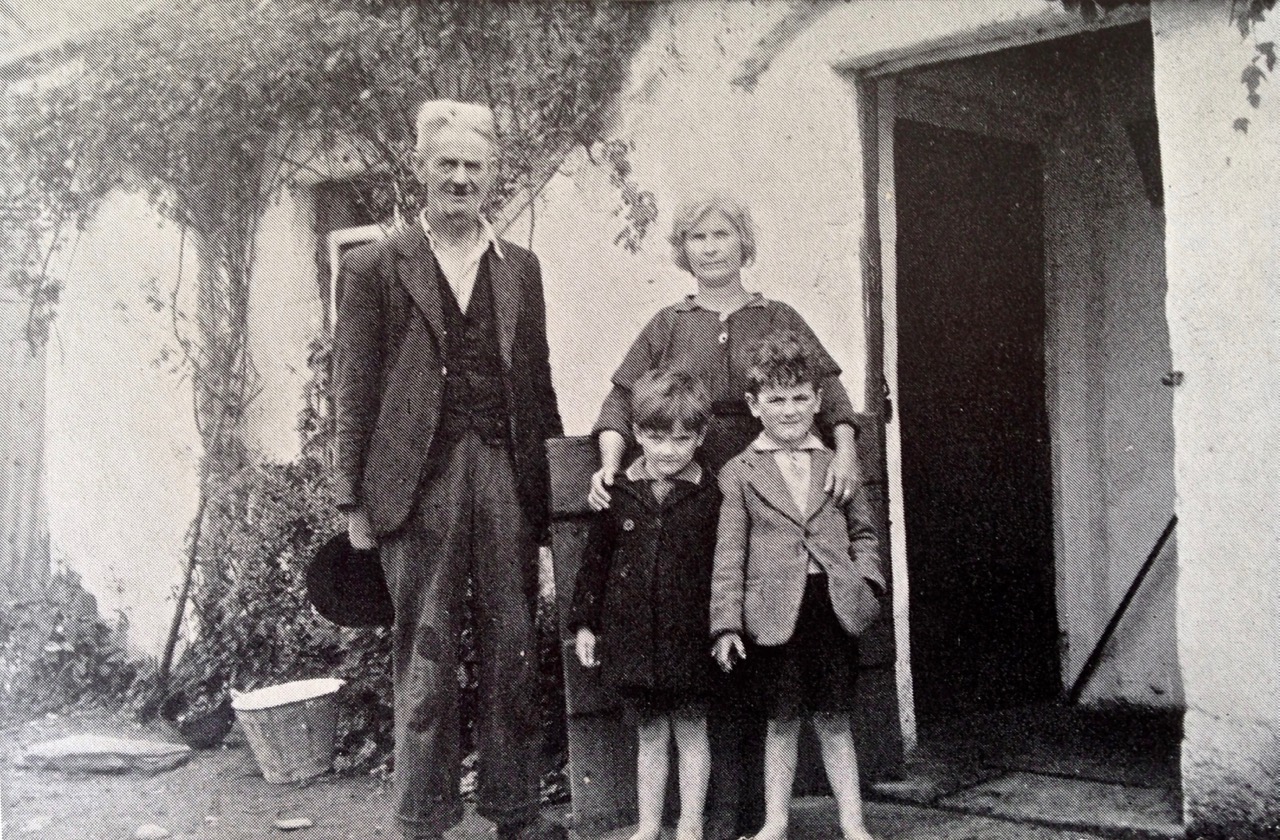
…The canal bore a more and more disused appearance the farther we went westwards, and at Draper’s Bridge lock beyond Abbeyshrule it was obvious that the chamber was rarely filled. Clumps of yellow musk in full blossom were growing out of the chinks in the masonry and looked so beautiful that we were sorry to drown them. The lock-keeper insisted on presenting us with some magnificent new potatoes which he dug from his garden while we were locking through. He refused to accept payment but, noticing Angela’s camera, asked if she would take a picture of himself with the family. She gladly agreed and took a photograph of ‘himself’ with his handsome silver-haired wife and two small boys standing before the half-door of the lock cottage. I hope he was satisfied with the print we sent him…
Angela Rolt’s photograph of the lock-keeper’s family at Draper’s Bridge Lock, Co Longford, taken in 1946
The children in this photograph could well still be alive, in their seventies. Some of the lock cottages on the canals are still lived in by families who have connections with the canals through generations. We were hopeful that we might discover someone at the lock who could point us to these young faces, a lifetime away?
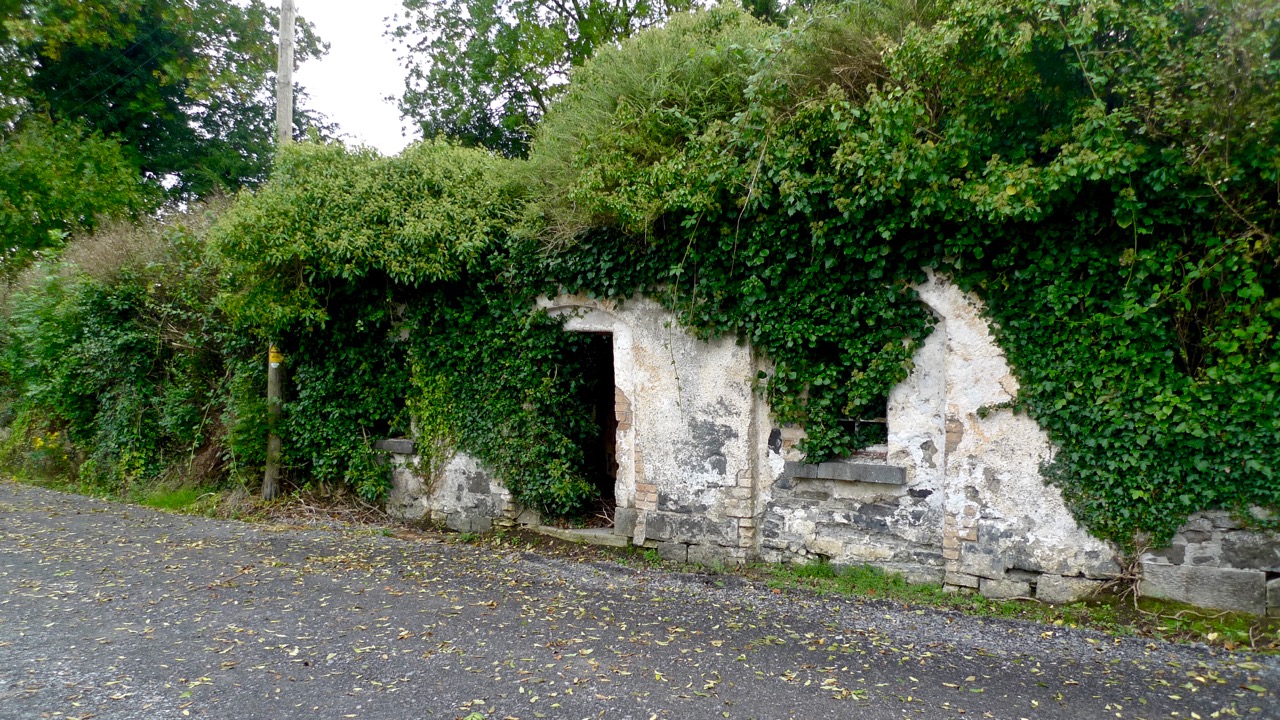
Only ghosts, alas… The cottage is in ruins today. This is unusual, as most of the original lock cottages on the Royal Canal have been retained. There is no sign of why this one has not survived. The Rolts did not name the lock keeper in the book, but I have since discovered that he was Jack Keenaghan. A ghost now with a name, at least.
Lock 39 on the Royal Canal, at Draper’s Bridge. Samuel Draper was Secretary to The Royal Canal Company during the construction of the canal
The Rolts were able to include part of the lower Shannon and Lough Derg in their voyage. They met up with a friend who lived at Kilgarvan, and I was intrigued by this description of a visit to Ballinderry:
…That afternoon our friend and I walked into the nearby village of Ballinderry where we visited Dick Stanley the local baker and proprietor of the village shop…
…In the intervals of baking bread and minding his shop, Dick Stanley makes violins. His art is entirely self taught, he uses the crudest of tools, and he finds and seasons his own materials. He showed us one instrument which he had recently completed and another which was in the course of construction. Though my companion had already told me something of his activities I had expected something which, though praiseworthy enough, bore all the evidence of amateur workmanship. Consequently, even if I had been told nothing I could scarcely have shown more surprise when Dick Stanley put own my hands the beautiful, perfectly finished violin that he had made. Had I not seen the same fine craftsmanship exhibited in the other instrument which was under construction, I doubt if I should have believed that he really had made it. The sound-board was cut from a pinewood beam salvaged from a ruined mill nearby, the body was of sycamore, the pegs of holly wood, while the bridge and frets were of black bog oak dug from the neighbouring bog. None of the instruments he had so far made were exactly the same. He had begun by copying an old fiddle, but he had discovered the improvement and differences in tone which were produced by subtly varying the shape and depth of the sound-box or the thickness of the sound-board. No doubt these critical dimensions are well known and have been standardised by commercial makers but Dick Stanley took nothing for granted. Like all true craftsmen he strove for perfection and expressed a dissatisfaction with his violins which was not false modesty. He admitted, however, that each instrument he had made had a better tone than its predecessor, and his latest one certainly sounded the mellow soul of sweetness as he ran the bow over it. Unfortunately, however, he could not give us an adequate idea of its capabilities because, strange to relate, he was no performer on the violin. He played the flute, using an old finger-stopped instrument with which he often obliged at local gatherings and it was his son who played his fiddles…
…When we had taken our leave of this accomplished craftsman we adjourned to John Tierney’s bar close by, where, to the accompaniment of much village gossip and racy badinage, we fortified ourselves against our walk through the rough weather with pints of porter. Then back to Kilgarvan where we were once more royally entertained despite our protestations that we had surely outstayed our welcome. Never were storm-bound travellers so fortunate in their haven…
We determined that this self-taught fiddle maker was one ghost we were definitely going to track down. Sadly, no photograph of the man or his fiddles is included in the book; nevertheless we felt an exploration was worth making: it would be impossible that no-one in the village remembered the existence of such a craftsman. I even entertained the hope that someone might still have one of his fiddles – and give us a tune!
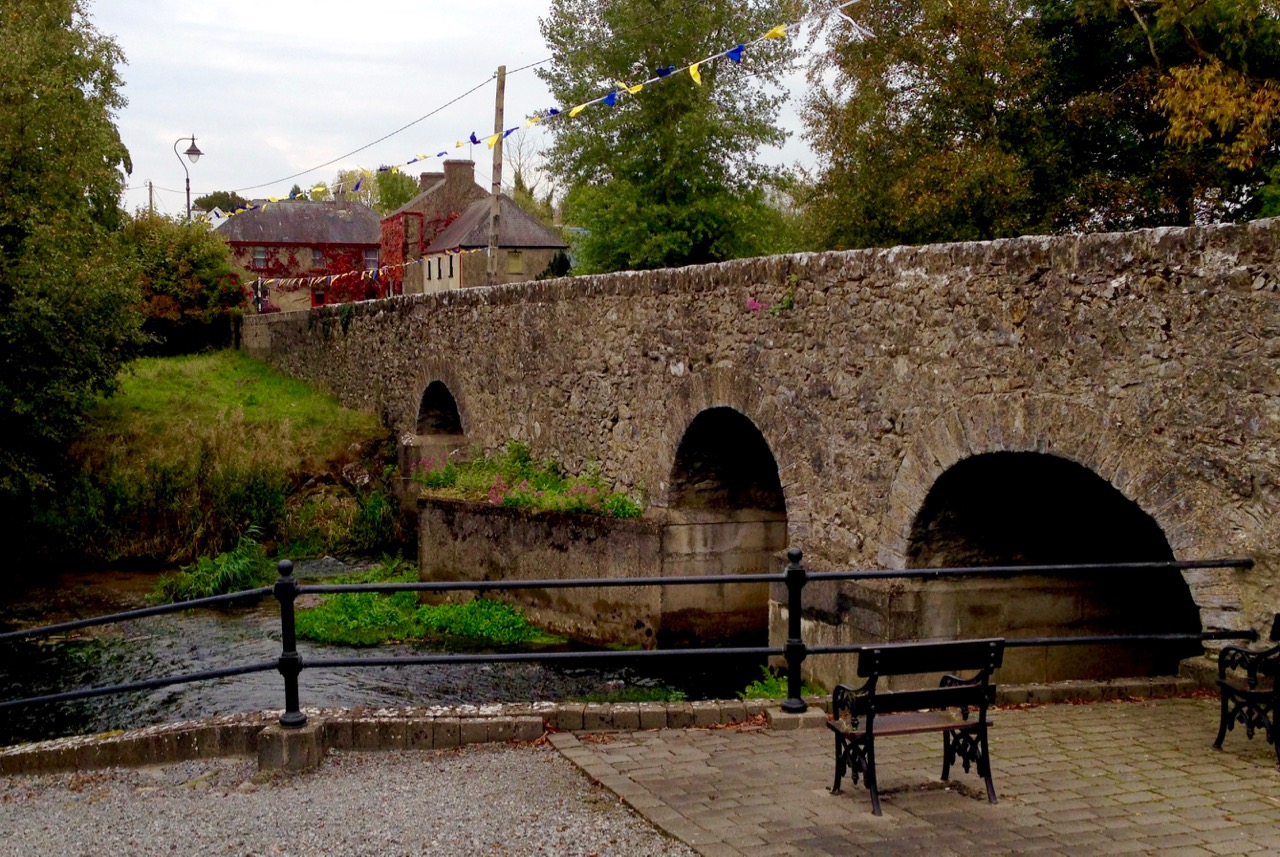
The ancient bridge at Ballinderry over the Ballyfinboy River, built c 1790
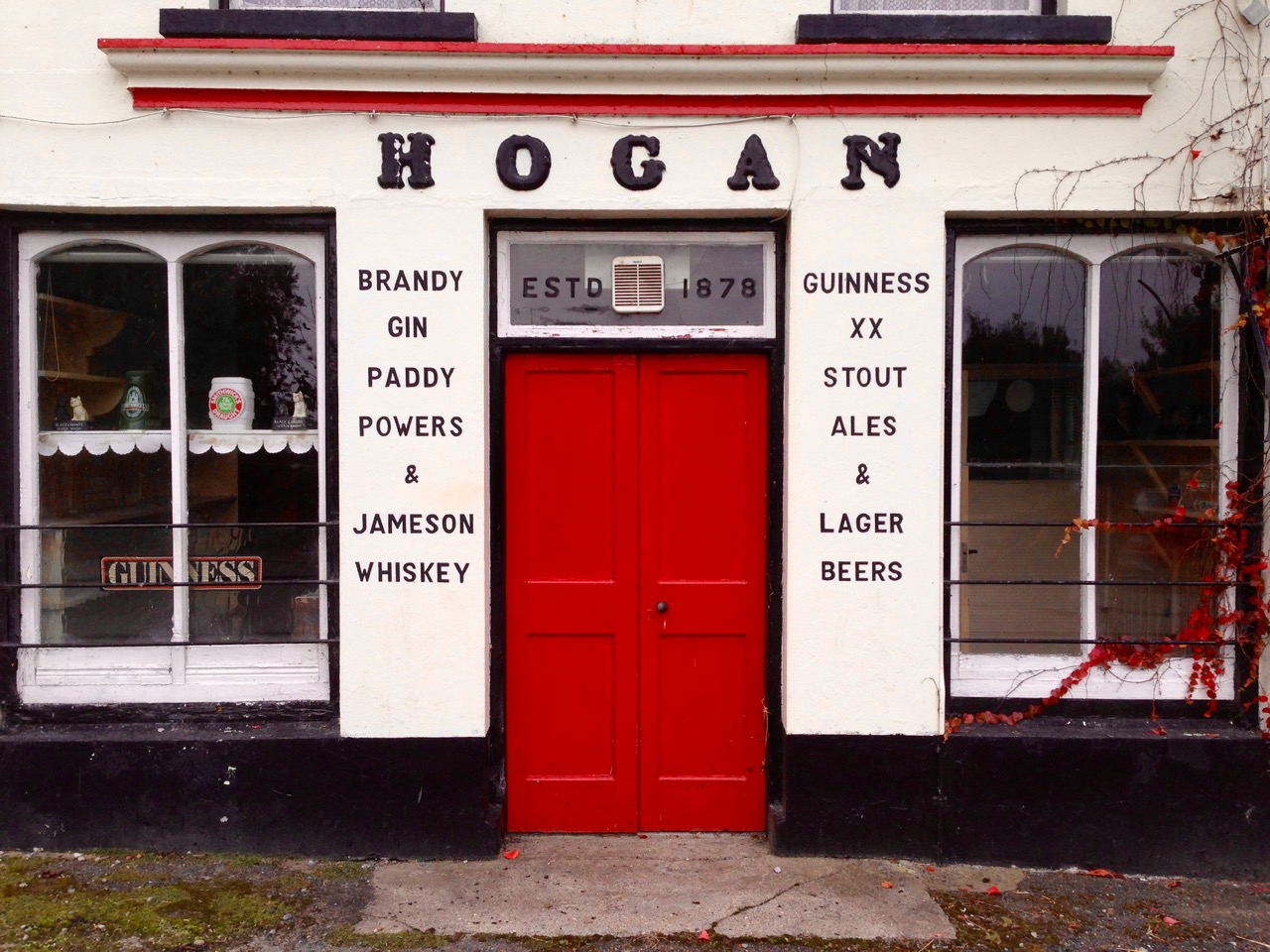
We arrived at the village and admired the old stone bridge over the Ballyfinboy River before walking up through the single street of the settlement. On the right was what had obviously once been the village shop and bar: Elsie Hogan’s. Attached to it was a fine stone residence, resplendent with red painted doors and window surrounds, although now fading.
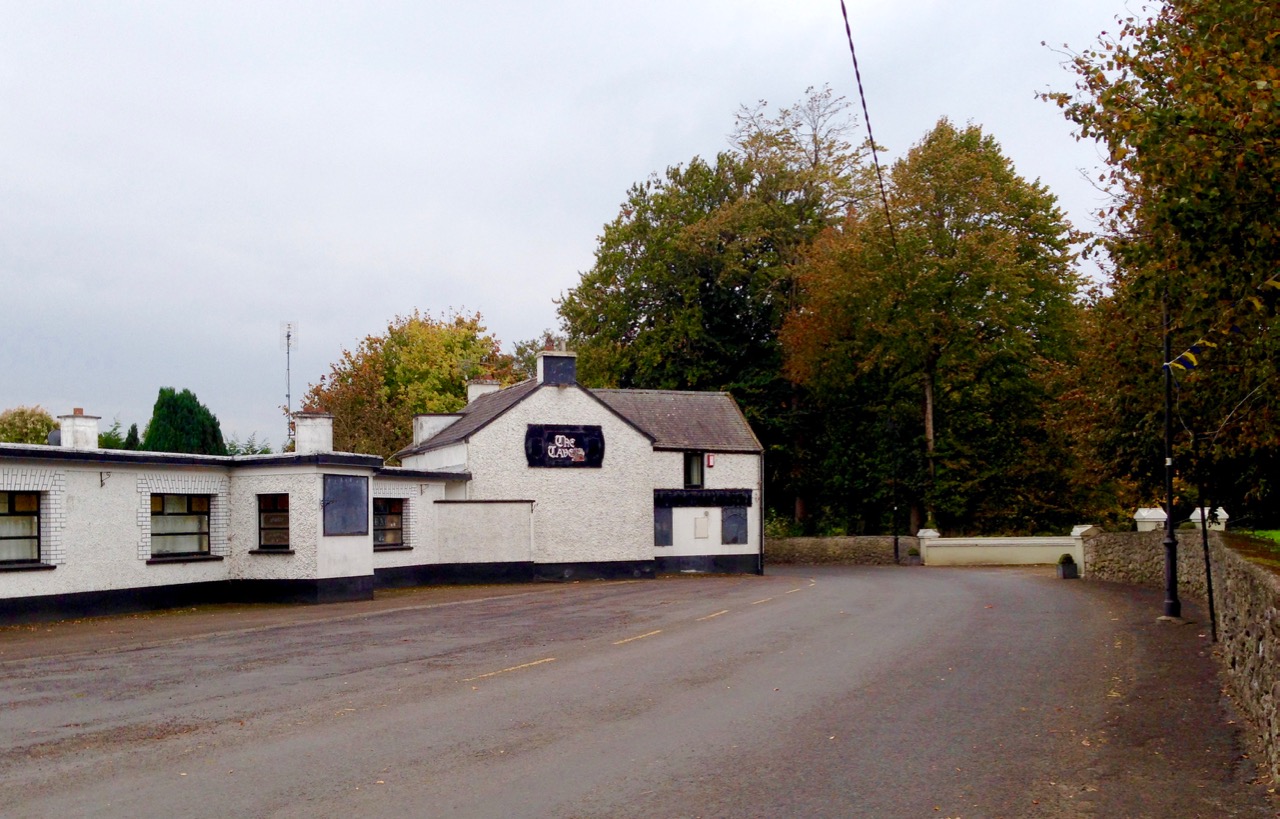
The fallen shop sign was not a good omen. We peered through the windows and could see empty shelves and an old weighing machine. It felt desolate, but its abandonment – if it was abandoned – could only have been recent. Was this Dick Stanley’s shop? Or might we have been on the wrong track? We pressed on up the village street. There were other houses, and another pub – The Tavern. This also appeared deserted.
No sign of life: the deserted village of Ballinderry was determined not to give up its ghosts
We walked the length of the village. We knocked on doors. We shouted: no shout echoed back. A car repair shop was locked up, in the middle of the afternoon. Houses were obviously occupied but, on that day, no-one was at home. We listened – silence. Yet, did we hear or did we imagine – far off, perhaps on the wind – the thin, ghostly sound of a fiddle being tuned up?
Footnote:
Have a look at the comments below – this story has generated many responses from folks who have memories of this place and these times. One contributor (Les Abbot) sent me a photo of an unfinished fiddle made by Dick Stanley, which I have added below. Les is the great-nephew of Dick Stanley so it’s wonderful to have this direct link with Rolt’s adventures in 1946! Many thanks, Les, for adding colour to this post, and to everyone else who has contributed . . .
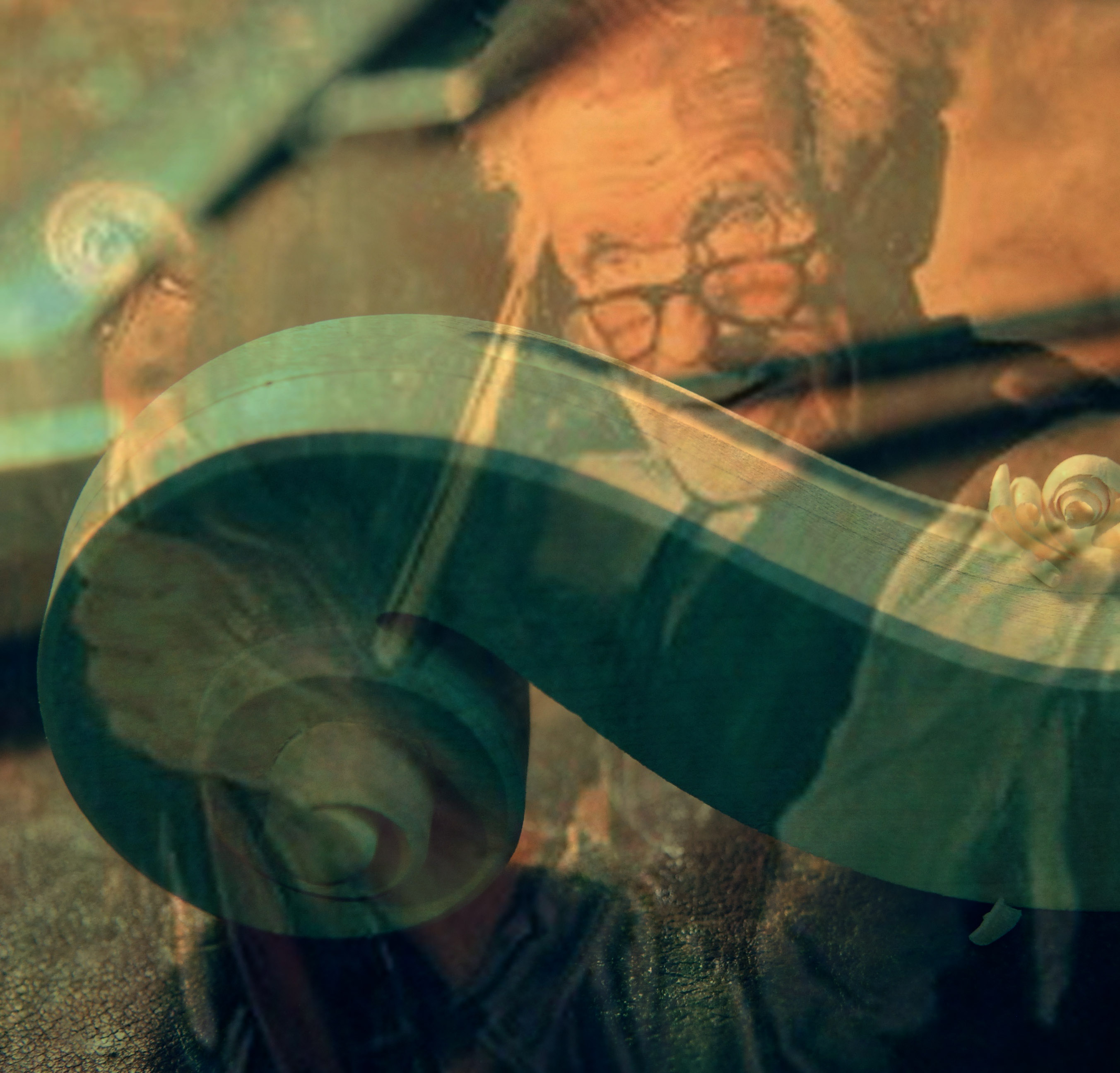
The work of Dick Stanley
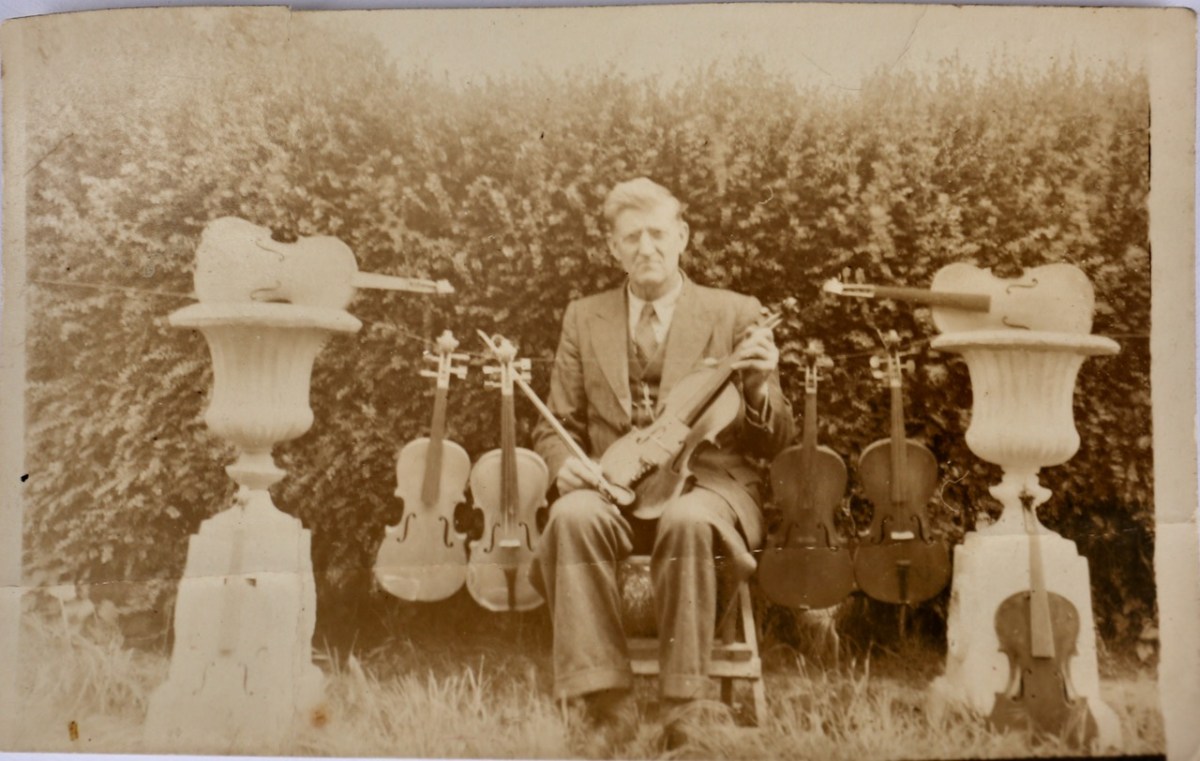
Note added July 2024 – and we have a photo of the man himself! Kindly sent to us by Tony Donoghue, this is Dick Stanley with some of his fiddles. Tony adds that Dick also made the garden ornaments. As his Godson, Tony knew him as an older man, not given to the softer emotions. He had been, and remained, an ardent republican. He was interred in Gormanstown Internment Camp during the civil war and Tony has donated his certificates from there to the National Museum, Collins Barracks.
It’s Halloween – what better time to take a wander round an old graveyard! Fortunately, we’re well endowed with them in Ireland, in varying states of preservation and decay.
Except for the wealthy, who could afford to erect tombs and decorate churches with effigies of themselves and carved wall plaques, most people who died in Ireland up to the 1700s lie in unmarked graves. However, in the 18th century the practice of erecting carved headstones become commonplace for those who could pay for it. Styles of headstone carving evolved over time. Local craftsmen used the symbols in vogue, interpreting them according to their own ideas and their level of skill. The result can best be described as folk art.
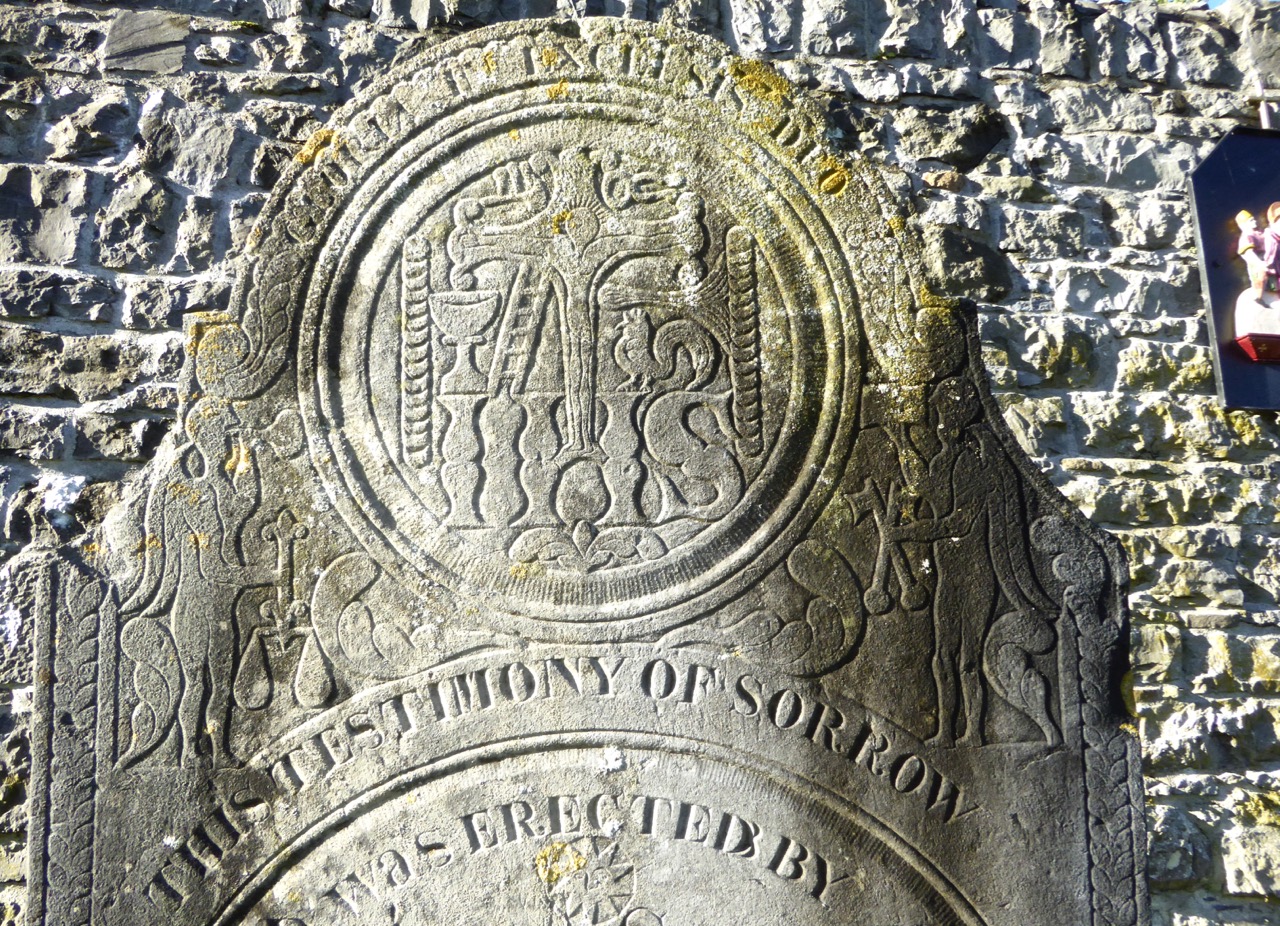
Bridget Sweeney’s grave in Kilmallock Co Limerick is memorialised with a great example of a nineteenth century carved headstone
One recurring theme is the passion, or crucifixion of Christ, and a headstone we saw recently in Kilmallock, Co Limerick, is an excellent example of the crucifixion and other symbols.
Top: Not only a crucifixion image, but various other symbols feature on the headstone, such as a chalice (eucharist) and a rooster (awakening or time). Below: close up of the two angels: left is Michael blowing his trumpet and bearing a set of scales (reflecting his role of weighing souls at the gates of heaven); right is another angel bearing a book (in which might be recorded a person’s good and bad deeds) and keys (to the gates of heaven?)
Another crucifixion headstone, also in Kilmallock: harder to make out, but full of interesting elements
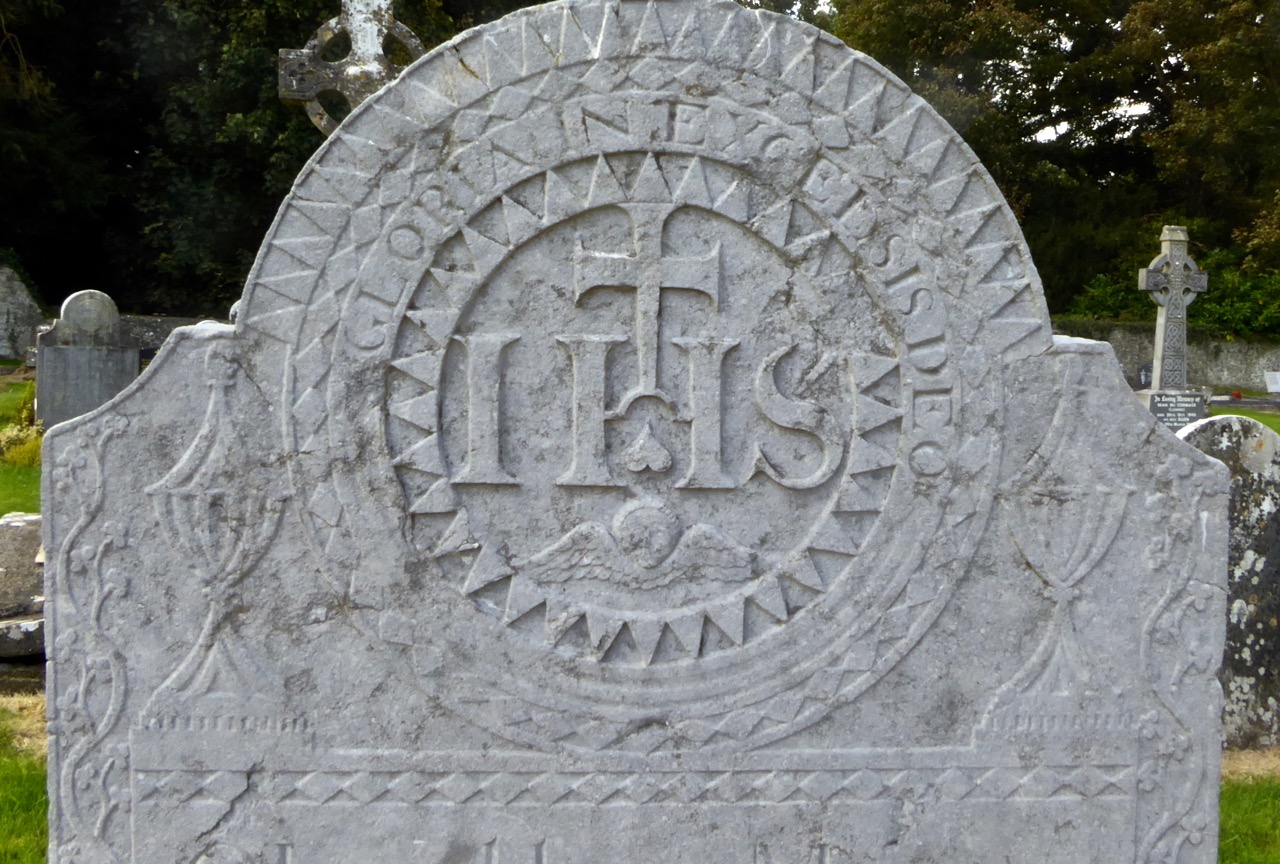
You may have noticed the letters IHS on Bridget Sweeney’s grave. Ubiquitous on old gravestones, on its own, accompanied by a simple cross, or as part of a more elaborate decoration, IHS stood for the name of Jesus. For a full explanation, see this post from the always excellent Pilgrimage in Medieval Ireland.
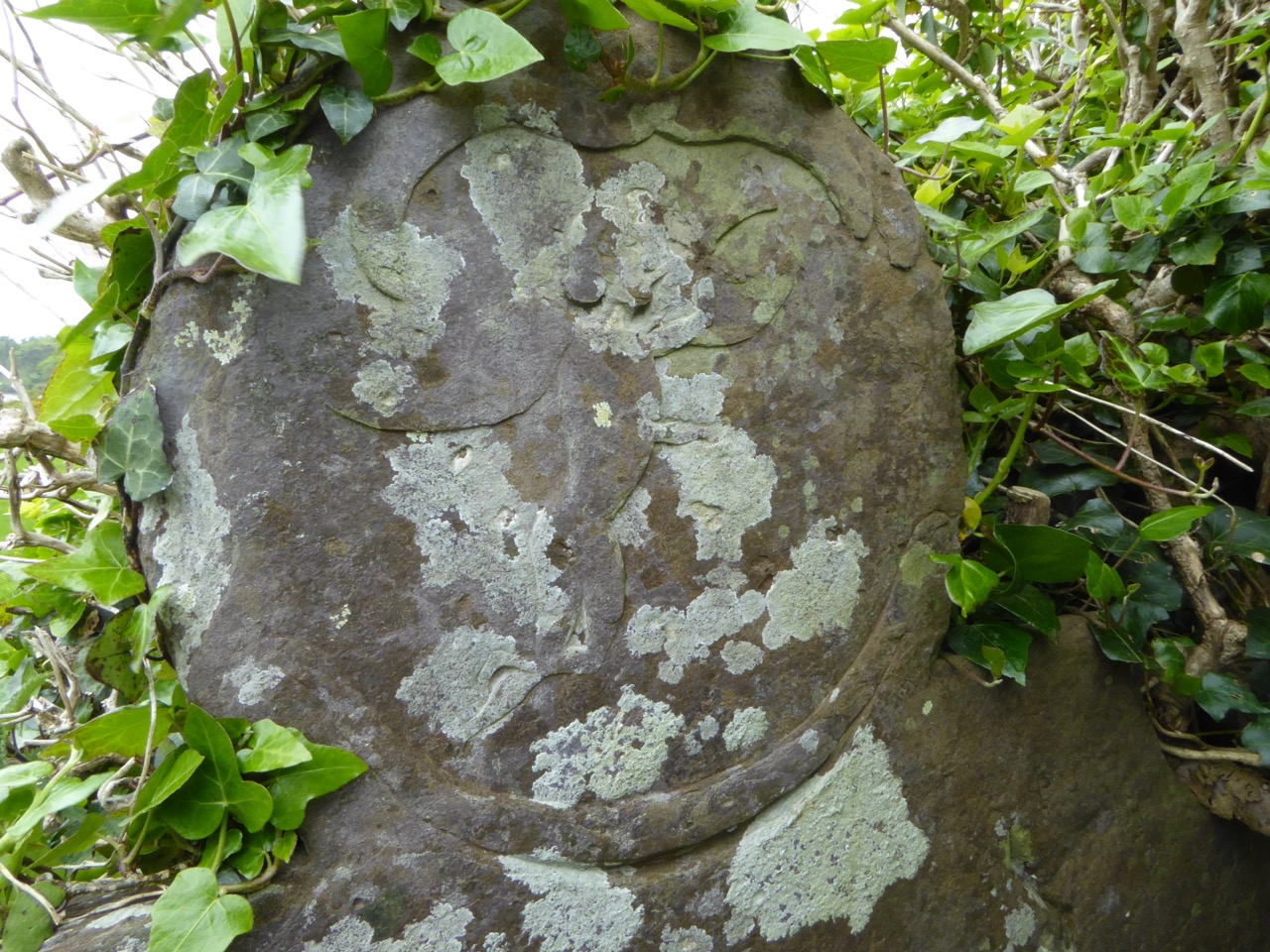
Another favourite symbol was a head with wings, usually representing the soul on its flight to heaven, but perhaps also an angel.
A particularly fetching angel/soul on the grave of Alice Bolster, Kilmallock
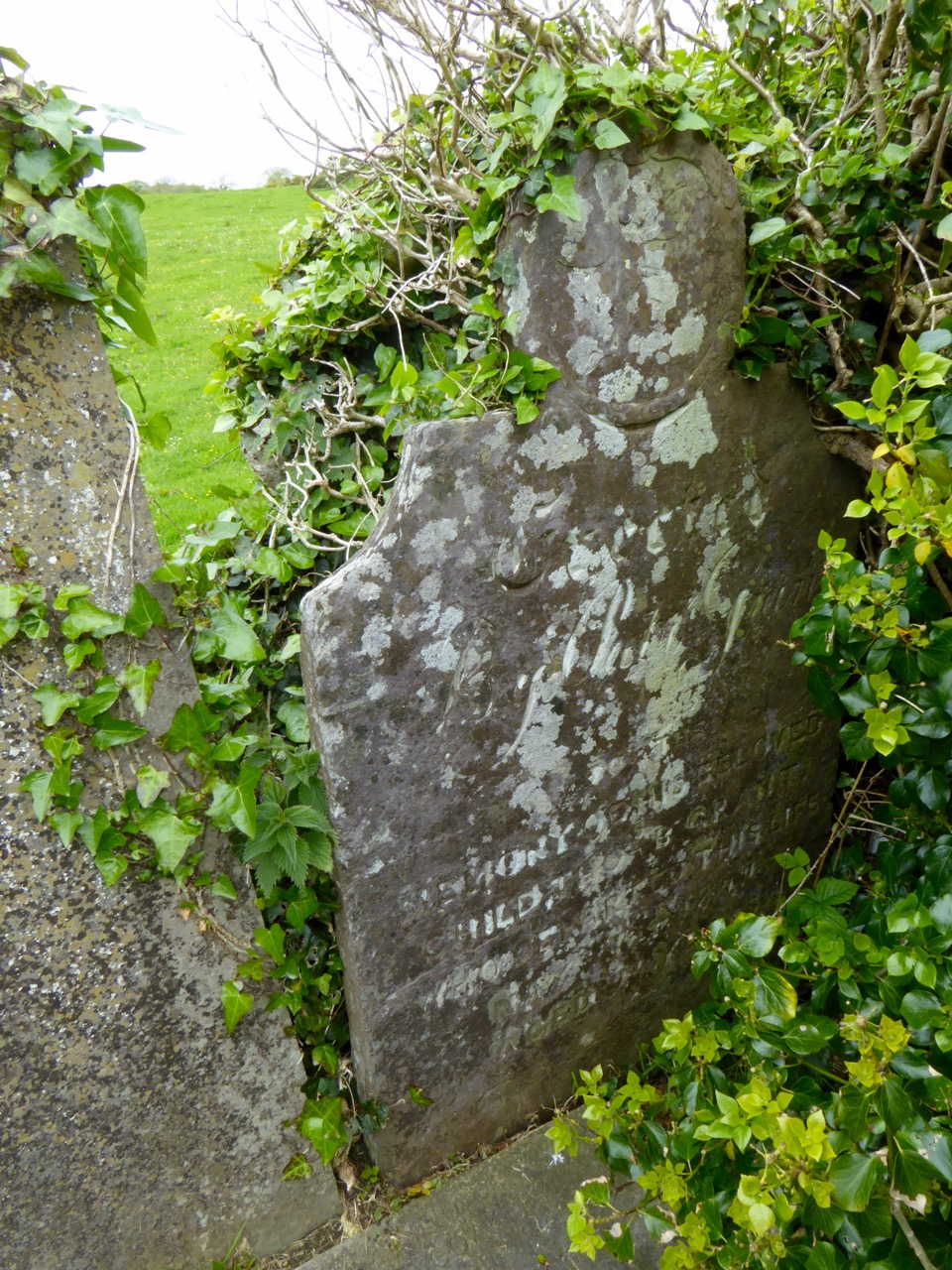
St Michael, blowing his trumpet to welcome that soul to heaven, was a favourite motif. We found one behind a bank of ivy in the old Aughadown graveyard near us, down by the Ilen River.
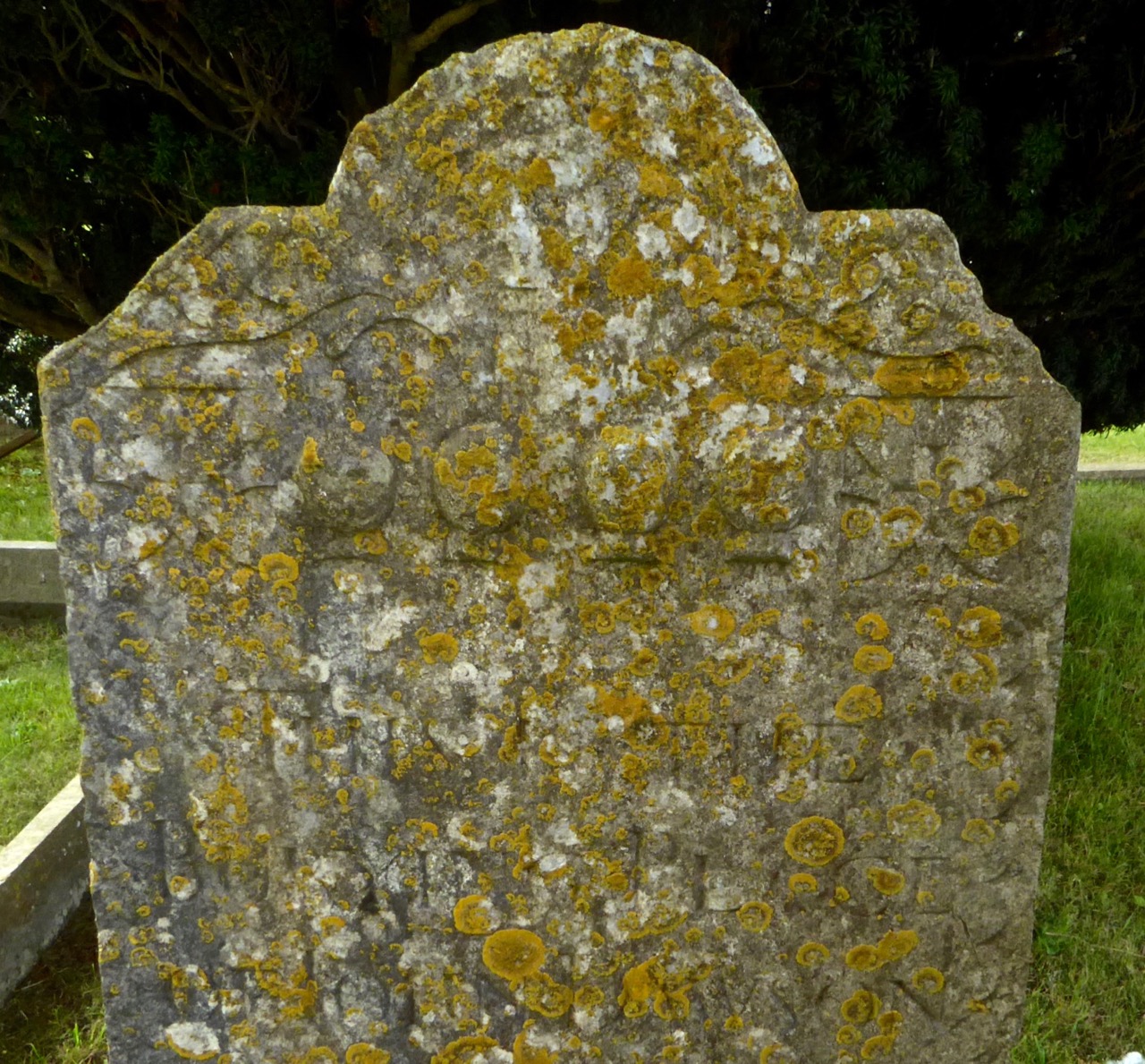
Can you make out Michael, blowing his trumpet? The enemies of all headstones are ivy and lichen and this one has been overtaken by both
Symbols of mortality decorate some of the earliest Irish headstone – skull and crossbones, hourglasses, books and bells, skeletons, even rotting corpses – all represent the finite nature of life on earth. Memento Mori literally means Remember, you must die. These images were supposed to encourage us, apparently, to lead better lives by reflecting both on the futility of relying on earthly delights and on the reward awaiting us in heaven. Mortality symbols generally date to the 1700s.
Top: this slab is in the churchyard at Cloondara Co Longford and has no inscription. The two images below it are from a grave in Castlelands, near Kinsale. These two images are courtesy of our friend Amanda Clarke: she was told by a man doing maintenance work that this was the grave of Anne Bonny the pirate – hence the skull and crossbones!
Sun, moon and star images represent the glories of creation and we’ve seen many instances of sunbursts, often enclosing the IHS lettering. Here’s a nice example, below, from Kilmallock, which also has winged heads and beautiful lettering.
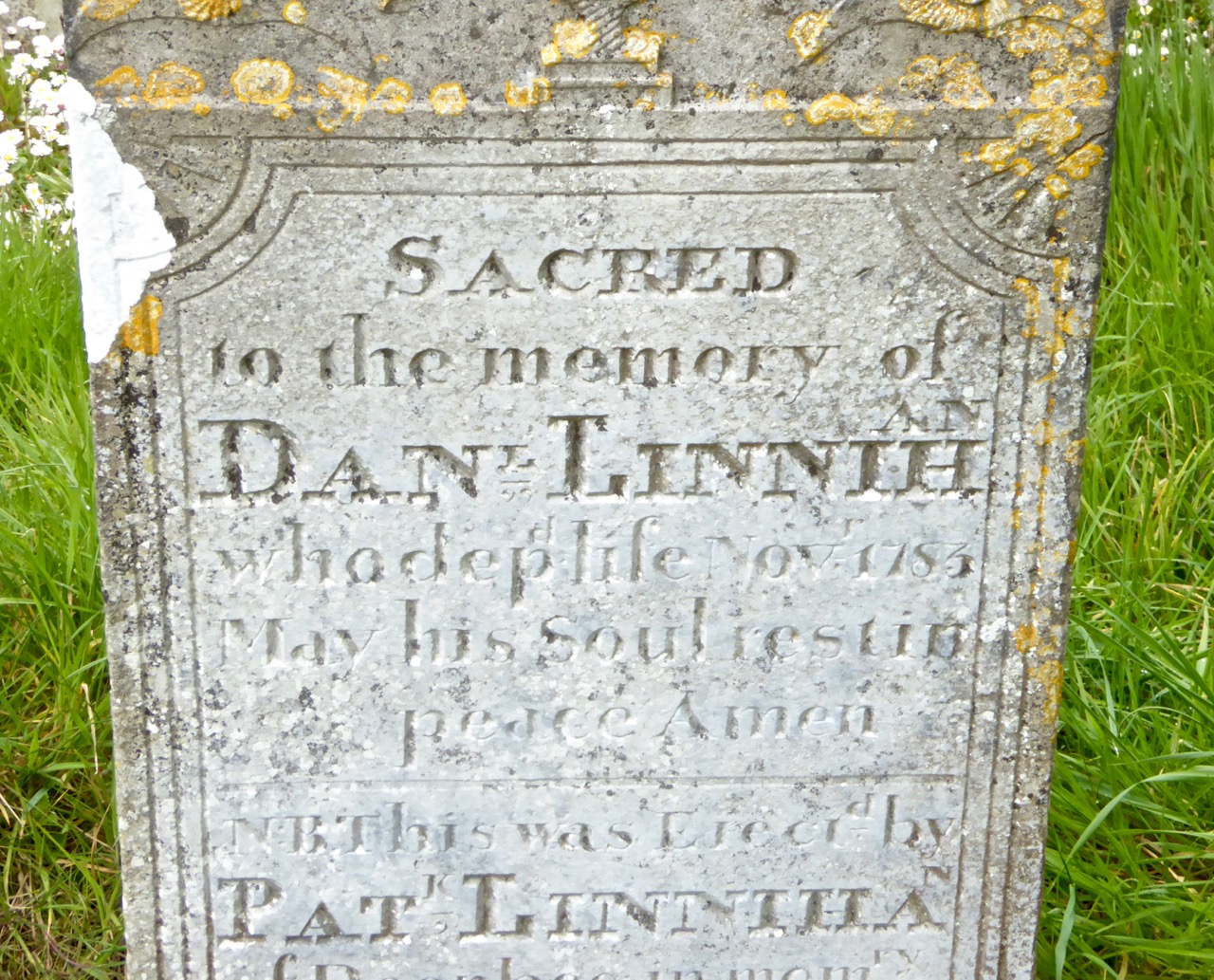
Lettering styles varied widely, as did the carver’s ability to spell and to ensure he had left himself enough room. Anyone wanting to invent new fonts (yes, that’s a thing) could well study old headstones and admire the incredible variety of lettering. Carving some of the more elaborately rounded scripts must have been a job for only the most highly skilled.
We often see instances where letters and words have to be added above or below the line, where the carver ran out of room
The Lamb of God is another common image – although it can be hard to recognise a lamb in the often lumpen carving at the top of a headstone.
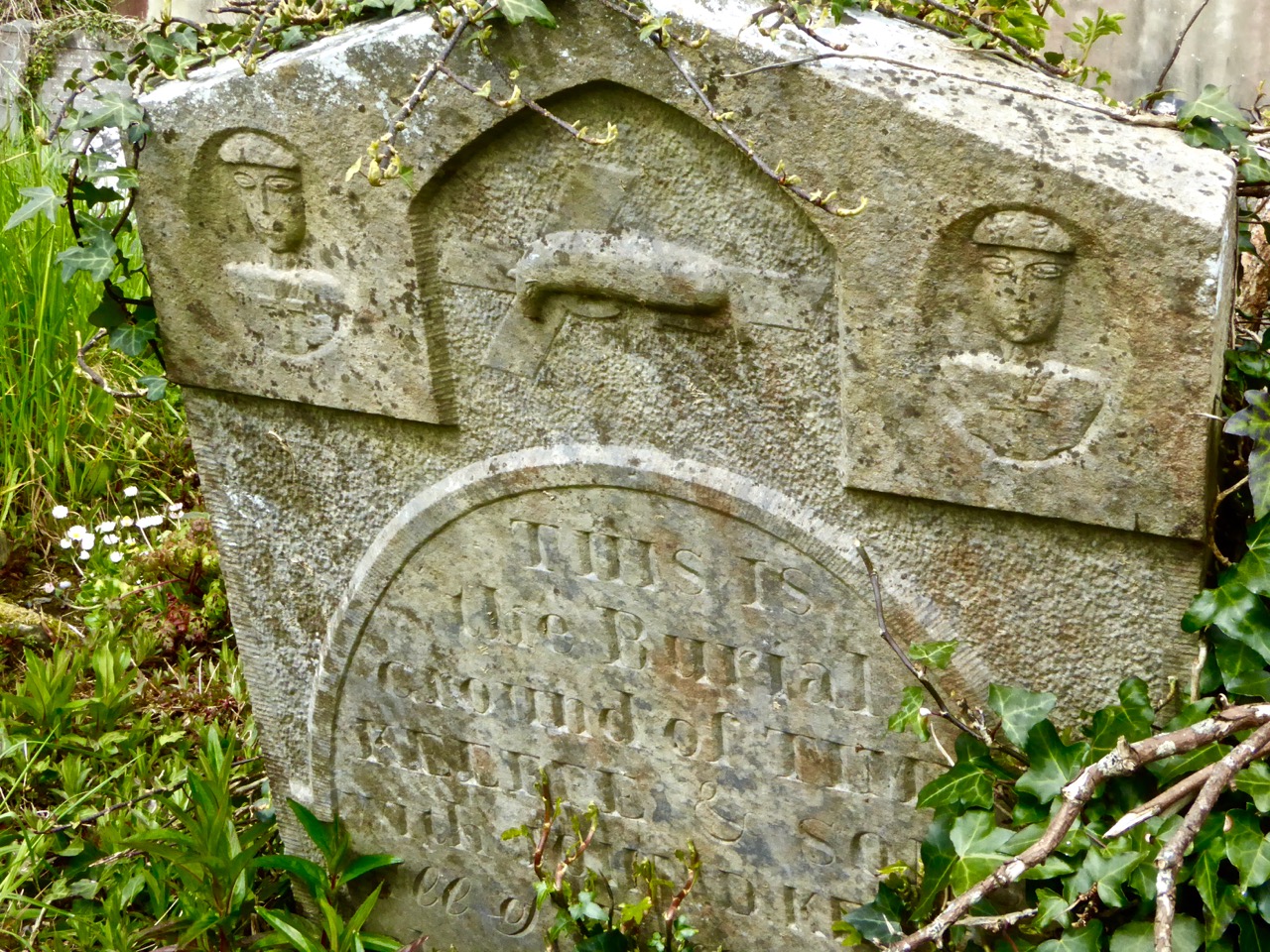
At an old graveyard in Cullen, Co Cork, there are several stones that appear to be in a local style with a head on either side of the top of the stone
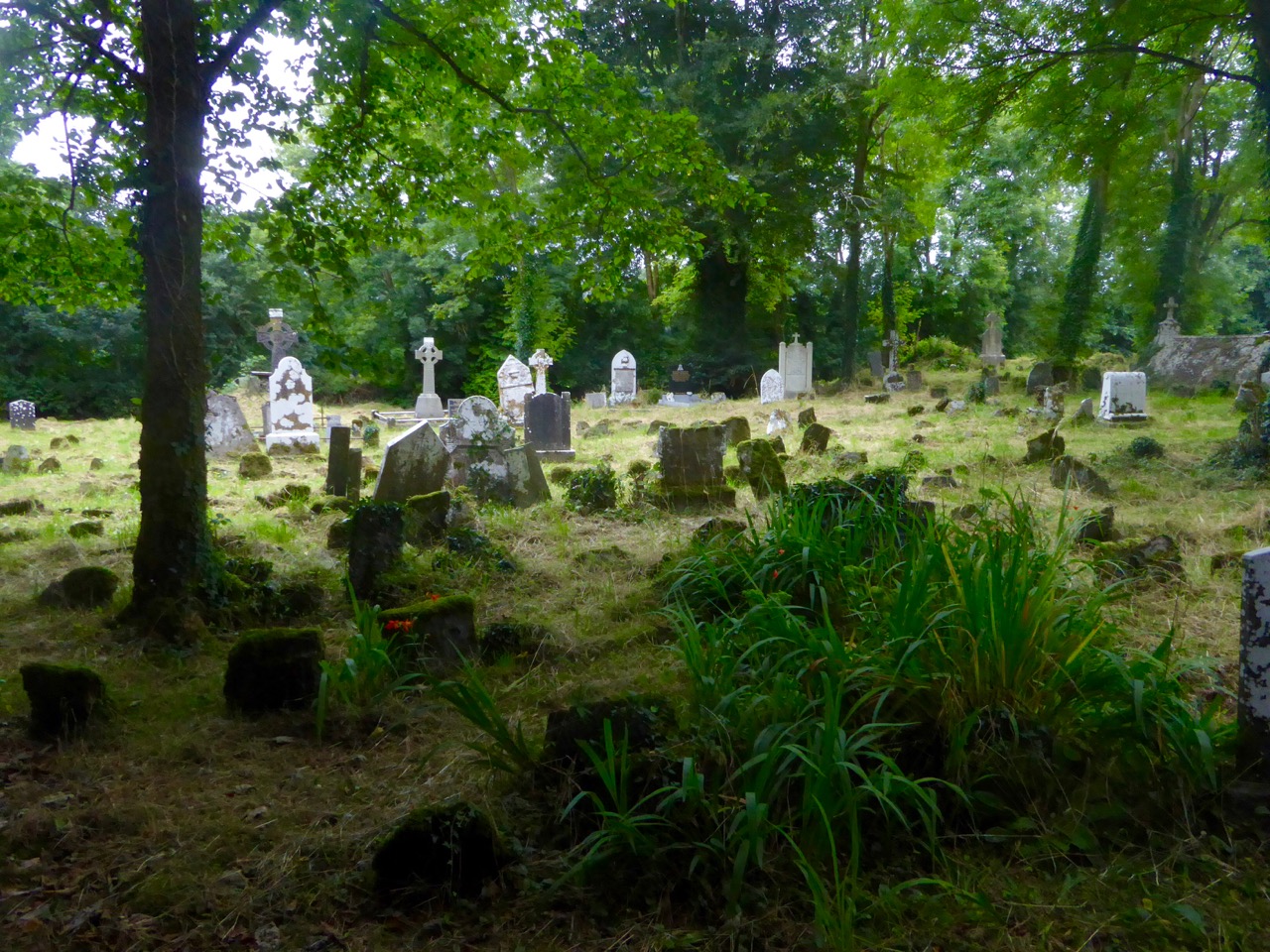
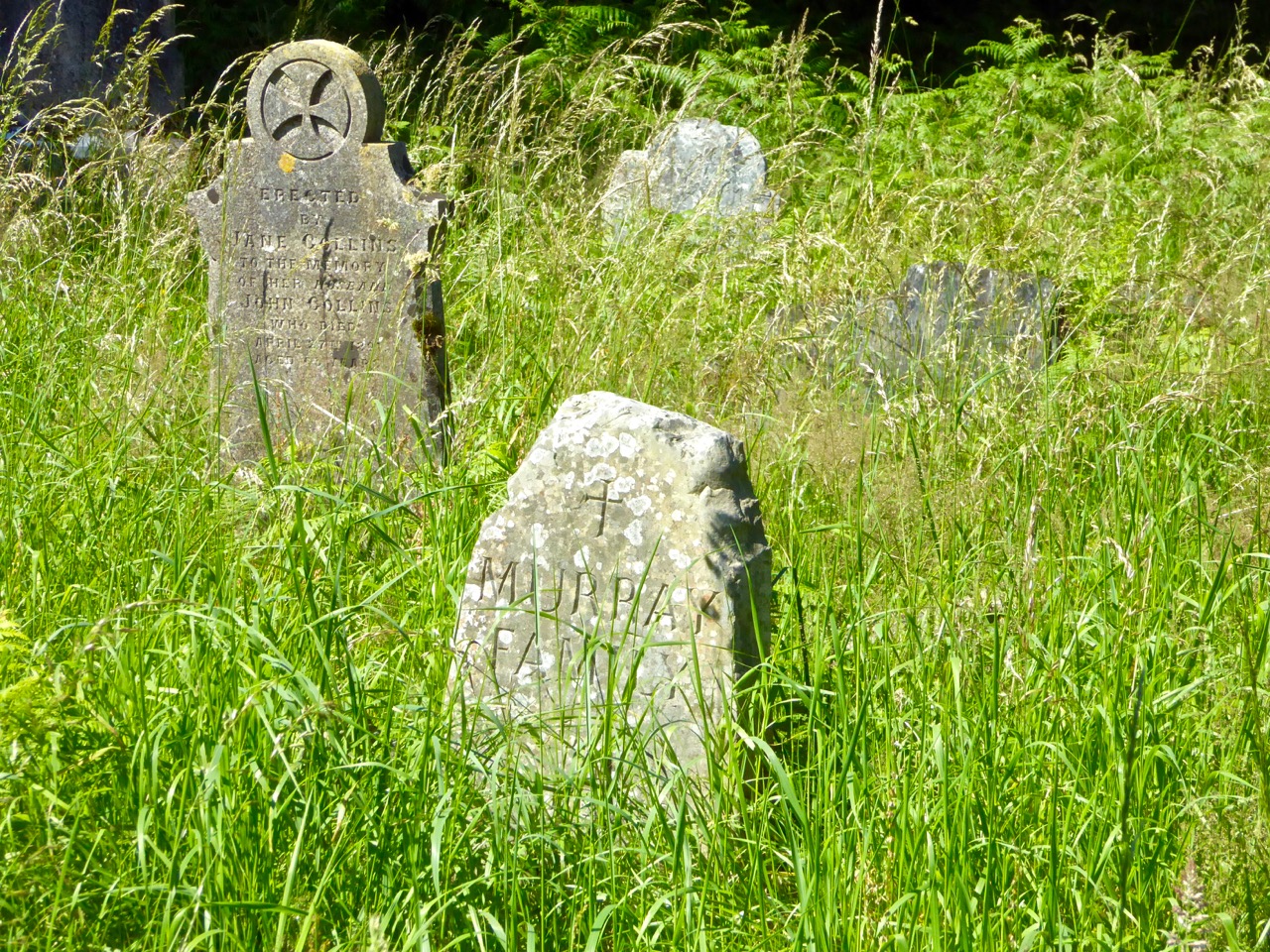
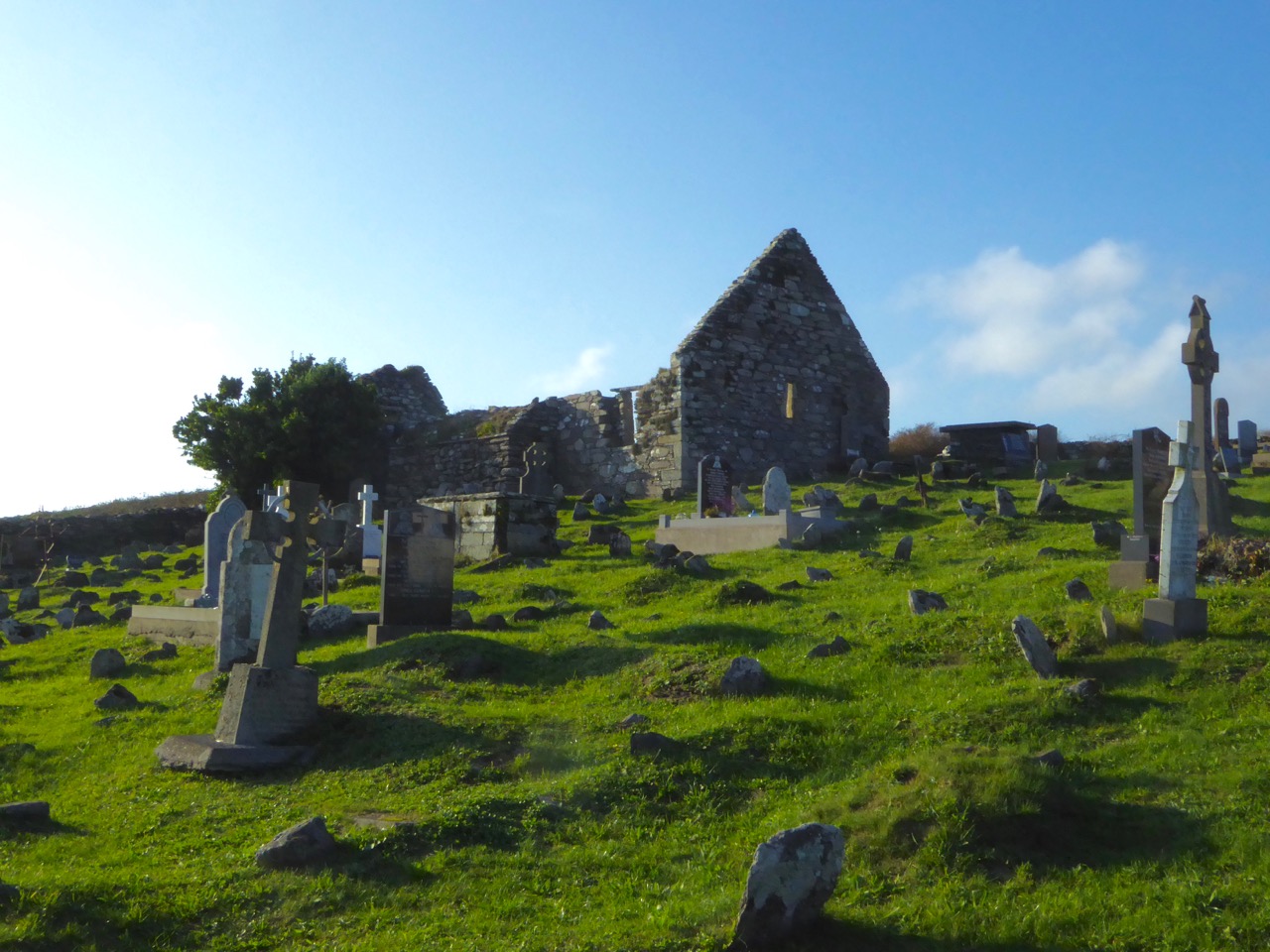
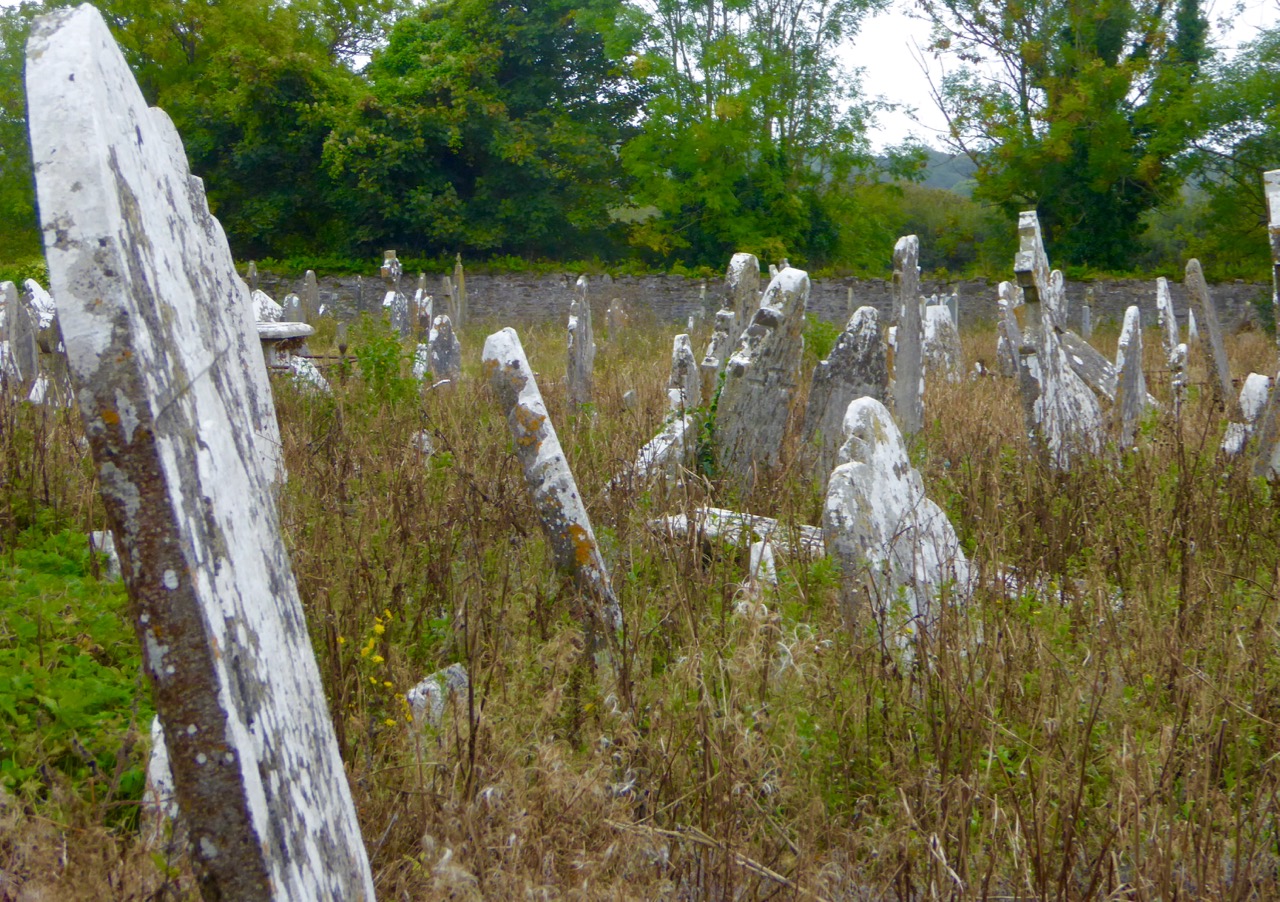
We can’t resist old graveyards – we seldom pass an opportunity for a stroll and an explore. Sometimes we find interesting headstones, sometimes we just soak in the atmosphere, sometimes we worry about the neglect that allows them to slowly disappear into a jumble of brambles and nettles.
It’s hard to make out what’s on this old headstone in the churchyard at St Peter’s C of I church in Bandon. The words include a reference to ‘his four children’ so I am tempted to think these four heads representing those little souls.
The Historic Graves project is a community focused grassroots heritage project. Local community groups are trained in low-cost high-tech field survey of historic graveyards and recording of their own oral histories. They build a multi-media online record of the historic graves in their own areas and unite to form a national resource.
Kilmoe churchyard, in LIssagriffin on the MIzen Peninsula, has benefited from a Historic Graves survey
I used information from the Historic Graves survey in my posts about the Stouke Graveyard (Priests and Poets Part 1 and Part 2) and I hope to learn more about their methods and objectives in the future.
Another Historic Graves project was Castlelands, near Kinsale. These photographs are by Amanda Clarke, used with thanks
One thing we have seen is that once a graveyard has been surveyed it’s important to keep it well maintained. The Cloyne graveyard was surveyed in 2013 and many fine old headstones were found and recorded. We visited in May 2014 and loved our walk through the flower-strewn pathways and the newly-revealed headstones. However, earlier this month when we dropped in it had started to resemble a jungle again.
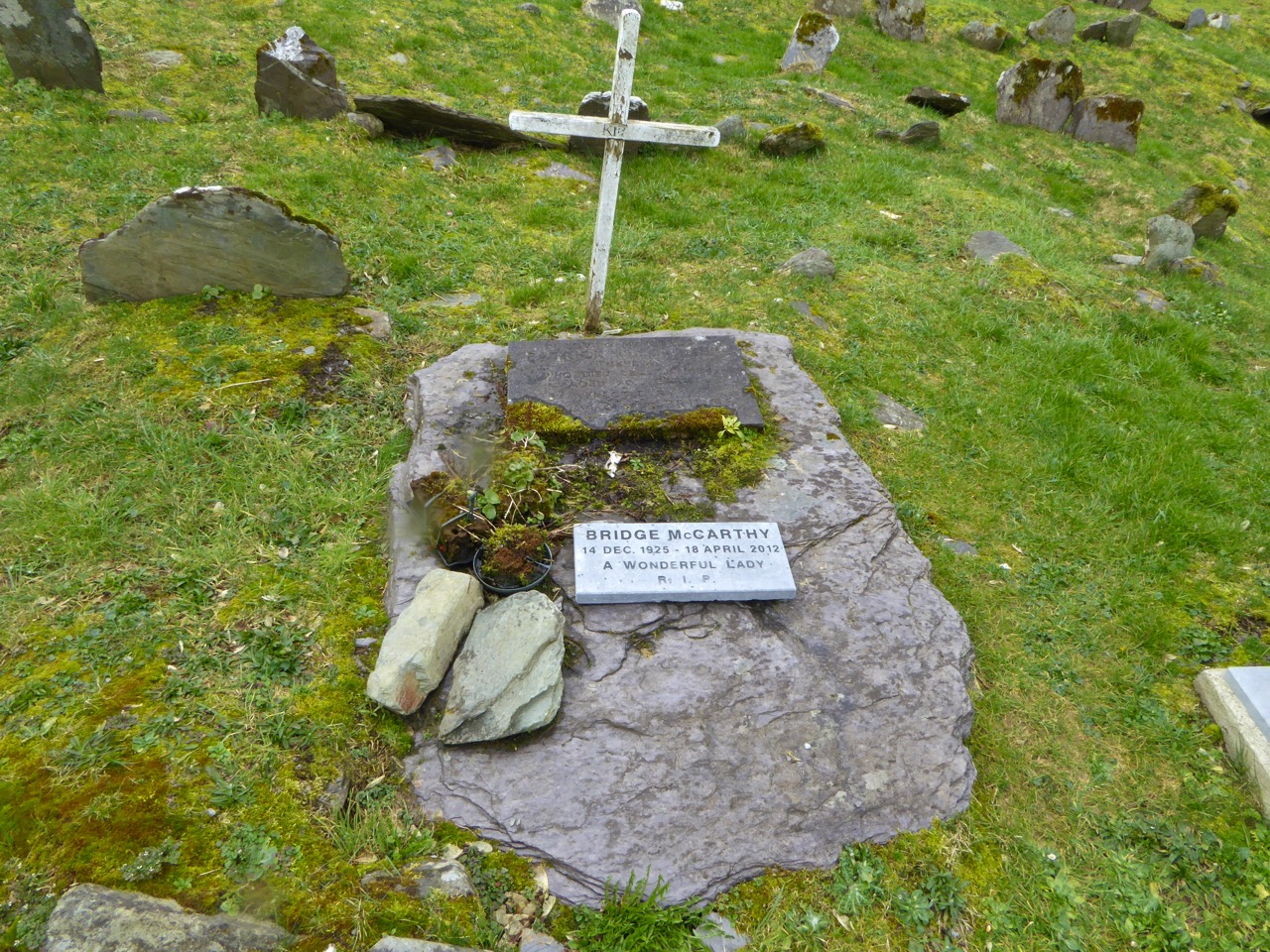
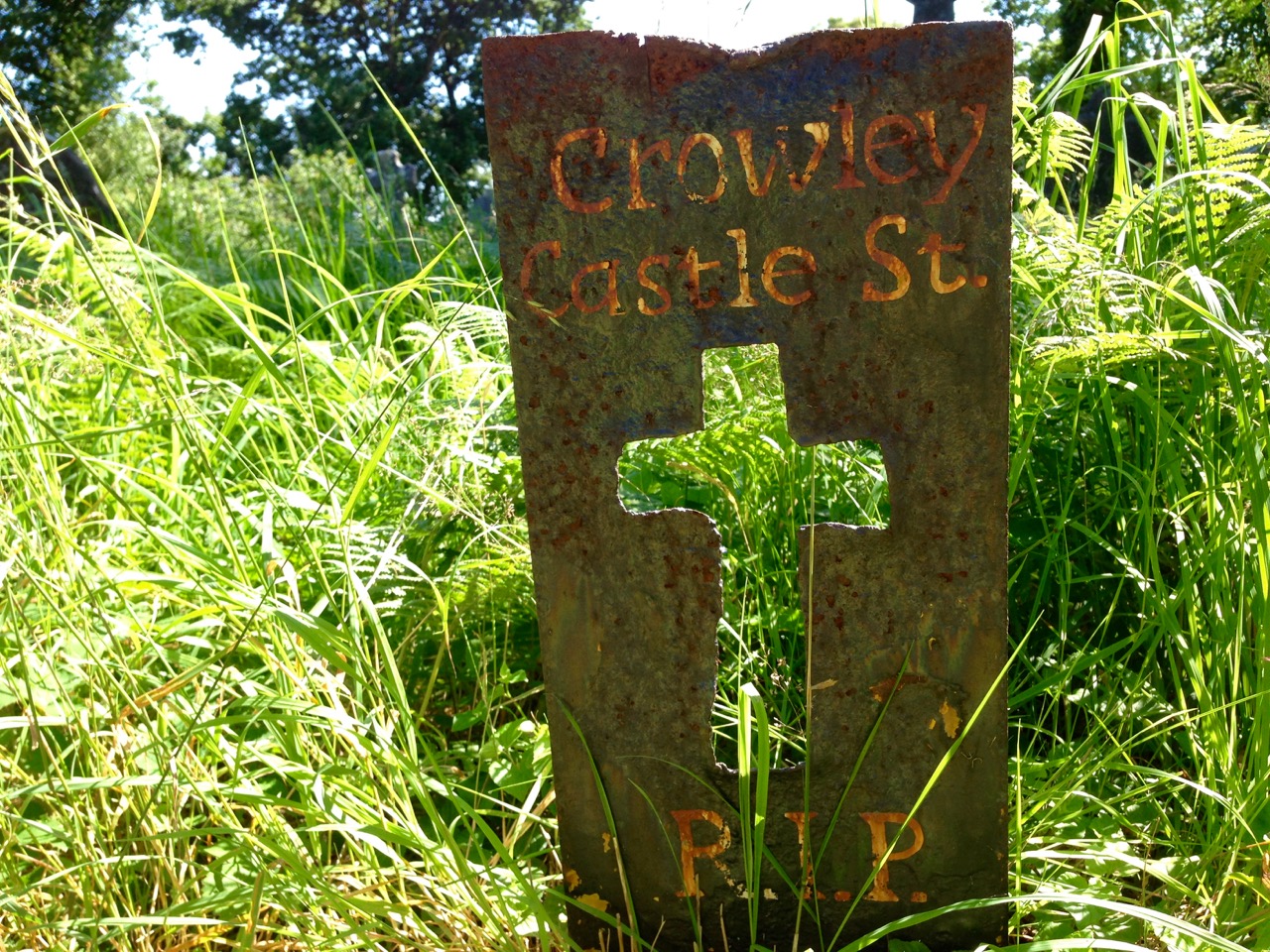
I will leave you with a couple of my personal favourites from graveyard visits – not elaborate, not particularly old, but saying so much. The first is from Castlehaven graveyard in West Cork, the second from Kilbarry, near Dunmanway.
Welcome to the UCD Library Cultural Heritage Collections blog. Discover and explore the historical treasures housed within our Archives, Special Collections, National Folklore Collection and Digital Library

































 Roaringwater Journal