Jazz Age Architecture

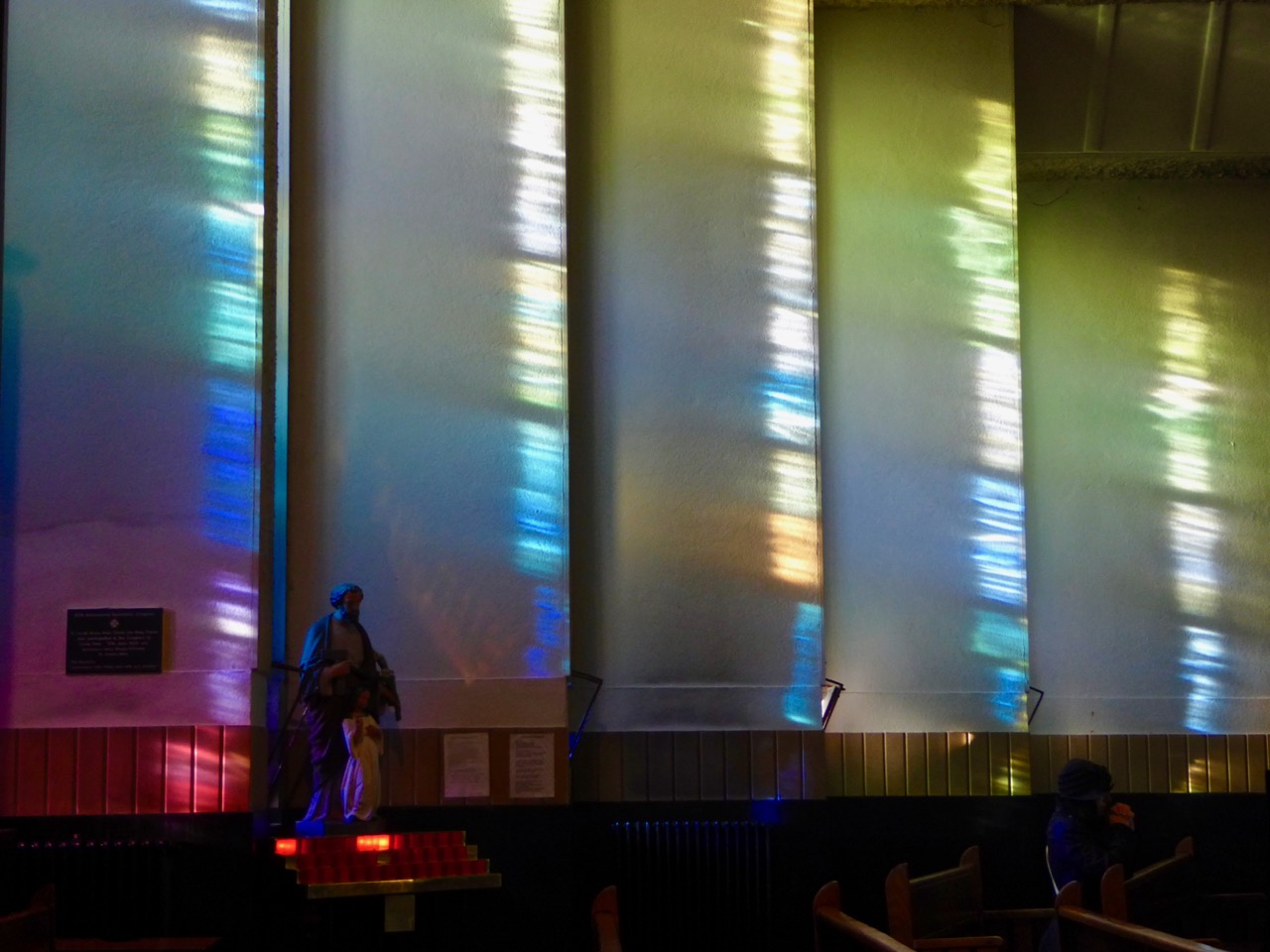
colours inside

Did you know that in Cork city you can visit a very fine example of Art Deco architecture? A building, moreover, that was designed by a pupil and former employee of Frank Loyd Wright? It’s the Catholic Church at Turner’s Cross, Christ the King: by good chance today – 20 November – is The Feast of Christ the King, so what better day to take you on a tour of this remarkable structure that is deserving of a wider audience? It was Pope Pius XI who instituted this feast day for the Roman Catholic Church in 1925; today it’s celebrated also by the Anglican and Lutheran community and many other Protestant churches.

Left – the architect, Francis Barry Byrne of Chicago, with his design model; right – an aerial photograph of the Christ the King Church, Turner’s Cross, Cork, 1933

St Finbarr’s South Church, Dunbar Street, the oldest Catholic church still in use in Cork City, was built in 1766 and enlarged in 1809 but by the early years of the twentieth century was inadequate to serve the increasing population. A new church building was planned in the mid 1920s to remedy this, and the brief was that it should have a seating capacity of 1200 with room for a further 700 standing. This was going to be a large building, and the design would have to address issues of acoustics, lighting and the engagement of all the congregation with the enactment of the sacrements. Perhaps it was for that reason that its commissioner – Rev Daniel Cohalan DD, Bishop of Cork – looked beyond Ireland’s shores for an architect who might have suitable experience in the field. The Bishop also eschewed architects in Ireland and the UK because he apparently felt the costs of their services and their buildings were too high: the available budget for this project was only £30,000, and only 20,000 of that was for the building itself. The American architect Francis Barry Byrne was his choice. Byrne (whose mother Mary Barry Delaney had family roots in Co Wexford) had worked for Frank Lloyd Wright in Chicago before setting up his own practice in the same city. He had already completed a number of church projects and had written about modern church design.

Two of the architect’s drawings of 1928: entrance elevation (left) and floor plan (right)

Byrne put forward a plan which went against convention by creating a single wide space for church and sanctuary, bringing the altar closer to the larger part of the congregation. He also suggested brick and timber as suitable materials. The architect visited Ireland only once – to view the proposed site – and never saw the completed building, although he is said to have considered it the most successful of his church designs. A local supervising architect, James Rupert Boyd Barrett, was appointed to see the job through on site.

head of statue

profile silhouette

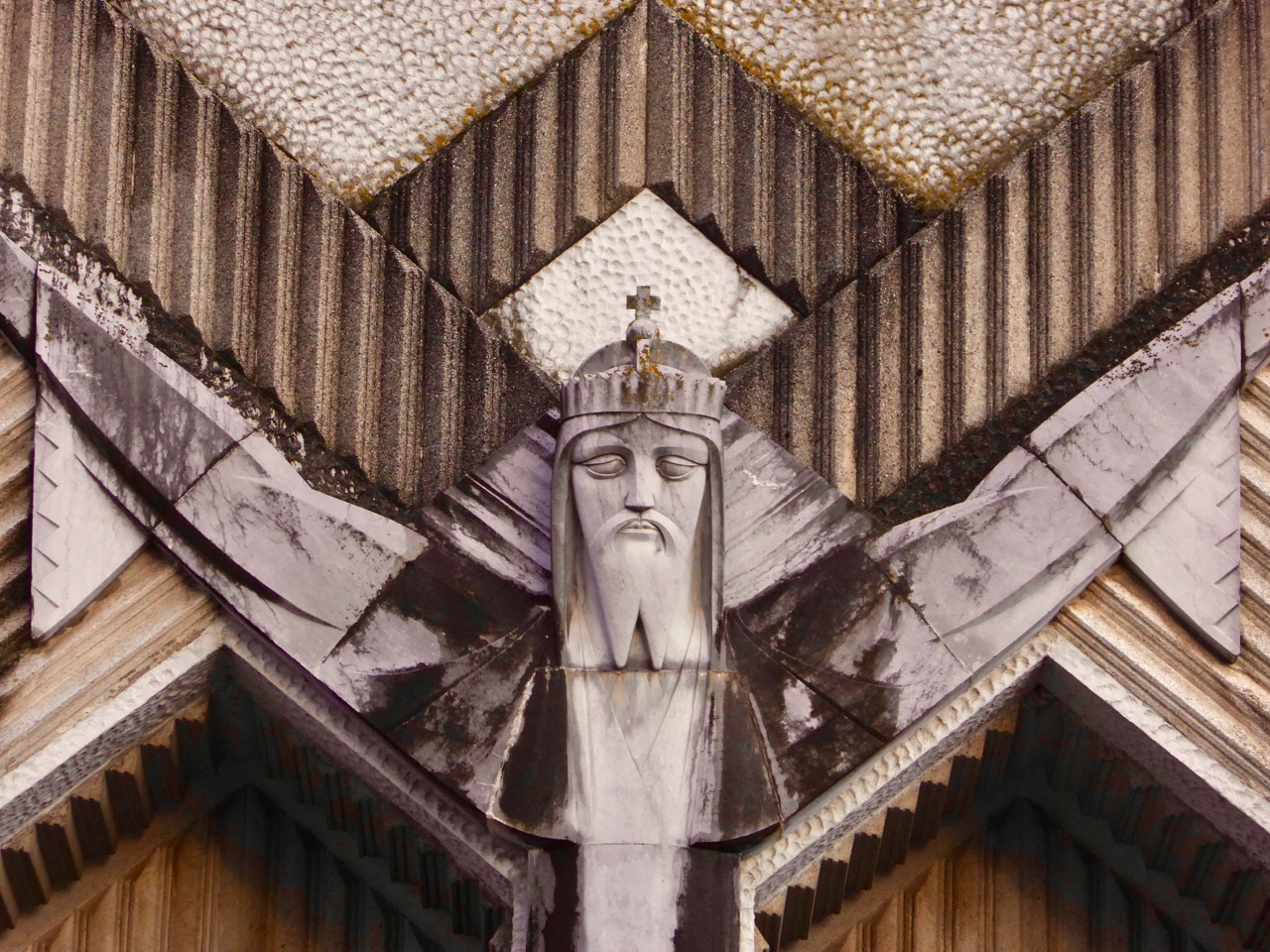
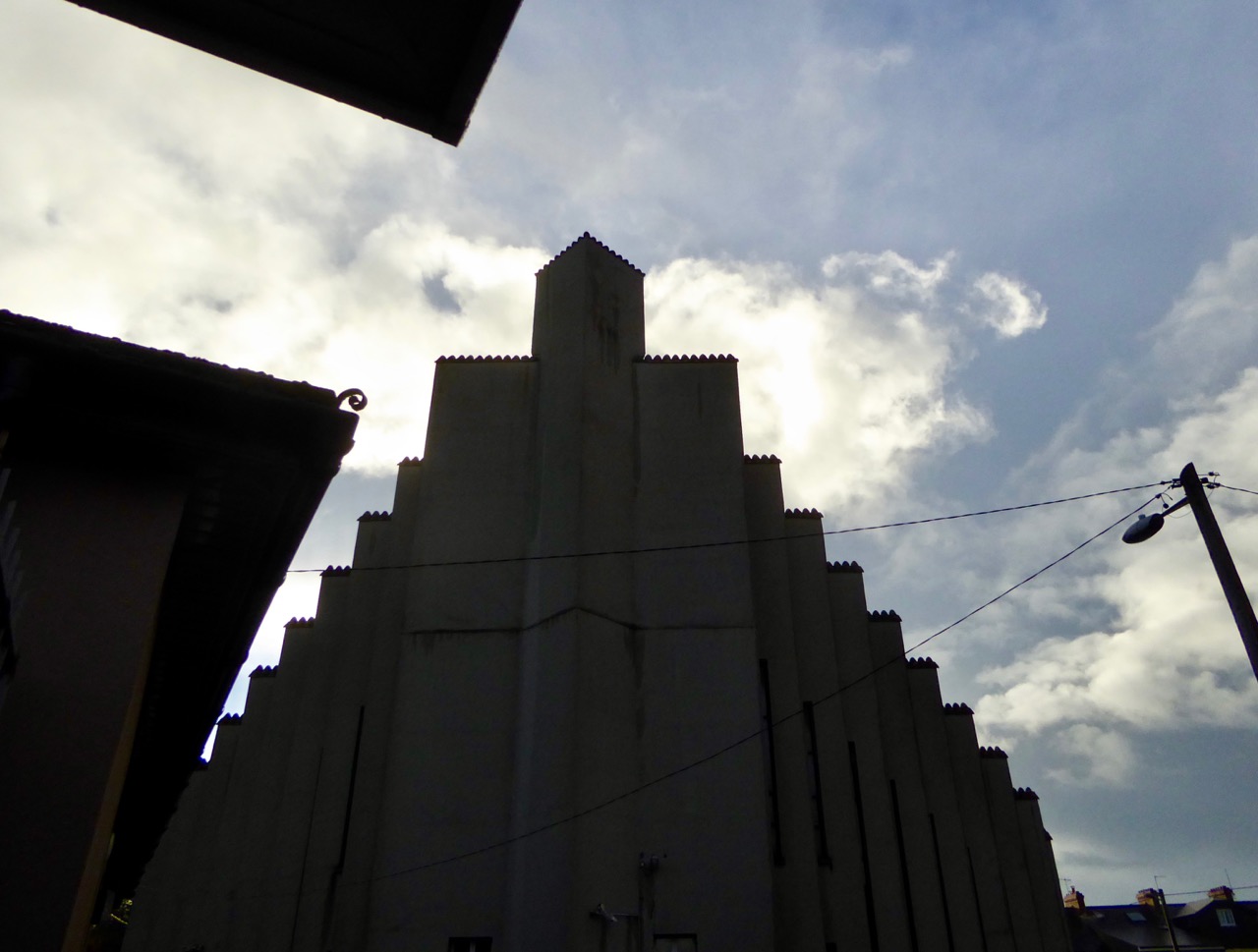
Upper pictures – the entrance, showing the statue of Christ the King: this was designed by Chicago sculptor John Storrs and executed locally by Cork sculptor John Maguire based on plaster models shipped to Cork. Lower –  the rugged profile of the church building

Like many another architectural project, costs began to escalate from day one. Poor ground conditions meant that the foundations had to be driven significantly deeper. Barrett suggested that costs could be recuperated if cast concrete could be used instead of brick for the main structure: conventional masonry is labour intensive and therefore carries relatively high costs. The suggestion was taken up and proved successful – the building was contained within its budget: in fact it came in slightly below. Byrne was impressed with the idea of using reinforced concrete (hitherto an engineering technique) and developed it through all his future church projects. Cork’s new church was, therefore, revolutionary in this aspect alone.

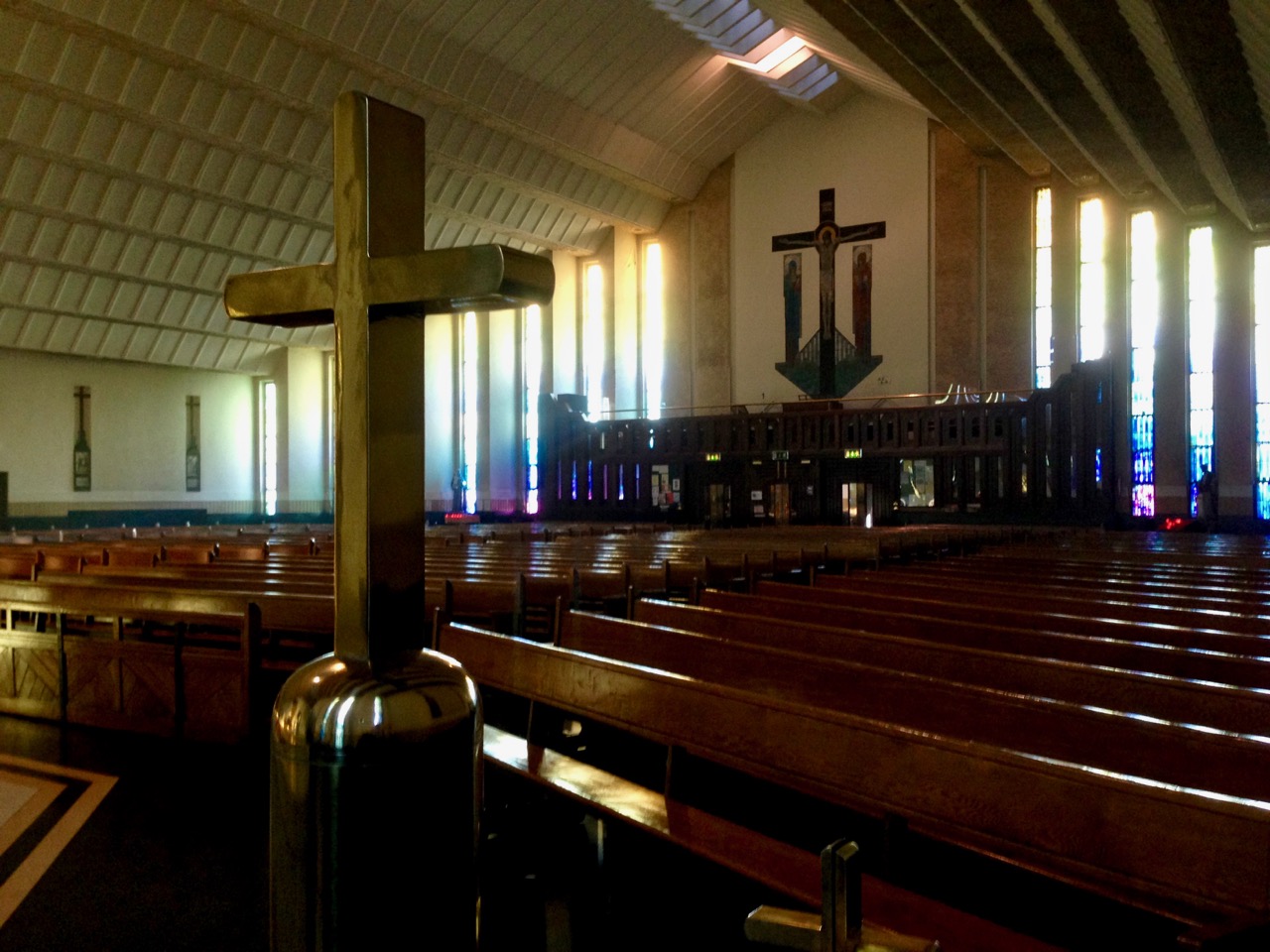
Left – the interior design, making use of Art Deco elements including chevrons: note the continuous central glazed rooflight. Right, a window detail

Building work commenced in 1928, shortly after the Pope had instituted the new Feast Day: it thus seemed very appropriate to dedicate the church to Christ the King.
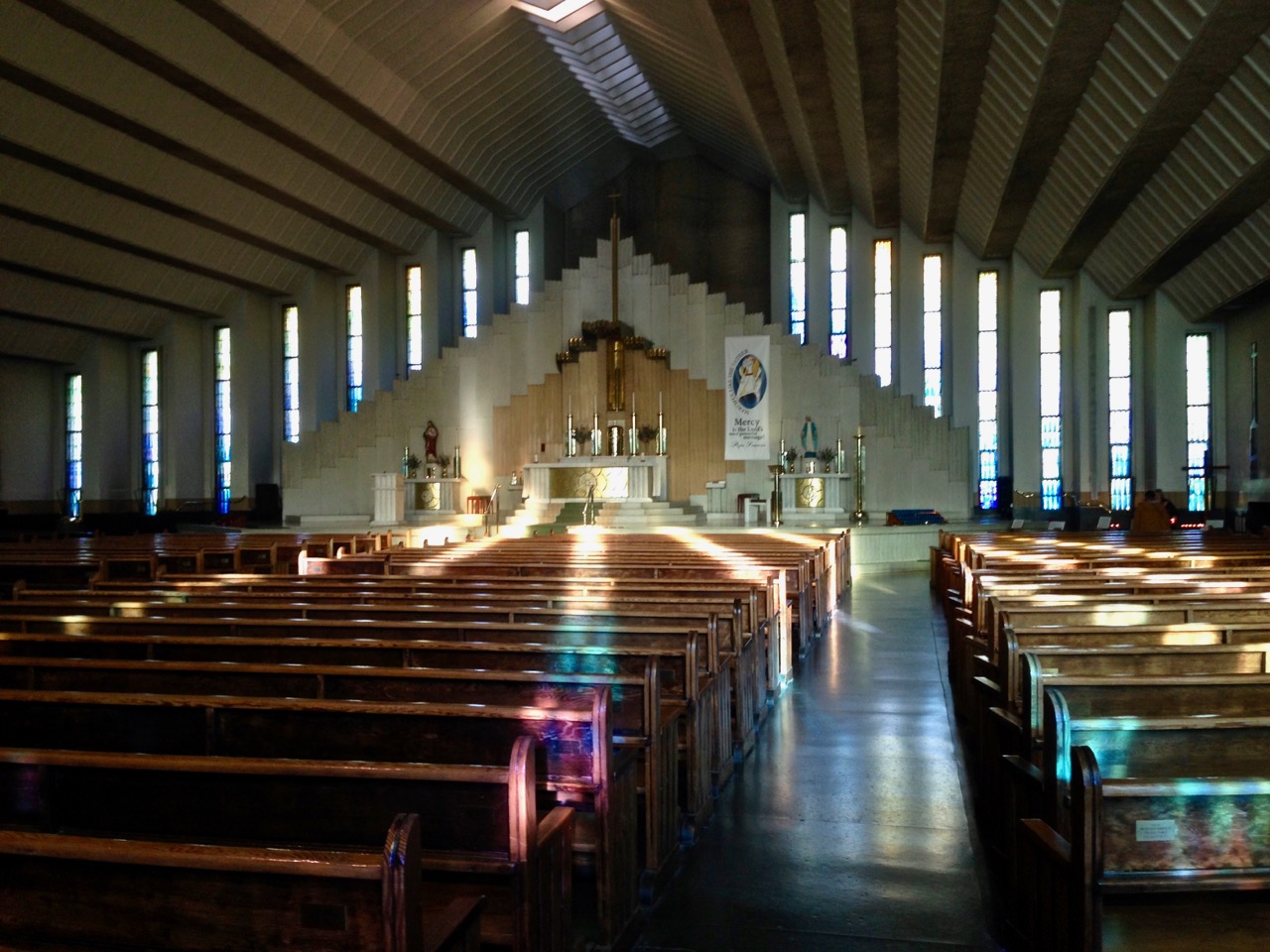
looking to altar

The main body of the church – an inclusive space where the entire congregation is relatively close to the altars

Visually the church is startling. Its concrete walls are finished externally in hand thrown adobe style render: this, and the large red-pantiled roof, certainly call to mind an overgrown Spanish or Californian mission chapel – somewhat unexpected in the Cork suburbs. Naturally (like many another architectural project) it excited much criticism and – indeed – cynicism: it still does this to unwary passers-by, but the Parish has grown to accept and (largely) appreciate its very particular character.

west end

Detailing of the church fittings is integral to the overall design concept: the brass font is striking

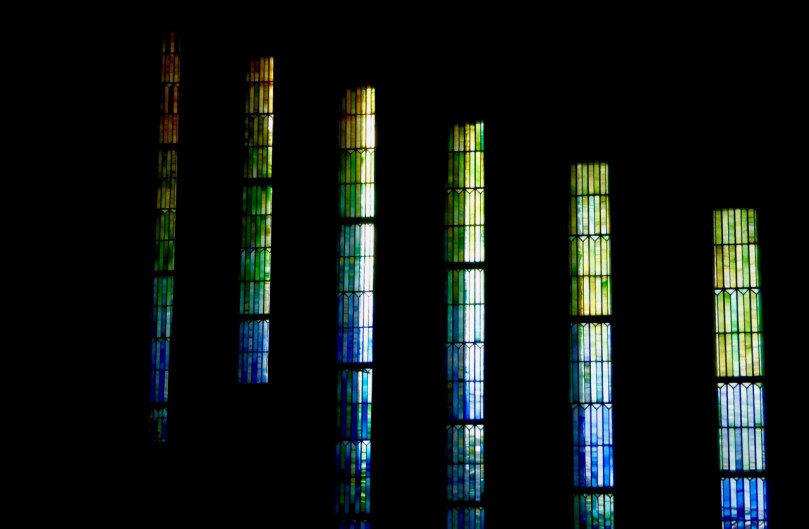
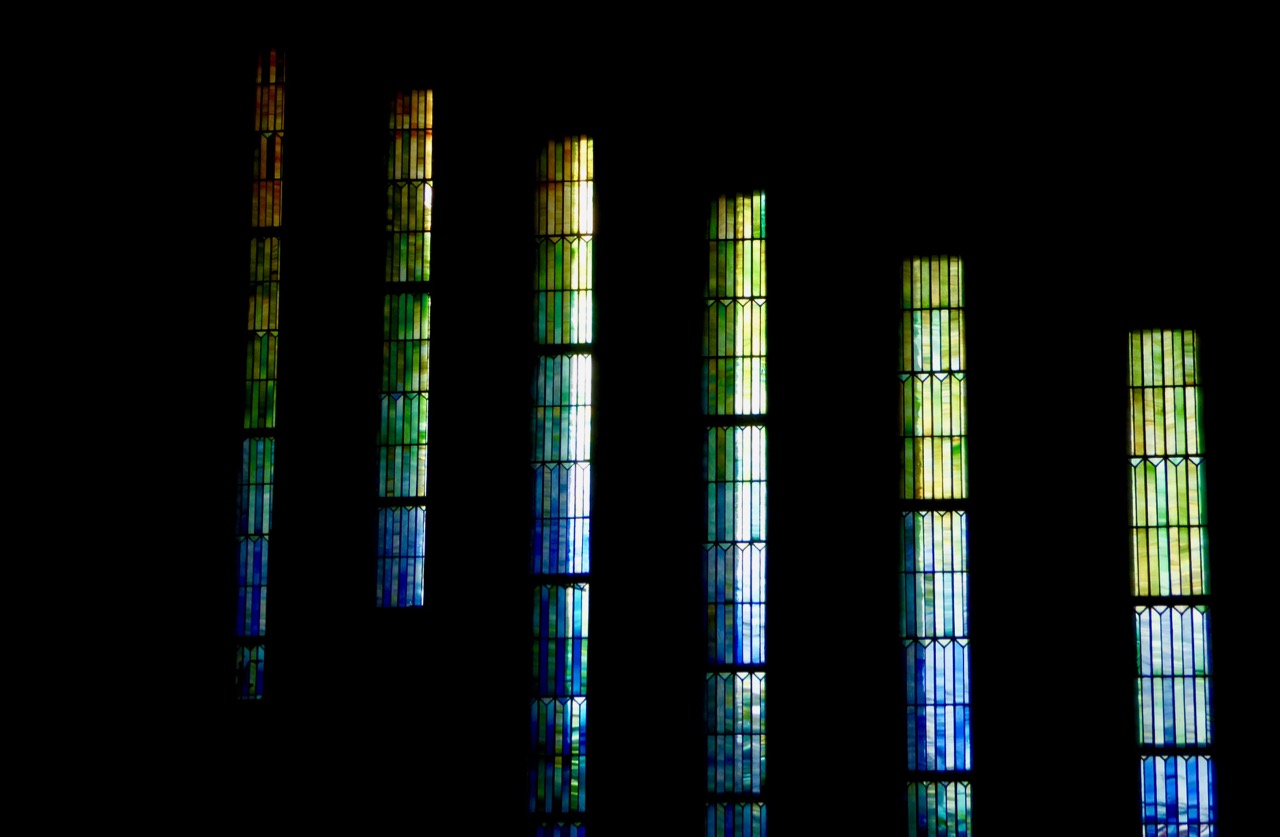
Any connoisseur of building history will recognise that this church is very much of its time, particularly when regarding the detailing and the internal elements. It is a true, undiluted example of the Art Deco movement and has an integrity which has been carried through its shape, its spaces and its fittings. There is no compromise, and – in my opinion – it works well for that reason. The architect’s vision has been adhered to throughout, in every feature: the abstract coloured glass windows, the inlaid terrazzo floors, the marble work of altars and ritual furnishings, the brasswork of font, stoups and ironmongery. Apparently Byrne’s wife, Annette Cremin Byrne (who worked with him in his practice) was responsible for much of the interior artwork. 

all glassMore interior details in terrazzo, brass and timber, and a fuller view of a bank of windows
For me the building is successful and attractive. I want to spend time in it; I want to experience it in use. It’s not just that it’s unusual (for Cork – and Ireland – although there are other good examples of Art Deco here), but it works. It satisfied the client’s brief, it was built on budget, and it provided innovation in the way the building’s users related to each other. So good was it in this aspect that it set the scene for other modern Catholic churches in the US and Europe (but not in Ireland).

The careful detailing extends throughout the building. External finishes include stepped plinths, adobe rendered concrete walls, pantiled roof, worked downpipes and drainage outlets

Comprehensive information can be found on this excellent website. When you have the chance, do go and visit the Church of Christ the King, Turner’s Cross in the city of Cork. You’ve missed the Feast Day for this year but it’s always open – as a church should be. The building will welcome you in.

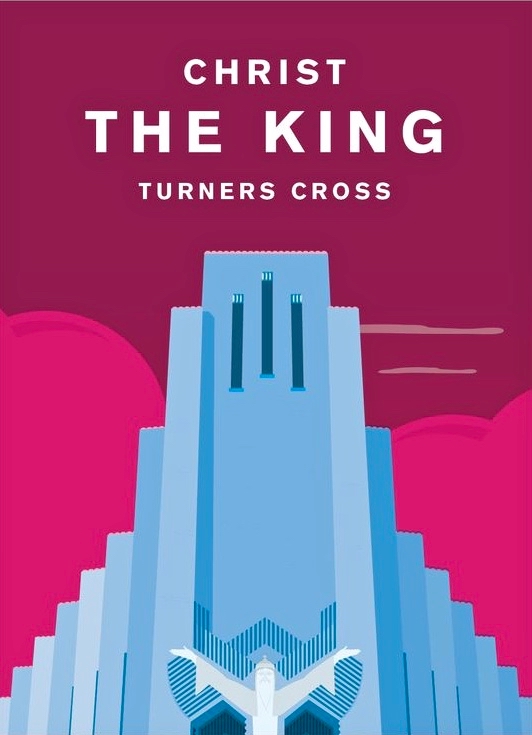
Poster from Cork Tourism Illustrations by Hurrah Hurrah
poster cropped

Good Well Hunting: Duhallow

St John's Well 1

Amanda started her blog, Holy Wells of Cork, in February and oh my goodness she already has over 100 wells documented. Not just documented – recorded, photographed, mapped, described, researched and written up in a charming cheerful style that’s a hoot and a pleasure to read.

AB 1 Laitiaran

Standard Amanda shot as she checks out St Laitiaran’s Well  

Robert and I go along on her well-finding trips every now and then. Between accompanying Amanda, and wells we’ve gone to ourselves, we’ve visited about half the wells in her gazetteer. The sheer variety is astonishing, as also is the varying state of preservation. From muddy holes in the ground to gleaming and designed surrounds – holy wells come in all shapes, all sizes, and all conditions.

duhalloworiginal

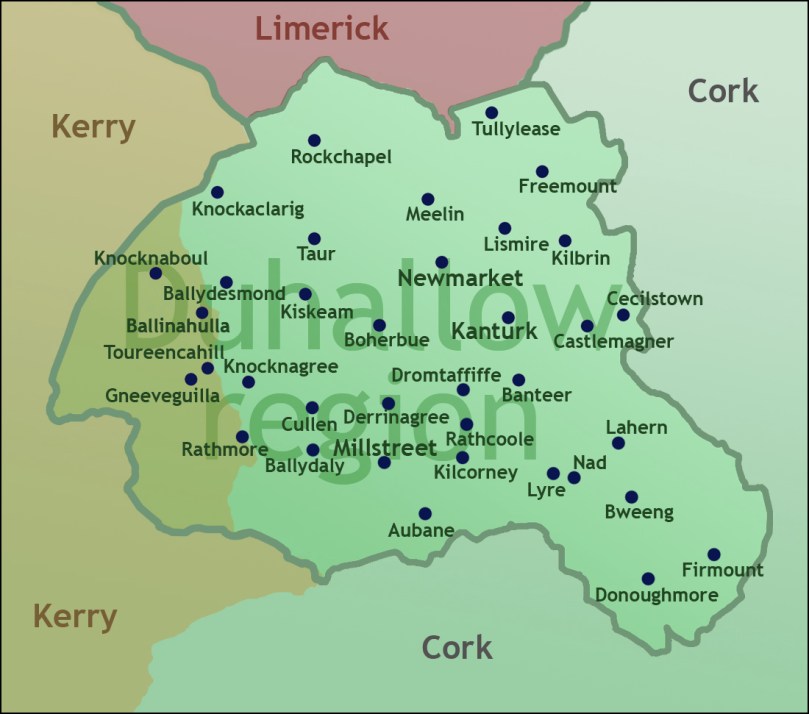
Duhallow – isn’t that a lovely word? It’s a lovely place too – a barony (part of Ireland’s old land division system) that occupies the northwest corner of the county of Cork. It’s mostly rolling hills and farmland, drained by the headwaters of the Blackwater River, with the Derrynasaggart and Boggeragh mountains to the south and the rich agricultural lands of Limerick to the north, while the Kingdom of Kerry lies just over the county border to the west.

Duhallow Sign

Duhallow has its act together when it comes to holy wells – the local development committee has developed a Holy Well Trail. A brochure leads you around the trail and at each well is a detailed history of the well, the saints associated with it, the cures attributed to it, and the rounds and prayers to be undertaken.

Tubrid Well Millstreet

Robert makes his markTubrid Well, Millstreet. Robert adds his mark to the cross inscribed by hundreds of pilgrims

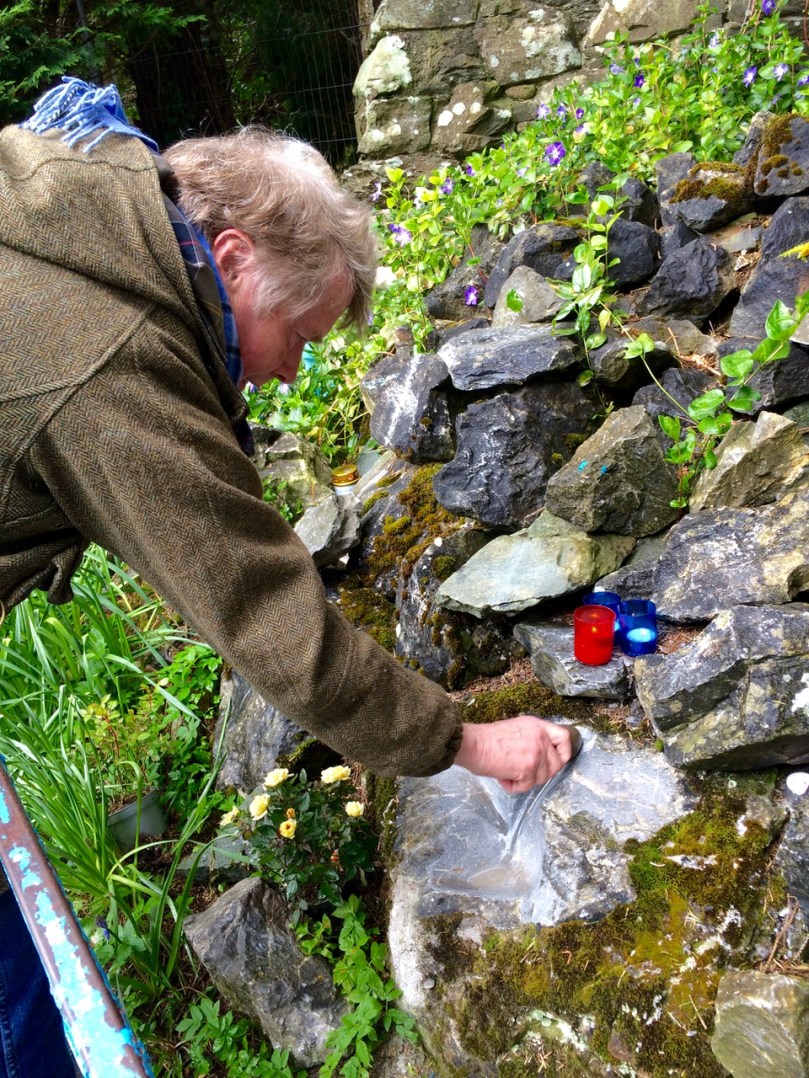
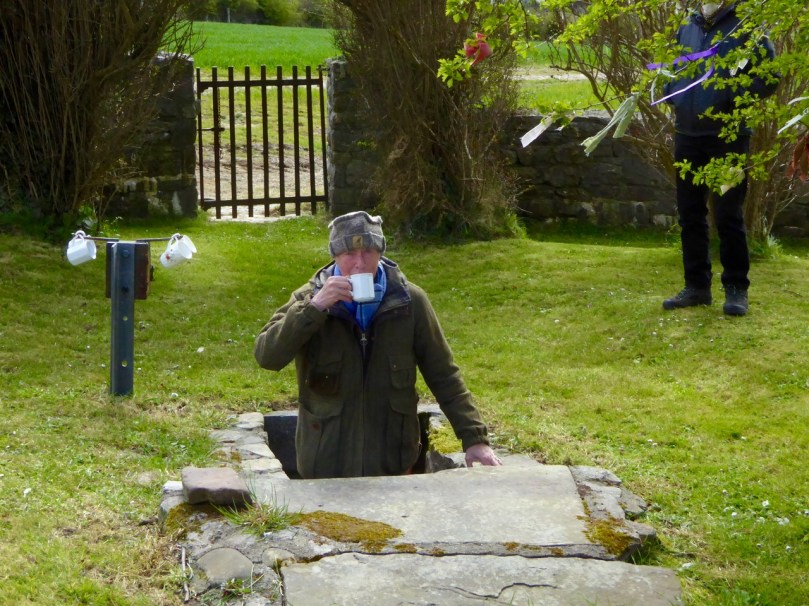
At  many of these sites mass is still said once a year and cups and bottles are provided so that you can drink, or take away, some of the water. The Tubrid Well outside Millstreeet is the largest and most active. While we were there people came and went and fresh flowers and candles were in evidence. This is a well that even has its own Facebook page!

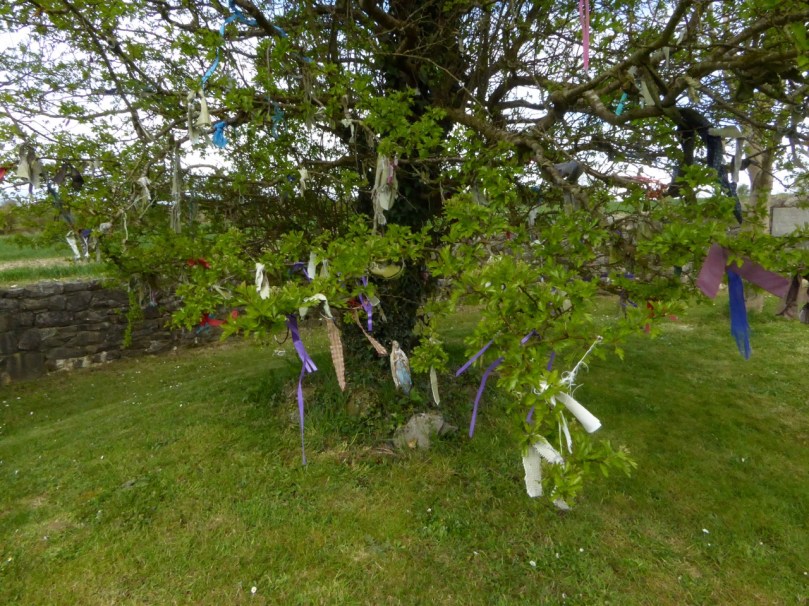
Inghne Buidhe rag tree

A rag tree at the well of Inghne Bhuidhe

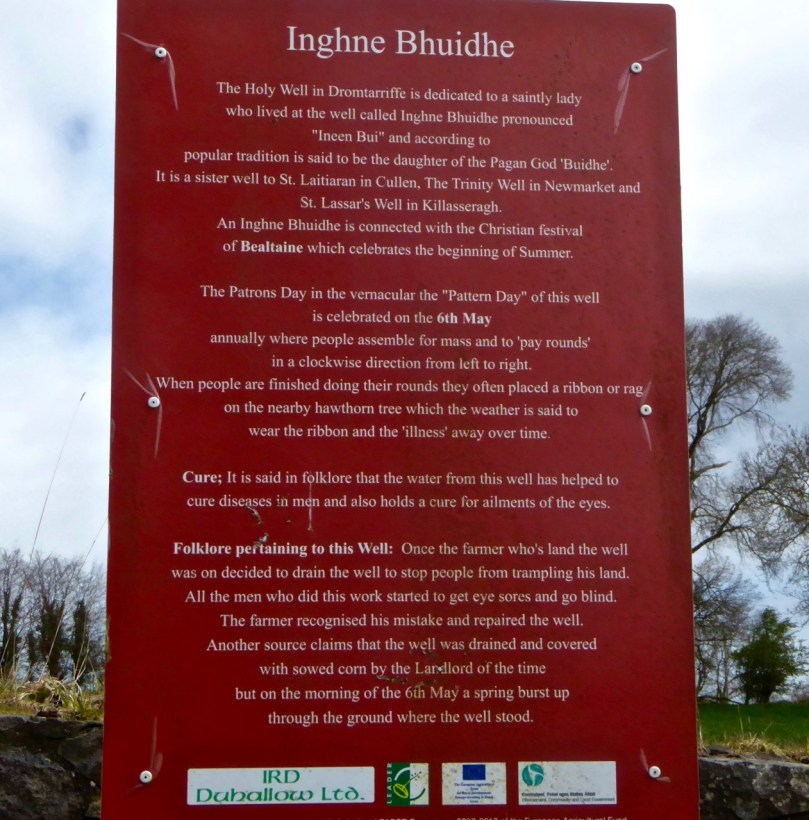
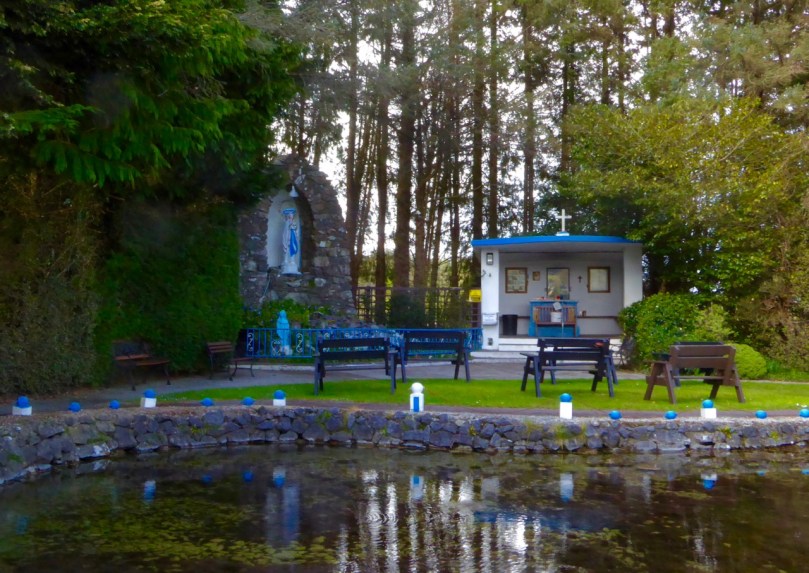
The well devoted to Inghne Bhuidhe (Inyeh Bwee, daughter of Buidhe, the Yellow-Haired) provided a complete contrast – out in the middle of corn fields, surrounded by a low wall and with a rag-festooned thorn tree looming over it. This one had a remote and tranquil vibe, suitable for contemplation.

Tasting the water, Inghne Bhuidhe

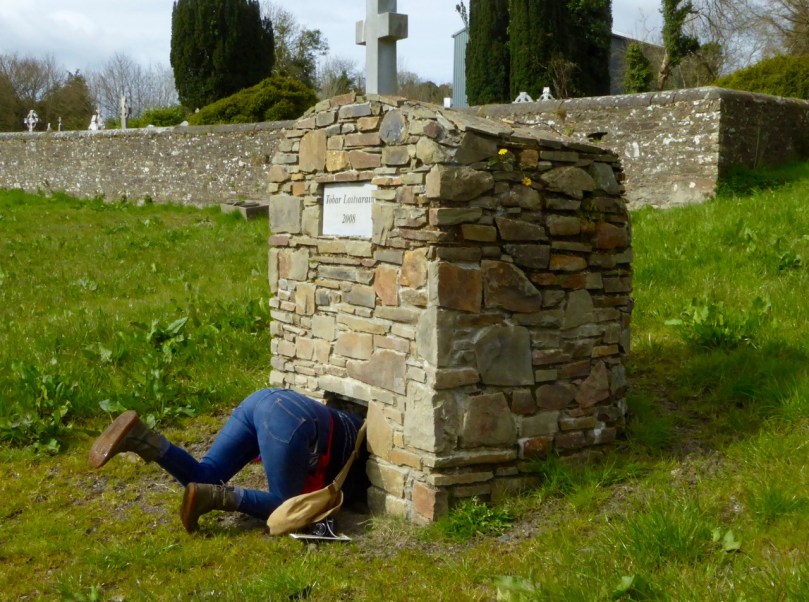
My  personal favourite was the Trinity Well near Newmarket, mainly because it was built inside a fulacht fiadh (pronounced full okt feeah) – that’s an ancient (possibly as far back as the Late Bronze Age) cooking place where stones were heated and then rolled into a trough of water. Over time, the used stones built up into a horseshoe-shaped mound that surround the trough – now re-purposed as a holy well. It was a marvellous testament to the timeless character of special places in the deep countryside. 

Trinity Well in Fulacht Fiadh

Trinity Well, formed from an ancient fulacht fiadh

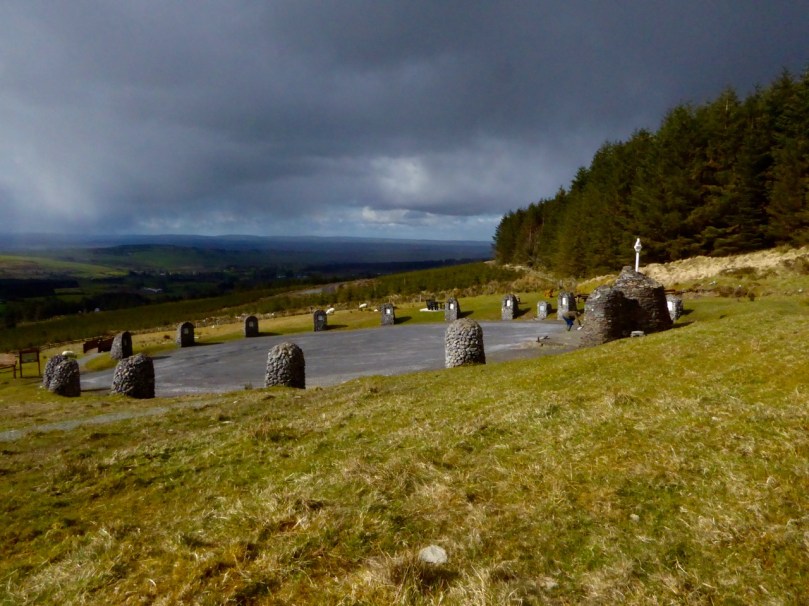
One of Duhallow’s wells is high in the Mushera Hills and dedicated to St John. The first photo in this post shows the location and extent of it. Back when the veneration of holy wells was at its peak, this one was the site of an enormous pilgrimage on St John’s Eve, June 23rd, every year. As with many such events the prayers and devotions of the daytime gave way to the partying of the night time and eventually the church acted to curb what they saw as the excessive debauchery of the occasion. Read Amanda’s account of the goings-on at Gougane Barra for an insight into the aprés-penance hooleys.

St John's Well 2

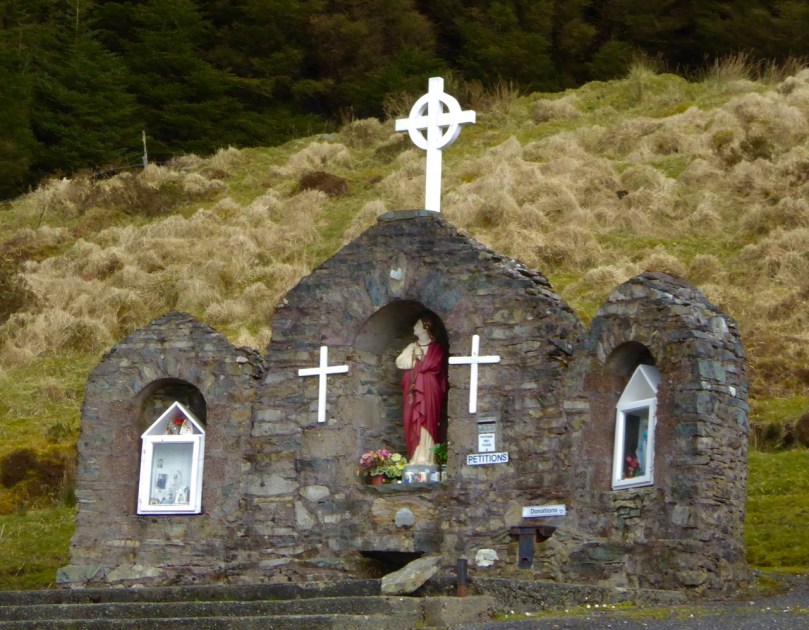
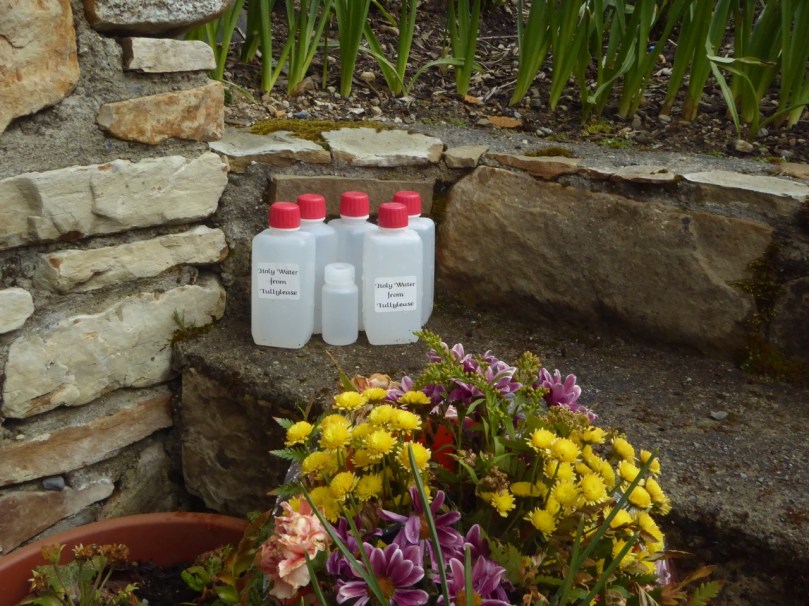
Tullylease had three wells, one devoted to Mary and another to St Beirechert (a saint whose name is spelled in a bewildering number of ways). The third well turned out to be something different – see below. The Marian well is thoughtfully stocked with holy water. Some of it is now in our bathroom to see if a few drops added to the bathwater will fend off the rheumatiz. So far, so good.

Holy Water

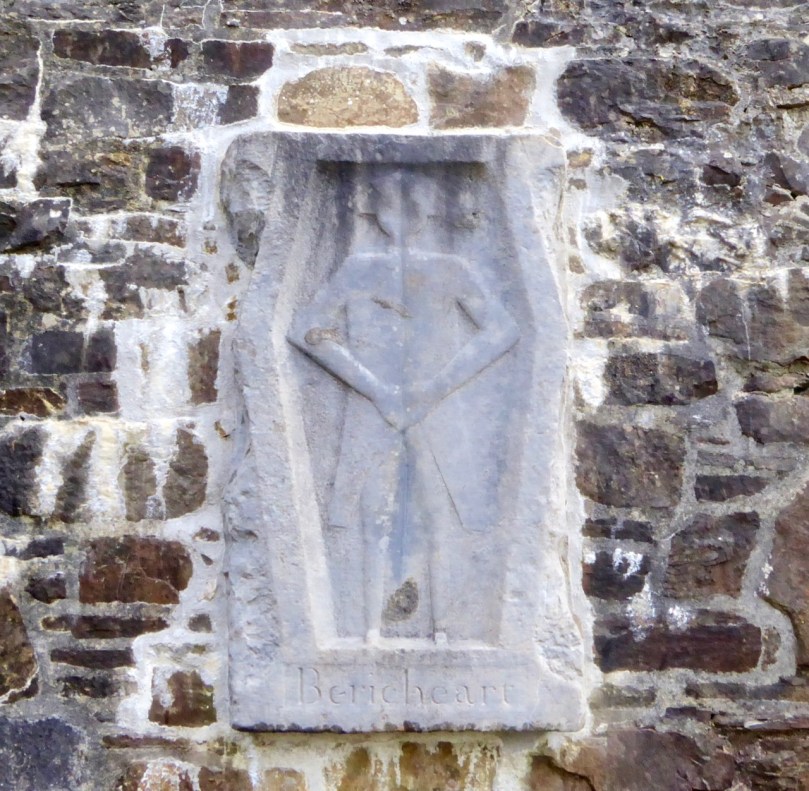
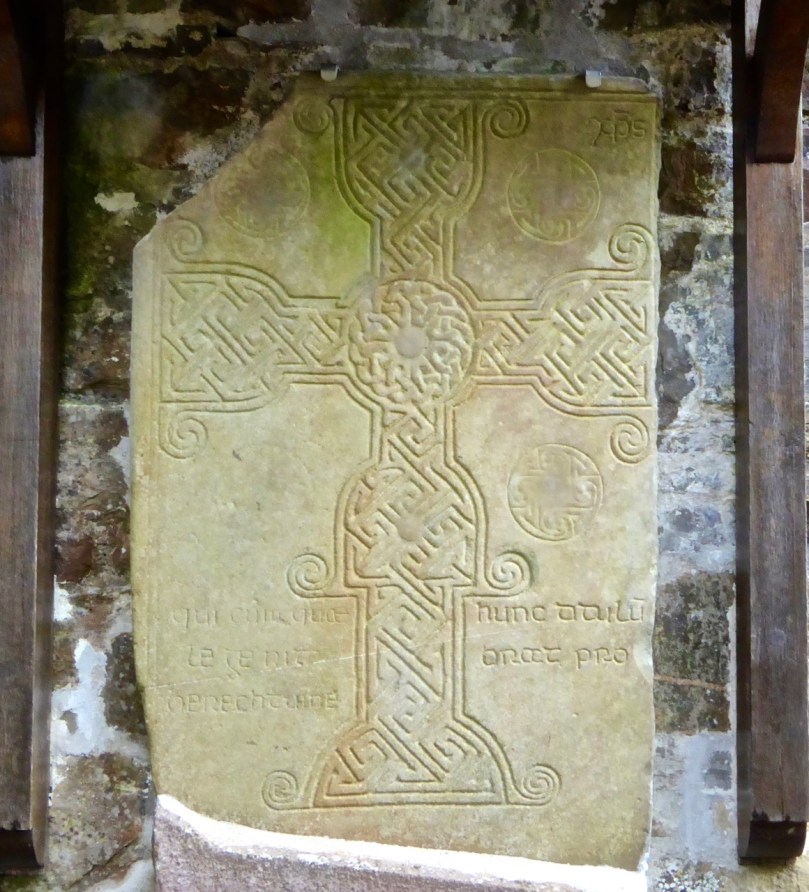
St  Beirechert’s church has several interesting carvings: St Beirechert himself in an unlikely swallow-tailed coat and tricorn hat, several fragments and a wonderfully worked cross slab with interlace design.

Bericheart in swallowtail coat

We  were intrigued to learn recently that this very cross was used as a model for the design of leather and fabric pieces for UCC’s Honan Chapel, an Arts and Crafts masterpiece, when it was being built a hundred years ago. I can’t show you a picture of that, as it’s undergoing painstaking conservation, but click here to see a modern use of the design!

Tullylease cross slab

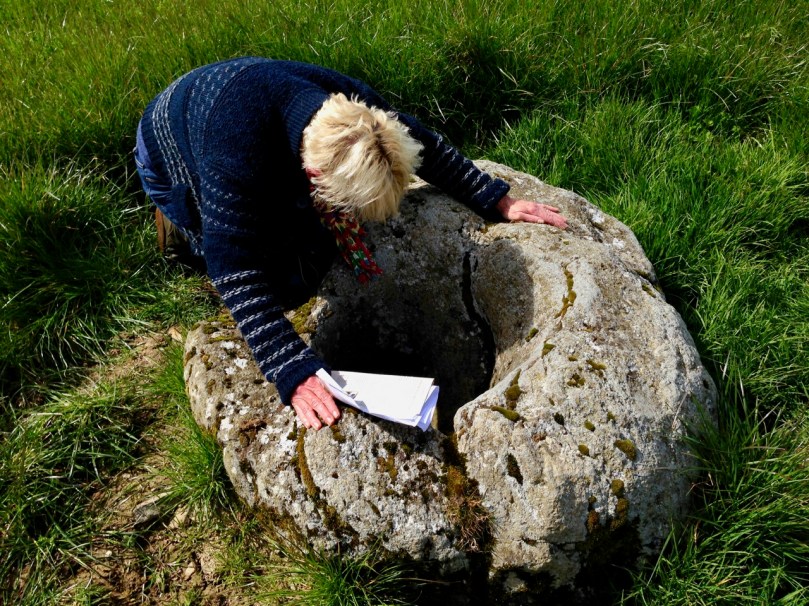
The final well we saw at Tullylease  wasn’t really a well at all but a bullaun stone – a big one. It’s supposed to cure headaches if you rub your forehead all around the rim, so here is Amanda, about to give it a try.

Amanda headache well

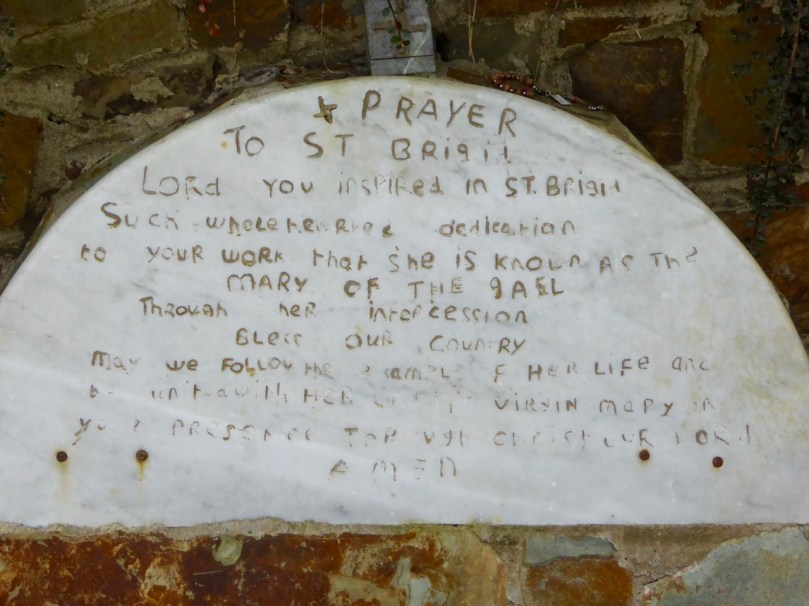
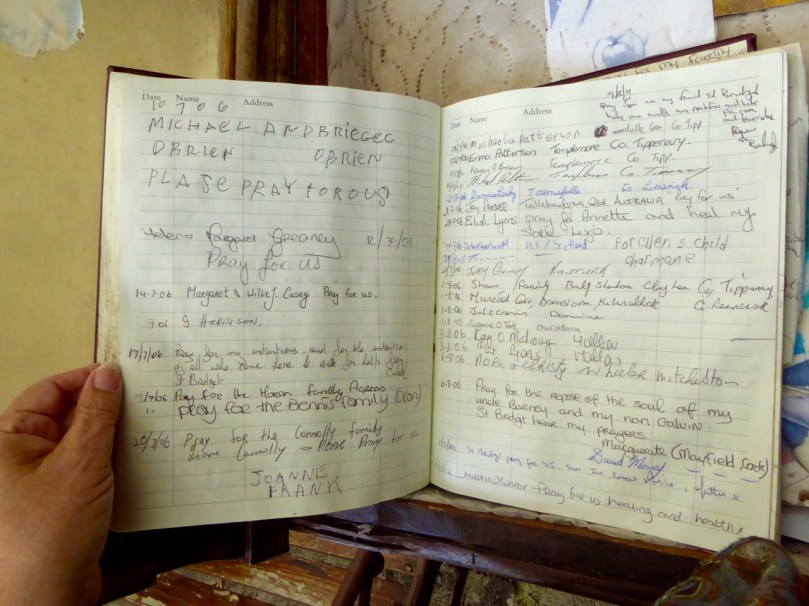
Our last stop was at a well for St Brigid. This one had a kind of cupboard containing a book in which visitors can write their prayers and ‘intentions’. It was fairly up to date, indicating recent visits.

Brigid's Well, prayer

St Brigid Pray for usIn  this post I have concentrated on the Duhallow wells, as examples of how one community has embraced this aspect of its heritage and created a wonderful experience for its residence and for visitors. For a detailed description of each of the ones I’ve mentioned here, browse through the North Cork section of Amanda’s Gazetteer.

Brigids well cups

But following a brochure and a map to wells that are tidy and well signed is not a fair representation of how you find holy wells in the field! In my next Good Well Hunting post I will invite you to come with us as we fight brambles, mud and neglect, as well as discover little gems still intact and visited in the deep countryside.

Tech is Cool and Content is King

NDW16 Discussion

As  we were last year, Robert and I have emerged from our National Digital Week experience inspired and affirmed and, OK, perhaps just a tiny bit daunted.

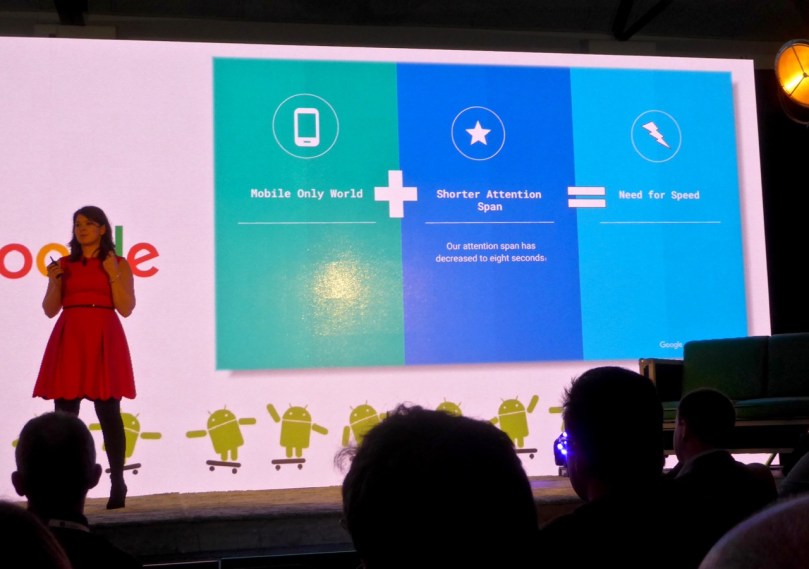
Mobile Only World

Affirmed? Because even though we are Boomers and the world seems to be run increasingly by and for Millennials, we’re comfortable with most of the technology we need to cope with our progressively digitised daily lives and to produce a weekly blog.

Daunted? At what’s ahead of us: the Internet of Things where everything is connected; augmented reality where a pair of glasses will supply additional information about anything we desire; the gameification of internet experiences; and increased reliance on high quality video.

Work to do

Looks like we have work to do!

Inspired? Because the takeaway message was so encouraging for people like us who create and produce content week after week – you can have the highest, whiz-bang technology in the world but it’s all a means to an end – and that end is to tell a story.

Humans have an innate social and psychological need for stories and a hunger for knowledge – that message was at the core of much of what we heard on the day we attended, even if the sessions had names like Innovation and Creative Thinking or Perspectives and Insights from an Irish Start Up.

FF with Alan Duggan

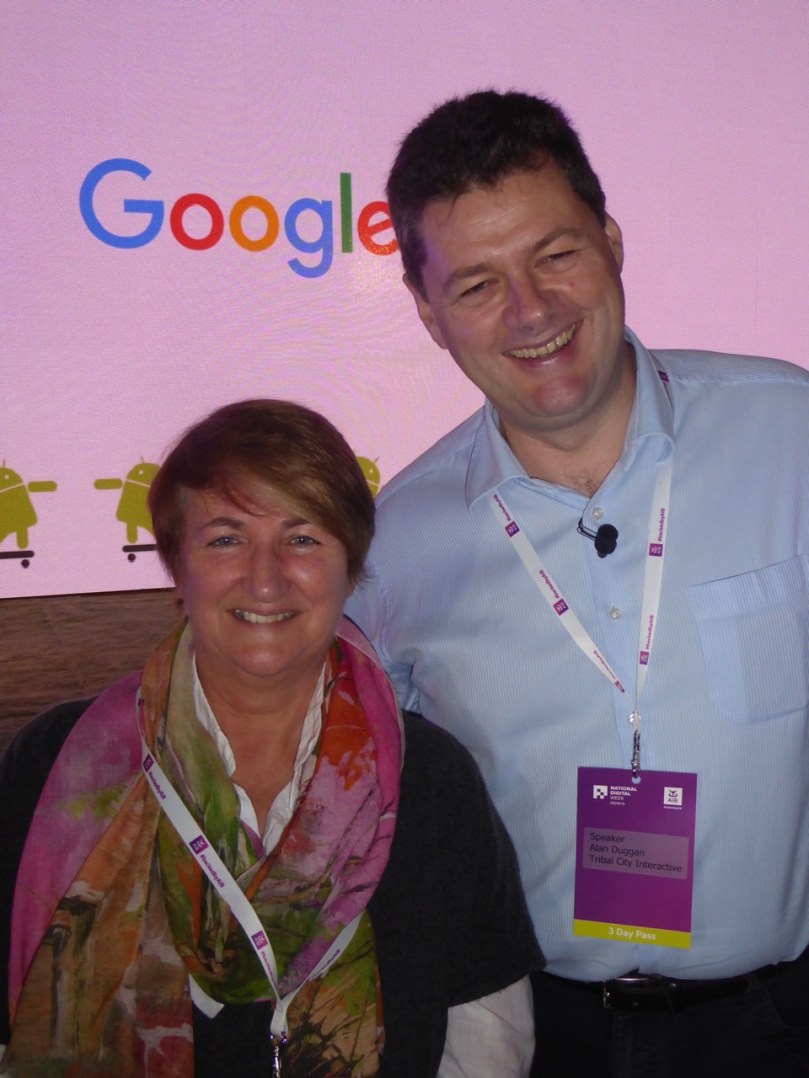
Finola with Alan Duggan of Tribal City Interactive, based in Galway

The Irish Start Up under discussion is a group called Tribal City Interactive and they are developing a new game called Runes of Aran. The thing is, it’s all based on Irish mythology, straight from the Leabhar Gabhála, or the Book of Invasions, which tells the story of the successive waves of people who came to Ireland. (See Robert’s post First Foot for more about the Irish origin tale told in the Leabhar Gabhála.) And the game is going to be stunning! Here’s the premise:

A storm has been raging for days.  Navigation is impossible, your ship is being inexorably pulled towards a mysterious island at the edge of the world.  It is a place which exists in the stories of all mariners; it is a place to be shunned.  It is Aran.

The ship is finally dashed ashore at the foot of huge towering cliffs.  Only you get off the ship alive, crawling ashore into a surprisingly calm bay. The cliffs form an impenetrable barrier, except for a cave that frames a massive doorway composed of two tall blue stones, capped by an even larger lintel piece. Standing in the doorway is an old man, dressed in a long grey tunic.  He is Amergin the Bard, and he waits patiently for you.

Amergin explains an old magic has pulled you to this place and now you are trapped, doomed to spend the rest of your days on this lost island. Unless…

Runes of Aran still

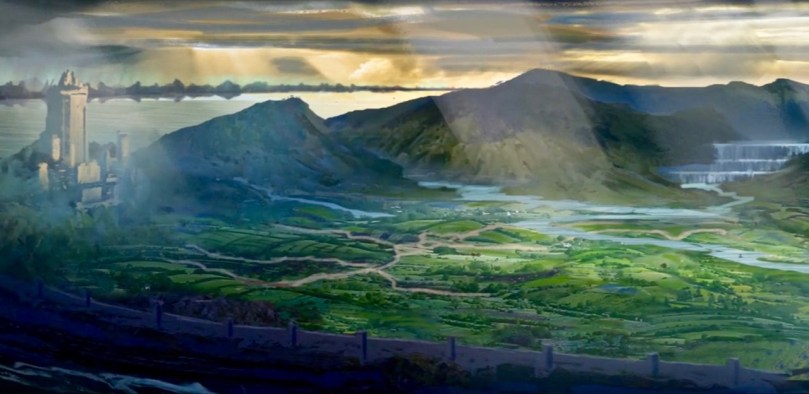
This is a still from Runes of Aran, taken from their concept video – now take a look at the video

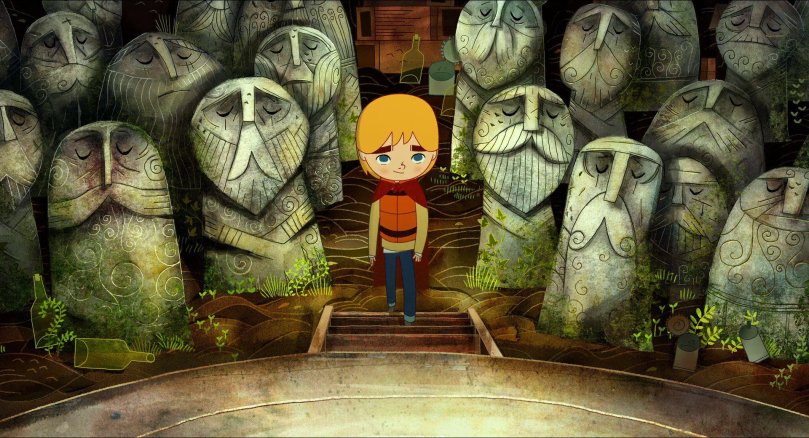
We were also excited to see Cartoon Saloon here, talking about their projects. We love their animated films: The Secret of Kells and The Song of the Sea are both based on Irish legends and myths and both were nominated for major international awards. The Song of the Sea also uses imagery directly inspired by prehistoric Irish art. Just look at this screenshot – it manages to combine Boa Island figures with Newgrange-type spirals.

song-of-the-sea

Google has a massive presence in Ireland and Google folk were here in droves. We had booked a one-to-one session in their Digital Garage, where Karl gave us excellent advice (and food for thought) on how to really look at our website and what we might consider doing a little differently.

RH and Karl, Digital Garage

I’ve only given you a tiny flavour of National Digital Week. We met all kinds of people here, from CEOs to hot-shot young programmers to visionary developers to people just like us, working on the fringes of technology and wanting to learn. And all of this in the heart of West Cork.

The old Lady’s Well Brewery repurposed as the Google Digital Garage

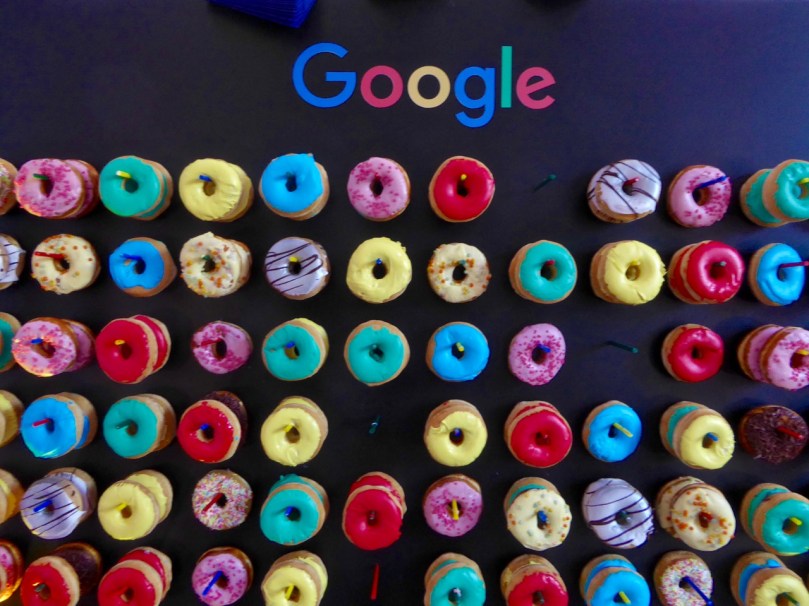
A massive vote of appreciation to the dynamic young people who run the Ludgate Hub in Skibbereen and who organise this conference- what an amazing job they do. Next year, come and experience it for yourself. Oh – and don’t miss the Wall of Donuts!

Donuts

Wild Beasts of Ireland

tiger at feet st canice

There are wild beasts all around us!  Animal, fish, serpent or fowl, real or mythical, carved, painted – imagined. This is my second ‘Menagerie’ – previously we explored the Honan Chapel in Cork, and I was struck by all the wildlife representations there, as set out in this post from over two years ago.

2 deer cashel

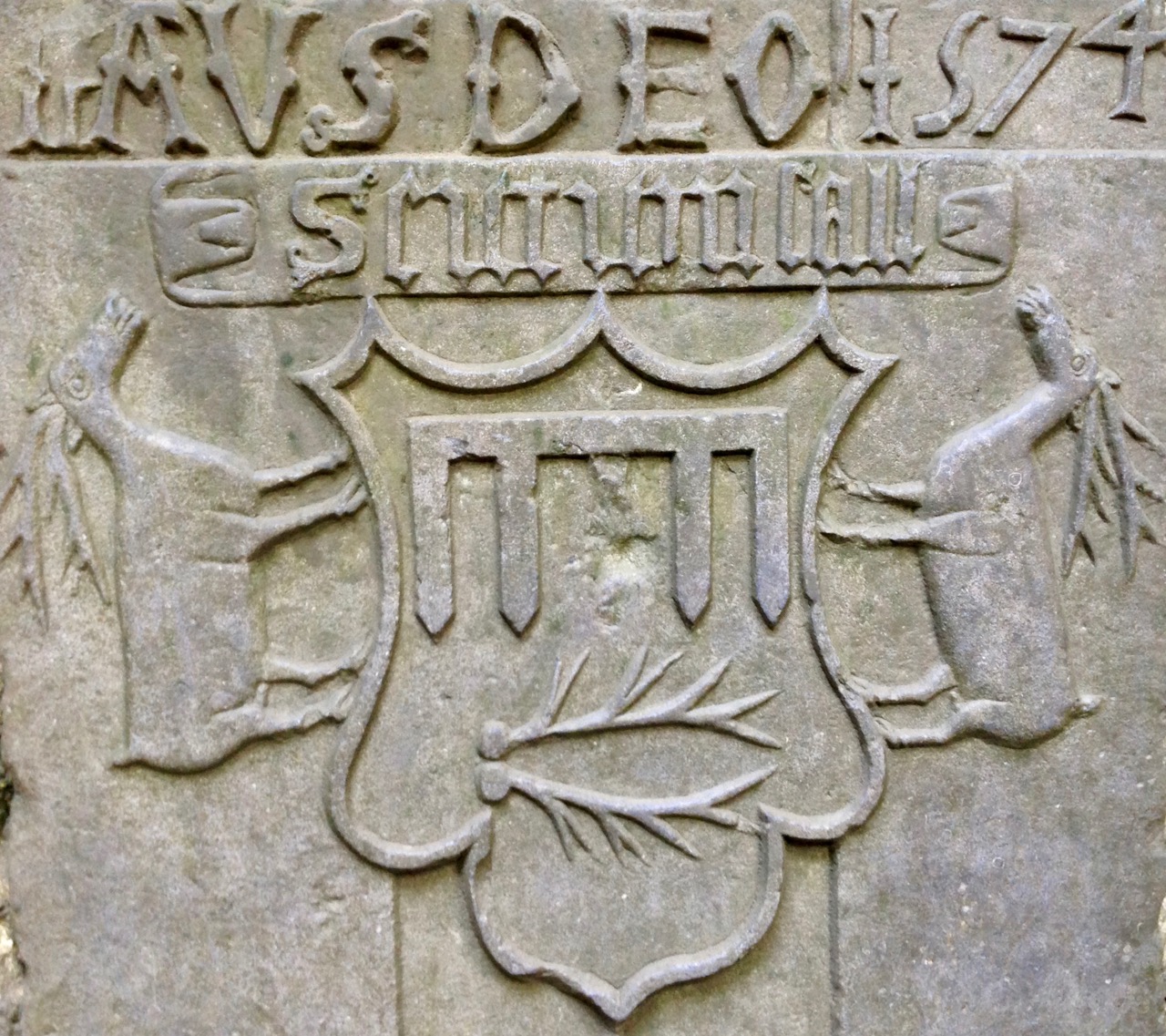
Deer and antlers on a memorial plaque in the Cathedral at Cashel – one of the earlier representations here, dating from 1574. Top picture – believed to be a tiger, this fine beast lies at the feet of a medieval knight in St Canice’s Cathedral, Kilkenny

Our travels take us around many of Ireland’s historic sites, and I’m always on the lookout for Creatures – they are abundant everywhere. Countless stories of the saints involved animals: they are common symbols on tombs and heraldic plaques, but we can’t resist also using them today – for inns, shop signs or just decoration on the streetscape. Have a look around you – you might be surprised how many you can see…

toucan guiness

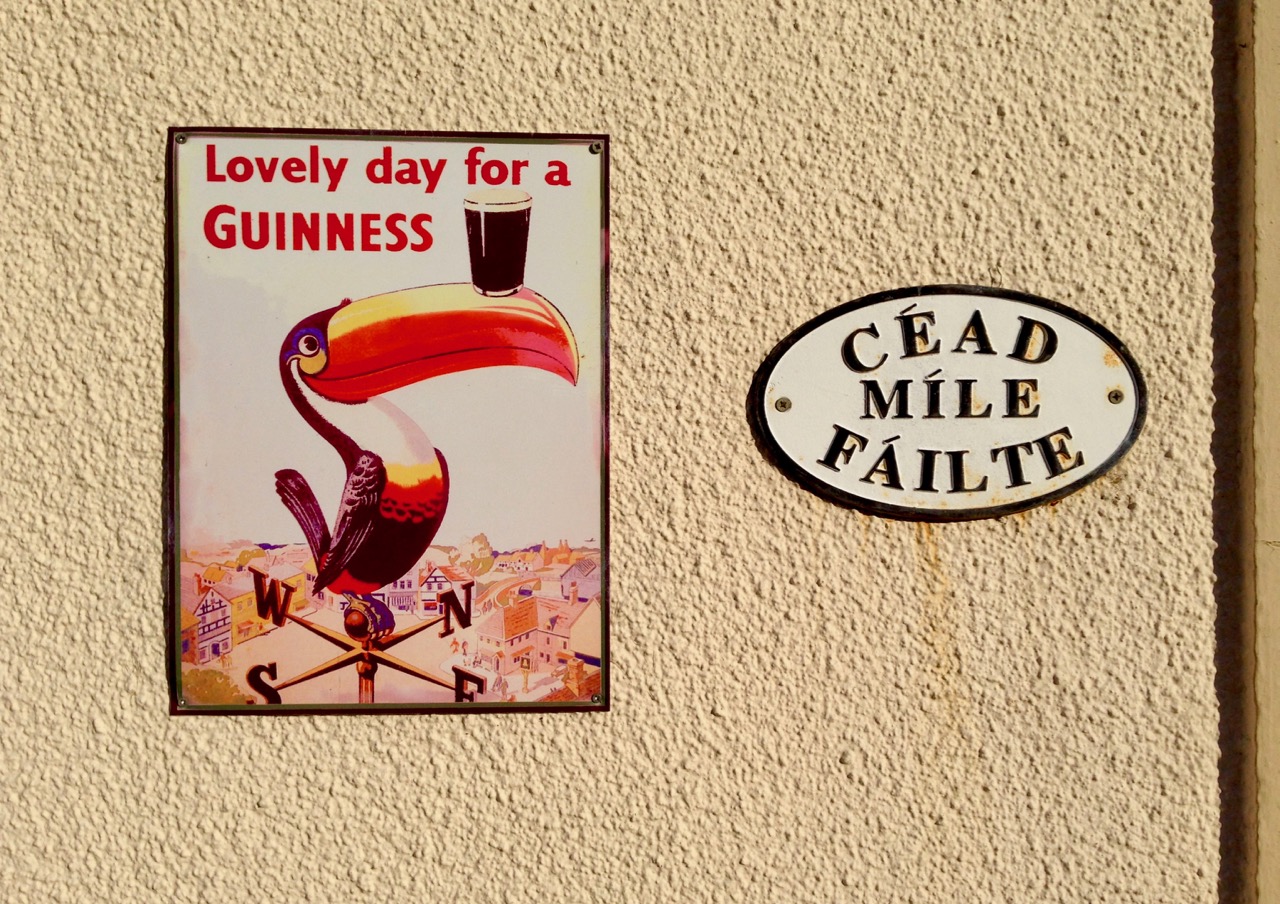
Inhabited streetscapes: top – two Kilkenny Cats undoubtedly belonging to Dame Alice Kytler and, above – there are plenty of these toucans still around in Ireland! They originate from a ‘zoo’ advertising campaign for Guiness begun in 1935 (abeted by Dorothy Sayers who wrote captions and verses); the toucan campaign flourished until 1982

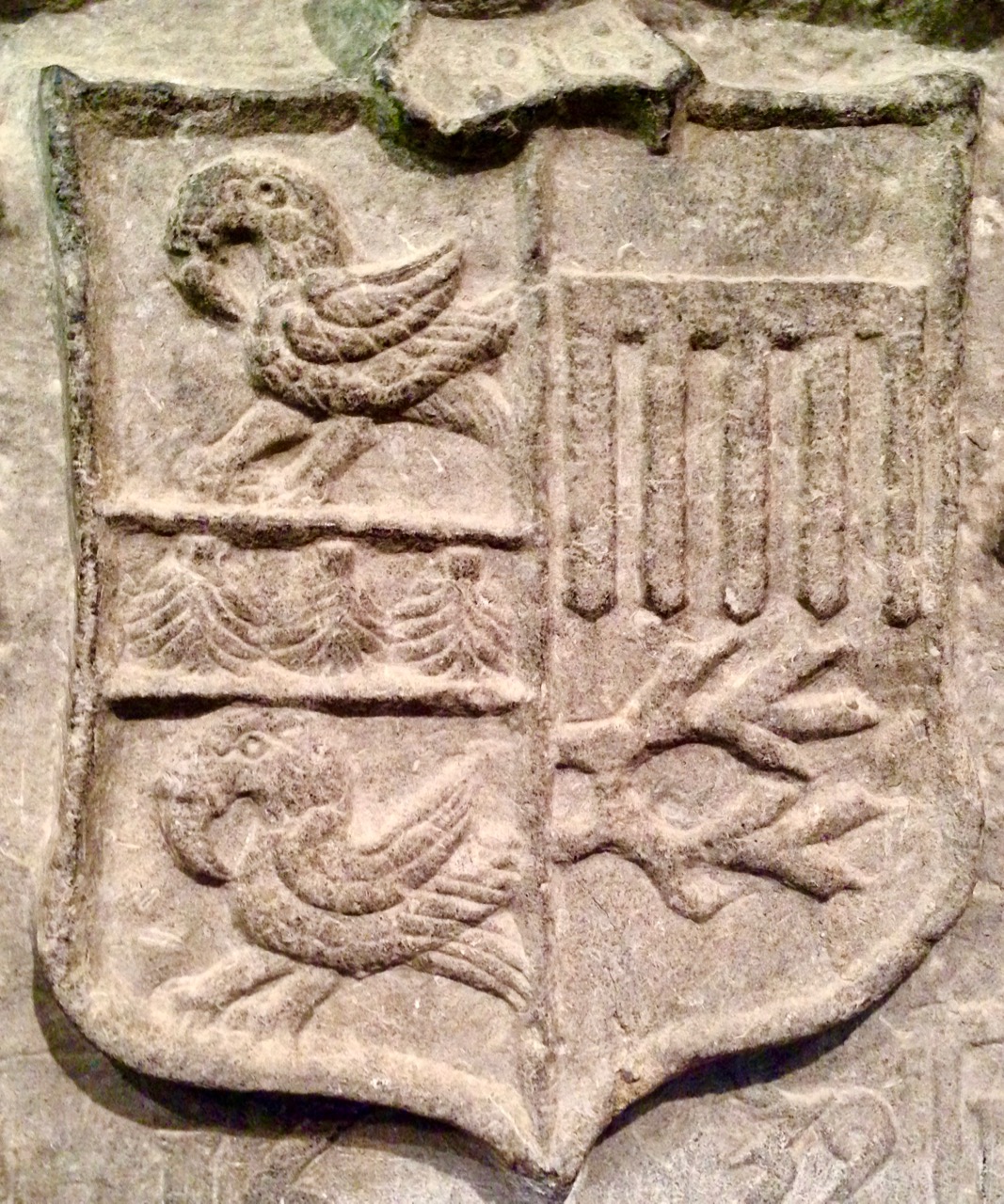
Nobody has ever claimed the toucan as an Irish bird, but pelicans were certainly not uncommon in medieval carvings here. That’s because the pelican in early Christianity symbolises atonement as it was believed to wound itself in order to feed its young with its own blood.

2 birds shield cashel

fish lid st canice

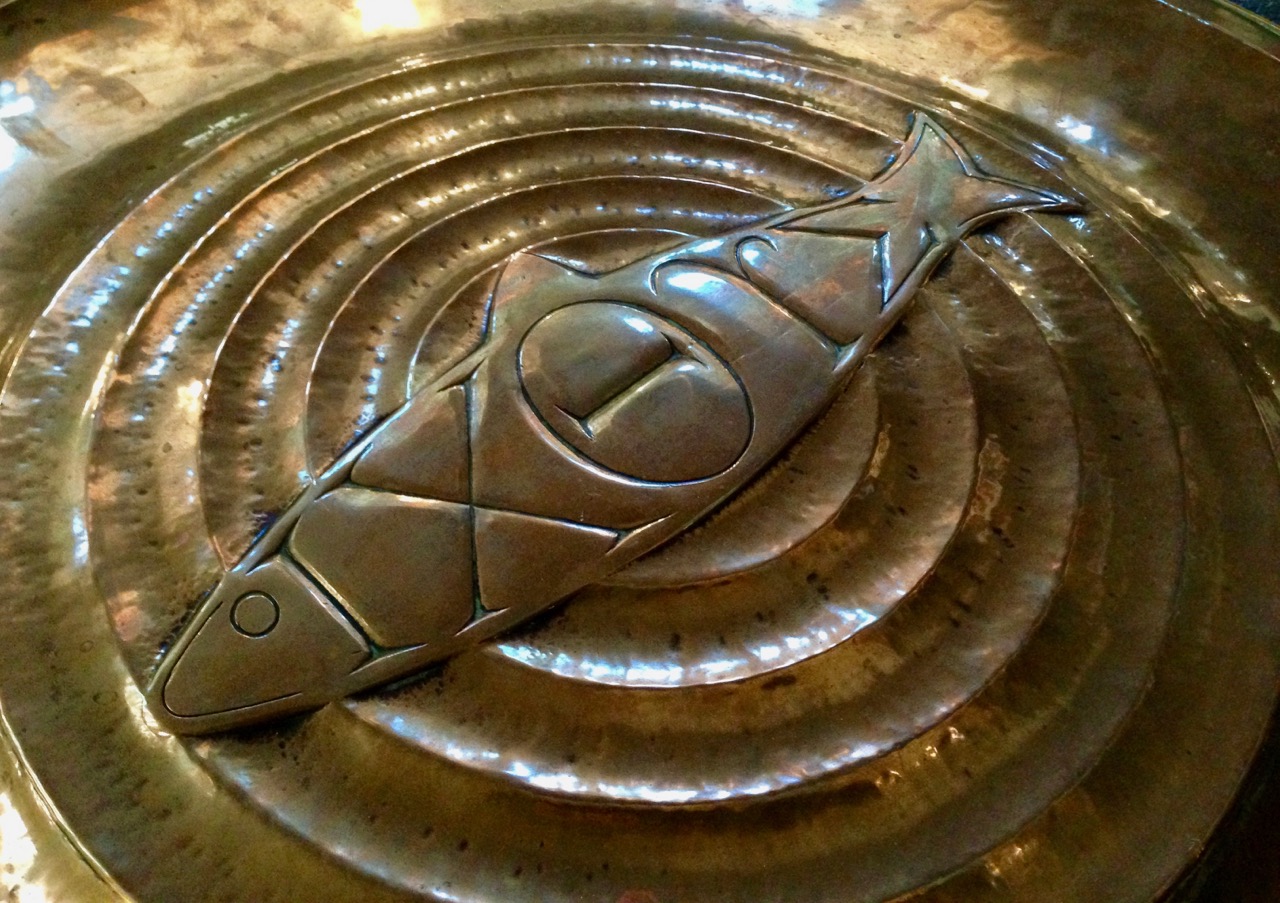
Christian symbolism: top – medieval pelicans at Cashel, and below – a fish incorporated in a modern lid to the ancient font in St Canice’s Cathedral, Kilkenny. The Greek ΙΧΘΥΣ is an acrostic for ησοῦς Χριστός, Θεοῦ Υἱός, Σωτήρ, literally translating as Jesus Christ, Son of God, Saviour

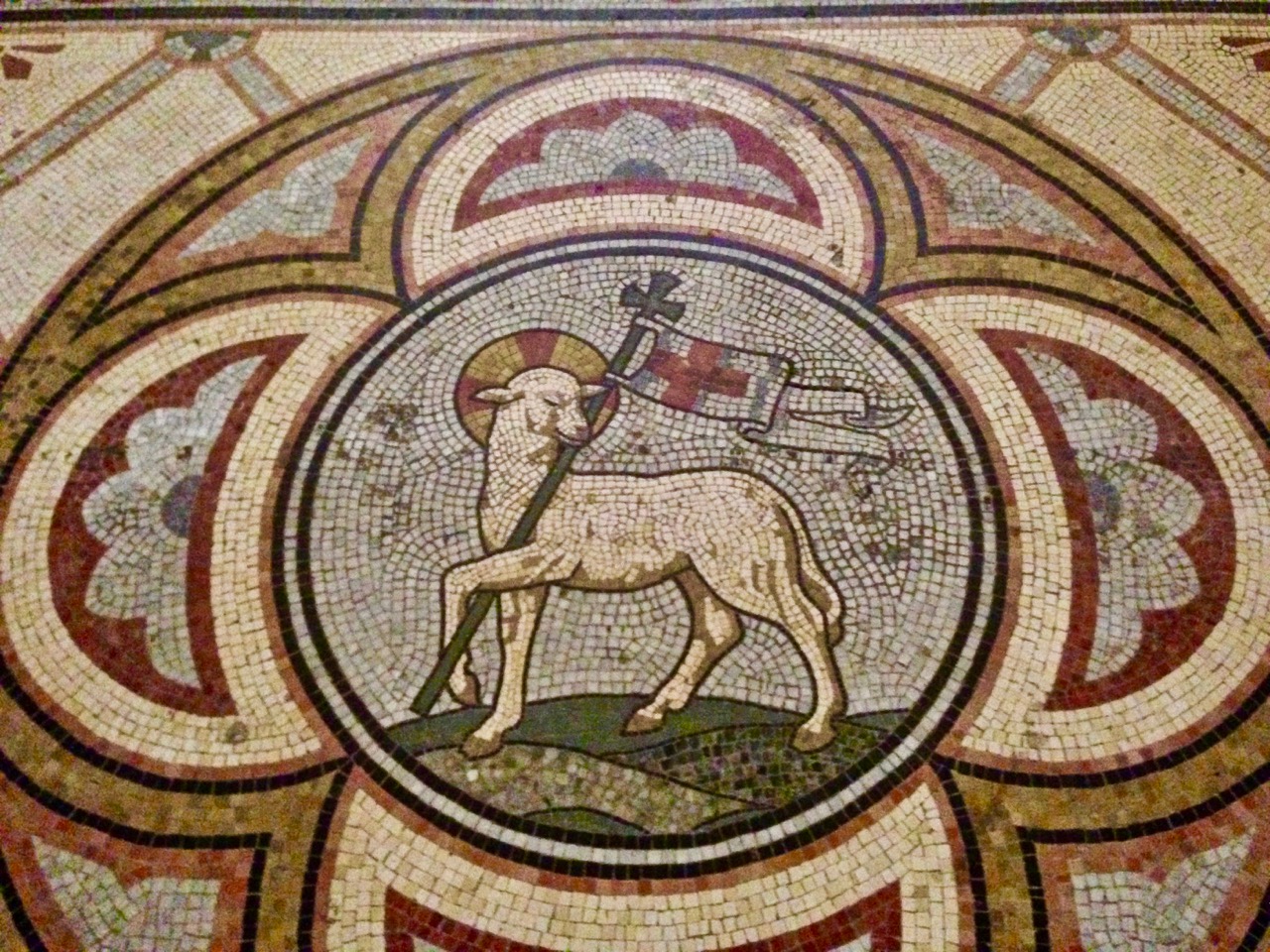
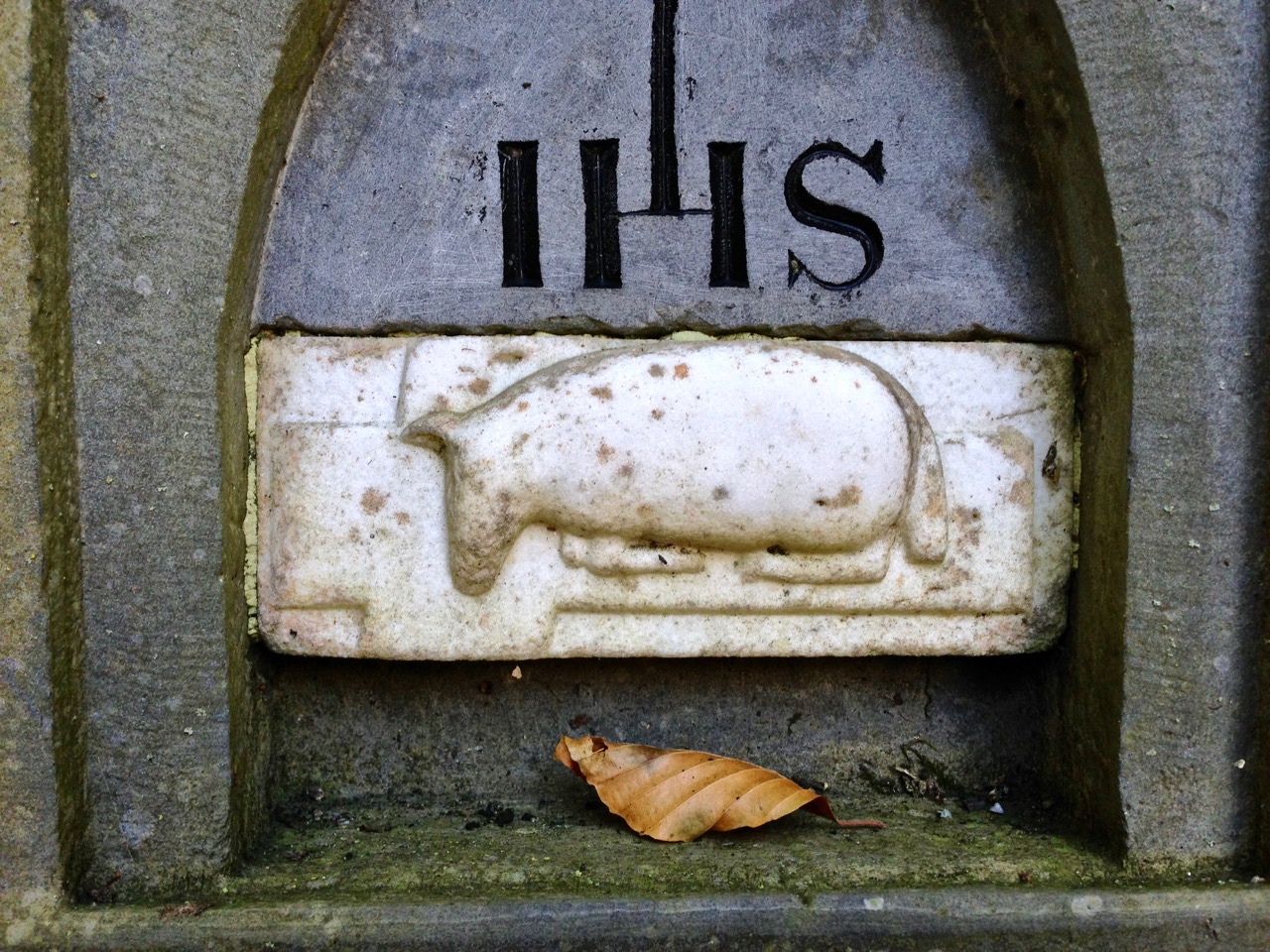
Also in Christian symbolism the lamb represents Jesus – the Lamb of God – who was sacrificed in order to atone for human sin.

lamb with pennant kilkenny

ihs lamb detail
Top picture – not a wild beast, perhaps, but a pascal lamb mosaic in St Mary’s Cathedral, Kilkenny. Lower picture – this strange creature is also a lamb, from a graveyard memorial in Killeen, Co Meath

Lions are popular animals in Britain and Ireland, possibly because they appeared on royal crests and were therefore associated with status and dignity. I was surprised to find bears and eagles well represented.

All the lions (graphic tiles and wistful memorials) are from the Collegiate Church in Youghal. The stained glass is from St Peter’s Church, Bandon, Co Cork and shows off bears (from crests of the Earls of Bandon – their motto was Bear & Forbear), eagles, another lion and – for good measure – a fine serpent

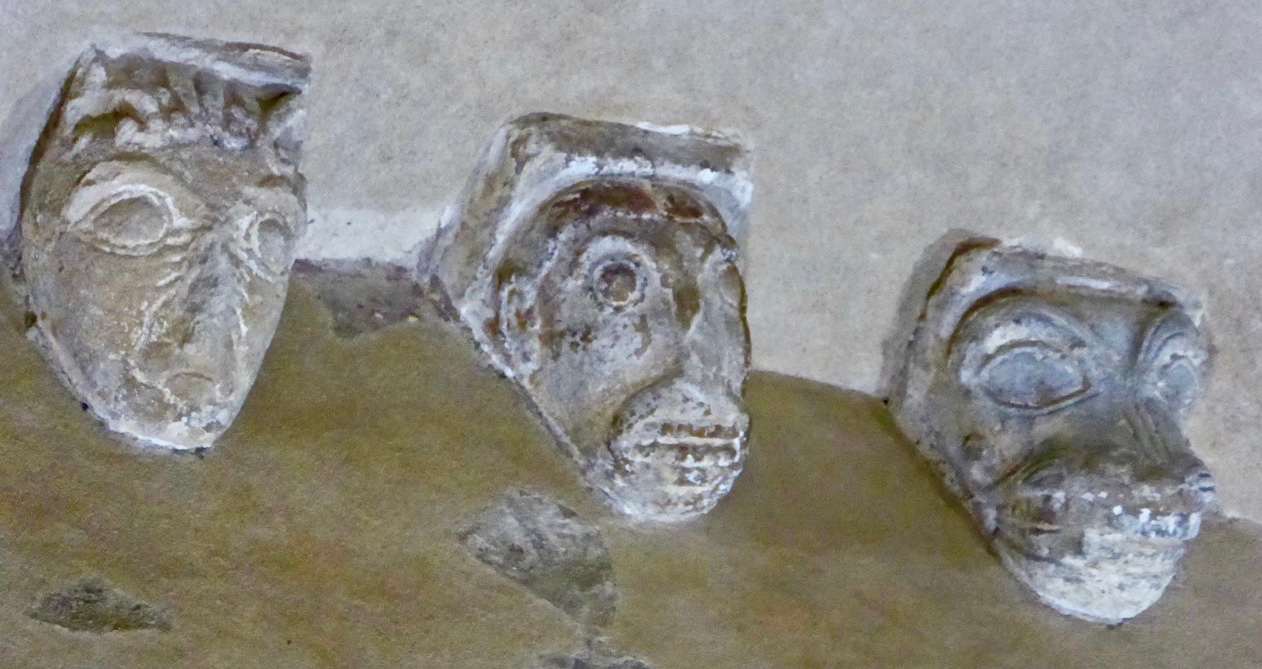
Some of the most splendid and oldest carved stonework in Ireland is to be found at Cormac’s Chapel, Cashel and at Clonfert Cathedral, both dating from the twelfth century. The Hiberno Romanesque doors and arches display arrays of human heads but also numerous creatures.

Heads cormacs chapel

Upper pictures – a small selection from the riotous carvings at Clonfert Cathedral, Co Galway and – lower picture – ambiguous creatures from Cashel, Co Tipperary: all are around 900 years old

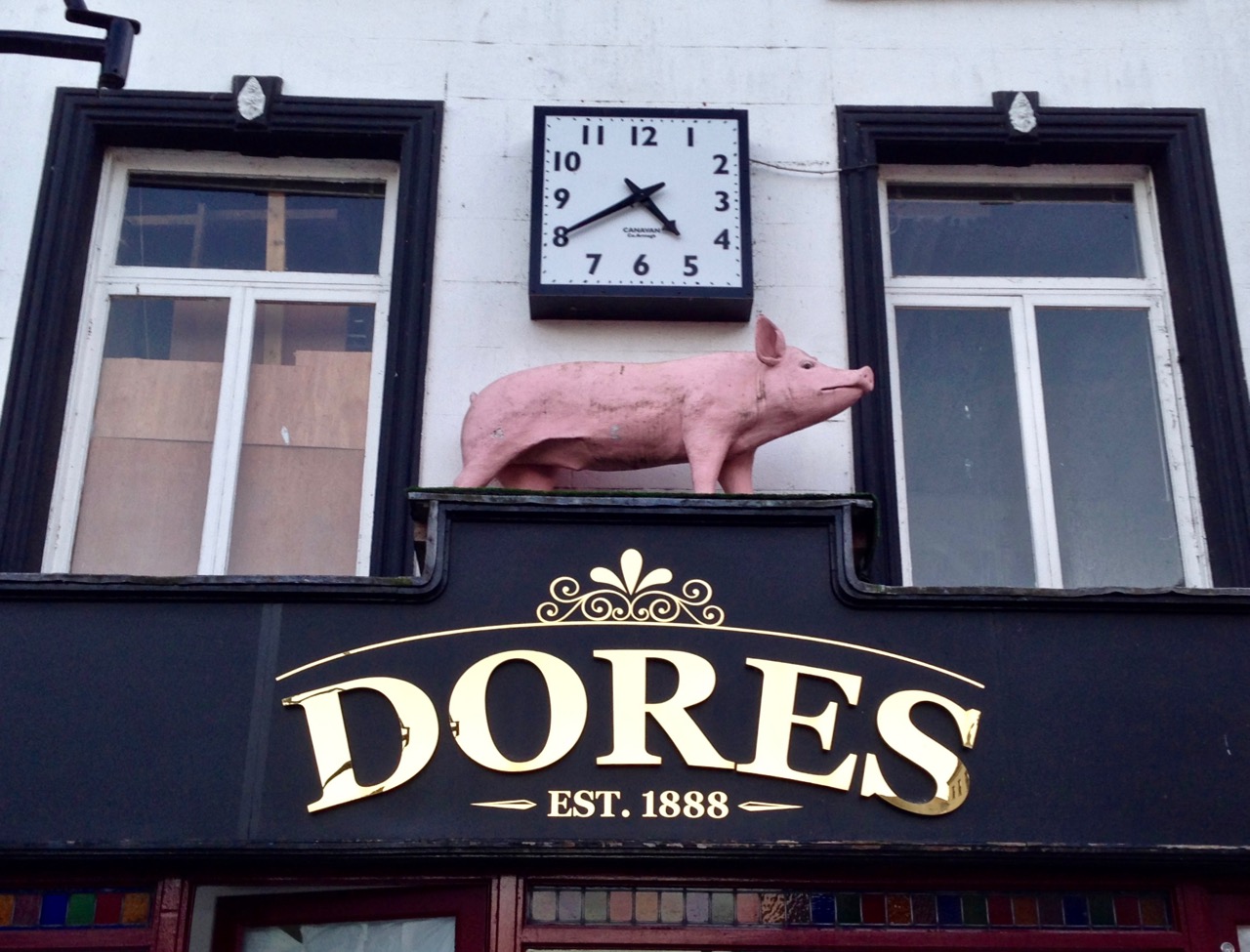
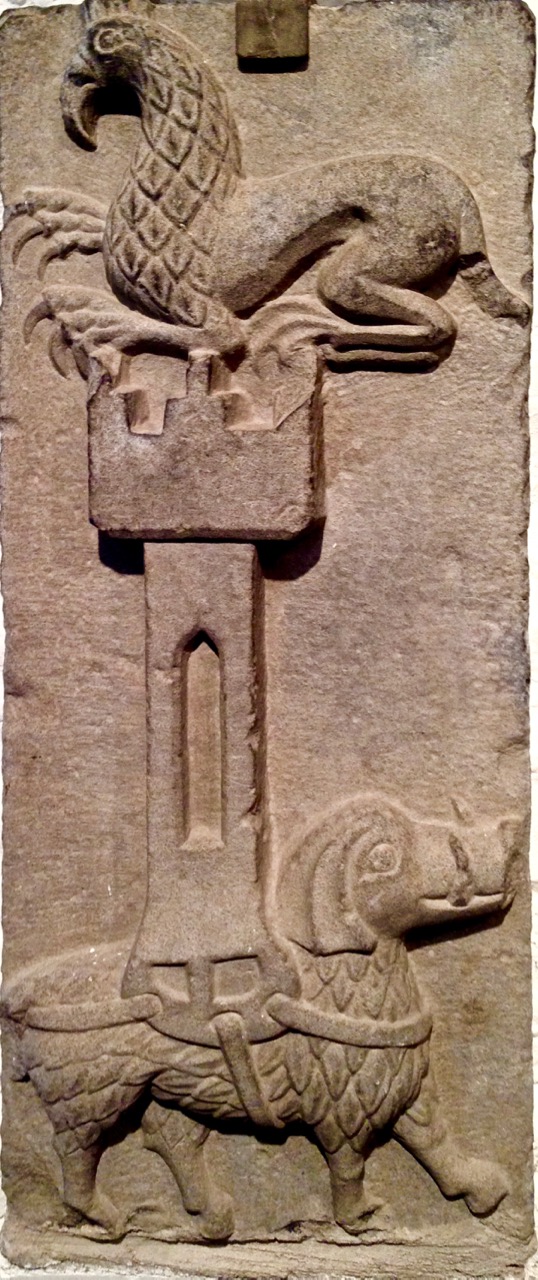
I’ll round off for now with some more cat-like creatures and a Kilkenny pig. Oh – and a carving we found in the Cashel museum, titled ‘Elephant and Castle’. Both the carving and the name are enigmatic, as the creature with a castle on its back (wherein resides another creature – a gryphon?) looks to me like a boar with feathers!

pig dores kilkenny

Elephant + Castle


Discovering Richard King

Patrick Vox Hib

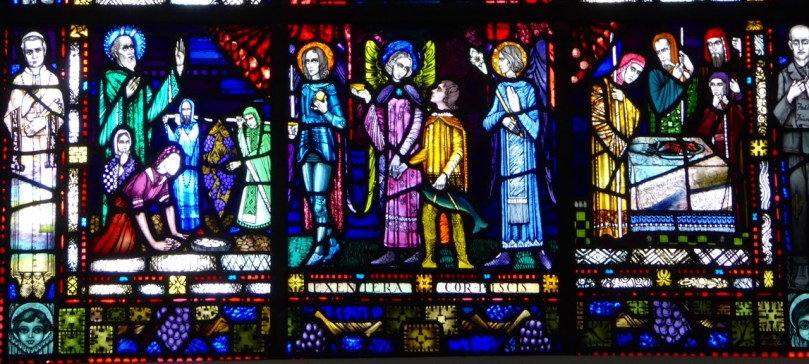
Here is a typical Harry Clarke piece of stained glass – note the large expressive eyes and long tapering fingers, the gorgeous raiment of the angel and that headdress, the additional tiny angelic figure hiding in the blue glass, the border filled with non-repeating decorative elements. All classic Clarke elements, right? But this is not the work of Harry Clarke. He died in 1931 and this window was designed, executed and installed in 1937, by the studio that he founded and which carried on after his death under the name Harry Clarke Studios.

Patrick Preaching

The first image in this post is from the Patrick window and shows Vox Hibernicæum – the people of Ireland calling Patrick back to convert them. The image above is from the same window – Patrick preaching to the chieftains **

This window, it turns out, along with several others in the same church, was the work of Harry Clarke’s apprentice, the man who stepped into the breach caused by his death and took over as the main stained glass artist of the Studio. That man was Richard King.

Joseph all

The Joseph window: each frame tells a story from the life of Joseph or references other biblical Josephs.

I had never heard of Richard King until I stepped into Sts Peter and Paul’s Catholic Church in Athlone during our Midlands trip. That’s not all that surprising, because after Harry Clarke died windows from his workshop were generally signed simply by the Studio and individual artists were not identified. Mostly, it seems, this was to capitalise on the Harry Clarke brand, which by the time of his death was justly celebrated, and thereby to keep orders coming in.

Joseph scenes

Close up of the lowest frames in the Joseph windows. Clockwise from top right: the marriage of Mary and Joseph; the death of Joseph; Genesis 41:55 When all Egypt began to feel the famine, the people cried to Pharaoh for food. Then Pharaoh told all the Egyptians, “Go to Joseph and do what he tells you.”; Four rivers and two deer: the four rivers of Paradise; This is a reference to another biblical Joseph mentioned in Psalm 104, ‘constituit eum dominum domus suae et principem omnis possessionis suae’ – He made him master of his house, and ruler of all his possession **

Richard King had been trained by Harry: he had executed windows designed by Harry under Harry’s close supervision. A promising artist when he joined, he probably did more than set glass etched and drawn by Harry, but may have been responsible for background elements, borders, details. Harry was away in Davos, gravely ill, for the last year of his life and Richard may well have translated his cartoons (window designs on paper) into glass. But I am speculating here, and I hope to learn and write more about Richard King in the future. He went on to have a long and distinguished career as an illustrator.

Purgatory all

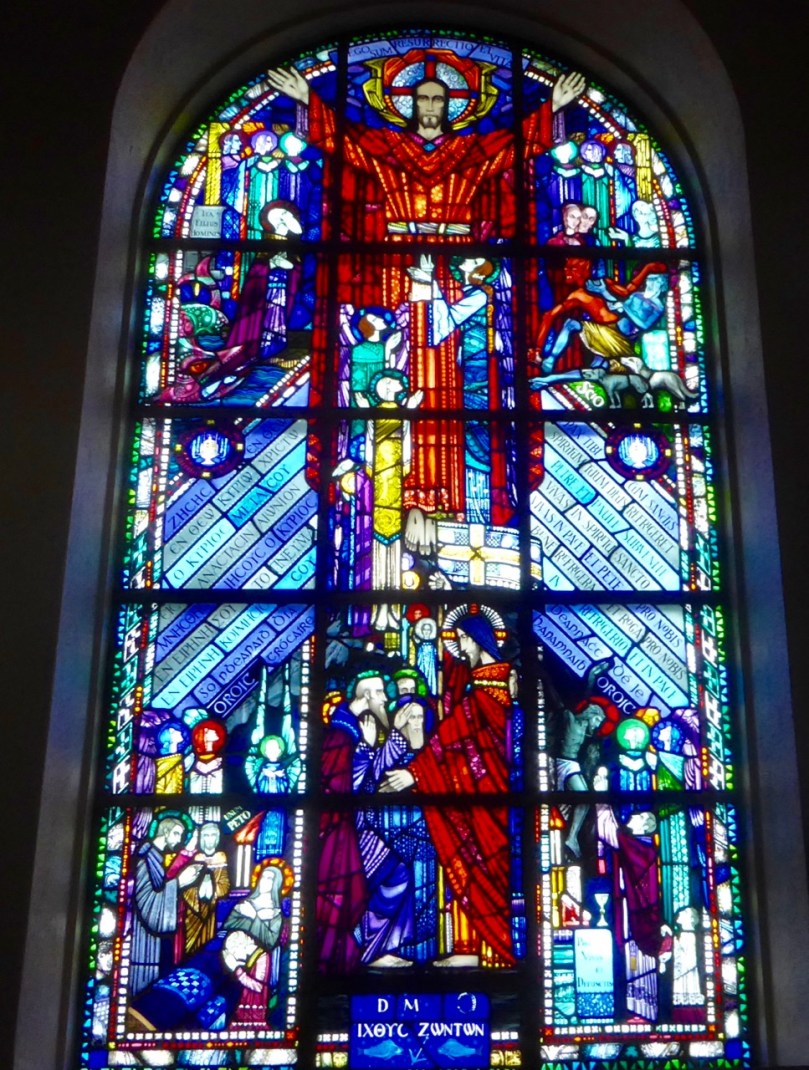
The Purgatory window: prayer fragments in Greek, Latin and Irish; the righteous ascend to heaven; Christ descends to purgatory with a banner to lead those who have done their penance up to heaven; in the lower left St Monica is on her deathbed while St Augustin looks on; lower right, the mass is celebrated; upper right, Jonah (whose purgatory was to be in a whale) and upper right Job, who was robbed of everything he held dear by the devil, thus testing his faith **

The King windows I photographed are enormous. (There are other Harry Clarke Studio windows by Richard King in the church as well as windows by other companies, but I will concentrate on these ones for the purpose of this post.) They represent St Joseph, St Patrick, Jesus, Mary and Purgatory. All follow the same convention of placing the main figure centrally, surrounded by smaller panels which tell stories or illustrate events from the life of the central character.

Purgatory Jesus and the Saints

Close up: Christ descends to purgatory

HC Studio, Athlone

Close up: the Job panel

The sheer size of the windows has allowed ample scope for this approach, but size alone cannot account for the myriad details that King inserts into every possible space in the window. Words abound, in several languages and scripts. References to the ancient and the modern, the mythological, the hagiographical, and the historical jostle for space with abstract designs, tiny figures both realistic and imaginative, symbols, animals, buildings – everywhere the eye lingers new elements are discovered. In its essence, this is very Harry Clarke; in the sheer exuberance of its execution, this is Richard King having fun, cramming in as much as his own fertile imagination can offer up.

Mary Rosary Angelus and Scapular

This is the Mary window and these sections concentrate on images of Marian veneration. Clockwise from top left: workers pause to pray the Angelus; a family says the rosary together; St Simon Stock receives the scapular from Mary (more on this here);  Mary; St Dominic receives the rosary **

The Harry Clarke Studios closed down in the 70s. For many years after Harry’s death in 1931 it carried on his tradition of highly stylised and beautiful works of art in stained glass, although over time works became more conventional and quality suffered as orders were harder to get, costs rose and corners were cut. Look, for example at the Studio windows in my post Time Warp, about the Drimoleague church, done in the 50s. But that’s in the future – what we can see, under Richard King’s assured hand, are windows that proudly carry on the Clarke preoccupations with designing windows that dazzle and inspire.

Juses details bottom

Details from the Jesus window from left to right: Pope Pius x; Manna from heaven; Tobia walking with the Angel Raphael, with Michael and Gabriel; eating the paschal lamb; Matt Talbot, a Dublin man who died in 1925 and who was considered on the path to sainthood because of his extreme practice of asceticism **

Perhaps, though, there is another element that creeps in now that Harry is gone – the religious fervour of the early years of the state is now in full swing. Government and Church Hierarchy work hand in glove to develop and promote a vision of Ireland that is devout, Catholic, monocultural, conforming and repressive. A high point in this relationship occurs in 1932 with the Eucharistic Congress in Dublin – an event explicitly referenced in the Patrick window. Richard King will never, as Harry did, fall afoul of puritanical state censorship – he will go on, in fact, to become the chief illustrator for a Catholic magazine.

Patrick top

The top of the Patrick window explicitly references the Eucharistic Congress of 1932 and the crossed flags of Ireland and the Vatican. Try to enlarge this image and see how many different elements you can identify. Good luck!

But in 1937 he is at the height of his powers as a stained glass artist. I hope to find and illustrate more of his work in that medium in future posts.

Patrick details and cathedrals

From the bottom of the Patrick window: Patrick lights the paschal fire on the Hill of Slane; he is flanked by images of two St Patrick Cathedrals, New York and Melbourne; Beneath, the swans represent the ancient myth of the Children of Lir (although there were four swans in the myth, not three) – the spell they are under is broken when they hear St Patrick’s bell

** The photographs in this post are my own, but for the explanations that I use in the captions, I am indebted to Niall McAuley, who has mounted a Flikr Album of all the stained glass in this church and has researched and annotated each image. I don’t know you, Niall, but I salute your wonderful images and your exhaustive notes on each of the windows. Please go to Niall’s album for more on all the King windows (especially if you are stumped by the Patrick window) and also windows by other stained glass suppliers and artists in this amazing collection.

The Town of Luan’s Ford

o'ferrall fry place

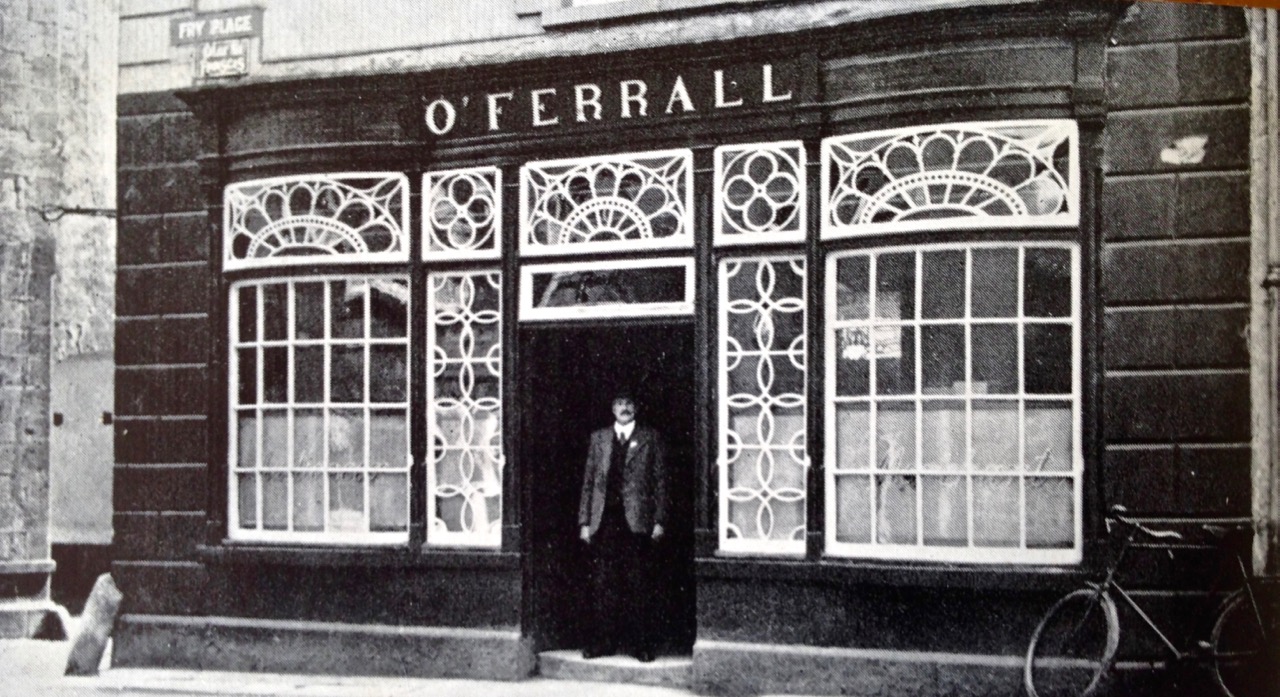
…One of the shops we visited was O’Ferrall’s, whose frontage dates from the days when shop-fitting was not merely a business but an art, as the picture we took of it, with ‘himself’ in the doorway, clearly reveals. Old Mr O’Ferrall was a tall gaunt figure. His hawk-like features had an aristocratic cast which was somehow enhanced by a long coat of archaic cut and a high stand-up collar. He had, we discovered, a great sense of the past, and as we sat together in the confined space of the small wooden cubicle to which, as in most Irish bars, women must retire in order to drink with propriety, he talked of the history of Athlone. Like that of most Irish towns, it has been stormy… (Green & Silver L T C Rolt 1946)

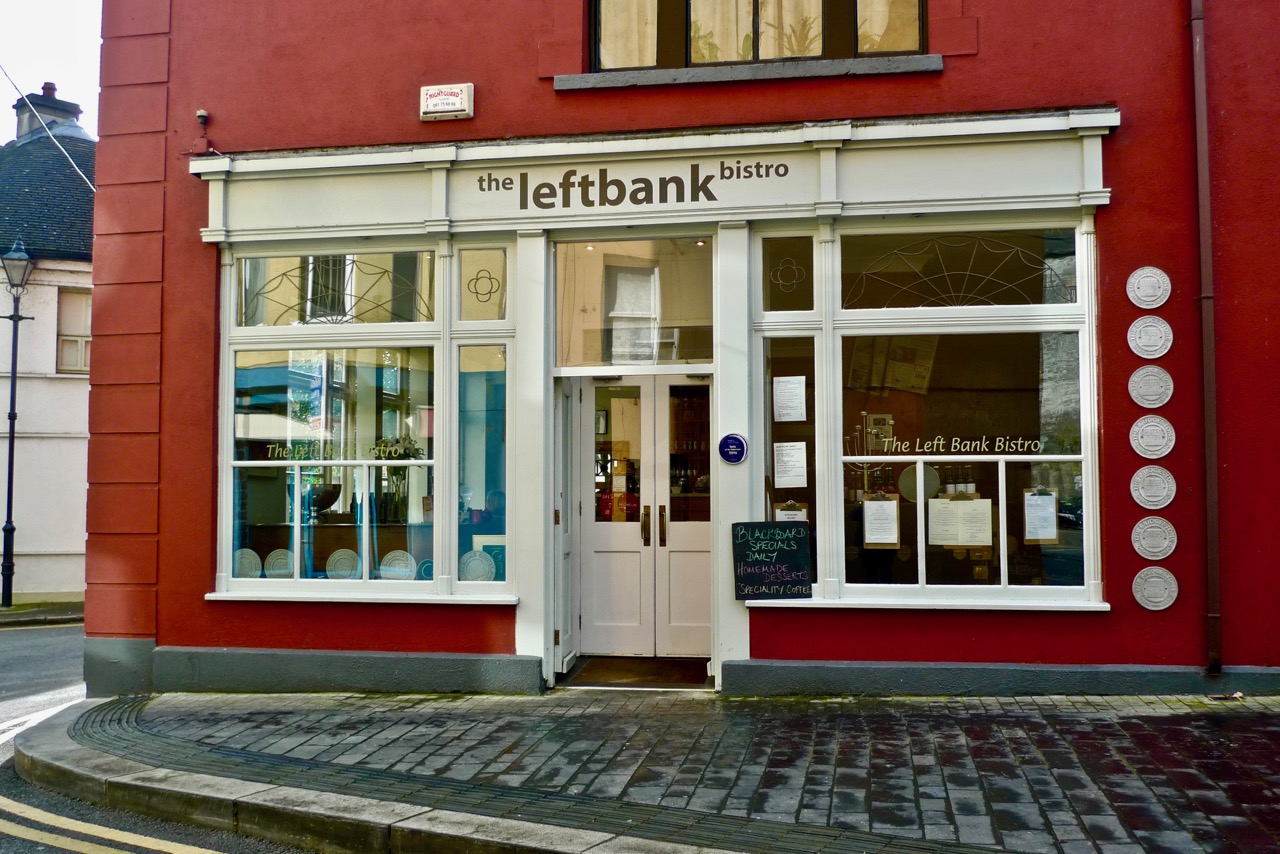
fry place bistro 2016

Top picture – Angela Rolts’ photograph of O’Ferrall’s shop and bar, Fry Place, Athlone – taken in June 1946 just before the Rolts embarked on their journey around the Irish waterways which they describe and illustrate in their book Green & Silver. Lower picture – the same view, Fry Place, Athlone – taken in 2016 – now a highly regarded bistro. The new shop frontage pays due respect to its predecessor in terms of overall proportion and despite the loss of the ornate bow windows. It’s interesting, too, that – seventy years on – the premises is still a local meeting place and purveyor of good food and drink

This is the fifth instalment of the Travel By Water series… When we retraced the steps of Tom and Angela Rolt – seventy years after they made their voyage of discovery around the Irish canals and waterways – we visited the town of Athlone for the first time. We were impressed enough to determine that we would return for a more detailed exploration of this midlands settlement, historically a strategically important crossing point of the Shannon – a formidable barrier intersected with her great lakes – the largest river in Britain and Ireland.

17th-century-bridge

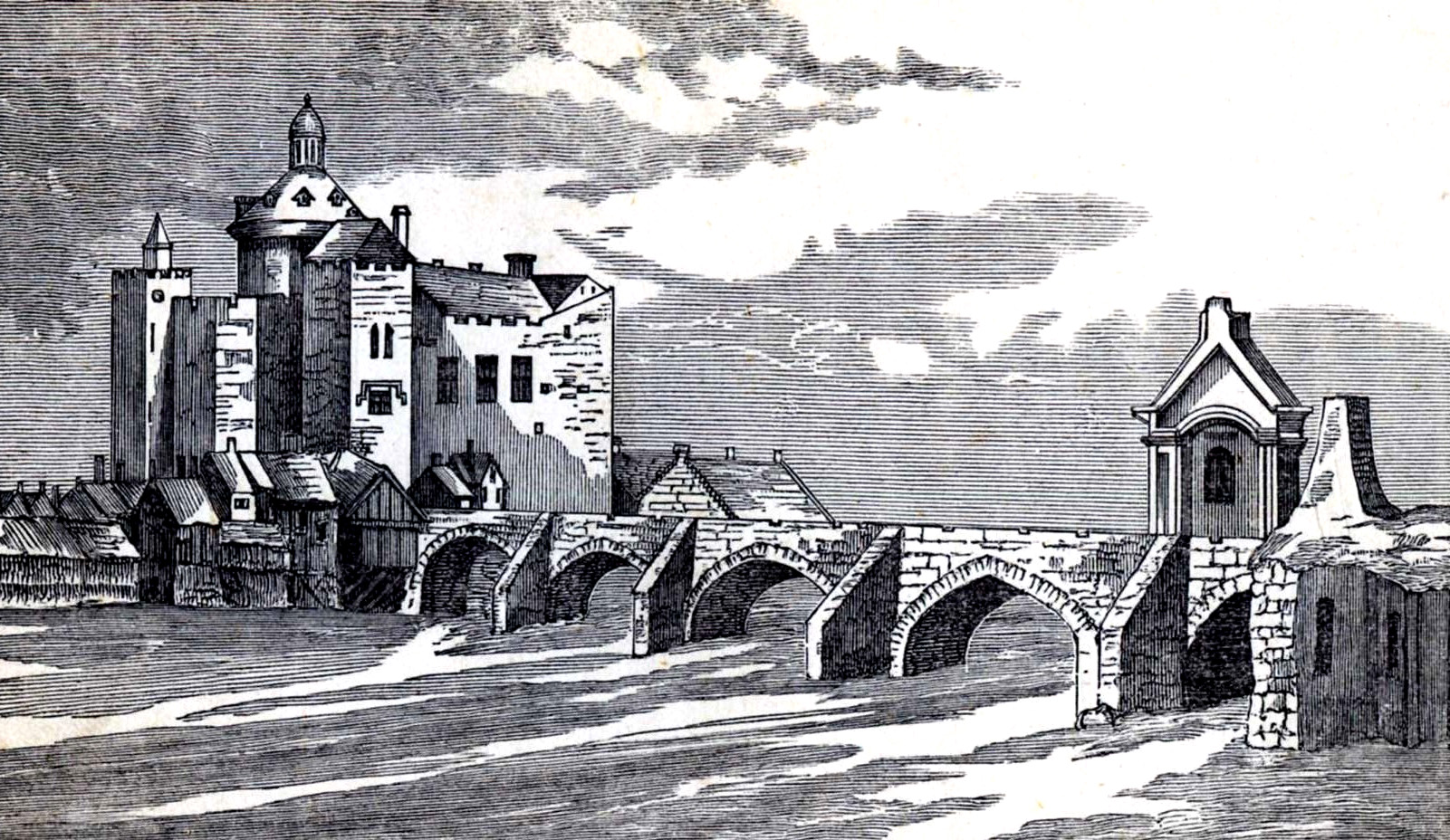
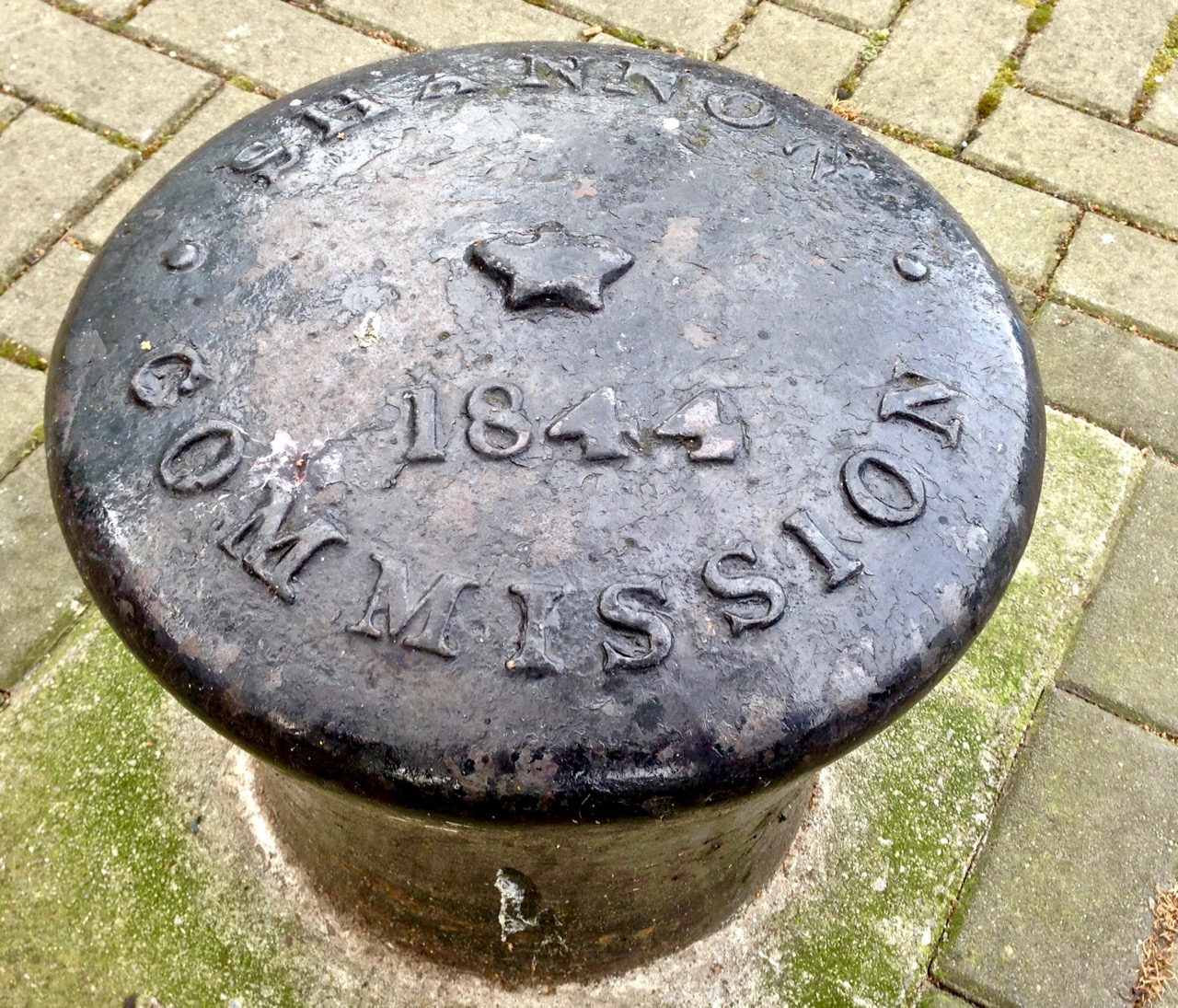
At one time (some histories say as early as the Bronze Age) this river crossing just below Lough Ree would have been a wide ford – Luan’s Ford. In the 11th century, Tairrdelbach Ua Conchobar, King of Connacht, had built a wooden bridge which survived, with various restorations, until 1566, when the first stone bridge was constructed (depicted above in a print now in the Aidan Heavey Public Library, Athlone). It could well be this medieval bridge that is commemorated in the ceilidh dance The Bridge of Athlone. The present bridge was opened in 1844.

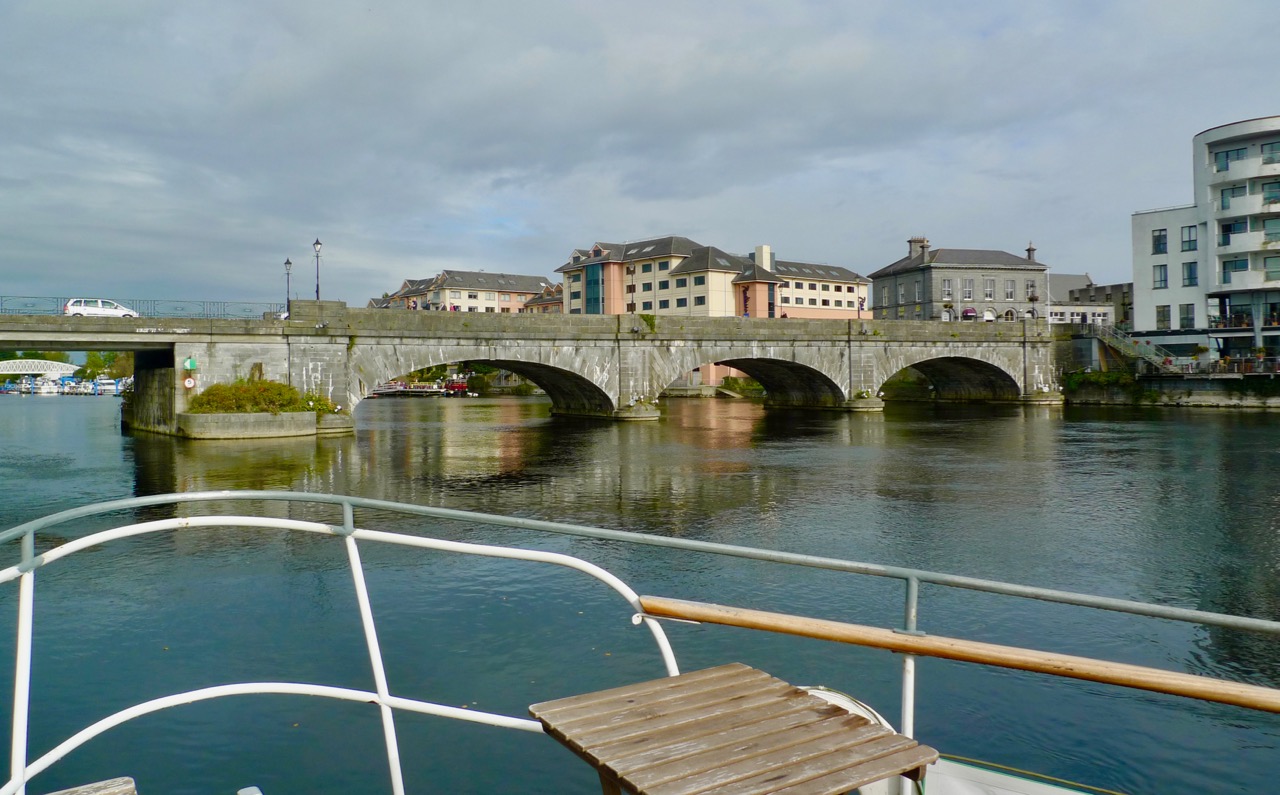
Athlone Bridge

Athlone’s Victorian bridge today. Note the flat ‘navigation arch’ on the left (west side of the river): this replaces an earlier movable section of the bridge which allowed taller boats to pass through

The Shannon Navigation is now managed by the cross border authority Waterways Ireland. This body also manages the navigable canals, rivers and lakes throughout the island of Ireland, and does a very good job of it. Such an undertaking would probably have never been foreseen by the Rolts 70 years ago when some of the canals had been derelict for many years, and others were in poor condition. The Rolts’ borrowed boat Le Coq was based in Athlone and was probably the last craft to fully circumnavigate the circular route encompassing the Royal Canal, the Shannon and the Grand Canal in the 20th century: the Royal Canal fell into disuse shortly after the Rolts’ journey and was formally closed in 1961. Today the Royal Canal is completely restored to navigation (it was reopened in 2010).

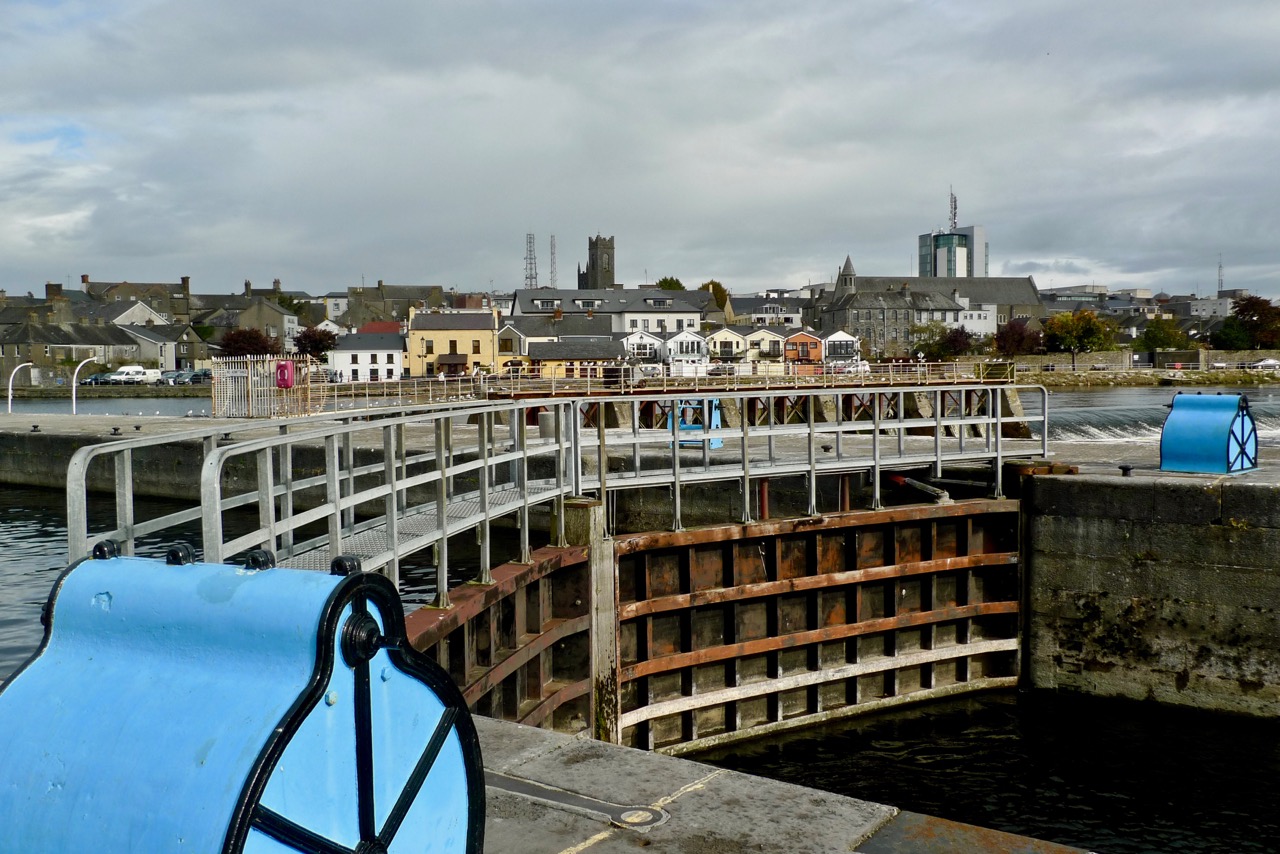
the lock athlone

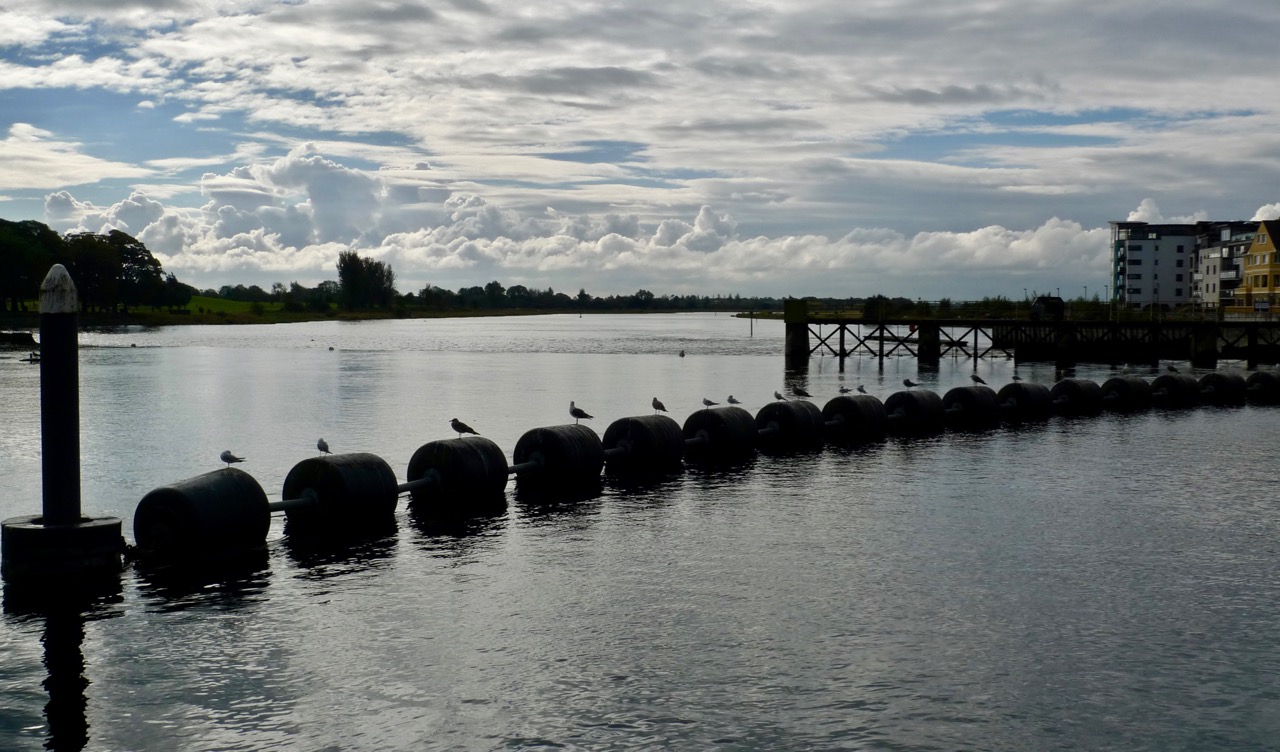
birds on weir

Upper picture – Athlone Lock today – some of the original Victorian lock machinery has been retained and is in working order although the main operations are electrically powered. Middle picture – upstream of Athlone the river widens dramatically as it approaches Lough Ree. Lower pictures – distinctive livery of the lock machinery in Athlone: note the commemoration of Thomas Rhodes, the engineer of the navigation improvements

We were fortunate to find some early photographs of Athlone and the river: these significantly predate the time of the Rolts’ journey but are worth showing for historical interest.

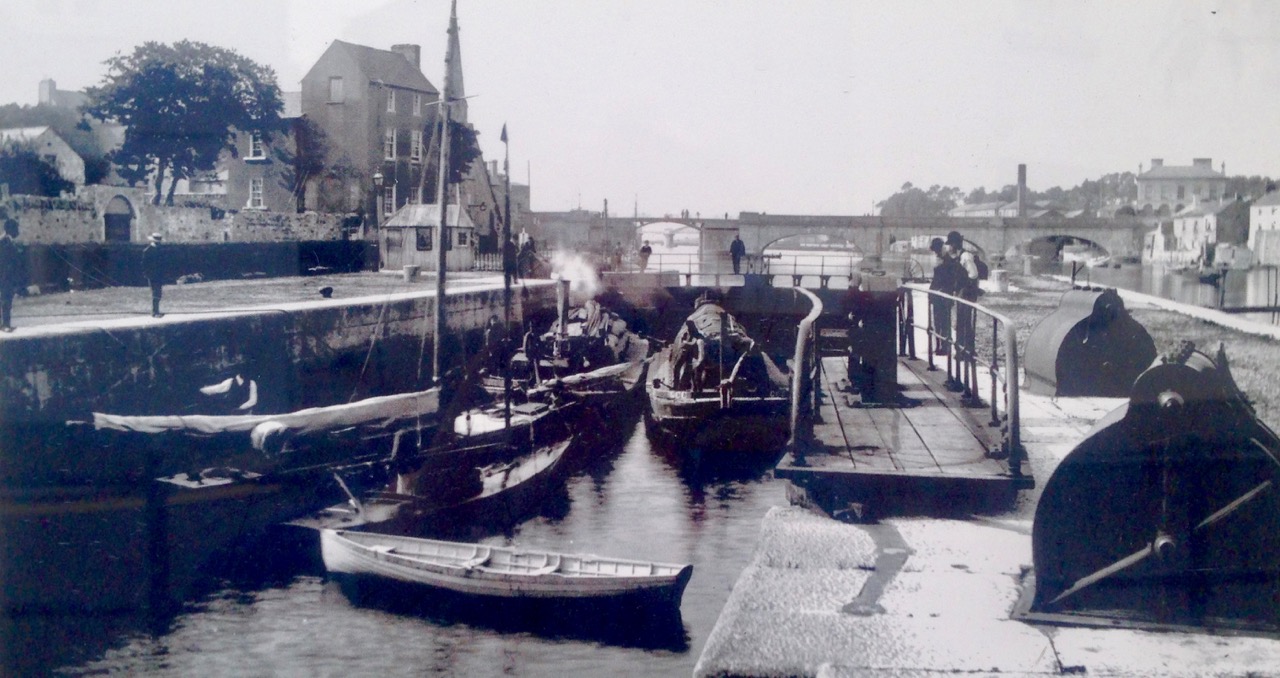
lock in use athlone

athlone fry place

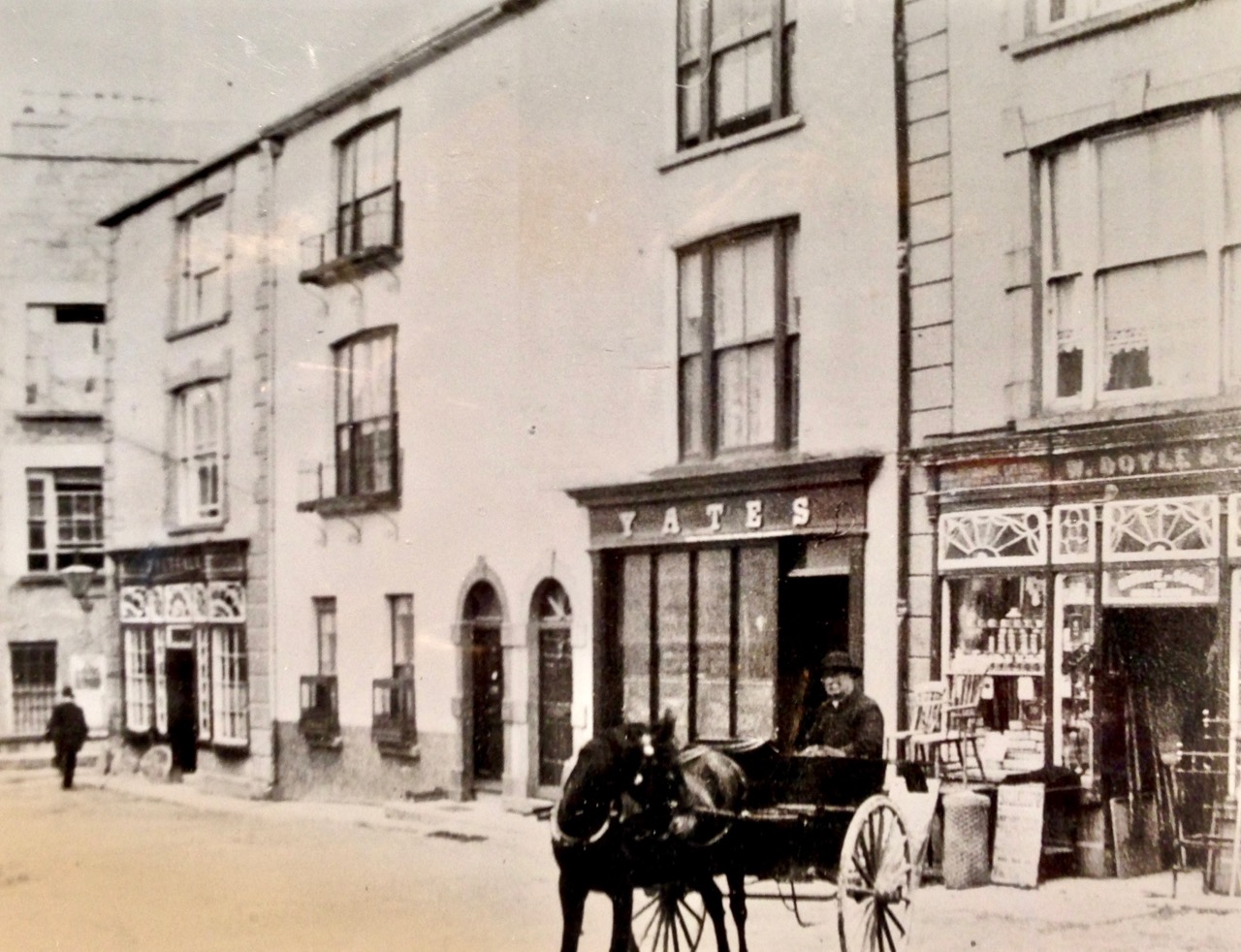
Upper picture – probably early 20th century – the lock at Athlone: note the commercial craft in the lock, one of them a steamer, and the lifting span on the bridge in the distance. Lower picture – Fry Place, Athlone, courtesy of The Leftbank Bistro: this probably dates from the late Victorian period and shows O’Ferrall’s on the left (see above) and a matching shopfront to the right

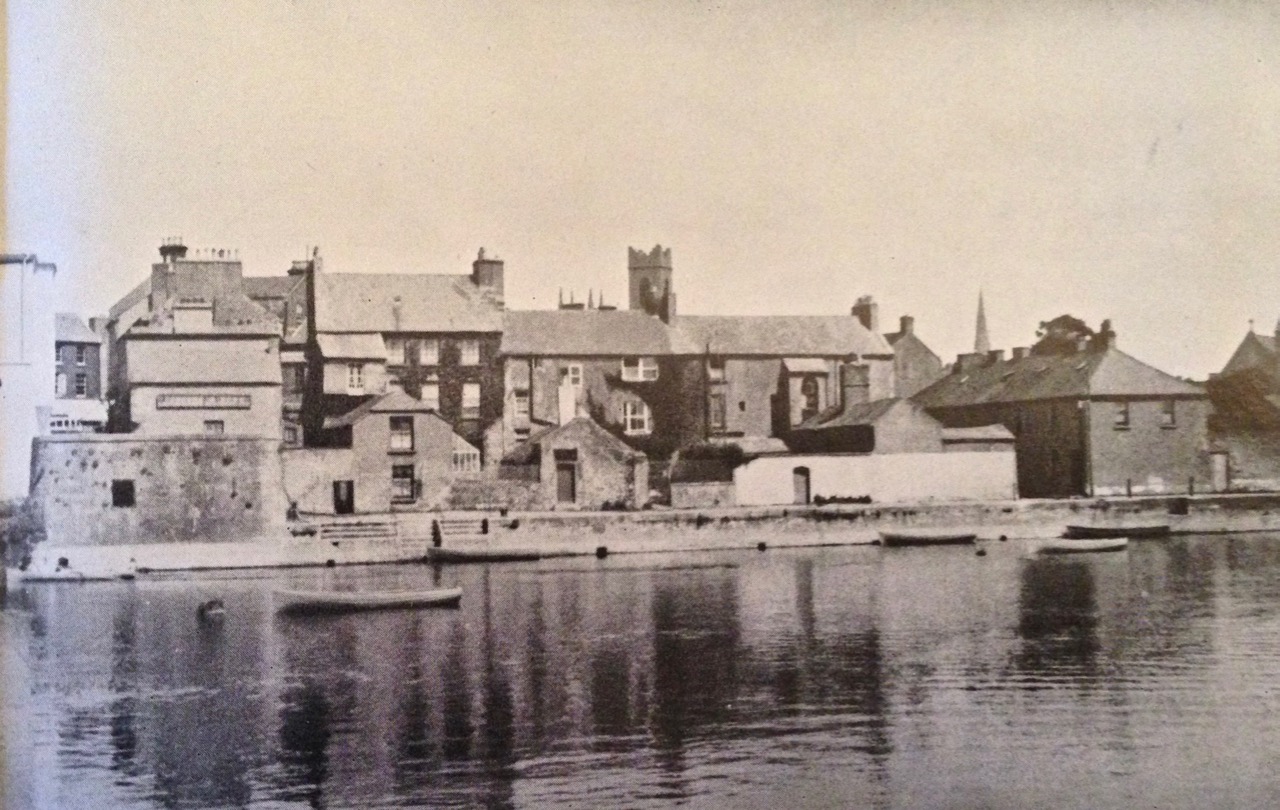
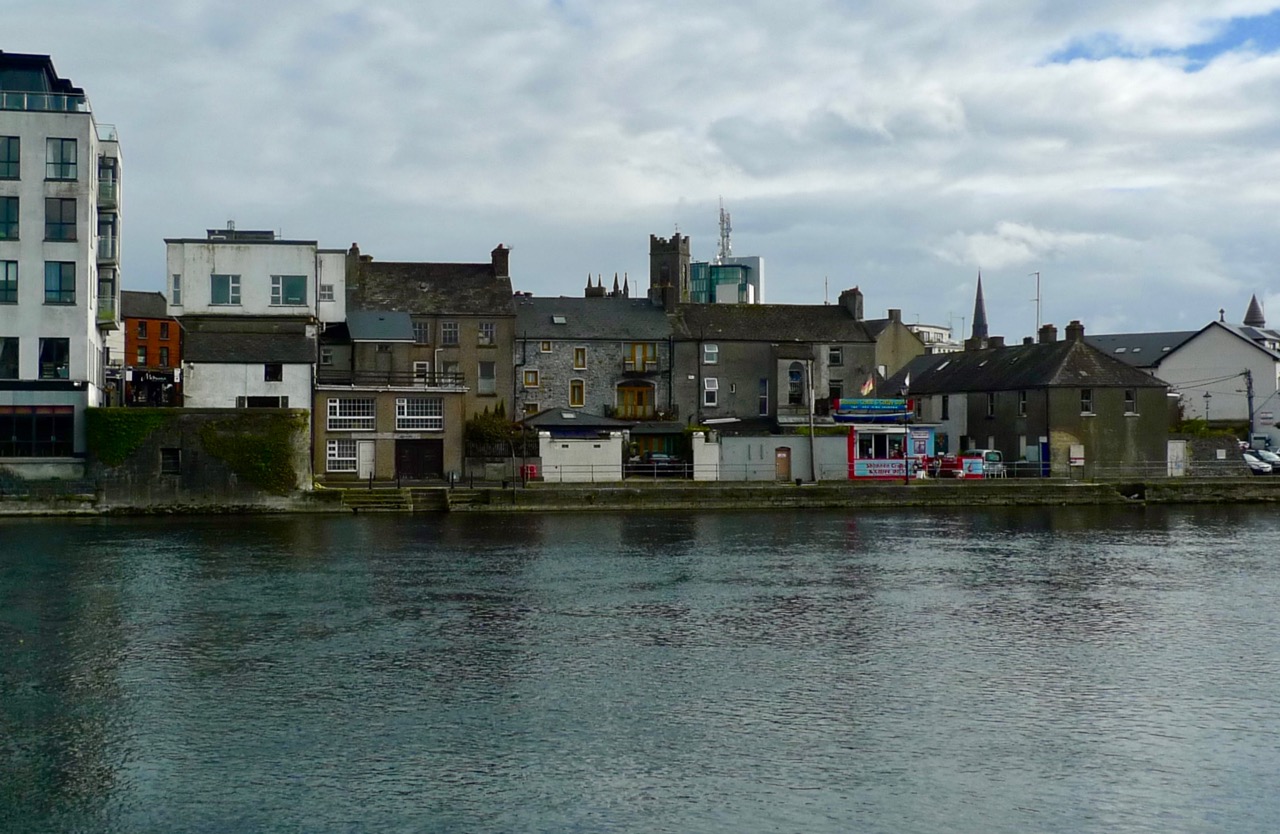
Compare Angela Rolt’s photograph of Athlone’s waterfront in 1946 (below) with my 2016 picture underneath it. Architecturally there is very little change to the buildings she recorded. Obviously, there has been considerable alteration to the town elsewhere in the last 70 years but the river itself has remained a constant.

Waterfront Athlone

Athlone Waterfront

shannon commission