Cashels in Kerry 2: Cahergal

Cahergal is undoubtedly one of the finest examples of a stone ringfort or cashel in Ireland. What makes it outstanding is not the overall size of the enclosure or the height of the enclosing wall but the quality of the drystone masonry, the width of the entrance, the thickness of the wall and the well-planned and executed almost symmetrical stairs and terraces on the inner side of the wall.


Excavations at Cahergal, Co. Kerry:
A Venue for Royal Ceremony in Early Medieval Corcu Duibne

All quotes in this post are from the 2016 excavation report by Conleth Manning of National Monuments*. Con’s report deals with the 1986 brief excavation near the entrance, and his own 1990-1991 excavations inside the cashel. The excavations established a date for the fort – it was originally built between the mid 7th and the mid-9th centuries – as well as providing evidence for its status and uses. It also established the basis upon which most of the restoration work was done – although note I say ‘most.’ In the photo above you can clearly see the old and newer stonework.

Like Leacanabuaile, this was a rather tumbledown ruin before excavation and restoration projects. All that incredible masonry work did not save it from the ravages of time, although the exceptionally high standards of building became clear as it was dug out from the jumbles of stone and grass that covered it.

The initial stages of building included the walls, with its staircases, the entry passageway and the fine paving, as well as the round house in the interior.

The stairs and terraces on the inside of the walls are one of the striking features of this fort. There are two levels of terraces along most of its length, but in one area the stairs went up to three flights. The excavation report states, The third set of steps probably led to a wider viewing terrace, which was likely to have been flanked externally by a parapet wall.

After the excavations the OPW continued to work on the restoration of the fort and this finding was interpreted to mean that this section of the walls was much higher than other sections. This led to a decision to raise the top of the wall in this section, leading to the somewhat startling profile we see now. According to Con Manning this is a skewed interpretation by the OPW and it is highly unlikely that it reflects what the wall actually looked like.

The entrance to the fort had completely collapsed but excavation revealed how deep it had been. A pair of upright jamb stones and fallen lintels were found, leading to the reconstruction as we see it today.

The house was circular and the amount of fallen stone inside led to the conclusion that the roof was originally made of stone, probably using a corbeling technique. If this was the case, this house is the largest round building known to support a stone roof, well known from church sites (such as Kilmalkeader) where the stone roofs are rectangular and steeply pitched. 

A very finely laid-down pavement led from the fort entrance to the door of the house. The pavement was delineated at the side by edge-on kerb stones.  The house originally had three doors, with the main one positioned across from the entrance to the fort, and accessed by walking along the pavement.

Internally, there was a central fireplace (Feature F74 in the pan below). Stake holes around this central feature were probably to support a beam or spits for cooking purposes. The fireplace itself showed that numerous fires had been burned in it. Other stake holes supported furniture for sitting or sleeping.

The strange thing about Cahergal is that the excavations yielded very few finds (compared to Leacanabuaile, for example) and what was found mainly dated to later periods of occupation. So – what was going on during the original period of occupation – mid 7th to mid 9th centuries? Manning speculates that this was actually a royal site, built to impress, to inspire awe, and perhaps to entertain. Ritual feasting would take place in the main house, which would be cleaned carefully afterwards and readied for the next great occasion.

The three doors might support its interpretation as a royal site. Manning says:

In each case the side entrance might have been for people of lower status, with the main entrance being reserved for kings, nobles and important guests. On the other hand one could regard the three doorways as symbolic, three being a magical number as in the triads, and in this case could symbolise the three divisions of Corcu Duibne. In the tale of Branwen daughter of Llyr, in the medieval Welsh Mabinogion, a royal hall with three doors is mentioned in the house of Gwales (Grassholm), where one door, facing Cornwall, was kept permanently closed with a taboo on opening it.

This interpretation of the function of the fort and house – designed to impress and to underscore the prestige of the builders – reflects the later castle-building of Irish chieftains. Here in Ivaha, for example, the O’Mahony clan built tall, overpowering castles to cement their control over the land and the sea around them. Cahergal is within sight of two other cashels – the Castles of Ivaha were often within sight of each other too. Annals tells us that the Taoiseach of the O’Mahony clan built a castle for each of his sons, or other members of his ‘derbfine’ – the family group from which the chief was chosen. 

As if to confirm this possibility, Ballycarbery Castle, a 15th century tower house, lies within clear sight towards the coast. Was this a continuation of the same tradition by the same family – the Falveys? Manning concludes his report by stating:

This [high-status] phase ended with a burning of the internal features and subsequent, probably occasional, lower-status use of the house between the eleventh and fourteenth centuries. Iron forging took place here in the fourteenth century. After the eastern half of the stone roof collapsed and the structure was abandoned for some time, it was roughly rebuilt as a D-shaped structure probably in the fifteenth century.

The last period of occupation was the modern period – the small building built against the wall in the photograph below was probably a sheep-pen noted by an antiquarian visitor.

The final fort we will talk about is Staigue – in many ways it’s the most spectacular (despite not being as well built as Cahergal) but it has not been excavated so less is actually known about it. Meanwhile, if you can’t get to Cahergal but want a Cahergal experience, visit the marvellous Voices from the Dawn – Howard works his 3D magic on this page.

*Conleth Manning. Excavations at Cahergal, Co. Kerry: A Venue for Royal Ceremony in Early Medieval Corcu Duibne. Proceedings of the Royal Irish Academy: 2016, Vol. 116C

All four posts in this series can be found here.

Cashels in Kerry 1: Leacanabuaile

We have been in Kerry a few times this year and visited three stunning sites – Staigue (above), Leacanabuaille and Cahergal (sometimes written Cahergall) – all of which fit the definition of stone forts, often referred to as Cashels. For non-Irish readers, cashel is pronounced the same way as castle, but with the sh sound in the middle –  don’t say cash-elle. 

Each of these also fit in to a category that has been labelled by archaeologists as the Western Stone Forts, and they were the subject of research by the Discovery Program several years ago. The forts included under this title, about 25 in all, dotted along the western seaboard, were chosen because of their their large size, or prominent location or because they have complex or massive defensive features.

In a fascinating talk available to view online, archaeologist Claire Cotter walks us through several examples of such forts. In relation to size, she points out the huge investment in effort to build those walls, once you go over about 2 metres in height. Of course the walls have to be very thick as well, to carry the weight of all that rock and to ensure they didn’t fall over. Inside, a feature of Staigue and Cahergal are the stone staircases arranged in a X shape – they make for a strong visual statement. Leacanabuaile (below) has stepped levels on the inside of the walls to give access to the parapet. Let’s take a look at each fort in turn to see what’s unique and what’s common among the three of them. 

We’ll start with Leacanabuaile, pronounced Lacka – na – boolya and meaning the flagstones of the enclosure, or possibly the flagstones of the summer pasture. Large flagstones, or leacs, do litter the way up to the fort.

Leacanabuaile was excavated in the summers of 1939 and 1940 by Sean P Ó Ríordáin and J B Foy. Ó Ríordáin was a revered Irish archaeologist and his book, Antiquities of the Irish Countryisde was our text for first year in the Archaeology Department at UCC, where he had been the professor before O Kelly. That’s Ó Ríordáin in the middle, below at the Lough Gur dig in Limerick, with O Kelly furthest to his left. As an aside, he was married to Gabriel Hayes, the sculptor – one of her major works is mentioned in this post. She did the drawings of the finds, which you will see further down.

For most of the following, and all the quotes, I am taking the information from the excavation report, which was published in the Journal of the Cork Historical and Archaeological Society for 1941. The marvellous CHAS has made their old journal available online, and this report is here. Leacanabuaile is situated in the middle of a concentration of forts, close to Caherciveen and all within a  mile or two of each other, and in the case of Cahergal, in clear sight, as you can see below.

Before the excavation it was in very poor condition – the walls had collapsed and it looked more like an earthen ringfort, with just traces of the stone wall showing through here and there. It was so unremarkable, in fact, that it was left off the Ordnance Survey maps. 

The excavation uncovered not only the massive nature of the walls, but four houses inside, a souterrain, and mural chambers. This was before the commonplace use of radiocarbon dating in Ireland so the usual way of dating a site like this was through the finds and through comparison with similar sites. Using these methods, Ó Ríordáin says:

 The close dating of the Leacanabuaile site is not possible, but it may be noted that the finds correspond to material from sites dated by more significant objects to the ninth and tenth centuries AD.

The fort is not quite round and this was due to the undulation of the rocky hilltop on which it was built, the builders having to work around the steep slopes. The souterrain and the mural chambers were built at the same time as the walls. 

Of the houses inside the fort, three were built at the same time as the fort – round house A and two others which now lie under house B. Houses D and C were the last to be built.

In regards to the material cultural objects found during the excavations, and what they reveal about the inhabitants, Ó Ríordáin states

Elaborate brooches and glass objects, for instance are notable by their absence. Bronze is rare and there is no evidence of its having been worked on the site – crucibles are not forthcoming: iron working is evidenced by the iron slag found. On the other hand, the inhabitants were probably quite well provided with the more vital necessities of life. They had . . . a dual source of supply – the sea and the land. The plough-sock and the querns show show that grain was cultivated, the bones show that domestic animals were kept and eaten, while the fare was added to by the collection of shellfish from the coast and by the capture of birds, particularly sea-birds.

The sea birds included heron, duck, goose, cormorant, puffin and razorbill, while the domestic animals were ox (most numerous), sheep, and pig. Also found were evidence of horse, dog and red deer.

What we see on the ground today is the result of conservation work undertaken by National Monuments as Leacanabuaile was taken into state care. Ó Ríordáin describes how 

. . .the walls of the fort and the enclosed buildings were restored by building up, to some extent, the destroyed portions, so as to provide a level top surface which should stand the better the ravages of time. The lines of the old work have been carefully followed and the new building has been marked off from the old with a thin line of concrete. . .[stone objects] were set in cement in House B, so that they may be conveniently inspected.

So – what you see now at Leacanabuaile is as a result of the excavation and the subsequent conservation by National Monuments. Ó Ríordáin remarks, the skill with which the workmen used the material to build in the old manner is a good example of the survival of a technique in a given environment. That reminded me of our own experience with Building a Stone Wall. I also regretted that I hadn’t read the report before I visited so that I could find that thin line of concrete and take a photograph of it for this post. 

We’ll take a look at Cahergal next, also excavated, this time by our friend Con Manning in the 1980s and 90s. This is a more complex site and the report is much longer so it will be a challenge to summarise in a blog post, but I’ll do my best. 

All four posts in this series can be found here.

Prince of Peace: A Modern Irish Church

On our travels in Kerry recently, we happened across a striking church building. It’s situated west of Killarney and overlooks Lough Leane: in fact the view of that stretch of water is a principal feature from the interior of the church. An enormous picture window is situated beyond the altar.

I have titled this piece: A Modern Irish Church. Everything is relative, of course: this Fossa Church was completed in 1977, getting on for half a century ago, but one could only fairly describe the style as ‘modern’. It is one of twenty seven ecclesiastical buildings designed by the architectural practices of Liam McCormick (1916-1996). While based in Derry the architects carried out commissions throughout Ireland: the practice of Mullarkey Pedersen Architects, Derry and Dublin, continues their work to this day. My own life experience as an architect – (I carried out a number of church projects) – tempts me to embark on a tour of McCormick’s buildings, many of which are visually dramatic..

The lakeside church was designed to supersede an earlier building – St Lelia’s – which dated from the 1840s. That building remains and is in communal use (above): it is set back from the present site.

Unusually, there is no contemporary stained glass in this building. Instead, the focal point is the central view. I wonder whether this might be a distraction while the priest is in action? It may be that he would always be in silhouette in daylight: there is no means of subduing the window. The church does contain some distinctive artwork, however.

The Stations of the Cross are notable. They are the work of Nell Murphy Pollen (1927-2011). A ceramicist, woodcarver and sculptor, she was a native of New Ross and studied at the Crawford.

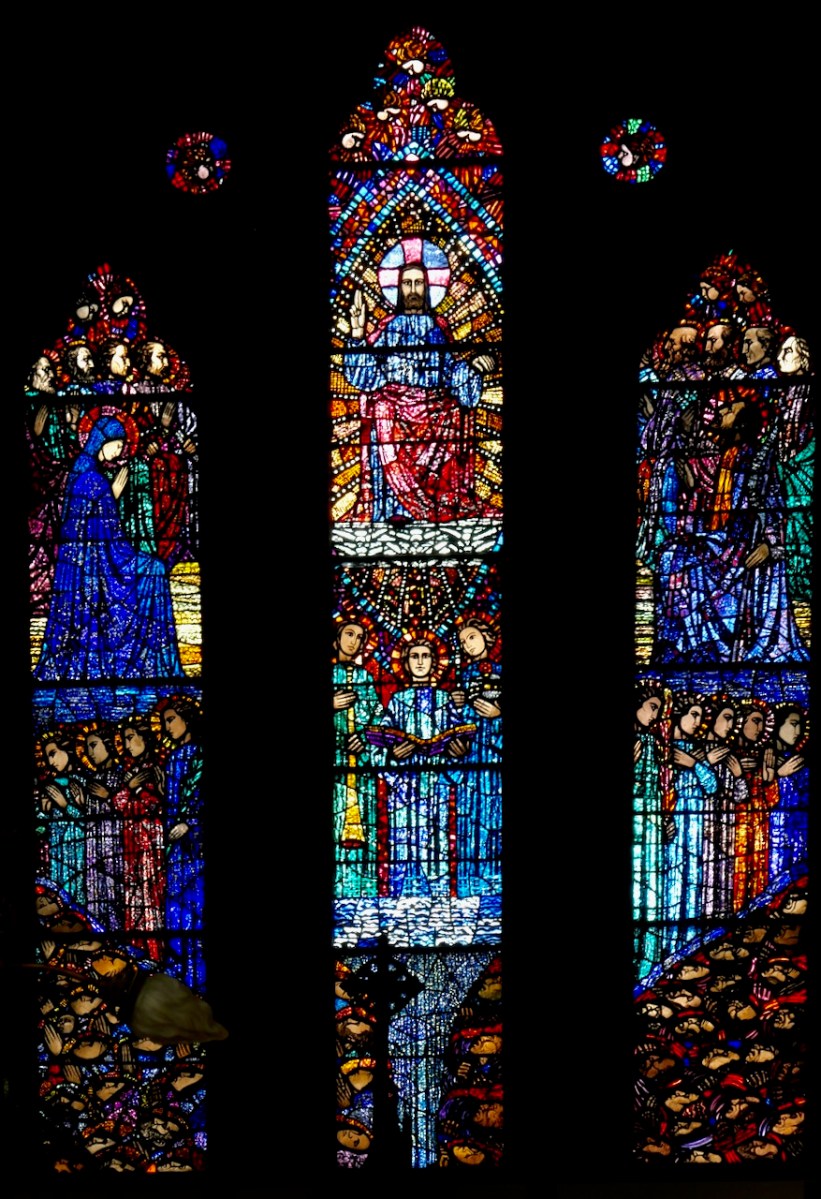
Perhaps one of the most striking aspects of the church at Fossa is the little Blessed Sacrament Chapel: “. . . a chapel of reconciliation dedicated to the Prince of Peace . . .” This (above) is decorated with murals by Patrick Pye (1929-2018). They are produced in a traditional medium which dates from the time of the early Renaissance, tempera on a gesso ground.

Pye’s tempera/gesso painting Peter receiving The Keys from The Christ – The Blessed Sacrament Chapel, Fossa. Patrick Pye is an artist whose work we have followed, and he will have a post to himself before too long. He was born in Winchester, in Hampshire – a city in which I lived for a while in my younger days, but it is more famous for having been the home and burial place of Saint Swithun, a ninth century Anglo-Saxon Bishop who died in 862 AD – he whose feast day (15 July) traditionally marks either 40 days of fair weather or (more usually) constant rain.

Patrick Pye at the RHA annual exhibition in 2007. Photograph with many thanks to Cyril Byrne.

Above: you will find outside the church a bog-oak sculpture, specially commissioned to commemorate the visit of Pope Francis to Ireland. The carved heart at its centre is designed to offer all married couples and sweethearts the traditional Celtic opportunity to touch hands through the opening to commit to each other.

This little Kerry church is very well endowed with high quality artworks, both inside and outside. The carved altar (and a bench, not shown) is by Imogen Stuart (b1927), while (lower and below) is the tabernacle which we believe is by John Behan (b1938) who is also responsible for the cross outside the window. The tabernacle rests on a carved granite plinth by Michael Biggs. All these artists were longtime collaborators of McCormick’s. A brochure has been produced on the church which would give further information on the furnishings, but we have not yet located a copy.

This special church enjoys such a stunning setting with lough and mountains beyond, and is endowed with very fine artworks: it is well worth turning aside for.

‘The Mountain’

We spent a day on ‘The Mountain’. It’s a West Cork location, not too far away from us. The land has a history that touches on many of our interests covered here in Roaringwater Journal – and some of the West Cork people we have written about over the years – so it’s pretty special. We were delighted to be welcomed to it by its present owner, Oliver Farrell: that’s himself, in the pic below. You have met him before, here. Thank you, Oliver, for allowing us to experience this special site, and for letting us put out this post about it.

Previously, the 70 acre ‘Mountain’ site was owned by the Wrights – Lynne and Ian (above): you saw them in the 2022 Ballydehob Arts Museum exhibition, here. When they purchased it – in 1997 – it was rough pasture and bog. They aimed to develop an environmentally and economically sustainable forest using existing grants, and successfully challenged the decision of the Forest Service (through the EU) to only grant aid the planting of alien conifers. They set about transforming it: they had a vision of a ‘pure’ West Cork landscape supporting an ecosystem of native species. Now – many years later – it’s possible to see that the Wrights’ vision was fully justified – and realised. Today Oliver is undertaking essential maintenance work, and is committed to expanding on the inherent sustainable qualities that the site embodies. In fact, ‘The Mountain’ is largely in excellent environmental order.

Interestingly, Ian told us that when they made the decision to buy the site they had only seen it under cloud: the spectacular view wasn’t revealed until later on. We were fortunate on the day of our visit to see the full panorama of Roaringwater Bay stretched out before us.

This dramatic view towards Mount Gabriel is a reward for climbing ‘The Mountain’. The ground was waterlogged on the day of our visit as this autumn has been a time of relentless rainfall, but always interspersed with brief dry patches: it’s great to be out to catch these. Springs rise on the high ground here, and I’m working out that they either feed the Roaringwater River – the water that gives its name to the whole Bay and islands that are central to our view from up here in Nead an Iolair, or another of the many streams that drain the West Cork hills below us.

Oliver stands above one of the spring outlets that form the infant waterway (top), while the stream matures as it flows on down through his land (lower). Below – Oliver and Finola inspect one of the lakes which has been created within the site.

At one stage in his life Ian researched, developed and introduced the building of low–tech ferro–cement boats as a cottage industry on Lake Malawi to help address the problem of unsustainable fishing practices there. At the ‘Mountain’ site he experimented with ferro-cement as a material for establishing a well blended-in shelter and store.

Straddling two townlands, ‘The Mountain’ is an impressive example of how an area of West Cork wilderness has been perfectly moulded into its natural setting. It is an out of the ordinary place which demands exploration.

I’ll be visiting the site, and writing about it more in the future. Oliver will be keen to allow access: keep watching this space.

The Gaelic Story-Teller (Ireland 51 Years Ago)

That’s what happens when you sit down to write – you start out intending to accomplish several objectives but end up getting so caught up in the first, that that’s all you write about. It’s what happened to me in Under Sorrow’s Sign: I meant to go through the whole six issue of Ireland of the Welcomes for 1971, and do a single post about all the articles in them about Irish Literature. My intention with this post is to cover the remaining five issues, in order from the oldest traditions to the newest. Let’s see how I get on.

May-June 1972 includes The Gaelic Story-Teller, by J H Delargy. You can read a very entertaining biography of Delargy in the DIB, in which Eoin Mac Cárthaigh says:

It is no exaggeration to say that he was twentieth-century Ireland’s greatest folklorist. He was a driving force behind the belated recognition of the importance of Ireland’s fast disappearing folklore heritage – much of which, but for his efforts, would have been lost forever.


https://www.dib.ie/biography/o-duilearga-seamus-james-hamilton-delargy-a6353

However, he also adds that his approach was not without its critics:

Nor did Ó Duilearga and his co-workers escape the satirical wit of Myles na gCopaleen (qv), who recounted in An béal bocht the happy tale of an academic building his reputation on a traditional story collected from one of the loquacious piglets of ‘Corca Dorcha’.

That, of course, sent me on a hunt to my shelves for my copy of The Poor Mouth (the English translation of An Béal Bocht), and an hour later I was still chuckling and trying to remember what I had set out to do in the first place. I apologise here to those not educated in Irish schools and made to read Peig and The Islandman in Irish – but for those who were, this will resonate. The illustration is from the Flamingo Modern Classic edition, translated by Patrick C Power.

But to get back to Delargy’s article – it mainly centred on Sean Ó Conaill, the story-teller of the title. In a longer essay elsewhere, Delargy (that’s him on the left, above*) tells us that such a person 

is know as a sgéalaí or a sgéaltóir, whereas the more common word seanchaí is applied as a rule to a person, man or woman, who makes a specialty of local tales, family-sagas, or genealogies, social-historical tradition, or the like, and can recount many tales of a short realistic type about fairies, ghosts and other supernatural beings. 

The Gaelic Story-Teller

Delargy first met Ó Conaill in Cillrialaig in Kerry, when Ó Conaill was already 70 years old and Delargy, from the Glens of Antrim, was 24. Delargy calls Cillrialaig a village, but in fact there is nothing left there now that resembles a real village – except for a marvellous set of old houses that have been renovated for use as an artists’ retreat (below).

Delargy describes it thus: 

It is a lonely windswept place where man has formed out of the rocks and rough mountain land a crazy quilt of tiny fields to grow his oats and rye, hay and potatoes.

Delargy starts his account of the Story-Teller  in this way:

Interestingly, he does not give us Ó Conaill’s wife’s name in this article, although he refers to her. In another account, though, on the Vanishing Ireland Facebook Page, I found another photo of Ó Conaill and this, about his wife, Cáit,

He married Cáit Ní Chorráin and they had six sons and four daughters. Cáit shared his passion for oral storytelling and was always on hand to correct him or remind him if he should lose his way while telling a story.

Delargy’s practice was to visit the Ó Conaill house three nights a week. While Sean dictated his tales (Delargy must have been a fast writer), the neighbours would drop by until the house was full, each listener relishing the stories, even though they had probably heard them many times before. How did O Conaill accumulate such a store?

Delargy’s article concludes with a lament for the dying of the old traditions – it is rare now, he says that stories are told around a fire in this way. Delargy himself died in 1980. If you’re listening, Séamus, you might like to know that there are now thriving story-telling festivals all over Ireland, principally on our own Cape Clear Island. 

Darn it – it’s happened again! I only got to the May-June issue. Never mind – next time, I’ll cover four in one go. Right?

Copies of Sean Ó Conaill’s Book come up for sale occasionally, should you wish to pursue the stories for yourself.
*Photograph of James Hamilton Delargy, Michael Tierney and Jeremiah J. Hogan in the Department of Irish Folklore, UCD. is licensed under a Creative Commons Attribution-NonCommercial-NoDerivatives 4.0 International License

Unseen

© Tomasz Madajczak

There’s a line early on in Unseen, the new dance piece by Tara Brandel and Stacey White of Croi Glan Integrated Dance Company, where the voice-over says that plankton are so tiny that they are invisible to us. But sometimes, the voice continues, they bloom in such vast quantities that they can be seen from space. 

This dance piece explores the role that plankton – in plant form (phytoplankton) and in animal form (zooplankton) – plays in the life of our planet. It underpins all life but is fragile and threatened  by the effects of climate change. We remain oblivious to this existential danger because plankton does not cry out for our attention.

© Tomasz Madajczak

That disconnect, between the vital nature of this organism versus how aware we are of it, proves to be an apt metaphor for how we depend on our bodies – taking them for granted until they force us to forge a new relationship with them. 

Stacey White is a Californian artist who now lives here in West Cork. She has partnered (in life and in art) with Tara Brandel, who has created this choreographed event, three years in the making. I have written about Tara’s dance before – in Bridge and in Dancing Cappaghglass. Tara is one of the people (more common, she tells me, than we all know) who was injured by the Covid vaccine. It was catastrophic for her, leaving her profoundly debilitated, unable to walk, with difficulty breathing and a racing heart. Her recovery and rehabilitation have taken three years so far and is ongoing. The irony is striking – Croi Glan specialises in an integrated approach to dance, working with both able-bodied and physically- and intellectually-challenged dancers. Up to now, Tara has been the dancer we would describe as ‘able’

© Tomasz Madajczak

The dance begins with Stacey painting in a corner and Tara asleep on the floor. Projections and voice-overs run throughout the dance, introducing images of plankton, water and tides. There is no music per se, and yet there is a sense throughout of an elemental soundtrack. 

© Tomasz Madajczak

As Tara slowly comes to life her hand movement echo the pulsating and twisting movements of the plankton we have seen on the wall behind her. We see her coming to grips with the challenges of rediscovering the body her illness has given her,  and hear her compare it to putting together a 3D jigsaw, as she strives to heal and to compile the disparate pieces into a coherent whole again. Stacey’s voice also gives us an insight into the profound disconnect that  epilepsy, or rather the drugs she has taken to address it, has created between mind and body. We see them support each other, Stacey (literally) guiding Tara’s faltering steps. 

© Tomasz Madajczak

Besides the projections, Stacey’s small plankton paintings fill the wall space behind the dancers, hung to echo the Gulf Stream and Atlantic currents. At one point during the dance she strews them about the floor and Tara carefully makes her way among them before seizing larger pieces of drawing paper to wrap around her body, as if drawing strength from a medium other than the physical.

© Tomasz Madajczak

As someone at home, away from the world, slowly trying to recover from profound weakness, Tara shows us that she feels unseen, locked away from our sight. Sufferers of vaccine injuries have to contend with the neglect of their plight by governments and health systems, who start by ignoring them and then throw enormous burdens onto already-ill people to ‘prove’ that what has happened to them is the fault of the vaccine.

© Tomasz Madajczak

But this is not a pity-me piece, it’s a profound meditation on what it is, and how it feels, to be unseen, and to have the very foundations of the life we take for granted – whether we are talking about our planet or our bodies – suddenly under threat. And ultimately it’s about the healing power of art to help us face those challenges.

© Tomasz Madajczak

I have no doubt this piece will have an afterlife after the two current scheduled performances. Uillinn’s (The West Cork Arts Centre) dance season, now in full, er, swing, reminds us that art comes in many forms, including dance. Like plankton, art blooms where the environment encourages it. Hardly surprisingly, given the quality of what we saw in Unseen, all the dance performances seem to be well subscribed, so run don’t walk if you want tickets for any of the other events over the next week or so – it goes to November 5th.

Thank you to Tomasz Madajczak for allowing me to use his outstanding photographs.