The Gift of Harry Clarke

The Gift

This post was inspired by a gift from my oldest and dearest friend – three books on stained glass passed on to me because he is moving from his home of the last 65 years, a home in which I spent much happy time. A loyal reader of our blog, he knows of my  enthusiasm for stained glass, an obsession I shared with his late wife, the wonderful Vera, whom I still carry in my heart.
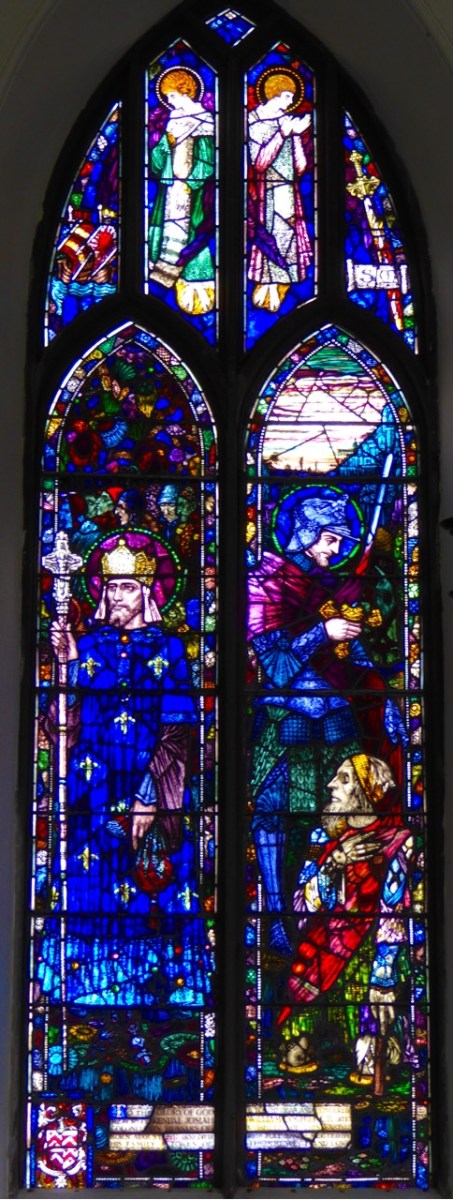
The Kendal Coghill Window, Church of St Barrahane, Castletownshend, Co Cork

The Kendal Coghill Window, Church of St Barrahane, Castletownshend, Co Cork

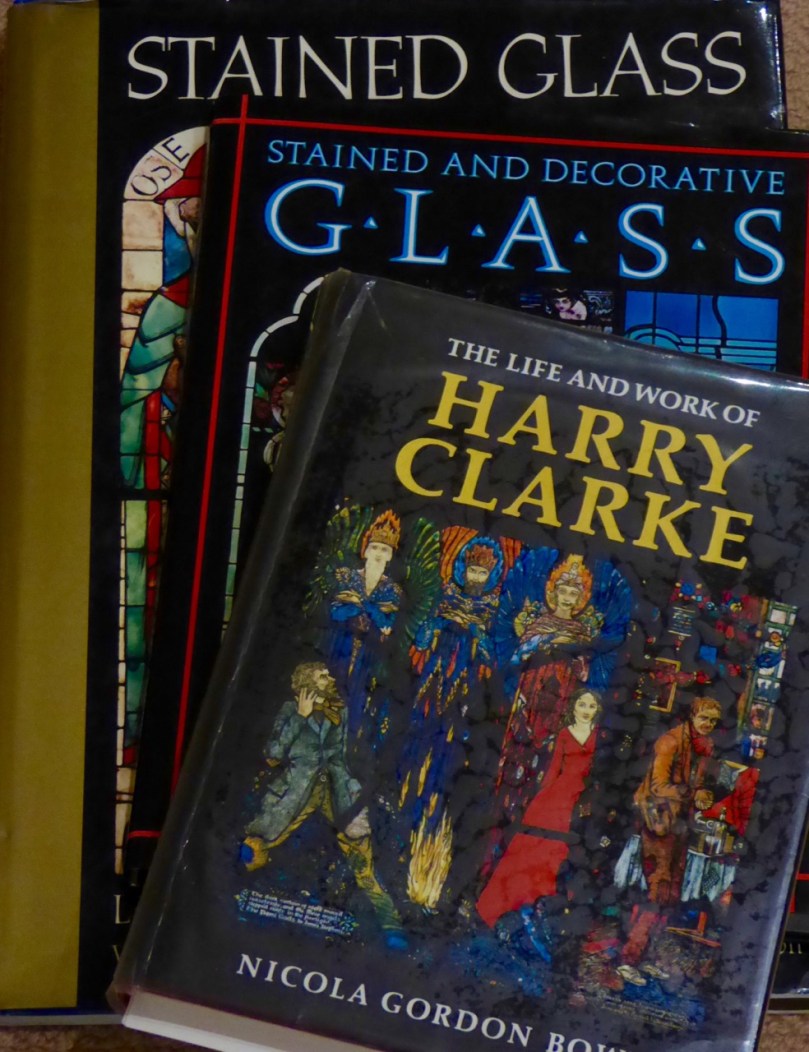
One of the books is the exhaustive and erudite study of Harry Clarke by Nicola Gordon Bowe. The other two are more general, although each of them devotes a section to the work of Harry Clarke. My initial intention was to look at Harry Clarke as a illustrator, with special reference to his portraiture, using a variety of windows as examples. I may still do that in the future. However, I’ve decided that for now, just one window perfectly illuminates what I want to say about Harry Clarke this time. It’s a window we have both used before in posts (Robert in his Martinmas piece, and I in a couple of places) – the Kendal Coghill window from St Barrahane’s in Castletownshend. Through this window I hope to show you the unique genius of Harry Clare, but also how he drew from life and from great art to create his stained glass panels. (For more on Harry Clarke’s life, see my previous post, The Nativity – by Harry Clarke.)
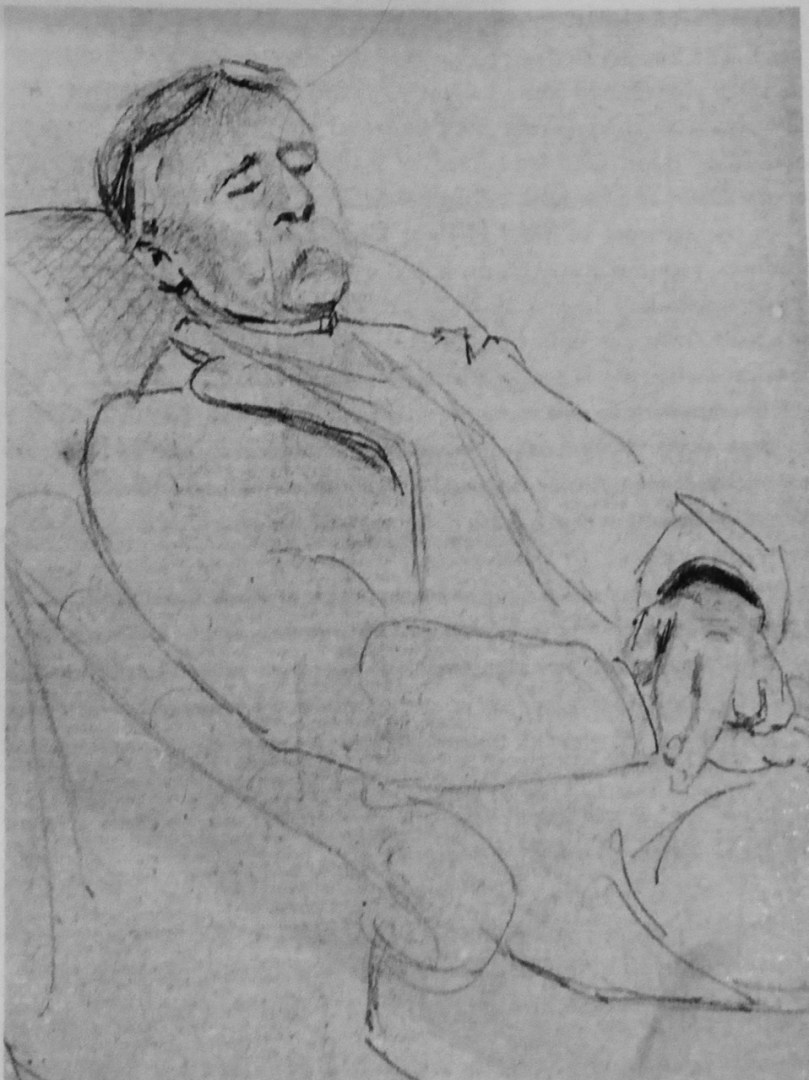
Kendal Coghill, drawn by his niece, Edith Somerville

Kendal Coghill, drawn by his niece, Edith Somerville

Who was Kendal Coghill? He was born and bred in Castletownshend, Edith Somerville’s uncle and a distinguished soldier, rising to the rank of Colonel. He served in India, where he took a kindly and active interest in the young Irish soldiers in his regiment. One of his melancholy duties was writing to their mothers to advise of their deaths. He was also “excitable and flamboyant”, writes Gifford Lewis in her excellent book, Somerville and Ross: The World of the Irish R.M.. As one of the leaders of the amateur spiritualist movement in Castletownshend he introduced Edith and her brother Cameron to automatic writing. By all accounts he was generous and warm hearted and it was his compassion that the window was to emphasise. The two subjects were chosen carefully – Saint King Louis IX of France, and St Martin of Tours. Coghill could trace his ancestry to King Louis, famed for his beneficence, and St Martin was the patron saint of soldiers.
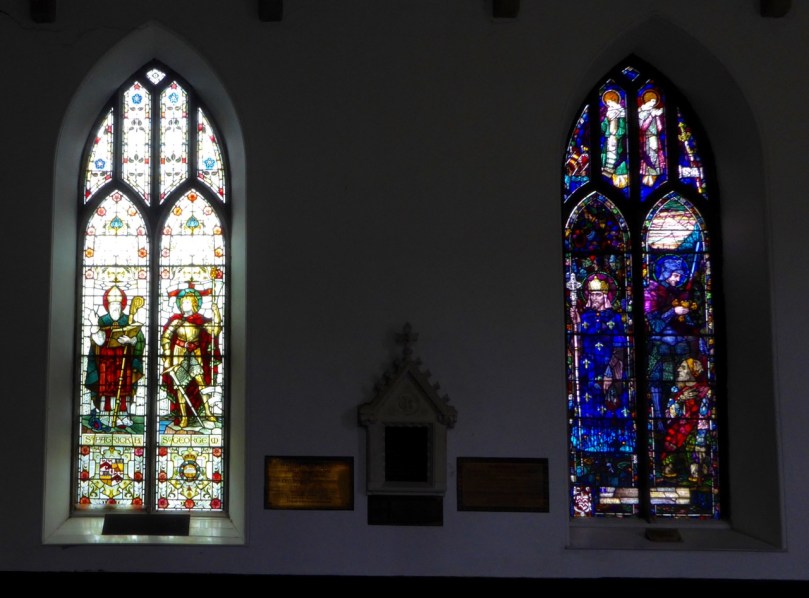
Contrasting styles

Contrasting styles

The first thing that strikes you upon entering St Barrahane’s is the contrast between this window and the others (by Powells of London) on the south side. Alongside the conventional Powells the Clarke blazes with colour and with detail. Every square inch is individually worked, there are no repeated patterns or conventional scrolls. Examine the borders, for example, filled with abstract and colourful motifs, never recurring.
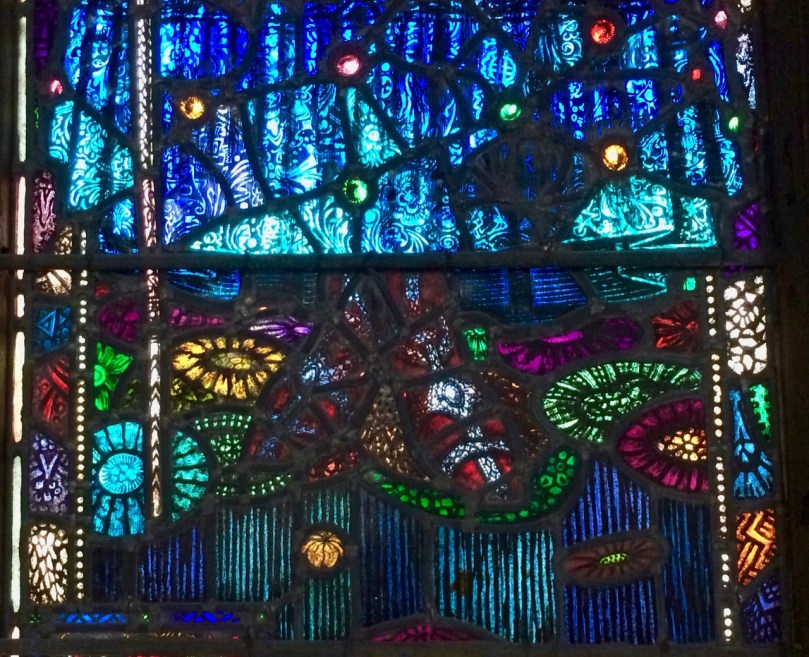
St Louis detail: each motif in the border is uniquely designed and coloured. The robe intrudes in front of the border, lending a £D effect.

St Louis detail: each motif in the border is uniquely designed and coloured. The robe intrudes in front of the border, lending a 3D effect
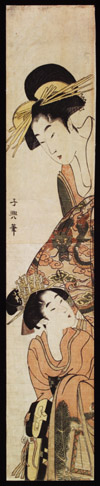
chokiHarry’s habit of placing figures at different heights adds visual interest to the side-by-side panels and may have been influenced by Japanese pillar prints, which were also a major factor in the design aesthetic of Frank Lloyd Wright. A church window is by its very nature long and narrow and the design challenge this poses had first been explored by Japanese artists whose woodblock prints were hung vertically on walls, or fixed to house posts. Contrast the static, forward-facing, identically scaled figures in the Powell window with the dynamic composition of the Clarke panels. The St Martin figure, in particular contains two figures and manages to tell a whole story, like this example of a pillar print.

The choice of the window and the management of the commission rested with Edith Somerville. Harry Clarke stayed with her in Drishane while executing the final placement and she liked him very much. Beside the Kendall Coghill window which is the subject of this post there are two other Clarke windows in St Barrahane’s. But St Barrahane’s, as Gifford Lewis explains, is not…”typically Protestant. High Church, Anglo-Catholic influence is in restrained evidence besides the astounding blaze of Clarke’s windows. Jem Barlow, the medium, claimed that at a service one Sunday in St Barrahane’s the spirit figure of Aunt Sidney appeared, caught sight of the Clarke windows, started, then exclaimed “Romish!” and dissolved.”
Above St Louis,

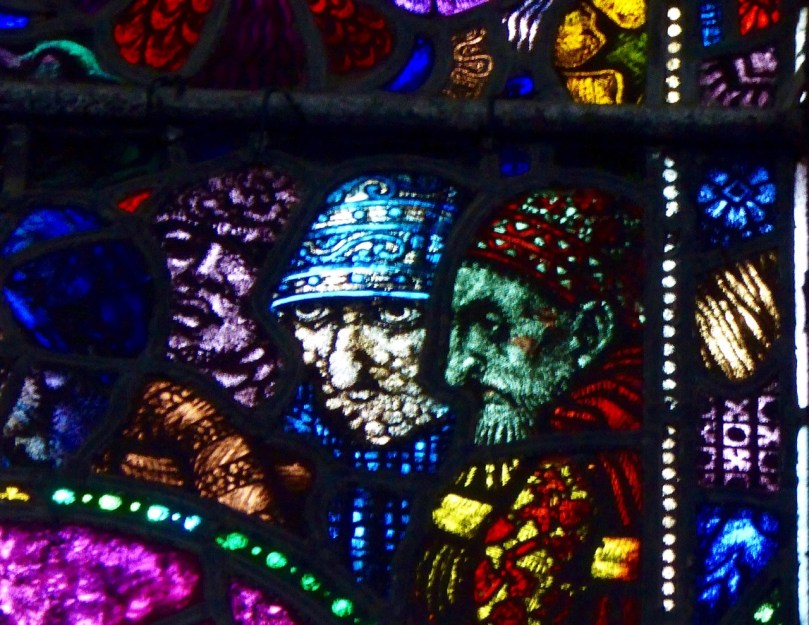
Above St Louis, “a parade of the poor and diseased”

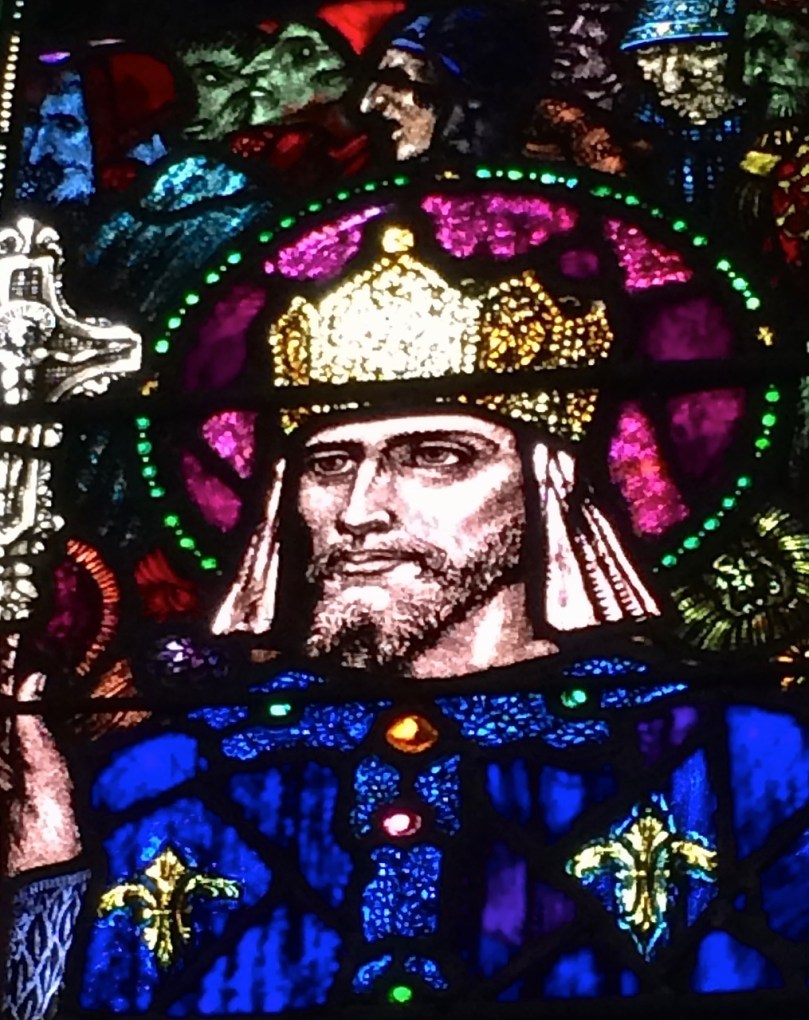
Saint Louis occupies the left panel. He is depicted with an alms purse in his left hand and a crucifix instead of a sceptre in his right hand. Look carefully – above him are the poor and sick that were the objects of his constant charity. Here’s what Nicola Gordon Bowe has to say about this section of the window:

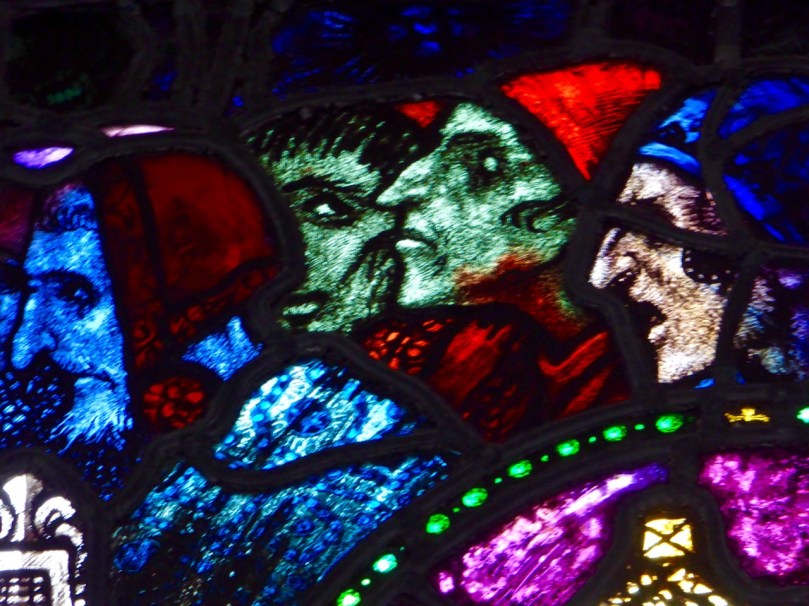
Dimly visible…is a small procession of the heads and shoulders of the poor and diseased who used to feed at his table. These again show Harry’s unique ability to depict the gruesome, macabre and palsied in an exquisite manner…The seven men depicted, old, bereft, angry or leprous, are painted on shades of sea-greens and blues, mauves and grey-greens, in fine detail with strong lines and a few brilliant touches, like the grotesque green man’s profiled head capped in fiery ruby, the leper helmeted in clear turquoise with silver carbuncles, and the aged cripple on the right in ruby and gold chequers.
Poor men

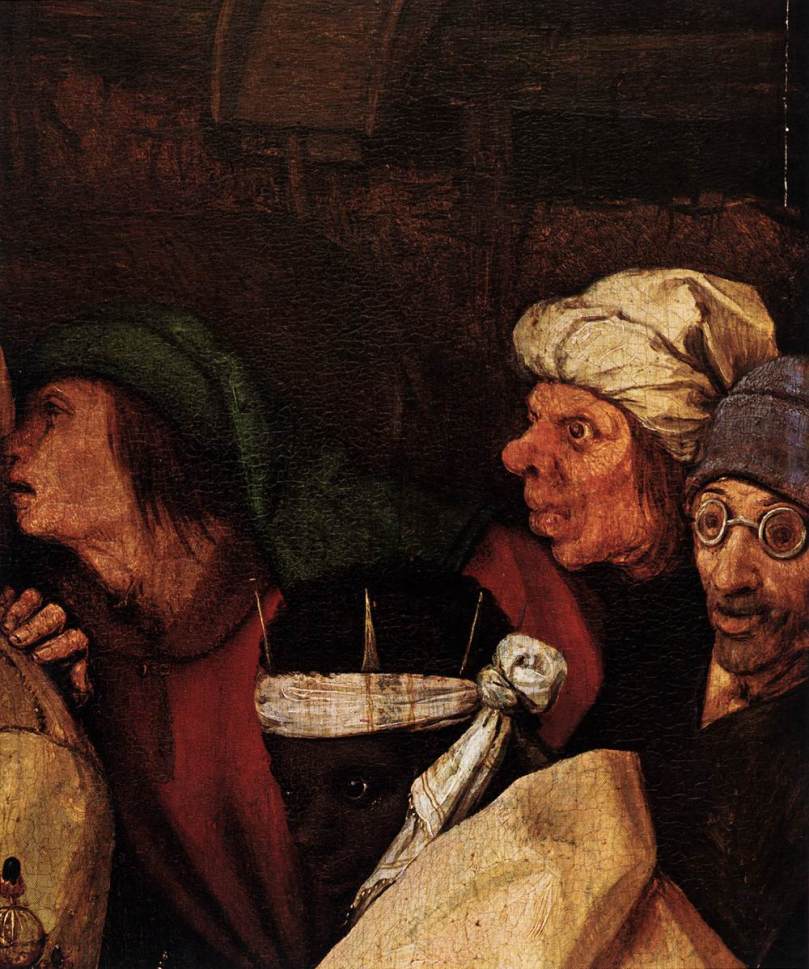
This section, it seems was likely influenced by a painting that Harry was familiar with from visits to the National Gallery in London – Pieter Bruegel’s Adoration of the Kings

Detail from Pieter Bruegel's Adoration of the Kings

Detail from Pieter Bruegel’s Adoration of the Kings

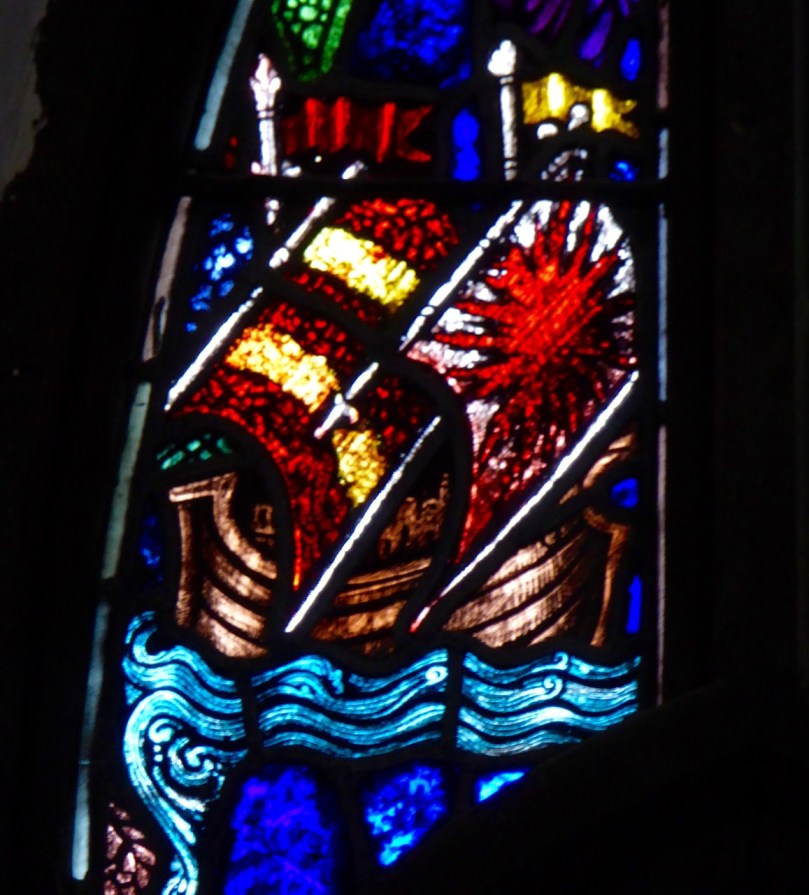
The ship in which he sailed to the crusades is depicted above King Louis.
Ship

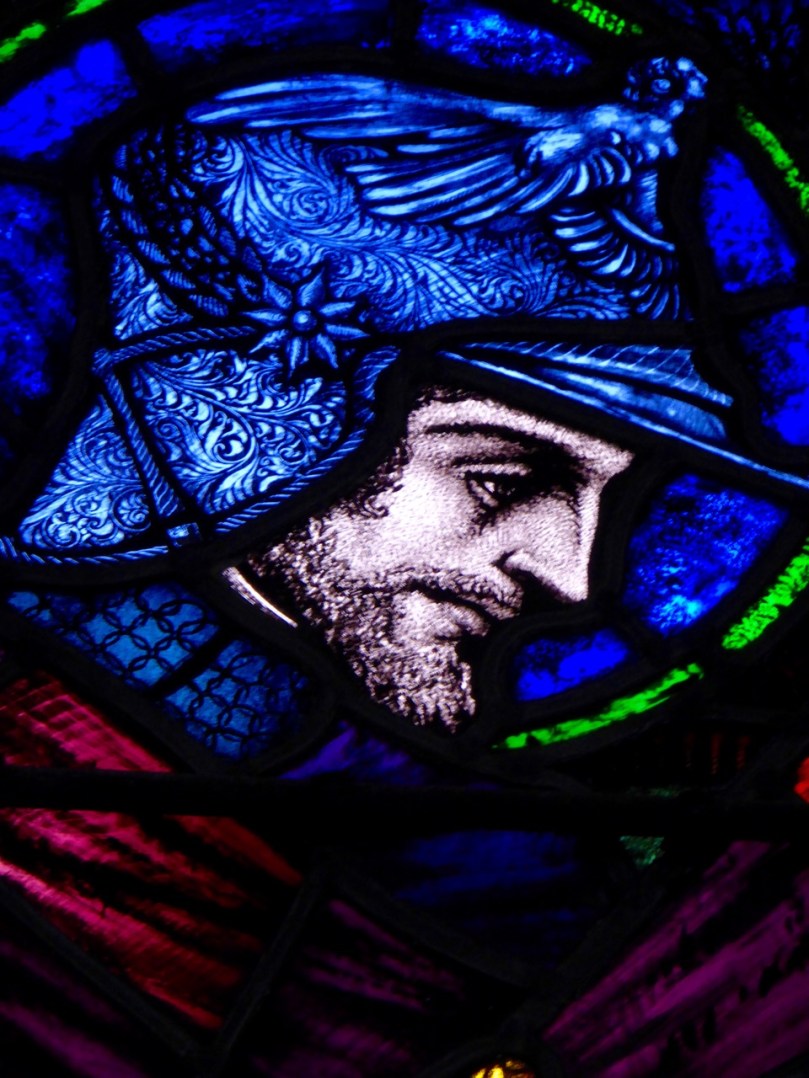
Saint Martin, in the right panel, is depicted in the act of cutting his cloak in two, to give half to a beggar. Martin’s face is archetypal Clarke – the beard, the aquiline nose, and the large eyes filled with compassion for the beggar.
St Martin of Tours

St Martin of Tours

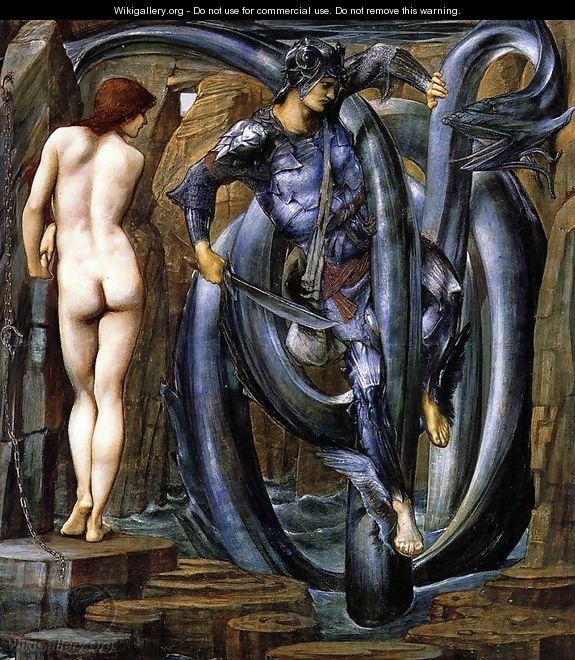
The helmet is worth a closer look. First of all, it is beautifully and finely decorated in the niello style, and second, it is topped with a tiny figure, sphinx-like, with long wings. Nicola Gordon Bowe points to the influence of Burne-Jones here, to the helmet worn by Perseus in The Doom Fulfilled.
Burne Jones' The Doom Fulfilled

Burne Jones’ The Doom Fulfilled

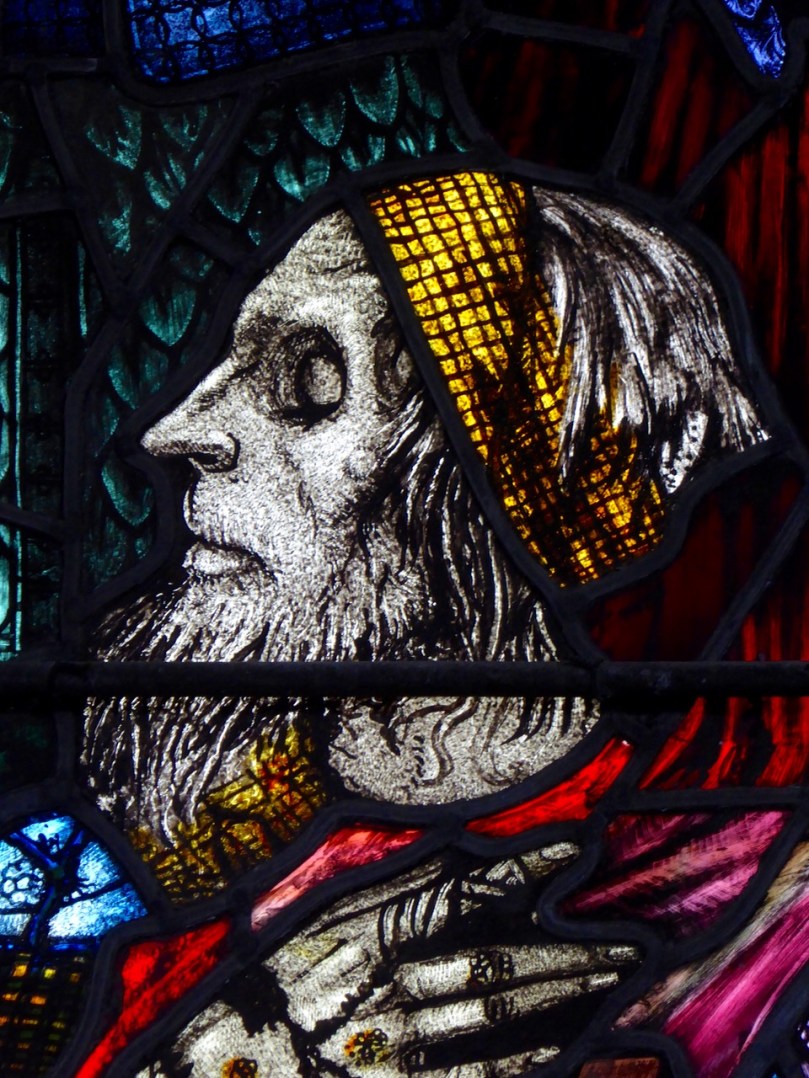
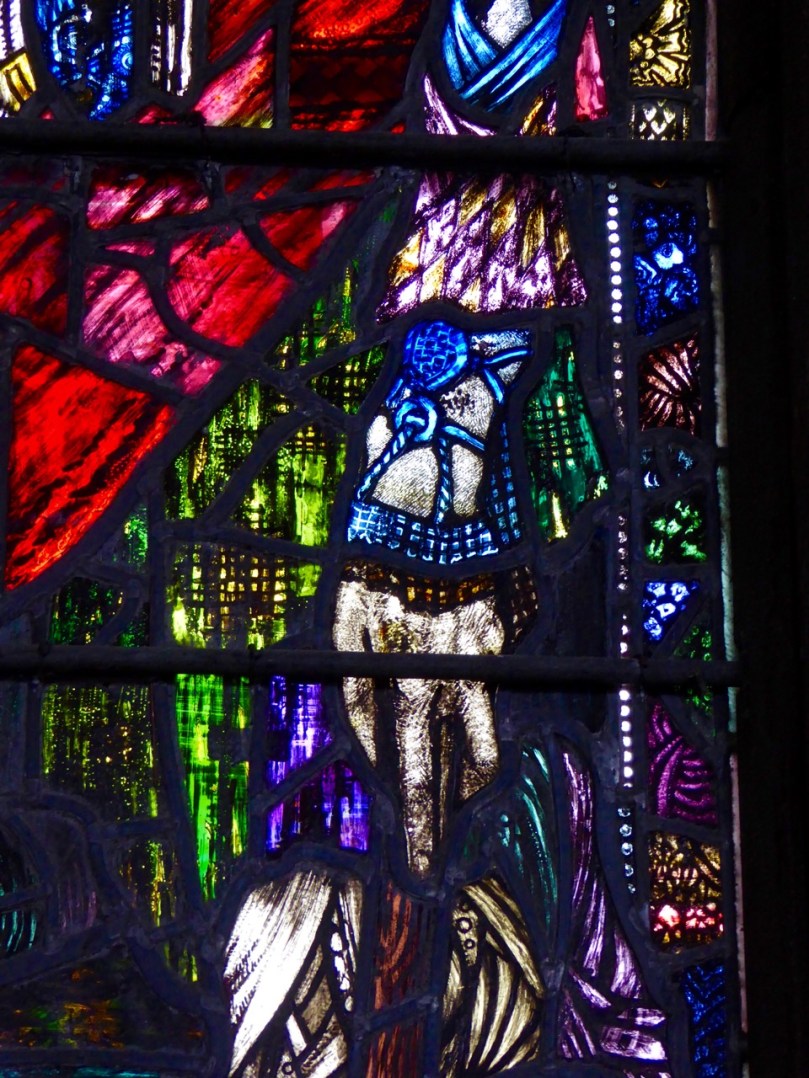
Clarke also found his inspiration in life drawing. He used himself for a model occasionally, but also ordinary people from the streets of Dublin. The beggar may have been based on one familiar to him. His face is dignified despite his wretched condition and his patches are rendered in as exquisite detail as is the Saint’s armour.
Beggar

The beggar may have been based on a familiar Dublin figure
The beggar's hand

The beggar’s hand

Finally, at the very top of the window two haloed figures look down. Harry Clarke had a thing for red hair and this is a perfect example of how he used that preference to good effect. Once again, although the figures are similar in size, there is no repetition – these are no ‘standard’ angels – each has his own wonderful garments and stance.
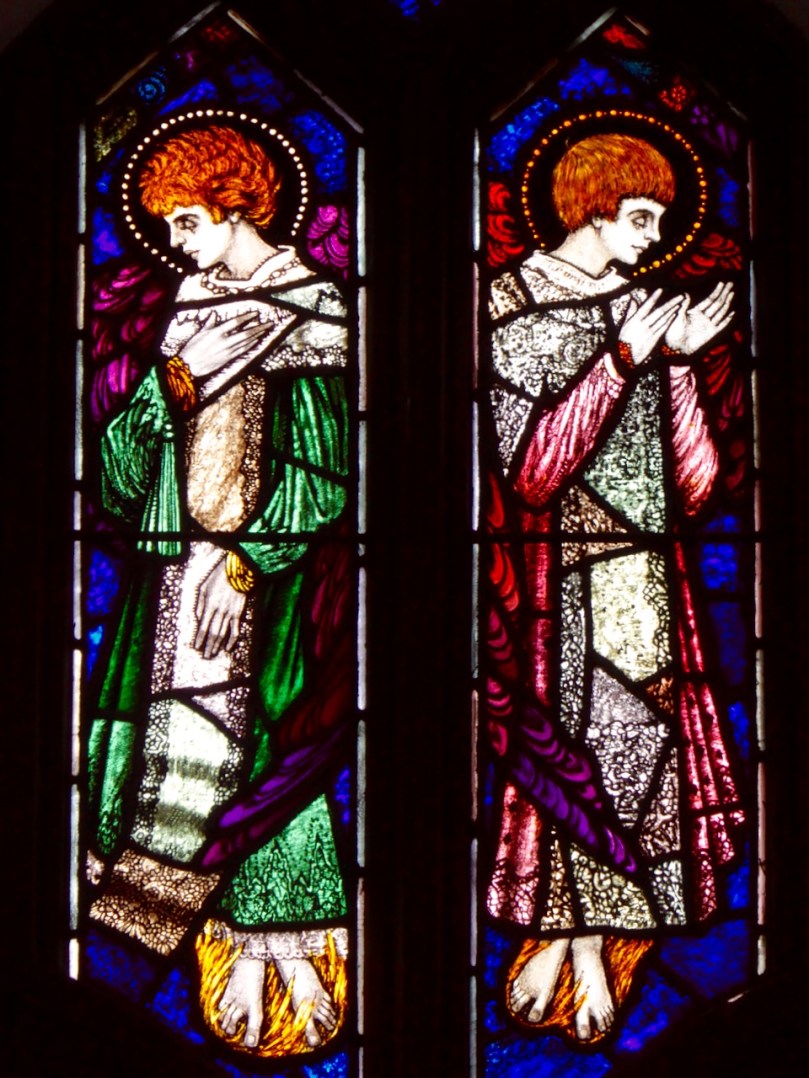
Red haired angels

Stained glass artists typically sketch their designs on paper first and these images are referred to as cartoons. Harry Clarke’s cartoons for the Coghill windows must still exist. Nicola Gordon Bowe describes them as drawn “loosely in thick charcoal, the design boldly expressed with detailing and shading minimal, but still conveying a good idea of how every part of the window would look.” The finished window, she says, “reveals a new freedom of treatment, the painting on the glass reflecting the free drawing of the cartoons.” This is an artist and craftsman working at the height of his powers – an interesting subject for the question that Robert poses in his post this week.
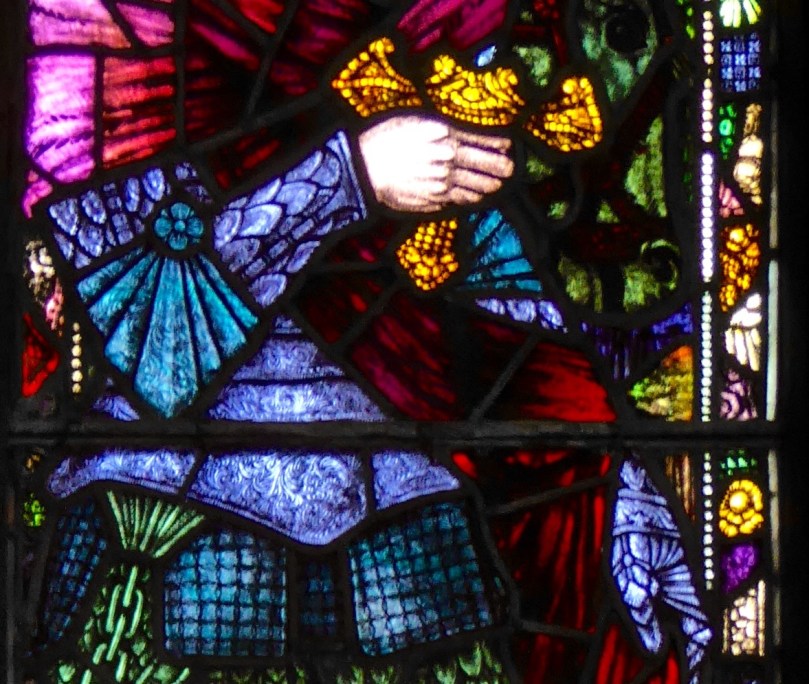
Saint Martin, armour detail
Saint Martin, armour detail

Shenanigans

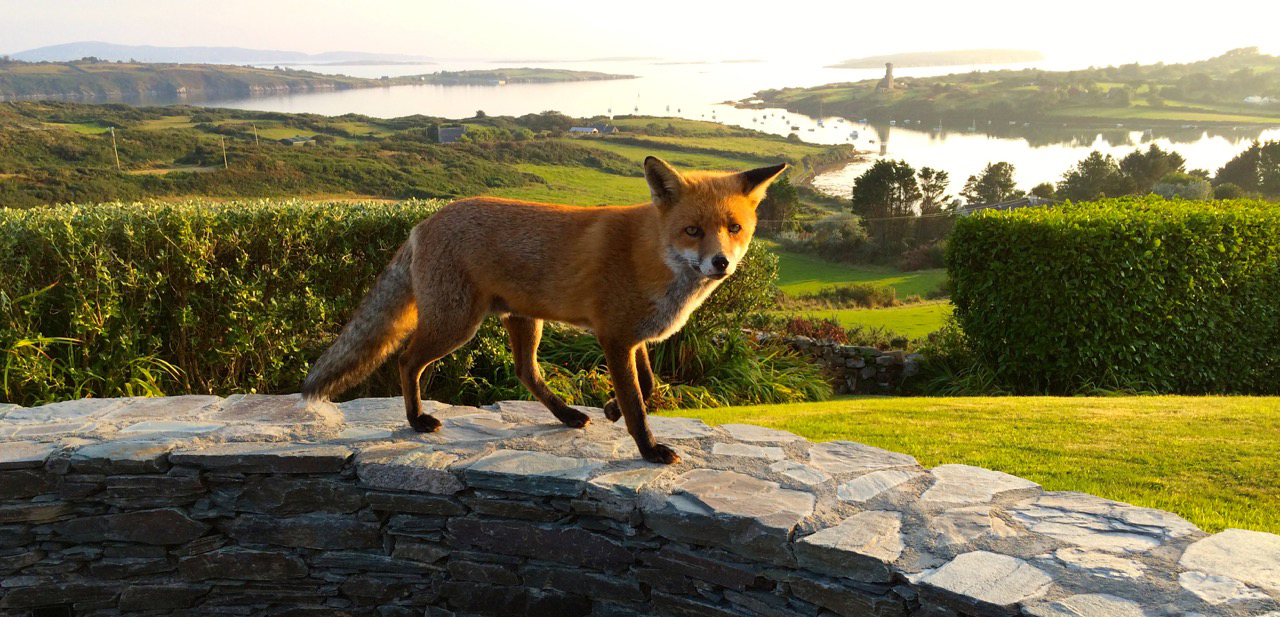
running fox

The word shenanigan (a deceitful confidence trick, or mischief) is considered by some to be derived from the Irish expression sionnachuighim, meaning ‘I play the Fox’. That’s by no means the only definition of shenanigan that you’ll find, but – for me – it’s a good one.

The Red Fox stops by Nead an Iolair on most days. He’s such a frequent visitor that he’s trodden a furrow across the lawn – which he follows meticulously in order to keep his feet dry: he’s a fastidious creature is our Ferdia.

It’s a bit unkind, perhaps, to always think that the Fox is up to some kind of shenanigans. That would be playing up to his reputation of being cunning or sly. Our Ferdia is pretty open about why he takes an interest in us – purely and simply, it’s his stomach. His patter is always the same: he stands at the window and presses his nose against the glass, managing to look somehow downtrodden or neglected (we know he isn’t at all – in fact his current winter coat is magnificent: not just red, but with a silver grey sheen, and his legs, paws and ears are a beautifully velvety black).

on the wall 2

The Irish word for Fox is Sionnach, and there are stories that this animal was brought over here by the Vikings, who reputedly used them for hunting. Now the tables are turned: in Ireland Fox hunting is a legal sport (which it no longer is in Scotland, Wales and England), and we have very occasionally seen The Hunt crossing the fields during our travels. If you read the highly amusing Irish RM by Somerville and Ross you will quickly gather that actually apprehending a Fox is something very rare for The Hunt: more usually it results in a loss of balance, life or dignity for the participants. This is probably a realistic picture: Edith Somerville was herself a MFH and therefore had considerable experience in the matter.

Well, Ferdia’s ploy usually works, and he frequently deprives us of the last morsel on our own plates. I’m sure I’ve heard him chuckling to himself as he disappears off into the fields clutching a bone or three. Foxes are good family animals: generations can live together for a few seasons, helping to look after the succeeding offspring – the collective noun for Foxes is A Skulk. Ferdia himself has got his act together: if we give him some scraps he’ll eat a good chunk first and then carry the rest off home – which I’ve worked out is quite a distance away. That’s fair enough: as Alpha Male and number one provider it wouldn’t do if he was debilitated with hunger.

We have on occasion seen Ferdia lead another Fox into the garden – either a wife or a daughter, but they are so nervous that their visits are rare and short. Ferdia, on the other hand, is totally confident that he’s got us wrapped around his little finger… In the summer he has been sitting out with us on the terrace, passing the time of day in a very relaxed fashion.

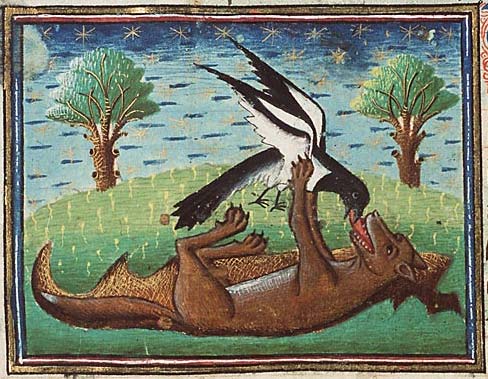
img4954Only yesterday I noticed our Fox sorting out some scraps on the lawn. Suddenly, there came into view two magpies. As I watched, one of them hopped around to the front of Ferdia and he stopped what he was doing to chase it away. Immediately, the other Magpie jumped in and took a good helping. Ferdia rushed at this competitor, and Magpie number One hopped in and had his share… From which I deduce that the cunning of Magpies is equal to that of the Red Fox.

In folklore, the Fox has a big presence. The animal is said to be able to foresee events including the weather and its barking is said to be a sure sign of rain (the only time we heard Ferdia bark was when we hadn’t noticed him standing at the window).

It is thought to be unlucky to meet a woman with red hair when setting out in the morning, especially if you are a fisherman. We may assume that the woman is a Fox in disguise.

There are legends about both St Ciarán and St Brigid finding and taming a Fox, and there are medieval carvings in churches showing Foxes: in one instance a Fox is in a pulpit preaching to Geese!

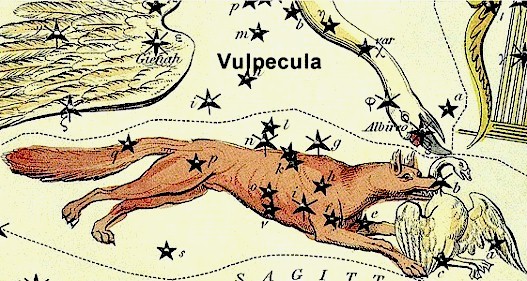
Where does the word Fox come from? One theory is that it derives from the French word faux – false. Interestingly there is also a possible link to the flower – Fuschia – so prolific in the Irish hedgerows. Theories abound, but we know that the Fox is above us in the night sky, in the constellation of Vulpecula – once known as Vulpecula cum Ansere – Fox and Goose.

Vulpecula

The story of Fox and Goose has been immortalised in what is reputedly one of the oldest folk songs in the English Language: The Fox or Daddy Fox. This version is from the 14th century:

‘Pax Uobis quod the fox,

‘for I am comyn to toowne’

It fell ageyns the next nyght

the fox yede to with all his myghte,

with-outen cole or candlelight,

whan that he cam vnto the town.

When he cam all in the yarde,

soore te geys were ill a-frede;

‘I shall macke some of youre berde,

or that I goo from the toowne!’

when he cam all in the croofte,

there he stalkyd wundirfull soofte;

‘for here haue I be frayed full ofte

whan that i haue come to toowne.’

he hente a goose all be the heye,

faste the goos began to creye!

oowte yede men as they myght heye,

and seyde, ‘fals fox, ley it doowne!’

‘Nay,’ he said, ‘soo mot I the

sche shall go vnto the wode with me;

sche and I wnther a tre,

e-mange the beryis browne.

I haue a wyf, and sche lyeth seke;

many smale whelppis sche haue to eke

many bonys they must pike

will they ley a-downe.’

2253385750

Here’s a more accessible version:

The fox went out on a chilly chilly night

He prayed to the moon to give him light

He had many many miles to go that night

Before he reached the town-o, town-o town-o,

Many many miles to go that night before he reached the town-o.

He ran ’til he came to a great big pen

Where the ducks and the geese were kept therein

He said a couple of you will grease my chin

Before I leave this town o, town o, town o

A couple of you will grease my chin before I leave this town-o.

He grabbed the grey goose by the neck

And he threw a duck all across his back

He never did heed the quivvy quivvy quack

Nor the legs all a dang-ling down-o, down-o, down-o

He never did heed the quivvy quivvy quack

Nor the legs all a dang-ling down-o.

Old mother Flipper Flopper jumped out of bed

Out of the window she pushed her little head

Cryin’ O John, O John the grey goose is gone

And the fox is away to his den-o, den-o, den-o

O John, O John the grey goose is gone

And the fox is away to his den-o.

Well, the fox he came to his very own den

And there were the little ones, eight, nine, ten

Saying Daddy you better go back again

‘Cause it must be a mighty fine town-o, town-o, town-o

Saying Daddy you better go back again

‘Cause it must be a mighty fine town-o.

Well, the fox and his wife without any strife

Cut up the goose without any knife,

They never had such a supper in their life

And the little ones chewed on the bones-o, bones-o, bones-o

They never had such a supper in their life

And the little ones chewed on the bones-o.

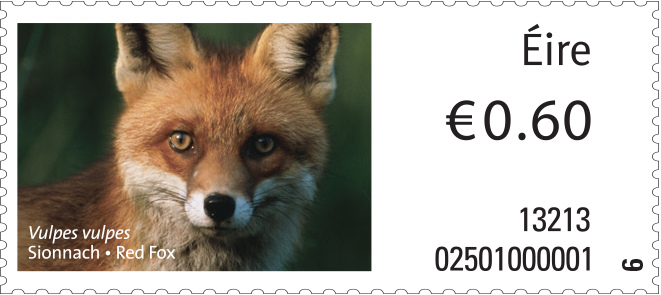
stamp

Three Pilgrims in West Cork

Glebe Church, on the Ilen River

Glebe Church, on the Ilen River

The guest speaker at this Thursday’s Skibbereen Historical Society meeting was Louise Nugent, speaking on the topic of Pilgrimage in Medieval Ireland. We became familiar with Louise’s work though her blog of the same title – a blog which manages to be consistently erudite and down-to-earth and entertaining all at once – and suggested her as a speaker. This also gave us the opportunity to meet Louise in person (she is as engaging and as knowledgeable as her blog) and, the next day, show her a little bit of our part of West Cork.

One of the great delights of following Louise’s blog is realising that the concept of pilgrimage – a spiritual journey undertaken for a variety of purposes – is still very much alive in Ireland. Local veneration of shrines, relics and holy wells is common and often involves a mass or prayers on special days. The “journey” involves going to the shrine, and sometimes moving around it in a set pattern or round. Larger scale pilgrimages, such as the annual trek up Croagh Patrick or a stay at Lough Derg in Donegal or a Novena at Holy Cross Abbey, transcend the local and attract pilgrims from around Ireland. In her talk, Louise also described the popularity of pilgrimage in Medieval times to holy sites outside Ireland such as York, Santiago de Compostela, Rome, or Jerusalem. Those who completed the Santiago Camino wore scallop shells to signify their pilgrim status, an image we had just seen the previous weekend in Cork in the Cathedral of St Mary and St Anne, where we came across a shrine to Blessed Thaddeus McCarthy. There was a statue, a painting, scrolls, but most fascinating of all a reliquary containing a leg bone! Blessed Thaddeus lived in the 15th Century and was appointed a bishop twice but was never able to take up his see because of the activities of the rival clan O’Driscoll.

On our day with Louise we concentrated on the area around Skibbereen. We started off by visiting the 18th Century Church at Glebe, on the banks of the River Ilen. The church and graveyard enjoy a picturesque and peaceful setting and a wander around the graveyard yielded interesting headstones.

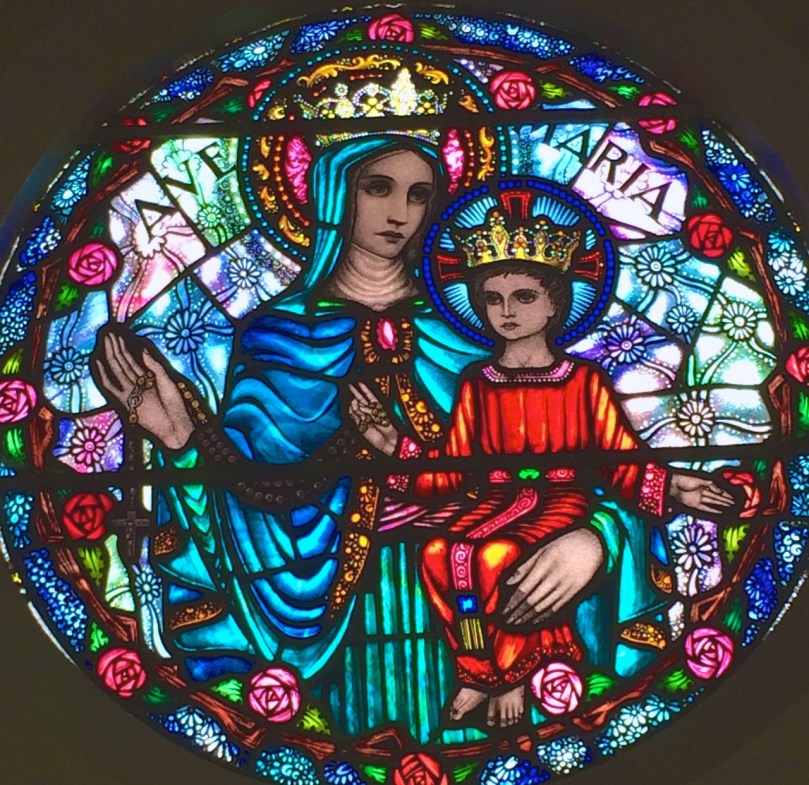
Holy Rosary Church at Aughadown, window detail
Holy Rosary Church at Aughadown, window detail

From there we went to the ruined medieval church at Kilcoe, stopping for a quick peak at the notable windows in the Church of the Most Holy Rosary at Aughadown. They deserve a fuller description at a future date, so for now I will include a detail from the rose window at the back of the church, designed and executed by the Harry Clarke studios in 1941.

The church at the tip of the Kilcoe Peninsula was already a ruin in the early 17th century. Although a simple rectangular structure, the pointed arched doorway and the tiny ogival windows mark it as medieval, perhaps as early as 14th or 15th century. Romantic and atmospheric as it is, it has the added advantage of a clear view of Kilcoe Castle, famously restored by Jeremy Irons and gently glowing in the afternoon light as we were there.

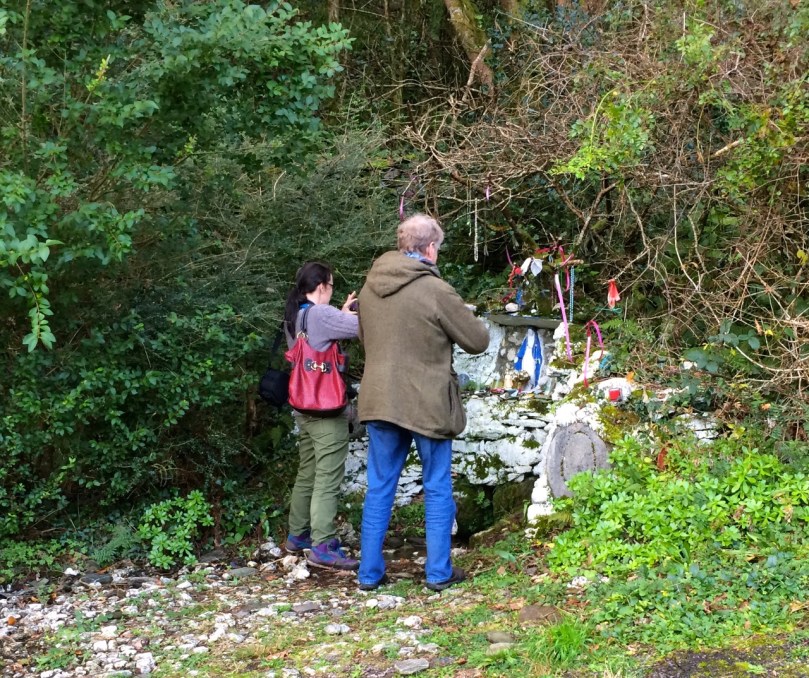
Two of the three pilgrims at a holy well

Two of the three pilgrims at a holy well

Louise’s special interest is in holy wells and several audience members the night before had come forward with information about local wells and the practices and beliefs associated with them. Two of the best known and most beloved local wells are situated close to each other at Lough Hyne. Robert is writing about these wells this week so I will leave the detailed description to him.

Our final stop was the village of Castletownshend and the Church of St Barrahane, filling two different functions. First, Louise had been to visit a holy well dedicated to St. Martin of Tours in Clare, and we wanted to show her the Harry Clarke window that Robert had described in his Martinmas post. Second, a trip to St Barrahane’s is always a pilgrimage of a different sort for me, as it is the final resting place of three of my heroes. The first two, of course, are the writing team of Somerville and Ross – more about them in this post. The third is Vice-Admiral Boyle Somerville, brother of Edith and a keen amateur archaeologist worthy of a post to himself in the future.

St Louis: detail of Harry Clarke window in St Barrahanes, Castletownshend

St Louis: detail of Harry Clarke window in St Barrahanes, Castletownshend

Come back soon, Louise – these two pilgrims have lots more to show you!