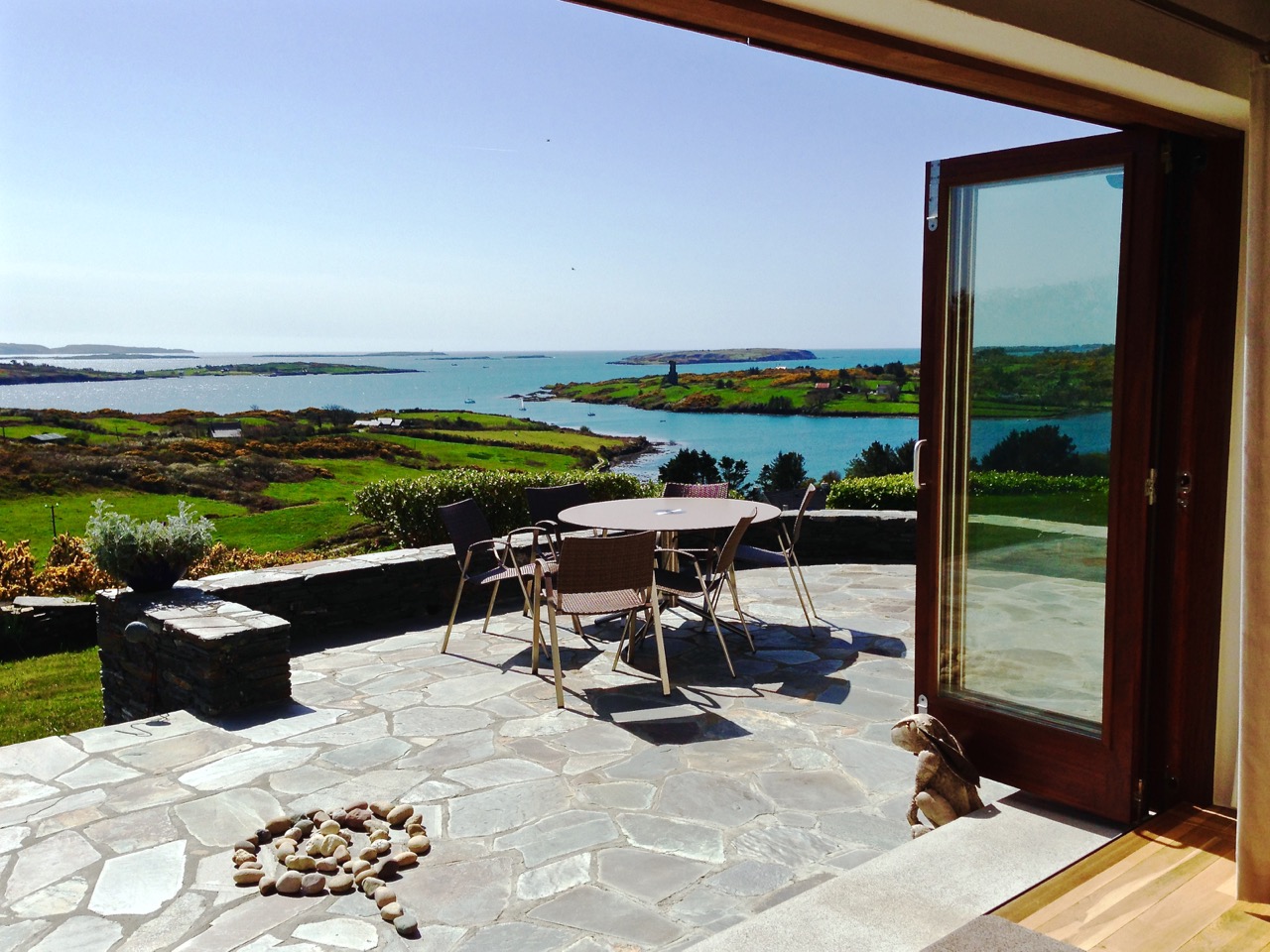
Window on our World…

Our View to the Islands

Our view to the Islands

Sunlight and drama have been the key elements of the view from Nead an Iolair this week. The drama began at coffe time on Monday: whenever we are sitting having breakfast, lunch, tea, supper – or maybe just sitting – we are looking out over the scene you see above. Central in that prospect is our bird feeder, where we keep a constant eye on the comings and goings.

Suddenly, a bomb dropped out of the sky! It scattered the birds and there was such a twittering and chattering – squawks and alarm calls. The ‘bomb’ was a Kestrel – who had singled out a juicy victim from among the avian throng… I’m pleased to say that it missed its target and crashed ignominiously into the adjacent gorse bush. Seconds later it extricated itself and sloped off, trying not to look too foolish. I have to say I admire birds of prey, although I’d rather not see them lunching on our garden friends. In the past we have also had sight of a Sparrowhawk on our stone boundary wall.
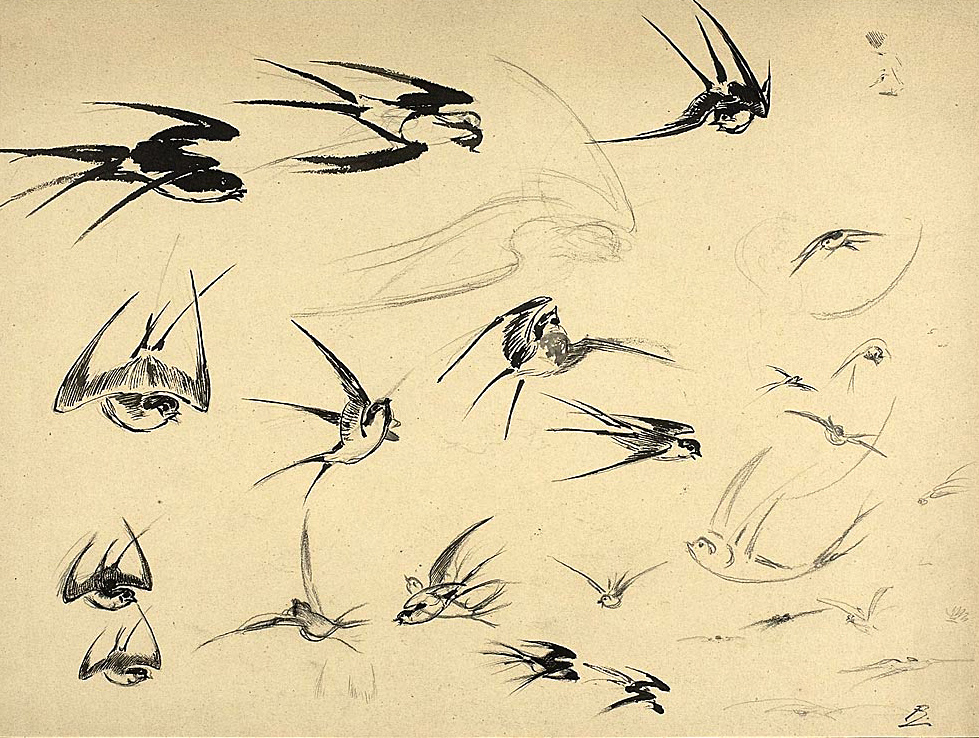
The Swallows: Felix Bracquemond, 1881

The Swallows: Felix Bracquemond, 1881

As I write this there are Swallows wheeling in the air above us: although we have had cloudless skies for several days the wind is in the east and it’s pretty chilly – however these harbingers of the Summer seem happy enough to have arrived on our shores in late April.

The Choughs are always with us!

The Choughs are always with us!

The Choughs are good friends of ours – they sit on the roof or tumble about in front of us, showing off their bright red bills and claws. At the moment they are foraging in the rocky land behind the house, pulling out roots and twigs for nest building. Another nester is the Starling family which inhabits the space in our eaves, creating a lot of noise and mess.
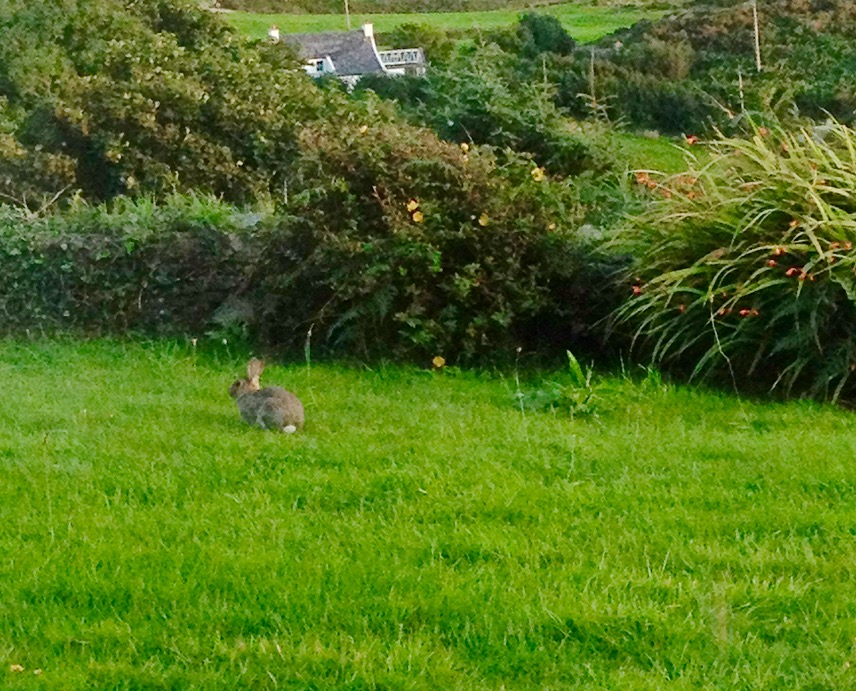
rabb

I was pleased to see a Rabbit in the garden: there has been an outbreak of mixomatosis in the surrounding countryside in recent times and over the last year we have hardly come across any of these mammals in the fields locally. Mixomatosis was introduced into the UK in the 1950s – apparently by accident – and then was used as a deliberate Rabbit control measure, by placing sick animals in burrows (then and now an illegal practice). By 1955 95% of Rabbits in the UK had been wiped out. I remember those days: seeing dead and dying animals every time I went out as a sensitive nine year old made me sickened and appalled, especially when I learned that we humans had initiated such cruelty. The virus recurs cyclically every few years, as has happened around here: I am still sickened and angered by it.

The next visitor was a female Pheasant. Although less colourful than her male counterpart she is nevertheless a handsome addition to our menagerie. The good weather has enabled us to have our doors open every day, but this does mean an influx of smaller guests, which have to be carefully rounded up and ejected before we go to sleep. They include spiders and flies, but also Native Irish Honeybees from our neighbour’s hives. Apis Mellifera Mellifera has evolved over thousands of years with a large body and long dark abdominal hairs which make it uniquely suited to survive in a harsh Irish climate. It will be found foraging early and late in the season and will fly in dull, drizzly and cold weather. I gleaned this information from the comprehensive website of the Native Irish Honeybee Society.
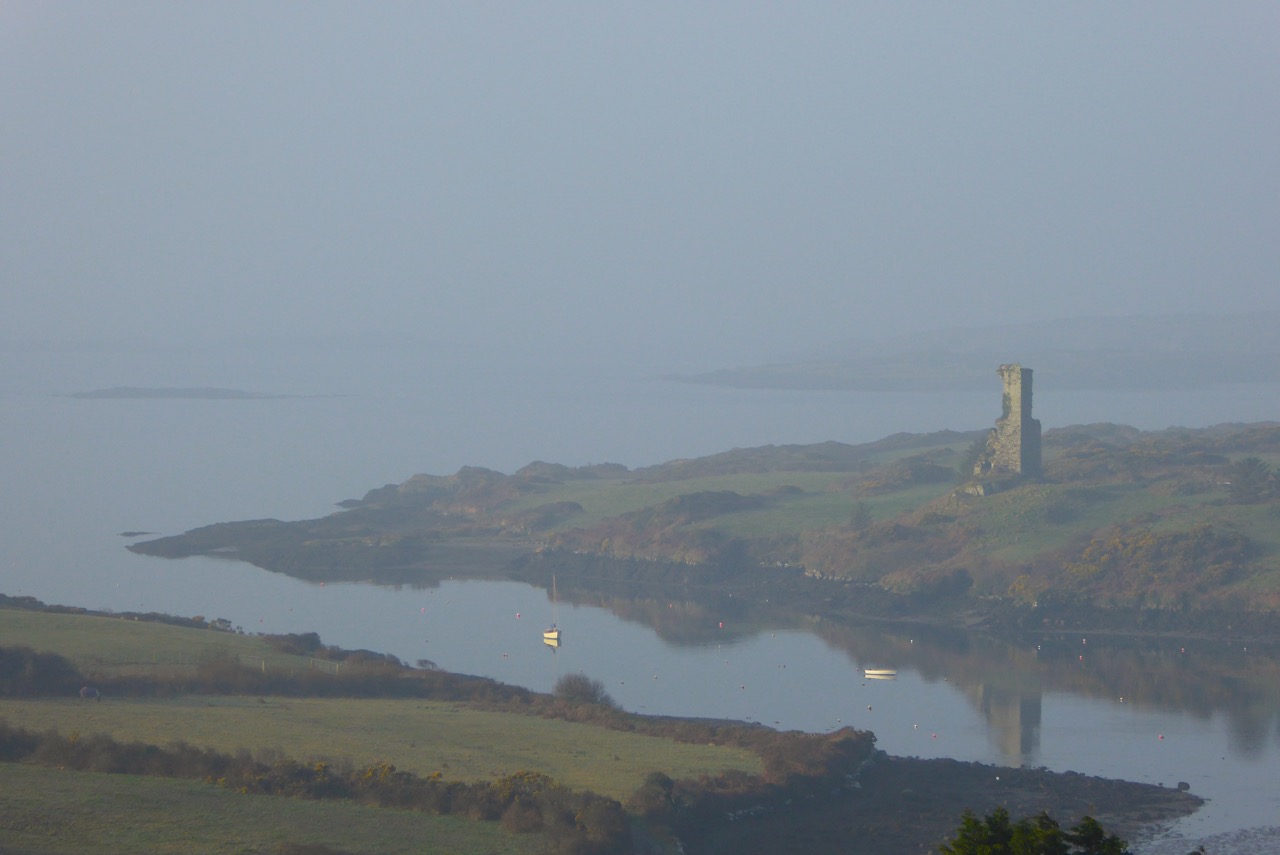
Castle in the Mist

Castle in the Mist

These wonderful spring days have been heralded by misty mornings. Evenings have been clear, with the crescent moon and Venus prominent over the western horizon. This is the time when we see our Bats. They might be either Common Pipistrelles or Soprano Pipistrelles: I’m sure you know that the former echolocates at a peak frequency of 45kHz while the latter echolocates at a higher frequency peaking at 55kHz. I keep listening out but can’t quite decide which is which… Anyway, they are both indigenous – and are probably sharing our eaves spaces with the Starlings.
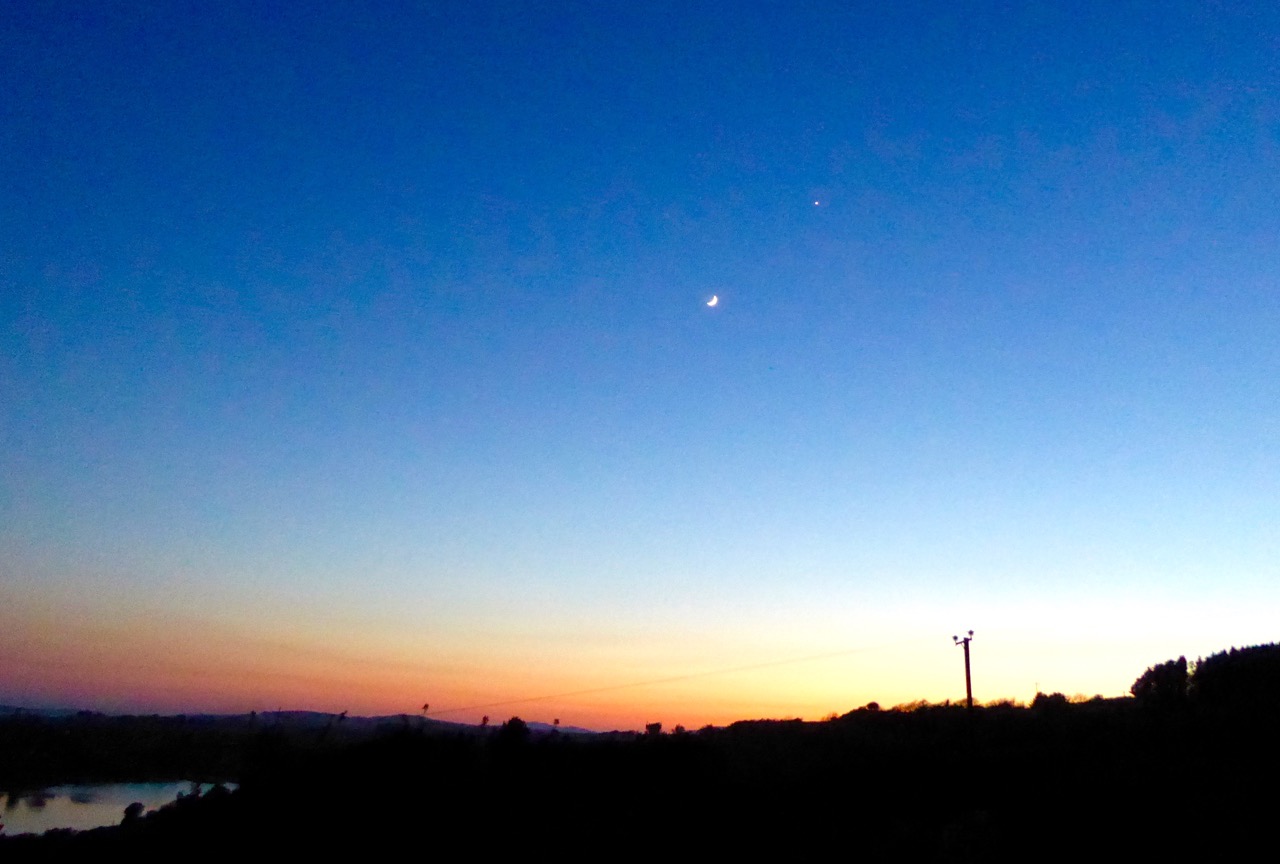
crescent moon

The gorse is in full bloom, as are the blackthorn hedges. Any picture of our surroundings at this time of the year has to show off the yellow and white – and, of course, the emerald green and azure blue.
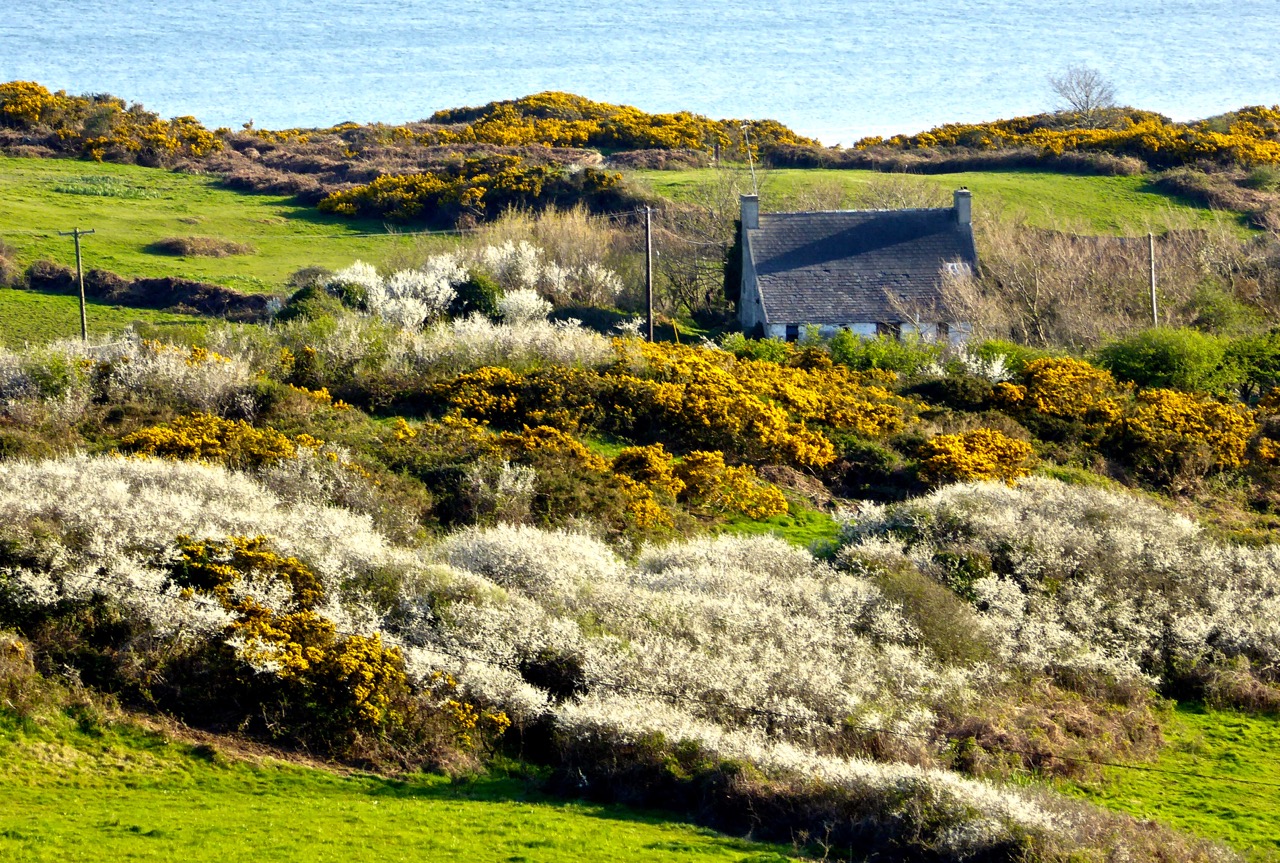
looking out

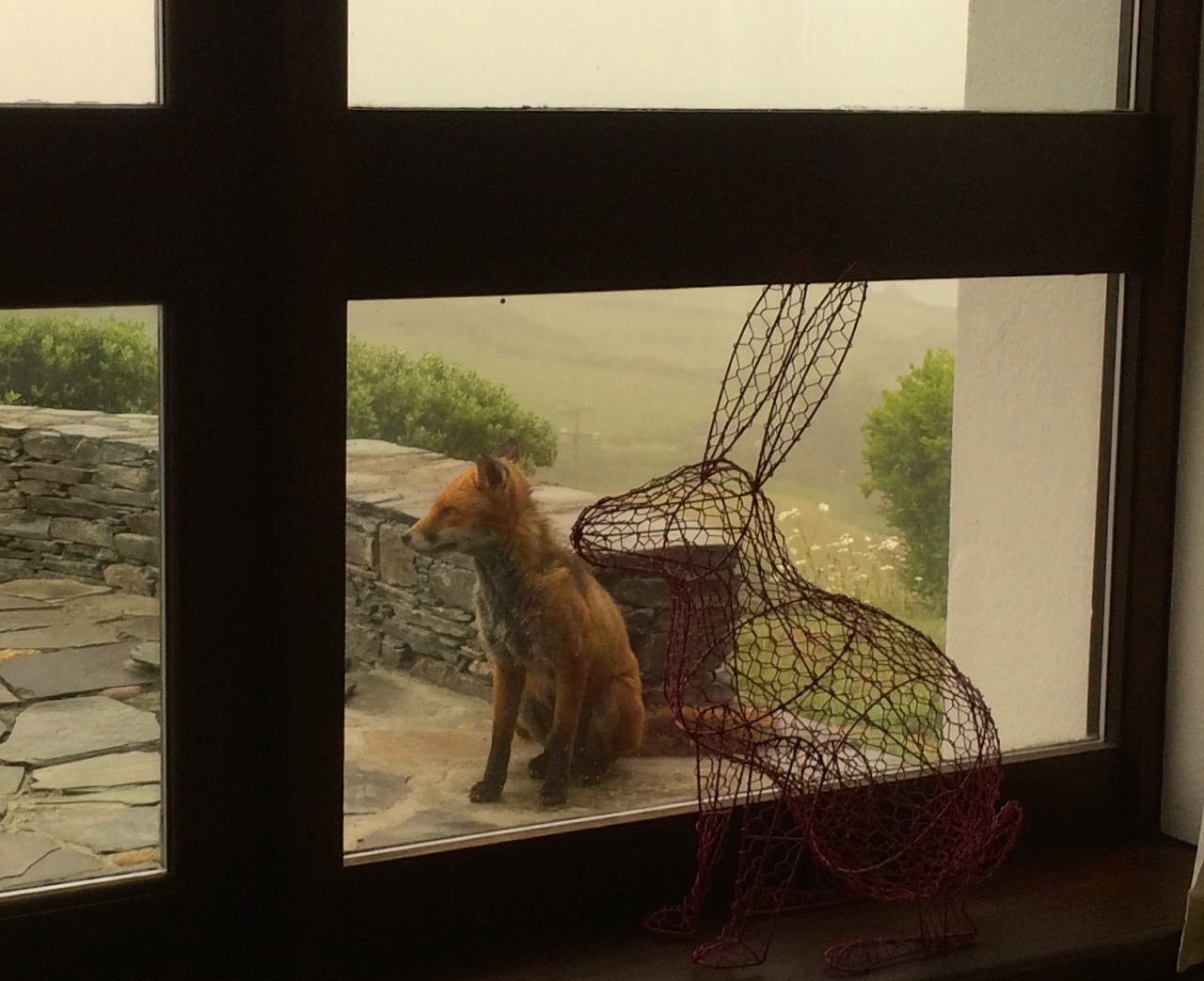
No ‘nature post’ here would be complete without mention of our own Red Fox, Ferdia. In fact, part of the drama of the week was the appearance of another Fox! As we hadn’t seen Ferdia for quite some time we worried that he might have gone the way of all Foxes: the average life of a Red Fox in the wild is only around five years – and our neighbours claim to have been hosting Ferdia for more like ten… The new Fox only made the briefest of appearances, just enough to be photographed. I think it is a Vixen – smaller and thinner – and very nervous. We couldn’t help thinking that she had come on to the scene because of Ferdia’s demise – but no! Yesterday evening, there was Ferdia knocking on the window, cocky as ever – although he does look a bit bedraggled at the moment, possibly because he’s beginning to lose his fine thick winter coat. Perhaps now we will have to find scraps for two foxes…
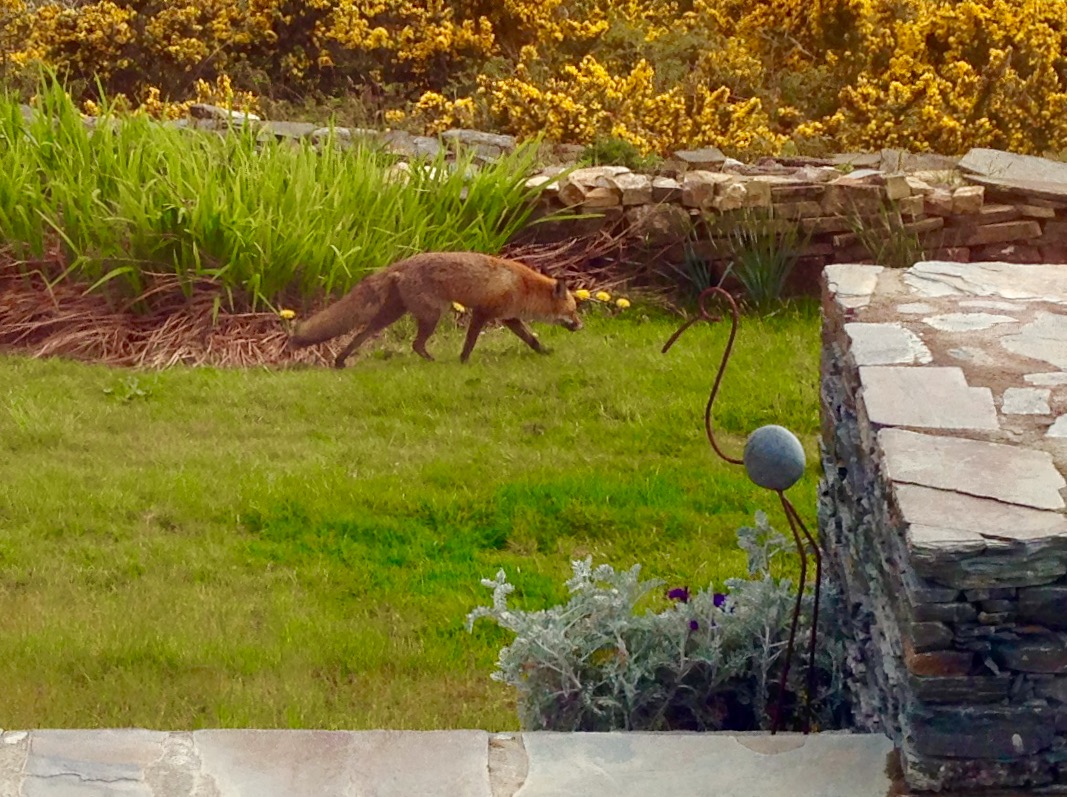
Fresh on the scene: a female Red Fox
Fresh on the scene: a female Red Fox

Seen through the window: a bedraggled Ferdia posing with one of our many household Hares!

Seen through the window: a bedraggled Ferdia posing with one of our many household Hares!

Finally, I was fascinated by another visitor to Nead an Iolair this week: a female Emperor Moth took up residence on our bedroom window cill. As you can see, her appearance is very striking. I wish I had been able to observe her all day, as evidently these Moths stretch themselves out in the sun waiting for a mate to arrive. The males are even more spectacular, but alas I didn’t see one. You’ll find this lady in an Irish folk tale: The Children of Lir.

Female Emperor Moth

Female Emperor Moth

I have to give a special word of thanks to Finola, who expertly took most of the photographs in this post with her excellent Leica-lensed camera
Showing Off West Cork

This is how you sightsee in West Cork!

This is how you sightsee in West Cork!

Ladies and Gentlemen, meet Susan Byron! Susan is the face behind Ireland’s Hidden Gems, a custom travel service for visitors to Ireland, and she and I met last year when Robert and I spent a week in Clare. Susan loves nothing better than to hop in her car and take off for a few days to some part of Ireland she wants to explore or re-explore. There are very few places she hasn’t seen, but I soon discovered that the Sheep’s Head was one of them. She has been to the Mizen before but hadn’t seen some our OUR hidden gems. In short order we decided that a visit must be organised, and a couple of weeks ago she arrived, bearing Burren lamb, bottles of wine, and an infectious enthusiasm to see everything.

The 17th century Bardic School

The 17th century Bardic School on The Farranamagh Loop walk

Now if someone who runs a bespoke travel agency wants to see your piece of paradise, well, you’re going to put your best foot forward. Fortunately, this isn’t a problem in West Cork – it’s pretty well a fail-safe place to show off. Susan spent her first day whale watching (something we promise ourselves to do soon) and exploring the area east of Skibbereen. On day two and three she was all ours and we spent the first day on the Sheep’s Head and the second on the Mizen.

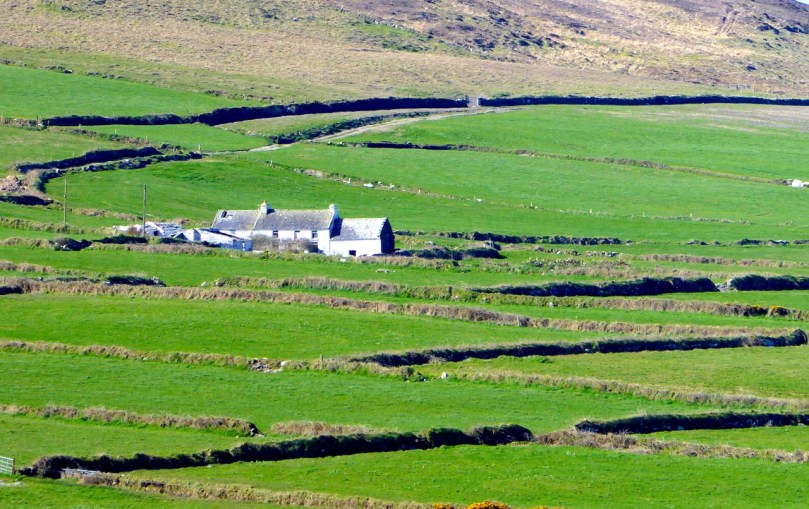
Mizen farm

Mizen farm

First of all, travelling with Susan is a hoot. She’s got a hot car, a ready laugh, an inexhaustible supply of stories, insatiable curiosity, and a real passion for Ireland. She is amazingly well-read – she knew the dates of the castles before I could tell her and was already familiar with what most tourists want to to see and do in West Cork. So this was a cheerful, companionable time of exploration, chatting, coffee and scones, hiking and sightseeing.

Our Sheep’s Head day took in two loop walks – the Farranamanagh loop and the lighthouse loop. We started off in drifting mist but the sun came out in the afternoon and soon we were shedding coats and applying the sunscreen. After a stroll around the lovely Farranamanagh walk (famous for its 17th century Bardic School) we had lunch in The Creamery in Kilcrohane and browsed in the Sheep’s Head Producers Market. We bought eggs from a farmyard, said hello to contented alpacas, and took innumerable photos of the killer views.

The Lighthouse Loop offers unparalleled vistas at the end of Sheep’s Head – south to Mizen Head and the sweep of the West Cork coastline, and then, as you round the end, north to the Beara and to the Iveragh Peninsula (Ring of Kerry) beyond it. The trail has some steep sections and clings to a cliff edge for part of the northern stretch. It, and the Farranamanagh Loop are but two of the many waymarked trails that crisscross the Sheep’s Head. Each is as rewarding as the next and you could easily spend several days exploring this one Peninsula.
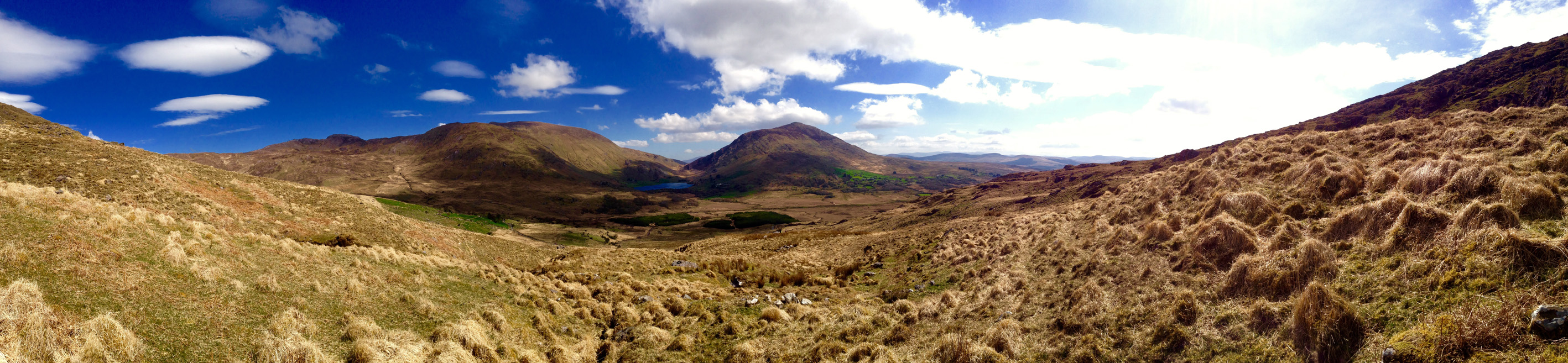
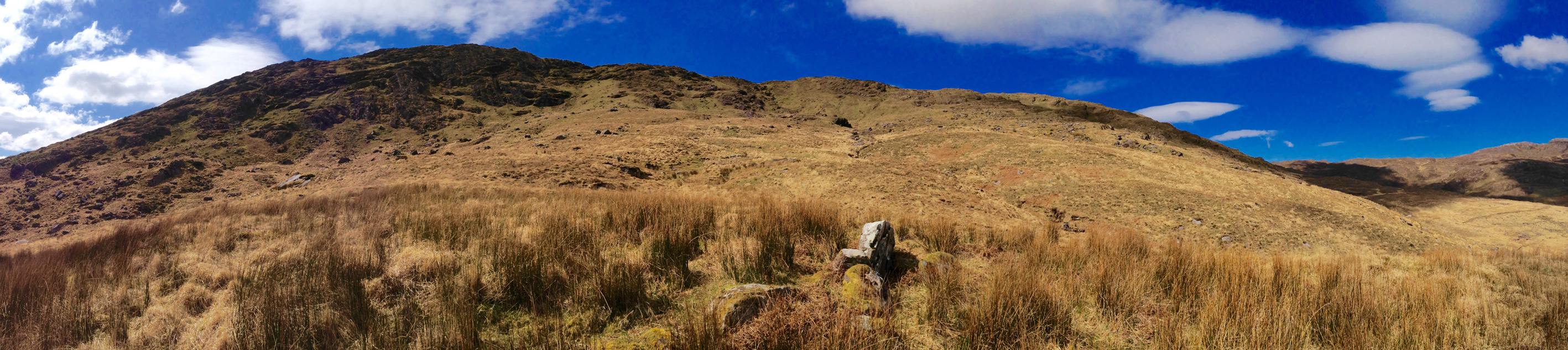
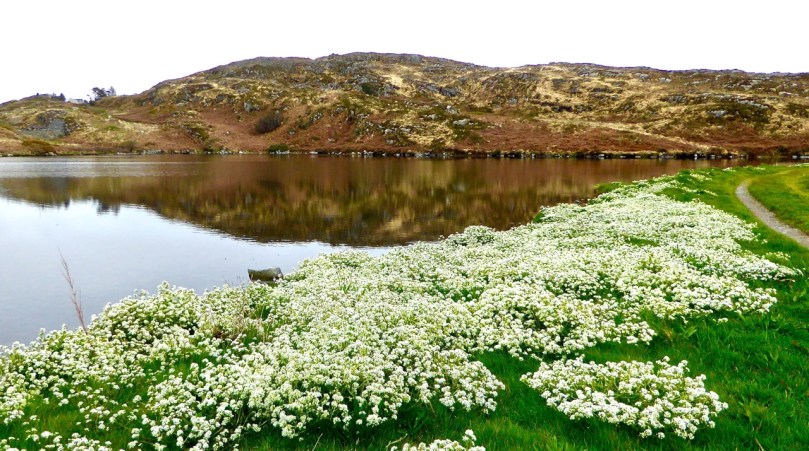
Lake Farranamanagh

Lake Farranamanagh

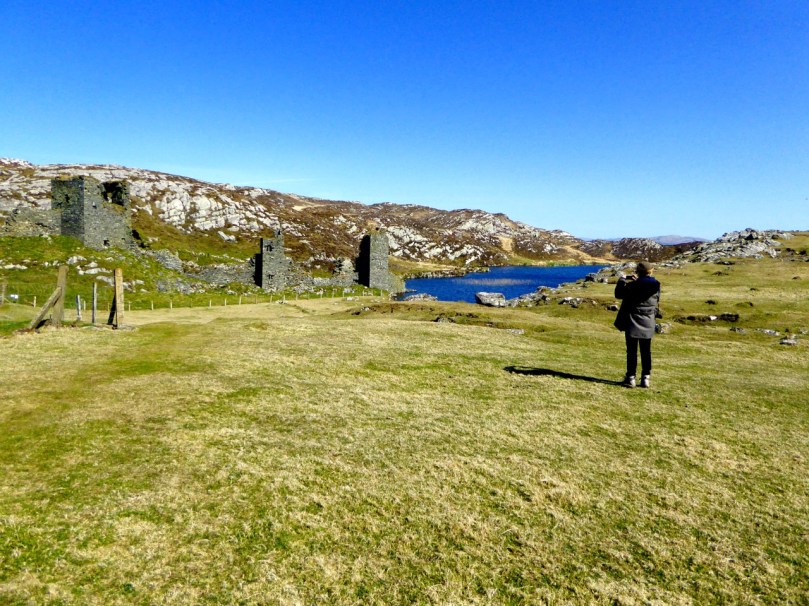
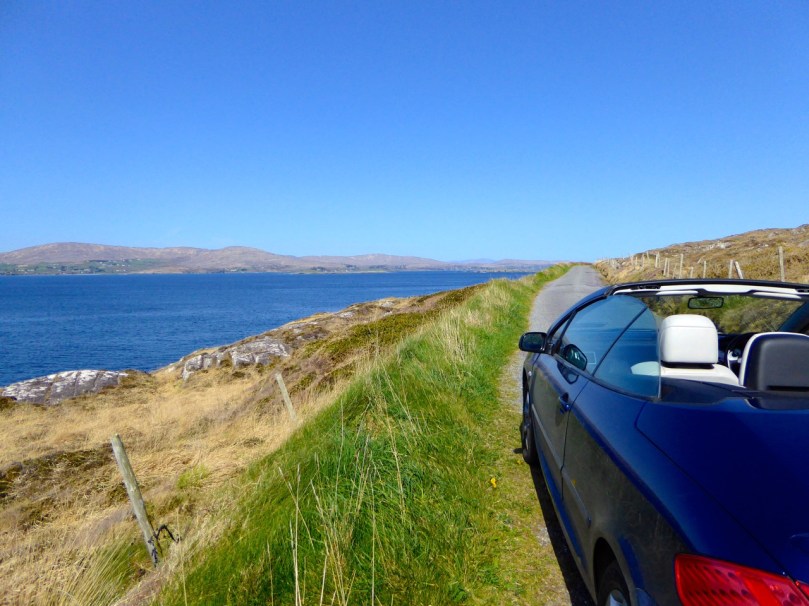
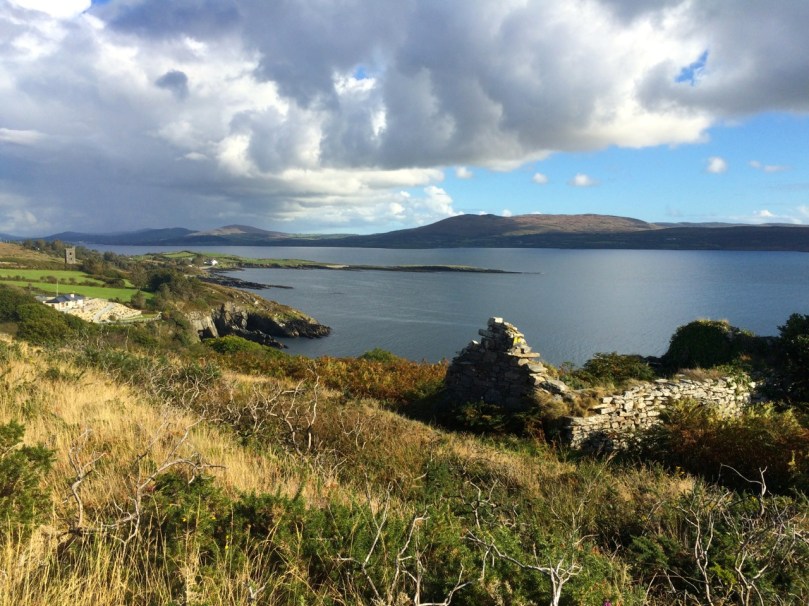
The Mizen, of course is OUR peninsula and we are always delighted to introduce it to friends. The weather was brilliant so we were able to drive in Susan’s cool car with the top down. (In my next life I want to come back as a blonde with a convertible.) Three Castle Head was at its most spectacular, with the water that deep azure blue that people who don’t live here have a hard time believing is real.

The Three Castles: it's love at first sight for Susan

The Three Castles: it’s love at first sight for Susan

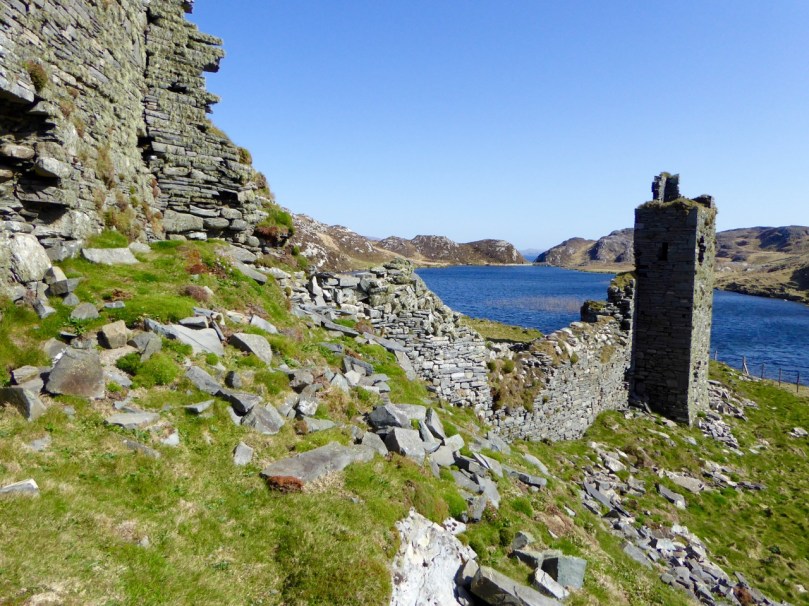
The curtain wall and the lake

The curtain wall and the lake

Spring was bustin’ out all over so the air was heady with wildflowers and the fields full of newborn lambs. The drive on the north side of the Mizen is as jaw-droppingly gorgeous as any stretch of road in Ireland – the only difference is that it’s empty. We met not a single car, which enabled us to stop where we pleased to survey the scenery or take photos.

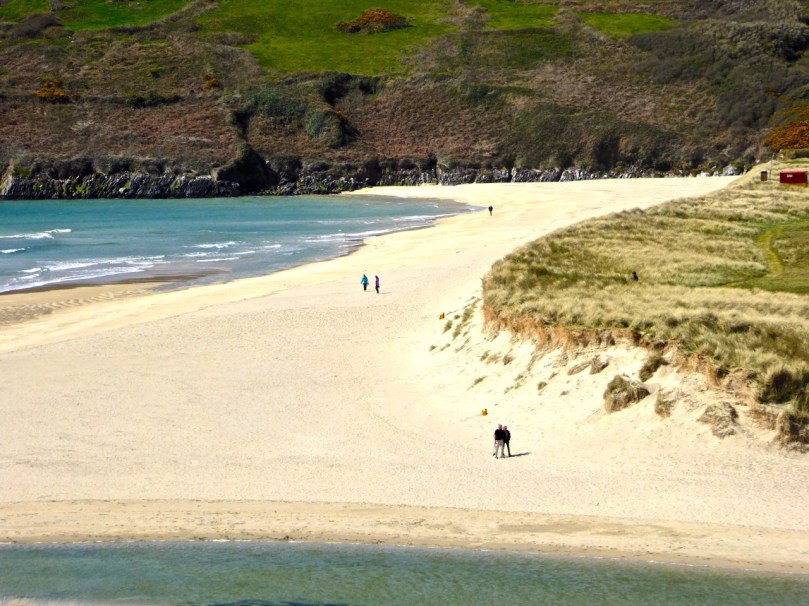
Barley Cove Beach

Barley Cove Beach

Susan wound up her time by conducting some retail therapy in Schull. No better place!

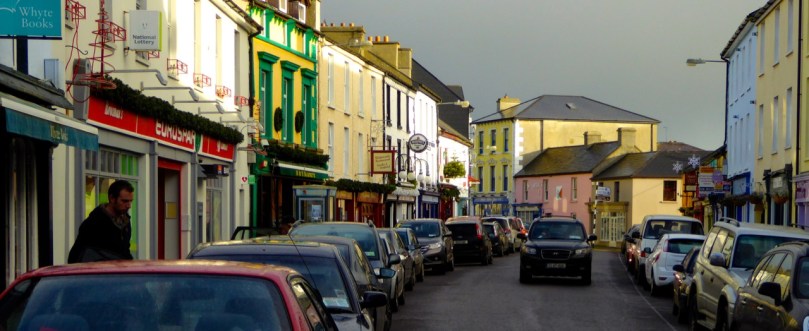
Schull, colourful village with great shopping

Schull, colourful village with great shopping

She has posted numerous photographs on her Facebook page and even used the phrase “possibly the most beautiful place I have ever been….” about Three Castle Head. That’s how I feel about that magical place – but when someone who has seen everything Ireland has to offer says it, maybe, just maybe, I’m not delusional after all.

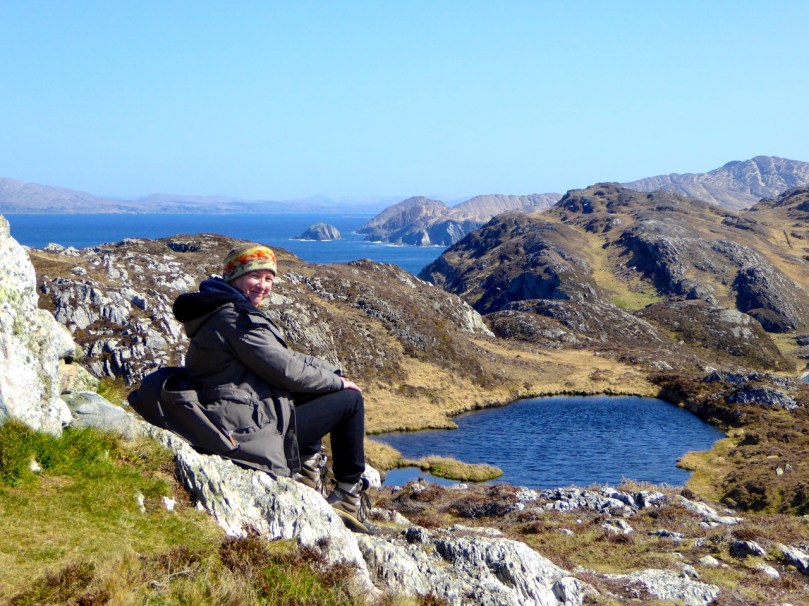
Susan at the cairn. Three Castle Head on the Mizen

Susan at the cairn. Three Castle Head on the Mizen

Derrynablaha Expedition

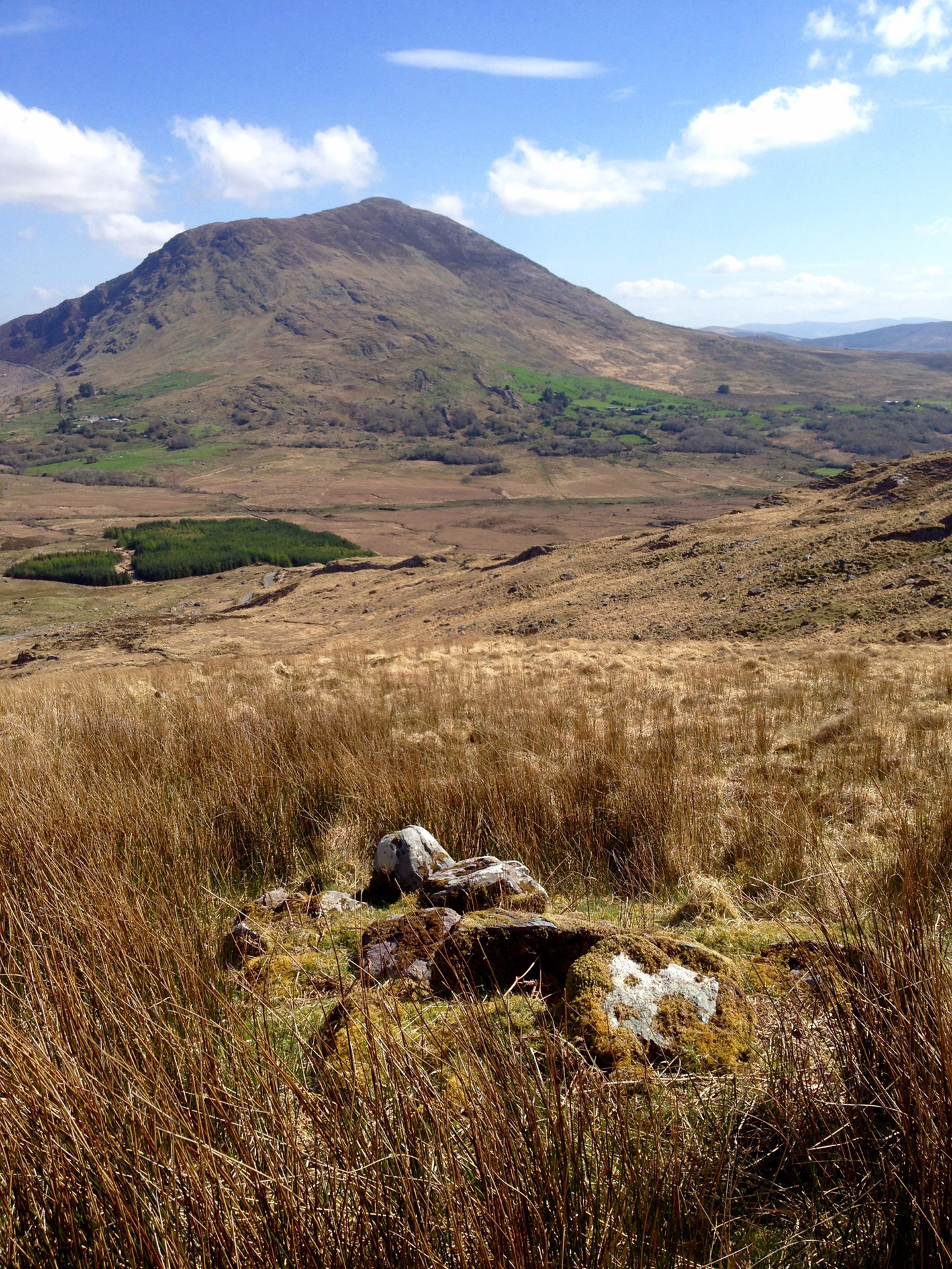
Derrynablaha in all its glory

Derrynablaha in all its glory

It’s an almost entirely unknown national treasure – a valley of breathtaking grandeur dotted with the greatest concentration of prehistoric rock art in Ireland.

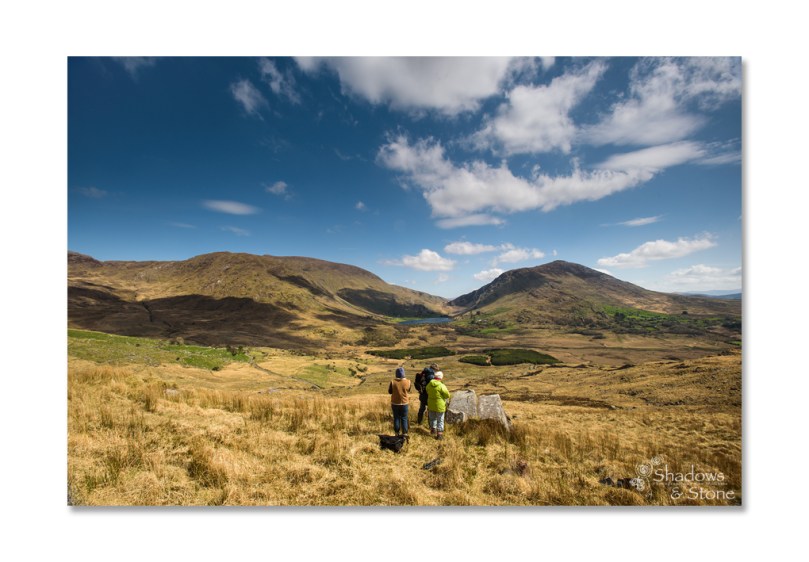
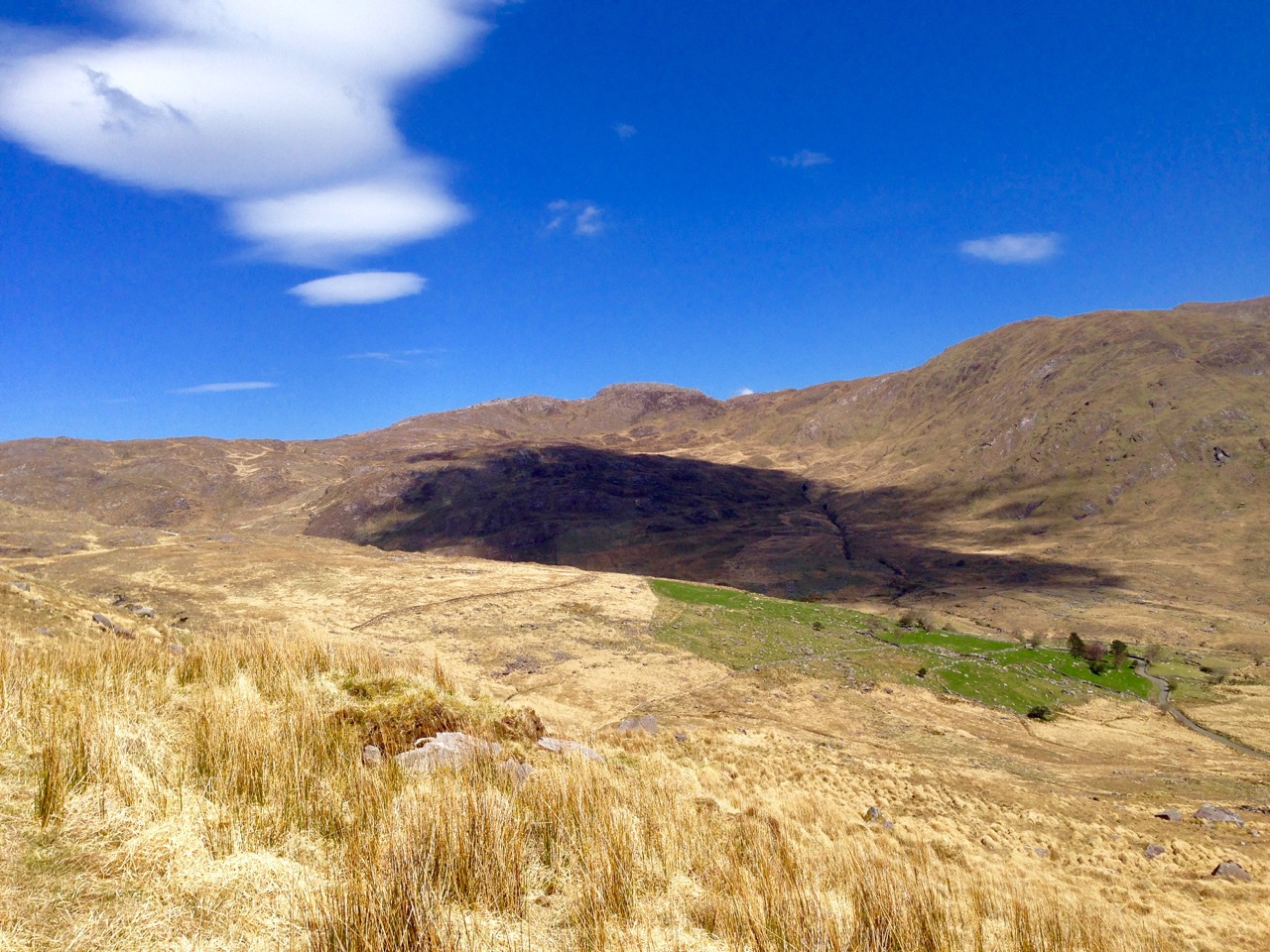
In Derreeny, Looking down the Kealduff Valley

In Derreeny, Looking down the Kealduff Valley

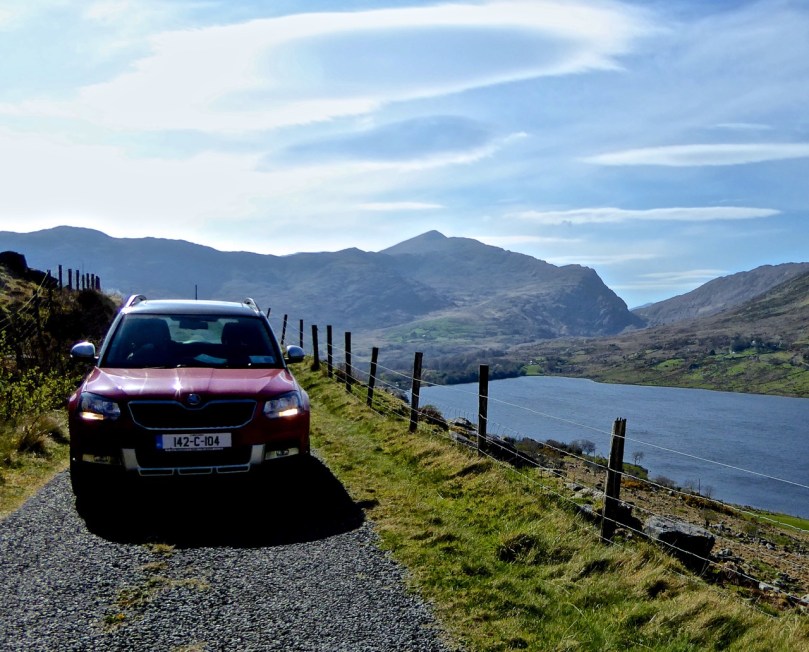
Derrynablaha (Little Oak Wood of the Flowers) is in Kerry, right in the heart of the Iveragh Peninsula (better known as the Ring of Kerry), on one of the few narrow roads that traverse the Peninsula. The rock art has been known for many years – the first paper about it appeared in the early 1960s, curiously, by an Italian rock art expert, Emmanuel Anati. The Cork husband/wife team of Michael and Claire O’Kelly traversed the valley, finding many new pieces and leaving extensive notes. Elizabeth Shee, the leading expert on passage grave art, added to the literature in the early 70s. In 1972 and 73 I (Finola Finlay) recorded and drew all the known examples, using the tracing techniques of the day. Blaze O’Connor and Avril Purcell both wrote about Derrynablaha in the early years of the 21st Century, relating the rock art to the landscape it occupied. Many more pieces came to light in the adjoining townland of Derreeny and were recorded by Ann O’Sullivan and John Sheehan in their Survey of the Iveragh Peninsula. Rose-Mary Cussen examined the art about five years ago, looking for patterns in the enigmatic carvings while other scholars have included Derrynablaha as part of a focus on Irish prehistory.  A few photographers have attempted to capture images of the art, but none more so than Ken Williams, of the outstanding Shadows and Stone website.

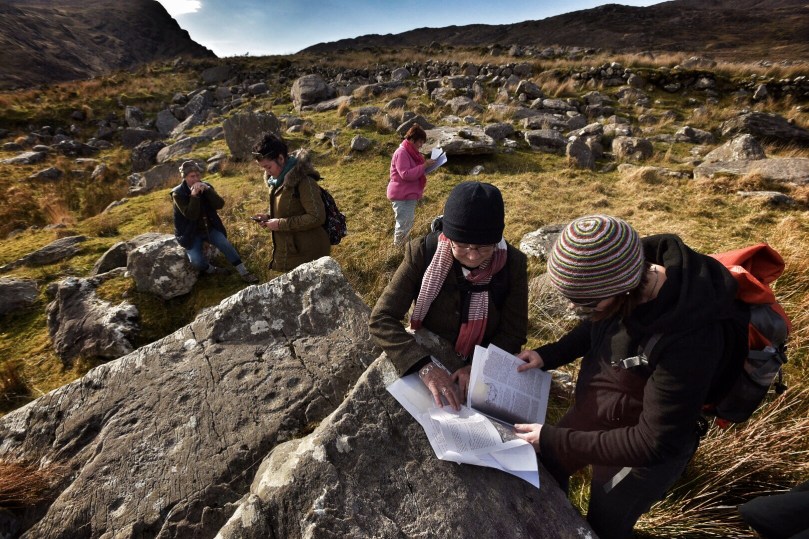
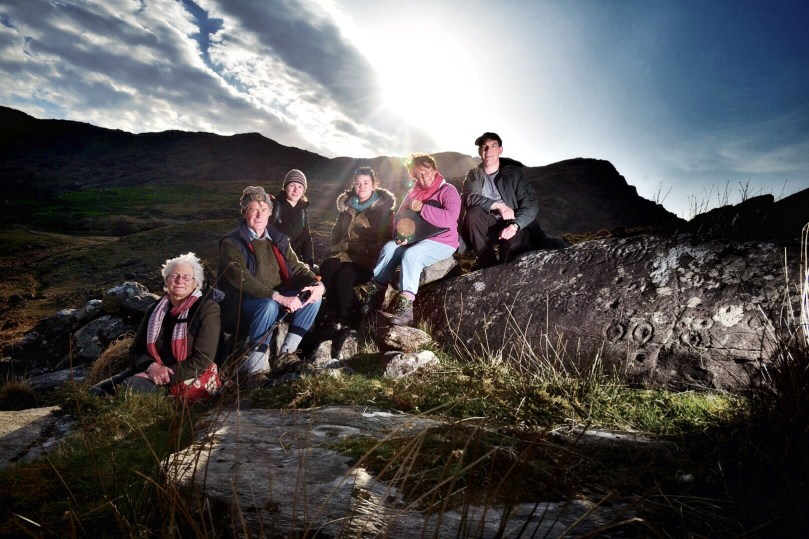
Robert, Clare, Finola, Elizabeth and Avril, checking the records and GPS readings. (Photo © Ken Williams)

Robert, Clare, Finola, Elizabeth and Avril, checking the records and GPS readings. (Photo © Ken Williams)

This weekend, several of these rock art enthusiasts and experts came together for a unique expedition to Derynablaha and Derreeny. Elizabeth Shee, myself, Avril Purcell, Rose-Mary Cussen, and Ken Williams took part, accompanied by Robert Harris (see his take on this special place) and Clare O’Sullivan, a UCC undergraduate. Our objective was to visit as many of the panels as possible and to assess what has changed in the landscape in the 65 years since it was first described in academic journals. (See the end of this page for links to other Rock Art topics we have  posted over the last couple of years.)

This one wasn't too hard to find

This one wasn’t too hard to spot

Finding the panels was the first challenge! We had all the information from the National Monuments records, including GPS locations for each rock. However, GPS readings can vary, and many of the ones we were using for Derrynablaha were from the early days of GPS and could be 30m out or even more. Apart from the small fields around the original farmhouse, this is a landscape of bog, gorse and tall grasses, of steep hillsides and tumbling streams, of numberless boulders and outcrops. It was, we think, populated by early herding agriculturalists in the Neolithic and Bronze Age periods. Historically, it supported a sizeable population in pre-Famine times (ruined cottages dot the land) and one sheep farm still operates now. Finding the rock art needle in the landscape haystack took time and patience, sharp eyes, and the good memories of those who had been there more recently than I. Where the GPS recording let us down we turned to the meticulous notes made by Claire O’Kelly: notes that said things like “keep the stream to your right and the large triangular rock in view and the rock is a short way below the wire fence.” These notes turned up trumps more than once.

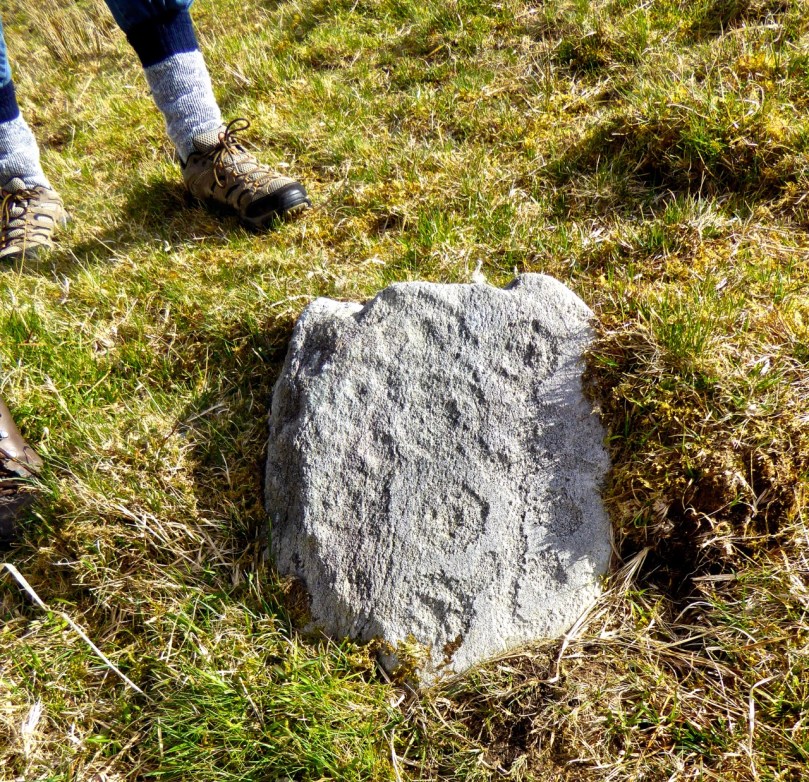
The rock art is NOT on the large panel, but on the tiny stone by Robert's knee.

The rock art is NOT on the large panel, but on the tiny stone by Robert’s knee

In the end we located all but one panel of the ones we were tracking. The Derreeny rocks were easier to find as the GPS readings were more accurate. It was exhausting and exhilarating work and reminded us yet again how difficult this art can be to find and to see. While some panels were clear and sharp, others were weathered and lichened to the point of invisibility. For some, my drawings were needed to appreciate the full extent of the carvings. (I was feeling pretty pleased with myself about these drawings until we discovered one panel on Day 2 for which my drawing was mirror-imaged in my thesis. Fortunately, the Sullivan and Sheehan Survey had noted and corrected this in their work.)

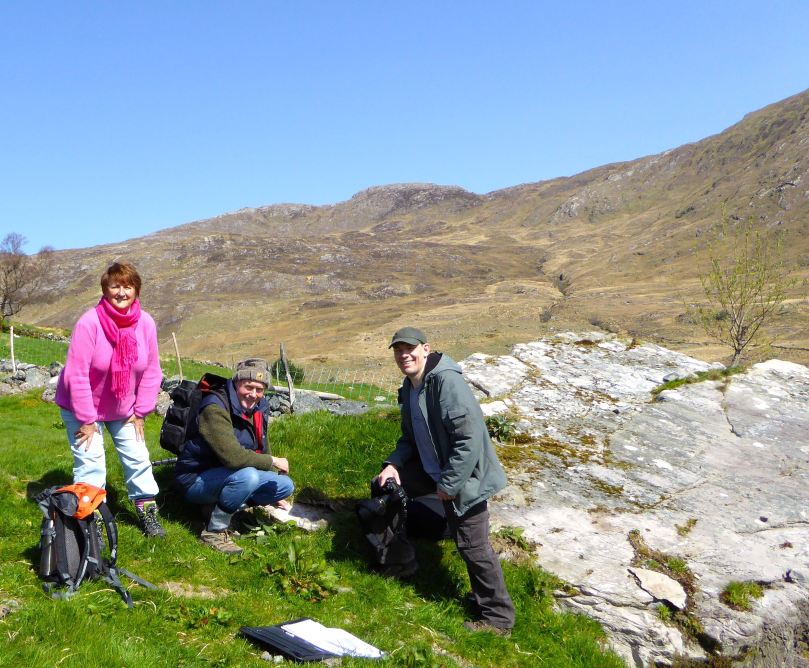
Day 2 Crew: Ken, Rose-Mary, Finola, and Robert taking the photo.

Day 2 Crew: Ken, Rose-Mary, Finola, and Robert taking the photo

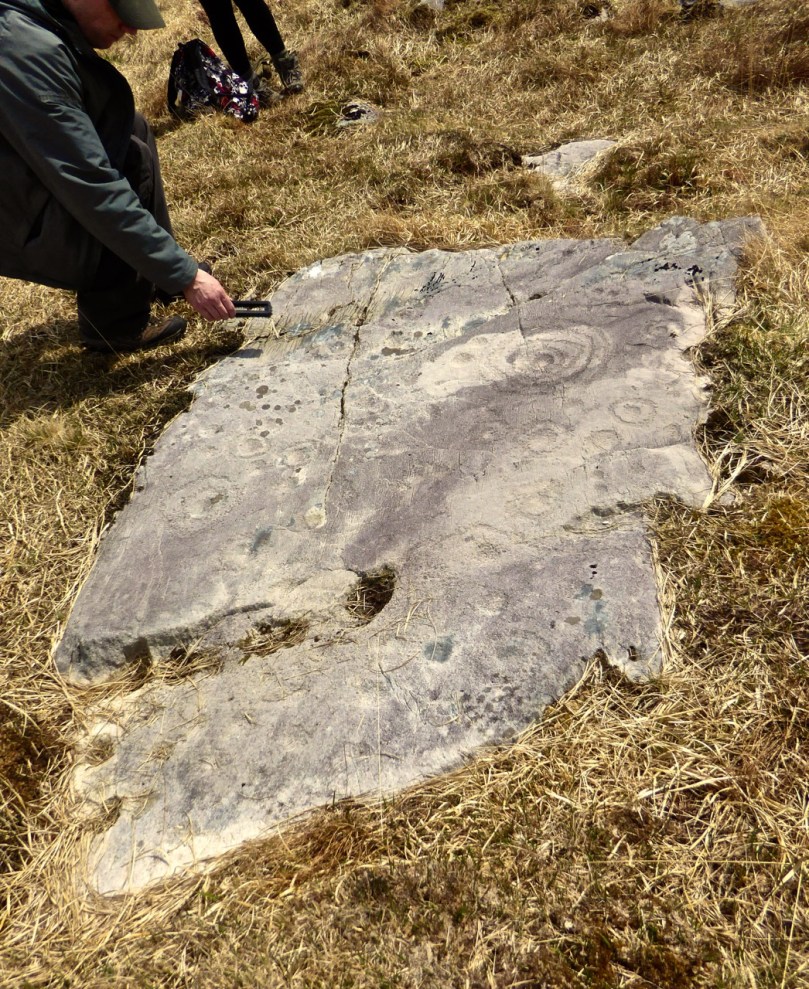
On day 2 the team consisted of Ken, Finola, Robert and Rose-Mary and we spent our time on the most southerly examples in Derrynablaha, especially the large tabular rock and its associated rosette stone. One of the most extensively carved pieces of rock art in Ireland, this iconic piece commands a panoramic view of the whole area, extending to Lough Brin to the east, the Ballaghbeama Gap to the north and to Kealduff River valley to the south. Leaning against it is a stone with a superb example of the rare “rosette” motif.

For really excellent images of this stone, view it on Ken’s Shadows and Stone site.

We also lingered over an unusual panel with multiple lines, cupmarks and rosettes: this one was so faint that Ken resorted to having us provide shade using his jacket and our bodies. The results he got, with his flash technology, revealed astonishing detail totally invisible to the naked eye.

How he got that high tech photo © Ken Williams

How he got that high tech photo  

My drawing, done over 40 years ago.

My drawing, done over 40 years ago

Our second objective was to assess the general ‘health’ of the rock art and its context. Mostly, we were encouraged: very little has changed in this valley over the years. It is remote and the land is marginal, suitable mainly as rough mountain pasture for sheep. The landowner knows about the rock art and is careful not to disturb or damage it.

 lDerrynablahaandscape - changed and unchanged. Note forestry activity.

Derrynablaha landscape – changed and unchanged: note forestry activity

However, two factors threaten the rock art even in this far-flung region. The first is forestry: a sizeable plantation occupies an area east of the road and at the south end of the townland. We didn’t have time to visit this area, but noted in the National Monuments records that two previously identified pieces of rock art are now within the forest boundaries and can no longer be found. The second factor is land-clearing for the purposes of improving the grazing fields. Farmers are encouraged to do this and there are grants available through European funds. We failed to find one piece that was located in such a cleared area, despite extensive searching over two days. Hopefully, this is a function of erroneous GPS readings and the rock still exists – but it is worrying.

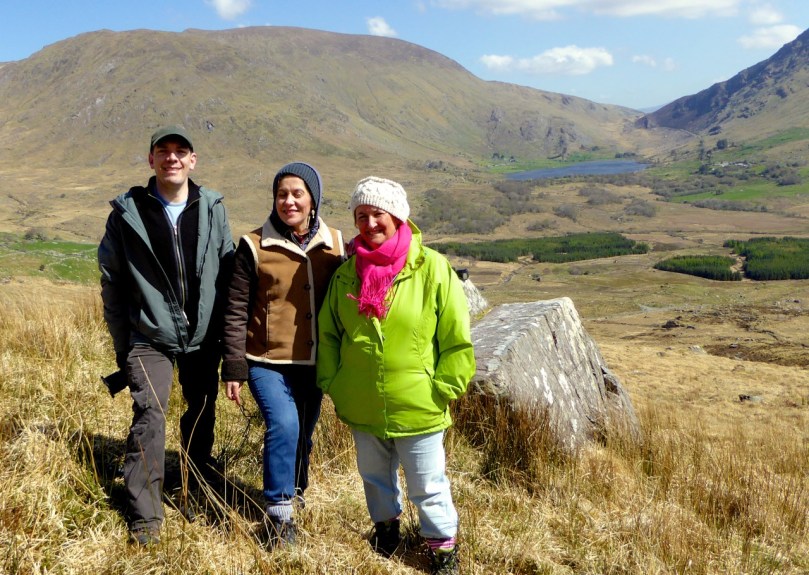
Elizabeth, Robert, Avril, Clare, Finola and Ken. Day 1 Team by Derreeny rock art.

Elizabeth, Robert, Avril, Clare, Finola and Ken. Day 1 Team at Derreeny rock art  © Ken Williams

Derrynablaha and Derreeny have always been special places. We can only speculate on the meaning or meanings of the extraordinary numbers of carved rocks in this landscape. Were they familiar, even domestic, expressions of belief or supplication? Did they mark routeways through the mountainous territory or boundaries between clan lands? Were they, or some of them, hidden ritual sites known only to certain members of a priestly class? Did the carvings identify suitable spots for calendrical observations? Did they have altogether different functions that we have yet to comprehend? We may never know the full extent of the meaning of the rock art to those who carved them. Yet – we do know their meaning to us. As the largest body of this category of prehistoric site in Ireland, this collection constitutes a vital link to our most distant past.

Leaving Derrynablaha

Leaving Derrynablaha

Other Rock Art Posts in Roaringwater Journal

Rock Art Ramblings… away from home!

Our Rock Art Exhibition!

Rock Art in Danger

Rock Art

Equinox Adventure

Diving for Petroglyphs

The Stones Speak

Here Comes the Sun

Enigma

Tiny and perfect example of Derrynablaha rock art

Tiny and perfect example of Derrynablaha rock art

Glen of Ghosts

glen

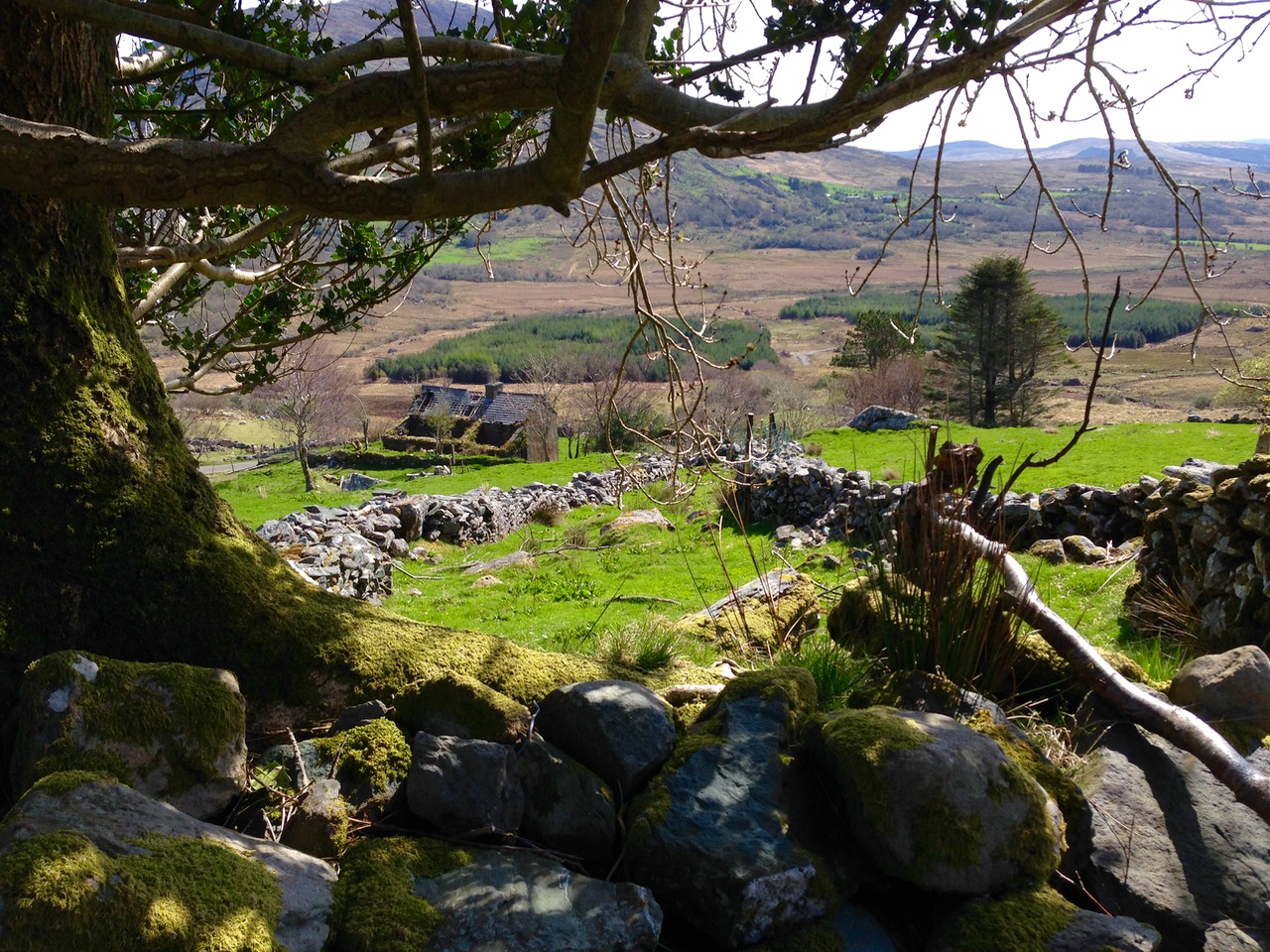
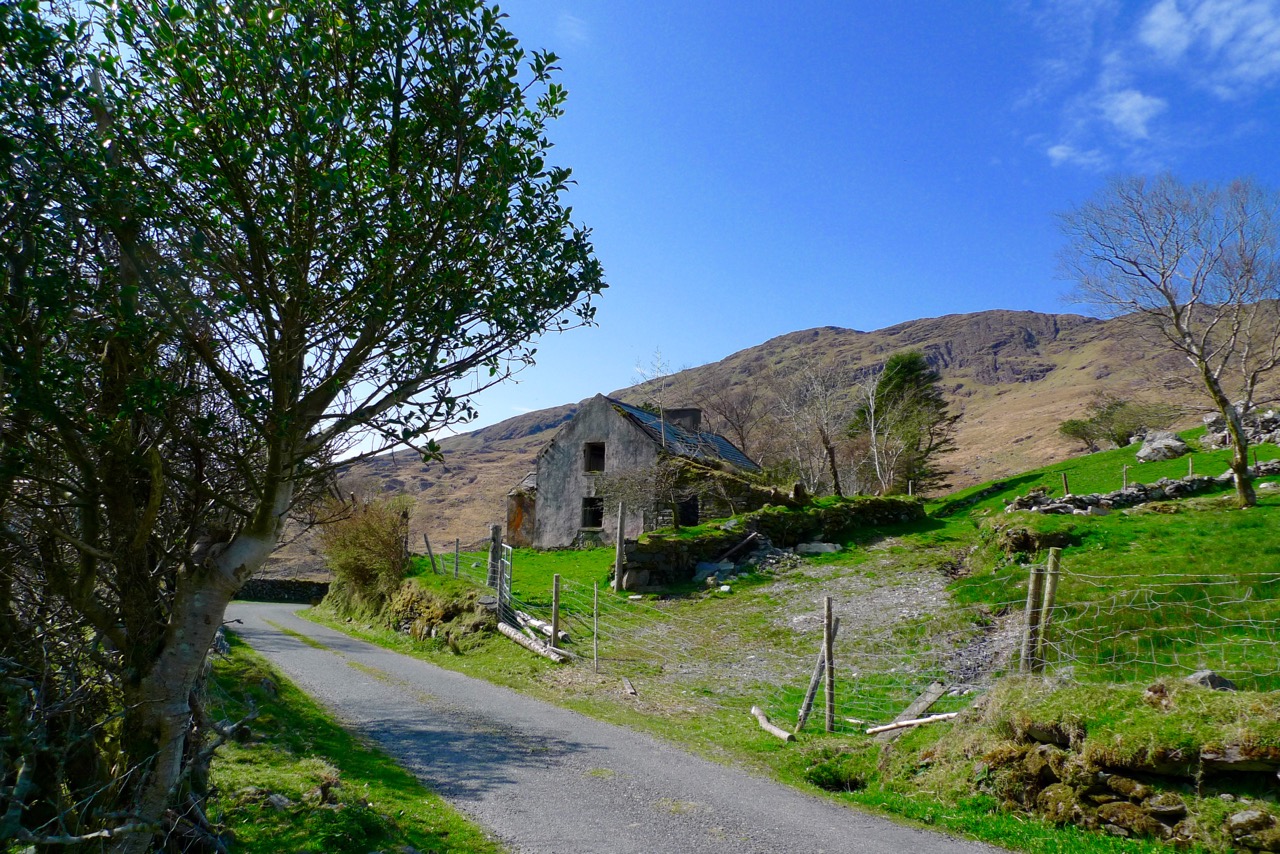
There are some places in this world that touch you deeply in the soul. Derrynablaha has that affect on me. I first went there a few years ago and immediately felt that it was alive with ghosts. I was in search of Rock Art then, and Finola had told me about her experiences in the early 1970s – an intrepid young student on an old Honda 50 loaded down with sheets of cellophane and measuring rods. She had met the O’Sullivans who dwelt in the single farmstead there – they plied her with tea and directed her to the rocks above the house where treasures awaited. When I drove into that valley 40 years later I found only the ruins of the O’Sullivan cottage. It was a poignant moment – the mountains were empty: in some ways it felt like the loneliest place on earth, yet also one of the most beautiful.

The old O'Sullivan farmstead returning to nature

The old O’Sullivan farmstead returning to nature

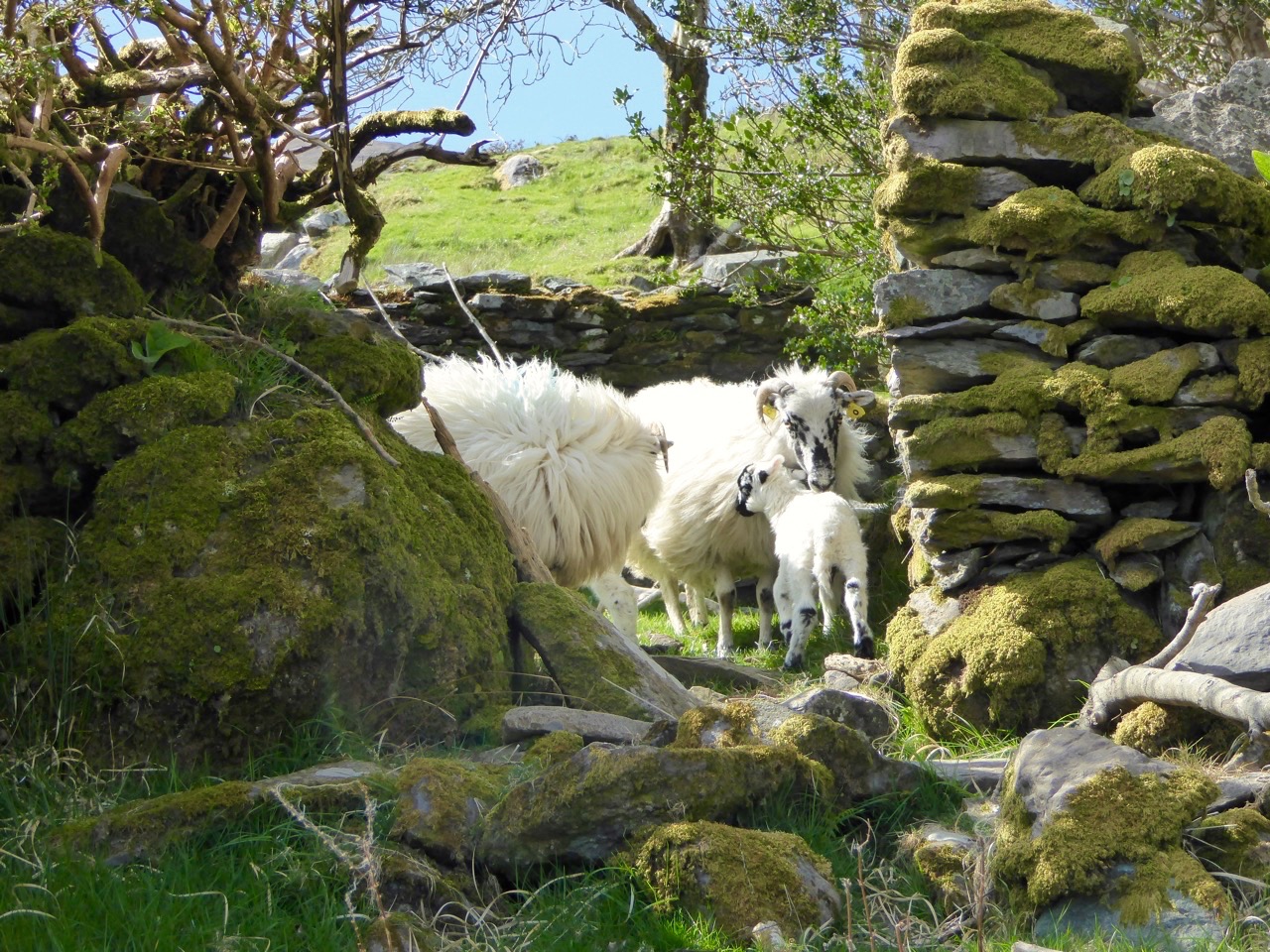
What kind of a beauty is that? A mixtures of lives vanished and nature healing the wounds. Sheep still grazing on those rock-strewn fields: men from another valley tending them – O’Sullivans also, but – they claim – no relation to the last generation there.

New life among the old stones...

New life among old stones…

Those lives are recently gone but, as I first climbed the precipitous slopes to the west of the old farm, I felt the presence of other ghosts – from a more ancient time. It’s a long haul up to the iconic carved stone which commands the wide view across to Lough Brin but, each time I make that journey, I feel more strongly drawn to the people who made that place their home – or possibly their temple.

View from the 'very special' carved stone

View from the ‘very special’ carved stone

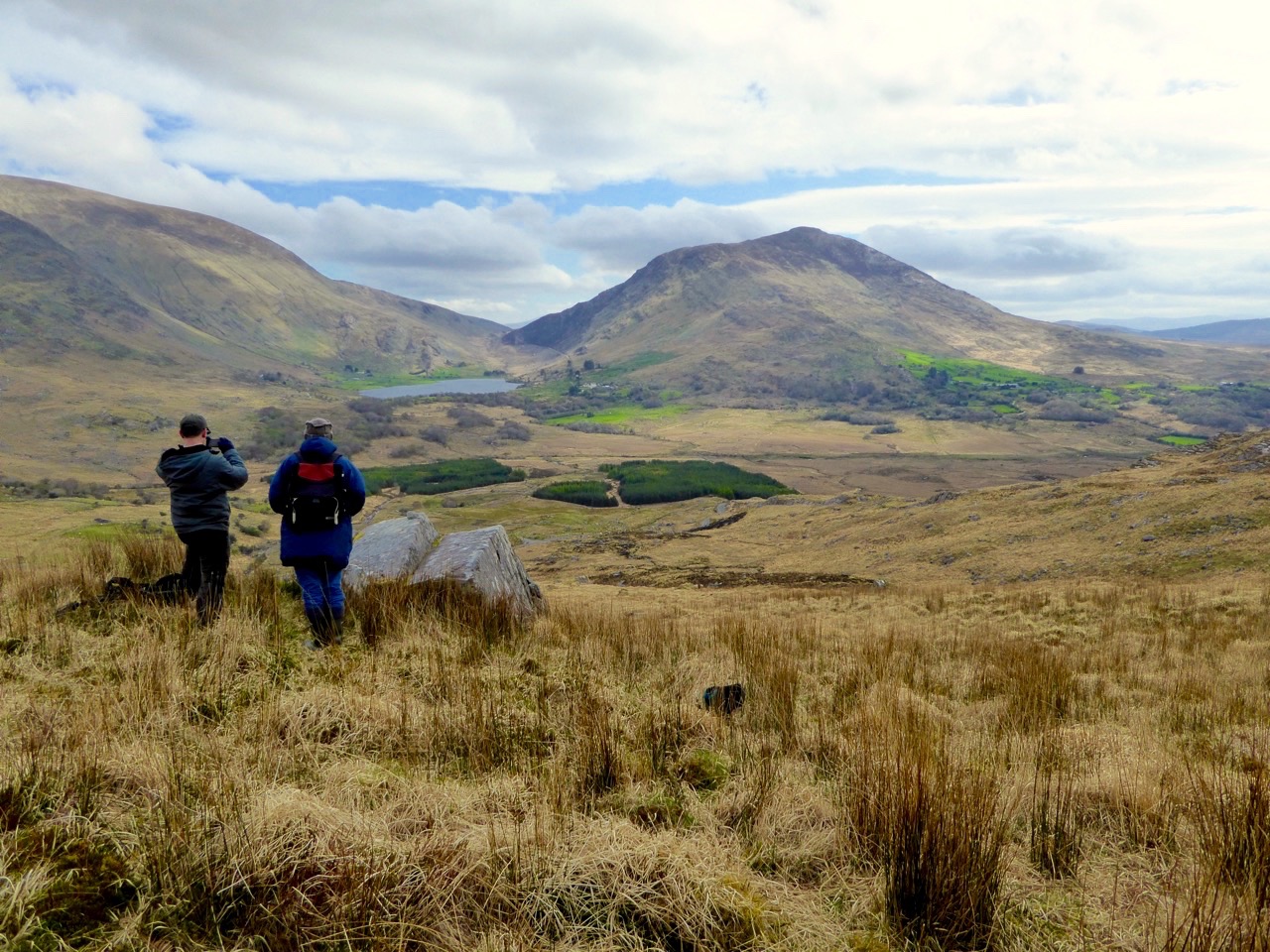
This expedition must have been my fourth visit to the hillside which commands such a magnificent view over the townlands of Derrynablaha and Derreeny and which takes in the lake on the valley floor – seemingly a mere puddle from that elevation yet  in fact covering several hectares. On each visit I find more evidence of prehistoric occupation: on this occasion it appeared to me that the carved stone is sited on the edge of a circular plateau; I could trace old retaining walls below, some circles which could have been hut walls half lost in the undergrowth and – above this site – a wall of boulders which might have dammed the stream which runs down the mountain here, to create a little reservoir. I also saw the vestiges of a wedge tomb – aligned east to west – and the base of a cairn… All this, of course, is my imagination at work, but it’s a place where the imagination can take wing.

sky pan

Panoramas from the plateau - east and west

Panoramas from the plateau – east and west

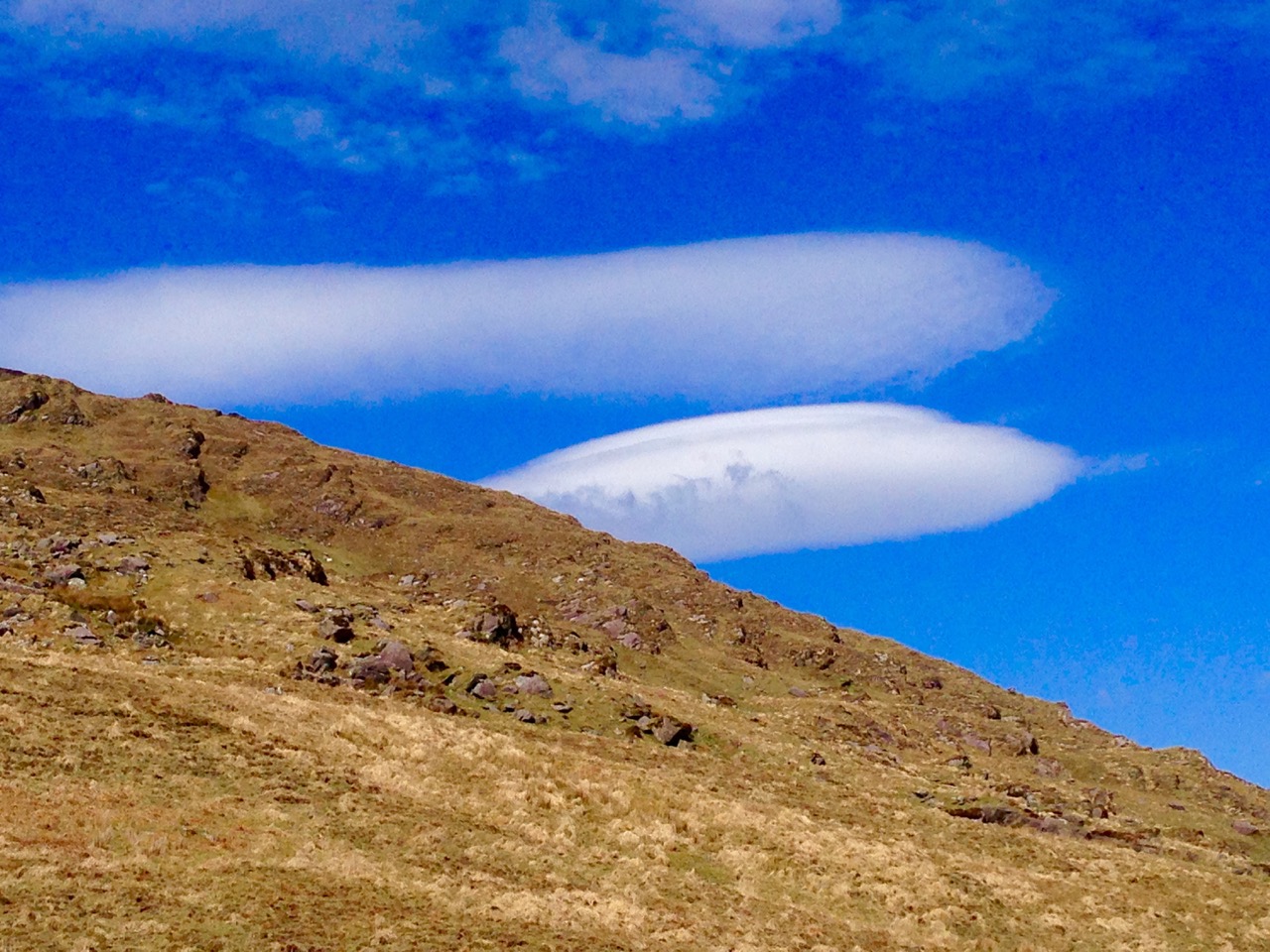
I have so many questions… Was there once tree growth at this level? Derrynablaha means ‘little oak wood of the flowers’ – I imagine something like the stunted oak forests on Dartmoor, where the ancient trees are gnarled and twisted from the ravages of a harsh climate, but which cling to the rocky terrain. But possibly the plateau was raised above this – a place where visibility over the whole landscape was important and visitors anticipated in advance. In my dreams I see fires burning up there in the night, figures dancing, songs being sung… Are they really Wolves and Deer I see moving around the fires, or are they my own ancestors wearing grotesque masks?

clouds

Dream clouds?

Why shouldn’t I have these thoughts? After all, technology might have changed over 5,000 years – but our minds haven’t. It’s not so hard to try and understand our forebears: I like to think they appreciated the power of the pristine landscapes which they inhabited – just as we are awed by the magnificence of their old haunts as we see them today.

Wedge tomb on the plateau?

Wedge tomb on the plateau?

And did those feet…

We discovered St Patrick in Glastonbury!

We discovered St Patrick in Somerset!

Finola had never been to Glastonbury, so I thought a visit on our way back home to Ireland was in order. Like me, she found the town itself fascinating: every shop seems to have a ‘mystic’ theme, and even the coffee is imbued with an otherworldly aura…

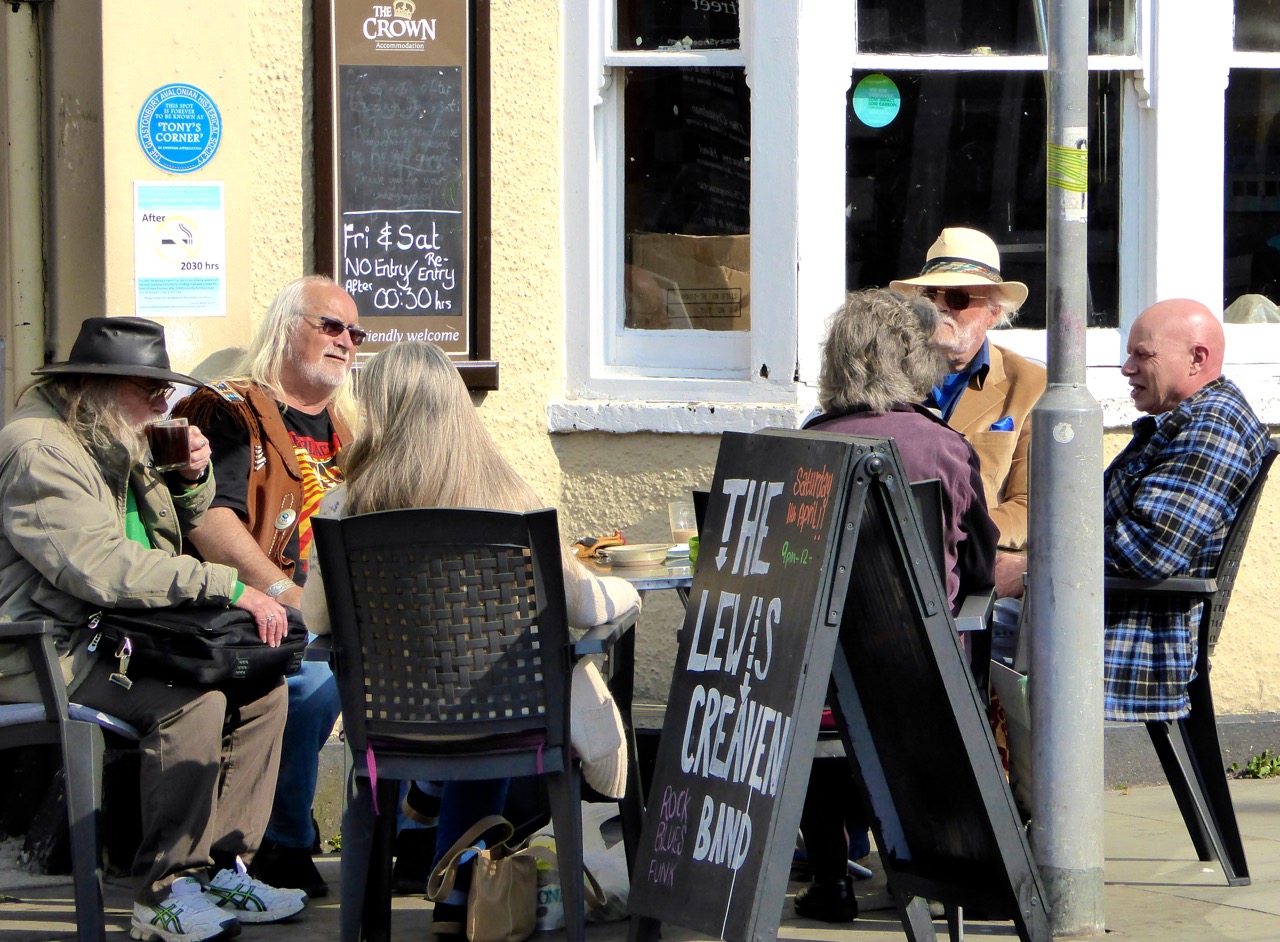
Coffee time in Glastonbury

Modern Pilgrims? Coffee time in Glastonbury

Why is this Somerset town so steeped in esoterica? It attracts ‘New Age’ adherents, pagans and Christians. Perhaps because it was a place of pilgrimage centuries ago – one of the most important in Britain. The biggest surprise for us was to find a chapel there dedicated to St Patrick!

St Patrick's Chapel - one of the earliest buildings at Glastonbury

St Patrick’s Chapel – one of the earliest buildings at Glastonbury

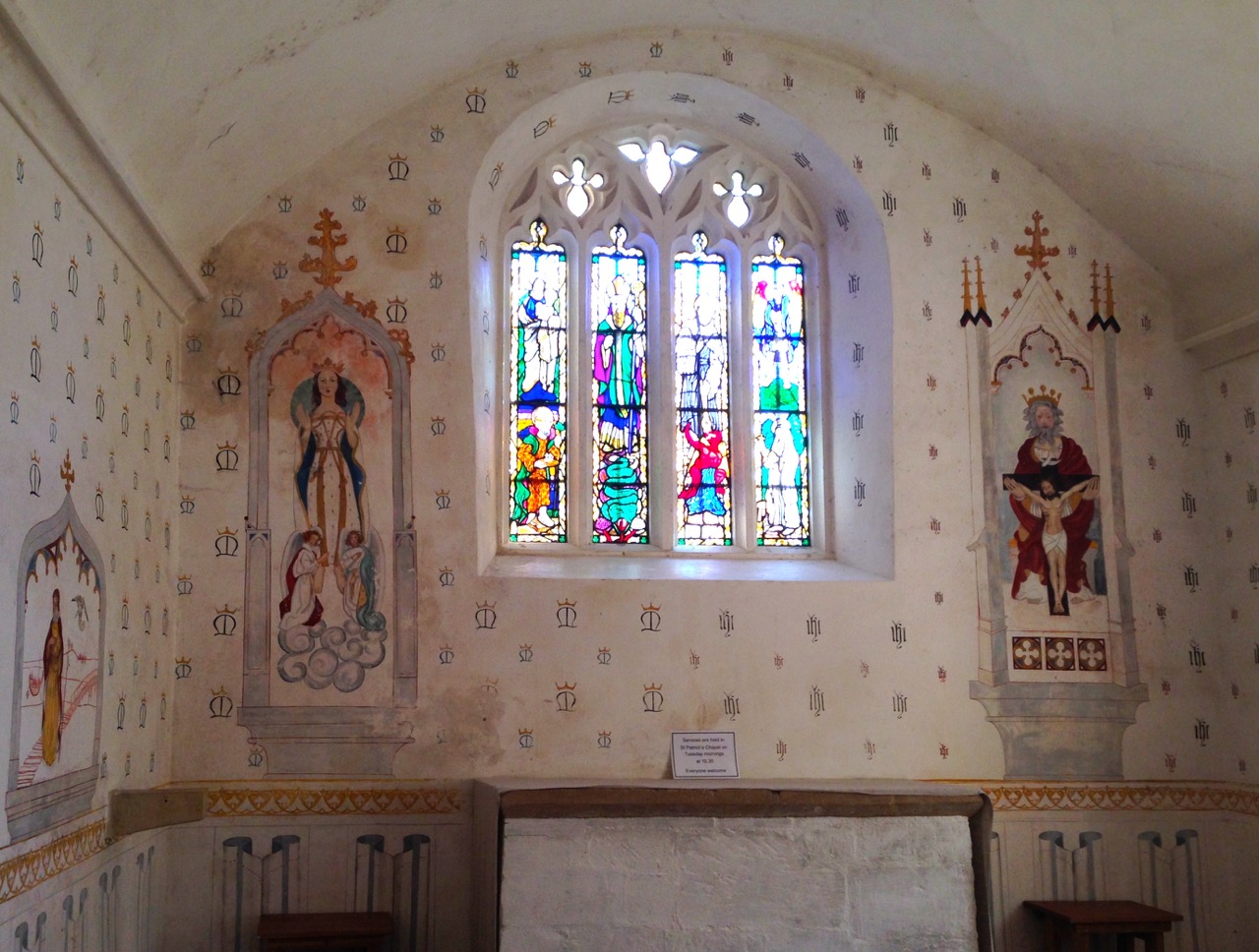
Inside St Patrick's Chapel

Inside St Patrick’s Chapel

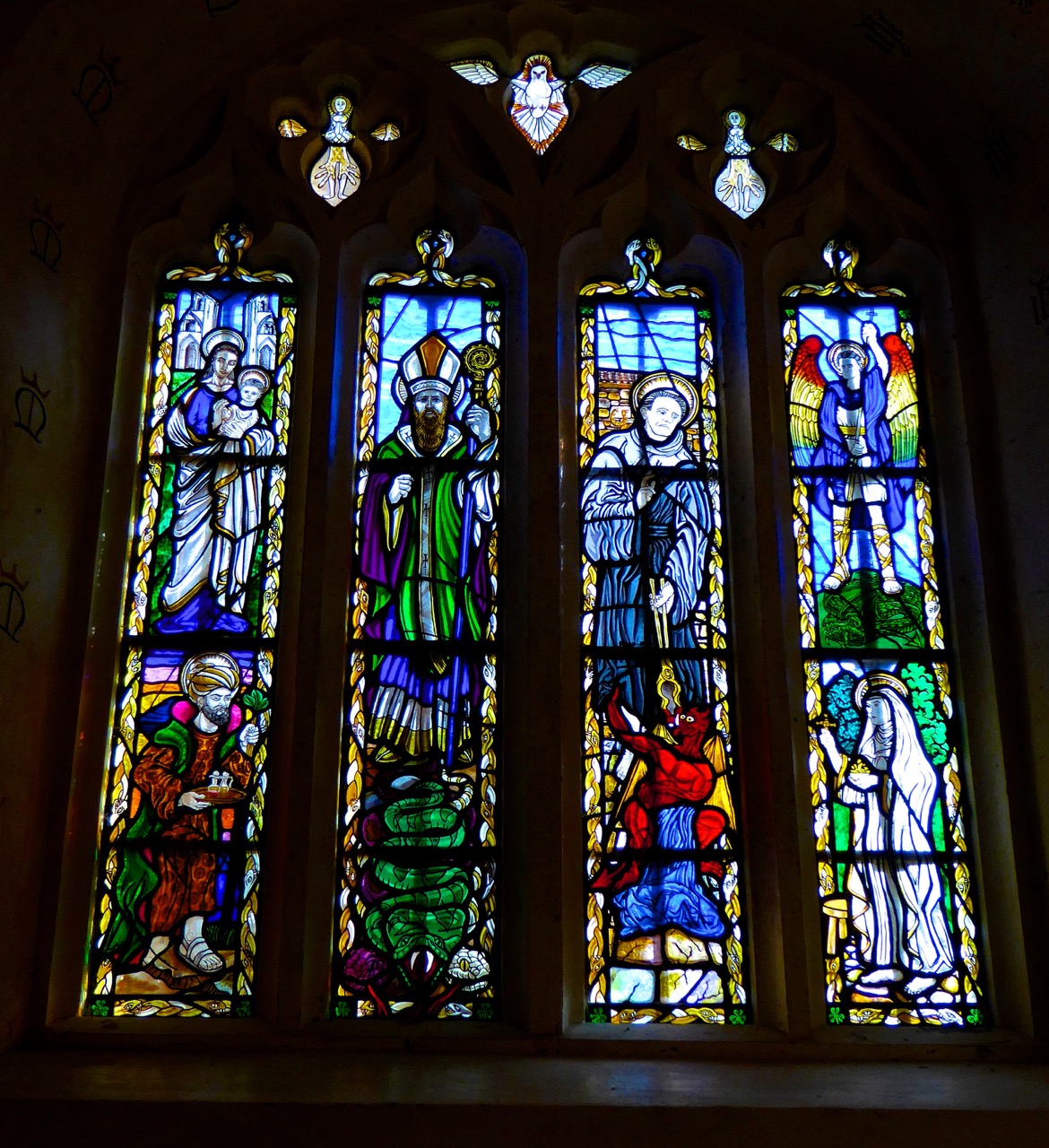
The chapel is in the grounds of Glastonbury Abbey and – like the Abbey itself – the little building has had a chequered history. It is well preserved, however, although the wall paintings and glass are from a modern renovation.

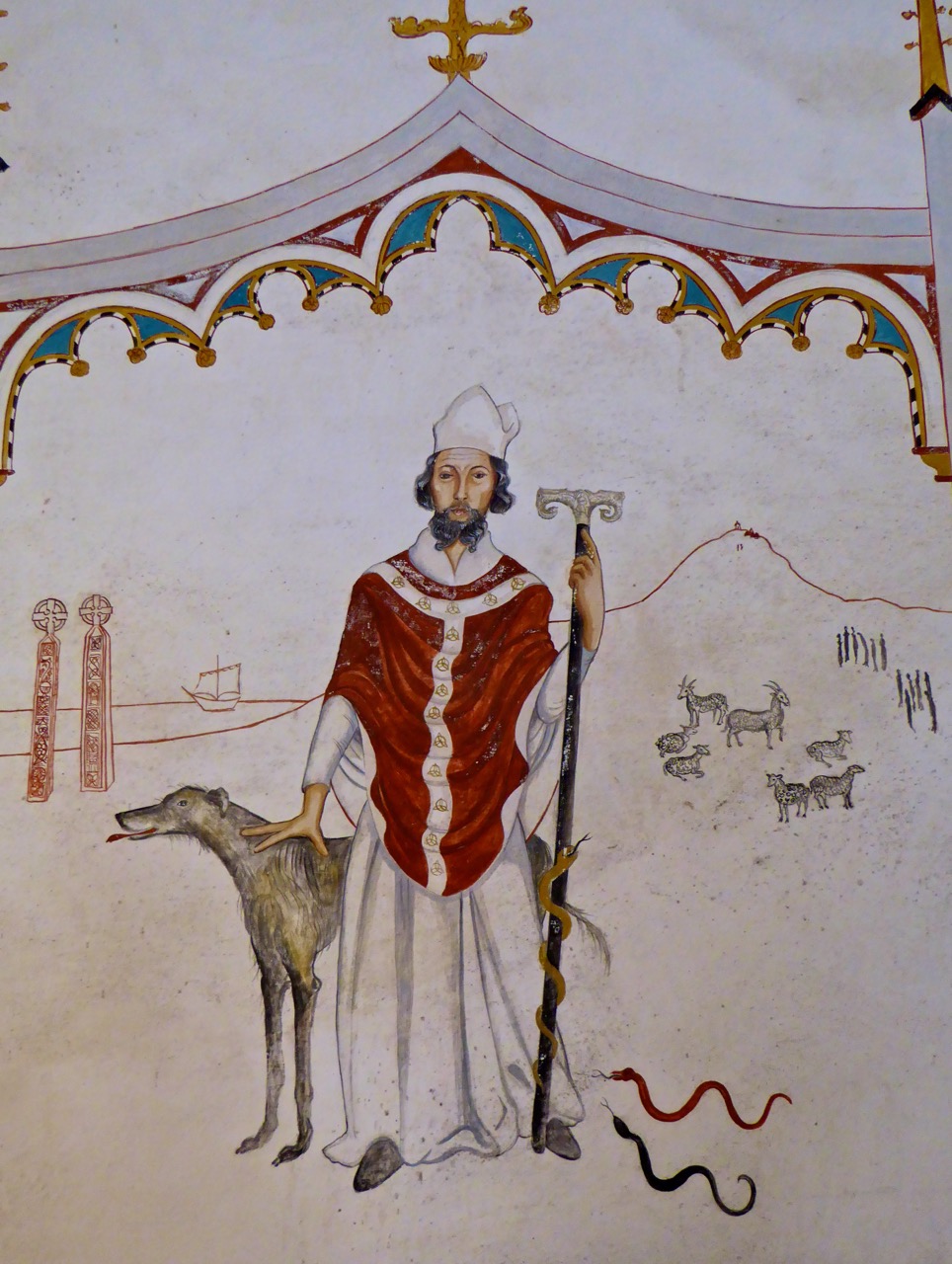
The chapel window - note St Patrick's wonderful snake!

The chapel window – note St Patrick’s wonderful snake!

Glastonbury is a place of history and of legend. The most important of these has to be the one that William Blake immortalised in his poem Jerusalem:

And did those feet in ancient time walk upon England’s mountains green…

‘Those feet’ are the feet of Jesus himself who – tradition insists – was brought to this site as a boy of twelve by his great-uncle, Joseph of Arimathea, a tin trader. Jesus in Britain? No wonder the Abbey was such a glorious place, and a rich and powerful one in medieval times. Even in ruins, the buildings have a presence and elegance which for me is unmatched in any of the other ancient monastic sites I have visited. With that history there couldn’t be anywhere more important outside of the Holy Land.

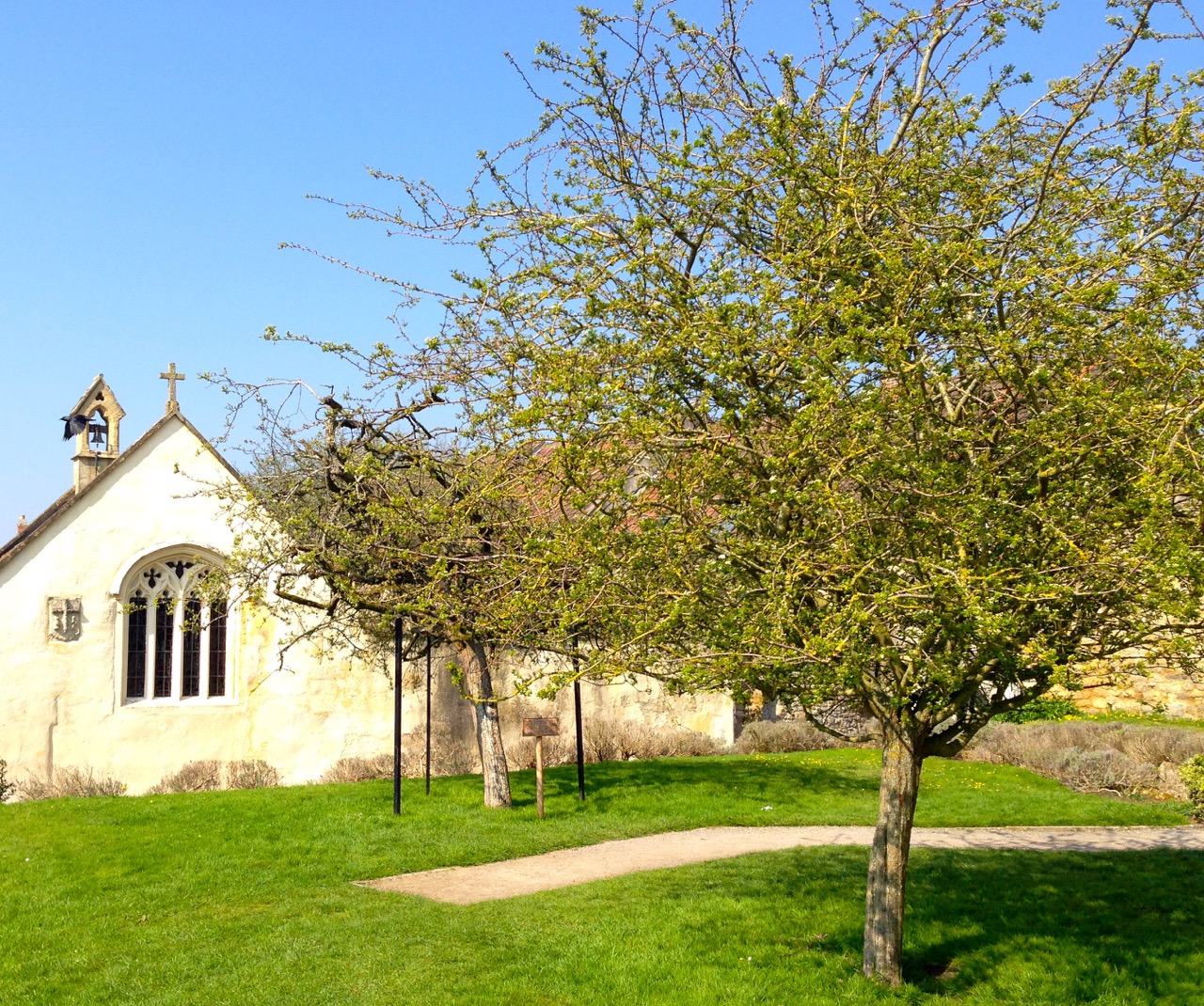
Back to the story – When Joseph landed on the islands that were Somerset in those days, he climbed to the top of Wearyall Hill and planted his staff there. It took root and grew into a thorn tree. Magically, that tree always flowered on Christmas Day. The original thorn has gone from the hill, but cuttings have been taken over time and they exist elsewhere: one such is within the Abbey grounds, just outside St Patrick’s Chapel. They still flower on Christmas Day, and the Queen is always sent one of the blooms.

Glastonbury's Holy Thorn, planted by Joseph of Arithamea

Glastonbury’s Holy Thorn, planted by Joseph of Arithamea

A tradition tells us that St Patrick grew weary of his work in Ireland and returned to Britain in old age. He went to Glastonbury because of its importance, and he was joined there by a band of monks who elected him their Abbot. After a few years he died and was buried in the Abbey grounds. Other important visitors here included St Brigid – who is pictured milking her cow on the wall of St Michael’s Tower on the Tor. St Brigid is also considered a Goddess – suitable for a town in which Paganism and Christianity seem to co-exist quite happily.

Typical Glastonbury shopfront

Typical Glastonbury shopfront

St Brigid - another Irish Saint in Glastonbury

St Brigid – another Irish Saint in Glastonbury

The stories go on and on: a multitude of Saints is buried around the Abbey evidently – and the Virgin Mary herself visited – with her Uncle Joseph – and (some say) is also buried there…

We musn’t forget another Glastonbury VIP – King Arthur. In the twelfth century the grave of Arthur and Guinever was found by monks when carrying out restoration works in the nave of the Abbey. This added to the notoriety – and the fortunes – of the monastic establishment…

sign

Missing Rossbrin


Roaringwater Journal is in England for a family wedding. No post this week. We are having a wonderful time but missing our favourite view.