In Search of Wells and Railway Lines

We are often invited to join our friends Amanda and Peter Clarke on their journeys of exploration into the wild places of West Cork and Kerry. We even stray over into Limerick on occasion! And it’s usually all to do with Holy Wells. Amanda has been writing about them for years, and you can find her accounts of them in Holy Wells of Cork & Kerry, here.
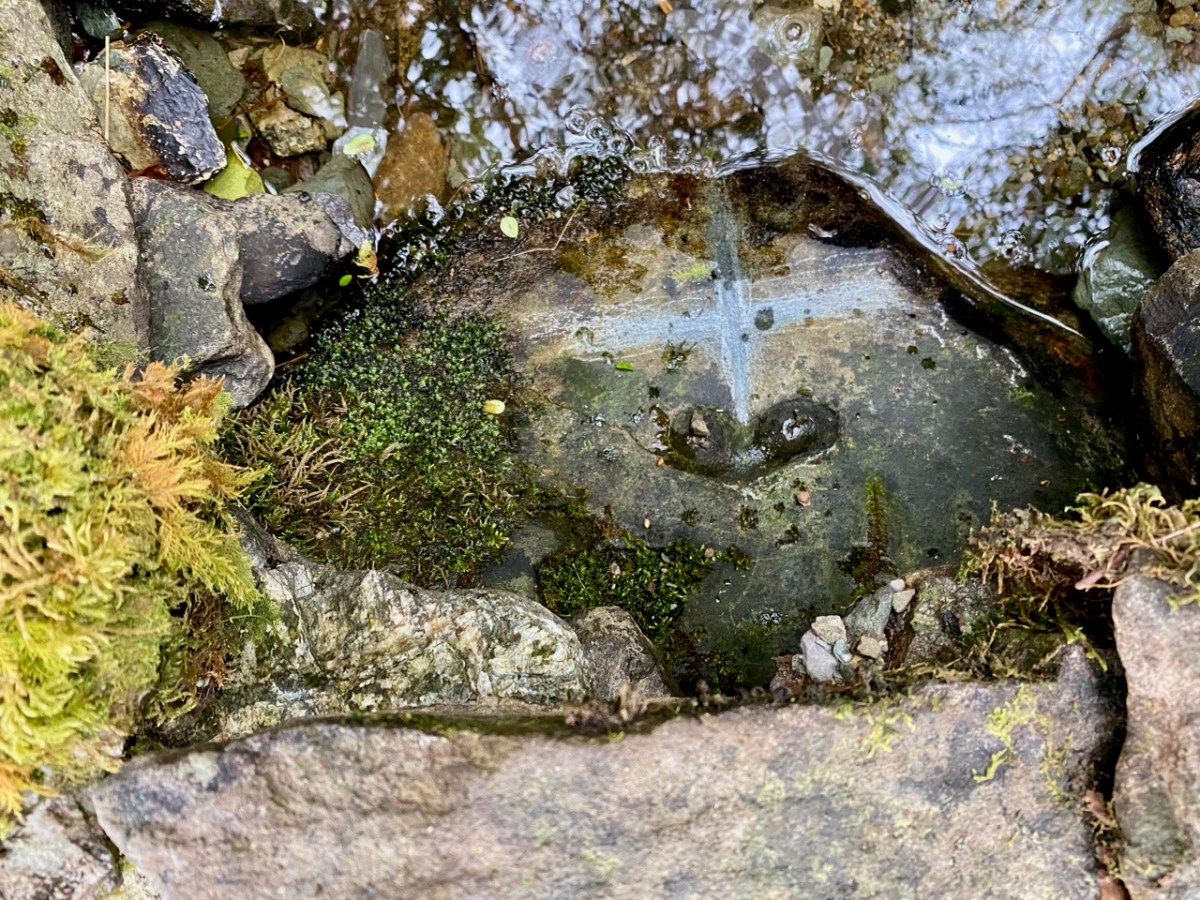
Recently we were at Loo Bridge, near Kilgarvan, Co Kerry. There’s a well there – Tobar na Naomh – All Saint’s Well, and there’s a lively account of it in the Dúchas Schools Folklore Collection. Evidently a ‘band of Saints’ travelling over the mountain to Gougane Barra stopped at this well for refreshment. One of them (St Finnbarr) left his spectacles behind and didn’t realise it until he was a long way up the steep path. Fortunately, there were so many of his companions that he was able to pass a message back down to those who were still starting off from the well and the spectacles were retrieved! But – because they were holy spectacles, they left their imprint on the rock at the well – forever. There it is in the picture above.
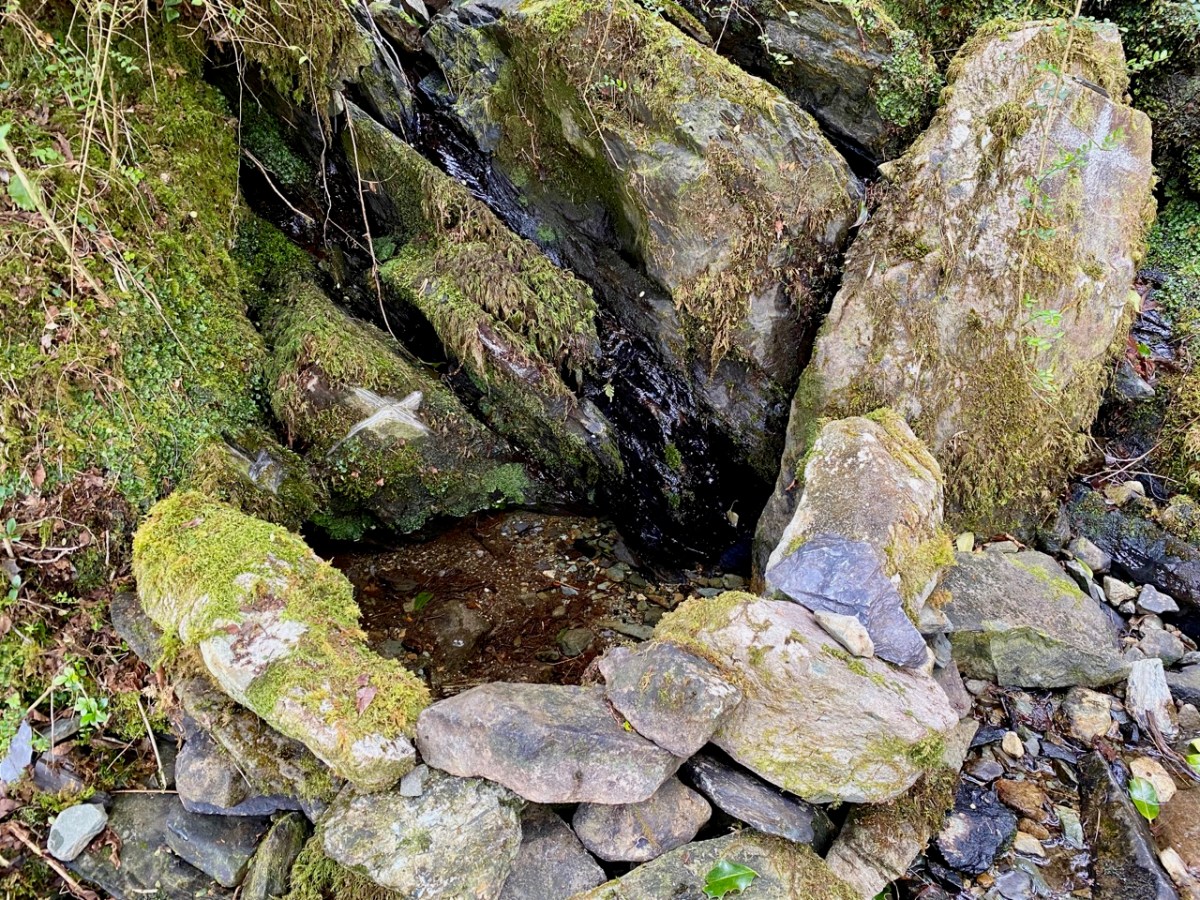
There are several crosses etched into the stones around this well by visitors. It’s wonderful to think of the continuity of those pilgrims seeking out the well and keeping its veneration alive – probably through countless generations.
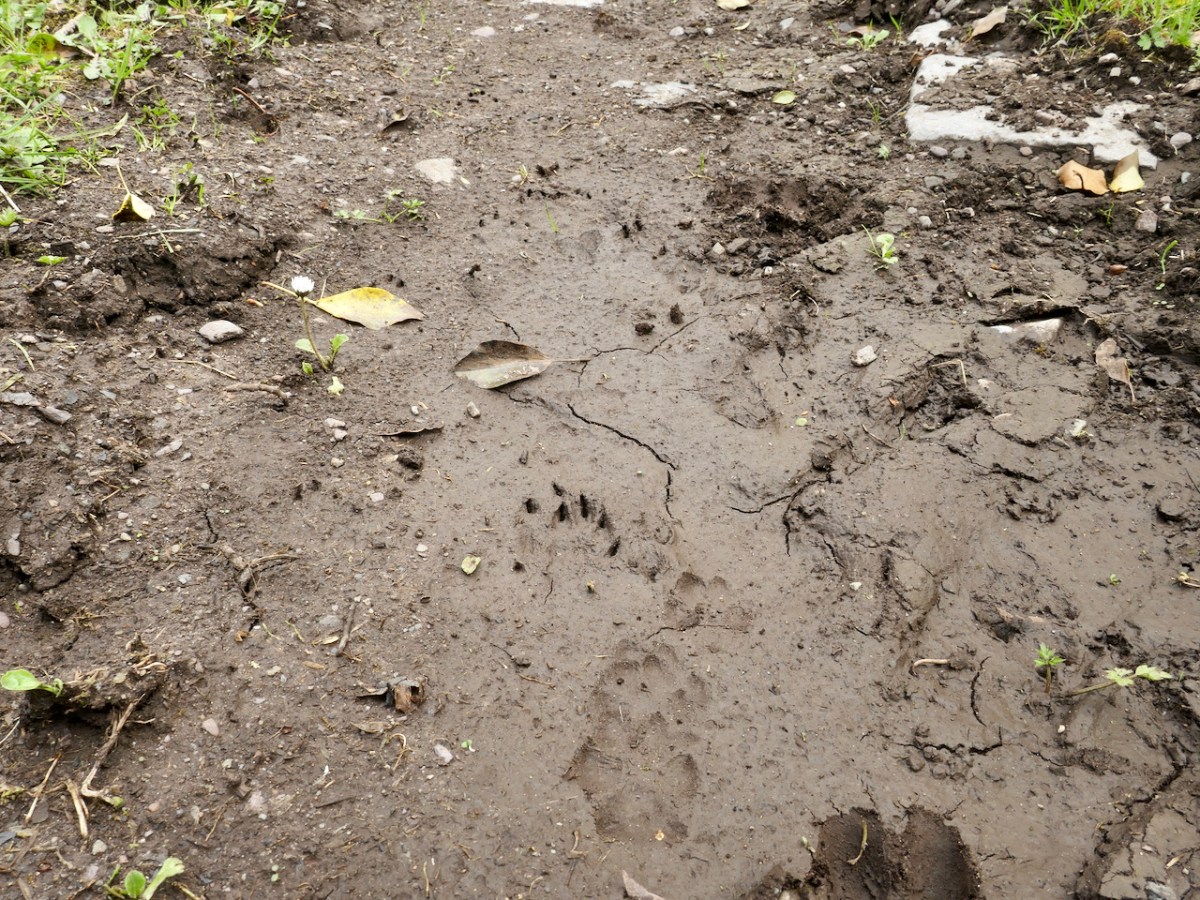
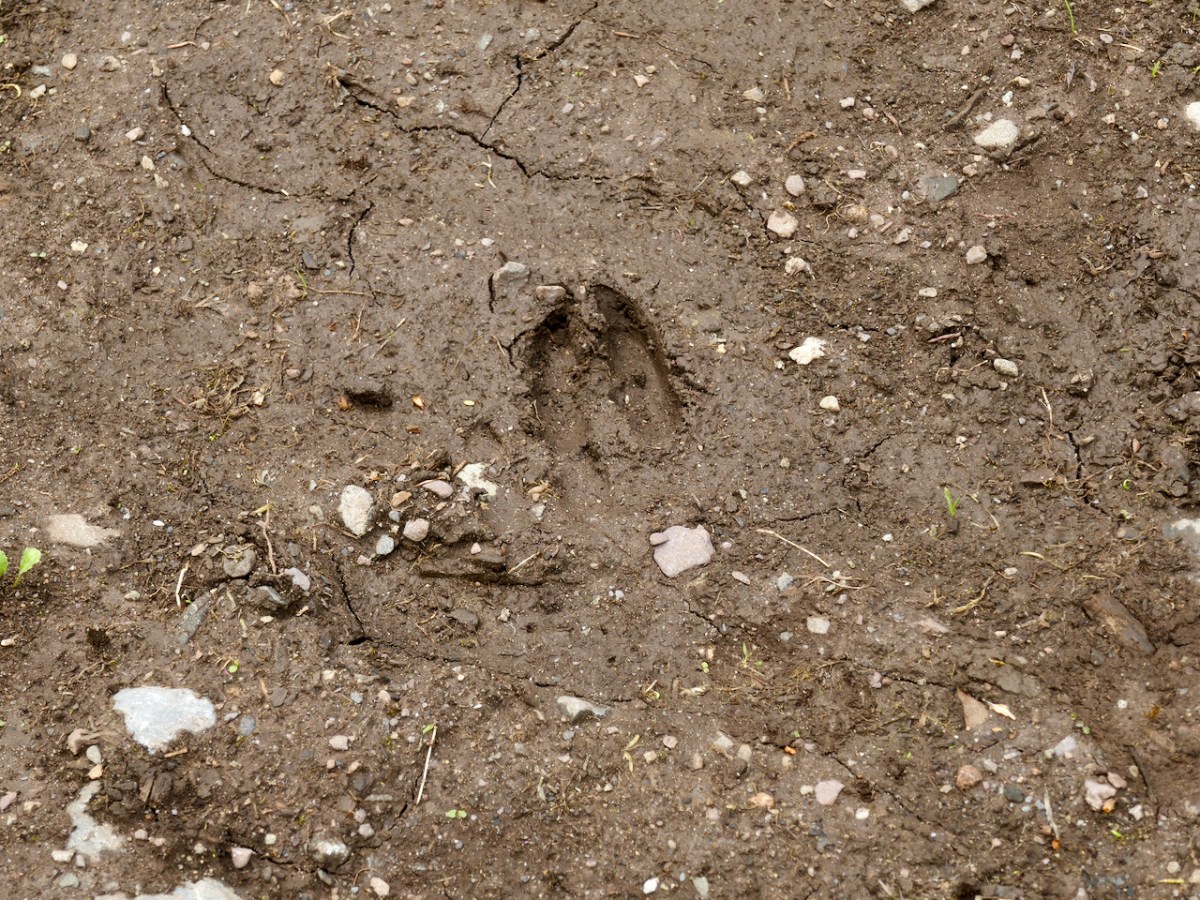
Another well on our agenda involved us walking over a long, muddy trackway. We could see the prints of the feet of other travellers: the top pic looks like bear paws (although perhaps more likely to be badgers), whereas the cloven hoof above is either Satan or a deer. We met none of these on the path that led, eventually, towards the Wells of St Peter and St Paul.
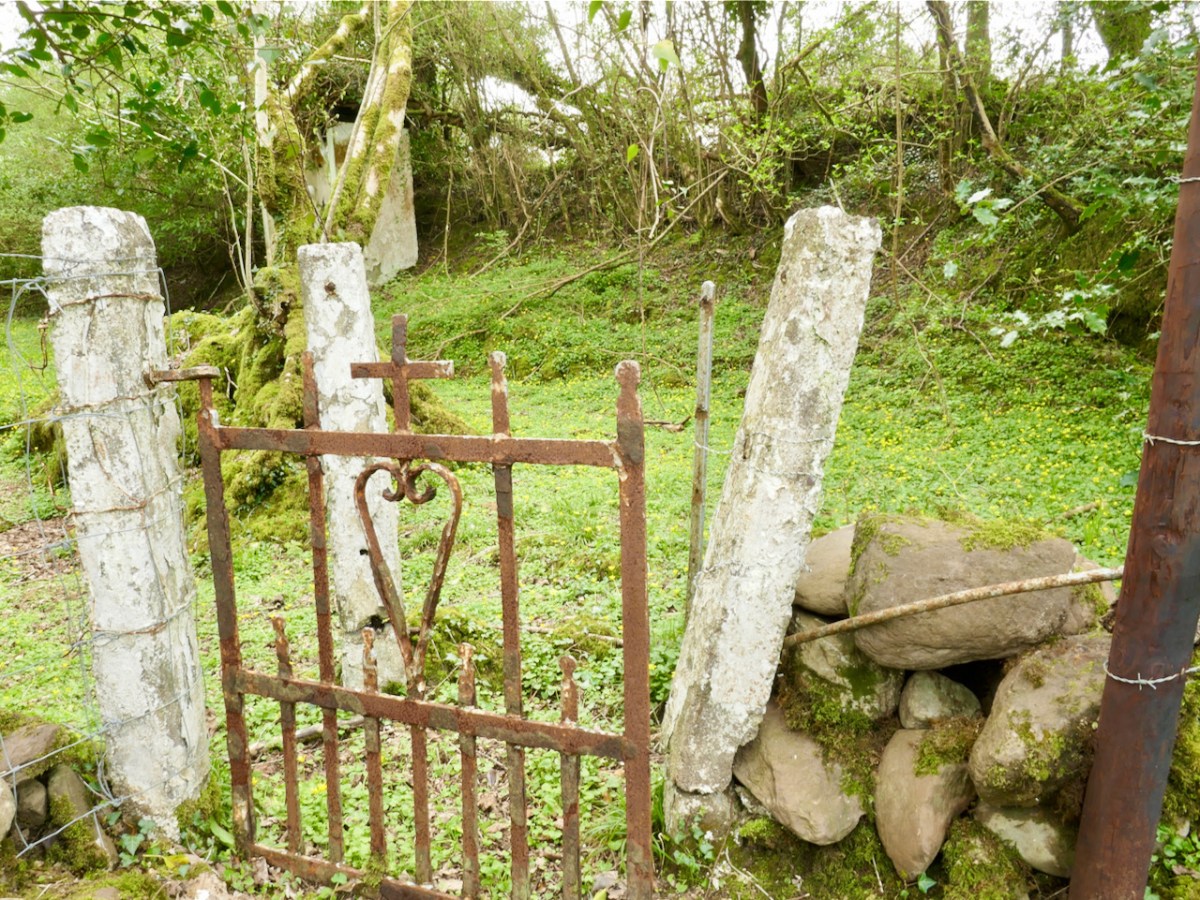
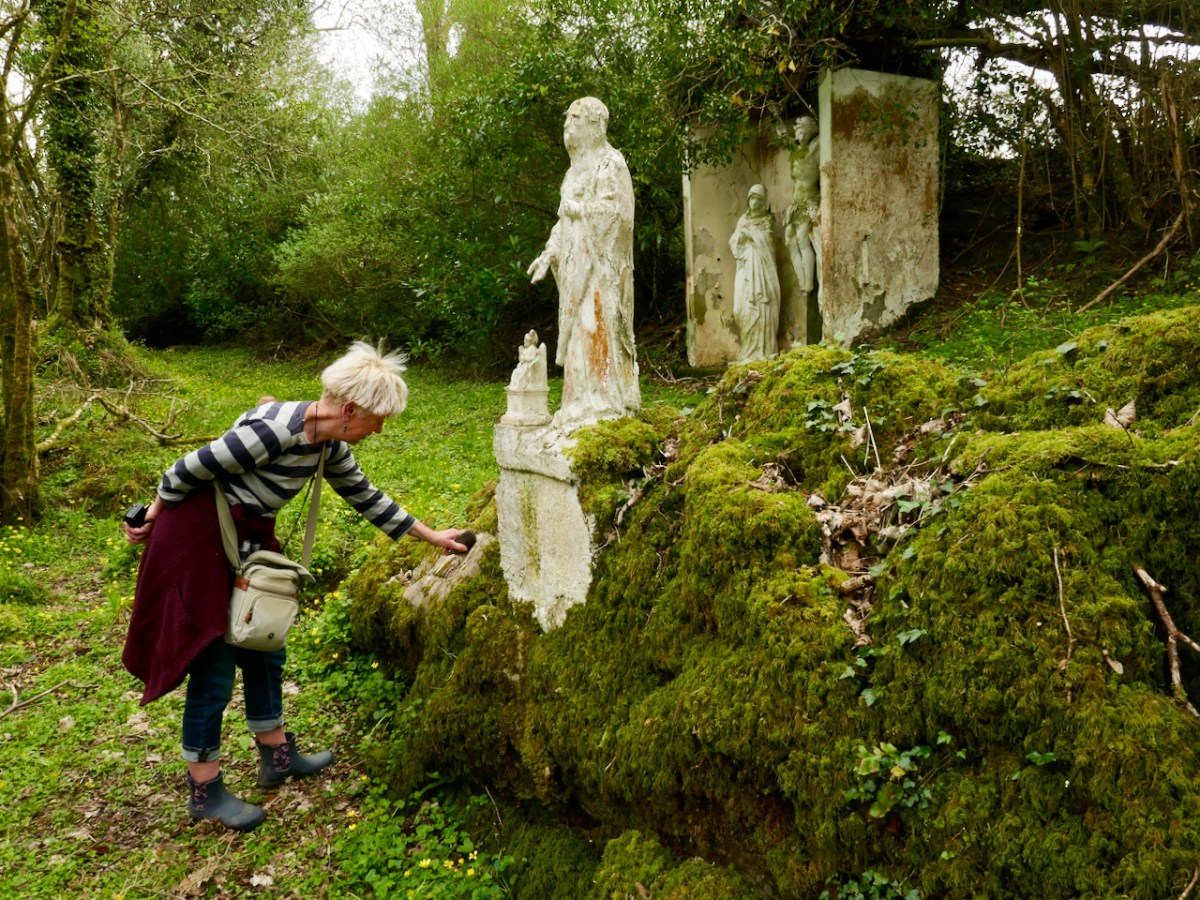
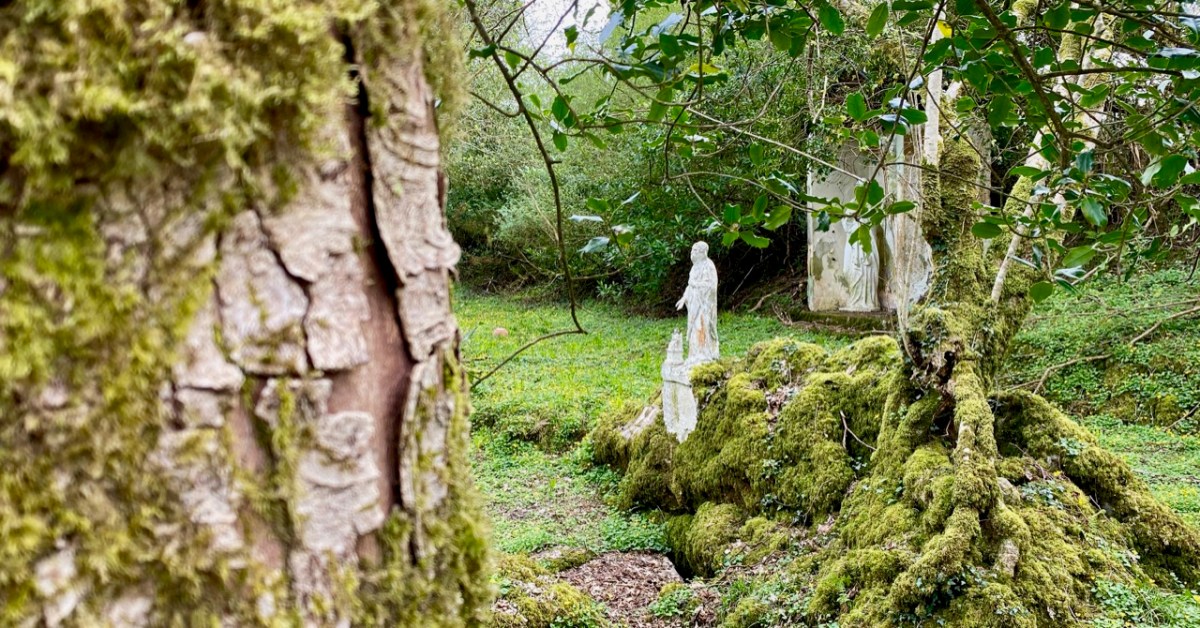
St Peter’s well is clearly defined (above, with Amanda looking on). Beyond it is a weather-worn shrine with a Calvary depiction. It’s quite a surprise to find such a substantial life-sized scene in a remote wood.
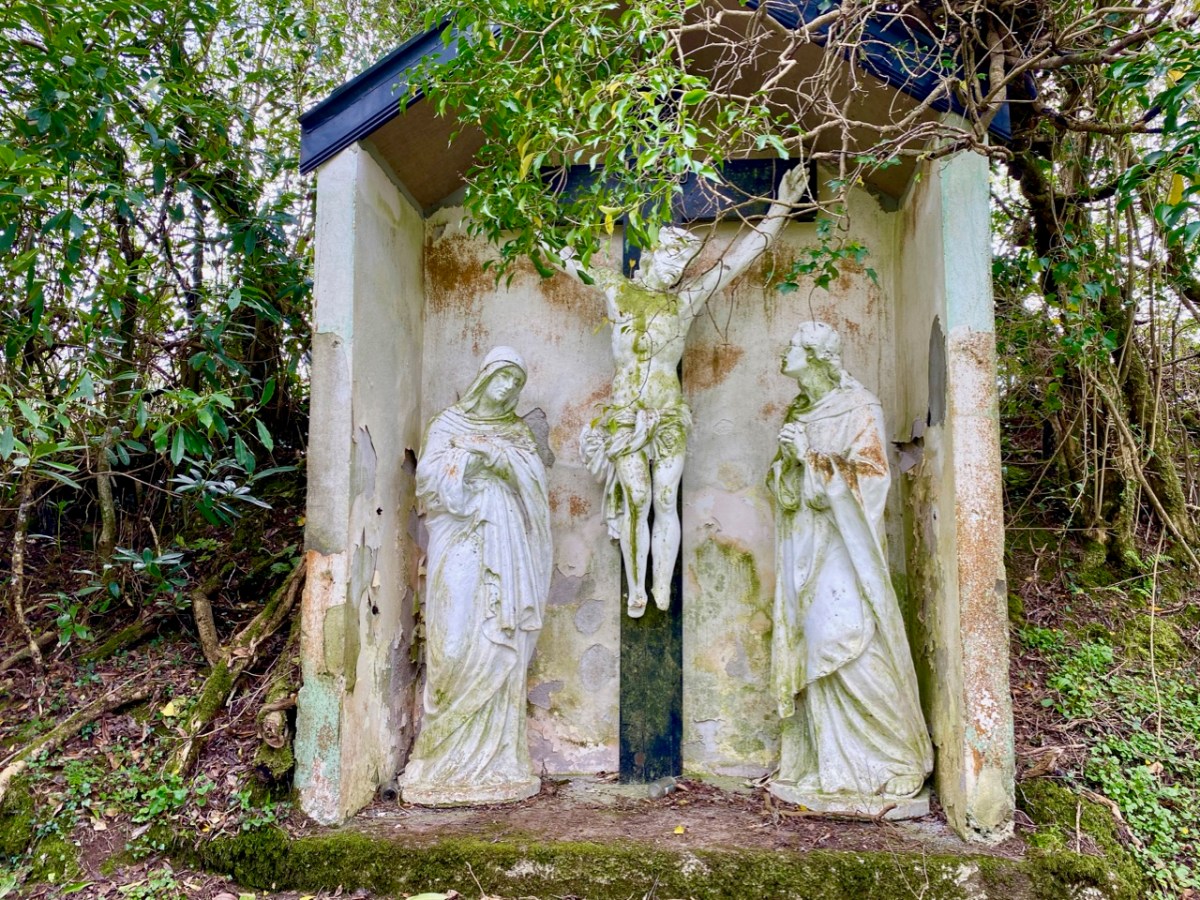
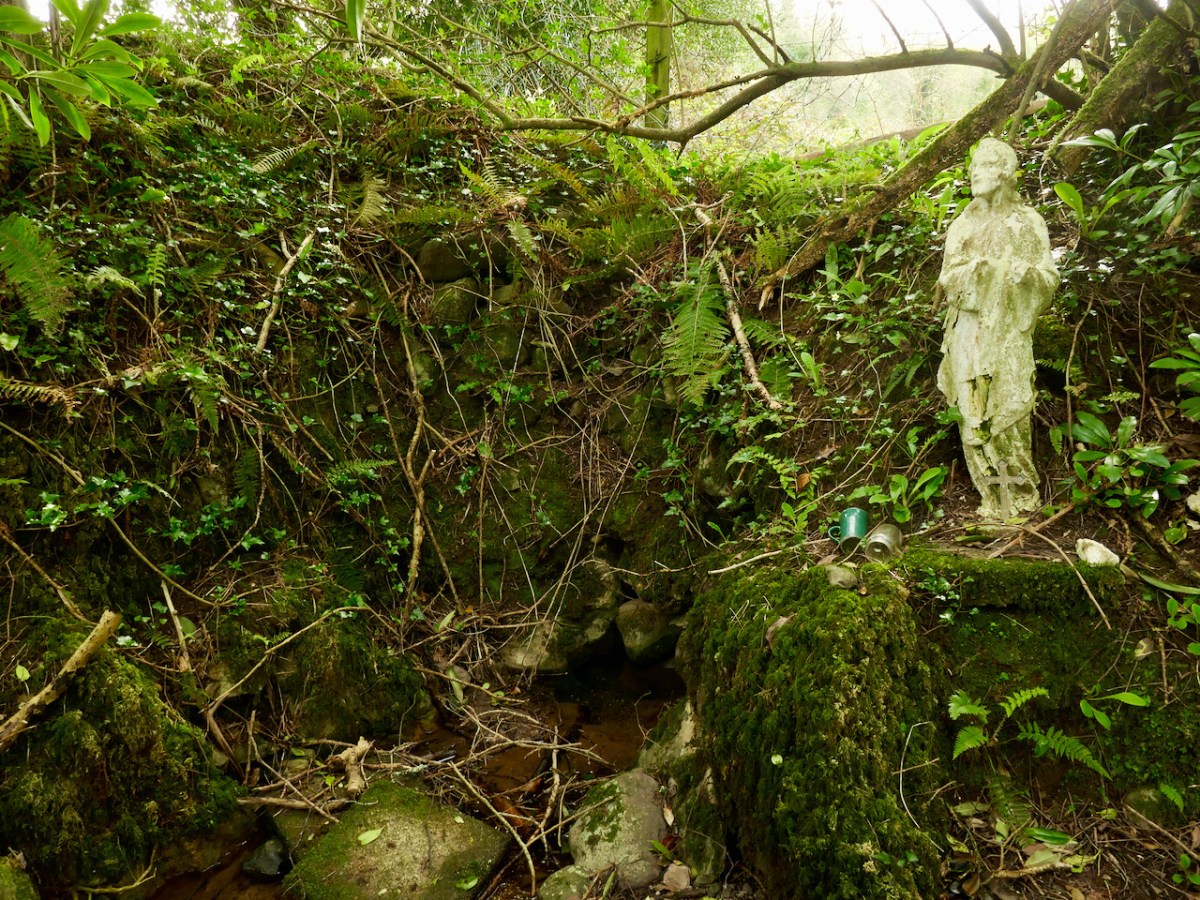
A little way to the east of St Peter is St Paul (above). He looks down on his own well. Note the modern mugs, implying that the well is still in use.
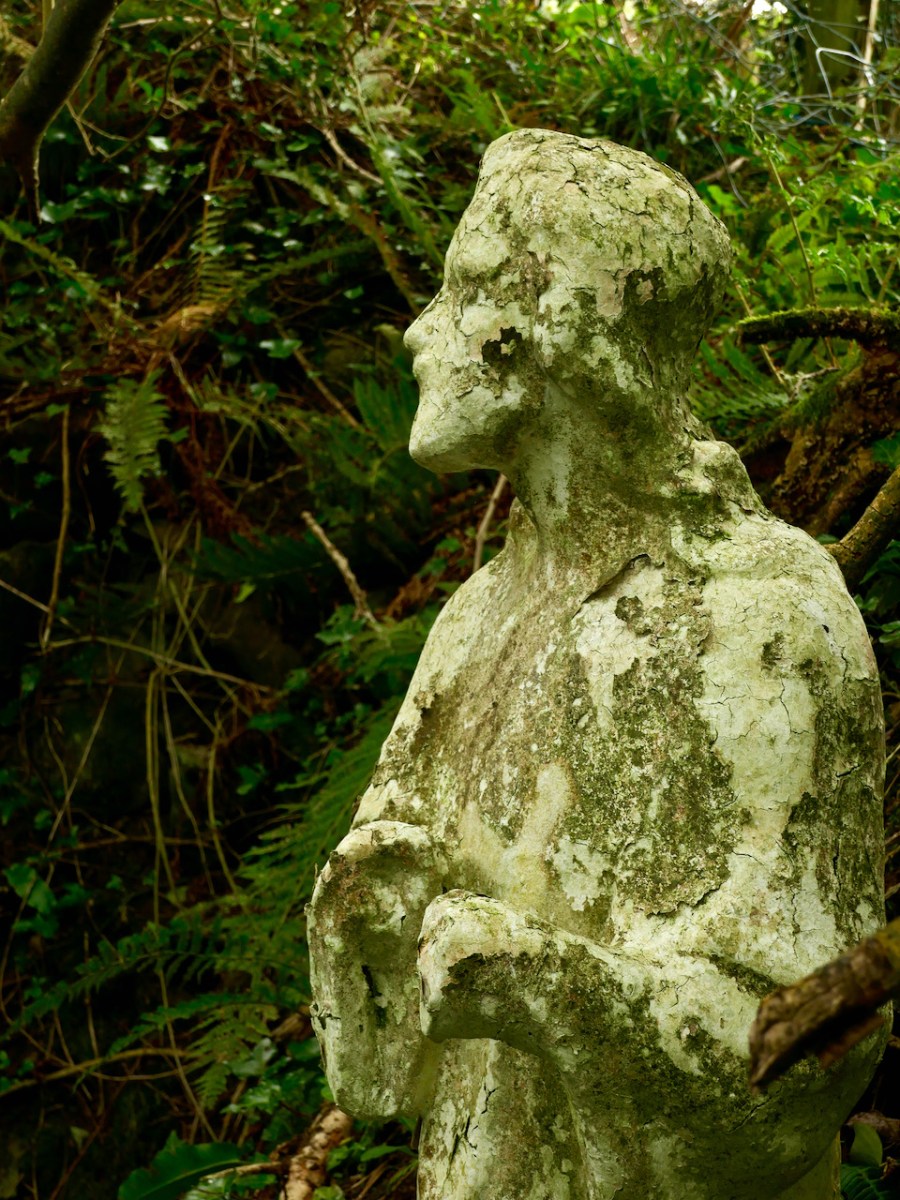
Both St Peter and St Paul share their feast day on 29th June. This is the day when these wells should be visited.
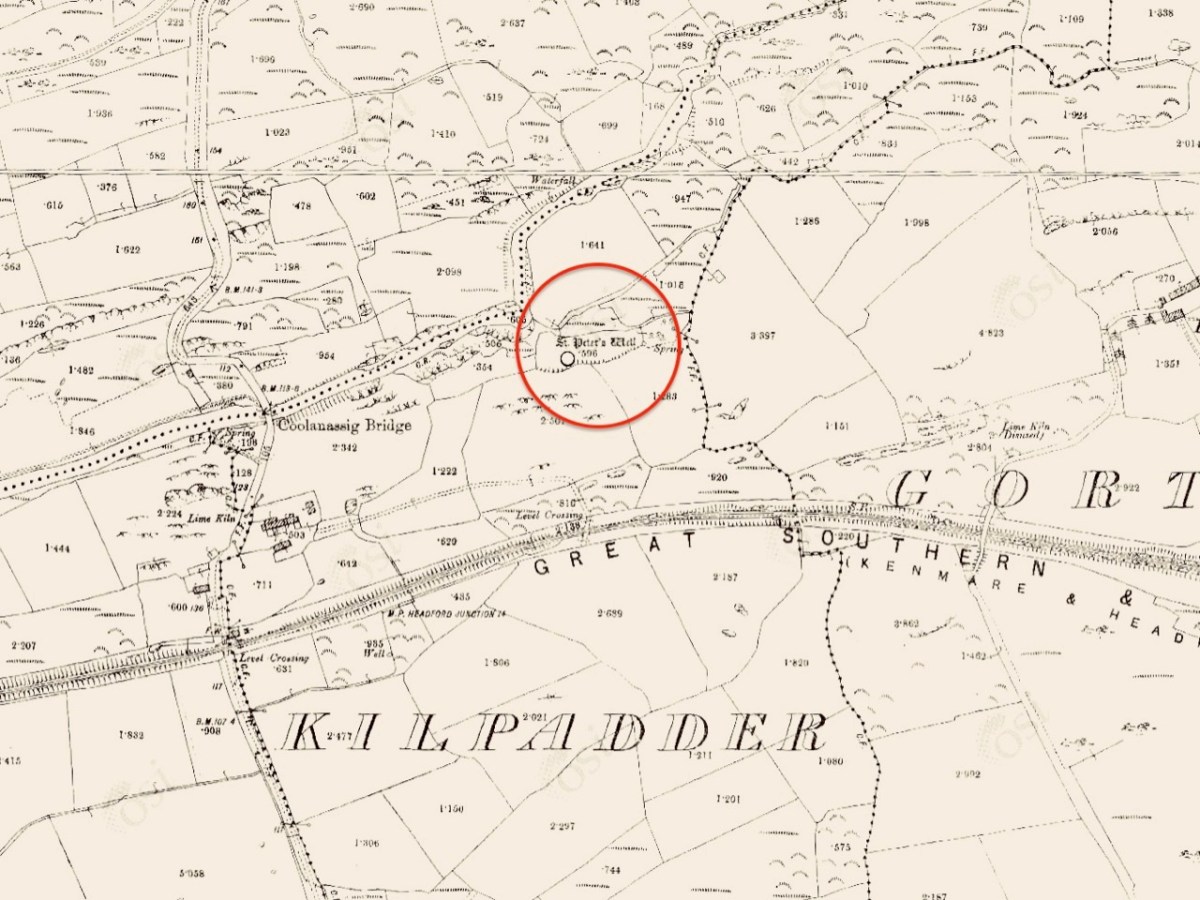
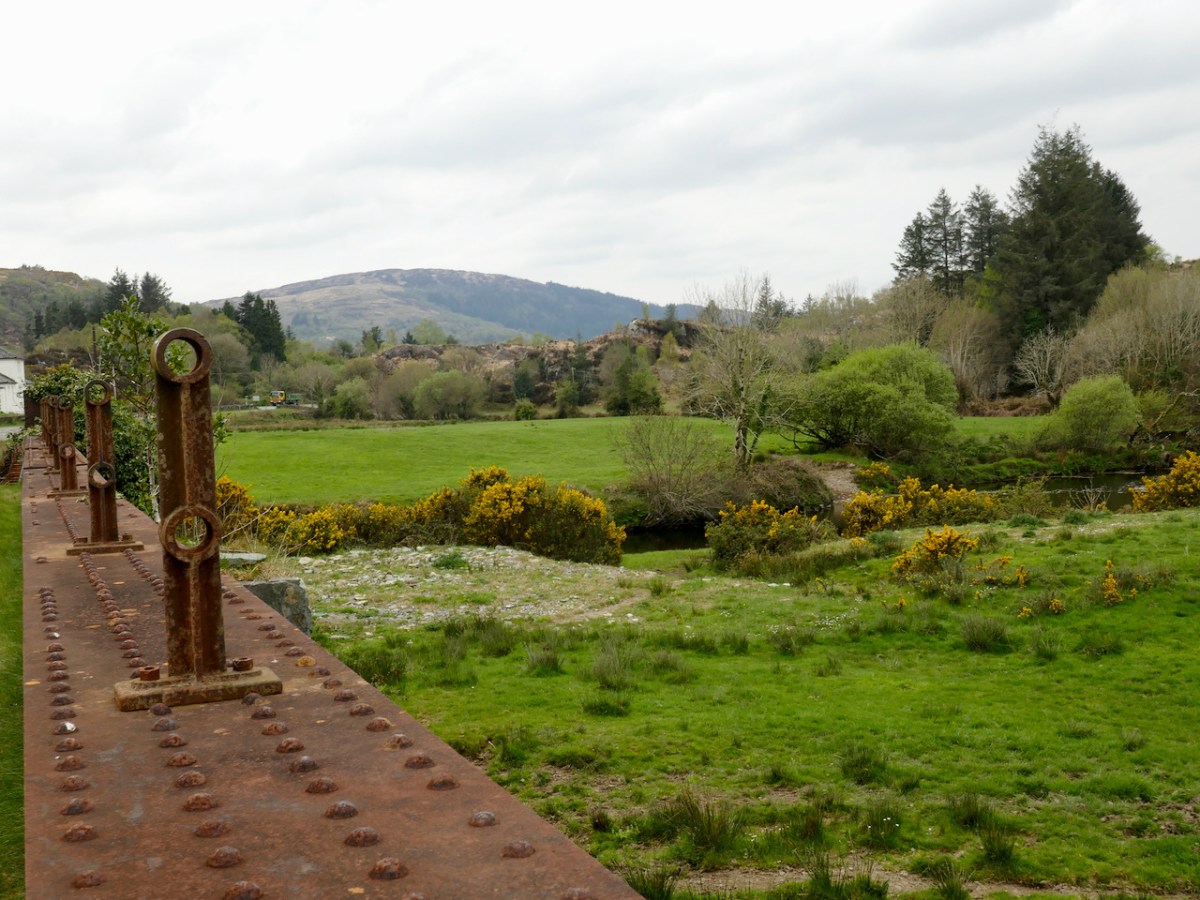
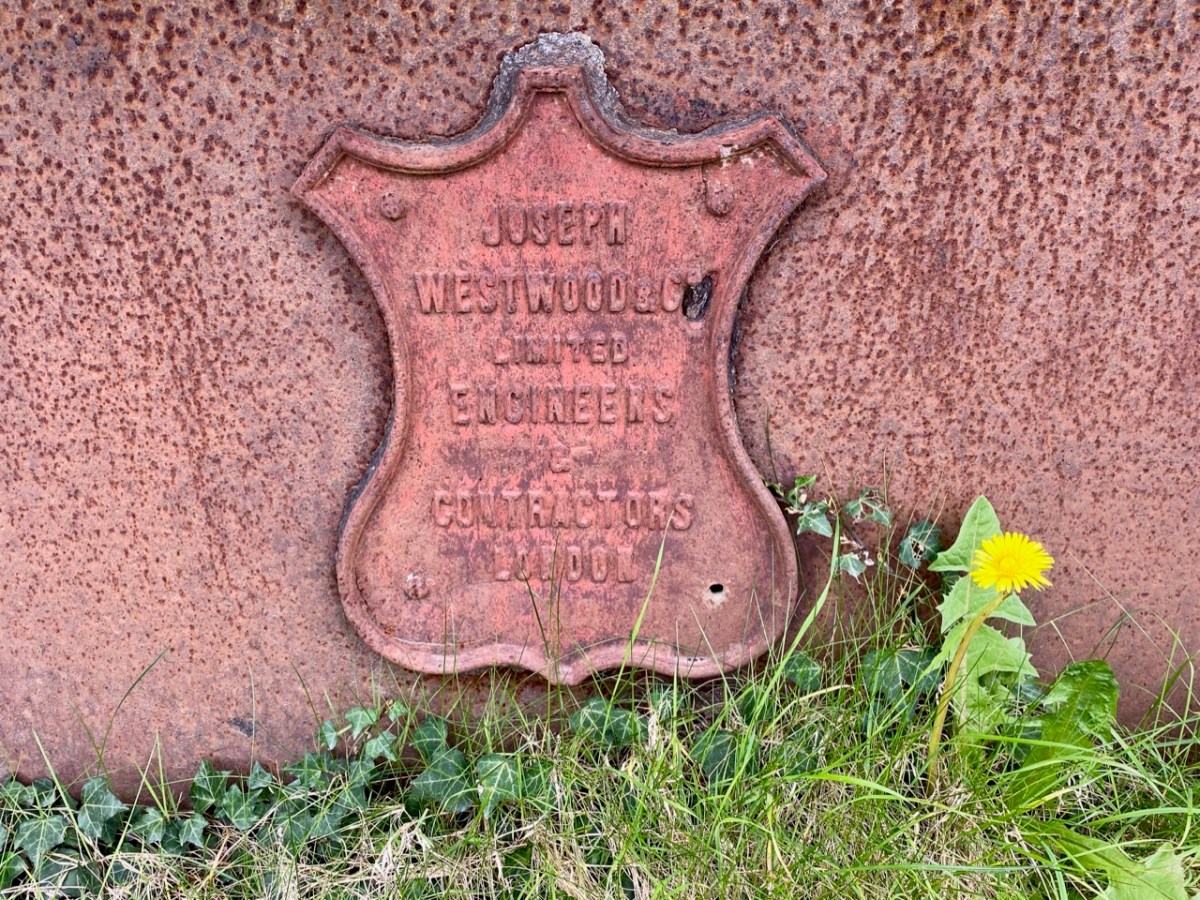
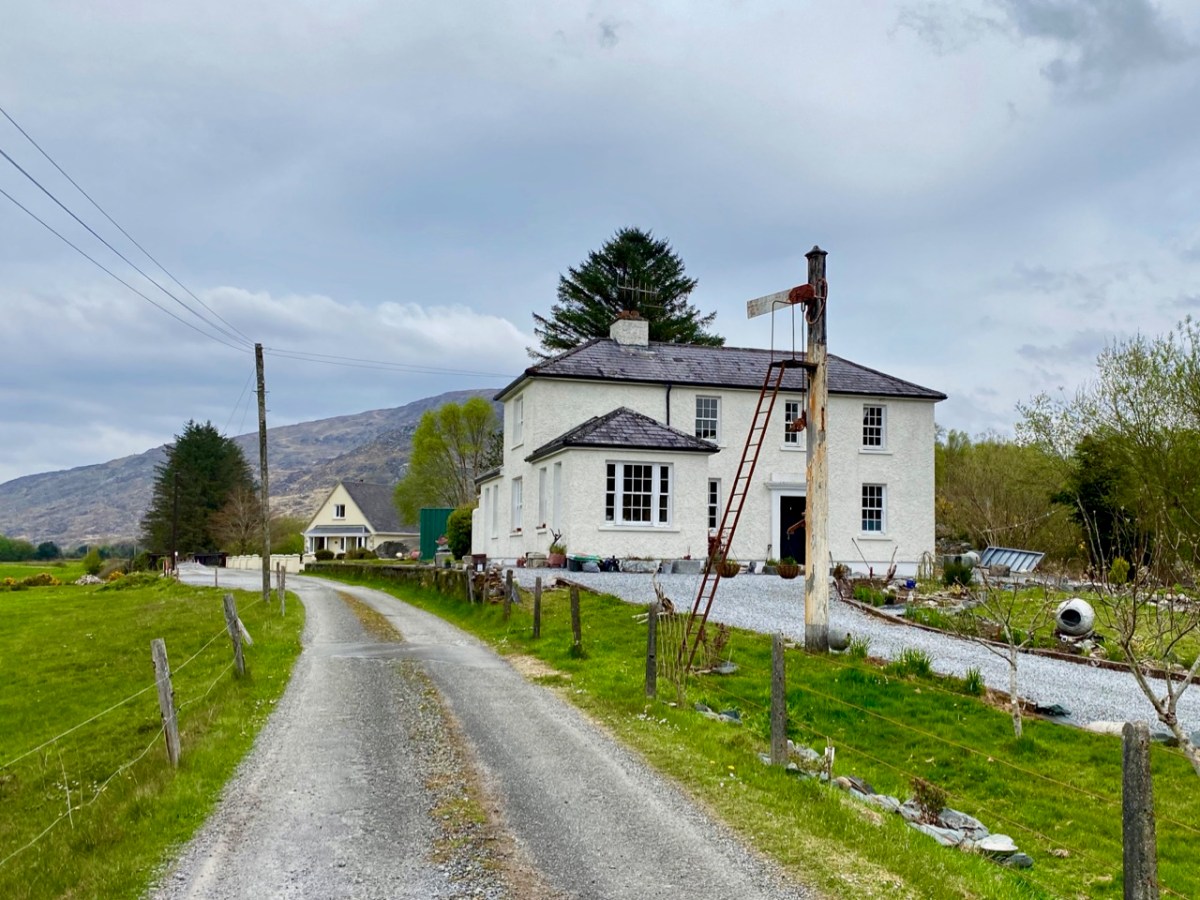
The 6″ OS map, above, dates from the late 19th century. St Peter’s well is marked on it, while St Paul’s only gets mentioned as a spring. Not far to the south is a railway line: The Great Southern Railway: Headford Junction to Kenmare. This was opened in 1890 and closed in 1959. While the track itself is long gone, many features can be traced. We stopped at Loo Bridge where the old station remains, as does an adjacent steel river crossing.
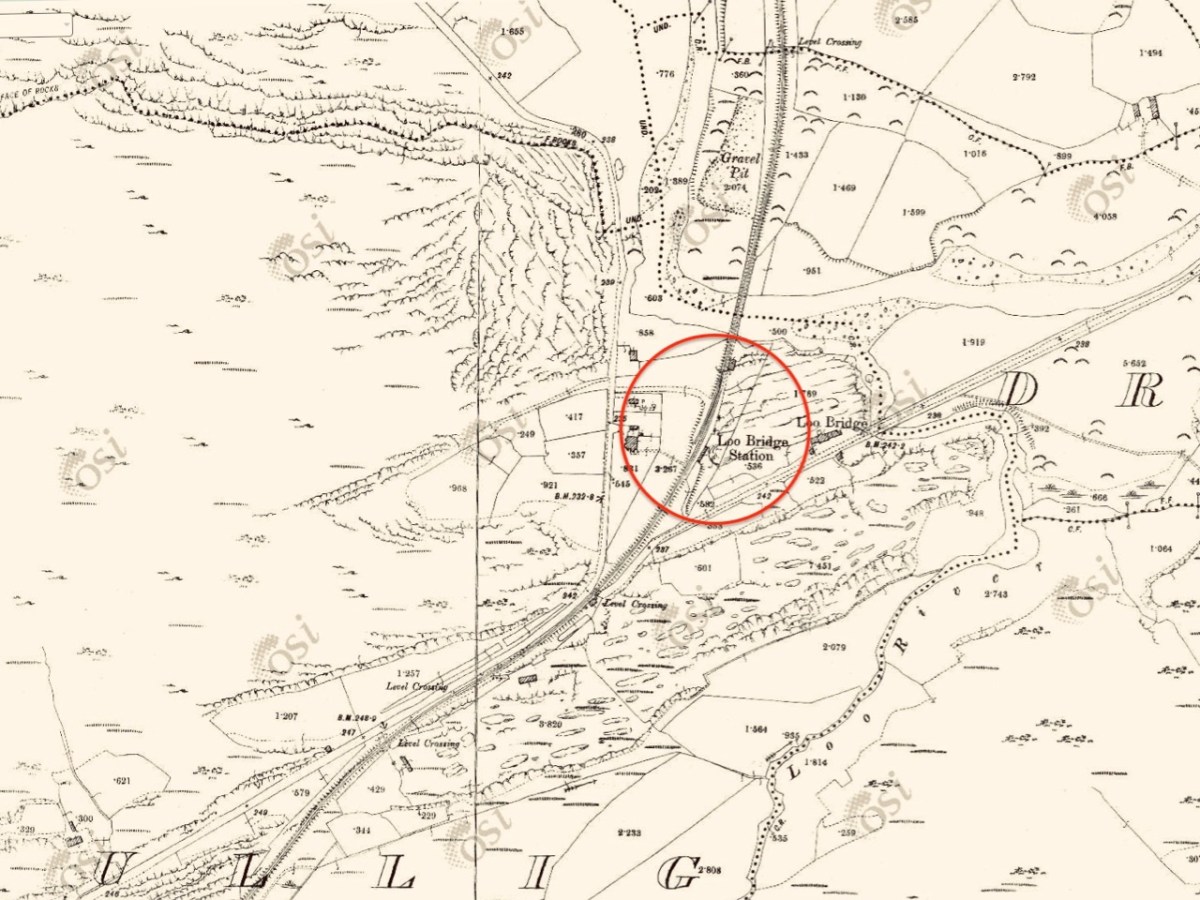
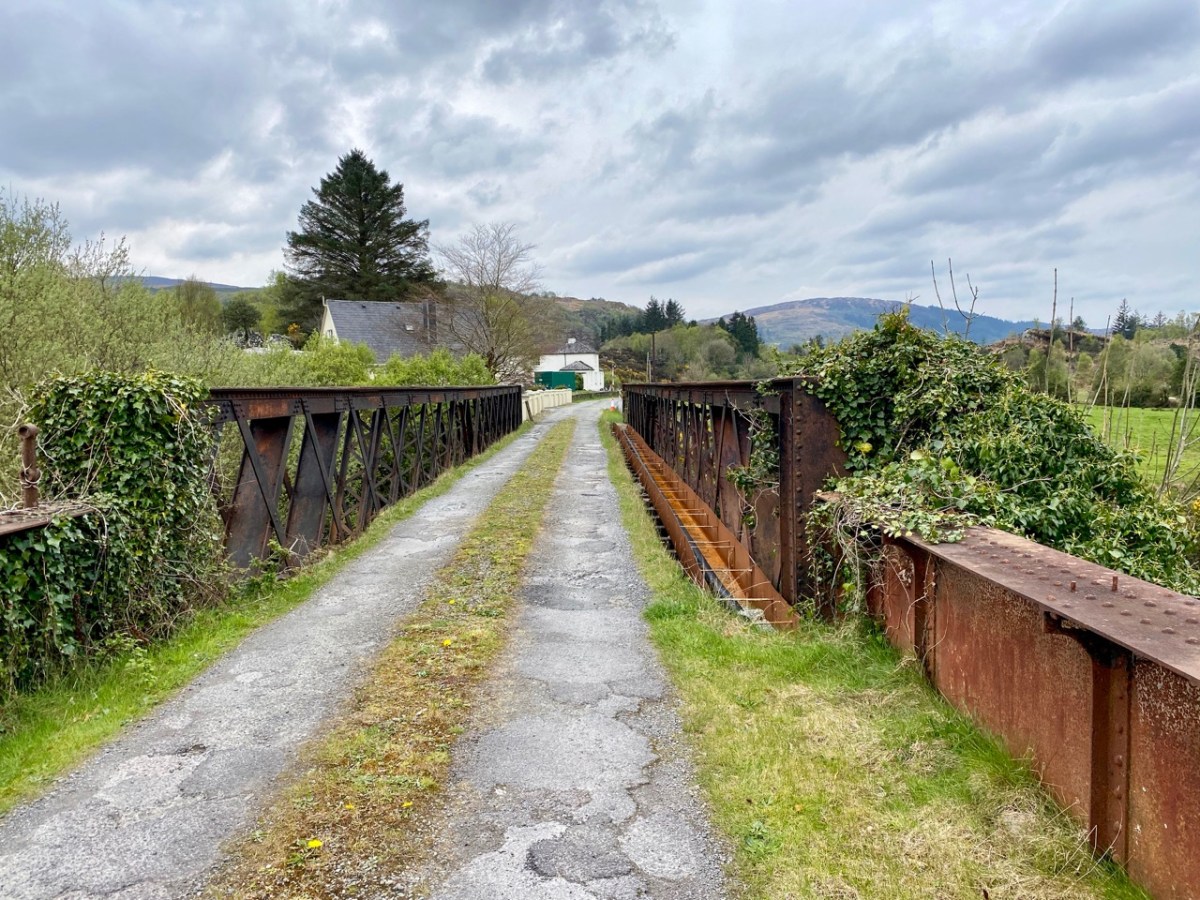
I am always saddened to see abandoned railway lines: they could so easily have had a new lease of life in our present environmentally conscious world. Regardless of their potential functionality, ‘heritage railways’ are also highly popular tourist destinations. I’m afraid, however, that the work and costs now required to recover them is unlikely to be invested any time soon, unless there is a big change in attitude and priority.
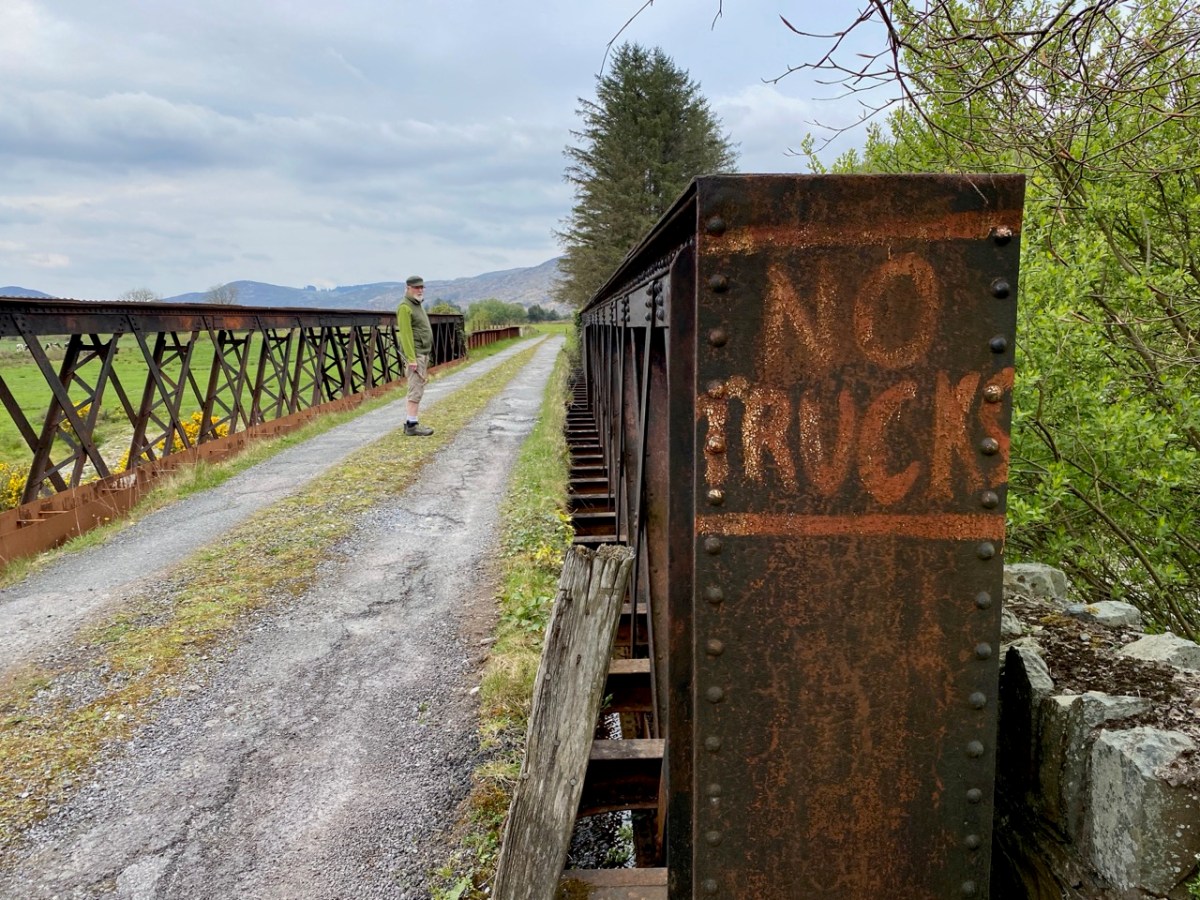
Lost railways and fading wells: unlikely bedfellows for a day out in Kerry. But our travels are always fulfilling, and diversity is the essence. In Ireland we can never run out of places to visit, or matters to be researched and recorded. Join us again, on our next expedition!
Rock Art – A Diversion to Wicklow

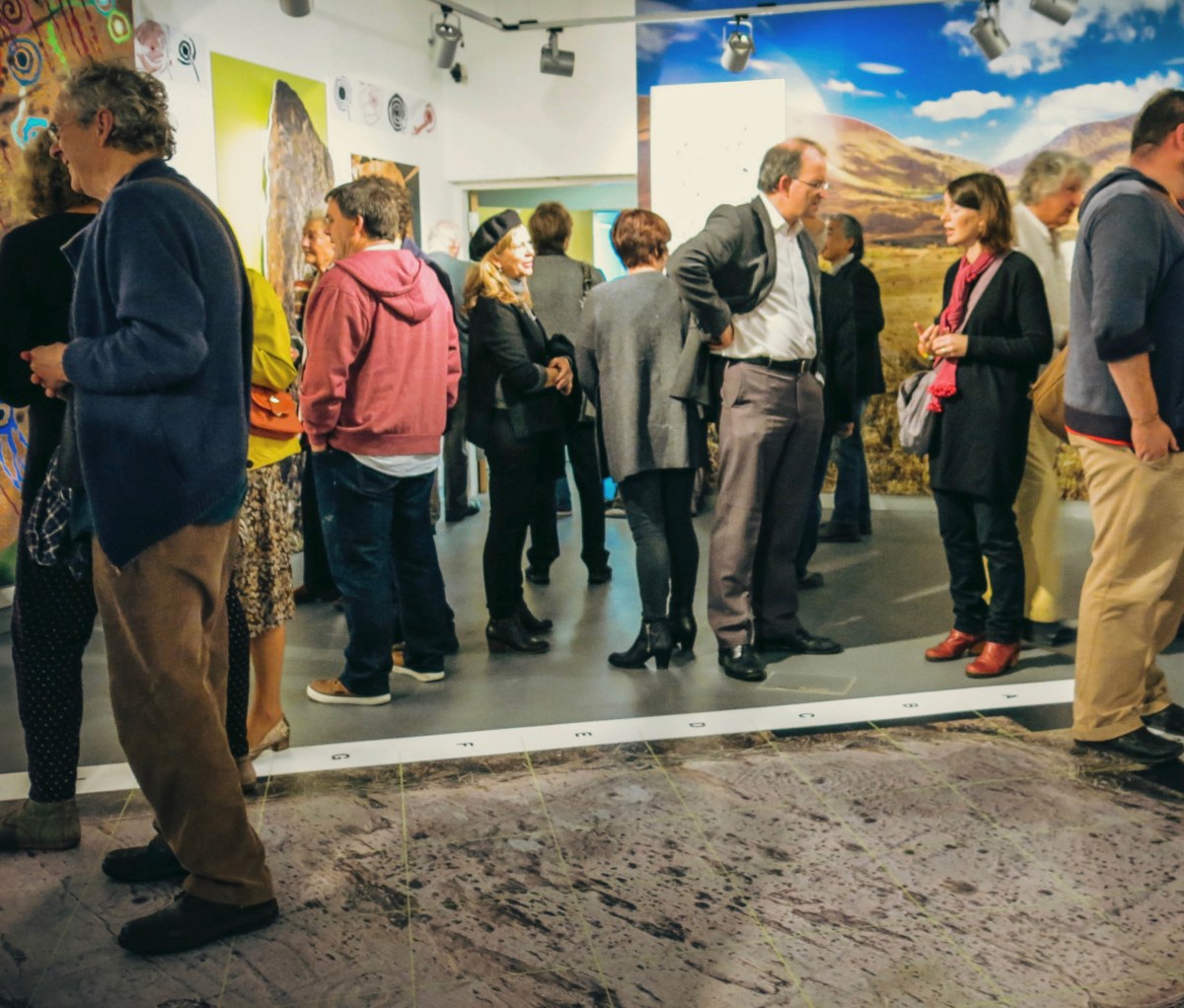
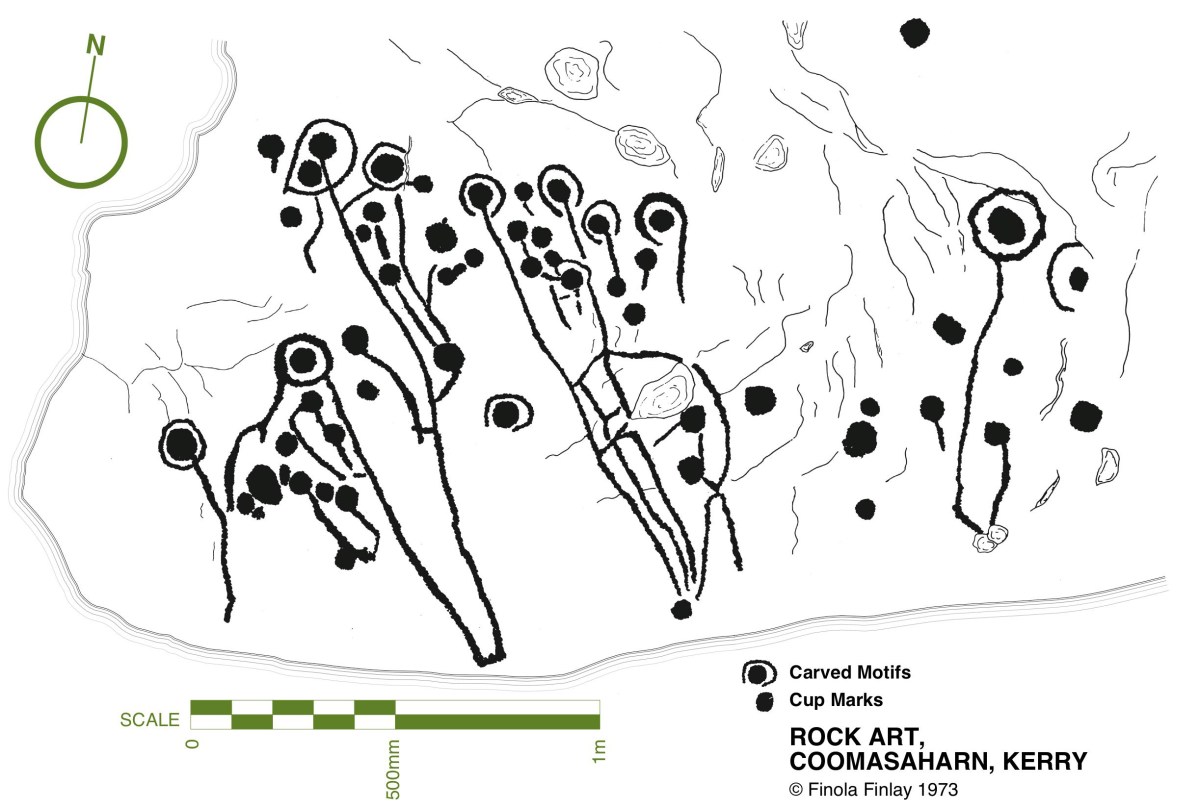
While writing this Journal over the years, Finola and I have included many examples of Prehistoric Rock Art, mainly on the west side of the country, in Cork and Kerry. Here is just one – you can find others through the search facility in the header. Finola’s UCC thesis from 1973 also concentrated on specimens from the southwest and her own drawings based on tracings direct from the rock surfaces provide a unique record of this form of prehistoric art. They have formed the basis of exhibitions which we have promoted over the years: here’s one from 2015.

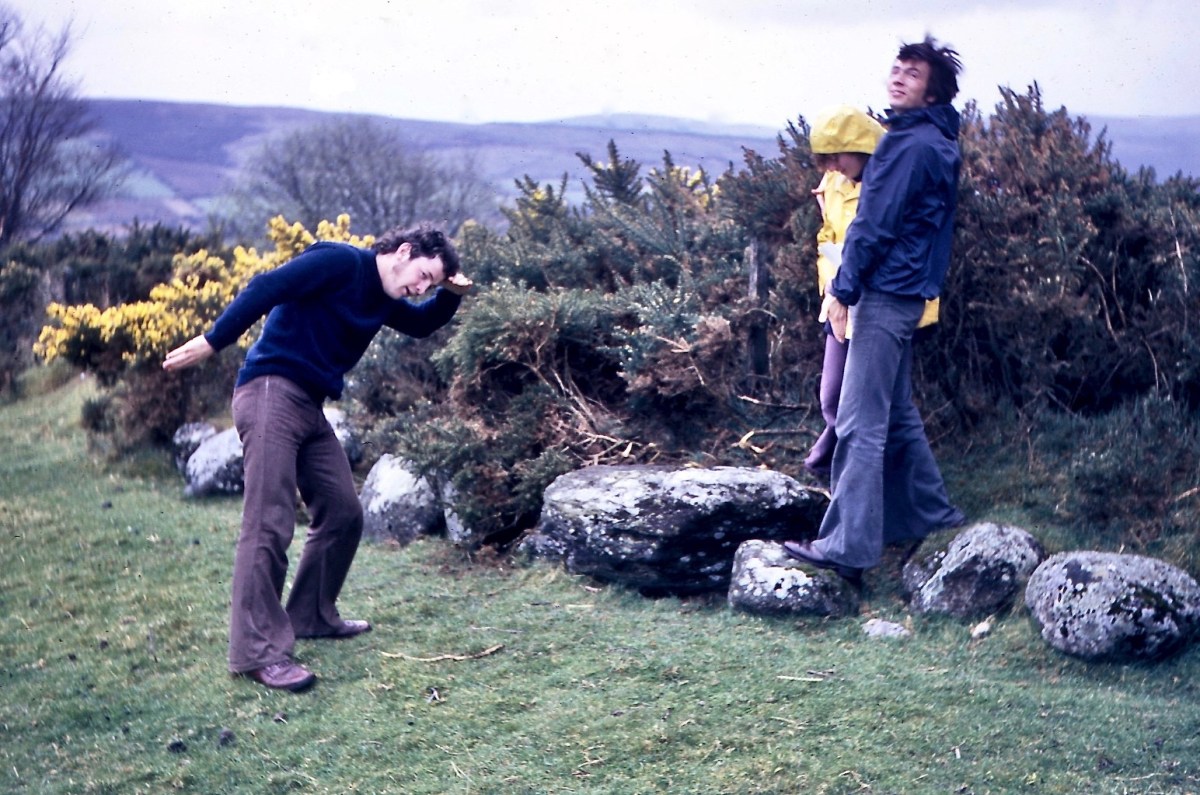
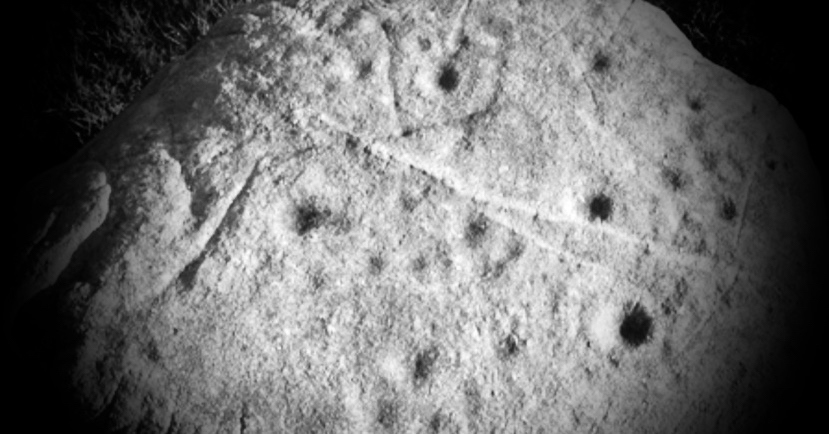
Upper: the opening of our Rock Art exhibition at Cork Public Museum , October 2015 and (lower) one of Finola’s drawings from 1973. Another area in Ireland which has a concentration of Rock Art is Wicklow. We have been spending a few days in that county, and decide to go and have a look for some examples there. Finola dug out from her archives a photo which she took in 1972 when she and some college friends visited a Wicklow site:

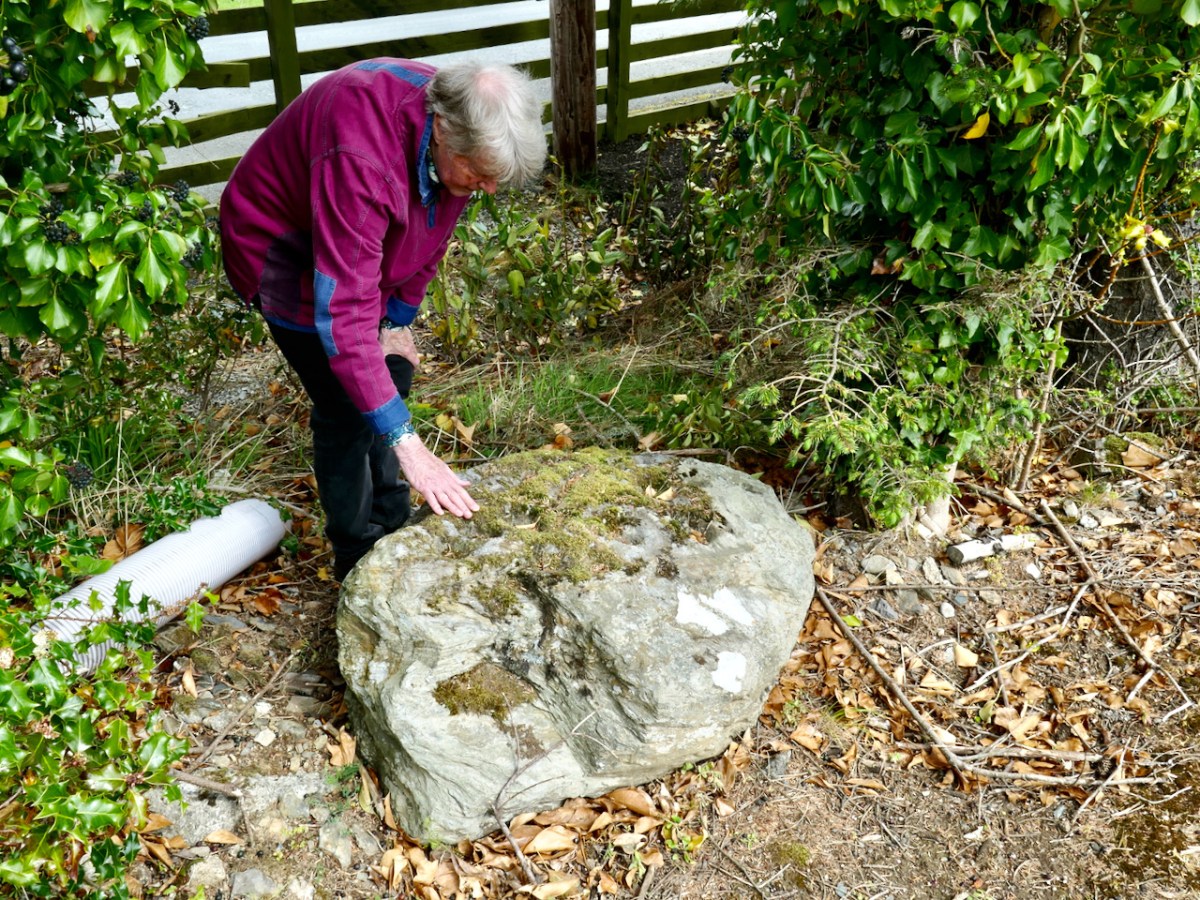
Could we find that particular rock again? Well, we think we did, but it has been moved in fairly recent times. Here it is in its new setting (we believe) – it’s not very propitious:

The present site is in the townland of Togher More, behind a fence lining a main road. The National Monuments record tells the story, which confirms that Finola’s earlier photograph was taken in the townland of Baltynanima:

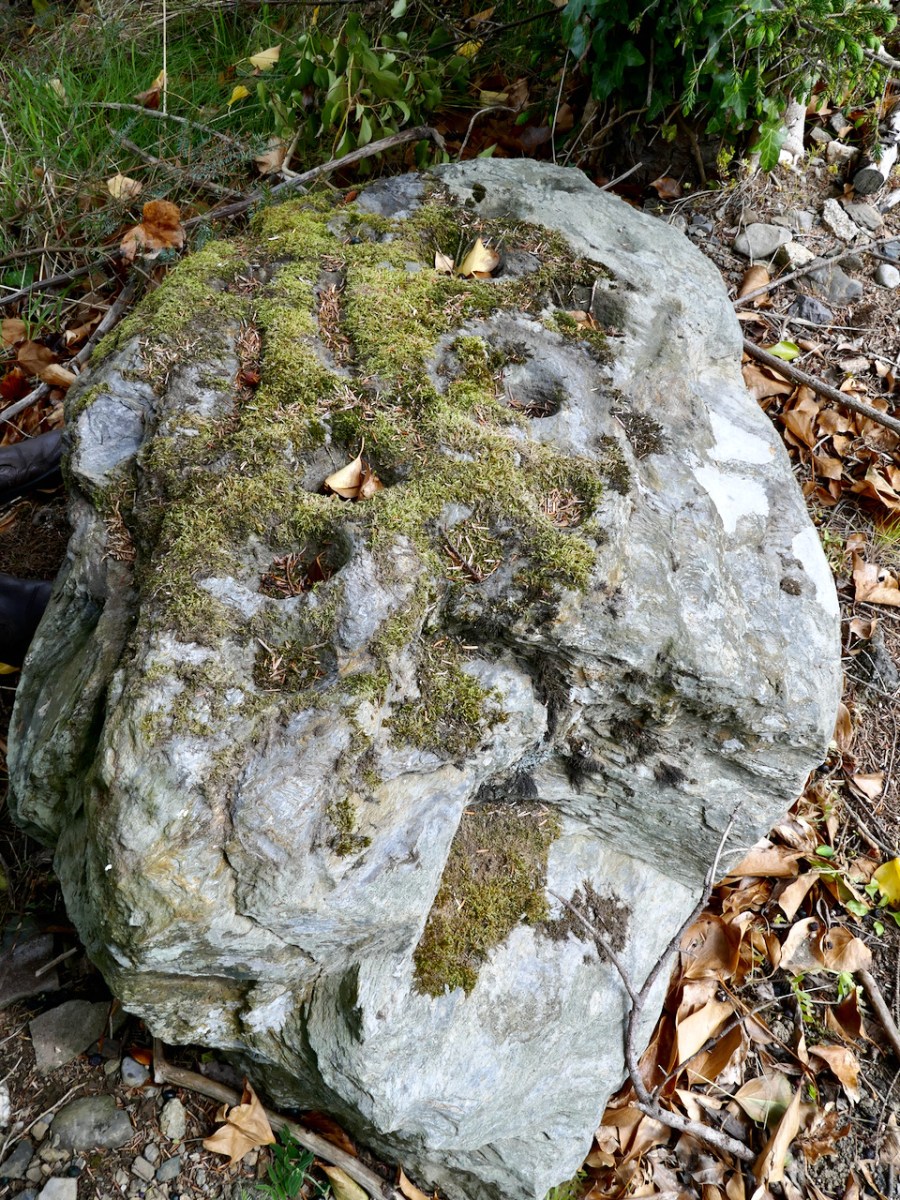
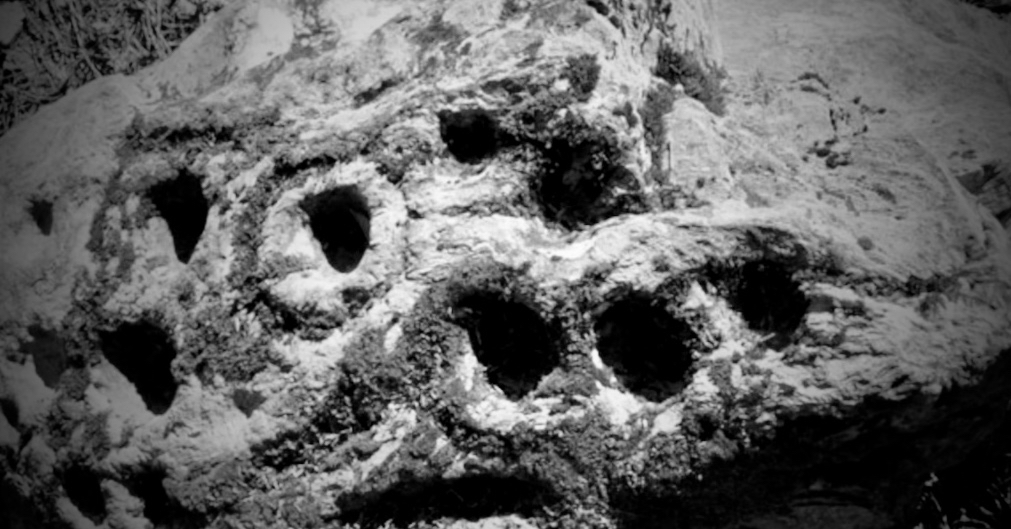
. . . Class: Rock art (present location) Townland: TOGHER MORE Description: Found during ploughing c. 1.8m to the SW in Baltynanima and moved here in the mid 1980’s (see W1018-036—- for original location record). An irregular shaped schist boulder (L 1.3m; W 0.9m; T 0.5m) with 16 cup marks and the remains of another where the corner of the boulder appears to have come away. The four largest cups (diameters 10-12cm; depth c. 6cm) are enclosed by circles (max ext. diameter 20cm) formed by incised lines (widths 1.5-2cm; depths 1cm) with the exception of one which has only a semi circle incised line around it. The remaining 13 cups have diameters of 6-8cm and depths of 4-5cm. There are also three incised linear grooves (L 14- 22cm; W 4cm; D 2.5-3.5cm) visible on the stones surface. Described, photographed and drawn by Price on the 29th January 1933 . . .

National Monuments Record WI018-049

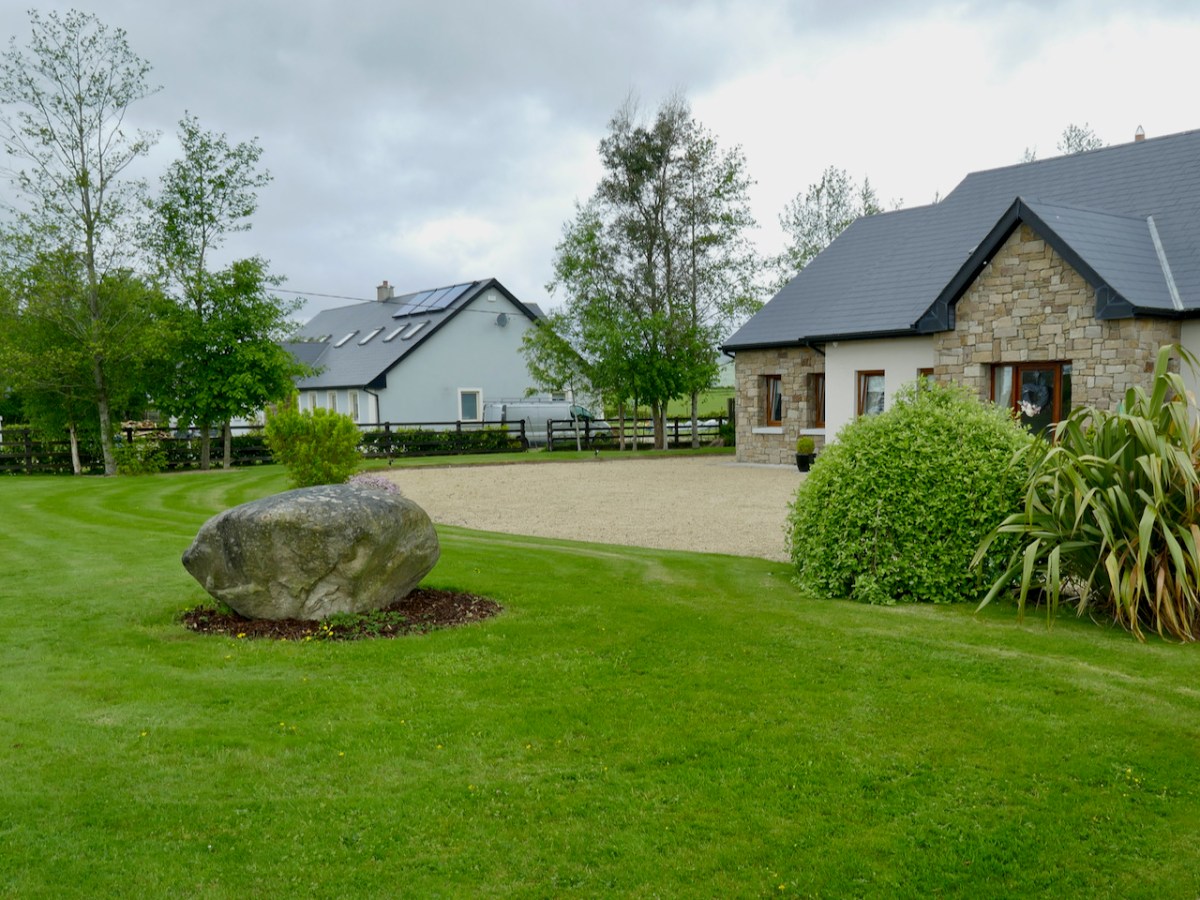
It’s not unusual to find that ‘portable’ stones with Rock Art on the surface are moved, usually to protect them if a site is to be developed. Here’s another example we found, in the townland of Knockrahen:

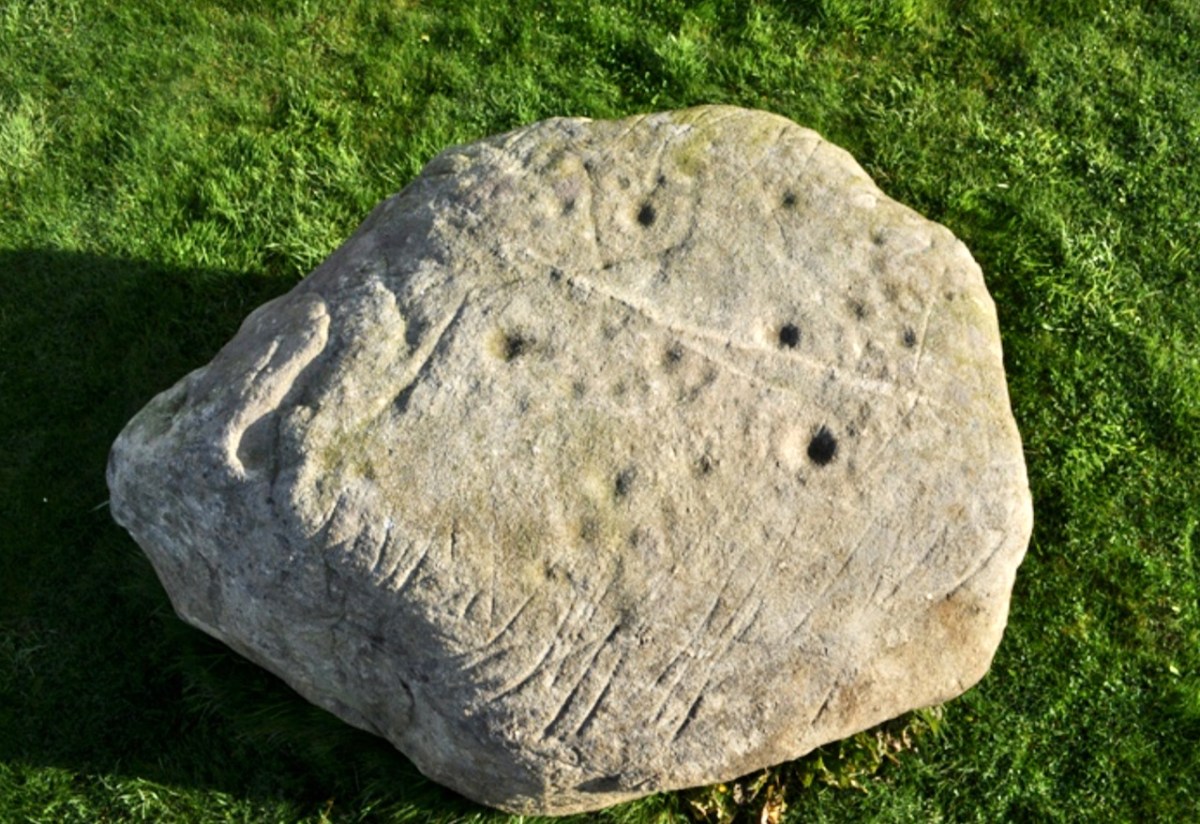
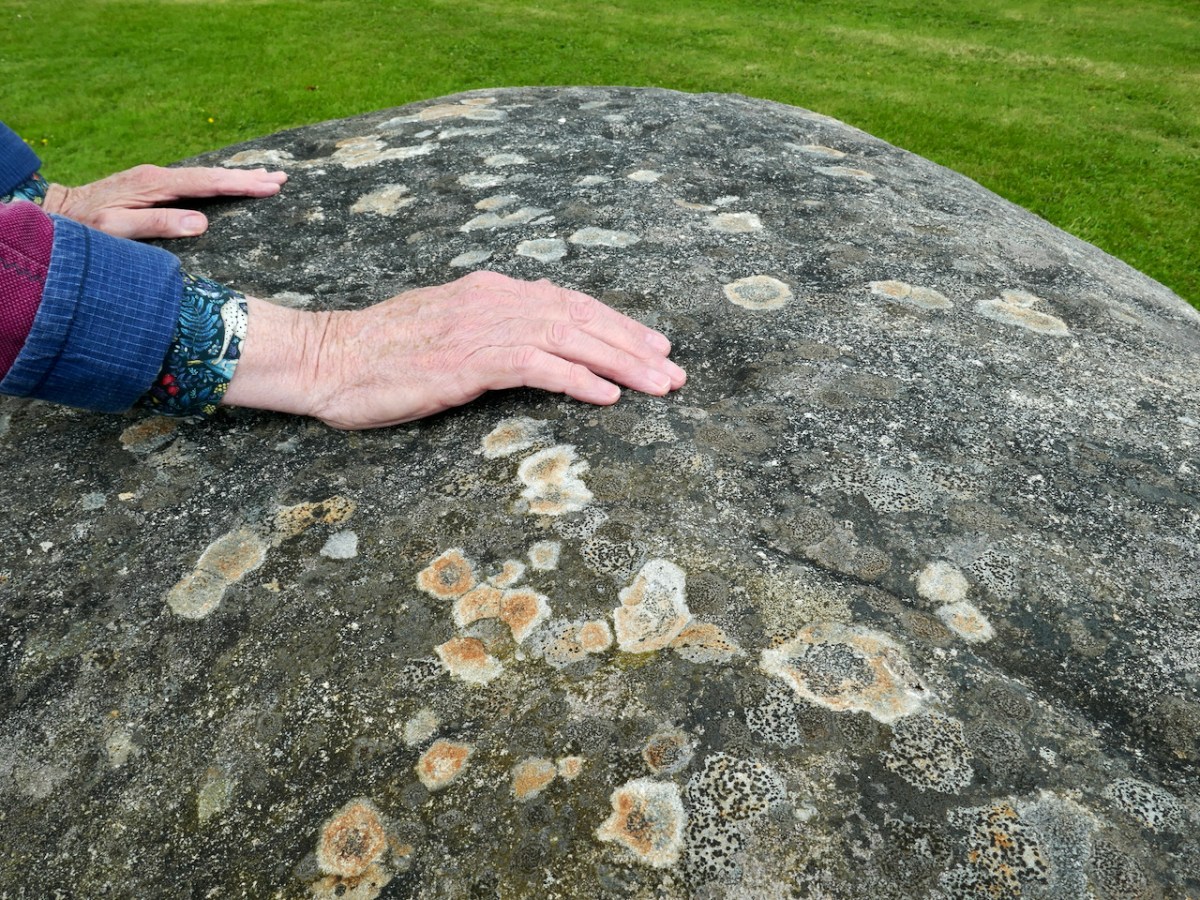
In this case the rock was found while the foundations were being dug for the house. The owner (with whom we spoke) noticed the markings and decided to keep it as a feature in her new garden. The photo below was taken by Chris Corlett for the National Monuments records. Thank you, Chris (and the NM), for allowing us to use this – and the detail on the header pic. Below Chris’s photo is Finola’s, with my hand in the shot to give it scale.

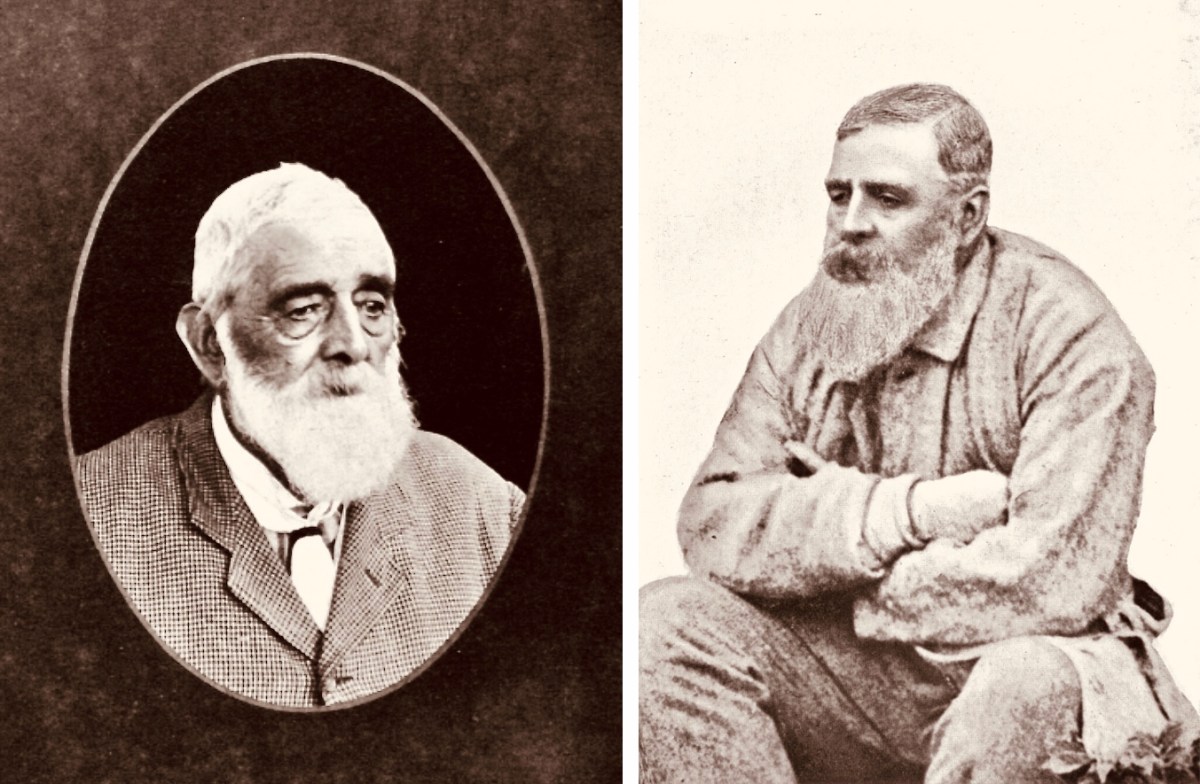
While out in Wicklow we noticed that many of the National Monument records of Rock Art are credited to George Henry Kinihan (1829 – 1908). He was a geologist who also had an interest in archaeology. His home was in Clontarf and he is buried in the Protestant churchyard in Avoca, Co Wicklow. He was involved in his lifetime in engineering works, particular railway construction, but was also a keen Rock Art enthusiast.

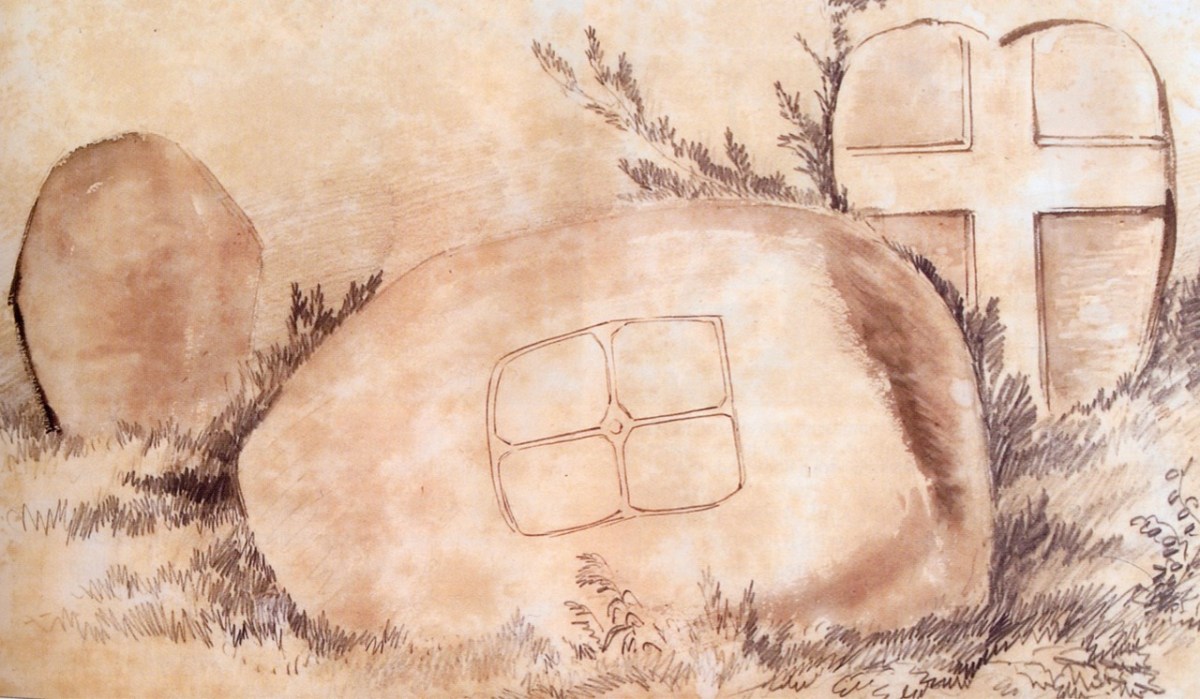
Two portraits of Kinihan: he was said to have been of ‘strong and massive build’. He spent some of his early years working under George du Noyer of the Irish Geological Survey – who shared with him an interest in antiquities in the landscape. Here is a du Noyer drawing of cross slabs in Co Wexford:

On du Noyer’s death in 1869, Kinihan was appointed District Surveyor of the Geological Survey, in charge of field work and mapping, and oversaw the completion of the One Inch Geological Map of Ireland. He also became President of The Royal Geological Society of Ireland in 1880. Now, here is a conundrum:

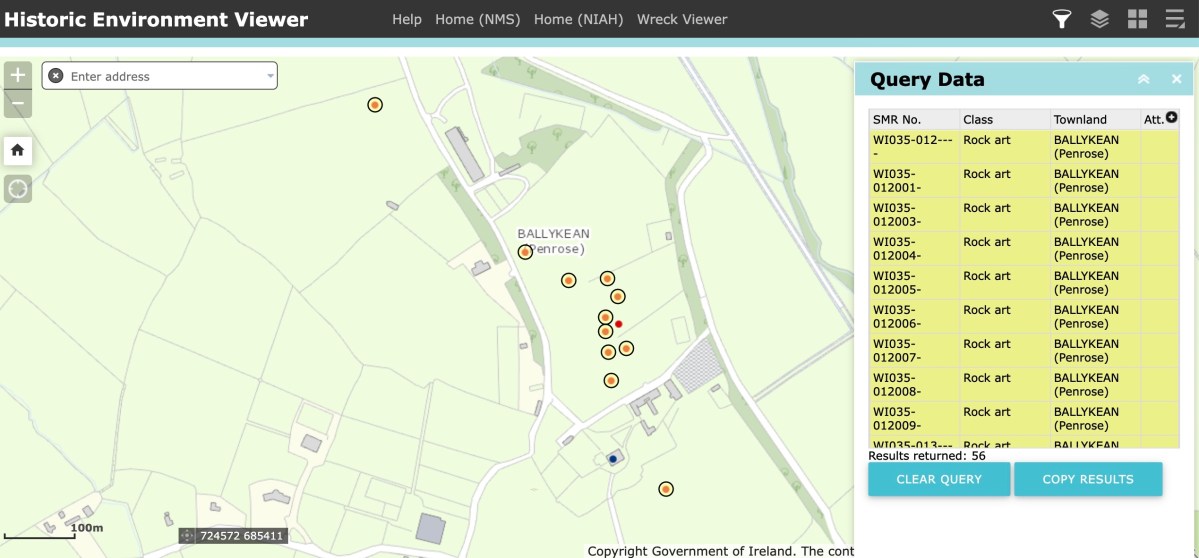
Here is part of the current Historic Monuments Viewer, showing the location of archaeological sites in Ballykean, Co Wicklow. All the yellow-and-red dots are recorded as Rock Art, discovered by Kinihan (there are 14 just in this small area of the townland). In every case, the site is described in detail, with numbers of cupmarks etc recorded. But also – in every case – the description concludes: ‘…The site indicated by Kinahan in 1884 was inspected in 1990, however this stone was not located…’ These are not the only instances in Co Wicklow where Rock Art found by Kinihan can no longer be traced. Does this mean that all these instances have now been destroyed or buried? Is it possible that this experienced archaeological enthusiast could have misinterpreted so many sites? It remains an adventure for us – another day – to go in search of some of these enigmatic examples to see if we re-establish the credibility of this Wicklow giant in this very particular specialism.

Notes from the Past

We heard – from our correspondent Justin Cremin – about an ancient copper mine somewhere near Skibbereen: possibly prehistoric (like the mines on Mount Gabriel). Supposedly there were rock scribings there (perhaps like those we explored in the Cooleenlemane valley). The Archaeological records proved a little disappointing:

CO150-070

Townland: GORTSHANECRONE

Class: Redundant record

. . . Description: Listed as an ‘ancient copper mine’ in the RMP (1998). Located in rough hill pasture on the W side of a deep wide ravine running N-S across the hill. A natural cave with two E-facing entrances extends c. 35m W into the hill. The height varies from c. 1m to c. 4m and jagged rocks protrude from the roof. Loose stones are scattered on the uneven floor. While there are traces of green malachite copper staining in a few places there is no evidence to indicate prehistoric mining. The material in the spoil mound outside the lower entrance suggests some unsuccessful 19th century exploration for copper may have been carried out here. The evidence is not sufficient to warrant accepting this as the location of an archaeological monument . . .

archaeology.ie
Compiled by: Connie Murphy

This now ‘redundant’ entry in the official records seemed to imply that the ‘ancient’ mine wasn’t there at all – it was just a cave. But the records also make no mention of any sort of inscription on the cave walls: perhaps, if there were scribings, they were considered ‘modern graffiti’ and of no historic interest. We set out to solve the mystery, accompanied by our intrepid friends David Myler and his children. David has written about the site on his own Facebook page.

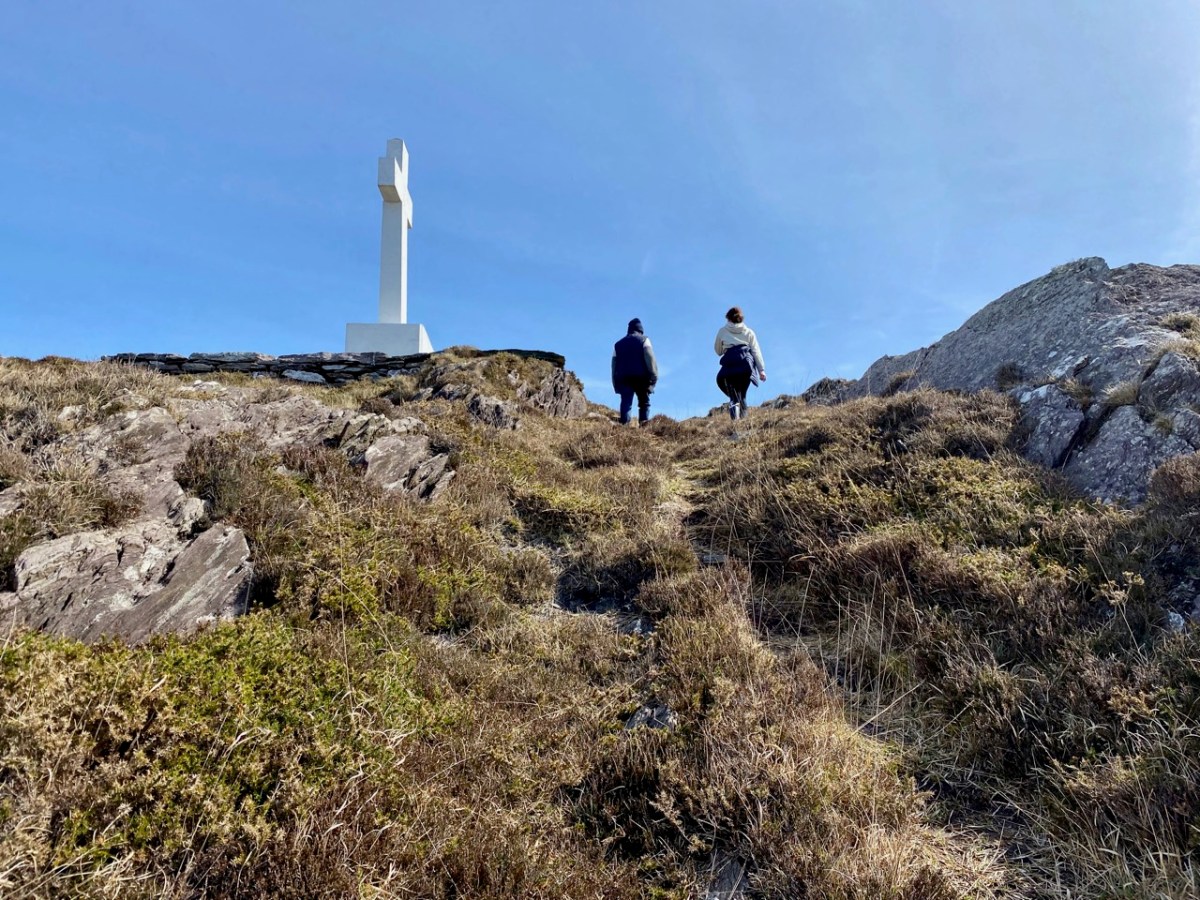
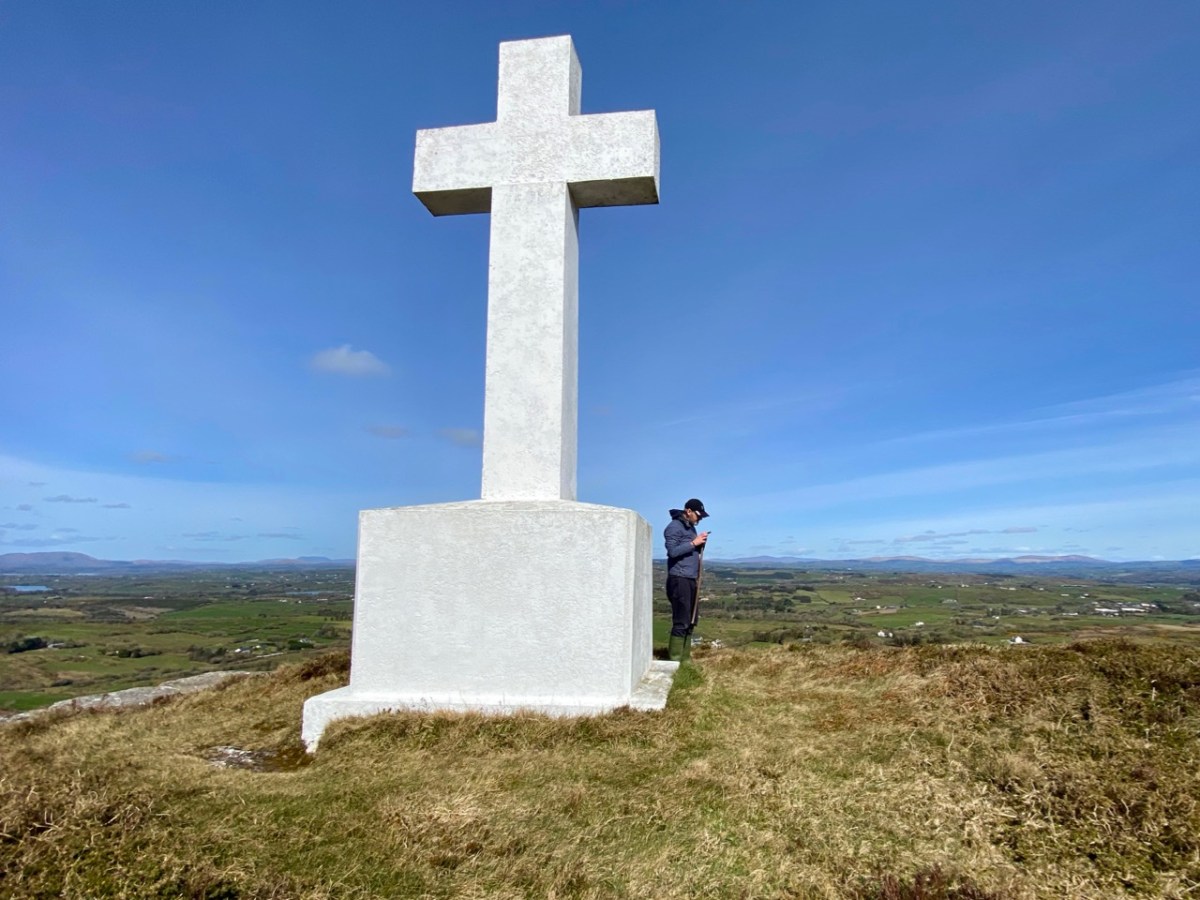
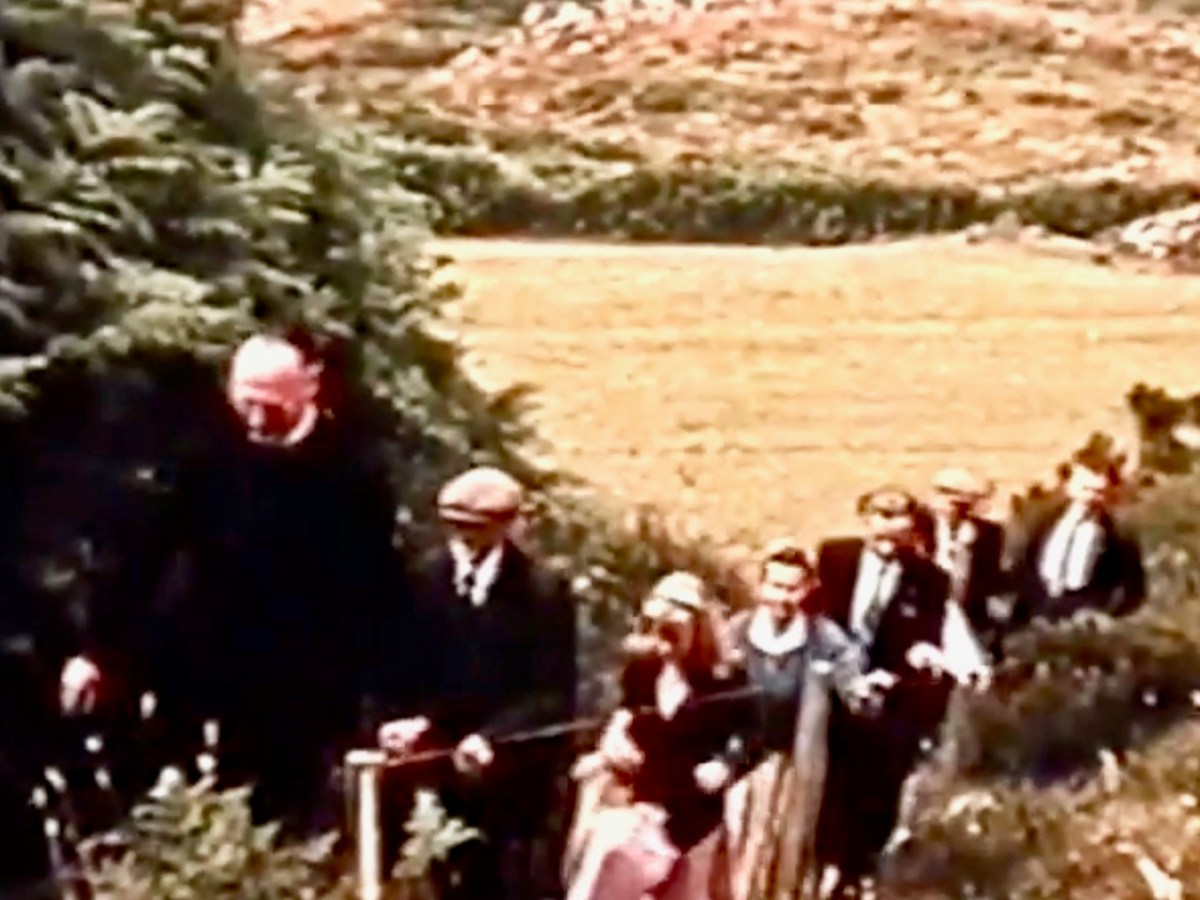
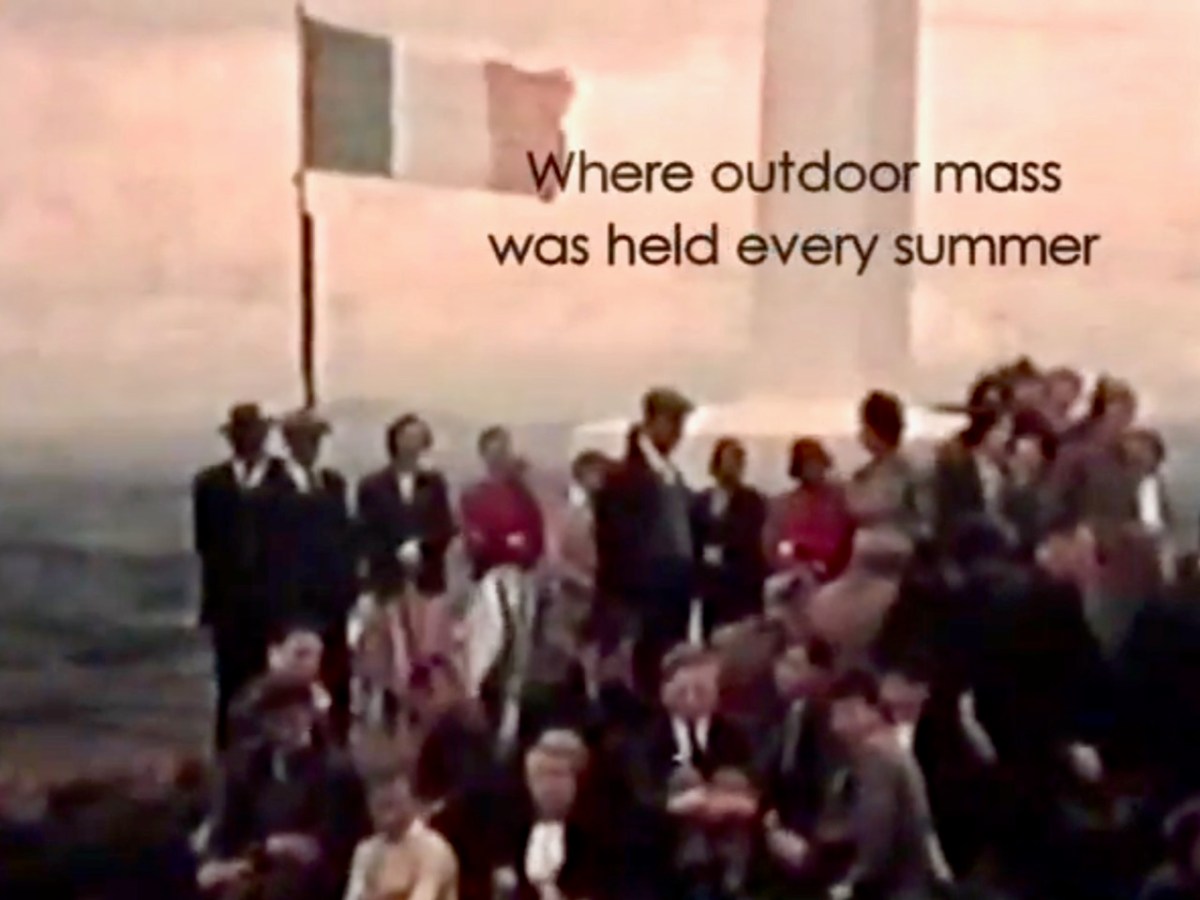
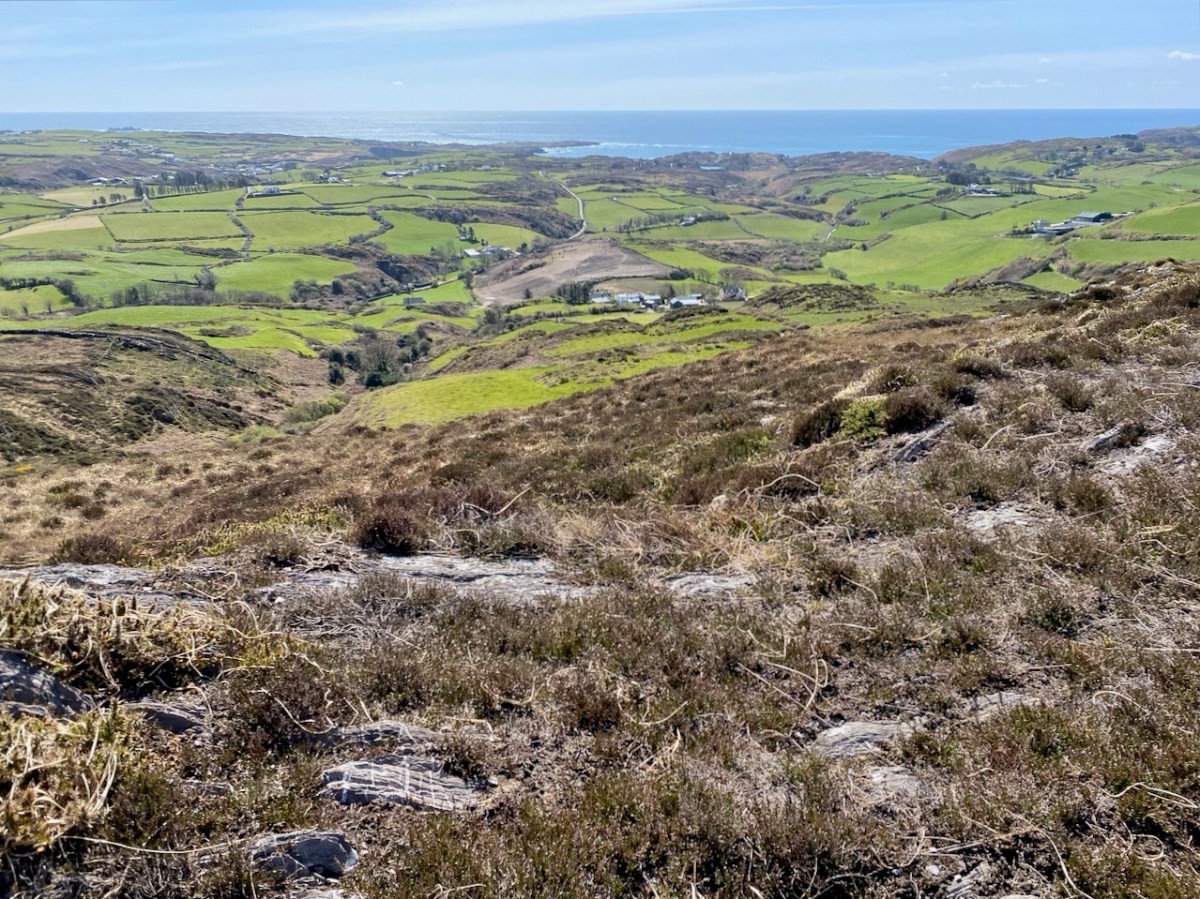
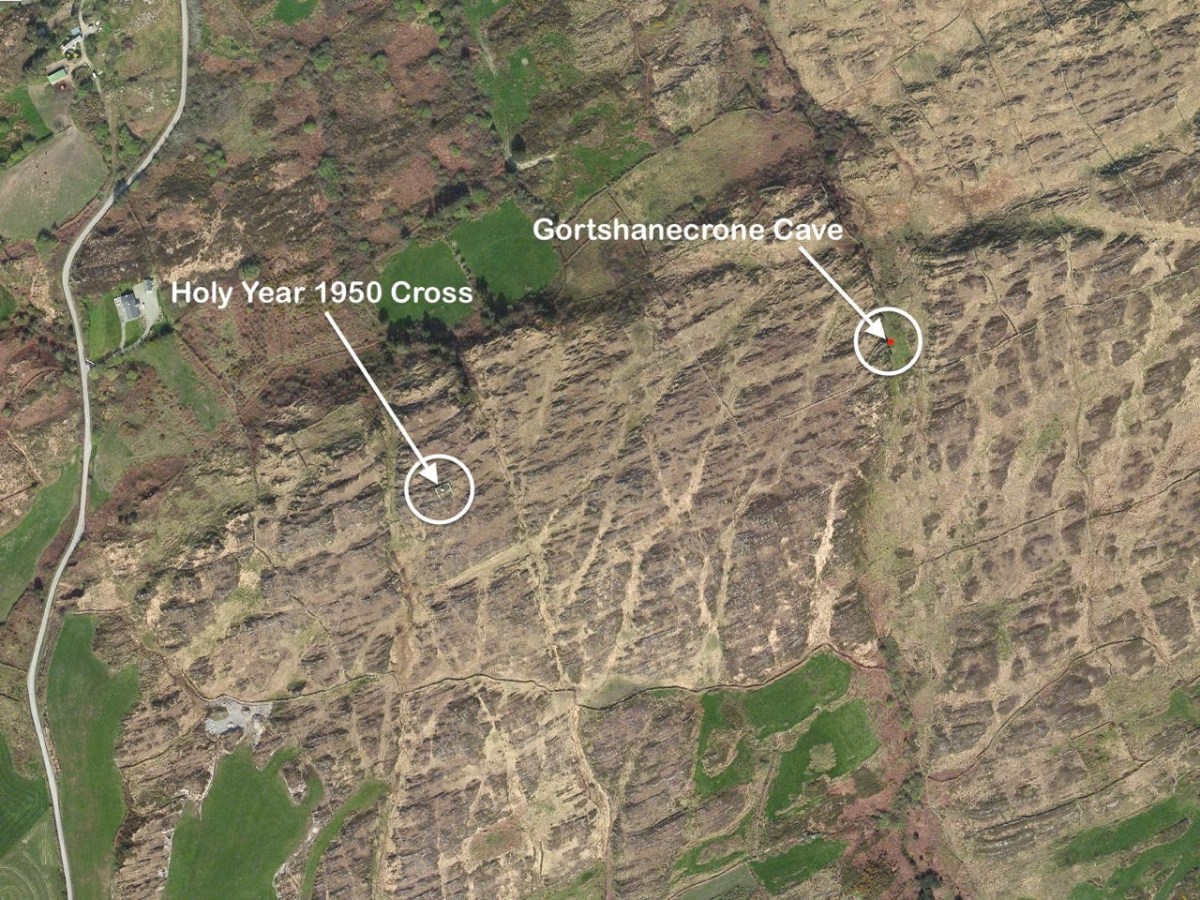
En route was another – much younger – piece of local history that we had long wanted to visit: an enormous white cross set up on top of Coom Hill to commemorate the Holy Year of 1950. Once visited on Corpus Christie day every year by a procession which started in Skibbereen, it remains an important local landmark and is situated with dramatic views in all directions.

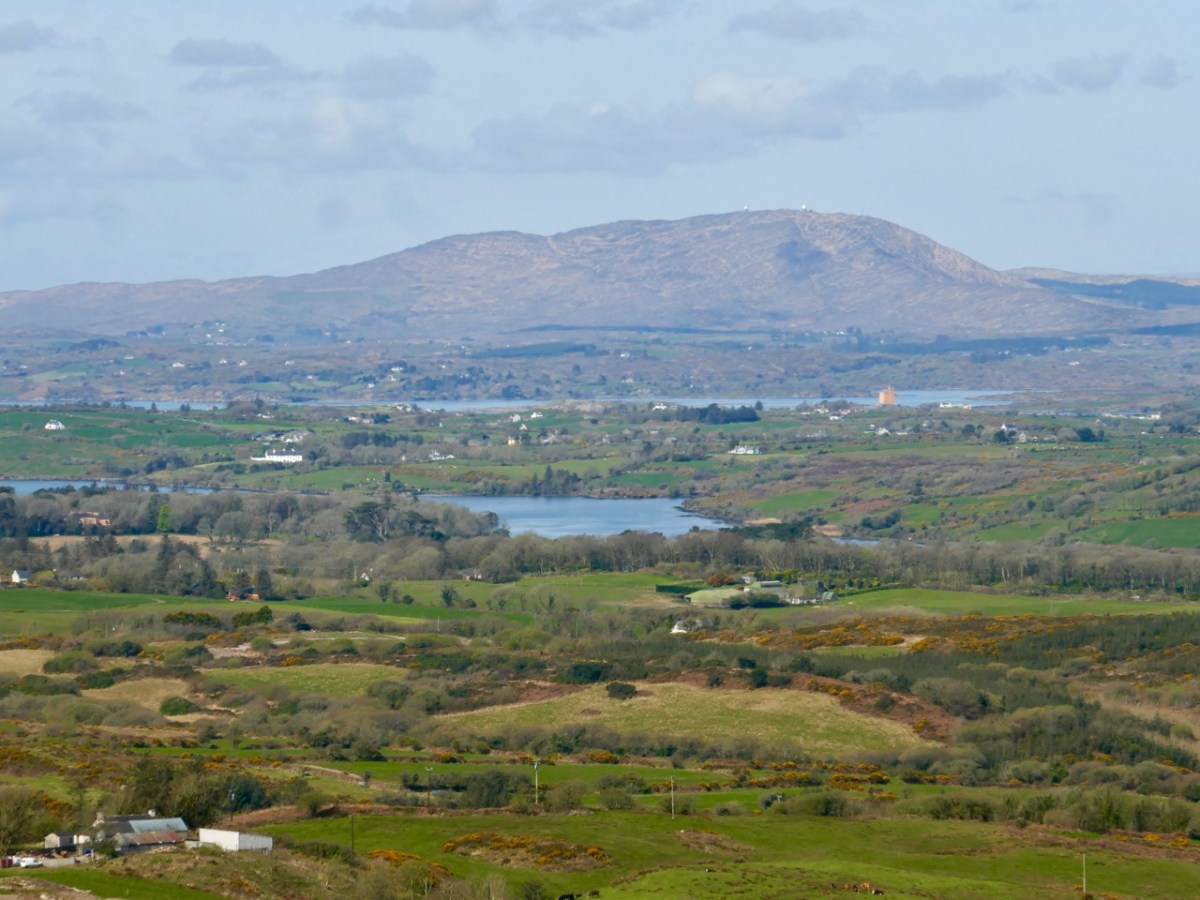
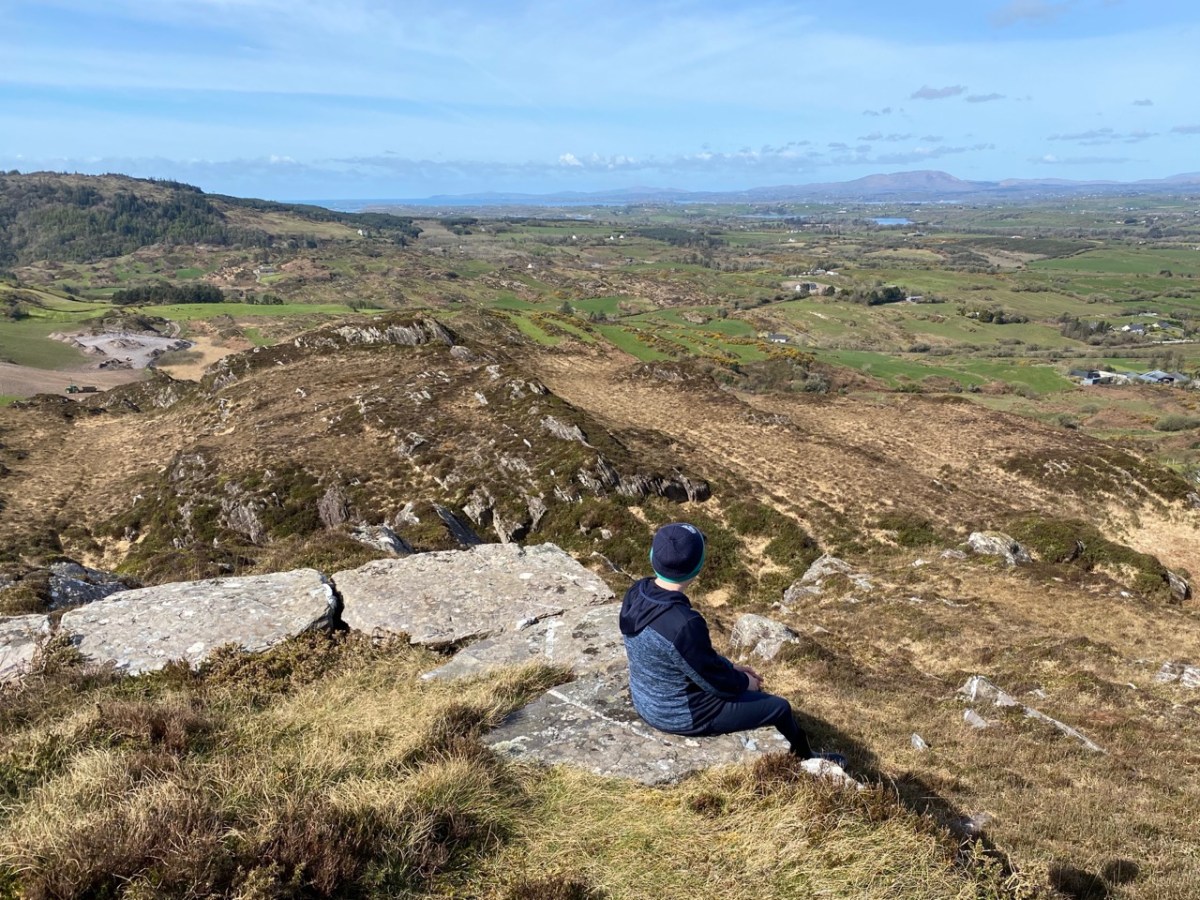
The two screenshots above are from a film taken in the 1960s, showing the procession to the cross. You can watch the full film online here. Below are some of the views which can be seen from the top of the hill.

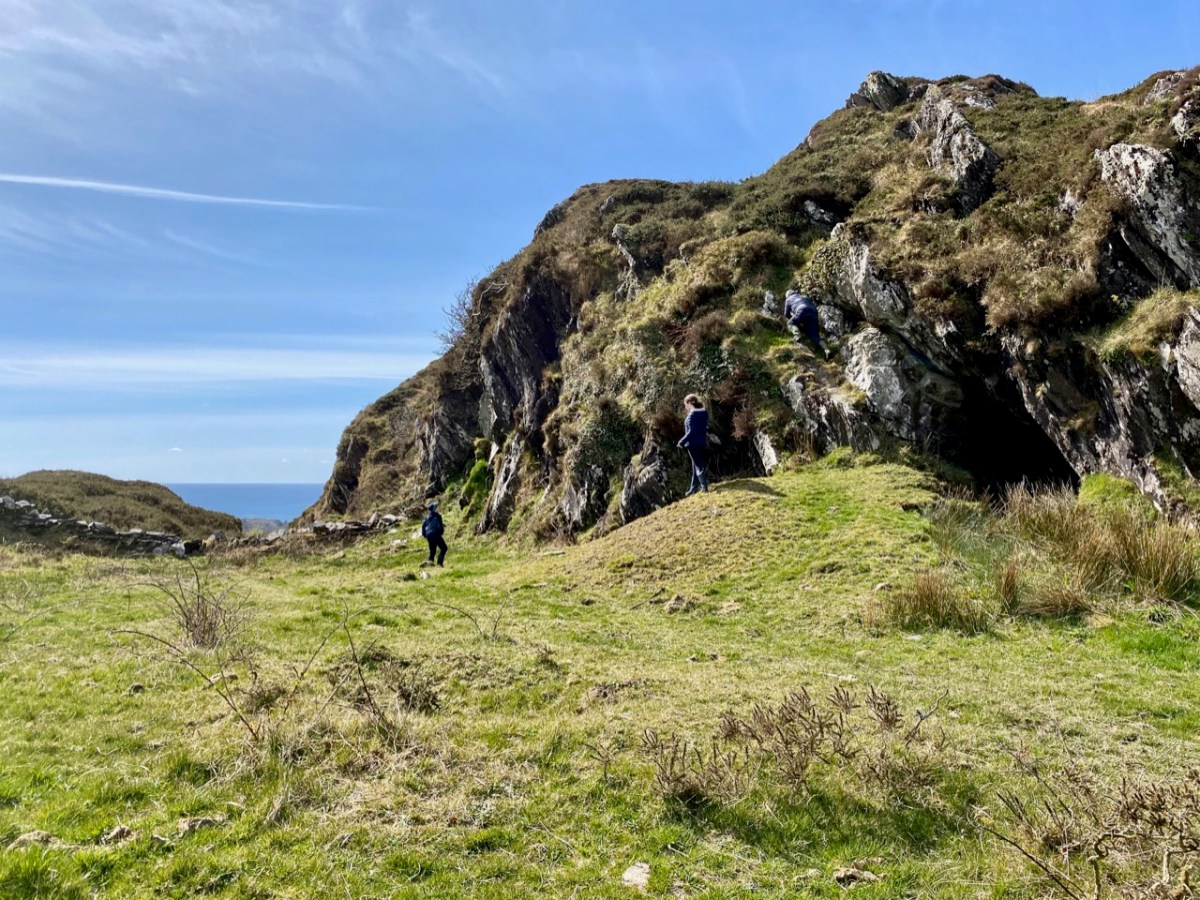
The cross – and the views – were only tasters for the adventures we had in store. Justin had researched the location of the ‘cave’ and his instructions unerringly led us across country towards a gulley – a substantial gash in the landscape running north to south, where the high land dropped away: tucked in just below us we found our goal.

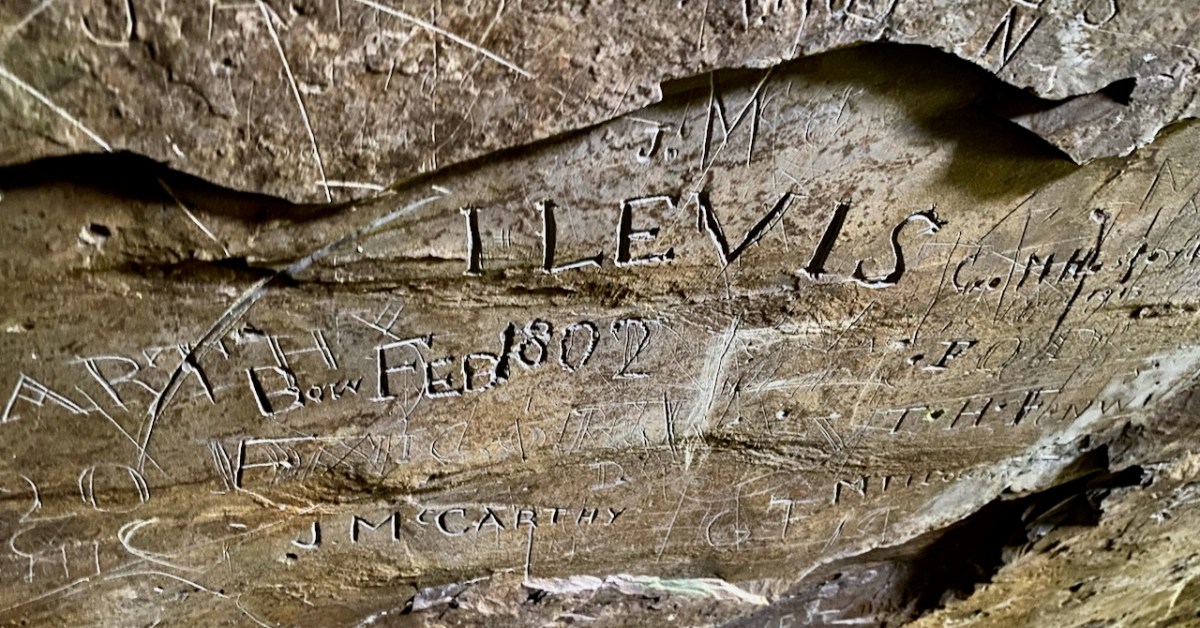
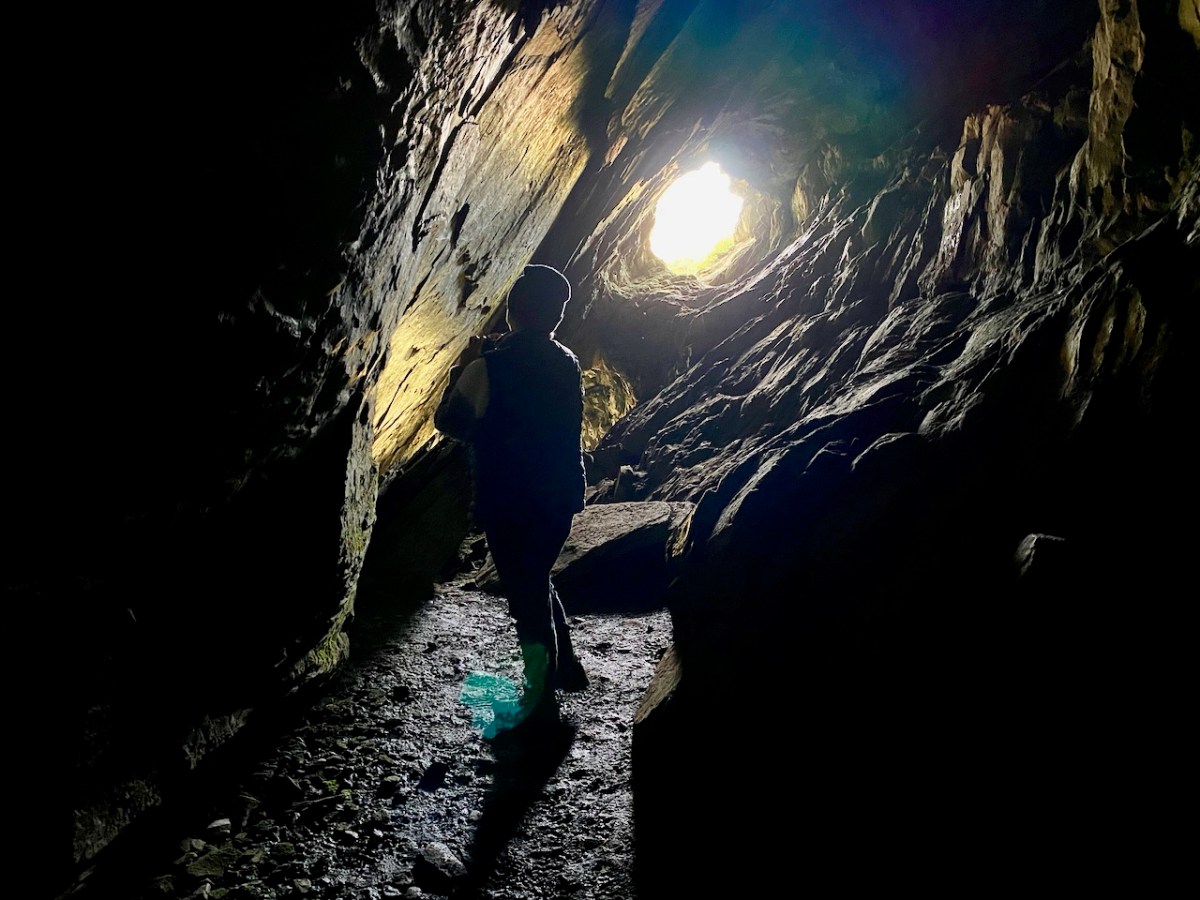
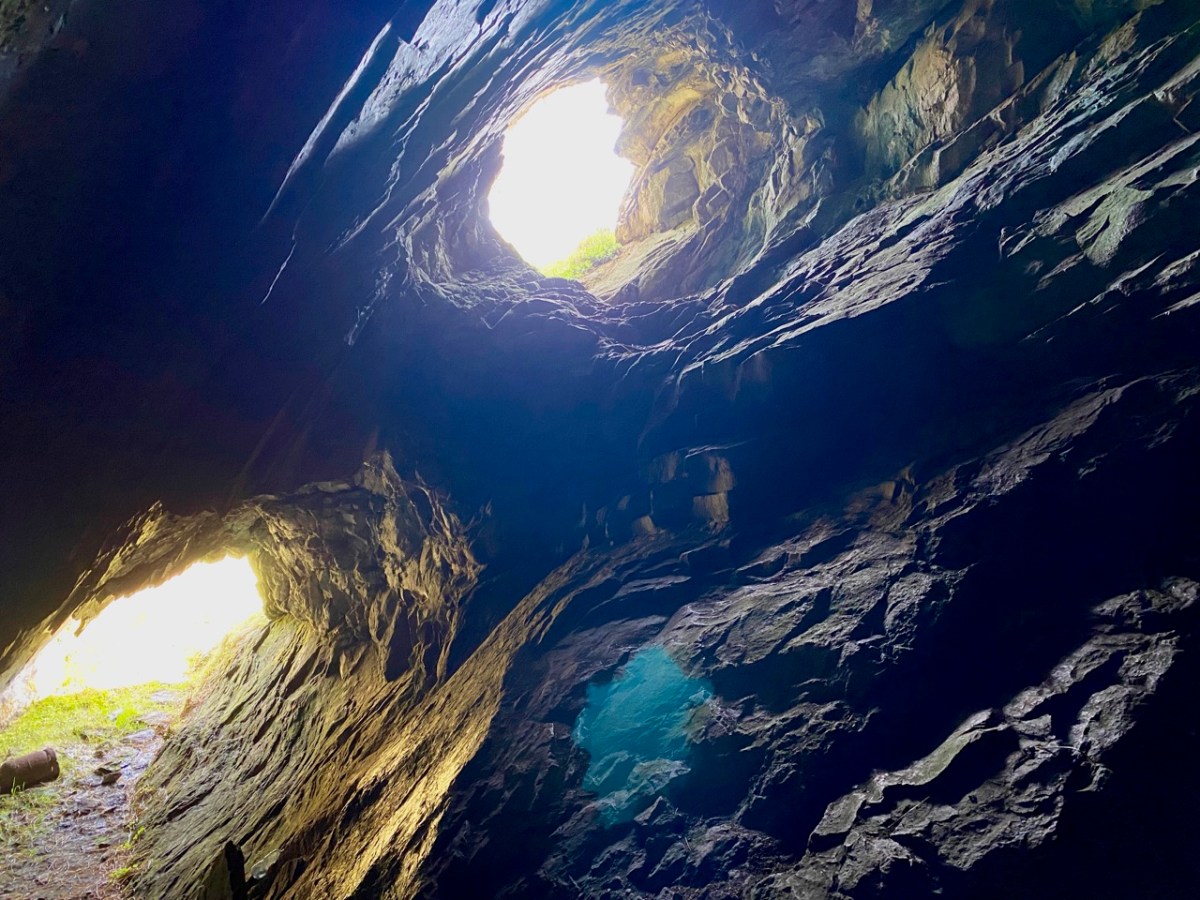
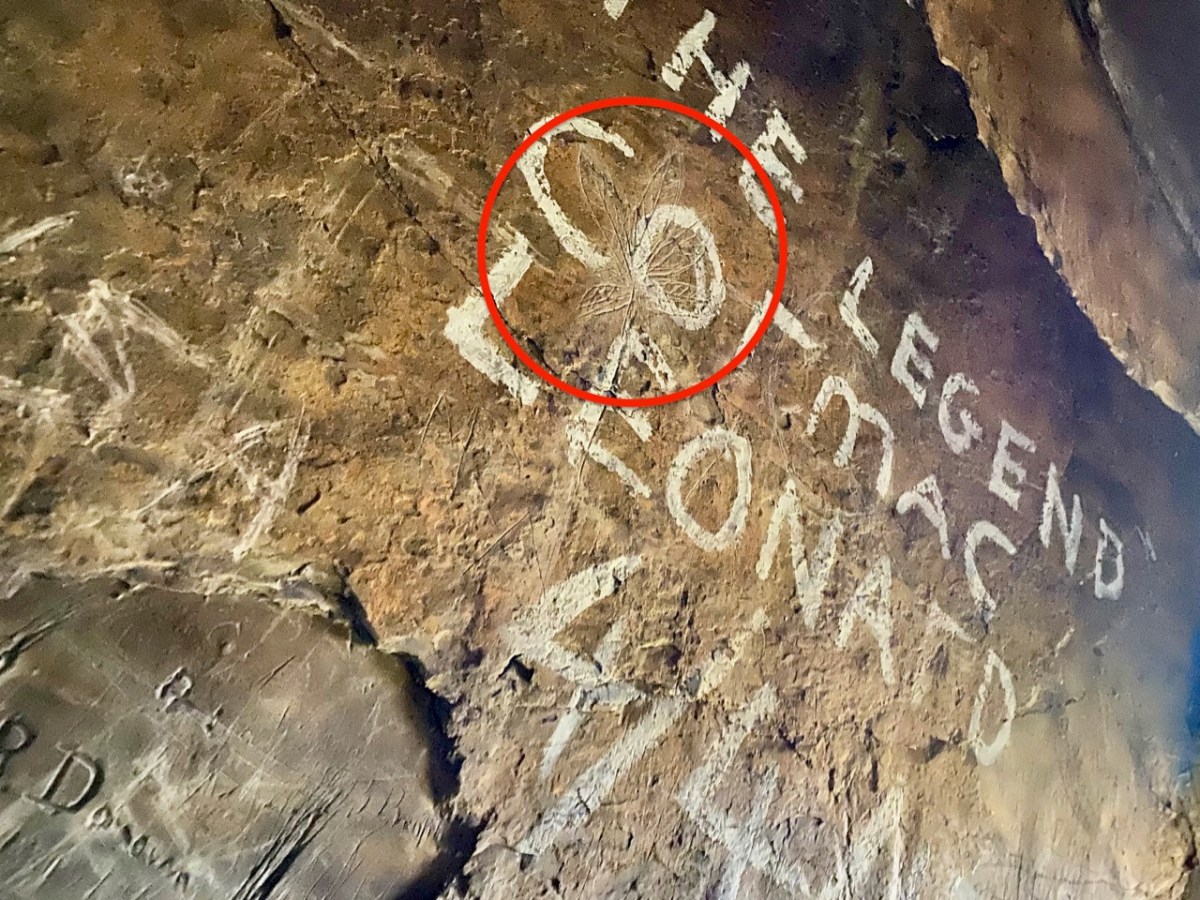
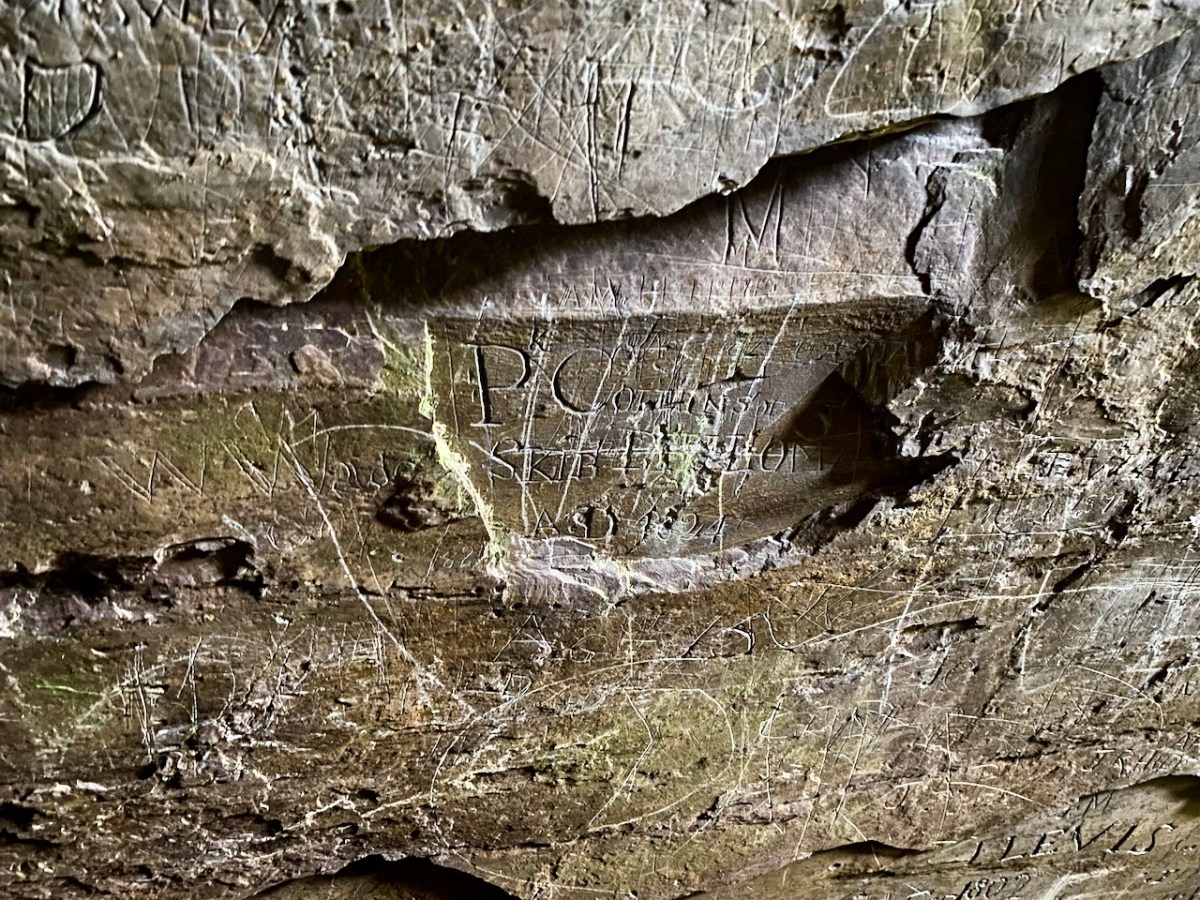
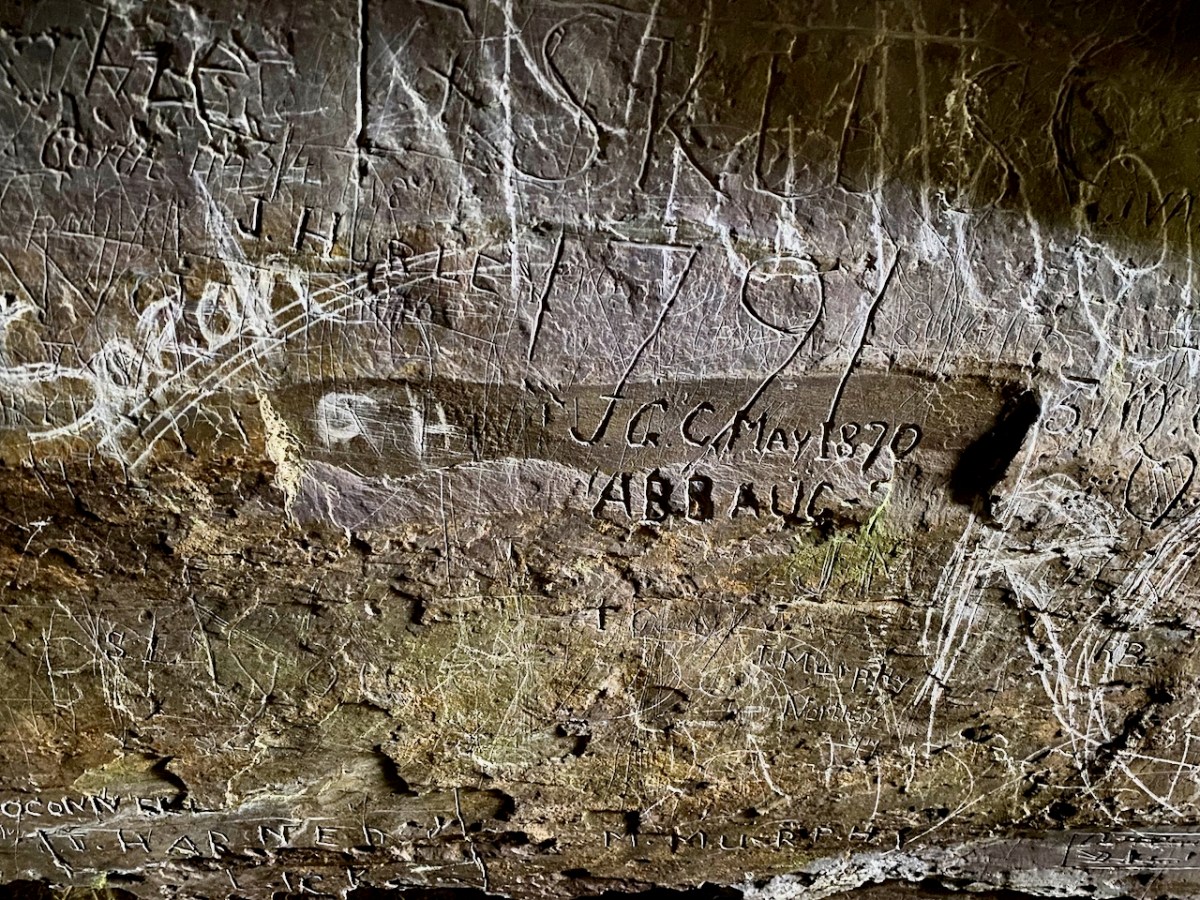
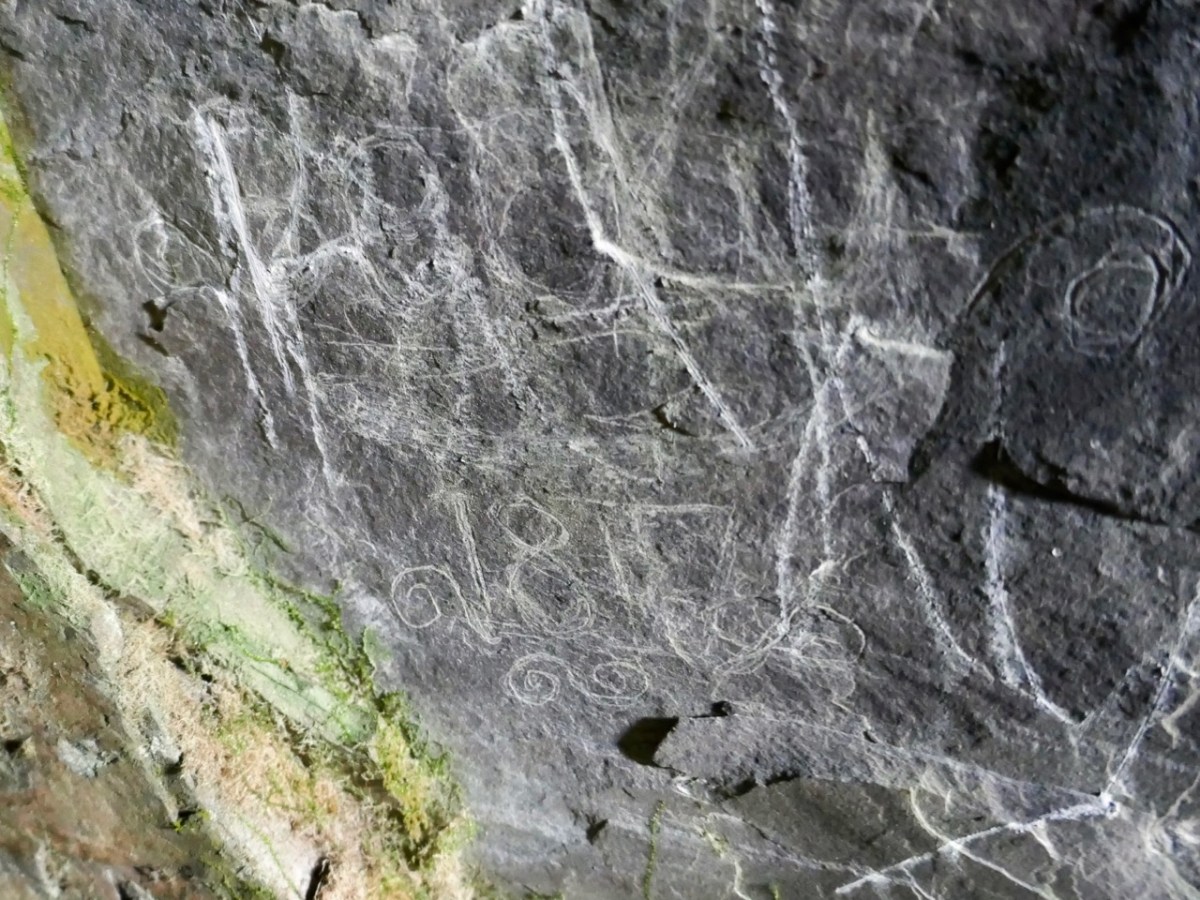
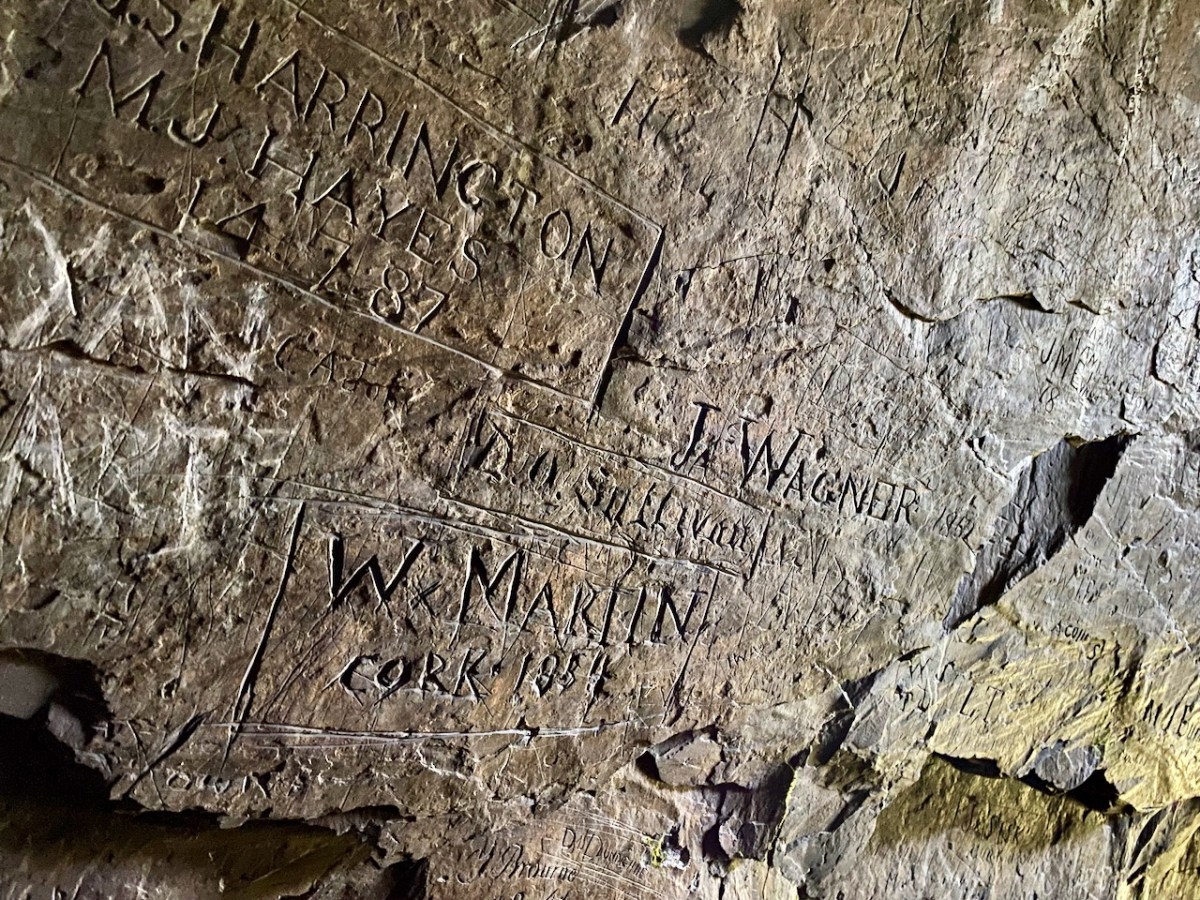
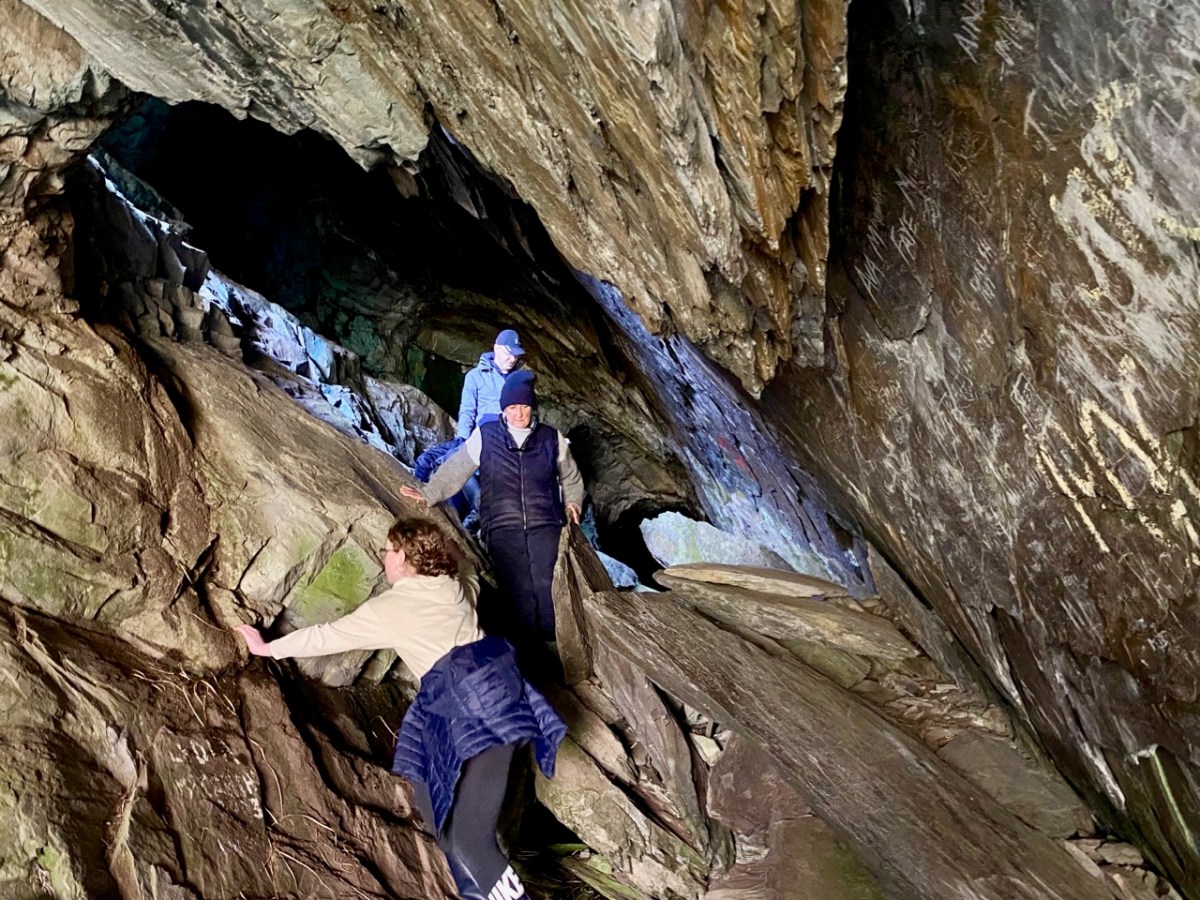
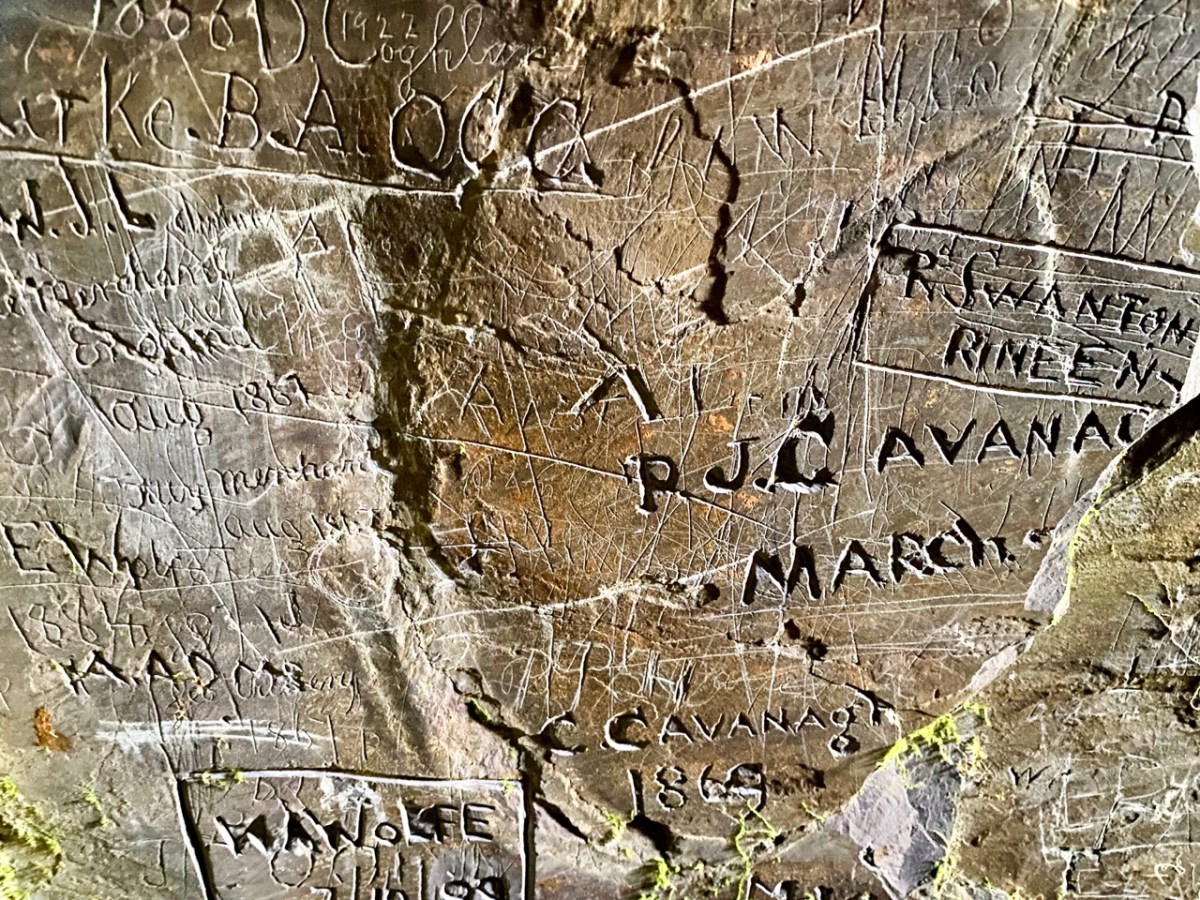
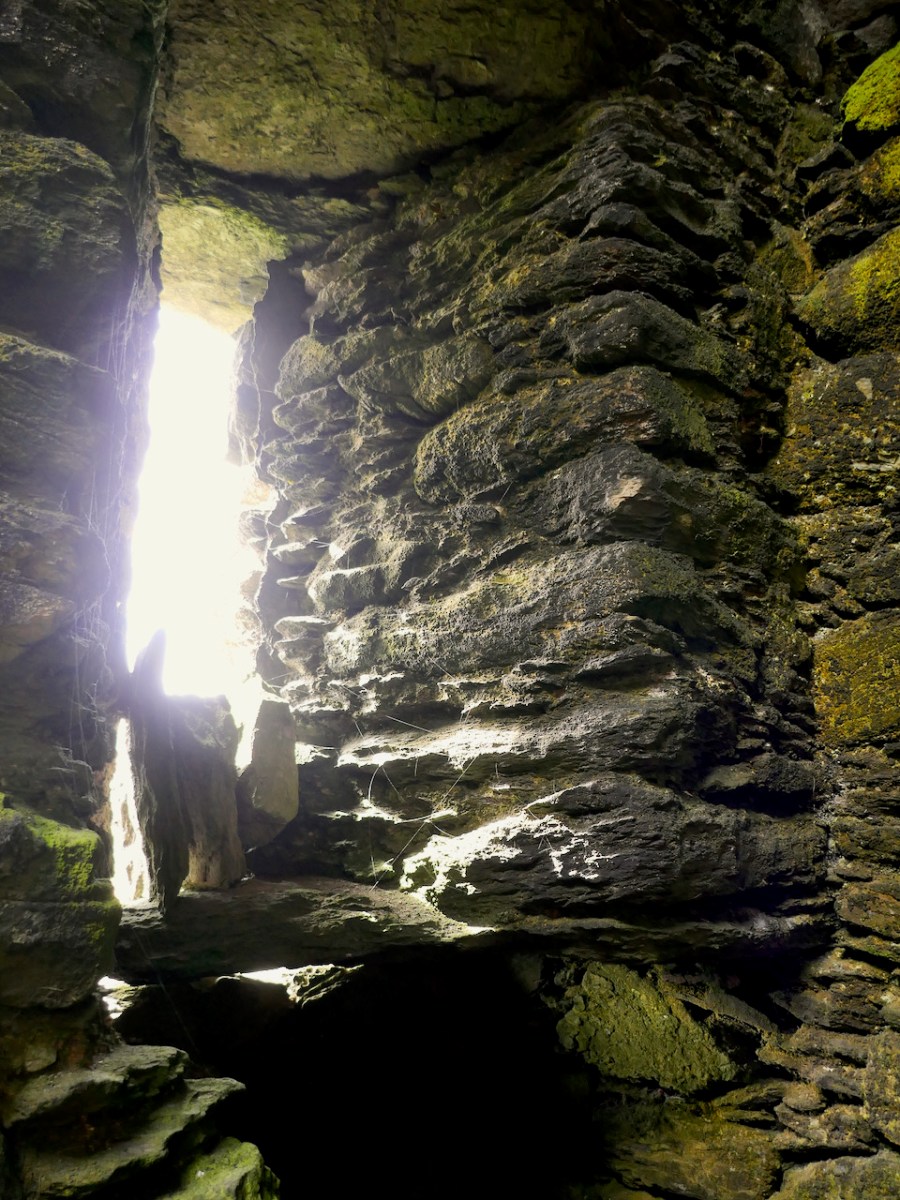
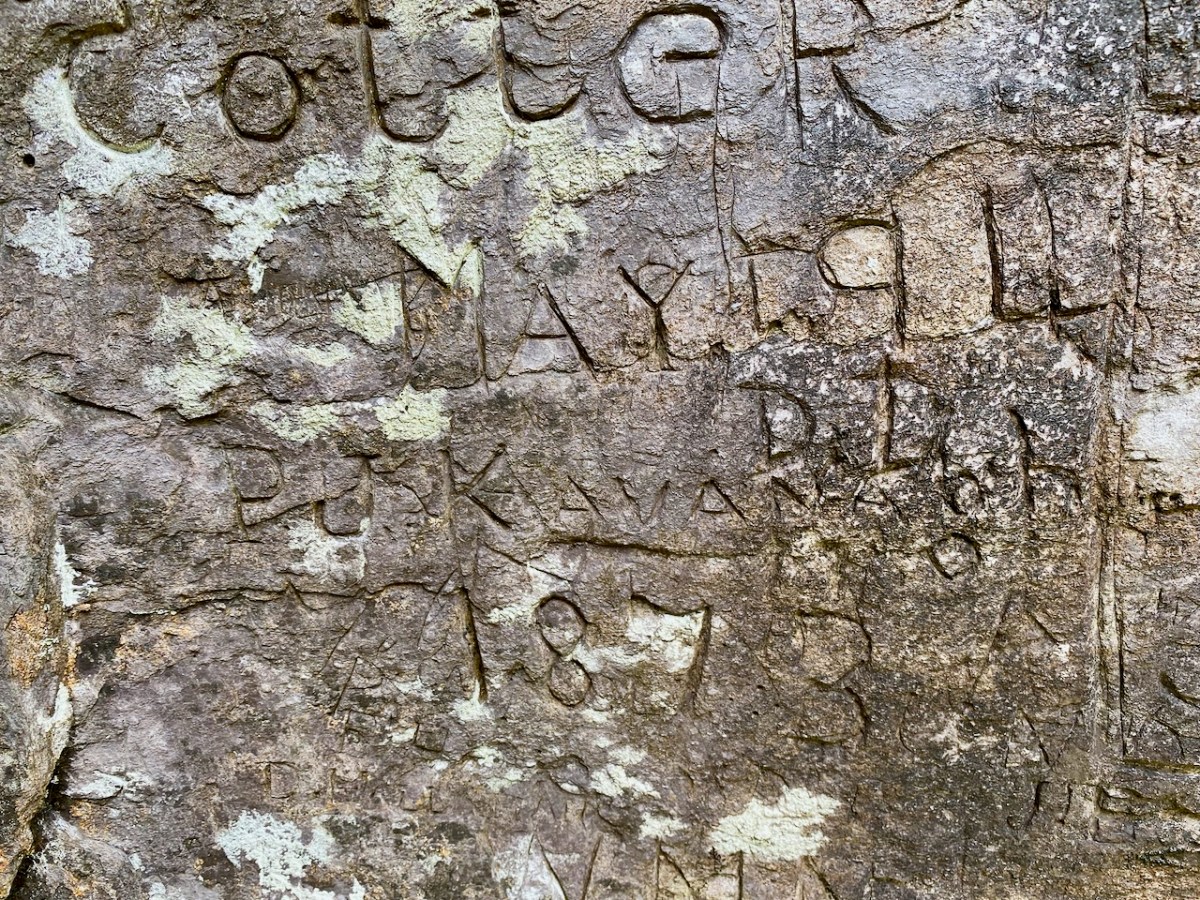
The cave has two entrances – higher and lower – and the rock faces within certainly look as though they had been worked in places. This could be from the “. . . unsuccessful 19th century exploration for copper. . .” mentioned in the archaeological record. But the exposed stone is covered in scratchings: names, words, dates from all periods – recognisably going back as far as the 1700s. There are also a few images, such as this group of leaves which has been partly obscured by modern-day painted lettering: – and note the harp in the top left of the next pic down:

We had been surprised that we could not find any written description of the graffiti which – although not ‘ancient’ – has to be of interest, as it is a record of marks made by people through many centuries. In our recent census (2022) we have all been asked to contribute to a ‘time capsule’ – our words will be sealed up ready for opening by future generations a hundred years from now. (Some of these words have been published on the internet. My favourite is the simple and poignant: “Is there anybody there…?”). This cave is a comparable ‘time capsule’ but perhaps less embracing of contemporary life.

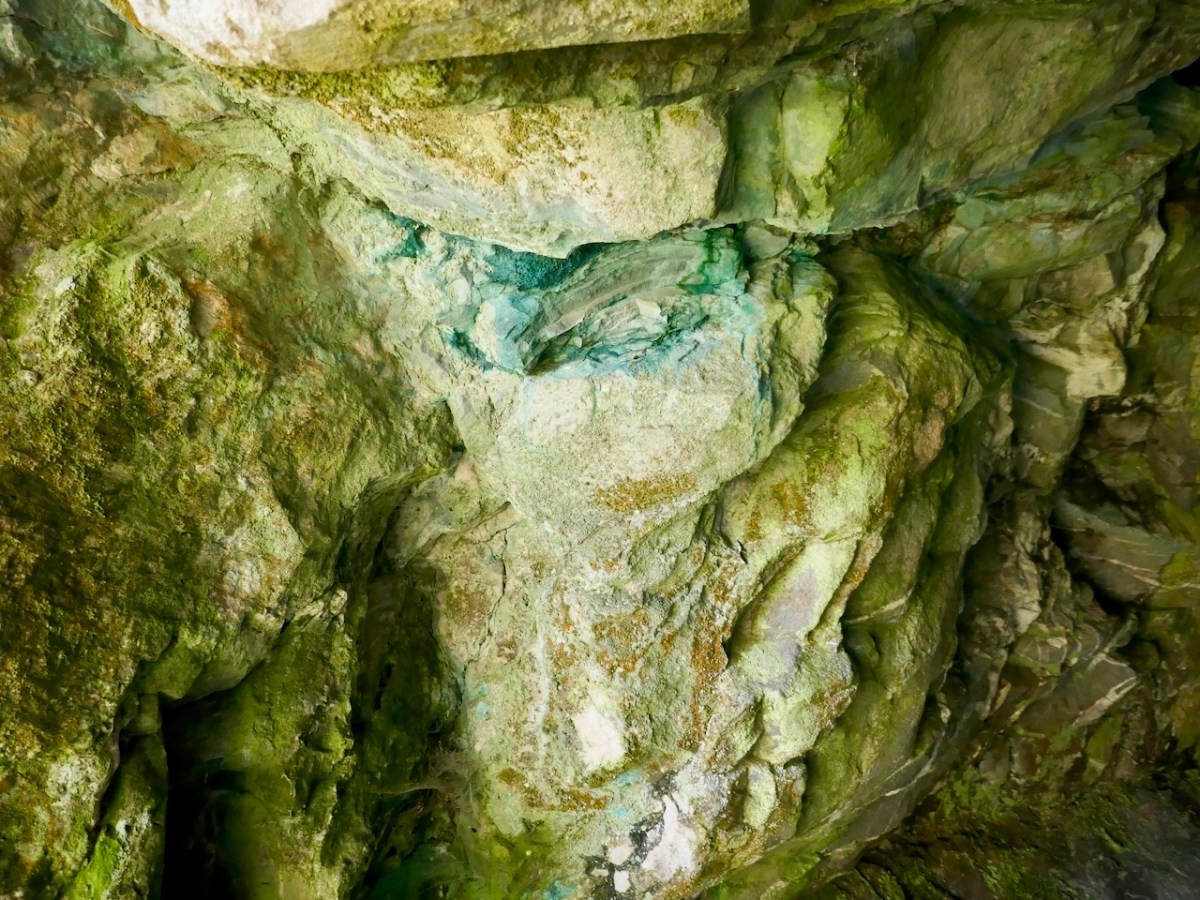
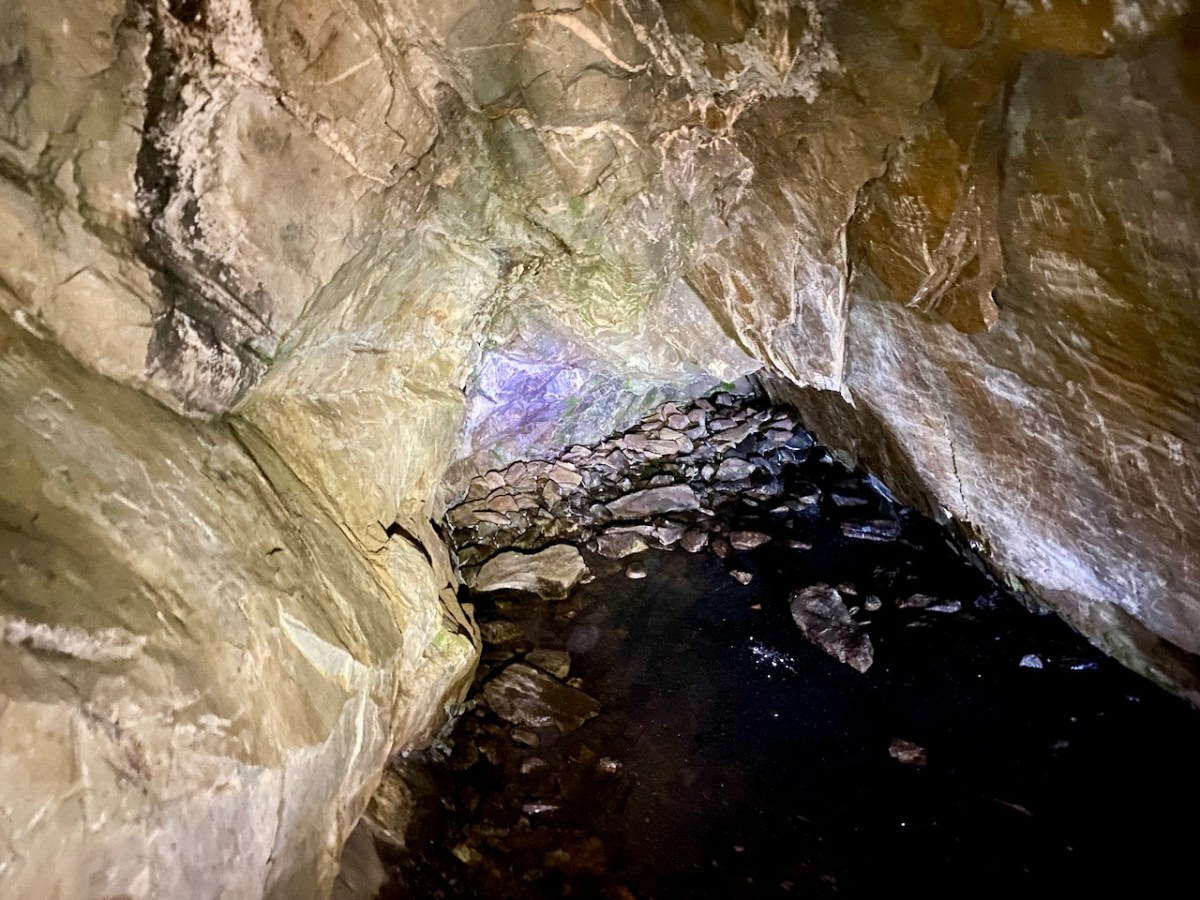
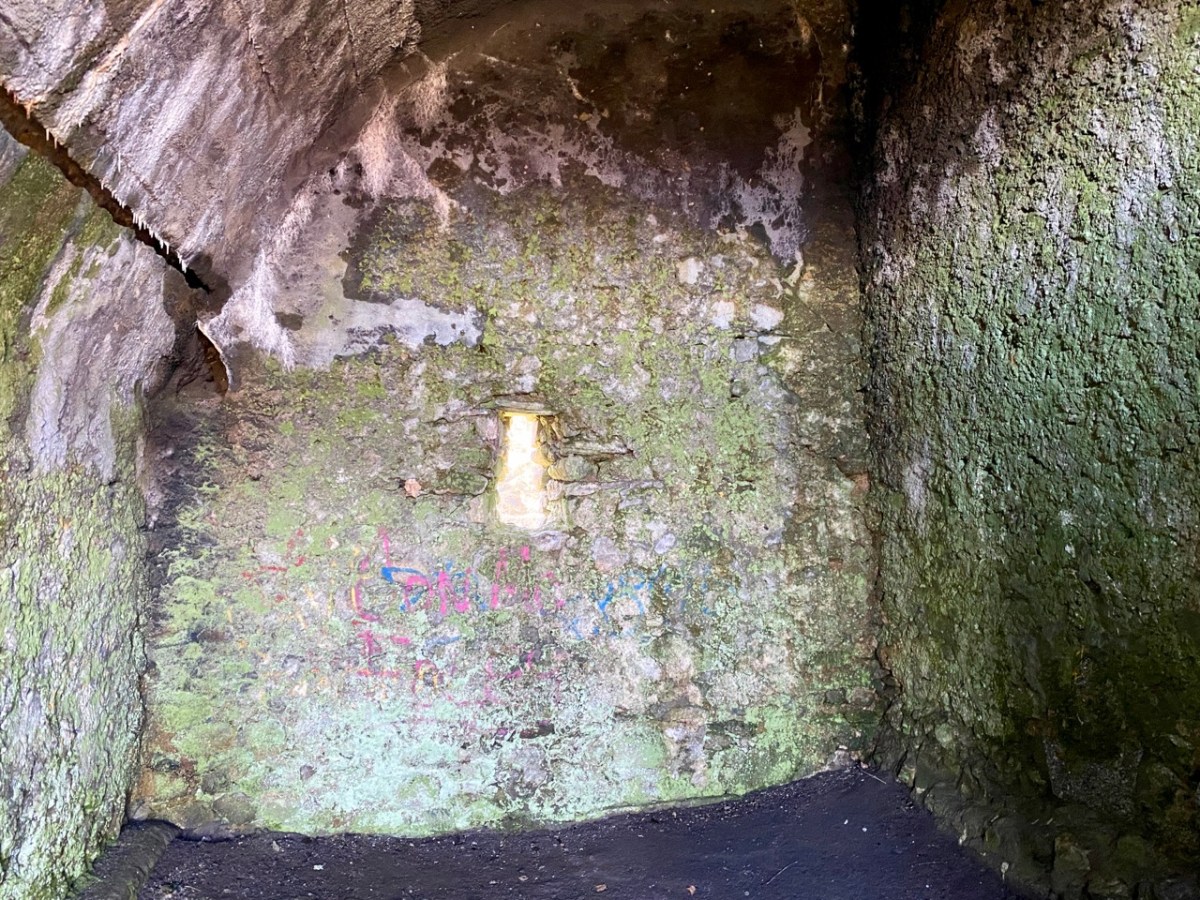
Centre, above: the copper staining, which is mentioned in the redundant archaeological record. Above is the far end of the cave, with some interesting lighting effects. The pic below gives an impression of the scale of the interior.

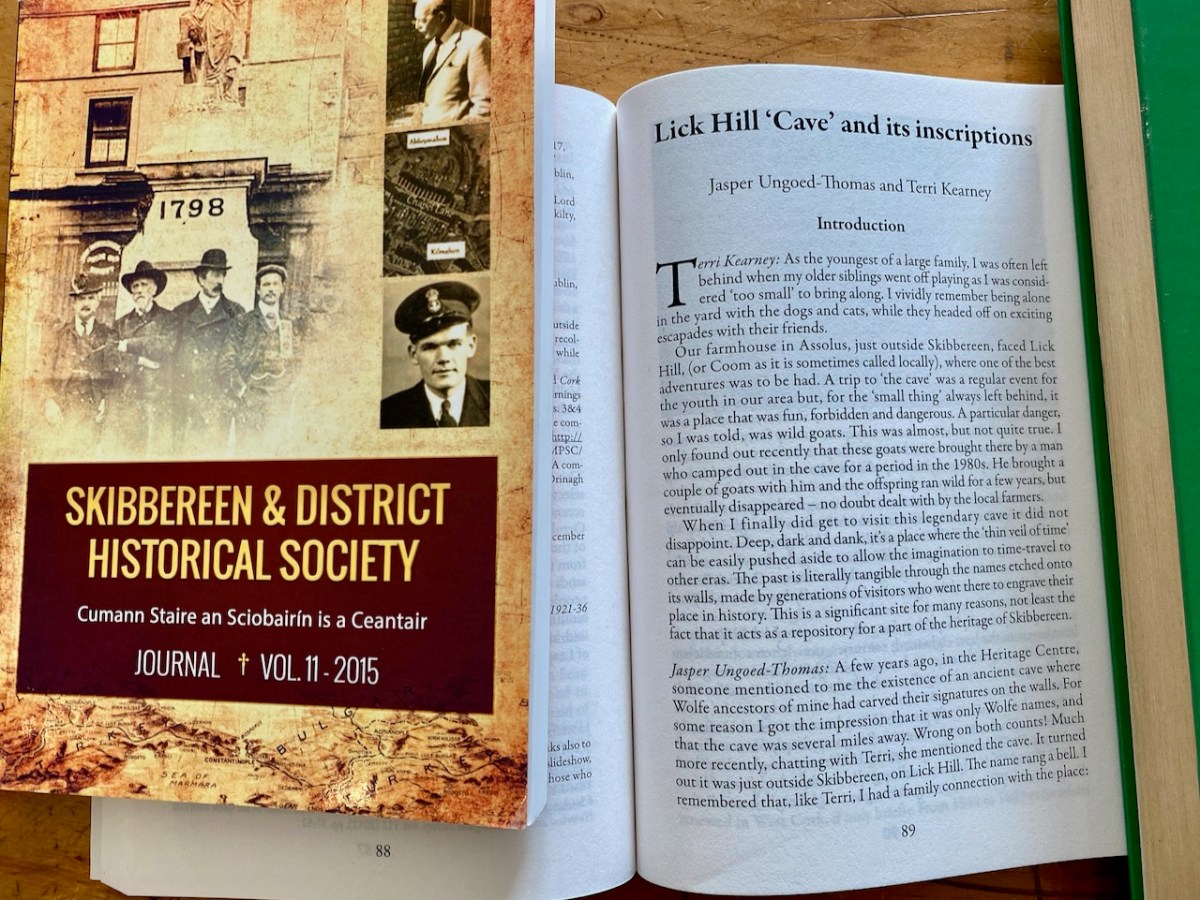
Before writing this post I made a few more enquiries, and discovered that the rock scribings had been thoroughly researched and written up in an article in Volume 10 of the Skibbereen & District Historical Society Journal, dating from 2014. The reason I had not previously discovered this was that the writers chose the local name of Lick Hill, rather than Coom Hill or the townland name (Gortshanecrone). Local knowledge is everything!

The excellent article is written by Jasper Ungoed-Thomas (whose ancestors – Wolfes – had carved their names on these walls) and Terri Kearney, who has been the Manager of the Skibbereen Heritage Centre since it opened in 2000. The Journal article is as comprehensive as you could ever need, with a full list of the names inscribed on the cave walls, together with information on those named where it is known. As an example, J Cotter, 1790 has the following entry:

. . . Cork Anglo-Protestant family, dating back to at least seventeenth century. Edward Cotter RIC during War of Independence. A Catholic branch existed by twentieth century. Edward Cotter was section commander of Bantry IRA . . .

Skibbereen and District Historical Society Journal , Volume 10 2014

The same Journal article describes well the techniques which have been employed in many of the scribings:

. . . The nature of the rock face, with its hard surface, inevitably influenced the quality of the inscriptions. From the late eighteenth century until the later twentieth century, those who wished to leave a record of their visit had little option but to carve their graffiti. It is quite easy to scratch a name, but the outcome is often difficult, if not impossible, to understand. Results which are usually, but by no mean always, easy to read can be achieved by cutting, probably with a knife. But almost certainly the fairly few very clear inscriptions were done with a sharp chisel. Presumably some visitors came prepared to inscribe their names, since proper carving is not easy; it demands time, application and skill . . .

Skibbereen and District Historical Society Journal , Volume 10 2014

Wolfe and Cotter names are seen in the examples above. Having visited the cave we perhaps thought our adventures were over for the day. However, getting back to where we had parked our cars was hazardous, as we opted to follow what seemed to be an easier route (I have to confess it was my suggestion!).

It proved to be a long and tedious trek. The terrain was uncertain and we had to negotiate bogs and steep, uneven surfaces where there were no visible footholds. When we wearily made it to a boreen, we found we still had far to go. A lesson learned: always go back the way you came – you know you will arrive! In spite of the strains, we had a great day out, and broadened our knowledge of local West Cork history. Don’t forget – as always – seek the permission (and advice) of landowners before you embark on any such exploration. And don’t unduly disturb the local residents!

Dunworley Promontory Fort – A Bit Of A Stunner

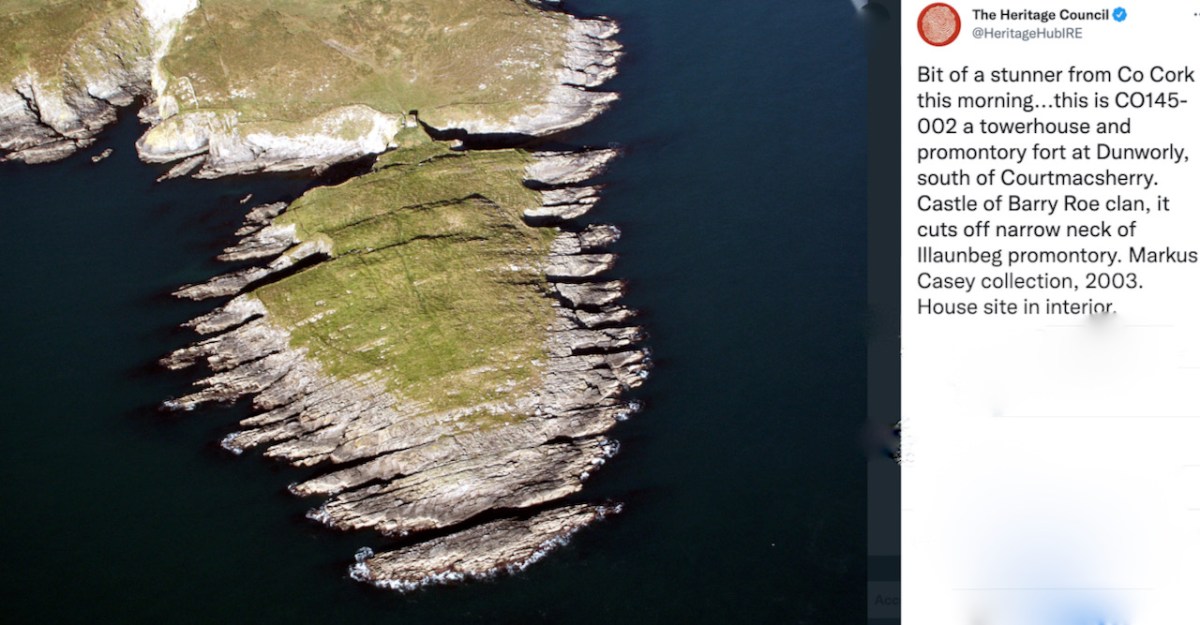
We’ve been wanting to visit this site for ages and the opportunity came this week, thanks to the kindness of Diarmuid Kingston and Tim Feen of Dúchas/the Clonakilty Historical Society, and the landowner, Jim Molony. As the Heritage Council said when they posted the photo below on their Twitter account – it’s a bit of a stunner!

Partly, this outing was to kick off a project I have in mind to follow in the footsteps, 100 years later, of Thomas J Westropp, the antiquarian who did so much to modernise Irish Archaeology and whose special interest was forts and fortified headlands. I already wrote about one of the promontory forts that he documented and we visited last year – Gouladoo, on the Sheep’s Head. I suppose that was In the Footsteps of Westropp 1, Part 1, and this is Part 2. 

Let’s review what a promontory fort is. In 2004 Liam Downey laid out the thinking on this type of monument for the Archaeology Ireland/Wordwell Heritage Guide series. He called them ‘enigmatic.’ They are headlands fortified at the narrowest part, or neck, by earth or stone banks, ditches or walls and they vary considerably in the size of the enclosed area and the length of the fortifications. The sea and the cliffs all around the enclosure provide another level of defence, often seemingly impregnable. 

This type of fortification may have been built as early as the Bronze Age, although most are believed to date to the Iron Age (from 500BC) or the Early Medieval Period (from 450AD), but many were obviously also occupied in the medieval period, when additional defences were added, as at Dunworley. 

Why were they built? Downey says this:

Their overtly defensive character and exposed locations, allied to the admittedly scarce excavation evidence, suggest that they might have been built as temporary refuges for use in times of grave danger. On the other hand, assuming that defence was the purpose, the cliff-top location suggests a fight to the death rather than a safe refuge. Assuming that human nature does not change radically from one era to another, one potential explanation for the location is prestige. Several promontory forts are built on a large scale and some are very impressive in appearance, especially those with closely spaced walls or banks. These may have been status sites, visible from a distance and designed to dominate the adjacent countryside. The spectacular locations, unspoiled sea views, occasional associations with royalty, pagan deities or St Patrick, and even the element dún combine to suggest that the social role of these monuments in ancient times may have been quite complex. 

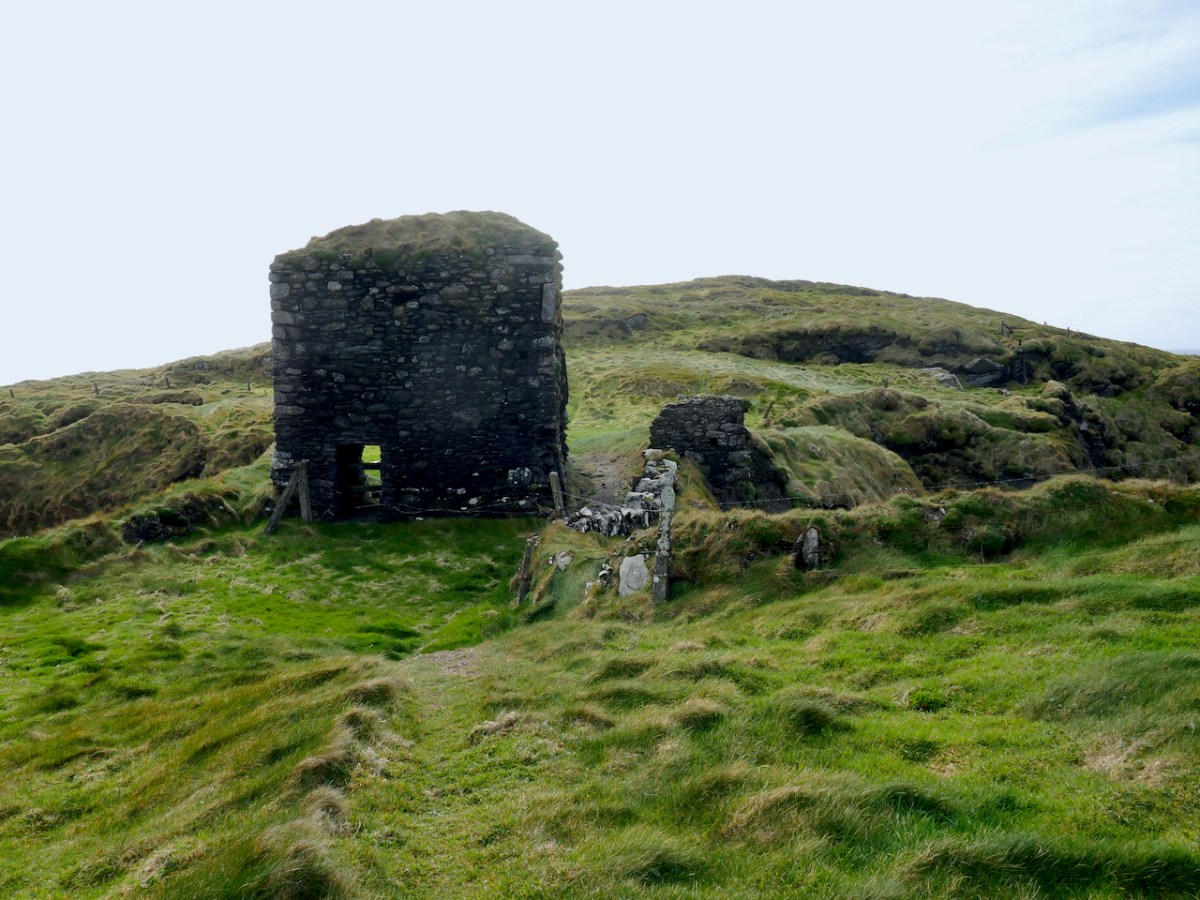
In the light of all this, let’s take a look at Dunworley. It’s unusual, in that the narrow neck of the promontory has had an additional feature built on it, in the shape of a small tower house – a gate house, in fact. 

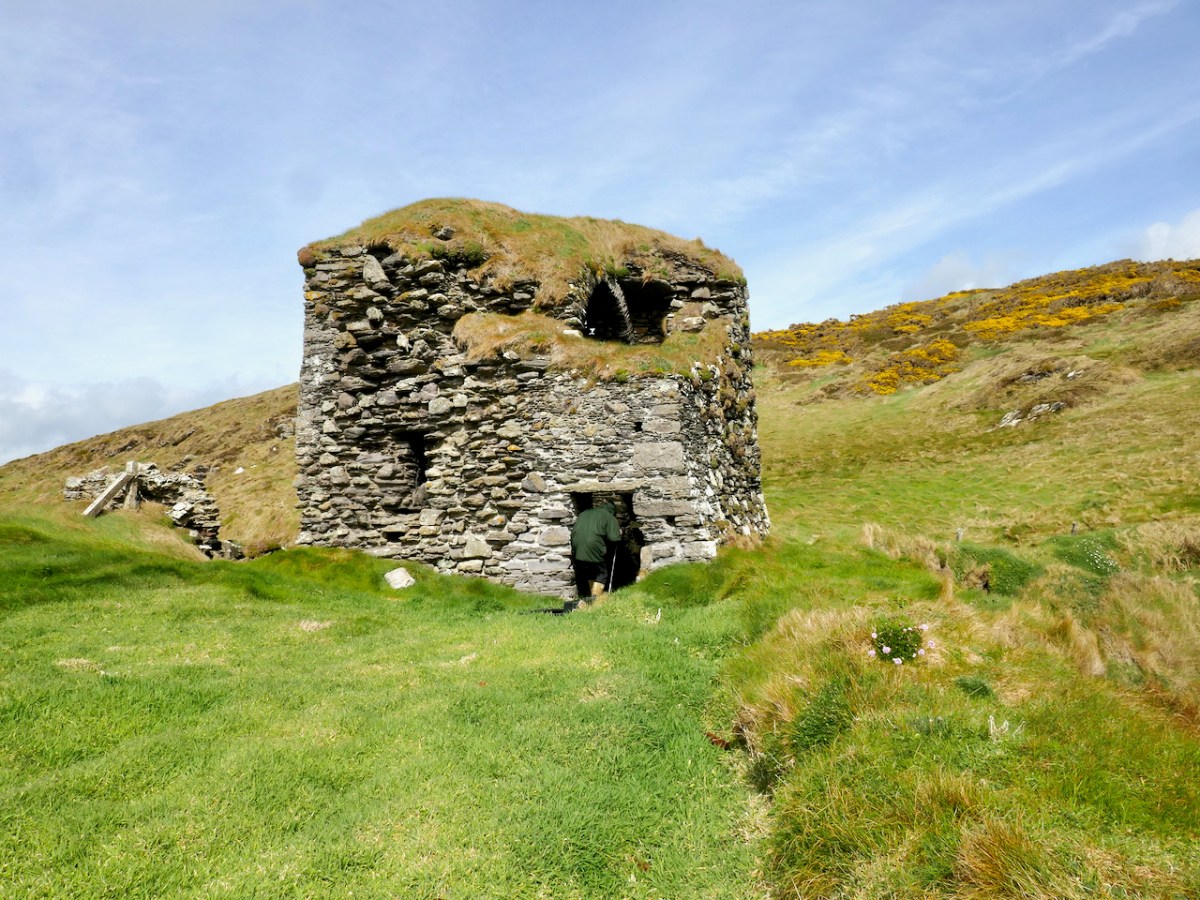
The features of this small tower (our guides called it a wee castle) are pretty typical of fifteenth century tower houses in West Cork (except on a smaller scale), with a base batter (lowest level splayed outwards), rubble construction, and inside one ope with a splayed embrasure (below). The two doors, back and front, are simple affairs and there is no sign of bar holes, eye or spud stones for the doors.

One of the more curious features, noted by Westropp, is that there appears to have been two floors, as evidenced by the corbels upon which the floor joists would have rested (below). However, the corbels are less than a metre apart, so it is hard to imagine how that space would have been used. 

The internal vault, which would have separated the lower floors from the topmost floor and the wallwalk, is not a continuous vault but two arches which are covered by large slatey slabs. Although not as common as the continuous vault (see Dunmanus for an example of this), I have seen this type of vaulting in other West Cork towers – at Dunlough, for example, and less obviously at Dun an Óir on Cape Clear and at Rossbrin – all 15th century tower houses of the West Cork Irish families of O’Mahony and O’Driscoll.

Westropp, in his 1916 paper Fortified Headlands and Castles on the South Coast of Munster. Part I. From Sherkin to Youghal, Co. Cork, gives a complicated genealogy for the fort. He says it was destroyed by Fineen McCarthy after the Battle of Callan in 1260 – and this would imply that whatever original fortification was here, it was built by an Anglo-Norman family, since it was the anglo-Norman castles that Fineen destroyed. It may then have been taken over by the O’Cowhigs, but was definitely held by a branch of the Barrys by 1573. It passed to the Travers, the Hamiltons and back to the Travers. Jim Moloney, the present owner, told me that it has been in his family since his grandfather bought it.

Westropp, in his usual thorough fashion, provides a drawing of the small tower, both its position at the neck of the promontory, and a plan of the building itself – the top left and top centre plans below.

Some accounts mention a house on the promontory, but Westropp saw no sign of one. He did, however, note:

The day of my visit the headland was covered with cattle ; and it was interesting to see them, when called out to water, going in single file, without delay or hustling, through the little doorways, the outer 3 feet 1 inch wide, by 5 feet high ; the inner 2 feet 10 inches wide, and 5 feet 9 inches high. This shows how easily cattle might be brought through the small doors (but usually wider and higher than this gateway) in the dry-stone ring-forts.

This is particularly interesting because the land is considered unsuitable for livestock now, because of the difficulty of getting them on and off the promontory and because there is no source of water on it. In any case, it has been declared an Area of Special Conservation, since the cliffs are home to nesting choughs – a very suitable designation for such an epic place.

The day of our visit was a stormy one – Amanda was actually blown off her feet at one point. It was easy to see how such a place could be defended in times of attack, and act as a refuge. The whole area had such a wild, remote and romantic air that we truly felt privileged to be able to visit it, and to step back in time to imagine it in its heyday.

You can see us below, bracing against the wind. Many thanks to Diarmuid, Tim and Jim for facilitating our visit and answering all our questions. 

Ballycummisk Archaeology

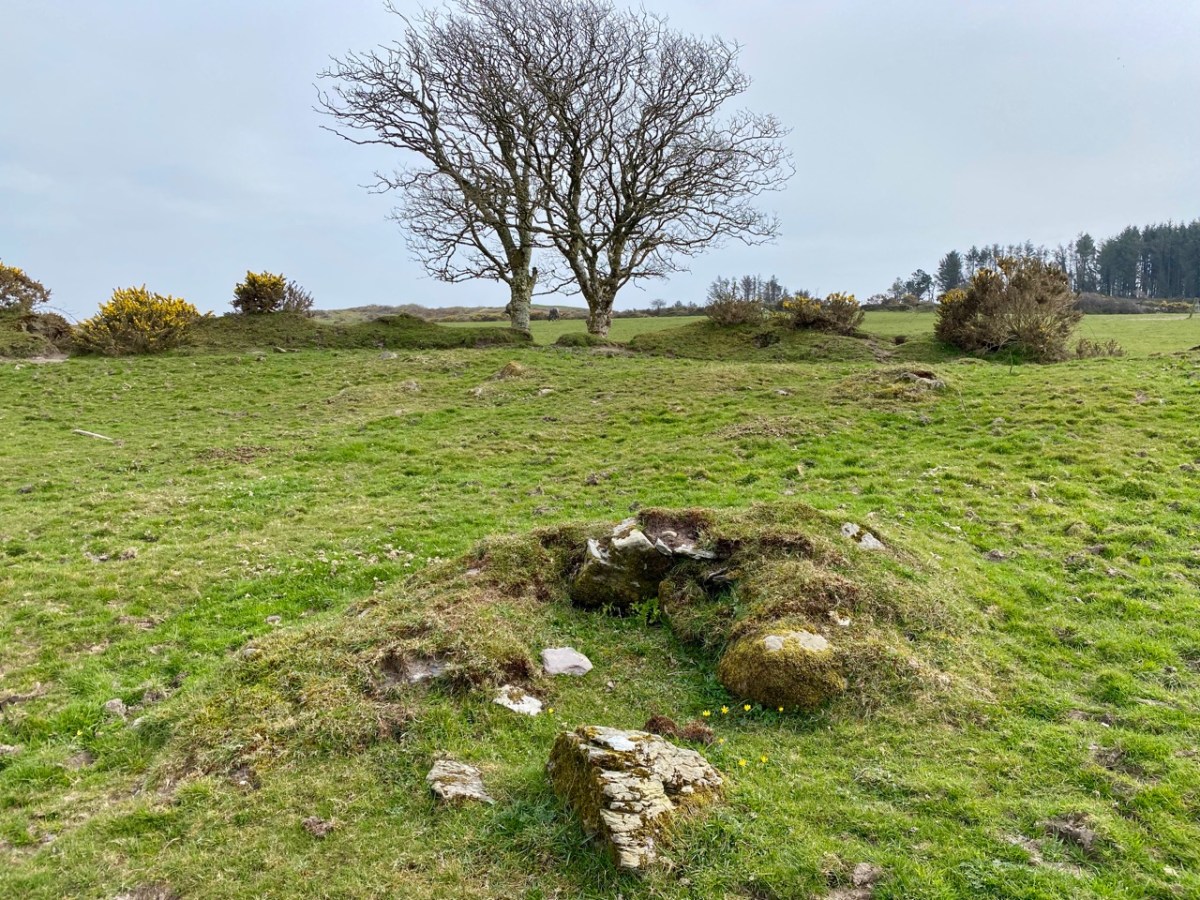
There’s a fine ringfort just over the hill from us – in the townland of Ballycummisk. A definition of a ‘ringfort’ in archaeological terms is given here:

. . . Many people lived in enclosed farmsteads known as ringforts in the Early Christian/Early Medieval period. Second to fulachta fiadh, they are the most common field monument surviving in Ireland with up to 60,000 examples, most dating to between 550-900AD. Ringforts are circular areas, measuring c24-60m in diameter, usually enclosed with one or more earthen banks, often topped with a timber palisade. In the west of Ireland the ringfort was often enclosed by a stone wall, with stone huts in the interior. Traces of iron and bronze working have been recovered suggesting some ringforts had very specific uses while others were multifunctional . . .

HeritageCouncil.ie
Significant Unpublished Irish Archaeological Excavations 1930-1997

A simpler definition comes from the monumental 1200-page Volume 1 of the ‘New History of Ireland’ series published in 2005 and edited by Dáibhí Ó Cróinín: “archaeologists are agreed that the vast bulk of them are the farm enclosures of the well-to-do of early medieval Ireland”.

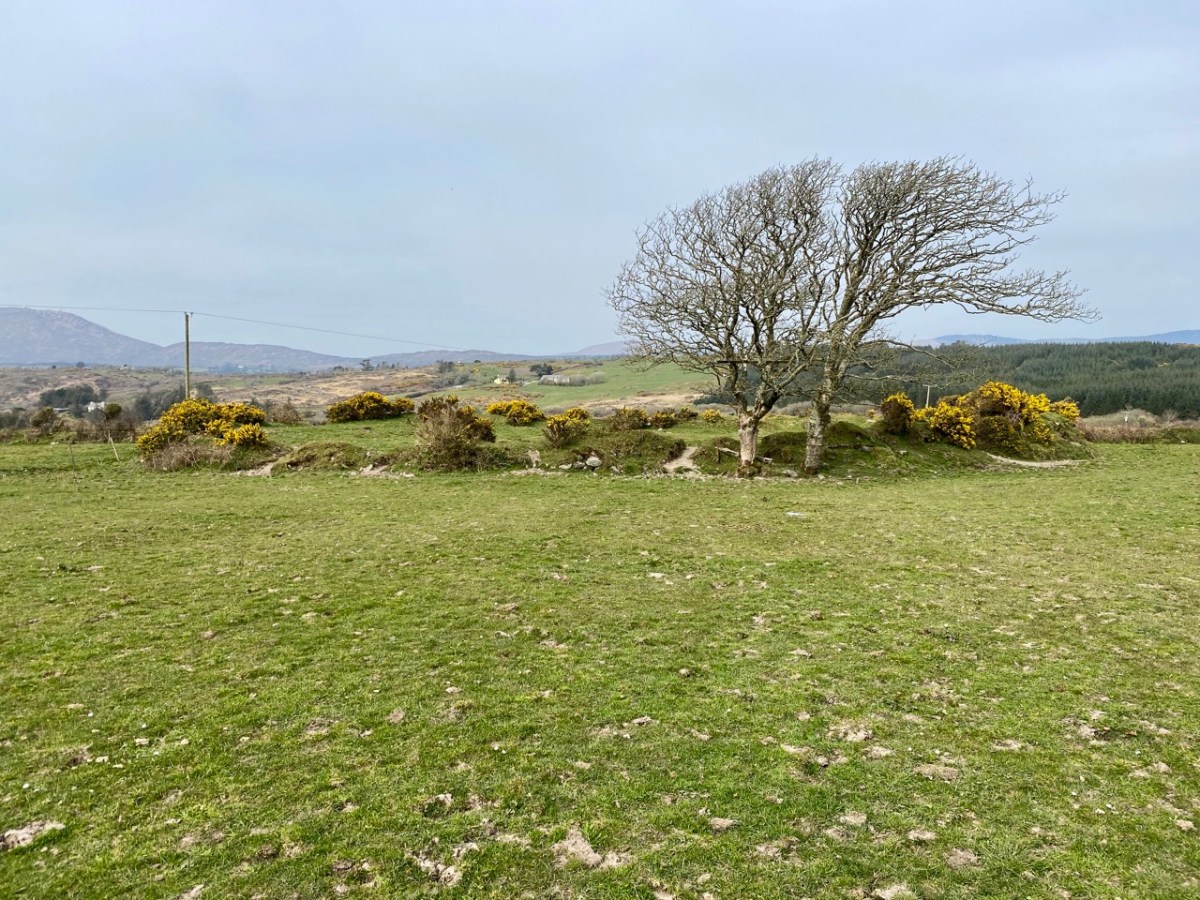
The upper picture is taken from within the ringfort enclosure; the north bank of the fort can be seen beyond a small stone outcrop which is said to be the site of a souterrain. Time for another definition:

. . . Souterrain: an underground structure consisting of one or more chambers connected by narrow passages or creepways, usually constructed of drystone-walling with a lintelled roof over the passages and a corbelled roof over the chambers. Most souterrains appear to have been built in the early medieval period by ringfort inhabitants (c. 500 – 1000 AD) as a defensive feature and/or for storage . . .

archaeology.ie/HistoricEnvironment

You can see more about souterrains – including some illustrations – in my post from four years ago about Knockdrum Fort, south of Skibbereen.

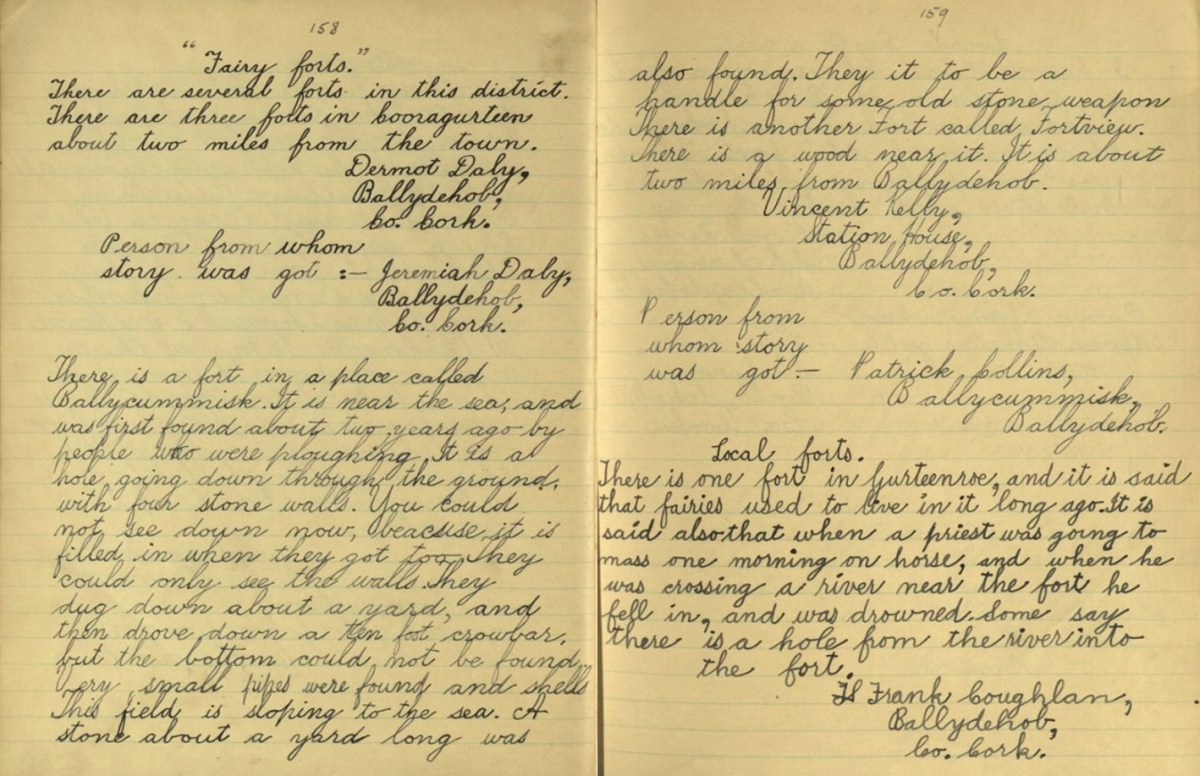
The Schools Folklore Collection is an important source of local beliefs and traditions – if not exactly historical information. The stories were collected in the 1930s but were remembered through family traditions which could go back through several generations. The example pages above – dating from 1936 – describe the Ballycummisk fort. Here is a transcription of the paragraph:

. . . There is a fort in a place called Ballycummisk. It is near the sea, and was first found about two years ago by people who were ploughing. It is a hole going down through the ground, with four stone walls. You could not see down now, because it was filled in when they got to it. They could only see the walls. They dug down about a yard, and then drove down a ten foot crowbar, but the bottom could not be found. Very small pipes were found and shells This field is sloping to the sea. A stone about a yard long was also found. They thought it to be a handle for some old stone weapon . . .

Schools Folklore Collection
Frank coughlan Ballydehob

Frank Coughlan’s description almost certainly refers to the discovery of a souterrain. It doesn’t quite ring true as he says that “the field is sloping down to the sea”. In fact, the fields containing the ringfort are sloping southwards away from the sea, which is not visible at all from the site.

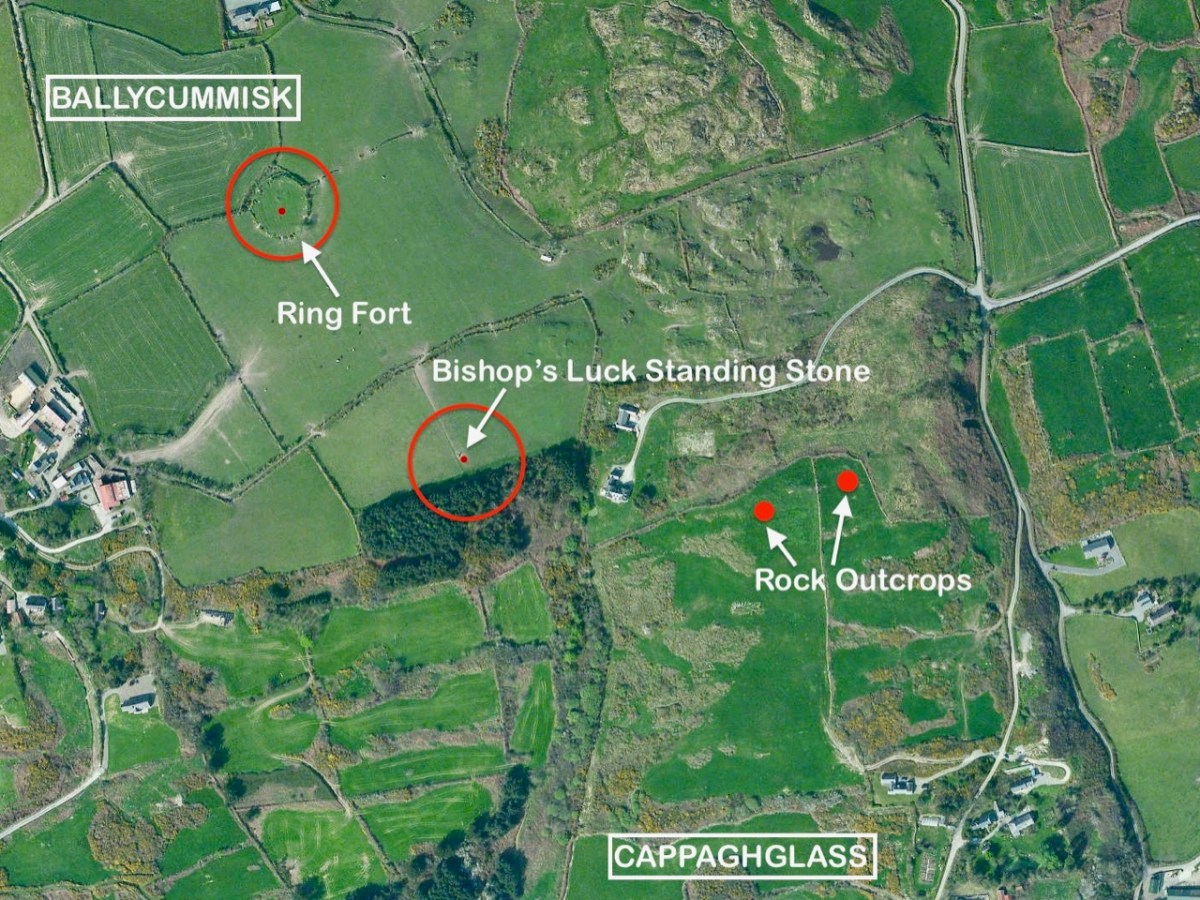
This aerial view shows parts of the townlands of Ballycummisk and Cappaghglass. The ringfort is marked. Another nearby feature – also shown – is a large standing stone, known as ‘Bishop’s Luck’.

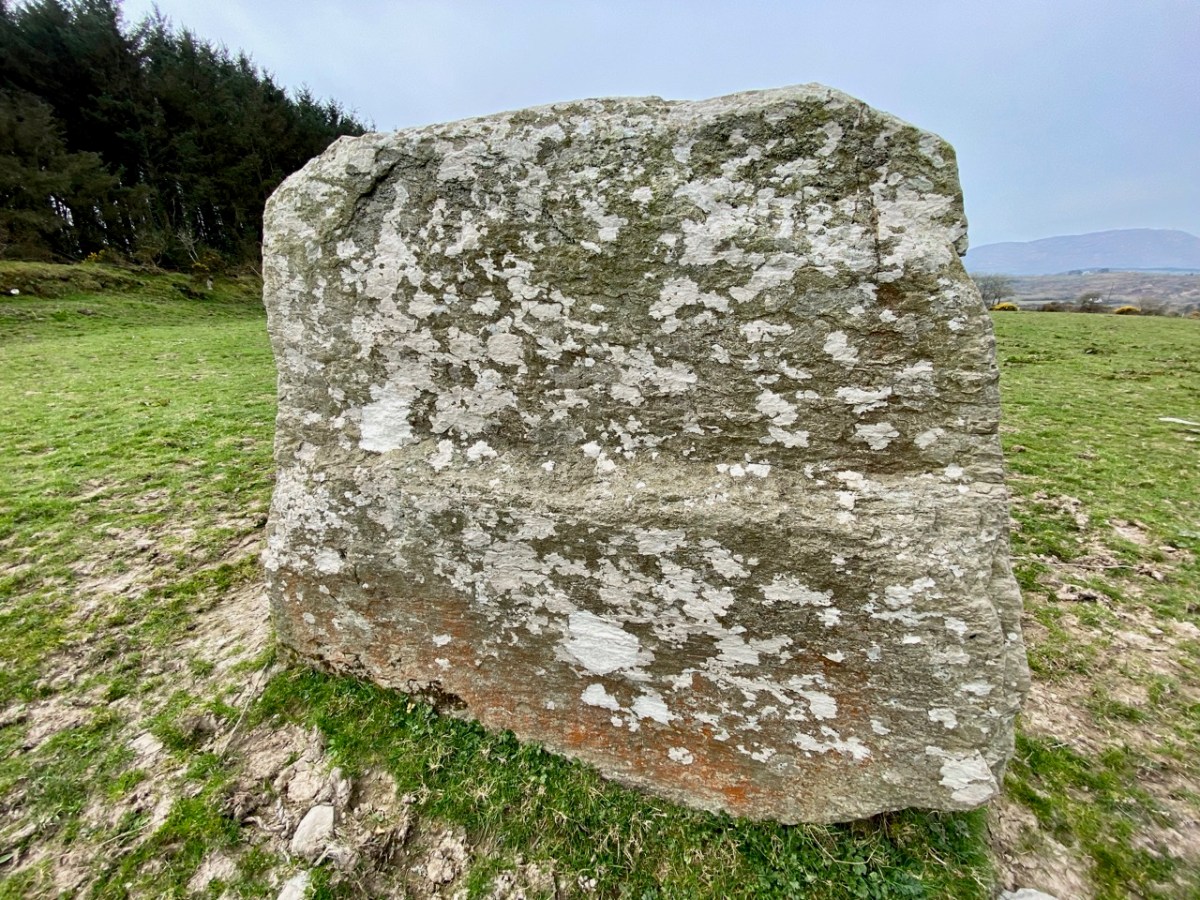
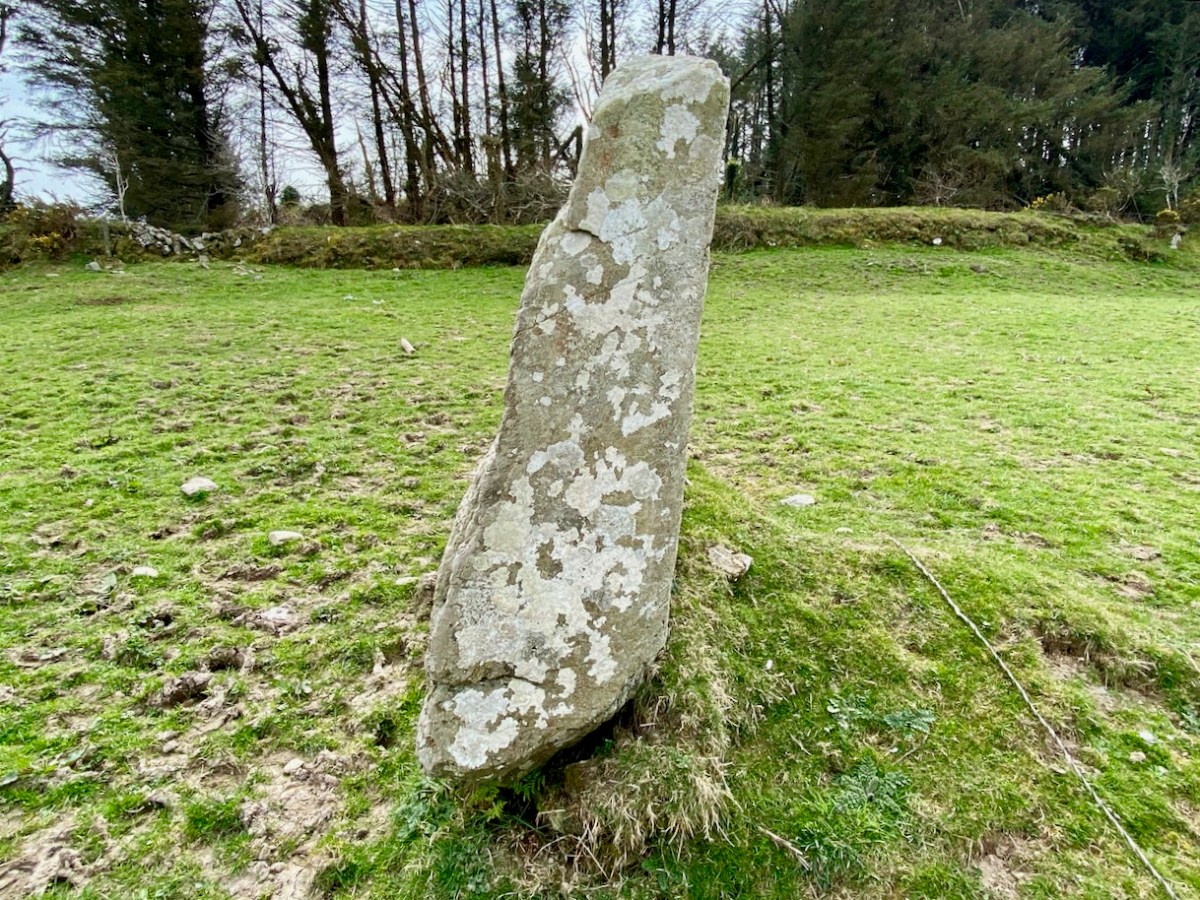
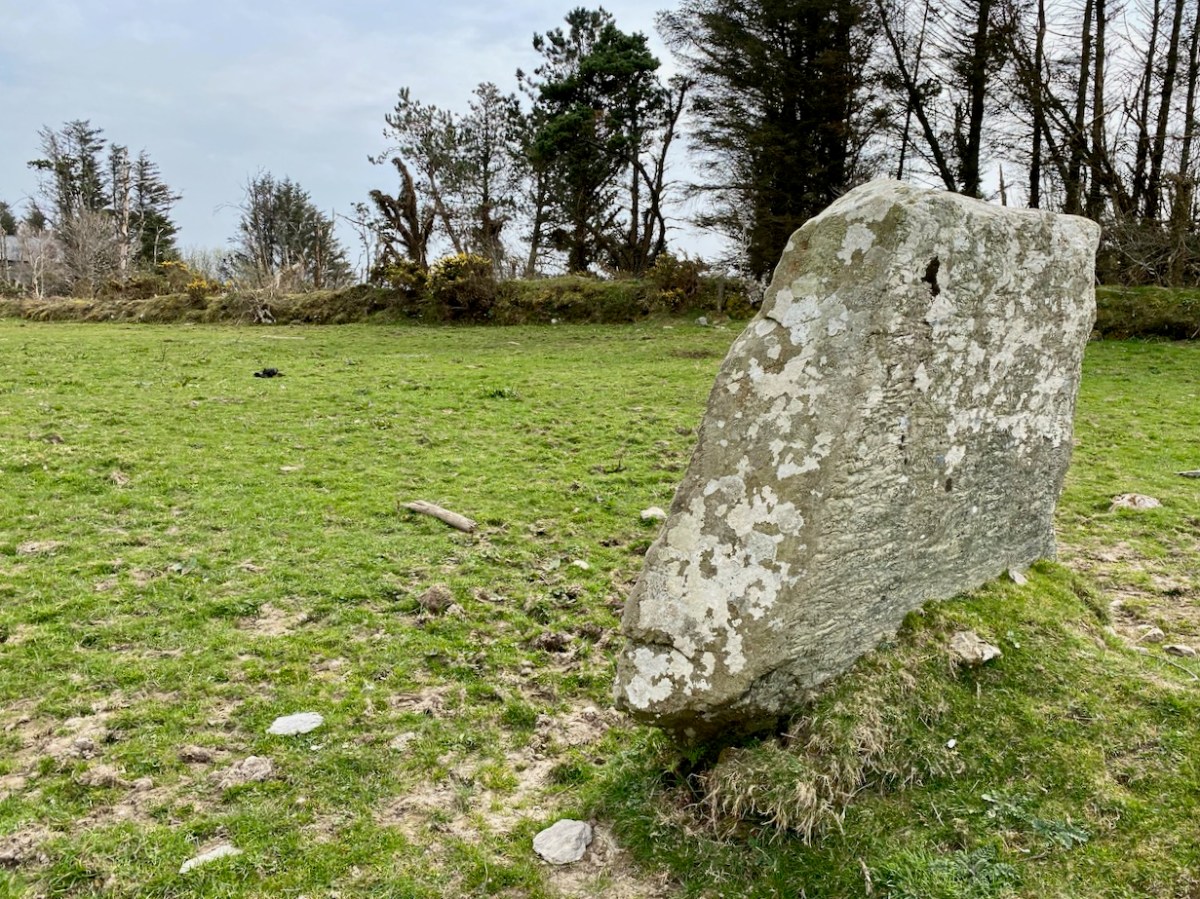
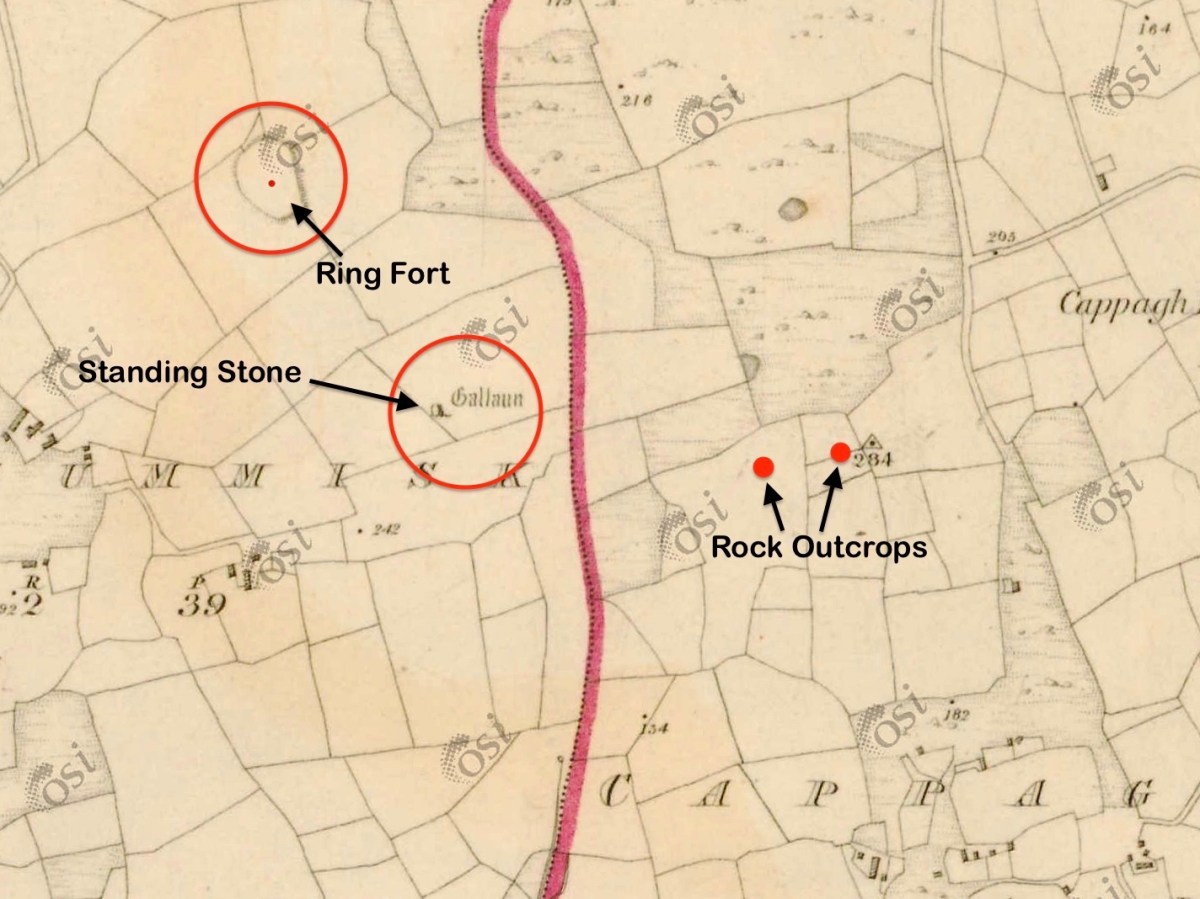
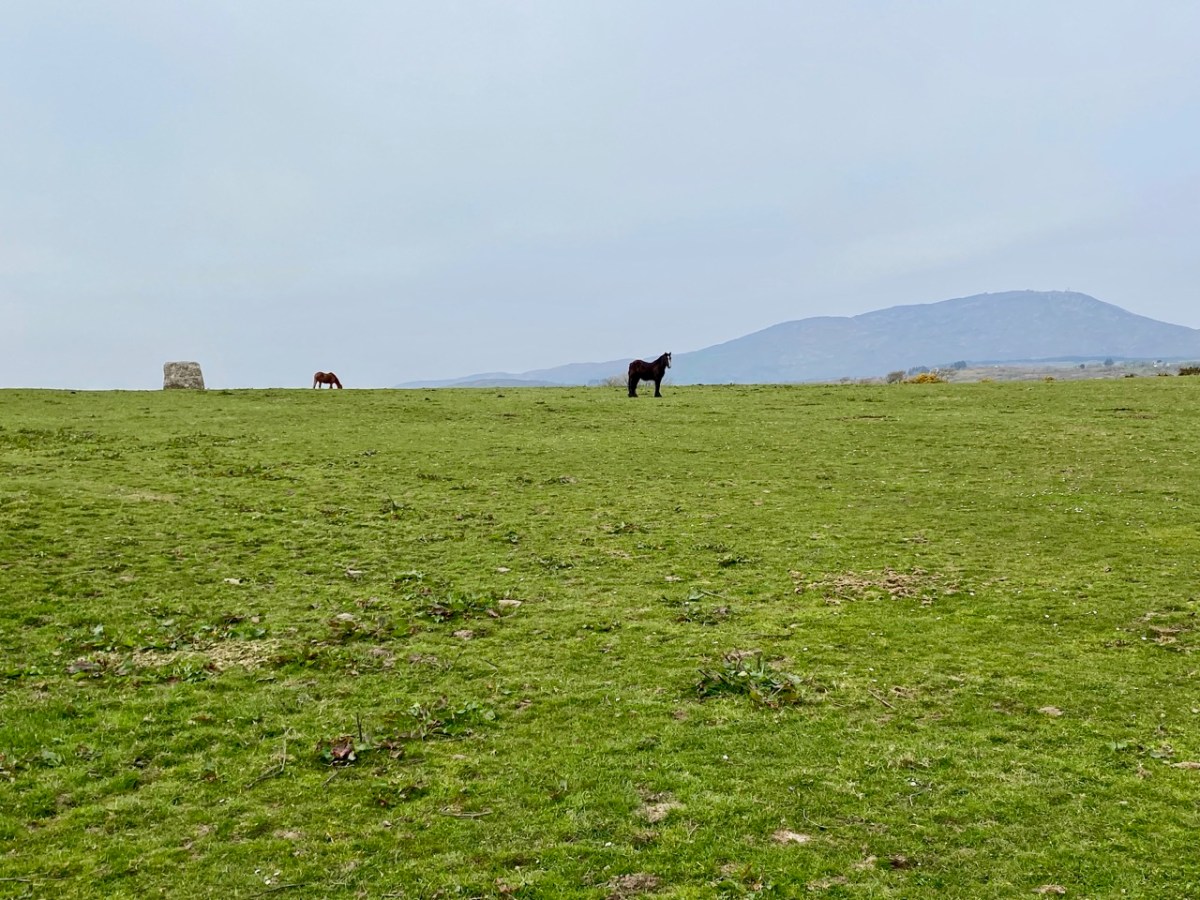
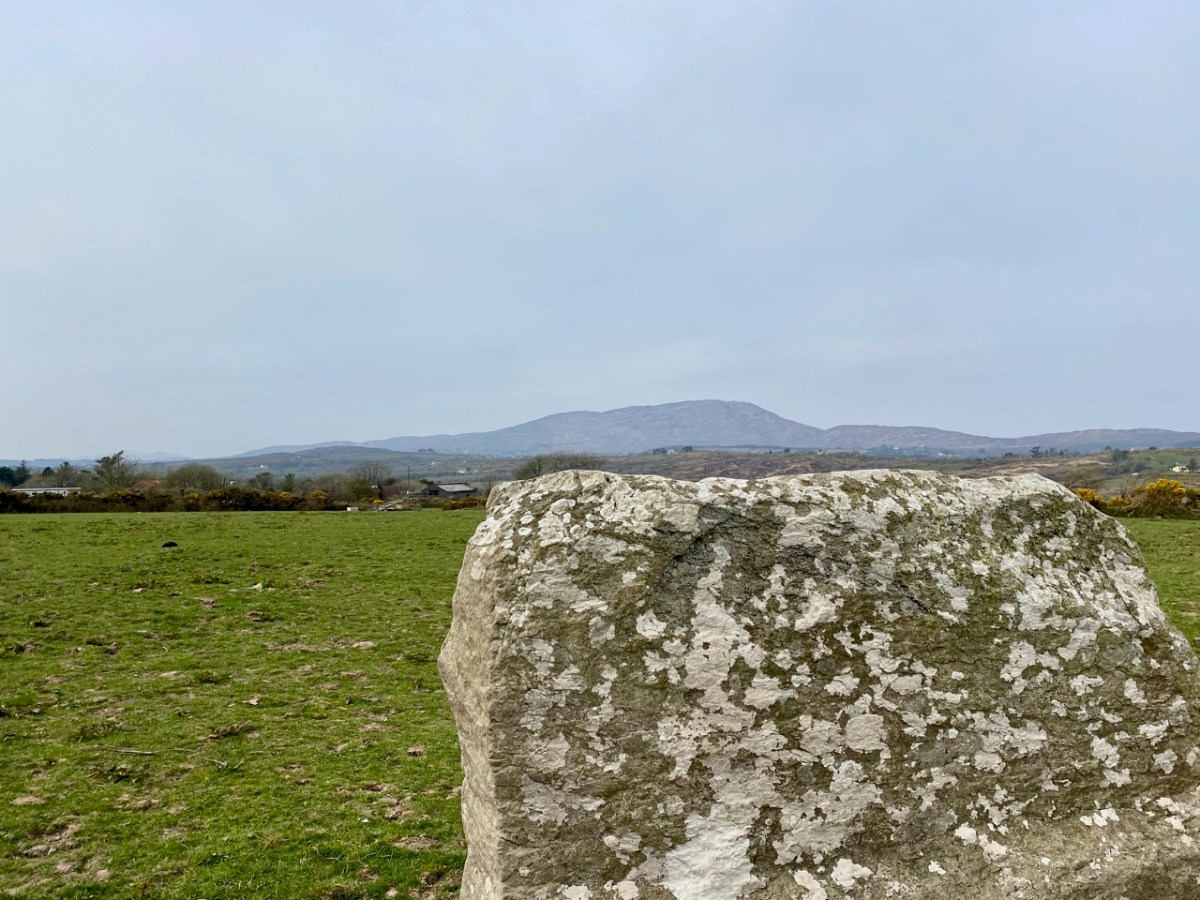
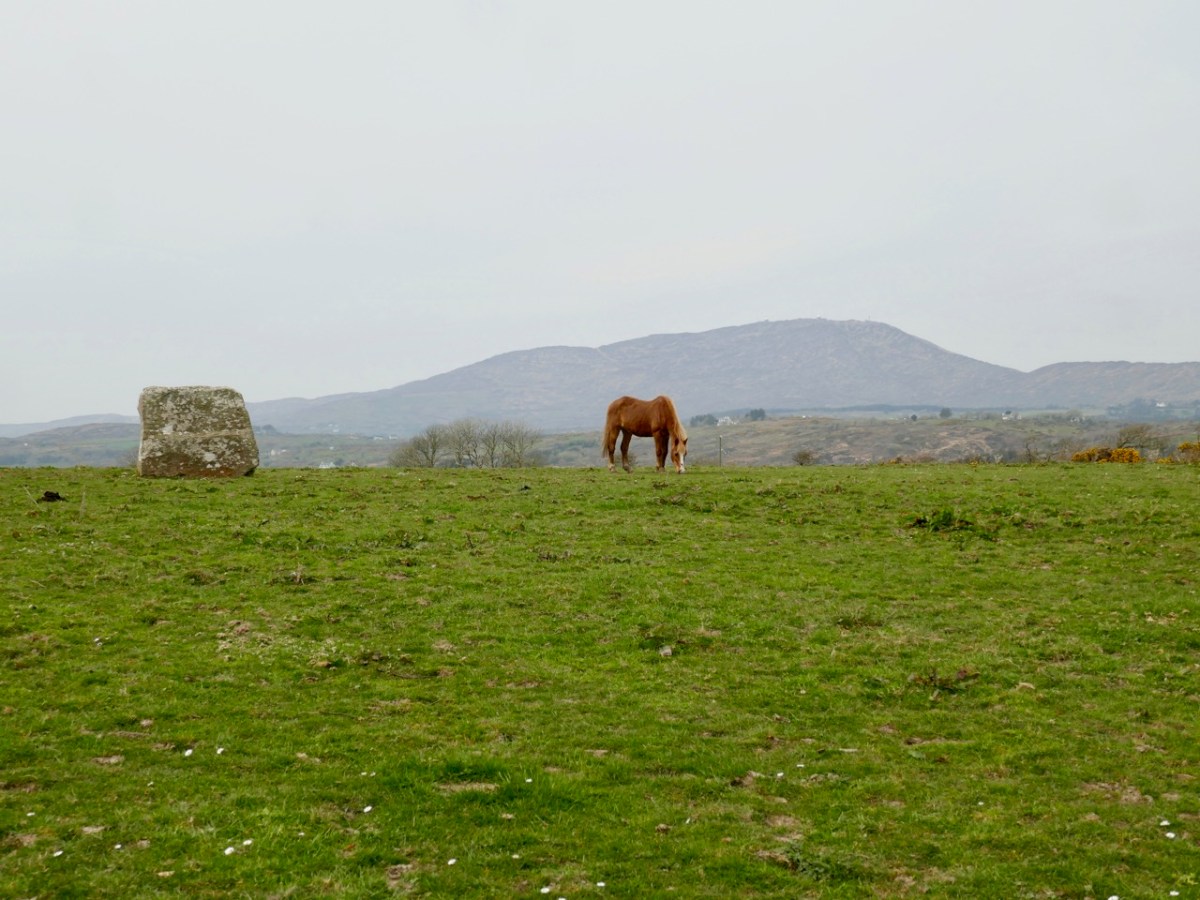
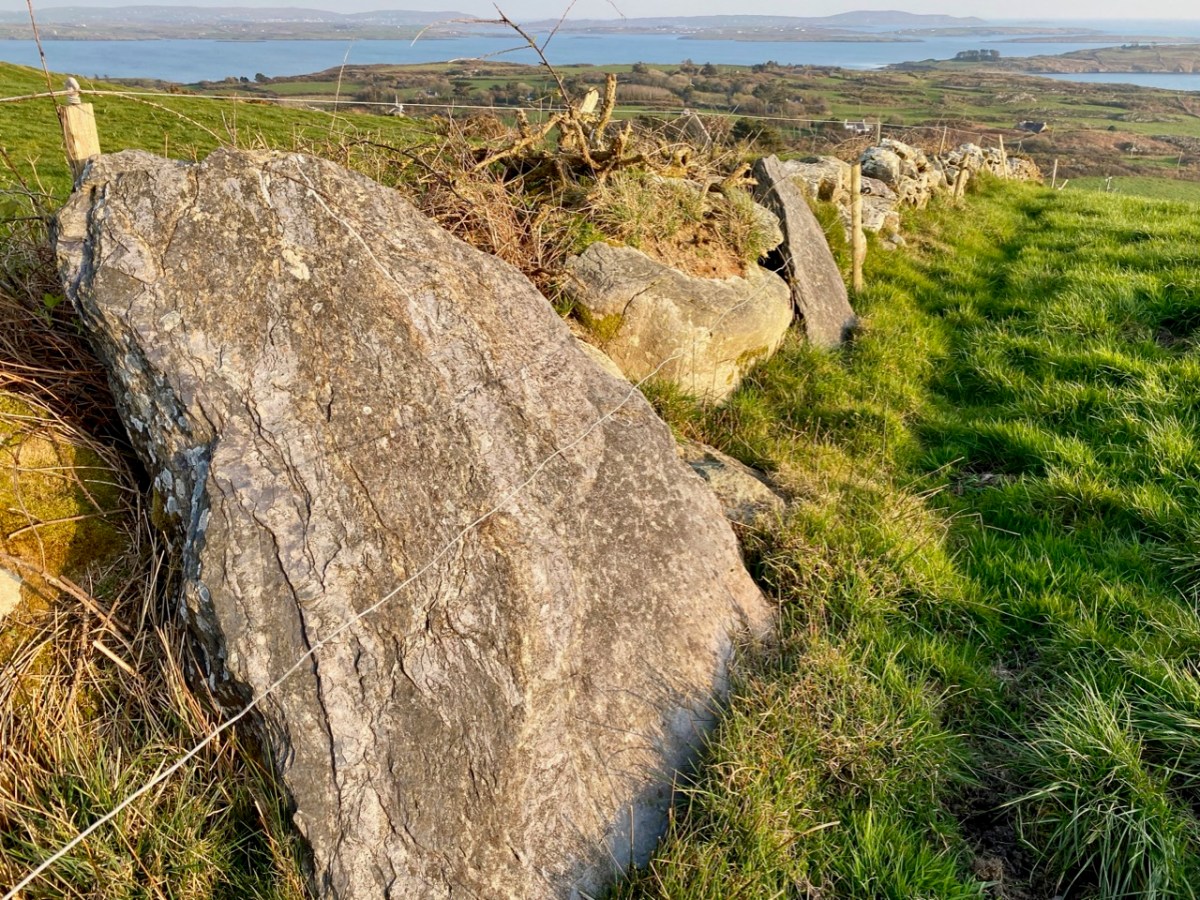
The stone is 1.6m high, 2.05m in length, and 0.45m in width: tall and wide in one direction, and relatively narrow in the other. It is also worth noting that the ‘long’ orientation is exactly North-South. This stone has been in this position for at least 180 years as it appears in the earliest edition of the 6″ Ordnance Survey (1830s), marked as ‘Gallaun’ – and even given a little illustration!
The standing stone is not far from the ringfort: perhaps there is a connection, although standing stones are generally reckoned to date from earlier times than the forts. Here is an extract from a recent article in Archaeology Ireland: Vol 34 No 1 (Spring 2020) pp 26-29, Wordwell Ltd:

. . . The classic standing stone surviving from the Bronze Age in Ireland is a rough-hewn or unshaped pillar, known as a gallaun (from the Irish gallán), generally oblong or oval in cross-section and up to 3m or more in height. Stones presumed to belong within this class vary considerably in height, from as little as 1m to as much as 6-7m in exceptional cases, the majority probably falling in the 1.5-2m range. Seán Ó Nualláin noted many years ago that in his experience the axis is generally aligned north-east/south-west. This is by no means a universal rule. Gallauns are by far the most numerous of all pre-Christian standing stones in Ireland. Approximately 600 are known in Cork and Kerryb alone. Beyond this region, examples are to be found extensively throughout the Irish countryside and many of them have attracted folk explanations . . .


Lone Standing Stones by Muiris O’Sullivan and Liam DowneY
Archaeology Ireland 2020

In these two pictures you can see the striking profile of the Bishop’s Luck standing stone against the skyline which features Mount Gabriel – the highest piece of land in the immediate area. Gabriel was an important place in prehistoric times as the centre of a significant copper mining industry – yet no artefacts have ever been found on the summit. In the lower picture you can see how the western edge of the standing stone ‘echoes’ the distant profile of Gabriel on the horizon. This is a phenomenon that has been noted a few times with regard to stones standing in the landscape. Here is Gabriel seen from the ringfort:

Finola has written comprehensively about standing stones in this Journal: here and here. O’Sullivan and Downey mention (above) that examples have attracted folk explanations. This doesn’t seem to be the case here: no mention is made of the stone in the Schools Folklore Collection. But surely there must be significance in the name: Bishop’s Luck?

But – hang on! There is ‘Bishop’ folklore associated with a site not very far away – in the neighbouring townland of Stouke. Finola recorded this in her 2016 post here. It’s a simple tale: The story goes that during the time of the penal laws a Bishop was confirming children nearby when the redcoats got wind of his activities and came to arrest him. He was beheaded. A bullaun stone in the graveyard at Stouke is supposed to be his head. If our possibly Bronze Age stone in Ballycummisk had anything to do with this, it should surely be known as Bishop’s Bad Luck?
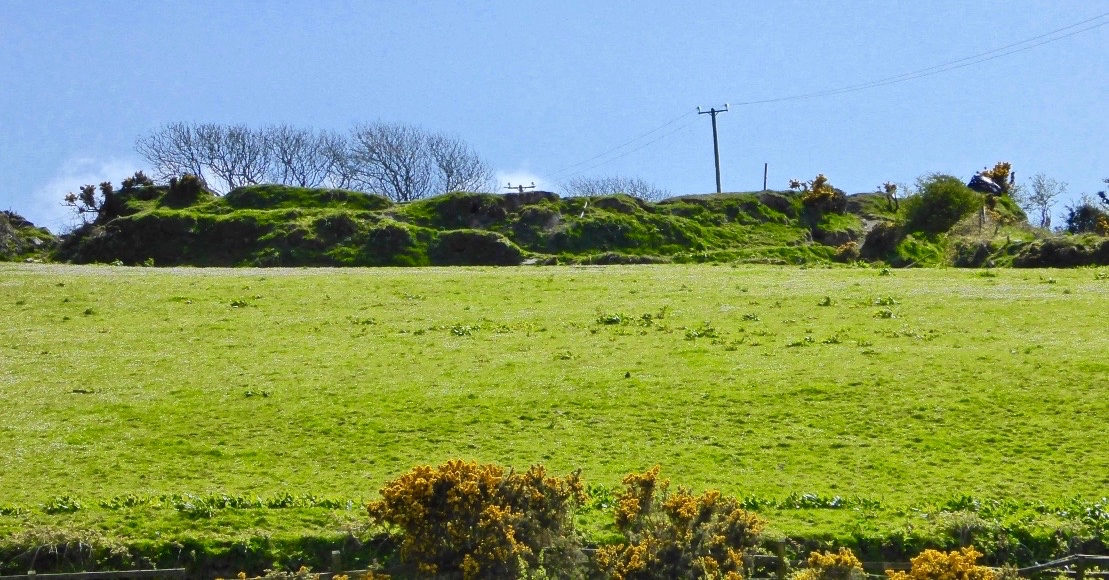
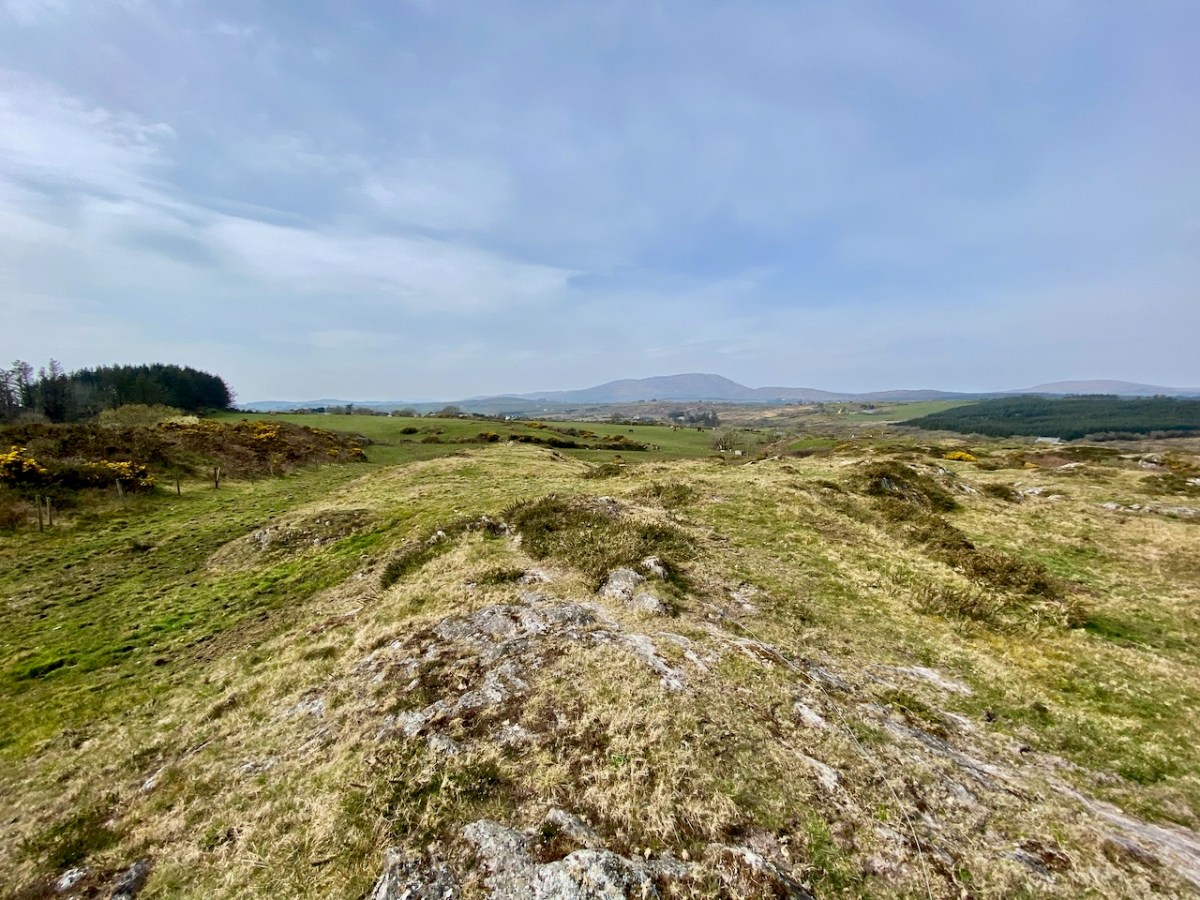
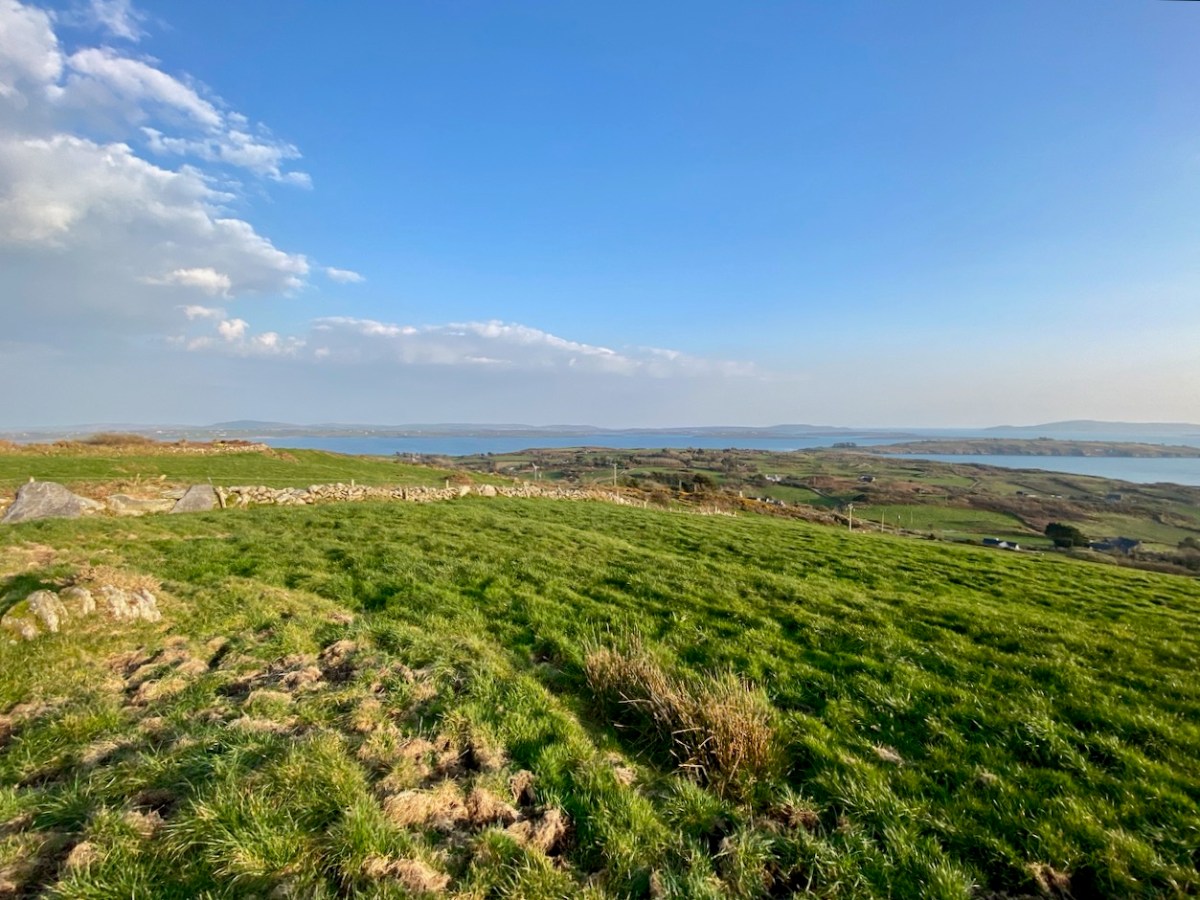
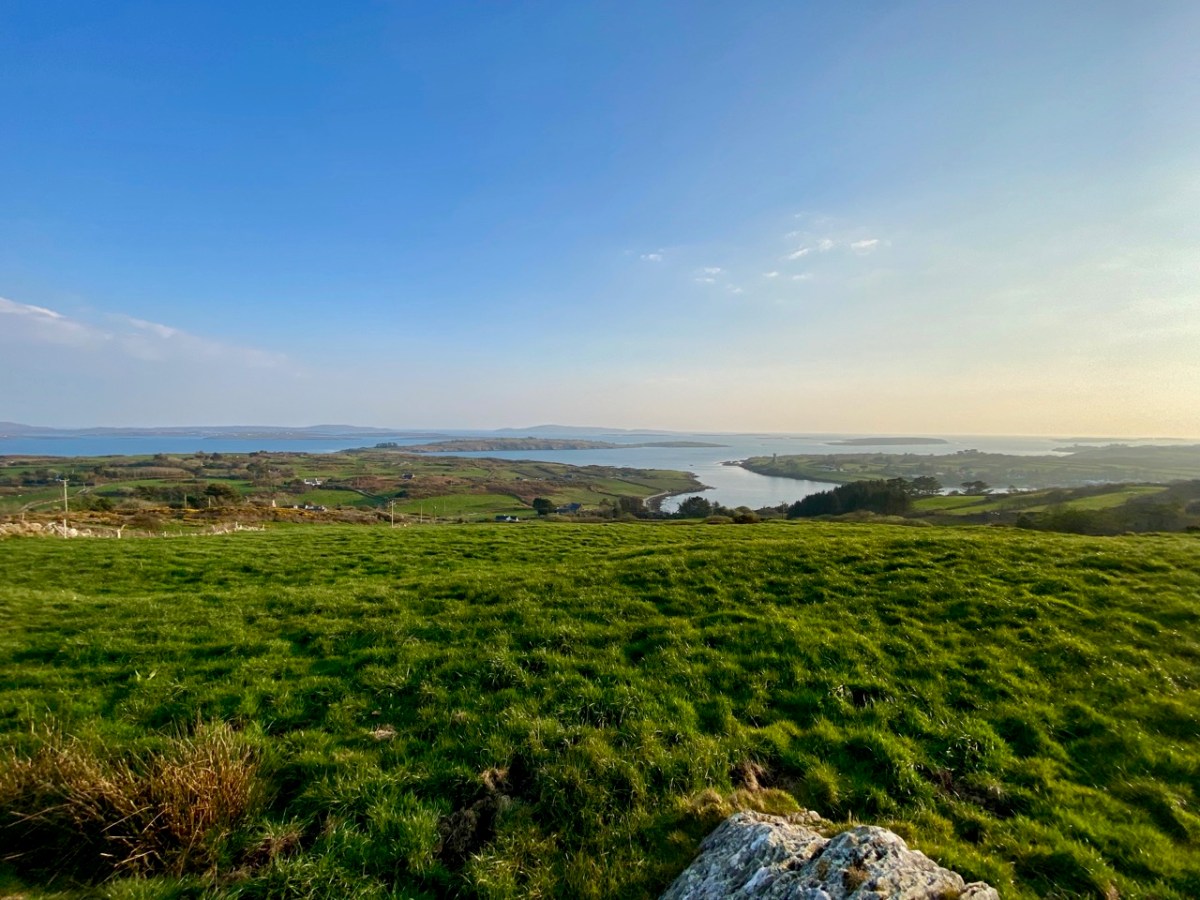
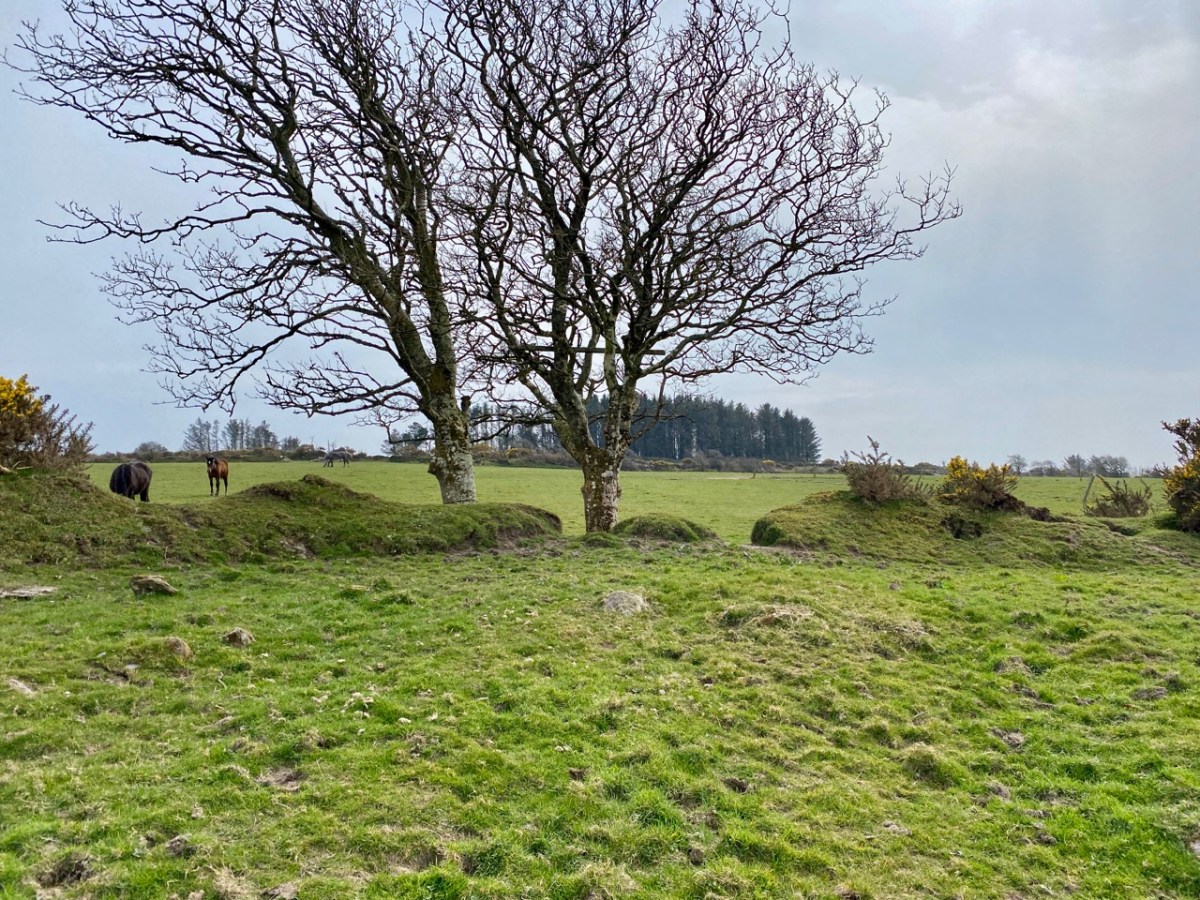
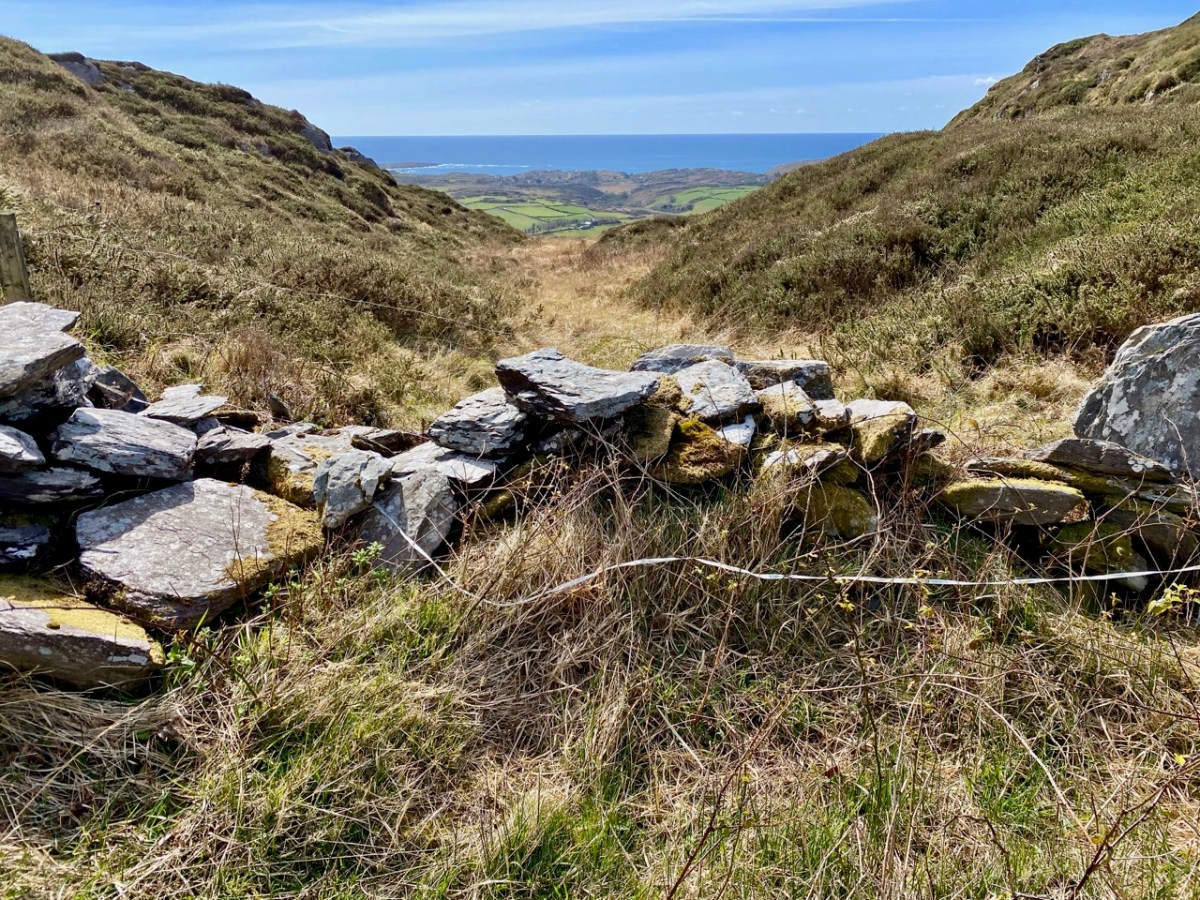
One further place that’s worth a mention here is the top of the hill to the south of the ringfort and standing stone. It doesn’t have a name, but it does have a magnificent view across to Rossbrin Harbour, with Cape Clear on the horizon in the far distance. There is a passage grave on the high point of Cape Clear. There seems to be some evidence for the inter-visibility of ancient sites, which makes me wonder whether there was ever any early structure on this hilltop. There are rocky outcrops there in the present day, and field clearance is evidenced by the presence of large slabs in the nearby field boundaries.

These are just thoughts, but I don’t mind thinking them! West Cork (and most of rural Ireland) must have much to reveal in terms of its ancient history. One point to remember: if you ever go searching yourself for archaeology or old sites, don’t forget that you will probably be entering private land. It is courteous to always seek permission: most owners are agreeable and – perhaps – may have stories to tell themselves.
Hell Fire

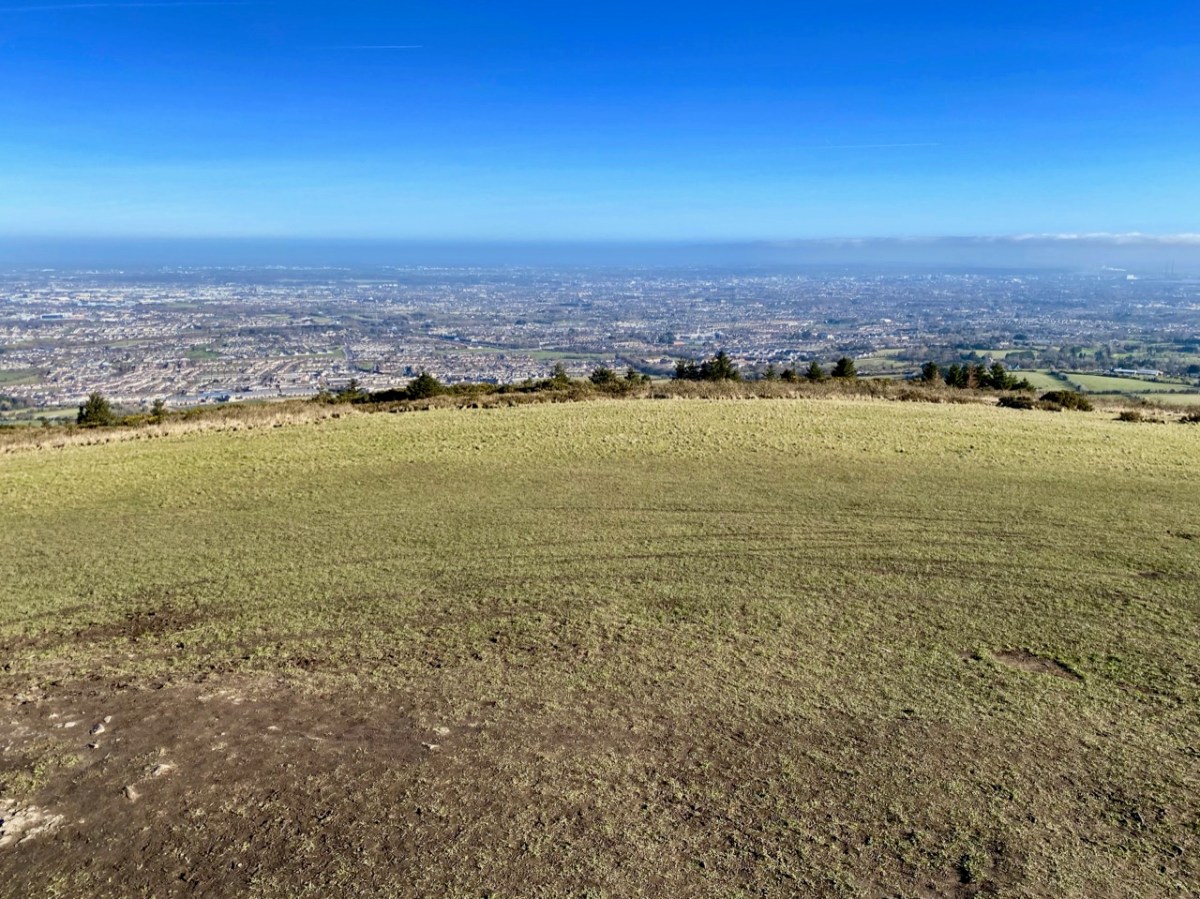
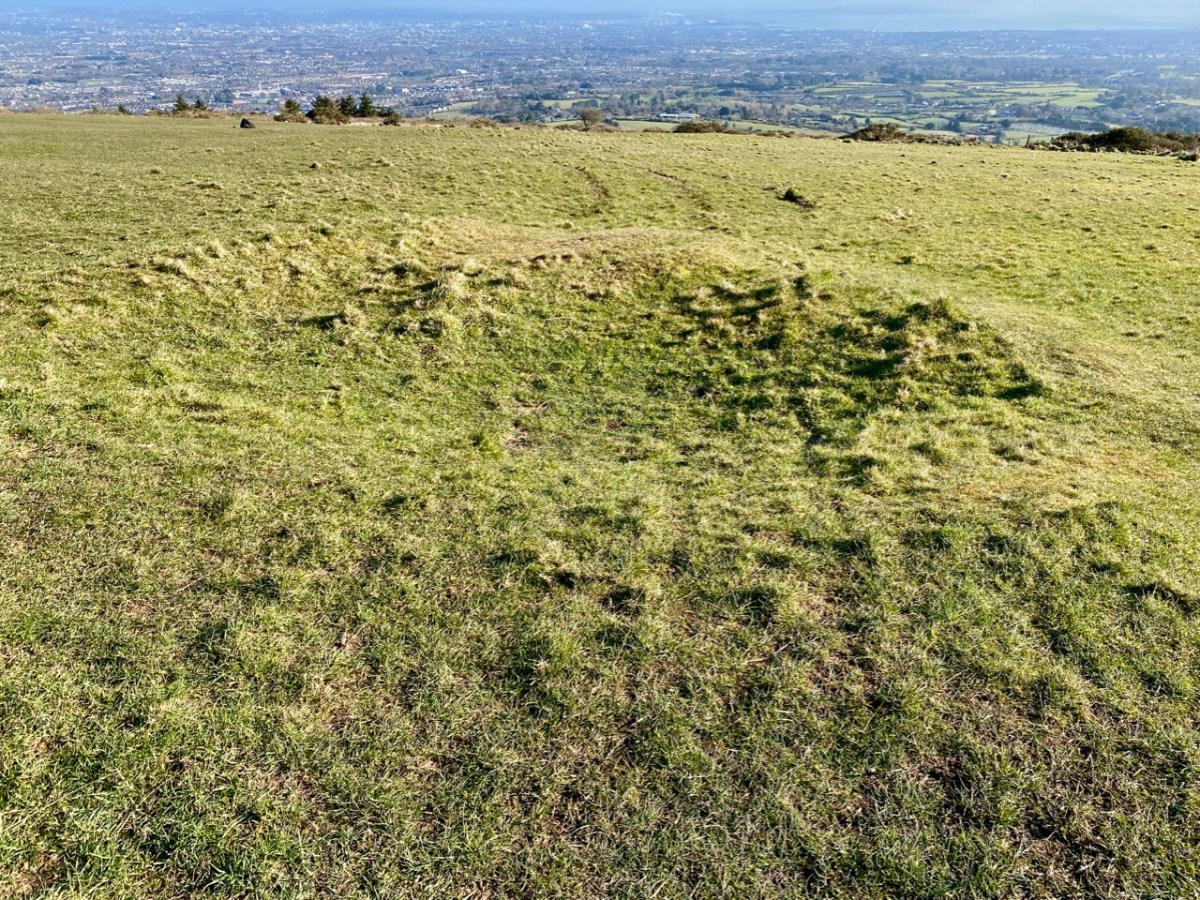
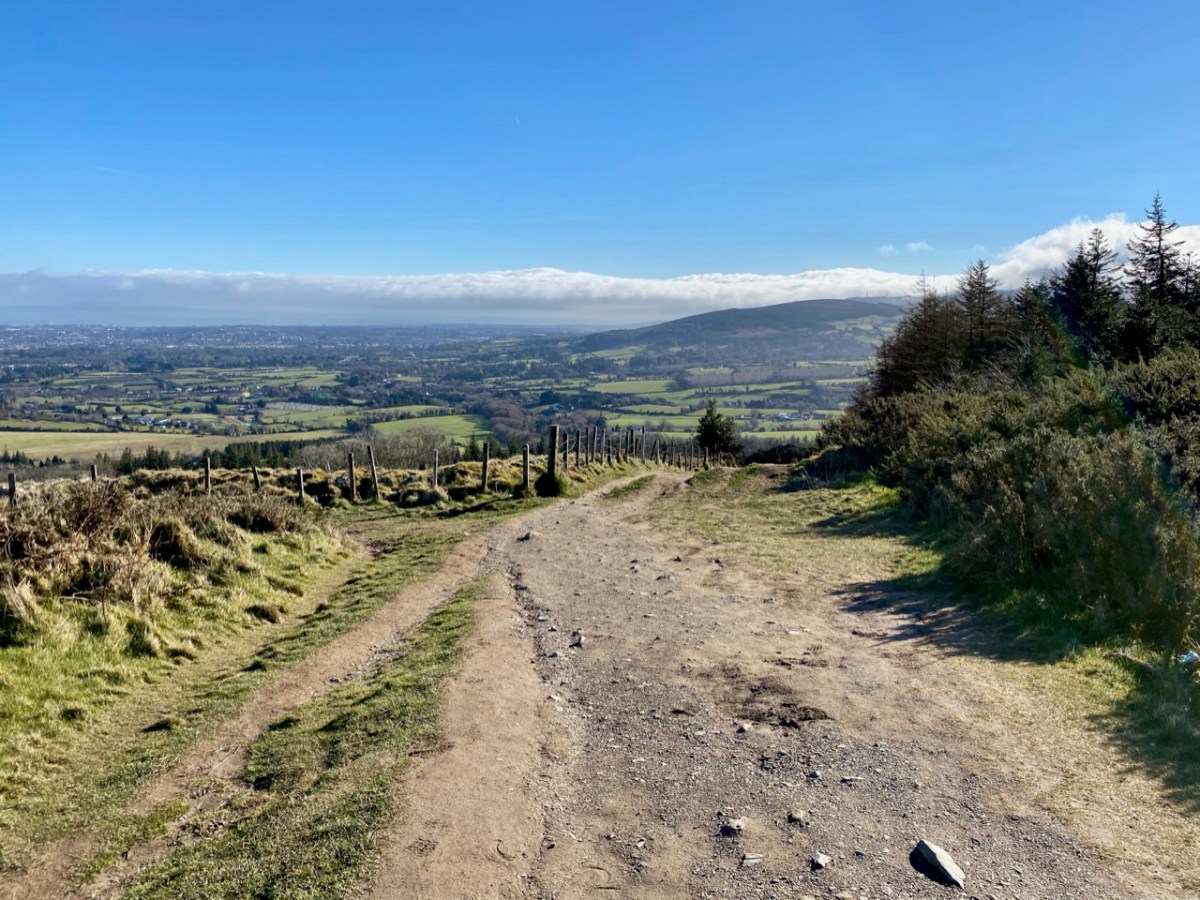
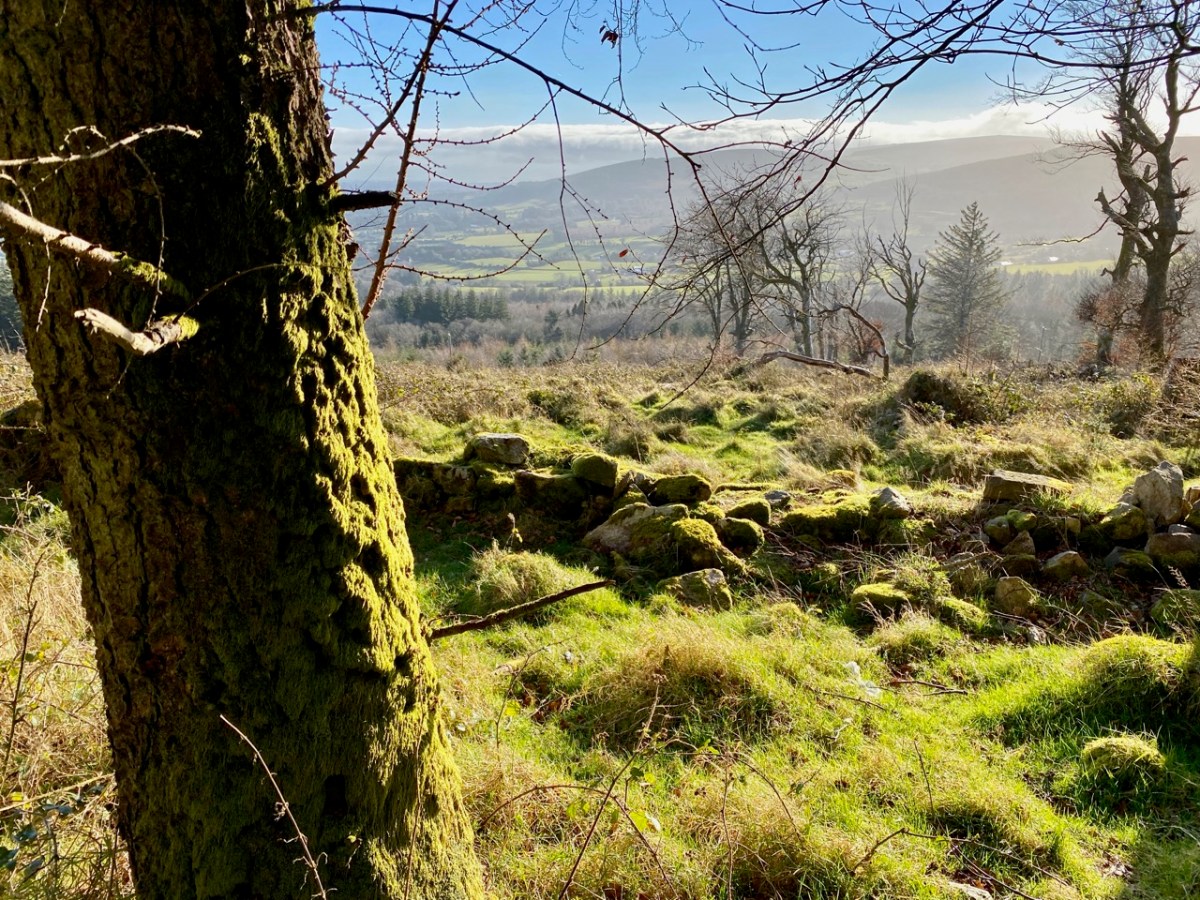
It’s taken me a while to visit this notorious site which is situated on a summit of the Dublin Mountains. The view across the city from the 390 metre peak is stunning:

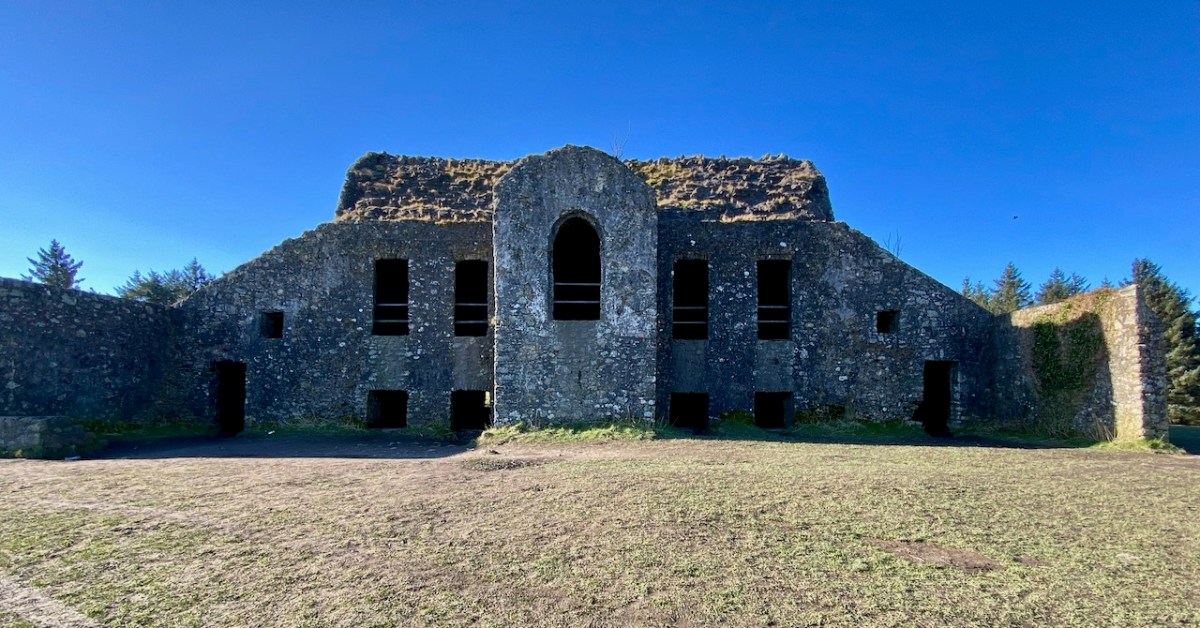
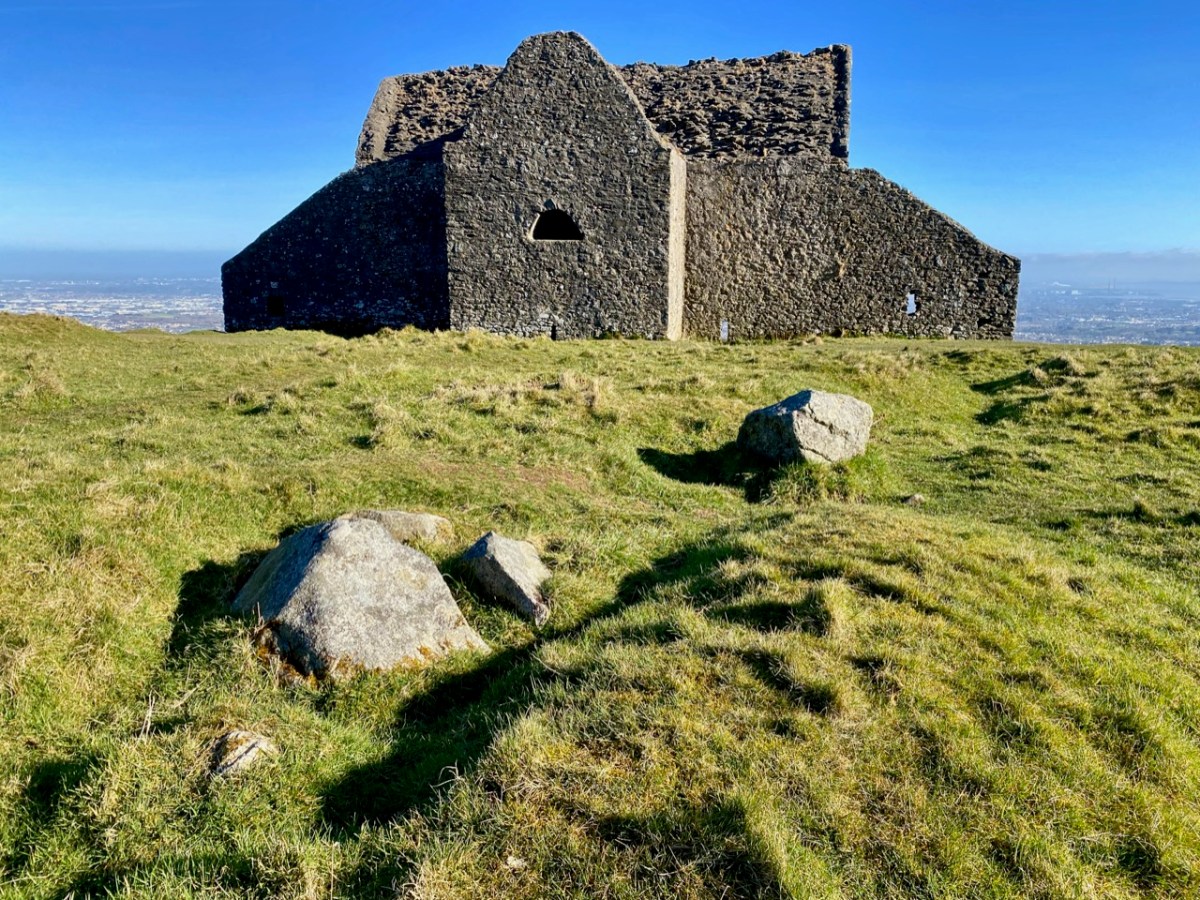
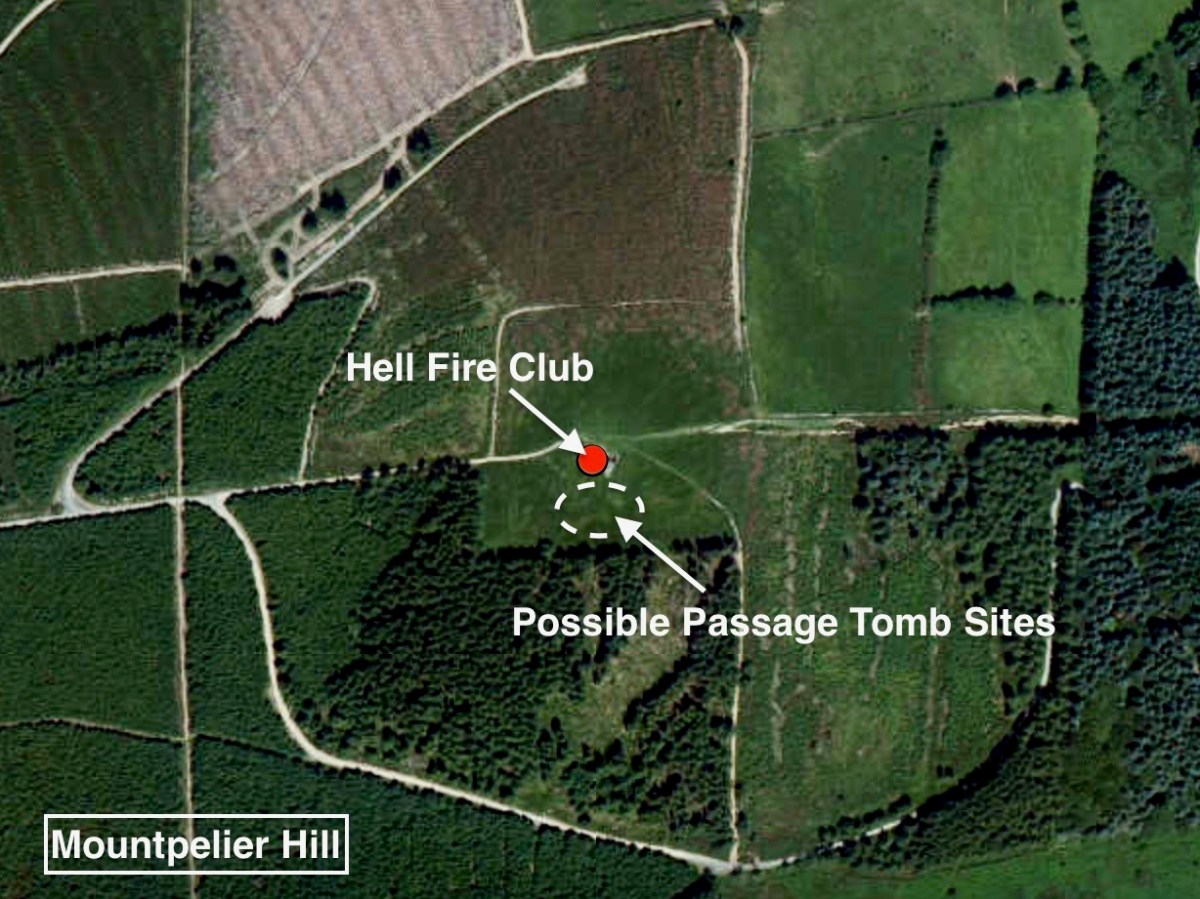
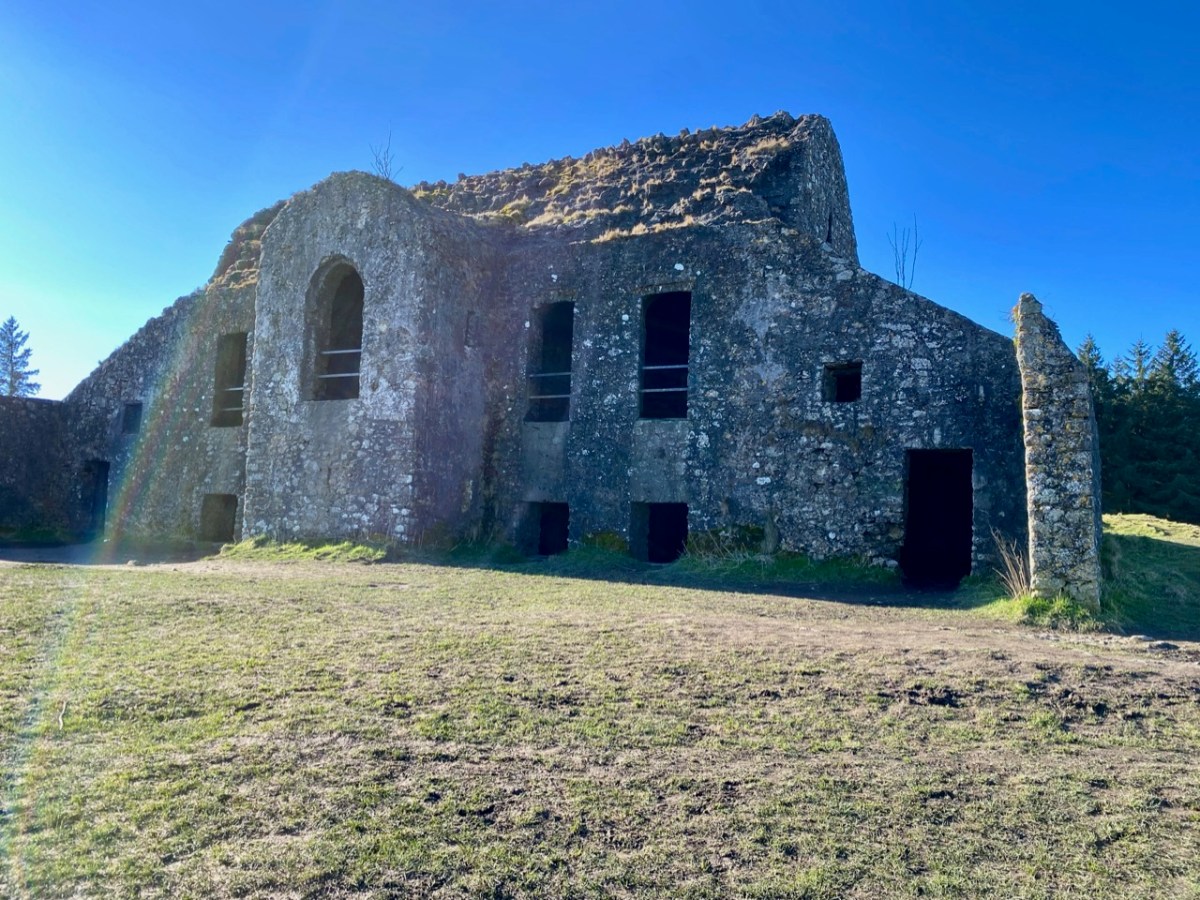
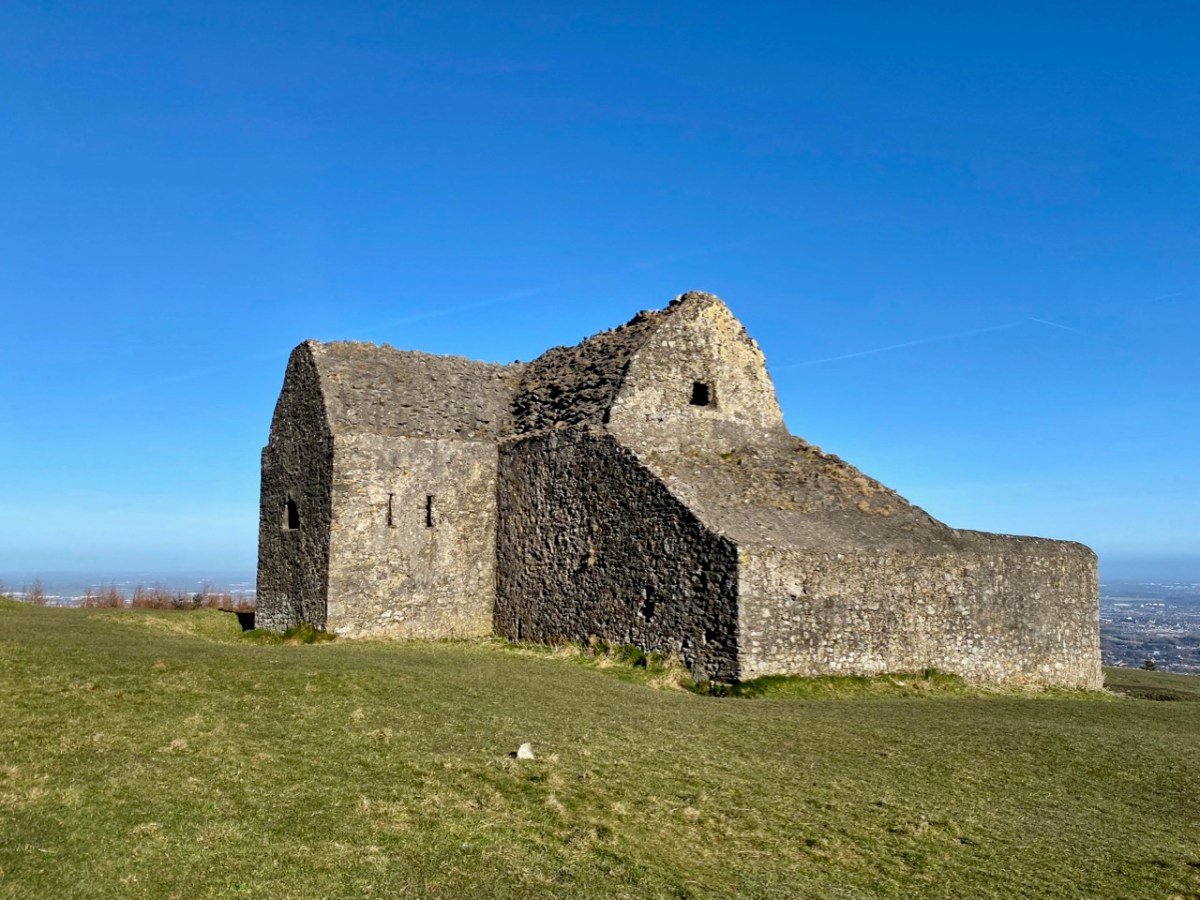
It’s the stories and the folklore that attracted me to this place, long known as the Hell Fire Club. In the eighteenth century ‘Speaker’ Connolly built it as a hunting lodge. According to tradition he used the stones from a prehistoric monument that was previously on the hill. It’s now known from recent excavations that at this location was one – or two – passage tombs dating from the Neolithic Period (4500 – 2000 BC). This – or these – were surrounded by a circle of large boulders known as a cairn. Today, some fragmentary traces of the earliest use of the site can be detected. The best information on the neolithic site is found in the Abarta Heritage report, here. An earlier description, dating from 1779 in fact, was written by Austin Cooper, who visited in that year:

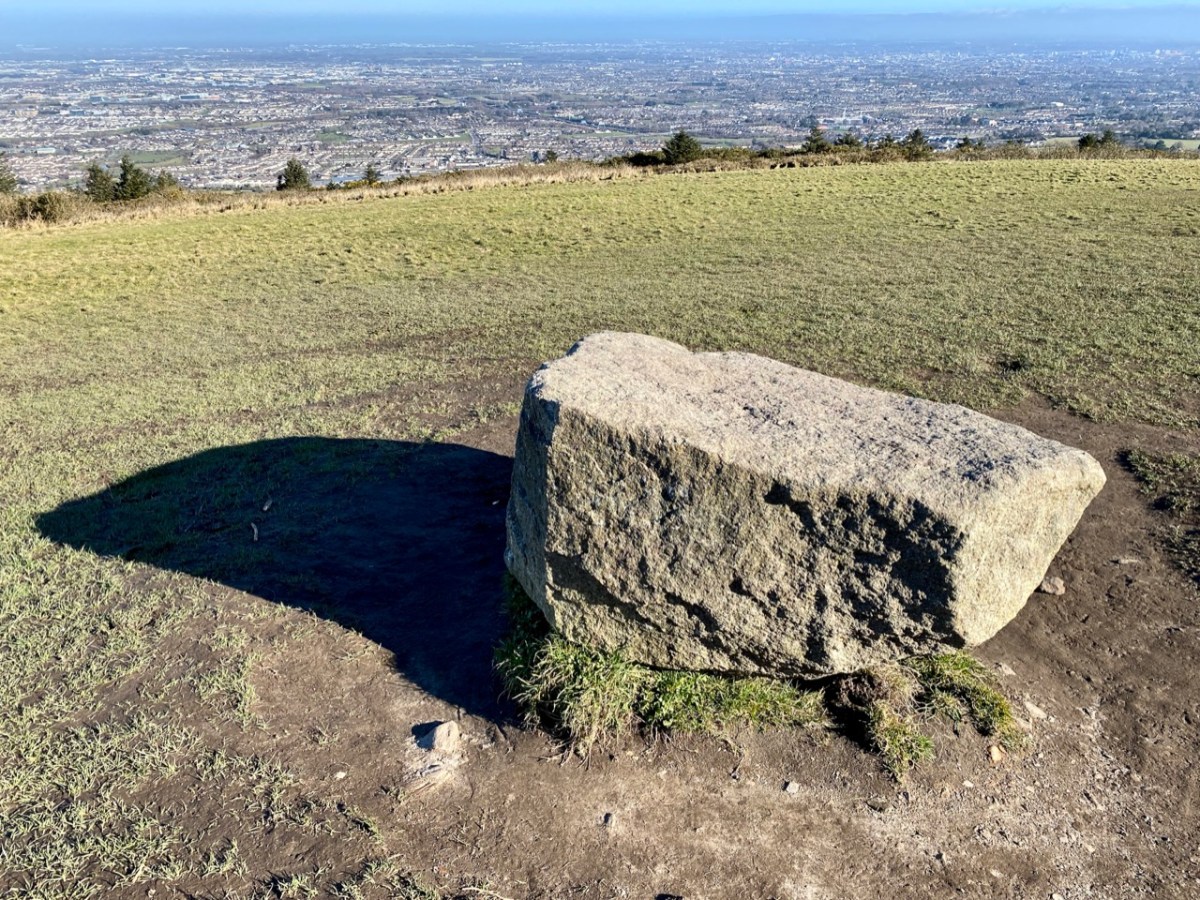
. . . Behind the house are still the remains of the cairn, the limits of which were composed of large stones set edgeways which made a sort of wall or boundary about 18 inches high and withinside these were the small stones heaped up. It is 34 yards diameter or 102 yards in circumference. In the very centre is a large stone 9 feet long and 6 feet broad and about 3 feet thick not raised upon large stones but lying low with the stones cleared away from about it. There are several other large stones lying upon the heap . . .

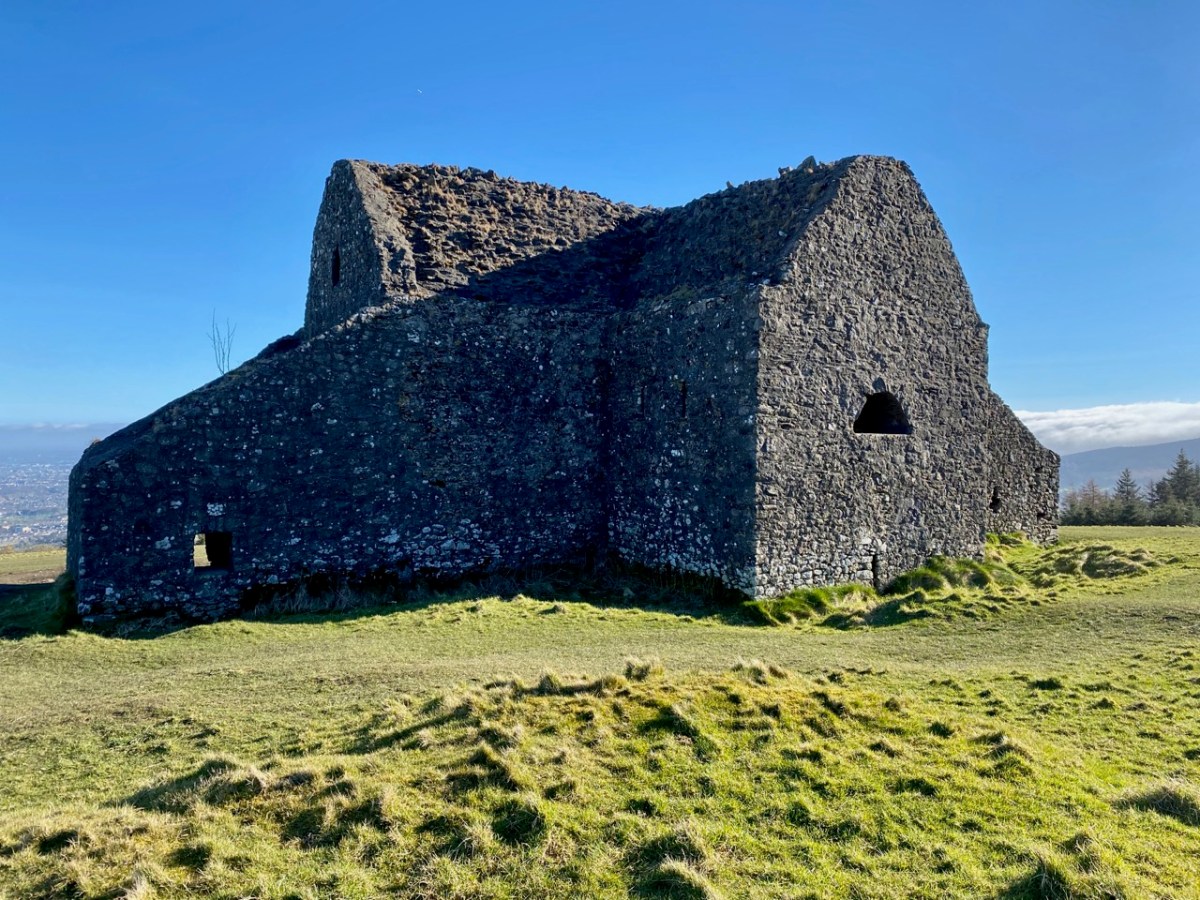
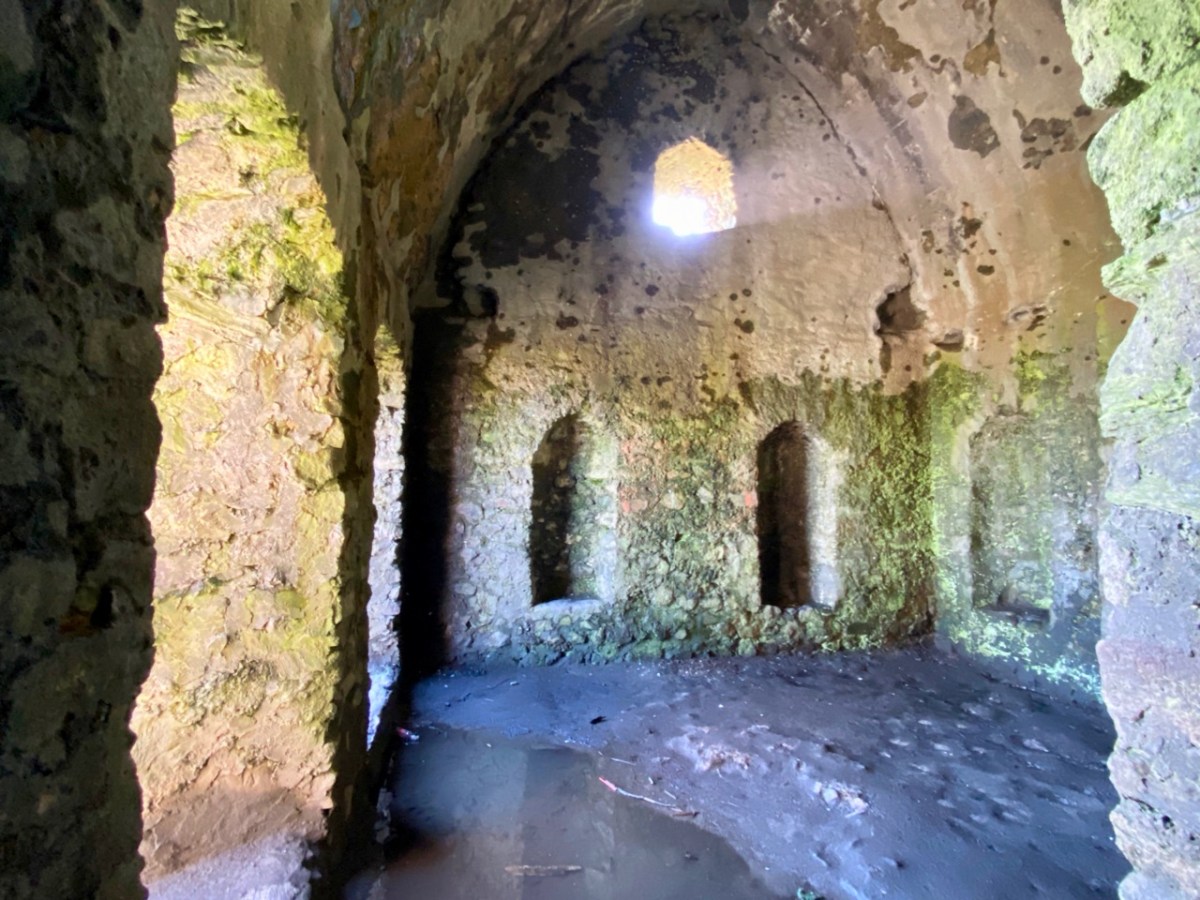
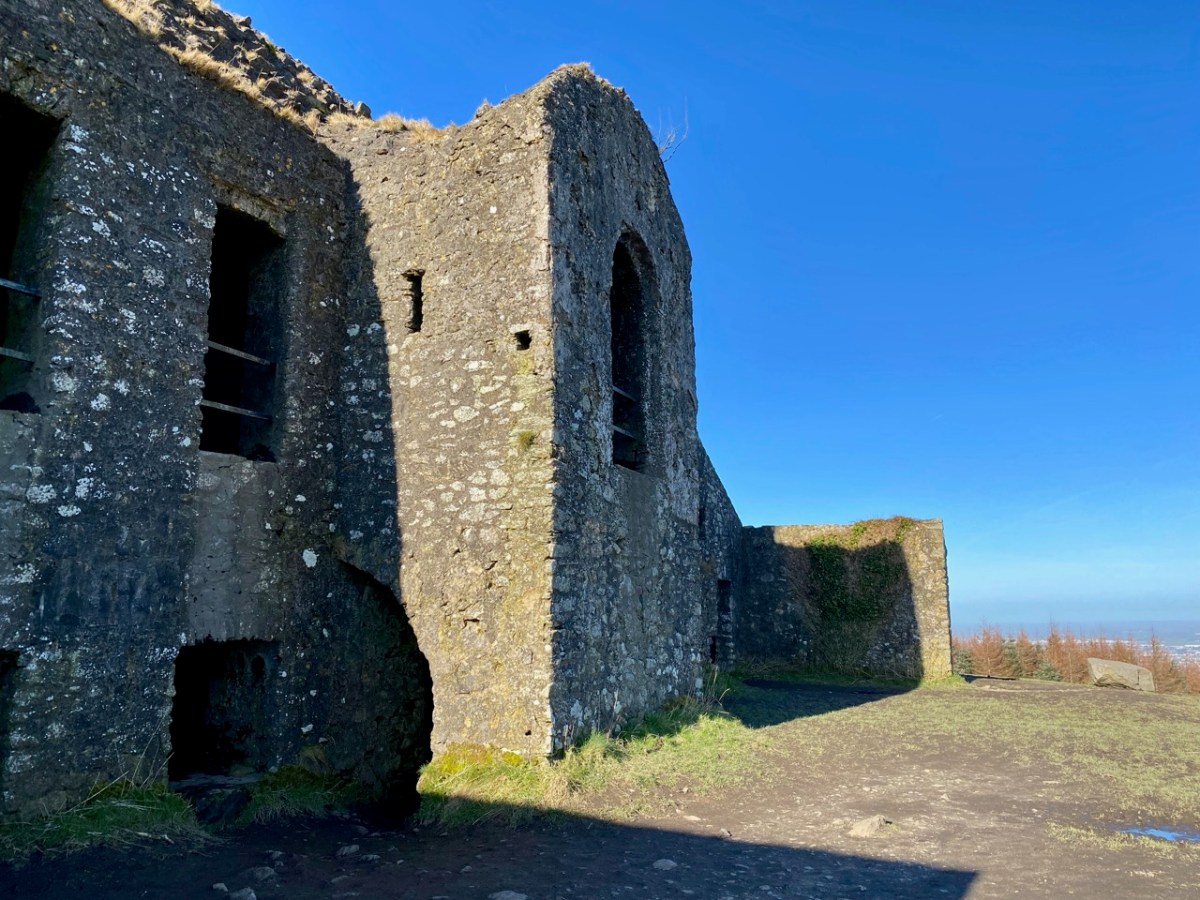
William Connolly (Speaker of the Irish House of Commons) was one of the wealthiest men in Ireland; he had a house in the city and a country estate at Castletown, near Celbridge. It is said that he deliberately used stones from the ancient tomb in the construction of the hunting lodge at Mountpelier. Shortly after it was built the roof, which was originally slated, was blown off in a great storm. Locals attributed this misfortune to the work of the devil, in revenge for the destruction of the cairn. Following this event the lodge gained a reputation as a place where evil prevailed. However, Connolly replaced the slated roof with a stone vault which still exists today, although the building is effectively a ruin.

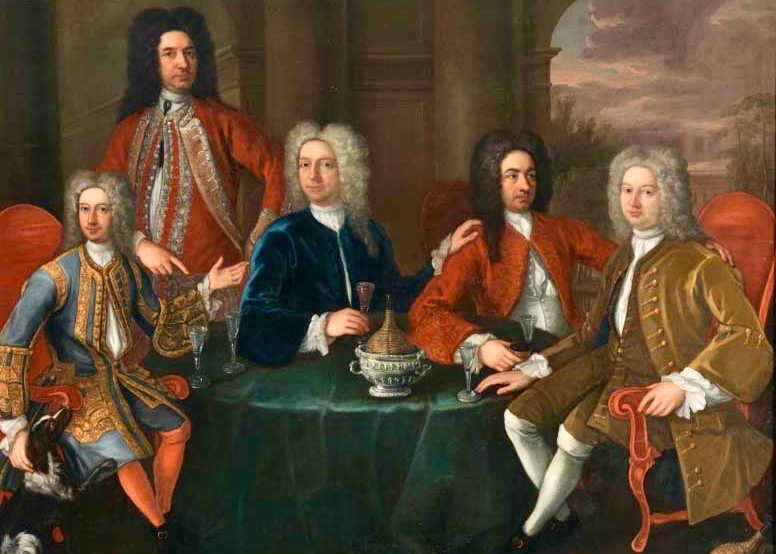
The Irish Hell Fire Club members were some of the elite of society, and included peers of the realm, high ranking army officers as well as wealthy gentlemen and artists. Here is a portrait of some of them by James Worsdale (himself a Club member); it is in the collection of the National Gallery of Ireland, Dublin.

From left to right: Henry Barry 4th Baron of Santry, Colonel Henry Clements, Colonel Henry Ponsonby, Colonel Richard St George, and Simon Luttrell, 1st Earl Carhampton. Biographies of all of them are summarised here – also from the Abarta reports. Their lives in general were debauched and relatively short. Missing from the portrait are father and son Richard Chappell Whaley and Thomas ‘Buck’ Whaley, who was to become ‘the most famous Buck of all’. Richard’s nickname was ‘Burn-Chapel’ Whaley because of his hatred of religion and in particular, the Roman Catholic church. He would amuse himself on Sundays by riding around Dublin setting fire to the thatched roofs of Catholic chapels. The Whaleys were related through their ancestry to Oliver Cromwell. Their family residence was Whaley Abbey, Co Wicklow: you can find more on this in Finola’s post today.

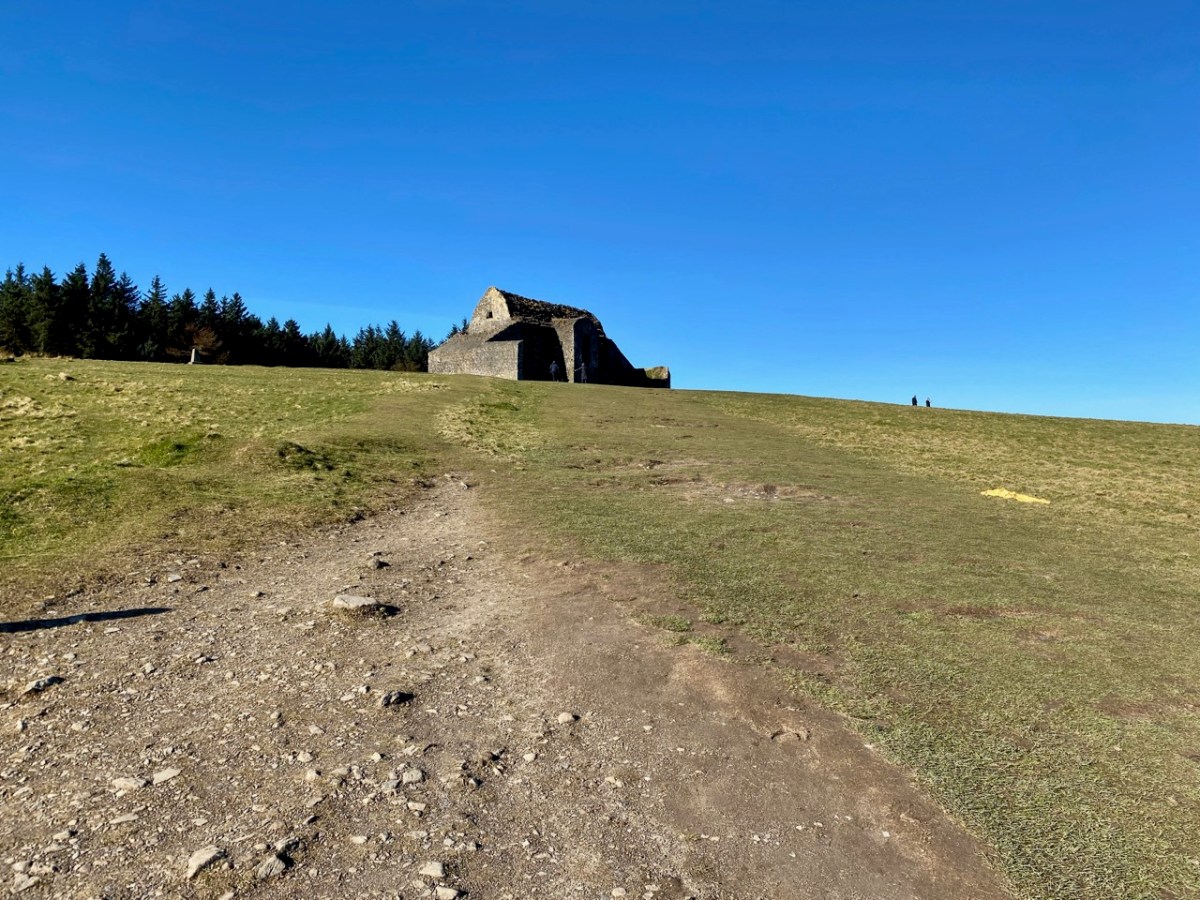
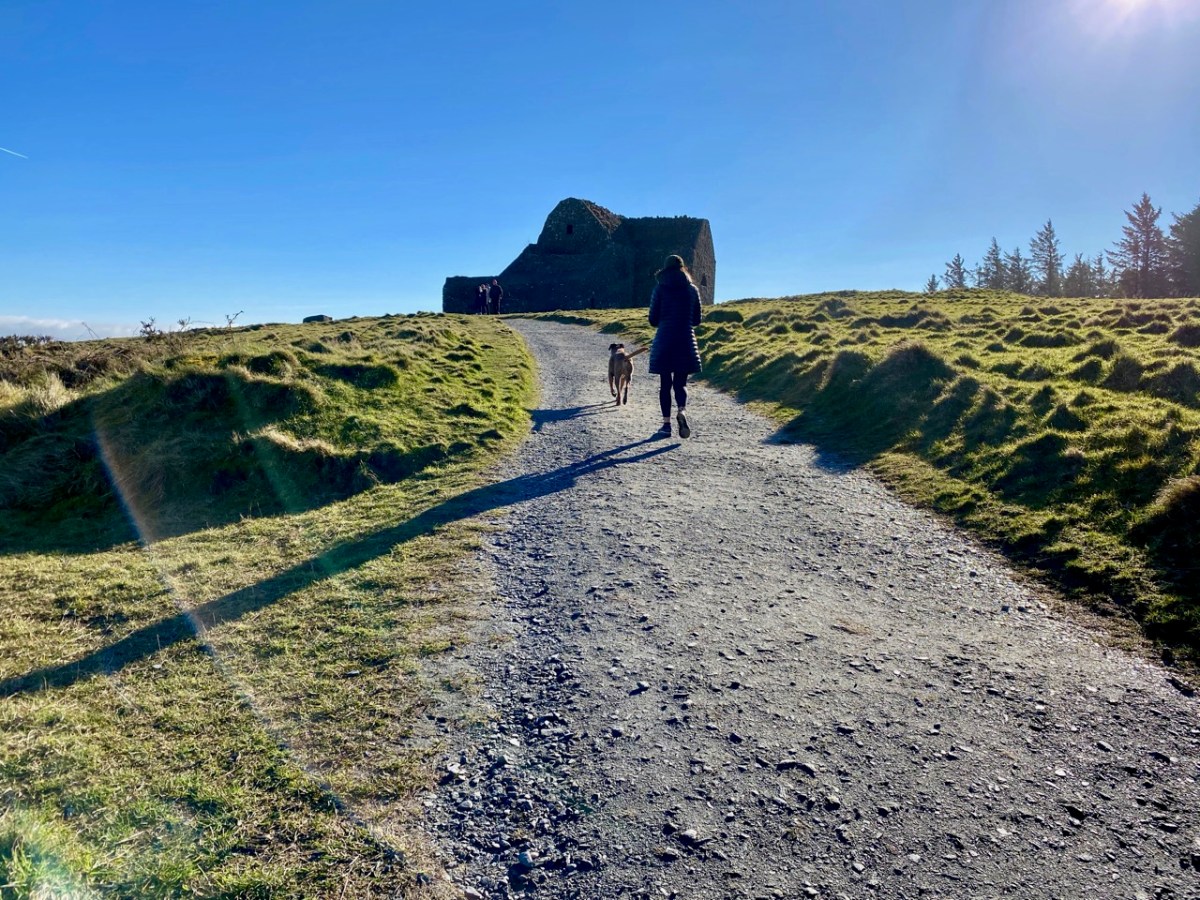
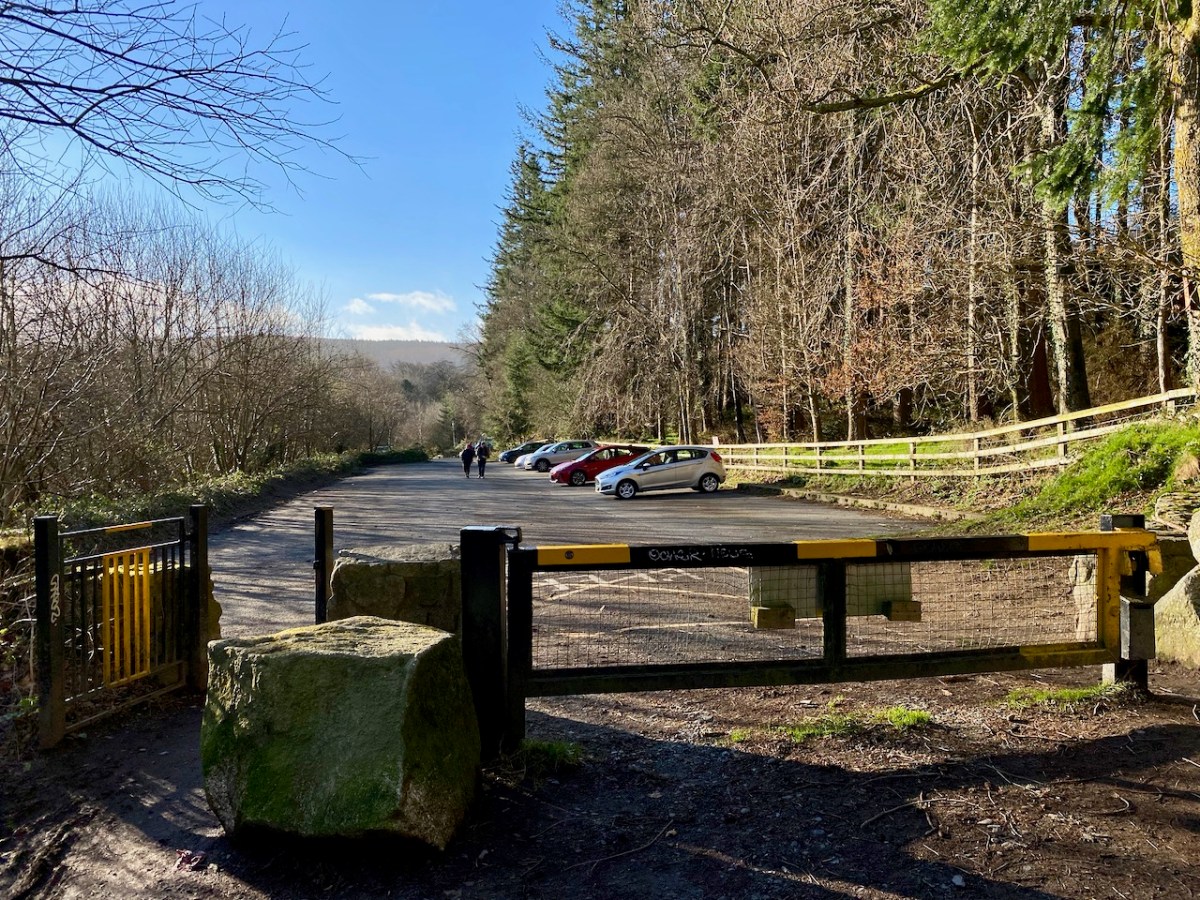
Mountpelier is a significant mountain top overlooking Dublin, and is now fully accessible to all. A warning, though – in good weather the Coillte car-park very soon fills up (at all times of the year) and there is nowhere else nearby to leave your vehicle – get there early!

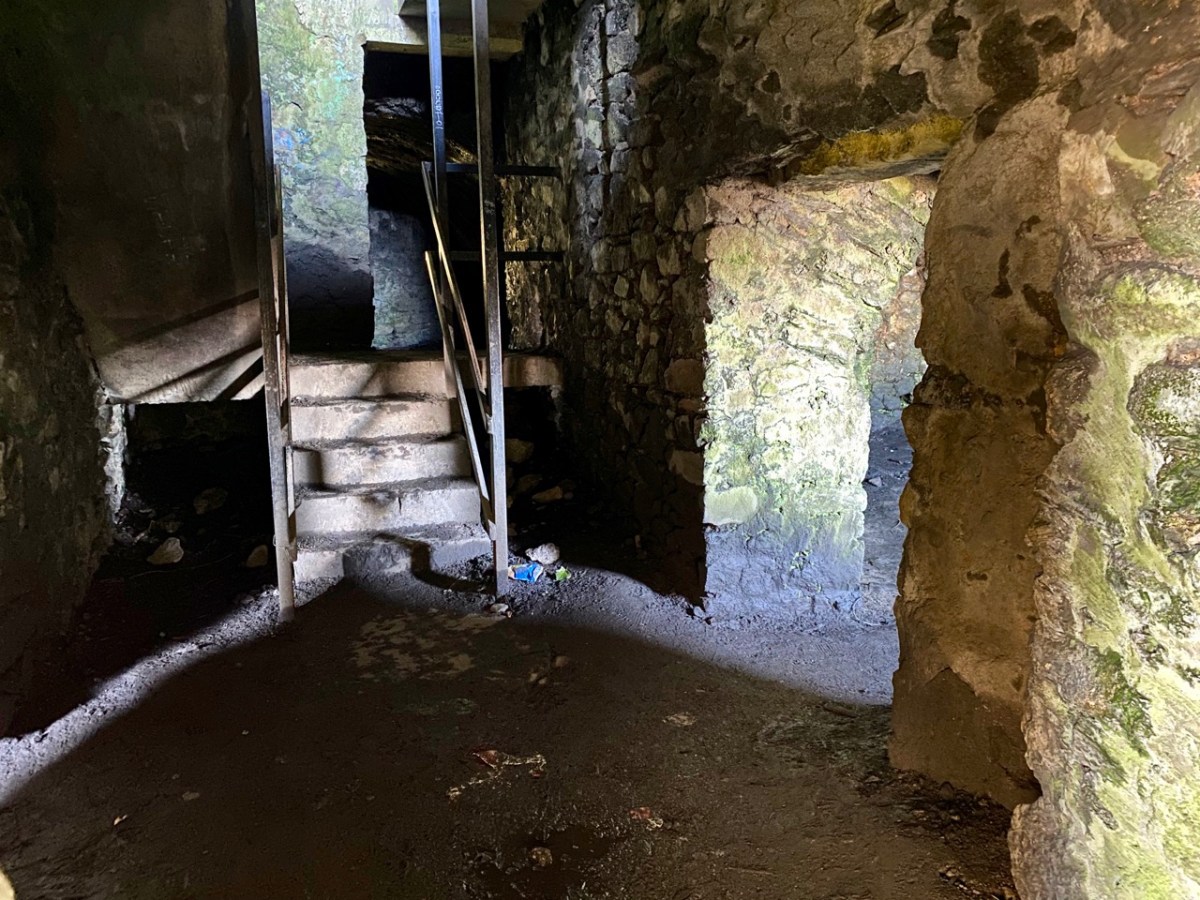
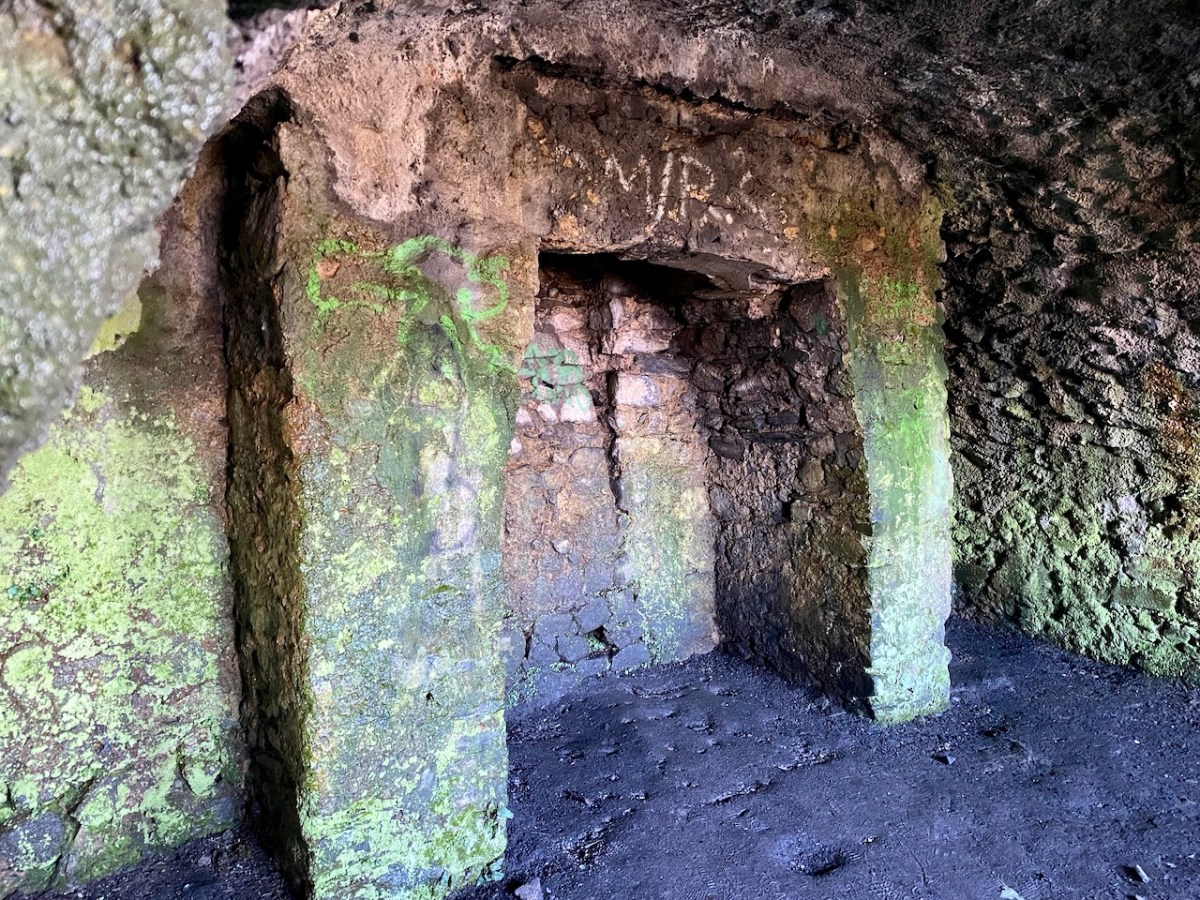
It could be said that the ruin of the lodge is ‘maintained’ in that it is stabilised and unlikely to fall down. If you are exploring, look out for the lintel over the large fireplace, which is supposed to be a standing stone removed from the passage grave site.

The Hell Fire Club is, of course, haunted! Not that we saw anything untoward when we visited on a glorious spring day. But the stories abound. They are probably best told through the accounts in the Schools Folklore Collection:

. . . About six miles from Dublin the Hell Fire Club is on a hill. It is a medium size old castle. When the owner of it died nobody else claimed it. All the men of the district came to play cards in it every night. One night when all the men were playing their nightly game one of the men cheated. The men rushed upon him over-powered him. The bound him hand and foot and put him in a barrel of whiskey. Then they set fire to it burning him alive. That was a cruel thing to do but then men did not care. From that day on that old castle was called the Hell Fire Club . . .


Stewart Somerville, Dundrum School

. . . There is an old ruin called Hell Fire Club on the very top of one of the Dublin Hills. This house was built by a man named Connelly, during the time of the Famine. It was built to give employment to the men. Many men used to got to Hell Fire Club to gamble. It is said that one night they were playing cards and there was much money on the table. One man dropped a card on the floor, and when he stooped down to pick it up he noticed a man with cows feet, and he wore a red cloak. The men were very frightened and they made a great uproar. The man turned into a ball of fire. All the men were burned in the fire. There was one man who had a bunch of medals attached to his coat and he was the only man who escaped from the burning house . . .

Mr Finlay, Rockbrook, Co Dublin

. . . The Hell Fire Club, or the Brass Castle is situated near Rathfarnham in the Co Dublin. My Great-grandfather used to pass by the Brass Castle on his way home from work, (he was a mason) he had a habit of hitting the wall with his trowel to hear the ring of the brass. One night a priest had to go on a sick call. When he was coming home through the mountains he lost his way. Seeing a light he went in that direction. He knocked at the door of the house, which happened to be the Brass Castle – The door was opened by a man who was dressed in black with a black mask on his face. The priest was brought in to a room. Sitting at a large table were twelve men dressed the same as the first one. The men were playing cards. On the table was seated a large black cat. The men defied the priest to put the cat away. The priest ordered the cat down, but it never moved. Again he ordered it down, but the cat did not move. The men laughed at the priest and jeered him. The third time the priest said “Begone Satan”. The cat jumped from the table and disappeared up the chimney with a loud roar. The priest told the men that the cat was the devil. The men were never heard of again. The priest got home safe, and from that time onward the Brass Castle was called the Hell Fire Club. This story is true. It was told to me by mother, because the Brass Castle belonged to her ancestors . . .

Seán Ó Nuamáin, Kilbride, Co Wicklow

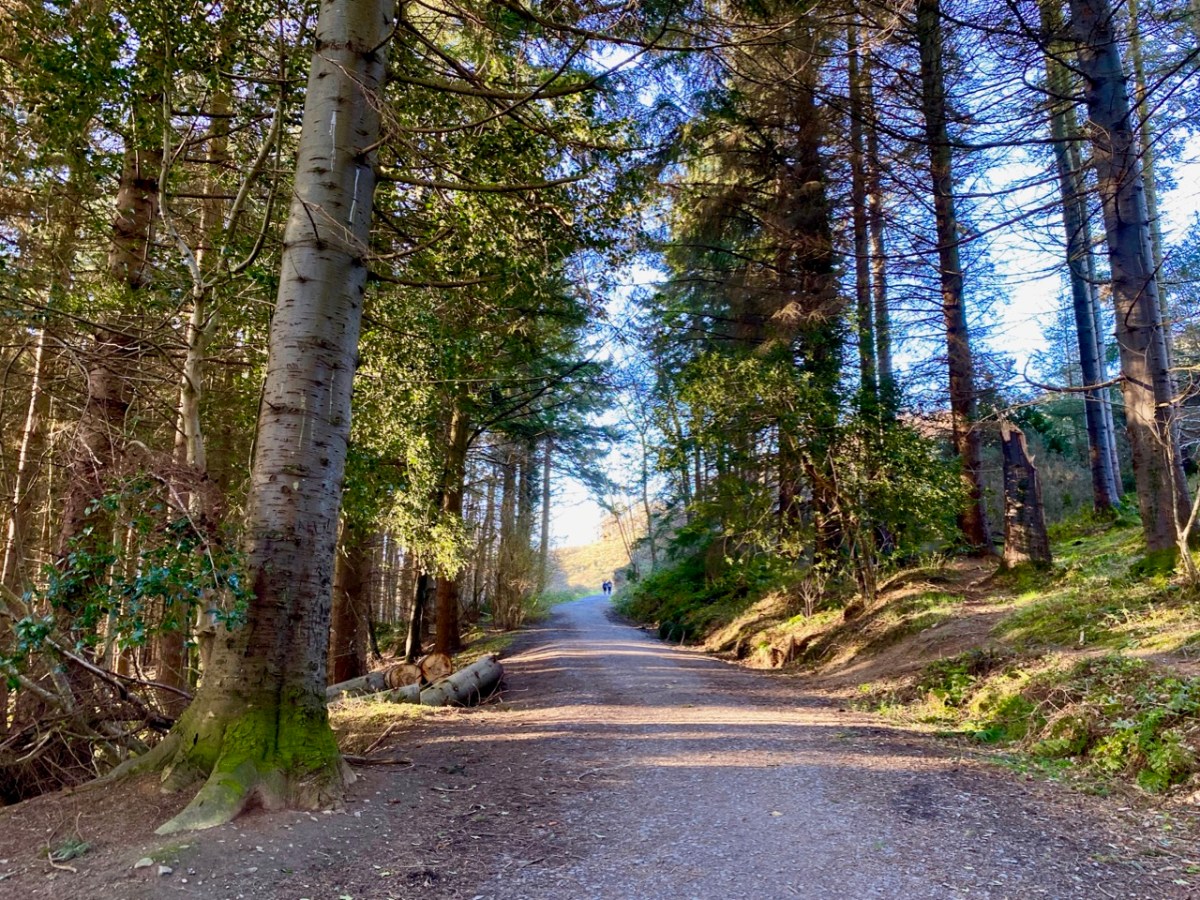
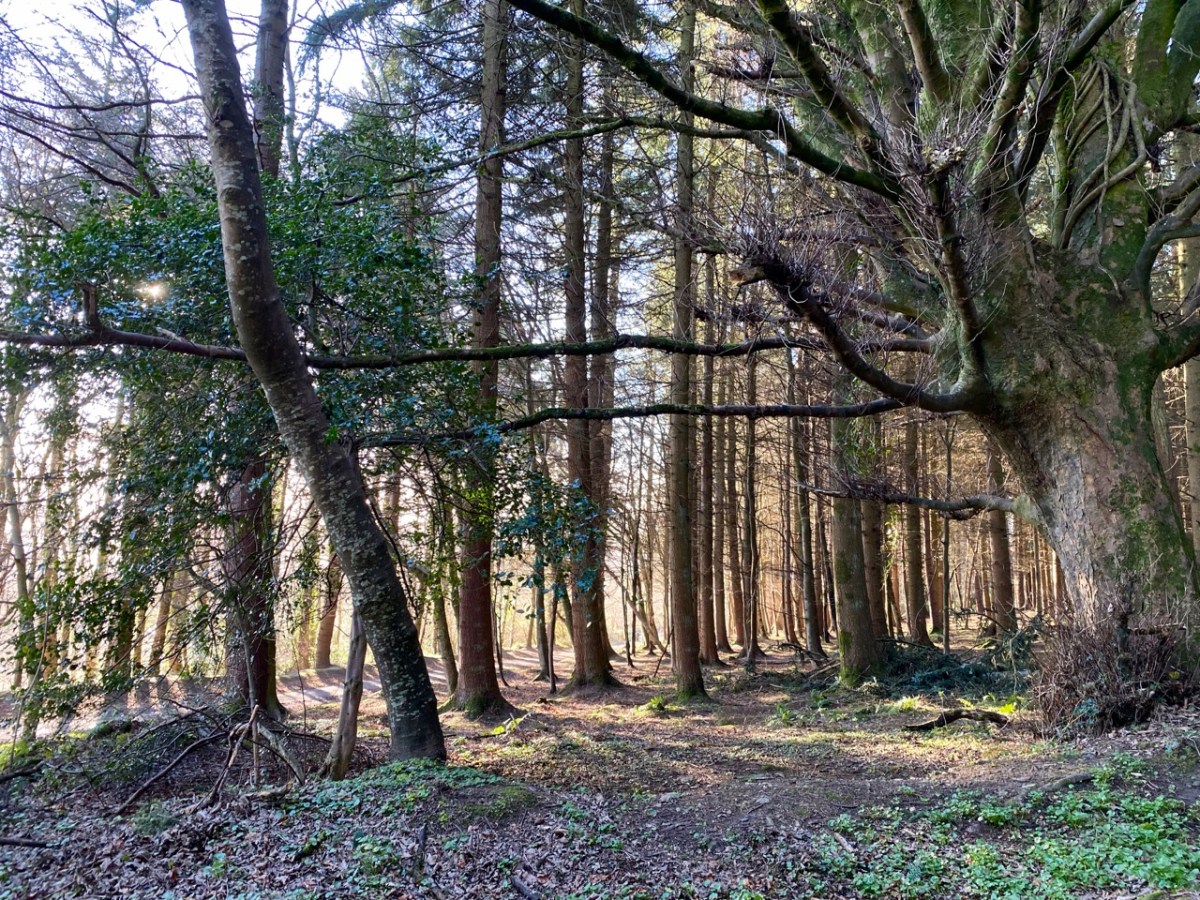
The Mountpelier Woods consist of around 5.5 kilometres of forest roads and tracks. The woods offer nature trails and a permanent orienteering course. Lord Massy’s Estate and Mountpelier Hill are also traversed by the Dublin Mountains Way hiking trail that runs between Shankill and Tallaght. It’s an attractive walk at all times of the year, with easy access from Dublin city centre.

A comprehensive application to An Bord Pleanála was submitted in July 2017, seeking permission to establish a Dublin Mountains Visitor Centre with associated works relating to tourism, leisure and recreational activities which would embrace the Hell Fire Club site and the mountain trails. Permission was granted, subject to conditions, on 25 June 2020. Another chapter in the story of this notorious locality unfolds . . .

As a tailpiece, I found this image of a ‘Hell Fire Club Goblet’ dating from c1745. It’s currently in the Philadelphia Museum of Art, but it must originate from Ireland: James Worsdale, whose name appears on this glass, was appointed Master of the Revels in the Dublin Hell Fire Club in 1741. It was also he who painted the portrait of Club members illustrated in this post: look at their goblets in the painting!