Queen of the May

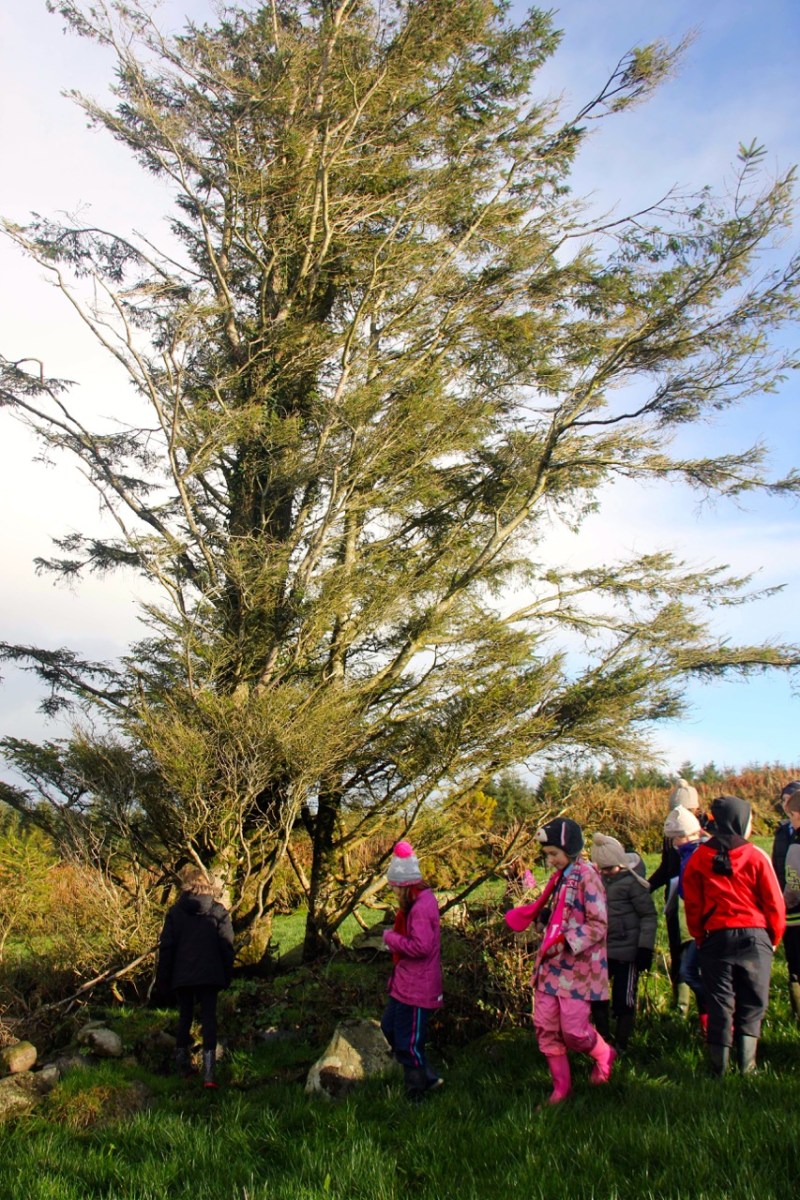
May Eve activity: setting up the May Bush

May Eve activity: setting up the May Bush

I was excited to learn – from one of my favourite and most faithful volumes on folklore: The Year in Ireland by Kevin Danaher (Mercier Press 1972) – that on May Day the Fastnet Rock weighs anchor, casts off her moorings and goes sailing about in Roaringwater Bay! I spent May Eve in a whirl of anticipation – and hot spring sunshine – awaiting the morrow which would present this wonderful spectacle to add to the feast to be seen from our window. The morrow that came, ostensibly the first day of summer, was a disappointment: the wind was in the east – and biting – and the whole bay was encased in damp, grey fog. The perambulations of the rock remained out of sight until nightfall, by which time the sweeping light had smugly returned to its rightful place twelve miles off shore.
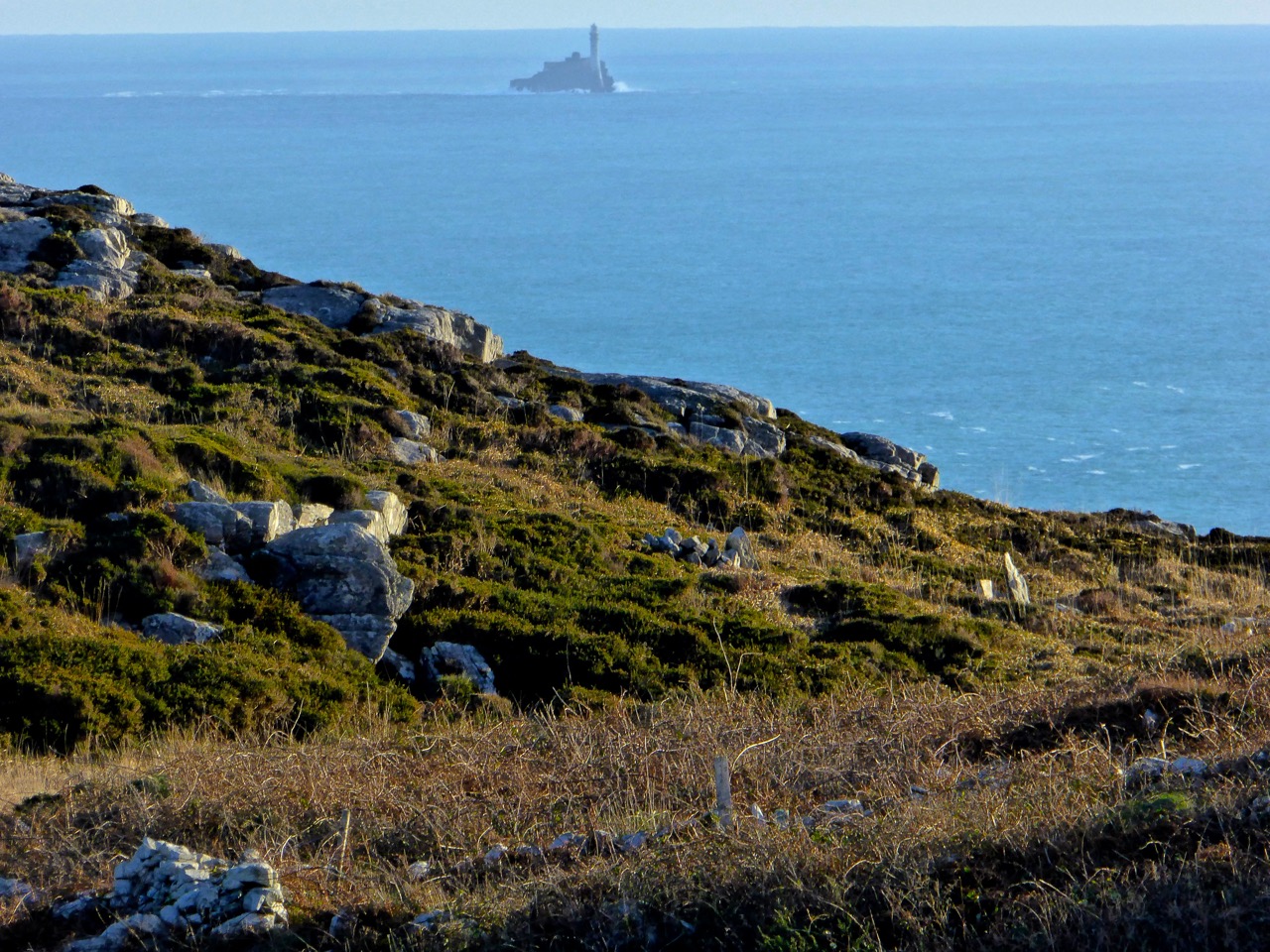
Dancing Rock...

Dancing Rock…

My only consolation – again, according to Danaher – is that a cold, wet May morning heralds an excellent summer (and this certainly came about last year). I could write all day about Danaher’s observations on the subject of Mary’s month – in his book 42 pages are devoted to it: the longest section by far, indicating the importance given to this part of the year in the traditional calendar. But I’ll leave that for another time and concentrate on our own activity: putting up our May Bush.

When I lived in the west of England it was a toss-up between going to Minehead or Padstow on May Day – occasionally both. They were contrasting experiences: in Minehead, on the north coast of Somerset, you had to take pot luck – there was no fixed itinerary to the day and you never quite knew what you were going to see, or where or when. What you wanted to see was the Hobby Horse, sometimes known as the Ship-horse, or the Sailor’s Oss. I’ll refer you to another classic book – by chance also dating from 1972: A Year of Festivals – A Guide to British Calendar Customs by Geoffrey Palmer + Noel Lloyd (Frederick Warne):

…The head of the horse (or the mast and sails of the ship) is in the centre; and a long rope tail, once a real cow’s tail, is fastened to the ‘stern’. The man inside the contraption glides and sways through the streets, and sometimes swings his tail around anybody who refuses to contribute to the collecting-box… The ship form of the horse is said to date from 1772 when, on the evening before May Day, a ship sank in a storm off Dunster, three miles from Minehead. The only object to be washed ashore was a dead cow, the tail of which was used to decorate the horse…

Now, the early photograph below is one of my all-time favourites as an illustration of a folk custom: it’s optimistically captioned Hobby-horse Festival, Minehead, Somerset and says to me that such traditions will continue forever because ‘they have to be done’ – even if the rest of the world has lost all interest…

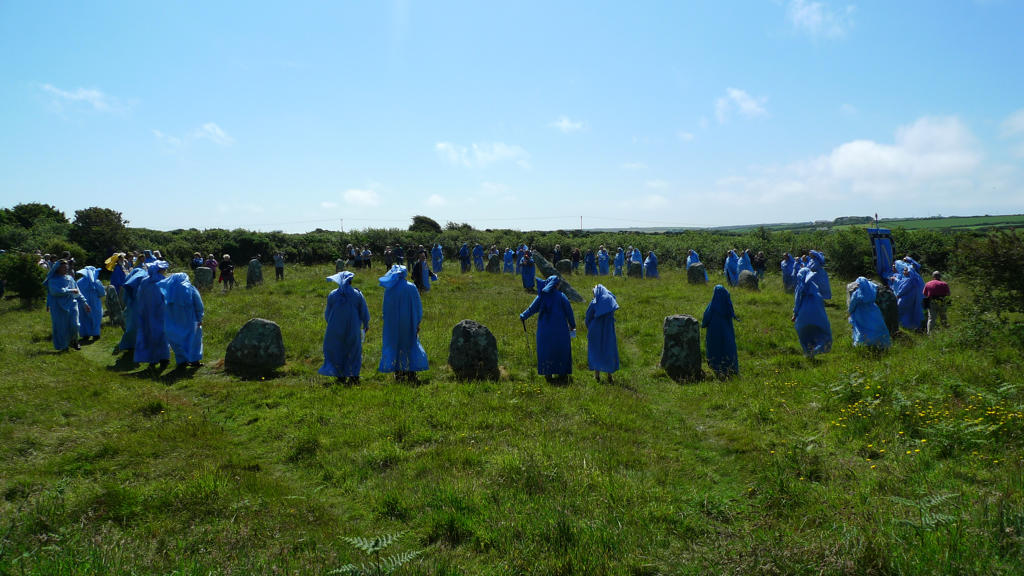
The First of May at Padstow is another matter altogether. It’s a huge gathering: all the roads are closed to traffic and at times it seems impossible that any more people could be fitted in to this modest Cornish fishing community. Here there are two ‘Obby Osses’: the Red Oss, sometimes known as the Original or Old Oss, is stabled in the Golden Lion, while the Blue Oss – or Temperance Oss has its headquarters in the (perhaps more temperance friendly) Public Library. Both horses come out in the morning of May Day, led by a ‘Teaser’ and accompanied by numerous dancers, drums and accordions, perambulate all around the town, and well beyond it, finally meeting in the evening at The Square, in the shadow of an elaborate and colourful May Pole.

Padstow taster… Photos from the 1960s and 2006:

Preparing the Maypole in Bavaria

Preparing the Maypole in Bavaria (Florian Schott, Ellbach)

While I was experiencing my first Padstow May Day in the 1960s, our Cappaghglass neighbour Dietrich was in Bavaria, watching the construction of an enormous Maypole: he also remembers all the children dancing around it holding up May Bushes. For our own May Bush we took our inspiration from Danaher:

…The children set up their May Bush in the same spirit in which we hang out our flags on a national holiday, to celebrate an occasion, but some – at least – of their parents were glad of the feeling of protection against unseen forces which the May Bush gave…

Oh yes! We have to be aware that…

…So powerful were the preternatural forces abroad in the night between sunset on May Eve and sunrise on May Day that almost anything might be expected to happen… (Danaher) while …The powers of evil, always on the alert to entangle and destroy souls, being most dangerous and powerful on May-Eve, on that day the maids were apt to be uneasy and rather sullen, watching us suspiciously lest we might, through our unbelief, frustrate their precautions against danger. They strewed primroses on the threshold of the front and back doors – no fairy can get over this defence – and in the cow-byres they hung branches of rowan while the head dairy-woman sprinkled holy water in mangers and stalls. The milkmaids, at the end of the evening milking, stood to make the sign of the cross with froth from the pails, signing themselves and making a cross in the air towards the cows… from The Farm by Lough Gur by Mary Carbery (Longmans, 1937).

Burning the land

Burning the land

We have had a long, dry spell and there have been a number of gorse fires recently in our neighbourhood: this one occurred on May Eve – traditionally a time in Ireland when bonfires were lit – although the gorse fires have nothing to do with that tradition. Here are the observations of William Wilde (father of Oscar) in Irish Popular Superstitions, Dublin, 1853
…Turf, coals, old bones, particularly slugs of cows’ horns from the tan-yards, and horses’ heads from the knackers, logs of wood etc were also collected, to which some of the merchants generally added a few pitch and tar-barrels. The ignitable materials were formed in depots, in back-yards, and cellars of old houses, long before the approaching festival; and several sorties were made by opposing factions to gain possession of these hoards, and lives have been lost in the skirmishes which ensued… With the exception of one ancient rite, that of throwing into it the May bush, there were but few Pagan ceremonies observed at the metropolitan fires. A vast crowd collected, whiskey was distributed galore… The entire population collected round the bush and the fire; the elder portion, men and women, bringing with them chairs or stools, to sit out the wake of the winter and spring, according to the olden usage… Fiddlers and pipers plied their fingers and elbows; and dancing, shouting, revelry and debauchery of every description succeeded, till, at an advanced hour of the night, the scene partook more of the nature of the ancient Saturnalia, than anything we can presently liken it to…

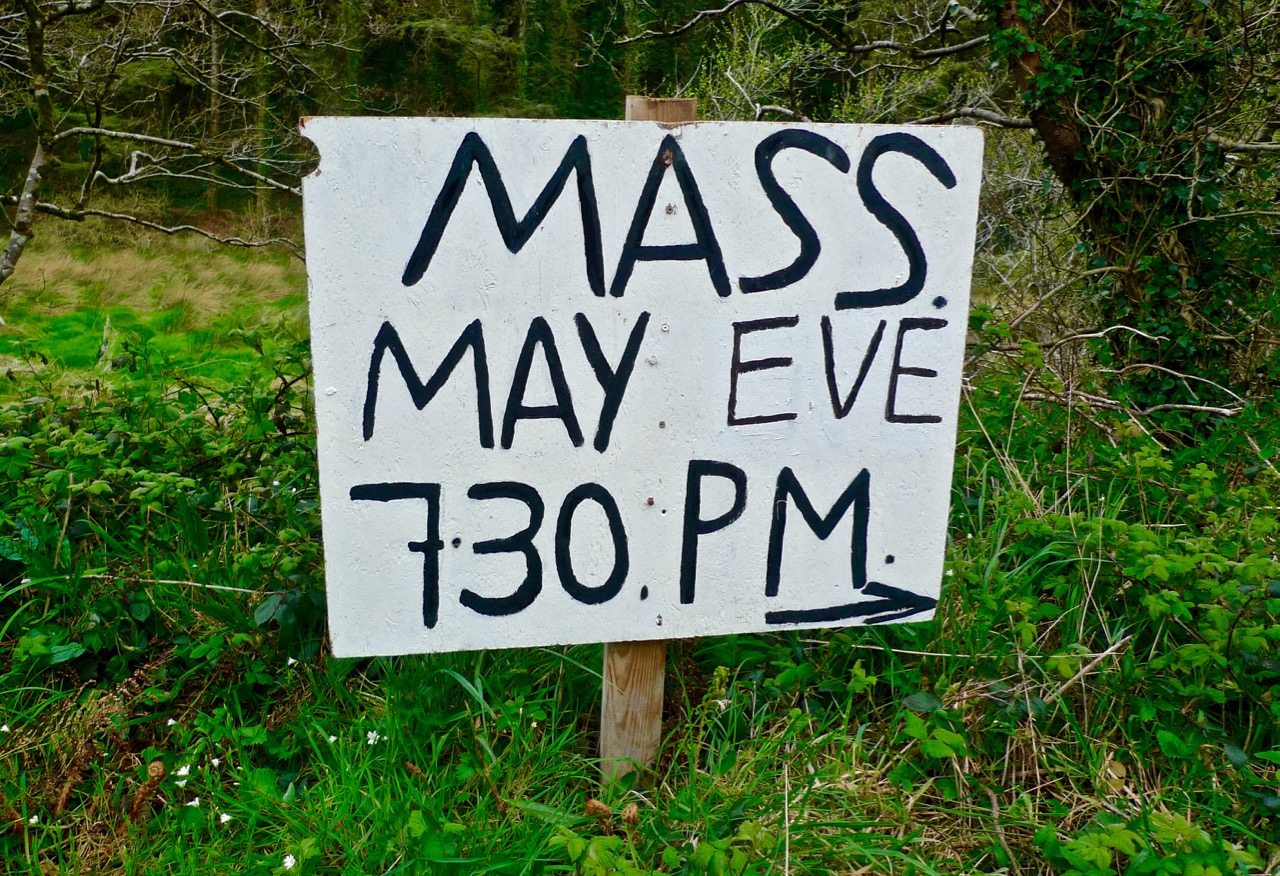
mass sign

By contrast, our own rural activities were much more calm and constrained. I couldn’t miss out on an outdoor Mass celebrated at one of Lough Hyne’s Holy Wells – the Skour Well. On a beautiful evening – attractive to the midges – it felt the most natural thing in the world to be at a site which has been considered sacred for hundreds, if not for thousands of years, and to take part in a ceremony which is also ancient. I counted over eighty people, including a gentleman of 97, at this event – presided over by two priests and centred on a portable altar with cloth and candles, the revered well being the backdrop. Prayers were said and hymns were sung in English, Irish and Latin.

There’s a continuity here which defies any twenty first century rationale. I was very conscious that this was the way that faith was practiced in Ireland in the penal times (requiring that a watchful eye be kept out for the Redcoats) – but also it was an honouring of nature and a respect for the elements: earth, water, sun and rain – old ways carrying on regardless of new technologies.

A May garland – Hatherleigh, Devon:

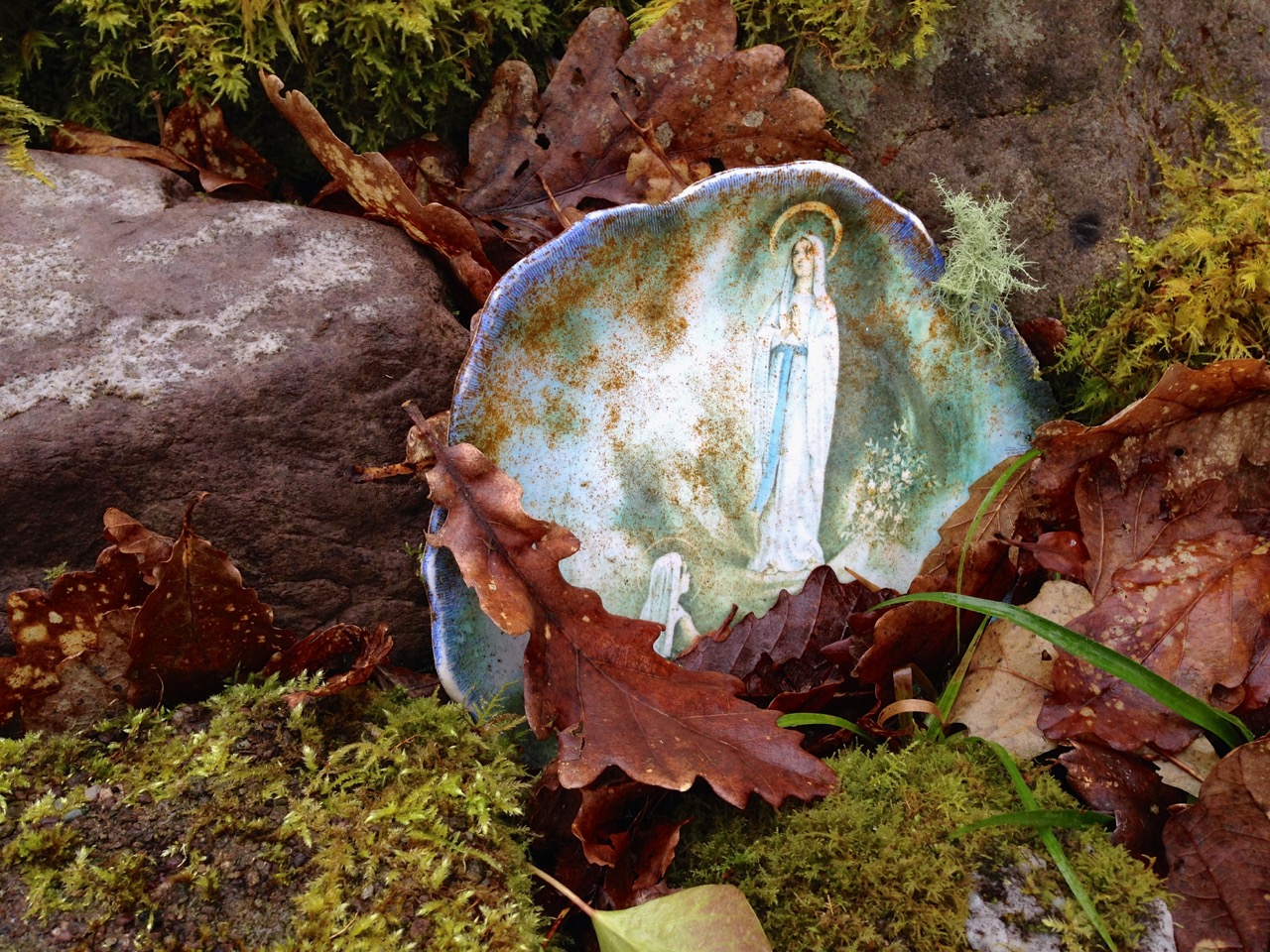
Finola’s memory of May Day in her schooldays was of all the girls wearing veils and processing down to the grotto saying the Rosary; and, every day throughout Mary’s month, singing the refrain that was sung at the close of the Mass at Skour Well:

O Mary! we crown thee with blossoms today,
Queen of the Angels, Queen of the May.
9074db7eb01031a082d064758b8b18ba

And did those feet…

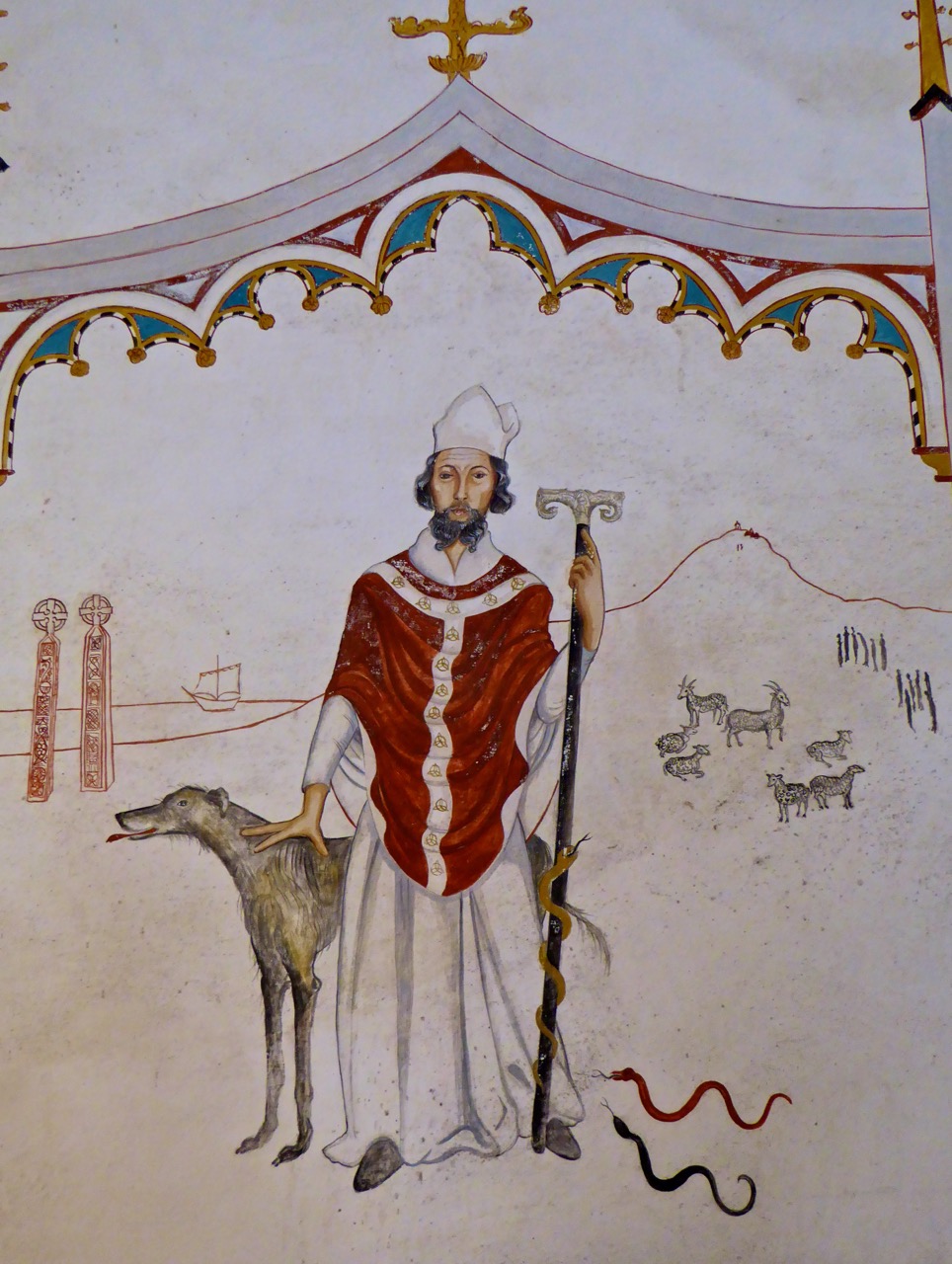
We discovered St Patrick in Glastonbury!

We discovered St Patrick in Somerset!

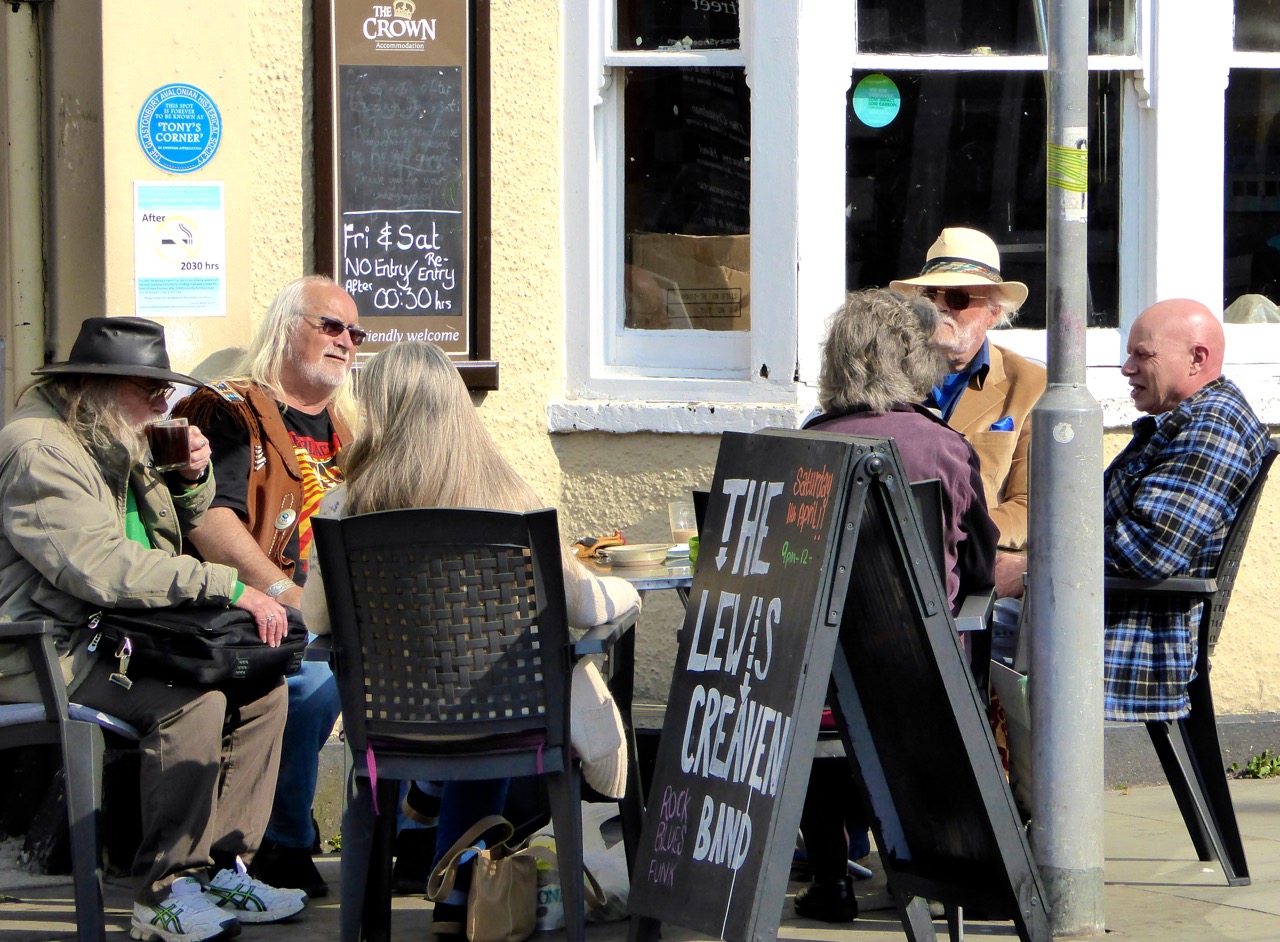
Finola had never been to Glastonbury, so I thought a visit on our way back home to Ireland was in order. Like me, she found the town itself fascinating: every shop seems to have a ‘mystic’ theme, and even the coffee is imbued with an otherworldly aura…

Coffee time in Glastonbury

Modern Pilgrims? Coffee time in Glastonbury

Why is this Somerset town so steeped in esoterica? It attracts ‘New Age’ adherents, pagans and Christians. Perhaps because it was a place of pilgrimage centuries ago – one of the most important in Britain. The biggest surprise for us was to find a chapel there dedicated to St Patrick!

St Patrick's Chapel - one of the earliest buildings at Glastonbury

St Patrick’s Chapel – one of the earliest buildings at Glastonbury

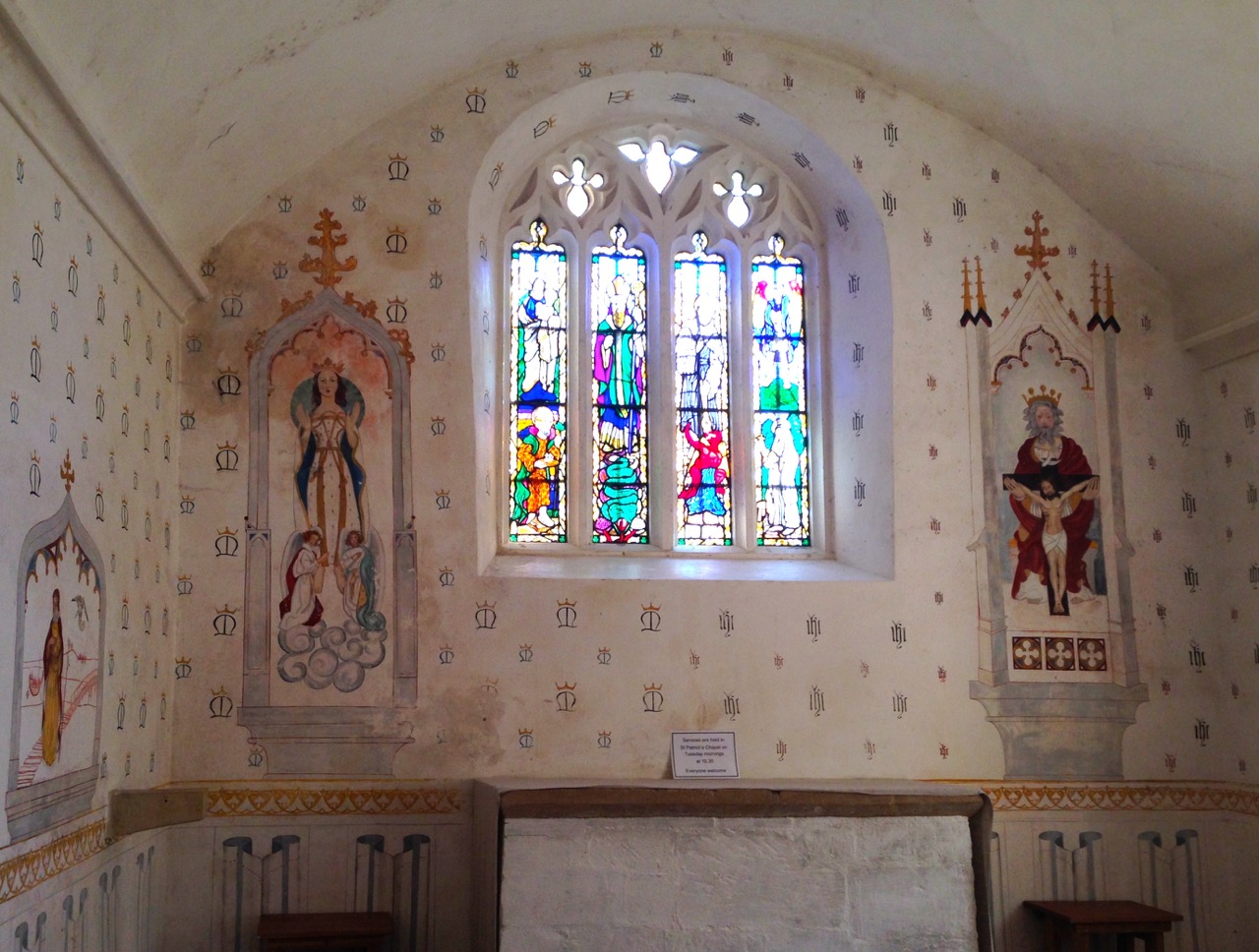
Inside St Patrick's Chapel

Inside St Patrick’s Chapel

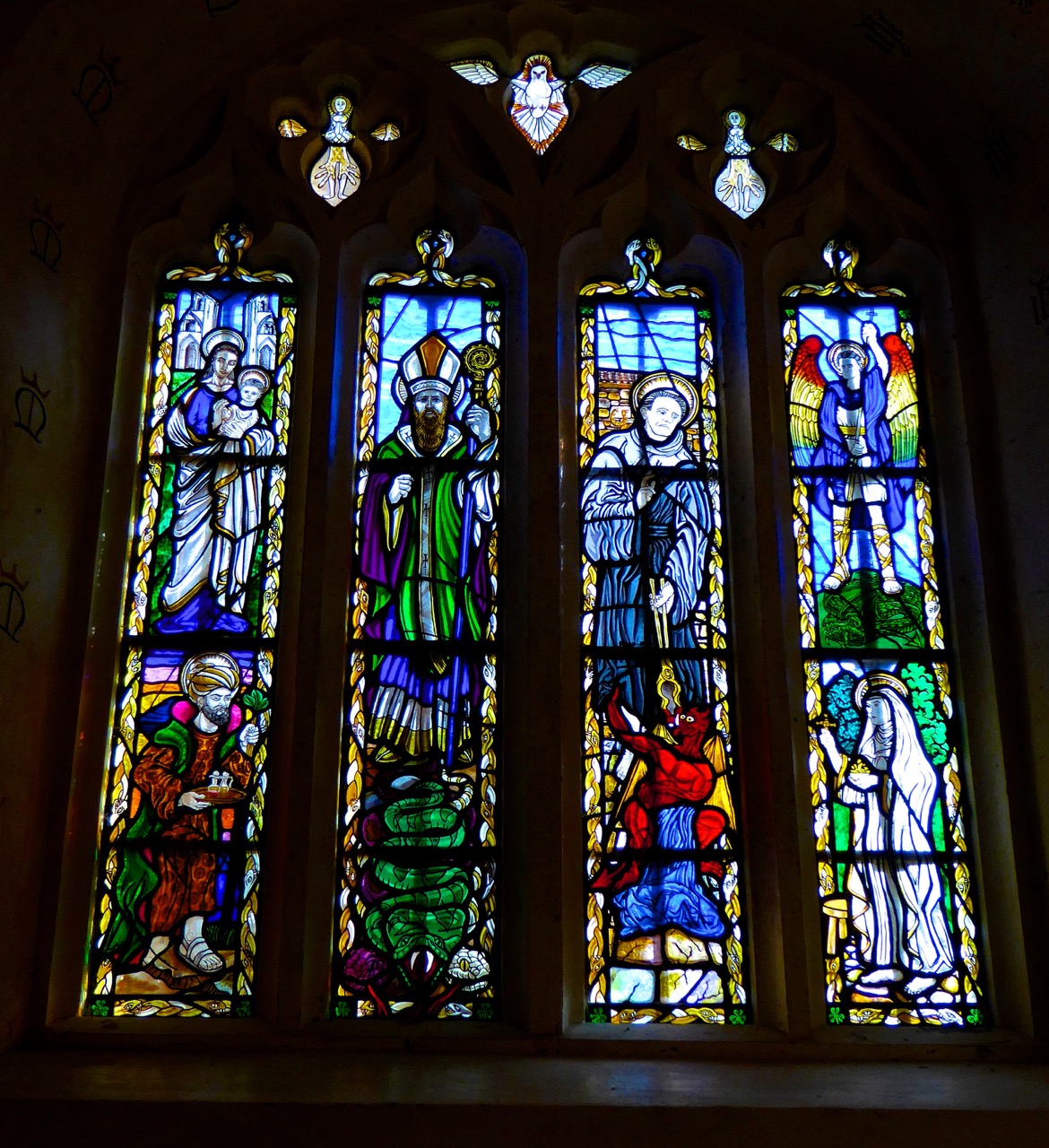
The chapel is in the grounds of Glastonbury Abbey and – like the Abbey itself – the little building has had a chequered history. It is well preserved, however, although the wall paintings and glass are from a modern renovation.

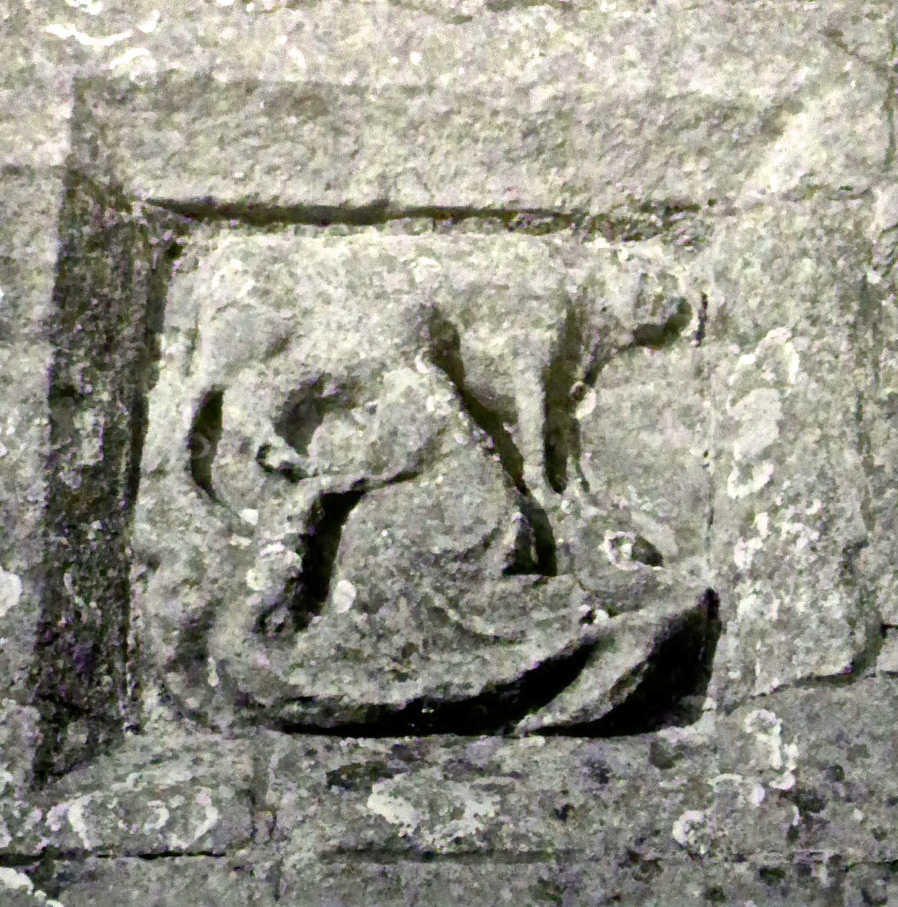
The chapel window - note St Patrick's wonderful snake!

The chapel window – note St Patrick’s wonderful snake!

Glastonbury is a place of history and of legend. The most important of these has to be the one that William Blake immortalised in his poem Jerusalem:

And did those feet in ancient time walk upon England’s mountains green…

‘Those feet’ are the feet of Jesus himself who – tradition insists – was brought to this site as a boy of twelve by his great-uncle, Joseph of Arimathea, a tin trader. Jesus in Britain? No wonder the Abbey was such a glorious place, and a rich and powerful one in medieval times. Even in ruins, the buildings have a presence and elegance which for me is unmatched in any of the other ancient monastic sites I have visited. With that history there couldn’t be anywhere more important outside of the Holy Land.

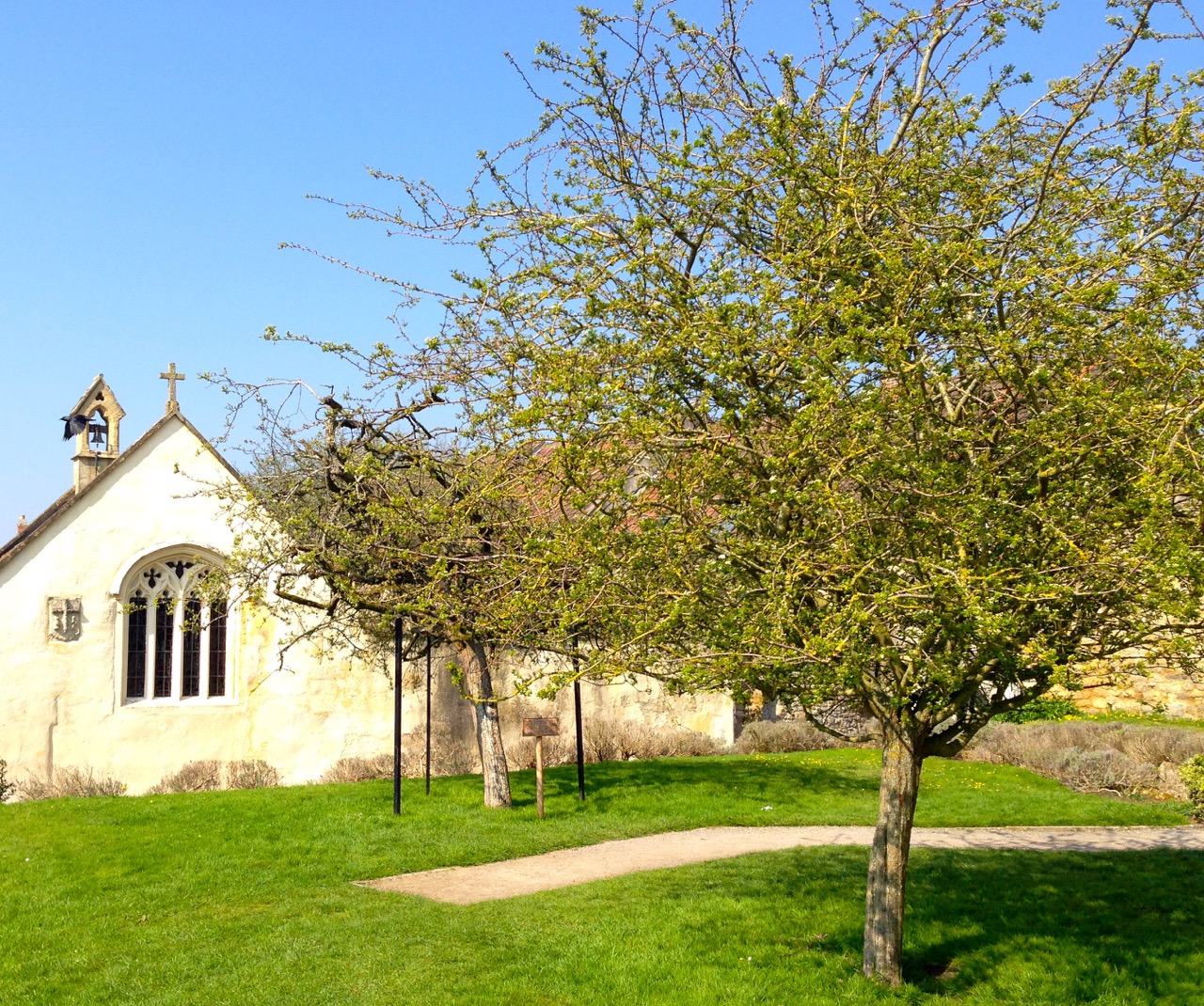
Back to the story – When Joseph landed on the islands that were Somerset in those days, he climbed to the top of Wearyall Hill and planted his staff there. It took root and grew into a thorn tree. Magically, that tree always flowered on Christmas Day. The original thorn has gone from the hill, but cuttings have been taken over time and they exist elsewhere: one such is within the Abbey grounds, just outside St Patrick’s Chapel. They still flower on Christmas Day, and the Queen is always sent one of the blooms.
Glastonbury's Holy Thorn, planted by Joseph of Arithamea

Glastonbury’s Holy Thorn, planted by Joseph of Arithamea

A tradition tells us that St Patrick grew weary of his work in Ireland and returned to Britain in old age. He went to Glastonbury because of its importance, and he was joined there by a band of monks who elected him their Abbot. After a few years he died and was buried in the Abbey grounds. Other important visitors here included St Brigid – who is pictured milking her cow on the wall of St Michael’s Tower on the Tor. St Brigid is also considered a Goddess – suitable for a town in which Paganism and Christianity seem to co-exist quite happily.
Typical Glastonbury shopfront

Typical Glastonbury shopfront

St Brigid - another Irish Saint in Glastonbury

St Brigid – another Irish Saint in Glastonbury

The stories go on and on: a multitude of Saints is buried around the Abbey evidently – and the Virgin Mary herself visited – with her Uncle Joseph – and (some say) is also buried there…

We musn’t forget another Glastonbury VIP – King Arthur. In the twelfth century the grave of Arthur and Guinever was found by monks when carrying out restoration works in the nave of the Abbey. This added to the notoriety – and the fortunes – of the monastic establishment…

sign

First Foot

‘…According to local folklore the first foot was planted on Irish soil at Donemark on the shores of Bantry Bay in 2680 BC…’

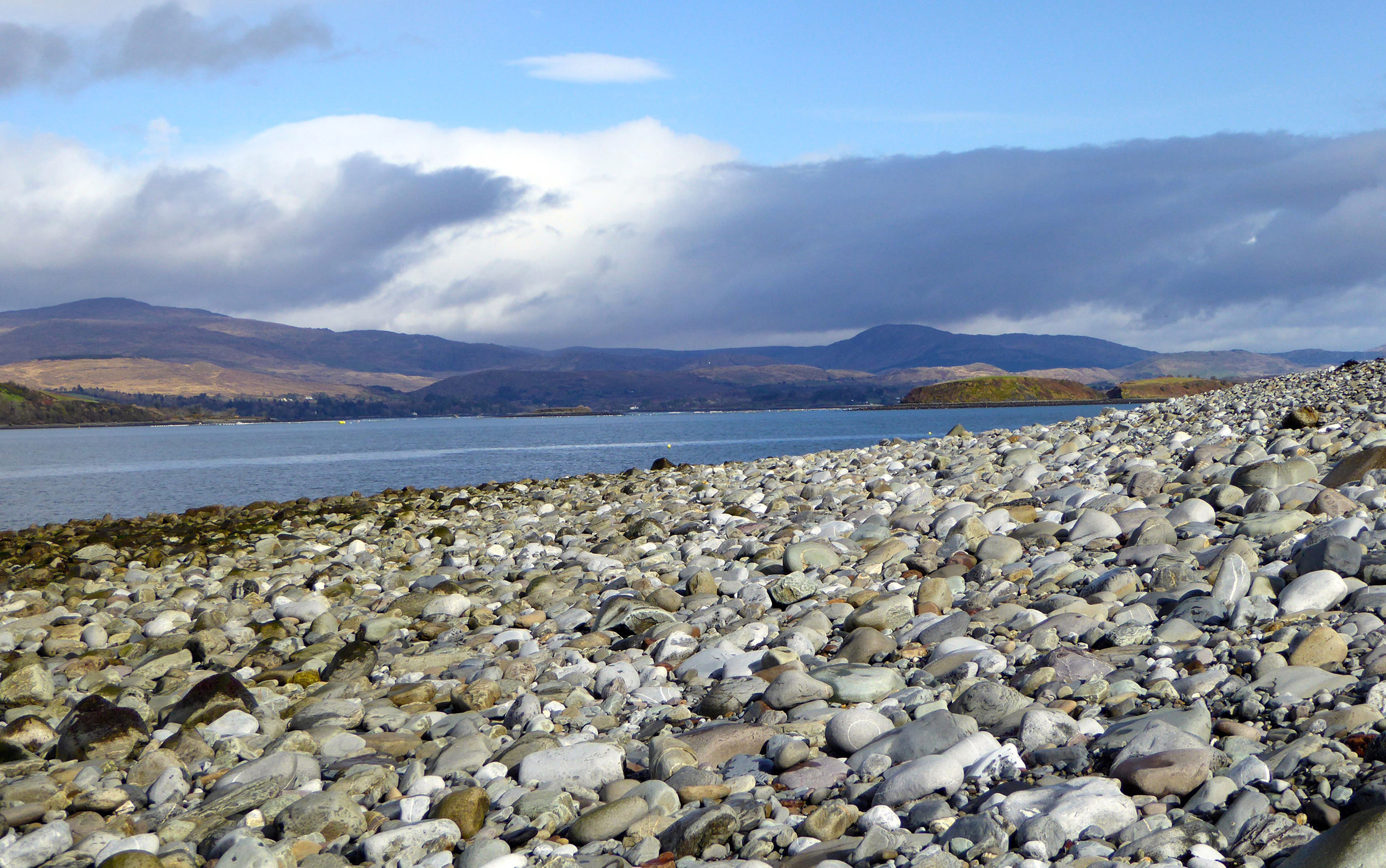
Ireland's first arrivals passed by this pebble beach on their way to Donemark

Ireland’s first arrivals passed by this pebble beach on their way to Donemark

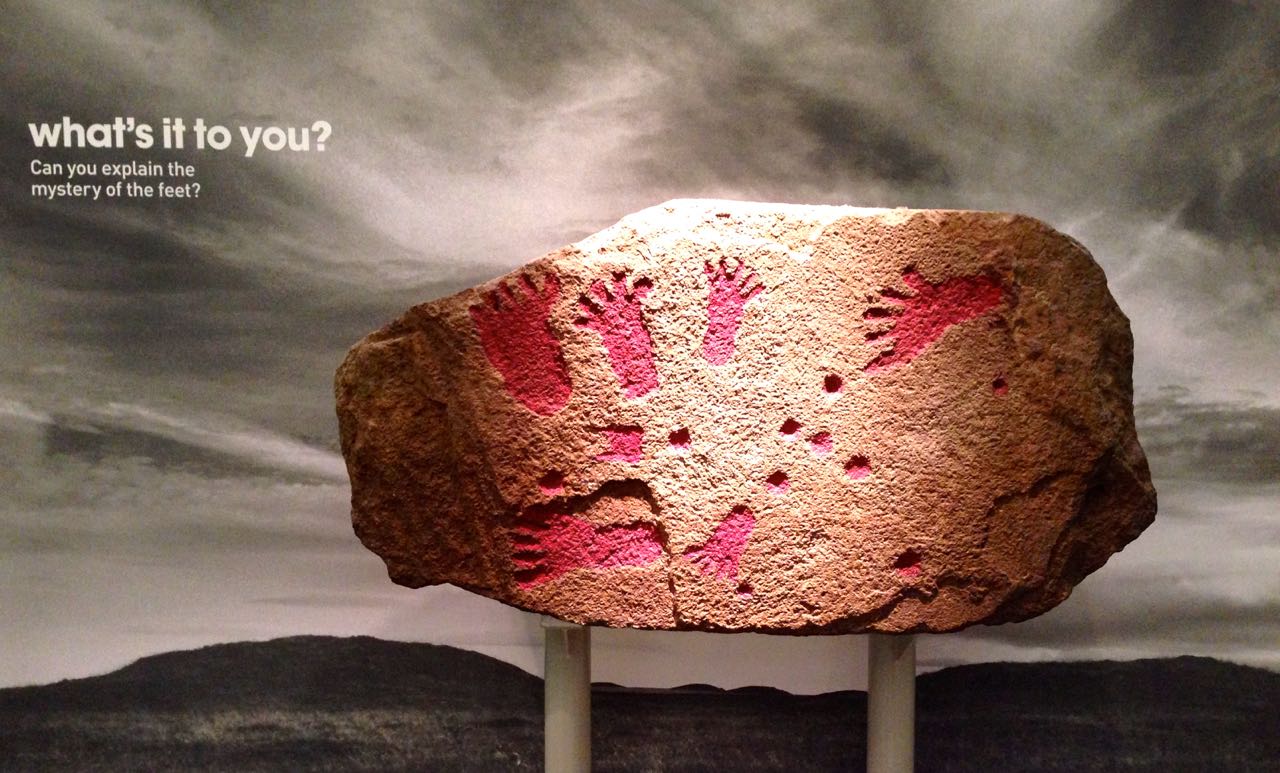
This statement (from Fuchsia Brand’s leaflet on Heritage) was guaranteed to send me scurrying for my history books. And – yes – I found many references to the event: an event which, to my mind, was surely one of special significance for Ireland: the first human ever to have set foot in this land – it must have deserved commemoration… Surely, there must at the very least be a plaque marking the spot? For a moment I wondered if this could be the long sought explanation for the enigmatic piece of Rock Art that’s on display in Bristol’s Museum & Art Gallery – the carving is about the right age…

Bronze Age Footprints in Bristol's museum

Bronze Age Footprints in Bristol’s museum

So, a similar example of Petrosomatoglyphia is what I was hoping to find on the shores of Bantry Bay, a mere stone’s throw from our home here in Cappaghglass. But – before that expedition – let’s just go back to the history for the moment. Back – in fact – to the Lebor Gabála Érenn (The Book of the Taking of Ireland), which was written down in the 11th century and – allegedly – based on earlier source material. It takes a bit of wading through: I used a commentary edited and translated by R A Stewart Macalister and published by the Irish Texts Society in Dublin in 1938, but it’s well worth the effort. There’s a lot I had never understood before about the earliest history of the people of Ireland.

lebot gabala book frontispiece

It’s a long story… The book is a collection, in five protracted parts, of all the poems and traditions which had been written and learned by the Bards, telling the history of their nation. There’s a lot of repetition: like the Gospels there are several versions of each episode and it’s a bit dizzying to try to get a clear overall picture of events. So, settle down and imagine the visiting Bard you have given hospitality to in your tower house on a winter’s night is regaling you with tales of your ancestors.

A Meeting of Bards (at Boscawen-Un Stone Circle, West Penwith, Cornwall

A Meeting of Bards (at Boscawen-Un Stone Circle, West Penwith, Cornwall)

Everything has to go back to Noah, who was only allowed to take with him on the Ark his own sons and their wives. One of his sons, Bith, had a daughter – Cesaire (or Cessair). As she had to stay behind so also did her father, but they built their own ships, three of them, and set sail with two other men and a large company of women, looking for a land which ‘knew no sin’ because it had never been populated: there they would settle and aim to re-found the human race in a green and fertile place. Their voyaging took them to many parts of the known world and they came eventually to the north of Spain – which we know today as Celtic Galicia. Cesaire knew that this wasn’t the Utopia they were seeking but she climbed to the top of a very tall tower and, in the far distance, she spotted Ériu – ‘…where no evil or sin had been committed, and which was free from the world’s reptiles and monsters…’

Cesaire would have needed a tower like this to catch a glimpse of Ireland from northern Spain...

Cesaire would have needed a tower like this to catch a glimpse of Ireland from northern Spain…

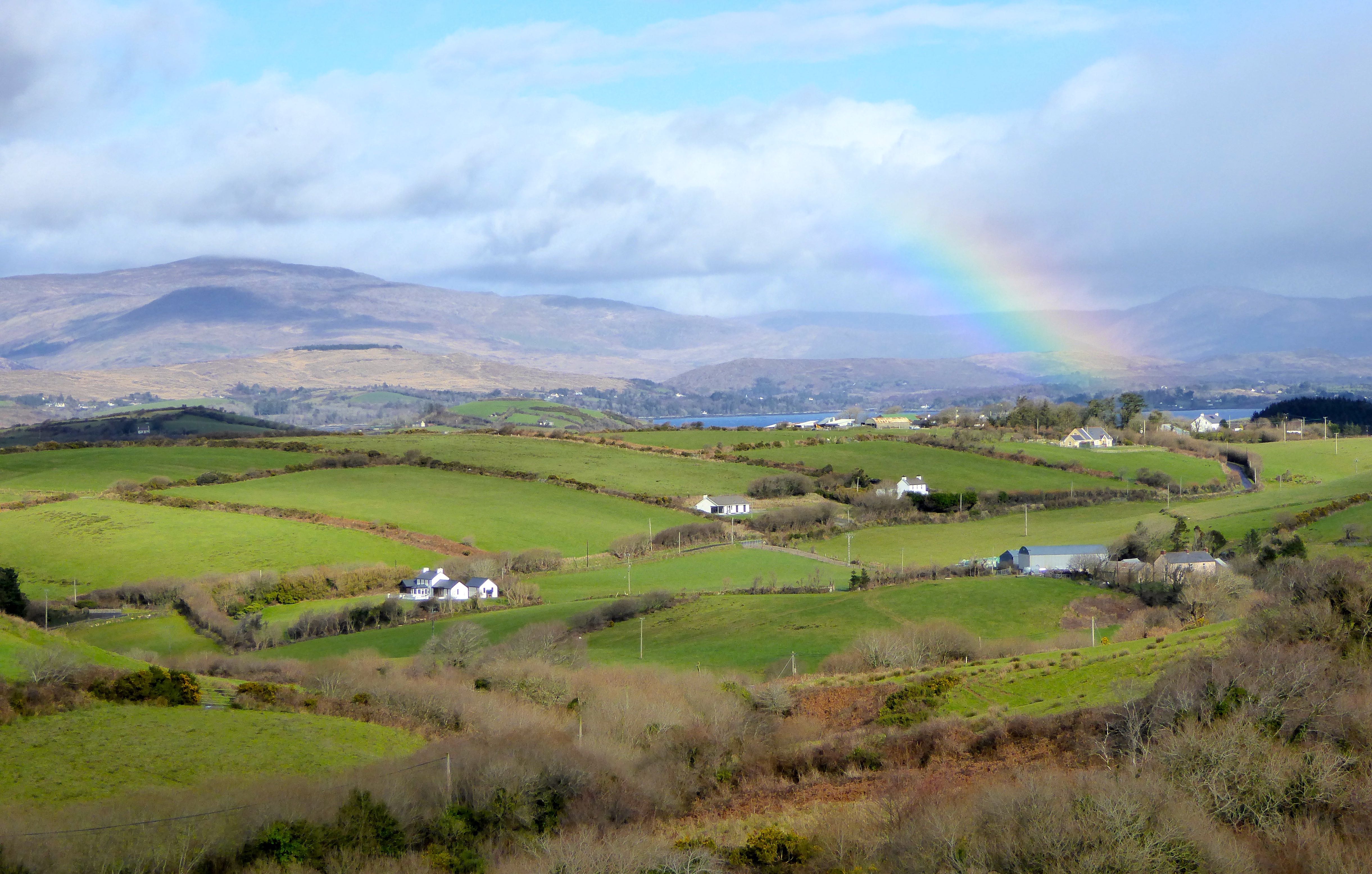
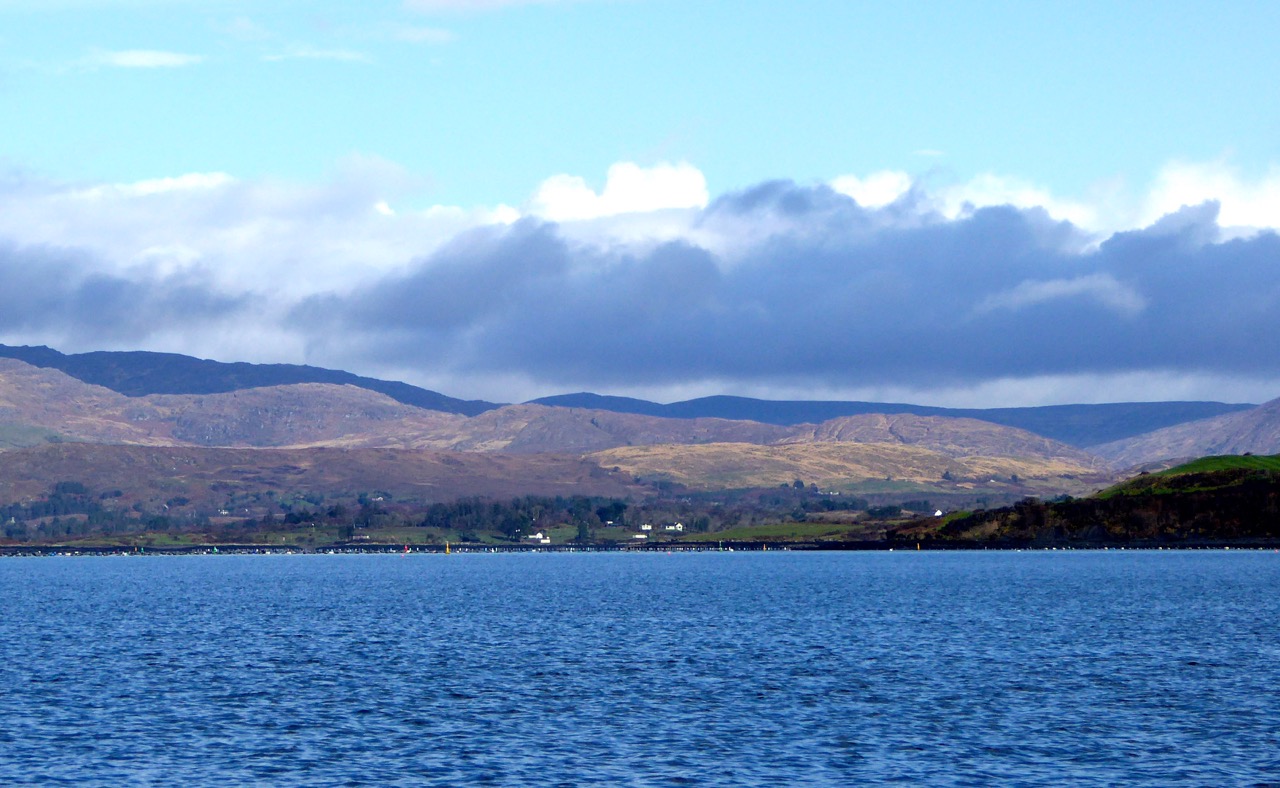
And so it was, forty years before the Great Flood engulfed everything, Cesaire’s expedition sailed up to the mouth of the Mealagh River, passing on the way the most beautiful landscapes they had ever seen – landscapes that we are fortunate to see every time we set out to explore our own new horizons.

Bantry Bay - the landscape today

Bantry Bay – the landscape today

Now it was time to glimpse for ourselves this remarkable site – Dún na mBarc – the place of the boat – (Donemark -Dunnamark Townland) in the parish of Kilmocomogue. We drove up the unremarkable N71 through Bantry town and turned in to its attractively situated golf course, then made our way down to the shore. Disappointingly, that is also unremarkable: it’s got a brooding, although not unattractive atmosphere about it. We came there at low tide and saw mud-flats – alive with foraging birds, including a very fine Old Nog – the huge stones of a disintegrating quay, and distant views to the Sheep’s Head and Beara Peninsulas.

Landing Place? At Donemark

Landing Place? At Donemark

Old Quay at Donemark

Old Quay at Donemark

.

Alas, there were no footprints, no plaque, no signification of the very important history of this site: there was only our imagination to fill in the gaps. I could envisage Cesaire’s Bronze Age boat (only one survived the full journey) making its way up the azure waters admiring the emerald green of the landscape and passing by some of Ireland’s most dramatic scenery. They landed on ‘…a Saturday, the fifteenth day of the moon at Dun na mBarc…’

Kerry Mountains

Mountains of West Cork

We did find a single commemoration of this event: in the tranquil gardens of the National Learning Network Centre, which is not far from the mouth of the river. It is a work of art, made in 2013 by the students of the Centre, under the guidance of Michael Ray and the auspices of the West Cork Arts Centre – you may remember both from this recent post. Voyage of Stories’  recalls that pioneering arrival in the form of a boat sculpture made of steel, copper and glass and set up over a pool. The glass tiles tell of invasions and emigrations both ancient and modern in Irish and English. It’s a good way to commemorate the journey and those early settlers, we thought.

'Voyage of Stories' at Donemark

‘Voyage of Stories’ at Donemark

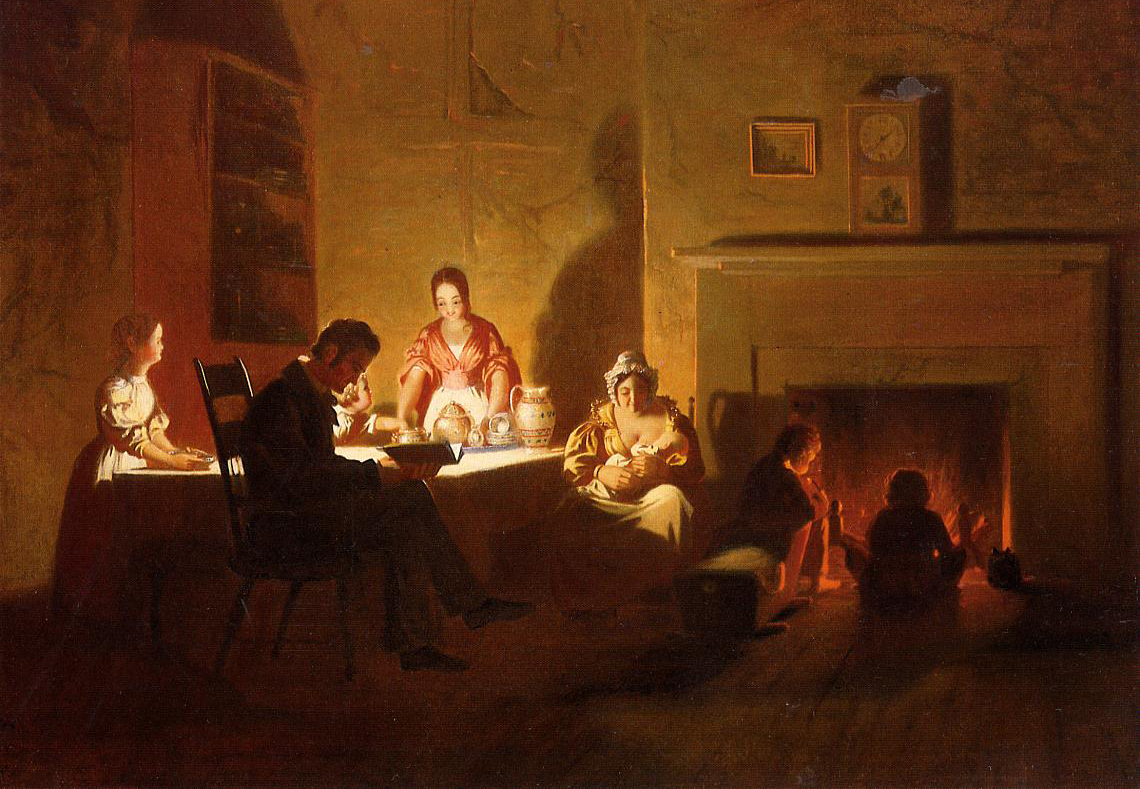
Now, Finola – at my side and wearing her Archaeologist’s hat – is tutting at my unquestioning acceptance of the dating of this milestone in Ireland’s history, bearing in mind that the passage graves at Newgrange, Knowth and Dowth appear to be some 5,000 years old and – she says – there were people living in Ireland earlier than that! But my view is that there’s history, and there’s story… Well, perhaps history is always someone else’s story but give me a good tale any day, especially one woven with adventure and romance and told at the fireside.

Family Life (Caleb Bingham 1845)

Family Life (Caleb Bingham 1845) New Orleans Museum of Art

So now you know all about Cesaire, who was the first to step from that frail vessel which had travelled all the way from Egypt in those far off days. But perhaps I should also tell you a little more: the three men on that voyage faced the prospect of serving no less than fifty women between them if they were to populate this new land. The Lebor Gabála Érenn is quite frank about this: ‘… Ladra, the pilot, from whom is Ard Ladrann named he is the first dead man of Ireland before the flood. He died of excess of women, or it is the shaft of the oar that penetrated his buttock. Whatever way it was, however, that Ladra is the first dead man in Ireland…’ while Bith – Cesaire’s father – was already aged before the voyage and also passed away soon after. That left one man – Fionntán – who was so frightened by the prospect of facing all those women alone that he ran away and hid in a cave. There he changed into a Salmon and survived the Flood which, sadly, overcame Cesaire and her companions. The shape-shifting Fionntán went on to live for five and a half thousand years (by my reckoning that means he’s still alive!) and recorded all of Ireland’s history (including at first hand the account of Cesaire’s voyage) – which he then taught to the Bards of Ireland so that it would be taken out into the world…

But all that is for another day!

made harbour

A Murmuration

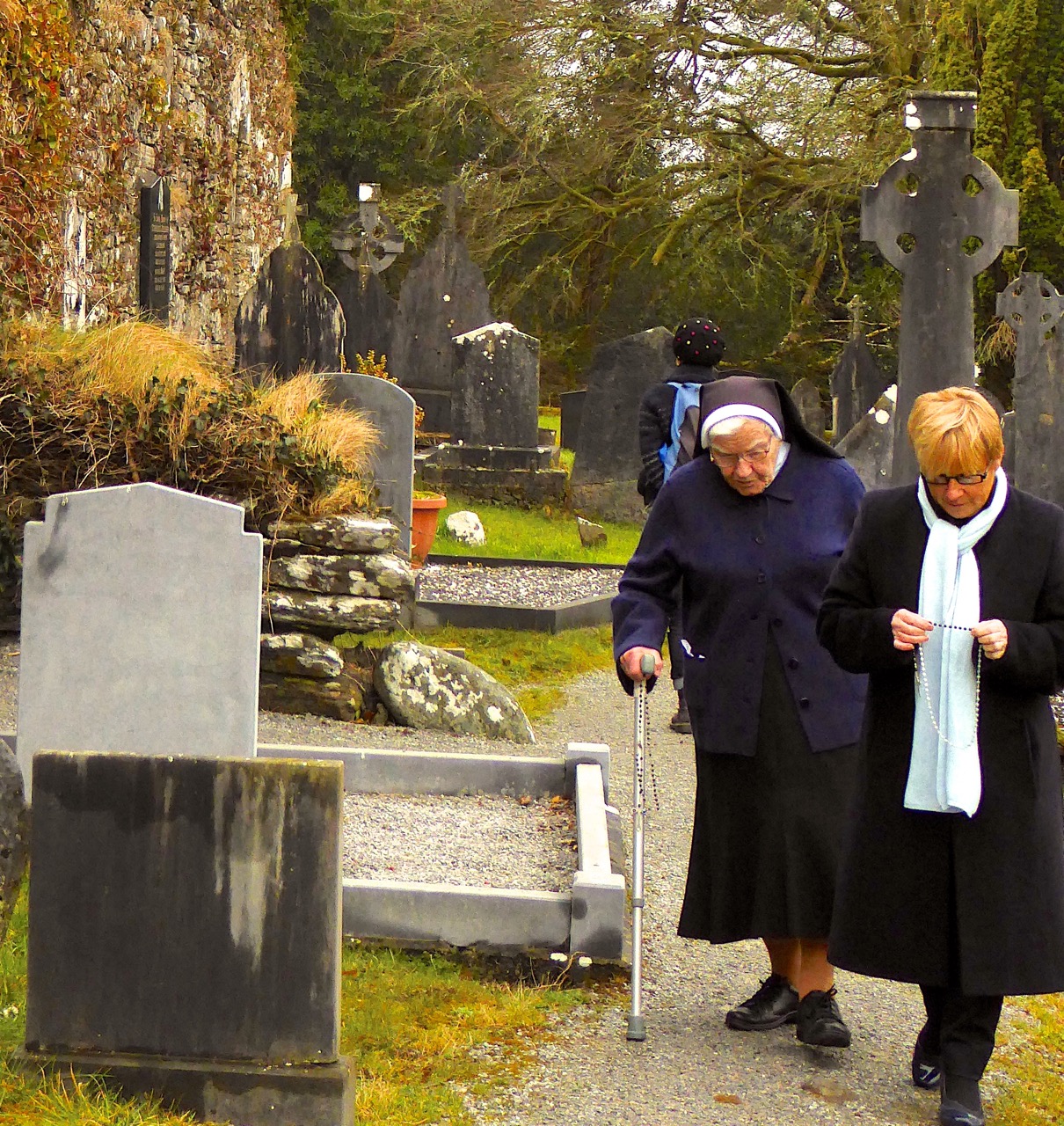
We stood still and listened: the air was filled with humming – Bees swarming in February? But no… it was the murmuring of the pilgrims saying the decades of the Rosary by the grave of St Gobnait…

Making the Rounds at Saint Gobnait's Shrine on the Feast Day
Making the Rounds at Saint Gobnait’s Shrine on the Feast Day

We travelled up into the Muskerry Gaeltacht on Wednesday – 11 February: the Feast Day of Saint Gobnait. It’s a fair journey, and we felt that we had really gone into another world: we crossed over the Mountain of the Fairy – that’s my interpretation of the Shehy Mountains (Shee is Fairy) – others say the Irish Cnoic na Síofra means ‘hills of the animal hides’. For the first time in my life somebody – a passer by – addressed me in Irish… “An bhfuil hata agat le spáráil?” they said – “Have you got a hat to spare?” (I think it was a wry comment about the headgear I was wearing on the day).

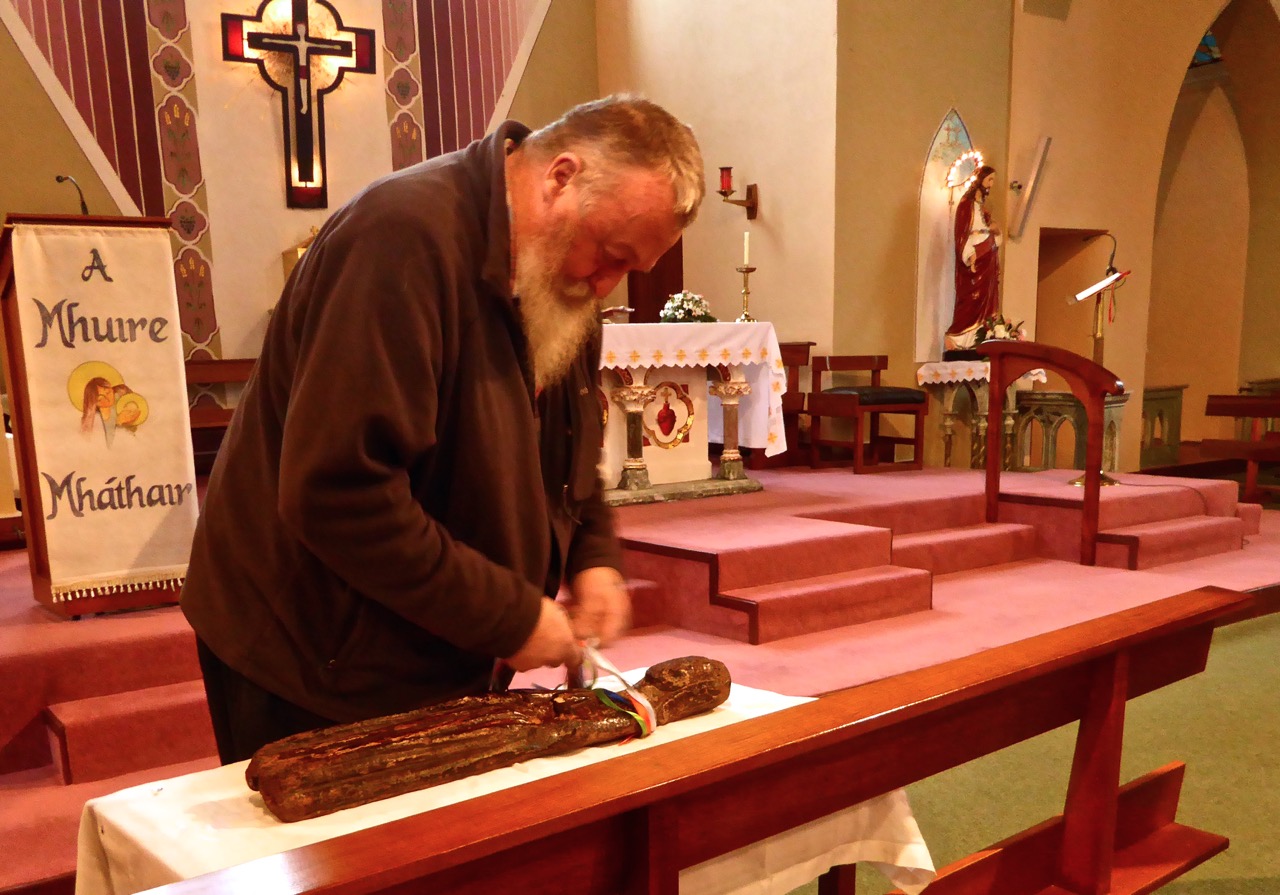
Wrapping the ribbons

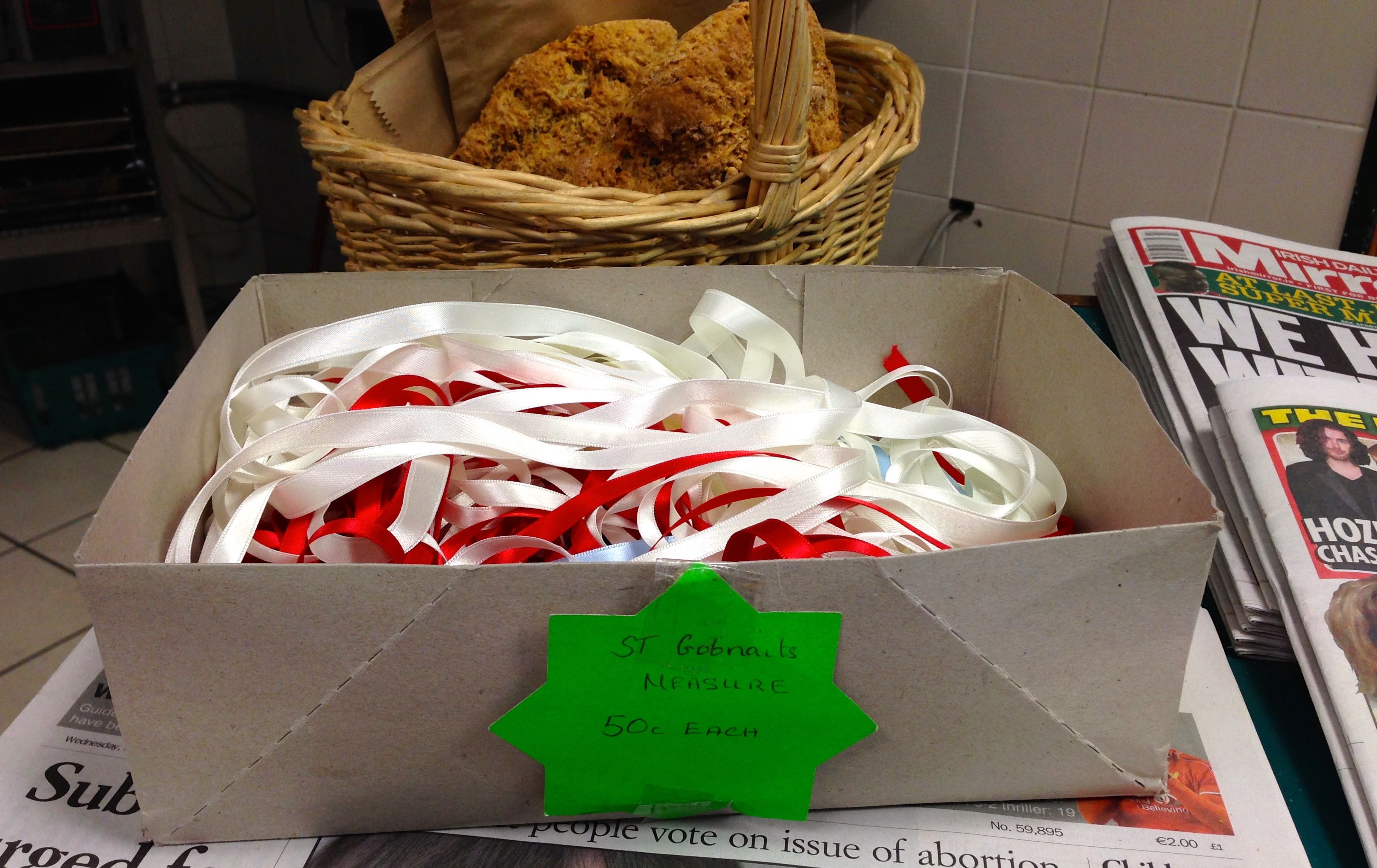
Our goal was Saint Gobnait’s Church in Ballyvourney, where the Mass was to be heard celebrated in Irish. Also, we wanted to see the 13th century wooden statue which is brought in to the church on this day. When we arrived there was already a queue to buy ribbons and ‘measure’ them against the statue. In fact, it was quite an intricate ritual: first you wrapped your ribbons around the neck of the statue, then around the feet. Some did the same around the stomach – others passed the ribbons under the body of the statue and rubbed them along the surface. Many people kissed the statue and some picked it up and made the sign of the cross with it. We joined in and came away with a clutch of ribbons, now blessed by Saint Gobnait and imbued with health-giving and good-fortune-bringing properties.

Making the 'Measures'
Making the ‘Measures’

The church was completely full for the Mass (it was also broadcast outside), which was celebrated by two Priests and a very robust men’s choir – beautiful singing in Irish. It was an uplifting experience, even though I hardly understood a word. A friendly atmosphere imbued all who were there, and excitement was in the air. Afterwards, we visited the statue again and then headed for Saint Gobnait’s Holy Well, her grave and the ruins of her ancient church, where the ‘Rounds’ were being performed all day. That’s when we heard the humming – it should have been Bees: this Saint has always been associated with them, and her statue which overlooks the pilgrimage site (and which was carved by Seamus Murphy in 1950) is decorated with Bees and with a Deer. This is also part of her story: when she was travelling through Ireland looking for a site to establish her community she was told she must continue on her way until she met with nine white Deer. She found them in Ballyvourney and that’s why in our time the little settlement flourishes on this February day.

We heard that there is another Holy Well, hidden in the woods just outside the town and seldom visited. This is known as Tobar Abán – Saint Abban’s Well. That saint seems to be closely associated with Saint Gobnait although not much is known about the lives of either of them – they lived back in the sixth century.

In the local shop
In the local shop

A visit to the Post Office provided us with the information we needed to get to this intriguing sacred site: walk over the bridge, go into the fields and look for a lone oak tree on the distant boundary – this marks the point where a trackway leads up through the woods. We made our way across a muddy pasture; the oak tree was prominent enough, and the track – but once inside the wood everything was quite densely overgrown. We would never have found it without the instructions, but we also had the help of red and white ribbons tied to trees and posts in strategic places – they had been there for some time: we wondered who set them up?

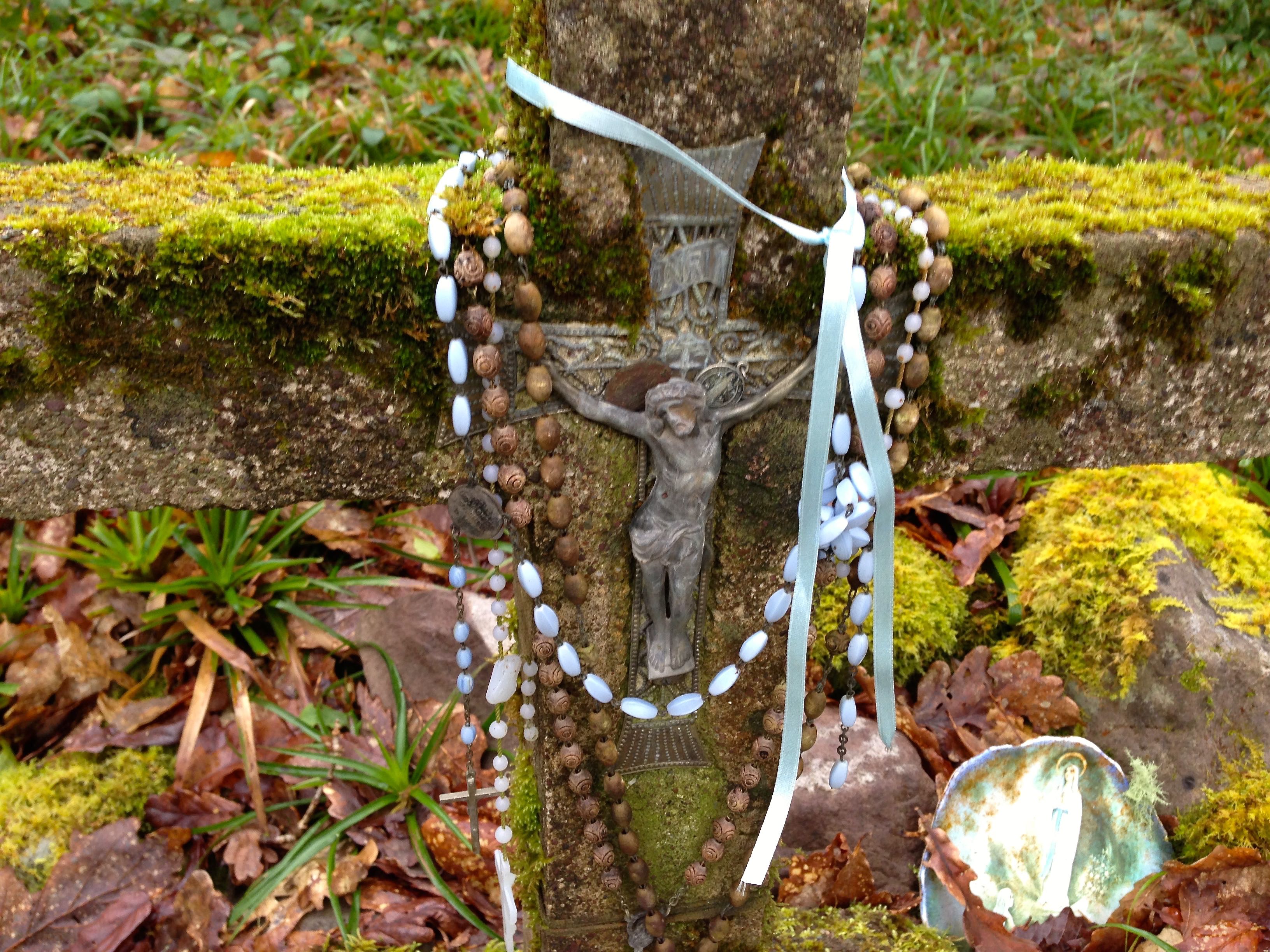
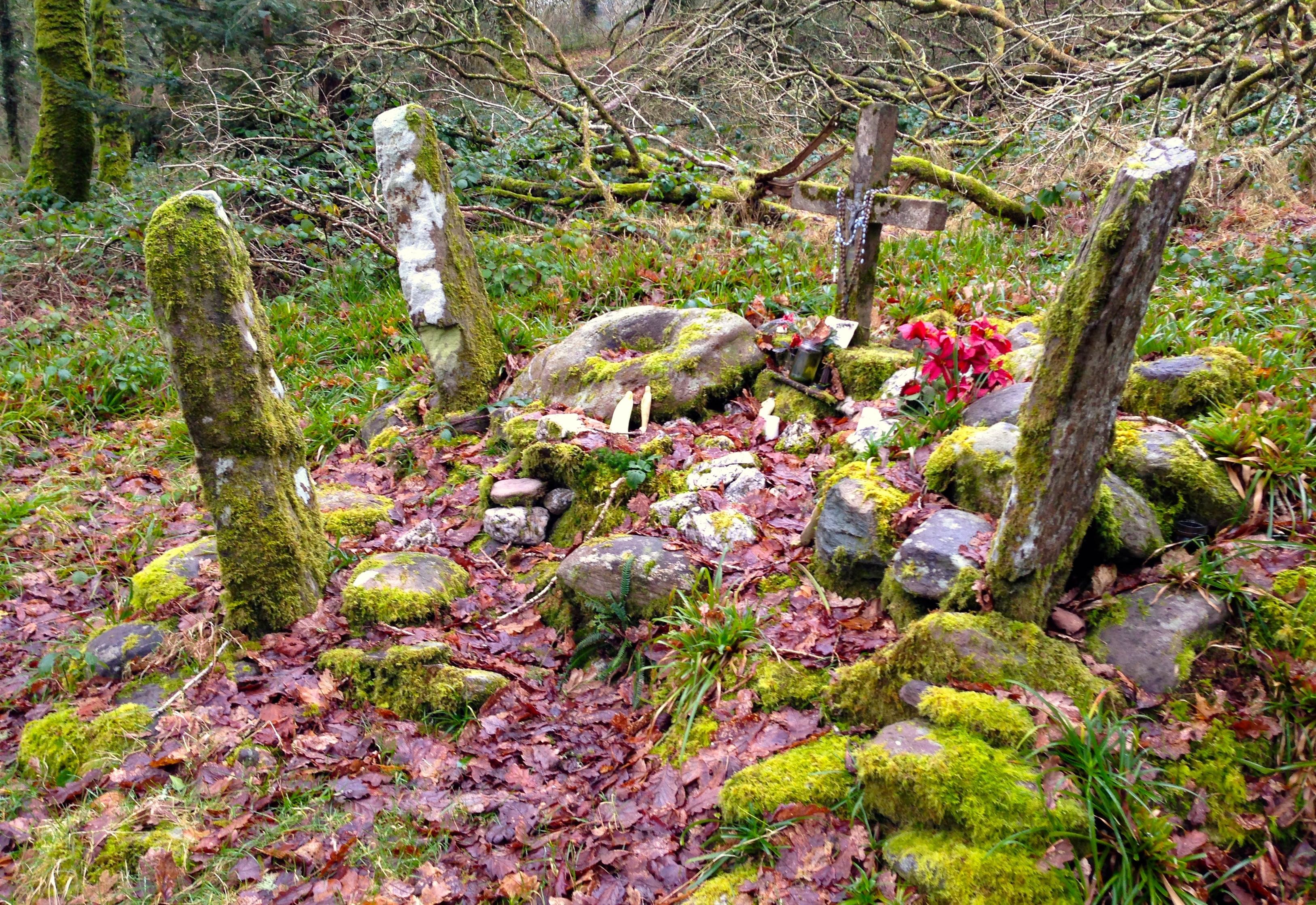
Tobar Abán is a wonderful site – a lonely outpost of religious sanctity but, for me, probably the most beautiful of all the holy places I have visited in Ireland so far. It’s an unexpected find: set away from everything, deep in an ancient oak wood, silent, still – one could imagine that it has always been like this, passing through generations of turbulent history and yet untroubled by it. Archaeologically it appears to be a cist with a cairn of stones built around it: this would imply pre-Christian origins. The lid of the cist (a burial chamber or repository for bones) is not visible – possibly it is under the large ballaun stone which rests on top. Above this is a small, relatively modern concrete cross embellished with offerings, beads and ribbons: other icons and objects are scattered around the site. The whole mound has a boundary defined by three standing stones, one of which is inscribed with ogham. Everything is covered in a layer of moss which seemed to exude a luminescence in the moist shade of the wood.

crucifix

Saint Abban (or Abbán moccu Corbmaic) seems to have been active in many parts of Ireland, and tradition has it that he lived for three hundred years. The stories that are important here are the ones that link him with Saint Gobnait. It has been said that he founded a monastery in Ballyvourney before she arrived, and that he was her mentor and gave the foundation to her. Some say that Abban and Gobnait were brother and sister. Most important, perhaps, is the tradition that Abban had a cell or church just outside Ballyvourney and that he was buried in that cell when he died in 520. Could it be his grave that we found?

Saint Abban's Shrine - cell - or grave?
Saint Abban’s Shrine – cell – or grave?

Saint Abban’s Well is a little distance from the cist, and is quite unassuming, especially compared to the elaborate wells around Saint Gobnait’s old church. It is merely an opening in a rock set in the ground: an old tray covers it and keeps the leaves out, and a wooden box beside it contains some cups and plastic bottles for collecting the water.

Tobar Aban - Saint Abban's Well
Tobar Abán – Saint Abban’s Well

As we were making our way back across the fields we were surprised to see a lady in a red coat walking with a stick towards us. “Did you find it?” she asked. We assured her we had found the well and the shrine. “And did you see his bones?” she continued, “Last time I was there I lifted up the lid and saw the Saint’s bones inside…” We watched her go off towards the woods; when I looked back again she had disappeared.

Cist, Bullaun and standing stones

There’s so much about the day: the journey across the Mountain of the Fairy; the Irish Mass and the ritual of the ribbons involving a 13th century wooden figure; the Rounds and the humming of the Saint’s Bees; the magical shrine in the woods – and I really do wonder about that lady in the red coat…

Offering at the Shrine of Saint Abban

The Irish Valentine

sun cove

February evening in Rossbrin Cove

I was surprised to discover Saint Valentine in Ireland…

You mean in a card shop – or a flower shop?

No – I mean the real Saint Valentine – his remains are in the Church of Our Lady of Mount Carmel in Whitefriars Street, Dublin: we were there last week.

carmelite church

That can’t be true – Saint Valentine was a Roman – martyred, I believe, in the 3rd Century.

He was, of course: Emperor Claudius had him beaten to death and then beheaded on 14th February 269. Valentine and another Saint, Marius, had secretly married young couples, which was against the law.

Why was it against the law?

Because Claudius II (Claudius the Cruel) was engaged in many bloody and unpopular campaigns and was having a difficult time getting soldiers to join his military forays. He believed that the reason was that Roman men did not want to leave their lovers or families. As a result, Claudius cancelled all marriages and engagements in Rome.

So it’s because of Valentine’s clandestine activities that he is the patron saint of love?

old card

That’s certainly a possibility. There are many other things associated with Saint Valentine’s Day which may have contributed to its continuing celebration.

Such as?

In ancient Rome, 14th February was a holiday to honour Juno – the Queen of the Roman Gods and Goddesses, also known as the Goddess of women and marriage. The following day, 15th February, began the Feast of Lupercalia. On the eve of that festival the names of Roman girls were written on slips of paper and placed into jars. Each young man would draw a girl’s name from the jar and they would then be partners for the duration of the festival.

irish roses

Let’s get back to Saint Valentine in Ireland…

Well, it all centres around a famous Irish preacher, John Spratt. It was he who built the Whitefriars Street Church. He went to Rome in 1835 where ‘…the elite of the city flocked to hear him and he received many tokens of esteem from the doyens of the Church…’ One such token was given by Pope Gregory XVI: the remains of Saint Valentine!

Is this genuine?

It seems to be. The Pope also sent with the relics a letter of authenticity, written in Latin, which still exists:

‘…To all and everyone who shall inspect these our present letters, we certify and attest, that for the greater glory of the omnipotent God and veneration of his saints, we have freely given to the Very Reverend Father Spratt, Master of Sacred Theology of the Order of Calced Carmelites of the convent of that Order at Dublin, in Ireland, the blessed body of St Valentine, martyr, which we ourselves by the command of the most Holy Father Pope Gregory XVI on the 27th day of December 1835, have taken out of the cemetery of St Hippolytus in the Tiburtine Way, together with a small vessel tinged with his blood and have deposited them in a wooden case covered with painted paper, well closed, tied with a red silk ribbon and sealed with our seals and we have so delivered and consigned to him, and we have granted unto him power in the Lord, to the end that he may retain to himself, give to others, transmit beyond the city (Rome) and in any church, oratory or chapel, to expose and place the said blessed holy body for the public veneration of the faithful…’

That’s remarkable. This must be a very popular shrine?

Nowadays it is – but no one was very interested in it in the time of Father Spratt and the relics were put away in a cupboard and forgotten.

Until?

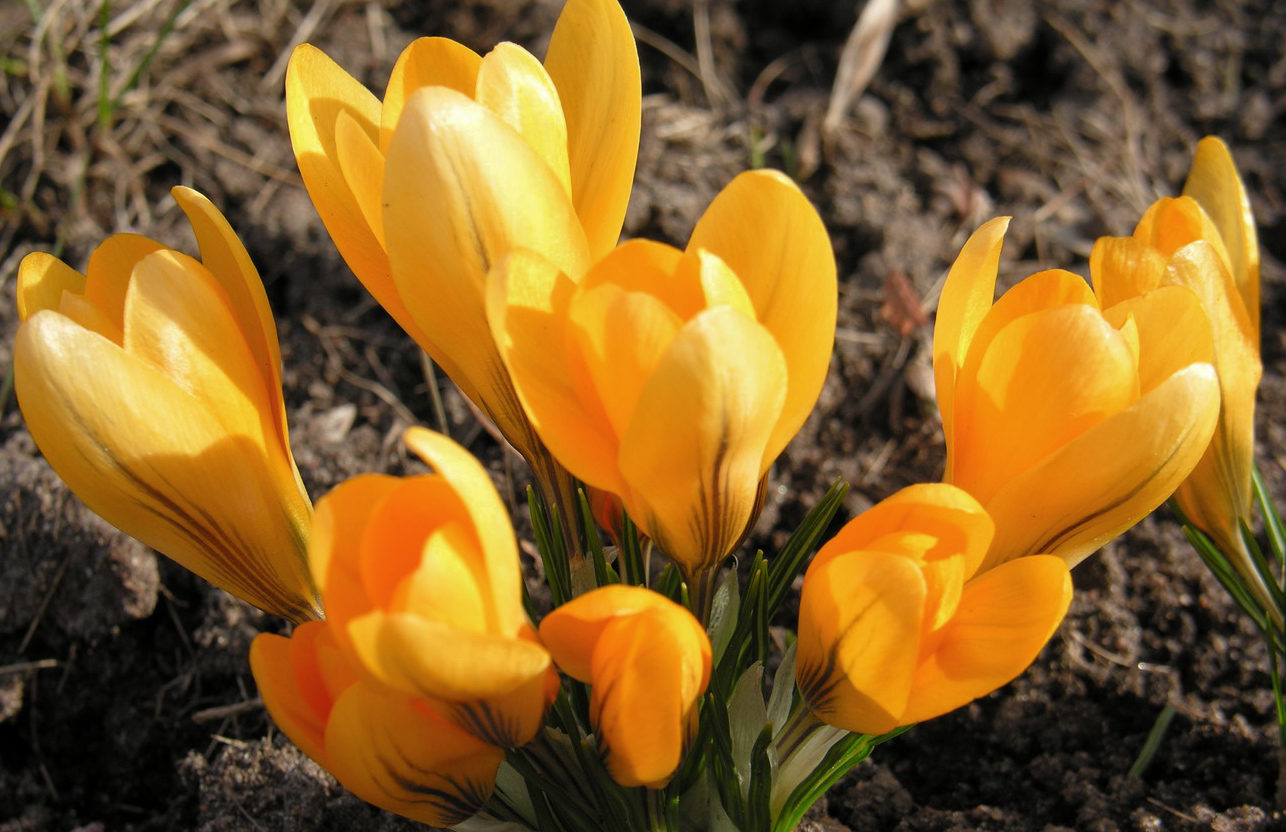
Until around 1950 when the present altar and shrine were constructed to house them. The statue of Saint Valentine that is there now was carved by Irene Broe and depicts him in the red vestments of a martyr and holding a crocus in his hand.

What happens there on the Saint’s Day?

Couples come to the Eucharistic celebrations which include a Blessing of Rings for those about to be married. On the feast-day, the Reliquary is removed from beneath the altar and is placed before the high altar in the church and there venerated at Mass.

You must have a legend about Saint Valentine?

A rather nice one, actually – and it explains the crocus…

When Valentine was imprisoned in Rome for his Christian beliefs his jailer had a daughter – Julia – who had been born blind. The jailer asked Valentine if he could cure the blindness. Valentine couldn’t promise this, but he did offer to teach the girl: he read stories of Rome’s history to her; he described the world of nature to her; he taught her arithmetic and told her about God. She saw the world through his eyes, trusted in his wisdom, and found comfort in his quiet strength.

On the eve of his execution Valentine asked the jailer for a paper, pen and ink. He wrote a farewell note and handed it to the jailer to give to Julia. He urged her to stay close to God, and he signed it ‘…From Your Valentine…’ His sentence was carried out the next day, 14th February. When the jailer went home, he was greeted by his blind daughter. The little girl opened the note and discovered a yellow crocus inside. As the girl looked down at the crocus she saw brilliant colours for the first time in her life! The girl’s eyesight had been restored.

crocus

That’s wonderful! So now I can tell everyone that St Valentine’s resting place is in the Emerald Isle…

Well….

Yes?

Well, perhaps you ought to know that the remains of St Valentine are also said to be held in Rome, Prague, Poland, France, Vienna, Malta, Glasgow, Birmingham (UK) and even in Missouri – among other places…

Saint Ferdinand’s, Florissant, Missouri also claims relics of Saint Valentine

Saint Ferdinand’s, Florissant, Missouri also claims to hold relics of Saint Valentine

Oh no! That certainly puts a dampener on Ireland’s claim.

Not really – it’s certainly not unusual for a Saint’s relics to be spread around Christendom: a little veneration goes a long way.

Has anyone ever looked inside the reliquary in Whitefriars, Dublin?

No – it was a condition of the gift that the seals should never be broken, and they haven’t. Personally, I’m very happy with the idea that St Valentine – or some of him at least – rests contentendly there: I shall visit him whenever I’m passing

An Post Valentine stamp for 2015

An Post Valentine stamp for 2015

Future Archaeologists at Work

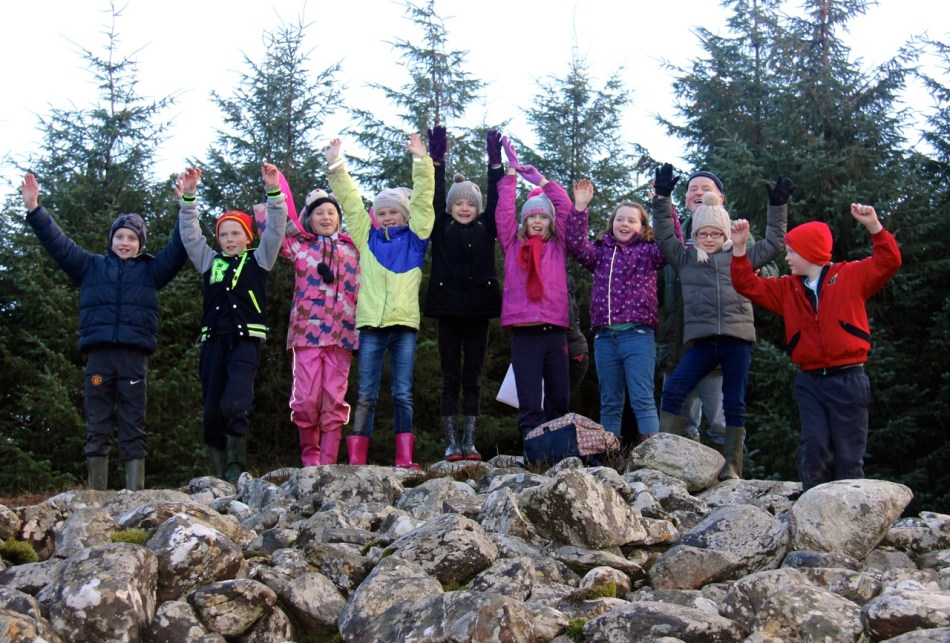
Kilcoe National School Fourth Class - archaeologists of the future!

Kilcoe National School Fourth Class – archaeologists of the future!

A joint post by Robert and Finola, with additional photographs by Kilcoe National School.

Out of the blue this week came a message though the Roaringwater Journal Facebook page: The pupils of 4th class in Kilcoe NS have completed a history project for Discover Cork: Schools Heritage Project, on Archaeology in their local area. Their model and project book are on display tomorrow Tuesday January 20th from 2-3pm in the school hall. They invite you to come and see their work as you already do so much wonderful research on the area.

Delighted, we headed off to the school and were quite bowled over by what we saw. The students had been on field trips to several different types of monuments – a standing stone, a stone pair, a holy well, a cairn, a fulacht fia, a cillín and a ringfort. They had recorded their visits, their questions, and what they learned about each site. The formal archaeology was of interest to them, but also the stories and traditions about each site. They interviewed elderly community members and landowners and looked up the records for their area from the National Folklore Commission.

Once they had gathered all their notes and photographs they constructed a model showing each of the sites, a scrapbook of their records and drawings, another one showing what they had learned about the prehistoric way of life in West Cork, and a large photograph album charting their progress through the whole project.

Impressive as the work was that the children had put into this project, even more striking was their bubbling enthusiasm for what they had done and learned. Each table was manned by one or more of the students, ready to chat with us, show us the model or the photos, and explain everything. And how articulate and open and bright they were! Smiling and cheerful, but also earnest about their subject and falling over each other to add bits of information. It was totally captivating.

They had hiked up to a cairn – a large and mysterious feature on top of a prominent hill. It was said that you could see 15 churches from it. However, the cairn is now surrounded by tall trees as a result of a forestry plantation and therefore there is no longer any view from it. Local people had protested the plantation at the time, concerned that this cairn and its views should be preserved intact, but had lost the battle. In this write-up, I was touched to see a a photograph of my old friend, Bernard O’Regan, the local amateur archaeologist who, 40 years ago, had taken me to see several of the rock art panels in West Cork.

Visiting the Holy Well

Visiting the Holy Well

What a great project these children undertook – hats off to their teacher and the supportive community. The future for conservation and archaeology in West Cork is in safe hands! A huge thank you to Kilcoe National School for the invitation, and to their official photographer for sharing with us the superb photographs of the field trips.