Buckets of Culture

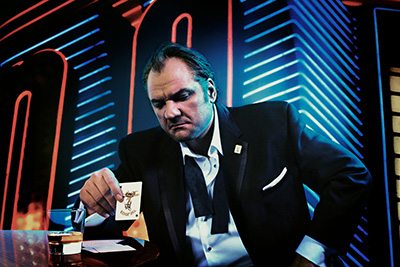
Željko Lučić as Rigoletto. Photo by Metropolitan Opera

Željko Lučić as Rigoletto. Photo by Metropolitan Opera

-What we love about being here – the scenery, the history, the people, the hiking, the markets, the food, the opera…

-What? The opera?

-Yes, and the theatre. And very good cinema too.

-Wait – seriously? I thought you were there to get back to nature?

-Well, er, yes, but…

-But?

-West Cork is also a Mecca for artists of all kinds – musicians, actors, painters, poets, photographers – and part of being here is taking advantage of cultural events. As one local told me last year, “if it’s culture you’re after, we have buckets of it.”

-Oh, OK…tell us all about it, then.

The weekend started with a trip to Cork to stay overnight with my cousin and to go to the Metropolitan Opera Live Broadcast of Rigoletto. This was a stylish production with the action moved to 1960’s Las Vegas and the singers modelling themselves on Rat Pack characters. The Duke of Mantua made a wonderful fist of Old Blue Eyes, and Marilyn Munro made an appearance as Ceprano’s wife. The singing was glorious, with the German soprano Diana Damrau as a transcendent Gilda and Željko Lučić suitably tortured and barrel-voiced as Rigoletto.

The following day we visited a friend in his beautiful and very modern house in Kinsale, ate a huge Sunday lunch and then got into The Music, with Alastair on the fiddle and Robert on his melodeon.
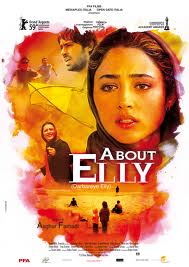
about EllyThe Cinemax in Bantry has all the latest releases and comfortable seating. They run an Arthouse Tuesday and this week we saw ‘About Elly’ by the Iranian Director, Asghar Farhadi. I had seen his movie ‘A Separation’ and was struck then, as I was now, by how much these films challenge our stereotypes of Iran. This one featured an ensemble cast of outstanding actors as young professionals from Tehran. The plot revolves around the disappearance of one of the group during an outing to the Caspian Sea, and the disintegration of cohesion as white lies and deceptions are compounded and revealed. The exploration of the dynamics of man-woman relationships was particularly riveting in what is apparently a time of transition between traditional and modern notions of gender roles.
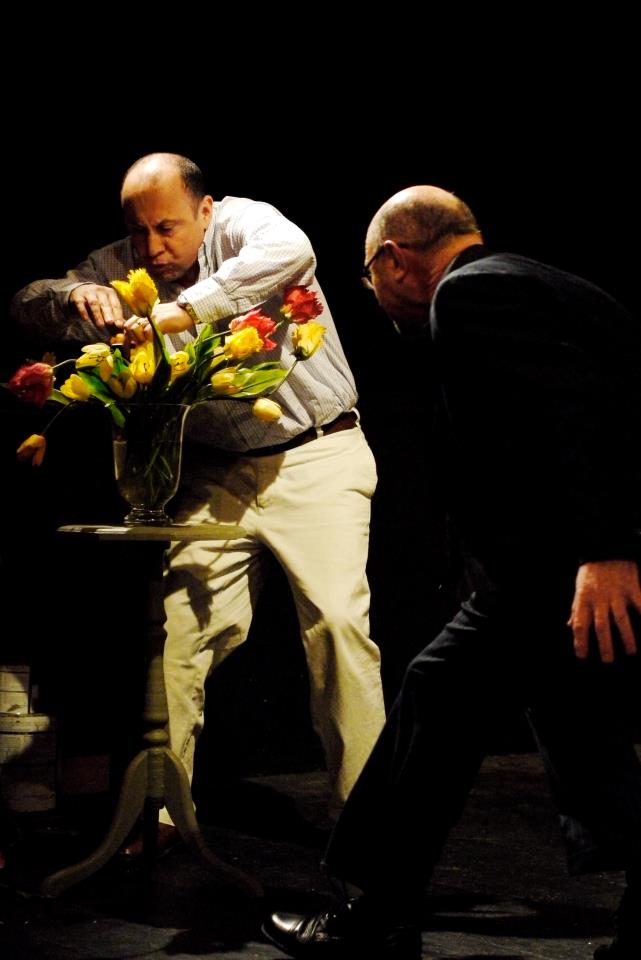
Photo from Schull Drama Group Facebook Page

Photo from Schull Drama Group Facebook Page

On Friday night we attended the Schull Drama Group’s production of The God of Carnage, a play by French actor and playwright, Yazmina Reza. This is the same company of players that was responsible for the broad comedy and slapstick of the traditional pantomime we had seen in January and this comedy/drama was a testament to the depth of their talent. Two couples, Veronique and Michel and Annette and Alain, meet to discuss a contretemps between their sons. Their plan to do this in a civilized manner, over coffee and clafoutis, quickly descends into chaos, as accusation and counter-accusation reveal the fault lines of each marriage and the assumptions and veneers of middle-class privilege.
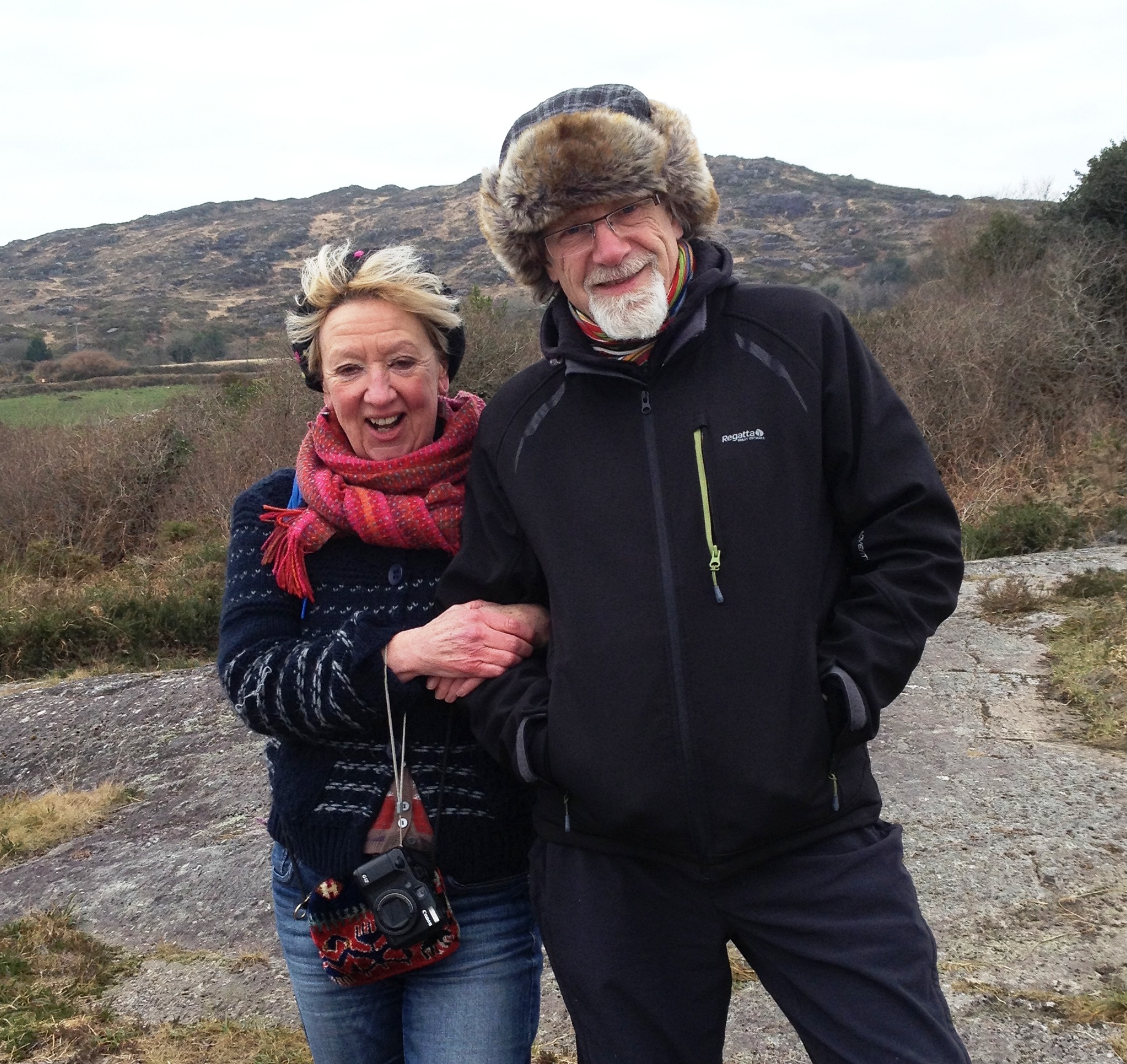
Amanda and Peter on our Rock Art Day

Amanda and Peter on our Rock Art Day

Finally, Saturday saw us in the company of two new friends, Amanda and Peter Clarke on a Rock Art Day of tramping through the countryside. Peter and Amanda are the talented couple behind two websites: Sheep’s Head Routes and Sheep’s Head Places, both invaluable resources for exploring this part of West Cork. Amanda is also a keen photographer with a wonderful eye. You can read her description of our day, and view more of her beautiful photography at her Blipfoto site.

Here Comes the Sun

2013-02-02 08.31.58

The sun rises across the valley from Ballybane West on Feb 2nd, 2013

Joint Post by Finola and Robert

In Finola’s solstice post, she wrote that archaeologists are aware of the astronomical siting of some Irish megalithic sites, such as at Newgrange, and Loughcrew.

Michael Wilson and his Whole Horizon Analytical Technique (WHAT)

Michael Wilson carries out his Whole Horizon Analytical Technique (WHAT)

We have become intrigued by the work of Michael Wilson, a talented amateur astronomer who is singlehandedly documenting the astronomical siting of many monuments in this area. Recently he has turned his attention to rock art. His website contains an astonishing body of work, meticulously researched and rigorously recorded, along with explanatory notes. His thesis, in a nutshell, is that the builders and carvers of Neolithic and Bronze Age times were keen observers of the day and night skies and were intimately familiar with their surroundings. They situated their megaliths and rock art in places where the contours of the horizon allowed them to mark significant solar and lunar events, such as solstices, equinoxes, lunar settings and risings, and intermediate points. Thus, the sun at the winter solstice might rise at the highest point on a nearby mountain, or set in a deep notch in the hills at the spring equinox. The solar calendar has four quarter days (the solstices and the equinoxes), four cross-quarter days (the half way points between the solstices and the equinoxes) and a further finer division into points half-way between the quarters and cross-quarters: an ancient 16 month calendar.

A few days ago, Michael posted this:

Imbolc, the spring cross-quarter, is almost upon us. It will be on Feb 1st by the Gregorian calendar, where it is commonly known as St Bridget’s Day or Candlemas, but this is not the correct day. By day-count, the times to celebrate will be sunset on the 3rd and sunrise on the 4th. Astronomically, the sun will be exactly half-way between the winter solstice and the spring equinox at about 16:13 GMT on Feb 3rd, while Feb 2nd is the day to see the sun rise and set at the prehistoric positions for marking this festival.

We set out for our favourite rock art site, Ballybane West, before dawn on Feb 2nd, feeling incredibly lucky to have a clear sky. As the sky brightened, and the nearby hills started to receive the sun’s rays, the carvings on the rock surface became clearly visible. Then, the sun rose, exactly where Michael’s predictions said it would, at the highest point of a rounded hill on the horizon. As people had been doing 4000 years ago in this exact spot, we marked the cross-quarter day of Imbolc – a time when the land starts to warm up, the first spring flowers appear, and the ewes are visibly pregnant.

The carvings light up in the dawn rays

The Ballybane West carvings light up in the dawn rays

If Michael is correct, we have to think in a whole new way about the rock art. Although there have been indications before that the location of the carved rocks was of some significance (for example: there is often a view of water; some theorists have posited that they are ancient boundary markers), this way of looking at rock art elevates the actual siting of the rock as most important, and allows us to view the carvings themselves as a way to indicate the purpose of the site – a means to an end rather than an end in itself. The motifs, though, will probably remain as enigmatic as ever.

Enigma

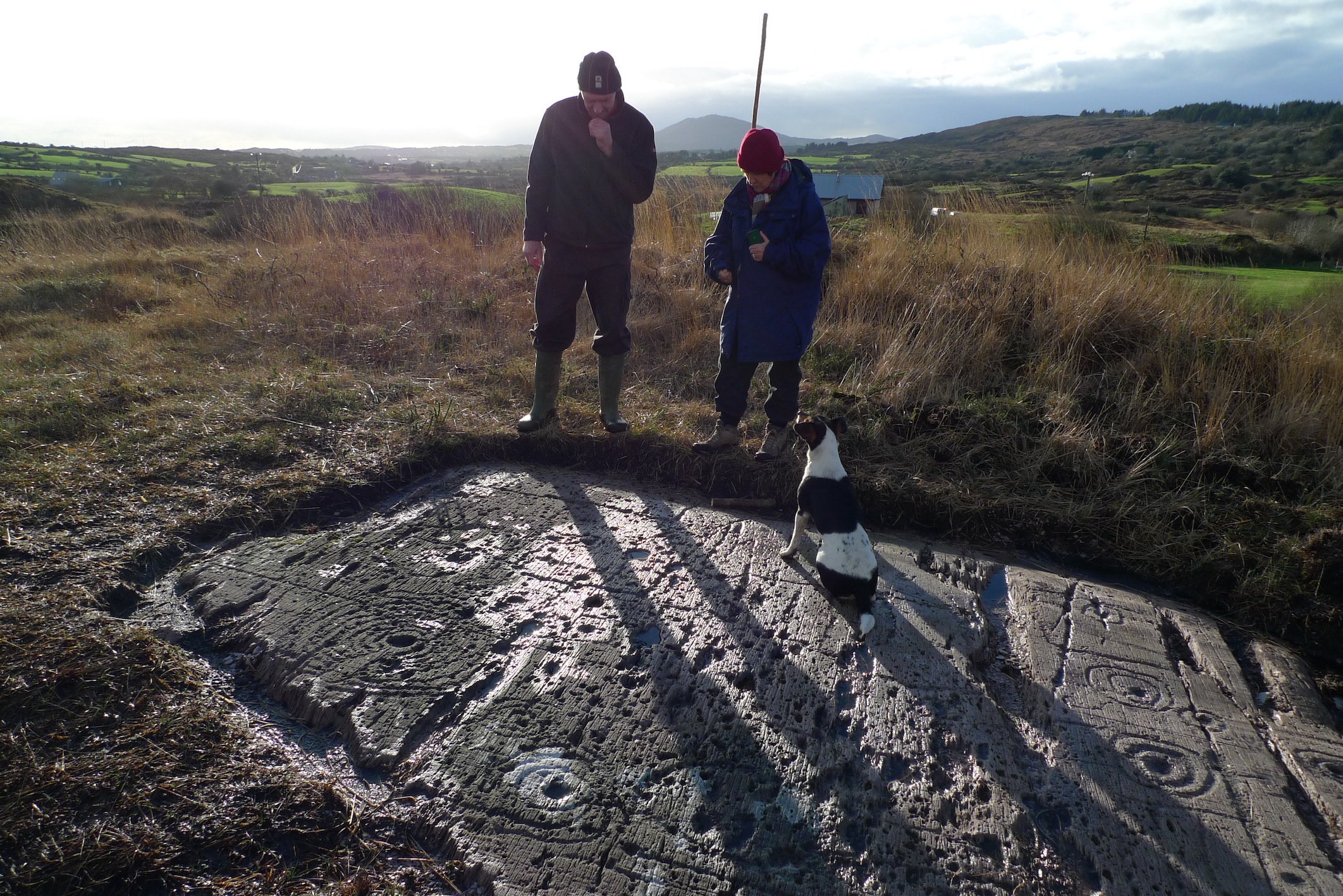
gary, Finola and Furry friend contemplate the Enigma

Gary, Finola and Furry Friend contemplate the Enigma

We went to look at an exciting new Rock Art discovery, in the hills between Ballydehob and Bantry: wild country. The man who uncovered it – Gary Cox – lives close by, and became familiar with the terrain through walking his dogs over the land every day. He noticed in passing a small piece of exposed rock, just a few centimetres square, on which it was possible to make out a couple of curved lines. Intrigued, he began to carefully pull back the moss and gorse to expose a secret which had lain hidden from view for hundreds – perhaps thousands – of years.

L1080544

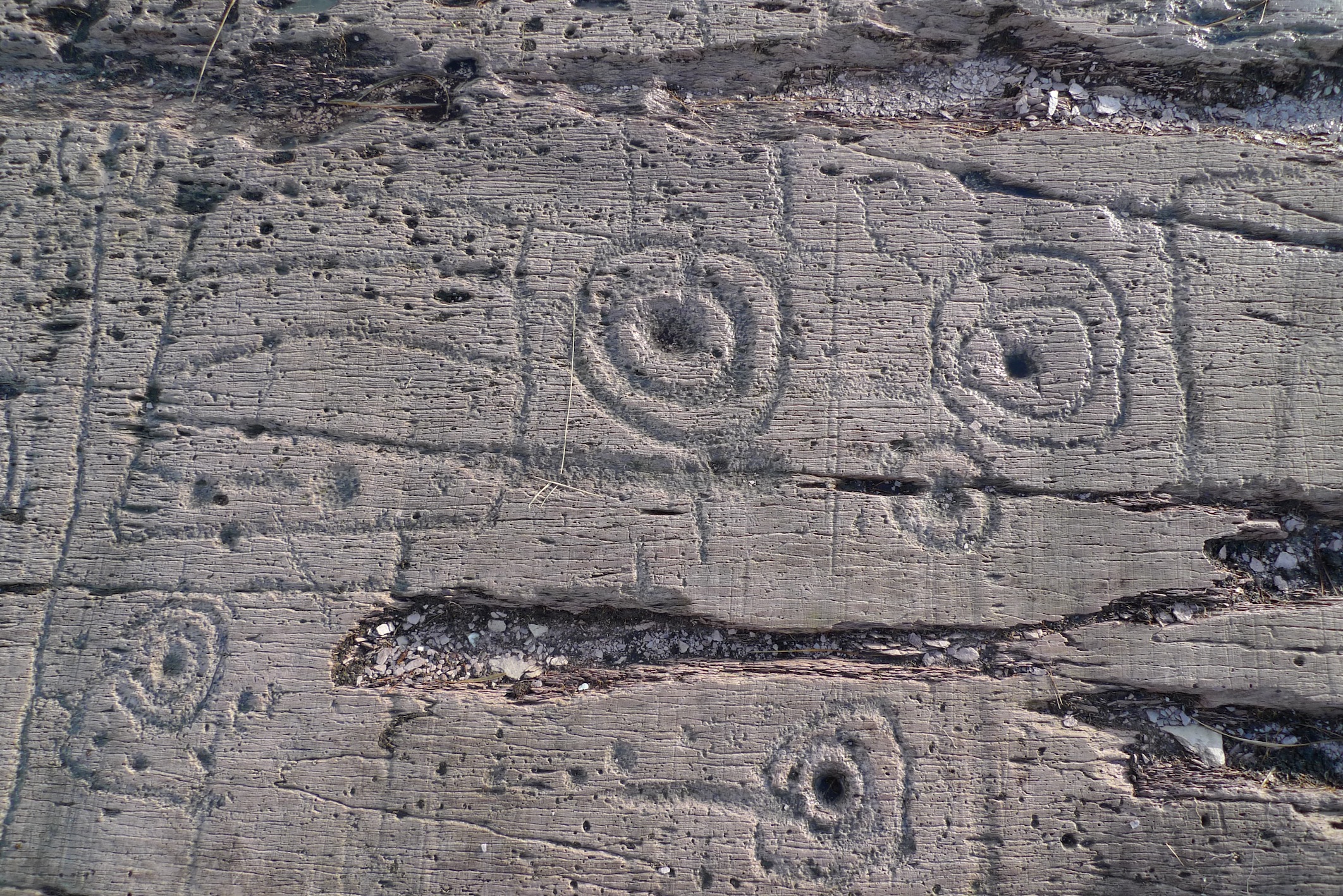
The Derreennaclogh panel is one of the finest and most intriguing pieces of Rock Art that we have seen in West Cork. Because the surface has (until now) been largely protected from direct contact with the weather, the carvings are pristinely visible, especially on a good bright day. On the rocks at Ballybane West – just over the hill – the designs are so weathered that you can go there day after day and never make them out, unless the shadows from a low sun are just right.

details

Details from the Derreenaclogh motifs

Current thinking suggests that all the Rock Art in ireland is Bronze Age – between four and five thousand years old: it’s breathtaking to think that we are looking at such ancient depictions of …. what? There’s the enigma: we have no idea – there are cup marks, circles, lines, even squares and waves on this newly revealed one: very unusual. Theories abound, of course: sun, moon, stars, maps, calendars – I’m sure someone has suggested they are flying saucers! We’ve written more on this in previous posts, and of the prolific appearance of rock carvings on the whole Atlantic facing coast from Scandinavia down through Scotland, Britain, Ireland, Brittany, Spain and Portugal. There are variations but the same symbols or motifs occur over and over. But here – on our doorstep – are some of the most unusual shapes to challenge our imaginations.

pukas

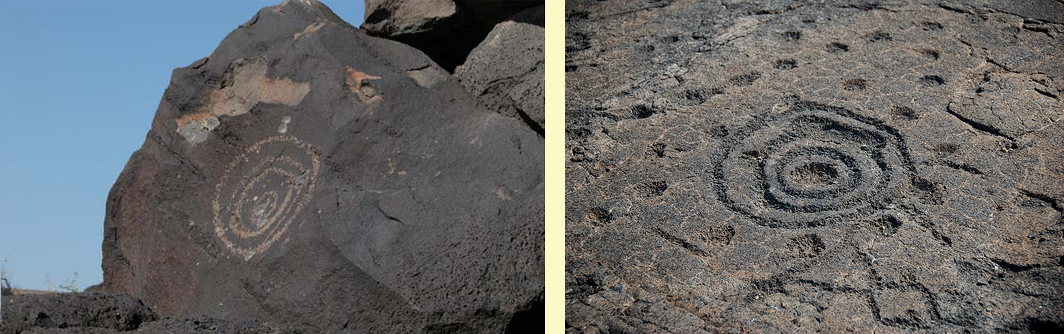
I have been extending my researches to petroglyph cultures beyond our own roots. I was intrigued to find some images from New Mexico – strikingly similar to our rock art – and Hawaii. In the latter place there are numerous circular depressions, around 50mm in diameter, interspersed with lines and circles. On our rocks in West Cork cup marks are also widespread – one of the most common images. They are also surrounded by concentric circles: at Derreennaclogh there is one cup mark with eight concentric circles around it – that’s more than we’ve seen on any other site.

Boca Negra Canyon Petroglyphs

Petroglyphs from New Mexico (left) and Hawaii (right)

There is folklore attached to the Hawaiian cup marks: local historians explain that these holes are called ‘Puka’. When a child was born a Puka would be carved in the lava stone. The new baby’s ‘Piko’ – umbilical cord – would be placed in the Puka to wish blessings upon the child for a long and prosperous life. In Hawaii and New Mexico the carvings are reckoned to be between 500 and 1,000 years old – much younger than our Rock Art. But here’s more food for thought: in Irish there’s also a word ‘Púka’ or ‘Pooka’ – sometimes a Fairy, or a shapeshifting spirit which can appear as a Hare or a Horse with dark fur. If a human can jump on the back of the Horse he will be given a wild ride but will probably be thrown off. Legend says that Brian Boru – the High King of Ireland – was the only man who could truly ride the Púka – by using a bridle incorporating three hairs of the Púka’s tail.