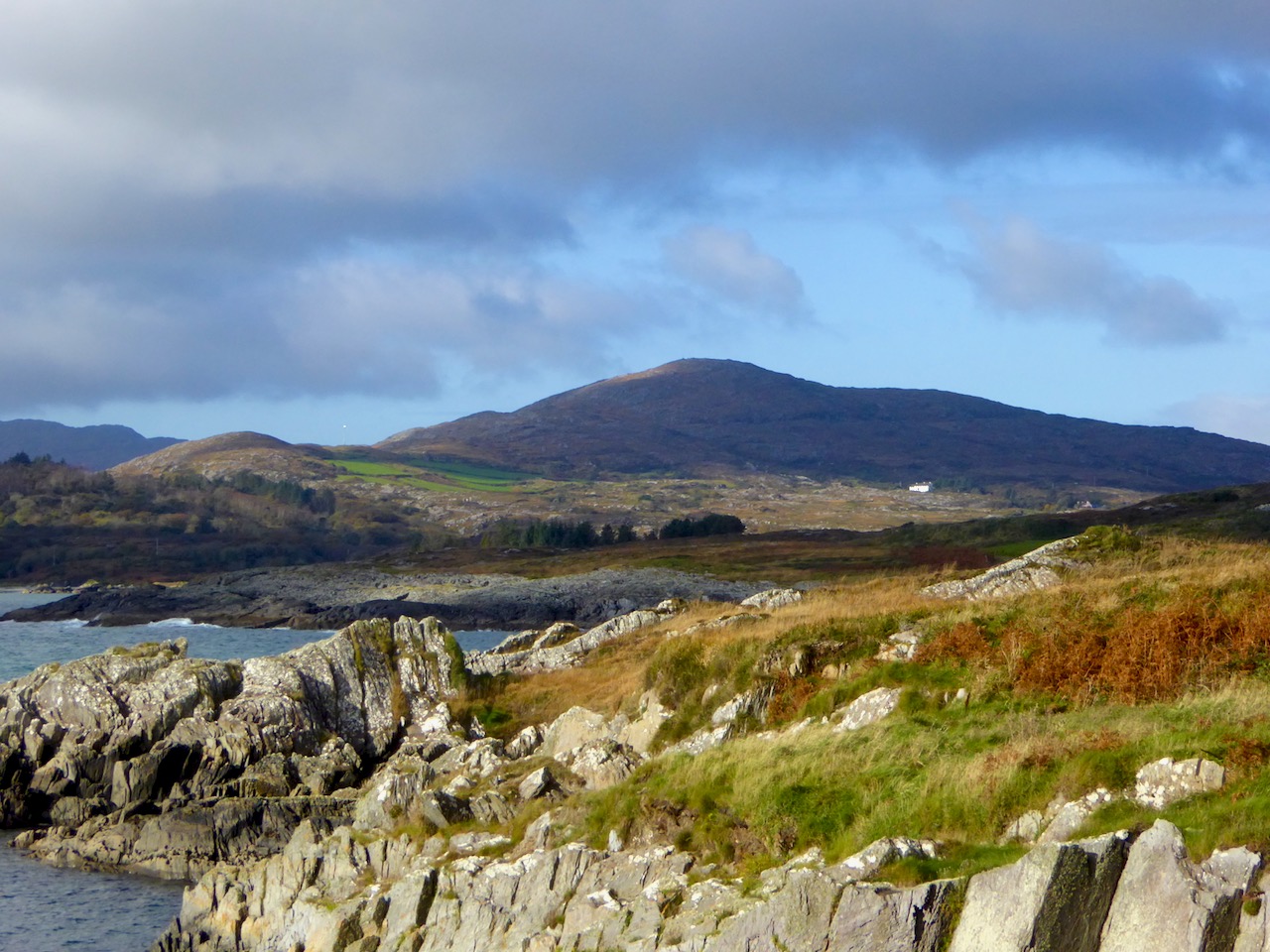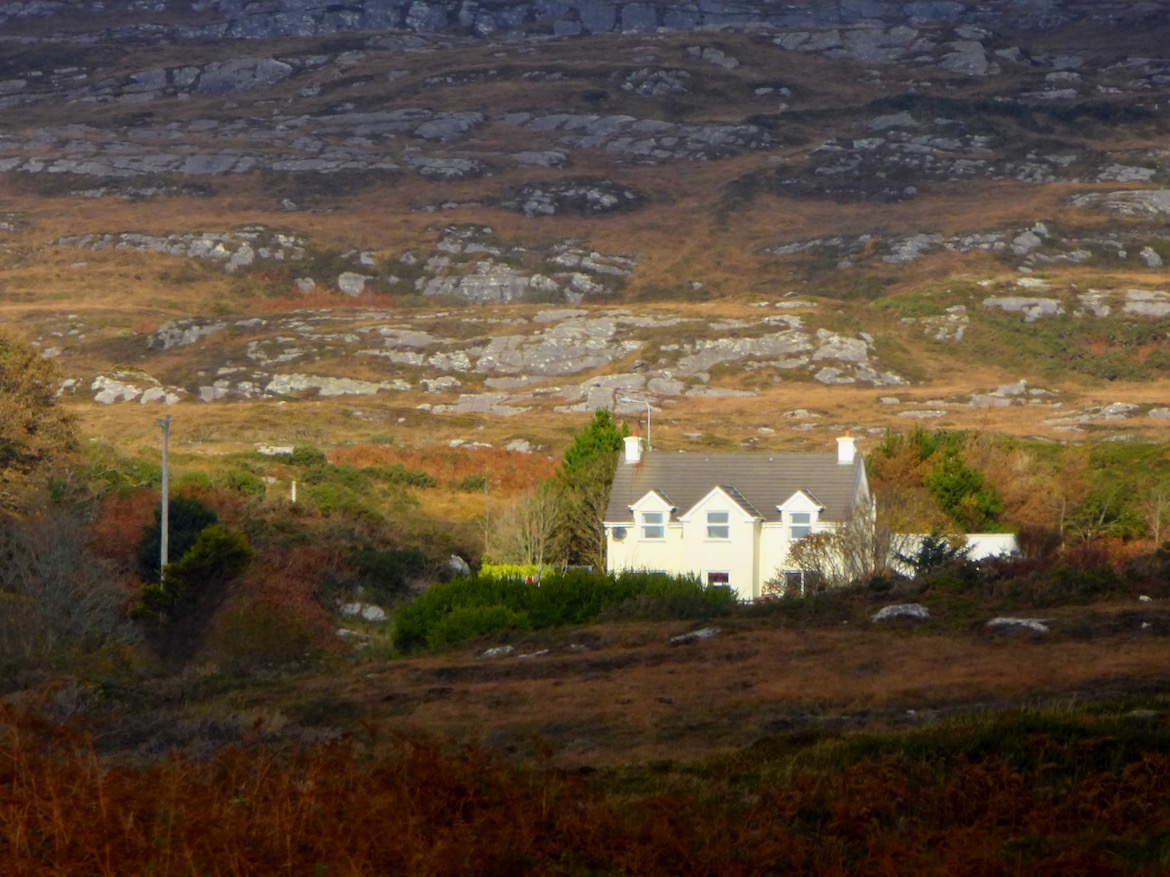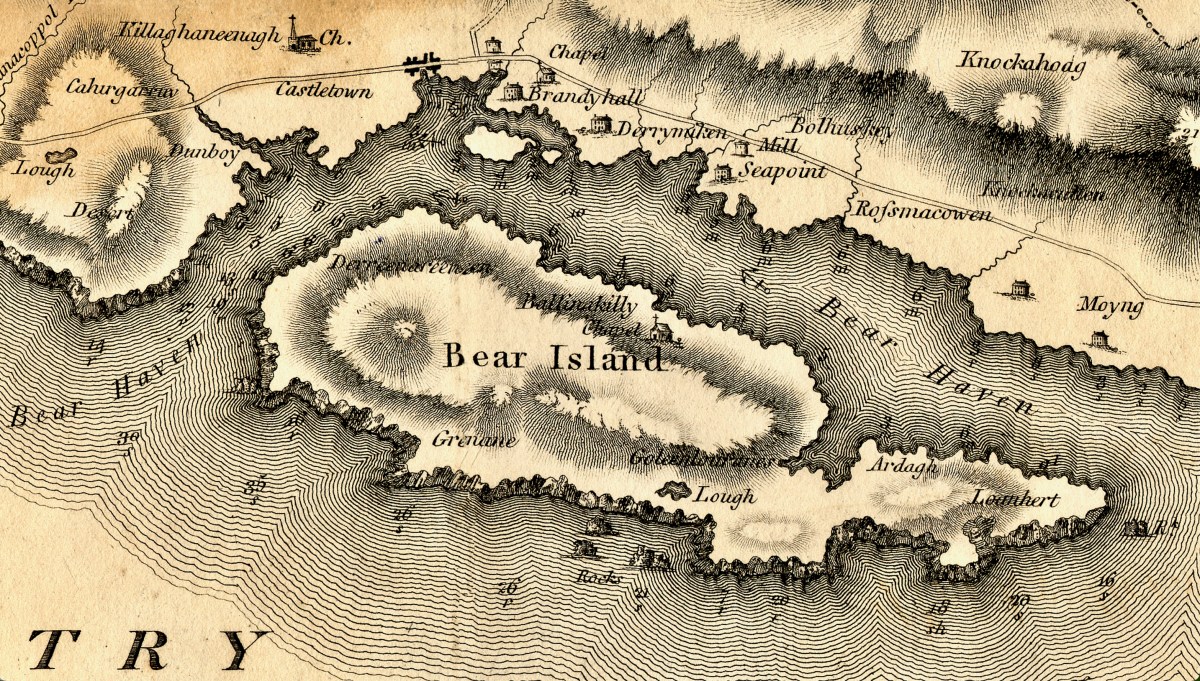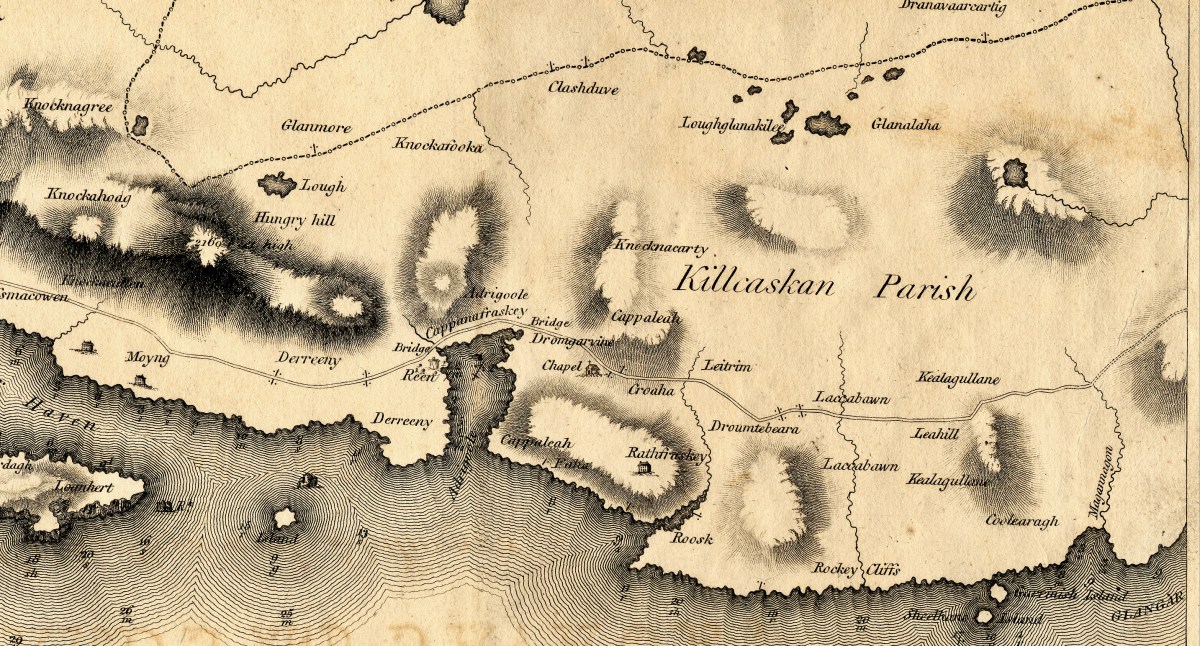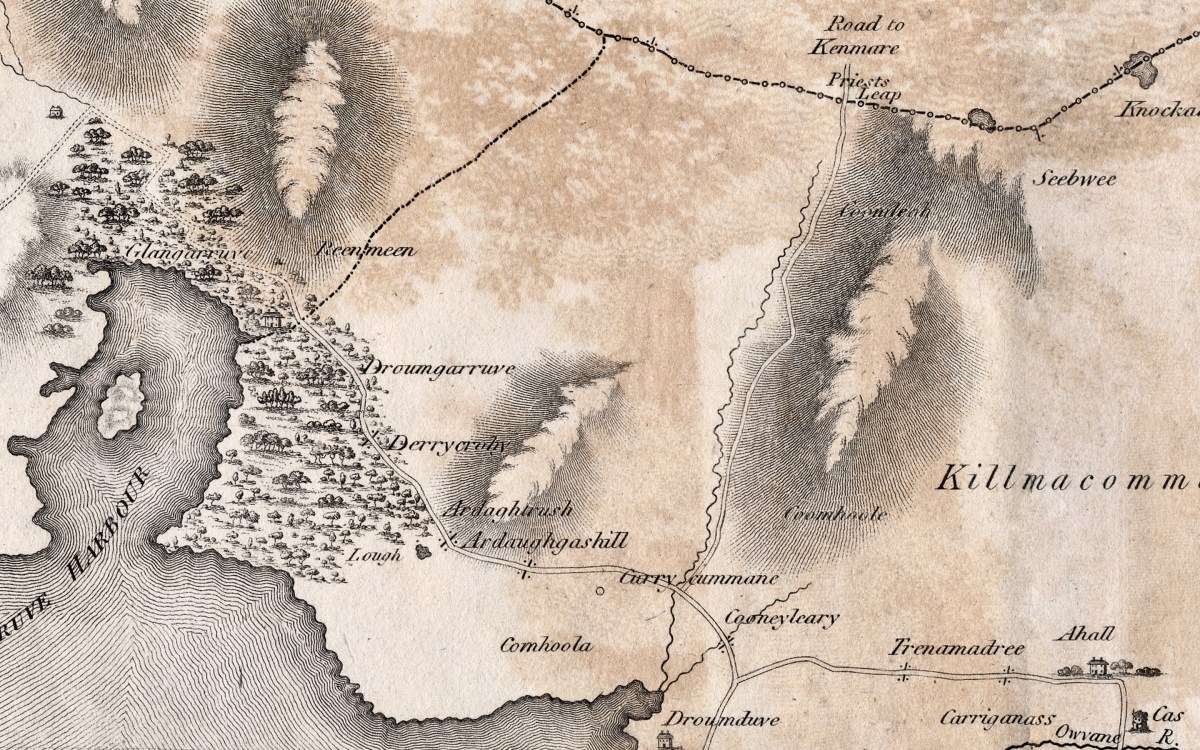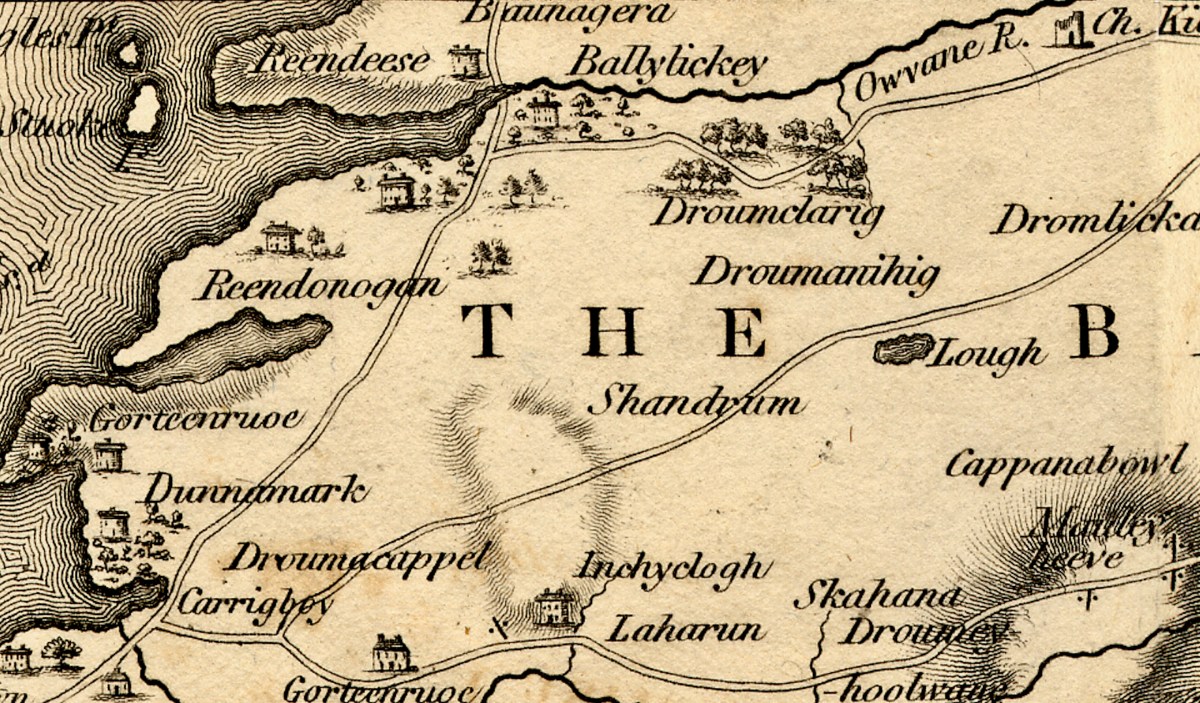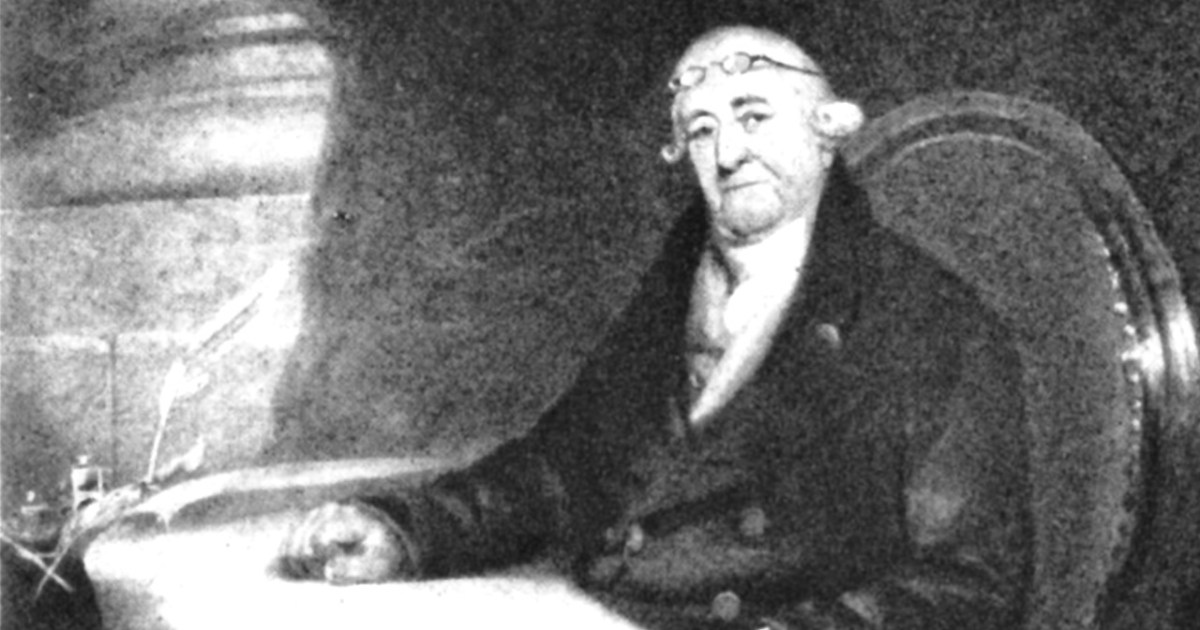
The 1811 Grand Jury Map of Cork by Neville Bath: Part 2, The Islands of Roaringwater Bay

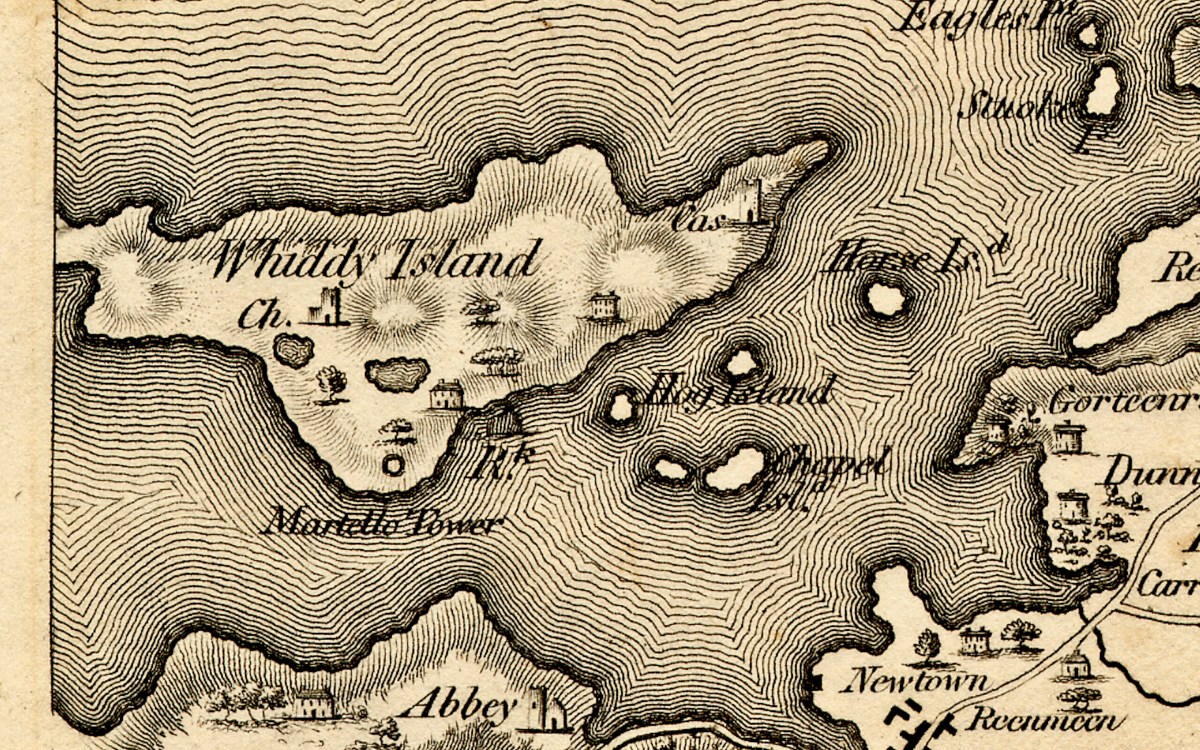
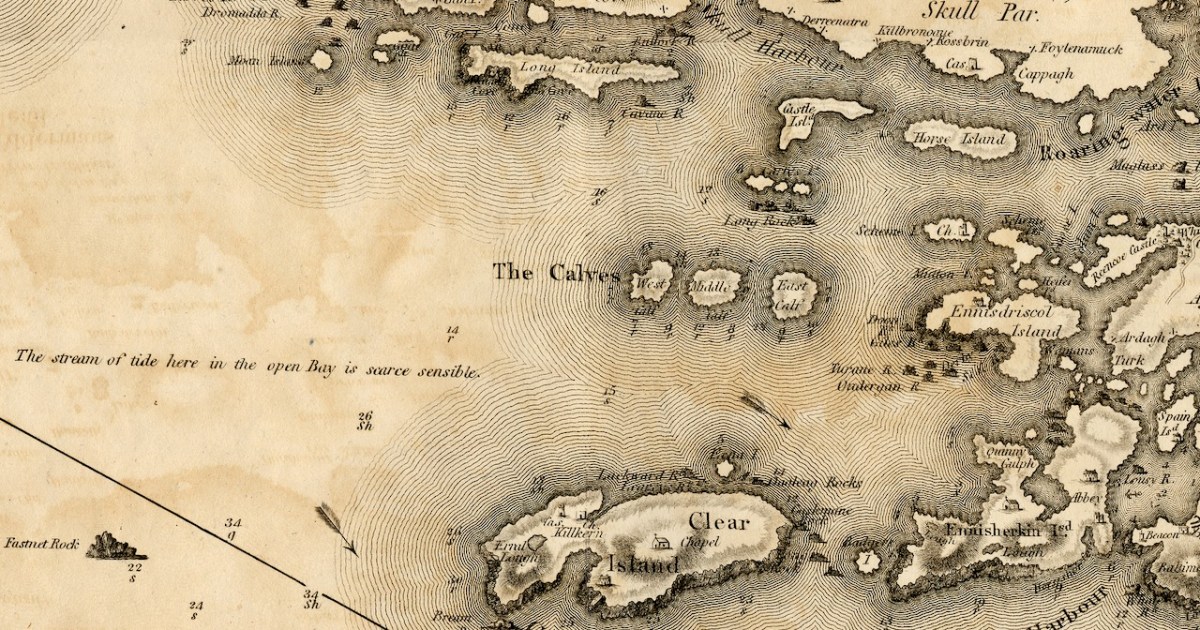
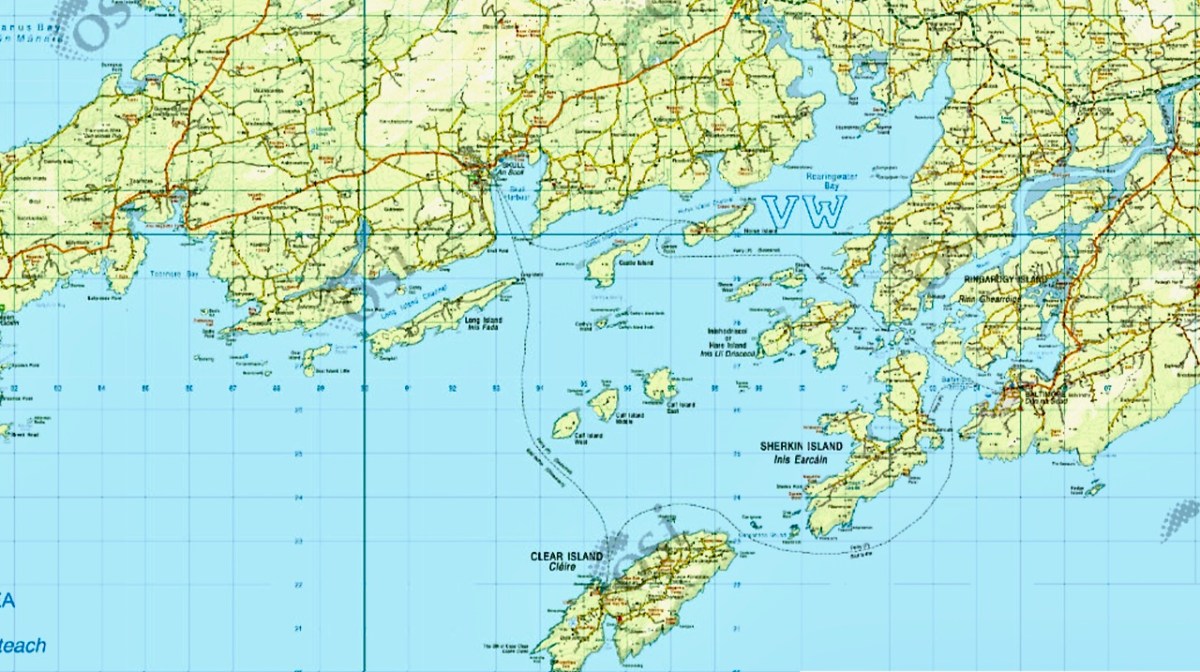
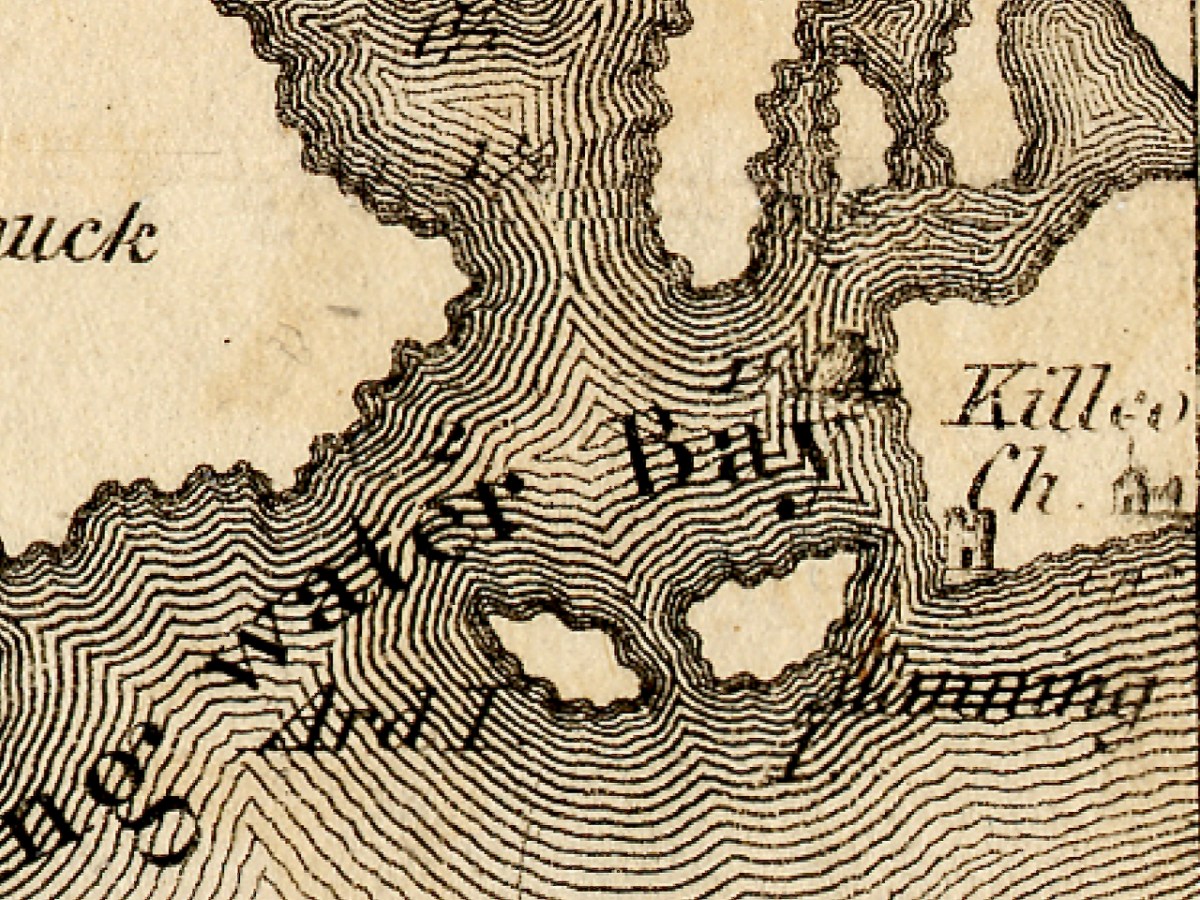
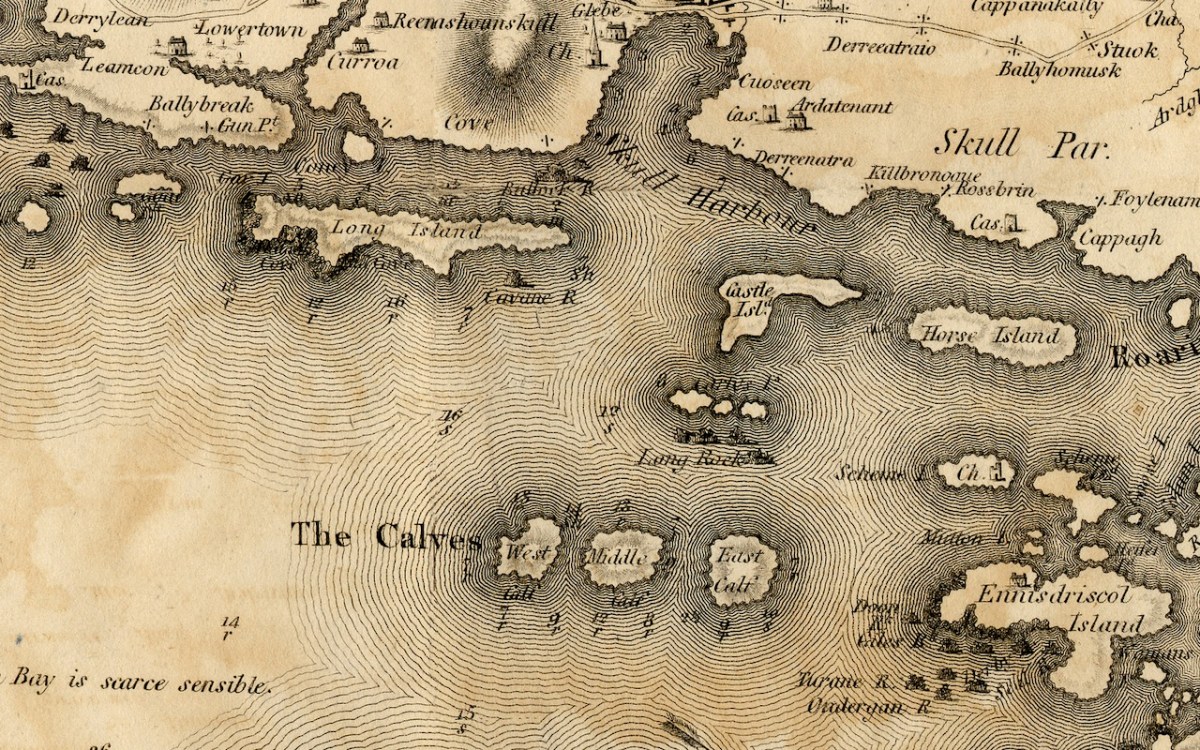
The first thing to say about this map is that on it the name Roaringwater Bay is assigned to a restricted area area eastwards from Horse Island, up to the entrance to Ballydehob Bay, and across to Skeaghanore, Kilcoe and Turk Head. This, in fact, is still how modern maps are labelled.

However, when you live here, you realise the term Roaringwater Bay is used to refer to the whole area that encompasses all the Islands, right out to Cape Clear. In Irish, Roaringwater Bay is called Lough Trasna, which simply means Lake ‘Across’ – a term which carries the implication of a body of water you have to cross over.

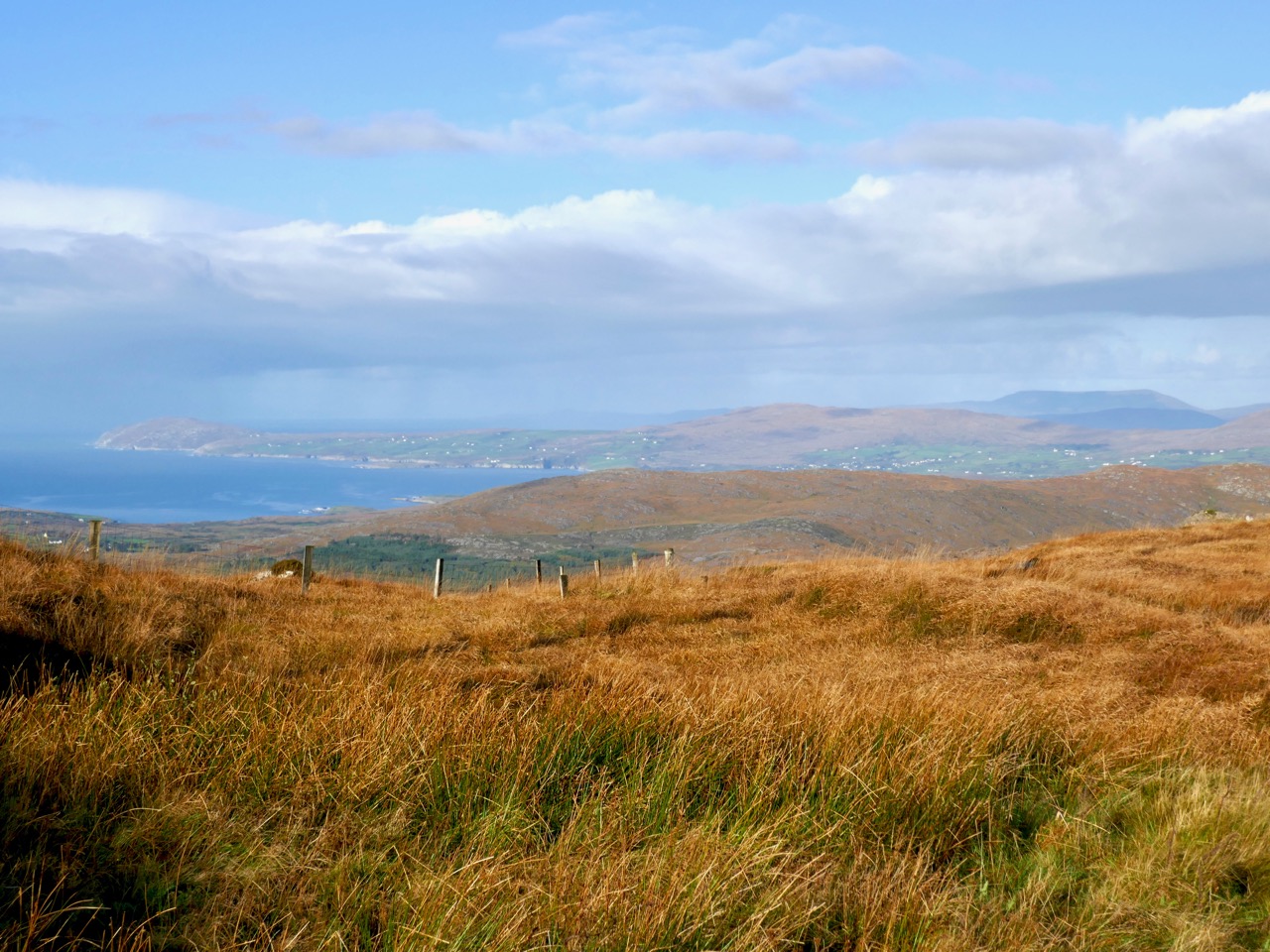
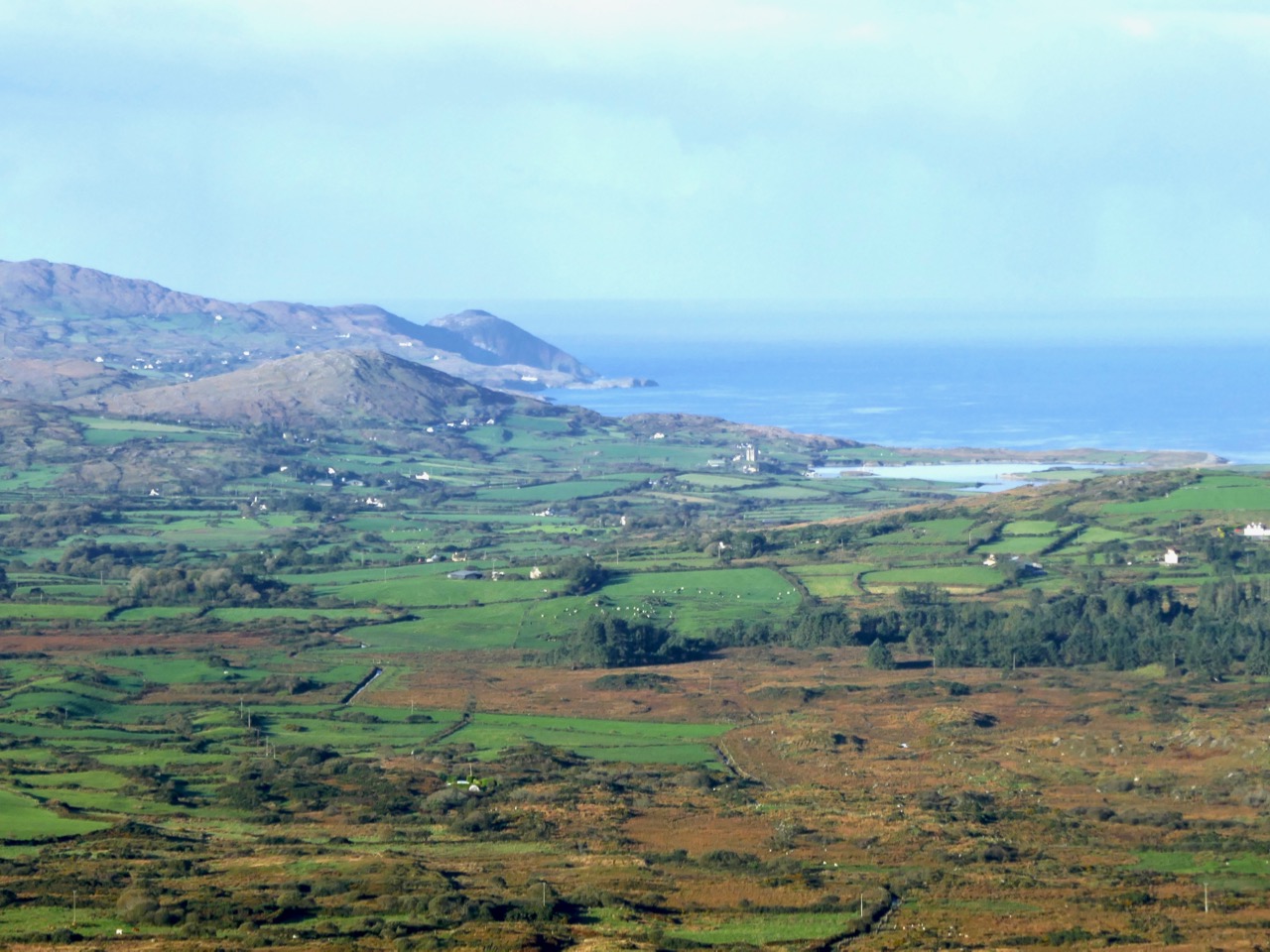
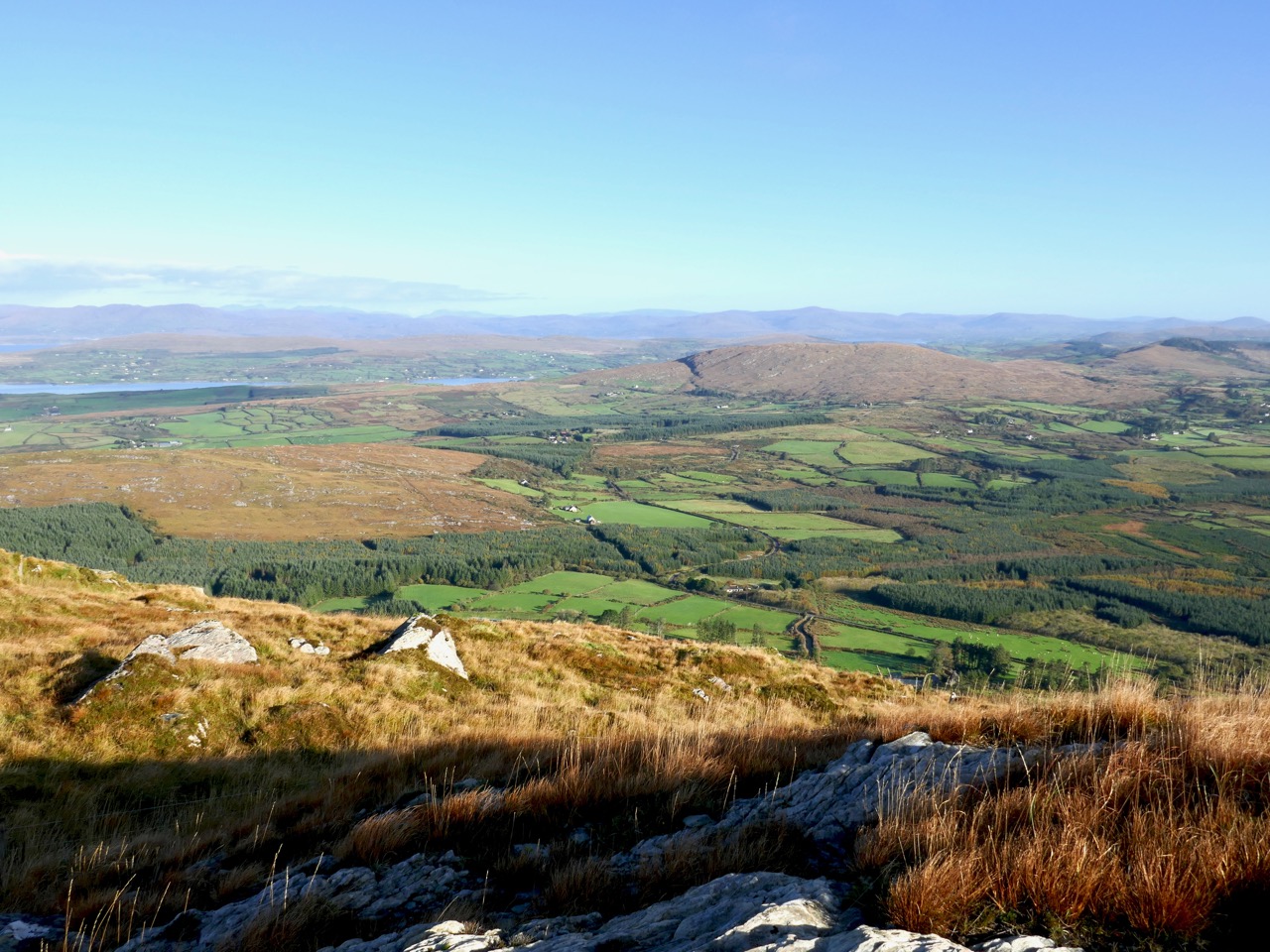
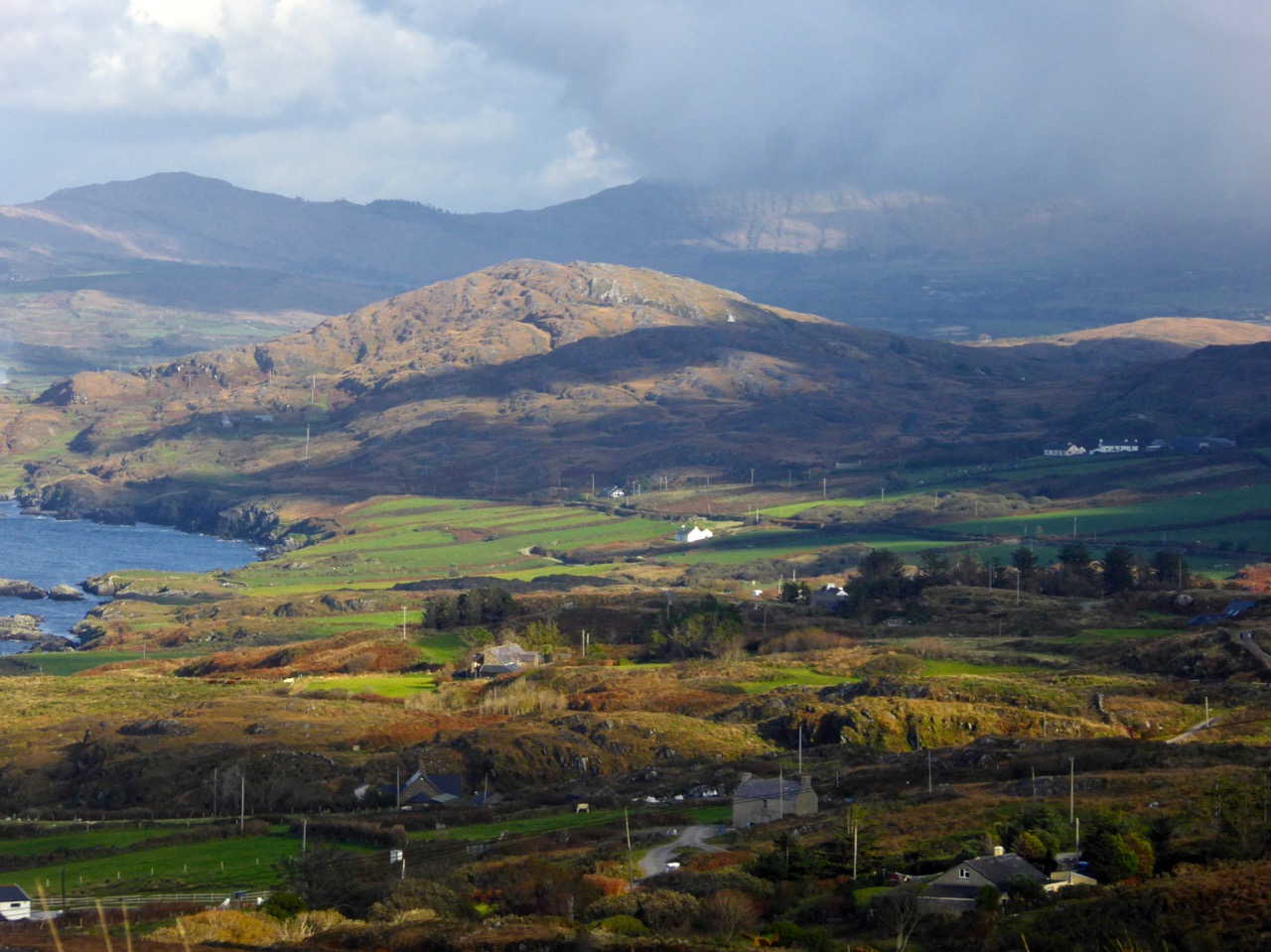
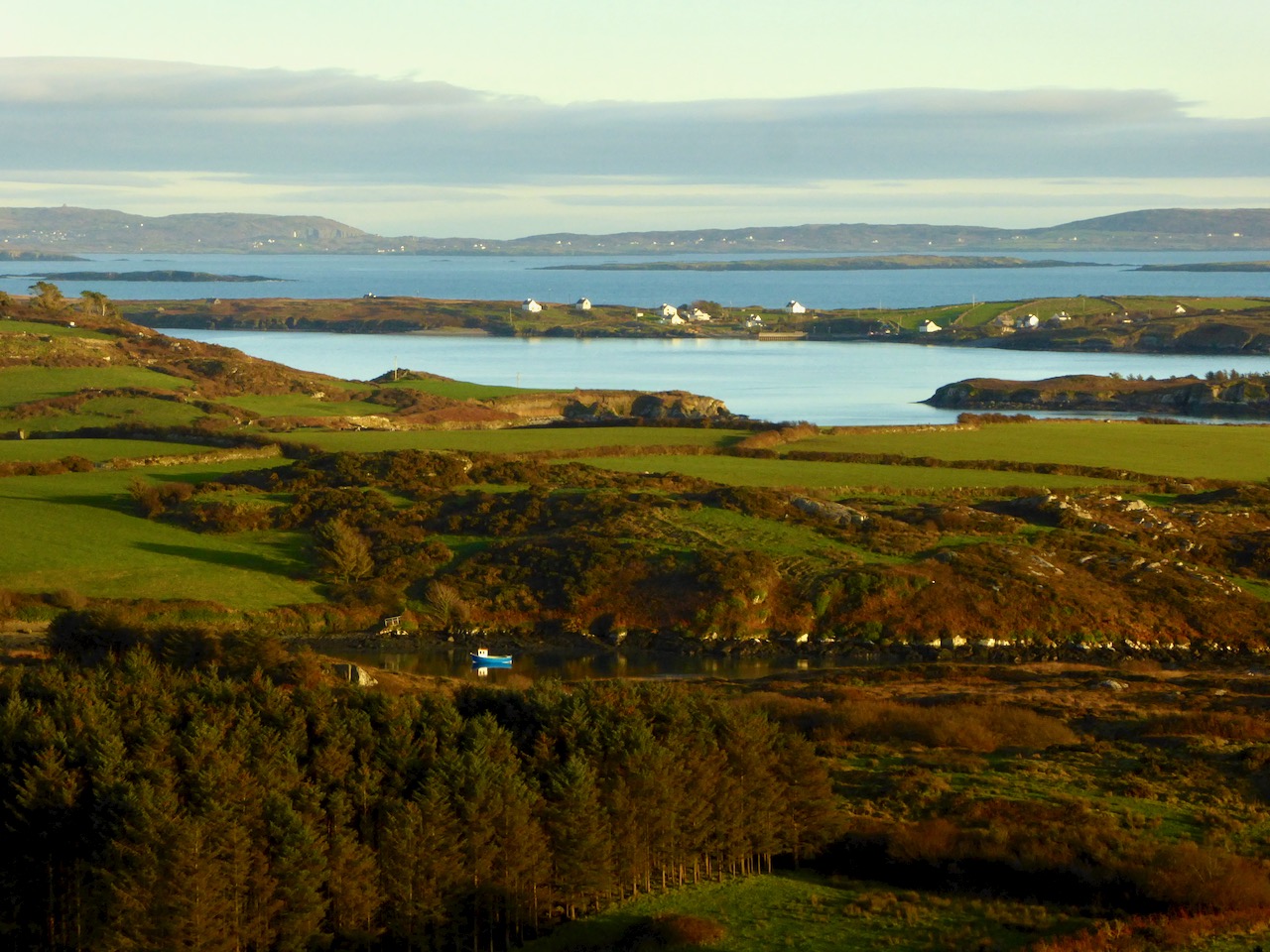
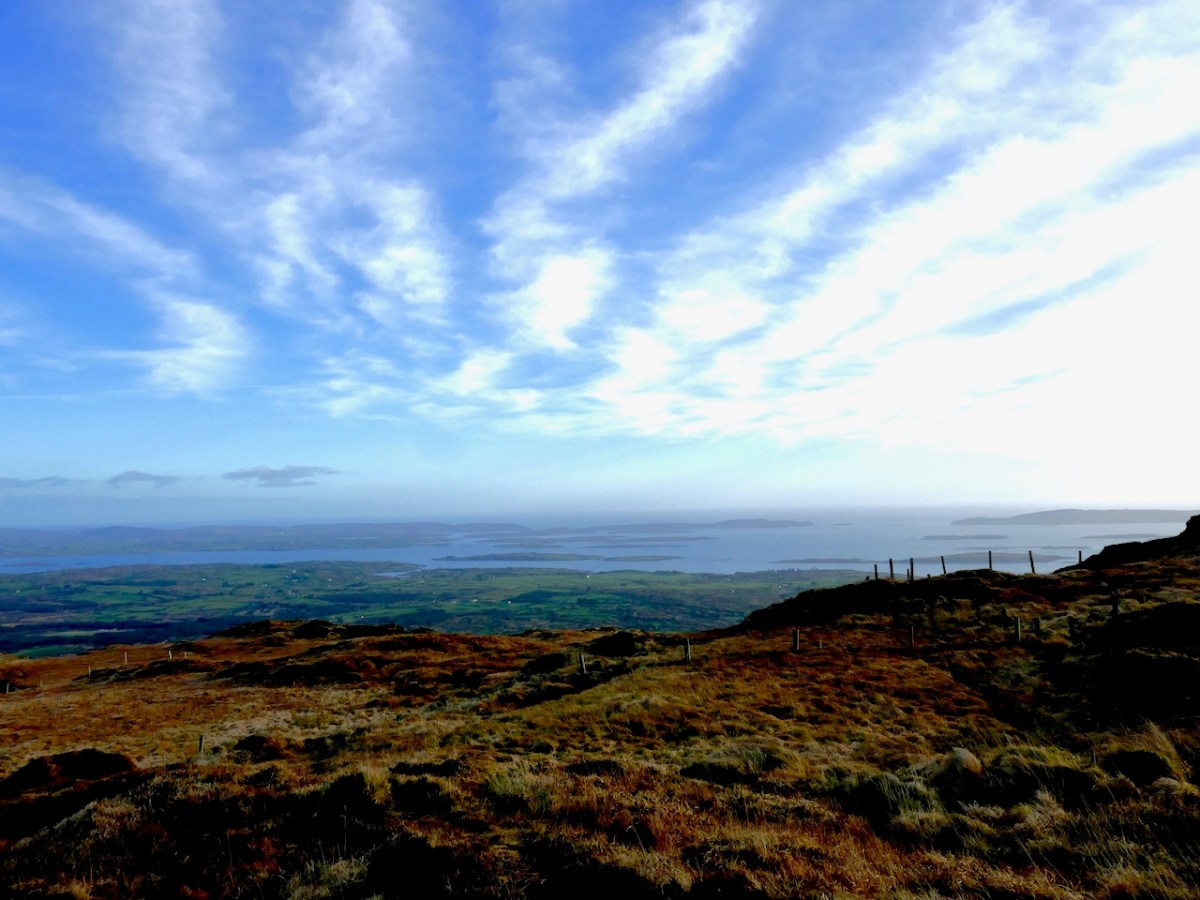
And how did it get the name Roaringwater – the official version is that it’s called after the Roaringwater River, which in turn gets it name from the way the water roars as it tumbles over rocks. But read my post from way back in 2014, The Roaring, and you will realise that there is a much more sensible explanation. So I will use the term Roaringwater Bay in this post as we use it every day around here – to include everything you see from the top of Mount Gabriel, looking south and east, as below. Before I move from the image above, however, let me point out Kilcoe Church, and Kilcoe Castle, both of which I have written about.

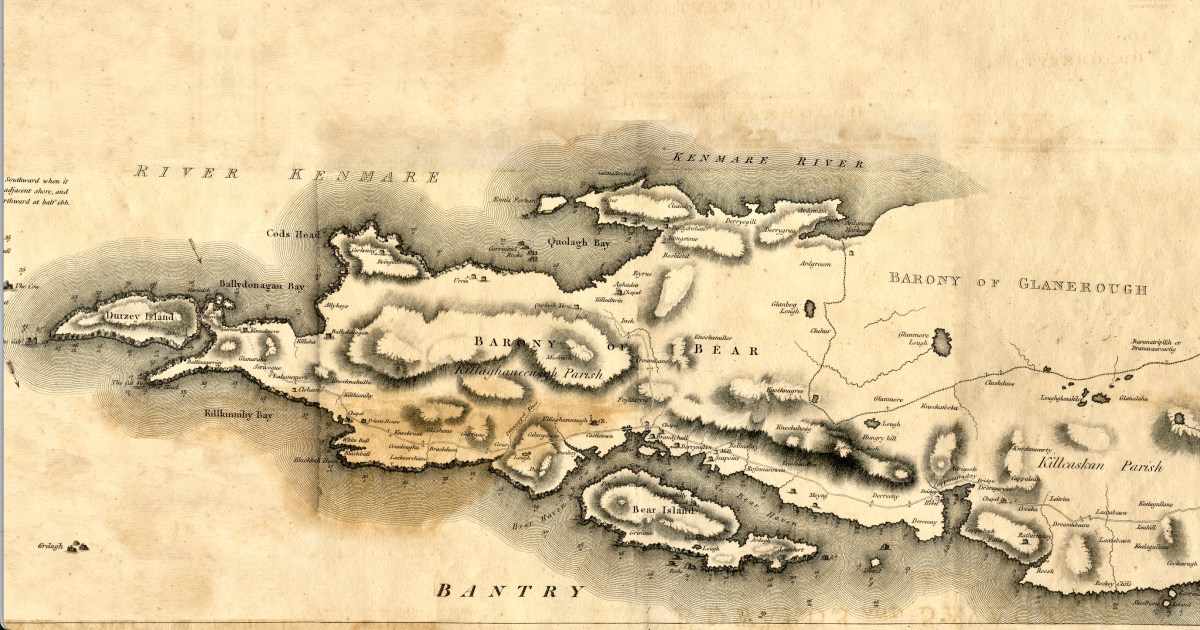
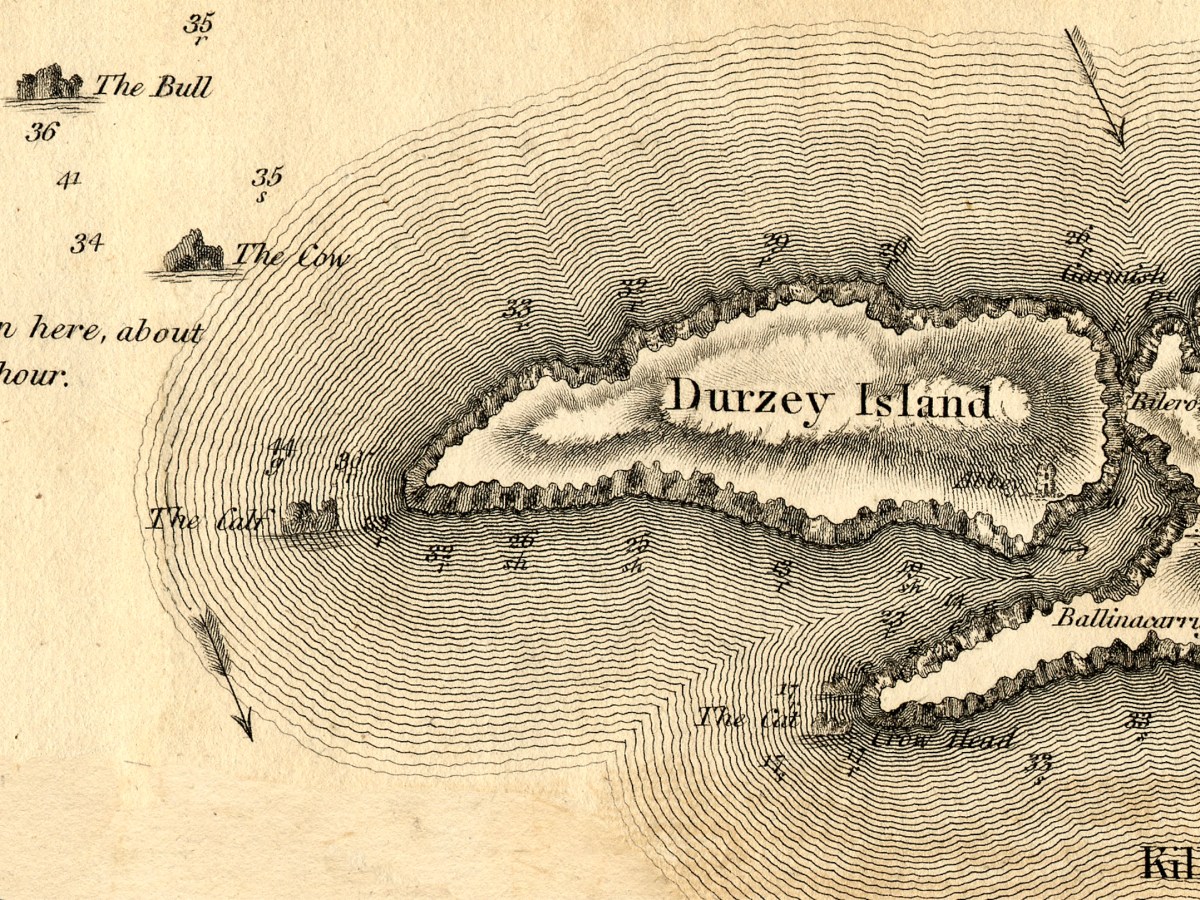
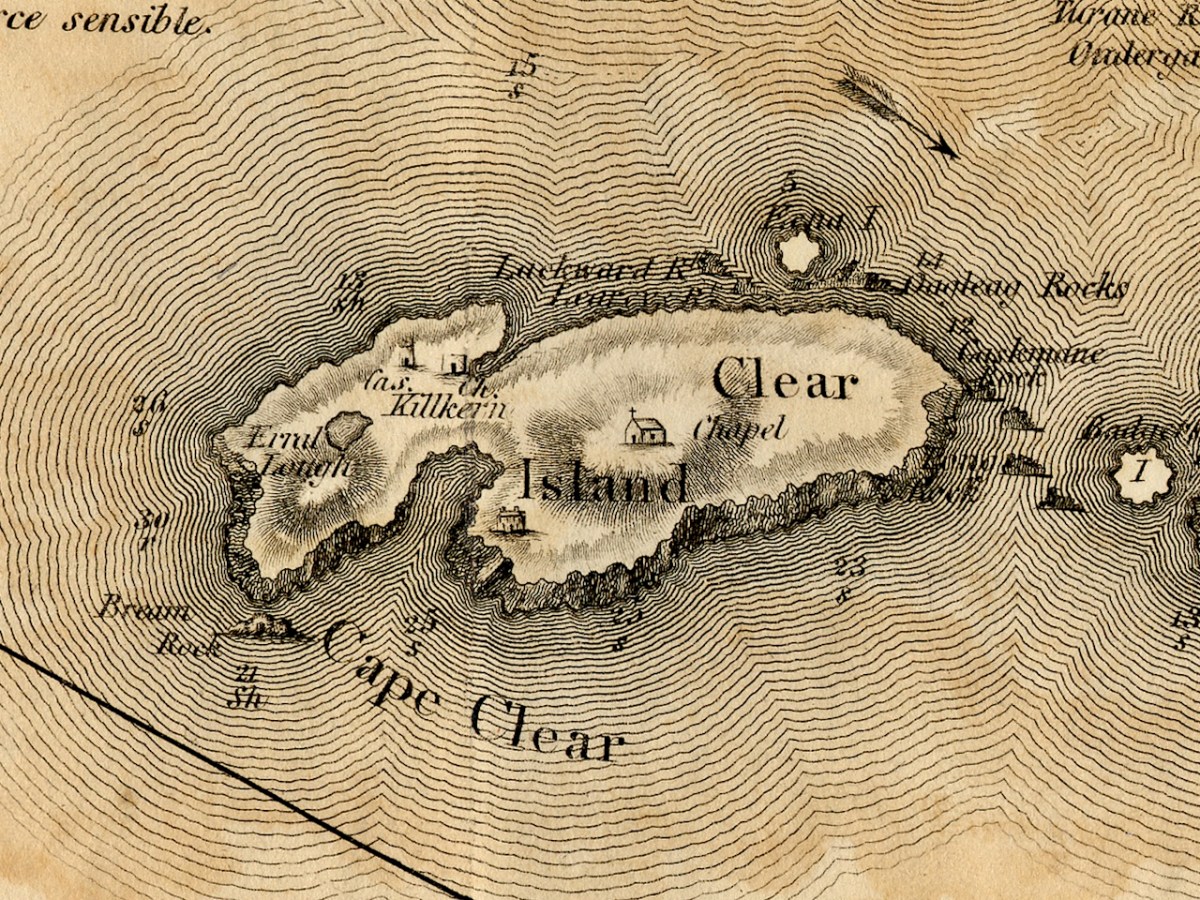
Let’s start with the biggest island – familiarly known locally as Cape Clear. Clear Island, as it is properly called (Oileán Cléire) and as it is labelled on this map, shows the name Cape Clear reserved for its southwestern tip.

Dún an Óir Castle (see this post, and this one) is clearly shown, as is St Kieran’s Church, which was a ruin even then. Intriguingly, there is a Catholic Chapel shown which must have been in place before the current church was built in 1839, approximately in the same area. Even more strange is a building shown as a ‘Gentleman’s Seat’ – that is, a Big House, on the south side of the Island. Can anyone help us with that this might have been?

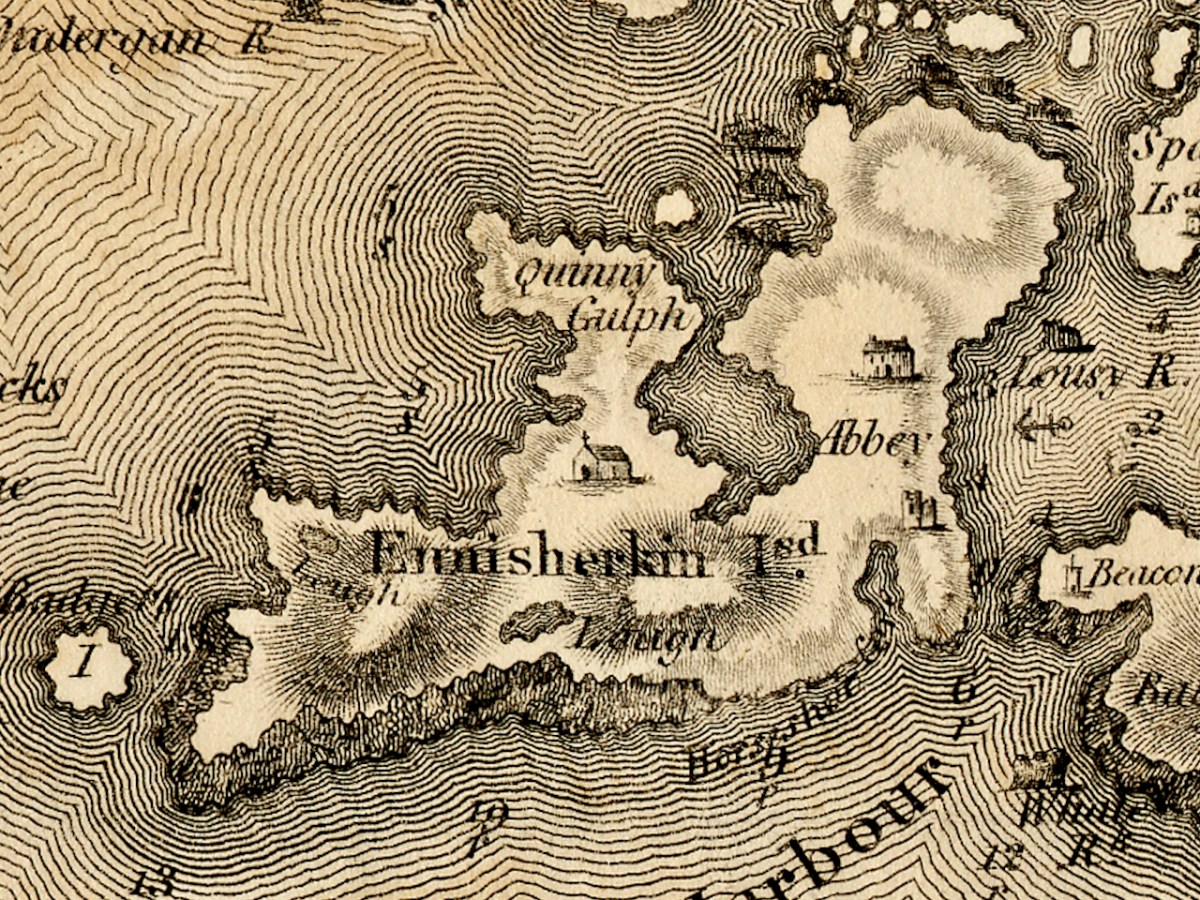
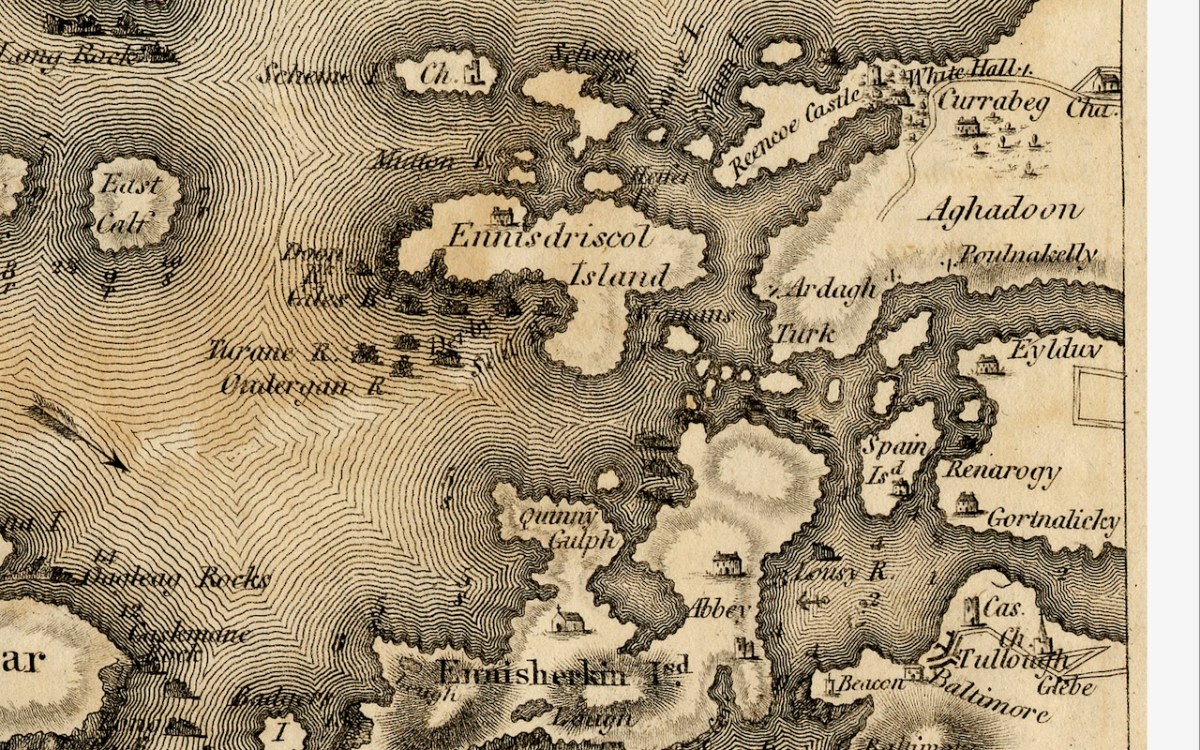
Sherkin Island is shown as Ennisherkin. This is from the Irish Inis Arcán, translating literally as Piglet Island, but likely from the Irish word for porpoise, which is muc mara, or sea-piglet. Anyone who has boated in the area will know how prevalent porpoises are in the seas around the islands. Once again, we have a catholic chapel, and of course the ruined Abbey and castle. Take a look at my post A Walk on Sherkin Island for a taste of what that’s all about. The term Quinny Gulph, by the way, must be Kinnish Harbour, the large bay in the centre of Sherkin. Once again, we have a ‘gentleman’s seat’ on Sherkin, and once again I am asking readers to identify this.

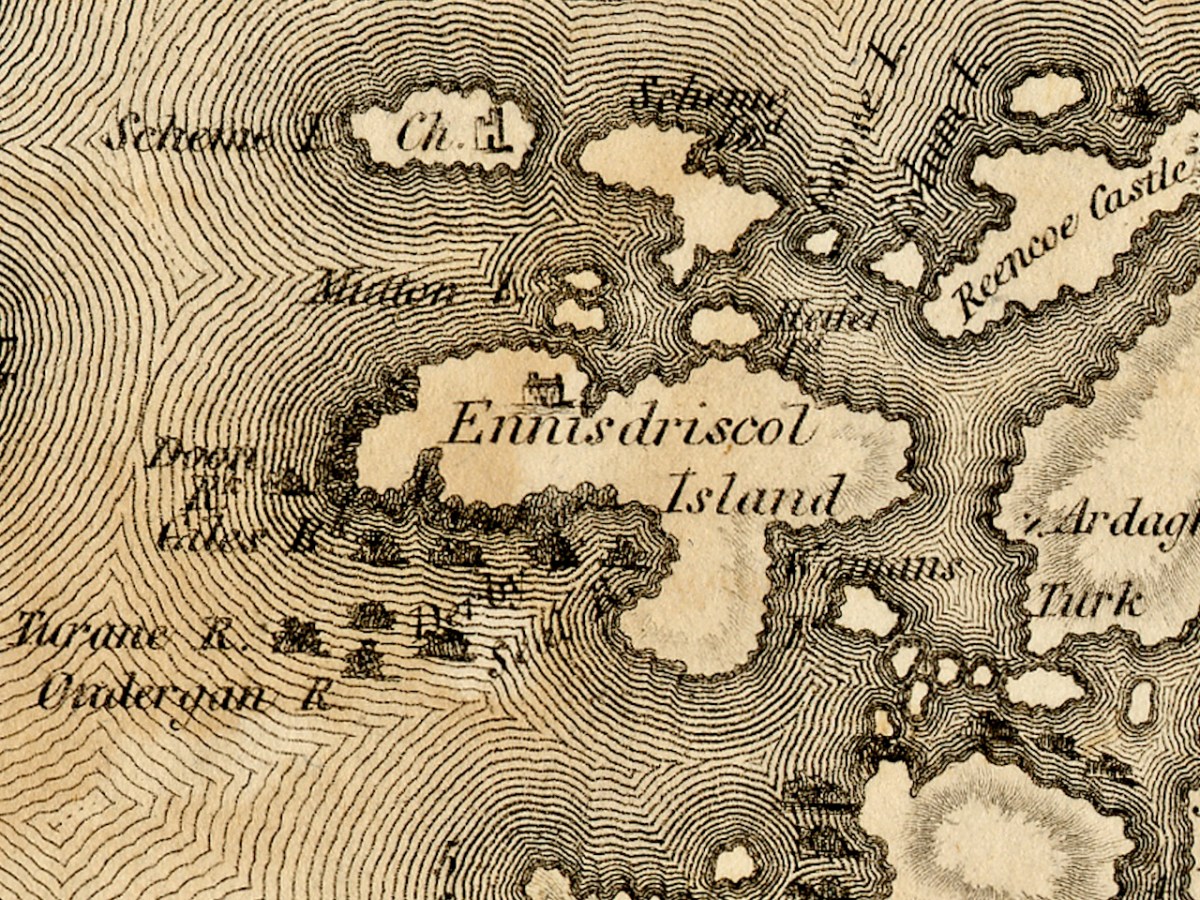
Ennisdriscol Island is of course now called Heir Island – the older name indicating that it was very much the domain of the O’Driscolls in the past. It’s curiously featureless on this map, apart from yet another large house. Right above it are the Skeams, East and West, or the Schemes, as Bath has it. West Skeam has a pre-Romanesque church on it which I have yet to explore – a new blog post one day! I’d better hurry – it’s in a perilous position on the edge of a cliff and much of it has already been swept away.

The Calves, now uninhabited, occupy the middle ground of Lough Trasna between the mainland and Cape Clear, while Long Island, Castle Island and Horse Island parallel the coast. Horse Island and Castle Island are each now owned by a single individual, while Long Island still has a resident population of several owners. The vestigial castle on Castle Island is not shown. To the east of Long Island is Goat Island and Goat Island Little – the cleft between them is actually much narrower than appears on Bath’s map and only navigable with care by kayak. It is home to a herd of feral goats.

And finally Spain Island, now called Spanish Island, and the western end of Ringarogy. Note that the only one of the small islands scattered between Sherkin, Turk Head and Heir Island that is named on this map, is Woman’s. In fact, there is a tiny rock in this area labelled on modern maps as Two Women’s Rock. The largest island in this group is actually called Sandy Island and the smaller ones are The Catalogues. Note also that the castle now called Rincolisky, is here labelled Reencoe. And let’s include Baltimore, with its castle and – the beacon!

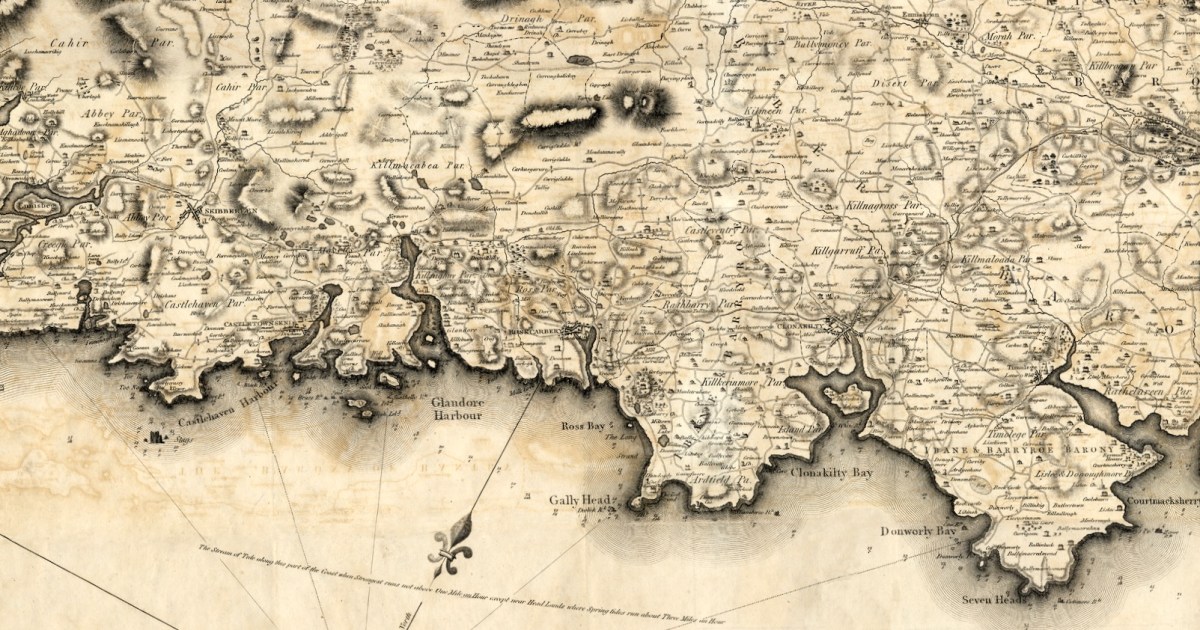
I know we have been a bit forensic about the area I call home – my next post will take a much broader look at West Cork. Here’s a sneak peak.

The 1811 Grand Jury Map of Cork by Neville Bath: Part 1, the Mizen

As readers know, I love old maps and there’s a map of Cork I haven’t written about yet. This is a truly beautiful piece of work, and a huge step forward on some of the older maps of Cork I have described – for the list, see my page The Magic of Old Maps. 

Since it will take me more than one post to talk about this county map properly, I will start today by concentrating on Map 4, and stick to the Mizen Peninsula. The map is in 6 parts and I am able to share it with you today through the generous assistance and permission of the Cork County Library. You can view their hi-res images here – they may be sharper than mine, as I do have to compress images for the blog.

But first, some context… We assume that proper, professional mapping really got underway with the Ordnance Survey in the 1830s, but indeed there were competent cartographers in Ireland before then. Neville Bath was one. In an essay by J H Andrews (see reference in the final quote) he is described as English but spending his whole cartographic career in Ireland, starting off by drawing estate maps in Kerry. He finished a map of Cork City in 1788, so was well placed to be awarded the contract for the county map, when the Irish parliament allowed public money to be spent on producing Grand Jury barony maps as well as county maps, but only for official purposes and only in the form of manuscript ‘protractions.’ Bath tried to arrange for the manuscript protraction to be turned into a proper published map by selling subscriptions – that did not go well, and it wasn’t until 1811 that the map was finally published, engraved by the London firm of S J Neele, acknowledged as the finest artists in the Kingdom.

What was a Grand Jury and why were they commissioning maps? As the name suggests, Grand Juries were initially conceived as groups of 24 men (yes, only men) who wielded authority for the administration of the criminal justice system in Ireland. The exclusive domain of wealthy landlords, the Juries exerted enormous power over the whole population – a population with which they had little in common, including economic status but also language, religion and cultural affiliation.  Over time, the Grand Juries accumulated other responsibilities, for roads, bridges, hospitals, schools and tax collection.

Eventually, all those duties were taken over by other bodies – County Councils, the Poor Law Union, a proper legal system. Above is the final sitting of the Cork Grand Jury in 1899. But while it lasted it was already an archaic system, deeply unfair and rife with corruption. It also became highly competitive, with one Grand Jury after another building more and more elaborate courthouses*. The same thing happened with maps:


Almost inevitably, the maps enabled each grand jury to convey its own prestige to its neighbours, and the ‘Grand Jury map’ project took on an increasingly expensive and stunningly elaborate life of its own. William Larkin was the greatest exponent of the genre and produced maps for six out of the twenty-six counties that made it into print using the public purse. Larkin produced maps for Westmeath (1808), Meath (1817), Waterford (1818) and Galway, Leitrim and Sligo (1819). From 1784 grand juries were required to have their county map ‘put up, and kept constantly during the assizes in the grand jury room of said county’.

People, Place and Power: the Grand Jury System in ireland, Brian Gurrin with David Brown, Peter Crooks and Ciarán Wallace

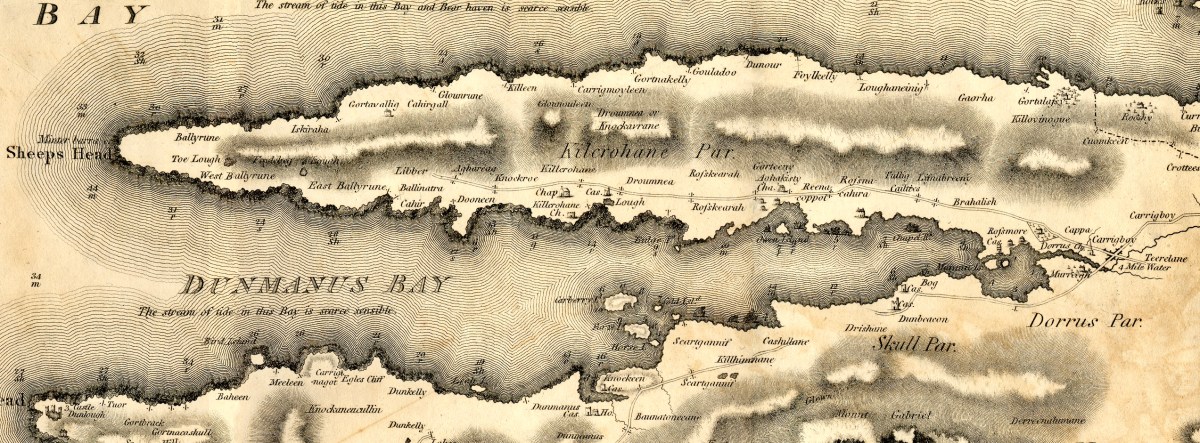
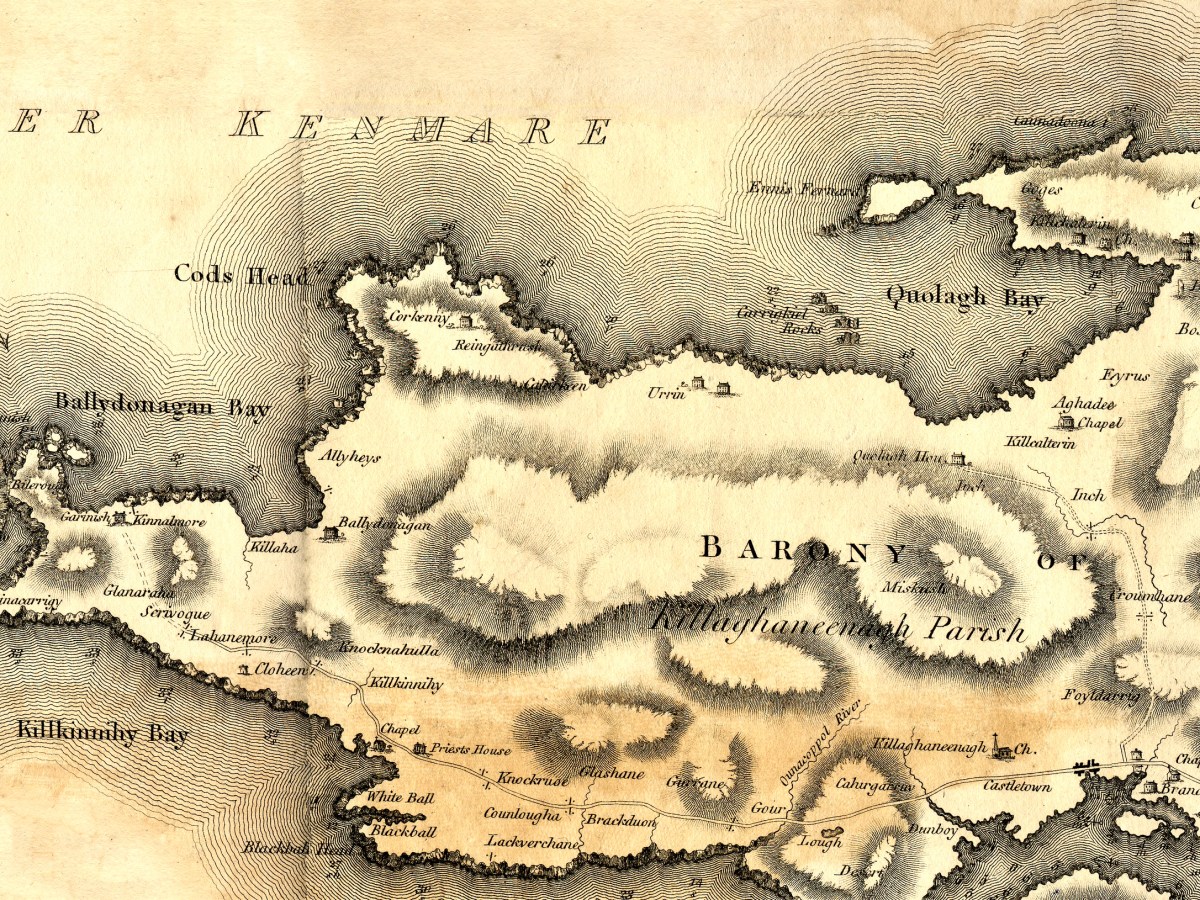
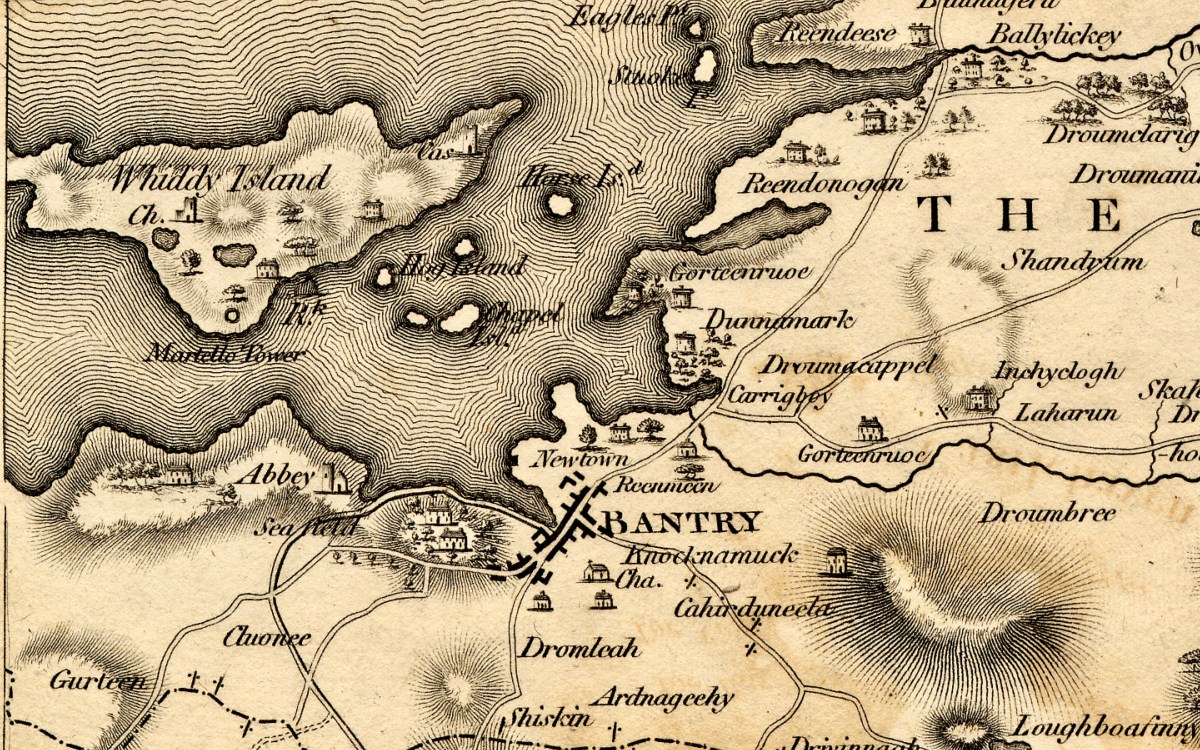
Let’s take a look at Neville Bath’s map now, working from west to east along the Mizen Peninsula. you will have your own favourite spots to check out – I am just going to point out a few of interest to me.

This map pre-dates Richard Griffiths road-building along the Mizen, but nevertheless it shows a road going all the way to Crookhaven. I love the little depiction of Dunlough/Three Castles, and also that a church is shown at Lissagriffin – we can see the ruins still. Alderman’s Head is called Streek Head on the early OS maps, while the rocks offshore at this point are called Alderman’s rocks. (Who was the Alderman, I wonder?)

Before we move East to Schull, I just want to highlight Dunmanus. The ‘castle’ at Knockeens is clearly shown. As I discussed in my post Dunmanus Castle 1: The Cliff-Edge Fort, there is much much local folklore about this site. There may have been more to see when Bath was mapping this area.

Moving towards Schull, I am intrigued by the noting of a ‘pound’, which does not occur on later maps. A pound was used to secure animals seized by the landlord’s agents for payment of rent. Note also the ‘Fort’ at the end of the Lisscaha road. While I haven’t written about this fort, I have visited it, and very impressive it is.

Schull is shown as a sizeable settlement, with a storehouse, Glebe, and Church – St Mary’s Church, now replaced by Trinity Church. A number of Gentlemen’s Seats are shown in the vicinity.

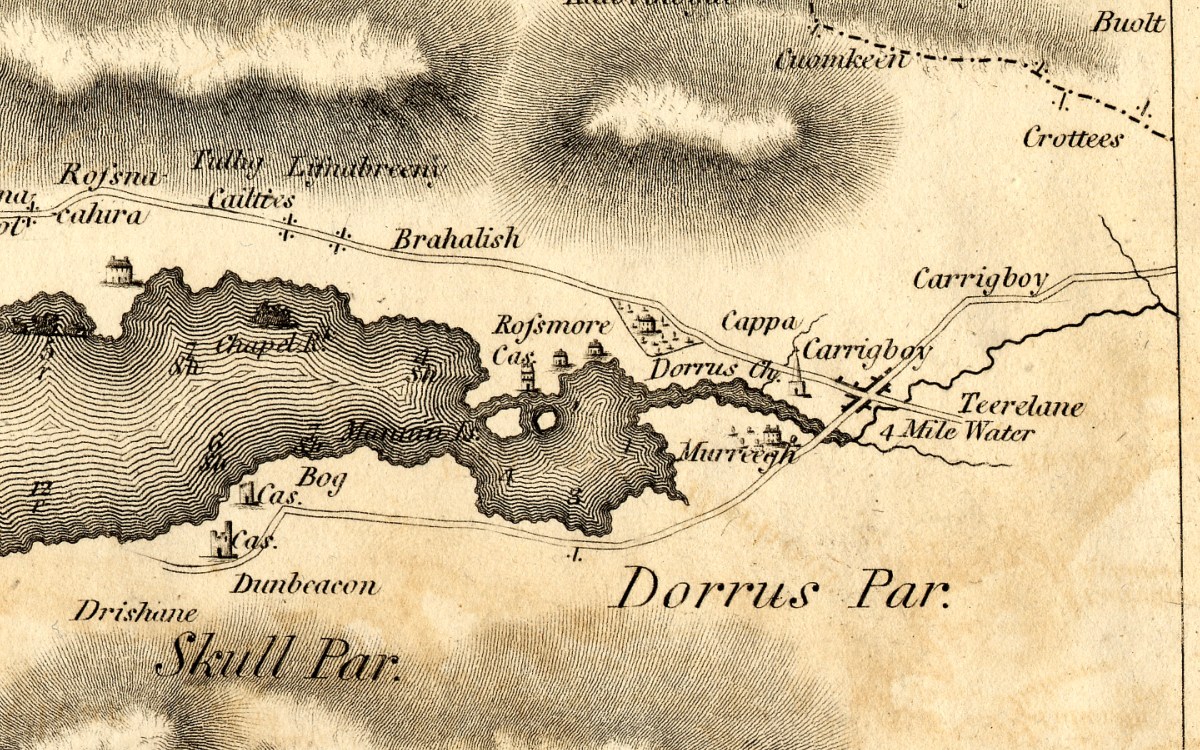
And finally we arrive at our own Ballydehob, shown as a town. Note the church to the south west of the town – I wonder if this is the church that once stood in Stouke Graveyard. It hadn’t occurred to me that Skeaghanore was the Irish for Golden Bush – there must be a story there! We will cover other parts of West Cork in subsequent posts. This map is an incredibly valuable resource dating as it does from well before the Ordnance Survey. We are lucky that it was published and copies saved. But what happened to Neville Bath? As JH Andrews tells us, Bath

may well have been dead by the time his work was officially published on 20 February 1811, and the map itself was only just in time. Irish cartography was about to pass into the hands of a new elite, engineers rather than land surveyors, whose most distinguished members were immigrants from Britain like Alexander Nimmo and William Bald. This later generation had a low opinion of Bath, and within fifteen years of his departure the counties of Limerick, Tipperary and Kilkenny had all decided to have his work done again. Not surprisingly, none of his manuscript county surveys appears to have been preserved. The map of Cork is available in a number of Irish libraries, however, and only awaits the judgement of the county’s own historians.


A Cork Cartographer’s Advertising Campaign by J H Andrews

Journal of the Cork Historical and Archaeological Soc, 1979

*See Richard Butler’s magisterial Building the Irish Courthouse and Prison 1750-1850

Cnoc Buí Arts Centre and 20th Century Irish Art

We have a major new player in the arts scene in West Cork. Over the last couple of years, Cnoc Buí (cnoc buí – yellow hill) Arts Centre in Union Hall, has quietly established itself as a significant focus for the arts. I have attended several exhibitions there, always marvelling at the space, the light, the curation and the excellence of the art on exhibit. Here’s the list for 2024, although it doesn’t include the current exhibition, and that’s the one I want to write about today. 

First of all, a little about Cnoc Buí itself (photo above by Amanda Clarke). As the name suggests, it’s a yellow house, beside the sea in in Union Hall, renovated and fitted out for the arts. It’s the brainchild of Paul and Aileen Finucane, who have come to live in Union Hall permanently, after owning a house here for forty years. Passionate about art, and avid collectors, they are ‘giving back’ in the most magnificent way possible through their philanthropic efforts. Read more about them and Cnoc Buí in this story from the West Cork People. (Photo below courtesy of the West Cork People.)

Those of you not living in West Cork – you have no idea how rare it is to come face to face, in your own backyard, with the great Irish artists of the 20th century. Normally we have to go to Dublin, to the National Gallery, or the Hugh Lane.

Ahakista by Letitia Hamilton

I often get my fix from the wonderful Facebook Page 20th Century Irish Art, and I have come, thanks to that source, to recognise many of the names and styles of our leading artists.

Phyllis Leopold’s The Belfast Blitz

The only other comparable experience I have had here in West Cork was with the Coming Home expedition in 2018. Don’t get me wrong – I love 21st century art and we have SO many excellent artists and great venues here in West Cork, and we have written about and reviewed many, many shows. Remember The Souvenir Shop? Rita Duffy is here as well.

Kathleen Fox, Still Life with Bust

This show emphasises Irish women artists – over half of the pieces are by women. We are all rediscovering the superb women artists who were in the shadow of famous husbands (Grace Henry, Margaret Clarke) or unjustly neglected (Kathleen Bridle, Hilda Roberts, Gladys Mccabe), better known as stained glass ‘craftswomen’ (Evie Hone, Sarah Purser, Olive Henry, Kathleen Fox), written off as mere ‘Illustrators’ (Norah McGuinness), or who were even actively discriminated against by the male establishment and dominating figures like Sean Keating. Some are getting the last laugh now – there’s a new exhibition opening now in the National Gallery devoted to Mildred Anne Butler, who is represented in this exhibition.

Olive Henry is more familiar to me as a stained glass artist, so I was delighted to see this fine portrait

But it was women who led the Irish art world into the modern era: The Irish Exhibition of Living Art was founded by women who had been able to afford to go abroad to study  and had picked up newfangled ideas on the continent – women like Evie Hone and Mainie Jellett. Young artists flocked to their exhibitions, while the old guard stuck to their conservative, academic forms – echoed, of course, in the suppression of women and modernism in the new Irish State.

Evie Hone, Drying Nets – The Harbour Wall, Youghal

But here they all are, in Union Hall! The pioneering, courageous, persistent, driven, women of the new State. 

Portrait by Hilda Roberts

There are lots of men here too, of course – even Sean Keating, with a marvellous charcoal portrait of deValera. Did they grumble together about the goings-on over at the IELA?

John Sherlock was new to me and a great discovery – I have used his bust of John Hume as my lead image. 

Oisín Kelly (above, Bust of a Young Girl) is a personal favourite, and I have mentioned Thomas Ryan in another context: he is also, perhaps, under-appreciated. George Campbell, despite designing windows for Abbey Studios in the 60s and 70s, never got written off as a stained glass craftsman. The portrait (below) is of his mother, Greta Bowen, who only began painting at 70 and exhibited well into her 90s.

I recognised this painting, Mary Magdalen (below) as a Margaret Clarke right away, even though I had never seen it before.

It’s that combination of exact portraiture (I am willing to bet the angel was based on one of her children), the haunting expression in the eyes of Mary Magdalen, and the way the gestures mirror the scenery and shrubbery behind the figures.

The Sarah Purser is interesting on a number of fronts. Purser made her name with portraiture, using her connections to obtain many commissions – she herself said she went through the British nobility ‘like the measles.’ But this nude (below) is of Kathleen Kearney, ‘Mother of All the Behans’, who worked for Purser as a young (and very beautiful) woman. Sarah Purser’s many talents (she was a superb manager of An Túr Gloine Stained Glass Studio among many other things) are currently on full display at the Hugh Lane Gallery.

I have only given you a flavour of what’s in this exhibition. If you can, get down to Union Hall and take a wander through it yourself. If you get there on a weekend, the charming Nolan’s Coffee House will be open. 

Maeve McCarthy’s Tomatoes

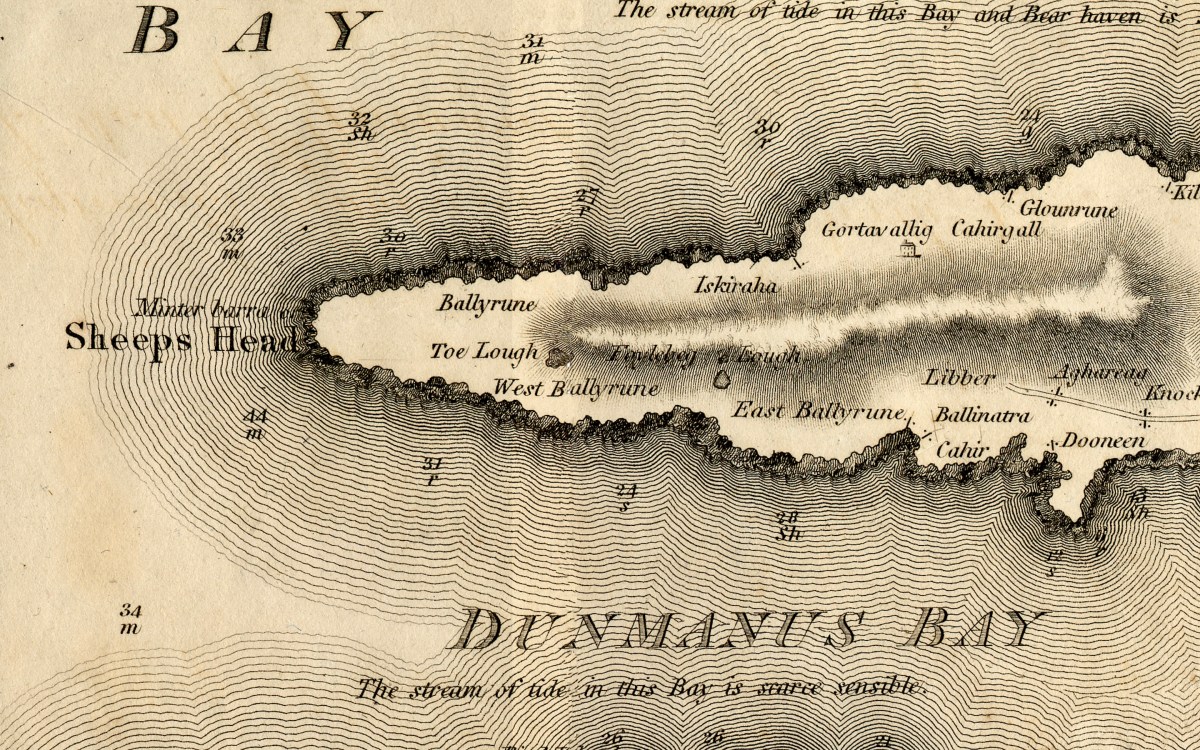
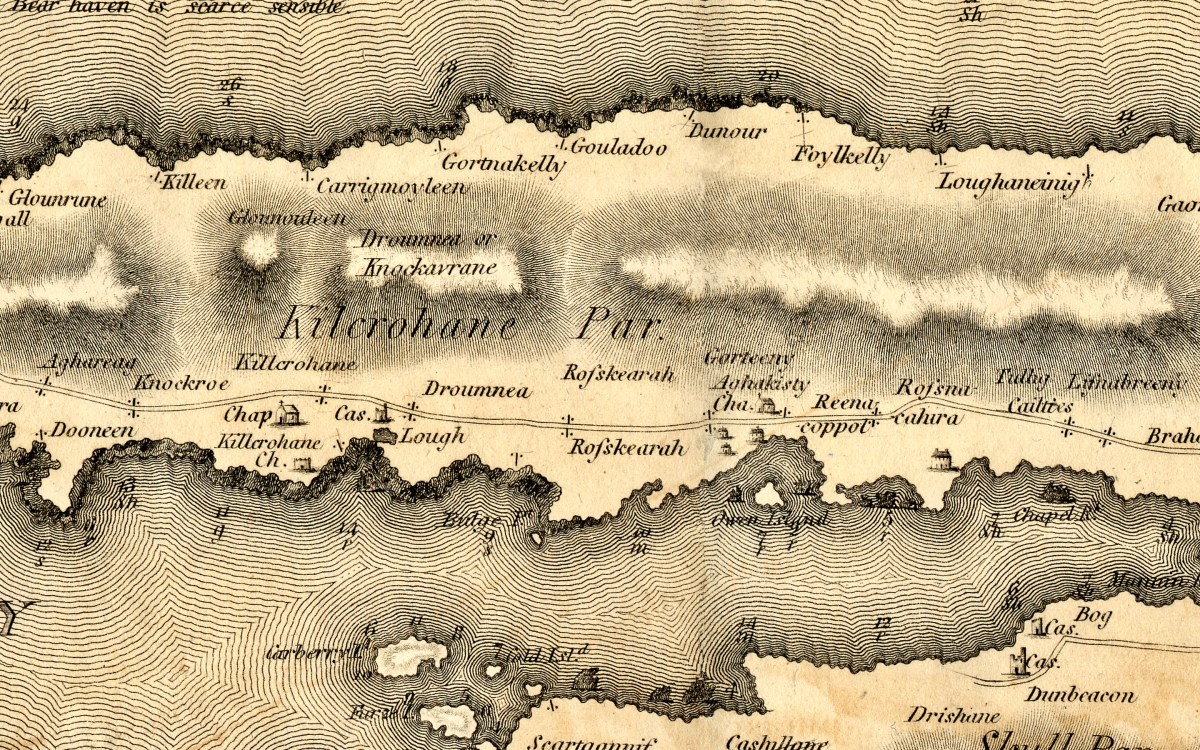
The Cliffs of Dooneen – on the Sheep’s Head

The Cliffs of Dooneen – surely that’s in Clare? Well, no, the song was actually written by Jack McAuliffe about the cliffs near Lixnaw, Co Kerry, from which Clare can, apparently, be seen. It was initially popularised by Paddy Breen, a traditional flute player, but got famous when it was performed by Christy Moore of Planxty. Paddy Reilly has a nice version too. But the Dooneen we are talking about today is the one on the Sheep’s Head, a few kilometres beyond Kilcrohane and on the way-marked trails of the Sheeps Head Way. It’s a spectacular spot, well worth visiting for no reason at all other than to contemplate the glories of the scenery in this part of the world. 

Dunmanus Castle can be glimpsed across Dunmanus Bay (above), and the whole of the Mizen Peninsula lies across from you, from Mount Gabriel to the end of the Peninsular where Dunlough Head hosts the magnificent Three Castles.

Dooneen (Dúnín – ‘Little Fort’) has been a locus of activity for a long time, probably because it provides a sheltered spot for boats. Sheltered – but not necessarily safe!

The pier here is substantial. This was the centre for a busy fishing industry early in the 20th century. We’ve often talked about the 15th century as a time when vast shoals of pilchards and herring congregated in the waters of West Cork. It happened again in the first half of the 1900s, and this is when this pier probably dates to. We know that, because it is not shown on the 6” or 25” Ordnance Survey Maps which date from the 19th and early 20th centuries.


There are a couple of buildings that may relate to the processing of the fish (see Robert’s post Pilchards and Palaces for an explanation). And this odd feature below – what looks like a holding pond created by a concrete dam.

An excellent page on eOceanic provides directions for mooring and some history of the area. This page also has some great photos of the pier from the sea, such as this one, below, taken by Burke Corbett, and used here with thanks to the admins of eOceanic

The author states that the pier was initially built to service the busy copper mines in the area. However, I would expect the roads he refers to, to be visible on the OS maps, and they are not, so perhaps the pier here was quite rudimentary or natural before the current concrete pier was constructed. 

The author of the eOceanic page refers to the feature above on the rock as a ‘steamer turning bollard.’ I had never heard that term before so I turned to my friend Sean O’Mahony, mariner and historian, for an explanation. Here’s what he told me, along with an illustration. Thank you, Sean!

To assist the ship from movement on the jetty, two lines (mooring ropes or hawsers) are extended from the bow and stern to the bollard. This will help to keep the ship reasonably secure from moving backwards and forwards (ranging) along the pier and also prevent her from being pushed hard alongside. This method would only succeed under reasonable weather conditions. I have a feeling that a lot of wooden fenders would also have been employed. My crude drawing demonstrates this with red lines extending to the bollard.

Second, and probably its primary purpose, was to aid in getting the ship off the berth when she is ready for departure. This procedure is known as warping and works like this. The lines to shore from the bow are left go and then using the ship’s windlass the line to the turning bollard is heaved in causing the bow to move outward in the direction of the open sea, at the same time the line from the stern to the bollard is released as are the stern spring lines just holding one line fast to the shore until the turning manoeuvre is complete, When she has turned sufficiently all remaining lines are released and recovered, engine speed is increased and you steam away to somewhere nice…. like the South sea islands…..

    As we might expect with a place with Dún in the title, there is a promontory fort here, and another one next door. (Here’s a good example of a West Cork Promontory Fort.) When studying promontory forts my first port of call is always our old friend Thomas Westropp and indeed Westropp has written about the fort at Gouladoo, on the north side of the peninsula.

    Normally intrepid in his pursuit of the forts. Westropp’s courage failed him when faced, a hundred years ago, with the prospect of travelling on the old, fearfully steep and rough road to this, at that time, remote part of Muinter Bheara. Finding the way ‘insuperable’, he confined his efforts to looking at it with strong field glasses, clear air and light from the Mizen Peninsula across Dunmanus Bay. The fort he describes, as a result of this remote surveillance, and with the help of local informants, appears to be the one further east along the cliffs from Dooneen Pier. It is located on Foilmore (Big Cliff), along from Foilnanoon (Cliff of the Fort). It’s National Monument No CO138-012. It’s Promontory Fort 1 on the map above.

    Here’s what Westropp has to say about this fort*: 

    The high mound and fosse are curved, and bushes grow on the former; inside is a level garth with long grassy slopes down to the cliffs. The rampart, I was told, was “about as high as a man” very steep, “cut by a gap, with a high narrow roadway, only wide enough for a cart to go inside across the ditch” which was “about as deep” as the mound was high – i.e., 5 ft. to 6 ft., making the rampart 10 ft. to 12 ft. high in all. Near it is a small, low peninsula, with little headlands and creeks, Reenanattin (furze point), Coosabriste (broken creek), Carrignagappul, Cooshaneagh (called from horses), and Murkogh. The fort is near Foillmore cliff, and is locally called “the Island of Dooneen” a not unusual term for such forts in Counties Mayo, Clare, Kerry, Cork, and especially Waterford.

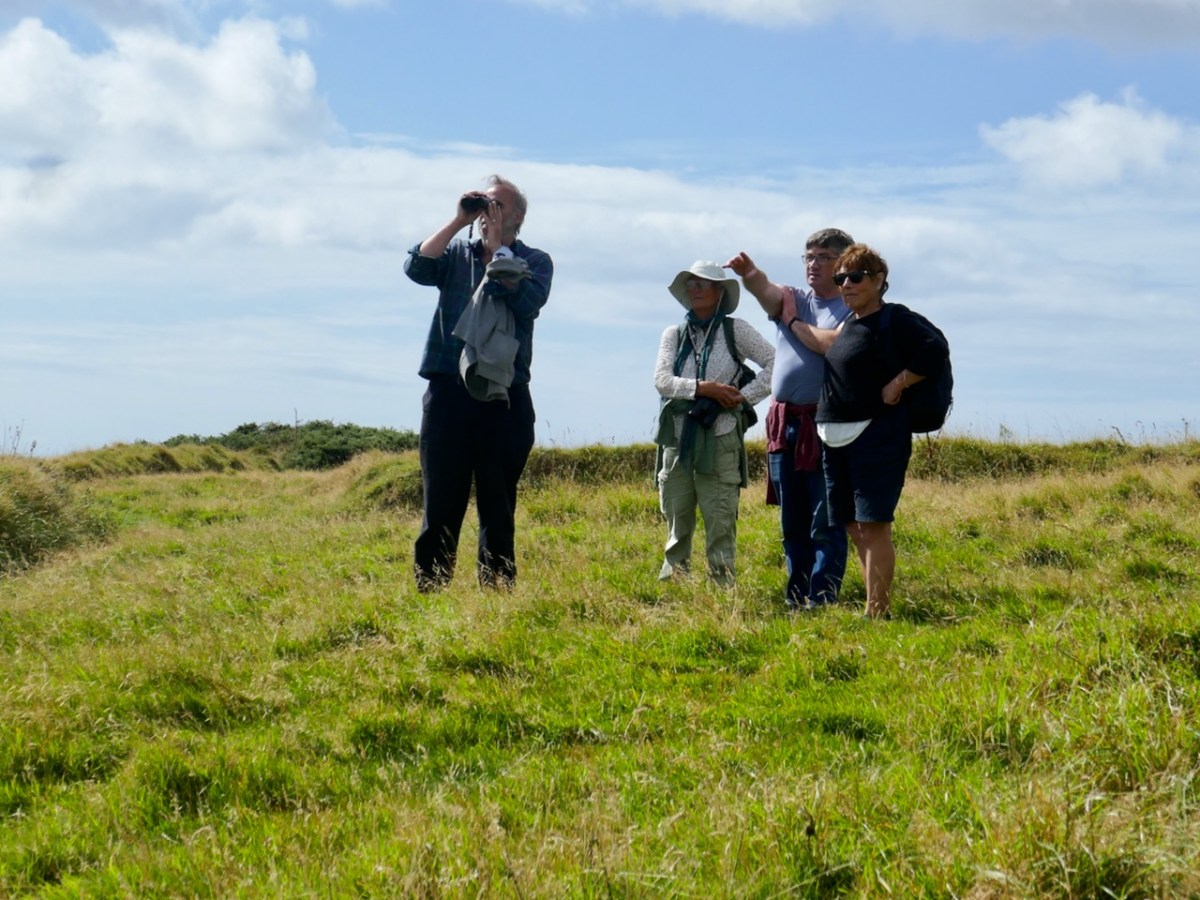
    Determined to best Westropp and actually visit the fort, I set out, in the company of Amanda and Peter and my sister, to tramp across the fields to it. Alas, we got no further than the farmhouse on whose land the fort is situated, where we were warned that a) it’s crumbling and very dangerous and b) it’s impossible to see anything because of the growth of gorse, trees and scrub.

    We abandoned the attempt – I will never doubt Westropp’s good sense again! I contented myself with what is showing on the 19th century OS map, above.

    Two more promontory forts are shown on the National Monuments map, presumably identified in the course of the archaeological surveys of the 1980s. It is no longer possible to see the ramparts, banks or ditches of the promontory fort immediately south of Dooneen Pier (above and below) as they have fallen into the sea (like those at Dún an Óir on Cape Clear). This one is called Illaunglass, or Green Island, on the map. According to the National Monument record (CO138-034002) it has a hut site on it. Frustratingly, the details of this record are hidden from view at the moment. 

    The next one to the south (CO138-035, no. 3 on the map), details also hidden, has a very slight discernible bank, partly covered by a wall, possibly modern (below). However, there is no indication of a ditch or bank in the OS maps, so it is unclear on what basis it has been assigned as a promontory fort.

    It is obvious that this area has been important to the inhabitants of Muinter Bheara for a long time, since promontory forts can date as early as the Iron Age (which ended around 500 CE/AD) but are commonly early Medieval, dating up to around 1000 CE/AD. 

    One more curious feature awaited us on our walk around the ‘Island of Dooneen’ – a blowhole, thankfully guarded by a wire fence. I’d love to go back some time when it’s blowing!

    The last thing you see as you head back to the road is the house that was once home to Donald and Mary Grant – the American couple with the White Goats and Black Bees, and the checkered past!

    Take a trip out to this part of the Sheeps Head – It’s amazing how one tiny section of coastline can hold such history and magnificent landscape.


    *The Promontory Forts of Beare and Bantry: Part III: Thomas Johnson Westropp. The Journal of the Royal Society of Antiquaries of Ireland , Dec. 31, 1921, Sixth Series, Vol. 11, No. 2 (Dec. 31, 1921), pp. 101-115. Stable URL: https://www.jstor.org/stable/25513219 

    Brian Lalor’s Retrospective

    Uillinn, West Cork Arts Centre until October 12

    Robert and I were excited about doing this post since we first knew this project was going ahead, a couple of years ago. Sadly, I am the one who gets to write it, but happily Robert is in there too, since Brian dedicated the exhibition book to his memory. That’s the two of them, below, showing off some of John and Noelle Verling’s ceramics acquired for the Ballydehob Arts Museum.

    I described Brian in a previous post as a National Treasure. Artist, engraver, printmaker, print collector, curator, writer, editor – he has done, and continues to do it all, and this retrospective captures a lifetime of his multi-faceted interests. Brilliantly organised around the theme of Place by curator Vera Ryan, it leads us from the Middle East through Europe to North America, dwelling of course on his own Home Place, West Cork.

    The book has essays by Angela Griffith of Trinity College and Anne Hodge of the National Gallery, a lengthy conversation with Vera Ryan, and a short concluding note by Brian. That’s Vera interviewing Brian at the launch, below.

    Through all of these we get to know Brian, his life, his travels, his training as an artist (but first as an architect and archaeologist), his collector’s eye – the honed observational skills coupled with a vivid imagination that allow him to produce works that are at the same time minutely accurate and wildly fanciful. As Angela Griffith puts it,

    He is a meticulous recorder of life, nature and the human-made environment. But he is also an interpreter, as such he captures the cadences of these spaces, reveals or create mythologies, and interrogates the impact of humans on the land, past and present. Many times he finds the lyrical in his subject matter.

    Printmaking has been at the core of Brian’s work. His fascination with printing techniques dates from a young age and led him to amass a fine collections of prints, chosen not for their subject matter but for what they can reveal about the art of printmaking. That collection is now in the National Gallery. He helped to found the fine art printmakers, Graphic Studio Dublin, the success of which and indeed Ireland’s printmaking tradition, is charted in his book, Ink-Stained Hands

    The exhibition itself contains multiple treasures that I haven’t seen before, even though I was familiar with some of Brian’s work. His enormous prints of Jerusalem, Rome and Dublin dominate several walls. His whimsical series on Icarus and Daedalus (above) was new to me, as were his American prints.

    His Book, Cork, has been re-issued in celebration of the exhibition, and it contains several new images, including this one (below) deemed ‘too depressing’ for the original edition.

    And it’s not only paper-based. He has collaborated with master-ceramicist Jim Turner on a series of fired earth works, some of which are politically charged. He knows the Gaza Strip intimately, after all.

    If you are anywhere near Skibbereen before October 12th, make sure to visit this exhibition. It’s worth travelling for too. If you just can’t make it, you can visit Brian’s website here, and you can order books and prints from Uillinn. Or contact Uillinn at info@westcorkartscentre.com or by phone +3532822090

    All I can do here is give you a tiny flavour of what’s in store at this outstanding show. Below I am appending a list of posts written by Robert or me that are either about Brian’s work, or illustrated by his art. I was amazed when I went back and looked at how many Brian-related posts we had written about him over the years. Partly that’s because he and Robert worked so closely together on the Ballydehob Arts Museum, but mostly it’s because we have been so bowled over by his art and writing.

    Brian Lalor posts

    The Fertile Crescent – an extraordinary exhibition at The Blue House Gallery in Schull

    An obituary for Lee Snodgrass, Illustrated with many of Brian’s drawings:

    Bohemians in Ballydehob, about the Ballydehob Arts Museum

    Ballydehob on Bahnhofstrasse – an account of a 1985 exhibition in Zurich by many of the core group of West Cork artists. 

    Church of the Angels, using illustrations from Brian’s sketchbook

    A two-part review of the Book Cork, illustrations by Brian Lalor, poetry by Eiléan Ní Chuilleanáin

    Several 12 arch bridge depictions by Brian in these two posts

    Review of West of West: An Artist’s Encounter with West Cork

    Review of 36 views of Mount Gabriel, a 2022 Exhibition in The Blue House Gallery

    Brian’s Original sketchbook for his field trips around West Cork with the Mizen Archaeological and Historical Society was the basis for this post on Signal Towers.

    Lying in The Dunes

    This is a companion piece to Lying in the Grass. That slideshow was shot in May three years ago, all the photos taken in my own garden within the previous week, and all native wildflowers. 

    This time, all the shots were captured in one day, July 18th, on a visit to Barley Cove with my friend and fellow nature-lover, artist Damaris Lysaght. The purpose of our visit was to monitor a rare plant, Dodder (below). This is one of the very few places in Ireland in which it grows, parasitising on the roots of the Wild Thyme, and mainly visible as a twisted mass of reddish stems. We were not sure if the tiny flowers, looking like miniature cauliflower heads, were about to flower or had flowered already.
    At this time of year the dunes at Barley Cove are a carpet of wildflowers. Many of them are tiny so you have to get up close to make their acquaintance. Photo taken by Damaris.
    Damaris had another reason for getting closer. We were lucky to catch a Dark Green Fritillary flitting from spot to spot and Damaris, a butterfly expert, figured it was probably laying eggs on the basal rosettes of the Common Dog Violets that flourish on the dunes. In the last photograph of the slideshow she is trying to see butterfly eggs – a task that defeated even her!

    The music I have chosen is Ave Maria Stella from Templum by Micheal O’Suilleabhain. 

    Here is a list of the flowers in the order in which you are seeing them. 

    Title Slide: Lady’s Bedstraw, Wild Thyme, Oxeye Daisy

    Dodder X2

    Wild Thyme, Eyebright

    Lady’s Bedstraw, Wild Thyme, Oxeye Daisy, Oxeye Daisy

    Rough Hawkbit (I think), Oxeye Daisy X2

    Oxeye Daisy, Sea Holly

    Wild Thyme, Rough Hawkbit X2

    Sand Pansy X4

    Common Centaury X4

    Fairy Flax

    Bee on Wild Thyme

    Lady’s Bedstraw, Wild Thyme

    Wild Thyme X2

    Lady’s Bedstraw X3

    Rough Hawkbit, Lady’s Bedstraw, Wild Thyme X4

    Damaris searching for Dodder

    Wild Thyme and Cat’s-ear X3

    Wild Thyme, Eyebright X4

    Cinnabar Moth caterpillars on Ragwort (their food plant)

    Bulbous Buttercup

    Dove’s-foot Crane’s-bill X3

    Pyramidal Orchard X5

    Six-Spot Burnet Moth(s) on Wood-rush X10

    Dark Green Fritillary X3

    Damaris looking for butterfly eggs X2