Birds and Beasts

Swallows 12 – Table 0
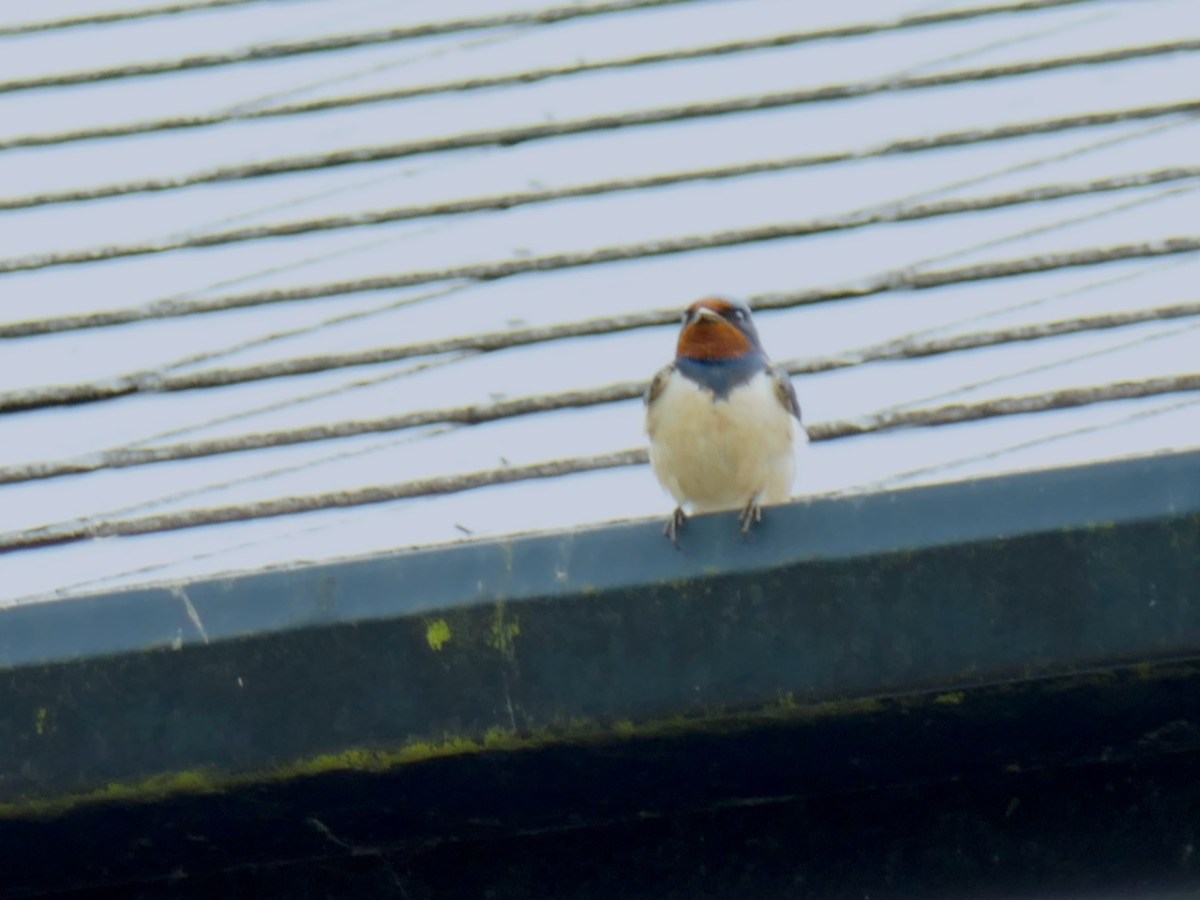
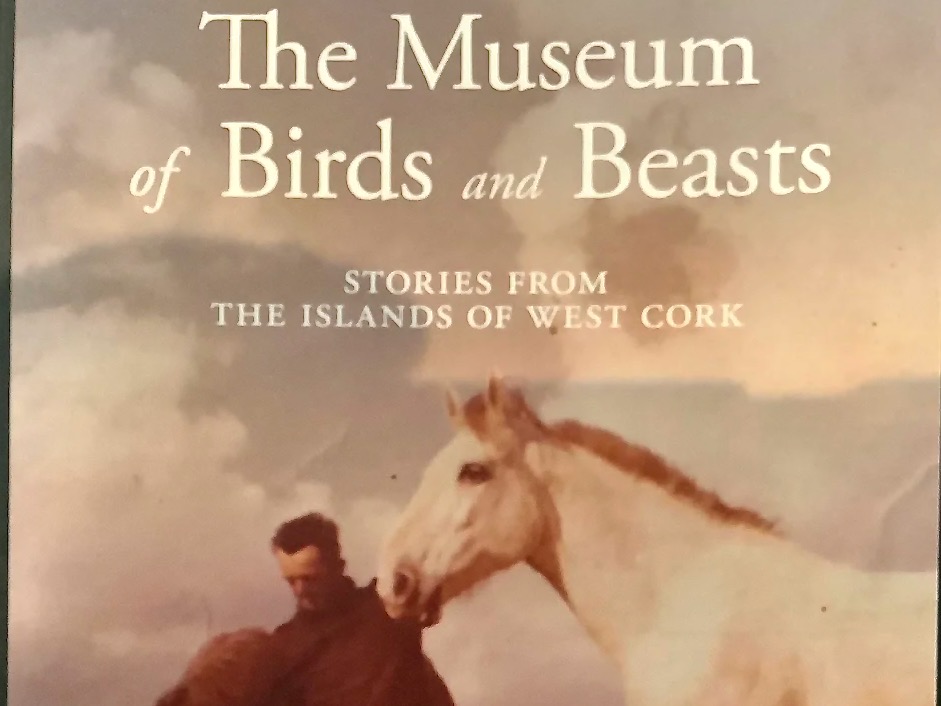
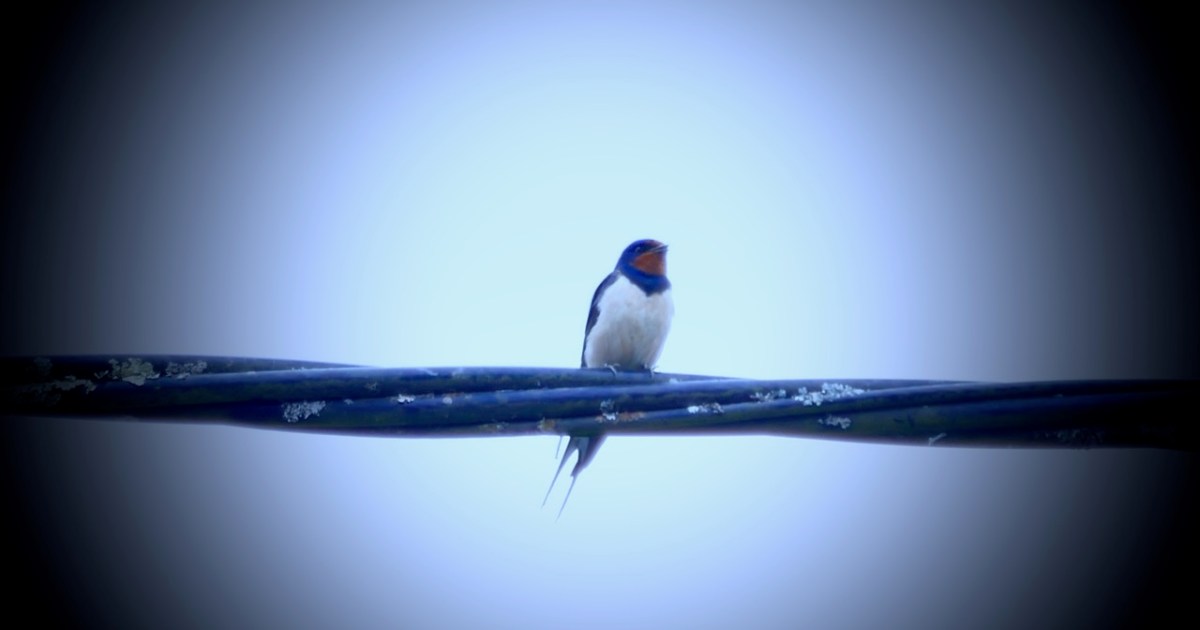
You are all in total agreement that I need to cherish my swallows. More on that topic below, but first, I want to introduce you to The Museum of Birds and Beasts.
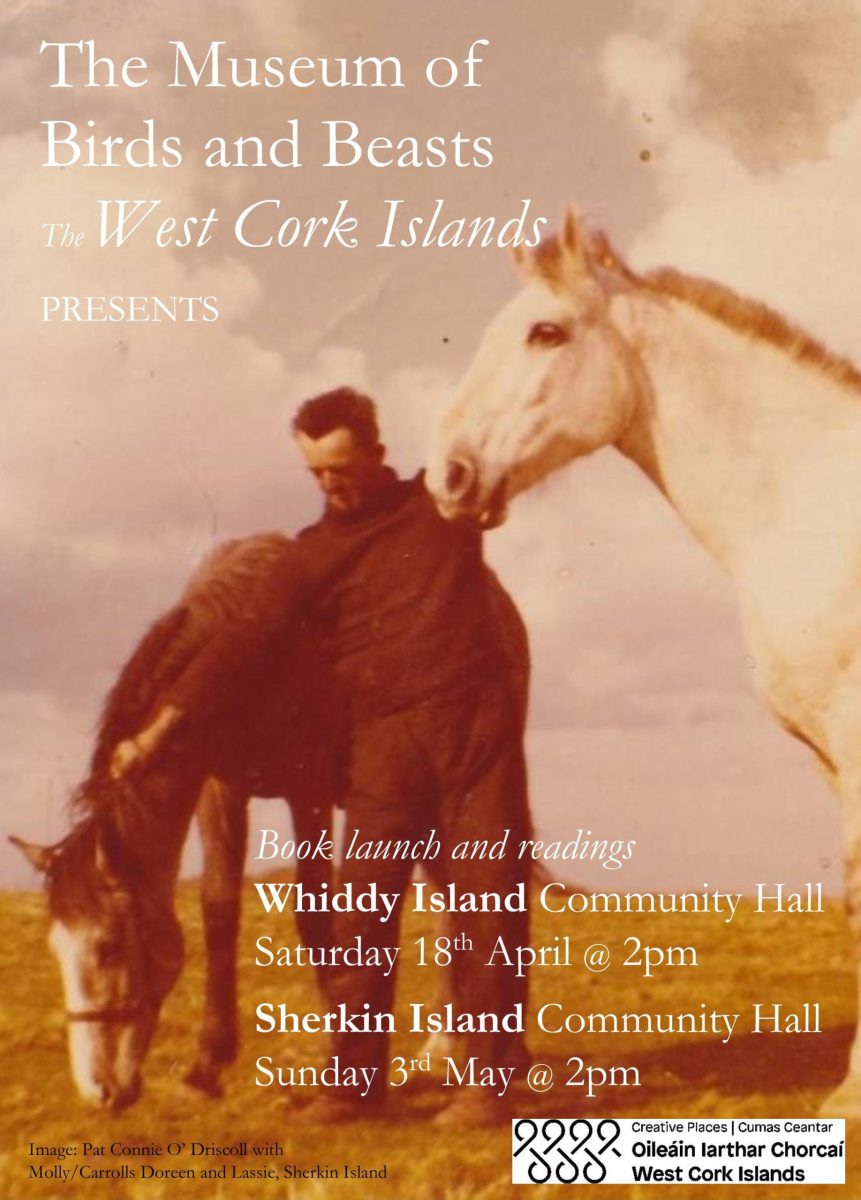
Yes, it’s a quirky title for a book, but it is also part of a wider project that involved exhibitions and workshops.
Tess Leak and Sharon Whooley are the two genii behind it all, and last week I participated in an event on Whiddy where the book was launched and some of the writers were there to read their stories. It’s one of several projects of Arts Council-funded Creative Places, West Cork Islands, which aims to build sustained arts investment and create opportunities for local arts programmes across the 7 [inhabited] islands of West Cork.
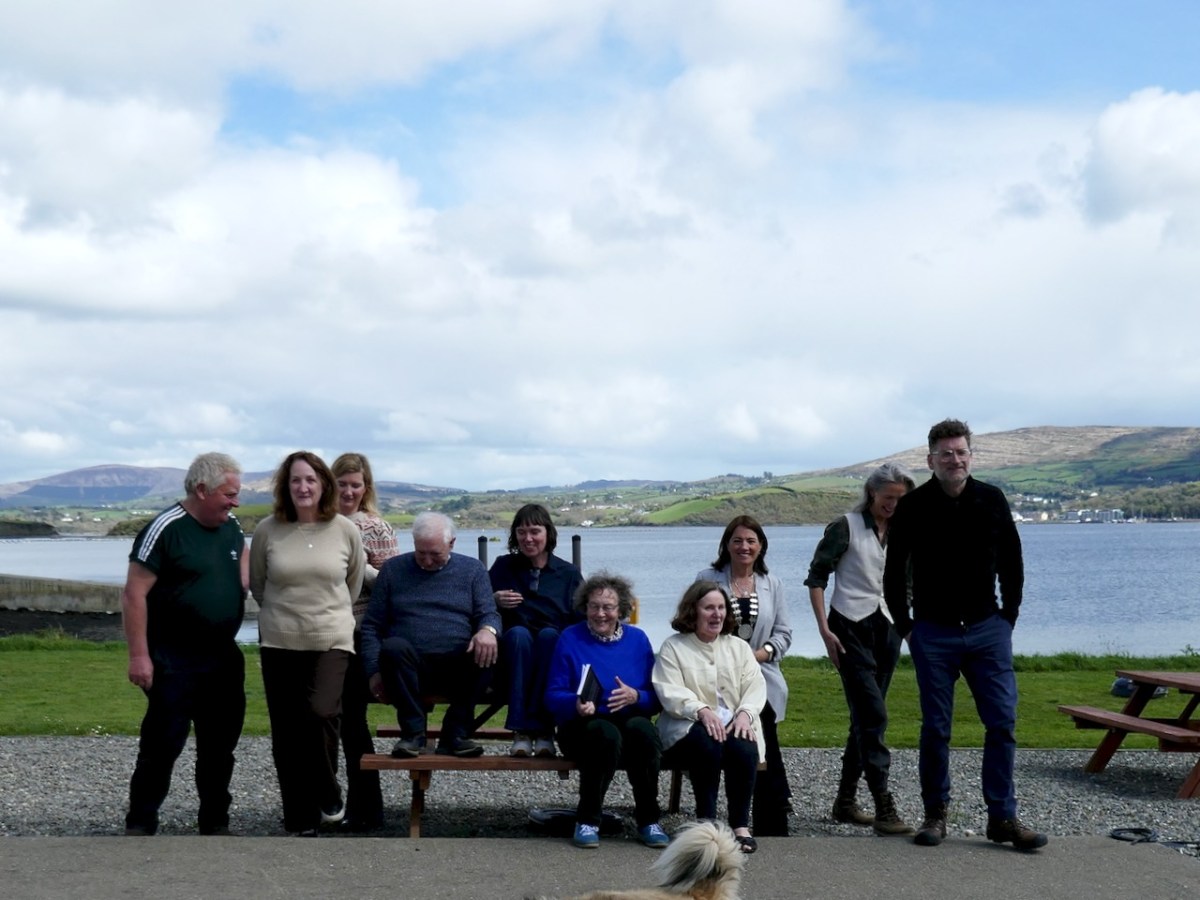
These are all stories collected from the inhabited Islands of West Cork. As you will remember from my series on the Skeams, life revolved around the sea, working the land, and keeping animals and birds. Danny O’Leary (below) talked about his life on the sea. He gave up a place in UCC to go picking winkles. He could make a good living: They’re totally gone. There used to be crowds of people at them, all over the island.
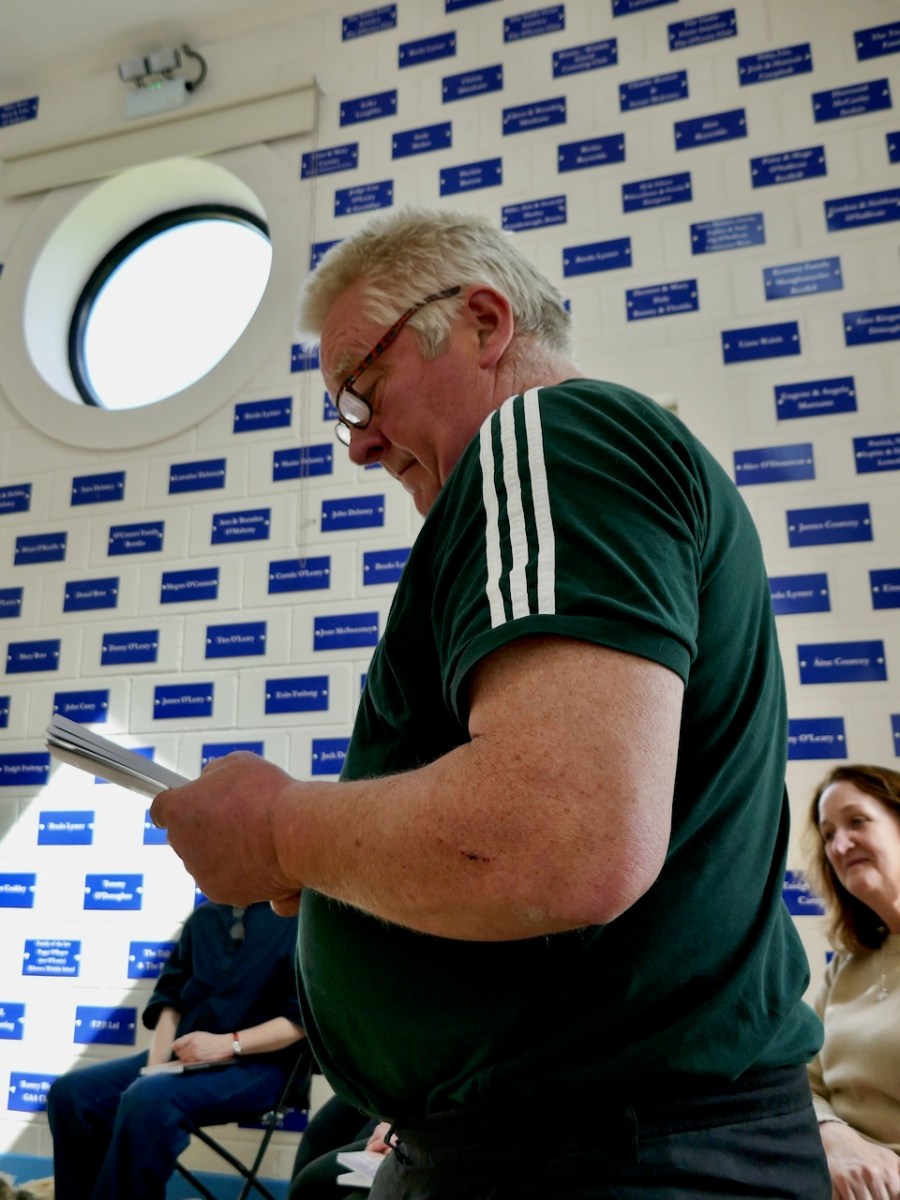
Rose O’Sullivan told us about raising turkeys.

The 8th of December was when the islanders would sell the live turkeys in Bantry and each family would have about two dozen to sell. There would be a bit of an auction in Bantry for them. Every family had their own boat to take out their turkeys for the fair. I remember our Aunt Ellie talking about the 1930s and how it was the grandest sight to see the turkeys, they’d be gathered and gobbled and headed down the road on the island and that was your money then for Christmas.

And then one or two of them would be plucked and prepped and sent to England in the post. We had two aunts in England and our mothers here would be sending the turkeys over and I once asked our cousin, “How were the turkeys when they arrived?” and he said “They were bloody green! My father would be down in the back garden digging a hole and there must have been about 20 of them buried there over the years.” Nobody had the heart to tell them this at home.

Take a look at this RTE story about the Aer Lingus’s annual Turkey Lift. I remember my own father getting the annual turkey from his cousins in Kerry every Christmas. My mother was a bit grim-faced at the prospect of all that plucking and gutting.
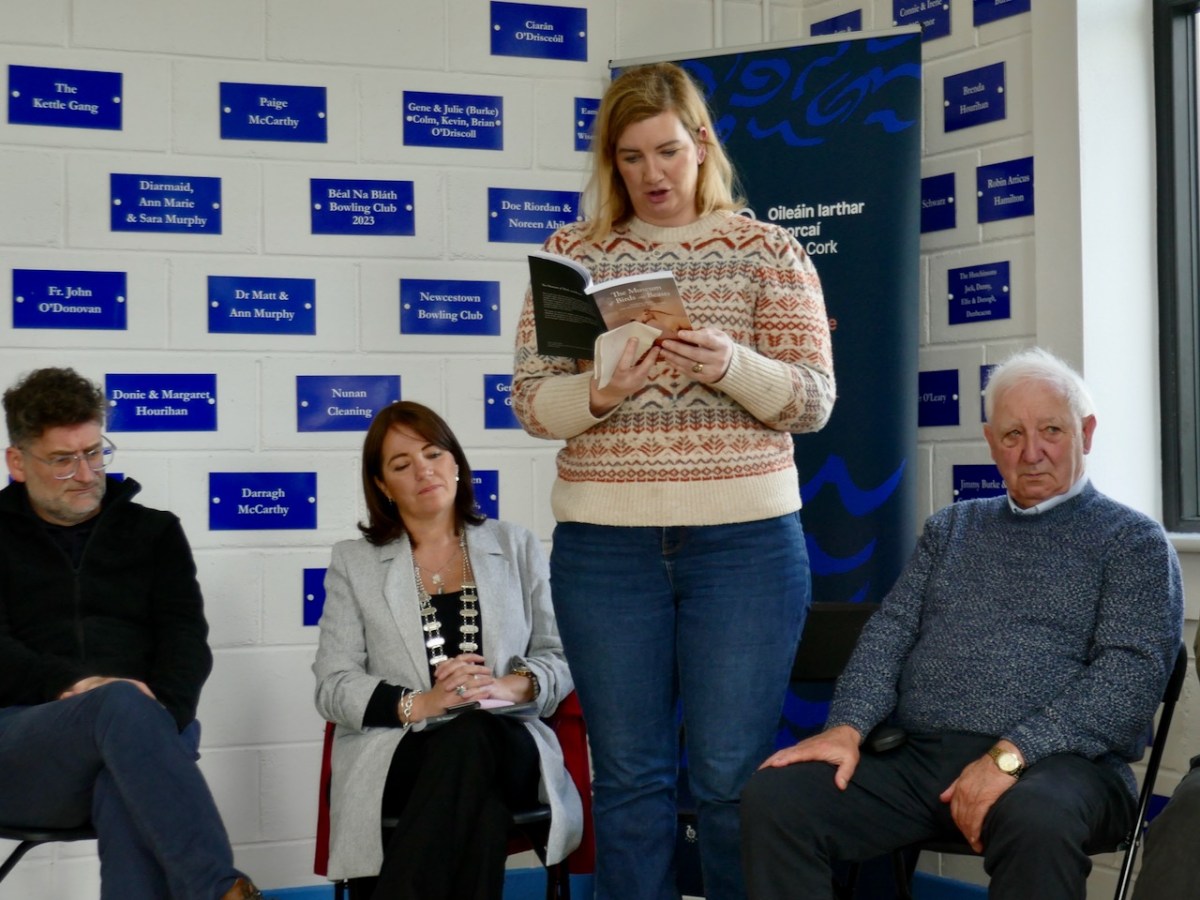
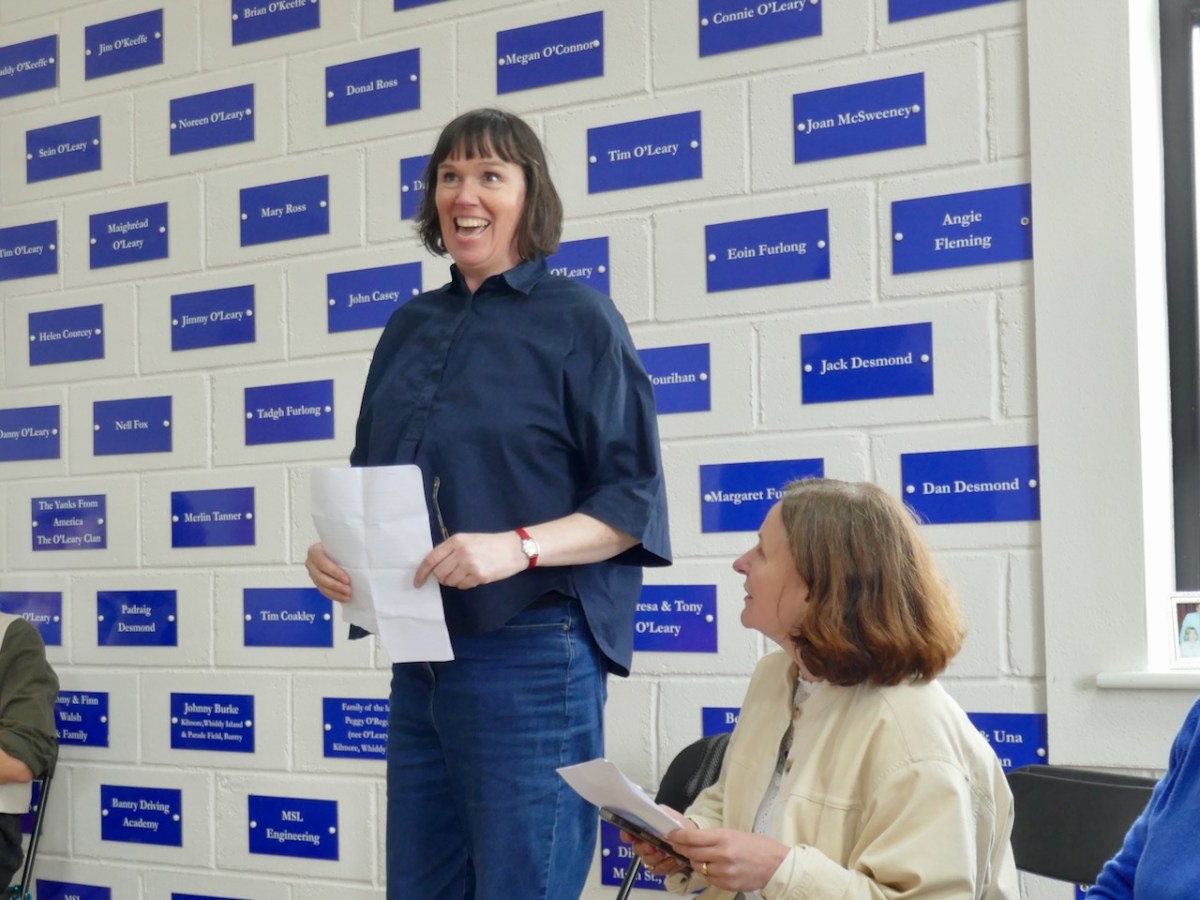
I was very taken with Sheila McCarthy’s story about being the only girl on the mussel raft. She was 15 when she started and she gave us a detailed account of what the work was like. That’s her, reading her story, above.

Even though I was the only girl, I was the tallest on the raft, so I was always given the job of tying on the socks. I would be lying flat on my belly on the wooden raft leaning over into the bay tying the socks on. I’d have two lads sitting on my legs to make sure I wouldn’t fall in. I couldn’t swim either. There was no health and safety then! it was great fun but looking back I wonder how in the name of God we were allowed to do itI

If you want to know what the socks were, you’ll have to buy the book! It’s an absolute delight – the charm of it lies in its authenticity and the true voices of the islanders. It’s the kind of book you will keep by the bedside and dip into, marvelling and chuckling as you do so. You can get it at the wonderful Worm Books in Schull – they will be happy to mail it to you if you aren’t lucky enough to live here.
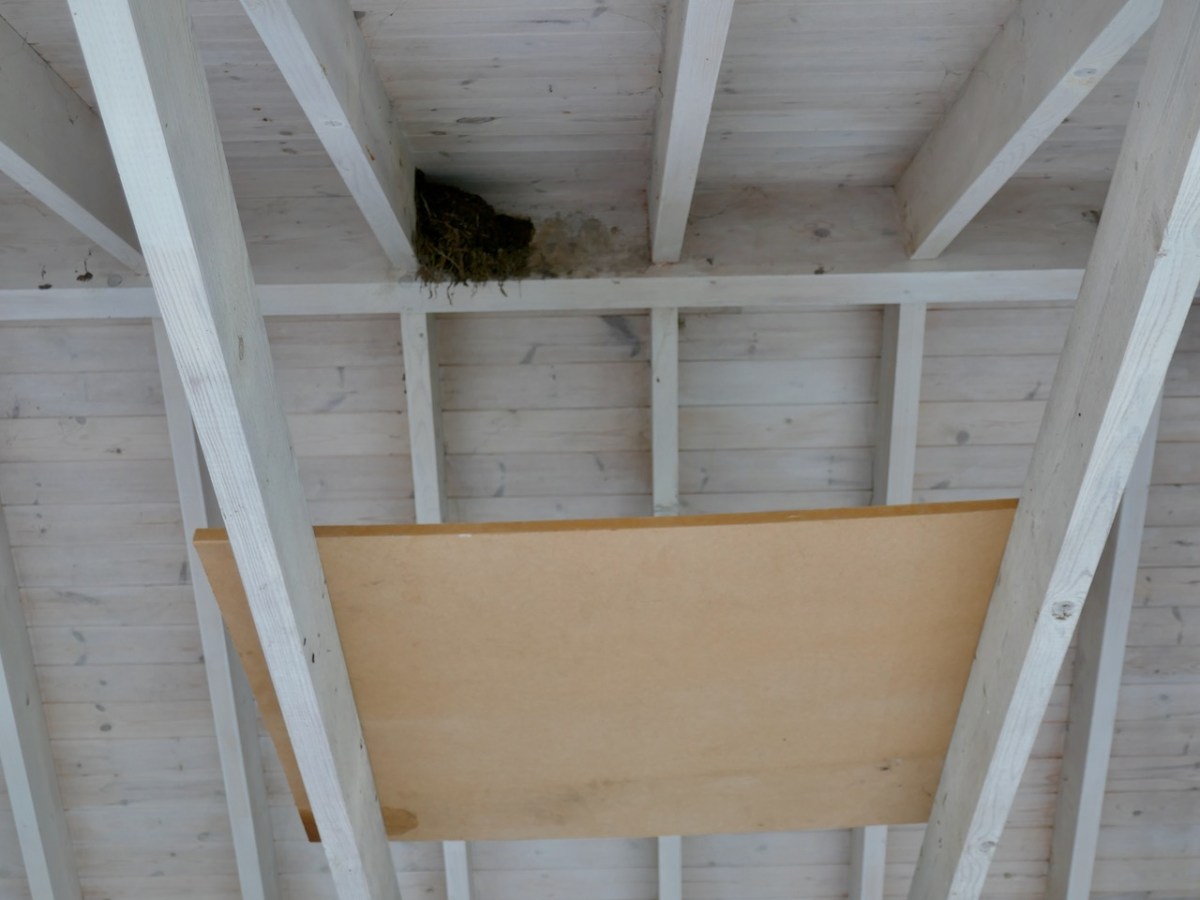
Now – back to the swallows. You will be relieved to hear, I know, that I have a simple and elegant solution to the droppings. I found a board in the attic and dragged it down. It was heavy, but I had your voices in my head, urging me to do what I could to ensure the swallows could stay. I then hauled it up a stepladder (the effort!) and placed it carefully across the beams under the nest. Voilá! Are you happy now?
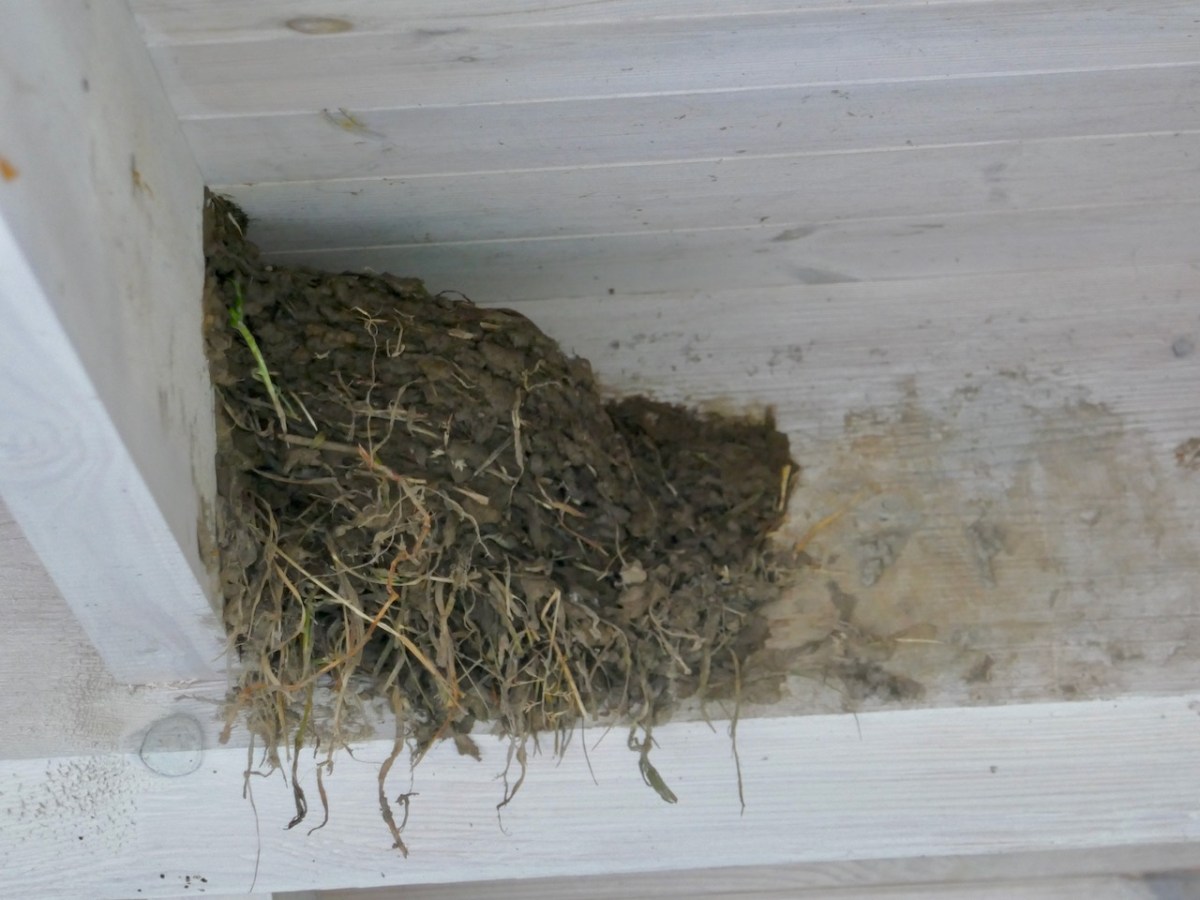
The swallows are.  They are busily stitching and attaching and adding twiggy bits. There was high drama today as they saw off a Magpie with much swooping and twittering and dive-bombing. 
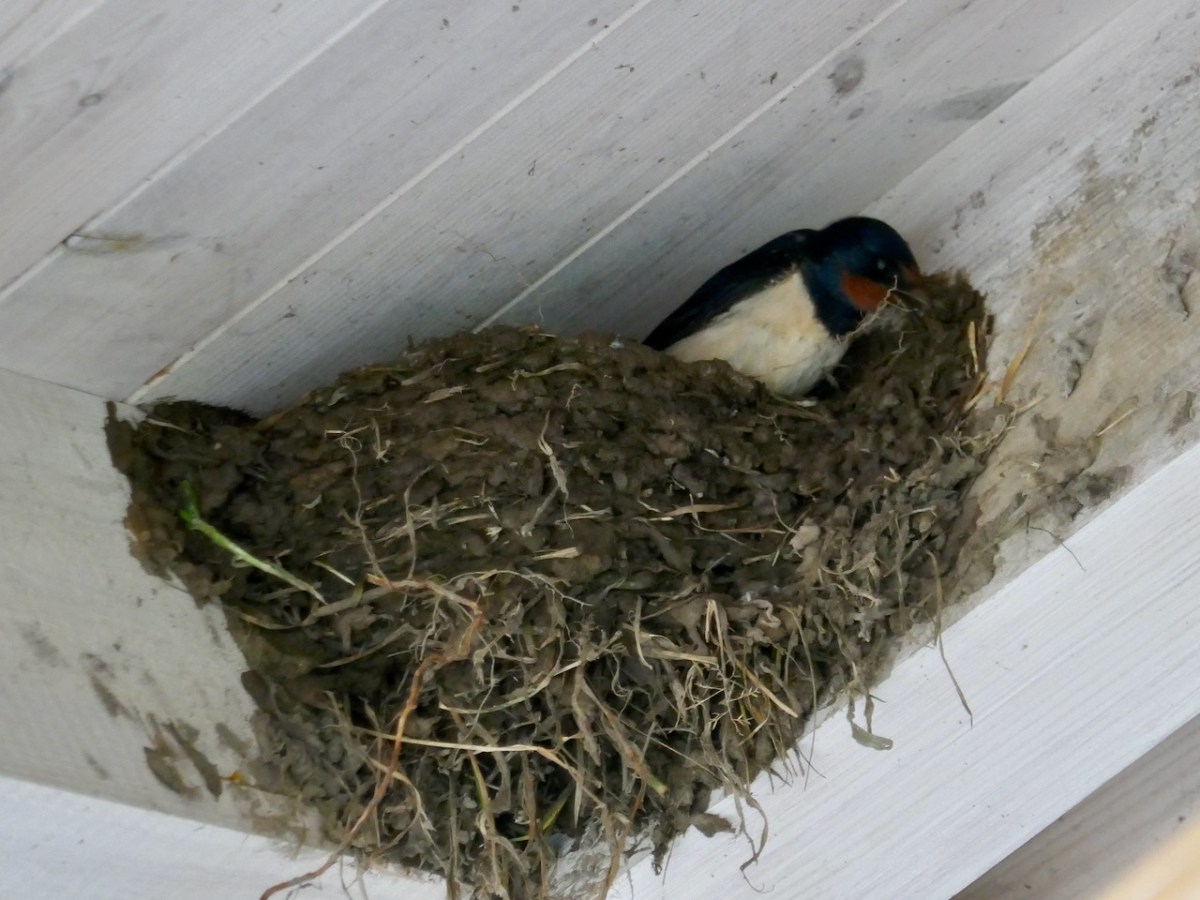
Himself appears to spend most of the time in a lordly surveying of the area, while Herself is busy gathering and constructing. However, all my sources say they work together to nest-build so I am probably projecting feminist sensibility onto my observations. 
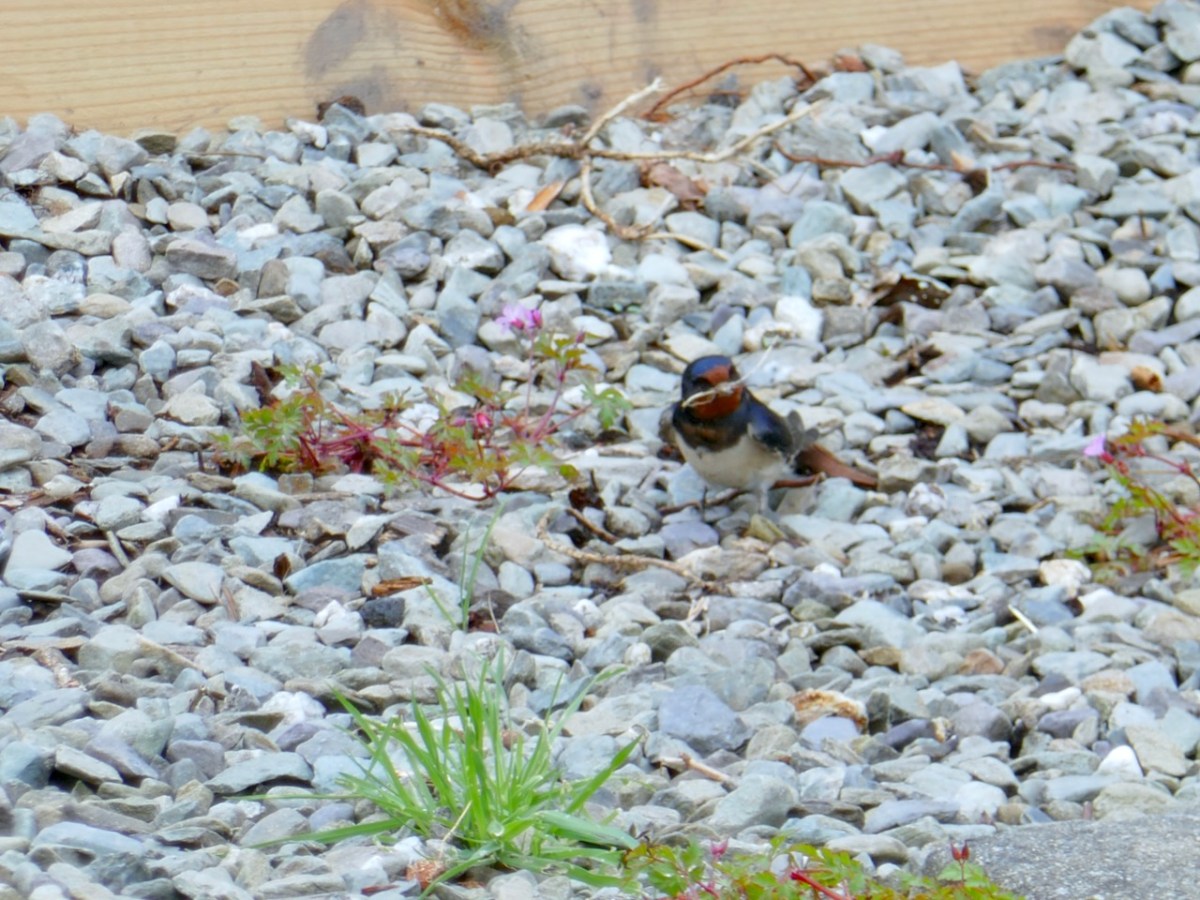
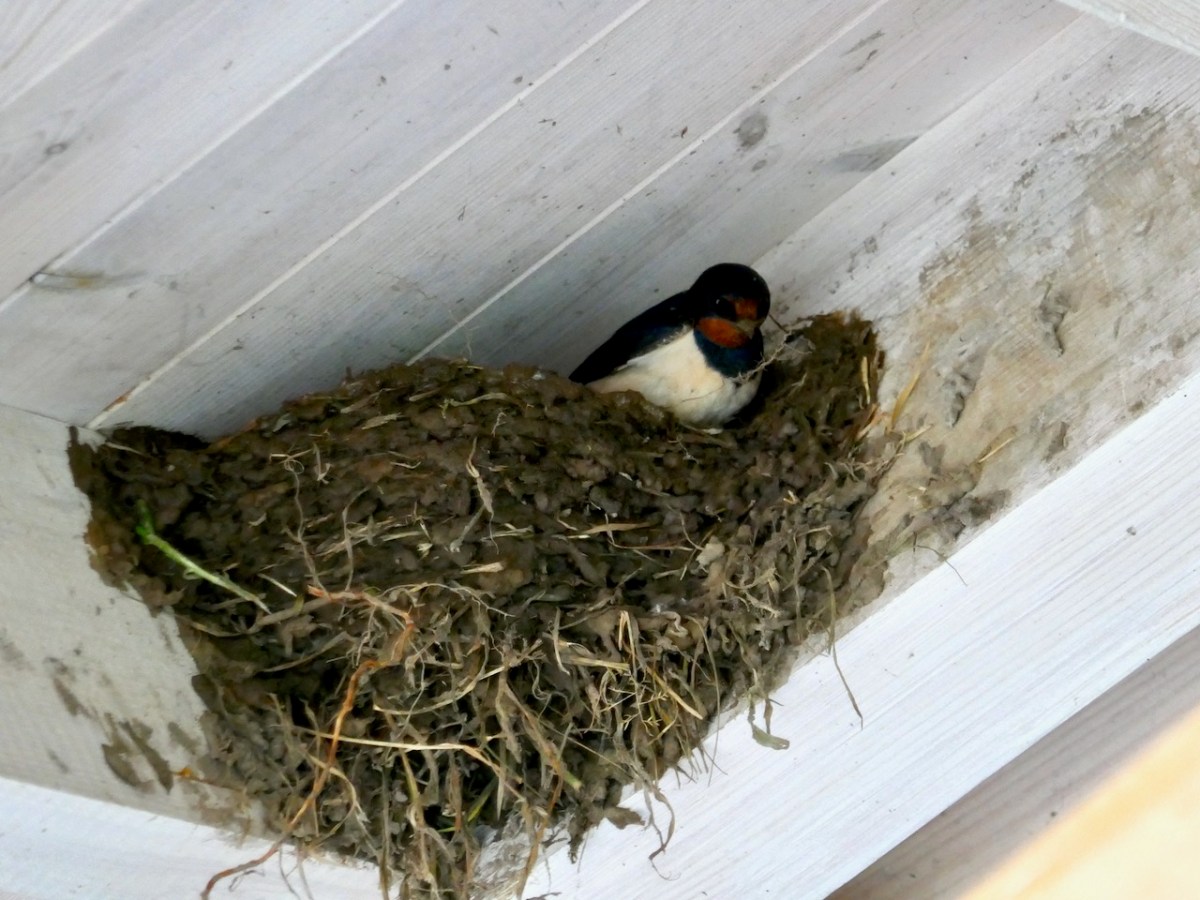
I sat in there for a while today and was glad to see that my presence did not deter them from their work. This all bodes well for a peaceful cohabitation. I hope to announce the nestling count in due course.
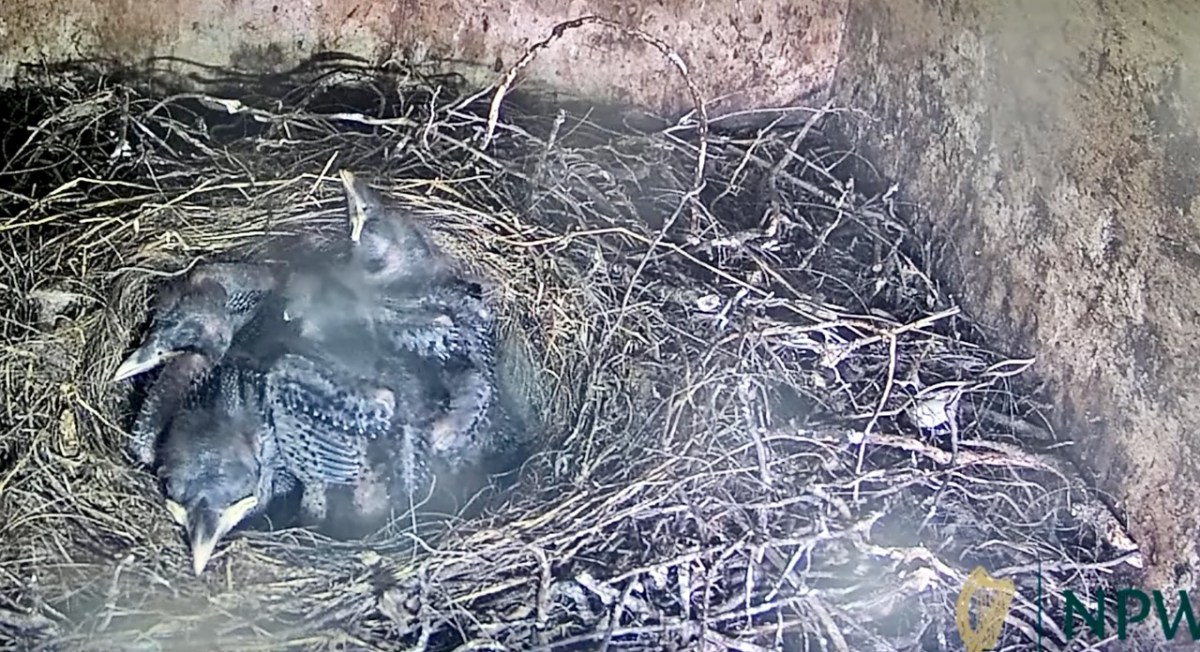
And if you can’t wait for that, why not tune in to the live camera trained on the Chough’s nest, not too far from here. There are four babies, all curled up together – but watch for the electric moment they sense Mum arriving with food. 
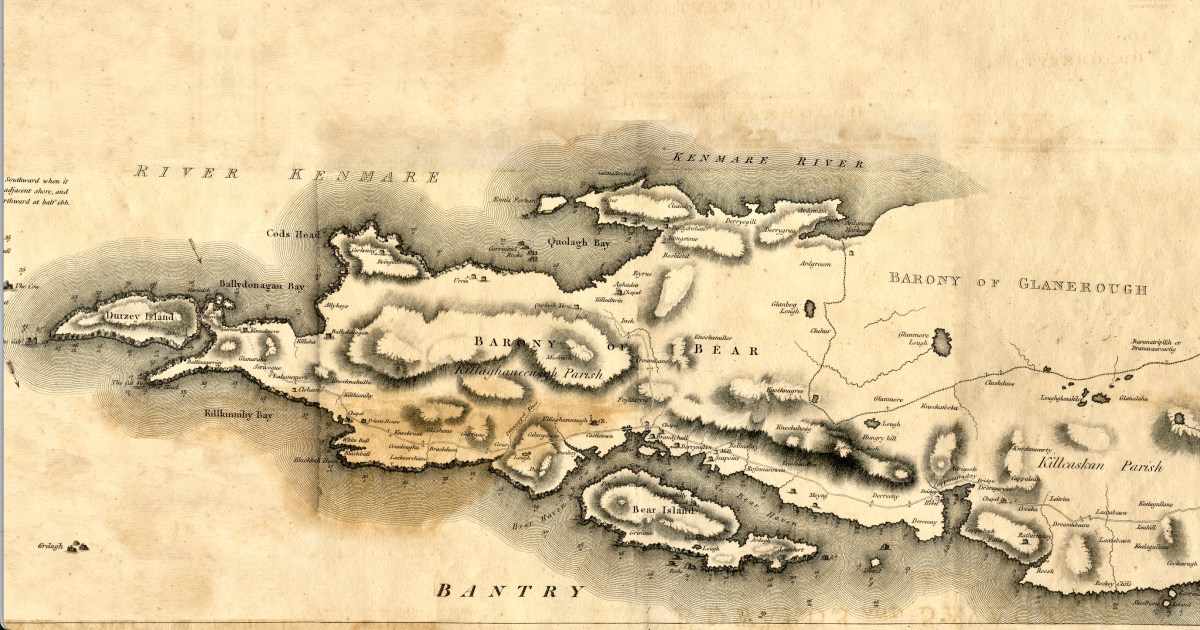
The 1811 Grand Jury Map of Cork by Neville Bath: Part 3, Sheeps Head, Beara and Bantry

I”m going to try to be slightly less detailed this time (I find that hard!) or we will never explore the rest of Cork. This post will concentrate on the area north of the Mizen – our two other peninsulas, Sheeps Head and Beara.

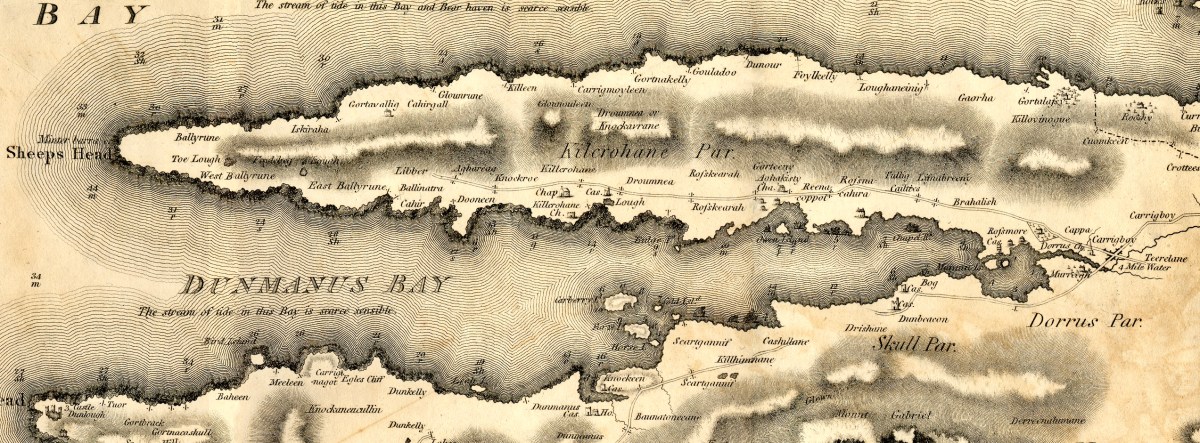
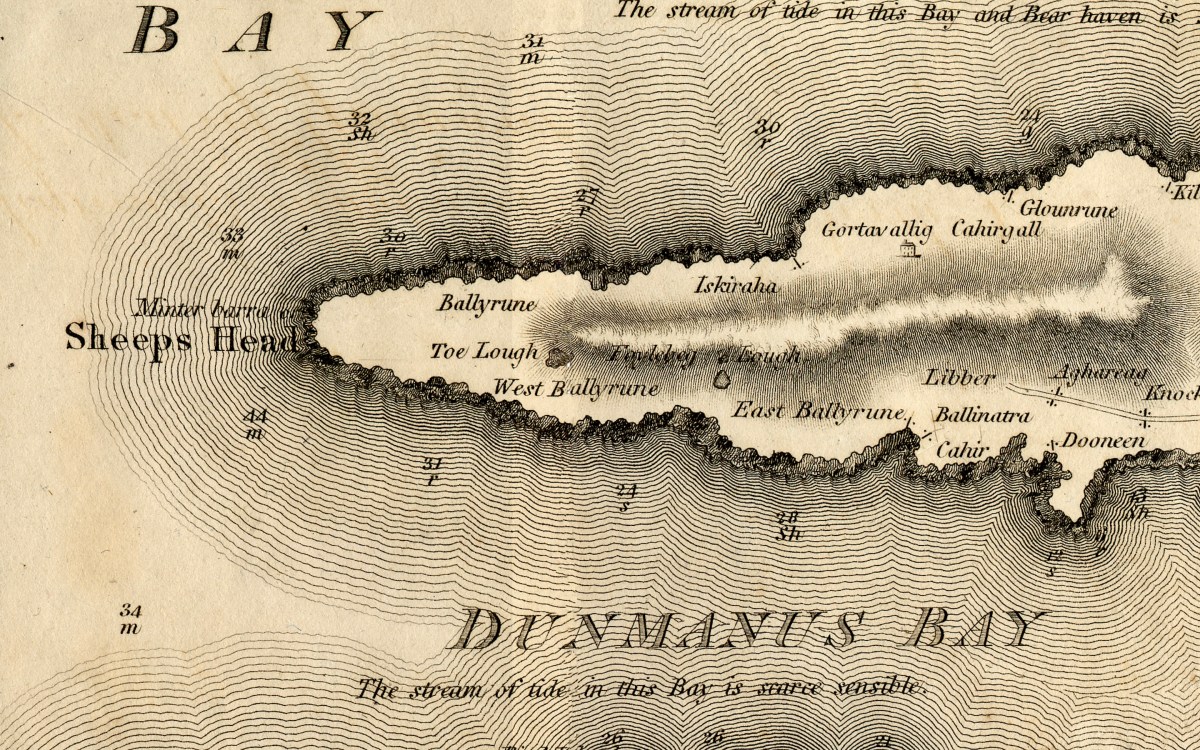
Sheeps Head (and it has an apostrophe in some maps and not in others, so I’m leaving it out) is given here as the head at the westernmost extent of the peninsula. But of course, we now call the whole Peninsula Sheeps Head. Or, if you prefer, by its Irish name of Muintir Bheara (Mweenter Varra) which means, confusingly, the people of Beara.

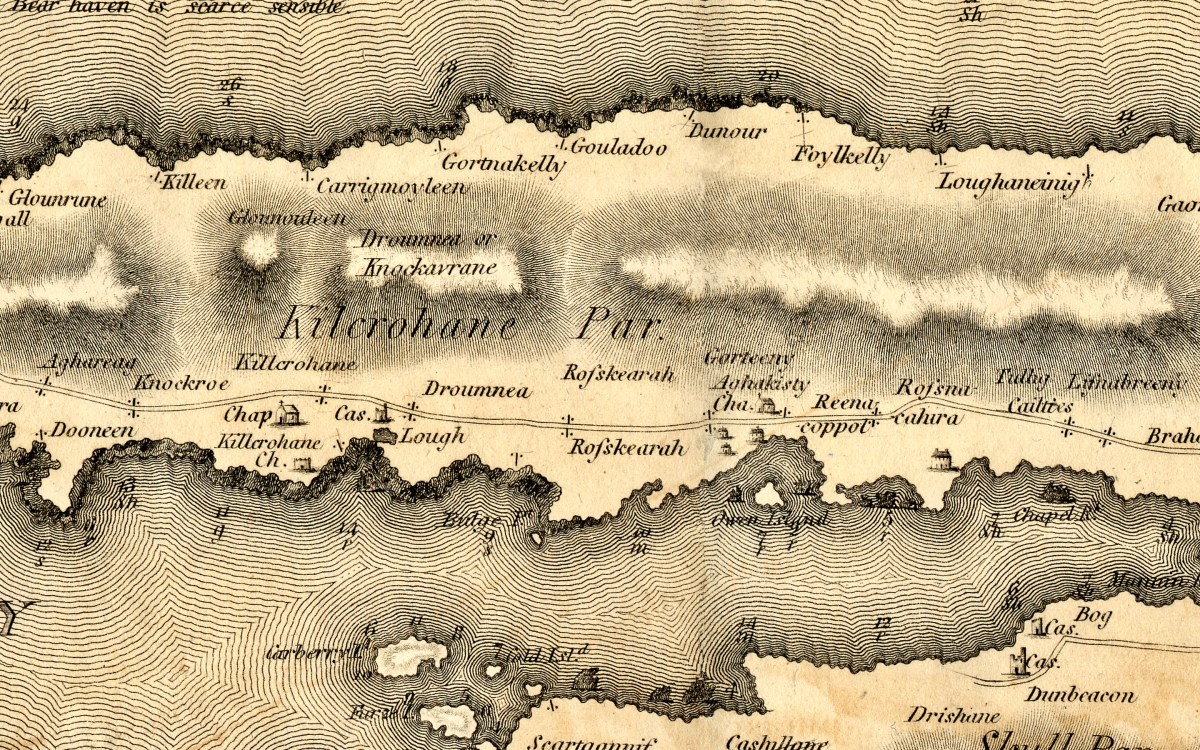
Besides a single house at Gortavallig, the only words on the east end of the map refer to placenames. The road does not extend beyond Dooneen. Nowadays, of course, this is a well-walked, prize winning set of trails that will bring you off road for the most part into wild and scenic country.

KIlcrohane and Ahakista have churches and chapels but no real communities in the 1790s. The castle near Kilcrohane is the vestigial one built by the O’Daly clan, the famous bards, at Lake Farranamanagh. There are no roads on the north side, and none crossing the Peninsular.

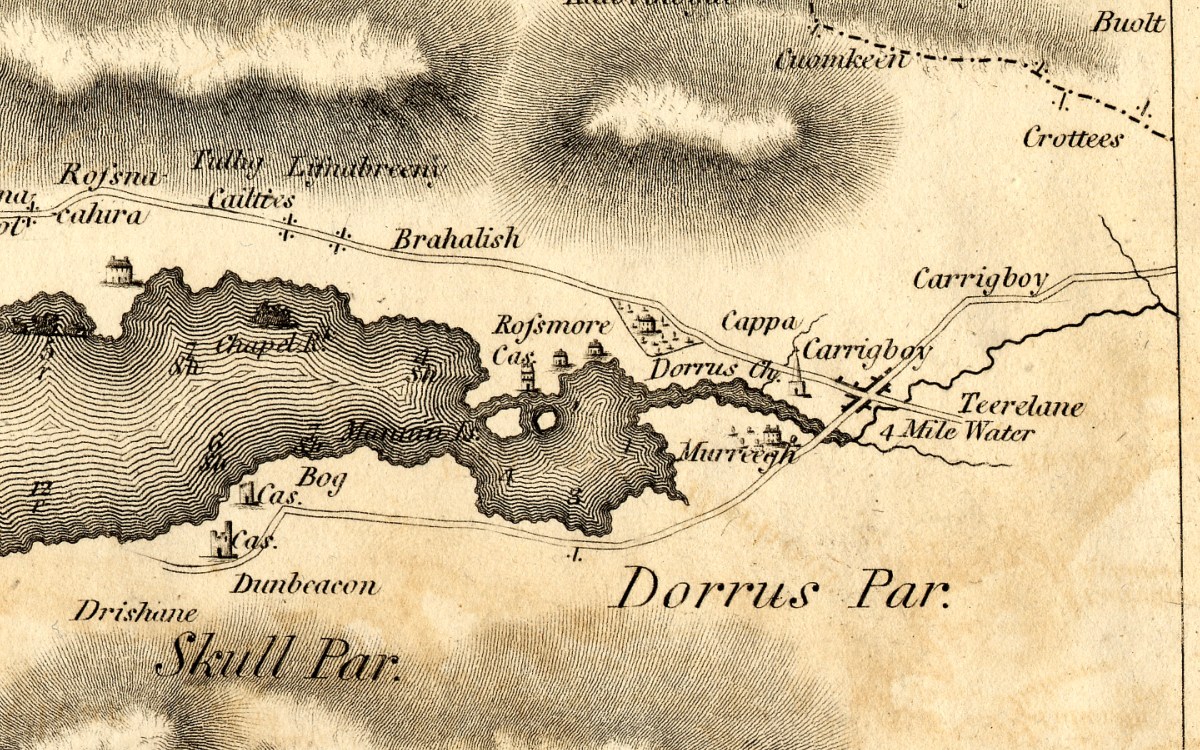
At the head of Dunmanus Bay is Durrus, shown as a community with a steepled church. The small treed estate is Durrus Court, where the 17th century manor house is still standing. The remains of Rossmore Castle can also still be seen. But here’s an interesting thing – there are not one but two castles shown at Dunbeacon! Very mysterious – there is certainly no sign of a second one now, and nothing in the archaeological record.

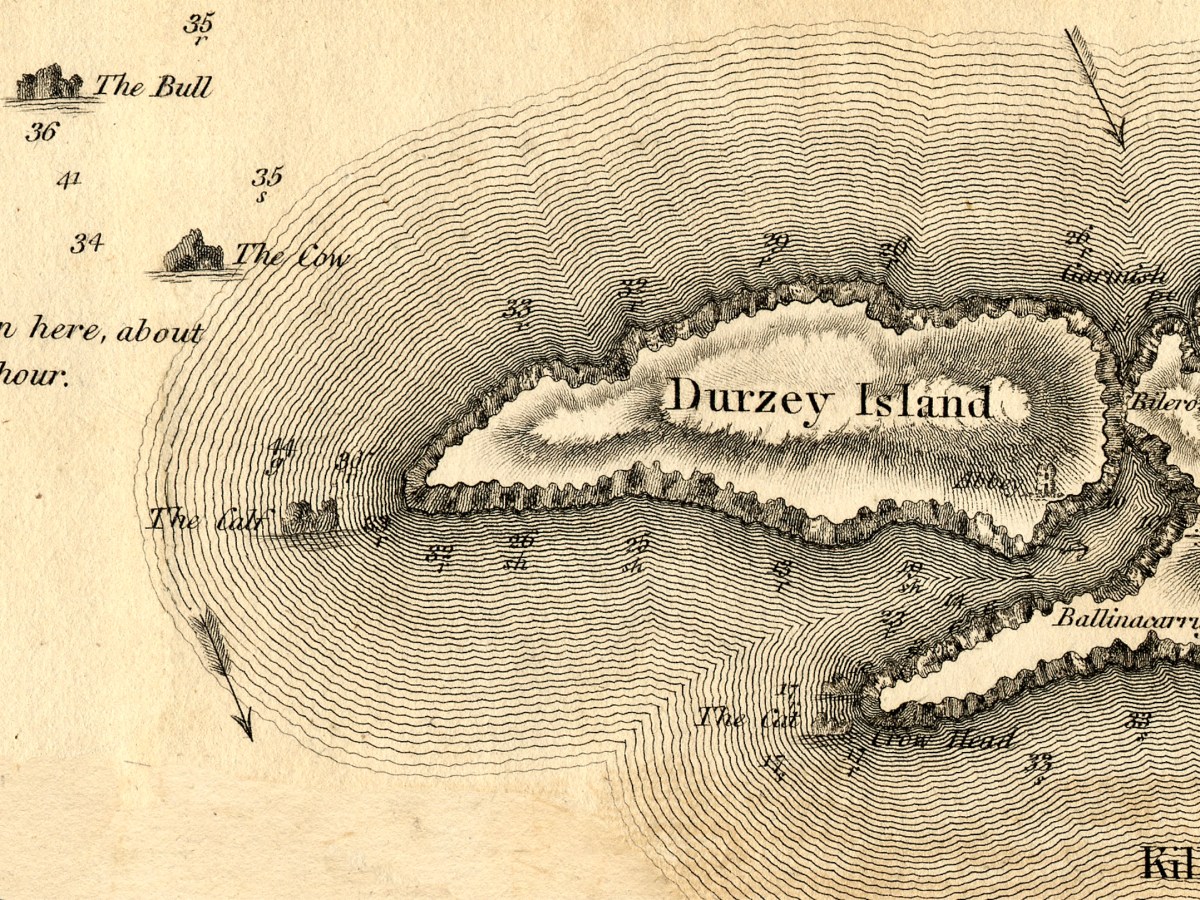
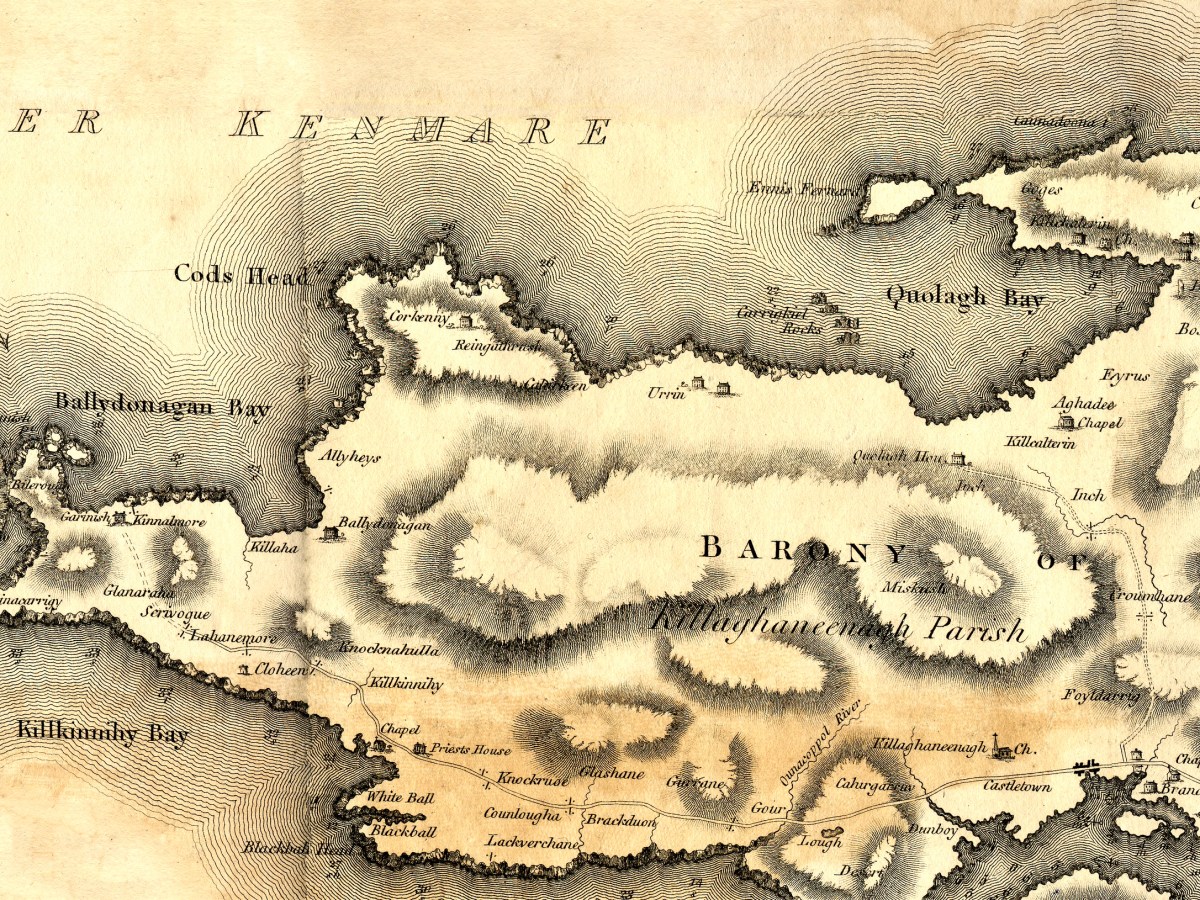
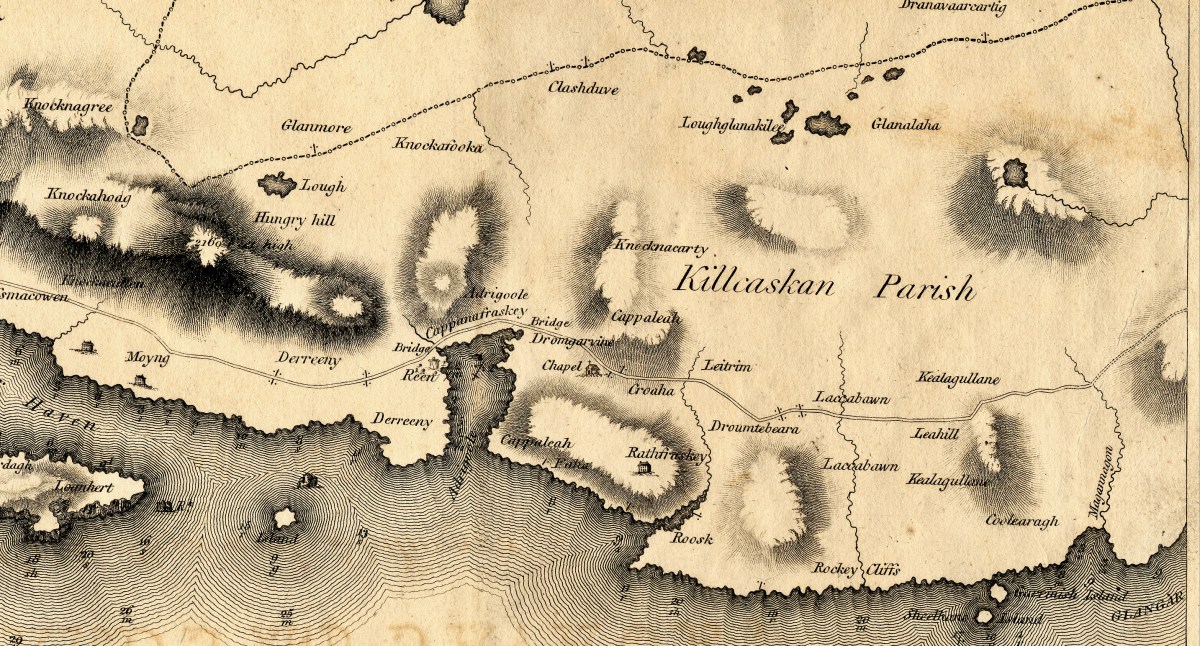
Let’s leap now, as Fionn MacCuamhaill might have done, to the next peninsular up – Beara. The full extent of it is shown in my lead photograph, and above is the eastern end and specifically Dursey Island. The Calf Rock is offshore, with the Cow further put and the storied and spectacular Bull Rock further out again. I do plan to visit it one day! Dursey is the only place in Ireland that you get to by cable car and has a tragic history. An Abbey is shown on the eastern shore. National Monuments tell us that “According to the soldier-writer and native of Dursey, Philip O’Sullivan-Beare, writing in 1621, it was a ‘monastery, built by Bonaventura, a Spanish Bishop, but dismantled by pirates'”.

The western end of the Peninsula is mountainous. A road extend along the southern side but not the northern. This is one of the few places in Ireland we have a very old map to make comparisons. Take a look at my post Elizabethan Map of a Turbulent West Cork and Elizabethan Map of a Turbulent West Cork 2: The Story, for a lively take on mapping this part of Ireland 200 years earlier.

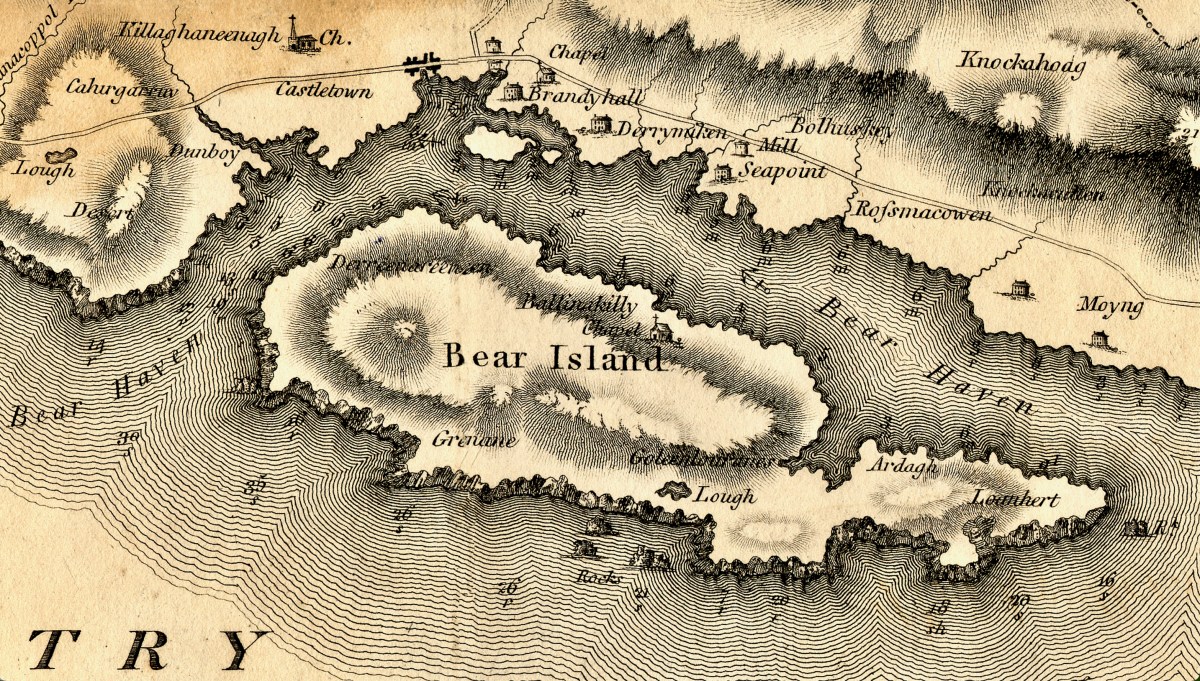
Bear Island is featureless apart from a chapel but Castletown (more properly known as Castletownbere or Castletown-Berehaven) is shown as having a town or village and several substanital houses, a mill, and a church with a steeple. Interestingly, the castle at Dunboy, the siege of which is chronicled in the older map, is not shown at all in this one.

Moving eastward, very little human activity is noted on the map, but Hungry Hill is there and Adrigole Harbour. The dotted line marks the division between Cork and Kerry.

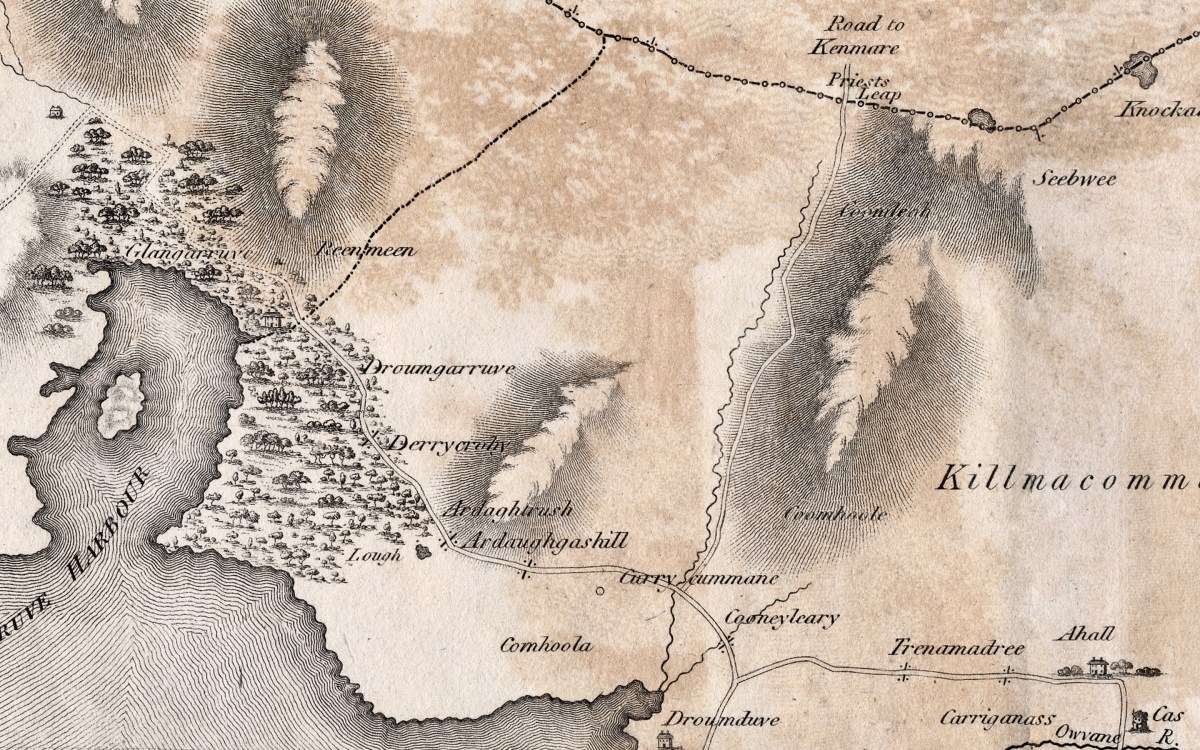
Then, there seems to be a bit missing – Glengarriff (or here, Glengarruv) Harbour is surrounded, then as now, by substantial forests. The only road to Kenmare at that time was the Priest’s Leap, even now a death-defying and vertiginous climb.

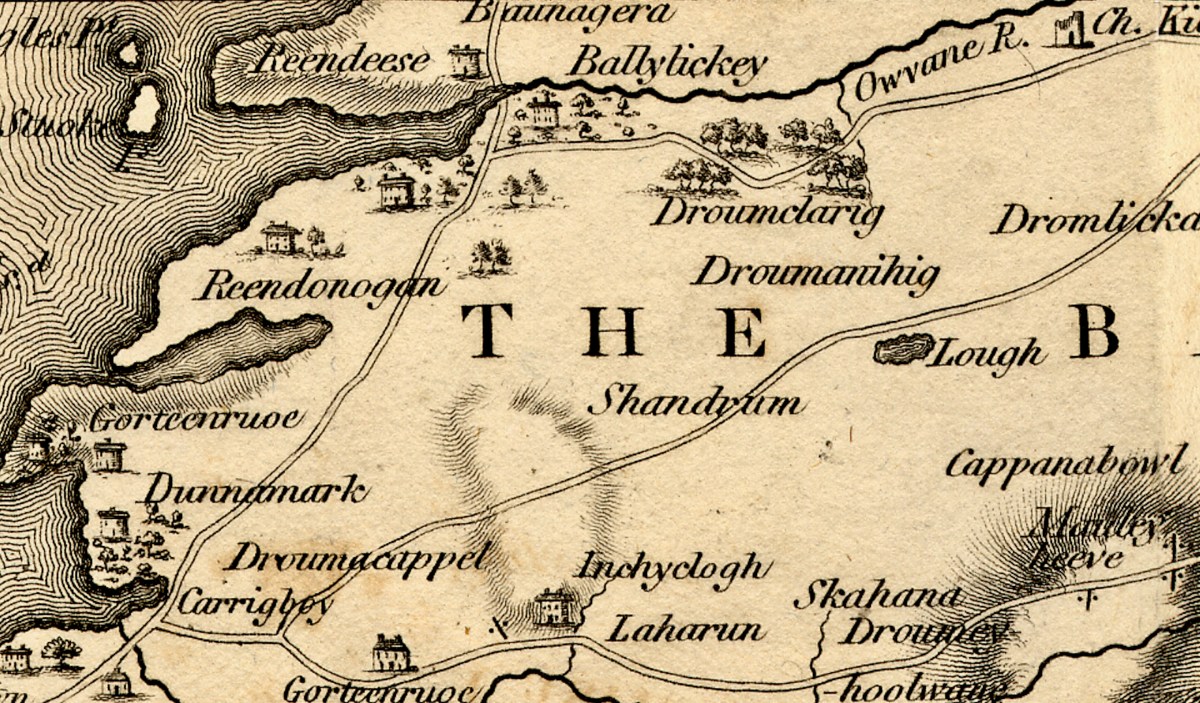
I’ve blown up the Ballylickey section as it holds particular interest for me – here depicted is the home of Ellen Hutchins! There’s a large house, surrounded by trees, on the banks of the Ouvane River. This is especially exciting as Ellen was living here at exactly that time! Born in 1785, she was botanising and making all kinds of discoveries until her untimely death at only 29 in 1815. After the sparsely annotated Peninsulas, it’s interesting to see more houses noted as we near Bantry.

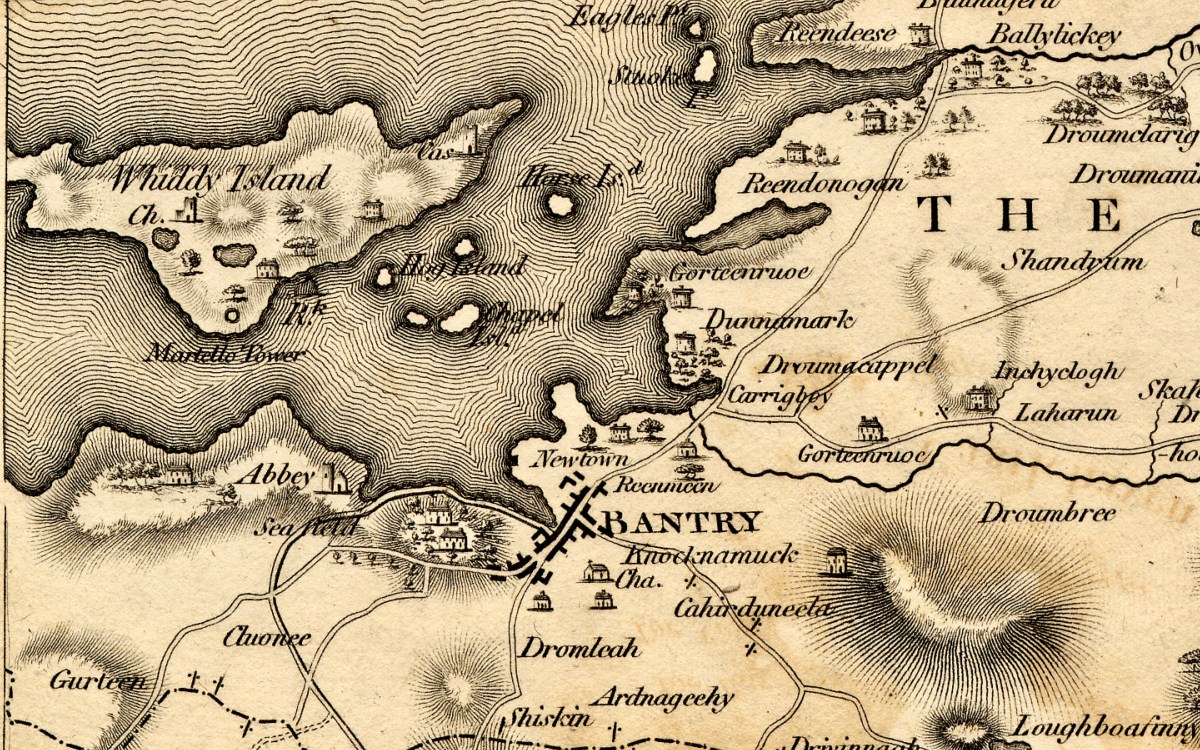
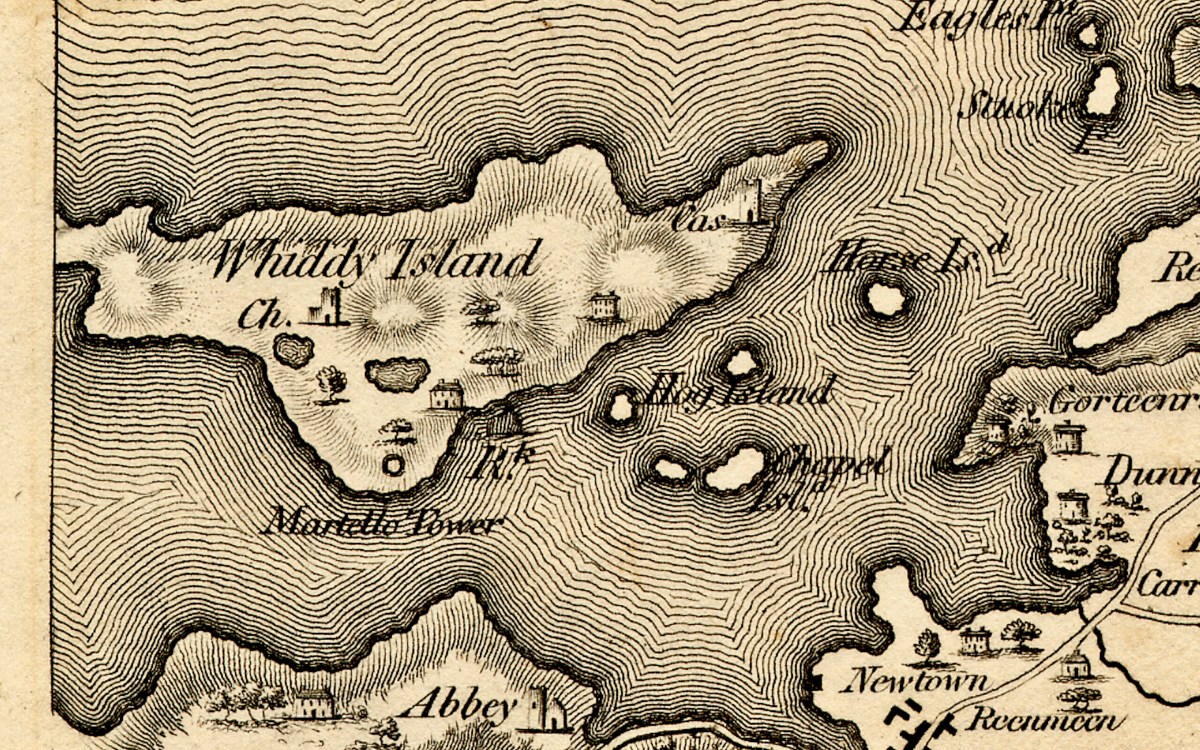
Bantry is shown as a large town – with Bantry House, built on the early 1700s, dominating the landscape just as it does today. The Abbey has disappeared (it was a Franciscan establishment) but has given its name to the Abbey Graveyard at the southern end of town. We’ll finish with Whiddy Island and a genuine mystery – note the Martello Tower (below). There were actually three circular fortifications constructed on Whiddy after the abortive invasion by the French in 1796. Known as the West, East and Centre Batteries (or ‘redoubts’); this is probably the Centre one. They were very solidly built and can still be seen.

We know this map was done in the 1790s, and these redoubts, like the Signal Towers dotted along the coast, were built to warn of another French incursion and to defend Bantry Bay. The signal towers were built around 1804 and abandoned by 1815 after the Battle of Waterloo. None of them is noted on the Bath map, consistent with our understanding that the Cork map was completed in the 1790s. Martello towers date to the same period – the first of them were built in 1804, mostly along the east coast. The only actual Martello tower in this area is on Garnish Island. It was built in 1804/5 and does not show up on the island in the Bath map – see Glengarriff Harbour, above. The Whiddy Batteries are shown on the National Monuments records as dating to 1804 to 1807. They are round – more like the shape of a martello than the tall rectangular signal towers that were built around West Cork. But was the term Martello common at this time? Might this be a later addition to the map? Although it was completed in the 1790s it was not published until 1811, allowing for the possibility of editing and changes. Anybody have any comments on this – it’s a head-scratcher!

Elizabethan Map of a Turbulent West Cork

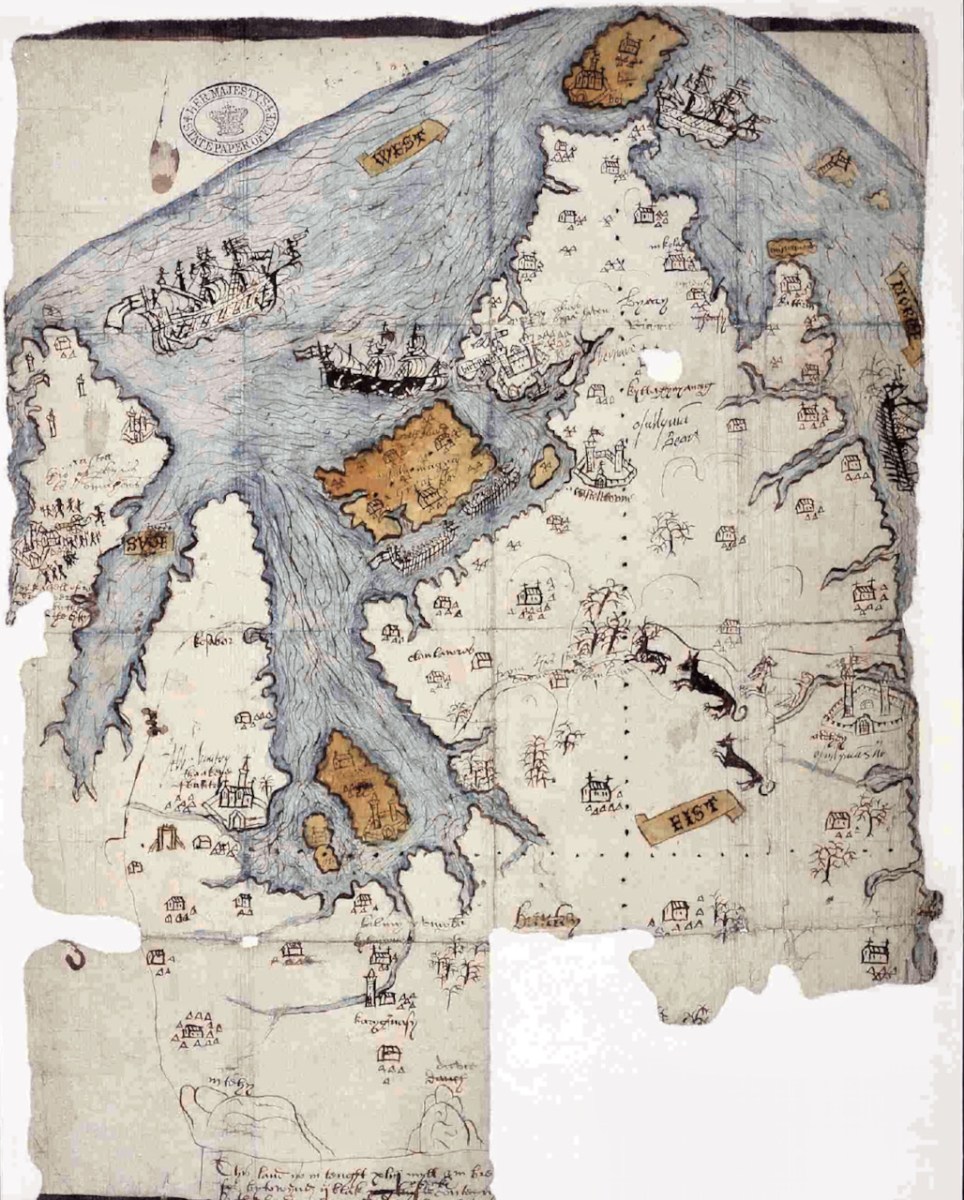
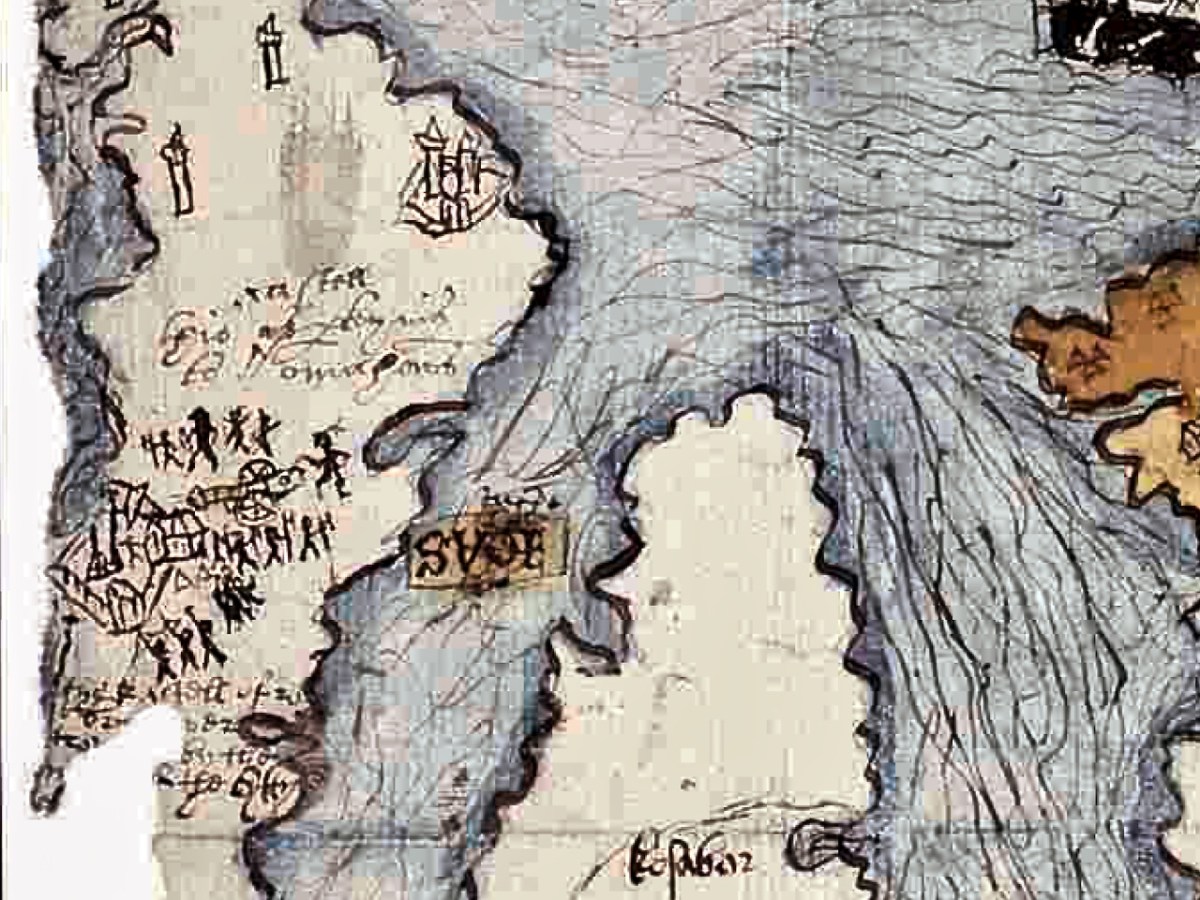
The Elizabethans were map-makers, especially if they needed information for the purpose of wars and conquests. I was first alerted to this extraordinary map of West Cork by a reference in the O’Mahony Journal (subscription needed) and then to a piece written on it for the Journal of the Cork Historical and Archaeological Society in 1958 by P O’Keeffe who labelled it a Map of Beare and Bantry. Neither of these sources had a good image of the map and so, intrigued, I sent off a request for a digital copy to the British National Archives. It arrived by return email, at no charge. What a service! (Irish national repositories take note.) Here is the complete map.

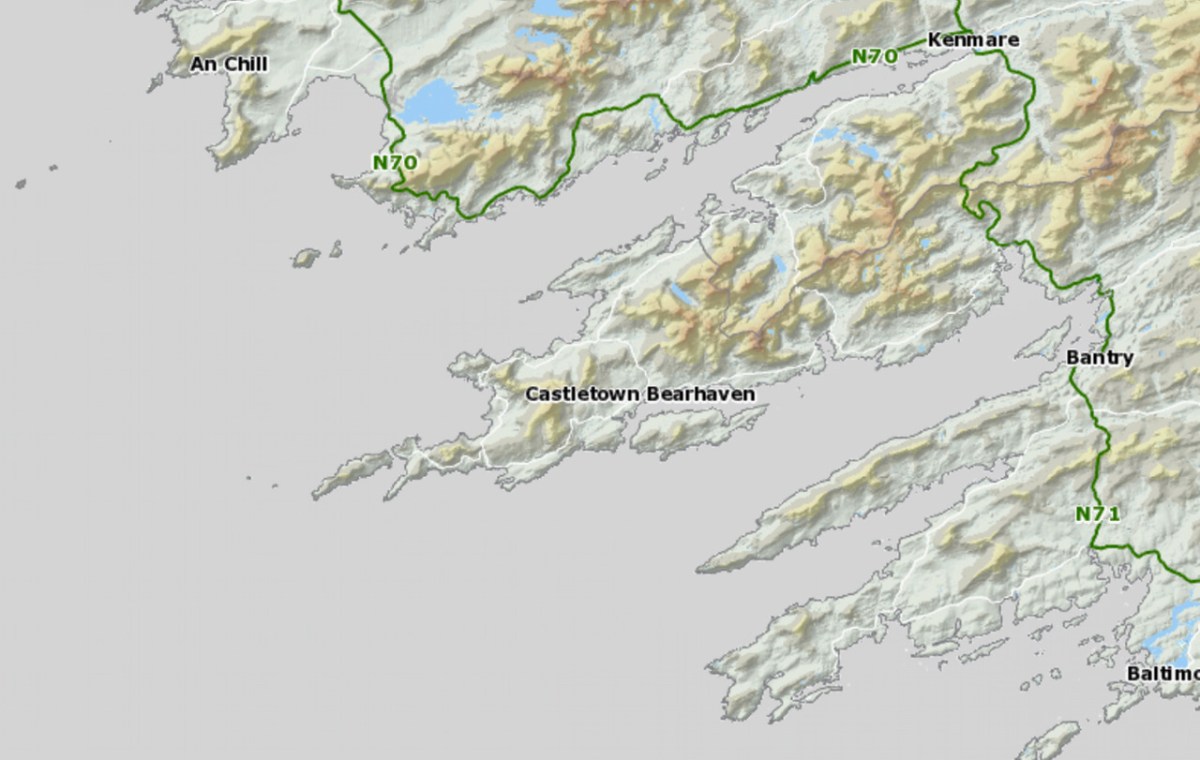
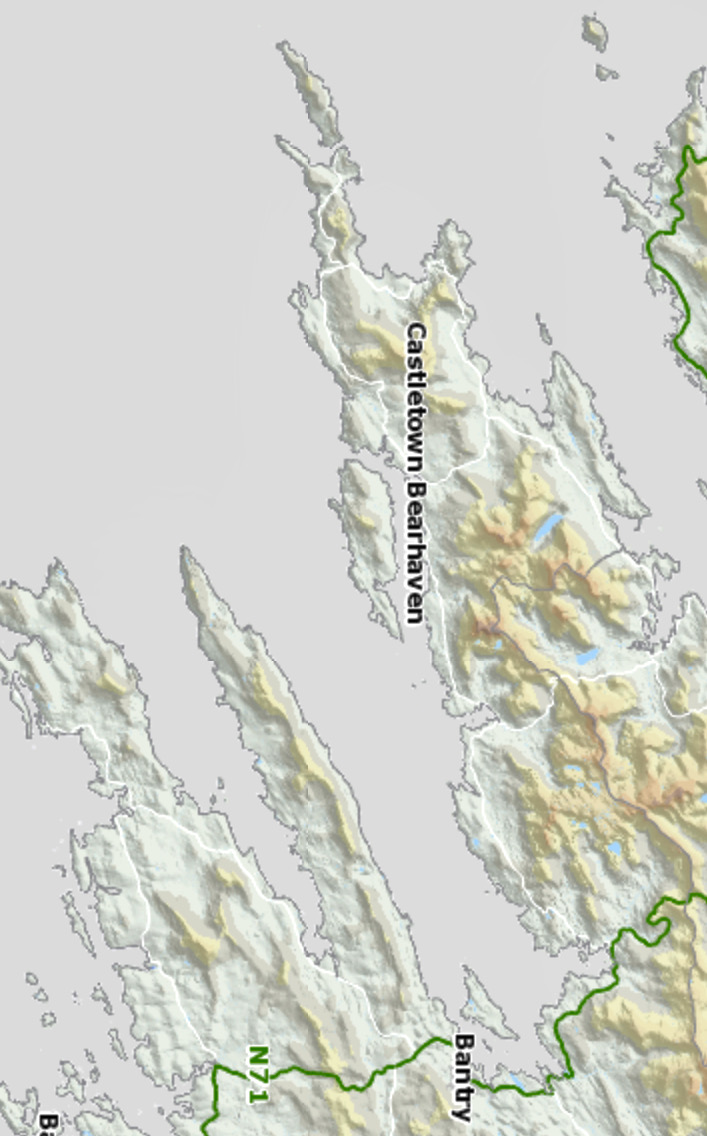
While it is clear that this map dates to the Elizabethan period, there are many questions about it: who did it, for what purpose, exactly when? For this post I want to go through elements of the map and identify, as far as possible, what it depicts. A subsequent post will deal with what is actually going on – that is, what are the actions that are being chronicled. Let’s start with the fact that the map is quite accurate. It depicts the three peninsulas of West Cork – the Mizen, the Sheep’s Head and the Beara – and the inlets in between them. It is oriented east-west rather than our modern convention of north-south, but the cardinal points are clearly identified. The map is drawn on paper, with the sea coloured in blue and the islands in brown. I have provided maps below of the same area, the first in our typical north-south orientation and the second as it is orientated in the historical map.

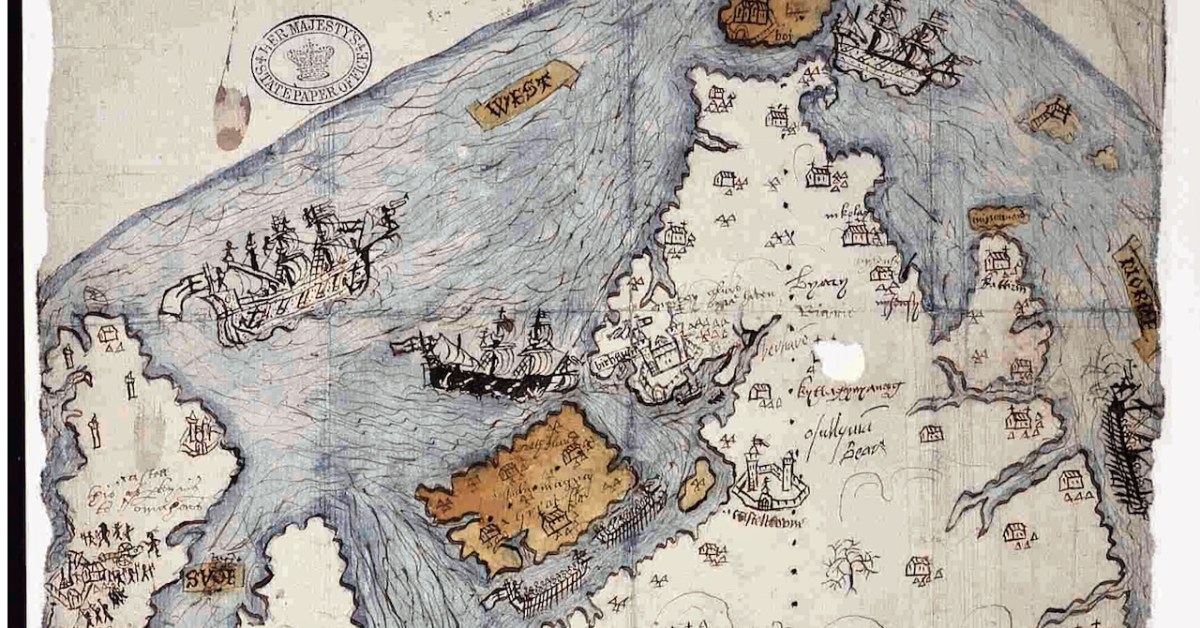
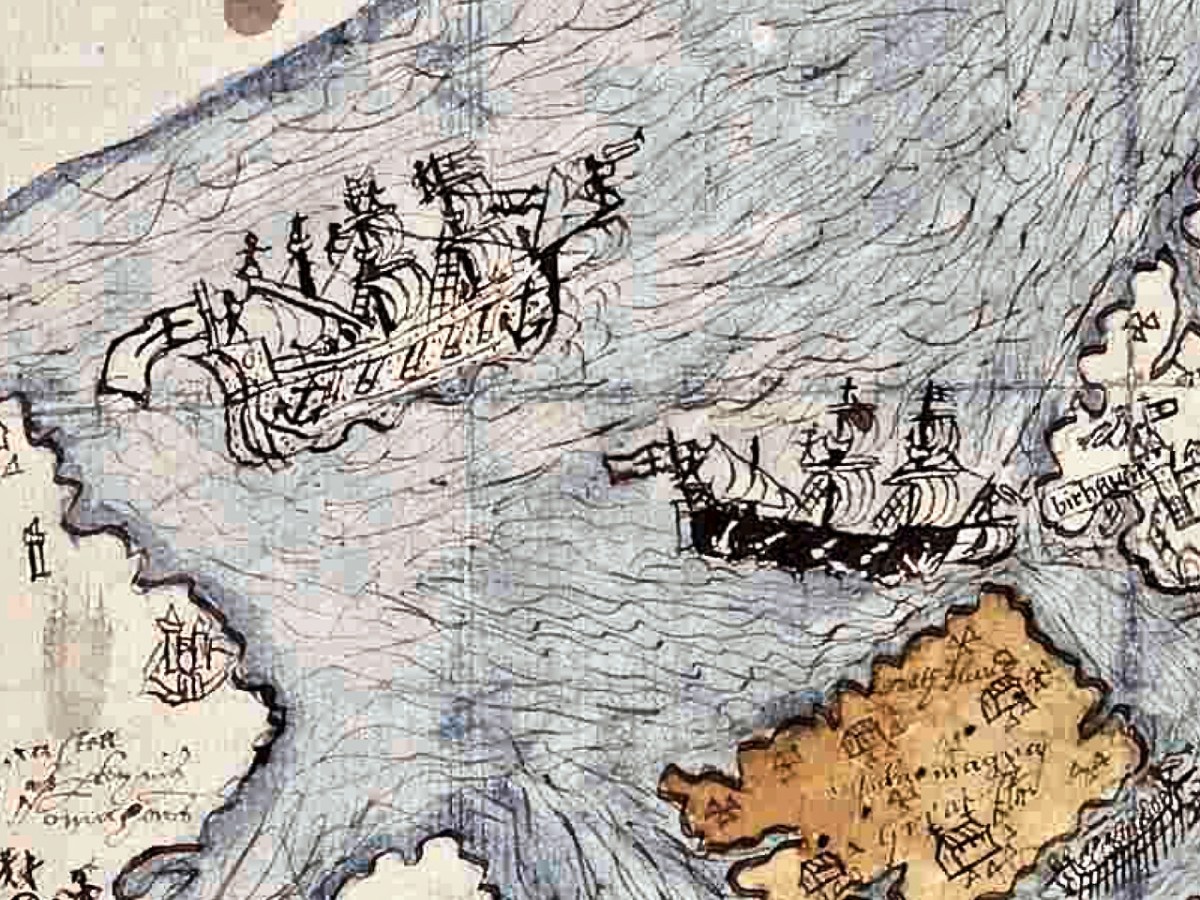
The sea is shown teeming with ships – warships and galleys. Taking a closer look at the two north of Bear Island we see two different ships, one light and one dark. Each is in full sail, with men on the riggings and in the look-outs. They have cannons emerging from the hull, a trumpeter aft and a bugler on the bow-spit.

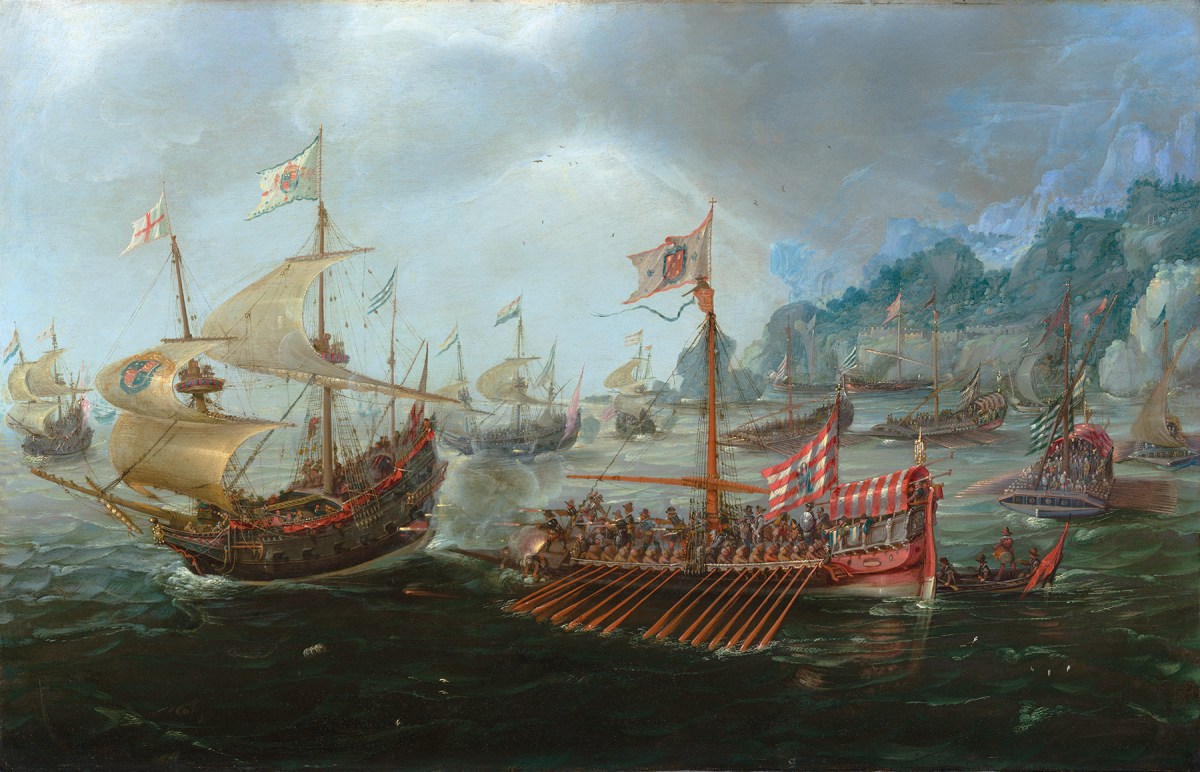
As a reference, here is a painting by Andries van Aervelt showing the kinds of ships that were engaged in The Battle of the Narrow Seas (1585) – both the full-sail warships are shown as well as galleys.

Galleys were also deployed here, shown between Bear Island and the mainland (below). The lead galley has a trumpeter on the bow, while the second galley shows a man blowing a horn in the stern and what looks like a drummer on the bow (like those ramming speed scenes in Ben Hur). The rowers were often convicts and the life of a galley rower was brutal. This map shows a single row of oars. Galleys essentially provided platforms upon which armed soldiers could shoot, and had the advantage of being more stable than sailing ships and often faster, depending on wind and swell. 

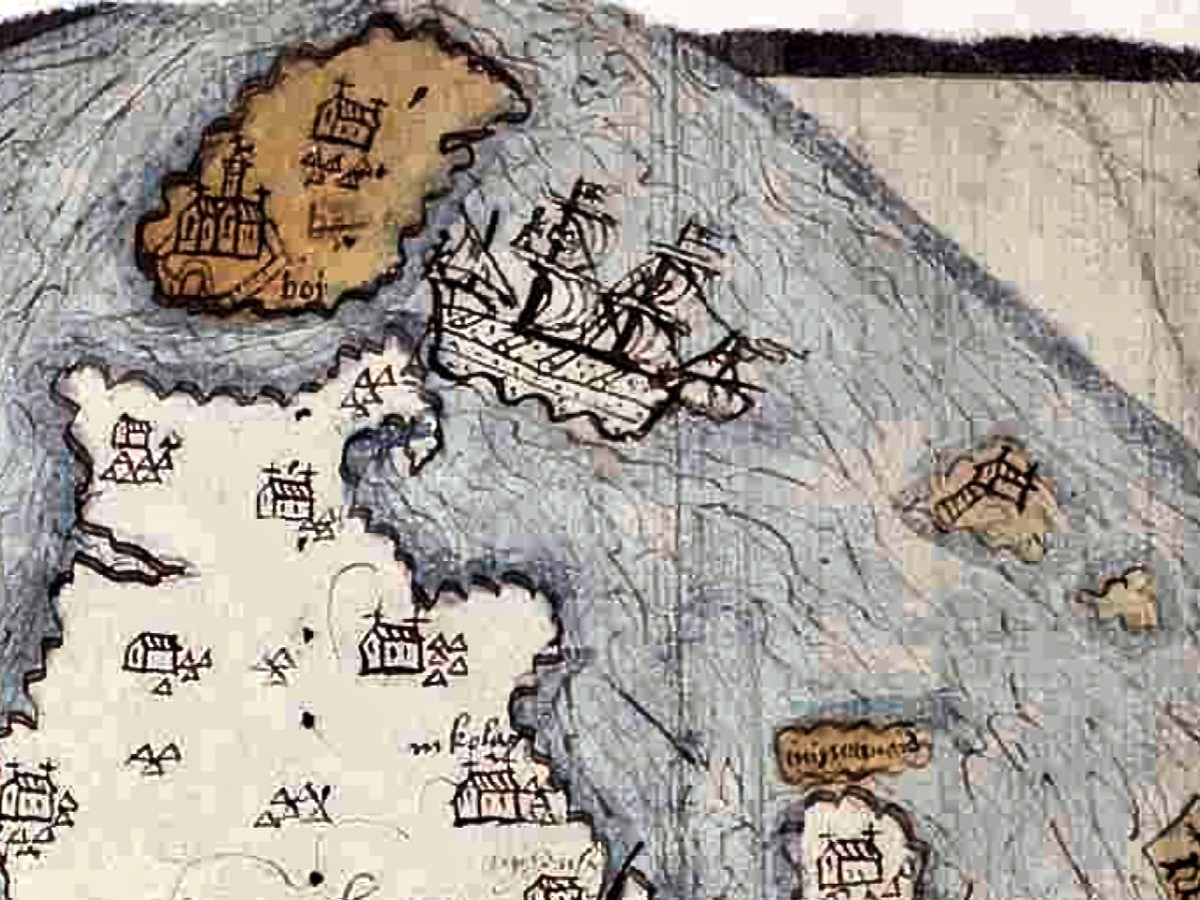
Another warship (below) is rounding the tip of the Beara , heading for Dursey Sound. Dursey Island has both a church and a castle on it. There isn’t much trace of this now, but there was an O’Sullivan castle on a small grassy peninsula on Dursey, described as two rectangular buildings with a rectangular enclosure in the National Monuments records. It was destroyed in 1602 (more about that in the next post) along with what was then left of the church, known as Kilmichael, which was already in a ruinous state. At the right, in this section of the map, are two rocky islands, one with a set of steps leading up to a church. Could this be Skellig Michael? The other candidate is Scariff Island, off Lamb’s Head, which had a monastic settlement and hermit’s cell on it.

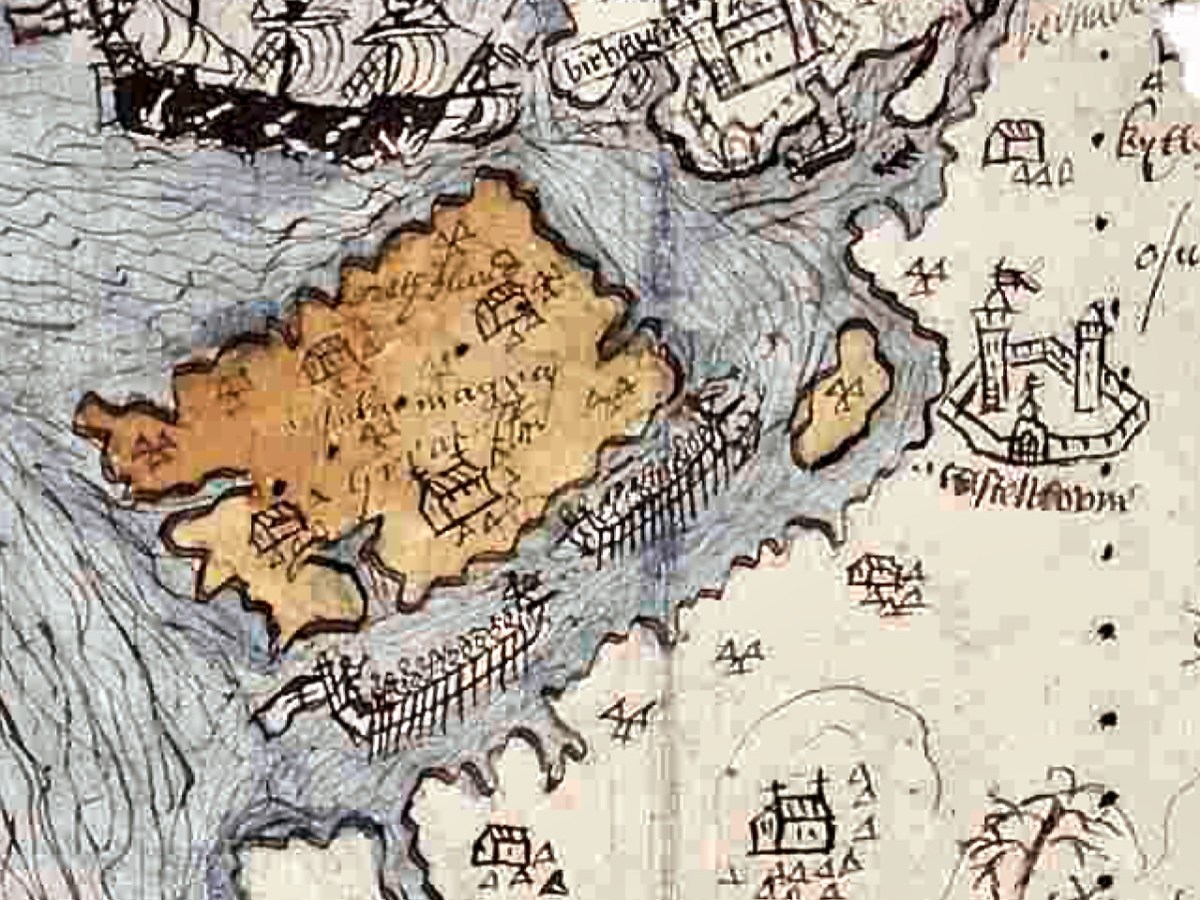
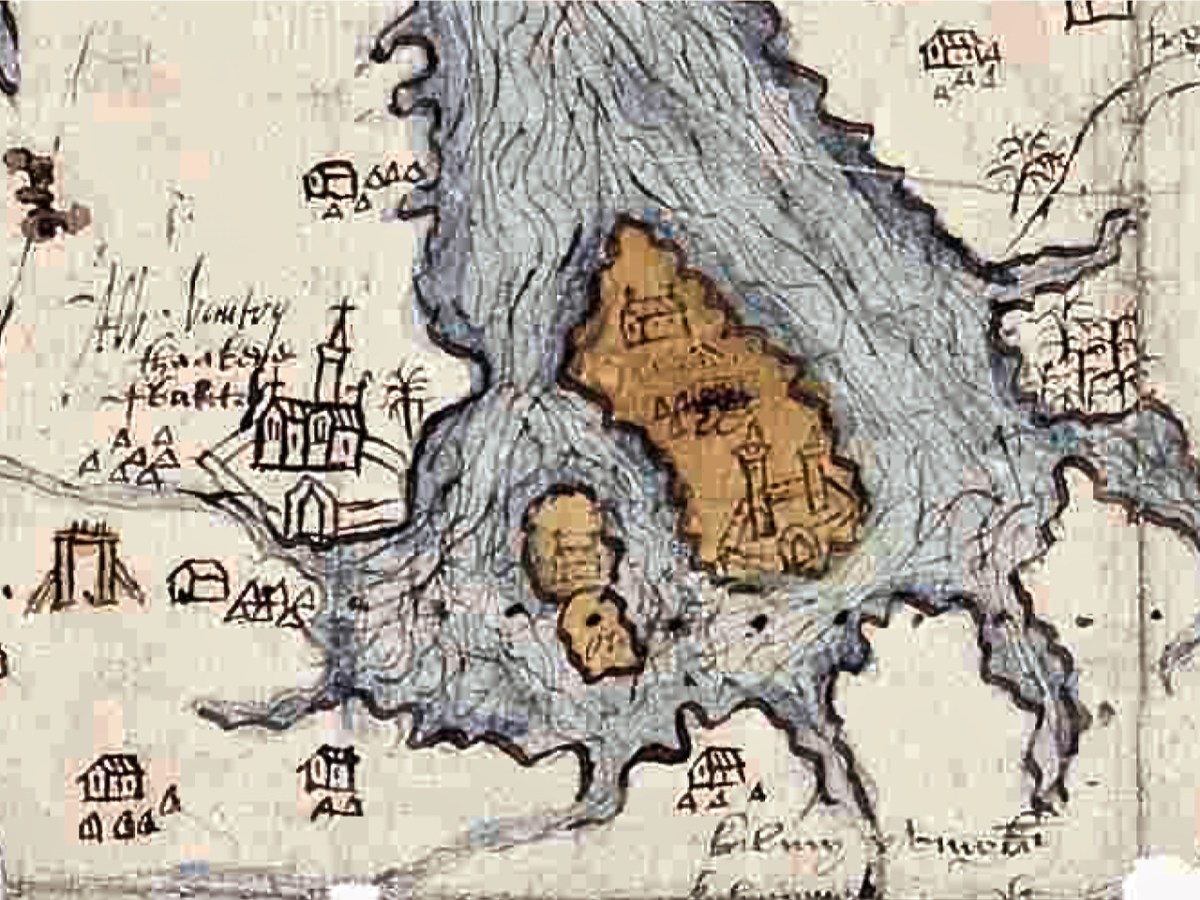
Let’s take a look now at the area around Bantry (below). The large church is of course the Franciscan Abbey that stood here, where the graveyard is located There is a church shown on the aptly-named Chapel Island between the mainland and Whiddy (no trace if it now remains), and both a church and a castle on Whiddy.

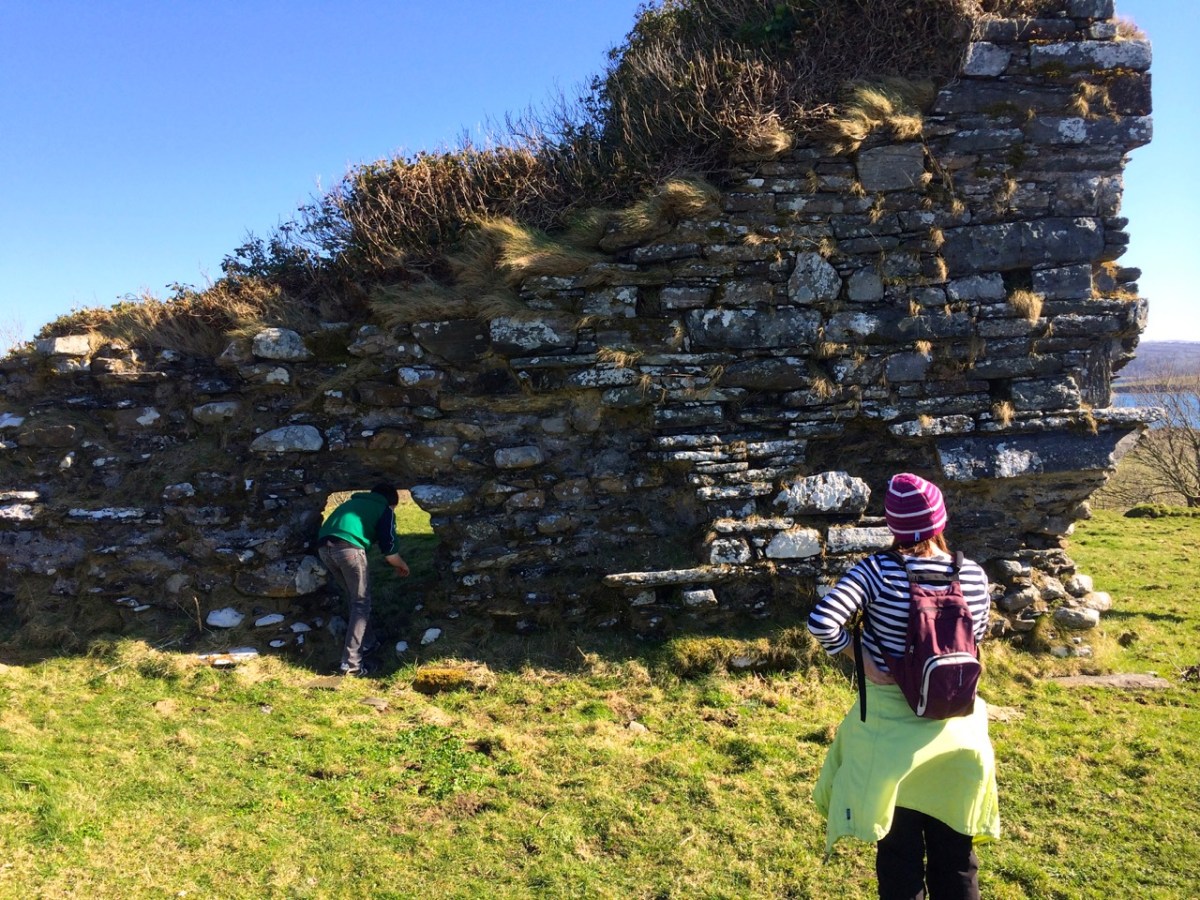
The fragmentary remans of an ecclesiastical enclosure can still be seen at the graveyard on Whiddy, while the O’Sullivan Castle has only one wall still partly standing. That’s it, below.

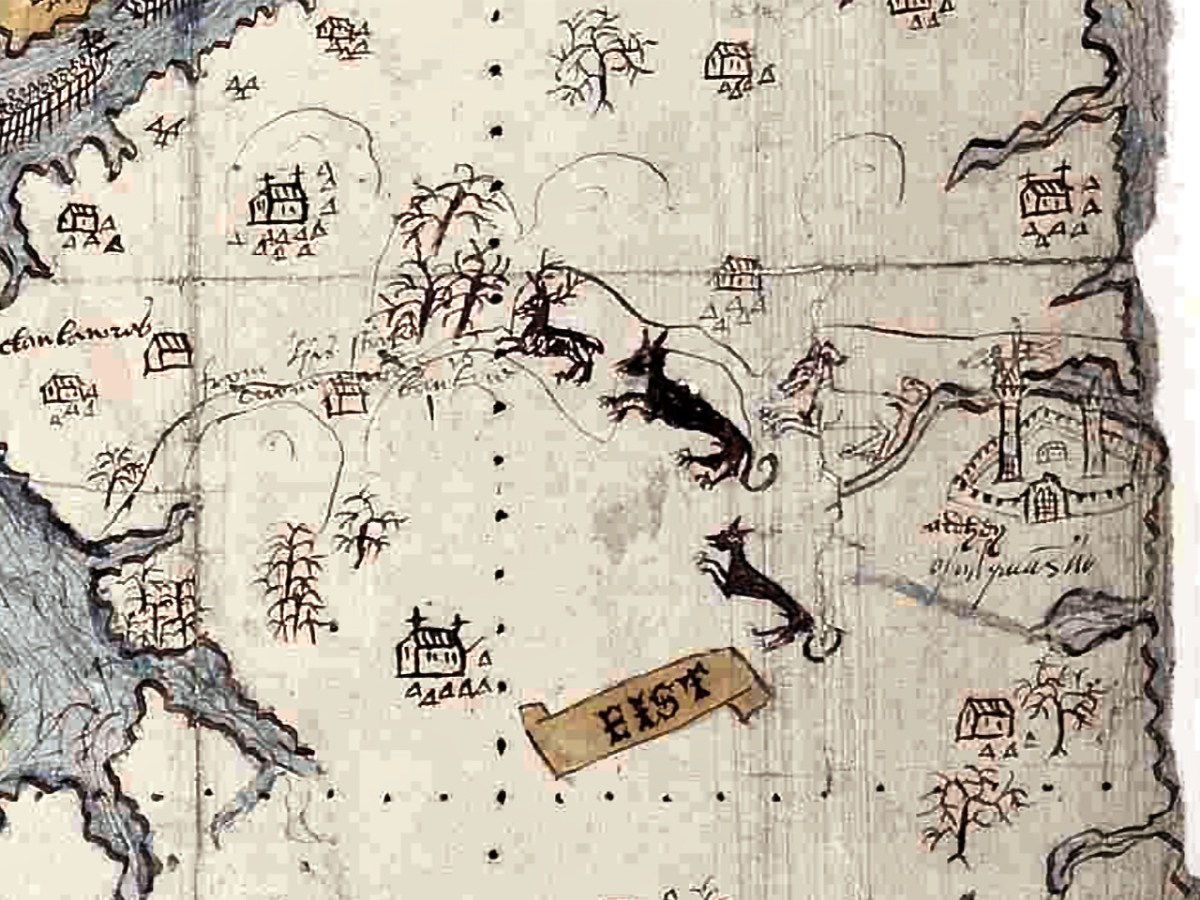
The hinterland of the Beara is shown with trees and animals. Either this is a hunting scene with dogs chasing a stag, or it is meant to show the wildness of the interior, with wolves and deer. Settlements are indicated by churches surrounded by a cluster of cabins (not that different from Irish villages up until recently), and there is a castle labelled Ardhey and O Sulyvans Ho. This is likely to be the ruined casted of Ardea, which actually stands on the other side of the Kenmare River – the Iveragh side rather than the Beara side.

The final depiction I want to highlight is of the Mizen. Several towers dot the  landscape as well as two substantial castles, one of which is under siege. 

Which castles are these – especially the one being attacked? Tune in next week!

Whiddy Island

Whiddy Island from Sheeps Head

Whiddy Island from Sheep’s Head

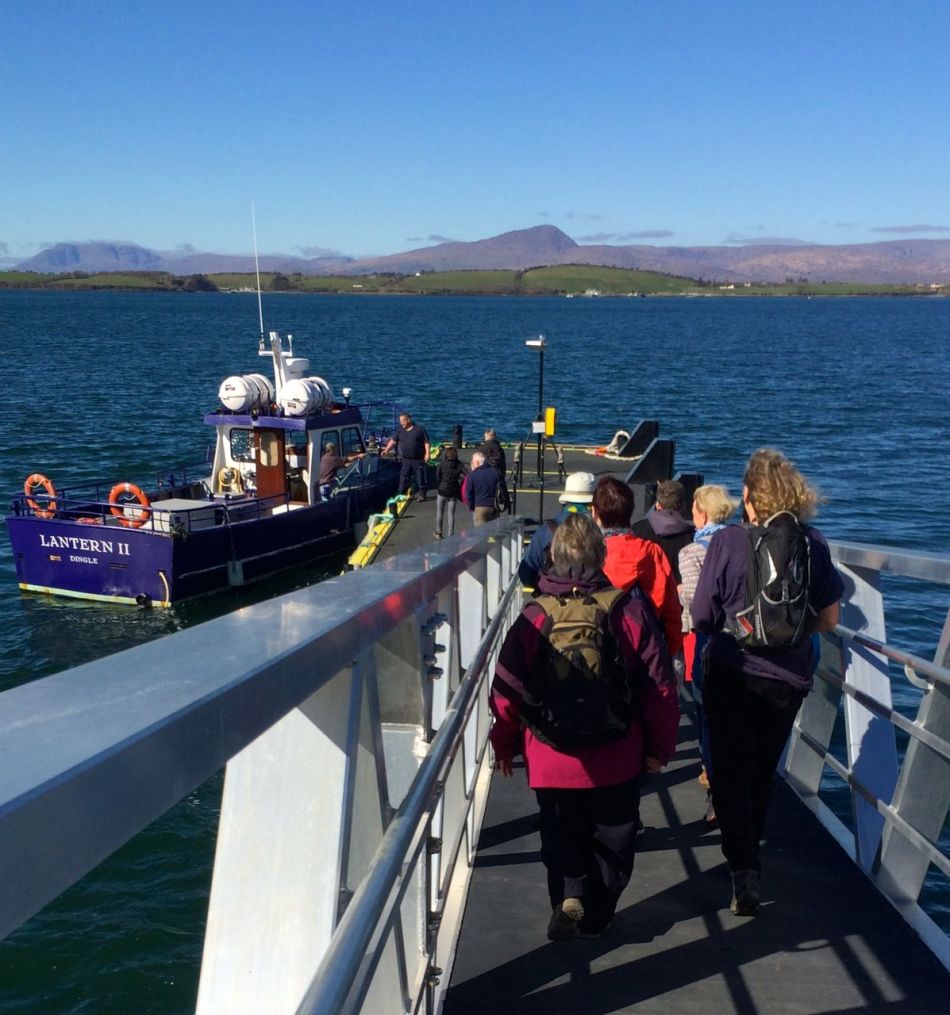
On a sunny Sunday in March, we were lucky to find out about a guided tour around Whiddy Island and enthusiastically signed up. Our guide, Tim O’Leary, runs the ferry to the island and its only pub, the Bank House. He is a native Islander and extremely knowledgeable about the island’s history, traditions, stories, flora and fauna. 

Off to Whiddy Island on a beautiful day in March

Off to Whiddy Island on a beautiful day in March

It was a gorgeous day for a tramp – a good thing as it’s a six mile walk – and the weather allowed us to drink in the glorious views and to stand at various spots listening to Tim as he shared stories of life on the island.

Whiddy Island Graveyard

Whiddy Island Graveyard

In the graveyard he told us about the island tradition of burial: a coffin has to be lifted from the boat at a particular quay and laid on a special coffin rock. From there it is shouldered uphill to the burial ground by four men of the same last name as the deceased. Nothing but human power can be used on the long uphill climb, or to dig the grave or conduct any part of the service. “We will carry this tradition on,” he said, “as long as we can.” The burial ground itself is part of an ancient ecclesiastical site and commands views across the island.

View out to Bantry Bay from the Island high point

View out to Bantry Bay from the Island high point

We learned that many island families made a good living in times past from fishing and fish processing, and it still an important part of the economy, although now mussel beds have replaced fishing lines and ‘pilchard palaces.’

Tim shows us the 'hairy rope' used to grow mussels. Mussel beds ring the Island.

Tim shows us the ‘hairy rope’ used to grow mussels. Mussel beds ring the Island.

The land was famous for being fertile and one historical document talks about the earliest potatoes always being grown on Whiddy. All this activity supported up to 800 people but like many places in West Cork the population was decimated by the Great Famine. Now, fewer than 30 people live here year round.

The Island can no longer support a school

The Island can no longer support a school

We walked up to the remains of O’Sullivan Beare’s castle, which functioned more as a prison than a dwelling as it housed those who needed to be ‘encouraged’ to pay the taxes he imposed for fishing rights. We explored the area that had once been a thriving American Air Force base for a brief period at the end of World War I – nothing remains except acres of concrete and memories of the vibrant life that the service personnel brought to this small community. Other defensive structures exist on the island too – several ‘batteries’  with huge guns were built after the French invasion of 1796 but alas they are too unsafe to visit.

O'Sullivan Beare's stronghold

O’Sullivan Beare’s stronghold

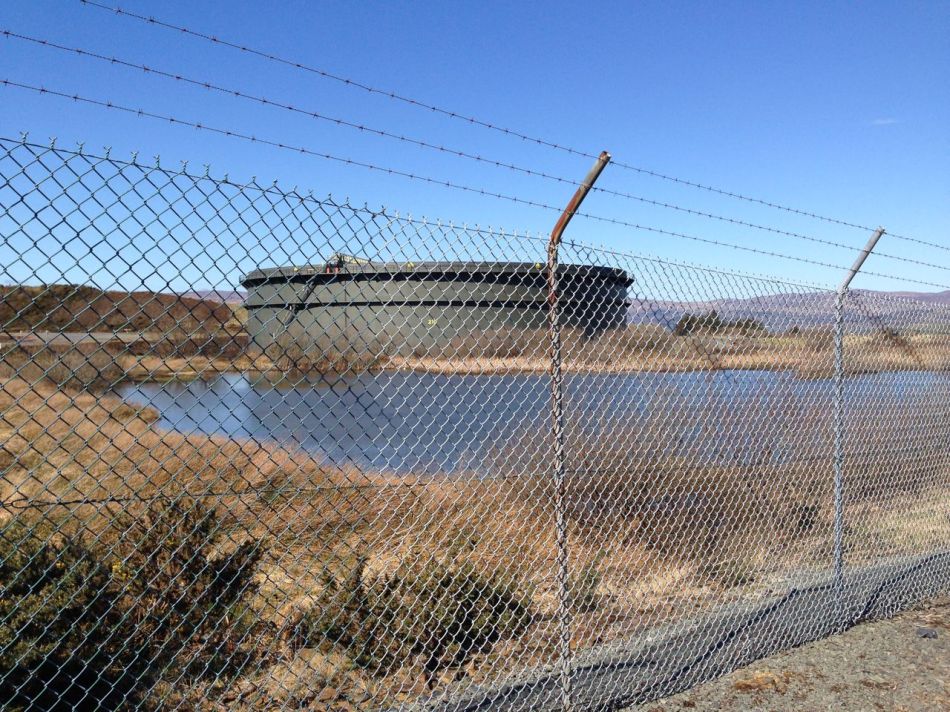
The west end of the island contains enormous tanks that now house the Irish national oil reserves. It was built as a Gulf Oil terminal in the late 60s and was the scene of a horrifying accident in 1979 when an explosion sank a French tanker, the Betelgeuse, and 50 people lost their lives. The enormous tanks, behind their barbed wire barriers, loom darkly against the landscape, a permanent reminder of this awful tragedy.

The oil tanks at the west end of the Island

The oil tanks at the west end of the Island

Take the ferry across to Whiddy Island any time and hike around the hills and the beaches. But if you can, catch one of Tim’s guided walks, and finish with a well-deserved pint in the Bank House at the end of the day.

There's nothing like a guided tour with Tim!

There’s nothing like a guided tour with Tim!

One thing, though…when Tim sat in this desk back in the day, his teacher forgot to teach him about distances. So just take it with a grain of salt when he tells you there’s “only another half mile to go.”

desk

A note on the West Cork Speak Competition! Deadline extended to the end of next week. Only one entry so far, so don’t be shy and get those conversations in!