Monica Sheridan’s My Irish Cook Book

Last year I decided to make Christmas cake according to Monica Sheridan’s recipe, which I remembered from my childhood. A comment from a reader got me curious about her other Christmas recipes and I got out my dog-eared copy of My Irish Cook Book to look up how to make a traditional plum pudding. Fatal mistake! Instead of cracking eggs and and soaking fruit I have been chuckling over the book and insisting that Robert listens as I read bits out loud.

I have already posted about Monica’s Kitchen and the delights it contains. The audience for that book was the modern Irish home cook (assumed to be female) of the 1960s. My Irish Cook Book focuses on traditional Irish foods and recipes. The emphasis is on fresh ingredients and fairly simple cooking methods – the kind of thing we call Slow Food nowadays. But because it’s about Irish food it is also an extended piece of nostalgia, replete with dewy-eyed memories of her childhood and her trademark stories and trenchant wit.

The book starts with an essay on the cooking traditions of her family, from her great-grandmother cooking stews in a bastable oven over an open fire, to her grandmother (who actually had running water from a tap!) to her mother who continued to churn her own butter, cure her own bacon, bake her own bread and make the most outlandish hats with feathers purloined from the cock.

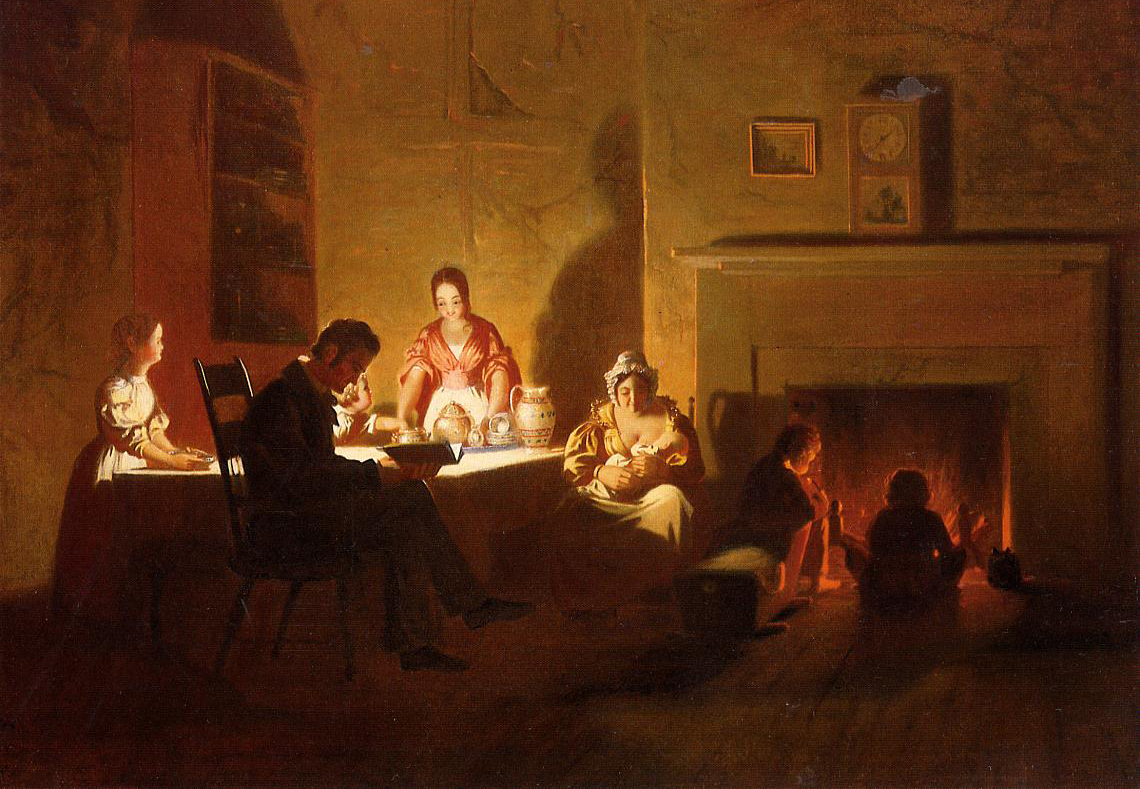
The photographs above and below, by the way, are from my own copy of the book A Taste of Ireland by Theodora FitzGibbon – a book that deserves its own post one day. The photo above is labelled A traditional Irish Kitchen, about 1888, and the one below is of the ancestral home of US President William McKinley in Co Antrim.

Her soup chapter begins thus:

The Geography we learn at school tells us that Ireland has a moderate climate, warmed by the Gulf Stream without any great variations of temperature either in summer or winter. This is a flagrant piece of Celtic exaggeration…

You wouldn’t be long in Ireland before realising that soup is an essential part of our daily fare. Like whiskey it is our internal central heating, raising the temperature of the body and thawing out the gastric juices so that they will be receptive to the delights that are to follow. Remember, in Ireland, except in the cities, domestic central heating is still a rarity (we are a credulous people and believe what we read in the geography books). We need soup to warm us.

This chapter includes instructions for making a Nettle Tonic. This essentially involves boiling a pound of young nettles in water. Strain and drink a tumblerful, hot or cold, first thing in the morning. Guaranteed to put roses in your cheeks and a glint in your eye. Not pleasant, of course, but you must suffer to be beautiful.

This is the same pre-feminist era woman of Monica’s Kitchen: she gives the following directions for serving steak and fried onions.

Carve the steak by cutting it in thick slices along the grain of the meat. Give a good slice of the fillet to your most important male guest (all men are knowledgeable about steak – all that expense-account eating, I’m sure) and never you mind about his wife. The chances are she is so delighted to be away from her own kitchen stove she won’t mind what she gets.

There are lots of recipes for offal, and indeed as children we ate lots of organ meats – although I drew the line at tripe and my mother finally relented after an epic battle of wills. Kidneys, tongue, liver, sweetbreads, heads, brains, cheeks…all get a look in.

Traditional Cork Christmas Meats at the English Market

Some Cork specialties get special attention, like Skirts and Bodices. Bodices are pickled spareribs because they are like the boned bodices our grandmothers wore and skirts are the fluted trimmings that are cut away from the pork steak. Drisheens sound, er, appetising: They are made from sheep’s blood. In appearance they resemble a blown-up bicycle tyre, but they have a wonderful texture, like baked egg custard. Serve with butter, she recommends, flavoured with tansy. Crubeens, meanwhile, are pigs’ trotters. Crubeens should always be eaten with your fingers. They lose half of their magic if you attack them with a refined knife and fork. You will need a bath afterwards, of course, but their sweet savour is well worth the extra ablution.

Tripe and Drisheen courtesy of the Eat This Town blog

She finishes the pork section with the following: I will tell you an interesting thing about ham. The true ham epicure will always look for the left ham of a pig. It is considered more tender and delicate. You see, the pig scratches himself with the right leg and consequently exercises it far more. So now you know!

There are many recipes for poultry, some of which involve boiling the fowl, or, in the case of Uncle George’s Turkey, injecting cream into the breast with a syringe. Chickens, of course, must be young – a digression is called for: Describing a woman of certain age, my mother would often say, “She wouldn’t tear in the plucking” (young birds have very delicate skin that breaks easily with inept plucking) or, “A chicken of her age wouldn’t fall off the roost.” Mother had a tongue that would clip a hedge.

Monica in 1968, from the Australian Womens' Weekly
Monica in 1968, from the Australian Womens’ Weekly

When Monica talks about a soufflé (although she doesn’t provide a recipe) she says, it should rise gradually, like a careful civil servant, consolidating its position on the way up. She devotes five pages to talking about soda bread before she even gets to a recipe for it. But that recipe is one I used often, when I lived in Canada, before the days of the internet opened up a world of online recipes. I can attest that it’s a good one.

But, like Monica, I digress – my intention was to give her recipe for plum pudding. Alas, it is hardly a recipe – little more than a list of ingredients followed by instructions to mix it all together, put into greased pudding dishes, and boil for 5 hours. Like many of her recipes, it calls for booze – in this case a glass of whiskey (she has a whole chapter on ‘Drink’). So instead of detailing how to make the plum pudding I will leave you with her approach to serving it.

The most exciting thing about a plum pudding is the presentation. To capture the spirit of Christmas it must come to the table lapped in blue flames – and this can be quite tricky with the weak quality of booze nowadays. When I was young we always doused the pudding in poteen and you got a flame that would singe the rafters. To make sure of a good flame it is most important to warm the spirit (cheap brandy is better than whiskey) before pouring it over the pudding.

If you want to make a spectacular entrance to the dining-room with the flaming pudding held on high, this is what you do. Scoop out a hole in the top of the pudding and place half and empty upturned eggshell in the hole. Fill the shell with warmed brandy, ignite and move the dish to spill out the spirit as you enter the dining-room.*

I couldn’t resist this photo of a flaming pudding, which is from Jamie Oliver

In preparing this post I looked up lots of plum pudding recipes, then decided to buy one from my favourite market stall. But if you really want to make a traditional Irish one, Brenda Costigan’s mother’s recipe, from the Independent, looks like a wonderful, rich, boozy pudding that would have done Monica proud.

*Disclaimer: Roaringwater Journal will not be responsible for house fires caused by following these directions.

Footsteps

Morning prayers on the Großglockner, Otto Barth 1911

Morning prayers on the Großglockner, Otto Barth 1911

Is it us? We seem to be following in the footsteps of thieves and wreckers… Back in June 2012 we visited St Manchan’s Church, in Boher, Offaly and saw the splendid shrine of that Saint securely locked in an armoured glass case and mounted in front of the equally magnificent Harry Clarke window depicting him. That was at about 1 o’clock in the afternoon. We were shocked to hear on the news that evening that the shrine had been stolen at 1.30! Two men had taken just a few minutes to break open the case – in spite of alarms and cctv – and make off with the Saint’s remains…

We were relieved to hear the following day that the robbery had been bungled: the shrine was thrown out of the getaway car and landed in a bog: both it and the perpetrators were picked up by the Gardi. I wonder if perhaps the thought of what divine justice might be wrought from on high (from St Manchan himself, even) had put doubts into the minds of the thieves and diverted them from their intentions – whatever they might have been.

Harry Clarke's depiction of the Saint's shrine

Harry Clarke’s depiction of the Saint’s shrine

Nevertheless, the incident led to some considerable debate on whether the reliquary should be returned to the church – where the security was evidently lacking – or whether the original 1,000 year old artefact should be put into Ireland’s National Museum and the replica which happens to be there should be sent back to St Manchan’s. The Boher people campaigned vigorously against this – quite rightly in my opinion – and eventually, after some improvements to the arrangements in the church, the shrine has been restored to where it belongs.

winter

Carrauntoohil Summit – photo by Noel Mulcair: thejournal.ie

So there we were just a week or two ago, honeymooning in the shadow of Ireland’s highest mountain (although warmly ensconsed in a comfortable Kerry hotel) when we heard the news that, not far away, someone had climbed the mountain at night and felled the iron cross that had stood up there for many years, with an angle-grinder! Obviously some point was being made, although nobody was quite sure what that was at the time…

The Mountains of Kerry

Gap of Dunloe, in the shadow of Carrauntoohil


The cross is felled...

The cross is felled…

The Carrauntoohil incident sparked off a lively correspondence in The Irish Times. Many were indignant at the act of vandalism, while others took the view that there is no reason why wild places should be ‘sullied’ with religious symbols. Hmmmm… that’s a bit harsh, perhaps: crosses on mountain tops have a been around for a long time all over the world and, ever since prehistory, humans have marked their presence on the landscape with monuments of one sort or another. As you all know, the two of us are fascinated (obsessed might be a more appropriate word) by megaliths, tombs, circles and inscribed rocks – and these are preserved archaeological artefacts – it would be unthinkable for someone to get it into their head that a standing stone should be destroyed because it might have represented someone’s god. At the very least, surely, the subject should be aired and a democratic decision made by a public majority before any such action is taken. Indeed, the subject did get aired after the event and I gleaned that the majority of respondents felt that the iconic cross should not have come down.

Well, this story – like the St Manchan one, has had a happy ending. A group of volunteers has been up to the summit with block, tackle and welding equipment and the cross is back again.

Ireland has many summits adorned with constructed pieces – ancient cairns and tombs, and more modern statues and symbols, not forgetting the wind farms which are another source of controversy. We are all part of human history and one of Ireland’s big attractions for me is that the history is so visible and accessible. In 1968 a white marble Pieta was placed high up on the Goat’s Path in Glanalin townland. It’s someone’s personal monument to a much loved father. In my opinion the melancholy statue enhances the wild place: I make a bee-line for it whenever I’m in the area – partly to enjoy the magnificent view but also, I have to say, because I am fascinated to see how many coins and offerings are put into the outstretched palm of Mary. Look here for a fuller description on the excellent website Sheep’s Head Places.

Hilltop Pieta

Hilltop Pieta

Given our experiences to date I worried a bit about our visits to Holy Cross Abbey and the Cathedral of St Mary and St Anne in Cork, where we came across the shin bone of Blessed Thaddeus McCarthy. But it seems to be ok: fair enough, the fragment of the True Cross was stolen from Holy Cross (it’s now been replaced with another), but long before our visit, while the saintly shin bone seems to have survived unscathed so far. I can’t help looking over my shoulder, though, when we visit such places. Ireland is full of enigmas…

thaddeus

Sacred shin bone – with Angelic guardians

Finola's childhood haunts: the cross on Bray Head, Wicklow

Finola’s childhood haunts: the cross on Bray Head, Wicklow

Lough Hyne Holy Wells

sea shell Local tradition (and there is no better source of knowledge!) has it that you can relieve any eye problems with the waters from  Tobarín Súl – one of the holy wells close by Lough Hyne. The name is Irish for Little Well of the Eyes and, if proof were needed of the efficacy of the cure, you will find hanging from the branches of the trees around the well white canes and spectacles presumably left behind by modern day pilgrims who are no longer in need of them after visiting the well.

There is no doubt that Tobarín Súl and its near neighbour – Skour Well – are actively visited: offerings abound. Most commonly, rags and ribbons adorn the surroundings of a well. According to Anna Rackard (Fish Stone Water – Holy Wells of Ireland, Atrium 2001):

…Traditionally, rags were used to wash the afflicted part of the body with water from the well and were then tied to the tree or bush. As the rag deteriorated, the pain faded away. In some parts of Ireland, when the rag is tied to the tree, the tree itself ‘takes on’ the pilgrim’s pain…

The Eye Well decorated

The Eye Well decorated

Tobarín Súl is set beside a narrow lane which winds up Knockomagh Hill in the townland of Highfield, to the north of Lough Hyne. The Skour Well is a little way further up the same hill. Nobody seems to know the origin of the name: one suggestion is that the word Skour comes from the Irish ‘sceabhar’ meaning ‘slope’ or ‘slant’, indicating its position on the side of a hill. Whatever the origin, it’s another colourful well, also adorned but with a more religious flavour – rosary beads, candles and statuettes.

Christian iconography at Skour Well

Christian iconography at Skour Well

Some sources suggest that this well is dedicated to St Brigit, but I think that is a confusion with two more holy wells which are reputed to be close beside an ancient ruined church dedicated to her on the south side of the lake. Skour Well, however, is clearly devoted to Mary and ’rounds’ are performed here: it’s said that pilgrims drop white pebbles into the water on completing each circuit. On May Eve the local priest conducts a mass at the roadside here.

Inscription at Skour Well

Inscription at Skour Well

White pebbles in Skour Well

White pebbles in Skour Well

So here we have a fascinating meeting of beliefs: two wells almost side by side, one seemingly an ancient centre for traditional cures and the other a Christian site. Both are powerful places.

Lough Hyne

Lough Hyne

We have mentioned the lake itself in previous posts. We have yet to visit St Brigit’s little church to try and find the other wells (the Archaeological Survey database says they are no longer visible) but we must look for the place where St Brigit knelt and left imprints of her knees in the rock!

St Brigit knelt here!

St Brigit knelt here!

Amanda found St Brigid’s knee prints“…The forecast being good I decided an adventure was needed. We headed out for Lough Hyne – I had read that there was an ancient church, holy well and cross slab in the vicinity. It looked do-able on the map. We parked and set forth. Quite a long walk down a small road skirting the lough, so green and leafy with sheer rocky sides dripping with moisture. We got to where the smaller road should have been leading onto a peninsula jutting out onto the lake but it seemed to go onto private land and there were big gates. Suddenly a woman came out to check her post and I was over there like a flash. Once she’d got over her amazement that anyone should know about this obscure church she was very helpful. The whole headland was her land and it was brimming with interesting things. She gave us firm instructions and allowed us to venture forth. The boreen down was long and green and so beautiful – full of the most amazing variety of wildflowers – primroses, buebells, anemones, violets, Irish spurge. We found the church – teeny, roofless with a beautiful arched doorway. Her husband was buried close by – his epitaph had him down as a philosopher. Her instructions to the holy well were exact – climb up onto a stone and approach on your knees, – for safety rather than holy reasons I imagined, but maybe not. A teeny, two pooled well with lovely fresh water – and the knee prints of St Brigid on each side! Really. I tested. Perfect fit…” (taken from Amanda’s Blipfoto description) Amanda mentions the cross slab – there’s a story about this in Brigid: Goddess, Druidess and Saint by Brian Wright – The History Press 2009:

…There are traditions from many parts of Ireland and Britain of stones that return to their original spot when moved and an example of such a ‘homing stone’ involves St Brigid’s Church, Lough Hyne, Co Cork. There, about 150ft north east of the church is a piece of a broken pillar about 18 x 15in bearing an incised cross. One Day this was carried away by a fisherman who took it to his house, but the very next morning he found it had gone and it was discovered back in its original spot. The fisherman drowned shortly after and everyone knew he had been punished for daring to remove this holy stone…

Homing stone? The ancient cross by St Brigid's Church

Homing stone? The ancient cross by St Brigid’s Church

Three Pilgrims in West Cork

Glebe Church, on the Ilen River

Glebe Church, on the Ilen River

The guest speaker at this Thursday’s Skibbereen Historical Society meeting was Louise Nugent, speaking on the topic of Pilgrimage in Medieval Ireland. We became familiar with Louise’s work though her blog of the same title – a blog which manages to be consistently erudite and down-to-earth and entertaining all at once – and suggested her as a speaker. This also gave us the opportunity to meet Louise in person (she is as engaging and as knowledgeable as her blog) and, the next day, show her a little bit of our part of West Cork.

One of the great delights of following Louise’s blog is realising that the concept of pilgrimage – a spiritual journey undertaken for a variety of purposes – is still very much alive in Ireland. Local veneration of shrines, relics and holy wells is common and often involves a mass or prayers on special days. The “journey” involves going to the shrine, and sometimes moving around it in a set pattern or round. Larger scale pilgrimages, such as the annual trek up Croagh Patrick or a stay at Lough Derg in Donegal or a Novena at Holy Cross Abbey, transcend the local and attract pilgrims from around Ireland. In her talk, Louise also described the popularity of pilgrimage in Medieval times to holy sites outside Ireland such as York, Santiago de Compostela, Rome, or Jerusalem. Those who completed the Santiago Camino wore scallop shells to signify their pilgrim status, an image we had just seen the previous weekend in Cork in the Cathedral of St Mary and St Anne, where we came across a shrine to Blessed Thaddeus McCarthy. There was a statue, a painting, scrolls, but most fascinating of all a reliquary containing a leg bone! Blessed Thaddeus lived in the 15th Century and was appointed a bishop twice but was never able to take up his see because of the activities of the rival clan O’Driscoll.

On our day with Louise we concentrated on the area around Skibbereen. We started off by visiting the 18th Century Church at Glebe, on the banks of the River Ilen. The church and graveyard enjoy a picturesque and peaceful setting and a wander around the graveyard yielded interesting headstones.

Holy Rosary Church at Aughadown, window detail

Holy Rosary Church at Aughadown, window detail

From there we went to the ruined medieval church at Kilcoe, stopping for a quick peak at the notable windows in the Church of the Most Holy Rosary at Aughadown. They deserve a fuller description at a future date, so for now I will include a detail from the rose window at the back of the church, designed and executed by the Harry Clarke studios in 1941.

The church at the tip of the Kilcoe Peninsula was already a ruin in the early 17th century. Although a simple rectangular structure, the pointed arched doorway and the tiny ogival windows mark it as medieval, perhaps as early as 14th or 15th century. Romantic and atmospheric as it is, it has the added advantage of a clear view of Kilcoe Castle, famously restored by Jeremy Irons and gently glowing in the afternoon light as we were there.

Two of the three pilgrims at a holy well

Two of the three pilgrims at a holy well

Louise’s special interest is in holy wells and several audience members the night before had come forward with information about local wells and the practices and beliefs associated with them. Two of the best known and most beloved local wells are situated close to each other at Lough Hyne. Robert is writing about these wells this week so I will leave the detailed description to him.

Our final stop was the village of Castletownshend and the Church of St Barrahane, filling two different functions. First, Louise had been to visit a holy well dedicated to St. Martin of Tours in Clare, and we wanted to show her the Harry Clarke window that Robert had described in his Martinmas post. Second, a trip to St Barrahane’s is always a pilgrimage of a different sort for me, as it is the final resting place of three of my heroes. The first two, of course, are the writing team of Somerville and Ross – more about them in this post. The third is Vice-Admiral Boyle Somerville, brother of Edith and a keen amateur archaeologist worthy of a post to himself in the future.

St Louis: detail of Harry Clarke window in St Barrahanes, Castletownshend

St Louis: detail of Harry Clarke window in St Barrahanes, Castletownshend

Come back soon, Louise – these two pilgrims have lots more to show you!

Whyte Books/Now AnnaB’s Bookshop

How inviting is this!

So inviting!

Since this post was published, Whyte Books has changed name and ownership. It is now AnnaB’s Bookshop – and we are happy to report it is as charming and wonderful as ever under its new owner, Katarina.

Do you have a favourite bookshop?

Of course you do! We all have one – THAT bookshop where you feel welcomed; where it never matters how long you browse or if you actually buy something; where knowledgeable staff can recommend a good book for your father or your grandchild; where you can sit with a nice cup of tea and a slice of something delicious as you browse through book reviews or escape from the rain; where they can order stuff for you and the process doesn’t feel like a soulless internet transaction.

Sheila

Herself

We have THAT bookshop, here in Schull. It’s called Whyte Books, presided over by the charming and cultivated Sheila Whyte. Sheila is typical of many of us who have made West Cork our home. She grew up in Dublin but spent most of her adult life in Australia. She fell in love with Schull on a holiday here, she fell in love with bookstores wherever she travelled, and when the time came to put it all together, well, we were the winners.

Sheila had a vision of what she wanted – a place that would become a hub of reading and intellectual activity in the area and she has worked hard to create just that. There’s a nook for kids and a space for young adults, besides all the little corners and seating areas where you can while away a pleasant hour with your nose in a book and your hand curled round a cuppa. She holds poetry readings, promotes and launches local books (a recent example is Gubbeen by Giana Ferguson) and hosts a monthly book club.

This week Whyte Books hosted the first ever session of The Moth in the South West. The Moth is new to Ireland although story telling is definitely not! A cultural phenomenon, The Moth got started in New York but is based on the idea of neighbours getting together on the porch to tell stories after it gets dark and the moths come out. Stories must be first person narratives, true, told not read, and last no more than ten minutes. About 20 of us gathered upstairs: there were candles and wine and laughter and stories and a promise to make it into a regular event. All the ingredients, in fact, that make Schull such a vibrant community and locate Whyte Books at the beating heart of that community.

books and books

books and books

We are so lucky to have a great bookshop here! It’s a tough business these days, so take a break from buying online – go buy the latest Must Read at your local bookshop. At Whyte Books, I can guarantee that if it’s not on the shelves they can get it for you. And while you’re at it, have a coffee…and maybe one of those yummy little chocolate thingies.

Browsing upstairs

Browsing upstairs

By the way, I’m not the only one who loves this shop. It’s been voted Best Bookshop in Munster, featured in a beautiful video,  and even people who happen by rave about it

Martinmas

St Martin's Summer: late November on the Sheep's Head

St Martin’s Summer: late November on the Sheep’s Head

I’m used to pursuing the lives of the Irish Saints – often obscure, always fascinating – their legends tied up with folk tales and seasonal customs. But here we are, in Ireland, with a strong tradition of celebrating a continental Saint – St Martin of Tours.

St Martin of Tours adorns a German postage stamp

St Martin of Tours adorns a German postage stamp

St Martin doesn’t appear to have any connection with Ireland at all – yet everyone here seems to know the one element of his story that is always told: in the winter storms he met a naked beggar and cut his own cloak in two, giving half to the beggar. There is a twist to the story – that same night Martin had a dream: he saw Jesus wrapped in the piece of cloak he had given away and Jesus said to him, “Martin has covered me with this garment.” Even though Martin was at that time a soldier in the Roman Army he sought to be baptised and then refused to fight as this was against Christian principles. In fact, he was the first recorded ‘Conscientious Objector’.

Harry Clarke's window in Castletownshend, showing St Martin and the Beggar in the right hand panel

Harry Clarke’s window in Castletownshend, showing St Martin and the Beggar in the right hand panel

St Martin’s Day is on 11 November and the season is known in Ireland as Martinmas. There are customs surrounding this time – still remembered in some rural districts. There is a whole chapter devoted to Martinmas in Kevin Danagher’s book The Year in Ireland (Mercier Press 1972). From this we learn that every family is to kill an animal of some kind “…and sprinkle the threshold with the blood, and do the same in the four corners of the house to exclude every kind of evil spirit from the dwelling where this sacrifice is made…”

In 1828 Amhlaoibh Ó Súilleabháin of Kilkenny recorded in his diary: “…The eleventh day, Tuesday. St Martin’s Day. No miller sets a wheel in motion today; no more than a spinning woman would set a spinning wheel going; nor does the farmer put his plough-team to plough. No work is done in which turning is necessary…” This might be because of a story that Martin was martyred when thrown into a mill stream and killed by the mill wheel. In fact the hagiography states that he died of old age.

Another Irish legend (from Wexford) relates that the fishing fleet was out one St Martin’s Day, when the Saint himself was observed walking on the waves towards the boats. He proceeded to tell them to put into harbour as fast as possible, despite the good weather and fishing conditions. All the fishermen who ignored the Saint’s warning drowned during a freak afternoon storm. Traditionally, Wexford fishermen will not go out to sea on Saint Martin’s Day.

St Martin is the patron saint of Geese. In England there are two ‘Goose Fairs’ held in the autumn, one at Tavistock near my old home on Dartmoor. I have been to that fair: geese and poultry are still in evidence, but I don’t know whether there is any direct link to our Saint. In the not-too-far-away Exeter Cathedral Close there is a Holy Well dedicated to St Martin.

In England and Ireland they call any spell of good weather which occurs after 11th November ‘St Martin’s Summer’. We are having one of those at the moment.

We are also now at the ‘November Dark’ – the days just before a new moon when there is no moon at all visible in the night sky. Traditionally, this was the time to cut willow rods to store for basket making in the spring, as then “…they would have the most bend in them…” (according to Northside of the Mizen).

St Martin's Summer at Rossbrin Cove

St Martin’s Summer at Rossbrin Cove

St Martin’s Goose was traditional fare on Martinmas in some cultures, so I’m feeling a little worried about this gaggle…

Goosey Fair, Tavistock, Devon

Goosey Fair, Tavistock, Devon