Portobello

We have been spending a little time over on the east side of the country, not too far from Dublin. We like exploring, and the built-up areas have much to offer in terms of history so I’m returning – for a brief moment – to one of my favourite subjects: the canals of Ireland. You may remember my forays back in 2016 to seek out the journeys taken by L T C Rolt seventy years before that, and recorded in his classic book Green & Silver. You can find all those posts here. Earlier this year I added a further post to the series, examining in greater detail the meeting of the waters of Grand and Royal Canals, within Dublin. Today I’m simply concentrating mainly on one place, to the south of the city: Portobello.

This wonderfully drawn map (the two extracts above) dates from 1797, and was complied by William Faden (1749-1836) and Samuel John Neele (1758-1824): it was published in London and Dublin. You can see from it that the Grand Canal at that time virtually created the southern boundary of the city, with the canal basin at Portobello being a significant location to serve the growing conurbation south of the River Liffey.

This extract from the 6″ first edition of the Ordnance Survey shows Portobello Harbour with its significant warehouses, the ‘City Basin’ and a lock and bridge – known as La Touche Bridge. We have encountered the La Touche family in an earlier post – Glen of the Downs – and learned there that the family had built a big house – ‘Bellevue’ – on their estates near Greystones and Delgany.

The bridge (photo courtesy of excellentstreetimages.com) was named after William Digges La Touche (1747–1803), a director of the Grand Canal Company. The waterway was, of course, an important business venture in its heyday, contributing to the prosperity of the city merchants. Prior to its construction the area was farmland, and the name Portobello is said (curiously) to have come from the Irish Cuan Aoibhinn, meaning ‘beautiful harbour’. Note the ‘City Basin’ marked on the OS map: this was used from 1812 to provide a drinking water reservoir for the south side of the city. In the 1860s the water was found to contain a high concentration of sulphuric acid, and this source was eventually superseded by the new reservoir at Dartry, in Co Wicklow.

This is a fine early print of the Harbour, showing the Grand Canal Hotel designed by James Colbourne and opened in 1797. In the foreground is a passenger or ‘packet’ boat. We might forget how important the transport of people was in the early days of canal transport, before the advent of railways (see Trollope’s account in my post here): roads were often in a poor state and the boats provided a smooth – if not exactly speedy – way of getting about.

…the company’s hotels were simply the posting houses of this water-road …There was considerable interchange of passenger as well as goods traffic at Shannon Harbour. Travellers changed here from the Dublin passage boats into Bianconi’s ‘long cars’ which operated between Birr, Shannon Harbour and Athlone in connection with the boats. Alternatively they might board the paddle steamers The Lady Lansdowne or The Lady Burgoyne which plied between Killaloe pier head and Athlone, calling at a jetty on the river near the mouth of the canal. Smaller craft sailed from Killaloe pier head to the transatlantic port of Limerick, and so the Grand Canal became a link in the route between Dublin and America…

L T C ROLT, Green & Silver, 1949

The hotel at Portobello was one of five constructed along the length of the Grand Canal: all were fine buildings – probably state-of-the-art in terms of accommodation for travellers by water. You will find a post which I wrote about them here. On the header picture is a view of a packet boat at Harcourt Lock, and you can see a stage-coach there waiting to transfer passengers. The Portobello hotel closed in 1835 but the building has survived to the present day through many incarnations.

This is a great photo if you are a transport history enthusiast! It must date from the 1940s, as the Dublin tram system declined at that time, the last one in the city being phased out on 9 July 1949. The bridge and former canal hotel are clearly seen.

Portobello House – the canal hotel in the 1960s. Some fine classic cars in this picture! At this time it was a nursing home: one of its elderly residents was Jack B Yeats, the celebrated Irish painter who currently has a major exhibition in the National Gallery.

The former canal hotel was completely refurbished in 1972 (the photograph above dates from that year) and survives today – in good order – as a private educational establishment. Here it is again (below), as you’ve never seen it before – through the eagle-eye of Google Earth!

I can’t resist finishing with this plate from from The Graphic, a British weekly newspaper set up to rival the popular Illustrated London News. Published on May 13, 1882, this shows “. . . the lighting of tar-barrels in Portobello Harbour, on the Grand Canal in Dublin, to celebrate the release from prison of Charles Stewart Parnell and two colleagues . . .”

West Cork Villages and Towns – Skibbereen

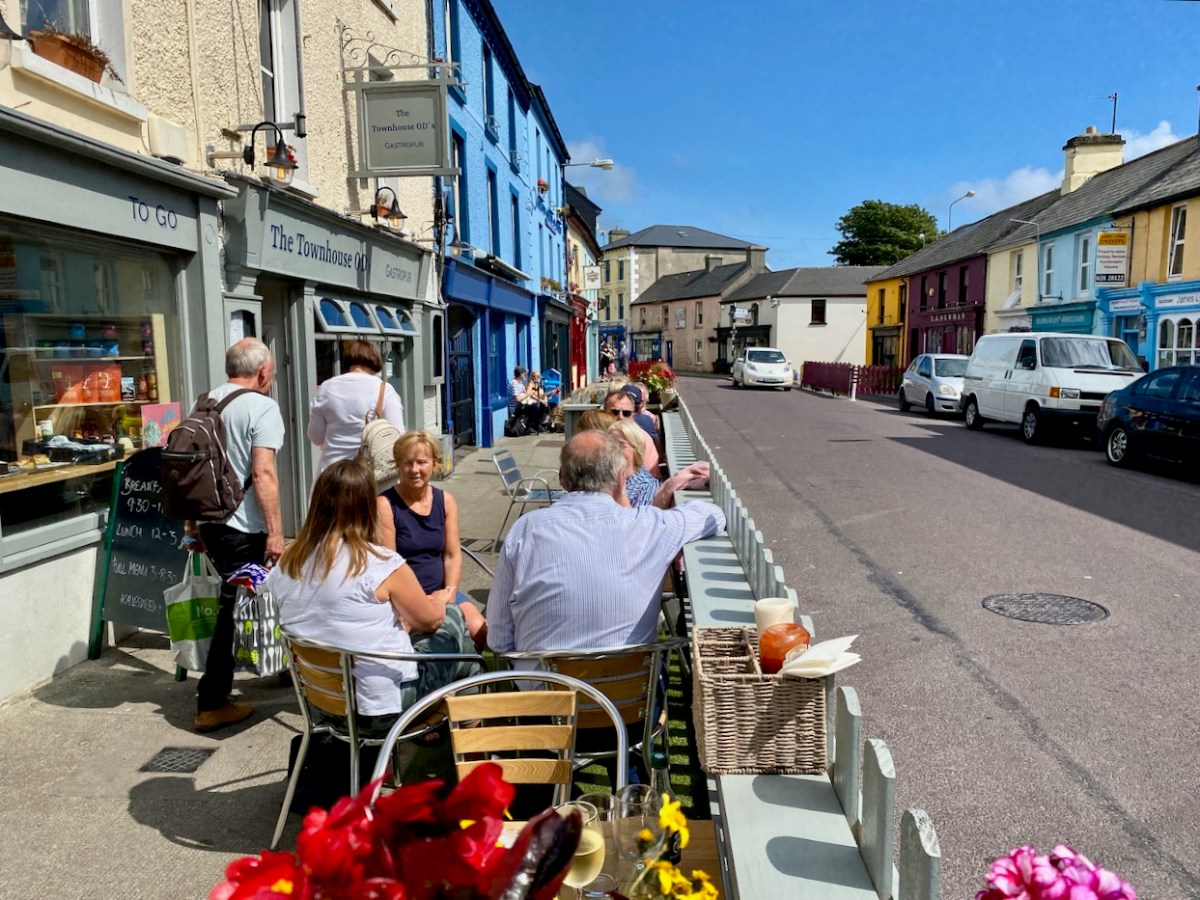
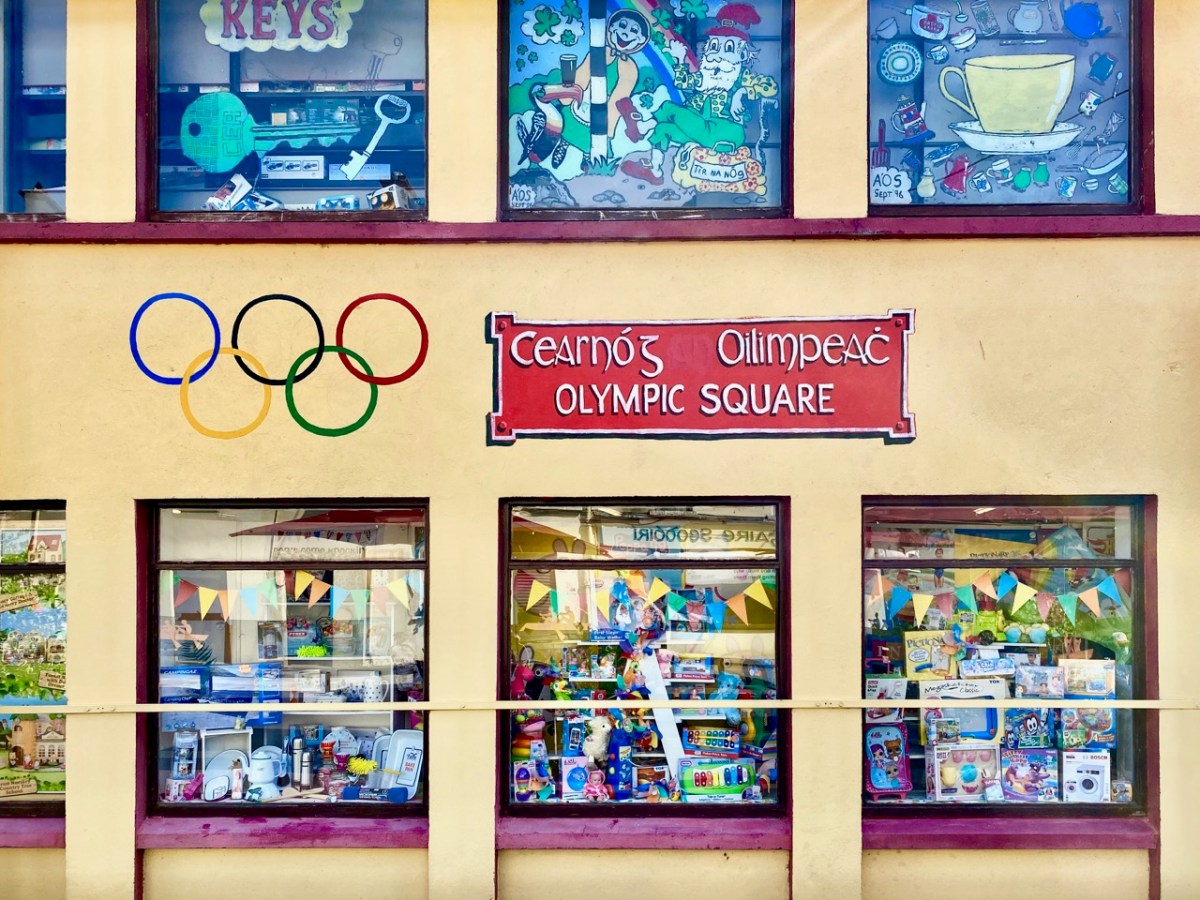
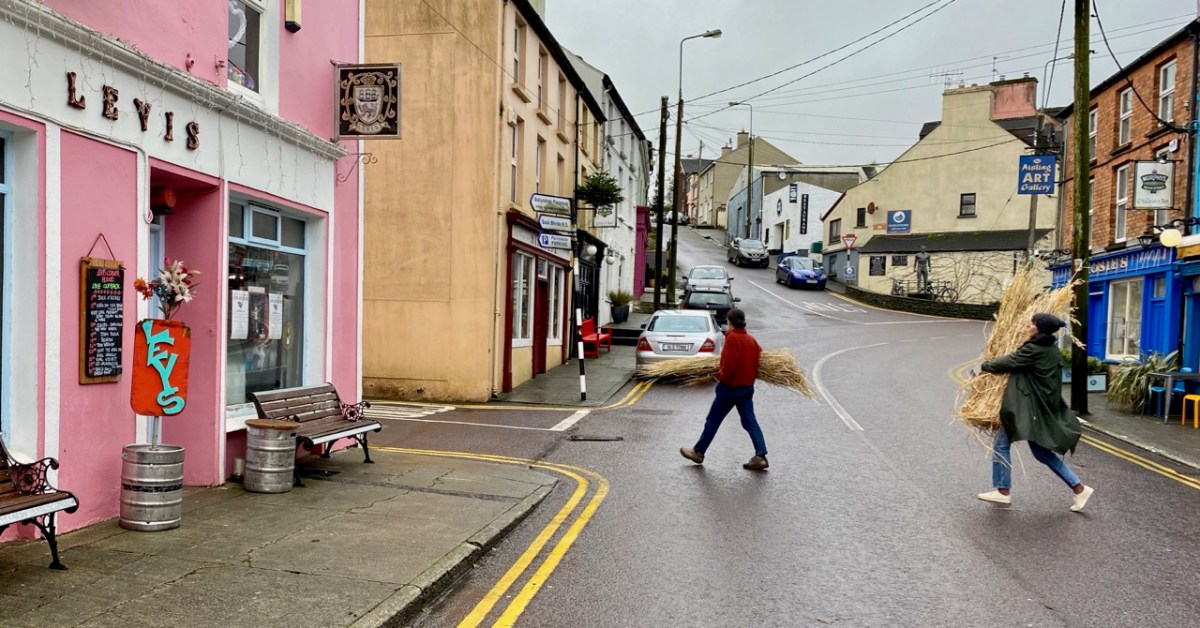
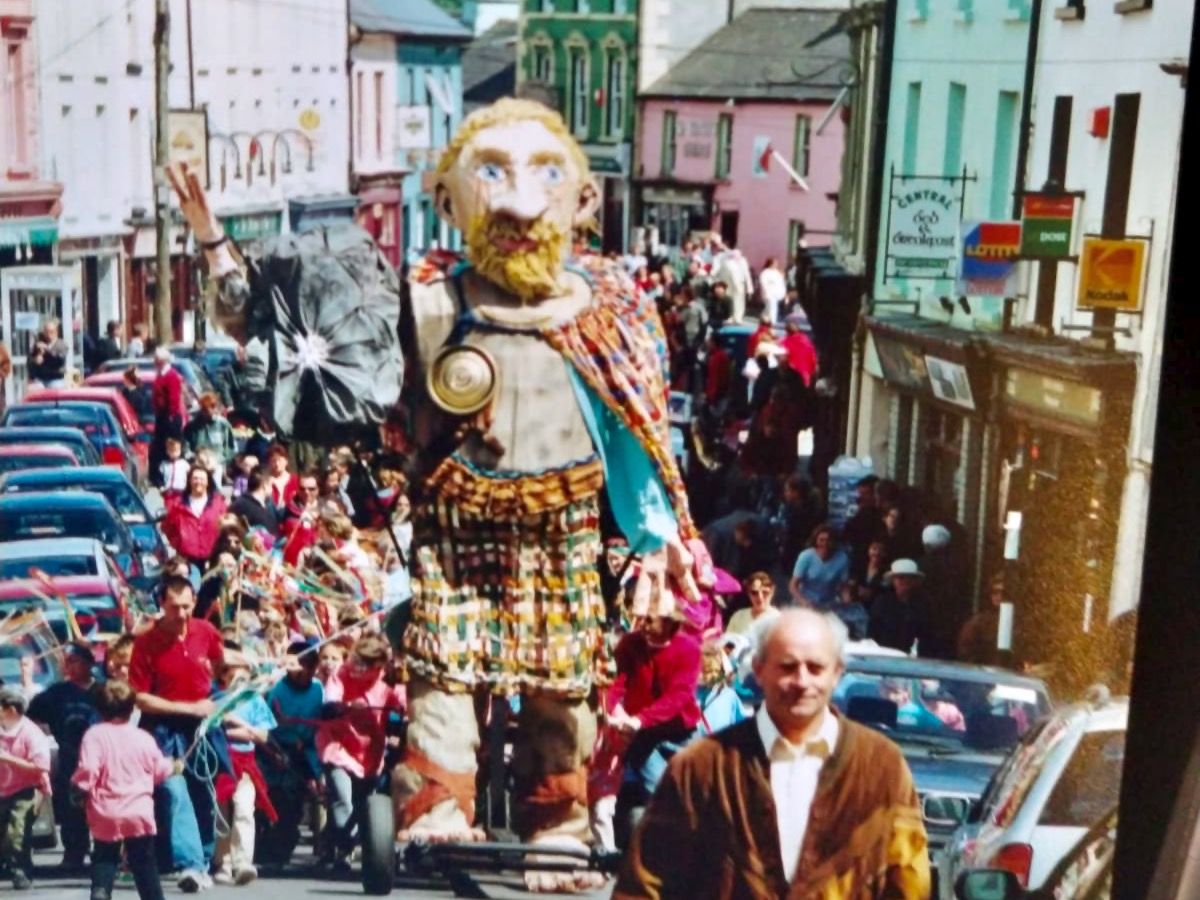
It was an ‘odd’ Olympic year – 2021. Firmly etched in my mind is the knowledge that years in which Olympic Games are held – like leap years – are divisible by 4! This one was different, because of Covid. But that didn’t prevent Ireland producing its heroes: gold for rowing and boxing, and bronze, also for rowing and boxing: a total of 8 sports heroes bringing medals home. If you will forgive the pun, the small country of Ireland punched well above its weight! All the rowers trained at the Skibbereen Rowing Club in West Cork, under the expert eye of their coach Dominic Casey. No surprise, then, that the town was in celebratory mood for weeks after the event, as you can see from many of my photographs, taken around the town at the end of August.

The town, from its situation in a wild, unenclosed part of the country, has frequently been the rendezvous of disaffected parties, but it has been much improved of late years, and is now a very flourishing place. It is situated on the southern bank of the river Ilen, and comprises seven streets; that part which extends into the parish of Abbeystrowry is called Bridgetown, and consists of three streets, one of which has been recently formed. The number of houses in the whole town is 1014, many of which, in the eastern part and in the parish of Creagh, are large and well built: the approaches have been much improved by the formation of new lines of road at each extremity . . .

LEWIS TOPOGRAPHICAL DICTIONARY OF IRELAND 1837

It’s interesting that Lewis – in 1837 – describes the number of houses as just over a thousand. He also states elsewhere that there were 4,429 inhabitants in 1691: in the 2011 census the town recorded a population of 2,568.

The first edition of the Ordnance Survey 6″ map was produced around 1840, just after the Lewis Topographical Dictionary was published. From the extract above, the layout of the town we know today had been broadly established by then. Compare this to today’s OS map (below) and the annotated aerial view.

There are a few theories as to the earliest origins of the town. Oft quoted is the story of the survivors from the sacking of Baltimore by Barbary Pirates in 1631 having moved upriver to found, or expand, the settlement that is now Skibbereen. It is likely that there was already a community on this part of the river, which was tidal and probably easily navigable up to its sheltered reaches at this point: at one time there were no less than five quays, warehouses and a Customs House within the town – this post will tell you more.

Skibbereen today is defined by its river – as it always has been. The waterside deserves a bit more attention – and is being opened up a little in some of the new civic improvement schemes that have been enabled by major flood relief works in the town. There are many opportunities yet to be explored.

All towns evolve and, hopefully, move into the future: Skibbereen – we’ll be keeping an eye on you! But it’s a great town already: it has the busiest market in West Cork on a Saturday; lively shopping streets; easy (and free) parking – and a very healthy ‘pavement cafe’ culture that has grown up during the pandemic, and is likely to continue to flourish. Let’s walk the streets and see the town as its best in the late summer sunshine . . .

Here at Roaringwater Journal we will always sing the praises of this town, and it has been the subject of a good deal of our historical research and writing. Have a look at our posts on Agnes Clerke, Ireland’s first and foremost female astronomer;  Jeremiah O’Donovan Rossa, the famed nationalist and Fenian: Uillinn – one of Ireland’s most innovative art galleries – here, here and here. We also must not forget that Skibbereen was at one time an important part of Ireland’s railway network: you could travel to and from Cork and Baltimore, and it was a terminus for the narrow gauge railway that trundled off to Schull, and whose loss is now much mourned.

I hope my post inspires you to explore this prominent West Cork town, if you haven’t already done so. It has historic foundations – too numerous to list in this one, short article. Choose a sunny afternoon – or go there to shelter from the infrequent showers. Whatever the day, make the Skibbereen Heritage Centre your starting point: you will find a wealth of information which will help to guide you on your way. The building itself is a piece of history: it used to be Skibbereen’s gas works!

The town name was familiar to me long before I settled in Ireland a decade ago. I lived in the fishing village of Newlyn, Cornwall, for many years and got to know the history of the artists’ colony in West Penwith, centred on that town and St Ives. One artist – Stanhope Alexander Forbes – was known as ‘The Father of the Newlyn School of Artists’ – he was Irish born, and lived from 1857 to 1947. I vividly remember one of his works, displayed in the Penlee Gallery in Penzance. It shows fishermen leaving Newlyn to follow the shoals of herring and pilchards to the waters of Roaringwater Bay. The title of that picture? Goodbye – Off To Skibbereen!

Previous posts in this series:

Bantry

Schull

Mayer Stained Glass in Ireland: Craft or Commerce?

Among Irish stained glass aficionados nothing divides opinion like the windows of Mayer of Munich.

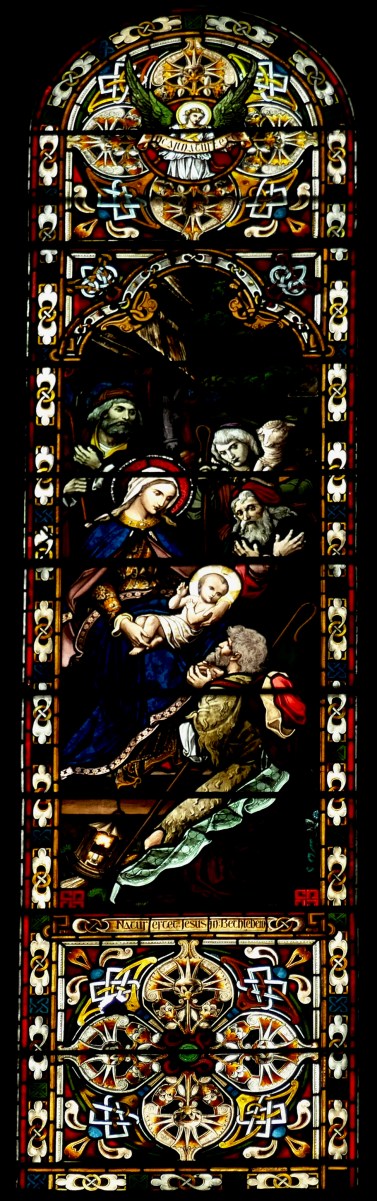
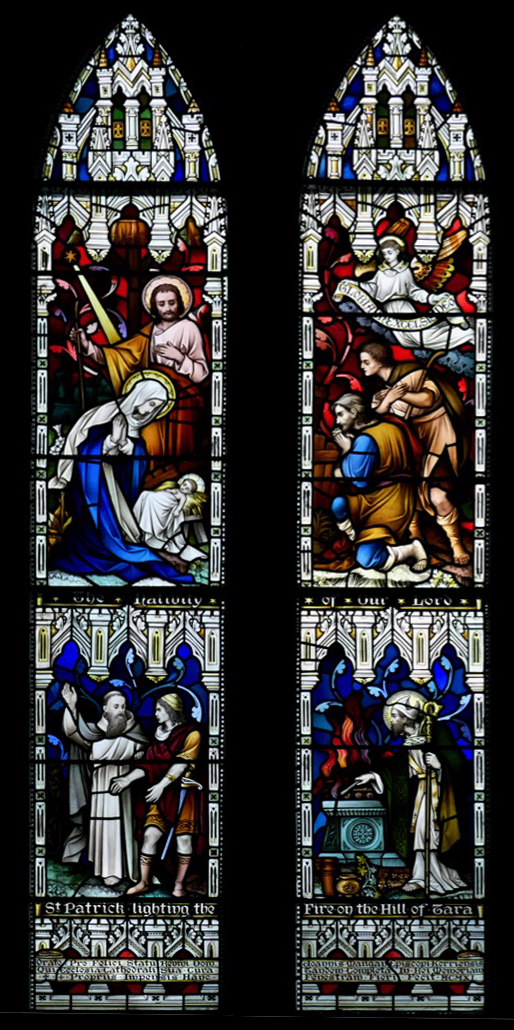
From about the 1860s to the 1940s Mayer was the foremost supplier of stained glass to Irish churches, both Catholic and Protestant. The first two images above, for example, are of a Nativity scene in St Eugene’s Catholic Cathedral in Derry. Catholics were probably spurred on to order Mayer windows when Pope Leo XIII named the company a Pontifical Institute of Christian Art in 1892. However, there is no doubt that the windows appealed enormously to the priests and vicars in charge of ordering them and that Mayer was adept in providing the kind of art that was widely attractive  to parishioners. So – Mayer stained glass was ubiquitous, but it was also controversial and derided. Let’s look at why this was, and whether it was deserved.

During the stained glass renaissance in nineteenth century Britain, the ideal became to replicate the style of stained glass from the High Gothic period of the 12th to 15th centuries – lots of small pieces of coloured glass leaded together, with saintly images set inside elaborate canopies. The example above is from York Minster and the windows below, clearly based on that model, are from the Pugin-designed St Aidan’s Cathedral in Enniscorthy.

Mayer moved away from this kind of glass towards what became known as the Pictorial Style. As a concession to the Gothic, they kept the canopies for the most part (it was a long time before stained glass studios dispensed with canopies) but they used larger sheets of glass (necessitating fewer cames of lead) and they took their artistic inspiration not from medieval windows but from Renaissance paintings.   The purists huffed and puffed, but the people flocked to this new style of glass.

From the beginning this was a business, not an artists’ studio. The purpose was to make money and therefore a factory model was employed, with workers engaged in repetitive production of their own specialities – the apprentices did nothing but canopies, the painters might spend years decorating robes with brocade or embroidery motifs, only the most talented got to do faces. Designers produced sketches that were infinitely adaptable, with slight tweaking. In the large window above, in Baltinglass, Co Wicklow, the central image is of the Assumption of Mary into heaven. An almost identical design can be seen in the Catholic Church in Bantry, Co Cork, below (and indeed all over the place).

The results were appealing – highly competent windows full of beautiful images. 

High Renaissance figures swathed in copious draperies which amplify their forms and define their movements. Here the painter was freer to incorporate the sharp drapery folds which were inherited from the German Renaissance painting tradition. Colours are vibrant and rich, and the window glows with a deep resonance because the amount of white glass was kept to a minimum. . . It was easy for a congregation to relate to the pictorialism and to recognise the narratives, so that the windows were regarded not only as aesthetic objects but as an effective catalyst to meditation and piety. Pictorialism spoke more directly to the. . . public than did the more correct visual medievalism of the stricter British ecclesiologists. 

shirley ann brown*

Above is the Annunciation window in Charleville, Co Cork – one of my personal favourite windows by any studio. Although the firm was German and the windows made in Munich, they had offices in London, and an agent in Dublin (in fact, Joshua Clarke, Harry’s father, started out as their Irish agent). They became adept at fulfilling the request of Irish clergy for specific iconography – that is, Irish saints, and panels illustrating stories from Irish hagiographies.

St Patrick, above, is shown with his shamrock, paschal fire and snake, although the towers in the backdrop could be from a castle on the Rhine rather than resembling an Irish round tower. At their most basic, Irish saints were simply chosen from a pattern-book of saintly images and supplied with a name-caption. They all looked the same – St Aidan in one window is identical to St Columba in another, balding, bearded, dressed in a monk’s habit or a bishop’s splendid robes and mitre, but often with an attribute to distinguish them one from the other. St Patrick always has his shamrock, St Brigid her flame or her church, St Joseph carries lilies. Nicola Gordon Bowe, in the Introduction to the Gazetteer of Irish Stained Glass reported on Edward Martyn’s outrage at the lack of discernment among clergy and architects who seemed not to be able to distinguish between the work of an artist and the trade salesman with an oily tongue and an ever-ready kiln.

But you get what you pay for, and if you wanted something other than the pattern-book, Mayer could rise to the occasion, with splendid depictions of the mythology associated with Irish saints, all done in the same Italianate style and full of movement and vitality. One of my favourites is the story of St Dympna from Armagh Cathedral. (See Harry Clarke’s version of St Dympna in this post  – the story is the same but the images are vastly different.)

David Lawrence, the mastermind behind the website Gloine.ie, is a defender of Mayer, saying about the prejudice to which Mayer was subjected, Feelings against German glass were whipped up into a nationalistic frenzy at the time of the setting up, in 1903, of the Irish Arts-and-Crafts stained-glass studio An Túr Gloine and continued as that studio flourished in the early decades of the twentieth century. This prejudice has been well documented and was partly based on the factory model of glass production, since the new ethos of Arts and Crafts prioritised the artist’s vision and craft and abhorred mass production. However, Lawrence insists that, at their best, Mayer produced outstanding stained glass to equal any studio.

The year 1894 marked the start of a particularly successful new era at Mayer — this was the year that they were joined by the English artist William Francis Dixon (1848-1928). He had trained at the London studio, Clayton & Bell and then set up his own studio, Dixon & Vesey, before moving to Germany to work at Mayer. Dixon‘s arrangement with Mayer was a happy one. His skilful designing and drawing in a romantic manner influenced by the late Pre-Raphaelites and Mayer‘s attention to detail, masterly glass-painting and faultless craftsmanship formed an ideal marriage. Mayer-Dixon windows are in a romantic style, with a sweetness of drawing, softness of painting and beautiful, tapestry-like details. The heads are especially sensitively drawn. It is readily apparent that Dixon was able to dictate his own choice of colours to Mayer. 


 David Lawrence,
Stained Glass Windows, Six Roman Catholic Churches, County Offaly November 2010

One of Dixon’s windows is this fine war memorial in St Canice’s Church of Ireland Cathedral in Kilkenny. However, in the end, it can be argued that Mayer became a victim of their own success. Despite occasional triumphs of design and execution, too many of their windows lacked originality and freshness, starting to look hackneyed and same-y. Public taste for sentimentalised depictions (however gorgeous and expertly painted) gave way, under the influence of European art movements, to a search for a more authentic and modern form of religious expression. Irish artists responded by developing a vibrant, often experimental, stained glass industry dominated by small studios producing artist-led work. 

I will leave you with The Raising of Lazarus from Baltinglass Catholic Church for two reasons – firstly because it is perfectly illustrates the Mayer pictorial style at its best. I have provided three details close up, so you can see how competently the artist has rendered the subject matter.

The sentimentality critics complained of is in full flight in the image below – but also, look at the size of the eyes. Creating over-sized eyes to enhance and beautify a face didn’t start with Harry Clarke!

But secondly I use The Raising of Lazarus tongue in cheek as a nod to the fact that in fact Mayer is still around – and they have finally caught up with the century they live in. Take a look at this story in the New York Times to see how Mayer of Munich is embracing the twenty-first century.

*The Influence of German Religious Stained Glass in Canada 1880-1941 by Shirley Ann Brown, RACAR: revue d’art canadienne / Canadian Art Review, Vol. 21, No. 1/2, Représentation et identités culturelles / Representation and Cultural Identity (1994), pp. 21-31 (11 pages)

Remembering Maeve

We spent yesterday afternoon at the Echoes Festival in Dalkey, a celebration of the life and work of Maeve Binchy and her impact on Irish writing. Maeve, who died in 2012, was universally beloved, and nowhere more so than in my house. You see, Maeve was a great friend to my mother, the writer Lilian Roberts Finlay (that’s the two of them, above at the Vancouver Writers’ Festival). As a writer, Lilian was nowhere near as successful as Maeve but that didn’t matter to Maeve. She was supportive and generous and encouraging and caring: when we cleaned out Lilian’s house we found notes and cards from Maeve, always cheerful and positive. 

Lilian and Maeve shared a stage at the Vancouver Writer’s Festival in 1998 and I think every Irish person in Vancouver was at their talk, including a huge contingent from the Irish Women’s Network. It was a great success – Lilian (below) was a superb reader of her own stories (that time in the Abbey School of Acting had not been wasted) and Maeve was, well, wonderful. 

Maeve and Gordon invited Lilian and me to lunch with them at their hotel – this lunch will live in my memory forever because it confirmed what everyone always says about Maeve: she was, in person, exactly as you imagine her to be – kind, funny, fascinating, witty and incredibly warm. She and Gordon were sweet and loving with each other, with lots of banter to make us all laugh and keep the talk flowing. Because we proudly claim Maeve for Ireland, we forget that the rest of the world loved her too and often read her in translation. Maeve was huge in North America – here’s the photo by Derek Speirs that accompanied her obit in the New York Times.

The Echoes Festival afternoon we attended was a forceful reminder of what a powerhouse Maeve was in Irish writing. The discussions were wide-ranging and focused on her influence on contemporary novel-writing – her insistence on using her own voice, on being authentically Irish and never pandering to those who might not understand our idiom, on allowing Irish girls and women to see their own lives on the page. 

Moderator Caroline Erskine with Turtle Bunbury, Rachael English, Caelainn Hogan and Phil Mullen

Phil Mullen read her own story about stealing the pennies for the Black Babies, and we all nodded along in recognition, even as were were appalled at her treatment in the industrial school where she grew up. A lighter note was struck by Maeve’s cousin, Gillian Binchy, about her Communion Dress – a story worthy of Maeve herself.  

Maeve wrote for and about women (write what you know was one of her mantras, a maxim she spun into very funny anecdotes about not writing about orgies) and one of the sessions fittingly took shape around the secrets and shame faced by Irish women in the 20th century. 

At Echoes in 2017, Margaret Kelleher, UCD professor of Anglo-Irish literature and drama, said that close study of Binchy’s writing suggests she will be regarded as a “key witness and chronicler of Irish life in the last decades of the 20th century and the first decade of the next”.

YOU STILL CAN’T HOPE FOR BETTER COMPany than maeve binchy
by Henrietta Mckervey, irish INDEPENDENT
Róisín Ingle (left) moderated a discussion with (l to r) Sarah Maria Griffin, Anna Carey and Chris Binchy

All the speakers, writers, readers and moderators were excellent. We’re already planning to attend the full event next year. And – can we say – this was our first live-audience indoor event in almost two years. Tickets were limited to ensure social distancing, and we wore masks throughout, but oh my goodness how great it felt to be part of a live event again!

Dzogchen Beara

There is a centre of Buddhism on the Beara Peninsula: we visited it for the first time during the week. It is very beautifully situated on the coast south of Allihies. You only have to look at the photograph above, taken at the centre, to realise that the location is a very important aspect of the whole project.

Sa Che or Tibetan Geomancy is the analysis of the earth — including water, space, air, light, trees, garden and home. The principles of Sa Che are to bring harmony and equilibrium, both in the natural environment and within the being, affording good health, wealth and enjoyment. These benefits flow on to our relationships and lifestyle

Pure Land Farms, California

I am using the aerial view, above, courtesy of Dzogchen Beara Tibetan Buddhist Retreat Centre. All the buildings in the lower part of the picture are within the centre, which was founded by Sogyal Rinpoche in 1987. On the lower right is The Spiritual Care Centre – opened by Ireland’s President, Mary McAleese in 2007 – which provides a safe and supportive environment for people living with a life-altering illness, recovering from treatment, facing the end of their life or experiencing bereavement, as well as their families, loved ones and others who care for them. It’s a special, culturally significant place – and you can see how its siting takes the fullest advantage of the impressive scenery.

That’s a Tibetan geomancy chart, above (courtesy of The Wellcome Foundation). It is traditionally used to work out how and where you should build your house – or any important structure: as you can see there is a Zodiac at its heart. As an architectural student back in the 1960s I was fascinated by this concept – then popularly termed Feng Shui – we all were. Throughout my working life I was always seeking to justify my clients’ demands to build in a certain place or in a certain way; I wince, today, when I see the building processes we have here in Ireland – our countryside is ravaged, in my view, by the excavator and the rock-breaker carving out great flat platforms whereon are placed ‘anywhere style’ bungalows or houses, rather than structures which try to flow and blend into the uneven natural landscapes. But I’d better get off my high horse, I suppose. This Buddhist centre on the Beara is an excellent example of buildings ‘fitting in’ to their surroundings.

Anyone can visit the centre: it has an excellent cafe which enjoys the unparalleled views, for a start, but there are gardens and grounds to wander around, and many events which everyone can attend: keep an eye on the website.

This shows one of the meditation rooms (courtesy of Dzogchen Beara Tibetan Buddhist Retreat Centre), with Pi Jun Taiwa in meditative posture. Below is a satellite image of the site showing its proximity to the coast and, below that, an extract from the 1840 OS map. I was intrigued to know what the buildings are that are shown occupying the site in those times. I have been unable to find the answer but wonder if they were connected to mining: the great copper-mining centre of Allihies is situated inland from here, but there are said to be ore-bearing lodes at Dooneen point, south-west of the new Centre.

An exciting venture happening at Dzogchen Beara right now is the construction of the first Buddhist temple in Ireland! It’s a relatively long-term project – with progress held up by the Covid crisis. But we saw it under way and it promises to be an impressive modern building based in Tibetan tradition.

The site of the temple was consecrated in 2010 with a sacred fire ceremony. I was intrigued to read that the curving overhanging roofs are to be constructed from ‘Nordic Royal Copper’, a specially developed alloy containing zinc and aluminium: this should ensure that the copper retains its shining colour through all weathers: a traditional copper roof would become dulled and turn green after a few years. Instead, the roofs of this temple will shine like the ‘Beacon of Wisdom and Compassion’ that the architect imagined. At present, the building works are still very much in their unadorned basic form, but moving forward (below).

The Centre grounds already display a traditional ‘Stupa’. Originally, stupas stared out as sacred mounds or domes which were used to house the relics of the Buddha. Now they are symbolic structures which give special significance to their location, as here. They are always decorated with colourful prayer flags which serve to bless the surroundings. I can’t help seeing these flags in the same light as ‘rag trees’ often found by holy wells in Ireland. The processional way to the stupa is lined with tall prayer banners. And the whole stupa site also enjoys the wonderful views to the ocean.

The year continues to pour down on us glorious golden days – and we embrace them. Our journey to the Beara was memorable, and I have no doubt that we will be calling into the Dzogchen Centre on many future occasions: I certainly want to keep an architectural eye on the progress of the temple. By the way, an apt translation of Dzogchen is “great perfection”.

Gliding Through Velvet, Fireworks All Around

It was a magical experience – kayaking at night on Castlehaven Inlet!

Wait – what? At night? Yes – of course kayaking in West Cork is wonderful at any time but at night it takes on a special aura, helped out by the silky darkness and the silence. I went with Atlantic Sea Kayaking, the company run by the genial Jim Kennedy. I’d been with him once before, on Lough Hyne – that was way back in 2014 and was one of the highlights of my year. I wrote about that incredible trip in Starlight Bliss. This trip was equally as amazing.

We gathered at 7 at Reen Pier in Castlehaven Inlet. This is a very professional outfit – we were all shapes and sizes but soon everyone was kitted out in waterproof trousers and jackets. Then it was time for a quick lesson on how to hold the paddle and what not to do, reassurance on how stable and safe the kayaks are, and before we knew it there we were gently floating in the gathering gloaming.

Lucky me got to sit in the front of Declan Power’s kayak. He was one of our two guides and has years of experience doing this, but it doesn’t seemed to have dimmed his enjoyment and wonder. If I hadn’t already been excited, I would have been infected by his own contagious enthusiasm. It was still fairly light so we paddled down to Castletownshend, getting used to the paddles and the kayaks and our eyes adjusting to the fading light. Rosie, the other guide, brought up the rear and made sure were were all accounted for.

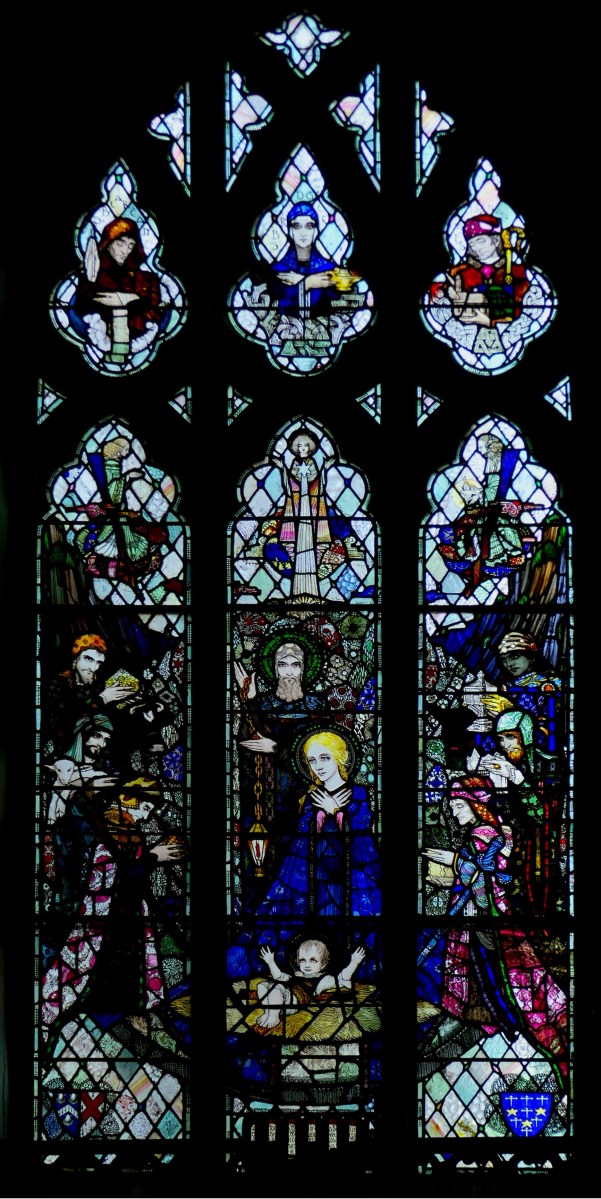
Declan knows his history and as we rafted up alongside Castletownsend Castle he told us about the area and about the families that had moved here after Cromwell. It’s a very special village, with interesting architecture, famous families, and, crowning glory, Harry Clarke windows in St Barrahane’s Church of Ireland. That’s his St Barrahane, below.

By now it was getting properly dark. Declan and Rosie turned on their helmet lights and we headed back up the inlet. We steered towards the far bank, where overhanging trees blocked out any residual light from the sky. First, Declan encouraged us all to be still and just listen – to the silence. The rooks, noisily cawing earlier, had settled down into their rookery for the evening and there wasn’t a sound. We felt enveloped in peace.

Since I didn’t bring my camera on board I have to rely on photographs of bioluminescence by others. This image is by Joleen Cronin, used with gratitude, from a BBC piece on Bioluminescence near Crosshaven.

Declan broke the silence by asking us to trail our hands in the water and there was a collective intake of breath. Everywhere our hands dipped and splashed sparkles began to skip across the water. It was the bioluminescence that this area is known for! Like fireflies, marine organisms such as plankton emit light when disturbed. The sea is teeming with tiny fish, bacteria, algae, worms, crustaceans. . . all with the chemicals necessary for bioluminescence. And they seem to love West Cork!

This incredible image is by Vincent Hyland of Derrynane, well-known champion of the natural world (Permission to use requested)

So there we were, gliding through the velvet black waters, surrounded by fireworks. There wasn’t much chat – everyone was lost in their own experience of dipping and gently splashing and watching as flashing droplets raced away from our hulls and paddles. 

Declan – thank you for this once-in-a-lifetime experience!

I’ve lived back in West Cork now for almost ten years and we’ve done so much in that time. And yet there are still experiences to be had that leave you in joyful wonderment and asking the Old Gods – how did I get to be living this life?

Another of Vincent Hyland’s incredible captures